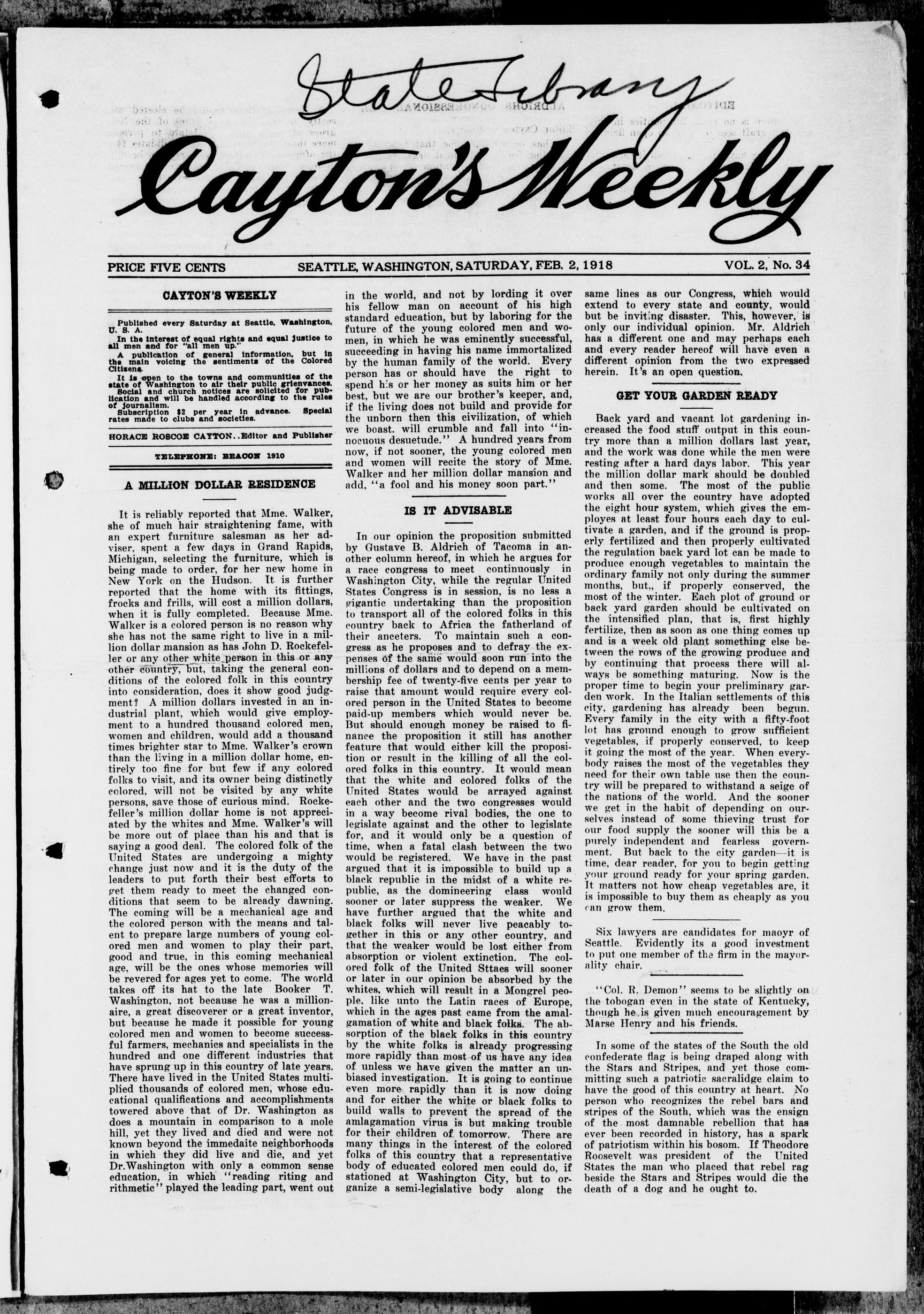
Cayton's Weekly
Saturday, February 2, 1918
Seattle, Washington
Page text (machine-generated)
State Library
Cayton's Weekly
---
PRICE FIVE CENTS
CAYTON'S WEEKLY
Published every Saturday at Seattle, Washington, U. S. A.
In the interest of equal rights and equal justice to all men and for "all men up."
A publication of general information, but in the main voicing the sentiments of the Colored Citizens.
It is open to the towns and communities of the state of Washington to air their public grievances. Social and church notices are solicited for publication and will be handled according to the rules of journalism.
Subscription $2 per year in advance. Special rates made to clubs and societies.
HORACE ROSCOE CAYTON..Editor and Publisher
TELEPHONE: BEACON 1910
A MILLION DOLLAR RESIDENCE
It is reliably reported that Mme. Walker, she of much hair straightening fame, with an expert furniture salesman as her adviser, spent a few days in Grand Rapids, Michigan, selecting the furniture, which is being made to order, for her new home in New York on the Hudson. It is further reported that the home with its fittings, frocks and frills, will cost a million dollars, when it is fully completed. Because Mme. Walker is a colored person is no reason why she has not the same right to live in a million dollar mansion as has John D. Rockefeller or any other white person in this or any other country, but, taking the general conditions of the colored folk in this country into consideration, does it show good judgment? A million dollars invested in an industrial plant, which would give employment to a hundred thousand colored men, women and children, would add a thousand times brighter star to Mme. Walker's crown than the living in a million dollar home, entirely too fine for but few if any colored folks to visit, and its owner being distinctly colored, will not be visited by any white persons, save those of curious mind. Rockefeller's million dollar home is not appreciated by the whites and Mme. Walker's will be more out of place than his and that is saying a good deal. The colored folk of the United States are undergoing a mighty change just now and it is the duty of the leaders to put forth their best efforts to get them ready to meet the changed conditions that seem to be already dawning. The coming will be a mechanical age and the colored person with the means and talent to prepare large numbers of young colored men and women to play their part, good and true, in this coming mechanical age, will be the ones whose memories will be revered for ages yet to come. The world takes off its hat to the late Booker T. Washington, not because he was a millionaire, a great discoverer or a great inventor, but because he made it possible for young colored men and women to become successful farmers, mechanics and specialists in the hundred and one different industries that have sprung up in this country of late years. There have lived in the United States multiplied thousands of colored men, whose educational qualifications and accomplishments towered above that of Dr. Washington as does a mountain in comparison to a mole hill, yet they lived and died and were not known beyond the immediate neighborhoods in which they did live and die, and yet Dr.Washington with only a common sense education, in which "reading riting and rithmetic" played the leading part, went out
SEATTLE, WASHINGTON, SATURDAY, FEB. 2, 1918
in the world, and not by lording it over his fellow man on account of his high standard education, but by laboring for the future of the young colored men and women, in which he was eminently successful, succeeding in having his name immortalized by the human family of the world. Every person has or should have the right to spend his or her money as suits him or her best, but we are our brother's keeper, and, if the living does not build and provide for the unborn then this civilization, of which we boast. will crumble and fall into "innocuous desuetude." A hundred years from now, if not sooner, the young colored men and women will recite the story of Mme. Walker and her million dollar mansion and add, "a fool and his money soon part."
IS IT ADVISABLE
In our opinion the proposition submitted by Gustave B. Aldrich of Tacoma in another column hereof, in which he argues for a race congress to meet continuously in Washington City, while the regular United States Congress is in session, is no less a gigantic undertaking than the proposition to transport all of the colored folks in this country back to Africa the fatherland of their ancesters. To maintain such a congress as he proposes and to defray the expenses of the same would soon run into the millions of dollars and to depend on a membership fee of twenty-five cents per year to raise that amount would require every colored person in the United States to become paid-up members which would never be. But should enough money be raised to finance the proposition it still has another feature that would either kill the proposition or result in the killing of all the colored folks in this country. It would mean that the white and colored folks of the United States would be arrayed against each other and the two congresses would in a way become rival bodies, the one to legislate against and the other to legislate for, and it would only be a question of time, when a fatal clash between the two would be registered. We have in the past argued that it is impossible to build up a black republic in the midst of a white republic, as the domineering class would sooner or later suppress the weaker. We have further argued that the white and black folks will never live peacably together in this or any other country, and that the weaker would be lost either from absorption or violent extinction. The colored folk of the United Staats will sooner or later in our opinion be absorbed by the whites, which will result in a Mongrel people, like unto the Latin races of Europe, which in the ages past came from the amalgamation of white and black folks. The absorption of the black folks in this country by the white folks is already progressing more rapidly than most of us have any idea of unless we have given the matter an unbiased investigation. It is going to continue even more rapidly than it is now doing and for either the white or black folks to build walls to prevent the spread of the amlagamation virus is but making trouble for their children of tomorrow. There are many things in the interest of the colored folks of this country that a representative body of educated colored men could do, if stationed at Washington City, but to organize a semi-legislative body along the
VOL.2, No.34
same lines as our Congress, which would extend to every state and county, would but be inviting disaster. This, however, is only our individual opinion. Mr. Aldrich has a different one and may perhaps each and every reader hereof will have even a different opinion from the two expressed herein. It's an open question.
GET YOUR GARDEN READY
Back yard and vacant lot gardening increased the food stuff output in this country more than a million dollars last year, and the work was done while the men were resting after a hard days labor. This year the million dollar mark should be doubled and then some. The most of the public works all over the country have adopted the eight hour system, which gives the employes at least four hours each day to cultivate a garden, and if the ground is properly fertilized and then properly cultivated the regulation back yard lot can be made to produce enough vegetables to maintain the ordinary family not only during the summer months, but., if properly conserved, the most of the winter. Each plot of ground or back yard garden should be cultivated on the intensified plan, that is, first highly fertilize, then as soon as one thing comes up and is a week old plant something else between the rows of the growing produce and by continuing that process there will always be something maturing. Now is the proper time to begin your preliminary garden work. In the Italian settlements of this city, gardening has already been begun. Every family in the city with a fifty-foot lot has ground enough to grow sufficient vegetables, if properly conserved, to keep it going the most of the year. When everybody raises the most of the vegetables they need for their own table use then the country will be prepared to withstand a seige of the nations of the world. And the sooner we get in the habit of depending on ourselves instead of some thieving trust for our food supply the sooner will this be a purely independent and fearless government. But back to the city garden—it is time, dear reader, for you to begin getting your ground ready for your spring garden. It matters not how cheap vegetables are, it is impossible to buy them as cheaply as you can grow them.
Six lawyers are candidates for maoyr of Seattle. Evidently its a good investment to put one member of the firm in the mayorality chair.
"Col. R. Demon" seems to be slightly on the tobogan even in the state of Kentucky, though he is given much encouragement by Marse Henry and his friends.
In some of the states of the South the old confederate flag is being draped along with the Stars and Stripes, and yet those committing such a patriotic sacralidge claim to have the good of this country at heart. No person who recognizes the rebel bars and stripes of the South, which was the ensign of the most damnable rebellion that has ever been recorded in history, has a spark of patriotism within his bosom. If Theodore Roosevelt was president of the United States the man who placed that rebel rag beside the Stars and Stripes would die the death of a dog and he ought to.
ARON, hol laa ad ka oN a a eS aw ols ) une =.
ASA OE a . ae
hia
pean)
re
Dre a aaa TT
¥ % ‘ r *
aR wena Ee Pe ge ee ep ee eg ae tl ee ee ee Ce re a ee aint
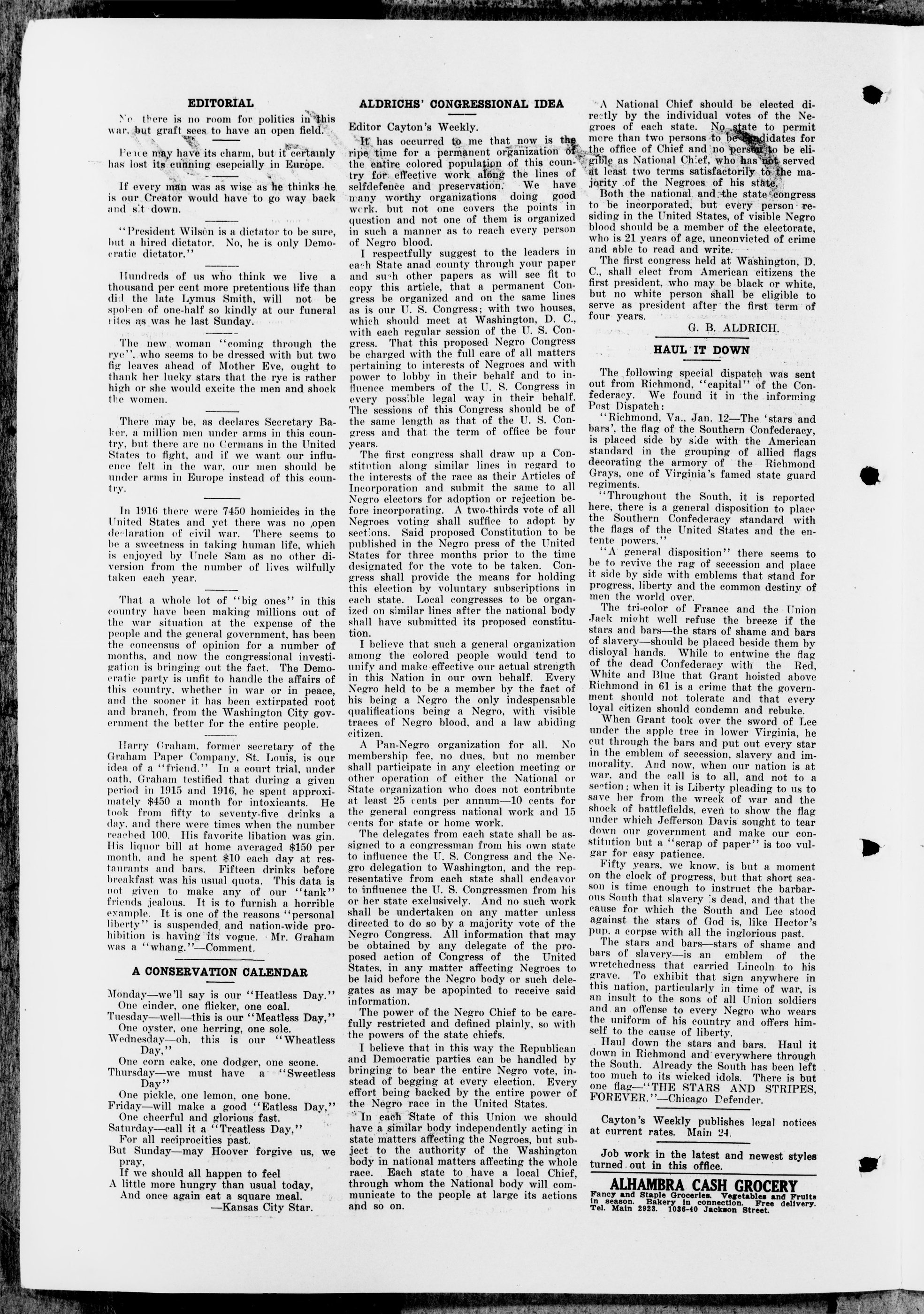
EDITORIAL
war, but graft sees to have an open field
Peace may have its charm, but it'certamly
has lost its eunning esepcially in Europe.
If every man was as wise as he thinks he
is our Creator would have to go way back
and sit down.
“President Wilsén is a dictator to be sure,
but a hired dictator. No, he is only Demo-
cratie dictator.’”
Ifundreds of us who think we live a
thousand per cent more pretentious life than
did the late Lymus Smith, will not be
spoken of one-half so kindly at our funeral
rites as was he last Sunday.
The new. woman ‘‘coming through the
rye’’, who seems to be dressed with but two
fig leaves ahead of Mother Eve, ought to
thank her lucky stars that the rye is rather
high or she would excite the men and shock
the women.
There may be, as declares Secretary Ba-
ker, a million men under arms in this coun-
try, but there are no Cermans in the United
States to fight, and if we want our influ-
ence felt in the war, our men should be
under arms in Europe instead of this coun-
try.
In 1916 there were 7450 homicides in the
United States and yet there was no open
declaration of civil war. There seems to
he a sweetness in taking human life, which
is enjoyed by Unele Sam as no other di-
version from the number of lives wilfully
taken each year.
That a whole lot of ‘‘big ones’’ in this
country have been making millions out of
the war situation at the expense of the
people and the general government, has been
the concensus of opinion for a number of
months, and now the congressional investi-
gation is bringing out the fact. The Demo-
cratic party is unfit to handle the affairs of
this country, whether in war or in peace,
and the sooner it has been extirpated root
and branch, from the Washington City gov-
ernment the better for the entire people.
Harry Craham. former secretary of the
Graham Paper Company, St. Louis, is our
idea of a “‘friend.’’? In a court trial, under
oath, Graham testified that during a given
period in 1915 and 1916, he spent approxi-
mately $450 a month for intoxicants. He
took from fifty to seventy-five drinks a
day, and there were times when the number
reached 100. His favorite libation was gin.
His liquor bill at home averaged $150 per
month, and he spent $10 each day at res-
taurants and bars. Fifteen drinks before
breakfast was his usual quota. This data is
not given to make any of our ‘‘tank’?
friends jealous. It is to furnish a horrible
example. It is one of the reasons ‘‘personal
liberty’? is suspended, and nation-wide pro-
hibition is having ‘its vogue. -Mr. Graham
was a ‘‘whang.’’—Comment.
A CONSERVATION CALENDAR
Monday—we’ll say is our ‘‘Heatless Day.’’
One cinder, one flicker, one coal.
‘Tuesday—well—this is our ‘‘Meatless Day,”’
One oyster, one herring, one sole.
Wednesday—oh, this is our ‘‘Wheatless
Day,”
One corn cake, one dodger, one scone.
Thursday—we must have a ‘‘Sweetless
Day”
One pickle, one lemon, one bone.
Friday—will make a good ‘‘Eatless Day,’’
One cheerful and glorious fast.
Saturday—eall it a ‘“‘Treatless Day,”
For all reciprocities past.
But Sunday—may Hoover forgive us, we
pray,
If we should all happen to feel
A little more hungry than usual today,
And once again eat a square meal.
—Kansas City Star.
ALDRICHS’ CONGRESSIONAL IDEA
Editor Cayton’s Weekly.
ripe, time for a permanent organization OP:
the entire colored population of this coun-'
try for: effective work aléng the lines of
selfdefence and preservation: We have
many worthy organizations doing good
werk. but not one covers the points in
question and not one of them is organized
in such a manner as to reach every person
of Negro blood. }
I respectfully suggest to the leaders in
each State anad county through your paper
and such other papers as will see fit to
copy this article, that a permanent Con-
gress be organized and on the same lines
as is our U. S. Congress; with two houses,
which should meet at Washington, D. C.,
with each regular session of the U. S. Con-
gress. That this proposed Negro Congress
be charged with the full care of all matters
pertaining to interests of Negroes and with
power to lobby in their behalf and to in-
fluence members of the U. S. Congress in
every possible legal way in their behalf.
The sessions of this Congress should be of
the same length as that of the U. S. Con-
gress and that the term of office be four
years.
The first congress shall draw up a Con-
stitution along similar lines in regard to
the interests of the race as their Articles of
Incorporation and submit the same to all
Negro electors for adoption or rejection be-
fore incorporating. A two-thirds vote of all
Negroes voting shall suffice to adopt by
sections. Said proposed Constitution to be
published in the Negro press of the United
States for three months prior to the time
designated for the vote to be taken. Con-
gress shall provide the means for holding
this election by voluntary subscriptions in
each state. Local congresses to be organ-
ized on similar lines after the national body
shall have submitted its proposed constitu-
tion.
I believe that such a general organization
among the colored people would tend to
unify and make effective our actual strength
in this Nation in our own behalf. Every
Negro held to be a member by the fact of
his being a Negro the only indespensable
qualifications being a Negro, with visible
traces of Negro blood, and a law abiding
citizen.
A Pan-Negro organization for all. No
membership fee, no dues, but no member
shall participate in any election meeting or
other operation of either the National or
State organization who does not contribute
at least 25 cents per annum—10 cents for
the general congress national work and 15
cents for state or home work.
The delegates from each state shall be as-
signed to a congressman from his own state
to influence the U. S. Congress and the Ne-
gro delegation to Washington, and the rep-
resentative from each state shall endeavor
to influence the U. S. Congressmen from his
or her state exclusively. And no such work
shall be undertaken on any matter unless
directed to do so by a majority vote of the
Negro Congress. All information that may
be obtained by any delegate of the pro-
posed action of Congress of the United
States, in any matter affecting Negroes to
be laid before the Negro body or such dele-
gates as may be apopinted to receive said
information.
The power of the Negro Chief to be care-
fully restricted and defined plainly, so with
the powers of the state chiefs.
I believe that in this way the Republican
and Democratic parties can be handled by
bringing to bear the entire Negro vote, in-
stead of begging at every election. Every
effort being backed by the entire power of
the Negro race in the United States.
“In each State of this Union we should
have a similar body independently acting in
A National Chief should be elected di-
rectly by the individual votes of the Ne-
groes of each state. No..state to permit
more than two persons to be idates for
the office of Chief and ‘no perstt$o be eli-
gible as National Chief, who has ve
at least two terms satisfactorily tothe ma-
jority .of the Negroes of his state, }
Both the national, and-the state‘congress
to be incorporated, but every person: re-
siding in the United States, of visible Negro
blood should be a member of the electorate,
who is 21 years of age, unconvicted of crime
and able to read and write. -
The first congress held at Washington, D.
C., shall elect from American citizens the
first president, who may be black or white,
but no white person shall be eligible to
serve as president after the first term of
four years.
G. B, ALDRICH.
HAUL IT DOWN
The following special dispatch was sent
out from Richmond, ‘‘eapital’’ of the Con-
federacy. We found it in the informing
Post Dispatch:
“Richmond, Va., Jan. 12—The ‘stars and
bars’, the flag of the Southern Confederacy,
is placed side by side with the American
standard in the grouping of allied flags
decorating the armory of the Richmond
Grays, one of Virginia’s famed state guard
regiments.
“Throughout the South, it is reported
here, there is a general disposition to place
the Southern Confederacy standard with
the flags of the United States and the en-
tente powers.’’
“A general disposition’? there seems to
be to revive the rag of secession and place
it side by side with emblems that stand for
progress, liberty and the common destiny of
men the world over.
The tri-color of France and the Union
Jack mieht well refuse the breeze if the
stars and bars—the stars of shame and bars
of slavery—should be placed beside them by
disloyal hands. While to entwine the flag
of the dead Confederacy with the Red,
White and Blue that Grant hoisted above
Richmond in 61 is a crime that the govern-
ment should not tolerate and that every
loyal citizen should condemn and rebuke.
When Grant took over the sword of Lee
under the apple tree in lower Virginia, he
cut through the bars and put out every star
in the emblem of secession, slavery and im-
morality. And now, when our nation is at
war, and the call is to all, and not to a
seetion ; when it is Liberty pleading to us to
save her from the wreck of war and the
shock of battlefields, even to show the flag
under which Jefferson Davis sought to tear
down our government and make our con-
stitution but a ‘“‘serap of paper’? is too vul-
gar for easy patience.
Fifty years, we know. is but a moment
on the clock of progress, but that short sea-
son is time enough to instruct the barbar-
ous South that slavery ‘s dead, and that the
cause for which the South and Lee stood
against the stars of God is, like Hector’s
pup. a corpse with all the inglorious past.
The stars and bars—stars of shame and
bars of slavery—is an emblem of the
wretchedness that carried Lineoln to his
grave. To exhibit that sign anywhere in
this nation, particularly in time of war, is
an insult to the sons of all Union soldiers
and. an offense to every Negro who wears
the uniform of his country and offers him-
self to the cause of liberty.
Haul down the stars and bars. Haul it
down in Richmond and‘ everywhere through
the South. Already the South has been left
too much to its wicked idols. There is but
one flag—‘THE STARS AND STRIPES,
FOREVER.’’—Chicago Defender.
eS
Re Se ee a Fg a ere my or “De
Cayton’s Weekly publishes legal notices
at current rates. Main 24.
Job work in the latest and newest styles
turned. out in this office.
a ee
ALHAMBRA CASH GROCERY
Fancy and Staple Groceries. Vegetables and Fruits
in season. Bakery in connection. Free delivery.
Tel. Main 2928. 1036-40 Jackson Street.
---
---
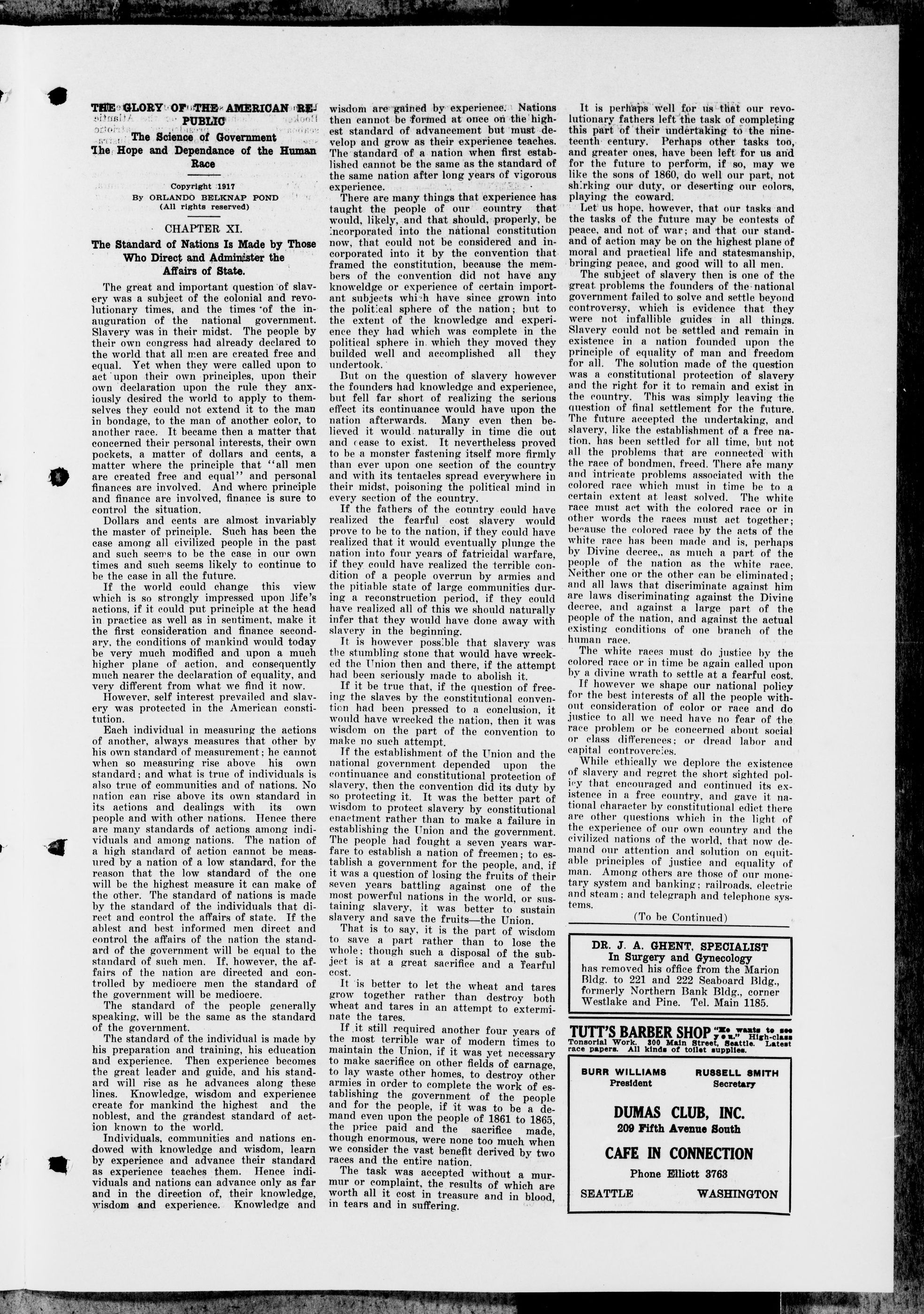
THE GLORY OF THE AMERICAN REPUBLIC
The Science of Government
The Hope and Dependance of the Human Race
Copyright 1917
By ORLANDO BELKNAP POND
(All rights reserved)
The Standard of Nations Is Made by Those Who Direct and Administer the Affairs of State.
The great and important question of slavery was a subject of the colonial and revolutionary times, and the times of the inauguration of the national government. Slavery was in their midst. The people by their own congress had already declared to the world that all men are created free and equal. Yet when they were called upon to act upon their own principles, upon their own declaration upon the rule they anxiously desired the world to apply to themselves they could not extend it to the man in bondage, to the man of another color, to another race. It became then a matter that concerned their personal interests, their own pockets, a matter of dollars and cents, a matter where the principle that "all men are created free and equal" and personal finances are involved. And where principle and finance are involved, finance is sure to control the situation.
Dollars and cents are almost invariably the master of principle. Such has been the case among all civilized people in the past and such seems to be the case in our own times and such seems likely to continue to be the case in all the future.
If the world could change this view which is so strongly impressed upon life's actions, if it could put principle at the head in practice as well as in sentiment, make it the first consideration and finance secondary, the conditions of mankind would today be very much modified and upon a much higher plane of action, and consequently much nearer the declaration of equality, and very different from what we find it now.
However, self interest prevailed and slavery was protected in the American constitution.
Each individual in measuring the actions of another, always measures that other by his own standard of measurement; he cannot when so measuring rise above his own standard; and what is true of individuals is also true of communities and of nations. No nation can rise above its own standard in its actions and dealings with its own people and with other nations. Hence there are many standards of actions among individuals and among nations. The nation of a high standard of action cannot be measured by a nation of a low standard, for the reason that the low standard of the one will be the highest measure it can make of the other. The standard of nations is made by the standard of the individuals that direct and control the affairs of state. If the ablest and best informed men direct and control the affairs of the nation the standard of the government will be equal to the standard of such men. If, however, the affairs of the nation are directed and controlled by mediocre men the standard of the government will be mediocre.
The standard of the people generally speaking, will be the same as the standard of the government. The standard of the individual is made by his preparation and training, his education and experience. Then experience becomes the great leader and guide, and his standard will rise as he advances along these lines. Knowledge, wisdom and experience create for mankind the highest and the noblest, and the grandest standard of action known to the world.
Individuals, communities and nations endowed with knowledge and wisdom, learn by experience and advance their standard as experience teaches them. Hence individuals and nations can advance only as far and in the direction of, their knowledge, wisdom and experience. Knowledge and
wisdom are gained by experience. Nations then cannot be formed at once on the highest standard of advancement but must develop and grow as their experience teaches. The standard of a nation when first established cannot be the same as the standard of the same nation after long years of vigorous experience.
There are many things that experience has taught the people of our country that would, likely, and that should, properly, be incorporated into the national constitution now, that could not be considered and incorporated into it by the convention that framed the constitution, because the members of the convention did not have any knoweldge or experience of certain important subjects which have since grown into the political sphere of the nation; but to the extent of the knowledge and experience they had which was complete in the political sphere in which they moved they builted well and accomplished all they undertook.
But on the question of slavery however the founders had knowledge and experience, but fell far short of realizing the serious effect its continuance would have upon the nation afterwards. Many even then believed it would naturally in time die out and cease to exist. It nevertheless proved to be a monster fastening itself more firmly than ever upon one section of the country and with its tentacles spread everywhere in their midst, poisoning the political mind in every section of the country.
If the fathers of the country could have realized the fearful cost slavery would prove to be to the nation, if they could have realized that it would eventually plunge the nation into four years of fatricidal warfare, if they could have realized the terrible condition of a people overrun by armies and the pitiable state of large communities during a reconstruction period, if they could have realized all of this we should naturally infer that they would have done away with slavery in the beginning.
It is however possible that slavery was the stumbling stone that would have wrecked the Union then and there, if the attempt had been seriously made to abolish it.
If it be true that, if the question of freeing the slaves by the constitutional convention had been pressed to a conclusion, it would have wrecked the nation, then it was wisdom on the part of the convention to make no such attempt.
If the establishment of the Union and the national government depended upon the continuance and constitutional protection of slavery, then the convention did its duty by so protecting it. It was the better part of wisdom to protect slavery by constitutional enactment rather than to make a failure in establishing the Union and the government. The people had fought a seven years warfare to establish a nation of freemen; to establish a government for the people, and, if it was a question of losing the fruits of their seven years battling against one of the most powerful nations in the world, or sustaining slavery, it was better to sustain slavery and save the fruits—the Union.
That is to say, it is the part of wisdom to save a part rather than to lose the whole; though such a disposal of the subject is at a great sacrifice and a fearful cost. It is better to let the wheat and tares grow together rather than destroy both wheat and tares in an attempt to exterminate the tares.
If it still required another four years of the most terrible war of modern times to maintain the Union, if it was yet necessary to make sacrifice on other fields of carnage, to lay waste other homes, to destroy other armies in order to complete the work of establishing the government of the people and for the people, if it was to be a demand even upon the people of 1861 to 1865, the price paid and the sacrifice made, though enormous, were none too much when we consider the vast benefit derived by two races and the entire nation. The task was accepted without a murmur or complaint, the results of which are worth all it cost in treasure and in blood, in tears and in suffering.
It is perhaps well for us that our revolutionary fathers left the task of completing this part of their undertaking to the nineteenth century. Perhaps other tasks too, and greater ones, have been left for us and for the future to perform, if so, may we like the sons of 1860, do well our part, not shirking our duty, or deserting our colors, playing the coward.
Let us hope, however, that our tasks and the tasks of the future may be contests of peace, and not of war; and that our standard of action may be on the highest plane of moral and practical life and statesmanship, bringing peace, and good will to all men.
The subject of slavery then is one of the great problems the founders of the national government failed to solve and settle beyond controversy, which is evidence that they were not infallible guides in all things. Slavery could not be settled and remain in existence in a nation founded upon the principle of equality of man and freedom for all. The solution made of the question was a constitutional protection of slavery and the right for it to remain and exist in the country. This was simply leaving the question of final settlement for the future. The future accepted the undertaking, and slavery, like the establishment of a free nation, has been settled for all time, but not all the problems that are connected with the race of bondmen, freed. There are many and intricate problems associated with the colored race which must in time be to a certain extent at least solved. The white race must act with the colored race or in other words the races must act together; because the colored race by the acts of the white race has been made and is, perhaps by Divine decree., as much a part of the people of the nation as the white race. Neither one or the other can be eliminated; and all laws that discriminate against him are laws discriminating against the Divine decree, and against a large part of the people of the nation, and against the actual existing conditions of one branch of the human race.
The white races must do justice by the colored race or in time be again called upon by a divine wrath to settle at a fearful cost. If however we shape our national policy for the best interests of all the people without consideration of color or race and do justice to all we need have no fear of the race problem or be concerned about social or class differences; or dread labor and capital controveries.
While ethically we deplore the existence of slavery and regret the short sighted policy that encouraged and continued its existence in a free country, and gave it national character by constitutional edict there are other questions which in the light of the experience of our own country and the civilized nations of the world, that now demand our attention and solution on equitable principles of justice and equality of man. Among others are those of our monetary system and banking; railroads, electric and steam; and telegraph and telephone systems.
DR. J. A. GHENT, SPECIALIST
In Surgery and Gynecology
has removed his office from the Marion
Bldg. to 221 and 222 Seaboard Bldg.,
formerly Northern Bank Bldg., corner
Westlake and Pine. Tel. Main 1185.
TUTT'S BARBER SHOP "He wants to see you." High-class
Tonsorial Work. 300 Main Street, Seattle. Latest
race papers. All kinds of toilet supplies.
BURR WILLIAMS RUSSELL SMITH
President Secretary
DUMAS CLUB, INC.
209 Fifth Avenue South
CAFE IN CONNECTION
Phone Elliott 3763
SEATTLE WASHINGTON
* Sl . fi a. | Ny ae
Dl ke Loans. 1 A UL re | Tas “ee tay ee wd an
pRSS. Fat Ane fy
IE RN at
ME
4
a rc ET
ES oe : ee weagegi mabe ctO NE WG Spars I hae a
Ne nT eG eee Pa acer yO yt tPA eg Ane rs
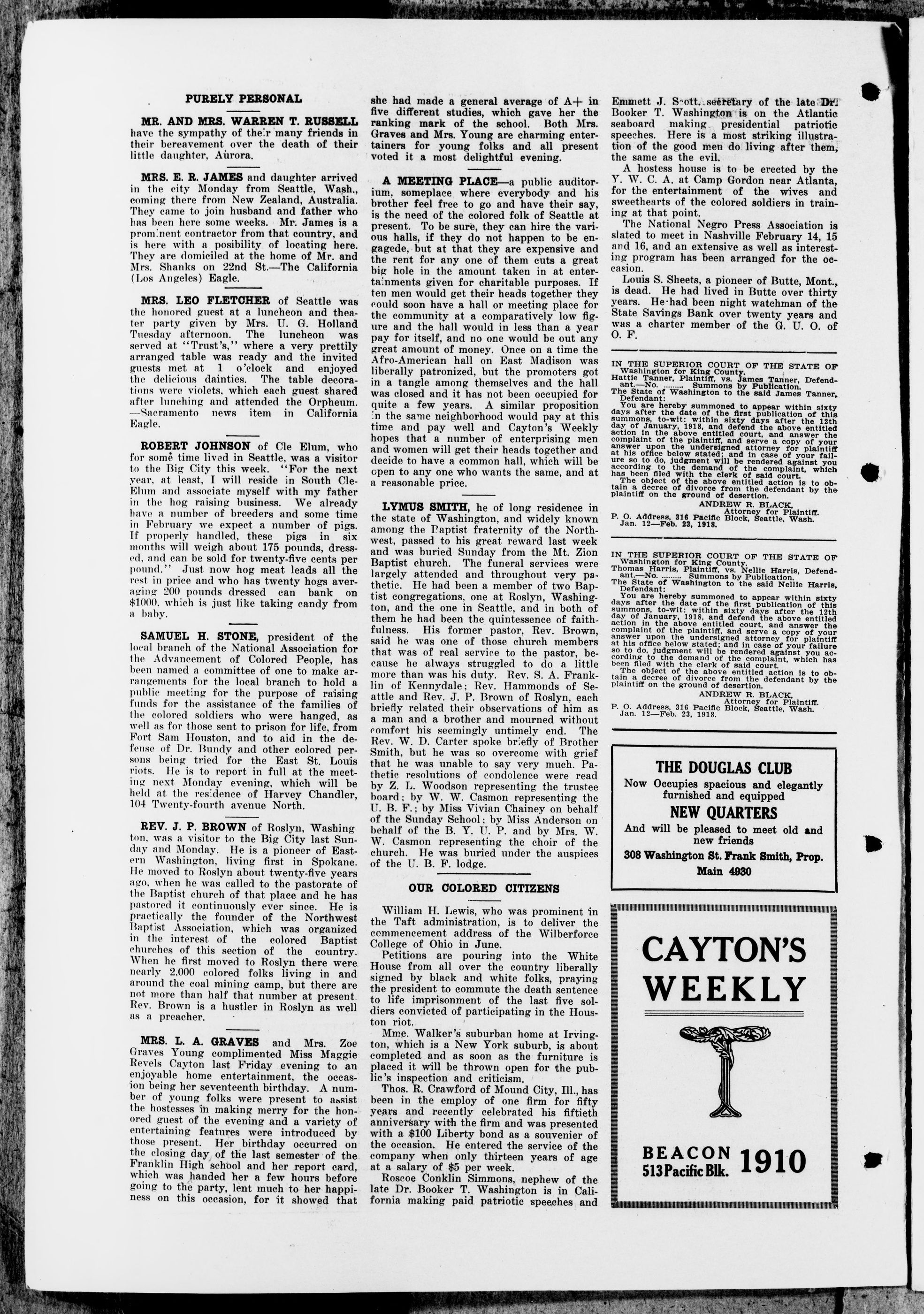
‘ PURELY PERSONAL
MR. AND MRS. WARREN T. RUSSELL
have the sympathy of the:r many friends in
their bereavement over the death of their
little daughter, Aurora,
MRS. E. R. JAMES and daughter arrived
in the city Monday from Seattle, Wash.,
coming there from New Zealand, Australia.
They came to join husband and father who
has been here some weeks. Mr. James is a
prom‘nent contractor from that country, and
is here with a posibility of locating here.
They are domiciled at the home of Mr. and
Mrs. Shanks on 22nd St.—The California
(Los Angeles) Eagle.
Mrs. Shanks on 2énd St.—tThe California
(Los Angeles) Eagle.
MRS. LEO FLETCHER of Seattle was
the honored guest at a luncheon and thea-
ter party given by Mrs. U. G. Holland
Tuesday afternoon. The luncheon was
served at ‘‘Trust’s,’’ where a very prettily
arranged ‘table was ready and the invited
guests met at 1 o’clock and _ enjoyed
the delicious dainties. The table decora-
tions were violets, which each guest shared
after lunching and attended the Orpheum.
—Sacramento news item in California
Eagle.
ROBERT JOHNSON of Cle Elum, who
for somé time lived in Seattle, was a visitor
to the Big City this week. ‘‘For the next
year, at least, I will reside in South Cle-
Elum and associate myself with my father
in the hog raising business. We already
have a number of breeders and some time
in February we expect a number of pigs.
If properly handled, these pigs in six
months will weigh about 175 pounds, dress-
ed, and ean be sold for twenty-five cents per
pound.’’ Just now hog meat leads all the
rest in price and who has twenty hogs aver-
aging 200 pounds dressed can bank on
$1000, which is just like taking candy from
a baby.
SAMUEL H. STONE, president of the
local branch of the National Association for
the Advancement of Colored People, has
been named a committee of one to make ar-
rangements for the local branch to hold a
public meeting for the purpose of raising
funds for the assistance of the families of
the colored soldiers who were hanged, as
well as for those sent to prison for life, from
Fort Sam Houston, and to aid in the de-
fense of Dr. Bundy and other colored per-
sons being tried for the East St. Louis
riots. Ile is to report in full at the meet-
ing next Monday evening, which will be
held at the residence of Harvey Chandler,
104 Twenty-fourth avenue North.
REV. J. P. BROWN of Roslyn, Washing
ton, was a visitor to the Big City last Sun-
day and Monday. He is a pioneer of East-
ern Washington, living first in Spokane.
He moved to Roslyn about twenty-five years
ago, when he was called to the pastorate of
the Baptist church of that place and he has
pastored it continuously ever since. He is
practically the founder of the Northwest
Baptist Association, which was organized
in the interest of the colored Baptist
churches of this section of the country.
When he first moved to Roslyn there were
nearly 2.000 colored folks living in and
around the coal mining camp, but there are
not more than half that number at present.
Rev. Brown is a hustler in Roslyn as well
as a preacher, ‘
MRS. L. A. GRAVES and Mrs Zoe
Graves Young complimented Miss Maggie
Revels Cayton last Friday evening to an
enjoyable home entertainment, the occas-
ion being her seventeenth birthday. A num-
ber of young folks were present to assist
the hostesses in making merry for the hon-
ored guest of the evening and a variety of
entertaining features were introduced by
those present. Her birthday occurred on
the closing day of the last semester of the
Franklin High school and her report card,
which was handed her a few hours before
going to the party, lent much to her happi-
ness on this occasion, for it showed that
a on CO WE Ses Ve Sew
ranking mark of the school. Both Mrs.
Graves and Mrs. Young are charming enter-
tainers for young folks and all present
voted it a most delightful evening.
A MEETING PLACE—a public auditor-
ium, someplace where everybody and his
brother feel free to go and have their say,
is the need of the colored folk of Seattle at
present. To be sure, they can hire the vari-
ous halls, if they do not happen to be en-
gagede, but at that they are expensive and
the rent for any one of them cuts a great
big hole in the amount taken in at enter-
tainments given for charitable purposes. If
ten men would get their heads together they
could soon have a hall or meeting place for
the community at a comparatively low fig-
ure and the hall would in less than a year
pay for itself, and no one would be out any
great amount of money. Once on a time the
Afro-American hall on East Madison was
liberally patronized, but the promoters got
in a tangle among themselves and the hall
was closed and it has not been occupied for
quite a few years. A similar proposition
in the same neighborhood would pay at this
time and pay well and Cayton’s Weekly
hopes that a number of enterprising men
and women will get their heads together and
decide to have a common hall, which will be
open to any one who wants the same, and at
a reasonable price.
LYMUS SMITH, he of long residence in
the state of Washington, and widely known
among the Paptist fraternity of the North-
west, passed to his great reward last week
and was buried Sunday from the Mt. Zion
Baptist church. The funeral services were
largely attended and throughout very pa-
thetic. He had been a member of two Bap-
tist congregations, one at Roslyn, Washing-
ton, and the one in Seattle, and in both of
them he had been the quintessence of faith-
fulness. His former pastor, Rev. Brown,
said he was one of those church members
that was of real service to the pastor, be-
cause he always struggled to do a little
more than was his duty. Rev. S. A. Frank-
lin of Kennydale; Rev. Hammonds of Se-
attle and Rev. J. P. Brown of Roslyn, each
briefly related their observations of him as
a man and a brother and mourned without
comfort his seemingly untimely end. The
Rev. W. D. Carter spoke briefly of Brother
Smith, but he was so overcome with grief
that he was unable to say very much. Pa-
thetic resolutions of condolence were read
by Z. L. Woodson representing the trustee
board; by W. W. Casmon representing the
U. B. F.; by Miss Vivian Chainey on behalf
of the Sunday School; by Miss Anderson on
behalf of the B. Y. U. P. and by Mrs. W.
W. Casmon representing the choir of the
church. He was buried under the auspices
of the U. B. F. lodge.
OUR COLORED CITIZENS
William H. Lewis, who was prominent in
the Taft administration, is to deliver the
commencement address of the Wilberforce
College of Ohio in June.
Petitions are pouring into the White
House from all over the country liberally
signed by black and white folks, praying
the president to commute the death sentence
to life imprisonment of the last five sol-
diers convicted of participating in the Hous-
ton riot.
Mme. Walker’s suburban home at Irving-
ton, which is a New York suburb, is about
completed and as soon as the furniture is
placed it will be thrown open for the pub-
lie’s inspection and criticism.
Thos. R. Crawford of Mound City, IIL, has
been in the employ of one firm for fifty
years and recently celebrated his fiftieth
anniversary with the firm and was presented
with a $100 Liberty bond as a souvenier of
the occasion. He entered the service of the
company when only thirteen years of age
at a salary of $5 per week.
Roscoe Conklin Simmons, nephew of the
late Dr. Booker T. Washington is in Cali-
fornia making paid patriotic speeches and
Emmett J. S-ott..seététary of the late: Dr!
Booker T. Washington‘is on the Atlantic
seaboard making. presidential patriotic
speeches. Here is a most striking illustra-
tion of the good men do living after them,
the same as the evil.
A hostess house is to be erected by the
Y. W. C. A. at Camp Gordon near Atlanta,
for the entertainment of the wives and
sweethearts of the colored soldiers in train-
ing at that point.
The National Negro Press Association is
slated to meet in Nashville February 14, 15
and 16, and an extensive as well as interest-
ing program has been arranged for the oc-
casion.
Louis S. Sheets, a pioneer of Butte, Mont.,
is dead. He had lived in Butte over thirty
years. He-had been night watchman of the
State Savings Bank over twenty years and
was a charter member of the G. U. O. of
0. F.
IN |THE SUPERIOR COURT OF THE STATE OF
Washington for King County.
Hattie Tanner, Plaintiff, vs. James Tanner, Defend-
ant.—No. .......... Summons by Publication.
The State of Washington to the said James Tanner,
Defendant:
You are ea summoned to appear within sixty
days after the date of the first publication of this
summons, to-wit: within sixty days after the 12th
day of January, 1918, and defend the above entitled
action in the above entitled court, and answer the
complaint of the plaintiff, and serve a copy of your
answer upon the undersigned attorney for plaintift
at his office below stated; and in case of your fail-
ure so to do, judgment will be rendered ereucet you
according to the demand of the complaint, which
has been filed with the clerk of said court.
The object of the above entitled action is to ob-
tain a decree of divorce from the defendant by the
plaintiff on the ground of desertion.
ANDREW R. BLACK,
Beene. for Plaintiff.
P. O. Address, 816 Pacific Block, Seattle, Wash.
Jan. 12—Feb. 23, 1918.
IN THE SUPERIOR COURT OF THE STATE OF
‘Washington for King County.
Thomas Harris, Plaintiff, vs. Nellie Harris, Defend-
ant.—No. .......... Summons by Publication.
The State of Washington to the said Nellie Harris,
Defendant:
You are hereby summoned to appear within sixty
days after the date of the first publication of this
summons, to-wit: within sixty days after the 12th
day of January, 1918, and defend the above entitled
action in the above entitled court, and answer the
complaint of the plaintiff, and serve a copy of your
answer upon the undersigned attorney for plaintift
at his office below stated; and in case of your failure
so to do, judgment will be rendered epeynet, (e ac-
cording to the demand of the complaint, which has
been filed with the clerk of said court.
The object of the above entitled action is to ob-
tain a decree of divorce from the defendant by the
plaintiff on the ground of desertion.
ANDREW R. BLACK,
Attorney for Plaintiff.
P. O. Address, 316 Pacific Block, Seattle, Wash.
Jan. 12—Feb. 23, 1918.
THE DOUGLAS CLUB
Now Occupies spacious and elegantly
furnished and equipped
NEW QUARTERS
And will be pleased to meet old and
new friends
308 Washington St. Frank Smith, Prop.
Main 4930
CAYTON’S
WEEKLY
|
I
suspects. 1910