Cayton's Weekly
Saturday, February 16, 1918
Seattle, Washington
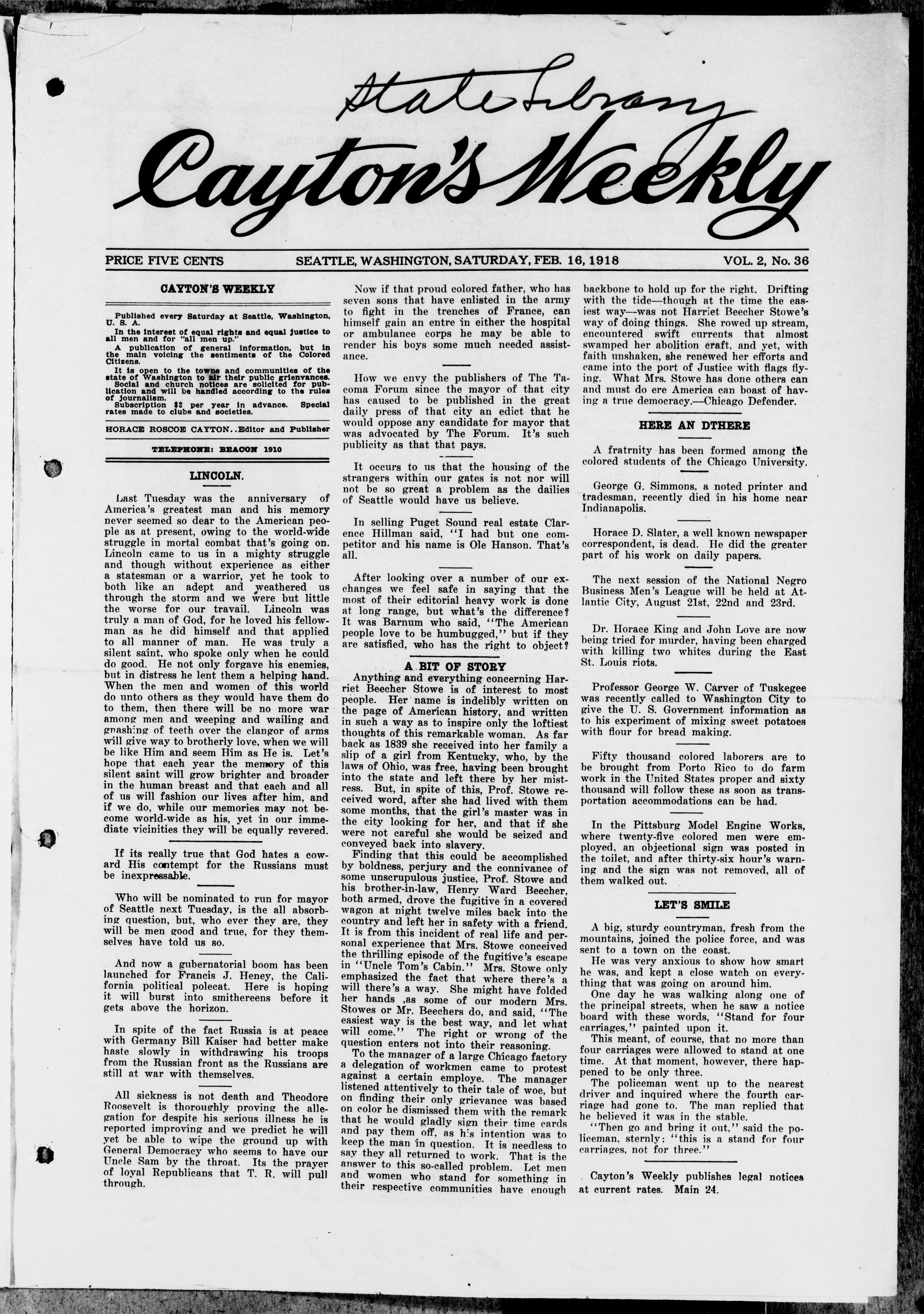
Page text (machine-generated)
State Library
Cayton's Weekly
CAYTON'S WEEKLY
Published every Saturday at Seattle, Washington, U. S. A.
In the interest of equal rights and equal justice to all men and for "all men up."
A publication of general information, but in the main voicing the sentiments of the Colored Citizens.
It is open to the towns and communities of the state of Washington to air their public grievances. Social and church notices are solicited for publication and will be handled according to the rules of journalism.
Subscription $2 per year in advance. Special rates made to clubs and societies.
HORACE ROSCOE CAYTON..Editor and Publisher
TELEPHONE: BEACON 1910
LINCOLN.
LINCOLN.
Last Tuesday was the anniversary of America's greatest man and his memory never seemed so dear to the American people as at present, owing to the world-wide struggle in mortal combat that's going on. Lincoln came to us in a mighty struggle and though without experience as either a statesman or a warrior, yet he took to both like an adept and weathered us through the storm and we were but little the worse for our travail. Lincoln was truly a man of God, for he loved his fellow-man as he did himself and that applied to all manner of man. He was truly a silent saint, who spoke only when he could do good. He not only forgave his enemies, but in distress he lent them a helping hand. When the men and women of this world do unto others as they would have them do to them, then there will be no more war among men and weeping and wailing and grashing of teeth over the clangor of arms will give way to brotherly love, when we will be like Him and seem Him as He is. Let's hope that each year the memory of this silent saint will grow brighter and broader in the human breast and that each and all of us will fashion our lives after him, and if we do, while our memories may not become world-wide as his, yet in our immediate vicinities they will be equally revered.
If its really true that God hates a coward His contempt for the Russians must be inexpressable.
Who will be nominated to run for mayor of Seattle next Tuesday, is the all absorbing question, but, who ever they are, they will be men good and true, for they themselves have told us so.
And now a gubernatorial boom has been launched for Francis J. Heney, the California political polecat. Here is hoping it will burst into smithereens before it gets above the horizon.
In spite of the fact Russia is at peace with Germany Bill Kaiser had better make haste slowly in withdrawing his troops from the Russian front as the Russians are still at war with themselves.
All sickness is not death and Theodore Roosevelt is thoroughly proving the allegation for despite his serious illness he is reported improving and we predict he will yet be able to wipe the ground up with General Democracy who seems to have our Uncle Sam by the throat. Its the prayer of loyal Republicans that T. R. will pull through.
SEATTLE, WASHINGTON, SATURDAY, FEB. 16, 1918
Now if that proud colored father, who has seven sons that have enlisted in the army to fight in the trenches of France, can himself gain an entre in either the hospital or ambulance corps he may be able to render his boys some much needed assistance.
How we envy the publishers of The Tacoma Forum since the mayor of that city has caused to be published in the great daily press of that city an edict that he would oppose any candidate for mayor that was advocated by The Forum. It's such publicity as that that pays.
It occurs to us that the housing of the strangers within our gates is not nor will not be so great a problem as the dailies of Seattle would have us believe.
In selling Puget Sound real estate Clarence Hillman said, "I had but one competitor and his name is Ole Hanson. That's all.
After looking over a number of our exchanges we feel safe in saying that the most of their editorial heavy work is done at long range, but what's the difference? It was Barnum who said, "The American people love to be humbugged," but if they are satisfied, who has the right to object?
A BIT OF STORY
Anything and everything concerning Harriet Beecher Stowe is of interest to most people. Her name is indelibly written on the page of American history, and written in such a way as to inspire only the loftiest thoughts of this remarkable woman. As far back as 1839 she received into her family a slip of a girl from Kentucky, who, by the laws of Ohio, was free, having been brought into the state and left there by her mistress. But, in spite of this, Prof. Stowe received word, after she had lived with them some months, that the girl's master was in the city looking for her, and that if she were not careful she would be seized and conveyed back into slavery.
Finding that this could be accomplished by boldness, perjury and the connivance of some unscrupulous justice, Prof. Stowe and his brother-in-law, Henry Ward Beecher, both armed, drove the fugitive in a covered wagon at night twelve miles back into the country and left her in safety with a friend. It is from this incident of real life and personal experience that Mrs. Stowe conceived the thrilling episode of the fugitive's escape in "Uncle Tom's Cabin." Mrs. Stowe only emphasized the fact that where there's a will there's a way. She might have folded her hands as some of our modern Mrs. Stowes or Mr. Beechers do, and said, "The easiest way is the best way, and let what will come." The right or wrong of the question enters not into their reasoning.
To the manager of a large Chicago factory a delegation of workmen came to protest against a certain employee. The manager listened attentively to their tale of woe, but on finding their only grievance was based on color he dismissed them with the remark that he would gladly sign their time cards and pay them off, as his intention was to keep the man in question. It is needless to say they all returned to work. That is the answer to this so-called problem. Let men and women who stand for something in their respective communities have enough
VOL.2.No.36
backbone to hold up for the right. Drifting with the tide—though at the time the easiest way—was not Harriet Beecher Stowe's way of doing things. She rowed up stream, encountered swift currents that almost swamped her abolition craft, and yet, with faith unshaken, she renewed her efforts and came into the port of Justice with flags flying. What Mrs. Stowe has done others can and must do ere America can boast of having a true democracy.—Chicago Defender.
HERE AN DTHERE
A fraternity has been formed among the colored students of the Chicago University.
George G. Simmons, a noted printer and tradesman, recently died in his home near Indianapolis.
Horace D. Slater, a well known newspaper correspondent, is dead. He did the greater part of his work on daily papers.
The next session of the National Negro Business Men's League will be held at Atlantic City, August 21st, 22nd and 23rd.
Dr. Horace King and John Love are now being tried for murder, having been charged with killing two whites during the East St. Louis riots.
Professor George W. Carver of Tuskegee was recently called to Washington City to give the U. S. Government information as to his experiment of mixing sweet potatoes with flour for bread making.
Fifty thousand colored laborers are to be brought from Porto Rico to do farm work in the United States proper and sixty thousand will follow these as soon as transportation accommodations can be had.
In the Pittsburg Model Engine Works, where twenty-five colored men were employed, an objectional sign was posted in the toilet, and after thirty-six hour's warning and the sign was not removed, all of them walked out.
LET'S SMILE
A big, sturdy countryman, fresh from the mountains, joined the police force, and was sent to a town on the coast.
He was very anxious to show how smart he was, and kept a close watch on everything that was going on around him.
One day he was walking along one of the principal streets, when he saw a notice board with these words, "Stand for four carriages," painted upon it.
This meant, of course, that no more than four carriages were allowed to stand at one time. At that moment, however, there happened to be only three.
The policeman went up to the nearest driver and inquired where the fourth carriage had gone to. The man replied that he believed it was in the stable.
"Then go and bring it out," said the policeman, sternly: "this is a stand for four carriages, not for three."
Cayton's Weekly publishes legal notices at current rates. Main 24.
---
A MAYORALTY WINNER.
```markdown
```
```markdown
```
POLITICAL POT PIE
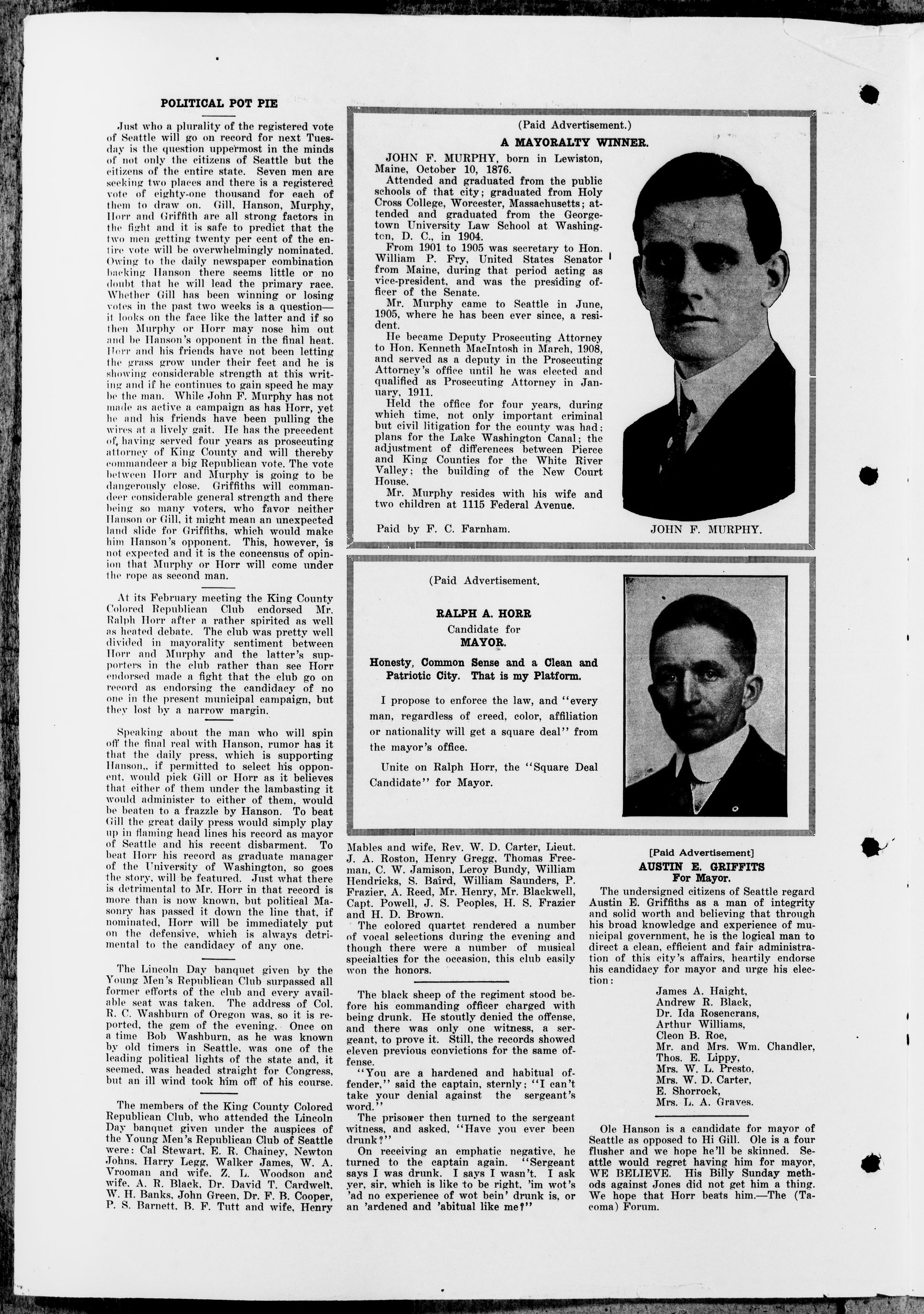
Just who a plurality of the registered vote of Seattle will go on record for next Tuesday is the question uppermost in the minds of not only the citizens of Seattle but the citizens of the entire state. Seven men are seeking two places and there is a registered vote of eighty-one thousand for each of them to draw on. Gill, Hanson, Murphy, Horr and Griffith are all strong factors in the fight and it is safe to predict that the two men getting twenty per cent of the entire vote will be overwhelmingly nominated. Owing to the daily newspaper combination backing Hanson there seems little or no doubt that he will lead the primary race. Whether Gill has been winning or losing votes in the past two weeks is a question—it looks on the face like the latter and if so then Murphy or Horr may nose him out and be Hanson's opponent in the final heat. Horr and his friends have not been letting the grass grow under their feet and he is showing considerable strength at this writing and if he continues to gain speed he may be the man. While John F. Murphy has not made as active a campaign as has Horr, yet he and his friends have been pulling the wires at a lively gait. He has the precedent of, having served four years as prosecuting attorney of King County and will thereby commandeer a big Republican vote. The vote between Horr and Murphy is going to be dangerously close. Griffiths will commander considerable general strength and there being so many voters, who favor neither Hanson or Gill, it might mean an unexpected land slide for Griffiths, which would make him Hanson's opponent. This, however, is not expected and it is the concensus of opinion that Murphy or Horr will come under the rope as second man.
At its February meeting the King County Colored Republican Club endorsed Mr. Ralph Horr after a rather spirited as well as heated debate. The club was pretty well divided in mayorality sentiment between Horr and Murphy and the latter's supporters in the club rather than see Horr endorsed made a fight that the club go on record as endorsing the candidacy of no one in the present municipal campaign, but they lost by a narrow margin.
Speaking about the man who will spin off the final real with Hanson, rumor has it that the daily press, which is supporting Hanson., if permitted to select his opponent, would pick Gill or Horr as it believes that either of them under the lambasting it would administer to either of them, would be beaten to a frazzle by Hanson. To beat Gill the great daily press would simply play up in flaming head lines his record as mayor of Seattle and his recent disbarment. To beat Horr his record as graduate manager of the University of Washington, so goes the story, will be featured. Just what there is detrimental to Mr. Horr in that record is more than is now known, but political Masonry has passed it down the line that, if nominated, Horr will be immediately put on the defensive, which is always detrimental to the candidacy of any one.
The Lincoln Day banquet given by the Young Men's Republican Club surpassed all former efforts of the club and every available seat was taken. The address of Col. R. C. Washburn of Oregon was, so it is reported, the gem of the evening. Once on a time Bob Washburn, as he was known by old timers in Seattle, was one of the leading political lights of the state and, it seemed, was headed straight for Congress, but an ill wind took him off of his course.
The members of the King County Colored Republican Club, who attended the Lincoln Day banquet given under the auspices of the Young Men's Republican Club of Seattle were: Cal Stewart, E. R. Chainey, Newton Johns, Harry Legg, Walker James, W. A. Vrooman and wife, Z. L. Woodson and wife, A. R. Black, Dr. David T. Cardwell, W. H. Banks, John Green, Dr. F. B. Cooper, P. S. Barnett, B. F. Tutt and wife, Henry
JOHN F. MURPHY, born in Lewiston, Maine, October 10, 1876. Attended and graduated from the public schools of that city; graduated from Holy Cross College, Worcester, Massachusetts; attended and graduated from the Georgetown University Law School at Washington, D. C., in 1904. From 1901 to 1905 was secretary to Hon. William P. Fry, United States Senator from Maine, during that period acting as vice-president, and was the presiding officer of the Senate. Mr. Murphy came to Seattle in June, 1905, where he has been ever since, a resident.
He became Deputy Prosecuting Attorney to Hon. Kenneth MacIntosh in March, 1908, and served as a deputy in the Prosecuting Attorney's office until he was elected and qualified as Prosecuting Attorney in January, 1911. Held the office for four years, during which time, not only important criminal but civil litigation for the county was had; plans for the Lake Washington Canal; the adjustment of differences between Pierce and King Counties for the White River Valley; the building of the New Court House. Mr. Murphy resides with his wife and two children at 1115 Federal Avenue.
(Paid Advertisement.
RALPH A. HORR Candidate for MAYOR.
Honesty, Common Sense and a Clean and Patriotic City. That is my Platform.
I propose to enforce the law, and "every man, regardless of creed, color, affiliation or nationality will get a square deal" from the mayor's office.
Unite on Ralph Horr, the "Square Deal Candidate" for Mayor.
Mables and wife, Rev. W. D. Carter, Lieut. J. A. Roston, Henry Gregg, Thomas Freeman, C. W. Jamison, Leroy Bundy, William Hendricks, S. Baird, William Saunders, P. Frazier, A. Reed, Mr. Henry, Mr. Blackwell, Capt. Powell, J. S. Peoples, H. S. Frazier and H. D. Brown. The colored quartet rendered a number of vocal selections during the evening and though there were a number of musical specialties for the occasion, this club easily won the honors.
The black sheep of the regiment stood before his commanding officer charged with being drunk. He stoutly denied the offense, and there was only one witness, a sergeant, to prove it. Still, the records showed eleven previous convictions for the same offense.
"You are a hardened and habitual offender," said the captain, sternly; "I can't take your denial against the sergeant's word."
The prisoner then turned to the sergeant witness, and asked, "Have you ever been drunk?"
On receiving an emphatic negative, he turned to the captain again. "Sergeant says I was drunk. I says I wasn't. I ask yer, sir, which is like to be right, 'im wot's 'ad no experience of wot bein' drunk is, or an 'ardened and 'abitual like me?"
Paid by F. C. Farnham.
The undersigned citizens of Seattle regard Austin E. Griffiths as a man of integrity and solid worth and believing that through his broad knowledge and experience of municipal government, he is the logical man to direct a clean, efficient and fair administration of this city's affairs, heartily endorse his candidacy for mayor and urge his election:
Ole Hanson is a candidate for mayor of Seattle as opposed to Hi Gill. Ole is a four flusher and we hope he'll be skinned. Seattle would regret having him for mayor, WE BELIEVE. His Billy Sunday methods against Jones did not get him a thing. We hope that Horr beats him.—The (Tacoma) Forum.
21.20.
JOHN F. MURPHY.
M. B.
[Paid Advertisement] AUSTIN E. GRIFFITS For Mayor.
James A. Haight,
Andrew R. Black,
Dr. Ida Rosencrans,
Arthur Williams,
Cleon B. Roe,
Mr. and Mrs. Wm. Chandler,
Thos. E. Lippy,
Mrs. W. L. Presto,
Mrs. W. D. Carter,
E. Shorrock,
Mrs. L. A. Graves.
Lady Audley's Secret
will be given by MITCHELL'S DRAMATIC CLUB Friday, February 22nd, 1918, 8:30 P. M. Sharp at WASHINGTON HALL, 14th and East Fir Street
Hon. I. F. Norris will deliver an address from 8 to 8:30 o'clock on "The Life of Frederick Douglas"
Curtain raises at 8:30 P. M. Music furnished by Mrs. L. Smith and others
Admission 50c Children 25c Tickets Sold at the Door Only
Mr. Goldsby will take charge of the hall after the play.
Dancing and a Good Time for All
Copyright 1917
By ORLANDO BELKNAP POND
(All rights reserved)
CHAPTER XIII
THE WORLD MOVES ON TO GREATER ACCOMPLISHMENTS.
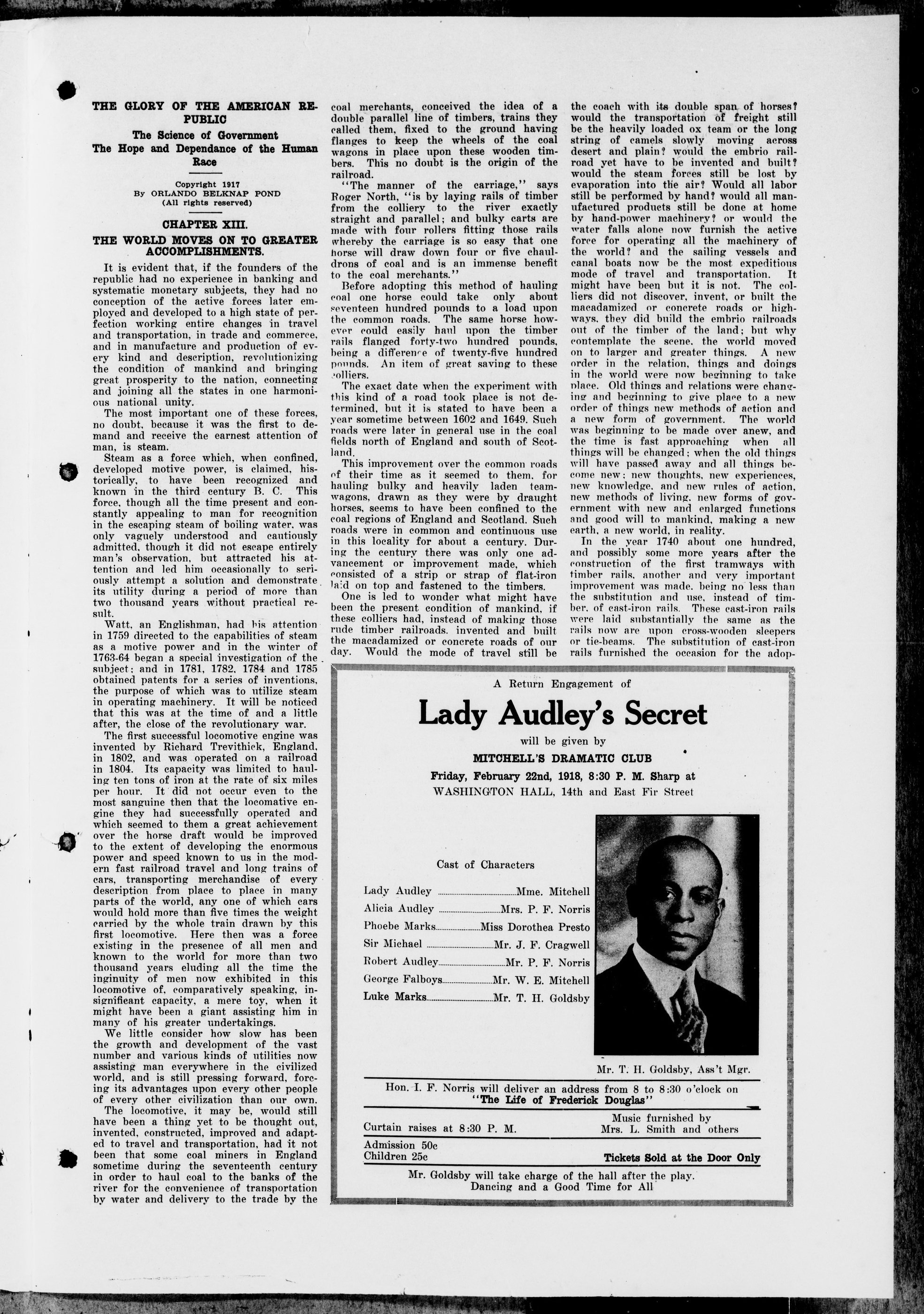
It is evident that, if the founders of the republic had no experience in banking and systematic monetary subjects, they had no conception of the active forces later employed and developed to a high state of perfection working entire changes in travel and transportation, in trade and commerce, and in manufacture and production of every kind and description, revolutionizing the condition of mankind and bringing great prosperity to the nation, connecting and joining all the states in one harmonious national unity.
The most important one of these forces, no doubt, because it was the first to demand and receive the earnest attention of man, is steam.
Steam as a force which, when confined, developed motive power, is claimed, historically, to have been recognized and known in the third century B. C. This force, though all the time present and constantly appealing to man for recognition in the escaping steam of boiling water, was only vaguely understood and cautiously admitted, though it did not escape entirely man's observation, but attracted his attention and led him occasionally to seriously attempt a solution and demonstrate its utility during a period of more than two thousand years without practical result.
Watt, an Englishman, had his attention in 1759 directed to the capabilities of steam as a motive power and in the winter of 1763-64 began a special investigation of the subject; and in 1781, 1782, 1784 and 1785 obtained patents for a series of inventions, the purpose of which was to utilize steam in operating machinery. It will be noticed that this was at the time of and a little after, the close of the revolutionary war.
The first successful locomotive engine was invented by Richard Trevithick, England, in 1802, and was operated on a railroad in 1804. Its capacity was limited to hauling ten tons of iron at the rate of six miles per hour. It did not occur even to the most sanguine then that the locomotive engine they had successfully operated and which seemed to them a great achievement over the horse draft would be improved to the extent of developing the enormous power and speed known to us in the modern fast railroad travel and long trains of cars, transporting merchandise of every description from place to place in many parts of the world, any one of which cars would hold more than five times the weight carried by the whole train drawn by this first locomotive. Here then was a force existing in the presence of all men and known to the world for more than two thousand years eluding all the time the ingenuity of men now exhibited in this locomotive of, comparatively speaking, insignificant capacity, a mere toy, when it might have been a giant assisting him in many of his greater undertakings.
We little consider how slow has been the growth and development of the vast number and various kinds of utilities now assisting man everywhere in the civilized world, and is still pressing forward, forcing its advantages upon every other people of every other civilization than our own. The locomotive, it may be, would still have been a thing yet to be thought out, invented, constructed, improved and adapted to travel and transportation, had it not been that some coal miners in England sometime during the seventeenth century in order to haul coal to the banks of the river for the convenience of transportation by water and delivery to the trade by the
coal merchants, conceived the idea of a double parallel line of timbers, trains they called them, fixed to the ground having flanges to keep the wheels of the coal wagons in place upon these wooden timbers. This no doubt is the origin of the railroad. "The manner of the carriage," says Roger North, "is by laying rails of timber from the colliery to the river exactly straight and parallel; and bulky carts are made with four rollers fitting those rails whereby the carriage is so easy that one horse will draw down four or five chauldrons of coal and is an immense benefit to the coal merchants."
Before adopting this method of hauling coal one horse could take only about seventeen hundred pounds to a load upon the common roads. The same horse however could easily haul upon the timber rails flanged forty-two hundred pounds, being a difference of twenty-five hundred pounds. An item of great saving to these colliers.
The exact date when the experiment with this kind of a road took place is not determined, but it is stated to have been a year sometime between 1602 and 1649. Such roads were later in general use in the coal fields north of England and south of Scotland.
This improvement over the common roads of their time as it seemed to them, for hauling bulky and heavily laden teamwagons, drawn as they were by draught horses, seems to have been confined to the coal regions of England and Scotland. Such roads were in common and continuous use in this locality for about a century. During the century there was only one advancement or improvement made, which consisted of a strip or strap of flat-iron laid on top and fastened to the timbers.
One is led to wonder what might have been the present condition of mankind, if these colliers had, instead of making those rude timber railroads. invented and built the macadamized or concrete roads of our day. Would the mode of travel still be the ber. were rails or the rails
Cast of Characters
Lady Audley .....Mme. Mitchell
Alicia Audley .....Mrs. P. F. Norris
Phoebe Marks.....Miss Dorothea Presto
Sir Michael .....Mr. J. F. Cragwell
Robert Audley .....Mr. P. F. Norris
George Falboys.....Mr. W. E. Mitchell
Luke Marks.....Mr. T. H. Goldsby
Hon. I. F. Norris will deliver an address
"The Life of Frederick"
Curtain raises at 8:30 P. M.
Admission 50c
Children 25c
---
the coach with its double span of horses? would the transportation of freight still be the heavily loaded ox team or the long string of camels slowly moving across desert and plain? would the embrio railroad yet have to be invented and built? would the steam forces still be lost by evaporation into the air? Would all labor still be performed by hand? would all manufactured products still be done at home by hand-power machinery? or would the water falls alone now furnish the active force for operating all the machinery of the world? and the sailing vessels and canal boats now be the most expeditious mode of travel and transportation. It might have been but it is not. The colliers did not discover, invent, or built the macadamized or concrete roads or highways, they did build the embrio railroads out of the timber of the land; but why contemplate the scene. the world moved on to larger and greater things. A new order in the relation, things and doings in the world were now beginning to take place. Old things and relations were changing and beginning to give place to a new order of things new methods of action and a new form of government. The world was beginning to be made over anew, and the time is fast approaching when all things will be changed; when the old things will have passed away and all things become new: new thoughts, new experiences, new knowledge, and new rules of action, new methods of living, new forms of government with new and enlarged functions and good will to mankind, making a new earth, a new world, in reality.
In the year 1740 about one hundred, and possibly some more years after the construction of the first tramways with timber rails, another and very important improvement was made, being no less than the substitution and use, instead of timber, of cast-iron rails. These cast-iron rails were laid substantially the same as the rails now are upon cross-wooden sleepers or tie-beams. The substitution of cast-iron rails furnished the occasion for the adop- gagement of
[Name]
Mr. T. H. Goldsby, Ass't Mgr.
address from 8 to 8:30 o'clock on
derick Douglas"
Music furnished by
Mrs. L. Smith and others
Tickets Sold at the Door Only
---
---
tion of the plan of linking several small wagons, instead of using one large wagon as heretofore, in one train, and hauling all of these together with horses as in the past, to the coal landings. The next improvement was the fitting of flanges to the wheels and doing away with flanges on the rail. We have in these improvements the embrio railroad and train.
The first iron track railroad established by authority of Parliament was, except some few by canal companies for delivering the products of some nearby coal properties, the Surry Railway authorized in 1801. Cast-iron rails were, in 1808, displaced by the better and more durable and practical wrought iron rail.
It will be seen and understood from this sketch of the beginning and slow development that the railroad, which was operated upon for nearly two centuries with horse power, created a demand for other greater and more rapid motive power. This demand was confined to the colliers of England. Additional motive power was the great and almost universal question agitating the minds of the interested ones of this community. Every improvement it seemed possible to make in the railroads or tramways had already been made. It appeared to them that nothing more could be accomplished in that direction. The improvements made had increased the traction capacity of the railroads from a single wagon to a train of wagons. If anything more was to be accomplished it must be in the direction of increased motive power.
From whence was this power to come? How was it to be obtained? Who could successfully grasp and solve the problem? This was the situation confronting them. It was the incentive for strenuous effort. It was the golden opportunity to become a benefactor of mankind. It would place the name of the successful person high on the scroll of fame and bring him wealth and influence. Every known prospect was searched. Every avenue of hope scanned, every clue of a possibility scrutinized for a discovery of a motive power applicable to the required purpose. Only one course of such a power appeared available and practical. This source was found to be in the known force of steam. That steam confined developed some force had been known for more than two thousand years. What was the capacity of this force? could it when confined be utilized and applied as a motive power? Some believed it could, others had no faith.
Fortunately there were some men who dared to devote their time and talents in an effort to find a solution of this problem. Such is always the case when great requirements are making demands. Some one among the people, some one in the multitude, rises, who, for some unknown reason, has the right kind of training, the right kind of experience, to fit him for the emergency. He will certainly at some time, though perhaps not always at the moment he is wanted by some, but at the propitious moment, at the right time, come forward and present the thing wanted.
It may be crude, complicated, but it has correct elementary principles, the basis of the completed thing. Other men take it up make improvements as experience indicates; simplify it as they become more familiar with its complications; make it practical for the uses intended, and adapt it to the conditions and varying circumstances of the situation; and then finally it reaches the highest possible limit of perfection and capacity.
So it was in this case, a number of men seeing the necessity and hearing the demand and knowing the incentive, began and carried on all the investigations the kowledge they acquired permitted. Many visionary theories were, no doubt, advanced and rejected as impractical. Many experiments were, without doubt, made that proved to be time and material wasted, and were abandoned. Even when success seemed to be an accomplished fact the vital and essential particular still eluded their efforts and the success was only partial. We can see those study and persistent
Englishmen, often disappointed but still plodding on, pursuing their investigations, making their experiments amidst discouragements and failures, and finally inventing and building the first apparatus capable of developing sufficient power to propel itself and draw a few wagons of light weight and small loads upon two iron tracks with a speed a little greater than the average horses can travel upon the common highway.
It had taken them a little more than forty years to accomplish this result. It was to them a great consummation. Beside all other accomplishments the world had known, it was a giant achievement. Steam was confined, directed and made to do man's bidding. They called this apparatus a locomotive engine; certainly an appropriate name.
It was a day for rejoicing; an epoch in the world's progress. The difficulties, the discouragements and the disappointments, the failures, the expenses and losses were all swallowed up in the one great achievement; a locomotive engine driven by the force of steam, drawing its train of wagons loaded with the products of coal to its short destination, had been built, installed and put in commission.
We call it a toy, to them it was a giant. We smile at their simplicity; to them it was a great achievement. Ah, my friends, when we laugh at their crude results, let us not forget that those crude results were necessary and essential, without which the world's present progress would stilll be lingering in the past. No one can estimate the value of this toy, this to us simple achievement, or the influence it has had on modern progress and civilization. (To be continued.)
CLE ELUM CATCHES
Henry Thornton and Mrs. M. Brown are on the sick list.
Miss Julius Johnson has as her guest, Miss E. George of Seattle.
Mr. and Mrs. R. H. Taylor gave a dinner in honor of Miss George, the house guest of Mrs. Johnson. Covers were laid for sixteen.
Mr. and Mrs. A. Peonix have moved to Cle Elum, where he has secured work in the Milwaukee.
Those of Cle Elum attending the funeral of Ed Whitkes were: Mr. and Mrs. George Johnson, E. D. Brown, Mr. and Mrs. W. M. Barnett, Mr. and Mrs. Julius Johnson, Mr. and Mrs. R. H. Taylor and W. M. Bagley.
R. H. Taylor is suffering from a severe case of grouch and, when asked the cause of his trouble, said, "this is the first winter in all my life I did not have my friend, John Barleycorn, with me."
Mr. and Mrs. Henry Thornton made a business trip to the county seat last week.
Robert Johnson is all smiles these days.
Job work in the latest and newest styles turned out in this office.
Public Benefit Rally will be held at the First A. M. E. church, Tuesday, February 26th, under the auspices of the local branch of the National Association for the Advancement of Colored People, to raise funds for the families of the unfortunate colored soldiers of Fort Houston, Texas. If you possess a drop of red blood in your veins, come out and give your bit. Splendid speakers will be on hand and a musical program will be rendered. The ladies of the church will serve refreshments after the completion of the program.
A conjurer was once performing at a fair, and, taking a countryman from his audience, commenced to illustrate to him the "transmutation of metals." He borrowed a nickel from the man and, after making a few passes, desired him to hold out his hand for a moment and apparently placed the nickel in it, telling him to close his hand. Passing his wand over the countryman's hand, he then asked him to open it, and, "You see," said the magician, "I have changed your nickel into a $5 piece. Now," said the wizard, "I'll change it back again. Give me the $5." "Nay, nay, yer warnt," said the yokel, pocketing the money. "You'll nay change it into a nickel again; I'll 'old un tight enough,' and walked off with the conjurer's $5.
ALHAMBRA CASH GROCERY
Fancy and Staple Groceries. Vegetables and Fruits in season. Bakery in connection. Free delivery.
Tel. Main 2923. 1036-40 Jackson Street.
DR. J. A. GHENT, SPECIALIST
In Surgery and Gynecology
has removed his office from the Marion
Bldg. to 221 and 222 Seaboard Bldg.,
formerly Northern Bank Bldg., corner
Westlake and Pine. Tel. Main 1185.
TUTT'S BARBER SHOP "He wants to see you." High-class
Tonsorial Work. 300 Main Street, Seattle. Latest
race papers. All kinds of toilet supplies.
BURR WILLIAMS RUSSELL SMITH
President Secretary
DUMAS CLUB, INC.
209 Fifth Avenue South
CAFE IN CONNECTION
Phone Elliott 3763
SEATTLE WASHINGTON
IN THE SUPERIOR COURT OF THE STATE OF Washington for King County.
Hattie Tanner, Plaintiff, vs. James Tanner, Defendant.—No. ..... Summons by Publication. The State of Washington to the said James Tanner, Defendant: You are hereby summoned to appear within sixty days after the date of the first publication of this summons, to-wit: within sixty days after the 12th day of January, 1918, and defend the above entitled action in the above entitled court, and answer the complaint of the plaintiff, and serve a copy of your answer upon the undersigned attorney for plaintiff at his office below stated; and in case of your failure so to do, judgment will be rendered against you according to the demand of the complaint, which has been filed with the clerk of said court. The object of the above entitled action is to obtain a decree of divorce from the defendant by the plaintiff on the ground of desertion.
ANDREW R. BLACK,
Attorney for Plaintiff.
P. O. Address, 316 Pacific Block, Seattle, Wash.
Jan. 12—Feb. 23, 1918.
IN THE SUPERIOR COURT OF THE STATE OF Washington for King County.
You are hereby summoned to appear within sixty days after the date of the first publication of this summons, to-wit: within sixty days after the 12th day of January, 1918, and defend the above entitled action in the above entitled court, and answer the complaint of the plaintiff, and serve a copy of your answer upon the undersigned attorney for plaintiff at his office below stated; and in case of your failure so to do, judgment will be rendered against you according to the demand of the complaint, which has been filed with the clerk of said court.
The object of the above entitled action is to obtain a decree of divorce from the defendant by the plaintiff on the ground of desertion.
ANDREW R. BLACK,
Attorney for Plaintiff.
P. O. Address, 316 Pacific Block, Seattle, Wash.
Jan. 12—Feb. 23, 1918.
THE DOUGLAS CLUB
Now Occupies spacious and elegantly
furnished and equipped
NEW QUARTERS
And will be pleased to meet old and
new friends
308 Washington St. Frank Smith, Prop.
Main 4930