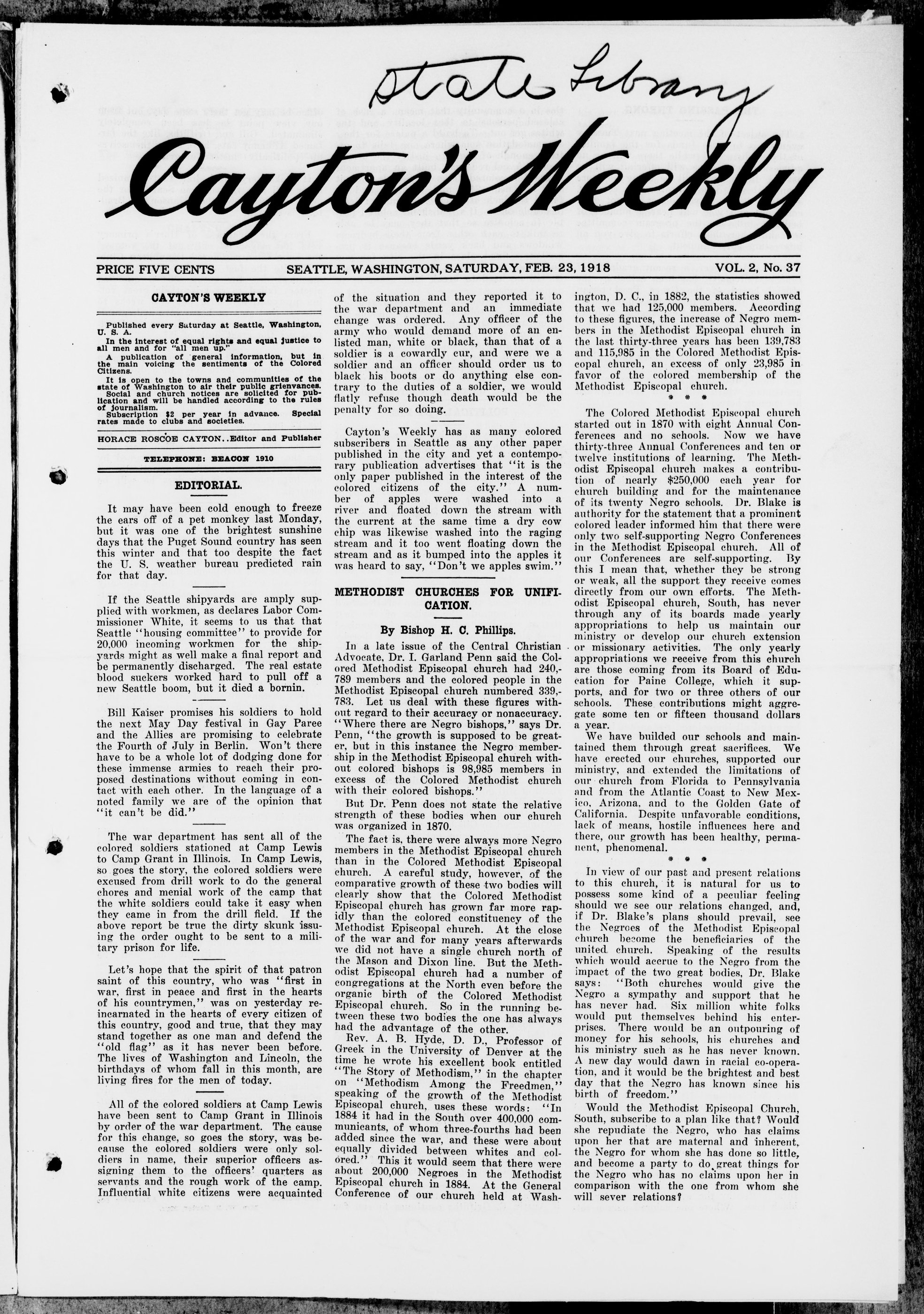
Cayton's Weekly
Saturday, February 23, 1918
Seattle, Washington
Page text (machine-generated)
State Library Cayton's Weekly
---
PRICE FIVE CENTS
CAYTON'S WEEKLY
Published every Saturday at Seattle, Washington, U. S. A.
In the interest of equal rights and equal justice to all men and for "all men up."
A publication of general information, but in the main voicing the sentiments of the Colored Citizens.
It is open to the towns and communities of the state of Washington to air their public grievances. Social and church notices are solicited for publication and will be handled according to the rules of Journalism.
Subscription $2 per year in advance. Special rates made to clubs and societies.
HORACE ROSCOE CAYTON..Editor and Publisher
TELEPHONE: BEACON 1910
EDITORIAL.
EDITORIAL
It may have been cold enough to freeze the ears off of a pet monkey last Monday, but it was one of the brightest sunshine days that the Puget Sound country has seen this winter and that too despite the fact the U. S. weather bureau predicted rain for that day.
If the Seattle shipyards are amply supplied with workmen, as declares Labor Commissioner White, it seems to us that that Seattle "housing committee" to provide for 20,000 incoming workmen for the shipyards might as well make a final report and be permanently discharged. The real estate blood suckers worked hard to pull off a new Seattle boom, but it died a bornin.
Bill Kaiser promises his soldiers to hold the next May Day festival in Gay Paree and the Allies are promising to celebrate the Fourth of July in Berlin. Won't there have to be a whole lot of dodging done for these immense armies to reach their proposed destinations without coming in contact with each other. In the language of a noted family we are of the opinion that "it can't be did."
The war department has sent all of the colored soldiers stationed at Camp Lewis to Camp Grant in Illinois. In Camp Lewis, so goes the story, the colored soldiers were excused from drill work to do the general chores and menial work of the camp that the white soldiers could take it easy when they came in from the drill field. If the above report be true the dirty skunk issuing the order ought to be sent to a military prison for life.
Let's hope that the spirit of that patron saint of this country, who was "first in war, first in peace and first in the hearts of his countrymen," was on yesterday reincarnated in the hearts of every citizen of this country, good and true, that they may stand together as one man and defend the "old flag" as it has never been before. The lives of Washington and Lincoln, the birthdays of whom fall in this month, are living fires for the men of today.
All of the colored soldiers at Camp Lewis have been sent to Camp Grant in Illinois by order of the war department. The cause for this change, so goes the story, was because the colored soldiers were only soldiers in name, their superior officers assigning them to the officers' quarters as servants and the rough work of the camp. Influential white citizens were acquainted
---
of the situation and they reported it to the war department and an immediate change was ordered. Any officer of the army who would demand more of an enlisted man, white or black, than that of a soldier is a cowardly cur, and were we a soldier and an officer should order us to black his boots or do anything else contrary to the duties of a soldier, we would flatly refuse though death would be the penalty for so doing.
Cayton's Weekly has as many colored subscribers in Seattle as any other paper published in the city and yet a contemporary publication advertises that "it is the only paper published in the interest of the colored citizens of the city." A number of apples were washed into a river and floated down the stream with the current at the same time a dry cow chip was likewise washed into the raging stream and it too went floating down the stream and as it bumped into the apples it was heard to say, "Don't we apples swim."
METHODIST CHURCHES FOR UNIFICATION.
By Bishop H. C. Phillips.
In a late issue of the Central Christian Advocate, Dr. I. Garland Penn said the Colored Methodist Episcopal church had 240,789 members and the colored people in the Methodist Episcopal church numbered 339,-783. Let us deal with these figures without regard to their accuracy or nonaccuracy. "Where there are Negro bishops," says Dr. Penn, "the growth is supposed to be greater, but in this instance the Negro membership in the Methodist Episcopal church without colored bishops is 98,985 members in excess of the Colored Methodist church with their colored bishops." But Dr. Penn does not state the relative strength of these bodies when our church was organized in 1870.
Rev. A. B. Hyde, D. D., Professor of Greek in the University of Denver at the time he wrote his excellent book entitled "The Story of Methodism," in the chapter on "Methodism Among the Freedmen," speaking of the growth of the Methodist Episcopal church, uses these words: "In 1884 it had in the South over 400,000 communicants, of whom three-fourths had been added since the war, and these were about equally divided between whites and colored." This it would seem that there were about 200,000 Negroes in the Methodist Episcopal church in 1884. At the General Conference of our church held at Wash-
VOL.2, No.37
ington, D. C., in 1882, the statistics showed that we had 125,000 members. According to these figures, the increase of Negro members in the Methodist Episcopal church in the last thirty-three years has been 139,783 and 115,985 in the Colored Methodist Episcopal church, an excess of only 23,985 in favor of the colored membership of the Methodist Episcopal church.
* * *
The Colored Methodist Episcopal church started out in 1870 with eight Annual Conferences and no schools. Now we have thirty-three Annual Conferences and ten or twelve institutions of learning. The Methodist Episcopal church makes a contribution of nearly $250,000 each year for church building and for the maintenance of its twenty Negro schools. Dr. Blake is authority for the statement that a prominent colored leader informed him that there were only two self-supporting Negro Conferences in the Methodist Episcopal church. All of our Conferences are self-supporting. By this I mean that, whether they be strong or weak, all the support they receive comes directly from our own efforts. The Methodist Episcopal church, South, has never through any of its boards made yearly appropriations to help us maintain our ministry or develop our church extension or missionary activities. The only yearly appropriations we receive from this church are those coming from its Board of Education for Paine College, which it supports, and for two or three others of our schools. These contributions might aggregate some ten or fifteen thousand dollars a year.
We have builted our schools and maintained them through great sacrifices. We have erected our churches, supported our ministry, and extended the limitations of our church from Florida to Pennsylvania and from the Atlantic Coast to New Mexico, Arizona, and to the Golden Gate of California. Despite unfavorable conditions, lack of means, hostile influences here and there, our growth has been healthy, permanent, phenomenal.
* * *
In view of our past and present relations to this church, it is natural for us to possess some kind of a peculiar feeling should we see our relations changed, and, if Dr. Blake's plans should prevail, see the Negroes of the Methodist Episcopal church become the beneficiaries of the united church. Speaking of the results which would accrue to the Negro from the impact of the two great bodies, Dr. Blake says: "Both churches would give the Negro a sympathy and support that he has never had. Six million white folks would put themselves behind his enterprises. There would be an outpouring of money for his schools, his churches and his ministry such as he has never known. A new day would dawn in racial co-operation, and it would be the brightest and best day that the Negro has known since his birth of freedom."
Would the Methodist Episcopal Church, South, subscribe to a plan like that? Would she repudiate the Negro, who has claims upon her that are maternal and inherent, the Negro for whom she has done so little, and become a party to do great things for the Negro who has no claims upon her in comparison with the one from whom she will sever relations?
```markdown
```
THE PASSING THRONG
The object of the meeting next Tuesday evening is to raise funds for the families of the soldiers and while there will be no admission yet a free will offering will be asked. In this we will be doing no more than is being done all over the country. Whether, however, you do or do not give, come out and you will hear a number of brilliant talks as the program committee is making herculean efforts to give you an interesting entertainment.
Dr. J. M. Barber, a recent graduate of Lincoln University, has been called by the official board of the Grace Presbyterian Church of this city to fill the pulpit thereof, thereby succeeding Rev. Eugent A. Johnson. The Rev. Barber is slated to be here early in the month of May and in the meantime the officers will proceed to set the house in order that he may find things just so when he does arrive. Rev. Barber has the reputation of being a most affable gentleman, which will mean much toward his success here.
Next Tuesday evening at the First A. M. E. Church of this city a public meeting will be held under the auspices of the local branch of the National Association for the Advancement of Colored People to raise funds for the benefit of the families of the unfortunate colored soldiers of Fort Sam Houston and for the defense of the colored men charged with crime growing out of the East St. Louis riots. For once lay aside your local grievances against your neighbors and turn out and help this worthy cause. This means you.
The most of the restaurants in Seattle refuse to accommodate colored persons as guests and despite that fact restaurants operated by colored persons for colored persons are ephemeral in their life. I passed up Jackson Street one day this week and observed the Princeton Cafe, which less than a year ago began operation by a colored woman under most favorable auspices and it bade fair to be the one "Colored restaurant" that would fill the long-felt want, but today it is operated by a Japanese and the founder is exclaiming, "I have had all the colored restaurant business I want."
Who's at fault for the failure of restaurants set up for the accommodation of colored patrons is a Chinese puzzle, but it is a fact that they invariably fail and the operators claim the colored people are responsible and the people claim the operators are to blame. At present there is not a single restaurant in the city operated by colored persons for the accommodation of colored customers and in the meantime the colored people are eating in first one place and another where they think they can get by without being openly insulted. There are quite enough colored persons in the city to support a restaurant, but they do not, and why?
J. C. Johnson, a prominent businessman of Missoula, Mont., has been visiting with Mr. and Mrs. A. R. Bonner for the past week. Mr. Johnson and Mr. Bonner are old time Nevada friends and are renewing old acquaintanceship. Mr. Bonner is responsible for the statement that few if any colored men in Missoula or anywhere else, are recognized by the business white men as is Mr. Johnson and he has not as yet ever betrayed a confidence imposed in him by his people nor has the whites, who have so recognized him, ever had cause to regret their actions. Ht is a member of the Chamber of Commerce of Missoula and more or less prominent in other business organizations of his community.
It's hard for a colored person to get housing quarters in Seattle, complains a prominent colored man, which is quite true, but is there an excuse for it beyond the natural antipathy the white man has for the black man. Where one colored person set-
tles in a community that means a rush of colored persons to that locality and the whites get out. To build a palace for their accommodation somewhere else fails to attract enough of them to justify the investment. A colored man built an apartment house for colored folks in Seattle, but it was not near 24th and Madison and he failed for lack of colored tenants, at least desirable ones. It's foolish for colored people to colonize so that they may be able to talk to each other from their bedroom windows and back yards because it proscribes a fixed place in the city for you and when you want to go to another place it will be hard to break in.
It is reported that between fifty and one hundred U. S. soldiers were seen about the Hippodrome dance hall apparently under the influence of intoxicating drink last Saturday evening. Any soldier found under the influence of strong drink while visiting in this or any other city while on leave of absence ought to be deprived of the privilege of leaving the camp for three months.
POLITICAL POT PIE
Last Tuesday's election was not "full of surprises" as so often happens, but it had one surprise in the nomination of J. E. Bradford. Practically everyone conceded the nomination of Ole Hanson, some going so far as to predict he would ge the requisite 40 per cent of the vote cast and thereby be nominated and elected at one and the same time, but no one, practically speaking, looked to see Bradford nose Gill out of the second place. For the present at least Hi Gill has been laid on the shelf, but he has the faculty of coming back and he may do so again.
Speaking of the nomination of Bradford over Gill reminds the writer of the fact that it was due to the efforts of organized labor that Bradford beat Gill and thereby hangs a tale. Since Gill "came back" he has been exceedingly kind to organized labor and if there was anything that the members thereof wanted and did not get it was not his fault. Under Gill organized labor has domineered both the skilled and the common labor of the city and if you did not have your union card you need not apply to the city of Seattle for work. "Praise the bridge that carries you acress," is an axiom of centuries' standing, but in this instance organized labor did not stick to the text, and as a result Bradford instead of Gill got the union labor vote. Cayton's Weekly is not complaining about what seems to be the shabby treatment administered to Gill by organized labor, but it does want to point out the fact to politicians the danger of catering to organized labor, for it is very much like the Dutchman's flea, when you think you have your finger on it you see it in another place.
Who in the future tells us that there is such a thing as a solid Catholic vote for a candidate that is an adherent of that religious creed will be pronounced a "raw hide and blood bones" dispenser. Had John F. Murphy received the united Catholic vote he would have been one of the nominees. This thing of a priest or a preacher of any religious denomination successfully dictating as for whom his parishioners are to vote strikes us at this time as a hoax. A great many persons who per se had no objections to Murphy but voted against him "because," they argued, "he is the creature of the Catholic church." In this great cosmopolitan country no church or religion controls the democratic popular vote.
Whoever was responsible for C. J. France entering the mayoralty contest should be arrested for cruelty to animals.
Was that pre-election shooting of Ralph Horr a vote-getting camouflage?
"It's a long lane that has no turn," and if Austin E. Griffiths continues to run for
office he may get there some day, but from our view point he has been completely eliminated. Gill and Griffiths, like the far-famed Kilkenny cats, have eaten themselves up (politically) instead of grub.
It looks very much like that organized labor will rule the roost in Seattle for the next two years whether Hanson or Bradford is elected.
From the smallness of Horr's primary vote for mayor he only got the vote of the King County Colored Republican Club.
Despite the fact that last Tuesday was an ideal day for voting 30,000 qualified electors failed to exercise their great voting prerogative. With but two weeks to interest that stay at home vote and, granting it will be done, will Hanson or Bradford get the great bulk of it?
Despite the fact that Hanson got more than two to one more votes than did Bradford, yet he only got 43 per cent of the votes cast, leaving 57 per cent cast for the other candidates, a guessable quantity. The presumption is that Bradford will hold his 22 per cent, but the question is, will Hanson or Bradford get the bulk of the 35 per cent of the votes which were cast for the other candidates. It is argued by some that Bradford will get practically all of that vote and if he does he will be elected.
IT PAYS TO BE CAREFUL
January, February, March and April are pneumonia months, as are all the other months of the year in this climate when the weather is cold and people shut their homes, shops and work places and thus materially curtail their supply of fresh and invigorating air. Pneumonia has been called the "New Captain of the Men of Death," because it usually heads the list of causes of death. It is the highest bidder for a place on your death certificate. About one-eighth of all deaths from all causes in Chicago are caused by pneumonia.
This disease kills in Chicago more than twice as many as are killed by diphtheria, scarlet fever, cerebro-spinal fever, influenza, measles, smallpox, typhoid fever, whooping cough and infantile paralysis. The total for the ten-year period for the diseases named was 20,610. In the last ten years 45,018 persons died in Chicago of pneumonia. The deaths from all other infectious diseases in the same time were 59,306. Last year (1917) 5,016 deaths resulted from pneumonia in Chicago.
A disease so common and deadly should command thoughtful attention because there is enough known about it to enable people to avoid it. In other words, it is a preventable disease. It is caused by a germ which is conveyed from one to another. The patient or a well person with the germs in the mouth, throat or nose, by coughing, sneezing and spitting, can scatter the germs in the air for you to breathe, or on things where they can mingle with dust which may be stirred up, float in the air and be breathed.
Extreme cold and changeable temperature with dampness undoubtedly has a lowering effect upon the resistance of the individual to pneumonia germs. The house in which one lives should not be overheated; 68 to 70 degrees is about right. Overheated air lacks moisture, and breathing it dries the mucous membranes of the air passages, a condition which invites disease. The outside air usually has the right amount of moisture, and is better than heated air, which is not provided with moisture. Outside air is cheap and easy to get.—Broadax.
ROLAND W. HAYES
The World's Greatest Negro Tenor
IN RECITAL
Young Men's Christian Asosciation Building
FRIDAY EVENING, MARCH 1st, 1918
8:15 o'clock Admission 50c
Mrs. W. D. Carter, Mgr.
---
Copyright 1917
By ORLANDO BELKNAP POND
(All rights reserved)
THE TWO GREAT EVENTS IN THE HISTORY OF THE WORLD.
The endeavor to utilize steam as a motive power for transportation upon railroads and the invention of the locomotive engine, comprehended only one branch of the labor exerted by men to increase the opportunity and extend the means of travel and transportation. Other interests also were demanding its adaptation and application. Other currents of industry were stagnant in the old streams of production and required a greater than man power to move them out of their stagnant condition and place them on a more prosperous stream of activity. Other men both professional and mechanics were devoting their time and money to adapt this new power to their special work.
Robert Fulton, an American and noted inventor was one among those giving their attention to the application of steam power for other purposes than railroad transportation. He spent some fourteen years of a very active life in Europe-seven years in London and seven years in France. The reason for his going to London was for the purpose of studying the art of painting under West, a celebrated painter of the time; later he abandoned painting and entered the pursuit of mechanics and was admitted a civil engineer in 1795. In 1796 he went to Paris, and in 1803 constructed a small steamboat, a frail affair, and made successful experiments upon the Seine; but received little or no encouragement from the people of France, on the contrary, the French turned ridicule and sarcasm upon him, and Fulton and his steamboat were the "laughing stock" of the community.
Fulton left France in 1806 for his home country, landing in New York he devoted his time, his talents and his energy in building another steamboat much larger than the experimental boat with which he had demonstrated the fact to his own satisfaction that a vessel could be so constructed that it could by the proper application of steam power, be propelled in the water upon any stream of sufficient depth to float such a craft. This boat was designed to carry passengers and freight upon the Hudson river between the cities of New York and Albany. These cities were not then the same in size and commercial ipmortance they now are though they were already old cities in America.
Fulton met with no more encouragement in New York than he had formerly received in France. The whole thing was looked upon as a visionary and wild scheme, doomed to failure. He had many difficulties with which to contend, some of them natural to a new undertaking, and others the result of skepticism. His encouragements by the public generally was manifested by scoffs and jeers. The time finally arrived when he announced the day of his departure, which was set for August, 1807. A large party of prominent people, his invited guests, was on board to make the start with him, many of whom had their doubts and fears. Fulton was not unmindful of the situation. He knew and realized that it was a day of success or failure, a day of triumph or defeat. He was everywhere attentive, calm and confident. A vast throng was there watching the proceedings and to see the start; some jeering and scoffing, others expressing doubt and sympathetic fears, while some were nearly silent listeners and nearly all expecting failure, not success. It was not without some difficulties and mishaps before the final and successful start was made. Then the people were astonished, surprised, they could hardly believe what
they saw. The prediction was then freely and almost universally made that he would never reach his destination. It was to them an impossibility. Nevertheless, he reached his destination nearly on schedule time, and returned, the accomplishment of the journey undertaken was complete. Another achievement for man had been made. A river boat driven by steam power had accomplished a trip of one hundred and fifty miles and return, a round journey of three hundred miles made upon the Hudson river successfully.
Another epoch in the annals of the human race had been established. The wheel of progress had made another revolution. It had been fourteen years since Fulton began to give his attention to the subject of navigating the rivers by vessels propelled by steam. Experiments both in Europe and America had been made at intervals for thirty years before Fulton had made his trial experiment upon the Seine in 1803, and no doubt Fulton had profited by the many failures preceding his own success. It had been nearly seventy years since the earliest theories of steam navigation had been advanced and minor experiments had been made when Fulton accomplished his noted trip upon the Hudson.
A few people had at the time some faint impression that the steamboat would in the future be of service for travel and transportation of freight upon the rivers and inland waters. A small number thought it possible to construct a vessel propelled by steam that could cross the Atlantic. The multitude, however, failed to grasp the significance of the successful operation of a boat propelled by steam. They knew of no force capable of driving vessels except the force of wind, and no application of any power to their propulsion except the sheeted sails. That a passenger and freight vessel could be made to push its way through the waters against tide and wind, and glide serenely over the calm, smooth surface where no winds prevailed, was to them of little moment. It did not awaken in this stiff-necked, stubborn-minded people any meaning of future growth. No possibility of future improvement, of enlargement, of adaptability, of increased capacity, of greater power and speed crossed their short-sighted vision. It was to them the whim of a visionary and impractical individual. It meant nothing but an accidental happening of the occasion.
A wonderful event had taken place in their presence, but they did not comprehend it. A miracle had been performed, but they having eyes to see, did not see it. Two great and wonderful events in the history of the world had taken place. One of the successful operation, on a railroad, of a locomotive engine in England, the other the successful construction of a water going vessel and the application of steam power to propel it against wind and tide, and over calm and smooth waters of inland streams and waterways in America.
"Strange to say, notwithstanding that the feasibility of railroads was now proven most clearly, the English public failed to appreciate the important fact, or to give the subject any serious consideration; and it was shown in this case, as well as in that of steamboats, that people may not open their eyes to the fact of a great and momentous invention or discovery having been made, and its practicability and usefulness established beyond a shadow of a doubt, until its influence begins to affect their daily life."
One can hardly refrain from reflecting upon the state of feeling that must have been Fulton's on that memorable trial trip to Albany and return. There on a vessel constructed from his own designs, a wide departure from anything that had previously been known, propelled by a force never before tried, or even suspected until very recently, plowing through the waters at a speed greater than any known vessel of his own or previous time, against "tide and wind" and in "dead calm" alike, difficulties no other craft of modern or ancient times had accomplished with the same ease and speed, and meeting in every respect
his own estimates, calculations and expectations.
Did Fulton know and realize that a vast fleet of steamboats was floating upon many waters in unison with the craft of his own handiowrk? Did he know that every pound of steam pressure operating his engine represented the steam forces of multitudes of marine vessels? Did he know that every turn of the wheels carrying the paddles of his lone craft was the turning of vast numbers of wheels stirring the waters of all the navigable rivers, seas and oceans of the entire globe?
Did his mind picture in his imagination the throngs of steam-driven vessels of every description, like phantoms floating upon atmospheric seas, come and go as the future hastened into the past?
Did he see the wonderful enlargements, the great proportions of his completed craft with its propelling forces in the progress of time?
Did he observe the magnificent floating palaces, carrying millions of people and the produtes of every clime in sublime grandeur from continent to continent? Did he notice the mighty citadels, manned by clean strong men, perfect in discipline, obedient to command, supplied with terrible enginery of destruction and immense ordnance of defense, propelled in stately and majestic strength and splendor, protecting their citizens upon all waters and all lands of the world, commanding respect and admiration of all nations, and defending their country against all invaders?
No. It was beyond the power and possibility of men to lift the curtain that holds the future from his gaze, and no man could foresee these things by his own intuition. The future to man is always a closed book; and Fulton with his wonderful imaginative forces, with his great activity of mind, with broad comprehension and large perceptive faculties, did not and could not raise the curtain or open that book and see and understand the great transformation of the sea-going vessels of the world that was to take place within the short period of a century; but these vast fleets, incomprehensive to his mind, invisible to his imagination was being propelled, unseen and unheeded by the living multitude upon the Hudson within the principles represented by that little craft, the conception and result of the master mind of Robert Fulton, an American.
Is it to be wondered at that as the weeks went by and Fulton began his regular trips with safety and with certainty, with regularity and with rapidity of speed as speed was then measured, that the scoffs, the jeers, the derisions and doubts were all turned to praise, to congratulations, to confidence, to patronage and to renown; and that a knowledge of his new invention was conveyed to all the nations of the civilized world and finally became the theme of universal discussion as one of the great events of the age and of the world's history. (To be continued.)
Mayor Mitchell said at a dinner in New York:
"Insurance rates, now that we're at war, will naturally go up. I heard the other day about a young fellow who went to an insurance agent and said:
"'I'd like to take out a policy, please.'
'Very good, sir,' said the agent. 'Sit down and have a cigar. Now, then, what kind of a policy do you want to take out—life, fire, burglary, accident, murder, drowning, assassination or marine?'"
'I'll take the whole caboodle of them,' said the young man. 'I'm going to try to cross to England through the "U" boat blockade.'"
"So you don't like Harold, dad?" questioned pretty Hilda.
"No, he appears to be capable of nothing," returned dad.
"But what objection have you to Billy?" she pouted.
"Oh, he's worse than Harold. He strikes me as being capable of anything."—Puck.
```markdown
```
TWO BILLS.
(Kespectfully inscribed to Billy Kaiser and Billy Sunday.)
Of course you've heard about 'em too,
So this will be no news to you.
You've got t' give these Bills their dues,
They sure monopolize the news.
I can't say much that ain't been said,
Or argued, wrote about or read;
Its on my mind, an awful load,
If I don't talk, I'm skeered I'll s'plode.
You've got t' hand it to these Bills,
They've got the O. K. brand of wills,
'N courage, too, t' make a fight,
They're due some credit, wrong or right.
Now Kaiser Bill, without a doubt,
Has got the lead on Saur-kraut,
'N beer, 'n cheese, 'n weinerwurst,
Fer things like these, jis count him furst,
So Bill, says he: "There aint no doubt
I need more room fer spreadin' out;
While gittin's good I'll grab it all;"
No three divisions to Bill's Gaul.
"I'll hold the world 'n float no shares;
I need the room t' sell my wares.
Then in the Sun I'll have a spot;
We'll rule this earth, jis me und Gott."
A funny thing about these two,
They claim t' know what God will do.
They hold an inside tip, it seems,
On both mundane and heav'nly schemes.
Now Sunday Bill, it mus' be 'lowed,
Don't claim no partnership with God;
He's got a show here all his own
And sorter learned to go alone.
The revenue has been so great,
You mus' not blame him, if of late,
He does b'lieve, that as a man,
He's quite improved salvation's plan.
He's got the devil by the tail
For all who hit Bill's sawdust trail,
Old Sol wuz wise beyond his time;
His knowledge beat out your'n or mine.
T'wuz him who said, that undue pride
Pre-argufys an early slide.
Bill Kaiser met his stumbling block
In Belgium, t'wuz an awful shock;
Now his great dream of world's conquest
Looks like a last year's blue Jay's nest.
'N Sunday Bill has met his, too,
He can't quite figger what t' do
With Colored folks; he knows full well
There's been no separate heav'n or hell
Prepared for them by Holy rite,
And this fact he can't somehow fit
With segregation in his halls,
Where all should come to hear his calls.
Well. Bills, here's to both of you!
You'll find this saying trite and true;
No matter who is in the fight,
You'll find that God is with the right.
The strong, the weaker-folk may bend,
But right will triumph in the end.
—S. T. W.
LET'S SMILE
"I want to get a pair of corsets for my wife."
"Yes, sir. Jim, hand me down a pair of thirty-five inch ones."
"Why, how do you know her size?"
"Any woman who allows her husband to buy her corsets always has a thirty-five inch waist."—Life.
"Do you think the time is coming when the government will commandeer all privately owned automobiles?"
"I don't know," replied the melancholy motorist, "but if the government wants to beat the sheriff to mine it will have to hurry."
"Henry," said Mrs. Naggles, impressively. "I've decided to take up lecturing."
"Nonsense!" said her husband.
"I mean it. Henry. I have talents that require a wider scope than that afforded by the domestic circle. My mind is quite made up."
"Well, my dear, if you will, you will," he said, resignedly. "But I'll tell you one thing. You'll never get the public to sit up till 1 and 2 o'clock to listen to you the way I do."
Robinson—"Halloa, old boy! How are you? Glad to see you. By the way, I heard you were engaged to Miss Bondclipper."
Jones—"No, Robinson; I was engaged to her, but that is past."
"Well, Jones, between you and me, now, you are a lucky boy. She's rich, of course, but that is all she has to recommend her. And then her money is only prospective, you know. Her father might lose it all before the daughter got to handle it. But tell me how you managed to break off the engagement."
"I didn't break ti off."
"Oh, she did it herself ,did she? But perhaps I ought not to say anything about it. I supposed, of course, you broke it off yourself, as she was so anxious to marry; everybody knows that."
"Oh, you needn't apologize. I'm not worrying at all about it."
"That's good. I like to see a man keep up his spirits. Might I inquire what made her break it off?"
"Oh, she didn't break it off, either."
"Then how did you manage to get out of the engagement?"
"I married her last week."
A certain lady who was traveling in Canada, collecting data for her next book, stayed with a farmer's wife. When the farmer came in from the fields he stopped some time to rub his gum boots on the doormat.
"Where is your husband?" asked the visitor. "I thought I heard him at the door?"
"He's cleanin' his 'gums' on the mat, ma'am," said the farmer's wife.
When the book was sent to the publisher this passage caught his attention:
"Canadian settlers in the out of the way districts can't get toothbrushes, so they use the doormat!"
Sir James Murray, the author of the New English Dictionary, was once a guest at a literary dinner at which a member of the company, greatly daring, started a discussion concerning the pronunciation of certain words. "Have you noticed, Sir James," he said, "that in the entire English language there is only one word beginning with 'su' that is pronounced as though beginning with 'sh'? This one is sugar. Having made an exhaustive study of the subject, you may take it from me that this is so." Bored though he was, the native politeness of the distinguished dictionary maker did not desert him.
Assuming an expression of interest, although his eyes twinkled behind his glasses, he quietly asked: "Are you sure?"
IN THE SUPERIOR COURT OF THE STATE OF Washington, for King County.—In Probate.
In the Matter of the Estate of Mollie Anderson (formerly) Mollie Anderson, Deceased—No. .....
Notice to Creditors.
Notice is hereby given that the undersigned has been appointed and has qualified as Executrix of the estate of Mollie Anderson (formerly) Mollie Anderson, deceased; that all persons having claims against said deceased are hereby required to serve the same, duly verified, on said Executrix or her attorney of record at the address below stated, and file the same with the Clerk of said Court, together with proof of such service within six months after the date of first publication of this notice, or the same will be barred.
ANDREW R. BLACK,
Attorney for Estate.
316 Pacific Block, Seattle, Wash.
Feb. 23; March 16, 1918.
IN THE SUPERIOR COURT OF THE STATE OF
Washington, for King County.—In Probate.
In the Matter of the Estate of James Golden, Deceased—No. 29903. Notice to Creditors.
Notice is hereby given that the undersigned has been appointed and has qualified as Administratrix of the estate of James Golden, deceased. All persons having claims against the deceased are required to serve the same (supported by claimant's affidavit as required in Sec. 108, Probate Code) on the Administratrix or her attorney of record at the address below stated, and file the same with the clerk of the court, together with proof of such service, within six months after the date of the first publication of this notice, or same will be barred.
ALHAMBRA CASH GROCERY Fancy and Staple Groceries. Vegetables and Fruits in season. Bakery in connection. Free delivery. Tel. Main 2923. 1036-40 Jackson Street.
Mr. Braggleday had once been on a Cook's tour to Egypt, and couldn't forget it. Everything reminded him of something else that took place on that memorable trip. His friend Johnson was admiring a beautiful sunset one evening.
"Ah," said Braggleday, "you should just see the sunset in the East!"
"I should like to!" said Johnson. "The sun always sets in the west in this ordinary old country!"
Private Smith, after serving three weeks with the forces, had fallen beneath the avenging eye of the C. O. for some petty offense. Thereafter he sent this touching epistle to his mother:
"Dear Mother—I am now a defaulter." His grief was too great to write more, so he got a comrade to mail it for him, and sat him down to do his punishment in silence. Five days later he got this:
"My Dear Son: I am so glad to hear of your promotion. Be sure to be kind to the men under you, and never forget that you were a private once yourself."
DR. J. A. GHENT, SPECIALIST In Surgery and Gynecology has removed his office from the Marion Bldg. to 221 and 222 Seaboard Bldg., formerly Northern Bank Bldg., corner Westlake and Pine. Tel. Main 1185.
TUTT'S BARBER SHOP "He wants to see you." High-class Tonsorial Work. 300 Main Street, Seattle. Latest race papers. All kinds of toilet supplies.
BURR WILLIAMS RUSSELL SMITH
President Secretary
DUMAS CLUB, INC.
209 Fifth Avenue South
CAFE IN CONNECTION
Phone Elliott 3763
SEATTLE WASHINGTON
IN THE SUPERIOR COURT OF THE STATE OF Washington for King County.
Hattie Tanner, Plaintiff, vs. James Tanner, Defendant.—No. ..... Summons by Publication.
The State of Washington to the said James Tanner, Defendant:
You are hereby summoned to appear within sixty days after the date of the first publication of this summons, to-wit: within sixty days after the 12th day of January, 1918, and defend the above entitled action in the above entitled court, and answer the complaint of the plaintiff, and serve a copy of your answer upon the undersigned attorney for plaintiff at his office below stated; and in case of your failure so to do, judgment will be rendered against you according to the demand of the complaint, which has been filed with the clerk of said court.
The object of the above entitled action is to obtain a decree of divorce from the defendant by the plaintiff on the ground of desertion.
ANDREW R. BLACK,
Attorney for Plaintiff.
P. O. Address, 316 Pacific Block, Seattle, Wash.
Jan. 12—Feb. 23, 1918.
IN THE SUPERIOR COURT OF THE STATE OF Washington for King County.
You are hereby summoned to appear within sixty days after the date of the first publication of this summons, to-wit: within sixty days after the 12th day of January, 1918, and defend the above entitled action in the above entitled court, and answer the complaint of the plaintiff, and serve a copy of your answer upon the undersigned attorney for plaintiff at his office below stated; and in case of your failure so to do, judgment will be rendered against you according to the demand of the complaint, which has been filed with the clerk of said court.
The object of the above entitled action is to obtain a decree of divorce from the defendant by the plaintiff on the ground of desertion.
ANDREW R. BLACK,
Attorney for Plaintiff.
P. O. Address, 316 Pacific Block, Seattle, Wash.
Jan. 12—Feb. 23, 1918.
THE DOUGLAS CLUB
Now Occupies spacious and elegantly
furnished and equipped
NEW QUARTERS
And will be pleased to meet old and
new friends
308 Washington St. Frank Smith, Prop.
Main 4930
---