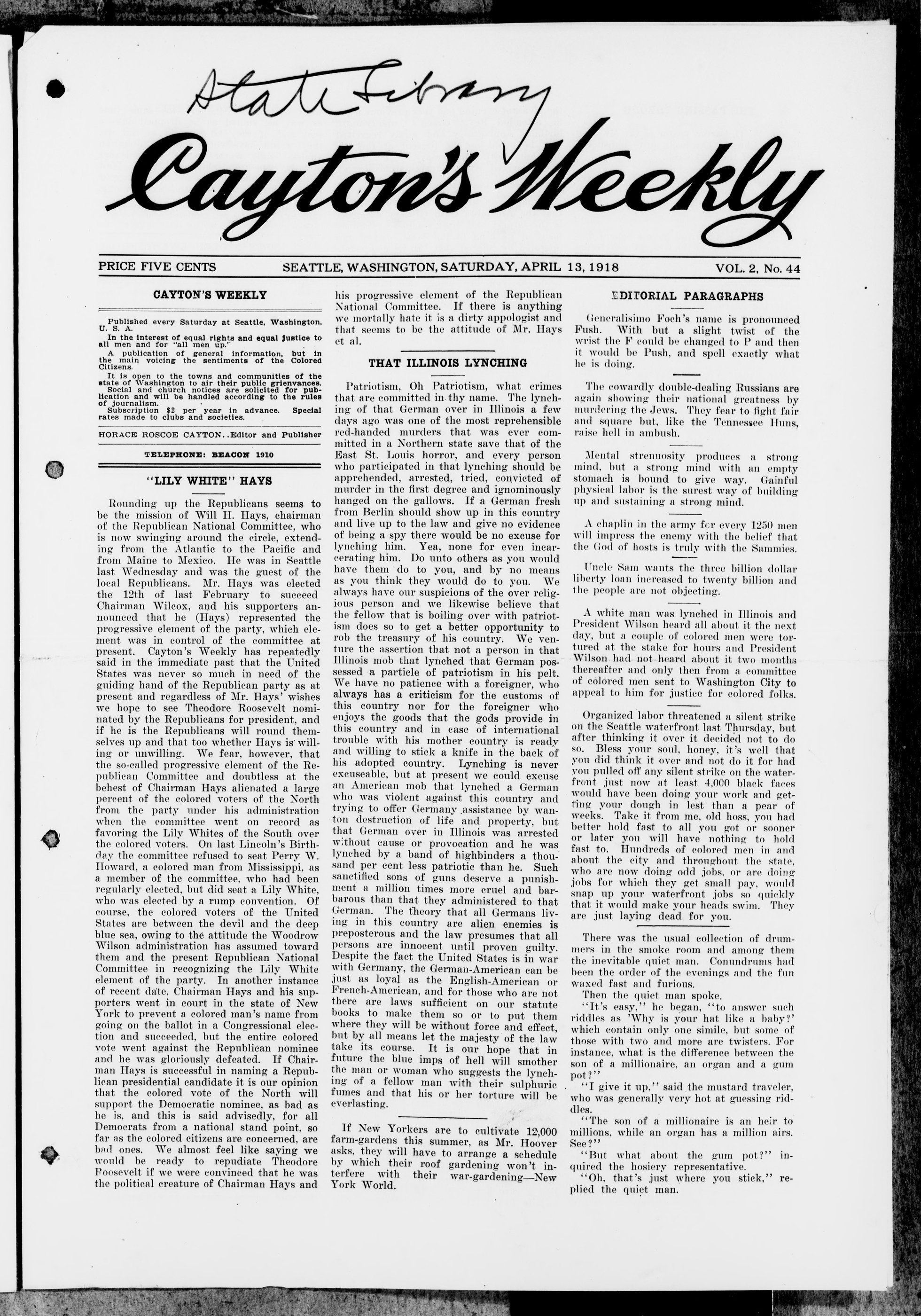
Cayton's Weekly
Saturday, April 13, 1918
Seattle, Washington
Page text (machine-generated)
State纤细
Cayton's Weekly
PRICE FIVE CENTS
CAYTON'S WEEKLY
Published every Saturday at Seattle, Washington, U. S. A.
In the interest of equal rights and equal justice to all men and for "all men up."
A publication of general information, but in the main voicing the sentiments of the Colored Citizens.
It is open to the towns and communities of the state of Washington to air their public grievances. Social and church notices are solicited for publication and will be handled according to the rules of journalism.
Subscription $2 per year in advance. Special rates made to clubs and societies.
HORACE ROSCOE CAYTON...Editor and Publisher
TELEPHONE: BEACON 1910
"LILY WHITE" HAYS
Rounding up the Republicans seems to be the mission of Will H. Hays, chairman of the Republican National Committee, who is now swinging around the circle, extending from the Atlantic to the Pacific and from Maine to Mexico. He was in Seattle last Wednesday and was the guest of the local Republicans. Mr. Hays was elected the 12th of last February to succeed Chairman Wilcox, and his supporters announced that he (Hays) represented the progressive element of the party, which element was in control of the committee at present. Cayton's Weekly has repeatedly said in the immediate past that the United States was never so much in need of the guiding hand of the Republican party as at present and regardless of Mr. Hays' wishes we hope to see Theodore Roosevelt nominated by the Republicans for president, and if he is the Republicans will round themselves up and that too whether Hays is willing or unwilling. We fear, however, that the so-called progressive element of the Republican Committee and doubtless at the behest of Chairman Hays alienated a large percent of the colored voters of the North from the party under his administration when the committee went on record as favoring the Lily Whites of the South over the colored voters. On last Lincoln's Birthday the committee refused to seat Perry W. Howard, a colored man from Mississippi, as a member of the committee, who had been regularly elected, but did seat a Lily White, who was elected by a rump convention. Of course, the colored voters of the United States are between the devil and the deep blue sea, owing to the attitude the Woodrow Wilson administration has assumed toward them and the present Republican National Committee in recognizing the Lily White element of the party. In another instance of recent date, Chairman Hays and his supporters went in court in the state of New York to prevent a colored man's name from going on the ballot in a Congressional election and succeeded, but the entire colored vote went against the Republican nominee and he was gloriously defeated. If Chairman Hays is successful in naming a Republican presidential candidate it is our opinion that the colored vote of the North will support the Democratic nominee, as bad as he is, and this is said advisedly, for all Democrats from a national stand point, so far as the colored citizens are concerned, are bad ones. We almost feel like saying we would be ready to repudiate Theodore Roosevelt if we were convinced that he was the political creature of Chairman Hays and
his progressive element of the Republican National Committee. If there is anything we mortally hate it is a dirty appologist and that seems to be the attitude of Mr. Hays et al.
THAT ILLINOIS LYNCHING
Patriotism, Oh Patriotism, what crimes that are committed in thy name. The lynching of that German over in Illinois a few days ago was one of the most reprehensible red-handed murders that was ever committed in a Northern state save that of the East St. Louis horror, and every person who participated in that lynching should be apprehended, arrested, tried, convicted of murder in the first degree and ignominiously hanged on the gallows. If a German fresh from Berlin should show up in this country and live up to the law and give no evidence of being a spy there would be no excuse for lynching him. Yea, none for even incarcerating him. Do unto others as you would have them do to you, and by no means as you think they would do to you. We always have our suspicions of the over religious person and we likewise believe that the fellow that is boiling over with patriotism does so to get a better opportunity to rob the treasury of his country. We venture the assertion that not a person in that Illinois mob that lynched that German possessed a particle of patriotism in his pelt. We have no patience with a foreigner, who always has a criticism for the customs of this country nor for the foreigner who enjoys the goods that the gods provide in this country and in case of international trouble with his mother country is ready and willing to stick a knife in the back of his adopted country. Lynching is never excuseable, but at present we could excuse an American mob that lynched a German who was violent against this country and trying to offer Germany assistance by wanton destruction of life and property, but that German over in Illinois was arrested without cause or provocation and he was lynched by a band of highbinders a thousand per cent less patriotic than he. Such sanctified sons of guns deserve a punishment a million times more cruel and barbarous than that they administered to that German. The theory that all Germans living in this country are alien enemies is preposterous and the law presumes that all persons are innocent until proven guilty. Despite the fact the United States is in war with Germany, the German-American can be just as loyal as the English-American or French-American, and for those who are not there are laws sufficient on our statute books to make them so or to put them where they will be without force and effect, but by all means let the majesty of the law take its course. It is our hope that in future the blue imps of hell will smother the man or woman who suggests the lynching of a fellow man with their sulphuric fumes and that his or her torture will be everlasting.
If New Yorkers are to cultivate 12,000 farm-gardens this summer, as Mr. Hoover asks, they will have to arrange a schedule by which their roof gardening won't interfere with their war-gardening—New York World.
VOL.2, No.44
EDITORIAL PARAGRAPHS
Generalisimo Foch's name is pronounced Fush. With but a slight twist of the wrist the F could be changed to P and then it would be Push, and spell exactly what he is doing.
The cowardly double-dealing Russians are again showing their national greatness by murdering the Jews. They fear to fight fair and square but, like the Tennessee Huns, raise hell in ambush.
Mental strenuosity produces a strong mind, but a strong mind with an empty stomach is bound to give way. Gainful physical labor is the surest way of building up and sustaining a strong mind.
A chaplin in the army for every 1250 men will impress the enemy with the belief that the God of hosts is truly with the Sammies.
Uncle Sam wants the three billion dollar liberty loan increased to twenty billion and the people are not objecting. A white man was lynched in Illinois and President Wilson heard all about it the next day, but a couple of colored men were tortured at the stake for hours and President Wilson had not heard about it two months thereafter and only then from a committee of colored men sent to Washington City to appeal to him for justice for colored folks.
Organized labor threatened a silent strike on the Seattle waterfront last Thursday, but after thinking it over it decided not to do so. Bless your soul, honey, it's well that you did think it over and not do it for had you pulled off any silent strike on the waterfront just now at least 4,000 black faces would have been doing your work and getting your dough in less than a pear of weeks. Take it from me, old hoss, you had better hold fast to all you got or sooner or later you will have nothing to hold fast to. Hundreds of colored men in and about the city and throughout the state, who are now doing odd jobs, or are doing jobs for which they get small pay, would snap up your waterfront jobs so quickly that it would make your heads swim. They are just laying dead for you.
There was the usual collection of drummers in the smoke room and among them the inevitable quiet man. Conundrums had been the order of the evenings and the fun waxed fast and furious.
Then the quiet man spoke.
"It's easy," he began, "to answer such riddles as 'Why is your hat like a baby?' which contain only one simile, but some of those with two and more are twisters. For instance, what is the difference between the son of a millionaire, an organ and a gum pot?"
"I give it up," said the mustard traveler, who was generally very hot at guessing riddles.
"The son of a millionaire is an heir to millions, while an organ has a million airs. See?"
"But what about the gum pot?" inquired the hosiery representative.
"Oh, that's just where you stick," replied the quiet man.
5
THE PASSING THRONG
Rev. W. D. Carter, pastor of the Mt. Zion Baptist Church, has been quite indisposed the most of the past week.
Cayton's Weekly would be glad to have you for a subscriber. If you are of a like mind call Beacon 1910 and make known your wants.
Mrs. John F. Cragwell gave a benefit dinner for the benefit of the Grace Presbyterian last Thursday and Friday evenings and from all appearances the effort was a magnificent success.
Having heard that Seattle had retired to rest and recuperate, I thought I could pick up a few serviceable things to use over in the big city, said John Henry Ryan, one of Tacoma's big business men.
Mrs. Jennie Vrooman gave a supper and entertainment last Thursday evening for the benefit of the Mt. Zion Baptist Church, which was a brilliant success financially and otherwise. Mrs. Vrooman is a hard and persistent worker for the church and stands a good chance of leading all of the building clubs of the church.
There is no reason why Seattle branch of the National Association for the Advancement of Colored People should not get 125 new members within the next two weeks, and it will if every member and friend will work to that end. The Association deserves the support of at least the colored folks and I sincerely trust the Seattle branch will get the number it has set its heart ongetting," said S H Stone, president of the Seattle branch.
The annual election of the King County Colored Republican Club will be held at the next regular meeting, April 21st, and those of you who are qualified members, who have not been pleased with the way the club has been conducted, should be present and do your bit in the way of making the club more effective. There is no excuse for two Republican clubs among the colored voters of Seattle when one will answer for all purposes. The doors of the present club are open to you and each of you and you are invited to be present. Do not forget the date. April 21st at 3:0'clock p. m., 300 main Street.
From the headquarters the following appeal has been sent out: "Don't overlook the association's drive for 50,000 members by May 1. A large membership is imperative for local and national success. The National office is badly crippled for lack of funds energetically to carry on the fight for equal opportunities and a fair chance for all Americans, irrespective of color. If interested, communicate with the National office, 70 Fifth Avenue, New York. If you have no branch in your city and wish to organize one and take part in this drive, kindly let us hear from you."
In honor of the forty-third birthday of Rev. W. F. Green, 1439 Jackson Street, Mrs. Green invited a number of friends to be present last Thursday evening to assist her in celebrating the same. Among those present were a number of old friends of the family, who lived in Oklahoma at the same time as did Mr. and Mrs. Green. Among those present were: Mrs. Armstrong, Mr. and Mrs. Barnes, Mr. and Mrs. Wm. Chandler, Mr. and Mrs. W. W. Casman, Dr. F. B. Cooper, Mr. N. P. Fisher, Mrs. Harris, Mr. and Mrs. A. Lancaster and two daughters, Mrs. Ward and H. R. Cayton. Mr. Green, is pastor of the Baptist Church at Everett and is also an employee of the Seattle Hardware Co. Light refreshments were served by the hostess. Dr. Cooper read a brief card of congratulations, apparently from an absent friend, who told of
the pleasant evening one year previous when he attended Rev. Green's ninety-ninth birthday anniversary and sorely regretted that he could not be present at this his one hundredth anniversary. Rev. Green was showered with congratulations by all present.
Perhaps you are not aware of the fact that the Alhambra Cash Grocery Company is the largest and most complete establishment of its kind in the West, owned and operated by colored men. In its new establishment its a perfect gem from pit to dome and your bosom is bound to swell with pride as you are being conducted from point to point in this magnificent trade emporium. It all goes to prove that when colored men get down to doing business on business principles they will be just as successful as any other class of citizens, and there is no reason why others could not do as has the proprietors of this establishment.
"Cayton's Weekly is not a war necessity therefore discontinue sending it to my address," writes an old time political war horse, who has made a fortune out of politics. Quite right you are, but when you were whining for votes it was a political necessity. Having gotten yours and you no longer see an opportunity of getting elected to a political office Cayton's Weekly is taken off of the list of political necessities and put on the basis of a war necessity. Had I been the political recipient of a publication, but tired of it when I no longer wanted political preferment I would ask that the paper no longer be sent to my address, but would not try to get funny in doing so.
"I feel so well after three weeks in the hospital, suffering from pleurosy, that I feel like saying, "a bit of sickness is not a bad thing," said John Green, one of the court house employes, and he certainly looks it. "Heretofore I have always had an awful horror of going to a hospital to be sick, but when one gets 'good and sick' there is no place like a hospital to get 'good and well.' I feel better now than I thought I could feel and its all due to the swell care I got in the hospital."
Now, Mr. Editor, since you are so desirous of having a Ford, you may use mine during the summer, as I am going to be out of the city. Thank you, very much, Mr. Big Heart, and your proffer will be accepted providing you will buy a summer's supply of gasoline and make arrangements for all necessary repairs. Say, Big Heart, there is nothing short about me except my hair, and it is growing very fast. Thank you, we will take it under advisement.
Yes, we know it has been a long, long time since we exhorted you about your garden for the coming season, but here we are again to take the same text and preach the same sermon. You will not be true to yourself and your family, if you have a plat of ground 50x50 feet unless you grow enough vegetables on it during the coming summer season, if properly hooverized, to half do the family until vegetables come again. No, I am not mistaken, for "it can be did." Enough peas, beans, tomatoes and turnips can be hooverized by planting two or three crops and canning regularly to do the work and if you want to get ahead, it's up to you to do as has been pointed out, all of which we trust you will do. Remember, that in these war times a dollar saved is two dallors made.
Nervous John was in such a hurry to get to town that he fussed and fumed because a street car did not come as soon as he wanted it to do and so impatient did he become that he started out for the city on a dog trot and after trotting almost half way to the city a car overtook him and he crawled on, all het up and perspiring like a race horse going to the barn after a mile heat. The other passengers, who
were waiting for the car the same time as was he, smiled as he dropped into a seat and, if they all thought as did we, they would have voted Nervous John an aimless angle worm instead of a leader of men, women and children. Moral: Wait until day comes and do not hammer your head against a stone wall to hurry it along. Be calm and live long. FOR RENT-One or two furnished rooms for men. Good accomodations. Ballard 1975.
SOME STOLEN SWEETS
Most of the Kaiser's spies have titles before and aliases after arrest.—New York World.
Baker Under Fire.—Head-line. He got used to it before going over.—New York World.
The infant Bolshevik Government is a precocious child. Inside of two months it began to crawl.—Brooklyn Eagle.
Trotzky is now in favor of iron discipline for the Russian Army, but we fear it's pretty rusty.—Brooklyn Eagle.
The Kaiser is willing to bear the troubles of his people, but they must continue to do the fighting.—Cleveland Plain Dealer.
You may rest assured of one thing, the Jersey mosquito will not be arrested for loafing.—New York Morning Telegraph.
With pained surprise the German troops are discovering that American soldiers are not too proud to fight.—Chicago Daily News.
The refusal of Servia to submit to discussion of peace must make the admirers of Russia sick.—Philadelphia North American.
Among the compensations of war in England is the reduction of three thousand in the annual output of new books—Boston Herald.
It must be a source of regret to Lord Lansdowne that he has only two cheeks to offer to the enemy.—Philadelphia North American.
My idea of a far-sighted man is the soldier who wrote to the book committee and asked for a guide of the city of Berlin. New York Morning Telegraph.
New York, which haw-haws every time Kansas is mentioned, has only one motorcar for every thirty-five inhabitants, while Kansas has one for every ten.—Chanute Tribune.
Secretary Baker is in Europe and his regular critics are now deciding whether to say he should not have gone or should have done it at least two years ago.—Chicago Herald.
The Irish-Americans who are urging on Congress a resolution virtually condemning Great Britain are basking in a safety secured for them by the activities of the British Fleet.—Philadelphia North American.
The announcement that the birthrate in Germany has decreased nearly one-half in the last three years ought to go a long way toward making the war popular everywhere else.—Philadelphia North American.
The Joplin News-Herald is opposed to shooting the poor devils who went to sleep on duty in France for the reason that nothing severe has been done to those of the people's representatives in this country who have been half asleep on the job ever since the war started.—Kansas City Times.
A LETTER FROM BRAZIL
By Jose Clarana.
In acceding to your request that I send you "one or two letters about the color problems in Brazil," I keep within the limitations of my capacity and comply with your admonition that "I make them as short as possible," by writing one letter with the simple statement that there is no color problem in Brazil.
By way of explanation, however, I must add that this does not mean that a black skin is an open-sesame to any and every drawing-room and a shibboleth of easy access to the heart of any maiden and the purse of her father. It means, for one thing that a man is not necessarily black because his skin is not so white as somebody's else skin. In the terms of the "social equality," which the telegrams say that German spies have been trying to obtain for the not-quite-white-enough in Alabama, it means that the color of the pelts in a drawing-room is the exclusive business of the people who wear them, and that if the son of some gentleman violates the servant girl there is no law to prevent him from marrying her because she does not come up to the popular specifications as to complexion. In a word, in Brazil the mere possession of a white skin does not entitle a man to superior civil rights and opportunities, nor does an increased pigmentation condemn its owner to the status of a pariah.
Occasionally an attempt is made in Brazil to establish a standard of whiteness to which all aspirants to a life of the greatest usefulness must conform. Generally, if not always, these attempts to divide the Brazilian people are made by foreign residents. For instance, the son of a colored teacher was not long ago refused admittance to a college conducted by Belgian priests. I do not know how this affair ended, but the action of the rector of the school was severely criticized by the newspapers. A striking contrast to the attitude of the Belgian friar is the fact that recently one of the largest and wealthiest churches in Rio was crowded with people attending a mass of intercession for the early triump of the ideals of the Allies, including, of course, those valiant defenders of the rights of oppressed peoples who used to cut off the hands of the natives on the rubber plantations in the Congo. Most of the worshippers at that mass were altogether white and many of them were distinguished foreigners. The celebrant was a colored man, who, when he is not saying mass or singing in the choir of a church, conducts a school whose students are nearly all white.
Americans, of course, are not slow in attempting to establish caste discrimination, especially when they first come here. A friend of mine told me, shortly after he arrived here, that the Negroes ought to be separated from the whites in public places. I do not know whether he got that notion so much from having resided in Alabama as from reading The Outlook, which is ashamed to tell the American public that, in trying to show how superior they are to the "niggers," white people have disgraced their civilization by committing acts of savagery unexcelled by the lowest tribes in the heart of Africa. It does not mind libeling the colored people of the States by characterizing as "envy" the natural desire of a decent man to sit in a clean railway carriage or to enter a restaurant without fear of buying a steak fried with spit or sharing the fate of the colored Georgian who, in neutral Chicago, was killed for the crime of unwittingly seating himself at the side of a Texan at a public lunch counter.
It got the Chicago story from an eyewitness, the son of a Confederate officer, who told it, with the greatest sang froid, at lunch in a Brazilian boarding-house. I mention it here in the hope that some of the editors, politicians and counting-house anthropologists who make the color question in the United States and who are really responsible for crimes against civilization
and against the good name of the United States like the Waco Horror, may have another concrete example of the effect of the "social equality" humbug in a land where nearly every one has some learning, but too many of the people have only enough to enable them to read a newspaper.
Perhaps one reason for the absence of a color question in the countries of South America, where there is any great variation in the color of the inhabitants, is the fact that there are not so many people who can read as in the United States, but, proportionately, more persons who do more than just read, because they have more time, let us say. One of the thinking readers of Brazil and unquestionably one of the greatest intellects of all America, Ruy Barbosa, in speaking of slavery and its consequences in this country, says: "For three generations we were free, prosperous and rich at the cost of the oppression of our fellow-men. We are today undergoing the great expiation which never fails, which does not pardon historic outrages and capital crimes against humanity."
The fact that slavery was a crime against humanity and not merely an economic mistake is, I think, something that no important public man in the United States would admit without reserve. In Brazil, it is the essential immorality of the institution, the inherent injustice to its victims, that is most emphasized. The date of the Abolition of Slavery, May 13, is duly commemorated as a national holiday, and there is no effort to reintroduce it in any form. Whatever penalties the nation may now be paying for the original error of importing and maintaining African slaves there is no desire to postpone the day of atonement and increase the sacrifice by aggravating the old offense.
A friend of mine, a very likeable fellow in himself, assures me that "the only way to handle an American 'nigger' is to knock him on the head and talk to him about it afterward."
African blood is, perhaps, as plentiful in the States of Bahia and Rio de Janeiro as in Georgia or Texas, but in a country where great statesmen think and feel that the humblest blacks are their fellow-men, it would not be possible for white men to drag a man through the streets, bleeding from head to foot from the nails and knives thrust into him, burn him, still living, and wear his dead teeth as charms to "keep the 'nigger' in his place."
Brazilians are very religious, but they are not quite that superstitious. Among them every one finds his place naturally. If one can afford to travel in a first class public conveyance, no one will attempt to make him go second class and pay first class fare. If a man wants a cup of coffee or a glass of milk or cane-juice, which are the most popular beverages among the Brazilians, who, by the way, are not prohibited from drinking whiskey if they want to, no cafe will refuse to serve him if he is clean and decent. They even serve Americans and Europeans who get drunk so long as these do not offend other people. When the new Minister of Foreign Affairs, whose policy is to be one of approximation to the United States, embraces the lawyer who makes a public address of godspeed and presents the Minister with a gold pen with which to sign his first official act, nobody has any objection to make because the Minister is white and the orator brown. The newspapers do not even mention the color of the people concerned. They never do, except, sometimes, in reporting civil statistics, accidents and crimes. In such cases the person is not called black if the skin is not black. Whether white or mixed, the color is mentioned only once, parenthetically, for identification, and not used to substitute proper nouns and pronouns, in a manifest effort to associate complexion with crime, as in the two inch paragraph I once cut from the New York Times, which contained nine references to the color of a man ac-
cused of a commonplace crime. The man, of course, was a Negro, more or less.
Nobody wastes any time in the Republic of the Southern Cross in trying to determine the moral and intellectual potentialities of a people by skin color or facial configuration. In this country a man's accomplishments are the measure of his ability. Even before the complete abolition of slavery, the greatest statesman of the Empire was a mulatto. A black of the deepest dye was a commanding figure in journalism. Today there are men of Negro blood in the national and state legislatures, representing citizens of any and all hues. One of the most important diplomatic representatives of Brazil would be called a Negro in law and a "nigger" by custom in the United States. In short, in every walk of life, from the highest and most useful callings to the humble and unproductive one of begging and the less honorable but less prevalent one of stealing, Brazilians are engaged, without let or hindrance, purely because of their own or their grandmothers' color.
But withal white civilization is still supreme and is constantly increasing its power and influence, for it is supported by the national conscience of a people passionately devoted to the practise of liberty and justice within their own borders and among their fellow-men. Such a civilization must always endure, for it is only when Bethman Hollweg declares: "We'll knock Belgians on the head, and then talk to them about it afterward," that Waco becomes Verdun and white civilization commits suicide.
The South American countries have had their Wacos and Verduns, and for this reason they are not anxious to pay more than they can help of the penalties for wrongs done unto them rather than by them. For four hundred years Europeans, Africans and American aborigines have toiled together, according to their gifts, to make this continent what it is today. Out of this long experience has been evolved the attitude toward men and citizens of the various countries, which is thus expressed by Don Francisco Garcia Calderon, former Minister of Bolivia, to the United States, in an essay on Pan-Americanism. Past and Future: "The biological notion of race, that internal fatality as inexorable as destiny of old, which is revealed by the cranial line and the color of the skin, is declining in prestige. Sociologists have given up discovering pure blood in confused nations, they do not recognize the hereditary preeminence, which used to be attributed to particular ethnic groups; they contest the summary opposition between Indo-Germanic and Semitic which explained, in the mind of ambitious historians, the development of the drama of peoples, their progress and decadence, the construction of empires and philosophies, the mission of Orient and Occident. But we do not abandon the idea of race as the synthesis of the diverse elements of a definite civilization. Religion, art, language, lengthy inhabitation of the same territory, tradition, moral affinities which fix, through the centuries, lasting cultures and unmistakable psychological characteristics."
This idea of race as being synonymous with nation holds true in Brazil. Perhaps in the Great Republic of the North the time is not far distant when an American will be no less than an American, no matter what the shape of his head or the color of his skin. And then, when you have no more Wacos, you need fear no Verduns. At least, you will have the satisfaction of knowing that none of the blood and treasure which you would generously spend for the redemption of Belgium is being paid in needless sacrifice for the slavery that you maintain at home—The Crisis.
Every time von Hindenburg calls for Victory, Central gives him the wrong number.—Brooklyn Eagle.
1.
Copyright 1917
By ORLANDO BELKNAP POND
(All rights reserved)
The competition between cities and other business localities was tremendous. Trade products moved in channels already established. The stage coach conveyed the traveling public over the best of turnpike roads by well trained and fast speeding horses, and the heavy teams hauled the products of the country to the canals and near by navigable rivers. All of these interests were arrayed against any attempt to build railroads into their territory or field of operation, and had their supporters in the communities of greater interest. All were combined against any and all movements towards railroad building.
Like all new undertakings of great importance the railroad met with great opposition from many sources. It was a struggle between contending interest; a conflict between old established principles that travel and transportation follow the channels of least resistance; and that changing these channels by overcoming the natural obstacles by artificial means and introducing better and more rapid vehicles of conveyance and thereby turning trade into other and new channels of transportation.
It was the determined effort of the one to retain its hold on the established advantages, and prevent the railroad by every known means of obstruction from gaining a foothold in their territory of operation and the persistent determination of the other moving on step by step, a little at one place and a little at another to accomplish its purpose. Though the task of railroad building was enormous, difficult beyond measure, and discouraging in every particular, when it did get a foothold, when it actually stretched itself out in various directions and from many points, it became the victor and drove all of its old enemies and competitors from the field of operation. First the stage coach, and second the canals and third the river transportations, all were forced from the field of operation, and to give way to the strides of this modern giant and successful competitor; and trade and production found new channels and new centers of distribution.
Until July, 1834, the Baltimore and Ohio railroad had only three locomotives. The freight cars, many of them were drawn by horses.
The locomotive had not yet been fully established in his rightful career upon his own right-of-way. This right-of-way was not in fact yet fitted and adapted to his occupancy, more than this the locomotive itself had not yet advanced beyond the embrio state and conditions. But such as it then was it was finally improved and developed to meet the conditions and the railroad and locomotive were together fitted and adapted to each other. Until this time it was a contest between the horse and the locomotive; the locomotive all the time gaining upon the horse. The horse was finally supplanted by the locomotive on the main lines, though not for several years. He still, however remained in activity on the short, or branch, lines, and held his prerogative here as late in some instances as the civil war, and was for a much longer time the only street car operating force relied upon.
It had been nearly, if not quite, two hundred years since the first railroad or tramway was built in England. These tramways were built and adapted to use with the horse and cart. The timber rails and horse power had given way to a certain extent
to the iron rails and the locomotive engine, before any attempt at railroad building had been made in America. There is, however, little or no connection between the railroad in England and in America. The American had very little knowledge or conception of the English railroads.
When he began building railroads, the American was as ignorant of what the railroad he was about to build was, or should or would, be, when completed as if it had been the first railroad built in the world, and yet perhaps his ignorance did not go quite to this extent. The American had heard of the English tramway, and it may have had some influence upon his railroad building. The American if he did not pattern after the English did in some respect follow out some of the methods of the English roads. The American built his railroad with wooden rails and used horse power as the English had done. The conception certainly was English.
Notwithstanding this was the fact that American of necessity was impelled to work out the railroad problem by himself, single handed. Single handed inthe sense that he had practically no aid or hint from foreign sources. It to him was a costly undertaking, but he met the cost, solved the problem, mastered the difficulties and worked out his own system which ultimately became the American System, and in 1840 led the world in railroads, and in equipments and in management; and still holds the lead.
There were then no great trunk lines crossing the length and breadth of the country. These railroads were all local experiments. There were, however, many railroad companies then in the country, and they continued for the most part to be local until after the civil war. But they had already, even at this early date, begun to have great influence upon the trade and the products and the commerce of the country. They had already driven the stage coach, the canal and for the most part the river boats out of business. The country taverns which were every where prominent in the days of stage coaches had already gone to decay or stood with closed doors. Trade and products were turned into new channels and found their way to new centers. The old villages and towns once flourishing and prosperous were now inactive, lifeless, dead and going the downward road, in many instances to ruin. New towns and new cities spring into existance along the line of the railroads, and were flourishing and prosperous.
No one will ever know the actual cost of the introduction of railroads into this country; nor the great changes wrought thereby in the business relations of the people. It is only approximately shown in the changed financial conditions of thousands, whose prosperity left them in a day through millions of dollars already invested in legitimate enterprises, but which became worthless owing to the changed mode of travel and transportation previously established, and which had become vested rights. (To be continued)
IN THE SUPERIOR COURT OF THE STATE OF Washington for King County.
IN THE SUPERIOR COURT OF THE STATE OF Washington, for King County.—In Probate.
Notice is hereby given that the undersigned has been appointed and has qualified as administrator of the estate of Frank O'Neil, alias Mitro Bassaroba, Deceased; that all persons having claims against said deceased are hereby required to serve the same, duly vrified, on said administrator at the address below stated, and file the same with the Clerk of said Court, together with proof of such service within six months after the date of first publication of this notice, or the same will be barred. Date of first publication March 30, 1918.
ANDREW R. BLACK,
Administrator of said Estate.
Address: 316 Pacific Block, Seattle, Wash.
ANDREW R. BLACK,
Attorney for Estate,
316 Pacific Block, Seattle, Wash.
March 30—May 11, 1918.
IN THE SUPERIOR COURT OF THE STATE OF Washington for King County.
Saddie Melton, Plaintiff, vs. Eugene Melton, Defendant.—No. Summons by Publication.
The State of Washington to the said Eugene Melton, Defendant:
You are hereby summoned to appear within sixty days after the date of the first publication of this summons. to-wit: within sixty days after the 30th day of March, 1918, and defend the above entitled action in the above entitled court, and answer the complaint of the plaintiff, and serve a copy of your answer upon the undersigned attorney for plaintiff at his office below stated; and in case of your failure so to do, judgment will be rendered against you according to the demand of the complaint, which has been filed with the clerk of said court.
The object of the above entitled action is to obtain a decree of divorce from the defendant by the plaintiff on the ground of desertion.
ANDREW R. BLACK.
Attorney for Plaintiff.
P. O. Address, 316 Pacific Block, Seattle, Wash.
March 30—May 11, 1918.
IN THE SUPERIOR COURT OF THE STATE OF Washington for King County.
Myrtle Carpenter, Plaintiff, vs. Paul Carpenter, Defendant.—No. .... Summons by Publication.
The State of Washington to the said Paul Carpenter, Defendant:
You are hereby summoned to appear within sixty days after the date of the first publication of this summons. to-wit: within sixty days after the 30th day of March, 1918, and defend the above entitled action in the above entitled court, and answer the complaint of the plaintiff, and serve a copy of your answer upon the undersigned attorney for plaintiff at this office below stated; and in case of your failure so to do, judgment will be rendered against you according to the demand of the complaint, which has been filed with the clerk of said court.
The object of the above entitled action is to obtain a decree of divorce from the defendant by the plaintiff on the ground of desertion.
ANDREW R. BLACK.
Attorney for Plaintiff.
P. O. Address, 316 Pacific Block, Seattle, Wash.
March 30—May 11, 1918.
IN THE SUPERIOR COURT OF THE STATE OF Washington, in and for the County of King.
In the Matter of the Dissolution of Toyo Shokai, a corporation.—No. 128072. Notice of Dissolution of Corporation.
Notice is hereby given that Toyo Shokai, a Washington corporation, with headquarters at Seattle, has petitioned the King County Superior Court for authority to disincorporate and dissolve.
Notice is hereby given that said application will be heard in Department No. 1, of the King County Superior Court on the 28th day of May, 1918.
Datd at Seattle, Wash., March 29th, 1918.
PERCY F. THOMAS,
County Clerk.
By W. F. HOTT,
Deputy.
A. R. BLACK.
316 Pacific Block.
March 30—May 25, 1918.
Cayton's Weekly publishes legal notices at current rates. Main 24.
ALHAMBRA CASH GROCERY
H. Legg, Prop. W. H. Banks, Mgr.
We Carry a Full Line of Fancy and
Staple Groceries
WE KINDLY INVITE YOUR INSPECTION
Our New Store:
1201-3 Jackson St. Phone Beacon 505
TUTT'S BARBER SHOP "He wants to see you." High-class
Tonsorial Work. 300 Main Street, Seattle. Latest
race papers. All kinds of toilet supplies.
DB. J. A. GHENT, SPECIALIST In Surgery and Gynecology has removed his office from the Marion Bldg. to 221 and 222 Seaboard Bldg., formerly Northern Bank Bldg., corner Westlake and Pine. Tel. Main 1185.
BURR WILLIAMS RUSSELL SMITH
President Secretary
DUMAS CLUB, INC.
209 Fifth Avenue South
CAFE IN CONNECTION
Phone Elliott 3763