Cayton's Weekly
Saturday, October 12, 1918
Seattle, Washington
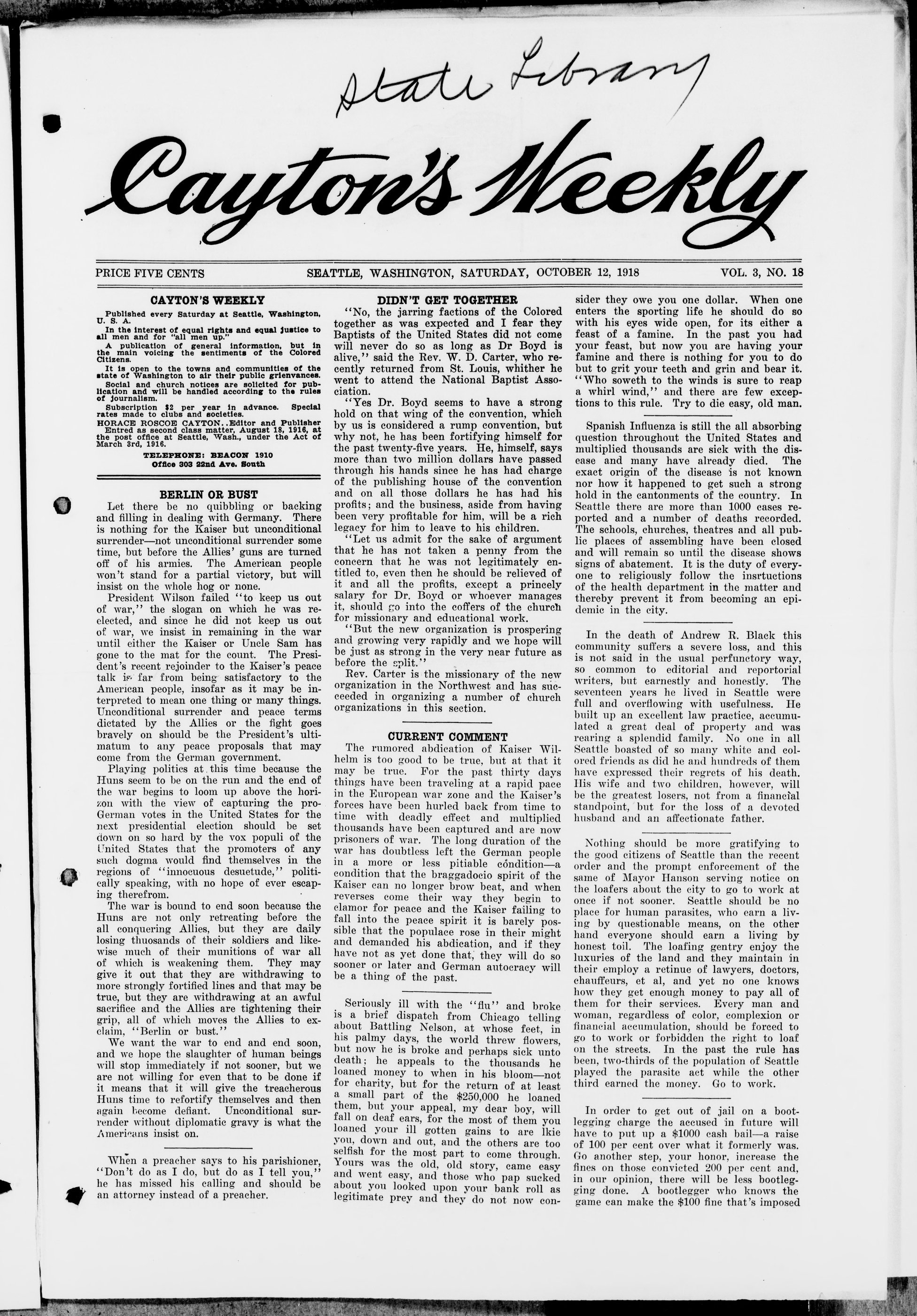
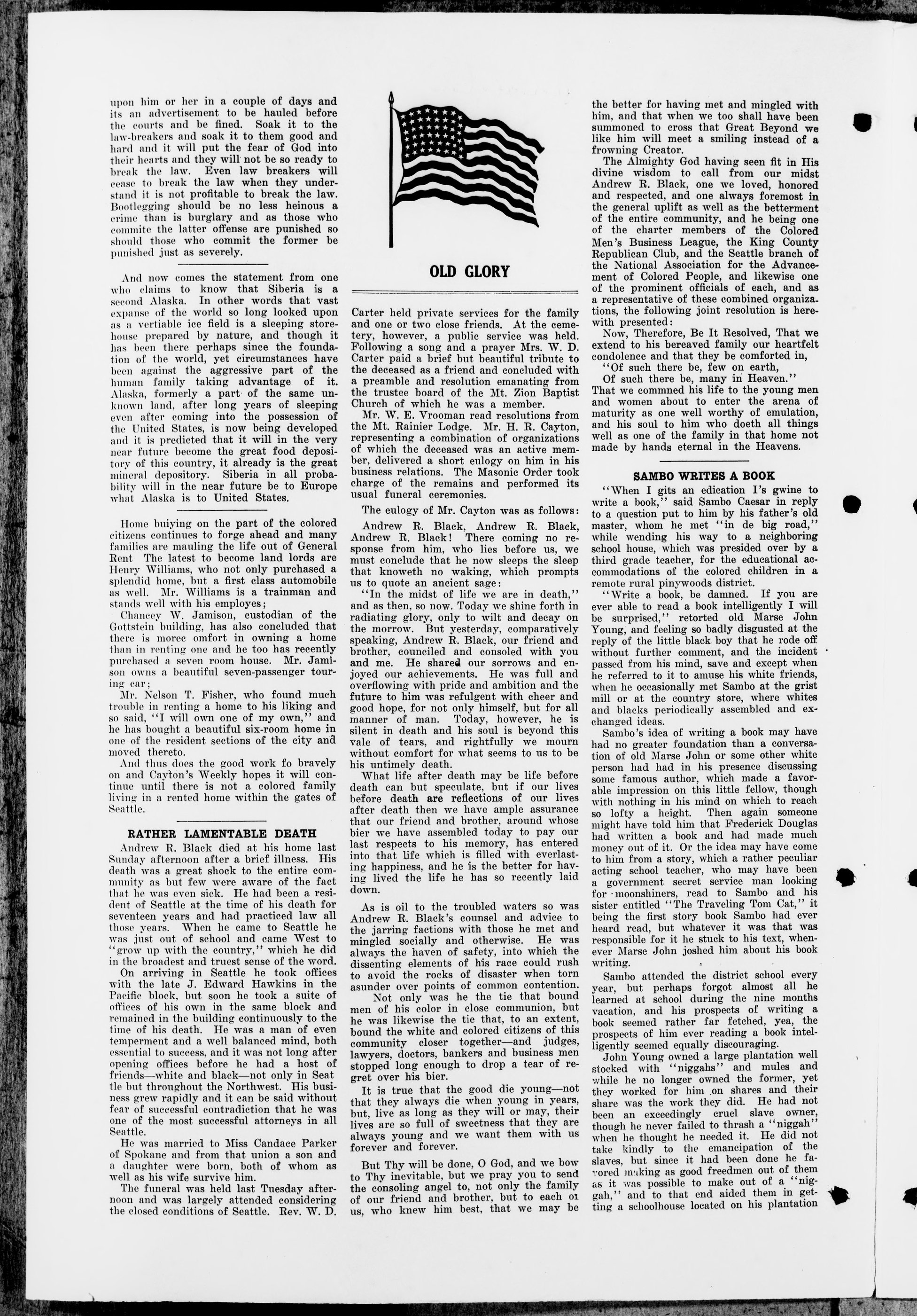
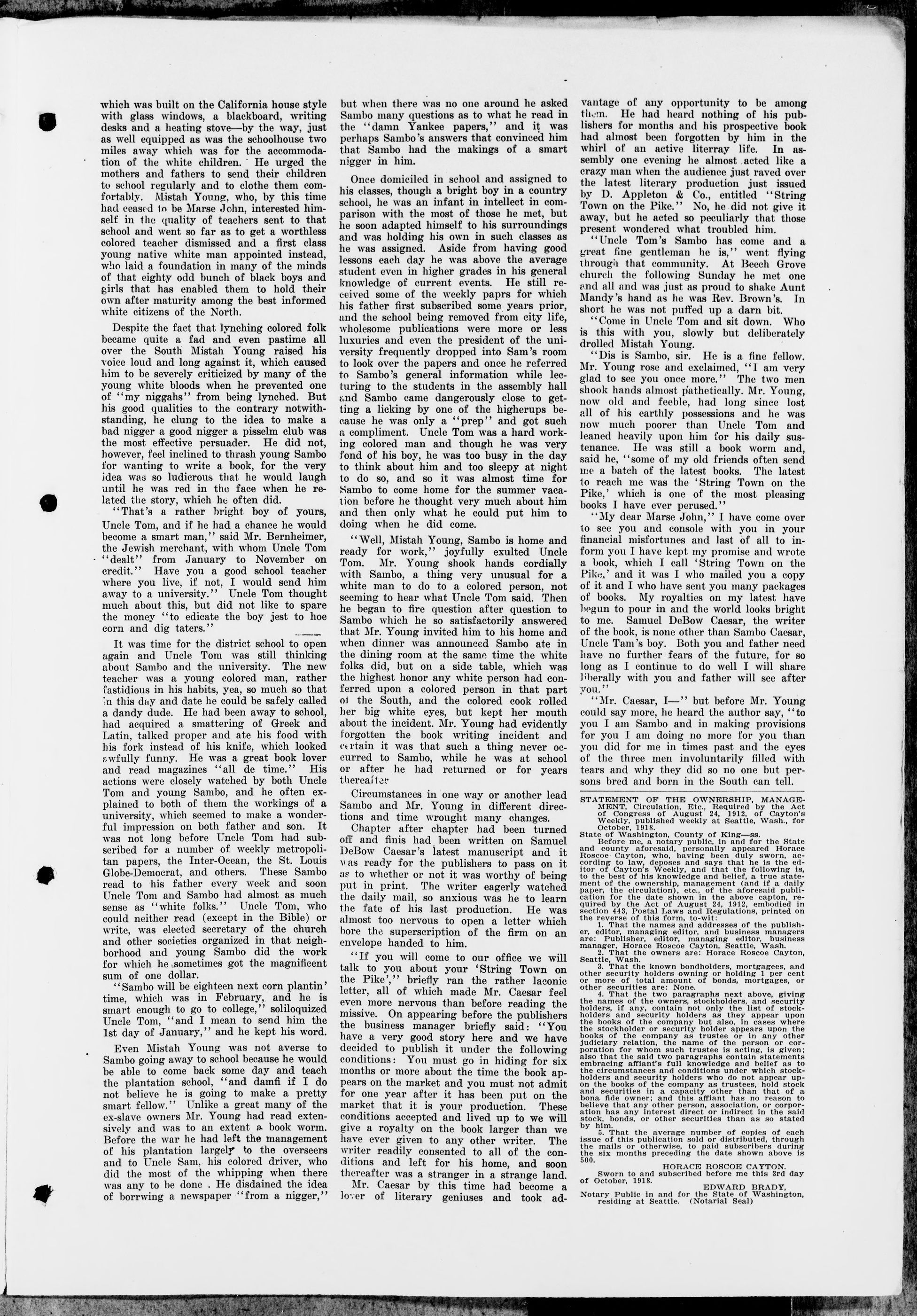
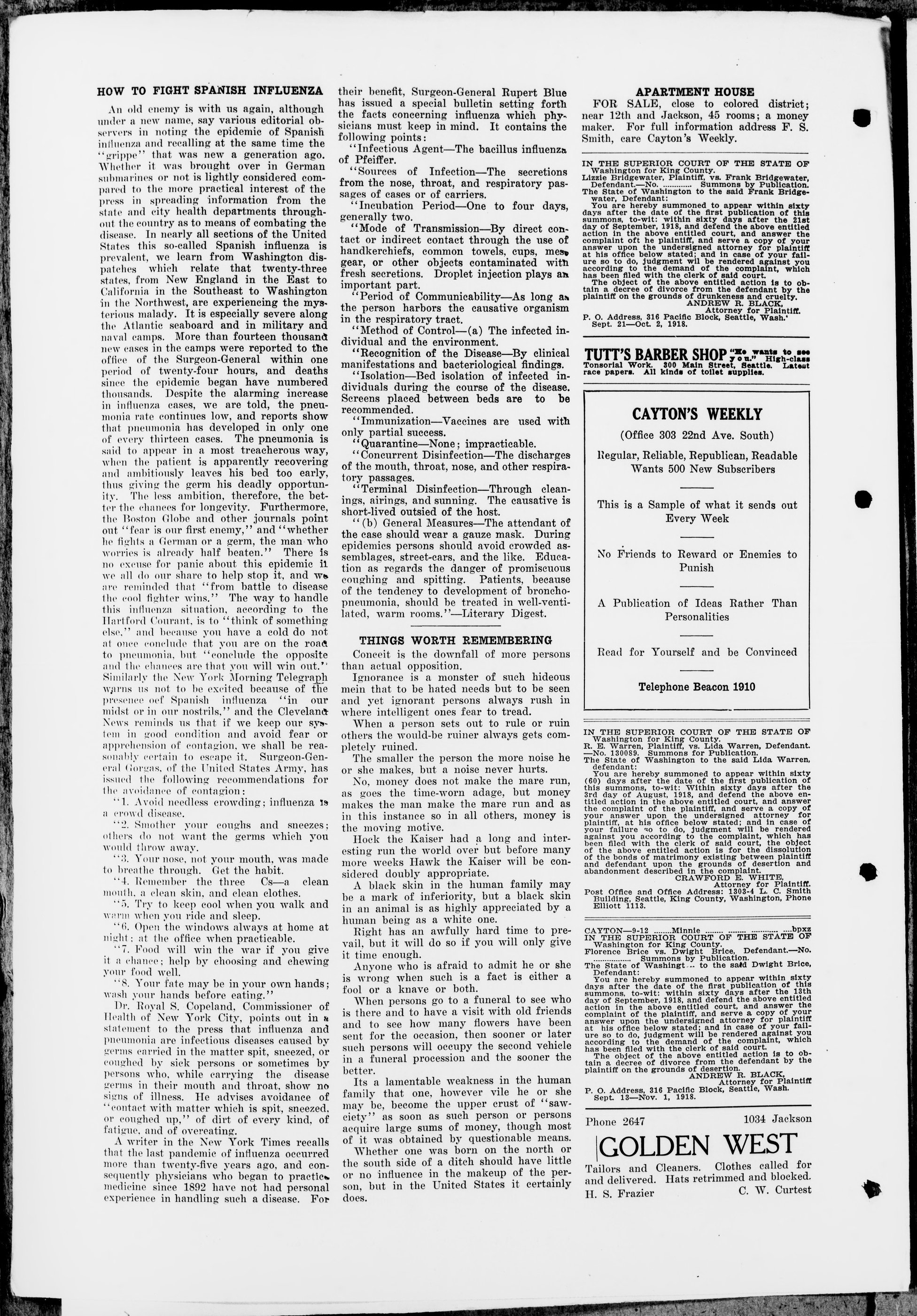
Page text (machine-generated)
State Library
Cayton's Weekly
CAYTON'S WEEKLY
Published every Saturday at Seattle, Washington, U. S. A.
In the interest of equal rights and equal justice to all men and for "all men up."
A publication of general information, but in the main voicing the sentiments of the Colored Citizens.
It is open to the towns and communities of the state of Washington to air their public grievances. Social and church notices are solicited for publication and will be handled according to the rules of journalism. Subscription $2 per year in advance. Special rates made to clubs and societies.
HORACE ROSCOE CAYTON. Editor and Publisher
Entred as second class matter, August 18, 1916, at
the post office at Seattle, Wash., under the Act of
March 3rd, 1916.
TELEPHONE: BEACON 1910
Office 303 22nd Ave. South
BERLIN OR BUST
Let there be no quibbling or backing and filling in dealing with Germany. There is nothing for the Kaiser but unconditional surrender—not unconditional surrender some time, but before the Allies' guns are turned off of his armies. The American people won't stand for a partial victory, but will insist on the whole hog or none. President Wilson failed "to keep us out of war," the slogan on which he was reelected, and since he did not keep us out of war, we insist in remaining in the war until either the Kaiser or Uncle Sam has gone to the mat for the count. The President's recent rejoinder to the Kaiser's peace talk is far from being satisfactory to the American people, insofar as it may be interpreted to mean one thing or many things. Unconditional surrender and peace terms dictated by the Allies or the fight goes bravely on should be the President's ultimatum to any peace proposals that may come from the German government.
Playing politics at this time because the Huns seem to be on the run and the end of the war begins to loom up above the horizon with the view of capturing the pro-German votes in the United States for the next presidential election should be set down on so hard by the vox populi of the United States that the promoters of any such dogma would find themselves in the regions of "innocuous desuetude," politically speaking, with no hope of ever escaping therefrom.
The war is bound to end soon because the Huns are not only retreating before the all conquering Allies, but they are daily losing thuosands of their soldiers and likewise much of their munitions of war all of which is weakening them. They may give it out that they are withdrawing to more strongly fortified lines and that may be true, but they are withdrawing at an awful sacrifice and the Allies are tightening their grip, all of which moves the Allies to exclaim. "Berlin or bust."
We want the war to end and end soon, and we hope the slaughter of human beings will stop immediately if not sooner, but we are not willing for even that to be done if it means that it will give the treacherous Huns time to refortify themselves and then again become defiant. Unconditional surrender without diplomatic gravy is what the Americans insist on.
When a preacher says to his parishioner, "Don't do as I do, but do as I tell you," he has missed his calling and should be an attorney instead of a preacher.
DIDN'T GET TOGETHER
"No, the jarring factions of the Colored together as was expected and I fear they Baptists of the United States did not come will never do so as long as Dr Boyd is alive," said the Rev. W. D. Carter, who recently returned from St. Louis, whither he went to attend the National Baptist Association.
"Yes Dr. Boyd seems to have a strong hold on that wing of the convention, which by us is considered a rump convention, but why not, he has been fortifying himself for the past twenty-five years. He, himself, says more than two million dollars have passed through his hands since he has had charge of the publishing house of the convention and on all those dollars he has had his profits; and the business, aside from having been very profitable for him, will be a rich legacy for him to leave to his children.
"Let us admit for the sake of argument that he has not taken a penny from the concern that he was not legitimately entitled to, even then he should be relieved of it and all the profits, except a princely salary for Dr. Boyd or whoever manages it, should go into the coffers of the church for missionary and educational work.
"But the new organization is prospering and growing very rapidly and we hope will be just as strong in the very near future as before the split."
Rev. Carter is the missionary of the new organization in the Northwest and has succeeded in organizing a number of church organizations in this section.
CURRENT COMMENT
The rumored abdication of Kaiser Wilhelm is too good to be true, but at that it may be true. For the past thirty days things have been traveling at a rapid pace in the European war zone and the Kaiser's forces have been hurled back from time to time with deadly effect and multiplied thousands have been captured and are now prisoners of war. The long duration of the war has doubtless left the German people in a more or less pitiable condition—a condition that the braggadocio spirit of the Kaiser can no longer brow beat, and when reverses come their way they begin to clamor for peace and the Kaiser failing to fall into the peace spirit it is barely possible that the populace rose in their might and demanded his abdication, and if they have not as yet done that, they will do so sooner or later and German autocracy will be a thing of the past.
Seriously ill with the "flu" and broke is a brief dispatch from Chicago telling about Battling Nelson, at whose feet, in his palmy days, the world threw flowers, but now he is broke and perhaps sick unto death; he appeals to the thousands he loaned money to when in his bloom—not for charity, but for the return of at least a small part of the $250,000 he loaned them, but your appeal, my dear boy, will fall on deaf ears, for the most of them you loaned your ill gotten gains to are lkie you, down and out, and the others are too selfish for the most part to come through. Yours was the old, old story, came easy and went easy, and those who pap sucked about you looked upon your bank roll as legitimate prey and they do not now con-
VOL. 3. NO. 18
sider they owe you one dollar. When one enters the sporting life he should do so with his eyes wide open, for its either a feast of a famine. In the past you had your feast, but now you are having your famine and there is nothing for you to do but to grit your teeth and grin and bear it. "Who soweth to the winds is sure to reap a whirl wind," and there are few exceptions to this rule. Try to die easy, old man.
Spanish Influenza is still the all absorbing question throughout the United States and multiplied thousands are sick with the disease and many have already died. The exact origin of the disease is not known nor how it happened to get such a strong hold in the cantonments of the country. In Seattle there are more than 1000 cases reported and a number of deaths recorded. The schools, churches, theatres and all public places of assembling have been closed and will remain so until the disease shows signs of abatement. It is the duty of everyone to religiously follow the insrtuctions of the health department in the matter and thereby prevent it from becoming an epidemic in the city.
In the death of Andrew R. Black this community suffers a severe loss, and this is not said in the usual perfunctory way, so common to editorial and reportorial writers, but earnestly and honestly. The seventeen years he lived in Seattle were full and overflowing with usefulness. He built up an excellent law practice, accumulated a great deal of property and was rearing a splendid family. No one in all Seattle boasted of so many white and colored friends as did he and hundreds of them have expressed their regrets of his death. His wife and two children, however, will be the greatest losers, not from a financial standpoint, but for the loss of a devoted husband and an affectionate father.
Nothing should be more gratifying to the good citizens of Seattle than the recent order and the prompt enforcement of the same of Mayor Hanson serving notice on the loafers about the city to go to work at once if not sooner. Seattle should be no place for human parasites, who earn a living by questionable means, on the other hand everyone should earn a living by honest toil. The loafing gentry enjoy the luxuries of the land and they maintain in their employ a retinue of lawyers, doctors, chauffeurs, et al, and yet no one knows how they get enough money to pay all of them for their services. Every man and woman, regardless of color, complexion or financial accumulation, should be forced to go to work or forbidden the right to loaf on the streets. In the past the rule has been, two-thirds of the population of Seattle played the parasite act while the other third earned the money. Go to work.
In order to get out of jail on a bootlegging charge the accused in future will have to put up a $1000 cash bail—a raise of 100 per cent over what it formerly was. Go another step, your honor, increase the fines on those convicted 200 per cent and, in our opinion, there will be less bootlegging done. A bootleger who knows the game can make the $100 fine that's imposed
```markdown
```
upon him or her in a couple of days and its an advertisement to be hauled before the courts and be fined. Soak it to the law-breakers and soak it to them good and hard and it will put the fear of God into their hearts and they will not be so ready to break the law. Even law breakers will cease to break the law when they understand it is not profitable to break the law. Bootlegging should be no less heinous a crime than is burglary and as those who commite the latter offense are punished so should those who commit the former be punished just as severely.
And now comes the statement from one who claims to know that Siberia is a second Alaska. In other words that vast expanse of the world so long looked upon as a vertiable ice field is a sleeping storehouse prepared by nature, and though it has been there perhaps since the foundation of the world, yet circumstances have been against the aggressive part of the human family taking advantage of it. Alaska, formerly a part of the same unknown land, after long years of sleeping even after coming into the possession of the United States, is now being developed and it is predicted that it will in the very near future become the great food depository of this country, it already is the great mineral depository. Siberia in all probability will in the near future be to Europe what Alaska is to United States.
Home buiying on the part of the colored citizens continues to forge ahead and many families are mauling the life out of General Rent The latest to become land lords are Henry Williams, who not only purchased a splendid home, but a first class automobile as well. Mr. Williams is a trainman and stands well with his employes; Chancey W. Jamison, custodian of the Gottstein building, has also concluded that there is morec comfort in owning a home than in renting one and he too has recently purchased a seven room house. Mr. Jamison owns a beautiful seven-passenger touring car;
Mr. Nelson T. Fisher, who found much trouble in renting a home to his liking and so said, "I will own one of my own," and he has bought a beautiful six-room home in one of the resident sections of the city and moved thereto. And thus does the good work fo bravely on and Cayton's Weekly hopes it will continue until there is not a colored family living in a rented home within the gates of Seattle.
RATHER LAMENTABLE DEATH
Andrew R. Black died at his home last Sunday afternoon after a brief illness. His death was a great shock to the entire community as but few were aware of the fact that he was even sick. He had been a resident of Seattle at the time of his death for seventeen years and had practiced law all those years. When he came to Seattle he was just out of school and came West to "grow up with the country," which he did in the broadest and truest sense of the word.
On arriving in Seattle he took offices with the late J. Edward Hawkins in the Pacific block, but soon he took a suite of offices of his own in the same block and remained in the building continuously to the time of his death. He was a man of even temperment and a well balanced mind, both essential to success, and it was not long after opening offices before he had a host of friends—white and black—not only in Seattle but throughout the Northwest. His business grew rapidly and it can be said without fear of successful contradiction that he was one of the most successful attorneys in all Seattle.
He was married to Miss Candace Parker of Spokane and from that union a son and a daughter were born, both of whom as well as his wife survive him. The funeral was held last Tuesday afternoon and was largely attended considering the closed conditions of Seattle. Rev. W. D.
```markdown
```
Carter held private services for the family and one or two close friends. At the cemetery, however, a public service was held. Following a song and a prayer Mrs. W. D. Carter paid a brief but beautiful tribute to the deceased as a friend and concluded with a preamble and resolution emanating from the trustee board of the Mt. Zion Baptist Church of which he was a member.
Mr. W. E. Vrooman read resolutions from the Mt. Rainier Lodge. Mr. H. R. Cayton, representing a combination of organizations of which the deceased was an active member, delivered a short eulogy on him in his business relations. The Masonic Order took charge of the remains and performed its usual funeral ceremonies.
The eulogy of Mr. Cayton was as follows:
Andrew R. Black, Andrew R. Black, Andrew R. Black! There coming no response from him, who lies before us, we must conclude that he now sleeps the sleep that knoweth no waking, which prompts us to quote an ancient sage:
"In the midst of life we are in death," and as then, so now. Today we shine forth in radiating glory, only to wilt and decay on the morrow. But yesterday, comparatively speaking, Andrew R. Black, our friend and brother, counciled and consoled with you and me. He shared our sorrows and enjoyed our achievements. He was full and overflowing with pride and ambition and the future to him was refulgent with cheer and good hope, for not only himself, but for all manner of man. Today, however, he is silent in death and his soul is beyond this vale of tears, and rightfully we mourn without comfort for what seems to us to be his untimely death.
What life after death may be life before death can but speculate, but if our lives before death are reflections of our lives after death then we have ample assurance that our friend and brother, around whose bier we have assembled today to pay our last respects to his memory, has entered into that life which is filled with everlasting happiness, and he is the better for having lived the life he has so recently laid down.
As is oil to the troubled waters so was Andrew R. Black's counsel and advice to the jarring factions with those he met and mingled socially and otherwise. He was always the haven of safety, into which the dissenting elements of his race could rush to avoid the rocks of disaster when torn asunder over points of common contention. Not only was he the tie that bound men of his color in close communion, but he was likewise the tie that, to an extent, bound the white and colored citizens of this community closer together—and judges, lawyers, doctors, bankers and business men stopped long enough to drop a tear of regret over his bier.
It is true that the good die young—not that they always die when young in years, but, live as long as they will or may, their lives are so full of sweetness that they are always young and we want them with us forever and forever.
But Thy will be done, O God, and we bow to Thy inevitable, but we pray you to send the consoling angel to, not only the family of our friend and brother, but to each or us, who knew him best, that we may be
the better for having met and mingled with him, and that when we too shall have been summoned to cross that Great Beyond we like him will meet a smiling instead of a frowning Creator.
The Almighty God having seen fit in His divine wisdom to call from our midst Andrew R. Black, one we loved, honored and respected, and one always foremost in the general uplift as well as the betterment of the entire community, and he being one of the charter members of the Colored Men's Business League, the King County Republican Club, and the Seattle branch of the National Association for the Advancement of Colored People, and likewise one of the prominent officials of each, and as a representative of these combined organizations, the following joint resolution is herewith presented:
Now, Therefore, Be It Resolved, That we extend to his bereaved family our heartfelt condolence and that they be comforted in, "Of such there be, few on earth, Of such there be, many in Heaven." That we commned his life to the young men and women about to enter the arena of maturity as one well worthy of emulation, and his soul to him who doeth all things well as one of the family in that home not made by hands eternal in the Heavens.
SAMBO WRITES A BOOK
"When I gits an edication I's gwine to write a book," said Sambo Caesar in reply to a question put to him by his father's old master, whom he met "in de big road," while wending his way to a neighboring school house, which was presided over by a third grade teacher, for the educational accommodations of the colored children in a remote rural pinywoods district.
"Write a book, be damned. If you are ever able to read a book intelligently I will be surprised," retorted old Marse John Young, and feeling so badly disgusted at the reply of the little black boy that he rode off without further comment, and the incident passed from his mind, save and except when he referred to it to amuse his white friends, when he occasionally met Sambo at the grist mill or at the country store, where whites and blacks periodically assembled and exchanged ideas.
Sambo's idea of writing a book may have had no greater foundation than a conversation of old Marse John or some other white person had had in his presence discussing some famous author, which made a favorable impression on this little fellow, though with nothing in his mind on which to reach so lofty a height. Then again someone might have told him that Frederick Douglas had written a book and had made much money out of it. Or the idea may have come to him from a story, which a rather peculiar acting school teacher, who may have been a government secret service man looking for moonshiners, read to Sambo and his sister entitled "The Traveling Tom Cat," it being the first story book Sambo had ever heard read, but whatever it was that was responsible for it he stuck to his text, whenever Marse John joshed him about his book writing.
Sambo attended the district school every year, but perhaps forgot almost all he learned at school during the nine months vacation, and his prospects of writing a book seemed rather far fetched, yea, the prospects of him ever reading a book intelligently seemed equally discouraging.
John Young owned a large plantation well stocked with "niggahs" and mules and while he no longer owned the former, yet they worked for him on shares and their share was the work they did. He had not been an exceedingly cruel slave owner, though he never failed to thrash a "niggah" when he thought he needed it. He did not take kindly to the emancipation of the slaves, but since it had been done he favored making as good freedmen out of them as it was possible to make out of a "niggah," and to that end aided them in getting a schoolhouse located on his plantation
---
which was built on the California house style with glass windows, a blackboard, writing desks and a heating stove-by the way, just as well equipped as was the schoolhouse two miles away which was for the accommodation of the white children. He urged the mothers and fathers to send their children to school regularly and to clothe them comfortably. Mistah Young, who, by this time had ceased to be Marse John, interested himself in the quality of teachers sent to that school and went so far as to get a worthless colored teacher dismissed and a first class young native white man appointed instead, who laid a foundation in many of the minds of that eighty odd bunch of black boys and girls that has enabled them to hold their own after maturity among the best informed white citizens of the North.
Despite the fact that lynching colored folk became quite a fad and even pastime all over the South Mistah Young raised his voice loud and long against it, which caused him to be severely criticized by many of the young white bloods when he prevented one of "my niggahs" from being lynched. But his good qualities to the contrary notwithstanding, he clung to the idea to make a bad nigger a good nigger a pisselm club was the most effective persuader. He did not, however, feel inclined to thrash young Sambo for wanting to write a book, for the very idea was so ludicrous that he would laugh until he was red in the face when he related the story, which he often did.
"That's a rather bright boy of yours, Uncle Tom, and if he had a chance he would become a smart man," said Mr. Bernheimer, the Jewish merchant, with whom Uncle Tom "dealt" from January to November on credit." Have you a good school teacher where you live, if not, I would send him away to a university." Uncle Tom thought much about this, but did not like to spare the money "to edicate the boy jest to hoe corn and dig taters."
It was time for the district school to open again and Uncle Tom was still thinking about Sambo and the university. The new teacher was a young colored man, rather fastidious in his habits, yea, so much so that in this day and date he could be safely called a dandy dude. He had been away to school, had acquired a smattering of Greek and Latin, talked proper and ate his food with his fork instead of his knife, which looked awfully funny. He was a great book lover and read magazines "all de time." His actions were closely watched by both Uncle Tom and young Sambo, and he often explained to both of them the workings of a university, which seemed to make a wonderful impression on both father and son. It was not long before Uncle Tom had subscribed for a number of weekly metropolitan papers, the Inter-Ocean, the St. Louis Globe-Democrat, and others. These Sambo read to his father every week and soon Uncle Tom and Sambo had almost as much sense as "white folks." Uncle Tom, who could neither read (except in the Bible) or write, was elected secretary of the church and other societies organized in that neighborhood and young Sambo did the work for which he sometimes got the magnificent sum of one dollar.
"Sambo will be eighteen next corn plantin' time, which was in February, and he is smart enough to go to college," soliloquized Uncle Tom, "and I mean to send him the 1st day of January," and he kept his word.
Even Mistah Young was not averse to Sambo going away to school because he would be able to come back some day and teach the plantation school, "and damfi if I do not believe he is going to make a pretty smart fellow." Unlike a great many of the ex-slave owners Mr. Young had read extensively and was to an extent a book worm. Before the war he had left the management of his plantation largely to the overseers and to Uncle Sam, his colored driver, who did the most of the whipping when there was any to be done. He disdained the idea of borrwing a newspaper "from a nigger,"
but when there was no one around he asked Sambo many questions as to what he read in the "damn Yankee papers," and it was perhaps Sambo's answers that convinced him that Sambo had the makings of a smart nigger in him.
Once domiciled in school and assigned to his classes, though a bright boy in a country school, he was an infant in intellect in comparison with the most of those he met, but he soon adapted himself to his surroundings and was holding his own in such classes as he was assigned. Aside from having good lessons each day he was above the average student even in higher grades in his general knowledge of current events. He still received some of the weekly paprs for which his father first subscribed some years prior, and the school being removed from city life, wholesome publications were more or less luxuries and even the president of the university frequently dropped into Sam's room to look over the papers and once he referred to Sambo's general information while lecturing to the students in the assembly hall and Sambo came dangerously close to getting a licking by one of the higherups because he was only a "prep" and got such a compliment. Uncle Tom was a hard working colored man and though he was very fond of his boy, he was too busy in the day to think about him and too sleepy at night to do so, and so it was almost time for Sambo to come home for the summer vacation before he thought very much about him and then only what he could put him to doing when he did come.
"Well, Mistah Young, Sambo is home and ready for work," joyfully exulted Uncle Tom. Mr. Young shook hands cordially with Sambo, a thing very unusual for a white man to do to a colored person, not seeming to hear what Uncle Tom said. Then he began to fire question after question to Sambo which he so satisfactorily answered that Mr. Young invited him to his home and when dinner was announced Sambo ate in the dining room at the same time the white folks did, but on a side table, which was the highest honor any white person had conferred upon a colored person in that part of the South, and the colored cook rolled her big white eyes, but kept her mouth about the incident. Mr. Young had evidently forgotten the book writing incident and certain it was that such a thing never occurred to Sambo, while he was at school or after he had returned or for years thereafter.
Circumstances in one way or another lead Sambo and Mr. Young in different directions and time wrought many changes.
Chapter after chapter had been turned off and finis had been written on Samuel DeBow Caesar's latest manuscript and it was ready for the publishers to pass on it as to whether or not it was worthy of being put in print. The writer eagerly watched the daily mail, so anxious was he to learn the fate of his last production. He was almost too nervous to open a letter which bore the superscription of the firm on an envelope handed to him.
"If you will come to our office we will talk to you about your 'String Town on the Pike'," briefly ran the rather laconic letter, all of which made Mr. Caesar feel even more nervous than before reading the missive. On appearing before the publishers the business manager briefly said: "You have a very good story here and we have decided to publish it under the following conditions: You must go in hiding for six months or more about the time the book appears on the market and you must not admit for one year after it has been put on the market that it is your production. These conditions accepted and lived up to we will give a royalty on the book larger than we have ever given to any other writer. The writer readily consented to all of the conditions and left for his home, and soon thereafter was a stranger in a strange land
Mr. Caesar by this time had become a lover of literary geniuses and took ad-
vantage of any opportunity to be among them. He had heard nothing of his publishers for months and his prospective book had almost been forgotten by him in the whirl of an active literray life. In assembly one evening he almost acted like a crazy man when the audience just raved over the latest literary production just issued by D. Appleton & Co., entitled "String Town on the Pike." No, he did not give it away, but he acted so peculiarly that those present wondered what troubled him.
"Uncle Tom's Sambo has come and a great fine gentleman he is," went flying through that community. At Beech Grove church the following Sunday he met one and all and was just as proud to shake Aunt Mandy's hand as he was Rev. Brown's. In short he was not puffed up a darn bit. "Come in Uncle Tom and sit down. Who is this with you, slowly but deliberately drolled Mistah Young.
"Dis is Sambo, sir. He is a fine fellow. Mr. Young rose and exclaimed, "I am very glad to see you once more." The two men shook hands almost pathetically. Mr. Young, now old and feeble, had long since lost all of his earthly possessions and he was now much poorer than Uncle Tom and leaned heavily upon him for his daily sustenance. He was still a book worm and, said he, "some of my old friends often send me a batch of the latest books. The latest to reach me was the 'String Town on the Pike,' which is one of the most pleasing books I have ever perused."
"My dear Marse John," I have come over to see you and console with you in your financial misfortunes and last of all to inform you I have kept my promise and wrote a book, which I call 'String Town on the Pike,' and it was I who mailed you a copy of it and I who have sent you many packages of books. My royalties on my latest have begun to pour in and the world looks bright to me. Samuel DeBow Caesar, the writer of the book, is none other than Sambo Caesar, Uncle Tam's boy. Both you and father need have no further fears of the future, for so long as I continue to do well I will share liberally with you and father will see after you."
"Mr. Caesar, I—" but before Mr. Young could say more, he heard the author say, "to you I am Sambo and in making provisions for you I am doing no more for you than you did for me in times past and the eyes of the three men involuntarily filled with tears and why they did so no one but persons bred and born in the South can tell.
STATEMENT OF THE OWNERSHIP, MANAGEMENT, Circulation, Etc., Required by the Act of Congress of August 24, 1912, of Cayton's Weekly, published weekly at Seattle, Wash., for October, 1918.
Before me, a notary public, in and for the State and county aforesaid, personally appeared Horace Roscoe Cayton, who, having been duly sworn, according to law, deposes and says that he is the editor of Cayton's Weekly, and that that the following is, to the best of his knowledge and belief, a true statement of the ownership, management (and if a daily paper, the circulation), etc., of the aforesaid publication for the date shown in the above capton, required by the Act of August 24, 1912, embodied in section 443, Postal Laws and Regulations, printed on the reverse of this form, to-wit:
1. That the names and addresses of the publisher, editor, managing editor, and business managers are: Publisher, editor, managing editor, business manager, Horace Roscoe Cayton, Seattle, Wash.
2. That the owners are: Horace Roscoe Cayton, Seattle, Wash.
3. That the known bondholders, mortgagees, and other security holders owning or holding 1 per cent or more of total amount of bonds, mortgages, or other securities are: None.
4. That the two paragraphs next above, giving the names of the owners, stockholders, and security holders, if any, contain not only the list of stockholders and security holders as they appear upon the books of the company but also, in cases where the stockholder or security holder appears upon the books of the company as trustee or in any other judiciary relation, the name of the person or corporation for whom such trustee is acting, is given; also that the said two paragraphs contain statements embracing affiant's full knowledge and belief as to the circumstances and conditions under which stockholders and security holders who do not appear upon the books of the company as trustees, hold stock and securities in a capacity other than that of a bona fide owner; and this affiant has no reason to believe that any other person, association, or corporation has any interest direct or indirect in the said stock, bonds, or other securities than as so stated by him.
5. That the average number of copies of each issue of this publication sold or distributed, through the mails or otherwise, to paid subscribers during the six months preceding the date shown above is 500.
HORACE ROSCOE CAYTON.
Sworn to and subscribed before me this 3rd day of October, 1918.
EDWARD BRADY,
Notary Public in and for the State of Washington, residing at Seattle. (Notarial Seal)
ee
HOW TO FIGHT SPANISH INFLUENZA
under a new name, say various editorial ob-
servers in noting the epidemic of Spanish
influenza and recalling at the same time the
‘‘orippe’’ that was new a generation ago.
Whether it was brought over in German
submarines or not is lightly considered com-
pared to the more practical interest of the
press in spreading information from the
state and city health departments through-
out the country as to means of combating the
disease. In nearly all sections of the United
States this so-called Spanish influenza is
prevalent, we learn from Washington dis-
patches which relate that twenty-three
states, from New England in the East to
California in the Southeast to Washington
in the Northwest, are experiencing the mys-
terious malady. It is especially severe along
the Atlantic seaboard and in military and
naval camps. More than fourteen thousand
new cases in the camps were reported to the
office of the Surgeon-General within one
period of twenty-four hours, and deaths
since the epidemic began have numbered
thousands. Despite the alarming increase
in influenza cases, we are told, the pneu-
monia rate continues low, and reports show
that pneumonia has developed in only one
of every thirteen cases. The pneumonia is
said to appear in a most treacherous way,
when the patient is apparently recovering
and ambitiously leaves his bed too early,
thus giving the germ his deadly opportun-
ity. The less ambition, therefore, the bet-
ter the chances for longevity. Furthermore,
the Boston Globe and other journals point
out ‘‘fear is our first enemy,’’ and ‘‘whether
he fights a German or a germ, the man who
worries is already half beaten.’’? There is
no excuse for panie about this epidemie it
we all do our share to help stop it, and we
are reminded that ‘‘from battle to disease
the cool fighter wins.’? The way to handle
this influenza situation, according to the
Hartford Courant, is to “think of something
else’? and because you have a cold do not
at once conclude that you are on the roaé
to pneumonia, but ‘“feonelude the opposite
and the chanees are that you will win out.”
Similarly the New York Morning Telegraph
warns us not to be excited because of the
presence oef Spanish influenza ‘‘in our
midst or in our nostrils,’’? and the Clevelane
News reminds us that if we keep our sys-
tem in good condition and avoid fear or
apprehension of contagion, we shall be rea-
sonably certain to escape it. Surgeon-Gen-
eral Gorgas, of the United States Army, has
issued the following recommendations for
the avoidance of contagion:
“1. Avoid needless crowding; influenza 1s
a crowd disease,
“2. Smother your coughs and_ sneezes;
others do not want the germs which you
would throw away.
“3. Your nose, not your mouth, was made
to breathe through. Get the habit.
“4. Remember the three Cs—a clean
mouth, a clean skin, and clean clothes.
“5. Try to keep cool when you walk and
warm when you ride and sleep.
“6. Open the windows always at home at
night; at the office when practicable.
“7. Food will win the war if you give
it a chance; help by choosing and chewing
your food well.
“8. Your fate may be in your own hands;
wash your hands before eating.’’
Dr. Royal S. Copeland, Commissioner of
Health of New York City, points out in a
statement to the press that influenza and
pnetmonia are infectious diseases caused by
germs carried in the matter spit, sneezed, or
coughed by sick persons or sometimes by
persons who, while carrying the disease
germs in their mouth and throat, show no
siens of illness. He advises avoidance of
mr
their benefit, Surgeon-General Rupert Blue
has issued a special bulletin setting forth
the facts concerning influenza which phy-
sicians must keep in mind. It contains the
following points:
“Infectious Agent—The bacillus influenza
of Pfeiffer.
“Sources of Infection—The secretions
from the nose, throat, and respiratory pas-
sages of cases or of carriers.
“Incubation Period—One to four days,
generally two.
“‘Mode of Transmission—By direct con-
tact or indirect contact through the use of
handkerchiefs, common towels, cups, mes»
gear, or other objects contaminated with
fresh secretions. Droplet injection plays an
important part.
“Period of Communicability—As long an
the person harbors the causative organism
in the respiratory tract.
“*Method of Control—(a) The infected in-
dividual and the environment.
“Recognition of the Disease—By clinical
manifestations and bacteriological findings.
“*Isolation—Bed isolation of infected in-
dividuals during the course of the disease.
Sereens placed between beds are to be
recommended.
“TImmunization—Vaceines are used with
only partial success.
“‘Quarantine—None; impracticable.
“*Coneurrent Disinfection—The discharges
of the mouth, throat, nose, and other respira-
tory passages.
“Terminal Disinfection—Through clean-
ings, airings, and sunning. The causative is
short-lived outsied of the host.
““(b) General Measures—The attendant of
the case should wear a gauze mask. During
epidemics persons should avoid crowded as-
semblages, street-cars, and the like. Educa-
tion as regards the danger of promiscuous
coughing and spitting. Patients, because
of the tendency to development of broncho-
pneumonia, should be treated in well-venti-
lated, warm rooms.’’—Literary Digest.
THINGS WORTH REMEMBERING
Conceit is the downfall of more persons
than actual opposition,
Ignorance is a monster of such hideous
mein that to be hated needs but to be seen
and yet ignorant persons always rush in
where intelligent ones fear to tread.
When a person sets out to rule or ruin
others the would-be ruiner always gets com-
pletely ruined.
The smaller the person the more noise he
or she makes, but a noise never hurts.
No, money does not make the mare run,
as goes the time-worn adage, but money
makes the man make the mare run and as
in this instance so in all others, money is
the moving motive.
Hock the Kaiser had a long and inter-
esting run the world over but before many
more weeks Hawk the Kaiser will be con-
sidered doubly appropriate.
A black skin in the human family may
be a mark of inferiority, but a black skin
in an animal is as highly appreciated by a
human being as a white one.
Right has an awfully hard time to pre-
vail, but it will do so if you will only give
it time enough.
Anyone who is afraid to admit he or she
is wrong when such is a fact is either a
fool or a knave or both.
When persons go to a funeral to see who
is there and to have a visit with old friends
and to see how many flowers have been
sent for the occasion, then sooner or later
such persons will occupy the second vehicle
in a funeral procession and the sooner the
better.
Its a lamentable weakness in the human
family that one, however vile he or she
may be, become the upper crust of ‘‘saw-
ciety’? as soon as such person or persons
aequire large sums of money, though most
of it was obtained by questionable means.
Whether one was born on the north or
the south side of a ditch should have little
or no influence in the makeup of the per-
son, but in the United States it certainly
does.
APARTMENT HOUSE
FOR SALE, close to colored district;
near 12th and Jackson, 45 rooms; a money
maker. For full information address F. 8.
Smith, care Cayton’s Weekly.
IN THE SUPERIOR COURT OF THE STATE OF
Washington for King County.
Lizzie Bridgewater, Plaintiff, vs. Frank Bridgewater,
Defendant—No. ............._ Summons by Publication.
The State of Washington to the said Frank Bridge-
water, Defendant:
You are hereby summoned to appear within sixty
days after the date of the first publication of this
summons, to-wit: within sixty days after the 2ist
day of September, 1918, and defend the above entitled
action in the above entitled court, and answer the
complaint oft he plaintiff, and serve a copy of your
answer upon the undersigned attorney for plaintiff
at his office below stated; and in case of your fail-
ure s9 to do, judgment wil be rendered against you
according to the demand of the complaint, which
has been filed with the clerk of said court.
The object of the above entitled action is to ob-
tain a decree of divorce from the defendant by the
plaintiff on the grounds of drunkeness and cruelty,
ANDREW R. BLACK,
Attorney for Plaintiff.
P. 0. Address, 316 Pacific Block, Seattle, Wash.
Sept. 21—Oct. 2, 1918.
7
a Benne hatte Reacts
race papers. All kinds tain Street, Beattie. “Eatect
CAYTON’S WEEKLY
(Office 303 22nd Ave. South)
Regular, Reliable, Republican, Readable
‘Wants 500 New Subscribers
This is a Sample of what it sends out
Every Week
No Friends to Reward or Enemies to
Punish
A Publication of Ideas Rather Than
Personalities
Read for Yourself and be Convinced
Telephone Beacon 1910
IN THE SUPERIOR COURT OF THE STATE OF
Washington for King County.
R._E. Warren, Plaintiff, vs. Lida Warren, Defendant.
—No. 130089. Summons for Publication.
The State of Washington to the said Lida Warren,
defendant:
You are hereby summoned to appear within sixty
(60) days after the date of the first publication of
this summons, to-wit: Within sixty days after the
8rd day of August, 1918, and defend the above en-
titled action in the above entitled court, and answer
the complaint of the plaintiff, and serve a copy of
your answer upon the undersigned attorney for
plaintiff, at his office below stated; and in case of
your failure so to do, judgment will be rendered
against you according to the complaint, which has
been filed with the clerk of said court, the object
of the above entitled action is for the dissolution
of the bonds of matrimony existing between plaintiff
and defendant upon the grounds of desertion and
abandonment described in the complaint.
CRAWFORD 8. WHITE,
Attorney for Plaintiff.
Post Office and Office Address: 1303-4 L. C. Smith
Building, Seattle, King County, Washington, Phone
Elliott 1113.
GAYTON—9-12 .sseMAMMI@ crcceees sooecece svrerennees coe DDEZ
IN THE SUPERIOR COURT OF THE STATH OF
‘Washington for King County.
Florence Brice vs. Dwight Brice, Defendant.—No.
srseensren_ Summons by Publication.
The State of Washingt... to the satd Dwight Brice,
Defendant:
You are hereby summoned to appear within sixty
days after the date of the first publication of this
summons, to-wit: within sixty days after the 13th
day of September, 1918, and defend the above entitled
action in the above entitled court, and answer the
complaint of the plaintiff, and serve a copy of your
answer upon the undersigned attorney for plaintiff
at his office below stated; and in case of your fail-
ure so to do, judgment will be rendered against you
according to the demand of the complaint, which
has been filed with the clerk of said court.
The object of the above entitled action is to ob-
tain a decree of divorce from the defendant by the
plaintiff on the grounds of desertion.
ANDREW R. BLACK,
Attorney for Plaintiff
P. O. Address, 316 Pacific Block, Seattle, Wash.
Sept. 13—Nov. 1, 1918.
Phone 2647 1034 Jackson
Tailors and Cleaners. Clothes called for
and delivered. Hats retrimmed and blocked.
H. S. Frazier C. W. Curtest