Cayton's Weekly
Saturday, March 22, 1919
Seattle, Washington
Page text (machine-generated)
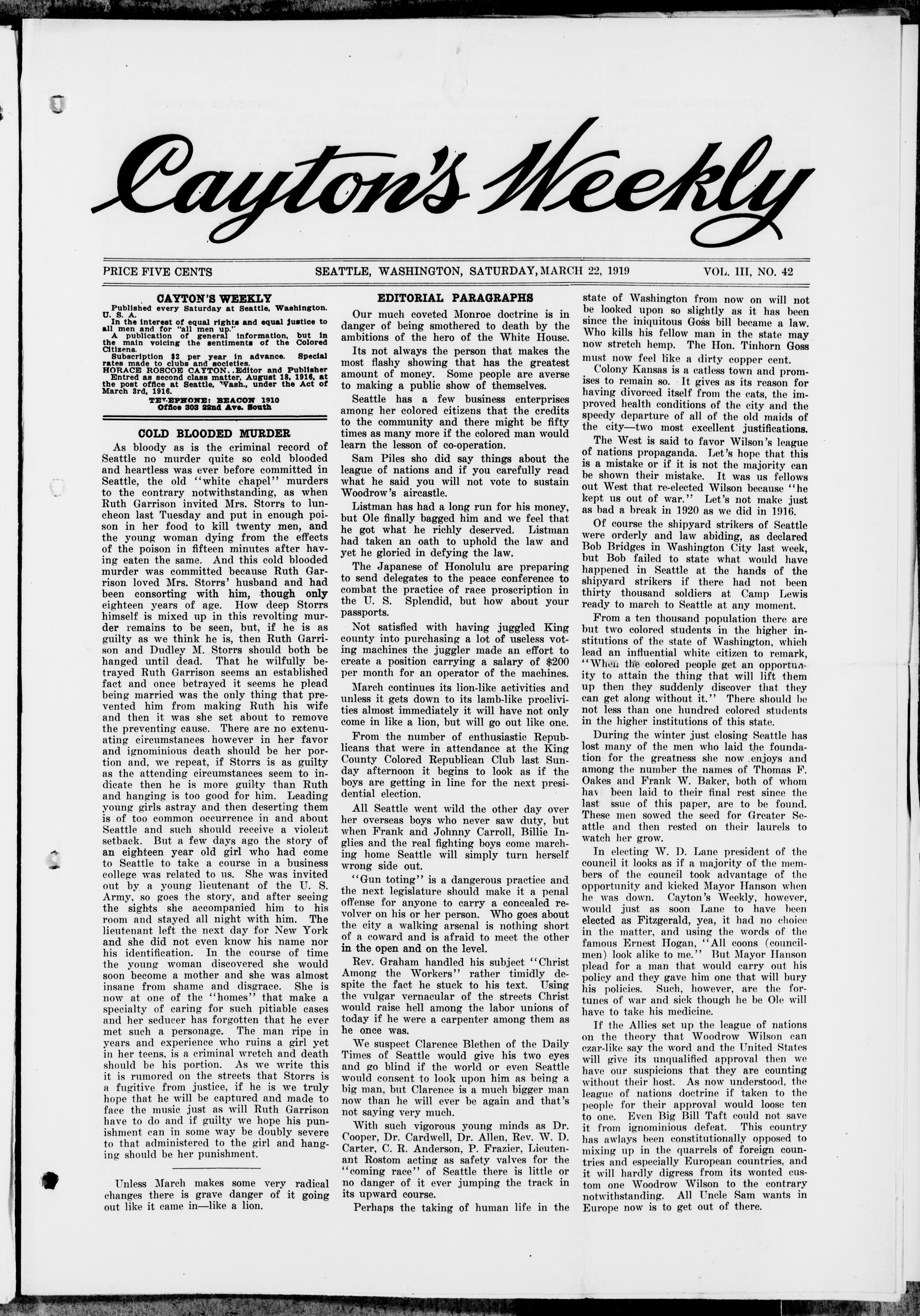
Cayton's Weekly
SEATTLE, WASHINGTON, SATURDAY, MARCH 22, 1919
PRICE FIVE CENTS
CAYTON'S WEEKLY
CAYTON'S WEEKLY
Published every Saturday at Seattle, Washington.
U. S. A.
In the interest of equal rights and equal justice to all men and for "all men up."
A publication of general information, but in the main voicing the sentiments of the Colored Citizens.
Subscription $2 per year in advance. Special rates made to clubs and societies.
HORACE ROSCOE CAYTON. Editor and Publisher
Entred as second class matter, August 18, 1916, at the post office at Seattle, Wash., under the Act of March 3rd, 1916.
TELEPHONE: BEACON 1910
Office 302 23d Ave. South
COLD BLOODED MURDER
As bloody as is the criminal record of Seattle no murder quite so cold blooded and heartless was ever before committed in Seattle, the old "white chapel" murders to the contrary notwithstanding, as when Ruth Garrison invited Mrs. Storrs to luncheon last Tuesday and put in enough poison in her food to kill twenty men, and the young woman dying from the effects of the poison in fifteen minutes after having eaten the same. And this cold blooded murder was committed because Ruth Garrison loved Mrs. Storrs' husband and had been consorting with him, though only eighteen years of age. How deep Storrs himself is mixed up in this revolting murder remains to be seen, but, if he is as guilty as we think he is, then Ruth Garrison and Dudley M. Storrs should both be hanged until dead. That he wilfully betrayed Ruth Garrison seems an established fact and once betrayed it seems he plead being married was the only thing that prevented him from making Ruth his wife and then it was she set about to remove the preventing cause. There are no extenuating circumstances however in her favor and ignominious death should be her portion and, we repeat, if Storrs is as guilty as the attending circumstances seem to indicate then he is more guilty than Ruth and hanging is too good for him. Leading young girls astray and then deserting them is of too common occurrence in and about Seattle and such should receive a violent setback. But a few days ago the story of an eighteen year old girl who had come to Seattle to take a course in a business college was related to us. She was invited out by a young lieutenant of the U. S. Army, so goes the story, and after seeing the sights she accompanied him to his room and stayed all night with him. The lieutenant left the next day for New York and she did not even know his name nor his identification. In the course of time the young woman discovered she would soon become a mother and she was almost insane from shame and disgrace. She is now at one of the "homes" that make a specialty of caring for such pitiable cases and her seducer has forgotten that he ever met such a personage. The man ripe in years and experience who ruins a girl yet in her teens, is a criminal wretch and death should be his portion. As we write this it is rumored on the streets that Storrs is a fugitive from justice, if he is we truly hope that he will be captured and made to face the music just as will Ruth Garrison have to do and if guilty we hope his punishment can in some way be doubly severe to that administered to the girl and hanging should be her punishment.
Unless March makes some very radical changes there is grave danger of it going out like it came in—like a lion.
EDITORIAL PARAGRAPHS
Our much coveted Monroe doctrine is in danger of being smothered to death by the ambitions of the hero of the White House. Its not always the person that makes the most flashy showing that has the greatest amount of money. Some people are averse to making a public show of themselves.
Seattle has a few business enterprises among her colored citizens that the credits to the community and there might be fifty times as many more if the colored man would learn the lesson of co-operation.
Sam Piles sho did say things about the league of nations and if you carefully read what he said you will not vote to sustain Woodrow's aircastle.
Listman has had a long run for his money, but Ole finally bagged him and we feel that he got what he richly deserved. Listman had taken an oath to uphold the law and yet he gloried in defying the law.
The Japanese of Honolulu are preparing to send delegates to the peace conference to combat the practice of race proscription in the U. S. Splendid, but how about your passports.
Not satisfied with having juggled King county into purchasing a lot of useless voting machines the juggler made an effort to create a position carrying a salary of $200 per month for an operator of the machines.
March continues its lion-like activities and unless it gets down to its lamb-like proclivities almost immediately it will have not only come in like a lion, but will go out like one.
From the number of enthusiastic Republicans that were in attendance at the King County Colored Republican Club last Sunday afternoon it begins to look as if the boys are getting in line for the next presidential election.
All Seattle went wild the other day over her overseas boys who never saw duty, but when Frank and Johnny Carroll, Billie Inglies and the real fighting boys come marching home Seattle will simply turn herself wrong side out.
"Gun toting" is a dangerous practice and the next legislature should make it a penal offense for anyone to carry a concealed revolver on his or her person. Who goes about the city a walking arsenal is nothing short of a coward and is afraid to meet the other in the open and on the level.
Rev. Graham handled his subject "Christ Among the Workers" rather timidly despite the fact he stuck to his text. Using the vulgar vernacular of the streets Christ would raise hell among the labor unions of today if he were a carpenter among them as he once was.
We suspect Clarence Blethen of the Daily Times of Seattle would give his two eyes and go blind if the world or even Seattle would consent to look upon him as being a big man, but Clarence is a much bigger man now than he will ever be again and that's not saying very much.
With such vigorous young minds as Dr. Cooper, Dr. Cardwell, Dr. Allen, Rev. W. D. Carter, C. R. Anderson, P. Frazier, Lieutenant Rostom acting as safety valves for the "coming race" of Seattle there is little or no danger of it ever jumping the track in its upward course.
Perhaps the taking of human life in the
VOL. III, NO. 42
state of Washington from now on will not be looked upon so slightly as it has been since the iniquitous Goss bill became a law. Who kills his fellow man in the state may now stretch hemp. The Hon. Tinhorn Goss must now feel like a dirty copper cent. Colony Kansas is a catless town and promises to remain so. It gives as its reason for having divorced itself from the cats, the improved health conditions of the city and the speedy departure of all of the old maids of the city—two most excellent justifications. The West is said to favor Wilson's league of nations propaganda. Let's hope that this is a mistake or if it is not the majority can be shown their mistake. It was us fellows out West that re-elected Wilson because "he kept us out of war." Let's not make just as bad a break in 1920 as we did in 1916.
Of course the shipyard strikers of Seattle were orderly and law abiding, as declared Bob Bridges in Washington City last week, but Bob failed to state what would have happened in Seattle at the hands of the shipyard strikers if there had not been thirty thousand soldiers at Camp Lewis ready to march to Seattle at any moment. From a ten thousand population there are but two colored students in the higher institutions of the state of Washington, which lead an influential white citizen to remark, "When the colored people get an opportunity to attain the thing that will lift them up then they suddenly discover that they can get along without it." There should be not less than one hundred colored students in the higher institutions of this state.
During the winter just closing Seattle has lost many of the men who laid the foundation for the greatness she now enjoys and among the number the names of Thomas F. Oakes and Frank W. Baker, both of whom have been laid to their final rest since the last issue of this paper, are to be found. These men sowed the seed for Greater Seattle and then rested on their laurels to watch her grow.
In electing W. D. Lane president of the council it looks as if a majority of the members of the council took advantage of the opportunity and kicked Mayor Hanson when he was down. Cayton's Weekly, however, would just as soon Lane to have been elected as Fitzgerald, yea, it had no choice in the matter, and using the words of the famous Ernest Hogan, "All coons (councilmen) look alike to me." But Mayor Hanson plead for a man that would carry out his policy and they gave him one that will bury his policies. Such, however, are the fortunes of war and sick though he be Ole will have to take his medicine.
If the Allies set up the league of nations on the theory that Woodrow Wilson can czar-like say the word and the United States will give its unqualified approval then we have our suspicions that they are counting without their host. As now understood, the league of nations doctrine if taken to the people for their approval would loose ten to one. Even Big Bill Taft could not save it from ignominious defeat. This country has awlays been constitutionally opposed to mixing up in the quarrels of foreign countries and especially European countries, and it will hardly digress from its wonted custom one Woodrow Wilson to the contrary notwithstanding. All Uncle Sam wants in Europe now is to get out of there.
---
THE PASSING THRONG
Mr. and Mrs. Rogers of Spokane were visitors in Seattle for a few days the week past. For the past sixty days Mr. Rogers has been in the employee of the legislature and after the adjournment they came to Seattle for a short stay. While in Olympia he had quite a laughable experience. In complexion he is a light mulato and on reaching Olympia he went to one of the best apartment houses to get quarters for himself and family. The proprietor saw him by the lamp light and he might be anything, but a colored man and he was accommodated. On the morrow, however, it was presto change and he was told to surrender the apartment which he refused to do on the advice of a representative from Spokane and so he occupied his luxurious quarters during the session. How strange the white man will refuse accommodations to a man so white that he is taken to be white.
Mrs. Susie Revels Cayton was a visitor in Olympia last week and spent a couple of days looking over the capital city. It was her second visit thereto, the other being twent-two years ago, and to her the city looked much the same the other day as it did when she first saw it. The capital city twenty-two years ago was the mecca for the Republican politicians of the state and while the most of the heavy work was done in either Seattle or Tacoma, yet an occasional visit to Olympia to keep in touch with the official family was customary. Mrs. Cayton accompanied the editor of the Seattle Republican, who happened to be her husband, to Olympia and the three days they were there they were quartered a tthe Olympia Hotel, as special guests of the management, Smith, and the nice things of the hotel and the city were hers. Editors those days enjoyed many favors free gratis what others had to pay big prices for.
If Dr. Cooper will but adopt the slogan of the City of Tacoma some years ago, "Watch Tacoma grow" and apply it to the King County Colored Republican Club it will but mildly express the rapid strides the club is making under his leadership. At its last regular meeting the room was comfortably filled with enthusiastic members, who translate G. O. P., get off and push. That the club may not wander from the path of do unto other as ye would that men do even unto you, two pastors of leading churches are members thereof. Rev. W. D. Carter and Rev. J. B. Barber. That it may not die of indigestion Dr. Cardwell is always on hand with pelets and pills. That the teeth may be extracted from any motion that passes, two dentists, Dr. Cooper and Dr. Allen, are members and thus is the club well guarded and is rapidly developing into a genuine live one.
Again a colored family invades the Capitol Hill district in the persons of Mr. and Mrs. S. C. Winston, who own an elegant home on Sixteenth Avenue North. This is a part of the first Capitol Hill division laid out by James A. Moore. It was many years ago that the editor hereof owned a home in the same district, but fell by the way side, but he is delighted to see Mr. and Mrs. Winston take up the lead where he laid it down. Mr. Winston is employed in the post office department while Mrs. Winston gives medical baths and massages. They have a well arranged home in a most exclusive neighborhood and enjoy all the city improvements.
Having public meetings where big speeches are made with little or no significance, does not foster business enterprises among the colored citizens of Seattle. If the Negro Business Men's League of Seattle has any mission at all it is to help colored men and women to open up business houses and industrial enterprises. Whether in a black or white community, energetic colored persons can be success-
fully established in a business, it is their duty to make the effort. To sit down and wait for some one to open a place of business and then preach race pride at public gatherings with the hope of inducing all of the colored people to trade with it is so much wasted wind.
Old time King county politicians held their breaths for a second, when, one day this week, they read an account of the death of Don McKenzie. He was a clever politician, but very set in his way. Though of southern stock, yet he was an uncompromising Republican. While never a political boss, yet he was an able lieutenant. In the hay day of his political career in Seattle Don McKenzie made smooth sailing for the bosses by endearing all those he came in contact with to him. He counted J. Edward Hawkins, Judge Giddeon S. Bailey, Allen A. Gainer, Britton Oxendine, I. I. Walker, S. J. Collins and other prominent colored men of the county among his close political friends. He was liberal with his money, which is largely responsible for him being without funds at the time of his death.
John H. Ryan, publisher of the Forum of Tacoma, did a small political stunt in the way of a political review, in which some of the members were reviewed at so much per, all of which reminds the writer of days long gone by when both Ryan and the editor hereof both did similar political stunts at every sitting of the legislature and each was more or less successful. Brother Ryan and I made the same mistake that most colored men do, each thought that he was the only pebble on the beach and had little or no time for each other, though strange to say we remained friends. Had we joined hands and worked in unison we would still be issuing the legislative manual and in after years it would, when many numbers would have been bound, become a valuable political history of the state. It was a sad mistake, but it cannot be recalled.
Rumor has it that the Douglas Apartments is about to be incorporated with a capital stock of $66,000, the shares of which are to be subscribed for by a number of Colored persons. The present owner of the building agrees to add twelve more apartments to the present structure, which he says will give the building and its ground a value of $66,000. He will retain one-sixth of the stock, which will draw dividends the same as the other five-sixths. Cayton's Weekly is of the opinion that $66,000 is a pretty stiff price for the Douglas even after the proposed improvements have been made. The income of the Douglas at present is between $600 and $700 per month and the proposed improvements would increase the above amount $360 per month providing they rented for $30 per apartment, giving an income of $1,000 per month or $12,000 per year, if every apartment is rented every month. It would be impossible for a company to operate the Douglas for less than $500 per month overhead charges, which would leave $6,000 per annum to apply on interest, taxes and upkeep. The interest on $66,000 at 8 per cent would amount to $5,280 per annum. The taxes would amount to not less than $1000 per year and the depreciation at least $1000 per annum. The U. S. income tax would amount to at least $500 per year, all of which would figure up to aoout $8,000 per year, to pay which $6,000 from rents will be handed over. The Douglas is doubtless a money maker as it is now conducted, but in the hands of a corporation capitalized on that particular property it would never be able to see its father's face in peace. This article has been handled as a business proposition and for no selfish motives. If it were capitalized for $40,000 it might pull through, but even then it would pay very small dividends on the money invested.
THE DOOR OF HOPE
The year 1919 swings the door of hope ajar and the man or woman of the race need not pass up the opportunities of the moment as they come trooping before them. They will have much to do with keeping the door of hope ajar just in that proportion as they help themselves to enter fields of usefulness and service.
The old order is rapidly being out grown, the garment must be cut differently to fit the live, wide awake Negro, who has his heart set upon nobler and better things in life. The probation period has been long and arduous, time has grown into impatient, restlessness and uneasy misgivings have almost appalled him on the struggling way upward. The sun light of a beautiful morning finds him up and fit to appreciate its golden splendor, radiant as it sparkles in the morning dew drop. The clock is about to strike the hour. The hour for which he has struggled, watched, and waited. The business, bustle, and whirl of the city street tells him many things.
The whistles blow, and the noisy hum of undustry tells him that men who think and dream evolves new truths, truths worked out into living form, and actuality. The factory tells him that a practical problem is being worked out, people thrive by employment, and the financial prospect enunciates the fundamental stimulus. Profit looms large to the sensible investor of small means when the commodity is a necessary one in spite of competition. We are to enter in at this door of hope and do our part of the making and selling of needed articles of commerce, as well as forever and eternally doing only the buying and no more.
We cannot hope to create large individuals among us, men and women who by commercial rating can have a voice in the chambers of commerce, the trade unions etc., just by voicing our approval, we must with our mean co-operate together our heart and race feeling and build larger and greater things than we have ever built. We suffer deprivations of our own making. We may not hope as long as we will not unite our little forces and carry forward the principles that make other races rich and powerful.
Progress means aggressive action going forward not backward. At this day and hour we cannot stand still. Patent force is in our hands. Inactive we are impotent, and our hands fall to our sides. The shining diadem is worth our effort and our spirit. All other races rub heads on all other lines of action that requires thought and investigation.
We must not continue to carry all our power and pile it up in some other's cash register. The day is bristling with business enterprise, no other period in history has offered us so much. The strength of united forces is the power that has long operated to keep us back and belated. We must project far away into the future after we have laid well our deep concrete foundation for a lasting super-structure. Incomes should interest us far greater than outgoings.—Broadax.
Some federal officers in the civil war once sought shelter for the night in an old, tumbledown hut. About 2 o'clock a polecat announced his presence. A German sat up and looked hopelessly about him. The others were all sleeping peacefully. "Mein gracious!" he exclaimed in tones of despair. "All the rest asleep and I've got to shmell it all!"
A man, after coming out of a train, was summoned for being drunk and disorderly. When he was brought before the court he was asked why he was drunk. He said it was on account of bad company.
"I think," said the judge, "they are the best of company.
"They are not," said the man, "because I had a bottle of whiskey and I had to drink it myself."
THE NEGRO AND RELIGION
Is the Negro losing his stronghold on religion? A writer in the Boston, Mass., Evening Record, Philip A. Holmes, seems to think that this is the case:
The growing indifference of the Negro toward Christianity is becoming very apparent. This indifference is especially noticeable among the Negroes of the younger generation. Indeed, so strong is this spirit of indifference to Christianity that it is bordering on agnosticism. But why Christianity does not appeal to the younger and thinking Negro is not difficult to explain.
First, the Negro has reached the conviction that Christianity, as preached and practiced, is not the great moral force or agency for good that they are asked to believe it is; it has, therefore, utterly failed to instill effective good and noble thoughts in the minds of those under its influence. The younger Negro points with alarm to the persecution of his race under the influence of Christianity. The Negro argues further that the Christian Church has watched with vacant unconcern the burning alive of his people at the stake—men, women and children—and their persecution worse than man of the Middle Ages. And in view of these inhumanities perpetrated against the Negro, the Christian Church has remained passively quiet. It is, therefore, preposterous to expect the Negro, in virtue of his education, to subscribe to Christianity when the very agency of Christianity beckons his persecution. These are facts that cannot be ignored.
***
Mr. Holmes, however, seems to feel that agnosticism will prove a definite factor in the Negroes' advance:
Upon the Christian Church, then, rests the responsibility for the Negroes' drift into the realm of agnoticism. But the growing agnostic tendency of the Negro is emblematic of increasing racial intelligence, for as intelligence spreads, superstition and fear will be dissipated; and in superstition and fear, Christianity is deeply rooted. It is common knowledge that religious superstition and fear have kept not only the Negro, but many other peoples of the world in both physical and mental slavery. Well might Shakespeare say that "fear is the dagger of man's mind and superstition the instrument with which he assassinates his soul."
The American Negro has always been a devout subscriber to Christianity, but, as a result, he became indifferent toward his earthly welfare; he has submitted to every kind of human persecution, believing, as it were, in the Christian teaching: "Vengeance is Mine; I will repay thee." Consequently the Negro "turned the other cheek." So it is, then, that the Negroes have been the most indifferent people on earth toward their human rights, except possibly peoples of the Middle Ages. The Negroes' belief in the Christian teaching, "Servant, obey thy master," became a part of them. So the growing agnostic tendency of the Negro should not be wondered at.
The Negro is beginning to see for himself that the Christian Church has failed to preach and practice that noble theory of human brotherhood and the right action of man to man.
NEGRO SOLDIERS AND LABOR
What assurance has the returning Negro soldier that he will be given work? He should never have occasion to doubt it. S. P. Thorpe writes in the Philadelphia, Pa., Public Ledger:
The position of the Negro in the reconstruction of the world has been sincerely and widely discussed by the ablest minds of our great nation, from the Atlantic to the Pacific and from Canada to the Gulf. There need not be any great revolution of thought nor storm of debate concerning the place which the Negro is to occupy in the reconstruction of this country or the world. When circumstances threw our nation into the whirlpool of material destruction and human slaughter, the ruling mil-
lions lost no time in declaring that the "world must be made safe for democracy" and that the combined forces and resources of the United States, to the last dollar and the last man, would be drawn upon to carry the war to victorious conclusion and guarantee to every people throughout the world the right to life, liberty and the undisturbed pursuit of happiness. In accordance with this democratic spirit, 11,000,000 people spoke with one voice and said, "We'll plant the future peace and freedom of the world upon the tested foundations of political liberty." Then ever red-blooded American caught the fever of "preparedness' and its temperature ran up 7,000 degrees. Every man and woman in every nationality under the Stars and Stripes was mustered into military or industrial service, and every one strained every nerve every day, until the greatest generals that military science has ever produced declared that "It's finished," thus guaranteeing to the nations of the earth the greatest blessing since the babe was born at Bethlehem.
"GET ON THE FARM"
This is the season for the farm. A farm is a gold mine for any farmer, who gets there with his heart and his soul in the soil. The farm is the foundation upon which civilization rests. More of our people should leave the city for the farm at this time. We see in the distance a famine for the city people. Unless there is enough produce made upon the farm to supply the needs of the city folks, something serious must happen. There is nothing to support the over-crowded city but the farms and for some time rich men will not be in a position to put their money out in factories and other industries on account of the high prices for lumber, material and labor.
Men with money take little risks, but it is the men without money who take large risks. The man who buys lumber and labor at present prices is bound to find himself in the hole, twenty-four months hence, or sooner; for prices have begun to fall now. No man can pay one dollar and a half per day for ploughmen and make money out of the farm; if he could all of the farmers would be rich. Seventy-five cents a day is an equal price to the farmer and ploughhand. When the farmer is paying one dollar and fifty cents per day to the farm-hand cotton must sell at twenty-five cents per pound. What if the farmer pays one dollar and fifty cents per day to each ploughman, now on his farm, and when he goes to gather, cotton is selling at twelve and one-half cents per pound, the farmer simply meets with the calamity of having thrown away his money. The condition ought to be guarded against now. The high cost of food and other materials should cause some kind of an alliance formed as a safeguard around the farmer. There should be some kind of an agreement between the farmer and the government for the assurance that the prices of foodstuffs and cotton be the same on the market as it was when they started.
It is now March and the time for everyone to go to work, and make a farm. The farmers should begin planting corn on the 7th of March, and cotton on the first of April. To pay higher prices for labor and fertilizer, and not receive a price in comparison at the end of the season would make it very bad for the farmer.—Charleston, (S. C.) Messenger.
NOTICE TO SOLDIERS
In order that colored soldiers and sailors may be duly informed as to their rights under a recent law passed by Congress, and thereby be in a position to promptly take advantage of the Government's plant to extend financial help to all soldiers, etc., who have been honorably separated from military or naval service, Emmett J. Scott, Special Assistant to the Secretary of War, who, during the war period, has been advising in matters affecting the interests of colored soldiers, has requested the Negro Press of America, Negro clergymen, teach-
DR. C. J. ALLEN, Dentist. Examination free. 211 Globe Bldg., 1st and Madison. Office hours 9 to 12 a. m., 1 to 6 p. m., Sundays by appointment. Residence 1830 24th Avenue. East 6419.
DR. F. B. COOPER, Dentist, 362-3 Empire Bldg, 2nd and Madison. Special appointments for evenings and Sundays. Office hours 8:30 to 12 and 2 to 6. Main 6093. Residence, East 5056.
CAYTON'S WEEKLY wants two columns of classified adds made up after this style and fashion. Rates very reasonable. Beacon 1910.
STONE THE CATERER will serve your parties and banquets cheaper than you can do it yourself. Stone's ice cream leads. East 275.
ers and others, to give the widest possible publicity to the fact that the United States Government, by Act of Congress approved February 24th, 1919, grants to all soldiers, officers, female nurses, etc., who have either resigned or who have been honorably discharged since April 6th, 1917, or who may resign or be honorably discharged before the expiration of their enlistment period, a $60 bonus in cash.
The way and manner in which the cash bonus of sixty dollars may be obtained by honorably discharged soldiers, officers, sailors, female nurses, etc., is fully set forth in War Department Order, issued by the Adjutant General of the Army, February 25th, 1919, and sent to all Department and Camp Commanders, General Hospitals, etc. This amount shall not be paid to any person who, though appointed or inducted into the military or naval forces on or prior to November 11, 1918, had not reported for duty at his station on or prior to such date; or to any person who is entitled to receive retired pay, etc.
All persons separated from active military service from April 6th, 1917, who are entitled to the sixty dollar bonus, and who have received their final pay, will forward claim for such bonus direct to the zone finance officer, Lemon Building, Washington, D. C., who is hereby designated to settle such claims. Such applications must contain the discharge certificate or order for discharge or relief, if no certificate was issued, the paper bearing indorsement of final payment being required.
A statement of all military service since April 6, 1917, showing place and date of reporting at first military station and stating the address to which check is to be sent. (It is suggested that these papers and data be sent to said zone finance officer by registered mail to insure their safe delivery). When settlement is made, all personal papers will be returned to applicant with check. No further correspondence is necessary to advise of change in address of applicant.
No other disbursing officers are authorized to pay claims covered by this paragraph. Agencies that work among colored people, including teachers, college men and others are specially requested to communicate the above information to colored soldiers and their famliies, in order that they may take the necessary steps to secure the $60 Bonus which the government has set aside for the benefit of those brave and loyal men who came to the rescue of their country in its crucial hour of need.
To Spend Your Leisure Moments at the GREAT NORTHERN POOL AND BILLIARD HALL Cigars, Tobacco and Soft Drinks. Courteous Treatment BOYD & WILLIAMS, Props. 1032 Jackson St.
```markdown
```
THE PEACE-LEAGUE BARRAGE
In the Senate it's the league of fulminations.—Newark News.
Berlin press looks up the League with disfavor, which is some recommendation.—Wall Street Journal.
The world is in a fair way to get together and abolish war, if the United States Senate does no tstop it.—Chicago Daily News.
Let the League of Nations start out, somehow; it can also accumulate eighteen amendments if needed.—St. Louis Globe-Democrat.
Some of the speeches against the League of Nations indicate high-muzzle velocity, but they turn out to be duds.—Manchester Union.
When Borah refused to attend the dinner-party he showed that he wished to avoid entangling alliances. — Knoxville Journal and Tribune.
If the League of Nations can not prevent war, it can at least guarantee that those insisting on war will get all they want.—Des Moines Register.
Senator Borah seemingly would copy everything from the Farewell Address except the farewell.—Newark News.
The League of Nations may be all right, but how are you going to keep Baker and Daniels from coming out for it, to say nothing of Burleson!—Indianapolis Star.
It looks to us as though some of the intrepid Senators who are fighting against the L. of N. will be entitled to woundchevrons before they get through.—New York Tribune. The League of Nations will probably run along with a fair degree of smoothness at least until the project of international prohibition comes before it.—Syracuse Herald. Mr. Taft wants a League of Nations with "teeth" in it. Well, it seems to us that the Aemrican and British fleets constitute a pretty good set of teeth.—Charleston News and Courier.
Mr. James Beck, of New York, says that 100,000,000 stand agast at the thought of a League of Nations. Evidently Mr. Beck counted 'em while he was standing before a multiplying mirror.—Chicago Daily News. Unless objection be made, the nomination of Woodrow Wilson to be Grand Idealist of the League of Notions will be considered equivalent to election. As the League will require a Notional Anthem, we will award a prize of a long-stemmed clay pipe and a bowl of soapsuds.—Chicago Tribune. Will the League of Nations stage doubleheaders on holidays?—Detroit Free Press.
There are here and there sounds, of course, which remind us that there are no war-prfits in arbitration.—Detroit News. After the Society of Nations is formed Germany is going to have a hard time breaking into society.—San Francisco Bulletin. We are determined that there shall be no more war and equally determined to be ready for the next one.—Utica Herald-Dispatch. Congress might be reconciled to the League of Nations if the League would take over the railroad problem.—Chicago Daily News.
Awful thought! Supposing the League of Nations should make the United States a mandatory to take care of Mexico!—Boston Globe.
Anyhow, if the debate between the President and the Senators gets too hot, we can refer the matter to the Peace Conference.—Manchester Union.
As we understand one article in the so-called constitution, the League of Nations will not stand for any base stealing.—Des Moines Register.
Mr. Taft probably thinks the League of Nations can be provided later with a set of false teeth that will serve for biting purposes.—Minneapolis Tribune.
A boycott as a means of enforcing the Phone 2647 1034 Jackson
GOLDEN WEST
Tailors and Cleaners. Clothes called for and delivered. Hats retrimmed and blocked. H. S. Frazier C. W. Curtest
League's decrees may not sound very formidable, but the Germans can testify as to what it means.—Charleston News and Courier.
The London Spectator cites as a characteristic mot by a French wit, summing up the French feeling about the League of Nations, the phrase, "The League is impossible and indispensable."
It is obvious that the President approaches the League of Nations discussion with an open mind. So open that any adverse criticism that may steal in is allowed to find its way out without delay.—Boston Transcript.
Switzerland's decision to enter the world league on the condition that she is never called on to go to war, and is never to be coerced in any way, seems to contain the germ of a bright idea.—Philadelphia North American.
Political experts believe that on the success of the League of Nations scheme will depend Mr. Wilson's chances for reelection, should he choose to run again. Oh, well, if that's all there is to it we know just what to do.—New York Telegram.
Charley was considered the dandy of the town and when he came home from a visit to the city he was supposed to set forth the latest fashions in performance as well as in attire.
Upon the occasion of one such visit he went into a shop to look at gloves. He was shown several pairs, but astonished the shop-keeper by saying:
'But I want three.'
"Dear me! Three pairs?"
"Oh, no; three gloves."
"Nobody can wear more than two."
"I know that; most of 'em only wears one and wabbles the other, but I want three—two to wear and one to wabble."
Pat had got possession of a badly spoilt pointer dog, and meeting a likely purchaser, the following conversation took place:
"That's a good looking dog, my man," said Pat carelessly, "but not half as good as he looks."
Being asked the reason he replied:
"When I take him for a hunt, instead of catching the rabbit or hare, he stands like a fool in the middle of the field, and points his paw at it."
She laid the still white form beside those that had gone before. No groan, no sigh burst from her. Suddenly she let forth a cry that pierced the still night air, making it vibrate into a thousand echoes. It seemed as if it came from her very soul. Twice the cry was repeated, and then all was quite quiet again. She would lay another egg tomorrow.
The best story about President Wilson so far concerns an accasion when he was announced to speak at a meeting in a small western town. On account of a cloudburst, however, there was a washout on the railroad. So he telegraphed to the committee: "Can not reach you in time. Washout on the line."
Back came the reply:
"Never mind your wash. Buy another shirt at our expense and come anyway."
Henpeck was having his picture "took."
"Will you take something to drink?" asked the photographer.
"With pleasure." the sitter replied.
The photograph was taken, and the sitter said:
"But what about the little invitation?"
"Oh," said the camera man, "that's just a professional ruse of mine to give a natural, interested expression to the face."
The head of the family glanced up from his paper and remarked:
"I see there's a new hippopotamus at the zoo." Glancing at his son a moment later, he asked: "What are you laughing at Harry?"
"I was jus' laughin' to think of a stork carryin' a hipperpotamus!" returned Harry.
The famous humorist had partaken too heartily of Yuletide fare. Acute indigestion had laid him low.
As his friends gathered about him, he smiled feebly.
"At any rate," murmured he, between spasms of pain, "I am able to keep up my reputation as a humorist."
But his friends were puzzled.
"Di-gesting!" the patient gasped.
THAT FLUE STUFF
If you have a tummy-ache,
It's the Flu!
If you're weary when you wake,
It's the Flu!
Is your memory off the track?
Is your liver out of whack?
Are there pimples on your back?
It's the Flu!
Are there spots before your eyes?
It's the Flu!
Are you fatter than some guys?
It's the Flu!
Do your teeth hurt when you bite?
Do you ever have a fright?
Do you want to sleep at night?
It's the Flu!
Are you thirsty when you eat?
It's the Flu!
Are you shaky on your feet?
It's the Flu!
If you feel a little ill,
Send right off for Dr. Pill,
He will say, despite his skill:
"It's the Flu!"
He won't wait to diagnose,
It's the Flu!
Hasn't time to change his clothes,
It's the Flu!
For two weeks he's had no rest,
Has no time to make a test,
So he'll class you with the rest—
It's the Flu!
—Cincinnati Enquirer.
RICHARDSON'S UNDERTAKING PARLORS
Embalmer and Funeral Director
1216-18 Jackson Street
Office, Beacon 103; Res., Main 5610
IN THE SUPERIOR COURT OF THE STATE OF Washington for the County of King.—No. 133363. Summons by Publication.
J. Abe Fisher, Plaintiff, vs. Fred Therriault, and William Fisher and Eve S. Fisher, his wife, Defendants.
The State of Washington, to the said Fred Therriault, Defendant
You are hereby summoned to appear within sixty days after the date of the first publication of this summons, to-wit, within sixty days after the 1st day of February, A. D. 1919, and defend the above entitled action in the above entitled court, and answer the complaint of the plaintiff, and serve a copy of your answer upon the undersigned attorney for plaintiff at his office below stated; and in case of your failure so to do, judgment will be rendered against you according to the demand of the complaint, which has been filed with the Clerk of said court. The object of the said action and the relief sought to be obtained therein is fully set forth in said complaint, and is briefly stated as follows:
To partition the following described real property: The East Forty-five (E. 45) feet of Lots Eighteen (18), Nineteen (19) and Twenty (20) in Block Thirteen (13) of Front Street Cable Addition to the City of Seattle, King County, Washington.
Attorney for Plaintiff.
P. O. Address: 320 Railway Exchange Bldg., Seattle,
County of King, Washington.
First publication Feb. 1, 1919.
IN THE SUPERIOR COURT OF KING COUNTY,
State of Washington.—
In the Matter of the Estate of Erick J. Edlund, Deceased.—No. 24729. Notice to Creditors.
Notice is hereby given that the undersigned has been appointed Executrix of the Estate of Erick J. Edlund, deceased, that all persons naving claims against said deceased are hereby required to serve the same, duly verified, on said Mary M. Edlund, or on Andrew J. Balliet, her attorney of record at the address below stated, and file the same with the Clerk of said court, together with proof of such service within six months after the date of the first publication of this notice, or the same will be barred.
Date of first publication Feb. 8, 1919.
MARY M. EDLUND.
Executrix of said Estate.
Address: 320 Railway Exchange Bldg., Seattle, Wn.
ANDREW J. BALLIET,
Attorney for Estate.
320 Railway Exchange Pldg., Seattle, Wash.
First publication Feb. 8, 1919.