Cayton's Weekly
Saturday, April 19, 1919
Seattle, Washington
Page text (machine-generated)
Cayton's Weekly
PRICE FIVE CENTS
CAYTON'S WEEKLY
Subscription $2 per year in advance. Special
HORSE RIDE, FOSCQE, CASTLE EDITOR and Publisher
HORACE ROSCOE CAYTON..Editor and Publisher
Entred as second class matter, August 18, 1916, at
the post office at Seattle, Wash., under the Act of
March 3rd, 1916.
TELEPHONE: BEACON 1910
Office 302 23d Ave. South
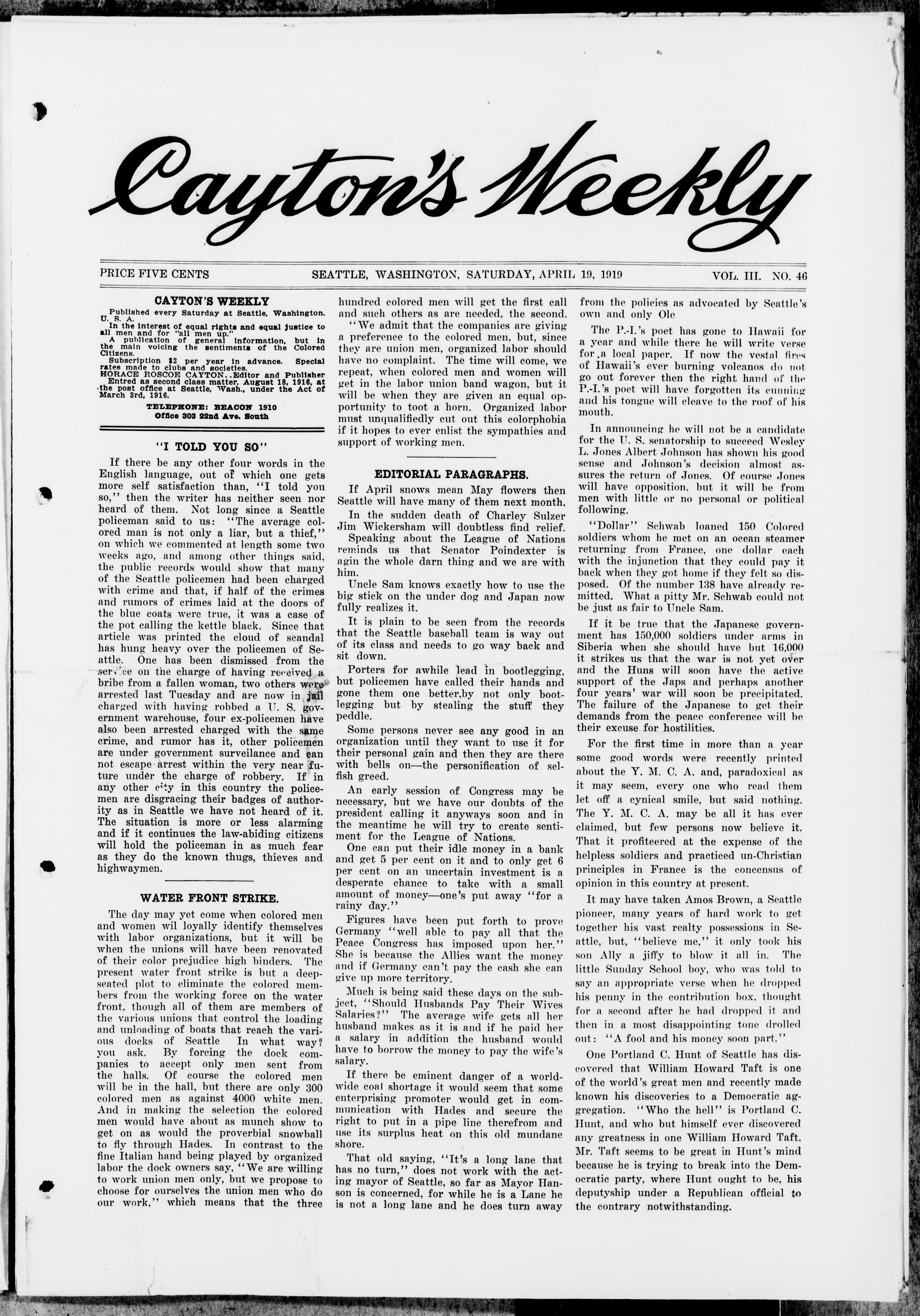
"I TOLD YOU SO"
If there be any other four words in the English language, out of which one gets more self satisfaction than, "I told you so," then the writer has neither seen nor heard of them. Not long since a Seattle policeman said to us: "The average colored man is not only a liar, but a thief," on which we commented at length some two weeks ago, and among other things said, the public records would show that many of the Seattle policemen had been charged with crime and that, if half of the crimes and rumors of crimes laid at the doors of the blue coats were true, it was a case of the pot calling the kettle black. Since that article was printed the cloud of scandal has hung heavy over the policemen of Seattle. One has been dismissed from the service on the charge of having received a bribe from a fallen woman, two others were arrested last Tuesday and are now in jail charged with having robbed a U. S. government warehouse, four ex-policemen have also been arrested charged with the same crime, and rumor has it, other policemen are under government surveillance and can not escape arrest within the very near future under the charge of robbery. If in any other city in this country the policemen are disgracing their badges of authority as in Seattle we have not heard of it. The situation is more or less alarming and if it continues the law-abiding citizens will hold the policeman in as much fear as they do the known thugs, thieves and highwaymen.
WATER FRONT STRIKE
The day may yet come when colored men and women wil loyally identify themselves with labor organizations, but it will be when the unions will have been renovated of their color prejudice high binders. The present water front strike is but a deep-seated plot to eliminate the colored members from the working force on the water front, though all of them are members of the various unions that control the loading and unloading of boats that reach the various docks of Seattle In what way? you ask. By forcing the dock companies to accept only men sent from the halls. Of course the colored men will be in the hall, but there are only 300 colored men as against 4000 white men. And in making the selection the colored men would have about as munch show to get on as would the proverbial snowball to fly through Hades. In contrast to the fine Italian hand being played by organized labor the dock owners say, "We are willing to work union men only, but we propose to choose for ourselves the union men who do our work," which means that the three
hundred colored men will get the first call and such others as are needed, the second. "We admit that the companies are giving a preference to the colored men, but, since they are union men, organized labor should have no complaint. The time will come, we repeat, when colored men and women will get in the labor union band wagon, but it will be when they are given an equal opportunity to toot a horn. Organized labor must unqualifiedly cut out this colorphobia if it hopes to ever enlist the sympathies and support of working men.
EDITORIAL PARAGRAPHS
If April snows mean May flowers then Seattle will have many of them next month.
In the sudden death of Charley Sulzer Jim Wickersham will doubtless find relief.
Speaking about the League of Nations reminds us that Senator Poindexter is agin the whole darn thing and we are with him.
Uncle Sam knows exactly how to use the big stick on the under dog and Japan now fully realizes it.
It is plain to be seen from the records that the Seattle baseball team is way out of its class and needs to go way back and sit down.
Porters for awhile lead in bootlegging, but policemen have called their hands and gone them one better,by not only bootlegging but by stealing the stuff they peddle.
Some persons never see any good in an organization until they want to use it for their personal gain and then they are there with bells on—the personification of selfish greed.
An early session of Congress may be necessary, but we have our doubts of the president calling it anyways soon and in the meantime he will try to create sentiment for the League of Nations.
One can put their idle money in a bank and get 5 per cent on it and to only get 6 per cent on an uncertain investment is a desperate chance to take with a small amount of money—one's put away "for a rainy day."
Figures have been put forth to prove Germany "well able to pay all that the Peace Congress has imposed upon her." She is because the Allies want the money and if Germany can't pay the cash she can give up more territory.
Much is being said these days on the subject, "Should Husbands Pay Their Wives Salaries?" The average wife gets all her husband makes as it is and if he paid her a salary in addition the husband would have to borrow the money to pay the wife's salary.
If there be eminent danger of a worldwide coal shortage it would seem that some enterprising promoter would get in communication with Hades and secure the right to put in a pipe line therefrom and use its surplus heat on this old mundane shore.
That old saying, "It's a long lane that has no turn," does not work with the acting mayor of Seattle, so far as Mayor Hanson is concerned, for while he is a Lane he is not a long lane and he does turn away
VOL. III. NO. 46
from the policies as advocated by Seattle's own and only Ole The P.-I.'s poet has gone to Hawaii for a year and while there he will write verse for a local paper. If now the vestal fires of Hawaii's ever burning volcanos do not go out forever then the right hand of the P.-I.'s poet will have forgotten its cunning and his tongue will cleave to the roof of his mouth. In announcing he will not be a candidate for the U. S. senatorship to succeed Wesley L. Jones Albert Johnson has shown his good sense and Johnson's decision almost assures the return of Jones. Of course Jones will have opposition, but it will be from men with little or no personal or political following.
"Dollar" Schwab loaned 150 Colored soldiers whom he met on an ocean steamer returning from France, one dollar each with the injunction that they could pay it back when they got home if they felt so disposed. Of the number 138 have already remitted. What a pitty Mr. Schwab could not be just as fair to Uncle Sam. If it be true that the Japanese government has 150,000 soldiers under arms in Siberia when she should have but 16,000 it strikes us that the war is not yet over and the Huns will soon have the active support of the Japs and perhaps another four years' war will soon be precipitated. The failure of the Japanese to get their demands from the peace conference will be their excuse for hostilities.
For the first time in more than a year some good words were recently printed about the Y. M. C. A. and, paradoxical as it may seem, every one who read them let off a cynical smile, but said nothing. The Y. M. C. A. may be all it has ever claimed, but few persons now believe it. That it profiteered at the expense of the helpless soldiers and practiced un-Christian principles in France is the concensus of opinion in this country at present.
It may have taken Amos Brown, a Seattle pioneer, many years of hard work to get together his vast realty possessions in Seattle, but, "believe me," it only took his son Ally a jiffy to blow it all in. The little Sunday School boy, who was told to say an appropriate verse when he dropped his penny in the contribution box, thought for a second after he had dropped it and then in a most disappointing tone drolled out: "A fool and his money soon part."
One Portland C. Hunt of Seattle has discovered that William Howard Taft is one of the world's great men and recently made known his discoveries to a Democratic aggregation. "Who the hell" is Portland C. Hunt, and who but himself ever discovered any greatness in one William Howard Taft. Mr. Taft seems to be great in Hunt's mind because he is trying to break into the Democratic party, where Hunt ought to be, his deputyship under a Republican official to the contrary notwithstanding.
---
```markdown
```
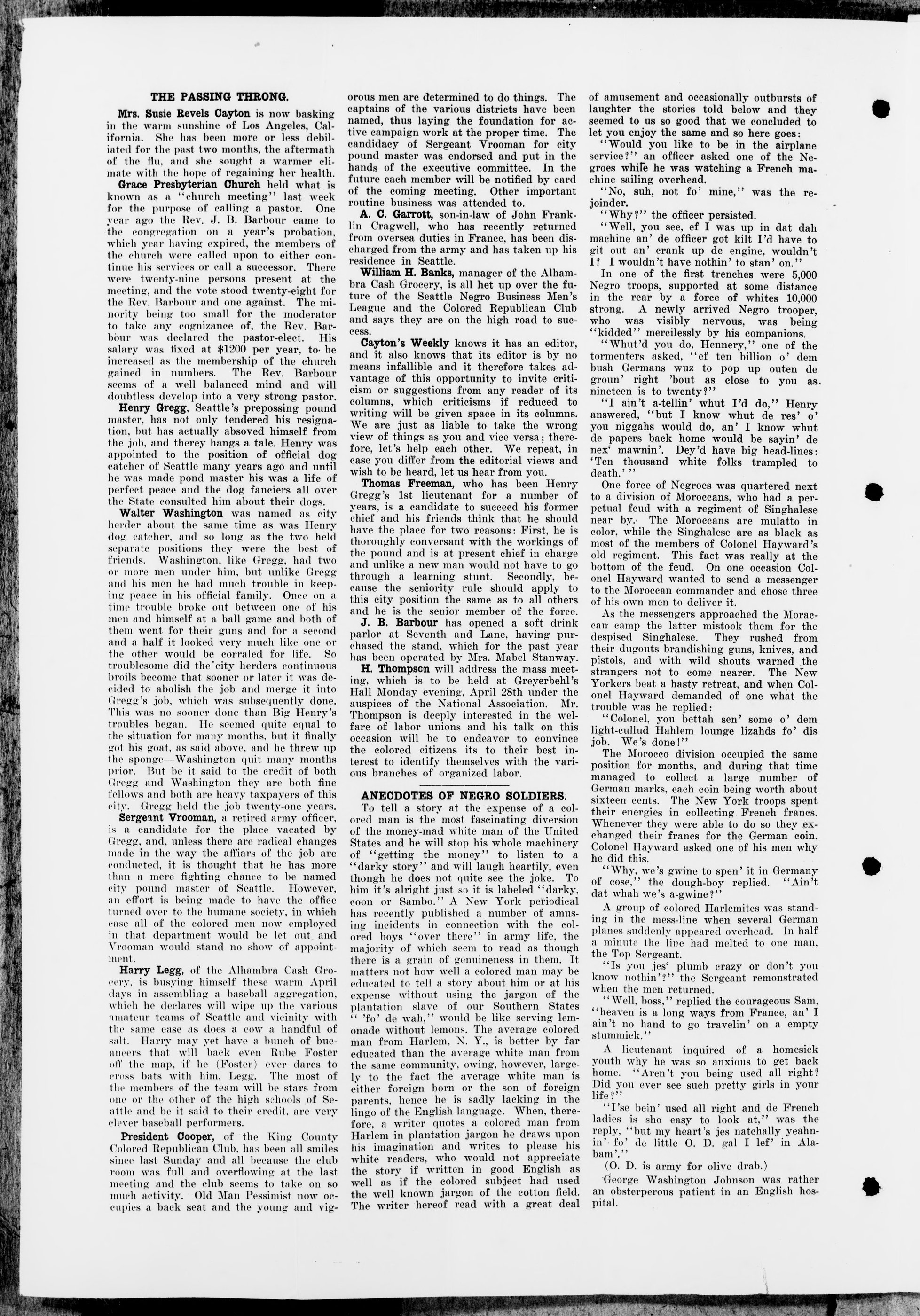
THE PASSING THRONG
Mrs. Susie Revels Cayton is now basking in the warm sunshine of Los Angeles, California. She has been more or less debiliated for the past two months, the aftermath of the flu, and she sought a warmer climate with the hope of regaining her health.
Grace Presbyterian Church held what is known as a "church meeting" last week for the purpose of calling a pastor. One year ago the Rev. J. B. Barbour came to the congregation on a year's probation, which year having expired, the members of the church were called upon to either continue his services or call a successor. There were twenty-nine persons present at the meeting, and the vote stood twenty-eight for the Rev. Barbour and one against. The minority being too small for the moderator to take any cognizance of, the Rev. Barbour was declared the pastor-elect. His salary was fixed at $1200 per year, to be increased as the membership of the church gained in numbers. The Rev. Barbour seems of a well balanced mind and will doubtless develop into a very strong pastor.
Henry Gregg, Seattle's prepossing pound master, has not only tendered his resignation, but has actually absolved himself from the job, and therey hangs a tale. Henry was appointed to the position of official dog catcher of Seattle many years ago and until he was made pond master his was a life of perfect peace and the dog fanciers all over the State consulted him about their dogs.
Walter Washington was named as city herder about the same time as was Henry dog catcher, and so long as the two held separate positions they were the best of friends. Washington, like Gregg, had two or more men under him, but unlike Gregg and his men he had much trouble in keeping peace in his official family. Once on a time trouble broke out between one of his men and himself at a ball game and both of them went for their guns and for a second and a half it looked very much like one or the other would be corraled for life. So troublesome did the city herders continuous broils become that sooner or later it was decided to abolish the job and merge it into Gregg's job, which was subsequently done. This was no sooner done than Big Henry's troubles began. He seemed quite equal to the situation for many months, but it finally got his goat, as said above, and he threw up the sponge—Washington quit many months prior. But be it said to the credit of both Gregg and Washington they are both fine fellows and both are heavy taxpayers of this city. Gregg held the job twenty-one years.
Sergeant Vrooman, a retired army officer, is a candidate for the place vacated by Gregg, and, unless there are radical changes made in the way the affiars of the job are conducted, it is thought that he has more than a mere fighting chance to be named city pound master of Seattle. However, an effort is being made to have the office turned over to the humane society, in which case all of the colored men now employed in that department would be let out and Vrooman would stand no show of appointment.
Harry Legg, of the Alhambra Cash Grocery, is busying himself these warm April days in assembling a baseball aggregation, which he declares will wipe up the various amateur teams of Seattle and vicinity with the same ease as does a cow a handful of salt. Harry may yet have a bunch of bueaneers that will back even Rube Foster off the map, if he (Foster) ever dares to cross bats with him, Legg. The most of the members of the team will be stars from one or the other of the high schools of Seattle and be it said to their credit, are very clever baseball performers.
President Cooper, of the King County Colored Republican Club, has been all smiles since last Sunday and all because the club room was full and overflowing at the last meeting and the club seems to take on so much activity. Old Man Pessimist now occupies a back seat and the young and vig-
orous men are determined to do things. The captains of the various districts have been named, thus laying the foundation for active campaign work at the proper time. The candidacy of Sergeant Vrooman for city pound master was endorsed and put in the hands of the executive committee. In the future each member will be notified by card of the coming meeting. Other important routine business was attended to. A. C. Garrott, son-in-law of John Franklin Cragwell, who has recently returned from oversea duties in France, has been discharged from the army and has taken up his residence in Seattle.
William H. Banks, manager of the Alhambra Cash Grocery, is all het up over the future of the Seattle Negro Business Men's League and the Colored Republican Club and says they are on the high road to success.
Cayton's Weekly knows it has an editor, and it also knows that its editor is by no means infallible and it therefore takes advantage of this opportunity to invite criticism or suggestions from any reader of its columns, which criticisms if reduced to writing will be given space in its columns. We are just as liable to take the wrong view of things as you and vice versa; therefore, let's help each other. We repeat, in case you differ from the editorial views and wish to be heard, let us hear from you.
Thomas Freeman, who has been Henry Gregg's 1st lieutenant for a number of years, is a candidate to succeed his former chief and his friends think that he should have the place for two reasons: First, he is thoroughly conversant with the workings of the pound and is at present chief in charge and unlike a new man would not have to go through a learning stunt. Secondly, because the seniority rule should apply to this city position the same as to all others and he is the senior member of the force. J. B. Barbour has opened a soft drink parlor at Seventh and Lane, having purchased the stand, which for the past year has been operated by Mrs. Mabel Stanway.
H. Thompson will address the mass meeting, which is to be held at Greyerbehl's Hall Monday evening, April 28th under the auspices of the National Association. Mr. Thompson is deeply interested in the welfare of labor unions and his talk on this occasion will be to endeavor to convince the colored citizens its to their best interest to identify themselves with the various branches of organized labor.
ANECDOTES OF NEGRO SOLDIERS.
To tell a story at the expense of a colored man is the most fascinating diversion of the money-mad white man of the United States and he will stop his whole machinery of "getting the money" to listen to a "darky story" and will laugh heartily, even though he does not quite see the joke. To him it's alright just so it is labeled "darky, coon or Sambo." A New York periodical has recently published a number of amusing incidents in connection with the colored boys "over there" in army life, the majority of which seem to read as though there is a grain of genuineness in them. It matters not how well a colored man may be educated to tell a story about him or at his expense without using the jargon of the plantation slave of our Southern States "fo' de wah," would be like serving lemonade without lemons. The average colored man from Harlem, N. Y., is better by far educated than the average white man from the same community, owing, however, largely to the fact the average white man is either foreign born or the son of foreign parents, hence he is sadly lacking in the lingo of the English language. When, therefore, a writer quotes a colored man from Harlem in plantation jargon he draws upon his imagination and writes to please his white readers, who would not appreciate the story if written in good English as well as if the colored subject had used the well known jargon of the cotton field. The writer hereof read with a great deal
of amusement and occasionally outbursts of laughter the stories told below and they seemed to us so good that we concluded to let you enjoy the same and so here goes:
"Would you like to be in the airplane service?" an officer asked one of the Negroes while he was watching a French machine sailing overhead.
"No, suh, not fo' mine," was the rejoinder.
"Why?" the officer persisted.
"Well, you see, ef I was up in dat dah machine an' de officer got kilt I'd have to git out an' crank up de engine, wouldn't I? I wouldn't have nothin' to stan' on."
In one of the first trenches were 5,000 Negro troops, supported at some distance in the rear by a force of whites 10,000 strong. A newly arrived Negro trooper, who was visibly nervous, was being "kidded" mercilessly by his companions.
"Whut'd you do. Hennery," one of the tormenters asked, "ef ten billion o' dem bush Germans wuz to pop up outen de groun' right 'bout as close to you as nineteen is to twenty?"
"I ain't a-tellin' whut I'd do," Henry answered, "but I know whut de res' o' you niggahs would do, an' I know whut de papers back home would be sayin' de nex' mawnin'. Dey'd have big head-lines: 'Ten thousand white folks trampled to death.'"
One force of Negroes was quartered next to a division of Moroccans, who had a perpetual feud with a regiment of Singhalese near by. The Moroccans are mulatto in color, while the Singhalese are as black as most of the members of Colonel Hayward's old regiment. This fact was really at the bottom of the feud. On one occasion Colonel Hayward wanted to send a messenger to the Moroccan commander and chose three of his own men to deliver it.
As the messengers approached the Moraccan camp the latter mistook them for the despised Singhalese. They rushed from their dugouts brandishing guns, knives, and pistols, and with wild shouts warned the strangers not to come nearer. The New Yorkers beat a hasty retreat, and when Colonel Hayward demanded of one what the trouble was he replied:
"Colonel, you bettah sen' some o' dem light-cullud Hahlem lounge lizahds fo' dis job. We's done!"
The Morocco division occupied the same position for months, and during that time managed to collect a large number of German marks, each coin being worth about sixteen cents. The New York troops spent their energies in collecting French francs. Whenever they were able to do so they exchanged their francs for the German coin. Colonel Hayward asked one of his men why he did this.
"Why, we's gwine to spen' it in Germany of cose," the dough-boy replied. "Ain't dat whah we's a-gwine?"
A group of colored Harlemites was standing in the mess-line when several German planes suddenly appeared overhead. In half a minute the line had melted to one man, the Top Sergeant.
"Is you Jes' plumb crazy or don't you know nothin'?" the Sergeant remonstrated when the men returned.
"Well, boss," replied the courageous Sam, "heaven is a long ways from France, an' I ain't no hand to go travelin' on a empty stummick."
A lieutenant inquired of a homesick youth why he was so anxious to get back home. "Aren't you being used all right? Did you ever see such pretty girls in your life?" "I'se bein' used all right and de French ladies is sho easy to look at," was the reply, "but my heart'sjes natchally yeahn'in' fo' de little O. D. gal I lef' in Alabama'." (O. D. is army for olive drab.) George Washington Johnson was rather an obsterperous patient in an English hospital.
"I don't know why it is," complained the exasperated nurse, "but you colored men give us more trouble than all the rest put together."
"Yassum," the patient agreed, "dat's jes what de Germans is a'sayin' about us."
In France the offensive "nigger" was not used in addressing the dough-boys, and the French, who followed this example, had no word signifying "mulatto."
"Some of us," explained Private Bill Forshay, "was described as 'beaucoup de chocolat,' an' de other wuz 'cafe au lait.'"
"What would you do if a pack of Germans suddenly came right down on top of us?" asked a sergeant.
"Dey ain't gwine to know whar I is," replied the private.
"How's that, Sam?"
"Well, you see, dey might know whar I wuz, but not whar I is."
A Negro dough-boy was clad in white pajamas one night when the camp was surprized by German bombers. Everybody headed for his own dugout and Sam had some distance to travel.
"What did you do?" he was asked the next morning.
"Easy," he replied. "De good Lawd has gimme de bes' cammyfladge in the world. I dropt dem pajamies right whar I stood an' made de res' o' de trip in my birfday clo'es."
On the night of armistice day a Negro trooper met some hilarious Frenchmen. Next morning he was before his captain charged with intoxication.
"Young man," scowled the Captain, "you've got a mighty good record and I'm sorry. Have you any excuse to offer for this outbreak?"
"I ain't got no 'xcuse, please, Cap'n," said the culprit, "but I'ce done got a good reason."
"A reason," exclaimed the captain. "What is it?"
"Well, Cap'n, I dunno de English fo' it, but de bunch I met las' night called it 'encore'."
A colored veteran just back from the other side when questioned about an iron cross he was wearing, explained:
"Boss, it was a extra decoration. De Kaiser hisself sent it to me by a special messenger what dropped daid jus' befo' he give it to me."
There is just enough truth in the above bunch of stories to rob them of the intended humiliation of the colored people in general. Whether educated or otherwise almost a majority of the colored men of the United States are inclined to say cute things, which sometimes are so clever that they are actually witty. For an example, a Negro and an Irishman were engaged in a friendly bout of joking—each other, when the Irishman asked of the Negro: "If you and I were walking down the road and met the devil, which one of us would he take?" "Me, of course," quickly replied the Negro. "And why you?" further asked Pat. "Because he is certain to get you and he has doubts about getting me." Whereupon Pat immediately began discussing the League of Nations. The colored man seems to possess a lot of corn field philosophy that is not only amusing and entertaining, but profoundly logical, of which he seems to have little or no knowledge. The old colored man who coined the expression, "the old coon for cunning, but the young one for running," had no idea that he had said something that would live as long as the United States. The American English language is almost a dialect in comparison to the English spoken and written in Great Britain largely because the former contains so many quaint and odd expressions of the plantation Negro. The mannerisms of the Negroes of this country have inveigled themselves not only into the literature of the land, but into the music, dancing, and even manner of speech. But all this is a digression from the original thought herein. The reproduced stories are very clever and when
carefully considered verges dangerously close to witicisms.
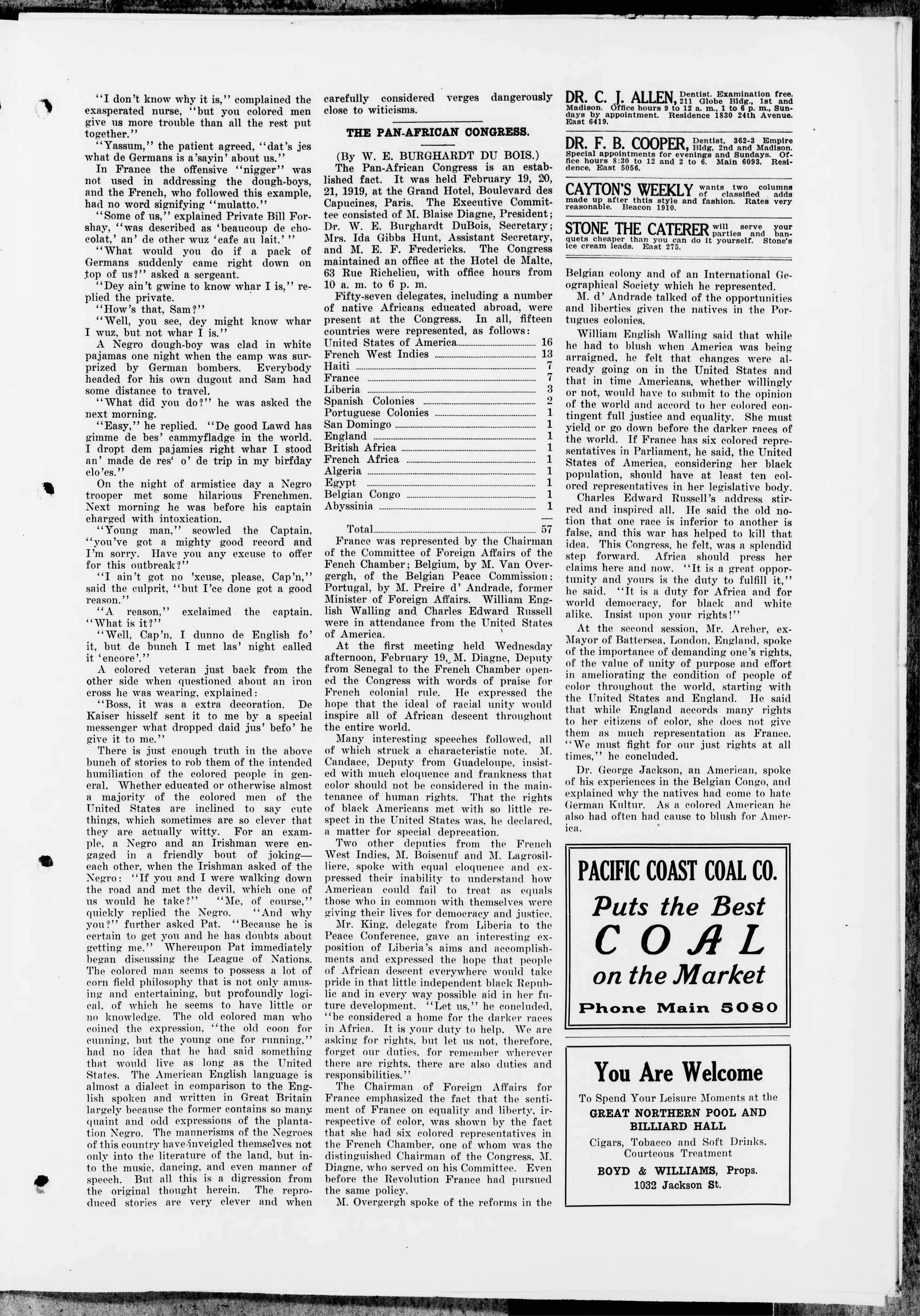
THE PAN-AFRICAN CONGRESS.
The Pan-African Congress is an established fact. It was held February 19, 20, 21, 1919, at the Grand Hotel, Boulevard des Capucines, Paris. The Executive Committee consisted of M. Blaise Diagne, President; Dr. W. E. Burghardt DuBois, Secretary; Mrs. Ida Gibbs Hunt, Assistant Secretary, and M. E. F. Fredericks. The Congress maintained an office at the Hotel de Malte, 63 Rue Richelieu, with office hours from 10 a. m. to 6 p. m.
Fifty-seven delegates, including a number of native Africans educated abroad, were present at the Congress. In all, fifteen countries were represented, as follows:
United States of America 16
French West Indies 13
Haiti 7
France 7
Liberia 3
Spanish Colonies 2
Portuguese Colonies 1
San Domingo 1
England 1
British Africa 1
French Africa 1
Algeria 1
Egypt 1
Belgian Congo 1
Abyssinia 1
France was represented by the Chairman of the Committee of Foreign Affairs of the Fench Chamber; Belgium, by M. Van Overgergh, of the Belgian Peace Commission; Portugal, by M. Preire d' Andrade, former Minister of Foreign Affairs. William English Walling and Charles Edward Russell were in attendance from the United States of America.
At the first meeting held Wednesday afternoon, February 19, M. Diagne, Deputy from Senegal to the French Chamber opened the Congress with words of praise for French colonial rule. He expressed the hope that the ideal of racial unity would inspire all of African descent throughout the entire world.
Many interesting speeches followed, all of which struck a characteristic note. M. Candace, Deputy from Guadeloupe, insisted with much eloquence and frankness that color should not be considered in the maintenance of human rights. That the rights of black Americans met with so little respect in the United States was, he declared, a matter for special deprecation.
Two other deputies from the French West Indies, M. Boisenuf and M. Lagrosilliere, spoke with equal eloquence and expressed their inability to understand how American could fail to treat as equals those who in common with themselves were giving their lives for democracy and justice.
Mr. King, delegate from Liberia to the Peace Conference, gave an interesting exposition of Liberia's aims and accomplishments and expressed the hope that people of African descent everywhere would take pride in that little independent black Republic and in every way possible aid in her future development. "Let us," he concluded, "be considered a home for the darker races in Africa. It is your duty to help. We are asking for rights, but let us not, therefore, forget our duties, for remember wherever there are rights, there are also duties and responsibilities."
The Chairman of Foreign Affairs for France emphasized the fact that the sentiment of France on equality and liberty, irrespective of color, was shown by the fact that she had six colored representatives in the French Chamber, one of whom was the distinguished Chairman of the Congress, M. Diagne, who served on his Committee. Even before the Revolution France had pursued the same policy. M. Overgergh spoke of the reforms in the
DR. C. J. ALLEN, Dentist. Examination free. 211 Globe Bldg., 1st and Madison. Office hours 9 to 12 a. m., 1 to 6 p. m., Sundays by appointment. Residence 1830 24th Avenue. East 6419.
DR. F. B. COOPER, Dentist, 362-3 Empire Bldg, 2nd and Madison. Special appointments for evenings and Sundays. Office hours 8:30 to 12 and 2 to 6. Main 6093. Residence, East 5056.
CAYTON'S WEEKLY wants two columns of classified adds made up after this style and fashion. Rates very reasonable. Beacon 1910.
STONE THE CATERER will serve your parties and banquets cheaper than you can do it yourself. Stone's ice cream leads. East 275.
Belgian colony and of an International Geographical Society which he represented. M. d' Andrade talked of the opportunities and liberties given the natives in the Portugues colonies.
William English Walling said that while he had to blush when America was being arraigned, he felt that changes were already going on in the United States and that in time Americans, whether willingly or not, would have to submit to the opinion of the world and accord to her colored contingent full justice and equality. She must yield or go down before the darker races of the world. If France has six colored representatives in Parliament, he said, the United States of America, considering her black population, should have at least ten colored representatives in her legislative body.
Charles Edward Russell's address stirred and inspired all. He said the old notion that one race is inferior to another is false, and this war has helped to kill that idea. This Congress, he felt, was a splendid step forward. Africa should press her claims here and now. "It is a great opportunity and yours is the duty to fulfill it," he said. "It is a duty for Africa and for world democracy, for black and white alike. Insist upon your rights!"
At the second session, Mr. Archer, ex-Mayor of Battersea, London, England, spoke of the importance of demanding one's rights, of the value of unity of purpose and effort in ameliorating the condition of people of color throughout the world, starting with the United States and England. He said that while England accords many rights to her citizens of color, she does not give them as much representation as France. "We must fight for our just rights at all times," he concluded.
Dr. George Jackson, an American, spoke of his experiences in the Belgian Congo, and explained why the natives had come to hate German Kultur. As a colored American he also had often had cause to blush for America.
PACIFIC COAST COAL CO.
Puts the Best
COAL
on the Market
Phone Main 5080
You Are Welcome
To Spend Your Leisure Moments at the
GREAT NORTHERN POOL AND
BILLIARD HALL
Cigars, Tobacco and Soft Drinks.
Courteous Treatment
BOYD & WILLIAMS, Props.
1032 Jackson St.
```markdown
```
Mrs. A. W. Hunton, from the United States of America, spoke of the importance of women in the world's reconstruction and regeneration of today, and of the necessity of seeking their co-operation and counsel. At the afternoon session of the last day Mme. Jules Siefried, President of the French National Association for the Rights of Women, brought words of encouragement from the International Council, then meeting in Paris. She said that no one could appreciate better than women the struggle for broader rights and liberties. Resolutions were passed providing for another Congress to be held in Paris during the year 1921.
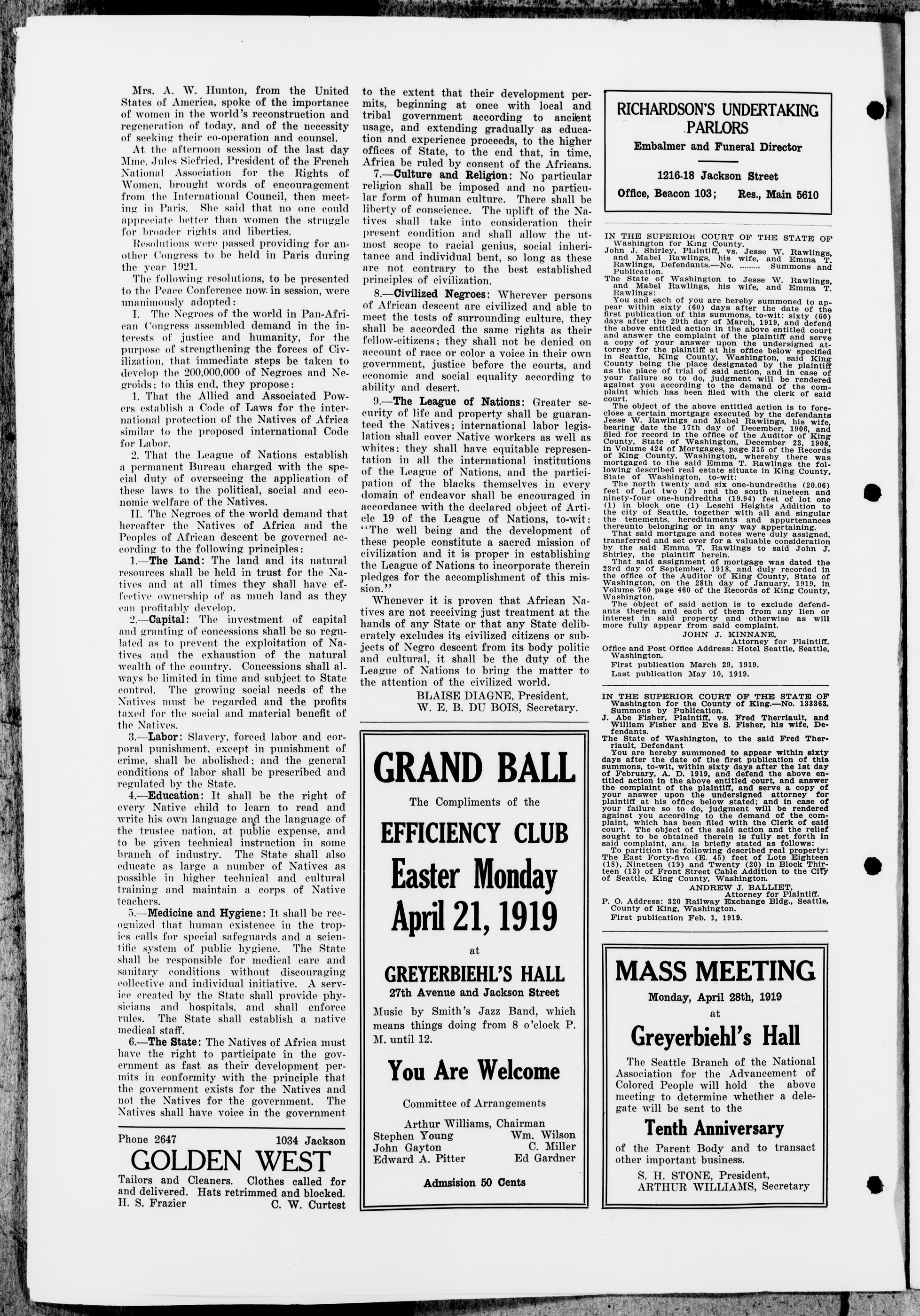
The following resolutions, to be presented to the Peace Conference now in session, were unanimously adopted:
1. The Negroes of the world in Pan-African Congress assembled demand in the interests of justice and humanity, for the purpose of strengthening the forces of Civilization, that immediate steps be taken to develop the 200,000,000 of Negroes and Negroids; to this end, they propose:
1. That the Allied and Associated Powers establish a Code of Laws for the international protection of the Natives of Africa similar to the proposed international Code for Labor.
2. That the League of Nations establish a permanent Bureau charged with the special duty of overseeing the application of these laws to the political, social and economic welfare of the Natives.
II. The Negroes of the world demand that hereafter the Natives of Africa and the Peoples of African descent be governed according to the following principles:
1. The Land: The land and its natural resources shall be held in trust for the Natives and at all times they shall have effective ownership of as much land as they can profitably develop.
2.—Capital: The investment of capital and granting of concessions shall be so regulated as to prevent the exploitation of Natives and the exhaustion of the natural wealth of the country. Concessions shall always be limited in time and subject to State control. The growing social needs of the Natives must be regarded and the profits taxed for the social and material benefit of the Natives.
3.—Labor: Slavery, forced labor and corporal punishment, except in punishment of crime, shall be abolished; and the general conditions of labor shall be prescribed and regulated by the State.
4.—Education: It shall be the right of every Native child to learn to read and write his own language and the language of the trustee nation, at public expense, and to be given technical instruction in some branch of industry. The State shall also educate as large a number of Natives as possible in higher technical and cultural training and maintain a corps of Native teachers.
5. — Medicine and Hygiene: It shall be recognized that human existence in the tropics calls for special safeguards and a scientific system of public hygiene. The State shall be responsible for medical care and sanitary conditions without discouraging collective and individual initiative. A service created by the State shall provide physicians and hospitals, and shall enforce rules. The State shall establish a native medical staff.
6.—The State: The Natives of Africa must have the right to participate in the government as fast as their development permits in conformity with the principle that the government exists for the Natives and not the Natives for the government. The Natives shall have voice in the government
Tailors and Cleaners. Clothes called for and delivered. Hats retrimmed and blocked. H. S. Frazier C. W. Curtest
to the extent that their development permits, beginning at once with local and tribal government according to ancient usage, and extending gradually as education and experience proceeds, to the higher offices of State, to the end that, in time, Africa be ruled by consent of the Africans
7.—Culture and Religion: No particular religion shall be imposed and no particular form of human culture. There shall be liberty of conscience. The uplift of the Natives shall take into consideration their present condition and shall allow the utmost scope to racial genius, social inheritance and individual bent, so long as these are not contrary to the best established principles of civilization.
8.—Civilized Negroes: Wherever persons of African descent are civilized and able to meet the tests of surrounding culture, they shall be accorded the same rights as their fellow-citizens; they shall not be denied on account of race or color a voice in their own government, justice before the courts, and economic and social equality according to ability and desert.
9.—The League of Nations: Greater security of life and property shall be guaranteed the Natives; international labor legislation shall cover Native workers as well as whites; they shall have equitable representation in all the international institutions of the League of Nations, and the participation of the blacks themselves in every domain of endeavor shall be encouraged in accordance with the declared object of Article 19 of the League of Nations, to-wit: "The well being and the development of these people constitute a sacred mission of civilization and it is proper in establishing the League of Nations to incorporate therein pledges for the accomplishment of this mission."
Whenever it is proven that African Natives are not receiving just treatment at the hands of any State or that any State deliberately excludes its civilized citizens or subjects of Negro descent from its body politic and cultural, it shall be the duty of the League of Nations to bring the matter to the attention of the civilized world. BLAISE DIAGNE, President. W. E. B. DU BOIS, Secretary.
GRAND BALL
The Compliments of the EFFICIENCY CLUB Easter Monday April 21,1919
at
GREYERBIEHL'S HALL
27th Avenue and Jackson Street
Music by Smith's Jazz Band, which
means things doing from 8 o'clock P.
M. until 12.
You Are Welcome
Committee of Arrangements
Arthur Williams, Chairman
Stephen Young Wm. Wilson
John Gayton C. Miller
Edward A. Pitter Ed Gardner
Admsision 50 Cents
---
1216-18 Jackson Street Office, Beacon 103; Res., Main 5610
IN THE SUPERIOR COURT OF THE STATE OF Washington for King County.
John J. Shirley, Plaintiff, vs. Jesse W. Rawlings, and Mabel Rawlings, his wife, and Emma T. Rawlings, Defendants.—No. ..... Summons and Publication.
The State of Washington to Jesse W. Rawlings, and Mabel Rawlings, his wife, and Emma T. Rawlings:
You and each of you are hereby summoned to appear within sixty (60) days after the date of the first publication of this summons, to-wit: sixty (60) days after the 29th day of March, 1919, and defend the above entitled action in the above entitled court and answer the complaint of the plaintiff and serve a copy of your answer upon the undersigned attorney for the plaintiff at his office below specified in Seattle, King County, Washington, said King County being the place designated by the plaintiff as the place of trial of said action, and in case of your failure so to do, judgment will be rendered against you according to the demand of the complaint which has been filed with the clerk of said court.
The object of the above entitled action is to foreclose a certain mortgage executed by the defendants Jesse W. Rawlnigs and Mabel Rawlings, his wife, bearing date the 17th day of December, 1906, and filed for record in the office of the Auditor of King County, State of Washington, December 23, 1908, in Volume 424 of Mortgages, page 315 of the Records of King County, Washington, whereby there was mortgaged to the said Emma T. Rawlings the following described real estate situate in King County, State of Washington, to-wit:
The north twenty and six one-hundredths (20.06) feet of Lot two (2) and the south nineteen and ninety-four one-hundredths (19.94) feet of lot one (1) in block one (1) Leschi Heights Addition to the city of Seattle, together with all and singular the tenements, hereditaments and appurtenances thereunto belonging or in any way appertaining.
That said mortgage and notes were duly assigned, transferred and set over for a valuable consideration by the said Emma T. Rawlings to said John J. Shirley, the plaintiff herein.
That said assignment of mortgage was dated the 23rd day of September, 1918, and duly recorded in the office of the Auditor of King County, State of Washington, on the 28th day of January, 1919, in Volume 760 page 460 of the Records of King County, Washington.
The object of said action is to exclude defendants therein and each of them from any lien or interest in said property and otherwise as will more fully appear from said complaint.
JOHN J. KINNANE,
Attorney for Plaintiff.
Office and Post Office Address: Hotel Seattle, Seattle, Washington.
First publication March 29, 1919.
Last publication May 10, 1919.
IN THE SUPERIOR COURT OF THE STATE OF Washington for the County of King.—No. 133363.
Summons by Publication.
J. Abe Fisher, Plaintiff, vs. Fred Therriault, and William Fisher and Eve S. Fisher, his wife, Defendants.
The State of Washington, to the said Fred Therriault, Defendant
You are hereby summoned to appear within sixty days after the date of the first publication of this summons, to-wit, within sixty days after the 1st day of February, A. D. 1919, and defend the above entitled action in the above entitled court, and answer the complaint of the plaintiff, and serve a copy of your answer upon the undersigned attorney for plaintiff at his office below stated; and in case of your failure so to do, judgment will be rendered against you according to the demand of the complaint, which has been filed with the Clerk of said court. The object of the said action and the relief sought to be obtained therein is fully set forth in said complaint, and is briefly stated as follows:
To partition the following described real property: The East Forty-five (E. 45) feet of Lots Eighteen (18), Nineteen (19) and Twenty (20) in Block Thirteen (13) of Front Street Cable Addition to the City of Seattle, King County, Washington.
Attorney for Plaintiff.
P. O. Address: 320 Railway Exchange Bldg., Seattle,
County of King, Washington.
First publication Feb. 1, 1919.
MASS MEETING
Monday, April 28th, 1919
at
Greyerbiehl's Hall
The Seattle Branch of the National Association for the Advancement of Colored People will hold the above meeting to determine whether a delegate will be sent to the
Tenth Anniversary
of the Parent Body and to transact other important business.
S. H. STONE, President,
ARTHUR WILLIAMS, Secretary