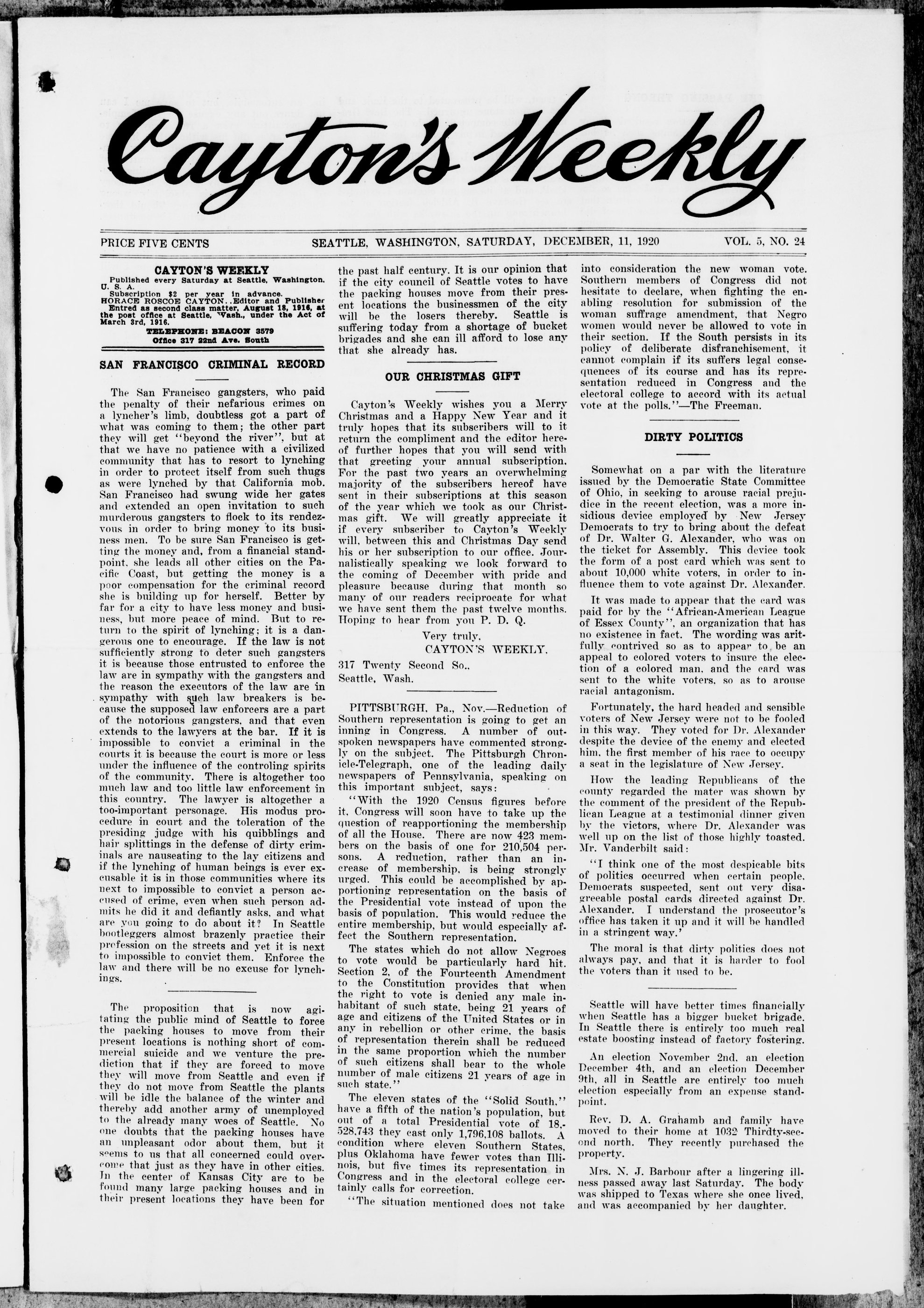
Cayton's Weekly
Saturday, December 11, 1920
Seattle, Washington
Page text (machine-generated)
Cayton's Weekly
---
PRICE FIVE CENTS
Subscription $2 per year in advance.
HORACE ROSCOE CAYTON..Editor and Publisher.
Entred as second class matter, August 18, 1916, at
the post office at Seattle, Wash., under the Act of
March 3rd, 1916.
TELEPHONE: BEACON 3579
Office 317 22nd Ave. South
SAN FRANCISCO CRIMINAL RECORD
The San Francisco gangsters, who paid the penalty of their nefarious crimes on a lyncher's limb, doubtless got a part of what was coming to them; the other part they will get "beyond the river", but at that we have no patience with a civilized community that has to resort to lynching in order to protect itself from such thugs as were lynched by that California mob. San Francisco had swung wide her gates and extended an open invitation to such murderous gangsters to flock to its rendezvous in order to bring money to its business men. To be sure San Francisco is getting the money and, from a financial standpoint, she leads all other cities on the Pacific Coast, but getting the money is a poor compensation for the criminal record she is building up for herself. Better by far for a city to have less money and business, but more peace of mind. But to return to the spirit of lynching; it is a dangerous one to encourage. If the law is not sufficiently strong to deter such gangsters it is because those entrusted to enforce the law are in sympathy with the gangsters and the reason the executors of the law are in sympathy with such law breakers is because the supposed law enforcers are a part of the notorious gangsters, and that even extends to the lawyers at the bar. If it is impossible to convict a criminal in the courts it is because the court is more or less under the influence of the controlling spirits of the community. There is altogether too much law and too little law enforcement in this country. The lawyer is altogether a too-important personage. His modus procedure in court and the toleration of the presiding judge with his quibblings and hair splittings in the defense of dirty criminals are nauseating to the lay citizens and if the lynching of human beings is ever excusable it is in those communities where its next to impossible to convict a person accused of crime, even when such person admits he did it and defiantly asks, and what are you going to do about it? In Seattle bootleggers almost brazenly practice their profession on the streets and yet it is next to impossible to convict them. Enforce the law and there will be no excuse for lynchings.
The proposition that is now agitating the public mind of Seattle to force the packing houses to move from their present locations is nothing short of commercial suicide and we venture the prediction that if they are forced to move they will move from Seattle and even if they do not move from Seattle the plants will be idle the balance of the winter and thereby add another army of unemployed to the already many woes of Seattle. No one doubts that the packing houses have an unpleasant odor about them, but it seems to us that all concerned could overcome that just as they have in other cities. In the center of Kansas City are to be found many large packing houses and in their present locations they have been for
SEATTLE, WASHINGTON, SATURDAY, DECEMBER, 11, 1920
the past half century. It is our opinion that if the city council of Seattle votes to have the packing houses move from their present locations the businessmen of the city will be the losers thereby. Seattle is suffering today from a shortage of bucket brigades and she can ill afford to lose any that she already has.
OUR CHRISTMAS GIFT
Cayton's Weekly wishes you a Merry Christmas and a Happy New Year and it truly hopes that its subscribers will to it return the compliment and the editor hereof further hopes that you will send with that greeting your annual subscription. For the past two years an overwhelming majority of the subscribers hereof have sent in their subscriptions at this season of the year which we took as our Christmas gift. We will greatly appreciate it if every subscriber to Cayton's Weekly will, between this and Christmas Day send his or her subscription to our office. Journalistically speaking we look forward to the coming of December with pride and pleasure because during that month so many of our readers reciprocate for what we have sent them the past twelve months. Hoping to hear from you P. D. Q.
CAYTON'S WEEKLY.
317 Twenty Second So.. Seattle, Wash.
PITTSBURGH, Pa., Nov.—Reduction of Southern representation is going to get an inning in Congress. A number of outspoken newspapers have commented strongly on the subject. The Pittsburgh Chronicle-Telegraph, one of the leading daily newspapers of Pennsylvania, speaking on this important subject, says: "With the 1920 Census figures before it, Congress will soon have to take up the question of reapportioning the membership of all the House. There are now 423 members on the basis of one for 210,504 persons. A reduction, rather than an increase of membership, is being strongly urged. This could be accomplished by apportioning representation on the basis of the Presidential vote instead of upon the basis of population. This would reduce the entire membership, but would especially affect the Southern representation.
The states which do not allow Negroes to vote would be particularly hard hit. Section 2, of the Fourteenth Amendment to the Constitution provides that when the right to vote is denied any male inhabitant of such state, being 21 years of age and citizens of the United States or in any in rebellion or other crime, the basis of representation therein shall be reduced in the same proportion which the number of such citizens shall bear to the whole number of male citizens 21 years of age in such state."
The eleven states of the "Solid South." have a fifth of the nation's population, but out of a total Presidential vote of 18,528,743 they cast only 1,796,108 ballots. A condition where eleven Southern States, plus Oklahoma have fewer votes than Illinois, but five times its representation in Congress and in the electoral college certainly calls for correction.
"The situation mentioned does not take
VOL. 5, NO. 24
into consideration the new woman vote. Southern members of Congress did not hesitate to declare, when fighting the enabling resolution for submission of the woman suffrage amendment, that Negro women would never be allowed to vote in their section. If the South persists in its policy of deliberate disfranchisement, it cannot complain if its suffers legal consequences of its course and has its representation reduced in Congress and the electoral college to accord with its actual vote at the polls."—The Freeman.
DIRTY POLITICS
Somewhat on a par with the literature issued by the Democratic State Committee of Ohio, in seeking to arouse racial prejudice in the recent election, was a more insidious device employed by New Jersey Democrats to try to bring about the defeat of Dr. Walter G. Alexander, who was on the ticket for Assembly. This device took the form of a post card which was sent to about 10,000 white voters, in order to influence them to vote against Dr. Alexander. It was made to appear that the card was paid for by the "African-American League of Essex County", an organization that has no existence in fact. The wording was aritfully contrived so as to appear to be an appeal to colored voters to insure the election of a colored man, and the card was sent to the white voters, so as to arouse racial antagonism.
Fortunately, the hard headed and sensible voters of New Jersey were not to be fooled in this way. They voted for Dr. Alexander despite the device of the enemy and elected him, the first member of his race to occupy a seat in the legislature of New Jersey.
How the leading Republicans of the county regarded the mater was shown by the comment of the president of the Republican League at a testimonial dinner given by the victors, where Dr. Alexander was well up on the list of those highly toasted. Mr. Vanderbilt said:
"I think one of the most despicable bits of politics occurred when certain people. Democrats suspected, sent out very disagreeable postal cards directed against Dr. Alexander. I understand the prosecutor's office has taken it up and it will be handled in a stringent way."
The moral is that dirty politics does not always pay, and that it is harder to fool the voters than it used to be.
Seattle will have better times financially when Seattle has a bigger bucket brigade. In Seattle there is entirely too much real estate boosting instead of factory fostering.
An election November 2nd, an election December 4th, and an election December 9th, all in Seattle are entirely too much election especially from an expense standpoint.
Rev. D. A. Grahamb and family have moved to their home at 1032 Thirdty-second north. They recently purchased the property.
Mrs. N. J. Barbour after a lingering illness passed away last Saturday. The body was shipped to Texas where she once lived, and was accompanied by her daughter.
---
ae
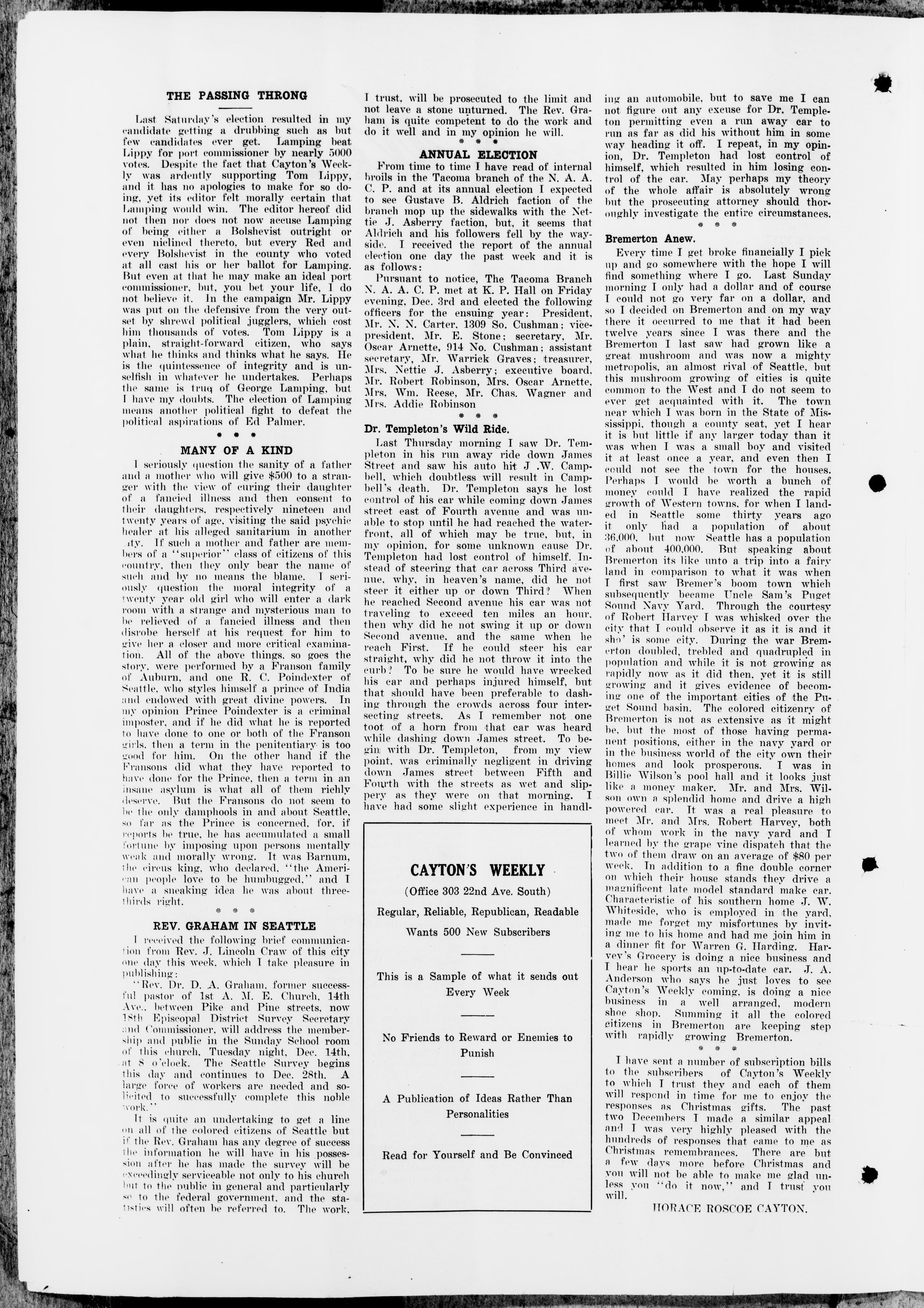
THE PASSING THRONG
Last Saturday’s election resulted in my
candidate getting a drubbing such as but
few candidates ever get. Lamping beat
Lippy for port commissioner by nearly 5000
votes. Despite the fact that Cayton’s Week-
ly was ardently supporting Tom Lippy,
and it has no apologies to make for so do-
ing, yet its editor felt morally certain that
Lamping would win. The editor hereof did
not then nor does not now accuse Lamping
of being cither a Bolshevist outright or
even niclined thereto, but every Red and
every Bolshevist in the county who voted
at all cast his or her ballot for Lamping.
But even at that he may make an ideal port
commissioner, but, you bet your life, 1 do
not believe it. In the campaign Mr. Lippy
was put on the defensive from the very out-
set by shrewd political jugglers, which cost
him thousands of votes. Tom Lippy is a
plain, straight-forward citizen, who says
what he thinks and thinks what he says. He
is the quintessence of integrity and is un-
selfish in whatever he undertakes. Perhaps
the same is trugq of George Lamping, but
I have my doubts. The election of Lamping
means another political fight to defeat the
political aspirations of Ed Palmer.
MANY OF A KIND
I seriously question the sanity of a father
and a mother who will give $500 to a stran-
ger with the view of curing their daughter
of a fancied illness and then consent to
their daughters, respectively nineteen and
twenty years of age, visiting the said psychic
healer at his alleged sanitarium in another
ity. Tf such a mother and father are mem-
hers of a ‘‘superior’’ class of citizens of this
country, then they only bear the name of
such and by no means the blame. 1 seri-
ously question the moral integrity of a
twenty year old girl who will enter a dark
room with a strange and mysterious man to
he relieved of a fancied illness and then
disrobe herself at his request for him to
give her a closer and more critical examina-
tion. All of the above things, so goes the
story, were performed by a Franson family
of Auburn, and one R. C. Poindexter of
Seattle, who styles himself a prince of India
and endowed with great divine powers. In
my opinion Prince Poindexter is a criminal
imposter, and if he did what he is reported
to have done to one or both of the Franson
virls, then a term in the penitentiary: is too
good for him, On the other hand if the
Fransons did what they have reported to
have done for the Prince, then a term in an
insane asylum is what all of them riehly
deserve, But the Fransons do not seem to
he the only damphools in and about Seattle,
so far as the Prince is concerned, for, if
reports be true, he has accumulated a small
fortune by imposing upon persons mentally
weak and morally wrong. It was Barnum,
the circus king, who declared, ‘the Ameri-
can people love to be humbugged,’? and T
have a sneaking idea he was about three-
thirds right.
REV. GRAHAM IN SEATTLE
I received the following brief communiea-
tion from Rey. J. Lincoln Craw of this city
one day this week, which T take pleasure in
publishing ;
“Rey. Dr. D. A. Graham, former suecess-
ful pastor of Ist A. M. E. Chureh, 14th
Ave.. between Pike and Pine streets, now
Isth Episcopal District Survey Secretary
nd Comnnissioner, will address the member-
ship and publie in the Sunday School room
of this church, Tuesday night, Dee. 14th,
at 8 o'clock. The Seattle Survey begins
this day and continues to Dee. 28th, A
large force of workers are needed and so-
licited to successfully complete this noble
work.”?
It is quite an undertaking to get a line
on all of the colored citizens of Seattle but
i” the Rey. Graham has any degree of success
ihe information he will have in his posses-
sion after he has made the survey will be
xceedingly serviceable not only to his chureh
int to the publie in general and particularly
se to the federal government, and the sta-
tistics will often be referred to. The work,
do it well and in my opinion he will.
** * *
ANNUAL ELECTION
From time to time I have read of internal
broils in the Tacoma branch of the N. A. A.
C. P. and at its annual election I expected
to see Gustave B. Aldrich faction of the
branch mop up the sidewalks with the Net-
tie J. Asberry faction, but, it seems that
Aldrich and his followers fell by the way-
side. T received the report of the annual
election one day the past week and it is
as follows:
Pursuant to notice, The Tacoma Branch
N. A. A. C. P. met at K. P. Hall on Friday
evening, Dec. 3rd and elected the following
officers for the ensuing year: President,
Mr. N. N. Carter, 1309 So. Cushman; vice-
president, Mr. E. Stone; secretary, Mr.
Oscar Arnette, 914 No, Cushman; assistant
secretary, Mr. Warrick Graves; treasurer,
Mrs. Nettie J. Asberry; executive board,
Mr. Robert Robinson, Mrs. Oscar Arnette,
Mrs, Wm. Reese, Mr. Chas. Wagner and
Mrs. Addie Robinson
* #* *
Dr. Templeton’s Wild Ride.
Last Thursday morning I saw Dr. Tem-
pleton in his run away ride down James
Street and saw his auto hit J .W. Camp-
bell, which doubtless will result in Camp-
bell’s death. Dr. Templeton says he lost
control of his ear while coming down James
street east of Fourth avenue and was un-
able to stop until he had reached the water-
front, all of which may be true, but, in
my opinion, for some unknown eause Dr.
Templeton had lost control of himself. In-
stead of steering that car across Third ave-
nue, why, in heaven’s name, did he not
steer it either up or down Third? When
he reached Second avenue his ear was not
traveling to exceed ten miles an hour,
then why did he not swing it up or down
Second avenue, and the same when he
reach First. If he could steer his car
straight, why did he not throw it into the
curb? To be sure he would have wrecked
his car and perhaps injured himself, but
that should have been preferable to dash-
ing through the crowds across four inter-
secting streets. As I remember not one
toot of a horn from that ear was heard
while dashing down James street. To be-
gin with Dr. Templeton, from my view
point, was criminally negligent in driving
down James street between Fifth and
Fowrth with the streets as wet and slip-
pery as they were on that morning. I
have had some slight experience in handl-
CAYTON’S WEEKLY .
(Office 303 22nd Ave. South)
Regular, Reliable, Republican, Readable
Wants 500 New Subscribers
This is a Sample of what it sends out
Every Week
No Friends to Reward or Enemies to
Punish
A Publication of Ideas Rather Than
Personalities
Read for Yourself and Be Convinced
ton permitting even a run away car to
run as far as did his without him in some
way heading it off. I repeat, in my opin-
ion, Dr. Templeton had lost control of
himself, which resulted in him losing con-
trol of the car. May perhaps my theory
of the whole affair is absolutely wrong
but the prosecuting attorney should thor.
oughly investigate the entire cireumstances.
e 8 #
Bremerton Anew.
Every time I get broke financially I pick
up and go somewhere with the hope I will
find something where I go. Last Sunday
morning I only had a dollar and of course
T could not go very far on a dollar, and
so I decided on Bremerton and on my way
there it occurred to me that it had been
twelve years since I was there and the
Bremerton I last saw had grown like a
great mushroom and was now a mighty
metropolis, an almost rival of Seattle, but
this mushroom growing of cities is quite
common to the West and I do not seem to
ever get acquainted with it. The town
near which I was born in the State of Mis-
sissippi, though a county seat, yet I hear
it is but little if any larger today than it
was when I was a small boy and visited
it at least once a year, and even then I
could not see the town for the houses.
Perhaps I would be worth a bunch of
money could I have realized the rapid
growth of Western towns. for when T land-
ed in Seattle some thirty years ago
it only had a_ population of about
36,000, but now Seattle has a population
of about 400,000. But speaking about
Bremerton its like unto a trip into a fairy
land in comparison to what it was when
T first saw Bremer’s boom town which
subsequently became Unele Sam’s Puget
Sound Navy Yard. Through the courtesy
of Robert Harvey I was whisked over the
city that I could observe it as it is and it
sho’ is some city. During the war Brem-
erton doubled, trebled and quadrupled in
population and while it is not growing as
rapidly now as it did then, yet it is still
growing and it gives evidence of becom-
ing one of the important cities of the Pu-
get Sound basin. The colored citizenry of
Bremerton is not as extensive as it might
be, but the most of those having perma-
nent positions, either in the navy yard or
in the business world of the city own their
homes and look prosperous. I was in
Billie Wilson’s pool hall and it looks just
like a money maker. Mr. and Mrs. Wil-
son own a splendid home and drive a high
powered car. Tt was a real pleasure to
meet Mr. and Mrs. Robert Harvey, both
of whom work in the navy yard and T
learned by the grape vine dispatch that the
two of them draw on an average of $80 per
week. Tn addition to a fine double corner
on which their house stands they drive a
magnificent late model standard make car.
Characteristie of his southern home J. W.
Whiteside, who is employed in the yard,
made me forget my misfortunes by invit-
ing me to his home and had me join him in
a dinner fit for Warren G. Harding. Har-
vev’s Grocery is doing a nice business and
IT hear he sports an up-to-date ear. J. A.
Anderson who says he just loves to see
Cayton’s Weekly coming, is doing a nice
business in a well arranged, modern
shoe shop. Summing it all the colored
gitizens in Bremerton are keeping step
with rapidly growing Bremerton.
* 8 #
T have sent a number of subscription bills
to the subscribers of Cayton’s Weekly
to which T trust they and each of them
OE RIE RA ics fifa 8 ms te eee
TIORACE ROSCOE CAYTON,
quite as great as if it cost a fortune.' That is said to describe with wonderful accuracy Mr. Child's status with his employees, who say that he is a man who honors Christmas in his heart, and keeps it always."
Over two years ago it was announced that the United States had authorized a loan to the Republic of Liberia, as one of the allied nations in the recent war with Germany, of five million dollars. Notwithstanding the fact that this amount stands to the credit of the Liberian government a recent dispatch from Washington indicates that the funds have not yet been transferred from the United States treasury. The reason assigned for this serious delay in carrying out the proposed loan is that the Liberian Government had not accepted the conditions imposed by the American Government. The chief of these is stated to be that "a financial adviser appointed by the United States should have a voice in deciding the use to which the funds were to be applied."
Over two years ago it was announced that the United States had authorized a loan to the Republic of Liberia, as one of the allied nations in the recent war with Germany, of five million dollars. Notwithstanding the fact that this amount stands to the credit of the Liberian government a recent dispatch from Washington indicates that the funds have not yet been transferred from the United States treasury. The reason assigned for this serious delay in carrying out the proposed loan is that the Liberian Government had not accepted the conditions imposed by the American Government. The chief of these is stated to be that "a financial adviser appointed by the United States should have a voice in deciding the use to which the funds were to be applied."
Always
THE JOY OF GIVING
By Rev. John T. Farris, D.D.
There was a time when the four
the title of this article would
voked a sneer. But that day he
for many people; the world is lear-
He who said, "It is more blesses
than to receive" was not a dree-
that He was certainly the most
man the world has ever seen.
One of the men of recent y
learned the reality of the words.
was Daniel K. Pearson's, the gre-
thropist, who gave away perha-
million dollars in all, enough to
endow a great "Pearson's College
he chose rather to distribute his giv-
they would go with the gifts of o-
so much more good be done than
possible in any institution he co-
In 1909 he said: "I am haw
fun than any other millionaire
other rich men go in for autome
steam yachts. I have discover
endowing forty-seven colleges in
four different States, that givin
most exquisite of all mundane deli-
my ninetieth birthday I am goin
a squaring up with all the small
I have promised money to, am
notice now that I am going o
rampage of giving. I intend to
less. If there are any other m
who want to have a lot of fun,
follow my example."
On his ninety-first birthday he
his giving, and became practical
man.
There was a time when the four words of the title of this article would have provoked a sneer. But that day has passed for many people; the world is learning that He who said, "It is more blessed to give than to receive" was not a dreamer, but that He was certainly the most practical man the world has ever seen.
One of the men of recent years who learned the reality of the words of Christ was Daniel K. Pearson's, the great philanthropist, who gave away perhaps seven million dollars in all, enough to build and endow a great "Pearson's College." But he chose rather to distribute his gifts where they would go with the gifts of others, and so much more good be done than would be possible in any institution he could build.
In 1909 he said: "I am having more fun than any other millionaire alive. Let other rich men go in for automobiles and steam yachts. I have discovered, after endowing forty-seven colleges in twenty-four different States, that giving is the most exquisite of all mundane delights. On my ninetieth birthday I am going to have a squaring up with all the small colleges I have promised money to, and I serve notice now that I am going on a new rampage of giving. I intend to die penniless. If there are any other millionaires who want to have a lot of fun, let them follow my example."
On his ninety-first birthday he completed his giving, and became practically a poor man.
At that time he said:
"I now have finished my career as a giver. I had a good time making my money, and I have had a better time spending it. I am an old man now, and I have reached the limit. I have paid the last dollar of my pledges, and now I propose to rest. Henceforth I will consider no more pleas. With this I retire.
"I now have finished my career as a giver. I had a good time making my money, and I have had a better time spending it. I am an old man now, and I have reached the limit. I have paid the last dollar of my pledges, and now I propose to rest. Henceforth I will consider no more pleas. With this I retire.
FOR A CHRISTMAS GIFT
Send John T. Gayton a wig and he will appear young again. John F. Cragwell a proposition that will put him on new business street. Z. L. Woodson a patent pouch in which to put his money. S. A. Franklin a handsome widow wearing about forty-five summers. John H. Ryan a first class thinking cap to assist him in his legislative duties. C. B. Miller a couple of bales of hay to feed his automobile.
W. C. (Billie) Wilson of Bremerton, a ship load of sailors.
Robert Harvey two more hands that he may be able to make more hay while the sun shines.
N. J. Barbour a pair of gold rimmed glasses.
Rev. J. B. Barber a box of never-failing love powders.
Mrs. L. A. Graves a successful furnace operator.
William Chandler a baby boy to help him spend his money.
George E. Hayes a jack rabbit for breeding purposes.
Giles Graves a cannon and a convenient editor.
F. F. Keeble triplets. "Umtired of living alone when my wife is gone."
Burr Williams an income tax statement signed, sealed and ready for delivery.
George H. Blackwell (the undertaker) an innocent remedy to make business better.
Miss Mabel Bird the picture of an hymenial alter.
Dr. David T. Cardwell an infant home with a full compliment of nurses.
Cayton's Weekly two dollars for your subscription.
---
I lie down tonight a free man. I do not owe a dollar in the world." He made this further statement in explanation of his giving to colleges: "I gave to colleges because I believe in young manhood and young womanhood. I gave to poor colleges because I believe in young people who have to struggle. I gave to Christian colleges because I believe that education without character is a very doubtful blessing."
WHY LIBERIA HESITATES
Finally he gave his home to the town for a library, and retired to a sanitarium where he died in 1912, when more than ninety-two years old.
During the closing years of the nineteenth century Philadelphia had a philanthropist whose joy in giving became a proverb. n 1890 Harper's Weekly said of him: "It was long ago said of Mr. Childs that he was the two Cheeryble brothers rolled into one, but probably a more appropriate name for him would be the Santa Claus of the newspaper world. On his last Christmas day he gave presents amounting to many thousand dollars in hard cash to the editors, reporters, compositors, firemen, and other employees of the Public Ledger. When it is considered that the salaries and wages paid by him are larger than the 5largest paid by other Philadelphia publishers, it will be recognized that any one associated with him in his work has cause to be satisfied with his employer. It is said by his employees, however, that they have even greater cause for satisfaction with him because of his daily consideration for them than for his Christmas bounty. It is reported to be pretty much of the same admirable sort as that of Mr. Fuzziwig for his employees, which was so warmly described by Serooge: "‘He has the power,’ said old Jacob Marley's partner, 'to make us happy or unhappy, to make our service light or burdensome, a pleasure or a toil. Say that his power lies in words and looks, in things so slight and insignificant that it is impossible to add and count 'em up, what then? The happiness he gives is
This does not sound like such an alarming and obnoxious provision on the face of it, and one that should prevent a small country like Liberia from availing itself of the proffered aid of a friendly government like the United Sttaes. But an American financial adviser may prove to have the qualities of the camel that the storied Arab allowed to protrude his head into the tent, until the intruder gained entrance for his whole body and then kicked the lawful occupant out into the arid desert.
Let us see what an American financial adviser has done for the friendly and unsuspecting Republic of Haiti. John A. Meilhenny, a Louisiana Democrat, who as president of the National Civil Service Commission made things as easy as possible for white Southerners and as hard as possible for applicants whose photographs showed their color, was appointed to supervise the financial affairs of Haiti. President Dartiguenave in a statement transmitted to this
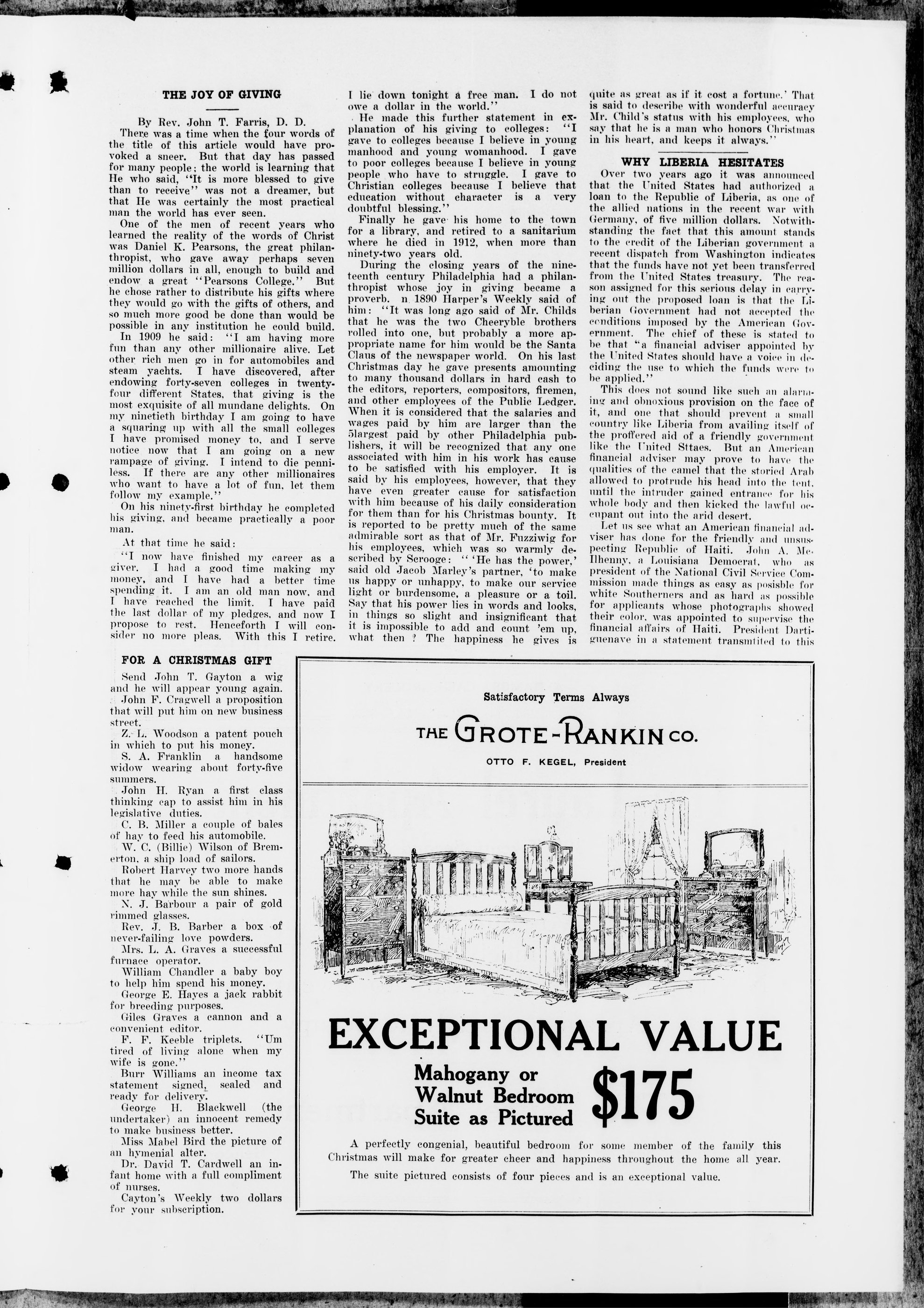
EXCEPTIONAL VALUE Mahogany or Walnut Bedroom Suite as Pictured $175
```markdown
```
Ot itis ke i iin set seen ne i ie ara anita ntti en nen eh Ow UTie Ai Tea TTC eee Oe Tne
The Laurel Apartments
303 Twenty-Second South
Twenty-five two and three room apartments,
steam heated and nicely furnished. Take No. 9,
No. 11 or Yesler Way cars to Twenty-Second
Apartments ready to occupy
The Laurel Apartments
| 303 Twenty-Second South Beacon 1910
country by the Associated Press, referred
to this official foisted upon him by the
Washington administration, in the following
terms:
“In reality, the financial adviser does not
report to the Haitian Government; it is the
Haitian Government that he pretends to
submit to his sovereign will. The facts are
numerous which show, the omnipotence
which the financial adviser attributes to
himself.
‘Nothing can give a more striking idea of
this omnipotence than the confiscation by
the financial adviser, aided by the American
Minister, of the salaries of the President
of the Republic, the Seeretaries of State.
members of the Legislative Council, because
the Government refused to insert in’ the
contract of the National Bank of Haiti, an
establishment controlled by the National
City Bank of New York, a clause prohibit-
ing the importation into Taiti of foreign
gold, which the adviser wished to impose.
This (adviser) equally prevented a vote of
the budget contrary to the voice of the
Haitian Constitution.”
And this constitution so absolutely ig-
nored by the American financial adviser,
was the pet brain product of the Hon.
Franklin D. Roosevelt, while assistant See-
retary of the Navy, which he referred to
with pride while running for the Vice Presi-
deney,
One of the charges made by the Haitian
President was that a single ‘‘operation’’,
hy the financial adviser had cost the people
of Haiti the loss of several million franes.
In effect, concluded in the unhappy Presi-
dent, after a recital of the arbitrary acts
and omissions of this ill-chosen official, the
Haitian Government was completely ‘‘at
the merey of the caprices and absolute ar-
hitrariness of the financial adviser.’’
Can it be wondered that Liberia has hesi-
tated to avail itself of the loan of five mil-
lion dollars when a ‘‘financial adviser’?
must be tagged onto it, whose eapacity for
mischief might only be equalled by his
megalomania? And unfortunately this is
the brand of financial advisers that the
present administration might be expected
to select for export—N. Y. Age.
A MATTER OF STATE POLICY
One of the weaknesses of the adminis
tration of government for New York State
has been the failure of the various State
officials, whether they happened to be Re
publicans or Democrats, to give proper rep.
resentation in their appointments to the
Negro voters of the State. Little or no
consideration to this matter has been given
by past administrations and the representa-
tion accorded the Negro voters in state af-
fairs has been so scant, as to almost justify
the ery of taxation without representation.
With the coming into power of a new
FIRST CLASS COAL and
FIRST CLASS SERVICE
Pacific Coast Coal Company
Main 5080
BURR WILLIAMS SAM HARDIN, Mgr. OSCAR COLLINS
MAINEVENT POOL HALL
1212 JACKSON STREET
Beacon 2956
CIGARS, SOFT DRINKS, TOBACCOS
Cafe in Connection
Seattle Baking Company
Latest Sanitary and Up-to-Date Baking
Appliance
Ask Your Dealer For Our Goods
RICHMOND EXPRESS CO.
WOOD AND COAL DELIVERED
Express, Baggage to Any Part of the City.
310 Twelfth Ave. South Beacon 178
FLOYD WRIGHT, Mgr.
ALHAMBRA CASH GROCERY
Distributor of Mme. C. J. Walker's Hair and Skin
preparations. Mail, postal and express orders
promptly filled. 1201-8 Jackson St, Seattle, Wash,
a
state administration next year, there will
be an opportunity to bring about a new de-
parture in the matter of giving proper rec-
ognition to this element of the Republican
voting strength. The leaders of both races
should cooperate in strengthening the vote
by according suitable recognition to the
various groups that go to conpend to be
Republicans or Democrats, is an essential
feature of popular government and the or-
ganization must be maintained as a cohes-
ive foree by the welding together of the
many elements that go to make up its vot-
ing strength.
Continued denial or neglect of proper
recognition to any particular group will
prove a cause of discord in the harmony of
the party, which will be apt ot be reflected
in the falling off of the vote. Just recog-
nition and a square deal in official appoint-
ments are as essential to party concord and
successful administration, as any other de-
tail of governmental policy.
The incoming state administration should
avoid the mistakes of the past by giving
proper attention to these details of party
policy. Votes are made and lost by the
manner in which these questions are handl-
ed. A proper recognition of the various ele-
ments of party strength in the filling of the
offices, with due regard to character and
capability, would be just as well as politic.
—N. Y. Age.
>
Cayton’s Weekly
READABLE
RELIABLE
REPUBLICAN
Will Help You If You Will Help It