Seattle Republican
Friday, December 30, 1910
Seattle, Washington
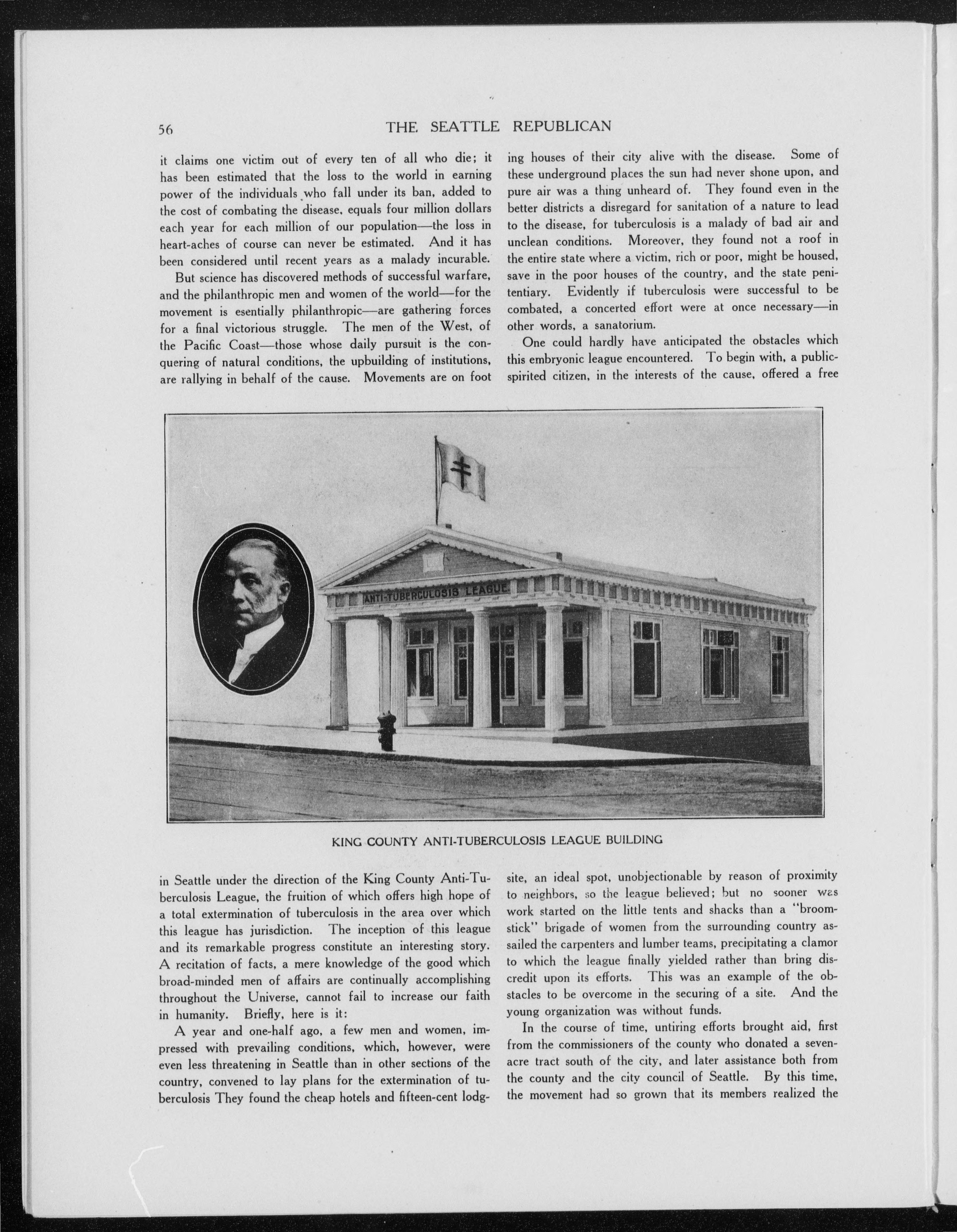
Page text (machine-generated)
UNIVERSITY OF WASHINGTON
APR 29 1952
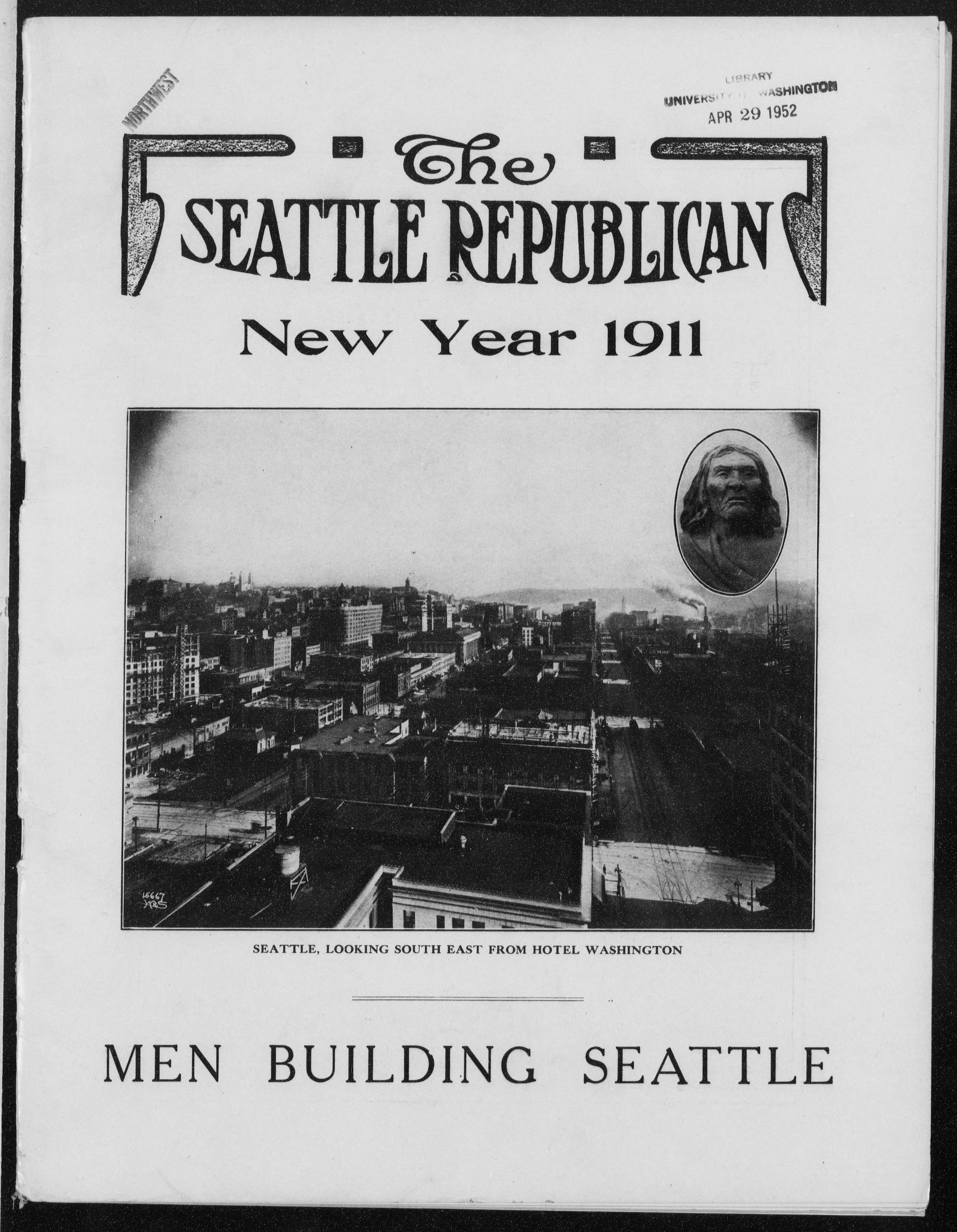
The SEATTLE REPUBLICAN New Year 1911
15667
XQ5
SEATTLE, LOOKING SOUTH EAST FROM HOTEL WASHINGTON
MEN BUILDING SEATTLE
THE SEATTLE REPUBLICAN
and every one of them fully merits the honor. The business men of not only Seattle, but of most towns and cities of the country, have been solicited to have their names recorded in a book issued by some industrious publisher in the East, at so much per, which is entitled "Who Is Who?" but it is, however, a fact that only recognized business men are thus solicited, and though they pay for the publicity, nevertheless it is a recognition on the part of the publisher that the man is deserving of mention and the public, after reading of him, is generally of a like opinion. Competition, since the mind of man runneth not to the contrary, has been recognized as the life of trade, and all because the different industries are compared by their patrons and thereby all are given widespread advertising. In this AGE OF JOURNALISM, publicity is the life of trade, and printer's ink comes nearer doing that than anything else. If, therefore, the business men of a city desire to build it up rapidly, they must first of all contribute their part to the publicity bureau. Of those who have participated in this publication, the difficult task with the compiler has been, which should take precedence over the other; in other words, which should come first and which come last? Without consulting any one of them as to his version of which is which, we have arranged them from our own viewpoint, and the same is herewith submitted.
To undertake to point out who is who in Seattle from a commercial, financial or social standpoint would be engaging in a most difficult undertaking, and however honest he or she might be who attempted such a task, many highly deserving persons would be completely overlooked, and less meritorious ones lauded to the skies. Lest the writer hereof becomes involved in just such a complication no attempt will be made to delve into the general question of, Who Is Who in Seattle, but the names of a number of the leading business men have been selected and the portraits of the same made a part of this issue, and it will be the object of this article to point out, why they have been selected as some of the foremost operators in the building of Greater Seattle. Some one has well said, "It takes all kinds of persons to make a world," and it is a fact that it requires all kinds of business men to build and constitute a great city, and for that reason. the Seattle Builders, so far as this magazine is concerned, are selected from various viewpoints. In glancing over the names and portraits of some herein, the question will be asked, "What has he done toward building Seattle? What magnificent edifice or structure has he caused to be erected?" And, may perhaps, the answer will be, "none," but he may have done something equally as essential to the growth of the city as the man who has built a sky-scraper.
"I suppose your idea as to the men who are building Seattle, are those that 'come through' in this magazine," synically commented one who had been solicited to patronize this publication. Yes and no can both consistently be the answer to the question. The real energetic and farseeing Seattle builder never loses an opportunity to go into any meritorious proposition that is being published with the view of helping the city to grow, and in doing so he not only helps the city and the publisher that is always whooping it up for the town, but such men always seem to get more out of the prosperity that comes to the community than the fellow who is always "hollering wolf" or walking on the sady side of the street, lest his shadow ask him for a treat. On the other hand, hundreds, and perhaps thousands of men, who are working just as hard as any mentioned herein, for the upbuilding of the city, would under no circumstances permit their faces to appear in a publication; not at all on account of the price, but on account of their natural reticence; and ye,t when the same has been issued and is creditable, they contribute as much, and oftentimes a great deal more, toward its circulation than the others. Large numbers of men "come through," whose names seldom, if ever, appear in print, and without the knowledge of the general public those men move mountains, so to speak, toward pushing the city to fame and fortune. While there may be a grain of selfishness in this selection of Who Is Who in Seattle, yet when it shall have been pointed out the reasons for naming them it is believed that the general public will be thoroughly satisfied that each
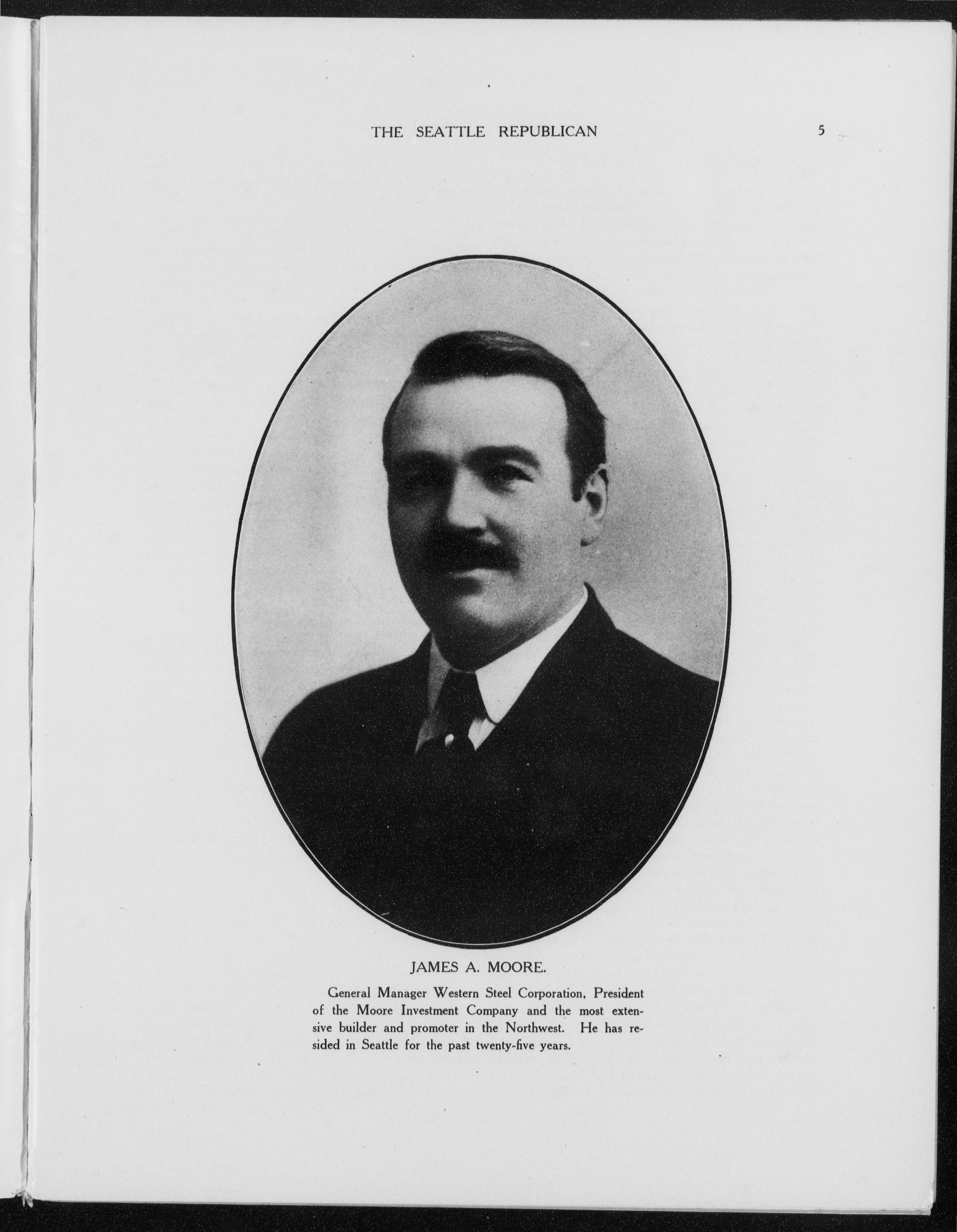
In starting out with the name of James A. Moore, the well-known Seattle promoter and builder, no one will deny but that he has brought more capital to the city, which has been invested in permanent buildings, than any other known person. His undertakings have simply been gigantic, and yet they have all been carried through without a hitch. Magnificent buildings have been erected at his suggestion and the crowning climax of them all is the Washington Hotel building. If Mr. Moore has been instrumental in inducing a dollar to be invested in Seattle he has been instrumental in the investment of multiplied millions. Irondale, though not strictly a Seattle industry, yet it will be a strong Seattle feeder. The name of James A. Moore will go down in history as the greatest promoter and builder of them all.
Jacob Furth doubtless comes next, and it is a question, if he does not really come first. The deeds of Moore and Furth seem so evenly balanced that it perhaps would have been well to have placed them side by side, or run half of the magazines off with one name first and the other half with the other first. If. Mr. Furth's backers had not put up the money for Seattle's magnificent street car system some one else would, declared one in discussing Mr. Furth in connection with the Seattle Electric Company, which perhaps is quite true, but it is very doubtful if one capitalist in a thousand would have put as much money, and as
6
WHO IS WHO IN SEATTLE?
JAMES A. MOORE.
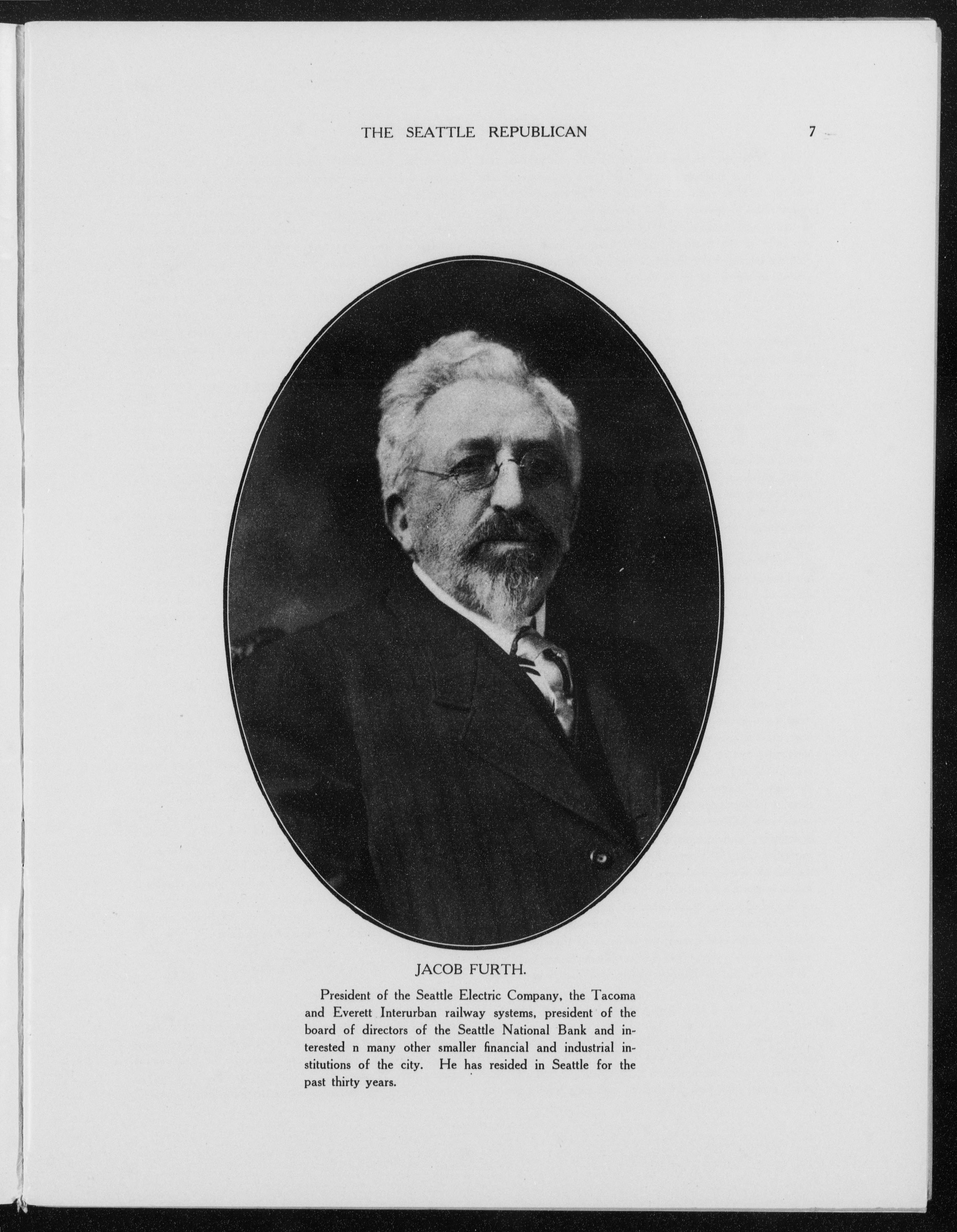
JACOB FURTH.
THE SEATTLE REPUBLICAN
[Portrait of a man with white hair and a beard, wearing a suit and a tie. The background is a plain, light color.]
[The portrait is oval-shaped with a thin border. The man's face is centered, and he is looking directly at the camera. His hair is white, and he has a full beard. He is wearing a suit with a white shirt and a dark tie. The background is a light color, and there are no other objects or details visible.]
JACOB FURTH. President of the Seattle Electric Company, the Tacoma and Everett Interurban railway systems, president of the board of directors of the Seattle National Bank and interested n many other smaller financial and industrial institutions of the city. He has resided in Seattle for the past thirty years.
THE SEATTLE REPUBLICAN
readily, in the city as has those Mr. Furth represented, and they did so at his suggestion. His company's investments will run into the millions of dollars. The extension of the various lines to sparsely settled districts has caused the town to grow and prosper most phenominally. For years he has been at the head of the largest and most influential banking house of the Puget Sound country and it brought almost as much fame to Seattle as his street car connections.
concern has few, if any, equals hereabouts and as business manager and business director he gives Seattle the advantage of the business with which he is connected. The company owns a great many business blocks in Seattle and owns the Puget Sound Tug Boat Company, which runs a line of steamers up and down the Sound, thereby affording another avenue for bringing wealth to the city. It is said of Mr. Ames that he is always willing and ready to do anything that looks like it will give the Queen City a boost. Despite the fact he is at the head of one of the largest business institutions in the Northwest, he is always affable, pleasant and approachable by any one having business with him.
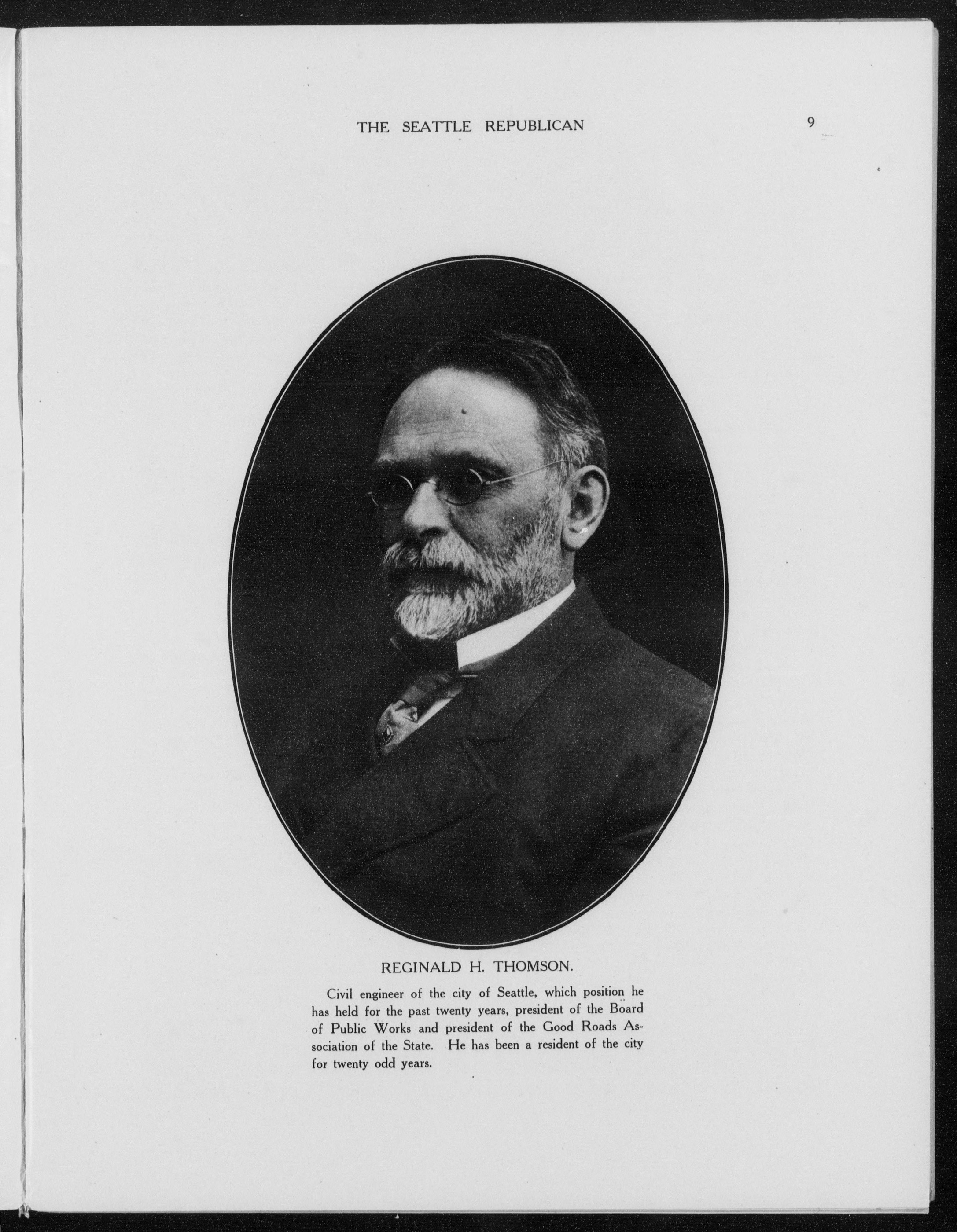
Money is not the only essential in building anything and especially a great city. The man with a constructive mind must be there with the goods or "the best laid plans o' mice and men gang aft a glea," and for that reason, the name of Reginald H. Thomson, city engineer of Seattle, is to be found in this, Who Is Who in Seattle selection. Those of us who have had business with Mr. Thomson, even when we do not agree with his views, recognize in him one of the ablest minds in the whole country. His work in shaping and beautifying Seattle into a city beautiful, while it grows in a night, comparatively speaking, shows for itself that no man is more responsible for the magnificent city Seattle already is than he. If Seattle lives to be a thousand years old the handy work of R. H. Thomson will be seen from the Duwamish to Green Lake and from Eliott Bay to the shores of Lake Washington. Others have furnished the money to build Seattle, but, from an engineering standpoint, there is no denying that Reginald H. Thomson has furnished the brains.
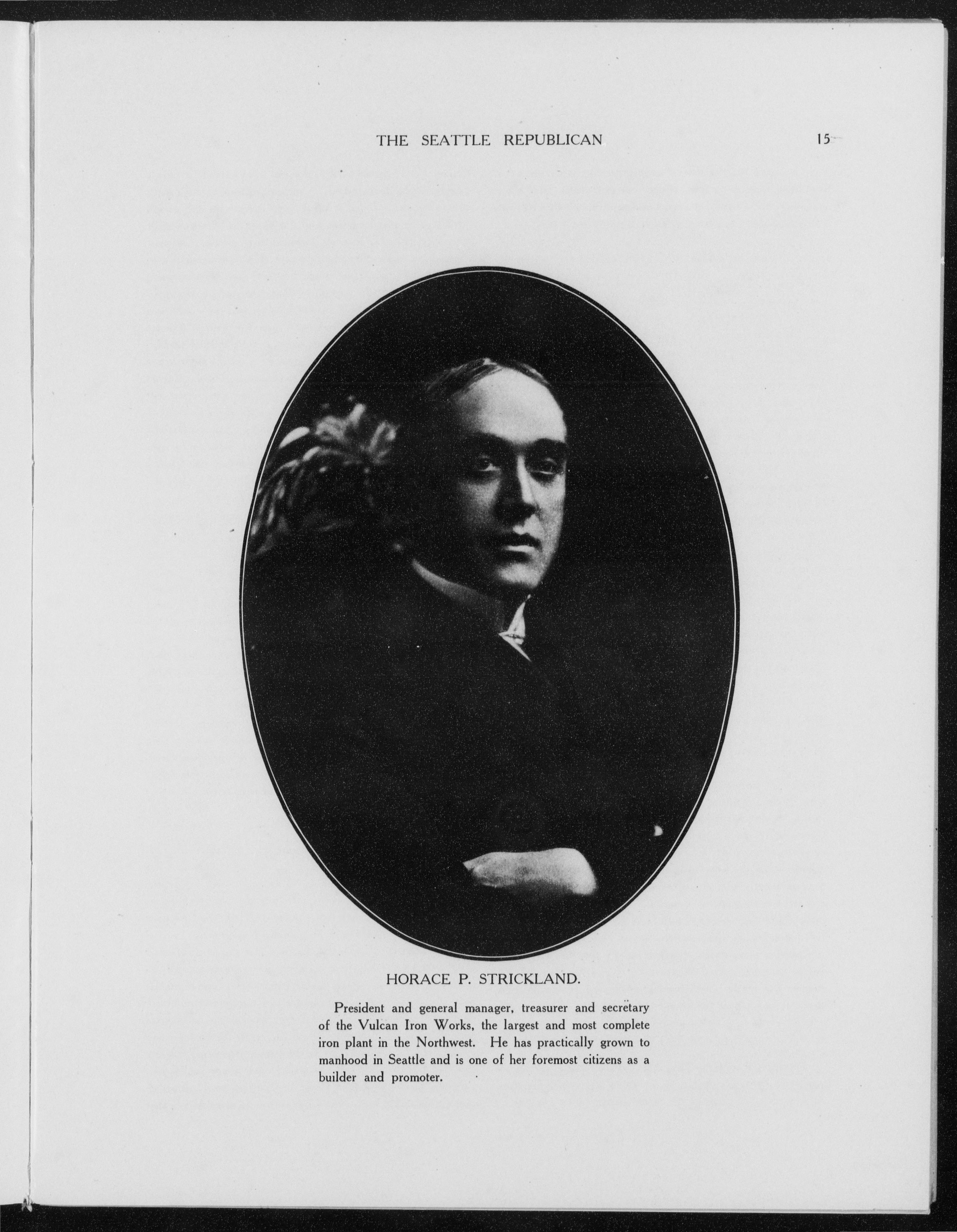
H. P. Strickland, the sole proprietor of the Vulcan Iron Works, the largest iron manufacturing concern in and about Seattle, necessarily ranks high among those classed as Who Is Who in Seattle. Slowly, but surely, has he gone on, year in and year out, building up a manufacturing plant until he has now one of the most complete ones in the Northwest and gives employment to as many, if not more men, than any concern in the city. The ocean-going crafts, the Sound steamers and the railroads take the products of his plant to the utmost ends of the earth and Seattle is thereby advertised throughout Christendom and even in heathen lands. He has not only brought capital to the city, but he is making her the inviting home of the wage-earner. If Seattle has one captain of industry, it is H. P. Strickland, which entitles him to the position he has been given herein.
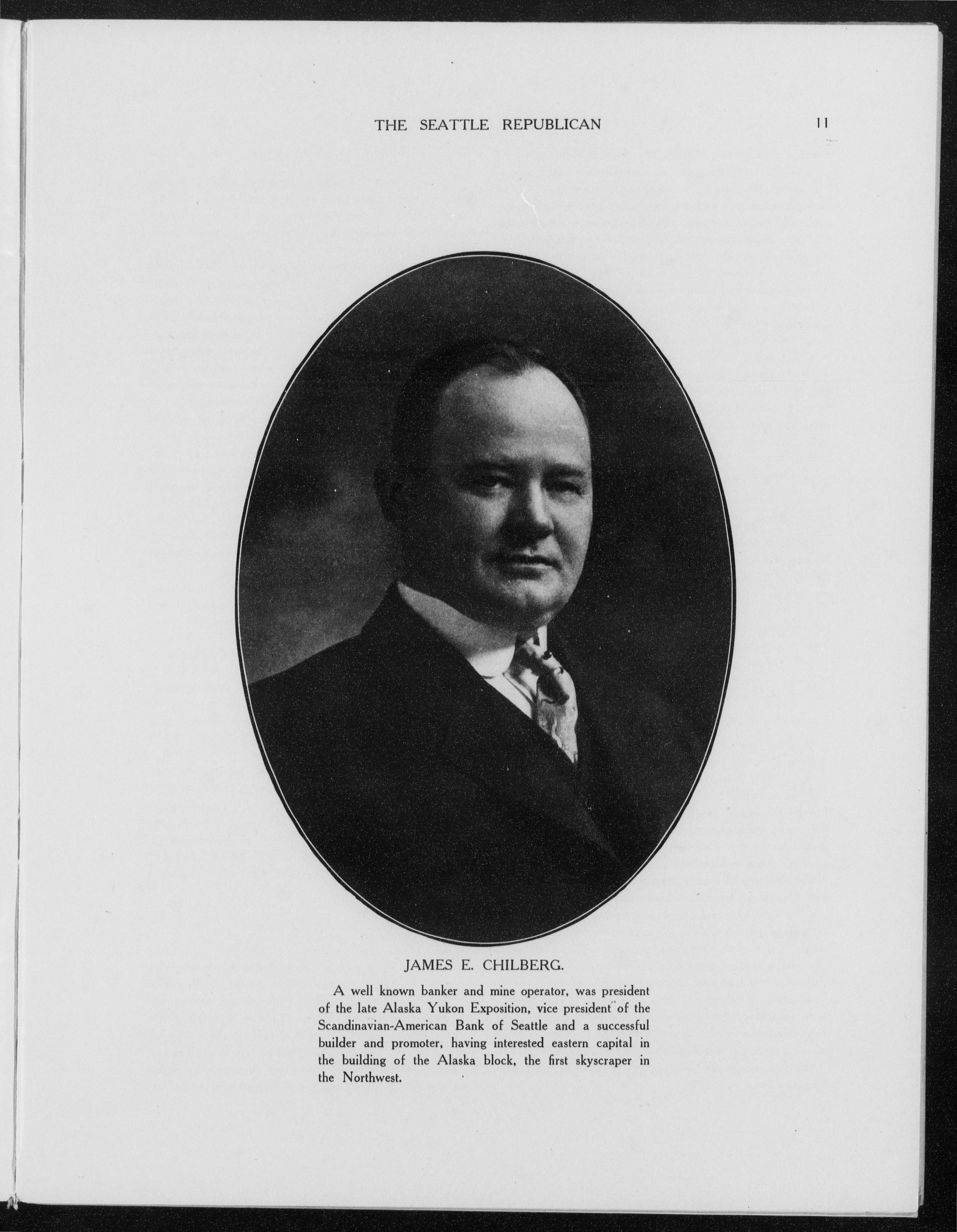
It is safe to say that Seattle has few citizens that have contributed more to her future greatness than J. E. Chilberg, who is connected with a great many of the industrial enterprises that are giving to the community not only splendid business blocks, but a bucket brigade, which, after all, is the most lucrative income a city has to rely upon. His Alaska mining and banking connections alone bring thousands and millions of dollars each year to Seattle. His financiering and successful management of the A.-Y.-P. exposition of 1909 gives him a marked standing among the list of Seattle Builders. His association with big capitalists in the East has given Seattle such magnificent blocks as the Alaska, the Washington, as well as lesser ones. As vice-president of the Scandinavian-American bank entitles him to a high seat among the builders of the city and so, on the whole, no mistake has been made in not only mentioning him, but in likewise giving him a prominent place in this number.
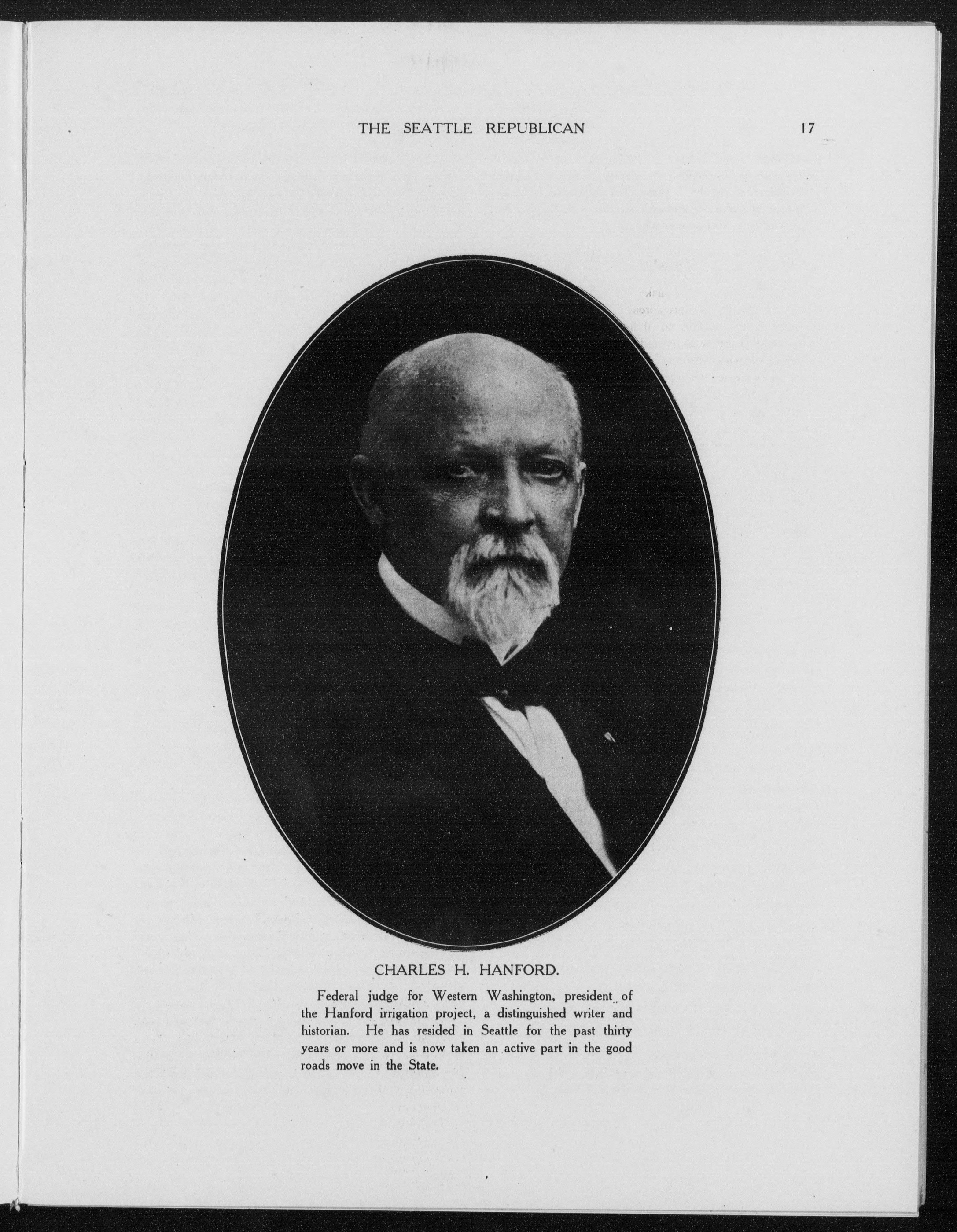
Few persons, if any, have done more in his own quiet way to emblazen the name of Seattle on the pages of the history of her country than Judge Charles H. Hanford, who for the past twenty odd years has been United States district judge for the state of Washington. While he has in no wise prostituted his dignified position to give Seattle any advantage over other cities, yet he has gone on from time to time doing things that would redound to Seattle's financial and commercial development. In speaking of those who are building Seattle, Samuel Hill, the good roads advocate, was heard to say: "I consider Judge Hanford, R. H. Thomson, E. C. Cheasty, E. S. Meaney, the historian, and Ed. S. Curtiss, the well-known Indian photographer, as the leaders of the Seattle Builders." The right of Judge Hanford to a place in a publication of this nature is not questioned by any true Seattleite.
In building a city no institution therein plays a more conspicuous part than her commercial bodies. The Chamber of Commerce, made up of many of the most active business men, has for years took the lead in fostering the commercial enterprises, and among her long list of energetic
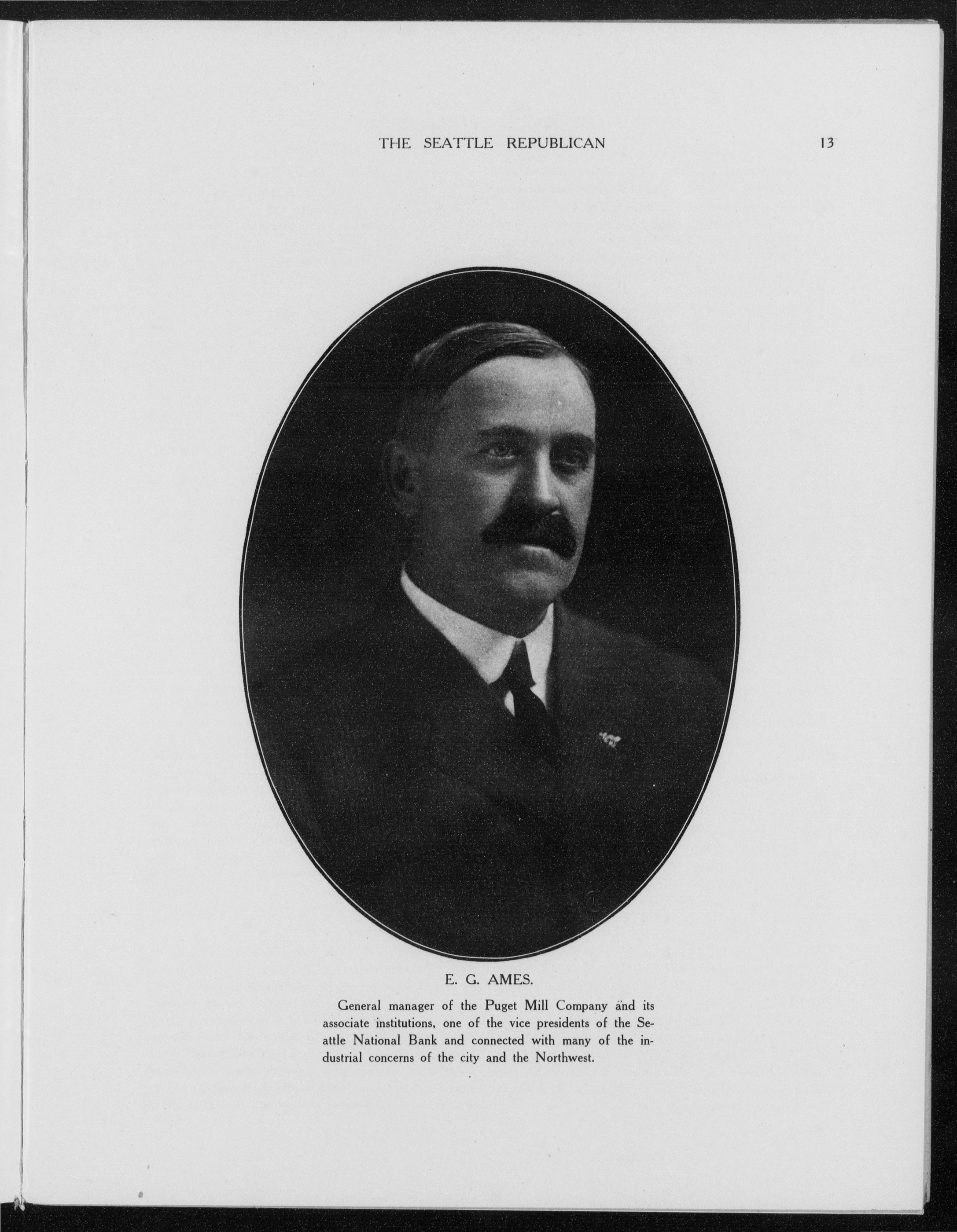
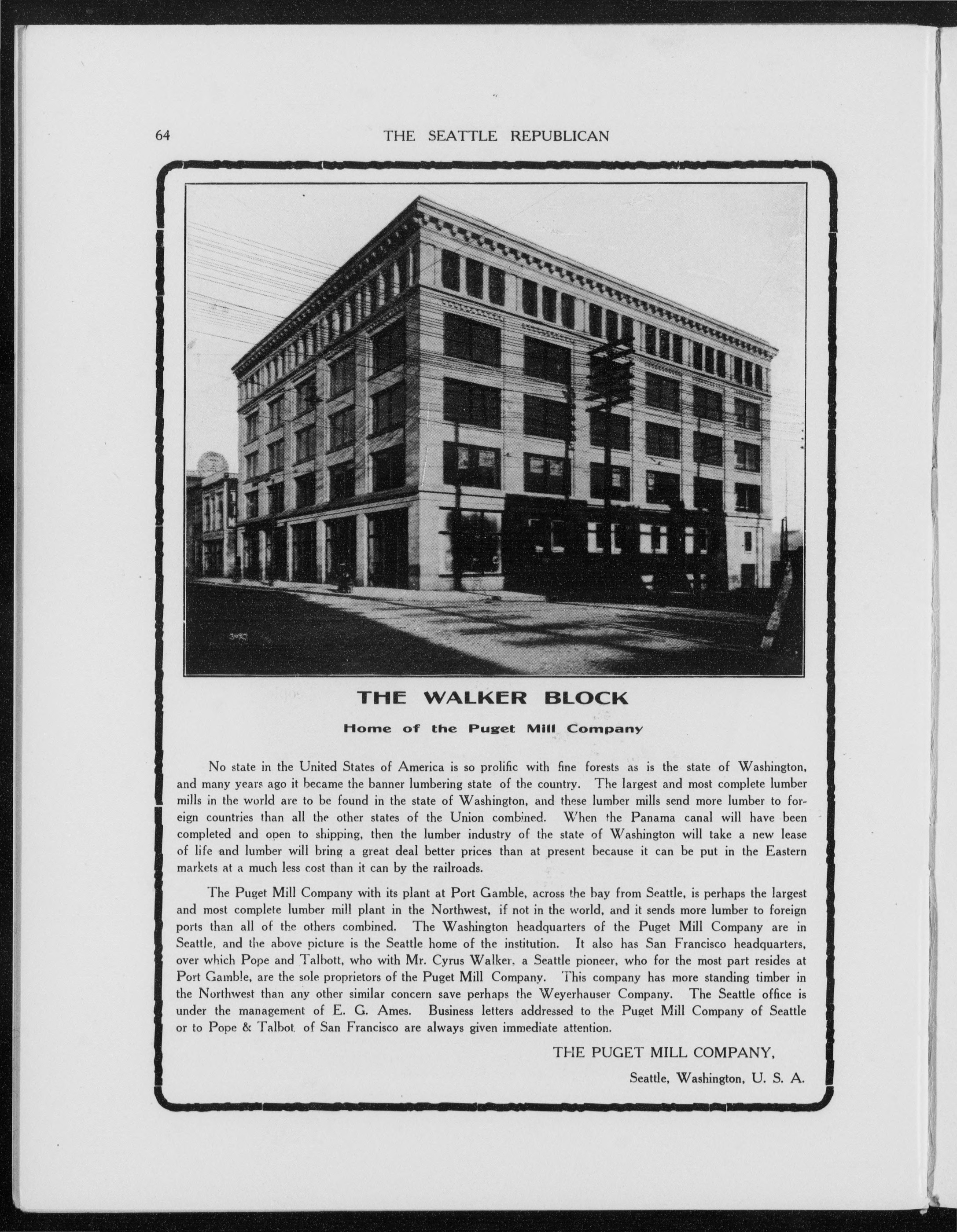
No man in all Seattle has larger business connections than E. G. Ames, who is at the head of the Puget Mill Company, with headquarters in Seattle, but with the mill plant across the bay. From a producing standpoint his
8
REGINALD H. THOMSON
JAMES E. CHILBERG
F. G. AMES.
HORACE P. STRICKLAND
CHARLES H. HANFORD
JAMES D. LOWMAN.
THE SEATTLE REPUBLICAN
[Image of a man with a white beard and glasses, wearing a dark suit with a white shirt and a dark tie. The background is a solid black oval frame.]]
REGINALD H. THOMSON. Civil engineer of the city of Seattle, which position he has held for the past twenty years, president of the Board of Public Works and president of the Good Roads Association of the State. He has been a resident of the city for twenty odd years.
THE SEATTLE REPUBLICAN
always ready and willing to do his part in every undertaking, which has for its object, the forging ahead of Seattle. In the East the appearance of Dr. Mathews brings Seattle forcibly to the minds of all present.
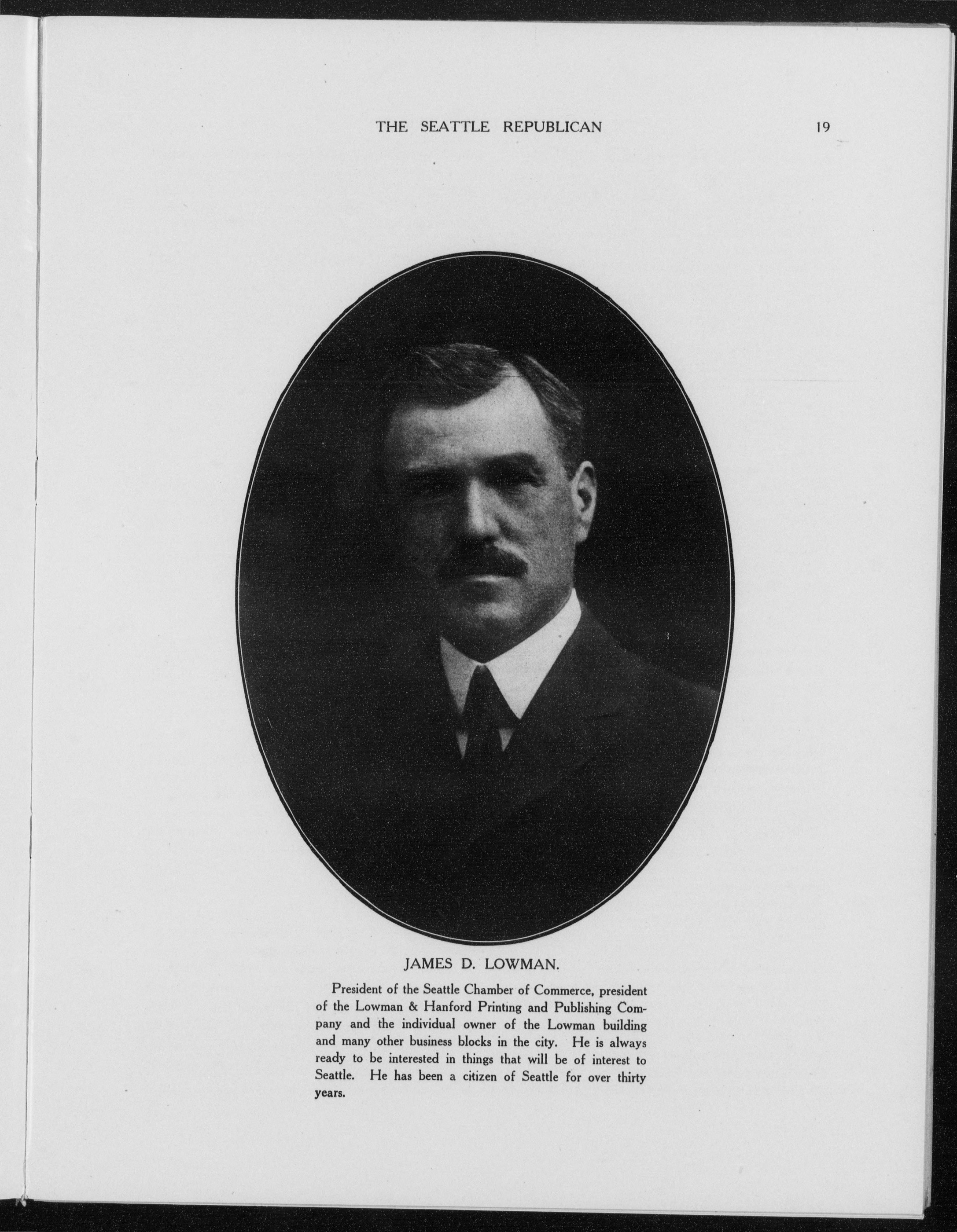
presidents none has left a more brilliant record than will James D. Lowman, when he will have retired from its presidency. Mr. Lowman came to Seattle soon after he had reached his majority and he at once identified himself with those things that would make her famous throughout the length and breadth of the universe. Nor did he sit idly by while others worked, but he rolled up his sleeves and did his part. Fortune favored his investments and in after years he was able therefrom to show his continued abiding faith in the city of his adoption by building skyscrapers as living monuments to his thrift and good judgment. No man is more deserving of a high seat among the builders of Seattle than he, and his good work will live on when he is no more.
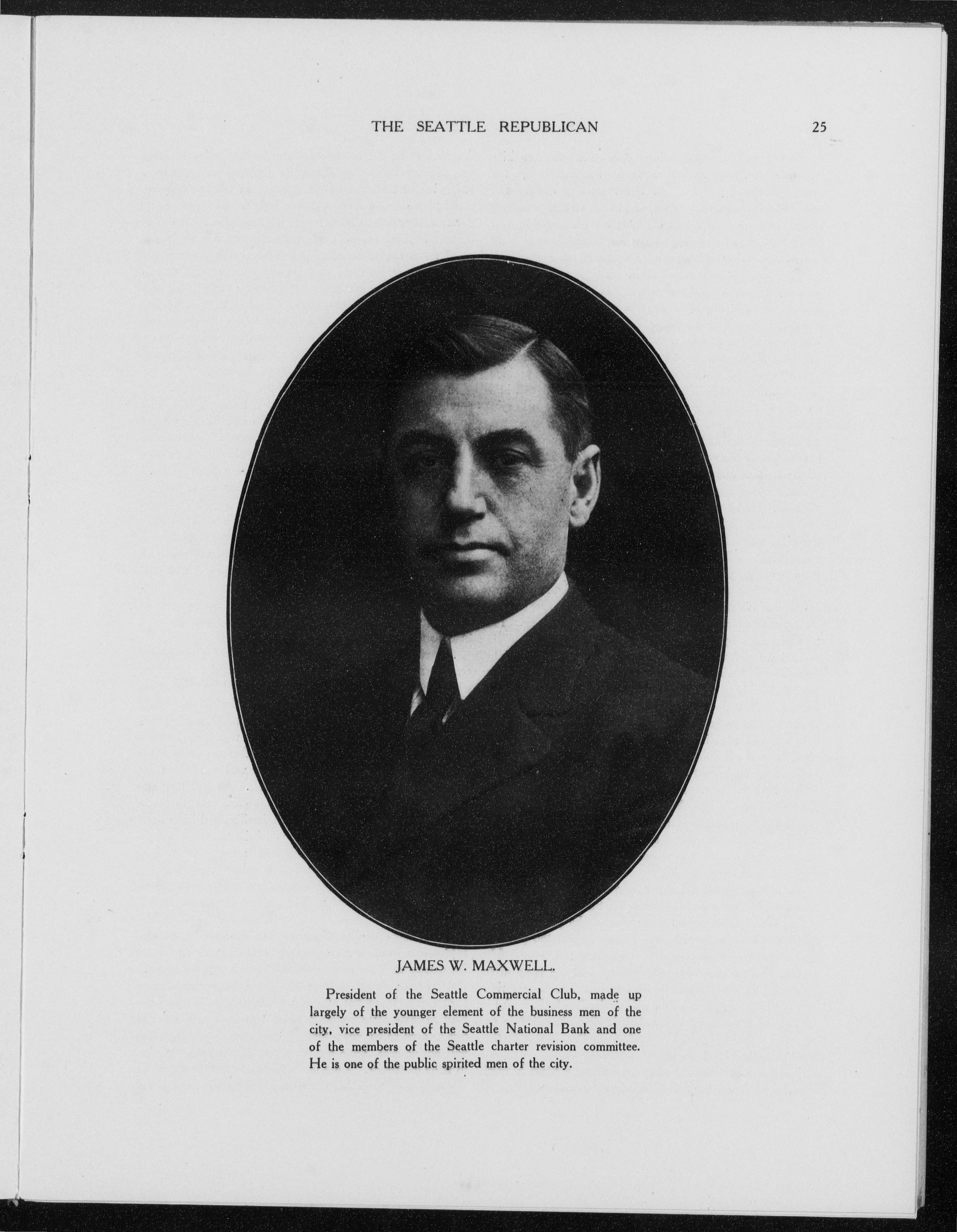
With due respect to the older heads, who direct the destinies of the Seattle Chamber of Commerce, yet the Seattle Commercial Club is made up, for the most part, of the active young business men of the city, who some four years ago organized it, not so much as a rival body to the Chamber of Commerce, but as a body to enable them to do things along the lines that young men like and favor. The second president of that club is J. W. Maxwell, one of the most energetic and successful business men of the Queen City. From the very day he was elected he got busy and has kept the mill grinding ever since. If he had no other requisite, this alone would entitle him to a high place on the seat of Who Is Who in Seattle. He is one of the important officers of the Seattle National Bank and is taking an active part on the charter revision committee of Seattle. No young business man in the city has brighter prospects than he, and posterity is bound to know that James W. Maxwell lived and played an active part in the affairs of Greater Seattle.
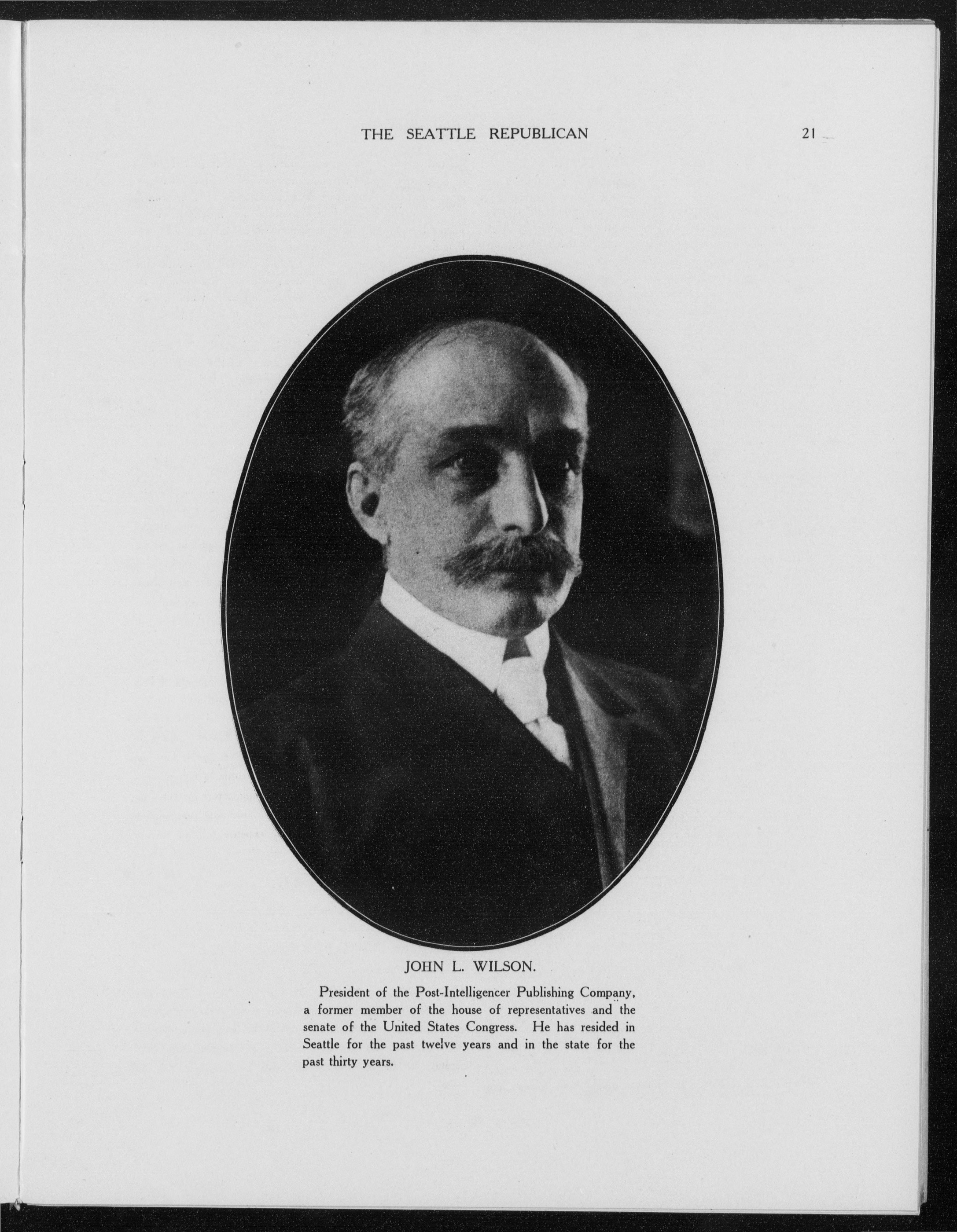
When the publisher of a metropolitan daily paper greets each day multiplied thousands of readers, the most of whom receive everything published therein as law and gospel, you will agree that the owner and publisher of such a paper is a power in the community, and if that power is used for the good thereof, such owner is one of the most potent factors in the building of a city. The Hon. John L. Wilson occupies just such a position in Seattle, and being the chief stockholder of the Post-Intelligencer, and taking an active part in its daily management, he is a Seattle Builder of the real royal type. He, perhaps, is no more so than the publishers of similar daily newspapers, but having spent ten years of his life as a member of the Congress of the United States, he is able to aid the city in her growth by personal influence as well as by newspaper publicity, and he verily does it. It might not be out of place in this connection to say he was instrumental in having Congress pass larger appropriations for Seattle and institutions in which Seattle was and is vitally interested, than any other member of Congress from the state of Washington.
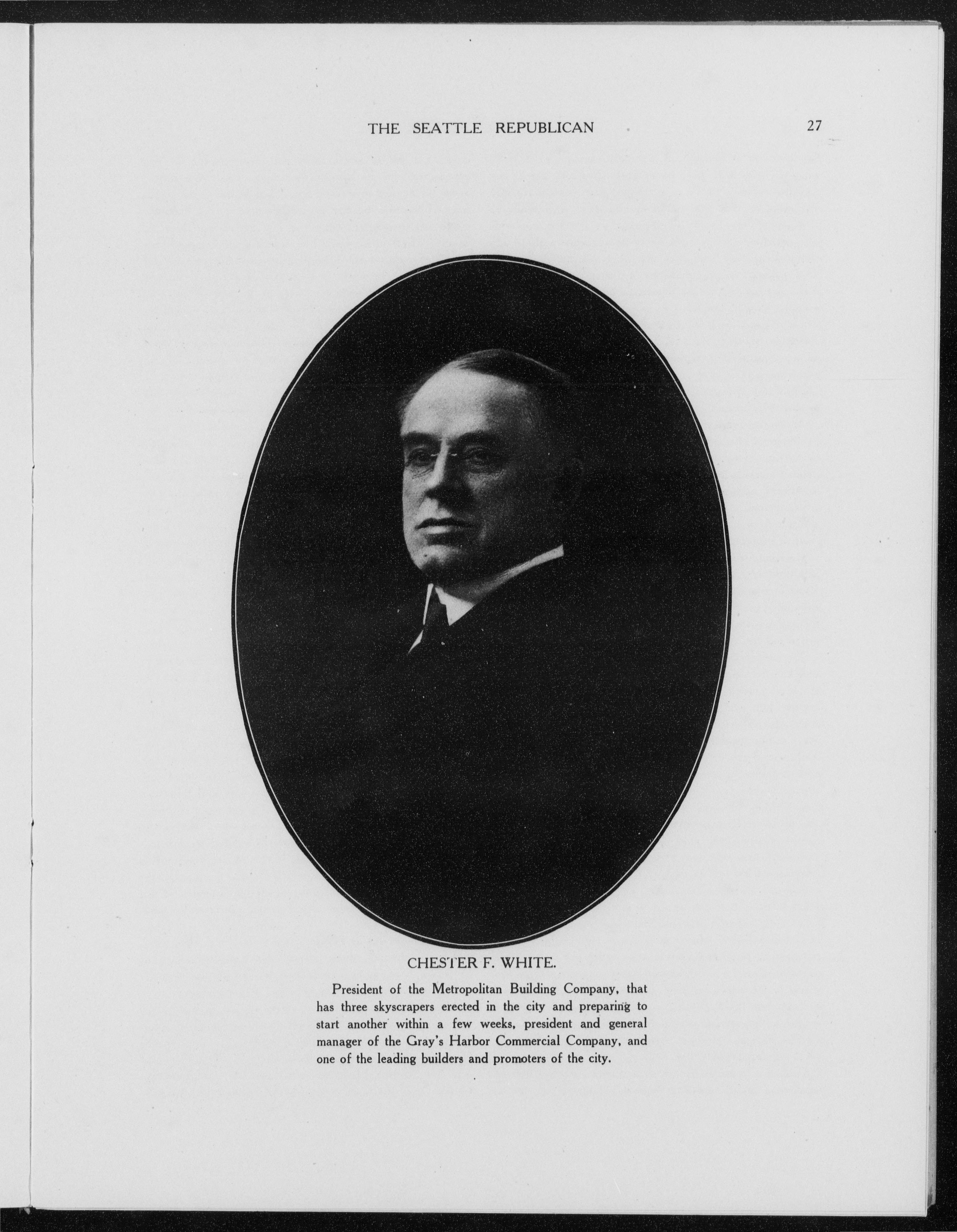
If there be a single man in all Seattle that is a business drawing card that man is C. F. White, the business head of the Grays Harbor Lumber Company, and one of the foremost spirits in the Metropolitan Building Company, that has already caused to be erected three sky-scraper buildings and making plans for the early erection of others. The different enterprises in which he is personally interested has perhaps given to Seattle more taxable property than the connections of any other promoter doing business herein. While the pulpit the press and similar institutions of advanced civilization, all play their parts in the building of a great city, yet after all the man with the money is always the most important factor. In centering the various enterprises with which he is connected in Seattle, he has endeared himself to the financial interests of the city and he is counted as one of the few men to whom the commercial spirit of the city is personally indebted.
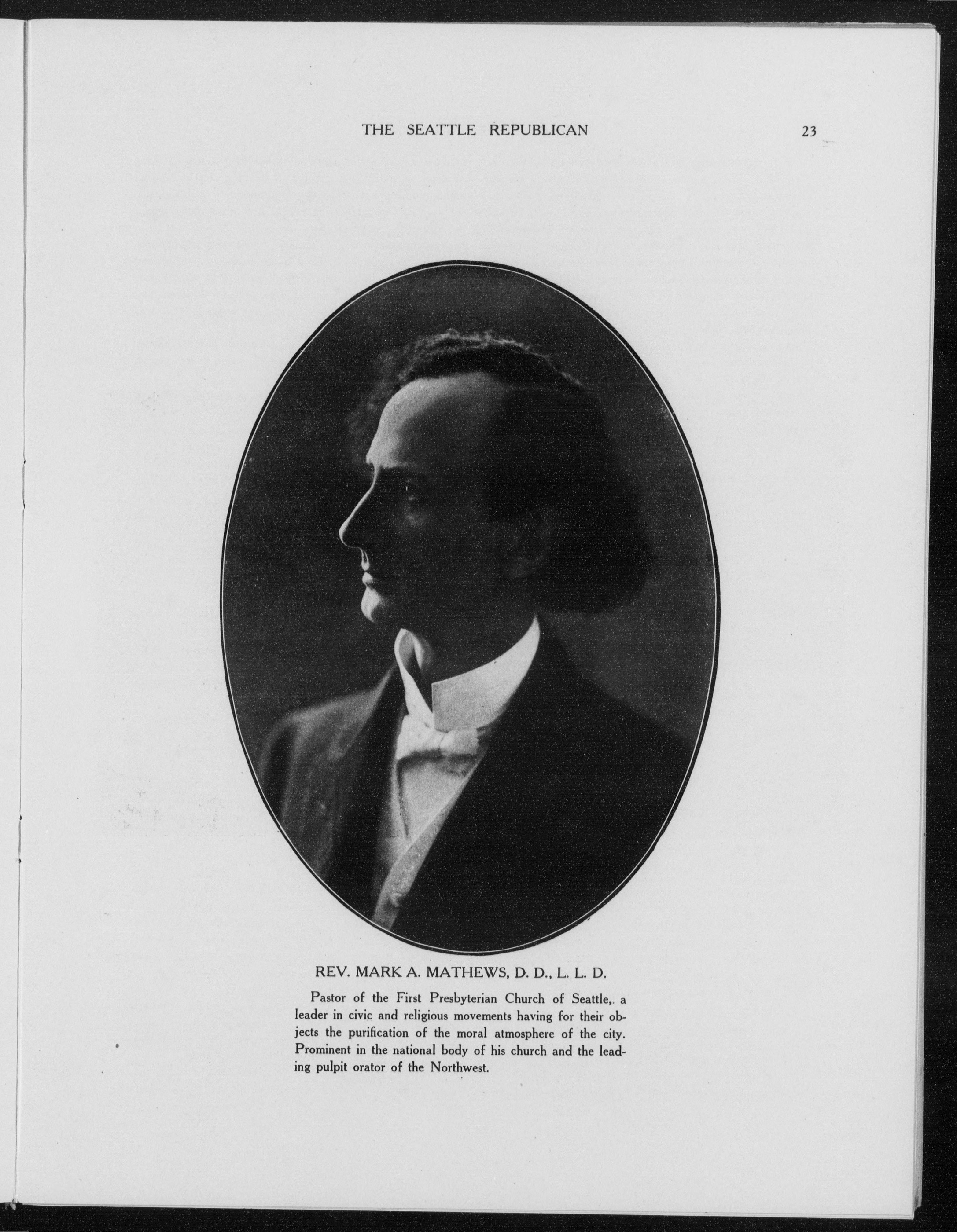
REV. MARK A. MATHEWS. D.D., L.L.D.
Preachers seldom if ever become very deeply engrossed in the commercial or financial enterprises of the city in which they hold pastorates, and Dr. Mark A. Matthews being no exception to the rule, has not departed very far from that straight and narrow path, so far as the public records of the county reveal, but it takes more than banks and books to build a city. Every city must have publicity and he or she who can and will give it that, is largely instrumental in the building thereof. While Dr. Mathews has not built any sky-scrapers nor founded any manufacturing plants, yet he has built or took the leading part in perfecting the plans for the building of one of the most handsome and extensive Protestant church edifices in the Northwest. He heads the largest congregation of any pastor in Seattle. He is very prominent in the general Presbyterian synod, which has given the city a great deal of of outside publicity. As a public spirited man he has few equals and is
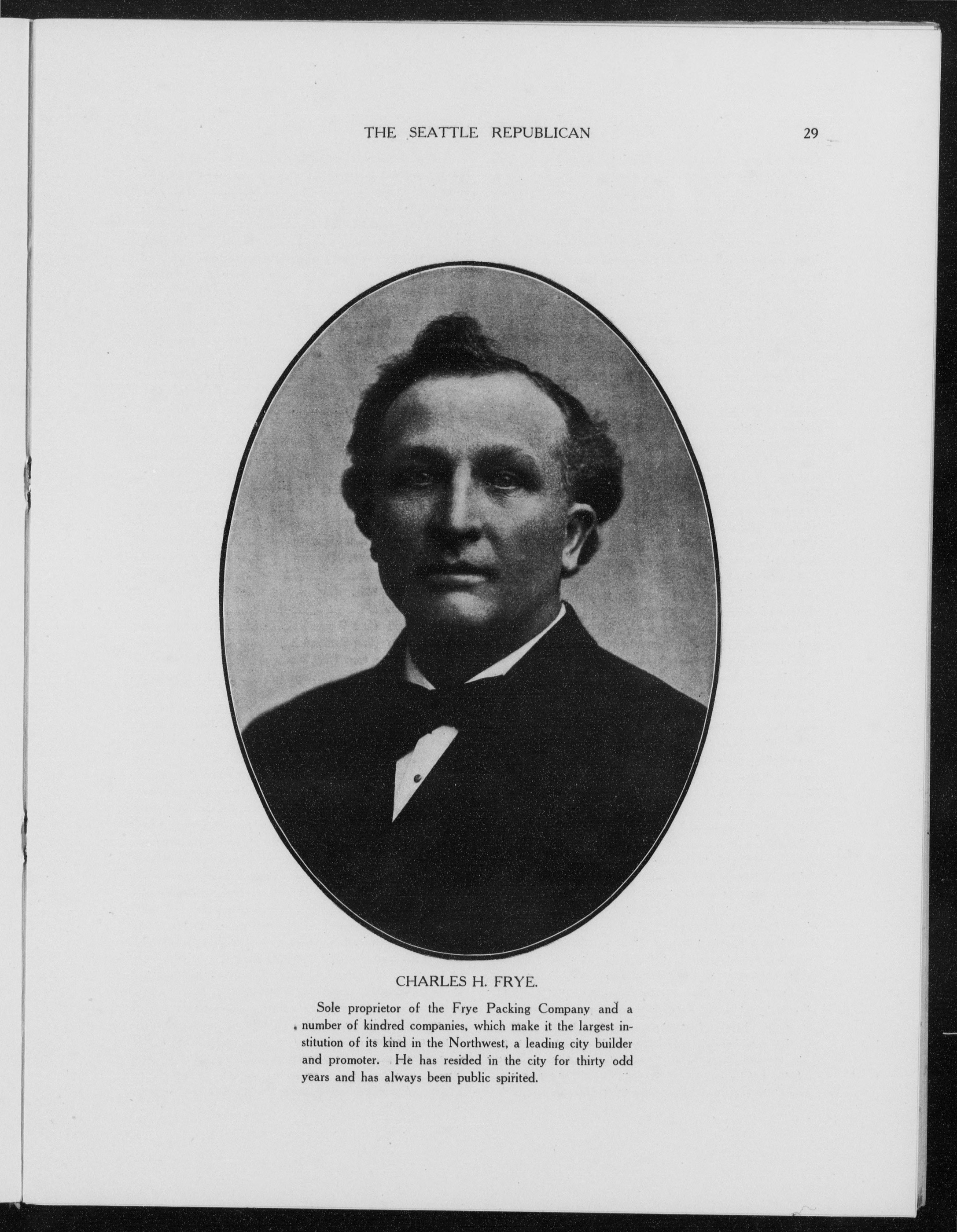
For the past three years or more nothing produced in a community could give it the publicity as that of the products of the packing house, and charles H. Frye being at the head of the largest packing house concern in the Northwest, it was perfectly natural for him to develop into one of the most important personages about the city of Seattle. The Northwest, British Columbia, Alaska, the Hawaiian Islands and the Orient are all familiar and personally ac-
10
JOHN L. WILSON.
JAMES W. MAXWELL
CHESTER F. WHITE.
CHARLES H. FRYE
11
THE SEATTLE REPUBLICAN
W. H.
A well known banker and mine operator, was president of the late Alaska Yukon Exposition, vice president of the Scandinavian-American Bank of Seattle and a successful builder and promoter, having interested eastern capital in the building of the Alaska block, the first skyscraper in the Northwest.
12
quainted with Seattle through her packing house product, of which Mr. Frye is the sole proprietor. Talk about your infant industries in Seattle, but the Frye-Bruhn Company leads them all and has been the avenue through which more gold has been poured into the coffers of Seattle than any other manufacturing concern and its captain need not take a back seat for even a James A. Moore or a Jacob Furth as a money-getter for Seattle. Mr. Frye is one of the progressive men of the country, and as to the builders of Seattle, no man is more deserving of a high seat among the number than he
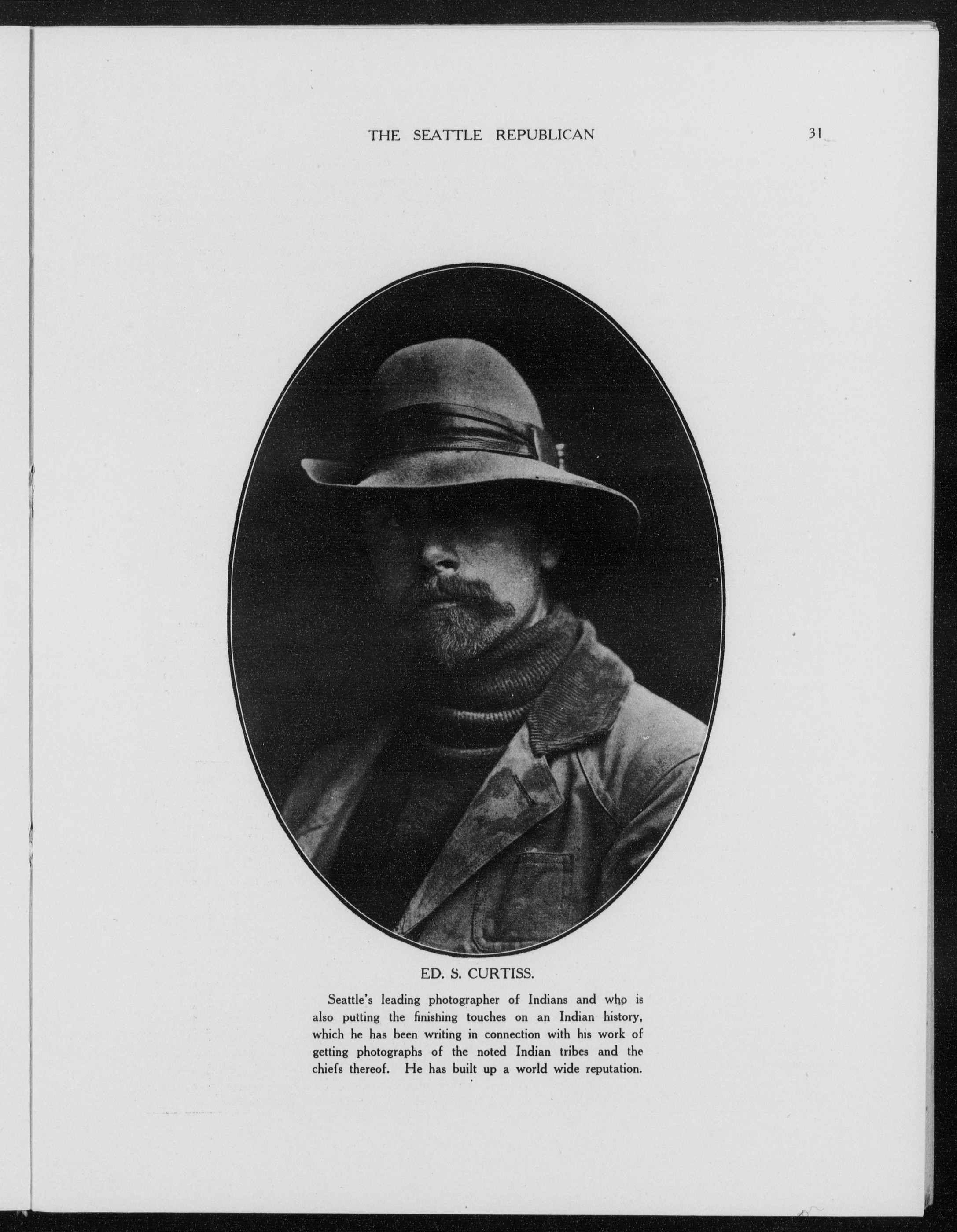
F.D. S. CURTISS.
uel! Hill declared in a public was one of the foremost most rubtless meant that Mr. Curtiss be attracting more attention to big people than even those doing of business annually within the has raved over Curtiss's Indian collection in his studios which day, will be priceless. To me Curtiss, the photographer of India, North is but another way of wonder of the Northwest. No rare Indian photograph collage writing a history of the North will be illustrated with photo representatives of the various history is completed it will be even the general government nothing of the fortune to Seattle.
When Samuel Hill declared in a public address that Ed. S. Curtiss was one of the foremost men in building Seattle he doubtless meant that Mr. Curtiss's work and operations were attracting more attention to Seattle on the part of thinking people than even those doing thousands of dollars worth of business annually within her gates. The civilized world has raved over Curtiss's Indian photographs and he has a collection in his studios whose value, fifty years from today, will be priceless. To mention the name of Ed. S. Curtiss, the photographer of Indians, everywhere in the East or North is but another way of speaking about Seattle, the wonder of the Northwest. Not satisfied with possessing the rare Indian photograph collection he is now engaged in writing a history of the North American Indians, which will be illustrated with photographs of the most striking representatives of the various Indian tribes, and when the history is completed it will be an archiological treasure, which even the general government will consider priceless to say nothing of the fortune to himself and the publicity to Seattle.
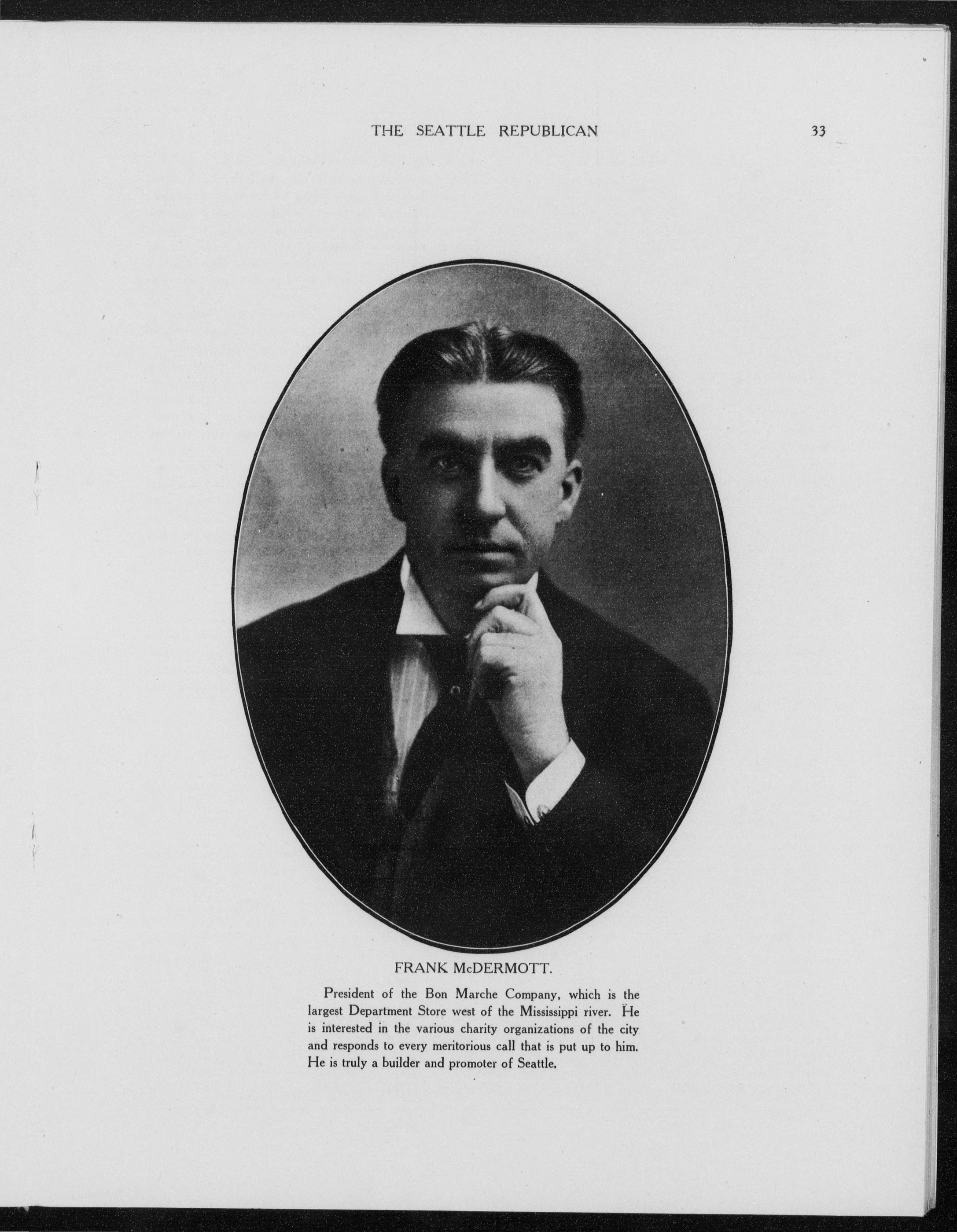
FRANK McDERMOTT.
opens in the course of human effort and talent to preserve are found it, and in placing the
It often happens in the course of human events that it requires more effort and talent to preserve an institution than to successfully found it, and in placing the name of Frank McDermott, president and director general of the Bon Marche of Seattle, among those who are building Seattle for future generations, he comes under the class of successful preservers. He did not found the Bon Marche, and only became associated with it after it had been firmly established, moved from the haunts of its swaddling clothes and occupied a prominent corner on the most prominent street in the city and, from a financial standpoint, in a prosperous condition. To so conduct the business that it would continue to thrive and expand and not die with dry rot, was the height of his ambition on becoming connected with it, and no one can gainsay, but that he has been eminently successful. It is a fact that the Bon Marche is the largest and most extensive department store west of the Missouri river and it is the concensus of opinion that one of the most level-headed young business men in the Northwest is at its head in the person of Frank McDermott.
THE SEATTLE REPUBLICAN
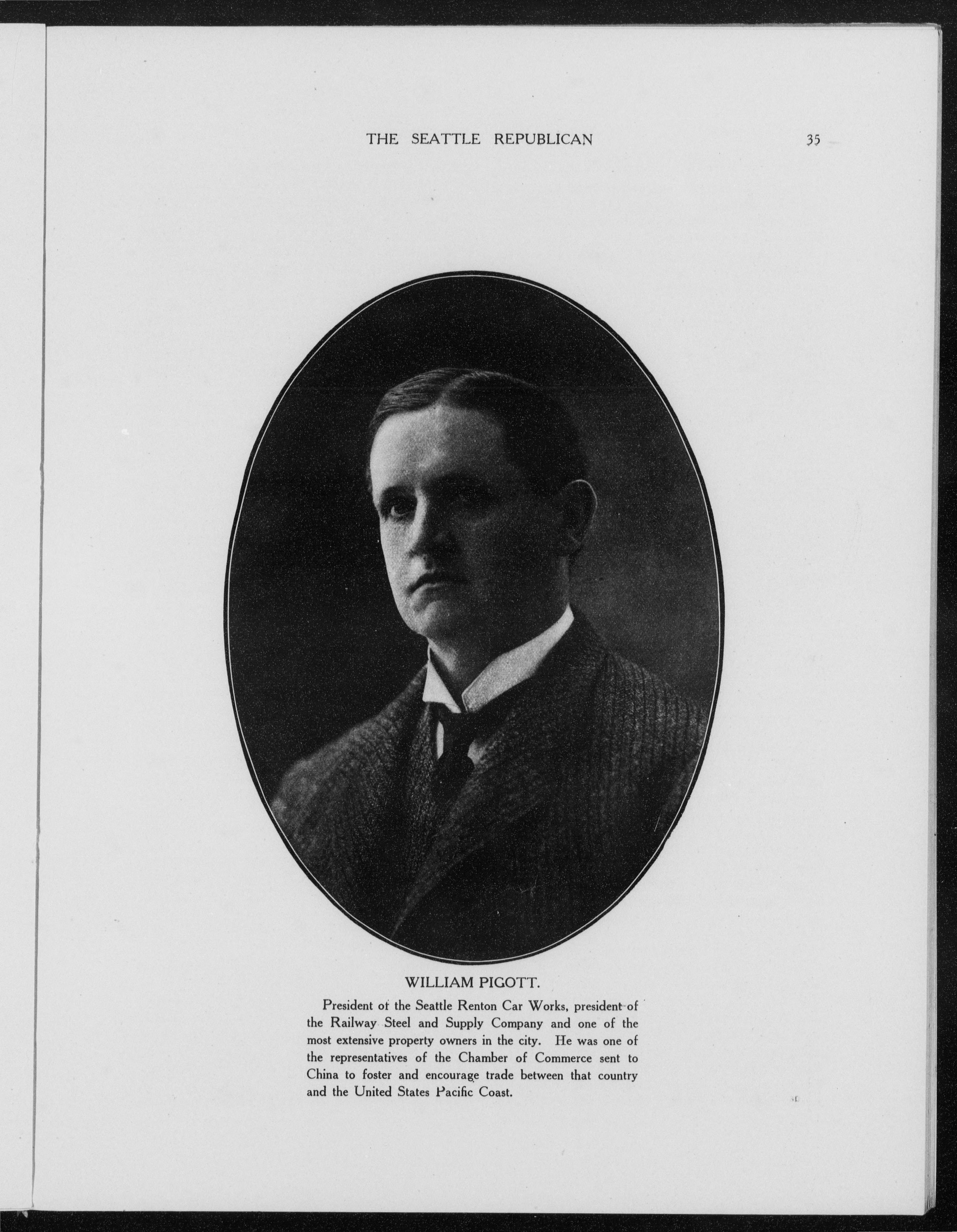
WILLIAM PIGOTT.
with the hoe" has and a
way in the progress of human
as the man with the hoe w
shoulders the progress of it
when one starts in to look
always ends up with the dis
aboring under this theory
the placing of the name of
asks of those who are bring
ing him as one of the th
and there exploit the bu
ow townsmen and associ
on account of his wonde
fracturing business in this
men, of all countires and
er and the manufacturer,
new material while the other
manufacturer and in his car
le suburb, the city's fame
business world.
"The man with the hoe" has and always will be an important factor in the progress of human affairs, but the man who directs the man with the hoe will always be the man on whose shoulders the progress of the human family will fall, and when one starts in to look for the leaders of the land he always ends up with the director and not the executor, and laboring under this theory, nothing is more plausible than the placing of the name of William Pigott in the front ranks of those who are bringing fame to Seattle. In selecting him as one of the three representatives to visit China and there exploit the business interests of Seattle, his fellow townsmen and associate members were moved so to do on account of his wonderful success in establishing manufacturing business in this community. The two classes of men, of all countires and of all ages, have been the farmer and the manufacturer, because the one produced the raw material while the other utilized it. Mr. Pigott is the manufacturer and in his car works located at Renton, a Seattle suburb, the city's fame is being scattered throughout the business world.
LOUIS HEMRICH.
ing of producing men from the well to name among the present of the Seattle Brewing perhaps, is one of the largeattle. It is said by men in the world that the product of the globe, it having added to the mountain has been made mountain making it famous of this gigantic manufactor who, from a business stand of Seattle most enterpris of those things in Seattle and that will build up the commercial standpoint, and which controlling the output really gives him a recogniz building Seattle. He is a king the few men at the hither ready to meet the differences.
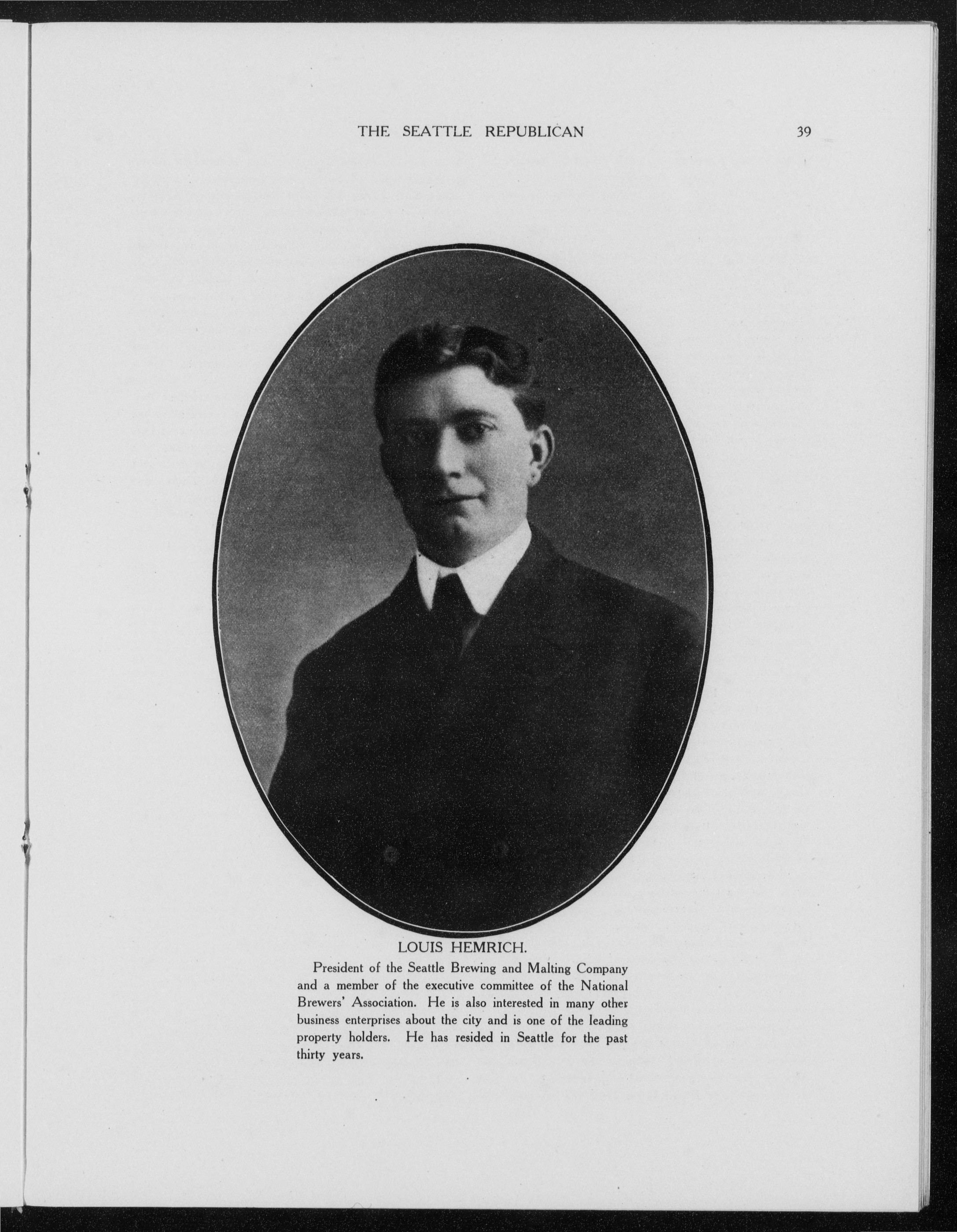
While talking of producing men from a business standpoint it might be well to name among that class Louis Hemrich, president of the Seattle Brewing & Malting Company, which, perhaps, is one of the largest manufacturing plants in all Seattle. It is said by men who travel extensively around the world that the products of this brewing company encircle the globe. it having adopted the sobriquet of Mt. Rainier, the mountain has been made famous by it instead of the mountain making it famous. The man that is at the head of this gigantic manufacturing concern is Louis Hemrich who, from a business standpoint, will measure up with any of Seattle most enterprising citizens. It is the production of those things in Seattle that other cities and towns demand that will build up the city to high water mark from a commercial standpoint, and that being a fact, and Mr. Hemrich controlling the output of such a staple article, it naturally gives him a recognized place among those who are building Seattle. He is a man of high integrity and among the few men at the head of so large a concern that is ever ready to meet the other fellow and talk over their differences.
E. W. ANDREWS.
n lines the human family where perhaps never was a money was not looked upon immunity, and for that re tute when E. W. Andrew Bank, is recorded amo
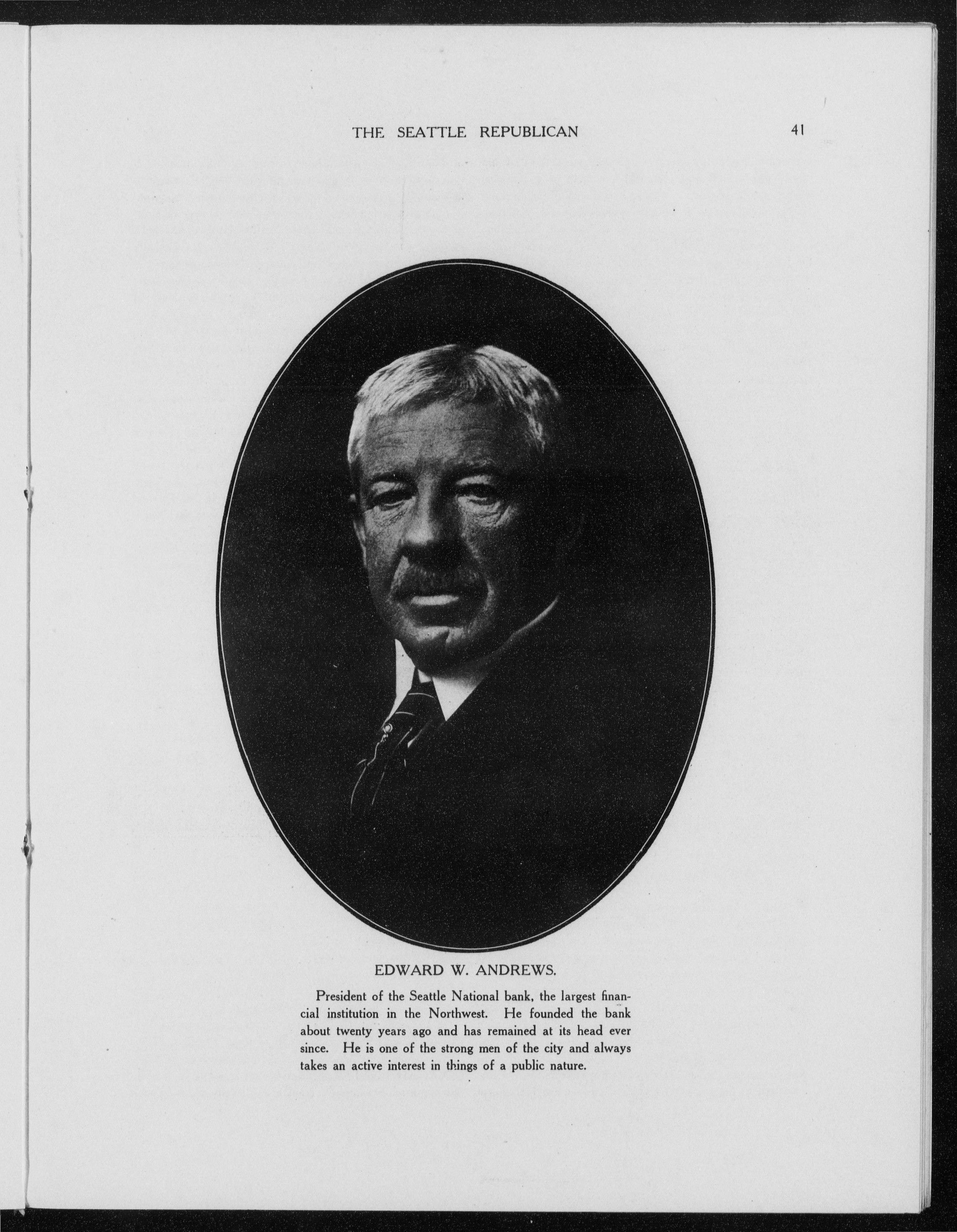
Along certain lines the human family does not change very much. There perhaps never was a time when the man with the money was not looked upon as the foremost man in any community, and for that reason no one will demur for a minute when E. W. Andrews, president of the Seattle National Bank, is recorded among those who are building Seattle, and not wholly because he has the money, as money is not always the whole show, and judging from the part he has played in the general affairs of the
THE SEATTLE REPUBLICAN
13
C.
E. G. AMES. General manager of the Puget Mill Company and its associate institutions, one of the vice presidents of the Seattle National Bank and connected with many of the industrial concerns of the city and the Northwest.
General manager of the Puget Mill Company and its associate institutions, one of the vice presidents of the Seattle National Bank and connected with many of the industrial concerns of the city and the Northwest.
14
city, even Mr. Andrews, his money to the contrary notwithstanding, is of a like mind. Almost from the very beginning of his bank the government officials recognized in him a man of worth and his bank was made a United States depository, and that alone helped very materially in the building up of the city. Since the organization of the Seattle National Bank, it has absorbed two powerful rival institutions, the Boston National and the Puget Sound National Banks, and at each absorption Mr. Andrew's bank kept its name, and he was each time put at the general head of affairs. He is one of the most progressive business men in this community and is in every respect a strong factor in the business building of Greater Seattle.
JOHN W. CONSIDINE.
in nature to point with pride at the bottom and succeeded after it take a seat at the top. The name of John W. Considine, the suit, not only of the Northwest and even England and conquered America or Europe he is haunted. It can be said without fear that his will is law with more or less man in all the world. He is little famous on every tongue that he is today completing in Seattle in the world, and so far it will be the great head, the jaw. It's the man that is Seattle as the place where thinker of Seattle and no human extent than John W. Considine.
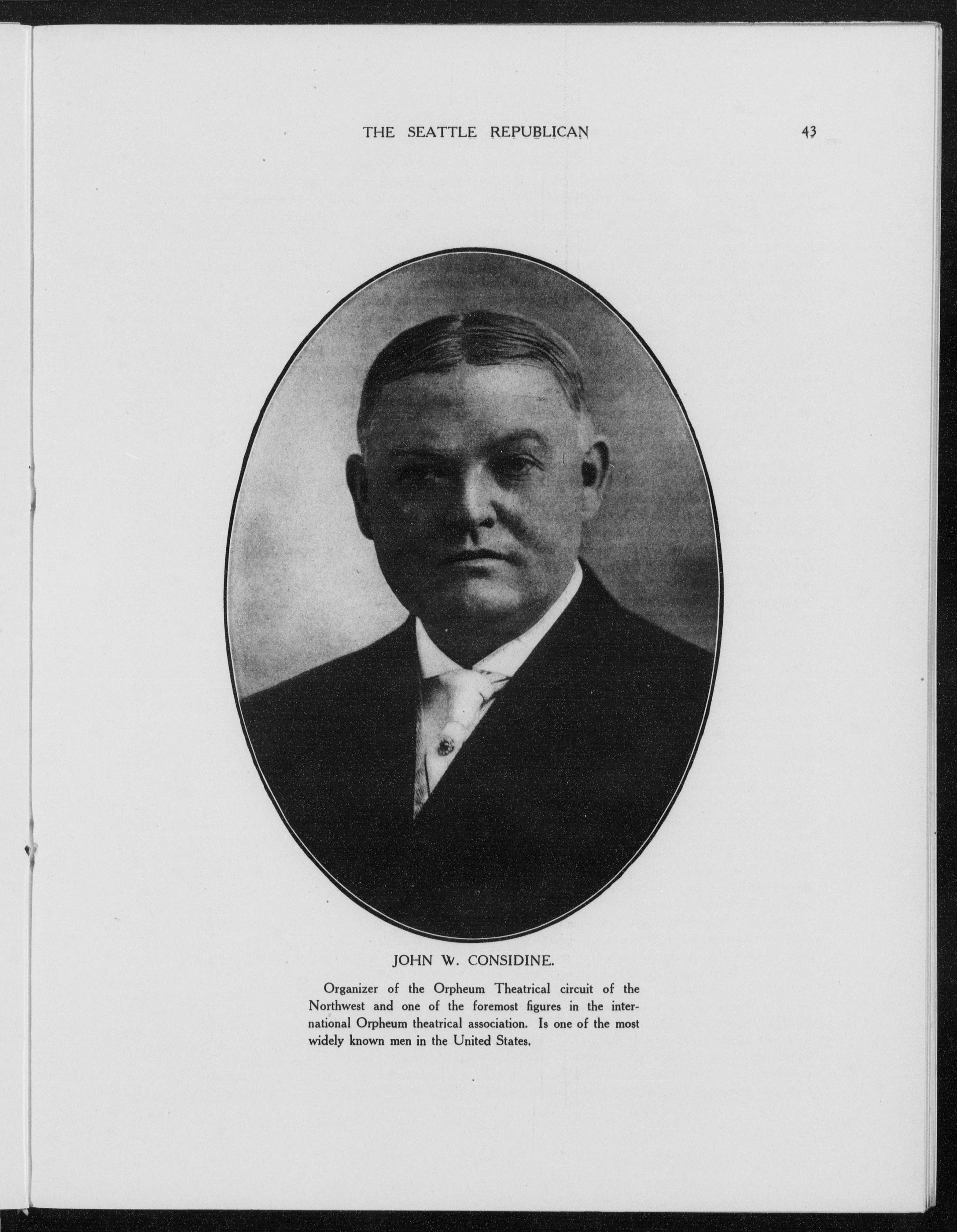
It is human nature to point with pride to the man that started at the bottom and succeeded after hard struggling to be able to take a seat at the top. There is no doubt but this is true of John W. Considine, the head of the Orpheum circuit, not only of the Northwest, but of the United States, and even England and continental Europe. Whether in America or Europe he is hailed as the man from Seattle. It can be said without fear of successful contradiction that his will is law with more persons of brain than any other man in all the world. He has made the name of Seattle famous on every tongue throughout Christiandom. He is today completing in Seattle the largest Orpheum theater in the world, and so far as the West is concerned, it will be the great head, from which all others will draw. It's the man that is doing something to advertise Seattle as the place where things are done that is the real builder of Seattle and no human being is doing it to a greater extent than John W. Considine.
E. F. BLAINE.
when Seattle was in the throo that ever visited this section
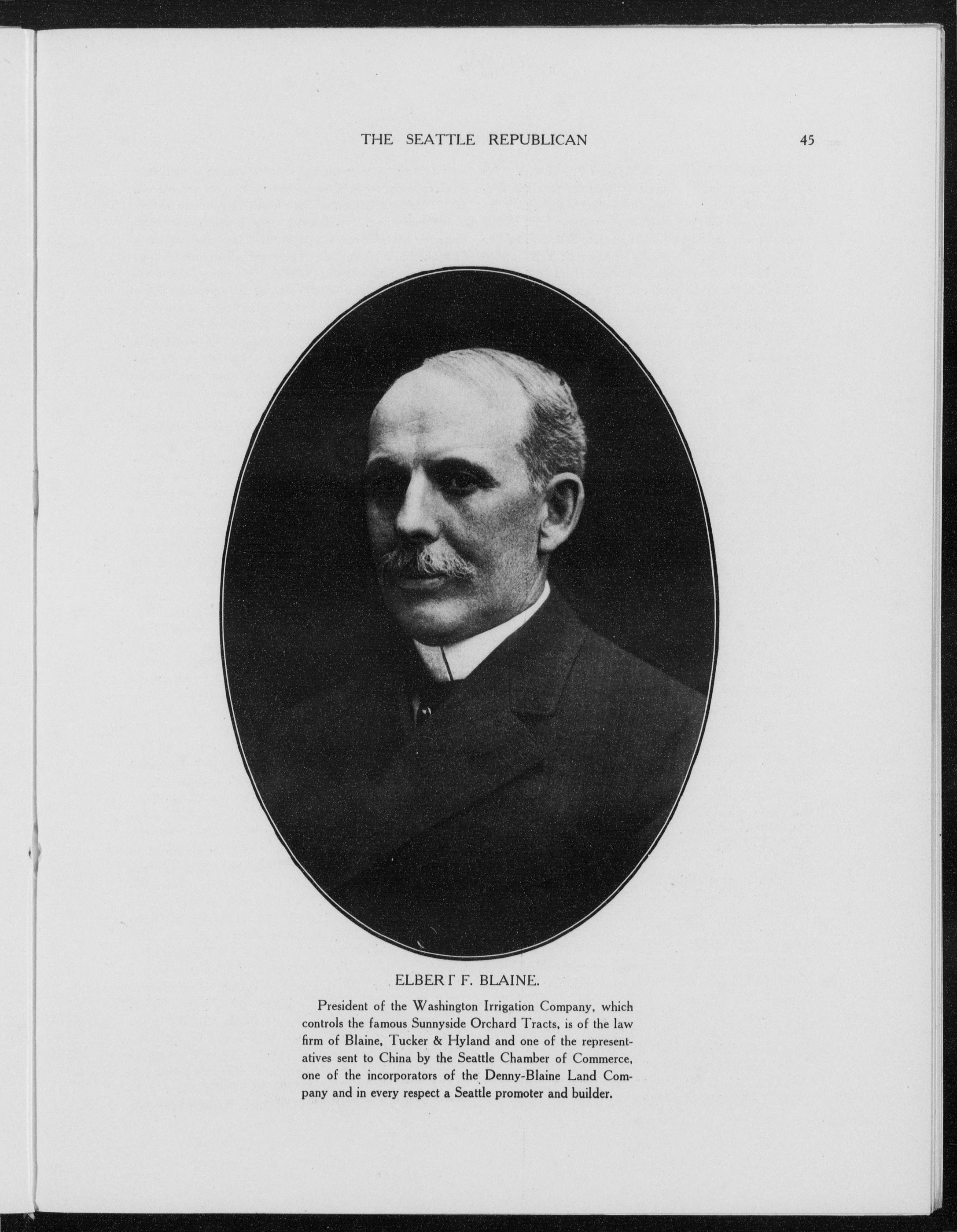
In 1894-6 when Seattle was in the throes of the severest money panic that ever visited this section of the country, and E. F. Blaine was a regular practicing attorney, the banking institutions of the city looked upon him as one of the safest and soundest legal advisers in the Northwest, and he did much then to save Seattle from commercial ruin. In subsequent years he became interested in large realty holdings in the famous Sunnyside district as well as in the city of Seattle, and through these interests he has succeeded in bringing to Seattle a great deal of outside capital. He has traveled the length and breadth of the whole United States and even gone into foreign lands preaching the superiority of Seattle for the investment of idle capital, and his labor has not been without good results. No wonder the Chamber of Commerce honored him by making him one of the three representatives to carry the fame of Seattle even into China, because he of his own accord and at his own expense had so often before carried Seattle's fame to other cities and communities. He merits any honor his home city can bestow upon him.
THE SEATTLE REPUBLICAN
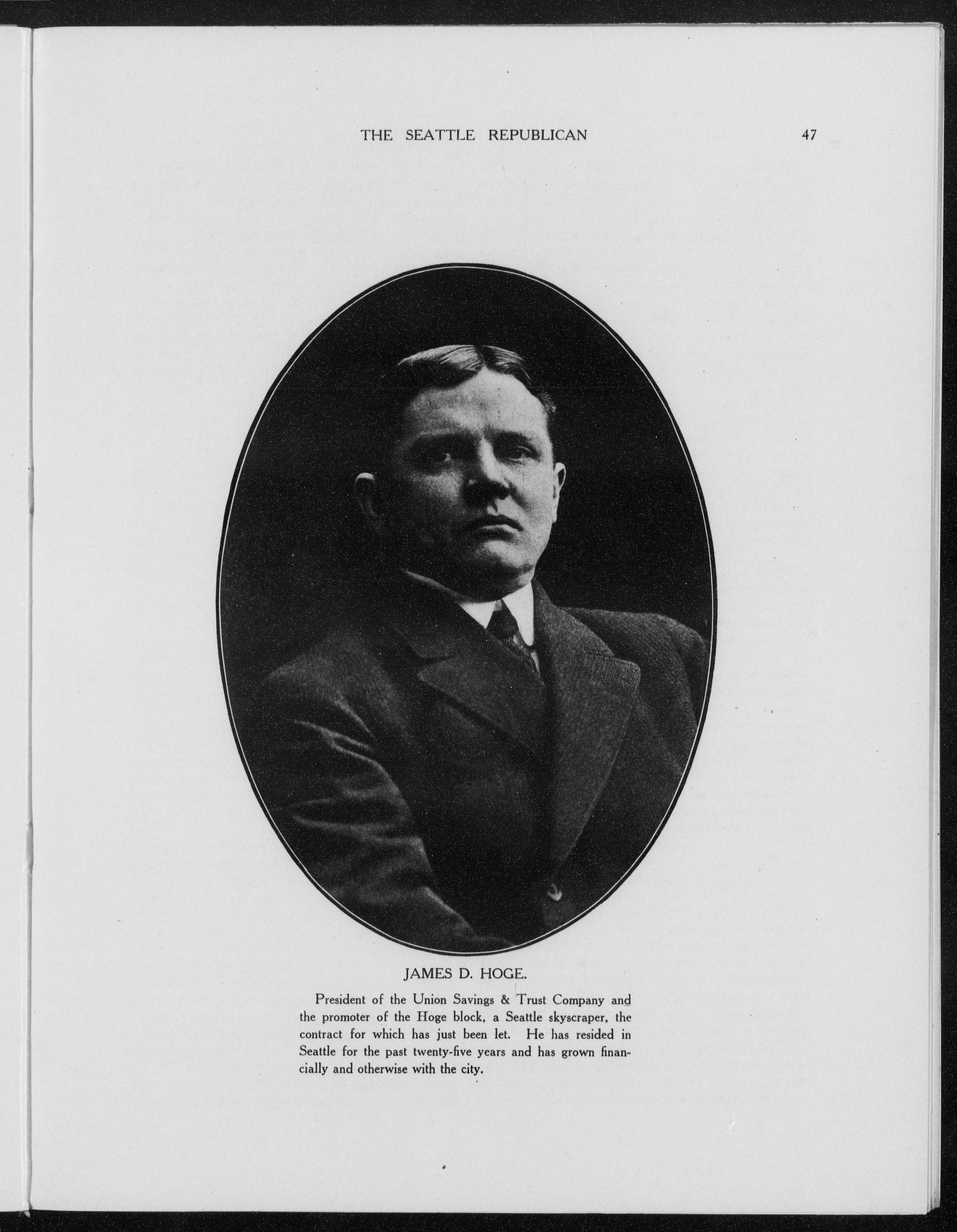
JAMES D. HOGE.
man in his early thirties, of the Union Savings and The high seat in this galaxy of the entire number. Not as a stenographer in the FI since that time he has been as now the leading p. he has owned the major bank, in which a few years is now the president and bank, and not satisfied with the contract for a sixteen will be ready for occupa connection with the Poste acquaintance, and being excessive turn of mind, he s the city. His bank conn with numerous opportunities more ways than can be of competitors and thereby those who were pushing
Though a man in his early thirties, James D. Hoge, president of the Union Savings and Trust Bank, is as deserving of a high seat in this galaxy of Seattle builders as any one of the entire number. Not more than fifteen years ago he was a stenographer in the First National bank of Seattle, but since that time he has owned the Post-Intelligencer, then as now the leading paper of the state of Washington, he has owned the majority stock of the First National bank, in which a few years prior he was a stenographer, he is now the president and chief stockholder in the Union bank, and not satisfied with running a bank, he is about to let the contract for a sixteen-story skyscraper, which he hopes will be ready for occupancy in eighteen months. His connection with the Post-Intelligencer gave him a world-wide acquaintance, and being of an aggressive as well as progressive turn of mind, he spread abroad the fame of his home city. His bank connections have also furnished him with numerous opportunities to advertise the city and aid in more ways than can be enumerated in her forging ahead of competitors and thereby make his name famous among those who were pushing instead of riding.
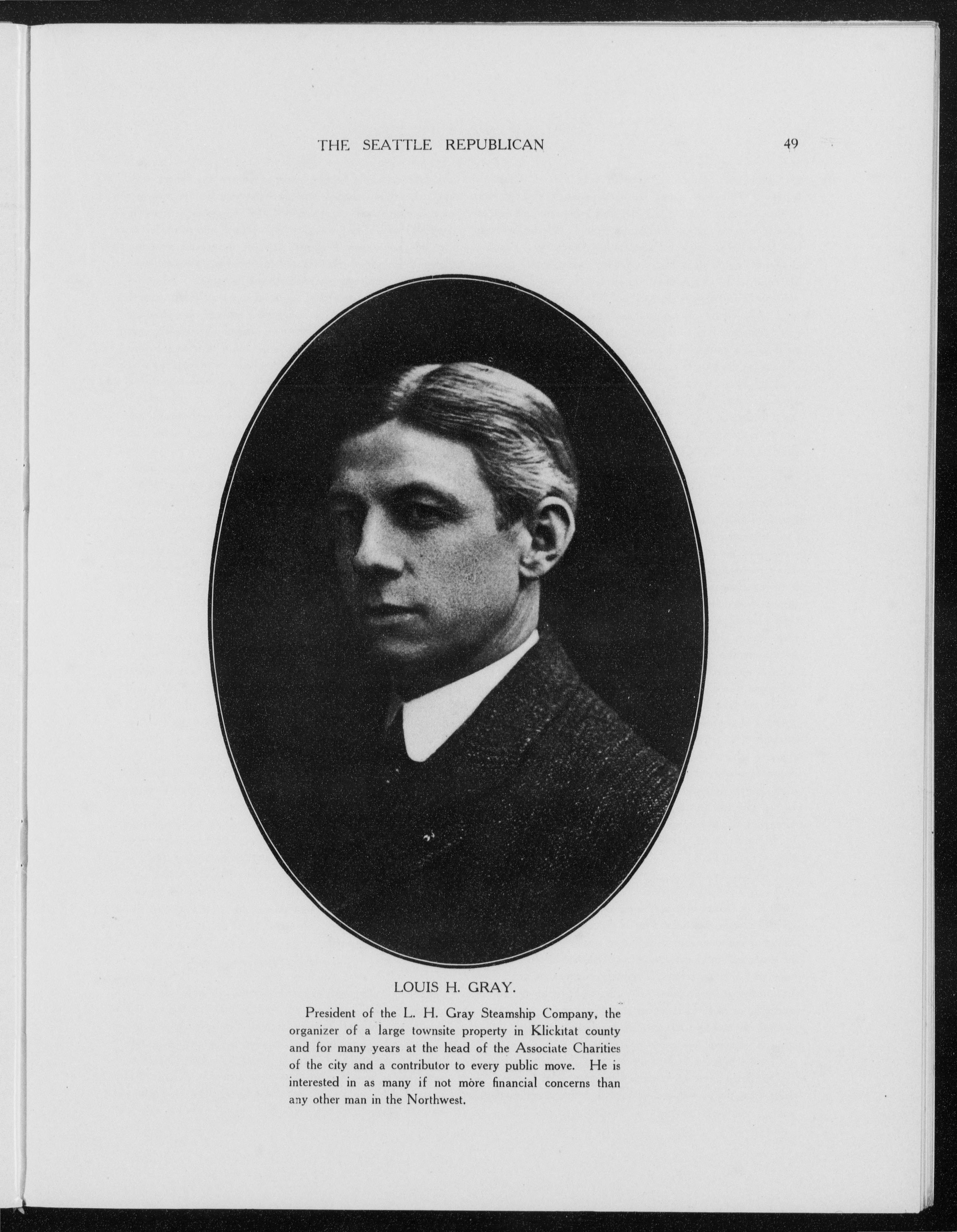
LOUIS H. GRAY.
part of human actions ever play, all of which is all of the whole. The man used of the man with the bank but helpless without the man the bank and the man will mentioned as playing their city and L. H. Gray with boat. Seattle had the good men to Alaska, the isle of California markets, and the L. H. Gray acted well its part. Some of the city through which is becoming famous as a view of elymosionary institutions that always make an imminent financial councils of the city pleasant business men in which gained him friends by the business.
In this concert of human actions every person has a distinct part to play, all of which is absolutely essential to the completion of the whole. The man with the bank was sorely in need of the man with the book and both of them were almost helpless without the man with the boat. The man with the bank and the man with the book have already been mentioned as playing their parts in the construction of this city and L. H. Gray will now play his part with the boat. Seattle had the goods, but it took the boats to get them to Alaska, the islands of the sea and to the California markets, and the L. H. Gray Steamship Company has acted well its part. He is not only spreading the fame of the city through his steamship connection, but he is becoming famous as a worker for charity and in all kinds of elymosionary institutions. He has varied business interests that always make an important personage of him in the financial councils of the city. Mr. Gray is one of the most pleasant business men in the whole Northwest, which has gained him friends by the score wherever he has done business.
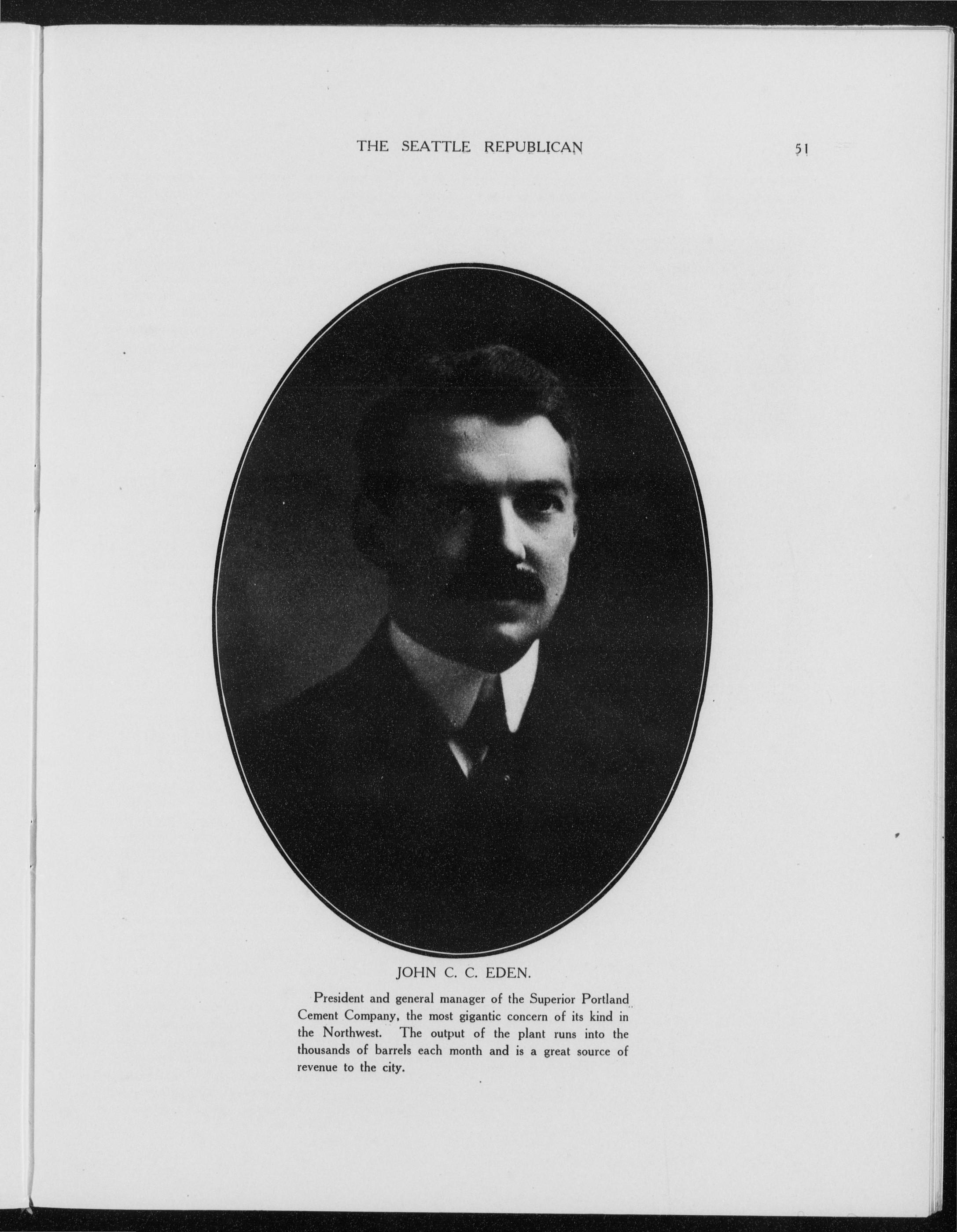
JOHN C. C. EDEN.
C. Eden succeeded in c Cement Company in c prominent men, with he feeder for Seattle was that the plant of the com s the city of Seattle rea
When John C. C. Eden succeeded in organizing the Superior Portland Cement Company in connection with a number of other prominent men, with headquarters in Seattle, a strong feeder for Seattle was put in operation. Despite the fact that the plant of the company is in Skagit county, nevertheless the city of Seattle reaps the rewards of the concern, and it is counted as a Seattle institution. Thousands of barrels of this cement are manufactured every month and sent broadcast over the land until it, like the hundred and one other manufacturing institutions of the
THE SEATTLE REPUBLICAN
15
[Picture of a man with a serious expression, wearing a dark suit and a white shirt with a tie. The background is a dark, indistinct area with a faint pattern of light and shadow. The portrait is oval-shaped with a thin border.]]
HORACE P. STRICKLAND.
President and general manager, treasurer and secretary of the Vulcan Iron Works, the largest and most complete iron plant in the Northwest. He has practically grown to manhood in Seattle and is one of her foremost citizens as a builder and promoter.
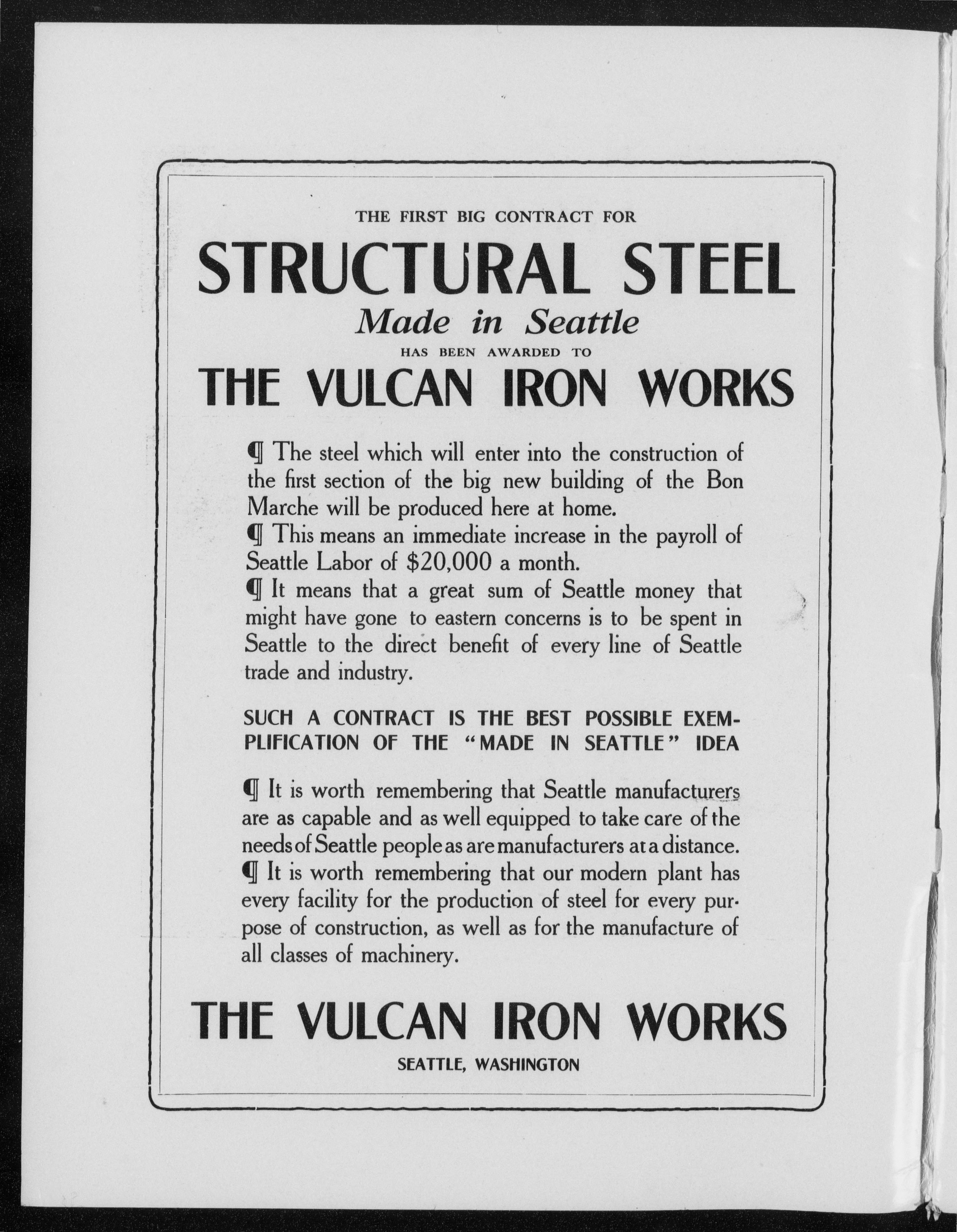
THE FIRST BIG CONTRACT FOR
STRUCTURAL STEEL Made in Seattle HAS BEEN AWARDED TO THE VULCAN IRON WORKS
The steel which will enter into the construction of the first section of the big new building of the Bon Marche will be produced here at home. This means an immediate increase in the payroll of Seattle Labor of $20,000 a month.
It means that a great sum of Seattle money that might have gone to eastern concerns is to be spent in Seattle to the direct benefit of every line of Seattle trade and industry.
SUCH A CONTRACT IS THE BEST POSSIBLE EXEMPLIFICATION OF THE "MADE IN SEATTLE" IDEA
It is worth remembering that Seattle manufacturers are as capable and as well equipped to take care of the needs of Seattle people as are manufacturers at a distance. It is worth remembering that our modern plant has every facility for the production of steel for every purpose of construction, as well as for the manufacture of all classes of machinery.
THE SEATTLE REPUBLICAN
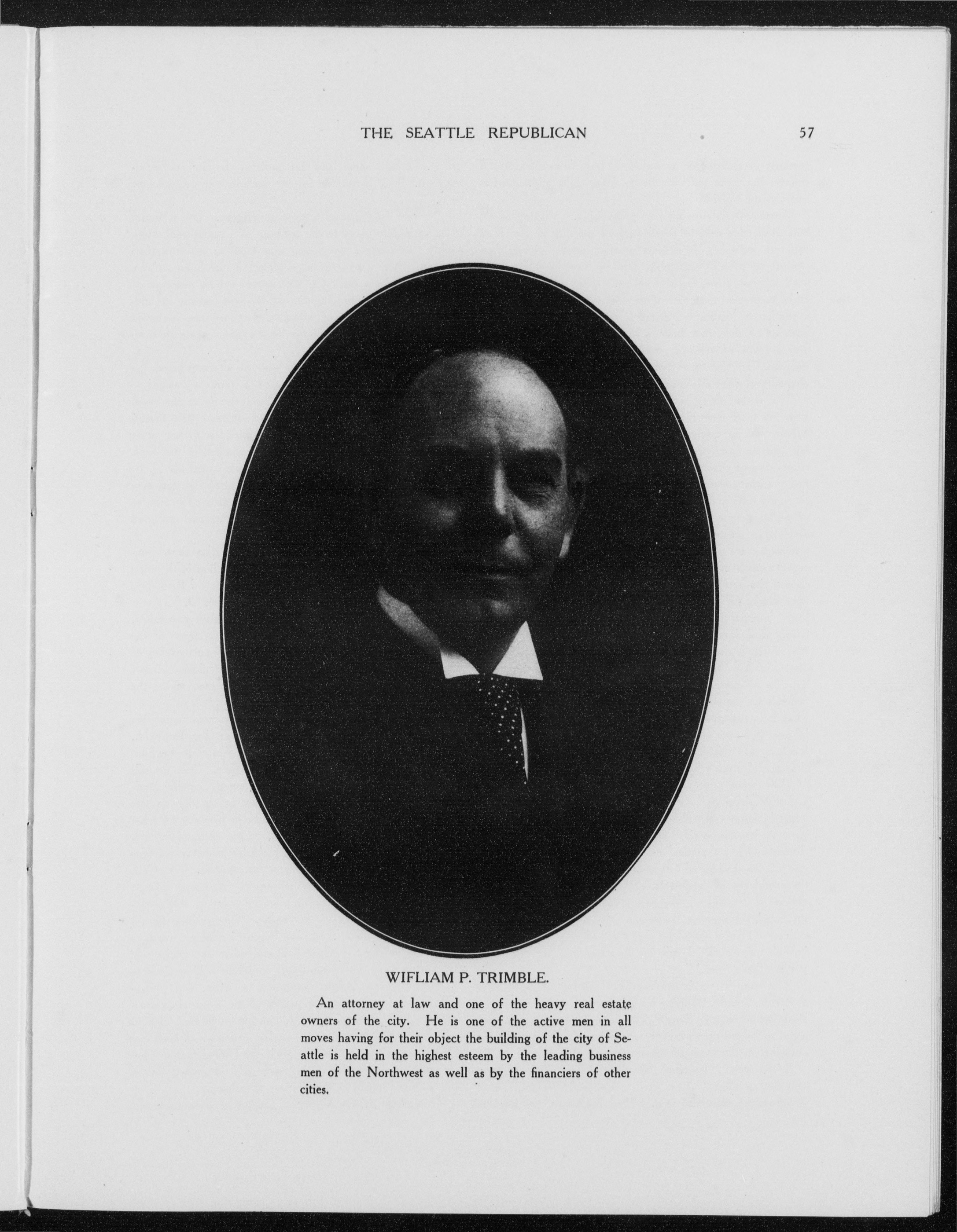
William Pitt Trimble. He may not have strived to attract as much attention to himself as others, and yet it can not be denied, but that he has always been there with the goods, when it came to contributing to the cause of the growth of the city. He is a man of considerable wealth, the most of which is in Seattle real estate, and he has been instrumental in a hundred and one different ways in interesting men with money to invest the same here in the shape of permanent buildings and manufacturing plants. It would be hard to find a man who has taken the lead any more actively on all public questions than he, and nothing demonstrates that to a greater extent than that he is always prominent in every public improvement. It is still believed that had he been elected mayor of the city during the exposition year, he would have been able to have induced a different class of business men from the other sections of the United States, British Columbia and Canada to visit Seattle than did visit the exposition, or at least more of them.
city, is spreading the news to the utmost ends of the earth that more besides corner lots are sold in Seattle. Mr. Eden is one of the popular young business men of the city and takes an active part in helping her forge to the front.
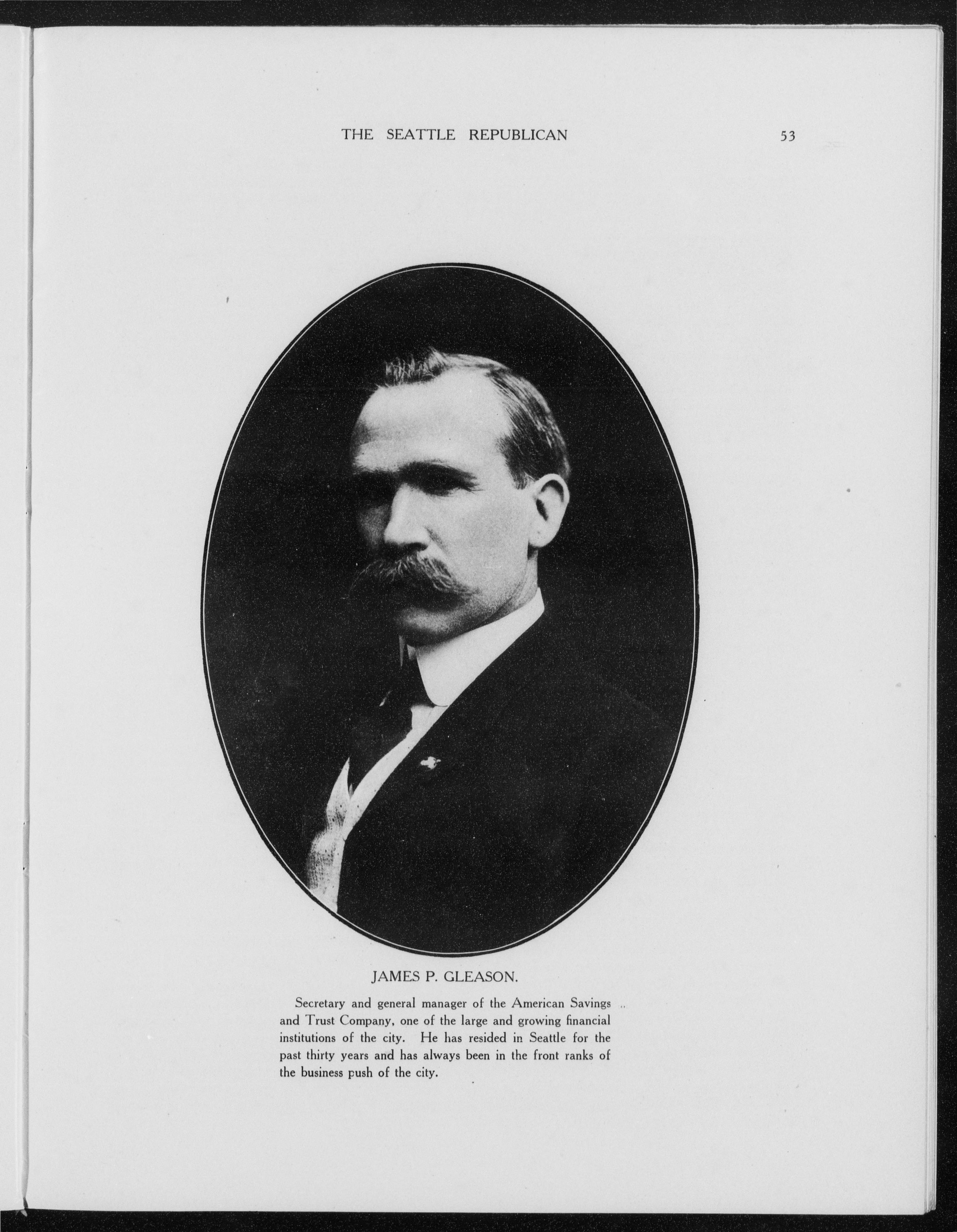
James P. Gleason has been more or less prominent in the commercial affairs of the Queen City for the past twenty years. After engaging in numerous business enterprises, he cast his fortunes with the American Bank and Trust Company, which company has caused to be erected a magnificent skyscraper and the bank has quarters on the ground floor. Mr. Gleason is secretary and manager of the company and it of course gives him an important position in the general business affairs of the city. He has always taken an active interest in the affairs of the Chamber of Commerce and never shirked from any duty that has been laid at his door. Those interested in the company are spending large sums of money in Seattle at the suggestion of Mr. Gleason and he is thereby doing a magnificent part in the building of the mighty city on Puget Sound.
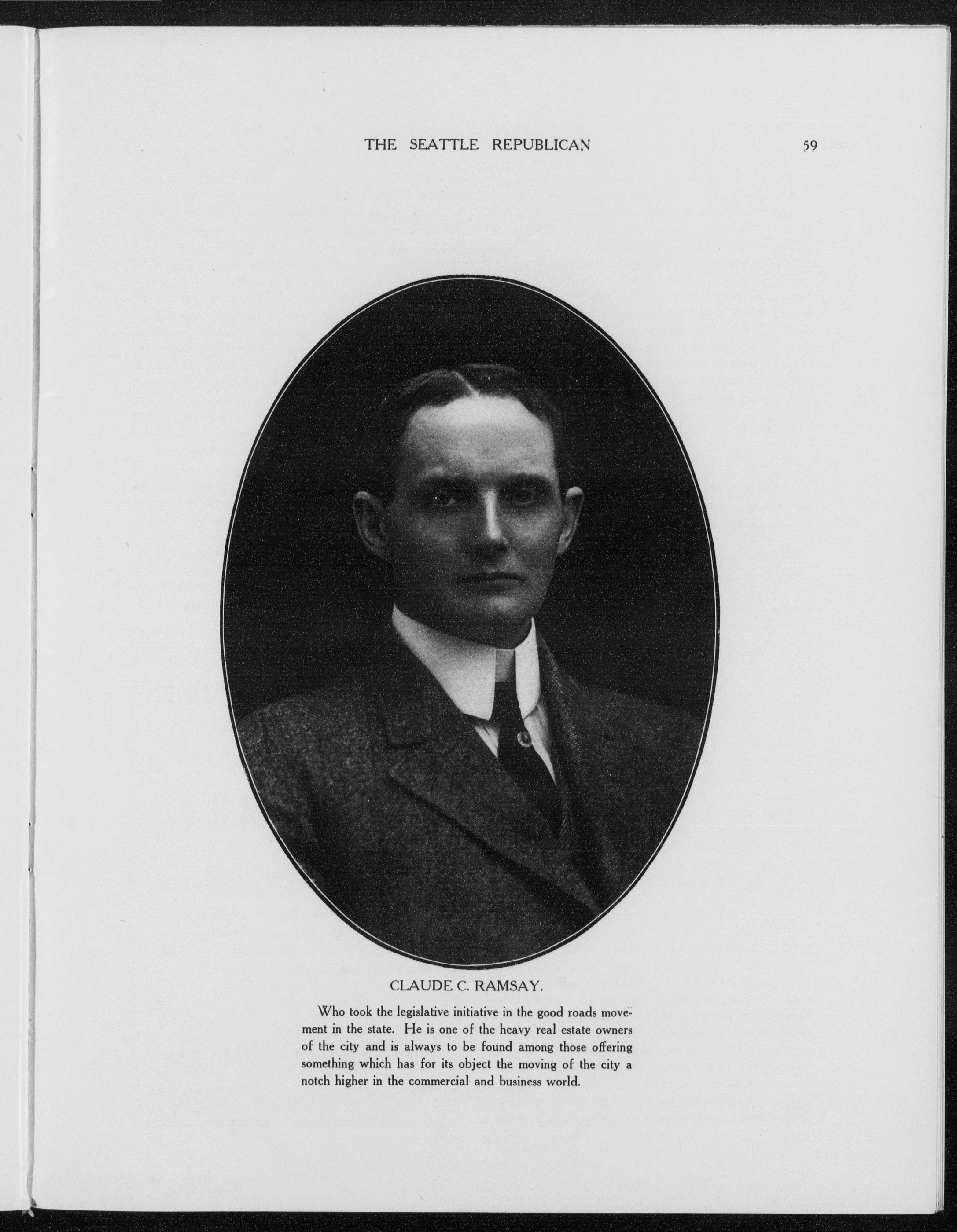
A heavy property holder of Seattle is Claude R. Ramsay, who is considered one of the foremost men of the city. He has served the community in the legislature of his state, while acting in that capacity, was instrumental in passing a good roads law, which was the beginning of the good roads adjutation of this section, which has resulted in Samuel Hill making a proposition to the state authorities to permit him to build a public highway from Vancouver, B. C., to Portland, Ore., and from Portland to Spokane and from Spokane to Seattle, thereby engirdling the state with a most magnificent public highway. Mr. Ramsay may not be playing any part in this latter move, but it was his bill in the legislature that set the ball to rolling. From time to time he has lent a hand to all public enterprises and no man has gone out of his way further and oftener than he to speak a good word for Seattle among men of means looking for a live town in which to make investments.
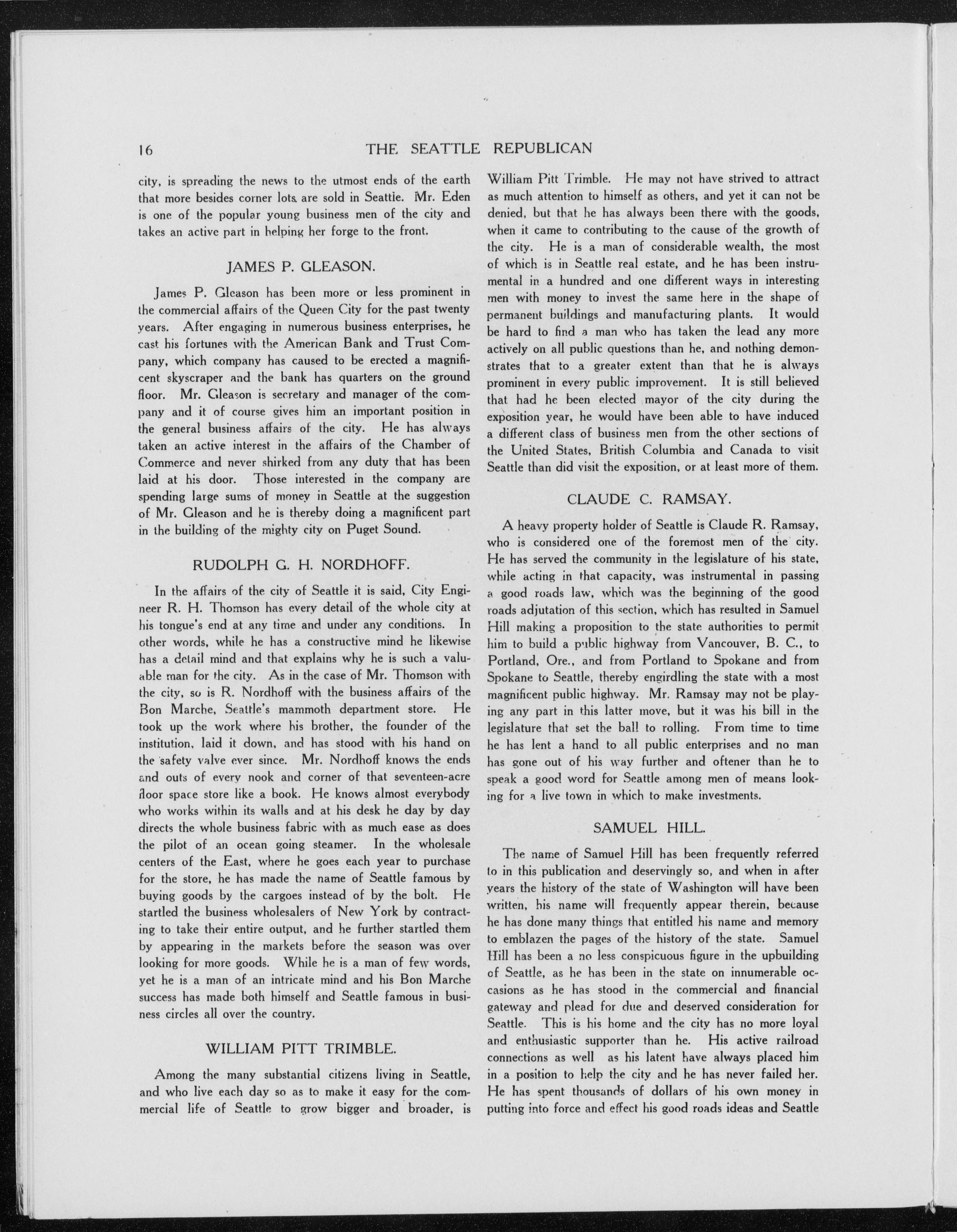
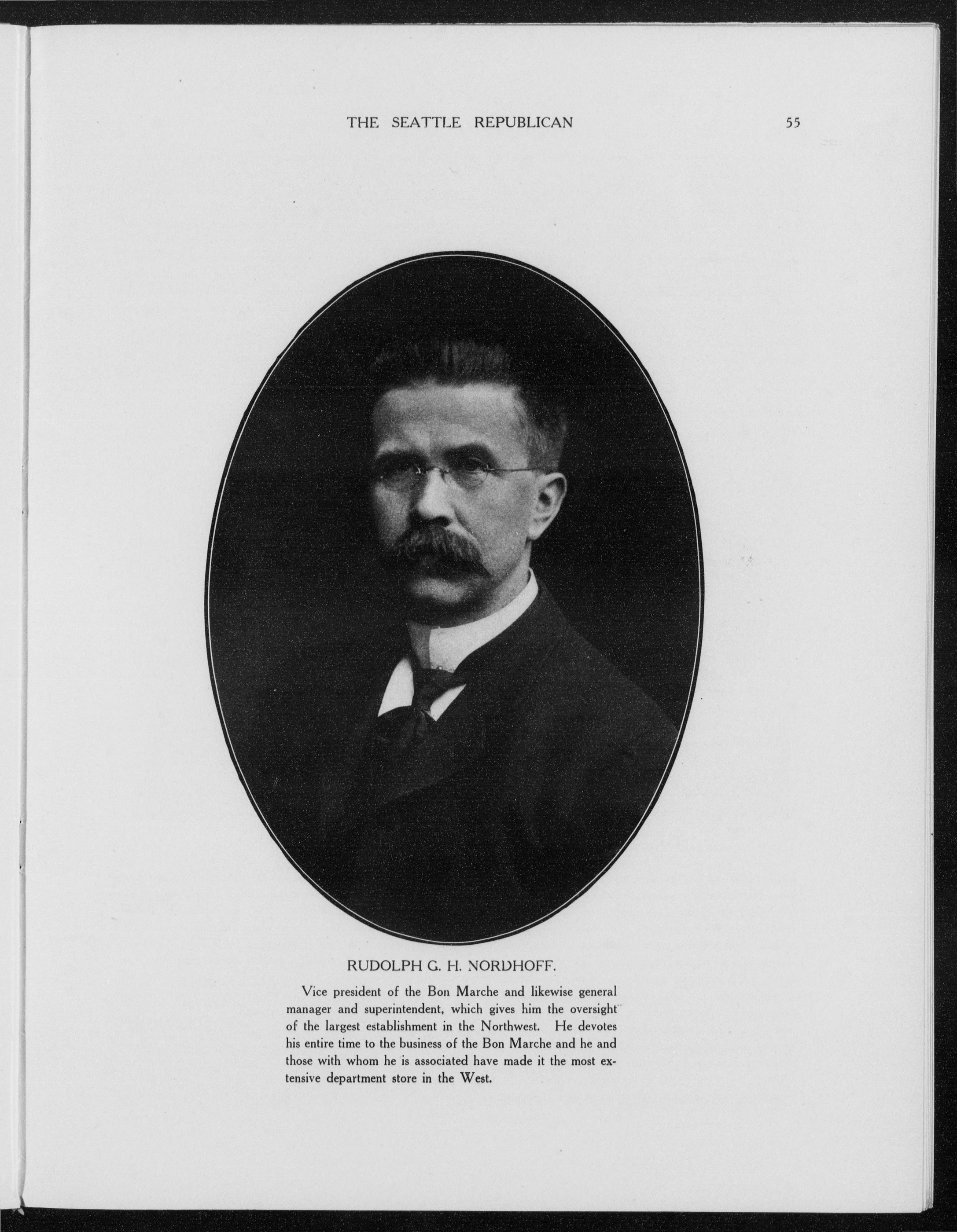
In the affairs of the city of Seattle it is said, City Engineer R. H. Thomson has every detail of the whole city at his tongue's end at any time and under any conditions. In other words, while he has a constructive mind he likewise has a detail mind and that explains why he is such a valuable man for the city. As in the case of Mr. Thomson with the city, so is R. Nordhoff with the business affairs of the Bon Marche, Seattle's mammoth department store. He took up the work where his brother, the founder of the institution, laid it down, and has stood with his hand on the safety valve ever since. Mr. Nordhoff knows the ends and outs of every nook and corner of that seventeen-acre floor space store like a book. He knows almost everybody who works within its walls and at his desk he day by day directs the whole business fabric with as much ease as does the pilot of an ocean going steamer. In the wholesale centers of the East, where he goes each year to purchase for the store, he has made the name of Seattle famous by buying goods by the cargoes instead of by the bolt. He startled the business wholesalers of New York by contracting to take their entire output, and he further startled them by appearing in the markets before the season was over looking for more goods. While he is a man of few words, yet he is a man of an intricate mind and his Bon Marche success has made both himself and Seattle famous in business circles all over the country.
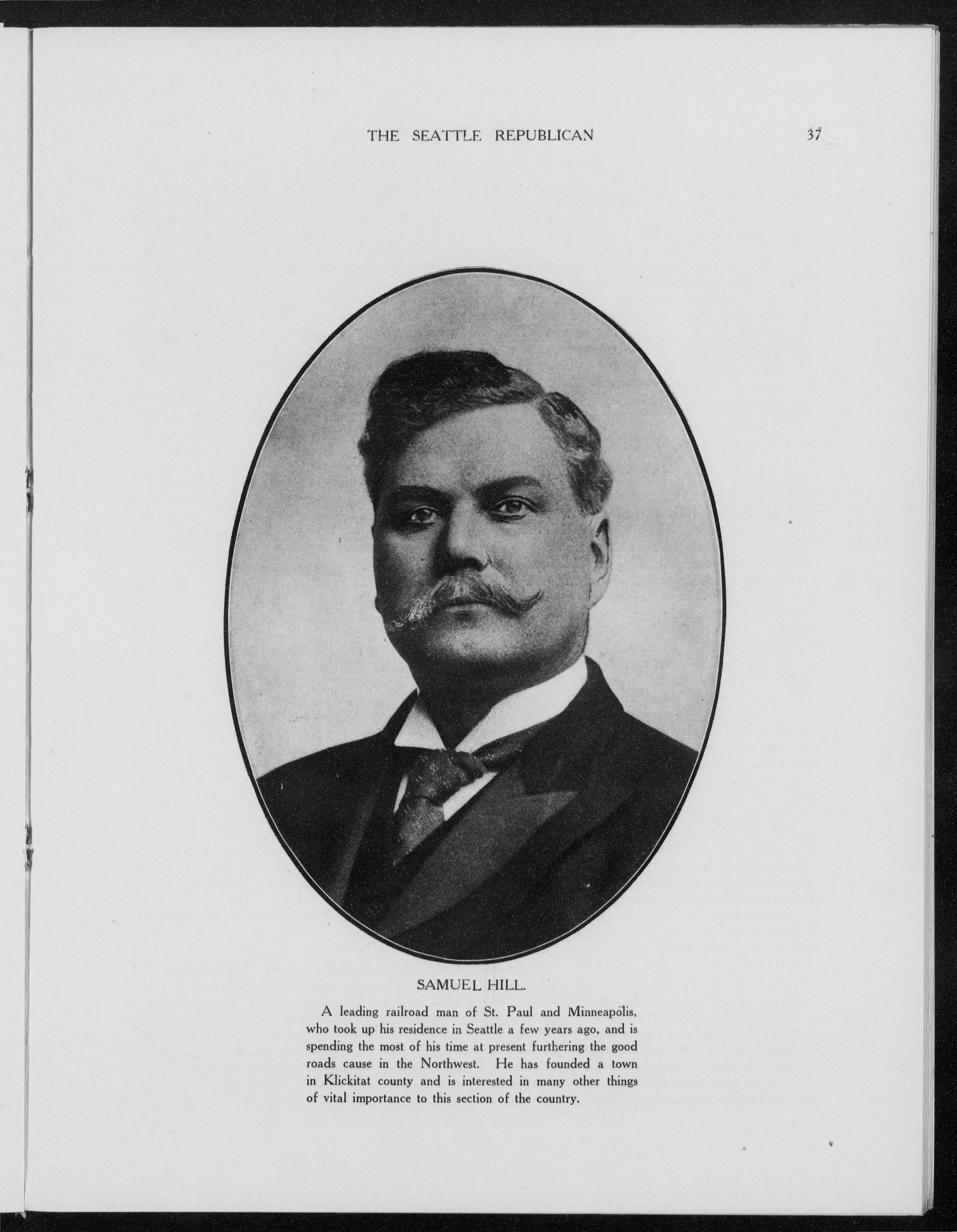
The name of Samuel Hill has been frequently referred to in this publication and deservingly so, and when in after years the history of the state of Washington will have been written, his name will frequently appear therein, because he has done many things that entitled his name and memory to emblazen the pages of the history of the state. Samuel Hill has been a no less conspicuous figure in the upbuilding of Seattle, as he has been in the state on innumerable occasions as he has stood in the commercial and financial gateway and plead for due and deserved consideration for Seattle. This is his home and the city has no more loyal and enthusiastic supporter than he. His active railroad connections as well as his latent have always placed him in a position to help the city and he has never failed her. He has spent thousands of dollars of his own money in putting into force and effect his good roads ideas and Seattle
Among the many substantial citizens living in Seattle, and who live each day so as to make it easy for the commercial life of Seattle to grow bigger and broader, is
16
JAMES P. GLEASON.
RUDOLPH G. H. NORDHOFF.
WILLIAM PITT TRIMBLE.
CLAUDE C. RAMSAY.
SAMUEL HILL
THE SEATTLE REPUBLICAN
17
A. F.
CHARLES H. HANFORD. Federal judge for Western Washington, president of the Hanford irrigation project, a distinguished writer and historian. He has resided in Seattle for the past thirty years or more and is now taken an active part in the good roads move in the State.
THE SEATTLE REPUBLICAN
office, which opened its doors for business July 15th, 1898, with the Hon. Frederick A. Wing as its first superintendent. After gold in large quantities had been discovered in Alaska, and when it was apparent that the Alaska miners always made Seattle their starting point, and on returning from Alaska always headed for Seattle, it was very evident to the government officials of that department that, it was absolutely necessary to establish an assay office in Seattle, which was done as stated above. The assay office has been designated herein as a commercial asset of Seattle not because the government makes any effort to help the business men of Seattle any more so than it would some other city on Puget Sound, but it is an asset because the miners bring their gold to the assay office and in a great many instances, perhaps a majority, receive the price of their gold in so many dollars and cents, and Seattle being a live town and growing more rapidly than any other town perhaps in the whole country, they seem to have concluded that they could not do a better thing than to invest the money they received for the sale of their gold in Seattle real estate, which they forthwith do. So many of the miners put their money into Seattle real estate that the dealers always expect a move in dirt about the time the miners come out from Alaska for the winter and they have never been disappointed. It is declared by the present superintendent, Hon. C. E. Villas, that since the establishing of the office at least four million dollars have been paid to miners in dollars and cents by the cashier of the assay office, the most of which found its way in the marts of the city. There is no doubt but that the assay office in Seattle is one of the most important ones in the whole country and the amount of gold taken in since the office was first opened will bear out the statement. The following figures will give the reader a brief idea how much of the precious metal has passed over the receiving window of the Seattle assay office. From July 15th, 1898, to June 10th, 1910, the troy ounces of gold received were 11,089,830.93 or 380 tons avidupois, which was valued at $190,120,484.20, which sum is said to be larger than received by any other office in the whole country for the same period. For some reason the general government has not seen fit to equip the Seattle office as it has other offices not doing a hundredth part the business. In Boise the government has built a large and comodious assay office and yet between 1899 and 1909, inclusive, Boise did but fourteen million dollars worth of business. The government has caused to be erected a no less commodious assay office in Helena, Mont., and for the same time as that quoted for Boise it did but twenty million dollars worth of business. While for the same time Seattle did $117,000,000 worth of business, six times as much as both of the above offices, and yet the government assay office in Seattle occupies a rented building and a very unsatisfactory as well as unsanitary one at that. Senator Samuel H. Piles has introduced in the senate a bill appropriating $300,000 for the erection of a government office in Seattle, and it is hoped that it will be favorably acted upon before the present congress adjourns.
has always been his base of operation. Seattle and the entire state of Washington have become famous throughout the civilized world by Samuel Hill's good roads advocacy, and may he live to see the state engirdled with the good road of which he is such a strenuous advocate.
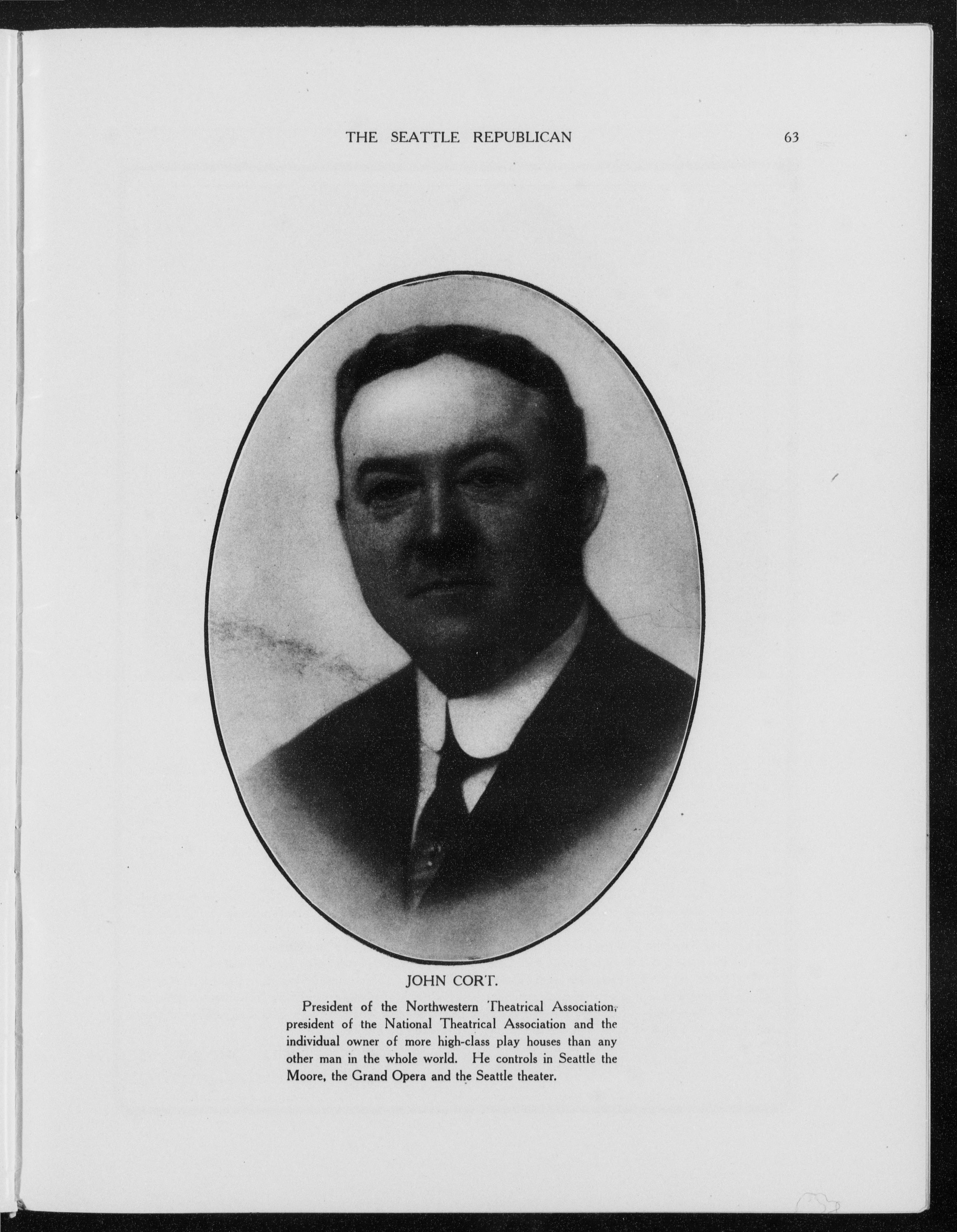
JOHN CORT.
It is the person, who makes the name of the town, in which he resides, famous abroad that is a real builder of the city, and it matters not if he never causes so much as a one-story shanty to be erected in the town, yet if he gives it a certain amount of helpful publicity he is often more entitled to a place among the real builders than the one that has caused numbers of skyscrapers to be erected. It can therefore be said of John Cort, the international theatrical magnate, that Seattle, her long list of genuine builders to the contrary notwithstanding, has no greater than he. He made the name of Seattle famous all over the land, when he organized and successfully operated the Northwestern Theatrical Association, and he doubled and trebled that publicity, when last summer he broke the great theatrical trust of the United States, and opened the most of the leading playhouses all over the country and even in foreign lands to all meritorious companies. In the theatrical world it is New York and Seattle, John Cort and the other fellow.
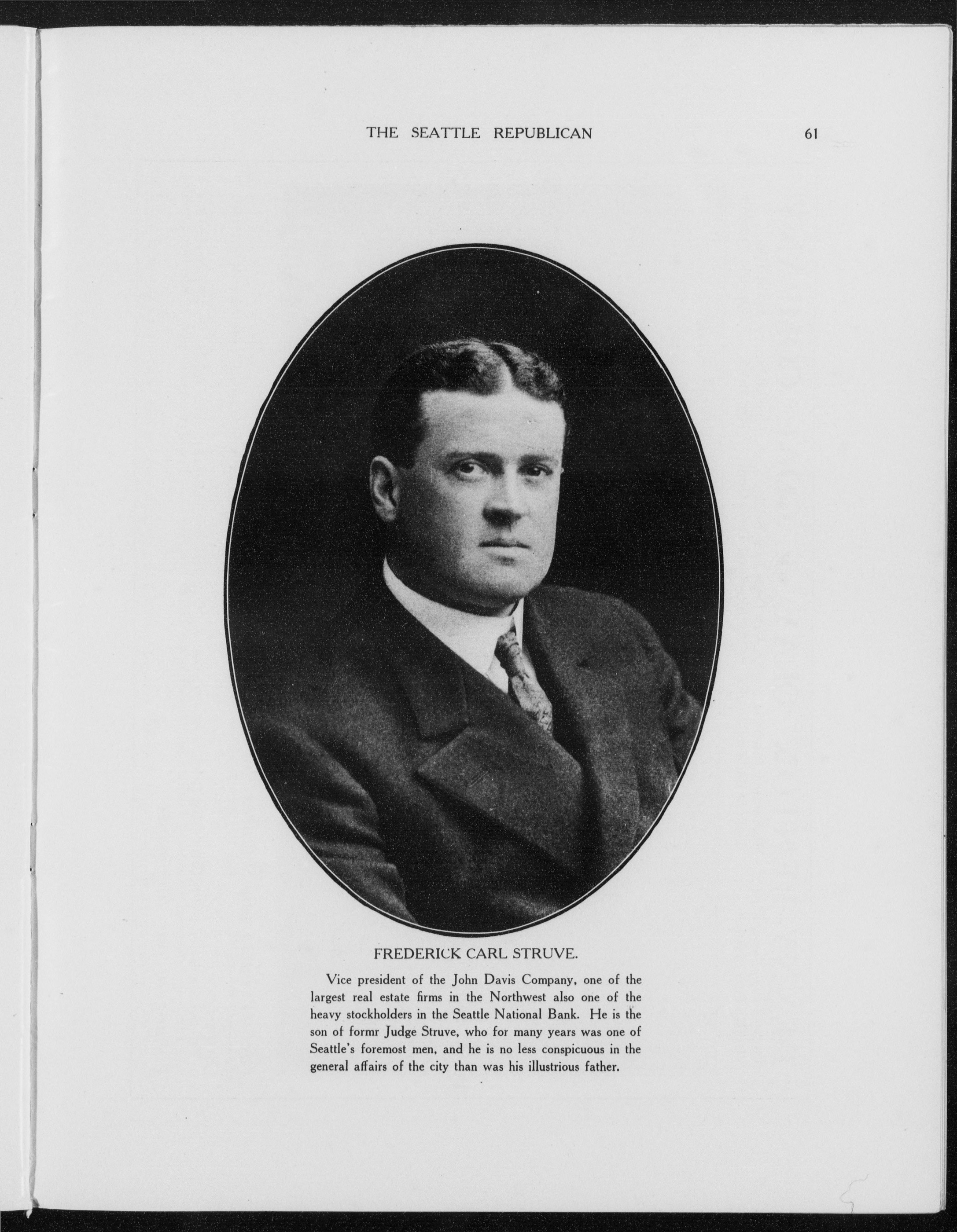
There may be a number of real estate firms that does as great a volume of business as that of John Davis Company of which Frederick Carl Struve is vice president and one of the chief stockholders, but it is not the object of this magazine to talk about the men making the most money, but about those who in their particular line are doing things to advertise and build up the city, and Mr. Struve being among that number fully explains why he is named in this who is who in Seattle roster. Owing to his bank relations he has been able to interest men of means not only in the United States, but throughout Europe in investing in Seattle. To such an extent has his firm interested European capital that one or the other of the members spends more or less of his time across the waters looking after that end of the business. Mr. Struve is also one of the vice presidents of the Seattle national bank and interested in a great many smaller industrial concerns, all of which easily make him one of the foremost Seattle builders of all her mighty host.
SEATTLE'S U. S. ASSAY OFFICE.
Without fear of successful contradiction it can be said that Seattle has no commercial asset from which she derives as great returns as she does from the United States assay
18
JOHN CORT.
FREDERICK CARL STRUVE.
THE SEATTLE REPUBLICAN
19
[Name not provided in the image]
President of the Seattle Chamber of Commerce, president of the Lowman & Hanford Printing and Publishing Company and the individual owner of the Lowman building and many other business blocks in the city. He is always ready to be interested in things that will be of interest to Seattle. He has been a citizen of Seattle for over thirty years.
THE SEATTLE REPUBLICAN
without expending a hundredth part of that sum and yet realize as much money as it is after making the high grade improvements that it did, but James J. Hill saw a great future for Seattle and he put in improvements high enough in quality to inspire the city to build up to them. He saw in Seattle the future metropolis of the Pacific Coast.
SEATTLE AS OTHERS SEE HER.
Recently James A. Moore returned from New York city and announced, "I have secured ten million dollars with which to increase the Irondale iron and steel plant to a greater producing capacity." Throughout the East Irondale is looked upon as a Seattle industry and whatever capital financiers of that section put into it in the way of an investment is done from that stand point. In putting so large a sum of money as ten millions dollars into an industry of a community, so far removed from the money center as is Seattle, it is very evident that those doing so have unbounded faith in the future greatness of her as a city.
Awakened at last from the dream of a quarter of a century that Seattle and not San Francisco would be the gateway to the Orient and the starting point to Alaska the Harriman system began a few years ago to head a branch road to the Northwest with Seattle as the objective point. For proper terminal grounds the system must have paid to property holders of Seattle millions of dollars. It soon found that it, too, would have to tunnel the city for an outlet and so the tunnel of the Great Northern is to be paralleled. It is not far wrong to say, the Harriman system, when all of their Seattle improvements shall have been completed, will have expended not less than twenty millions dollars. It can be said of that company. Its faith in Seattle is now so apparent that he who runs may read.
Not over six months ago the Alaska block was sold by one of the local banks to an eastern capitalist as an investment for a million and a half dollars, which was done on the representation that the property would net the purchaser 6 per cent on the investment. It was immediately leased for a period of seventeen years and the owner is to receive $100,000 net per annum. It took much faith as to the continued growth of a city for an investor to have courage enough to put so large a sum of money into one block, the original cost of which was only $750,000, and that investment will be a strong temptation for others to go and do likewise.
So remarkable and so widespread has become the Seattle Spirit that a number of enterprising citizens of the United States settled in Guadalajarra, Mexico, and bought a large tract of land adjacent to the city and laid off an addition on the American plan with building restrictions. After styling it Seattle with a Mexican prefix they were highly gratified to see it become the fashionable resident section of the city. It will thus be observed that citizens of other places not only have great faith in the coming greatness of Seattle, but they are so charmed with her rapid rise to greatness that they take pride in naming the place in which they reside in honor of her. Her fame has truly gone abroad and Seattle and Success are synonomous.
The L. C. Smith estate is preparing to have erected on a corner of one of the prominent streets of the city a forty-six-story building, the cost of which will exceed a million dollars. The estate has other improved properties in the city worth in the millions of dollars. The abiding faith those directing the affairs of that estate have in Seattle becoming a mighty city reaches the stage of, "actions speak louder than words."
A couple of years ago, when the Washington delegation in Congress, led by Senator Samuel H. Piles and Representative Will E. Humphrey, went before the appropriations committee and asked for, what must have seemed to the members thereof a fabulous loan, for the Alaska and Yukon Exposition, which for a time was turned down, members of Congress from every section rushed to the rescue of the delegation and publicly declared, they entertained no doubt but that Seattle would make good any promises she made, which resulted in the loan being made by the government. The exposition came off on schedule time and according to contract both principal and interest were paid, which for expositions was quite out of the ordinary. The faith those representatives had in Seattle before all the above transpired must have been increased a thousand fold after it had transpired. Few cities are seen in a more favorable light than is Seattle.
In most of the Northern, Southern and Eastern points on the other side of the continent railroad ticket agents have no instructions to sell through tickets to Tacoma, a city of over 100,000 inhabitants, and only forty miles from Seattle, but you are given a ticket to Seattle and told that you can go from there to Tacoma at a trifling expense. They do not exactly make Tacoma a Seattle suburb, but as much is implied. However annoying this may be to the man of Tacoma, nevertheless it is a fact, which is but another evidence of the favorable light of Seattle as others see her.
Seattle has more skyscraper buildings than any other city on the Pacific Coast and to build these, millions of dollars have been sent hither by outside capitalists. The city has raised millions of dollars in the east for gigantic street and park improvements and all of this money has been forthcoming because the men with the money have come to realize that, Seattle is not only a safe place in which to invest idle capital, but the investments pay splendid returns to the investor.
In order to get such railroad terminals in Seattle as were desired, the officials of the Great Northern caused a tunnel to be bored under the city and sufficiently deep from the surface that even skyscrapers could be built over it, and yet not destroy the substantialness of the building. In keeping with the tunnel other gigantic improvements were made, all of which must have cost that company in the neighborhood of ten million dollars. It, however, could have gotten along
20
THE SEATTLE REPUBLICAN
21
[Portrait of a man in formal attire, with a mustache and a serious expression. The background is dark, and the portrait is oval-shaped with a thin border.]]
President of the Post-Intelligencer Publishing Company, a former member of the house of representatives and the senate of the United States Congress. He has resided in Seattle for the past twelve years and in the state for the past thirty years.
THE SEATTLE REPUBLICAN
grounds given by the exposition officials to a large delegation of European women who had attended at Toronto, Canada, an international convention of women's clubs. These women had arrived in Seattle in the morning and had been shown during the day the points of interest about the city. To say that they were enthusiastic would be giving but mild expression to their sentiments. An English woman, of wealth and refinement, who had traveled the world over, seized upon me as her auditor and kept me at close attention while she expounded eloquently and enthusiastically upon the glories of the hours preceding the banquet.
SEATTLE AS A SHOW PLACE.
Robert Burton, English philosopher, who lived three hundred years ago, wrote in his "Anatomy of Melancholy" these words, "See one promontory, said Socrates of old, one mountain, one sea, one river and see all."
It were easy for the resident of Seattle to follow this advice that comes to us down three centuries of time, and, if to see "One mountain, one sea and one river" is to "see all," then, we who make our homes upon the shores of Puget Sound have little left to live for.
"Grand beyond comparison," she exclaimed. "Your hills and lakes and mountains. The memory of them I will carry with me always. In all the world, and my life has been one of much travel, I have never seen their equal. And some day your city, with its drives and boulevards, its beautiful homes and lawns, will be, beyond danger of contradiction, the most beautiful city in the world."
Instead of one mountain the morning sun comes to us o'er a range of snow-capped peaks, and gilds as it sinks to rest with the dying day another range of eternal sentinels flashing a thousand beacon lights to the mariner bound inward from from the broad Pacific.
You, who have not stood upon one of Seattle's hills on a clear morning in the Spring or Fall, can have but faint conception of the grandeur that is all about you. How many are there of you whose pride it is to own Seattle as your home, who know that it is possible to stand upon a graded street in this city and by but turning the head, command a view of the waters of Puget Sound, Green Lake, Lake Union, Lake Washington, the distant peaks of Baker and Rainier, the Olympics and the Cascades. I have done this, not once, but a score of times. I speak of a point on the northern slope of Queen Anne Hill. It may be that there are other places in Seattle from which a similar view may be obtained. I don't know. I only know that one clear Sunday morning found me upon this spot and that I have retraced my steps time after time, taking with me, when I could, a friend that I might not be found by some one jabbering to myself.
As I left the New York building that night, I gazed down Rainier Vista and beheld through the rows of brilliant lights and out across the tree tops on the border of the lake, the giant shadow of Mount Rainier, standing clear-cut and awe-inspiring with the moon as brilliant as the artificial lights above me, shining upon the eternal ice and snow that through the ages have sent down to the sea streams of health-giving waters that ran to waste until you and I and others came to claim them for our use.
And I marveled that it had been left to a woman from the murky atmosphere of London to open my eyes to a realization of the fact that perhaps, after all, we, of Seattle, really did have a city that challenged comparison with the show places of the world to see which millions of American dollars are squandered every year.
I lay but little claim to travel, but I have toured the Thousand Isles upon the St. Lawrence, have looked down from the heights of the City of Quebec, have gazed upon the wonders of Niagara, blistered through the Grand Canyon of Colorado, pierced the Canadian Rockies, viewed all that California has to offer—and I am here to say that were all the grandeur and beauties of these scenes that I have viewed made into one and the waste eliminated, there would still be lacking much to earn comparison with my views from the side hills of Queen Anne.
It would be a waste of time and sacrifice of much valuable space to attempt to enumerate just what to do and where to go to take advantage of all that nature has given us. It is but necessary that the reader pause a moment in his wealth accumulating rush and look about him. If he is normal minded, he will see what I have seen. If he is not—well, it were foolish to carry a picture to a blind man or to play upon a harp for him who is deaf.
And how many of you who wear yourselves out chasing the elusive dollar know of the boundless opportunities offered here for outdoor recreation? How many of you that have sailed or motored upon Lake Washington or Puget Sound? Have fished the streams or lakes within easy distance of street car and hourly boat traffic? How many of you know what nature has laid right at your door? Not many, for I have done all of these things and have been surprised at the few who have been likewise bent.
SEATTLE'S BEAUTY SPOTS.
Without fear of successful contradiction one can say of Seattle, she has not an equal west of the Mississippi river in the number, acreage and grandeur of her parks. Play grounds are conveniently distributed throughout the city, in which the neighboring children assemble by the scores and romp with themselves through the long hours of the day. Bedecked with flowers and shrubbery of the rarest types it'sa picture for the gods to watch the little ones play hide and go seek and a hundred and one other amusements common to the children in these breathnig spaces. The following taken from the last report of the board of park commissioners speaks for itself:
It may perhaps sound extravagant, but I have the word of world travelers for it, when I say that Seattle offers more accessible outdoor recreation than any other city of its population in the world. It was my pleasure last summer to attend a banquet at the New York building in the A. Y. P. E.
22
(By K. C. Beaton.)
THE SEATTLE REPUBLICAN
23
[A portrait of a man in formal attire, facing left, with a serious expression.]
REV. MARK A. MATHEWS, D. D., L. L. D. Pastor of the First Presbyterian Church of Seattle., a leader in civic and religious movements having for their objects the purification of the moral atmosphere of the city. Prominent in the national body of his church and the leading pulpit orator of the Northwest.
THE SEATTLE REPUBLICAN
investment, one would have to possess the wisdom of King Solomon of old. In a city that is doubling and trebling in population every ten years the opportunities for the industrious and alert mind are so numerous and varied that it would be impossible to grasp them all even if pointed out. In engaging in any kind of a business enterprise it is done with the idea of primarily making a sustenance out of it and secondly to lay by something for a rainy day, and it matters very little to the common sense investor whether that be accomplished by going at it in either a small or a large way.
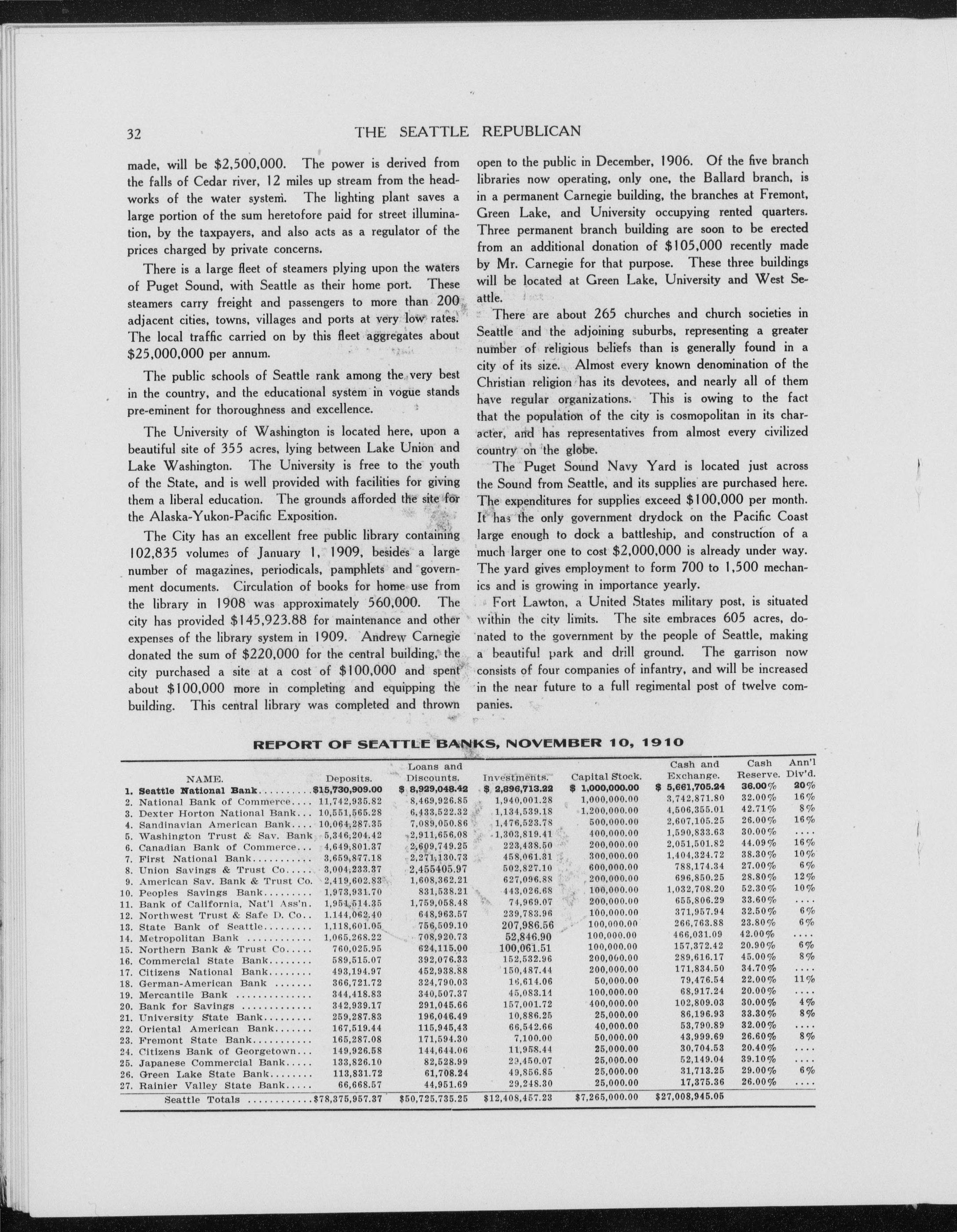
At this time Seattle has fifteen improved parks, namely: Woodland, Washington, Volunteer, Schmitz, Kinnear Mount Baker, Frink, Denny, Leschi, Madrona, Interlaken, Cowen, Denny-Blaine, Salmon Bay and Atlantic. Parks which have been named, but on which little or no improvements have been made, are as follows: Colman, Columbia, Dearborn, Evergreen, Green Lake, Jefferson, Lincoln Beach, Ballard Bluff, Beacon Hill, Greenwood, Lakeview, Montlake, Roanoke, Sturgus and Yesler. Whilst at first glance this would appear to be a great array of parks, ilt must be remembered that nearly all of these are small tracts, the policy being to establish small community parks in many sections of the city. The general park-like nature of the landscape
No Seattlite had ever thought it possible to make money out of buying California violets and having them shipped
Mount Rainier, Washington, is a snow-capped mountain in the Pacific Northwest. It is the highest peak in the state of Washington and the second highest in the United States. The mountain is located in the state of Washington and is part of the Cascade Range. Mount Rainier is known for its stunning views and is a popular destination for hiking and sightseeing.
The image provided is too blurry to accurately recognize any text. It appears to be a grayscale landscape with a mountainous backdrop and a flat, snowy foreground.
Mount Rainer, a snow-capped mountain in the Pacific Northwest, is the most prominent feature of this scenic landscape. It rises majestically above a dense forest, with its snow-covered slopes stretching towards the sky. The lake in the foreground is calm and reflects the mountain's grandeur, while the forest in the background is a mix of evergreen and deciduous trees. The overall atmosphere of the image is serene and peaceful, capturing the beauty of nature.
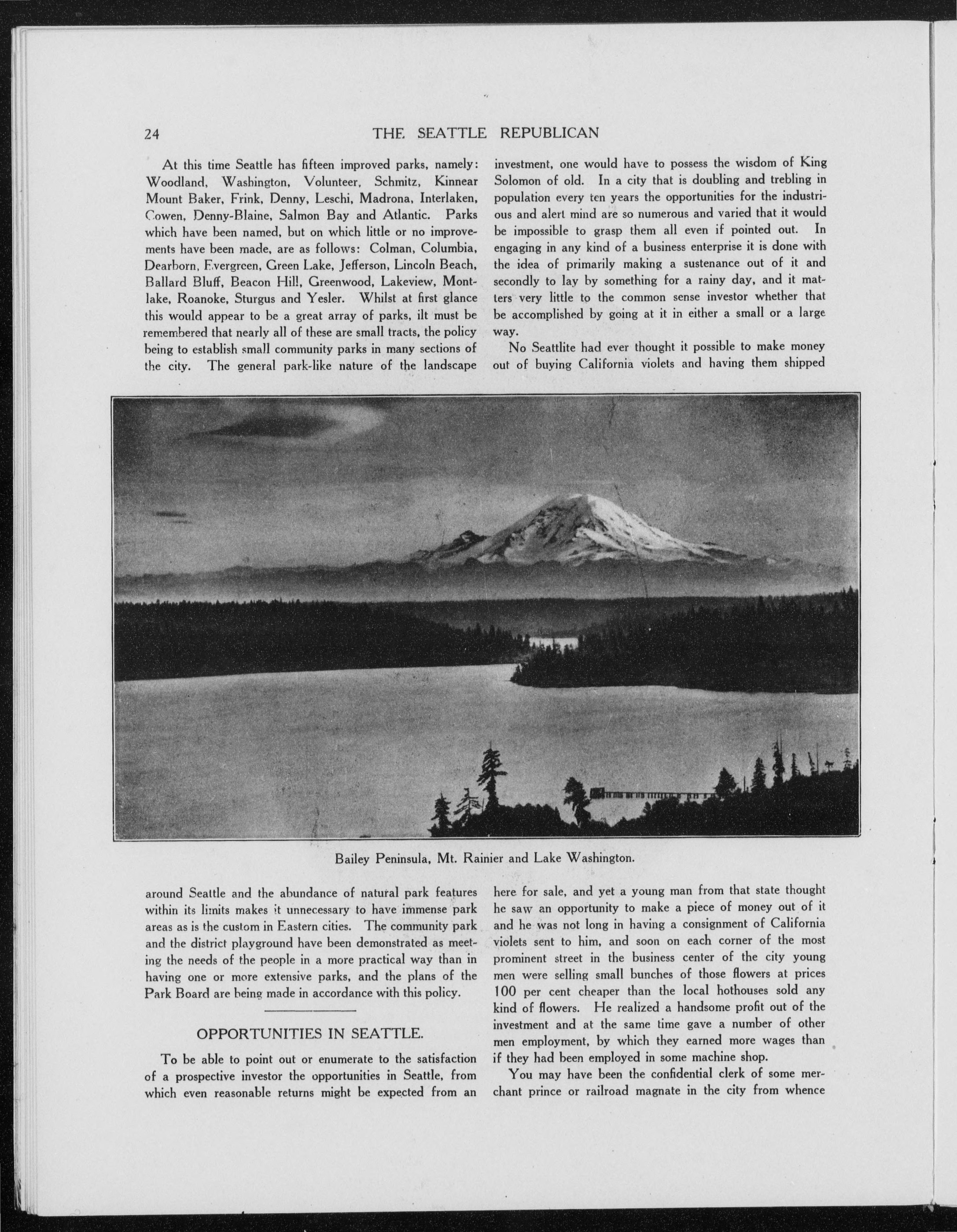
Bailey Peninsula, Mt. Rainier and Lake Washington.
here for sale, and yet a young man from that state thought he saw an opportunity to make a piece of money out of it and he was not long in having a consignment of California violets sent to him, and soon on each corner of the most prominent street in the business center of the city young men were selling small bunches of those flowers at prices 100 per cent cheaper than the local hothouses sold any kind of flowers. He realized a handsome profit out of the investment and at the same time gave a number of other men employment, by which they earned more wages than if they had been employed in some machine shop.
around Seattle and the abundance of natural park features within its limits makes it unnecessary to have immense park areas as is the custom in Eastern cities. The community park and the district playground have been demonstrated as meeting the needs of the people in a more practical way than in having one or more extensive parks, and the plans of the Park Board are being made in accordance with this policy.
OPPORTUNITIES IN SEATTLE.
To be able to point out or enumerate to the satisfaction of a prospective investor the opportunities in Seattle, from which even reasonable returns might be expected from an
You may have been the confidential clerk of some merchant prince or railroad magnate in the city from whence
---
24
THE SEATTLE REPUBLICAN
25
[Portrait of a man in a suit with a tie, facing forward, set against a dark background. The image is oval-shaped with a thin border.]]
JAMES W. MAXWELL. President of the Seattle Commercial Club, made up largely of the younger element of the business men of the city, vice president of the Seattle National Bank and one of the members of the Seattle charter revision committee. He is one of the public spirited men of the city.
THE SEATTLE REPUBLICAN
VOL. XVII. DECEMBER 30, 1910 NO. 31
HORACE ROSCOE CAYTON Publisher SUBSCRIPSION RATES:
SUSIE REVELS CAYTON Associate One year $3.00
Published Every Friday at 427 Epler Block.
Entered at the Post Office at Seattle, as Second Class
Six Months $1.50
Matter.
1 three Months $0.75
SEATTLE'S PUBLIC OFFICIALS
COM. OF PUBLIC HEALTH—Dr. J. E. Crichton. SUPT OF PARKS—J. W. Thompson. PORT WARDEN—Capt. George W. Hill. LABOR COMMISSIONER—A. H. Grout. BOILER INSPECTOR—William Murray.
MAYOR—Hiram Charles Gill.
MAYOR'S SECRETARY—Robert W. Boyce.
CITY COMPTROLLER—William J. Bothwell.
TREASURER—Ed. L. Terry.
CORPORATION COUNSEL—Scott Calhoun.
POLICE JUDGE—John B. Gordon.
CHIEF POLICE—Charles W. Wappenstein.
CHIEF FIRE DEPARTMENT—John H. Boyle.
FIRE MARSHAL—Gardner Kellogg.
CITY ELECTRICIAN—Howard Joslyn.
CITY ENGINEER—Reginald H. Thomson.
SUPT. OF BUILDINGS—F. W. Grant.
SUPT. WATER SYSTEM—L. B. Youngs.
SUPT. OF STREETS—A. L. Walters.
SUPT. LIGHTING—R. M. Arms.
SUPT. PUBLIC UTILITIES—A. L. Valentine.
SUPT. PUBLIC SCHOOLS—Frank B. Cooper.
MEMBERS OF SEATTLE CITY COUNCIL.
James Conway. John M. Wolfe.
Eugene Wilson Way. William Harrison Weaver.
Joseph Schlumpf. Volney Peyton Hart.
Frederic Sawyer. Henry Charles Bohlke.
James Young Cory Kellogg. Max Wardall.
Arnold Albert Zbinden. William Hall Murphy.
Thomas Plummer Revelle. John William Bullock.
Edward Linn Blaine. Albert James Goddard.
Joseph Nelson Denny. Frank P. Mullen.
---
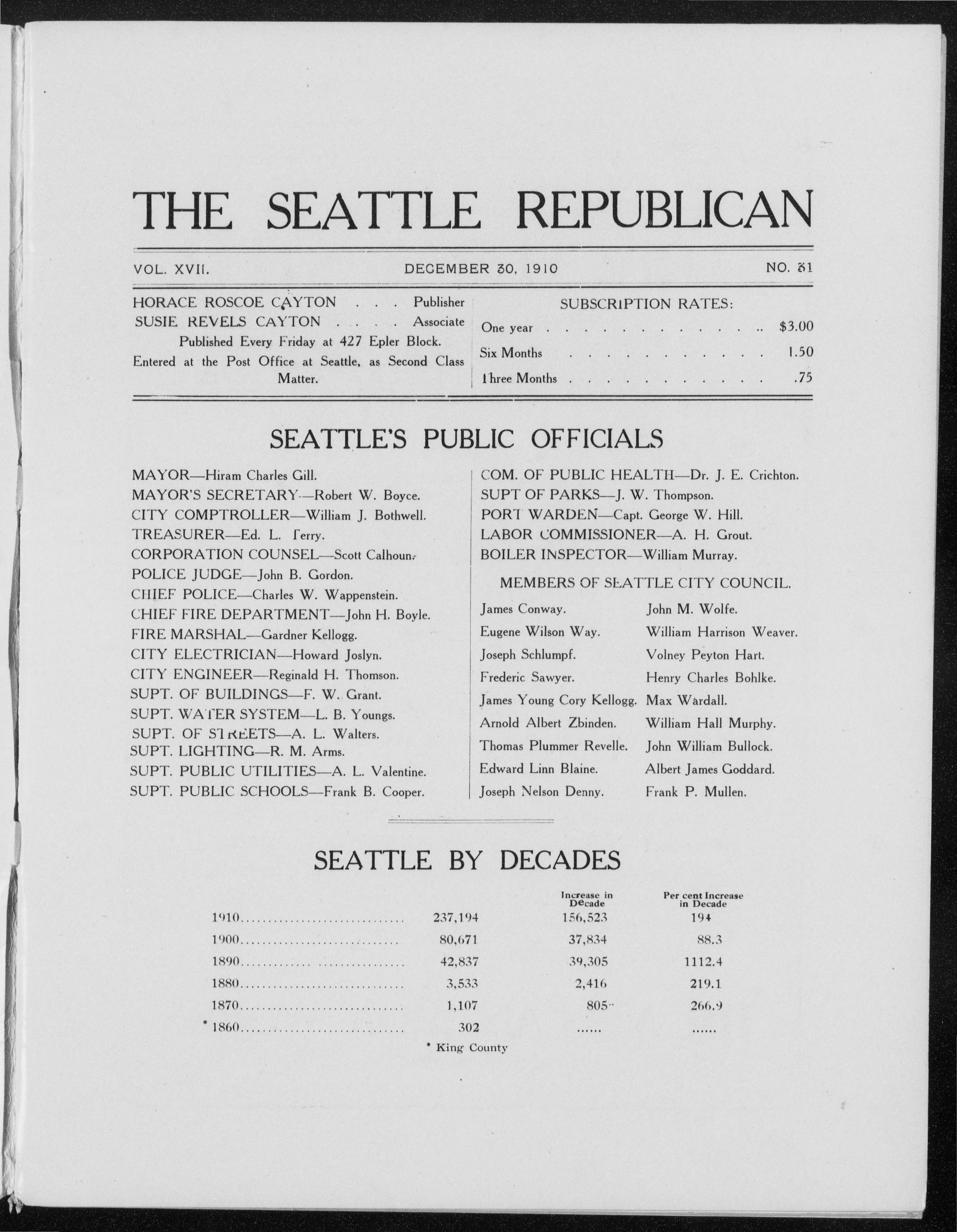
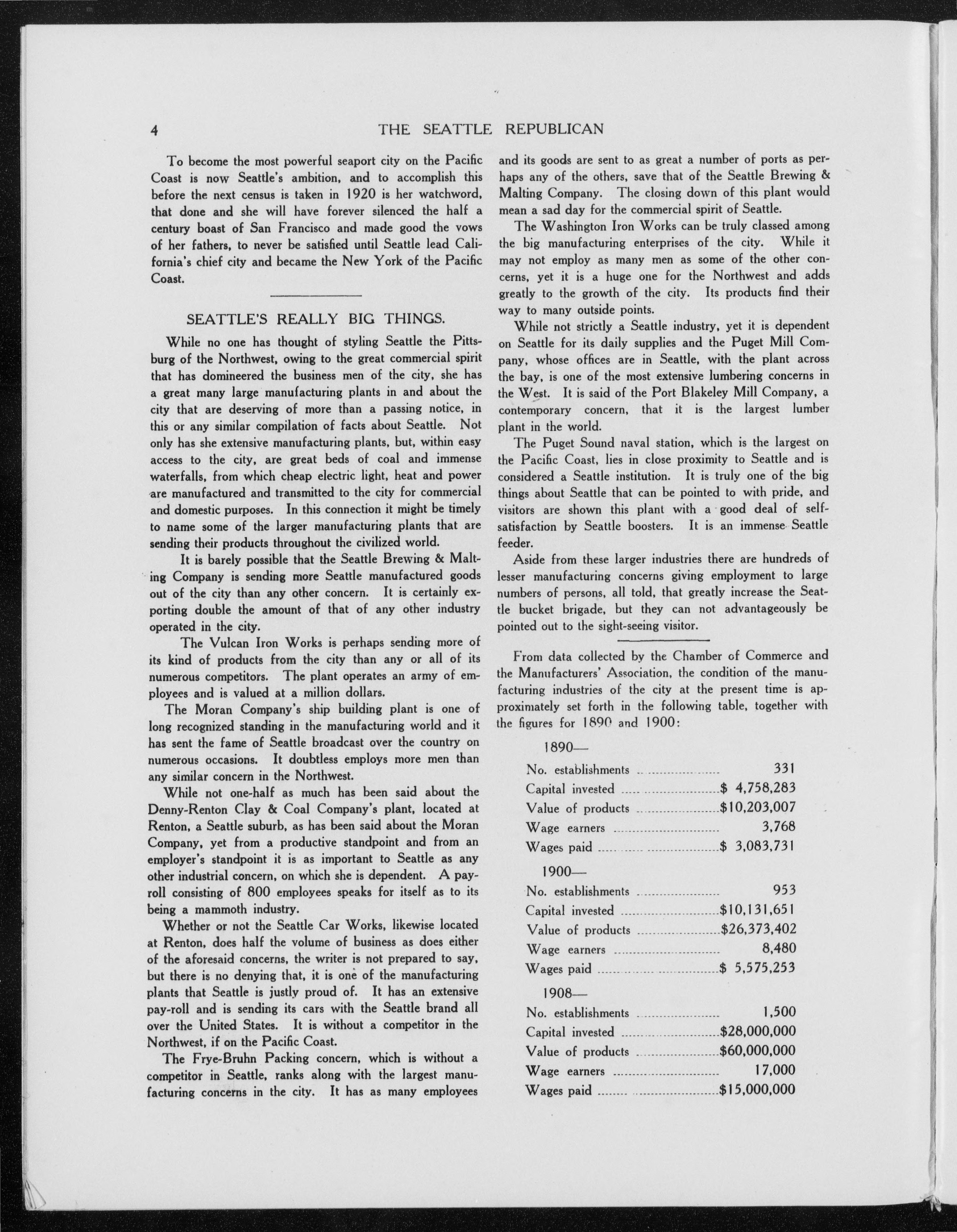
SEATTLE BY DECADES
Increase in Decade Per cent Increase in Decade
156,523 194
27,924 29.3
Increase in Decade Per cent Increase in Decade
1910. 237,194 156,523 194
1900. 80,671 37,834 88.3
1890. 42,837 39,305 1112.4
1880. 3,533 2,416 219.1
1870. 1,107 805 266.9
* 1860. 302 ..... .....
THE SEATTLE REPUBLICAN
hungry that he did not know where he was going to sleep that night. To get an immediate job seemed impossible, owing to the fact that so many others in the same condition had reached the city the day before. He walked the streets and wondered which way to turn to earn a dollar without begging for it. While standing near a bootblack stand for a convenient opportunity to ask the operator for enough money to chew on, he saw that he was taking in almost a dollar per hour. It looked good to him and soon he had forgotten his college diploma and had stood off a dealer for a brush, blacking and a cheap chair, and began shining men's boots instead of their brains. Things came his way. He saved and invested his earnings in real estate and today he is worth a half million dollars.
you came, but in Seattle you may only be a scavanger driver, but if you have an interest in the business, before ten years roll round you may. be worth more in dollars and cents than the man that employed you at a fancy salary in your former home. It all depends on whether you will take advantage of any opportunity that presents itself.
A rather seedy looking young man with an honest face hit the janitor of a business block for a job to assist him in doing the work of the building, and being rather husky looking, he was employed at once and put to work. He proved to be a splendid man. What he had done before coming to Seattle he kept to himself and for months worked on. He husbanded his earnings and when he thought he was financially able to stand alone he resigned his position and took the examination for admission to the bar and had no trouble in getting a certificate. He had been a lawyer at his former home, but reached Seattle broke, and took advantage of the first opportunity that came his way. He is now one of the wealthy men of the city and likewise one of the eminent attorneys of the state.
For the stranger within the gates of Seattle for a long time it was utterly impossible to get a home paper. The news dealers were not interested in such, as they were doing a good business selling the local papers. It remained for a newcomer, who, by the way, was also broke, to conceive the idea of supplying you with "your home paper." It was but a short time before he was crying, as he trudged up and down the streets loaded with papers from every section of the country, and even from foreign lands: "Your Home Paper," and he found so many customers that he is now styled the millionaire newsboy. He did not make all of his money selling you "your home paper," but, that he did make by doing so, he invested in real estate, and from that he has realized a small fortune. Insignificant as it may have been, yet he seized the opportunity and it proved to be a winner.
After struggling for a few years to finish paying for a cottage home in which he, his wife and baby resided, a young man, who had from time to time held various clerical positions, startled his many friends by announcing that he was going to sell his home and put the money into a small manufacturing plant, which, he believed, would pay, if properly managed. He did it in spite of the contrary opinions of his friends, and now he is worth at least $150,000, all of which he made out of that little business. He recognized his opportunity when it called.
A man who found it difficult to provide for his family on the salary he was getting was sorely perplexed how to increase the amount. To relieve his mind he from time to time would go out fishing, and made the discovery that a certain lake near the city teemed with medium sized catfish. An idea dawned upon him, and it was this, there are hundreds of persons in Seattle, who hailed from those sections of the country where the catfish was considered the most choice and palatable table edible. Would they not like a fry? He straightway quit his job and went to catching catfish and selling them to such families and hotels. It solved the difficult problem over which he had been worrying for many moons, by paying him more by three times over than the position he previously held. Here was another of the thousand and one golden opportunities to be found in and about Seattle, which taken advantage of lead on to fortune.
"I have a few hundred dollars and I want to go into some kind of business," came from an Alaska returner. He set out to find a suitable business and likewise a suitable location, but, with the limited capital he had, he soon came to the conclusion he would be foolish to undertake to compete with old established concerns. He then and there applied for and got a divorce from his business ideas and went to the suburbs, bought a small tract of land and stocked it with a hundred hens. For the first five years it was rather hard sledding for him, but he worked all the harder, and now he is worth a good many more thousands of dollars than he was hundreds when came here. He saw an opportunity and was not too proud to embrace it, though it squeaked a bit when he did it.
A printer, who had followed the business for ten years, and did not seem to be any better off than when he began, if as well, sold the plant and invested the proceeds in a small fish concern, which had for its object, the packing and shipping of fresh salmon to other cities and towns. He jogged along in his own peculiar way and ten years after he started the fish business he died and his estate inventoried at something like $200,000. Though already in business he saw an opportunity and though leading altogether in an opposite direction he took advantage of the same with the results as chronicled above.
As in these smaller things so also in larges ones, and golden opportunities are constantly presenting themselves to the person with his eyes open and his ears to the ground. But do not understand from this that a golden opportunity is awaiting the arrival of every adventurer, who leaves the East or some other section between two suns, to light upon him as soon as he passes through the gates of Seattle, which will enable him, some six months after reaching the city, to write to friends. "I am in Seattle and have the world by the tail." If there be one so foolish, who is headed for
Though a graduate of Harvard college, a brave hearted young man found himself in Seattle not only broke, but so
26
27
THE SEATTLE REPUBLICAN
[Portrait of a man in formal attire, facing slightly to the right, with a serious expression. The background is a dark, oval frame.]]
President of the Metropolitan Building Company, that has three skyscrapers erected in the city and preparing to start another within a few weeks, president and general manager of the Gray's Harbor Commercial Company, and one of the leading builders and promoters of the city.
THE SEATTLE REPUBLICAN
Within the corporate limits there are three large fresh water lakes fed by mountain streams. Lake Washington, twenty-five miles long and from one to three miles wide, is said to be fathomless. Lake Union is a continuation of Lake Washington toward the ocean, and it will be a part of the Lake Washington canal, which when completed will permit the largest ocean going crafts to rendezvous in Lake Washington. Green Lake it to itself, and one of the most beautiful small bodies of water in the Northwest. Its entire water front is being boulevarded and in conjunction with Woodlawn park, will be fashioned into one of the most inviting parks to be found in the limits of any city in the world.
Seattle, it is more than likely that, six months after reaching Seattle he will wake up to find, the world has him by the same place he thought he had it. The adventurer occasionally does better than the matter of fact man, but it is the exception and not the rule.
There will for years yet to come be hundreds of splendid opportunities for both the man with the money and the man with the moral courage to be square with his fellow man, to open legitimate businesses and establish industrial concerns, and especially the latter. When you think of Seattle only having 80,000 inhabitants in 1900 and ten years later boasting of 237,000, you will be able to realize to what extent the people of other sections are daily pouring through her gates, and you will be able to further realize, if you are able to really realize, that the unsettled hotel living human aggregation in Seattle makes many golden opportunities for the industrious tradesmen.
Five transcontinental railway systems terminate here, the Northern Pacific, the Great Northern, the Chicago, Milwaukee & Puget Sound, the Union Pacific and the Canadian Pacific.
Three distinct interurban lines run into the city, each tapping a valuable section of country, that daily bring thousands of farmers and residents of small towns here to do their shopping and other business. One runs cars between Seattle and Tacoma, some forty-two miles away; another runs its cars between Seattle and Everett, some thirty miles away; while the third runs its cars between Seattle and Renton, a mining town, about twelve miles distant. Two other lines are contemplated. As a result of these interurban lines country property has become very valuable and is increasing every year.
If forced to suggest some particular line of opportunities in which the man with a limited capital could profitably engage, we are of the opinion that, men with a thorough knowledge of machinery would do well in establishing small manufacturing plants to utilize the many things that are thrown away in Seattle that are profitably utilized in older cities throughout the East.
To the man with his millions of dollars to invest, this article does not reach, because he is going to either come himself or send some confidential agent to look over the situation before he invests a dollar. He may put in an industrial plant of some kind, but the chances are he will not; however, it is more than probable that he will put his money into a prominent corner lot. He may cause to be erected thereon a forty-six story building, but all such investments do not materially aid in establishing a bucket brigade in the city, while the man who establishes a small manufacturing concern is laying the foundation for the constant employment of large numbers of wage earners, and to become even more wealthy than the skyscraper owner, and a thousand times more important among his fellow citizens.
There are twelve skyscraper buildings whose height range from eleven to sixteen stories. Permits have been issued for the Leary building to be increased to a twenty-story structure and the contract has been let for the erection of the Hoge building, which will be sixteen stories. The L. C. Smith estate will within the next year begin the erection of a forty-two story building, which will be the tallest outside of New York City and the third highest in the world. By name the skyscrapers are, the Henry, the White, the Cobb, the Washington, the Savoy, the Leary, the American, the Empire, the Alaska, the Lowman and the Frye.
Within her corporate limits there are 200 miles of street car trackage, on which 345 cars are run every day, which travel twelve million car miles annually, and hauls one hundred million passengers a year. The average running in speed is nine miles per hour. Twenty-five per cent of the passengers are transfers. This is all the property of the Seattle Electric Company, who also does an extensive lighting and heating business. The company has power plants at Electron, some sixty miles away, and at Snoqualmie falls, some fourteen miles, from which it gets its supply of electricity. The only other street railway company operates about fifteen miles of trackage within the city limits.
The largest and most expensive Catholic Cathedral between St. Paul and the Pacific Coast, which was recently completed, is now a landmark which may be seen many miles at sea. It is valued at one million dollars. The aggregate value of twenty-five million dollars has been conservatively placed upon the church property, which is being increased every year as new edifices take the place of older ones. The largest and most pretentious Protestant churches are, the First Presbyterian, valued at $500,000, and the First Methodist Episcopal, valued at $750,000.
The principle streets are paved, which extend to the resident portions. On heavy grades stone blocks are used for paving, on lighter grades vitrified brick, and on the level and residence streets asphalt is the most popular. These give her the best street system of any city on the Pacific Coast. The streets are lighted in the business and the more
While the late census has a population of 300,000. Of yet it is safe to say she has a population of 300,000. Of that number 10,000 are Japanese and 10,000 Italians, who do the major part of the domestic and scavanger work. There are less than 3,000 Negroes among the number.
28
FACTS ABOUT SEATTLE.
THE SEATTLE REPUBLICAN
29
[Name not provided in the image]
CHARLES H. FRYE. Sole proprietor of the Frye Packing Company and a number of kindred companies, which make it the largest institution of its kind in the Northwest, a leading city builder and promoter. He has resided in the city for thirty odd years and has always been public spirited.
THE SEATTLE REPUBLICAN
wealthy districts by electric cluster lights, five to a post, which make her the best lighted and most attractive city at night, in the West.
Building permits (value) $19,044,335
Names in city directory. 123,750
School census 39,866
School attendance 29,799
Telephones in use December 31 46,403
Building permits (number) 14,885
Post Office receipts $968,250
Custom house receipts $1,198,061
Wheat exports, bushels (by water) 1,365,770
Flour exports, bbls. (by water) 607,238
Cotton exports, bales 46,300
Foreign imports 24,162,850
Foreign exports 12,669,237
Deep sea tonnage, tons *2,487,351
Coal shipments, tons 306,040
1910
Names in City Directory 124,637
Schools census 43,185
School attendance 31,594
Building permits (number) (first 9 mos.) 10,253
Building permits (value) (first 9 mos.) 13,304,125
Post Office receipts (fiscal year March) $1,071,254
Custom House receipts (first 9 mos.) $555,123
Wheat exports, bush. (by water) (first 9 mos.) 985,432
Flour exports, bbls. (by water) (first 9 mos.) 344,369
Foreign imports (first 9 mos.) $16,642,228
Foreign exports (first 9 mos.) 6,035,344
Deep sea tonnage, tons (first 9 mos.) **1,884,058
Coal shipments, tons (first 9 mos.) 535,989
One of the most valuable assets is the Seattle Spirit, which has succeeded in making Seattle the Queen City of the Northwest and the New York of the Pacific Coast. It was the Seattle Spirit that pushed her ahead, despite the opposition of combined forces working to retard her growth. It still lives and flourishes and is to be found in all the business men, and in most instances in every man, woman and child who reside either in or near the city.
She has about twelve hundred lawyers, or about one for every 2,500 inhabitants. It requires at present seven superior court judges to look after the higher court legal business, with an occasional call in of some of the other county judges. The most of the attorneys make good livings and a small per cent are growing wealthy out of their practice. There are four justices of the peace, one of whom acts as police judge, trying for the most part only city cases. The fees from these justice courts run into the multiplied thousands of dollars each year.
The business interest is fed by the trade of the Orient, which is brought hither by great ocean going steamers that load and unload at her docks. It is also fed by the trade with the Alaska miners and merchants, which run into the millions of dollars every year.
It is estimated that there are 3,500 automobiles in the city, conservatively valued at $8,000,000. These automobiles furnish employment for equally as many chauffeurs, who draw an average monthly wage of $75 each. This new industry has given employment to a great many young men, who otherwise would find it rather difficult to get any other as paying employment.
The city owns its own water system. The water is brought from Cedar River, in the foothills of the Cascade Mountains, by gravitation, and is very soft and pure. The distance from the headworks to Seattle is twenty-eight miles, and the water is carried to the city in wooden and steel pipes. The daily capacity of the plant is 65,000,000 gallons. The plant, besides furnishing the consumers with water at a very low price, is providing a source of revenue, which, after paying the operating expenses, interest and improvement, together with substantial payment on the original cost of the system, gives a handsome surplus to the city, which, at present, is all being invested in new construction. The construction of a second pipe line for which bonds in the sum of $2,250,000 were voted, was recently completed, doubling the former capacity of the plant.
The city is getting the most of her publicity by three large daily papers, the Post-Intelligencer, the morning paper, the Times and the Star, both afternoon papers. All of them have large circulations and are doing much to build up the city and in fostering infant industries. There are many weekly papers and a few "weakly" periodicals, and each is doing its respective part in carrying the news of the greatness of Seattle to the outside world.
Hon. Richard A. Ballinger, from an official standpoint, Seattle's foremost citizen, is the first representative the state of Washington has ever had in the cabinet of a president of the United States. He is secretary of the interior, and through him Seattle has been given considerable publicity.
The police department is made up of 246 patrolmen, twenty detectives, twenty-five sargeants, four captains, one inspector of police, one secretary, one police clerk, one chief of guard with eight assistants, one matron with four assistants, six drivers of patrol wagons, three humane officers, one dog catcher with four assistants, one herder with four assistants, one property clerk, and the whole is controlled and directed by a chief of the police and a chief of detectives. The wages average about $100 per month.
The city owns its electrical lighting plant, which furnishes light and power for municipal and other purposes. This system was opened in 1905, at an initial cost of $840,000, including the distributing station and equipment. On November 1st, 1908, the investment had reached $1,694,272. Bonds to the amount of $800,000 were recently voted for additions and extensions. The estimated cost of the entire system, when completed, including extensions now being
30
THE SEATTLE REPUBLICAN
31
A.
ED. S. CURTISS. Seattle's leading photographer of Indians and who is also putting the finishing touches on an Indian history, which he has been writing in connection with his work of getting photographs of the noted Indian tribes and the chiefs thereof. He has built up a world wide reputation.
THE SEATTLE REPUBLICAN
open to the public in December, 1906. Of the five branch libraries now operating, only one, the Ballard branch, is in a permanent Carnegie building, the branches at Fremont, Green Lake, and University occupying rented quarters. Three permanent branch building are soon to be erected from an additional donation of $105,000 recently made by Mr. Carnegie for that purpose. These three buildings will be located at Green Lake, University and West Seattle.
made, will be $2,500,000. The power is derived from the falls of Cedar river, 12 miles up stream from the headworks of the water system. The lighting plant saves a large portion of the sum heretofore paid for street illumination, by the taxpayers, and also acts as a regulator of the prices charged by private concerns.
There is a large fleet of steamers plying upon the waters of Puget Sound, with Seattle as their home port. These steamers carry freight and passengers to more than 200 adjacent cities, towns, villages and ports at very low rates. The local traffic carried on by this fleet aggregates about $25,000,000 per annum.
There are about 265 churches and church societies in Seattle and the adjoining suburbs, representing a greater number of religious beliefs than is generally found in a city of its size. Almost every known denomination of the Christian religion has its devotees, and nearly all of them have regular organizations. This is owing to the fact that the population of the city is cosmopolitan in its character, and has representatives from almost every civilized country on the globe.
The public schools of Seattle rank among the very best in the country, and the educational system in vogue stands pre-eminent for thoroughness and excellence.
The University of Washington is located here, upon a beautiful site of 355 acres, lying between Lake Union and Lake Washington. The University is free to the youth of the State, and is well provided with facilities for giving them a liberal education. The grounds afforded the site for the Alaska-Yukon-Pacific Exposition.
The Puget Sound Navy Yard is located just across the Sound from Seattle, and its supplies are purchased here. The expenditures for supplies exceed $100,000 per month. It has the only government drydock on the Pacific Coast large enough to dock a battleship, and construction of a much larger one to cost $2,000,000 is already under way. The yard gives employment to form 700 to 1,500 mechanics and is growing in importance yearly.
The City has an excellent free public library containing 102,835 volumes of January 1, 1909, besides a large number of magazines, periodicals, pamphlets and government documents. Circulation of books for home use from the library in 1908 was approximately 560,000. The city has provided $145,923.88 for maintenance and other expenses of the library system in 1909. Andrew Carnegie donated the sum of $220,000 for the central building, the city purchased a site at a cost of $100,000 and spent about $100,000 more in completing and equipping the building. This central library was completed and thrown
Fort Lawton, a United States military post, is situated within the city limits. The site embraces 605 acres, donated to the government by the people of Seattle, making a beautiful park and drill ground. The garrison now consists of four companies of infantry, and will be increased in the near future to a full regimental post of twelve companies.
REPORT OF SEATTLE BANKS, NOVEMBER 10, 1910
32
THE SEATTLE REPUBLICAN
33
[Image of a man in a suit, holding his hand to his chin.]
FRANK McDERMOTT. President of the Bon Marche Company, which is the largest Department Store west of the Mississippi river. He is interested in the various charity organizations of the city and responds to every meritorious call that is put up to him. He is truly a builder and promoter of Seattle.
THE SEATTLE REPUBLICAN
readers and researchers from morning till late at night. The children of the city, in this library, are looked after almost as carefully as in a school room. While in that immediate vicinity it might be pleasing to look through the First Presbyterian church building, which is as near modern as church buildings get to be. It has but recently been completed and those in charge take pleasure in showing you through. It is but a few blocks from there to the Catholic Cathedral, which is perhaps the most gorgeous church edifice in the West, the cost of which is estimated to be very near a million dollars. You are not far from the business center, and the various skyscrapers may be seen from this magnificent view point, each of which you would find pleasure in visiting before leaving.
If a stranger in the city should ask of you the places of interest about Seattle, unless you had given the subject considerable thought, you might be at a loss to give an intelligent answer, and the points that this article shall lay before you may not be complete, but they will go a long way in that direction.
By all means visit Lake Washington. Take a steamer for one of the noted trips around the lake and you will, the weather being pleasant, observe one of the most scenic bodies of fresh water you have ever ridden on. With the city built along the entire eastern shore to the very water's edge with beautiful homes, and the hills rising in easy stages from the water to the height of an hundred feet, the historic swinging gardens of Babylon pale into insignificance in comparison. The lake is studded by beautiful islands, the grounds of which are occupied by splendid summer homes, and the thousands of white tents for at least five months in a year, but adds sublimness to the sublime. The west shore of the lake is likewise being covered with summer homes and to the rear of the homes runs a belt railroad line. The precipitous hills along this shore of the lake have all been fashioned into gardens, which are covered with flowers and foliage, thus giving the whole more the appearance of some enchanted spot in fairyland than a real city and lake. From the lake may seen the snow-capped peaks of Mt. Rainier, Mt. Baker, the Cascade range and the Olympics.
A Ft. Lawton car will not be long in landing you on the government military reserve, on which the fort has been built, and from it you get a sweeping view of the whole Puget Sound country. These grounds are rapidly being landscaped into a beauty spot, so many of which are to be found all over the city. The trip to the fort is one through heavy forests, for which Western Washington is characteristic. Retrace your steps after leaving the fort until you reach the car line going to Ballard, and a trip through that section will reveal to you the immense lumber and shingle mills as well as other kind of industries worked out of wood. From there take a Fremont-Ballard car and you will pass through another very beautiful residence section and skirt almost the entire Lake Washington canal. From Fremont take a Green Lake car and you will not only see another fine residence section, but will round Green Lake, on the shores of which many beautiful homes have been built. As you round the lake and start on your return you will pass through Woodland park, which is the Zoo of the city, and it is well worth your while to spend a few hours therein. It overlooks Green Lake, which adds greatly to its natural beauty. Leaving that point, you round Lake Union, which is another very beautiful fresh water lake and almost in the very heart of the city. From that car line you will be able to observe how the hills of Seattle have been washed down and the valleys filled in and a level city the result of this, Presto change.
On leaving the lake steamer take a street car for the University of Washington, which, owing to the fact that the late A.-Y.P. exposition was held on its grounds, is one of the most enchanting spots in the whole Northwest. Its beautiful grounds, its magnificent buildings, its parks and gardens are without an equal west of the Mississippi river and the student of nature would find food for thought therein for months and years to come. In order to reach the University it is necessary to cross the Lake Washington canal, the active construction of which you would see.
When you leave the University grounds, take a car for Volunteer Park, and close thereto is the Lake Union Cemetery. One is safe in saying that Volunteer Park has few equals in any city. It is not only a play ground for the little folk, but a pleasant retreat for the older one. On the grounds of this park a city water tower has been built, around which winding steps lead you to its top, from which the whole city is yours to gaze upon, which is a panorama fit for the gods. The care of this park is par excellent and the flowers and shrubbery are of the most brilliant and rare type. It is in the heart of one of the most beautiful residence sections of the city and a walk of five blocks down Fourteenth avenue to the Capitol Hill car line will enable you to see some of the most beautiful homes in the city. Take the car for the business section and run up to the city library, and you will agree with the most enthusiastic Seattleite that, no city in the West has a more complete or magnificent building. You will find it filled with
Your day will have almost been taken up this time, but if it has not, then a ride to Queen Anne Hill, Rainier Heights and other residence sections will add greatly to your delight. The southern section offers many attractive features and among them is the filling in of tide-flats and the various manufacturing concerns to be found thereon, and chief among them, the Vulcan Iron Works, which has been so beautified that the visitor would be of the opinion that an industrial school was being approached instead of an iron plant. Money has not been spared to make it a beauty as well as a work spot. The Moran Company, the shipbuilding concern that turned out the man-of-war Nebraska for the United States government, may also be seen in this section. Going on to the more extreme southern section, the great breweries are to be found and
34
SEEING SEATTLE
THE SEATTLE REPUBLICAN
35
[Portrait of a man in formal attire, facing slightly to the right, with a serious expression. The background is a solid black oval frame.]]
WILLIAM PIGOTT. President of the Seattle Renton Car Works, president of the Railway Steel and Supply Company and one of the most extensive property owners in the city. He was one of the representatives of the Chamber of Commerce sent to China to foster and encourage trade between that country and the United States Pacific Coast.
E.W.WAY & CO.
ANCHOR YOUR SAVINGS IN SEATTLE
BAILEY
BUILDING
SEATTLE
BEST BOARD
COMPANIES
REAL ESTATE-INSURANCE
THE SEATTLE REPUBLICAN
years the tide flats at the head of Elliot bay were looked upon as the ideal location for the various manufacturing industries that would sooner or later locate in Seattle, but before such enterprises got any headway in that location the transcontinental railroads entering the city had bought up the most of the tide flats and will use the same for yardage. But with the canal open for business, small manufacturing concerns can obtain cheap factory sites along the west shore of Lake Washington, which will give them access to both railroad outlet and likewise outlet by water. With these advantages, the benefits arising from the opening of the canal will mean the adding of thousands of dollars worth of property to the city and increasing her population at least two-fold within the next decade.
many other industrial concerns all showing the activity of the business men and some of the many things that explain for themselves, Why Seattle Grows. The ride to the end of the car line is something like six miles, and it is full of interest from start to finish.
The morrow take a steamer to Bremerton, where the government dry dock is located and while crossing the bay you will get a striking view of Seattle and her busy, bustling water front, with her mosquito fleet, containing hundreds of small boats coming and going and all laden with passengers and produce. At Bremerton you will find the largest and most commodious dry dock on the Pacific Coast, around which great men-of-war are lying at anchor waiting their turn to go on dock.
With the Lake Washington canal in a position to permit the large ocean-going craft to enter the fresh waters of the lake, Seattle will have within her borders the most magnificent fresh water harbor in the whole country; and one that will give the city a commercial advantage over any other between the Pacific ocean and the city of New York. Those who have argued that Seattle already had sufficient water front to accommodate her trade were either commercially short sighted or could not see anything beyond something that would bring more money to the coffers of the various railroads that come to Seattle. The wharfage of the Sound is owned almost exclusively by the railroads and they are not of that liberality in their dealings to inspire and incite rival commercial enterprises. In January, 1909, the late Gov. John H. McGraw, when asked to express an opinion as to the future of the Lake Washington canal, in view of the fact that the project had been bitterly assailed by J. D. Farrell, vice-president of the Harriman railroad system, spoke as to the ultimate success of the canal and the benefits arising therefrom so far as the city is concerned, as follows:
Before you give up seeing Seattle, after you have returned from Bremerton, take one of the Renton urban lines and ride out to that suburb. If you go by the Puget Sound route you will see another portion of the southern section and a bit of the farming valley on which the most of the vegetables consumed in the city are raised. At Renton the Seattle car works, an immense coal mine and other industrial concerns you will find in operation. The cream of this trip will be the return on the other urban line along the shores of Lake Washington, which is something like fifteen miles. For real scenic beauty, tarvel the world over and you can not duplicate it. In all the sightseeing thus laid out, you will periodically run on to either a city park or a city play ground which, despite the grandness and the beauty of all the surroundings, will be like an oasis on a desert. You have now partly seen Seattle in all her grandeur and likewise sublimity.
THE LAKE WASHINGTON CANAL
For the past thirty years or more it has been the fond hope of Seattle to see a canal built connecting Lake Washington with Puget Sound, which would permit the largest ocean-going craft to pass through it and rendezvous in the fresh waters of the lake. Year in and year out the Chamber of Commerce, as well as prominent individuals, worked away on this project with the vitw of interesting the United States Congress to the extent of appropriating sufficient money for the work. An appropriation from Congress, and likewise an appropriation from the state, and more recently the voting of bonds for the project by King county have all placed the early building of the Lake Washington canal within the pales of immediate possibility.
"The canal will be taken care of whenever congress shall pass a general rivers and harbors bill. You see, the people of this country, with rare exceptions, are determined that that great public enterprise shall not be defeated by any or all the selfish interests that may oppose it. During the past twenty years or more Seattle and King county have spent large sums of money, directly and indirectly, in the promotion of this indispensable public improvement, and the interests of our people in the project have increased with each passing year. We have now come to realize that the canal is not a commercial necessity alone, but that it is a sanitary necessity as well.
"The specific advantages that will result from the construction of the canal are tersely but ably set forth in an article signed by Judge Hanford, Judge Burke and others, and published in the P.-I. of December 6th, 1908. I wish that every citizen of our country who has come here within recent years, and who, therefore, may be unfamiliar with the arguments in favor of the early completion of the canal, would read the article I have just mentioned.
Of all the gigantic improvements that have been undertaken by the enterprising individuals of Seattle the building of the Lake Washington canal is the master stroke of them all. With the canal open for navigation it would add nearly one hundred miles more water front to the city and open the way for the building of manufacturing plants from one end of Lake Washington to the other; and likewise give a canal water frontage, all of which would be unequaled by that of any city in the whole world. For many
Oh, yes, the canal will be constructed, have no doubts
36
37
THE SEATTLE REPUBLICAN
[Portrait of a man in formal attire, with a mustache and a bow tie, facing forward.]
A leading railroad man of St. Paul and Minneapolis, who took up his residence in Seattle a few years ago, and is spending the most of his time at present furthering the good roads cause in the Northwest. He has founded a town in Klickitat county and is interested in many other things of vital importance to this section of the country.
THE SEATTLE REPUBLICAN
Seattle citizens love their city. So is she planted and rooted in their love and affection, a nourishing soil.
on that score. I firmly believe that should we abandon the project today, and, were it possible to induce the United States to convey back to the original owners the right of way that, in the darkest days, commercially, that our people have ever experienced, cost our taxpayers more than a quarter of a million dollars (it is now worth a million and a quarter), and they freely and gladly voted to tax themselves to that amount, within five years from today our necessities, commercial, sanitary and otherwise, would compel the people of this city to build the canal even though no aid could be had from the general government. This enterprise is now ta the very threshold of complete success, and our people will not be so foolish as to permit any interest whatever to impede its further progress."
Seattle's sunshine and rain is the confidence and esteem in which she is held by ninety millions of people in her own land, as well as by the people of all civilized nations. When she was making her first efforts at a world city, people doubted, then believed and then admired and applauded her efforts and achievements. It naturally followed that they would contribute to her further growth. Perhaps their chief reason in so contributing was the hope of personal gain to themselves. Be that as it may, they had confidence in Seattle's present stability and future possibilities, and with oustretched hands they showered upon the city their wealth.
During the last ten years they have actually flooded the city with golden rain, every drop which reflected their confidence and esteem. As a result the haunts of beasts have become the habitation of man; the rugged hills have been leveled; waste places filled, and wildernesses have blossomed as a garden; the hidden paths of beasts and the trails of primitive man have become the paved streets of a prosperous city; wigwams and hastily constructed shacks have given way to palaces of business and refreshment, all thronged with eager, joyous hearts, whose glad acclaim rises above the din of a busy city, and being wafted on every breeze, strikes in upon the ear of the world. Surely the world has rained its blessings upon us, adding to our wonderous growth.
From a struggling village of a handful of people, far removed from the centers of population, with neither railroad, steamboat nor telegraph communications with such centers, to a world city with its teeming thousands, its ports compelling and harboring the fleets of all nations, and railroad and telegraph communications with all parts of the world within fifty years is an achievement fraught with wonder and admiration. This wonderful achievement is Seattle's. WHY? Or to put the query differently, why does Seattle grow? Or, more fully still, why has she grown, why does she grow, and why will she continue to grow? The query can be answered in many ways, but all will finally resolve themselves into this: Because Seattle is fully blest with the essentials of growth, namely, nourishing soil, abundant sunshine and rain, and a strong life organism. No city has ever more deeply set or rooted in the love and affection of its people than Seattle. This is her nourishing soil. Her people love her fair name, her noble purpose, her splendid achievements, and her wonderful destiny. They love her for what she has done for them, and for what she has enabled them to do for themselves. As much as any other place, if not more, Seattle has enabled men to grow strong and to lift themselves up beneath their burdens and to bear them. She has sweetly but firmly called to her people when weary. She has whispered encouragement to them when confronted by duty's stern tasks; and when they have returned from the toil of day, tired of heart and weary of limb, she has gathered them to herself and comforted them. Love her? Let no man say that her people do not love her. The relation existing between Seattle and her citizens is similar to the relation between a mother and her children. They may pout and complain and censure mother within the walls of their home, but they go forth from her presence with hearts full of love for, and loyalty to her, a unit in defending her from the slanderous attacks of others, counting nothing dear unto themselves in defense of her honor and her name. So
But chief of all, in all, through all, greater than all, this city has grown and will grow more abundantly because by its strong life organism. Without this all else would not avail. Without this, the sun would only blight and the rain soften, and the rich, nourishing soil hasten the decay.
I am willing to admit that Seattle has been happily blessed in its location and in the splendid aid and assistance from outside, but I insist that had it not been for the splendid life organism, it would not be that of which we so proudly and justly boast. I mean by life organism, the splendid spirit and the determined purpose of our citizens to make this the chief city of them all. Our city has been most fortunate in gathering into her civic being from out of the best of all parts of this our own and other lands, men and women of education, culture and refinement; men and women of high resolves and noble purposes, of better morals and fined sensibilities, and with all, men and women who care not so much to find as to make a way, and why and who have within themselves the confidence of their ability of the making. While there may be exceptions, they are the fungi, the excretions, the natural adjunct to strong, healthy development; they are but incidentals; they constitute no part of the city, but are an adjunct to the same. When I think and speak of Seattle and its life organism, I think and speak of that splendid majority of clean-hearted, clear-headed, fair-minded, even-tempered, frank-featured, strong-armed, sure-footed men, who reverently commends his way to God, and fearlessly looks the world and its future in the face, and goes forth to do a man's work.
38
WHY SEATTLE GROWS.
(By T. P. Revelle.)
THE SEATTLE REPUBLICAN
39
[Name not provided in the image]
LOUIS HEMRICH. President of the Seattle Brewing and Malting Company and a member of the executive committee of the National Brewers' Association. He is also interested in many other business enterprises about the city and is one of the leading property holders. He has resided in Seattle for the past thirty years.
THE SEATTLE REPUBLICAN
have spent in the field, when the work is finished, will exceed $350,000. This represents the cost of securing the photographs. Then will come the gathering of them together in large portfolio book form, with expensive plates, etc. The aggregate cost of the field work and the publication will reach $1,500,000. It is estimated that the gross returns from the sales will about cover the cost, as the price on each of the 500 sets of twenty-five volumes to which the edition is limited, will be $3,000. Hence it is not in any sense a money-making venture. It has never been Mr. Curtis' idea that from his twenty years' work he will receive any direct returns. Taken as a whole, this is one of the most expensive pieces of scientific research ever attempted.
PHOTOGRAPHING THE INDIANS FOR POSTERITY.
PHOTOGRAPHING THE INDIANS FOR POSTERITY.
Future generations will not have to look back and wonder what manner of man the American Indian was. That the memory of their appearance in their own environment might fade from the human mind was the fear of Mr. E. S. Curtis, so about twelve years ago he began taking pictures of the Indians. He thought, says the writer in The American (December), "that by combining in one picture the Indian in his natural surroundings, he could get a real American picture." But to do this successfully he saw that the photographer must go and live with them for years, and "not only know them, but believe in them, and have a knowledge of their religion, their mythology, and their traditions—in fact, so far as possible, become one of them." For eight years he carried on his work at a cost of about $40,000 to himself, and then—to let the narrator continue the story:
"In addition to the series of pictures of all the tribes, Mr. Curtis has written the text that will accompany the pictures and explain them. Five of the twenty volumes have already been published and Mr. Curtis is now in a cabin on the shores of Puget Sound doing the final work on the sixth, seventh and eighth volumes. He is now forty-two years old, has a family, and lives in Seattle, Wash."
"It is all a wonderful story of a dream come true. I first saw Mr. Curtis five or six years ago, when he brought me some of his beautiful Indian pictures and told of his ambition to photograph all the different tribes of Indians, and thus to preserve for all time a record of them. But this required a million dollars to carry out, and with no money of his own and no publisher willing to go into such a venture, it seemed too much to hope that he would be able to realize his ambition.
SEATTLE CHAMBER OF COMMERCE.
While Seattle has, during the past decade, grown with such rapidity as to astonish the world, the Seattle Chamber of Commerce has, during that period, increased in strength, influence and diversity of activities in fully as great, if not greater, degree than the city itself. Today it occupies almost the entire top floor of the Central building, has an exhibit of Washington products and local manufactured goods which is attracting widespread attention, and conducts much of its work through bureaus or departments, including the transportation, industrial, conventions, exhibit and taxation, all specializing in their particular fields under the direction of competent heads, and all co-ordinated and unified through the central office.
"The unexpected doesn't always happen, but here is a case where it did. What's more it happened twice—the first time in the person of President Roosevelt, and second in the person of J. Pierpont Morgan.
"As a human being Roosevelt is a wonder. We shall never know how many people he has helped to realize their dream. About six years ago he saw Mr. Curtis' Indian pictures and characteristically asked to see their maker. Mr. Curtis came on to Oyster Bay. There he had an opportunity to tell his story, to reveal the scope of his work, with the result that from that time to the present, President Roosevelt has done all in his power to help Mr. Curtis in his undertaking.
Among the important recent achievements of the Chamber are: The extent to which it has advanced the "Made-in-Seattle" and "Made-in-Washington" idea, contributing much to local prosperity. The success of its efforts in bringing the Lake Washington canal to the point of realization. The saving to the taxpayers, through its Taxation committee, of hundreds of thousands of dollars by advising with public officials regardng public expenditures and making well-timed protests against injudicious outlays. The location of a number of industries now under construction, or about to be built, and the securing of capital for substantial industries already established which required more means for advantageous operation. The exploitation and advertising of the city throughout the world by various means and in such manner as to make Seattle one of the best known communities in the United States. The entertainment of many distinguished visitors, including foreign officials and diplomats and American cabinet officers, all of whom have been given a concrete and intelligent grasp on
"Mr. Morgan may differ from Mr. Roosevelt in many ways, but the two men have one thing in common—imagination. Mr. Morgan saw as a great man can see what this work meant to students now and to come, how without it the Indians might pass away without leaving a record or before our knowledge of them is complete. So he offered to subscribe for twenty-five sets of books which are to cost $3,000 a set. This made $75,000. He has since helped with a loan."
In the last five years of field research, we are told, $110, 000 has been spent. and it is estimated that eight more years will be required to complete this part of the work at an average annual expenditure of $25,000. "The gross sum for the twenty years that Mr. Curtis will
40
(The Literary Digest.)
THE SEATTLE REPUBLICAN
41
晉書
EDWARD W. ANDREWS. President of the Seattle National bank, the largest financial institution in the Northwest. He founded the bank about twenty years ago and has remained at its head ever since. He is one of the strong men of the city and always takes an active interest in things of a public nature.
THE SEATTLE REPUBLICAN
of Klaw & Erlanger, disputed every move he made. It took time to break in and bust the trust, but he succeeded in doing so within the past six months, and now he controls a greater number of plays and play houses than his arch enemy, and the man from Seattle stands at the head of the theatrical world today. It is useless to add that Seattle is always magnificently cared for by him and it is also useless to add, he sees to it that Seattle occupies more than a mere speck on the map, but is one of the points of distinction.
the situation and importance of Seattle which they would otherwise not have obtained. The securing of government appropriations, department rulings and enactment of laws for the improvement of business and commercial conditions of the Northwest, development of its harbors, installation of aids to navigation and an effort to make Congress realize the importance of removing obstacles from the development of Alaska. Negotiations with railroads, through the Transportation department, which have protected local shippers and extended the trade zone of the city for the distribution of products by its jobbers and manufacturers, contributing materially to the growth and prosperity of the community. Publication of its official magazine, Pacific Northwest Commerce, and serving as a general information bureau for the people of Seattle and the stranger within its gates.
Pretty nearly all that has been said about John Cort may truthfully be applied to John W. Considine, who has battled with other theatrical trusts from time to time until he is now at the head of the Orpheum circuits of the whole country. He first organized the Pacific coast, then he branched out to the East and even across the waters, and the firm of Sullivan & Considine, like Monte Cristo, is now able to rise up and exclaim, "the world is mine." If he owned nothing more than his houses in Seattle he would be a world-winner from a financial standpoint.
SEATTLE A THEATRICAL CENTER.
If New York city has any advantage over Seattle from a theater-going standpoint it lies only in the fact that New York has a greater population than Seattle. Since 1896, Seattle has simply been a stem-winder for the theatrical business, and men by the scores have jumped, from persons of not even moderate circumstances, to men of wealth and oppulence. There is not a family theatre in the city today, that does not sell out every evening of the week and is compelled to hang out the "S. R. O." sign at every matinee performance. When it is remembered that Seattle is the headquarters for the men who work in the logging camps and the shingle mills all summer, but hibernate here during the rainy season; that the miners from Alaska, who come out for the winter, meet their families here, where they remain for the winter; that hundreds of persons congregate here during the winter season preparatory to leaving for Alaska on the first boats in the spring, and, finally, that Seattle is the gateway to the Orient, where hundreds of persons await the coming and going of the great ocean steamers, it is plain to be seen, why the theatres are so well patronized. Men who have spent long dreary months in the dense forests and in the distant mountains where no other human being is in miles of them, it is perfectly natural for such persons to take advantage of every opportunity to snatch a bit of pleasure while in civilization. The theatre seems to offer them more attraction and amusement than any other place, hence their patronage.
The Pantages circuit, with headquarters in Seattle, and under the direct control of Alexander Pantages, is likewise becoming one of the strong combinations of the country. Like his contemporaries, he first organized Seattle, then the Pacific coast, and now he is endeavoring to organize the East and has made much headway. But recently he purchased a prominent corner on which he will build the parent theatre of his circuit.
The Klaw & Erlanger trust, which is without a show house in Seattle, has begun the erection of a large modern show house and it plans to attack John Cort in his lain by organizing the Pacific coast as he has done, the attempt to do to Cort in Seattle what Cort has already done to it in New York. Seattle has a large number of family theatres, all of whom are doing good business. The Moore theatre is the leading high class house and is owned by John Cort.
The Grand Opera house is perhaps the next leading theatre, which is also owned by John Cort.
The Seattle theatre, closes the list of local play houses owned by Mr. Cort. It plays stock companies and is considered one of the best family play houses in the city.
The Alhambra theatre under the management of Russell & Drew is the next most commodious play house in the city. It was built with the view of entertaining the Shubert plays, but they went to Cort and now stock companies fill the boards at this house.
Comparing Seattle with New York, calls to mind that Seattle, from a theatrical standpoint, is already the New York of the Pacific coast. The largest and most powerful theatrical combination in the world at present has its real headquarters in Seattle and under the directing hand of John Cort. His first step in the direction of controlling the theatrical business of North America was the organizing of the Northwestern Theatrical Association, which controlled the theatrical business of the West. That accomplished, he began to lay plans to capture the extreme East where the powerful theatrical trust under the control
The Majestic, at present the leading play house in the Considine circuit, in Seattle, but the Orpheum is nearing completion and within a few months it will be the most imposing theatre in the Northwest.
The Lois is the leading house in the Pantages circuit in Seattle, but it has a close second in the Pantages. When the new house is finished it will be a thing of beauty.
The city is full to overflowing with vaudeville houses., all of which are nightly filled with visitors and are mints
42
THE SEATTLE REPUBLICAN
43
[Name not provided in the image]
JOHN W. CONSIDINE. Organizer of the Orpheum Theatrical circuit of the Northwest and one of the foremost figures in the international Orpheum theatrical association. Is one of the most widely known men in the United States.
THE SEATTLE REPUBLICAN
But Seattle's expansion as a manufacturing center does not depend by any means on Alaska alone. The resources of our own state are practically undeveloped. We have coal unmined, forests uncut; all in quantities to furnish livelihood to a vast population and wealth to the manufacturers who supply their needs. Eastern Washington is already the marvel of the agricultural and horticultural world. In wheat farmers, its fruit and vegetable growers are amassing wealth, creating new demands for manufactured products, more rapidly and with greater assurance of continuance and increase than the world has ever known. And yet this movement is only beginning. Lands long considered useless have been found to be prizes of rare value. What irrigation has done for one section can surely be counted upon to do for others similarly located. New railroads are oepning vasts sections previously shut out from settlement; and there is every reason to believe that new towns will grow along these lines that will rival in importance those on the older railroads that are already famous for their progress. Eastern Washington can support an enormous population and it is rapidly fulfilling its destiny. But every man there who tills the soil, or who raises fruit is creating a demand for manufactured products. The Seattle manufacturer has already access to that market; and he has a natural advantage over his Eastern competitor for that trade.
for their owners. There are also a great many moving picture show houses all over the city that charge five and ten cents admission and it is simply remarkable the number of men, women and children that attend these places every day. It will thus be observed that Seattle is a great theatre going town and the minute large companies leave New York for a trip across the continent they always look forward to when they will be in Seattle with a great deal of delight because they know they will have large and appreciative audiences..
SEATTLE'S MANUFACTURING OUTLOOK. By Richard Hayter.
Each year the manufacturing industries of Seattle grow more diversified, as they increase in number, and more stable as their products find new markets and greater consumption. When the industrial census is announced there is every reason to believe that Seattle's growth in respect to factory investments, pay-rolls and products will correspond favorably with its increase in population during the past ten years.
In Seattle there is a wide variety of goods made. The demands coming from the lumber and shingle mills, the logging camps, Alaskan and Washington mines, and from the rapidly growing coastwise and foreign shipping have created special industries supplying the necessary machinery, tools and equipment. Besides there are well-developed plants manufacturing food products, and household commodities. So great is the diversity of these particular articles that in most respects Seattle is, or could be, a self-supporting community. In the numerous factories are often made a variety of goods each one of which is the business of a specialized factory in the more settled Eastern communities. The seeds of vast industries are therefore planted here, and with the nourishment of increasing capital and favorable markets, these will grow into similarly specialized plants offering great inducements both to investors and workmen.
For most Seattle industries raw material is easily available in abundant quantities. This is particularly true of industries concerned in the manufacture of food products, household commodities, woolen goods or those allied with the lumber industry. There is also a vast amount of commercial minerals, the development of which will mean much to the metal trades. With the establishment of rolling mills and the utilization of our native iron ore, the Washington manufacturer of machinery and other products of iron and steel will have a permanent advantage, due to freight rates which can never be lowered beyond a certain point, over the Eastern products of mill and mining equipment. Alaska will soon supply many much needed minerals, notably, copper, which will be mined extensively, as the railroads tapping some of the most important copper fields, are nearing completion. The Philippine Islands will furnish vast quantities of hardwoods, which will be the basis of a large furniture industry. Coal for fuel, both in Washington and Alaska, is abundant and cheap. And some of the Alaskan coals are fully equal to the best grades of the famous Welsh and West Virginia coals. Electric power, generated from water power, is already available in every direction around Puget Sound, and there is practically no limit to its extension. The Cascade range and the Olympic mountains supply an enormous volume of water which simply needs the harness of capital and engineering skill to make it available for manufacturing purposes. And where there is such an abundant material for power plants, the cost of electric current must always be kept at a reasonable figure.
Seattle offers to the manufacturer the incomparable advantage of a well-established distributing station. From the city as a center radiate lines of small steamers to every point up and down and around Puget Sound. And this "mosquito fleet" is a more important asset to a manufacturer than a free site in a place where all freight must be transshipped. Seattle also offers the best possible service to all Alaskan points inland, as well as coast towns. Alaskan development has been one of the most important factors in the up-building of Seattle, and the first chapter of that wonderful story has not yet been written. Every year's prospecting adds a greater value to the mineral richness of that remarkable country. But it is not the gold alone that will create gigantic wealth. There is coal, copper and a varitey of other metals which have been practically unsought until railroad tracks made the development of such properties practical. As Alaska grows so will Seattle; what Alaska demands Seattle manufacturers will supply; and what Alaska earns will largely be invested in Seattle.
Two new factors are appearing independent, but interlocked, which will have much influence in shaping the in
44
THE SEATTLE REPUBLICAN
45
[Portrait of a man in formal attire, with a mustache and a serious expression. The background is a dark, oval frame.]]
ELBER I F. BLAINE. President of the Washington Irrigation Company, which controls the famous Sunnyside Orchard Tracts, is of the law firm of Blaine, Tucker & Hyland and one of the representatives sent to China by the Seattle Chamber of Commerce, one of the incorporators of the Denny-Blaine Land Company and in every respect a Seattle promoter and builder.
CONTENTS
Subject Matter. Page.
Seattle Spirit 3
Seattle's Really Big Things 4
Who Is Who in Seattle? 6
U. S. Assay Office 22
As Others See Her 20
As a Show Place 22
Opportunities in Seattle 24
Facts About Seattle 28
Banks of Seattle 32
Seeing Seattle 34
Lake Washington Canal 36
Why Seattle Grows.....38
Photographing Indians .....40
Chamber of Commerce .....40
Seattle, a Theatrical Center.....42
Manufacturing Outlook .....44
Seattle and the Orient.....46
Seattle's Pioneer Builders .....48
Sail Meets Rail.....50
Duwamish Water Way.....52
Anti-Tuberculosis League .....54
Public Schools .....60
ILLUSTR
ATIONS
ILLUSTRATIONS
Page
William Pigott .35
Samuel Hill .37
Louis Hemrich .39
Edward W. Andrews .41
John W. Considine .43
Elbert F. Blaine .45
James D. Hoge .47
Louis H. Gray .49
John C. C. Eden .51
James P. Gleason .53
Rudolph G. H. Nordhoff .55
Anti-Tuberculosis Office .56
William P. Trimble .57
Claude C. Ramsay .59
Frederic Carl Struve .61
Denny Clay Factory .62
John Cort .63
Walker Building .64
Cover, View of Seattle.....2
Thomas Burke (Drawing)..... 5
James A. Moore..... 5
Jacob Furth ..... 7
Reginald H. Thomson..... 9
James E. Chilberg.....11
E. G. Ames.....13
Horace P. Strickland.....15
Charles H. Hanford.....17
James D. Lowman.....19
John L. Wilson.....21
Rev. Mark A. Matthews.....23
Mount Rainier .....24
James W. Maxwell.....25
Chester F. White.....27
Charles H. Frye.....29
Ed. S. Curtiss.....31
Frank McDermott .....33
---
---
THE SEATTLE REPUBLICAN
may not take as many years to reap the benefits of that trade as it has in the North, if we but reach out for the business and aid in the development of the wonderful resources of our island possessions. At Manila the commission was entertained by the governor general of the islands and the American merchants of the city. The future possibilities of those islands were gone into and exhaustively discussed, and it was the unanimous opinion of both officials and merchants that it was up to the merchants of the United States to bring the bulk of the trade to the mother country, but if the proper efforts were not put forth it would under no consideration come of its own accord. Manila is now a thriving and rapidly growing city and tradesmen from other countries are seeking to get the trade of the islands turned to their countries.
dustrial future of Seattle and of Western Washington. One is the litigation now in progress between the principal commercial bodies and the railroads serving that country regarding distributive rates Eastbound, which will put Seattle manufacturers and jobbers on an equality with their middle western competitors. Now the Minneapolis and Chicago shipper has a western market large beyond all justice when compared to the limited extent of the Seattle manufacturers and jobbers operations. Market is what the Seattle manufacturer needs to increase the output of his factory and to decrease the cost of production so he can better meet Eastern competition.
And already plans are being made for the celebration of the opening of the Panama canal. If by the time the canal is opened to shipping, fair eastbound distributive rates are in force, the result will be a great stimulant to the manufacturers of Western Washington. They will thus be able in a great many industries to receive their raw materials by a low water rate and to ship farther eastward the manufactured product, greatly increasing the volume of the business and its profits.
"I believe I can say for every member of the commission that the Chinese are favorable to Americans, much more so, in fact, than to any other foreigners. I see no reason why trade relations between China and the Pacific coast should not increase very rapidly if the proper steps are taken to secure the business. It is simply a question merchants of the Coast must solve themselves. My observations led me to believe that American merchants and manufacturers have not catered to the Chinese trade as they should. This is probably due to the fact that business in the United States has been prosperous and manufacturers have not had to seek markets outside their own country. Americans must pattern after the Germans and English, who cater to the wants of the Chinese. Owing to the distance goods must be shipped especial pains must be taken in packing.
SEATTLE AND THE ORIENT.
By this time even the readers of this number are aware of the fact that the Chamber of Commerce in the various cities along the Pacific Coast sent a commission of business men consisting of three from each chamber to the Orient with the view of cultivating more friendly relations with China and the United States, and to try to stimulate better trade relations between the Pacific Coast states and the Orient. Mr. Jacob Furth, one of the foremost business men of Seattle was one of the members of that commission and being a tradesman, a financier and a builder of unquestioned ability he critically looked into every phase of the probable trade relations. For the past thirty years Mr. Furth has done the bulk of the banking buisness for the Chinese of the Northwest, which, perhaps, brought him in much closer touch with the Chinese merchants and financiers than many of the members of the commission. On returning home he gave out a brief interview for publication, which in part was as follows:
"If our manufacturers will take the pains to ascertain the necessities of the Chinese, the latter will prefer to trade with us. The Chinese trade is well worth going after when one considers the large population of the country. The same holds good for Japan and the Philippines.
"While China has had trouble with her finances and many small banks have failed, it must be remembered that the country is immensely wealthy and that any serious financial difficulty is impossible and that the enormous buying power of the people cannot be impaired.
"We landed at Shanghai and went by houseboat to Kashing and Hangchow. We then visited Nanking, where the first exposition ever held in China is open. The exposition was very creditable. We then went up the river on a special steamer furnished by the Chinese Merchants' Steamboat Company, visiting many small towns on the way. We visited the mines from which iron ore is being shipped to Irondale. The supply of ore appears to be inexhaustible and is easily mined. We then went to Peking, where we were received by the American minister and Chinese officials. We were presented to the prince regent. I was told that ours was the largest body of men ever presented in that court. We visited the great walls of China. Tiensin is a beautiful city, having been practically rebuilt since the Boxer outbreak. We then went to Hongkong and Canton. The Chincse were lavish in their entertainment and did everything
Oriental opportunities along commercial and financial lines from my view point are exceedingly inviting for American tradesmen. I specify American tradesmen because they are more favorably located to go after that trade than any other commercial nation. There is no reason why the entire Pacific Coast should not forthwith cover the whole of the Orient with their agents and salesmen with the vitw of supplying it with such articles as her merchants have to sell and to purchase from the Oriental merchants, such goods and wares as they have to sell in exchange. While the Philippine Islands belong to the United States it does not necessarily mean that the trade of those islands will come to her merchants without effort. I think the Philippine Islands will prove as valuable to the United States as Alaska has, and it
46
THE SEATTLE REPUBLICAN
47
[Image of a man in a suit with a tie, looking serious and focused.]
President of the Union Savings & Trust Company and the promoter of the Hoge block, a Seattle skyscraper, the contract for which has just been let. He has resided in Seattle for the past twenty-five years and has grown financially and otherwise with the city.
THE SEATTLE REPUBLICAN
right did their work well and when they yielded up the fight she was under such splendid headway that, those who came after then would have had a hard time to impede her progress even though they did not work a hundredth part as faithfully for her success as did her founders.
possible for our entertainment and comfort. The courtesies they extended to us were simply indescribable. While at Hongkong the commision was entertained by a former Seattle merchant, Chin Gee Hee, who is now building a railroad backed entirely by Chinese capital. Chin Gee Hee entertained the party at a Chinese restaurant with a Chinese dinner. Chinese music was furnished and Chinese singing girls contributed to the entertainment.
Henry L. Yesler was, perhaps, the foremost of all the original founders of the city, he having built the first saw mill, which furnished employment for a majority of those living in the village. He prospered in his business undertaking and so did those he employed, which resulted in all being able to hold on to their properties and slowly but surely develop the same. In after years he became the pioneer Seattle business block builder and as monuments to his memory stand the Pioneer and the Mutual Life building, which, until recently, was known as the Yesler block. Mr. Yesler was one of Seattle's most enterprising early builders and his name is closely linked with her history.
"Chin Chee Hee is very success. He expects to finish his railroad next year. He told me that he wants to come back to Seattle. He said he liked Seattle better than any city and may return to spend his last days here.
In the above Mr. Furth has spoken for the whole country in general and the Pacific Coast in particular, and being a selfish Seattleite, and Seattle Builders being the cry of this special edition, you are at a loss to know where Seattle gets off. If Seattle is to continue the gateway to the Orient she will, of course, be the distributing point in the United States for the trade coming from the Orient, which of itself gives her a decided advantage over cities with no such opportunities. Being the gateway to the Orient the merchants and business men of Seattle should see to it that the great bulk of the trade leaving this port be from the business houses of Seattle. If there are not a sufficient number of manufactures now in Seattle to supply the needs of the Orient then let the Chamber of Commerce and the Seattle Commercial Club move heaven and earth in a business way to have a sufficient number of manufacturing concerns locate in Seattle. Foster and encourage every class of infant industry that may seek an opening in the city and once in operation lend them a helping hand in getting their goods into the markets of the Orient, and she will soon show a decided gain in her income accounts. If Seattle will do this it will soon be discovered that the Orient is not only hers in theory, but in actual fact. While her agents are at work among the Orientals let her principals be equally as busy in the Occident getting captains of industries to locate in Seattle, that the merchants from China, Japan and the islands of the Pacific will not have to go further than Seattle for all they want. All this accomplished and even a blind man could see where Seattle gets off.
Charles Plummer was a business man of dash and push and he did as much or more to give the city a proper start as any one. He was connected with and likewise the owner of a great many public enterprises that gave Seattle a commercial standing in the business world. Mr. Plummer was the owner of the first Seattle steamboat and always took a lively interest in every new business enterprise that was undertaken. No mistake is made therefore in naming him as one of the men who laid the foundation in the early sixties for the present Greater Seattle.
Taking the version of the men who have taken a deep interest in the life of the city from its beginning to the present, it is very questionable if Charles C. Terry's name of the two names already mentioned should not be at the head of the list. In discussing the original Seattle builders Clarence B. Bagley, secretary of the board of public works of Seattle, gave it as his opinion that Charles C. Terry was one of the foremost men in laying the proper foundation for Seattle's greatness. He was a very energetic and enterprising man and fought for Seattle all the time and everywhere. When he was doing things for Seattle it was when she needed things done for her the worst, and which would result in the greatest good in after years, and using the vulgar vernacular of the street, he was always Charley on the spot there with the goods—the man of the hour.
SEATTLE PIONEER BUILDERS.
Dr. David S. Maynard belonged to the men who worked day and night to lay a foundation on which the city of Seattle might be built that would defy the ravages of time and that too, however great she might become. He and all of those who weer active in this particular, always entertained the idea that Seattle would be a great city. Dr. Maynard was truly a builder and never left a stone unturned to bring about his future hopes.
Much is being said in this special edition about those, who are building Seattle, that is to say, the men who are actively engaged in that undertaking at present, and it therefore might not be out of place to remember a few of those who served their probation and laid well the foundation on which the great municipal structure of Greater Seattle is now being erected, because they are deserving of just as much, if not more, praise and credit for Seattle being what she is and what she gives evidences of going to be, as those in the harness. In every instance it is the advantage taken at the flood tide that leads on to fortune. The old Seattle stagers that labored so faithfully to start the city off
David T. Denny never ceased to believe Seattle would be the future metropolis of the Northwest and with that view he bought up every acre of land that he could, even distressing himself and his family to do so. His judgment in this particular was good, for the land that he bought for
48
THE SEATTLE REPUBLICAN
49
[Image of a man with light-colored hair, wearing a dark suit with a white shirt and a dark tie. The background is a solid black oval frame.]
LOUIS H. GRAY. President of the L. H. Gray Steamship Company, the organizer of a large townsite property in Klickitat county and for many years at the head of the Associate Charities of the city and a contributor to every public move. He is interested in as many if not more financial concerns than any other man in the Northwest.
THE SEATTLE REPUBLICAN
injustice. While he did not live to see the Leary block erected, yet its building was but carrying out his wishes, as was the building of the $100,000 residence overlooking Lake Union. In the sixties Mr. Leary was considered a Seattle promoter and builder and he never lost an opportunity to do something that had for its object the advance of the city until his eyes had been closed by death.
fifty cents per acre he afterwards sold for as high as a thousand dollars per acre. In after years he had the same abiding faith in Seattle that he had when she was in her infancy and the money that he received for the lands he put into street car systems and other public enterprises.
Arthur A. Denny, like his brother, always had an abiding faith in the future greatness of Seattle and while he did not plunge in business lines as did his brother Dave, yet he held on to all he got and boomed the city in every way he could conservatively. He was a territorial member of Congress and while there did many things that proved a world of help for the growth of Seattle.
One of the most enterprising citizens of Seattle in her early history was M. V. Stacy, who not only acquired considerable property, but who did many things which proved that he was a public spirited man and who always pushed instead of knocking as quite a few did. He lived to a ripe old age and both he and his wife always were ready to do something for the city's good.
No man is more deserving of everlasting praise at the hands of the latter day Seattleites than Daniel Bagley, who opened the first coal mine in this section at Newcastle. While his counsel was sought by the most of the settlers in Seattle, yet he took his part in the business enterprises that came to the city the same as the other men. It can be truthfully said of him that he was the father of the University of Washington as it was through his untiring push and pluck that the institution was finally located in this city.
Conspicuous among the early builders was James F. McNaught, who, owing to his business associations in the East, was able to do a great many things in a commercial way that added much to the growth of the city. He was quite a builder and promoter and was among the first to have a commodious residence erected in the city, and as in this so in other things. He was always in the front ranks when the improvement war was on.
The name of William Renton at this time should not be overlooked for Seattle and her immediate neighborhood have many reasons to justify them in singing the praises of Mr. Renton. He operated the largest saw mill across the bay then operated in the Northwest and that community at that time was more a part of Seattle than is Renton today, because every dollar's worth of provisions that was consumed over there was bought in Seattle. The present townsite of Renton was named in his honor, he having located the same.
No man in the city was more public spirited and generous than Bailey Gazert and the same spirit prevailed with his wife. Mr. Gazert's name will always be enrolled among those who did for Seattle in her infancy what in after years resulted in a great city being built.
John Collins, who was the first man to build a commodious hotel in Seattle was just as enterprising in other ways as in this and his name will always be written among those who struggled to make Seattle the city of the Northwest.
James R. Williams, who was the pioneer ship builder of the Puget Sound country, was likewise very instrumental in laying the good foundation on which the city was built, and he was to the city at that time what the Morans afterwards became. It is barely possible that the Morans got their ideas from his efforts while the city was in her infancy.
William Hammond, a noted ship builder, was likewise a very enterprising man and is richly deserving of a seat of honor in this list of pioneer Seattle builders. Dexter Horton and many others were among the early business men of the city that had splendid opportunities to do her a world of good in a financial way.
After talking with a number of old timers the compiler of this special edition has reached the conclusion that James M. Coleman can be classed as one of the men who placed some of the most substantial blocks of permanancy in the foundation of Seattle. He was always a builder and a promotor and he did not merely talk it, but he put it into operation. He was in a better position to do things than most of the men of the community and he seems to have always tried to do those things that would be of the most general good to the city and the community. His life was spent in building and promoting Seattle enterprises and while he left a vast fortune he was never selfish nor greedy, but always gave liberally for the good of the city. The Colman block, which is one of the most magnificent structures in the city, was the last of his building efforts and it will be a monument to his memory for many years yet to come.
It can be said without fear of successful contradiction that the men mentioned above were more responsible in giving the city of Seattle the right start than any one else. Of course they were especially active from 1852 to 1870. After that the corporations and the men working for them became active in the building of the city and the individuals were not so active or prominent.
The idea having been so thoroughly instilled into the minds of all the pioneers of Seattle, that the city was destined to be a great metropolis, that the question was asked Clarence B. Bagley, who has resided in the city continuously since the fifties, when he first came here with his father a mere boy, why did every one entertain such an idea. From the first, he said, Seattle became a good shipping point and as soon as the big ocean steamers began to call at her port
There were few more enterprising and public spirited men in Seattle in those early days than was John Leary. Any history of the city that does not place his name among the ers of the early builders of Seattle will do him a rank
50
WHERE SAIL MEETS RAIL.
THE SEATTLE REPUBLICAN
51
[Name]
JOHN C. C. EDEN. President and general manager of the Superior Portland Cement Company, the most gigantic concern of its kind in the Northwest. The output of the plant runs into the thousands of barrels each month and is a great source of revenue to the city.
THE SEATTLE REPUBLICAN
Sound. The manufacturers "rustled" for business and the merchants for trade, and when the Great Northern R. R. reached here in 1893, the N. P. R. R. surrendered and joined as loyally in the upbuilding of Seattle as it had formerly shown energy fighting it.
lumber camps were built and the products of the mills were shipped to California and other points further south and even around the Horn to Atlantic ports. The village grew rap-
idly and became quite an inland trading point, which gave it the appearance of a lively village from the cery start. The federal government sent Isaac I. Stevens to survey the district and to report upon its general topography. After he had run a number of lines across the Cascade range he re-
Later years saw in Seattle sail meet rail, when James J. Hill, the great railroad builder, became convinced that it would pay him to extend his Great Northern line to the coast and make Seattle its terminus, which he did. He also saw that it would pay to put on a line of ocean going steamers to the Orient, which would be the realization of the old prophecy of Mr. Stevens that Seattle would be the city on Puget Sound, where sail meets rail.
Seattle's need for an industrial harbor will be met by the construction of the Duwamish waterway as planned by the waterway commissioners who were elected by the voters of Commercial Waterway District No.1, at an election held last March.
ported to the federal authorities that Seattle would naturally be the terminus of the Northern Pacific railroad, which was then being built to the coast, as the only feasible route through the Cascades was down the Snoqualmie pass. He predicted at that time that Seattle would be the Northwest point, where sail would meet rail, and for that reason Seattle was destined to be the great city of the Puget Sound country. The citizens of Seattle believed in what this great civil engineer had said on this point and began at once to talk Seattle as a future metropolis. Engineer Stevens, who afterwards became Gov. Stevens, may have been right in his conclusions as to the Northern Pacific, but the men building the road started out to make it a grab game for themselves and refused to abide by the decisions of nature, and therefore instead of making Seattle the terminus of the road they took it at a heavy loss to Tacoma, which resulted in them going broke. But the Seattle Spirit had become aroused and it would not take no for an answer, and it started in to reach the goal in spite of determined and powerful opposition and how well she has succeeded you can see for yourself. Yes, it was in 1876 our people built their own railroad to the coal mines at Newcastle and Renton and a few years later branches were run on up Cedar river to Franklin and Black Diamond. Later the Seattle, Lake Shore & Eastern R. R. opened up the Issaquah mines and the coal and timber trade was so prosperous and profitable that it brought Seattel out from the ranks of Puget Sound towns and made a thriving city of it—small, of course, but full of energy and ambition.
Seattle at present has a commercial harbor, partially developed. It is largely confined to the congested portion of the water front and not advantageous for the use of industrial plants. But one of the many existing docks, that owned by the Great Northern railway, is adequately equipped for the transhipment of freight to and from the Orient.
Industrial plants require adequate and convenient facilities for water and rail transportation, to enjoy the highest degree of success. They need commodious and cheap sites with both water and rail transportation available in order to keep the cost of production down to the figure which allows profits in competition with other plants. Such conditions have not been furnishde in Seattle. The present water front and tidelands do not meet these requirements. Hence the project to create in the Duwamish River valley an industrial harbor where factories can locate with navigable water in front and railway tracks in the rear; where great docks can be built to handle the products of the factories and over which freight can be transferred from rail to boat or boat to rail at a minimum of cost.
The Duwamish valley offers splendid opportunities for such a harbor. Its level acres open out from Elliott bay in close touch with the present commercial harbor. It is the natural approach to Seattle for railways from the south and all the transcontinental lines entering Seattle have their tracks through the valley. The soil is alluvial making excavation of a waterway cheap and simple and it contains thousands of cheap, level acres which can be utilized by factories, railway terminals, warehouses and the other accessories of a great commercial harbor. There is abundant room for a broad, navigable waterway with adequate slips and turning basins; room for railway terminals and streets;
It had to fight the Northern Pacific R. R. Co. for existence during the two decades following 1873 and the location of the so-called terminus at Tacoma, but this contest served to bring out all those qualities of its people that might have lain dormant otherwise. Every man felt it incumbent on him to join in advancing all enterprises that promised to attract capital and labor here. They built mills and factories, opened coal mines, established steamboat connections by means of a "mosquito fleet" to all points on Puget
52
M. H.
C. B. BAGLEY
DUWAMISH WATERWAY.
(By Robert Bridges.)
THE SEATTLE REPUBLICAN
53
[Name not provided in the image]
Secretary and general manager of the American Savings and Trust Company, one of the large and growing financial institutions of the city. He has resided in Seattle for the past thirty years and has always been in the front ranks of the business push of the city.
THE SEATTLE REPUBLICAN
enter this port to steam up the waterway at the highwater stage. Slips, for the accommodation of these large vessels, will be dredged to the depth of thirty feet. However, the right-of-way to be condemned for the waterway will be 500 feet wide to give ample provision for the United States government to widen and deepen it after its commercial utility is actually demonstrated.
room for factories, warehouses, and docks which can be built and maintained at a minimum of cost.
High wharfage charges are apparently necessary on the present waterfront to pay dividends on the large cost of constructing and maintaining wharves. Deep water makes expensive piling necessary to support the docks on the water front and the action of the water and the attack of the torpedo limits the life of these piles to from seven to ten years. The necessity of constantly renewing the support of these docks creates an expense which is offset in high wharfage charges which serve to discourage occommerce.
The estimated expense of the Duwamish waterway is $1,550,000. The expense of acquiring the right-of-way is estimated at $600,000, and it is for the purchase of this right-of-way that the $600,000 in the proposed county harbor bond issue of $1,750,000 is asked. The county provided for the purchase of the right-of-way of the Lake Washington canal by direct taxation and it is on the theory that the Duwamish project is entitled to the same public aid that the bonds are asked.
No such handicaps to the construction of cheap docks and the establishment of cheap wharfage rates exist in the Duwamish valley. When the waterway is constructed, wharves can be built practically on dry land at a minimum of initial cost. The cost of maintenance will be correspondingly small. Acocrdingly, even privately owned wharves can be operated at a profit there at rates much less than the charges now in effect on the present water front.
The additional expense of the Duwamish waterway, amounting to $950,000 will be assessed against the property owners in Commercial Waterway District No.1 recently formed according to law, and comprising about 11,000 acres of land. Once it is constructed and accepted by the United States government as a navigable waterway, there will be no further cost upon the taxpayers of King county, as far as the waterway is concerned, as it will then be the duty of the Government to maintain it in proper condition for navigation.
But it is not the intention of those who have promoted the Duwamish waterway project to allow all of the waterfront which will be created by the improvement to remain in the hands of private owners. The county already owns a large tract abutting on the proposed waterway but the city of Seattle should acquire by condemnation a strip of land along the right-of-way for a street, railway terminal tracks and municipal wharves. Part of the $350,000 bond issue for the purchase of sites for municipal docks and wharves could be used for this purpose.
The plans and surveys for the Duwamish waterway are complete. If the harbor bonds are voted, actual work of construction should begin within a few months and should be completed long before the opening of the Panama canal in 1915. There are no difficult engineering problems to overcome and little serious opposition from property owners to contend with. If a start is made at the present time by voting bonds to give the project a start, there is every reason to believe that, when the Panama Canal opens, an industrial harbor will have been developed in the Duwamish valley, with plenty of dock room for vessels to lie, commodious wharves equipped with the most improved machinery for rapid and cheap loading and unloading of vessels; a harbor where the trans-continental railways could tranship freight bound to and from the orient; where factories would locate because the facilities for rail and water shipment at the minimum of cost would be greater than could be offered by any other port on the Pacific coast.
In order to get the maximum of benefit from the proposed Duwamish waterway, the city of Seattle should control the terminals and enough wharves and docks to insure a wharfage of not more than 5 cents per ton, the present charge in the free harbor of San Francisco, as compared with a charge of 50 cents per ton in the harbor of Seattle. With the thousands of acres of cheap land in the Duwamish valley opened up by this waterway; with municipal railway terminals, wharves and docks to insure loading and unloading of freight at the minimum of cost; with rail and water facilities at hand reaching every part of the world, Seattle would possess an industrial harbor unequaled on the globe, the advantage of which would bring the factories which we now seek and which we have lost repeatedly in the past because we had no such facilities to offer them.
The Duwamish waterway, as at present projected, will extend from the diverging point of the East and West waterways for four miles south through the Duwamish valley, following in a general direction the course of the river. Running across country from bend to bend of the river, the new channel will cut out eight miles of the old river channel, but the plans contemplate the dredging out of the most of this old river bed so as to make slips and give additional water front for industrial purposes.
THE WORK OF THE KING COUNTY ANTI TUBERCULOSIS LEAGUE.
Men of the new Northwest have bridged rivers, climbed mountains with their steel rails, tunneled underneath streams and precipitous cliffs, cut down forests, and created cities; but none of them has ever turned a hand at a greater, more worthy contract than the suppression of tuberculosis in its variety of forms. Few there are among us who even begin to realize the wide reach of this disastrous disease. Somewhere in the world it brings about a death each minute:
The Duwamish waterway will be 200 feet wide on the surface; sixteen feet deep at low tide and 30 feet deep at high tide, which will enable nearly every vessel which may
54
THE SEATTLE REPUBLICAN
55
[Name]
Vice president of the Bon Marche and likewise general manager and superintendent, which gives him the oversight of the largest establishment in the Northwest. He devotes his entire time to the business of the Bon Marche and he and those with whom he is associated have made it the most extensive department store in the West.
1890
THOMAS BURKE
One of Seattle's foremost citizens, and one of fifty of the world's most famous citizens selected to act as trustee of the ten million dollar fund donated by Andrew Carnigie for the promotion of world peace
THE SEATTLE REPUBLICAN
ing houses of their city alive with the disease. Some of these underground places the sun had never shone upon, and pure air was a thing unheard of. They found even in the better districts a disregard for sanitation of a nature to lead to the disease, for tuberculosis is a malady of bad air and unclean conditions. Moreover, they found not a roof in the entire state where a victim, rich or poor, might be housed, save in the poor houses of the country, and the state penitentiary. Evidently if tuberculosis were successful to be combated, a concerted effort were at once necessary—in other words, a sanatorium.
it claims one victim out of every ten of all who die; it has been estimated that the loss to the world in earning power of the individuals who fall under its ban, added to the cost of combating the disease, equals four million dollars each year for each million of our population—the loss in heart-aches of course can never be estimated. And it has been considered until recent years as a malady incurable.
But science has discovered methods of successful warfare, and the philanthropic men and women of the world—for the movement is essentially philanthropic—are gathering forces for a final victorious struggle. The men of the West, of the Pacific Coast—those whose daily pursuit is the conquering of natural conditions, the upbuilding of institutions, are rallying in behalf of the cause. Movements are on foot
One could hardly have anticipated the obstacles which this embryonic league encountered. To begin with, a public-spirited citizen, in the interests of the cause, offered a free
E
ANTI-TUBERCULOSIS LEAG
ANTI-TUBERCULOSIS LEAGUE
KING COUNTY ANTI-TUBERCULOSIS LEAGUE BUILDING
site, an ideal spot, unobjectionable by reason of proximity to neighbors, so the league believed; but no sooner was work started on the little tents and shacks than a "broomstick" brigade of women from the surrounding country assailed the carpenters and lumber teams, precipitating a clamor to which the league finally yielded rather than bring discredit upon its efforts. This was an example of the obstacles to be overcome in the securing of a site. And the young organization was without funds.
in Seattle under the direction of the King County Anti-Tuberculosis League, the fruition of which offers high hope of a total extermination of tuberculosis in the area over which this league has jurisdiction. The inception of this league and its remarkable progress constitute an interesting story. A recitation of facts, a mere knowledge of the good which broad-minded men of affairs are continually accomplishing throughout the Universe, cannot fail to increase our faith in humanity. Briefly, here is it:
In the course of time, untiring efforts brought aid, first from the commissioners of the county who donated a sevenacre tract south of the city, and later assistance both from the county and the city council of Seattle. By this time, the movement had so grown that its members realized the
A year and one-half ago, a few men and women, impressed with prevailing conditions, which, however, were even less threatening in Seattle than in other sections of the country, convened to lay plans for the extermination of tuberculosis They found the cheap hotels and fifteen-cent lodg-
---
---
56
THE SEATTLE REPUBLICAN
57
[Name not visible in the image]
WIFLIAM P. TRIMBLE. An attorney at law and one of the heavy real estate owners of the city. He is one of the active men in all moves having for their object the building of the city of Seattle is held in the highest esteem by the leading business men of the Northwest as well as by the financiers of other cities.
THE SEATTLE REPUBLICAN
get at. I have some land out north of the city on the interurban. If it is suitable for the purpose you are welcome to it.'
necessity of securing co-operation not only from the city and county, but from the state itself, from clubs and churches and private individuals.
This new land proved a great acquisition. It was found to be admirably suited to the purposes of a sanatorium, high, sightly, overlooking the Sound and close to an interurban railroad. Mr. Henry at once placed in the hands of the league a deed for the land, and announced his intention of erecting a main central building at his own expense in commemoration of his son of whom he had just been bereaved by the cruel disease which the league was seeking to combat.
Menwhile, active work was progressing. Visiting nurses had been employed to go throughout the city in search of sufferers, relieving their most pressing needs, giving them careful, practical instructions how to live in safety, and with at least a degree of comfort. This was done in an effort to prevent a spread of the disease. During this time, a number of leading physicians of the city were each giving an hour of their time daily to the free treatment of patients and a corps of efficient, public-spirited nurses were doing likewise. In time came accession from churches, from merchants, and private individuals.
Mr. Henry pledged himself also to a contribution the value of which cannot be expressed in terms of money—namely, his own personal interest and energy in the work of the league. "It may be doubted whether Mr. Henry has given more constant and minute attention to any other line of his business since the day he engaged in the work than he has given to the work of the league," said Mr. J. F. Douglas, the league's secretary. "Whatever it has now attained and whatever its hopes and prospects for the future. are due pre-eminently to the noble gifts and unstinted personal efforts of Mr. Henry."
Throughout these early months, the question of how to keep the wolf from the door of the league was paramount. Money was not easily obtainable. A few generous, far-seeing citizens came to the rescue, and those who have first come, proved constant. Judge W. D. Wood, the league's first president, secured office rooms in the Central Building. A young lady newspaper reporter offered aid with a scheme of getting people to take their dinners down town at certain hotels and restaurants, which turned over to the league a generous share of the proceeds. In this way the league secured enough money to pay a month's bills. When a purchased site had to be paid for, twenty private citizens gave their checks for $100.00 each. About this time, a "Button Day" campaign was inaugurated, netting the league five thousand dollars in a single day. Also a generous friend, Mr. Allen Dale, offered the net proceeds from a cafeteria, owned by him, for an entire month. "We worked that cafeteria for all there was in it," commented one of the league's enthusiastic members. "The printers generously furnished hand bills and dodgers for us, and we gave out an average of one thousand of them per day, exhorting our friends to lunch at our cafeteria." This work cleared the league one thousand dollars. Thus the work progressed.
Mr. Henry gathered about himself as an executive committee, a corps of workers who joined with him in devoting their time and energy to the cause. Messrs. A. S. Kerry, F. W. Baker, F. S. Stimson, E. F. Blaine and D. E. Frederick are the efficient members of this executive committee. Mr. J. F. Douglas accepted the office of secretary of the movement. These men give their time for one morning of each week in the interests of the Anti-Tuberculosis League. The fact that they are all extremely busy men makes the sacrifice more noteworthy.
With a thoroughness characteristic of the men comprising the executive committee, a great well was dug forthwith, and a test made of its water. It was found to be both pure in quality, and in quantity inexhaustible. The grounds were at once laid out under the direction of capable landscape gardeners, and now, before the ink is dry on this page, actual construction work will be in progress on what will be known as the "Walter H. Henry Memorial Sanatorium," the most complete and extensive scientific machine ever organized against the demon tuberculosis. The administration building to cost seventy-five thousand dollars, and to occupy a central position on the grounds, will be donated by the president of the league. Surrounding the administration building, recreation rooms, cottages, wards a library, a pavilion, a music hall and other accessories will be constructed. These subsidiary buildings will be donated by churches and lodges, benevolent societies, and philanthropic individuals—for the people of the West are gathering in a body in support of this institution which, upon its completion, will be the most complete collection of buildings for the care of tubercular patients in the United States. Thus has grown and developed the work of a movement started and nurtured purely in the interests of humanity.
"We were now prepared to start our building across Lake Washington," said Mr. McKibben, in discussing the league's many difficulties, "when an event occurred that gave an impetus to the work far beyond any that we have dreamed of in our wildest moments. Mr. Horace C. Henry, one of the leaders of business in the Northwest, accepted the presidency of the league, and immediately took personal charge of its affairs. We had a little office at that time in the Lumber Exchange Building. Mr. Henry came into our office. 'This is no place for your office,' he said, 'you haven't room here. I will put up a building for you where you will have room.'"
The result is seen in the beautiful building patterned after a Greek Temple, standing on the tract of the Metropolitan Building Company, Fourth Avenue and University St., Seattle, and fitted up with every convenience and appliance for carrying on the work of the league.
"And yet," continued Mr. McKibben, "Mr. Henry was not satisfied: 'You have a fine piece of land, but it is across the lake,' he said. 'Too for away, too hard to
Throughout all the history of human progress from sav-
58
THE SEATTLE REPUBLICAN
59
[Name]
CLAUDE C. RAMSAY. Who took the legislative initiative in the good roads movement in the state. He is one of the heavy real estate owners of the city and is always to be found among those offering something which has for its object the moving of the city a notch higher in the commercial and business world.
THE SEATTLE REPUBLICAN
entering upon business pursuits. Night schools have been
organized, beginning with one school six years ago and an
enrollment of less than two hundred, until now seven night
schools, including an evening high school, are in operation.
Last year more than 3,000 students availed themselves of
the privileges of the night school, there being nearly 1,800
enrolled in the evening high schools alone.
Teachers are selected with much care, as it is the thought
of the Board that only by having teachers of excellent prep-
aration and a high order of personal power can the schools
achieve for the young what it is possible for them to achieve.
In addition to the ordinary instrumentalities of the school,
the Board has provided for and has in operation a parental
school at which wayward boys between the ages of eight
and fifteen are cared for and trained. ‘The purpose of the
parental school is to provide surroundings and training for
misdemeanants committed to the school through the agency
of the Juvenile Court, which will put boys in the way of
forming good habits and becoming good citizens.
A school for the deaf, where children unable to hear and
speak are taught, and a school for stammerers where stam-
mering speech is corrected are also maintained. “Recently
other special schools for mentally deficient children, and un-
graded classes for backward pupils have been established.
The schools are conducted with a view to serving as well
as possible the best interests of all who come within the
field of public school education.
agery to civilization the race has encountered no foe so nier-
ciless, so inescapable as this same disease, tuberculosis. In
past ages, one-fifth of the human race have been its victims.
At the present day it claims one out of every ten of the
world’s mortality. In the United States it carries off, an-
nually, two hundred thousand people, thus causing a gveater
loss of lite each year than the four years of the great civil
war. ‘The picture is truly a horrible one, but it has a bright-
er side, which is the fact that medical science now point
a way in which the disease may be, overcome. Cholera is
no longer a dread disease; the dorctors have made Ycllow
Fever unknown; the Black Plague is a thing of the distant
past; Small Pox no longer has terrors for us, and tubercu-
losis, likewise, aust go.
THE PUBLIC SCHOOLS OF SEATTLE.
In a rapidly growing city the public schools furnish a
reliable evidence of growth and at the same time afford by
the form and extent of their growth a measure of the city’s
support and protection of the instrumentalities of a perma-
nent progress.
In 1900 Seattle had less than 10,000 children en-
rolled in her public schools, now there are more than 32,000
enrolled; in 1900 there were twelve school buildings each
having four or more rooms, now there are sixty buildings
each with four or more rooms; in 1900 there was no dis-
tinctively high school building and less than 700 pupils do-
ing high school work, now there are three high school
buildings which cost in the aggregate three quarters of a
million dollars, and three other buildings containing high
school pupils, the total number of high school pupils en-
rolled in the city being more than 4,500; in 1900 there
were 250 teachers employed in the schools, now there are
910 teachers.
During this period of rapid growth, the character of the
school buildings has steadily improved. The most careful
attention has ben given by the Board of Directors to pro-
viding adequate and comfortable accommodations, having
the best means of heating, lighting, and sanitation. Form-
erly, frame buildings substantial and attractive in appearance
were erected; latterly the Board is erecting brick buildings
only. The latest buildings are provided with apparatus for
pneumatic cleaning.
The aim of the Seattle school department while directed
toward keeping up on the material side with the best ideas
in school architecture, has not failed to point quite as surely
toward development along progressive lines upon the educa-
tional side. The desire of the Board has been to provide
a suitable and practical education for all coming within the
scope of its authority. Manual training has been estab-
lished in all the schools so that boys from the primary
grades up have a chance to work with their hands and
exercise their constructive instinct. The girls, likewise, have
manual work including drawing, designing, sewing, cook-
ing, etc. Commercial departments have been established and
have attracted many students to a thorough preparation for
Romer or FINE FLOURS
THE
e e
Centennial Mill Co.
Buys direct from the far-
mer, and is thereby able
to sell the higher grades
of flour at the most reason-
able rate. Our flours ad-
vertise Seattle.
CENTENNIAL MILL CO.
SEATTLE WASHINGTON, U.S.A.
60
THE SEATTLE REPUBLICAN
61
[Portrait of a man in a suit with a tie, facing slightly to the right. The background is a dark, oval frame.]]
FREDERICK CARL STRUVE. Vice president of the John Davis Company, one of the largest real estate firms in the Northwest also one of the heavy stockholders in the Seattle National Bank. He is the son of formr Judge Struve, who for many years was one of Seattle's foremost men, and he is no less conspicuous in the general affairs of the city than was his illustrious father.
THE SEATTLE REPUBLICAN
62
The image shows a large, open field with a long, straight road running through it. The field is surrounded by dense forest, and there are several buildings visible in the distance. The sky is overcast, and the overall atmosphere appears calm and serene.
ONE OF OUR LARGE FACTORIES
THE SEATTLE REPUBLICAN
63
[Name not provided]
JOHN CORT. President of the Northwestern Theatrical Association president of the National Theatrical Association and the individual owner of more high-class play houses than any other man in the whole world. He controls in Seattle the Moore, the Grand Opera and the Seattle theater.
THE SEATTLE REPUBLICAN
THE WALKER BLOCK
3097
Home of the Puget Mill Company
States of America is so prolific with fine forests as to make the banner lumbering state of the country. The largest found in the state of Washington, and these lumber may other states of the Union combined. When the Pacific coast, then the lumber industry of the state of Washington, had a great deal better prices than at present because it can it can by the railroads.
Many with its plant at Port Gamble, across the bay from the mill plant in the Northwest, if not in the world, and it is combined. The Washington headquarters of the Puget Home is the Seattle home of the institution. It also has a mill, who with Mr. Cyrus Walker, a Seattle pioneer, who proprietors of the Puget Mill Company. This company is for similar concern save perhaps the Weyerhauser Company. E. G. Ames. Business letters addressed to the Puget Francisco are always given immediate attention.
fine forests as is the state of Washington, country. The largest and most complete lumber and these lumber mills send more lumber to for-
When the Panama canal will have been the state of Washington will take a new lease to present because it can be put in the Eastern
cross the bay from Seattle, is perhaps the largest the world, and it sends more lumber to foreign quarters of the Puget Mill Company are in. It also has San Francisco headquarters, Seattle pioneer, who for the most part resides at. This company has more standing timber in Veyerhauser Company. The Seattle office is pressed to the Puget Mill Company of Seattle to attention.
No state in the United States of America is so prolific with fine forests as is the state of Washington, and many years ago it became the banner lumbering state of the country. The largest and most complete lumber mills in the world are to be found in the state of Washington, and these lumber mills send more lumber to foreign countries than all the other states of the Union combined. When the Panama canal will have been completed and open to shipping, then the lumber industry of the state of Washington will take a new lease of life and lumber will bring a great deal better prices than at present because it can be put in the Eastern markets at a much less cost than it can by the railroads.
The Puget Mill Company with its plant at Port Gamble, across the bay from Seattle, is perhaps the largest and most complete lumber mill plant in the Northwest, if not in the world, and it sends more lumber to foreign ports than all of the others combined. The Washington headquarters of the Puget Mill Company are in Seattle, and the above picture is the Seattle home of the institution. It also has San Francisco headquarters, over which Pope and Talbott, who with Mr. Cyrus Walker, a Seattle pioneer, who for the most part resides at Port Gamble, are the sole proprietors of the Puget Mill Company. This company has more standing timber in the Northwest than any other similar concern save perhaps the Weyerhauser Company. The Seattle office is under the management of E. G. Ames. Business letters addressed to the Puget Mill Company of Seattle or to Pope & Talbot of San Francisco are always given immediate attention.
THE PUGET MILL COMPANY.
Se
---
64
Seattle, Washington, U. S. A.
Time, Tide and Steel Mills Never Stop
Time, Tide and Steel Mills Never Stop
Twenty-four hours a day, every day in 1911, the Steel mills at IRONDALE will be engaged in turning out the best steel sold on the American market. Every ton of the Steel will be sold as fast as it leaves the rolling-mills.
The profits of the present output, together with millions of new Eastern capital, are during 1911 and the following years to be put into constant and substantial enlargements of the existing plant, new furnaces, new rolling mills, new tube, tinplate and pipe works, until IRONDALE is a second Pittsburg and the home of one of the largest and most complete Steel manufacturing plants in the United States.
All the while this is going on the city of IRONDALE will be rapidly growing. Every month will see more people, more business, greater realty values. It is a good town to live in, a profitable town in which to enter into business, and a money-making town for anyone who will either put up buildings or buy lots there.
"There's a Profit"
IRONDALE REALTY CO.
100 Arcade Annex, Seattle
SEATTLE BUILDERS' EDITION
THE SEATTLE SPIRIT.
With an Indian as her patron saint, whose name she bears, no wonder the early history of Seattle, the Queen City of the Northwest, if not of the Pacific Coast, reads like a romance in mythology. Briefly stated, Seattle, the wilderness of yesterday, the homesteads of hardy frontiersmen of today, and the commercial center of the Northwest of tomorrow, demonstrated that every day with her was moving day. Settlements that grow into gigantic cities while you wait, comparatively speaking, always undergo such rapid kaleidescopic changes that, when those who witnessed the transformation, relate it to those, who come to the scenes later on, it requires quite a bit of patience for the newcomer to get worked up to the point of believing half he hears of such wonderful growth, and it is perfectly natural for the early history of such communities to be considered more as a chapter snatched from some mythological archive than the actual facts of eye witnesses. Point out, if you will, R. H. Denny, a man yet in the prime of life, and one of the foremost business men of Seattle, and say to the stranger, "That man was the first white child born in Seattle," and he will either think you a fit subject for some sanitarium or that you think he is but another of the proverbial tender feet of the East at large. "That man, not yet in his sixties, and the first white child born in the vicinity, where now stands the metropolis of the Northwest and the second seaport city of the Pacific Coast, with her teeming thousands of inhabitants! You are simply trying to impose upon my good nature," he concludes.
But when convinced of the truthfulness of the statement he exclaims, "then surely a divinity has directed her destinies." Miraculous as it may seem to look upon the first white child born in Seattle, yet it is even more so to look upon the mother of that child as she enjoys a ride about the city apparently trying to settle in her mind, if, after all, it is possible for the wilderness of fifty years ago to be the Seattle of today, and is her supposed experience here only a dream? But it is a fact that Mrs. Mary Ann Denny was the wife of Arthur A. Denny. the father of Seattle, and one of the first white women that set foot on the grounds on which Greater Seattle now stands, and the man, woman or child of Seattle's entire population that does not take his hat off to her as she passes, is lacking in due reverence to those who risked their lives that he might live.
Regardless of the fact that Seattle has grown like a green bay tree, yet she has had her ups and downs, her trials and tribulations and her hardships the same as other cities and towns. She was saved in her infancy by the Indian chief whose name she bears. Whether the Indian in question loved the Indians less or the white man more; whether he was truant to his own kith and kin will for all ages remain an open question. Was the act of that Indian an act of God or the act of a Benedict Arnold? On this question
the Indian and the white man will always entertain different versions.
May, perhaps, those whose lives were saved by the faithful or unfaithful Indian, made a covenant to the God of the Universe to concentrate all their efforts and the efforts of their progeny to build a great city here as an everlasting monument to the memory of the Indian, who sacrificed himself with his own people that the white man might live. If they did this they not only kept their covenants, but they seem to have likewise planted the seeds, from whence sprung the Seattle Spirit that promises life eternal.
Seattle is a synonym of Success and you can not speak of the former without associating with it the latter. She was founded by eight men conferring together; she was saved from Indian annihilation by her male inhabitants fighting together, she built railroad outlets to protect her commercial interest by her men, women and children working together; she has become a great commercial and industrial city by her business men pulling together. Thus it seems that the spirits of the departed founders have watched over her and lead her gently on and on to the goal of Success.
Single handed and alone Seattle has outstripped her once powerful rival, Tacoma, aided and abetted by the manipulators of a transcontinental railroad, by a three to one shot, that is to say, Seattle has three times as many inhabitants today as has Tacoma. If she had nothing else to support her claim of municipal superiority that should be amply convincing for a decision in her favor.
Seattle has completely outdistanced the metropolis of Oregon in spite of her oft repeated boast of being the home of more millionaires than any other city in the United States. With Portland drawing from both Oregon and Washington she has held a decided commercial advantage over Seattle, who has been compelled to share the trade of the Puget Sound country with Tacoma, but in spite of her drawbacks the last census gives Seattle a 30,000 lead over Portland in population.
R. L. Davis Printing Co.
R. L. Davis Printing Co.
We have been established in Seattle for ten years and have spared no expense in adding new material and machinery, until now we have one of the most modern and up-to-date "Print Shops" in the city for the prompt and tasty execution of all kinds of Job Printing. We have special equipment for turning out Catalogue, Book and Publication Printing in the least possible time, and would like to figure on your next job.
1320 Arcade Way, Seattle, Wash. SUNSET, MAIN 8127 TELEPHONES INDEPENDENT, 816
Owners and operators of the White, Henry, Cobb, Post-Intelligencer and other buildings
OFFICES IN WHITE BUILDING TELEPHONES MAIN 4984, IND. 5162
ESTABLISHED 1894 AND PUBLISHED EVERY WEEK IN THE YEAR
427 EPLER BLOCK, SEATTLE, WASHINGTON
Rainier BEER
This Beer has built up the largest and most sanitary brewery in the entire West and Orient
Why?
Because the rich mellow goodness given it by the finest of grains and hops, brewed by masters of their art, make "RAINIER" the universal choice of those who have tried it ____
Order a Case out to your place
BREWED AND BOTTLED EXGLUSIVELY BY
Seattle Brewing and Malting Co. Sidney 526 Ind.27
THE SEATTLE REPUBLICAN
and its goods are sent to as great a number of ports as perhaps any of the others, save that of the Seattle Brewing & Malting Company. The closing down of this plant would mean a sad day for the commercial spirit of Seattle.
To become the most powerful seaport city on the Pacific Coast is now Seattle's ambition, and to accomplish this before the next census is taken in 1920 is her watchword, that done and she will have forever silenced the half a century boast of San Francisco and made good the vows of her fathers, to never be satisfied until Seattle lead California's chief city and became the New York of the Pacific Coast.
The Washington Iron Works can be truly classed among the big manufacturing enterprises of the city. While it may not employ as many men as some of the other concerns, yet it is a huge one for the Northwest and adds greatly to the growth of the city. Its products find their way to many outside points.
SEATTLE'S REALLY BIG THINGS.
While not strictly a Seattle industry, yet it is dependent on Seattle for its daily supplies and the Puget Mill Company, whose offices are in Seattle, with the plant across the bay, is one of the most extensive lumbering concerns in the West. It is said of the Port Blakeley Mill Company, a contemporary concern, that it is the largest lumber plant in the world.
While no one has thought of styling Seattle the Pittsburg of the Northwest, owing to the great commercial spirit that has domineered the business men of the city, she has a great many large manufacturing plants in and about the city that are deserving of more than a passing notice, in this or any similar compilation of facts about Seattle. Not only has she extensive manufacturing plants, but, within easy access to the city, are great beds of coal and immense waterfalls, from which cheap electric light, heat and power are manufactured and transmitted to the city for commercial and domestic purposes. In this connection it might be timely to name some of the larger manufacturing plants that are sending their products throughout the civilized world.
The Puget Sound naval station, which is the largest on the Pacific Coast, lies in close proximity to Seattle and is considered a Seattle institution. It is truly one of the big things about Seattle that can be pointed to with pride, and visitors are shown this plant with a good deal of self-satisfaction by Seattle boosters. It is an immense Seattle feeder.
Aside from these larger industries there are hundreds of lesser manufacturing concerns giving employment to large numbers of persons, all told, that greatly increase the Seattle bucket brigade, but they can not advantageously be pointed out to the sight-seeing visitor.
It is barely possible that the Seattle Brewing & Malting Company is sending more Seattle manufactured goods out of the city than any other concern. It is certainly exporting double the amount of that of any other industry operated in the city.
The Vulcan Iron Works is perhaps sending more of its kind of products from the city than any or all of its numerous competitors. The plant operates an army of employees and is valued at a million dollars.
From data collected by the Chamber of Commerce and the Manufacturers' Association, the condition of the manufacturing industries of the city at the present time is approximately set forth in the following table, together with the figures for 1890 and 1900:
The Moran Company's ship building plant is one of long recognized standing in the manufacturing world and it has sent the fame of Seattle broadcast over the country on numerous occasions. It doubtless employs more men than any similar concern in the Northwest.
1890—
No. establishments 331
Capital invested $ 4,758,283
Value of products $10,203,007
Wage earners 3,768
Wages paid $ 3,083,731
1900—
No. establishments 953
Capital invested $10,131,651
Value of products $26,373,402
Wage earners 8,480
Wages paid $ 5,575,253
1908—
No. establishments 1,500
Capital invested $28,000,000
Value of products $60,000,000
Wage earners 17,000
Wages paid $15,000,000
While not one-half as much has been said about the Denny-Renton Clay & Coal Company's plant, located at Renton, a Seattle suburb, as has been said about the Moran Company, yet from a productive standpoint and from an employer's standpoint it is as important to Seattle as any other industrial concern, on which she is dependent. A payroll consisting of 800 employees speaks for itself as to its being a mammoth industry.
Whether or not the Seattle Car Works, likewise located at Renton, does half the volume of business as does either of the aforesaid concerns, the writer is not prepared to say, but there is no denying that, it is one of the manufacturing plants that Seattle is justly proud of. It has an extensive pay-roll and is sending its cars with the Seattle brand all over the United States. It is without a competitor in the Northwest, if on the Pacific Coast.
The Frye-Bruhn Packing concern, which is without a competitor in Seattle, ranks along with the largest manufacturing concerns in the city. It has as many employees
4
THE SEATTLE REPUBLICAN
5
[Portrait of a man in formal attire, with a mustache and a serious expression. The background is plain and light-colored, emphasizing the subject.]
JAMES A. MOORE. General Manager Western Steel Corporation, President of the Moore Investment Company and the most extensive builder and promoter in the Northwest. He has resided in Seattle for the past twenty-five years.