Sedalia Times
Wednesday, July 1, 1903
Sedalia, Missouri
Page text (machine-generated)
```markdown
```
Magazine = Department.
JULY NUMBER
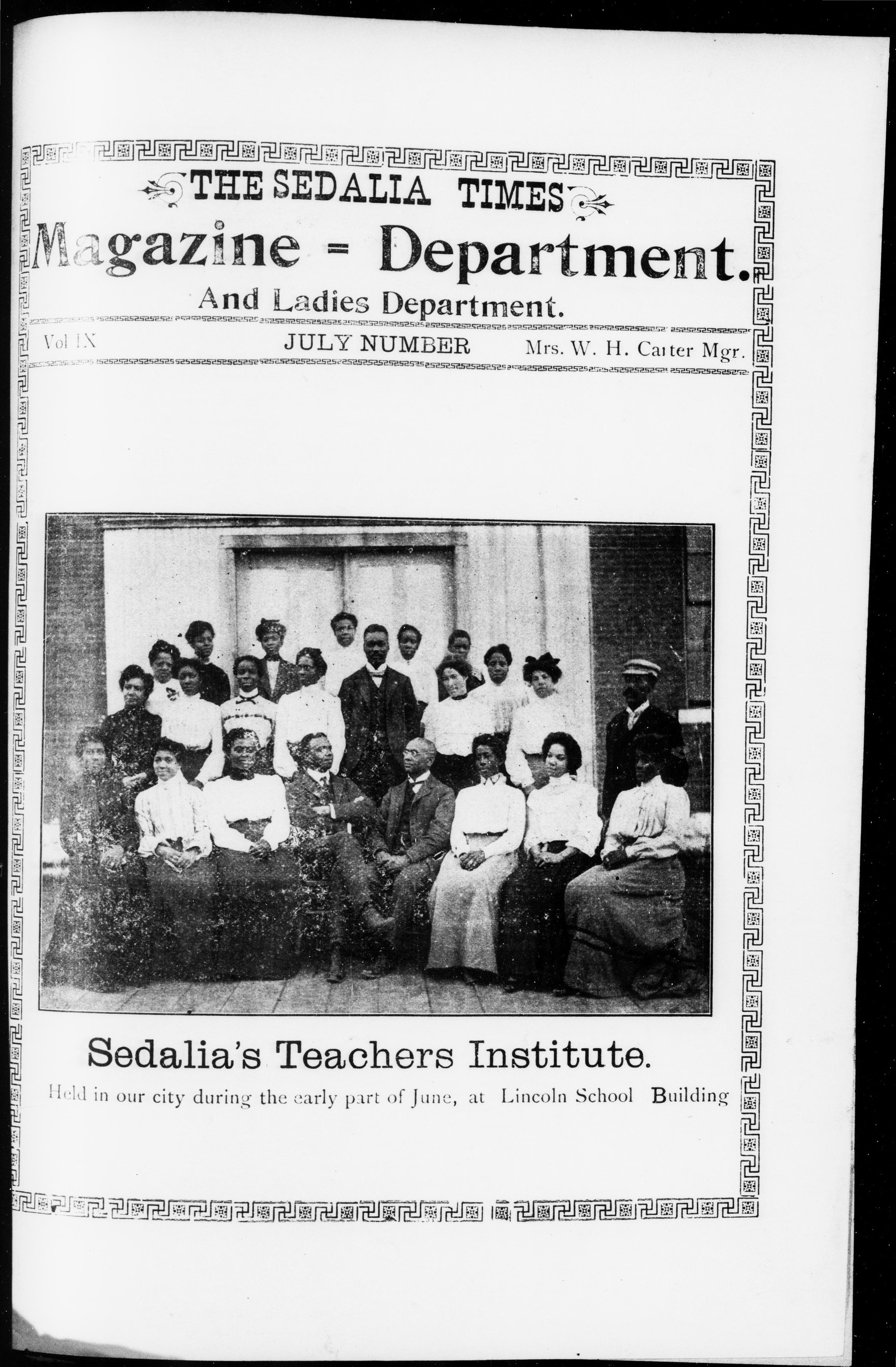
[Group photograph of a group of individuals, likely from the early 20th century, posed in front of a building with a large door.]
Held in our city during the early part of June, at Lincoln School Building
```markdown
```
Slavery Exists in the South as it did Forty Odd Years Ago. The Wiles of the Oppressed Negro in the Southland Tells the same old Story of Human Barbarity-Plaindealer.
```markdown
```
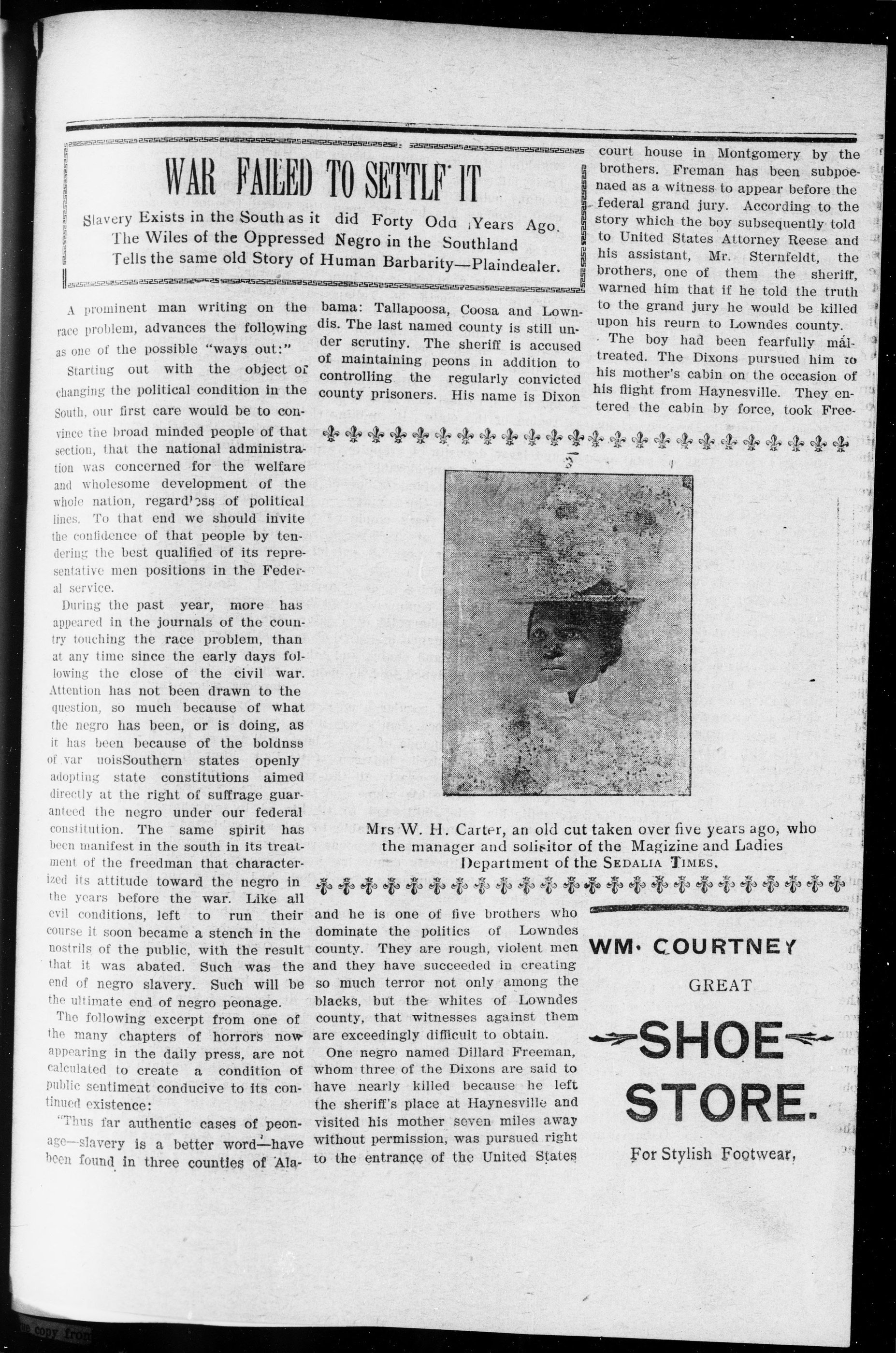
Mrs W. H. Carter, an old cut taken over five years ago, who the manager and solicitor of the Magizine and Ladies Department of the SEDALIA TIMES.
WAR FAILED TO SETTLF IT
A prominent man writing on the race problem, advances the following as one of the possible "ways out:"
Starting out with the object of changing the political condition in the South, our first care would be to convince the broad minded people of that section, that the national administration was concerned for the welfare and wholesome development of the whole nation, regardless of political lines. To that end we should invite the confidence of that people by tendering the best qualified of its representative men positions in the Federal service.
During the past year, more has appeared in the journals of the country touching the race problem, than at any time since the early days following the close of the civil war. Attention has not been drawn to the question, so much because of what the negro has been, or is doing, as it has been because of the boldnss of var uoisSouthern states openly adopting state constitutions aimed directly at the right of suffrage guaranteed the negro under our federal constitution. The same spirit has been manifest in the south in its treatment of the freedman that characterized its attitude toward the negro in the years before the war. Like all evil conditions, left to run their course it soon became a stench in the nostrils of the public, with the result that it was abated. Such was the end of negro slavery. Such will be the ultimate end of negro peonage.
The following excerpt from one of the many chapters of horrors now appearing in the daily press, are not calculated to create a condition of public sentiment conducive to its continued existence:
"Thus far authentic cases of peonage—slavery is a better word—have been found in three counties of Ala-
it did Forty Odd Years Ago. sed Negro in the Southland of Human Barbarity—Plaindealer.
bama: Tallapoosa, Coosa and Lowndis. The last named county is still under scrutiny. The sheriff is accused of maintaining peons in addition to controlling the regularly convicted county prisoners. His name is Dixon
Mrs W. H. Carter, an old cu
the manager and solicitor of
Department of th
and he is one of five brothers who dominate the politics of Lowndes county. They are rough, violent men and they have succeeded in creating so much terror not only among the blacks, but the whites of Lowndes county, that witnesses against them are exceedingly difficult to obtain. One negro named Dillard Freeman, whom three of the Dixons are said to have nearly killed because he left the sheriff's place at Haynesville and visited his mother seven miles away without permission, was pursued right to the entrance of the United States
This is a sample text from a document. The content is not clearly visible due to the blurry background. It appears to be a plain white page with no text or images.
M.
court house in Montgomery by the brothers. Freman has been subpoenaed as a witness to appear before the federal grand jury. According to the story which the boy subsequently told to United States Attorney Reese and his assistant, Mr. Sternfeldt, the brothers, one of them the sheriff, warned him that if he told the truth to the grand jury he would be killed upon his return to Lowndes county. The boy had been fearfully maltreated. The Dixons pursued him to his mother's cabin on the occasion of his flight from Haynesville. They entered the cabin by force, took Free-
```markdown
```
taken over five years ago, who
of the Magizine and Ladies
e SEDALIA TIMES.
WM. COURTNEY
GREAT
SHOE
STORE.
For Stylish Footwear,
man out of doors and the presence of his mother beat him savagely over the head with pistols. Then a rope was tied around his neck and the other end fastened to a horse. Two of the Dixons took a position in the rear of the negro boy. In this order they proceeded back to Hayneville, a distance of seven miles. The boy had to keep his feet regardless of the speed at which the horse traveled or be strangled.
After he reached Hayneville he was mercilessly beaten with a gin strap across the back and legs. He does not know how many blows were struck because he lost consciousness after the fifteenth, but there is tstimony to prove that the total number was not less than a hundered. They were blows struck by a man over six feet in height and weighing 250 pounds and they were blows, moreover, that were administered with all the strength that he could put to them. The only wonder is that the boy survived the punishment.
The most extraordinary feature of this case is that the victim was never legally convicted of an offense against the law. Dixon, in his capacity as sheriff had plenty of prisoners for his chain gang who were legally convicted of wrong-doing, but he believed he needed peons and created them at his will. Ostensibly he took the Freeman boy into his employ at a stated rate of wages. The boy signed a contract by the terms of which he agreed that Dixon could treat him as a prisoner.
"The first experience which he recalls was one involving a beating administered by one of Dixon's subordinates. Dixon told them they were educating him to be a trusty. The boy is now under the protection of the United States attorney in Montgomery. The attempt of the Dixons to force him to perjure himself before the grand jury under threat of death would have been followed by quick punishment of the brothers by Judge Jones if the proper corroborative proof of the episode could have been obtained.
Lowndes county is the center of the black belt in Alabama and its negro population outnumbers the
whites nearly two to one. The Dixons dominate its politics absolutely. Their influence, moreover, extends to state politics.This case illustrates what peonage has brought upon the state.' The following is a powerful illustration of conditions in the South:
"Turner is a neighbor of John W. Pace, former sheriff of Tallapoosa county, who is recognized as the most persistent and brutal violator of the state law against peonage. He is the wealthiest and most powerful man in Tallopoosa county. His plantation is one of the richest and largest in that region of the state. It contains rich soil for cotton, timber in abundance and large deposits of graphite, which he works on a considerable scale. His graphite mine, in fact, is one of the most extensive in the country.
Pace has for years employed the county convicts of Tallapoosa and maintains as part of his establishment a stockade with cells, a kennel of bloodhounds and a force of armed guards. He is equipped otherwise with the parapharnalia of a jailor. He has an abundance of leg irons or handcuffs, balls and chains and other instruments designed to hold men in captivity:
The supply of regular county convicts in Tallapoosa county was never equal to the demands of Pace's business. He required between forty and sixty ngroes nearly all the year round to operate his mines and sawmill, his grist mill, and to til his fields. He found it profitable to secure his help by creating peons rather than by directly employing negro laborers who voluntarily offered their services to him.
"Every person whom he took into his employ, whether as a peon or as a free laborer, he forced to sign a contract which empowered Pace to treat the laborer as a convict. Pace reserved the right to lock him up at night, to shackle him in the fields, deprive him of clothing and to bring him back with blood hounds if he tried to escape. Corporal punishment of the most vigorous character was a mere incident to the daily routine of Pace's establishment. Men and women were beaten upon the smallest pretext. There were guards always at
hand ready with a gin strap or buggy trace or pistol butt to perform this service. As usually happens in such cases, when beatings were not provoked frequently enough by the victimes the guards, who are classified in the records of the United States district attorney's office as 'whipping guards,' would administer the whip without excuse or cause.
"Pace went a step farther in his brutalities than any of his neighbors. Besides encouraging violent whippings by his guards and indulging in this form of brutality on his own account he forced his negroes to work in the fields stark naked. No distinction was made in sex in carrying out his plans.
Pace says in extenuation of his conduct in this respect that he wished to prevent the negroes escaping. One negro, Ed Moody, by name, was rescued from a ditch in front of Pace's house by a United States deputy marshal. He did not have a rag of clothing upon him. The United States authorities will not depend upon negro testimony alone to prove that Pace worked his field hands naked. A number of influential citizens of Tallapoosa, whose indignation was aroused by this form of savagery, have come forward and expressed their willingness to tell what they know. Pace, himself, however, has practically admitted it.
"The boy Ed Moody that was rescued by marshals, is the same negro who exhibited a deformed shoulder before the grand jury, upon the occasion of his visit to Montgomery. Pace had broken the boy's clavicle by a blow from a club.
Another negro found in a state of nakedness on Pace's plantation, was Owen Gregor, who, according to his calculations, had been in bondage at least fifteen years. Pace never let go of him. H tried repeatedly to get away, but each time was run down by bloodhounds and horsemen and brought back in irons to be whipped within an inch of his life. Gregor who is very ignorant, has only vague ideas of the methods used to deprive him of his liberty, but the presumption is they were the same as were used in other cases.'
OF INTEREST TO OUR WOMEN.
Bargains In
LADIES Stylish
SUM'ER HATS.
AT MRS YOUNGERS,
Rear of The Greater Hail's Dry Goods Store.
```markdown
```
Pangee is an invaluable material. How we ever did without it for so many years is a mystery. Here are a few things for which it is used this season:
To make shirtwaist suits of,
For the long, smart white, black and
ecru coats.
To fashion into the lightest of petti-
coats.
To make parasols "to match." For hats stiffened and stitched. Indeed one might clothe herself entirely in Pongee this summer and be cool, comfortable and stylish and to some extent economical.
A beautiful white blouse of pongee is laid in small box plaits. Back, front and sleeves are embelished with these, and they are in turn ornamented with French knots done in white silk.
The owner of this little waist has had an enormous amount of wear out of it for pongee launders like percale and is none the worse for many dips in the tub.
A white pongee coat is three-quarter length. loose fitting and has mild accordion plaitedrsleeves. A fluffy boa about the throat and stole ends complete this beautiful wrap.
The Ten Qualities Girls Most Desire In a Man.
Taking the answers of all the hundred girls that I find that the ten qualities most often desired may be classified as follows:
42 girls ask for strength of character,
25 for business ability.
18 for respect for women.
16 for broad-mindedness.
14 for love of home and children.
What Girls Are Supposed to Look For. The three essentials which are gener-
---
As blouses,
For underwear.
17 for love,
17 for honesty,
15 for humor.
14 for christianity.
13 for sympathy.
ally said that girls look for in a man good looks, wealth and good dressing were mentioned as follows: 6 girls asked for good looks, 3 asked for wealth, 9 asked for good dressing, while 45 frankly averred their indifference to either or all of these three possessions,
I am now trying to find out from 100 young men the qualities which they look for in a girl as a wife. These opinions I I hope to give in an early issue of The Ladies Home Journal.
Left Bad Luck With the Conductor.
"I nuvver gwine ter take 'em! Nuvver!" She boarded an open Ninth avenue car in the upper Fifties, and because she was such a stout, good natured looking colored "auntie" everyone in the car looked at her when she gave voice to these decided words. She had handed the conductor a dime, and he had given her back in change ove soppers. At least he had offered them to her. But auntie steadily refused to take them, holding her puffy hands clasped tight together with a determined look about her mouth. "I nuvver gwine ter take 'em," she repeated,
"Cayn't yer gi' me a nickle?"
At last he put the coppers on the seat seat beside her and went about his busfness. She left them there but she was thoronghly vexed, Then a young woman who sat just in front of her, turned around.
"I'll give you a nickle for those pennies," she said softly,
"Lor', honey. doan' yer tech dem coppers! I'm bleeged to tell yer dey' fetch yer bad 'luck—dey sho' would. I's jes come from de 'ospital where my chile's nigh to death. Ef I took dem coppers she' die. sartin she would. Bless yer, honey, no; doan yer tech dem coppers." Her last shot at the offending conduetor as she got off the car at Thirty-fourth st, was:
"Dey's dere, [conductor, de coppers am dere. Yo kin have de bad luck yo' self."
A half block below, as the conductor took up the coppers with some facctibus remarh; a loadod truck attempted to cross the track. The motorman banged into it before he could slow up. The front platform of the car was wrecked and a whee was knocked off the truck. The conductor's bad luck had arrived.—N. Y. Press,
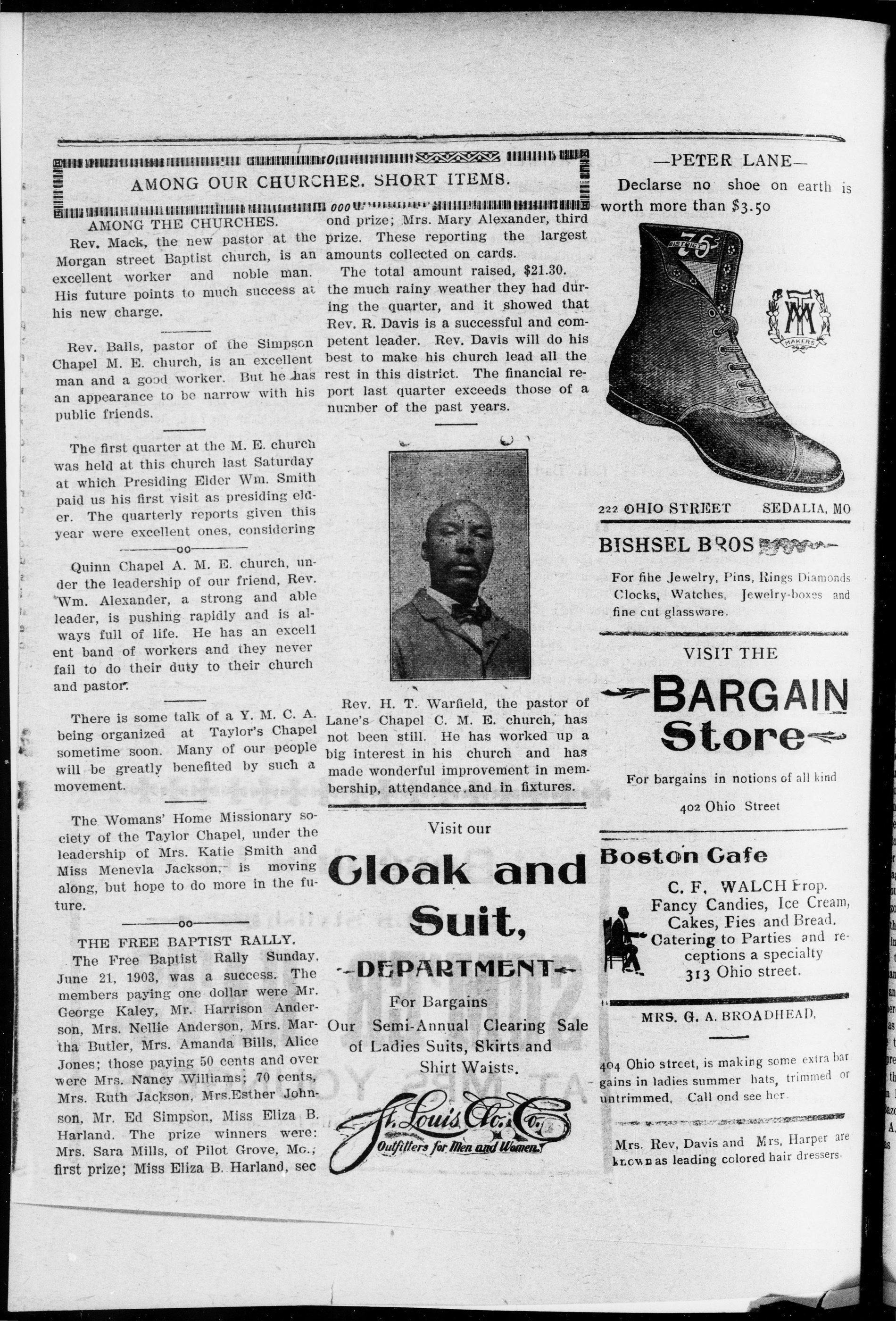
AMONG OUR CHURCHES. SHORT ITEMS.
AMONG THE CHURCHES.
Rev. Mack, the new pastor at the Morgan street Baptist church, is an excellent worker and noble man. His future points to much success at his new charge.
ond prize; Mrs. Mary Alexander, third prize. These reporting the largest amounts collected on cards.
The total amount raised, $21.30. the much rainy weather they had during the quarter, and it showed that
Rev. Balls, pastor of the Simpson Chapel M. E. church, is an excellent man and a good worker. But he has an appearance to be narrow with his public friends.
The first quarter at the M. E. church was held at this church last Saturday at which Presiding Elder Wm. Smith paid us his first visit as presiding elder. The quarterly reports given this year were excellent ones, considering
Quinn Chapel A. M. E. church, under the leadership of our friend, Rev. Wm. Alexander, a strong and able leader, is pushing rapidly and is always full of life. He has an excellent band of workers and they never fail to do their duty to their church and pastor.
There is some talk of a Y. M. C. A. being organized at Taylor's Chapel sometime soon. Many of our people will be greatly benefited by such a movement.
```markdown
```
The Womans' Home Missionary society of the Taylor Chapel, under the leadership of Mrs. Katie Smith and Miss Menevla Jackson, is moving along, but hope to do more in the future.
THE FREE BAPTIST RALLY.
The Free Baptist Rally Sunday, June 21, 1903, was a success. The members paying one dollar were Mr. George Kaley, Mr. Harrison Anderson, Mrs. Nellie Anderson, Mrs. Martha Butler, Mrs. Amanda Bills, Alice Jones; those paying 50 cents and over were Mrs. Nancy Williams; 70 cents, Mrs. Ruth Jackson, Mrs.Esther Johnson, Mr. Ed Simpson, Miss Eliza B. Harland. The prize winners were: Mrs. Sara Mills, of Pilot Grove, Mc.; first prize; Miss Eliza B. Harland, sec
ond prize; Mrs. Mary Alexander, third prize. These reporting the largest amounts collected on cards.
The total amount raised, $21.30. the much rainy weather they had during the quarter, and it showed that Rev. R. Davis is a successful and competent leader. Rev. Davis will do his best to make his church lead all the rest in this district. The financial report last quarter exceeds those of a number of the past years.
C
Rev. H. T. Warfield, the pastor of Lane's Chapel C. M. E. church, has not been still. He has worked up a big interest in his church and has made wonderful improvement in membership, attendance and in fixtures. Visit our
Visit our
Gloak and Suit,
DEPARTMENT For Bargains Our Semi-Annual Clearing Sale of Ladies Suits, Skirts and Shirt Waists.
St. Louis Co. Co.
Outfitters for Men and Women.
```markdown
```
Declarse no shoe on earth is worth more than $3.50
76'S
DISTRICT
MAKERS
222 OHIO STREET SEDALIA, MO
BISHSEL BROS
For fine Jewelry, Pins, Rings Diamonds Clocks, Watches, Jewelry-boxes and fine cut glassware.
VISIT THE
BARGAIN Store
For bargains in notions of all kind 402 Ohio Street
Boston Gafe
C. F. WALCH Frop. Fancy Candies, Ice Cream, Cakes, Fies and Bread. Catering to Parties and receptions a specialty 313 Ohio street.
A
MRS. G. A. BROADHEAD,
404 Ohio street, is making some extra bar gains in ladies summer hats, trimmed or untrimmed. Call ond see her. Mrs. Rev, Davis and Mrs, Harper are known as leading colored hair dressers.
```markdown
```
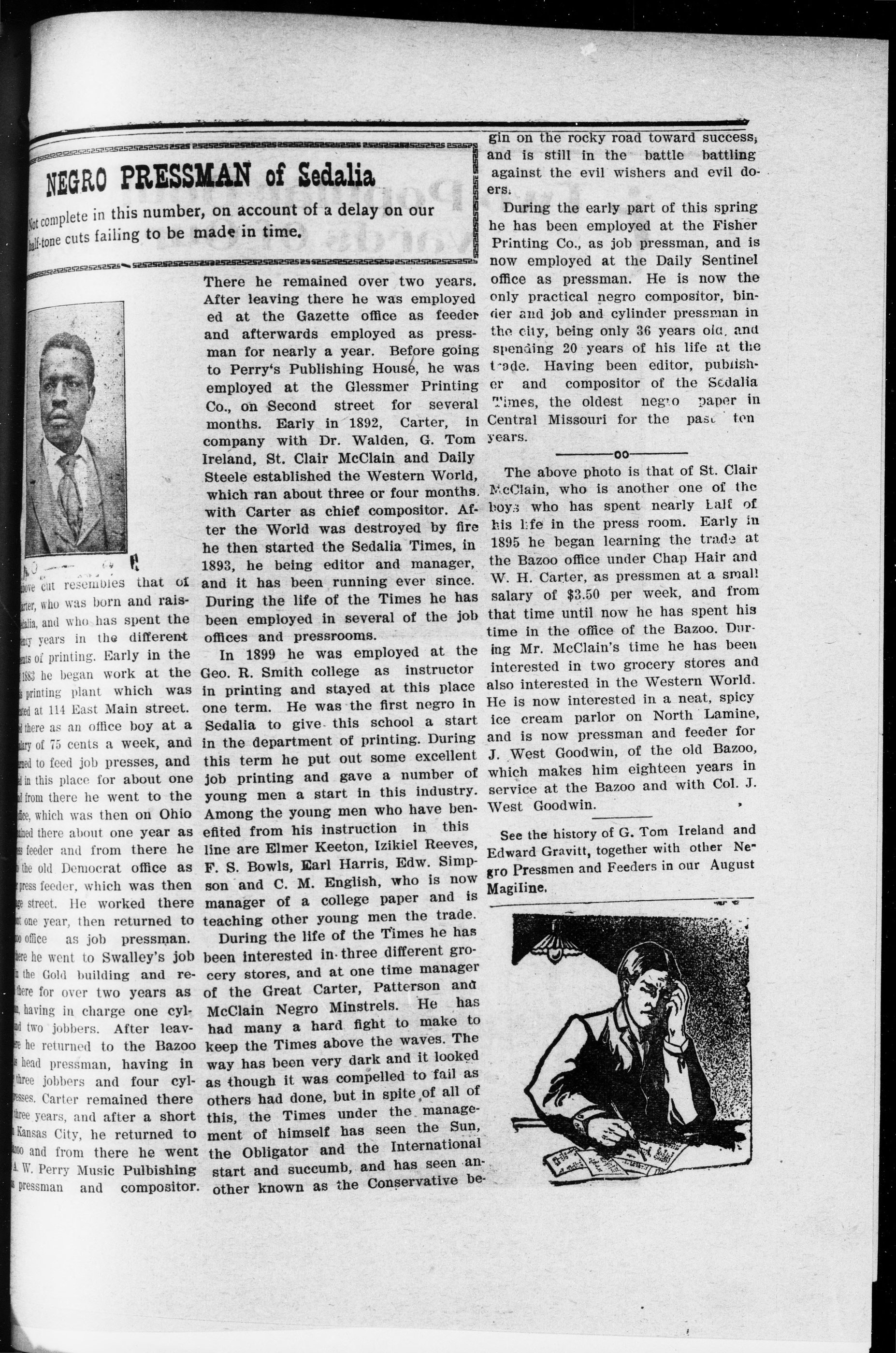
NEGRO PRESSMAN of Sedalia
Not complete in this number, on account of a delay on our half-tone cuts failing to be made in time.
M.
move cut resembles that of Carter, who was born and raised inalia, and who has spent the twenty years in the different events of printing. Early in the 1883 he began work at the printing plant which was located at 114 East Main street. And there as an office boy at a salary of 75 cents a week, and turned to feed job presses, and lived in this place for about one and from there he went to the office, which was then on Ohio trained there about one year as press feeder and from there he to the old Democrat office as press feeder, which was then age street. He worked there but one year, then returned to too office as job pressman. Here he went to Swalley's job in the Gold building and re- there for over two years as in, having in charge one cyl- and two jobbers. After leave he returned to the Bazoo head pressman, having in three jobbers and four cyl-esses. Carter remained there three years, and after a short Kansas City, he returned to too and from there he went A. W. Perry Music Pulbishing pressman and compositor
There he remained over two years. After leaving there he was employed ed at the Gazette office as feeder and afterwards employed as pressman for nearly a year. Before going to Perry's Publishing House, he was employed at the Glessmer Printing Co., on Second street for several months. Early in 1892, Carter, in company with Dr. Walden, G. Tom Ireland, St. Clair McClain and Daily Steele established the Western World, which ran about three or four months with Carter as chief compositor. After the World was destroyed by fire he then started the Sedalia Times, in 1893, he being editor and manager, and it has been running ever since. During the life of the Times he has been employed in several of the job offices and pressrooms.
In 1899 he was employed at the Geo. R. Smith college as instructor in printing and stayed at this place one term. He was the first negro in Sedalia to give this school a start in the department of printing. During this term he put out some excellent job printing and gave a number of young men a start in this industry. Among the young men who have benefited from his instruction in this line are Elmer Keeton, Izikiel Reeves, F. S. Bowls, Earl Harris, Edw. Simpson and C. M. English, who is now manager of a college paper and is teaching other young men the trade.
During the life of the Times he has been interested in three different grocery stores, and at one time manager of the Great Carter, Patterson and McClain Negro Minstrels. He has had many a hard fight to make to keep the Times above the waves. The way has been very dark and it looked as though it was compelled to fail as others had done, but in spite of all of this, the Times under the management of himself has seen the Sun, the Obligator and the International start and succumb, and has seen an other known as the Conservative be
gin on the rocky road toward success, and is still in the battle battling against the evil wishers and evil doers.
During the early part of this spring he has been employed at the Fisher Printing Co., as job pressman, and is now employed at the Daily Sentinel office as pressman. He is now the only practical negro compositor, binder and job and cylinder pressman in the city, being only 36 years old, and spending 20 years of his life at the trade. Having been editor, publisher and compositor of the Sedalia Times, the oldest negro paper in Central Missouri for the past ten years.
00
The above photo is that of St. Clair McClain, who is another one of the boys who has spent nearly half of his life in the press room. Early in 1895 he began learning the trade at the Bazoo office under Chap Hair and W. H. Carter, as pressmen at a small salary of $3.50 per week, and from that time until now he has spent his time in the office of the Bazoo. During Mr. McClain's time he has been interested in two grocery stores and also interested in the Western World. He is now interested in a neat, spicy ice cream parlor on North Lamine, and is now pressman and feeder for J. West Goodwin, of the old Bazoo, which makes him eighteen years in service at the Bazoo and with Col. J. West Goodwin.
See the history of G. Tom Ireland and Edward Gravitt, together with other Negro Pressmen and Feeders in our August MagiLine.
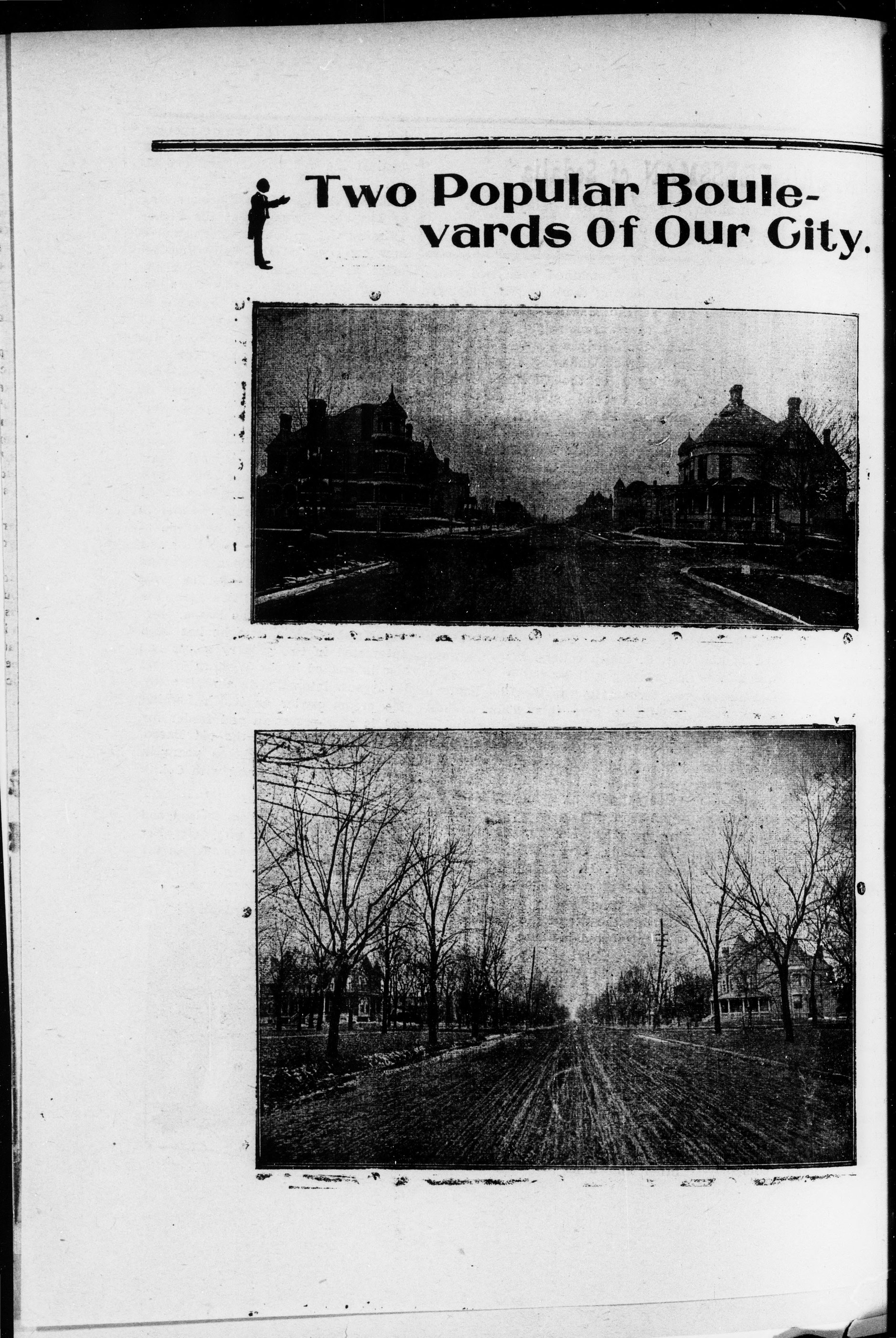
Two Popular Boulevards Of Our City.
THE STREETS OF MIDDLEBURG.
A snowy street in a residential area. The road is lined with bare trees and houses, all covered in snow. The sky is overcast, and the street appears to be empty.
EUSCHKE'S.
Special Bargains Next Week in
The bad weath is now about over, and now is the time to get ready for the hot weather. We have a full and complete stock of Summer styles, colors and designs, just arrived, and you will like them, when you come and see them.
W. MEUSGHKE,
COR. OHIO AND THIRD STREET.
Summa The bad weath is uow about it ready for the hot weather.lete stock of Summer styles, ived, and you will like them,
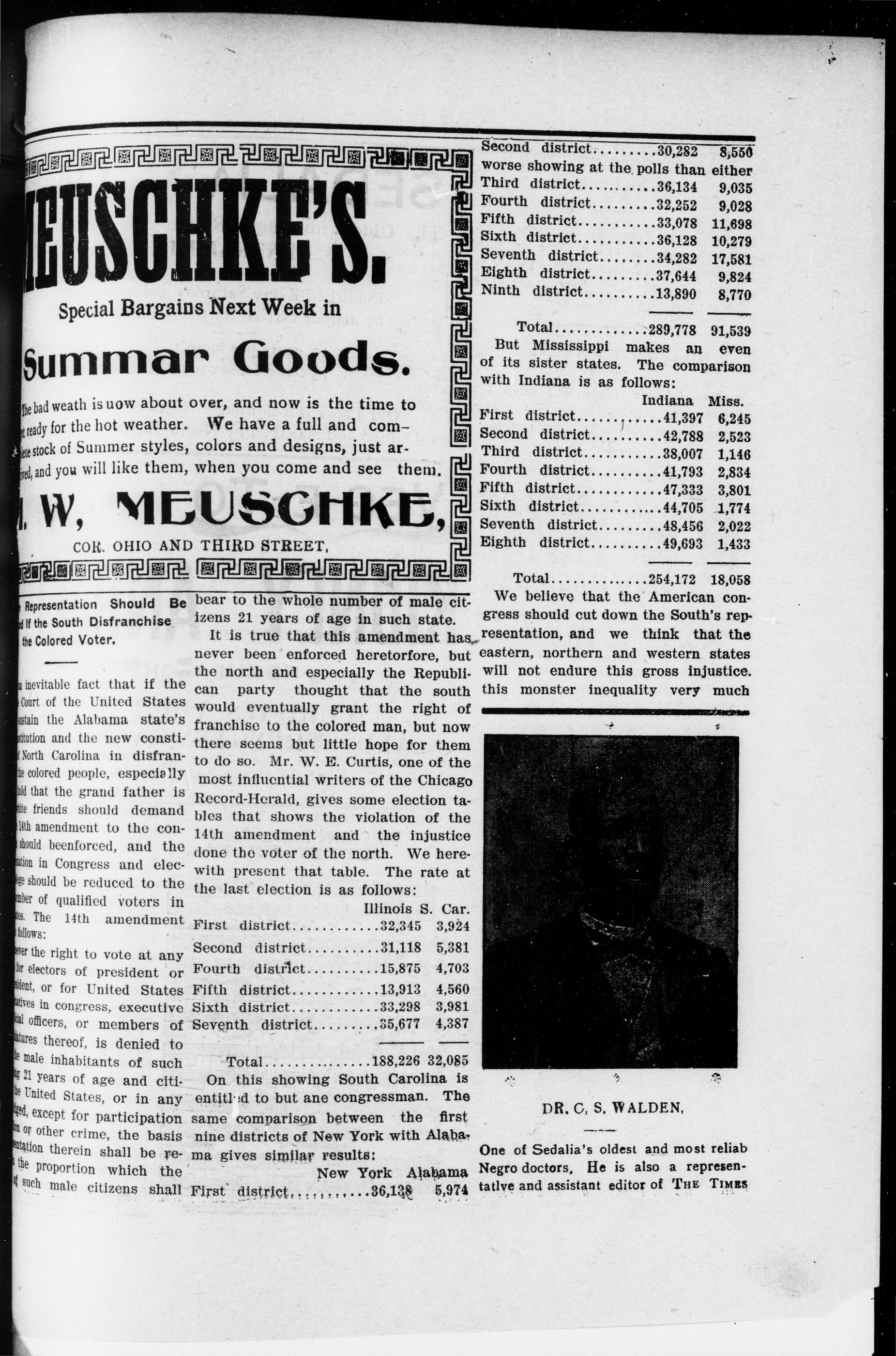
Representation Should Be Used If the South Disfranchise the Colored Voter.
an inevitable fact that if the Court of the United States sustain the Alabama state's institution and the new constitution North Carolina in disfrain the colored people, especially hold that the grand father is white friends should demand 14th amendment to the cons should beenforced, and the nation in Congress and elec lage should be reduced to the number of qualified voters in states. The 14th amendment follows:
ever the right to vote at any for electors of president or president, or for United States natives in congress, executive social officers, or members of features thereof, is denied to the male inhabitants of such 21 years of age and citiie United States, or in any aged, except for participation on or other crime, the basis presentation therein shall be re the proportion which the of such male citizens shall
1.
over, and now is the time to We have a full and com- colors and designs, just ar- when you come and see them.
bear to the whole number of male citizens 21 years of age in such state.
It is true that this amendment has never been enforced heretorfore, but the north and especially the Republican party thought that the south would eventually grant the right of franchise to the colored man, but now there seems but little hope for them to do so. Mr. W. E. Curtis, one of the most influential writers of the Chicago Record-Herald, gives some election tables that shows the violation of the 14th amendment and the injustice done the voter of the north. We herewith present that table. The rate at the last election is as follows:
Illinois S. Car.
First district.....32,345 3,924
Second district.....31,118 5,381
Fourth district.....15,875 4,703
Fifth district.....13,913 4,560
Sixth district.....33,298 3,981
Seventh district.....35,677 4,387
Total.....188,226 32,085 On this showing South Carolina is entitled to but ane congressman. The same comparison between the first nine districts of New York with Alabama gives similar results: New York Alabama First district.....36,138 5,974
```markdown
```
Total.....289,778 91,539 But Mississippi makes an even of its sister states. The comparison with Indiana is as follows:
Indiana Miss.
First district.....41,397 6,245
Second district.....42,788 2,523
Third district.....38,007 1,146
Fourth district.....41,793 2,834
Fifth district.....47,333 3,801
Sixth district.....44,705 1,774
Seventh district.....48,456 2,022
Eighth district.....49,693 1,433
Total. 254,172 18,058 We believe that the American congress should cut down the South's representation, and we think that the eastern, northern and western states will not endure this gross injustice. this monster inequality very much
3
DR. C. S. WALDEN.
One of Sedalia's oldest and most reliab Negro doctors. He is also a representatlve and assistant editor of THE TIMES
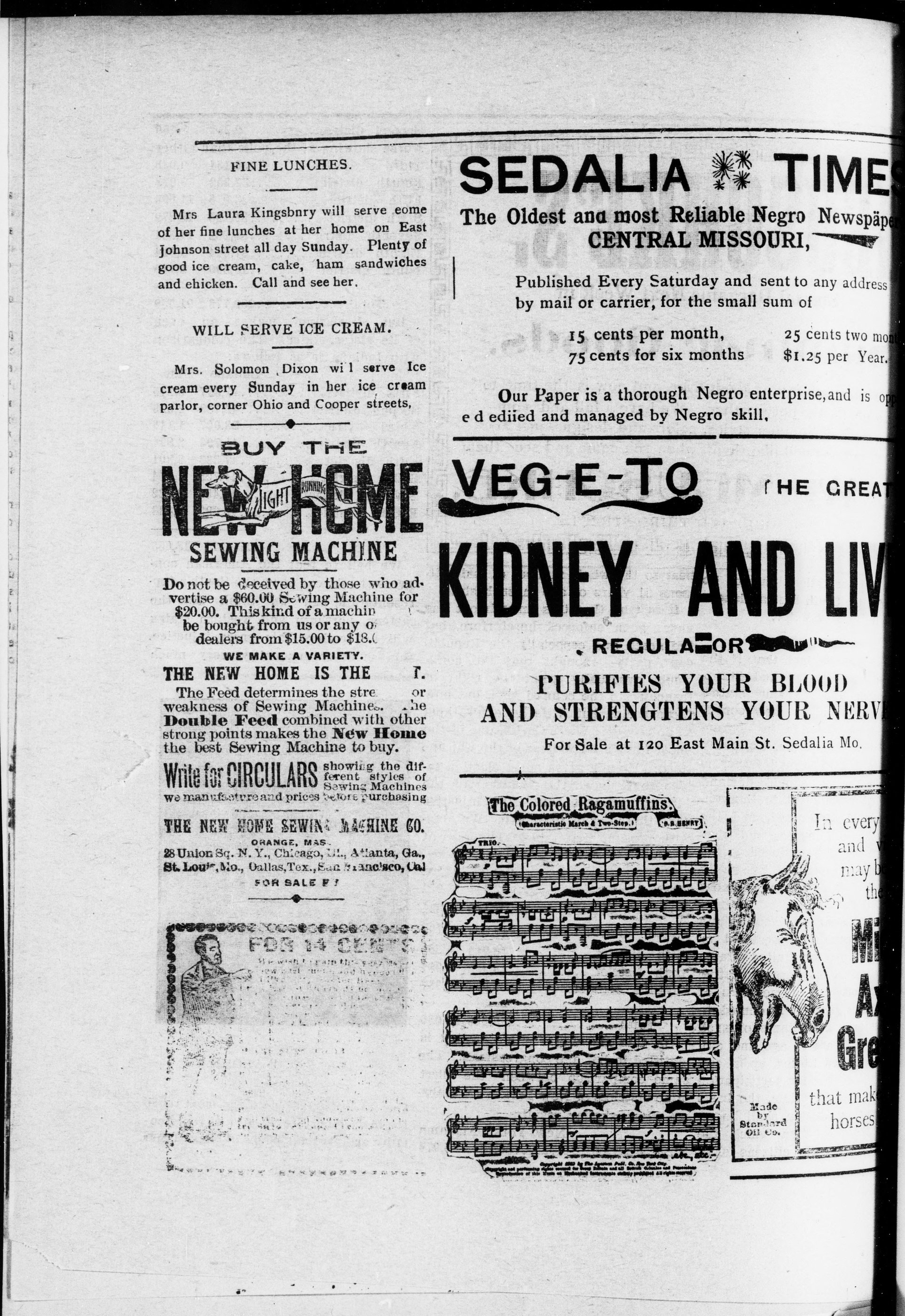
FINE LUNCHES.
Mrs Laura Kingsbnry will serve eome of her fine lunches at her home on East johnson street all day Sunday. Plenty of good ice cream, cake, ham sandwiches and chicken. Call and see her.
WILL SERVE ICE CREAM.
Mrs. Solomon Dixon will serve Ice cream every Sunday in her ice cream parlor, corner Ohio and Cooper streets,
BUY THE
NEW HOME
LIGHT RUNNING
SEWING MACHINE
Do not be deceived by those who advertise a $60.00 Sewing Machine for $20.00. This kind of a machine be bought from us or any dealers from $15.00 to $18.0
THE NEW HOME IS THE T.
The Feed determines the strength or weakness of Sewing Machines. The Double Feed combined with other strong points makes the New Home the best Sewing Machine to buy.
Write for CIRCULARS showing the different styles of Sewing Machines we manufacture and prices before purchasing
THE NEW HOME SEWING MACHINE CO. ORANGE, MAS. 28 Union Sq. N. Y., Chicago, Mt., Atlanta, Ga., St. Louis, Mo., Dallas, Tex., San Francisco, Cal FOR SALE
FOR 14 CENTS
We wish to warn the yeas that the
new deal and the contract
will not be good for the yeas.
We wish to warn the yeas that the
new deal and the contract
will not be good for the yeas.
---
SEDALIA TIME
SEDALIA TIME
The Oldest and most Reliable Negro Newspaper CENTRAL MISSOURI,
Published Every Saturday and sent to any address by mail or carrier, for the small sum of
15 cents per month, 25 cents two mo
75 cents for six months $1.25 per Year.
er is a thorough Negro enterprise, and is op
d managed by Negro skill.
E-TO THE GREAT
EY AND LIV
REGULATOR
URIFIES YOUR BLOOD
STRENGTENS YOUR NERVE
For Sale at 120 East Main St. Sedalia Mo.
Our Paper is a thorough Negro enterprise,and is op ed ediied and managed by Negro skill.
VEG-E-TO THE GREAT KIDNEY AND LIV
PURIFIES YOUR BLOOD AND STRENGTENS YOUR NERV For Sale at 120 East Main St. Sedalia Mo.
In every
and w
may b
the
Mil
Ax
Gre
that make
horses
Made
by
Standard
Oil Co.
Technical information already published all rights reserved.