Sedalia Weekly Conservator
Saturday, July 11, 1903
Sedalia, Missouri
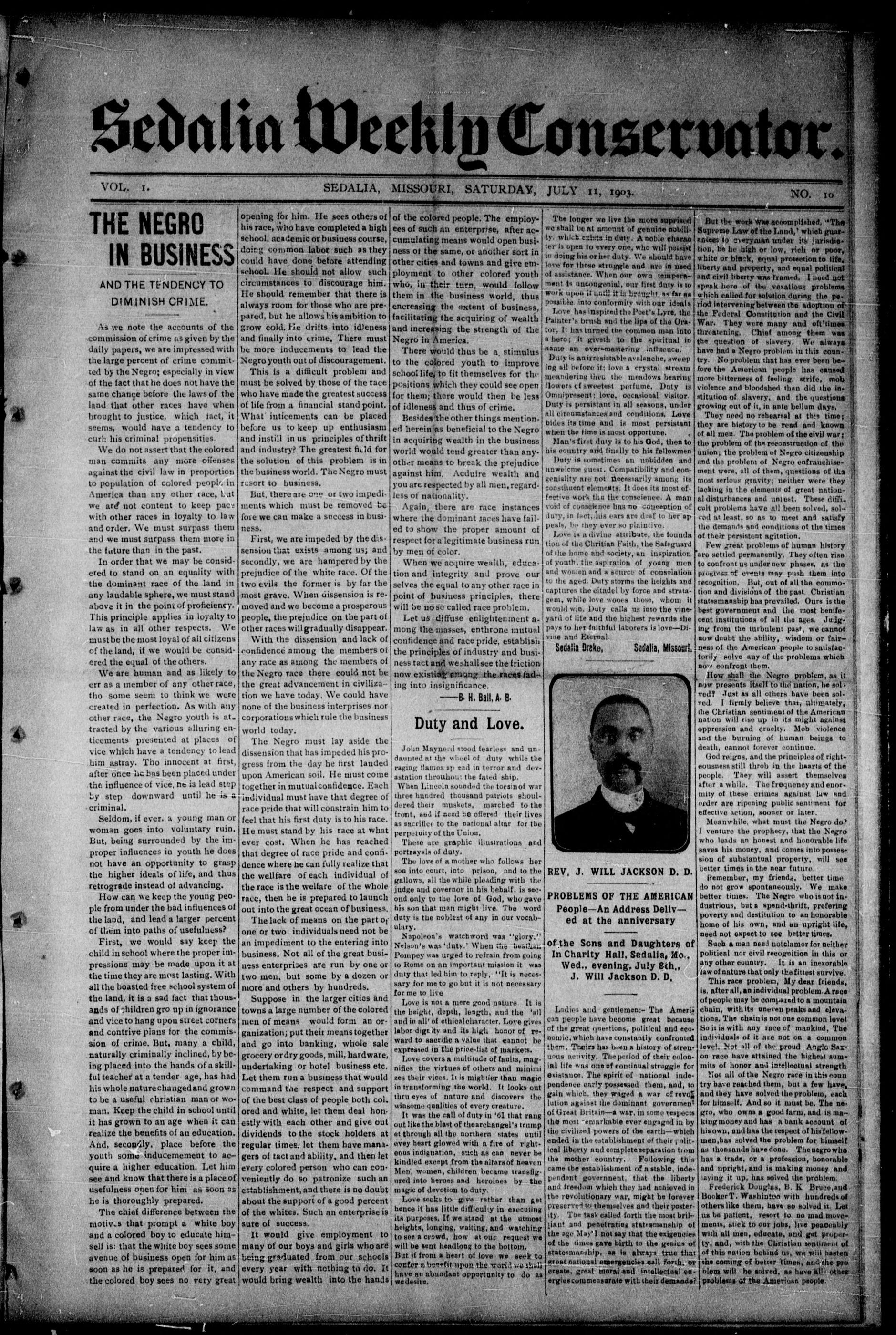
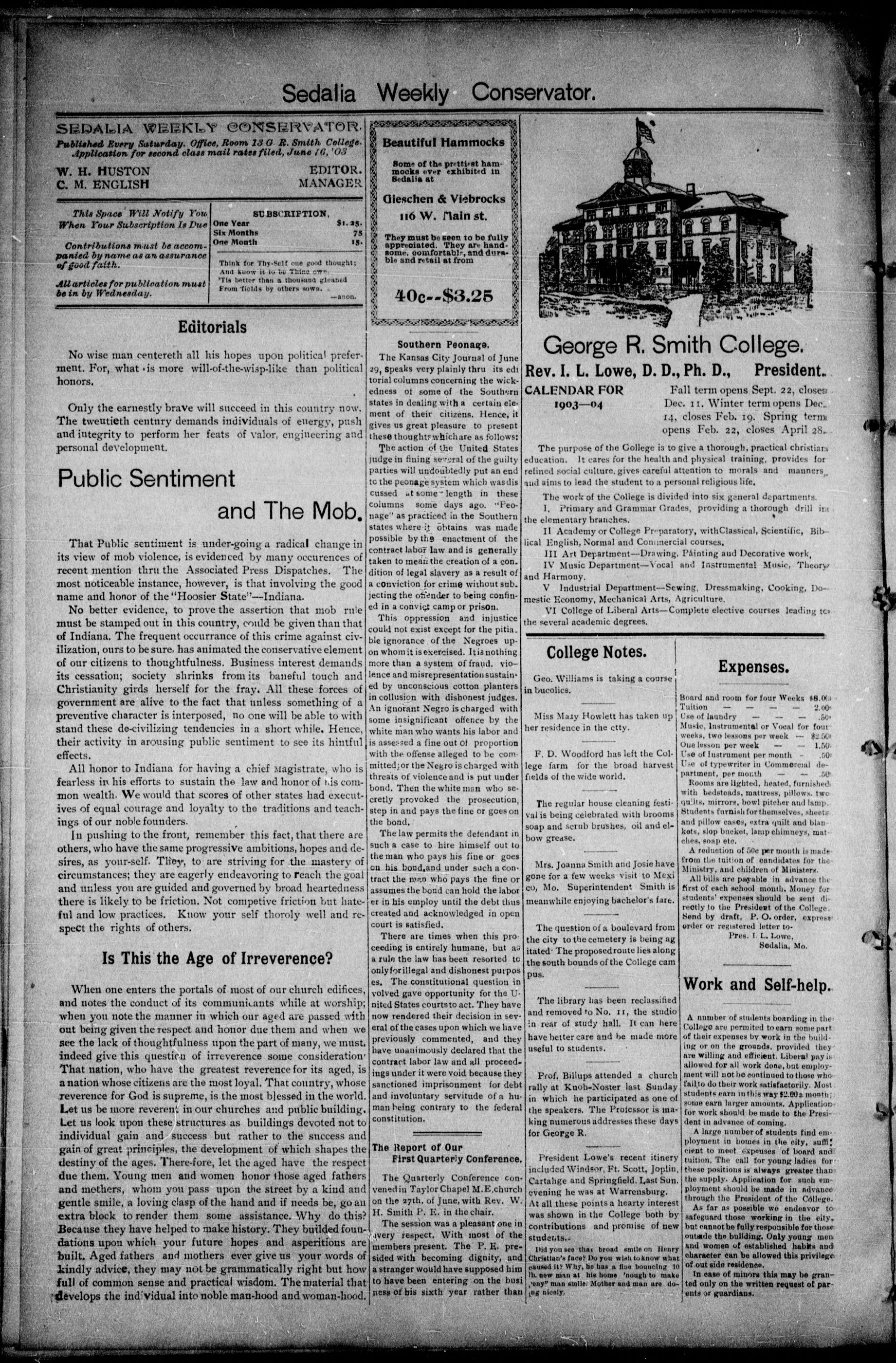
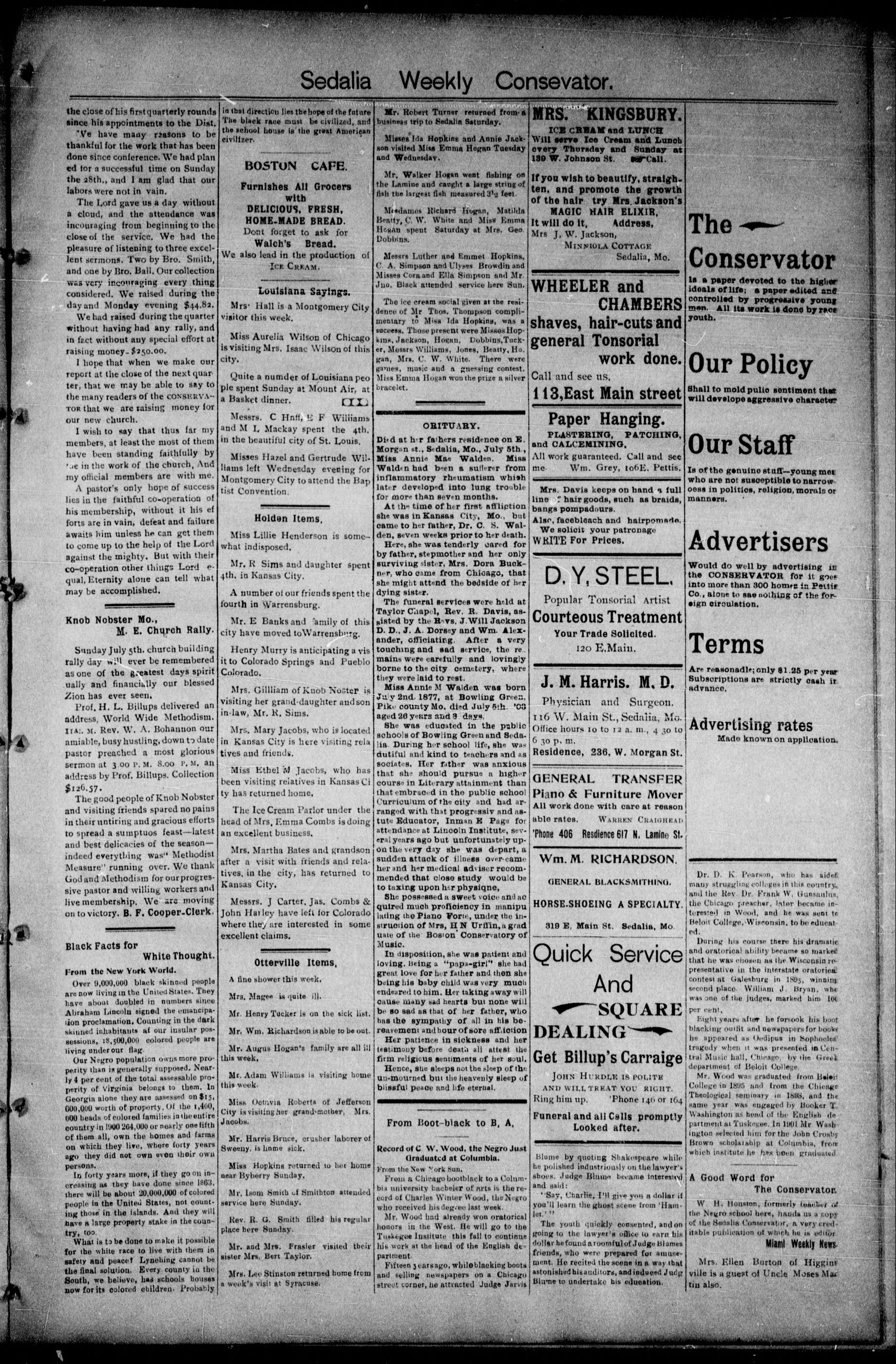
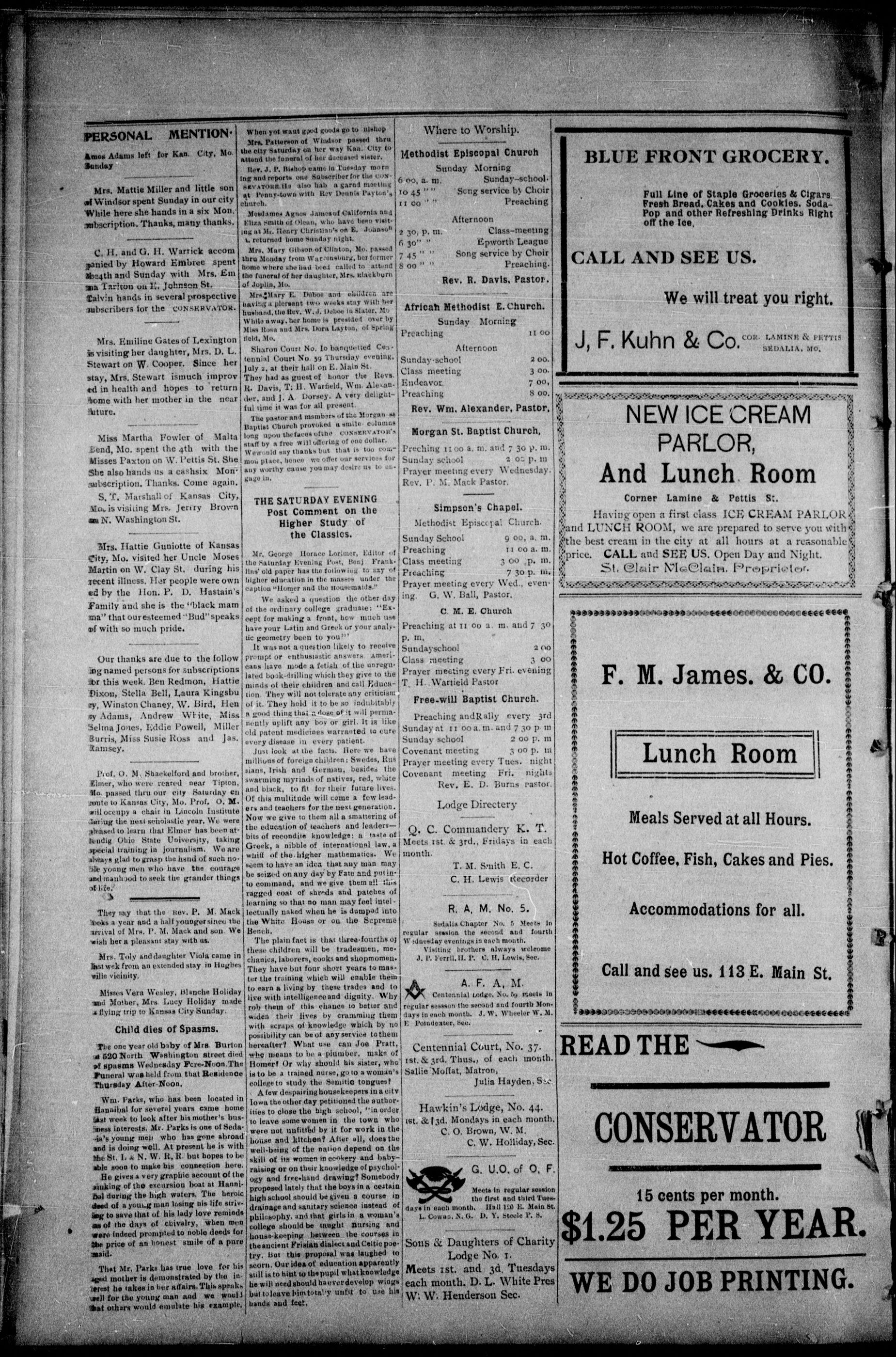
Page text (machine-generated)
Sedalia Weekly Conservator.
VOL. 1.
THE NEGRO IN BUSINESS
THE NEGRO IN BUSINESS
AND THE TENDENCY TO DIMINISH CRIME.
As we note the accounts of the commission of crime as given by the daily papers, we are impressed with the large percent of crime committed by the Negro; especially in view of the fact that he does not have the same change before the laws of the land that other races have when brought to justice, which fact, it seems, would have a tendency to curb his criminal propensities.
We do not assert that the colored man commits any more offenses against the civil law in proportion to population of colored people in America than any other race, but we are not content to keep pace with other races in loyalty to law and order. We must surpass them and we must surpass them more in the future than in the past.
In order that we may be considered to stand on an equality with the dominant race of the land in any laudable sphere, we must stand above it in the point of proficiency. This principle applies in loyalty to law as in all other respects. We must be the most loyal of all citizens of the land, if we would be considered the equal of the others.
We are human and as likely to err as a member of any other race, tho some seem to think we were created in perfection. As with any other race, the Negro youth is attracted by the various alluring enticements presented at places of vice which have a tendency to lead him astray. The innocent at first, after once he has been placed under the influence of vice, he is lead step by step downward until he is a criminal.
Seldom, if ever, a young man or woman goes into voluntary ruin. But, being surrounded by the improper influences in youth he does not have an opportunity to grasp the higher ideals of life, and thus retrograde instead of advancing. How can we keep the young people from under the bad influences of the land, and lead a larger percent of them into paths of usefulness?
First, we would say keep the child in school where the proper impressions may be made upon it at the time they are most lasting. With all the boasted free school system of the land, it is a sad fact that thousands of children gro up in ignorance and vice to hang upon street corners and contrive plans for the commission of crime. But, many a child, naturally criminally inclined, by being placed into the hands of a skillful teacher at a tender age, has had his whole nature changed and grown to be a useful christian man or woman. Keep the child in school until it has grown to an age when it can realize the benefits of an education. And, secondly, place before the youth some inducement to acquire a higher education. Let him see and know that there is a place of usefulness open for him as soon as he is thoroughly prepared.
The chief difference between the motivs that prompt a white boy and a colored boy to educate himself is: that the white boy sees some avenue of business open for him as soon as he is prepared for it, and the colored boy sees no very great
SEDALIA, MISSOURI, SATURDAY, JULY 11, 1903.
opening for him. He sees others of his race, who have completed a high school, academic or business course, doing common labor such as they could have done before attending school. He should not allow such circumstances to discourage him. He should remember that there is always room for those who are prepared, but he allows his ambition to grow cold. He drifts into idleness and finally into crime. There must be more inducements to lead the Negro youth out of discouragement. This is a difficult problem and must be solved by those of the race who have made the greatest success of life from a financial stand point. What inticements can be placed before us to keep up enthusiasm and instill in us principles of thrift and industry? The greatest field for the solution of this problem is in the business world. The Negro must resort to business.
But, there are one or two impediments which must be removed be fore we can make a success in business.
First, we are impeded by the dissension that exists among us; and secondly, we are hampered by the prejudice of the white race. Of the two evils the former is by far the most grave. When dissension is removed and we become a prosperous people, the prejudice on the part of other races will gradually disappear.
With the dissension and lack of confidence among the members of any race as among the members of the Negro race there could not be the great advancement in civilization we have today. We could have none of the business interprises nor corporations which rule the business world today.
The Negro must lay aside the dissension that has impeded his progress from the day he first landed upon American soil. He must come together in mutual confidence. Each individual must have that degree of race pride that will constrain him to feel that his first duty is to his race. He must stand by his race at what ever cost. When he has reached that degree of race pride and confidence where he can fully realize that the welfare of each individual of the race is the welfare of the whole race, then he is prepared to launch out into the great ocean of business.
The lack of means on the part of one or two individuals need not be an impediment to the entering into business. Not all of the great business enterprises are run by one or two men, but some by a dozen or more and others by hundreds.
Suppose in the larger cities and towns a large number of the colored men of means would form an organization; put their means together and go into banking, whole sale grocery or dry goods, mill, hardware, undertaking or hotel business etc. Let them run a business that would command the respect and support of the best class of people both colored and white, let them deal honestly with each other and give out dividends to the stock holders at regular times, let them have managers of tact and ability, and then let every colored person who can conveniently do so patronize such an establishment, and there is no doubt about the support of a good percent of the whites. Such an enterprise is sure of success.
It would give employment to many of our boys and girls who are being graduated from our schools every year with nothing to do. It would bring wealth into the hands
of the colored people. The employees of such an enterprise, after accumulating means would open business of the same, or another sort in other cities and towns and give employment to other colored youth who, in their turn, would follow them in the business world, thus encreasing the extent of business, facilitating the acquiring of wealth and increasing the strength of the Negro in America.
There would thus be a stimulus to the colored youth to improve school life; to fit themselves for the positions which they could see open for them; there would then be less of idleness and thus of crime.
Besides the other things mentioned herein as beneficial to the Negro in acquiring wealth in the business world would tend greater than any other means to break the prejudice against him. Acduire wealth and you are respected by all men, regardless of nationality.
Again, there are race instances where the dominant races have failed to show the proper amount of respect for a legitimate business run by men of color.
When we acquire wealth, education and integrity and prove our selves the equal to any other race in point of business principles, there will be no so called race problem.
Let us diffuse enlightenment among the masses, enthrone mutual confidence and race pride, establish the principles of industry and business tact and we shall see the friction now existing among the races fading into insignificance.
Duty and Love.
John Mayneed stood fearless and undaunted at the wheel of duty while the raging flames sped in terror and devastation throughout the fated ship.
When Lincoln sounded the toes of war three hundred thousand patriots shouldered their muskets, marched to the front, and if need be offered their lives as sacrifice to the national altar for the perpetuity of the Union.
These are graphic illustrations and portrayals of duty.
The love of a mother who follows her son into court, into prison, and to the gallows, all the while pleading with the judge and governor in his behalf, is second only to the love of God, who gave his son that man might live. The word duty is the noblest of any in our vocabulary.
Napoleon's watchword was "glory." Nelson's was 'duty.' When the heathan Pompey was urged to refrain from going to Rome on an important mission it was duty that led him to reply, "It is necessary for me to go but it is not necessary for me to live
Love is not a mere good nature. It is the height, depth, length, and the 'all and in all' of ethical character. Love gives labor dignity and its high honor of reward to sacrifice a value that cannot be expressed in the price-list of markets.
Love covers a multitude of faults, magnifies the virtues of others and minimizes their vices. It is mightier than magic in transforming the world. It looks out thru eyes of nature and discovers the winsome qualities of every creature.
It was the call of duty in '61 that rang out like the blast of the archangel's trump at through all the northern states until every heart glowed with a fire of righteous indignation, such as can never be kindled except from the altars of heaven Men, women, children became transfigured into heroes and heroines by the magic of devotion to duty.
Love seeks to give rather than get hence it has little difficulty in executing its purposes. If we stand at the utmost heights, longing, waiting, and watching to see a crowd, how at our request we will be sent headlong to the bottom.
But if from a heart of love we seek to confer a benefit upon the world we shall have an abundant opportunity to do as wedesire.
The longer we live the more suprised we shall be at amount of genuine mobility, which exists in duty. A noble character is open to every one, who will persist in doing his or her duty. We should have love for those struggle and are in need of assistance. When our own temperament is uncongenial, our first duty is to work upon it until it is brought, as far as possible, into conformity with our ideals. Love has inspired the Poet's Lyre, the Painter's brush and the lips of the Orator. It has turned the common man into a hero; it giveth to the spiritual in name an over-mastering influence. Duty is an irresistable avalanche, sweeping all before it; love a crystal stream meandering then the meadows bearing flowers of sweetest perfume. Duty is Omnipresent; love, occasional visitor. Duty is persistent in all seasons, under all circumstances and conditions. Love bides its time and is most persistent when the time is most opportune.
Man's first duty is to his God, then to his country and finally to his fellowmen Duty is sometimes an unbidden and unwelcome guest. Compatibility and congeniality are not necessarily among its constituent elements. It does its most effective work than the conscience. A man void of conscience has no conception of duty, in fact, his ears are deaf to her appeals, be they ever so plaintive.
Love is a divine attribute, the foundation of the Christian Faith, the Safeguard of the home and society, an inspiration of youth, the aspiration of young men and women and a source of consolation to the aged. Duty storms the heights and captures the citadel by force and stratagem, while love wooes those, whom it would win. Duty calls us into the vineyard of life and the highest rewards she pays to her faithful laborers is love—Divine and Eternal.
Sedalia Drake, Sedalia, Missouri.
PETER H. HARRIS
REV, J. WILL JACKSON D. D.
PROBLEMS OF THE AMERICAN
People—An Address Deliv-
ed at the anniversary
of the Sons and Daughters of
In Charity Hall, Sedalia, Mo.,
Wed., evening, July &th.,
J. Will Jackson D. D.
Ladies and gentlemen: The Ameri can people have become great because of the great questions, political and economic, which have constantly confronted them. Theirs has been a history of strenuous activity. The period of their colonial life was one of continual struggle for existence. The spirit of national independence early possessed them, and, to gain which, they waged a war of revolution against the dominant government of Great Britain—a war, in some respects the most remarkable ever engaged in by the civilized powers of the earth—which ended in the establishment of their political liberty and complete separation from the mother country. Following this came the establishment of a stable, independent government, that the liberty and freedom which they had achieved in the revolutionary war, might be forever preserved to themselves and their posterity. The task called forth the most brilliant and penetrating statesmanship of the age May. I not say that the exigencies of the times gave birth to the genius of statesmanship, as is always true that great national emergencies call forth or create, great moral and intellectual energies commensurate with their demands.
```markdown
```
But the work was accomplished. "The Supreme Law of the Land," which guarantees to everyman under its jurisdiction, be he high or low, rich or poor, white or black, equal protection to life, liberty and property, and equal political and civil liberty was framed. I need not speak here of the vexatious problems which called for solution during the period intervening between the adoption of the Federal Constitution and the Civil War. They were many and oft-times threatening. Chief among them was the question of slavery. We always have had a Negro problem in this country. No problem that has ever been before the American people has caused more bitterness of feeling, strife, mob violence and bloodshed than did the institution of slavery, and the questions growing out of it, in ante bellum days.
They need no rehearsal at this time; they are history to be read and known of all men. The problem of the civil war; the problem of the reconstruction of the union; the problem of Negro citizenship and the problem of Negro enfranchisement were, all of them, questions of the most serious gravity; neither were they lacking in the elements of great national disturbances and unrest. These difficult problems have all been solved, solved at least, so as to meet and satisfy the demands and conditions of the times of their persistent agitation.
Few great problems of human history are settled permanently. They often rise to confront us under new phases, as the progress of events may push them into recognition. But, out of all the commotion and divisions of the past. Christian statesmanship has prevailed. Ours is the best government and the most benifecent institutions of all the ages. Judging from the turbulent past, we cannot now doubt the ability, wisdom or fairness of the American people to satisfactorily solve any of the problems which now confront them.
How shall the Negro problem, as it now presents itself to the nation, he solved? Just as all others have been solved. I firmly believe that, ultimately, the Christian sentiment of the American nation will rise up in its might against oppression and cruelty. Mob violence and the burning of human beings to death, cannot forever continue.
God reigns, and the principles of righteousness still throb in the hearts of the people. They will assert themselves after a while. The frequency and enormity of these crimes against law and order are ripening public sentiment for effective action, sooner or later.
Meanwhile, what must the Negro do? I venture the prophecy, that the Negro who leads an honest and honorable life saves his money, and comes into possession of substantial property, will see better times in the near future.
Remember, my friends, better time do not grow spontaneously. We make better times. The Negro who is not industrious, but a spend-thrift, preferring poverty and destitution to an honorable home of his own, and an upright life, need not expect to see better times.
Such a man need notlamor for neither political nor civil recognition in this or any other country. It is an inexorable law of nature that only the fittest survive. This race problem, My dear friends, is, after all, an individual problem. A race of people may be compared to a mountain chain, with its uneven peaks and elevations. The chain is not one common level. So it is with any race of mankind. The individuals of it are not on a common level. Not all of the proud Angle-Saxon race have attained the highest summits of honor and intellectual strength
Not all of the Negro race in this country try have reached them, but a few have, and they have solved the problem, each for himself. And so it must be. The negro, who owns a good farm, and is making money and has a bank account of his own, and has the respect of his fellowmen, has solved the problem for himself as thousands have done. The negro who has a trade, or a profession, honorable and upright, and is making money and saying it up, has solved the problem.
Frederick Douglas, B. K Bruce, and Booker T. Washinton with hundreds of others like them, have so solved it. Let us be patient, resort to no mad movements, stick to our jobs, live peaceably with all men, educate, and get property, and, with the Christian sentiment of this nation behind us, we will hasten the coming of better times, and the problem will be solved, as have all other problems of the American people.
SEDALIA WEEKLY CONSERVATOR. Published Every Saturday. Office, Room 13 G. R. Smith College. Application for second class mail rates filed, June 16, '03
This Space Will Notify You When Your Subscription Is Due
Contributions must be accompanied by name as an assurance of good faith.
All articles for publication must be in by Wednesday.
This Space Will Notify You When Your Subscription Is Due
Contributions must be accompanied by name as an assurance of good faith.
All articles for publication must be in by Wednesday.
SUBSCRIPTION,
One Year $1.25.
Six Months 75
One Month 15.
Think for Thy-Self one good thought;
And know it to be Thine own.
Tis better than a thousand gleaned
From fields by others sown.
--anon.
Editorials
No wise man centereth all his hon. ment. For, what is more will-of-th honors.
Only the earnestly brave will suc The tweutieth century demands ind and integrity to perform her feats personal development.
alth all his hope
we will-of-the-w
ave will succeed
demands individ
in her feats of
No wise man centereth all his hopes upon political preferment. For, what is more will-of-the-wisp-like than political honors.
Only the earnestly brave will succeed in this country now. The tweutieth century demands individuals of energy, push and integrity to perform her feats of valor, engineering and personal development.
Public Sentiment
and The Mob. That Public sentiment is under-going a radical change in its view of mob violence, is evidenced by many occurrences of recent mention thru the Associated Press Dispatches. The most noticeable instance, however, is that involving the good name and honor of the "Hoosier State"--Indiana.
No better evidence, to prove the assertion that mob rule must be stamped out in this country, could be given than that of Indiana. The frequent occurrence of this crime against civilization, ours to be sure, has animated the conservative element of our citizens to thoughtfulness. Business interest demands its cessation; society shrinks from its baneful touch and Christianity girds herself for the fray. All these forces of government are alive to the fact that unless something of a preventive character is interposed, no one will be able to with stand these de-civilizing tendencies in a short while. Hence, their activity in arousing public sentiment to see its hintful effects.
All honor to Indiana for having a chief Magistrate, who is fearless in his efforts to sustain the law and honor of his common wealth. We would that scores of other states had executives of equal courage and loyalty to the traditions and teachings of our noble founders.
In pushing to the front, remember this fact, that there are others, who have the same progressive ambitions, hopes and desires, as your-self. They, to are striving for the mastery of circumstances; they are eagerly endeavoring to reach the goal and unless you are guided and governed by broad heartedness there is likely to be friction. Not competitive friction but hateful and low practices. Know your self thoroly well and respect the rights of others.
Is This the Age of Irreverence?
When one enters the portals of most of our church edifices, and notes the conduct of its communicants while at worship; when you note the manner in which our aged are passed with out being given the respect and honor due them and when we see the lack of thoughtfulness upon the part of many, we must, indeed give this question of irreverence some consideration: That nation, who have the greatest reverence for its aged, is a nation whose citizens are the most loyal. That country, whose reverence for God is supreme, is the most blessed in the world. Let us be more reverent in our churches and public building. Let us look upon these structures as buildings devoted not to individual gain and success but rather to the success and gain of great principles, the development of which shapes the destiny of the ages. There fore, let the aged have the respect due them. Young men and women honor those aged fathers and mothers, whom you pass upon the street by a kind and gentle smile, a loving clasp of the hand and if needs be, go an extra block to render them some assistance. Why do this? Because they have helped to make history. They builted foundations upon which your future hopes and asperitions are built. Aged fathers and mothers ever give us your words of kindly advice, they may not be grammatically right but how full of common sense and practical wisdom. The material that develops the individual into noble man-hood and woman-hood.
W. H. HUSTON
C. M. ENGLISH
SUBSCRIPTION,
One Year $1.25.
Six Months 75.
One Month 15.
Think for Thy-Self one good thought;
And know it to be Thine own.
Tis better than a thousand gleaned
From fields by others sown.
--anon.
trials
is hopes upon political prefer-
of-the-wisp-like than political
s succeed in this country now.
is individuals of energy, push
ats of valor, engineering and
nt
and The Mob.
der-going a radical change in enced by many occurrences of iated Press Dispatches The
Sedalia Weekly Conservator.
EDITOR
MANAGER
Beautiful Hammocks
Some of the prettiest hammocks ever exhibited in Sedalia at
Gieschen & Viebrocks
116 W. Main st.
They must be seen to be fully appreciated. They are handsome, comfortable, and durable and retail at from
40c--$3.25
Southern Peonage.
The Kansas City Journal of June 29, speaks very plainly thru its editorial columns concerning the wickedness of some of the Southern states in dealing with a certain element of their citizens. Hence, it gives us great pleasure to present these thoughts which are as follows:
The action of the United States judge in fining several of the guilty parties will undoubtedly put an end to the peonage system which was discussed at some length in these columns some days ago. "Peonage" as practiced in the Southern states where it obtains was made possible by the enactment of the contract labor law and is generally taken to mean the creation of a condition of legal slavery as a result of a conviction for crime without subjecting the offender to being confined in a convict camp or prison.
This oppression and injustice could not exist except for the pitiable ignorance of the Negroes upon whom it is exercised. It is nothing more than a system of fraud, violence and misrepresentation sustained by unconscious cotton planters in collusion with dishonest judges. An ignorant Negro is charged with some insignificant offence by the white man who wants his labor and is assessed a fine out of proportion with the offense alleged to be committed; or the Negro is charged with threats of violence and is put under bond. Then the white man who secretly provoked the prosecution, step in and pays the fine or goes on the bond.
The law permits the defendant in such a case to hire himself out to the man who pays his fine or goes on his bond, and under such a contract the man who pays the fine or assumes the bond can hold the labor er in his employ until the debt thus created and acknowledged in open court is satisfied.
There are times when this proceeding is entirely humane, but as a rule the law has been resorted to only for illegal and dishonest purposes. The constitutional question involved gave opportunity for the United States courtsto act. They have now rendered their decision in several of the cases upon which we have previously commented, and they have unanimously declared that the contract labor law and all proceedings under it were void because they sanctioned imprisonment for debt and involuntary servitude of a human being contrary to the federal constitution.
The Report of Our First Quarterly Conference.
The Quarterly Conference convened in Taylor Chapel M.E.church on the 27th. of June, with Rev. W. H. Smith P. E. in the chair.
The session was a pleasant one in every respect. With most of the members present. The P.E. presided with becoming dignity, and a stranger would have supposed him to have been entering on the business of his sixth year rather than
The purpose of the College is to give a thorough, practical christian education. It cares for the health and physical training, provides for refined social culture, gives careful attention to morals and manners, and aims to lead the student to a personal religious life.
The work of the College is divided into six general departments.
I. Primary and Grammar Grades, providing a thorough drill in the elementary branches.
II. Academy or College Preparatory, with Classical, Scientific, Biblical English, Normal and Commercial courses.
III Art Department—Drawing. Painting and Decorative work.
IV Music Department—Vocal and Instrumental Music, Theory and Harmony.
V Industrial Department—Sewing, Dressmaking, Cooking, Domestic Economy, Mechanical Arts, Agriculture.
VI College of Liberal Arts—Complete elective courses leading to the several academic degrees.
College Notes.
Geo. Williams is taking a course in bucolics.
Miss Mary Howlett has taken up her residence in the ctty.
F. D. Woodford has left the College farm for the broad harvest fields of the wide world.
The regular house cleaning festival is being celebrated with brooms soap and scrub brushes, oil and elbow grease.
Mrs. Joanna Smith and Josie have gone for a few weeks visit to Mexico, Mo. Superintendent Smith is meanwhile enjoying bachelor's fare.
The question of a boulevard from the city to the cemetery is being agitated: The proposed route lies along the south bounds of the College campus.
The library has been reclassified and removed to No. 11, the studio in rear of study hall. It can here have better care and be made more useful to students.
Prof. Billups attended a church rally at Knob-Noster last Sunday in which he participated as one of the speakers. The Professor is making numerous addresses these days for George R.
President Lowe's recent itinery included Windsor, Ft. Scott, Joplin, Cartahge and Springfield. Last Sun. evening he was at Warrensburg. At all these points a hearty interest was shown in the College both by contributions and promise of new students..
Did you see that broad smile on Henry Christian's face? Do you wish to know what caused it? Why, he has a fine bouncing 10 lb new man at his home 'nough to make 'eny" man smile: Mother and man are doing nicely.
Fall term opens Sept. 22, closes Dec. 11. Winter term opens Dec. 14, closes Feb. 19. Spring term opens Feb. 22, closes April 28.
to give a thorough, practical christian health and physical training, provides for ful attention to morals and manners, a personal religious life.
divided into six general departments.
Grades, providing a thorough drill in
paratory, withClassical, Scientific, Bib-
mercial courses.
Living, Painting and Decorative work,
Local and Instrumental Music, Theory
—Sewing, Dressmaking, Cooking, Do-
gets, Agriculture.
—Complete elective courses leading to
Expenses.
Board and room for four Weeks $8.00
Tuition - - - - 2.00
Use of laundry - - - - .50
Music, Instrumental or Vocal for four
weeks, two lessons per week - $2.50
One lesson per week - - - 1.50
Use of Instrument per month - .50
Use of typewriter in Commercial
department, per month - .50
Rooms are lighted, heated, furnished
with bedsteads, mattress, pillows, two
quilts, mirrors, bowl pitcher and lamp.
Students furnish for themselves, sheets
and pillow cases, extra quilt and blankets, slop bucket, lamp chimneys, matches, soap etc.
A reduction of 50c per month is made
from the tuition of candidates for the
Ministry, and children of Ministers.
All bills are payable in advance the first of each school month. Money for students' expenses should be sent directly to the President of the College. Send by draft, P. O. order, express order or registered letter to Pres. I. L. Lowe, Sedalia, Mo.
Work and Self-help.
A number of students boarding in the College are permitted to earn some part of their expenses by work in the building or on the grounds, provided they are willing and efficient. Liberal pay is allowed for all work done, but employment will not be continued to those who fail to do their work satisfactorily. Most students earn in this way $2.00 a month; some earn larger amounts. Application for work should be made to the President in advance of coming.
A large number of students find employment in homes in the city, suffi cient to meet expenses of board and tuition. The call for young ladies for these positions is always greater than the supply. Application for such employment should be made in advance through the President of the College.
As far as possible we endeavor to safeguard those working in the city, but cannot be fully responsible for those outside the building. Only young men and women of established habits and character can be allowed this privilege of out side residence.
In case of minors this may be granted only on the written request of parents or guardians.
the close of his first quarterly rounds since his appointments to the Dist. We have many reasons to be thankful for the work that has been done since conference. We had planned for a successful time on Sunday the 28th., and I am glad that our labors were not in vain.
The Lord gave us a day without a cloud, and the attendance was encouraging from beginning to the close of the service. We had the pleasure of listening to three excellent sermons. Two by Bro. Smith, and one by Bro. Ball. Our collection was very encouraging every thing considered. We raised during the day and Monday evening $44.82. We had raised during the quarter without having had any rally, and in fact without any special effort at raising money- $250.00.
I hope that when we make our report at the close of the next quarter, that we may be able to say to the many readers of the CONSERVATOR that we are raising money for our new church.
I wish to say that thus far my members, at least the most of them have been standing faithfully by me in the work of the church. And my official members are with me.
A pastor's only hope of success lies in the faithful co-operation of his membership, without it his ef forts are in vain, defeat and failure awaits him unless he can get them to come up to the help of the Lord against the mighty. But with their co-operation other things Lord equal, Eternity alone can tell what may be accomplished.
Knob Nobster Mo.,
M. E. Church Rally.
Sunday July 5th, church building rally day will ever be remembered as one of the greatest days spiritually and financially our blessed Zion has ever seen.
Prof. H. L. Billups delivered an address, World Wide Methodism. IIA. M. Rev. W. A. Bohannon our amiable, busy hustling, down to date pastor preached a most glorious sermon at 3.00 P. M. 8.00 P. M. an address by Prof. Billups. Collection $126.57.
The good people of Knob Nobster and visiting friends spared no pains in their untiring and gracious efforts to spread a sumptuos feast—latest and best delicacies of the season indeed everything was" Methodist Measure" running over. We thank God and Methodism for our progressive pastor and willing workers and live membership. We are moving on to victory. B. F. Cooper-Clerk.
Black Facts for
Over 9,000,000 black skinned people are now living in the United States. They have about doubled in numbers since Abraham Lincoln signed the emancipation proclamation. Counting in the dark skinned inhabitants of our insular possessions, 18,500,000 colored people are living under our flag.
Our Negro population owns more property than is generally supposed. Nearly 4 per cent of the total assessable property of Virginia belongs to them. In Georgia alone they are assessed on $15,000,000 worth of property. Of the 1,400,000 heads of colored families in the entire country in 1900 264,000 or nearly one fifth of them all, own the homes and farms on which they live, where forty years ago they did not own even their own persons.
In forty years more, if they go on increasing as they have done since 1863, there will be about 20,000,000 of colored people in the United States, not counting those in the islands. And they will have a large property stake in the country, too.
What is to be done to make it possible for the white race to live with them in safety and peace? Lynching cannot be the final solution. Every county in the South, we believe, has schools houses now for its colored children. Probably
Sedalia Weekly Consevator.
in that direction lies the hope of the future The black race must be civilized, and the school house is the great American civilizer.
BOSTON CAFE
Furnishes All Grocers with
DELICIOUS, FRESH,
HOME-MADE BREAD.
Dont forget to ask for
Walch's Bread.
We also lead in the production of
ICE CREAM.
Louisiana Sayings.
Mrs. Hall is a Montgomery City visitor this week.
Miss Aurelia Wilson of Chicago is visiting Mrs. Isaac Wilson of this city.
Quite a numder of Louisiana people spent Sunday at Mount Air, at a Basket dinner.
Messrs. C Hnff, E F Williams and M L Mackay spent the 4th. in the beautiful city of St. Louis.
Misses Hazel and Gertrude Williams left Wednesday evening for Montgomery City to attend the Baptist Convention.
Holden Items.
Miss Lillie Henderson is some-what indisposed.
Mr. R Sims and daughter spent 4th. in Kansas City.
A number of our friends spent the fourth in Warrensburg.
Mr. E Banks and family of this city have moved to Warrensburg.
Henry Murry is anticipating a visit to Colorado Springs and Pueblo Colorado.
Mrs. Gillliam of Knob Noster is visiting her grand-daughter andson in-law, Mr. R. Sims.
Mrs. Mary Jacobs, who is located in Kansas City is here visiting relatives and friends.
Miss Ethel M Jacobs, who has been visiting relatives in Kansas City has returned home.
The Ice Cream Parlor under the head of Mrs. Emma Combs is doing an excellent business.
Mrs. Martha Bates and grandson after a visit with friends and relatives, in the city, has returned to Kansas City.
Messrs. J Carter, Jas, Combs & John Harley have left for Colorado where they are interested in some excellent claims.
Otterville Items
A fine shower this week.
Mrs. Magee is quite ill.
Mr. Henry Tucker is on the sick list.
Mr. Wm. Richardson is able to be out.
Mr. Augus Hogan's family are all ill this week.
Mr. Adam Williams is visiting home this week.
Miss Octavia Roberts of Jefferson City is visiting her grand-mother, Mrs. Jacobs.
Mr. Harris Bruce, crusher laborer of Sweeny, is hame sick.
Miss Hopkins returned to her home near Byberry Sunday.
Mr. Isom Smith of Smithton attended service here Sunday.
Rev. R. G. Smith filled his regular place here Sunday.
Mr. and Mrs. Frasier visited their sister Mrs. Bert Taylor.
Mrs. Lee Stinston returned home from a week's visit at Syracuse.
Mr. Robert Turner returned from a business trip to Sedalia Saturday.
Misses Ida Hopkins and Annie Jackson visited Miss Emma Hogan Tuesday and Wednesday.
Mr. Walker Hogan went fishing on the Lamine and caught a large string of fish the largest fish measured $^{3/2}$ feet.
Mesdames Richard Hogan, Matilda Beauty, C. W. White and Miss Emma Hogan spent Saturday at Mrs. Geo. Dobbins.
Messrs Luther and Emmet Hopkins, C. A. Simpson and Ulysses Browdin and Misses Cora and Ella Simpson and Mr. Jno. Black attended service here Sun.
The ice cream social given at the residence of Mr Thos. Thompson complimentary to Miss Ida Hopkins, was a success. Those present were Misses Hopkins, Jackson, Hogan, Dobbins, Tucker, Mossrs Williams, Jones, Beatty, Hogan, Mrs. C. W. White. There were games, music and a guessing contest. Miss Emma Hogan won the prize a silver bracelet.
ORITUARY.
Died at her fathers residence on E. Morgan st., Sedalia, Mo., July 5th, Miss Annie Mae Walden. Miss Walden had been a sufferer from inflammatory rheumatism which later developed into lung trouble for more than seven months. At the time of her first affliction she was in Kansas City, Mo., but came to her father, Dr. C. S. Walden, seven weeks prior to her death. Here, she was tenderly cared for by father, stepmother and her only surviving sister, Mrs. Dora Buckner, who came from Chicago, that she might attend the bedside of her dying sister.
The funeral services were held at Taylor Chapel, Rev. R. Davis, assisted by the Revs, J. Will Jackson D. D., J. A. Dorsey and Wm. Alexander, officiating. After a very touching and sad service, the re-mains were carefully and lovingly borne to the city cemetery, where they were laid to rest. Miss Annie M Walden was born July 2nd, 1877, at Bowling Green, Pike county Mo. died July 5th. '03 aged 26 years and 9 days.
She was educated in the public schools of Bowling Green and Sedalia. During her school life, she was dutiful and kind to teachers and as sociates. Her father was anxious that she should pursue a higher course in Literary attainment than that embraced in the public school Curriculum of the city and had arranged with that progressiv and astute Educator, Inman E Page for attendance at Lincoln Institute, several years ago but unfortunately upon the very day she was depart, a sudden attack of illness over came her and her medical adviser recommended that close study would be to taxing upon her physique.
She possessed a sweet voice and acquired much proficiency in manipulating the Piano Forte, under the instruction of Mrs, HN Urffin, a graduate of the Boston Conservatory of Music.
In disposition, she was patient and loving. Being a "papa-girl" she had great love for her father and then she being his baby child was very much endearced to him. Her taking away will cause many sad hearts but none will be so sad as that of her father, who has the sympathy of all in his bereavement and hour of sore affliction
Her patience in sickness and her testimony before death all attest the firm religious sentiments of her soul. Hence, she sleeps not the sleep of the un-mourned but the heavenly sleep of blissful peace and life eternal.
From Boot-black to B, A.
Record of C. W. Wood, the Negro Just Graduated at Columbia.
From the New York Sun.
From a Chicago bootblack to a Columbia university bacbeler of arts is the record of Charles Winter Wood, the Negro who received his degree last week.
Mr. Wood had already won oratorical honors in the West. He will go to the Tuskegee Institute this fall to continue his work at the head of the English department.
Fifteen years ago, while blacking boots and selling newspapers on a Chicago street corner, he attracted Judge Jarvis
MRS. KINGSBURY.
ICE CREAM and LUNCH Will serve Ice Cream and Lunch every Thursday and Sunday at 139 W. Johnson St. Call.
If you wish to beautify, straighten, and promote the growth of the hair try Mrs Jackson's
MINNIOLA COTTAGE Sedalia, Mo.
WHEELER and
CHAMBERS shaves, hair-cuts and general Tonsorial work done. Call and see us. 113,East Main street
Paper Hanging.
PLASTERING, PATCHING,
and CALCEMINING.
All work guaranteed. Call and see
me Wm. Grey, 106E. Pettis.
Mrs. Davis keeps on hand a full
line of hair goods, such as braids,
bangs pompadours.
Also, facebleach and hairpomade.
We solicit your patronage
WRITE For Prices.
D.Y,STEEL
Popular Tonsorial Artist Courteous Treatment Your Trade Solicited. 120 E.Main.
J. M. Harris. M. D.
Physician and Surgeon.
116 W. Main St., Sedalia, Mo.
Office hours 10 to 12 a.m., 4 30 to
6 30 p. m.
Residence. 236. W. Morgan St.
GENERAL
Piano & Furniture Mover
All work done with care at reason
able rates. WARREN CRAIGHEAD
'Phone 406 Residence 617 N. Lamine St.
Wm. M. RICHARDSON
GENERAL BLACKSMITHING.
HORSE-SHOEING A SPECIALTY.
319 E. Main St. Sedalia, Mo.
Quick Service
And
SQUARE
DEALING
Get Billup's Carraige
JOHN HURDLE IS POLITE AND WILL TREAT YOU RIGHT. Ring him up. Phone 146 or 164 Funeral and all Cells promptly Looked after.
Blume by quoting Shakespeare while he polished industriously on the lawyer's shoes. Judge Blume became interested and said:
"Say, Charlie, I'll give you a dollar if you'll learn the ghost scene from 'Hamlet.'"
The youth quickly consented, and on going to the lawyer's office to earn his dollar he found a roomful of Judge Blumes friends, who were prepared for amusement. He recited the scene in a way that astonished his auditors, and induced Judg Blume to undertake his education.
---
---
Conservator
is a paper devoted to the higher ideals of life; a paper edited and controlled by progressive young men. All its work is done by race youth.
Our Policy
Shall to mold pulic sentiment that will develop aggressive character
Our Staff
Is of the genuine stuff--young men who are not susceptible to narrowness in politics, religion, morals or manners.
Advertisers
Would do well by advertising in the CONSERVATOR for it goes into more than 300 homes in Petit Co., alone to sae nothing of the foreign circulation.
Terms
Are reasonable; only $1.25 per year Subscriptions are strictly cash in advance.
Advertising rates
Made known on application.
Dr. D. K. Pearson, who has aided many struggling colleges in this country, and the Rev. Dr. Frank W. Gunsaulus, the Chicago preacher, later became interested in Wood, and he was sent to Beloit College, Wisconsin, to be educated.
During his course there his dramatic and oratorical ability became so marked that he was chosen as the Wisconsin representative in the interstate oratorical contest at Galesburg in 1805, winning second place. William J. Bryan, who was one of the judges, marked him 100 per cent.
Eight years after he forsook his boot blacking outfit and newspapers for books he appeared as Oedipus in Sophocles tragedy when it was presented in Central Music hall, Chicago, by the Greek department of Beloit College.
Mr. Wood was graduated from Beloit College in 1895 and from the Chicago Theological seminary in 1898, and the same year was engaged by Booker T. Washington as head of the English department at Tuskegee. In 1901 Mr. Washington selected him for the John Crosby Brown scholarship at Columbia, from which institute he has been graduated.
A Good Word for
The Conservator
W. H. Houston, formerly teacher of the Negro school here, hands us a copy of the Sedalia Conservator, a very creditable publication of which he is editor.
Miami Weekly News.
Mrs. Ellen Burton of Higginsville is a guest of Uncle Moses Martin also.
Mrs. Mattie Miller and little son of Windsor spent Sunday in our city While here she hands in a six Mon. subscription. Thanks, many thanks.
C. H. and G. H. Wartick accompanied by Howard Embree spent the 4th and Sunday with Mrs. Emma Tarlton on H. Johnson St. Calvin hands in several prospective subscribers for the CONSERVATOR.
Mrs. Emiline Gates of Lexington is visiting her daughter, Mrs. D. L. Stewart on W. Cooper. Since her stay, Mrs. Stewart is much improved in health and hopes to return home with her mother in the near future.
Miss Martha Fowler of Malta Bend, Mo. spent the 4th with the Misses Paxton on W. Pettis St. She she also hands us a cash six Mon- subscription. Thanks. Come again.
S. T. Marshall of Kansas City, Mo. is visiting Mrs. Jerry Brown N. Washington St.
Mrs. Hattie Guniotte of Kansas City, Mo. visited her Uncle Moses Martin on W. Clay St. during his recent illness. Her people were owned by the Hon. P. D. Hastain's Family and she is the "black mamma" that our esteemed "Bud" speaks of with so much pride.
Our thanks are due to the following named persons for subscriptions for this week. Ben Redmon, Hattie Dixon, Stella Bell, Laura Kingsbury, Winston Chaney, W. Bird, Henry Adams, Andrew White, Miss Selma Jones, Eddie Powell, Miller Burris, Miss Susie Ross and Jas. Ramsey.
Prof. O. M. Shaekelford and brother, Elmer, who were reared near Tipton, Mo. passed thru our city Saturday en route to Kansas City, Mo. Prof. O. M. will occupy a chair in Lincoln Institute during the next scholastic year. We were pleased to learn that Elmer has been attending Ohio State University, taking special training in journalism. We are always glad to grasp the hand of such noble young men who have the courage and manhood to seek the grander things of life.
They say that the Rev. P. M. Mack books a year and a half youngers since the arrival of Mrs. P. M. Mack and son. We wish her a pleasant stay with us.
Mrs. Toly and daughter Viola came in last week from an extended stay in Hughes ville vicinity.
Misses Vera Wesley, Blanche Holiday and Mother, Mrs. Lucy Holiday made flying trip to Kansas City Sunday.
Child dies of Spasms.
The one year old baby of Mrs. Burton is 520 North Washington street died of spasms Wednesday Fere-Noon. The Funeral was held from that Residence Thursday After-Noon.
Wm. Parks, who has been located in Hannibal for several years came home last week to look after his mother's business interests. Mr. Parks is one of Sedalia's young men who has gone abroad and is doing well. At present he is with the St. L. & N. W. R. R. but hopes to be able soon to make his connection here.
He gives a very graphic account of the sinking of the excursion boat at Hannibal during the high waters. The heroic deed of a young man losing his life striving to save that of his lady love reminds us of the days of chivalry, when men were indeed prompted to noble deeds for the price of an honest smile of a pure maid.
That Mr. Parks has true love for his aged mother is demonstrated by the interest he takes in her affairs. This speaks well for the young man and we would that others would emulate his example,
When yet want good goods go to bishop
Mrs. Patterson of Windsor passed thru
the city Saturday on her way Kan. City to
attend the funeral of her deceased sister.
Rev. J. P. Bishop came in Tuesday morning
and reports one Subscriber for the CONSERVATORs also hab a garnd meeting
at Penny-town with Rev Dennis Payton's
church.
Mesdames Agnes James of California and
Eliza Smith of Olean, who have been visiting
at M. Henry Christian's on E. Johnson
returned home Sunday night.
Mrs. Mary Gibson of Clinton, Mo. passed
thru Monday from Warrensburg, her former
home where she had beed called to attend
the funeral of her daughter, Mrs. blackburn
of Joplin, Mo.
Mrs. Mary E. Deboe and children are having a persiant two weeks stay with her husband, the Rev. W. J. Deboe in Slater, Mo. While a way, her home is presided over by Miss Rosa and Mrs. Dora Layton, of Spring field, Mo.
Sharon Court No. Io banquetted Centennial Court No. 59 Thursday evening, July 2, at their hall on E. Main St.
They had as guest of honor the Revs. R. Davis, T. H. Warfield, Wm. Alexander, and J. A. Dorsey. A very delightful time it was for all present.
The pastor and msmbers of the Morgan st Baptist Church provoked a smile- columns long upon thefaces of the CONSERVATOR's staff by a free will offering of one dollar.
Wewould say thanks but that is too common place, hence we offer our services for any worthy cause you may desire us to engage in.
THE SATURDAY EVENING Post Comment on the Higher Study of the Classics.
Mr. George Horace Lorimer, Editor of the Saturday Evening Post, Benj. Franklin's old paper has the following to say of higher education in the masses under the caption "Homer and the housemaids." We asked a question the other day of the ordinary college graduate: "Except for making a front, how much use have your Latin and Greek or your analytic geometry been to you?"
It was not a question likely to receive prompt or enthusiastic answers. Americans have mode a fetish of the unregulated book-drilling which they give to the minds of their children and call Education. They will not tolerate any criticism of it. They hold it to be so indubitably a good thing that a dose of it will permanently uplift any boy or girl. It is like old patent medicines warranted to cure every disease in every patient.
Just look at the facts. Here we have millions of foreign children: Swedes, Russians, Irish and German, besides the swarming myriads of natives, red, white and black, to fit for their future lives. Of this multitude will come a few leaders and teachers for the next generation. Now we give to them all a smattering of the education of teachers and leaders—bits of recondite knowledge: a taste of Greek, a nibble of international law, a whiff of the higher mathematics. We seem to have an idea that any man may be seized on any day by Fate and put into command, and we give them all this ragged coat of shreds and patches of learning so that no man may feel intellectually naked when he is dumped into the White House or on the Supreme Bench.
The plain fact is that three-fourths of these children will be tradesmen, mechanics, laborers, cooks and shopmomen. They have but four short years to master the training which will enable them to earn a living by these trades and to live with intelligence and dignity. Why rob them of this chance to better and widen their lives by cramming them with scraps of knowledge which by no possibility can be of any service to them hereafter? What use can Joe Pratt, who means to be a plumber, make of Homer! Or why should his sister, who is to be a trained nurse, go to a woman's college to study the Semitic tongues?
A few despairing housekeepers in a city Iowa the other day petitioned the authorities to close the high school, "in order to leave some women in the town who were not unfitified by it for work in the house and kitchen? After all, does the well-being of the nation depend on the skill of its women in cookery and baby-raising or on their knowledge of psychology and free-hand drawing? Somebody proposed lately that the boys in a certain high school should be given a course in drainage and sanitary science instead of philosophy, and that girls in a woman's college should be taught nursing and house-keeping between the courses in the ancient Frisian dialect and Celtic poetry. But this proposal was laughed to scorn. Our idea of education apparently still is to hint to the pupil what knowledge he will need should he ever develop wings but to leave him totally unfit to use his hands and feet.
Morgan St. Baptist Church,
Preching 11:00 a.m. and 7:30 p.m.
Sunday school 2:00 p.m.
Prayer meeting every Wednesday.
Rev. P. M. Mack Pastor.
Simpson's Chapel.
Methodist Episcopal Church.
Sunday School 9 00, a. m.
Preaching 11 00 a. m.
Class meeting 3 00 p. m.
Preaching 7 30 p. m.
Prayer meeting every Wed., evening.
G. W. Ball, Pastor.
C. M. E. Church
Preaching at 11 00 a. m. and 7 30
p. m.
Sundayschool 2 00
Class meeting 3 00
Prayer meeting every Fri. evening
T. H. Warfield Pastor
Free-will Baptist Church.
Preaching andRally every 3rd
Sunday at 11 00 a.m. and 7 30 p.m
Sunday school 2 00 p.m
Covenant meeting 3 00 p.m
Prayer meeting every Tues. night
Covenant meeting Fri. nights
Rev. E. D. Burns pastor.
Lodge Directory
Q. C. Commandery K. T.
Meets 1st. & 3rd., Fridays in each
month.
T. M. Smith E. C.
C. H. Lewis Recorder
R. A. M. No. 5.
Sedalia Chapter No. 5 Meets in regular session the second and fourth Wednesday evenings in each month. Visiting brothers always welcome J. P. Ferril, H. P. C. H. Lewis, Sec.
A. F. A, M.
Centennial lodge, No. 59, meets in
regular session the second and fourth Mondays in each month. J. W. Wheeler W. M.
E. Poindexter, Sec.
Centennial Court, No. 37.
1st. & 3rd. Thus., of each month.
Sallie Moffat, Matron,
Julia Hayden, Sec.
Hawkin's Lodge, No. 44.
1st. & 13d. Mondays in each month.
C. O. Brown, W. M.
交
Sons & Daughters of Charity Lodge No. 1. Meets 1st. and 3d. Tuesdays each month. D. L. White Pres W. W. Henderson Sec.
BLUE FRONT GROCERY.
Full Line of Staple Groceries & Cigars. Fresh Bread, Cakes and Cookies. Soda-Pop and other Refreshing Drinks Right off the Ice.
CALL AND SEE US.
We will treat you right.
NEW ICE CR
PARLOR,
And Lunch Room
Corner Lamine & Pettis
Having open a first class ICE CR
and LUNCH ROOM, we are prepared
the best cream in the city at all hour
price. CALL and SEE US. Open Da
St. Clair McClaire.
F. M. James.
Lunch Ro
Kuhn & Co. COR. LAMINE & PETTIS
SEDALIA, MO.
NEW ICE CREAM
PARLOR,
and Lunch Room
Corner Lamine & Pettis St.
We open a first class ICE CREAM PARLOR
IN ROOM, we are prepared to serve you wi
in the city at all hours at a reasonable
LL and SEE US. Open Day and Night.
Clair McClain. Proprietor.
M. James. & CO.
Lunch Room
J, F. Kuhn & Co. COR. LAMINE & PETTIS SEDALIA, MO.
NEW ICE CREAM PARLOR, And Lunch Room
Corner Lamine & Pettis St. Having open a first class ICE CREAM PARLOR and LUNCH ROOM, we are prepared to serve you with the best cream in the city at all hours at a reasonable price. CALL and SEE US. Open Day and Night. St. Clair McClain. Proprietor.
F. M. James. & CO.
Meals Served at all Hours.
Hot Coffee, Fish, Cake
Accommodations
Call and see us. 113 B
Coffee, Fish, Cakes and Pies.
Accommodations for all.
and see us. 113 E. Main St.
READ THE
CONSERVA
NSERVATOR
CONSERVATOR
15 cents per month. $1.25 PER YEAR. WE DO JOB PRINTING.