Sedalia Weekly Conservator
Friday, January 15, 1904
Sedalia, Missouri
Page text (machine-generated)
Sedalia Weekly Conservator.
and of the other races, their testimony is disputed at Boston. The colored Episco ceises out at 5 a.m.
JANUARY...1904
Sun. Mon. Tues. Wed. Thu. Fri. Sat.
1 2
3 4 5 6 7 8 9
10 11 12 13 14 15 16
17 18 19 20 21 22 23
25 26 27 28 29 30
F.M. L.Q. N.M. F.Q.
2nd. 9th. 17th. 28th.
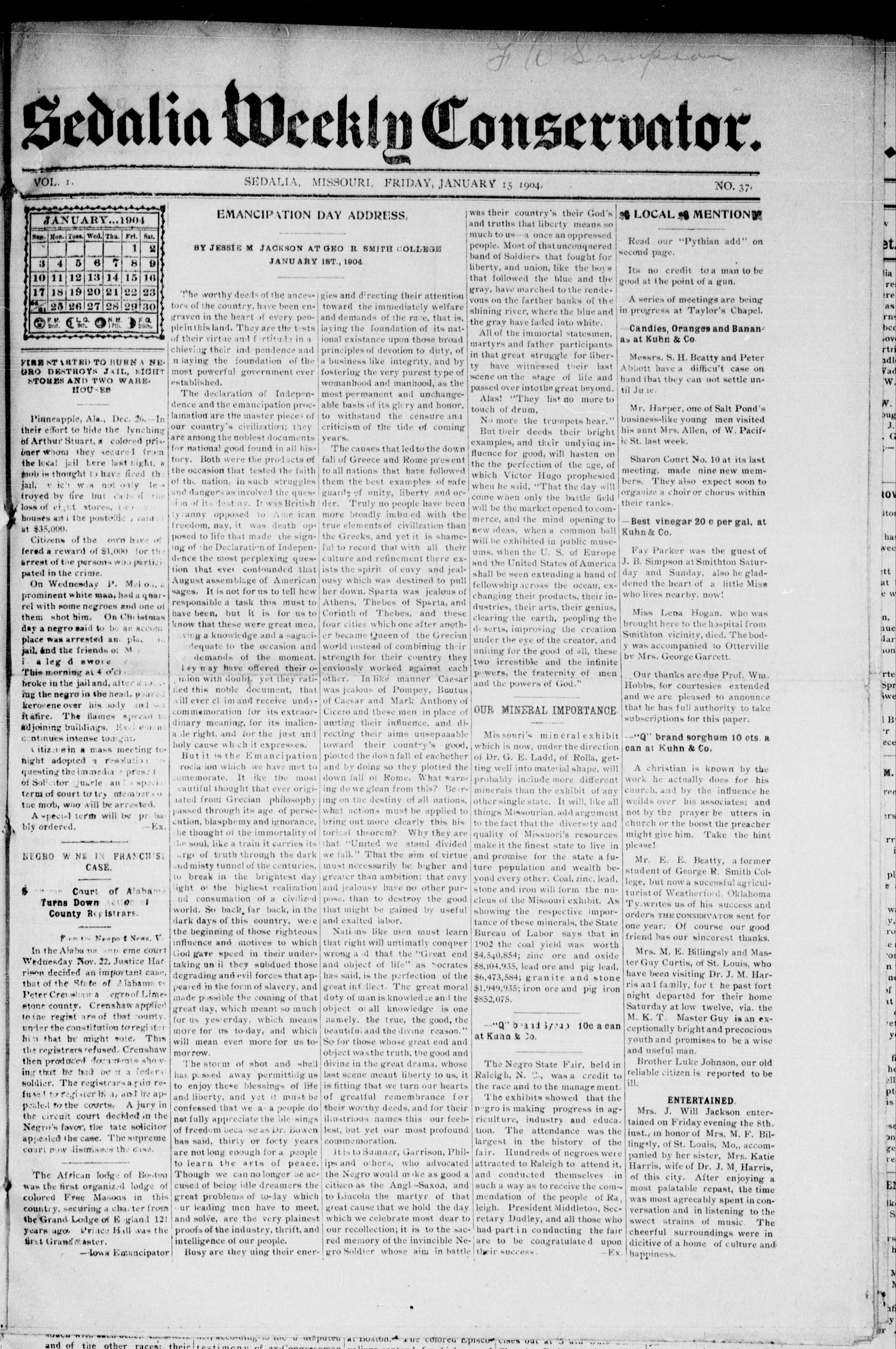
FIRE STARTED TO BURN A NE
GRO DESTROYS JAIL, EIGHT
STORES AND TWO WARE.
HOUSES
Pinneapple, Ala., Dec. 26. In their effort to hide the lynching of Arthur Stuart, a colored prisoner whom they secured from the local jail here last night, a mob is thought to have fired the jail, which was not only destroyed by fire but dents of the loss of eight stores, two houses and the post office, valued at $35,000.
Citizens of the own have offered a reward of $1,000 for the arrest of the persons who participated in the crime.
On Wednesday P. Melon, a prominent white man, had a quarrel with some negroes and one of them shot him. On Christmas day a negro said to be an accommodation was arrested and placed in jail, and the friends of M. I a leg d swore This morning at 4 o'clock broke in the jail and, after bouncing the negro in the head, poured kerosene over his body and set it afire. The flames spread to adjoining buildings. Excelsior continues intense tonight.
Citizens in a mass meeting to night adopted a resolution requesting the immediate presence of Solicitor guarle and a special term of court to try member to the mob, who will be arrested. A special term will be probably ordered. —Ex
NEGRO WINE IN FRANCHISSE
CASE.
Court of Alabama
Turns Down Action of
County Registrars.
In the Alabama supreme court Wednesday Nov. 22, Justice Harrison decided an important case, that of the State of Alabama vs Peter Crenshaw a Negro of Limestone county. Crenshaw applied to the registrars of that county, under the constitution to register him that he might vote. This the registrars refused. Crenshaw then produced documents showing that he had been a federal soldier. The registrars again refused to register him, and he appealed to the courts. A jury in the circuit court decided in the Negro's favor, the tate solicitor appealed the case. The supreme court now dismisses the case.
The African lodge of Boston was the first organized lodge of colored Free Masons in this country, securing a charter from the Grand Lodge of England 121 years ago. Prince Hall was the first Grandmaster. -Iowa Emancipator
SEDALIA, MISSOURI, FRIDAY, JANUARY 15 1904.
EMANCIPATION DAY ADDRESS
BY JESSIE M JACKSON AT GEO R. SMITH COLLEGE JANUARY 1ST., 1904.
The worthy deeds of the ancestors of the country, have been engraven in the heart of every people in this land. They are the tests of their virtue and fortitude in a chieving their indpendence and laying the foundation of the most powerful government ever established.
The declaration of Independence and the emancipation proclamation are the master pieces of our country's civilization; they are among the noblest documents for national good found in all history. Both were the products of the occasion that tested the faith of the nation, in such struggles and dangers as involved the question of its destiny. It was British tyranny opposed to American freedom, nay, it was death opposed to life that made the signing of the Declaration of Independence the most perplexing question that ever confounded that August assemblage of American sages. It is not for us to tell how responsible a task this must to have been, but it is for us to know that these were great men, having a knowledge and a sagacious dequate to the occasion and demands of the moment. They may have offered their opinion with doubt, yet they ratified this noble document, that will ever climb and receive undy-commemoration for its extraordinary meaning, for its inalienable right, and for the just and holy cause which it expresses.
But it is the Emancipation proclamation which we have met to commemorate. It like the most beautiful thought that ever originated from Grecian philosophy passed through its age of persecution, blasphemy and ignorance, the thought of the immortality of the soul, like a train it carries its large of truth through the dark and misty tunnel of the centuries, to break in the brightest day light of the highest realization and consumption of a civilized world. So back far back, in the dark days of this country, were the beginning of those righteous influence and motives to which God gave speed in their undertaking until they subdued those degrading and evil forces that appeared in the form of slavery, and made possible the coming of that great day, which meant so much for us yesterday, which means more for us to-day, and which will mean even more for us tomorrow.
The storm of shot and shell has passed away permittid us to enjoy these blessings of life and liberty, and yet it must be confessed that we as a people do not fully appreciate the blessings of freedom because as Dr. Bowen has said, thirty or forty years are not long enough for a people to learn the arts of peace. Though we can no longer be accused of being idle dreamers the great problems of to-day which our leading men have to meet, and solve, are the very plainest proofs of the industry, thrift, and intelligence of our people.
Busy are they uing their ener-
gies and directing their attention toward the immediately welfare and demands of the race, that is, laying the foundation of its national existence upon its broad principles of devotion to duty, of a business like integrity, and by fostering the very purest type of womanhood and manhood, as the most permanent and unchangeable basis of its glory and honor, to withstand the censure and criticism of the tide of coming years.
The causes that led to the down fall of Greece and Rome present to all nations that have followed them the best examples of safe guards of unity, liberty and order. Truly no people have been more broadly imbued with the true elements of civilization than the Greeks, and yet it is shameful to record that with all their culture and refinement there exists the spirit of envy and jealousy which was destined to pull her down. Sparta was jealous of Athens, Thebes of Sparta, and Corinth of Thebes, and these four cities which one after another became Queen of the Grecian world instead of combining their strength for their country they enviously worked against each other. In like manner Caesar was jealous of Pompey, Brutus of Caesar and Mark Anthony of Cicero and these men in place of uniting their influence, and directing their aims unsepaaable toward their country's good, plotted the down fall of eachother and by doing so they plotted the down fall of Rome. What warning do we glean from this? Bearing on the destiny of all nations, what actions must be applied to bring out more clearly this historical theorem? Why they are that "United we stand divided we fall." That the aim of virtue must necessarily be higher and greater than ambition; that envy and jealousy have no other purpose, than to destroy the good that might be gained by useful and exalted labor.
Nations like men must learn that right will untimely conquer wrong and that the "Great end and object of life" as Socrates has said, is the perfection of the great intellect. The great moral duty of man is knowledge and the object or all knowledge is one namely, the true, the good, the beautiful and the divine reason." So for those whose great end and object was the truth, the good and divine in the great drama, whose last scene meant liberty to us, it is fitting that we turn our hearts of greatful remembrance for their worthy deeds, and for their illustrious names this our feeblest, but yet our most profound commemoration.
It is to Sumner, Garrison, Philips and others, who advocated the Negro would make as good a citizen as the Anglo-Saxon, and to Lincoln the martyr of that great cause that we hold the day which we celebrate most dear to our recollection; it is to the sacred memory of the invincible Negro Soldier whose aim in battle
was their country's their God's and truths that liberty means so much to us—a once an oppressed people. Most of that unconquered band of Soldiers that fought for liberty, and union, like the boys that followed the blue and the gray, have marched to the rendezvous on the farther banks of the shining river, where the blue and the gray have faded into white.
All of the immortal statesmen, martyrs and father participants in that great struggle for liberty have witnessed their last scene on the stage of life and passed over intothe great beyond. Alas! "They list no more to touch of drum.
No more the trumpets hear." But their deeds their bright examples, and their undying influence for good, will hasten on the the perfection of the age, of which Victor Hugo prophesied when he said, "That the day will come when only the battle field will be the market opened to commerce, and the mind opening to new ideas, when a common ball will be exhibited in public museums, when the U. S. of Europe and the United States of America shall be seen extending a hand of fellowship across the ocean, exchanging their products, their industries, their arts, their genius, clearing the earth, peopling the deserts, improving the creation under the eye of the creator, and uniting for the good of all, these two irrestible and the infinite powers, the fraternity of men and the powers of God."
OUR MINERAL IMPORTANCE
Missouri's mineral exhibit which is now, under the direction of Dr. G. E. Ladd, of Rolla, getting well into material shape, will probably include more different minerals than the exhibit of any other single state. It will, like all things Missourian, add argument to the fact that the diversity and quality of Missuori's resources make it the finest state to live in and promise for the state a future population and wealth beyond every other. Coal, zinc, lead, stone and iron will form the nucleus of the Missouri exhibit. As showing the respective importance of these minerals, the State Bureau of Labor says that in 1902 the coal yield was worth $4,540,854; zinc ore and oxide $8,104,935, lead ore and pig lead, $6,473,584; granite and stone $1,949,935; iron ore and pig iron $852,075.
"Q" board system 10e a can at Kunn & Co.
The Negro State Fair, held in Raleigh, N. C., was a credit to the race and to the management. The exhibits showed that the negro is making progress in agriculture, industry and education. The attendance was the largest in the history of the fair. Hundreds of negroes were attracted to Raleigh to attend it, and conducted themselves in such a way as to receive the commendation of the people of Ra leigh. President Middleton, Secretary Dudley, and all those who had part in conducting the fair are to be congratulated upon their success. -Ex.
ROW
itor
has
wee
ett
at
n,
nue
mar
ron
rtee
Spr
Swet
B
r
ece
M.
ree
ers
rr
i
pl
w
y,
ro
er
n
ne
of
ut
v
f
ho
ell
pt
is
se
on
ge
re
EM
lk
S
rs
h
M
M
afi
NO.37.
LOCAL MENTION
Read our "Pythian add" on second page.
Its no credit to a man to be good at the point of a gun.
A series of meetings are being in progress at Taylor's Chapel.
Candies, Oranges and Bananas at Kuhn & Co.
Messrs. S. H. Beatty and Peter Abbott have a difficult case on hand that they can not settle until June.
Mr. Harper, one of Salt Pond's business-like young men visited his aunt Mrs. Allen, of W. Pacific St. last week.
Sharon Court No. 10 at its last meeting, made nine new members. They also expect soon to organize a choir or chorus within their ranks.
Best vinegar 20 c per gal, at Kuhn & Co.
Fay Parker was the guest of J. B. Simpson at Smithton Saturday and Sunday, also he gladdened the heart of a little Miss who lives nearby, now!
Miss Lena Hogan, who was brought here to the hospital from Smithton vicinity, died. The body was accompanied to Otterville by Mrs. George Garrett.
Our thanks are due Prof. Wm. Hobbs, for courtesies extended and we are pleased to announce that he has full authority to take subscriptions for this paper.
"Q" brand sorghum 10 cts. a can at Kuhn & Co.
A christian is known by the work he actually does for his church, and by the influence he weilds over his associates; and not by the prayer he utters in church or the boost the preacher might give him. Take the hint please!
Mr. E. E. Beatty, a former student of George R. Smith College, but now a successful agriculturist of Weatherford, Oklahoma Ty-writes us of his success and orders THE CONSERVATOR sent for one year. Of course our good friend has our sincerest thanks.
Mrs. M. E. Billingsly and Master Guy Curtis, of St. Louis, who have been visiting Dr. J. M. Harris and family, for t he past fort night departed for their home Saturday at low twelve, via. the M. K. T. Master Guy is an exceptionally bright and precocious youth and promises to be a wise and useful man. Brother Luke Johnson, our old reliable citizen is reported to be ill.
ENTERTAINED
Mrs. J. Will Jackson entertained on Friday evening the 8th inst. in honor of Mrs, M. F. Billingly, of St. Louis, Mo., accompanied by her sister, Mrs. Katie Harris, wife of Dr. J. M. Harris, of this city. After enjoying a most palatable repast, the time was most agreeably spent in conversation and in listening to the sweet strains of music. The cheerful surroundings were indicative of a home of culture and happiness.
The colored Episco cises out at South Omaha to express the thanks of the citi- The Easter progr
Dwarf Fruit Trees.
"Great changes have been made in the shape and size of fruit trees," writes Mr. Marcus Woodward in an article on "The Marvels of Fruit Breeding," in Pearson's. "In old-fashioned orchards trees are allowed to grow to whatever size and in whatever shape they will, and the grass is allowed to grow beneath, for food, it may be, for cattle. But now the orchards are orchards in miniature—condensed orchards—with trees only a few feet in height, and generally either pyramidal in shape, or like little bushes, and the ground beneath them is carefully cultivated. An apple orchard of one acre planted with dwarf trees will contain more than 500 trees, shaped either as broad little bushes, or as regular pyramids; and there will be space for some 700 smaller bush fruits between the trees. The effect on the fruit trade that has been wrought by such revolutionizing ideas cannot be calculated."
Not Criminals at Heart
My experience gained by close contact with the men in our prisons during the last seven years has convinced me that but a small percentage of the $8,000 now within prison walls should be called criminals at heart. In this statement I have been indorsed by wardens who have had a far longer and more intimate experience than I, and whose duty it is to watch very closely the actions, character and tendencies of the men under their charge. I believe that in every man's heart, however hardened or hopeless the exterior, there is some tender spot, if one knows rightly how to touch it—some chord of sweetness that can be made to vibrate to the very harmony of heaven, amid all the jangling discords of life.—Mrs. Bailington Booth, in Leslie's Monthly.
Hawelina Textile
Olona, the textile of Hawaii, is found to have promising qualities. The plant belongs to the nettle family, it resembles rattle without the troublesome resin of the latter, and it flourishes in tropical forests at a height of 2000 feet. The fiber proves to be extraordinarily fine, light, strong and durable. A rope of ordinary size appears like silk, and has the strength of a ship's hawser, and strands no heavier than twine are as strong as wire. Nets and fish lines resist the action of salt water having been used for scores of years without loss of strength. Garments from the fiber have the delicate texture of silk, are practically indestructible, and may last a lifetime.
Wireless Telegraphy
The lines of the French cable company between Guadeloupe and Martinique having been broken for more than a year, the wireless telegraph system has been put in operation between these islands, and recently it was thrown open to the public. Our control at Guadeloupe reports that the service is satisfactory, and that on the average 60 messages a day are transmitted each way. There are occasional interruptions, ascribed to weather conditions, but these are not frequent.
Under a New Title:
A white-haired matron was listening, in company with a young man from the state department, to the music of n. ginnist.
The selections were all new to the young man till the "Wedding March" of Mendelssohn began.
"That's familiar," said he. "I'm not strong on music, but I know I've heard that before. What is it?"
"The matron's eyes twinkled with mirabile. "That," said she, "is the Maiden's Prayer." — Washington Post.
Cnt Adopts Rabbit.
A nest of young rabbits was plowed up in Kansas, and a little girl took them home, but after getting tired of her pets she decided to feed them to the old family cat that has a number of kittens. Instead of the cat eating them, as was expected, she is raising them. The cat seems to think as much of the rabbits as she does of her kittens.
Philippine Census.
The census of the Philippines has been completed, and shows a population of 6,976,574, subject to slight modification when the figures are revised. Although only eight of the more than 80 races and tribes in the islands are regarded as civilized, these eight contribute more than 6,000,000 to the total population.
Pedestrianism in New York
Pedestrianism as a means of exercise grows more difficult in New York city every year. The crowds on the streets have increased until at certain times of the day the thoroughfares which would naturally be selected for walking by men going to and from business are too full for comfort.
Case of Easy Picking.
"You know that, mae, filiperson, who
claims to read character at a glance?"
"Yes."
"Well, he swindled me out of $300."
"Indeed? I didn't suppose he ever
put his boasted talent to any practical
use."—Cleveland Plain Dealer.
Sedalia Weekly Conservator
Charms of Ningarn
The northern seashore tempts us in the midsummer months; the balmy truthful Pacific invites us in midwinter, but the charms of Niagara are as great in January as in July. There is no season when the great cataract is not the greatest of spectacles. It is no less imposing at night than at midday; in fact in all seasons and at all hours Niagara is nature's masterpiece, and he who has seen it only in the summer has missed it when many of its admirers claim it is at its best; when in the winter time it dons its mantles of ice. And when at dead of night all the world sleeps, and the torrent of waters pours its great volume over the abyss, illuminated by the "lantern moon" among the clouds, it forms a picture which even outrivals its own daytime magnificence — From "The World's Progress," in Four-Track News.
Hopi Songs.
These songs for different purposes are different in character. They are all feline in form, with forceful, graceful or poetic words. The Kateina dance songs consist of an introduction on vowel syllables, then the song itself, also interspersed with vowel refrains, and lastly a sort of coda, again on vowel syllables.
And the Hopis sing. Theirs is no grooning over a campfire, no monotone chanting, no nasal droning. The men have fine, clear voices, and the women sing softly with a "breathy" tone, the quality of which sounds often just a little sharp in pitch. The gentle iiluples, the pretty, graceful baslet songs of the women and the melodies to which they grind their corn are as different from the rugged, rhythmic Kateina songs as are the cliffs of the mesa from the blossoms in the fields below.—Harper's Magazine.
Alpine Scenery.
For grandeur of Alpine scenery the view of the snow-clad mountains east across the lake from Zurich is unexcelled except, possibly, by that of Lucerne. A ride around the lake is a succession of remarkable views. From the moving boat the villages and ruins along the lake pass in rapid procession before the eye while over them hangs the shadow of the frowning Alps. The city and lake of Zurich are most interesting to either student or tourist, for the lake possesses some of the finest remains of prehistoric lake dwellers that have ever been found, while the museums of Zurich contain many of the most remarkable collections of the world.—From "Zurich," by Guy Morrison Walker, in Four-Track News.
He Bad the Price.
Senator Clark, of Montana, says that one day he was walking along Exchange place, New York, when a boy said: "Shine, mister?" The western Croesus looked at his shoes, saw that they were rusty, and was about to stop, when he remembered an important engagement, "No, haven't time," he said. To which the boy replied, "You mean you can't got de price, don't ye, mister?" About 15 minutes later Mr. Clark signed and handed over the $10,000,000 check that paid for 500 miles of the Oregon Short line.
Came All Right.
Mrs. Hayfork (in country post office)
—Anything for me?
Postmaster—I don't see nothin'.
"I was expectin' a letter or postcard from Aunt Spriggs, tellin' what day she was comm."
Rural Postmaster (calling to his wife)—Did you see a postcard from Mrs. Hayfork's Aunt Salie?
"Yes; she's comin' on Thursday."—Petochey (Mich.) Lyre.
Mental Strain.
"I'm thinking of a trip to California this winter," said Smartie.
"Really, old man," remarked Pepprey, "you can't afford that. You're not accustomed to that sort of thing."
"I said I was merely thinking of it. I can afford to think, can't I?"
"No, that's what I meant. You're not accustomed to thinking."—Philadelphia Press.
Eneouraging.
Cholly Horse—How are you getting along with your suit for Miss Roxley's hand?
Percy Vere—Oh! I'm making progress.
"I thought her father kicked you out every time you called."
"Yes, but he doesn't kick me quite as hard as he used to."—Philadelphia Ledger.
Weather Bureau's Wire Service.
The weather bureau collects its information by telegraph, and for a short time twice a day the whole telegraphic stem of the country is at its service the exclusion of all other business cover. The telegrams are sent in order to secure their correct, careful transmission, and to lessen tolls.
He knew Him.
hes, said Puny, throwing out his
and looking ferocious. "He
can't bluff me. I showed him. He
is sitting in his office all swelled up,
wal, of right in, and he and I had a
ew words."
"Gee," said Nadams, "I'll bet you had
the fewest."—Chicago Tribune
MARKET REPORTS.
Kansas City, Jan. 13 — Cattle—Receipts,
5,500; calves, 500. The market was active
and mostly to cents higher. Representative
sales:
SHIPPING AND DRESSED BEEP STEEERS.
No. Wgt. PriceNo. Wgt. Price
20 1065 3.00 23 1236 4.70
19 1262 4.85 12 1159 4.60
8 1067 3.60 12 973 4.00
WESTERN STEEERS.
14 1227 4.15 23 1150 4.10
20 165 3.56 20 1476 3.90
42 stk. 165 3.56 20 686 2.00
TEXAS AND INDIAN COWS.
(Quarantine Division.)
7 825 2.75 14 742 2.50
NEW MEXICO COWS.
33 776 1.75
WESTERN COWS.
26 986 3.00 23 748 1.75
14 918 2.50 1 790 2.85
NATIVE HEIFERS.
9 mix 794 4.05 3 830 3.40
4 930 3.00 13 840 3.55
4 862 3.00 20 787 3.10
NATIVE COWS
8 129 3.75 22 1124 3.25
12 901 3.00 20 1045 3.25
6 721 1.75 19 955 1.15
NATIVE FEEDERS
986 4.30 20 1055 4.15
31 960 4.20 27 1067 3.90
12 965 3.90 17 910 3.50
NATIVE STOCKERS
10 760 4.20 16 354 4.15
20 831 4.00 21 831 3.90
2 670 3.90 12 550 3.50
STOCK COWS AND HEIFERS.
5 776 3.25 16 560 3.10
7 688 3.15 19 860 2.65
8 880 3.60 26 860 2.50
Hogs—Receipts, 7,500. The market was
10 to 15 cents higher. Representative
No. Wt. Price/No. Wt. Price/No. Wt. Price
15, .375 $35 | 59, .234 $4.82½ | 11, .160 $4.58
15, .322 4.97½ | 81, .207 $80 | 16, .190 4.62½
21, .381 4.96 | 80, .221 4.77½ | 16, .190 4.35
21, .381 4.90 | 80, .221 4.77½ | 17, .196 4.30
168, .281 4.85 | 2,175 4.00 | 7,190 4.17½
Sheep-Receipts, 3,500 The market was active and firm. Lambs range from $2.200
6,000; sheep, $3.80/4.73; culls, $3.75.
Chicago Live Stock
Chicago, Jan. 13—Cattle—Receipts, 17-
000. Good to prime steers, $5,000/5.70 stock-
ers and feeders, $2,500/4.00 calves, $3,000
6.50.
Hogs—Receipts, 30,000. Mixed and
butchers, $4,50/5.65. good to choice heavy,
$0,900/6.15. light, $4,500/4.45. bulk of sales,
$4,750/4.65.
Horses—Receipts, 18,000. Good to choice
wheels, $2,500/4.00. fair to choice mixed,
$0,900/4.00. western sheep, $3,000/4.40; native
lambs, $4,500/6.30; western lambs, $4,750
6.25.
St. Louis Live Stock.
St. Louis, Jan. 13—Cattle—Receipts, 2-
50. Beef sheets, $3,709.50; stockers and
feeders, $2,909.50; cows and heifers, $2,255
1.25; Texas steers, $2,909.45; cows and
heifers, $2,909.15.
Hogs—Receipts, 8,000. Pigs and lights,
$4,004.75; butchers and best heavy, $4.70
$6.00.
Sheep—Receipts, 1,500. Natives, $4,606
4.45; lambs, $4,750.50.
Omaha Live Stock
Omaha, Jan. 13. -Cattle-Receipts, 4,000.
Native steers, $1,500.35; cows and heifers,
$2,000.35; stockers and feeders, $2,500.35;
calves, $2,000.35.
Hogs -Receipts, 6,500. Heavy, $4,700.49;
mixed $1,600.49; light, $4,400.46; bulk of
sales, $4,600.47.
Horses -Receipts, 8,500. Western yearlings,
$4,500.46; wethers, $3,750.44; ewes,
$4,000.39; common and stockers, $2,500.
3:65; lambs, $4,750.75.
iKnoxx City Grain
Kansas City, Jan. 13 — Wheat-No. 2
hard. 7d779c; 13. 6d872c; No. 2. 6d872c; No. 4. 6d872c;
No. 2. red. 57e; No. 3. 6d872c. Corn—
2. mixed. 303956e; No. 2. white. 41g
406316e; No. 2. black. 41g
406316e. Rye—No. 2. 406316e. Hay—Choice time-
only. 690975e. choice price. 376928.00
Chicago Cush Grass
Chicago, Jan. 13—Wheat-No. 2 red, 90
4923c; No. 3, 8893c; No. 2 hard, 75c; No.
3, 725c; No. 1 northern spring, 8568c; No.
2, 8368c; No. 3, 7896c; Corn-No. 2
41c; No. 3, 4924c; Oats-No. 2, 37c; No.
3, 3934c
Futures: Wheat-January, 856c; May,
875c; July, 817c; 882c; September, 75c;
Corn-January, 445c; May, 4775c; 445c; July,
475c; September, 465c; Oats-January,
875c; May, 495c; July, 365c; September,
325c; 3257c
St. Louis Cash Grain.
St. Louis, Jan. 13—Wheat-No. 2 red, cash, elevator, nominal; track 92% 23/32; No. 2 hard, 87% 23/32; Corn-No. 2 cash, track 43% 32; track 43% 32; 37% 32; track 43% 2 White, 50% 32/32.
Kansas City Producer.
Kansas City, Jan. 13--Eggs--Fresh, 23c
per doz.
Butter-Creamery, extra, 21c; dairy,
fancy, 19c; packing stock, 12c; cheese,
northern full cream, 116c.
Poultry-Springs, 9c per lb; hens,
9c per pound; ducks, 85c per pound;
goose, 67c per lb; turkey hens, 12c lb;
young gobblerts, 12c; pigeons, 75c per
doz; squabs, $1.00/1.50 doz. Choice
scalded, dressed poultry le above these
prices.
Game-per dozen-Rabbits-60c; snipe,
60c/60c; ducks, 84c and redheads,
$3.00/4.00; mixed, $1.75; squirrels, 50c.
Potatoes-per bushel, $75c/$8c.
Fruit-Apples, $4.00/4.50 per barrel;
oranges, $3.00/3.25 per box; lemons, $3.00/0
per box; grapes, 90c per basket; cran-
berries, per box, $1.75/2.00.
Vegetables-Cabbage, $2.25/3.00 per cwt;
onions, 60c/60c per bushel; turnips, 25c
30c per bushel; tomatoes, per crate, $2.25
$2.50.
Mutinied for Level 5
Constantinople, Jan. 13.—A serious nottiny broke out recently among the soldiers comprising the garrison of Van. Turkish Armenia, owing to their pay being in arréars. About 500 armed soldiers plundered shops and attacked Armenians. The mutineers finally made an attack on the palace, from which the commander of the garrison fled over adjoining roofs.
Chicago Must Defend Big Suit
Peoria, Ill., Jan. 13.—H. J. Puterbaugh and other owners of large areas of land in the vicinity of Spring Lake, a hunting and fishing preserve, have filed a suit against the sanitary district of Chicago, placing their damage.
QUINN'S BAR
-104 E. MAIN STREET-- Choice Wines, Liquors, Cigars and Bootled Beer Everything Cenuine. Remember the Place.
We can supply you with Fresh Butter, Eggs, and Fruits and Chick us at all times — A fine lot of fresh and Dried Fruits on hand — Give us your orders — Quick Delivery
he Weekly Conservator's Special Offer.
The management of The Sedalia WEEKLY CONSERVATOR, going to reach a thousand homes by the first of March, believing our patrons will aid us in accomplishing this have agreed to send this, the most progressive and up to date hard colored newspaper in Central Missonri to any one do lar the year. This special offer will last for 30 days in line and keep abreast of the times. Solicitors in every own. Address, C. ENGLISH, Manatee Conservator, 104 E. Main street, Sedalia, Missouri.
at $235,000, this damage resulting from overflow since turning the waters of Lake Michigan into the Illinois river.
Sentenced Child Who Killed Playmate. Indianapolis, Ind., Jan. 13.—Standing at the bar of the criminal court, Marshall Harrington, 14 years old, was sentenced to the Indiana reform school on his conviction of the murder of his boy playmate, Albert Nicholas.
Police Guard Negroes' Homes
Muncle, Ind., Jan. 13.—Great alarm is felt at Normal on account of the race war. The negroes have received arms and ammunition and the police with many deputies are guarding the homes of leading negroes.
Mystery Explained.
Tommy (inquiringly)—Mamma, is his hair oil in this bottle?
Mamma—No! That's glue.
Tommy (nonchalantly)—That's why I can't get my hat off—New Yorker.
Poverty Among Cereans.
In Corea the inhabitants are deser-
terely poor, and wages are lower
than in any part of the world that
has any pretense to civilization.
Preservative.
"Such a wife! How does he keep his temper?"
"In alcohol."—Deuroit Free Press.
Great Alm.
"Young man," said the stern parent, "do you know what is the greatest aim in life?" "Sure!" said the unregenerate; "that felter on th' Indiana wot smashed th' bull'seye five straight at half a mile with a 13-inch."—Baltimore News.
One Enough.
She—Ada has married one man out of a thousand.
He—Well, how many did you expect her to marry—Stray Stories.
Wouldn't Play.
Bessie—Let's play we are married.
Johnny—No. I shan't: you're bigger'me, an 'besides mamma told me I mustn't' fight.—Houston Poet.
THE LATEST.
The latest, catchiest, and swellest styles of walk-over shoes, Stetson lax, neckties etc. in the city are to be found elaborately displayed at the St. Louis Clothing Company's establishment, corner Scoot and Ohio. Best bargains for everybody all the time at the St. Louis Clothing Co.
---
J. M. Harris, M. D.
Physician and Surgeon. W. Main, St., Sedalia, Mo
OFFICE HOURS
10:00 to 12:00 a.m.
4:00 to 6:30 p.m.
Residence 236 W. Morgan St.
AN INDORSEMENT
To the citizens of Central Miseri, and Sedalia: I take the great pleasure of saying that by my visiting THE CONSERVATOR's office on last Saturday, I am more than agreeably surprised to find that every bit of the work, editorially and mechanically, is the product of Negro talent. To the citizens of Sedalia, I say that the SEDALIA WEEKLV CONSERVATOR is the greatest undertaking Sedalia ever had.
Signed Rev. W. J. Deboe,
309 W. Morgan St.
Yes indeed, Sweringen & Co., know their business when it comes to first class groceries and able courses.
Remember you can read the SEDALIA WEEKLY CONSERVATOR for 52 weeks or one year for only one dollar. Subscribe with James Wilson or W. H. Huston, else you may send to C. M. English, manager, 104 East Main St., Sedalia, Mo.
BOSTON CAFE.
Furnishes All Grocers
with
DILIC.CUS. FRESH,
HOME-MALLIHAT.
Don't forget to ask for
Walch's Bread.
We also lead in the production of
ICE CREAM.
Our Correspondence
Sweet Springs, Mo.
Mrs. Phoebe Clay who has been very ill, is much better at this writing.
Mrs. Kittie Brooks is suffering at this writing from a severe attack of hoarseness.
Rev. Dennis Peyton and wife attended Quarterly meeting here Sunday, the 3rd. Inst.
George Conway west side of the creek, is on the sick list.
Charlie Riddle and his wife have returned home after visiting friends for several days at New Frankfort.
Ed. and Charlie Harris of Orearville, passed thru the Hills Monday evening looking for the latter's horses. Strayed or stolen.
Mrs. Emily Hanners one of our most highly esteemed citizens is confined to her bed with the La Grippe.
Mrs. Lily Beatty, of Weatherford, Okla. Ty., is visiting at her Grand-mother's home, Mrs. Jane Ward, in Salt Pond.
Miss Lillian Haynes of St. Louis is enjoying a pleasant stay with her Grand-mother, Mrs. Harriet Spriggs.
Mesdames Mattie Peppars, Jenoe Craigler and Taylor Beatty visited James Wilson and mother during the Holiday. All have returned home, after having enjoyed a most pleasant stay. Presiding Elder W. H. Smith conducted a very successful Quarterly meeting, on the 2-4 Inst. at St. Mark's Chapel. We are pleased to state that Rev. Divers has brought the work up to the required standard.
Rev. J. W. Rhodes, Odessa, Mo who has been assisting the Rev. Wm. Divers in his successful meeting, returned home Wednesday afternoon. While in the city he was the guest of our esteemed friends, Mrs. Millie Williams and husband.
Prof. Chas. Brooks, formerly principal of Brown School, this city, was the guest of Mr. Dan Porter and family last week. His former pupils and friends were pleased to see him and wish him a prosperous year's work at his new post, at Joplin, Mo.
Miss Della Beatty, niece of our esteemed friend, James Wilson, died at the home of her Grand-mother Mrs. Charity Wilson, Wednesday, Dec. 30, '03, after a prolonged illness of Tuberculosis Miss Beatty had been a patient sufferer and resigned herself into His care long ere death came. The funeral services were conducted at St. Mark's Chapel, Rev. Divers officiating. The body was interred at the North Side Cemetery. Her Grand-mother and Uncle deserves the highest praise for the loving care they took of their recently lamented relative.
UNION HILL.
The present snow is good on the winter wheat.
Harry and Adam White was in Slater the first of the week on business.
Mrs Agnes Thomas was the guest Thursday of Mrs. Jennie VanBuren.
Harry and Abram White made a business trip to Slater Wednesday.
Prof. G. W. Williams and Harry White was in Little Rock Friday evening.
Colonel Loyd Jackson and Cora Van Buren was united in marriage at Morshall, Sax, Jan. 9, 1904.
George Conway west side of the creek, is on the sick list.
Charlie Riddle and his wife have returned home after visiting friends for several days at New Frankfort.
Ed. and Charlie Harris of Orearville, passed thru the Hills Monday evening looking for the latter's horses. Strayed or stolen.
Rev C. R. Smith returned home Wednesday, he was mounted on a high wheel cart and drawn by Bellfounder.
George Mills and wife and Mrs. Nanna Smith, Mrs. Ida Brooks, Mrs. Hattie Ellis and sister Jane attended the funeral of Miss Louisa Bush at Arrow Rock Friday Jan. 8th.
"Bless our town." so says Sweet Springs. "Not a colored man was drunk this Xmas. All seemed to be as one family of brothers."
Same thing over at Union Hill. Brother here is our 227
Mrs. Jennie VanBuren and Mrs. Agnes Thomas were calling on Mrs. Nancy Mills Tuesday afternoon, to see Little Symathial, the little daughter of Jasper and Pinkie Mills who is quite sick.
We are having considerable trouble with rats here. They are playing havoc with corn that is in the crib and also the shock corn.
Malta Bend and Blackburn how are you fixed with these troublesome pests?
Charlie Evitth and William Webb, two of Napton's sportsmen came up Thursday and joined in the match hunt with Josper Mills, Ed White and Clinton Brown. As marksman these three boys stand second to none, they formed a line, marched out in the fields. They first give battle to thirteen quails and killed all but twelve, they next turned upon the rabbits without mercy, down along the old rail fence built in "44." here they find a brush pile from which leaps forth five cotton tails. Jasper Mills gun being charged with mustard, and quick to arms, fired only to increase the velocity of the rabbits. At this junction Mr. Evitth and Mr. Webb was called in line with Parker's Hammerles charged with B. B's opened fire with like result. Seeing their only hope was in Ed and Clinton forming the right and left wing, was called in, with their heavy artillery captured one a mile distance in a hollow tree. "Jerry Brown of Sedalia came over and joined with us."
Otterville Items
Mr. Thos. Thompson remains poorly.
Mr. C. E. Finley is home from Sedalia.
Miss Emma Hogan is on the sick list.
Miss Octavia Foe entertained this week.
Little Omelia Williams is reported better.
Mr. Daniel Johnson of Clifton visited in the county Friday.
Marah Sarah Foe and family were the guest of Mrs. George Dobbins Friday.
Mr. Farley Hunt of Smithton was in our city Saturday, we all share the sorrow of Mr. Hunt in the death of his dear mother.
Mrs. J. Hogan still fills orders for St. Louis firm, and received second premium a handsome kitchen-cabinet, she solicits your patronage.
Mr. Earnest Hammonds of St. Louis is hand shaking with his many friends here. Mr. Hammonds was formerly a resident of this city, and we are pleased to have him in our midst. He says he shall join his parents in Muskogee Ind. Ty., before returning to St. Louis.
Miss Lena Hogan, who has been sick for eight months, died of consumption at the hospital Sunday. She was carried to Otterville and laid to rest by the side of her mother. Before dying she called Mrs. Craighead and Mrs. Garrett, her cousin, and gave testimony that the Lord had answered her prayers and that she had no fear of dying. She leaves one brother, two aunts and a large number of friends to mourn her demise.
THE CONSERVATOR WANTS TO KNOW IF
—You are going to pay up for an annual subscription at once?
—Sedalia is goin to get in line with all progressive cities and elect a strictly partisan ticket?
—You are determined to do your duty as a wide-awake citizen?
—You appreciate a good thing when you see it?
—You are in favor of making an intelligent manly stand for your race?
—The Negroes of this city are not entitled to either an alderman or a school director?
There will be two legitimate tickets in the field this Spring?
- By concentrated effort the civic condition of Sedalia could be improved?
- Sedalia is not about as wide open a town as any in the State?
HAVE YOU NOTICED?
The most popular trade mark is the sign of the dollar.
A man's greatness depends largely on how extensively it is adver ised.
Many a fool might pass for a wiseman if he only could hold his tongue.
Any old dude is good enough for a woman to walk down the street with, but she is mighty particular about the dog she drags along by a blue ribbon.
A Goose's Brother.
"Tommy," said the teacher, addressing a small pupil. "can you tell me what a propaganda is?" The little fellow, after wrestling with the problem mentally for a short time, replied: "I guess it must be the brother of a proper goose."—Cincinnati Enquirer.
WANTED—Two young ladies or men above the age of 16, to learn the typo trade. Call at the conservator office 104 E. Main, upstairs. Sedalians preferred.
The citizens of Sedalia, expect soon to organize a K. of P. Lodge. Rev. P. M. Mack, Dr. J. M. Harris, Jerry Brown. Wm. Brashear, W. H. Hunter. W. H. Huston and others are laboring to that end.
TO THE AMERICAN NEGRO.
By Mary E. Mason
From Africa's foreign land he came
To America's region of fame.
He was captured and bro't by wicked men,
Who's aim was wealth. But ah the end!
In sixteen-hundred and twenty, we're told,
A dutch captain bro't and sold
Twenty Negroes in one band-
Sold them in Virginia on tobacco land.
Now after this first sin was wro't,
Note how many more were bro't.
For a period of over a hundred years.
Over ninety-seven-thousand dropped briny tears.
Poor heathen were stolen and dragged from home.
And scattered abroad o'er America to roam.
Many met death alone as the end.
Than be kidnapped, stolen, or driven by men.
Soon he was oppressed—another great sin—
Then a lull to the awful traffic comes in
First, by stopping the importation of men.
(Prior to eighteen-hundred and ten.)
This was the first fixed compromise:
The question of slavery was in the rise.
This question laid low til eighteen-twenty.
Then talk anew on the question was plenty.
Then there was another compromise...
Laying a new plan tho't to be wise
To admit the State of Missouri as a slave,
And a few of the others, Kansas save.
Eigh cen-fifty, histories state.
Was known for another compromise date.
But to this question no ends arrive.
So time moved on to sixty-five,
Then Abrham Lincoln, with his noble band,
Abolished four millions, in one solid band,
Jeff, Davis with th' south, gave up the ghost.
Their slaves had marched off with the host.
So we're still marching, on and on,
With many, ay many a poison thorn
To prick us, on this upward way.
We walk as on ice, or be lynched to-day.
We're abused oppressed, this he whites can't see—
They see's going back—their only plea.
It might be that we're going back.
But not to savag'ry because we're black.
But is it not a fact, if he attempts to rise,
You'll give thousands of dollars rather than him recognize?
"Cigars & Tobacco at Kuhn & Co"
Where to Worship.
Methodist Episcopal Church
Sunday Morning
Sunday School.....9.27
Song Service.....10.63
Preaching.....11.06
Afternoon
Class Meeting.....2.30
Epworth League.....8.66
Song Service.....7.43
Preaching.....8.06
Prayer meeting every Wednesday evening
Rev R Davis, Pastor.
African Methodist E. Church.
Sunday Morning
Preaching.....11.00
Afternoon
Sunday School.....2.00
Class meeting.....8.00
Endeavor.....7.00
Preaching.....8.00
Rev. Alexander, Pastor;
Morgan St. Baptist Church.
Preaching ..... 11.00
Sunday ..... 2.00 P.M.
Preaching ..... 7.00 P.M.
Prayer meetin - every Wednesday evening
Rev. P. M. Mack, Pastor.
Simpson's Chapel.
Junior School.....900 A. M.
Presentation.....11.00 A. M.
Intermediate.....8.08 P. M.
Preaching.....7.30 P. M.
Prayer meeting every Wednesday evening
G. W. Ball, Pastor.
C. M. E. Church
Peaching every Sunday morning at 11.00
and evening at 7.30
Sunday school ..... 2.00 P.
Class meeting ..... 8.00 P.
Prayer meeting every Friday evening.
I. H. Warfield, Pastor.
Free-will Baptist Church.
Praying and Rally every 8th Sunday
at 11:00 A.M. and 7:30 P.M.
Sunday, October 2. 2:00 P.M.
Covenant meeting 2:00 P.M.
Prayer meeting every Tuesday evening
and Covenant meeting every Friday evening,
Rev. E, D. Burns, Pastor.
Lodge Directory
皇
Q.C. Commandery, K. T.
Meet for regular business the first and third Fridays in each month. J. T. Parrill,
E. C. H. Lewis,
S T F M S
W T R U S
J K L
R. A. M. No. S.
Sadalia Chapter No. 8
Meets irregular session
second and fourth
Weekly average in
each month.
Visiting brothers always welcome,
Wm. Ruby, H. P. C. M.
Lawis, Sec.
M
A. F. A. M.
Continental Lodge, No. 59 moors in regular season the second and fourth Mondays in each month. J. P. Moffitt, W. M. J. T. Ferril, See.
Centennial Court, No. 37. 1st. & 3rd. Thus., of each month Sallie Moffit, Matron, Julia Hayden, Seo.
Hawkkin's Lodge, No. 44.
1st. & 3d. Mondays in each month.
C. O. Brown, W. M.
C. W. Holliday, Sec.
X
G. U.O. of O. F
Meets in regular classes
the first and third Tecso-
Hall 129 E. Meets St.
D. Y. Steele P. St.
Sons & Daughters of Charity
Lodge No. 1.
Meets 1st. and 3d. Tuesdays
each month. D. L. White Press
W. W. Henderson Sec.