The Appeal
Saturday, March 14, 1903
St. Paul, Minnesota
Page text (machine-generated)
THE APPEAL KEEPS IN FRONT
BECAUSE.
1- It aims to publish all the news possible.
2- It does so impartially, waits no words.
3- Its correspondents are able and energetic.
"It ain't so much a matter of living in to the minister's preachin' at bothers me as 'tis livin' up to my own."
"You can't expect to git through this world 'thou more less similin'. The main thing is to git through 'an' nobody hear you braug about it one way or 'th other' "The successful feller is the feller that gets it found out."
"They's such a thing as bein' too blame thankful to folks. You never git a shower o' favers but you o' be pretty sure sopm's expected 'dices a crop o' thanks."
++++
FAME
In quiet, day by day.
Does worth to greatness win its upward way.
The arduous upside undaunted and unspoiled
'Tis granted to emerge
Upon the envied goal's exalted verge.
Upon the journal's issue, not its aim.
VOL. 19. NO. 11.
HOW AN EXEMPLARY HUSBAND
ALMOST DROVE HIS.WIFE
TO LUNACY
THE STAY AT HOME
AS CONSTANT IRRITANT
Woman Should Be Taken to the Theater, to Concerts and Balls — Man Should So Arrange as to Spend a Portion of His Evenings Away From His Domicile.
My friend, Ebenezer Butterworth Snagues, tells me that I have made a new employee in his employees. When he called to see me, socially the other evening, he said that his porter, Clonough, had asked him what his alied his wife. I told Snagues to send Clonough up to my office some afternoon and I would talk the matter over.
Mr. Clonough called the next afternoon and briefly described his wife's condition. He said: "I can't imagine what he would like to quiet; doesn't like society; don't like to go to the theater, or to concerts, or lectures, in fact, all she does want to do is out of the house to call on any one a once week. I do all the shopping, such as buying groceries, meat and vegetables, and make life as easy as I can for him.
I asked Cleonough if his wife had to work very hard. He said: "Oh not! She gets up about half-past five in the morning to build a house, she has shamed to say that, but it’s pretty hard work in the store, and I don’t feel comfortable to say that, Mrs. Cleonough says she just as soon build the fire as not. I get up at 6 and she has breakfast all ready for me, and I don’t feel comfortable to train leaves at half-past seven, and as I don’t have time in the store I read the paper while I am eating and finish the meal. I have gone to the kitchen after I have gone, the missis washes the dishes and tidies up things and does her routine work about the house. She’s a great woman for routine work, and she has kind of works; on weekends kinds of works; on weekdays kinds of works; on Monday; on Tuesday, and so on through the weekend; on dinner for herself, she just takes a lunch; a bit of bread and a cup of tea, and not always that, because she says she takes a nap in the afternoon she begins to get the regular dinner, and that keeps her busy until I get home at half-past six. Then we have dinner and I read the evening news and then she takes her knitting or sewing and employees her time while I am so tired, and then she takes my sleeping and I usually fall asleep and don’t wake up again until bedtime."
Irritable and Fitful.
"Nothing especial seems to be the matter with her, butately faint. If I don't listen to what she is saying, when she is asking questions or talking of what she actually loses her temper and folds, and that prevents my reading or thinking, and disturbs my nap, and off in a fit of the suiks. She has been told that she is not so nervous that she feels as if she would fly, and she is so tired that she is the other. It's strange, though. I don't see why she she should be so nervous, because she ways quiet in the house. She doesn't have much company. There's nobody in the house to worry her, not even a
"Well," I said. "I think I know pretty well what the trouble is, but with my wife, I don't have to worry about morning and talk with your wife." In accordance with this promise I did call Mrs. Clemough one of the long and lank women of an extremely nervous temperament, very unassuming, and very diffident disposition, and not at all self-assertive. After gaining her confidence she must be further lonesome here. "Oh mori'tor," she exclaimed. "Jonesome is no name for my wife; her fortune is confinement; her desert isle. But I wouldn't think of saying that to my husband; he is so terrified of home, and he has so much to worry him. I thought it was rather strange that Mr. Clemough worry about, as he was a steady-going man, had no bad habits, had a good, permanent position, and was well and well cared for. I asked his wife. I did ask her if she liked amusements. If she and her husband didn't go to a concert or a theater one
Would Like to Go to Theater.
She said, "Oh no. I should dearly love to go to the theater occasionally, but I don't. It is so tired that he doesn't want to do anything when he gets home but eat his supper, pipe, ice cream, take a nap, and he never thinks of even suggesting that we go out anywhere. Why, we don't even eat at the restaurant, he says he is no society man, and of course if we don't call on the neighbors to "i snooze," Mrs. Cleenaugh, said I, "that you don't have very much work to do." Well, yes, I do have a good job, but it keeps me busy the time. My husband is awfully hard on clothes, but it keeps me busy the time. My house is as neat a clean shirt and dollar and cuffs. So my washing is quite large. Wednesday it takes about 10 minutes to house is so near the railroad that it gets awfully dirty, and it takes a good amount of time to clean it. Mr. Cleenaugh is a heavy earl, too, and I cook a big dinner every day and I cook cakes and plies for the week.
I didn't make any comments on her work, but I thought that she had done all of it. I asked her to say: "Of course you and your husband go to church on Sunday," and she said: "Of course you and your husband not want to dress up Sunday. He says he's tired and wants to read and so forth. He says the only time he does have to himself." I suppose, "I said, you take lilies and so forth." No, "said she, "Mr. Clenough doesn't want to go; he says there is not enough of crowds in the city every day. If he has a day off he goes with some chum somewhere in the woods, and so forth, says that's the kind of a rest he likes." Is a Handy Man—"Well, of course," then said, "I you
porn spend a week or two m the country when he has his vacation." "No," she replied, "he takes that time to fix up things around the house. He's a very handy man; he can carpenter, and paint, and do mason work, and plumbing; in fact, there's hardly anything about the house that he can't do. But—I hope you won't misunderstand me, doctor—he makes me awfully nervous; he's a great home body, and I know I ought to be thankful." "I don't know, I do," he said, with that, but soon I was sure that he belonged to a club that would keep him away from home an evening or two—anything for excitement."
"Well," I said, "I don't think you need any medicine, nothing more than a little beef, wine, and iron, perhaps, or a little wine to sort of quiet, your nerves and strengthen them, and what would you think of taking a vacation of a week or two?"
"Oh, doctor," he exclaimed, "that would be the same, but I don't see how I could do it. Mr. Clenough couldn't get along without me and I wouldn't think of asking him."
I told her perhaps we could find that and said: "I would like to see Mr. Clenough tomorrow evening." When Mr. Clenough came into my office I nearly scared the life out of him. I said: "Clenough, you've got one wife out of a thousand, but if you don't reform, you won't have any, or else you'll have a lunatic on your hands." "Reform," said Clenough, in an indignant voice.
Send Her to Lively Places.
"Yes!" said I, "reform. No wonder your wife is nervous; working all day like a galley slave, and you're worse than no company when you're at home. The first thing I want you to do is to send your wife away for a month, and not to the country, either, but to some lively place, where there's something going on, concerts, lectures, balls, comedies, anything that's gay and cheerful, and nothing that is sad or serious—no tragedy, mind you, for she's acting that now. Don't let her do a bit of work for fear that she should worry about you and the house; shut it up and get a good room for yourself in town. When she comes back take her to the theater at least once a week, and when you go home at night chat a while with her instead of being as dumb as a mummy. Tell her a few lively or humorous incidents that have happened during the day. You see enough of them; you see people enough; you see this one and that one, and have a social chat and keep up your spirits, while your wife slaves at home, without seeing or speaking to a single person. No wonder she is nervous. The wonder is that she is not insane."
"There's another thing I want to say, Clenough, and I know you have too much to terpest my advice. It would be a good idea if you didn't stick quite so close to the house. Of course, I don't want you to have any such resorts of doubtful character, but there are enough good places where you can have a good time. The fact is that you have a good time, much Clenough. You are thoughtlessly selfish and your wife is self-sacrificing way and say nothing, but it worries her all the same, more so than if she gave you a good tongue-lashing once you keep to ourselves that frees the strings of life the most and最ost snaps your neighbors. Clenough keeps to your wife your wife occasionally; it will do you good and do them good. Clenough follows your advice, and she gained flesh and I saw his wife so gained flesh and was as smiling as basket of chips, whatever that may be, and she had lost that worried, anxious look, and seemed contented and happy, and the men who work at Snagues say that Clenough himself is much more of a good fellow than he was.
One of the men, in fact, gave me an idea that I had never thought of before. He said Clenough was a good man, industrious, conscientious, an embodiment of all the virtues, in a word, he was exasperatingly good. And then are others just like Clenough. They are models of goodness and propriety, so nearly perfect that they drive the average mortal, with his imperfections, to madness. They're so good that they actually make other people bad by irritation. They're so patient that they make others lose their patience. And of all these good men the quiet, stay-at-home-all-the-time man is most exasperating to the good wife, who, while she appreciates all his good qualities, wishes for a little excitement, even if her husband furnishes it. It's one of many cases where you find the good woman nearly crazy from too much goodness in close proximity. It's a puzzling case, too, if the doctor is not wise; ne's apt to give all sorts of drugs for all sorts of diseases without effect. It's not malaria, or hysteria, and she balm in Gilead will do no good. The selfish man doesn't lend a hand in the cure. —Leon Noel.
OE THE GRAB BAG
S
OME day when I get time I am going to take my pen and things out in our back yard under the horse chestnut tree and write a novel all about it. I am going to write film down just as he is and if he doesn't make all previous notions of "character studies" face wall, then I will go face wall myself. Then I will brand-new picture of Uncle Ezra this week. He is as droll as he looks. From time to time I have jotted down stray remarks of his, some of which I copy here. I suppose I'll be sorry when I come to write my novel, but remarks by Uncle Ezra are too good to be a "man a hat not hain't" better to do 'n to set around on a cracker bar' n' whittle a stick air 'faint 'lth the administration had ought to be sentenced to a plains 'milh 'lth a gag on his mouth. "F I had a boy 'at wouldn't talk to nobody never say good morning or howdy. I'd pack him to the oft the dum fool awaum an' tlm 'em to learn
THE APPEAL.
ST. PAUL AND MINNEAPOLIS. MINN.. SATURDAY.MARCH 14. 1903.
TO EUROPE
RICHSE
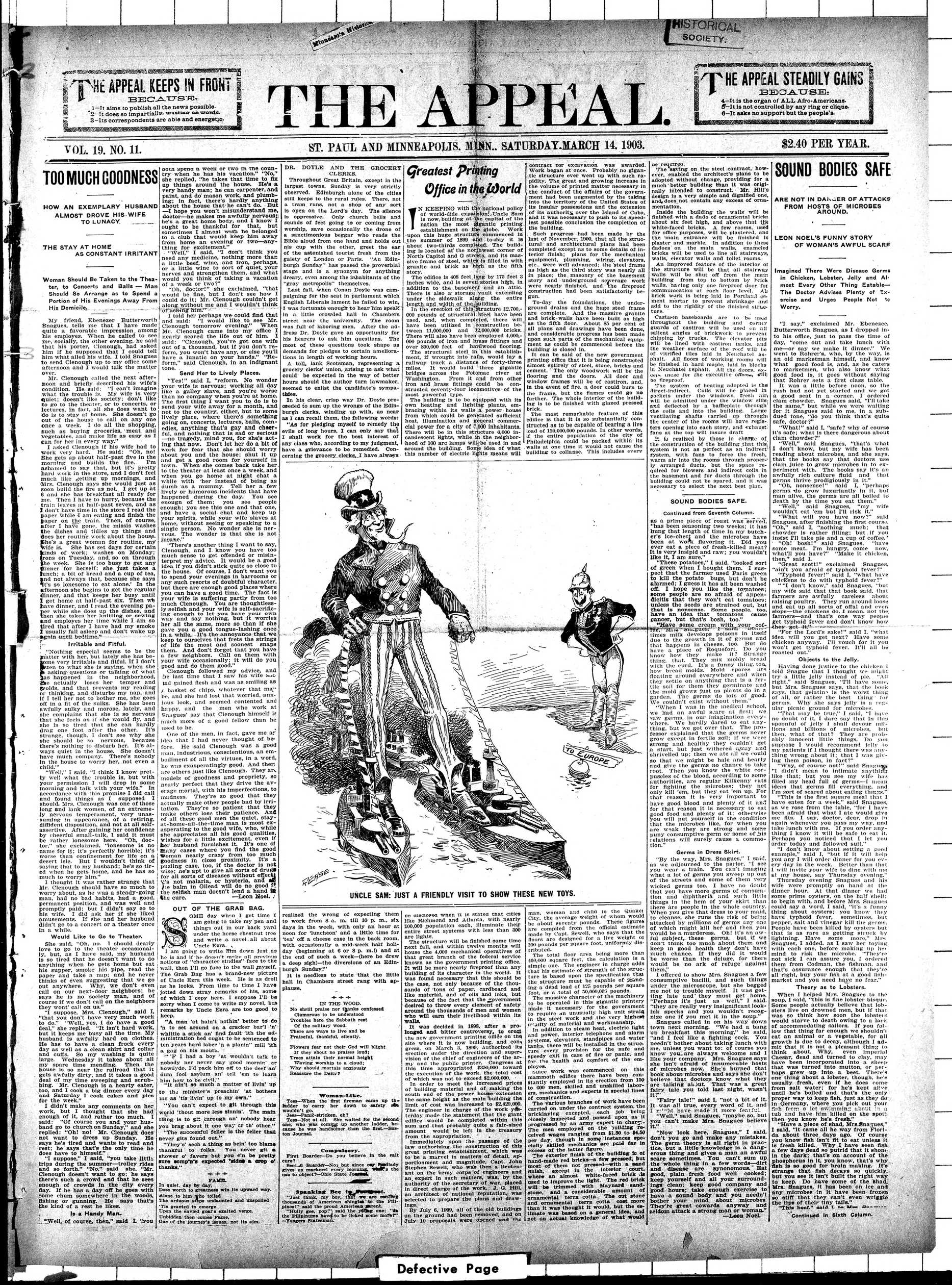
UNCLE SAM: JUST A FRIENDLY VISIT TO SHOW THESE NEW TOYS.
DR. DOYLE AND THE GROCERY CLERKER
Throughout Great Britain, except in the largest towns, Sunday is very strictly observed. Edinburgh alone of the cities still keeps to the rural rules. There, not only the streets, but the parks, are open on the Lord's day. The silence is oppressive. Only church bells and sounds of feet going to or coming from worship, save occasionally the drone of a sanctimonious beggar who reads the Bible aloud from one hand and holds out his hand. With the other, greet the ear of the satirist, who is the guilty of London or Paris. "An Edinburgh Sunday" has passed the proverbial stage and is a synonym for anything dreary, even among the inhabitants of the "gray metropolis" themselves.
Last fall, when Conan Doyle was campaigning for the seat in parliament which would elect a new leader, I was fortunate enough to hear him speak in a little crowded hall in Chambers street near the university. The room was full of laboring men. After the address Dr. Doyle gave an opportunity for his hearers to ask him questions. The most of these questions took shape as a series of questions about mutilations in length of working hours.
A tall,江 Scottsman, representing a grocery clerks'队, arising to ask what could be expected in the way of better hours should the author turn lawnmaker, seemed to enlist the candidate's sympathies. In his clear, crisp way Dr. Doyle proceeded to sum up the wrongs of the Edinburgh clerks, winding up with, as near as I can recall them, the following words: "As for pledging myself to remedy the evils of long hours. I can only say that I am not a pledger, any class who, according to my judgment, have a grievance to be remedied. Concerning the grocery clerks, I have always
REHSE
UNCLE SAM: JU
realized the wrong of expecting them to work from 8 a. m. till 10 p. m. six days in the week, with only an hour at noon for 'luncheon' and a little time for 'tea' off a cheese case in the back room, with occasionally a mid-week half holloway (beginning at 8 p. m. and at the end of such a week—here he drew a deep sign) of the state of an Edinburgh Sunday!
It is needless to state that the little hall in Chambers street rang with aplause.
IN THE WOOD.
No shrill praise nor thanks confessed
Chlamorous to be understood
Troubles here the Sabbath rest
Or, of course, wood
There are ways to live and be
Praisful, thankful, silently.
Flowers fear not their God will blight
If they shout no praises loud;
Trees attain their normal height
Waving worship to a cloud;
Why should mortals anxiously Respond
Woman-Like.
Tess—When the first fireman came up the ladder to carry her down to safety she was Jean-Paul-striken, eh? Tess—Not at all. She waited for the second one, who was coming up another ladder, beaten up and handsmother than the first—Boston Journal.
First Boarder—No, but since our first lady gives us mackerel every morning, what's the use to object?—Ohio State Journal.
Spanking Bee is Fongest.
"Just think, my boy, that we are seeing thousands of American shingles to the Filipinos!" said the proud American parent.
"Hully gee, pop!" said the young one; "do the Filippions have to be licked some more?"—Yongers Statesman.
Greatest Printing Office in the World
Greatest Printing Office in the World
N KEEPING with the national policy of world-dile expulsion, Uncle Sam is now, building at the capital of the state, a large office and a private establishment on the globe. Work upon this huge structure commenced in summer 1915, and in about two-thirds completed. The building is located at the northwest corner of North Capitol and G streets, and its massive frame of steel, with its massive brick and brick as high as the fifth story. The office is 408 feet long by 175 feet 3 inches wide, and is the addition to the basement and an attic. There is also a storage vault extending under the alleywalk along the entire length of the building, with 10,000 and 12,000 bricks. The erection of this structure 12,700,000 pounds of structural steel have been used, and, when completed, there will have been a total of 12,000 bricks. There will also have been employed 4,000,000 pounds of iron and brass fittings and over 800,000 feet of hardwood flooring. The foundation is 12,000 and 12,000 bricks. If wrought into rails, would lay a railway a distance of forty-three miles across the Potomac river, bridges across the Potomac river. From it and from other iron and brass fittings could be constructed seventy-four locomotives of the
The building is to be equipped with its own lighting, including plants, embracing within its walls, and housing from which could be generated sufficient heat, illumination and general commercial power for a city of 200,000 inhabitants. The building is candleless lights, while in the neighborhood of 100 arc lamps will be used in and around the building. The number of electric lights will mean
JUST A FRIENDLY VISIT TO SHOW THE
oo uscissero when it is stated that cities like Richmond and Atlanta, with nearly 100,000 population each, illuminate their large network systems with less than 300 zero lights. The structure will be finished some time next fall and within twelve months will be completed. That is the great branch of the federal service known as the government printing office. It will be more nearly fireproof than any other building, and it was found necessary that this should be the case, not only because of the thousands of tons of paper, cardboard and other materials that it was made because of the fact that the government desired to throw every element of safety around the thousands of men and women it will earn their livelihood within its walls. It was decided in 1888, after a prolonged and bitter controversy, to erect a new building in a site where it is now building, and congress, on March 3, 1889, authorized its erection under the direction and supervision of the architect and the public printer. Congress at this time appropriated $330,000 toward the execution of the work. It cost $200,000.
In order to meet the increased prices of building material and of making the same amount of land and the same height as the main building the limit of cost was increased to $422,000. The engineer in charge of the work yesterday made the statement that the sum and that probably quite a fair-sized amount would be left in the treasury from appropriation. The passage of the law authorizing the construction of this great printing establishment, which was the permanent and magnificent portment and magnitude. Capt. John Stephen Sewell, who was then a leutenant on the army corps of engineers and a lieutenant in the secretary of the authority of the secretary of war, placed in direct charge of the work. J. G. Hill, an architect of national reputation, was selected to prepare the plans and draw
By July 6, 1909, all of the old buildings
July 10 proposals were closed, and the
new buildings were built.
Defective Page
contract for excavation was awarded. Work began at once. Probably no gleaning of the history of the project was possible. The great and growing increase in the volume of printed matter necessary in the conduct of the affairs of the government and the military, by which it entered into the territory of the United States of its insular possessions and the extension of its subsidiary over the island of Cuba, and it was necessary to invest in the least possible conclusion the completion of the building. The progress had been made by the last of November, 1900, that all the structural and architectural plans had been completed except as to some details of interior design, and the equipment, plumbing, elevators, etc., were well advanced; the steel frame was in place; the machinery in place; the masonry of the basement story and underground sewerage work were nearly finished, and the inproof construction had been satisfactorily begun.
To-day the foundations, the underground plains and the huge steel frame, and the brickwork and brick-walls have been built as high as the fifth floor. About 85 per cent of the construction was done, and considerable progress has been upon such parts of the mechanical equipment as could be commenced before the commencement.
It can be said of the new government printing office that it is being constructed in the city of Philadelphia. The only woodwork will be the flooring and the doors. All door and window frames will be of castron, and, in the case of the windows, the frame, but the flames could go no further. The whole interior of the building is to be finished with glazed pressed wood. The most remarkable feature of this edifice is that it is so substantially constructed that it can hold up to 120,000,000 pounds. In other words, if the entire population of the city of Philadelphia could be packed within its walls, the building would be building to collapse. This includes every
TO EUROPE
ESE NEW TOYS.
man, woman and child in the Quake City, the average weight of whom would be about seventy pounds, the average weight of whom would be about seventy pounds, the official estimate made by Capt. Sewell, who says that the floors are designed for a live weight of 300 pounds per square foot, uniformly distanced. The total floor area being more than 400,000 square feet, the engineer in charge adds that his estimate of strength of the structure is based upon the specification that the floor is made of a dead load of 125 pounds per square foot, or a total of 50,000,000 pounds. The massive character of the gigantic printer made it necessary for the government to require an unusually high unit strain in the machine, and the material and workmanship. In addition to steam heat, electric light and power, interior telephone and arm systems were installed. There were also installed in the structure every provision for the safe and speed exit in case of fire, health and comfort of the employees. Since work was commenced on this project, we have been constantly employed in its erection from 150 to 600 men, skilled and unskilled laborers, mechanics and experts in special lines.
The various branches of work have been carried on under the contract system, the batik was excavated, each job being closely inspected and passed upon as it progressed by an army expert in charcoal. The men employed in the building, reflected wegen ranging from $1.50 to $4.00 per day, though in some instances specially skilled mechanics are paid far in excess of the character figure. The exterior finish of the building is of hand-made red bricks—a few pressed, but most of them are plain, except in the interior court, where an almost white-faced brick is used to improve the light. The out stone and ornamental sandstone, Maynard砂stone, and a considerable amount of ornamental tecta cotta. The out stone and ornamental sandstone was thought it would, but the estimate was based on a general idea, and not on actual knowledge of what would
THE APPEAL STEADILY GAINS
BECAUSE:
4- It is the organ of ALL Afro-Americans.
5- It is not controlled by any ring or clique.
6- It asks no support but the people's.
The saving on the steel contract, however, enabled the architect's plans to be adopted, better building than it did before, better building than it originally intended to construct. Mr. Hill's design is a very simple and dignified one, but it not contain any excess of ornamentation. Inside the building the walls will be made of about six feet high and above that the white-faced bricks. A few rooms, used for office purposes, will be plastered, and the walls will be plastered and marble. In addition to these daddos on the main walls, enamel walls, elevator walls, elevator walls, elevator walls and toilet rooms. An improved feature of the interior of the building will be shut off from all stairway walls will be shut off from all building from top to bottom by brick walls, having only one fireproof door for the stairway. A brick work is being laid in Portland cement mortar to prevent shrinkage and add to the rigidity of the finished structure.
Castron baseboards are to be used throughout the building and corner guards of castiron will be used on all salient angles of brickwork to prevent chipping by trucks. The elevator pits will be lined with castiron tanks, and the weather surface of the roof will be of vitrified tiles laid in Neuchatel asphalt. All floors of working rooms will be finished in hard maple, laid in blocks in Neuchatel asphalt. All the doors, excep. unuse for the executive office, will be fireproof.
The system of heating adopted is the direct-indirect. Coils will be placed in pockets under the windows. Fresh air will be admitted under the window sills and deflected by a baffleplate through the coils and into the building. Large ventilating shafts carried up through the center of the rooms will have registers opening into each story, and exhaust fans at the top will insure draft.
It is realized by those in charge of the construction of the building that this system is not as perfect as an indirect system, with fans to force the fresh, warm air into the rooms through properly arranged ducts, but the space required for blowers and indirect coils in the basement and for ducts through the building could not be spared, and it was necessary to select the next best plan.
SOUND BODIES SAFE.
as a prime piece of roast was served, "has been seasoning two weeks; it has hung that length of time in my butchery ice-tender and the microbes have it very insipid and raw; you wouldn't ever eat a piece of fresh-killed meat it is very insipid and raw; you wouldn't like it." These potatoes, I said, "looked sort of green when I bought them. I suspen- tled to kill the potato bugs, but don't be alarmed; I guess it has all been washed off. I hope you like the tomatoes; I suspect that the growers won't eat tomatoes; that they won't eat tomatoes; unless the seeds are strained out, but have an idea that tomatoes cause cancer, but that's bosh, too." Have some cream with your oats—times milk develops poisons in itself due to the growers' germs and have a piece of cheese, too, have a piece of Roquefort. Do you know how they make it? Strange to me, but I am mildly with the card. It's a funny thing, too how bread molds. Mold spores are floating around everywhere in a fertile soil for them they germinate and the mold grows just as plants do in a soil that couldn't exist without them.
"When I was in the medical school, we had an awful scare at first, we were where, we hardly dared to eat anything, but we got over that. The professor explained away and shrivelled to a fertile soil; if we were strong and healthy they couldn't get a start, but just withered away and shrivelled to a fertile soil; if we might be hale and hearty and give the germs no chance to take root. Then you know the white corpuscles of the blood to some of the bigger Killers for fighting the microbes; they not only kill 'em, but they eat 'em up. For that reason, we need to have blood and plenty of it and for that reason it is necessary to eat good food and plenty of it; otherwise that the microbes like, for when you are weak they are strong and some pungus consumptive germ or some of his relations will surely cause a common
Germs in Dress Skirt.
"By the way, Mrs. Snagues," I said, as we adjourned to the parlor. "I see what a lot of germs you sweep up out of the streets and some of them very wicked germs too. I have no doubt that you have more germs of consum-ment than you did with help from other things in the hem of your skirt than there are people in the whole country to cleanse, she runs the risk of being attacked by millions of germs any one would be a murderer. Oh! It is an awful subject, these germs, but if we think too much about them we keep in mind that they don't have much chance. If they did it would be worse than the deluge, for there be no ark of refuge against them."
I offered to show Mrs. Snagues a few consumptive bacillis, and such things under the microcosm myself. It was getting late and they must get home. "Perhaps it's just as well," said Mrs. Snagues. "I think I could ink specks and you wouldn't recognize one if you met it in the soup." Snagues called in on this way to汤头, and I was not sure how to breakfast this morning," he said, "and I feel like a fighting cook. You needn't bother about taking lunch with you. You know you are always welcome and I like your company. Mrs. Snagues says that microbes now, she's burned that book about microbes and says she don't believe that doctors know what they are doing. Fairy tale you told last night, wasn't it?" "Fairy tale!" said I, "not a bit of it. It was all true, every word of it, and it didn't have made it more fearful." "Well," said Snagues, "maybe so, but you can't make Mrs. Snagues believe
"Now look here, Snagues," I said, "don't you go and make any mistakes. Don't you go and make any mistakes, but a little knowledge is a dangerous thing and gives a man an awful chance to die. You know the whole thing in a few words—drift and disease are synonymous. Eat keep yourself and all your surroundings clean; keep good company and good hours; keep yourself and you needn't bother your mind about microbes. They're great cowards anyway and seldom attack a strong man." —Leon Noel
$2.40 PER YEAR.
SOUND BODIES SAFE
ARE NOT IN DANGER OF ATTACKS
FROM HOSTS MICROBES
GROUND
LEON NOEL'S FUNNY STORY
OF WOMAN'S AWFUL SCARF
Imagined There Were Disease Germ in Chicken, Lobster, Jelly and Almost Every Other Thing Eatable—The Doctor Advises Plenty of Exercise and Urges People Not to Worry.
"I say," exclaimed Mr. Ebenezee, Butterworth Snagues, as I dropped in to his office, just to pass the time of day, "come out and take lunch with me—or say we make it dinner." We were in a carriage, an old marketman himself, and know what good food is, and, as he caters to marketmen, who also know what marketman sets a first class table. It was a little before noon, so the rush had not yet started and we got to the marketman's clam chowder. Snagues said, "Till take the same," but while we were waiting for it Snagues said to me, in a subway, "You think that's quite safe, doctor?" "What!," said I said, "is safe of course it is there dangerous about clam chowder."
"Well," said Snaugles, "that's what I read about microbes, and she says, that the books say that doctors use them to grow in order to experiment with the books say awfully rich culture fluid and that germs are prodigial in it. On nonessential gels, I "perhaps germs do grow luxuriously in it, but man啊啊 the germs are not used to be by them."
"Well," said Snagues, "my wife wouldn't eat 'em but I'll risk it. It would be better to eat Snagues, after finishing the first course. "Oh, said I, "nothing much; that chowder is rather filling; but if you insist I will take a pie and a cup of coffee. I will take a pie and a cup of coffee. I have some meat. I hungry, come now, what you'll have? "Make it chicken, then, said I, "cook it!" exclaimed Snagues, "n't you afraid of typhoid fever?" "Typhoid fever!" said I, "what have chickens to do with typhoid fever?" "Typhoid fever!" said I, "what have my wife said that that book said, that farmers are awfully careless about raising poultry. They run around loose shops—the chickens do, I mean, not the farmers—and that's one way people get typhoid fever and don't know how to get it. "For the Lord's sake!" said I, "what idea will you get next? Have some chicken anyway. I'll vouch for it you want typhoid fever. I'll all be outted."
Objects to the Jelly.
Having done justice to the chicken I told Snague that I thought we might try a little jelly instead of pie. "All right," said Snague, "I'll have some, but Mrs. Snague says, that the book says, that gelatin is the worst thing of all, or rather the best thing for germs. Why she says jelly is a regular picnic ground for microbes."
"That may be true," I said. "I have no doubt of it, I dare say that in this spoonful of jelly I shall devour millions and billions of microbes, but then, what of that? They are probably innocent little things. Do you suppose I would recommend jelly to my patients if I thought there was anything wrong about it; that I was giving them poison, in fact?"
"Why, of course not!" said Snague. "I didn't mean to intimate anything like that; but you see my wife has filled my head full of germs—I mean ideas that germs fill everything, and I'm sort of scared about eating things."
"This is the first square meal that I have eaten for a week," said Snague, as we are close to the next for I have been a foe, that what I ate would give me fits. I say, doctor, dear, droo in again whenever you pass my way, and take lunch with me. If you order anything I know it will be safe to eat it. Perhaps you noticed that I let you order today and followed suit."
"I don't know about setting a good example," said I, "but if it will help you any I will order dinner for you every day in the week. Better than that I will invite your wife to dine with me at my house, say Thursday evening."
Thursday evening Snagues and his wife were promptly on hand at the dinner hour. At that dinner we had some prime oysters, on the half shell; to begin with, and before Mrs. Snagues could say a word, I said, "It's a funny thing about oysters; you know they have typhoid fever, sometimes, but pepper, salt and vinegar kill the germs. People have been killed by oysters but that is as rare as getting struck by lightning. Have some more," Mrs. Snagues, I added, as I saw her toying with each one, before making up her mind to risk the microbe. "They're not sick I can assure you, I ordered them from Codman, the fishman, and that's assurance enough that they're all right, buy your fish at a good fishmarket and you need have no fear."
Theory as to Lobsters.
When I helped Mrs. Snaples to the soup, I said, "this is fine lobster bisque. Some people love drowned men, but if that was so slow how think how the lobsters would start swimming to a lake or a muddy, moist muddy salmon, low that thing far enough we shouldn't eat an animal or a vegetable, for all but the due or the dead. But not a pleasant thing to think about. Why, even imperial Caesar, dead and turned to clay, may perhaps grew up into a beet. There that was turned into mutton, or perhaps grew up into a beet. There usually fresh, even if he does come from salt water; for he's kept alive in the proper way to keep fish, just as they do in Germany, where you pick out your fish from a lot swimming about in the spot, then you know he's fresh."
"Have a piece of shad, Mrs. Snagues." I said, "it came all he way from Floridian waters." You know fish isn't fit to eat unless it is fresh killed. Why I have seen fish in the dark; that's on account of the phosphorus in it, you know, that's why fish is so good for brain making. It's not hard to see, but you see it isn't built the right way to keep. Do have some of the shad, Mrs. Snagues, it has been on ice and water, and it's not so stiff that they can't even wriggle the tips of their tiny tails." "This heck," said I to Mrs. Snagues. "Continued in Sixth Column."
HAVE YOU RE?
THE ARPEM?
THE APPEAL,
A NATIONAL AFRO-AMERICAN NEWSPAPER
PUBLISHED WEEKLY BY
ADAMS BROS. EDITORS AND PUBLISHERS
49 E. 4th St., St. Paul, Minn.
ISSUED SIMULTANEOUSLY IN
Saint Paul, Minneapolis, Chicago,
Washington, Louisville, St. Louis.
ST. FAUL OFFICE,
No. 110 Union Blk. 4th & Cedar,
J. Q. ADAMS, Publisher.
MINNEAPOLIS OFFICE,
Guaranty Loan Bldg, Room 817
HENRY ROBERTS, Manager.
CHICAGO OFFICE,
323-5 Dearborn St., Suite 310,
C. F. ADAMS, Manager.
LOUISVILLE OFFICE,
No. 312 W. Jefferson St. Room 3
W. V. PENN, Manager.
ST. LOUIS OFFICE,
No. 1002 Franklin Avenue.
J. H. HARRISON, Manager.
TERMS: STRICTLY IN ADVANCE:
$INGLE COPY, ONE YEAR ..... $2.00
$INGLE COPY, SIX MONTHS ..... 1.10
$INGLE COPY, THREE MONTHS ..... .60
Remittances should be made by Express Money Order, Post Office Money Order, Registered Postage, Postage Box, Postage Box, Postage Box, etc., will be received the same as cash for the fractional parts of a dollar. Only one cent and two cent stamps taken.
Silver should never be sent through the mall. It is not possible to send through the envelope and be lost; or else it may be stolen. Persons who send silver to us in letter to do so at their own risk.
Marriage and death of 10 lines or less of 81. For additional line 10 cents. Payment strictly in advance, and to be announced at all must come in season to be news.
Advertising rates, 15 cents per agate line, each insertion in each line, and about seven words in an agate line. No single advertisements less than $1. No discount allowed on less than $1. No postage for any non-accounted pay all orders from parties unknown to us. Further particulars on application.
Reading notices 25 cents per line, each insertion. No discounts for time or space. Reading money is a break between $1 and $20. The words are written in all head-line count doubles.
The date on the address label should be 10 times more than the date of the address. Shows when such additional names are not explained, so that no paper may be missed, as the paper stops when time is out.
It occasionally happens that papers sent to subsequent members of the station. In case you do not receive any number when due, inform us by postal card at the expiration of five days from that date. If you will check for the volume of the listing number.
Communications to receive attention must be neat, upon important subjects, properly arranged, and must reach us Tuesdays if possible, anyway not later than Wednesdays, and the签到 stamps must be turned, unless stamps are sent for postage. We do not hold ourselves responsible for the views of our correspondents. Soliciting agents are everware. Write to us at the following free (free)
In every letter you write us we never fail to
give us the opportunity to write us,
post office county and state. Blank
or blank forms must be written on
paper sheets from us. Forms on
matters or notices. Enclosed as
a letter.
AGENTS WANTED.
THE APPEAL wants good reliable agents to canvass for subscribers at points not already covered. Write for our extraordinary inducements.
Address,
THE APPEAL,
49 East 4th St., St. Paul, Minn
SATURDAY, MARCH 14, 1903.
LET THE AFRO-AMERICAN ALONE.
The Appeal does not favor the race conference proposed by Representative Hatten of Wisconsin. The mere fact that it is to meet in Atlanta, Georgia, is enough to damn it in the minds of fair-minded people, for Atlanta is a city where free speech has never existed.
And then there is no "Negro problem" except of the Caucasian's making. All that is necessary to settle the imaginary problem is to give the equal protection of the law to the Afro-American and let him alone. Do not legislate either for him or against him.
With an equal chance in the race of life if the Afro-American does not succeed it will be his own fault and he will deserve to stay where he is.
As a matter of fact the Afro-Ameri can is not staying down; he is rising; he is making progress by leaps and bounds; he is growing in intelligence; he is educating his children; he is acquiring property and building homes; he is entering the learned profession; he is advancing along all lines.
Let the Afro-American alone!
Some people in St. Louis have organized a syndicate to sell young girls for immoral purposes. The traffic is
said to have systematized to a degree that will startle the world. It is charged that girls returning from work in the evening have been forcibly dragged into disreputable houses, which were protected by the police. This nefarious traffic has been conducted wholly by "superior" Caucasians. There is no Afro-American in the wood pile.
It all depends on the viewpoint. C. B. McKay, a Caucasian of the "superior" brand, a former Methodist preacher, has just been sentenced to the Iowa penitentiary for assaulting three daughters aged from 12 to 16, of the lady with whom he boarded. One of the big dailies had the account of the affair with flaming headlines, "Love Leads a Pastor to Cell."
The "superior" Caucasians in the legislature of North Carolina are so determined that their children by Negroes and whites shall not go to the same school with their white children that they passed a law which requires that, "all white children are to be taught in white schools, and all colored-children in colored schools, but no child with Negro blood in his or her veins, however remote the strain shall attend the school for the white race, and no such child shall be considered a white child."
The Supreme Court, of the United States, which, by the way, enjoys the unenviable distinction of invariably rendering an adverse decision in cases brought before it, wherein the Afro-American is in any wise interested, sustained its reputation in that respect last Monday in the case of John Broomfield vs. the State of South Carolina. Broomfield was convicted of murder in South Carolina. He alleged he had been denied the equal protection of the law under the constitution, because that notwithstanding four-fifths of the people of the community are Afro-Americans, all Afro-Americans were excluded from the grand jury by which he was indicted.
The constitution guarantees trial by one's peers, and according to Webster peer means: "One of the same rank, quality, endowments, character, or the like; an equal; a match; a mate." Is it necessary to ask was Broomfield tried by a jury of his peers
"THE RACE QUESTION."
The South complains that the president has forced the race question, but it is the South that has forced it, not he. He has met, not made, the situation. It is one that calls for all the wisdom of the serpent, and all the harmlessness of the dove. It is hard in the North to make anything like a fight for the Negroes which will not do them more harm than good, and yet the North would be ill-content with a president who was not solicited to discover and perform his full duty in their behalf.-Life.
President Roosevelt is performing his duty in a very acceptable manner, thank you. A man whose motto is "All men up" won't push any man down.
CHICAGO'S NEXT MAYOR.
The nomination by the Republicans of Graeme Stewart, to be mayor of Chicago, is creditable to the party and to the city.
A well-known and highly-respected business man, he has never held public office, though he has given a great deal of his time to public affairs.
He is an ideal candidate, and Carter Harrison will meet his Waterloo this time.
Three cheers and a tiger for Graeme Stewart, the next mayor of Chicago.
The Caucasian American is out for business. The mere matter of decency does not seem to cut much figure. The latest money making scheme is the manufacture of idols by a Philadelphia firm, for shipment to the Buddists of Korea. A Christian (?) firm making idols for the unenlightened heathen to worship!
The Democrats have figured out how they have a chance to elect the President in 1804. Well, unless they intend to cast their votes for theodore Roosevelt, they will learn that figures sometimes lie.
Harper's Weekly, so long the friend of the oppressed, has gotten into devilish hands and is now filled with matter inimical to the Afro-American.
First Suburban-I hear that Jones adopted that hired girl of his so as to get her to stay Second Suburban-Yee and new his adoptive play in the parlor and play in game all day and let her mother do the homework."-Judge.
Lou Stammer, now seventy-two years old, was the first stone. He is the son of that ear of alabaster. He is the stone of alabaster was chancked on the exterior.
THE APPEAL: A NATIONAL AFRO-AMERICAN NEWSPAPER.
NEW BOOKS
THE NIGHT SIDE OF LONDON.
"The Night Side of London." By Robert Machray. Illustrated. 8 vo. Decorated cloth. e.g. net. Philadelphia: J. L. Lincock Company.
of the ancient and eternal principles to pp. 276. $1. Nashville. Tenn.: Orlando Publishing Co.
every phase of ecclesiastical architecture. from the chapel to the cathedral.
"Unfettered" is a novel in which the author cleaves to make the race problem a subject of beauty illustrated with 126 photogravures and half tones and learn with some completeness.
"The Night Side of London," by Robbins and Book. The illustrations by Tom Brown are drawn with skill and enhance the interest of the author and penel of the artist are both used with fine effect in laying bare the tyruses whose contrasts are more striking in London than even in Paris or elsewhere. The human vice and virtues. So vivid is the face and setam and going with the nights, in Pleadilly's like unto the day, and so picturesque has the artist interpreted the author's ideas and illustrations in the streets and parading up and down the illuminated scenes of Pleadilly at night, entering with inviting appearance along the streets, and participating in the grouds of the crowds or watching in silence and plying the mortal cripples whose names are legend there.
"It is a scene that stirs the fancy and touches the imagination. As the theatres and music halls of London empty themselves into the streets, the Circus is full of the flashing and twinkling of the multitudinous lights of hurrying hansoms, of many carriages speeding homeward to supper, of streams of people, men and women, mostly in evening dress walking along, smiling and josting, and talking of what they have been to see. You catch charming glimpses in the softening electric light of slyph-like forms, pink flushed, happy faces, snowy shoulders hidden in lace or chiffon, or cloaks of silk and satin. Diamonds sparkle in my lady's hair; her light laughter ripples over to you, and you smile responsive; a faint fragrance perfumes the wandering air, and the vision sweeps past you, on outside your radius. And there are many such visions, each with its own story, its own revelation—but with these we have nothing to do, further than to say that they are all part of this pageant of the night."
And of the London half-world the author says: "On this lovely summer night the majority of the women are crying; the majority of them are indeed not badly dressed, nor are all painted. Some women are unmistakely English. Some have bold eyes, some have blue eyes. They seem to be. But what of them? And all sorts and sizes, so to say, all fond of a kiss and fond of a son. The night side of London "high life" is on the surface extremely kaleidoscopic, and the sensations it differs a little from the night side of high life from what it was since it has always been, and always will be, a very extraordinary notwithstanding the pursuit of pleasure in an everlasting Vanity Fair. The side of high life is quickly or slowly, according to the toughness of one's physical and moral digestion. Sketches of club life among the working people and their amusements; sketches of the social outcasts and their strangers; are drawn with skill and without effort. In vivid word color what he sees, and endeavors to teach no lesson in morals. The book ought to have a large sale.
BIRD GODS IN ANCIENT EUROPE
"Bird Gods in Ancient Europe." By Charles De Kuy, With Decorations by John B. H. Browne. $2.00. New York: A. S. Barnes & Co.
"Bird Gods," by Charles De Kay, is the rather unique title of a volume full of the various information of the world, the father of the self-feathered felieties. The Northern European and the older races of the earth.
There is the evidence of much research in this book—research, which is exposed to the style at once attractive—and entertaining.
The author not only tells us what birds the ancients worshiped, but goes into the philosophy of such worship, and tells us that the old family of the fable and beccotes which make very delightful myths.
"Take the woodpecker as an instance. When we picture, ourselve the EU is the most unsolicited matter of puff-up, race, finding it a matter of deep thought how to keep a roof over his head, loving murder, bloody tyrants, the whole life before before the end of life, and to periodical famines because of his sloth and ignorance, to disease because of his laziness and filthy habits, we can understand the fact that the world is a alive which in addition to various marvelous, superhuman traits, has the practical side so developed that it can chiscalize for itself in the various areas of life, the whole life of a tree—bird over gay of heart that seems to find nonrishment where no green thing grows, right under its busy peak.
Mr. Woodpecker was thought to know the wherabouts of hidden treasures wherefore he is a special creation of the high god Ukko of the Finns and has a mysterious affinity to fire, also a rain and
The author then proceeds to tell us of the Roman's visit to the time of Hannibal's entry into the peninsula. Says he the impersonator, the Roman soothsayers can hardly be overestimated. I have a seal, a seal with a bird before him, when he appears to be teaching a trick. That the statue is so badly worn, the monkey certain from the fact that the wears the conical cap seen on the little statue of the Roman Museum. Then follows several very interesting anecdotes anent the mysterious, the clausal, the litchi winged god.
The Cuckoo, Peaceck, Owl and other birds have been ravenous races—by the Greeks, Romans, Egyptians, Abyssinians and other powerful races who wrought so mightily. The author further tells us that "it is recorded of King Edward the First of England in the year 1344, his investiture as a knight, the year 1344, his investiture as a knight, two swans decorated with gold nets, were brought in, and he thereupon set forth the God of Heaven or three two swans.
CHURCH BUILDING
of the ancient and eternal principles to
the church, and from the country chaged to the cathedral.
The book is beautiful, illustrated with
125 photographs and that tones and
colours of cathedrals, chapels, chancels,
altars, etc.
John James Ingall, 1966, is the first of John James Ingall's. Prepared for the press by William Elsey, Connelley, & Co., pp. 555. Price according to binding.
John James, City, Mo. The Hudson-Kun敏/Company.
The writings, speeches, and orations of the members of the ingalls, are one of the great-est men Kansas has produced. A number of gathered and preserved to future generations in book form, and the collection is being published. The first of the most devoted nearly two years to the work of collecting material for the volume. Besides his literary work, there is revealed the first collection of the first, and the first, was distinguished man, which will make interesting reading for his friends and admirers. Letters and fragmentary sketches have been made by the author and a tender quality in the nature and character of Senator Ingalls which he did not maintain the world in his public life. The count's book, in the same way, a man of -phenomenal brilliancy, with a tendency to satire and keen excoriation, has made him a great leader of the�am's�. The�am's�, and his competition in debate, and which drew to the Senate galleries thousands of auditors whenever it was now to be a good one. The�am'sang was able that his power for withering inventive and his mastery of language was not equaled by any of his contemporaries.
The�am'sang was as of the end of the year as a effective individual, alive to all the human interests of existence, that the book�ed by the伙ed of the two of the two. The following letters, affords an illustration of the phase of her husband's character which Mrs Ingalls desires to em
Dearest Wife: "Blue Grass" seems to
that the world will, not, win left, left.
Those were happy days when it was seen in the cottage on one side, in the kitchen over a room of babies; obscure and unknown, the mystery of the mystery, (that was to that one of the conspicuous figures of the country for so long.) But I would not recall my life and live it over again if I could, unless with the help of a friend, I would amend errors, and correct mistakes. How clearly we our follies when it is too late. YOUR LOVING HUSBAND
HOW TO LIVE
How to Live. By Edward Everett Hale. $15.00. Bowen & Company. "How to Live." How to Live. "How to Live." How to Live. Hale is, one of the most entertaining volumetric practical ethics which we have yet seen. It is a practical sense of the distinguished Unitarian minister was never more lurid than he was in the past. One may form some idea of the comprehensive scope of the work by the reference "Sleep." "How to Exercise." "How to Sleep." "How to Exercise." "How to Sleep." "How to Know God." "How to Bear Your Brother's Burden." are some of the chapters written and entertaining narrative.
In chapter III, "How to Sleep," the author adduces. Do not cultivate, do not permit any of the sentimental nonsense which speaks to you, or were of your control. You must sleep well, if you mean to do the work steadily and enough, in good working order; and they will not be in good working order unless you sleep readily, steadily and enough, in the brain and body, and the effect produced upon them will be exercised. To exercise, follows this chapter, and the author shows his easy familiarity with both ancient and modern, and gives many useful hints to those unhappy mortals whose maladies are easily traceable to the lack of the proper physical exercise. How to Sleep, chapters of unusual brilliance, told in the simplest possible way, and yet you feel the genius of the author.
THE ART OF THE VATICAN.
The Art of the Vatican. By Mary L. Browne. Large 12 mo. cloth decorative, proffessively illustrated with full page plates in photogravure and fine art. Net. Bostock, Ltd. & Company. The author says in her preface, "the book may consider as much consideration as possible to the speech more briefly of many. In this way it is hoped that the book may be valuable something more than mere guide-book information of the great treasures of Rome, for the amateur and for the artist. It will also consult the many original works necessary for a thorough art. It would be impossible to overestimate the Vatican, wherein Michael Angelo performed his mightiest works, the terrestrial Prophets and Sibyls of the Sistine Chapel; compositions the great fresques of the Stanze, and the exquisite arabesques of Miss Porter describes of all these and the Borgia apartment, the tapestries, the frescoes, and the Sibyls. Her book has pictures of paintings and plans, plans of the palace, historical names. Miss Porter is already well known by her latest and most important book with which she interacts in the art of the world.
---
The Romance of the Companionhip. By Paul Elder and Margaret M. Shepherd. This is a volume of modern philosophy, and one may glance at any chapter and ten in a very uncommon manner. "The one who is one of the most contagious of diseases, one of the most moral constitutions never succumb, but once an epidemic begins it is hard work stopping it, and a secret on the ram- secret, then, broadcast, and it let it have its confide it to her who asserts she never has forgotten it, are, and bring forth fruit you. Again: "Flattery is, however, an eagle attack, and it is not everyone who has the tact to decide at glance just how much his victim will stall. The author treats of art, science and literature, delicate, ironic criticism, and witful, and masterful as to render this book of unusual interest.
THE PHILOSOPHY OF DEPASIR.
The Philosophy of Despair. By David Starr Jordan. 75c. San Francisco. Eld-
"The Philosophy of Despair," by David Starr Jardin is one of the very interesting readings its pages one thinks of the grace and flow of Ruskin not simply because of his mastery of depth and lucidity of Ruskin.
To the pessimistic philosopher of the age, his illusion. There is no progress, only adaptation. Every creature must fit its environment. The beast fits the forest for the same reason that the river fits its bed. Life is only possible under conditions in which conditions are destroyed.
In this volume-the learner author says many novelists have so entirely novel as to almost convince one that there is something "never" written that appeals to the masses. The simplicity of style and freedom from literary convention puts within the reach of all understandings.
Unfettered. By Dutton E. Grigs, Unfettered. By Dutton E. Grigs, Unfettered. By Dutton E. Grigs, Unfettered.
pp. 276. $1. Nashville. Tenn.: Orlon
Publishing Co.
"Unfettered" is a novel in which the author endeavors to state the race problem with some completeness. The scene of the story is in Tennessee and the characters introduced, both Caucasian and Afro-American represent all the various grades of Southern society. As a story it is well enough contrived to hold the attention of the reader, and it is written in an engaging style. The book has many elements of power; it is sincere, deep, forcible and very much in earnest. Many of the characters are well and are true to life. In itself it is a proof of the gradual advancement of the race. Mr. Griggs is an optimist who looks forward to a great future for the Afro-American race. "Unfettered" is a book which ought to be read by every person who seeks light or the great race problem which confronts the country.
---
WOLFSON'S ESSENTIALS IN AN-
BY Arthur Mayer Wolfson, Ph. D.,
Assistant in History. De Witt Clinton Hish
and his wife, Martha, have 525 pages. Price $1.50. American Book
Company, New York, Cincinnati and Chicago.
This is the first to appear of a four-
volume series of books recommended by the Committee of Seven, under the general editorship of Professor
Wolfson.
a concise book, with a definite purpose, including only the essentials, presented in a way that is easy to eat to boys and girls. It contains work examples intended for a week's study. The book deals only with influential men and implemnts of the great ideas of the characters and careers of the great men of antiquity, and includes a clear idea of the characters and centers of ancient civilization. The book is an important addition to the volumes for college preparatory work in history.
By Katherine Fyle. With pictures by the author, Cloth Izmo. 12mo. 147 pages. For company, New York, Cincinnati and Chicago. Miss Fyle is the sister of the well-known author and she has much of the latter's ability in writing and illustrating. The stories in writing and illustrating third reader grade, are about animals and birds familiar to children. They are simple, direct, and well suited to arouse the pupil's interest and to cultivate a feeling of sympathy for our "humble friends." For suggestions to add to the interest of the stories.
---
STAGE CONFIDENCES
State Comprehensive Cover by Clara Morris. Cloth. Decorative cover. Illustrated. $1.20. Boston Lathrop Publishing Company. Miss Morris has whom she americanized,ress, knows the stage as only one of her expains with humor, point and charm of the mysterious, alluring, exacting life being illustrated and illustration she strips it of its false glitter and gives value, while interesting and amusing all readers by her picture-manner is peculiarly frank and intimate, and these reminiscences are well named and these friendly relations with her audience. Miss Morris' reputation as a writer will enhance her confidence will enhance it and be generally recog- enable work.
---
OLD PLANTATION DAYS
Old Plantation Days. By Martha S. Gleow. Illustrated by John W. Otto. $12.00 net. New York. R. H. Russell. $12.00 net. New York. R. H. Russell. "Paul Lawrencee. Dumbarton. In 'Negro sketches has caused many writers of the South and they have given us 'studies' of varying interest, but no one has been made to the literature which seeks to describe life in the Black South." than "Old Plantation Days." The book is a collection of original sketches taken from the lips of an old black "mammay," and from the hands of a young man. The stories are all worth the telling, and the dialect is neither difficult nor exasperating. The stories are striking photographs from living types.
NATHAN DER WEISE
Lessing's Nathan Der Weise, Edited by Robert B. H. Heller, Professor of German in the University of Michigan, Cloth, 12mo, 368 pages. Price. 80 cent. Americanican book, New York, 1995. This edition of Lessing's drama is prepared especially for mature students, and is based on the critical study and a correct appreciation of Nathan. A full and scholarly introduction contains the sources, and the historical foundation of the play, and context is an entirely new feature. Written wholly in German, and referring to the works of Lessing, it is included in the play in relation to Lessing's other works, and to the books which it is produced.
海 湖 岛
LE PAYS DE FRANCE
Fondée
Antone Muzzarelli, officer d'Academie
autonome Muzzarelli, officer d'Academie
Cloth, 1200, 257 page, £60, 60 cents,
American Book Company, New York, Chin-
ese.
Within the smallest possible compass within the smallest furnishes an epitome of the physiognomy, the physical appearance, the people, and the art sciences, and literature of France. The author, in this encyclopedic material in a form most interesting, and with a style of rare originality, provides useful information it contains, the book is especially adapted for students from its level of over seven thousand words, consisting of over seven thousand proper names, been restricted to proper names and expressions for proper diacrites could not be expressed by exegesis, but the vocabulary is complete.
"WHIMLETS."
"Whimites" By S. Scott Stinson. II.
cents. n. "Philadelphia." Henry T.
cents. n. "Philadelphia." Henry T.
"Whimlets," by W. Scott Stinson, pictured by Clare Victor Dwissgill, is one of the most beautiful and finished. Whimlets is uniform with Mr. Stinson, who is 19, and 100 humorous, sometimes satirical, rhymed conceits embodied in the Mr. Dwissgill's "artist gained a reputation by the unusual and genuine illustrative abilities of the artist," the artist gained a reputation by the unusual and genuine illustrative abilities of the artist, as well as by the grace man's keen satire, as well as by the grace man's keen satire, as well as by the grace "Whimlets," he his drawings, the same services for Mr. Stinson's clever conceits.
---
BAKEWELS' TRIAL FAIRY STORIES
Bakewell's True Fairy Stories. Bo
Mary's Fairy Stories. Bo Mary's
Pages. Price. $25 cents. American
Book Company. New York, Michigan and
Cincinnati.
The stories in this book for supple-
mentary reading are called true fairy
stories, and are the most important
truth. While interesting in subje-
ct matter and in style, they teach lea-
ssons of patience, of obedience, of courage,
and of fidelity, of equity.
The exceptional character of the Purity
Books and the Sea Series are com-
mended itself for the interest of the
International Committee of the Young Men's
Library. The requested an edition of 12,000 copies of a reprint of the chapters on the diseases
of the soldiers in the Philippines, Cuba
and the other army posts, and through
among the soldiers in the Philippines, Cuba
and the other army posts, and through
Japan, China, and a friend of the purity
contributed the entire amount necessary
to pay for this large edition.
Conrad. The article of years in the Corset,
awfully old. Nobody will ever read it through
Benedict. It wasn't written to be read. He
called for a new edition of 400 pages
in a 400 column. Transcript.
Defective Page
Knowles Building. Boys' Hall. Stone Hall. Girls' Hall. Model Home.
ATLANTA UNIVERSITY, Atlanta, Ga.
An unscathed Christian Institution, devoted especially to advanced education. College, Normal, College Preparatory and King's H gh School courses, with Industrial Training. Superior advantages in music and Printing. Athletic for boys. Physical culture for girls. Home instruction. All given on college and drawing students. Term begins the first Wednesday in October. For catalogue and information, address
Pabst beer is always pure
Brewed from carefully selected barley and hops—never permitted to leave the brewery until properly aged.
HOTEL DE VILLE
TUSKEGEE Normal and Industrial Institute
Organized July 4, 1881, by the State Legisl
Board of Education State Normal School
Exempt from taxation.
BOOKER T. WASHINGTON, Principal,
WARREN LOGAN, Treasurer.
LOCATION
In the Black Belt of Alabama where black students are enrolled in the ENROLLMENT AND FACULTY Enrollment last year 1,235; males, 882; females, 37. 1. Average attendance, 103; instructors, 183.
COURSE OF STUDY English education combined with industrial training. 2. Value of property. VALUE OF PROPERTY Property consisting of 2,267 acres of land, 99 buildings almost all owned by land, is valued at $30,000, and no mortgage. NEEDS $annually for the education of each student. $1,000,000 creates permanent scholarship. Students pay their own board in case of illness and building. $1,000,000 works done by graduates as class room and industrial leaders, thousands are reached through the Tuskegee Negro Conference.
Tuskegee is 40 miles on Montgomery and 135 miles west of Atlanta, on the Western Railway.
Tuskegee is a quiet, beautiful old Southern town, and is an ideal place for study. The climate is at all times mild and uniform, thus making the place an excellent winter resort.
Fourteen teachers. Elegant and commodious buildings. Climate unsurpassed. Partitions in the front and back. Shortland. Typewriting and Instruct.Li Training. FIFTY DOLLARS IN ADVANCE. Will pay for book, poem, light, lecture, tuition and incidences for the entire year. Board $0.00 per month, tuition $2.00 per term. Work throughout in each department. Send for circulation, to the
REV. JUDSON S. HILL D. D.
Morrishead, Tennessee
Send your Sons and Daughters to
WESTERN UNIVERSITY
QUARTAR KANE
A great school for our youth. Preparatory.
School for our youth. Preparatory.
Departments, only $7.50 per month for all ex-
penses. Write at once for information or cata-
ges.
PRESIDENT WILLIAM T. VERNON.
QUINDAM, KANSAS.
WANTED
Convocation "THE
NEGRO
IN REVELATION, IN HIS
What Race Has Done and Is Doing in Arms, Art, Letters,
the Forum, the School and the Mark of Trade."
of a record of his accomplishments and capabilities,
500 pages, 200 x 150, by J. J. Pike. Supervised and introduced by G. John B. Gordon, former Major General in Conciliation.
Participated in both public and private participations and what is said in it by the Democracy and Republicans. SHIPING CO. SL, Louis Mo.
Now Ready
The New
Pittsburg
Wall
Papers
Nailing bolts, everywhere
Valuable hints' and colored
Reproductions free.
The Pittsburg Wall Paper Co.
New Brighton, Pa.
"FOOD FIT FOR THE GODS"
TROPHY HAMILLE
Cooke's
New York
White Wrapper.
GROCERS EVERYWHERE.
Send Posted to: grocery. M.S.A. bring PL.R.V. For Free Booklet,
also name of your grocer if he does not handle the above.
departments - Normal and College; Special attention to Vocal and Instrumental Music; Theoretical Agrarian Music; Health Location; heated by steam; lighted by electricity; room, boar; tuition, light and heat, 300.
For Catalog and Participation
write to J. H. JOHNSON,
President.
"GOD HATH MADE OF ONE BLOOD
ALL NATIONS OF NEX."
BereaCollege
BEREA, KY
Christian, non-sedentary. Three college courses required. Fee for $400 term. Expenses low. No allowances. 200 miles per year. Pro-American state. 300 miles per year. No miles if need be. SCHEDULE AT:
WAKEFIELD WAY, RESTRICT D. D. BEREA, KY
SHAW UNIVERSITY
SHAW UNIVERSITY
BALEIGH, N.C.
For both sexes, Departments of Law, Medicine
College Preparatory, English and Industrial.
Year begins October 1st. For catalogs, circulars.
TILLOTSON COLLEGE
AUSTIN, TEXAS.
OLDEST AND BEST SCHOOL
Students in
Reputation unsurpassed. Manual Training
a part of the regular course.
Special advantages for earnest students seeking to help themselves. Address
Marsall R. G. A., M.
President
Austin, Texas.
A Practical, Literary and Industrial
Trades School for Afro-American Boys and
Girls, located in New York and a
separate building. Address:
JOSHIP D. MAYNON, Municipal,
Alphare, Pennsylvania.
SAMUEL HUSTON COLLEGE.
A Christian School
Experienced Faculty
Progressive in all departments, best Methods of Instruction. Realt. of education well looked after. Students taught to do manual labor as well as think. For catalogue and other information, write to the president.
R. S. LOVINGGOOD, AUSTIN, TEXAS.
The why some shop-keepers do not sell
President Suspenders
is they make more money on imitations 50 cents and a dollar. Ask at favorite shop,
to root prepaid from
C. A. Egerton, Inc.
Boron2115, Shirley, Mass.
Brand code for catalogue.
is they make more money on imitations 50 cents and a dollar. Ask at favorite shop, in the pewed from C. A. Edgaten Mig. Co. Bortz, Shilley, Mass. Good for cost of materials.
Use "Ceres" Flour for Success in Baking.
Best in the World
CERES
Fancy Roller Patent.
Ask your grocer for "Ceres" Flour —refuse substitutes.
In happy homes, wherever found.
One hear the Washburn's merry sound!
THEY PLAY
WASHBURN
MANDOLINS
GUITARS AND BANJOS
Unequaled for Tone, Durability
and Workmanship.
We will gladly send free a beautiful Art
Soevenin Catalogue and "Facts About The
Mandolin" and "How to Play The Mandolin."
If you will send us your address on a
postal card.
LYON & HEALY,
1444 Arthur St. Drive
Middletown, NY 10640
The Hunt's Largest Hints Home, Delia "Everything Looks in Hints."
TOM MURRAY
"He Makes Shirts"
to order—
3 for $5.00.
beer
vs pure
A WEEKS RECORD IN MINNESOTA
THE CENTER
The Saint City and Satity City Folk-
Newer Items of Social, Religious
and General Matters Among the People, Belt-
Down.
WANTED-SEVERAL PERSONS OF
character and good reputation in each
state (one in this county required) to
represent and advertise old established
wealthy business house of solid financial
standing, pay $1.00 weekly with ex-
penses additional, all payable in cash
direct each Wednesday from head offices.
Horse and carriage service when neces-
sities references. Enclose self-addressed
envelope, Colonial Co., 334 Dearborn St.,
Chicago.
Mrs. Elizabeth Banister is progressing
nicely at the hospital.
"I haven't paid $5.00 for a hat since
I began wearing the Gordon and I buy
the hest."
Dr. J. E. Porter has moved his residence from Carroll street to 569 Igle-hart street.
Furnished room to rent at 165 E. Seventh street. Apply at room 12, second floor.
April 19th is the date of the swell party to be given at Litt's Hall by the "Social Five."
The little child of Mr. and Mrs. D. E. Beasley, who was operated on, is getting on nicely.
The choir social at the residence of Mrs. W. Green Thursday night was a very pleasant affair for all who were present.
The Men's Sunday Club will meet at Pilgrim Baptist Church to-morrow afternoon at 4 o'clock p. m. Public cordially invited.
Those wishing hair work of any kind done at reasonable rates should call on Mrs. E. J. Allen, room 12, No. 165 E. 7th street.
Walter Owens was arrested Thursday, charged with stealing a razor and a pair of clippers from the shop of Richard Cousby and pawning them.
Miss Mary L. Harwell has associated with Miss B. M. Foley, in hair-dressing, manicuring and facial treatments, in the Chamber of Commerce building.
The most popular place for people who take their meals down town is John Godfrey's, No. 552 Wabasha street. Everything neat, clean and well cooked.
Is your hair straight? If not, send 50 cents to Ozonized Ox Marrow Co., 76 Wabasha avenue, Chicago, Ill., for a bottle of Ozonized Ox Marrow and you can easily straighten it.
Gentlemen wishing nice furnished rooms, with all conveniences, by the week or month, at reasonable rates, should apply at the Benton House, 228 West Third street, up stairs.
FURNISHED ROOMS.—Nicely furnished rooms for rent by the day, week, month, at No. 50 West Ninth street, between St. Peter and Exchange streets. Transients accommodated.
If you wish a good shave, hair cut or shampoo call at Richard Cousby's neat shop, No. 374% Minnesota street. First-class workmen only. Satisfaction guaranteed. Music for all occasions furnished on short notice.
There is a called meeting of the Adelphai club at the residence of Mrs. Harry Howard on next Thursday afternoon to further discuss matters pertaining to the Children's Home Society. A full turn out is desired.
For good home cooking go to the Metropolitan restaurant, No. 378 Minnesota street. First-class meals at all hours. Regular meals 20 cents. Meals to order at moderate prices. Mrs. Lou McLaughlan proprietor.
Shoes mended while you wait at Jarvis, 83 East Fourth street. Half soles, 50 and 75 cents. Prices reasonable for all kinds of repairing. Remember if they can be mended, Jarvis can do it on short notice. Jarvis, 83 E. 4th st.
If you continue to spend all you make, you'll be poor all your life. Every one should have a savings account. Accounts opened of $1 and upward at the State Savings Bank, Germania Life Building, Fourth and Minnesota streets.
All Express, G. D. Carlierston, prop, packing and shipping, hauling of all ends, coal and wood in large or small quantities. When you wish anything in his line give him a call. Telephone, Main 1920 - J. i. Office 63 East Sixth street.
These of our patrons who desire to have matter published must get the same in this office not later than Thursday afternoon, otherwise it may be crowded out. No notice will be given of any communication that is not signed by the author.
Dr. John E. Porter, physician and surgeon, office suite 410 Bradley building. Fifth street, opposite court house. Office hours: 10:00 a.m. to 12:00 a.m. 2:00 to 4:00 p.m. Telephone, Main: 1738-11. Residence. 569 Iglehart street. Telephone, Dale: 589-J2.
Mr. J. S. Wills, who formerly had a lunch wagon at the corner of Sixth and Jackson, has opened a "Sandwich Room" at 444 Robert street, between Seventh and Eighth, opposite the Golden Rule. When you wish a nice lunch give him a call. Open day and night.
Owen Howell, No. 156 E. Sixth St., fashionable tailor. Gentlemen wishing suits or overcoats of the latest cuts and patterns should call on them. Ladies' work also done. Clothing cleaned, repaired, sponged and pressed on short notice. Moderate prices. Goods called for and delivered.
SAFE DEPOSIT AND STORAGE
vaults.—We invite your inspection.
it costs little to place your papers,
cash securities and valuables in absolute
safety. Boxes in our vaults can be
had for $4.00 per year. Store
your boxes, trunks, etc., with us. St.
Paul Trust Co., 138 Endicott Arcade.
The reason why you should buy
your Coal, Wood, Flour, Feed, Hay,
etc. from C. W. STAHEHL Rice and
Carrol streets, is because you can get
prompt delivery, best goods, full measure.
Fuel of all kinds, and sawdust and
split wood in large or small quantities.
Everything at the right price.
Both telephones 1446.
Visitors to the city, and residents
also, who wish to get first class means
should call at John Godfrey's. No. 552
Wabasha street, between Tenth street
and College avenue. Board and rooms
by the day, week or month at reasonable
rates. Best meals in the city.
Regular meals 25 cents. Sunday meals
from 1:00 to 5:00 p.m. a spec ally.
The next attraction at the Star the
The Plymouth
Correct Dress from Head to Foot Ready with Fine Spring Overcoats
The "Plymouth Special" Spring Overcoats now ready. They are silk lined top coats and Wiltons. There is no advance in the price, although labor and materials are higher than last year, and no decrease in the standard..... $15
Equivalent coats are selling in other stores at $25; indeed we don't think the "Specials" can be matched anywhere under $20.
PLYMOUTH CLOTHING HOUSE, SEVENTH AND ROBERT
CANVAS LENNON
ater, commencing tomorrow's matinee, will be Ed. F. Rush's Brilliant Bonton Burlesquers, presenting two fanciful frolics, "Tutti-Frutti" and "A Daffy Shop." Full of sunshine and sparkle, the wittiest and brightest burlesques of the season. Costumed superbly. Rich in artistic scenery, racy in comedy, lavish in specialty. Illustrated by beautiful women. Edythella, the youngest daughter of The Appeal man, aged five years, like many other little tots, is constantly making some sage remark or observation that gives evidence of thought worthy of one of more mature years. The Appeal man, like all fathers who wish to bring up their children in the
WHERE TO BING UP
way they should go, is constantly telling his children what they should or should not do, on the dout-do-as-i do, but do-as-i-say theory. A few days since, at the breakfast table, he was talking quite earnestly on some subject, the importance, of which he wished to impress upon the minds of the youthful quartet which the storks so generously left at his domicile, and the tone of his voice, his solemn manner or his occasional punctuations on the table with his clenched fist, must have caused the little one to recall the manner and actions of some itinerant echotter or pulpit pounder whom she had seen or heard, for all at once, during a temporary lull in the lecture she naively inquired: "Papa, could you be a preacher if you wanted to?" It is needless to add that the moral effect of the lecture was lost.
Soldiers! Addresses Wanted.
Henry N. Copp, attorney-at-law,
Washington, D. C., wants the addresses
of below named Afro-American
soldiers, who served in the Civil War;
if dead, their heirs. Information will be
paid for.
John W. Dent, 38rd Cavalry; Jerry Smith, 3rd Artillery; Diana Bank, Bates Bates, Peter Broddy, Paton Giles, Anderson Hoffman, George Nally, George Nickols, William Robbins, Joseph Roney, Rowan Samuels, and Willis Stone, 5th Cavalry; George Bibb, Charles Cantwell, Jesse Darnell, Louis Darbney, John Gault, Frank McFarland, John Price, Dennis Roberts, and Washington Smith, 13th Artillery; Charles Browne, George W Harmon and Simon Smith, 11th Infantry; Huston Balless, William Brodwell, Henry Clay, and Elias Smith, 27th Infantry; Edward Washington, and John C. Louis, 28th Infantry; William A. Bates, George-Cooper, Henry Crouch, Henry Harrison, Patrick Henry, and George Sizemore, 43rd Infantry; Granville Ellott, Matthew Felts, David Hunt, Albert Jacksen, William King, Tardy Perry, William Winn 59th Infantry, Roger Edwards, 107th Infantry, Moses Able, Moses Ballard, Butler, Robert Burdette, John A Coch, Simon Cook, David Wilmot, Moses Etherton, Squire Garrison, Henry Hamilton, John W. Hopkins, Jerry Morris, Grandison Smith, Beverly Taylor and George Washington, 123rd Infantry, Timothy Filan and Patrick McCormick, 135th Infantry.
Ministers of the gospel and secretaries of lodges, and others interested, may help worthy families by giving public announcement of the above list and posting it in conspicuous places.
THE APPEAL A NATIONAL AFRO-AMERICAN NEWSPAPER
NEW HOME FOR CHILDREN'S HOME SOCIETY Built by Capt. John Martin on a Site in St. Anthony Park Donated by Joseph Elsinger
THE NEW HOME
For the Children's Home Society of Minnesota.
The Children's Home society of Minnesota will go into its new home in St. Anthony Park about April 1. The construction of the beautiful large red brick building on Cromwell avenue (formerly known as Dooley avenue) is nearly completed. It is expected that the interior will be nished soon and that the home will be ready for occupancy at the first of next month. The home will be known as the Jane Martin Receiving home.
The home is being built by Capt. John Martin, of Minneapolis, on a
NEW HOUSE
Built by Capt. John Martin
site donated by Joseph Elsinger, of St. Paul. The building will cost over $35,000.
The building is located on Cromwell avenue, in one of the most picturesque spots in St. Anthony Park near the Como-Harriet car line. It is four miles from the center of Minneapolis and eight miles from the center of St. Paul. and is within the corporate limits of this city.
The building is of dark red Menominee brick, with Lake Superior brown stone trimmings. It is $8 by 47 feet and has two main stories with a light basement entirely above ground except at the front and a large high attic. It is a fire-proof building, is stair heated and provided with perfect ventilating equipment. There are six bath and toilet rooms, with best cpn plumbing, supplied with both hydrant and soft water. There will be a complete laundry outfit and the building will be supplied with gas and electricity. All modern conveniences will be at the disposal of the occupants.
A large octagonal porch, the full length of the building, projects from the south end, which in the winter will be inclosed with glass at the second story where the nursery is, and at other times with screens, thus forming a delightful place for babies to be taken out.
The reception hall has a highly ornamented chimney place facing the entrance. At the ends of the corridor are the living and dining rooms, and on the second floor are the large airy nursery rooms, the best place in the house for the care of babies. Ample accommodations are made for matrons and attendants.
The society is now at work securing furniture for purchase of furniture for the new building. Many more beds and much new bed clothing will be needed when the home moves into its new quarters. The home at present is located at 435 Fairview avenue, in Merriam Park, in rented quarters.
When the home moves into its new building it will be able to do much more and better work than it has been able to do ever before in its rented quarters. It is supposed that the society will take children to board in addition to caring for foundings. At the regular meeting of the Adelphai Club last Tuesday, held at the home of Mrs. Harry Howard, it was decided by the ladies that they would raise $100 or more to be used in furnishing one of the reception rooms. A committee of ladies was appointed
to visit the home to learn just what to do in the premises and twelve of the ladies present pledged themselves to each raise a certain sum of money, and 'tis hopad that every one called upon will respond liberally to this most worthy cause.
"HEARTS OF OAK."
At Grand Opera House, St. Paul.
James A. Herne's "Hearts of Oak" company presented by a carefully selected aggregation of talented players will be seen at the Grand Opera House the coming week. The attraction will be first class in every respect and will be given with realistic scenic effects. The trade mark of success won by the Herne management is carefully lived up to year after year. Every one who has witnessed any of Mr. Hernes plays will ever remember the charm of the children he introduces. Especially in "Hearts of Oak" and "Shore Acres" the children are real, living natural beings. The author provides them with lines such as they would really utter and allows them to lisp their words and express their feelings as they would in real life. Another realistic scene is the famous dinner scene consisting of good food, drinks, pie, boiled potatoes, griddle cakes, bread and butter and tea. There is nothing make-believe about the enjoy the actors and actresses enjoy the meal during the mimic representation of New England life, and rarely leave any of the good things spread upon the supper table. This is the first time that this play has been seen here at popular prices and ought to prove a strong drawing card at that play-house. The engagement will be for one week with the usual Wednesday and Saturday matinee.
Oxygen Is Life's Necessity.
Without Oxygen hard dies, but when the blood is well fed with oxygen and lives in the full enjoyment of life. Life should be a constant physical restraint. Oxygen is a feeder of living tissues. Disease and sickness arise from lack of vitality, which is due to lack of oxygen in the blood. OXYDONOR animates and thus reverses this degeneration, opens the way for the whole
HOME FOR CHILDREN'S HOME
on a Site in St. Anthony Park
organism to drink freely of oxygen, through the pores of the skin and membranes, and sets in operation an energizing, irresistible, vital force, which speedily overcomes disease. One OXYDONOR will serve the family. It cures you while rest, and its results are equally efficacious for the infant and grandisre.
The following testimonial, one of many hundreds, testifies as to the efficiency of the Oxydonor:
St. Paul, Minn., Jan. 28, 1903.
Dr. C. S. Wilson:
I take great pleasure in notifying you that I have given the Oxydonor a through test lately, when my wife was sick with La Gripe, Bronchitis, and a touch of Pneumonia. It was a severe attack, accompanied by a fever, and I knew that I had high ticks about the outcome. But to my surprise the Oxydonor worked the magic: I had to use it in ice for 35 hours, but it conquered the disease. Applying the Oxydonor two more nights perfected the cure.
Anyone wishing to investigate further in regard to the Oxydonor should call on or communicate with Dr. C. S. Wilson, 611 N. Y. Life Bldg., St. Paul, Minn.
SHAME! SHAME!! SHAME!!!
Old Ben tillman, the most intense hater of Afro-Americans the South has produced, has been invited to deliver a lecture on "The Race Question From a Southern Standpoint" at the First Baptist church of Minneapolis. Why the good (?) people of that church wish to desecrate God's Holy Temple with the carcass of such a beast as tillman is beyond sane comprehension. it is well known that his foul-mouthed harrangue which he has frequently repeated is not one that should be allowed in a place dedicated to the worship of God. Of course there will be few self respecting people present, but there out of a morbid curiosity to see the lowest thing in human form that God for some unknown reason allows to encumber His footstool.
Lower Five is Better.
"In our city," said Mrs. Blugore-Penn,
"admission to the upper ten implies
birth." "Strange," replied Miss Inda Pen-
ence," now in sleeping car the lower
implies a much better birth."-New Or-
den
Defective Page
NIN
MINNEAPOLIS.
DOINGS IN AND ABOUT THE CREAT "FLOUR CITY."
Mattera Social, Religious and General Which Have Happened and are to Happen Among the People of the City on the Falls.
New Minneapolis Manager.
Mr. Harvey B. Burk has assumed the management of THE APPEAL in Minneapolis, vice Henry Roberts resigned. Any business pertaining to the paper may be transacted through him. Mail may be addressed to 608 Nicollet Block.
The Bethesda Lyecem will give a banquet on March 20.
In the future The Appeal will reach its subscribers on Saturday.
Miss Wells of Anoka is visiting friends in the city this week.
Miss Agnes Reeves, daughter of Rev. Reeves, is dangerously ill at her home.
Mr. James A. Ross of Buffalo, N. Y., editor of the Gazeteer and Guide, is in the city this week.
Ex-Mayor Ames will return to Minneapolis next week; he starts from New Hampshire today.
Mrs. D. W. Carter, Mrs. Fanne Dodd, and a number of others of St. Paul attended the old maids' convention.
The remains of Mr. H. Barnes, who died in St. Paul, were sent to his home in St. Louis by the K. of P. Thursday.
The Christian Endeavor meets every Sunday 6:30 p. m. at Bethesda Baptist church. You are most cordially invited.
Attorney McCants Stewart is in the city for a few days. Mr. Stewart will make his future home in Portland, Oregon.
Chas. Williams and James Wofford, the two men who were arrested on Nicollet ave. Sunday, were held to the grand jury.
SOCIETY
Donated by Joseph Elsinger
The social given at the residence of Mrs. John L. Neal, Wednesday evening, was well attended and everybody had a good time.
Miss M. Jackson, milliner and modiste, ladies' tailoring. French cleaning and curling feathers a specialty, No. 1409 South Fifth street.
The Appeal is mailled to most of the citizens of the people of the Twin Cities, and if you wish matters to reach these homes you must publish them in the Appeal.
The old maids' convention at Bethsida Wednesday evening, was entertaining. Those deserving special mention were Misses Gibbs, Helem, Burch, Richardson, Cannon.
Mrs. Celestine Brown has opened the "Creole Kitchen," boarding-house style at 405-407 Fifth ave. S. Regular meals, 25 cents. Short orders served. First-class furnished rooms in connex-
RIVAL MEN OF IT
KEEP
JOSEPH ZANERDELLI.
Rome, March 11-The two most interesting men in Italy today, next to the king himself, are Joseph Zanerdell, the prime minister, and Baron Sonnino, leader of the conservative opposition.
tion. N. W. Tel. 2434-L2, Minneapolis, Dr. P. A. Hubert of Chicago addressed a large audience at St. James Church Sunday evening. The doctor said in the course of his remarks that, "Ben Tillman was the best friend the Afro-American has." Hell is full of such friends.
The Original of "Uncle Tom" Dead. Norman Argo, born a slave, died Monday at Pat Lick, Ky., at the repated age of 111 years, the authenticity of which is fairly well established by the family in whose service he spent the greater part of his life.
Argo belonged to Gen. Samuel Kennedy one of the wealthiest planters in Garrard county, and the first representative of this county in the Kentucky legislature. He was only three feet four inches tall, and for that reason was known as "Little Norman." He was employed as a house servant, and was a great favorite with the children. Mrs. Stowe got most of the material for "Uncle Tom's Cabin" from the Kennedy place.
Argo is said to have been the original Uncle Tom, as many of the traits which made him respected by his owner are found in Uncle Tom. Argo was proud of this distinction. He had been a slave for many years, and more ago he was a wonder as a jockey, and by his skillful riding won thousands of dollars for his owner.
A SYMPOSIUM ON L1AR$
The following symposium on "Liar$" is worth reading, even if it fails to do the subject complete justice:
The liar whom the editor hates worst of all is th.) man who, when dunned for a yea. *subscription*, says he only received two or three copies of the book and refused to pay.—Clarksville Graphite.
Next to, if not above this one, the editor hates a liar who takes the paper seven or eight years, and when finally cornered for settlement, says he never ordered the paper at all.—Pike County Post.
But the worst liar of the whole outfit is the man who takes the paper several times, and awaits without paying or saying anything about it, and yet says he is an honest man.—Elsbury Advance.
Bretnreu, you all short of the
The image provided is too blurry to accurately recognize any text. It appears to be a grayscale photograph of a natural scene, possibly a forest or a riverbank, with trees and a body of water. The focus is on the trees, and the background is indistinct due to the blurry nature of the image.
truth. The biggest lur in the lot is the editor who publishes the obituary of these aforesaid liars and intimates to heaven—to heaven—Plymouth Independent.
What He Wanted.
"Your honor," said the prisoner, who had been brought in for a preliminary hearing, after six weeks in the county jail. "I want a change of menu."
"You mean," said the judge, kindly, "that you want a change of venue. Now, the proper course—"
"No. I don't mean that. I want a change of menu. That sheriff seems to have tried to corner the corned beef supply of the world."—Baltimore American.
Largest Armor-Plate.
The largest armor-plate ever rolled—106 tons—was made by Krupp in Duesseldorf, Germany, last year.
ITALY
UP EXCITEMENT
BARON · SONNINO.
They are known as 'the rivals,' and their constant antagonism gives plenty of excitement to lookers-on. Just now they are before the country with rivals schemes for the betterment of Southern Italy.
I
Likely you need
size aisle or
courts to use
our
F. H. Harm
& L.J.
RELIABLE
BANK
109 E. 7th S.L.
ST. PAUL
The Spring Rush
IS FAST APPROACHING
REAL ESTATE AND
FARM LAND DEALER
ERS ARE OFFERING
BARGAINS EACH DAY
IN
The St. Paul Daily News
WANT COLUMNS
Phone 158 or take your Ad
to the nearest
drugstore.
Burlington Route
St. Louis and the South
Are conveniently and comfortably reached by our two trains a day.
The Limited, leaving Minneapolis at 7:25, St. Paul 8:00 p. m., daily, arrives in St. Louis the following afternoon. Combination Compartment and Standard Sleepers and Reclining Chair Cars.
The Scenic Express, leaving Minneapolis at 7:30, St. Paul 8:05 a. m., except Sunday, arrives in St. Louis early next morning. Sleeping cars from Rock Island south.
This is the first direct route from Minneapolis and St. Paul to Clinton, Davenport, Rock Island, and all Mississippi River cities. Passengers by either train make close connections with lines south, southeast and southwest in St. Louis Union Station.
ASK YOUR HOME AGENT FOR TICKETS VIA THE BURLINGTON ROUTE
Globe, 7-10-1902
Rent a Piano..
We have a fine assortment. We have a very small, our very small, applying rent on a purchase to be made later is very popular. Personally, you should present needs. Let us talk it over today.
Is a speciality of ours
in every case. Telephone
Main 87—both lines, or
otherwise, make
makeshes, and prompt
attention will be given.
Stetson
Mandolins,
Gutters,
Banjos.
Are like Steinway Planos.
"The World's Best."
Largest Music House in the Northwest.
Scia Agents for Steinfway and
Knabe Planos.
17 Dyer Building, - St. Paul, Minn.
P E. REID
P. E. REID J. J. HIRSHFIELD
Wines, Liquors and Cigars.
40 East 3rd Street,
Tel. 1949-J1. ST. PAUL.
ROCHES
WINES
Dinner Wines.
Pontet Claret $1.00
Per quart.....
Medoc Claret 75c
Per quart.....
Chesterfield 50c
Per quart.....
Good Fair Wine 25c
Per quart.....
Telephone Main 1401
ST. PAUL
367
ROBERT ST.
JOHN
G
ROCHE
MINNEAPOLIS
44
3RD ST. S.
---