The Appeal
Saturday, May 26, 1923
St. Paul, Minnesota
Page text (machine-generated)
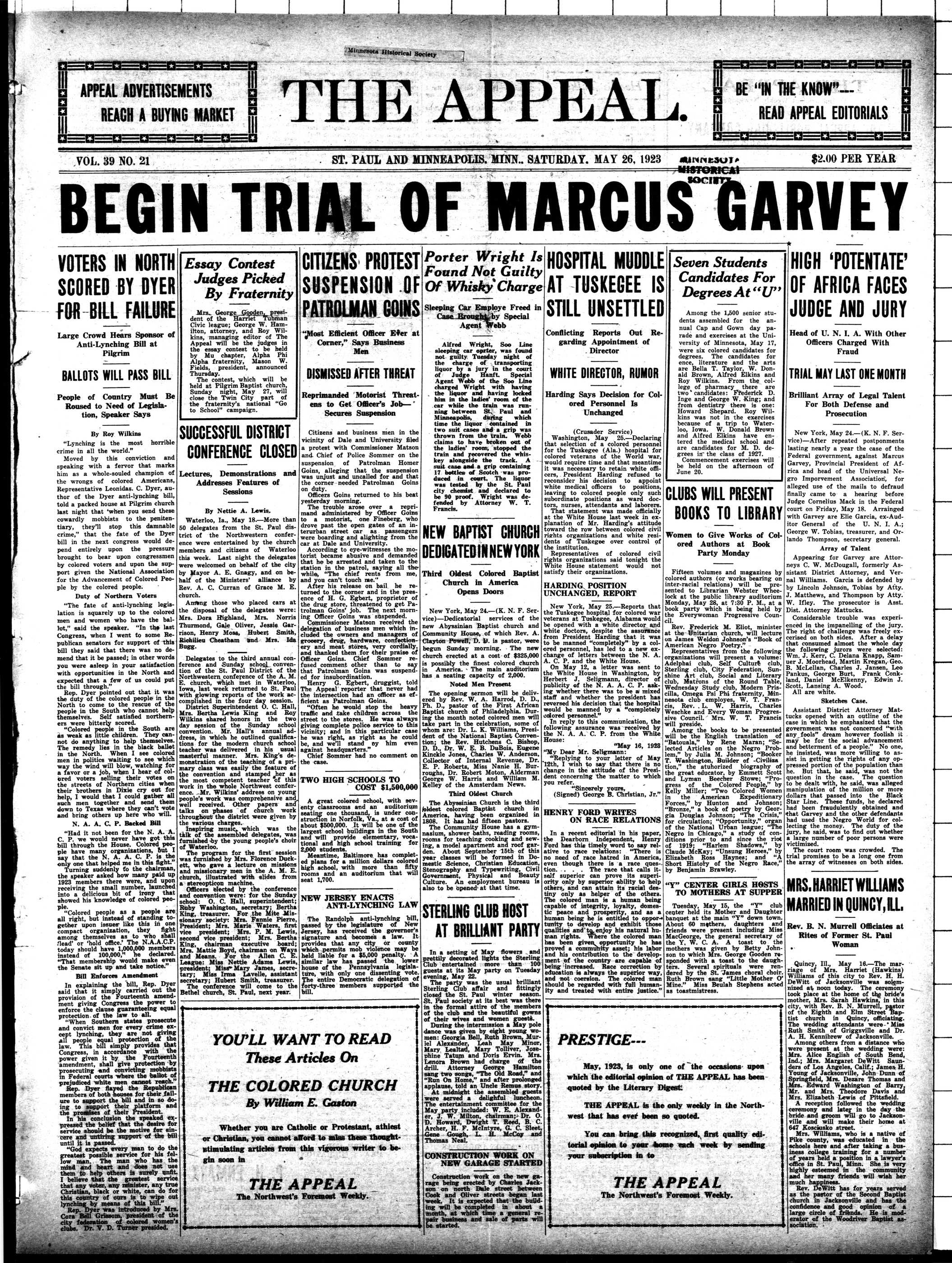
BEGIN TRIAL OF MARCUS GARVEY
APPEAL ADVERTISEMENTS
REACH A BUYING MARKET
VOL. 39 NO. 21
BEGIN T
VOTERS IN NORTH
SCORED BY DYER
FOR-BILL FAILURE
Essay Conten
Judges Pie
By Frate
Mrs. George Gooden
dent of the Harriet
Civic league; George
Large Crowd Hears Sponsor of Anti-Lynching Bill at Pilgrim
People of Country Must Be Roused to Need of Legislation, Speaker Says
By Roy Wilkins
"Lynching is the most horrible crime in all the world."
Moved by this conviction and speaking with a fervor that marks him as a whole-souled champion of the wrongs of colored Americans, Representative Leonidas. C. Dyer, author of the Dyer anti-lynching bill, told a packed house at Pilgrim church last night that when you send these cowardly mobbists to the penitentiary, they'll stop this damnable crime," that the fate of the Dyer bill in the next congress would depend entirely upon the pressure brought to bear upon congressmen by colored voters and upon the support given the National Association for the Advancement of Colored People by the colored people.
Duty of Northern Voters
"The fate of anti-lynching legislation is squarely up to the colored men and women who have the ballot," said the speaker. "In the last Congress, when I went to some Republican senators for support of this bill they said that there was no demand that it be passed; in other words you were asleep in your satisfaction with opportunities in the North and expected that a few of us could put the bill through."
Rep. Dyer pointed out that it was the duty of the colored people in the North to come to the rescue of the people in the South who cannot help themselves. Self satisfied northerners were bitterly scored.
"Colored people in the South are as weak as little children. They cannot do anything to help themselves. The remedy lies in the black bus in the North. When I see men in politics waiting to see which way the driver will blow, watching for driver or a job, when I hear of colored voters selling their votes on the streets of Northern cities when their brothers in Dixie cry out for help, I would that I could gather all such men together and send them down to Texas where they can't vote and bring others up here who will.
N. A. A. C. P. Backed Bill
"Had it not been for the N. A. A. C. P. we would never have got this bill through the House. Colored people have many organizations, but I say that the N. A. A. C. P. is the only one that helped me in this fight." Turning suddenly to the chairman, the speaker asked how many palms 1923 members were upon receiving a small number, launched in a delicious bit of irony that showed his knowledge of colored people.
"Colored people as a people are all right, but instead of standing together upon issues like this in one compact organization, they fight among themselves as to who shall lead' or 'hold office.' The N.A.A.C.P. today should have 1,000,000 members instead of 100,000," he declared. "That membership would make even the Senate sit up and take notice."
Bill Enforces Amendment
In explaining the bill, Rep. Dyer said that it simply carried out the provision of the Fourteenth amendment giving Congress the power to enforce the clause guaranteeing equal protection of the law to all.
"When Southern states prosecute and convict men for every crime except lynching, they are not giving all people equal protection of the law. This bill simply provides that Congress, in accordance with the power given it by the Fourteenth amendment, shall give protection by prosecuting and convicting mobbists in Federal courts where the ballot of prejudiced white men cannot reach." Rep. Dyer flayed the Republican members of both houses for their failure to support bill and in so doing to support their platform and the promises of their President. In his conclusion the speaked expressed the belief that the desire for service should be the motive for sincere and untiring support of the bill until it is passed.
"God expects every man to do the greatest possible service for his fellow man. The man who has the mind and heart and does not use them to help others is surely unfit. I believe that the greatest service that any voter, any minister, any true Christian, black or white, can do for this country of ours is to wipe out lynching by means of this bill."
Rep. Dyer was introduced by Mrs. Cora Bell Grissom, president of the city federation of colored women's clubs. Dr. V. D. Turner presided.
YOU'LL WANT TO READ
These Articles On
THE COLORED CHURCH
By William E. Gaston
Whether you are Catholic or Protestant, atheist or Christian, you cannot afford to miss these thought-stimulating articles from this vigorous writer to begin soon in
THE APPEAL
The Northwest's Foremost Weekly.
Essay Contest Judges Picked By Fraternity
Mrs. George Gooden, president of the Harriet Tubman Civic league; George W. Hamilton, attorney, and Roy Wilkins, managing editor of The Appeal will be the judges in the essay contest to be held by Mu chapter, Alpha Phi Alpha fraternity, Mason W. Fields, president, announced Thursday. The contest, which will be held at Pilgrim Baptist church, Sunday night, May 27, will close the Twin City part of the fraternity's national "Go to School" campaign.
SUCCESSFUL DISTRICT CONFERENCE CLOSED
Lectures, Demonstrations and Addresses Features of Sessions
By Nettie A. Lewis.
Waterloo, Ia., May 18.—More than 50 delegates from the St. Paul district of the Northwestern conference were entertained by the church members and citizens of Waterloo this week. Last night the delegates were welcomed on behalf of the city by Mayor A. E. Gnagy, and on behalf of the Ministers' alliance by Rev. A. C. Curran of Grace M. E. church.
Among those who placed cars at the disposal of the delegates were: Mrs. Dora Highland, Mrs. Norris Thurmond, Gale Oliver, Jessie Garrison, Henry Mosa, Hubert Smith, Richilien Cheatham and Mrs. Ida Bugg.
Delegates to the third annual conference and Sunday school convention of the St. Paul District of the Northwestern conference of the A. M. E. church, which met in Waterloo, Iowa, last week returned to St. Paul with glowing reports of the work accomplished in the four day session.
District Superintendent O. C. Hall, Mrs. Bertha Lewis King and Roy Wilkins shared honors in the two day session of the Sunday school convention. Mr. Hall's annual address, in which he outlined qualifications for the modern church school teacher was delivered in his usual masterful manner. Mr. King's demonstration of the teaching of a preroy was easily the feature of the convention and stamped her as the most competent teacher of this work in the whole Northwest conference. Mr. Wilkins' address on young people's work was comprehensive and well received. Other papers and talks on phases of church work throughout the district were given by the various charges.
Inspiring music, which was the talk of the assembled delegates, was furnished by the young people's choir of Waterloo.
The program for the first session was furnished by Mrs. Florence Duckett, who gave a lecture on missions and missionaries in the A. M. E. church, illustrated with slides from a stereoticon machine.
Officers elected by the conference and convention were: for the Sunday school: O. C. Hall, superintendent; Ruby Washington, secretary; Bertha King, treasurer. For the Mite Missionary society: Mrs. Fannie Pierre, President; Mrs. Marie Waters, first vice president; Mrs. P. M. Lewis, second vice president; Mrs. Bertha King, chairman executive board; Mrs. Mattie Boyd, chairman on Ways and Means. For the Allen C. E. League: Miss Nettie Adams Lewis, president; Miss Mary James, secretary; Miss Irma Lavelle, assistant secretary; Hubert Smith, treasurer. The conference will come to the Bethel church, St. Paul, next year.
YOU'LL WA
These A
THE COLOR
By William
THE APPEAL.
ST. PAUL AND MINNEAPOLIS. MINN.. SATURDAY. MAY 26, 1923
CITIZENS PROTEST SUSPENSION.OF PATROLMAN GOINS
"Most Efficient Officer Eier at Corner," Says Business Men
DISMISSED AFTER THREAT
Reprimanded 'Motorist Threatens to Get Officer's Job—Secures Suspension
Citizens and business men in the vicinity of Dale and University filed a protest with Commissioner Matson and Chief of Police Sommer on the suspension of Patrolman Homer Goins, alleging that the suspension was unjust and uncalled for and that the corner-needed Patrolman Goins on duty.
Officers Goins returned to his beat yesterday morning.
The trouble arose over a reprimand administered by Officer Goins to a motorist, one Fineberg, who drove past the open gates of an interurban street car as passengers were boarding and alighting from the car at Dale and University.
According to eye-witnesses the motorist became abusive and demanded that he be arrested and taken to the station in the patrol, saying all the while. 'The chief runs, from me, and you can't touch me.'
After his release on bail he returned to the corner and in the presence of H. G. Egbert, proprietor of the drug store, threatened to get Patrolman Goins' job. The next morning Officer Goins was suspended.
Commissioner Matson received the delegation of business men which included the owners and managers of grocery, drug, hardware, confectionery and meat stores, very cordially, and thanked them for their praise of Officer Goins. Chief Sommer refused comment other than to say that Patrolman Goins was suspended for insubordination.
Henry G. Egbert, druggist, told The Appeal reporter that never had the intersection had an officer as efficient as Patrolman Goins.
"Often he would stop the heavy traffic and take children across the street to the stores. He was always giving complete police service to this vicinity; and in this particular case he was right, as right as he could be, and we'll stand by him even against headquarters."
Chief Sommer had no comment on the case.
TWO HIGH SCHOOLS TO
COST $1,500,000
A great colored school, with seventy classrooms and an auditorium seating one thousand, is under construction in Norfolk, Va., at a cost of about $500,000. It will be one of the largest school buildings in the South and will provide elementary, vocational and high school training for 2,000 students. Meantime, Baltimore has completed plans for a million dollars colored high school, with more than fifty rooms and an auditorium that will seat 1,700.
NEW JERSEY ENACTS
ANTI-LYNCHING LAW
The Randolph anti-lynching bill, passed by the legislature of New Jersey, has received the governor's signature and becomes a law. It provides that any city or county which permits mob violence may be held liable for a $5,000 penalty. A similar law has passed the lower house of Pennsylvania legislature, with only one dissenting vote. The entire Democratic delegation of forty-three members supported the bill.
Porter Wright Is Found Not Guilty Of Whisky Charge
Sleeping Car Employe Freed in Case Brought by Special Agent Webb
Alfred Wright, Soo Line sleeping car opter, was found not guilty Tuesday night of the charge of transporting liquor by a jury in the court of Judge Hanft. Special Agent Webb of the Soo Line charged Wright with having the liquor and having locked him in the ladies' room of the car while the train was running between St. Paul and Minneapolis, during which time the liquor contained in two suit cases and a grip was thrown from the train. Webb claims to have broken out of the ladies' room, stopped the train and recovered the whiskey alongside the track. A suit case and a grip containing 17 bottles of Scotch was produced in court. The liquor was tested by the St. Paul city chemist and declared to be 90 proof. Wright was defended by Attorney W. T. Francis.
NEW BAPTIST CHURCH
DEDIGATED IN NEWYORK
Third Oldest Colored Baptist Church in America Opens Doors
New York, May 24.—(K. N. F. Service)—Dedicatorial services of the new Abyssinian Baptist church and Community House, of which Rev. A. Clayton Powell, D. B. is pastor, were begun Sunday morning. The new church erected at a cost of $252,000 is possibly the finest colored church in America. The main auditorium has a seating capacity of 2,000.
Noted Men Present
The opening sermon will be delivered by Rev. W. A. Harrod, D. D., Ph. D., pastor of the First African Baptist church of Philadelphia. During the month noted colored men will take part in the celebration, some of whom are: Dr. L. K. Williams, President of the National Baptist Convention; the Rev. Hutchens C. Bishop, D. D, Dr. W. E. B. DuBois, Eugene Kinkle Jones, Charles W. Anderson, Collector of Internal Revenue, Dr. E. P. Roberts, Miss Nanie H. Burroughs, Dr. Robert Moton, Alderman George W. Harris and William M. Kelley of the Amsterdam News.
Third Oldest Church
The Abyssinian Church is the third oldest colored Baptist church in America, having been organized in 1808. It has had fifteen pastors. The Community House has a gymnasium, shower baths, reading rooms, rooms for teaching cooking and sewing, a model apartment and roof garden. About September this year, the house is formed in Biomedic Science, Christian Education, Stenography and Typewriting, Civil Government, Physical and Beauty Culture. An employment bureau is also to be opened at that time.
STERLING CLUB HOST AT BRILLIANT PARTY
In a setting of May flowers and prettily decorated lights the Sterling Club entertained more than 100 guests at its May party on Tuesday evening, May 22.
The party was the usual brilliant Sterling Club affair and fittingly closed the St. Paul winter season. St. Paul society at its best was there in the formal attire of the members of the club and the beautiful gowns of their wives and women guests. During the intermission a May pole dance was given by eight young women: Georgia Bell, Ruth Brown, Muriel Alexander, Leah Moll, Minor, Mary Leafad, Mary Tolliver, Josephine Tatum and Chris Drivin. Maria Attmeyn and charge of the drill. Attmeyn George Hamilton sang two songs, "The Old Road," and "Run On Home," and after prolonged applause, told an Uncle Remus story. At midnight the assembled guests were served a delightful luncheon. The entertainment committee for the May party included: W. E. Alexander, J. W. Milton, chairman: Dr. O. D. Howard, Dwight T. Reed, B. C. Archer, H. F. McIntyre, G. C. Sleet, Gene Gough, L. H. McCoy and Thomas Neal.
PRESTIGE---
May, 1923, is only one of the occasions upon which the editorial opinion of THE APPEAL has been quoted by the Literary Digest:
THE APPEAL is the only weekly in the Northwest that has ever been so quoted.
You can bring this recognized, first quality editorial opinion to your home each week by sending your subscription in to
THE APPEAL
The Northwest's Foremost Weekly.
HOSPITAL MUDDLE AT TUSKEGEE IS STILL UNSETTLED
Conflicting Reports Out Regarding Appointment of Director
WHITE DIRECTOR, RUMOR
Harding Says Decision for Colored Personnel Is Unchanged
(Crusader Service)
Washington, May 25.—Declaring that selection of a colored personnel for the Tuskegee (Ala.) hospital for colored veterans of the World War, would require time and that meantime it was necessary to retain white officers, President Harding refused to reconsider his decision to appoint white medical officers to positions, leaving to colored people only such subordinate positions as ward doctors, nurses, attendants and laborers. That statement was made officially as the White House last week in an explanation of the policy toward the row between colored civil rights organizations and white residents of Tuskegee over control of the institution.
Representatives of colored civil rights organizations said tonight the White House statement would not satisfy their organizations.
HARDING. POSITION
UNCHANGED. REPORT
New York, May 25.—Reports that the Tuskegee hospital for colored war veterans at Tuskegee, Alabama would be opened with a white director and white doctors, despite the assurance from President Harding that it was to be manned "completely" by a colored personnel, has led to a new exchange of letters between the N. A. A. C. P. and the White House.
On May 12, a letter was sent to the White House in Washington, by Herbert J. Seligmann, director of publicity of the N. A. A. C. P. asking whether there was to be a mixed staff and whether the president has reversed his decision that the hospital would be manned by a "completely odored personnel."
In reply to this communication, the following assurance was received by the N. A. A. C. P. from the White House:
"May 16, 1925
'My Dearest Mr. Seligmann:
"My Dear Mr. Sengmann:
"Replying to your letter of May
12th, I wish to say that there is no
change in the attitude of the Presi-
dent concerning the matter to which
you refer.
"Sincerely yours,
(Signed) George B. Christian, Jr."
HENRY FORD WRITES
ON RACE RELATIONS
In a recent editorial in his paper, the Dearborn Independent, Henry Ford has this timely word to say relative to race relations: "There is no need of race hatred in America, even though there is a race question. . . . The race that calls itself superior can prove its superiority only by superior ability to help others, and can attain its racial destiny only as helper of the others. The colored man is a human being capable of integrity, loyalty, domestic peace and prosperity, and as a human being he is entitled to opportunity to develop and exhibit those qualities of the colored human rights. Where the colored man has been given opportunity he has proved a community asset; his labor and his contribution to the development of the country are capable of being increased. Race correction by education is always the superior way and not coersion. The colored man should be regarded with full humanity and treated with entire justice."
BE "IN THE KNOW"--- READ APPEAL EDITORIALS
Seven Students Candidates For Degrees At "U"
Among the 1,500 senior students assembled for the annual Cap and Gown day parade and exercises at the University of Minnesota, May 17, were six colored candidates for degrees. The candidates for ence, literature and the arts are Bella T. Taylor, W. Donald Brown, Alfred Elkins and Roy Wilkins. From the college of pharmacy there are two candidates: Frederick D. Inge and George W. King; and from dentistry there is one: Howard Shepard. Roy Wilkins was not in the exercises because of a trip to Waterloo, Iowa. W. Donald Brown and Alfred Elkins have entered the medical school and are candidates for M. D. degrees in the class of 1927.
Commencement exercises will be held on the afternoon of June 10.
CLUBS WILL PRESENT BOOKS TO LIBRARY
Women to Give Works of Colored Authors at Book Party Day
Fifteen volumes and magazines by colored authors (or works bearing on inter-racial relations) will be presented to Librarian Webster Wheelock at the public library auditorium Monday, May 28, at 7:30 P. M., at a book party which is being held by the Everywoman Progressive Council.
Rev. Frederick M. Eliot, minister at the Unitarian church, will lecture on James Weldon Johnson's "Book of American Negro Poetry."
Representatives from the following organizations will present a volume: Adelphai club, Self Culture club, Sterling club, City Federation, Sunshine club, City Federation, Social and Literary club, Matrons of the Round Table, Wednesday Study club, Modern Priscilla, Omega Psi Phi fraternity, Minnesota club employees, W. T. Francis, Rev. L. W. Harris, Charles Weschle and Every Woman Progressive Council. Mrs. W. T. Francis will preside.
Among the books to be presented will be the English translation of "Batouala," by Rene Maran; "Selected Articles on the Negro Problem," by Julia M. Johnson; "Booker T. Washington, Builder of Civilization," the authorized biography of the great educator, by Emmett Scott and Lyman Beecher Stowe; "Progress of the Colored People," by Kelly Miller; "Two Colored Women in the American Expeditionary Forces," by Hunton and Johnson; "Bronze," a book of poetry by Georgia Douglas Johnson; "The Crisis," for circulation; "Opportunity," organ of the National Urban league; "The Negro in Chicago," a study of conditions prior to and since the riot of 1919; "Harlem Shadows," by Claude McKay; "Unsung Heroes," by Elizabeth Ross Haynes; and "A Short History of the Negro Race," by Benjamin Brawley.
"Y" CENTER GIRLS HOSTS
TO MOTHERS AT SUPPER
Tuesday, May 15, the "Y" club center held its Mother and Daughter banquet at the main "Y" down town. About 60 mothers, daughters and friends were present including Miss MacGeorge, the general secretary of the Y, W. C. A. A toast to the mothers was given by Betty Johnson to which Mrs. George Gooden responded with a toast to the daughter, and then with a toast to her dressed by the St. James choral choir Ruth Brown sang "Little Mother O Mine." Miss Beulah Stephens acted as toastmistress.
$2.00 PER YEAR RVEY
HIGH 'POTENTATE' OF AFRICA FACES JUDGE AND JURY
Head of U. N. I. A. With Other Officers Charged With Fraud
TRIAL MAY LAST ONE MONTH
Brilliant Array of Legal Talent For Both Defense and Prosecution
New York, May 24.—(K. N. F. Service)—After repeated postponements lasting nearly a year the case of the Federal government, against Marcus Garvey, Provincial President of Africa and head of the Universal Negro Imporment Association, for alleged use of the mails to defraud finally came to a hearing before Judge Cornelius Mack in the Federal court on Friday, May 18. Arrained with Garvey are Elie Garcia, ex-Auditor General of the U. N. I. A.; George W. Tobias, treasurer, and Orlando Thompson, secretary general.
Array of Talent
Appearing for Garvey are Attorneys C. W. McDougall, formerly Assistant District Attorney, and Vernal Williams. Garcia is defended by by Lincoln Johnson, Tobias by Atty. J. Matthews, and Thompson by Atty. W. Ifley. The prosecutor is Asst. Dist. Attorney Mattucks.
Considerable trouble was experienced in the impanelling of the jury. The right of challenge was freely excised on both sides. After a delay that consumed almost the whole day the following jurors were selected: Wm. J. Kerr, C. Delana Knapp, Samuer J. Moorhead, Martin Kregan, Geo. B. McLellan, Charles J. Jansen, Leo Pankus, George Burt, Frank Conland, Daniel McElkenny, Edwin J. Scott, Lansing A. Wood.
Sketches Case.
Assistant District Attorney Mattucks opened with an outline of the case in which he emphasized that the government was not concerned "with any fools" dream however foolish it may be for the social advancement and betterment of a people." No one, he insisted, was more willing to assist in getting the rights of any oppressed portion of the population than he. But that, he said, was not the question in the case. The question to be dealt with, he said, was alleged manipulation of the million or more dollars that passed into the Black Star Line. These funds, he declared had been fraudulently obtained and that Garvey and the other defendants had used the Negro World for soliciting the money. The duty of the jury, he said, was to find out whether a large number of poor persons were victimized.
The court room was crowded. The trial promises to be a long one from the array of witnesses on both sides.
MRS. HARRIET WILLIAMS
MARRIED IN QUINCY, ILL.
Rev. B. N. Murrell Officiates at
Rites of Former St. Paul
Woman
Quincy, Ill., May 16.—The marriage of Mrs. Harriet (Hawkins) Williams of this city to Rev. H. H. DeWitt of Jacksonville was solmnized at noon today. The ceremony took place at the home of the bride's mother, Mrs. Sarah Hawkins, in this city, with Rev. B. N. Murrell, pastor of the Eighth and Elm Street Baptist church in Quincy, officiating. The wedding attendants were "Miss Ruth Smith of Griggsville and Dr. A. H. Kennibrew of Jacksonville. Among others from a distance who were present at the wedding were: Mrs. Alice English of South Bend, Milk; Mrs. Margaret DeWitt James, Sum of Isle Angelo Calif.; Mrs. H. Young of Jacksonville, John Dunn of Springfield, Mrs. Dezare Thomas and Mrs. Edward Washington of Barry, Mr. and Mrs. Theodore Davis and Mrs. Elizabeth Lewis of Pittsfield. A reception followed the wedding ceremony and later in the day the bride and groom will go to Jacksonville and will make their home at 647 Koscusko street. Mrs. Williams, who is a native of Pike county, was educated in the schools here and after taking a business college training for a number of years held a position in a lawyer's office in St. Paul, Minn. She is very highly esteemed in the community and her many friends will wish her much happiness. Rev. DeWitt has for years served as the pastor of the Second Baptist church in Jacksonville and has the occasion of opening a large circle of friends. He is moderator of the Woodriver Baptist association.
J. Q. Adams ..... Editor-in-Chief
Roy Wilkins ..... Managing Editor
Odell D. Smith ..... Business Manager
Advertising Peter on Application
Entered at the Postoffice in St. Paul, Minnesota, as second-class mail matter, June 6, 1885, under Act of Congress, March 3, 1879.
REV. HARRIS AGAIN
According to a Daily News story an information bureau has been opened at 468 Rice street for the guidance of colored emigrants to the city, and according to Rev. J. W. Harris, colored persons are flocking to the city from the South where pastors there are urging them to come to St. Paul.
All of which is very interesting, but it is about time that the Daily News and the public in general came to know that what Rev. J. W. Harris has to say about migration or anything else is not authoritative.
Since he has been in St. Paul Rev. Harris has had more undesirable publicity than any pastor in recent years. He does not wish to co-operate with others in the community on various enterprises. Even now he holds a permit to solicit for funds to erect a community house in connection with his church.
He knows that various clubs and organizations are co-operating, to meet the migration of colored folk, and he knows that money has been pledged to bring the Urban league to the city to care for welfare needs. In the face of this knowledge he must-needs establish his own information bureau, and by so doing stamp himself again as the disciple of dissension. If Rev. Harris is maintaining the bureau with his own funds, there is no more serious charge against him than that he refuses to work with the community at large, but if the bureau is being supported by solicitation from people who are led to believe that this man is representing the colored people of St. Paul and seeking aid in their behalf then he should be stopped and stopped at once, so that other enterprises representative of the whole community will not be endangered.
LOOKS FUNNY
Mr. Finberg who collects the rent from Chief Sommer said that he'd get Officer Goins' job for arresting him for passing open street car gates—a violation of a city ordinance.
Next morning Officer Goins was suspended — for "insubordination," according to the chief.
It may be so, but, well, we wish we owned a flat that the chief lived in.
FUNERALS AND FLOWERS (The Monitor.)
Flowers are emblems of the Resurrection and are therefore appropriate expressions of condolence when death visits the household. Their beauty and fragrance soothe sorrow. The gift of flowers in the hour of bereavement is a beautiful way of expressing sympathy and is always appreciated. The custom of doing so has become firmly fixed and could not be set aside were there the desire and disposition to do so. We have no desire to see this custom set aside, but we do believe that the tendency toward cavavage in the observance of this beautiful custom should be checked and that certain reforms, were it possible to bring them to pass, would be desirable. We believe that it would be much better, for example, to substitute simple bouquets of a few cut flowers for the costly, elaborate and, in many cases, meaningless designs which are much in favor. These elaborate designs, such as "Gates Ajar," "Broken Columns" "Pillows," and the like, are cumbersome and inartistic and are not so expressive as the simpler sprays and bouquets. The latter, in our opinion, commend themselves for another reason. It is this: They can be sent to carry cheer to some sick room in private home and hospital, thus doing a double duty. Instead of heaping flowers upon the new-made grave, where they wren within a few hours pile by the sexton, would it not be better to leave only a few, say one from each spray or bouquet, upon the new-made mound, and use the others to carry good cheer to the living shut-in in home or hospital? The extravagant expenditure of money for flowers for funerals and the wastefulness shown in heaping in huge piles upon graves to speedily fade, are abuses of a beautiful custom which should be corrected. Send flowers as expressions of sympathy and of faith in the life everlasting, but let it not be overdone as the custom of the day seems to be. A few simple fragrant blossoms given as genuine expression of heartfelt sympathy in be-
reavement are more expressive than the massive special designs which many seem to think they are under obligation to send. And while speaking of flowers at funerals in which such 'lavishness is shown, it is not amiss to suggest that we see to it that we be a little more generous with our flowers to the living. What we would emphasize at this time particularly is less. xtravagance and ostentatious in the use of flowers for funerals. How many of our readers think we are right about this? Let us hear from you.
ANGLO-SAXON HYPOCRISY (The Nation.)
The Florida peonage revelations have been horrifying in the extreme and there are encouraging signs that the aroused Northern press, notably the yeoman service of the New York World, has begun to have its effect. It looks now as if the guilty sheriff and the judge and many of the others responsible will meet with their just deserts—of course if they had been colored men they would have been lynched long ago. There is evidence, too, that the Florida pocket-nerve is beginning to be touched; fear that the lucrative-Northern tourist trade may be affected is apparently becoming an incentive to virtue. But as we have pointed out before, this is not the first time by any means that the scandals of the Florida chain gang have been revealed. Revelations almost as sensational appeared in the New York press just twenty-five years ago. This flurry is similar to temporary value and will do nothing to remove a blot on the American good name or to prevent the most horrible human torture and suffering unless it results in the complete abolition of the monstrous and inhuman chain-gang system which can no more be reformed than can war. Both are utter anachronisms. The blindness of our countrymen! They are up in arms over the execution of a Russian priest, and yet they tolerate year in and year out the doing to death throughout the South of hundreds of innocent men sentenced to the chain gang on trumped-up excuses by crooked sheriffs and venal judges in order that contractors may make money. What pharisaism, what Anglo-Saxon hypocrisy!
Tennis Talk
(By Paul Crane)
"Tennis is the true democrat among American sports. It's a poor city these days that can't offer public courts to its people. Dwight Davis, donor of the Davis Cup and active head of American tennis until his retirement at Capitol Weekly retiring of War, has long been working toward more and better municipal tennis courts. He recently made an interesting report on conditions in seventy-five large cities in which there are 2,000 courts."—Collier's Weekly contained a list of sixteen cities with the number of their public courts and on that list St. Paul ranked fourth: Newark, 120 Kansas City, 92 Seattle 78 St. Paul 69 Washington 68 Detroit, 53
There was talk abroad last Sunday morning, among the tennis enthusiasts at Dunning field, about the organization of a tennis club. The team, which was 20 years ago St. Paul had the right to be represented in the tennis tournament at Washington when Dr. Nelson of Minneapolis, Dr. Cheeks, the Tucker brothers, Herbert Smith, Ted Crosthwaite, Peavey Johnson, George George Cornelius Johnson, Earl Kyle, Donald Brown and several others formed the Twin City Tennis Club and paid the necessary dues to the national body. There were two most competent racketswimmers among the girls of the Twinities are Francis Smith of Minneapolis and Gladys Gardner of St. Paul.
SOUTHERN YOUTHS WIN
HONORS IN NORTH
Joseph J. Rhoads of Texas, one of the fourteen colored students at Yale university, won second place in the first term examinations this spring. Omar carries an enrollment at "Amos School" and a cash award of $150. Young Rhoads went to Yale from Tuskegee institute, where he had been secretary of the Student Christian association. He is a graduate of Bishop college, at Marshall, Tenn.
Frank S. Rankin, a Savannah colored youth studying medicine in the University of Illinois, recently took the examination for the position of medical student in the health department. Out of 52 competitors, only six passed the examinations and Rankin came second among the six.
By E. S. WEBER, D. D. S.
Any questions regarding subjects in these articles or other dental work should be addressed to the Health Editor of the Appeal. Dr. Weber will publish the answers each week in this column.
ABSCESSES
I think that this is another important subject that my readers should know something about, especially when I think of the many patients who suffer from abscesses. What is an abscess? To put it in simple terms let us say that it is a circumscribed collection of pus surrounded by a wall of lymph. Maybe your doctor told you that you had Septicaptia or Pericentitis; Acute Alveolar Abscess or Dyneuronal Alveolar Abscess or Granuloma. Of course I know that you took his word for it (nothing else), at all events he meant just what I said in the above sentence, except that he pointed out the location when he said Apical which means at the apex; at the end of the root, and Pericentitis, the constitution of the Pericentum (the tissue that surrounds the root of a tooth).
There are two kinds of abscesses namely, acute and chronic. An acute abscess is the one that most of you know something about. It is the one that develops with all the signs and symptoms of inflammation such as swelling (sometimes considerable), swelling (sometimes considerable), pain is present, at times intense, depending upon the character of the tissues involved, the severity of the injury, and the reaction of the tissues. The function of the part is important, and usually present. A chronic abscess forms without the signs and symptoms of inflammation, but its activity and dangerous tendencies are the same as the acute abscess. It is too bad that all abscesses can't be acute because when they develop we are in a situation of relief and relief is sought in ample time. Chronic abscesses may continue for years without the slightest discomfort on the part of the patient, but the toxic products of the bacteria that cause the abscesses are con- taining the system through the channels of the lymphatics. This is detrimental to the physical organization of man in ways that I pointed out to you in my previous articles.
Deep seated infection due to bacterial invasion in fungal standing cavities, pulpless teeth (teeth where the nerve has been removed) that have improper root canal fillings, trauma (injury) by means of a fall or a fracture, or irrigation into the pulp (nerve) by means of desecured fillings, fillings that run too close to the nerve), this has a tendency to kill the nerve in tact. And like anything that dies inclosed in a chamber (as the nerve of a tooth is) the nerve is often sometimes gangrenous. These conditions favor the growth of the abscess also. Teeth that are ground down too close to the pulp for crowns might produce the same conditions. Septic tissue from a pyrhea pocket located upward in the sides of the question, may be a source of the abscess.
The Light
of
Western
Stars
A Romance
By
Zane Grey
Illustrations by Irwin Myers
CHAPTER I — Arriving at the lonely little railroad station of El Cajon, New Mexico, where she finds a girl, finds no one to meet her. While in the waiting room a drunken cowboy encounters her, and he leaves her terrified. He returns with a priest, who goes through some sort of ceremony, and the cowboy forces her to leave the room. She then identifies her identity the cowboy seems dased. In a shooting scrape outside the room a girl, Bonita "take his horse and escape," then conducts Madeline to Florence Kingley, friend of her brother.
CHAPTER II — Florence welcomes her, and she takes her horse to the boy, Gene Stewart. Next day Alfred Hammond, Madeline's brother, takes Gene Stewart, the exonerates of any wrong intent.
CHAPTER III — Alfred, son of a wealthy family, had been dismissed from his home because of his disapointment. He is deemed him. She meets Stillwalt, Al's employer, typical western ranchman. He learns Stillwalt has gone over the border.
CHAPTER IV — Danny Mahn, one of Stillwalt's cowboys, has disappeared, with some of Stillwalt's money. His friends link his name with the girl Bob.
CHAPTER V — Madeline gets a gimpse of life on a western ranch.
"What am I to such a woman as you?"
"A man in trouble, Stewart. But I have come to help you, to show my faith in you."
"I if I believed that, I might try," he said.
"Listen," she began, softly, hurriedly. "My word is not lightly given. Let it prove my faith in you. Look at me now and say you will come."
He heaved up his big frame as if trying to cast off a giant's burden, and then slowly he turned toward her. face was a blotched and terrible physical-brutalizing marks were there in his face at that instant all that appeared human to Madelina was the dawning in dead, furnace-like eyes of a beautiful light.
"I'll come," he whispered, hunkily.
"Give me a few days to straighten up, then I'll come."
CHAPTER IX
The New Foreman
Toward the end of the week Stillwell informed Madeline that Stewart had arrived at the ranch and had taken up quarers with Nels.
"Gene's sick. He looks bad," said the old cattleman. "He's so weak an shaky he can't lift a cup. Nels says that Gene has had some bad spells. A little liquor would straighten him up now. But Nels can't force him to drink a drop, an' has had to sneak some liquor in his coffee. Gene's losin' his mind, or he's got somethin' powerful strange on it."
Stewart was really ill. It became necessary to send for a physician. Then Stewart began slowly to mend and presently was able to get up and about. Stillwell said the cowboy lacked interest and seemed to be a broken man. This statement, however, the old cattleman modified as Stewart continued to improve. Then presently it was a good augury of Stewart's progress that the cowboys once more took up the tearing relation which had been characteristic of them before his illness. A cowboy was indeed out of sorts when he could not vent his peculiar humor on somebody or something. Stewart had evidently become a broad target for their badness.
"Wal, the boys are sure after Gene" said Stillwell, with his huge smile. "Joshin' him all the time about how he sits around an' hangs around an' loafs around jest to get a glimpse of you, Miss Majesty. Sure all the boys he avery bad case over their pretty boss, but none of them is a marker to Gene. He's got it so bad, Miss Majesty, that he actully don't know they are joshin' him. It's the amazin'est strange thing I ever seen."
Madeline smiled her amusement. It had been impossible for her to fall to observe Stewart's singular behavior. She never went out to take her customary walks and rides without seeing him somewhere in the distance. She was aware that he watched for her and avoided meeting her. When she sat on the porch during the afternoon or at sunset Stewart could always be described at some point near. He idled listlessly in the 'sun, lounged on the porch of his bunkhouse, sat whitening the top bar of the corral fence, and always it seemed to Madeline he was watching her. He was pale, haggard, drawn. His eyes held a shadow with which he seemed obscured light; and once having observed Madeline fancied it was like the light in Majesty's eyes, in the dumb, worshiping eyes of her favorite stag-hound. She told Stewart that she hoped he would soon be in the saddle again, and passed on her way.
That Stewart loved her Madeline could not help but see. When she discovered this she felt a little surprise and annoyance. Then she interrogated herself, and concluded that it was not that Stewart was so different from his comrades, but that circumstances made him stand out from them. She recalled her meeting with him that night when he had tried to force her to marry him. This was unforgettable in itself. She recalled subsequent mention of her being a brilliantly memorable. The man and his actions seemed to hinge on events. Lastly, the fact standing clear of all others in its relation to her interest was that he had almost been ruined, almost lost, and she had saved him. That alone was sufficient to explain why she thought of him differently. She had befriended, uplifted the other cowboys she had saved Stewart's life. To be sure, he had been a ruffian, but a woman could not save the life of even a ruffian without remembering it with gladness. Madeline length decided that she had been and that her deeper feeling was pity. Perhaps the interest had been forced from her; however, she gave the pity as she gave everything.
Stewart had taken up his duties as foreman, and his activities were ceaseless. He was absent most of the time, ranging down toward the Mexican line. When he returned Stillwell sent for him.
This was late in the afternoon of a day in the middle of April. Alfred and Florence were with Madeline on the porch.
Madeline saw the man she remembered, but with a singularly different aspect. His skin was brown; his eyes were pleasing and dark and steady; he carried himself erect; he seemed preoccupied, and there was not a trace of embarrassment in his manner.
"Wal, Gene, I'm sure glad to see you," Stillwell was saying. "Where do you hall from?"
"Gudalupe canyon," replied the cowboy.
Stillwell whistled.
"Way down there! You don't mean you follored them hoss tracks that far"
"All the way from Don Carlos' ranch across the Mexican line. I took
CURE FOR PREJUDICE
At the Southern Conference on illiteracy recently held in Hosanna, we brought to attention that colored people are more eager for education than are certain classes of whites, and that race troubles come largely from the illiterates among the latter "written in our civilization," said one of the speakers, "our emancipation from race hatreds will begin."
Nick Steele with me. Nick is the best tracker in the outfit. This trail we were on led along the foothill valleys. First we thought whover made it was hunting for water. But they passed two, ranches without watering. At Seaton's wash they dug for water. Here they met a pack-train of burros that came down the mountain trail. The burros were heavily loaded. Horse and burro struck stuck south from Seaton's to the old California emigrant road. We followed the trail through Gudalupe canyon and across the border. On the way back we stopped at Slaughter's ranch, where the United States Army was stationed. We met foresters from the Peloncillo forest reserve. If these fellows knew anything they kept it to themselves. So we hit the trail home." "Wal, I reckon you know enough!" Inquired Stillwell, slowly. "Miss Ham-
#
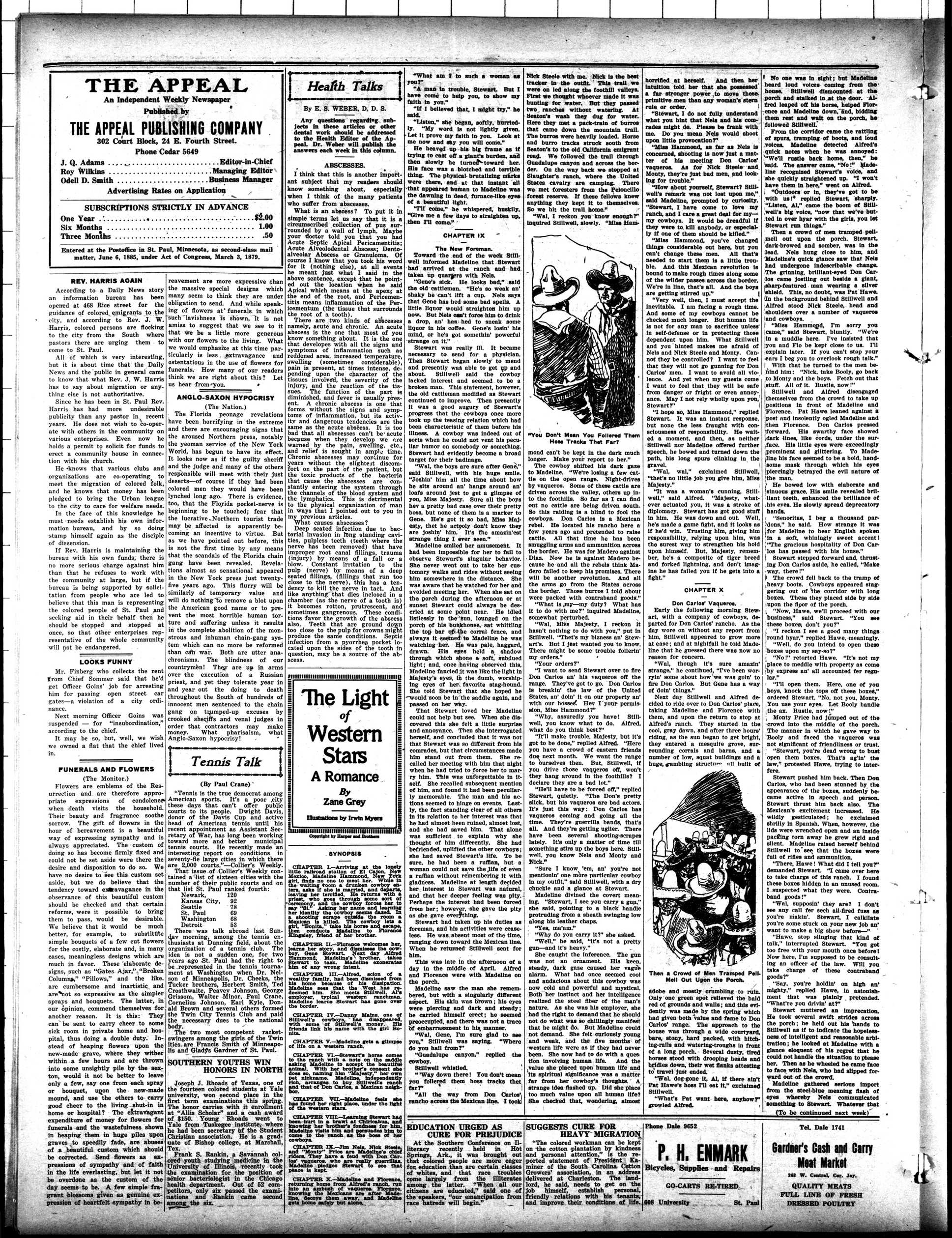
"You Don't Mean You Follered Them Hose Tracks The Far? mond can't be kept in the dark much longer. Make your report to her."
The cowboy shifted his dark gaze to Madeline. "We're losing a few cattle on the open range. Night-drives by vaqueros. Some of these cattle are driven across the valley, others up in the foothills. So far as I can find out no cattle are being driven south. So this raiding is a blind to foot the cowboys. Don Carlos is a Mexican rebel. He located his ranch here a few years ago and pretended to raise cattle. All that time he has been smuggling arms and ammunition across the border. He was for Madero against Diaz. Now he is against Madero because he and all the rebels think Madero failed to keep his promises. There will be another revolution. And all the arms go from the States across the border. Those burros I told about were packed with contraband goods." "What is my—my duty? What has it to do with me?" inquired Madeline, somewhat perturbed.
"Wal, Miss Majesty, I reckon it hasn't nothing to do with you," put in Stillwell. "The's my bizness an' Stewart's. But I just wanted you to know. There might be some trouble follin' my orders."
"Your orders?"
"I want to send Stewart over to fire Don Carlos an' his vaqueros off the range. They've got to go. Don Carlos is breakin' the law of the United States, an' don' it on our property an' with our hoses. Hew I your permission, Miss Hammond?"
"Why, assuredly you have! Still well, you know what to do. Alfred, what you think best?"
"I'll make trouble, Majesty, but it's to be done," repiled Alfred. "Here you have a crowd of eastern friends due next month. We want the range to be covered. But. If you drive those vaqueros off, won't they hang around in the foothills? I declare they are a bad lot."
"He'll have to be forced out," replied Stewart, quietly. "The Don's pretty slick, but his vaqueros are bad actors. It's just this way: Don Carlos has vaqueros coming and going all the time. They're guerrilla bands, that's all. And they're getting uglier. There have been several shoots-scrapes lately. It's only a matter of time till something stirs up the boys here. Stillwell, you know Nels and Monty and Nyke. "Sure I know 'em, an' you're not mentionl' one more particular cowboy in my outfit," said Stillwell, with a dry chuckle and a glance at Stewart. Madeline divined the covert meaning. "Stewart, I see you carry a gun," she said, pointing to a black handle protruding from a sheath swinging low along his leather chaps.
"Yes, ma'am."
"why do you carry it?" she asked.
"Why not?" she said, "it's not a pretty
thing—and it's hassy."
She caught the inference. The gun was not an ornament. His keen, steady, dark gaze caused her vague alarm. What had once seemed cool and audacious about this cowboy was now cold and powerful and mystical. Both her instinct and her intelligence realized the steel fiber of the man's nature. As she was his employer, she had the right to demand that he should not do what was so chillingly manifest that he might do. But Madeline could not demand. She felt curiously young and weary, two months of life, were as if they had been. She now had to do with a question involving human life. And the value she placed upon human life and its spiritual significance was a matter far from her cowboy's thoughts. A strange idea faded up. Did she place too much value upon all human life? She checked that, wondering, almost
"The colored workman can be kept on the cotton plantation by kindness and personal attention," is the reported statement of President Kaminer of the South Carolina Cotton Growers' association, in an address delivered at Charleston. On the job, he did, get on the job himself, establish personal, friendly relations with his tenants, and improve their conditions of life.
horrified at herself. And then her intuition told her that she possessed a far stronger power, to move these primitive men than any woman's stern rule or order.
"Stewart, I do not fully understand what you hint that Nels and his comrades might do. Please be frank with me. You mean Nels would shoot his little provocation."
"Miss Hammond, as far as Nels is concerned, shooting is now just a matter of his meeting Don Carlocq vaqerosen. As for Nick Steele and Monty, they're just bad men, and looking for trouble."
"How about yourself, Stewart? Stillwell's remark was not lost upon me," said Madeline, prompted by curiosity.
"I have come to love my ranch, and I care a great deal for my, my cowboys. It would be dreadful if they were to kill anybody, or especially if one of them should be killed."
"Miss Hammond, you changed things considerable out here, but you can't change these men. All that needs to start them is a little trouble. And this Mexican revolution is bound to make rough times along some of the wilder passes across the border. We're in line, that's all. And the boys are in line. Very well, then, must accept the inevitable. I am facing a rough time. And some of my cowboys cannot be checked much longer. But human life is not for any man to sacrifice unless in self-defense or in protecting those dependent upon him. What Stillwell and you hinted makes me afraid of Nels and Nick Steele and Monty. Cannot they be controlled? I want to feel that they will not go gunning for Don Carlos' men. I want to avoid all violence. And yet when my guests come from danger or fright or even annoyance. May I not rely wholly upon you, Stewart?"
"I hope so, Miss Hammond," replied Stewart. It was an instant response, but none the less fraught with consciousness of responsibility. He waited a moment, and then, as neither Stillwell nor Madeline offered further speech, he bowed and turned down the path, his long spins clinking in the grape. "Wal, wal," exclaimed Stillwell, "that's no little job you give him, Miss Majesty." "It was a woman's cunning, Stillwell," said Alfred. "Majesty, whatever actuated you, it was a stroke of diplomacy. Stewart has got good stuff in him. He was down and out. Well, he's made a game fight, and it looks as if he'd win. Trusting him, giving him responsibility, relying upon him, was the surest way to strengthen his hold over the other man. He's a composite of tiger breed and forked lightning, and don't imagine he has failed you if he gets into a fight."
CHAPTER X
Don Carlos' Vagueros
Early the following morning Stewart, with a company of cowboys, departed for Don Carlos' rancho. As the day wore on without any report from him, Stillwell appeared to grow more at ease; and at nightfall he told Matelline that he guessed there was now no reason for concern.
"Wal, though it's sure amazin' strange," he continued, "I've been worryin' some about how we was gain' to fire Don Carlos. But Gene has a way of doin' things."
Next day Stillwell and Alfred decided to ride over to Don Carlos' place, taking Matelline and Florence with them, and upon the return to stop at Alfred's ranch. They started in the cool, gray dawn, and after three hours' riding, as the sun began to get bright, they entered a mesquite grove, surrounding corrals and barns, and a number of low, squat buildings and a huge, gambling structure all built of
MEXICO
Then a Crowd of Men Tramped Pell-Mell Out Upon the Porch.
adobe and mostly crumbling to ruin. Only one green spot relieved the bald red of grounds and walls; and this evidently was made by the spring which had given both value and fame to Don Carlos' range. The approach to the house was through a courtyard, bore, stony, hardacked with hitching-rails and watering-troughs in front of a long porch. Several dusty, tired horses stood with drooping heads and bridles down, their wet wanks attesting to travel just ended.
"Wal, dog-done it. Al, if there sin't Pat Harew's hoss I'll eat it," exclaimed Stillwell.
"What's Pat want here, anyhow?" growled Alfred.
Phone Dale 9652
P. H. ENMARK
Bicycles, Supplies and Repairs
GO-CARTS RE-TIRED
608 University St. Paul
No one was in sight; but Madeline heard loud voices coming from the house. Stillwell dismounted at the porch and stalked in at the door. Alfred leaped on his horse, helped Florence and Madeline down, end, bidding them rest and wait on the porch, he followed Stillwell.
From the corridor came the rattling of spurs, tramping of boots, and loud voices. Madeline detected Alfred's quick notes when he was annoyed: "Were rustle back home, then," he said. The answer came, "No!" Madeline recognized Stewart's voice, and she quickly straightened up. "I won't have them in here," went on Alfred. Outside the house, "I" replied Stewart, sharply. "Listen, Al." came the boom of Stillwell's big voice, "now that we've butted in over byear with the girls, you let Stewart run things."
Then a crowd of men trumped pell-mell out upon the porch. Stewart, dark-brown and somber, was in the lead. Nels hung close to him, and Madeline's quick glance saw that Nels had undergone indescribable change. The grinning, brilliant-eyed Don Caro came jostling out beside a giant, sharp-featured man wearing a silver shield. This, no doubt, was Pat Hare. In the background behind Stillwell and Alfred stood Nick Steele, head and shoulders over a number of vauques and cowboys.
"Miss Hammond, I'm sorry you came," said Stewart, "Were in a muddle here. I've insisted that you and Flo be kept close to us. I'll explain later. If you can't stop your ears I beg to you overlook rough talk." With that he turned to the men behind him: "Nick, take Boly, go back to Monty and the boys. Fetch out that stuff. All of it. Rustle, now!"
Stillwell and Alfred disengaged themselves from the crowd to take up positions in front of Madeline and Florence. Pat Hawe leaned against a post and insolently ogled Madeline and then Florence. Don Carlos pressed forward. His swarthy face showed dark lines, like cords, under the surface. His little eyes were exceedingly prominent and glittering. To Madeline his face seemed to be a bold, hard-some mask through which his eyes plerciingly betrayed the evil nature of the man. He bowed low with elaborate and sinuous grace. His smile revealed brilliant teeth, enhanced the brilliance of his eyes. He slowly spread deprecatory hands.
"Senoritas, I beg a thousand pardons," he said. How strange it was for Madeline to hear English spoken in a soft, whimily sweet accent "The gracious hospitality of Don Carlos has passed with his house." Stewart stepped forward and, thrusting Don Carlos aside, he called, "Make way, there!"
The crowd fell back to the trump of heavy boots. Cowboys appeared staggering out of the corridor with long boxes. These they placed side by side upon the floor of the porch.
"Now, Hawe, we'll proceed with our business," said Stewart. "You see these boxes, don't you?"
"I reckon I see a good many things round hyar," replied Hawe, meaningly. "Well, do you intend to open these boxes upon my so-you?"
"No!" retorted Hawe. "It's not my place to meddle with property as come by express an' all accounted for regular."
"I'll open them. Here, one of you boys, knock the tops off these boxes," ordered Stewart. "No, not you, Monty. You use your eyes. Let Booly handle the ax. Rustle, now!"
Monty Price had jumped out of the crowd into the middle of the porch. The manner in which he gave way to Booly and faced the vaugers was not significant of friendliness or trust.
"Stewart, you're dead wrong to bust open them boxes. That's agin' the law," protested Hawe, trying to interfere.
Stewart pushed him back. Then Don Carlos, who had been stunned by the appearance of the boxes, suddenly became active in speech and person. Stewart thrust him back also. The Mexican's excitement increased. He wildly gesticulated; he exclaimed shrilly in Spanish. When, however, the lids were wrenched open and an inside packing torn away he grew ridg and silent. Madeline raised herself behind Stillwell to see that the boxes were full of rifles and ammunition.
"There, Hawhe! What did I tell you?" demanded Stewart. "I came over here to take charge of this ranch. I found these boxes hidden in an unused room. I suspected what they were. Contraband goods!"
"Wal, supposin' they are? I don't see any call for fer such all-fired fuss as you are'makin'. Stewart, I calliate you're some stuck on your new job an' want to make a big show before-"
"Hawe, stop slinging that kind of talk," interrupted Stewart. "You got too free with your mouth once before! Now here, I'm supposed to be consulting an officer of the law. Will you take an charge of these contraband goods?" "Say, you're holdin' on high an mighty," replied Hawe, in astonishment that was plainly pretended. "What're you drivin' at?" Stewart muttered an imprecation. He took several swift strides across the porch; he held out his hands to Stillwell as if to indicate the hopelessness of intelligent and reasonable arbitration; he looked at Madeline with a glance eloquent of his regret that he could not handle the situation to please her. Then as he wheeled he came face to face with Nela, who had slipped forward out of the crowd. Madeline gathered serious import from the steel-blue meaning flash of eyes whereby Nels communicated something to Stewart. Whatever that
(To be continuued next week)
Gardner's Cash and Carry
Meat Market
283 W. Central, Cor. Jay.
QUALITY MEATS
FULL LINE OF FRESH
DRESSED POULTRY
WEEK'S RECORD OF HAPPENINGS
IN MINNESOTA'S CAPITAL.
The "Saintly City" and Saintly City
Folks—Neway Items of Social, Religious, Political and General Matters Among the People.
SATURDAY, MAY 26, 1923.
THE APPEAL ASKS AS A SPECIAL FAVOR THAT ITS READERSIVE PREFERENCE TO THE ADVERTISERS WHO SEEK THEIR PATRONAGE BY ADVERTISING IN IT. SHOP IN THE APPEAL BEFORE SHOPPING ELSEWHERE.
Mr. Henry High, who has been quite sick, is much improved.
Richard H. Anderson is still confined to his home at 912 Gaultier street.
Pilgrim Baptist church will hold a baptizing service Sunday morning at 10 a. m.
Mrs. Wm. Hyde of Carroll avenue was hostess Friday afternoon to the O. N. T. 500 club.
Mrs. J. Strong still remains seriously ill at her home, 670 W. Central avenue.
The T. N. T. 500 club met at the home of Mrs. B. F. Edwards Monday.
Mrs. A. J. Turner continues to be quite ill at her home, 390 N. St. Albans street.
Mr. Walter McCoy is here from Winnipeg to visit with his family of 478 W. Central avenue.
Mrs. Lela Harris of Grotto street has gone to the hospital for treatment.
Dr. V. D. Turner and family will motor to their summer home at Lake Pokagama Monday to stay over Decoration day.
St. Paul Baptist church will have a Tom Thumb wedding on Tuesday, May 29, under the personal direction of Mrs. Amelia Rickett.
Bismarck C. Archer, 314 Western avenue, has been appointed a regular clerk in the postoffice. He will work in the commercial station.
PIONEER LODGE NO. 1, F. AND A. M. meets first and third Monday in each month at Masonic Hall, 588 Rondo St. at 6:00 P.M. at H. Dillingham, Seyc., 589 Rondo St. Tel. Dale 0872.
Mrs. George James and Mrs. Everett entertained at dinner Sunday in honor of Mr. and Mrs. Timothy Howard. Covers were laid for ten.
Office: Cedar 0508 Res.: Dale 2947
Res.: 678 St. Anthony Ave.
MRS. T. H. LYLES
Successor to
T. H. LYLE UNDERTAKING CO.
150 W. Fourth St. ST. PAUL
The Adelphai club met Tuesday afternoon at the residence of Mrs. Celia James of W. Central avenue. Arrangements were made for the annual outing, June 26, at Phalen park.
HOUSEHOLD OF RUTH NO. 553, G. U. of O. F. meets the third Monday in each month at Union Hall, corner of Aurora and Kents streets at 8:00 P. M. Mrs. Jessie Brown, M. N. A. Mrs. Carrie E. Lindsay, W. R. 428 Royle st.
The church school workers' institute that was to have been held June 4-7 under the auspices of the Twin City S. S. Union, has been postponed until June 25-28.
Mr. and Mrs. S. H. Ingram of 890 Rice street, are in St. Louis on a business trip in the interest of their property. While being detained, Mrs. Ingram's mother will join them on their return, anticipating a few days in Chicago with her cousins, Mr. and Mrs. John Smith, 841 W. Garfield avenue.
Miss Frances Chambers, daughter of Mrs. Pheobe Chambers, 592 Central avenue, died at the Ancker hospital May 19. Father Theobold officiated at the funeral which was held from the house last Tuesday. Simpson & Wills were the undertakers.
Mrs. William Archer has offered her home to the Charity Sewing circle as a permanent meeting place, and one of her beautiful rooms for sewing purposes. We-wish to thank her sincerely and say that we feel that she is a real philanthropist—Estella Wiley, Pres.
Invitations have been issued for a breakfast dance to be given by the Majestic orchestra at Union hall Decoration day, from 10 A. M. to 2 P. M. This is the first affair of this kind ever given in the Twin Cities and promises to be a unique party. The personnel of the orchestra follows: Walter Willis, Earl Clendenon, Peavey Johnson, Robert Minor, Charles M. Tucker, Clinton Minor, and George True.
VICTORY BONDS ARE DUE DUE MAY 20TH
Have them exchanged for other Government Securities or receive credit on your Savings account.
FOR SALE—Eight-room house, 638 St. Anthony avenue; hot water heat, electricity, sleeping porch and laundry. Price $4,500. Can be used for two families. Inquire at 707 St. Anthony avenue. Inquire at 707 St. Anthony avenue. Tale Dale 1865.
Miss. Corinne Parson became the bride of Mr. Carl Cockrel in Minneapolis last Wednesday. After the ceremony the briday party was entertained by Miss Betty Wiley at the home of her parents, 875 St. Anthony avenue. The couple will live in Minneapolis.
Mr. and Mrs. E. W. Welsh of St. Albans street, Sunday were host and hostess to ten guests for dinner, entertaining for Mr. and Mrs. Roy C. Hall who in the near future will leave the city to make their home in California.
FOR RENT—Two furnished front rooms, respectable mixed couple preferred, two single rooms, gentlemen only. Hotels and commissaries five minute walk. Address The Appeal office, 302 Court Block, 24 E. 4th St.
CHAUFFEUR HURT WHEN
CAR DIVES 20 FEET
John H. Brown, 257 Rondo street, was taken to Ancker hospital late Wednesday suffering from bruises on his back, following a 20-foot dive down an elevator shaft in an automobile. The crash occurred in the building occupied by the Studebaker Sales company, Ninth and Franklin streets when a shipment of new cars was being transferred from the first to the second floor for storage. The elevator had just hoisted a car when Brown drove toward the open shaft to await its return. He applied the breaks but they failed to function. Brown was rescued by fellow-employees.
DISPLAY OF BABIES SHOWS
FRANCE'S BIRTH SHORTAGE
Window Exhibit in Paris Tells Story of Decreasing Raoe.
Paris.—A row of three babies, of diminishing sizes, clothed in white and resting on a black background, has been attracting attention in the windows of the National Alliance for the Increase of French Population.
It is a show window way of telling the story of a decreasing race. The largest baby has written underneath, "Year 1868—1,034,000"; the second baby, "Year 1913—746,000"; and the last baby, "Year 1927—500,000."
The trouble between France and Germany is one of babies, according to the spokesman of this organization, and Germany is bound to win the next war because of more babies.
According to the latest figures, Germany now has 500,000 extra new babies, and France but 35,000 above her death rate.
France's present population is placed at 39,200,000, whereof 1,500,000 are for eligners. Her native population for the first six months of 1922 increased by 9,045, compared to 15,849 in 1913, a normal prewar year.
With the number of marriages increasing (103,462 for the first six months of 1922, as compared to 163,722 in the corresponding period of 1913), the birth rate is slightly lower, as is the death rate.
The national alliance, however, points out that there is a 3 per cent decrease in the German birth rate due to postwar poverty and other causes.
France is endowing by legislation to increase the birth rate. Fathers of four or more children are given higher salaries, and other measures are being adopted, one of which is to give a father an extra vote for every child.
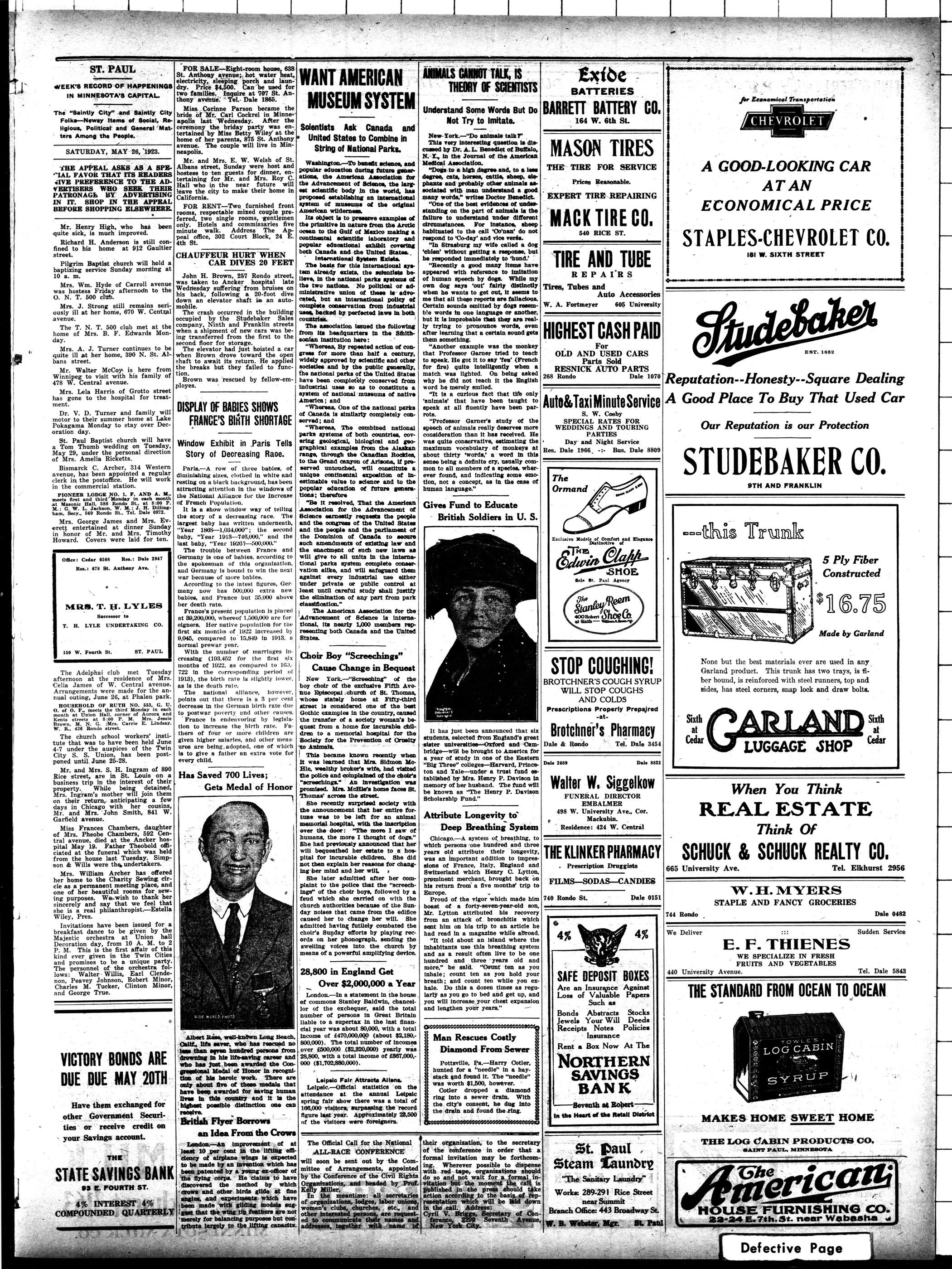
Has Saved 700 Lives;
Gets Medal of Honor
WIDE WORLD PHOTO
Albert Rose, well-known Long Beach, Calif., life saver, who has rescued no less than seven hundred persons from drowning in his life-saving career and who has just been awarded the Congressional Medal of Honor in recognition of his heroic work. There are only about five of these medals that have been awarded for saving human lives in this country and it is the highest possible distinction one can receive.
London—An improvement, of at least 10 per cent in the lifting efficiency of airplane wings is expected to be made by an invention which has been patented by a young ex-officer of the flying corpse. He claims to have discovered the method by which crowns and other bird glides at fine angles, and experiments which have been made with gliding models suggest that the wing tip feathers are not merely for balancing purposes but contribute largely to the lifting capacities.
WANT AMERICAN MUSEUM SYSTEM
Scientists Ask Canada and United States to Combine in String of National Parks.
Washington...To benefit science, and popular education during future generations, the American Association for the Advancement of Science, the largest scientific body in the world, has proposed establishing an international system of museums of the original American wilderness.
Its object is to preserve examples of the primitive in nature from the Arctic ocean to the Gulf of Mexico making a continental scientific laboratory and popular educational exhibit covering both Canada and the United States.
International System Exists.
The basis for this international system already exists, the scientists believe, in the national parks systems of the two nations. No political or administrative union of these is advocated, but an international policy of complete conservation from industrial uses, backed by perfected laws in both countries.
The association issued the following from its headquarters in the Smithsonian institution here:
"Whereas, By repeated action of congress for more than half a century, widely approved by scientific and other societies and by the public generally, the national parks of the United States have been completely conserved from industrial uses so as to constitute a system of national museums of native America; and
"Whereas, One of the national parks of Canada is similarly completely conserved; and
"Whereas, The combined national parks systems of both countries, covering geological, biological and geographical examples from the Alaskan range, through the Canadian Rockies, to the Grand canyon of Arisona, if preserved untouched, will constitute a unique continental exposition of inestimable value to science and to the popular education of future generations; therefore
"Be it resolved, That the American Association for the Advancement of Science earnestly requests the people and the congress of the United States and the people and the parliament of the Dominion of Canada to secure such amendments of existing law and the enactment of such new laws as will give to all units in the international parks system complete conservation alike, and will safeguard them against every industrial use either under private or public control at least until careful study shall justify the elimination of any part from park classification."
The American Association for the Advancement of Science is international, its nearly 1,000 members representing both Canada and the United States.
New York.—"Screeching" of the boy choir of the exclusive Fifth Avenue Episcopal church of St. Thomas, whose stately home at Fifth-third street is considered one of the best Gothic examples in the country, caused the transfer of a society woman's bequest from a home for incurable children to a memorial hospital for the Society for the Prevention of Cruelty to Animals.
This became known recently when it was learned that Mrs. Sidmon McHile, wealthy broker's wife, had visited the police and complained of the choir's "screeching." An investigation was promised. Mrs. McHile's home faces St. Thomas' across the street.
She recently surprised society with the announcement that her entire fortune was to be left for an animal memorial hospital, with the inscription over the door: "The more I saw of humana, the more I thought of dogs." She had previously announced that her will bequested her estate to a hospital for incurable children. She did not then explain her reasons for changing her mind and her will. She later admitted after her complaint to the police that the "screeching" of the choir boys, followed by a feud which she carried on with the church authorities because of the Sunday noises that came from the edifice caused her to change her will. She admitted having futilely combated the choir's Sunday efforts by playing records on her phonograph, sending the swelling voices into the church by means of a powerful amplifying device.
28.800 in England Get
Over $2,000,000 a Year
London.—In a statement in the house of commons Stanley Baldwin, chancellor of the exchequer, said the total number of persons in Great Britain liable to a supertax in the last financial year was about 80,000, with a total income of $470,000,000 (about $2,180,800,000). The total number of incomes over $500,000 ($2,220,000) yearly was 28,800, with a total income of $867,000,-000 ($1,702,880,000).
Leipisc Fair Attracts Aliens.
Leipisc.—Official statistics on the attendance at the annual Leipisc spring fair show there was a total of 166,000 visitors, surpassing the record figure last year. Approximately 28,500 of the visitors were foreigners.
The Official Call for the National ALL-RACE CONFERENCE
will soon be sent out by the Committee of Arrangements, appointed by the Conference of the Civil Rights Organizations, and headed by Prof. Kelly Miller. In the meantime: all secretaries of organizations, lodges, labor unions, women's clubs, churches, etc., and other interested persons, are requested to communicate their names and addresses, together with name of
ANIMALS CANNOT TALK, IS THEORY OF SCIENTISTS
Understand Some Words But Do Not Try to Imitate.
This very interesting question is discussed by Dr. A. L. Benedict of Buffalo, N. X., in the Journal of the American Medical Association.
"Dogs to a high degree and, to a less degree, cata, horses, cattle, sheep, elephants and probably other animals associated with man understand a good many words," writes Doctor Benedict.
"One of the best evidences of understanding on the part of animals is the failure to understand under different circumstances. For instance, sheep habituated to the call 'Onan' do not respond to 'Oo-day' and vice versa."
"In Strasburg my wife called a dog 'chien' without getting a response, but he responded immediately to 'hund.'
"Recently a good many items have appeared with reference to imitation of human speech by dogs. While my own dog says 'out' fairly distinctly when he wants to get out, it seems to me that all these reports are fallacious. Certain sounds emitted by dogs resemble words in one language or another, but it is improbable that they are really trying to pronounce words, even after learning that a certain sound gets them something.
"Another example was the monkey that Professor Garner tried to teach to speak. He got it to say 'feu' (French for fire) quite intelligently when a match was lighted. On being asked why he did not teach it the English word he merely smiled.
"It is a curious fact that tite only 'animals' that have been taught to speak at all fluently have been parrots.
"Professor Garner's study of the speech of animals really deserves more consideration than it has received. He was quite conservative, estimating the maximum vocabulary of monkeys at about thirty 'words', a word in this sense being a definite cry, usually common to all members of a species, wherever found, and indicating some emotion, not a concept, as in the case of human language."
Gives Fund to Educate British Soldiers in U. S.
BARBARA
SANDMAN &
SCHULZ
It has just been announced that six students, selected from England's great sister universities—Oxford and Cambridge—will be brought to America for a year of study in one of the Eastern "Big Three" colleges—Harvard, Princeton and Yale—under a trust fund established by Mrs. Henry P. Davison in memory of her husband. The fund will be known as "The Henry P. Davison Scholarship Fund."
Attribute Longevity to
Deep Breathing System
Chicago.—A system of breathing, to which persons one hundred and three years old attribute their longevity, was an important addition to impressions of France, Italy, England and Switzerland which Henry C. Lytton, prominent merchant, brought back on his return from a five months' trip to Europe.
Proud of the vigor which made him boast of a forty-seven-year-old son, Mr. Lytton attributed his recovery from an attack of bronchitis which sent him on his trip to an article he had read in a magazine while abroad.
"It told about an island where the inhabitants use this breathing system and as a result often live to be one hundred and three years old and more," he said. "Count ten as you inhale; count ten as you hold your breath; and count ten while you exhale. Do this a dozen times as regularly as you go to bed and get up, and you will increase your chest expansion and lengthen your years."
Pottsville, Pa.—Harry Cotler, hunted for a "needle" in a haystack and found it. The "needle" was worth $1,500, however. Cotler dropped a diamond ring into a sewer drain. With the city's consent, he dug into the drain and found the ring.
their organization, to the secretary of the conference in order that a formal invitation may be forthcoming. Wherever possible to dispense with red tape, organizations should do so and not wait for a formal invitation but the moment the call is published in the press should take petitioning the basis of a representation which will be laid down in the call. Address: Cyril V. Briggs, Secretary of Conference, 2299 Seventh Avenue, New York City.
BARRETT BATTERY CO.
164 W. 6th St.
MASON TIRES
THE TIRE FOR SERVICE
Prices Reasonable.
EXPERT TIRE REPAIRING
MACK TIRE CO.
540 RICE ST.
TIRE AND TUBE
REPAIRS
Tires, Tubes and
Auto Accessories
W. A. Fortmeyer 605 University
HIGHEST CASH PAID
For
OLD AND USED CARS
Parts Sold
RESNICK AUTO PARTS
268 Rondo Dale 1070
Auto&Taxi Minute Service
S. W. Cosby
SPECIAL RATES FOR
WEDDINGS AND TOURING
PARTIES
Day and Night Service
Res. Dale 1966 -- Bus. Dale 8809
The Ormand
Exclusive Models of Comfort and Elegance
Distinctive of
THE Edwin Clapp
SHOE
Sole St. Paul Agency
The Stanley Reem
Shoe Co.
400 Robert Shoe Co.
at Sixth — William A. Reem Age
STOP COUGHING!
BROTCHNER'S COUGH SYRUP
WILL STOP COUGHS
AND COLDS
Prescriptions Properly Prepaired
-at-
Brotchner's Pharmacy
Dale & Rondo Tel. Dale 3454
Dale 2689 Dale 8823
Walter W. Siggelkow
FUNERAL DIRECTOR
EMBALMER
498 W. University Ave., Cor.
Mackubin.
Residence: 424 W. Central
THE KLINKER PHARMACY
Prescription Druggists
FILMS—SODAS—CANDIES
740 Rondo St. Dale 0151
4% 4%
SAFE DEPOSIT BOXES
Are an Insurance Against
Loss of Valuable Papers
Such as
Bonds Abstracts Stocks
Jewels Your Will Deeds
Receipts Notes Policies
Insurance
Rent a Box Now At The
NORTHERN
SAVINGS
BANK
Seventh at Robert
In the Heart of the Retail District
St. Paul
Steam Laundry
"The Sanitary Laundry"
Works: 289-291 Rice Street
near Summit
Branch Office: 443 Broadway St.
W. B. Webster, Mgr. St. Paul
A GOOD-LOOKING CAR
AT AN
ECONOMICAL PRICE
STAPLES-CHEVROLET CO.
181 W. SIXTH STREET
Studebaker EST.1852 Reputation--Honesty--Square Dealing A Good Place To Buy That Used Car Our Reputation is our Protection
STUDEBAKER CO.
---this Trunk
5 Ply Fiber
Constructed
$16.75
Made by Garland
None but the best materials ever are used in any
Garland product. This trunk has two trays, is fi-
ber bound, is reinforced with steel runners, top and
sides, has steel corners, snap lock and draw bolts.
Sixth
at
Cedar
GARLAND
LUGGAGE SHOP
Sixth
at
Cedar
W. H. MYERS
STAPLE AND FANCY GROCERIES
E. F. THIENES
WE SPECIALIZE IN FRESH
FRUITS AND VEGETABLES
Avenue.
STANDARD FROM OCEAN TO O
THE STANDARD FROM OCEAN TO OCEAN
TOWLE'S
LOG CABIN
SYRUP
The American
HOUSE FURNISHING CO.
22-24 E.7th. St. near Wabasha
Tel. Elkhurst 2956
Dale 04822
Sudden Service
RES
H
RES
Tel. Dale 5843
TO OCEAN
HOME
FIND QUEER LAWS IN OLD RECORDS
Man Who Committed Suicide In 1738 Was Tried on Murder Charge in New Orleans.
If you sometimes think our laws are drastic, what do you think about what they had to stand for way back in 1738?
New Orleans.—Even though the present-day American is so surrounded by laws that he has to watch his step at every turn, he is not so bad off after all. In 1788, a person in New Orleans could not even commit suicide and go unpunished.
Someone having asserted that the Sixty-seventh congress, recently adjourned, enacted 981 new laws, and with many state legislative bodies clearing their decks for action in order to add a few broadsides to the list of statutes, inquiring persons here have been examining musty old Spanish and French official records in New Orleans to ascertain how the people of other days fared.
Sentence Dead Man.
A man committed suicide here in 1788 and the records show that the courts tried him for taking a life. He was found guilty, and it is set forth that "the inanimate body that held life too great a burden" was sentenced to abandonment without burial. Petty theft involved a penalty of flogging, three years' imprisonment, confiscation and a fine of 50 francs. Persons convicted of having shot or wounded an animal owned by another were sentenced to capital punishment. As in these days and times, a murderer was executed by hanging, but execution for wife murder was by strangulation. There was no Volstead law, but for permitting his slaves to become intoxicated one man was forced to mount a wooden horse and was drawn through the streets, while his neighbors laughed at him.
The wooden horse seems to have played a prominent part in the punishment of petty criminals. Patients at the city hospital learned that meat they had been consuming with a relish was dog and cat flesh. One Robert Villeneuve, a butcher who supplied the institution, was haled before the court on a complaint filed by the patients, who charged that they had been served "roasted dogs."
Tie Cat Around Neck.
The records show that Villeneuve was mounted upon the wooden horse and given the same treatment received by the man who had permitted his slaves to become drunk. In the case of Villeneuve, however, his chest and back bore placards inscribed: "Master Eater of Dogs and Oats." After this punishment had been meted out the record further states that "an old gray cat was hung around the neck" of the culprit. And fiery for the women played it part, then as now, for one document refers to the purchase by a father of "seamly clothes" for his eighteen-year-old daughter. The parallel of the clothing problem then with that of the present day continues in this case, for it seems the purchase consisted of "feathers and thread stockings."
The finery got into the records because the father went into debt for them, and debt then was a crime if one could not pay. So reduced in circumstances was the parent that he reported to his creditor: "I am on broth. I have but one chicken to kill." The outcome of the affair could not be ascertained from the documents.
Moscow.—A scientific expedition, financed by the government, has solved a mystery of fifty years standing by its discovery in Kursk of a magnetic iron ore field. The ore was found at a depth of 600 feet and in such quantity as to arouse the hope that it may develop into one of the world's largest fields.
About fifty years ago it was noted that compasses used in Kursk, instead of pointing directly at the north magnetic pole, swerved as much as 15 degrees toward an indefinite stretch of territory. The presence of magnetic ore was agreed to be the cause, but hundreds of borings failed to locate it.
The soviet expedition was sent at the instance of Premier Lenin and was headed by Professors Lazarov, Gubkin and Archangelsky. They found the ore after six months' work, in the vicinity of the provincial town of Tchiglri. The ore sent here assays from 50 to 75 per cent pure magnetic iron. The researches of the scientists indicate that the ore field is 250 kilometers long and from one to two kilometers wide, varying in depth from 500 to 800 feet.
Tokio.—An image of Budda made entirely from human bones will shortly be dedicated at Jogwani temple, Fukagawa. According to the head priest of the temple, more than 2,600 dead persons' bones had been stored during the past ten years within the temple's channel house, at the request of those poor people who were unable to bury the dead after cremating them.
Semmler's Cash Grocery
FULL LINE OF FRESH VEGETABLES AND FANCY GROCERIES
Dale 6478 316 Rondo
State of Minnesota, County of Ramsey,
District County, Second Judicial District,
Clovis County, Gentry, Plainfield, wc Clovis
Gentry, Defendant.
The State of Minnesota to the Above Named
Town.
You are hereby summoned and required to answer the complaint of the plaintiff in this case, who has been filed with the Clerk of the District Court of Ramsey County, Minnesota, and to serve a copy of the complaint to the office. Suite 329 Metropolitan Bank Building, corner Cedar and Fifth streets, in the City of St. Paul, Ramsey County, in the thirty (80) days after the service of this summons upon you, exclusive of the day of such service, and you will be required to comply within the time afforded, the plaintiff in this action will apply to the Court for the relief demanded in said complaint.
W. T. FRANCIS.
Attorney for Plaintiff,
329 Metropolitan Bank Bldg.
St. Paul, Minnesota.
(5-5-23)
Mississippi, County of Railway,
Probate Court.
In the Matter of the Estate of John
Thompson, Decedent.
The State of Minnesota to All Whom It
On reading and filing the petition of the representative of said estate, praying that the Court fix a time and place for examining indulging and allowing his FINAL ACCOUNT, and for the assignment of the residue of said estate to the persons thereto en-
It Is Ordered, That said petition be heard and that all persons interested in said matter may be heard on this Court, on Tuesday, the 29th day of May, 1923, at 10 o'clock. A. M., or as soon thereafter, at 10 o'clock. A. M., or as soon thereafter, Probate Court Rooms in the Court House in the City of St. Paul, in said County, and that petition should not be granted and that this citation be served by publication thereof in The Appeal according to law, and by mailing the petition to the said county, before said day of hearing, to each of the heirs, devisees and legates of said decedent and addresses appear from the files of this Court.
Witness the Judge of said Court this 3rd day of May A. D. 1923.
HOWARD WHEELER.
Judge of Probate.
(Seal of Probate Court)
Attest: F. W. Gosewish.
Clerk of Probate.
W. T. Francis, Attorney.
(5-5-23)
CITATION EX. OF FINAL ACCOUNT
State of Minnesota, County of Ramsey. In Probate Court.
Probate Court.
In the matter of the Estate of Clifford Aah-
lerman.
ley Smith, Decedent.
Minnesota to All Whom It May Concern.
On reading and filing the petition of the court the Court fix a time and place for examining, adjusting and allowing his FINAL ACCOUNT, and for the assignment of the resided estate to the persons thereto entitled:
It is Ordered, That said petition be heard and adjudged, and that the petition be cited and required to appear before this Court, on Tuesday, the 28th day of May, 1963. The Court will consider after as said matter can be heard, at the Probate Court Rooms in the Court House in the City of St. Paul, in said County, and that this petition should not be granted and that this citation be served by publication thereof in the City of St. Paul, in said County, and that a copy of this citation at least 14 days before said day of hearing, to each of the heirs, devises and legates of said decident whose addresses appear from the files of this Court.
Witness the Judge of said Court this 3rd day of May A. D. 1963.
HOWARD WHEELER.
Judge of Probate.
(Seal of Probate Court)
Attest: F. W. A. D. 1963.
Clerk of Probate.
Hammond Turner, Attorney.
323 Metropolitan District Bldg.
5-2-21
Ramsey, s. in Probate Court.
Barnett, s. in Ligated Lost
Will and Testament of Rhoda Linesy, De-
pendent.
The State of Minnesota to All Whom It May Concern:
Whereas, Albert Wright of the City of St. Paul and State of Minnesota, has delivered to the Probate Court of the County of Ramsey, an instrument in writing purporting to be the last will and testament of Rhoda Linsey, late of Ramsey County, Minneapolis,�.com, and the other title of a petition to said Probate Court, praying that the said instrument may be proved and admitted to probate and that letters testamentary be granted thereon to him.
It is Ordered, That said petition be heard and that all persons interested in said matter be cited and required to appear before the court on Monday, the 15th day of June 1923, on 16 o'clock. M., or as soon thereafter as said matter can be heard, at the Probate Court rooms, in the Court House in the City of St. Paul, in said county, and show cause, if any they have, why said petition should not be granted and said will be submitted to probate and that this citation be served by the publication thereof in the Appeal Court to law, and by mailing a copy of this citation at least 14 days before said day of hearing, to each of the heirs, devisees, legatees of said decedent whose names and addresses are known and appear from the files of this court.
Witness the Judge of said Court, this 24th day of May, A. D. 1928.
Attest:
F. W. Gosewisch,
Clerk of Probate.
W. F. FRANCIS, Attorney
NOTICE OF EXPIRATION OF TIME OF
REDEMPTION.
Office of County Auditor, County of Ramsey, State of Minnesota.
To Margaretha Bauer et al.
To the following pieces or parcels of land situated in the County of Ramsey, State of Minnesota, and known and described as follows, to-wit: (1) Thirty (30) Block Fourteen (14) "Gladstone" are now assessed in your name.
(2) That on the 15th day of May, 1918, in proceedings upon an estate for the year 1918, a tax judgment duly given and made in and by the District Court in said County of Ramsey on the 20th day of April, 1918, in proceedings upon an estate for the year 1918, for said County of Ramsey, the above described pieces or parcels of land were duly
(3) That said pieces or parcels of land and all the rights of the State of Minnesota, upon and against state land, and sold by the County Auditor to an actual purchaser under Section 2128, G. S. 1913, on the 8th day of May, the sum of the taxes on the sum of the taxes on Twenty-five cents. (4) And that the amount required to redeem said pieces or parcels of land from tax sale exclusive of the costs to accrue the taxes on Twenty-five cents of Seventy-one-Dollars and twenty-five cents.
And interest at the rate of 15 per cent
from the date of May, 1925, to the day of
May, 1925, to the day of redemp-
ment.
(5). That the tax certificate of sale issued
by the holder thereof and this notice re-
ceives by the holder thereof and this notice re-
(6) That the time for the redemption of said piece or parcel of land from said tax will cease at maturity (6) days after the service of this notice, and the filing of proof of such service in my office.
Witness my hand and official seal this 8th day of May, 1928.
GEO. J. RIES.
Auditor Ramsey County, Minn.
By Silas E. Foreman, Deputy.
(Official Seal)
SALES
Decker
HARDWARE
SERVICE
(5-12-23)
MIDDLE STREET
How would you like to own this beautiful ten room modern duplex apartment building, with a monthly rental of $130.00? Or would it not be a splendid idea to live in the lower flat as your home, and have the upper apartment serve as income property?
NOTICE OF EXPIRATION OF TIME OF
REDEMPTION.
Office of County Auditor, County of Ramsay, State of Minnesota.
(1) You are hereby notified that the following pieces or parcels of land situated in the County of Ramsay, State of Minnesota; and in the County of Ramsay, State of Minnesota; and Lots Twelve (12, Thirteen (13) and Fourteen (14), Block Eleven (11), Sabin Addition to Gladstone, are now assessed in your name.
(2) That on the 12th day of May, 1919, at a sale of land pursuant to the real estate tax, is made by the District Court in said County of Ramsay on the 21st day of April, 1919, in proceeding to enclose the land in the County of Ramsay, the year 1917, for the County of Ramsay, the above described pieces or parcels of land was duly bid in for the State the sum of One Dollar and Ninety-six cents.
(3) That the said pieces or parcels of land was duly bid in for the State the sum of One Dollar and Ninety-six cents, upon and against said land by virtue of said sale was duly assigned, conveyed and sold by the County Auditor to an actual purchaser of the land on the 8th day of May, 1928, for the sum of Seven Dollars and Sixty-nine Cents. The said said pieces or parcels of land from said tax sale, exclusive of the costs to accrue upon this notice in the sum of Seven Dollars and Sixty-nine Cents.
And interest at the rate of 12 per cent per annum on $7.69 thereof from the 8th day of May, 1928, to the day such redemption
(5) That the tax certificate of sale issued by the holder thereof and this notice reserves the right to
(6) That the time for the redemption of the property is January 15, 1928 (7) A male will expire expire (6) from days after the service of this notice, on the filing of proof of suave service in my office. (8) Bail bonds and official seal this 5th day of May, 1928. (9) GEO. J. BIES. Auditor Ramer County, Minnesota By Silas E. Foreman, Deputy. (Official Seal) (k.1928)
STEIN'S We Deliver
GROCERIES MEATS
Try Our Fresh Meats and Fish
DRESSED POULTRY
Cor. Dale & W. Central Dale 4209
INSIST ON GETTING
CLOVER LEAF
BUTTER
TILDEN PRODUCE CO.
CHURNERS
"For Peace of Mind"
BLEKRE
Tires and Tubes
A TWIN CITY PRODUCT
CONSPICUOUS AMONG THE
BEST
Cords and Fabrics
COST YOU LESS
LAST YOU LONGER
Slip them on your car now and
away go your tire worries
I'M AT YOUR SERVICE—
I'LL DELIVER TO YOUR
DOOR
FRED BAKER
SALESMAN
426 St. Anthony Ave.
Phone
Dale 5386 or Nestor 1815
---
Prospective Home Builders:
this lex
his the prosperous owner of this beautiful apartment building, recently
not only designed and built by the New Way Home Builders Company. The house is located at 8900 Clinton Ave.
uro-
Duplexes, small homes and bungalows, our speciality. We build on
OF
ED. WARREN JAS. A. TR.
Sec. & Treas. Presi.
The Cosmopolitan
28 E. THIRD
TEL. CEDAR 9646
Phone Dale 1955.
C. W. SW.
RIDING ACC.
GREN
areas.
JAS. A. TRIPLETT
President
The Cosmopolitan C
28 E. THIRD ST.
DAR 9646
SA
1955.
C. W. SWANSEN
RIDING ACADEMY
Lady Instructor If Desired
MRS. RAINBOW PAGE
Tel. Dale 4556
MUSIC & ENTERTAINMENT NIGHT
AT
THANN'S
40 E. THIRD ST. ST. PAUL
SAFE OPEN AT ALL HOUSE
We Make A Specialty of
Southern Dishes
Tables Reserved For Parties
Call Cedar 9088
UTH 7954 ESTABLISHED
W. SQUIRE NEAR
FUNERAL DIRECTOR
SUCCESSOR TO
O. A. LAWRENCE
24TH ST. MINNEAPOLIS
TERS' & WAITERS' C
18 S. 3d St., Minneapolis
Phone Main 2592
ent Food at Minimum Prices. Soft Drinks of A
TOBACCO CIGARS CIGARETTES
SHULL, Pres. and Treas.
EDDIE L. H
ed Man's Rock of Gibraltar.
THE AFRICAN BLOOD BROTHERHOOD.
Active, Economic, Educational, Physical, Social
and Death Benefit Department, Co-operative
Units. Calisthenics Club's (Sokols), etc., now
NOW! Help push the A. B. B.'s fight for a U
Economic Conditions, full Race Equality and
Man to unmolested existence.
MUSIC & ENTERTAINMENT
AT
THAN
40 E. THIRD ST.
CAFE OPEN AT
We Make A S
Southern
Tables Reserved
Call Cedar
MUSIC & ENTERTAINMENT NIGHTLY
40 E. THIRD ST. ST. PAUL
CAFE OPEN AT ALL HOURS
We Make A Specialty of
Southern Dishes
Tables Reserved For Parties
Call Cedar 9088
TEL. SOUTH 7954
W. SQUIRRE
FUNERAL DIV
SUCCESSOR
O. A. LAWY
502 EAST 24TH ST.
PORTERS' & WA
18 S. 3d St., 1
Phone Mail
Excellent Food at Minimum Price
TOBACCO CIGARS
GLOVER SHULL, Pres. and Treas.
The Colored Man's Rock of Gibraltar
THE AFRICAN BLOOM
Protective, Economic, Educational
Sick and Death Benefit Depart
Industrial Units. Calisthenics Club
JOIN NOW! Help push the A.
for better Economic Conditions, full
the Colored Man to unmolested exist
W. SQUIRE NEAL
FUNERAL DIRECTOR
SUCCESSOR TO
O. A. LAWRENCE
PORTERS' & WAITERS' CLUB
Excellent Food at Minimum Prices. Soft Drinks of All Kinds.
TOBACCO CIGARS CIGARETTES
GLOVER SHULL, Pres. and Treas. EDDIE L. BOYD, Secy.
Stick and Death Benefit Department, Co-operative Businesses, Industrial Units. Calisthenics Club (Sokols), etc., now organizing. JOIN NOW! Help push the A. B. B.'s fight for a United Front, for better Economic Conditions, full Race Equality and the right of the Colored Man to unmolested existence.
APPLICATION BLANK
Supreme Executive Council,
African Blood Brotherhood,
2299 Seventh Ave., New Y
Enclosed please find one dollar
for my initiation fee and first mon
Send my membership card, copy of
Name . . . Addi
City . . . Sta
"Say It With
HOLM &
Executive Council,
on Blood Brotherhood,
299 Seventh Ave., New York City.
seed please find one dollar and ($1.25) twenty
initiation fee and first month's dues in the
membership card, copy of constitution, etc.
Address
State
"Say It With Flowers"
OLM & OLSO
The Home of Flowers
STAND
FURNITU
208.10.12 E.
LANDAR
FURNITURE CO.
8.10.12 E. Seventh
STANDARD FURNITURE CO. 208.10.12 E. Seventh St.
419 Carroll Ave.
the Easy Payment Plan. We also remodel, paint and redecorate your old homes.
NEW-WAY HOME BUILDERS,
501 Kasota Building, Minneapolis,
Tel. Geneva 4484.
politan Club 381 Rondo
HIRD ST. PU
WANSEN
ACADEMY
Doror If Desired
BOW PAGE
Suite 4556
Saint Paul
TAINMENT NIGHTLY
ST.
ANN'S
ST. PAUL
ATT ALL HOURS
Specialty of
On Dishes
Used For Parties
Dar 9088
ESTABLISHED 1905
RE NEAL
DIRECTOR
ASSOCIATE TO
AWRENCE
MINNEAPOLIS
WAITERS' CLUB
Minneapolis
Main 2592
Services: Soft Drinks of All Kinds.
CIGARETTES
Issues: EDDIE L. BOYD, Secy.
Cultar.
FOOD BROTHERHOOD.
Personal, Physical, Social Benefits.
Department, Co-operative Businesses,
Labs (Sokols), etc., now organizing.
A. B. B.'s fight for a United Front,
Full Race Equality and the right of
instance.
BON BLANK.
New York City.
Dollar and ($1.25) twenty-five cents
month's dues in the Brotherhood.
of constitution, etc.
State
"With Flowers"
B OLSON
DARD
URE CO.
Seventh St.
William's Recreation Parlor
5-PERFECT TABLES-5
Pool Parlor Open Every Evening
Until 12 o'Clock
The Most Popular Lines of Cigars,
Cigarettes and Candies
For Sale.
Barber Shop in Connection, Open
Evenings until 8, Saturdays to
12 o'Clock.
All Kinds of Popular Soft Drinks
Always on Ice.
WALKER WILLIAMS, Prop.
Always Clean and Comfortable.
554 St. Anthony Ave. - St. Paul
A GIFT
We a
Make it Read
or a
WE
We will
Mi
Busy Corner
Rondo and Western
381 Rondo
We have purchased 122,000 pair U. S. Army Munson last shoes, sizes $1½ to 12 which was the entire surplus stock of one of the largest U. S. Government shoe contractors.
This shoe is guaranteed one hundred per cent solid leather, color dark tan, bellows tongue, dirt and waterproof. The actual value of this shoe is $6.00. Owing to this tremendous buy we can offer same to the public at $2.95.
Send correct size. Pay postman on delivery or send money order. If shoes are not as represented we will cheerfully refund your money promptly upon request.
296 Broadway, New York, N. Y.
We have just bought a tremendous stock of Army Munson last shoes to be sold to the public direct. These shoes are 100 per cent solid leather with heavy double soles sewed and nailed. The uppers are of heavy tan chrome leather with bellows tongue, thereby making them waterproof. These shoes are selling very fast and we advise you to order at once to insure your order being filled.
The sizes are 6 to 11 all wirths. Price $2.75. Pay postman on receipt of goods or send money order. Money refunded if shoes are not satisfactory.
THE U. S. STORES CO.
1441 Broadway New York City
381 Fuller Ave. Eik 2364
J.P.Schroeder
MEATS AND PROVISIONS
323 University Dale 2262
SAFE
Phone: Elk
MINNESOT
I. SPERLING Manager
SAINT PAUL
Saint Paul
A GIFT ELECTRICAL
SAFEMILK Phone: Elkhurst 3163 MINNESOTA MILK CO.
LEARN TO PLAY POCKET
JULIARDS AT
Staple and Fancy Groceries
Cigars, Cigarettes, Tobacco and
Candy
Ice Cream and Soft Drinks
1 Rondo Dale 8807
PUBLIC SALES.
NATIONAL BAY STATE
SHOE COMPANY.
U. S. ARMY SHOES.
A woman in a dress stands in a room with a table and chairs.
M.
ELECTRICAL
are sure would be
appreciated
Using Lamp, Vacuum Cleaner
Anything Electrical
WE HAVE IT
will make delivery any date
Minnesota Chandelier Co.
369 Jackson Street
OFFICE TEL.
CEDAR 4044
RES. TEL.
DALE 7816
RES. TEL
DALE 7816
OFFICE TEL.
CEDAR 4044
HOURS: 8 A. M. TO 1 P. M.
AND 2 TO 6 P. M.
SURGEON DENTIST
FIRST CLASS GUARANTEED WORK
IN ALL BRANCHES OF DENTISTRY
SUITE 2 DETROIT BLDS. SAINT
COR. 4TH AND WABABHA MINNE
SAINT PAUL
MINNESOTA
OFFICE TEL. RES. TEL.
CEDAR 5104 DALE 1454
HOURS: 8:30 A. M. TO 1 P. M.
AND 2 TO 6 P. M.
SUNDAYS BY APPOINTMENT
DR. EARL S. WEBER
DENTAL SURGEON
FIRST CLASS GUARANTEED WORK
IN ALL BRANCHES OF DENTISTRY
84 W. SEVENTH ST.
DANVA BLDG.
SUITE 203-204
ST. PAUL
Tel. Elkhurst 4750
HERTZ
Heating and Sheet Metal Works
517 University St. Paul
TEL. VAN BUREN 1321
VANDER BIE'S
ICE CREAM
IS THE BEST
For Sale Everywhere
J. C. VANDER BIE
Partridge and Brunson Sta.
ST. PAUL, MINN.
Tel. Dale $339 We Call For and Deliver
ELMER MORRIS
DRUGGIST
Drugs, Medicines, Soda Water
Soft Drinks, Toilet Articles
Candies, Cigars, Tobacco,
Ice Cream Brick or Bulk.
Gas and Electric Fixtures
Fishing Tackle
Dale & W. Central St. Paul
New Ideas in Fixtures
are constantly appearing and they come here first. We want you to share in the pleasure of seeing their new beauty of their dendriteness. Come when you can and see how the modern home is lighted and made beautiful by the latest ideas in fixtures.
Let Us Wire Your Home.
Seven Corners Electric Co.
208 W. 3d St. Phone Cedar 8885.
Opposite Wilder Public Baths.
G. W. Swanson
MILK
khurst 3163
A MILK CO.