The Appeal
Saturday, June 9, 1923
St. Paul, Minnesota
Page text (machine-generated)
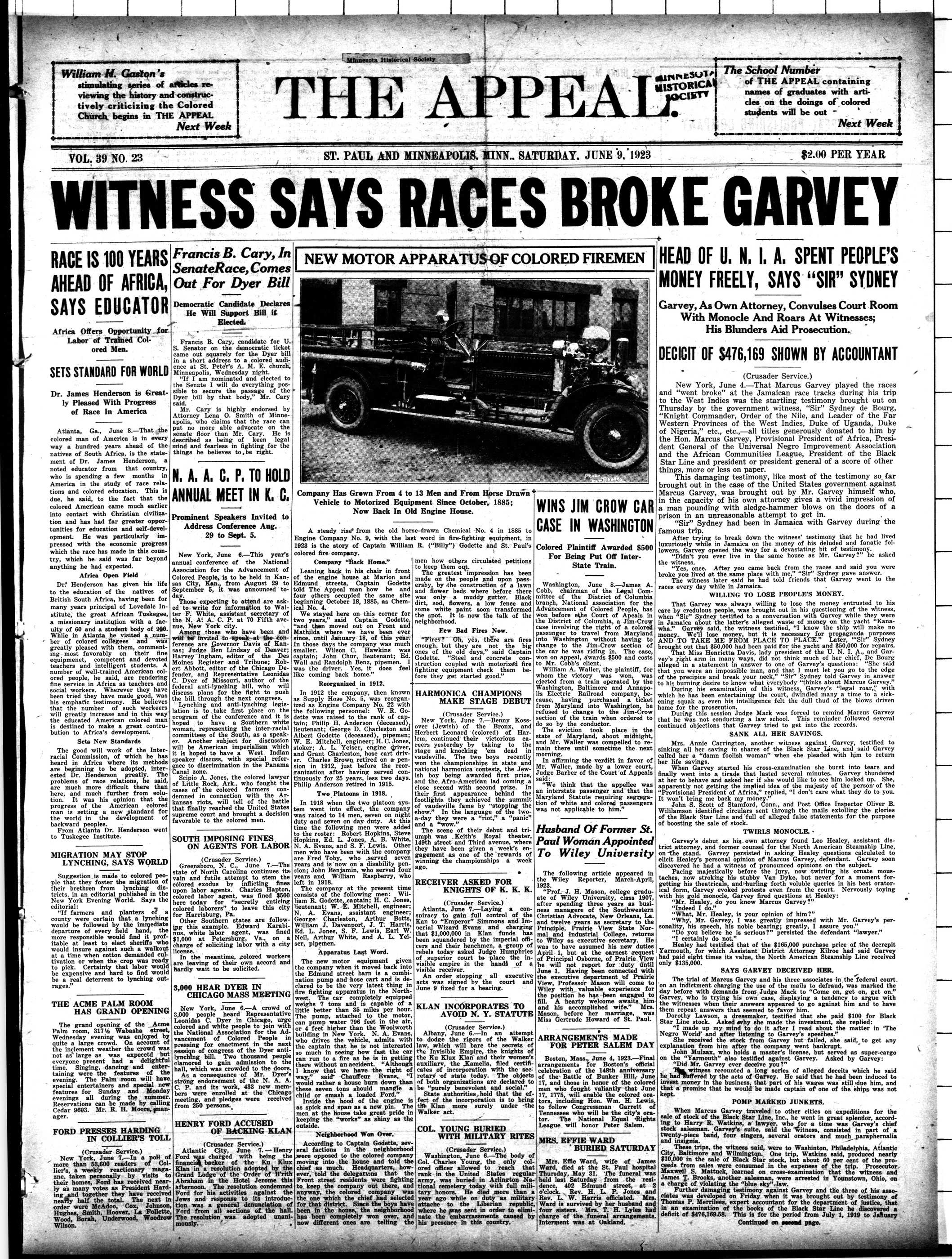
WITNESS SAYS RACES BROKE GARVEY
William H. Gaston's stimulating series of articles reviewing the history and constructively criticizing the Colored Church begins in THE APPEAL Next Week
VOL.39 NO.23 WITN
RACE IS 100 YEARS AHEAD OF AFRICA, SAYS EDUCATOR
Africa Offers Opportunity for Labor of Trained Colored Men.
SETS STANDARD FOR WORLD
Dr. James Henderson is Greatly Pleased With Progress of Race In America
Atlanta, Ga., June 8.—That the colored man of America is in every way a hundred years ahead of the natives of South Africa, is the statement of Dr. James Henderson, a noted educator from that country, who is spending a few months in America in the study of race relations and colored education. This is due, he said, to the fact that the colored American came much earlier into contact with Christian civilization and has had far greater opportunities for education and self-development. He was particularly impressed with the economic progress which the race has made in this country, which he said was far beyond anything he had expected.
Africa Open Field
Dr. Henderson has given his life to the education of the natives of British South Africa, having been for many years principal of Lovedale Institute, the great African Tuskegee a missionary institution with a faculty of 60 and a student body of 990 While in Atlanta he visited a number of colored colleges and was greatly pleased with them, commenting most favorably on their fine equipment, competent and devoted teachers and intelligent students. A number of well-trained American colored people, he said, are rendering fine service in Africa as teachers and social workers. Wherever they have empathy they have empathy, was his emphatic testimony. He believes that the number of such workeers will greatly increase and in this way the educated American colored man is destined to make a great contribution to Africa's development.
Sets New Standards
The good will work of the Interracial Commission, of which he has heard in Africa where its methods are beginning to be adopted, interested Dr. Henderson greatly. The problems of race relations, he said, are much more difficult there than here, and much further from solution. It was his opinion that the progress of the American colored man in facing a new standard for world in the development of backward peoples. From Atlanta Dr. Henderson went to Tuskegee Institute.
MIGRATION MAY STOP
LYNCHING, SAYS WORLD
Suggestion is made to colored people that they foster the migration of their brethren from lynching districts, in an editorial published in the New York Evening World. Says the editorial: "If farmers and planters of a county were certain that a lynching would be followed by the immediate departure of every field hand, the more responsible the county would be least to elect sheriffs who would insure against such a walkout at a time when cotton demanded cultivation or when the crop was ready to pick. Certainty that labor would be expensive and hard to find would be a real deterrent to lynching outrages."
THE ACME PALM ROOM
HAS GRAND OPENING
The grand opening of the Acme Palm room, 3117' Wabasha street, Wednesday evening was enjoyed by quite a large crowd. On account of the inclement weather the crowd was not as large as was expected but everyone present had a delightful time. Singing, dancing and entertaining were the features of the evening. The Palm room will have special entertainers and special new features for Sunday and Monday evenings all during the summer. Reservations can be made by calling Cedar 9603. Mr. R. H. Moore, manager.
FORD PRESSES HARDING
IN COLLIER'S TOLL
(Crusader Service.)
New York, June 7.—In a poll of more than 53,600 readers of Collier's, a weekly reactionary magazine, taken personally by visits to their homes, Ford has received nearly as many votes as President Harding and together they have received nearly half the total. The next in order were McAdoo, Cox, Johnson, Hughes, Smith, Hoover, La Follette, Wood, Borah, Underwood, Woodrow Wilson.
Francis B. Cary, In SenateRace, Comes Out For Dyer Bill
Democratic Candidate Declares He Will Support Bill if Elected.
Francis B. Cary, candidate for U. S. Senator on the democratic ticket came out squarely for the Dyer bill in a short address to a colored audience at St. Peter's M. E. church, Minneapolis, Wednesday night. "If I am nominated and elected to the Senate I will do everything possible to secure the passage of the Dyer bill by that body," Mr. Cary said.
Mr. Cary is highly endorsed by Attorney Lena O. Smith of Minneapolis, who claims that the race can put no more able advocate on the senate floor than Mr. Cary. He is described as being of keen legal mind and fearless in fighting for the things he believes to be right.
N. A. A. C. P. TO HOLD ANNUAL MEET IN K. C.
Prominent Speakers Invited to Address Conference Aug. 29 to Sept. 5.
New York, June 6.—This year's annual conference of the National Association for the Advancement of Colored People, is to be held in Kansas City, Kan., from August 29 to September 5, it was announced today.
Those expecting to attend are asked to write for information to Walter F. White, assistant secretary of the N. A! A. C. P. at 70 Fifth avenue, New York city. Among those who have been and will be invited to speak at the conference are Governor Davis of Kansas; Judge Ben Lindsay of Denver; Harvey Ingham, editor of the Des Moines Register and Tribune; Robert Abbott, editor of the Chicago Defender, and Representative Leonidas C. Dyer of Missouri, author of the federal anti-lynching bill, who will discuss plans for the fight to push the bill through the next congress.
Lynching and anti-lynching legislation is to take first place on the program of the conference and it is hoped to have a Southern white woman, representing the inter-racial committees of the South, as a speaker, and subject to no discussion will be American imperialism which it is hoped to have a West Indian speaker discuss, with special reference to discrimination in the Panama canal zone.
Seipio A. Jones, the colored lawyer of Little Rock, Ark, who fought the cases of the colored farmers condemned in connection with the Arkansas riots, will tell of the battle that finally reached the United States supreme court and brought a decision favorable to the colored men.
SOUTH IMPOSING FINES
ON AGENTS FOR LABOR
(Crusader Service.)
Greensboro, N. C., June 7.—The state of North Carolina continues its vain and futile attempt to stem the colored exodus by inflicting fines upon labor agents. Charles Hapton, colored labor agent, was fined $500 here today for "secretly enticing colored laborers" to leave this city for Harrisburg, Pa.
Other Southern states are following this example. Edward Karabian white labor agent, was fined $1000. Petersburg, Va., on a charge of soliciting labor with a city license.
In the meantime, colored workers are leaving of their own accord and hardly wait to be solicited.
3,000 HEAR DYER IN
CHICAGO MASS MEETING
New York, June 6.—A crowd of 3,000 people heard Representative Leonidas C. Dyer in Chicago, urge colored and white people to join with the National Association for the Advancement of Colored People in pressing for enactment in the next session of congress of the Dyer antilynching bill. Two thousand people clamored to gale additions to the hall, which were added to the doors. As a consequence of Mr. Dyer's strong endorsement of the N. A. A. C. P. and its work, 433 new members were enrolled at the Chicago meeting, and pledges were received from 250 persons.
HENRY FORD ACCUSED
OF BACKING KLAN
(Crusader Service.)
Atlantic City, June 7. — Henry Ford was charged with being the financial backer of the Ku Klux Klan in a resolution adopted by the Grand Lodge of the Order of Brith Abraham in the Hotel Jerome this afternoon. The resolution condemned Ford for his activities against the Jews and response to its introduction was a general denunciation of Ford from all sections of the hall. The resolution was adopted unanimously.
THE APPEAL.
ST. PAUL AND MINNEAPOLIS. MINN.. SATURDAY. JUNE 9, 1923
NEW MOTOR APPARATUS OF COLORED FIREMEN
Photo
BROOKS
Company Has Grown From 4 to 13 Men and From Horse Drawn Vehicle to Motorized Equipment Since October, 1885; Now Back In Old Engine House.
A steady rise from the old horse-drawn Chemical No. 4 in 1885 to Engine Company No. 9, with the last word in fire-fighting equipment, in 1923 is the story of Captain William R. ("Billy") Godette and St. Paul's colored fire company.
Company "Back Home."
Leaning back in his chair in front of the engine house at Marion and Edmund streets, Captain Godette told The Appeal man how he and four others occupied the same site beginning October 18, 1885, as Chemical No. 4.
We stayed here on this corner for two years," said Captain Godette, "and then moved out on Front and Mathilda where we have been ever since, until January 18, of this year. In those days the company was much smaller. Wilson C. Hawkins was captain; John Chur, lieutenant; Ed. Wall and Randolph Benz, pipemen. I was the driver. Yes, it does feel like coming back home."
Reorganized in 1912.
In 1912 the company, then known as Supply Hose No. 5, was reorganized as Engine Company No. 22 with the following personnel: W. R. Godette was raised to the rank of captain; Philip H. Anderson (deceased), lieutenant; George D. Charleston and Albert Godette (deceased), pipemen; W. E. Mitchell, engineer; H.C. Jones, stoker; A. L. Yeiser, engine driver and Grant Charleston, hose cart driver. Charles Brown retired on a pension in 1912, just before the reorganization after having served continuously for 25 years, less two days. Philip Anderson retired in 1915.
Two Platoons in 1918.
In 1918 when the two platoon system went into effect, the company was raised to 14 men, seven on night duty and seven on day duty. At this time the following men were added to the roster: Robert Hopkins, Steve Hopkins, Ed. L. Jones, A. B. White, N. A. Evans, and S. F. Lewis. Other men who have been with the company are Fred Toby, who served seven years and is now on a disability pension; John Benjamin, who served four years and William Raspberry, who left in 1918.
The company at the present time consists of the following men: William R. Godette, captain; H. C. Jones, lieutenant; W. E. Mitchell, engineer; N. A. Evans, assistant engineer; George Charleston, Arthur Botts, William J. Davenport, J. T. Harris, Ed. L. Jones, S. F. Lewis, Earl W. Neil, Arthur White, and A. L. Yeiser, pipemen.
Apparatus Last Word.
The new motor equipment given the company when it moved back into the Edmund street barn is a combination pump and hose cart and is declared to be the very latest thing in fire fighting apparatus in the Northwest. The car completely equipped weighs 7 tons and is capable of a little better than 35 miles per hour. The pump, attached to the motor, can pump water 796 feet in the air, or 4 feet higher than the Woolworth building in New York. N. A. Evans, who drives the vehicle, admits with the captain that he is not interested so much in seeing how fast the car can run to a fire as he is in getting there without an accident. "Although I know that we have the right of way," said Chaufeur Evans, "I would rather a house burn down than these seven tons should mangle a child or smash a loaded Ford." Inside the hood of the engine is as spick and span as a new pin. The men at the house take great pride in keeping the "works" as shiny as the outside.
Neighborhood Won Over.
According to Captain Godette, several factions in the neighborhood were opposed to the colored company moving into the house and told the chief as much. Headquarters, however, told the delegations that the Front street residents were fighting to keep the company out there, and anyway, the colored company was the one which the chief had selected for that district. Since the boys have been in the house, the neighborhood has been completely won over, and now different ones are telling the
men how others circulated petitions to keep them out. The greatest impression has been made on the people and upon passersby, by the construction of a lawn and flower beds where before there were only a muddy gutter. Black dirt, so fresh the blow force and some white paint soon transformed the spot. It is now the talk of the neighborhood.
Few Bad Fires Now.
"Fires?" Oh, yes, there are fires enough, but they are not the big ones of the old days," said Captain Godette. Steel and concrete cones were used to confine the armed fire fighting equipment check them before they got started good."
HARMONICA CHAMPIONS
MAKE STAGE DEBUT
(Crusader Service.)
New York, June 7—Benny Kossover (Jewish) of the Bronx, and Herbert Leonard (colored) of Harlem, continued their victorious careers yesterday by taking to the stage and knocking 'em dead in vaudeville. The two boys recently won the championships in state and national harmonica contests, the Jewish boy being awarded first prize, and the Afro-American lad coming a close second with second prize. In their first appearance behind the footlights they achieved the summit of vaudeville fame by "stopping the show." In the language of the two-a-day they were a "riot," a "panic" and a "wow."
The scene of their debut and triumph was Keith's Royal theater, 149th street and Third avenue, where they have been given a week's engagement as one of the rewards of winning the championships a week
RECEIVER ASKED FOR
KNIGHTS OF K. K. K.
(Crusader Service.)
Atlanta, June 7—Laying a conspiracy to gain full control of the Kan to "Emperor" Simmons and Imperial Wizard Evans and charging that $1,000,000 in Klan funds has been squandered by the imperial officers and their henchmen, a group of rebels today asked Judge Humphries of superior court to place the inquest in the hands of a visible receiver.
An order stopping all executive acts was signed by the court and June 9 fixed for a hearing.
KLAN INCORPORATES TO
AVOID N. Y. STATUTE
Albany, June 6.—In an attempt to dodge the rigors of the Walker law, which will bare the secrets of the Invisible Empire, the knights of the Ku Klux Klan and their women's auxiliary, the Kamelia, filed certificates of incorporation with the secretary of state today. The objects of both organizations are declared to be "purely benevolent and social."
State authorities, hold that the effect of the incorporation is to bring the Klan more surely under the Walker act.
COL. YOUNG BURIED WITH MILITARY RITES
(Washington, June 6.—The body of Col Charles Young, the only colored man to reach that rank in the United States regular army, was buried in Arlington National cemetery today with full military honors. He died more than a year ago while on duty as military attache to the Liberian republic, where he was sent in order to eliminate the embarrassments caused by his presence in this country.
WINS JIM CROW CAR CASE IN WASHINGTON
Colored Plaintiff Awarded $500 For Being Put Off Inter-State Train.
Washington, June 8.—James A. Cobb, chairman of the Legal Committee of the District of Columbia branch, National association for the Advancement of Colored People, has won before the Court of Appeals in the District of Columbia, a Jim-Crow case involving the right of a colored passenger to travel from Maryland into Washington without having to change to the Jim-Crow section of the car he was riding in. The case, won on appeal, awards $500 and costs to Mr. Cobb's client.
William A. Waller, the plaintiff, for whom the victory was won, was ejected from a train operated by the Washington, Baltimore and Annapolis Electric Railroad company, because, having purchased a ticket from Maryland into Washington, he refused to change to the Jim-Crow section of the train when ordered to do so by the conductor.
The victim took place in the state of Maryland, about midnight, and Mr. Waller was compelled to remain there until sometime the next morning.
In affirming the verdict in favor of Mr. Waller, made by a lower court, Judge Barber of the Court of Appeals said:
"We think that the appellee was an interstate passenger and that the Maryland Statute requiring segregation was not applicable to him."
Husband Of Former St. Paul Woman Appointed To Wiley University
The following article appeared in the Wiley Reporter, March-April, 1923.
"Prof. J. H. Mason, college graduate of Wiley University, class 1907, after spending three years as business manager of the Southwestern Christian Advocate, New Orleans, La. and twelve years as secretary to the Principle, Prairie View State Normal and Industrial College, returns to Wiley as executive secretary. He was to have assumed his new duties April 1, but at the earnest request of Principal Osborne, of Prairie View he will not report for duty until the executive department of the executive department of Prairie View, Professor Mason will come to Wiley with valuable experience for the position he has been engaged to fill. A hearty welcome awaits him and his accomplished wife." Mrs. Mason, before her marriage, was Miss Gertrude Howard of St. Paul.
ARRANGEMENTS MADE
FOR PETER SALEM DAY
Boston, Mass., June 4, 1923—Final arrangements for Boston's official celebration of the 148th anniversary of the Battle of Bunker Hill, June 17, and those in honor of the colored men who fought valiantly that June 17, 1775, will enable the colored orators, including Hon. Wm. H. Lewis, to follow Congressman Garrett of Tennessee who will be the city's orator. The National Equal Rights League will honor Peter Salem.
MRS. EFFIE WARD
BURIED SATURDAY
Mrs. Eile Ward, wife of James Ward, died at the St. Paul hospital Thursday, May 31. The funeral was held last Saturday from the residence, 402 Edmund street, at 2 o'clock. Rev. H. L. P. Jones and Rev. L. W. Harris officiated. Mrs. W. L. Harris had four sisters. Mrs. T. H. Lyles had charge of the funeral arrangements. Interment was at Oakland.
$2.00 PER YEAR
RVEY
SPEENT PEOPLE
S“SIR” SYDNEY
Convulses Court Room
Us At Witnesses;
Prosecution.
WIN BY ACCOUNTANT
(ce.)
Garvey played the race
race tracks during his t
testimony brought out
, “Sir” Sydney de Bou-
le, and Leader of the H
Duke of Uganda, Du-
rously donated to him
President of Africa, Pre-
Improvement Associat-
e, President of the Bla-
general of a score of other
test of the testimony so s
States government again
Mr. Garvey himself wi-
ives a vivid impression
blows on the doors of
get in.
a with Garvey during t
testimony that he had lio
of his deluded and fanatic
bit of testimony.
me as Mr. Garvey?” he ask
the races and said you wi
“Sir” Sydney gave answer.
ends that Garvey went to
HEAD OF U. N. I. A. SPENT PEOPLE'S MONEY FREELY, SAYS "SIR" SYDNEY
Garvey, As Own Attorney, Convulses Court Room With Monocle And Roars At Witnesses; His Blunders Aid Prosecution.
DECICIT OF $476,169 SHOWN BY ACCOUNTANT
New York, June 4.—That Marcus Garvey plaid "went broke" at the Jamaican race tracks by the West Indies was the startling testimony by Thursday by the government witness, "Sir" Sydney Night Commander, Order of the Nile, and Lead Eastern Provinces of the West Indies, Duke of Nigeria," etc., etc.,—all titles generously donated to Hon. Marcus Garvey, Provisional President of the General of the Universal Negro Improvement and the African Communities League, President of the Line and president or president general of a songs, more or less on paper.
This damaging testimony, like most of the test bought out in the case of the United States governor Marcus Garvey, was brought out by Mr. Garvey the capacity of his own attorney gives a vivid man pounding with sledge-hammer blows on the person in an unreasonable attempt to get in.
"Sir" Sydney had been in Jamaica with Garvey nous trip.
After trying to break down the witness' testimony the seriously while in Jamaica on the money of his deludeders, Garvey opened the way for a devastating bit of to "Didn't you ever live in the same house as Mr. Garvey witness.
"Yes, once. After you came back from the races and take you lived at the same place with me," "Sir" Sydney got. The witness later said he had told friends that Garvey every day while in Jamaica.
New York, June 4.—That Marcus Garvey played the races and "went broke" at the Jamaican race tracks during his trip to the West Indies was the startling testimony brought out on Thursday by the government witness, "Sir" Sydney de Bourg, "Knight Commander, Order of the Nile, and Leader of the Far Western Provinces of the West Indies, Duke of Uganda, Duke of Nigeria," etc., etc.,—all titles generously donated to him by the Hon. Marcus Garvey, Provisional President of Africa, President General of the Universal Negro Improvement Association and the African Communities League, President of the Black Star Line and president or president general of a score of other things, more or less on paper.
This damaging testimony, like most of the testimony so far brought out in the case of the United States government against Marcus Garvey, was brought out by Mr. Garvey himself who, in the capacity of his own attorney gives a vivid impression of a man pounding with sledge-hammer blows on the doors of a prison in an unreasonable attempt to get in.
"Sir" Sydney had been in Jamaica with Garvey during the famous trip.
After trying to break down the witness' testimony that he had lived luxuriously while in Jamaica on the money of his deluded and fanatic followers, Garvey opened the way for a devastating bit of testimony.
"Didn't you ever live in the same house as Mr. Garvey?" he asked the witness.
"Yes, once. After you came back from the races and said you were broke you lived at the same place with me," "Sir" Sydney gave answer.
The witness later said he had told friends that Garvey went to the races every day while in Jamaica.
WILLING TO LOSE PEOPLE'S MONEY.
That Garvey was always willing to lose the money on by credulous people, was brought out in his questioning on "Sir" Sydney testified to a conversation with Garvey of Jamaica about the latter's alleged waste of money on the ship. Garvey said, the witness testified, "I know the ship. We'll lose money, but it is necessary for propulsion TO TAKE ME FROM PLACE TO PLACE." Later, right out at that $50,000 had been paid for the yacht and $50,000 that Miss Henrietta Davis, lady president of the U. N. J. right arm in many ways, did not think much of her engagement in a statement in answer to one of Garvey's questions, you were an impossible man, and that I must let you the precipice and break your neck," "Sir" Sydney told Garvey is burning desire to know what everybody "thinks about" During his examination of this witness, Garvey's "leather he has been entertaining the court, dwindled many and squak as even his intelligence felt the dull tundra of the prosecution. During this session Judge Mack was forced to remind him he was not conducting a law school. This reminder reminded objections that Garvey tried to get into the record.
he the money entrusted to the this questioning of the witness with Garvey while they wished for the ship with the knowledge that the ship will make a harry for propaganda purpose. "ACE." Later, "Sir" Sydra money ony and $50,000 for the U. N. I. A., and Gad much of her chief, De Bo Garvey's questions: "She said you let me go to the ed. Sydney told Garvey in answer "thinks about Marcus Garvey's "legal roar," we indented many a time to a sild thud of the blows drive acced to remind Marcus Garvey this reminder followed several it into the records.
WINGS.
on against Garvey, testified of the Skar Star Line, and said Garvey he pleaded with him to retuction she burst into tears and small minutes. Garvey thundered like to see him locked up. She majesty of the person of she don't care what they do to you.
Post Office Inspector Oliver the mails extolling the glory use statements for the purpule.
LE.
and Leo Healey, assistant of North American Steamship Line Healey questions calculated Garvey, defendant. Garvey so opinions on the subject. Now twirling his ornate moor but never for a moment fable queries in his best orate at the court. Nervously toys at Healey: Nervously toys at Healey: ?ey?"
him?"
messed with Mr. Garvey's properly, I assure you."
and the defendant "lawyer."
purchase price of the decree ornament Kilroe had said Garvey American Steamship Line receive
That Garvey was always willing to lose the money entrusted to his creditable people, was brought out in his questioning of the witness, when "Sir" Sydney testified to a conversation with Garvey while they were in Jamaica about the latter's alleged waste of money on the yacht "Kanawaha." Garvey said, the witness testified, "I know the ship will make no money. We'll lose money, but it is necessary for propaganda purposes AND TO TAKE ME FROM PLACE TO PLACE." Later, "Sir" Sydney brought out that $50,000 had been paid for the yacht and $50,000 for repairs. That Miss Henrietta Davis, lady president of the U. N. I. A., and Garvey's right arm in many ways, did not think much of her chief, De Bourg alleged in a statement in answer to one of Garvey's questions: "She said that you were an impossible man, and that I must let you go to the edge of the precipice and break your neck," "Sir" Sydney told him to his burning desire to know what happened to Marcus Garvey, "bringing his examens to this witness, Garvey's "legal roar," with which he has been entertaining the court, dwindled many a time to a sickening squak as even his intelligence felt the dull thud of the blows driven home for the prosecution.
During this session Judge Mack was forced to remind Marcus Garvey that he was not conducting a law school. This reminder followed several continued objections that Garvey tried to get into the
SANK ALL HER SAVINGS.
Mrs. Annie Carrington, another witness against Garrett all her saving in shares of the Black Star Line, added her a "damn foolish woman" when she pleaded with her swearing. When Garvey started his cross-examination she burstly went into a tirade that lasted several minutes. Garrett to behave and asked her if she would like to see him, arently not getting the implied idea of the majesty of the provisional President of Africa, replied, "it don't care what won't bring me back my money." John S. Scott of Stamford, Conn., and Post Office Institution identified circulars through the mails exxto the Black Star Line and full of alleged false statements boosting the stock of stock.
Mrs. Annie Carrington, another witness against Garvey, testified to sinking all her saving in shares of the Black Star Line, and said Garvey called her a "damn foolish woman" when she pleaded with him to return her life savings.
When Garvey started his cross-examination she burst into tears and finally went into a tirade that lasted several minutes. Garvey thundered at her to behave and asked her if she would like to see him locked up. She apparently not getting the implied idea of the majesty of the person of the "Provisional President of Africa," replied, "I don't care what they do to you. It won't bring me back my money."
John S. Scott of Stamford, Conn., and Post Office Inspector Oliver B. Williamson identified circulars sent through the mails extolling the glories of the Black Star Line and full of alleged false statements for the purpose of boosting the sale of stock.
TWIRLS MONOCLE.
Garvey's debut as his own attorney found Leo Healey, assistant district attorney, and former counsel for the North American Steamship Line, on the stand. Garvey persisted in asking Healey questions calculated to elicit Healey's personal opinion of Marcus Garvey, defendant. Garvey soon discovered he had a witness of pronounced opinions on the subject.
Pacing majestically before the jury, now twirling his ornate moustaches, now stroking his stubby Van Dyke, but never for a moment forgetting his theatricals, and hurling forth voluble queries in his best oratorical form, Garvey evoked protests even from the court. Nervously toying with his gold monocle, Garvey fired questions at Healey:
Garvey's debut as his own attorney found Leo Healey, assistant district attorney, and former counsel for the North American Steamship Line, on the stand. Garvey persisted in asking Healey questions calculated to elicit Healey's personal opinion of Marcus Garvey, defendant. Garvey soon discovered he had a witness of pronounced opinions on the subject. Pacing majestically before the jury, now twirling his ornate moustaches, now stroking his stubby Van Dyke, but never for a moment forgetting his theatricals, and hurling forth voluble queries in his best oratory form, Garvey evoked protests even from the court. Nervously toying with his gold monocle, Garvey fired questions at Healey:
"Why, Mr. Garvey, I was greatly impressed with Mr.ILITY, his speech, his noble bearing; greatly, I assure you "Do you believe he is serious?" persisted the defender "I certainly do not." Healey had testified that of the $165,000 purchase price mouth, for which Assistant District Attorney Killroe I paid eight times its value, the North American Steamship $135,000.
"Why, Mr. Garvey, I was greatly impressed with Mr. Garvey's personality, his speech, his noble bearing; greatly, I assure you." "Do you believe he is serious?" persisted the defendant "lawyer." "I certainly do not." Healey had testified that of the $165,000 purchase price of the decrepit Yarmouth, for which Assistant District Attorney Kilroe had said Garvey had paid eight times its value, the North American Steamship Line received only $135,000.
SAYS GARVEY DECEIVED HER.
The trial of Marcus Garvey and his three associates in an indictment charging the use of the mails to defraud, before with demands from Judge Mack to "Come on,vey, who is trying his own case, displaying a tendency witnesses when their answers appeared to go against the company answers that seemed to favor him, Dorothy Lawson, a dressmaker, testified that she paid for Line stock. Asked why she made the investment, she "I made up my mind to do it after I read about the gro World" and after listening to Garvey's speeches." She received the stock from Garvey but failed, she elation from him after the company went bankrupt. John Mulzax, who holds a master's license, but serves the "Yarmouth" also testified against Garvey. Asked "Did Mr. Garvey ever deceive you?" The witness recounted a long series of alleged deceit had suffered by the acts of Garvey. He said that he had best money in the business, that part of his wages was so it a promise that he would be made captain of one of the tilt.
associates in the federal courts to defraud, was marked to "Come on, get on, get on a tendency a tendency to argue wi- go against him and to hi- that she paid $100 for Blk investment, she replied: read about the matter in "s speeches." it failed, she said, to get sent bankrupt, sense, but served as super-car- arvey. Asked by Garvey: alleged deceits which he said that he had been induced s wages was still due him, in of one of the ships was
The trial of Marcus Garvey and his three associates in the federal court on an indictment charging the use of the mails to defraud, was marked the day before with demands from Judge Mack to "Come on, get on, get on." Garvey, who is trying his own case, displaying a tendency to argue with the witnesses when their answers appeared to go against him and to have them repeat answers that seemed to favor him.
Dorothy Lawson, a dressmaker, testified that she paid $100 for Black Star line stock. Asked why she made the investment, she replied: "I made up my mind to do it after I read about the matter in 'The Negro World' and after listening to Garvey's speeches." She received the stock from Garvey but failed, she said, to get any explanation from him after the company went bankrupt. John Mulzax, who holds a master's license, but served as super-cargo on the "Yarmouth" also testified against Garvey. Asked by Garvey: "Did Mr. Garvey ever deceive you?" The witness recounted a long series of alleged deceits which he said he had suffered by the acts of Garvey. He said that he had been induced to invest money in the business, that part of his wages was still due him, and that a promise that he would be made captain of one of the ships was not kept.
POMP MARKED JUNKETS.
When Marcus Garvey traveled to other cities on expedition of stock of the Black Star Line, Inc., he went in great distress to Harry R. Watkins, a lawyer, for who a time was salesman. Garvey's suite, said the witness, consistedenty-piece band, four singers, several orators and music insignia.
These trips, the witness said, were to Washington, Philly, Baltimore and Wilmington. One trip, Watkins said, in 1,000 in the sale of Black Star stock, but about 60 per cent from sales were consumed in the expenses of the axwes S. Mattuck, learned on cross-examination that James T. Brooks, another salesman, were arrested in Your charge of violating the "blue sky" law.
Further damaging testimony against Garvey and the tapes was developed on Friday when it was brought out by Thomas P. Merriles, expert accountant for the department an examination of the books of the Black Star Line
cities on expeditions for a went in great splendor, accordor a time was Garvey's cwitness, consisted in part of captors and much paraphern mashinton, Philadelphia, Atlat Watkins said, produced necres about 60 per cent of the expenses of the trip. Prospect nomination that the witness arrested in Younstown, Ohio. Garvey and the three of his aits was brought out by testimony to the department of justice, to back Star Line he discovered from July 1, 1919 to Jahu l page.
When Marcus Garvey traveled to other cities on expeditions for the sale of stock of the Black Star Line, Inc., he went in great splendor, according to Harry R. Watkins, a lawyer, who for a time was Garvey's chief stock salesman. Garvey's suite, said the witness, consisted in part of a twenty-piece band, four singers, several orators and much paraphernalia and insignia.
These trips, the witness said, were to Washinton, Philadelphia, Atlantic City, Baltimore and Wilmington. One trip, Watkins said, produced nearly $10,000 in the sale of Black Star stock, but about 60 per cent of the proceeds from sales were consumed in the expenses of the trip. Prosecutor Maxwell S. Mattuck, learned on cross-examination that the witness and James T. Brooks, another salesman, were arrested in Yountown, Ohio, on a charge of violating the "blue sky" law.
Further damaging testimony against Garvey and the three of his associates was developed on Friday when it was brought out by testimony of Thomas P. Merrilees, expert accountant for the department of justice, that in an examination of the books of the Black Star Line he discovered a deficit of $476,169.58. This is for the period from July 1, 1919 to January
(Crusader Service.)
TWIRLS MONOCLE.
Mr. Healey, do you know Marcus Garvey? "What, Mr. Healey is your opinion of him?"
Entered at the Postoffice in St. Paul, Minnesota, as second-class mail matter, June 6, 1885, under Act of Congress, March 3, 1879.
THE MOTON MESS
In the veterans' hospital tangle, which seems now to be settled because of the influence of Tuskegee's head, Principal R. R. Moton had an opportunity to wipe out all the counts against hm as a leader of colored Americans, and come to the fore as a man and a real leader.
There was his cowardly refusal to fight when his wife was put out of a Pullman car; there was his infamous trip overseas to tell the colored dugboys not to demand the democracy that they had been fighting for; there was his recent cringing speech at Springfield, III; there is his whole "stay-in-your-place" life and philosophy—all these could have been erased at one fell swoop, if he had stood firm for what he must know to be right. The white Southerners whom Moton serves recognize that a black personnel is right and just. Why doesn't he see it? According to the Opelka Daily Times (white) a black personnel is not only right, but it is the logical thing.
If Moton could not endorse a black personnel and still remain a "good Nigger" in the eyes of his white masters, he could have renounced the crowd and come. North. By this act he would have been respected enough by them to be hated, instead of patred and despised; and in the minds of his own people he would have been a redeemed man.
It would have been bad enough, but still better than his present stand, for him to have advocated a complete white personnel. Instead he has committed himself to white superiors and colored minor officers, among them colored nurses. Now, few white men in the South can be trusted with colored women and even a moron would hesitate at endorsing the association of colored nurses with the political pawns that Southern politicians will place in the hospital.
Reports have it that a week or so back Principle Moton's life was threatened by white Alabamans because he advocated black doctors . It is safe to predict that if the mixed personnel outlined above goes through his life will not be safe wherever a self-respecting block man lifts his head.
MARCUS.GARVEY. L. L. B.
Garvey is one thing more—an attorney. If you give anybody or anything, a jackass included, enough rope, he'll hang himself. Spectators in the court room of Judge Mack in the federal court of New York where Marcus Garvey is being tried on a charge of using the mails to defraud are witnessing the choicest demonstration of suicide that has ever been brought to the fore.
Publicity in the country's magazines, robes, parades, titles, braid, buttons and signed sermons have not satiated the Hon. Marcus' craving for notoriety. He must personally demonstrate to the government of the United States, in its own court, that he is a great man.
Imagine if you can the kind of impression created by a pudgy black man striding back and forth across the court room, pulling at his mustache, majestically twirling a gold monocle, dramatically bellowing out ridiculous questions, with every move and syllable showing more plainly his inordinate vanity and vast, unplumbed ignorance.
Such a man was the Moses—the god—of thousands of black people a year ago; even now some of the faithful cling to him. We want the court to be mercifully quick with a sentence and close his braying jaw. The most that can be said for him is that he stole in millions, not in dimes; and dreamed in empires, not in city lots.
GUILTY
The sensational Ku Klux Klan trial in Minneapolis is at an end with the five Klan defendants found guilty of criminal libel. The verdict of the jury will meet with general approval. It is true the Klan critics of the administration of Mayor Leach made startling disclosure of vice conditions, and produced enough evidence to make the mayor step a little. Undoubtedly in this respect the Mill City executive and his police force will find it to their interest to show more concern in the matter of law enforcement. But the methods adopted by the Klan for the furtherance of its prop-
aganda are the kind that good Americans will not stand for. There is no place in this country for any organization insisting upon masked operations and much less for one that parades in the dark under the shroud of Americanism, and in the name of reform.
LETTERS TO THE EDITOR
To the Editor of The Appeal:
The time has come when the colored people of Minnesota will have an opportunity to show their appreciation for faithful services and uniting efforts put forward to assist them in attaining such justices through federal legislation as has been attained by voting for Thomas D. Schall to succeed the late Senator Nelson in the United States Senate. Any colored man voting against this gentleman will not alone be committing a base act of gratitude, but will also be guilty of disloyalty to the best interests of his race.
W. R. Donovan, Chairman Sleeping and Dining Car Employees Union.
Kansas City—Because, she aaves in her petition, her husband did not take a bath in their twelve years of married life, slept until 4 o'clock every afternoon, then arose, bought a nickel's worth of candy and a six-cent novel, and went back to work. She was suing her husband, Carl Van Kanegom, for divorce. She said she gathered sticks in the park to keep the home fires burning.
Women Plan Memorial
to Escaped Convict
Bristol, VT.—A memorial to an escaped convict is to be erected in this town in the heart of the Green mountains. The man, who killed a neighbor farmer in Unadilla, N. Y., was John Broodt, a Dutchman. The Outlook club, a woman's organization of Broodt, is going to place a suitably inscribed stone marker on the site of his log hut at the foot of South mountain because Broodt was the first white man known to have settled within the limits of the present town.
Broodt had a dispute with his neighbor in Unadilla over a line fence between their farms. A fight followed and the neighbor was killed. Broodt was convicted of murder, but escaped, bought ammunition, fishing trakles and assaults to secure his entry into Vermont. In the dense forest near South mountain, a mile south of what is now Bristol village, he ended his flight. There he built a log cabin and remained in solitude with his faithful dog, for twelve years without seeing another white man.
When found by a surveying party in 1785 he was clad in deerskin and his dog, which he said had been black when he entered the woods, was nearly white. Broedt was pardoned later. The stone chimney which he built was standing until a few years ago, and even now the difapidated hearth marks the spot of his hermitage.
THE MAYFIELD HERALD
J. H. Shollenberger, in charge of the milling and baking investigations of the Department of Agriculture and Miss L. M. Alexander, expert bread maker of the department. It is here that the milling and baking value of the different grades of wheat grown in the United States, is determined.
Continued from first page.
5, 1922. The amount the company had in the bank at the latter date was $31.12.
At Friday's session the court was even more crowder than usually. The judge stipulated that Garvey, who is acting as his own attorney, gave indication of being somewhat cramped by the terrible blows of recent testimony. His impressive rear was absent. His whole attitude indicated a lowering of morale. He fell into blunder after blunder and once set the court into an uproar made by objection to a ruling by Judge Mack in support of Prosecutor Mattuck had objected to one of Garvey's questions, but had been overruled by the court. Garvey, however, broke into hot protest. Judge Mack informed him that he had already overruled the objection of the prosecutor, whereupon Garvey bowed, "objection," and the court went into apasm of mirth as the self-constituted lawyer put an exception into the record on behalf of his opponent.
Insisted on Blank Checks.
When Fred Powell, at one time assistant treasurer of the Black Star Line, was being cross-examined by Garvey and had testified that all money that came from sale of stock over to Garvey, the latter asked: "For what purpose was the money turned over to Mr. Garvey?" "I can't read your mind. You took it whenever you wanted it," was the reply. "How do you know Mr. Garvey took that money? A. Because I saw you. Q. Saw me? Hearsay, you mean. A. Hearsay, nothing! Say, look-a-here. I saw you get it. I saw you so as to enablis treasurer, and one of his employees, checks and he signed a whole bunch of them to you. Because I tried to get a better system you put the cold iron hand on me and told I was in a conspiracy against you. There were times, he told Garvey that he signed a whole bunch of them. I thought you were off your mind."
Testimony by Merrillos brought out that the number of shares in the Black Star Line outstanding at the time of his examination was 153.028. However, that apparently is only a part, as testimony by another account of L. J. Liamson showed that forty-three stock record books are missing.
Suspicious Entries
Figures from the statements showed frequent items under stock-selling expenses of more than $10,000 for music." "Travel cost more than $10,000," the counsel said, "item 128,389 for advertisin' item 128,389 for the line's three ships. Almost $9,000 was collected for assays on the "ghost ship" Phyllis Whitley. The magazine exposed on the Crusader Magazine in an article that laid the basis for the present prosecution.
The state rested its case about 2:30 P. M. Friday afternoon, and counsel for the defendants asked that the prosecutor be summoned on Monday, Judge Mack smilingly, agreed and asked all persons interested to pray for a "speedy defense."
The Light
of
Western
Stars
A Romance
By
Zane Grey
Illustrations by Irwin Myers
CHAPTER I — Arriving at the lonely little railroad station of El Cajon, New York, she finds no one to meet her. While in the waiting room a drunkened cowboy encounters her, leaves her terrified. He returns with a priest, who goes through some sort of carmony, and the cowboy forces her to identify her, the cowboy seems dazed. In a shooting scrape outside the room a girl, "Bonita" takes his horse and escapes, then conducts Madeline to Florence Kingley, friend of her brother.
CHAPTER II — Florence welcomes her, and Madeline takes her horse, the girl, "Bonita" takes his horse and escapes, then conducts Madeline to Florence Kingley, friend of her brother.
CHAPTER III — Alfred, son of a wealthy family, had been dismissed from his home because of his dispassion. Madeline, the girl, exonerates him of any wrong intent.
CHAPTER IV — Alfred, son of a wealthy family, had been dismissed from his home because of his dispassion. Madeline, the girl, exonerates him. She meets Stillwalt, Al's employer, typical western ranchman. She marries Stillwalt, Al's employer, typical western ranchman.
CHAPTER IV — Danny Males, one of Stillwalt's cowboys, has disappeared, with some of Stillwalt's money. His friends link his name with the girl Bob.
CHAPTER V — Madeline gets a gimpe of life on a western ranch.
CHAPTER VI- Stewart's horse comes to watch Killin's boot, the asking and making Killin's offer to accept the animal. With her brother's consent she takes the pet nickname, Madeline, independently arranges to buy Stillwell's ranch that of Don Carles, a Mexican neighbor.
CHAPTER VII- Madeline feels she has found her right place, under the light of the western stars.
CHAPTER VIII- Learning Stewart had known her brother's fondness for him, Madeline visits him and persuades him to the ranch as the boss of the cowboys.
CHAPTER IX- Jim Nels, Nick Stelle, and "honky" Price are Madeline's chief los' vauques, who are really guerrillas, Madeline pleads. Stewart to see that peace is kept.
CHAPTER X- Madeline and Florence, into an ambush of vauques. Florence, inowing the Mexicans are after Madeline gets home safely but alone.
made sure of this when, after looking again, she saw that Florence, in spite of the horse's breaking gale and the irregular course, was drawing slowly and surely down the valley.
Madeline had not lost her head to the extent of forgetting her own mount and the nature of the ground in front. When, presently, she turned again to watch Florence, uncertainty ceased in her mind. The strange features of that race between girl and vaqueros were no longer in evidence. Majesty were in his beautiful, wonder-stretch, low down along the ground, stretching back and forth straight for the valley. Between him and the lean horses in pursuit lay an ever-increasing space. He was running away from the vaqueros. Florence was indeed "riding the wind" as Stewart had aptly expressed his idea of flight upon the flieot roan.
A dimness came over Madeline's eyes, and it was not all owing to the sting of the wind. She rubbed it away, seeing Florence as a flying dot in a strange blush. What a daring, intrepid girl! This kind of strength—and aye, splendid thought for a weaker sister—was what the West incubated in a woman.
The next time Madeline looked back Florence was far ahead of her pursuers and going out of sight behind a low knoll. Assured of Florence's safety, Madeline put her mind to her own ride and the possibilities awaiting at the ranch. She remembered the fall of her boys on the telephone. To be sure a windstorm had once broken the wire, But she had little real hope of such being the case in this instance. She rode on, pulling the black as she neared the ranch.
It was perhaps fortunate for her, she thought, that the "climb up the slope cut the black's speed so she could manage him. He was not very hard to stop. The moment she dismounted, however, he jumped and trotted off. At the edge of the slope, facing the corrals, he halfgad to lift his head and shoot up his ears. Then he let out a pleering whistle and dashed down the lane. Madeline, prepared by that warning whistle, tried to fortify herself for a new and unexpected situation; but as she espied an unfamiliar company of horsemen rapidly riding down a hollow leading from the foothills she felt the return of fears gripping at her like cold hands, and she fled precipitously into the house.
CHAPTER XI
A. Band of Guerrillas
Madeline bolted the door, and, flying into the kitchen, she told the scared servants to shut themselves in. Then she ran to her own rooms. It was only a matter of a few moments for her to close and bar the heavy shutters, yet even as she was fastening the last one in the room she used as an office a clattering roar of hoofs seemed to swell up to the front of the house. She caught a glimpse of wild, shaggy horses and dusty, men. She had never seen any vauques that resembled these horsemen. Vaqueros had grace and style; they were fond of lace and glitter and fringe; they dressed their horses in silvered trappings. But the riders now trampling into the driveway were uncouch, lean, and they were garqueries in a row of the raiders who had been harassing the border since the beginning of the revolution. A second glimpse assured Madeline that they were not all Mexicans. The presence of outlaws in that band brought home to Madeline her
MIERCIA
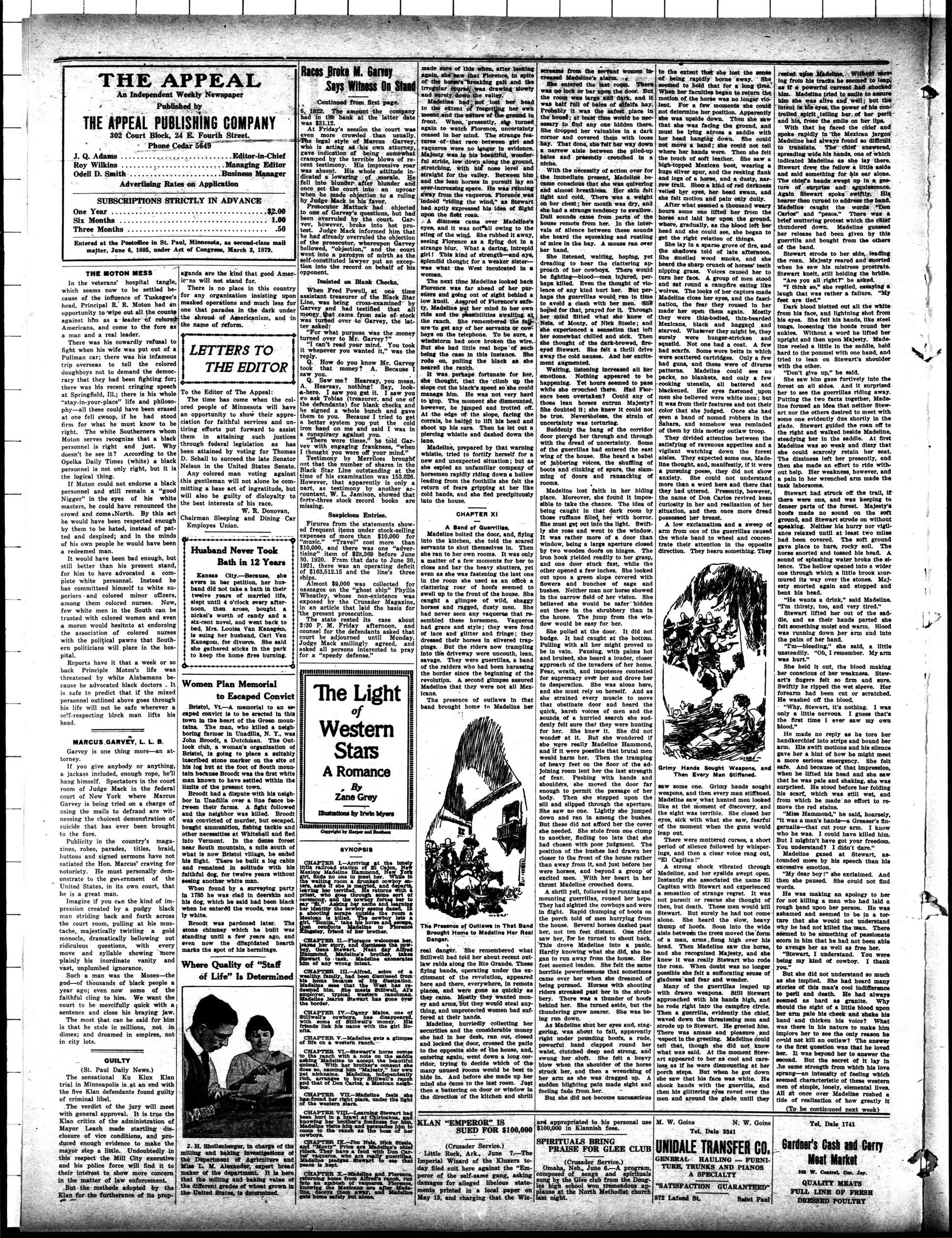
The Presence of Outlaws in That Band Brought Home to Madeline Her Real Danger.
real danger. She remembered what Stillwell had told her about recent outlaw raids along the Rio Grande. The flying fabs, operating under the excitement of the revolution, appeared here and there, everywhere, in remote places, and were gone as quickly as they came. They were the money and land, but they would not be there and unprotected women had suffered at their hands.
Madeline, hurriedly collecting her securities and the considerable money she had in her desk, ran out, closed and locked the door, crossed the patio to the opposite side of the house, and, entering again, went down a long corridor, trying to decide which of the many unused rooms would be best to hide in. And before she made up her mind she came to the last room. Just then a battering on door or window in the direction of the kitchen and shrill
screams from the servant women increased Madeline's alarm. She entered the last room. There was no lock or harp on the door. But the room was large and dark, and it was half full of servants of laff hay. Probably it was the nearest place in the house; at least time would be necessary to find any one hidden there. She dropped her valuables in a dark corner and covered them with loose hay. That done, she felt her way down a narrow alley between the piled-up bales and presently crouched in a niche.
With the necessity of action over for the immediate present, Madeline became conscious that she was quivering and almost breathless. Her skin felt tight and cold. There was a weight on her chest; her mouth was dry, and she had a strange tendency to swallow. Dull sounds came from parts of the house remote from her. In the intervals of silence between these sounds she heard the squeaking and rustling of mice in the hay. A mouse ran over her hand.
She listened, waiting, hoping, yet dreading to hear the clattering approach of her cowboys. There would be fighting—blood—men injured, perhaps killed. Even the thought of violence of any kind hurt her. But perhaps the guerrillas would run in time to avoid a clash with her men. She hoped for that, prayed for it. Through her mind flitted what she knew of Nels, of Monty, of Nick Steeel; and she experienced a sensation that left her somewhat chilled and sick. Then she thought of the dark-browed, firewed Stewart. She felt a thrill drive away the cold nausea. And her excitement augmented.
Waiting, listening increased all her emotions. Nothing appeared to be happening. Yet hours seemed to pass while she crouched there. Had Florence been overtaken? Could any of those lean horses outrun Majesty? She doubted it; she knew it could not be true. Nevertheless, the strain of uncertainty was torturing.
Suddenly the bang of the corridor door pierced her through and through with the dread of uncertainty. Some of the guerrillas had entered the east wing of the house. She heard a babble of the guerrillas, the snapping of boots and clinking of pumps, minging of doors and ransacking of rooms.
Madeline lost faith in her hiding place. Moreover, she found it impossible to take the chance. The idea of being caught in that dark room by those ruffians filled her with horror. She must get out into the light. Swiftly she rose and went to the window. It was rather more of a door than window, being a large aperture closed by two wooden doors on hinges. The iron hook yielded readily to her grasp, and one door stuck fast, while the other opened a few inches. She looked out upon a green slope covered with grass, and bushes. Neither man nor horse showed in the narrow field of her vision. She believed she would be safer 'hidden out there in the shrubbery than in the house. The jump from the window would be easy for her.
She pulled at the door. It did not budge. It had caught at the bottom. Pulling with all her might proved to be in vain. Pausing, with palms hot and bruised, she heard a louder, closer approach of the invaders of her home. Fear, wrath, and impotence contested for supremacy over her and drove her to desperation. She was alone here, and she must rely on herself. And as she strained every muscle to move that obstinate door and heard the quick, harsh voices of men and the sounds of a hurried search she suddenly felt sure that they were hunting for her. She knew it. She did not wonder at it. But she wondered if she were really Madeline Hammond, and if it were possible that brutal men would harm her. Then the tramping of heavy feet on the floor of the adjoining room lent her the last strength of fear. Pushing with hands and shoulders, she moved the door far higher than the windows of the body. Then she stepped upon the sill and slipped through the aperture. She saw no one. Lightly she jumped down and ran in among the bushes. But these did not afford her the cover she needed. She stole from one clump to another, finding too late that she had chosen with poor judgment. The position of the bushes had drawn her closer to the front of the house rather than away from it, and just before her were horses, and beyond a group of excited men. With her heart in her throat Madeline crouched down.
A srill yell, followed by running and mounting guerrillas, roused her hope. They had sighted the cowboys and were in flight. Rapid thumping of boots on the porch told of men hurrying from the house. Several horses dashed past her, not ten feet distant. One rider saw her, for he to turn to back back. This drove Madeline into a panic. Hardly knowing what she did, she began to run away from the house. Her feet seemed leaden. She felt the same horrible powerlessness that sometimes came over her when she dreamed of being pursued. Horses with shouting riders streaked past her in the shrubbery. There was a thunder of hoofs behind her. She turned aside, but the thundering grew nearer. She was being run down.
As Madeline shut her eyes and, staggering, was about to fall, apparently right under pounding hoofs, a rude, powerful hand clapped round her waist, clutched deep and strong, and swung her shoel. She felt a heavy blow when the shoulder of the horse struck her, and then a wrenching of her arm as she was dragged up. A sudden blight pain made sight and feeling fade from her. But she did not become unconscious
to the extent that she lost the sense of being rapidly borne away. She seemed to hold that for a long time. When her faculties began to return the motion of the horse was no longer violent. For a few moments she could not determine her position. Apparently she was upside down. Then she saw that she was facing the ground, and must be lying across a saddle with her head hanging down. She could not move a hand; she could not tell where her hands were. Then she felt the touch of soft leather. She saw a high-topped Mexican boot, wearing a huge silver spur, and the reeking flank and legs of a horse, and a dusty, dark trail. So soon a kind of red darkness velled her eyes, her head swam, and she felt motion and pain only dully.
After what seemed a thousand every hours some one lifted her from the horse and laid her upon the ground, where, gradually, as the blood left her head and she could see, she began to get the right relation of things.
She lay in a sparse grove of firs, and the shadows told of late afternoon. She smelled wood smoke, and she heard the sharp crunch of horses' teeth nipping grass. Volces caused her to turn her face. A group of men stood and sat round a campfire eating like wolves. The looks of her captures made Madeline close her eyes, and the fascination, the fear they roused in her made her open them again. Mostly they were thin-bodied, thin-bearded Mexicans, black and haggard and starved. Whatever they might be, they surely were hunger-striken and squall. Not one had a coat. A few they were scattered carettes in which a few had guns, and they were of diverse patterns. Madeline could pack, no blankets, and only a few cooking utensils, all battered and blackened. Her eyes fastened upon men she believed were white men; but it was from their features and not their color that she judged. Once she had seen a band of nomad robbers in the Sahara, and somehow was reminded of them by this motley outlaw troop.
They divided attention between the satisfying of ravenous appetites and a vigilant watching down the forest ales. They expected some one, Madeline thought, and manifestly, if it were a pursuing pose, they did not show anxiety. She could not understand more than a word here and that they had uttered. Presently, however, the name of Don Carolres lived keen curiosity in her and realization of her situation, and then once more dread possessed her breast.
A low exclamation and a sweep of arm from one of the guerrillas caused the whole band to wheel and concentrate their attention in the opposite direction. They hear something. They
1928
Grimy Hands Sought Weapons, and Then Every Man Stiffened.
saw some one. Grimy hands sought weapons, and then every man stiffened. Madeline saw what hunted men looked like at the moment of discovery, and the sight was terrible. She closed her eyes with what she saw, fearful of the moment when the guns would leap out.
There were muttered curses, a short period of silence followed by whisperings, and a clear voice rang out, "El Capitan."
A strong shock vibrated through Madeline, and her eyelids swept open. Instantly she associated the name El Capitan with Stewart and experienced a sensation of strange regret. It was not pursuit or rescue she thought of then, but death. These men would kill Stewart. But surely he had not come alone. She heard the slow, heavy trump of hoofs. Soon into the wide aisle between the trees moved the form of a man, arms, fung high over his head. Then Madeline saw the horse, and she recognized Majesty, and she knew it was really Stewart who rode the roan. When doubt was no longer possible she felt a suffocating sense of gladness and fear and wonder.
Many of the guerrillas leaped up with drawn weapons. Still Stewart approached with his hands high, and he rode right into the campfire circle. Then a guerrilla, evidently the chief, waved down the threatening men and strode up to Stewart. He greeted him. There was amaze and pleasure, and respect in the greeting. Madeline could tell that, though she did not know what was said. At the moment Stewart appeared to her as cool and careless as if he were dismounting at her porch steps. But when he got down she saw that his face was white. He shook hands with the guerrilla, and then his glittering eyes roved over the men and around the glade until they
rested upon Madeline. Without moving from his tracks he came to leap as if a powerful current had shocked him. Madeline tried to smile to assure him she was alive and well; but the intent in his eyes, the power of his controlled spirit, telling her, of her peril and his, froze the smile on her lips. With that he faced the chief and spoke rapidly in the Mexican jargon Madeline had always found so difficult to translate. The chief answered, spreading wide his hands, one of which indicated Madeline as she lay there. Stewart drew the fellow a little aside and said something for his ear alone. The chief's swept up in a gesture of surprise and aguacence. Again Stewart spoke swiftly. His hearer then turned to address the band. Madeline caught the words "Don and I" and kissed her. A brief menturing protest which the chief thundered down. Madeline guessed her release had been given by this guerrilla and bought from the others of the band.
Stewart strode to her side, leading the roan. Majesty reared and snorted when he saw his mistress prostrate. Stewart knelt, still holding the bridle. "Are you all right?" he asked. "I think so," she replied, essaying a laugh that was rather a failure. "My feet are tied." Dark blood blotted out all the white from his face, and lightning shot from his eyes. She felt his hands, like steel tongs, loosening the bonds round her ankles. Without a word he lifted her upright and then upon Majesty. Madeleine reeled a little in the saddle, held hard to the pommel with one hand, and tried to lean on Stewart's shoulder with the other.
"Don't give up." he said.
She saw him gazefurtely into the forest on all sides. And it surprised her to see the guerrillas riding away. Putting the two facts together, Madeline formed an idea that neither Stewart art nor the others desired to meet with some one evidently short in the glade. Stewart guided the roan off to the right and walked beside Madeline, steading her in the saddle. At first Madeline was so weak and dizzy that she could scare her retain her seat. She left her presently, and then she made an effort to ride without help. Her weakness, however, and a pain in her wrenched arm made the task laborsome.
Stewart had struck off the trail, if there were one, and was keeping to denser parts of the forest. Majesty's hoops made no sound on the soft ground, and Stewart strode on without speaking. Neither his hurry nor vigilance relaxed until at least two miles had been covered. The soft ground gave place to bare, rocky soil. The horse snorted and tossed his head. A sound of splashing water broke the silence. The hollow opened into a wider one through which a little brook aurumed its way over the stones. Majesty snorted again and stopped and bent his head.
"He wants a drink," said Madeline. "Tm thirsty, too, and very tired." Stewart lifted her out of the saddle, and as their hands parted she felt something moist and warm. Blood was running down her arm and into the palm of her hand.
"Tm—bleeding," she said, a little unsteadily. "Oh, I remember. My arm was hurt."
She held it out, the blood making her conscious of her weakness. Stewart's fingers felt so firm and sure. Swiftly he ripped the wet sleeve. Her forearm had been cut or scratched. He washed off the blood.
"Why, Stewart, it's nothing. I was only a little nervous. I guess that's the first time I ever saw my own blood."
He made no reply as he tore her handkerchief into strips and bound her arm. His swift motions and his silence gave her a hint of how he might meet a more serious emergency. She felt safe. And because of that impression, when he held his head and she saw that he was pale and shaking, she was surprised. He stood before her folding his scarc, which was still wet, and from which he made no effort to remove the red stains.
"Miss Hammond," he said, hoarsely, "it was a man's hands—a Greaser's fingernails—that cut your arm. I know who he was. I could have killed him. But I mightn't have got your freedom. You understand? I didn't dare."
Madeline gazed at Stewart, astounded more by his speech than his excessive emotion. "My dear boy!" she exclaimed. And then she paused. She could not find words.
He was making an apology to her for not killing a man who had laid a rough hand upon her person. He was ashamed and seemed to be in a torture that she would not understand why he had not killed the man. There seemed to be something of passionate scorn in him that he had not been able to average her as well as free her. "Stewart, I understand. You were being my kind of cowboy. I thank you."
But she did not understand so much as she implied. She had heard many stories of this man's cool indifference to peril and death. He had always seemed as hard as granite. Why should the sight of a little blood upon her arm pale his cheek and shake his hand and chicken his voice? What was there in his nature to make him implore her to see the only reason he could not kill an outlaw? The answer to the first question was that he loved her. It was beyond her to answer the second. But the secret of it lay in the same strength from which his love sprang—an intensity of feeling which seemed characteristic of these western men of simple, lonely, elemental lives. All at once over Madeline rushed a tide of realization of how great it
THE APPEAL ASKS AS A SPECIAL FAVOR THAT ITS READERS GIVE PREFERENCE TO THE ADVERTISERS WHO SEEK THEIR PATRONAGE BY ADVERTISING IN IT. SHOP IN THE APPEAL BEFORE SHOPPING ELSEWHERE.
Mr. Arthur Winstead has returned to the hospital for treatment.
Troop 55 of the Boy Scouts marched in the Memorial Day parade. Richard H. Anderson, 912 Gaultier street, was able to go back to work this past week.
Mr. and Mrs. John Jackson have moved into the home of Mrs. Lola Anderson, 881 Marion street.
C. H. Gramby, 683 Iglehart avenue has returned from a visit to Cincinnati. Columbus and Washington.
PIONEER LODGE NO. 1. F. AND A. M. meets first and third Monday in each month at Masonic Hall 688 Rondo M.; at 640 P. Jackson Hall 688 Rondo M.; J. H. Dillingham, Sec., 569 Rondo St. Tel. Dale 0872.
Mrs. J. W. Blair of 519 Rondo street, who spent several months visiting in California, has returned to the city.
Elodia Jones, daughter of Rev. H. L. P. Jones arrived home June 1 from Knoxville, Tenn., where she has been attending school.
Mr. William Smith of Great Falls, Mont., spent the week in St. Paul the guest of Emery W. Lindsay, Jr., of 426 Rondo street.
Don't forget to attend the Penny Lawn Social to be given by The Social Art club on Tuesday, June 26, at 511 University avenue.
Mr. and Mrs. J. R. Jones, 483 Charles street, will move into their newly purchased home at 747 St. Anthony avenue next week.
HOUSEHOLD OF RUTH NO. 553, G. U.
O. of O. F. meets the third Monday in each
month at Union Hall, corner of Aurora and
Kentts streets at 5:00 P. M. Mrs. Jessie
Brown, M. N. G., Mrs. Carrie E. Lindsay,
W. R., 426 Rondo street.
Office: Cedar 6506 Res.: Dale 2947
Res.: 678 St. Anthony Ave.
MRS. T. H. LYLES
Successor to
T. H. LYLE UNDERTAKING CO.
150 W. Fourth St. ST. PAUL
Mrs. Lola Anderson left Tuesday for an extended visit in Detroit. Quite a number of her friends accompanied her to the depot to see her off.
Mrs. A. J. Turner who has been at the hospital for the past two weeks has returned to her home on St. Albans street. Her condition is about the same.
Messrs. Hammond Turner and Frederick D. McCracken have moved from 323 Metropolitan Bank building to 306-307 McClure building, 61. E. Sixth street.
Miss Henri Mae Simmons, daughter of Rev. Simmons, former pastor of Camphor M. E. church, is staying with Mrs. J. R. Jones while she attends Hamline university.
A Charity Card Party will be given by the Charity Sewing Circle on Thursday, June 15, at the home of Mrs. Jessica Oden, 672 St. Anthony avenue. Tickets 10 cents.
Mrs. John Follings of 418 Rondo street, had her left hand severely cut when a shell she was examining exploded. The accident resulted in the amputation of the ends of two of her fingers.
Mr. Robert Strong of Winnipeg, Man., was in the city several days the latter part of May visiting his aunt, Mrs. Laura Strong, who is seriously ill at her home, 670 W. Central avenue.
The Adelphai club will have its annual election of officers June 12, 2:30 P. M., at the residence of Mrs. Jeannette Kelly, 950 St. Anthony avenue. The presence of every member is expected.
Mr. Robert Howard, Sr., of Winnipeg, accompanied by his wife passed through the city Wednesday en route to Waterloo, la., to visit his daughter, Mrs. C. R. Jones, Mr. Jones joined them in St. Paul.
St. Paul Baptist church will have an Old Fashioned Barbecue on Thursday, June 14. Beef, pork, mutton, ice cream, cake and soft drinks will be served. The barbecue starts at 4 o'clock. You are invited.
FOR SALE—Eight-room house, 638 St. Anthony avenue; hot water heat, electricity, sleeping porch and laundry, Price $4,500. Can be used for two families. Inquire at 707 St. Anthony avenue. Tel. Dale 1865.
FOR RENT—Two furnished front rooms, respectable mixed couple preferred, two single rooms, gentlemen only. Hotels and commissaries five minute walk. Address The Appeal office, 302 Court Block, 24 E. 4th St.
Mrs. Marguerite Mason, wife of Mr. Franklin Mason, 947 St. Anthony, died at Bethesda hospital Friday, June 1. She is survived by her foster parents and one sister. Funeral services were held Tuesday from residence. Interment at Oakland.
Troop 55 of the Boy Scouts, will take an overnight hike Saturday, June 19. The boys will be accompanied by O. C. Hall, Rev. H. L. P. Jones, Rev. L. W. Harris, J. Wesley Kelly Roy Wilkins and Scoutmaster Odell Smith. They will return Sunday noon.
Invitations have been issued for the fifty-fourth annual commencement of Howard University, Washington, D. C., which is to be held Friday, June 8. Included in the graduates are Clarence L. Smith, formerly of St. Paul and Orville L. Ballard, a summer visitor here.
Examinations for laboratorian and assistant for the veterans' hospital at Tuskegee are being held by the civil service bureau. Salary of the laboratorian is $200 per month and assistant is $70-$90. Information can be secured from the civil service commissioner in the postoffice.
CARD OF THANKS.
We wish to thank our many friends for the words and deeds of kindness and sympathy shown us during the illness and recent death of our beloved wife and sister. We especially wish to thank Miss Jessica Oden who sailed so far, also for the many beautiful floral tributes.
James Ward and Family. Mr. and Mrs. R. Smith. Mr. and Mrs. J. Jackson.
Elks! Take Notice!
The next regular business meeting of Gopher Lodge No. 105 will be held at Union hall on Wednesday evening, June 13. Every Elk is requested to be present as there will be an election of officers. Every member is supposed to be in good standing financially so as he will be eligible to vote. Lodge will be opened at 8:30 sharp.
By order of
Hector Hunter, E. R.
A. J. Todd, Secretary.
A Short Story of Two Rehabilitated Veterans
Ray Teachout was a dry goods packer earned $70 a month before the war. During the conflict he was a private in the Fourth Pioneer Infantry and in such service received an injury that made it necessary for him, after discharge, to go into some line of work that would take him off his feet. The United States Veterans' Bureau gave him a course in vocational training to prepare him to become a freight classification expert with a wholesale house. When his training was completed he was employed by one of the largest houses in St. Paul where he has charge of the important work of classifying and routing outgoing freight, at an initial salary of $100 per month and excellent chances of promotion.
Albert J. Johnson of Brookings, S. D., was a welder by trade when he went into the army as a first class private in Battery C of the 147th Field Artillery. He saw much active service on several battle fronts, was wounded in the head and shell shocked. His war dislocation sited a change of position and the sited State Veterans' Bureau gave him thorough business course, and placed him in a good position with the State Bank at Baroun, Minn.
the State Bureau These two cases will illustrate the results of carefully administered vocational training.
St. Paul Baptist Church
Cor. W. Central and Mackubin
Street
Please Don't Tickle Me Babe By Taking Me To The First
GOPHER
LODGE
I.B.P.O.E.
OF THE WORLD
GOPHER 105
CERVUS ALCES
NO. 105
I.B.P.O.E.W.
A. J. Todd, Chrm; J. A. Mitchell, J. Louis Ervin, Wm. T. Thurston L. C. Jackson, Wm. Yeiser, Felix Raines, Oliver Stanabberry C. G. Johnson, R. D. Wiley, Oville Turner, William F. Jackson B. C. Archer, John Coquire, R. N. Travis.
of Queen of Sheba Chapter No. 24 O. E. S., at UNION HALL Corner Kent St. and Aurora Avenue THURSDAY EVE. JUNE 21
JUST REOPENED, THE ACME PALM ROOM
Special Entertaining and Special Features Sunday and Monday Evenings
TWO NEW RECORDS BY
Ethel Waters
QUEEN OF ALL BLUES SINGERS
AND HER JAZZ MASTERS
BLACK SWAN
RECORDS
DILLY
RECORDS
URING
MICRO VOCES
AND MUSICIANS
RECLUSIVELY
14145
79
I Ain't Gonna Marry and
Settle Down
Brown Baby
14146
79
Memphis Man
Midnight Blues
Babel Waters
Made the
"Drown Home
Baby"
Pollution
Against
and
Danielle
Wilming
Everything
59th SEVENTH AVENUE
BLACK SWAN PHONOGRAPH COMPANY
NEW YORK CITY
The Official Call for the National ALL-RACE CONFERENCE will soon be sent out by the Committee of Arrangements, appointed by the Conference of the Civil Rights Organizations, and headed by Prof. Kelly Miller. In the meantime: all secretaries of organizations, lodges, labor unions, women's clubs, churches, etc., and other interested persons, are requested to communicate their names and addresses, together with name of
their organization, to the secretary of the conference in order that a formal invitation may be forthcoming. Wherever possible to dispense with red tape, organizations should so and so forward the body of the vittim but the moment the call is published in the press should take action according to the basis of representation which will be laid down in the call. Address: Cyril V. Briggs, Secretary of Conference, 2299 Seventh Avenue, New York City.
Only $46.20
Round trip from
St. Paul
to
Yellowstone
Park
See
A. B. Smith, P.T.M.
922 Northern Pacific
Ry. Bldg.
Phone Cedar 2340
St. Paul, Minn.
Exide
BATTERIES
BARRETT BATTERY CO.
164 W. 6th St.
MASON TIRES
THE TIRE FOR SERVICE
Prices Reasonable.
EXPERT TIRE REPAIRING
MACK TIRE CO.
540 RICE ST.
TIRE AND TUBE
REPAIRS
Tires, Tubes and
Auto Accessories
W. A. Fortmeyer 605 University
HIGHEST CASH PAID
For
OLD AND USED CARS
Parts Sold
RESNICK AUTO PARTS
268 Rondo Dale 1070
S. W. Cosby
SPECIAL RATES FOR
WEDDINGS AND TOURING
PARTIES
Day and Night Service
Res. Dale 1966 -- Bus. Dale 8809
The Ormand
Exclusive Models of Comfort and Elegance
Distinctive of
The Edwin Clapp
SHOE
Sole St. Paul Agency
The Stanley Reem
400 Robert Shoe Co.
at Sixth — William Ramsay
We Sell Eastman Films
We Do Printing and Developing
Prescriptions Properly Prepaired
-at
Brotchner's Pharmacy
Dale & Rondo
Tel. Dale 3454
Dale 2659 Dale 8823
Walter W. Siggelkow
FUNERAL DIRECTOR
EMBALMER
498 W. University Ave., Cor.
Mackubin.
Residence: 424 W. Central
THE KLINKER PHARMACY
Prescription Druggists
FILMS—SODAS—CANDIES
740 Rondo St. Dale 0151
St. Paul
Steam Laundry
"The Sanitary Laundry"
Works: 289-291 Rice Street
near Summit
Branch Office: 443 Broadway St.
W. B. Webster, Mgr. St. Paul
A GOOD-LOOKING CAR
AT AN
ECONOMICAL PRICE
STAPLES-CHEVROLET CO.
181 W. SIXTH STREET
Studebaker EST.1852 Reputation--Honesty--Square Dealing A Good Place To Buy That Used Car Our Reputation is our Protection
STUDEBAKER CO.
9TH AND FRANKLIN
---this Trunk
```markdown
```
None but the best materials ever
Garland product. This trunk has
ber bound, is reinforced with steel
sides, has steel corners, snap lock
Sixth
at
Cedar
GARLA
LUGGAGE
WHEN YOU TH
REAL EST
THINK OF
SCHUCK & SCHUCK
University Ave.
but the best materials ever are used in a land product. This trunk has two trays, is bound, is reinforced with steel runners, top and sides, has steel corners, snap lock and draw box.
GARLAND
LUGGAGE SHOP
WHEN YOU THINK
REAL ESTATE
THINK OF
CHUCK & SCHUCK REALTY
City Ave. Tel. El
None but the best materials ever are used in any Garland product. This trunk has two trays, is fiber bound, is reinforced with steel runners, top and sides, has steel corners, snap lock and draw bolts.
Sixth at Cedar
GARLAND
LUGGAGE SHOP
Sixth at Cedar
W. H. MYERS
STAPLE AND FANCY GROCERIES
Rondo
Deliver :::
E. F. THIENES
WE SPECIALIZE IN FRESH
FRUITS AND VEGETABLES
University Avenue.
THE STANDARD FROM OCEAN TO C
E. F. THIENES
WE SPECIALIZE IN FRESH
FRUITS AND VEGETABLES
y Avenue.
STANDARD FROM OCEAN TO O
THE STANDARD FROM OCEAN TO OCEAN
TOWLE'S
LOG CABIN
SYRUP
MAKES HOME SWE
THE LOG CABIN PRO
SAINT PAUL, MINN
The Ameri
AKES HOME SWEET HOME
THE LOG CABIN PRODUCTS
SAINT PAUL, MINNESOTA
The American
HOUSE FURNISHING CO.
22-24 E. 7th. St. near Wabasha
5 Ply Fiber Constructed
$16.75
Made by Garland
are used in any
two trays, is fl-
unners, top and
and draw bolts.
AND
SHOP
Sixth
at
Cedar
INK
STATE
REALTY CO.
Tel. Elkhurst
Da
Sudden
NES
FRESH
TABLES
Tel. Da
OCEAN TO OCEAN
ET HOME
DUCTS CO.
NOTA
DODGE REPORT IN CHRISTIAN SCIENCE LITIGATION FILED
Judge, Sitting as Master, Approves and Confirms Position of J. V. Dittemore.
Boston, Mass. After over four years of litigation in the Christian Science Church, ex-Federal Judge Dodge of Boston, sitting as Master under appointment of the Supreme Judicial Court of Massachusetts, has filed his final report on the evidence. The plaintiff, John V. Dittemore, the senior Director of the Church, whose service antedates the decease of Mrs. Mary Baker Eddy, and who his associates sought to remove from office, seems to have been completely justified in his contentions that undesirable and unwholesome conditions have existed in the administration of the church government.
Judge Dodge finds from the evidence, which includes testimony by the majority Directors themselves, that Mr. Dittmore's dismissal was for the purpose of doing away with opposition to the wishes of the majority and also because Mr. Dittmore had sought to establish a standard of propriety and conduct higher than desired by his associates. It is also found that a principal reason for the hostility to Mr. Dittmore was because of his rebuke to his associates on numerous occasions when offensive language was used and offensive jests made at meetings of the governing body of the church. Judge Dodge holds that Mr. Dittmore is still legally a Director and that the effort to remove him and appoint a successor more sympathetic with the policy of the board is legally null and void.
In regard to the illegality of Mr. Dittimore's dismissal, Judge Dodge says that no Director could fairly be supposed to have accepted his position upon the understanding that he was subject to Instant, arbitrary dismissal whenever a majority of his associates might find it expedient. The Master finds that the vote attempting to dismiss Mr. Dittimore "was only the formal adoption of a conclusion previously agreed on outside the meeting" and that it was for his associates, then accusing him and at the same time proposing to also act as his judges, to afford him "such opportunity to be heard in his own defense upon the charges made as would satisfy the requirements of natural justice." He also finds that the complaints against Mr. Dittimore were not founded upon first hand knowledge and "were inadequate ground for any but a purely arbitrary dismissal." The Judge also finds that there was never any question as to Mr. Dittimore's sincerity in maintaining his position and that nothing said or done by him in maintaining his opinions could have constituted adequate ground for dismissing him, "unless the majority's power to dismiss could lawfully have been used by it for the sole purpose of stifling any opposition in the Board to their wishes.
The Master declares that Directors Dickey, Neal, Merritt and Rathvon were animated by personal hostility toward Mr. Dittmore and that they had long planned among themselves to get rid of him. One of the occasions when had feeling was engendered was when Dittmore refused to join Dickey, Neal, and Merritt in attending a play in New York which Dittmore considered objectionable and which "had as the leading player a role in the opposition." On this occasion Director Dittmore gifted that he urged Dittmore to accompany them and said: "Come on with us. You are not so much better than the rest of us."
Judge Dodge also finds from the evidence that "There were occasions in 1917, 1918 and 1919 upon which, at meetings of the Directors, the plaintiff (Dittemore) expressed disapproval of utterances by Dickey of a kind tolerable only when men only, and men not disposed to be scrupulous in such matters, are the hearers—thereby arose resentment on Dickey's part, and sometimes on the part of Merritt and Rathvon." The testimony regarding eight or nine such instances was taken by Judge Dodge in private. In regard to all of these occurrences Judge Dodge finds from the testimony of Dittemore and others, including the cross-examination of the defendant, Director Dickey, Dickey and Merritt and Rathvon themselves, that Mr. Dittemore's account of them was substantially true and that his "repeated insistence upon a standard of propriety in language or conduct stricter than that accepted by his associates materially augmented their hostility and dislike."
Judge Dodge concludes that Dittimore's co-Directors were "incapable, on March 17, 1919, of impartial judicial consideration of accusations against him, especially of accusations framed by themselves, had they ever undertaken any such consideration." At the present time Christian Sentinel's staff is deeply interested in the facts brought out by the Dodge report which Mr. Dittimore and others are distributing in large quantities among the membership.
The progressive element in the Church seems to be gaining much strength. It urges a more consistent and practical interpretation of the teachings of Mrs. Eddy by those in authority and a more liberal administration of the church government. Next to a change in the official personnel in Boston, under a definite rule of rotation in office, the greatest need of the church seems to be for the encouragement of the church to self-government and democracy according to the spirit as well as the letter of the Church Manual, and a minimizing rather than an encouragement of the greater centralization of authority in the self-perpetuating Board of Directors and their appointees in Boston
Semmler's Cash Grocery
FULL LINE OF FRESH VEGE-
TABLES AND FANCY
GROCERIES
Dale 6478 316 Rondo
Kindness is a language that the dumb can speak and deaf can understand. Telling the truth is a business in which there is but little competition.
SEASONABLE GOOD THINGS
FOR those who enjoy sweet sauces with meats this will be an appealing dish:
Raisin Sauce With Beef Tengue. To two cupfuls of water add one cupful of seedless raisins, one tablespoonful of vinegar, and one tablespoonful of butter; more vinegar may be added if liked. Add two tablespoonfuls of flour mixed with a tablespoonful of brown sugar, a dash of cinnamon and salt. Simmer the raisins in one cupful of the water for fifteen minutes, then add the other ingredients and when well mixed the other cupful of cold water; let come to the bolling point. Serve with sliced boiled tongue.
Rice and Sausage With Cuban Sauce.
Fry as many sausages as are needed,
having ready two cupfuls of boiled
rice. To one of can tomatoes add
a thinly sliced onion, a little chopped
celery, a sprig of parsley, pepper, salt,
four tablespoonfuls of sugar, and a
saltspoonful of curry powder; stew
for twenty minutes, strain, thicken
with a little cornstarch mixed with
cold water. Heap the rice on a hot
dish, lay the sausage around the edge,
and pour the sauce over all. Garnish
the dish with parsley.
Boiled rice served hot with a hot
chocolate sauce is a dessert that is
enjoyed by all chocolate lovers.
Honey Rice Pudding.
Take one-half cupful of honey, two cupfuls of boiled rice one heaten egg, one on one-half cupfuls of milk, a little salt and cinnamon, and one-half cupful of ralsins. Mix well and put into a buttered mold, sprinkle with spices and bake in a moderate oven until thick and brown. Serve hot or cold.
Fig Filling for Cake.
Mix two cupfuls of fresh fig jam with one-half cupful of walnut meats, four tablespoonfuls of creamed butter and four tablespoonfuls of orange juice. Mix and spread on the cake while slightly warm.
Nellie Maxwell
(©, 1923, Western Newspaper Union.
CITATION EX. OF FINAL ACCOUNT.
STATE OF MINNESOTA, COUNTY OF RIVER BEND, NATIONAL COUNTY.
In the Matter of the State of Gustave C. Petermann, Decedent.
The State of Minnesota to All Whom it May Cure.
Others.
On reading and filing the petition of the representative of said estate, praying that the court fix a time and place for examining, adjusting and allowing his Final Account, and for the assignment of the residue of said estate to the persons thereto.
It Is Ordered, That said petition be heard and that all persons interested in said matter be cited and required to appear before the Probate Court in the Court House June, 12th, at 10 o'clock, A. or M., as soon thereafter as said matter can be heard, at the Probate Court rooms in the Court House show cause, if any they have, why said petition should not be granted and that this petition be served by publication thereof in the Probate Court in the Court House a copy of this citation at least 14 days before said day of hearing, to each of the heirs, devises and legates of said decedent and addresses appear from the files of this court.
Witness the Judge of said Court this 29th
Witness the Judge of said Court this 29th day of May, A. D. 1923.
Clerk of Probate.
CHRISTOFFERSON, WALSH, CHRIS
TOFFERSON & JACKSON, Attnqneys.
(6,2,28)
CITATION FOR HEARING WILL.
STATE COUNTY UNIVERSITY OF
Ramsey--ss. In Probate Court
the Matter of Providing the Alleged Last
Wife and Testament of Rhoda Linde, Decedent.
The State of Minnesota to All Whom It May Concern:
Whereas, Albert Wright of the City of St. Paul and State of Minnesota, has devised a system of writing for the city of Ramsey, an instrument in writing porting to be the last will and testament of the deceased, the instrument is named necosta, decendent, and filed therewith a petition to said Probate Court, praying that the said instrument may be proved and addressed to the executors testamentary be granted thereon to him.
It Is Ordered, That said petition be heard and that all persons interested in said matriculation shall be admitted this court on Tuesday, the 19th day of June, 1923, at 10 o'clock A. M., or as soon thereafter, at 10 o'clock A. M., or as soon thereafter, Probate Court rooms, in the Court House in the City of St. Paul, in said county, and show cause, if any they have, why said petition be admitted to probate and that this citation be served by the publication thereof in the city of St. Paul, in said county, copy of this citation at least 14 days before said day of hearing, to each of the heirs, devises, legateses of said decedent whose property is known to be known and appear from the files of this court.
Witness the Judge of said Court, this 24th
Witness the Judge of said Court, this 24th day of May, (Seal of May, Court Court.)
HOWARD WHEELER.
Judge of Probate.
Attest:
F. W. Gosewisch,
Glock, of Probate.
W. F. FRANCIS, Attorney.
SUMMONS
STATE OF MINNESOTA, COUNTY OF RAMSEY—In District Court, Second Judiciary Virginia Knopp, Plaintiff, vs. Jacob Knopp, Defendant.
The State of Minnesota to the Above Named Democrat.
You are hereby summoned and required to answer the complaint of the plaintiff in the case of said County of Ramsey, which been fled and is now on file with the clerk of said court at his office in the Court Court of said County of Ramsey, in Ohio. You are hereby summoned and required to answer to said complaint on the subscriber hereto, plaintiffs attorney, at his office, 514 S. 10th St., Minneapolis, Minnesota, within thirty (30) days after the service of this summons upon you exclusive of the day of such service; within the time aforesaid the plaintiff in this action will apply to the court for the re-derived demand of complaint.
Date March 2, 1922.
MAKE NO MISTAKE, JUST SMOKE Sight Draft THE OLD RELIABLE 8 CENT CIGAR
GREAT NORTHERN VALUATION SHOWS NO "WATER"
In response to assertions that railroad stocks were watered and that the investments recorded in the companies' books were inflated, Congress, in 1913, by the La Follette Act, directed the Interstate Commerce Commission to determine, among other things, the cost of reproduction new, cost of reproduction less depreciation, and the value of the various railroads in the United States. The corporate assets of the Great Northern Company consist of two classes of property: 'One is the physical property used for transportation purposes and located in the United States; the other consists of investments in stocks and bonds of other companies, including lines located in Canada, and other miscellaneous property used for non-carrier purposes. The Interstate Commerce Commission recently has completed its tentative valuation of the first of these, that is, the physical property used for transportation purposes and located in the United States. It has not valued the second class of property because not required to do so by the terms of the Act.
The value as found by the Commission for Great Northern properties used for transportation purposes and located in the United States as of June 30, 1915, was as follows:
Total owned..... $391,740,302.00
Total used..... $395,353,655.00
In arriving at these figures, the Interstate Commerce Commission deducted $65,140,474.00 from the cost of reproduction new on account of assumed depreciation. The Company, of course, contends that the depreciation of certain parts of the property, such as the aging of its roadbed, is more than offset by the appreciation of the property as a whole, as it is well known that a railroad property in use for several years is better and worth more for transportation purposes than a newly built property.
Included in the second class of property and not valued by the Commission is:
604 miles of railroad in Canada.
The investment in securities not valued by the Commission amounts to
• $227,076,312.88. Other property not used for transportation purposes amounts
to $24,315,312.31, so that the Commission's value on the first class of property,
the Commission's value of property, which the Commission did not value,
amounts to $643,135,033.14.
Since the valuation date, June 20, 1915, there has been added $82,259,790.52, which brings the total value of Great Northern property to January 1, 1923, up to $725,391,823.66. The total par value of stocks and bonds of the Great Northern as of January 1, 1923, was $540,978,219.04, showing an excess of $184,413,-504.62 of value above the total capitalization. The following table makes these statements clear:
The Great Northern never did have and never will have a dollar of watered stock.
Talk No.4
L. EISENMENGER MEAT CO.
Established 1870
THE MARKET OF BIG VALUES
PURE,
WHOLESOME
SAUSAGE 34 VARIETIES
455-457 Wabasha
STEIN'S
We Deliver
GROCERIES MEATS
Try Our Fresh Meats and Fish
DRESSED POULTRY
Cor. Dale & W. Central Dale 4209
INSIST ON GETTING
CLOVER LEAF
BUTTER
TILDEN PRODUCE CO.
CHURNERS
"For Peace of Mind"
BLEKRE
Tires and Tubes
A TWIN CITY PRODUCT
CONSPICUOUS AMONG THE
BEST
Cords and Fabrics
COST YOU LESS
LAST YOU LONGER
Slip them on your car now and
away go your tire worries
FM AT YOUR SERVICE
PLL DELIVER TO YOUR
JAS. A. TRIPLETT President
28 E. THIRD ST.
TEL. CEDAR 9646
TEL. SOUTH 7954
W. SQUIRRE
FUNERAL DIE
SUCCESSOR
O. A. LAWR
502 EAST 24TH ST.
PORTERS' & WAT
18 S. 3d St., MI
Phone Main
Excellent Food at Minimum Prices.
TOBACCO CIGARS
GLOVER SHULL, Pres. and Treas.
EDAR 9646 SAINT
SOUTH 7954 ESTABLISH
W. SQUIRE NEAL
FUNERAL DIRECTOR
SUCCESSOR TO
O. A. LAWRENCE
T 24TH ST. MINNES
ETERS' & WAITERS' C
18 S. 3d St., Minneapolis
Phone Main 2592
Present Food at Minimum Prices. Soft Drinks of All.
TOBACCO CIGARS CIGARETTES
SHULL, Pres. and Treas. EDDIE L. BO
W. SQUIRE NEAL
FUNERAL DIRECTOR
SUCCESSOR TO
O. A. LAWRENCE
PORTERS' & WAITERS' CLUB
Excellent Food at Minimum Prices. Soft Drinks of All Kinds.
TOBACCO CIGARS CIGARETTES
GLOVER SHULL Pres. and Treas. EDDIE L. BOYD, Secy.
The Colored Man's Rock of Gibraltar.
THE AFRICAN BLOOD
Protective, Economic, Educational,
Sick and Death Benefit Department
Industrial Units. Calisthenics Clubs &
JOIN NOW! Help push the A.B.
for better Economic Conditions, full R
the Colored Man to unmolested existence
APPLICATION I
Supreme Executive Council,
African Blood Brotherhood,
2299 Seventh Ave, New York
Enclosed please find one dollar to
for my initiation fee and first month
Send my membership card, copy of co
Name ..... Address
City ..... State
THE AFRICAN BLOOD BROTHERHOOD.
Effective, Economic, Educational, Physical, Social Benefit and Death Benefit Department, Co-operative Bldg Units. Calisthenics Clubs (Sokols), etc, now on NOW! Help push the A. B. B's fight for a Union Economic Conditions, full Race Equality and the Man to unmolested existence.
APPLICATION BLANK.
Executive Council,
Man Blood Brotherhood,
2999 Seventh Ave, New York City,
used please find one dollar and ($1.25) twenty-ninety-initiation fee and first month's dues in the Brother membership card, copy of constitution, etc.
Address
State
Protective, Economic, Educational, Physical, Social Benefits. Sick and Death Benefit Department, Co-operative Businesses, Industrial Units. Calisthenics Clubs (Sokols), etc., now organizing. JOIN NOW! Help push the A. B. B.'s fight for a United Front, for better Economic Conditions, full Race Equality and the right of the Colored Man to unmolested existence.
2299 Seventh Ave., New York City.
Enclosed please find one dollar and ($1.25) twenty-five cents for my initiation fee and first month's dues in the Brotherhood.
Send my membership card, copy of constitution, etc.
"Say It With Flowers"
HOLM & OLSO
The Home of Flowers
The Dale 1955
OLM & OLSON
The Home of Flowers
1955
C. W. SWANSEN
RIDING ACADEMY
Lady Instructor If Desired
MRS. RAINBOW PAGE
Tel. Dale 4556
Cartoll Ave.
ve.
n Club
SAINT PAUL
ESTABLISHED 1905
NEAL
FOR
MINNEAPOLIS
ERS' CLUB
banks of All Kinds.
BRETTTES
DIE L. BOYD, Secy.
ERHOOD.
Social Benefits.
operative Businesses,
etc., now organizing.
for a United Front,
city and the right of
(5) twenty-five cents
in the Brotherhood.
, etc.
SON
vers
Saint Pa
L. SPERLING Manager
A GIFT ELECTRICAL
MINNESOTA MILK CO.
LEARN TO-PLAY POCKET
I ULLIARDS AT
William's Recreation Parlor
5—PERFECT TABLES—5
Pool Parlor Open Every Evening
Until 12 o'Clock
The Most Popular Lines of Cigars,
Cigarettes and Candies
For Sale.
Barber Shop in Connection, Open
Evenings until 8, Saturdays to
12 o'Clock.
All Kinds of Popular Soft Drinks
Always on Ice.
WALKER WILLIAMS, Prop.
Always Clean and Comfortable.
554 St. Anthony Ave. - St. Paul
A GIFT
We a
Make it Ready
or a
WI
We will
Mi
Busy Corner
Rondo and Western
Staple and Fancy Groceries
Cigars, Cigarettes, Tobacco and
Candy
Ice Cream and Soft Drinks
381 Rondo Dale 8807
Dale 8807
PUBLIC SALES.
We have purchased 122,000 pair U. S. Army Munson last shoes, sizes 51/2 to 12 which was the entire surplus stock of one of the largest U. S. Government shoe contractors.
This shoe is guaranteed one hundred per cent solid leather, color dark tan, bellows tongue, dirt and waterproof. The actual value of this shoe is $6.00. Owing to this tremendous buy we can offer same to the public at $2.95.
Send correct size. Pay postman on delivery or send money order. If shoes are not as represented we will cheerfully refund your money promptly upon request.
NATIONAL BAY STATE
SHOE COMPANY.
296 Broadway, New York, N. Y.
U. S. ARMY SHOES.
We have just bought a tremendous stock of Army Munson last shoes to be sold to the public direct. These shoes are 100 per cent solid leather with heavy double soles sewed and nailed. The uppers are of heavy tan chrome leather with bellows tongue, thereby making them waterproof. These shoes are selling very fast and we advise you to order at once to insure your order being filled.
The sizes are 6 to 11 all wirths. Price $2.75. Pay postman on receipt of goods or send money order. Money refunded if shoes are not satisfactory.
381 Fuller Ave.
381 Fuller Ave. Elk 2364
J.P.Schroeder
MEATS AND PROVISIONS
323 University Dale 2262
A WOMAN IN A DRESS
SAFE
Phone: Elk
MINNESOTA
THE BROADWAY
IT ELECTRICAL
We sure would be
appreciated
Welling Lamp, Vacuum Cleaner
anything Electrical
WE HAVE IT
will make delivery any date
Minnesota Chandelier Co.
369 Jackson Street
OFFICE TEL.
CEDAR 4044
RES. TEL
DALE 7816
HOURS: 9 A. M. TO 1 P. M.
AND 2 TO 6 P. M.
DR. JOHN R. FRENCH
SURGEON DENTIST
FIRST CLASS GUARANTEED WORK
IN ALL BRANCHES OF DENTISTRY
SUITE 2 DETROIT BLDG.
COR. 4TH & WABASHA
SAINT PAUL
MINNESOTA
OFFICE TEL.
CEDAR 5104
RES. TEL.
DALE 1454
HOURS: 8:30 A. M. TO 1 P. M.
AND 2 TO 6 P. M.
SUNDAYS BY APPOINTMENT
DR. EARL S. WEBER
DENTAL SURGEON
FIRST CLASS GUARANTEED WORK
IN ALL BRANCHES OF DENTISTRY
84 W. SEVENTH ST.
DAKOTA BLDG.
SUITE 203-204
ST. PAUL
Tel. Elkhurst 4750
HERTZ
Heating and Sheet Metal Works
517 University St. Paul
TEL. VAN BUREN 1321
VANDER BIE'S
ICE CREAM
IS THE BEST
For Sale Everywhere
J. C. VANDER BIE
Partridge and Brunson Sta.
ST. PAUL, MINN.
Tel. Dale $339 We Call For-and Deliver
ELMER MORRIS
DRUGGIST
Drugs, Medicines, Soda Water
Soft Drinks, Toilet Articles
Candles, Cigars, Tobacco,
Ice Cream Brick or Bulk.
Gas and Electric Fixtures
Fishing Tackle
Dale & W. Central St. Paul
New Ideas in Fixtures
are constantly appearing and they come here first. We want you to share in the pleasure of seeing their new beauty, their increased effectiveness. When you can and see how the modern home is lighted and made beautiful by the latest ideas in fixtures.
Let Us Wire Your Home.
Seven Corners Electric Co.
208 W. 3d St. Phone Cedar 8395.
Opposite Wilder Public Baths.
G. W. Swanson
MILK
thurst 3163