Twin City Star
Friday, July 30, 1915
Minneapolis, Minnesota
Page text (machine-generated)
MINNEAPOLIS
DULUTH THE TWIN CITY STAR ST.PAUL
Defective Page
VOL. 5 Single Copies 5 Cents
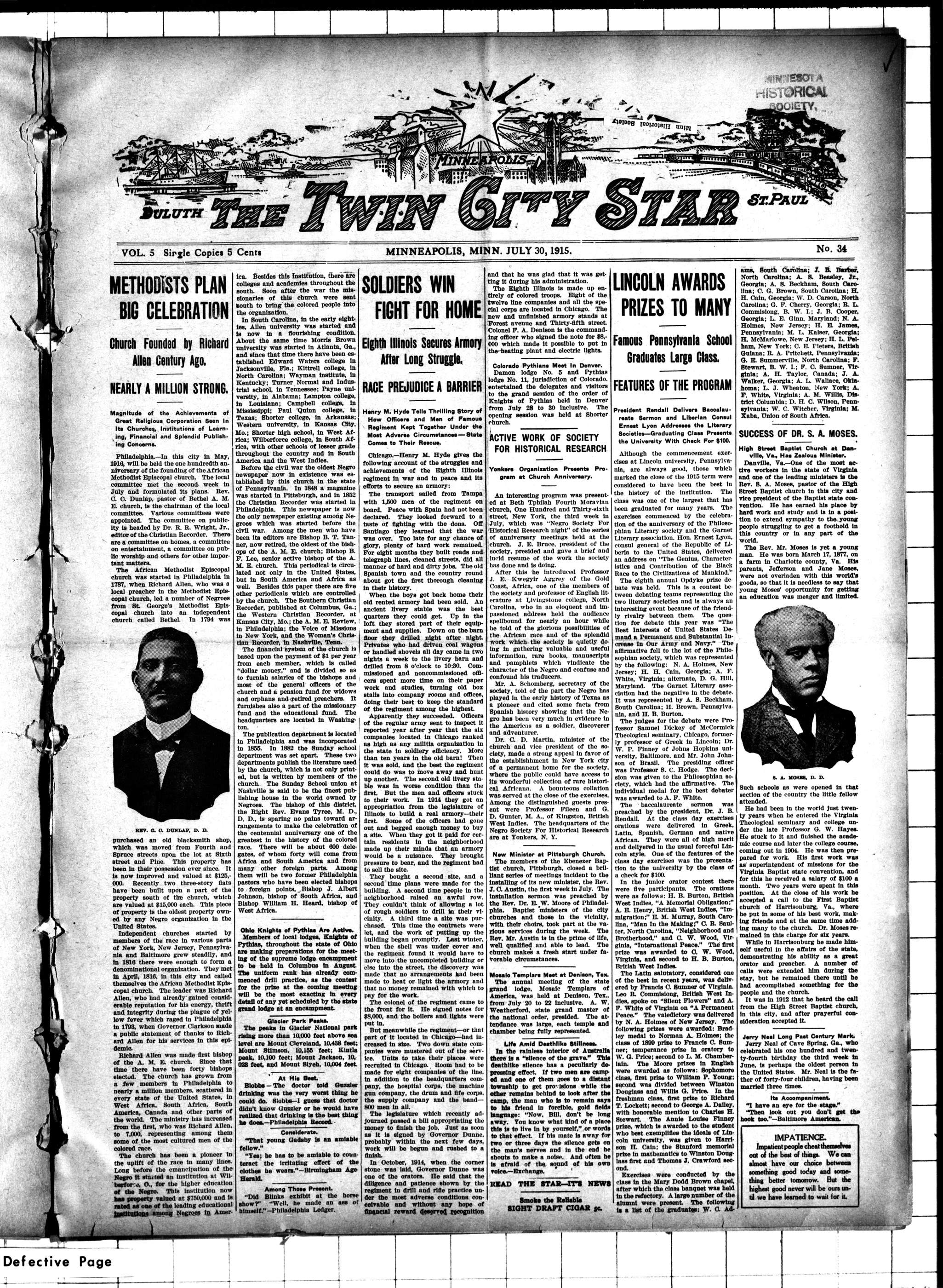
METHODISTS PLAN BIG CELEBRATION
NEARLY A MILLION STRONG.
Magnitude of the Achievements of Great Religious Corporation Seen In Its Churches, Institutions of Learning, Financial and Splendid Publishing Concerns.
Philadelphia.—In this city in May, 1916, will be held the one hundredth anniversary of the founding of the African Methodist Episcopal church. The local committee met the second week in July and formulated its plans. Rev. C. C. Dunlap, pastor of Bethel A. M. E. church, is the chairman of the local committee. Various committees were appointed. The committee on publicity is headed by Dr. R. R. Wright, Jr., editor of the Christian Recorder. There are a committee on homes, a committee on entertainment, a committee on public worship and others for other important matters.
The African Methodist Episcopal church was started in Philadelphia in 1787, when Richard Allen, who was a local preacher in the Methodist Episcopal church, led a number of Negroes from St. George's Methodist Episcopal church into an independent church called Bethel. In 1794 was
REV. C. C. DUNLAP, D. D.
purchased an old blacksmith shop, which was moved from Fourth and Spruce streets upon the lot at Sixth street and Pine. This property has been in their possession ever since. It is now improved and valued at $125,000. Recently two three-story flats have been built upon a part of the property south of the church, which are valued at $15,000 each. This piece of property is the oldest property owned by any Negro organization in the United States.
Independent church started by members of the race in various parts of New York, New Jersey, Pennsylvania and Baltimore grew steadily, and in 1816 there were enough to form a denominational organization. They met in April, 1816, in this city and called themselves the African Methodist Episcopal church. The leader was Richard Allen, who had already gained considerable reputation for his energy, thrift and integrity during the plague of yellow fever which raged in Philadelphia in 1793, when Governor Clarkson made a public statement of thanks to Richard Allen for his services in this epidemic.
Richard Allen was made first bishop of the A. M. E. church. Since that time there have been forty bishops elected. The church has grown from a few members in Philadelphia to nearly a million members, scattered in every state of the United States, in West Africa, South Africa, South America, Canada and other parts of the world. The ministry has increased from the first, who was Richard Allen, to 7,000, representing among them some of the most cultured men of the colored race. The church has been a pioneer in the uplift of the race in many lines. Long before the emancipation of the Negro it started an institution at Wilberforce, O., for the higher education of the Negro. This institution now has property valued at $750,000 and is rated as one of the leading educational institutions among Negroes in Amer-
ica. Besides this Institution, there are colleges and academies throughout the south. Soon after the war the missionaries of this church were sent south to bring the colored people into the organization. In South Carolina, in the early eighties, Allen university was started and is now in a flourishing condition. About the same time Morris Brown university was started in Atlanta, Ga., and since that time there have been established Edward Waters college in Jacksonville, Fla.; Kittrell college, in North Carolina; Wayman institute, in Kentucky; Turner Normal and Industrial school, in Tennessee; Payne university, in Alabama; Lampton college, in Louisiana; Campbell college, in Mississippi; Paul Quinn college, in Texas; Shorter college, in Arkansas; Western university, in Kansas City, Mo.; Shorter high school, in West Africa; Wilberforce college, in South Africa, with other schools of lesser grade throughout the country and in South America and the West Indies.
Before the civil war the oldest Negro newspaper now in existence was established by this church in the state of Pennsylvania. In 1848 a magazine was started in Pittsburgh, and in 1852 the Christian Recorder was started in Philadelphia. This newspaper is now the only newspaper existing among Negroes which was started before the civil war. Among the men who have been its editors are Bishop B. T. Tanner, now retired, the oldest of the bishops of the A. M. E. church; Bishop B. F. Lee, senior active bishop of the A. M. E. church. This periodical is circulated not only in the United States, but in South America and Africa as well. Besides this paper there are five other periodicals which are controlled by the church. The Southern Christian Recorder, published at Columbus, Ga.; the Western Christian Recorder, at Kansas City, Mo.; the A. M. E. Review, in Philadelphia; the Voice of Missions in New York, and the Woman's Christian Recorder, in Nashville, Tennessee. The financial system of the church is based upon the payment of $1 per year from each member, which is called "dollar money," and is divided so as to furnish salaries of the bishops and most of the general officers of the church and a pension fund for widows and orphans and retired preachers. It furnishes also a part of the missionary fund and the educational fund. The headquarters are located in Washington.
The publication department is located in Philadelphia and was incorporated in 1855. In 1852 the Sunday school department was set apart. These two departments publish the literature used by the church, which is not only printed, but is written by members of the church. The Sunday School union at Nashville is said to be the finest publishing house in the world owned by Negroes. The bishop of this district, the Right Rev. Evans Tyree, M. D., D. D., is sparing no paints toward arrangements to make the celebration of the centennial anniversary one of the greatest in the history of the colored race. There will be about 600 delegates, of whom forty will come from Africa and South America and from many other foreign parts. Among them will be two former Philadelphia pastors who have been elected bishops to foreign points, Bishop J. Albert Johnson, bishop of South Africa, and Bishop William H. Heard, bishop of West Africa.
Ohio Knights of Pythias Are Active.
Members of local lodges, Knights of Pythias, throughout the state of Ohio are making preparations for the meeting of the supreme lodge encampment to be held in Columbus in August. The uniform rank has already commenced drill practice, as the contest for the prize at the coming meeting will be the most exacting in every detail of any yet scheduled by the state grand lodge at an encampment.
Glacier Park Peaks.
The peaks in Glacier National park rising more than 10,000 feet above sea level are Mount Cleveland, 10,438 feet; Mount Stinson, 10,155 feet; Kintla peak, 10,100 feet; Mount Jackson, 10,028 feet, and Mount Slyeh, 10,004 feet.
At His Best.
Blobbs — The doctor told Guzzler drinking was the very worst thing he could do. Slobbs — I guess that doctor didn't know Guzzler or he would have realized that drinking is the best thing he does. —Philadelphia Record.
Considerate.
"That young Gadsby is an amiable fellow."
"Yes; he has to be amiable to counteract the irritating effect of the clothes he wears." —Birmingham Age Herald.
Among Those Present.
"Did Blinks exhibit at the horse show?" "Well, he made an ass of himself." -Philadelphia Ledger.
SOLDIERS WIN FIGHT FOR HOME
Eighth Illinois Secures Armory After Long Struggle.
RACE PREJUDICE A BARRIER
Henry M. Hyde Tells Thrilling Story of How Officers and Men of Famous Regiment Kept Together Under the Most Adverse Circumstances—State Comes to Their Rescue.
Chicago.—Henry M. Hyde gives the following account of the struggles and achievements of the Eighth Illinois regiment in war and in peace and its efforts to secure an armory:
The transport sailed from Tampa with 1,500 men of the regiment on board. Peace with Spain had not been declared. They looked forward to a taste of fighting with the dons. Off Santiago they learned that the war was over. Too late for any chance of glory, plenty of hard work remained. For eight months they built roads and telegraph lines, cleaned streets, did all manner of hard and dirty jobs. The old Spanish town and the country round about got the first thorough cleaning in their history.
When the boys got back home their old rented armory had been sold. An ancient livery stable was the best quarters they could get. Up in the loft they stored part of their equipment and supplies. Down on the barn floor they drilled night after night. Privates who had driven coal wagons or handled shovels all day came in two nights a week to the livery barn and drilled from 8 o'clock to 10:30. Commissioned and noncommissioned officers spent more time on their paper work and studies, turning old box stalls into company rooms and offices, doing their best to keep the standard of the regiment among the highest.
Apparently they succeeded. Officers of the regular army sent to inspect it reported year after year that the six companies located in Chicago ranked as high as any militia organization in the state in soldiery efficiency. More than ten years in the old barn! Then it was sold, and the best the regiment could do was to move away and hunt up another. The second old livery stable was in worse condition than the first. But the men and officers stuck to their work. In 1914 they got an appropriation from the legislature of Illinois to build a real armory—their first. Some of the officers had gone out and begged enough money to buy a site. When they got it paid for certain residents in the neighborhood made up their minds that an armory would be a nuisance. They brought pressure to bear, and the regiment had to sell the site.
They bought a second site, and a second time plans were made for the building. A second time people in the neighborhood raised an awful row. They couldn't think of allowing a lot of rough soldiers to drill in their vicinity. A third time a site was purchased. This time the contracts were let, and the work of putting up the building began promptly. Last winter, when the shell was under cover and the regiment found it would have to move into the uncompleted building or else into the street, the discovery was made that no arrangements had been made to heat or light the armory and that no money remained with which to pay for the work.
The colonel of the regiment came to the front for it. He signed notes for $8,000, and the boilers and lights were put in.
But meanwhile the regiment—or that part of it located in Chicago—had increased in size. Two down state companies were mustered out of the service. Units to take their places were recruited in Chicago. Room had to be made for eight companies of the line, in addition to the headquarters company, the hospital corps, the machine gun company, the drum and life corps, the supply company and the band—800 men in all.
The legislature which recently adjourned passed a bill appropriating the money to finish the job. Just as soon as it is signed by Governor Dunne, probably within the next few days, work will be begun and rushed to a finish.
In October, 1914, when the corner stone was in aid, Governor Dunne was one of the orators. He said that the diligence and patience shown by the regiment in drill and rifle practice under the most adverse conditions conceivable and without any hope of financial reward deserved recognition
and that he was glad that it was getting it during his administration.
The Elthigh Illinois is made up entirely of colored troops. Eight of the twelve line companies and all the special corps are located in Chicago. The new and unfinished armory stands at Forest avenue and Thirty-fifth street. Colonel F. A. Denison is the commanding officer who signed the note for $8,000 which made it possible to put in the-heating plant and electric lights.
Colorado Pythians Meet In Denver.
Damon lodge No. 5 and Pythians lodge No. 11, jurisdiction of Colorado, entertained the delegates and visitors to the grand session of the order of Knights of Pythias held in Denver from July 28 to 30 inclusive. The opening session was held at Shorter church.
ACTIVE WORK OF SOCIETY FOR HISTORICAL RESEARCH
Yonkers Organization Presents Program at Church Anniversary.
An interesting program was presented at Beth Tphilah Fourth Moravian church, One Hundred and Thirty-sixth street, New York, the third week in July, which was "Negro Society For Historical Research night" of the series of anniversary meetings held at the church, J. E. Bruce, president of the society, presided and gave a brief and lucid resume of the work the society has done and is doing.
After this he introduced Professor J. E. Kwegyir Agrey of the Gold Coast, Africa, one of the members of the society and professor of English literature at Livingstone college, North Carolina, who in an eloquent and impassioned address held the audience spellbound for nearly an hour while he told of the glorious possibilities of the African race and of the splendid work which the society is quietly doing in gathering valuable and useful information, rare books, manuscripts and pamphlets which vindicate the character of the Negro and confuse and confound his traducers.
Mr. A. Schomberg, secretary of the society, told of the part the Negro has played in the early history of Texas as a pioneer and cited some facts from Spanish history showing that the Negro has been very much in evidence in the Americas as a soldier, discoverer and adventurer.
Dr. C. D. Martin, minister of the church and vice president of the society, made a strong appeal in favor of the establishment in New York city of a permanent home for the society, where the public could have access to its wonderful collection of rare historical Africana. A bountie collation was served at the close of the exercises. Among the distinguished guests present were Professor Fileen and G. D. Gunter, M. A., of Kingston, British West Indies. The headquarters of the Negro Society For Historical Research are at Yonkers, N. Y.
New Minister at Pittsburgh Church. The members of the Ebenezer Baptist church, Pittsburgh, closed a brilliant series of meetings incident to the installing of its new minister, the Rev. J. C. Austin, the first week in July. The installation sermon was preached by the Rev. Dr. E. W. Moore of Philadelphia. Baptist ministers of the city churches and those in the vichy, with their choirs, took part at the various services during the week. The Rev. Mr. Austin is in the prime of life, well qualified and able to lead. The church makes a fresh start under favorable circumstances.
Mosaic Templars Meet at Denison, Tex.
The annual meeting of the state grand lodge, Mosaic Templars of America, was held at Denison, Tex., from July 20 to 22 inclusive. A. W. Weatherford, state grand master of the national order, presided. The attendance was large, each temple and chamber being fully represented.
Life Amid Deathlike Stillness.
In the rainless interior of Australia there is a "silence of the grave." This deathlike silence has a peculiarly depressing effect. If two men are camped and one of them goes to a distant township to get provisions while the other remains behind to look after the camp, the man who is to remain says to his friend in forcible, gold fields language: "Now, Bill, don't be long away. You know what kind of a place this is to live in by yourself," or words to that effect. If his mate is away for two or three days the silence gets on the man's nerves and in the end he shouts to make a noise. And often he is afraid of the sound of his own voice—Exchange.
READ THE STAR—ITS NEWS
Smoke the Reliable
SIGHT DRAFT CIGAR ge.
LINCOLN AWARDS PRIZES TO MANY
President Rendall Delivers Baccalaureate Sermon and Liberian Consul Ernest Lyon Addresses the Literary Societies—Graduating Class Presents the University With Check For $100.
Although the commencement exercises at Lincoln university, Pennsylvania, are always good, those which marked the close of the 1915 term were considered to have been the best in the history of the institution. The class was one of the largest that has been graduated for many years. The exercises commenced by the celebration of the anniversary of the Philosophian Literary society and the Garnet Literary association. Hon. Ernest Lyon, consul general of the Republic of Liberia to the United States, delivered an address on "The Genius, Characteristics and Contribution of the Black Race to the Civilizations of Mankind."
The eighth annual Opdyke prize debate was held. This is a contest between debating teams representing the two literary societies and is always an interesting event because of the friendly rivalry between them. The question for debate this year was "The Best Interests of United States Demand a Permanent and Substantial Increase In Our Army and Navy." The affirmative fell to the lot of the Philosophian society, which was represented by the following: N. A. Holmes, New Jersey; H. H. Cain, Georgia; A. F. White, Virginia; alternate, D. G. Hill, Maryland. The Garnet Literary association had the negative in the debate. It was represented by A. S. Beckham, South Carolina; H. Brown, Pennsylvania, and H. B. Burton. The judges for the debate were Professor Samuel Dickey of McCormick Theological seminary, Chicago, formerly professor of Greek in Lincoln; Dr. W. P. Finney of John Hopkins university, Baltimore, and Mr. John Johnson of Brazil. The presiding officer was Professor S. C. Hodge. The decision was given to the Philosophian society, which had the affirmative. The individual medal for the best debater was awarded to A. F. White.
The baccalaureate sermon was preached by the president, Dr. J. B. Rendall. At the class day exercises orations were delivered in Greek, Latin, Spanish, German and native African. They were all of high merit and delyedier in the usual forceful Lincoln style. One of the features of the class day exercises was the presentation to the university by the class of a check for $100.
In the junior orator contest there were five participants. The orations were as follows: H. B. Burton, British West Indies, "A Memorial Obligation"; A. E. Henry, British West Indies, "Immigration"; E. M. Murray, South Carolina, "Man In the Making"; C. R. Saulter, North Carolina, "Neighborhood and Brotherhood"; and C. W. Wood, Virginia, "International Peace." The first prize was awarded to C. W. Wood, Virginia, and second to H. B. Burton, British West Indies.
The Latin salutatory, considered one of the best in recent years, was delivered by Francis C. Sumner of Virginia. Leo R. Commission, British West Indies, spoke on "Silent Flowers" and A. F. White of Virginia on "A Permanent Peace." The valedictory was delivered by N. A. Holmes of New Jersey. The following prizes were awarded: Bradley medal to Norman A. Holmes; the class of 1890 prize to Francis C. Sumner; temperance prize in oratory to W. G. Price; second to L. M. Chamberlain. The Moore prizes in English were awarded as follows: Sophomore class, first prize to William P. Young; second was divided between Winston Douglass and Willis G. Price. In the freshman class, first prize to Richard T. Lockett; second to George A. Dalley, with honorable mention to Charles H. Stewart. The Annie Louise Finney prize, which is awarded to the student who best exemplifies the ideals of Lincoln university, was given to Harrison H. Cain; the Stanford memorial prize in mathematics to Winston Douglass first and Thomas J. Crawford second.
Exercises were conducted by the class in the Mary Dodd Brown chapel, after which the class banquet was held in the refectory. A large number of the alumni were present. The following is a list of the graduates: W. C. Ad-
No. 34
ama, South Carolina; J. B. Barber, North Carolina; A. S. Beasley, Jr., Georgia; A. S. Beckham, South Carolina; C. G. Brown, South Carolina; H. H. Caln, Georgia; W. D. Carson, North Carolina; G. F. Cherry, Georgia; L. L. Commistong, B. W. I.; J. B. Cooper, Georgia; L. E. Ginn, Maryland; N. A. Holmes, New Jersey; H. E. James, Pennsylvania; M. L. Kaiser, Georgia; H. McMarlowe, New Jersey; H. L. Pelham, New York; C. E. Fliers, British Gukana; R. A. Prittett, Pennsylvania; G. E. Summerville, North Carolina; F. Stewart, B. W. I.; C. F. Cummer, Virginia; A. H. Taylor, Canada; J. A. Walker, A. L. Wallace, Oklahoma; L. J. Wheaton, New York; A. F. White, Virginia; A. M. Willis, District Columbia; D. H. C. Wilson, Pennsylvania; W. C. Witcher, Virginia; M. Xaba, Union of South Africa.
SUCCESS OF DR. S. A. MOSES.
High Street Baptist Church at Dani-
ville, Va. Hap Zao荔官 Minister
Ville, Va. Ha Zelda Minister.
Danville, Va.—One of the most active workers in the state of Virginia and one of the leading ministers is the Rev. S. A. Moses, pastor of the High Street Baptist church in this city and vice president of the Baptist state convention. He has earned his place by hard work and study and is in a position to extend sympathy to the young people struggling to get a foothold in this country or in any part of the world.
The Rev. Mr. Moses is yet a young man. He was born March 17, 1877, on a farm in Charlotte county, Va. His parents, Jefferson and Jane Moses, were not overladen with this world's goods, so that it is needless to say that young Moses' opportunity for getting an education was meager and limited.
S. A. MOSES, D. D.
Such schools as were opened in that section of the country the little fellow attended.
He had been in the world just twenty years when he entered the Virginia Theological seminary and college under the late Professor G. W. Hayes. He stuck to it and finished the academic course and later the college course, coming out in 1904. He was then prepared for work. His first work was as superintendent of missions for the Virginia Baptist state convention, and for this he received a salary of $100 a month. Two years were spent in this position. At the close of his work he accepted a call to the First Baptist church of Harrisonburg, Va., where he put in some of his best work, making friends and at the same time adding many to the church. Dr. Moses remained in this charge for six years. While in Harrisonburg he made himself useful in the affairs of the state, demonstrating his ability as a great orator and preacher. A number of calls were extended him during the stay, but he remained there until he had accomplished something for the people and the church. It was in 1912 that he heard the call from the High Street Baptist church, in this city, and after prayerful consideration accepted it.
Jerry Neal Long Past Century Mark
Jerry Neal of Cave Spring, Ga., who
celebrated his one hundred and twenty-fourth birthday the third week in
June, is perhaps the oldest person in
the United States. Mr. Neal is the father of forty-four children, having been married three times.
Its Accompaniment.
"I have an eye for the stage."
"Then look out you don't get the book too."-Baltimore American.
Impatient people cheat themselves out of the best of things. We can almost have our choice between something good today and something better tomorrow. But the highest good never will be ours until we have learned to wait for it.
| Tt ttf
MINNEAPOLIS NEWS. |
Send your notes to us by Wedens-
day A.M.
Bring your printing to the Twin
‘City Star Print, 305 So. Sth St.
KNIGHTS OF PYTHIAS
Second Anrual Midsummer Ball.
Do not miss the Second Annual
‘Midsummer Ball at Arcadia Dancing
Academy, formerly Dreamland, Sth
St, opp. Court House, Minneapolis,
on Monday evening, Aug. 2nd. Mc-
Cullough’s Orchestra. Admission,
50c-—Advertisement.
Patronize those business houses,
who request your patronage through |
your paper.
Mr. Hamlet B. Rowe is authorized
to solicit and collect for subscrip-
tions for the Twin City Star. Mr.
Rowe is financially interested in the
publication and will have charge of
the advertising department.
AUG. 1—EMANCIPATION DAY.
Services to commemorate the Fif-
tieth Anniversary of the Emancipa-
tion of the Negro slaves will be held
at several churches. The National
Equal Rights League will hold a
monster meeting later in the month
with approprate exercises.
Mr. W. C. Gordon is booking wait-
ers for the New Athletic Club, which
opens about August 10th. The head-
waiter and’ captains are white. Mr.
Gordon stated that he has charge of
the selection of the waiters and he
intends to employ the focal help as
far as possible. Mr. Gordon is for-
merly from New York City and was
second waiter to Mr. D. E. Beasley
at the old club. He says that the
waiters will not receive tips, but will
be allowed. a bonus of 5 cents on each
check and seventy-five men will be
employed.
Hawaiians to Sing and Dance in
Costume at People’s Church.
G. L. Merrill, pastor of the People’s
Church, now at the Jitney Theatre
(old Bijou) will speak there Sunday
morning at 10:30 A. M. “BECKER”
is his prelude and “THE CHICAGO
HORROR” his sermon. He will
show pictures of Hawaii, travel
movies and some native Hawaiians
will give their songs and a religious
dance in costume. The public is in-
vited.
Martin Brown’s House Party.
Mr. Martin Brown entertained a
party of young friends at his home at
Wayzata, Lake Minnetonka on last
Sunday. Those present were Misses
Adah Lewis, Selena Newman, Mil-
dred Ehull, Isabel Ford, Leona Smith,
Charlotte and Dill Gallard. Messrs.
James and Harold Combs, Prentice
Smith, John White, Willis Colter
Hiram Gibbs. They claim it was the
fashionable event of the season. Mr.
Brown will spend the rest of the
summer at the Lake.
THE EPISCOPAL PICNIC.
If you want a real decent days out.
ing, go to the Episcopal Club's picnic
on Aug. 5. at Parker's Lake.
Chef Lon. Malone of Chicago,
spent a day in Twin Cities returning
from the Panama Exposition. He is
employed on the private car of the
Gen. Manager of the Chicago and
Eastern Illinois railway. He was
glad to meet many of his old friend:
during his splendid trip, and among
them Conductor Teal, the representa:
tive Conductor of our race on the Soo
Line.
Mr. and Mrs. W. T. Francis and
Mrs. R. B. Chapman are spending 3
week at Lake City, Minn. He wil
return to the city on Wednesday.
‘Mr. Veassus Pope, the railway mail
clerk, has been working at the St
Paul office this month.
Mr. Chas. J. Brown is at the Asbury
Hospital. He is receiving best med
ical attention and has many wishe:
for his speedy recovery.
Mrs. Fred L. McGhee and het
daughter Miss Ruth McGhee hav
gone to their summer home at Amery
Wis, to spend two months.
Mr. Samuel J, Whittaker, the wel
known Chauffeur, formerly with
Pence Auto Co., returned a few day:
ago having toured New York, Penn
sylvania, Ohio and Wisconsin. “Whit’
will leave next week for Chicago anc
Southern MHlinois,
‘The Forum meets Sunday at
Bethesda Baptist Church.
Rev. T. J. Carter will conduct the
services” morning and evening at
Bethesda Baptist Church,
No attention will be paid ‘to per-
sonals reaching us after Wednesday
noon, unless accompanied by cash.
i SUBSCRIBE NOW.
Leavy your subscription at our of-
hird floor, 308 Fifth St. So:
“Bo Subscribe Is To Pay.
| Tell You Folks
You are missing it badly if you
don’t have in your home a
DYER BROS’
PLAYER PIANO
You have no idea the amount
of pleasure it will give you,
and as it can be played either
* by hand or by means of music
rolls, your children’s piano
learning can be continued just
the same. a ae fs
GO TO THE
METROPOLITAN MUSIC CO,
41-43SOUTH SIXTH STREET |
and get one today. Easy pay- |
ments may be arranged
A SENSATIONAL RAID.
Whites and Blacks have a “Joy
Party’
The residence of Mrs, Callie Hou-
ston, a white woman, was raided
early Wednesday morning, in the old
red light district at 204 Eleventh Ave.
So. All the women who were ar-
rested were white except one, the
male contingent were all Negroes,
among them representative citizens.
Some secured bail and the case. will
be heard Saturday before Judge Bard-
well. Among those present were
Willis Colter, Fred Abbey and B. F.
Jones who were guests of “Doctor”
M. W. Judy, a former dentist whose
white lady friend was among the
captured. Dancing was the special
feature and it was kept up quite late.
The place has had a bad reputation
and the police desided to “break up
the party.” One of the white women
was employed at Power's Dry Goods
Store. A quantity of beer and an
opium layout were found. Mrs. How-
ston was charged with keeping a dis-
orderly house, eighteen persons were
charged with being found in the place.
The Star does not specialize on
sensational news, and any mention of
that raid is a case of We're damned
if we do, or damned if we don't.
‘We are not in favor of these, all
Negro men and all white women
gatherings, and have always opposed
them. They do us no good and this
case is a warning to those who re-
gard their standing in the commun-
ity. Such men as Mr. Judy and
other Masons, who are living under
a cloud, are a disgrace to the fratern-
ity. There are numerous such places
supported by Negroes and they would
not exist if men had more self respect.
This is a serious condition, not a mat-
ter of intermarriage or amalgamation.
but an indecent intermingling of mar-
ried people of opposite sexes and
races, secrezated in buffet flats and
assignation houses. The fact. that
white men and Negro women have
done these things under sanction of
the authorities in past years (and
they will always do it) does not
justify emulation. The Necro cannot
afford to compete with white man in
the wrone here or elsewhere. We can-
not overcome the prejudices hrough!
. by publicity.
Seen ob tn Chl Clee.
‘Mr. Chas. Turner, one of the oldest
and most respected citizens was found
dead at his residence on Fourth Ave.
So, last week. He was overcome by
gas. His funeral was held fast Satur-
dav, Masonic services were conduct
ed bv Perfect Ashler Lodge. Mr. J.
M. Morris accompanied the body to
Atlanta, Ga, to rest heside the re-
mains of Mrs, Turner, who died
about a year ago.
‘The Big Brown Skin Picnic
Aug. 4th 1915—Emancivation Dav.
AT SAUERS GROVE. ST, PAUL.
MINN. Take White Bear. or Wild-
‘wood car fine, get off Kimball Cross-
ing. From noon until midnieht.
Dancing and other outdoor amuse-
ment. Music by McCullongh's Or-
chestra, Admission Free—Advertise-
ment,
Hear Rev. Morrill Sunday Morning!
‘We solicit short opinions on gen-
jeral tonics, Tt ts necnitar that our
people have no public ninions, every-
thing Is strictly sooner Remem-
ber, we said, “Short OP sr
TWIN CITY STAR
J
Judge Johnson’s Dance
The Password is “Good Order.”
After the Big Ball at
Arcadia Dancing Pavilion
Monday Night, Aug. 2nd
Come Over and See
JUDGE JOHNSON
UNION TEMPLE HALL
28 WASHINGTON AVE. sO.
GOOD MUSIC AND A GOOD TIME
McCullough’s Orchestra
ADMISSION 25 CENTS
Remember the Date
Conductor Teal’s Humanity.
Mr. Samuel Teal, the well known
Dining Car Conductor of the Soo Ry.
saved the body of his old acquaint-
ance, Mr. John Porter, who was
found dead last week at the American
Hotel, from a paupers grave. Porter
has been one of the old railroad em-
ployees in Chicago. He was in bad
health and died from heart disease
and without funds. Mr. Teal secured
the services of Undertaker Lawrence
and arranged a decent burial, Serv-
ices were’ conducted by Rev. Carter,
attended by Mr. and Mrs. John Cary,
Mr. and Mrs. Teal and Mrs, Gibson.
Mr. Grosh, Supt. of Soo Ry. and
other friends contributed. Interment
in Layman's Cemetery. Relatives
may get any desired information by
writing Sam'l Teal, 3525 4th Ave. S.
Minneapolis.
Mr. Baxter Hawthorne died at
Fredric, Wis., from softening of the
brain. He was a well known steward
and butler and held several good posi-
tions. During recent years he had
been in bad health.
Two Furnished Rooms. Suitable
for Light housekeeping. Good loca-
tion, modern conveniences. Apply
Mrs. Phelps, 119 Western Ave.
Those who are indebted to us will
please forward a part of their sub-
scriptions, “Times are hard” is the
cry—but we expect you to pay for
this newspaper, as you do for others.
They do not send you the daily white
papers, unless you pay.
Sunday School Outing
The Sunday School of the Peoples
‘Christian Assembly will give their 4th
annual outing at Minnehaha Falls
Park on Aug. 4th. They will leave
the Assembly rooms, 1204 Washing-
ton Ave. So. at 9.30 A. M. All are
invited to spend a day with the child-
ren, For further information, call
Mrs. G. W. Mitchell Supt. Nic. 2738,
What have you done to aid this
publication? We are often called on
to insert notices of those who “never
subscribe to Negro papers.” Are
you guilty?
Atty. William. T. Francis has
moved to Suite 329 in the Amer-
ican National Bank Building,
Cedar and Fifth Sts, St. Paul.
THE FRANCE CARE
Regular Dinner will be served daily
Se Freace. Cafe, 90. Fit :Ave
SPECIAL SUNDAY DINNER.
Mea, J.-M. Mash, Prop.
READ THE STAR—IT'S NEWSY,
eG eo
we iP SR Sn taN Sn Eze
ta Fed | f a
Visit the Wonderful New $2,225,000
Mi ta State Pri
Open for the inspection of the public every day except Sun-—
days and Holidays, from 8 to 11 a. m. and from 12:30 to 4:30 p. m.:
You will have an added respect for the State of Minnesota
after seeing this splendid group of buildings.
It is the finest public institution of its kind in the world!
= 0 Glige i
Trains from the Twin Cities to the State Prison
FROM ST. PAUL—Take a St. Paul & Stillwa‘er Electric Train at Seven Corners Terminal,
‘Trains every 30 mmutes. Fare—Each Way, 30 Cents, or 25 Cents with transfer
from any St. Paul Local Line. Going mto Stillwater, ask the Conductor for a trans:
fer to South Stillwater. Trains from St. Paul make close connections with South
Stillwater Trains at Chestnut and Third Streets. Your transfer will land you
directly at the Main Entrance of the New Prison.
FROM MINNEAPOLIS—Take any Interurb in Car for St. Paul and transfer to Train for
Stillwater. From St. Paul-Minneapolis or Como-Harrict-Hopkins Lines transfer at
Seventh Street. From Selby-Lake or Sxelling-Minnehaha Lines transfer at Seven
Corners Terminal. Fare—Each Way, 35 Cents, or 30 Cents with transfer from any
Minneapolis Local Line.
RETURNING FROM STILLWATER, passengers for Snelling-Minnehaha Cars must ttans-
fer at Duluth Ave. To Minneapolis-St. Paul or Como-Harriet-Hopkins Cars, transfer
is best made at Robert Street, and to Selby-Lake Cars at Seven Corners Terminal. :
‘A. W. Warnock, General Passenger Agent, Twin City Lines. Telephone—Main 4580.
Of Minneapolis
Will Give Their
at
. On The Luce Line
Special Picnic Train will leave at 2 P. M. from Lyndale and
Western Aves. No.
Regular Trains leave 2nd Ave. and No. 7th St. .
GOOD MUSIC BOATING FISHING
Dancing from 3 to 10:30 P. M.
COMMITTEE
Mrs. R. A. Van Hook Miss Clara Lucas
Mrs. Minnie Plummer Miss Laura Sample
Mrs. John Neweomb Miss Eunice Smith
Mrs. R. S. Brown é Wm. Doston
Walter Smith
Frank Terry
Dr. R. S. Brown, Chairman z
FARE ROUND TRIP, ADULTS 40c, CHILDREN 20c.
DO NOT MISS THE
.
Second Annual Midsummer Ball
Knights of Pythias Twin City Uniform Rank
At ARCADIA DANCING ACADEMY
Formerly “Dreamland”
Fifth Street, Opposite Court House
Monday Evening, August 2nd
Come and enjoy a pleasant evening on the finest floor and most
beautiful pavillion in the Northwest
McCULLOUGH’S ORCHESTRA ADMISSION 50 CENTS
See SeOeeeeeoo
—, Uncalled for Tailored
SAI qn
> Spring Overcoats ani Suits ©
\ y SSS ETE TEI ER N
6) FOR EASTER WEAR ‘
a: 4 p -
Oo ‘Price
ma $30 SUITS OR OVERCOATS ..............$15:00
E=4 $35 SUITS OR OVERCOATS ........,.....$17.50
©) 0 surts oR OVERCOATS .............,.$20.00
@q $50 SUITS OR OVERCOATS .-............$25.00 ©
(© BROWN BROS, MERCANTILE COMPANY {@
© TAILORS AND FURRIERS ‘©
] 21 south sictn street, Minneapolis (
OOOO COICOOIOIONS
Peoples Christian Assembly.
Rev, G. W. Mitchell, Pastor,
1204 Washington Ave. So.,
Come! and Serve the Lord.
ST. PETER'S' A. M, E, CHURCH.
zand St. near roth Ave. So.
Rev. Thos. B. Stovall, Pastor.
ST. JAMES A. M. E. CHURCH,
318 8th Ave, So, Minneapolis.
Rev. E. R. Edwards, Pastor.
REV. G. L, MORRILL,
Rev. G. L. Morrill conducts his
Sunday services at the Jitney (form-
erly Bijou) Theatre. He invites all
his former friends to worship with
him every Sunday morning at 10:30
o'clock. Rev, Morrill is always ready
to render his best service to our peo-
ple, and they are always welcome to
attend his services.
ZION BAPTIST CHURCH.
7th Ave. North and Hoag St.
Rev. M. W. Withers, Pastor,
feed cena niee ae ee
Phone Drexel 600
Regular Services.
Preaching: 11 A. M, 8 P. M.
Sunday School 12:30 P, M.
B. Y. P. U. Society 6:45 P. M.
Prayer Meeting Wed. 8 P. M.
‘A WELCOME TO ALL.
MINNEAPOLIS SUNDAY
FORUM.
During summer months, meetings
will be held on Ist Sunday in August
at Bethesda Church; Ist Sunday in
September at St. Peter A. M. E.
Church,
Sunday Forum Officers,
President, R. Skinner; Vice Pres,
Miss Eva. Walker; Secretary, Web-
ster Stovall; Ass’t Sec’y, Miss Lady
Walker; Treas, Mrs. I. S. Bogie;
Critic, P. F. Hate; Journalist, Louis
Marshall; Organist, Mrs. L. Sensa-
baugh; Chaplains, Rev. T. B. Stovall,
Rev. T. J. Carter; Sergt. at Arms, L.
T. Jones. .
_—_——$_<__
PILGRIM BAPTIST CHURCH.
Cedar Street and Summit Avenue,
ST. PAUL, MINNESOTA.
Rev. Benjamin N. Murrell, Pastor.
SUNDAY SERVICES
10:00 A. M. Covenant meeting.
11:00 A. M. Preaching.
Subject, “The Form Without The
‘Reality of Religion.”
12:20 P. M. The Lord’s Supper.
12:50 P.M. The Bible School.
G. W. Willis, Supt.
645 P.M. BY, P.U.
Mrs. Frances M. Murrett, Pres.
8:00 P, M. Preaching.
Subject, “The Holy Spirit Promised
and Sent.” ‘
WEDNESDAY NIGHTS.
8.00 P.M, Mid-Week Prayer Services
FRIDAY NIGHTS,
7:00 P, M, Junior Choir Rehearsals.
8:30°P, M, Senior Choir Rehearsals.
CHOICE CITY AND SUBUR-
BAN PROPERTY FOR SALE
ON SMALL MONTHLY PAY-
MENTS.
Houses and Flats for Rent,
B. M. McDEW,
802 Sykes Block.
N. W. Nic, 621 Minneapolis
DAN’S RESTAURANT
306 So, ard St, Minneapolis
HOME COOKING My Specialty
N. W. Main 2767
Daniel Williams, Prop.
JUDGE JOHNSON'S
Monday Night, Aug. 2nd
Defective Pag
Defective Pe
THE TWIN C:TY STAR
PUBLSHED EVERY FRIDAY BY
” CHARLES SUMNER SMITH,
305—So, Fifth Street.
‘Minneapolis, Minnesota.
‘Matered im the Pest’ Office at Min-
enpelis as secend class matter.
| MEMBER |
NATIONAL NEGRO PRESS
ASSOCIATION
MINNESOTA EDITORIAL ASSN.
Subscription by Mail, Postpaid.
ONE YEAR 0.0... 8e ce e000 0000 $200
SIX MONTHS ..........000+6- 1.00
THREE MONTHS ............ 65
Hamlet B. Rowe, Asst. Manager.
ADVERTISING RATES.
One inch, one insertion, Fifty Cents
Liberal discount given on 3, 6, 9,
Months, or 1 year contracts.
Want Ads ...... Twenty-five Cents
Reading Notices, per line, Five Cents
‘Wedding Announcements, Fifty Cents
Card of Thanks ........One Dollars
Ya Memoriam .. ........One Dollar
Business Announcements, One Dollar
Death Notices ..........Fifty Cents
When writing for the press, don’t
abbreviate your words. Spell each
one out correctly and distinctly. If
you don’t it means that all of your
manuscript will have to be rewritten
if there is time. Write on one side of
the paper only.
Address all mail to Twin City Stas
305 8, Sth St.
Minneapolis, Minnesota
Dr. M. C. B, Mason, the eloquent
Methodist’ preacher, is very ill at
Johns Hopkins Hospital in Baltimore.
Dr. Mason was formerly Sec’y of the
Freedman's Aid of the M. E. Church,
and one of the best known men of
his race, and his recovery is anxious-
ly hoped for by his many admirers.
COUNTY OPTION.
Now that it is certain that a county
election will be held on Sept. 27, the
Negroes are much interested. While
there are many identified with the
wet element, they do not propose to
vote to sanction discrimination against
them in many saloons. Sen. E. J.
Westlake, is a leader of the wet fac-
tion. He was elected by the Negro
vote, and a committee will wait upon
him. to place their grievances before
him, Unless he uses his great in-
fluence to bring about better condi-
tions, they will vote for a dry county.
Such PROHIBITION practices, as
“refusing to serve Negro gentlemen”
and placing humililiating signs “NE.
GROES NOT WANTED HERE”
will serve as a boomerang to many
of the retail liquor dealers—and i
should. If Negroes cannot get decent
treamtent as other people in public
places, then let us go fifty-fifty on the
blind pigs, and there will be som
equality to this “personal liberty” (?)
issue. Any Negro who would vot
to endorse the present conditions o
the liquor traffic belongs to the clas
that has brought most disgrace upo:
his race—the Negro without eithe
‘manhood or principle.
Editor J. H. Murphy of Baltimore
has been excluded from the pale of
Masonry by the Grand Lodge of!
Maryland. We regret his misfortune.
Had our own Jose H. Sherwood cf
Minnesota, (whom Mr. Murphy de-
feated for the high office gf Imperial
Potentate of the Shriners by a small
and questionable vote) been elected,
he would have served his term with
honor, There are many defeats more
glorious than some victories.
Mr. Andrew F. Hilyer of Washing-
ton, D. C,, is greatly interested in the
work of the National Association for
the advancement of Colored People.
He is an active worker in Washing-
ton and does what he can to assist
the Association in this state. Mr.
Hilyer is a native of Minneapolis and
the first Negro graduate of the Uni-
versity of Minnesota. His son, Atty.
Gale P. Hilyer is secretary of the
local branch in the city. There is
much talk of a National Vigilance
Committee in Washington and Mr
Hilyer is well qualified for member.
ship, and Minnesota will request
place on that body, because of th
services rendered to the race by al
of her congressional representatives
Ministers After Big Boodle.
A charter has been granted to some
of the insurgent preachers of the Na-
tional Baptist Convention, the largest
Negro religious body of the world.
Rey. Sutton Griggs is one of the
leaders. This most daring financial
feat is a movement to get control of
the National Baptist Publishing Co.
‘of Nashville; Tenn,, founded by Dr
RH. Boyd, which is one of the
Jatgest publishing houses in the
1 ‘The Convention meets ir
i September and it looks a:
fd boodlers will return with
he
MEETING OF BUSINESS MEN.
Wednesday, Aug. 18.
A nation’ wide movement ix under
way to carry to Boston the largest as-
semblage of successful Negro business
men and women ever brought together
in this country to celebrate the fit.
teenth anniversary of the founding of
the National Negro Business league. |
The meeting will be held in Convention
hall, Garrison and St. Botolph streets,
Boston's newest and most commodious
hall, Wednesday, Thursday and Pri-
day, Ang. 18, 19 and 20.
‘The Boston Local Business league is
hard at work perfecting arrangements
tor the reception and entertainment of
the delegates who are planning to be
present. Aside from the regular busl-
ness sessions of the league, the social
side of the convention will not be neg-
lected. A guarantee fund has already
been secured for the purpose of finane-
ing every feature of the reception and
entertainment of the delegates.
Arrangements have been made with
the Southern railway whereby 2 Na-
tional Negro Business league special
train will leave Atlanta Sunday night,
Aug. 15, between 11 and 12 o'clock.
Delegates living in the southeastern
territory should meet at Atlanta, from
which point the National Negro Busl-
ness league special train will start.
Delegates from Texas, Louisiana,
‘Tennessee, Alabama, Florida, North
Carolina and South Carolina are espe-
cially urged to arrange to joth this spe-
lal train, which will be provided with
separate engine, baggage car, dining
car and all Pullman cars. Delegates
‘Itving in Florida should communicate
with Charles H. Anderson, treasurer
of the National Negro Business league,
182 Broad street, Jacksonville, Fla.
| Alabama delegates are asked to com-
munteate with B. T. Attwell, president
of the Alabama State Negro Business
Teague, at Tuskegee Institute; west
‘Tennessee delegates with 'T. H. Hayes,
member of the executive committee,
247 Poplar street, Memphis, Tenn., and
east and central Tennessee delegates
with Hon. J. C. Napier, chairman of
the executive committee, Napler court,
Nashville, Tenn.
Mississippi delegates with Mr. Charles
Banks, first vice president of the na
tonal organization and president of
the Mississippi State Negro Busines:
league, Mound Bayou, Miss. Georgia,
North Carolina and South Carolina del
egates should address Mr. J. C. Beam,
assistant general passenger agent,
Southern rallway, Atlanta, Ga. Ar
kansas delegates with Hon. J. B. Bush,
second vice president National Negrc
Business league, Mosaic Temple bufld
ing, Little Rock, Ark., and Hon. Seipic
A Jones, member of the executive com
mittee, 402 West Markham street, Lit
‘tle Rock, Ark.
‘Texas delegates with Mr. J. B. Bell
member of the executive committee
2121 German street, Houston, Tex
Louisiana delegates with Dr. Robert B
Jones, member of the executive com
mittee, 631 Barone street, New Or
Jeans.
| Dr. George ©. Hall, a member of th
executive committee of the nationa
| organization, 3208 South Park avenue
| Chicago, and William D. Neighbors, :
}| life member of the national organize
.| tion, 8241 Vernon avenue, are forme
| lating plans for a special train to star
'] from Chieago for the convenience o
| the delegates llving in the vicinity c
+] St. Louis, Chicago and all the wester
+] territory, including points in Kentuck
)| and Tilinots,
| Arrangements will be made for del
f| gates to stop off at Buffalo and Nias
,| ara Falls for a sightseeing tour. Del
,| gates intending to be present from the
"| section of the country are requested t
‘write Dr. Hall or Mr. Neighbors,
BOOKER T. WASHINGTON,
President Tuskegee Institute, Alabam
e J. ©. NAPIER,
{| Chairman Executive Committee, Napl
{| Court, Nashville, Tenn.
6 EMMETT J. SCOTT,
HEROIC COLORED SAILORS.
Thompson and Davis Died Defending
Old Glory In War of 1812.
On Christmas day, 1812, in the fight
between the American privateer Gov-
ernor Tompkins and the British man-
of-war Laurel an elghteen pound shot
took off both legs of John Thompson,
a Negro sailor in the privateer, and
mutilated the lower part of his body
in a horrible manner. Although in his
death agontes, the heroic fellow shout
ed to those about him: “Fire away,
boys! Nebber haul de colors down!”
Standing near Captain Shaler about
this moment was another Negro sea
man, John Davis. He was ,fiortally
injured in much the same manner and
falling to the deck, begged that he
might be thrown overboard immediate
ly lest his mangled remains encumber
the working of the guns.
Baptists in Efforts to Save Property.
President W. Bishop Johnson of the
New England Baptist missionary con-
vention has called upon the ministers
of the churches of the convention for
confributions from thelr congregations
to prevent the loss of a valuable piece
of church property for debt. Several
churches have indicated their inten-
tion to render financial aid to the
chorch In question, which ts without a
‘minister. Dr. Johnson was in Brook-
lyn om Saturday, July 17, in the inter-
est of the matter,
Nurses: to Hold Meeting In Raleigh.
‘The National Association of Colored
Nurses will hold tts eighth annual con-
vention at Raleigh, N. C.. for three
Gays, beginning on Tuesday, Aug. 17.
Miss Mary York of Raleigh is chatr
man of the local committee of arrange
‘ments.
TWIN CITY STAR
IMPORTANT POST FOR
THE REV. DR. A. J. CAREY.
Chicago's Mayor Appoints Min-
later Special Bureau Chief.
The Rev. A. J. Carey, D. D., |
Ph. D,, minister at the Institu-
tional A. M. B. church, Chicago, «
for years a stanch friend of May-
or William Hale Thompson, has
"een appointed chief of a special
- tnvestigation bureau in the office
of the corporation counsel. He
will have six assistants. The
- salary of the chief will be $2,400
/ per annum. The appointment
| was made by instructions from
| Mayor ‘Thompson, who wished
| Dr. Carey to have a place which
| he could hold without interfer-
} ing with his church duties,
| Dr. Carey 1s one of the most
} prominent ministers of the A. M.
) BH. connection and has been re-
} markably successful as the min-
} ister and warden of the Institu-
tonal chureb, and ts Ikely that
he will be elected bishop at the
} next quadrennial conference.
He 1s known as the militant
pastor. He ts a man of great elo-
quence and moral courage. He
has won fame for himself in fight-
ing segregation in every form. In
‘a recent public speech Mayor
‘Thompson said: “Dr. Carey 1s
one of my best friends, and the
principal reason that I admire
him fs the fact that he is fearless
in his fight against injustice. He
never condones wrongs against
the colored people, as many #0
called leaders have done. I ad-
mire the man who fears not to
stand for the right.”
‘The Rev. Dr. Carey 1s a mem-
ber of the Illinois commission for
the coming Lincoln jubilee and
half century celebration, which
opens In Chicago on Sunday, Aug.
22, with a great religious con-
gress. He is also interested in
many other good movements for
the advancement of the race.
EQUAL RIGHTS IN FRANCE.
Ce ee a ee en eg ee
ileges to All Alike. |
Paris.—The chamber of deputies In
this city has three colored deputies rep-
resenting the colonies from which they
are sent by the suffrage of their fellow
‘citizens. A dispatch from Paris re-
cently says that the race and color
question that was raised in the French
chamber of deputies by the bill of the
‘Negro deputy, M. Diagne, representing
Senegal, providing for the extension of
general compulsory military service in
France to colonial municipalities whose
inhabitants enjoy French citizenship,
‘was presented In numerous new lights
‘and complications at the session of the
chamber.
‘The question of how to apportion a
pension in cases of polygamist Sene-
galese leaving several widows proved
a poser for the deputies. ‘The minis-
ter of war and the military committee
of the chamber approved the general
provisions of the Diagne bill, which
provide for the incorporation with
the regular French forces of the Sene-
galese subject to compulsory service.
‘The action of the committee was Im-
mediately attacked by Deputy La-
broue, who pletured the difficulties
arising from the presence in the French
army of soldiers unable to speak
French and of different religion and
social customs.
Deputy Labroue also raised the ques-
tion of confusion in the payment of
pensions to the widows of polygamous
Senegalese. He proposed an amend-
ment providing for the incorporation
of such troops in native regiments en
titled to pensions and the other rights
of French citizens. ‘The speaker was
frequently interrupted by protests trom
the Negro Deputies Diagne, Lagrosil
Were of Martinique and Candace and
Bolsneut of Guadeloupe, Lagrosililere
erying amid frantic applause, “Our fel
‘|tow citizens ask only to be allowed
'| to serve the mother country, for whict
"| they already have poured out thei
| blood.”
| Paul Deschanel, president of th
; chamber, was forced to quell the tu
: mult by declaring that the entire cham
ber felt “the same respect and th
"| same love for all, whatever their race
| or religion, who are fighting under th
folds of the tricolored fiag.”. Deput
] Labroue insisted on the special reg!
- | ments for leoshae who do not speal
| French. Deputy Bolsneuf interrupted
+] crying, “I then demand a special reg!
®| ment for Frenchmen unable to rea
- | and write.”
t| Deputy Dingne then obtained th
floor and made an eloquent appeal o
behalf of the blacks, reviewing th
. | part they had played in conquering th
¢| French colonial empire. “For eleve
- | months the Senegalese have demande
3 | to be allowed to serve France,” |
+ | said; “if they haven’t been permitte
, | to do so it 1s the fault of the ministe
e | of war.”
1 | Deputy Dingne sald that the widow
- | of soldiers ought to receive pensior
; | even when there were several, but }
5 | added: “Native soldiers are not as Tic
| a8 the average French soldier, who
= | also poor and therefore has only or
wife, Polygamy 1s a luxury of wealth
‘Alexandre Millerand, minister «
war, said the Diagne bill seemed |
| meet the wishes of a majority of.
2 | colontals and urged its passage. 1)
» | bin was passed without change.
Looking For It.
Some men are eagerly seeking trov-
ble that will drive them to drink.—
New York Times.
THE MORAL PHASE OF NEGRO
o LIFE.
Home tramng Most *mporea
Says Miss Nannie H. Burroughs.
The moral phase of the Negro
problem is the most serious part of
the whole aggravating question. To
improve the standard of the life of the
masses is the only solution.
‘As with other races, the standards
in the homes are set up by the women
who preside over them. Therefore
to bring about a reform the woman-
hood of the race must be taught
how to instruct their children in
those virtues, that have made the
most advanced races what they are.
We are prone to think that the
Negro is by nature religious and
therefore moral. He is both; but he
is not enough of either when it comes
to living up to fundamental principles
every day life. Because of his crude
conception of what the Christian re-
ligion really is he too often practices
|one thing and preaches another.
Often the foremost woman in the
church is so far from a model for her
ess ambitious sisters that they look
with contempt upon her and dis-
credit religion. This misrepresenta-
tion of the genuine article takes many
forms and sometimes the one woman
is a combination of all. She allows
beer drinking, card playing, and rag
time music in her home. She is tose
in her conversation. Her language is
often smutty. Her demeanor be-
comes a woman of the street. Her
| home is a hangout for “sliding elders”
and loafing, hungry preachers. Her
house is poorly kept. Her children
are too young to be men and wom-
en and too old to be children. They
are theregore the freshest things in
the neighborhood. They run the
church. They sit in the front heat
chew gum, talle and keep their “gang”
giggling. To speak to them is te
throw a match into a magazine of
powder.
These wise and talented youngsters
of the leading sisters, get into the
choir and start trouble for the chor-
isters. They get religion and start
trouble for the deacons. These chil-
dren of too many of those who aspire
to leadership in our local churches
presume too much on the standing
and influence of their mothers and
give our churches all kinds of trouble
What we need is a new type o
women in our homes as mothers
and a new type of women in ow
churches as leaders and examples fo
the young.
The wig wearing, gum chewing
beer smelling, mouth running, stree
trotting, home neglecting, conventior
fever type of women are out of style
|and from them may we soon be de
livered.
—The Worker.
‘The struggle for today, is not al-
together for today; it is for a vast
future.—Abraham Lincoln.
SIX GOOD REASONS
Why You Should Join The National
‘Association for the Advance-
| ment of Colored. People.
. It teaches that race prejudice is
the most evil thing in the world to-
day and that “Jim Crow” cars, race
segregation, "_anti-intermarriage
laws and all other manifestations
of it are unchristian and cruel ef-
forts of the stronger to oppress
the weaker.
2. It combats in the courts, state
legislatures, thy Halls of Congress,
the government departments and
everywhere the spirit of persecu-
tion against the Colored People
which grows out of race prejudice.
3. It aims to. bring about such a
healthy public sentiment inthis
fand that Colored People will be
accorded all their social, civil and
political rights and will receive
exact justice in all.the relations of
life.
4. “It believes in and teaches the doc-
trine of the Fatherhood of God and
the brotherhood of man, and the
equality of all races in our Amer-
ican civilization. ;
5. Tt sims to uphold the honor of
‘our women by opposing the
sage of antirace inter-martlag
laws.
6 Ib is composed of members of bot
races and sexes on terms of com:
plete equality and as brothers an
sisters in this holy cause of free
dom.
An Appeal for Funds.
The Association needs mon
ey and new members, It costs jus
one dollar to join. If you believe ir
fair play, in fighting for your rights
if you believe in organization and co
operation, join this Association an
do your bit toward advancing the rac
and therby helping to make humai
brotherhood a reality and not.
fiction
Send One Dollar to the under
signed and join in this great work.
Gale P. Hilyer, Secretary.
2441 Sth Ave. S.
i 722 New York Life Bld
READ THE STAR—IT’S NEW
»
‘
I
()
te
4
a
; \
..
rs
ee
To the readers of this paper
THE STANDARD CLOTHING HOUSE . MANAGE-
MENT AND SALES Force cordially invite the readers of this
paper to do their trading at the STANDARD CLOTHING
HOUSE. You will receive courtéous treatment, honest, re-
liable merchandise at reasonable prices in every department.
WE SPECIALIZE PARTICULARLY:
Exclusive Clothing, Furnishings, Hats and Shoes for Men,
Young Men and Boys. i
‘Women’s satisfactory novelty and conservative Footwear.
Also ladies Hosiery in Silks and Lisles, including the well
known PHOENIX hose for Women.
' STANDARD CLOTHING HOUSE
NICOLLET AT SIXTH
Our advice
/ THE BETTER BEER
=
You are sure of apprecia-
tion from anyone to whom
you recommend it.
Barber Shop and Pool Room
244 THIRD AVENUE SOUTH
Baths, Shoe Shining and Billiards
LAUNDRY AGENCY—TAILOR SHOP
JACOB REDMAN, FOREMAN,
FLORSHEIM SHOES
represent perfection in fine shoemaking
Get acquainted with COMFORT and become one of our
SATISFIED CUSTOMERS.
STANLEY SHOE COMPANY
422 NICOLLET AVENUE
THANN’S BUFFET
12 EAST THIRD STREET =~
ST. PAUL, MINN.
| HOTEL AND: CAFE
Headquarters of
R.N TRAVIS, Prop. Waiters, Porters and Theatrical Folk i
ELEGANT FURNISHED ROOMS
CAFE OPEN AT ALL HOURS
Phones:. Buffet Cedar 6245
Tri-State 2262 Hotel and Cafe Phone: Cedar 9088
| F. PEOPLES-{ 2)
CONTRACTOR AND BUILDER SPP
325 SO. FIFTH ST. MINNEAPOLIS
OFFICE PHONE NIC, 2188.
| F PAINTING, PLUMBING, PAPER-HANGING, |
F. Peopies. PLASTERING, BRICK & CONCRETE WORK
You don’t need money; if you ewn your lot.
1 BUILD HOMES ON MONTHLY PAYMENTS.
ITS JUST LIKE PAYING RENT. PLANS FREE.
Good Beer is Strengthening
ere There is strength in
| N pure beer like
dt
a Khisteinee
‘Ne LAGER
an } Brewed under sanitary condition
om Purest of ingredients
, , y The beer without a headache
‘RO=&! PURITY BREWING Co.
~The Leading Bottle Beer Brewery
Order a Case Both Phones 66 MINNEAPOLIS, MINN
. Teday 3