Twin City Star
Saturday, August 14, 1915
Minneapolis, Minnesota
Page text (machine-generated)
MINNEAPOLIS
THE TWIN CITY STAR
ST. PAUL
fective Page
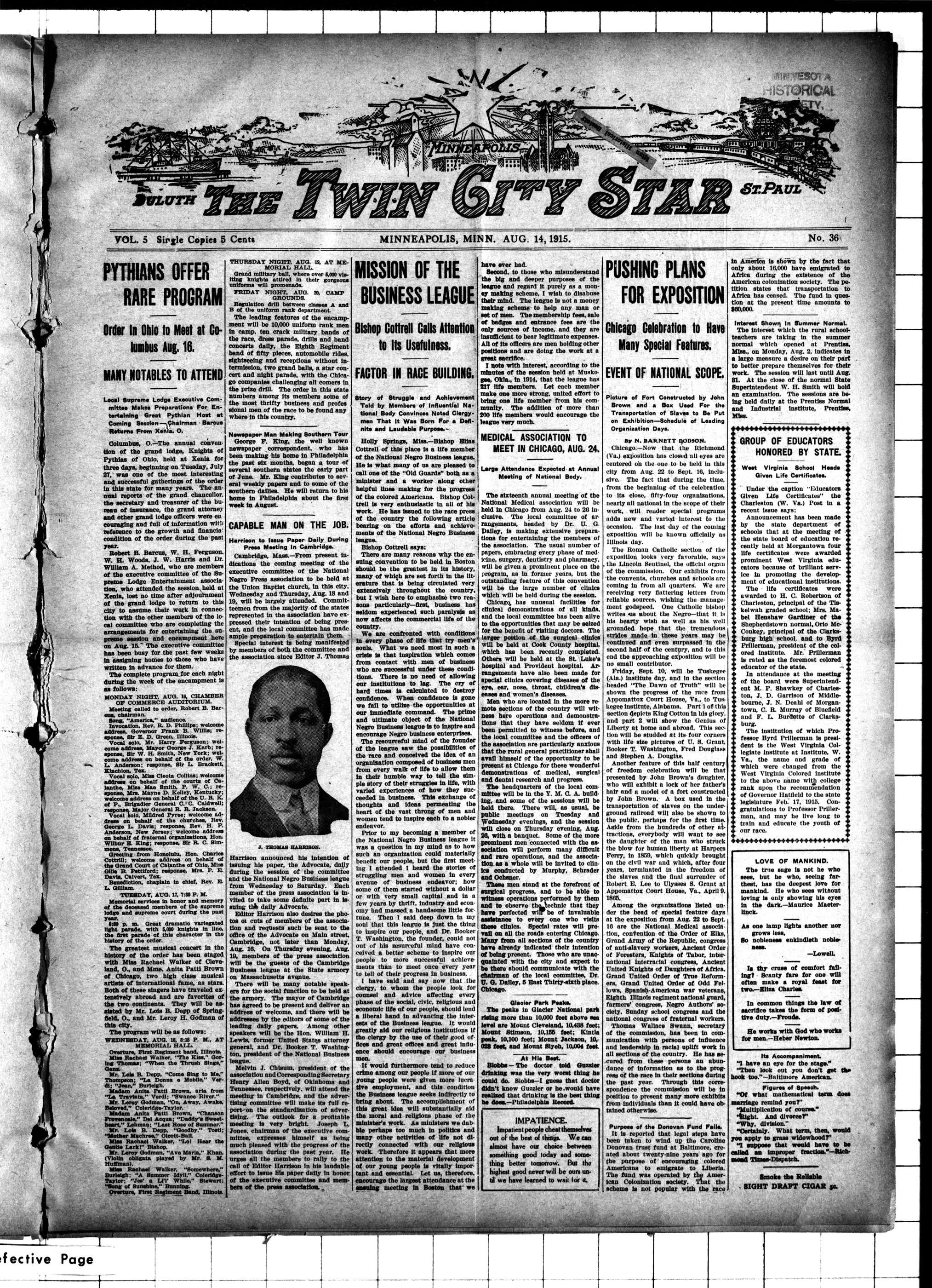
PYTHIANS OFFER RARE PROGRAM
Local Supreme Lodge Executive Committee Makes Preparations For Entertaining Great Pythian Host at Coming Session—Chairman·Bareous Returns From Xenia, O.
Columbus, O.—The annual convention of the grand lodge, Knights of Pythias of Ohio, held at Xenia for three days, beginning on Tuesday, July 27, was one of the most interesting and successful gatherings of the order in this state for many years. The annual reports of the grand chancellor, the secretary and treasurer of the bureau of insurance, the grand attorney and other grand lodge officers were on encouraging and full of information with reference to the growth and financial condition of the order during the past year.
Robert B. Barcus, W. H. Ferguson, W. H. Woods, J. W. Harris and Dr. William A. Method, who are members of the executive committee of the Supreme Lodge Entertainment association, who attended the session held at Xenia, lost no time after adjournment of the grand lodge to return to this city to assume their work in connection with the other members of the local committee who are completing the arrangements for entertaining the supreme session and encampment here on Aug. 15. The executive committee has been busy for the past few weeks in assigning homes to those who have written in advance for them.
The complete program for each night during the week of the encampment is as follows:
MONDAY NIGHT, AUG. 15, CHAMBER OF COMMERCE AUDITORIUM.
Meeting called to order, Robert B. Barous, chairman.
Song, "America," audience.
Immediate Rev. R. D. Phillips; welcome address, Governor Frank B. Willis; response, Sir E. D. Green, Illinois.
Vocal solo, Mr. Harry Ferguson; welcome address, Mayor George J. Karb; response, Sir W. H. Smith, New York; welcome address on behalf of the order, W. L. Anderson; response, Sir L. Brackett, Klinchon. Tex.
Benediction, chaplain in chief, Rev. E. L. Gilliam.
TUESDAY, AUG. 17, 7:30 P. M.
Memorial services in honor and memory of the deceased members of the supreme body and supreme court during the past year.
8:50 p. m. Great dramatic variegated light parade, with 5,000 knights in line, the first parade of this character in the history of the order.
The greatest musical concert in the history of the order has been staged with Miss Rachael Walker of Cleveland, O., and Mme. Anita Patti Brown of Chicago, two high class musical artists of international fame, as stars. Both of these singers have traveled extensively abroad and are favorites of the two continents. They will be assisted by Mr. Lois B. Depp of Springfield, O., and Mr. Leroy H. Godman of this city.
The program will be as follows:
WEDNESDAY, AUG. 19 8:15 P. M., AT MEMORIAL HALL.
Overture, First Regiment band, Illinois.
Miss Rachael Walker, "The Kiss," Goring Thomas; "When the Thrush Sings," Ganz.
Mr. Lois B. Depp, "Come Sing to Me"
Thompson; "La Donna e mobile," Verdi;
"Jean," Burleigh,
"La Donna Brown, aria from
La Travailta," Verdi; "Swanse River."
Mr. Leroy Godman, "On, Away, Awake,
Beloved," Coloridge-Taylor.
Madam Anita Patte Brown, "Chanson
Provencale," Acquired; "Daddy's Sweet-
ness," Rose B. Hammond.
Mr. Lois B. Depp, "Goodby," Tosti;
"Mother Mchree," Oclcott-Ball.
Miss Rachael Walker, "Lo! Hear the
Gentle Lark!" Bishop.
Mr. Lois B. Godman, "Ave Marie," Khan.
(Volius obligate played by Mr. S. M.
Huffman).
Miss Rachael Walker, "Somewhere," Burlesk; "A Summer Idyl," Coloridge-Taylor; "Miss Idyl," Stewart; "Overture of Sunshine," Bunnell; Overture, First Regiment Band, Illinois.
THURSDAY NIGHT. AUG. 19. AT MEMORIAL HALL.
MORIAL HALL
Grand military ball, where over 5,000 visiting knights attired in their gorgeous uniforms will promenade.
FRIDAY NIGHT, AUG. 20, CAMP GROUNDS.
Regulation drill between classes A and B of the uniform rank department.
The leading features of the encampment will be 10,000 uniform rank men in camp, ten crack military bands of the race, dress parade, drills and band concerts daily, the Eighth Regiment band of fifty pieces, automobile rides, sightseeing and reception without intermission, two grand balls, a star concert and night parade, with the Chicago companies challenging all comers in the prize drill. The order in this state numbers among its members some of the most thrifty business and proteasional men of the race to be found any where in this country.
Newspaper Man Making Southern Tour George F. King, the well known newspaper correspondent, who has been making his home in Philadelphia the past six months, began a tour of several southern states the early part of June. Mr. King contributes to several weekly papers and to some of the southern dalles. He will return to his home in Philadelphia about the first week in August.
CAPABLE MAN ON THE JOB.
Harrison to Issue Paper Daily During Press Meeting in Cambridge. Cambridge, Mass.—From present indications the coming meeting of the executive committee of the National Negro Press association to be held at the Union Baptist church, in this city, Wednesday and Thursday, Aug. 18 and 19, will be largely attended. Committeemen from the majority of the states represented in the association have expressed their intention of being present, and the local committee has made ample preparation to entertain them. Special interest is being manifested by members of both the committee and the association since Editor J. Thomas
J. THOMAS HARRISON.
Harrison announced his intention of issuing his paper, the Advocate, daily during the session of the committee and the National Negro Business league from Wednesday to Saturday. Each member of the press association is invited to take some definite part in issuing the daily Advocate.
Editor Harrison also desires the photos of cuts of members of the association and requests such be sent to the office of the Advocate on Main street. Cambridge, not later than Monday, Aug. 16. On Thursday evening, Aug. 19, members of the press association will be the guests of the Cambridge Business league at the State armory on Massachusetts avenue. There will be many notable speakers for the social function to be held at the armory. The mayor of Cambridge has agreed to be present and deliver an address of welcome, and there will be addresses by the editors of some of the leading daily papers. Among other speakers will be the Hon. William H. Lewis, former United States attorney general, and Dr. Booker T. Washington, president of the National Business league.
Melvin J. Chisum, president of the association and Corresponding Secretary Henry Allen Boyd, of Oklahoma and Tennessee, respectively, will attend the meeting in Cambridge, and the advertising committee will make its full report on the standardization of advertising. The outlook for a profitable meeting is very bright. Joseph L. Jones, chairman of the executive committee, expresses himself as being much pleased with the progress of the association during the past year. He urges all the members to rally to the call of Editor Harrison in his laudable effort to issue his paper daily in honor of the executive committee and members of the press association.
MISSION OF THE BUSINESS LEAGUE
FACTOR IN RACE BUILDING.
Story of Struggle and Achievement Told by Members of Influential National Body Convinces Noted Clergymen That It Was Born For a Definite and Laudable Purpose.
Holly Springs, Miss.—Bishop Elias Cottrell of this place is a life member of the National Negro Business league. He is what many of us are pleased to call one of the "Old Guards" both as a minister and a worker along other helpful lines making for the progress of the colored Americans. Bishop Cottrell is very enthusiastic in all of his work. He has issued to the race press of the country the following article bearing on the efforts and achievements of the National Negro Business league.
Bishop Cottrell says:
There are many reasons why the ensuing convention to be held in Boston should be the greatest in its history, many of which are set forth in the literature that is being circulated very extensively throughout the country, but I wish here to emphasize two reasons particularly—first, business has seldom experienced such paralysis as now affects the commercial life of the country.
We are confronted with conditions in every phase of life that try men's souls. What we need most in such a crisis is that inspiration which comes from contact with men of business who are successful under these conditions. There is no need of allowing our institutions to lag. The cry of hard times is calculated to destroy confidence. When confidence is gone we fail to utilize the opportunities at our immediate command. The prime and ultimate object of the National Negro Business league is to inspire and encourage Negro business enterprises.
The resourceful mind of the founder of the league saw the possibilities of the race and conceived the idea of an organization composed of business men from every walk of life to allow them in their humble way to tell the simple story of their struggles in life, with varied experiences of how they succeeded in business. This exchange of thoughts and ideas permeating the heart of the vast throng of men and women tend to inspire each to a nobler endeavor.
Prior to my becoming a member of the National Negro Business league it was a question in my mind as to how such an organization could materially benefit our people, but the first meeting I attended I heard the stories of struggling men and women in every avenue of business endeavor; how some of them started without a dollar or with very small capital and in a few years by thrift, industry and economy had massed a handsome little fortune. Then I said deep down in my soul that this league is just the thing to inspire our people, and Dr. Booker T. Washington, the founder, could not out of his resourceful mind have conceived a better scheme to inspire our people to more successful achievements than to meet once every year to tell of their progress in business.
I have said and say now that the clergy, to whom the people look for counsel and advice affecting every phase of the social, civic, religious and economic life of our people, should lend a liberal hand in advancing the interests of the Business league. It would greatly aid our religious institutions if the clergy by the use of their good offices and great offices and great influence should encourage our business men.
It would furthermore tend to reduce crime among our people if more of our young people were given more lucrative employment, and this condition the Business league seeks indirectly to bring about. The accomplishment of this great idea will substantially aid the moral and religious phase of the minister's work. As ministers we dable perhaps too much in politics and many other activities of life not directly connected with our religious work. Therefore it appears that more attention to the material development of our young people is vitally important and essential. Let us, therefore, encourage the largest attendance at the ensuing meeting in Boston that we
Second, to those who misunderstand the big and deeper purposes of the league and regard it purely as a money making scheme. I wish to disbuse their mind. The league is not a money making scheme to help any man or set of men. The membership fees, sale of badges and entrance fees are the only sources of income, and they are insufficient to bear legitimate expenses. All of its officers are men holding other positions and are doing the work at a great sacrifice.
I note with interest, according to the minutes of the session held at Muskogee, Okla., in 1914, that the league has 217 life members. Let each member make one more strong, united effort to bring one life member from his community. The addition of more than 200 life members would encourage the league very much.
MEDICAL ASSOCIATION TO MEET IN CHICAGO, AUG. 24.
Large Attendance Expected at Annual Meeting of National Body.
The sixteenth annual meeting of the National Medical association will be held in Chicago from Aug. 24 to 26 inclusive. The local committee of arrangements, headed by Dr. U. G. Dalley, is making extensive preparations for entertaining the members of the association. The usual number of papers, embracing every phase of medicine, surgery, dentistry and pharmacy, will be given a prominent place on the program, as in former years, but the outstanding feature of this convention will be the large number of clinics which will be held during the session. Chicago has unusual facilities for clinical demonstrations of all kinds, and the local committee has been alive to the opportunities that may be seized for the benefit of visiting doctors. The larger portion of the surgical clinics will be held at Cook County hospital, which has been recently completed. Others will be held at the St. Luke's hospital and Provident hospital. Arrangements have also been made for special clinics covering diseases of the eye, ear, nose, throat, children's diseases and women's diseases.
Men who are located in the more remote sections of the country will witness here operations and demonstrations that they have seldom if ever been permitted to witness before, and the local committee and the officers of the association are particularly anxious that the rural general practitioner shall avail himself of the opportunity to be present at Chicago for these wonderful demonstrations of medical, surgical and dental research and progress. The headquarters of the local committee will be in the Y. M. C. A. building, and some of the sessions will be held there. There will, as usual, be public meetings on Tuesday and Wednesday evenings, and the session will close on Thursday evening, Aug. 26, with a banquet. Some of the more prominent men connected with the association will perform many difficult and rare operations, and the association as a whole will be invited to clinics conducted by Murphy, Schrader and Ochner.
These men stand at the forefront of surgical progress, and to be able to witness operations performed by them and to observe the technic that they have perfected will be of invaluable assistance to every one who visits these clinics. Special rates will prevail on all the roads entering Chicago. Many from all sections of the country have already indicated their intention of being present. Those who are unacquainted with the city and expect to be there should communicate with the chairman of the local committee, Dr. U. G. Dalley, 5 East Thirty-sixth place. Chicago.
Glacier Park Peaks.
The peaks in Glacier National park rising more than 10,000 feet above sea level are Mount Cleveland, 10,438 feet; Mount Stimson, 10,155 feet; Kintla peak, 10,100 feet; Mount Jackson, 10,028 feet, and Mount Silech, 10,004 feet.
At His Best.
Blobbs—The doctor told Guzzler drinking was the very worst thing he could do. Slobbs—I guess that doctor didn't know Guzzler or he.would have realized that drinking is the best thing he does.-Philadelphia Record.
IMPATIENCE.
Impatient people cheat themselves out of the best of things. We can almost have our choice between something good today and something better tomorrow. But the highest good never will be our until we have learned to wait for it.
PUSHING PLANS FOR EXPOSITION
Picture of Fort Constructed by John Brown and a Box Used For the Transportation of Slaves to Be Put on Exhibition—Schedule of Leading Organization Days.
By N. BARNETT BODSON.
Chicago—Now that the Richmond (Va.) exposition has closed all eyes are centered on the one to be held in this city from Aug. 22 to Sept. 16, inclusive. The fact that during the time, from the beginning of the celebration to its close, fifty-four organizations, nearly all national in the scope of their work, will render special programs adds new and varied interest to the occasion. The last day of the coming exposition will be known officially as Illinois day.
The Roman Catholic section of the exposition looks very favorable, says the Lincoln Sentinel, the official organ of the commission. Our exhibits from the convents, churches and schools are coming in from all quarters. We are receiving very flattering letters from reliable sources, wishing the management godspread. One Catholic bishop writes us about the Negro—that it is his hearty wish as well as his well grounded hope that the tremendous strides made in these years may be continued and even surpassed in the second half of the century, and to this end the approaching exposition will be no small contributor.
Friday, Sept. 10, will be Tuskegee (Ala.) institute day, and in the section headed "The Dawn of Truth" will be shown the progress of the race from Appomattox Court House, Va., to Tuskegee institute, Alabama. Part 1 of this section depicts King Cotton in his glory, and part 2 will show the Genius of Liberty at home and abroad. This section will be studded at its four corners with life size pictures of U. S. Grant, Booker T. Washington, Fred Douglass and Stephen A. Douglas.
Another feature of this half century of freedom celebration will be that presented by John Brown's daughter, who will exhibit a lock of her father's hair and a model of a fort constructed by John Brown. A box used in the transportation of slaves on the underground railroad will also be shown to the public, perhaps for the first time. Aside from the hundreds of other attractions, everybody will want to see the daughter of the man who struck the blow for human liberty at Harpers Ferry, in 1859, which quickly brought on the civil war and which, after four years, terminated in the freedom of the slaves and the final surrender of Robert E. Lee to Ulysses S. Grant at Appomattox Court House, Va., April 9, 1865.
Among the organizations listed under the head of special feature days at the exposition from Aug. 22 to Sept. 16 are the National Medical association, convention of the Order of Elks, Grand Army of the Republic, congress of anti-slavery workers, Ancient Order of Foresters, Knights of Tabor, international interracial congress, Ancient United Knights of Daughters of Africa, Grand United Order of True Reformers, Grand United Order of Odd Fellows, Spanish-American war veterans, Eighth Illinois regiment national guard, farmers' congress, Negro Authors' society, Sunday school congress and the national congress of fraternal workers. Thomas Wallace Swann, secretary of the commission, has been in communication with persons of influence and leadership in racial uplift work in all sections of the country. He has secured from these persons an abundance of information as to the progress of the race in their sections during the past year. Through this correspondence the commission will be in position to present many more exhibits from individuals than it could have obtained otherwise.
Purpose of the Donovan Fund Fails. It is reported that legal steps have been taken to wind up the Caroline Donovan trust fund at Baltimore, created about twenty-nine years ago for the purpose of encouraging colored Americans to emigrate to Liberia. The fund was operated by the American Colonization society. That the scheme is not popular with the race
in America is shown by the fact that only about 16,000 have emigrated to Africa during the existence of the American colonization society. The petition states that transportation to Africa has ceased. The fund in question at the present time amounts to $60,000.
Interest Shown In Summer Normal. The interest which the rural school-teachers are taking in the summer normal which opened at Prentiss, Miss., on Monday, Aug. 2, indicates in a large measure a desire on their part to better prepare themselves for their work. The session will last until Aug. 31. At the close of the normal State Superintendent W. H. Smith will hold an examination. The sessions are being held daily at the Prentiss Normal and Industrial Institute, Prentiss, Miss.
```markdown
```
GROUP OF EDUCATORS HONORED BY STATE.
West Virginia School Heads Given Life Certificates.
Under the caption "Educators Given Life Certificates" the Charleston (W. Va.) Post in a recent issue says:
Announcement has been made by the state department of schools that at the meeting of the state board of education recently held at Morgantown four life certificates were awarded prominent West Virginia educators because of brilliant service in promoting the development of educational institutions. The life certificates were awarded to H. C. Robertson of Charleston, principal of the Tiskelwhah graded school; Mrs. Mabel Henshaw Gardiner of the Shepherdstown normal, Orio McConkey, principal of the Clarksburg high school, and to Byrd Prillerman, president of the colored institute. Mr. Prillerman is rated as the foremost colored educator of the state.
In attendance at the meeting of the board were Superintendent M. P. Shawkey of Charleston, J. D. Garrison of Middlebourne, J. N. Deahl of Morgantown, C. R. Murray of Bluefield and F. L. Burdette of Clarksburg.
The institution of which Professor Byrd Prillerman is president is the West Virginia College institute at Institute, W. Va., the name and grade of which were changed from the West Virginia Colored institute to the above name with college rank upon the recommendation of Governor Hatfield to the state legislature Feb. 17, 1915. Congratulations to Professor Prillerman, and may he live long to train and educate the youth of our race.
LOVE OF MANKIND.
The true sage is not he who sees, but he who, seeing farther, has the deepest love for mankind. He who sees without loving is only showing his eyes in the dark.—Maurice Maeterlinck.
Is thy cruse of comfort falling? Scanty fare for one will often make a royal feast for two.-Eliza Charles.
In common things the law of sacrifice takes the form of positive duty.-Froude.
Its Accompaniment.
"I have an eye for the stage."
"Then look out you don't get the hook too."—Baltimore American.
Figures of Speech.
"Of what mathematical term does marriage remind you?"
"Multiplication of course."
"Right. And divorce?"
"Why, division."
"Certainly. What term, then, would you apply to grass widowhood?"
"I suppose that would have to be called an improper traction."—Richmond Times-Dispatch.
Smoke the Reliable
SIGHT DRAFT CIGAR 5c.
Mr. Hamlet B. Rowe is authorized to solicit and collect for subscriptions for the Twin City Star. Mr. Rowe is financially interested in the publication and will have charge of the advertising department.
Mrs. Wm. Stirman returned home after a very pleasant visit with friends in Iowa.
Mrs. James Burke is visiting relatives in Chicago.
Mr. Sam'l Beasley will attend the Pythian Encampment at Columbus next week.
Rev. G. W. Mitchell preached the funeral sermon over the remains of Mrs. Vader at Zion Baptist church this week.
Ames Lodge Elks will go in a special car to the convention at Chicago.
Dr. R. S. Brown will attend the Annual Meeting of the Negro Medical Association, which will be held in Chicago.
The Lawn Party of The Young Girls Club at the residence of Miss Clara Lucas was a social and financial success.
Brig. Gen'l W. R. Morris is trying to represent the Court of Calantie at the Pythian Convention. The Brig. Gen. has no vote in the Supreme Lodge.
Col. "Kid" Mitchell is the highest ranking officer of the U. R. of Minn. He is aid-de-camp on Maj. Gen. Jackson's staff.
Rev. D. E. Beasley will preach at the morning and evening services at Bethesda Baptist Church on Aug. 15.
The West Hotel Café will open on Monday evening. Negro waiters will be employed.
The opening of the Minneapolis Athletic Club is anxiously awaited by the many waiters who will be employed there. The crew will consist of about 75 men under Mr. W. C. Gordon. The headwaiter and captains are white.
Mr. Geo. W. Holbert is impressing upon the "wets" the effect of discrimination in saloons against Negroes, and he knows what he is talking about.
Many saloonkeepers are extending unusual hospitality to the "colored gentlemen." How long will this continue? Will they put on the old rules after the election? is the question.
St. Peters' A. M. E. Church is getting a much needed coat of paint, a new roof and other repairs, made possible by the recent rally.
A New Restaurant Opened.
Mrs. Louis Crawford wishes to announce that she has opened her restaurant at 1419 South Fourth St. where you can get good home cooked food. Advertisement.
DEATH OF "CHARLIE" BROWN.
The funeral of Mr. Chas. J. Brown was held Saturday from St. Thomas Episcopal Mission. Rev. Lealtad officiating. Mr. Brown was one of the best known Negroes of this city. He was born at Port Gibson, Miss., where he was for many years city clerk. He was once an employee of the Soo Railroad, and held many positions of trust with leading jewelers. He was the father of Mr. Jacob Brown, who was killed about two years ago at New Orleans. His former wife is now married to Supreme Chancellor S. W. Green, of the Knights of Pythias. Mr. Brown was 60 years of age, and died from a complication of diseases at the Asbury Hospital, where he received the best medical attention.' He had lived in Mineapolis for over 30 years.
"THANN" TRAVIS' NEW HOTEL
Mr. "Thann" Travis is now the sole proprietor of the hotel and bar at 122 E. Third St., St. Paul, formerly "Curley's Place." He has thoroughly renovated the hotel and cafe. A special midnight lunch is served in the cafe up stairs, best music, good entertainer. Desirable rooms and a choice line of fine liquors and cigars always in stock. Rates for theatrical people, lodges, theatre parties etc. Two blocks from Union Station. "Thann" invites you to stop in to and from the Boat Excursions, and Depot. See Adv. in another column.
The Elks are saving their money for their trip "On to Chicago."—Just save a few dimes for "Back to Minneapolis."
---
EMANCIPATION CELEBRATION
The Emancipation Exercises at Bethesda Baptist Church on last Sunday were well attended. Dr. R. S. Brown presided. Prayer by Rev. T. H. Stovall. An address, "The Importance of the Supreme Court decision, invalidating the Grandfather Clause" by Atty. B. S. Smith, was instructive and inspiring. He advised his hearers to get together to aid the fight to give back the ballot to the Negro. Congressman Schall delivered an eloquent oration on "Lincoln and the Emancipation." The singing was led by Mr. D. W. Raynor. Miss Essie Mason accompanist. A tribute in form of resolutions was sent to the family of late Dr. M. C. B. Mason.
The Real Quartette composed of the following Colored Stars: Messrs. Geo. L. Conley, 1st tenor; S. H. Jackson, 2nd tenor; J. Lewis Johnson, barytone; J. W. Turner, bass, are being enthusiastically received at the Palace Theatre this week. The public remembers Mr. J. W. Turner as having a singing part in "Old Dominion" and "A Southern Gentleman", two of Mr. Clay Clement's successful plays. Mr. Turner has toured America several times and has been abroad twice. From here they go to Chicago.
Mr. and Mrs. Daniel Piper and sons left Aug. 10th for Columbus, Ohio, where they will visit relatives indefinitely.
NEGRO SHOWMAN KILLED.
Dan. Wilkinson, a Negro employed with Dyer's Animal Circus was killed on Aug. 5. by Speaker Monnette, white. He was struck with a baseball bat by Monnette during an altercation with another employee, and died soon afterwards. Monnette is held for the grand jury without bail. Mr. John A. Dickerson interested himself in the case and tried to locate Wilkinson's relatives by telegraph, but was not successful. Mr. and Mrs. J. W. Dyer, for whom Wilkinson had worked for many years and Messrs. Wortham and Stoughton of the Carnival Co., raised money to bury the unfortunate man. Mr. Billy Kelly, formerly of The Southern Theatre said that there is no feeling of prejudice, everyone is sorry that it occurred and that the law must take its course. Atty. B. S. Smith appeared to see that Monnette pays the penalty for his crime. Wilkinson was buried at Layman Cemetery by Undertaker D. W. Raynor on Monday afternoon.
AN OPEN LETTER
Minneapolis, Aug. 11, 1915.
To Editor of the Star.
Dear Sir: Please allow me space to deny the statement made by Mr. L. Baker, that the party given at 204 11th Ave. So., which was raided by the police, "was given by The Maple Leaf Club." I want everyone to know that The Maple Leaf Club has never given any disorderly dances or house parties. Its members are respectable men and the reputation of the socials given by the Club has always been good. Recently there have been many mixed dances that reflected on our Club. So much so, that we have not given any socials in over a year. As president of The Maple Leaf Club allow me to say that its members respect women of every race, who deserve it. Such a remark by Mr. Baker is an insult to the cultured and refined young people of this city, whose mothers, although white, are true and loyal wives. The male members of our Club are law-abiding and property owners. They hold some of the most responsible positions held by Negroes in this city, and they regret that this disorderly element has tried to shield their dirt under the name of The Maple Leaf Club, of which I have the honor to be president.
Resp'y., Fred Conners.
260 Bryant Ave. No.
Dr. R. S. Brown, the physician, was not among those caught in that raid, where Mr. Judy was conspicuously prominent. Mr. Judy gave the assumed name of Chas. Brown and with his familiar title of "Doc", they called him Dr. Brown, hence the rumor. Neither was Dr. Redd among those apprehended. Many gossips have a way of saying things which are harmful and without truth.
SUBSCRIBE NOW
To Subscribe Ie To Pay.
Leave your subscription at our office Third floor, 305 Fifth St. So.
THE HOUSING PROBLEM.
"Where can I get an apartment? is a serious question among us today. There are many restrictions against Negroes as tenants in desirable places and many places undesirable for respectable Negro tenants. There are many strangers coming to our city, and they are unable to get decent locations. Something must be done. They can buy property anywhere and live therein, but most of them are poor pioneers, and they cannot pay the price.
TWIN CITY STAR
TASK FOR THE NATIONS.
Ray Stannard Baker's Plea For
Human Brotherhood.
Ray Stannard Baker in a recent issue of the American Magazine has the following to say about prejudice of one race against another:
"Why will men not see that there can be no true civilization while any men in the world are left out of it and that no race and no nation can go far forward while other races and nations lag behind?
"Let the white person again trend the black person under his heel! (Say, which is trodden under heel after all?)
"It is not enough that we give the alien nations our learning, our religion, our science. What signify all these things? Are we hurt by giving them? Are we not, on the contrary, the material gainers? No; we must be prepared to go further than that, else we have not learned the fundamental concept of religion. "It is not the great task of any nation that it shall remain pure or white or learned or that it shall assure to its posterity the possession of land and comfort, though this has been the belief and the doom of every aristocracy from the beginning of time. The great task of every advanced race or nation is to bring more love, more light, into the world.
"A stand for racial aristocracy means war, hatred, barren exclusiveness and finally degeneration and failure; a stand for racial democracy and brotherhood means love in the world, friendliness, sacrifice, new fertility, a wider sweep for faith and final triumph. Individuals may suffer in the process, nations may perish, but civilization, the kingdom of humanity, will grow, will become more beautiful.
"We are willing to do everything for Chinamen or Hindus or for our own poor, except the one essential thing. Yes, educate them (a little); yes, teach them the religion of resignation; yes, give them shoes and coats, but do not disturb us in our luxury.
"It won't work; it won't work. So long as we refuse to give ourselves we have failed utterly."
NATIONAL DEGENERACY.
Lincoln Abhorred Oppression
and Demand Hypocrisy
The speech of Abraham Lincoln in 1855 regarding the political situation and the tendency to disregard the rights of human beings to life, liberty and the pursuit of happiness is strikingly applicable to the condition of affairs in this country at the present time.
Mr. Lincoln said:
"I am not a Know Nothing—that is certain. How could I be?
How can any one who abhors the oppression of the Negroes be in favor of degrading classes of white people? Our progress in degeneracy appears to me to be pretty rapid. As a nation we began by declaring that 'all men are created equal.'
"We now practically read it. 'All men are created equal except Negroes.' When the Know Nothings get control it will read. 'All men are created equal except Negroes and foreigners and Catholics.' 'When it comes to that I should prefer emigrating to some country where they make no pretense of loving liberty—to Russia, for instance, where despotism can be taken pure and without the base alloy of hypocrisy."
Considerate.
"That young Gadaby is an amiable fellow."
"Yes; he has to be amiable to counteract the irritating effect of the clothes he wears." - Birmingham Age Herald.
COUNTY OPTION.
Now that it is certain that a county election will be held in October, the Negroes are much interested. While there are many identified with the wet element, they do not propose to vote to sanction discrimination against them in many saloons. Sen. E. J. Westlake is a leader of the wet faction. He was elected by the Negro vote, and a committee will wait upon him to place their grievances before him. Unless he uses his great influence to bring about better conditions, they will vote for a dry county. Such PROHIBITION practices, as "refusing to serve Negro gentlemen" and placing humiliating signs "NEGROES NOT WANTED HERE", will serve as a boomerang to many of the retail liquor dealers—and it should. If Negroes cannot get decent treament as other people in public places, then let us go fifty-fifty on the blind pigs, and there will be some equality to this "personal liberty" (?) issue. Any Negro who would vote to endorse the present conditions of the liquor traffic belongs to the class that has brought most disgrace upon his race—the Negro without either manhood or principle.
SOLDIERS WIN FIGHT FOR HOME
RAGE PREJUDICE A BARRIER
Henry M. Hyde Tells Thrilling Story of How Officers and Men of Famous Regiment Kept Together Under the Most Adverse Circumstances—State Comes to Their Rescue.
Chicago.—Henry M. Hyde gives the following account of the struggles and achievements of the Eighth Illinois regiment in war and in peace and its efforts to secure an armory:
The transport sailed from Tampa with 1,500 men of the regiment on board. Peace with Spain had not been declared. They looked forward to a taste of fighting with the dons. Off Santiago they learned that the war was over. Too late for any chance of glory, plenty of hard work remained. For eight months they built roads and telegraph lines, cleaned streets, did all manner of hard and dirty jobs. The old Spanish town and the country round about got the first thorough cleaning in their history.
When the boys got back home their old rented armory had been sold. An ancient livery stable was the best quarters they could get. Up in the loft they stored part of their equipment and supplies. Down on the barn floor they drilled night after night. Privates who had driven coal wagons or handled shovels all day came in two nights a week to the livery barn and drilled from 8 o'clock to 10:30. Commissioned and noncommissioned officers spent more time on their paper work and studies, turning old box stalls into company rooms and offices, doing their best to keep the standard of the regiment among the highest.
Apparently they succeeded. Officers of the regular-army sent to inspect it reported year after year that the six companies located in Chicago ranked as high as any militia organization in the state in soldiery efficiency. More than ten years in the old barn! Then it was sold, and the best the regiment could do was to move away and hunt up another. The second old livery stable was in worse condition than the first. But the men and officers stuck to their work. In 1914 they got an appropriation from the legislature of Illinois to build a real armory—their first. Some of the officers had gone out and begged enough money to buy a site. When they got it paid for certain residents in the neighborhood made up their minds that an armory would be a nuisance. They brought pressure to bear, and the regiment had to sell the site.
They bought a second site, and a second time plans were made for the building. A second time people in the neighborhood raised an awful row. They couldn't think of allowing a lot of rough soldiers to drill in their vicinity. A third time a site was purchased. This time the contracts were let, and the work of putting up the building began promptly. Last winter, when the shell was under cover and the regiment found it would have to move into the uncompleted building or else into the street, the discovery was made that no arrangements had been made to heat or light the armory and that no money remained with which to pay for the work.
The colonel of the regiment came to the front for it. He signed notes for $8,000, and the boilers and lights were put in.
But meanwhile the regiment—or that part of it located in Chicago—had increased in size. Two down state companies were mustered out of the service. Units to take their places were recruited in Chicago. Room had to be made for eight companies of the line, in addition to the headquarters company, the hospital corps, the machine gun company, the drum and life corps, the supply company and the band—800 men in all.
The legislature which recently adjourned passed a bill appropriating the money to finish the job. Just as soon as it is signed by Governor Dunne, probably within the next few days, work will be begun and rushed to a finish.
In October, 1914, when the corner stone was laid, Governor Dunne was one of the orators. He said that the diligence and patience shown by the regiment in drill and rife practice under the most adverse conditions conceivable and without any hope of financial reward deserved recognition and that he was glad that it was getting it during his administration. The Eighth Illinois is made up entirely of colored troops. Eight of the twelve line companies and all the special corps are located in Chicago. The new and unfinished armory stands at Forest avenue and Thirty-fifth street. Colonel F. A. Denlison is the commanding officer who signed the note for $8,000 which made it possible to put in the heating plant and electric lights.
"I suppose you regard that picture you've painted as a masterpiece."
"No." replied the practical artist.
"I'd rather take a small cash price and call it a pot boiler." — Washington Star.
READ THE STAR-ITS NEWSY
Points
for
Mothers
Consideration For Others.
Train a child to notice and respect
the employment of another. If it be
merely a game there is no need
thoughtlessly, therefore rudely, to in-
terrupt it. A little politeness one to
another, a little observance of the
wishes of others, will put aside sullen
looks and bad tempers.
We know ourselves how disagreeable it is to have the table shaken when we write, to have a door left open or loudly banged, to have some one crossing between us and the light or to be constantly interrupted. Our children cannot like this more than we do. Yet we need not lose our tempers. A smiling protest, a caressing request, a little joke over the annoyance, will prevent its repetition better than a sharp rebuke.
When children are taught to notice these trifles they learn to avoid them A child is pleased when you apologize to him for unintentional awkwardness The little seeds sink in his mind. To morrow he will avoid that small of fense. Rough movements, unpolished speech, detract from rather than in crease a child's pleasure. And it is these small trifles that make up the comfort of our homes.
Having the Eyes Examined.
If a child screws up its eyes when looking at a distant object or, when reading a book, has to bend closely over it a defect in vision should be suspected. Sometimes the child complains of headaches or eye ache, the former usually referring to the fore head. There may be at times a slight squint. These are also suspicious signs. Eye strain also gives rise to inflammation of the lids—hence styears and if this condition is constantly recurring the sight should be properly tested.
Unskilled advice in the matter of the eyesight should be avoided, for permanent injury is easily effected if wrong measures are taken. No child should ever be allowed to wear glasses until a doctor has examined the eyes and has recommended the use of such.
To prevent eye strain the position in which a child does its home work-in regard to the lighting of the room-should always be borne in mind. Any glare on the book or paper should be avoided, and the light should fall obliquely from behind.
Diplomatic Management.
If you want to break a young girl of going about with undesirable friends, or dressing in an unbecoming way, or reading books which she has no business to open, or doing any other of the silly things in which girls delight, you can always manage it best by drawing her attention away to other matters. Those undesirable friends are probably her only refuge from dullness. Let her go out a little more. Show her more of life and she'll drop them very soon.
That common, ugly frock will never be worn again after you have given her a really pretty new one in good style. She would never read those disagreeable books if you took the trouble to provide her with amusing, exciting tales of a decent kind.
But the good books must be exciting and interesting, not merely improving. The nice dress must be dainty and charming, not plain and serviceable. Your way must look more atractive than her own.
Brushing the Teeth Regularly
If the child is taught early to brush its teeth it becomes a matter of habit, which it carries through life, and the result is a fairly perfect set.
If the first teeth are brushed and kept in good condition and a dentist visited at least once in six months there is little danger of the second teeth being infected or crooked.
It sometimes happens that a first tooth remains in the gum too long that is, after the second tooth shows signs of coming through. This condition should not be allowed to exist, as the first tooth is liable to irritate the gum, which will become sore and infected, and pus will be the result.
If the first tooth does not fall out naturally on the appearance of the second the child should be taken to a dentist and the offending tooth removed.
Crowded and irregular teeth are often the result of first teeth remaining too long in the gum.
Buying Children's Garments.
In buying goods for children the mother should invest only in those materials which are very closely woven. it is not so much the weight of the goods as the weave. The loose weaves pull apart in no time, and for children they are practically useless. A tight weave need not be very heavy, but it will wear well. It is most important to consider this carefully when buying. Then, too, when a really fine piece of goods is found it is better to buy in large quantities, for another fine piece may not be found, and the same material may be used in many ways.
For instance, from one kind of goods may be made two dresses for the little daughter, each in a different style and with different trimming, a little suit for the son and perhaps even a skirt for the mother herself. There need never be any waste in fine goods, for it can serve in many different ways.
Peoples Christian Assembly.
Rev. G. W. Mitchell, Pastor,
1204 Washington Ave. So.
Comel and Serve the Lord.
ST. PETER'S A. M. E. CHURCH.
22nd St. near 10th Ave. So.
Rev. Thos. B. Stovall, Pastor.
ST. JAMES A. M. E. CHURCH,
318 8th Ave. So., Minneapolis.
Rev. E. R. Edwards, Pastor.
REV. G. L. MORRILL.
Rev. G. L. Morrill conducts his Sunday services at the Jitney (formerly Bijou) Theatre. He invites all his former friends to worship with him every Sunday morning at 10:30 o'clock. Rev. Morrill is always ready to render his best service to our people, and they are always welcome to attend his services.
ZION BAPTIST CHURCH.
7th Ave. North and Hoag St.
Rev. M. W. Withers, Pastor,
Res. 2406 17 Ave. S.
Phone Drexel 600
Regular Services.
Preaching: 11 A. M., 8 P. M.
Sunday School 12:30 P. M.
B. Y. P. U. Society 6:45 P. M.
Prayer Meeting Wed. 8 P. M.
A WELCOME TO ALL.
MINNEAPOLIS SUNDAY FORUM.
During summer months, meetings will be held on 1st Sunday in August at Bethesda Church; 1st Sunday in September at St. Peter A. M. E. Church.
Sunday Forum Officers.
President, R. Skinner; Vice Pres., Miss Eva Walker; Secretary, Webster Stovall; Ass't Sec'y, Miss Lady Walker; Treas., Mrs. I. S. Bogie; Critic, P. F. Hale; Journalist, Louis Marshall; Organist, Mrs. L. Sensabaugh; Chaplains, Rev. T. B. Stdvall, Rev. T. J. Carter; Sergt. at Arms, L. T. Jones.
ST. PAUL, MINNESOTA.
Rev. Benjamin N. Murrell, Pastor.
SUNDAY SERVICES
11:00 A. M. Preaching.
12:50 P. M. The Bible School.
G. W. Willis, Supt.
6:45 P. M. B Y. P. U.
Mrs. Frances M. Murrell, Pres.
8:00 P. M. Preaching.
WEDMESDAY NIGHTS.
8.00 P. M. Mid-Week Prayer Services
FRIDAY NIGHTS.
7:00 P. M. Junior Choir Rehearsals.
8:30 P. M. Senior Choir Rehearsals.
CHOICE CITY AND SUBURBAN PROPERTY FOR SALE
ON SMALL MONTHLY PAYMENTS.
DAN'S RESTAURANT
306 So. 3rd St., Minneapolis
HOME COOKING. My Specialty
N. W. Main 2767
Daniel Williams, Prop.
Two Furnished Rooms. Suitable
for Light housekeeping. Good loca-
tion, modern conveniences: Apply
Mrs. Phelps, 119 Western Ave.
Those who are indebted to us will
please forward a part of their sub-
scriptions. "Times are hard" is the
cry—but we expect you to pay for
this newspaper, as you do for others.
They do not send you the daily white
papers, unless you pay.
What have you done to aid, this publication? We are often called on to insert notices of those who "never subscribe to Negro papers." Are you guilty?
Atty. William T. Francis has moved to Suite 329 in the American National Bank Building, Cedar and Fifth Sts., St. Paul.
We solicit short opinions on general topics. It is peculiar that our people have no public opinions, everything is strictly confidential. Remember, we said, "Short opinions."
When You Change.
When you change your, address, notify your postman, or drop a slip containing your name, new and old addresses, in the mail (without post-age) and you will get your newspaper and other mail forwarded to you.
When your name appears as being one of these "worthy of mention" try and have it appear on our books as a paid-up subscriber.
SEND YOUR SUBSCRIPTION
Defective Page
tive Page
Most Distinctive In America
Some Benjamin Browder
Says Benjamin Brawley.
Benjamin Brawley in a recent article in the Southern Workman has the following to say of the possibilities of the race for advancement in the arts and in music:
With reference to the Negro two things are observable. One is that any distinction so far won by a member of the race in America has been almost always in some one of the arts, and the other is that any influence so far exerted by the Negro on American civilization has been primarily in the field of aesthetics. But there is something deeper than the sensuousness of beauty that makes for the possibilities of the Negro in the realm of the arts, and that is the soul of the race. The wall of the old melodies and the plaintive quality that is ever present in the Negro voice are but the reflection of the background of tragedy. No race can rise to the greatest heights of art until it has yearned and suffered. The Russians are a case in point. Such has been their background in oppression and striving that their literature and art today are marked by an unmistakable note of power. The same future beckons to the American Negro.
The Negro has great gifts of voice and ear and soul, but so far much of his talent has not soared above the vaudeville stage. This is due most largely, of course, to economic instability. It is the call of patriotism, however, that America should realize that the Negro has peculiar gifts which need all possible cultivation and which will one day add to the glory of the country. Already his music is recognized as the most distinctive that the United States has yet produced.
THRIFTY BUSINESS MEN.
Constructive Work of Co-operative League at New Rochelle, N. Y.
By BRUCE "GRIT"
New Rochelle. N. Y.-The New Rochelle Co-operative Business league is entitled to a great deal of credit for the work it has done and is doing in Westchester county, N. Y., in making it possible for our people to secure sanitary homes in desirable sections of New Rochelle and also in the county. The league has been in existence a little over seven years and owns a number of fine houses, with latest modern improvements, all of which are occupied by our people.
League hall is headquarters for most of the social, fraternal and religious organizations among the colored people in the county. It contains a public hall for social gatherings with kitchen, dining room, check room, ladies' parlor and smoking room for men. At a recent meeting of the board of directors each member of the board agreed to assist in extending the business of the organization and to complete the payments of League hall, the home of the organization. The league is helping those members who are engaged in business, among whom are several aspiring merchants and two professional men.
These men all stand together and pull together like the members of one family. If a neighbor wishes to buy a horse or a wagon or a house or a stock of goods to open up a little business for himself the men of the league help and encourage him with their personal or joint notes to secure the money he needs, and they push his business all they can. It is a beautiful spirit, typical of the communal spirit of the colored man on his native heath. It is growing in New Rochelle, and black men there are coming more and more to see that it pays to stand shoulder to shoulder and to help one another to bear burdens.
The board of directors of the New Rochelle Co-operative Business league is one of the most harmonious bodies of men to be found anywhere in the state of New York. At their last meeting, held April 1, Manager S. J. Davis asked for $64 to pay certain petty bills, and in less than ten minutes the board turned over to him a little over $75. The board consists of the following members: W. J. Brown, president; E. Eckels, S. J. Davis (secretary of the league), J. Bullock, Gecke Eckels, Dr. C. P. McClendon, J. E. Bruce "Grit" Henry Davis, Henry Peel, James Brown, J. Thweet, S. J. Crewees (secretary of the board), Samuel Craig, Rev. M. A. Bradley and Eugene Harris. It is a growing organization, and its continued existence and activity show the capacity of the Negro for sustained effort along business lines.
Tired of the long winded oratory of the attorney for the defense, the judge interrupted him.
"Mr. Sharke," he said, "may I ask you a question?
"Certainly, your honor. What is the question?
"Language," said the judge, "we are told; is given to conceal thought or words to that effect. Inasmuch as you don't seem to have any thought to conceal, I would like to know why you are talking?"
Useful Indeed.
Teacher—What is the use of the Enschian tube? Pupil—So you can hear yourself talk—New York Times.
PRACTICAL HEALTH HINT.
Yawning as a Stimulant.
Dr. Naegeli, professor of medicine at Llege university, commends the practice of yawning as a physical reviver. A good yawn, the professor maintains, is excellent for the lungs and for all the breathing organs as well. But there is an art in yawning, he says, just as there is an art in breathing. Every yawn should be as deep as possible, as so to bring all the muscles of the throat and chest into action, and also to fill the lungs with a current of fresh air. Dr. Naegeli has known of many cases in which a sore throat has been alleviated by persistent yawning.
HEZEKIAH'S MEMORY.
It Was Subjected to a Severe Test, but It Stood the Strain.
I once heard of an old negro named Hezekiah, who, it was said, had the most wonderful memory ever known to man. Indeed, it was so great that the devil, it is said, was envious of it and often dreamed of how much better he could conduct the affairs of his dominion at home and abroad if he only had Hezekiah's memory.
Hezekiah had let it be known that if at any time anybody should ever catch him forgetting anything that somebody could have his power of memory. This is where the devil saw his chance and laid his plans. So one day the "old scratch" dressed himself in citizen's clothes and approached Hezekiah where he was plowing in his field. Each greeted the other and passed the compliments of the day; then presently the devil said:
"Hezekiah, of all the good things that there are in the world to eat, what one thing do you like best?"
After a moment of reflection Hezekiah replied, "Chicken."
Without further words the devil turned and walked away. He stayed away from Hezekiah for twenty years. Then one morning somewhat as before he approached him as he was there at work in his field. He looked at him for a moment and said, "How?"
Hezekiah looked up, scratched his head, smiled a little and replied, "Fried."—Birmingham News.
Wasted Knowledge.
He speaks a dozen languages
With grace and fluency;
He is a court of last resort
On etymology.
Yet when it is his fate to miss
A simple little putt,
The only words that he can speak
Are "Fiddle!" or
—Peoria Journal.
Uncle—Here's a nickel, Bobble.
Bobble—Haven't you got 5 pennies.
Uncle Dick, something I could rattle
all the way to the store?—New York
Globe.
What Followed Aughter.
A lady much given to laughter.
Each day her friends thought became
daughter
For when she'd begin
She could raise such a din
It was echoed from raughther to raughther.
Network (O.) Associate
Couldn't Faze Her.
"Some one played a dirty trick on Widow Jenkins."
"Zasso?"
"Yes. They turned out the lights in the church at her third wedding and then gave her the laugh when she found her way up to the pulpit in the dark."—Michigan Gargoyle.
The Hundred Eyed.
When Argus was a baby
His parents' woes were deep;
It must have been some problem
To put the kid to sleep.
—New York Times.
Language Mixed.
"That," said the physician, as he examined the lump on the man's neck,
"is the remains of an old boll that started to come and then became encysted there."
"Well," said the unlettered patient,
"It sure has encysted on stayin' there."
—Chicago Post.
Of Course!
Oh, e'en the meekest man will say
When speaking of bad people "they;"
And then contrariwise will he,
When speaking of the good, say "wel"
—Judge.
She Didn't Understand.
"Have you ever read Thanatopsis?"
"Sis?" exclaimed the young lady indignantly.
"How dare you address me so familiarly?" — Louisville Courler-Journal.
Brevity.
Oh, brevity's the soul of wit.
It beats all verbal blustering.
But brevity is not a bit
Of good for filibustering.
—Pittsburgh Press.
George Washington Outdone.
"Pop," said Little Rollo. "why are parlor ornaments called ornaments?"
"My son," replied Rollo Senior. "I cannot lie; I don't know."—Philadelphia Ledger.
---
TWIN CITY STAR
By F. A. MITCHEL
"There's something going on aboard this ship," said one passenger to another. "We are in some danger."
"Submarines?"
"I hope not," said the other, turning pale.
"It's not submarine danger," a third put in; "it's a bomb. A wireless has been received from New York stating that a letter has fallen into the hands of the police indicating that a box is aboard containing an explosive, set to be fired in three or four days after sailing."
"Oh, my goodness gracious!" exclaimed an elderly lady sitting in a steamer chair with a very pretty daughter beside her. The mother showed signs of fainting. The daughter was very much troubled. Her mother's heart was weak.
"There's no danger, mamma; indeed there isn't, I assure you."
"How do you know? You don't know. Isn't it awful!"
"I do know."
It appeared that the girl was trying to keep her mother from another danger than a bomb; therefore no one who overheard what she said paid any attention to her claiming to know that nothing was to be feared from an explosion. In the wireless message received a description of the box was given. It was six feet square and marked: "Fragile. Handle With Care. This Side Up."
A thorough search was made of the hold where freight had been stored, but it was not necessary to remove anything, for the box was found as described with nothing stored in it. An officer conducting the search listened for a tickling, but heard nothing. He was not surprised at this, for the bomb was probably in the center of the box with packing material around it.
The next information the lady and her daughter received concerning the danger was seeing the box swing out over the side of the ship. The girl gave a shriek and, running to the rail, called out frantically to those below not to drop the box into the water. The mate directed them to hold it, and while the infernal machine dangled in the air the girl ran down the companionway to a lower deck where the work of getting rid of the danger was going on. The mate, the men at the tackle and a group of passengers standing around looked at her wonderingly.
"Oh, heavens," she cried, "don't let it go; take it in!"
"What have you got to do with it?" asked the mata.
"Bring it in."
"It's safe enough where it is. Come, confess. Are you mixed up in the plot?"
"No—yes. It isn't a plot to blow up the ship; there's no bomb in the box."
"Well, what is in the box?"
"Why, there's nothing to hurt anybody."
"No such woman's reason as that can be taken where the lives of hundreds of persons are at stake. Let her go, men."
The girl sprang to the ropes. The officer made a sign for them to hold.
"Come, out with it! We can't take any further risk."
"Bring it back and I'll open it if you are afraid to. There's nothing in it to hurt any one."
The box was brought back, and for the first time holes were noticed bored in its sides.
"A stowaway," remarked the man who made the discovery.
"Bring a hammer," said the mate.
The lid was taken off the box by one of the men, and the top of a man's head appeared.
"Come out o' that!" roared the mate.
The man was helped out of the box, as pale as the girl. They staggered together and fell into each other's arms. The act caused more commotion than the receipt of the wireless telegram.
"What in thunder does this mean?" asked the mate. "Young feller, if you've been trying to beat your way you'll go down into the furnace room to shovel coal."
"Nonsense," exclaimed a passenger. "Don't you see that they're a pair of lovers?"
"A love story!" cried another looker on. "Let's have it."
The young man and the girl looked at each other sheepishly; then the former said:
"My friends, I suppose we'll have to confess. This young lady and I are lovers. Her mother is taking her abroad to get rid of me. It occurred to us to outwit her by my being shipped as freight. Some friends helped me. I was put in this box, with plenty of food and water, and all might have gone right, but some of the crowd must have talked. Likely one of them has reported the box to contain a bomb as a practical joke."
"Joke be hanged!" said the mate. "In another minute you would have been dropped overboard."
"A parson!" cried another. "Tie 'em up before the old lady comes."
The girl shrank back, but nothing would do but that there must be a wedding. There was a clergyman among the bystanders, who, being recognized by his canonicals, was pushed forward, and before the pair realized what had happened they were made man and wife. Just as the ceremony ceased the mother came down the companionway. She was greeted with a burst of laughter.
"How do you know?"
"Because I do."
WHEN IN THE TWIN CITIES Be Sure and Visit
WOODSEY JEMESON'S
PLACE.
COSMOPOLITAN CAFE AND GRILL
40 E. THIRD ST., ST. PAUL
Railroad Men's Headquarters
Night and Day Phone Cedar 9128
SMOKE THE BEST
5C CIGAR
Sight Draft
W. S CONRAD CO., Distributors
NO. 140. E. 6th ST., ST. PAUL.
NO. 1. WESTERN AVE., MINN.
Peterson, The Druggist
1501 Washington Ave. Se.
TOILET ARTICLES, DRUGS
PRESCRIPTIONS.
He Solicits Your Patronage.
SPECIAL SAMPLE SHOES.
POPULAR PRICED SHOE REPAIRING.
WE FIX 'EM WHILE YOU WAIT.
Men's Sewed Soles ..... 75c
Ladies Sewed Soles ..... 65c
Men's Nailed Soles ..... 50 and 60c
Rubber Heels, ..... 40c
Ladies' and Boys' nailed soles ..... 40c
SEVEN CORNERS SHOE REPAIR SHOP
1424 Washington Avenue South.
Office Hours Sundays
9:30 a. m. to 12:30 p. m. 10:00 to 1:00 p. m.
2:00 to 4:00 and 5:00 to 6:30 p. m.
R. S. BROWN, M. D.
OFFICE
405-408 Tribune Annex Building
67 Fourth St. So.
Residence: 408 E. 14th St.
Telephones:
N. W. Main 2888 N. W. Main 2040
Tri-State Center 2674 Tri-State Can. 691
WITT'S MEAT MARKET
AT POWERS
Try our meat and see the difference.
Main 4190. Center 86
MRS. H. I. WILLIAMS.
TYPEWPITER, STENOGRAPHER
Atty. Francis' office.
329 AM. BANK BLDG.
St. Paul, Minn.
Office, Nic. 1963 Res. Celfax 1638.
DR. J. H. REDD,
Physician and Surgeon.
111 SQ. 6TH ST.
Minneapolis, Minn.
DR. W. H. WRIGHT.
DENTIST.
Phone Nic. 1963
111 So. 6th St
Minneapolis, Minn.
OVER 65 YEARS' EXPERIENCE
PATENTS
TRADE MARKS DESIGNS
COPYRIGHTS & C.
Anyone sending a sketch and description may only be permitted to present the patent for the invention is probably patentable. Communications strictly confidential. HANDBOOK on Patents is free. Office of Attorney Gymnastics Patents taken through Munn & Co. receive special notice, without charge, in the Scientific American.
A handsomely illustrated weekly. Largest circulation of any scientific journal. Terms. $3 a year four months, $1. Sold by all newdesigers.
MUNN & Co 384 Broadway. New York Branch Office. 63 F. St., Washington, D.C.
Mra. Cora Anderson Carr
365 Aurora Ave.
N. W. Dale 1345 St. Paul, Minn.
THE SOUTHERN THEATRE
1422 Washington Ave. So.
MOVING PICTURES—VAUDE-
VILLE.
Best Films—Thoroughly Fireproof.
Subscribe to your local weekly paper—The Twin City Star is the only legal Negro newspaper in Minneapolis and it has received the support of the general public. We need more subscribers—to make a better paper.
READ THE STAR-IT'S NEWS
Pool and Billiards
GIBSON AND YANCY PROPRIETORS.
A COMPLETE LINE OF CIGARS
AND TOBACCO.
John L. Gibson. N. W. Tel. Main 31
Best Bargains
Furniture
BOUT
5th Street South
WHITING-CHAR
Established
Custom Shirts
314 SOUTH FO
Best Bargains in Summer Furniture BOUTELL'S 5th Street South and Marquette
Custom Shirts and Underwear
314 SOUTH FOURTH STREET
All Measures Kept on File Minneapolis, Min
EQUAL RIGHTS IN FRANCE.
The Diagne Bill Gives Military Privileges to All Alike.
Paris.—The chamber of deputies in this city has three colored deputies representing the colonies from which they are sent by the suffrage of their fellow citizens. A dispatch from Paris recently says that the race and color question that was raised in the French chamber of deputies by the bill of the Negro deputy, M. Diagne, representing Senegal, providing for the extension of general compulsory military service in France to colonial municipalities whose inhabitants enjoy French citizenship, was presented in numerous new lights and complications at the session of the chamber.
The question of how to apportion a pension in cases of polygamist Senegalese leaving several widows proved a poser for the deputies. The minister of war and the military committee of the chamber approved the general provisions of the Diagne bill, which provide for the incorporation with the regular French forces of the Senegalese subject to compulsory service. The action of the committee was immediately attacked by Deputy Labrouse, who pictured the difficulties arising from the presence in the French army of soldiers unable to speak French and of different religion and social customs.
Deputy Labroure also raised the question of confusion in the payment of pensions to the widows of polygamous Senegalese. He proposed an amendment providing for the incorporation of such troops in native regiments entitled to pensions and the other rights of French citizens. The speaker was frequently interrupted by protests from the Negro Deputies Diagne, Lagrosilliere of Martinique and Candace and Bolsneuf of Guadeloupe, Lagrosilliere crying amid frantic applause, "Our fellow citizens ask only to be allowed to serve the mother country, for which they already have poured out their blood."
Paul Deschanel, president of the chamber, was forced to quell the tumult by declaring that the entire chamber felt "the same respect and the same love for all, whatever their race or religion, who are fighting under the folds of the tricolored flag." Deputy Labrue insisted on the special regiments for Senegalese who do not speak French. Deputy Boisneuf interrupted, crying, "I then demand a special regiment for Frenchmen unable to read and write." Deputy Diagne then obtained the floor and made an eloquent appeal on behalf of the blacks, reviewing the part they had played in conquering the French colonial empire. "For eleven months the Senegalese have demanded to be allowed to serve France," he said; "if they haven't been permitted to do so it is the fault of the minister of war."
Deputy Diagne said that the widows of soldiers ought to receive pensions even when there were several, but he added: "Native soldiers are not as rich as the average French soldier, who is also poor and therefore has only one wife. Polygamy is a luxury of wealth." Alexandre Millerand, minister of war, said the Diagne bill seemed to meet the wishes of a majority of the colonials and urged its passage. The bill was passed without change.
How the National League Helps Boys. During the past four years the National League on Urban Conditions among our people has provided summer camp accommodations for 582 boys. The lads attend in groups of about twenty-five for two weeks at a time. The average cost per day for each boy is 43 cents. The headquarters of the league are at 2303 Seventh avenue, New York. Mr. Eugene Kinckle Jones is the associate director of the national organization, which has branches in several southern cities. The northern summer camp is located at Verona Lake, not far from Montclair, N. J.
STAR "ADS"—BRING RESULTS
1920
in Summer
fiture
TELL'S
sh and Marquette
RLTON SHIRT CO.
isshed 1870
and Underwear
URTH STREET
WILBERFORCE UNIVERSITY
MAKES GREAT PROGRESS
Authorized as One of Ohio's Institutions For Training Teachers.
The combined normal and industrial department of the Wilberforce (O.) university has been placed on the approved list of state normal schools. This announcement was made recently after an inspection by Mr. Williams from the office of the state superintendent of instruction.
This result is one which the C. N. and I. department, under Superintendent William A. Jolner, has been working for a number of years. The course was formerly too short to place the school on the accredited list, but it was finally brought up to the required standard.
Graduates of the normal department are now entitled to four years' provisional certificate without examination, and after twenty-four months of successful teaching they are entitled to a life certificate good in thirty-five states. Now that the state department of public instruction has given this department full recognition as one of the state's authorized institutions for training teachers, the legislature of Ohio has determined to properly equip the normal and industrial department for its work. The legislature, which recently adjourned its session, made liberal appropriations for this department of work at Wilberforce. There will be erected shops, a building, a gymnasium, water system, hospital and a recitation building. These additional buildings will make Wilberforce one of the best equipped plants among the institutions for Negro youths.
In the past five years the normal and vocational work at Wilberforce university has been greatly strengthened under an increased faculty, and the work will be kept up to the standard. This institution also has the distinction of being the only Negro institution with a military department under direct charge of the United States government.
Lieutenant Benjamin O. Davis of the famous Tenth United States cavalry is military instructor. The normal and industrial department is under Superintendent William A. Jolner, formerly director of the teachers' training school of Howard university, Washington. Professor Jolner is doing a splendid work at Wilberforce university. He is a man well qualified for the position which he holds.
"After the horse was gone" a cordon of watchmen was stationed around the national capitol to see to it that no more Holt bombs wrecked the place. A mere picket line would probably have prevented the first explosion.
Spain puts a lid on discussing the European war in public. Even a cabin in Spain would now bridge our disappointment over that vanished castle of our dreams.
Memory is said to be stronger in summer than in winter. What a blank, then, must the mind of the summer girl and flitting boarder be in winter.
Where roadhouses are convenient on both sides of the deadly grade crossings the fact that motorists keep right on taking chances is no mystery.
Home rule is a good political slogan when it stands for real self rule. But home bossism can be just as inefficient as the absentee variety.
Probably more widowers than widows remarry because the widows discover that they are liked better as widows.
Your special attention is called to the Announcement of The Standard Clothing Co., in this publication.
M. B. H.
Minneapolis, Minn.
THE TWIN CATY STAR
MEMBER
NATIONAL NEGRO PRESS
ASSOCIATION
MINNESOTA EDITORIAL ASSN.
Subscription by Mail, Postpaid.
ONE YEAR ..... $2.00
SIX MONTHS ..... 1.00
THREE MONTHS ..... .65
Hamlet B. Rowe, Asst. Manager.
ADVERTISING RATES.
One inch, one insertion, Fifty Cents
Liberal discount given on 3, 6, 9,
Months, or 1 year contracts.
Want Ads .....Twenty-five Cents
Reading Notices, per line, Five Cents
Wedding Announcements, Fifty Cents
Card of Thanks .....One Dollars
In Memoriam .....One Dollar
Business Announcements, One Dollar
Death Notices .....Fifty Cents
When writing for the press, don't
abbreviate your words. Spell each
one out correctly and distinctly. If
you don't it means that all of your
manuscript will have to be rewritten
if there is time. Write on one side of
the paper only.
Address all mail to Twin City Star
305 S. 5th St.
The matter of neutral trade in munitions of war is one of the questions to be settled in the revised international law. It has come to the front before. Sale of European arms to the Confederacy was a problem for the United States to contend with fifty years ago, but as it practically blocked all southern ports importation by the south was difficult and could have no decisive influence upon the fortunes of the war. The system of armament is now so complicated, new inventions and types so frequent, and the expense of changes to keep up to date is so enormous, that many conservative nations will prefer to depend upon the world's market instead of investing vast sums in weapons which may be obsolete before a war crisis is on. International law can't pretend to safeguard weaklings who look for privileges without risks. "All is fair in war," says the adage, and those who engage in war must take their chances that luck may favor their foe.
The matter of calling in inventors, specialists, experts or what not to settle questions of efficiency in a department foreign to their daily experiences has its light and dark sides. Had the rockbound conservatism of the United States naval board had its way in 1861-2 the north would have had no monitor to protect Washington from the ram Merrimac and no ironclads on the Mississippi river. Enthusiasts like Ericsson and Eads bored their way through technical opposition and revolutionized naval warfare. The south had the same trouble. Individual genius and energy built many of its best rams and ironclads. Times have changed, of course, and if invention and development have about reached the limit then the question of efficiency and adaptability to our needs of existing types can best be settled perhaps by experienced naval constructors and officers who have studied their art while "walking the bridge."
The World's Work says that it is a matter of record that steamship companies operating between New York and San Francisco via the Panama canal have taken freight from beyond the Mississippi and delivered it at lower cost than the competing transcontinental railroads. An official statement recently before a board of steamship directors showed that a carload of steel plates may be carried westward by water from coast to coast for $100, and the same by rail would cost $320; canned goods, $200 as against $360 by rail; dry goods, also $200 as against $1,080 by rail. Eastward canned salmon, fruits and wine go by the canal at about half the rate by rail.
History repeats itself. Back in the "forties" General Zach Taylor piped his warning from the bank of the Rio Grande to the Mexican adventurer on the other side. "If you can't keep your ruffians in order I'll come over and do it for you!" Now the ultimatum is from the banks of the Potomac, but Washington's arm has a swifter, longer reach than it had sixty odd years ago.
It is said that some soldiers ask to have their bayonets replaced by short knives because the latter are better for close work. That may be the reason, and, again, the soldiers may be expert knifes throwers, a stunt immeasurably safer than prodding your man.
READ THE STAR-IT'S NEWS
War and revolution rage about the City of Mexico as though it constituted a military key to the whole country. Such is not the case, however, from the point of view of strategy. The advantage of its possession lies largely in moral and political effect. Its conquest has usually meant the subjection of all that is vital to the control of Mexico. Nevertheless Maximilian held it securely in the sixties, yet lost his cause. Maximilian's opponent, the masterly Juares, abandoned it in 1863 on the approach of superior forces of the allied French, English and Spanish, and for four years the republican capital of the country was anywhere in the field dominated by Juares's armies. He did not see the City of Mexico again until 1867, when the imperialists had been thoroughly vanquished in battles outside and their leader captured. In our war with Mexico in 1847-8 General Scott won out by capturing the City of Mexico. That was because he marched from the main seaport, Vera Cruz, on the capital, drawing all of Santa Anna's best troops to that front, and when the unpopular dictator was defeated at the gates all Mexico succumbed because there was no longer an army afield to put up a respectable resistance.
Statistics furnished by the department of commerce indicate that the foreign trade of the United States did not really increase in the fiscal year 1914-15—that is to say, that, while there was an increase of almost 1 per cent over that of the corresponding period of 1912-13, there would in normal times have been an increase of probably 6 or 8 per cent. The trade in 1913-14, of course, fell off, and that of this year would have been lower but for the spurt in exports of war munitions. It is doubtful if the profits of this trade offset the loss which may be traced to the war in other lines. Our trade thrives best when we sell goods normally consumed in time of peace and take in payment goods needed for consumption here.
Where there is no blood at work the matter of signaling possible enemy ships at sea settles itself, while in the doubtful zone every skipper sets a watch for a strange sail and particularly for signals to indicate what the stranger wants to do or wants done by the other factor in the case. The rule of the sea is to answer a hall and stand to or fight. As with the rule of the road, it is good policy as well as good etiquette to follow custom.
About this time we may expect a revival of the discussion over eating too little or too much, drinking too little or too freely and all the whys and wherefores of kind, time and balanced components of a meal. The fact that the discussion returns annually with unabated vigor shows that it hasn't upset the world's dietary habits as yet.
If Germany should win it will be interesting to see how long the Japs hang on in Kiachan, how they get on bossing China, how long Botha's Boers stay in German Southwest Africa and, above all, by what legerdemain England stays ruler of the seas.
The German continuous performance of piercing the Russian lines and the continuous "comeback" of the czar's men recall Napoleon's comment on Russian valor, "The only way to beat a Russian soldier is to kill him."
After four years of war the population of Mexico remains about the same. It is a war in which fighting doesn't mean killing to any great extent. Sure of his loot, the belligerent lets go easy.
There's a suspicion that certain jingoes are overanxious to stand behind the president when trouble is brewing. They can get glory from shouting loud and then sneak away when bullets begin to fly.
It requires a half score of European trips merely to skim the surface of things over there, so the one who vows to "see America first" has years of hiking and pleasure coming.
The American custom of long distance practice rides for army officers would have prepared the Russian officers to find a safe rear in their great retreat.
Sometimes it is a grave problem for parents what to do with their boys and girls and, again, what to let the young folks do with their old folks.
Judging from the amount of advice urged upon the government at Washington, this must be a nation of in spired sages or inspired idlers.
It seems that warlike nations must add to the usual military preparedness some cocksure prevention of labor strikes.
Vacations come high indeed, but if they are real rests from overstrain they can't come too high.
TWIN CITY STAR
MAN OF GREAT INFLUENCE.
Success of the Rev. Richard Carroll of Columbia, S. C.
By GEORGE F. KING.
Columbia, S. C.—Thousands of people of both races throughout Texas and Arkansas taxed the large auditoriums of churches in those states to hear what hundreds of the most representative people of these states said were the ablest and most instructive lectures to men and women that have been delivered in Texas and Arkansas for many years during the recent tour of that great South Carolinian, the Rev. Richard Carroll. He gave lectures of vital importance to the race in his characteristic manner, brimful of practical advice and inspiration, which have made him a man of national import.
For twenty years he has been known as a gifted lecturer and preacher and has by his remarkable ability and style reached thousands of his race and turned their activities into channels of higher usefulness. During his recent tour, which closed with unprecedented success, it was proved, as it has been wherever he labored, that he is a born leader. This fact looms up largely in South Carolina, where even Ben Tillman is in the saddle and says: "No colored man in the state has the influence with all classes of white people that Carroll has. He has the influence and co-operation of the best people in the state."
United States Minister W. E. Gonzales, in Cuba, is among the many white men who pay tribute to his character. In his common sense way he takes a stand for right and does not once compromise with the enemies of his race.
There are very few Afro-Americans in any part of the country who can register their opinion in no uncertain tones before an audience in the south as this remarkable character, who is often invited to address audiences of the most influential southern white people. His experiences in trying to bring about an amicable relationship between the races, especially in this state, are strikingly interesting. His peculiar frankness in dealing with this all important race subject and dynamic force of personality and sincerity have placed him high in the estimation of the best people of both races, and there is no man in South Carolina who can command the co-operation on the part of every element of Afro-Americans as can the Rev. Mr. Carroll.
His life has been devoted to philanthropic movements, and his charitable endeavors are signally evidenced by giving his life for destitute children and contributing his finances for the education of a large number of them. Another phase of his activities is the finding of homes for the homeless. The colored farmers of South Carolina have found in him every quality of a leader, and as an attestation of this fact is the most excellent support given him in every movement he has launched, especially the South Carolina state fair, of which he was the organizer and first president, and the Batesburg fair, Batesburg, S. C. These fairs are remarkable evidences of the Negro's achievements and aspirations and have elicited nation wide comment.
The Rev. Mr. Carroll was educated at Benedict college, and spent one year in study at Shaw university. He was highly successful in the pastorate in Greenville, Alken, and other rural charges in this state. For eleven years he labored assiduously as Sunday school missionary in South Carolina and Florida for the American Baptist Publication society, and the Baptist denomination work was made more effective in these states by him. When the Hispano-American war was declared Senator Tillman made Mr. Carroll chaplain of the Tenth United States volunteers, and since that time the public demanded that he should labor among them in various sections of the south.
The Rev. Mr. Carroll married Miss Mary Simms, the first graduate of Benedict college. By this marriage he has four children—Dr. Ruth Carroll, Professor Barnabas R. Carroll, Seymour and Mary Crozer Carroll, Mrs. Carroll labored with him until her death. In 1914 Mr. Carroll married Miss Corle J. McDaniel of Laurens, S.C., who is also a graduate of Benedict college.
Business Woman Aids Noted School. Mrs. A. M. Pope-Turnbo-Malone of St. Louis recently contributed to Roger Williams university at Nashville, Tenn.. the necessary funds for the completion of the laundry department of the school. Mrs. Malone is the founder and president of the Povo college, at St. Louis, for the scientific and sanitary treatment of human hair. Many young women and girls have been given a start in business through the efforts of this noble woman. She contributes liberally each year to several worthy institutions for the education and uplift of our people.
Baptist Young People's Convention.
The annual meeting of the State Baptist Young People's union convention of North Carolina was held at Washington, N. C., Tuesday, Aug. 3. W. H. Knuckles, president, and Miss Mattle L. Garrett, secretary, made encouraging reports, as did also the delegates from the various unions. The attendance was large.
Good Words From a Southern Paper.
The Augusta (Ga.) Chronicle in concluding an editorial with reference to the recent heroic deed of John E. Stoner in rescuing a Miss Donovan from the sea at Atlantic City, N. J., says:
"When you read of the next 'Negro outrage' just remember Stoner. A race is to be judged by its best representatives rather than by its worst."
THE MORAL PHASE OF NEGRO LIFE.
The moral phase of the Negro problem is the most serious part of the whole aggravating question. To improve the standard of the life of the masses is the only solution.
As with other races, the standards in the homes are set up by the women who preside over them. Therefore to bring about a reform the womanhood of the race must be taught how to instruct their children in those virtues, that have made the most advanced races what they are.
We are prone to think that the Negro is by nature religious and therefore moral. He is both; but he is not enough of either when it comes to living up to fundamental principles every day life. Because of his crude conception of what the Christian religion really is he too often practices one thing and preaches another. Often the foremost woman in the church is so far from a model for her less ambitious sisters that they look with contempt upon her and discredit religion. This misrepresentation of the genuine article takes many forms and sometimes the one woman is a combination of all. She allows beer drinking, card playing, and rag time music in her home. She is loose in her conversation. Her language is often smutty. Her demeanor becomes a woman of the street. Her home is a hangout for "sliding elders" and loafing, hungry preachers. Her house is poorly kept. Her children are too young to be men and women and too old to be children. They are theregore the freshest things in the neighborhood. They run the church. They sit in the front heat, chew gum, talk and keep their "gang" giggling. To speak to them is to throw a match into a magazine of powder.
These wise and talented youngsters of the leading sisters, get into the choir and start trouble for the choristers. They get religion and start trouble for the deacons. These children of too many of those who aspire to leadership in our local churches presume too much on the standing and influence of their mothers and give our churches all kinds of trouble. What we need is a new type of women in our homes as mothers, and a new type of women in our churches as leaders and examples for the young. The wig wearing, gum chewing, beer smelling, mouth running, street trotting, home neglecting, convention fever type of women are out of style, and from them may we soon be delivered.
The struggle for today, is not altogether for today; it is for a vast future.—Abraham Lincoln.
SIX GOOD REASONS
Why You Should Join The National Association for the Advancement of Colored People.
1. It teaches that race prejudice is the most evil thing in the world today and that "Jim Crow" cars, race segregation, anti-intermarriage laws and all other manifestations of it are unchristian and cruel efforts of the stronger to oppress the weaker.
2. It combats in the courts, state legislatures, the Halls of Congress, the government departments and everywhere the spirit of persecution against the Colored People which grows out of race prejudice.
3. It aims to bring about such a healthy public sentiment in this land that Colored People will be accorded all their social, civil and political rights and will receive exact justice in all the relations of life.
4. It believes in and teaches the doctrine of the Fatherhood of God and the brotherhood of man, and the equality of all races in our American civilization.
5. It aims to uphold the honor of our women by opposing the passage of anti-race inter-marriage laws.
6. It is composed of members of both races and sexes on terms of complete equality and as brothers and sisters in this holy cause of freedom.
The Association needs money and new members. It costs just one dollar to join. If you believe in fair play, in fighting for your rights, if you believe in organization and cooperation, join this Association and do your bit toward advancing the race and therby helping to make human brotherhood a reality and not a fiction
Send One Dollar to the undersigned and join in this great work.
To the readers of this paper
THE STANDARD CLOTHING HOUSE MANAGEMENT AND SALES Force cordially invite the readers of this paper to do their trading at the STANDARD CLOTHING HOUSE. You will receive courteous treatment, honest, reliable merchandise at reasonable prices in every department.
WE SPECIALIZE PARTICULARLY:
Exclusive Clothing, Furnishings, Hats and Shoes for Men, Young Men and Boys.
Women's satisfactory novelty and conservative Footwear. Also ladies Hosiery in Silks and Lisles, including the well known PHOENIX hose for Women.
ZUMALWEISS THE BETTER BEER
You are sure of appreciation from anyone to whom you recommend it.
BENJ. JONES (Near Milwaukee Depot) CLARENCE W. BELL
Barber Shop and Pool Room
244 THIRD AVENUE SOUTH
Baths, Shoe Shining and Billiards
LAUNDRY AGENCY—TAILOR SHOP
JACOB REDMAN, FOREMAN,
FLORSHEIM SHOES
represent perfection in fine shoemaking Get acquainted with COMFORT and become one of our SATISFIED CUSTOMERS. STANLEY SHOE COMPANY 422 NICOLLET AVENUE
R. N TRAVIS, Prop. Waiters, Porters and Theatrical Folk ELEGANT FURNISHED ROOMS CAFE OPEN AT ALL HOURS
F. Peoples. PLASTERING, BRICK & CONCRETE WORK You don't need money; if you own your lot. I BUILD HOMES ON MONTHLY PAYMENTS. ITS JUST LIKE PAYING RENT. PLANS FREE.
R. N TRAVIS, Pro
EL
CA
Phones.: Buffet C
Tri-St
F. Peoples.
You don't
I BUIL
ITS JUST LIKE I
Good B
Kaboteen
FORTUNA BOTEROS CO.
PURITAN BOTEROS CO.
Order a Case
Today
Hochsteiner
Brewed under sanitary condition
Purest of ingredients
The beer without a headache
PURITY BREWING CO.
The Leading Bottle Beer Brewery
Both Phones 66 MINNEAPOLIS, MINN
Defective Pag