Twin City Star
Saturday, October 6, 1917
Minneapolis, Minnesota
Page text (machine-generated)
GERMAN RAIDERS ROAM SOUTH SEAS
TWO SHIPS USED WERE SEIZED BY CREW WHEN FAMOUS SEEADLER IS LOST.
Seeadler Stranded On Island and Crew Captures Two Other Ships and Resume Raiding, Is Report.
Washington, Oct. 5.—Two German commerce raiders, manned by the crew of the famous Seeadler, which it now develops, stranded on Mopeha island on the South Pacific, after roaming the seas for seven months, preying upon American and Allied shipping, are operating somewhere in the South Seas, according to a report received by the Navy department from the commander of the naval station at Tutuia, Samoan Islands.
The dispatch, transmitting the story of Captain Hador Smith of the American schooner C. Slade, of the Seeadler's victims, was sent on September 29, several weeks after the two new raiders left Mopeha island, where they had been captured by the Germans. The first put to sea August 21 and the other September 5, and it probably was their operations which led to recent reports of raiders in the Pacific.
Long List of Victims.
Before coming to grief on August 1, the Seeadler had added the American schooners A. B. Johnson, Manila and Slade to the list of at least 12 Allied vessels which she sank early this year in the South Atlantic ocean. In the long period from last March, when she was last heard from, the raider probably sent down other craft encountered in passing through the Atlantic, around Cape Horn and the Pacific to the Society group of French islands, of which Mpeha is one.
The Seeadler, according to Captain Smith's report, arrived at Mopeha, July 21. Two days later she stranded on the island and was abandoned as a total loss, the master and crew, with 27 white men and 11 native prisoners, making shore in safety. The company remained there until August 21, when the Secadler's master, accompanied by three officers and two men, put to sea in a motor-sloop with machine guns, rifles, bombs and about two months' supplies.
Put Out in Seized Ship.
The remainder of the crew stayed on the island until September 5, when the French schooner Lutece, bound out of Tahiti, Society Islands, arrived at Mopeha and was seized. The schooner was equipped with machine guns, rifles and bombs and the Germans immediately put to sea in her. The dispatch from the naval officer did not indicate the size of the raiders and nothing is known of them, as one was unnamed while the French schooner Lutece is not listed in available shipping records.
BOLO TRIED TO MAKE
SEPARATE PEACE PACT
Claimed to Be Peace Envoy for Germany in Negotiations With France.
New York, Oct. 5.—Testimony that Bolo Pasha, now under arrest in Paris as a spy and peace propagandist on behalf of Germany, came to America early in 1916 with representations that Germany was ready for a separate peace with France, which would be favorable to France, has been given before Merton E. Lewis, attorney general of New York state, in the investigation into the Levantine's financial activities in this country.
Adolph Pavenstedt, for many years a social intimate of Count von Bernstaff, former German ambassador, testified that Bolo Pasha told him he understood Germany was prepared to make peace on the following grounds:
First Germany, to code France
First—Germany to code France a part of Alsace and Lorraine.
Second—France to give Germany
Second—France to give Germany some of the French colonies. Third—German troops to evacuate Northern France.
GERMANY GETS RUBBER FROM CANADA, WARNING
Teuton Agents Ship Product by Way of Holland, Belgian Consul Advises—Clever Game Played.
Montreal, Oct. 5.—Operation in Canada of German commercial agents who are sending rubber to Germany by way of Holland is referred to by Ciaronce I. De Sola, Belgian counsel, in a warning issued through the press to Canadian shippers.
Mr. De Sola said German agents had been playing a clever game, misleading Canadian exporters, especially exporters of rubber.
THE TWIN CITY STAR.
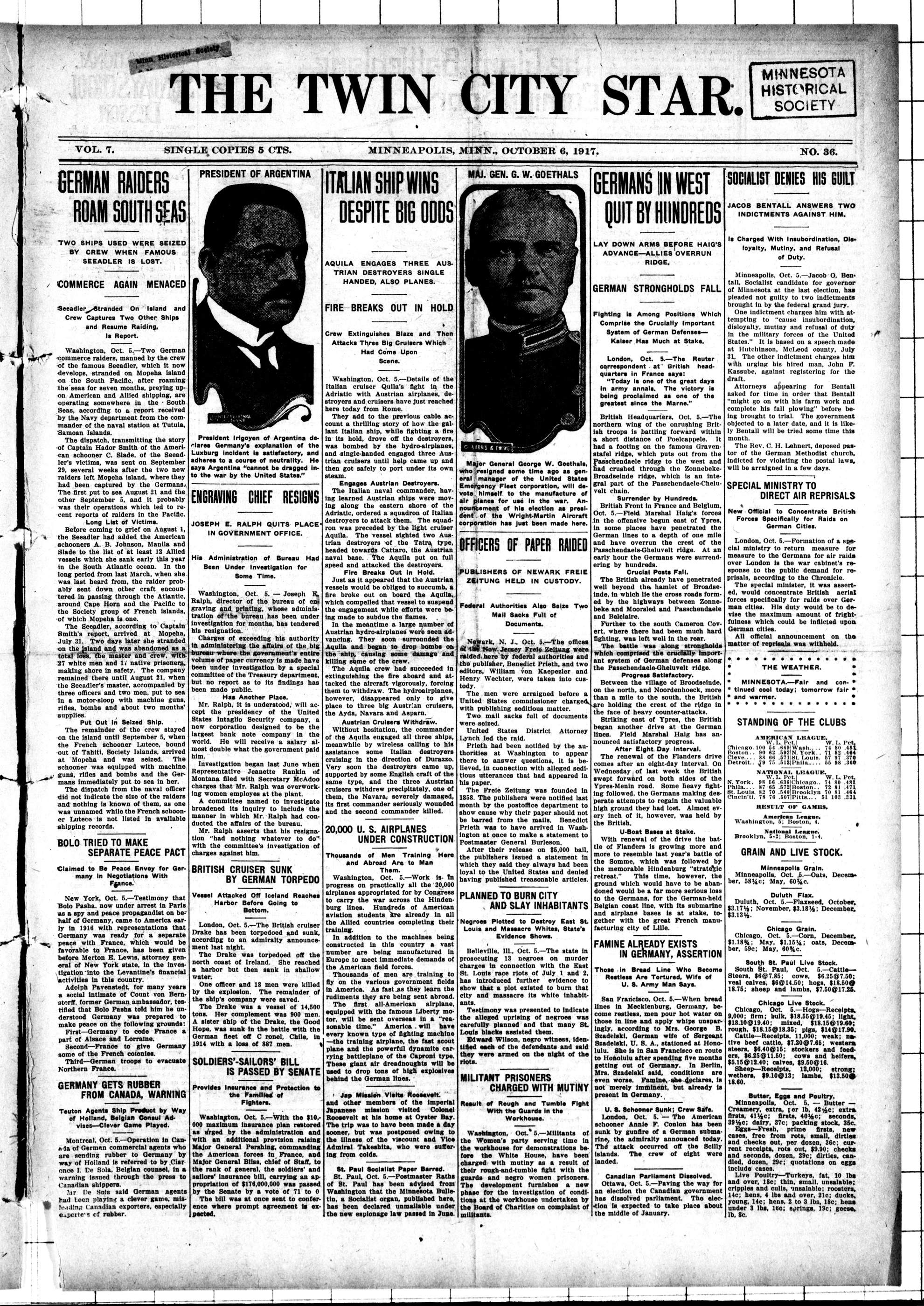
PRESIDENT OF ARGENTINA
DAN L. LEEKING
CITY OF LOS ANGELES
President Irigoyen of Argentina declares Germany's explanation of the Luxburg incident is satisfactory, and adheres to a course of neutrality. He says Argentina "cannot be dragged into the war by the United States."
ENGRAVING CHIEF RESIGNS
JOSEPH E. RALPH QUITS PLACE
IN GOVERNMENT OFFICE.
His Administration of Bureau Had Been Under Investigation for Some Time.
Washington, Oct. 5. — Joseph E. Ralph, director of the bureau of engraving and printing, whose administration of the bureau has been under investigation for months, has tendered his resignation.
Charges of exceeding his authority in administering the affairs of the big bureau where the government's entire volume of paper currency is made have been under investigation by a special committee of the Treasury department, but no report as to its findings has been made public.
Has Another Place.
Mr. Ralph, it is understood, will accept the presidency of the United States Intaglio Security company, a new corporation designed to be the largest bank note company in the world. He will receive a salary almost double what the government paid him.
Investigation began last June when Representative Jeanette Rankin of Montana filed with Secretary McAdoo charges that Mr. Ralph was overworking women employees at the plant.
A committee named to investigate broadened its inquiry to include the manner in which Mr. Ralph had conducted the affairs of the bureau.
Mr. Ralph asserts that his resignation "had nothing whatever to do" with the committee's investigation of charges against him.
BRITISH CRUISER SUNK BY GERMAN TORPEDO
Vessel Attacked Off Iceland Reaches Harbor Before Going to Bottom.
London, Oct. 5.—The British cruiser Drake has been torpedoed and sunk, according to an admiralty announcement last night.
The Drake was torpedoed off the north coast of Ireland. She reached a harbor but then sank in shallow water.
One officer and 18 men were killed by the explosion. The remainder of the ship's company were saved.
The Drake was a vessel of 14,500 tons. Her complement was 900 men.
A sister ship of the Drake, the Good Hope, was sunk in the battle with the German fleet off Cronel, Chile, in 1914 with a loss of 887 men.
SOLDIERS'-SAILORS' BILL IS PASSED BY SENATE
Provides Insurance and Protection to the Familied of Fighters.
Washington, Oct. 5.—With the $10,000 maximum insurance plan restored as urged by the administration and with an additional provision raising Major General Perching, commanding the American forces in France, and Major General Bliss, chief of Staff, to the rank of general, the soldiers' and sailors' insurance bill, carrying an appropriation of $176,000,000 was passed by the Senate by a vote of 71 to 0 The bill was at once sent to conference where prompt agreement is expected.
MINNEAPOLIS, MINN., OCTOBER 6, 1917.
ITALIAN SHIP WINS DESPITE BIG ODDS
AQUILA ENGAGES THREE AUSTRIAN DESTROYERS SINGLE HANDED, ALSO PLANES.
FIRE BREAKS OUT IN HOLD
Crew Extinguishes Blaze and Then Attacks Three Big Cruisers Which Had Come Upon
Washington, Oct. 5.—Details of the Italian cruiser Quilia's fight in the Adriatic with Austrian airplanes, destroyers and cruisers have just reached here today from Rome.
They add to the previous cable account a thrilling story of how the gallant Italian ship, while fighting a fire in its hold, drove off the destroyers, was bombed by the hydro-airplanes, and single-handed engaged three Austrian cruisers until help came up and then got safely to port under its own steam.
Engages Austrian Destroyers.
The Italian naval commander, having learned Austrian ships were moving along the eastern shore of the Adriatic, ordered a squadron of Italian destroyers to attack them. The squadron was preceded by the light cruiser Aquilla. The vessel sighted two Austrian destroyers of the Tatra type, headed towards Cattaro, the Austrian naval base. The Aquilla put on full speed and attacked the destroyers.
Fire Breaks Out in Hold.
Just as it appeared that the Austrian vessels would be obliged to succumb, a fire broke out on board the Aquilla, which compelled that vessel to suspend the engagement while efforts were being made to subdue the flames.
In the meantime a large number of Austrian hydro-airplanes were seen advancing. They soon surrounded the Aquila and began to drop bombs on the ship, causing some damage and killing some of the crew.
The Aquila crew had succeeded in extinguishing the fire aboard and attacked the aircraft vigorously, forcing them to withdraw. The hydroairplanes, however, disappeared only to give place to three big Austrian cruisers, the Ayda, Navara and Asparn.
Austrian Cruisers Withdraw.
Without hesitation, the commander of the Aquila engaged all three ships, meanwhile by wireless calling to his assistance some Italian destroyers cruising in the direction of Durazzo. Very soon the destroyers came up, supported by some English craft of the same type, and the three Austrian cruisers withdrew precipitately, one of them, the Navara, severely damaged, its first commander seriously wounded and the second commander killed.
20,000 U. S. AIRPLANES
UNDER CONSTRUCTION
Thousands of Men Training Here and Abroad Are to Man Them.
Washington, Oct. 5.—Work is in progress on practically all the 20,000 airplanes appropriated for by Congress to carry the war across the Hindenburg lines. Hundreds of American aviation students are already in all the Allied countries completing their training.
In addition to the machines being constructed in this country a vast number are being manufactured in Europe to meet immediate demands of the American field forces.
Thousands of men are training to fly on the various government fields in America. As fast as they learn the rudiments they are being sent abroad.
The first all-American airplane, equipped with the famous Liberty motor, will be overseas in a "reasonable time." America will have every known type of fighting machine—the training airplane, the fast scout plane and the powerful dynamite carrying battleplane of the Caproni type. These giant air dreadnoughts will be used to drop tons of high explosives behind the German lines.
Jap Mission Visits Roosevelt.
and other members of the imperial Japanese mission visited Colonel Roosevelt at his home at Oyster Bay. The trip was to have been made a day sooner, but was postponed owing to the illness of the viscount and Vice Admiral Takeshita, who were suffering from colds.
St. Paul Socialist Paper Barred.
St. Paul, Oct. 5.—Postmaster Raths of St. Paul has been advised from Washington that the Minnesota Bulletin, a Socialist organ, published here, has been declared unavailable under the new esplosion law passed in June.
MAJ. GEN. G. W. GOETHALS
C HARRIS & EWING
Major General George W. Goethals, who resigned some time ago as general manager of the United States Emergency Fleet corporation, will devote himself to the manufacture of air planes for use in the war. Announcement of his election as president of the Wright-Martin Aircraft corporation has just been made here.
OFFICERS OF PAPER RAIDED
PUBLISHERS OF NEWARK FREE
ZCITTUNG HELD IN CUSTODY.
Federal Authorities Also Seize Two Mail Sacks Full of Documents.
Newark, N. J., Oct. 5.—The offices of the New Jersey Freie Zeitung were raided here by federal authorities and the publisher, Benedict Prieth, and two editors, William von Kaepezler and Henry Wechter, were taken into custody.
The men were arraigned before a United States commissioner charged with publishing seditious matter.
Two mail sacks full of documents were seized.
United States District Attorney Lynch led the raid.
Prieth had been notified by the authorities at Washington to appear there to answer questions, it is believed, in connection with alleged seditious utterances that had appeared in his paper.
The Freie Zeitung was founded in 1858. The publishers were notified last month by the postoffice department to show cause why their paper should not be barred from the malis. Benedict Prieth was to have arrived in Washington at once to make a statement to Postmaster General Burleson.
After their release on $5,000 bail, the publishers issued a statement in which they said they always had been loyal to the United States and denied having published treasonable articles.
PLANNED TO BURN CITY AND SLAY INHABITANTS
Negroes Plotted to Destroy East St. Louis and Massacre Whites, State's Evidence Shows.
Belleville, Ill., Oct. 5.—The state in prosecuting 13 negroes on murder charges in connection with the East St. Louis race riots of July 1 and 2, has introduced further evidence to show that a plot existed to burn that city and massacre its white inhabitants.
Testimony was presented to indicate the alleged uprising of negroes was carefully planned and that many St. Louis blacks assisted them.
Edward Wilson, negro witness, identified each of the defendants and said they were armed on the night of the riots.
MILITANT PRISONERS CHARGED WITH MUTINY
Result of Rough and Tumble Fight With the Guards in the Workhouse.
Washington, Oct. 5.—Militants of the Women's party serving time in the workhouse for demonstrations before the White House, have been charged with mutiny as a result of their rough-and-tumble fight with the guards and negro women prisoners. The development furnishes a new phase for the investigation of conditions at the workhouse undertaken by the Board of Charities on complaint of militants.
GERMANS IN WEST QUIT BY HUNDREDS
GERMANS IN WEST QUIT BY HUNDREDS
LAY DOWN ARMS BEFORE HAIG'S ADVANCE—ALLIES OVERRUN RIDGE.
GERMAN STRONGHOLDS FALL
Fighting is Among Positions Which Comprise the Crucially Important System of German Defenses—Kaiser Has Much at Stake.
London, Oct. 5.—The Reuter correspondent at British headquarters in France says:
"Today is one of the great days in army annals. The victory is being proclaimed as one of the greatest since the Marne."
British Headquarters, Oct. 5.—The northern wing of the onrushing British troops is battling forward within a short distance of Poelcapple. It had a footing on the famous Gravenstafel ridge, which puts out from the Passchendaele ridge to the west and had crushed through the Zonnebeke Broadseinde ridge, which is an integral part of the Passchendaele-Cheluvelt chain.
Surrender by Hundreds.
British Front in France and Belgium, Oct. 5.—Field Marshal Haig's forces in the offensive begun east of Ypres, in some places have penetrated the German lines to a depth of one mile and have overrun the crest of the Passchendaels-Gheluvelt ridge. At an early hour the Germans were surrendering by hundreds.
Crucial Posts Fall.
The British already have penetrated well beyond the hamlet of Broadseinde, in which lie the cross roads formed by the highways between Zonnebeke and Moorsled and Passchendaele and Belclaire.
Further to the south Cameron Covert, where there had been much hard fighting, was left well in the rear.
The battle was along strongholds which comprised the crucially important system of German defenses along the Passchendaele-Gheluvelt ridge.
Progress Satisfactory.
Between the village of Broodseinde, on the north, and Noordenhoeck, more than a mile to the south, the British are holding the crest of the ridge in the face of heavy counter-attacks.
Striking east of Ypres, the British began another drive at the German lines. Field Marshal Halg has announced satisfactory progress.
After Eight Day Interval.
The renewal of the Flanders drive comes after an eight-day interval. On Wednesday of last week the British swept forward on both sides of the Ypres-Menln road. Some heavy fighting followed, the Germans making desperate attempts to regain the valuable high ground they had lost. Almost every inch of it, however, was held by the British.
U-Boat Bases at Stake.
With renewal of the drive the battle of Flanders is growing more and more to resemble last year's battle of the Somme, which was followed by the memorable Hindenburg "strategic retreat." This time, however, the ground which would have to be abandoned would be a far more serious loss to the Germans, for the German-held Belgian coast line, with its submarine and airplane bases is at stake, together with the great French manufacturing city of Lille.
FAMINE ALREADY EXISTS IN GERMANY, ASSERTION
Those in Bread Line Who Become Restless Are Tortured, Wife of U. S. Army Man Says.
San Francisco, Oct. 5.—When bread lines in Mecklenburg, Germany, become restless, men pour hot water on those in line and apply whips unsparingly, according to Mrs. George B. Szadelski, German wife of Sergeant Szadelski, U. S. A., stationed at Honolulu. She is in San Francisco en route to Honolulu after spending five months getting out of Germany. In Berlin, Mrs. Szadelski said, conditions are even worse. Famine, she declares, is not merely imminent, but already is present in Germany.
U. 8. Schooner Bunk; Crew Safe
London, Oct. 5. — The American schooner Annie F. Conlon has been sunk by gunfire of a German submarine, the admiralty announced today. The attack occurred off the Scilly islands. The crew of eight were landed.
Canadian Parliament Dissolved.
Ottawa, Oct. 5. — Paving the way for an election the Canadian government has dissolved parliament. The election is expected to take place about the middle of January.
MINNESOTA
HISTORICAL
SOCIETY
NO. 86.
NO. 36.
SOCIALIST DENIES HIS GUILT
JACOB BENTALL ANSWERS TWO
INDICTMENTS AGAINST HIM.
Is Charged With Insubordination, Disloyalty, Mutiny, and Refusal of Duty.
Minneapolis, Oct. 5.—Jacob O. Bentall, Socialist candidate for governor of Minnesota at the last election, has pleaded not guilty to two indictments brought in by the federal grand jury.
One indictment charges him with attempting to "cause Insubordination, disloyalty, mutiny and refusal of duty in the military forces of the United States." It is based on a speech made at Hutchinson, McLeod county, July 31. The other indictment charges him with urging his hired man, John F. Kassube, against registering for the draft.
Attorneys appearing for Bentall asked for time in order that Bentall "might go on with his farm work and complete his fall plowing" before being brought to trial. The government objected to a later date, and it is likely Bentall will be tried some time this month.
The Rev. C. H. Lehnert, deposed pastor of the German Methodist church, indicted for violating the postal laws, will be arraigned in a few days.
SPECIAL MINISTRY TO DIRECT AIR REPRISALS
New Official to Concentrate British Forces Specifically for Raids on German Cities.
London, Oct. 5.—Formation of a special ministry to return measure for measure to the Germans for air raids over London is the war cabinet's response to the public demand for reprisals, according to the Chronicle.
The special minister, it was asserted, would concentrate British aerial forces specifically for raids over German cities. His duty would be to devise the maximum amount of frightfulness which could be inflicted upon German cities.
All official announcement on the matter of reprisals was withheld.
* MINNESOTA—Fair and con-
* tinned cool today; tomorrow fair
* and warmer.
STANDING OF THE CLUBS
AMERICAN LEAGUE.
W. L. Pct.1
Chicago.100 54.649)Wash... 74 80.481
Boston... 90 62.592)N. York... 87 42.884
Clave... 80 62.592)N. Louis... 87 42.884
Detroit... 79 75.513)Phila... 55 98.360
NATIONAL LEAGUE.
W. L. Pct.1
N. York... 98 56.636)Chicago... 74 80.481
Phila... 82 65.572)Boston... 72 81.471
St. Louis. 82 70.540)Brooklyn 70.81 464
Cincinnati.78 70.507)Pitts... 51 103.331
RESULT OF GAMES.
American League.
Washington, 6; Boston, 4.
National League.
Brooklyn, 5-2; Boston, 1-4.
GRAIN AND LIVE STOCK.
Minneapolis Grain.
Minneapolis, Oct. 5.—Oats, December, 58½c; May, 60½c.
Duluth Flax.
Duluth, Oct. 5.—Flaxseed, October, $3.17½; November, $3.18½; December, $3.13½.
Chicago Grain.
Chicago, Oct. 5.—Corn, December, $1.18½; May, $1.15½; oats, December, 59c; May, 60½c.
South St. Paul Live Stock.
South St. Paul, Oct. 5.—Cattle—Steers, $6@7.85; cows, $6.25@7.50; veal calves, $6@14.50; hogs, $18.50@18.75; sheep and lambs, $7.50@17.25.
Chicago Live Stock.
Chicago, Oct. 5—Hogs—Receipts
9,000; firm; bulk, $18.15@19.45; light,
$18.10@19.40; mixed, $18.15@19.60;
rough, $18.15@18.35; pigs, $14@17.90;
Cattle—Receipts, 11,000; weak; na-
tive beef cattle, $7.20@7.65; western
steers, $6.40@15; stockers and feeders,
$6.25@11.50; cows and heifers,
$5.15@12.40; calves, $9.50@16.
Sheep—Receipts, 12,000; strong;
wethers, $9.10@13; lambs, $13.50@
18.60.
Minneapolis, Oct. 5. — Butter — Creamery, extra, per lb, 42½c; extra firsts, 41½c; firsts, 40½c; seconds, 39½c; dairy, 37c; packing stock, 35c. Eggs—Fresh, prime firsts, new cases, free from rots, small, dirties and checks out, per dozen, 36c; current receipts, rots out, $9.90; checks and seconds, dozen, 29c; dirties, candied, dozen, 29c; quotations on eggs include cases.
Live Poultry—Turkeys, fat, 10 lbs and over, 18c; thin, small, unsalable; cripples and culls, unsalable; roosters, 14c; hens, 4 lbs and over, 21c; ducks, young, 14c; hens, 2 to 3 lbs, 18c; hens under 3 lbs, 16c; springs, 19c; geese, lb, 8c.
Finding
Her Job
By George Haskell
"Nothing doing," said Ann Hubbell. "I don't suppose there ever will be anything doing with me, except dishwashing and making over old clothes." Ann was a woman over thirty, not pretty, but healthy and wholesome, with clear gray eyes, a large mouth, too-high cheek bones and plenty of shining, light-brown hair. She looked capable and courageous, but little sad, disappointed lines were creeping into her face when she was not smiling. Ann had moments when she would have liked to throw all the dishes out of the window and take an ax to the sewing machine. Probably other women have had the same moments, but all of them have not kept on repressing this inclination for 15 years. Partially aroused by Ann's desperate tone, Mrs. Sweet stopped counting the stitches in her knitting and looked up in a surprised, bewildered way.
"There are lots of worse things than dish-washing," was the trite, oracular reply.
"Yes," assented Ann; "I suppose having no food to soil the dishes might be worse. It isn't because I want to shirk and be idle. It's because I want to do something else, something of more account."
Mrs. Sweet looked with a mixture of curiosity and intolerance at Ann and asked: "What do you want to do?"
"Id like to paint, use beautiful colors—"
"My land!" broke in the other woman; "there ain't any money in that!"
"No," said Ann, "that's just it! And worse luck, it takes money to learn, before you can earn anything. Then, too, I've always wanted to plan beat-
W. P. Kars.
Paused Before a Florist's Window.
tiful rooms with beautiful furniture,
and lovely colors in the walls and
hangings."
"I wouldn't have those heavy curtains and 'porchers' in my house, just catching dust!" Mrs. Sweet broke in emphatically.
Ann ignored the interruption, being too full of her subject to halt there.
too full of her subject to halt there.
"I've got to look at the awful things in this house, and go on standing it, because I can't afford to buy anything else. I've got to make overalls and children's rompers because there's just enough in it to buy my food and shelter. Now, what's the use of spending your life doing something you hate, just to keep your life going?"
This question being so far beyond Mrs. Sweet's comprehension that an extra stitch was of vastly more importance, she gave all her attention to her knitting, and Ann, exploding her pent-up mental gases, went on:
"I tell you, I've got to the point where I'm sick of it all. Why can't I do something that will earn enough to pay people to do the things I hate to do?"
"Well, just as I say, there ain't any money in painting pictures," answered Mrs. Sweet, with the virtuous motive of putting any such frivolous intentions out of the other woman's head.
"Oh, there isn't any money in doing anything you want to do!" retorted Ann desperately.
"Oh, I don't know. There's old Flack, the blacksmith. He says he ain't happy unless he's hammering iron or putting on a horseshoe. And he told Joe his folks were set on his being a doctor, and he just broke away, and found his job."
After Mrs. Sweet went away her last words kept ringing in Ann's ears. "He just broke away and found his job." Unwittingly the woman had given her the text for a sermon she must preach to herself. It was perhaps more of a stimulant than much understanding sympathy might have been. Ann began her sermon to herself, and did not spare her congregation. If she wished to do something she liked, why not start out and try to make ever so small a beginning? She went out walking through the streets of the small town, with no definite plans as to where or how she
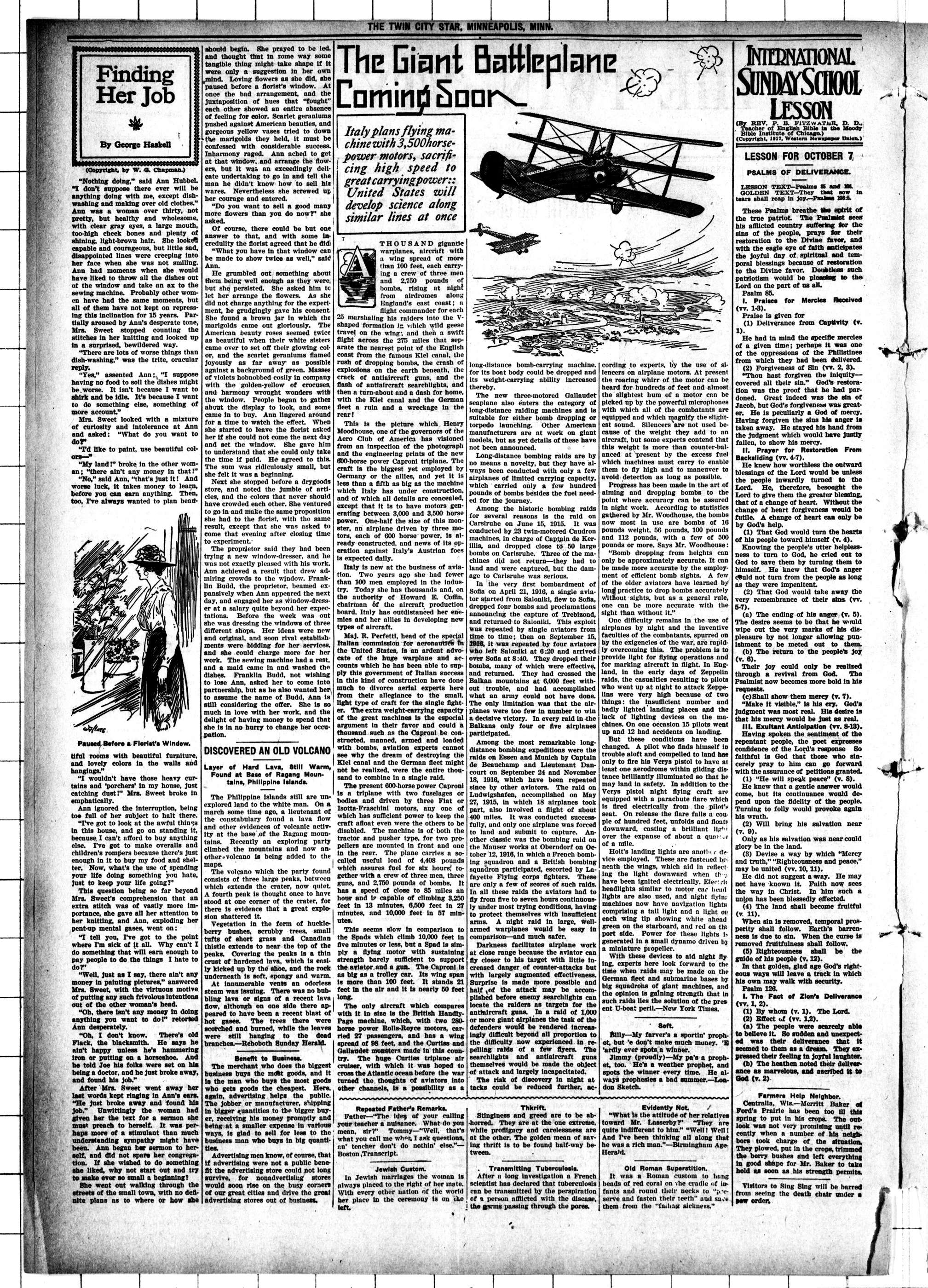
The Giant Battleplane Coming Soon
Italy plans flying machine with 3,500horsepower motors, sacrificing high speed to greatcarryingpower United States will develop science along similar lines at once
THOUSAND gigantic warplanes, aircraft with a wing spread of more than 100 feet, each carrying a crew of three men and 2,750 pounds of bombs, rising at night from airdromes along England's east coast; a flight commander for each 25 marshalling his raiders into the V-shaped formation in which wild geese travel on the wing; and then a swift flight across the 275 miles that separate the nearest point of the English coast from the famous Kiel canal, the rush of dropping bombs, the crash of explosions on the earth beneath, the crack of antiaircraft guns, and the flash of antiaircraft searchlights, and then a turn-about and a dash for home, with the Kiel canal and the German fleet a ruin and a wreckage in the rear!
This is the picture which Henry Moodhouse, one of the governors of the Aero Club of America has visioned from an inspection of the photograph and the engineering prints of the new 600-horse power Caproni triplane. The craft is the biggest yet employed by Germany or the allies, and yet it is less than a fifth as big as the machine which Italy has under construction, and of which all details are concealed, except that it is to have motors generating between 3,000 and 3,500 horse power. One-half the size of this monster, an airplane driven by three motors, each of 600 horse power, is already constructed, and news of its operation against Italy's Austrian foes is expected daily.
Italy is new at the business of aviation. Two years ago she had fewer than 100 men employed in the industry. Today she has thousands and, on the authority of Howard E. Coffin, chairman of the aircraft production board, Italy has outdistanced her enemies and her allies in developing new types of aircraft.
Maj. R. Perfetti, head of the special Italian commission for aeronautics in the United States, is an ardent advocate of the huge warplane and accounts which he has been able to supply this government of Italian success in this kind of construction have done much to divorce aerial experts here from their allegiance to the small, light type of craft for the single fighter. The extra weight-carrying capacity of the great machines is the especial argument in their favor and could a thousand such as the Caproni be constructed, manned, armed and loaded with bombs, aviation experts cannot see why the dream of destroying the Kiel canal and the German fleet might not be realized, were the entire thousand to combine in a single raid.
The present 600-horse power Caproni is a triplane with two fuselages or bodies and driven by three Flat or Isotta-Fraschini motors, any one of which has sufficient power to keep the craft afloat even were the others to be disabled. The machine is of both the tractor and pusher type, for two propellers are mounted in front and one in the rear. The plane carries a so-called useful load of 4,408 pounds which assures fuel for six hours! together with a crew of three men, three guns, and 2,750 pounds of bombs. It has a speed of close to 85 miles an hour and is capable of climbing 3,250 feet in 13 minutes, 6,500 feet in 27 minutes, and 10,000 feet in 57 minutes.
This seems slow in comparison to the Spads which climb 10,000 feet in five minutes or less, but a Spad is simply a flying motor with sustaining strength barely sufficient to support the aviator and a gun. The Caproni is as big as a trolley car. Its wing span is more than 100 feet. It stands 21 feet in the air and it is nearly 50 feet long.
The only aircraft which compares with it in size is the British Handy-Page machine, which, with two 280-horse power Rolls-Royce motors, carried 27 passengers, and has a wing spread of 98 feet, and the Curtiss and Gallaudet monsters made in this country. The huge Curtiss triplane air cruiser, with which it was hoped to cross the Atlantic ocean before the war turned the thoughts of aviators into other channels, is a possibility as a
Father—"The idee of your calling your teacher a nuisance. What do you mean, str?" Tommy—"Well, that's what you call me when. I ask questions, an' teacher don't do nothin' else."—Boston Transcript.
In Jewish marriages the woman is always placed to the right of her mate. With every other nation of the world her place in the ceremony is on the left.
should begin. She prayed to be led, and thought that in some way some tangible thing might take shape if it were only a suggestion in her own mind. Loving flowers as she did, she paused before a florist's window. At once the bad arrangement, and the juxtaposition of hues that "fought" each other showed an entire absence of feeling for color. Scarlet geraniums pushed against American beauties, and gorgeous yellow vases tried to down the marigolds they held, it must be confessed with considerable success. Inharmony raged. Annached to get at that window, and arrange the flowers, but it was an exceedingly delicate undertaking to go in and tell the man he didn't know how to sell his wares. Nevertheless she screwed up her courage and entered.
"Do you want to sell a good many more flowers than you do now?" she asked.
Of course, there could be but one answer to that, and with some incredulity the florist agreed that he did "What you have in that window can be made to show twice as well," said Ann.
He grumbled out something about them being well enough as they were, but she persisted. She asked him to let her arrange the flowers. As she did not charge anything for the experiment, he grudgingly gave his consent. She found a brown jar in which the marigolds came out gloriously. The American beauty roses seemed twice as beautiful when their white sisters came over to set off their glowing color, and the scarlet geraniums flamed joyously as far away as possible against a background of green. Masses of violets hobnobbed costly in company with the golden-yellow of crocuses, and harmony wrought wonders with the window. People began to gather about the display to look, and some came in to buy. Ann lingered around for a time to watch the effect. When she started to leave the florist asked her if she could not come the next day and set the window. She gave him to understand that she could only take the time if paid. He agreed to this. The sum was ridiculously small, but she felt it was a beginning.
Next she stopped before a drygoods store, and noted the jumble of articles, and the colors that never should have crowded each other. She ventured to go in and make the same proposition she had to the florist, with the same result, except that she was asked to come that evening after closing time to experiment.
The propietor said they had been trying a new window-dresser, and he was not exactly pleased with his work. Ann achieved a result that drew admiring crowds to the window. Franklin Budd, the propietor, beamed expansively when Ann appeared the next day, and engaged her as window-dresser at a salary quite beyond her expectations. Before the week was out she was dressing the windows of three different shops. Her ideas were new and original, and soon rival establishments were bidding for her services, and she could charge more for her work. The sewing machine had a rest, and a maid came in and washed the dishes. Franklin Budd, not wishing to lose Ann, asked her to come into partnership, but as he also wanted her to assume the name of Budd, Ann is still considering the offer. She is so much in love with her work, and the delight of having money to spend that she is in no hurry to change her occupation.
DISCOVERED AN OLD VOLCANO
Layer of Hard Lava, Still Warm, Found at Base of Ragang Mountains, Philippine Islands.
The Phillipine islands still are unexplored land to the white man. On a march some time ago, a lieutenant of the constabulary found a lava flow and other evidences of volcanic activity at the base of the Ragang mountains. Recently an exploring party climbed the mountains and now another volcano is being added to the maps. The volcano which the party found consists of three large peaks, between which extends the crater, now quiet. A fourth peak is thought once to have stood at one corner of the crater, for there is evidence that a great explosion shattered it.
Vegetation in the form of huckleberry bushes, scrubby trees, small tufts of short grass and Canadian thistle extends to near the top of the peaks. Covering the peaks is a thin crust of hardened lava, which is easily kicked up by the shoe, and the rock underneath is soft, spongy and warm. At innumerable vents an odorless steam was issuing. There was no bubbling lava or signs of a recent lava flow, although on one side there appeared to have been a recent blast of hot gases. The trees there were scorched and burned, while the leaves were still hanging to the dead branches. -Rehoboth Sunday Herald.
Benefit to Business
The merchant who does the biggest business buys the most goods, and it is the man who buys the most goods who gets goods the cheapest. Here, again, advertising helps the public. The jobber or manufacturer, shipping in bigger quantities to the bigger buyer, receiving his money promptly and being at a smaller expense in various ways, is glad to sell for less to the business man who buys in big quantities. Advertising men know, of course, that if advertising were not a public benefit the advertising store could not long survive, for nonadvertising stores would soon rise on the busy corners of our great cities and drive the great advertising stores out of business.
THOUSAND gigante warplanes, aircraft with a wing spread of more than 100 feet, each carrying a crew of three men and 2,750 pounds of bombs, rising at night from airdromes along England's east coast; a flight commander for each
Repeated Father's Remarks
Jewish Custom.
AIRCRAFT
long-distance bomb-carrying machine. for its boat body could be dropped and its weight-carrying ability increased thereby. The new three-motored Gallaudet seaplanet also enters the category of long-distance raiding machines and is suitable for either bomb dropping or torpedo launching. Other American manufacturers are at work on giant models, but as yet details of these have not been announced. Long-distance bombing raids are by no means a novelty, but they have always been conducted with only a few airplanes of limited carrying capacity, which carried only a few hundred pounds of bombs besides the fuel needed for the journey.
Among the historic bombing raids for several reasons is the raid on Carlsruhe on June 15, 1915. It was conducted by 23 twin-motored Caudron machines, in charge of Captain de Kertilis, and dropped close to 50 large bombs on Carlsruhe. Three of the machines did not return—they had to land and were captured, but the damage to Carlsruhe was serious.
In the very first bombardment of Sofia on April 21, 1916, a single aviator started from Saloniki, flew to Sofia, dropped four bombs and proclamations announcing the capture of Trebizond, and returned to Saloniki. This exploit was repeated by single aviators from time to time; then on September 15, 1916, it was repeated by four aviators who left Saloniki at 6:20 and arrived over Sofia at 8:40. They dropped their bombs, many of which were effective, and returned. They had crossed the Balkan mountains at 6,000 feet without trouble, and had accomplished what an army could not have done. The only limitation was that the airplanes were too few in number to win a decisive victory. In every raid in the Balkans only four or five airplanes participated.
Among the most remarkable long-distance bombing expeditions were the raids on Essen and Munich by Captain de Beauchamp and Lieutenant Dancourt on September 24 and November 18, 1916, which have been repeated since by other aviators. The raid on Ludwigshafen, accomplished on May 27, 1915, in which 18 airplanes took part, also involved a flight of about 400 miles. It was conducted successfully, and only one airplane was forced to land and submit to capture. Another classic was the bombing raid on the Mauser works at Oberndorf on October 12, 1916, in which a French bombing squadron and a British bombing squadron participated, escorted by Lafayette Flying corps fighters. These are only a few of scores of such raids. In all these raids the aviators had to fly from five to seven hours continuously under most trying conditions, having to protect themselves with insufficient arms. A night raid in large, well-armed warplanes would be easy in comparison—and much safer.
Darkness facilitates airplane work at close range because the aviator can fly closer to his target with little increased danger of counter-attacks but with largely augmented effectiveness. Surprise is made more possible and half of the attack may be accomplished before enemy searchlights can locate the raiders as targets for the antilcraft guns. In a raid of 1,000 or more giant airplanes the task of the defenders would be rendered increasingly difficult beyond all proportion to the difficulty now experienced in repelling raids of a few flyers. The searchlights and antilcraft guns themselves would be made the object of attack and largely incapacitated. The risk of discovery in night atacks could be reduced further, ac
Stinginess and greed are to be abhorred. They are at the one extreme, while profligacy and carelessness are at the other. The golden mean of saving thrift is to be found half-way between.
Transmitting Tuberculosis.
After a long investigation a French scientist has declared that tuberculosis can be transmitted by the perspiration of a person afflicted with the disease, the germs passing through the pores.
cording to experts, by the use of silencers on airplane motors. At present the roaring whirr of the motor can be heard for hundreds of feet and almost the slightest hum of a motor can be picked up by the powerful microphones with which all of the combatants are equipped and which magnify the slightest sound. Silencers are not used because of the weight they add to an aircraft, but some experts contend that this weight is more than counter-balanced at present by the excess fuel which machines must carry to enable them to fly high and to maneuver to avoid detection as long as possible.
Progress has been made in the art of alming and dropping bombs to the point where accuracy can be assured in night work. According to statistics gathered by Mr. Woodhouse, the bombs now most in use are bombs of 16 pounds weight, 56 pounds, 100 pounds and 112 pounds, with a few of 500 pounds or more. Says Mr. Woodhouse: "Bomb dropping from heights can only be approximately accurate. It can be made more accurate by the employment of efficient bomb sights. A few of the older aviators have learned by long practice to drop bombs accurately without sights, but as a general rule, one can be more accurate with the sight than without it."
One difficulty remains in the use of airplanes by night and the inventive faculties of the combatants, spurred on by the exigencies of the war, are rapidly overcoming this. The problem is to provide light for flying operations and for marking aircraft in flight. In England, in the early days of Zeppelin raids, the casualties resulting to pilots who went up at night to attack Zeppellins were very high because of two things: the insufficient number and badly lighted landing places and the lack of lighting devices on the machines. On one occasion 15 pilots went up and 12 had accidents on landing.
But these conditions have been changed. A pilot who finds himself in trouble aloft and compelled to land has only to fire his Verys pistol to have at least one aerodrome within gliding distance brilliantly illuminated so that he may land in safety. In addition to the Verys pistol night flying craft are equipped with a parachute flare which is fired electrically from the pilot's seat. On release the flare falls a couple of hundred feet, unfolds and floats downward, casting a brilliant light over the expanse of about a quarter of a mile.
Holt's landing lights are another device employed. These are fastened beneath the wings, which aid in reflecting the light downward when they have been ignited electrically. Electric headlights similar to motor car head lights are also used, and night flying machines now have navigation lights comprising a tall light and a light on each wing tip showing white ahead green on the starboard, and red on the port side. Power for these lights is generated in a small dynamo driven by a miniature propeller.
With these devices to aid night flying, experts here look forward to the time when raids may be made on the German fleet and submarine bases by big squadrons of giant machines, and the opinion is gaining strength that in such raids lies the solution of the pressent U-boat peril—New York Times.
Soft.
Billy—My farver's a sportin' prophet, but 'e don't make much money. 'E ardly ever spots a winner.
Jimmy (proudly)—My pa's a prophet, too. He's a weather prophet, and spots the winner every time. He always prophesies a bad summer.—London Sketch.
"What is the attitude of her relatives toward Mr. Lasserby?" "They are quite indifferent to him." "Well! Well! And I've been thinking all along that he was a rich man."—Birmingham Age Herald.
Old Roman Superstition.
It was a Roman custom to hang bends of red coral on the cradle of infants and round their necks to "preserve and fasten their teeth" and save them from the "failing sickness."
INTERNATIONAL
SUNDAY SCHOOL
LESSON
(By REV. P. B. FITZWATR. D. D.
Teacher of English in the Moody
Bible Institute of Chicago)
(Copyright, 1917, Western Newspaper Union.)
PSALMS OF DELIVERANCE.
LESSON TEXT-Psalms 85 and 86.
GOLDEN TEXT-They that sow in tears shall reap in joy-Psalms 128.5.
These Psalms breathe the spirit of the true patriot. The Psalmsist sees his afflicted country suffering for the sins of the people, prays for their restoration to the Divine favor, and with the eagle eye of faith anticipates the joyful day of spiritual and temporal blessings because of restoration to the Divine favor. Doubts such patriotism would be pleasing to the Lord on the part of us all.
Psalm 85.
I. Praises for Mercies Received (vv. 1-3).
Praise is given for
(1) Deliverance from Captivity (v. 1).
He had in mind the specific mercles of a given time; perhaps it was one of the oppressions of the Philistines from which they had been delivered. (2) Forgiveness of Sin (vv. 2, 3). "Thou hast forgiven the inquity—covered all their sin." God's restoration was the proof that he had pardoned. Great indeed was the sin of Jacob, but God's forgiveness was greater. He is peculiarly a God of mercy. Having forgiven the sin his anger is taken away. He stayed his hand from the judgment which would have justly fallen, to show his mercy. II. Prayer for Restoration From Backaliding (vy. 4-7).
He knew how worthless the outward blessings of the Lord would be unless the people inwardly turned to the Lord. He, therefore, besought the Lord to give them the greater blessing, that of a change of heart. Without the change of heart forgiveness would be futile. A change of heart can only be by God's help.
(1) That God would turn the hearts of his people toward himself (v. 4).
Knowing the people's utter helplessness to turn to God, he cried out to God to save them by turning them to himself. He knew that God's anger could not turn from the people as long as they were impenitent.
(2) That God would take away the very remembrance of their sins (vv. 5-7).
(a) The ending of his anger (v. 5). The desire seems to be that he would wipe out the very marks of his displeasure by not longer allowing punishment to be meted out to them.
(b) The return to the people's joy (v. 6).
Their joy could only be realized through a revival from God. The Psalmist now becomes more bold in his requests.
(c) Shall show them mercy (v. 7). "Make it visible," is his cry. God's judgment was most real. His desire is that his mercy would be just as real.
III. Exultant Anticipation (vv. 8-13). Having spoken the sentiment of the repentant people, the poet expresses confidence of the Lord's response. So faithful is God that those who sincerely pray to him can go forward with the assurance of petitions granted.
(1) He will speak peace (v. 8).
He knew that a gentle answer would come, but its continuance would depend upon the fidelity of the people. Turning to folly would provoke again his wrath. (2) Will bring his salvation near (v. 9).
Only as his salvation was near could glory be in the land.
(3) Devise a way by which "Mercy and truth." "Righteousness and peace," may be united (vv. 10, 11).
He did not suggest a way. He may not have known it. Faith now sees the way in Christ. In him such a union has been blessedly effected.
(4) The land shall become fruitful (v. 11).
When sin is removed, temporal prosperity shall follow. Earth's barrenness is due to sin. When the curse is removed fruitfulness shall follow.
(5) Righteousness shall be the guide of his people (v. 12).
In that golden, glad age God's righteous ways will leave a track in which his own may walk with security.
Psalm 126.
I. The Fact of Zlon's Deliverance (vv. 1, 2).
(1) By whom (v. 1). The Lord.
(2) Effect of (vv. 1,2).
(a) The people were scarcely able to believe it. So sudden and unexpected was their deliverance that it seemed to them as a dream. They expressed their feeling in joyful laughter.
(b) The heathen noted their deliverance as marvelous, and ascribed it to God (v. 2).
Farmers Help Neighbor
Centralia, Wis.-Merritt Baker of Ford's Prairie has been too ill this spring to put in his crops. The outlook was not very promising until recently when a number of his neighbors took charge of the situation. They plowed, put in the crops, trimmed the berry bushes and left everything in good shape for Mr. Baker to take hold as soon as his strength permits.
Visitors to Sing Sing will be barred from seeing the death chair under a new order.
IN THE LIMELIGHT
HIS MILITARY FAME SECURE
M.
assuming, optimistic, with a slight touch of goodness and strength, he deserves a tude of Italy and the admiration of th BOOMED SALE C
assuming, optimistic, with a slight touch of humor, and a great reserve fund of goodness and strength, he deserves fully the love of his soldiers, the gratitude of Italy and the admiration of the world.
BOOMED SALE OF LIBERTY BONDS
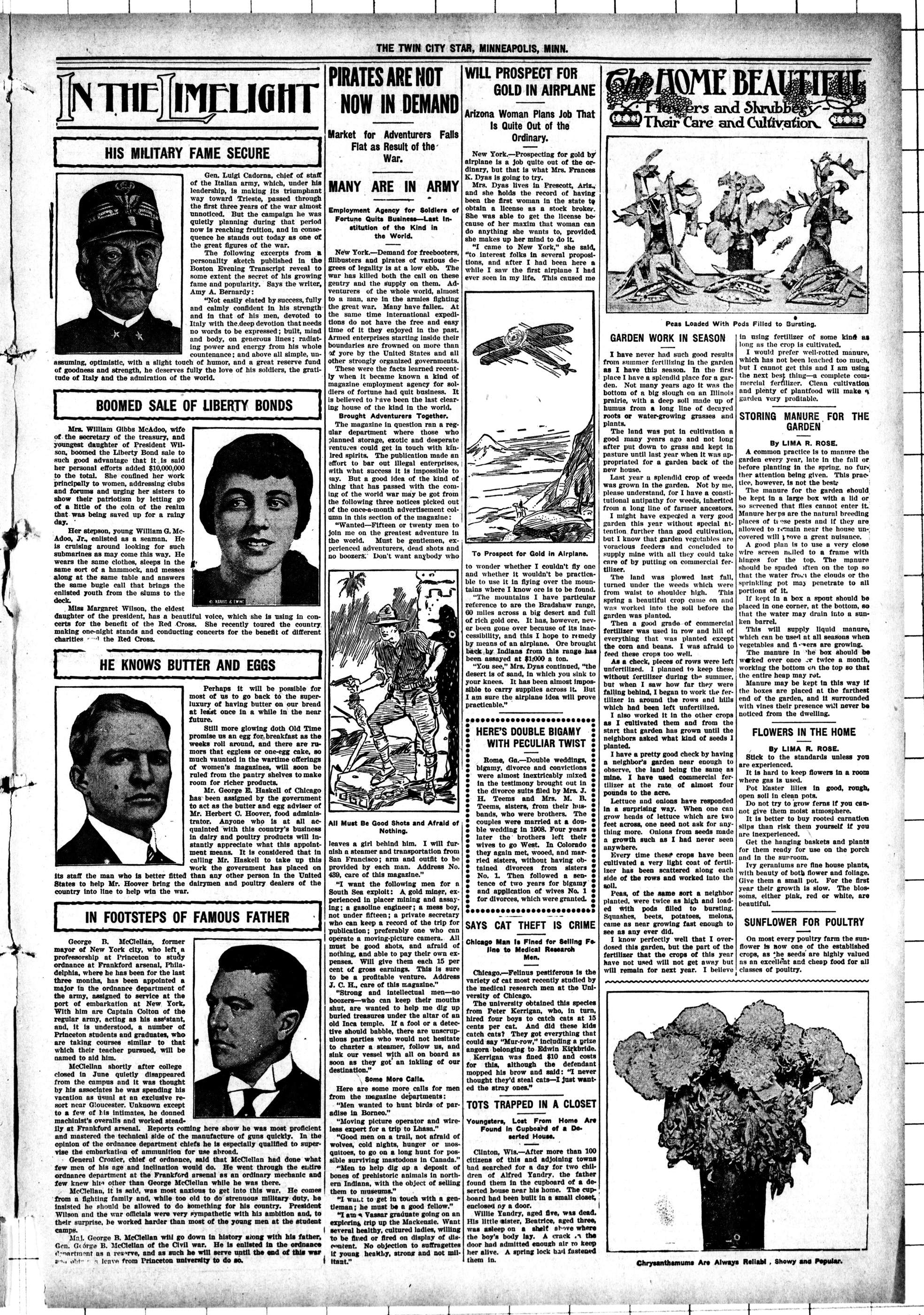
Mrs. William Gibbs McAdoo, wife of the secretary of the treasury, and youngest daughter of President Wilson, boomed the Liberty Bond sale to such good advantage that it is said her personal efforts added $10,000,000 to the total. She confined her work principally to women, addressing clubs and forums and urging her sisters to show their patriotism by letting go of a little of the coin of the realm that was being saved up for a rainy day.
Her stepson, young William G. McAdoo, Jr., enlisted as a seaman. He is cruising around looking for such submarines as may come this way. He wears the same clothes, sleeps in the same sort of a hammock, and messes along at the same table and answers the same bugle call that brings the enlisted youth from the slums to the deck.
Miss Margaret Wilson, the eldest
daughter of the president, has a beautiful voice, which she is using in concerts for the benefit of the Red Cross. She recently toured the country making one night stands and conducting concerts for the benefit of different charities and the Red Cross.
daughter of the president, has a bea certs for the benefit of the Red Cross making one-night stands and conductin charities and the Red Cross. HE KNOWS BUT
HE KNOWS BUTTER AND EGGS
PETER H.
its staff the man who is better fitted States to help Mr. Hoover bring the country into line to help win the war IN FOOTSTEPS OF
IN FOOTSTEPS OF FAMOUS FATHER
IN FOOTSTEPS OF FAMOUS FATHER
George B. McClellan, former mayor of New York city, who left a professorship at Princeton to study ordinance at Frankford arsenal, Philadelphia, where he has been for the last three months, has been appointed a major in the ordinance department of the army, assigned to service at the port of embarkation at New York. With him are Captain Colton of the regular army, acting as his assistant, and, it is understood, a number of Princeton students and graduates, who are taking courses similar to that which their teacher pursued, will be named to aid him.
McClellan shortly after college closed in June quietly disappeared from the campus and it was thought by his associates he was spending his vacation as usual at an exclusive resort near Gloucester. Unknown except to a few of his intimates, he denoted machinist's overalls and worked stead-
illy at Frankford arsenal. Reports con-
and mastered the technical side of the
opinion of the ordinance department chie-
vise the embarkation of ammunition to
General Crozier, chief of ordinance
few men of his age and inclination
ordinance department at the Frankford
few knew hire other than George McC
McCllan, it is said, was most an-
from a fighting family and, while too
insisted he should be allowed to do
Wilson and the war officials were very
their surprise, he worked harder than
camps.
Mul. George B. McCllan will go
gen. George B. McCllan of the Civil
department as a reserve, and as such
and oblige a leave from Princeton uni
lly at Frankford arsenal. Reports coming here show he was most proficient and mastered the technical side of the manufacture of guns quickly. In the opinion of the ordnance department chiefs he is especially qualified to supervise the embarkation of ammunition for use abroad.
General Crozier, chief of ordnance, said that McClellan had done what few men of his age and inclination would do. He went through the entire ordnance department at the Frankford arsenal as an ordinary mechanic and few knew his other than George McClellan while he was there.
McClellan, it is said, was most anxious to get into this war. He comes from a fighting family and, while too old to do strenuous military duty, he insisted he should be allowed to do something for his country. President Wilson and the war officials were very sympathetic with his ambition and, to their surprise, he worked harder than most of the young men at the student camps.
Mal. George B. McClellan will go down in history along with his father, Gen. George B. McClellan of the Civil war. He is enlisted in the ordnance department as a reserve, and as such he will serve until the end of this war and obtains a leave from Princeton university to do so.
Gen. Lulgi Cadorna, chief of staff of the Italian army, which, under his leadership, is making its triumphant way toward Trieste, passed through the first three years of the war almost unnoticed. But the campaign he was quietly planning during that period now is reaching fruition, and in consequence he stands out today as one of the great figures of the war.
The following excerpts from a personality sketch published in the Boston Evening Transcript reveal to some extent the secret of his growing fame and popularity. Says the writer, Amy A. Bernardy:
"Not easily elated by success, fully and calmly confident in his strength and in that of his men, devoted to Italy with the deep devotion that needs no words to be expressed; built, mind, and body, on generous lines; radiating power and energy from his whole countenance; and above all simple, un-
ch of humor, and a great reserve fund fully the love of his soldiers, the gratie world. OF LIBERTY BONDS
C. BARRIS & EWIN
tiful voice, which she is using in conoss. She recently toured the country. ng concerts for the benefit of different
LTER AND EGGS
Perhaps it will be possible for most of us to go back to the superluxury of having butter on our bread at least once in a while in the near future.
Still more glowing doth Old Time promise us an egg for breakfast as the weeks roll around, and there are rumors that eggless or one-egg cake, so much vaunted in the wartime offerings of women's magazines, will soon be ruled from the pantry shelves to make room for richer products.
Mr. George E. Haskell of Chicago has been assigned by the government to act as the butter and egg adviser of Mr. Herbert C. Hoover, food administrator. Anyone who is at all acquainted with this country's business in dairy and poultry products will instantly appreciate what this appointment means. It is considered that in calling Mr. Haskell to take up this work the government has placed on than any other person in the United dairymen and poultry dealers of the
FAMOUS FATHER
PETER H.
ning here show he was most proficient in the manufacture of guns quickly. In the beliefs he is especially qualified to superfor use abroad.
He said that McClellan had done what would do. He went through the entire arsenal as an ordinary mechanic and Clellan while he was there.
anxious to get into this war. He comes old to do strenuous military duty, he something for his country. President sympathetic with his ambition and, to most of the young men at the student down in history along with his father, war. He is enlisted in the ordnance he will serve until the end of this war versity to do so.
THE TWIN CITY STAR. MINNEAPOLIS. MINN.
PIRATES ARE NOT NOW IN DEMAND
Market for Adventurers Falls Flat as Result of the War.
Employment Agency for Soldiers of Fortune Quits Business—Last Institution of the Kind in the World.
New York.—Demand for freebooters, filibusters and pirates of various degrees of legality is at a low ebb. The war has killed both the call on these gentry and the supply on them. Adventurers of the whole world, almost to a man, are in the armies fighting the great war. Many have fallen. At the same time international expeditions do not have the free and easy time of it they enjoyed in the past. Armed enterprises starting inside their boundaries are frowned on more than of yore by the United States and all other strongly organized governments.
These were the facts learned recently when it became known a kind of magazine employment agency for soldiers of fortune had quit business. It is believed to have been the last clearing house of the kind in the world. Brought Adventurers Together.
The magazine in question ran a regular department where those who planned storage, exotic and desperate ventures could get in touch with kinked spirits. The publication made an effort to bar out illegal enterprises, with what success it is impossible to say. But a good idea of the kind of thing that has passed with the coming of the world war may be got from the following three notices picked out of the once-a-month advertisement column in this section of the magazine:
"Wanted—Fifteen or twenty men to join me on the greatest adventure in the world. Must be gentlemen, experienced adventurers, dead shots and no boozers. Don't want anybody who
A
All Must Be Good Shots and Afraid of Nothing.
All Must Be Good Shots and Afraid of Nothing.
leaves a girl behind him. I will furnish a steamer and transportation from San Francisco; arm and outfit to be provided by each man. Address No. 489, care of this magazine."
"I want the following men for a South Sea exploit: A gold miner, experienced in placer mining and assaying; a gasoline engineer; a mess boy, not under fifteen; a private secretary who can keep a record of the trip for publication; preferably one who can operate a moving-picture camera. All must be good shots, and afraid of nothing, and able to pay their own expenses. Will give them each 15 per cent of gross earnings. This is sure to be a profitable venture. Address J. C. H., care of this magazine."
"Strong and intellectual men—no boozez—who can keep their mouths shut, are wanted to help me dig up buried treasures under the altar of an old Inca temple. If a fool or a detective should babble, there are unscrupulous parties who would not hesitate to charter a steamer, follow us, and sink our vessel with all on board as soon as they got an inking of our destination."
Some More Calls.
Here are some more calls for men from the magazine departments:
"Men wanted to hunt birds of paradise in Borneo."
"Moving picture operator and wireless expert for a trip to Lhasa."
"Good men on a trail, not afraid of wolves, cold nights, hunger or mosquitoes, to go on a long hunt for possible surviving mastodons in Canada."
"Men to help dig up a deposit of bones of prehistoric animals in northern Indiana, with the object of selling them to museums."
"I want to get in touch with a gentleman; he must be a good fellow."
"I am a Vassar graduate going on an exploring trip up the Mackenzie. Want several healthy, cultured ladies, willing to be fused or fired on display of discontent. No objection to suffragettes if young healthy, strong and not militant."
New York.—Prospecting for gold by airplane is a job quite out of the ordinary, but that is what Mrs. Frances K. Dyas is going to try.
Mrs. Dyas lives in Prescott, Ariz., and she holds the record of having been the first woman in the state to obtain a license as a stock broker. She was able to get the license because of her maxim that woman can do anything she wants to, provided she makes up her mind to do it.
"I came to New York," she said, "to interest folks in several propositions, and after I had been here a while I saw the first airplane I had ever seen in my life. This caused me
A biplane flying over a mountainous landscape.
To Prospect for Gold in Airplane.
to wonder whether I couldn't fly one and whether it wouldn't be practicable to use it in flying over the mountains where I know ore is to be found.
"The mountains I have particular reference to are the Bradshaw range, 60 miles across a big desert and full of rich gold ore. It has, however, never been gone over because of its inaccessibility, and this I hope to remedy by means of an airplane. Ore brought back by Indians from this range has been assayed at $1,000 a ton.
"You see," Mrs. Dyas continued, "the desert is of sand, in which you sink to your knees. It has been almost impossible to carry supplies across it. But I am sure the airplane idea will prove practicable."
HERE'S DOUBLE BIGAMY
WITH PECULIAR TWIST
Rome, Ga.—Double weddings, bigamy, divorce and convictions were almost inextricably mixed in the testimony brought out in the divorce suits filed by Mrs. J. H. Teems and Mrs. M. B. Teems, sisters, from their husbands, who were brothers. The couples were married at a double wedding in 1908. Four years later the brothers left their wives to go West. In Colorado they again met, wooed, and married sisters, without having obtained divorces from sisters No. 1. Then followed a sentence of two years for bigamy and application of wives No. 1 for divorces, which were granted.
SAYS CAT THEFT IS CRIME
Chicago—Fellinus pestiferous is the variety of cat most recently studied by the medical research men at the University of Chicago.
The university obtained this species from Peter Kerrigan, who, in turn, hired four boys to catch cats at 15 cents per cat. And did these kids catch cats? They got everything that could say "Mur-row," including a prize angora belonging to Edwin Kirkbride.
Kerrigan was fined $10 and costs for this, although the defendant mopped his brow and said: "I never thought they'd steal cats—I just wanted the stray ones."
TOTS TRAPPED IN A CLOSET
Youngsters, Lost From Home Are Found in Cupboard of a Deserted House.
Clinton, Wis.—After more than 100 citizens of this and adjoining towns had searched for a day for two children of Alfred Yandry, the father found them in the cupboard of a deserted house near his home. The cupboard had been built in a small closet, enclosed by a door.
Willie Yandry, aged five, was dead. His little sister, Beatrice, aged three, was asleep on a shelf above where the boy's body lay. A crack in the door had admitted enough air to keep her alive. A spring lock had fastened them in.
The HOME BEAUTIFUL
Flowers and Shrubbery
Their Care and Cultivation
A
Peas Loaded With Pods Filled to Bursting.
GARDEN WORK IN SEASON
I have never had such good results from summer fertilizing in the garden as I have this season. In the first place I have a splendid place for a garden. Not many years ago it was the bottom of a big slough on an Illinois prairie, with a deep soil made up of humus from a long line of decayed roots or water-growing grasses and plants.
The land was put in cultivation a good many years ago and not long after put down to grass and kept in pasture until last year when it was appropriated for a garden back of the new house.
Last year a splendid crop of weeds was grown in the garden. Not by me, please understand, for I have a constitutional antipathy for weeds, inherited from a long line of farmer ancestors.
I might have expected a very good garden this year without special attention further than good cultivation, but I know that garden vegetables are voracious feeders and concluded to supply mine with all they could take care of by putting on commercial fertilizer. The land was plowed last fall, turned under the weeds which were from waist to shoulder high. This spring a beautiful crop came on and was worked into the soil before the garden was planted. Then a good grade of commercial fertilizer was used in row and hill of everything that was planted except the corn and beans. I was afraid to feed these crops too well.
As a check, pieces of rows were left unfertilized. I planned to keep these without fertilizer during the summer, but when I saw how far they were falling behind, I began to work the fertilizer in around the rows and hills which had been left unfertilized. I also worked it in the other crops as I cultivated them and from the start that garden has grown until the neighbors asked what kind of seeds I planted. I have a pretty good check by having a neighbor's garden near enough to observe, the land being the same as mine. I have used commercial fertilizer at the rate of almost four pounds to the acre.
Lettuce and onions have responded in a surprising way. When one can grow hends of lettuce which are two feet across, one need not ask for anything more. Onions from seeds made a growth such as I had never seen anywhere.
Every time these crops have been cultivated a very light coat of fertilizer has been scattered along each side of the rows and worked into the soil.
Peas, of the same sort a neighbor planted, were twice as high and loaded with pods filled to bursting. Squashes, beets, potatoes, melons, came as near growing fast enough to see as any ever did.
I know perfectly well that I overdosed this garden, but the part of the fertilizer that the crops of this year have not used will not get away but will remain for next year. I believe
THE BROCCOLI
Chrysanthemums Are Always Reliable, Showy and Popular.
in using fertilizer of some kind as long as the crop is cultivated. I would prefer well-rotted manure, which has not been leached too much, but I cannot get this and I am using the next best thing—a complete commercial fertilizer. Clean cultivation and plenty of plantfood will make garden very profitable.
STORING MANURE FOR THE GARDEN
By LIMA R. ROSE.
A common practice is to manure the garden every year, late in the fall or before planting in the spring, no further attention being given. This practice, however, is not the best.
The manure for the garden should be kept in a large box with a lid or so screened that files cannot enter it. Manure herps are the natural breeding places of those pests and if they are allowed to remain near the house uncovered will prove a great nuisance.
A good plan is to use a very close wire screen malled to a frame with hinges for the top. The manure should be spaded often on the top so that the water from the clouds or the sprinkling pot may penetrate to all portions of it.
If kept in a box a spout should be placed in one corner, at the bottom, so that the water may drain into a sunken barrel.
This will supply liquid manure, which can be used at all seasons when vegetables and flowers are growing. The manure in the box should be worked over once or twice a month, working the bottom on the top so that the entire heap may rot. Manure may be kept in this way if the boxes are placed at the farthest end of the garden, and if surrounded with vines their presence will never be noticed from the dwelling.
FLOWERS IN THE HOME
By LIMA R. ROSE.
Stick to the standards unless you are experienced.
It is hard to keep flowers in a room where gas is used.
Pot Easter lilies in good, rough, open soil in clean pots.
Do not try to grow ferns if you cannot give them moist atmosphere.
It is better to buy rooted carnation slips than risk them yourself if you are inexperienced.
Get the hanging baskets and plants for them ready for use on the porch and in the sunroom.
Ivy geraniums are fine house plants, with beauty of both flower and foliage. Give them a small pot. For the first year their growth is slow. The blossoms, either pink, red or white, are beautiful.
SUNFLOWER FOR POULTRY
On most every poultry farm the sunflower is now one of the established crops, as the seeds are highly valued as an excellent and cheap food for all classes of poultry.
THE TWIN CITY STAR
roe >
PUBLSHED EVERY FRIDAY BY
CHARLES SUMNER SMITH,
‘Minneapolis, Minnesota.
Entered in the Post ‘Office at Min-
meapolis as second class matter.
NATIONAL NEGRO PRESS
ASSOCIATION
Subscription by Mail, Postpaid.
ONE YEAR 20.0... c0eesnee eee 9 $2.00
SIX MONTHS $125
(THREE MONTHS ..........-. 65
, Hamlet B. Rowe, Local Agent.
ADVERTISING RATES,
@Qne Inch—1 Insertion—One Dollar.
; Liberal discount given on 3, 6, 9,
| Months, or 1 year contracts.
* We do not run free ads, or over-run
ithe time contracged for by our ad-
wertisers We respect their right tc
advertise at intervals, and rather have
them do so, than t@ run continuously
an “adv.” and an increasing account.
Mrite all Checks payable to
THE TWIN CITY STAR
1317 North Sixth Ave.
MINNEAPOLIS - - MINNESOTA
Call at 1317 6th Ave, N. on Wednes-
day to insure matter for publication.
MANNING'S VIEWS ON THE
EXODUS FROM THE SOUTH
Southern Woes Mik sive Denial of
Justice Is Responsible.
The colored people are leaving the
south by the thousand, more want to
Jeave, and more are going to leave, says
the Hon, Joseph C. Manning, a former
amember of the Alabama legislature, in
a letter to the New York Sun. It is
more than a wish to better thelr eco-
nomic condition that is causing this
departure of Negroes from the south.
It 1s more a sort of quiet revolution
‘against tho. oppression and repression
to which scuthern Negroes have been
esubjected for many years.
~The spirit of revolution has manifest-
ed itself in simply leaving the south,
(Of course the demand for labor in the
north opened the door of opportunity,
‘but the restiveness of the Negro in the
far southern stated was such that the
point was reached where, for better or
for worse, the desire to get away had
taken strong hold.
The Wisfranchisement laws more
than anything else have created the
feeling of unrest and discontazs on the
part of the southern colored people
‘Their relegation to the status of a sub-
Ject citizen, the denial to bim of civic
Justice, has been a too bitter pill to
swallow in mere submission, ‘The un-
even chance in litigation in the courts.
the oppression of the illiterate and
helpless Negro by and through the
processes in the petty courts—these
‘and other minor persecutions play a
part in creating the determined move-
ment to get out of the south and go
‘where there 1s more of a square deal
for the average man.
Lynching has something to do with
adding to the feeling that has brought
about this exodus; but, strange as it
may. seem, the terror of lynching does
not go so far in deeply moving the
southern Negro as does the loss of his
rights as a citizen. 3
A Negro minister who was recently
4n Georgia, Florida, Alabama and oth-
er southern states is authority for the
statement that leading Negro ministers
and many leading Negroes indorse the
movement to get away from the south,
advising their congregations that It
means protection under the law, the
right of citizenship, better educational
advantages for their children and free-
dom from the increasing wrongs of
‘the south.
This subject of the,coming north of
@outhern Negroes wa» discussed at a
veekly meeting of Baptist ministers
in New York city, aud as a leading
minister who had been south told of
the wholesale departure of southern
Negroes -for the north, crying out to
“let them come,” there was a chorus
of “Amen.”
These people coming up from the
south to the states of the north and
west will soon be voters, and their
Jeaders In this section are keeping this
4m mind. Never before has there been
such a united movement on the part
‘of the ministers of the north among
the colored people in the matter of urg.
ing Negro voters to qualify for voting.
“You want to help those left down
there in the south by voting up bere,”
4e the way the ministers in the north
are putting their appeals.
‘There 1s a great demand for labor-
ers now and Negroes are being em-
ployed where before they were “not
wanted.” As a rule, they are making
ood and their efficiency will over-
ome much of the general prejudice
against them. The Negro\has been
@enied the privilege of employment
mostly because of the ignorance of
‘many employers. Since the Negro la-
orer has better opportunities, he will
be a better citizen. Thé so-called race-
‘problem will soon pe solved because
‘There !s no Negro problem; it is the
‘white man’s; and its only solution is
an intelligent consideration for the Ne-
‘gfo as a man and an acknowledgement
‘of his right to earn his living on equal
Yooting with other citizens.,
* Owing to an increase in cost, we
‘hase raised our prices on all composi-
,« Reading notices will be 10¢c per
‘BBs Grdur one inch and 50c per inch
wi A a Ta I 8
ee er See a i Bs nr ns roy
NEGRO NAMED AS WAR ASSIST:
ANT.
(Veta :
me
Pee
4 Ay
)
4
‘aaaeeee a, moore,
Washington, Oct. 5.—Interests of the
nation’s 10,000,000 negroes are to be
represented at the War Department
during the war by Emmett J. Scott,
for 18 years confidential secretary of
the late Dr. Booker T. Washington.
His appointment as 2 special assistant
was announced by Secretary Baker.
Mr. Scott is the secretary of the
Tuskegee Institute and National Ne
gro Business League.
‘We have some among our advertis-
ers and subscribers who are a credit
to our race for their business-like
methods. They pay promptly in ad-
vance and expect nothing unreason:
able in return. Others want to know
“Why we can't ‘trust’ them?” or serid
a bill, and then a collector, and finally
censor a Negro editor because he can't
run his paper “like the white man.”
Few persons realize that it pays to
pay as you go. The Star is not an
installment plan proposition. It is a
real newspaper run under many dif.
culties mostly due to the foolish no
tions and ignorant whims of those
whom it serves and protects and from
whom it should get its support and
their consideration.
DR. SHEPARD GETS RESULTS.
Se ee ee: eee ee nae ee ee
Evokes Strong News Editorial.
‘The Greensboro (N. C.) Daily News
recently carried the following editorial
on Governor Bickett's letter to Dr.
James EB. Shepard in answer to the
latter’s plea against the lynching of col-
ored people, with especial reference to
the Memphis and East St. Louis hor-
rors,
Governor Bickett’s letter to Dr, James
B. Shepard, president of the National
Training school at Durham, expresses
well the North Carolina attitude to-
ward the Negro man,
President Shepard asked seventeen
governors to issue appeals to the people
of their states protesting against the
lynching of a helpless race. ‘The Negro
educator desires to see a country in
which his own people “may live and
hope.” ‘The intimation that living and
hoping become increasingly dificult in
the light of “lynchings north and south”
gives the governor his opportunity to
invite the Negro back home.
Various assignments of causes bebind
the negro exodus to the north bave
been given, but Dr, Shepard has struck
upon one that bears the appearance of
epigrammatic force—"‘the right to live
and hope.” Better wages naturally
have contributed to a condition that
has greatly disturbed the south. Sur
face indications of lesser racial feeling
must have moved many to seek the
north. ‘The right, to live and hope po-
Utleally has done’ a deal to encourage
the move northward.
Nevertheless the northern and west-
ern press is not so sure that the treat-
ment of the black man has justified so
radical an expedient. The Chicago
‘Tribune in a series of stinging, edito-
rials the last several days has" stum-
bled upon a fundamental truth. ‘The
south will lynch a Negro, the Tribune
says, but the south never lynches “the
nigger.” ‘The south will break out oc-
castonally into a hideous orgy of tor.
ture and mutilation against one man,
but nover against his whole family or
his community, It {s not a very fiat-
tering picture of the vaunted liberality
of the north and west that the Tribune
draws. ‘
Whatever advantages the colored
man may feel other sections offer him,
it 1s undeniably true that the sout2
gives him his highest right to live If
by that is meant the provision of the
pirwenl -misaus ot cresting: « iiveli-
jood, And without such right it ts
foolish to talk of hope. In Durham
the great democracy of work finds its
highest expression, ‘There is a wealthy
colored man, ex-slave, named Fitzger-
ald. Nobody pretends that anybody
makes a brick equal to Fitzgerald's,
‘and Fitzgerald bas grown rich because
he 1s an artist in his business. And
nobody ever drew the color line on one
of Fitzgerald's bricks.
Evourem For Pemaaratie AS vexmens:
‘William Allen White says if the black
man loafs in the south be starves and
{f he leaves the south for the north or
‘west and enguges in a thrifty, self sup-
porting industry he is mobbed and kill-
ed by white men. Self preservation is
the first law of uature. On with the
dance!
The Twin City Star stands tor
equal rights for all American citizens.
Do not waste your time making
promises to our agents. Send your
money by Express or Post Office Or
der or in cash of postage stamps.
THE TWIN CITY. STAR, ,. MINNEAPOLIS, MINN.
LOCAL NEWS SHERWOOD RETURI
Se eee CAMP.
Mr. Jose H. Sherwood,
IMPORTANT NOTICE one of the students at
paar . Officers’ Training camp
Unless notes are written plainly| moines, has returned ho!
and properly arranged they will not|received an honorable d
be inserted. Many people send in|{s suffering from the tota
notes regardless of names, initials or | sight of his left eye. Du
composition. Arrangement by the| Ye was found useless
Publisher will be charged for. Free] Placed under the core. *
notices must be correctly written. wood continued his studi
PERT eee regain his sight. He ren
Rev. G. W. Mitchell has moved to] Camp after the War De’
2025 Riverside avenue. cided to continue ‘the cd
ral 15, but after several day:
Mr. and Mrs. Milby Fisher have |hospit® he was dischar
moved to 711 North Bryant avenue, |W under the care of spt
eee tas claim his chances are fa
Miss L. O. Smith lost her suit}ery. Although he was ni
against the Pantages theatre in the| ceive a commission and i
district court last week. appointed, he is fortun:
: ee reinstated in the postofil
Mrs, Lulu Maxwell reports that the | Was an efficient employe.
colored women of the Red Cross ex-| Otto N. Raths has allowe:
pect to make a great showing in the|tion and will give him
Health and Happiness parade. About | Position. Mr. Raths is a
one hundred will be in line. veteran and has given th
Mr. Earl C. Cason visited the city
from Camp Dodge, where he has been
several weeks. “Fé is a member of
Cason Brothers orchestra and will be
assigned to the band after Oct. 19th.
Mr, Geo. Malley and Miss Bertha
Roland were married on Sept. 28. Mr.
Wm. Brown and Miss Grace Dennis
were married on Sept 29. The cere-
monies were performed by Rev. G. W.
Mitchell.
‘The PRICE AND SMEDDLER HAIR
SHOP, 715 Sixth avenue North, offers
@ special price of $25 for entire in-
struction course to pupils enrolling be-
fore October 15th. Don’t-fail to see
our new electric hair presser. ‘Phone
Hyland 5633°—Advertisement.
The regular meeting of the Minne-
apolis branch of the National Associa-
tion for the Advancement of Colored
People was held Sept. 23 at Zion
Baptist church. Secretary R, Augus-
tus Skinner read the correspondence
from National headquarters. Mr. Luth
Yager, a prominent white citizen,
spoke and was tendered a vote of
thanks for his encouraging remarks
and assistance. New members were
enrolled, Chas. Sumner Smith, pre-
sided.
Mr. Archie Watkins went to Chicago
to attend the White Sox baseball
games.
Attorney B. 8. Smith had his auto
stolen over a week ago, and has not
recovered it.
‘We have decided to publish the Star
earlier and must have local news be-
fore Wednesday a. m.
DR. |. GARLAND PENN TO SPEAK
AT SUNDAY FORUM.
The Sunday Forum will resume its
regular semi-monthly meetings on
Sunday, Oct. 7, at St. Peter A. M. E.
church. Dr. I. Garland Penn, of Cin-
cinnati, ©., will deliver, an address.
Dr. Penn is general secretary of the
Freedmen’s Bureau of the Methodist
Bpiscopal church, and successor to the
late Dr. M. C. B. Mason. Mrs. Jobn
Lewis, of St. Paul, will give a vocal
number. Miss Marienne Jeffrey will
render a plano selection. The For-
um's usual program of more than or-
dinary interest will follow. Come out
and do your bit towards making the
Forum bigger and better this year.
Exercises begin at 3:30 sharp. All
are welcome. (
W. C. JEFFREY,
President.
(Advertisement.)
REV. CARTER’S SUCCESSFUL
VISIT.
Rev. W. D. Carter, of Seattle, Wash.,
has returned home. He left Monday,
accompanied by his wife. During his
stay here he raised about $2,000 to
aid Pilgrim Baptist church, where he
was once pastor. He preached a splen-
did sermon at Bethesda church, in
this city, and one at Memorial Baptist
church, St. Paul, which were well at-
tended. Rev. and Mrs. Carter were
given a reception by Pilgrim Baptist
church, at which many of their former
friends wore present. Mrs. Carter is
president of the branch Y. W. C. A.
of Seattle, Wash., and vice-president
of the State Federation of Colored
Women’s Clubs. They are doing good
work in their western field. Rev. Car-
ter makes an annual visit to the Twin
Cities, en route to or from the national
Baptist convention, of which he is an
active member.
FORUM THANKS CONG. SCHALL
At the last meeting of the Mirine-
apolis Sunday Forum'the following
resolution was unanimously passed:
Be it resolved, that the Minneapolis
Sunday Forum extend to Congressman
Thos. D. Schall a vote of thanks for
his patriotic address and pledge of
service to our race at the Forum's
outing at Glenwood park, August 9,
And, be it further resolved, that a
copy of these resolutions be sent to
Congressman Schall, one to The Twin
City Star for publication, and one re-
corded in the minutes of the Forum.
Signed, W. C. Jeffrey, President; W.
M. Smith, Chairman Public Affairs
Committee; Miss Odette Johnson, Sec-
retary.
RECEPTION FOR MEN DRAFTED
Ames Lodge of Elks will officially
bid an appropriate farew@ll to the
Negroes of the Twin Cities who are
drafted for the National Army. All
persons who are drafted, subject to
immediate call, will send their names
to W. R. Morris, 818 Met. Life Bidg.,
o: The Twin City Star.
a a as a8 fa aS 18 AS
Mr, Jose H. Sherwood, of St. Paul,
one of the students at the Reserve
Officers’ Training camp at Ft. Des
Moines, has returned home. He has
received an honorable discharge and
is suffering from the total loss of the
sight of his left eye. During July his
eye was found useless and he was
placed under the care of Dr. Pearson,
an eye specialist, however, Mr. Sher-
wood continued his studies, hoping to
regain his sight. He remained at the
camp after the War Department de-
cided to continue the course to Oct.
15, but after several days in the post
hospitM he was discharged. He is
now under the care of specialists, who
claim his chances are fair for recov-
ery. Although he was not able to re-
ceive a commission and is greatly dis-
appointed, he is fortunate in being
reinstated in the postoffice, where be
was an efficient employe. Postmaster
Otto N. Raths has allowed him a vaca-
tion and will give bim his former
position, Mr. Raths is a Spanish War
veteran and has given the negroes in
his office a square deal at-all times.
“Joe” regrets that he could not quality
for active service and has the sym-
pathy of a host of friends, who had
confidence in his ability. He speaks in
praise for the camp and says that the
training was beneficial for all who
attended, and should he overcome his
physical disability he is ready to do
his part for his race and his country
in this crisis.
Mr. Thann Travis has moved to 30
East Fourth street, St. Paul. He is
located at the old place, which was
kept many years by the deceased, Phil
Reid. Mr. Travis will thoroughly
renovate and equip his new location,
which is larger and more desirable
for his patrons. His genial disposi-
tion and business like management
will insure to the public every accom-
modation.—Advertisement.
Are you a delinquent subscriber
If 20, why not send your subscrip-
tion?
BOND ISSUE SUCCESS SURE
8 OOS eee
First Day.
Washington, Oct. 4.—Liberty Loan
financing was marked by over-sub-
scription of the largest issue of short
time treasury certificates of indebt-
edness ~put out by the government,
$400,000,000. The certificates bear 4
per cent interest, mature December 15,
and may be redeemed sooner upon ten
days’ notice. The amount of over-sub-
scription was not stated but the taking
of the entire issue, $100,000,000 great-
er than any previous offering, with a
margin to spare, was regarded as pre-
saging the success of the second Liber-
ty bond issue.
‘The day's offering of certificates
brings the total up to $1,250,000,000, or
more than 40 per cent of the minimum
set by Secretary McAdoo for the sec-
ond Liberty loan.
Continuation of the enthusiasm
which marked the opening day of the
Liberty Loan campaign was reported
to the treasury from many sections of
the country.
TEUTON RAIDER OFF BRAZIL
Officers of American Steamer Say
They Saw Her.
An Atlantic Port, Oct. 4.—Officers of
an American steamer here reported
sighting what they believed to be a
German raider off the Brazilian coast
recently. When first seen the ship
appeared to be a three masted schoon-
er in distress, but as the American
boat appeared she made off under
auxiliary power. The officers said the
strange ship flew no flag, and had her
decks piled with lumber, an odd deck
house and a dummy funnel.
All persons interested in the pro-
gress of their lodges, churches, so-
cieties etc, should value the power
of printer’s ink. They should .see
that their secretaries SEND ALL
NOTICES to the newspapers in pro-
per time. They think the Editor
should attend every affair, whether
invited or not, and should know
“What is going on?”—without being
informed. Many exchanges clip from
our columns, and often things done
in Minneapolis get national publicity.
Reliable and intelligent agents al-
ways wanted to solicit business for
THE TWIN CITY STAR; also corre-
spondents in principal cities. A
chance to earn a good living. Write
The Twin City Star, Minneapolis.
————
T. S. Center 4639.
WALFRID WESTMAN
Photographer -
1425 Washington Ave. So. Minn.
When you want a good ‘Touring
Car for Picnics, Fishing Parties, etc.
also Moving or Expressing,—Call
ANDERSON, Main 2267. Prices
Reasonable—Advertisement.
SHERWOOD RETURNS FROM
CAMD_
THANN’S BUFFET MOVED
Cccupies Phil Reid’s Old Place.
YOUR PUBLICITY PAYS.
AGENTS WANTED—NOW!
AUTOS FOR HIRE
wp i I gp esp aed
Service At All Hours
CLASSIFIED ADVERTISEMENTS
Rooms for Light Housekeeping.
‘Three rooms, second floor, good lo-
cation. Call at 2531 Stevens ave.
FOR RENT—1706 East Nineteenth
Street. Toilet, water and gas. Three
and four rooms. $10.00 per month. Me-
Dew Realty Co., Sykes Block, Nic. 621.
ONE LARGE ROOM neatly fur-
nished, modern conveniences, in res-
idential section. Mrs. W. W. Williams,
2900 Eleventh avenue South. Drexel
4728.
EVERY DAY is BARGAIN DAY
at the ROOT & HAGEMAN
STORE, 407 Nicollet Ave.
—E—————
STEWART’S TEMPERANCE
SERVICE.
The ladies are especially invited to
visit Stewart's Hotel, where they may
enjoy their meals and “temperance”
drinks. Under the regulations of the
Public Safety Commission no liquors
are served ladies at any time and
men are served between the hours
of 8 a. m, and 10 P. M. excepting
Sundays. Ladies admitted every day.
Special music.—Advertisement.
RENEW YOUR SUBSCRIPTION,
“The publisher of The Twin City
Star urgently requests that subscrib-
ers send in their dues, or ask for a
collector to call. The cost of pub-
lishing a newspaper is increasing,
and it is important Ahat subscriptions
and ads be paid for NOW
Peoples Christian Assembly.
ELDER G, W. MITCHELL, Pastor.
Assisted by Mrs. G. W. Mitchell.
* Come! and Serve the Lord.
1204 Washington Ave. So.
Services Sunday—I1 A.M.
Sunday School—1:30 P. M.
Praise Meeting—3 P. M.
Preaching—8 P, M.
‘THE TWIN CITY STAR will be sent
to any out of towm address. Sené
your subscription in postage stamps.
Read your home paper while visiting
in other cities. It's like a letter from
home. -
Madam Hart, the hairdresser and
milliner, has moved to 305 Thirteenth
avenue south, where she will be
pleased to meet her patrons.
THE STAR is the CHEAPEST and
BEST NEGRO PAPER in the
NORTHWEST. It needs 500 more
Subscribers to keep it going. Help
to get us A BIGGER CIRCULATION.
The J. & H. Laundry is owned and
operated by the Gibbs Boys, sons of
Mrs. Ione E. Gibbs, We mention
this because many on the north side
patronize other firms. This is the
most modern wet wash laundry in the
Northwest.
———_———
BUSINESS*MEN’S LUNCH
Short orders. Buffet service.
Regular noonday lunch, 25¢.
GEO. W. ADAMS,
246 3rd Ave. So.
COME IN! and Try Our
30-cent Suppers. Meat, Pota-
toes, Hot Biscuits and Butter,
Tea or Coffee.
From 5 P. M. to 7:30 P. M.
ARCADIA CAFE
500 4th St. So., | Minneapolis
W. S. Simmons, Prop.
BS £.,
i. ay
Essie
| HOT e
WATER |
a=]
The Minneapolis
Gas Light Go,
a ae te
WALTER E, HAWKINS.
——S
Woll Known Writer of Verse, the
Author of “herds and Dis-
cords,” “The Child of the
Night,” “The Black Soldiers,”
“Love's Unchangeableness,”
“Too Much Religion,” “Toast to
the Ethiopian Maid,” Etc.
2s
(os: P|
ee
ye ra |
: |
Considerable interest has been awak-
ened recently in the literary works of
Walter Everette Hawkins by the read-
ing public, educational institutions and.
Ubraries. As a writer of verse Mr.
Hawkins is thoughtful and inspiring.
His poems bear the stamp of efficien-
cy and show the easy grasp the
author has of the English language.
He 16 modest and withal a man of
action in the world of letters who is.
to be reckoned with in his chosen line,
Walter Everette Hawkins is a native
of Warrenton, N. C., and is just ap-
Proaching his thirty-fourth birthday.
After finishing his studies in the pub-
We school at Warrenton he entered
Kittrell college, Kittrell, N. C., from
which -he was graduated in 1901.
Among Mr. Hawkins’ best known
works are “Chords and Discords,” pub-
Ushed by Murray Bros. at Washington;.
“The Child of the Night,” “The Black
Soldiers,” “Love's Unchangeableness”
and “Too Much Religion.”
‘While on a visit to New York in the
early part of June Mr. Hawkins was
the guest of Mr. and Mrs. John Hie
ward Bruce of Madison avenue. The
poet is now a resident of Washington,
fn which city he 1s making many
friends. Hjs poem “Toast to the Ethi-
oplan Maid” follows:
I mingte my goblet with oll of the vine
And drink to the health of a maid most
benign;
No less do T drink to her beauty and youth.
‘Than to her meek innocence, virtue and
truth,
And meekly arrayed in thy modest brow
cade
I drink to thy health, Ethlopian maid.
‘Mid nooatide and moontide, whatever thy
themes,
‘Thy vision creeps in the enchantments of
dreams;
‘Tho pipings of skylark and thrills of the
wren
Are mixed in the midst of the melody
when
‘Thy Taughter rings out in the vine scented:
Blade,
‘As I drink to thy health, Ethtoplan mala.
T danco at the feast @f the gay daffodils,
I drink from the fount of life's full ftow-
ing villa
‘The attar of roses, the nectar of wine,
But I turn from them all for the love that.
in thine—
‘The essence of life in thy beauty displayed,
In thy radiance of soul, Fthiopian maid.
When sun of the tropics turns westward
‘and dies
‘The magic still lingers tn light of thine
eyes;
I mingle my goblet with olf of the palm
Where spices hang over and summer
‘ties warm,
And ‘there mid the magie of forest and
shade
I drink thy sweet health, Ethiopian maid.
BETHEL’S ABLE MINISTER.
Baltimore Church Makes New Finan-
cial Record Under Dr. Brooks.
~Baltimore—What was the biggest
Yally ever held in a colored church in
Baltimore came to an end on Sunday,
Tuly 29, when about $5,000 was report-
ed in the effort at Bethel A. M. E.
church. ‘The rally was planned by the
Rev. Dr. W. Sampson Brooks, who has
been pastor of the church since last
April.’ As Dr, Brooks raised over §7,-
500 in one effort while pastor of St.
Paul A. M. E, church, St. Louis, the
rally here created general interest.
"This interest was heightened by the
fact that Rethel church has « debt ap-
Proximating $75,000. Since Dr, Brooks
has been here the attendance and col-
lections at the church have increased
threefold. For the purposes of the ral-
ly the workers were divided into three
groups called annual conferences, each
of which was presided over by «
“bishop.”
‘The first two reports by conferences
‘and bishops follow: Thousand dollar
conference, Bishop John Williams,
$057.75; Earthquake, Bishop Theodore
White, $441.13; Turncoat, Bishop A. N.
Peck, $388.71; Paupers’, Bishop Ed-
ward F. Barnett, $542.20; Nightingale,
Bishop Daniel W. Lee, $268; Ship-
wreck, Bishop Jacob Heath, $420;
Rough Itiders, Bishop William B. Na-
mer, §370.35; Matter of Fact, Bish
Robert Sorrell, $362.68; Little Kid,
Bishop George Palmer, $576; Ethlo-
plan, Bishop ‘Thaddeus Copeland,
$258.00,
One hundred twenty-one dollars and
sixty cents was received from the “gen-
eral officers,” $87.40 in the public rally
collection, $290.05 from the.commence-
ment of “Wilherforceful” university.
SUBSCRIBE FOR THE STAR.
J. A. Withers. Prop.
Office Phones—Main 2869; Auto 36
Twenty Elegant Steam-Heated
A la Carte Meals at All
STEWART
J. Ed. Stewart, Prop.
246-250 FOURTH AVE.
Private Dining and Reception
ance Beverages. Men's Buffet and
Connection.
Main 2869; Auto 36774. Dining Room—
Elegant Steam-Heated and Electric Lighted Ro-
la Carte Meals at All Hours—Popular Prices.
EWART'S HOTEL
Stewart, Prop. Chas. Brody
-250 FOURTH AVE. S., MINNEAPOLIS, M.
Dining and Reception Room for Ladies. Specia-
ges. Men's Buffet and Grill; Billiards; Barbe
Office Phones—Main 2869; Auto 36774. Dining Room—Main 2831.
Twenty Elegant Steam-Heated and Electric Lighted Rooms.
A la Carte Meals at All Hours—Popular Prices.
246-250 FOURTH AVE. S., MINNEAPOLIS, MINN. Private Dining and Reception Room for Ladies. Special Temperance Beverages. Men's Buffet and Grill; Billiards; Barber Shop in Connection.
STUDIO CREDIT GROUP
South Side
212 Eleventh Ave
EXPERT BARBERS
CIGARS, POOL AND BILLIARDS
RACE PAPERS
THOMPSON &
The Waiters' a
North Side Barber . S.
12 Eleventh Ave. S., Minneapolis
EXPERT BARBERS; UP TO THE MINU
COOL AND BILLIARD TABLES IN CONNE
RACE PAPERS—SHOES SHINED.
THOMPSON & CARVER, Props.
The Waiters' and Porters' Club
South Side Barber Shop
EXPERT BARBERS; UP TO THE MINUTE.
CIGARS, POOL AND BILLIARD TABLES IN CONNECTION.
RACE PAPERS—SHOES SHINED.
THOMPSON & CARVER. Props.
GLOVER SHULL, PRES.
311 HENNEPIN AVE. MINNEAPOLIS
EDDIE BOYD, SECY' LEE WHEELER, MANAGER
C. E. Price Office 'Phone, Hyland 5633.
Residence 'Phone, Colfax 4198. I. M. S
PRICE & SMEDDLE
Hair Shop Chiropodists Manicuri
Office 'Phone, Hyland 5633.
Residence 'Phone, Colfax 4198. I. M. S
RICE & SMEDDLE
Shop Chiropodists Manicur
PRICE & SMEDDLER
This is a Thoroughly Equipped Shop with all the Latest Electric Appliances and Sanitary Equipment. Courteous Attention and Expert Workmanship given to all Patrons. Electric Scalp Treatment for Ladies and Gentlemen. Overton's Hygienic "High-Brown" Preparations used. Licensed Chiropodist.
RESIDENTIAL CALLS BY APPOINTMENT.
715 North 6th Ave. Minneapolis, Minn.
BELL'S BARBER SHOP
CLARENCE W. BELL, Proprietor.
BATHS, BARBER SHOP, POLITE BARBERS
POOL AND BILLIARD HALL
CIGARS, RACE PAPERS, SHOE SHINING
244 THIRD AVE. SOUTH ..MINNEAPOLIS, MINN.
Phone Northwestern, Main 2511.
Telephone rates are lower in small towns than in large places because it costs less per telephone to furnish service in the smaller communities.
In big towns the switchboards are more complex and expensive. the distance of subscribers from the central office is greater, the construction more costly and the rents and wages higher.
1224 N. 6TH AVE., MINNEAPOLIS
WITHERS', SPECIAL SERVICE
HOUSEHOLD GOODS MOVED OR
STORED.
BAGGAGE TRANSFERED AND
FUEL DELIVERED TO ALL
PARTS OF THE CITY
ON SHORT NOTICE.
No 36774. Dining Room—Main 2831.
Catered and Electric Lighted Rooms.
All Hours—Popular Prices.
T'S HOTEL
Chas. Brody, Mgr.
VE. S., MINNEAPOLIS, MINN.
Room for Ladies. Special Temper-
t and Grill; Billiards; Barber Shop in
SMOKE THE BEST
5C CIGAR
Sight Draft
W. S CONRAD CO., Distributors
NO. 140. E. 6th ST., ST. PAUL.
NO. 1. WESTERN AVE., MINN.
Barber Shop
Ave. S., Minneapolis
ERS; UP TO THE MINUTE.
QUARTER TABLES IN CONNECTION.
RS-SHOES SHINED.
& CARVER, Props.
one, Hyland 5633. Phone, Colfax 4198. I. M. Smeddler SMEDDLER
STATE OF NEW YORK
UNITED STATES OF AMERICA
ALL DAY
EVERY WEEK
A
THE TWIN CITY STAR, MINNEAPOLIS, MINN.
TO PREPARE FOR PEACE CONGRESS
Colonel House Undertakes Unusual Task at Request of President Wilson.
DOES NOT AIM TO END WAR
Work Is to Equip Government With Data That Will Be Important When the Hostilities Come to a Close.
New York.—Col. E. M. House, who was asked by President Wilson to undertake the task of preparing data for the use of the United States when the warring nations gather about the conference table to discuss peace terms, has entered actively upon the performance of his unusual duties. His first move was to select Dr. John H. Finley, commissioner of education of the state of New York, as his chief assistant. Doctor Finley will bring to the work all the information which he gathered on a recent trip to Europe, where he made an extensive study of conditions.
Emphasis is laid upon the fact that the appointment of the president's intimate friend and counselor to this position is not indicative of any move for peace at this time but is merely preparatory to the peace conference which must come inevitably at some time in the future.
The selection of Doctor Finley is indicative of the sort of experts with whom Colonel House will confer. No man or woman with a preconceived opinion which might tempt one to color circumstances so as to prove the correctness of a personal point of view will be permitted to participate in a work where open-mindedness is a prerequisite to the arrival at conclusions that will enable the government to determine upon a correct policy.
Emphasis is put upon the unalterable determination that neither professional pacifists nor confirmed militarists can be in the slightest degree useful in preparing statistics for governmental guidance, which must be without taint of bias.
In an interview Colonel House made it plain that his appointment does not indicate any thought of immediate peace is now being entertained by the United States government. He agrees with Lord Northcliffe in his message delivered before the American Bankers' association in Atlantic City that peace seems far off and America should beware the trickery and treachery of such propaganda. The truth is that this effort on the part of the United States to analyze war conditions and evolve a plan of procedure when hostilities end is a belated one, just as our military preparations lagged for a period. But now it is "full steam ahead and damn the torpedoes" with our army and navy with not a thought of let-up in mind, so from now on there will be urgent prosecution of search for material, historical and informative, concerning the world war. This quest of data will keep pace with an energetic prosecution of the contest, but will not halt it in any way. To pause now in any phase of belligerent endeavor might make the prospect of peace even more remote than it seems at present.
No Sign of Early Peace.
The government sees nothing whatever to indicate the early approach of pence, nor will Colonel House have anything to do with ascertaining the point of view of either the Entente belligerents or the central powers, or possible terms upon the basis of which they might be willing to enter into negotiations. He will remain in the United States. It is possible that the state department will be able to afford him aid in the work he has undertaken, but he will not work with the department now in a diplomatic capacity, formal or informal. He will have no title and will receive no salary.
The appointment of Colonel House affords another illustration of the expanding position of the United States in world affairs. Heretofore the state department has been equipped with virtually all the information that was necessary to the solution of international problems in which the United States has taken a direct interest. The war has brought new problems and projected this country into a field of international activity which it has seldom entered before.
The questions which will come before the peace conference at the end of the war will be multitudinous. The freedom of the seas, the neutralization of seaways, the political homeogeneity of peoples who claim the right of self-government and the disposition of territorial possessions involving economic, historical and political questions, will be some of the many subjects to be considered, and the information upon which conclusions may be based and policies decided must be at hand. With exclusive European problems.
TOLD IN A PARAGRAPH
When he was between thirty-two and thirty-six, Whitman wrote Leaves of Grass. Plans are being made to clear vast tracts of land in the Straits Settlements for the production of bananas.
it is not expected that the representatives of the United States at the peace council will be concerned. But in the disposition of general questions, relating to economic intercourse and political development which will affect virtually all the nations of the world, the United States will have a potent voice. In accordance with the policy that has been consistently followed since the outbreak of the war of holding aloof from European combinations except in the prosecution of the war, this government probably will not attempt to aid in the settlement of traditional European quarrels, except possibly as a matter of friendly interest if opportunity arises.
House Likely to Be Delegate. It was said unofficially that when the time comes to organize a peace conference, Colonel House, by virtue of his present assignment, would in all probability be selected as one of the delegates from the United States. It will be a part of Colonel House's task to gather intelligence relating to commercial, economic and political situations abroad. He will keep abreast of developments in all non-military affairs. Colonel House will have associated with him, as has been stated, several experts, probably college professors, economists and specialists in commercial and financial affairs. The work he is to perform will not be connected with similar undertakings in any of the countries with which the United States is associated in the war.
The United States government isn't getting ready to enter into peace negotiations with Germany, isn't going to meddle in strictly European questions relating to the war, and isn't negotiating just yet on the problems of peace with the Entente, as has frequently been surmised.
Must Have Data in Advance.
It is important for the United States government now and will be even more important later on to have a so-called "who's who and what's what" in the war in order that all phases involved may be properly understood by reference to data compiled in advance.
Prince Talleyrand maneuvered, and successfully, according to the rules of a secret diplomacy. He really worked in behalf of selfish and nationalistic interests. The partitioning of Europe by the congress of Vienna was the outcome of arbitrary compromise; it was prolific of future wars. The knowledge which the great diplomatic exponent of France displayed was more comprehensive than that of his foes, that is all. Excepting that he recognizes the need of precise information, President Wilson acts upon a principle different from that which guided Talleyrand. He will urge this nation into no alliance, even with the nations with whom it is associated in the common war against the Teutonic powers. He proposes simply to equip himself with knowledge pertinent to the rights of all nations in common with America as they may be concerned by the proceedings of the peace conference.
To Show War Aims.
In this spirit the president has asked Colonel House to survey the field of military, naval and political conditions in the countries of our enemies and our friends; to get at the economic, political and emotional state of things in every country, and to tell frankly to Great Britain, Russia, France, Italy and the neutral powers the things that we are doing and that we intend to do in the war. Moreover, an attempt will be made to lift the heavy curtain of censorship in Germany and Austria-Hungary, in order to spread among their peoples a comprehension of American war alms and potentialities.
Officials are anxious that no impression should be created, as a result of Colonel House's appointment, of any intention to start peace negotiations in the near future. So far as the attitude of the United States is concerned, the president's reply to the pope still remains the unaltered view of the government here.
The appointment of Colonel House is recognition by the government of the fact that the adjustment of peace terms will be a very complicated proceeding. Many points of dispute must be settled. Questions of all sorts, economic, political, and historical, will come up for discussion, and the American delegates must be forearmed with a mass of information and statistical data to meet every situation.
No data concerning present conditions in Germany or Austria will come within the scope of Colonel House's work, as this would come under "military information."
According to tests made in Europe the durability of bronze is proportionate to its content of tin.
A pressed carboard cover to protect the tops of desks is the invention of a California school janitor.
Millions of horses are being destroyed in the present war. Since the beginning of the war about 750,000 have been sent from the United States to Europe, and reports show a decrease of about 33,000 in the number of horses in this country for the year 1916 and 1917.
STOP STOP
Stop!
The Interest Period
in the Savings Department of this bank closes October 10. Deposit your money now. It should be earning interest for you.
NORTHWESTERN NATIONAL BANK
MARQUETTE AVE., BETWEEN 4TH & 5TH.
RESOURCES $54,000,000.
F. PEOPLES
HOME BUILDING CO.
CONTRACTORS AND BUILDERS
818 METROPOLITAN LIFE BLDG.
OFFICE PHONE NIC. 1534
You don't need money; if you own your lot.
I BUILD HOMES ON MONTHLY PAYMENTS.
COTTAGES AND FOUR FAMILY FLATS
ITS JUST LIKE PAYING RENT. PLANS FREE.
100
MADAME M. HART,
The Reliable Milliner.
has a special stock of Fall Hats of the Latest Designs. No two pattern hats alike. Hats made to order. Prices reasonable. Workmanship guaranteed. Phone Nic. 3744.
ATTENTION! LADIES.
MANICURING AND FACIAL MASSAGE
ELECTRIC HAND TREATMENTS
LIVER
ARTESIA CREAM. Handled past ten years. Removes Liver spots and black-heads. Bleaches the skin and renews its natural color.
ELECTRIC HAIR GROWER 500.
Overton's High-Brown Powder.
Testimonial.
Mrs. Essie Taylor, 683 Mississippi St.
St. Paul and Mrs. Nancy Wade, 1402 Fifth Ave. So., Minneapolis and others have sent testimonials recommending them Hart's Preparations and Hair-work.
MADAM M. HART.
305 13th Ave. S., Minneapolis,
PYTHIAN HALLOWE'EN
BALL
Pride of Minnesota Lodge No.
5, Knights of Pythias, will give a
Grand Hallowe'en Ball, October
29th at Arcadia Dancing Academy
Slackers Barred From Football.
New Haven, Conn., Oct. 5.—An announcement made by T. A. D. Jones, Yale football coach, says: "No man, who is physically fit and is not a member of the reserve officers' training corps, or some branch of the military service will be permitted to report for football."
DEFICIENCY BILL IS ADOPTED
Senate Accepts Conference Report in Three Minutes.
Washington, Oct. 5.—Within less than three minutes the Senate adopted the conference report on the war urgent deficiency appropriation bill, carrying $7,757,434,410 in cash and authorized contracts. The House is expected to adopt it and send it to President Wilson at once.
The measure is said to be the greatest of the kind in the history of any government. It emerged from conference between the two houses in which items involving over $780,000,000 had been in dispute and went through the Senate, in record-breaking time without the formality of a roll call.
The bill carries $5,355,976,016.93 of direct appropriation and authorizes the government to enter into contracts for $2,401,458,393.50 more, almost entirely for war purposes, including the navy's great destroyer program.
SWEDISH CABINET RESIGNS
Result of Their Defeat at Recent Elections.
Stockholm, Oct. 4.—The Swedish ministry has resigned, but King Gustave has requested the ministers to retain their portfolios for the present.
The ministry was defeated in the recent elections.
Since the elections there has been talk of a change in the government, the result of the inner political situation and questions of foreign policy. The disclosure concerning the close connection of German diplomats in Argentina and Mexico in sending of dispatches through Swedish legations have had no little bearing on the reports of a probable change in the ministry.
HINDENBURG IS CALLED HERO
German Field Marshal Praised by Kaiser at Celebration.
Amsterdam, Oct. 4.—The celebration of Field Marshal von Hindenburg's birthday at German main headquarters began with a visit from Emperor William, who presented to the field marshal a marble bust of the "A Highest War Lord."
The field marshal praised the army and those who remained at home. He called for cheers for the emperor, who invited to dinner all who had called to offer birthday congratulations. In his speech the emperor praised the field marshal as "the hero of the German people," to whom it is granted to accomplish deeds of world and historical greatness.
Minneapolis Boy Decorated.
Paris, Oct. 4.—A war cross has been awarded by the French government to Harold E. Purdy of Minneapolis, a member of Section No. 1, of the American Field Service for transporting wounded under heavy fire and gas attacks.
ADVERTISE HERE, IT PAYS.
BY OUTSIDE CAR
TO BLARNEY CASTLE
WHENEVER you make the trip out from Cork, Ireland, to Blarney Castle, be sure to turn a cold shoulder upon the modern tramway and upon the motor car. The only way to go is by the "outside car," or jaunting car, for this is so entirely Irish. Up you will clamber to the rather rickety step of the car, thence to the swinging platform for the feet, upon which you must maneuver in some way to turn about and take your seat. Probably you and your neighbor—if you have one on your side of the car—will laugh a great deal and clutch each other excitedly; if you have the seat to yourself, you must curl one knee up before you, in somewhat the way a woman does in riding sidesaddle, brace yourself against the iron end to the seat and cling tightly. There's a knack in riding on an outside car which it needs a little time to acquire. But, no matter, you are off—swinging around corners and jolting over the cobblestones, through the city, across a river and into the sweet green valley of the Lee which leads to the village of Blarney. If it is spring, the trees are all daintily, fluffily palet green, the yellow primroses are beginning to show themselves and, perhaps, there is here and there a hedge of brilliant golden gorse. Birds are singing all around you, too, and the river ripples gently over its stones; but the probabilities are that your driver will talk so much that you will not hear the music of the river.
He will tell you all about how it was Cormac MacCarthy, back in the fifteenth century, who built Blarney castle; and how, although the place now belongs to a local landowner, all the MacCarthys of the countryside still feel that they own the place and are certain that it will one day come back into the hands of the family. Every MacCarthy who plows a field, within sight of the old jagged keep of Blarney castle, looks up at it with pride and a sense of rightful ownership.
Of course, everyone knows that he who kisses the Blarney stone is supposed to gain the gift of eloquence. The legend goes that the original Cormac McCarthy the Strong one day rescued a woman from the lake; and this woman was so grateful that she offered, by way of showing her thanks, to give Cormac a golden tongue. But, she made one condition; in order to get it, he must kiss a particular stone, five feet below the top of the parapet of Blarney Castle. Naturally, Cormac leaped up the winding steps of the keep, two steps at a time, ran around the path which encircled the inner court, lowered himself to where he could reach the stone which the woman had indicated, and hastily kissed it. Presumably he was afterwards possessed of marvelous eloquence, and this is the reason why all other visitors to Blarney have wanted to kiss -that stone, too -if they are both daring and steady-headed. For this feat is not altogether an easy one.
But, by this time, your driver has put you down by the little Blarney railway station, bidding you cross the tracks and take a path through' the woods, close by a tiny stream. In a few moments you come out into an open field, where, sure enough, a MacCarthy is hoeing the rows; and there, before you, looms the great keep of Blarney Castle. The keep is practically all that remains today, though around its foot there huddle numerous crumbling walls and archways, which show that there were other buildings, too. Not far away is Blarney Lake, about which the man hoeing the rows tells you a curious story.
"Two o' the gentry," he is saying,
"war one while jist ather discussin'
how deep was Blarney Lake. Wan o'
thim said it was bottomless, an' the
other wan he allowed how that was
novays possible at all. So they agreed
they'd sink down two divers. This
thing they done pristinly, the gentry
thimselfs a-standin' by the lakeside
and awatchin'. Down wint them divers,
but they niver come up at all;
and, though the gentry klp a-watchin'
and a-waltin', niver did they see thim
divers again. But, afther eight weeks
it was, they had a letter from thim,
and they was in Australia. They were
so!"
Up on the Castle.
And so you leave the MacCarthy, so
Kissing the Blarney Stone.
Blarney Castle.
full of wonderful and mysterious tales, and wend your way to the castle. You take your time climbing the spiral, uneven stone steps of the keep, for they are very steep and long. But, at last, you reach the top and stop to look east, west, north and south, at the charming views; little green and brown fields, marked off by hedges, dark clumps of woodland, here and there a sparkling blue lake or a dazzling clump of gorse. But you soon hear stifled shrieks and exclamations from the other side of the parapet, so you make your way to the spot. Yes, there someone is about to kiss the Blarney stone. A big stalwart youth is lying down upon his back, his head towards a square opening in the outer wall of the parapet; another strong youth, perhaps two of them, sit down upon his feet, so as to hold them firmly. Then the seeker after eloquence grasps an iron bar, placed in position for this purpose, swings himself down through the opening in the parapet referred to, pulls himself up again on the outside, and just manages to kiss the surface of the Blarney Stone; then, being strong and lithe, he jerks his head back in again and suddenly he is again sitting up on the floor of the parapet and the others boys are letting go of his feet. It wasn't so hard to do after all, you think; at least, not if you are a strong young boy who does not mind looking down all those giddy feet to the trees growing against the foot of the keep. But, doubtless, you are wise enough to content yourself with watching others kiss the Blarney Stone and with buying a post card showing the famous stone, with its Latin inscription, "Cormac MacCarthy Fortis Me Fleri Fect, A. D. 1446," which, translated in Irish, means
"Cormac Macarthy, bould as bricks, Made me in Fourteen Forty-six."
Really, you know, it does not pay to go to the trouble of kissing the stone, for it may even not be the identical one which Cormac MacCarthy the Strong knew. Many people insist that that stone was long ago removed from its position, that this is not the genuine stone at all; at any rate, it seems that the stone once fell from its place. Probably it is as well to acquire eloquence in some other way.
TOLSTOY NO MUSIC LOVER
Great Russian Voiced His Aversion to
Wagner In Particular In Terms
Beyond Misunderstanding.
Some journals of Leo Tolstoy that have been published show, among other things, that he had a peculiar taste in music. He did not admire Beethoven, and he could not sit through a single act of Wagner's "Slegfried." Of this opera he wrote: "It is stupid, unfit for children above seven years of age, a Punch and Judy show, pretentious, feigned, entirely false and without any music whatever." In his home at Yasnaya Polyana members of the household were once in the habit of playing incessantly on four grand planos, reason enough, one might think, why he should dislike all music forever. Recalling this, he said: "All this—the romances, the poems, the music—was not art, something important and necessary to people in general, but a self-indulgence of robbers, parasites, who have nothing in common life; romances, novels about how one falls in love disgustingly, poetry about this or about how one languishes from boredom. And music about the same theme. But life, all life seethes with its own problems of food, distribution, labor, about faith, about the relations of men. It is shameful, nasty. Help me, Father, to serve thee, by showing up this life!"
The horse is really one of the best listeners in the world. He is always on the alert for sounds which concern or interest him. When he looks at anything he turns his ears toward it to observe the better whether any sound comes from it. If a horse is particularly interested in your driving of him he always turns his ears backward toward you, but if he has no concern on that subject or if he sees anything ahead that interests him he keeps his ears pricked forward. A horse hears the whinny of another horse at a great er distance than the average man can hear it.
Best Listener In the World
THE TWIN CITY STAR, MINNEAPOLIS, MINN.
Fads And Fancies
Of
Fashion
The collection of suits presented for fall is really superb. Good taste dominates them in styles and color and in materials and trimming. They are wonderfully tailored. Most of the new wool goods have a soft, velvety finish, and certain fashionable colors appear at their best in surfaces of this kind, like tan, beige, castor, gray and wine.
The quiet of the colors fashionable for fall makes room for all sorts of clever eccentricities of cut, and the smartest tailors have taken advantage of this opportunity to show how ingenious they can be. They thin out
10
G
T
THE SORT OF SUITS WE WANT.
the best lines for the slender figure and the best lines for the stout figure and proceed to work revolutions in the appearance of their patrons. The plump lady looks trim and the thin lady looks graceful, having lost her angles in a new and innocent-looking tailored suit which has been craftily designed to conceal them. They go on their way rejoicing after they have selected the styles made for them.
A study of the suit pictured above will reveal what the art of the tailor can do by way of achieving the unusual and interesting while preserving the simple, graceful lines demanded by the mode. The coat is cut with hanging panels, each finished at the bottom with a band of fur. Plaits, set in at the back, dispose of the waistline in the best possible way and concede the right of fashion to demand that backs be made interesting. There is a collar of fur, and deep plain cuffs of the cloth attract attention to their shapefulness with big bone buttons set in a row. The skirt plain, leaving intricacies
I
THE FASHION WEEKLY
THE FASHION WEEKLY
LIKE A GORGEOUS BUTTERFLY.
of it was making to the coat. After all, it contrives to escape being fussy and to preserve the clean lines that belong to the vallor-made.
This is one of those brilliant evening gowns that transform their wearers into the semblance of a wonderful butterfly. It is made of net, with a peticoat underneath of net and still another of thin and lustrous satin. The dress is almost incrusted with straight bends of mother-of-pearl sequins and little rhinestones that reflect the light
---
with the radiance of pearls and diamonds. It is to be worn with a scarf of malines over the arms and shoulders.
Nearly always, with su h splendid materials, the designer confines herself to the simplest method of using it. The bodice in this insture appears to be a straight piece o the material wrapped easily about the figure. The skirt is very full, but the weight of the passementerie holds it close to the figure. It is draped at the sides as demonstrated in the picture. For a dancing frock it may be caught by the fingers and lifted like a pair of wings.
J
The bodice is supported by strands of rhinestone over the shoulders and joined to the skirt by an easy girdle of the material that conforms to the lines of the waist.
Flat tussels of crystal beads finish the joints of drapery at the sides and at the bottom of the skirt. White satin slippers and white silk stockings, and a band of brilliants about the hair, are to be worn with this frock, and they should be without ornament. The scarf of tulle about the shoulders—not shown in the picture—veils the brilliance of sequins and rhinestones and adds beauty to the gown and to its wearer.
Julia Bottomly
Drawnwork for Undergarments.
Flat decoration continues to be the favorite trimming for the new French under apparel. In a shipment just arrived from Paris, both volle triple and
1
innen have been treated in this way. There are many different stitches in this work, which is really drawnwork. The one most commonly seen is the "fillet" stitch, a kind of delicate punchwork that forms a lacy web and is an excellent background for the design either in embroidery or more commonly of the solid material outlined in a fine white, thread. The designs are usually conventional flower patterns, rather large, we also merely geometrical.
FARMING IN 1840
Amazing Changes in Living Conditions Are Shown.
In Early Days the Farm Produced Practically Everything Family Consumed, Food and Clothing.
In view of the modern-day high cost of living and of the many wonderful advances made in the last century—the railroad, the telegraph, the ocean cable, the telephone, the automobile and farm and labor-saving machinery of all kinds and the amazing changes these inventions have necessarily wrought in all directions in almost every walk of life—it may be of interest to recall living on a farm in the year 1840.
The farm I have in mind, writes Warner Miller in the New York Times, consisted of 200 acres. The stock was 15 cows, a yoke of oxen, 20 sheep, an old white horse, a dozen pigs, 50 hens, 10 geese, a few ducks and a flock of turkeys.
The farm produced practically everything the family consumed, both clothing and food. The sheep furnished the wool, which was carded at a "fulling" mill and made into rolls for spinning.
At home it was spun into yarn and woven on a hand loom.
There were no ready-made clothes; all clothes were made in the home.
Several cows were killed each year. There was a tannery near by, where the skins were tanned. A shoemaker made our boots. They were usually too small and gave much trouble and pain.
The flax, cut and laid down until the fiber loosened from the woody part, was put through a heckle worked by hand and then spun and woven. This strong linen cloth was used for summer clothing, towels, etc. The seed was saved to make flaxseed tea (a medicine), or poultice for bruises.
For food we had everything needed
—fresh meat, potatoes, beets, cabbages, parsnips, pumpkins for pies, apples, which lasted from fall to spring; cider, which gave us vinegar or produced a cider-champagne.
Half a dozen pigs killed in the fall gave us plenty of ham and bacon, lard, sausages and salt pork.
There were plenty of chickens for roasting and potples and eggs, turkeys for Thanksgiving and Christmas, occasionally a roast goose with apple sauce.
From the cows' milk we made both butter and cheese. What butter and cheese the family did not consume was sold in a near-by village. Butter usually brought $12\frac{1}{2}$ cents a pound. Cheese was also made at home, as there were neither creameries nor cheese factories. Cheese was sold at 5 to 6 cents a pound. All eggs not used went to the village store and brought 10 cents to 12 cents a dozen. Every farmer made his own soap. It was called "soft soap." It was soft, but very strong, and took the dirt off your hands and face very thoroughly, and some skin, also, unless you were careful in your ablutions.
Little was heard of the world at large. Twenty miles from the railroad the great four-horse stagecoach came every day, bringing the malls. There were few newspapers or magazines. The telegraph was unknown. The Atlantic cable did not succeed until 1866. There were only 28 miles of railroad in 1830.
Admiral Beatty's Hero.
Go into Admiral Beatty's parlor and glance at the line of boots which lie on the table, says the London Dally Telegraph. It is "Nelson's Dispatches." Look on his desk and you will find a bust of the great admiral. The prints and pictures on the walls here commemorating great deeds of the navy also are lit with the light of the navy's greatest inspiration. Here is the dinner table of the captain of a famous ship of the first battle squadron. Note the centerpiece—a silver statue. Need you ask whose it is? Nelson stands shining before him as sitting he drinks the king's health in the way of the navy, and the statue is his mascot. Only once did he leave it behind, and the ships had trouble. That was on maneuvers and never since has Nelson been forgotten. His servant, who knew the value the captain attached to it, asked before the battle of Jutland if he would stow the statuette safely away. "No," replied the captain, "he must go through it." And go through it the little statuette did, and the ship that carried him went through it, too, and earned fresh laurels.
A "Dickens Spot" Going.
It is, of course, impossible to preserve all such places, but one hears with regret that "development" is to claim another Dickens landmark in London. It is an old house, overhanging the river in the neighborhood of Limehouse Hole, and was formerly occupied by the Waters family, who, for generations, there carried on the business of lightermen. The house is reached from the shore at low water by means of a flight of wooden stairs, and a recent writer relates how Richard Waters used to recount, with great interest, the visits which Charles Dickens paid to his house when engaged in writing "Our Mutual Friend." In order to secure the true local color for his riverside scenes, the novelist spent many days in the little bow windowed room overlooking the Thames, writing away as if for dear life," as Mr. Waters would say.—Christian Science Monitor.
WARFARE TO BE DIFFERENT
Armies of Future Will Have StrongArtillery and Few Infantrymen, Each Heavily Armed.
The army of the future will have an immense equipment in artillery; the infantry will be few in number, but heavily armed, each man with a machine gun, capable of holding a width of front that otherwise would need a company armed with rifles. Trench warfare, at any rate on the scale that has been witnessed in France, will disappear, for the airplane will overleap the trenches and substitute a war of movement for a war of fixed positions, says H. Sidelbotham in the Atlantic.
The airplane will be used, not only as at present for reconnaissance work, signaling ranges to the artillery, for rails on communications, and for bombing a retreating army, but also for the transport, on a large scale, of infantry. One can easily imagine airplanes sufficiently large to carry 50 or even 100 infantrymen. A hundred such planes could transport an army of 10,000 with incredible rapidity to any point behind the hostile line desired by the general in command. Such movements will make trench lines obsolete. The whole art of war will have to be rewritten from its elements. The development of the uses of the airplane will change the strategical and tactical direction of the war, from a game comparatively elementary, like draughts, into an elaborate and complicated game like chess, with greater variety of moves and endless possibilities of fresh combinations. Such a game will be too difficult to be fought with millions. With proper use of mechanical invention a company of men will be able to do the work of a division in this war. We shall go back to the days of small professional armies of long training and high technical equipment; the great general of the future will be he who is able to divine best all the possibilities of this new war movement, and military power will no longer depend on numbers, but on the genius of the direction and the technical accomplishments of a comparatively few human instruments.
A Novel Dinner Bell.
A camp cook whose only means of calling the members of his party was pounding on a pan with a knife handle was unable to make them hear when they were fishing or hunting at any considerable distance from the camp. One of the party to whom he complained thereupon made what he called a "klepalo."
The "klepalo" was merely a piece of well-seasoned oak plank two inches thick, six inches wide and four feet long. Through the center he bored a hole, passed a rope through it and suspended the plank from the branch of a tree. The cook "rang" the instrument by-striking it with a mallet, first on one side and then on the other.
The man who made the "klepalo" had seen similar contrivances in small Bulgarian villages, where they are used instead of church bells to call the people to worship. A test of the instrument used by the campers showed that in ordinary weather conditions it could be heard two miles.
The Zodiac.
The earliest astronomers, who were probably the shepherds and herdsmen of the old Sumerian civilization, noted that the sun appeared to make the circuit of the heavens in one year. This is merely an appearance, due to the revolution of the earth around the sun every 12 months. So they divided the belt of sky through which he appeared to travel into 12 divisions. One for each division or constellation was named for something which they fancied its shape indicated, as, Aries; the ram; Taurus, the bull, and so on. This belt of 12 constellations is called the zodiac, from the Greek word zoon, an animal. Various superstitions gradually grew up; among them, that each part of the body was under the influence of a certain constellation, it influenced that part of the body. No sensible person believes any of this old-time superstition that the position of the heavenly bodies in these constellations affect either the body or plant life.
Exeunt Scarecrows
One of the many improvements resulting from permitting women to run the farm instead of to waste out their lives cooking for the thresher crew is said to be the substitution, on Long Island sound at least, of tailors' models for scarcrows. It is not likely that crows can distinguish a well-dressed man from an ill-kempt one, but no matter how the dear girls slump around when they are by themselves, they do like a man who dresses up well. Besides, the models undoubtedly improve the appearance of the place more than the scarcrows do. For one thing, a man with good clothes is not expected to engage actively in the farm work; one in his old clothes is out of place idling until the evening chores are done.—Buffalo Express.
"Drink to me only with thine eyes
—so said the poet."
"Well?"
"What did the poet mean by that?"
"An early example of food conservation."
He—You are the prettiest girl I ever saw.
She—That sounds all right, but I don't know how much the compliment is worth until you tell me how many pretty girls you have seen.
; MANY AUSTRUNS EEEEETes"TLIFE IN NAVAL | WINNERS OF AMERICAN LEAGUE 1917 PENNANT °
MANY AUSTRIANS [f'cemens vaveavew ¢ILIFE IN A NAVAL WINNERS OF AMERICAN LEAGUE 1917 P
TYPE OF “SMOKE” AERO ‘ ‘
DYING OF HUNGER) _txte-2< icc coms $1 TRAINING STATION) (om — .,. ae
~~ mab lin works at eee (cea > Rad y @) § Se @ a
Medical Records Show That|$ new tvs of airpiene tromatich ¢|HOW Young Men Are Taught Nav- PS EF) - FG @; FS {he }
Deaths Are Caused by Fam- ean) ot the new wackinets | igation and Nautical Tactics AiG rs) eA & oo mo ie |
ine Conditions. serpentine in form, and from at Great Lakes. a iy reels e in” Fein a : ae Fe 4
both sides it is possible to emit Lg pee aoe ms 4 iw pe aon oS :
— dense clouds of smoke shen en a ( ae aR N h ty ‘(a ee A ||
FSH SUPPLY 1S. SHORT|} “Szasitacaann §/ARE GNEN BEST OF CARE| ecg EO My Cone sO, |
F ‘and his eldest son were pres- adaoy a ee =e bhi: Gs wate Pox Flor)
oe ent at the trials of several of ee oN ge ye ye ee eg
Geafaring Males Are Called to Fight|# the new airplanes. Work and Play, Three Meals a Day, | ff ae 6) fo Mod i e y a ae
and Incompetents Fill Boate— Limited Responsibility and Few Sil’. 8 Cy) ‘ fn is
‘Speeches in Parliament Re- Worries—15,000 Men Now ek A Ql a ee OE fi NO IS oT
‘veal Appalling Conditions. —_—oOoOrornnsnsaams_m_—_E_erreeeeeee* Po oe as ae =
‘tome.—There is now no further
doubt about the desperate economle
conditions in Austria, where people are
actually dying of ‘hunger, Deaths
from starvation are medically attested,
and the certificates of the district med-
{cal officers cannot be kept secret, a8
they must be produced by the relatives
of the deceased person to the local
authorities In order to have the, body
buried without an inquest and a post-
mortem examination. The Arbelter
Zeitung recently published a facsimile
of the certificate of death of a laborer
named B. Hauptig, native of Relchen-
berg in Bohemia, whose body was
found in a field.
The district medical officer of Krat-
zau attested that the man had died
of hunger. Similar certificates have
from time to time been published in
Provincial papers, but as a rule the
great majority remain unknown. More-
over doctors often use the expression
“nervous exhaustion” to explain
deaths from hunger, and thus to a cer-
tain extent appearances are saved. The
fact remains, however, that people are
starving to death in Austria, and evi-
dence of the appalling economle con-
ditions is afforded by two speeches de-
livered In parliament by Deputy Blan-
chin! of Dalmatia and the German So-
clalist Renner of Vienna,
Dalmatians Aroused.
Deputy Blanchini, who despite his
Italian name ts a Croatian and noted
for his loyalty to Austrian rule, openly
accused the military authorities of de-
spolling the Dalmatians of everything
and condemning them to starvation.
“All our fishermen have been called to
the colors,” he said, “and if some of
them were sent home and provided
with boats, ropes and nets they would
provide enough fish for the popula-
tion. It is useless to send Hungarian
fishermen who know the sea by hear.
say and cannot fish. The military av-
thorities have even requisitioned -salt
from Dalmatia, with the result that
even when fish is plentiful it cannot
be salted and kept for the winter. An-
other mistake committed by the au-
thorities has been the wholesale requi-
sitioning of ofl. Ol! {s indispensable
as an article of fopd to. Dalmatians, as
it replaces every kind of fat. Besides,
like salt, oll is needed to preserve fish
and vegetables. The people are suffer-
ing tortures from lack of ofl. Denu-
trition has reduced them to skeletons,
and now in many districts of the prov-
ince a terrible unknown epidemic Is
raging, which the doctors attribute to
lack of oll and fat. This epidemic ts
most violent. Its main symptom is a
sudden swelling of the feet, which in
most cases ts followed by death within
twenty-four hours. ’
“Live stock has.been requisitioned
without any system In Dalmatia.
Horses, mules and oxen have been sent
to Serbla, Montenegro and Albania for
military transport and men over fifty
years old and boys of twelve and four-
teen were sent as drivers, and few of
them ever returned. The Austrian
army has been fed with beet from Dal-
matia to such an extent that the
116,000 head of oxen existing before
the war have now fallen to less than
30,000.
Bread and Meat Scarce.
“Bread is even more scarce than
meat in Dalmatia. The wheat grown
in the province {s hardly sufficient to
feed the population for two months In
normal times, yet all the wheat has
been requisitioned and paid for so low
that the farmers lost money besides
being starved. The bread now sup-
plied 1s of such an Inferlor quality that
It cannot be eaten even by starving
people. >
“As food ts scarce and dear it is
no exaggeration to say that before
Tong a regular famine with all its ter-
rible consequences will inevitably fol-
low in Dalmatia.”
Deputy Renner denounced the hope-
less economic conditions in Austria, “T
do not appeal} to the crown, to the gov-
ernment and to parliament as national
Institutions, but I speak as man to men
and appeal to your intelligence and to
your hearts,” he sald. “While we are
talking here people outside are dying
of hunger. We deplore that some prov-
Inces are worse off than others and
debate as to whether the middie
classes are suffering more than the
lower ones, and yet all the people are
desperate. The bread ration !s insuf-
ficient, but what is worse the minimum
fixed for each person often cannot be
had, and more often still the distribu-
tion of bread 1s irregular.”
‘All the members of the Austrian
parliament, even those who support
the government and are bent on re-
sistance to the very end, denounced
the hopeless economic situation, and
even when optimistic they ndmitted
that the war could not be prolonged
more than three months without risk-
ing a regular famine,
Decorates Hindenburg.
Berlin.—Field Marshal von Hinden-
nurs, the chief of the German genera)
GERMANS HAVE A NEW
TYPE OF “SMOKE” AERO
London.—tt is learned from a
reliable source that the Zeppe-
lin works at Friedrichshafen are
being used for the building of a
new type of airplane from which
much fs.expected. The fuselage
(carriage) of the new machine is
serpentine in form, and from
both sides it is possible to emit
dense clouds of smoke which en-
tirely conceals the machine.
Last week the king of Bulgaria
and his eldest son were pres-
ent at the trials of several of
the new airplanes,
DOGS ARE SUCCESS IN WAR
Latest Use Is as Guides for Soldiers
Who Have Lost Their
Eyesight.
Washington.—The war is about to
Provide another duty for dogs. ‘These
canine friends of man are already per-
forming with ultra-satisfaction pets
varlety of tasks on the battlefields and
in the trenches and training centers.
It remained for an attendant at one
of the training schools for the blind
soldiers of France to discover that
‘dogs might be used for guiding soldiers
who have lost their eyesight. After a
serles of training experiments with
dogs picked up on the streets of Paris,
‘the results have been found to be truly
astonishing. The natural habits of the
dog have been successfully subordi-
nated to its purposes in guiding the
men. One of the dogs, selected at ran-
dom, guided a blindfolded officer for a
distance of two miles without accident.
Coming to a fence under which the dog
might easily pass, he would, instead,
g0 around the obstruction. Boulders
‘and holes placed in the path were ne-
gotiated by the dog turning abruptly
with a tug on his leash as a sort of
signal. The obstruction passed, he
would again return to the path.
ON ERRAND OF MERCY
jie nee,|
ye
% a4 pee Broa :
oie eel Foxe
EN CO) on
PS ek a eae
Stas, ima :
ao as
gets MrT ot oe
Soe acme Se Se ee
Roads and woods bombarded by Ger-
man artillery, one kilometer behind the
Unes in France. These are the types
of roads over which the American. am-
bulances drive on thelr missions of
mercy.
NAVY LEAGUE ASKS “HUSSIFS”
Women of the Country Requested to
Furnish 6,500 Sewing Kits
for Sailors,
Washington.—The Navy league has
fssued an appeal to women of the
country to make 6,500 “hussifs” for
the marines training ‘for France.
‘They may be turned in to local sec-
tions of the Navy league.
“Hussifs” in the marine’s way of
saying “housewives.” It means a sew.
ing kit.
‘The sewing kit wanted by the Navy
lengue 1s made of cotton khakl, sewed
with red thread—the Marine corps uni-
form colors, The kit is 13 Inches long
and 7% inches wide. It has five pock-
ets, 3% Inches deep by 2% Inches wide.
A top flap folds over the pockets and
covers the contents of the kit. A red
tape 20 inches long, sewed on che
back of the center pocket, tles the kit.
A pair of blunt-pointed scissors 4
Inches long, No. 1 needles, a thimble,
‘an assortment of safety pins, cards
holding heavy black and white thread
and two safety pins strung with khaki
buttons comprise the contents of the
kit.
SEEK GOLD IN OLD MOUNDS
Fortune Seekers Likely to Level the
Indian Mounds Near Decatur,
Alabama.
Decatur, Ala.—Indian mounds in this
section will probably be leveled by for-
tune seekers. An Indian doctor re-
cently told how a party of Indians from
the Indian Nation in Oklahoma had
come into the Tennessee valley and re-
‘moved a quantity of gold from one of
the mounds.
Every year, during the late summer,
there are rumors of Indians mystert-
ously visiting the hunting grounds of
the Cherokees for the purpose of re-
covering golg. The gold, it is sald, was
dtig from the mountains of North Ala-
bama and North Georgia and when tor
Cherokees were moved to the West
they buried their gold, fearing their
white conquerors woum! iuke it frow
then.
LIFE IN A NAVAL
TRAINING STATION
How Young Men Are Taught Nav-
igation and Nautical Tactics
at Great Lakes.
ARE GIVEN BEST OF CARE
Great Lakes, I_—Work and play,
three meals a day, limited responsibil-
ity, and few worries, °
‘That's life in the navy. Mothers and
fathers, sisters and sweethearts, who
are worrying about thelr sons, broth-
ers, or loved anes, are the only persons
worrled while these lads are in train-
ing at the Great Lakes Naval Training
Station.
Situated far from the tang of salt
water, with Lake Michigan to gaze
upon—and occasionally practice gun
fiye or rowing a boat on—approxi-
mately 15,000 embryo sailors are learn-
ing navigation and nautical tactics in
a surprisingly short time,
Arriving at the station the recruit Is
sent to detention camp. He isn’t ac-
cused of belng a germ carrier, but pre-
cautions are taken to see to it that he
doesn't associate with the great body
of sailors until he has been under vb-
servation for 21 days. During this pe-
riod of detention the recruit 1s given
typhoid prophylaxis, cowpox vaccina-
tion, throat swab, teeth survey, and
general physical attention,
Final Physical Examination.
He gets his final physical examina-
tion while in detention. If the examin-
ing surgeon thinks he is unfitted for
the naval service, he 1s placed in the
“hold-over” squad, re-examined fre-
quently, given plenty of work and
plenty of food. If finally he is unable
to pass muster, the recruit is sent home
with a “medical discharge.”
Very few men are recelyed at the
station who are unable to pass the final
examination, for they are given at least
two examinations before they are sent
to Great Lakes.
If at the end of the twenty-one days
the recruit has been outfitted, had his
hair cut short, and pronounced phys-
Ieally fit, he {s passed into the main
camp and his period of real instruction
and work begins. He is invited to par-
ticipate in athletics, selects the school
he desires to attend, and begins In ear.
nest to prepare himself and to be pre
pared for his future life on board a
dreadnaught, or some form of fighting
craft.” <
Has Varied Duties.
He learns to do things which at home
he thought was “girl's” work, This
includes dining hall duty, serving the
“mess,” peeling “spuds,” washing
clothes, making up his bed, etc. He
learns also to do many things which
the “hired” man back home did for
him, He swabs the “deck” (floor) of
his tent, picks up paper and other rub-
bish In the vicinity of his tent or com-
pany street, and a hundred other du-
tles of this sort.
And through {t all he is being
watched closely—by petty officers, sur-
geons and other higher officers. He Is
classified while in training station as
good, bad or indifferent, and this clas-
sification will follow him, unless he
wins a new one, throughout his en-
listment.
All you have to do Is to look at the
Jackies in training to know that they
never were better cared for in thelr
lives—and that the Kalser is up
against it when these lads set out to
get him.
WOMEN WORK IN STEEL MILL
Officials Say They Are Doing the
Work as Efficiently
as Men.
Sharon, Pa—The Farrell plant of
the American Sheet and Tinplate Com-
pany announces it {s the first mill in
the United States to employ women as
roughers in the cold roll department.
With the plant working at normal ca-
pacity, the women will be able to earn
$4.50 a day. Offictals say they are
doing the work as efficiently as men.
geeecccccccccccccccoooeees
$ BRITISH GENERAL A 3
$ GERMAN, BERLIN SAYS $
@ Copenhagen.—Much space is ¢
$ devoted by the Berlin press to §
© General Freyberg, the youthful
$3 New Zealander, who recently §
$ was placed in ‘command of a §
$ British brigade and promoted to §
$ the rank of a major general. The
$ papers ciaim that the general, §
$ who is only twenty-seven years §
$3 old, and greatly distinguished §
$ himself at Gallipoll, in Mesopo- $
'$ tamla, ond at Arras, is actually §
‘$8 German. It is sald that his fa- §
3 ther never acquired British cit- §
$ Izenship after he emigrated to §
$ New-Zealand more than 80 years, §
3 880. :
Secccccccvccccoccccccoooes
Woman Druggist Aged Ninety-Six,
Allentown, Pa—Older residents of
the city attended a reception in honor
of the ninety-sixth birthday anniver-
sary of Mra, Mury Klump., belleved t
be the oldest person in this city, ane
also is thought to be the oly. womar
drugetst In the world.
WINNERS OF AMERICAN LEAGUE 1917 PENNANT
Qe = oo = > = ry
, 2 uN ot ~~ SER Paes <<,
rae = ee = pes bg —_
Bo 29, ° Yoo ero wen
gene we | Po fray DLS =f
ae Net Ok O CO O
ay Ne LV, Vie
ee aes a s te eS Le om eS
ye eS 7 eS ee re ay
Be Oe We NES
oN A Re oe AR ee NM EO lt
MINN ae a Ae
Poms ON. Pea tary Sia S$
Be NON SO OSE
\ ee oe we WO , pe!
- . Wee a ae OR od
ye 1 ee OZ
PRG Whee. F Bo
Cs MEL) Fae POI BE
ee et 4 ae ; ef
TING Se ER's
is te ee ae 1 NN iP RK et od |
wn a ey DN ee a, ee.
J AE CON ho A ae ee
aD Wy a NY Wise fl
| 1—Williams; 2—B, Collins; 8—Risberg; 4—Faber; 5—Gandil; 6—Hasbrook ; 7—Jourdan; 8—Jackson ; O—Byrne;
10—Letbold; 11—Lynn; 12—Cicotte; 18—Weaver; 14—Felsch; 15—Schalk; 16—Russell; 17—Manager Ctarence
Rowland; 18—Danforth; 19—McMullen; 20—Murphy; 21—Benz; 22—Scott; 23—J. Collins; 24—Wolfgang; 26—
Jenkins.
ee
\ -
FREAKIEST PLAY OF SEASON|WRONG PLAYER IS BANISHED|FIND PHYSICAL WEAK SPOTS
With Three on Bases in St. Louls Game | Umpire Rigler Should Have Fired | Many Baseball Players Have Athietir
Rousch, Caught Off First, Lands Pitcher or Himeelf—How John. Hearts and Flat Feet—Others
Safely on Second. ny Evers Got in Wrong. Have Broken Toes.
One of the freak plays of the season} Fans who attended a recent game! ‘The physteal examination for the
happened in a game of the recent |In Philadelphia wondered what Johnny | army reveals the fact that a very large
Cardinals-Reds serles in St. Louls. In| Evers had done to warrant dismissal | number of ball players are affected
one inning the Reds had three men on | from the fleld. ‘The true tale has been | With athletic heart, which is a bar te
bases and Rousch, on first, was caught | learned from Pat Moran, enlistment. It is clatmed that evers
off that bag. Instead of trying to get man over twenty-five is troubled tn
back to first, Rousch ran for second, ils Wap sleet eget papees that way. ‘Then there are broken toet
‘and Paulettz ran after him with the of the Pirates’ pitches, and the latter | Without number among the average
ball. As Reusch came in to second, | Were pooved, Evers eame to bat in | Divers on the average team. There
Kopf, who held that base, lit out for| the sixth with the bases filled and two |! also usually @ broken leg or arm,
third, so Paulette took after him.| out” Johnny tried to coax a pass and | ‘0oked elbows, torn or misplaced lig-
Kopf landed on third, where Fred | the count was two balls and one strike | ments and various other allments.
Tony was anchored and refusing t0| won Jnke offered a doubtful pitch,| 18 one respect alone players will
budge. Paulette tagged Kopf and he | yohnny insisted it was a ball, but Rig. | Stand the test and that 19 eyesight,
was out, while Rousch was safe on sec- | 16 eailed it a strike. . It is certain that hardly a player un-
ond. How did they score the play? |'1,0 wich. "Jakes wrente | Her thirty-one will fall In this. If he
Rouseh advanced to second on Kopt's |, “Tow Abort that pitch, Jake; wasn't | does he has succeeded in fooling his
es ita ball a ented the quakes sesotd manager, since the slightest tmpair-
————— baseman after fying ont on the next | ment of the viston ruins him as a balk
- player.
BATTERS CAUSE MUCH DELAY ceitt certainty was” replied Jacobs | 1f probabiy would not be suspected:
One Reason Given for Unnecessary |tiong CVT Other Gecl-| but many players will be rejected on
Time Consumed In Ball Games— |" wrens you are now!" gelled Johnny | ee unt, °F Mat feet. For some reason
'No Good Reason for It. | “There you are now!" yelled Johnny | probably half of the ball players lack
The attention of umpires Is called to
the fact that @ growing practice on
the part of batters 1s one reason why
baseball games sometimes are longer
than they need be.
‘The habit of batters stepping out of
the box for little or no cause is spread-
tng and there is no good reason why
{t should be allowed. What is meant
1g batters, in a moment of petulance
at real or fancled deliberateness on the
part of the pitcher, stepping out of the
box and thus wasting more time.
At the least sign of slowness or hes-
itaney by the pitcher, out of the box
steps the batter, much as a peevish
child might be expected to do, It's @
childish thing to do, anyway.
BOWLERS GO TO CINCINNATI
Event Will Be Held In February or
March—Secretary Langtry Is
Very Optimistic.
Cincinnati has accepted the invita-
tion to hold the 1918 tournament of
the American Bowling congress, The
event will be held in February or
March. A, L. Langtry of Milwaukee,
secretary of the congress, telegraphed
members of the alley owners’ associn-
tion that he 1s optimistic for a suc-
cesful tourney dospite the war,
WRONG PLAYER IS BANISHED
Umpire Rigler Should Have Fired
Pitcher or Himself—How John.
ny Evers Got In Wrong.
Fans who attended a recent game
Jn Philadelphia wondered what Johnny
Evers had done to warrant dismissal
from the field. ‘The true tale has been
learned from Pat Moran,
Umpire Rigler and Pitcher Jacobs
were of a different opinion on many
of the Pirates’ pitches, and the latter
were peeved. Evers came to bat in
the sixth with the bases filled and two
out. Johnny tried to coax a pass and
the count was two balls and one strike
when Joke offered a doubtful pitch.
Johnny insisted it was a ball, but Rig-
ler called it a strike,
“How abont that pitch, Jake; wasn't
it a ball?” shouted the Quaker second
baseman after flying out on the next
one.
“It certainly was,” replied Jacobs,
who was smarting over other decl-
sions.
“Thera you are now!” yelled Johnny
in glee, as he looked at Rigler.
“You're finished for today,” was the
answer from the umpire.
And then they wonder why a lot
of people want the umplre curbed.
BALL DIDN'T TOUCH GROUND
Fielder Chases Up Ladder, Gets Pil!
Out of Water Tank and Nails Bat-
ter at Plate.
‘Tex Jones, who used to play with
‘the White Sox and now is out in the
Western league somewhere, says this
play actually happened in a game he
took part in. It's areal “tank town”
story, at any rate.
‘The playing field was along a rail-
road truck, and there was a water tank
without a roof on it just back of the
center fielder. The batter bit a high
fly, and it landed plunk Into this open
water tank, ‘The batter thought he
had a homé run, so he jogged around
‘at his lesure, but the center fielder
chased up the ladder at the side of the
water tank, reached in, got the ball
that had come to the surface of the
water, and from his perch threw home,
getting the runner by a step.
The umpire studied the rules, “eld
the play was fair because the ball
hadn't touched “ground” after being
hit, and allowed the putout.
FIND PHYSICAL WEAK SPOTS
Many Baseball Players Have Athletiv
Hearts and Flat Feet—Othere
Have Broken Toes.
The physical examination for the
army reveals the fact that a very large
number of ball players are affected
with athletic heart, which is a bar te
enlistment. It is clatmed that evers
man over twenty-five is troubled tn
that way. ‘Then there are broken toet
without number among’ the average
players on the average team. There
{s also usually @ broken leg or arm,
crooked elbows, torn or misplaced Ig:
aments and various other ailments.
In one respect alone players wilt
stand the test and that 1s eyesight,
It 1s certain that hardly a player un-
der thirty-one will fall In this, If he
does he has succeeded in fooling his
manager, since the slightest tmpair-
ment of the vision ruins him as a balk
player.
It probably would not be suspected,
but many players will be rejected on
account of flat feet. For some reason
probably half of the ball players lack
normal insteps. Bunions also are par=
ticularly common. Both the flat fect
and bunlons are caused by wearing
baseball shoes, which have always
shown a tendency to “remake” tha
feet in a few years. '
PLAYERS PRAISE EACH OTHER
Jack Coombs Says George Burns Is
Hardest Batter to Fool—Latter
Lauds Pitcher. _ ‘
Some time ago Jack Coombs, the
Brooklyn pitcher, was discussing his
work and his methods of pitching to
the different batters, He was asked
what batter he found It hardest. to.
pitch to. “That's a hard question to.
answer,” he replied. “They're all
hard and any batter in the league, no
matter how carefully you figire hit
out, 18 Hable to cut loose ot any time
and upset all‘ your ‘arteulnvions*
When asked to name the batter who
gave hiin the most trouble, he named
George Burns, the Giants" left felder.
“George Burns isa good batter,” sald
Coombs, “and it's a hard matter to foot
him, becatse ‘he’ rarely ‘strikes at a
bad ball. He's a pretty tough propo-
sitlon for a pitcher.” Some time later
Burns was asked what pitcher he
found hardest to hit. He didn’t hest-
mte a moment. “fhat’s easy,” be
said. “Jack Coomba” _ 4
Money deposited in our Savings department from now until October Tenth Will Earn
4%
Interest from October 1st, Compounded Quarterly.
Save for the Second "Liberty Eoan"
Hennepin County Savings Bank
Oldest Savings Bank
in Minnesota
Marquette Ave.& Fourth St
Minneapolis, Minnesota.
N. W. Cedar 8190. Res. Dale 8935
HAMMOND TURNER
Attorney at Law
Suite 321, American Nat'l Bank
Fifth and Cedar Sts.
St. Paul.
WORKING-MEN'S SOCIAL CLUB
FOR MEN ONLY
244 3RD AVE. S.
MINNEAPOLIS
OLIVER & JONES
MANAGERS.
Phone Hy. 3605.
Graduate Northwestern Dental School of Chicago.
715 Sixth Ave. No.,
Minneapolis, Minn.
If you suffer from headaches or your eyes tire or blur the reading
—Let me examine them, expert advice and examination FREE.
I duplicate any broken lenses made by me or anybody else.
OPTOMETRIST-OPTICIAN
45 S. 6th St., Minneapolis
CHOICE CITY AND SUBURBAN PROPERTY FOR SALE ON SMALL MONTHLY PAYMENTS.
Houses and Flats for Rent.
B. M. McDew
802 Sykes Block.
N. W. Nic. 621 Minneapolis
OSCAR GILBERT PRICE.
Real Estate, Insurance and Loans.
Choice Property for Sale or Rent.
2814 10th Ave. So.
N. W. South 5250 Minneapolis
J. M. MORRIS
Real Estate Broker
Leans Collections
506 BOSTON BLOCK
MINNEAPOLIS, MINN.
Peterson, The Druggist
1501 Washington Ave. So.
TOILET ARTICLES, DRUGS
PRESCRIPTIONS.
He Sollicits You! Patronage.
SEND YOUR SUBSCRIPTION REMEMBER THIS.
WHAT CITIZENS MUST GIVE TO WAR REVENUES
Conferees of Senate and House Report as to Expenditures Made Necessary.
FAX IS DIVIDED IN EQUITY
BURDEN EQUITABLY DIVIDED AS SEEN WISE BY COMMIT- TEE APPOINTED.
Corporations Will Pay Commensurate Share for the Protection of the Country—Statesmen at the Capital Well Satisfied With the Efforts They Have Put Forth.
Washington.—The joint conferees on the war revenue bill completed their draft after two weeks of deliberation. As revised by the conferees the measure has been raised from the levy fixed by the senate of $2,416,670,000 to an aggregate of approximately $2,700,000. Chairman Simmons of the senate finance committee estimated that the increase made by the conferees would approach $275,000,000.
Profits Tax Modified.
The excess war profits tax, as agreed to by the conferees, is a modification of the senate bill, the principal changes being in the maximum and minimum rates of exemption upon which the tax is to be determined. The senate graduated scale of exemptions ran from 6 to 10 per cent, while the house exemption rate was 8 per cent. The conferees adopted the graduated rate of from 7 to 9 per cent. The definition of capital, which was a point upon which the conferees argued for days, was modified so as to provide that the actual value of tangible property paid into a corporation or partnership of individual business before January 1, 1914, shall be taken as of that date. The proviso as to good will and other intangible property has been somewhat liberalized.
As to "Invested Capital."
In calculating war excess profits the terms "invested capital" of corporations and partnerships was declared to include "actual cash paid in actual cash value and other tangible property paid for stock or shares at the time of payment or January 1, 1914, but in no case to exceed the par value of the original securities; paid in or earned surplus and undived profits used or employed in the business, exclusive of undived profits earned during the taxable year." The allowance for intangible assets includes "actual cash value of patents and copyrights paid in for stock or shares at the time of payment . . . good will trademarks, trade brands, franchises . . . if for bone-fide payments not to exceed the cash value."
It stipulates that such intangible assets exchanged for securities before March 3, 1917, not exceeding 20 per cent of the total, shall be included at a value not exceeding a fair cash value at the time of purchase.
Postal Increases.
A flat increase on reading matter of $ \frac{1}{4} $ cent per pound until July 1, 1919, and $ \frac{1}{2} $ cent thereafter was provided. Advertising matter exceeding 5 per cent of the total space would be taxed from $ \frac{1}{4} $ to $ 2 \frac{1}{4} $ cents additional until July 1, 1919, and from $ \frac{1}{2} $ to $ 4 \frac{1}{2} $ cents more until July 1, 1920; and from $ \frac{1}{4} $ to $ 6 \frac{1}{4} $ cents to 1921 and from 1 cent to 9 cents thereafter.
An additional tax of $ \frac{1}{8} $ cent per pound until July 1, 1919, and $ \frac{1}{4} $ cent thereafter, on religious, agricultural, fraternal and similar publications was adopted.
The 1 cent tax on letters, excepting drop letters and postal cards, was restored by the conferees. A 1 cent additional tax on postal and private mailing cards was added. The first-class mall increases are estimated to raise $90,000,000, and are effective 30 days aftr the passage of the act. The senate provision exempting from postage letters written by soldiers and sailors abroad was retained.
Railroad Tickets Hit.
The confeeces levied 8 per cent in lieu of the senate rate of 5 and the house rate of 10 per cent on passenger transportation, estimated to raise from the compromise levy about $60,000,000 instead of $37,500,000 under the senate plan. The 3 per cent tax on freight transportation was retained and the tax on express transportation was increased so that 1 cent would be levied on each 20 cents paid instead of each 25 cents. The house 10 per cent tax on Pullman accommodations, cut to 5 per cent by the senate was restored and is estimated to raise $5,000,000.
In lieu of the house 5 per cent tax on sales of automobiles by manufacturers and the senate federal license tax on owners, the confeeces adopted a 3 per cent tax on all motor
SEEKS NEW LIBERTY LOAN
Secretary of the Treasury McAdoo Formally Opens Campaign to Raise Needed Funds.
Washington.—The campaign for the second Liberty loan of $3,000,000,000 was formally opened at Cleveland by Secretary of the Treasury McAdoo.
Ten million subscribers to the new loan will be sought, and it is possible that the ultimate issue of bonds may be $3,000,000,000.
vehicles, including trucks, payable by manufacturers, producers and importers.
Taxes of 3 per cent of manufacturers' ales of musical instruments and jewelry also were written in, with a tax of 1/4 cent a foot on motion picture film.
MAIN FEATURES OF NEW REVE
Washington.—The war as finally agreed on by the senate conferees provides ing of approximately $2.60
New Inheritance Tax.
A new system of graduated inheritance taxes was written into the bill in lieu of the house plan and despite the senate's rejection of such taxes. The new rates on inheritances, with those of Americans in military service exempted, range from one-half of 1 per cent on $50,000 estates to 10 per cent on estates of $10,000,000 and more.
The bulk of the increases of between $250,000,000 and $300,000,000 made by the conferees in the senate bill was secured from the postage, public utilities and manufacturing sales section and the new inheritance taxes.
With but few exceptions, the new taxes are effective with the passage of the act.
Senate Version Stands.
The income tax section was adopted virtually as written by the senate. The new 2 per cent normal tax ou incomes of more than $2,000 for married persons and $1,000 for single persons is in addition to the present law exempting incomes of less than $3,000 for single persons and $4,000 for married persons. Thus those between the new law exemption bases and the present exemptions will pay only the 2 per cent tax, but single persons having an income of $3,000 or more and married persons whose income is $4,000 or more would pay the full 4 per cent normal tax.
The senate income provision allowing an additional exemption of $200 for each dependent child to heads of families subject to the present law was retained. The exemption for children, however, does not apply to those subject to the new reduced taxes with the $2,000 and $1,000 exemptions, respectively, for married and single persons.
Surtax Is Agreed Upon.
Surtaxes were agreed upon as follows:
One per cent on income over $5,000 and less than $7,500; 2 per cent between $7,500 and $10,000; 3 per cent between $10,000 and $12,500; 4 per cent between $12,500 and $15,000; 5 per cent between $15,000 and $20,000; 7 per cent between $20,000 and $40,000; 10 per 18 per cent between $80,000 and $100-per cent between $60,000 and $80,000; 18 per cent betweens $80,000 and $100-000; 22 per cent between $100,000 and $150,000; 25 per cent between $150,000 and $200,000; 30 per cent between $200,000 and $250,000; 34 per cent between $250,000 and $300,000; 37 per cent between $500,000 and $500,000; 40 per cent between $500,000 and $750-000; 45 per cent between $750,000 and $1,000,000, and 50 per cent on incomes exceeding $1,000,000.
Increased Tax on Whisky.
Increased senate rates on whisky and beer were virtually retained, and that on wines somewhat reduced. The tax on distilled spirits was made $2.10 per gallon when for beverage use and $1 less for industrial purposes, estimated to raise $135,000,000. The amendment prohibiting importation of distilled spirits for beverage use was retained. Floor taxes to reach withdrawn liquors were approved. Beer was taxed $1.50 per barrel additional, to raise $46,000,000, an increase of 25 cents per barrel over the house rate. Present wine taxes were doubled. Taxes on nonalcoholic beverages were compromised. On prepared sirups and extracts the taxes graduated from 5 to 20 cents instead of from 3 to 12 cents a gallon were adopted. Grape juice and other soft drinks are taxed 1 cent per gallon, as provided by the senate in reducing the original 2-cent rate of the house.
Senate rates on cigars and cigarettes were retained, but those on snuff were increased from 4 cents to 5 cents a pound.
Stamp Taxes Fixed.
Stamp taxes agreed upon are:
Bonds of indebtedness, 5 cents on each $100.
Indemnity and surety bonds, 50 cents.
Parcel post packages, 1 cent for each 25 cents of the cost of transportation.
Capital stock, original issues, 5 cents per $100.
Sales and transfers, 2 cents per $100.
Sales of produce on exchange, 2 cents for each $100 value in merchandise.
Drafts, checks payable other than on sight or demand, promissory notes, except bank notes for circulation, and renewals, 2 cents for all sums below $100 and 2 cents for each additional $100 or fraction thereof.
Conveyance papers, 50 cents between $100 and $500 and 50 cents for each additional $500.
Customs house entries, from 25 cents to $1; entry for withdrawal from bonded warehouses, 50 cents.
Passenger vessel tickets for ports other than those in the United States, Canada and Mexico, between $10 and $30, $1; between $30 and $60, $3, and above $60, $5.
Voting proxies, 10 cents.
Power of attorney, 25 cents.
Playing cards, decks of not more
Secretary McAdoo issued the following appeal:
"There is now offered to the American people a new issue of $3,000,000.000 of bonds to be known as the second Liberty loan. They will be issued in such denominations and upon such terms that every patriotic citizen will have an opportunity to assist the government by lending his money upon security of the government bond.
"It is essential to the success of the war and to the support of our gallant troops that these loans shall not only
MAIN FEATURES OF NEW REVENUE BILL
Washington.—The war revenue bill, as finally agreed on by the house and senate conferees provides for the raising of approximately $2,006,320,000, as follows:
Income tax ..... $ 842,000,000
Excess profits tax ..... 1,110,000,000
Distilled spirits ..... 135,000,000
Rectified spirits ..... 5,000,000
Fermented liquors ..... 46,000,000
Wines, etc. ..... 10,000,000
Soft drinks, sirups, etc. ..... 14,000,000
Cigars ..... 10,000,000
Cigarettes ..... 20,000,000
Tobacco ..... 25,000,008
Snuff ..... 1,500,000
Cigarette papers ..... 200,000
Freight transportation ..... 77,500,000
Express and parcel post. ..... 16,000,000
Passenger transportation ..... 56,000,000
Pipe lines ..... 4,500,000
Seats and berths ..... 2,250,000
Telegraph and telephone messages ..... 7,000,000
Insurance policies (new) ..... 5,000,000
Automobiles (sale of) ..... 40,000,000
Musical instruments (sale of) ..... 4,300,000
Motion picture films ..... 3,000,000
Jewelry (sale by manufacturer) ..... 4,500,000
Sporting goods ..... 1,200,000
Pleasure boats ..... 500,000
Perfumes and cosmetics ..... 1,900,000
Proprietary medicines ..... 3,000,000
Cameras ..... 750,000
Admissions ..... 50,000,000
Club dues ..... 1,200,000
Schedule A, including playing cards ..... 30,000,000
War estate tax ..... 5,000,000
Virgin island products ..... 20,000
First class mail matter ..... 60,000,000
Second class mail matter ..... 14,000,000
Total ..... $2 606,320,000
than 54 cards, an additional 5 cents on the present rates. Taxes on life insurance, eliminated from the house bill in the senate, were amended and reinserted, raising about $5,000,000. Effective November 1 the new taxes on new insurance policies issued are 8 cents per $100 or fraction thereof on life insurance and 1 cent per $1 on the premium charged on marine, casualty, fire and inland insurances.
Amusement taxes agreed upon provide that all persons entering places of amusement free, except employees and officials on duty and children under twelve, would pay a tax rate of 1 cent on each 10 cents or fraction thereof of the admission charge. This tax also would apply to cabarets and similar performances where the cost of entertainment is included in other costs, such as service. Holders of annual box seats would pay 10 per cent of the annual rental. Nickel theaters and shows, rides and other outdoor park amusements with a maximum admission of 10 cents and benefit entertainments and agricultural fairs were exempted.
After November 1, 1917, members of all clubs, except fraternal orders, paying more than $12 annual dues would be subject to a 10 per cent tax.
Exemptions Are Allowed.
On excess profits the conferences agreed upon a minimum deduction of 7 per cent and a maximum of 10 per cent, instead of the 6 to 10 per cent fixed by the senate. Other exemptions are $3,000 for corporations and $6,000 for individuals. Corporations, partnerships and individuals having no capital stock would pay a flat rate of 8 per cent on net profits in excess of $3,000 for corporations and $6,000 for individuals and partnerships.
Miscellaneous income tax amendments inserted by the senate were generally adopted, including the so-called Jones amendment for a tax of 10 per cent on corporations' indistributed surplus, without allowance for income taxes paid. The 10 per cent tax would not apply to undistributed income actually invested or employed in business or invested in federal securities after September 1, 1917, and 5 per cent penalty for surplus retained but not employed is provided.
In making provision for administration and collection of the new and existing taxes the conferences provided that the special tax of $12\frac{1}{2}$ per cent on war munitions manufactures shall be reduced to 10 per cent, but retained to January 1, 1918. It now yields about $29,000,000 annually and the senate had proposed its repeal.
GARFIELD FIXES COAL PRICES
Fuel Administrator Announces Final Decision, Which Will Be Binding on All Dealers.
Washington. — Fuel Administrator Garfield announced regulations, effective at once, for the limitation of the retail prices of bituminous and anthracite coal throughout the country.
The fuel administration has fixed, in the conclusions arrived at, not the specific price which the retail dealer will be allowed to charge the consumer, but the gross margin which the retail dealer will be allowed to add to the average wholesale cost of his coal in making retail prices.
be subscribed, but oversubscribed. No one is asked to donate or give his money to the government, but every one is asked to lend his money to the government. The loans will be repaid in full with interest at the rate of 4 per cent per annum. A government bond is the safest investment in the world; it is as good as currency and yet better, because the government bond bears interest and currency does not. No other investment compare with it for safety and ready convertibility into cash."
PURITY BREWING CO.
The Leading Bottle Beer Brewery
Order a Case Today
Both Phones 66
MINNEAPOLIS, MINN
N. W. MAIN 2259
Souvenirs for Ladies every Wednesday afternoon and Evening
EYSTONE BUFFET and CLUB CAFE'
1313 Wash. Ave. South
FOR LADIES & GENTLEMEN
Music Every Day from 2 P. M. to 11 P. M.
Kidd Mitchell, Prop.
MINNEAPOLIS, MINN.
LADIES SPECIALLY INVITED EVERY DAY.
1269
Automatic 61809
J. & H. Wet Wash Laundry
3753-55-57 Cedar Avenue
High Grade Specialists in Wet Wash Dry Wash and Family Laundering
OUR WORK IS OUR BEST ADVERTISEMENT
N. W. MAIN 2869
Auto. 36 774
STAG HOTEL TAXI SERVICE, 246 Fourth Avenue South
CARS AT ALL HOURS.
SPECIAL RATES TO THEATRE AND DANCE PARTIES.
ROBERT SINGER, Prop.
omatic 32 413
N. W. Main 5244
CHALMERS LIVERY SERVICE
WRIGHT AND SHEPARD, PROP.
TOURING AND LIMOUSINES
DAY AND NIGHT
FICE AND GARAGE: 244 2ND AVE. SO. MINNEAPOLIS, MINN.
POPULAR PRICED SHOE REPAIRING.
SPECIAL SAMPLE SHOES
WE FIX 'EM WHILE YOU WAIT.
's Sewed Soles ..... $1.00
'es' Sewed Soles ..... .85
's Nailed Soles ..... .85
uber Heels ..... .40
'es' and Boy's Nailed Soles ..... .65
EVEN CORNERS' SHOE REPAIR SHOP.
N. W. MAIN 2259
KEYSTONE
FORE
Music Eve
Kidd Mitchell, Prod.
LADIES SPE
Orex 1269
J. & H.
3753
High Grade
Dry Wash
OUR WORK
N. W. MAIN 288
STAG HOTEL TA
SPECIAL RATES T
RO
Automatic 32 413
CHALME
WRIG
TOUR
OFFICE AND GARAGE
POPULAR PRICE
SPECIAL SALE
WE FIX 'EM W
Men's Sewed Soles
Ladies' Sewed Soles
Men's Nailed Soles
Rubber Heels
Ladies' and Boy's Nailed
SEVEN CORNERS'
N. W. MAIN 2259 Souvenirs for Ladies every Wednesday afternoon and Evening KEYSTONE BUFFET and CLUB CAFE' 1313 Wash. Ave. South FOR LADIES & GENTLEMEN Music Every Day from 2 P. M. to 11 P. M. Kidd Mitchell, Prop. MINNEAPOLIS, MINN. LADIES SPECIALLY INVITED EVERY DAY.
J. & H. Wet Wash Laundry 3753-55-57 Cedar Avenue High Grade Specialists in Wet Wash Dry Wash and Family Laundering OUR WORK IS OUR BEST ADVERTISEMENT
N. W. MAIN 2869 Auto. 36774 STAG HOTEL TAXI SERVICE, 246 Fourth Avenue South CARS AT ALL HOURS. SPECIAL RATES TO THEATRE AND DANCE PARTIES. ROBERT SINGER, Prop.
CHALMERS LIVERY SERVICE
WRIGHT AND SHEPARD, PROP.
TOURING AND LIMOUSINES
DAY AND NIGHT
1424 Washington Ave. So., Minneapolis.
HARRY LEV
Practical Tail
MEN'S SUITS AND OVERCOATS MA
Dry Cleaning and Fancy Dyeing of Ladies' a
Phone N. W. Hyland 2875 1317 No.
HARRY LEVITON
Practical Tailor
MEN'S SUITS AND OVERCOATS MADE TO ORDER.
Dry Cleaning and Fancy Dyeing of Ladies' and Gent's Garments.
Phone N. W. Hyland 2875
1317 No. 6th Ave., Minneapolis.
HARRY LEVITON
MEN'S SUITS AND OVERCOATS MADE TO ORDER.
Dry Cleaning and Fancy Dyeing of Ladies' and Gent's Garments.
Phone N. W. Hyland 2875 1317 No. 6th Ave., Minneapolis.
A
---
---
Cabstere
PURITY BREWING CO.
Hochsteiner
Brewed under sanitary condition Purest of ingredients The beer without a headache
NING CO.
for Brewery
CAPOLIS, MINN
for Ladies every
morning and Evening
CLUB CAFE'
OPEN
1 P. M.
CAPOLIS, MINN.
EVERY DAY.
Automatic 61809
A laundry
the
Wet Wash
landering
ENSEMENT
Auto. 36 774
Avenue South
NCE PARTIES.
N.W.Main 5244
RVICE
P.
S.
NEAPOLIS, MINN.
[Picture of a man]
TON
r
TO ORDER.
Cent's Garments.
Ave., Minneapolis.
HATS CLEANED
AND RE-BLOCKED
Into Up-to-Date Styles
J. A. HUSSEY
16 North Seventh St., Minneapolis
N. W. Main 3717 (Second Floor)
PANAMA HATS A SPECIALTY
First-Class Work Guaranteed
---
There is strength in pure beer like