Twin City Star
Saturday, October 27, 1917
Minneapolis, Minnesota
Page text (machine-generated)
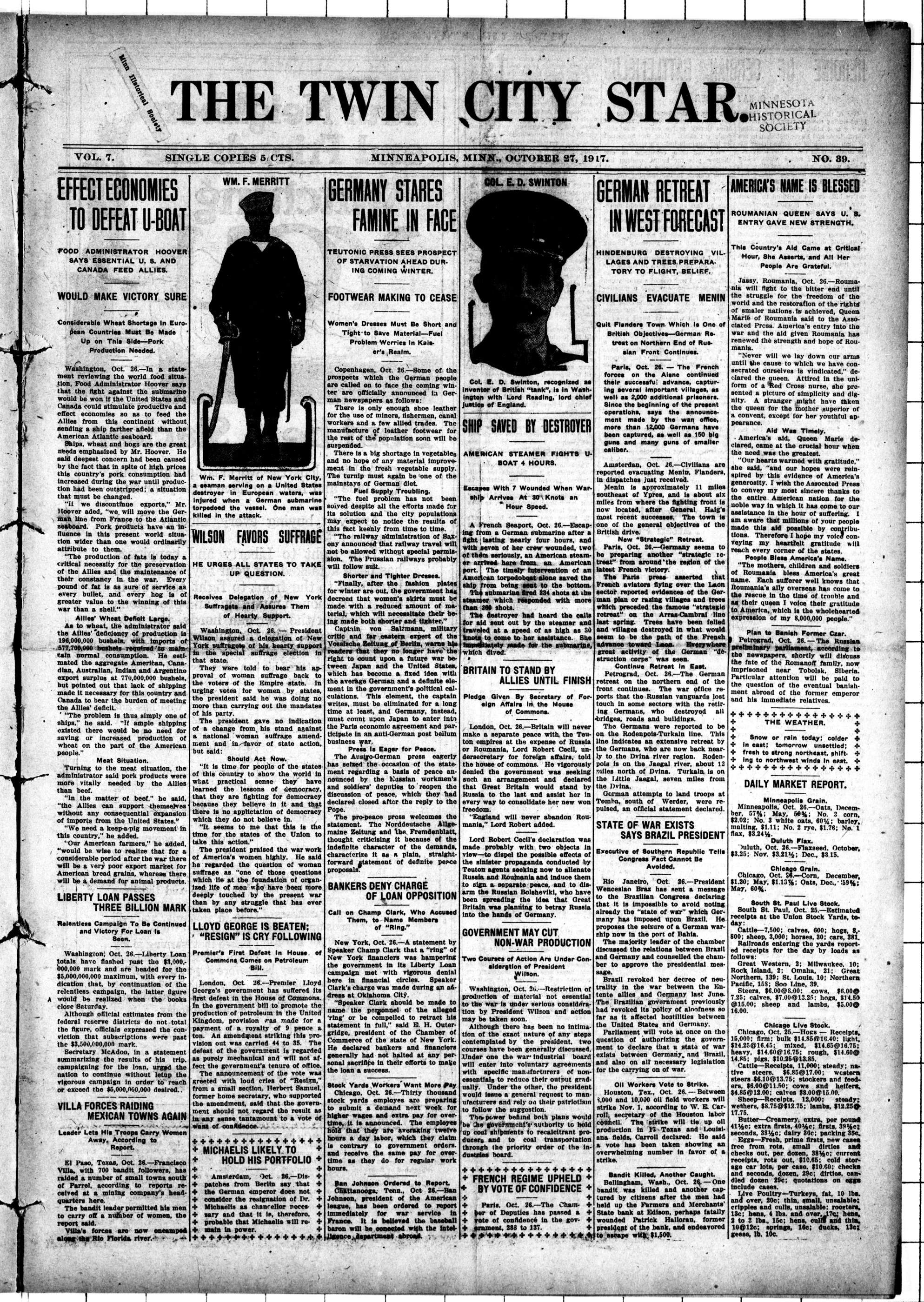
THE TWIN CITY STAR. MINNESOTA HISTORICAL
EFFECT ECONOMIES TO DEFEAT U-BOAT
FOOD ADMINISTRATOR HOOVER
SAYS ESSENTIAL U. S. AND
CANADA FEED ALLIES.
Considerable Wheat Shortage In European Countries Must Be Made Up on This Side—Pork Production Needed.
Washington, Oct. 26.—In a statement reviewing the world food situation, Food Administrator Hoover says that the fight against the submarine would be won if the United States and Canada could stimulate productive and effect economies so as to feed the Allies from this continent without sending a ship farther afield than the American Atlantic seaboard.
Ships, wheat and hogs are the great needs emphasized by Mr. Hoover. He said deepest concern had been caused by the fact that in spite of high prices this country's pork consumption had increased during the war until production had been outstripped; a situation that must be changed.
"If we discontinue exports," Mr. Hoover added, "we will move the German line from France to the Atlantic seaboard. Pork products have an influence in this present world situation wider than one would ordinarily attribute to them.
"The production of fats is today a critical necessity for the preservation of the Allies and the maintenance of their constancy in the war. Every pound of fat is as sure of service as every bullet, and every hog is of greater value to the winning of this war than a shell."
Allies' Wheat Deficit Large.
As to wheat, the administrator said the Allies' deficiency of production is 196,000,000 bushels, with imports of 577,700,000 bushels required to maintain normal consumption. He estimated the aggregate American, Canadian, Australian, Indian and Argentine export surplus at 770,000,000 bushels, but pointed out that lack of shipping made it necessary for this country and Canada to bear the burden of meeting the Allies' deficit.
"The problem is thus simply one of ships," he said. "If ample shipping existed there would be no need for saving or increased production of wheat on the part of the American people."
Meat Situation.
Turning to the meat situation, the administrator said pork products were more vitally needed by the Allies than beef.
"In the matter of beef," he said, "the Allies can support themselves without any consequential expansion of imports from the United States."
"We need a keep-a-pig movement in this country," he added.
"Our American farmers," he added, "would be wise to realize that for a considerable period after the war there will be a very poor export market for American bread grains, whereas there will be a demand for animal products.
LIBERTY LOAN PASSES
THREE BILLION MARK
Relentless Campaign To Be Continued and Victory For Loan Is Seen.
Washington; Oct. 26.—Liberty Loan totals have flashed past the $3,000,000,000 mark and are headed for the $5,000,000,000 maximum, with every indication that, by continuation of the relentless campaign, the latter figure would be realized when the books close Saturday.
Although official estimates from the federal reserve districts do not total the figure, officials expressed the conviction that subscriptions were past the $3,500,600,000 mark.
Secretary McAdoo, in a statement summarizing the results of his trip, campaigning for the loan, urged the nation to continue without letup the vigorous campaign in order to reach or exceed the $5,000,000,000 desired.
El Paso, Texas, Oct. 26.—Francisco Villa, with 700 bandit followers, has raided a number of small towns south of Parral, according to reports received at a mining company's headquarters here.
The bandit leader permitted his men to carry off a number of women, the report said.
Villa's forces are now encamped along the Rio Florida river.
WM. P. MERRITT
Wm. F. Merritt of New York City, a seaman serving on a United States destroyer in European waters, was injured when a German submarine torpeded the vessel. One man was killed in the attack.
WILSON FAVORS SUFFRAGE
HE URGES ALL STATES TO TAKE
UP QUESTION.
Receives Delegation of New York
Suffragists and Assures Them
Washington, Oct. 28. — President Wilson assured a delegation of New York suffragee of his hearty support in the special suffrage election in that state.
They were told to bear his approval of woman suffrage back to the voters of the Empire state. In urging votes for women by states, the president said he was doing no more than carrying out the mandates of his party.
The president gave no indication of a change from his stand against a national woman suffrage amendment and in favor of state action, but said:
Should Act Now.
"It is time for people of the states of this country to show the world in what practical sense they have learned the lessons of democracy, that they are fighting for democracy because they believe in it and that there is no applictation of democracy which they do not believe in.
"It seems to me that this is the time for the states of the Union to take this action."
The president praised the war work of America's women highly. He said he regarded the question of woman suffrage as "one of those questions which lie at the foundation of organised life of men who have been more deeply touched by the present war than by any struggle that has ever taken place before."
LLOYD GEORGE IS BEATEN;
"RESIGN" IS CRY FOLLOWING
Premier's First Defeat In House. of Commons Comes on Petroleum Bill.
London, Oct. 26.—Premier Lloyd George's government has suffered its first defeat in the House of Commons. In the government bill to promote the production of petroleum in the United Kingdom, provision was made for a payment of a royalty of 9 pence a ton. An amendment striking this provision out was carried 44 to 35. The defeat of the government is regarded as purely mechanical and will not affect the government's tenure of office. The announcement of the vote was greeted with loud cries of "Resign," from a small section, Herbert Samuel, former home secretary, who supported the amendment, said that the government should not regard the result as in any sense tantamount to a vote of want of confidence.
MICHAELIS LIKELY TO HOLD HIS PORTFOLIO
Amsterdam, Oct. 26.—Dispatches from Berlin say that the German emperor does not consider the resignation of Dr. Michaelis as chancellor necessary and that it is, therefore, probable that Michaelis will remain in power.
GERMANY STARES FAMINE IN FACE
GERMANY STARES FAMINE IN FACE
TEUTONIC PRESS SEES PROSPECT OF STARVATION AHEAD DURING COMING WINTER.
Women's Dresses Must Be Short and Tight to Save Material—Fuel Problem Worries In Kaiser's Realm.
Copenhagen, Oct. 26—Some of the prospects which the German people are called on to face the coming winter are officially announced in German newspapers as follows:
There is only enough shoe leather for the use of minors, fishermen, canal workers and a few allied trades. The manufacture of leather footwear for the rest of the population soon will be suspended.
There is a big shortage in vegetables and no hope of any material improvement in the fresh vegetable supply. The turnip must again be one of the mainstays of German diet.
Fuel Supply Troubling.
"The fuel problem has not been solved despite all the efforts made for its solution and the city populations may expect to notice the results of this fact keenly from time to time.
"The railway administration of Saxony announced that railway travel will not be allowed without special permission. The Prussian railways probably will follow suit.
"Finally, after the fashion plates for winter are out, the government has decreed that women's skirts must be made with a reduced amount of material, which will necessitate their being made both shorter and tighter."
Captain von Salzmann, military critic and far eastern expert of the Vossische Zeitung of Berlin, warns his readers that they no longer have the right to count upon a future war between Japan and the United States, which has become a fixed idea with the average German and a definite element in the government's political calculations. This element, the captain writes, must be eliminated for a long time at least, and Germany, instead, must count upon Japan to enter into the Paris economic agreement and participate in an anti-German post beilum business war.
Press is Eager for Peace.
The Austro-German press eagerly has seized the occasion of the statement regarding a basis of peace announced by the Russian workmen's and soldiers' deputies to reopen the discussion of peace, which they had declared closed after the reply to the Pope.
The pro-peace prosx welcomes the statement. The Norddeutsche Allgemeine Zeitung and the Fremdenblatt, thought criticising it because of the indefinite character of the demands, characterize it as a plain, straight-forward statement of definite peace proposals.
BANKERS DENY CHARGE OF LOAN OPPOSITION
Call on Champ Clark, Who Accused Them, to Name Members of "Ring."
New York, Oct. 26.—A statement by Speaker Champ Clark that a "ring" of New York financiers was hampering the government in its Liberty Loan campaign met with vigorous denial here in financial circles. Speaker Clark's charge was made during an address at Oklahoma City.
"Speaker Clark should be made to name the personnel of the alleged 'ring' or be compelled to retract his statement in full," said E. H. Outergridge, president of the Chamber of Commerce of the state of New York. He declared bankers and financiers generally had not halted at any personal sacrifice in their efforts to make the loan a success.
Stock Yards Workers Want More Pay Chicago, Oct. 26—Thirty thousand stock yards employees are preparing to submit a demand next week for higher wages and extra pay for overtime, it is announced. The employees hold that they are averaging twelve hours a day labor, which they claim is contrary to government orders, and receive the same pay for overtime as they do for regular work hours.
Ban Johnson Ordered to Report. Chattanooga, Tenn., Oct 26—Ban Johnson, president of the American league, has been ordered to report immediately for war service in France. It is believed the baseball baron will be connected with the intelligence department abroad.
COL. E. D. SWINTON.
Col. E. D. Swinton, recognized as inventor of Britian "tank", is in Washington with Lord Reading, lord chief justice of England.
SHIP SAVED BY DESTROYER
AMERICAN STEAMER FIGHTS U BOAT 4 HOURS.
Escapes With 7 Wounded When Warship Arrives At 30 Knots an Hour Speed.
A French Seaport, Oct. 26.—Escaping from a German submarine after a fight lasting nearly four hours, and with seven of her crew wounded, two of them seriously, an American steamer arrived here from an American port. The timely intervention of an American torpedoboe alone saved the ship from being sent to the bottom. The submarine fired 234 shots at the steamer which responded with more than 260 shots.
The destroyer had heard the calls for aid sent out by the steamer and traveled at a speed of as high as 30 knots to come to her assistance. She immediately made for the submarine, which dived.
BRITAIN TO STAND BY
ALLIES UNTIL FINISH
Pledge Given By Secretary of Foreign Affairs in the House of Commons.
London, Oct. 26.—Britain will never make a separate peace with the Teuton empires at the expense of Russia or Roumania, Lord Robert Cecil, undersecretary for foreign affairs, told the house of commons. He vigorously denied the government was seeking such an arrangement and declared that Great Britain would stand by Russia to the last and assist her in every way to consolidate her new won freedom.
"England will never abandon Roumania," Lord Robert added.
Lord Robert Cecil's declaration was made probably with two objects in view—to dispel the possible effects of the sinister propaganda conducted by Teuton agents seeking now to alienate Russia and Roumania and induce them to sign a separate peace, and to disarm the Russian Bolshevik, who have been spreading the idea that Great Britain was planning to betray Russia into the hands of Germany.
Two Courses of Action Are Under Consideration of President
Washington, Oct. 20.—Restriction of production of material not essential to the war is under serious consideration by President Wilson and action may be taken soon.
Although there has been no intimation of the exact nature of any steps contemplated by the president, two courses have been generally discussed. Under one the war industrial board will enter into voluntary agreements with specific manufacturers of non-essentials to reduce their output gradually. Under the other, the president would issue a general request to manufacturers and rely on their patriotism to follow the suggestion.
The power behind both plans would be the government's authority to hold up coal shipments to recalcitrant producers and to coal transportation through the priority order of the industries board.
FRENCH REGIME UPHELD
BY VOTE OF CONFIDENCE
Paris. Oct. 26.—The Chamber of Deputies has passed a vote of confidence in the government, 288 to 137.
GERMAN RETREAT IN WEST FORECAST
GERMAN RETREAT IN WEST FORECAST
HINDENBURG DESTROYING VIL-
LAGES AND TREES.PREPARA-
TORY TO FLIGHT, BELIEF.
CIVILIANS EVACUATE MENIN
Paris, Oct. 26. — The French forces on the Alane continued their successful advance, capturing several important villages, as well as 2,000 additional prisoners. Since the beginning of the present operations, says the announcement made by the wan office, more than 12,000 Germans have been captured, as well as 150 big guns and many guns of smaller caliber.
Amsterdam, Oct. 26.—Civilians are reported evacuating Menin, Flanders, in dispatches just received.
Menin is approximately 11 miles southeast of Ypres, and is about six miles from where the fighting front is now located, after General Halg's most recent successes. The town is one of the general objectives of the British drive.
New "Strategic" Retreat.
Paris, Oct. 26.—Germany seems to be preparing another "strategic retreat" from around the region of the latest French victory.
The Paris press asserted that French aviators flying over the Laon sector reported evidences of the German plan or razing villages and trees which preceded the famous "strategic retreat" on the Arras-Cambrai line last spring. Trees have been felled and villages destroyed in what would seem to be the path of the French advance toward Laon. Everywhere great activity of the German "destruction corps" was seen.
Continue Retreat in East.
Petrograd, Oct. 26.—The German retreat on the northern end of the front continues. The war office reports that the Russian vanguards lost touch in some sectors with the retiring Germans, who destroyed all bridges, roads and buildings.
The Germans were reported to be on the Rodenpols-Turkain line. This line indicates an extensive retreat by the Germans, who are now back nearly to the Dvina river region. Rodenpols is on the Jaegal river, about 12 miles north of Dvina. Turkain is on the Little Jaegal, seven miles from the Dvina.
German attempts to land troops at Tomba, south of Werder, were repulsed, an official statement declared.
STATE OF WAR EXISTS SAYS BRAZIL PRESIDENT
Executive of Southern Republic Tells Congress Fact Cannot Be Avoided.
Rio Janetro, Oct. 26.—President Wenceslas Braz has sent a message to the Brazilian Congress declaring that it is impossible to avoid noting already the "state of war" which Germany has imposed upon Brazil. He proposes the seizure of a German warship now in the port of Bahia.
The majority leader of the chamber discussed the relations between Brazil and Germany and counseled the chamber to approve the presidential message.
Brazil revoked her decree of neutrality in the war between the Entente allies and Germany last June. The Brazilian government previously had revoked its policy of aloofness so far as it affected hostilities between the United States and Germany.
Parliament will vote at once on the question of authorizing the government to declare that a state of war exists between Germany, and Brazil, and also on all necessary legislation for the carrying on of war.
Oil Workers Vote to Strike.
Houston, Tex., Oct. 26. — Between 3,000 and 10,000 oil field workers will strike Nov. 1, according to W. E. Carroll, secretary of the Houston labor council. The strike will tie up oil production in 17 Texas and Louisiana fields, Carroll declared: He said a vote has been taken showing an overwhelming number in favor of a strike.
Bandit Killed, Another Caught.
Bellingham, Wash., Oct. 26. — One bandit was killed and another captured by citizens after the men had held up the Farmers and Merchants' State bank at Edison, perhaps fatefully wounded Patrick Halloran, former president of the bank, and endeavored to escape with $1,500.
AMERICA'S NAME IS BLESSED
ROUMANIAN QUEEN SAYS U. B
ENTRY GAVE NEW STRENGTH.
This Country's Aid Game at Critical Hour, She Asserts, and All Her People Are Grateful.
Jassy, Roumania, Oct. 26.—Roumania will fight to the bitter end until the struggle for the freedom of the world and the restoration of the rights of smaller nations, is achieved, Queen Marie of Roumania said to the Associated Press. America's entry into the war and the aid given Roumania has renewed the strength and hope of Roumania.
"Never will we lay down our arms until the cause to which we have consecrated ourselves is vindicated," declared the queen. Attired in the uniform of a Red Cross nurse, she presented a picture of simplicity and dignity. A stranger might have taken the queen for the mother superior of a convent, except for her youthful appearance.
Aid Was Timely.
America's aid, Queen Marie declared, came at the crucial hour when the need was the greatest.
"Our hearts warmed with gratitude," she said, "and our hopes were reinspired by this evidence of America's generosity. I wish the Associated Press to convey my most sincere thanks to the entire American nation for the noble way in which it has come to our assistance in the hour of suffering. I am aware that millions of your people made this aid possible by contributions. Therefore I hope my voice conveying my heartfelt gratitude will reach every corner of the states.
People Bless America's Name.
"The mothers, children and soldiers of Roumania bless America's great name. Each sufferer well knows that Roumania's ally overseas has come to the rescue in the time of trouble and as their queen I voice their gratitude to America, which is the wholehearted expression of my 8,000,000 people."
Plan to Banish Former Czar.
Petrograd, Oct. 26. — The Russian preliminary parliament, according to the newspapers, shortly will discuss the fate of the Romanoff family, now imprisoned near Tobolsk, Siberia. Particular attention will be paid to the question of the eventual banishment abroad of the former emperor and his immediate relatives.
THE WEATHER.
Snow or rain today; colder in east; tomorrow unsettled; fresh to strong northeast, shifting to northwest winds in east.
DAILY MARKET REPORT.
Minneapolis Grain.
Minneapolis, Oct. 26.—Oats, December,
57%; May, 50%; No. 3 corn,
$2.02; No. 3 white oats, 60%; barley,
malting, $1.11; No. 2 rye, $1.76; No. 1
flax, $3.24%.
Duluth Flax.
Duluth, Oct. 26.—Flaxseed, October,
$3.25; Nov. $3.21%; Dec., $3.15.
Chicago Grain.
Chicago, Oct. 26.—Corn, December,
$1.20; May, $1.13%; Oats, Dec., .59%;
May, 60%.
South St. Paul Live Stock.
South St. Paul, Oct. 25.—Estimated receipts at the Union Stock Yards, today:
Cattle—7,500; calves, 600; hogs, 8-800; sheep, 3,000; horses, 30; cars, 381.
Railroads entering the yards reported receipts for the day by lords as follows:
Great Western, 2; Milwaukee, 10;
Rock Island, 2; Omaha, 21; Great Northern, 138; St. Louis, 10; Northern Pacific, 153; Soo Line, 39.
Steers, $6.00@8.00; cows, $6.00@7.25; calves, $7.00@13.25; hogs, $14.50@15.00; sheep and lambs, $5.00@16.00.
Chicago Live Stock.
Chicago, Oct. 25 — Hogs — Receipts,
15.000; firm; bulk $14.85@16.85; light,
14.25@16.45; mixed, $14.65@16.75;
heavy, $14.60@16.75; rough, $14.60@
14.85; pigs, $10.25@13.85.
Cattle—Receipts, 11.000; steady; native steers, $6.85@17.00; western steers $6.10@17.35; stockers and feeders, $6.00@11.50; cows and heifers, $4.55@12.00; calves $9.00@15.00.
Sheep—Receipts, 12.000; steady; wethers, $8.75@12.75; lambs, $12.25@17.75.
Butter—Creamery, extra, per pound 41½c; extra firsts, 40½c; firsts, 39½c; seconds, 38½c; dairy firsts, packing 35c.
Eggs—Fresh, prime firsts, new cases free from rots, small dirties and checks out, per dozen, 38½c; current receipts, rots out, $10.65; cold storage car lots, per case, $10.60; checks and seconds, dozen, 29c; dirties, candled dozen 29c; quotations on eggs include cases.
Live Poultry—Turkeys, fat, 10 lbs. and over, 20c; thin, small, unsalable; cripples and culls, unsalable; roosters, 13c; hens, 4 lbs. and over, 17c; hens, 2 to 2 lbs, 15c; hens, culls and thina, 10@12c; springs, 16c; ducks, 13eg geese, 10c.
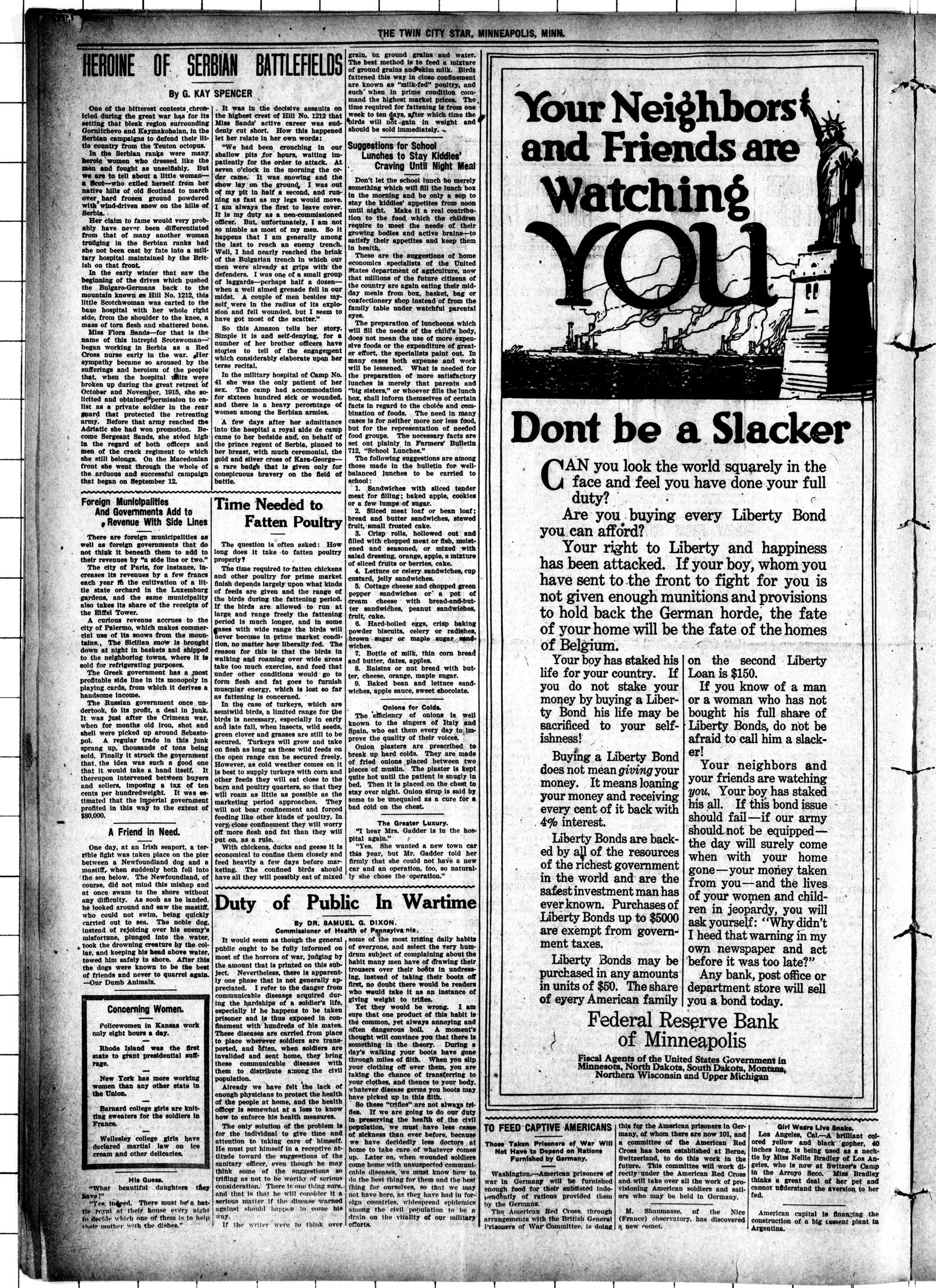
HEROINE OF SERBIAN BATTLEFIELDS
By G. KAY SPENCER
One of the bitterest contests chronicled during the great war has for its setting that bleak region surrounding Gornitchevo and Kaymakohalan, in the Serbian campaigns to defend their little country from the Teuton octopus.
In the Serbian ranks were many heroic women who dressed like the men and fought as unselfishly. But we are to tell about a little woman—a Scot—who exiled herself from her native hills of old Scotland to march over hard frozen ground powdered with wind-driven snow on the hills of Serbia.
Her claim to fame would very probably have never been differentiated from that of many another woman trudging in the Serbian ranks had she not been cast by fate into a military hospital maintained by the British on that front.
In the early winter that saw the beginning of the drives which pushed the Bulgaro-Germans back to the mountain known as Hill No. 1212, this little Scotchwoman was carted to the bage hospital with her whole right side, from the shoulder to the knee, a mass of torn flesh and shattered bone.
Miss Flora Sands—for that is the name of this intrepid Scotswoman—began working in Serbia as a Red Cross nurse early in the war. Her sympathy became so aroused by the sufferings and herolism of the people that, when the hospital units were broken up during the great retreat of October and November, 1915, she solicited and obtained permission to enlist as a private soldier in the rear guard that protected the retreating army. Before that army reached the Adriatic she had won promotion. Become Sergeant Sands, she stood high in the regard of both officers and men of the crack regiment to which she still belongs. On the Macedonian front she went through the whole of the arduous and successful campaign that began on September 12.
Foreign Municipalities And Governments Add to Revenue With Side Lines
There are foreign municipalities as well as foreign governments that do not think it beneath them to add to their revenues by "a line line or two."
The city of Paris, for instance, increases its revenues by a few francs each year in the cultivation of a little state orchard in the Luxemburg gardens, and the same municipality also takes its share of the receipts of the Elfel Tower.
A curious revenue accrues to the city of Palermo, which makes commercial use of its snows from the mountains. The Sicilian snow is brought down at night in baskets and shipped to the neighboring towns, where it is sold for refrigerating purposes.
The Greek government has a most profitable side line in its monopoly in playing cards, from which it derives a handsome income.
The Russian government once undertook, to its profit, a deal in junk. It was just after the Crimean war, when for months old iron, shot and shell were picked up around Sebastopol. A regular trade in this junk sprang up, thousands of tons being sold. Finally it struck the government that, the idea was such a good one that it would take a hand itself. It thereupon intervened between buyers and sellers, imposing a tax of ten cents per hundredweight. It wss estimated that the imperial government profited in this way to the extent of $80.000.
One day, at an Irish seaport, a terrible fight was taken place on the pier between a Newfoundland dog and a mastiff, when suddenly both fell into the sea below. The Newfoundland, of course, did not mind this mishap and at once swam to the shore without any difficulty. As soon as he landed, he looked around and saw the mastiff, who could not swim, being quickly carried out to sea. The noble dog, instead, of rejoicing over his enemy's misfortune, plunged into the water, took the drowning creature by the collar, and keeping his head above water, towed him safely to shore. After this the dogs were known to be the best of friends and never to quarrel again.—Our Dumb Animals.
Policewomen in Kansas work only eight hours a day.
Rhode Island was the first state to grant presidential suffrage.
New York has more working women than any other state in the Union.
Barnard college girls are knitting sweaters for the soldiers in France.
Wellesley college girls have declared martial law on ice cream and other delicacies.
His Guess.
"What beautiful daughters they have!"
"Yes, indeed. There must be a battle royal at their house every night to decide which one of them is to help their mother with the dishes."
A Friend in Need.
Concerning Women.
It was in the decisive assaults on the highest crest of Hill No. 1212 that Miss Sands' active career was suddenly cut short. How this happened let her relate in her own words:
"We had been crouching in our shallow pits for hours, waiting impatiently for the order to attack. At seven o'clock in the morning the order came. It was snowing and the show lay on the ground. I was out of my pit in half a second, and running as fast as my legs would move. I am always the first to leave cover. It is my duty as a non-commissioned officer. But, unfortunately, I am not so nimble as most of my men. So it happens that I am generally among the last to reach an enemy trench. Well, I had nearly reached the brink of the Bulgarian trench in which our men were already at grips with the defenders. I was one of a small group of laggards—perhaps half a dozen—when a well aimed grenade fell in our midst. A couple of men besides myself, were in the radius of its explosion and fell wounded, but I seem to have got most of the scatter."
So this Amazon tells her story. Simple it is and self-denying, for a number of her brother officers have stories to tell of the engagement which considerably elaborate upon her terse recital.
In the military hospital of Camp No. 41 she was the only patient of her sex. The camp had accommodation for sixteen hundred sick or wounded, and there is a heavy percentage of women among the Serbian armies.
A few days after her admittance into the hospital a royal aide de camp came to her bedside and, on behalf of the prince regent of Serbia, plinned to her breast, with much ceremonial, the gold and silver cross of Kara-George—a rare badge that is given only for conspicuous bravery on the field of battle.
Time Needed to Fatten Poultry
The question is often asked: How long does it take to fatten poultry properly?
The time required to fatten chickens and other poultry for prime market finish depends largely upon what kinds of feeds are given and the range of the birds during the fattening period. If the birds are allowed to run at large and range freely the fattening period is much longer, and in some cases with wide range the birds will never become in prime market condition, no matter how liberally fed. The reason for this is that the birds in walking and roaming over wide areas take too much exercise, and feed that under other conditions would go to form flesh and fat goes to furnish muscular energy, which is lost so far as fattening is concerned.
In the case of turkeys, which are semiwild birds, a limited range for the birds is necessary, especially in early and late fall, when insects, wild seeds, green clover and grasses are still to be secured. Turkeys will grow and take on flesh as long as these wild feeds on the open range can be secured freely. However, as cold weather comes on it is best to supply turkeys with corn and other feeds they will eat close to the barn and poultry quarters, so that they will roam as little as possible as the marketing period approaches. They will not bear confinement and forced feeding like other kinds of poultry. In very close confinement they will worry off more flesh and fat than they will put on, as a rule. With chickens, ducks and geese it is economical to confine them closely and feed heavily a few days before marketing. The confined birds should have all they will possibly eat of mixed
Duty of Public In Wartime
It would seem as though the general public ought to be fully informed on most of the horrors of war, judging by the amount that is printed on this subject. Nevertheless, there is apparently one phase that is not generally appreciated. I refer to the danger from communicable diseases acquired during the hardships of a soldier's life, especially if he happens to be taken prisoner and is thus exposed in confinement with hundreds of his mates. These diseases are carried from place to place wherever soldiers are transported, and often, when soldiers are invalided and sent home, they bring these communicable diseases with them to distribute among the civil population.
Already we have felt the lack of enough physicians to protect the health of the people at home, and the health officer is somewhat at a loss to know how to enforce his health measures.
The only solution of the problem is for the individual to give time and attention to taking care of himself. He must put himself in a receptive attitude toward the suggestions of the sanitary officer, even though he may think some of the suggestions so trifling as not to be worthy of serious consideration. There is one thing sure, and that is that he will consider it a serious matter if the disease warned against should happen to come his way.
By DR. SAMUEL G. DIXON.
Commissioner of Health of Pennsylvania.
grain, or ground grains and water. The best method is to feed a mixture of ground grains and skim milk. Birds fattened this way in close confinement are known as "milk-fed" poultry, and such when in prime condition command the highest market prices. The time required for fattening is from one week to ten days, after which time the birds will not gain in weight and should be sold immediately.
Suggestions for School Lunches to Stay Kiddies' Craving Until Night Meal
Don't let the school lunch be merely something which will fill the lunch box in the morning and be only a sop to stay the kiddies' appetites from noon until night. Make it a real contribution to the food which the children require to meet the needs of their growing bodies and active brains—to satisfy their appetites and keep them in health. These are the suggestions of home economics specialists of the United States department of agriculture, now that millions of the future citizens of the country are again eating their midday meals from box, basket, bag or confectionery shop instead of from the family table under watchful parental eyes.
The preparation of luncheons which will fill the needs of the child's body, does not mean the use of more expensive foods or the expenditure of greater effort, the specialists paint out. In many cases both expense and work will be lessened. What is needed for the preparation of more satisfactory lunches is merely that parents and "big sisters," or whoever fills the lunch box, shall inform themselves of certain facts in regard to the choice and combination of foods. The need in many cases is for neither more nor less food, but for the representation of needed food groups. The necessary facts are set out plainly in Farmers' Bulletin 712, 'School Lunches.' The following suggestions are among those made in the bulletin for well-balanced lunches to be carried to school:
1. Sandwiches with sliced tender meat for filling; baked apple, cookies or a few lumps of sugar.
2. Sliced meat loaf or bean loaf; bread and butter sandwiches, stewed fruit, small frosted cake.
3. Crisp rolls, hollowed out and filled with chopped meat or fish, moistened and seasoned, or mixed with salad dressing, orange, apple, a mixture of sliced fruits or berries, cake.
4. Lettuce or celery sandwiches, cup custard, jelly sandwiches.
5. Cottage cheese and chopped green pepper sandwiches or a pot of cream cheese with bread-and-butter sandwiches, peanut sandwiches, fruit, cake.
6. Hard-bolled eggs, crisp baking powder biscuits, celery or radishes, brown sugar or maple sugar sandwiches.
7. Bottle of milk, thin corn bread and butter, dates, apples.
8. Raisins or nut bread with butter, cheese, orange, maple sugar.
9. Baked bean and lettuce sandwiches, apple sauce, sweet chocolate.
Onions for Colds.
The efficiency of onions is well known to the singers of Italy and Spain, who eat them every day to improve the quality of their voices. Onion plasters are prescribed to break up hard colds. They are made of fried onions placed between two pieces of muslin. The plaster is kept quite hot until the patient is snugly in bed. Then it is placed on the chest to stay over night. Onion sirup is said by some to be unequaled as a cure for a bad cold on the chest.
The Greater Luxury
"I hear Mrs. Gadder is in the hospital again."
"Yes. She wanted a new town car this year, but Mr. Gadder told her firmly that she could not have a new car and an operation, too, so naturally she chose the operation."
some of the most trifling daily habits of everyone, and select the very humdrum subject of complaining about the habit many men have of drawing their trousers over their boots in undressing, instead of taking their boots off first, no doubt there would be readers who would take it as an instance of giving weight to trifles.
Yet they would be wrong. I am sure that one product of this habit is the common, yet always annoying and often dangerous boll. A moment's thought will convince you that there is something in the theory. During a day's walking your boots have gone through miles of filth. When you slip your clothing off over them, you are taking the chance of transferring to your clothes, and thence to your body, whatever disease germs you boots may have picked up in this filth.
So these "trifles" are not always trifles. If we are going to do our duty in preserving the health of the civil population, we must have less cases of sickness than ever before, because we have decidedly less doctors at home to take care of whatever comes up. Later on, when wounded soldiers come home with unsuspected communicable diseases, we must know how to do the best thing for them and the best thing for ourselves, so that we may not have here, as they have had in foreign countries, widespread epidemics among the civil population to be a drain on the vitality of our military efforts.
Your Neighbors and Friends are Watching YOU
Dont be a Slacker
CAN you look the world squarely in the face and feel you have done your full duty? Are you buying every Liberty Bond you can afford?
Your right to Liberty and happiness has been attacked. If your boy, whom you have sent to the front to fight for you is not given enough munitions and provisions to hold back the German horde, the fate of your home will be the fate of the homes of Belgium.
Your boy has staked his life for your country. If you do not stake your money by buying a Liberty Bond his life may be sacrificed to your selfishness! Buying a Liberty Bond does not mean giving your money. It means loaning your money and receiving every cent of it back with 4% interest.
Liberty Bonds are backed by all of the resources of the richest government in the world and are the safest investment man has ever known. Purchases of Liberty Bonds up to $5000 are exempt from government taxes. Liberty Bonds may be purchased in any amounts in units of $50. The share of every American family
Fec
Fiscal A
Minneso
Nor
Fiscal Agents of the United States Government in Minnesota, North Dakota, South Dakota, Montana, Northern Wisconsin and Upper Michigan
TO FEED CAPTIVE AMERICANS
Those Taken Prisoners of War Will Not Have to Depend on Rations Furnished by Germany.
Washington.—American prisoners of war in Germany will be furnished enough food for their subsisted independently of rations provided them by the Germans.
The American Red Cross, through arrangements with the British General Prisoners of War Committee, is doing
this for the American prisoners in Germany, of whom there are now 101, and a committee of the American Red Cross has been established at Berne, Switzerland, to do this work in the future. This committee will work directly under the American Red Cross and will take over all the work of provisioning American soldiers and sailors who may be held in Germany.
M. Shaumasse, of the Nice (France) observatory, has discovered a new comet.
on the second Liberty Loan is $150.
If you know of a man or a woman who has not bought his full share of Liberty Bonds, do not be afraid to call him a slacker!
Your neighbors and your friends are watching you. Your boy has staked his all. If this bond issue should fail—if our army should not be equipped—the day will surely come when with your home gone—your money taken from you—and the lives of your women and children in jeopardy, you will ask yourself: "Why didn't I heed that warning in my own newspaper and act before it was too late?"
Any bank, post office or department store will sell you a bond today.
serve Bank
neapolis
United States Government in
South Dakota, Montana,
and Upper Michigan
Los Angeles, Cal.—A brilliant colored yellow and black gopher, 40 inches long, is being used as a necktie by Miss Nelle Bradley of Los Angeles, who is now at Switzer's Camp in the Arroyo Seco. Miss Bradley thinks a great deal of her pet and cannot understand the aversion to her fad.
American capital is financing the construction of a big cement plant in Argentina.
By REV. L. W. GOSNELL
Assistant Dean, Moody Bible
Institute, Chicago
saw in the Man, oss beside him, a King. This was at a time when Christ appeared defeated and the inscription on his cross—“This is the King of the Jews”—seemed a mocker. But there was born in the heart of the robber a supernatural faith, that this dying Man would yet live and reign; and he prayed: “Jesus, remember me when thou comest
at a time when Christ appeared defeated and the inscription on his cross—"This is the King of the Jews"—seemed a mockery. But there was born in the heart of the robber a supernatural faith, that this dying Man would yet live and reign; and he prayed: "Jesus, remember me when thou comest in thy kingdom." (R. V.) Christ at once replied: "Verilly I say unto thee, today shalt thou be with me in Paralise." These words of Christ are well worthy our attention.
The promised blessing was for "today." The thief thought of the kingdom, probably, as something afar off. Jesus says, in effect, that he need not wait so long, but that he would enter that very day into bliss.
"Thou shalt be with me," so says the Lord. On the expression, "with me," a noted Greek scholar says, "Not merely in my company, but sharing with me. The promise implies consciousness after death."
Moreover, the Lord tells him exactly where he shall enjoy this blessing, riz, "in Paradise."
Bishop Moule on "Paradise."
We are moved at this point to give a somewhat extended quotation from Bishop Moule of the Church of England. He says: "Paradise is an ornate word meaning a royal pleasure-ground, a royal park or garden. It calls up ideas accordingly of all that is rich and fair in the way of cultured nature. It suggests to us the loveliness of woods, and lawn and flowers, and waters and also of the company which possesses and enjoys the charming scene, the friends, the guests, the family of the king. They are there for delightful rest, or for delightful exercise. They have come from the battlefield, or the council, or the journey to walk, to recline, to converse to listen, where all is beautiful with a large, ordered, stately beauty. And all this is taken up by the Lord Jesus, in his use of the word Paradise, to set forth one side of the believer's unseen life after death. After the manner in which spirits enjoy and spirits see, the leparted Christian walks by sight (Cf. II Cor. 5:6, 7), in a scene of glorious and restful beauty—in the garden of its King."
Into the King's gardens the robber would enter that very day.
Words Full of Comfort.
How full of comfort are the words of the text to all believers who, like the thief, shall be saved by grace! We, too, enter into the King's gardens, and better still, the King's presence, on the very day of our death. "To depart" is "to be with Christ" (Phil. 1:23). As one has put it; only a line, not a space, separates between us and him. To be "absent from the body" is to be "at home with the Lord" (II Cor. 5:8 R. V.).
Moreover, Paul says that to be with Christ is "far better" (Phil. 1:23). How conclusively this shows that he did not expect to enter upon a state of unconsciousness at death. For him to live was Christ, and he was happy in the Lord's service. How blessed must be that life upon which he expected to enter at death, when he could speak of it as "gain" and as "far better."
Then, notice again that expression, "at home with the Lord." All the love, and comfort, and ease implied in being "at home," will be fulfilled and even transcended in the Father's house. We need not fear to trust ourselves or our departed to him.
We believe the location of Paradise has changed since the Old Testament times. The saints of that day spoke of going "down" to Sheol, the underworld of the dead, of which Paradise was a part. But Paul speaks of being "caught up" to the third heaven, to Paradise (II Cor. 12:2, 4). It is likely that when Christ ascended he emptied Sheol of the saints there, the "prisoners of hope." Ephesians 4:3 (margin) tells us that when he ascended up on high he led captive a multitude of captives. So the saint today enters into an even brighter Paradise on high, than that which the thief inherited.
How we should comfort ourselves with these words! A minister tells how he grieved for his dead child and would not be comforted. He would visit the grave and thrust his walking-stick into the sandy soil until it touched the little casket, but his heart grew more and more sad. One day he began saying to himself: "With Christ in Paradise," "With Christ in Paradise." He soon came to see he could ask for nothing more blessed for his darling, and so he found peace.
My knowledge of that life is small.
The eye of faith is dim;
But this I know, that Christ knows all.
And I shall be with Him.
DISCORD IN FAMILY
DISCORD IN FAMILY
The Only Remedy for the Quarrels in the Home Is Greatest Thing in World—Love.
There are no causes for misery more common than, and none so distressing as family discord. The closer the ties that bind, the greater the chafing may be and the sorer the wound that this chafing makes. The sweeter the fruit, the sourer the vinegar; and when family affection turns sour, the product is worthy of the discord of the bottomless pit. No better illustration of the causes and results of family discord does the Bible afford than the story of Joseph, his father and his brethren.
How many children today grieve over the preference of parents for a brother or sister! The less favored one is not so winsome or pretty, perhaps, or he finds it less easy to express his affection; and in secret, though too proud to tell his sorrow, he grieves over this partiality, and comes to think at last that he has no chance to make his way in life in comparison with his more favored brother.
Nothing is more foolish than the exhibition of such partiality. Indeed, it is almost criminal. It is apt to render the favored one conceited and toplofty, and to depress and mortify and sour the less attractive. It is gratifying to know that often the affection of father and mother is poured out more lavishly on the sick, the crippled, the ill-favored; but when the reverse is the case, family quarrels are sure to follow.
Our theme has to do with the family life of Jacob's sons. We can easily trace the course of the quarrel which almost ripened into murder. Partiality, wrangling, conspiracy and intended fratricide the seeds and fruits of this evil tree. Every family quarrel contains some of these hateful seeds and may bear such hideous fruits. I am glad that the future story of Joseph relieves this dark picture. Age sometimes hardens and sours the disposition, but sometimes it softens and sweetens it. In the case of Jacob and his sons it seems to have the latter effect. They grew to be better men as they grew older. At last Joseph had an opportunity to take a glorious revenge. During all the years of his obscurity in the palace and in prison he kept a warm place in his heart for his old father, and bore no ill-will toward the brothers who had treated him so ill.
"Is the old man your father, yet alive?" he asks with trembling voice and eyes so moist that he dared not eat with his brothers in the palace lest he betray himself. He heaped Benjamin's plate with a fivefold portion, showing the same partiality for the youngest brother that his father had shown for him, but not with the same disastrous results. For the older brothers had been chastened by their afflictions, and starved into humility, and did not resent the favoritism shown to Benjamin. They groveled at the feet of their unknown brother, the great premier of Egypt, bowing before him as his dream predicted, and he completed the conquest by forgiving and loving them, and falling on their necks with kisses, and giving them afterward of the best of the land.
Thus ended this bitter family feud. We could scarcely have expected such a sequel.
The sequel to the feud in Jacob's family points to the only remedy for all such quarrels. It is spelled l-o-v-e, and it is described more beautifully than in in any other literature in the thirteenth chapter of I Corinthians. What a divine remedy is love for curing family discord! It is the only one. Such quarrels, unless love ends them, will be likely to grow more and more bitter until they end in the divorce court, as they have done so often, or possibly in murder and the murderer's cell. Let us pray in every family circle, at every family altar, for the love that is kind, modest, well behaved, generous, gentle, that hopes and believes all good things about another—the love that never faileth—Rev. Francis E. Clark, D. D., LL. D., founder and President of Christian Endeavor.
DUTY OF PRESENT MINISTRY
Better Than All the Post-Mortem Testimoniale and Devotion We Can Bestow.
Do not keep your sublime love and tenderness sealed up until your friends are dead. Fill their lives with sweetness; speak approving, cheering words while their ears can hear them, and while their hearts can be thrilled and be made happier by them. The kind things you mean to do when they are gone, do before they go. The flowers you mean to send for their coffins, send to brighten and sweeten their homes before they leave them. If my friends have alabaster boxes laid away full of fragrant perfumes of sympathy and affection which they intend to break over my dead body, I would rather they would bring them out in my weary and troubled hours and open them that I may be refreshed and cheered by them while I need them. I would rather have a plain coffin without flowers, a funeral without a eulogy, than life without sweetness of love and sympathy. Let us learn to anoint our friend beforehand for burial. Post-mortem kindness does not cheer the burdened spirit; flowers on a coffin cast no fragrance backward over the weary way.—Selected.
THE TWIN CITY STAR, MINNEAPOLIS, MINN.
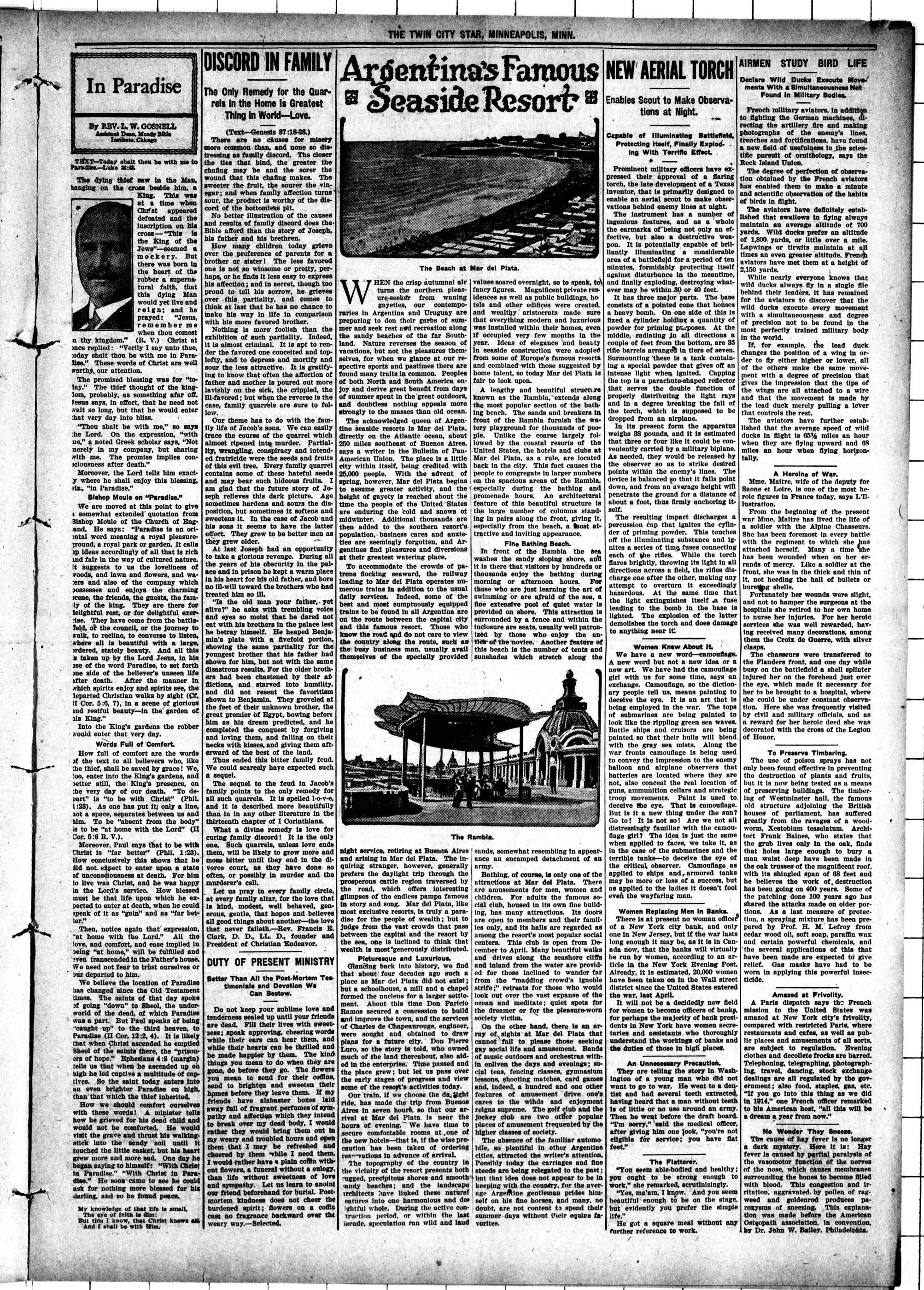
Argentina's Famous Seaside Resort
The Beach at Mar del Plata.
WHEN the crisp autumnal air turns the northern pleasure-seeker from waning gayeties, our contemporaries in Argentina and Uruguay are preparing to don their garbs of summer and seek rest and recreation along the sandy beaches of the far Southland. Nature reverses the season of vacations, but not the pleasures themselves, for when we glance at our respective sports and pastimes there are found many traits in common. Peoples of both North and South America enjoy and derive great benefit from days of summer spent in the great outdoors, and doubtless nothing appeals more strongly to the masses than old ocean.
The acknowledged queen of Argentine seaside resorts is Mar del Plata, directly on the Atlantic ocean, about 250 miles southeast of Buenos Aires, says a writer in the Bulletin of Pan-American Union. The place is a little city within itself, being credited with 25,000 people. With the advent of spring, however, Mar del Plata begins to assume greater activity, and the height of gayety is reached about the time the people of the United States are enduring the cold and snows of midwinter. Additional thousands are then added to the southern resort's population, business cares and anxieties are seemingly forgotten, and Argentines find pleasures and diversions at their greatest watering place.
To accommodate the crowds of patrons flocking seaward, the railway leading to Mar del Plata operates numerous trains in addition to the usual daily services. Indeed, some of the best and most sumptuously equipped trains to be found in all Argentina are on the route between the capital city and this famous resort. Those who know the road and do not care to view the country along the route, such as the busy business man, usually avail themselves of the specially provided
The F
THE BANQUET
night service, retiring at Buenos Aires and arising in Mar del Plata. The inquiring stranger, however, generally prefers the daylight trip through the prosperous cattle region traversed by the road, which offers interesting glimpses of the endless pampa famous in story and song. Mar del Plata, like most exclusive resorts, is truly a paradise for the people of wealth; but to judge from the vast crowds that pass between the capital and the resort by the sea, one is inclined to think that wealth is most "generously distributed.
Picturesque and Luxurious.
Picturesque and Luxurious.
Glanding back into history, we find that about four decades ago such a place as Mar del Plata did not exist; but a schoolhouse, a mill and a chapel formed the nucleus for a larger settlement. About this time Don Paricio Ramos secured a concession to build and improve the town, and the services of Charles de Chapaeurouge, engineer, were sought and obtained to draw plans for a future city. Don Pierre Luro, so the story is told, who owned much of the land thereabout, also alded in the enterprise. Time passed and the place grew; but let us pass over the early stages of progress and view some of the resort's activities today.
Our train, if we choose the daylight ride, has made the trip from Buenos Aires in seven hours, so that our arrival at Mar del Plata is near the hours of evening. We have time to secure comfortable rooms at, one of the new hotels—that is, if the wise precaution has been taken of ordering reservations in advance of arrival. The topography of the country in the vicinity of the resort presents both rugged, preceptious shores and smooth sandy beaches; and the landscape architects have linked these natural features into one harmonious and delightful whole. During the active construction period, or within the last decade, speculation ran wild and land
---
values soared overnight, so to speak, to fancy figures. Magnificent private residences as well as public buildings, hotels and other edifices were created, and wealthy aristocrats made sure that everything modern and luxurious was installed within their homes, even if occupied very few months in the year. Ideas of elegance and beauty in seaside construction were adopted from some of Europe's famous resorts and combined with those suggested by home talent, so today Mar del Plata is fair to look upon.
A lengthy and beautiful structure known as the Rambla, extends along the most popular section of the bathing beach. The sands and breakers in front of the Rambla furnish the watery playground for thousands of people. Unlike the coarse largely followed by the coastal resorts of the United States, the hotels and clubs at Mar del Plata, as a rule, are located back in the city. This fact causes the people to congregate in larger numbers on the spacious areas of the Rambla, especially during the bathing and promenade hours. An architectural feature of this beautiful structure is the large number of columns standing in pairs along the front, giving it, especially from the beach, a most attractive and inviting appearance.
In front of the Rambla the sea washes the sandy sloping shore, and it is there that visitors by hundreds or thousands enjoy the bathing during morning or afternoon hours. For those who are just learning the art of swimming or are afraid of the sea, a fine extensive pool of quiet water is provided on shore. This attraction is surrounded by a fence and within the inclosure are seats, usually well patronized by those who enjoy the antler of the novice. Another feature of this beach is the number of tents and sunshades which stretch along the
Rambla.
sands, somewhat resembling in appearance an encamped detachment of an army. Bathing, of course, is only one of the attractions at Mar del Plata. There are amusements for men, women and children. For adults the famous social club, housed in its own fine building, has many attractions. Its doors are open to members and their families only, and its halls are regarded as among the resort's most popular social centers. This club is open from December to April. Many beautiful walks and drives along the seashore cliffs and inland from the water are provided for those inclined to wander far from the "madding crowd's ignoble strife;" retreats for those who would look out over the vast expanse of the ocean and meditate; quiet spots for the dreamer or for the pleasure-worn society victim.
On the other hand, there is an array of sights at Mar del Plata that cannot fail to please those seeking gay social life and amusement. Bands of music outdoors and orchestras within enliven the days and evenings; social teas, fencing classes, gymnastics lessons, shooting matches, card games and, indeed, a hundred and one other features of amusement drive one's cares to the whids and enjoyment reigns supreme. The golf club and the jockey club are two other popular places of amusement frequented by the higher classes of society.
The absence of the familiar automobile, so plentiful in other Argentine cities, attracted the writer's attention. Possibly today the carriages and fine steeds are being relegated to the past; but that idea does not appear to be in keeping with the country, for the average Argentine gentleman prides himself on his fine horses, and many, no doubt, are not content to spend their summer days without their equine favorites.
The Rambla.
Fine Bathing Beach.
NEW AERIAL TORCH
Enables Scout to Make Observations at Night.
Capable of Illuminating Battlefield, Protecting Itself, Finally Exploding With Terrific Effect.
Prominent military officers have expressed their approval of a flaring torch, the late development of a Texas inventor, that is primarily designed to enable an aerial scout to make observations behind enemy lines at night.
The instrument has a number of ingenious features, and as a whole the earmarks of 'being not only an effective, but also a destructive weapon. It is potentially capable of brilliantly illuminating a considerable area of a battlefield for a period of ten minutes, formidably protecting itself against disturbance in the meantime, and finally exploding, destroying whatever may be within 30 or 40 feet.
It has three major parts. The base consists of a pointed cone that hoises a heavy bomb. On one side of this is fixed a cylinder holding a quantity of powder for priming purposes. At the middle, radiating in all directions a couple of feet from the bottom, are 35 rifle barrels arranged in tiers of seven. Surmounting these is a tank containing a special powder that gives off an intense light when ignited. Capping the top is a parachute-shaped reflector that serves the double function of properly distributing the light rays and in a degree breaking the fall of the torch, which is supposed to be dropped from an airplane.
In its present form the apparatus weighs 38 pounds, and it is estimated that three or four like it could be conveniently carried by a military biplane. As needed, they would be released by the observer so as to strike desired points within the enemy's lines. The device is balanced so that it falls point down, and from an average height will penetrate the ground for a distance of about a foot, thus firmly anchoring itself.
The resulting impact discharges a percussion cap that ignites the cylinder of priming powder. This touches off the illuminating substance and ignites a series of time fuses connecting each of the rifles. While the torch flares brightly, throwing its light in all directions across a field, the rifles discharge one after the other, making any attempt to overturn it exceedingly hazardous. At the same time that the light extinguishes itself a fuse leading to the bomb in the base is lighted. The explosion of the latter demolishes the torch and does damage to anything near it.
Women Knew About It.
We have a new word—camouflage. A new word but not a new idea or a new art. We have had the camouflage girl with us for some time, says an exchange. Camouflage, so the dictionary people tell us, means painting to deceive the eye. It is an art that is being employed in the war. The tops of submarines are being painted to look like the rippling green sea waves. Battle ships and cruisers are being painted so that their hulls will blend with the gray sea mists. Along the war fronts camouflage is being used to convey the impression to the enemy balloon and airplane observers that batteries are located where they are not, also conceal the real location of guns, ammunition cellars and strategic troop movements. Paint is used to deceive the eye. That is camouflage. But is it a new thing under the sun? Go to! It is not so! Are we not all distressing familiar with the camouflage girl? The idea is just the same when applied to faces, we take it, as in the case of the submarines and the terrible tanks—to deceive the eye of the critical observer. Camouflage as applied to ships and armored tanks may be more or less of a success, but as applied to the ladies it doesn't fool even the wayfaring man.
Women Replacing Men in Banks
There is at present no woman officer of a New York city bank, and only one in New Jersey, but if the war lasts long enough it may be, as it is in Canada now, that the banks will virtually be run by women, according to an article in the New York Evening Post. Already, it is estimated, 20,000 women have been taken on in the Wall street district since the United States entered the war, last April. It will not be a decidedly new field for women to become officers of banks, for perhaps the majority of bank presidents in New York have women secretaries and assistants who thoroughly understand the workings of banks and the duties of those in high places.
An Unnecessary Precaution.
They are telling the story in Washington of a young man who did not want to go to war. He went to a dentist and had several teeth extracted, having heard that a man without teeth is of little or no use around an army. Then he went before the draft board. "I'm sorry," said the medical officer, after giving him one look, "you're not eligible for service; you have flat feet."
The Flatterer.
"You seem able-bodied and healthy; you ought to be strong enough to work." she remarked, scrutinizing.
He got a square meal without any further reference to work.
Declare Wild Ducks Execute Movements With a Simultaneousness Not Found in Military Bodies.
French military aviators, in addition to fighting the German machines, directing the artillery fire and making photographs of the enemy's lines, trenches and fortifications, have found a new field of usefulness in the scientific pursuit of ornithology, says the Rock Island Union.
The degree of perfection of observation obtained by the French aviators has enabled them to make a minute and scientific observation of the habits of birds in flight.
The aviators have definitely established that swallows in flying always maintain an average altitude of 700 yards. Wild ducks prefer an altitude of 1,800 yards, or little over a mile. Lapwings or tırtwls maintain at all times an even greater altitude. French aviators have met them at a height of 2,150 yards.
While nearly everyone knows that wild ducks always fly in a single file behind their leaders, it has remained for the aviators to discover that the wild ducks execute every movement with a simultaneousness and degree of precision not to be found in the most perfectly trained military body in the world.
If, for example, the lead duck changes the position of a wing in order to fly either higher or lower, all of the others make the same movement with a degree of precision that gives the impression that the tips of the wings are all attached to a wire and that the movement is made by the lead duck merely pulling a lever that controls the rest.
The aviators have further established that the average speed of wild ducks in flight is $63\frac{1}{2}$ miles an hour when they are flying upward and 68 miles an hour when flying horizontally.
A Heroine of War.
Mme, Maitre, wife of the deputy for Snone et Loire, is one of the most herocl figures in France today, says L'Illustration.
From the beginning of the present war Mme, Maitre has lived the life of a soldier with the Alpine Chasseurs. She has been foremost in every battle with the regiment to which she has attached herself. Many a time she has been wounded when on her errands of mercy. Like a soldier at the front, she was in the thick and thin of it, not heeding the hall of bullets or bursting shells.
Fortunately her wounds were slight, and not to hamper the surgeons at the hospitals she retired to her own home to nurse her injuries. For her heroic services she was well rewarded, having received many decorations, among them the Croix de Guerre, with silver clasps.
The chasseurs were transferred to the Flanders front, and one day while busy on the battlefield a shell splinter injured her on the forehead just over the eye, which made it necessary for her to be brought to a hospital, where she could be under constant observation. Here she was frequently visited by civil and military officials, and as a reward for her heroic deed she was decorated with the cross of the Legion of Honor.
To Preserve Timbering.
The use of poison sprays has not only been found effective in preventing the destruction of plants and fruits, but it is now being tested as a means of preserving buildings. The timbering of Westminster hall, the famous old structure adjoining the British houses of parliament, has suffered greatly from the ravages of a woodworm, Xestobium tesselatum. Architect Frank Balines, who states that the grub lives only in the oak, finds that holes large enough to bury a man waist deep have been made in the oak trusses of the magnificent roof, with its shingled span of 68 feet and he believes the work of destruction has been going on 400 years. Some of the patching done 100 years ago has shared the attacks made on older portions. As a last measure of protection, a spraying mixture has been prepared by Prof. H. M. Lefroy from cedar wood oil, soft soap, paraffin wax and certain powerful chemicals, and the several applications of this that have been made are expected to give relief. Gas masks have had to be worn in applying this powerful insecticide.
Amazed at Frivolity
A Paris dispatch says the French mission to the United States was amazed at New York city's frivolity, compared with restricted Paris, where restaurants and cafes, as well as public places and amusements of all sorts, are subject to regulation. Even clothes and decollate frocks are barred. Telephoning, telegraphing, photographing, travel, dancing, stock exchange dealings are all regulated by the government; also food, staples, gas, etc. "If you go into this thing as we did in 1814," one French officer remarked to his American host, "all this will be a dream a year from now."
No Wonder They Sneeze
The cause of hay fever is no longer a dark mystery. Here it is: Hay fever is caused by partial paralysis of the vasomotor function of the nerves of the nose, which causes membranes surrounding the bones to become filled with blood. This congestion and irritation, aggravated, by pollen of ragweed and goldenrod produces paroxysms of sneezing. This explanation was made before the American Ostogopath association, in convention, by Dr. John W. Bailley. Philadelphia.
MEMBER
NATIONAL NEGRO PRESS
ASSOCIATION
Subscription by Mail, Postpaid.
ONE YEAR .....$2.00
SIX MONTHS .....$125
THREE MONTHS ......65
Hamlet R. Rowe, Local Agent.
We do not run free ads, or over-run the time contracted for by our advertisers. We respect their right to advertise at intervals, and rather have them do so, than to run continuously an "adv." and an increasing account. Write all Checks payable to
Call at 1317 6th Ave. N. on Wednesday to insure matter for publication.
Owing to an increase in cost, we have raised our prices on all composition. Reading notices will be 10c per line under one inch and 50c per inch thereafter.
Rev. Beasley Takes Action to Better Negroes' Conditions.
Dear Editor—I take this liberty to write you as follows: You will find herein enclosed a clipping from the Pittsburgh Courier of Sept. 28, "To Establish a Labor Bureau." I took up the matter with Hon. Julius Schmahl, secretary of state; Mr. Wm. Houl, commissioner of labor; Mr. Wm. Williams, the governor's private messenger, and other leading officials, and are trying to get some one appointed. I also talked with Dr. Valdo Turner, vice president of the National Association for the Advancement of Colored People, in St. Paul, and will confer with you and others at the Forum and the N. A. A. C. P. in Minneapolis.
With such an organization we would not have so many things come up to humiliate the race, such as the recent dismalise of a Negro teacher in a school in St. Paul, and would have a court of appeal to resort to. That affair is a deplorable one. The word "democracy" is a farce among the people of this state. The world is watching the Augsax-Schoon from various angles. The democracy of the American people in California and the statements sent over the country against the Japanese and Negroes have not been forgotten by neither race.
This one act of rejecting this Negro girl of refinement and culture from teaching in a public school shows that the white people have shut their eyes to moral inconsistencies. If democracy cannot control selfishness and hatred, then democracy is a failure. Do we pay our taxes to support white teachers only? God is just and his Justice will not slumber forever. The preachers of our leading white pulpits have failed to comment on these outrages upon the colored race. This Satanic pretence of democracy has become too evident in religious, civic and political affairs.
In the capital of this state at one time there were two colored sanitors, two colored pages, two colored women to copy bills. These positions are now filled with white employees. Why is it? You can't say it is the I. W. W. Why here we not a Negro in the sheriff and auditor's offices of Nassau county, as we had once? There are colored teachers in schools in other cities and why can't they teach in St. Paul and Minnesota? What agencies are at work to bring those results? This is a good time for the Negro to find out the cause. Is it because the men who are in charge have no basbone or stability to them? Please publish as paid advertisement.
REV. D. E. BEASLEY,
305 Marsh St. St. Paul.
Morris As "Our Leader."
The Weekly Advocate has proclaimed Hen, W. N. Morris as the leader of the Regressors of this city. The Star retains this statement, not because Mr. Morris is not qualified in many wars, but because he lacks that initiative necessary for competent leadership. The Advocate's article is in the abstract, and full of highounding irrelevance. Let us have the facts, and if Mr. Morris is leading in the right direction, every Negro should and would follow him. The Negroes of Minnesota need a representative, chosen by them, not one selected for them by the white people. The Star does not object to Mr. Morris or any real leader. As it is we are struggling and have no leader. Is it the fault of the leader(?) or the followers? If Mr. Morris will take the lead for the race's benefit, then the Advocate and the Star should do the driving. It is up to Mr. Morris and his Advocate.
Are you a defunct subscriber?
If so, why not send your subscription?
To Establish Labor Bureau.
Trenton, N. J., Sept. 26.—The great influx of Negroes from the South has been recognized by the state, and General Lewis T. Bryant, state commissioner of labor, today announced the establishment by his department of the Division of Negro Welfare and Employment Bureau. The action resulted from many conferences between General Bryant and the State House commission, composed of Governor Edge, State Treasurer Read and State Comptroller Burgee.
The possibilities of social uplift and constructive work through the activities of the bureau will be tried out during the next four or five months, and a recommendation will be made to the next legislature to make the department permanent. Colored citizens of the state have shown great interest, and Isaac H. Nutter of Atlantic City, who has always been a worker among his people, has offered his services, without salary, to undertake the organization of the bureau. He is a lawyer, and several physicians and a layman will be engaged in the work with him—Pittsburg Courler.
SCHOOL TEACHER DISMISSED.
Miss Grace Lealtad, a teacher in the Sixth grade of the Hill school, St. Paul, has been dismissed by the Superintendent, because of a petition circulated and signed by parents, who objected to having a Negro woman teach their children.
Negro Selectives Warmly Welcome
at Atlanta.
Atlanta, Georgia.-Some parts of the South may be opposed to the Negro Soldier, but Atlanta, located in the heart of the South, gave as warm and as cordial a welcome to the Negro draft men as it did to its white draft men when they began to arrive last week. The Atlanta Constitution calls attention on its first page to the arrangements made for the reception of the colored men, and to the camp activities for their enjoyment which are being organized. The Constitution says that these camp activities for colored men will vary in no way from those organized for the white selectmen. Every effort will be made to minimize friction and misunderstanding.
There is a great demand for laborers now and Negroes are being employed where before they were "not wanted." As a rule, they are making good and their efficiency will overcome much of the general prejudice against them. The Negro has been denied the privilege of employment mostly because of the ignorance of many'employers. Since the Negro laborer has better opportunities, he will be a better citizen. The so-called race-problem will soon be solved because there is no Negro problem; it is the white man's; and its only solution is an intelligent consideration for the Negro as a man and an acknowledgement of his right to earn his living on equal footing with other citizens.
STUDENTS HONOR MISS JEFFREY Central High Seniors 'Elect Her President of the Musical Club.
Miss Martenne Jeffrey, our talented and popular pianist, was unexpectedly but deservedly honored by the members of the senior class of the Central High School of this city this week. She was elected president of their Musical club, a new organization principally for the study of advanced piano music. It begins with a membership of 80 members. Miss Jeffrey has been for several terms pianist of the High School orchestra and has proven herself a musician of extraordinary ability.
Mr. John A. Withers is one of our business men who deserves the support of his race. He has made good and has a reputation for his liberality and honesty. Suppose you order one of your tons of coal from Withers, and when you speak of our business men, you can say you have helped him. This should be done for all those of our race, who deserve our support. Do not wait until a man makes good on his white patronage and then take all credit for his success.
The fellow who does not take the Star or ADVERTISSE in it, because its "editor does not come around," is often stealing from himself and inviting a business failure. The editor is like the rest of the folks—won't come around because the guy who runs the place is a grouch.
treatment of the Ownership, Manage-
ment, Circulation, Ease.
of THIS TWIN CITY STAR, published weekly at Minnesota, Minn., required by the Act of August 24, 1912.
Editor, Managing Editor, and Publisher, Chas, Sumner Smith, Owners Chas, Sumner Smith and Catherine J. Smith, Minneapolis, Minn.
Known bondholders, mortgages, and other security holders, holding 1 per cent or more of total amount of bonds, mortgages, or other securities:
None.
(Signed) Chas, Sumner Smith.
Sworn to and subscribed before me this 6th day of October, 1917.
THE STAR is the CHEAPEST and BEST NEIGHBOR PAPER in the NORTHWEST. It needs 500 more Subscribers to keep it going. Hely to get us A BIGGER CIRCULATION Mr. Jere Lee of St. Paul is serious!
THE TWIN CITY STAR, MINNEAPOLIS, MINN.
Tiny knobs are attached to the backs of the blades of a new knife so that they may be opened more easily.
A scientist in Europe has invented a method for sterilizing the ground in which posts are to be set against insect gerns and fungus life.
Boring holes into the stumps of hardwood trees and filling these holes with equal parts of nitric and sulphuric acid will so soften the wood that it can be removed by ordinary picks. This has been demonstrated in Germ. av, and is the common treatment there of hardwood stumpage.
One of the latest electrical inventions is an electric blanket which is designed especially for outdoor sleepers. The blanket is said to have a heating area of four by six feet, and can be regulated to an even temperature of from 82 to 112 degrees by a switch placed near the head of the sleeper.
In the Carnegie geographical laboratory, Carnegie institute, Washington, D. C., rocks and minerals are now being reproduced by artificial means. In order to do this work the laboratory, requires a furnace which can heat to 3,000 degrees Fahrenheit and a machine which can exert pressure to the extent of 10,000 pounds a square inch.
The telescribe, an instrument which records both sides of a conversation, is said to be Thomas Edison's latest invention. The telescribe consists of a dictating machine which has special receiving appliances and a socket in which the ordinary telephone receiver is placed. The message may be confirmed at any time by use of the dictating machine.
BROWNIES
▲ burnt child makes a strange bed-
fellow.
Talking too much and thinking too
little has spoiled many a career.
Better a loaf of bread and content
than a boiled dinner and indigestion.
The blue-eyed man and the black-eyed woman make a peach of a pair.
It is usually the baldheaded man who knows exactly what will make hair grow.
A man may be following the dictates of his conscience and yet never catch up with it.
If a man got what was coming to him it is blamed seldom that he would get what he wanted.
Facial experts say that men with long noses are conceited. So are men with short ones, b'gee.
Some of these professional uplifters are almost as much of a nuisance as the professional shoplifter.
An amazon friend has the idea that a trained husband is one who doesn't even ask for a latchkey.
It is knowledge of the law and not ignorance that excuses many people in the breaking of the same.
THE WAY OF THE WORLD
The world likes a good loser, much better than a bad winner.
Half the fun in this world is thinking of the fun you are going to have.
Next to getting a new dress, what a woman likes most is getting a new dress just a little oftener than her neighbor.
A woman's idea of a perfect husband is one who can throw a soiled shirt anywhere but in the middle of the bedroom floor.
Some fellows act when they tell a young girl that she is beautiful as though they were telling her something she didn't already know.
Marriage is like any other form of contract; it's no good when it's entered into by people who don't want to live up to its terms.
SOME REFLECTIONS
The politician with a wornout issue is a weather-beaten signboard indeed.
The man who marries his divorced wife certainly displays the courage of his convictions.
When a fellow swears that he would die for her he usually means that he would die of old age.
That back-to-the-farm longing always seems more intense after the crops have all been harvested.
The idiot who imagines that he can understand the woman who keeps her husband guessing is in for a jolt.
It is possible to know what you are talking about and still not be able to make the other fellow comprehend.
---
WISE OR OTHERWISE
As soon as a man's mind ceases to broaden it begins to contract.
It is the woman with the latest gown who is generally latest at church.
It takes a smart man to conceal from others the things he doesn't know.
Many an ambitious public movement should be classified as lost motion.
A good man never goes wrong—sometimes the bad in him predominates.
Sins are like chemicals; the more you analyze them the worse they smell.
Many a girl marries the wrong man because the right one failed to ask her.
Appear in public as often as you can, for soon you will play "Vanished" on the stage of oblivion.
MUCH IN LITTLE
Turn fattery wrong side out and you have slander.
Stones marking the Mason and Dixon line bear the Penn and Baltimore family coats of arms.
German inventors have brought out an automobile which travels on three sets of movable runners instead of wheels.
Current is transmitted through ball bearings in a new swivel joint for telephone and electric light wires, designed to prevent them from twisting.
Two Crimean veterans, probably the last in Ireland, have died recently. One was John Hayes, aged ninety-two, who was wounded at the siege of Sebastopol, and the other Denis Heligan, aged ninety-four, who had 38 years' service.
The agricultural department at Washington has published complete reports on the caloric value of every known article of food. For instance, a pound of pure lard would supply all the calories that a 200-pound individual would need in 24 hours.
The law prohibiting the importation into France of foreign postage stamps has now been extended to apply to the stamps of France itself. The reason for this is that some 3,000,000 unused French stamps have been stolen by the Germans from post offices in the invaded part of France, and it is desired to destroy their value to their present holders.
Discussing the democratizing influence of the war in the Taliyo Magazine, Koson Asada, a well-known publicist, says that Japan cannot expect to keep clear of the tremendous changes that are affecting the world. He adds: "The development of political parties and of the press have been most noticeable since the Russo-Japanese war, and this increased influence has gradually put the influence of clannism in the shade."
GLOBE SIGHTS
Most patient men are patient simply because they are spineless.
The longer a marriage is put off the less probability it will come off.
One does not have to look long anywhere for an excuse to find fault.
So many people are only able to recognize opportunity from a rear view.
A mass meeting probably accomplishes less in proportion to/its size than anything else.
Ab Adkins admits he is getting older as some of the stories he heard as a boy are now going around disguised as new ones.
Suffering in silence is the most unusual performance.
A man who is always talking about his rights expects a good deal more.
Most men are not tempted, they go looking for that which gets them in trouble.
Considering what some women drew, it is difficult to explain their eagerness to have their daughters get married.—Atchison Globe.
HOME-MADE PHILOSOPHY
The greater the man the stronger his sympathies for humanity.
No one knows the value of a pretty face better than they who are deformed.
With the rich man politics is for profit, with the poor man it is generally prejudice.
Slowly, slowly the day is dawning when men will break away from their mental masters and boldly admit that to work for humanity is the one thing needful.
LEADERS OF RED CROSS WORK TOUR CITIES OF WEST
Meet Representatives of Local Chapters and the General Public.
TELL HOW BIG FUND IS USED
Washington.—At the request of the Red Cross war council, Henry P. Davison, chairman of the council, and Harry D. Gibson, general manager of the American Red Cross, have undertaken a tour through the West. In the course of which they will visit points at which division managers of the Red Cross have been stationed. The purpose of the trip is to meet with representatives of Red Cross chapters, also with those who have contributed to Red Cross funds and with the public generally. It is also the purpose of the war council to render an account of its stewardship, to interest the people in the work of the Red Cross and to let the public know just how the $100,000,000 war fund is being utilized.
Beginning at St. Louis October 22, the schedule for the trip called for large meetings to be held successively at Denver, San Francisco, Seattle, Minneapolis, Chicago and Cleveland.
Purpose of the Trip:
In announcing the purpose of the trip, Mr. Davison authorized the following statement: "With the division of the United States into thirteen districts, each headed by a successful business man serving this country through the Red Cross during the war, the Red Cross organization in this country is now complete. Also special Red Cross missions, made up of competent and sympathetic American citizens have now arrived and are at work on behalf of the American Red Cross in France, Great Britain, Russia, Italy, Roumania and Serbia.
"Collections to the war fund of the Red Cross up to October 1 amounted to $64,424,232.90, of which $6,260,566.57 has been refunded to chapters to provide for their own Red Cross activities. Up to that time the war council had appropriated from the war fund $25,090,870.41. The Red Cross membership has just become more than four million. Included in that membership are hundreds of thousands of American women who are knitting, making surgical dressings and comfort kits. The Red Cross war council is seeking to render an account of its stewardship to the American people in the most effective manner possible. It is giving frequent announcements of its activities and every fact concerning the work of the Red Cross is available to everybody. We now wish to go a step farther and give a detailed account of our stewardship, as well as to advise with Red Cross workers and supporters throughout the country as to Red Cross policy and methods. We have felt that this could best be done by appearing face to face before audiences of representative citizens, telling the Red Cross story, answering questions, and ourselves gaining a more complete knowledge of public sentiment.
Would Inform Public.
"We are extremely anxious that the people at large should be fully informed as to the methods and policies adopted in handling the great fund with which the Red Cross war council has been intrusted and also that all policies and activities of the Red Cross should be in accord with a fully informed public sentiment. The purpose of this trip is not to solicit subscriptions or to take collections, although we expect to give to the American people the latest advice we have received as to conditions in France, Russia, Roumania, Italy and Serbia.
"Our reports indicate that the American Red Cross has an opportunity to lend a helping hand and to carry a practical message of cheer to suffering humanity such as no philanthropic undertaking in the history of the world has ever had before."
Accompanying Mr. Davison and Mr. Gibson on this trip is Rev. Robert Davis of Englewood, N. J., who has just returned from France, having gone to Paris with the American Red Cross commission in May.
The Last Free-Soiler
Robert G. Elliott, "the last Free Stater," died recently at Lawrence, Kan. He was a member of the first Free State colony that went from New England to Kansas. He took with him a fine educational equipment, and he quickly became a leader of the Free State party in the bitter border strife of the '50s. He was the editor of the first Free State paper in Kansas, and a friend of Abraham Lincoln. His paper was twice burned out and his life was often threatened. He lived through many thrills of a dramatic age in which he played a leading part, to see the principles for which he struggled pass forever as a national issue.
Patriots to the Bone
A couple of klites were walking down Tremont street when a man behind them remarked to his companion: "There go two good patriots. They are not only willing to bear arms for their country, but bare legs as well."—Boston Evening Transcript.
Methodists Active In Rome
Elaborate plans for new buildings have been made for the American Methodist Missionary college at Rome, Italy. A site on Monte Marto already has been obtained.
```markdown
```
MADAME M. HART,
The Reliable Milliner.
has a special stock of Fall Hats of the Latest Designs. No two pattern hats alike. Hats made to order. Prices reasonable. Workmanship guaranteed. Phone Nic. 3744.
ATTENTION! LADIES.
MANICURING AND PACIAL MASSAGE
ELECTRIC HAIR TREATMENTS
GIVEN .
HAIR STRAIGHTENING MY
SPECIALTY.
MADAM HART'S PREPARATIONS.
ARTESIA CREAM. Handled past
ten years. Removes Liver spots and
black-heads. Bleaches the skin and renews its
natural color.
ELECTRIC HAIR GROWER 50s.
Overton's High-Brown Powder.
Testimonials.
Mrs. Essie Taylor, St. Mississippi St.
St. Paul and Ma. Nancy Wade, 1402
Fifth Ave. So., Minneapolis and others
have sent testimonials recommending
Madam Hart's Preparations and Hair-
work.
MADAM M. HART.
305 13th Ave. S., Minneapolis,
N. W. Cedar 8190. Res. Dale 8935
HAMMOND TURNER
Attorney at Law Suite 321, American Nat'l Bank Fifth and Cedar Sts. St. Paul.
WORKING-MEN'S
SOCIAL CLUB
FOR MEN ONLY
244 3RD AVE. S.
MINNEAPOLIS
OLIVER & JONES
MANAGERS.
Dr. Ellis Burton
DENTIST
Graduate Northwestern Dental
School of Chicago.
715 Sixth Ave. No.,
Minneapolis, Minn.
If you suffer from headaches or
your eyes tire or blur the reading
—Let me examine them, expert
advice and examination FREE.
I duplicate any broken lenses
made by me or anybody else.
PAEGEL
OPTOMETRIST-OPTICIAN
45 S. 6th St., Minneapolis
CHOICE CITY AND SUBURBAN PROPERTY FOR SALE ON SMALL MONTHLY PAYMENTS.
802 Sykes Block.
N. W. Nic. 621 Minneapolis
OSCAR GILBERT PRICE.
Real Estate, Insurance and Loans.
Choice Property for Sale or Rent.
2814 10th Ave. So.
N. W. South 5250 Minneapolis
LOCAL NEWS
Drafted Negroes Leave Oct. 29.
The Minneapolis quota of Negroes drafted for war service will entrain for Camp Dodge, Ia., on Monday morning at 8 a.m. from the Milwaukee Depot via the Rock Island Ry.
Bundrant Receives Commission.
Captain John W. Bundrant has received a commission as second lieutenant from the Officers' Training Camp at Des Moines and has been assigned to duty at Camp Dodge. Captain Bundrant was unsuccessful in the organization of Bundrant's Volunteers in this city.
New Living In California.
Mr. and Mrs. Marcellus DeVaughn are residing at Glendora, Cal., for an indefinite period. She writes that "we will not feel at home until we begin receiving THE TWIN CITY STAR. We have both missed reading it very much. Will you kindly forward it to the above address." They are located about 30 miles east of Los Angeles, are both well and send their kindest regards to friends and best wishes for the Star. The DeVaughn have a host of friends here who wish them a pleasant stay in their new home at 328 Alcosta Rd., Glendora, Cal.
Attorney Harry L. Scott expects to begin the practice of law in the near future. He is seeking an office location, and will be the sixth member of our race in law practice in this city. We wish him all success.
Mr. O. Alexander, 1317 So. 3d St. is home from Canada on a visit of a few weeks. Since here he has invested in two Liberty Loan bonds of $100 each. He expects to locate on a claim in the Peace River valley next spring.
Messrs. Earl D. Stewart and Everett Jackson have gone to Superior, Wih.
The Young Girls' Beneficial Club will give a Dance for the Soldiers at Lane's Hall on November 16th.
Mr. Robert Showell is improving slowly. He was able to be out this week.
Police officer Charles Kelso is confined to the City Hospital with a broken leg, received on duty.
PYTHIAN HALLOWE'EN
Pride of Minnesota Lodge No. 5, Knights of Pythias, will give a Grand Hallowe'en Ball, October 29th at Arcadia Dancing Academy
THE TWIN CITY
Will G
ANNUAL HA
AT UNION T
28 Washington A
MONDAY EVENI
THE TWIN CITY ENTERTAINERS
MONDAY EVENING, OCTOBER 29
Music by Murray's Syncopated Band
John Bright, Caterer Eldridge Williams, Flo
GIBSON & ROWE, Promoters ADM
John Bright, Caterer Eldridge Williams, Floor Manager
GIBSON & ROWE, Promoters ADMISSION 35c
HALLOWEEN MASQUE BALL.
By the same Fraternal Committee of Song Dance Fame.
UNION HALL, Corner Kent and Aurora Ave., St. Paul.
WEDNESDAY EVENING, OCT. 29, 1917.
3 Professional Clowns, Liberty Lady from Minneapolis.
Junior Floor Managers, Miss Edith Stone, Master Huron Melker
J. H. Thurston, Caterer. D. J. R. French, Floor Manager.
Masque Waitresses. Oliver Taylor, Masque Mgr.
PROF. MURRAY'S MASQUE ORCHESTRA.
Admission, 25 and 35 Cents,
By the same Fraternal Com-
UNION HALL, Corner Kent
WEDNESDAY EVERY
3 Professional Clowns, Libr
Junior Floor Managers, Miss Ed
J. H. Thurston, Caterer. D
Masque Waitresses. S
PROF. MURRAY'S M
Admission, 250
I. B. P.
Gopher No.
WAKE UP!
We have an importa
These are brisk
Keep up with
The liveliest evening of ye
FIFTY
Will give you admission to t
at Tschida Hall on Tues
It is the first bombshell in a ru
of gloom. Be Cheerful! I
can't afford to miss th
The Gopher Club is
how to be a
We have an important message for you. These are brisk times, burning times, Keep up with the pacemakers. The liveliest evening of your life is just ahead of you. FIFTY CENTS Will give you admission to the Gopher Club Entertainment at Tschida Hall on Tuesday Evening, October 30. It is the first bombshell in a ruthless warfare against the legions of gloom. Be Cheerful! Be Human! Be There! You can't afford to miss this. It is an eye opener. The Gopher Club is going to show you how to be a regular fellow.
For 28 Years at 318 Hennepin Avenue.
Tailor to Men
IMPORTED AND DOMESTIC WOOLENS
AT POPULAR PRICES
Your Patronage Desired.
Mr. and Mrs. W. Floyd McKenzie have moved into their residence, 3718 Clinton Ave., which they had rented out. Mrs. George Wright, formerly of St. Louis, Mrs. McKenzie's sister, has moved into their old apartments, 903 4th St. No.
Mr. W. R. Major of St. Cloud, Minn., spent a few days here. He is having great success with Major's Cream, a furniture polish of his own preparation.
The funeral of James Williams, who died at the City hospital after a long illness, was held last Friday. Revs. Higgins and Stovall officiated. Mr. Williams' remains were cared for by Deputy Sheriff J. M. Allison, who kept up his insurance.
Misses Mildred and Edna Shull, accompanied by their mother, are enjoying their Eastern trip. They left Seattle by boat and arrived at San Francisco Tuesday morning.
United States Civil-Service Examinations
STENOGRAPHERS AND TYPEWRITERS
WANTED.
Men and Women.
The United States Government is in urgent need of thousands of typewriter operators and stenographers and typewriters. All who pass examinations for the departments and offices at Washington, D. C., are assured of certification for appointment. It is the manifest duty of citizens with this special knowledge to use it at this time where it will be of most value to the Government. Women especially are urged to undertake this office work. Those who have not the required training are encouraged to undergo instruction at once. Examinations for the Department Service, for both men and women, are held every Tuesday, in 450 of the principal cities of the United States, and applications may be filed with the Commission at Washington, D. C., at any time.
The entrance salary ranges from $1,000 to $1,200 a year. Advancement of capable employees to higher salaries is reasonably rapid. Applicants must have reached their eighteenth birthday on the date of the examination. For full information in regard to the scope and character of the examination and for application blanks address the U. S. Civil Service Commission, Washington, D. C., or the Secretary of the U. S. Civil Service Board of Examiners at Boston, Mass.; New York.; Philadelphia, Pa.; Atlanta, Ga.; Cincinnati, Ohio; Chicago, Ill.; St. Paul, Minn.; St. Louis, Mo.; New Orleans, La.; Seattle, Wash.; San Francisco, Cal.; Honolulu, Hawaii; or San Juan, Porto Rico.
JOHN A. MCIILHENNEY, President, U. S. Civil Service Commission, Washington, D. C.
ENTERTAINERS
Save Their
HARVEST DANCE
TEMPLE HALL
ave. So., Minneapolis
NG, OCTOBER 29
s Syncopated Band
Bridge Williams, Floor Manager
ADMISSION 35c
Committee of Song Dance Fame.
and Aurora Ave., St. Paul.
WING, OCT. 29, 1917.
erty Lady from Minneapolis.
With Stone, Master Huron Melker.
J. R. French, Floor Manager.
Driver Taylor, Masque Mgr.
MASQUE ORCHESTRA.
and 35 Cents,
O. E. W.
1005, St. Paul.
SMILE!
ant message for you.
times, burning times,
the pacemakers.
our life is just ahead of you.
CENTS
The Gopher Club Entertainment
friday Evening, October 30.
unless warfare against the legions
the Human! Be There! You
is. It is an eye opener.
going to show you
regular fellow.
RIENHOFF
---
THE TWIN CITY STAR, MINNEAPOLIS, MINN.
CLASSIFIED ADVERTISEMENTS
UPPER FLAT for rent; four rooms and bath, all modern; desirable location, near car line. 2111 Fifth Ave. S. Call Foster, Colfax 7005.
TWO NEATLY FURNISHED ROOMS, one-half block from car line. Mrs. E. A. Mitchell, 2020 5th Ave. So. Phone South 117.
SIX-ROOM MODERN FLAT, downstairs, central location, near car line. Apply J. S. Wright, 2737 11th Ave. So.
Rooms for Light Housekeeping. Three rooms, second floor, good location. Call at 2531 Stevens ave.
THANN'S BUFFET
Occupies Phil Reid's
Mr. Thann Travis has East Fourth street, St. located at the old place kept many years by the d Reid. Mr. Travis will renovate and equip his m which is larger and more for his patrons. His gation and business like will insure to the public modation.—Advertisement
We have some among ers and subscribers who to our race for their
FOR RENT—1706 East Nineteenth Street. Toilet, water and gas. Three and four rooms. $10.00 per month. McDew Realty Co., Sykes Block, Nic. 621.
ONE LARGE ROOM neatly furnished, modern conveniences, in residential section. Mrs. W. W. Williams, 2900 Eleventh avenue South. Drexel 4728.
FOR RENT — Eight-room house; modern except heat; walking distance from town. Apply to A. Marshall, 715 E. 18th St. South 1848.
EVERY DAY is BARGAIN DAY at the ROOT & HAGEMAN STORE, 407 Nicollet Ave.
STEWART'S TEMPERANCE
SERVICE.
The ladies are especially invited to visit Stewart's Hotel, where they may enjoy their meals and "temperance" drinks. Under the regulations of the Public Safety Commission no liquors are served ladies at any time and men are served between the hours of 8 a.m. and 10 P. M. excepting Sundays. Ladies admitted every day. Special music.—Advertisement.
RENEW YOUR SUBSCRIPTION.
The publisher of The Twin City Star urgently requests that subscribers send in their dues, or ask for a collector to call. The cost of publishing a newspaper is increasing, and it is important that subscriptions and ads be paid for NOW
Peoples Christian Assembly.
ELDER G, W. MITCHELL, Pastor.
Assisted by Mrs. G. W. Mitchell.
Comel and Serve the Lord.
1204 Washington Ave. So.
Services Sunday—11 A. M.
Sunday School—1:30 P. M.
Praise Meeting—3 P. M.
Preaching—8 P. M.
THE TWIN CITY STAR will be sent
to any out of town address. Send
your subscription in postage stamps.
Read your home paper while visiting
in other cities. It's like a letter from
home.
The J. & H. Laundry is owned and operated by the Gibbs Boys, sons of Mrs. Ione E. Gibbs. We mention this because many on the north side patronize other firms. This is the most modern wet wash laundry in the Northwest.
COME IN! and Try Our 30-cent Suppers. Meat, Potatoes, Hot Biscuits and Butter, Tea or Coffee.
From 5 P. M. to 7:30 P. M.
500 4th St. So., Minneapolis
W. S. Simmons, Prop.
T. S. Center 4639.
WALFRID WESTMAN
Photographer
1425 Washington Ave. So. Minn.
AUTOS FOR HIRE
When you want a good Touring Car for Picnics, Fishing Parties, etc., also Moving or Expressing,-Call ANDERSON, Main 2267. Prices Reasonable.-Advertisement.
IMPORTANT NOTICE
Unless notes are written plainly and properly arranged they will not be inserted. Many people send in notes regardless of names, initials or composition. Arrangement by the publisher will be charged for. Free notices must be correctly written.
AGENTS WANTED—NOW!
A reliable and intelligent agents always wanted to solicit business for THE TWIN CITY STAR; also correspondents in principal cities. A chance to earn a good living. Write The Twin City Star, Minneapolis
THANN'S BUFFET MOVED
Occupies Phil Reid's Old Place.
Mr. Thann Travis has moved to 30 East Fourth street, St. Paul. He is located at the old place, which was kept many years by the deceased, Phil Reid. Mr. Travis will thoroughly renovate and equip his new location, which is larger and more desirable for his patrons. His genial disposition and business like management will insure to the public every accommodation.—Advertisement.
We have some among our advertisers and subscribers who are a credit to our race for their business-like methods. They pay promptly in advance and expect nothing unreasonable in return. Others want to know "Why we can't 'trust' them?" or send a bill, and then a collector, and finally censor a Negro editor because he can't run his paper "like the white man." Few persons realize that it pays to pay as you go. The Star is not an installment plan proposition. It is a real newspaper run under many difficulties mostly due to the foolish notions and ignorant whims of those whom it serves and protects and from whom it should get its support and their consideration.
Madam Hart, the hairdresser and milliner, has moved to 305 Thirteenth avenue south, where she will be pleased to meet her patrons.
YOUR PUBLICITY PAYS.
All persons interested in the progress of their lodges, churches, societies etc., should value the power of printer's ink. They should see that their secretaries SEND ALL NOTICES to the newspapers in proper time. They think the Editor should attend every affair, whether invited or not, and should know "What is going on?"—without being informed. Many exchanges clip from our columns, and often things done in Minneapolis get national publicity.
The Twin City Star stands for equal rights for all American citizens.
Do not waste your time making promises to our agents. Send your money by Express or Post Office Order or, in cash or postage stamps.
Watch! for the Public Testimonial Dance to the Boys who are going to War.
27 GERMANS FOUND GUILTY
Convicted Under Spy Act By South Dakota July.
Sloux Falls, S. D., Oct. 26.—Twenty-seven German Socialists of Hutchinson county, South Dakota, were found guilty on three counts of an indictment charging violation of the espionage act in federal court here. The jury returned the verdict after more than three hours' deliberation. Sentence will be passed by Judge Youmans this morning.
The defendants, who were tried jointly, were charged also with having signed a petition to Governor Norbeck in August threatening him with defeat in future elections unless the draft quota of the county was readjusted. All of the defendants admitted signing the petition, but denied knowledge of its contents. Most of them could not speak or read English, they testified. Evidence introduced by the government tended to prove that a conspiracy existed among German Socialists in Hutchinson county to obstruct the operation of the selective draft law.
ROOSEVELT IN LIBERTY PLEA
Says Every Man Should Shoot as He Shouts.
Oyster Bay, N. Y., Oct. 26.—"A man should shoot the way he shouts," Colonel Theodore Roosevelt declared in a stirring address at a Liberty Day gathering here. "No man should wave a flag, sing a patriotic song or cheer unless he is willing to help win the war," Colonel Roosevelt added.
"Some fools have asked 'why should our boys fight abroad?'" Colonel Roosevelt said. Then pausing for a moment he added:
"Our boys are fighting abroad with the Allies so they will not have to fight at home without Allies."
Following the speaker's address the audience subscribed for $50,000 of the Liberty Loan.
GERMANS KILL THEIR OFFICER
Hands Tied Behind Him and Executed By Men.
British Front in France and Belgium, Oct. 26.—In one of the redoubts captured from the Germans northeast of Ypres, according to reliable information, British troops found a German officer who had been executed by his own soldiers. His hands had been bound behind him and he had been shot. Many tales are going the rounds among the British soldiers indicating much dissatisfaction among the various bodies of German troops. Very often soldiers charged with desertion and other violations of military law escape with slight punishment. According to prisoners this is something new for Prussia militarism.
Cornhuskers Wanted in Iowa.
Des Moines, Oct. 26.—Sixteen hundred cornhuskers are needed in Iowa at once. Farmers have boosted the pay from 5 to 8 cents a bushel with few takers. The federal and state employment bureaus will take care of all huskers geeking work.
J. A. Withers, Prop.
Office Phones—Main 2869; Auto 369
Twenty Elegant Steam-Heated
A la Carte Meals at All
STEWART
—Main 2869; Auto 36774. Dining Room—
Elegant Steam-Heated and Electric Lighted Ro-
la Carte Meals at All Hours—Popular Prices.
Office Phones—Main 2869; Auto 36774. Dining Room—Main 2831.
Twenty Elegant Steam-Heated and Electric Lighted Rooms.
A la Carte Meals at All Hours—Popular Prices.
J. Ed. Stewart, Prop.
246-250 FOURTH AVE.
Private Dining and Reception
ance Beverages. Men's Buffet an
Connection.
250 FOURTH AVE. S., MINNEAPOLIS, MN
Dining and Reception Room for Ladies. Special
Pies. Men's Buffet and Grill; Billiards; Barber
246-250 FOURTH AVE. S., MINNEAPOLIS, MINN. Private Dining and Reception Room for Ladies. Special Temperance Beverages. Men's Buffet and Grill; Billiards; Barber Shop in Connection.
WILLIAM STUART
South Side
212 Eleventh Ave
EXPERT BARBERS
CIGARS, POOL AND BILLIAR
RACE PAPERS
THOMPSON &
High Side Barber S
12 Eleventh Ave. S., Minneapolis
EXPERT BARBERS; UP TO THE MINUTE
COOL AND BILLIARD TABLES IN CONNE
RACE PAPERS—SHOES SHINED.
THOMPSON & CARVER, Props.
South Side Barber Shop
212 Eleventh Ave. S., Minneapolis EXPERT BARBERS; UP TO THE MINUTE. CIGARS, POOL AND BILLIARD TABLES IN CONNECTION. RACE PAPERS—SHOES SHINED. THOMPSON & CARVER, Props.
The Waiters' and Porters' Club
GLOVER SHULL, PRES.
311 HENNEPIN AVE. MINNEAPOLIS
EDDIE BOYD, SECY' LEE WHEELER, MANAGER
C. E. Price Office 'Phone, Hyland 5633.
Residence 'Phone, Colfax 4198.
PRICE & SMEDDLE
Hair Shop Chiropodists Manicuri
Office 'Phone, Hyland 5633.
Residence 'Phone, Colfax 4198. I. M. S
RICE & SMEDDLE
Shop Chiropodists Manicuri
C. E. Price Office 'Phone, Hyland 5633. Residence 'Phone, Colafax 4198. I. M. Smeddler
PRICE & SMEDDLER
Hair Shop Chiropodists Manicurists This is a Thoroughly Equipped Shop with all the Latest Electric Appliances and Sanitary Equipment. Courteous Attention and Expert Workmanship given to all Patrons. Electric Scalp Treatment for Ladies and Gentlemen. Overton's Hygienic "High-Brown" Preparations used. Licensed Chiropodist. RESIDENTIAL CALLS BY APPOINTMENT. 715 North 6th Ave. Minneapolis, Minn.
BELL'S BARBER SHOP
CLARENCE W. BELL, Proprietor.
BATHS, BARBER SHOP, POLITE BARBERS
POOL AND BILLIARD HALL
CIGARS, RACE PAPERS, SHOE SHINING
244 THIRD AVE. SOUTH ..MINNEAPOLIS, MINN.
Phone Northwestern, Main 2811.
Telephone rates are lower in small towns than in large places because it costs less per telephone to furnish service in the smaller communities.
In big towns the switchboards are more complex and expensive, the distance of subscribers from the central office is greater, the construction more costly and the rents and wages higher.
```markdown
```
1224 N. 6TH AVE., MINNEAPOLIS WITHERS' SPECIAL SERVICE HOUSEHOLD GOODS MOVED OR STORED. BAGGAGE TRANSFERED AND FUEL DELIVERED TO ALL PARTS OF THE CITY ON SHORT NOTICE.
No 36774. Dining Room—Main 2831.
Released and Electric Lighted Rooms.
All Hours—Popular Prices.
T'S HOTEL
Chas. Brody, Mgr.
AVE. S., MINNEAPOLIS, MINN.
Station Room for Ladies. Special Temper-
t and Grill; Billiards; Barber Shop in
SMOKE THE BEST
5C CIGAR
Sight Draft
W. S CONRAD CO., Distributors
NO. 140. E. 6th ST., ST. PAUL.
NO. 1. WESTERN AVE., MINN.
The Barber Shop
Ave. S., Minneapolis
ERS; UP TO THE MINUTE.
BILIARD TABLES IN CONNECTION.
ERS—SHOES SHINED.
N & CARVER, Props.
SMEDDLER
Shiropodists Manicurists
Equipped Shop with all the Latest Sanitary Equipment. Courteous Workmanship given to all Patrons. for Ladies and Gentlemen. Overworn" Preparations used. Licensed
BARBER SHOP
C. W. BELL, Proprietor.
SHOP, POLITE BARBERS
AND BILLIARD HALL
PAPERS, SHOE SHINING
TH...MINNEAPOLIS, MINN.
Northwestern, Main 2511.
Rates Lower
in Smaller Towns
Lower in small towns than in large less per telephone to furnish serv-munities.
Switchboards are more complex and of subscribers from the central construction more costly and the rents
THE BELL OF THE BEST
SCHOOL FOR GIRLS
IN THE UNITED STATES OF AMERICA
```markdown
```
The Bloodstone Ring
By Florence L. Henderson
(Copyright, 1917, Western Newspaper Union.)
"Throw it! Why don't you throw
it? Ho! Ho! Lefty! Why, you
couldn't hit the side of a barn five feet
away!"
Thus a tormenting urchin, dodging and retreating from the presence of the wrathful little miss he was mocking, Nellie Ross, "Lefty" was becoming a hated nickname to the neat pretty child, who would incline to ambidextrous usages, despite discipline at home and ridicule at school. Patience had ceased to be a virtue and the teacher had punished Nellie for persisting in using her slate pencil with her left hand. The shy, shame-faced pupil had been sentenced to stand the cynosure of the whole school with that persistent left hand held aloft for five minutes. Again, she was compelled to hold it in her apron pocket through the entire session.
They did not break Nellie of her whim, habit or misfortune, whichever it was. They nearly broke her tender little heart, however, as her heaving breast, her eyes filled with angry tears showed. The urchin had teased her to the last point of human endurance. Nellie had seized a clod of earth. She gave it a vigorous fling as her tormenter dodged behind some bushes. Over past them, leaving the enemy scatheless, the missile sped.
**Crash!**
The youngster darted out of view of the schoolhouse. Nellie, appalled as she heard the jingle and clatter of breaking glass, sank among the shelter of some bushes, fairly crushed at this new misfortune.
"You sneak!" greeted the cause of all this commotion, and a manly young fellow, Arnold Wayne, stayed his course with a jerk. "Tormenting a little girl! Say, if you so much as breathe a word about Nellie breaking that window, I'll break your head." Then young Wayne gave his captive a vigorous shake, flung him headlong into a bramble bush and with a resolute face started straight across the playground to face Miss Elwood, the
20
Saw Her Home From the Banquet
cross-grained schoolmistress, who had
come outside of the study room and
stood gazing at the shattered pane.
"I'll pay for it," said Arnold simply.
"Why, Arnold, I am surprised at
you," voiced Miss Elwood sternly. "A
bad example from one I have boasted
of as my most dutiful pupil."
"It was an accident," said Arnold, and the schoolmistress was compelled to accept the situation indulgently.
Arnold went back to the greenery fringing the edge of the school grounds. He pushed his way among the shrubbery. Seated on the ground, shrinking amid some bushes, was Nellie. Her face was covered with her hands and she was sobbing distractedly.
Arnold sat down beside her. He gently lifted her hands from her tear-stained face.
"Don't cry any more, Nellie," he pleaded, with the reassuring condolence of an older person. "Nat Dyson won't trouble you again and as to the broken window, Miss Elwood thinks I broke it and I am to pay for it."
"You—you took the blame for that!" faltered Nellie, her soul lifting from its wretchedness at this realization of a manly sacrifice.
"Of course," answered Arnold lightly. "Girls aren't made to stand blame. Boys are able to. You mustn't let trifles bother you so, Nellie. When the scholars notice that they do, they love to keep oh teasing you."
"Oh, you are the nobiest friend I ever had!" cried Nellie, in a fresh outburst of emotion.
Arnold put his arm about her. Her gren head sank to his shoulder. He felt like some chivalric knight of old at this evidence of her confidence in him and her liking for him. Soon he had her quieted and quite smiling.
"Teacher says she is going to paint up left hand black if I don't stop using it." Nellie told him. "Perhaps if I had
something on the hand it would warn me every time I started to use it." "Why, I have the very thing!" exclaimed Arnold, buoyed up by an inspiring thought. "After mother died father gave me all her old trinkets. There is a bloodstone ring she had when she was a little girl like you. I'll bring it to you tomorrow, and whenever you start to use your left hand the sight of the ring will remind you." That was the beginning of an idyllic experience. For the next five years those two were almost inseparable. Nellie's left-handedness was cured, although she always insisted on greeting Arnold with the left hand. "Nearest my heart, you know," she would say with a bright smile.
It was a proud day for Arnold when he and Nellie graduated from school, both with unusual marks of merit. Arnold gave her a beautiful bouquet and saw her home from the class banquet that evening. Leaning over the garden gate in the moonlight, he caught the glimmer of the ring Nellie always wore.
"Why! You have changed it from finger to finger as they grew," exclaimed Arnold, "until it is on—what do you think? Your engagement finger!"
Nellie blushed; her hand, nestling in his, twitched and trembled. Her mother called her just then, but Arnold Wayne left her with a secret resolve to tell her of his love very soon.
Alas for youthful hopes! Within a week his father decided to remove to Canada, where a relative had left him a great farm. And the hurry and hustle of a hurried departure Arnold saw Nellie only twice in the interim. Others were present. He could only whisper to her: "I am coming back some day," and she had murmured, softly: "I shall count the days you are gone."
Almost immediately after reaching the far northern farm land Mr. Wayne was taken ill and later became entirely incapacitated for work. Young as he was, Arnold was compelled to assume all the responsibility of managing the farm. He did not shirk the duty. His care and patience extended to a cross-grained stepmother and her three children. Once he wrote to Nellie. He received no answer.
At the end of five years Mrs. Wayne married again. The farm had thriven and Arnold offered to sell out his interest to his stepmother. He received sufficient to make him comfortable for life. He was lonely for the city and old acquaintances and friends. The evening that he was packing up he came across a fond memento of the past—a carnelian heart that pretty, Nellie Ross had given him in exchange for the bloodstone-ring that eventful schoolday in the now dim and misty long ago.
How a memory of that scene in the far past thrilled him! It seemed as though a secret door within his inmost soul had been abruptly unlocked. He hungered for a sight of the little fairy who had grown up in his life as a sentient part of his being.
Arnold had for a long time wondered why work, wealth and success had seemed vapid and dull to him. He knew now. He must have an object to love. He set his face southward and his first destination was his native village. He sought the Ross family, but in vain. He learned that within a month after his departure their home had burned down and they had removed to a neighboring town. Arnold traced them there to find that the father had died. The family was broken up and scattered. At the end of a month Arnold gave up an apparently useless quest. He went to the city, took up bachelor's quarters and planned to invest his capital in some business in the metropolis.
One afternoon, turning a crowded street corner, Arnold made a spring as he saw a little child crossing the thoroughfare directly in the path of a speeding automobile and all unconscious of her peril. Just in time he seized her, but the fender of the machine struck his arm, hurling him to the ground. The little one was terrified and hysterical. A policeman led both to the nearest drug store.
"Only a slight bruise," the attending physician told Arnold, as he examined his arm and applied a soothing lotion. "You, little one, can thank this gentleman for saving your life."
The child lifted her eyes gratefully to the face of Arnold and placed her hand confidingly within his own. As she did so Arnold gave a vivid start. Upon one finger he noted a ring—a bloodstone ring—his ring, given to Nellie Ross years ago. Oh, he could not mistake it!
"I will see this little one safely home," he said, and with her left the drug store.
Where 'did she live. With Aunty Nellie.
He thrilled with hope. "Aunty Nellie" had adopted her when her father and mother died. Aunty Nellie did embroidery work for a big store and she had just been delivering a parcel of the same when the accident oc curred.
"Aunt Nellie was Miss Ross to most people." Oh, she was so good and kind! And the rigg? That was a precious keepsake, but Aunty had let her wear it because it was her birthday.
Was he treading the path of paradise or despair? Arnold Wayne knew within the hour—knew that his letter from the far North had never reached Nellie, knew that her love for him had never dimmed.
And after that joyous meeting, as he left Nellie and their eyes met, she extended her hand—the left one, "nearest the heart"—and he bent over and kissed it for,ently, and knew that all was wel
THE TWIN CITY STAR, MINNEAPOLIS, MINN. Fads And Fancies Of Fashion
THE NEW YORKER
A TRIUMPH AT THE STYLE SHOW.
At the initial style show for the display of apparel for the winter season this Flanders evening gown made a brilliant triumph. In the cold black and white of the picture it is impossible to even hint at the wonderful management of colors and adaptation of materials to effects that made this gown the delight of critics. But they were quick to perceive that the designer understood all the possibilities of her fabrics and she used them with the sure hand of a master.
way of accent. a rosette of narrow like a blossom of the use of being a tea aprons.
Sewing aprons but are made of frials. They are enough to be turned to form a pocket pins, scissors and are also wide end narrow ribbon th
The dancing flames of an early autumn fire might have inspired this gown; at all events its colors and sparkle may be found just there, for the underdress is of flame-colored satin and is cut, after the manner of this season's evening gown, very low at the back. But the back is not left uncovered, for there is an overdress of sapphire blue net that veils the underdress from neck to hem. It supports many bands of blue sequins that catch the light like the little blue flames that play over the glowing coals of a fire. A ruffle about the neck is edged with a single row of sequins and three rows of them extend over the shoulders. The round buttons are covered with them.
The management of the net at the back of the bodice, where it appeared like a cape partly fastened to the skirt, was a matter of much comment. It was new for one thing, and beautiful for another. This gown appeared in a small galaxy of other beautiful eve
I
O
GAY TEA AND SEWING APRONS.
ing gowns and was the bright particular star of the collection.
Along with chrysanthemums, that come with the falling leaves and winds with a tooth in them, that ushers in the winter, a lot of pretty and frivolous tea aprons blossom out in the shops. They foretell the holidays and every year do their bit toward making a joyous season. With them are small, gay sewing aprons, ornamental and useful also. These are made of flowered volle, or lawn and of organdle and batiste, like the tea aprons. Almost any of the sheer fabrics used for midsummer frocks are well suited to sewing aprons and breakfast jackets.
The tea aprons pictured are made of organdle, but batiste and fine voile, or other sheer weaves in cotton do as well. Val lace insertion is set in these aprons and lace edgings finish them. A small motif of Irish crochet lace is given the most conspicuous place in the apron at the left with a little bow of satin ribbon placed on it by
way of accent. On the other apron a rosette of narrow satin ribbon looks like a blossom of some kind. "What's the use of being serious-minded?" say tea aprons.
Sewing aprons are less trimmed—but are made of gayly flowered materials. They are small and cut long enough to be turned up at the bottom to form a pocket for thread, needles, pins, scissors and other things. They are also wide enough to be fulled on narrow ribbon that ties them about the waist, and are cut with square corners, not rounded like the tea aprons. Bright silks may be used for them and needlework, in fancy stitches in decorations, or small ribbon flowers are pretty on them.
There is something charming about these small belongings for home wear that every woman may own. They make always welcomed Christmas gifts and are easy to make at home and inexpensive, even when bought in the shops, ready-made.
Julia Bottomly
The Easiest Way.
If one of your little folks needs an undergarment which you have just completed, all but those "psky buttonholes," and the garment cannot be worn without them, try this: On the machine stitch the desired length of the buttonhole, then one stitch across.
Q
up again and finish across. Slit with sharp scissors between the stitching. These buttonholes can be worn this way for several days, and will be all the stronger after you buttonhole over the machine stitching.
An Egyptian Type Negligee.
A delicate negligee in flesh crepe de chine is made on simple Egyptian lines and discloses an empire front. The empire bodice is outlined with variegated sizes of honey-bird blue beads. There is a cap matching this, which is a reproduction of an Arab's desert turban with the flowing ends as a long veil in the back. Flat-heeled shoes of rose satin with a basket decoration of roses made from ombre ribbon in the seven colors are shown.
Knitted Collar and Cuff Sets.
Hand-knitted collar and cuff sets are the latest neckwear novelty to make a public appearance. A smart girl wearing a braid-bound Oxford suit were such a set of dull blue wool.
---
The Easiest Way.
Gales of GOTHAM and other CITIES
New York Club's Aim Is Reformation of Felons
NEW YORK—There are various classes of clubs in this city, ranging all the way from those with purposes strictly political to those whose aim appears to be nothing more serious than giving a dance and dinner once a year.
for the maintenance of a relief fund for men and boys who come out of prison practically "broke," and each year every member is required to report at least one bona fide employer who has room for a man or boy. When a prisoner is released from a reformatory he is given $10, but out of this he must pay his railroad fare to his destination. Consequently he lands in this city with but a few dollars and but little chance of obtaining a position quickly; and when his funds become exhausted he naturally returns to crime to supply his needs. The club is on the lookout for just such fellows. They take him into the organization, thereby giving him the human comradeship which a man or boy most needs when he leaves the dark, gray walls, see that his immediate wants are supplied from the fund and obtain for him a place at the earliest possible opportunity. If a member of the club learns of an opening he promptly notifies Mr. Rodgers, who does his best to land the boy or man in the vacancy. This system is working out well and hundreds of young men have thereby obtained places which they have filled with credit, who, without the club's assistance, might have had to walk the streets until they again resorted to evil ways. Each member is responsible for the person he places in a position, and he sees to it that his protege goes straight.
Soldier Went to Right Place to Get Mending Done
Soldier Went to Right Place to Get Mending Done
DETROIT—Artlessly as a little boy coming to mother to have his play-torn knickers mended, a young chap in khaki entered the headquarters of the National League for Woman's Service, thrusting two fingers through holes in
where the machine stitching had come loose, and the little khaki cloth bugler was fraying at the edges. For he was the bugler of the Thirty-third Michigan from one of the companies stationed at Fort Wayne and, having been in need of a little womanly attention, had taken the name of the league "for woman's service" at its word.
"You know I can't do any mending myself," he explained apologetically, "because I haven't a comfort kit. Lots of fellows in our company haven't any either.
"And I haven't a sweater, either," he announced, as he glanced around the room where knitted garments of khaki and gray wool are always in evidence.
"Well, you're going to Waco soon, aren't you, where you'll not need a sweater?" said a league member.
"Oh, but we could use sweaters down at the fort these chilly nights all right," he answered, and the woman was ashamed of having appeared to doubt his pleadings.
In return for having his mending done, the soldier sat down and affixed stamps to a bundle of letters. He was further rewarded by the gift of a sweater and a comfort kit.
"We've been told that some of the soldiers sell the sweaters and kits that are given them," said Miss Helen E. Keep, Michigan state chairman of the league, "but when a young fellow is frank enough to come in and ask to be fixed up, we're willing to take a chance."
Embryo Soldier Brought His Overalls Along
KANSAS CITY.—Slightly early for the arrival of the members of the district draft appeal board, but in time to greet the incoming clerks was an Atchison county drafted man. He appeared at the board room in the
Atchison county young man had been certified by his local board to the district board. Did he desire to make an appeal? No, he did not (indignantly). Did he have an industrial claim for exemption that he wanted to present? Most certainly not (frowns replacing smiles).
The bundle under the muscular right arm was placed on a table. The big frame of the big man leaned forward; earnestly the voice reported: "Well, I'm here and I'm ready to start training for this fighting business—see? Just thought I'd come to town and get an early start for camp. Heard that overalls were in style up at camp and that's what I been a-wearing' for a long time. Got an extra shirt along and the sooner you start me to work the better."
The man was sent home by the board, who told him that he would be called in due time.
Gotham Cops "Threatened" With Wrist Watches
Gotham Cops "Threatened" With Wrist Watches
NEW YORK.—Wrist watches for New York policemen? Blessed memories of Rhinelander Waldo and "Big Bill" Devery, what is the force going to do if it has to do dorist watches? Vast excitement has been caused in police
officers wear wrist watches without in any way detracting from their manliness. "Yes," he admitted, as he held up one enormous hand to halt northbound traffic and beckoned on a long line of cross-town trucks, "but some army officers I see around town are carrying swagger sticks, too. Are they going to have us drop the nightstick for the swagger stick? We'll look fine covering the East side gashouse districts at night with these dinky little canes! Why, every gang on the beat would be waiting for you to beat you up. "Nx on the wrist watch for indue. When they put that rule into effect I guess I'll ask to be retired. I'm old enough for it and I guess I can't keep up with all these new wrinkles."
Perhaps the most novel club in New York is the Rodgers Loyal club in Fifteenth street, with a membership of between three and four hundred men and boys between the ages of sixteen and thirty, every one of whom has done time in the reformatories for offenses sufficiently serious to bring them into the clutches of the police. This club was organized by Henry S. Rodgers, the chief parole agent of this city. The members of this unusual association "chip in" 25 cents a month
for the maintenance of a relief fund
prison practically "broke," and each year
at least one bona fide employer who b
prisoner is released from a reformator
must pay his railroad fare to his desti
city with but a few dollars and but
quickly; and when his funds become
crime to supply his needs. The club is
They take him into the organization,
radeship which a man or boy most need
see that his immediate wants are supply
a place at the earliest possible oppo-
nent of an opening he promptly notifies Mr
the boy or man in the vacancy. This
dreds of young men have thereby obtai-
credit, who, without the club's assistance
until they again resorted to evil ways,
person he places in a position, and he s
Soldier Went to Right Place
DETROIT.—Artlessly as a little boy o
knickers mended, a young chap in
National League for Woman's Service,
N.L.W.S.
where the machine stitching had come was fraying at the edges. For he was from one of the companies stationed at of a little womanly attention, had taken service" at its word.
"You know I can't do any mending because I haven't a comfort kit. Lots either.
"And I haven't a sweater, either," room where knitted garments of khakli "Well, you're going to Waco soon sweater?" said a league member.
"Oh, but we could use sweaters right," he answered, and the woman was his pleadings.
In return for having his mending stamps to a bundle of letters. He w swater and a comfort kit.
"We've been told that some of the are given them," said Miss Helen E. league, "but when a young fellow is f fixed up, we're willing to take a chance
Embryo Soldier Brough
ANSAS CITY—Slightly early for
district draft appeal board, but in an Atchison county drafted man. He federal building with a small bundle under his arm and a smile on his face. About six feet two, muscular and altogether about as happy a prospect for a Sammy as any recruiting officer could wish, he fairly radiated good humor about the room while clerks were dusting off the desks preparatory to the day's work. Someone asked if anything could be done for him. Again he smiled. A big hand dived into overalls pocket and brought forth a notice that the
Atchison county young man had been on board. Did he desire to make an a
Did he have an Industrial claim for Most certainly not (frowns replacing Silence ensued while clerks bush ventured a question as to what the At
The bundle under the muscular big frame of the big man leaned forw "Well, I'm here and I'm ready to see? Just thought I'd come to town and that overalls were in style up at camp a long time. Got an extra shirt along the better."
The man was sent home by the called in due time.
Gotham Cops "Threaten
NEW YORK.-Wrist watches for New of Rhinelander Waldo and "Big B do if it has to don wrist watches? Var
POLICEMEN
TO DON
WRIST
WATCHES
officers wear wrist watches without in-ness. "Yes," he admitted, as he held bound traffic and beckoned on a long army officers I see around town are going to have us drop the nightstick f covering the East side gashouse dist canes! Why, every gang on the beat w "N x on the wrist watch for mine, guess I'll ask to be retired. I'm old on with all these new wrinkles."
RODGERS
LOYAL CLUB
for men and boys who come out of ear every member is required to report has room for a man or boy. When a cry he is given $10, but out of this he nation. Consequently he lands in this little chance of obtaining a position he exhausted he naturally returns to us on the lookout for just such fellows, thereby giving him the human com- when he leaves the dark, gray walls, filled from the fund and walk for him unity. If a member of the club learns r. Rodgers, who does his best to land system is working out well and hun- ned places which they have filled with ice, might have had to walk the streets. Each member is responsible for the sees to it that his protege goes straight.
pace to Get Mending Done
coming to mother to have his play-torn khaki entered the headquarters of the thrusting two fingers through holes in
a pocket of his trousers and asked if he could get a needle and thread to sew them up. He explained that they had been burned in his pocket by a cigarette.
He chanced to approach a very motherly sort of a person, and the two managed to have a glorious time. Mrs. E. O. Mullant sewed the holes in the pocket, then the soldier asked to have the buttons on his shirt fastened more securely, and as a last request pointed woefully to the insignia on his sleeve,
loose, and the little khaki cloth bugle
of the bugler of the Thirty-third Michigan,
at Fort Wayne and, having been in need
on the name of the league "for woman's
ing myself," he explained apologetically,
of fellows in our company haven't any
he announced, as he glanced around the
and gray wool are always in evidence.
n, aren't you, where you'll not need a
down at the fort these chilly nights all
was ashamed of having appeared to doubt
done, the soldier sat down and affixed
was further rewarded by the gift of a
soldiers sell the sweaters and kits that
Keep, Michigan state chairman of the
rank enough to come in and ask to be.
Ht His Overalls Along
for the arrival of the members of the
time to greet the incoming clerks was
be appeared at the board room in the
I'M READY TO START TRAININ' TO LICK TH' KAISER—
certified by his local board to the district appeal? No, he did not (indignantly), or exemption that he wanted to present? smiles).
died themselves again. Then someone Richson county young man wanted. Right arm was placed on a table. The guard; earnestly the voice reported: start training for this fighting business—and get an early start for camp. Heard so and that's what I been a-wearing' for and the sooner you start me to work board, who told him that he would be
"Ed" With Wrist Watches
New York policemen? Blessed memories still! Devery, what is the force going to most excitement has been caused in police
circles by reason of this rumor, which seems to have originated in the Tenderloin.
"It won't be so bad for some of these here rookies," said one big, burly policeman, a survivor of the palmy days of "Big Bill" Devery, the "best police chief New York ever had," "since they have got more or less used to that sort of thing. But what are us fellows who remember the cops as they were in the old days going to do?" He was reminded that all army
in any way detracting from their manli-
up one enormous hand to halt north-
line of cross-town trucks, "but some
carrying swagger sticks, too. Are they
for the swagger stick? We'll look fine
objects at night with these dinky little
could be waiting for you to beat you up.
When they put that rule into effect I
ought for it and I guess I can't keep up
A Young Fellow
By H. H. Duncan
(Copyright, 1917, by the McClure Newspaper Syndicate.)
A young fellow started out in real estate, and real estate, when one is young and just beginning, is almost as barren of business as the first year's practice of a lawyer. But the young man had an office, with his name in gold leaf on the glass in the door.
As he sat in his swivel chair before the empty roll top desk and eyed the sign, he became dissatisfied. The letters seemed to mock, to tantalize, to tease him. He determined to lock up the office and go see Florence. Just as he was about to put his idea into execution, a visitor crossed his threshold. It was Mr. Thomas Henry, father of Florence, and one of his father's most intimate friends.
"Mr. Henry, I am glad to see you," stated the young man cordially, as he rose to greet the older man. "It was good of you to look in on me."
"I was just passing," said the elder man, "and I thought I would drop in for a moment's rest. How's business, Frank?"
"Neither good nor bad," replied the young man cheerfully. "There isn't any."
"Ugh! That's rather fierce."
"Oh, don't take it seriously, Mr. Henry," remonstrated the young man, shunning pity. "It'll pick up some day. I'm not a bit discouraged."
"That's the way, Frank," approved Mr. Henry. "Tm glad to hear that you're proying—or rather promising to prove—worthy of your friends. One of them said to me today. 'He'll make good. I'll guarantee that he will.' That's what one person thought about your future in real estate."
"Who said that?" asked Frank eagerly. "I didn't know any business man here in town held that opinion. They all said the field was overcrowded and that I was a fool for launching out in it. Who was he?" It was rather awkward for Mr. Henry. He hesitated. "It wasn't exactly a business man, it was Florence." He looked keenly at the young man as he mentioned his daughter's name and smiled. The young man was not at all disconcerted. On the contrary, he seemed as much elated as if Thomas A. Edison had been his indorser. Of course, poor reader, you can't understand this, as you don't happen to know Florence. "She's a mighty dear girl," the young man declared. "Do you know, Mr. Henry, she's all right, even if she is your daughter."
Mr. Henry looked at the young man for a cue, and found him grinning. "Frank," declared Mr. Henry, his brow wrinkling, "I'm up against it. I wish you could help me out on a little deal—a big deal, rather. But it's hopeless. The most experienced men in the business have fallen down on it." "What's the deal, Mr. Henry?" asked the young man. "Give me a chance."
"You couldn't do anything," replied Mr. Henry rather sharply, "unless it would be to drug the old man. It's that Jackson block business, Frank. You know Mr. Jackson, a client of mine, has been wanting that half block for an office building site. He's bought every foot of land from Walnut street clear through to the alley, a solid half block, all except that little lot on which old man Boyd has his shack of an office. That little one-story shed is all that stands in the way of a new building. For my client, I've offered him four times as much as the ground is worth or will ever be worth, but still he holds out. He's jealous of Jackson, that's all. I can't get him to give in. I've tried every way through all kinds of people."
Mr. Henry stopped and scowled. He glanced around the room, scowled at the empty wastepaper basket, at the book shelves, at the filing cabinet, and even out the window, where a ten-year-old girl, who was passing, a very good girl, probably, who no doubt helps wipe the dishes at home, and takes care of her little brother, was badly frightened because she thought Mr. Henry was scowling at her.
"Boyd lives just the other side of the half block, doesn't he?" asked the young man.
"Yes, he does," growled Mr. Henry. "What has that to do with it?"
"Everything, if it's worked right," declared Frank. "Do you want me to buy that twenty feet for you?"
"You get a check for a thousand dollars if you do," promised his friend, and we'll allow you fifteen for the lot."
"Will you give me a week, Mr. Henry?" The young man was excited. "I will," replied Mr. Henry, looking at him in bewilderment.
"And take the deal out of the hands of the agents?"
To this Mr. Henry was willing.
"All right," answered the young man, "it's your lot."
"I don't know."
"I do," declared Frank. "I'll start the ball rolling right away. Kindly remember me to Florence, will you, Mr. Henry! Tell her I'll call just as soon as I bring about this deal. I'll have something important to tell her. Spring the lock as you go out, will you?"
Frank hotted into his coat, grabbed his
nat and, leaving Mr. Henry gured to one of the installment-plan chairs, darted down the street.
"Hello, Sam," called the young man, after he had traveled several blocks. "I was looking for you." A large negro, carrying a basket of ashes toward an old horse and wagon, wiped his hand on an overall leg and greeted the young man.
"I tse powerful glad to see you." "How's Mrs. Smith and the bables?" inquired Frank.
"Fine, sir, fine. You jes ought to see my little boy, Mr. Frank.
"And how's the band?" asked the young man.
"Say, Mr. Frank!" shouted the negro, kicking over the basket of ashes in his excitement, "you jes ought to hear that band now. I've been practicn' em regular ebery night, and they're gettin' on fine. You ought to hear 'em play the 'Swanee Riber.' Mr. Henry, it would make tears melt in your mouth. Ob course, I hab my troubles, y' understan', Mr. Frank," the negro continued. "Ebery bandmaster has his troubles, Mr. Frank. Now take that nigger trombone player. He's all right on volume, Mr. Frank. He's fine on volume. You could hear him four miles, I reckon. But the feller won't play in tune. When we're playing flats he's playing sharps, an' he's always a couple of notes ahead of the rest. An' the cornet, an' some of the others, ain't what they should be. but Ise practicn' 'em. We'll get together all right after a while."
"Sure you will," agreed Frank.
"Where do you practice, Sam?" he asked.
"We've been playin' in a barn back ob my house. It's a tolerable enough place when it don't rain. It's looking for a better place, but don't seem to find none. We can't afford to pay much rent."
"Sam," stated the young man, "I'm interested in music, and I'm interested in your band. How would you like American hall for your practices?"
For an answer, Sam grinned like a man on a holiday.
"I can't promise it to you any longer than a week."
"Das all right, Mr. Frank," responded Sam. "A week's better 'n nothin'."
"Want to start to-night, Sam?" asked the young man.
"Yep, seben o'clock. Play straight through till leben."
"Fine," declared Frank. "T'll explain a little, Sam. The reason I'm renting this hall for you is because I want to trent the neighborhood to some good music. See?"
"Yes, sir," answered Sam. But really, you know, he didn't.
"If things work out the way I expect them to," promised Frank. "I'm going to buy your new uniforms."
"Good heabens, Mr. Frank! Real ones, blue with gold braid? An' a drum-major hat for me to march in!"
"Surest thing you know," answered Frank, grinning. "Only be sure to have the band play loud. You know I want all the neighborhood to be sure to hear the music." This Sam guaranteed. "And see here," added the young man: "If you don't care, I'd like to be known as the manager of your band. May I?" "Ob course," magnanimously. "It'll be a big thing for the band; Mr. Frank Lucas, manager." "And remember this, if anybody comes up and wants to cut out the music—some people like music, others don't—or threatens to kill the trombone specialist, you tell 'em I'm manager of the band, and send 'em to me, will you? Tell 'em I'm running the circus, will you?"
"I shore will," promised Sam. "I don't want no scraps wild nobody. I don't. An't tank you, sir. The band'll give 'em good concerts all week—nice loud ones. So long, Mr. Frank."
Well, it all came out as we expected. A week's music from Sam's band rehearsing "Swanee River" each night from seven until eleven o'clock in the hall directly opposite his residence, was all the music Mr. Boyd could stand. He remonstrated with Sam in vain—he was sent to Mr. Frank Lucas. The police told Boyd, when he complained, that they had no right to interfere so long as the band was orderly. At last Mr. Boyd went to Frank. Frank explained to Mr. Boyd that he had been thinking of moving his band to another part of the town, but that he was interested in buying a certain strip in the Jackson block site. Boyd saw the plot, but trombone-crazy, he forgot his jealousy and sold the property for its true value, $5,000.
In return for the deed, Frank received from Thomas Henry $15,000, as per agreement. Frank's ledger read: "Received fee, $1,000. Profit, $10,000." The band removed to its old quarters, but marched the following Sunday in new uniforms. Then the cash account in Frank's ledger was credited with $500, charged to personal account. With the $500 Frank purchased a solitaire for Florence.
Taking No Risks.
An M. P. who had to speak in a northern town traveled up from London the night before, taking only a small handbag with him. The train was very late in arriving, and the M. P. engaged a room at the first hotel he came across. A servant showed him his room and, after shuffling a bit, said:
"Please, sir, my instructions are, when a man hasn't any luggage to ask him to pay in advance."
"But I've got luggage!" said the M. P., indignantly, pointing to the little handbag.
"I know, sir," said the servant, sternly. "But you've stayed too long on that already!"—London Anwerma.
THE TWIN CITY STAR. MINNEAPOLIS. MINN.
JAPANESE OLYMPIC GAMES IN CITY OF TOKIO
International Film Service
ONE OF JAPAN'S CRACK RUNNERS.
Hashimoto, the Japanese star distance runner, is show panying illustration. The picture was snapped just after he in the Olympic 25-mile race, recently run in Tokyo.
Hashimoto's time for 10 miles was 55:57 and for 25 mi
Hashimoto, the Japanese star distance runner, is shown in the accompanying illustration. The picture was snapped just after he had finished first in the Olympic 25-mile race, recently run in Tokyo.
Hashimoto's time for 10 miles was 55:57 and for 25 miles 7:32:43.
MONEY VALUES IN BASEBALL
Ty Cobb and Grover Cleveland Were
If you were a baseball manager, which pair of players would you rather have—Ty Cobb and Grover Alexander, or Tris Speaker and Eddie Collins?
Mebbe it's a hard question to answer, but any time you had to shell out the dough for players with the liberal hand that the Chicago and Cleveland clubs did for Collins and Speaker you would think a long time.
Speaker cost the Cleveland club in the neighborhood of $55,000, the biggest sum ever paid for a ball player. Collins was sold to Comiskey for a cash sum said to have been $50,000.
The Great Alex cost the Phillies just $750 and Ty Cobb was picked up by Detroit for the same amount of money. Looks like Cobb and Alex are the pair carrying the greater value with them, yet they cost only one-tenth as much as the present "owners" of Collins and Speaker paid out to secure a title to their services.
SUNDAY BALL IS PATRIOTIC
John McGraw and Christy Mathewson
Dismissed by Police Judge, Who
Praises Their Act.
Declaring that instead of being summoned into court to answer to a charge of violating the Sunday law, they should be commended for rendering service to a patriotic cause, Police Court Magistrate McQuaid dismissed summonses against John McGraw, manager of the New York Nationals, and Christy Mnthewson, manager of the Cincinnati Nationals. The baseball managers conducted a baseball game on a Sunday, at New York, for which no fee was charged, which was followed by a concert, to which admission was asked, the proceeds going to dependents of a regiment that is soon to go to France.
PLAY BASEBALL IN ENGLAND
Ten Thousand Spectators Watch Game Between Canadian and American Teams in London.
In spite of, the war, in spite of all that the war means, 10,000 spectators recently watched a baseball-game in London between Canadian and American teams. The same afternoon 5,000 witnessed another baseball game between the London Americans and the Epsom Military Hospital team—15,000 Londoners watching American baseball on a single afternoon! Since game after game has drawn crowds ranging from 5,000 to 7,000.
TO COACH HARVARD RUNNERS
Edward Farrell Has Been Appointed Successor to Alfred Shrubb, Holder of Distance Marks.
Alfred Shrubb, holder of the world's distance records, no longer will conch the Harvard cross-country team. It has been announced from Cambridge that Edward L. Farrell, one-time coach at Wakefield (Masa.) high school, who instructed the Crimson weight men last year, has been appointed Shrubb's successor.
Rowland Refused to Fake. Manager Rowland of the White Sox was offered $1,000 by a New York syndicate to allow the use of his name over a series of articles on the world's series and given to understand quite plainly that he wouldn't have to write a line. Rowland declined with thanks.
---
SUNDAY WAS NOT A PITCHER
One Try at Art Was Sufficient to Convince All Concerned—Was Rattling Good Fielder.
Billy Sunday, the evangelist, once had the ambition to become a pitcher, and it was July 16, 1890, that he got
CHEVROLET
his chance—and failed. It was the fifth inning of a game between the Phillies and the Pirates, when Billy tried his hand at twirling for the Pittsburgh team. Hurd started the game, but was batted out of the box in the first inning. Then another pitcher by the name of Baker took up the work for three innings. He, too, suffered severely, and in the fifth Billy Sunday stepped into the box and took a hand at pitching. The first man who faced him walked; the second hit out for a three-bagger, the third for a double and the next was hit by a pitched ball and took his base. That was enough. Billy Sunday was gently but firmly taken out of the box and he never tried to pitch again for the National league. "Sunday was a rattling good fielder," the records of the day say, "but he demonstrated in that one inning that he was not a pitcher."
FOOTBALL PLAYERS AT CAMP
Jimmy DeHart and Andrew Hastings, Two Great Backfield Stars, With Hospital Corps.
Jimmy DeHart and Andrew Hastings, star football players at the University of Pittsburgh, and conceded to be two of the greatest backfield men in the history of the sport, are at the ambulance camp at Allentown, Pa., with the Pittsburgh base hospital corps. James Morrow, the University of Pittsburgh fullback, also has entered the service. By winning a letter in each of the four major branches of sport, football, baseball, basketball and track, DeHart woul for himself the distinction of being the only man to accomplish such a feat in the history of the university.
Figures in Crucial Games.
It was Jake Northrup, then pitching for Louisville, who won a crucial game in 1916 for the Colonels and put Indianapolis out of the race. And it was the same Northrup, this time pitching for Indianapolis, who beat Milwaukee in the game that made Indianapolis safe.
From War to Football.
After six months in the ambulance service on the European front, C. H. "Boots" Guy, last year's center on the Washington and Jefferson football team, has returned and donned the moleskin.
Billy Sunday.
Good Beer is Strengthening
There is strength in pure beer like
Kochsteiner LAGER
Brewed under sanitary condition
Purest of ingredients
The beer without a headache
PURITY BREWING CO.
The Leading Bottle Beer Brewery
Order a Case Today
Both Phones 66 MINNEAPOLIS, MINN
N. W. MAIN 2259
Souvenirs for Ladies every
Wednesday afternoon and Evening
KEYSTONE BUFFET and CLUB CAFE'
1313 Wash. Ave. South
FOR LADIES & GENTLEMEN
Music Every Day from 2 P. M. to 11 P. M.
Kidd Mitchell, Prop.
MINNEAPOLIS, MINN.
LADIES SPECIALLY INVITED EVERY DAY.
J. & H. Wet Wash Laundry 3753-55-57 Cedar Avenue High Grade Specialists in Wet Wash Dry Wash and Family Laundering OUR WORK IS OUR BEST ADVERTISEMENT
CHALMERS LIVERY SERVICE
WRIGHT AND SHEPARD, PROP.
TOURING AND LIMOUSINES
DAY AND NIGHT
OFFICE AND GARAGE: 244 2ND AVE. SO. MINNEAPOLIS, MINN.
SEVEN CORNERS' SHOE REPAIR SHOP.
HARRY LEVITON
MEN'S SUITS AND OVERCOATS MADE TO ORDER.
Dry Cleaning and Fancy Dyeing of Ladies' and Gent's Garments.
Phone N. W. Hyland 2875 1317 No. 6th Ave., Minneapolis.
Drex 1269
J. & H.
37534
High Grade
Dry Wash
OUR WORK I
CHALMEN
WRIG
TOUR
OFFICE AND GARAGE
POPULAR PRICED
SPECIAL SALE
WE FIX 'EM W
Men's Sewed Soles .....
Ladies' Sewed Soles .....
Men's Nailed Soles .....
Rubber Heels .....
Ladies' and Boy's Nailed
SEVEN CORNERS'
1424 Washington
HARR
Pra
MEN'S SUITS A
Dry Cleaning and F
Phone N. W. Hyland 2
A
and careful attention
Automatic 61809
Wash Laundry
Cedar Avenue
Salists in Wet Wash
family Laundering
BEST ADVERTISEMENT
VERY SERVICE
SHEPARD, PROP.
D LIMOUSINES
D NIGHT
AVE. SO. MINNEAPOLIS,
LAUNDRY
the
Wet Wash
Handering
INSEMENT
SERVICE
R S
NEAPOLIS, MINN.
```markdown
```
Minneapolis. JOSEPH DAHL
LEVITO
Special Tailor
MERCOATS MADE TO ORDER
of Ladies' and Gent's Garments
1317 No. 6th Ave., Minneapolis
Minneapolis. JOSEPH DAHL, Prop.
LEVITON
Tailor Tailor
RCOATS MADE TO ORDER.
ing of Ladies' and Gent's Garments.
1317 No. 6th Ave., Minneapolis.
HATS CLEANED
AND RE-BLOCKED
Into Up-to-Date Styles
A. HUSSE
North Seventh St., Minne
. Main 3717 (Second
AMA HATS A SPECI
st-Class Work Guarant
USSEY St., Minneapolis (Second Floor) A SPECIALTY Guaranteed
J. A. HUSSEY
16 North Seventh St., Minneapolis
N. W. Main 3717 (Second Floor)
PANAMA HATS A SPECIALTY
First-Class Work Guaranteed
Let Us Be Your Waiter
We never tire of helping others when they ask for good job printing. We can tickle the most exacting typographic appetite. People who have partaken of our excellent service come back for a second serving. Our prices are the most reasonable, too, and you can always depend on us giving your orders the most prompts. Call at this office and look over our samples.