Twin City Star
Saturday, November 3, 1917
Minneapolis, Minnesota
Page text (machine-generated)
MINNESOTA NEGROES ENTRAIN FOR CAMP DODGE
FIRST CONTINGENT OF NEGROES EVER TO LEAVE STATE
Station Crowded With Relatives and Friends.—Patriotic Cheers and Martial Music Give Them A Rousing Send-off.
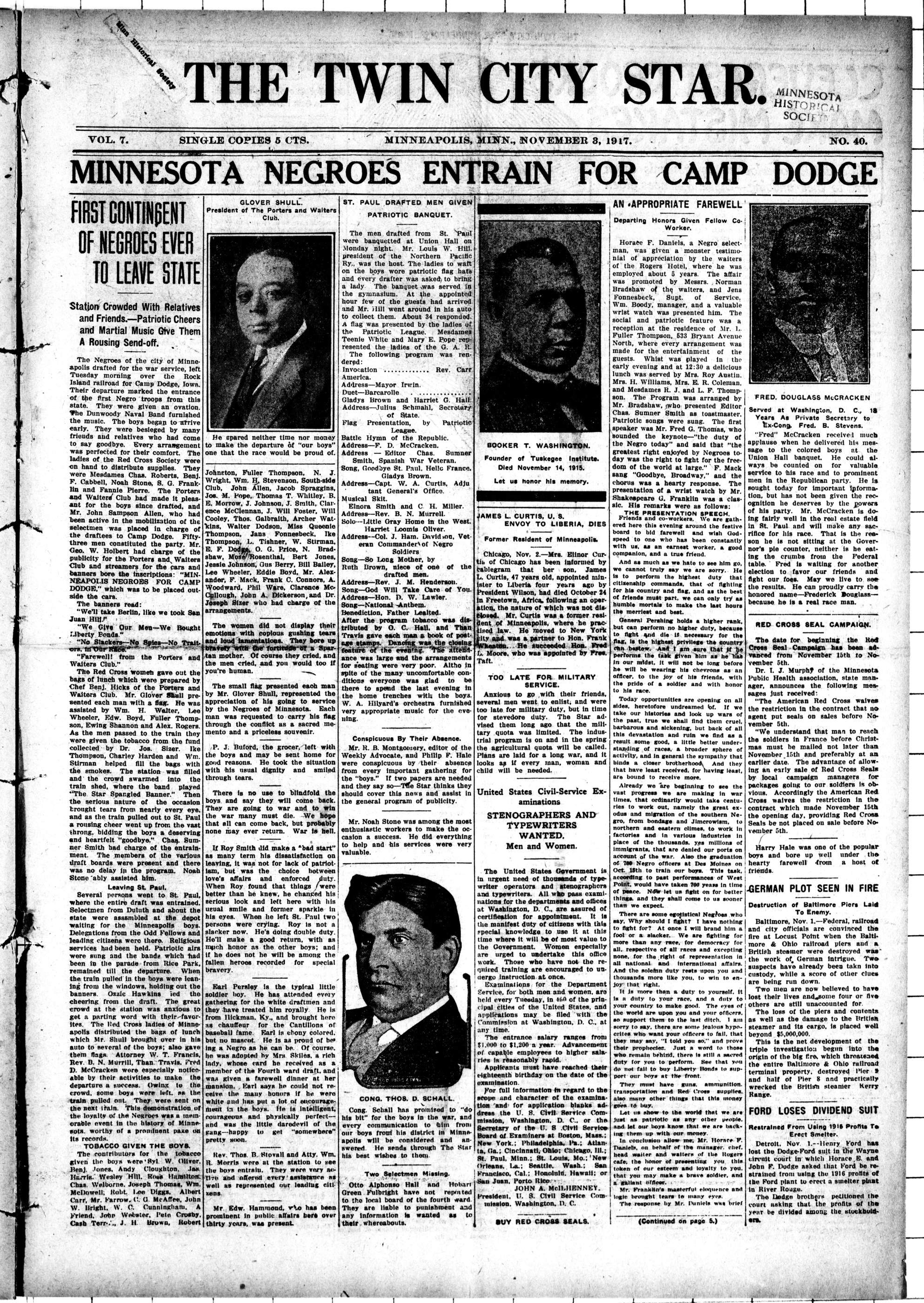
The Negroes of the city of Minneapolis drafted for the war service, left Tuesday morning over the Rock Island railroad for Camp Dodge, Iowa. Their departure marked the entrance of the first Negro troops from this state. They were given an ovation. The Dunwoody Naval Band furnished the music. The boys began to arrive early. They were besieged by many friends and relatives who had come to say goodbye. Every arrangement was perfected for their comfort. The ladies of the Red Cross Society were on hand to distribute supplies. They were Mesdames Chas. Roberts, Benj. F. Cabbell, Noah Stone, S. G. Franklin and Fannie Pierre. The Porters and Waiters Club had made it pleasant for the boys since drafted, and Mr. John Sampson Allen, who had been active in the mobilization of the selectmen was placed in charge of the draftees to Camp Dodge. Fifty-three men constituted the party. Mr. Geo. W. Holbert had charge of the publicity for the Porters and Waiters Club and streamers for the cars and banners bore the inscriptions: "MINNEAPOLIS NEGROES FOR CAMP DODGE," which was to be placed outside the cars.
The banners read:
"We'll take Berlin, like we took San
Juan Hill."
"We Give Our Men—We Bought Liberty Bonds."
"No Slackers—No Spies—No Traitors, in Our Race."
"Farewell! from the Porters and Walters Club."
The Red Cross women gave out the bags of lunch which were prepared by Chef Benj. Hicks of the Porters and Walters Club. Mr. Glover Skull presented each man with a flag. He was assisted by Wm. H. Walter, Lee Wheeler, Edw. Boyd, Fuller Thompson, Ewing Shannon and Alex. Rogers. As the men passed to the train they were given the tobacco from the fund collected by Dr. Jos. Sizer. Ike Thompson, Charley Harden and Wm. Stirman helped fill the bags with the smokes. The station was filled and the crowd swarmed into the train shed, where the band played "The Star Spangled Banner." Then the serious nature of the occasion brought tears from nearly every eye, and as the train pulled out to St. Paul a rousing cheer went up from the vast throng, bidding the boys a deserving and heartfelt "goodbye." Chag. Summer Smith had charge of the entrainment. The members of the various draft boards were present and there was no delay in the program. Noah Stone aby assisted him.
Leaving St. Paul.
Several persons went to St. Paul, where the entire draft was entrained, Selectmen from Duluth and about the state were assembled at the depot waiting for the Minneapolis boys. Delegations from the Odd Fellows and leading citizens were there. Religious services had been held. Patriotic alrs were sung and the bands which had been in the parade from Rice Park, remained till the departure. When the train pulled in the boys were leaning from the windows, holding out the banners. Ozzie Hawkins led the cheering from the draft. The great crowd at the station was anxious to get a parting word with their-favorites. The Ired Cross ladies of Minneapolis distributed the bags of lunch which Mr. Shull brought over in his auto to several of the boys; also gave them flags. Attorney W. T. Francis, Rev. B. N. Murrill, Than Travis, Fred D. McCracken were especially noticeable by their activities to make the departure a success. Owing to the crowd, some boys were left, as the train pulled out. They were sent on the next train. This demonstration of the loyalty of the Negroes was a memorable event in the history of Minnesota, worthy of a prominent paxe on its records.
TOBACCO GIVEN THE BOYS.
The contributors for the tobacco given the boys were 'Syl. W. Oliver, Benj. Jones, Andy Cloughton, Jax. Harris. Wesley Hill, Rosa Hamilton, Chas. Welborne, Joseph Thomas, Wm. McDowell, Robt. Diggs, Albert Carr, Mr. Farrow, C. G. McAffee, John W. Bright, W. C. Cunningham, A Friend, John Webster, Pete Crosby, Cash Terrell, J. H. Brown, Robert
THE TWIN CITY STAR.
He spared neither time nor money to make the departure of "our boys" one that the race would be proud of.
Johnston, Fuller Thompson, N. J. Wright, Wm. H. Stevenson, South-side Club, John Allen, Jacob Spraggins, Jos. M. Pope, Thomas T. Whitley, B. E. Morrow, J. Johnson, J. Smith, Clarence McClennan, J. Will Foster, Will Cooley, Thos. Galbraith, Archer Watkins, Walter Dodger, Miss Queenie Thompson, Jans Fonnesbeck, Ike Thompson, L. Tishner, W. Stirman, E. F. Dodge, O. G. Price, N. Bradshaw, Mose Rosenthal, Bert Jones, Jessie Johnson, Gus Berry, Bill Bailey, Lee Wheeler, Eddie Boyd, Mr. Alexander, F. Mack, Frank C. Connors, A. Woodward, Phil Ware, Clarence McClough, John A. Dickerson, and Dr. Joseph Sizer who had charge of the arrangements.
The women did not display their emotions with copious gushing tears and loud lamentations. They bore up bravely with the fortitude of a Spartan mother. Of course they cried, and the men cried, and you would too if you're human.
The small flag presented each man by Mr. Glover Shull, represented the appreciation of his going to service by the Negroes of Minnesota. Each man was requested to carry his flag through the conflict as a sacred memento and a priceless souvenir.
P. J. Buford, the grocer, left with the boys and may be sent home for good reasons. He took the situation with his usual dignity and smiled through tears.
There is no use to blindfold the boys and say they will come back. They are going to war and to win the war many must die. We hope that all can come back, but probably none may ever return. War is hell.
If Roy Smith did make a "bad start" as many term his dissatisfaction on leaving, it was not for lack of patriotism, but was the choice between love's affairs and enforced duty. When Roy found that things were better than he knew, he changed his serious look and left here with his usual smile and former sparkle in his eyes. When he left St. Paul two persons were crying. Roy is not a slacker now. He's doing double duty. He'll make a good return, with as much honor as the other boys; and if he does not he will be among the fallen heroes recorded for special bravery.
Earl Persley is the typical little soldier boy. He has attended every gathering for the white draftmen and they have treated him royally. He is from Hickman, Ky., and brought here as chaufeur for the Cantillons of baseball fame. Earl is ebony colored, but no mascot. He is as proud of being a Negro as he can be. Of course, he was adopted by Mrs. Skiles, a rich lady, whose card he received as a member of the Fourth ward draft, and was given a farewell dinner at her mansion. Earl says he could not receive the many honors if he were white and has put a lot of encouragement in the boys. He is intelligent, courageous and physically perfect—and was the little daredevil of the gang—happy to get "somewhere" pretty soon.
Rev. Thos. B. Novall and Atty. Wm. R. Morris were at the station to see the boys entrain. They were very active and offered every assistance as well as represented our leading citizens.
Mr. Edw. Hammond, v.lo has been prominent in public affairs here over thirty years, was present.
MINNEAPOLIS, MINN., NOVEMBER 3, 1917.
ST. PAUL DRAFTED MEN GIVEN
PATRIOTIC BANQUET.
The men drafted from St. Paul were banqueted at Union Hall on Monday night. Mr. Louis W. Hill, president of the Northern Pacific Ry., was the host. The ladies to wait on the boys wore patriotic flag hats and every drafter was asked to bring a lady. The banquet was served in the gymnasium. At the appointed hour few of the guests had arrived and Mr. Hill went around in his auto to collect them. About 34 responded. A flag was presented by the ladies of the Patriotic League. Mesdames Teenie White and Mary E. Pope represented the ladies of the G. A. R.
Invocation ..... Rev. Carr
America.
Address—Mayor Irwin.
Duet—Barcarolle ..... Gladys Brown and Harriet G. Hall.
Address—Julius Schmahl, Secretary
of State.
Flag Presentation, by Patriotic
League.
Battle Hymn of the Republic.
Address—F. D. McCracken.
Address — Editor Chas. Sumner
Smith, Spanish War Veteran.
Song, Goodbye St. Paul, Helic France,
Gladys Brown.
Address—Capt. W. A. Curtis, Adju
tant General's Office.
Musical Skit.
Elnora Smith and C. H. Miller.
Address—Rev. B. N. Murrell.
Solo—Little Gray Home in the West.
Harriet Loomis Oliver.
Address—Col. J. Ham. Davidson, Vet.
Song—So Long Mother, by
Ruth Brown, niece of one of the
drafted men.
Address—Rev. J. M. Henderson.
Song—God Will Take Care of You.
Address—Hon. D. W. Lawler.
Song—National Anthem.
Benediction, Father Lealted.
After the program tobacco was
distributed by O. C. Hall, and Than
Travis gave each man a book of postage
stamps. Dancing was the closing
feature of the evening. The attendance
was large and the arrangements
for seating were very poor. Altho in spite of the many uncomfortable conditions everyone was glad to be there to spend the last evening in the home trenches with the boys.
W. A. Hilyard's orchestra furnished very appropriate music for the evening.
Conspicuous By Their Absence.
Mr. R. B. Montgomery, editor of the Weekly Advocate, and Philip F. Hale were conspicuous by their absence from every important gathering for the "boys." If two papers are needed and they say so—The Star thinks they should cover this news and assist in the general program of publicity.
Mr. Noah Stone was among the most enthusiastic workers to make the occasion a success. He did everything to help and his services were very valuable.
CONG. THOS. D. SCHALL.
Cong. Schall has promised to "do his bit" for the boys in the war, and every communication to him from our boys from his district in Minneapolis will be considered and answered. He sends through The Star his best wishes to them.
Two Selectmen Missing.
Otto Alphonso Hall and Hobart Green Fulbright have not reported to the local board of the fourth ward. They are liable to punishment and any information is wanted as to their whereabouts.
BOOKER T. WASHINGTON.
Let us honor his memory.
JAMES L. CURTIS, U. S.
ENVOY TO LIBERIA, DIES
Former Resident of Minneapolis.
Chicago, Nov. 2.—Mrs. Elinor Curtis of Chicago has been informed by cablegram that her son, James L. Curtis, 47 years old, appointed minister to Liberia four years ago by President Wilson, had died October 24 in Freetown, Africa, following an operation, the nature of which was not disclosed. Mr. Curtis was a former resident of Minneapolis, where he practised law. He moved to New York city and was a partner to Hon. Frank Wheaton. He succeeded Hon. Fred L. Moore, who was appointed by Pres. Taft.
TOO LATE FOR MILITARY SERVICE.
Anxious to go, with their friends, several men went to enlist, and were too late for military duty, but in time for stevedore duty. The Star advised them long ago that the military quota was limited. The industrial program is on and in the spring the agricultural quota will be called. Plans are laid for a long war, and it looks as if every man, woman and child will be needed.
United States Civil-Service Examinations
Men and Women.
The United States Government is in urgent need of thousands of typewriter operators and stenographers and typewriters. All who pass examinations for the departments and offices at Washington, D. C., are assured of certification for appointment. It is the manifest duty of citizens with this special knowledge to use it at this time where it will be of most value to the Government. Women especially are urged to undertake this office work. Those who have not the required training are encouraged to undergo instruction at once. Examinations for the Department Service, for both men and women, are held every Tuesday, in 640 of the principal cities of the United States, and applications may be filed with the Commission at Washington, D. C., at any time.
The entrance salary ranges from $1,000 to $1,200 a year. Advancement of capable employees to higher salaries is reasonably rapid.
Applicants must have reached their eighteenth birthday on the date of the examination.
For full information in regard to the scope and character of the examination and for application blanks address the U. S. Civil Service Commission, Washington, D. C., or the Secretary of the U. S. Civil Service Board of Examiners at Boston, Mass.; New York.; Philadelphia, Pa.; Atlanta, Ga.; Cincinnati, Ohio; Chicago, Ill.; St. Paul, Minn.; St. Louis, Mo.; New Orleans, La.; Seattle, Wash.; San Francisco, Cal.; Honolulu, Hawaii; or San Juan, Porto Rico.
JOHN A. McILHENNEY.
President, U. S. Civil Service Commission, Washington, D. C.
BUY RED CROSS SEALS.
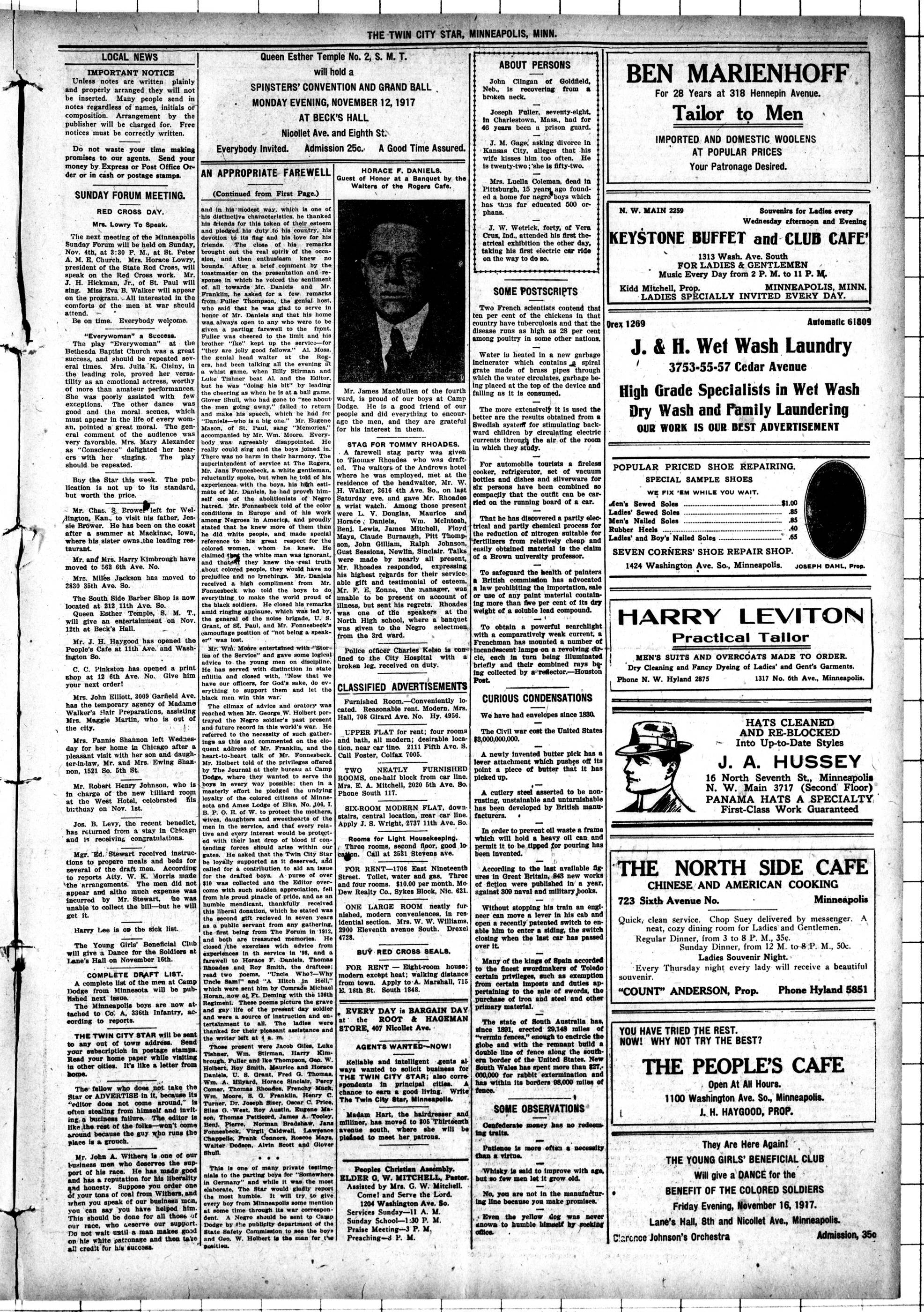
AN·APPROPRIATE FAREWELL
Departing Honors Given Fellow Co- Worker.
Horace F. Daniels, a Negro selectman, was given a monster testimonial of appreciation by the waiters of the Rogers Hotel, where he was employed about 5 years. The affair was promoted by Messrs. Norman Bradshaw of the waiters, and Jens Fonnesbeck, Supt. of Service, Wm. Boody, manager, and a valuable wrist watch was presented him. The social and patriotic feature was a reception at the residence of Mr. L. Fuller Thompson, 533 Bryant Avenue North, where every arrangement was made for the entertainment of the guests. Whist was played in the early evening and at 12:30 a delicious lunch was served by Mrs. Roy Austin, Mrs. H. Williams, Mrs. E. R. Coleman, and Mesdames R. J. and L. F. Thompson. The Program was arranged by Mr. Bradshaw, who presented Editor Chas. Sumner Smith as toastmaster. Patriotic songs were sung. The first speaker was Mr. Fred G. Thomas, who sounded the keynote—"the duty of the Negro today" and said that "the greatest right enjoyed by Negroes today was the right to fight for the freedom of the world at large." F. Mack sang "Goodbye, Broadway," and the chorus was a hearty response. The presentation of a wrist watch by Mr. Shakespeare G. Franklin was a classic. His remarks were as follows:
THE PRESENTATION SPEECH.
Friends and co-workers. We are gathered here this evening around the festive board to bid farewell and wish God-speed to one who has been constantly with us, as an earnest worker, a good companion, and a true friend.
And as much as we hate to see him go, we cannot truly say we are sorry. He is to perform the highest duty that citizenship commands, that of fighting for his country and flag, and as the best of friends must part, we can only try as humble mortals to make the last hours the merriest and best.
General Perahing holds a higher rank, but can perform no higher duty, because to fight and die is necessary for the flag, is the highest privilege the country can bestow. And I am sure that if he performs the task given him as he has in our midst, it will not be long before he will be wearing his chevrons as an officer, to the joy of his friends, with the pride of a soldier and with honor to his race.
Today opportunities are opening on all sides, heretofore undreamed of. If we take our histories and look up wars of the past, true we shall find them cruel, barbarous and sickening, but back of all this devastation and ruin we find as a result some good, a little better understanding of races, a broader sphere of activity, and in general the sympathy that binds a closer brotherhood. And they that have least received, for having least, are bound to receive more.
Already we are beginning to see the vast progress we are making in war times, that ordinarily would take centuries to work out, namely the great exodus and migration of the southern Negro, from bondage and Jimcrowism, to northern and eastern climes, to work in factories and in various industries in place of the thousands, yes millions of immigrants, that are denied our ports on account of the war. Also the graduation of 700 Negro officers at Des Moines on Oct. 15th to train our boys. This task, according to past performances of West Point, would have taken 700 years in time of peace. Now let us fight on for better things, and they shall come to us sooner than we expect.
There are some egotistical Negroes who say, Why should I fight? I have nothing to fight for? At once I will brand him a fool or a slacker. We are fighting for more than any race, for democracy for all, respective of all races and excepting none, for the right of representation in all national and international affairs. And the solemn duty rests upon you and thousands more like you, to win to enjoy that right.
It is more than a duty to yourself. It is a duty to your race, and a duty to your country to make good. The eyes of the world are upon you and your officers, so support them to the last ditch. I am sorry to say, there are some jealous hypocrites who want your officers to fail, that they may say, "I told you so," and prove their prophecies. Just a word to those who remain behind, there is still a sacred duty for you to perform. See that you do not fall to buy Liberty Bonds to support our boys at the front.
They must have guns, ammunition, transportation and Red Cross supplies, also many other things that this money goes to buy.
Let us show to the world that we are just as patriotic as any other people, and let our boys know that we are backing them up with our money.
In conclusion allow me, Mr. Horace F. Daniels, on behalf of the manager, chef, head waiter and waiters of the Rogers cafe, the honor of presenting you this token of our esteem and loyalty to you, that you may make a brave soldier, and a gallant officer.
Mr. Franklin's masterful eloquence and logic brought tears to many eyes.
The response by Mr. Daniels was brief
(Continued on page 5.)
MINNESOTA HISTORICAL SOCIETY
FRED. DOUGLASS McCRACKEN
Served at Washington, D. C., 18
Years As Private Secretary to
Ex-Conq. Fred. B. Stevens.
"Fred" McCracken received much applause when he delivered his message to the colored boys at the Union Hall banquet. He could always be counted on for valuable service to his race and to prominent men in the Republican party. He is sought today for important information, but has not been given the recognition he deserves by the powers of his party. Mr. McCracken is doing fairly well in the real estate field in St. Paul and will make any sacrifice for his race. That is the reason he is not sitting at the Governor's pie counter, neither is he eating the crumbs from the Federal table. Fred is waiting for another election to favor our friends and fight our foes. May we live to see the results. He can proudly carry the honored name—Frederick Douglass—because he is a real race man.
RED. CROSS SEAL CAMPAIGN.
The date for beginning the Red Cross Seal Campaign has been advanced from November 15th to November 5th.
Dr. I. J. Murphy of the Minnesota Public Health association, state manager, announces the following messages just received:
"The American Red Cross waives the restriction in the contract that no agent put seals on sales before November 5th.
"We understand that man to reach the soldiers in France before Christmas must be mailed not later than November 15th and preferably at an earlier date. The advantage of allowing an early sale of Red Cross Seals by local campaign managers for packages going to our soldiers is obvious. Accordingly the American Red Cross waives the restriction in the contract which made November 15th the opening day, providing Red Cross Seals be not placed on sale before November 5th.
Harry Hale was one of the popular boys and bore up well under the hearty farewell from a host of friends.
GERMAN PLOT SEEN IN FIRE
Destruction of Baltimore Piers Laid To Enemy.
Baltimore, Nov. 1.—Federal, railroad and city officials are convinced the fire at Locust Point when the Baltimore & Ohio railroad piers and a British steamer were destroyed was the work of German intrigue. Two suspects have already been taken into custody, while a score of other clues are being run down.
Two men are now believed to have lost their lives and some four or five others are still unaccounted for.
The loss of the piers and contents as well as the damage to the British steamer and its cargo, is placed well beyond $5,000,000.
This is the net development of the triple investigation begun into the origin of the big fire, which threatened the entire Baltimore & Ohio railroad terminal property, destroyed Pier 8 and half of Pier 8 and practically wrecked the British steamer Kerry Range.
FORD LOSES DIVIDEND SUIT
Restrained From Using 1916 Profits To Erect Smelter.
Detroit. Nov. 1.--Henry Ford has lost the Dodge-Ford suit in the Wayne circuit court in which Horace E. and John F. Dodge asked that Ford be restrained from using the 1916 profits of the Ford plant to erect a smelter plant in River Rouge.
The Dodge brothers petitioned the court asking that the profits of the year be divided among the stockhold-
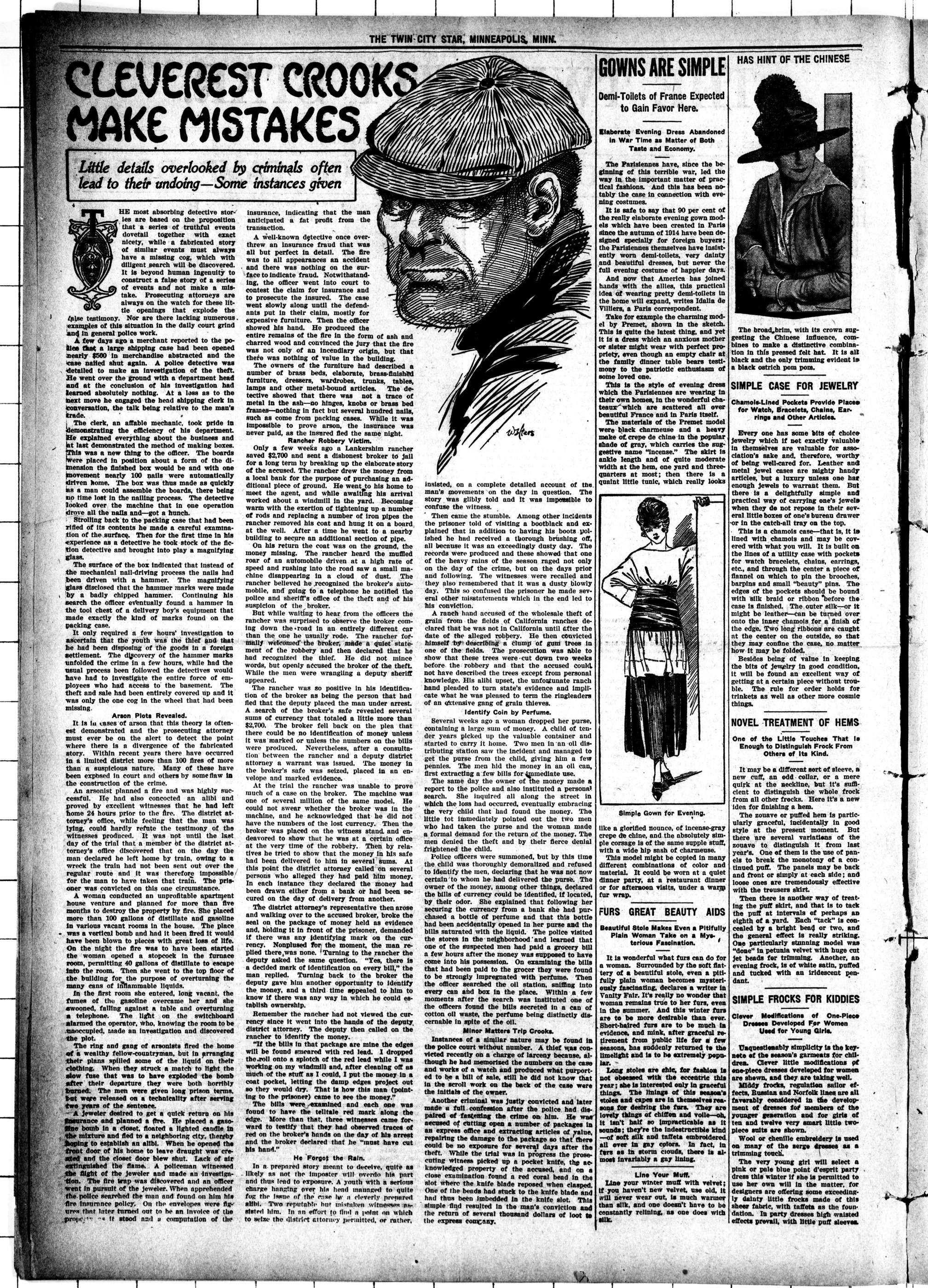
CLEVEREST CROOKS MAKE MISTAKES
Little details overlooked by criminals often lead to their undoing—Some instances given
false testimony. Nor are there lacking numerous examples of this situation in the daily court grind and in general police work.
A few days ago a merchant reported to the police that a large shipping case had been opened nearly $500 in merchandise abstracted and the case nailed shut again. A police detective was detailed to make an investigation of the theft. He went over the ground with a department head and at the conclusion of his investigation had learned absolutely nothing. At a loss as to the next move he engaged the head shipping clerk in conversation, the talk being relative to the man's trade.
The clerk, an affable mechanic, took pride in demonstrating the efficiency of his department. He explained everything about the business and at last demonstrated the method of making boxes. This was a new thing to the officer. The boards were placed in position about a form of the dimension the finished box would be and with one movement nearly 100 nails were automatically driven home. The box was thus made as quickly as a man could assemble the boards, there being no time lost in the nailing process. The detective looked over the machine that in one operation drove all the nails and—got a hunch. Strolling back to the packing case that had been rified of its contents he made a careful examination of the surface. Then for the first time in his experience as a detective he took stock of the fiction detective and brought into play a magnifying glass.
The surface of the box indicated that instead of the mechanical nail-driving process the nails had been driven with a hammer. The magnifying glass disclosed that the hammer marks were made by a badly chipped hammer. Continuing his search the officer eventually found a hammer in the tool chest of a delivery boy's equipment that made exactly the kind of marks found on the packing case.
It only required a few hours' investigation to ascertain that the youth was the thief and that he had been disposing of the goods in a foreign settlement. The discovery of the hammer marks unfolded the crime in a few hours, while had the usual process been followed the detectives would have had to investigate the entire force of employees who had access to the basement. The theft and sale had been entirely covered up and it was only the one cog in the wheel that had been missing.
It is in cases of arson that this theory is often demonstrated and the prosecuting attorney must ever be on the alert to detect the point where there is a divergence of the fabricated story. Within recent years there have occurred in a limited district more than 100 fires of more than a suspicious nature. Many of these have been exposed in court and others by some flaw in the construction of the crime.
An arsonist planned a fire and was highly successful. He had also concocted an alibi and proved by excellent witnesses that he had left home 24 hours prior to the fire. The district attorney's office, while feeling that the man was lying, could hardly refute the testimony of the witnesses produced. It was not until the last day of the trial that a member of the district attorney's office discovered that on the day the man declared he left home by train, owing to a wreck the train had not been sent out over the regular route and it was therefore impossible for the man to have taken that train. The prisoner was convicted on this one circumstance.
A woman conducted an unprofitable apartment house venture and planned for more than five months to destroy the property by fire. She placed more than 100 gallons of distillate and gasoline in various vacant rooms in the house. The place was a vertical bomb and had it been fired it would have been blown to pieces with great loss of life. On the night the fire was to have been started the woman opened a stopcock in the furnace room, permitting 40 gallons of distillate to escape into the room. Then she went to the top floor of the building for the purpose of overturning the many cans of inhammable liquids. In the first room she entered, long vacant, the fumes of the gasoline overcame her and she swooned, falling against a table and overturning a telephone. The light on the switchboard alarmed the operator, who, knowing the room to be unoccupied, made an investigation and discovered the plot.
The ring and gang of arsonists fired the home of a wealthy fellow-countryman, but in arranging their plans spilled some of the liquid on their clothing. When they struck a match to light the slow fuse that was to have exploded the bomb after their departure they were both horribly burned. The men were given long prison terms, but were released on a technicality after serving two years of the sentence.
A jeweler desired to get a quick return on his insurance and planned a fire. He placed a gasoline bomb in a closet, floated a lighted candle in the mixture and fled to a neighboring city, thereby hoping to establish an alib. When he opened the front door of his home to leave draught was created and the closet door blew shut. Lack of air extinguished the flame. A policeman witnessed the flight of the jeweler and made an investigation. The fire trap was discovered and an officer went in pursuit of the jeweler. When apprehended the police searched the man and found on him his fire insurance policy. On the envelopes were figures that later turned out to be an invoice of the property as it stood and a computation of the
T
HE most absorbing detective stories are based on the proposition that a series of truthful events dovetail together with exact nicety, while a fabricated story of similar events must always have a missing cog, which with diligent search will be discovered. It is beyond human ingenuity to construct a false story of a series of events and not make a mistake. Prosecuting attorneys are always on the watch for these little openings that explode the
any. Nor are there lacking numerous this situation in the daily court grind of real police work.
As ago a merchant reported to the po-arge shipping case had been opened in merchandise abstracted and the shout again. A police detective was make an investigation of the theft. For the ground with a department head conclusion of his investigation had lately nothing. At a loss as to the engaged the head shipping clerk in the talk being relative to the man's an affable mechanic, took pride in the efficiency of his department. Everything about the business and illustrated the method of making boxes, new thing to the officer. The boards in position about a form of the definished box would be and with one nearly 100 nails were automatically. The box was thus made as quickly would assemble the boards, there being in the nailing process. The detective the machine that in one operation nails and—got a hunch. Back to the packing case that had been contents he made a careful examin- surface. Then for the first time in his a detective he took stock of the fice and brought into play a magnifying one of the box indicated that instead of formal nail-driving process the nails had with a hammer. The magnifying had that the hammer marks were made chipped hammer. Continuing his officer eventually found a hammer in it of a delivery boy's equipment that by the kind of marks found on the required a few hours' investigation to that the youth was the theft and that disposing of the goods in a foreign The discovery of the hammer marks crime in a few hours, while had the been followed the detectives would investigate the entire force of em- had access to the basement. The had been entirely covered up and it one cog in the wheel that had been
Arson Plots Revealed.
ies of arson that this theory is oftencated and the prosecuting attorney on the alert to detect the point is a divergence of the fabricated in recent years there have occurred district more than 100 fires of moreicious nature. Many of these have in court and others by some flaw inion of the crime. it planned a fire and was highly suc-
THE TWIN CITY STAR, MINNEAPOLIS, MINN.
of ash and
that the fire
in, but that
building.
described a
brass-finished
nails, tables,
. The de-
a trace of
or brass bed
hundred nails,
while it was
insurance was
one night.
sim rancher
oker to jail
borate story
money from
insurance, indicating that the man anticipated a fat profit from the transaction.
A well-known detective once overthrew an insurance fraud that was all but perfect in detail. The fire was to all appearances an accident and there was nothing on the surface to indicate fraud. Notwithstanding, the officer went into court to contest the claim for insurance and to prosecute the insured. The case went slowly along until the defendants put in their claim, mostly for expensive furniture. Then the officer showed his hand. He produced the entire remains of the fire in the form of ash and charred wood and convinced the jury that the fire was not only of an incendial origin, but that there was nothing of value in the building.
The owners of the furniture had described a number of brass beds, elaborate, brass-finished furniture, dressers, wardrobes, trunks, tables, lamps and other metal-bound articles. The detective showed that there was not a trace of metal in the ash—no hinges, knobs or brass bed frames—nothing in fact but several hundred nails, such as come from packing cases. While it was impossible to prove arson, the insurance was never paid, as the insured fled the same night.
Rancher Robbery Victim.
Only a few weeks ago a Lankershim rancher saved $2,700 and sent a dishonest broker to jail for a long term by breaking up the elaborate story of the accused. The rancher drew the money from a local bank for the purpose of purchasing an additional piece of ground. He went to his home to meet the agent, and while awaiting his arrival worked about a windmill in the yard. Becoming warm with the exertion of tightening up a number of rods and replacing a number of iron pipes the rancher removed his coat and hung it on a board at the well. After a time he went to a nearby building to secure an additional section of pipe. On his return the coat was on the ground, the money missing. The rancher heard the muffled roar of an automobile driven at a high rate of speed and rushing into the road saw a small machine disappearing in a cloud of dust. The rancher believed he recognized the broker's automobile, and going to a telephone he notified the police and sheriff's office of the theft and of his suspicion of the broker.
But while waiting to hear from the officers the rancher was surprised to observe the broker coming down the road in an entirely different car than the one he usually rode. The rancher formally welcomed the broker, made a quiet statement of the robbery and then declared that he had recognized the thief. He did not mince words, but openly accused the broker of the theft. While the men were wrangling a deputy sheriff appeared.
The rancher was so positive in his identification of the broker as being the person that had fled that the deputy placed the man under arrest. A search of the broker's safe revealed several sums of currency that totaled a little more than $2,700. The broker fell back on the plea that there could be no identification of money unless it was marked or unless the numbers on the bills were produced. Nevertheless, after a consultation between the rancher and a deputy district attorney a warrant was issued. The money in the broker's safe was seized, placed in an envelope and marked evidence.
At the trial the rancher was unable to prove much of a case on the broker. The machine was one of several million of the same model. He could not swear whether the broker was in the machine, and he acknowledged that he did not have the numbers of the lost currency. Then the broker was placed on the witness stand and endeavored to show that he was at a certain office at the very time of the robbery. Then by relatives he tried to show that the money in his safe had been delivered to him in several sums. At this point the district attorney called on several persons who alleged they had paid him money. In each instance they declared the money had been drawn either from a bank or had been secured on the day of delivery from another.
The district attorney's representative then arose and walking over to the accused broker, broke the seal on the package of money held as evidence and, holding it in front of the prisoner, demanded if there was any identifying mark on the currency. Nonplused for the moment, the man replied there, was none. Turning to the rancher the deputy asked the same question. "Yes, there is a decided mark of identification on every bill," the man replied. Turning back to the broker the deputy gave him another opportunity to identify the money, and a third time appealed to him to know if there was any way in which he could establish ownership.
Remember the rancher had not viewed the currency since it went into the hands of the deputy district attorney. The deputy then called on the rancher to identify the money.
"If the bills in that package are mine the edges will be found smeared with red lead. I dropped the roll onto a splotch of the red lead while I was working on my windmill and, after cleaning off as much of the stuff as I could, I put the money in a coat pocket, letting the damp edges project out so they would dry. That is how this man (pointing to the prisoner) came to see the money."
The bills were examined and each one was found to have the telltale red mark along the edge. More than that, three witnesses came forward to testify that they had observed traces of red on the broker's hands on the day of his arrest and the broker declared that he "must have cut his hand."
He Forgot the Rain.
In a prepared story meant to deceive, quite as likely as not the impostor will overdo his part and thus lead to exposure. A youth with a serious charge hanging over his head managed to quite fog the issue of the case by a cleverly prepared alibi. Two reputable but mistaken witnesses assisted him. In an effort to find a point on which to selze the district attorney permitted, or rather
insisted, on a complete detailed account of the man's movements on the day in question. The story was glibly told and it was impossible to confuse the witness.
Then came the stumble. Among other incidents the prisoner told of visiting a bootblack and explained that in addition to having his boots polished he had received a thorough brushing off, all because it was an exceedingly dusty day. The records were produced and these showed that one of the heavy rains of the season raged not only on the day of the crime, but on the days prior and following. The witnesses were recalled and they also remembered that it was a dusty blowly day. This so confused the prisoner he made several other misstatements which in the end led to his conviction.
A ranch hand accused of the wholesale theft of grain from the fields of California ranches declared that he was not in California until after the date of the alleged robbery. He then convicted himself by describing a clump of gum trees in one of the fields. The prosecution was able to show that these trees were cut down two weeks before the robbery and that the accused could not have described the trees except from personal knowledge. His alibi upset, the unfortunate ranch hand pleaded to turn state's evidence and implicate what he was pleased to term the ringleaders of an extensive gang of grain thieves.
Identify Coin by Perfume.
Several weeks ago a woman dropped containing a large sum of money. A older years picked up the valuable constated to carry it home. Two men in attributing station saw the incident and get the purse from the child, giving pennies. The men hid the money in first extracting a few bills for immediate. The same day the owner of the more report to the police and also instituted search. She inquired all along the which the loss had occurred, eventually the very child that had found the little tot immediately pointed out the who had taken the purse and the we a formal demand for the return of the men denied the theft and by their frightened the child.
Police officers were summoned, but the child was thoroughly demoralized a to identify the men, declaring that he w certain to whom he had delivered the owner of the money, among other thing the bills of currency could be identified by their odor. She explained that for securing the currency from a bank she chased a bottle of perfume and that had been accidentally opened in her p bills saturated with the liquid. The po the stores in the neighborhood and le one of the suspected men had paid a a few hours after the money was supposed into his possession. On examin that had been paid to the grocer they to be strongly impregnated with perf the officer searched the oil station, s every can and box in the place. W moments after the search was instit the officers found the bills secreted in cotton oil waste, the perfume being discernable in spite of the oil.
Several weeks ago a woman dropped her purse, containing a large sum of money. A child of tender years picked up the valuable container and started to carry it home. Two men in an oil distributing station saw the incident and managed to get the purse from the child, giving him a few pennies. The men hid the money in an oil can, first extracting a few bills for immediate use. The same day the owner of the money made a report to the police and also instituted a personal search. She inquired all along the street in which the loss had occurred, eventually embracing the very child that had found the money. The little tot immediately pointed out the two men who had taken the purse and the woman made a formal demand for the return of the money. The men denied the theft and by their fierce denial frightened the child.
Police officers were summoned, but by this time the child was thoroughly demoralized and refused to identify the men, declaring that he was not now certain to whom he had delivered the purse. The owner of the money, among other things, declared the bills of currency could be identified, if located, by their odor. She explained that following her securing the currency from a bank she had purchased a bottle of perfume and that this bottle had been accidentally opened in her purse and the bills saturated with the liquid. The police visited the stores in the neighborhood and learned that one of the suspected men had paid a grocery bill a few hours after the money was supposed to have come into his possession. On examining the bills that had been paid to the grocer they were found to be strongly impregnated with perfume. Then the officer searched the oil station, sniffing into every can and box in the place. Within a few moments after the search was instituted one of the officers found the bills secreted in a can of cotton oil waste, the perfume being distinctly discernable in spite of the oil.
Minor Matters Trip Crooks.
Instances of a similar nature may be the police court without number. A this victed recently on a charge of larceny y though he had memorized the numbers and works of a watch and produced whied to be a bill of sale, still he did not
Instances of a similar nature may be found in the police court without number. A thief was convicted recently on a charge of larceny because, although he had memorized the numbers on the case and works of a watch and produced what purported to be a bill of sale, still he did not know that in the scroll work on the back of the case were the initials of the owner.
Another criminal was justly convicted and later made a full confession after the police had dispaired of fastening the crime on him. He was accused of cutting open a number of packages in an express office and extracting articles of value, repalring the damage to the package so that there could be no exposure for several days after the theft. While the trial was in progress the prosecuting witness picked up a pocket knife, the acknowledged property of the accused, and on a close examination found a red coral bead in the slot where the knife blade reposed when clasped. One of the beads had stuck to the knife blade and had thus been imbedded in the knife slot. This simple find resulted in the man's conviction and the return of several thousand dollars of loot to the express company.
GOWNS ARE SIMPLE
Demi-Toilets of France Expected to Gain Favor Here.
Elaborate Evening Dress Abandoned in War Time as Matter of Both Taste and Economy.
The Parisiennes have, since the beginning of this terrible war, led the way in the important matter of practical fashions. And this has been notably the case in connection with evening costumes.
It is safe to say that 90 per cent of the really elaborate evening gown models which have been created in Paris since the autumn of 1914 have been designed specially for foreign buyers; the Parisiennes themselves have insistently worn demi-tollets, very dainty and beautiful dresses, but never the full evening costume of happier days.
And now that America has joined hands with the allies, this practical idea of wearing pretty demi-tollets in the home will expand, writes Idalia de Villiers, a Paris correspondent.
Take for example the charming model by Premet, shown in the sketch. This is quite the latest thing, and yet it is a dress which an anxious mother or sister might wear with perfect propriety, even though an empty chair at the family dinner table bears testimony to the patriotic enthusiasm of some loved one.
This is the style of evening dress which the Parisiennes are wearing in their own homes, in the wonderful chateau which are scattered all over beautiful France and in Paris itself.
The materials of the Premet model were black charmeuse and a heavy make of crepe de chine in the popular shade of gray, which carries the suggestive name "incense." The skirt is ankle length and of quite moderate width at the hem, one yard and three-quarters at most; then there is a quaint little tunic, which really looks
THE FASHION OF THE TWENTIETH CENTURY
Simple Gown for Evening.
like a glorified nounce, of incense-gray crepe de chine, and the absolutely simple corsage is of the same supple stuff, with a wide hip sash of charmeuse.
This model might be copied in many different combinations of color and material. It could be worn at a quiet dinner party, at a restaurant dinner or for afternoon visits, under a warm fur wrap.
FURS GREAT BEAUTY AIDS
Beautiful Stole Makes Even a Pitifully Plain Woman Take on a Mysterious Fascination.
It is wonderful what furs can do for a woman. Surrounded by the soft flattery of a beautiful stole, even a pitifully plain woman becomes mysteriously fascinating, declares a writer in Vanity Fair. It's really no wonder that woman remains true to her furs, even in the summer. And this winter furs are to be more desirable than ever. Short-haired furs are to be much in evidence, and mink, after graceful retirement from public life for a few seasons, has suddenly returned to the limelight and is to be extremely popular.
Long stoles are chic, for fashion is not obsessed with the eccentric this year; she is interested only in graceful things. The linings of this season's stoles and capes are in themselves reasons for desiring the furs. They are lovely things of chiffon and voile—oh, it isn't half so impracticable as it sounds; they're the indestructible kind—of soft silk and taffeta embroidered all over in gay colors. In fact, in furs as in stern clouds, there is almost invariably a gay lining.
Line Your Muff.
Line your winter muff with velvet; if you haven't new velvet, use old, it will never wear out, is much warmer than silk, and one doesn't have to be constantly relining, as one does with silk.
HAS HINT OF THE CHINESE
THE FASHION WEEKLY
The broad,brim, with its crown suggesting the Chinese influence, combines to make a distinctive combination in this pressed felt hat. It is all black and the only trimming evident is a black ostrich pom pom.
SIMPLE CASE FOR JEWELRY
Chamois-Lined Pockets Provide Places for Watch, Bracelets, Chains, Earrings and Other Articles.
Every one has some bits of choice jewelry which if not exactly valuable in themselves are valuable for association's sake and, therefore, worthy of being well-cared for. Leather and metal jewel cases are mighty handy articles, but a luxury unless one har enough jewels to warrant them. But there is a delightfully simple and practical way of carrying one's jewels when they do not repose in their several little boxes of one's bureau drawer or in the catch-all tray on the top.
This is a chamois case—that is, it is lined with chamois and may be covered with what you will. It is built on the lines of a utility case with pockets for watch bracelets, chains, earrings, etc, and through the center a piece of flannel on which to pin the brooches, barpins and small "beauty" pins. The edges of the pockets should be bound with silk braid or ribbon before the case is finished. The outer silk—or it might be leather—can be turned over onto the inner chamois for a finish of the edge. Two long ribbons are caught at the center on the outside, so that they may confine the case, no matter how it may be folded.
Besides being of value in keeping the bits of jewelry in good condition, it will be found an excellent way of getting at a certain piece without trouble. The rule for order holds for trinkets as well as other more cosmic things.
NOVEL TREATMENT OF HEMS
One of the Little Touches That Is Enough to Distinguish Frock From Others of Its Kind.
It may be a different sort of sleeve, a new cuff, an odd collar, or a mere quirk at the neckline, but it's sufficient to distinguish the whole frock from all other frecks. Here it's a new idea for finishing a hem.
The zouave or puffed hem is particularly graceful, incidentally in good style at the present moment. But there are several variations of the zouave to distinguish it from last year's. One of them is the use of panels to break the monotony of a continued puff. The panels may be back and front or simply at each side; and loose ones are tremendously effective with the treusers skirt.
Then there is another way of treating the puff skirt, and that is to tack the puff at intervals of perhaps an eighth of a yard. Each "tack" is concealed by a bright bead or two, and the general effect is really striking. One particularly stunning model was "done" in petunia velvet with huge cut jet beads for trimming. Another, an evening frock, is of white satin, puffed and tucked with an iridescent pendant.
SIMPLE FROCKS FOR KIDDIES
Clever Modifications of One-Piece Dresses Developed For Women Used for Young Girls.
Unquestionably simplicity is the keynote of the season's garments for children. Clever little modifications of one-piece dresses developed for women are shown, and they are taking well. Middy frocks, regulation sailor effects, Russian and Norfolk lines are all favorably considered in the development of dresses for members of the younger generation and for girls of ten and twelve very smart little two-piece suits are shown.
Wool or chenille embroidery is used on many of the serge dresses as a trimming touch.
The very young girl will select a pink or pale blue point d'esprit party dress this winter if she is permitted to use her own will in the matter, for designers are offering some exceedingly daly little frocks made of this sheer fabric, with taffeta as the foundation. In party dresses high waisted effects prevail, with little puff sleeves.
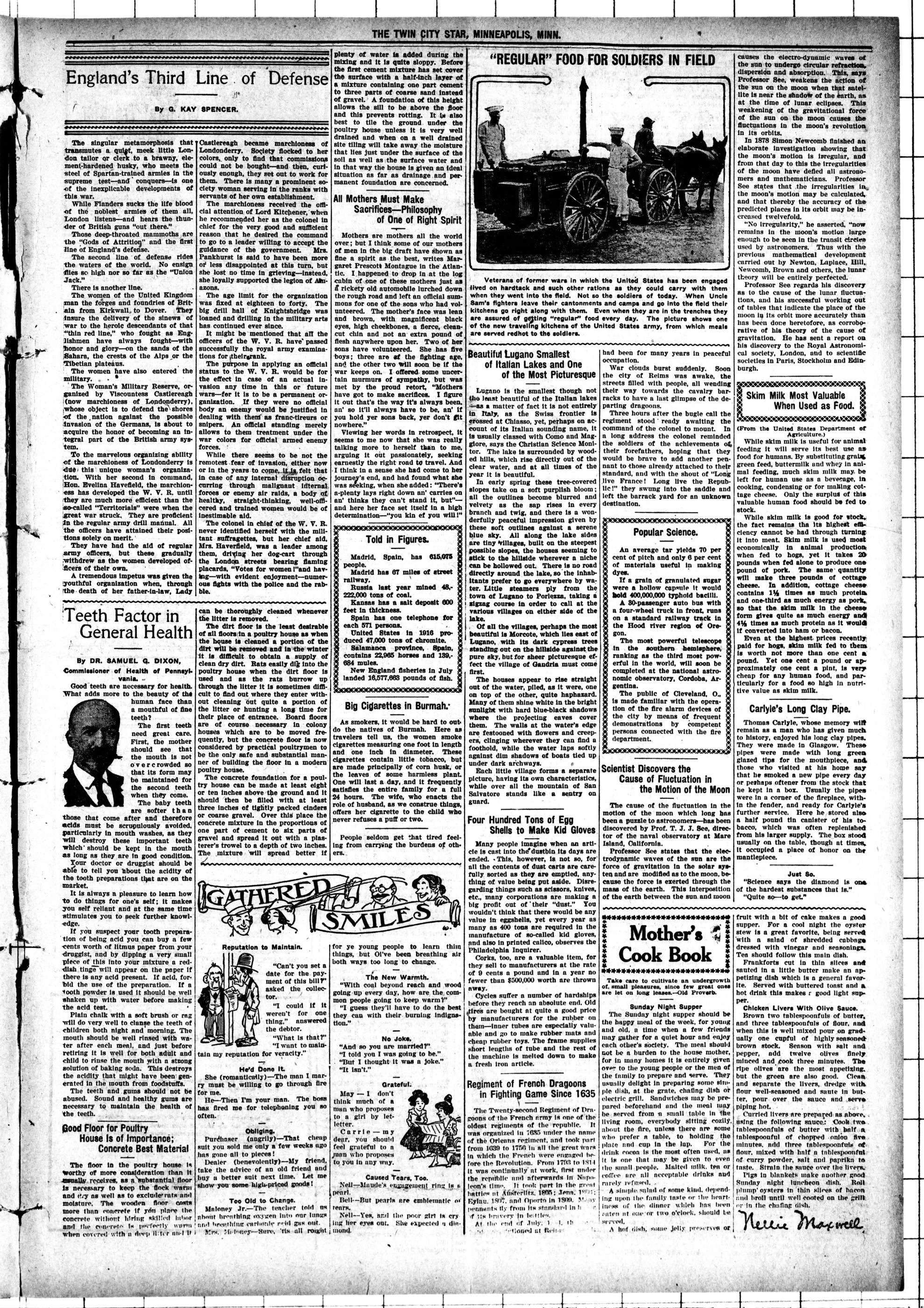
England's Third Line of Defense
The singular metamorphosis that transmutes a quiet, meek little London tailor or clerk to a brawny, element-hardened husky, who meets the steel of Spartan-trained armies in the supreme test—and conquers—is one of the inexplicable developments of this war.
While Flanders sucks the life blood of the noblest armies of them all, London listens—and hears the thunder of British guns "out there."
Those deep-throated mammoths are the "Gods of Attrition" and the first line of England's defense.
The second line of defense rides the waters of the world. No ensign files so high nor so far as the "Union Jack."
There is another line.
Castlereagh became marchioness of Londonderry. Society flocked to her colors, only to find that commissions could not be bought—and then, curiously enough, they set out to work for them. There is many a prominent society woman serving in the ranks with servants of her own establishment.
The marchioness received the official attention of Lord Kitchener, when he recommended her as the colonel in chief for the very good and sufficient reason that he desired the command to go to a leader willing to accept the guidance of the government. Mrs. Pankhurst is said to have been more or less disappointed at this turn, but she lost no time in grieving—instead, she loyally supported the legion of Almazons.
There is another line.
The women of the United Kingdom man the forges and foundries of Britain from Kirkwall, to Dover. They insure the delivery of the sinews of war to the heroic descendants of that "thin red line," who fought as Englishmen have always fought—with honor and glory—on the sands of the Sahara, the crests of the Alps or the Tibetian plateaus.
The women have also entered the military.
The Woman's Military Reserve, organized by Viscountess Castiereagh (now marchioness of Londonderry), whose object is to defend the shores of the nation against the possible invasion of the Germans, is about to acquire the honor of becoming an integral part of the British army system.
To the marvelous organizing ability of the marchioness of Londonderry is due this unique woman's organization. With her second in command, Hon. Evelina Havefield, the marchioness has developed the W. V. R. until they are much more efficient than the so-called "Territorials" were when the great war struck. They are proficient in the regular army drill manual. All the officers have attained their positions solely on merit.
They have had the aid of regular army officers, but these gradually withdrew as the women developed officers of their own.
A tremendous impetus was given the youthful organization when, through the death of her father-in-law, Lady
Teeth Factor in General Health
By DR. SAMUEL G. DIXON,
Commissioner of Health of Pennsylvania.
Good teeth are necessary for health.
What adds more to the beauty of the
human face than
a mouthful of fine
teeth?
A. M.
The first teeth need great care. First, the mother should see that the mouth is not overcrowded so that its form may be maintained for the second teeth when they come. The baby teeth
The baby teeth are softer than
those that come after and therefore acids must be scrupulously avoided, particularly in mouth washes, as they will destroy these important teeth which should be kept in the mouth as long as they are in good condition. Your doctor or druggist should be able to tell you about the acidity of the tooth preparations that are on the market. It is always a pleasure to learn how to do things for one's self; it makes you self reliant and at the same time stimulates you to seek further knowledge.
If you suspect your tooth preparation of being acid you can buy a few cents worth of litmus paper from your druggist, and by dipping a very small piece of this into your mixture a reddish tinge will appear on the paper if there is any acid present. If acid, forbid the use of the preparation. If a tooth powder is used it should be well shaken up with water before making the acid test.
Plain chalk with a soft brush or rag will do very well to clance the teeth of children both night and morning. The mouth should be well rinsed with water after each meal, and just before retiring it is well for both adult and child to rinse the mouth with a strong solution of baking soda. This destroys the acidity that might have been generated in the mouth from foodstuffs.
The teeth and gums should not be abused. Sound and healthy gums are necessary to maintain the health of the teeth.
Good Floor for Poultry House Is of Importance; Concrete Best Material
The floor in the poultry house is worthy of more consideration than it usually receives, as a substantial floor is necessary to keep the flock warm and dry as well as to exclude rats and moisture. The wooden floor costs more than concrete if you place the concrete without hiring skilled labor and the concrete is perfectly warm when covered with a deep litter and it
GATHERED SMILES
Castlereagh became marchoness of Londonderry. Society flocked to her colors, only to find that commissions could not be bought—and then, curiously enough, they set out to work for them. There is many a prominent society woman serving in the ranks with servants of her own establishment. The marchoness received the official attention of Lord Kitchener, when he recommended her as the colonel in chief for the very good and sufficient reason that he desired the command to go to a leader willing to accept the guidance of the government. Mrs. Pankhurst is said to have been more or less disappointed at this turn, but she lost no time in grieving—instead, she loyally supported the legion of Almazons.
The age limit for the organization was fixed at eighteen to forty. The big drill hall of Knightsbridge was loaned and drilling in the military arts has continued ever since. It might be mentioned that all the officers of the W. V. R. have passed successfully the royal army examinations for their rank.
The purpose in applying an official status to the W. V. R. would be for the effect in case of an actual invasion any time in this or future wars—for it is to be a permanent organization. If they were no official body an enemy would be justified in dealing with them as franc-tireurs or snipers. An official standing merely allows to them treatment under the war colors for official armed enemy forces.
While there seems to be not the remotest fear of invasion, either now or in the years to come, it is felt that in case of any internal disruption occurring through malignant internal forces or enemy air raids, a body of healthy, straight-thinking, well-offered and trained women would be of inestimable aid.
The colonel in chief of the W. V. R. never identified herself with the militant suffragettes, but her chief aid, Mrs. Haverfield, was a leader among them, drying her dog-cart through the London streets bearing flaming placards, "Votes for women" and having—with evident enjoyment—numerous fights with the police and the rabble.
can be thoroughly cleaned whenever the litter is removed.
The dirt floor is the least desirable of all floors in a poultry house as when the house is cleaned a portion of the dirt will be removed and in the winter it is difficult to obtain a supply of clean dry dirt. Rats easily dig into the poultry house when the dirt floor is used and as the rats burrow up through the litter it is sometimes difficult to find out where they enter without cleaning out quite a portion of the litter or hunting a long time for their place of entrance. Board floors are of course necessary in colony houses which are to be moved frequently, but the concrete floor is now considered by practical poultrymen to be the only safe and substantial manner of building the floor in a modern poultry house.
The concrete foundation for a poultry house can be made at least eight or ten inches above the ground and it should then be filled with at least three inches of tightly packed clinders or coarse gravel. Over this place the concrete mixture in the proportions of one part of cement to six parts of gravel and spread it out with a plasterer's trowel to a depth of two inches. The mixture will spread better if
A man is being told a newspaper is being delivered.
"Can't you set a date for the payment of this bill?" asked the collector.
"I could if it weren't for one thing," answered the debtor.
tain my reputation for veracity."
He'd Done It.
She (romantically)—The man I marry must be willing to go through fire for me.
He—Then I'm your man. The boss has fired me for telephoning you so often.
Obliging.
Purchaser (angrily)—That cheap suit you sold me only a few weeks ago has gone all to pieces!
Dealer (benevolently)—My friend, take the advice of an old friend and buy a better suit next time. Let me show you some high-priced goods!
Too Old to Change.
Maloney Jr.—The teacher told us about breathing oxygen into our lungs and breathing carbonic acid gas out.
Mrs. Maloney—Sure, it's all right.
plenty of water is added during the mixing and it is quite sloppy. Before the first cement mixture has set cover the surface with a half-inch layer of a mixture containing one part cement to three parts of coarse sand instead of gravel. A foundation of this height allows the sill to be above the floor and this prevents rotting. It is also best to tile the ground under the poultry house unless it is very well drained and when on a well drained site tiling will take away the moisture that lies just under the surface of the soil as well as the surface water and in that way the house is given an ideal situation as far as drainage and permanent foundation are concerned.
All Mothers Must Make Sacrifices—Philosophy of One of Right Spirit
Mothers are mothers all the world over; but I think some of our mothers of men in the big draft have shown as fine a spirit as the best, writes Margaret Prescott Montague in the Atlantic. I happened to drop in at the log cabin of one of these mothers just as if rickety old automobile lurched down the rough road and left an official summons for one of the sons who had volunteered. The mother's face was lean and brown, with magnificent black eyes, high cheekbones, a fierce, cleancut chin and not an extra pound of flesh anywhere upon her. Two of her sons have volunteered. She has five boys; three are of the fighting age, and the other two will soon be if the war keeps on. I offered some uncertain murmurs of sympathy, but was met by the proud retort, "Mothers have got to make sacrifices. I figure it out that's the way it's always been, an' so it'll always have to be, an' if you hold yer sons back, yer don't gt nowhere."
Viewing her words in retrospect, it seems to me now that she was really talking more to herself than to me, arguing it out passionately, seeking earnestly the right road to travel. And I think in a sense she had come to her journey's end, and had found what she was seeking, when she added: "There's a-plenty lays right down an' carries on an' thinks they can't stand it, but"—and here her face set itself in a high determination—"you kin ef you will!"
Told in Figures.
Madrid, Spain, has 615,075 people.
Madrid has 67 miles of street railway.
Russia last year mined 48,-222,000 tons of coal.
Kansas has a salt deposit 600 feet in thickness.
Spain has one telephone for each 571 persons.
United States in 1916 produced 47,000 tons of chromite.
Salamanca province, Spain, contains 22,985 horses and 139,-684 mules.
New England fisheries in July landed 16,577,663 pounds of fish.
Big Cigarettes in Burmah.
As smokers, it would be hard to outdo the natives of Burmah. Here as travelers tell us, the women smoke cigarettes measuring one foot in length and one inch in diameter. These cigarettes contain little tobacco, but are made principally of corn husk, or the leaves of some harmless plant. One will last a day, and it frequently satisfies the entire family for a full 24 hours. The wife, who enacts the role of husband, as we construe things, offers her cigarette to the child who never refuses a puff or two.
People seldom get that tired feeling from carrying the burdens of others.
SMILES for ye young people to learn thin things, but Ol've been breathing air both ways too long to change.
"With coal beyond reach and wood going up every day, how are the common people going to keep warm?"
"I guess they'll have to do the best they can with their burning indignation."
No Joke,
"And so you are married?"
"I told you I was going to be."
"But I thought it was a joke."
"It isn't."
A
May — I don't think much of a man who proposes to a girl by let-letter.
Carrie — my dear, you should feel grateful to a man who proposes to you in any way.
Caused Tears, Too.
Nell — Maude's engagement ring is a pearl.
Bell — But pearls are emblematic of tears.
Nell — Yes, and the poor girl is crying her eyes out. She expected a diamond.
---
FIREMANS
Veterans of former wars in which the United States has been engaged lived on hardtack and such other rations as they could carry with them when they went into the field. Not so the soldiers of today. When Uncle Sam's fighters leave their cantonments and camps and go into the field their kitchens go right along with them. Even when they are in the trenches they are assured of getting "regular" food every day. The picture shows one of the new traveling kitchens of the United States army, from which meals are served redhot to the soldiers.
Beautiful Lugano Smallest of Italian Lakes and One of the Most Picturesque
Lugano is the smallest though not the least beautiful of the Italian lakes — as a matter of fact it is not entirely in Italy, as the Swiss frontier is crossed at Chilasso, yet, perhaps on account of its Italian sounding name, it is usually classed with Como and Maggiore, says the Christian Science Monitor. The lake is surrounded by wooded hills, which rise directly out of the clear water, and at all times of the year it is beautiful.
In early spring these tree-covered slopes take on a soft purplish bloom; all the outlines become blurred and velvety as the sap rises in every branch and twig, and there is a wonderfully peaceful impression given by these soft outlines against a serene blue sky. All along the lake sides are tiny villages, built on the steepest possible slopes, the houses seeming to stick to the hillside wherever a niche can be hollowed out. There is no road directly around the lake, so the inhabitants prefer to go everywhere by water. Little steamers ply from the town of Lugano to Porleza, taking a sigzg course in order to call at the various villages on either side of the lake.
Of all the villages, perhaps the most beautiful is Morcote, which lies east of Lugano, with its dark cypress trees standing out on the hillside against the pure sky, but for sheer picturesque effect the village of Gandria must come first.
The houses appear to rise straight out of the water, piled, as it were, one on top of the other, quite haphazard. Many of them shine white in the bright sunlight with hard blue-black shadows where the projecting caves cover them. The walls at the water's edge are festooned with flowers and creepers, clinging wherever they can find a foothold, while the water laps softly against dim shadows of boats tied up under dark archways.
Each little village forms a separate picture, having its own characteristics, while over all the mountain of San Salvatore stands like a sentry on guard.
Four Hundred Tons of Egg Shells to Make Kid Gloves
Many people imagine when an article is cast into the dustbin its days are ended. This, however, is not so, for all the contents of dust carts are carefully sorted as they are emptied, anything of value being put aside. Disregarding things such as scissors, knives, etc., many corporations are making a big profit out of their "dust." You wouldn't think that there would be any value in eggshells, yet every year as many as 400 tons are required in the manufacture of so-called kid gloves, and also in printed calico, observes the Philadelphia Inquirer. Corks, too, are a valuable item, for they sell to manufacturers at the rate of 9 cents a pound and in a year no fewer than $500,000 worth are thrown away.
Cycles suffer a number of hardships before they reach an absolute end. Old tires are bought at quite a good price by manufacturers for the rubber on them—Inner tubes are especially valuable and go to make rubber mats and cheap rubber toys. The frame supplies short lengths of tube and the rest of the machine is melted down to make a fresh iron article.
Regiment of French Dragoons in Fighting Game Since 1635
The Twenty-second Regiment of Dragoons of the French army is one of the oldest regiments of the republic. It was organized in 1635 under the name of the Orleans regiment, and took part from 1639 to 1756 in all the great wars in which the French were engaged before the Revolution. From 1793 to 1814 it was continually at work, first under the republic and afterwards in Napoleon's time. It took part in the great battles at Ansterlitz, 1805; Jena, 1807; Eylau, 1807, and Oporto in 1809. Many pennants from its standard in battle of its bravery in battles.
At the end of July, 14th
statement at Ration
had been for many years in peaceful occupation.
War clouds burst suddenly. Soon the city of Relms was awake, the streets filled with people, all wending their way towards the cavalry barracks to have a last glimpse of the departing dragons.
Three hours after the bugle call the regiment stood ready awaiting the command of the colonel to mount. In a long address the colonel reminded the soldiers of the achievements of their forefathers, hoping that they would be brave to add another pennant to those already attached to their standard, and with the shout of "Long live France! Long live the Republic!" they swum into the saddle and left the barrack yard for an unknown destination.
Popular Science.
An average tar yields 70 per cent of pitch and only 6 per cent of materials useful in making dyes.
If a grain of granulated sugar were a hollow capsule it would hold 400,000,000 typhoid bacillus.
A 80-passenger auto bus with a four-wheel truck in front, runs on a standard railway track in the Hood river region of Oregon.
The most powerful telescope in the southern hemisphere, ranking as the third most powerful in the world, will soon be completed at the national astronomic observatory, Cordoba, Argentina.
The public of Cleveland, O.. is made familiar with the operation of the fire alarm devices of the city by means of frequent demonstrations by competent persons connected with the fire department.
Scientist Discovers the Cause of Fluctuation in the Motion of the Moon
The cause of the fluctuation in the motion of the moon which long has been a puzzle to astronomers—has been discovered by Prof. T. J. J. See, director of the naval observatory at Mare Island, California. Professor See states that the electrodynamic waves of the sun are the force of gravitation in the solar system and are modified as to the moon, because the force is exerted through the mass of the earth. This interposition of the earth between the sun and moon
Mother's Cook Book
Take care to cultivate an undergrowth of, small pleasures, since few great ones are let on long leases.-Old Proverb.
Sunday Night Supper
The Sunday night supper should be the happy meal of the week, for young and old, a time when a few friends may gather for a quiet hour and enjoy each other's society. The meal should not be a burden to the house mother, for in many homes it is entirely given over to the young people or the men of the family to prepare and serve. They usually delight in preparing some simple dish, at the grate, chafing dish or electric grill. Sandwiches may be prepared beforehand and the meal may be served from a small table in the living room, everybody sitting cozily about the fire, unless there are some who prefer a table, to holding the plate and cup in the lap. For the drink cocoon is the most often used, as it is one that may be given to even the small people. Malted milk, tea or coffee are all acceptable drinks and rarely refused.
A simple salad of some kind, depending upon the family taste or the heartiness of the dinner which has been eaten at one or two o'clock, should be served.
A hot dish, some jelly preserves or
causes the electro-dynamic waves of the sun to undergo circular refraction, dispersion and absorption. This, says Professor See, weakens the action of the sun on the moon when that satellite is near the shadow of the earth, as at the time of lunar eclipses. This weakening of the gravitational force of the sun on the moon causes the fluctuations in the moon's revolution in its orbits.
In 1878 Simon Newcomb finished an elaborate investigation showing that the moon's motion is irregular, and from that day to this the irregularities of the moon have defied all astronomers and mathematicians. Professor See states that the irregularities in the moon's motion may be calculated, and that thereby the accuracy of the predicted places in its orbit may be increased twelvefold.
"No irregularity," he asserted, "now remains in the moon's motion large enough to be seen in the transit circles used by astronomers. Thus with the previous mathematical development carried out by Newton, Laplace, Hill, Newcomb, Brown and others, the lunar theory will be entirely perfected. Professor See regards his discovery as to the cause of the lunar fluctuations, and his successful working out of tables that indicate the place of the moon in its orbit more accurately than has been done heretofore, as corroborative of his theory of the cause of gravitation. He has sent a report on his discovery to the Royal Astronomical society, London, and to scientific societies in Paris, Stockholm and Edinburgh.
Skim Milk Most Valuable When Used as Food.
(From the United States Department of Agriculture.)
While skim milk is useful for animal feeding it will serve its best use as food for humans. By substituting graal green feed, buttermilk and whey in animal feeding, much skim milk may be left for human use as a beverage, in cooking, condensing or for mailing cottage cheese. Only the surplus of this valuable human food should be fed to stock.
While skim milk is good for stock, the fact remains that its highest efficiency cannot be had through turning it into meat. Skim milk is used most economically in animal production when fed to hogs, yet it takes 20 pounds when fed alone to produce one pound of pork. The same quantity will make three pounds of cottage cheese. In addition, cottage cheese contains $1\frac{1}{2}$ times as much protein and one-third as much energy as pork, so that the skim milk in the cheese form gives quite as much energy and $4\frac{1}{2}$ times as much protein as it would if converted into ham or bacon. Even at the highest prices recently, paid for hogs, skim milk fed to them is worth not more than one cent a pound. Yet one cent a pound or approximately one cent a pint, is very cheap for any human food, and particularly for a food so high in nutritive value as skim milk.
Carlyle's Long Clay Pipe.
Thomas Carlyle, whose memory will remain as a man who has given much to history, enjoyed his long clay pipes. They were made in Glasgow. These pipes were made with long green glazed tips for the mouthpiece, and those who visited at his home say that he smoked a new pipe every day or perhaps oftener from the stock that he kept in a box. Usually the pipes were in a corner of the fireplace, within the fender, and ready for Carlyle's further service. Here he stored also a half pound tin canister of his tobacco, which was often replenished from his larger supply. The box stood usually on the table, though at times, it occupied a place of honor on the mantlepiece.
Just So.
"Science says the diamond is one of the hardest substances that is." "Quite so—to get."
fruit with a bit of cake makes a good supper. For a cool night the oyster stew is a great favorite, being served with a salad of shredded cabbage dressed with vinegar and seasonings. Ten should follow this main dish.
Frankforts cut in thin slices and sauted in a little butter make an appetizing dish which is a general favorite. Served with buttered toast and a hot drink this makes a good light supper.
Chicken Livers With Olive Sauce.
Brown two tablespoonfuls of butter, and three tablespoonfuls of flour, and when this is well mixed pour on gradually one cupful of highly seasoned brown stock. Season with salt and pepper, add twelve olives finely minced and cook three minutes. The ripe olives are the most appetizing, but the green are also good. Clean and separate the livers, dredge with flour well-seasoned and sainte in butter, pour over the sauce and serve piping hot.
Curried livers are prepared as above, using the following sauce: Cook two tablespoonfuls of butter with half a tablespoonful of chopped onion five minutes, and three tablespoonfuls of flour, mixed with half a tablespoonful of curry powder, salt and paprika to taste. Strrain the sauce over the livers
Pigs in blankets make another good Sunday night luncheon dish. Roll plump' oysters in thin slices of bacon and broil until well coated on the grill or in the chafing dish.
Nellie Maxwell
MEMBER
NATIONAL NEGRO PRESS
ASSOCIATION
.
| Subscription by Mail, Postpaid.
ONE YEAR ......-2-00eeee 00 +0820
SIX MONTHS $125
THREE MONTHS ............ 65
Hamlet B. Rowe, Local Agent.
ADVERTISING RATES.
ne Inch—1 Insertion—One Dollar.
Liberal discount given on 3, 6, 9,
Months, or 1 year contracts,
‘We do not run free ads, or over-run
the time contracted for by our ad-
vertisers We respect their right tc
advertise at intervals, and rather have
them do so, than to run continuously
an “adv.” and an increasing account.
Write all Checks payable to
THE TWIN CITY STAR
1317 North Sixth Ave.
MiNNEAPOLIS - - MINNESOTA
Call at 1317 6th Ave. N. on Wednes-
day to insure matter for publication.
The Star's Phone, Hyland 1208.
——Saass
- QUR CAMOUFLAGE FRIENDS.
ee. ge te |
It ts one thing to sce a great array
of our white friends at a “chicken din-
ner” for our boys who are going rrob-
‘ably to their funeral for our flag, and
nother to note the mercenary pur-
Foses of ocme of the participants in
‘the great drama. The Louis W. ilill
dinner at Union Hall, St. Paul, was a
Teminder and probably one of this
eee “Burnguist was to appear,
das usual, he did NOT. He is a
ALACKER when needed by the Negro,
and cannot be depended on when
wanted, Was the departure of these
bigtk men so insignificant as to. not
ceerve his presence? Hon. Jullus
Schmah! represented him. And does
‘Mr. Schmahl know that he has not
done anything constructive for our
aco? Mayor Ervin was among the
missing, but he did send a g00d rep-
resentative, Hugh V. Koth, a Spanish
war veteran. Did he show his proper
regard for these men? Not a com-
‘munication of regrets was read, and ex-
planations now.are not in order.. Of
course, there wero white men thete
whose records are clean. We believe
ghat Mr. Hill, the great captain of
industry should employ some of the
‘men and women of our race in ad-
anced positions, and then “chicken
@innere” would not be such a pro-
nounced evidence of his friendship.
Gov. Burnquist should give to one
Negro at least, one of his big crop
of political plums instead of taking
from our former scanty share, and
Mayor Irvin could profit by their ex-
ample. Among the speakers were
Col, J. Ham. Davidson whose life is
a fitting example of “equality to all
‘men,” and he ts one of the remaining
few. Hon. Pan. W. Lawler has for
many years done the right thing for
cour race, and is a member of that
church, the Roman Catholic, which is
doing more today for the flag and the
‘Negro ond has suffered the most vi-
lous attacks. Why do we not have
those supposed friends, who parade
thelr love at this time—who have
great power in the political and com-
mercial world, do some concrete act
to show that they want to give due
recognition to the Negro? Why should
not Fred McCracken be remembered
for his services to thelr party and
especially for his ability? Do they
remember thot Editor John Quincy
‘Adams of the Appeal has done enough
during 35 years’ service to warrant a
reward. Do they think they only
have to give a Negro a “chicken din-
ner” under most uncomfortable cou-
ditions and march him off to war.
Such will not suffice in. these times.
‘The writer of thig article was a
speaker on the platform and he held
himself within bounds, because the
allotted tlme would not permit other
than remarks of encouragement tv
those “noble scions of a downtrod
den race" on their journey to. vic
tory or death Therefore, it was his
duty to wave personalities and
‘overcome the evil with the good.
, The chairman, W. T. Francis, presided
with becoming dignity. He is a loyal
Negro to his race and his country.
The arrangements made, because the
atiir could be financed by “Louie”
Uill, wore not of his doing.
‘The Negro is in the war at:home
ang shroad. He must be true to him
self to be true to his country. He
cannot afford to surrender his man
hood for position, or his birthrigh
fer finange; no more right here that
fhe can afford to act as ® spy or qui
as coward—Over there. Let u:
mot be led astray by those friends
“who want us, because we give tir
“most, but pay due tribute to thos:
who trest us as men. And as
* warning to St. Paul Negroes, let the
“white: citizens accept the Nezzo it
their own gatherings. Missenogi
sets the example. The boys Her
“were given overy consideration like
, the other races: and one of our black
‘Uoys. can do more among the \white
Wiltiaciess to yo, to savence us
A to go, to advance us in
their estimation as a race, thar
Jose Nogroes, by listening to the
‘shot at us by a few white
persous of prominence, who have
done comparatively nothing fir us,
according to their positions and pow-
‘er; although they have been thaterial-
ly’ benefited by us, :
FROM CAUSE TO EFFECT,
The Star does not cast any per-
‘sonal reflections on the intent of the
‘Union Hall banquet. We hope to show
‘the results, Such an event was too
large for such a small place. Negroes
deserve the better places provided
for such purposes. ‘The Auditorium
‘or State Capitol would serve the pur-
pose better. The Negro soldier
makes no apology for his record and
is entitled to every consideration:
The Negroes’ of St. Paul had hon:
ored the draft men and it was up to
Mr, Ilill as a white man to give them
the best as enjoyed by ‘white men.
When the Negroes banquet Mr. Hill,
who deserves every respect, they
shovld havé him in their hall and he
would be proud to be among them.
When Mr. Hill again shows his re:
gard for our people, he should take
them to a place better suited. He
would gladly do it, but there is al-
ways some Negroes, whose itching
palm fever, this article is intended
to cure. It everything for all the
Negroes inust be held in a Negro hall,
regardless of conditions, we are
thankful at this time for not having
one in this city.
Owing to an increase in cost, we
have raised our prices on all composi-
tion. Reading notices will be 10¢ per
line pinder one inch and 50c per inch
thereafter.
MAKING MORE SOLDIERS.
The remark “I'm staying home to
make more soldiers,” 1s current
among the vulgar, nevertheless, it
should be the motto of all, who are
not at the front. Every organization
or individual is expected to do those
things which butld up the rising gen-
eration to the highest moral, mental
and physical development—to _pre-
serve motherhood—to protect sister-
hood—to provide for childhood and
to promote brotherhood. Whether in
peace or war these are essential for
that good citizenship, and that alone
can produce good soldiers. Those
perverts who use this remark, in its
vulgar terms, are the ones responst-
ble for broken homes, deserted ‘vives,
dependent children and every other
deplorable condition in our tocial
life today. From such stuff slackers
are made, Make soldiers for our
race! not only for this war, but for
the great battle of life.
SCHOOL TEACHER DISMISSED.
Miss Grace Lealtad, a teacher in the
Sixth grade of the Hill school, St.
Paul, has been dismissed by the Super-
intendent, because of a petition circu-
lated and signed by parents, who ob-
ected to having a Negro woman teach
a children.
Now, while we are enthused for
war service, let's make a solid attack
in the fight for the reinstatement of
Miss Lealted. Attention! Dr. Tur-
ner! Forward march! and the N.
A.A. C. P. will follow you or relegate
you. “Fighting Joe” Sherwood is
our reserve.
The Star advocates loyalty and its
editor makes no sacrifice of its pur-
pose and gives no quarter to disloy-
alists. But should he attempt to
speak, may his tongue cleave to the
roof of his mouth—end if he began to
write, may his right hand lose its
usefulness; were he to condone by
silence the sins of our friends (?)
who, although living in the North,
they subscribe to the doctrine of Tili-
man and Vardaman, Let us fight for
every right for American black and
white, and let us not send our boys
to the trenches, and prove cowards
at home. God knows, we owe it to
them, now that they have gone, to do
our duty here. Should we fall, groat
will be the penalty. If we act our
part well, posterity will call us
blessed. Which shail it be?
Francis’ Great Speech.
“Billy was better than ever” were
‘the reports of those who heard the
speechof Atty. Wm. T. Francis at
the farewell to the St. Paul boys by
the Negro citizens. Mr. Francis is
& man of whom every good citizen of
Minnesota is proud, and Negroes
should gladly follow his leadership.
‘We were glad to mention the names
of Congressman Schall and Lundeen
of this city and Van Dyke of St. Paul
as the friends of qur race. Regard-
less of the criticisms of Mr. Lun-
deen, he has made good with us.
The Negroes are not permitted to en-
ter the national feasts or fights and
welll let them quarrel, exercising our
privilege to keep out. “Ernie” Lum
deen is right on the Negro question
all the time; and we regret that Mr.
Roosevelt cannot boast of such con-
sistency. No man, willing to’ give
Justice to Llack men, has been or
ever ‘will be found disloyal to our
American flag.
We fight to preserve the Constitu.
ton, to. support the President in his
perpetuation of Its principles, to. de-
feria all of its loyal citizens and to
secure for all men Liberty throughout
every land. We will never surrender
‘any right, accorded other American
citizens. We demand “Equality «te-
fore the Law.” The Divine piophe-
Stew shatl be fulfilled. God helps: those
who first Mein (hemselves
THE STAR is the CH#s>FST and
BEST NEGRO PAPER ‘in the
NORTHWEST. It noods 500 more
Subscribers to keep ft going. Help
to get us A BIGGER CIRCULATION.
BUY RED CROSS SEALS,
THE TWIN CITY STAR, MINNEAPOLIS, MINN.
———————
Rev. Beasley Takes Action to | oe oe er
Better Negroes’ Conditions: |toc. or time and energy
Dear Editor—I take this liberty to
write you as follows: You will find
herein enclosed a clipping from the
Pittsburg Courier of Sept, 28, “To
‘Establish a Labor Bureau.” I took up
‘the matter with Hon. Julius Schmahl,
secretary of state; Mr. Wm. Houk,
commissioner of labor; Mr. Wm. Will-
jams, the governor's private messen-
ger, and other leading officials, and
am trying to get some one appointed.
1 also talked with Dr. Valdo Tamer,
vice president of the National Asso-
ciation for the Advancement of Col-
ored People, in St. Paul, and will con-
fer with you and others at the Forum
and the'N. A. A. C. P. in Minneapolis.
‘With such’an organization we would
not have so many things come up to
humiliate the race, such as the recent
dismissal of a Negro teacher in a
school in St. Paul, and wold have a
court of appeal to resort to. That af-
fair 1s a deplorable one. The word
“democracy” is a farce among the peo-
ple of this state. ‘The world is watch-
ing the Anglo-Saxon from various an-
gles. The democracy of the American.
people in California and the state-
ments sent over tye country against
the Japanese and Negroes have not
been forgotten by neither race.
This one act of rejecting this Negro
girl of refinement and culture from
teaching in a public school shows that
the white people have shut their eyes
to moral inconsistencies. If democ-
racy cannot control selfishness and ha-
tred, then democracy is a failure. Do
we pay our taxes to support white
teachers. only? God is just and his
Justice will not slumber forever. The
preaguere UF our ieadine white pul
pits have failed to comment on these
outrages upon the colored race. This
Satanic pretense of democracy has be-
come too evident in religious, civic
and political affairs.
In the capital of this state at one
time there were two colored janitors,
two colored pages, two colored women
to copy bills. These positions are now
filled with white employes. Why is
it? You can't say it is the I. W. W.
Why have we not a Negro in the
sheriff's and auditor’s offices of Ram-
sey county, as we had once? There
are colored teachers in schools in
other cities and why can’t they teach
in St. Paul and Minneapolls? What
agencies are at work to bring those
results? This is a good time for the
Negro to find out the cause. Is it
because the men who are in charge
have no backbone or stability to them?
Please publish as paid advertisement.
REY, D. B. BEASLEY,
905 Marion St. St. Paul.
SO ee one eT ee ee
REY, D. B. BEASLEY,
905 Marion St., St. Paul.
THE STAR MUST ANSWER.
Rev. Beasley has taken up a neces:
sary work and has a hard job. He is
familiar \with state conditions aud
knows’ personally “many state, off
cals, because he was formerly the
private messenger to Governor Van
Sant. The Star has left the answer to
this worthy communication of last
week to the members of our race,
who have at heart its advancement,
and should be depended upon for ac-
tivity, but they have not answered.
The Star, which must answer, has
fought for, the recognition of the Ne-
gro in every brarich of publis service.
but it is hindered and discouraged,
since the advent of a competitor,
which boosts any and every official
(for gevenue only) as “the right man
in the right place.” It has led the
powers that Ue to believe that the
Negro is doing better here than
elsewhere and that those who com-
plain are the. calamity-howlers. The
Star has contended that Dr. Turtier
fg not the man for the position he
holds. Gov, Burnguist is the sup:
posed president of the N. A. A. C. P.
in St. Paul, and it might as well have
Tillman as president, so far as our
governor's efforts for our race are
eoncerned. Gov. Burnquist has
qualified &s a good governor for the
white people and. Dr. Turner as a
physician(and surgeon, but neither
are, worthy of a place. as: the officiel
head of any organization for Negro
progress.
Political trickery and _/ jealousy
among Negroes have much to do
with our lack of positions; and much
will be accomplished when we unite
as a people, Conditions in Minne-
apolly are just as bad as in St. Paul.
Our leader here, Hon, W. R. Morris,
whose proud boast of his high rauk
in every Negro _traternity—whose
long service as a lawyer and a citl-
zen iu the eommunity—whose ment
bership in a leading white church—
‘whose name has been ‘for.many. years
the label of all the Nacroee rite
leadership ‘has been endorsed by the
white people, {because it suits them)
—has led the Negro to the position
we hold.teday in this city.
The Star invites co-operation! and
Mr.Morris, should take the lead for
his race's interest. He. has never
made even a suggestion to The Star for
any, united movement has gen-
erally received und sited Day, for
any service rendered. igell wie
get together in fact/ There is nothing
in’ gatherings and offering resolu-
tions, We must in one unite! effort
call-on the men responsible for any
arlevances, ngainst the race;and de-
mand redress. He can - never ad:
¥ance white one “leader” will take the
back track and alibi with an-apolozy
for his action, and another cringing
‘crook, ‘with’ a’ mewspaper ‘like Mont
gomery of'the Advocate, endorsed by
Morris, tell the while folks the pri-
vate and public affairs of organiza-
tious and individuals, who, advocate
Jim Crowism and segregation; who
cetdomns intermarriage, amalgama.
von, ete., and makes a-living as a
spy for the enemy; alwusa‘ruady to
sell every black man's birthright for
two dollars or less. Those are the
contending forces that hinder our
‘progress, and until they are removed,
any action for race betterment is @
loss of time and energy. The Star
has fought and suffered a sad expe-
rience. The Negroes of the Twin
Cities should get busy and begin to
do everything worthy as a united
people.
) ———.
‘There is not a Negro on the pay-
roll of the entire military forces of
the state.
Morris As “Our Leader.”
The Weekly Advocate has pro
claimed Hon. W. R. Morris as the
leader of the Négroes of this city.
‘The Star refutes this statement, not
because Mr. Morris is not qualified in
many-ways, but because he lacks that
initiative necessary for competent
leadership. The Advocate’sarticle is
in the abstract, and full of high-
sounding irrevelancies. Let us have
the facts, and if Mr. Morris ts lead-
ing in the right direction, every Ne-
gro should and would follow him.
The Negroes of Minneapoits need
representative, chosen by them, ndt
one selected for them by the white
people. The Star does not object to
Mr. Morris or any real leader. As it
is we are straggling and have no
leader. Is it the fault of the leader(?)
or the followers? If Mr. Morris will
‘take the lead for the race's benefit,
‘then the Advocate and the Star should
do the driving. It is up to Mr. Mor.
ris and his Advocate.
To Establish Labor Bureau.
‘Trenton, N. J., Sept. 26.—The great
influx of Negroes from the South has
been recognized by the state, and
General Lewis T. Bryant, state com-
missioner of labor, today announced
the establishment by his department
of the Division of Negro Welfare and
Employment Bureau. The action re-
sulted from many conferences be-
tween General Bryant and the State
House commission, composed of Gov-
ernor Edge, State Treasurer Read and
State Comptroller Bugbee.
‘The possibilities of social uplift and
constructive work through the activi-
tles of the bureau will be tried out
during the next four or five months,
‘and a,recommendation will be made
to the next legislature to make the
department permanent. Colored citi-
zens of the state have shown great
interest, and Isaac H. Nutter of At-
lantic City, who has always been a
worker among his people, has offered
his services, without salary, to under-
take the organization of the bureau.
He is a lawyer, and several physt-
cians and a layman will be engaged
in the work with him.—Pitteburg
Courier.
We have some among our advertis
ers and subscribers who are credit
to-our race for their business-like
methods. They pay promptly in ad-
vance and expect nothing; unreason-
able in return. Others want to know
“Why we can’t ‘trust’ them?” or send
a bilf\and then a collectdr, and finally
censor a Negro editor because he can’t
run his paper “like the white man.”
Féw persons realize that it pays to
pay as you go. The Star is not an
installment plan proposition. It is a
real newspaper run under many diff
culties mostly due to the foolish no-
Mons end ignorant whims of those
whom ft serves and protects and from
whom it should get its support’ ang
their consideration.
‘There is @ great demand for labor-,
ers now and Nagroes are being em-
ployed where before they were “not
wanted.” As a rule, they are making
good and their efficiency will over-
come much of the general prejudice
against them. The Negro has been
denied the privilege of employment
mostly because of the ignorance of
many employers. Since the Negro la-
borer has better opportunities, hé will
‘be a better citizen. The so-called race.
problem will soon be solved becat
there is no Negro problem; it is a
white man’s; and ifs only solution id
an intelligent consideration for the Ne}
gro as a man and an acknowledgem
of his right to earn his living on equal
footing with other citfzers.
STUDENTS HONOR MISS JEFFREY
Central High Seniors Elect Her Pres;
Ident of the Musical Club.
Miss Marienne Jeffrey, our talented
and popular pianist, was unexpectedly,
but deservedly honored by the mem-
ders of the senior class of the Central
High School of this city this week.
‘She ‘was elected president of their
‘Musical club, a new organization prin-
cipally for the study of advanced pi-
ano music. It begins with a member-
‘abip of-80 members.” Miss Jeffrey has
been for several terms pianist of thé
High Schoo! orchestra and has proven
herself a musician of extraordinary
ability.
re eh eer eg ee
ment, Circutation, Etc.,
of THE TWIN CITY STAR, published
weekly at Minneapolis, Minn., required
by the Act of August 24, 1912.
Editor, Managing Editor, and Pub-
hsher, Chag, Sumner Smith, Owners
Chas, Sumner Smith and Catherine J.
Smith, Minneapolis, Minn,“
Known bondholders, mortgagees,
and other security holders, holding 1
pot cent or more of total amount of
bouds, mortgages, or other securities:
None. M
(Signed) -Chas. Sumner Smith.
Sworn to and subscribed before ine
this 6th day of October, 1917.
Brown 8. Smith,
Notary Public,
Hennepin County, Minn.
fy commission’ <xpires “Sept. 18,
i
(Notarial Seal). “
Opes het aa arize
11 Girard Ave. No.
i 5
Withers? Transfer
ae and Fuel Co.
i 1224 N. 6TH AVE., MINNEAPOLIS
: oa } WITHERS’ SPECIAL SERVICE
4 HOUSEHOLD GOODS MOVED OR
Fi y ‘STORED.
f BAGGAGE TRANSFERED AND
oe FUEL DELIVERED TO ALL
: ; PARTS OF THE CITY
J. A. Withers, Prop. ON SHORT NOTICE,
Office Phones—Main 2869; Auto 36774. Dining Room—Main 2831.
q ‘Twenty. Elegant Steam-Heated and Electric Lighted Rooms,
‘K la Carte Meals at All Hours—Popular Prices.
STEWART’S HOTEL
- J. Ed. Stewart, Prop. Chas. Brody, Mgr.
se Ee. Stowe r 2 SOP
246-250 FOURTH AVE. S., MINNEAPOLIS, MINN.
Private Dining ‘and Reception Room for, Ladies. Special Temper-
ance Beverages. “Men's Bufet and Grill; Billiards; Barber Shop in
Connection. rise)
: SMOKE THE BEST |
5C CIGAR
e
Sight Drait
W. S CONRAD CO., Distributors
st (NO. 140. &. Oth ST, ST. PAUL.
a MO. 1. WESTERN AVE, MINN.
ee
South Side Barber Shop
212 Eleventh Ave. S., Minneapolis
EXPERT BARBERS; UP TO THE MINUTE.
CIGARS, POOL AND BILLIARD TABLES IN CONNECTION.
RACE PAPERS—SHOES SHINED.
THOMPSON & CARVER, Props, - ., '
é The Waiters’ and Porters’ Club 4
311 HENNEPIN AVE: MINNEAPOLIS
Office ‘Phone, Hyland 5633.
C.E. Price.. Residence ’Phone, Colfax 4198. I, M. Smeddler
Hair Shop Chiropodists Manicurists ©
This is a Thoroughly Equipped Shop with all the Latest
Electric Appliances and Sanitary Equipment. Courteous
Attention and Expert Workmanship given to all Patrons.
Electric Scalp Treatment for Ladies and Gentlemen. Qver-
ton’s Hygienic “High-Brown” Preparations used. Licensed
Chiropogist.
RESIDENTIAL'CALLS BY APPOINTMENT.
2715 North 6th Ave. Minneapolis, Mirin.
rt Le a Lenin 6 ERnhnaoe
BELL’S BARBER SHOP
CLARENCE W. BELL, eater
BATHS, BARBER SHOP, POLITE BARBERS
POOL AND BILLIARD HALL
CIGARS, RACE PAPERS, SHOE SHINING
244 THIRD AVE, SOUTH — ..MINNEAPOLIS, MINN.
Phone Ne"thwestern, ‘Main 0511, - Set
Telephone Rates Lower :
; in Smaller Towns
‘Telephone rates are lower’ in small towns than-in large
pinces because it costs less per telephone to furnish serv-
Jee in the smaller communities,
_ _ \Im Big towns the switchboards are more complex and
expensive, the distaice of suliseribers from the’ central
* eftlen te greater, the construction more costly and the rents
and wages higher.
7 eT
Unless notes are written plainly and properly arranged they will not be inserted. Many people send in notes regardless of names, initials or composition. Arrangement by the publisher will be charged for. Free notices must be correctly written.
Do not waste your time making promises to our agents. Send your money by Express or Post Office Order or in cash or postage stamps.
SUNDAY FORUM MEETING.
RED CROSS DAY.
Mrs. Lowry To Speak.
The next meeting of the Minneapolis Sunday Forum will be held on Sunday, Nov. 4th, at 3:30 P. M., at St. Peter A. M. E. Church. Mrs. Horace Lowry, president of the State Red Cross, will speak on the Red Cross work. Mr. J. H. Hickman, Jr., of St. Paul will sing. Miss Eva B. Walker will appear on the program. All interested in the comforts of the men at war should attend.
Be on time. Everybody welcome.
"Everywoman" a Success.
The play "Everywoman" at the Bethesda Baptist Church was a great success, and should be repeated several times. Mrs. Julia K. Cisiny, in the leading role, proved her versatility as an emotional actress, worthy of more than amateur performances. She was poorly assisted with few exceptions. The other dance was good and the moral scenes, which must appear in the life of every woman, pointed a great moral. The general comment of the audience was very favorable. Mrs. Mary Alexander as "Conscience" delighted her hearers with her singing. The play should be repeated.
Buy the Star this week. The publication is not up to its standard, but worth the price.
Mr. Chas. S. Brower, left for Wellington, Kan., to visit his father, Jessie Brower. He has been on the coast after a summer at Mackinac, Iowa, where his sister owns the leading restaurant.
Mr. and Mrs. Harry Kimbrough have moved to 562 6th Ave. No.
Mrs. Milles Jackson has moved to 2830 35th Ave. So.
The South Side Barber Shop is now located at 212 11th Ave. So.
Queen Esther Temple, S. M. T., will give an entertainment on Nov. 12th at Beck's Hall.
Mr. J. H. Haygood has opened the People's Cafe at 11th Ave. and Washington So.
C. C. Pinkston has opened a print shop at 12 6th Ave. No. Give him your next order!
Mrs. John Elliott, 3009 Garfield Ave. has the temporary agency of Madame Walker's Hair Preparations, assisting Mrs. Maggie Martin, who is out of the city.
Mrs. Fannie Shannon left Wednesday for her home in Chicago after a pleasant visit with her son and daughter-in-law, Mr. and Mrs. Ewing Shannon, 1521 So. 5th St.
Mr. Robert Henry Johnson, who is in charge of the new billiard room at the West Hotel, celebrated his birthday on Nov. 1st.
Jos. B. Levy, the recent benedict, has returned from a stay in Chicago and is receiving congratulations.
Mgr. Ed. Stewart received instructions to prepare meals and beds for several of the draft men. According to reports Atty. W. K. Morris made the arrangements. The men did not appear and altho much expense was incurred by Mr. Stewart, he was unable to collect the bill—but he will get it.
Harry Lee is on the sick list.
The Young Girls' Beneficial Club will give a Dance for the Soldiers at Lane's Hall on November 16th.
COMPLETE DRAFT LIST.
A complete list of the men at Camp Dodge from Minnesota will be published next issue.
The Minneapolis boys are now attached to Co. A, 336th Infantry, according to reports.
THE TWIN CITY STAR will be sent to any out of town address. Send your subscription in postage stamps. Read your home paper while visiting in other cities. It's like a letter from home.
The fellow who does not take the Star or ADVERTISE in it, because its "editor does not come around," is often stealing from himself and inviting a business failure. The editor is like the rest of the folks—won't come around because the guy who runs the place is a grouch.
Mr. John A. Withers is one of our business men who deserves the support of his race. He has made good and has a reputation for his liberality and honesty. Suppose you order one of your tons of coal from Withers, and when you speak of our business men, you can say you have helped him. This should be done for all those of our race, who deserve our support. Do not wait until a man makes good on his white patronage and then take all credit for his success.
Nicollet Ave. and Eighth St. Everybody Invited. Admission 25c. A Good Time Assured.
AN APPROPRIATE-FAREWELL
(Continued from First Page.)
and in his modest way, which is one of his distinctive characteristics, he thanked his friends for this token of his esteem and pledged his duty to his country, his devotion to its flag and his love for his friends. The close of his remarks brought out the real spirit of the occasion, and then enthusiasm knew no bounds. After a brief comment by the toastmaster on the presentation and response in which he voiced the sentiment of all towards Mr. Daniels and Mr. Franklin, he asked for a few remarks from Fuller Thompson, the genial host, who said that he was glad to serve in honor of Mr. Daniels and that his home was always open to any who to be given a parting farewell to the front. Fuller was cheered to the limit and his brother "Ike" kept up the service—for "they are jolly good fellows." Al. Moss, the genial head waiter at the Rogers, had been talking all the evening at a game, when Billy Stirr and Luke Tishner beat Al. and the Editor, but he was "doing his bit" by leading the cheering as when he is at a ball game. Glover Shull, who had gone to "see about the men his away," failed to return and the men his away, which he had for "Daniels—who is a big one." Mr. Eugene accompanied by Mr. Wm. Moore. Everybody was agreeably disappointed. He really could sing and the boys joined in. The superintendent in the harmony. There was no harm in their harmony. The superintendent in service at The Rogers, Mr. Jans Fonnesbeck, a white gentleman, reluctantly spoke, but when he told of his experiences with the boys, his high estimate of Mr. Daniels, he had proven himself one of the abolitionists of Negro hatred. Mr. Fonnesbeck told of the color conditions in Europe and of his work among Negroes in America, and proudly stated that he knew more of them than he did white people, and made special reference to his great respect for the colored women, whom he knew. He claimed that the white man was ignorant, and that they knew the real truth about colored people, they would have no prejudice and no lynchings. Mr. Daniels received a high compliment from Mr. Fonnesbeck who told the boys to do everything to make the world proud of the black soldiers. He closed his remarks amid ringing applause, which was led by, the general of the noise brigade, U. S. Grant, of St. Paul, and Mr. Fonnesbeck's camouflage position of "not being a speaker" was lost.
Mr. Wm. Moore entertained with "Stories of the Service" and gave some logical advice to the young men on discipline. He has served with distinction in state militia and closed with, "Now that we have our officers, for God's sake, do everything to support them and let the black men win this war."
The climax of advice and oratory was reached when Mr. George W. Holbert portrayed the Negro soldier's past present and future record in this world's war. He referred to the necessity of such gatherings as this and commented on the eloquent address of Mr. Franklin, and the heart-to-heart talk of Mr. Fonnesbeck. Mr. Holbert told of the privileges offered by The Journal at their bureau at Camp Dodge, where they wanted to serve the boys in every way possible; then in a masterly effort he pledged the undying loyalty of the colored citizens of Minnesota and Ames Lodge of Elks, No. 106, I. B. P. O. E. of W. to protect the mothers, wives, daughters and sweethearts of the men in the service, and that every relative and every interest would be protected with their last drop of blood if contending forces should arise within our gates. He asked that the Twin City Star be loyalty supported as it deserved, and called for a contribution to aid an issue for the drafted boys. A purse of over $10 was collected and the Editor overcome with such sudden appreciation, fell from his proud pinacle of pride, and as an humble mendicant, thankfully received this liberal donation, which he stated was the second gift received in seven years as a public servant from any gathering, the first being from The Forum in 1912, and both are treasured memories. He closed the exercises with advice from experiences in th service in 198, and a farewell to Horace F. Daniels, Thomas Rhoades and Roy Smith, the draftees; read two poems, "Uncle Who?—Why Uncle Sami!" and "A Hitch in Hell," which were sent him by Comrade Michael Horan, now at Ft. Deming with the 136th Regiment. These poems picture the grave and gay life of the present day soldier and were a source of instruction and entertainment to all. The ladies were thanked for their pleasant assistance and the writer left at 4 a.m.
Those present were Jacob Giles, Luke Tishner, Wm. Stirman, Harry Kimbrough, Fuller and Ike Thompson, Geo. W. Holbert, Roy Smith, Maurice and Horace Daniels, U. S. Grant, Fred G. Thomas, Wm. A. Hilyard, Horace Sinclair, Percy Comer, Thomas Rhoades, French Mack, Wm. Moore, S. G. Franklin, Henry C. Turner, Dr. Joseph Sizer, Oscar C. Price, Silas G. West, Roy Austin, Engene Mason, Thomas Petticord, James A. Tooley, Benl, Pierre, Norman Bradshaw, Jans Fonnesberg, Virgil Caldwell, Lawrence Chappelle, Frank Connors, Roseco Maya, Walter Dodson, Alvin Scott and Glover Shull.
This is one of many private testimonials to the parting boys for "Somewhere in Germany" and while it was the most elaborate, The Star would gladly report the most humble. It will try, to give every boy from Minneapolis some mention at some time through its war correspondent. A Negro should be sent to Camp Dodge by the publicity department of the State Safety Commission to see the boys and Geo. W. Holbert is the man for the position.
THE TWIN CITY STAR, MINNEAPOLIS, MINN.
HORACE F. DANIELS.
Guest of Honor at a Banquet by the
Walters of the Rogers Cafe.
1
Mr. James MacMullen of the fourth ward, is proud of our boys at Camp Dodge. He is a good friend of our people and did everything to encourage the men, and they are grateful for his interest in them.
STAG FOR TOMMY RHOADES.
A farewell stag party was given to Thomas Rhoades who was drafted. The waiters of the Androws hotel where he was employed, met at the residence of the headwaiter, Mr. W. H. Walker, 3616 4th Ave. So., on last Saturday eve, and gave Mr. Rhoades a wrist watch. Among those present were L. V. Douglas, Maurice and Horace; Daniels, Wm. McIntosh, Ben.Jen, Lewis, James Mitchell, Floyd Mays, Claude Burnnaugh, Pitt Thompson, John Gilliam, Ralph Johnson, Gust Sessions, Newlin, Sinclair. Talks were made by nearly all present, Mr. Rhoades responded, expressing his highest regards for their serviceable gift and testimonial of esteem, Mr. F. E. Zonne, the manager, was unable to be present on account of illness, but sent his regrets. Rhoades was one of the speakers at the North High school, where a banquet was given to the Negro selectmen from the 3rd ward.
Police officer Charles Kelso is confined to the City Hospital with a broken leg, received on duty.
CLASSIFIED ADVERTISEMENTS
Furnished Room.—Conveniently located. Reasonable rent. Modern. Mrs. Hall, 708 Girard Ave. No. Hy. 4956.
UPPER FLAT for rent; four rooms and bath, all modern; desirable location, near car line. 2111 Fifth Ave. S. Call Foster, Colfax 7005.
TWO NEATLY FURNISHED ROOMS, one-half block from car line. Mrs. E. A. Mitchell, 2020 5th Ave. So. Phone South 117.
SIX-ROOM MODERN FLAT, downstairs, central location, near car line. Apply J. S. Wright, 2737 11th Ave. So.
Rooms for Light Housekeeping. Three rooms, second floor, good location. Call at 2531 Stevens ave.
FOR RENT—1706 East Nineteenth Street. Toilet, water and gas. Three and four rooms. $10.00 per month. McDew Realty Co., Sykes Block, Nlc. 621.
ONE LARGE ROOM neatly furnished, modern conveniences, in residential section. Mrs. W. W. Williams, 2900 Eleventh avenue South. Drexel 4728.
FOR RENT - Eight-room house; modern except heat; walking distance from town. Apply to A. Marshall, 715 E. 18th St. South 1848.
EVERY DAY is BARGAIN DAY at the ROOT & HAGEMAN STORE, 407 Nicollet Ave.
Keliable and intelligent gents always wanted to solicit business for THE TWIN CITY STAR; also correspondents in principal cities. A chance to earn a good living. Write The Twin City Star, Minneapolis.
Madam Hart, the hairdresser and milliner, has moved to 205 Thirteenth avenue south, where she will be pleased to meet her patrons.
Peoples Christian Assembly.
ELDER G. W. MITCHELL, Pastor.
Assisted by Mrs. G. W. Mitchell.
Comel and Serve the Lord.
1204 Washington Ave. So.
Services Sunday—11 A. M.
Sunday School—1:30 P. M.
Praise Meeting—3 P. M.
Preaching—3 P. M.
ABOUT PERSONS
John Clingan of Goldfield, Neb., is recovering from a broken neck.
Joseph Fuller, seventy-eight, in Charlestown, Mass., had for 46 years been a prison guard.
J. M. Gage, asking divorce in Kansas City, alleges that his wife kisses him too often. He is twenty-two; she is fifty-two.
Mrs. Luella Coleman, dead in Pittsburgh, 15 years ago founded a home for negro boys which has thus far educated 500 orphans.
J. W. Wetrick, forty, of Vera Cruz, Ind., attended his first theatrical exhibition the other day, taking his first electric car ride on the way to do so.
SOME POSTSCRIPTS
Two French scientists contend that ten per cent of the chickens in that country have tuberculosis and that the disease runs as high as 28 per cent among poultry in some other nations.
Water is heated in a new garbage incinerator which contains a spiral grate made of brass pipes through which the water circulates, garbage being placed at the top of the device and falling as it is consumed.
The more extensively it is used the better are the results obtained from a Swedish system for stimulating backward children by circulating electric currents through the air of the room in which they study.
For automobile tourists a fireless cooker, refrigerator, set of vacuum bottles and dishes and silverware for six persons have been combined so compactly that the outfit can be carried on the running board of a car.
That he has discovered a partly electrical and partly chemical process for the reduction of nitrogen suitable for fertilizers from relatively cheap and easily obtained material is the claim of a Brown university professor.
To safeguard the health of painters a British commission has advocated a law prohibiting the importation, sale or use of any paint material containing more than five per cent of its dry weight of a soluble lead compound.
To obtain a powerful searchlight with a comparatively weak current, a Frenchman has mounted a number of incandescent lamps on a revolving circle, each in turn being illuminated briefly and their combined rays being collected by a reflector.—Houston Post.
CURIOUS CONDENSATIONS
We have had envelopes since 1830.
The Civil war cost the United States $3,000,000,000.
A newly invented butter pick has a lever attachment which pushes off its point a piece of butter that it has picked up.
A cutlery steel asserted to be nonrusting, unstainable and untarnishable has been developed by British manufacturers.
In order to prevent oil waste a frame which will hold a heavy oil can and permit it to be tipped for pouring has been invented.
According to the last available figures in Great Britain, 843 new works of fiction were published in a year, against 309 naval and military books.
Without stopping his train an engineer can move a lever in his cab and open a recently patented switch to enable him to enter a siding, the switch closing when the last car has passed over it.
Many of the kings of Spain accorded to the finest swordmakers of Toledo certain privileges, such as exemption from certain imposts and duties appertaining to the sale of swords, the purchase of iron and steel and other primary material.
The state of South Australia has, since 1891, erected 29,148 miles of "vermiln fences," enough to encircle the globe and with the remnant build a double line of fence along the southern border of the United States. New South Wales has spent more than $27,000,000 for rabbit extermination and has within its borders 98,000 miles of fence.
SOME OBSERVATIONS
IMPORTED AND DOMESTIC WOOLENS AT POPULAR PRICES Your Patronage Desired.
MAIN 2259 Souvenirs for Ladies
Wednesday afternoon at
STONE BUFFET and CLUB
1313 Wash. Ave. South
FOR LADIES & GENTLEMEN
Music Every Day from 2 P. M. to 11 P. M.
Mcchell, Prop.
MINNEAPOLIS
LADIES SPECIALLY INVITED EVERY DAY
Auto
& H. Wet Wash Laun-
3753-55-57 Cedar Avenue
Grade Specialists in Wet
Wash and Family Launder
THE WORK IS OUR BEST ADVERTISEMENT
ER PRICED SHOE REPAIRING.
SPECIAL SAMPLE SHOES
WE FIX 'EM WHILE YOU WAIT.
Soles ..... $1.00
Soles ..... .85
Soles ..... .85
Soles ..... .40
Boy's Nailed Soles ..... .65
ORNERS' SHOE REPAIR SHOP.
Washington Ave. So., Minneapolis. JOSEPH
HARRY LEVITO
Practical Tailor
LADIES SUITS AND OVERCOATS MADE TO OR
Cleaning and Fancy Dyeing of Ladies' and Gent's G
W. Hyland 2875
1317 No. 6th Ave., N
KEYSTONE BUFFET and
1313 Wash. Ave.
FOR LADIES & GEN
Music Every Day from 2 F
Kidd Mitchell, Prop.
LADIES SPECIALLY INVIT
rex 1269
J. & H. Wet Wash
3753-55-57 Cedar
High Grade Specialist
Dry Wash and Family
OUR WORK IS OUR BEST A
POPULAR PRICED SHOE REPAIR
SPECIAL SAMPLE SHOES
WE FIX 'EM WHILE YOU WAIT.
Men's Sewed Soles
Ladies' Sewed Soles
Men's Nailed Soles
Rubber Heels
Ladies' and Boy's Nailed Soles
SEVEN CORNERS' SHOE REPAIR
1424 Washington Ave. So., Minneapolis
HARRY LE
Practical T
MEN'S SUITS AND OVERCOATS
Dry Cleaning and Fancy Dyeing of Lace
Phone N. W. Hyland 2875
High Grade Specialists in Wet Wash Dry Wash and Family Laundering OUR WORK IS OUR BEST ADVERTISEMENT
POPULAR PRICED SHOE REPAIRING.
SPECIAL SAMPLE SHOES
WE FIX 'EM WHILE YOU WAIT.
Men's Sewed Soles ..... $1.00
Ladies' Sewed Soles ..... .85
Men's Nailed Soles ..... .85
Rubber Heels ..... .40
Ladies' and Boy's Nailed Soles ..... .65
SEVEN CORNERS' SHOE REPAIR SHOP.
1424 Washington Ave. So., Minneapolis. JOSEPH DAHL, Prop.
MEN'S SUITS AND OVERCOATS MADE TO ORDER. Dry Cleaning and Fancy Dyeing of Ladies' and Gent's Garments. Phone N. W. Hyland 2875 1317 No. 6th Ave., Minneapolis.
A
J. A. HUSS
16 North Seventh St., M.
N. W. Main 3717 (Seco
PANAMA HATS A SP
First-Class Work Gua
THE NORTH SIDE OF
CHINESE AND AMERICAN COOKING
th Avenue No. Mi
ean service. Chop Suey delivered by mess
at, cozy dining room for Ladies and Gentlemen.
Solar Dinner, from 3 to 8 P. M., 35c.
Sunday Dinner, from 12 M. to 8 P. M.
Ladies Souvenir Night.
by Thursday night every lady will receive
"T" ANDERSON, Prop. Phone Hy
J. A. HUSSEY
16 North Seventh St., Minneapolis
N. W. Main 3717 (Second Floor)
PANAMA HATS A SPECIALTY
First-Class Work Guaranteed
THE NORTH S
CHINESE AND AMERIC
723 Sixth Avenue No.
Quick, clean service. Chop Suey de
neat, cozy dining room for La
Regular Dinner, from 3 to 8 P. M.
Sunday Dinner, from
Ladies Souvenir
Every Thursday night every lace
souvenir.
"COUNT" ANDERSON, Prop.
THE NORTH SIDE CAFE
CHINESE AND AMERICAN COOKING
723 Sixth Avenue No. Minneapolis
Quick, clean service. Chop Suey delivered by messenger. A
neat, cozy dining room for Ladies and Gentlemen.
Regular Dinner, from 3 to 8 P. M., 35c.
Sunday Dinner, from 12 M. to 8 P. M., 50c.
Ladies Souvenir Night.
Every Thursday night every lady will receive a beautiful
souvenir.
"COUNT" ANDERSON, Prop. Phone Hyland 5851
YOU HAVE TRIED THE REST.
NOW! WHY NOT TRY THE BEST?
Open At All Hours.
1100 Washington Ave. So., Minneapolis.
J. H. HAYGOOD, PROP.
They Are Here Again!
THE YOUNG GIRLS' BENEFICIAL CLUB
Will give a DANCE for the
BENEFIT OF THE COLORED SOLDIERS
Friday Evening, November 16, 1917.
Lane's Hall, 8th and Nicollet Ave., Minneap
Clarence Johnson's Orchestra
They Are Here Again!
THE YOUNG GIRLS' BENEFICIAL CLUB
Will give a DANCE for the
BENEFIT OF THE COLORED SOLDIERS
Friday Evening, November 16, 1917.
Jane's Hall, 8th and Nicollet Ave., Minneap
Johnson's Orchestra
They Are Here Again!
THE YOUNG GIRLS' BENEFICIAL CLUB
Will give a DANCE for the
BENEFIT OF THE COLORED SOLDIERS
Friday Evening, November 16, 1917.
Lane's Hall, 8th and Nicollet Ave., Minneapolis.
Clarence Johnson's Orchestra Admission, 35c
N. W. MAIN 2259
Souvenirs for Ladies every Wednesday afternoon and E
T and CLUB CAF
h. Ave. South
& GENTLEMEN
from 2 P. M. to 11 P. M.
MINNEAPOLIS, M.
INVITED EVERY DAY.
Wash Laundry
Cedar Avenue
Salists in Wet Wash
family Laundering
BEST ADVERTISEMENT
REPAIRING.
JOES
WAIT.
$1.00
.85
.85
.40
.65
REPAIR SHOP.
Minneapolis. JOSEPH DAHL
LEVITO
al Tailor
MERCOATS MADE TO ORDER
of Ladies' and Gent's Garments
1317 No. 6th Ave., Minne
HATS CLEANED AND RE-BLOCKED Into Up-to-Date Styles
A. HUSSEY
North Seventh St., Minne-
Main 3717 (Second
MA HATS A SPECI-
tist-Class Work Guaranty
EIGHT SIDE CAFE
AMERICAN COOKING
Minne-
Suey delivered by messenger
for Ladies and Gentlemen.
to 8 P. M., 35c.
r, from 12 M. to 8 P. M., 50
suvenir Night.
Every lady will receive a bea
Prop. Phone Hyland
BEST?
PLE'S CAFE
Here Again!
S' BENEFICIAL CLUB
DANCE for the
COLORED SOLDIERS
November 16, 1917.
Nicollet Ave., Minneapolis.
Admiss
Automatic 61809
Laundry
Net Wash
Handler
EMENT
GEPH DAHL, Prop.
TON
= NO ORDER.
nt's Garments.
Ave., Minneapolis.
SSEY
., Minneapolis
Second Floor)
SPECIALTY
Guaranteed
Poets daagialge a re ee (
Sean res
CITY STAR, MINNE rie wail
Te
: bilge
‘The Seventh
Young Man
(Copyright, 1917, by the McClure Newspa-
j per Syndicate.)
Alderman Thomas Andrews of the
ity of Jonesboro, could be very mild
Or wary stern, as occasion reared,
Just stern, as this story opens,
Was very stern. Occasion required It.
He had got to have a talk with his
daughter Nellie.
“You have a gang of young fellows
hanging about, and people are’ calling
you a flirt,” he began.
“Not a gang, father, but a group.”
“The word signifies nothing, but my
orders do, They have got to go. How
many are they?”
The girl counted up on her fingers
and replied: ¢
“I can’t count but six that have pro-
posed tome.”
“Thunder and blazes!”
“Don't get excited, father. It’s fash-
fonable now to be engaged to elght or
ten men at the same timé. I ought to
have at least two more on my list.”
The alderman raised his arm and
brought his heavy hand down on the
table and almost shouted:
“Bounve the last one of them, and
do it today!”
“But I'm engaged to the six, .and
whoever heard of a girl bouncing six
at once!”
“But you'll hear of it mighty soon.
I won't put up with it, I tell you! Sit
right down this evening and write the
six thet all ts over between you. If
you don't r—"
“But I will, father,” she Interrupted.
‘Late aways obeyed you in every-
thing, ‘and shall in this.”
‘The letters were written and mailed,
and no hearts were broken. When a
week had passed, the father asked:
“Did you-write those letters?”
4gurely I did; father.”
“Well, if any other young man comes
shooking around here to ask for your
hand ‘and heart, just call me in before
you pledge yourself.”
It was one evening a month later
when Roy Garnett called and asked for
‘Miss Andrews,
+ “Why—why—” she exclaimed, as'she
entered the parlor.
“I have been away for a month, you
ee," he said.
“But didn’t you receive a letter from
me a few weeks ago—a letter saying
that I had analyzed my heart and
found that I did not love you?"
“Gracious me, but I never heard of
such a letter!" exclaimed the young
man,
“Then let me see how the mistake
came about. I was as good as engaged
to six of you, when father raised a row
about {t and made me write to each
one of you.”
“But you and I were not engaged.
‘We never even talked of love.”
“That's so—that’s so,” mused the
girl, “I thought it queer that you
should call if I had broken your heart.
It’s just a social call, I see.”
“Miss Andrews, don't see too much
‘or too Iittle. You ought to know that
‘Tam an admirer of yours.”
“I had a dim idea that you though!
Thad beautiful eyes.”
“And I have several dim Ideas. One
of them is that'F-am going to love you.’
“Then I'l have to write a seventt
letter,” she sighed.
“Don't be in a hurry to waste you
\ postage stamps. Have I your'permis
ion to call twice a week?”
*\oi"But I have as good as promise
; not to fall in love again withou
Fab consent” =
“Stick to that like a good girl!”
In the course of two or three week:
‘Miss Nellie observed that solemn lool
on her father’s face again, and sh¢
‘was.not surprised when he sald:
“Daughter, I think I have observes
the tracks of a new young. man on ou:
’ doorsteps.”
“Yes, it's a Mr. Roy G.rnett.”
“Does he come here to eat peadut
or to talk love?”
“He hasn't done either as yet.”
“Do you like him?”
“Y-0-8.”
“But you are not In love with him?
“L plainly told him that I had prom
{sed not to fall in love without you
consent.”
“Good girl!”
“I think he'll want to have a tall
with you somo’ evening soon.”
“Well, I can tell him that there I
no hurry about your getting marriog
Nelther do I want some dude hanging
‘around here half the evenings of th
week.” ‘
“You won't be too brusque with, Mr
Garnett, father?”
“oh, I shan't apply the boot, bit 1
“Can't make up his mind to face the
music, eb?”
“I have an idea that he is waiting
for political reasons.”
“What! Why, what has a young
man of twenty-two got to do with pol-
ites?”
“I don’t know.”
“What ward does he live in?”
“In this, where you are alderman.”
“Um! Um! -I never heard of him
In polities, Maybe he has got a friend
‘who wants to be elected constable.”
A week. later as Mr. Garnett and
‘Miss Nellle sat in the parlor the alder-
man entered and sald to the young
man: ‘
“I presume you are Mr. Garnett?”
“Yes, sir.”
“Did you want to see me on bust-
ness?" + .
“Well—er, yes, It's about politics.
I want to ask your advice. The case
4s this,” began Mr. Garnett. “It's only
@ month to our city election and the
Deople are beginning to talk of the fit-
ness of this or thnt man for office.”
“It is always so, ind the people are
seldom mistaken.”
“To my amazement they are asking
me to run for office.”
“But you are young, sir—very
young.”
“That's what I tell them, but they
will have it that a man hasn't got to
be middle-aged to be honest.”
“But {s there any talk of dishonesty
among the office holders?” asked the
alderman with a tingle of anxiety in
his tone.
“Yes, a bit, ‘There was a mile of pav-
ing done last year, you know, and it is
whispered that there was a divvy in
it. And they say there was another
divvy in supplies bought for the fire
‘department. Mr, Andrews, they will
pare it that I ought to take an alder-
‘manic nomination.” ‘
“Too young, sir—too young, as I
sald.” i
“Phe alderman from one of out
wards was elected by only forty ma-
fority. I can get a majority of 124 in
that ward.”
| “But you must have the nomination
“first,” was the sulky reply.
“Oh, the Dally Times will help me
| to that fof what I can dig out of the
cement bridge divvy two years ago.
Is your advice to me, Mr. Andrews, to
go Into politics?”
“I don't say yes, and I don’t say
no.” é
| ‘Then Miss Nellje spoke for the first
‘time:
| “I have also a question to ask you,
father. Are you willing that I should
fall in love with a young politician?”
“If he 1s in polities to get the office
of city clerk, yes. If he's after my
aldermanship scalp as well as my
doughter, no, by thunder!”
“Pather, isn't it a better thing for a
young man to be the son-in-law of a
politician than to be a politician him-
self?” *
“It strikes me that way,” was the
thoughtful reply.
“and it strikes me that way, tuo,”
added Mr. Garnett.
“And as the three of us are struck
alike—"
‘And then and there two of the three
went out of polities, and the third one
said he would have the check ready
| at the wedding breakfast. 5‘
Why She Cried.
A couple of men were talking about
their respective wives the other day
at the club,
“You have a very sympathetic wife,
I should say,” remarked one.
“I don't know about that,” hesitated
the other.
“Well, I only Judge from what I saw
from my house the other morning
when you slipped and fell on the steps
as you were coming out with her.
Why, I saw her actually crying over
tt”
‘The other man didn't look pleased
at all.
“Yes,” he admitted reluctantly. “She
cried, but not over my injuries, I aa
down on that confounded dog of her's.”
» “Indeed! I didn't hear him howl.”
“Well, I should say not. The dog
welghs—or did welgh—two pounds,
and I weigh 200." -
Patents Authorized by Congress.
A patent is an exclusive grant oF
monoply by authority of congress. The
first patent Inw was approved April
10, 1700, a year after the Constitution
was enacted. We were not a very in-
ventive people at that time, perhaps,
because there were not many of us,
says an exchange. Only three patents
were granted during the first year
after the daw was passed, 83 the sec-
ond year and Ti the third year. The
patent office was originally attached
to the department of state, but in 1849
was transferred to the interior depart-
ment. Under a law of 1842 patents
were granted for only seven: years.
‘The time was afterward extended to
14 and then to 17 years, the present
time. 7
E No Amateur Stuff.
“The Browns have invited us to din-
ner.”
“Good. Ta rather eat there than
anywhere else.”
“Why? ;
“All vegetables they serve were
raised by professionals.”
Qualified:
She (romantically)—The man 1
marry must be willing to go through
fre for me.
He—Then I'm your man. The boss
has fired me for telephoning you so
, Given to Airs, =
Professor—You have a promising
contralto voice,” '
Miss Newrich—But, professor, I'd
peesee: sing soprapo; It's much higher
planation of the fact is current in\both
Merchant Marine Is First Line ot |e megteoa: iris that ta
| Naval Defense in This corporation represents large Invest-
War. ment by one of the most powerful and
3 influential religious orders of the Ro-
| — man Catholic, and, that the Germans
have made it a policy not unnecessarily
ARE FEEDING MANY LANDS | to sive oftense in this quarter. Second-
| ly, it-1s a matter of frequent jiote that
| —— certain French ships are always per-
English Freighters Fight U-Boata| ltted to escape, while other vessels
While Neutral Craft Ply to Safe | (2 ing Same waters are Invariably at
Zones—Half Tonnage Working
for Frange Sent by England. Almost Cut Off.
London.—An analysis of the pres
ent status of Great Britain's merchant
fleet as affected by the war will indl-
cate more’ clearly than any statement
heretofore issued the extent to which
the mggchant marine has been ab-
sorbed into national service under the
immediate control of the government.
‘There is no more emphatic proot
of the measure in which England has
placed her resources at the disposal of
the war cause than this aialysis of the
merchant fleet’s disposition. British
ships are working for France, for Italy,
for the unfortunate neutral states that
would be threatened with starvation
{f the allies did not help to keep them
alive. Troops, munitions, equipment,
food supplies have been brought from
all quarters of the world in British
ships,aot exclusively for British con-
sumption, but for all of Britain’s al-
Mes and for neutrals, Without the
British merchant marine the world’s
International /commerce would be al-
most at a stdpdstill,
A famous authority on shipping and
naval affairs recently pointed out that
the merchant marine has become the
first line of naval defense in this war;
and it is literally true. A majority of
merchant ships are now armed, and
therefore take the same chances as
warships. They are attacked by the
enemy on sight and they fight the en-
emy on sight.
Keep Out ‘of Danger.
Neutral vessels have sought the less
dangerous zones of operation and ply
their trade in waters far from the Ger-
man submarine bases, where they may
Teasonably be certain to remain un-
molested. To the British merchant fleet
1s left the uncomfortable duty of serv-
ing in those waters where submarines
are thickest, where mines are strewn,
where the Germans show the least con-
cern for humanity, where every hour
and every mile represents the serious
chance of death and destruction.
‘The French mtnlstry of mercantile
marine has issued a statement which
sets forth the condition of the French
merchant fleet. It is stated that the
French merchant marine amounts to
$4,167,000 tons, of which 2,100,000 tons
‘has been loaned to France by Great
Britain, Thus it appears that half the
tonnage working for France is furnish-
ed by Great Britain. ‘This ts particu-
larly {nteresting in view of the well-
known fact that French shipping has
been dealt with rather tentlerly by the
German submarines.
‘The greatest of French shipping cor-
porations has been particularly forta-
nate in this regard, and a curious ex-
‘SENATOR BANKHEAD
* CARRIES “BIG STICK”
Washington, — Senator Bank-
head of Alabama startled his
colleagues by stalking into the
chamber just before the recent
adjournment with, the ald of a
hickory stick six feet long. The
senator is no lightwelght and he
towers over the average’ man,
but a prog so entirely out of all
accepted proportions caused,
comment.
Senator Knox's curiosity was
such that he demanded ‘an ex-
planation. = *
“It's the stoutest bit of wood
éver cut in Virginia,” sald the
owner.
“Quite a good deal of It,” ob-
served the Pennsylvania senator.
“Do you know that if that stick
were cut in two, and one of the
parts had a nice silver head on
{t, tt would make a most appro-
priate gift for a friend?”
“Not on your life,” responded
the gentleman from Alabama,
quick to reject the hint. “This
was sent to me by a friend. I am
going to take it down home if
you fellows ever get through
‘wind-jamming here and adjourn.
It will be just the thing for, me
to use when I go prowling
around my farm.” .
Gains 200 Pounds as Soldier, .
Syracuse, N. X¥—There is nothing
the matter with United States’ army
“chuck.”
Sergeant Imhoff, quartermaster's
corgh, stationed at the Syracuse expan
ion camp, retired after -Iiving’ on
Uncle Sam's “chuck” for twenty-seven
years.
Imhoff welghed 125 when he enlisted
and 825 when he retired, and, as he is
said to be the largest: soldien:in. the
world, credit cannot be “sthheld.*::
Draft Leaves “sly Allen
Weirtown, W. Va.—The selective
draft will leave. only foreigners in this
steel mill town. Of the 950 registrayts
here it has been found that 700 te
aliens who are exempt from willitary
service, Preetically every. ‘phywleglis
fit Americas Will be tuken In the frst
National army. ere
WOUNDED ARE GIVEN BEST OF CARE
planation of the fact is current in\both
France ‘and England. It {s that this
corporation represents a large Invest-
ment by one of the most powerful and
Influential religious orders of the Ro-
man Catholic, and, that the Germans
have made it a policy not unnecessarily
to give offense in this quarter. Second-
ly, it1s a matter of frequent pote that
certain French ships are always per-
mitted to escape, while other vessels
in the same waters are invariably at-
tacked.
Almost Cut Off.
France {s now almost as completely
cut off from the privilege of commerce
with her neighbors by land as is Great
Britain. To put it in the reverse, she
1s almost as dependable on shipping
as England. Before the war, accord-
ing to the French ministry of marine.
France imported by land 18,000,000
tons annually, while last year her
imports by land amounted to only 1.-
000,000, Inasmuch as the total of
Imports In 1916 was 44,000,000 tons, th=
proportion received by land ts very’
small indeed. Inasmuch as France is
at present much less capable of Iiv-
ing within itself than 1s England, by
reason of the necessity particularly to
import metals and coal, it may fairly
be sald that France 1s even more de-
pendent upon maintaining her touch
with the sea than is England.
‘The French government {s co-operat-
ing with England in every possible
way to increase the production of new
tonnage; but France's contribution
must necessarily be small compared
to those of England and the United
States,
‘The French minister of marine sald
‘that Great Britain would shortly haye
‘to recall a part of the 700 vessels
‘which she had lent to France. British
‘needs are increasing rapidly, and no
‘vessel will be recalled from the serv-
‘fee of an ally unless it 1s agreed be-
tween the two countries that tt {s
more necessary to England than to the
ally.
The British nation before the war
was importing 58,000,000 tons of goods
a year, which fell to 48,000,000 tons in
1916 and will be considerably further
reduced this year. Before the war
foodstuffs represented less than 25 per
cent of the imports; in 1916 two-thirds
of all imports consisted of foodstufts,
munitions of war and the manufacture
of war supplies.
GET LEATHER FROM SHARKS
Series of Tests by Government Shows
That Product 1 Durable and
Satisfactory.
New London, Conn.—A contract for
4,000 shark hooks, 800 to be completed
in ten days and 700 in twenty days af-
ter the first consignment, has been
awarded by the government to J. W.
Fordham, a blacksmith, of this vi
‘cinity.
‘There are to be three varieties of
hook, eleven, ten’ and nine Inches in
length. A chain and swivel are to be
attached to each hook. r
It Is reported from a Washington
eorerpontent that the government ts
about to prospect in a new leather
‘field, that of shark skins. In a se-
ries of tests a durable and satisfac-
tory leather has been evolved from
the skins of these fish. It is belleved
there 1s no reason why an Industry
may not be profitably started.
Officer, Many Times {njured, Loud
in Praise of Hospita?
Service.
TELLS OF. HIS EXPERIENCES
Many American Girls Among Nurses
‘on the Western Front—Man With
Artificial Hand Pulls Grew.
‘some Joke on Visitors.
Washington.—“The hospital service
on the western front is’ excellent,” sald
Lieutenant ———, of the Royal Fly-
ing corps. “I ought to.know. I've
had enough experience with it, Every-
thing is done to make the less serl-
ously wounded man comfortable, .and
no effort 1s spared to save the more
critically wounded man's life.
“I used to get into the hospital at
Boulogne do often that the purses got
to know me very well. They are
splendid women, these nurses, and
there are more American girls among
them than you milght suppose. They
got to saying ‘he’s back again,’ after
T had been there four or five times. 1
seldom heard them because I usually
was unconscious. But they always
gave me my fayarite bed and the at
tendants I liked best.
“One Thursaay morning, after I had
been unconscious for more “than 3
week, I woke up in England, instead
of at Boulogne, I knew then that
must have been serfously injured.
‘mep thost seriqusly. Injured—those not
ACpestedto Hye—ustially are sent te
Ranisgate. From Londo’ T went’ to
Ramsgate, “They have a wonderful
hospital dhere, s
~ Take tee Soa Air. ’
“Daye itor the water front thin
Sie mart geneaerretien BE Bs ne rdinegy:
WORKS FOR NATIONAL UNITY
¢" e > .
fs ae
9 op
Nat
Sa
ee
|
|
| Cee ae Se
‘Theodore N. Vail, who ts head of the
League for National Unity, organized
recently with the approval of Presi
dent Wilson, is preparing an intensive
campaign for the unification of public
opinion in the war. Mr, Vail is pres-
{dent of the American Telegraph and
‘Telephone company.
WANTS TO SHINE SHOES
FOR PERSHING’S ARMY
Pueblo, Colo—Thomas Price,
twenty-seven, a legless boot-
black here, wants the job of,
shining shoes for General Per-
shing’s Sammles “over there.”
His crippled condition prevents
him from entering the army, 0
he has written President Wilson,
requesting that he be given a
chance to “do his bit.”
“I am told that soldiers have
to keep thelr boots polished,”
wréte Price, who conducts a
shoe-shining parlor here, “and
that they have to do it them-
selves. If you can make a place
for me to do the shining for
them I don’t think you'll find me
loafing on the job.” * :
Club for Army Officers,
London—OfMicers of the American
forces on leave in London or passing
through will soon have a regular Amer-
{ean club where they can while away
thelr spare time. Lord Leconfield has
given up his palatial home in Chester-
field gardens, and a committee of the
Pilgrims are busy transforming {t into
one of the cozlest clubs in the city. “It
will be at the disposal of the American
officers within a few weeks,
Pet Dog Shipped Back.
Oscoda, Mich—Bill Biggerstaff's pet
fox dog is back. The last Bill saw of
the dog was in December when he
started a fox. He never was known
to return without the fox before, some-
times being out as long as a week.
But this time he came back in a bag:
gage car with a note from a man neat
Grand Marais, 250 miles away, who
found the dog there starving twa
weeks ago. Bill will send the dog
out this winter after the same fox.
have been cured they are given wheel
chairs which they propel with thelr
hands and sent down to the prome-
nade for the sea ‘air. I saw many
funny things on that promenade. The
favorite sport was for about fifty of
these men, some without legs, some
without arms, to Join thelr chairs to-
gether and, after getting up speed,
play at ‘crack the whip.’ Then there
would be Jousting matches, the men
charging at each other with thelr
chairs, ‘The winner was the one who
succeeded in throwing the other man
out of his chair, Frequently the re-
sults doctors had secured after months
of painful work were undone in this
way.
“Iteused to be funny and sometimes
pathetic to see the men trying out
their artificial limbs. There were two
long {ron rails supported by posts be
tween which the men‘ with artificial
legs would practice, They would grip
the rails with their hands and walk
from one end of the path to the other.
‘The stunt was to turn around with
hands off the rails, Many a time 1
have seen a sean go sprawling when
‘one of his legs went out from under
him.
Rather Grewsome Joke,
| “There was one chap at Ramsgate
‘who used to have a great deal of fan
‘out of an artificial hand. It got to s
‘point where his companion invalids
would make him pledge that. he
wouldn't: pull pis, ‘hand joke’ wher
they introduced him to thelr womer
friends.
“*You're right,’ he'd sald, ‘that Joke
14 pretty crude, “I won't pull it again.
But when the time for the introdue
tinh cnme the hmpulse was Irresistible
‘Tlie ‘chap wou)d'put out its false han¢
for the girl, to shake and then woute
pull_his arm away, leaving the hanc
in lier grip. More than once Tve sees
that hand. dgop_on-the hard floor. o
| the promenade while the girl shrieks;
ip error.” 5
REV. P. B. FITZWATER, D. D.
“Reber of eat, Bin the Booty
ce ay
eereeh A Wat Mivzoaee Dae
LESSON FOR OCTOBER 28
EZRA RETURNING FROM BABY-
LON. ie
eres. »
LESSON TEXT—Hara 8:15-$6,
GOLDEN TEXT—The hand of our God
lg upon all them for good that seek him.—
Bara 8:2.
An interval of some fifty years in-
tervenes between the dedication of the
temple and the journey of Ezra to Pal-
estine. Some stirring events in the
world occurred in this time which
greatly helped the Jews. It was dur-
ing this time that the episode of
Esther's being made queen and the ele-
vation of Mordecai occurred, which fa-
vorably disposed the Persian govern-
ment toward the Jews, ‘The time was
auspicious for Ezra to make his re-
quest unto Artaxerxes, The supreme
aim of Ezra was the restoration of the
true Worship of Jehovah, for it is evi-
dent that the work done by Zerubbabel
had largely failed of its alm. In order
that Hara might be an efficient instra-
ment in the hands of God for the ae-
complishment of this purpose, he “pre-
pared his heart to seek the law of the
Lord and to do it, and to teach in Is-
rael the statutes and judgments”
(7:10). There are three stages in the
experience of every true teacher. First:
to seek the law of the Lord. Second:
to do it. Third: to teach it to others.
‘The last is impossible without the frst
two,
‘The royal commission granted to
Ezra embraced— is
(1) The return of all whose free will
prompted them to do so (7:18).
(2) Bzra’s being given magisterial
authority over the district “beyond the
river” (7:25, 26).
(3) Exemption from taxation to the
Levites rip.
(4) Conve¥ance of offerings from the
king and his offiegrs (7:15, 19),
1. Register of ‘Ezra’e Companions
(1-14). Doubtless this is a representa-
tive list of those who joined Ezra.
|There is clear implication that the
|tweive tribes are represented among
‘thoseswho returned, (See 2:70; 6:16,
1)
Il, Ezra Sends to Iddo for Ministers
for the Temple Gervice (vv. 15-20). Be-
fore the journey to Palestine was ac-
tually begun, Ezra gathered about him
his. companions who. were to aceom-
pany him, to see whether they were
representative, In this review he dis-
covered-that none of the sons of Levi
were in thetcompany. So he sent chief
men to Iddo, who was doubtless the
president of the school of the Levites,
for ministers for God's house, In re-
sponse to this appeal, 38 Levites and
220 Nethinims joined him, +
111, Ezra Seeking the Guidance of
the Lord (vv. 21-28). ‘The Journey was
full of deadly perils. It lay through
@ region invested with Bedouin ma-
rauders, Ezra, fully conscious of these,
‘and ashamed to ask help of the king,
proclaimed a fast, in which in deep
humiliation they sought the guidance
and protection of God. This is a fine
ilustration of the independence, and
yet dependence, of the men who fully
trust God. His chief concern was for
the honor of God's name. He had so
confidently and repeatedly spoken to
the king of the divine sufficiency that
now to have asked for a guard of sol-
diers would cause him to blush with
shame. In this critfeal hour they com-
mitted themselves to the care of Him
who keepeth Israel. We should begin
every journey, every undertaking,
levery new plece of work, every new
day by seeking the direction of God,
| No friendship or business interest ever
reaches its best unless God’s hand be
“in It and upon it, We should ‘not go
"anywhere, engage in any business ,or
| have any friendship upon which we may
| not ask God’s blessing and ald. They
sought this for themselves, for thelr
/ children, and all their substance. They
knew that as soon as they made God
| first his blessing would be upon them,
“and as soon.as they forsook him his
| power would be withdrawn and his
| 8rath would be upon them.
}_ IV. The Treasure Committed to
}| Twelve Priests (vy. 2430). Combined
| with their faith in God, we find prac-
jj tical business sense. Honest, trust-
worthy. good men were selected (v.
| 28). ‘To such only should be Intrusted
the Lord's roney—gitts offered freely
| to the‘Lord by his people. Again, the
| money was enrefully counted and
| welghed, and the amount set down.
| The men were held necountabte at the
}| end of the journey for everything In-
| trusted to them. Men ought to be held
|] to strict account for everything intrust+
| ei to them, to the very last cent. he
men to whom this was intrusted were
holy; the gifts were-God's; they did
| not betong to any man; they were
| charged. with the obligation to delive~
| these gifts before the chief priests.
| V. The Safe Arrival at Jerusalem
| (vv. 81-26). ‘The Journey Insted four
| tnonths, ‘They carried with them mil
| Hons af collars’ worth of treasure,
through a region infested with maraud-
| ing Kodoutns, yet God delivered them
EL PASO to
JUAREZ
The International Bridge.
YOU can see El Paso two ways. You can be a little hysterical, as I am, over the border-town thrillingness of things. Or you can close a cold, canny commercial eye and get a chamber-of-commerce angle on its go-West-young-man opportunities. I never saw a town where they care so little about dust storms and so much about industrial chances, writes Zoe Beckley in the Pittsburgh Dispatch.
My ninth story window is in as handsome a hotel as ever reared its elegant facade from the gilt and marble, Turkish rug and hat check belt of New York city. It has all the modern conveniences with a few western developments like free newspapers at your door in the morning.
Past the pane the doors of family we go into Jack London the world.
I cannot I should the dustiest, tawdriest and ring possible Algeria.
Gaming I day attract men and wery booths and, to judge of misfortune shacks.
One man
Now look out southward, past a rocky mountain almost at your elbow, into that longish, squat-buildinged street where the sun shines and the dust blows. At its end runs a ribbon of muddy water, too shallow to wet the ankles of a Chihuahua pup. The Rio Grande!
Beyond you see a bleetch of brown cubes scattered on the slope of the grim and rugged mesa, with the shot-marred, whitewashed Cathedray of Guadalupe rising feebly in their midst. Mexico!
The cubes of 'dobe houses, where whole families, including the dog, the burro, the pig and the flea, live in dirtish desuetude. Ragged, sans furniture, building their mesquite wood fires on the mud floor! Mexico! You are looking from the twentieth century into the sixteenth, with only a street and a bridge to join them.
Neat Shops Scare Trade Away.
Now we'll descend and walk toward that famous though mangy-looking international bridge where the neat United States sentry and the forlorn cotton-clad, grubby Carranzista meet face to face every 20 seconds at the mid-
C
M
Mission of Our Lady of Guadalupe, In Juarez.
dle. Near the bridge the Mexicans get dirtier, the street dustier, the shops shabbier.
"We don't fix up the place much," one storekeeper told me. "We'd lose our Mex trade. They don't feel comfortable coming into a fussed-up, flossy place!"
That wooden jumble over there to the left is the market. Note the Mexican women on the ground, shawls to the eyes (they believe all illness comes from something in-breathed; hence the covered mouths) selling stuff.
The faplacks they claw from a bucket and stuff into the palm of the passerby are tortillas, Mex bread. They are not considered shopworn because the customer finds them wanting in quality, but are casually slapped back again into their receptacle.
raucous dabs of white, glow, with a band emitted blares above the entrance.
A grubby Mexican in c and a hat with towering 30-inch brim distributes nouncing that at 4 p. ragantes y bravos toros, fought to death. Follow the intrepid matadores, picadores, etc., who are der the auspices of the Citation" (1).
Seats on the "entra (shady side of the ring) on the "entrada a sol" if in all the world there more wanton cruelty and trifling fee tell me where women and young girls bringing dressed-up child
Apparently the wearing qualities of tortillas are excellent. You have seen a limp stack of them examined and rejected by half a dozen prospective purchasers, yet they look scarcely frayed, and are still quite salable. Hear the music? Guitars, tambourines and voices. A group of greaser lads are playing, half for sheer love of it, half for the coins the people eating at the long, sloppy tables will throw them. Lunching and dining at the market place is the sociable Mexican mode.
Batha Their Passports.
There is a government bathhouse by the river bank, where certain ceremonies must be performed by the rebellious citizens of Juarez before they can commute regularly into El Paso as house and hotel servants, workmen and clerical employees. Now we cross the bridge. Afoot, the military authorities and customs men treat you indifferently. In the trolley car the examination is more elaborate.
Past the poor 'dobe houses, through the doors of which you get glimpses of family life unpleasantly intimate we go into the Via Diabolo, called by Jack London the wickedest sluza in the world.
I cannot vouch for its deprivation, but I should think it must be the dirtiest, dustiest, poorest, weirdest, rowdiest, tawdriest and most heterogeneous, barring possibly some sinister suburb of Algeria.
Gaming houses are the staple Sunday attraction. Sweating crowds of men and women rim the tables, the lottery booths, the wheels of fortune—and, to judge by most of the patrons, of misfortune—that fill the barnlike shacks.
One man in five is some sort of soldier, wearing some sort of fragmentary uniform.
Notice the rakish cartridge belts—some worn straight around in rows, some over one shoulder, some over both crossed back and front. Ammunition is debited to the men, and they have to take care of it! The begrimed fellows, with the bits of leather thonged about their bare feet, with dirty serapes on their shoulders, are of the piteous penn class.
You have seen poverty and squalor at home, but never such as this! The poor at home at least work in the hope of overcoming their wretchedness. Here all is sodden. No opportunity, no ambition, no hope at all.
There are a few prosperous gamblers in the gaming dens who serve to set off the sinister raggedness of the rest. Sinister, because everyone totes a gun, sometimes a rifle, and appears to appraise thirstily the modest jewel on your breast, the purse beneath your pocketfan.
And now the bull ring, ancient, chipped by random shots of many an opera bouffe revolution, painted in
M
raucous dabs of white, green and yellow, with a band emitting frightful blares above the entrance arch!
A grubby Mexican in cotton clothes and a hat with towering crown and 30-inch brim distributes handbills announcing that at 4 p. m. "four arragantes y bravos toros, four" will be fought to death. Follow the names of the intrepid matadores, banderilleros, picadores, etc., who are to fight "under the auspices of the Charities association" (1).
Seats on the "entrada sombra" (shady side of the ring) are $2; those on the "entrada a sol" are $1—and if in all the world there is to be seen more wanton cruelty and horror for a trifling fee tell me where it is! Yet women and young girls flock there, bringing dressed-up children as to a sylvan picnic!
A huge motor dashes up to the begarly "plaza" in a choking dustcloud. It grazes the toes of squatting beggars and loafing men, sideswiping the unruly Mexican horses on which halfdrunken "soldiers" loll.
From it step half a dozen Mexican officers in expensive, well-fitting service uniforms, brave leather puttees, spurs and festoons of braid. The crowd stares and cringes. The slim young officer tosses silver dollars to a subaltern, who buys tickets, and with great eclat they pass inside to their hideous entertainment.
You wonder what is in the mind of the resplendent officer as he views the ragged, half-starved desperados of his "army." Some sophisticated persons whisper to you that few names are published of those who fall in battle. It pays better to keep the names on the roster! The poog creatures' pittances come in handy for bullfights and other extr-
THE TWIN CITY STAR, MINNEAPOLIS, MINN.
A cavalryman must learn to drive by the pressure of his legs so both his hands will be free to fight with, for a cavalryman is a regular armory all to himself. He carries a pistol, a rifle and a saber, and he must be able to use them freely without being brown from his horse.
There's something very romantic about the cavalry, something very thrilling about the thunder of hundreds of horses' hoofs, something that makes one's heart leap with joy—or error, or a mixture of both. For myelf, if I were "the enemy," I believe I'd much rather face a machine gun than a cavalry charge, writes Mary Voodson Shippey in the Southern Woman's Magazine. But, somehow, he cavalry has not proven practicable in the present war, and as France and England can furnish about all that might be needed, most of our cavalry are to be made into artillery, because if the great need of artillery.
In fact, all the new cavalry regiments are to be trained as artillerymen, while the old ones are being trained as infantrymen, although they will all keep their designation as cavalrymen. This gives them a double dose of training—for they must be able to drill equally well afoot or on horseback—as well as a double lot to learn. But they all insist, to a man, that they're not infantrymen—or "doughboys" and "leather-necks," as they derisively call them—but "dismounted cavalry." And so be it, since they are so terribly proud of their branch of the service and so loyal to it.
There were fully as many, or more, of these "dismounted cavalrymen" up on the hills going through regular infantry drill as there were cavalrymen astride horses—hundreds of them, olive-drab units marching, marching everywhere among the wheeling, circling horses, making one dizzy just watching. And standing about on one prominences were various officers, silent, alert, their horses like statues—if statues could switch angrily at flies—their keen eyes watching very critically this army of these United States grow, picking out the mistakes and flaws in under-officers and men.
It gave one a strange, comforted feeling—a strange impression of a determination to see, to it that all these hundreds of boys were perfect in all the tricks of the trade, so they could take care of themselves. And how young the most of them seemed! Slim, smooth-cheeked boys, their faces just growing up to the square manliness of their trim shoulders, for the cavalry takes younger boys than any other branch of the service.
Good Resolution Didn't Last.
Good Resolution Didn't Last.
When Nathaniel Ripple was just a youngster he did very little work about the place. In fact he didn't do anything. But one day, when he was almost ten years of age, he decided to take some of the work off his mother's shoulders. When breakfast was over he ordered his mother to the front porch. He was going to wash the dishes for her. When they were finished he called her to look at them, and she was very much surprised. She could hardly believe that he had done all that work by himself. Then he told her that he was going to wash them for her every meal! Of course she was glad, and she told him he might run out and play. Him play? Not a bit of it. He took the broom and swept every floor in the house. Mrs. Ripple, who is a very truthful woman, said that he swept them just as good as she could have done it herself. He then informed her that he was going to sweep them for her every day. That was the last time Nathaniel ever washed the dishes or swept the floors—Claude Callan in Kansas City Star.
Bible War Bread Recipe.
The ninth verse of the fourth chapter of Ezekiel reads as follows: "Take thou also unto thee wheat, and barley, and beans, and lentiles, and millet, . . . and put them in one vessel, and make thee bread thereof."
In the thirteenth century David Kimchi, the commentator, wrote: "The prophet thus warns the disobedient children of Israel that, during the siege of Jerusalem, they will not longer be able to make their bread with pure wheat, but they will have to mix it with all kinds of grain and vegetables with which flour is not made, unless extreme need makes it necessary to do so."
War bread in Europe is now made according to the recipe of Ezekiel. But it is not baked with the same kind of fuel. For particulars see Ezekiel 4:12.
Fake Salvarsan.
The New York city department of health has unearthed a sensational fraud in the manufacture of fake salvarsan. The imitation, which was put up in New York and sold widely throughout this country, as well as in Canada, Mexico, and Central America, consists of ordinary table salt coated with a little aniline dye. The package, circular, ampoul and every visible detail of the original article are cunningly imitated. It is believed that at least 50,000 doses of the fake article have been sold.
His Place.
Cholly—"Er, I say, Miss Ethel, I—er—hem—"
Ethel—"Oh. do you? Then I'll set you to work hemming sheets for the soldiers."
AMY SUTTON
BUNDY
SMILING MARY
BROWNE
MOLLA BURSTEDY
WORLD'S GREATEST WOMAN TENNIS PLAYERS.
When "Smiling Mary" Browne carried off the honors from Miss Molla Bjurstedt in the two months' Red Cross series, she was given the unofficial crown of "world's greatest tennis player" among the feminine leaders.
In a series which called for endurance as well as ability, which included 26 matches, 55 sets and 536 games, she had outplayed her rugged Norse rival, who for two years had held the United States title and who was spoken of as the "world's champion."
Her victory included 15 matches to 11, 31 sets to 23, and 282 games to 254 for her Scandinavian rival.
If we add to this total the victory of Miss Browne over Miss Bjurstedt in the East-West series last March, the total assumes the following aspect:
Miss Browne ..... 16 33 295
Miss Bjurstedt ..... 11 24 259
Skill and Education Tested.
This indicates a sure superiority in both endurance and skill on the part of the California candidate. The contestants have played under all courts ranging from asphalt to turf. There is no flaw and no alibi to the argument in favor of the California girl's supremacy at the present time.
It has been suggested that perhaps Miss Bjurstedt is below the form she displayed when first she came to this country, and which enabled her to twice win the United States championship.
It may be; but it is also true that none knows just what was Miss Bjurstedt's "best" at that time, since America's best, Miss Browne and Mrs. Bundy, were in retirement.
An interesting sidelight to the situation was suggested by Fred Alexander, former national doubles champion and internationalist, who recently was here with the Red Cross tourists. Alexander expressed the view that while
Veteran Auto Pilot Has Gone Through Seventeen Years of Racing Without Serious Accident.
Barney Oldfield, the veteran pilot, admits that he has been lucky to go through 17 years of racing on all kinds, of tracks without having had a fatal or even serious accident. Barney has in mind a complete mental picture of the track; he knows all its dangerous spots and just what chances he can safely take. This knowledge
C
Barney Oldfield. he gains by a careful study of the course previous to the race, and it is to this careful policy that he owes much of what the spectators consider his good luck.
Comfort for Louisville.
Here is Louisville's comfort out of the American association race: It beat the pennant winning Indians 15 of the 22 games played, and it broke even or better with every team in the league, being the only team to make such a good showing. It got only an even break with the Toledo tail ends and thus can blame Roger Bresnahan for beating it out of the pennant.
there was little difference between Miss Bjurstedt and Miss Browne, the question of the women's national supremacy was not confined to these two, but should include May Sutton-Bundy. Won English Title Twice. Mrs. Bundy, as May Sutton, won the national championship in 1904 at an age said to have been under eighteen. Thereafter she forfeited her 'United States championship rights in order to go aboard and play in the women's "All-comers" and national championship, in England. The last she won twice, once in 1905 and again in 1907. Her marriage to the well-known tennis player, T. C. Bundy, partner of "Comet" McLoughlin, as national doubles champion, has since removed her from the competitive field. She has not been in the rankings for several years.
But it is not to be considered that Mrs. Bundy is out of the running, by any means. We have two recent "lines" on this wonderful woman player, of whom it was said at one time that there were not over a dozen men in the United States able to defeat her.
Two years ago Mrs. Bundy and Miss Bjurstedt played three matches, exhibition, two of which were won by the American girl. This year, in the East-West series, her superiority was shown again in a series of three matches as follows:
Mrs. Bundy defeated Miss Bjurstedt, 7-5, 9-7.
Miss Browne defeated Miss Bjurstedt, 7-5, 6-0.
Mrs. Bundy defeated Miss Browne, 11-9, 6-3.
Here is a direct line and a new one;
and events have since justified the conclusion that the proper ranking of the three best players in the world today is:
No. 1—Mrs. May Sutton Bundy.
No. 2—Miss Mary K. Browne.
No. 3—Miss Molla Bjurstedt.
SOLDIERS AT GOVERNORS ISLAND TO HAVE SPORTS
Soldiers stationed on Governors Island plan to spend all their spare time in athletic recreation, according to the calendar of sports scheduled for the coming months. Practically every company of the Twenty-second infantry has organized either a baseball, football or basketball team. The baseball tourney is nearing its end and a bitter fight is being waged for the championship. A basketball and football schedule is being made up, with the opening games to be played shortly.
```markdown
```
GRIDIRON SPORT MIGHT DIE
Effect of Action of Yale, Harvard and Princeton is Puzzling to Football Fans.
The fact that Yale, Princeton and Harvard, recognized as the leaders in football, have suspended activities on the gridiron for the duration of the war, has set the devotees of the game to thinking. The universal question of those interested in the matter is: What ultimate effect will this have on the sport pursued by the smaller colleges?
Is football to die until after the war or will those who have the sport's interest at heart bring strong enough pressure to bear for its conservation?
Action by the "Big Three" in canceling their schedules is patriotic indeed, it is true, but there is probably some practical method obtainable which will give the young collegian a chance to indulge in his favorite autumn sport. Football in his favorite autumn sport. Football should not be allowed to die a natural death when means can be adopted for its preservation. It is part of every college man's life, and without its moral and physical effect he will suffer.
Graduates Two First Sackers
The Lincoln club of the Western league enjoys the odd distinction of graduating two first basemen to the majors in one season* Pug Griffin was sold to the Philadelphia Athletics and Ray Schmandt was drafted by the Brooklyn Dodgers.
Pennsylvania Has Retained Bob Folew well to Coach All Gridiron Candidates—Plan Will Be Watched With Interest.
The war has paved the way for many of the country's biggest universities to experiment with the one-man coaching system in football this fall.
Heretofore a big per cent of the larger schools have maintained coaching staffs for their football teams on which as high as three and four paid coaches have been serving. This fall there are fewer paid coaches and, though it will be hard on the football coach who is dropped, it will give the universities an opportunity to determine just how much one good coach can accomplish.
Folwell Is Retained.
At Pennsylvania university Bob Folwell has been retained to coach the gridiron candidates, and he is the only paid coach at the Quaker institution. Folwell, rated as one of the foremost
J
Bob Folwell.
coaches in the country, has charge of all the teams including the freshman team, and he is the dictator absolute.
The use of big coaching staffs has been prevalent in the East for a number of years and, despite the old adage that two or three heads are better than one, the real value of a big staff has been an open argument. In the West one high-salaried coach has been considered sufficient by many schools for a number of years, though the advice offered by old grads, who have given their services gratis, has generally been welcome.
Large Coaching Staffs.
The great number of players who have turned out for the football teams at the larger universities during the past few years have been responsible for the introduction of large coaching staffs, for it is difficult for one coach to devote much time to the individual player where the field is so large. But Pennsylvania is going to try the plan out, and it will be watched with a great deal of interest by schools throughout the country.
WILL ENLARGE HIS STANDS
President Comiskey Announces Gaps Will Be Filled With New Seats to Accommodate 45,000.
President Comiskey won't be caught short again in case his White Sox get into another world's series. He has announced that the gaps in the stands and bleachers at his Chicago park are to be filled, making a continuous line of stands around the field, except where the score board is located, and increasing the seating capacity to 45,000. The work will be done before the 1918 season opens and will give Commy the greatest seating capacity in the major leagues. The 2,000 additional box seats built for the world's series also will be permanent, and are a part of the plan to make Comiskey park the biggest and handsomest in the world.
It Pays to Produce A Championship Club
Jack Hendricks, manager of the Indianapolis club, winner of the American association pennant, is wearing a diamond cluster stickpin, the gift of Indianapolis baseball fans. JasC. McGill, president of the club, was presented with an engraved gold fountain pen. The presentations were made at a banquet given in honor of the victorious players.