Twin City Star
Saturday, November 17, 1917
Minneapolis, Minnesota
Page text (machine-generated)
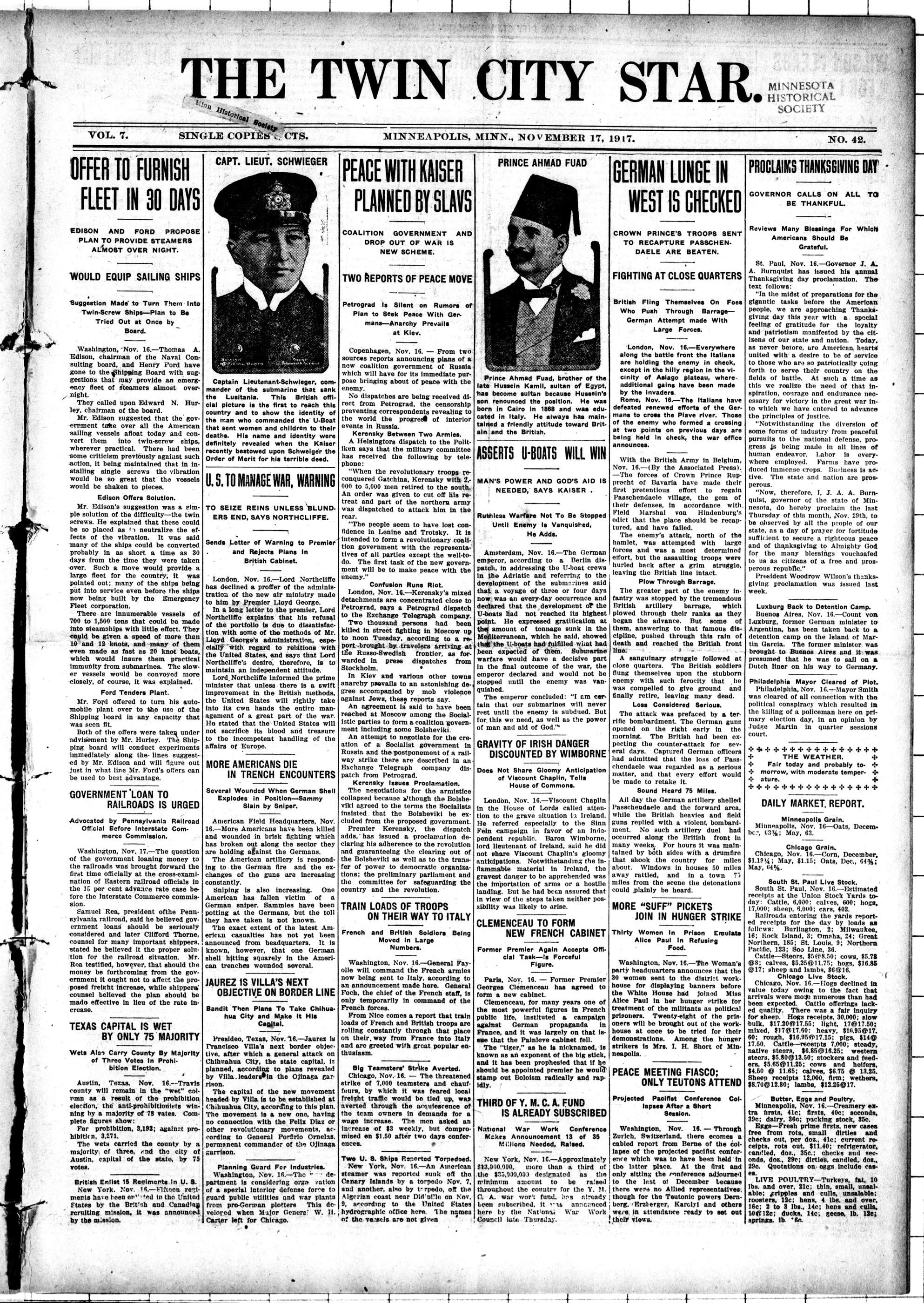
OFFER TO FURNISH FLEET IN 30 DAYS
OFFER TO FURNISH FLEET IN 30 DAYS
EDISON AND FORD PROPOSE PLAN TO PROVIDE STEAMERS ALMOST OVER NIGHT.
WOULD EQUIP SAILING SHIPS
Suggestion Made to Turn Them Into Twin-Screw Ships—Plan to Be Tried Out at Once by Board.
Washington, Nov. 16.—Thomas A. Edison, chairman of the Naval Consulting board, and Henry Ford have gone to the Shipping Board with suggestions that may provide an emergency fleet of steamers almost overnight.
They called upon Edward N. Hurley, chairman of the board.
Mr. Edison suggested that the government take over all the American sailing vessels afloat today and convert them into twin-screw ships, wherever practical. There had been some criticism previously against such action, it being maintained that in installing single screws the vibration would be so great that the vessels would be shaken to pieces.
Edison Offers Solution.
Mr. Edison's suggestion was a simple solution of the difficulty—the twin screws. He explained that these could be so placed as to neutralize the effects of the vibration. It was said many of the ships could be converted probably in as short a time as 30 days from the time they were taken over. Such a move would provide a large fleet for the country, it was pointed out; many of the ships being put into service even before the ships now being built by the Emergency Fleet corporation.
There are innumerable vessels of 700 to 1,500 tons that could be made into steamships with little effort. They could be given a speed of more than 10 and 12 knots, and many of them even made as fast as 20 knot boats, which would insure them practical immunity from submarines. The slower vessels would be conveyed more closely, of course, it was explained.
Ford Tenders Plant.
Mr. Ford offered to turn his automobile plant over to the use of the Shipping board in any capacity that was seen fit. Both of the offers were taken under advisement by Mr. Hurley. The Shipping board will conduct experiments immediately along the lines suggested by Mr. Edison and will figure out just in what line Mr. Ford's offers can be used to best advantage.
GOVERNMENT LOAN TO RAILROADS IS
Advocated by Pennsylvania Railroad Official Before Interstate Commerce Commission.
Washington, Nov. 17.—The question of the government loaning money to the railroads was brought forward the first time officially at the cross-examination of Eastern railroad officials in the 15 per cent advance rate case before the Interstate Commerce commission.
Samuel Rea, president of the Pennsylvania railroad, said he believed government loans should be seriously considered and later Clifford Thorne, counsel for many important shippers, stated he believed it the proper solution for the railroad situation. Mr. Rea testified, however, that should the money be forthcoming from the government it ought not to affect the proposed freight increase, while shippers' counsel believed the plan should be made effective in lieu of the rate increase.
TEXAS CAPITAL IS WET BY ONLY 75 MAJORITY
Wets Also Carry County By Majority of Three Votes In Prohibition Election.
Austin, Texas, Nov. 16.—Travis county will remain in the "wet" column as a result of the prohibition election, the anti-prohibitionists winning by a majority of 79 votes. Complete figures show:
For prohibition, 3,193; against prohibition, 3,271.
The wets carried the county by a majority of three, and the city of Austin, capital of the state, by 75 votes.
British Enlist 15 Regiments in U. S.
New York, Nov. 18.—Fifteen regiments have been enlisted in the United States by the British and Canadian recruiting mission, it was announced by the mission.
THE TWIN CITY STAR.
SINGLE COPIES CTS.
BORISAN
MICHAEL PHOTO
TOMMY
HARRISON
Captain Lieutenant-Schwieger, commander of the submarine that sank the Lusitania. This British official picture is the first to reach this country and to show the identity of the man who commanded the U-Boat that sent women and children to their deaths. His name and identity were definitely revealed when the Kaiser recently bestowed upon Schweigler the Order of Merit for his terrible deed.
U. S. TO MANAGE WAR, WARNING
TO SEIZE REINS UNLESS BLUND
ERS END, SAYS NORTHCLiffe.
Sends Letter of Warning to Premier and Rejects Plans in British Cabinet.
London, Nov. 16.—Lord Northcliffe has declined a proffer of the administration of the new air ministry made to him by Premier Lloyd George.
In a long letter to the premier, Lord Northcliffe explains that his refusal of the portfolio is due to dissatisfaction with some of the methods of Mr. Lloyd George's administration, especially with regard to relations with the United States, and says that Lord Northcliffe's desire, therefore, is to maintain an independent attitude.
Lord Northcliffe informed the prime minister that unless there is a swift improvement in the British methods, the United States will rightly take into its own hands the entire management of a great part of the war.
He stated that the United States will not sacrifice its blood and treasure to the incompetent handling of the affairs of Europe.
MORE AMERICANS DIE IN TRENCH ENCOUNTERS
Several Wounded When German Shell Explodes in Position—Sammy Slain by Sniper.
American Field Headquarters, Nov. 16.—More Americans have been killed and wounded in brisk fighting which has broken out along the sector they are holding against the Germans.
The American artillery is responding to the German fire and the exchanges of the guns are increasing constantly.
Sniping is also increasing. One American has fallen victim of a German sniper. Sammies have been potting at the Germans, but the toll they have taken is not known.
The exact extent of the latest American casualties has not yet been announced from headquarters. It is known, however, that one German shell hitting squarely in the American trenches wounded several.
JAUREZ IS VILLA'S NEXT OBJECTIVE ON BORDER LINE
Bandit Then Plans To Take Chihuahua City and Make It His Capital.
Presideo, Texas, Nov. 16.—Jaurez is Francisco Villa's next border objective, after which a general attack on Chihuahua City, the state capital, is planned, according to plans revealed by Villa leaders in the Ojinaga garrison.
The capital of the new movement headed by Villa is to be established at Chihuahua City, according to this plan. The movement is a new one, having no connection with the Felix Diaz or other revolutionary movements, according to General Porfrio Ornelas, permanent commander of the Ojinaga garrison.
Planning Guard For Industries.
Washington, Nov. 16.—The department is considering orga-
tion of a special interior defense force to guard public utilities and war plants from pro-German plotters. This devolved when Major Genere! W. H.
Carter left for Chicago.
MINNEAPOLIS, MINN., NOVEMBER 17, 1917.
PEACE WITH KAISER PLANNED BY SLAVS
COALITION GOVERNMENT AND DROP OUT OF WAR IS NEW SCHEME.
TWO REPORTS OF PEACE MOVE
Petrograd Is Silent on Rumors of Plan to Seek Peace With Germans—Anarchy Prevails
Copenhagen, Nov. 16. — From two sources reports announcing plans of a new coalition government of Russia which will have for its immediate purpose bringing about of peace with the enemy.
No dispatches are being received direct from Petrograd, the censorship preventing correspondents revealing to the world the progress of interior events in Russia.
Kerensky Between Two Armies.
A Helsingtons dispatch to the Politiken says that the military committee has received the following by telephone:
"When the revolutionary troops reconquered Gatchina, Kerensky with 2,000 to 5,000 men retired to the south. An order was given to cut off his retreat and part of the northern army was dispatched to attack him in the rear.
"The people seem to have lost confidence in Lenne and Trotsky. It is intended to form a revolutionary coalition government with the representatives of all parties except the well-to-do. The first task of the new government will be to make peace with the enemy."
Confusion Runs Riot.
London, Nov. 16.—Kerensky's mixed detachments are concentrated close to Petrograd, says a Petrograd dispatch to the Exchange Telegraph company. Two thousand persons had been killed in street fighting in Moscow up to noon Tuesday, according to a report brought by travelers arriving at the Russo-Swedish frontier, as forwarded in press dispatches from Stockholm.
In Klev and various other towns anarchy prevails to an astonishing degree accompanied by mob violence against Jews, these reports say.
An agreement is said to have been reached at Moscow among the Socialistic parties to form a coalition government including some Bolshevik.
An attempt to negotiate for the creation of a Socialist government in Russia and the postponement of a railway strike there is described in an Exchange Telegraph company dispatch from Petrograd.
Kerensky Issues Proclamation.
The negotiations for the armistice collapsed because although the Bolshevik agreed to the terms the Socialists insisted that the Bolshevik be excluded from the proposed government.
Premier Kerensky, the dispatch adds, has issued a proclamation declaring his adherence to the revolution and guaranteeing the clearing out of the Bolshevik as well as to the transfer of power to democratic organizations; the preliminary parliament and the committee for safeguarding the country and the revolution.
TRAIN LOADS OF TROOPS ON THEIR WAY TO ITALY
French and British Soldiers Being Moved in Large Numbers.
Washington, Nov. 16.—General Fayolle will command the French armies now being sent to Italy, according to an announcement made here. General Foch, the chief of the French staff, is only temporarily in command of the French forces.
From Nice comes a report that train loads of French and British troops are rolling constantly through that place on their, way from France into Italy and are greeted with great popular enthusiasm.
Chicago, Nov. 16. — The threatened strike of 7,000 teamsters and chauffeurs, by which it was feared local freight traffic would be tied up, was averted through the acquiescence of the team owners in demands for a wage increase. The man asked an increase of $3 weekly, but compromised on $1.50 after two days conferences.
Two U. 8. Ships Reported Torpedoed.
New York, Nov. 16.—An American steamer was reported sunk off the Canary Islands by a torpedo Nov. 7, and another, also by torpedo, off the Algerian coast near Didzilile on Nov. 9, according to the United States hydrographic office here. The names of the vessels are not given
PRINCE AHMAD FUAD
Prince Ahmad Fuad, brother of the late Hussein Kamil, sultan of Egypt, has become sultan because Hussein's son renounced the position. He was born in Cairo in 1868 and was educated in Italy. He always has maintained a friendly attitude toward Britain and the British.
ASSERTS U-BOATS WILL WIN
MAN'S POWER AND GOD'S AID IS NEEDED, SAYS KAISER.
Ruthless Warfare Not To Be Stopped Until Enemy Is Vanquished, He Adds.
Amsterdam, Nov. 16.—The German emperor, according to a Berlin dispatch, in addressing the U-boat crews in the Adriatic and referring to the development of the submarines said that a voyage of three or four days now was an every-day occurrence and declared that the development of the U-boats had not reached its highest point. He expressed gratification at the amount of tonnage sunk in the Mediterranean, which he said, showed that the U-boats had fulfilled what had been expected of them. Submarine warfare would have a decisive part in the final outcome of the war, the emperor declared and would not be stopped until the enemy was vanquished.
The emperor concluded: "I am certain that our submarines will never rest until the enemy is subdued. But for this we need, as well as the power of man and aid of God."
GRAVITY OF IRISH DANGER DISCOUNTED BY WIMBORNE
Does Not Share Gloomy Anticipation of Viscount Chaplin, Tells House of Commons.
London, Nov. 16.—Viscount Chaplin in the House of Lords called attention to the grave situation in Ireland. He referred especially to the Sinn Fein campaign in favor of an independent republic. Baron Wimborne, lord lieutenant of Ireland, said he did not share Viscount Chaplin's gloomy anticipations. Notwithstanding the inflammable material in Ireland, the gravest danger to be apprehended was the importation of arms or a hostile landing. But he had been assured that in view of the steps taken neither possibility was likely to arise.
CLEMENCEAU TO FORM
NEW FRENCH CABINET
Former Premier Again Accepts Official Task—Is Forceful Figure.
Paris, Nov. 16. — Former Premier Georges Clemenceau has agreed to form a new cabinet.
Clemenceau, for many years one of the most powerful figures in French public life, instituted a campaign against German propaganda in France, and it was largely on that issue that the Painleve cabinet fell.
The "tiger," as he is nicknamed, is known as an exponent of the big stick, and it has been prophesied that if he should be appointed premier he would stamp out Boloism radically and rapidly.
THIRD OF Y. M. C. A. FUND
IS ALREADY SUBSCRIBED
National War Work Conference
Makes Announcement 13 of 35
Millions Needed, Raised.
New York, Nov. 16.—Approximately
$13,000,000, more than a third of
the $35,000,000 designated as the
minimum amount to be raised
throughout the country for the Y. M.
C. A. war work fund, has already
been subscribed, it was announced
here by the National War Work
Council late Thursday.
GERMAN LUNGE IN WEST IS CHECKED
GERMAN LUNGE IN WEST IS CHECKED
CROWN PRINCE'S TROOPS SENT
TO RECAPTURE PASSCHEN-
DAELE ARE BEATEN.
FIGHTING AT CLOSE QUARTERS
British Fling Themselves On Foes Who Push Through Barrage—German Attempt made With Large Forces.
London, Nov. 16.—Everywhere along the battle front the Italians are holding the enemy in check, except in the hilly region in the vicinity of Asiago plateau, where additional gains have been made by the invaders.
Rome, Nov. 16.—The Italians have defeated renewed efforts of the Germans to cross the Plave river. Those of the enemy who formed a crossing at two points on previous days are being held in check, the war office announces.
With the British Army in Belgium, Nov. 16.—(By the Associated Press).—The forces of Crown Prince Rupprecht of Bavaria have made their first pretentious effort to regain Passchendaele village, the gem of their defenses, in accordance with Field Marshal von Hindenburg's edict that the place should be recaptured, and have failed.
The enemy's attack, north of the hamlet, was attempted with large forces and was a most determined effort, but the assaulting troops were hurled back after a grim struggle, leaving the British line intact.
Plow Through Barrage.
The greater part of the enemy infantry was stopped by the tremendous British artillery barrage, which plowed through their ranks as they began the advance. But some of them, answering to that famous discipline, pushed through this rain of death and reached the British front line.
A sanguinary struggle followed at close quarters. The British soldiers flung themselves upon the stubborn enemy with such ferocity that he was compelled to give ground and finally retire, leaving many dead.
Loss Considered Serious.
The attack was prefaced by a terrific bombardment. The German guns opened on the right early in the morning. The British had been expecting the counter-attack for several days. Captured German officers had admitted that the loss of Passchendaele was regarded as a serious matter, and that every effort would be made to retake it.
Sound Heard 75 Miles.
All day the German artillery shelled Passchendaele and the forward area, while the British heavies and field guns replied with a violent bombardment. No such artillery duel had occurred along the British front in many weeks. For hours it was maintained by both sides with a drumfire that shook the country for miles about. Windows in houses 50 miles away rattled, and in a town 75 miles from the scene the detonations could plainly be heard.
MORE "SUFF" PICKETS
JOIN IN HUNGER STRIKE
Thirty Women In Prison Emulate Alice Paul In Refusing Food.
Washington, Nov. 16.—The Woman's party headquarters announces that the 30 women sent to the district workhouse for displaying banners before the White House had joined Miss Alice Paul in her hunger strike for treatment of the militants as political prisoners. Twenty-eight of the prisoners will be brought out of the workhouse at once to be tried for their demonstrations. Among the hunger strikers is Mrs. I. H. Short of Minneapolis.
PEACE MEETING FIASCO;
ONLY TEUTONS ATTEND
Projected Pacifist Conference Collapses After a Short Session.
Washington, Nov. 16. — Through Zurich, Switzerland, there ecomes a cabled report from Berne of the collapse of the projected pacifist conference which was to have been held in the latter place. At the first and only sitting the conference adjourned to the last of December because there were no Allied representatives; though for the Teutonic powers Dernberg, Erzberger, Karolyi and others were in attendance ready to set out their views.
MINNESOTA HISTORICAL SOCIETY NO.42.
NO. 42.
PROCLAIMS THANKSGIVING DAY
GOVERNOR CALLS ON ALL TO BE THANKFUL.
Reviews Many Blessings For Which Americans Should Be Grateful.
St. Paul, Nov. 16.—Governor J. A. A. Burnquist has issued his annual Thanksgiving day proclamation. The text follows:
"In the midst of preparations for the gigantic tasks before the American people, we are approaching Thanksgiving day this year with a special feeling of gratitude for the loyalty and patriotism manifested by the citizens of our state and nation. Today, as never before, are American hearts united with a desire to be of service to those who are so patriotically going forth to serve their country on the fields of battle. At such a time as this we realize the need of that inspiration, courage and endurance necessary for victory in the great war into which we have entered to advance the principles of justice.
"Notwithstanding the diversion of some forms of industry from peaceful pursuits to the national defense, progress is being made in all lines of human endeavor. Labor is everywhere employed. Farms have produced immense crops. Business is active. The state and nation are prosperous.
"Now, therefore, I, J. A. A. Burnquist, governor of the state of Minnesota, do hereby proclaim the last Thursday of this month, Nov. 29th, to be observed by all the people of our state, as a day of prayer for fortitude sufficient to secure a righteous peace and of thanksgiving to Almighty God for the many blessings vouchsaef to us as citizens of a free and prosperous republic."
President Woodrow Wilson's thanksgiving proclamation was issued last week.
Luxburg Back to Detention Camp.
Buenos Aires, Nov. 16—Count von Luxburg, former German minister to Luxburg, has been taken back to a detention camp on the island of Martin Garcia. The former minister was brought to Buenos Aires and it was presumed that he was to sail on a Dutch liner on his way to sail on a Philadelphia Mayor Cleared of Plot.
Philadelphia, Nov. 16.—Mayer Smith was cleared of all connection with the political conspiracy which resulted in the killing of a policeman here on primary election day, in an opinion by Judge Martin in quarter sessions court.
THE WEATHER.
Fair today and probably to-morrow, with moderate temper-ature.
DAILY MARKET. REPORT.
Minneapolis Grain.
Minneapolis, Nov. 16—Oats, December, 63%; May, 63.
Chicago Grain.
Chicago, Nov. 16—Corn, December, $1.19½%; May, $1.15; Oats, Dec., 64%; May, 64%.
South St. Paul Live Stock.
South St. Paul, Nov. 16—Estimated receipts at the Union Stock Yards today: Cattle, 6,000; calves, 600; hogs, 17,000; sheep, 6,000; cars, 402.
Railroads entering the yards reported receipts for the day by loads as follows: Burlington, 2; Milwaukee, 16; Rock Island, 3; Omma, 24; Great Northern, 185; St. Louis, 9; Northern Pacific, 123; Soo Line, 36.
Cattle-Steers, $5@8.50; cows, $5.78@8; calves, $5.25@11.75; hogs, $16.95@8; sheep and lambs, $6@16.
Chicago Nov. 16—Hogs declined in value today owing to the fact that arrivals were more numerous than had been expected. Cattle offerings lacked quality. There was a fair inquiry for sheep. Hogs receipts, 30,000; slow bulk, $17.20@17.55; light, $17.75@17.00; mixed, $17@17.60; heavy, $16.95@17.10; rough, $16.95@17.15; pigs, $14@17.50. Cattle receipts, 7,000; steady, native steers, $6.85@16.25; western steers, $5.65@18.30; stockers and feeders, $5.65@11.25; cows and heifers, $4.50@11.65; calves, $6.75@13.25. Sheep receipts 12,000; firm; wethers, $8.70@12.80; lambs, $12.25@17.
Butter, Egos and Poultry.
Minneapolis, Nov. 16.—Creamery extra firsts, 41c; firsts, 40c; seconds, 39c; dairy, 36c; packing stock, 35c.
Eggs—Fresh prime firsts, new cases free from rots, small dirties and checks out, per doz. 41c; current receipts, rots out. $11.40; refrigerator, canned, doz., 35c.; checks and seconds, doz., 29c; dirties, candled, doz., 29c. Quotations on eggs include cases.
LIVE POULTRY—Turkeys, fat, 10 lbs. and over, 21c; thin, small, unsalable; gripples and culls, unsalable; roosters, 12c; hens, 4 lbs. and over, 16c; 2 to 3 lbs., 14c; hens and culls, 10£12c; ducks, 14c; geese, lb. 12c; springs. lb. 6c.
WILSON PLEADS FOR LABOR'S AID
Tellis A. F. of L. United Support of All is Needed to Win War
Imperial Government Started War, President Declares—Pacifists and Critics Scored—Samuel Gompers Is Lauded.
Suffalo, Nov. 14.—A personal and eloquent appeal for the full support of organized labor for the government for the conduct of the war has been made by President Wilson. Speaking before the annual convention of the American Federation of Labor he declared the war could not be won unless all factories unite in a common cause, sinking their differences.
Tribute To Gompers.
The President paid warm tribute to Samuel Gompers, president of the American Federation of Labor, and virtually called upon the federation to give him united support. He denounced pacifists and critics. He appealed for co-operation.
"Between Power and Freedom."
Discussing Germany the President declared flatly that Germany had started the war and that he was willing to await the verdict of history on that statement.
The creation of new instrumentalities for better co-operation between labor and capital was one suggestion by the President which was of prime interest to the delegates to the convention.
The President alluded to the present war as "The last decisive issue between the old principle of power and the new principle of freedom."
Tremendous crowds gathered at the railroad station and in the auditorium to greet the President.
The text of the President's speech follows:
"Mr. President, Delegates of the American Federation of Labor, Ladies and Gentlemen:
"I esteem it a great privilege and a real honor to be thus admitted to your public counsels. When your executive committee paid me the compliment of inviting me here, I gladly accepted the invitation because it seems to me that this above all other times in our history is the time for common counsel for the drawing not only of the energies but of the minds of the nation together. I thought that it was a welcome opportunity for disclosing to you some of the thoughts that have been gathering in my mind during the last momentous months.
Would Bamish Thought of Office.
"I am introduced to you as the President of the United States, and yet I would be pleased if you would put the thought of the office into the background and regard me as one of your fellow citizens who has come here to speak, not the words of authority but the words of counsel, the words which men should speak to one another who wish to be frank in a moment more critical perhaps than the history of the world has ever yet known, a moment when it is every man's duty to forget himself, to forget his own interests, to fill himself with the nobility of a great national and world conception and act upon a new platform elevated above the ordinary affairs of life, elevated to where men have views of the long destiny of mankind.
"I think that in order to realize just what this moment of counsel is, it is very desirable that we should remind ourselves just how this war came about and just what it is for. You can explain most wars very simply, but the explanation of this is not so simple. Its roots run deep into all the obscure soils of history, and in my view this is the last decisive issue between the old principles of power and the new principles of freedom.
Germany Started War.
"The war was started by Germany. Her authorities deny that they started it. But I am willing to let the statement I have just made await the verdict of history. And the thing that needs to be explained is why Germany started the war. Remember what the position of Germany in the world was—as enviable a position as any nation has ever occupied. The whole world stood at admiration at her wonderful intellectual and material achievements and all the intellectual men of the world went to school to her. As a university man I have been surrounded by men trained in Germany, men who had resorted to Germany because nowhere else could they get such thorough and searching training, particularly in the principles of science and material achievements.
A Leader in Industrial World. "Her men of science had made her industries perhaps the most competent industries in the world and the label 'Made in Germany' was a guarantee of good workmanship and of sound material. She had access to all the markets of the world and every other man who traded in those markets feared Germany because of effective and almost irresistible competition. She had a place in the sun. Why was she not satisfied? What more did she went? There was nothing in the world of peace that she did not already have and have in abundance.
Such Method Unlawful Here.
"You have only to ask any man whom you meet who is familiar with the conditions that prevailed before the war in the matter of international competition to find out the methods of competition which the German manufacturers and exporters used under the patronage and support of the government of Germany. You will find that they were the same sorts of competition that we have tried to prevent
by law within our borders. If they could not sell their goods cheaper than we could sell ours at a profit to themselves they could get a subsidy from the government which made it possible to sell them cheaper anyhow and the conditions of the competition were thus controlled in large measure by the German government itself. But that did not satisfy the German government.
"All the while there was lying behind its thought, in its dreams of the future, a political control which would enable it in the long run to dominate the labor and the industry of the world. They were not content with the success by superior achievement; they wanted success by authority. I suppose very few of you have thought much about the Berlin-to-Bagdad railway. The Berlin-to-Bagdad railway was constructed in order to run the threat of force down the flank of the industriist undertakings of half a dozen other countries so that when German competition came in it would not be resisted too far—because there was always the possibility of getting German armies into the heart of that country quicker than any other armies could be got there. Look at the map of Europe now. Germany is thrusting upon us again and again the discussion of peace talks about what? Talks about Belgium, talks about Northern France, talks about Alsace-Lorraine. Well, those are deeply interesting subjects to us and to them, but they are not talking about the heart of the matter.
Germany After World Dominance.
"Take the map and look at it. Germany has absolute control of Austria-Hungary, practical control of the Balkan states, control of Turkey, control of Asia minor. I saw a map in which the whole thing was printed in appropriate black the other day and the black stretched all the way from Hamburg to Bagdad—the bulk of German power inserted into the heart of the world. If it can keep that she has kept all that her dreams contemplated when the war began. If she can keep that her power can disturb the world as long as she keeps it—always provided, for I feel bound to put this proviso in, always provided the present influences that control the German government continue to control it.
"I believe that the spirit of freedom can get into the hearts of the Germans and find as fine a welcome there as it can find in any other hearts. But the spirit of freedom does not suit the plans of the Pan-Germans. Power cannot be used with concentrated force against free peoples if it is used by free people.
Central Power Fears Germany.
"You know how many imitations come to us from one of the central powers that it is more anxious for peace than the chief central power; and you know that it means that the people in that central power know that if the war ends as it stands they will in effect themselves be vassals of Germany notwithstanding that their populations are compounded with all the people of that part of the world and notwithstanding the fact that they do not wish in their pride and proper spirit of nationality to be so absorbed and dominated.
"Germany is determined that the political power of the world shall belong to her. There have been such ambitions before. They have been in part realized. But never before have those ambitions been based upon so exact and precise and scientific a plan of domination.
To Compound With Foe is Disastrous.
"Any body of free men that compounds with the present German government is compounding for its own destruction. But that is not the whole story. Any man in America or anywhere else who supposes that the free industry and enterprise of the world can continue if the Pan-German plan is achieved and German power festened upon the world is as fatuous as the dreamers of Russia.
"What I am opposed to is not the feeling of the pacifists, but their stupidity. My heart is with them, but my mind has a contempt for them. I want peace, but I know how to get it and they do not.
Win War to Get Peace.
"You will notice that I sent a friend of mine—Colonel House—to Europe, who is as great a lover of peace as any man in the world, but I did not send him on a peace mission. I sent him to take part in a conference as to how the war was to be won. And he knows, as I know, that that is the way to get peace if you want it for more than a few minutes.
"All of this is a preface to the conference that I referred to with regard to what we are going to do. If we are true friends of freedom—our own or anybody else's—we will see that the power of this country and the productivity of this country, is raised to its absolute maximum and that absolutely nobody is allowed to stand in the way of it.
Labor Must Be Free.
Labor Must Be Free.
"While we are fighting for freedom we must see, among other things, that labor is free, and that means a number of interesting things. It means not only that we must do what we have declared our purpose to do—see that the conditions of labor are not rendered more onerous by the war—but also that we shall see to it that the instrumentalities by which the conditions of labor are improved, are not blocked or checked. That we must do. That has been the matter about which I have taken pleasure in conferring from time to time with your president, Mr. Gompers. And I want to express my admiration of his patriotic courage, his large vision and his statesmanlike sense of what is alongside of a mind that knows how to pull in harness. The horses that kick over the traces will have to be put in a corral.
"Now to 'stand together' means that nobody must interrupt the processes of our energy, if the interruption can possibly be avoided without the absolute invasion of freedom. To put it concretely, that means this: Nobody
has a right to stop the processes of labor until all the methods of conciliation and settlement have been exhausted, and I might as well say right here that I am not talking to you alone. You sometimes stop the course of labor, but there are others who do the same. And that I am speaking of my own experience not only, but that I am speaking of others, when I say that you are reasonable in a larger number of cases than the capitalists.
UNITED STATE WAR CONFER
Participates for the F
Parties Must Come Together.
"I am not saying these things to them personally yet, because I haven't had a chance. But they have to be said, not in any spirit of criticism, because I would like to see all the critics exported, but in order to clear the atmosphere and come down to business. Everybody on both sides has got to transact business, and the settlement is never impossible when both sides want to do the square and right things. Moreover, a settlement is always hard to avoid when the parties can be brought face to face.
"I can differ with a man more radically when he isn't in the room than I can when he is in the room, because then the awkward thing is that he can come back at me and answer what I say. It is always dangerous for a man to have the noor entirely to himself."
"I always like to remind myself of a delightful saying of an Englishman of a past generation, Charles Lamb. He was with a group of friends and he spoke very harshly of some man who was not present. I ought to say that Lamb stuttered a little bit. And one of his friend said: 'Why, Charles, I didn't think that you knew so and so.' "Oh,' he said, 'I don't. I can't hate a man I know.
Can Get Together if We Want To. "There is a great deal of human nature, of very pleasant human nature, in that saying. It is hard to hate a man you know. I may admit parenthetically that there are some politicians whose methods I do not at all believe in, but they are jolly good fellows. If they only would not talk the wrong kind of politics with me I would love to be with them.
"And, so it is all along the line in serious matters and things less serious. We are all of the same clay and spirit and we can get together if we desire to get together.
"Therefore my counsel to you is: Let us show ourselves Americans by showing that we do not want to go off in separate camps or groups by ourselves, but that we want to cooperate with all other classes and all other groups in a common enterprise, which is to release the spirit of the world from bondage. I would be willing to set that up as the final test of an American. That is the meaning of democracy. I have been very much distressed, my fellow citizens, by some of the things that have happened rectly. The mob spirit is displaying itself here and there in this country. I have no sympathy with what some men are saying, but I have no sympathy with the men that take their punishment into their own hands, and I want to say to everyone who does join such a mob that I do not recognize him as worthy of the free institutions of the United States.
Protests Against Unlawfulness.
Protests Against Unlawfulness
"There are some organizations in this country whose object is anarchy and the destruction of law, but I would not meet their efforts by making myself a partner in destroying law. I despise and hate their purposes as much as any man, but I respect the ancient processes of justice, and I would be too proud not to see them done justice, however wrong they are. And so I want to utter my earnest protest against any manifestation of the spirit of lawlessness anywhere in any cause. Why, gentlemen, look what it means. We claim to be the greatest democratic people in the world and democracy means first of all that we can govern ourselves.
"If our men have not self-control, then they are not capable of that great thing which we call democratic government. A man who takes the law into his own hands is not the right man to co-operate in any form or development of government and institutions. And some of the processes by which the struggle between capital and labor is carried on are processes that come very near to taking the law into your own hands. I do not mean for a moment to compare them with what I have just been speaking of, but I want you to see that they are mere graduations of the manifestations of the unwillingness to co-operate and the fundamental lesson of the whole situation is that we must not only take common counsel, but we must yield to and obey common counsel. Not all of the instrumentalities for this are at hand. I am hopeful that in the very near future new instrumentalities may be organized by which we can see to it that various things that are now going on shall not go on.
"There are various processes of the dilution of labor and the unnecessary substitution of labor and blinding in different markets and unfairly upsetting the whole competition of labr, which ought not to go on—I mean now on the part of employers—and we must interject into this some instrumentality of co-operation by which the fair thing will be done all around. I am hopeful that some such instrumentalities may be devised, but whether they are or not, we must use those that we have, and upon every occasion where it is necessary to have such an instrumentality, originated upon that occasion, if necessary.
"And so, my fellow citizens, the reason that I came away from Washington is that I sometimes get lonely down there—there are so many people in Washington who know things that are not so; and there are so few people in Washington who know anything about what the people of the United States are thinking about. I have to come away to get reminded of the rest of the country; I have to come away and talk to men who are up against the real thing. And say to them: 'I am with you if you are with me.' And the only test of being with me is not to think about me personally. But merely to think of me as the expression for the time being of the power and dignity and hope of the American people."
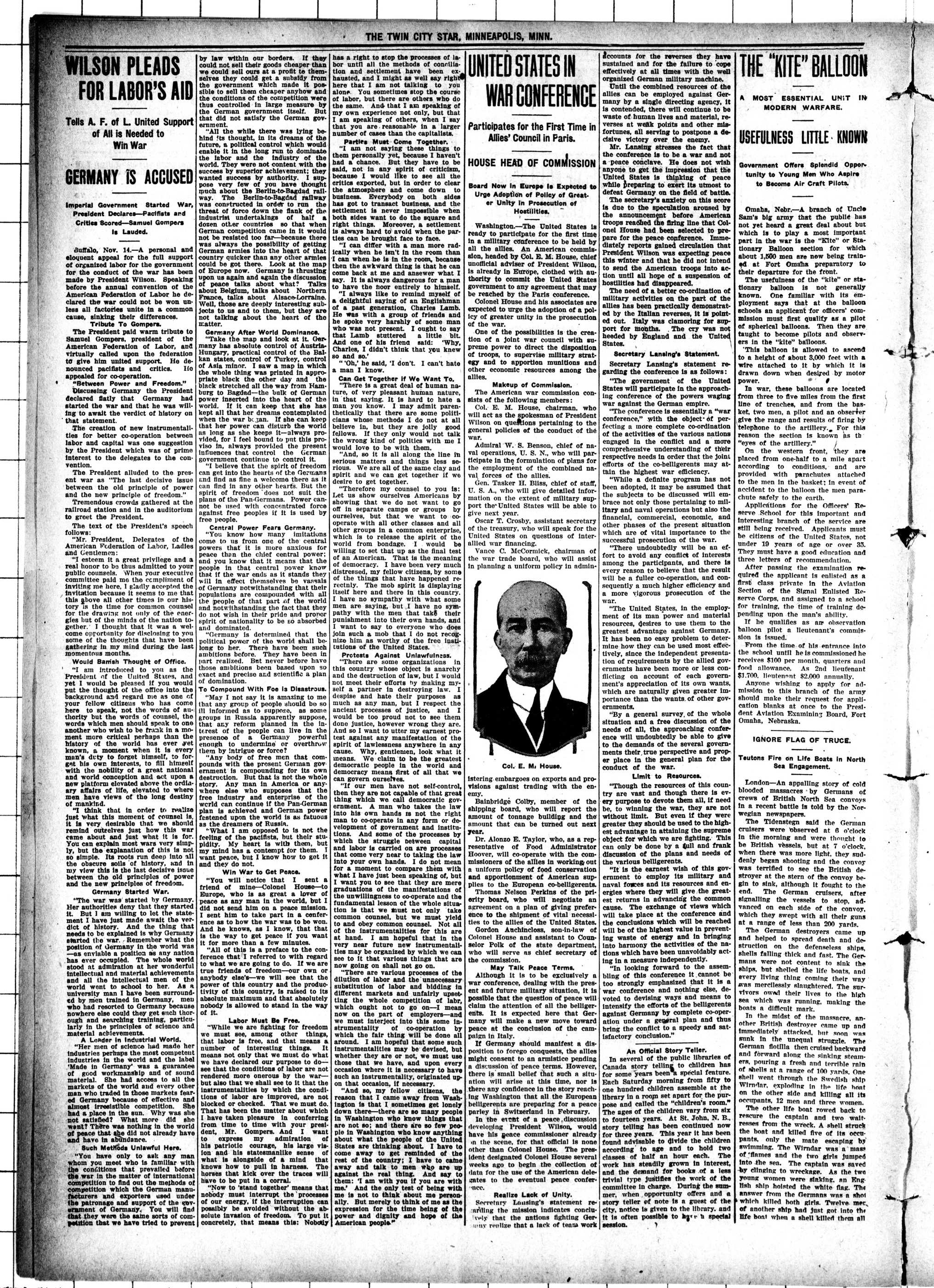
UNITED STATES IN WAR CONFERENCE
Participates for the First Time in Allies' Council in Paris.
HOUSE HEAD OF COMMISSION
Board Now in Europe is Expected to Urge Adoption of Policy of Greater Unity in Prosecution of Hostilities.
Washington.—The United States is ready to participate for the first time in a military conference to be held by all the allies. An American commission, headed by Col. E. M. House, chief unofficial adviser of President Wilson, is already in Europe, clothed with authority to commit the United States government to any agreement that may be reached by the Paris conference.
Colonel House and his associates are expected to urge the adoption of a policy of greater unity in the prosecution of the war.
One of the possibilities is the creation of a joint war council with supreme power to direct the disposition of troops, to supervise military strategy and to apportion munitions and other economic resources among the allies.
Makeup of Commission.
The American war commission consists of the following members:
Col. E. M. House, chairman, who will act as the spokesman of President Wilson on questions pertaining to the general policies of the conduct of the war.
Admiral W. S. Benson, chief of naval operations, U. S. N., who will participate in the formulation of plans for the employment of the combined naval forces of the allies.
Gen. Tasker H. Bliss, chief of staff, U. S. A., who will give detailed information on the extent of military support the United States will be able to give next year.
Oscar T. Crosby, assistant secretary of the treasury, who will speak for the United States on questions of inter-allied war financing.
Vance C. McCormick, chairman of the war trade board, who will assist in planning a uniform policy in admin-
[Name]
Col. E. M. House.
listering embargoes on exports and provisions against trading with the enemy.
Bainbridge Colby, member of the shipping board, who will report the amount of tonnage building and the amount that can be turned out next year.
Dr. Alonzo E. Taylor, who, as a representative of Food Administrator Hoover, will co-operate with the commissioners of the allies in working out a uniform policy of food conservation and apportionment of American supplies to the European co-belligerents.
Thomas Nelson Perkins of the priority board, who will negotiate an agreement on a plan of giving preference to the shipment of vital necessities to the allies of the United States.
Gordon Anchincloss, son-in-law of Colonel House and assistant to Counselor Polk of the state department, who will serve as chief secretary of the commission.
May Talk Peace Terms.
Although it is to be exclusively a war conference, dealing with the present and future military situation, it is possible that the question of peace will claim the attention of all the belligerents. It is expected here that Germany will make a new move toward peace at the conclusion of the campaign in Italy. If Germany should manifest a disposition to forego conquests, the allies might consent to an armistice pending a discussion of peace terms. However, there is small belief that such a situation will arise at this time, nor is there any confidence in the story reaching Washington that all the European belligerents are preparing for a peace parley in Switzerland in February.
In the event of a peace, discussion developing President Wilson, would have his peace commissioner already in the scene, for that official is none other than Colonel House. The president designated Colonel House several weeks ago to begin the collection of data for the use of the American delegates to the eventual peace conference.
Realize Lack of Unity.
Secretary Lausung's statement regarding the mission indicates conclusively that the nations fighting Germany realize that a lack of team work
accounts for the reverses they have sustained and for the failure to cope effectively at all times with the well organized German military machine. Until the combined resources of the allies can be employed against Germany by a single directing agency, it is contended, there will continue to be waste of human lives and material, reverses at weak points and other misfortunes, all serving to postpone a decisive victory over the enemy. Mr. Lansing stresses the fact that the conference is to be a war and not a peace conclave. He does not wish anyone to get the impression that the United States is thinking of peace while preparing to exert its utmost to defeat Germany on the field of battle.
The secretary's anxiety on this score is due to the speculation aroused by the announcement before American troops readied the firing line that Colonel House had been selected to prepare for the peace conference. Immediately reports gained circulation that President Wilson was expecting peace this winter and that he did not intend to send the American troops into action until all hope of a suspension of hostilities had disappeared.
The need of a better co-ordination of military activities on the part of the allies has been practically demonstrated by the Italian reverses, it is pointed out. Italy was clamoring for support for months. The cry was not heeded by England and the United States.
Secretary Lanaing's Statement.
Secretary Lansing's statement regarding the conference is as follows:
"The government of the United States will participate in the approaching conference of the powers waging war against the German empire.
"The conference is essentially a "war conference," with the object of perfecting a more complete co-ordination of the activities of the various nations engaged in the conflict and a more comprehensive understanding of their respective needs in order that the joint efforts of the co-belligerents may attain the highest war efficiency.
"While a definite program has not been adopted, it may be assumed that the subjects to be discussed will embrace not only those pertaining to military and naval operations but also the financial, commercial, economic, and other phases of the present situation which are of vital importance to the successful prosecution of the war."
"There undoubtedly will be an effort to avoid any conflict of interests among the participants, and there is every reason to believe that the result will be a fuller co-operation, and consequently a much higher efficiency and a more vigorous prosecution of the war.
"The United States, in the employment of its man power and material resources, desires to use them to the greatest advantage against Germany. It has been no easy problem to determine how they can be used most effectively, since the independent presentation of requirements by the allied governments have been more or less conflicting on account of each government's appreciation of its own wants, which are naturally given greater importance than the wants of other governments.
"By a general survey, of the whole situation and a free discussion of the needs of all, the approaching conference will undoubtedly be able to give to the demands of the several governments their true perspective and proper place in the general plan for the conduct of the war.
Limit to Resources.
"Though the resources of this country are vast and though there is every purpose to devote them all, if need be, to winning the war, they are not without limit. But even if they were greater they should be used to the highest advantage in attaining the supreme object for which we are fighting. This can only be done by a full and frank discussion of the plans and needs of the various belligerents.
"It is the earnest wish of this government to employ its military and naval forces and its resources and energies where they will give the greatest returns in advancing the common cause. The exchange of views which will take place at the conference and the conclusions which will be reached will be of the highest value in preventing waste of energy and in bringing into harmony the activities of the nations which have been unavoldably acting in a measure independently.
"In looking forward to the assembling of this conference it cannot be too strongly emphasized that it is a war conference and nothing else, devoted to devising ways and means to intensify the efforts of the belligerents against Germany by complete co-operation under a general plan and thus bring the conflict to a speedy and satisfactory conclusion."
An Official Story Teller.
An Official Story Teller
In several of the public libraries of Canada story telling to children has for some years been a special feature. Each Saturday morning from fifty to one hundred children assemble at the library in a room set apart for the purpose and called the "children's room." The ages of the children vary from six to fourteen years. At St. John, N. B., story telling has been continued now for three years. This year it has been found advisable to divide the children according to age and to hold two classes of half an hour each. The work has steadily grown in interest, and the demand for books of a less trivial type justifies the work of the committee in charge. During the summer, when opportunity offers and a story teller of note is a guest of the city, notice is given to the library, and it is often possible to host a special session.
THE "KITE" BALLOON
A MOST ESSENTIAL UNIT IN MODERN WARFARE.
USEFULNESS LITTLE·KNOWN
Government Offers Splendid Opportunity to Young Men Who Aspire to Become Air Craft Pilots.
Omaha, Nebr.—A branch of Uncle Sam's big army that the public has not yet heard a great deal about but which is to play a most important part in the war is the "Kite" or Stationary Balloon section for which about 1,500 men are now being trained at Fort Omaha preparatory to their departure for the front.
The usefulness of the "kite" or stationary balloon is not generally known. One familiar with its employment says that at the balloon schools an applicant for officers' commission must first qualify as a pilot of spherical balloons. Then they are taught to become pilots and observers in the "kite" balloons.
This balloon is allowed to ascend to a height of about 3,000 feet with a wire attached to it by which it is drawn down when desired by motor power.
In war, these balloons are located from three to five miles from the first line of trenches, and from the basket, two men, a pilot and an observer give the range and results of firing by telephone to the artillery. For this reason the section is known as the "eyes of the artillery."
On the western front, they are placed from one-half to a mile apart according to conditions, and are provided with parachutes attached to the men in the basket; in event of accident to the balloon the men parachute safely to the earth.
Applications for the Officers' Reserve School for this important and interesting branch of the service are still being received. Applicants must be citizens of the United States, not under 19 years of age or over 35. They must have a good education and three letters of recommendation.
After passing the examination required the applicant is enlisted as a first class private in the Aviation Section of the Signal Enlisted Reserve Corps, and assigned to a school for training, the time of training depending upon the man's ability. If he qualifies as an observation balloon pilot a lieutenant's commission is issued. From the time of his entrance into the school until he is commissioned he receives $100 per month, quarters and food allowance. As 2nd lieutenant $1,700, lieutenant $2,000 annually. Anyone wishing to apply for admission to this branch of the army should make their request for application blanks at once to the President Aviation Examining Board, Fort Omaha, Nebraska.
IGNORE FLAG OF TRUCE.
Teutons Fire on Life Boats in North Sea Engagement.
London—An appalling story of cold blooded massacres by Germans of crews of British North Sea convoys in a recent battle is told by the Norwegian newspapers.
The Tidenstegn said the German cruisers were observed at 6 o'clock in the morning and were thought to be British vessels, but at 7 o'clock, when there was more light, they suddenly began shooting and the convoy was terrified to see the British destroyer at the stern of the convoy begin to sink, although it fought to the end. The German cruisers, after signalling the vessels to stop, advanced on each side of the convoy, which they swept with all their guns at a range of less than 200 yards.
The German destroyers came up and helped to spread death and destruction on the defenseless ships, shells falling thick and fast. The Germans were not content to sink the ships, but shelled the life boats, and every living thing coming their way was mercilessly slaughtered. The survivors owed their lives to the high sea which was running, making the boats a difficult mark.
In the midst of the massacre, another British destroyer came up and immediately attacked, but soon was sunk in the unequal struggle. The German flotilla then cruised backward and forward along the sinking steamers, pouring a fresh and terrible rain of shells at a range of 100 yards. One shell went through the Swedish ship Wirndar, exploding in the life boat on the other side and killing all its occupants, 12 men and three women.
The other life boat rowed back to rescue the captain and two waltresses from the wreck. A shell struck the boat and killed five of its occupants, only the mate escaping by swimming. The Wirndar was a mass of flames and the two girls jumped into the sea. The captain was saved by clinging to wreckage. As the two young women were sinking, an English ship holsted the white flag. The answer from the Germans was a shot which killed both girls. Twelve mer of another ship had just got into the life boat when a shell killed them all
The Blue Automobile
By Mary Jordon Garth
"Take your pick," spoke honest, homespun Farmer Brooks.
"It seems to me that you are overloading me with kindness," demurred Tracy Drake, viewing the array of fat, newly picked turkeys spread out upon the kitchen table.
"Here, drop that one!" cried his host and employer. "Never thinking of yourself, are you? I'll do the picking," and in his rough, but well-meaning way the farmer brushed Tracy Drake away from the smallest turkey in the group he had selected, and took up the plumpest of the lot.
"Here, Hannah," he ordered the hired girl, "pack that in a bag for Drake."
"I declare! my little wife will not soon forget you," said Tracy. "There must be a bushel of nuts, pears and apples in the bag you have already fixed up for me."
"Well, didn't you tell me day after tomorrow is her birthday, and isn't it a holiday? Good luck to you, Drake, and when spring opens, if you want to tie, up with me for the season, I'm your man."
"And a mighty good man, too!" declared Tracy sincerely. "I'm glad I came to you, Mr. Brooks, and I'll come again next year, if I don't strike something in the city."
Tracy returned the hearty, friendly hand clasp of the farmer with interest. Brooks' Farm had been a pleasant haven for him for nearly two months. September had found him unable to get work in the city, and a hint from a friend had sent him forty miles in the country to round up the farming season. Mr. Brooks had paid him two dollars a day and keep for his services, and thus Tracy was enabled "to
A man in a coat looks into a mirror.
"Where Did You Get That?"
keep lonely, but patient and contented Verda at home in comfort.
Now the last task was done, and with his last week's wages in his pocket, and weighed down with two bags filled with practical gifts, Tracy went out to the farm wagon, where his employer's son was waiting for him.
The electric line station was a mile away and Bud Brooks was to drive him there.
"Oh, I say, Mr. Drake!" suddenly burst forth Bud, half the trip accomplished, "queer thing happened yesterday, and I forgot to tell you."
"What was that, Bud?" inquired Tracy.
"You were in the field, when a man in a blue auto drove up. He inquired all about you. I thought maybe it was some city fellow, thinking of hiring you, and you beI I gave you a good sendoff! Told him how you saved little Lettie from drowning and old Mrs. Woods from her burning house. Said, too, that if Dad hadn't three big lazy pumpkin boys, he'd adopt you, just because you was more help to him than any four men he ever hired."
"Thank you, Bud," said Tracy. He looked thoughtful. Then he laughed vaguely. "I owe some unpaid bills back home," added Tracy, "but I'm able to pay them now with what I've earned."
"Oh! this fellow didn't act or talk as if he was a creditor. He tried to pump me on every little thing about you. Was sort of mysterious, too. When he saw you coming towards the house, he wheeled around and speeded out of sight in a jiffy."
Tracy was a trifle curious. In the past he had known many friends who might continue an interest in him, and rich enough to possess such a luxurious blue limousine as Bud described. That was before he had married poor, but pretty and loving Verda Wayne, thereby being told by his father that their roads parted, and, as he had taken up with a poor, humble wife, he could live out his own life.
I was a cold, slow ride in the electric car, and Tracy was gald to leave it at the city limits station and stir up his chilled blood with a brisk walk. Homeward bound, crossing lots, he
heard the sound of someone chopping wood and whistling cheerily in the back yard of Gideon Blake, a distant relative of his wife. Tracy reached the fence and halled Blake across it. "I say, you seem immensely happy, neighbor!" he called out.
"Hello! Hurrah! Glad to see you back, and Verda will be gladder. Happy? I should say I was. I suppose Verda didn't want to worry, you about it, but the three children have all been down with scarlet fever. My wife was sick in bed and Verda gave up everything and was with us until a week ago. She saved two of the little ones the doctor had given up. Happy! I could cry for joy to think that dear, sweet little woman has pulled us through. You know I couldn't afford nurse—not a stroke of work for six weeks—but if it was only bread and water, none of us would complain, all well again and all together."
Tracy Drake's eyes brightened—a soul-warming impulse stirred him. He lifted the turkey over the fence. "Verda will be glad, too," he whispered to himself.
"Blake," he said, in quite a cassal tone, "I've brought you a turkey from the country to celebrate your fortunate convalescence."
"But—" remonstrated Blake, and Tracy airly waved the other bag, with the words: "Oh! we've got our full portion, Good-bye, and good luck," and Tracy pursued his way.
"Oh, Drake!" suddenly called Blake after him. "A man in a blue auto was at the corner grocery yesterday, the storekeeper told me, making all sorts of inquiries about you and Verda. Thought I'd tell you."
"Why, this is getting positively mysterious, this inquisitive stranger with the blue auto," ruminated Tracy, and then he hastened his pace as home came in sight. He momentarily thought only of Verda, but the mystic, the eerie, pursued. In front of the house was—a blue auto!
Tracy ran up the steps. He heard a vast bustle and shuffling beyond the door. It opened and Verda was in his arms. She drew him into the room. "And you didn't forget to bring me the real apples from a real tree that you promised me!" she cried, discovering the bag, the first ecstacles of welcome over, and clapping her hands, pleased as a little child. "And nuts, and pears, and oh, Verda! there was a big, beautiful turkey, too, but I met poor Blake and I thought he needed it most." "You blessed man!" cried Verda, throwing her arms around his neck. "We can afford a chicken, though—" began Tracy. "No need," declared Verda. "See there."
She threw open the kitchen door. Tracy Drake stared. It was loaded with a pumpkin, a jar of mince meat, fruits, a plum pudding, full complement for a royal holiday feast.
"Why, Verda! where did you get all that?" began Tracy.
"I brought it," spoke a speedy voice from the pantry, and there appeared the owner of the blue auto.
"Father!" exclaimed Tracy, hopefully, but in doubt.
"I've been 'investigating both on you,' proceeded John Drake, grasping his son's hand warmly. "I got lonesome, and I'm going to stay here for a day or two, and tomorrow, boy, we'll readjust ourselves and see you started in life as you deserve. You're a better man than I am, son, and I am ashamed of my narrowness. And as to this jewel of a wife of yours—" and the old man completed his exordium by gathering Verda in his arms and kissing her on both cheeks.
May Grow Heat and Light.
Gas from straw for lighting and heating purposes is one of the latest projects that is being tried out in the Canadian west. If it proves a first-class success the western farmers will be less dependent upon the oil wells of the east and coal mines of both east and west. He will grow his light and his heat in the same field in which he grows his wheat and oats, and from the same crop.
There are about 20,000,000 acres under grain crops in the three prairie provinces; each acre produces at least one ton of straw—20,000,000 tons of straw in all, which the advocates of straw-gas estimate would produce energy equal to seven times the power developed at Niagara Falls. And with a gas machine each farmer could turn as much of his straw as he liked into gas with which to light and heat his house.
Good Head.
The newly fledged sergeant thought he would distinguish himself before his major, who he knew was just coming up behind him.
"Squad!" he roared in stentorian tones. "On the word one bring your rifles up sideways toward the right with head and eyes directed toward the rifle. Rise on the left toe and keep the right foot flat on the ground, the knee well bent back. Ready! One!"
And the rifles went up and stopped up. The sergeant, forgetting the reversing details, thought furiously for some time; then, in desperation, roared:
"Vice versa!"—Chicago News.
In Politica.
"Would you advise a man to go into politics?"
"You haven't any choice in the matter," replied Senator Sorghum. "Every American citizen is in politics. The question is whether you are going to leave it to the office seekers or whether you are going to study affairs yourself, step up to the polls and attend to business."—Washington.
THE TWIN CITY STAR, MINNEAPOLIS, MINN.
INTHELIMELIGHT
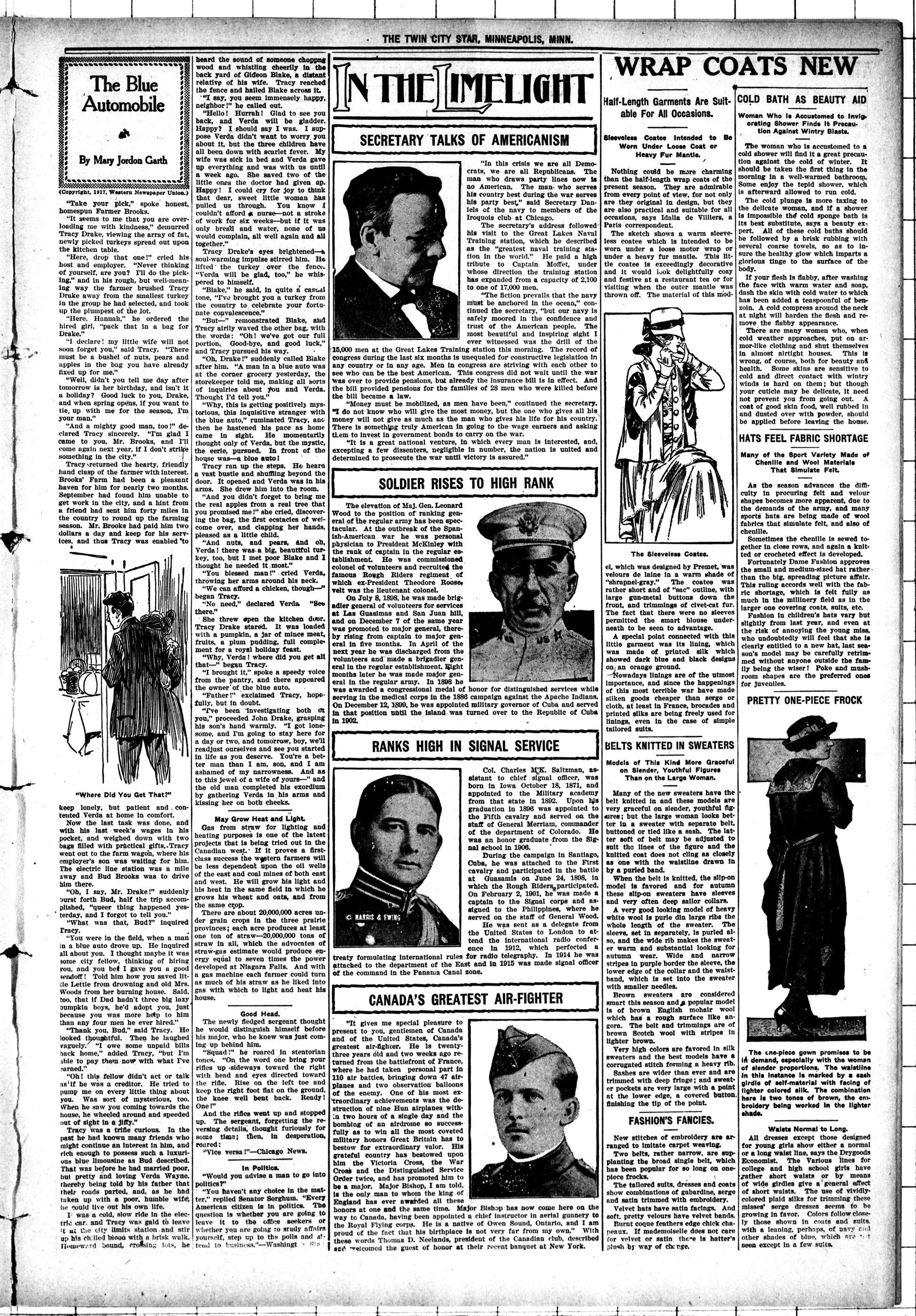
SECRETARY TALKS OF AMERICANISM
15,000 men at the Great Lakes Training station this morning. The record of congress during the last six months is unequaled for constructive legislation in any country or in any age. Men in congress are striving with each other to see who can be the best American. This congress did not wait until the war was over to provide pensions, but already the insurance bill is in effect. And the bill provided pensions for the families of 28 men who were killed before the bill became a law.
"Money must be mobilized, as men have been," continued the secretary. "I do not know who will give the most money, but the one who gives all his money will not give as much as the man who gives his life for his country. There is something truly American in going to the wage earners and asking them to invest in government bonds to carry on the war.
"It is a great national venture, in which every man is interested, and, excepting a few dissenters, negligible in number, the nation is united and determined to prosecute the war until victory is assured."
SOLDIER RISES TO HIGH RANK
was awarded a congressional medal of honor for distinguished services while serving in the medical corps in the 1886 campaign against the Apache Indians. On December 12, 1899, he was appointed military governor of Cuba and served in that position until the island was turned over to the Republic of Cuba in 1902.
RANKS HIGH IN SIGNAL SERVICE
treaty formulating international rules for radio telegraphy. In 1914 he was attached to the department of the East and in 1915 was made signal officer of the command in the Panama Canal zone.
CANADA'S GREATEST AIR-FIGHTER
CANADA'S GREATEST AIR-FIGHTER
honors at one and the same time. Major Bishop has now come here on the way to Canada, having been appointed a chief instructor in aerial gunnery to the Royal Flying corps. He is a native of Owen Sound, Ontario, and I am proud of the fact that his birthplace is not very far from my own." With these words Thomas D. Neelands, president of the Canadian club, described and welcomed the guest of honor at their recent banquet at New York.
PETER H.
15,000 men at the Great Lakes Training congress during the last six months is us any country or in any age. Men in coe see who can be the best American. This was over to provide pensions, but alreast the bill provided pensions for the fami the bill became a law. "Money must be mobilized, as mei I do not know who will give the most money will not give as much as the m There is something truly American in them to invest in government bonds to "It is a great national venture, in excepting a few dissenters, negligible determined to prosecute the war until w
SOLDIER RISES
The elevation of Muj. Gen. Leonard Wood to the position of ranking general of the regular army has been spectacular. At the outbreak of the Spanish-American war he was personal physician to President McKinley with the rank of captain in the regular establishment. He was commissioned colonel of volunteers and recruited the famous Rough Riders regiment of which ex-President Theodore Roosevelt was the lieutenant colonel.
On July 8, 1898, he was made brigadier general of volunteers for services at Las Guasimas and San Juan hill, and on December 7 of the same year was promoted to major general, thereby rising from captain to major general in five months. In April of the next year he was discharged from the volunteers and made a brigadier general in the regular establishment. Eight months later he was made major general in the regular army. In 1898 he
was awarded a congressional medal of
serving in the medical corps in the 188
On December 12, 1899, he was appointe
in that position until the island was
in 1902.
RANKS HIGH IN
C HARDIS & EWING
treaty formulating international rules attached to the department of the Ea of the command in the Panama Canal
CANADA'S GREAT
"It gives me special pleasure to present to you, gentlemen of Canada and of the United States, Canada's greatest air-fighter. He is twenty-three years old and two weeks ago returned from the battlefront of France, where he had taken personal part in 110 air battles, bringing down 47 airplanes and two observation balloons of the enemy. One of his most extraordinary achievements was the destruction of nine Hun airplanes within two hours of a single day and the bombing of an airdrome so successfully as to win all the most coveted military honors Great Britain has to bestow for extraordinary valor. His grateful country has bestowed upon him the Victoria Cross, the War Cross and the Distinguished Service Order twice, and has promoted him to be a major. Major Bishop, I am told, is the only man to whom the king of England has ever awarded all these
honors at one and the same time. My way to Canada, having been appointed the Royal Flying corps. He is a nati proud of the fact that his birthplace these words Thomas D. Neelands, pre and welcomed the guest of honor at
"In this crisis we are all Democrats, we are all Republicans. The man who draws party lines now is no American. The man-who serves his country best during the war serves his party best," said Secretary Daniels of the navy to members of the Iroquois club at Chicago.
The secretary's address followed his visit to the Great Lakes Naval Training station, which he described as the "greatest naval training station in the world." He paid a high tribute to Captain Moffet, under whose direction the training station has expanded from a capacity of 2,100 to one of 17,000 men.
"The fiction prevails that the navy must be anchored in the ocean," continued the secretary, "but our navy is safely moored in the confidence and trust of the American people. The most beautiful and inspiring sight I ever witnessed was the drill of the
ing station this morning. The record of unequaled for constructive legislation in congress are stricting with each other to this congress did not wait until the war lady the insurance bill is in effect. And allies of 28 men who were killed before man have been," continued the secretary. It money, but the one who gives all his man who gives his life for his country. going to the wage earners and asking carry on the war. in which every man is interested, and, in number, the nation is united and victory is assured."
TO HIGH RANK
us
of honor for distinguished services while
6 campaign against the Apache Indians,
and military governor of Cuba and served
turned over to the Republic of Cuba.
SIGNAL SERVICE
Col. Charles M.K. Saltzman, assistant to chief signal officer, was born in Iowa October 18, 1871, and appointed to the Military academy from that state in 1892. Upon his graduation in 1896 was appointed to the Fifth cavalry and served on the staff of General Merriam, commander of the department of Colorado. He was an honor graduate from the Signal school in 1906.
During the campaign in Santiago, Cuba, he was attached to the First cavalry and participated in the battle at Guasamis on June 24, 1808, in which the Rough Riders participated. On February 2, 1901, he was made a captain to the Signal corps and assigned to the Philippines, where he served on the staff of General Wood. He was sent as a delegate from the United States to London to attend the international radio conference in 1912, which perfected a for radio telegraphy. In 1914 he was st and in 1915 was made signal officer zone.
TEST AIR-FIGHTER
T. H.
major Bishop has now come here on the a chief instructor in aerial gunnery to live of Owen Sound, Ontario, and I am is not very far from my own." With resident of the Canadian club, described their recent banquet at New York.
WRAP COATS NEW
Half-Length Garments Are Suitable For All Occasions.
Sleeveless Coatee Intended to Be Worn Under Loose Coat or Heavy Fur Mantle.
Nothing could be more charming than the half-length wrap coats of the present season. They are admirable from every point of view, for not only are they original in design, but they are also practical and suitable for all occasions, says Idalia de Villiers, a Paris correspondent.
The sketch shows a warm sleeveless coatee which is intended to be worn under a loose motor wrap or under a heavy fur mantle. This little coatee is exceedingly decorative and it would look delightfully cozy and festive at a restaurant tea or for visiting when the outer mantle was thrown off. The material of this mod-
A
The Sleeveless Coatee.
el, which was designed by Premet, was velours de laine in a warm shade of "shrapnel-gray." The coatee was rather short and of "sac" outline, with large gun-metal buttons down the front, and trimmings of clivet-cat fur. The fact that there were no sleeves permitted the smart blouse underneath to be seen to advantage.
A special point connected with this little garment was its lining, which was made of printed silk which showed dark blue and black designs on an orange ground.
Nowadays lings are of the utmost importance, and since the happenings of this most terrible war have made silken goods cheaper than serge or cloth, at least in France, brocades and printed silks are being freely used for linings, even in the case of simple tailored suits.
BELTS KNITTED IN SWEATERS
Models of This Kind More Graceful on Slender, Youthful Figures Than on the Large Woman.
Many of the new sweaters have the belt knitted in and these models are very graceful on slender, youthful figures; but the large woman looks better in a sweater with separate belt, buttoned or tied like a sash. The latter soft of belt may be adjusted to suit the lines of the figure and the knitted coat does not cling as closely as one with the waistline drawn in by a purled band.
When the belt is knitted, the slip-on model is favored and for autumn these slip-on sweaters have sleeves and very often deep sailor collars.
A very good looking model of heavy white wool is purle din large ribs the whole length of the sweater. The sleeve, set in separately, is purled also, and the wide rib makes the sweater warm and substantial looking for autumn wear. Wide and narrow stripes in purple border the sleeve, the lower edge of the collar and the waistband, which is set into the sweater with smaller needles.
Brown sweaters are considered smart this season and a popular model is of brown English mohair wool which has a rough surface like angora. The belt and trimmings are of brown Scotch wool with stripes in lighter brown.
Very high colors are favored in silk sweaters and the best models have a corrugated stitch forming a heavy rib.
Sashes are wider than ever and are trimmed with deep fringe; and sweater pockets are very large with a point at the lower edge, a covered button finishing the tip of the point.
FASHION'S FANCIES.
New stitches of embroidery are arranged to imitate carpet weaving.
Two belts, rather narrow, are supplanting the broad single belt, which has been popular for so long on one piece frocks.
The tailored suits, dresses and coats show combinations of gardine, serge and satin trimmed with embroidery.
Velvet hats have satin facings. And soft, pretty velours have velvet bands.
Burnt coque feathers edge chick chapeaux. If mademoiselle does not care for velvet or satin there is hatter's plush by way of change.
COLD BATH AS BEAUTY AID
Woman Who Is Accustomed to Invi-
orating Shower Finds It Preca-
tion Against Wintry Blasts.
The woman who is accustomed to a cold shower will find it a great preca-
tion against the cold of winter. It should be taken the first thing in the
morning in a well-warmed bathroom. Some enjoy the tepid shower, which
is afterward allowed to run cold.
The cold plunge is more taxing to
the delicate woman, and if a shower
is impossible the cold sponge bath is
its best substitute, says a beauty
expert. All of these cold baths should
be followed by a brisk rubbing with
several coarse towels, so as to in-
sure the healthy glow which imparts a
glorious tinge to the surface of the
body.
If your flesh is flabby, after washing the face with warm water and soap, dash the skin with cold water to which has been added a teaspoonful of benzoin. A cold compress around the neck at night will harden the flesh and remove the flabby appearance.
There are many women who, when cold weather approaches, put on armor-like clothing and shut themselves in almost airtight houses. This is wrong, of course, both for beauty and health. Some skins are sensitive to cold and direct contact with wintry winds is hard on them; but though your cuticle may be delicate, it need not prevent you from going out. A coat of good skin food, well rubbed in and dusted over with powder, should be applied before leaving the house.
HATS FEEL FABRIC SHORTAGE
Many of the Sport Variety Made of Chenille and Wool Materials That Simulate Felt.
As the season advances the difficulty in procuring felt and velour shapes becomes more apparent, due to the demands of the army, and many sports hats are being made of wool fabrics that simulate felt, and also of chenille.
Sometimes the chenille is sewed together in close rows, and again a knitted or crocheted effect is developed.
Fortunately Dame Fashion approves the small and medium-sized hat rather than the big, spreading picture affair.
This ruling accords well with the fabric shortage, which is felt fully as much in the millinery field as in the larger one covering coats, suits, etc.
Fashion in children's hats vary but slightly from last year, and even at the risk of annoying the young miss, who undoubtedly will feel that she is clearly entitled to a new hat, last season's model may be carefully retrained without anyone outside the family being the wiser! Poke and mushroom shapes are the preferred ones for juveniles. PRETTY ONE-PIECE FROCK
I
The one-piece gown promises to be in demand, especially with the woman of slender proportions. The waistline in this instance is marked by a sash girdle of self-material with facing of lighter colored silk. The combination here is two tones of brown, the embroidery being worked in the lighter shade.
Walista Normal to Long.
All dresses except those designed for young girls show either a normal or a long waist line, says the Drygoods Economist. The Varlous lines for college and high school girls have rather short waists or by means of wide girdles give a general effect of short waists. The use of vividly-colored plaid silks for trimming these misses' serge dresses seems to be growing in favor. Colors follow closely those shown in coats and suits, with a leaning, perhaps, of navy and other shades of blue, which are not seen except in a few suits.
Entered in the Post Office at Minneapolis as second class matter.
MEMBER
NATIONAL NEGRO PRESS
ASSOCIATION
Subscription by Mail, Postpaid.
ONE YEAR ..... $2.00
SIX MONTHS . $125
THREE MONTHS ..... .65
Hamlet B. Rowe, Local Agent.
ADVERTISING RATES.
One Inch—1 Insertion—One Dollar.
Liberal discount given on 3, 6, 9,
Months, or 1 year contracts.
We do not run free ads, or over-run the time contracted for by our advertisers We respect their right to advertise at intervals, and rather have them do so, than to run continuously an "adv." and an increasing account. Write all Checks payable to .
THE TWIN CITY STAR
1317 North Sixth Ave.
MINNEAPOLIS - MINNESOTA
Call at 1317 6th Ave. N. on Wednesday to insure matter for publication.
The Star's Phone, Hyland 1205.
PROGRESS AND THE NEGRO.
It takes years for great improvements to produce visible results. In the South a gregarious, pleasure-loving, improvident race has seemed to be but slightly affected by the economic and industrial changes of the times. The Negro has been the unskilled laborer, the poor tenant former, raising his bale or two of cotton and turning it over to the local buyer in liquidation of his debt for the year's living expenses. The teachings of institutions like Tuskegee, Calhoun and Hampton are producing a class trained in trades, efficiency and initiative, whose influence is a leaven slowly permeating the mass for industrial uplift and awakening in the Negro a sense of his economic value. The labor shortage has been an advantage to him. Seven thousand Negroes applied to the Federal Department of Labor last year in regard to opportunities for employment; testimony to the spread of industrial education.—Detroit Free Press.
We fight to preserve the Constitution, to support the President in his perpetuation of its principles, to defend all of its loyal citizens and to secure for all men Liberty throughout every land. We will never surrender any right, accorded other American citizens. We demand "Equality before the Law." The Divine prophesies shall be fulfilled. God helps those who first help themselves.
Hon. Ralph W. Tyler, ex-auditor of the Navy, is the logical man for Secretary of the National Negro Soldiers' Comfort Committee. He is the best newspaper man of our race, having long experience on white publications and is an expert on publicity. Mr. Tyler will have the confidence of a mass of friends in his work, and his selection by the committee is a very wise one.
THE NEGRO IN THE WAR.
The course of the Negro race has been highly creditable in this war. Upon barren soil fell the seeds of sedition and insurrection disseminated by German agents and pro-German newspapers in an attempt to incite the Negroes to uprising against the United States. So far as we have observed, Negro leaders have been conspicuously free from treasonable utterances. Drafted Negroes have gone to the front as cheerfully as any other set of men and, if history repeats itself, they will fight with signal bravery. German bullets will send as much torture and agony into black bodies as into white. Death will not discriminate against the Negro soldier. The patriotism of these people will not be forgotten and should ever be kept in mind and taken into account for full credit in the adjustment of racial problems.—Greenville, S. C., News.
WAITERS WANT MORE WAGES.
The waiters, who have been doing extra work at the various hotels, are asking for more wages. The increased cost of living and the salaries paid to laborers in other employment justifies their demand. They should get at least $2.00 for a day's services, even if employed only one meal. The preparation for the job, the time lost for other work, the advance protection given their employers by "booking a day or so ahead," with the services rendered, are well worth a few dollars. An extra waiter's expenses cannot be met with a dollar a meal, and that only about twice a week. There are too many places for working men now, where good salaries obtain, and good waiters will be wanted, if they are not paid better wages.
There is not a Negro on the payroll of the entire military forces of the state.
The Twin City Star stands for equal rights for all American citizens.
BUY RED CROSS SEALS.
NEGROES ORGANIZE SOL-
DIERS' COMFORT COMMITTEE
Washington, D. C., Nov. 5.—(Special to The Twin City Star)—A national organization known as the Colored Soldiers' Comfort Committee was effected here last week to raise two million dollars for the comfort and relief of the Colored soldiers and their dependents. Prof. Kelly Miller, Dean of Howard University, has been chosen president, J. C. Napier, former register of the treasury, of Nashville, Tenn., national treasurer, and Ralph W. Tyler, of Columbus, Ohio, former auditor of the navy, national secretary. A board of directors was chosen on which is a representative from every state. The National Board of Directors consists of the following: William H. Lewis, Boston, Mass., James W. Johnson, New York City, Mrs. Mary C. Talbert, Buffalo, N. Y., Dr. Harry M. Minton, Philadelphia, Penna, Geo. A. Myers, Cleveland, Ohio, W. T. Francis, St. Paul, Minn, Dr. Clinton Barnett, Huntington, W. Va., Dr. Summer A. Furnace, Indianapolis, Ind., Major R. R. Jackson, Chicago, Ill., Noah D. Thompson, Los Angeles, Cal., Prof. Richard Cole, St. Louis, Mo., John Wright, Topeka, Kan., T. J. Ellott, Muskogee, Okla., R. R. Church, Memphis, Tenn., Phil A Brown, Hopkinsville, Ky., Bishop Geo. W. Clinton, Charlotte, N. C., John Mitchell, Jr., Richmond, Va., Chas. Banks, Mount Bayou, Miss, Perry W. Howard, Jacksonville, Fla., Dr. J. R. Levey, Florence, S. C., R. L. Smith, Waco, Tex., C. N. Love, Houston, Tex., Dr. Earnest Lyons, Baltimore, Md., Bishop I. N. Ross, Washington, D. C., Armond W. Scott, Washington, D. C., Robert E. Jones and I. W. Green, New Orleans, La., Victor H. Tulane, Montgomery, Ala., Dr. Samuel Elbert, Wilmington, Del., Ben J. Davis, Atlanta, Ga.
The plans of the organization are to establish local committees in each city, and to start immediately to raise the fund stipulated. We men who suggested the movement felt that while various white organizations were systematically raising funds for their soldiers and dependents, it was time and appropriate that the race was manifesting an interest in the more than 80,000 Colored soldiers who have been called to the colors, and to the dependents of these men. Movie pictures, with especially written scenarios, and all colored cast, is to play an important part in the plans for raising the $2,000,000.
Telegrams from Colored men in various parts of the country have been received commending the movement.
WHITES FORCE NEGRO
TO REMOVE UNIFORM
St. Louis, Mo., Nov. 13.—Joseph B. Sanders, a Negro of this city, who was commissioned a second lieutenant in the National army, after having taken a training course at Das Moines, has complained to the War department that he was compelled by white citizens of Vicksburg, Miss., to remove his uniform, and that he fed the city in disguise.
We have some among our advertisers and subscribers who are a credit to our race for their business-like methods. They pay promptly in advance and expect nothing unreasonable in return. Others want to know "Why, we can't 'trust' them?" or send a bill, and then a collector, and finally censor a Negro editor because he can't run his paper "like the white man." Few persons realize that it pays to pay as you go. The Star is not an installment plan proposition. It is a real newspaper run under many difficulties mostly due to the foolish notions and ignorant whims of those whom it serves and protects and from whom it should get its support and their consideration.
There is a great demand for laborers now and Negroes are being employed where before they were "not wanted." As a rule, they are making good and their efficiency will overcome much of the general prejudice against them. The Negro has been denied the privilege of employment mostly because of the ignorance of many employers.' Since the Negro laborer has better opportunities, he will be a better citizen. The so-called race-problem will soon be solved because there is no Negro problem; it is the white man's; and its only solution is an intelligent consideration for the Negro as a man and an acknowledgement of his right to earn his living on equal footing with other citizens.
FROM CAUSE TO EFFECT.
The Negro is in the war at home and abroad. He must be true to himself to be true to his country. He cannot afford to surrender his manhood for position, or his birthright for finance; no more right here than he can afford to act as a spy, or quit as a coward—Over there. Let us not be led astray by those friends who want us, because we give the most, but pay due tribute to those who treat us as men. And as a warning to St. Paul Negroes, let the white citizens accept the Negro in their own gatherings. Minneapolis sets the example. The boys here were given every consideration like the other races; and one of our black boys can do more among the white people by showing his loyalty and willingness to go, to advance us in their estimation as a race, than a thousand Negroes, by listening to the "bull" shot at us by a few white persons of prominence, who have done comparatively nothing for us, according to their positions and power; although they have been materially benefited by us.
THE TWIN CITY STAR, MINNEAPOLIS, MINN.
CLASSIFIED ADVERTISEMENTS
HOUSE FOR RENT.
Eight rooms, modern except heat;
garden, chicken-house, lawn, block
from car line. Inquire 3709 18th Ave.
So. Call Drexel 2664.
FOR RENT—Duplex, all modern except heat and bath. Good location,
near car line. Down stairs, $13.00;
upstairs, $12.00. Call O. G. Price.
South 4521.
SEE McDEW! for real estate.
INSURANCE AGENTS WANTED.
Three (3) honest, reliable and energetic colored men wanted to write insurance. Hustlers can make $4 to $6 a day, plus commission. Nothing to carry. Call for appointment, Hyland 6381, 5 to 7 every evening.
TWO FAMILY HOUSE FOR RENT.
Five rooms each side, in good order, modern except heat, reasonable rent, good cellars, 801-803 Bassett Pl. Apply to Leviton, the Tallor, 1317 6th Ave. No. Hyland 2875.
Furnished Rooms for Gentlemen.
Two good rooms, within walking distance, on car line, modern. 1915 4th Ave. So. Phone N. W. South 2451.
Furnished Room.—Conveniently located. Reasonable rent. Modern. Mrs. Hall, 708 Girard Ave. No. Hy. 4956.
LOWER FLAT for rent; 5 rooms and bath, all modern; desirable location, near car line. 2111 Fifth Ave. S. Call Colfax 3306.
SIX-ROOM MODERN FLAT, downstairs, central location, near car line. Apply J. S. Wright, 2737 11th Ave. So.
Rooms for Light Housekeeping. Three rooms, second floor, good location. Call at 2531 Stevens ave.
FOR RENT—1706 East Nineteenth Street. Tollet, water and gas. Three and four rooms. $10.00 per month. McDew Realty Co., Sykes Block, Nic. 621.
ONE LARGE ROOM neatly furnished, modern conveniences, in residential section. Mrs. W. W. Williams, 2900 Eleventh avenue South. Drexel 4728.
FOR RENT - Eight-room house: modern except heat; walking distance from town. Apply to A. Marshall, 715 E. 18th St. South 1848.
BUY RED CROSS SEALS.
EVERY DAY is BARGAIN DAY at the ROOT & HAGEMAN STORE, 407 Nicollet Ave.
AGENTS WANTED—NOW!
Reliable and intelligent agents always wanted to solicit business for THE TWIN CITY STAR; also correspondents in principal cities. A chance to earn a good living. Write The Twin City Star, Minneapolis.
Peoples Christian Assembly.
ELDER G. W. MITCHELL, Pastor.
Assisted by Mrs. G. W. Mitchell.
Comel and Serve the Lord.
1204 Washington Ave. So.
Services Sunday—11 A. M.
Sunday School—1:30 P. M.
Praise Meeting—3 P. M.
Preaching—8 P. M.
United States Civil-Service Examinations
STENOGRAPHERS AND
TYPEWRITERS
WANTED.
Men and Women.
The United States Government is in urgent need of thousands of typewriter operators and stenographers and typewriters. All who pass examinations for the departments and offices at Washington, D. C., are assured of certification for appointment. It is the manifest duty of citizens with this special knowledge to use it at this time where it will be of most value to the Government. Women especially are urged to undertake this office work. Those who have not the required training are encouraged to undergo instruction at once. Examinations for the Department Service, for both men and women, are held every Tuesday, in 450 of the principal cities of the United States, and applications may be filed with the Commission at Washington, D. C., at any time.
The entrance salary ranges from $1,000 to $1,200 a year. Advancement of capable employees to higher salaries is reasonably rapid. Applicants must have reached their eighteenth birthday on the date of the examination.
For full information in regard to the scope and character of the examination and for application blanks address the U. S. Civil Service Commission, Washington, D. C., or the Secretary of the U. S. Civil Service Board of Examiners at Boston, Mass.; New York; Philadelphia, Pa.; Atlanta, Ga.; Cincinnati, Ohio; Chicago, Ill.; St. Paul, Minn.; St. Louis, Mo.; New Orleans, La.; Seattle, Wash.; San Francisco, Cal.; Honolulu, Hawaii; or San Juan, Porto Rico.
JOHN A. MCIILHENNEY, President, U. S. Civil Service Commission, Washington, D. C.
---
The fruit of labor is success, but the juice is often sour.
A man shows signs of understanding a woman when he doesn't try to refute her arguments.
Gout is too fashionable to be cured.
It generally takes a woman to mend a man's ways:
From the free list to the blacklist is but a jump.
All women are convinced that all men are terrible, except possibly one.
About the time a man ought to quit wearing red ties he begins to wear them.
Some people are like shadows—they are with you only when everything is fair.
Some nations and all women begin hostilities without declaring war.
We often discard the wrong cards, and sometimes it happens that way with friendships.
The virtues of men, at best, are negative; I admire a woman for what she is and a man for what he isn't.
When a young man once drops into poetry he seldom gets on his feet again. —Chicago Herald.
MUCH IN LITTLE
Cultural stations of the United States bureau of fisheries produced more than 5,000,000 fish and eggs in the year ending with June, a new high record.
The timber possibilities of British North Borneo are to be investigated by an expert from the United States whom the government has employed.
In an experimental way, at least, an Italian inventor's wireless apparatus transmits written messages, sketches, shorthand characters and various 'designs.
As a substitute for a grocer's scoop an inventor has patented a pump that lifts dry articles from their containers, which remain closed to exclude dust.
A well-known motion-picture actress has designed an automobile which serves her as a dressing room with almost as many conveniences as a dressing room in a theater provides.
From the speed at which earthquake waves travel through the earth an English scientist has constructed a theory that the world has a dense central core, which may be measured in time.
In the cities of the Seville consular district there appears to be a growing tendency toward outdoor recreation, which should afford American manufacturers of sporting goods an opportunity to ship their wares to Spain.
WORDS OF WISDOM.
And we always wonder if the girl at the phone looks as sweet as her voice sounds.
The man who can climb up again after being bumped from a pedestal is the greatest hero of all.
Act crazy and you may be regarded as a genius, but you are more apt to be considered a darn fool.
When an old woman looks extremely young it is a sign that the business of the beauty plumber is flourishing.
FACTS ABOUT EGGS
The flavor of the egg is influenced by the hen's feed.
The older the hen the larger will be the average size of her egg.
The shell of the egg, being porous, will quickly absorb odors, and these will affect the flavor.
The first eggs of winter are generally larger than those laid at the close of the summer season.
The sex of the eggs cannot be foretold, not one of the old-time theories in this particular having ever been proven.—Farm Life.
FLASHLIGHTS
The man who doesn't do his best deserves to fall.
A fellow wouldn't have to be much of a speed merchant nowadays to spend money faster than he can earn it.
Don't spend time wondering how the other fellow gets his money. In nine cases out of ten the man who has money earned it.
Office Phones—Main 2369; Auto 35774. Dining Room—Main 2831.
Twenty Elegant Steam-Heated and Electric Lighted Rooms.
A la Carte Meals at All Hours—Popular Prices.
246-250 FOURTH AVE. S., MINNEAPOLIS, MINN.
Private Dining and Reception Room for Ladies. Special Temperance Beverages. Men's Buffet and Grill; Billiards; Barber Shop in Connection.
J. A. Withers, Prop.
BELL'S BAR
CLARENCE W.
BATHS, BARBER SHOP
POOL AND BAR
CIGARS, RACE PARK
244 THIRD AVE. SOUTH
Phone Northw
BELL'S BARBER SHOP
CLARENCE W. BELL, Proprietor.
THS, BARBER SHOP, POLITE BARBER
POOL AND BILLIARD HALL
LAGARS, RACE PAPERS, SHOE SHINING
RD AVE. SOUTH
MINNEAPOLIS,
Phone Northwestern, Main 2511.
BELL'S BARBER SHOP
CLARENCE W. BELL, Proprietor.
BATHS, BARBER SHOP, POLITE BARBERS
POOL AND BILLIARD HALL
CIGARS, RACE PAPERS, SHOE SHINING
244 THIRD AVE. SOUTH ..MINNEAPOLIS, MINN.
Phone Northwestern, Main 2511.
CENTRAL MUSEUM
South Side
212 Eleventh Av
EXPERT BARBERS
CIGARS, POOL AND BILLIARDS
RACE PAPERS
THOMPSON &
North Side Barber S.
12 Eleventh Ave. S., Minneapolis
EXPERT BARBERS; UP TO THE MINU
COOL AND BILLIARD TABLES IN CONNE
RACE PAPERS—SHOES SHINED.
THOMPSON & CARVER, Props.
South Side Barber Shop
212 Eleventh Ave. S., Minneapolis
EXPERT BARBERS; UP TO THE MINUTE.
CIGARS, POOL AND BILLIARD TABLES IN CONNECTION.
RACE PAPERS—SHOES SHINED.
THOMPSON & CARVER, Props.
The Waiters' and Porters' Club
GLOVER SHULL, PRES.
311 HENNEPIN AVE. MINNEAPOLIS
EDDIE BOYD, SECY' LEE WHEELER, MANAGER
F. PEOPLES
HOME BUILDING CO.
CONTRACTORS AND BUILDERS
818 METROPOLITAN LIFE BLDG.
OFFICE PHONE NIC. 1534
don't need money; if you own you
BUILD HOMES ON MONTHLY PAYMENTS.
COTTAGES AND FOUR FAMILY FLATS
LIKE PAYING RENT. PLA
There are more than
113,000 men and women in
this and other states who
own Bell Telephone stock.
Bell Telephone stock is
considered a conservative in-
vestment because it
pays a reasonable re-
turn and is not "wat-
ered."
A
1224 N. 6TH AVE., MINNEAPOLIS WITHERS' SPECIAL SERVICE
BAGGAGE TRANSFERED AND FUEL DELIVERED TO ALL PARTS OF THE CITY ON SHORT NOTICE.
BARBER SHOP
W. BELL, Proprietor.
SHOP, POLITE BARBERS
O BILLIARD HALL
APERS, SHOE SHINING
H . MINNEAPOLIS, MINN.
northwestern, Main 2611.
SMOKE THE BEST
5C CIGAR
Sight Draft
W. S CONRAD CO., Distributors.
NO. 140. E. 6th ST., ST. PAUL.
NO. 1. WESTERN AVE., MINN.
Barber Shop
Ave. S., Minneapolis
ERS; UP TO THE MINUTE.
HIARD TABLES IN CONNECTION.
RS—SHOES SHINED.
& CARVER, Props.
PLES
ING CO.
BUILDERS
METropolitan LIFE BLDG.
PHONE NIC. 1534
money; if you own your lot.
ON MONTHLY PAYMENTS.
TO FOUR FAMILY FLATS
NT.
PLANS FREE
Admission 35c. Gibson and Rowe, Managers.
IMPORTANT NOTICE Unless notes are written plainly and properly arranged they will not be inserted. Many people send in notes regardless of names, initials or composition. Arrangement by the publisher will be charged for. Free notices must be correctly written.
SUNDAY FORUM MEETING
The Sunday Forum meets November 18th at Bethesda Church. Miss Eva B. Walker will read a paper for discussion. Vocal selections by Mrs. S. G. Franklin and others. The committee on "Christmas Boxes for the Soldiers" will report. Instead of "Quotations" our National anthem will be taken up in consecutive couplets through the audience. Come prepared! W. C. Jeffrey, Pres.
ELKS' CHRISTMAS PARTY.
Ames Lodge of Elks are preparing for their Christmas Tree and Entertainment for the children, which is their special charity feature much looked for by the young people. The names of children unable to be present on account of illness should be sent to W. R. Morris, Secretary, 818 Met. Life Bldg.
A GRAND BAZAAR.
Two Nights Entertainment, November 20 and 21.
The Pulpit Aid Society of Bethesda Baptist Church will hold a Bazaar on November 20 and 21 at the Church. Program begins at 8:15. Art and needlework will be sold. Booth and amusement features.
Three Prizes.
A 49-pound sack of flour, donated by Mr. Ralph Watson, for the person selling the largest number of tickets over $5.00.
A beautiful doll, donated by Mrs. Georgia Hines, for the child selling the largest number of tickets.
A doll for the child selling the next highest number of tickets.
Admission, adults, 10 cents; children, 5 cents. —Advertisement.
Sunday, Nov. 25, will be Stewardesses' Day at St. Peter A. M. E. Church.
Mr. and Mrs. Thomas Carroll are residing at 3102 Blaisdell Ave.
PORTERS LEAVE FOR CANADA.
About 48 sleeping car porters left Monday night for employment on the Canadian Pacific railway. They will be employed in the military transportation service from Halifax to Vancouver and will receive $65 per month, with board and lodging.
BOY SCOUTS ORGANIZED.
Scout Master J. Cordery Batten of Pillsbury House has organized a company of Negro Boy Scouts. A meeting was held Friday evening at the Pillsbury House. A basketball team and other athletic sports will be the winter features. All boys under 18 years are requested to join. Mr. W. C. Joffrey is assisting in the movement.
A NORTH SIDE ENTERTAINMENT.
The North Side Cafe, 723 6th Ave.
No. offers to its patrons on Thursday and Sunday evenings the services of Miss Blanche Williams of Austin, Tex., and Mr. Dan W. Raynor, who will play and sing your favorite selections. Souvenirs for all ladies on Thursday nights. For reservations call Hyland 5851. Advertisement.
Mr. J. K. Love of Walker, Minn. was a visitor in the Twin Cities last week.
Archbishop John Ireland, who has been ill for more than a month at his residence, 977 Portland avenue, St. Paul, showed so great improvement last night that he probably will be on his feet within a few days, attendants said.
Otto Alphonso Hall and Hobart
Green Fulbright have not reported
to the local board of the fourth ward.
They are liable to punishment and
any information is wanted as to
their whereabouts.
Mrs. James M. Graham will spend
the winter in California.
Mr. John Warren died at Stewart's
Hotel on Thursday. He was a resident of this city about thirty years
and a member of Ames Lodge of Elks.
Mr. "Ike" Thompson has recovered
from an attack of tonsilitis.
Fuller Thompson returned from his
hunting trip this week. He brought a deer as usual.
"Bobby" Marshall, the veteran football star, is playing this season with the Marines. He is showing his old time form.
BUY RED CROSS SEALS.
LOCAL NEWS
THE STAR is the CHEAPEST and BEST, NEGRO PAPER in the NORTHWEST. It needs 500 more Subscribers to keep it going. Help to get us A BIGGER CIRCULATION.
Owing to an increase in cost, we have raised our prices on all composition. Reading notices will be 10c per line under one inch and 50c per inch thereafter.
The South Side Barber Shop is now located at 212 11th Ave. So.
Mr. J. H. Haygood has opened the People's Cafe at 11th Ave. and Washington So.
Mrs. Edward Pipkin visited friends in Chicago enroute to Peoria to see her brother, Mr. W. M. Scott, who is recovering from pneumonia.
THE TWIN CITY STAR will be sent to any out of town address. Send your subscription in postage stamps. Read your home paper while visiting in other cities. It's like a letter from home.
The fellow who does not take the Star or ADVERTISE in it, because its "editor does not come around," is often stealing from himself and inviting a business failure. The editor is like the rest of the folks—won't come around because the guy who runs the place is a grouch.
THE WAY TO MAKE MONEY.
If you wish to add to your income, you can do so by accepting an agency for The Twin City Star. Good commission to competent agents. Use your spare time in soliciting ads and subscriptions. Only honest and intelligent agents wanted. Call Hyland 1205.
A carload of Alaska Reindeer will be sold exclusively by the Minnesota Meat Market at their three stores.
Place Your Order Now.
—Advertisement.
Madam Hart, the hairdresser and milliner, has moved to 305 Thirteenth avenue south, where she will be pleased to meet her patrons.
NOT OUR REPRESENTATIVE.
Philip F. Hale does not in any way, represent The Twin City Star. He is connected with The Advocate. We do not mislead those who inquire about both papers. Several complaints have reached us about "subscribing for the Star from Phil Hale." Those who desire The Advocate can secure it from Mr. Hale. He has no authority to solicit for us and those who wish The Star or The Advocate should get their choice, without any misrepresentation. The Star stands the tests.
RED CROSS SEAL CAMPAIGN.
The date for beginning the Red Cross Seal Campaign has been advanced from November 15th to November 5th.
Dr. I. J. Murphy of the Minnesota Public Health association, state manager, announces the following messages just received:
"The American Red Cross waives the restriction in the contract that no agent put seals on sales before November 5th.
"We understand that man to reach the soldiers in France before Christmas must be mailed not later than November 15th and preferably at an earlier date. The advantage of allowing an early sale of Red Cross Seals by local campaign managers for packages going to the soldiers is obvious. Accordingly the American Red Cross walves the restriction in the contract which made November 15th the opening day, providing Red Cross Seals be not placed on sale before November 5th.
NEGROES TO BE CARED FOR.
The comfort of negroes in the military service of the country will be taken care of by the Maria C. Powell Red Cross unit of Minneapolis, comprising Negro women of the city interested in Red Cross work. The unit had its last meeting Nov. 2.
Negro Assemblyman In New York
New York, Nov. 9.—The distinction of being the first Negro assemblyman in this state falls to Edward A. Johnson, lawyer, real estate broker and former educator. He was elected in the 19th assembly district on the republican fusion ticket, defeating his Tammany opponent by 323 votes. The count was: Johnson, 3,863; Molony, (Dem.), 3,540; Dutton, (Soc.), 1,297. Mr. Johnson served twice as alderman in Raleigh, N. C., his former home.
Are you a delinquent subscriber? If so, why not send your subscription?
---
SUBSCRIBE NOW.
THE TWIN CITY STAR, MINNEAPOLIS, MINN.
N. A. A. C. P. BENEFIT
DRAWS GREAT CROWD
Pillsbury House Hall Packed.
The auditorium of Pillsbury House was crowded on Wednesday evening by several hundred, who witnessed the presentation of a comedy "Pro Tem" by amateur talent for the benefit of the local branch of the N. A. A. C. P. Much credit is due the entire cast and to Sec'y R. A. Skinner, who promoted the affair and was ably assisted by Miss Eva B. Walker, directress. Johnson's orchestra furnished the music for the dance. All participants in the play did exceptionally well and their work compared favorably with the average stock company.
"Pro Tem" is a comedy in three acts.
Scenes.
Act—Two—Drawing Room at Raymond Shepherd's.
Cast of Characters.
Henry Leslie—Sec'y Iro Tem ...
W. E. Burton
Raymond Shepherd—Retired Merchant ...
William Smith
Oscar Walcott—His Nephew ...
Tela Burt
Dr. Adolphus Blank—Mrs. Shepherd's Physician ... R. A. Skinner
Logan—Man Servant. Martin Brown
Bessie Martin—Mrs. Shepherd's Niece ...
Isabelle Ford
Rachel Shepherd—Raymond's Sister, a Spinster ...
Alice Mason
Mrs. Shepherd, wife of Raymond and guardian of Bessie ...
Alice Marshall
Lena Bailey—A Friend of Bessie...
..... Selina Newman
The evening was a great social event and the entertainment a financial success. The audience arrived early and nearly every seat was taken when the curtain rose. The affair was in every way an evidence of the advancement of colored people.
SEN. STOCKWELL DELIVERS ADDRESS.
The N. A. A. C. P. met at St. Peter A. M. E. Church on last Sunday evening. After a short sermon by Rev. Stovall, the meeting of the National Association for the Advancement of Coiled People was held. Pres. B. S. Smith presided, and spoke on the Louisville Segregation Case decision, and its value to our race. Sen. S. A. Stockwell delivered the address. He said that the recent decision was not only a victory for your race, but a great one for my race; and it is the messenger of a new day. He spoke briefly on the proper enforcement of law to eliminate race prejudice and confined his remarks chiefly to methods of taxation, by which all would have equal opportunity to enjoy the abundant supply of Nature's great storehouse. He advised the Negroes to meet the coming issues by an intelligent use of their ballot. Sen. Stockwell made a favorable impression on his audience and received a vote of thanks. Editor Smith responded on behalf of the association. Sec'y R. A. Skinnor read the communication from the national secretary and editorials from The Crisis. After the meeting Sen. Stockwell was the recipient of many congratulations for his remarks. He is deeply interested in the advancement of the Negro. His wife, a national leader in the Women's Suffrage Movement, has gone on record for equal rights for all women, both in the North and the South.
YOUR PUBLICITY PAYS
All persons interested in the progress of their lodges, churches, societies etc., should value the power of printer's ink. They should see that their secretaries SEND ALL NOTICES to the newspapers in proper time. They think the Editor should attend every affair, whether invited or not, and should know "What is going on?"—without being informed. Many exchanges clip from our columns, and often things done in Minneapolis get national publicity.
Do not waste your time making promises to our agents. Send your money by Express or Post Office Order or in cash or postage stamps.
PETTIGREW TO STAND TRIAL
Warrant Charging Him With Attempt to Obstruct Draft.
Aberdeen, S. D., Nov. 16.—United States Attorney Robert C. Stewart states that a warrant for the arrest of former United States Senator Frank Pettigrew of South Dakota will be served immediately on Pettigrew in Chicago.
Mr. Stewart announced that Pettigrew would be bpought back to South Dakota to stand trial. The indictment charges the former senator with attempting to obstruct the selective draft and with making anti-war utterances, contrary to the provisions of the espionage law.
New York Call Barred From Mails.
New York, Nov. 16.—On instructions from Washington, Postmaster Patten has issued an order depriving the New York Call, a socialist newspaper, of second class mail privileges.
British Ship Ashore Off Brazil.
Rio de Janeiro, Nov. 16.—The British transport Dunclutha has gone ashore after an accident. The Dunclutha was a vessel of 3,575 tons gross. She hailed from Glasgow. No explanation of the transport's presence is given.
A new spring sprocket for motorcycles is said to eliminate the jars due to irregular power transmission without lessening the efficiency of the motor.
For motion picture projectors a French inventor has condensed the light in an incarcerated lamp in a small area by colling a spiral filament closely.
Explorers believe that Lake Tanganika in Africa is the deepest body of resh water in the world, a record hereofore assigned to Lake Baikal in Asia.
By heating napthaline under pressure in the presence of aluminum chloride German scientists have produced an oil that can be used for illuminating purposes.
A machine has been invented for fish manners that cleans and dresses salmon at a rate of one a second, equivalent to the labor of 60 expert hand workers.
The shade over a new electric table lamp can be inverted and used as a cooking bowl, while the stand contains a toaster and grill that can be placed inside the bowl.
The rear end of an automobile locker of English invention is made of ground glass, on which a car's number can be painted and illuminated at night by a lamp inside the locker.
For fighting fires in small towns a light but efficient motor-driven pump has been mounted on a carriage that can be hauled as a trailer by any automobile or horse-drawn vehicle.
SOME OBSERVATIONS.
A true friend is a jewel that shines in the dark.
A cheerful lie makes more friends than a solemn truth.
A woman of few words usually has the reiteration habit.
A girl thinks a man is brave because he isn't afraid to swear.
People with peppery tempers are not the salt of the earth.
No, Raffalo, earthquakes were not invented by the Quakers.
As a man grows older he has more sympathy for the chap who can't deliver the goods.
A diplomat is the fellow who has acquired the art of going after what he wants while the other fellow is waiting.
HOW WOMEN BREAK DOWN
By turning night into day; too complex living.
By taking life too seriously—all work and no play.
By hurrying, worrying, fretting and straining to keep up appearances.
By always reading medical advertisements and medical books which describe your symptoms.
By drawing more out of the physical bank than is deposited, which results in physical bankruptcy.
By not taking a little outdoor recreation every day. The bow on the stretch soon loses its spring and elasticity.
DO YOU KNOW—
That more than 400 lambs were reared last summer on the links of one London golf club?
That in Austria smoking is to be restricted to 25 cigarets or ten cigars a week?
That an onion poultice beats all others for easing neuralgic or rheumatic pains, sore throats, etc.?
That sal volatile, a teaspoonful to a quart of water, sometimes revives window plants that apparently are dead?
ABOUT FATS
The fat of plants is contained in the seeds.
At least a third of the body's food should be fat.
Cocoa is the only popular beverage which has "fat."
Body fat is of three kinds—stearine, palmitin and oleine.
Fats yield glycerin, an essential component of high explosives.
A loin of mutton has more fat nutriment than any other joint.
British home-grown meat is the second richest in fat, American being first.
BEN MARIENHOFF For 28 Years at 318 Hennepin Avenue. Tailor to Men
IMPORTED AND DOMESTIC WOOLENS AT POPULAR PRICES Your Patronage Desired.
N. W. MAIN 2259
KEYSTONE BUFFET and CLUB CAFE
1313 Wash. Ave. South
FOR LADIES & GENTLEMEN
Music Every Day from 2 P. M. to 11 P. M.
Kidd Mitchell, Prop
LADIES SPE
Kidd Mitchell, Prop. M
LADIES SPECIALLY INVITE
ex 1269 *
J. & H. Wet Wash
3753-55-57 Cedar A
High Grade Specialists
Dry Wash and Family
OUR WORK IS OUR BEST AD
POPULAR PRICED SHOE REPAIR
SPECIAL SAMPLE SHOES
WE FIX 'EM WHILE YOU WAIT.
Men's Sewed Soles
Adies' Sewed Soles
Men's Nailed Soles
rubber Heels
Adies' and Boy's Nailed Soles
SEVEN CORNERS' SHOE REPAIR S
1424 Washington Ave. So., Minneapolis
HARRY LE
Mitchell, Prop. MINNEAPOLIS
DIES SPECIALLY INVITED EVERY DAY
& H. Wet Wash Launcher
3753-55-57 Cedar Avenue
Grade Specialists in Wet Wash
Wash and Family Launderer
WORK IS OUR BEST ADVERTISEMENT
OUR PRICED SHOE REPAIRING.
SPECIAL SAMPLE SHOES
WE FIX 'EM WHILE YOU WAIT.
1 Soles ..... $1.00
2 Soles ..... .85
3 Soles ..... .85
4 Soles ..... .40
5 Boy's Nailed Soles ..... .65
BORNERS' SHOE REPAIR SHOP.
Washington Ave. So., Minneapolis.
JOSEPH D.
Kidd Mitchell, Prop. MINNEAPOLIS, MINN.
LADIES SPECIALLY INVITED EVERY DAY.
Drex 1269 *
J. & H.
3753
High Grade
Dry Wash
OUR WORK
POPULAR PRICE
SPECIAL SALE
WE FIX 'EM W
Men's Sewed Soles .....
Ladies' Sewed Soles .....
Men's Nailed Soles .....
Rubber Heels .....
Ladies' and Boy's Nailed
SEVEN CORNERS'
1424 Washington
HARR
Pra
MEN'S SUITS A
Dry Cleaning and R
Phone N. W. Hyland
High Grade Specialists in Wet Wash Dry Wash and Family Laundering OUR WORK IS OUR BEST ADVERTISEMENT
HARRY LEVITON
HARRY LEVITON
Practical Tailor
MEN'S SUITS AND OVERCOATS
Dry Cleaning and Fancy Dyeing of Ladies
Phone N. W. Hyland 2875 1317
ITS SUITS AND OVERCOATS MADE TO ORRE
Cleaning and Fancy Dyeing of Ladies' and Gent's Gar
W. Hyland 2875 1317 No. 6th Ave., M
MEN'S SUITS AND OVERCOATS MADE TO QRDER. Dry Cleaning and Fancy Dyeing of Ladies' and Gent's Garments. Phone N. W. Hyland 2875 1317 No. 6th Ave., Minneapolis.
A
J. A. HUSS
16 North Seventh St., Mt.
N. W. Main 3717 (Second
PANAMA HATS A SPE
First-Class Work Guar
THE NORTH SIDE C
CHINESE AND AMERICAN COOKING
North Avenue No. Min
ean service. Chop Suey delivered by mess-
at, cozy dining room for Ladies and Gentlemen
Dinner, from 3 to 8 P. M., 35c.
Sunday Dinner, from 12 M. to 8 P. M.
Ladies Souvenir Night.
by Thursday night every lady will receive a
T" ANDERSON, Prop. Phone Hyla
THE NO
CHINESE
723 Sixth Avenue
Quick, clean service
neat, cozy di
Regular Dinner
Suho
Every Thursday
souvenir.
"COUNT" ANDB
THE NORTH SE
CHINESE AND AMERICA
723 Sixth Avenue No.
Quick, clean service. Chop Suey deli
neat, cozy dining room for Ladies
Regular Dinner, from 3 to 8 P. M.
Sunday Dinner, from 12
Ladies Souvenir Ni
Every Thursday night every lady
souvenir.
"COUNT" ANDERSON, Prop.
THE NORTH SIDE CAFE
Quick, clean service. Chop Suey delivered by messenger. A neat, cozy dining room for Ladies and Gentlemen. Regular Dinner, from 3 to 8 P. M., 35c. Sunday Dinner, from 12 M. to 8 P. M., 50c. Ladies Souvenir Night. Every Thursday night every lady will receive a beautiful souvenir. "COUNT" ANDERSON, Prop. Phone Hyland 5851
YOU HAVE TRIED THE REST.
NOW! WHY NOT TRY THE BEST?
THE PEOPLE'S CAFE
Open At All Hours. 1100 Washington Ave. So., Minneapolis. J. H. HAYGOOD, PROP.
MINNEAPOLIS
Makers
40 So. Third St.
MINNESOTA M
Wholesale and Ref
Makers of Home Made
of All Kind
40 So. Third St.
725 HENNEPIN AVE
MINNESOTA MEAT O
Wholesale and Retail
Makers of Home Made Sausages
of All Kinds
Third St. 1409 Nicollet
725 HENNEPIN AVE.
MINNESOTA MEAT CO.
Wholesale and Retail
Makers of Home Made Sausages
of All Kinds
40 So. Third St. 1409 Nicollet Avenue
725 HENNEPIN AVE.
Wash Laundry
Cedar Avenue
alists in Wet Wash
family Laundering
BEST ADVERTISEMENT
Minneapolis. JOSEPH DAHL, Prop.
LEVITON
Special Tailor
MRCOATS MADE TO ORDER.
Selling of Ladies' and Gent's Garments.
1317 No. 6th Ave., Minneapolis.
HATS CLEANED
AND RE-BLOCKED
Into Up-to-Date Styles
A. HUSSEY
North Seventh St., Minneapolis
L. Main 3717 (Second Floor)
AMA HATS A SPECIALTY
First-Class Work Guaranteed
H SIDE CAFE
AMERICAN COOKING
J. A. HUSSEY
16 North Seventh St., Minneapolis
N. W. Main 3717 (Second Floor)
PANAMA HATS A SPECIALTY
First-Class Work Guaranteed
Suey delivered by messenger. A
for Ladies and Gentlemen.
to 8 P. M., 35c.
or, from 12 M. to 8 P. M., 50c.
ouvenir Night.
every lady will receive a beautiful
Prop. Phone Hyland 5851
BEST?
PLE'S CAFE
A MEAT CO.
e and Retail
e Made Sausages
All Kinds
1409 Nicollet Avenue
NEPIN AVE.
Souvenirs for Ladies every Wednesday afternoon and Evening
Automatic 61809
A. H.
Minneapolis
OY Robert H.Moultor
Our policy of wilful waste
in the past is bringing about
a condition of woeful want
z: Alaska’s great resources
ce ce oes ue
| PANVANS)E in the bigger cities of the coun-
Se) trv. Like griddle cakes, we like
4 them only when they're hot, and
‘the wonderful pictorials for which the world has
been scanned by the editors, are thrown aside
fer a cursory examination.
Did you ever stop to think of the time when this
{incessant demand for the print paper may not be
‘met? Already we hear of the rapid increase in the
Price of pulp, which 1s reaching a stage where
jmany of the smaller publications of the country
fwill have to go out of business. Even the bigger
jones are feeling the pinch, and some are raising
hetr prices, others reducing the number of pages,
jand still others are making the advertiser pay.
Whe newspapers have not been the only ones to
ee by pulp shortage, for book publishers, too,
wve had their worries. In fact, all users of paper,
Mown to the schoolboy with his tablet, have had to
pay more for an inferlor quality of paper than was
tthe case a year or two ago.
In 1914, we used about 5,000 tons of newsprint
every day. Our present use has reached 6,000
tons « day, and the demand is increasing at the
Ee of about 10 per cent a year, which is greatly
excess of the rate of increase in population.
‘To supply our presses with newsprint requires
annually about 8,000,000 cords of pulp wood. To
meet our requirements for magazines and book
"BIDEN, stationery and business papers of all
Inds, 4,000,000 cords more of pulp wood are con-
sumed annually. Production barely keeps up this
‘consumption, for while it is estimated the news-
apers will need about 888,000 tons for the first
‘six months of this year, the estimated supply is
fixed at 930,000 tons.
But a few years ago this country was able to
supply all of its own needs and in addition fur-
nish paper to foreign countries, but that time has
passed. Now we must depend upon Canada for
at least a third of our domestic supply, and this
percentage {s rapidly increasing.
Our forefathers, and even our fathers, looked
about them, and saw apparently endless and tn-
exhaustible supplies of forest trees. ‘The wood-
man was not told to “spare that tree,” and they
were ruthlessly, sometimes wantonly, destroyed.
‘Where one tree was utliized for commerctal pur-
poses, two trees were allowed to remain as they
fell, only to rot away or be-burned in the first
forest fire that swept over the devastated area.
Today this policy has resulted in our privately
owned supply of pulp woods being so exhausted
that not more than 15 years’ supply remains. *
Serfous as the situation appears to be, there is
no cause for alarm, if we wake up to our duty
to conserve our remaining supply. ‘There is
enough pulp wood in our national forest to meet,
the future needs of this country, and if we pur-
sue a systematic course in avoiding waste in our
wood-manufacturing plants and encourage the
reforestation of our cut-over lands (of which
there are 70,000,000 acres in the northern states
alone) we could easily supply the world.
By following the dorrect practices of forestry,
and by conserving our supply, the publicly owned
timber in the United States will last indefinitely.
The forest service has estimated that there
are in the national forests at least 800,000,000,000
feet of pulp wood. This is equivalent to 600,000,-
000 cords, and for all kinds of paper we use but
7,000,000 @ords a year. This estimate does not
Include the pulp wood available on privately
owned lands of the West.
Practically all of our pulp is at present made
from northern woods, where stumpage costs run
from $2.50 to $5 per cord, standing in the forest.
In the West timber sultable for the manufacture
‘of pulp ranges in price from 25 cents to $1.25
per cord, The factethat these vast supplies in
the West have not yet been developed in due to
several causes. Lack of transportation has been
a big handicap and then the large investments
tied up in the paper mills preclude thelr move-
‘ment while It Is possible to secure timber nearer
at hand, even at vastly. higher prices.
From the standpoint of geographteal location
and transportation to the majority of the paper
users in the central and eastern states. The
‘Western paper woods fall into two broad belts.
‘The first is available to tidewater shipments from
the Pacific coast, lying principally on the west
slope of the Cascade mountains in Oregon and
fwashington, inclyding vast areas tributary to
Puget sound and jrunning up along the seaboard
in southeasterly Alaska. ‘There are 70,000,000,
000 feet of spruce and hemlock in the national
forests of Alaska alone, In many respects’ the
conditions found in Alaska duplicate those of
Norway, the leading country of the world in the
papér industry. It ts sald by those who have
studied the country that the forest of Alaska will
Produce more wealth for the United States than
‘even"her gold or her coal, vast and valuable as
‘are those commodities.
‘The second timber belt of Western paper woods
extends through the northern Rocky mountains,
from the Canadian line into Colorado and Utah.
‘his belt, shut off from water transportation can
hardly be considered a practical source of supply
of paper for the eastern states, but 1s a logical
storehouse of raw materials for the paper re-
quirements of the Misstssipp! valley, The Rocky
meuntains contain a number of excellent paper
Woods, and with proper development should sup-
ply both the paper required for local consump-
tion and that necessary to replace the dimintah-
Ce ee |
WS Ch ex te at Bigd i hye
ea oe ee eae | te
) ‘i a ee | ae ema a ae
hao ar a 2g ea
Le amet ae ee
Hage SS) Mek UY |
U Bae oti } ae i
ree bat) a aan ui
Lt aay Ee DE ae ae
AR a a ae He: eee ee
aa ae ar sire ie pee ‘
Cth Os Mate oe See Fe ar y
oe i -TT AEN at ; i i
ah ee en e*y ei cae a
PR Se eS och Me
f ae CBee es sane ed fe ae cf
Ser SCPE CATT ted Sie Bae ee tre
Pa TP Ss SIA Si ame
Parca. (yt Te A eae
en: my MOL gl) | ht adit f Ve
Pee A ee
ae f henner rr gam ee |
ae tee a or
te ee ees os
eee ae eee aN 2
ing supplies of the lake states for the needs of
the middle West.
In addition to the principal pulp-supplying
woods, spruce and hemlock, it has been found
from tests made by the government that at legst
12 other species are sultable for the manufacture
of pulp. Some of these new species are Engle-
mann spruce, lodgepole pine, white fir and other
cheap and plentiful coniferous woods of the West.
At least ten of these woods were found to be
good enough for newsprint, and paper made from
some of them was actually’ used In editions of
several metropolitan newspapers.
In looking to the West for our future supply of
wood pulp It {s gratifying to note that two other
elements that will make for the ready develop-
ment of the wood-pulp industry are found in
proximity to the forests. ‘These two elements
are waterpower and coal. Throughout the moun-
talnous states of the West are hundreds of
streams, the power from which, if conserved and
harnessed, would operate with the minimum of
expense, the greatest pulp plants in the world.
‘The same 1s true of our undeveloped coal fields
in Alaska and other states.
In carrying out the government policy of util-
{zing the natural resources of the country with-
out injuring them, the forest service last year
made sales of public timber amounting to $1,705,-
000. ‘These sales were made to a°great number
of widely scattered interests, including lumber
companies, railroads, mining companies and one
Western paper mill. To encourage the establish-
ment of new mills and pulp plants in the West,
the government has announced that it will enter
into long-term contracts for the supplying of tim-
ber at moderate prices, and under such conditions
as are Just, both to the purchaser and the public:
BOYS IN KHAKI AND SOME WHO ARE NOT
QUICK TO LEARN THE FRENCH LANGUAGE
Men have taken to the study of French with
only a Uttle less assidulty than women to knit-
ting. They are a trifle more shy about it, to be
sure. One does not hear them “parleying” to any
great extent in public places, but they are secretly
much pleased with thelr achlevement of a few
phrases, and, make no doubt about it, they will
soon be able to make love to the French girls and
keep up their end of the conversation witb the
pollus.
Of course, it began with the soldiers and sailors,
this eagerness to learg French, They had good
reason, and, besides, there were invitations dis-
played everywhere for them to enroll themselves
in French classes and be taught this delightful
language without charge, There aren't so many
things offered ftee, even to young men in uniform,
that they can afford to slight anything bearing
the gratis tag.
Then there are a great many attractive young
women who pucker thelr mouths up quite bewitch-
ingly in teaching the novice how to pronounce the
French “u.” A pretty American girl as a teacher
of French ts a temptation to those who would not
pursue learning for its own sake. Of course, there
are all kinds of teachers and some are stera—
fust teachers. But most of them seem to have a
pretty good Idea that the young men in uniform
are not wanting to read Corneille ¥, Mollere at
present, but just to know the words that may help
them to find thelr way around in France when
they are off duty and ask for something to eat or
a few things Ilke that, and if they go a lttle fur-
ther'will help them at least to start a copversation
with the French of both sexes.
“Easy French” and other little dooks with sim-
Marly alluring titles are to be found in many @
Khaki pocket and are pulled out for study on the
train or elsewhere. One young man with a single
bar on his shoulder covered the English part of
the menu with his hand in a restaurant and read
aloud every article on the French side to his own
great satisfaction. The only sad moment was
when he gave his order in his best French and
the walter sald, “Beg pardon, air.”
Young men who are not in uniform are taking
up French, too. Of course, they never know when
they may be called.
Also, after the war every one will want to go
to France and won't want to leave all the talking
to the military chaps, who will be puffed up
enough, any way. French-is going to be such a
popular language and the French such fitie people
that {t would be bad form for an American to be
‘out of it altogether.
‘Two young men were having a discussion as to
which {t would be more advantageous to study,
French or Spanish, {f an American wanted a sec-
ond language at his command. “Spanish will be
the language of the most profitable business tor
us, that of South America,” ope asserted,
“Phere will be some business to be done with
THE TWIN CITY STAR, MINNEAPOLIS,eMINN.
ONE SOURCE OF SFAPER SUFPLY roe
| 7 7
Experts report that it is entirely practicul to
manufacture newsprint in.Alaska and deliver !t,
through the Panama canal, to New York, at a
cost of not more than $35 per ton. When It !9
considered that current prices for similar paper
range from $60 a ton upward, It is evident that
@ new industry could be bullt up in Alaska that
would be an exceedingly profitable one.
While no definite plans have been made to that
end, it 1s possible that before long Uncle Sam
may find it profitable to erect his own mill in
Alaska to produce print paper. Such a mill would
cost about $2,500,000, and it would pay for itself
within a few years, The present attitude of the
government officials s that if private manufac-
turers of paper can be induced to meet the de-
mands of the country It would be unwise for the
government to enter the field, but if our present
threatened shortage of paper materializes, such
a plant will doubtless be constructed in Alaska,
Another phase of the wood-pulp industry that
{8 being considered by the government experts,
is to more fully utilize the vast quantities: of
wood wasted annually by the sawmills of the
country. This waste aggregates something over
€0,000,000 cords a year, a large part of which
might be saved.
If we are to make our paper industry a perma-
ent one, it 1s necessary for us not only to con-
serve our present supply but to plant cut-over
lands, to insure a supply fn the years to come.
Denuded lands can be planted with 1,000 young
trees per acre at a cost of about $10 per acre
Some of the large paper companies are now do-
ing this, and their efforts are being encouraged
by the government. In addition, the forest serv-
fee 1s carrying out a definite policy of reforesta-
tion in various parts of the country.
the French,” replied the other.
“No, French will be all right as an accomplish-
ment and for social purposes, but I'll bet there will
be more dollars for the man who speaks /Spantsh.”
“Spain's a foreign country to me, but France, is
my kin, ‘Me for the French langage."
‘Aside from the American volunteers «ho have
learned enough French at home or abroail to feel
qualified to pass it on there are many Frénch per
sons who are exceedingly glad to ex¢hinge the
knowledge of their mother tongue for tHe useful
American dollar.
‘To the taunt that Americans could never really
talk French a man, conning a book on French
{dioms, retorted, “Well, I bét we can heat the
‘Tommies out.”
‘One Man Considered Enlistment Good as a Ralse
of *ages—Isidore Kantor’s Mistzbe.
Some amusing storles are coming «at of the
draft exemption boards. In Chicago one of those
called for examination claimed exemptioa on the
ground of supporting his mother.
“I save $6-a week out of my pay anil ‘give it to
my mother,” he said.
“Well, do you know you can save $8 cot of your
army pay and give it to her?” 7
“Is that so? Sure, you can take me, then, It’s
Just as good as getting a raise.”
Of @ different nature is an incident that o¢-
curred in New York. They were testing the eyes
of Isidore Kantor, who claimed his sight was very
poor. After placing him a little closer to the eye
chart one of the exhminers asked:
“Now can you see?” A
“I see," said Isidore, “nothing but « blur.”
‘Then they took him closer yet.
“How now?”
“Biveryt'ing,” sald Isidore, “Is like a f¢g in front
of me.”
Far across the room an assistant exariiner held
aloft an oblong bit of yellowish paper.
“Whoever tells me what thi is can hive It,” he
yelled.
Isidore turned and took one short look.
“I got it!” he announced. “It's a te tollars!”
‘That particular $10 was held back, tut the ex-
emptors promised Istdore'that his Unc}: Sam will
give him three like it every month until the war
Is over.
MOTHER’S OVERSIGHT.
Viive was teasing to have a party on her birth-
day, which came tn the winter, so she could invite
the little girls whose parties she had nitended the
previous summer. But as the weather was severe
at that time she was told she would have to give
It up, as none of her little friends wau!d be able
to come on account of the cold. She fretted con-
siderably over this, and finally exclatn'ed: “Moth.
er, why didn't you ask God to send me ‘n tat
summer time?”
yt yf a
@y REV. PLB, FIIZWATER, D. D.
jer of English Bible in the Moody
Bible Institute of Chicago.)
(Copyright, 1917, Western Newspaper Union.)
LESSON TEXT—Nehemiah 2:1-11.
GOLD) TEXT—Ask and it shall be
given = you.—Matthew 7:7,
It was four months after Nehemiah
learned of the desolation of Jerusalem
that he had the opportunity to make
known his request to the king. Just
why he did not test the king’s atti-
tude toward him and his project
earlier, we have no information. Per-
haps there was no great function at
which he was called upon to minister
in this interval, or his turn of serv-
ice had not arrived, or his duties were
so exacting that no opportunity was
afforded for him to unbosom his grief
to the king.
I, Nehemiah’s Request to the King
(vv. 1-8). (1) Its occasion, v. 1. As
cup-bearer he was ministering before
the king. The cup-bearer was more
than a mere valet. He entered very
closely’ into the life's interests of the
king, so that the inner life and spirit
of the cup-bearer was known. It was
‘expected af such servants that they
manifest perfect happiness while in
‘the presence of the king. To appear
in his presence otherwise would likely
be to the displeasure of the king.
Nehemiah’s sad countenance while
thus serving awakened the king’s sus-
picion, ‘The matter was serious for
Nehemiah was afraid under the cir-
cumstances.
(2) The king’s inquiry, v. 2. The
king percetved that Nehemiah’s coun-
cenance was sad, though he was not
sick, and he knew that something ex-
traordinary had come into the life of
his cup-bearer.
(8) The effect upon Nehendah, v. 2.
‘His heart was filled with fear. He ata
not know but what this impropriety
‘was so great as to cause his dismissal.
His fear was more than that of losing
his position; to be dismissed from be-
ing cup-bearer would mean the loss of
an opportunity to present his request
to the king; and, without the king’s
sanction and ald, his enterprise would
fail.
(4) Nehemtuh’s tactful reply, v. 8.
He seeks to conciliate the king by
expressing a deep interest in the royal
Ife and person. He says: “May the
king live forever,” and then tells that
the cause of his grief was the desola-
tion of the elty where his fathers
were buried.
(5) ‘The contents of Nehemtah's re-
quest, vv. 5-8. (a) To be sent to Judah
to build the walls of Jerusalem, vv
5, 6. This request virtually meant to
be granted a leave of absence from
the Persian court and to be appointed
military governor of that part of the
kingdom of Artaxerxes, The king,
doubtless, saw that such a move would
be of particular benefit to his king-
dom politically, owing to the strategic
position of Jerusalem, between Baby-
lon and Egypt. In the case of the
breaking out of hostilities between
these powers, to have a fortified city
In Palestine would be of immense im-
portance. At the king’s request, a
definite time was set for this leave of
absence, v. 6, He remained in Jeruss-
lem for twelve years, A side light on
the King’s gracious attitude toward
Nehemiah fs given in this: “The
queen also sitting by him.” She is
not named, but in all probability it
was Esther.
(b) For letters to the governors be
yond the river, v. 6. Doubtless the
path of his journey was a dangerous
one; and the travelers’ safety depend:
ed upon having credentials from the
king. These letters were more than
mere credentials, They were orders
for actually conveying him and ‘his
party to Judah. Hzra, years before
had desisted from asking a band of
soldiers, but Nehemiah was free to
‘ask such a favor. It was right in both
cases, but not expedient in that of
Ezra, Many problems are clear, if
we distinguish between that which is
lawful and that which is expedient.
(c) A letter of requisition for sup
piles of timber, v. 8. ‘This timber was
needed, first for the palace or castle,
that is, for the fortress near the tem-
ple; second, for the walts and gates
of the city; and third, for the bing’s
official residence.
Il, Nehemiah’s Request Granted, v.
8 Nehemiah was a tactful diplomat,
He exercised sound sense and pru-
dence in all things, but he supremely
depended upon God and prayed for
God’s disposal of the king’s heart as
he made his request known, v. 4. The
king granted. his request “according
to the good hand of my God upon
me,” v. 8. He ascribes the sucaess of
his undertaking to God.
Il, Nehemiah’s Journey to Jeruss
lem, vy. 911., He journeyed from
Shushan to Jerusalem under the pro-
tection of a military escort. This was
of double value: protection and safety.
|, ee
LESSON FOR NOVEMBER 18
——— | aa a
CHRIST CONQUEROR
Ultimate Victory Will Crown the
World Work of the Son
of God.
SPR ae a. are a See
‘Time was when the church dwelt al-
most exclusively upon the sufferings
and sorrows of Christ, and overlooked
his majesty and glory. It thought of
him as the lamb of God, and forgot
to think of him as “the lion of the tribe
of Judah;” it thought of him as a
weary man before his foes, and forgot
to think of him as a mighty conqueror,
who possesses invincible power. In
the book of Revelation he is represent-
ed in the latter aspect, He is not rep-
resented as coming to hig kingdom. He
fs already a king. On his head are
many crowns. Once he was scornfully
rejected by the people, who erled, “The
Crucified! may his name and memory
be ‘blotted out.” Now everything is
changed. He rides forth “conquering
and to conquer.”
To this vision of Christ it behooves
us to turn in the present day when
the larger portion of the world Is con-
vulsed .by fightings without and fears
within. He is the one upon whom the
hopes of humanity center ; the one who
is at the head of the forces “which
makes for the establishment of the
kingdom of God on the earth.
He is represented as taking the ag-
gressive. Not satisfied with acting on
the defensive, he goes forth. His army
1s not one of occupation, but of aggres-
ston. His presence as its leader and
commander is inspiriting. Someone
has sald that an army of sheep would
have been formidable led by Napoleon;
for he would have transformed them
into Hons. So we, catehing the spirit
of our leader, became heroic, and go
forth with him to meet the great world
struggles, without fear:
He goes forth to conquer. ‘This idea
is put in the strongest possible form—
“conquering and to conquer ;” that is,
vietory succeeding victory. He tri-
umphs over all oppositions, but not at
once: Many a fierce struggle 1s called
tor before the forces of evil are van-
quished. But the cause of righteous
ness will win in thé end,
‘We follow a leader who has never
been beaten. He came into this world
to destroy the power of sin, It was
‘a gigantic struggle, and at first he
seemed to be baffled. Looked at from’
the human point of view his death
was a failure; but it was in reality
a victory. By it he vanquished sin
and death,
‘Through all his earthly life he was
‘® victor. He conquered disease; he
ruled the forces of natute; he cast
out evil spirits; he delivered mon from
the power of evil, Never once did he
go down to defeat. ‘The work of com
quest which he began upon earth he is
now carrying on with greater power.
‘The power by which Christ conquers
is the same as fhat by which he con-
quered when here in the flesh. He
conquers by the power of truth and
love. His weapon of conquest is the
cross.
In the epistle to the Hebrews Jesus
1s represented as making “one sacri-
fice of sin forever,” and then sitting
down at God's right hand, “from
henceforth expecting until his enemies
be made his footstool” (Chap. 10:12,
18). His expectation of coming vie
tory was based upon his sacrifice for
sin, He knew of no greater power
than the cross. It was the highest
revelation of divine suffering, redeem:
ing love, conceivable. No greater pow:
er unto salvation can be brought tc
bear upon the hearts of men. It is
God's utmost. :
‘This is the weapon which we today
are to yleld in the battle for righteous:
ness, “The weapons of our warfare
are not carnal, but spiritual.” ‘They
may appear to be feeble, but they are
“mighty through God to the pulling
down of strongholds.” The cross ts
no failure. Following the crucified
we follow a conquering king—Rev,
James M. Campbell, D. D.
CHRIST’S SUPREME SACRIFICE
His Earthly Life, Strong and Beautl
ful, Was a ‘Journey Toward
Death on the Cross.
Our Lord's life on earth, strong and
beautiful though it was, was really at
the ‘same time his procedure toward
death. He lived as one laying down
his life, not merely in one great sacri-
fice at the close, but from step to step
along his whole earthly history. With
no touch of the morbid or the fanati-
cal, yet his course, in practice, had to
be one of self-Impoverishment, of lone-
Ines, of acquaintance with energetic
hostility of sin and sinners. It had to
be so if it was to be faithful, He knew
not where to lay his head; he endured
the contradiction of sinners against
himself; he came unto his own, and his
own received him not. ven his
friends, whom he loved, and who loved
him in their imperfect way, did not
love him wisely or magnanimously,
and constantly became occastons of
temptation which had to be resisted.
Pain and trial were the inevitable
characters of the work given him to
do. It lay in his calling to put a strong
and faithful negative on the natural
desire for safety, for happiness, for
congenial society and surroundings,
for free and unembarrasaed life, All
this he had steadily to postpone to a
Period beyond the grave, and meaa-
while make his way to the final crisis,
at which, under a mysterious burdep
of extreme sorrow, accepted ar tne
Savior's proper portion, he died for
our sins —Robert Rainy
AMERICANS CRY OUT FOR BARBERS
French Tonsorial Artists Don't Know How to Clip Hair or Shave Necks.
LONG LOCKS THE FASHION
Soldier Boy Tells of Sad Experience in Paris—Smelled Like a Soap Counter When French Barber Got Through With Him.
Field Headquarters, American Army in France.—This is a special appeal to barbers and it comes straight from the barracks and billets of the boys over here. Every hair of their heads cries out for the clippers and neck shave that they left back home and will not be comforted.
The American soldier simply cannot understand the French barber and it doesn't look as if he ever would learn how. When he gets his hair cut he wants it cut short, he wants his neck shaved, he doesn't want little lovelocks left hanging over his eyes and he doesn't want "a lot o' muck rubbed on." Add to that the difficulty of telling the Frenchman all those things and the inherent helplessness of a man in a barber's chair, and you have a truly tragic situation.
He Looked Like a "Teddy Bear."
Here is the tale of a youngster in the quartermaster's corps, who drives one of the trucks. His shaggy head was mute evidence of his earnestness.
"There ain't a barber in our outfit," he said, "so by the time I got up to Paris I looked like a Teddy bear. First thing I did was to ask one of them John Arms cops where can I get an American haircut. He made out to tell me about a place on a boulevard an' I made him tell it to a coach an' the coach drove me there. That's the only way in Paris—make a John Arms tell a coach—then you can't get lost.
"Well, I walked up three flights to reach that barber shop. I never seen no American barber shop that wasn't on the first floor. Up came a big fat guy an' shook hands an' took my Stetson an' then took me into a big room, an' it really was full up with American barber chairs, I begun to feel at home, specially when I stretched out in one of them chairs with my feet on the rest. Right away, though, a little Frenchman comes up an' ties a big apron around my neck an' puts my arms in it. After that it weren't no use—that apron strangled me when ever I tried to move or open my mouth.
"Well, this guy says something, so I says 'Halrcut,' an he comes back. 'Aircoot?' Ah, couper les cheveux.' I knew enough to say 'Wee, wee,' an we started. He didn't have no clippers, an' he kept nibblin' with a pair of nail scissors I guess. I didn't know the French for 'short' and there weren't no real mirror there like there ought to be, so I sat tight an' hoped for the best. Pretty soon he discovered that my hair was dry; if he'd been drivin' a truck for two weeks so'd his been dry, an' after some talk that I couldn't get—course I said 'wee' to be polite—all of a sudden he dumps a whole part of some kind of eau de cologne onto my head.
"It smelled like the soap counter at a drug store. When I revived he'd rubbed it all in, an' say, I went around with that smell for days. Couldn't get it out. The bunch held their noses when they seen me.
"This barber went right on jabbering an' me saying 'Wee, wee,' even after that dirty trick he done me, when all of a sudden he hands me a bottle full of that cologne an' says 'Dees fronk.' I figured out that meant the bottle cost $2 an' he'd been sellin' me in one French an' I not known it.
ANOTHER LADY MAYOR
International
Film
Service
Lady mayors certainly are making good, for now that one has successfully held down the post others are ready to follow suit. Florida had the honor of electing within its bounds the first lady mayor in the country. Now Warren, Illinois, quickly follows, electing Mayor Canfield, who has already proved her executive fitness. With the war in full swing, we will probably have ladies holding down the curious municipal offices, from city chief to doorkeeper of the municipal building.
WIRE ENTANGLEMENTS USED BY THE FRENCH
Photo Front
Western Newspaper Union
Wire entanglement such as these soldiers are making are used by the French with good results in places where posts cannot well be set up.
Course I didn't want none o' that sweet spirits o' vl'lets, so I says 'Nen, non.'
He forgot the sacred memory o' Lafayette an' the spirits of '76 right there an' gave me a cussin' in French. I didn't know what it was, but it sounded like hot stuff
"I remembered one word I thought'd get me out that place an' says 'Combyen?' That started another riot, but finally the fat guy allowed it was 'Catfronk.' That's about eighty cents real money, but I paid it an' got out after a struggle with that nightshirt they put onto me.
"First look I had at that haircut was in a store window. Say, that guy'd sort o' chopped away the fringes round my ears an' the back o' my neck, but he'd left about half the hair there, lookin' sort o' grayish, an' then he hadn't touched it none till he got up top, so there was a gray ring an' then a black ring. The gray ring looked like a mangy cayuse. When I took my Stetson off I found he'd trimmed the front off an' pasted it down with that smelly stuff till I looked like the picture o' some boy violinist.
"That was a swell layout. When I got back to my outfit the gang asked me was I the feller that sings love songs at that Folly Bergair vaudeville place in Paris an' the sergeant tells me not to let none of them rough soldiers insult me, but to stick 'em with my hatpin. Then they offered to pay me five cents apiece to let 'em dip the corners of their handkerchiefs in my hair when they was goin' out to see their girls. It was all like that. I ain't had no French haircuts since. Say, don't you think you could get some barbers over here that know enough to shave a feller's neck?"
WIRE ENTANGLEMENTS
Wire entanglements such as these French with good results in places where
TELLS VOPICKA TO GET WINE
Take Jonescu, Roumanian Statesman, Almost Forgot Important Advice.
Zurich, Switzerland. — Statesmen send queer telegrams, even at critical times. And while busy foreign offices are revealing the private intercourse of kaisers, and czars, the Bucharest Lumina has pried into Roumanian archives to tell an anxious world what Take Jonescu telegraphed in a terse midnight telegram to Charles J. Vopicka, minister of the United States to Roumania. It was a critical hour for Roumania, for the German invaders were marching over the Carpathians in three columns, and the royal government had transferred its capital to Jassy. Whereupon M. Jonescu telegraphed: Jassy 5926, Nov. 27, 1916, 12:40.— Urgent.
"Excellency Vopicka, American minister, Bucharest: I forgot to tell you that in the cellar of my house there are several bottles of Rhine wine. Even if you have to break into the palace, I beg you to take the wine and drink it to my health. Again a thousand thanks "TAKE JONESUL"
RULES TO AVOID FLAT FEET
Marine Corps Examining Surgeons Issue Some Simple Exercises and Pointers.
Washington.—Giving to the number of otherwise splendid applicants rejected from the United States Marine corps for flat feet, marine corps examining physicians have issued the following simple exercises and pointers, which if followed, they say, will remedy that alliment:
During exercise at all times, turn the toes in.
Walk with toes of each foot pointing to the front; in straight line, if possible.
Stand with toes turned in; raise body on toes, slowly, as high as possible. Rest a second, then with weight of body borne on toes, lower slowly down to floor, and repeat.
When in the house in stocking feet, walk on toes; heels not touching the floor, and toes turned in.
When sitting, cross the legs, the foot always resting on the outer side.
The wearing of broad toe shoes, with the metal "arch supporter" absolutely abandoned, also is advocated.
THE TWIN CITY STAR, MINNEAPOLIS, MINN.
HANCOCK DESCENDENTS ENLIST IN THE SERVICE
San Bernardino. Cal.—Five great-great-grandchildren of John Hancock, signer of the Declaration of Independence, have joined Uncle Sam's army service from this city. The men are brothers, the fifth to join being Dr. A. E. Hancock, who has received a commission as first lieutenant in the dental section The others are Beuford Hancock, Walter Clyde Hancock Leslie Hancock and Alvin J Hancock.
There are several cousins of the five brothers, also Hancocks and descendants of John Hancock, in the selective draft contingents from San Bernardino. The Hancock family helped to build San Bernardino in the fifties.
PUTS "PEP" INTO CHICKENS
Vaccination, as Advocated by the University of California, Seems to Be Success.
Pomona, Cal.—Vaccination of chickens, advocated by a University of California poultry expert, and tried out here by Henry Boon on his 500 hens, is a remarkable bit of Hooverism, according to Boon, who has reported that his hens now scratch so energetically for worms that he has to feed them far less than formerly.
The poultry association here also advocates vaccination, asserting it prevents disease, causes the fowls to lay more eggs and gives them an astonishing amount of "pep" to scratch for a living.
USED BY THE FRENCH
Photo from
Western Newspaper Union
the soldiers are making are used by the
ere posts cannot well be set up.
EXEMPTS ONLY 1 OUT OF 20
Draft Boards' Decisions in Industrial Cases Usually Upheld by President Wilson.
Washington.—Only one in twenty appeals to President Wilson for draft exemption on industrial grounds has been decided in favor of the applicant, it was said at the provost marshal general's office. In other cases the president has ratified the judgment of district boards that the applicant was not indispensable to a necessary war industry. About eight thousand appeals have been received, but only a small proportion decided.
LONG AND SHORT OF IT
C. M. LENN
It costs Uncle Sam $18 a pair for shoes for Private Stuckey, of the Sixth Engineers, but the government figures he is worth all the extras he costs. The shoes are No. 16½, made to order. Stuckey is 6 feet 8 inches high, weighs 235 pounds and is 27 years old. He was one of Jess Willard's trainers for three years and fought the Kansan a 10-round bout in 1911. His friend is 5 feet 4 inches and wears a 6½ shoe.
Nation, Like an Individual, Should Be Punished for Its Misdeeds
Nation, Like an Individual, Should Be Punished for Its Misdeeds
By REV. ROBERT A. ASHWORTH. Pastor First Baptist Church, Milwaukee, Wis.
In all private and personal relations it is a Christian duty to exercise self-control and live in charity with all men. Forbearance, however, is not merely a duty, it is reprehensible when exhibited toward those who deliberately inflict injury upon the race. Hatred is ruled out, to be sure, with vindictiveness, rancor and blood-for-blood fury.
The monstrous and hideous character of this temper is demonstrated in the propaganda of hate deliberately encouraged and diffused in Germany today. "People think us phlegmatic," said Treitschke, "but we are the greatest haters in the world." But while hatred is to be deplored, so also is any sickly and sentimental pacifism.
At the present hour Germany stands indicted as a criminal nation. It alone is responsible for the war and for the frightfulness of its character. It is guilty of deliberate crimes against humanity, premeditated outrages against civilization. When an individual runs amuck, stabbing and slashing at the passersby indiscriminately, we call the police and put him in an insane asylum or prison, and if he is responsible for his misdeeds society puts him to death. Shall men scruple to take action as drastic when it is a nation, a tremendously powerful nation, and not a weak individual? The safety of the world demands it. Peace, civilization demand it.
Mother's Cook Book.
Why comes temptation, but for man to meet
And master and make crook beneath his feet,
and so be pedestaled in triumph.
Griddle Cakea.
Sift together one cupful and a third of flour, one teaspoonful of soda and half a teaspoonful of salt. Beat two eggs; and one-third of a cupful of sour cream and two-thirds of a cupful of thick sour milk and stir into the ingredients. Bake in small rounds on a hot griddle. With less acid milk use a half teaspoonful of soda, and a teaspoonful of baking powder. Beat the whites and yolks of the eggs separately, adding the whites last.
Tomato Jam.
Peel ripe tomatoes, cut in halves and press out the seeds. Boll two lemons until soft, removing the seeds, then pound and press through a sleeve. Allow a half pound of sugar and the strained lemon to each pound of tomatoes. Boil until smooth, then store in jars as marmalade.
Chicken Salad.
Mix a cupful of finely shredded crisp cabbage with a cupful of chicken breast cut in cubes, one-fourth of a cupful of watercress, and one-fourth of a cupful of string beans cut in bits with enough mayonnaise dressing to hold the ingredients together. Shape in a compact mound on a serving dish, cover with a thin layer of mayonnaise and garnish as desired with finely chopped parsley or with hard cooked eggs.
Princess Pudding.
Soften a fourth of a package of gelatine in one-fourth of a cupful of cold water and dissolve in one-half a cupful of cherry juice or boiling water, add three-fourths of a cupful of sugar, stir until dissolved and cooled a little, then add half a cupful of lemon juice. Set the mixture into ice water and when it begins to stiffen, beat in the whites of three eggs beaten very light. When the mixture is nearly firm enough to hold its shape, fold in a cupful of cooked cherries and a fourth of a pound of marshmallows cut into quarters. Mold and when ready to serve unmold and serve with a thin custard. The maraschino cherries may be used if desired.
Cream cheese, mixed with finely chopped pimentos and a few blanched and chopped almonds, molded and served with crisp crackers, is very appetizing.
Nellie Maxwell
Why She Married Him.
The burglar's wife was in the witness-box, and the prosecuting counsel wa sconducting a vigorous cross-examination.
"Madam, you are the wife of this man?"
"Yes."
"You knew he was a burglar when you married him?"
"Yes."
"How did you come to contract a matrimonial alliance with such a man?"
"Well," said the witness sarcastically, "I was getting old, and had to choose between a lawyer and a burglar."
The cross-examination ended there.
Pathways of Commerce.
the buffalo were more or less nomadic, wandering from one part of the plains to another in search of fresh pature. Thus on the approach of winter a general movement always took place from the high Central Plains to the warmer South. They followed certain trails which in the course of time became deeply worn ruts over the plains. They swam rivers with ease, and the mountain passes had no terrors for them. Many of these old trails are now the pathways of commerce. It is where the engineering instinct of collision and of the white man agreed.
The seed pods of the common snap-dragon, according to Dr. Bashford Dean, bear a most curious resemblance to mummied human heads in miniature. As they arrange themselves on the stalks of the plant they look like the "poles of skulls" which in countries where head-hunting is a popular field sport are set up in front of houses as trophy memorials.
Not only is the color of the seed pods like that of mummied heads, but the faces are imitated, even (to the imaginative eye) including such details as dried portions of the scalp, eyelids and lips.
Another odd imitation in nature is exhibited by the sphenoid bone at the base of a rabbit's skull. It is shaped exactly like the head of a fox—the rabbit's own arch enemy. Fox hunters in England commonly have this little bone mounted on a scarfpin as an emblem of their favorite sport.
Squash seeds, when dried, says Doctor Dean, contract in such a way as to present odd-looking surface markings that resemble Oriental characters. Absurd though it may seem, many learned Orientalists have made earnest endeavors to read them in the hope that they might reveal some hidden secret of nature.
Existence of Model Prison In China Brought to Light By Attack on the Warden
A murderous attack upon Wang Yuan-cheng, the superintendent of the model prison in Peking, brought to attention an institution which is worthy of imitation in many countries supposed to be far superior to China in the management of penitentiaries, says the Kansas City Star.
Wang Yuan-chang, the founder and superintendent of the prison, and several guards were attacked recently by a group of twelve prisoners, who were inspired to revolt after the restoration of the monarchy. He was stabbed in the head and abdomen with bayonets and dangerously, but not fatally, wounded. Ten convicts escaped.
Although Wang Yuan-cheng narrowly missed death through adhering to human methods, he still believes in the system adopted in the prison and will not alter it.
Six years ago he was commissioned by Yuan Shi-kal to open a modern prison and given only $5,000 with which to carry out the work. He managed the institution so skillfully and
FOR POULTRY GROWERS
Barred Plymouth Rocks. The Barred Plymouth Rocks are among the most popular fowls for general purposes, and are recognized as the standard for judging all other poultry. These fowls have stood the test for many years as a general purpose fowl,
Barred Plymouth Rock Hen. and have earned their popularity in more ways than one.
Some 50 years ago in Massachusetts the Harred Plymouth Rocks were first
employed convict labor so profitably that the prison now has $30,000 in the bank and has paid all its administration expenses.
Six hundred men and 100 women are in the prison, and out of this number only twelve participated in the dash for liberty. Practically all the others attempted to prevent violence and to protect the superintendent and guard.
THE VISION OF THE FLAG
By JULIA M. LYON
of the Vigilantes.
Across the soft white mists of morn
The rising sun flung bars of red.
Stars twinkled on a field of blue.
The vision burst upon the view
Of freemen watching for the dawn.
"Behold a miracle," they said.
A moment's space it hung, but soon
Before the orb of day it flea.
And while they watched the glorious
sight
The world was matted in golden light
"Now God, bestows on us a boon.
Behind our Heav'n born Flag" they said.
Around the World.
Panama republic is retiring silver pesos.
Colombia wants modern agricultural implements.
Colombia is a heavy exporter of sugar.
Denmark prohibits fish exportation.
British Guiana is floating a government bond issue.
Rhodesia is to have a meat packing establishment.
Texas yearly produces three crops of broomcorn.
Keep Lower Ribs Expanded If You Would Gain Maximum Efficiency, Warns Doctor
Square your shoulders.
Make yourself as tall as you can and keep slightly sway-backed.
Keep the lower ribs expanded at the sides.
This, writes Dr. Silas Wright Gels of New York, in the Medical Record, gives you the attitude of maximum vital efficiency.
Elaborating the three rules, he says only one impulse is needed, for the mind forms a picture of the attitude in its entirety and each movement cooperates with the others. The effort is to be made by sheer will-power, without consciously using any local muscular force.
Expanding the lowest ribs at the sides expands the lungs; they should be kept expanded except insofar as may be necessary to let them fall slightly inward during each expiration. The effect of this is that in breathing the lungs will expand and contract from maximum to medium instead of from medium to slight expansion as is usual.
"The results of this are soon realized in the shape of better physical welfare and endurance along with their spiritual counterparts of greater binoyancy and will power," says the physician.
Blind Pick Pretty Brides.
It was suggested in England that soldiers who had been blinded in the war might find suitable brides among girls who were physically so unattractive as otherwise to be destined to single bliss. But the Eugenics Review notes that of 296 blinded bachelors entering St. Dunstan's hostel 55 had married since their disablement and almost without exception their brides had been "unusually good looking."
Retort Courteous
Old Grump—Here, sir, how is it I catch you kissing my daughter?
'Sultor—By sneaking in on us, sir.
exhibited, and produced a sensation which has lasted into the present day, and to all seeming appearances it is likely to continue forever.
With the practical poultryman, the farmer and the market poultryman the Barred Plymouth Rock is a great favorite, owing to its good traits in egg production, as well as for their fine carcasses for market purposes.
These fowls are hardy, early maturing, and make elegant broilers in eight to twelve weeks of age. Under even ordinary conditions the Barred Rock is a profitable fowl for poultry keeping.
Their claim as egg producers is undisputed, and when circumstances warrant, they are not only fine winter layers, but make splendid averages during the entire year.
On the farm with unlimited range and freedom of habits the Barred Rock has made its value felt as a most profitable fowl for these conditions, and is the most largely bred fowl for farm purposes.
With restricted freedom in limited runs, on town lots or in city back yards, the Barred Rock seems equally at home with these conditions, as when on free range, and pays a good profit for its keeping.
In the color requirements of Barred Plymouth Rocks the description is given as a "grayish white. Each feather crossed by narrow, dark bars that stop short of positive black."
The specifications for the barring of the Barred Rocks in both male and female, says the barring should continue throughout the entire plumage of the fowl.
aes : Sy : =
ON foe q i ‘The Cass county town boards met i .~p—__—————
oad an ra at Walker and elected J. P. Brewer N. W. Cedar 8190. Res. Dale 8935
pg Ny ] A\ DiI q| AX) a county commissioner.
ie AN FAN fi Ode Sergeant Joo Hope of Battery B, HAMMOND TURNER
Bak : arte e ° stationed at Waseca, died at Owaton-
Be (Gx f aU enniyy the Week in Brief as, died from injuries received in a ARE $745 iho 94 Attorney at Law
eS : i ae railroad accident. : ‘ §
E. Al, itliings rota ws rber gusec a UU,UUT | suite 321, American Nat! Banke
i AIRS — 2a Aly — cats ‘Thief Rivor Falls have been endeavor- te Fifth and Cedar Sts.
a = re ya i ing to dispose of their business that | | 414) op ay ‘is phate SS St. Paul.
Yad a . . pitome they may enter the aviation service, $34,000, t
' Bureaus Give Out Information Concerning War|*s,Feteme of Al te Big end) ‘ity otis fourth amval cok show| SHOWS THAT MINNESOTA. | ———————_ -
Po Ware Fe be de was held with several hundred farm- HAS PROSPERED.
‘i PAsWNGrON—the committee on publle information was ereated as a ‘ew Days State. ers from the districts contiguous to 1 y
oe war machine. It has been the object of more derision and public ridicule} a. ‘ou sae tia pepties - re care deat ree WORKING-MEN :
| than any other war machine, nevertheless it goes merrily along, grinding out } 111. oA shalship of Princeton, Wal- | John D. McCune, $7 years of age, a | UNDESIRABLE GERMAN. TEXTS enna: alin
ing the war. This Information, however, ts inaccessible to newspaper men.
‘The committee on public information is the one instrument which can dig it
out.
In much the same manner as a well-organized newspaper works, so the
committee on public information operates. ‘There is an organization for the
dissemination of daily news. ‘The editor, formerly a New York newspaper
man, directs a staff of reporters.
To turn the wheels of this information orgunization, 25 trained news
paper meg have been secured. The entire staff of the organization numbers
more than 100, E
Reward .for Doing Helpful Thing on Street Car
FEE £200,729 about as soctable tooking as a hatchet, but her bundle was
heavy, so another woman in the car who knows weariness when she sees
ad tis and Gilead tite ack, Tk a Gestitdcaen. of eaten: 6 tender Cae <
‘who was developing a sociability no hatchet could ever hope to achieve,
, “Well, that’s one thing x08 got to be thankful for! But are you married?”
Her tone of inquiry impfied that corns and matrimony were in the same
elass. The strap-hanger owned to spinstership.
“My, you are a lucky woman! Muster been born with a silver spoon in
your mouth!
“I like that suit you got on. Ought to last you years for best. What
do you do for a living?"
Which is just to show, women dear, that no matter how many rebuffs
come our way it is always worth while to do the helpful things for the occa-
sional rewards we get, gciri!ly In the consciousness of a kindly action done,
and once in a while tn a thread of a yarn—tke this,
, ut af 4 vores
Basan ciety 5 ,
“Big Chief” Unrecognized by Washington Crowds
Wee is a busy city these days. A person has to keep his eyes
wide open if he wants to see everything that ts going on, and then he is
npt to walk right by something or somebody he very much wants to see. One
‘stripe trousers. He was tall, and carried himself with such a military car
riage that one would have taken him for an army officer, if {t were not known
, that all arty officers these days must wear thelr untforms at all times,
Hven at that several persons took him for an army officer. He had a sur-
prisingly good chest on him, and held himself so well. As he crossed Penn:
sylvania ayenue into Madison place automobile horns tooted at him, People
scurried out of the usyal rush of vehicles at this point, and with them
scurried our hero. .
Nobody noticed him particularly. A taxi driver scowled at him, A messen-
ger boy from one of the government departments brushed by him with the
weight of the whole war on his shoulders, Two women jostled him as they
hurried.
If he had been Secretary McAdoo, a hundred and one persons would havé
turned to look at him. If he had been Secretary Lansing or Secretary Daniels
‘a hundred and one persons would have :urned and looked. But he was none
of these,
‘He was only President Wilson.
Good Beer 1s Strengthening
ee There is strength in
AK pure beer like
| Erhrieinee
Ae LAoeR
rg) 2 o
ih Brewed under sanitary condition
be Purest of ingredients
2 r af 4 The beer without a headache
FSi PURITY BREWING co.
ser The Leading Bottle Beer Brewery
| Order a Gare. Both Phones 66 MINNEAPOLIS, MINN
Teday
¢
: cS, THs WAR
Cy MACHINE TURNS
AE) our some —
OMA ~GREAT NEWS
<<
Ci) SS
Bia o
ing the war. This Information, howe
‘The committee on public information
out.
In much the same manner as a Vv
committee on public information oper:
dissemination of daily news, The ed
man, directs a staff of reporters.
To turn the wheels of this infor
Paper meg have been secured. The e
more than 100. 4
Reward .for Doing Help
H™ face was about as sociable loo!
heavy, so another woman in the ¢:
it got up and offered her seat. It is vi
courtesy to a sister in your own age
zone—every woman knows why—but
nothing ts ever an all-round failure in
this world. Praise be!
. “Yhanky, ma'am, I'm half ready
to drop. I never look for a man to
give me a seat any more—I don't know
how it is, but gentlemen seems to be
petering out—I've benner runnin’ roun’
on my two feet ever since sun up.
Have you got corns?”
‘The Woman, anchored to a strap,
admitted her lack to the other woman,
who was developing a sociability no
, “Well, that’s one thing 328 got to
Her tone of inquiry implied that «
elass. The strap-hanger owned to spi
“My, you are a lucky woman! M
your mouth!
“1 like that suit you got on. Ou
do you do for a living?"
Which is just to show, women d
come our way it is always worth whil
sional rewards we get, gcvorstly in the
and once in a while in a thread of a y
> eee
Basan ciety :
“Big Chief” Unrecognize
Wee is a busy city these
wide open if he wants to see ever
npt to walk right by something or som
EE ° Ad
ANB aS
4 i I? a
oF BAN HSH
CLA fis
LGN Ui
Ns
ay BY
stripe trousers, He was tall, and car
riage that one would have taken him f¢
. that all arthy officers these days must ¥
Even at that several persons took |
prisingly good chest on him, and held
sylvania avenue into Madison place at
scurried out of the usyal rush of v
scurried our hero. .
Nobody noticed him particularly.
ger boy from one of the government
weight of the whole war on his shoul
hurried.
If he had been Secretary McAdoo,
turned to look at him, If he had been
a hundred and one persons would hav
of these,
He was only President Wilson.
psc ems Say Eeeeaet Wat
‘Novel Sleeve Treatment.
Perhaps you have a_ sleeveless
nightie—sleeveless nighties are quite
the thing now, you know—but you
would really Ike to have a bit more
covering over your arms. Well, here's
‘a suggestion that is every bit as fetch-
ing us it is practical. To the lower
part of one armhole attach two pleces
of ribbon about one-fourth of a yard
in length and two or three inches in
width; secure both ends in a flat bow
to fall midway between the shoulder
‘and elbow. ‘Chis !s a decidedly be
echoes ioe ies Det
| Good Beer 1s
| There is st
i pure beer |
\ =
(
| GK
|
wl
outset George Creel, chairman, set out
to be the official news bureau of the
government. He-attempted to do the
work of the 400 ere, men sent
here by all of the larg@ newspapers
and press associations. Thi¥ policy
was soon dropped and today the com-
mittee on public information is work-
ing for the news that the newspaper
men don't get.
Dozens of government bureaus
have interesting infermation concern-
rer, is inaccessible to newspaper men,
8 the one instrument which can dig it
ell-organized newspaper works, so the
tes. There is an organization for the
itor, formerly a New York newspaper
mation organization, 25 trained news-
tire staff of the organization numbers
ful Thing on Street Car
‘ing as a hatchet, but her bundle was
r who knows weariness when she sees
‘nturesome, of course, to tender such a
SGN Shu. (ive Eat
a Sa SAB | corns ~All
Ae e/a ARE YE —
Deg PA tiene 2
Sn e4
= Ce
(79 Wenn (TL
Lk,
SB i a4
hatchet could ever hope to achieve,
ye thankful for! But are you married?”
orns and matrimony were in the same
stership.
uster been born with a silver spoon in
ght to last you years for best. What
ar, that no matter how many rebuffs
> to do the helpful things for the occa-
consciousness of a kindly action done,
wn—like this,
d by Washington Crowds
days. A person has to keep his eyes
ything that Is going on, and then he fs
eybody he very much wants to see. One
Oe ee eee
tain umn the other day, although they
looked directly at him. He {s a man
of international renown, particularly
well known in the United States.
* But he didn’t seem so well known
to folks on Pennsylvania avenue that
morning, as he crossed the wide street
In front of the White House. Yet he
was a man to command attention any-
where.
He was immaculately dressed in a
‘dark fedora, light gray coat and pin-
ried himself with such a military car-
ran army officer, if {t were not known
ear thelr uniforms at all times.
im for an army officer. He had a sur-
himself so well. As he crossed Penn-
tomobile horns tooted at him. People
ehicles at this point, and with them
. taxi driver scowled at him. A messen-
departments brushed by him with tho
lers, Two women jostled him as they
a hundred and one persons would have
Secretary Lansing or Secretary Dantels,
turned and looked. But he was none
setae aera
coming way of relieving the unclothed
appeavance of an utterly sleeveless
gown,
——_____.
* An Original Chemles
Blue georgette over the palest of
flesh tints is developed into a chemise
made surplice style. Bows of “candy”
ribbon, blue on one side, pink on the
other, Join the shoulder points and oc
cur again at the front. The bottom of
the germent is polated and pleoted,
with littie balls, covered in blue geor
gette, hanging trom the pointa,
poe ee
rength in
ike
(aod
vhileiner
E
LAGER
The State News of
the Week in Brief
‘There were two applicants for the
village marshalship of Princeton, Wal-
ter Cox and John Balfonz. Cox re-
ceived the appointment.
School children gave a play at the
Litchfield opera house and a substan-
‘tal sum was raised for the purchase
of war libraries for the various war
cantonments.
Sealed bids were received by the
Middle River village council up to
Nov. 16 for the purchase of the old
jail building situated at the rear of
the fire hall. *
D. Charles Pierce of Menahga has
sold his practice and hospital at that
Place and has accepted the position
of assistant to Dr. Beach at the state
sanatorium at Walker.
‘The county commissioners at Park
Rapids unanimously approved the
plan presented by E, E. Bonham and
others for the securing of a county
agent for Hubbard county.
Mrs. A. Kowalska is in St, Joseph's
Lospital at Mankato suffering from so-
‘vere and disfiguring burns received
in a gasoline explosion at her home
while filling a gasoline lamp.
Jeseph H. Adams, who iiad serve!
as rex'ster of deeds of Rock county
nearly 2: years, died at his home in
tuverae at the age of 71. 3, C. Rea
has heen appointed to fill the unex:
pired term.
Forty-two head of cattle went under
‘the hammer at Winona and the gross
receipts were $12,570. The cattle were
from the Conedale farm, the blooded
cattle farm established years ago by
W. J. Landon,
T. F. Carter of St. Paul, a survey-
ing engineer of the Great Northern
railroad, has arrived at Mora with a
crew and commenced running lines
‘and staking out the yards and grounds
for the long looked for new depot.
_C. A. Exstrand, manager of the
Sprirg Lake Shipping association, says
that he has great difficulty in obtain-
ing cars in which to make cattle ship-
ments and consequently cannot list
cattle for shipment until the cars are
spotted.
Stillwater has contributed $1,800.69
to aid the Protective league in war
aid. There have been 856 farmers of
Washington county who contributed
a quarter of an acre to an acre of
products to the fund and market days
gre Leing held in the county.
Through the efforts of Lewis Hart
the Perham band has secured a band
Instructor in O. B. Karr, formerly of
Rolla, N. D. With the material of
the present band Mr. Karr states that
he will be ablesto build up a band
that will be a credit to Perham.
In thelr attempt to stamp ous the
liquor traffic in East Grand Forks,
eeveral sacks of whisky consigned to
parties in East Grand Forks, were or-
dered returned by Chief of Police Al-
ber Hurst, acting on orders from the
newly re-elected mayor, C. J. Kelle-
her. a
Anthony C. Laskemeyer, 50 years
old, president of the Melrose Grar-
ite company of St. Cloud, died after
an fllness of fgur months. With his
brother John he organized the Mel
rose Granite company® which in the
past 20 years has grown to be the
largest monument plant in the world.
Charles Wirt is home at Interna
tional Falls after a trip to Gemmell
and vicinity, where he went in searcn
of !.is fatherr. ‘The latter is 72 years
of age, who left home some time ago
saying that he was going to take a job
cooking in a small camp, but did not
state where it was and has not been
heard from.
Reports indicating the liveliest in
terest are coming to Crookston from
the county chairmen- of the North
western Minnesota counties in con
nection with the campaign for the
National War Work council funds.
Meetings were held as scheduled in
the various counties with a fine at
tendance at each and committees or-
ganized to secure the money appor-
tioned each county.
‘The Northwestern Telephone com
pany officials, appearing before the
state railroad and warehouse commis-
sion at the hearing heid in Wadena,
announced that the local telephone
exchange was operated at an annual
loss of $4,000 and that the new rates
proposed by them would reduce that
‘loss only $1,400 per year, still leaving
‘an annual deficit of $2,600.
Eighteen per cent of the outstand-
‘ing notes against the Dan Patch road,
secured by. collateral, will be paid off
by the court order releasing 125,000
of the $270,000 in cash and negotiable
notes being held by the receiver, C.
E. Warner, according to J. 0. P.
Wheelwright, attorney for the Contl-
nental and Commercial ‘Trust and
Savings bank. ‘The order was issued
by Judge Wilbur F, Bcoth of Minne
apo}is in his chambers.
Charles E. Colby, veteran Clay
‘The Cass county town boards met:
at Walker and elected J. P. Brewer
county commissioner. tS
Sergeant Joe Hope of Battery B,
stationed at Waseca, died at Owaton-
na, died from injuries received in a
railroad accident.
Two of the four garage men ct
‘Thiet Rivor Falls have been endeavor-
ing to dispose of their business that
thoy may enter the aviation service,
Lake Park’s fourth annual colt show
was held with several hundred farm-
ers from the districts contiguous to
the village in attendance. Cash prizes
amounting to $170 were distybuted.
John D. McCune, 57 years of age, a
paper maker at the Watab Pulp anc
Paper company’s mill -at Sartell, was
electrocuted when he came in came
in contact with a high tension wire.
L. P. Jorgenson of St. Paul was
awarded the contract for Pipestone’s
new high school building by the board
of education. Hin bid wae $140511
and it 1s only the general construc-
tion contract.
Southern Minnesota's oldest sporte-
man has gone to the north woods in
quest of big game. H. T. Doud, of
Winona, in his eighty-third year, is on
his thirty-first annual hunting expe-
dition. Never has he returned with-
out a deer.
Tolls on the high bridge may be
eliminated at Red Wing shortly and
the big steel structure spanning the
| Mississipp! river, thrown open to pub-
‘lc traffic free of charge. Under terms
of agreement between Red Wing and
Trenton townships tolls are to be
eliminated on the high bridge as soon
as the Wisconsin channel bridge is
completed and thrown open to the
public. :
‘Tha Minnesota section of the Amer-
ican Waterworks association held its
annual meeting at Mankato.. Among
the subjects of municipal interest con-
sidered were the substitution of
wood for iron water pipe and cement
for lead in sealing pipe joints. O. G.
Hovse, St. Paul, was elected presi-
dent; H. F. Blomquist, Mankato,
vice president, and L. I. Birdsell, Min-
neapolig, director.
Denied the right to assist the gov-
ernment in the prosecution of the
war because of an exceptionally low
stage of er in -the Mississippi
river, steamboat men have ‘found a
new service and it has been offered
to Uncle Sam. It probably will be ac-
cepted. Steamboats of the various
lines probably will be used to aid in
selving \the housing problems at
points along the river where war work
‘is in progress.
‘The family of James A. Tawney,
former representative from the First
district, and during his activities in
Congress, recognized as one of the
world figures in disarmament and uni-
vergal peace efforts, is doing its bit in
the present war with Cernany. Three
‘of his sons are in the active service as
‘members of the fighting force, while
another son is in the customs service,
and Mr. Tawney {s engaged in an im-
portant government function.
The authorities of Red Wing are
aiding anxfous parents in an effort to
find two young girls who have disap-
‘peared. At Stewartville, Nora Schroe-
der, 16 years old, returned to her home
late in the afternoon from work, went
to her room and later went out. She
has not returned and diligent search
has failed to give the police or reia-
tives a clue. Frances Washburn, 15
years old, went to school at Plainview
village. ‘When she failed to return
home her parents began a search. It
was learne@she boarded a train. The
|Parents of the two girls believe they
were lured away.
Handkerchief week in the Crosby
| public schools resulted in almost 1.00
[handkerchiefs being donated by the
| pupils to the Red Cross.
| Mrs. Lucy Hall. of Frazeo’ is the
| new superintendent of the Fargo day
‘nursery and has already assumed
| active charge of thé work.
| Archie Cyrs, 17, son of G. W. Cyrs,
living near Ten Strike, was drowned
in Grill Lake by breaking through the
ice, while setting traps for muskrats.
Take Minnetonka carp were offered
|for sale by the state Wednesday, the
|firet consignment of this fish to be
| placed on sale in Minneapolis as a
state food conservation measure.
Ole Skridsol was bound over to the
district court by in Moorehead by
Police Magistrate KE. U. Wade on a
charge of keeping, ap unlicensed
drinking place in his grocery store.
Pitching from the seat of a wagon.
Louis Burke, Winona county farmer,
was killed near St. Charles. His neck
was broken. The physician says he
probably was seized with a stroke
of appoplexy which caused the fall.
‘the American Red Cross society of
International Falls has been asked by
headquarters in Minneapolis to fur-
nish twenty-five additional Christmas
Packets for the soldiers at the front,
BANK DEPOSITS NOW
ARE $240,160 951
GAIN OF $34,000,000 IN PAST YEAR
SHOWS THAT MINNESOTA
HAS PROSPERED.
UNDESIRABLE GERMAN. TEXTS
Commissioner Amen Reports Thirty:
One Objectionatie Instruction
Books Are Us¢d in Schoc:s
of State,
Deposits of $24%,140,950 in Minneso
to banks show increises of $34,000,000
over those of a yenr ago and $19,000,
000 ince July 19. State banks now
have a reserve of nore than $43,000,
000, or $25,000,000 fu excess of lege!
requirements. :
‘The number of Minnesota bauks is
1,103, compared with 1,030 a year
ago, and 1,081 on July 19. The fig
ures are based on statements under
a call of Oct. 18, compiled in the office
of F. E. Pearson, ntrte superintendent
of banks, with comparisons under the
calls of Nov. 17, 1916, and July 25,
1917. The latest totals show $280,252,
392 in resources, $245,160,951 in de
posits and $225,207,515 of loans, Tho
reserve is $43,329,147, against a logal
requirement of $18,052,303. Increaves
between July 19 and Oct. 18, were
$19,284,000 in resources, $19,153,000
in deposits, $7,409,000 in loans aad
$10,982,000 in reserves, while the ‘biils
payable and the rediscount items ¢e-
ereased $748,000. Comparisons wit
Nov. 17, 1916, totals disclose increasis
of $26,395,944 in total assets and 34,-
319,428 in deposits.
The new figures, Superintendent
Pearson said, reflect the satisfactory
condition of state banks and the pros
perity of Minnesota, 2
wee
Undesirable Textbooks.
Thirty-one textbooks used in the
Study of the German language in the
schools throughout the state were de-
clared “undesirable” and “objections-
ble” in the report of Commissionet
C. W. Ames to the Publié Safety com
mission.
“Im Vaterland” ané “Vorwarts” by
Paul V. Bacon. are characterized as
notorious and “are no evidently pro
pared as a part of the German propa-
ganda that I think that every Ger-
man book written or edited by Paul
V. Bacon might properly be banned
from the schools on general princt
plea”
‘The report divider the books into
four classes. The first list comprises
forty-seven books which are sald to
have “a distinct German atmosphere.”
Seventeen of theso books are re-
garded as objectionable, while in the
other three lists only five or six in
each are regarded as objectionable.
‘The committee was ordered to pre-
pare a list of objectionable books and
a “white list” of unobjectionable
books, and to present them in the
form of @ resolution forbigding the
uso of the first list in the schools and
offering the second list to select from.
Little Danger From Freezing.
With Minnesota's po‘ato crop pretty
well under cover,. no great loss from
freezing is predicted by Hugh J.
Hughes, chairman of tho state mar.
keting committee of tie Fublic Safety
Commission.
Shortage of refrigerator cars is
the Northwest's greatest menace, Mr.
Hughes said.
“Our committee has conferred with
the Great Northern, Northern Pacific
and Soo line representatives concern:
ing the protection of Minnesota’s po-
tate crop,” Mr. Hughes sid.
“It was agreed that potatoes now
in shailow pits or other unprotected
places should be cared for at once,
and both the Northrrn Pacific and
Soo lines agread to fvrnish refrigere-
tor cars to move such potatoes into
storage or to the market. The Great
Northern has no cars to supply.”
eee
Uc & Wante Workers.
The United States government is
preparing to draw heavily on the
resources of Minnesota for skilled
labor in the ordnance department
and the new shipbuilding program.
Labor Commissione: °V. F. Houk
of Minnesota received = call for as
sistance from botb,the etdnance and
Federal labor departmants,
Captaim L. E. Van Dosen of. the
ordnance department ells for the
namen of machinists, drop forgers,
pipe fitters, blacksmithn: electricians,
toolmakers and turret ‘athe opera
tops, with information as to thelr na
tonality, age and equipraent.
‘The applicants will heve to meet
civil service requirements.
Commissioner Houk will put the
matter before labor orzardzations, as
most, of this information {s in their
hands,
eee
Dincuss New Draty Plans,
Whether all single men are to be
drafted vefore any. m4'ried men are
taken and other questi“ns relating to
the new draft rogula‘ons were the
subtect of a private "ference held
the other day betwoen “Jovernor Burn
quist, Representative ‘Van Dyke, Ad
jutant General Rhinow and his aide,
Major W. A. Curtis, Bdward Indrehus
of the Third district draft board of
St. Paul and Postmaster Raths. Gov.
ernor Burnquist sajd the discussion
developed nothing to be given to the
publie, * ie
N. W. Cedar 8190. Res. Dale 8935
HAMMOND TURNER
Attorney at Law
Suite 321, American Nat'l Banle
Fifth and Cedar Sts.
St. Paul,
WORKING-MEN’S |
SOCIAL CLUB}
FOR MEN ONLY :
244 3RD AVE. S.
MINNEAPOLIS
OLIVER & JONES
MANAGERS.
Sea
Phone Hy. 3603.
Dr. Ellis Burton
: DENTIST
Graduate Northwestern Dental |
School of Chicago.
715 Sixth Ave. No.
Minneapolis, Minn.
;
_ If you suffer from headaches or
your eyes tire or blur the reading:
—Let me examine them, expert
advice and examination FREE.
I duplicate any broken lenses
made by me or anybody else.
OPTOMETRIST-OPTICIAN
45 S. 6th St, Minneapolis’
Geer
CHOICE CITY AND SUBUR-
BAN PROPERTY FOR SALE
DN SMALL MONTHLY PAY-
| MENTS.
: Houses and Flats for Rent.
! B. M. f'cJew
| 802 Sykes Block.
'N. W. Nic. 621 Minneapolis *
N. W. Phone Nic, 1873
J. M. MORRIS
Real Estate Broker
Loans Collections
$06 BOSTON BLOCK
MINNEAPOLIS, MINN.
_—_———
_———
T. 8. Center 4639.
WALFRID WESTMAN
Photograplur
1425 Washington Ave. So: Minn.
—__.
eterson, The Druggist
1501 Weshington Ave. So,
TOILET ARTICLES, DRUGS '
PRESCRIPTIONS.
He Solicits You: Patronage.
THE SUNDAY FORUM MEETINGS
‘The regular meetings of the Minne-
apolis Sunday Forum are held bi-
monthly as follows:
First Sunday Each Month.
St. Peter A. M. E. Church, 22d St.
between Sth'and 10th Aves.
Third Sunday Each Month.
Bethesda Baptist Church 1122 sth
St. So. *
The public always Invited.
Exercises begin at 3:30 p. m.
OSCAR GILBERT PRICE
Real Estate
Insurance and Loans
Choice Property for Sale or Rent
401 W. Lake St.
Tel South 4521 Minneapolis
Sy
THANN’S BUFFET MOVED
LopeRrrE 4
Occupies Phil Reid’s Old Place.
Mri Thann Travis has moved to 26
Bast Fourth street, St. Paul. He is
located at the old place, which was
kept many years by the deceased, Phil
Reig. Mr. Travis will thoroughly
Fenovate and equip his new loration,
which is larger and more desirable
for big patrons. His genial disposl:
tlon and business like management
will insure to the public every accom
modstion.— Advertisement, F
RENEW YOUR SUBSCRIPTION.
The publisher of The Twin City
Star urgently requests that subscrib-
ers send in their dues, or ask for a
collector to call. The cost of pub-
lishing a newspaper is increasing,
and it is important that subscriptions
and ads be paid for NOW