Twin City Star
Saturday, December 29, 1917
Minneapolis, Minnesota
Page text (machine-generated)
tive Page
THE TWIN CITY STAR.
RAIL COMPETITION TO BE ELIMINATED
FIRST ORDER OF DIRECTOR GENERAL McADOO TO WIPE OUT COMPETITIVE CONDITIONS.
ALL SYSTEMS TO BE POOLED
Complete Pooling of Traffic, Equipment and Trackage Expected to Result in Speedy Movement of Freight.
Washington Dec. 28.—Soon after American railroads go under government operation Director General McAdoo will issue his first official order wiping out competitive conditions and providing for complete pooling of traffic, equipment, terminals and trackage facilities and for the retention of present officers and employees.
The immediate result will be a rerouting of traffic over shortest lines, regardless of the company with which shipments originate, and the common use of terminals to effect maximum efficiency. Without anticipating wonders under the new plan, officials look forward to material improvement in the traffic congestion within a few weeks.
Speedy Movement of Freight. Speedy movement of freight will be the first aim of the director general. But problems whose solution must press close on the heels of actual transportation question are the equitable reimbursements of roads for the use of their property on the basis of pre-war earnings, increased wages for railroad employees, financing of necessary improvements, building of additional lines or facilities and the tangled priority situation. Before most of these questions can be settled special legislation will be necessary and to insure this President Wilson is preparing a message to be delivered to Congress soon after it convenes after the holiday recess. Legislation Already Drafted. The legislation has been drafted. However, the legislation and problems depending on it can await the action of Congress, while Mr. McAdoo must begin today with the powers conferred on him with President Wilson. First, he will confer with the Railroad War Board, composed of railroad presidents, whose services and advice he said yesterday would be retained under the new administration. Then he will organize a corps of assistants and advisers, largely of experts of the Interstate Commerce commission, in whose building he will maintain headquarters for railroad supervision.
EARTHQUAKE KILLS 60
AT GUATEMALA CITY
National Palace, Postoffice and Other Important Buildings Are Wrecked.
New York, Dec. 28.—Guatemala City, the capital of the republic of Guatemala, was partly destroyed by an earthquake on Christmas day, according to meager advices reaching here last night.
A number of the chief buildings were wrecked, including the National palace, which houses the various branches of the government. The general postoffice and the railway station were also destroyed.
About 60 persons are reported killed and a large number injured. The city has a population of about 100,000.
The American Red Cross has been appealed to for aid.
BRITISH BOMBS BLOW UP AN AMMUNITION TRAIN
Belgian Town Almost Lald Waste In Explosion Like That At Halifax.
Amsterdam, Dec. 88.—The town of Rousselaire (Roulleres) in Belgium, was almost laid waste recently by the terrific explosion of an ammunition train, caused by bombs dropped by a British airman, according to the frontier correspondent of the Telegraaf. The airplane itself was brought down by the aerial pressure. Many Germans and few Belgians, the latter engaged in forced labor, were killed.
Burning Money in Mexico.
Washington, Dec. 28. They have money to burn in Mexico and they are burning it, according to the Mexican news bureau here. Just as rapidly as the government can get its hands on the paper money issued in times of financial stress it is retiring and incinerating it. The money is the same as that which sold on the street corners last summer at $100 worth for a nickel.
SINGLE COPIES 5 CTS.
MARQUES DE LAURENT
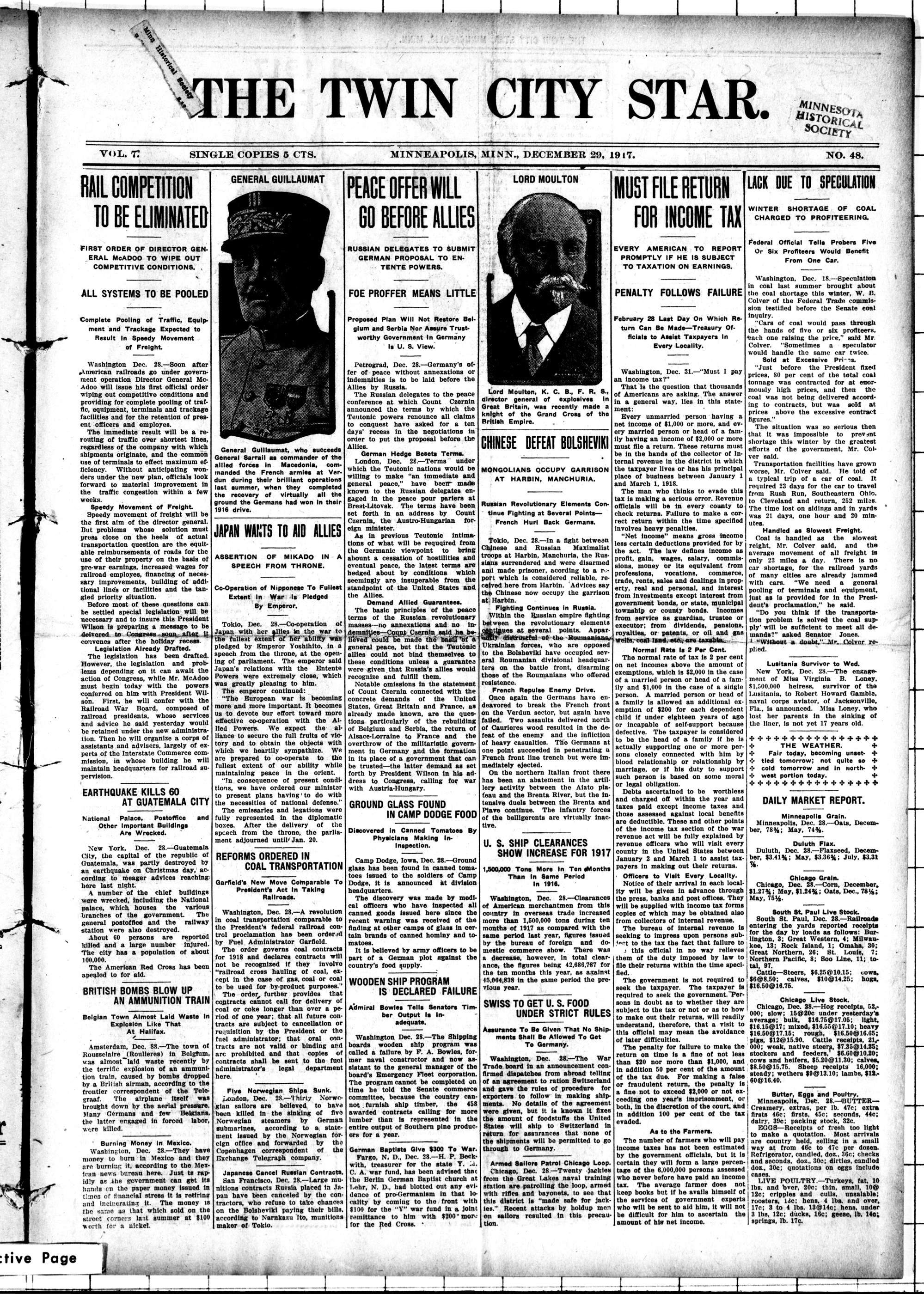
General Guillaumeat, who succeeds General Sarrail as commander of the allied forces in Macedonia, commanded the French armies at Verdun during their brilliant operations last summer, when they completed the recovery of virtually all the ground the Germans had won in their 1916 drive.
JAPAN WANTS TO AID ALLIES
ASSERTION OF MIKADO IN A SPEECH FROM THRONE.
Co-Operation of Nipponease To Fullest Extent In War Is Pledged By Emperor.
Tokio, Dec. 28.—Co-operation of Japan with her allies in the war to the fullest extent of her ability was pledged by Emperor Yoshihito, in a speech from the throne, at the opening of parliament. The emperor said Japan's relations with the Entente Powers were extremely close, which was greatly pleasing to him.
The emperor continued:
"The European war is becoming more and more important. It becomes us to devote our effort toward more effective co-operation with the Allied Powers. We expect the alliance to secure the full fruits of victory and to obtain the objects with which we heartily sympathize. We are prepared to co-operate to the fullest extent of our ability while maintaining peace in the orient.
"In consequence of present conditions, we have ordered our minister to present plans having to do with the necessities of national defense."
The emissaries and legations were fully represented in the diplomatic boxes. After the delivery of the speech from the throne, the parliament adjourned until Jan. 20.
REFORMS ORDERED IN COAL TRANSPORTATION
Garfield's New Move Comparable To President's Act In Taking Railroads.
Washington, Dec. 28.—A revolution in coal transportation comparable to the President's federal railroad control proclamation has been ordered by Fuel Administrator Garfield.
The order governs coal contracts for 1918 and declares contracts will not be recognized if they involve "railroad cross hauling of coal, except in the case of gas, coal or coal to be used for by-product purposes."
The order, further provides that contracts cannot call for delivery of coal or coke longer than over a period of one year; that all future contracts are subject to cancellation or requisition by the President or the fuel administrator; that oral contracts are not valid or binding and are prohibited and that copies of contracts shall be sent to the fuel administrator's legal department here.
Five Norwegian Ships Sunk. London, Dec. 28.—Thirty Norwegian sailors are believed to have been killed in the sinking of five Norwegian steamers by German submarines, according to a statement issued by the Norwegian foreign office and forwarded by the Copenhagen correspondent of the Exchange Telegraph company.
Japanese Cancel Russian Contracts. San Francisco, Dec. 28.—Large munitions contracts Russia placed in Japan have been canceled by the contractors, who refuse to take chances on the Bolshevki paying their bills, according to Narnkazu Ito, munitions maker of Tokio.
MINNEAPOLIS, MINN., DECEMBER 29, 1917.
PEACE OFFER WILL GO BEFORE ALLIES
RUSSIAN DELEGATES TO SUBMIT GERMAN PROPOSAL TO ENTENTE POWERS.
Proposed Plan Will Not Restore Belgium and Serbia Nor Assure Trustworthy Government in Germany Is U. S. View.
Petrograd, Dec. 28.—Germany's offer of peace without annexations or indemnities is to be laid before the Allies by Russia.
The Russian delegates to the peace conference at which Count Czernin announced the terms by which the Teutonic powers renounce all claims to conquest have asked for a ten days' recess in the negotiations in order to put the proposal before the Allies.
German Hedge Besets Terms.
London, Dec. 28.—Terms under which the Teutonic nations would be willing to make "an immediate and general peace," have been made known to the Russian delegates engaged in the peace pour parlers at Brest-Litovsk. The terms have been set forth in an address by Count Czernin, the Austro-Hungarian foreign minister.
As in previous Teutonic intimations of what will be required from the Germanic viewpoint to bring about a cessation of hostilities and eventual peace, the latest terms are hedged about by conditions which seemingly are insuperable from the standpoint of the United States and the Allies.
Demand Allied Guarantees.
The basic principles of the peace terms of the Russian revolutionary masses—no annexations and no indemnities—Count Czernin said he believed could be made the basis of a general peace, but that the Teutonic allies could not bind themselves to these conditions unless a guarantee were given that Russia's allies would recognize and fulfill them.
Notable omissions in the statement of Count Czernin connected with the concrete demands of the United States, Great Britain and France, as already made known, are the questions particularly of the rebuilding of Belgium and Serbia, the return of Alsace-Lorraine to France and the overthrow of the militaristic government in Germany and the formation in its place of a government that can be trusted—the latter demand as set forth by President Wilson in his address to Congress, calling for war with Austria-Hungary.
GROUND GLASS FOUND
IN CAMP DODGE FOOD
Discovered in Canned Tomatoes By Physicians Making Inspection.
Camp Dodge, Iowa, Dec. 28.—Ground glass has been found in canned tomatoes issued to the soldiers of Camp Dodge, it is announced at division headquarters.
The discovery was made by medical officers who have inspected all canned goods issued here since the recent warning was received of the finding at other camps of glass in certain brands of canned hominy and tomatoes.
It is believed by army officers to be part of a German plot against the country's food supply.
WOODEN SHIP PROGRAM
IS DECLARED FAILURE
Admiral Bowles Tells Senators Timber Output is inadequate.
Washington Dec. 28.—The Shipping boards wooden ship program was called a failure by F. A. Bowles, former naval constructor and now assistant to the general manager of the board's Emergency Fleet corporation. The program cannot be completed on time he told the Senate commerce committee, because the country cannot furnish ship timber, the 458 awarded contracts calling for more lumber than is represented in the entire output of Southern pine producers for a year.
German Baptists Give $300 To War. Fargo, N. D., Dec. 28.—H. P. Beckwith, treasurer for the state Y. . . C. A. war fund, has been advised that the Berlin German Baptist church at Lehr, N. D., had blotted out any evidence of pro-Germanism in that locality by coming to the front with $100 for the "Y" war fund in a joint remittance to him with $200" morr for the Red Cross.
LORD MOULTON
Lord Moulton, K. C. B., F. R. S., director general of explosives in Great Britain, was recently made a knight of the Grand Cross of the British Empire.
CHINESE DEFEAT BOLSHEVIKI
MONGOLIANS OCCUPY GARRISON
AT HARBIN, MANCHURIA.
Russian Revolutionary Elements Continue Fighting at Several Points—French Hurl Back Germans.
Tokio, Dec. 28.—In a fight between Chinese and Russian Maximalist troops at Harbin, Manchuria, the Russians surrendered and were disarmed and made prisoner, according to a report which is considered reliable, received here from Harbin. Advices say the Chinese now occupy the garrison at Harbin.
Fighting Continues in Russia.
Within the Russian empire fighting between the revolutionary elements continues at several points. Apparently disinterested of the Roumanians, Ukrainian forces, who are opposed to the Bolsheviks have occupied several Roumanian divisional headquarters on the battle front, disarming those of the Roumanians who offered resistance.
French Repulse Enemy Drive.
Once again the Germans have endeavored to break the French front on the Verdun sector, but again have failed. Two assaults delivered north of Caurieres wood resulted in the defeat of the enemy, and the infliction of heavy casualties. The Germans at one point succeeded in penetrating a French front line trench but were immediately ejected.
On the northern Italian front there has been an abatement in the artillery activity between the Alato plaieu and the Brenta River, but the intensive duels between the Brenta and Plave continue. The infantry forces of the belligerents are virtually inactive.
U. S. SHIP CLEARANCES SHOW INCREASE FOR 1917
1,500,000 Tons More In Ten Months Than In Same Period In 1916.
Washington, Dec. 28.—Clearances of American merchantmen from this country in overseas trade increased more than 1,500,000 tons during ten months of 1917 as compared with the same period last year, figures issued by the bureau of foreign and domestic commerce show. There was a decrease, however, in total clearance, the figures being 42,686,787 for the ten months this year, as against 45,664,838 in the same period the previous year.
SWISS TO GET U. S. FOOD UNDER STRICT RULES
Assurance To Be Given That No Shipments Shall Be Allowed To Get To Germany.
Washington, Dec. 28.—The War Trade board in an announcement confirmed dispatches from abroad telling of an agreement to ration Switzerland and gave the rules of procedure for exporters to follow in making shipments. No details of the agreement were given, but it is known it fixes the amount of foodstuffs the United States will ship to Switzerland in return for assurances that none of the shipments will be permitted to go through to Germany.
Armed Sailors Patrol Chicago Loop. Chicago, Dec. 28.—Twenty jackets from the Great Lakes naval training station are patrolling the loop, armed with rifles and bayonets, to see that this district is "made safe for jackets." Recent attacks by holdup men on sailors resulted in this precaution.
MUST FILE RETURN FOR INCOME TAX
MUST FILE RETURN FOR INCOME TAX
EVERY AMERICAN TO REPORT
PROMPTLY IF HE IS SUBJECT
TO TAXATION ON EARNINGS.
PENALTY FOLLOWS FAILURE
February 28 Last Day On Which Return Can Be Made—Treasury Officials to Assist Taxpayers In Every Locality.
Washington, Dec. 31.—"Must I pay an income tax?"
That is the question that thousands of Americans are asking. The answer in a general way, lies in this statement:
Every unmarried person having a net income of $1,000 or more, and every married person or head of a family having an income of $2,000 or more must file a return. These returns must be in the hands of the collector of Internal revenue in the district in which the taxpayer lives or has his principal place of business between January 1 and March 1, 1918.
The man who thinks to evade this tax is making a serious error. Revenue officials will be in every county to check returns. Failure to make a correct return within the time specified involves heavy penalties.
"Net income" means gross income less certain deductions provided for by the act. The law defines income as profit, gain, wages, salary, commissions, money or its equivalent from professions, vocations, commerce, trade, rents, sales and dealings in property, real and personal, and interest from investments except interest from government bonds, or state, municipal township or county bonds. Incomes from service as guardian, trustee or executor; from dividends, pensions, royalties, or patents, or oil and gas wells, coal land, etc. are taxable.
The normal rate of tax is 2 per cent on net incomes above the amount of exemptions, which is $2,000 in the case of a married person or head of a family and $1,000 in the case of a single person. A married person or head of a family is allowed an additional exemption of $200 for each dependent child if under eighteen years of age or incapable of self-support because defective. The taxpayer is considered to be the head of a family if he is actually supporting one or more persons closely connected with him by blood relationship or relationship by marriage, or if his duty to support such person is based on some moral or legal obligation.
Debts ascertained to be worthless and charged off within the year and taxes paid except income taxes and those assessed against local benefits are deductible. These and other points of the income tax section of the war revenue act will be fully explained by revenue officers who will visit every county in the United States between January 2 and March 1 to assist taxpayers in making out their returns.
Officers to Visit Every Locality.
Notice of their arrival in each locality will be given in advance through the press, banks and post offices. They will be supplied with income tax forms copies of which may be obtained also from collectors of internal revenue.
The bureau of internal revenue is seeking to impress upon persons subject to the tax the fact that failure to this official in no way relieves them of the duty imposed by law to file their returns within the time specified.
The government is not required to seek the taxpayer. The taxpayer is required to seek the government. Persons in doubt as to whether they are subject to the tax or not or as to how to make out their returns, will readily understand, therefore, that a visit to this official may mean the avoidance of later difficulties.
The penalty for failure to make the return on time is a fine of not less than $20 nor more than $1,000, and in addition 50 per cent of the amount of the tax due. For making a false or fraudulent return, the penalty is a fine not to exceed $2,000 or not exceeding one year's imprisonment, or both, in the discretion of the court, and in addition 100 per cent of the tax evaded.
As to the Farmers.
The number of farmers who will pay income taxes has not been estimated by the government officials, but it is certain they will form a large percentage of the 6,000,000 persons assessed who never before have paid an income tax. The average farmer does not keep books but if he avails himself of the services of government experts who will be sent to aid him, it will not be difficult for him to ascertain the amount of his net income.
MINNESOTA
HISTORICAL
SOCIETY
NO.48.
LACK DUE TO SPECULATION
WINTER SHORTAGE OF COAL
CHARGED TO PROFITEERING.
Federal Official Tella Probers Five Or Six Profiteers Would Benefit From One Car.
Washington, Dec. 18.—Speculation in coal last summer brought about the coal shortage this winter, W. B. Colver of the Federal Trade commission testified before the Senate coal inquiry.
"Cars of coal would pass through the hands of five or six profiteers, each one raising the price," said Mr. Colver. "Sometimes a speculator would handle the same car twice.
Sold at Excessive Prices.
"Just before the President fixed prices, 80 per cent of the total coal tonnage was contracted for at enormously high prices, and then the coal was not being delivered according to contracts, but was sold at prices above the excessive contract figures."
The situation was so serious then that it was impossible to prevent shortage this winter by the greatest efforts of the government, Mr. Colver said.
Transportation facilities have grown worse, Mr. Colver said. He told of a typical trip of a car of coal. It required 23 days for the car to travel from Rush Run, Southeastern Ohio, to Cleveland and return, 252 miles. The time lost on sidings and in yards was 21 days, one hour and 20 minutes.
Handled as Slowest Freight.
Coal is handled as the slowest reight, Mr. Colver said, and the average movement of all freight is only 23 miles a day. There is no car shortage, for the railroad yards of many cities are already jammed with cars. "We need a general pooling of terminals and equipment, just as is provided for in the President's proclamation," he said.
"Do you think if the transportation problem is solved the coal supply' will be sufficient to meet all demands?" asked Senator Jones.
"Without a doubt," Mr. Colver replied.
Lusitania Survivor to Wed.
New York, Dec. 28.—The engagement of Miss Virginia B. Loney,
$1,500,000 heiress, survivor of the Lusitania, to Robert Howard Gamble,
naval corps aviator, of Jacksonville, Fla., is announced. Miss Loney, who
lost her parents in the sinking of the liner, is not yet 17 years old.
THE WEATHER.
THE WEATHER.
Fair today, becoming unset
tied tomorrow; not quite so
cold tomorrow and in north-
west portion today.
DAILY MARKET REPORT.
Minneapolis Grain.
Minneapolis, Dec. 28.—Oats, December, 78%; May, 74%.
Duluth Flax.
Duluth, Dec. 28.—Flaxseed, December, $3.41%; May, $3.36%; July, $3.31%.
Chicago Grain.
Chicago, Dec. 28.—Corn, December, $1.27%; May, $1.24%; Oats, Dec., 78%; May, 75%.
South St. Paul Live Stock.
South St. Paul, Dec. 28.—Railroads entering the yards reported receipts for the day by loads as follows: Burlington, 3; Great Western, 4; Milwaukee, 13; Rock Island, 1; Omaha, 30; Great Northern, 26; St. Louis, 7; Northern Pacific, 8; Soo Line, 11; total, 97.
Cattle—Steers, $6.25@10.15; cows, $6@8.50; calves, $10@14.25; hogs, $16.50@16.75.
Chicago Live Stock.
Chicago, Dec. 28.—Hog receipts, 52-
000; slow, 15@20c under yesterday's
average, bulk, $16.75@17.05; light,
$16.15@17; mixed, $16.55@17.10; heavy,
$16.50@17.15; rough, $16.50@16.65;
pigs, $16.15@19.90. Cattle receipts, 21-
000; weak, native steers, $7.35@14.25;
stockers and feeders, $6.60@10.20;
cows and heifers, $5.20@11.30; calves,
$8.50@15.75. Sheep receipts 16.000;
steady, wethers $9@13.10; lambs, $12-
60@16.40.
Butter, Eggs and Poultry.
Minneapolis, Dec. 28.—BUTTER—
Creamery, extras, per lb. 47c; extra
firsts 46c; firsts, 45c; seconds, 44c;
dairy, 39c; packing stock, 32c.
EGGs—Receipts of fresh too light
to make a quotation. Most arrivals
are country held, selling in a small
way at from 46c to 47c per dozen.
Refrigerator, candled, doz., 36c; checks
and seconds, doz., 30c; dirtles, candled
doz., 30c; quotations on eggs include
cases.
LIVE POULTRY.—Turkeys, fat, 10
lbs. and cripples, 20c; thin, small, 10@
12c; cripples and culls, unsalable;
roosters, 14c; hens, 4 lbs, and over,
17c; 3 to 4 lbs. $14@14c; hens, under
3 lbs, 12c; ducks, 16c; geese, lb. 14c;
springs, lb. 17c.
FOREST
A Hap Hazard New Year by Douglas Malloch (Copyright)
HE coming of New Year's Day naturally suggests the remarkable case of Hap Hazard. The mother of Happlizzze Hazard had aimed to give him a Bible name out of the ordinary, and her aim was certainly good. It was hard to spell, and hard to pronounce; and, pronounced properly, it sounded very much like a soda fountain clerk making a fizz. But the boys shortened this unusual cognomen to "Hap."
The Hap Hazards were married on New Year's Day, Hap very happily suggesting that that would be a good way to start the New Year right.
As New Year's Day again approached, May's Aunt Ada, at whose house in Columbus the Hazards were married, thought it would be a fine idea to ask the young couple back home to spend their wedding anniversary. Hap and May delightfully accepted, and wrote that they would leave Hometown for Columbus on the 29th. It was now the 28th, and May decided it would be well to begin to pack, or at least to decide what she would wear and what she would take. It made her rather proud of her forehandedness.
"And, Hap," she said, "you might go by the depot and get the tickets, and a couple of lowers, and everything, so we shall be all ready to start tomorrow. That will be easy to do."
"Gosh!" exclaimed Hap, his pipe falling from his mouth, "easy to do? Say, do you know I never thought about those gol-darned tickets?" He shoved both hands into his pockets, "How much do you suppose they will be? I don't believe I have enough money. "I know we spent a lot for Christmas."
Hap had $3.11. May had $6 she had left out of her last week's money. There was $1.80 in the little drawer of the kitchen cabinet, and $12 in bills behind the picture of April Jones in the sitting room. That made $22.91; and Hap knew he could draw a few dollars in advance down at the shop—he had done it before.
He found it was too late to get lowers, and they missed that train anyway, for the time had been changed, and the train now went through half an hour earlier—when it was on time—and this time it was. He managed to find an upper on the slow train for May, but he had to sit up in the smoker himself.
Hap did not sleep very well. The train stopped and started and jerked and bumped. It must have been near morning, after an unusually heavy jolt, that Hap distinctly overcarded a fellow-passenger say:
"Yep, it doesn't look much like we would get into Columbus before New Year's night."
"What's the matter?" he inquired, suddenly sitting up, "a wreck?"
"Nope," said the passenger, a fat man across the aisle Hap had observed before he fell off to slumber. "Nope,
PUBLICATIONS
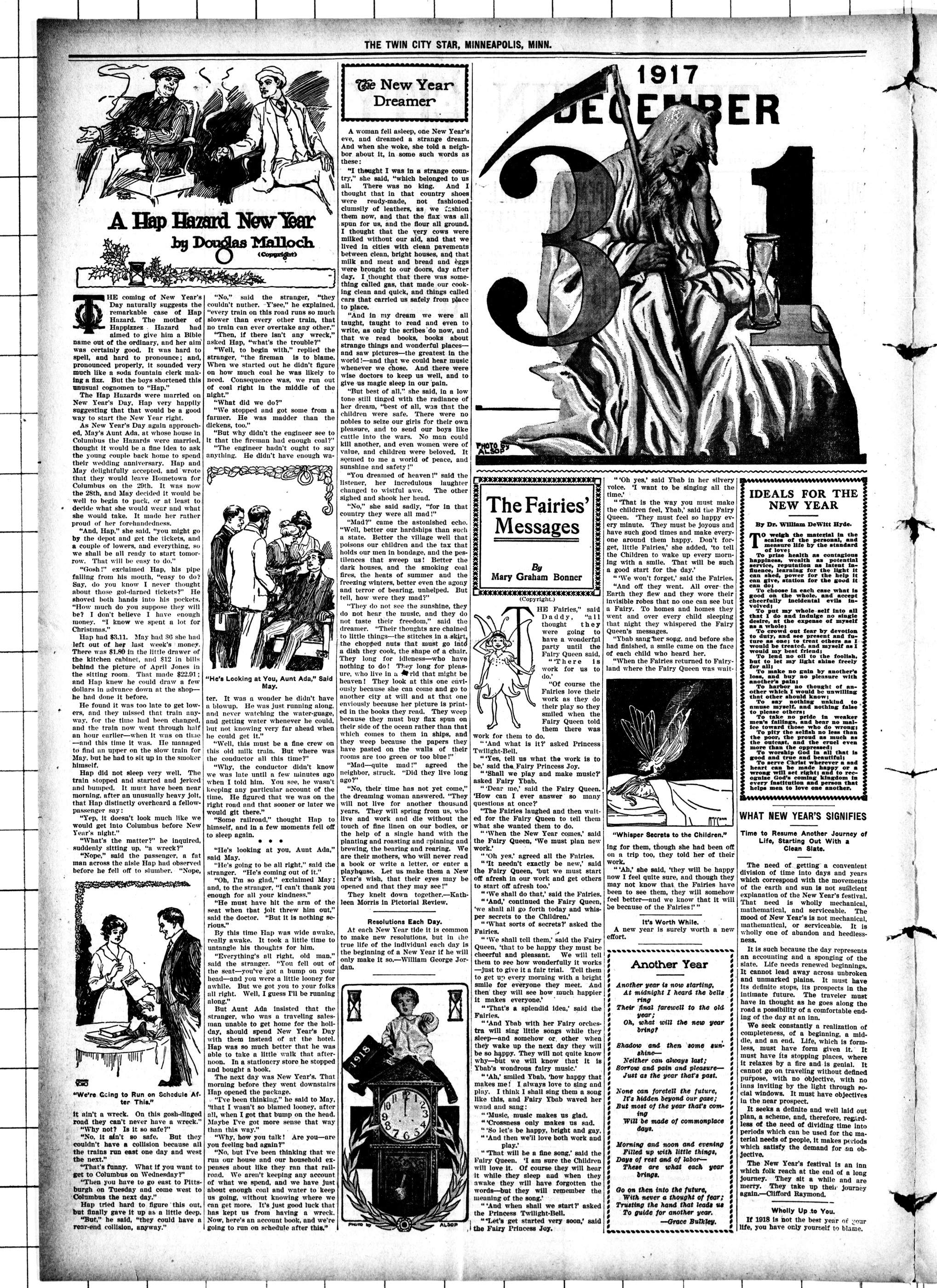
"We're Going to Run on Schedule After This."
It ain't a wreck. On this gosh-dinged road they can't never have a wreck." "Why not? Is it so safe?" "No, it ain't so safe. But they couldn't have a collision because all the trains run east one day and west the next." "That's funny. What if you want to get to Columbus on Wednesday?" "Then you have to go east to Pittsburgh on Tuesday and come west to Columbus the next day."
Hap tried hard to figure this out, but finally gave it up as a little deep. "But," he said, "they could have a rear-end collision, anyway."
"No," said the stranger, "they couldn't nutter. Y'see," he explained, "every train on this road runs so much slower than every other train, that no train can ever overtake any other." "Then, if there isn't any wreck."
"Then, if there isn't any wreck," asked Hap, "what's the trouble?"
"Well, to begin with," replied the stranger, "the fireman is to blame. When we started out he didn't figure on how much coal he was likely to need. Consequence was, we run out of coal right in the middle of the night."
"What did we do?"
"We stopped and got some from a farmer. He was madder than the dickens, too."
"But why didn't the engineer see to it that the fireman had enough coal?" The engineer hadn't ought to say anything. He didn't have enough wa-
B
"He's Looking at You, Aunt Ada," Said May.
ter. It was a wonder he didn't have a blowup. He was just running along, and never watching the water-guage, and getting water whenever he could, but not knowing very far ahead when he could get it.
"Well, this must be a fine crew on this old milk train. But where was the conductor all this time?
"Why, the conductor didn't know we was late until a few minutes ago when I told him. You see, he wasn't keeping any particular account of the time. He figured that we was on the right road and that sooner or later we would git there."
"Some railroad," thought Hap to himself, and in a few moments fell off to sleep again.
"He's looking at you, Aunt Ada," said May.
"He's going to be all right," said the stranger. "He's coming out of it."
"Oh, I'm so glad," exclaimed May; and, to the stranger, "I can't thank you enough for all your kindness."
"He must have hit the arm of the seat when that jolt threw him out," said the doctor. "But it is nothing serious."
By this time Hap was wide awake, really awake. It took a little time to untangle his thoughts for him.
"Everything's all right, old man," said the stranger. "You fell out of the seat—you've got a bump on your head—and you were a little looney for awhile. But we got you to your folks all right. Well, I guess I'll be running along."
But Aunt Aida insisted that the stranger, who was a traveling salesman unable to get home for the holiday, should spend New Year's Day with them instead of at the hotel. Hap was so much better that he was able to take a little walk that afternoon. In a stationery store he stopped and bought a book.
The next day was New Year's. That morning before they went downstairs Hap opened the package.
"I've been thinking," he said to May, "that I wasn't so blamed looney, after all, when I got that bump on the head. Maybe I've got more sense that way than this way."
"Why, how you talk! Are you—are you feeling bad again?"
"No, but I've been thinking that we run our house and our household expenses about like they ran that railroad. We aren't keeping any account of what we spend, and we have just about enough coal and water to keep us going, without knowing where we can get more. It's just good luck that has kept us from having a wreck. Now, here's an account book, and we're going to run on schedule after this."
THE TWIN CITY STAR, MINNEAPOLIS, MINN.
A woman fell asleep, one New Year's eve, and dreamed a strange dream. And when she woke, she told a neighbor about it, in some such words as these:
"I thought I was in a strange country," she said, "which belonged to us all. There was no king. And I thought that in that country shoes were ready-made, not fashioned clumsily of leather, as we fashion them now, and that the flax was all spun for us, and the flour all ground. I thought that the very cows were milked without our aid, and that we lived in cities with clean pavements between clean, bright houses, and that milk and meat and bread and eggs were brought to our doors, day after day. I thought that there was something called gas, that made our cooking clean and quick, and things called cars that carried us safely from place to place.
"And in my dream we were all taught, taught to read and even to write, as only the scribes do now, and that we read books, books about strange things and wonderful places—and saw pictures—the greatest in the world!—and that we could hear music whenever we chose. And there were wise doctors to keep us well, and to give us magic sleep in our pain.
"But best of all," she said, in a low tone still tinged with the radiance of her dream, "best of all, was that the children were safe. There were no nobles to seize our girls for their own pleasure, and to send our boys like cattle into the wars. No man could kill another, and even women were of value, and children were beloved. It seemed to me a world of peace, and sunshine and safety!"
"You dreamed of heaven!" said the listener, her incredulous laughter changed to wistful awe. The other sighed and shook her head.
"No," she said sadly, "for in that country they were all mad!"
"Mad?" came the astonished echo.
"Well, better our hardships than such a state. Better the village well that poisons our children and the tax that holds our men in bondage, and the pestilences that sweep us! Better the dark houses, and the smoking coal fires, the heats of summer and the freezing winters, better even the agony and terror of bearing, unhelped. But tell, how were they mad?"
"They do not see the sunshine, they do not hear the music, and they do not taste their freedom," said the dreamer. "Their thoughts are chained to little things—the stitches in a skirt, the chopped nuts that must go into a dish they cook, the shape of a chair. They long for idleness—who have nothing to do! They long for pleasure, who live in a world that might be heaven! They look at this one enviously because she can come and go to another city at will and at that one enviously because her picture is printed in the books they read. They weep because they must buy flax spun on their side of the ocean rather than that which comes to them in ships, and they weep because the papers they have pasted on the walls of their rooms are too green or too blue!"
"Mad—quite mad!" agreed the neighbor, struck. "Did they live long ago?"
"No, their time has not yet come," the dreaming woman answered. "They will not live for another thousand years. They will spring from us, who live and work and die without the touch of fine linen on our bodies, or the help of a single hand with the planting and roasting and spinning and brewing, the bearing and rearing. We are their mothers, who will never read a book or write a letter, or enter a playhouse. Let us make them a New Year's wish, that their eyes may be opened and that they may see!" They knelt down together.-Kathleen Morris in Pictorial Review.
Resolutions Each Day.
At each New Year tide it is common to make new resolutions, but in the true life of the individual each day is the beginning of a New Year if he will only make it so.—William George Jordan.
1918
PHOTO by
ALSOP
1917
DECEMBER
31
PHOTO BY
ALSOPY
The Fairies' Messages
By
Mary Graham Bonner
(Copyright.)
HE Fairies," said
Daddy, "all
thought they
were going to
have a wonderful
party until the
Fairy Queen said.
"There is
work for us to
do."
"Of course the
Fairies love their
work as they do
their play so they
smiled when the
Fairy Queen told
them there was
HE Fairies," said Daddy, "all thought they were going to have a wonderful party until the Fairy Queen said, "There is work for us to do." "Of course the Fairies love their work as they do their play so they smiled when the Fairy Queen told them there was
work for them to do.
work for them to do.
"And what is it? asked Princess Twilight-Bell.
"Yes, tell us what the work is to be,' said the Fairy Princess Joy.
"Shall we play and make music?' asked Fairy Yab.
"Dear me,' said the Fairy Queen.
'How can I ever answer so many questions at once?'
"The Fairies laughed and then waited for the Fairy Queen to tell them what she wanted them to do.
"When the New Year comes,' said the Fairy Queen, 'We must plan new work.'
"Oh yes,' agreed all the Fairies.
"It needn't exactly be new,' said the Fairy Queen, 'but we must start off afresh in our work and get others to start off afresh too.'
"We shall do that," said the Fairies,
"'And,' continued the Fairy Queen,
'we shall all go forth today and whisper secrets to the Children.'
"What sorts of secrets?' asked the Fairies.
"We shall tell them," said the Fairy Queen, 'that to be happy they must be cheerful and pleasant. We will tell them to see how wonderfully it works—just to give it a fair trial. Tell them to get up every morning with a bright smile for everyone they meet. And then they will see how much happier it makes everyone.'
"That's a splendid idea," said the Fairies.
"And Ybab with her Fairy orchestra will sing little songs while they sleep—and somehow or other when they wake up the next day they will be so happy. They will not quite know why—but we will know that it is Ybab's wondrous fairy music."
"Ah,' smiled Yabb, 'how happy that makes me! I always love to sing and play. I think I shall sing them a song like this, and Fairy Ybab waved her wand and sang:
"Music, music makes us glad.
"Crossness only makes us sad.
"So let's be happy, bright and gay.
"And then we'll love both work and play."
"That will be a fine song,' said the Fairy Queen. 'I am sure the Children will love it. Of course they will hear it while they sleep and when they awake they will have forgotten the words—but they will remember the meaning of the song.'
"And when shall we start?' asked the Princess Twilight-Bell.
"Let's get started very soon,' said the Fairy Princess Joy.
"Oh yes," said Ybab in her silvery voice. 'I want to be singing all the time.'
"That is the way you must make the children feel, Ybab," said the Fairy Queen. 'They must feel so happy every minute. They must be joyous and have such good times and make everyone around them happy. Don't forget, little Fairies," she added, 'to tell the Children to wake up every morning with a smile. That will be such a good start for the day.'
"We won't forget," said the Fairies.
"And off they went. All over the Earth they flew and they wore their invisible robes that no one can see but a Fairy. To homes and homes they went and over every child sleeping that night they whispered the Fairy Queen's messages.
"Ybab sang her song, and before she had finished, a smile came on the face of each child who heard her.
"When the Fairies returned to Fairy- land where the Fairy Queen was wait-
"Whisper Secrets to the Children."
ing for them, though she had been off on a trip too, they told her of their work.
“‘Ah,’ she said, ‘they will be happy now I feel quite sure, and though they may not know that the Fairies have been to see them, they will somehow feel better—and we know that it will be because of the Fairies!’”
It's Worth While.
A new year is surely worth a new effort.
Another Year
Another year is now starting,
At midnight I heard the bells ring
Their final farewell to the old year;
Oh, what will the new year bring?
Shadow and then some sunshine—
Neither can always last;
Sorrow and pain and pleasure—
Just as the year that's past.
None can foretell the future,
It's hidden beyond our gaze;
But most of the year that's coming
Will be made of commonplace days.
Morning and noon and evening
Filled up with little things,
Days of rest and of labor—
These are what each year brings.
Go on then into the future,
With never a thought of fear;
Trusting the hand that leads us
To guide for another year.
—Grace Bulkley.
IDEALS FOR THE NEW YEAR
IDEALS FOR THE NEW YEAR
By Dr. William DeWitt Hyde.
To weigh the material in the scales of the personal, and measure life by the standard of life.
To prize health as contagious happiness, wealth as potential service, reputation as latent influence, learning for the light it can shed, power for the help it can station for the good it can do.
To choose in each case what is good on the whole, and accept cheerfully incidental evils involved.
To put my whole self into all that I do and indulge no single desire, at the expense of myself as a whole;
To put out fear by devotion to duty, and see present and future as one; to treat others as I would be treated, and myself as I would my best friend;
To lend no oil to the foolish, but let my light shine freely for all.
To make no gain by another's
pleasure no pleasure with
another's pain;
To harbor no thought of an-
willingness unwilling
that other should know
To say nothing unkind to amuse myself, and nothing false to please others;
to hide in woken men's failings, and bear no malice toward those who do wrong;
to pity the selfish no less than the selfish the outcast, and the cruel even more than the oppressed;
To worship God in all that is good;
To serve Christ wherever a sad heart can be made happy or a wrong will set right; and to recognize God coming kingdom in faultless faithfulness; and helps men to love one another.
WHAT NEW YEAR'S SIGNIFIES
Time to Resume Another Journey of Life, Starting Out With a Clean Slate.
The need of getting a convenient division of time into days and years which correspond with the movements of the earth and sun is not sufficient explanation of the New Year's festival. That need is wholly mechanical, mathematical, and serviceable. The mood of New Year's is not mechanical, mathematical, or serviceable. It is wholly one of abandon and heedlessness.
It is such because the day represents an accounting and a sponging of the slate. Life needs renewed beginnings. It cannot lead away across unbroken and unmarked plains. It must have its definite stops, its prospects in the intimate future. The traveler must have in thought as he goes along the road a possibility of a comfortable ending of the day at an inn.
We seek constantly a realization of completeness, of a beginning, a middle, and an end. Life, which is formless, must have form given it. It must have its stopping places, where it relaxes by a fire and is genial. It cannot go on traveling without defined purpose, with no objective, with no inviting by the light through social windows. It must have objectives in the near prospect.
It seeks a definite and well laid out plan, a scheme, and, therefore, regardless of the need of dividing time into periods which can be used for the material needs of people, it makes periods which satisfy the demand for an objective.
The New Year's festival is an inn which folk reach at the end of a long journey. They sit a while and are merry. They take up their journey again—Clifford Raymond.
If 1918 is not the best year of your life, you have only your to blame.
1918
```markdown
```
A doctor reads a letter to a woman.
"NOW, I wonder what that means?" said Ethan Crane. He had just come back with the weekly paper—and one letter from his tramp through the snow to the post office. Old Mrs. Crane had brought in the lighted candles and piled an extra log on the fire. Ethan *ore* open the envelope and read the inclosed card: 'Miss Angela Hanna. At Home, January 1st.' "La!" said Mrs. Crane. "She wants you to call there." "Get out," said Ethan, with a sudden access of sheepsliness. "Why should I go there?" "Well, why not?" asked Mrs. Crane. "It's what the city people do, I'm told. They make a big cake and draw a pitcher of cider and set down in their best clothes to see company. Angy Hanna is dreadful enterprising; she means to lead in the fashions."
"Am I to call there?" asked Ethan. "Why, of course," said his mother. "What else does it mean? Miss Angela Hanna—at home." "She's at home most days, ain't she?" said Ethan musingly. "There was never anything of the gad-adbut in Angela Hanna that I ever heard of." "Oh, but this here a new kink!" exclaimed Mrs. Crane. "An extra-special day for calling—don't you see?" "I'd calculated to take the oxen to Snidge Hill and grub stumps out of the clearin' on New Year's day," said Ethan. "The next day will do just as well for the stumps," said Mrs. Crane, encouragingly. "You might as well be out of the world as out of the fashion."
Deacon Perkins received one of Miss Hanna's cards and so did Squire Hart. In fact, there wasn't a widower or old bachelor or eligible swain in all Fairview who was omitted from her list.
"I ain't as young as I was," said Miss Hanna to herself. "It's high time I took steps to establish myself."
Miss Angela Hanna had just passed her five-and-fortieth birthday; she was stout and ruddy, with the very best set of teeth that the Fairview dentist could supply, and a perpetual smile riveted on her lips. She was very
tired of living alone and sewing on vests to earn her pin money, and she had determined, on this particular occasion, to make a bold stroke and win a husband.
She attired herself on New Year's day in a green satin dress, cut low in the neck and short in the sleeves, pinned a bunch of holly at the left side, and puffed her newly tinted hair in the most elaborate style.
"I do declare," said Miss Angela to herself, "I don't look a day over twenty."
Deacon Perkins was the first to arrive, an old bald-headed man, with a complexion of leather and the keenest of twinkling black eyes.
"I got a letter from you, Miss Hanna," said he. "I 'spose you want to consult me on business."
"La, deacon, what a very strange idea," giggled Miss Hanna. "No, in-
B. W. H.
"How Came You Here?" Screamed Miss Hanna.
deed! I only wish to promote sociability during the festive season.
"Well, then, I guess I'd better be goin'," said the deacon. I hain't no time for no sich foolery."
"Don't be in a hurry, deacon," urged Miss Hanna. "I do wish to consult you."
"About what?" frowned the deacon, looking dubiously at the purple shoulders and arms of the lady.
"Marriage," said Miss Hanna. "Would you advise me, dear deacon, to commit my future into the hands of another?"
"Eh!" said the deacon. "Had an offer?"
"Yes," said Miss Hanna, driven by his directness into an absolute lie.
"Then, if I was you," said the deacon, "Td accept it, 'cause it ain't likely you'll have many of 'em."
"But, deacon," she stammered, "what if I don't love the man? What if I love another who—"
"Then don't accept him," said the deacon; but, suddenly becoming electrically aware of his danger as Miss Hanna moved her chair a little closer to his, he added, "My horse is gettin' dreadful oneasy outside. I guess I'll be groin'. No, thankee"—as Miss Han-
Benjamin Franklin's New Year's Resolutions
CO endeavor to speak the truth in every instance, to give nobody expectations that are not likely to be answered, but aim at sincerity in every word and action; the most amiable excellence in a rational being.
CO apply myself industriously to whatever business I take in hand, and not divert my mind from my business by any foolish project of growing suddenly rich; for industry and patience are the surest means of plenty.
RESOLVE to speak ill of no man whatever, not even in a matter of truth; but rather by some means excuse the fault I hear charged upon others, and upon proper occasions, speak all the good I know of everybody.
na took up the plate of cake—"I don't
never eat nothin' except at reg-lar
meals. Good mornin'!""
And thus the deacon escaped.
"Eh! What's that noise? If it's the cat jumping at my canary again—but it sounded more like someone laughing and cats don't laugh. Who's that comin' up the walk? Ethan Crane, I do declare! Well, he's a likely young fellow—not as rich as Squire Perkins, maybe—but Oh, come in, Mr. Crane, Come in. I am so glad to see you. Lovely day, isn't it?" Ethan Crane sat down with his hat in his lap.
"I received your card, Miss Hanna."
"Oh, did you!" said Angela, with a smile.
"To tell the truth," said honest Ethan, "I wanted a little talk with you."
"Indeed!" said the lady. "Won't you come here and set by me on the sofa? It's more sociable like."
"Oh, yes, if you like," said Ethan, obeying her gesture of invitation.
"You see, my mother is getting feebler every day, and we feel the need of some younger-person at the farm. And I'm twenty-eight now, and the place is in good orer, and I've money at interest, so that I've pretty much made up my mind to marry."
Miss Angela let the puffed and frizzed head fall on his shoulder.
"Dearest Ethan!" she exclaimed.
Dearest Ethan, she examined.
"Yes—exactly," said Ethan Crane, moving as far away as the arm of the sofa would allow. "So, if you thought that your niece, Mirandy, would have me—"
"My niece, Mirandy!" gasped the elder lady, the immovable bloom never altering on her face, although her heart beat wildly and her lips blanched.
"Yes," said Ethan. "I hoped to meet her here today."
"No!" said Miss Angela sharply. "She's gone away; and if she hadn't, she wouldn't accept you."
"Is she engaged to someone else?" stammered poor Ethan.
"Yes," said Miss Hanna. "To Joshua Simpkins. But, Ethan, do not grieve; I am ready to entertain your suit, although Mirandy despises you, and—"
"But she doesn't, unty!" interrupted a clear, distinct voice, and Mirandy herself entered from an adjoining room. "On the contrary, she loves Ethan Crane dearly, and she refused Joshua Simpkins, as you know very well.
"How came you here?" screamed Miss Hanna.
"I went to Mrs. Brown's house," said Mirandy, "and she had gone to spend the holidays with her niece at Stanford. So I came back home."
"You are a dreadful minx!" cried Miss Hanna, nearly suffocated with anger.
"Gently!" said Ethan Crane, interposing in Mirandy's defense. "No calling of names, please."
"And you shan't stay in my house another day!" added the indignant lady.
"Then she shall come to mine!" boldly asserted Ethan. "Come, Mirandy, darling—my sleigh is at the door and it holds exactly two. We'll go to Parson Squire's and get married this very hour."
So they were married, and old Mrs. Crane, who was waiting at the farmhouse door to receive her son, was delighted.
"If it hadn't been me," said Mirandy, mischievously, "it would have been Aunt Angela, for she was determined to marry Ethan."
"The Lord forbid!" said Mrs. Crane, raising her eyes.
"And after this," said Ethan, as he led his bride in, "the first day of the year will be a double anniversary—the happiest of Happy New Years. Eh, Mirandy?"
It is time to be drawing up plans and specifications for the annual resolution-making.
New Year Bells
by Alfred Tennyson
RING out, wild bells, to the wild sky. The flying cloud, the frosty light; The year is dying in the night. Ring out, wild bells, and let him die.
Ring, happy bells, across the snow;
The year is going, let him go;
Ring out the false, ring in the true.
RING out the grief that saps the mind
For those that here we see no more;
Ring out the feud of rich and poor,
Ring in redress for all mankind.
RING out the want, the care, the sin, The faithless coldness of the times; Ring out, ring out my mournful rhymes But ring the fuller minstrel in.
The civic slander and the spite Ring in the love of truth and right. Ring in the common love of good.
R
Rin
Rin
Rin
RING out old shapes of foul disease. Ring out the narrowing lust of gold. Ring out the thousand wars of old. Ring in the thousand years of peace.
Ring in the valiant man and free, The larger heart, the kindlier hand; Ring out the darkness of the land, Ring in the Christ that is to be.
```markdown
```
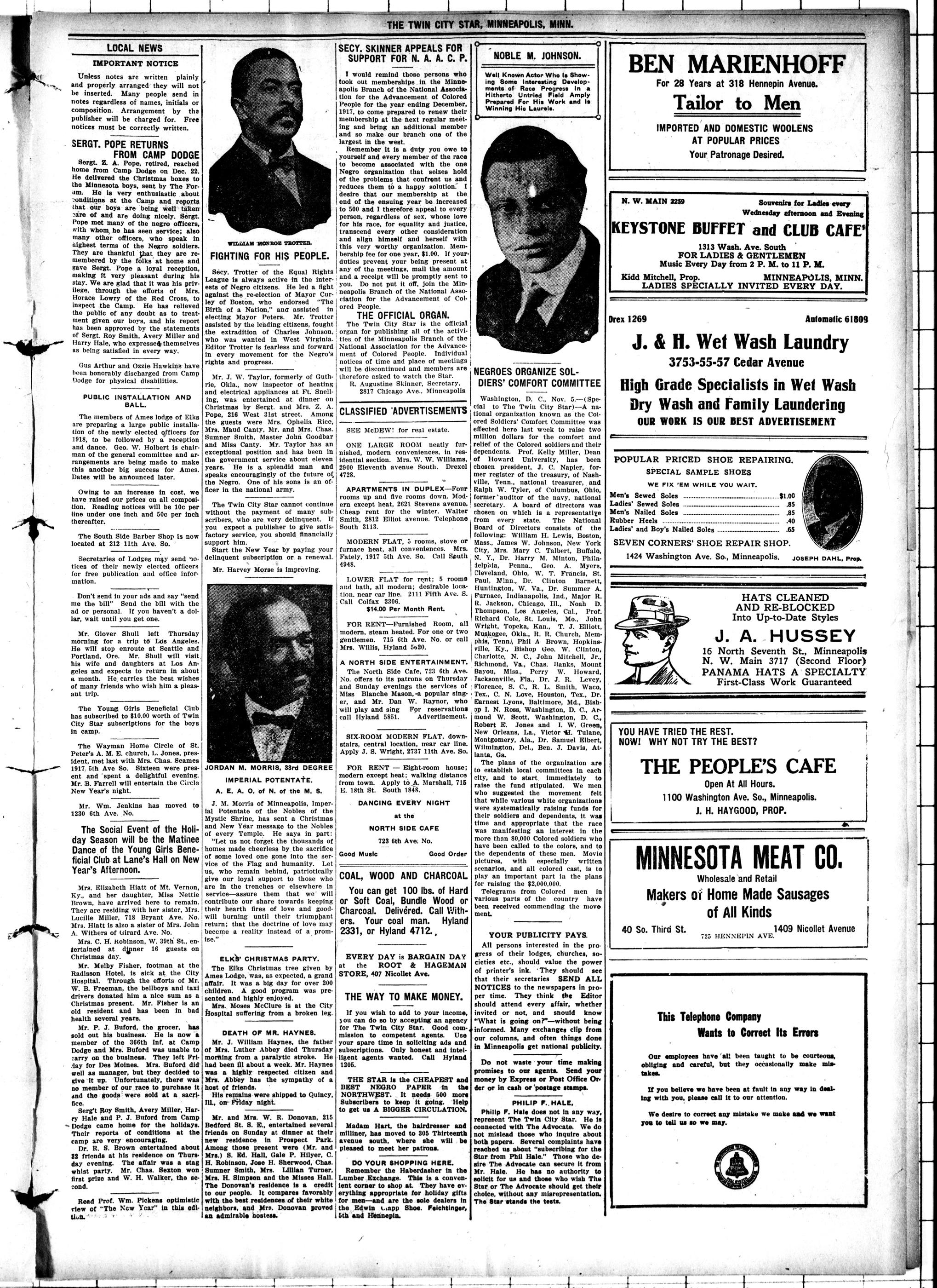
io si THE ‘CITY , MINNEAPOLIS, MINN. :
Fe ieee
|W. Cedar 8190. Rea, Dale 8935 THE TWIN CITY STAR BROR. WH EICKENS, THE SUNDAY FORUM’S IA SM ro sg
: ROA TORNGE > _ SUCCESSFUL YEAR} | (co oc i |
PUBLSHED EVERY FRIDAY BY Leads in Social, Civic, Charitable and | Ja « aay
Suite Or aks a Bank |. CHARLES SUMNER SMITH, Pariote Werk. Ve vk Patriotic music cae <
3 Fifth an ‘ank | stinneapolis, Minnesota. ee The work of the Sunday Forum in| WAN ‘ ea <
d Cedar Sts. ‘ 4 that thrills 5
fee ee ibired the Bose OUD ce ae oie the month of December was a credit] iD at you Carmi ; a
Plorathpelghonal-pordhsgpeod vt : : to the organization. Under the it 0 d ' Ta ars
eee cient leadership of President W. C. re thr ugh an thr eet
TL MEME oh é Juffrey, it has lead all organizations Wan ‘ough ‘ough! ayia ‘ ,
NATIONAL NEGRO PRESS ‘ in its broad scope of civic endeavor.| [Ny q ae .
WORKING-MEN’S ASSOCIATION ‘The public affairs. committee under a Your blood fairly tingles with patriotiom AEM
Cae Me. W. M, Smith, has done much to- mie zie re hear the soul-stiring anthems and the He nh i : 5
ical " wards race advancement and the gen- fy. Forms Bettloredngs'of the Netisn oa Bae aE
SOCIAL CLUB ane m by Mail, oe ‘ eral program of paso and addresses ¥ . NH a I
R Peer ( as been of the highest standard. Mrs. NH . Bias x
SIX MONTHS $125 os" Susie Bogie, who is in charge of its Ny V Rit ON “
FOR MEN ONLY THREE MONTHS ............ 65 Ce ee. : social service as given her time to| eal 1c ro a WH SAV -
f Ce. ed y settlement w d has reli Ae : ut =
244 3RD AVE. S. Hamlet B. Rowe, Local Agent. t a: Sick and geoured Templosmont | for] HUMIBL <:.1m these etirring times the music of the hour fi ,
MINNEAPOLIS ADVERTISING RATES. N ee - many wonien, ‘This is a worthy work | fmm Sy bstvigtic. music. | The Vicuobe brings you a Ra,
Ock Incli-1. Ynsestios One Dollar. e es of the Forum and one of its most im- i. fe gihe See heoneed sated sir eee
OLIVER & JONES ‘ 53 AUP] military marches, and the Iatest patriotic song YMIRMAI| 74
VER & JON Liberal d AT ee portant features. Mrs. Bogie made «|. MH hits aswell! Come in and let us demonstrate. fil Wa ‘ i
. fede eo ce cae. si STEIS ct e szic. euch wee we” I Sean ae are A ae]
Tuc wew veso proval of her hearers. = = | HM vo oon also buy a Stewart Phonograph MUIR
Phone Hy, 3605.
.
Dr. Ellis Burton
DENTIST
Graduate Northwestern Dental
School of Chicago.
ToS
71S Sixth Ave. No,
Minneapolis, Minn.
———
If you suffer from headaches or
your eyes tire or blur the reading
—Let me examine them, expert
advice and examination FREE.
I duplicate any broken lenses
made by me or anybody else.
OPTOMETRIST-OPTICIAN
45S. 6th St, Minneapolis
CHOICE CITY AND SUBUR.-
BAN PROPERTY FOR SALE
IN SMALL MONTHLY PAY-
. MENTS.
Houses and Flats for Rent.
B. M. McDew
802 Sykes Block.
N. W. Nic. 621 Minneapolis
—<—<—<$__.
N. W. Phone Nic, 1873
J. M. MORRIS
Real Estate Broker
Loans ¢ Collections
506 BOSTON BLOCK
MINNEAPOLIS, MINN.
—_—_—____.
—_
T. 8. Center 4639.
WALFRID WESTMAN
Photographur
1425 Washington Ave. So. Minn.
Peterson, The Druggist
1501 Weshington Ave. So.
TOILET ARTICLES, DRUGS
PRESCRIPTIONS.
He Solicits You. Patronage.
THE SUNDAY FORUM MEETINGS
The regular meetings of the Minne-
polis Sunday Forum are held bi-
monthly as follows:
First Sunday Each Month.
St. Peter A. M. E. Church, 22d St.
between Sth and 10th Aves.
Third Sunday Each Month.
Bethesda Baptist Church 1122 8th
Bt. So.
The public always invited.
Exercises begin at 3:30 p. m.
OSCAR GILBERT PRICE
Real Estate
Insurance and Loans
Choice Property for Sale or Rent
401 W. Lake St.
Tel South 4521 Minneapolis
THANN’S BUFFET MOVED
— }
Occupies Phil Reid's Old Place.
Mr. Thann Travis has moved to $¢
Mast Fourth street, St. Paul. He is
Yocated at the old place, which was
‘Kept many years by the decessed, Phil
Reid, Mr. Travis will thoroughly
Fenovate and equip his new location,
which is larger and more desirable
for his patrons. His genial disposi
tion and business like management
‘will insure to the public every accom
‘modstion.— Advertisement. °
RENEW YOUR SUBSCRIPTION.
The publisher of The Twin City
Star urgently requests that subscrib-
‘ere send in their dues, or ask for s
lor to call. The cost of pub-
‘a newspaper is increasing,
id it is important that subscriptions
‘aud ads be paid for NOW
THE TWIN CITY STAR
| <<
‘PUBLSHED EVERY FRIDAY BY
CHARLES SUMNER SMITH,
Minneapolis, ‘Minnesota.
Entered in the Post Office at Min-
neapolis as second class matter.
MEMBER {
| warionat’ NEGRO Press|
ASSOCIATION
Subscription by Mail, Postpaid.
ONE YEAR ......ceeeeeeeee 01 $2.00
SIX MONTHS 12s
THREE MONTHS ..........++ 65
Hamlet B. Rowe, Local Agent.
ADVERTISING RATES.
One Inch—1 Insertion—One Dollar
Liberal discount given on 3, 6, 9,
Months, or 1 year contracts.
We do not run free ads, or over-run
the time contracted for by our ad:
vertisers We respect their right t
advertise at intervals, and rather have
them do so, than to run continuously
an “adv.” and an increasing account.
Write all Checks payable to
THE TWIN CITY STAR
1317 North Sixth Ave.
MINNEAPOLIS. - - MINNESOTA
Call at 1317 6th Ave. N. on Wednes:-
day to insure matter for publication
The Star's Phone, Hyland 1205.
RELIEF FOR DEFENDENTS OF
iis Lahr wera
Washington, Dec. 25.—Colored peo:
ple throughout the country are being
given an opportunity to show how
deep is their regret over the tragic
hanging of 13 colored soldiers, and
life imprisoning of 41 others at Fort
Houston, ana how deep is their sym:
pathy for their bereaved and needy
families, for the National Colored
Comfort Committee is sending out one
hundred thousand pledge cards with
an urgent appeal to respond with con-
tributions. R lief for these sorrowing
and needy families {s urgent. They
need sympathy now in the form of fi
nancial help and need it quick. ‘The
National Colored Soldiers Comfort
Committee has secured the resident
address of the dependents of those
13 hung and 41 imprisoned for life,
{n order to reach them with relief.
The Negro soldier will face hardet
battles in America, than “somewheré
over there.” These have paid the
penalty and it is said “they faced
death bravely.” America’s mob vio
lence was the agitator, and race pre
judice was their executioner. The
death of these men has done moré
to bring about-a real democracy in
America than the onslaughts of
‘thousand black heroes in Europe. The
world is watching and the Negrc
awakefling. Those men knew the
penalty and suffered the consequences.
If the hell hounds of the South or any-
where, choose to intimidate, or in any
way molest the Negro soldiers and es.
pecially their women, then somebody
‘must die. This is the beginning of
the end. The Negro soldier can give
but one life. The question is whether
{t shall be in defense of his own ot
his country.
It is time for the promoters of pa-
triotie benefits to entertain their pa
trons with some real amusements.
We have some high class musical and
Mterary talent among our race in the
Twin Cities, and the people would
have a good chance to hear them. The
‘Star REFUSED to take part in the
St. Paul Armory affair on Jan. 8th for
one reason, 1. @., it appears to be
more of a political than patriotic pro
gram. Why not have a concert be:
fore the dance? Charlie Miller can
‘produce the talent so much enjoyed by
all classes. Why not have Hon. Ros
coo Conkling Shnmonds, the great or-
‘ator, who is being heard everywhere,
visit the state while this patriotic
spirit is aroused. We want the boys
to have all financial aid possible, and
hope that héreafter the promoters will
recognize that our people wish to ve
entertained sometimes by our people
and not always by office sekers and of
fice holders. Let some of these who
“love the Negroes” send their patriot.
fe check for our boys or buy a bunch
of tickets to hear good Negro talent;
instead of buying tickets to get a
good crowd present for them to speak
to. As long as a few of our promin:
ent white friends can assemble a
crowd of our people on any pretext,
there will always be a few Negrocs to
“git it up.” because “de white folks
says, it’s a big thing” and tickets are
selling mighty fast.
‘There is no intent on our gart to
east any reflections on the speakers.
Some are real friends of the Negro
citizens, other are supposed to be. We
privately expressed our opinion to the
management and they withdrew their
advertisement ,even threatened us
with disloyalty proceedings. ‘The edi
tor of the Star welcomes all invest!
gation and asks that the committee
will send the money to the boys and
not ‘make it a profit sharing propost:
tion, under the guise of patriotism.
The hanging of several Negro sol-
diers and the imprisonment of many
by authority of the War Department
ig cortainly some “comfort for the
enemy.”
THE TWIN CITY STAR will be sent
‘o any out of towm address. Sen?
your subscription in postage stamps.
Read your home paper while visiting
In ot’; st cltiga It's like @ letter from
heath. om 4b
“PROF. WM, PICKENS
agli
S ee
THE NEW YEAR
—1918—
The colored American has ever;
Feason to take courage. The pas'
year may have taken something awa}
but it gave more than it took.
From the Twenty-fourth infantry
we have lost three score of the bes
soldiers in the world, who, up to the
bear-baiting of Houston, had an en
viable record for discipline and sol
dierly courtesy.—But we have gaine¢
the unprecedented total of 700 colore¢
commigsioned officers in the Unitec
States army and have an equal statu:
for service in the ranks.
We have heard the greatest Court o
the land, by an obiter dictum, re-affirn
its approval of ordinary “Jim-Crow
ésm.”"—But the same court at the
same time wiped out the very worst
form of “Jim Crow” in the segrega
tion ordinance, and removed from us
the threat of an American Ghetto.
We had Kast St. Louis, a supremely
savage effort.to beat us back indus
trially—But far from. being® beaten
back, we have broken down the indus
trial wall that hemmed us in the
Southeast, and have sent our hardy
cohorts to every industdjal center o!
the greatest industrial nation. .
‘We have Chester in Pennsylvania,
and Memphis in Tennessee. 0, yes
Memphis with all the savage instincts
that still infest its purlieus—But we
also have Detroit in Michigan and we
still have and have still better the Har.
lem in New rork City—THE Harlem!
We have to pay more for our butter
and eggs—but we have more to pay
with. What boots it to the colored
man if eggs be a dime a dozen and
his. wages so low and his chances to
work so slim that he cannot spare
the ten cents? It were far better for
him that eggs should 11 at fifty cents
a dozen, if he’ can earn from three
to five dollars a day, ‘
We are still stalked by the shadow
of government-departmental segrega-
tion.—But in substance wé are repre.
sented in every department of gov:
ernment service, and have a high civil
officer in the war department.
As a racial element in the world
war we have earned the hate of Ger-
many.—But we have deepened the love
of France. And one of the acknowl-
edged assets of America is our loyalty
and magnanimity.
Like all the gentle folk of the world
we stand horrified and aghast at this
World War and world. murder.—But
the colored American has gained, in
both material and immaterial goods,
and will gain proportionately more
from this world conflict perhaps, than
any other single element in the world.
“THY WILL BE DONE.”
WM. PICKENS.
Morgan College, Baltimore, Md.
Jan. 1, 1918.
A STUDY OF THE NEGRO.
The Negro Migrant—a Menace or a
Social and Industric1 Asset, is a recent
publication on the Negro Exodus. It
is by Abraham Epstein, B.., in Kco-
nomics at the University of Pitts.
burgh, with an introduction by Fran.
cis D. Tyson professor of social econo:
my. This is a valuable study in social
economics, complete with 14 illus:
trations, 29 statistical tables and 76
pages of research work, covering the
housing situation, juvenile and adult
delinquency, the attitude of employer
And labor unions, the health problem,
vice conditions, and every condition
confronted by the 18,550 Negro mb:
grants in Pittsburgh. The author pre:
sents facts and figures favorable and
unfavorable to both races, seeking
the co-operation of both for civic bet:
terment. Price 50c postpaid. Abra:
ham, Epstein, 1835 Center Ave., Pitts:
burgh, Pa.
WAITERS WANT MORE WAGES,
The waiters, who have been doing
extra work at the various hotels, are
asking for more wages. The increased
cost of living and the salaries paid to
laborers in other employment justii&®
their demand. They should get at
least $2.00 for a day's services, even
if employed only one meal. The prep:
aration for the job, the time lost for
‘other work, the advance protection
given their employers by “booking @
day or so ahead,” with the services
rendered, are well worth a few dol.
lars. An extra waiter’s expenses can.
not be met with a dollar a meal, and
that only about twice a week. There
are too many places for working men
now, where good salaries obtain, and
good waiters will be wanted, if they
. not paid better wages.
| AGENTS WANTED—Now!
Reliable and intelligent agents al:
‘ways wanted to solicit business for
‘THE TWIN CITY STAR; also corre
‘spondents in principal cities. A
‘chance to earn a good living. Write
The Twin City Star, Minneapolis.
THE SUNDAY FORUM’S
SUCCESSFUL YEAR
Pe nee nee anit
ee
Kee ae a | De
Win Patriotic music a
a : jus
an that thrills you fe
HH SHR
iq through and through! § a
BA econ Hod iy ines ith ee A
H] famous battle-songs of the Nation on the Baa
i} oe t . l i YO t
Fi Victrola fK\
Hy see dn thege tiring times ihe musicof the hour
(pase eae | Oe
Oy eiare.cs ewes BAe
af ; ‘Victrola, 515 to $400. Easy terme. Ai aa \
Wiig You can also buy a Stewart Phonograph | Pst
BM of us for only $7.75. Tt plays all records. Var
iq METROPOLITAN MUSIC CO., i BAA
te The Complete Music Store, hi Ie
my af 41-43 South 6th St., Minneapolis.” i FA
ms 5
ne a
) \ ee Bl CI |
| AX a
(™ '\ viewte av. || |
Vf \ od q
AS Cw
ea WA =I
he. Ale A: Sas
Bi [aN er
Se Pete) b,c ga
Leads in Social, Civic, Charitable and
Patrhitle Work.
‘The work of the Sunday Forum in
the month of December was a credit
to the organization. Under the cifl-
cient leadership of President W. C.
Juffrey, it has lead all organizations
in its broad scope of civic endeavor.
The public affairs. committee under
‘Mr, W. M. Smith, has done much to-
wards race advancement and the gen-
eral program of music and addresses
has been of the highest standard. Mrs.
Suste Bogie, who is in charge of its
social service has given her time to
settlement work and has relieved the
sick and secured employment for
many women. This {s a worthy work
of the Forum and one of its most im-
portant features. Mrs. Bogie made a
report of her service, which won the
approval of her hearers.
Mr. L. C. Blyler of the Civic and
Commerce Association, was one of the
speakers this month. He was well
received. He gave a brief talk on
the Negro soldiers and his optimistic
view of the future of the race was the
result of contact with and close obser-
vation of our people. He predicted
that “a great leader among the
Negroes will come out of this war,”
and showed the great advantage to
the race offered by military training.
Settlement Worker Speaks.
Miss Belle Meade of the Pillsbury
Settlement House gave an instructive
talk on the necessity and advantages
of settlement work. She asked the
co-operation of our people and in-
vited them to take advantage of the
many opportunities offered at Pillsbury
House. She urged the support of the
Boy Scout movement, recently organ-
ized and outlined every branch of
service rendered the community by the
settlement houses, and made it plain
that there was no discrimination in
any branch because of race or color.
The address of Miss Meade was a
source of valuable information and
‘The Forum was greatly benefited by
her remarks,
Aid For Miss Burroughs’ School.
Miss E. E. Whitfield, field agent for
the National Training school for Girls
at Lincoln Heights, Washington, D. C.,
made an appeal for funds for the
school. She outlined the work of Miss
Nannie E. Burroughs, its president
and her plea for the education of the
ignorant working girls brought a finan-
cial response to the amount of $29.70.
The Musical Program.
The display of musical talent is
one of the Forum's features. Miss
Myrtle Mae Williams of St. Paul, Mrs.
J. H. Redd, Mrs. Blanche Mason and
Miss Marienne Jaffrey contributed to
the program.
Red Cross Work,
‘The contributions to the Red Cross
were $138 for Christmas boxes, $2.00
for seals and $21.00 in new member-
ships for 1918 which were solicited
by Dr. R. 8. Brown.
Newly Elected Officers.
The officers elected for the ensuing
term are: Dr, W. Ellis Burton, pres-
ident; Mrs. Mary E. Pope, vice pres-
ident; Miss Frances Mask, secretary;
Mrs. S. G. Franklin, assistant secre-
tary; Mrs. Clarence W. Bell, treasur-
er; Mrs, Lalu Maxwell, journalist;
Miss Viola Jackson, organist; P. F.
Hale, critic; Wm. Jenkins and Rev. T.
B. Stovall, chaplains.
Office Phones—Main 2869; Auto 36774. Dining Room—Main 2831.
1 + Twenty Elegant Steam-Heated and Electric Lighted Rooms.
A la Carte Meals at All Hours—Popular Prices.
STEWART’S HOTEL
J. Ed. Stewart, Prop. Chas. Brody, Mer.
246-250 FOURTH AVE. S., MINNEAPOLIS, MINN.
Private Dining and Reception Room for Ladies. Special Temper-
ance Beverages. Men’s Buffet and Grill; Billiards; Barber Shop in
Connection.
‘ ‘ ASD
J 3 Cts
( BS ocr ES
XY? Sse ag
\ €> Harry C. Feichtinger
. Lumber Exchange Minneapolis
Also Choice Haberdashery, Borsalino, and John B. Stetson Hats
fo:
Se
ee i :
ball
Ua oun)
eo) a
ce i ae
it ee
a | hn a. dU060U0UtFM
BELL’S BARBER SHOP
CLARENCE W. BELL, Proprietor.
BATHS, BARBER SHOP, POLITE BARBERS
POOL AND BILLIARD HALL
CIGARS, RACE PAPERS, SHOE SHINING
244 THIRD AVE. SOUTH | ..MINNEAPOLIS, MINN.
peace Northwestara, Main 2511.
: i a SMOKE THE BEST
oe 5C CIGAR
ie x %, e
=. Sight Drait
Bay eam WS CONRAD CO., Distributors
a eRPE EES! Vo NO. 40, E. 6th ST, ST. PAUL.
5g eee fs = MO. 1. WESTERN AVE, MITIN.
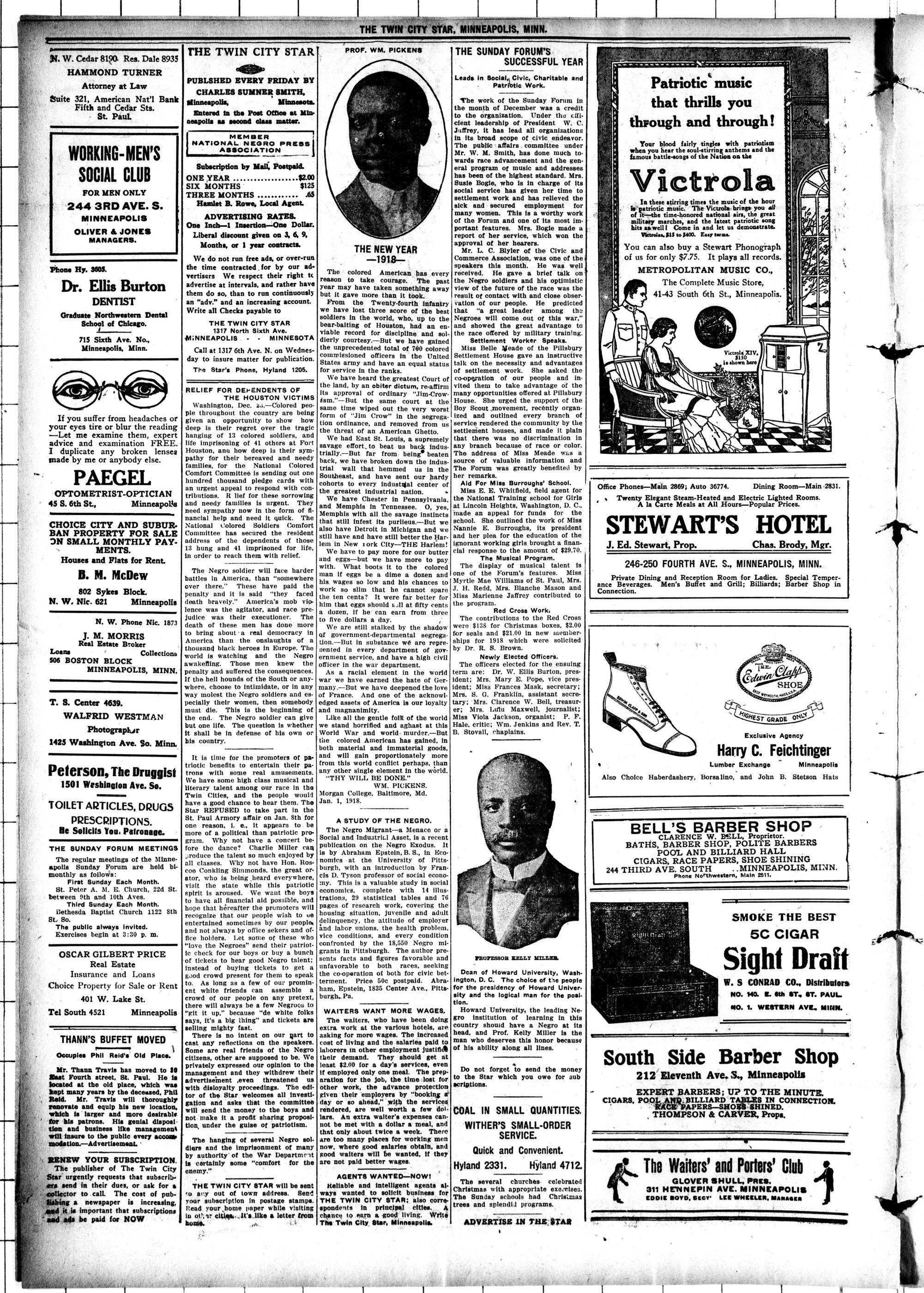
PROFESSOR KELLY MILLER.
Dean of Howard University, Wash-
ington, D.C. The choice of the people
for the presidency of Howard Univer-
sity and the logical man for the posi-
tlon.
Howard University, the leading Ne-
gro institution of learning in this
country shoud have a Negro at its
head, and Prof. Kelly Miller is the
man who deserves this honor because
of his ability along all lines.
Do not forget to send the money
to the Star which you owe for sub
scriptions.
South Side Barber Shop
212 Eleventh Ave. S., Minneapolis
EXPERT BARBERS; UP TO THE MINUTE.
CIOARS, POE I, RD SA a CONNECTION.
, THOMPSON & CARVER, Props,
COAL IN SMALL QUANTITIES,
WITHER’S SMALL-ORDER
SERVICE.
Quick and Convenient.
Hyland 2331. Hyland 4712.
< The Waiters’ and Porters’ Club 4
The several churches celebrated
Christmas with appropriate execeises.
The Sunday schools had Chrisimas
trees and splendid programs.
ADVERTISE IN THE: STAR
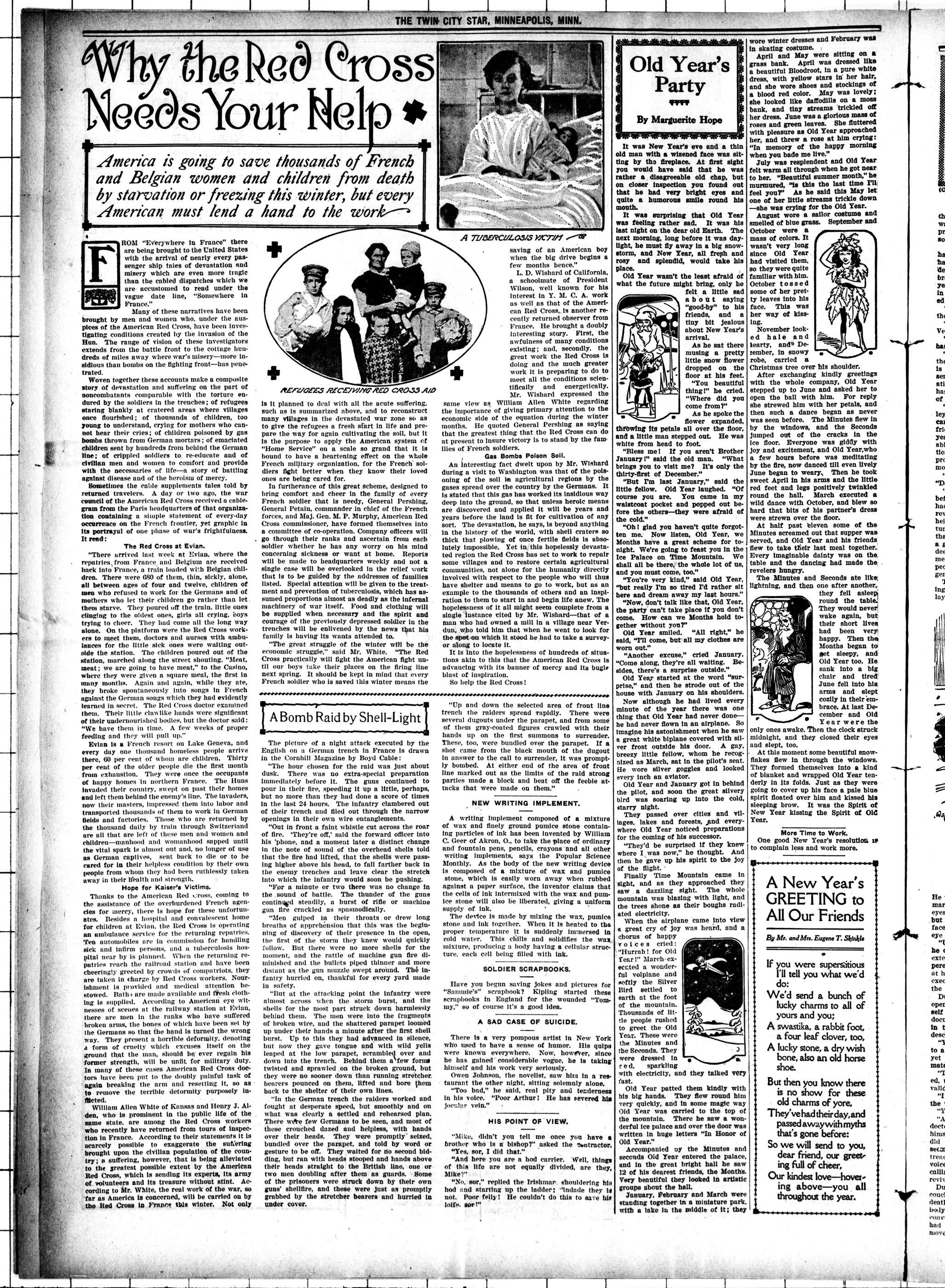
Why the Red Cross Needs Your Help
America is going to save thousands of French and Belgian women and children from death by starvation or freezing this winter, but every American must lend a hand to the work
ROM "Everywhere in France" there are being brought to the United States with the arrival of nearly every passenger ship tales of devastation and misery which are even more tragic than the cabled dispatches which we are accustomed to read under the vague date line, "Somewhere in France."
F
Many of these narratives have been
brought by men and women who, under the auspices of the American Red Cross, have been investigating conditions created by the invasion of the Hun. The range of vision of these investigators extends from the battle front to the cottage hundreds of miles away where war's misery—more insidious than bombs on the fighting front—has penetrated. Woven together these accounts make a composite story of devastation and suffering on the part of noncombatants comparable with the torture endured by the soldiers in the trenches; of refugees staring blankly at cratered areas where villages once flourished; of thousands of children, too young to understand, crying for mothers who cannot hear their cries; of children poisoned by gas bombs thrown from German mortars; of emaciated children sent by hundreds from behind the German line; of crippled soldiers to re-educate and of civilian men and women to comfort and provide with the necessaries of life—a story of battling against disease and of the heroism of mercy.
Sometimes the cable supplements tales told by returned travelers. A day or two ago, the war council of the American Red Cross received a cablegram from the Paris headquarters of that organization containing a simple statement of every-day occurrence on the French frontier, yet graphic in its portrayal of one phase of war's frightfulness. It read:
The Red Cross at Evian.
"There arrived last week at Evian, where the repatriates, from France, and Belgium are received back into France, a train loaded with Belgian children. There were 680 of them, thin, sickly, alone, all between ages of four and twelve, children of men who refused to work for the Germans and of mothers who let their children go rather than let them starve. They poured off the train. little ones clinging to the oldest ones, girls all crying, boys trying to cheer. They had come all the long way alone. On the platform were the Red Cross workers to meet them, doctors and nurses with ambulances for the little sick ones were waiting outside the station. The children poured out of the station, marched along the street shouting, "Meat, meat; we are going to have meat," to the Casino, where they were given a square meal, the first in many months. Again and again, while they ate, they broke spontaneously into songs in French against the German songs which they had evidently learned in secret. The Red Cross doctor examined them. Their little clawlike hands were significant of their undernourished bodies, but the doctor said: "We have them in time. A few weeks of proper feeding and they will pull up."
"There arrived last week at Evan, where the repatriates, from France, and Belgium are received back into France, a train loaded with Belgian children. There were 680 of them, thin, slicky, alone, all between ages of four and twelve, children of men who refused to work for the Germans and of mothers who let their children go rather than let them starve. They poured off the train. little ones clinging to the oldest ones, girls all crying, boys trying to cheer. They had come all the long way alone. On the platform were the Red Cross workers to meet them, doctors and nurses with ambulances for the little sick ones were waiting outside the station. The children poured out of the station, marched along the street shouting, "Meat, meat; we are going to have meat," to the Casino, where they were given a square meal, the first in many months. Again and again, while they ate, they broke spontaneously into songs in French against the German songs which they had evidently learned in secret. The Red Cross doctor examined them. Their little clawlike hands were significant of their undernourished bodies, but the doctor said: "We have them in time. A few weeks of proper feeding and they will pull up."
Evan is a French resort on Lake Geneva, and every day one thousand homeless people arrive there, 60 per cent of whom are children. Thirty per cent of the older people die the first month from exhaustion. They were once the occupants of happy homes in northern France. The Huns invaded their country, swept on past their homes and left them behind the enemy's line. The invaders, now their masters, impressed them into labor and transported thousands of them to work in German fields and factories. Those who are returned by the thousand daily by train through Switzerland are all that are left of these men and women and children—manhood and womanhood sapped until the vital spark is almost out and, no longer of use as German captives, sent back to die or to be cared for in their helpless condition by their own people from whom they had been ruthlessly taken away in their health and strength.
Evian is a French resort on Lake Geneva, and every day one thousand homeless people arrive there, 60 per cent of whom are children. Thirty per cent of the older people die the first month from exhaustion. They were once the occupants of happy homes in northern France. The Huns invaded their country, swept on past their homes and left them behind the enemy's line. The invaders, now their masters, impressed them into labor and transported thousands of them to work in German fields and factories. Those who are returned by the thousand daily by train through Switzerland are all that are left of these men and women and children—manhood and womanhood sapped until the vital spark is almost out and, no longer of use as German captives, sent back to die or to be cared for in their helpless condition by their own people from whom they had been ruthlessly taken away in their health and strength.
Hope for Kaiser's Victims.
Thanks to the American Red Cross, coming to the assistance of the overburdened French agencies for mercy, there is hope for these unfortunate. Besides a hospital and convalescent home for children at Evian, the Red Cross is operating an ambulance service for the returning repatriates. Ten automobiles are in commission for handling sick and infirm persons, and a tuberculosis hospital near by is planned. When the returning repatriates reach the railroad station and have been cheeringly greeted by crowds of compatriots, they are taken in charge by Red Cross workers. Nourishment is provided and medical attention bestowed. Bath are made available and fresh clothing is supplied. According to American eye witnesses of scenes at the railway station at Evian, there are men in the ranks who have suffered broken arms, the bones of which have been set by the Germans so that the hand is turned the wrong way. They present a horrible deformity, denoting a form of cruelty which excuses itself on the ground that the man, should he ever regain his former strength, will be unfit for military duty. In many of these cases American Red Cross doctors have been put to the doubly painful task of again breaking the arm and resetting it, so as to remove the terrible deformity purposely inflicted.
Thanks to the American Red Cross, coming to the assistance of the overburdened French agencies for mercy, there is hope for these unfortunate. Besides a hospital and convalescent home for children at Evian, the Red Cross is operating an ambulance service for the returning repatriates. Ten automobiles are in commission for handling sick and infirm persons, and a tuberculosis hospital near by is planned. When the returning repatriates reach the railroad station and have been cheeringly greeted by crowds of compatriots, they are taken in charge by Red Cross workers. Nour's job is provided and medical attention be
William Allen White of Kansas and Henry J. Alden, who is prominent in the public life of the same state, are among the Red Cross workers who recently have returned from tours of inspection in France. According to their statements it is scarcely possible to exaggerate the suffering brought upon the civilian population of the country; a suffering, however, that is being alleviated to the greatest possible extent by the American Red Cross, which is sending its experts, its army of volunteers and its treasure without stint. According to Mr. White, the real work of the war, so far as America is concerned, will be carried on by the Red Cross in France this winter. Not only
THE TWIN CITY STAR, MINNEAPOLIS, MINN.
A TUBE
REFUGEES RECEIVING RED CROSS AID
is it planned to deal with all the acute suffering, such as is summarized above, and to reconstruct many villages in the devastated war zone so as to give the refugees a fresh start in life and prepare the way for again cultivating the soil, but it is the purpose to apply the American system of "Home Service" on a scale so grand that it is bound to have a heartening effect on the whole French military organization, for the French soldiers fight better when they know their loved ones are being cared for.
In furtherance of this great scheme, designed to bring comfort and cheer in the family of every French soldier that is needy, General Pershing, General Petain, commander in chief of the French forces, and MaJ. Gen. M. P. Murphy, American Red Cross commissioner, have formed themselves into a committee of co-operation. Company officers will go through their ranks and ascertain from each soldier whether he has any worry on his mind concerning sickness or want at home. Reports will be made to headquarters weekly and not a single case will be overlooked in the relief work that is to be guided by the addresses of families listed. Special attention will be given to the treatment and prevention of tuberculosis, which has assumed proportions almost as deadly as the infernal machinery of war itself. Food and clothing will be supplied when necessary and the spirit and courage of the previously depressed soldier in the trenches will be enlivened by the news that his family is having its wants attended to.
"The great struggle of the winter will be the economic struggle," said Mr. White. "The Red Cross practically will fight the American fight until our boys take their places on the firing line next spring. It should be kept in mind that every French soldier who is saved this winter means the
The picture of a night attack executed by the English on a German trench in France is drawn in the Cornhill Magazine by Boyd Cable:
"The hour chosen for the raid was just about dusk. There was no extra-special preparation immediately before it. The guns continued to pour in their fire, speeding it up a little, perhaps, but no more than they had done a score of times in the last 24 hours. The infantry clambered out of their trench and filed out through the narrow openings in their own wire entanglements.
"Out in front a faint whistle cut across the roar of fire. 'They're off,' said the forward officer into his 'phone, and a moment later a distinct change in the note of sound of the overhead shells told that the fire had lifted, that the shells were passing higher above his head, to fall farther back in the enemy trenches and leave clear the stretch into which the infantry would soon be pushing.
"For a minute or two there was no change in the sound of battle. The thunder of the guns continued steadily, a burst of rifle or machine gun fire crackled as spasmodically.
"Men gulped in their throats or drew long breaths of apprehension that this was the beginning of discovery of their presence in the open, the first of the storm they knew would quickly follow. But there were no more shells for the moment, and the rattle of machine gun fire diminished and the bullets piped thinner and more distant as the gun muzzle swept around. The infantry hurried on, thankful for every yard made in safety.
"But at the attacking point the infantry were almost across when the storm burst, and the shells for the most part struck down harmlessly behind them. The men were into the fragments of broken wire, and the shattered parapet loomed up under their hands a minute after the first shell burst. Up to this they had advanced in silence, but now they gave tongue and with wild yells leaped at the low parapet, scrambled over and down into the trench. Behind them a few forms twisted and sprawled on the broken ground, but they were no sooner down than running stretcher bearers pounced on them, lifted and bore them back to the shelter of their own lines.
"In the German trench the raiders worked and fought at desperate speed, but smoothly and on what was clearly a settled and rehearsed plan. There were few Germans to be seen, and most of these crouched dazed and helpless, with hands over their heads. They were promptly seized, bundled over the parapet, and told by word or gesture to be off. They waited for no second bidding, but ran with heads stooped and hands above their heads straight to the British line, one or two men doubling after them as guards. Some of the prisoners were struck down by their own guns' shellfire, and these were just as promptly grabbed by the stretcher bearers and hurried in under cover.
THE MOTHER
saving of an American boy when the big drive begins a few months hence."
L. D. Wishard of California, a schoolmate of President Wilson, well known for his interest in Y. M. C. A. work as well as that of the American Red Cross, is another recently returned observer from France. He brought a doubly interesting story. First, the awfulness of many conditions existing; and, secondly, the great work the Red Cross is doing and the much greater work it is preparing to do to meet all the conditions scientifically and energetically. Mr. Wishard expressed the
same view as William Allen White regarding the importance of giving primary attention to the economic side of the equation during the winter months. He quoted General Pershing as saying that the greatest thing that the Red Cross can do at present to Insure victory is to stand by the families of French soldiers.
same view as William Allen White regarding the importance of giving primary attention to the economic side of the equation during the winter months. He quoted General Pershing as saying that the greatest thing that the Red Cross can do at present to insure victory is to stand by the families of French soldiers.
Gas Bomba Poison Soil.
An interesting fact dwelt upon by Mr. Wishard during a visit to Washington was that of the poisoning of the soil in agricultural regions by the gases spread over the country by the Germans. It is stated that this gas has worked its insidious way deep into the ground, so that unless herolic means are discovered and applied it will be years and years before the land is fit for cultivation of any sort. The devastation, he says, is beyond anything in the history of the world, with shell craters so thick that plowing of once fertile fields is absolutely impossible. Yet in this hopelessly devastated region the Red Cross has set to work to repair some villages and to restore certain agricultural communities, not alone for the humanity directly involved with respect to the people who will thus have shelter and means to go to work, but as an example to the thousands of others and an inspiration to them to start in and begin life anew. The hopelessness of it all might seem complete from a single instance cited by Mr. Wishard—that of a man who had owned a mill in a village near Verdun, who told him that when he went to look for the spot on which it stood he had to take a survey or along to locate it.
An interesting fact dwelt upon by Mr. Wishard during a visit to Washington was that of the poisoning of the soil in agricultural regions by the gases spread over the country by the Germans. It is stated that this gas has worked its insidious way deep into the ground, so that unless heroic means are discovered and applied it will be years and years before the land is fit for cultivation of any sort. The devastation, he says, is beyond anything in the history of the world, with shell craters so thick that plowing of once fertile fields is absolutely impossible. Yet in this hopelessly devastated region the Red Cross has set to work to repair some villages and to restore certain agricultural communities, not alone for the humanity directly involved with respect to the people who will thus have shelter and means to go to work, but as an example to the thousands of others and an inspiration to them to start in and begin life anew. The hopelessness of it all might seem complete from a single instance cited by Mr. Wishard—that of a man who had owned a mill in a village near Verdun, who told him that when he went to look for the spot on which it stood he had to take a surveyor along to locate it.
It is into the hopelessness of hundreds of situations akin to this that the American Red Cross is advancing with its banner of mercy and its bugle blast of inspiration.
"Up and down the selected area of front line trench the raiders spread rapidly. There were several dugouts under the parapet, and from some of them gray-coated figures crawled with their hands up on the first summons to surrender. These, too, were bundled over the parapet. If a shot came from the black mouth of the dugout in answer to the call to surrender, it was promptly bombed. At either end of the area of front line marked out as the limits of the raid strong parties made a block and beat off the feeble attacks that were made on them."
"Up and down the selected area of front line trench the raiders spread rapidly. There were several dugouts under the parapet, and from some of them gray-coated figures crawled with their hands up on the first summons to surrender. These, too, were bundled over the parapet. If a shot came from the black mouth of the dugout in answer to the call to surrender, it was promptly bombed. At either end of the area of front line marked out as the limits of the raid strong parties made a block and beat off the feeble attacks that were made on them."
NEW WRITING IMPLEMENT.
A writing implement composed of a mixture of wax and finely ground pumice stone containing particles of ink has been invented by William C. Geer of Akron, O., to take the place of ordinary and fountain pens, pencils, crayons and all other writing implements, says the Popular Science Monthly. As the body of the new writing device is composed of a mixture of wax and pumice stone, which is easily worn away when rubbed against a paper surface, the inventor claims that the cells of ink intermixed with the wax and pumice stone will also be liberated, giving a uniform supply of ink.
The device is made by mixing the wax, pumice stone and ink together. When it is heated to the proper temperature it is suddenly immersed in cold water. This chills and solidifies the wax mixture, producing a body having a cellular structure, each cell being filled with ink.
A writing implement composed of a mixture of wax and finely ground pumice stone containing particles of ink has been invented by William C. Geer of Akron, O., to take the place of ordinary and fountain pens, pencils, crayons and all other writing implements, says the Popular Science Monthly. As the body of the new writing device is composed of a mixture of wax and pumice stone, which is easily worn away when rubbed against a paper surface, the inventor claims that the cells of ink intermixed with the wax and pumice stone will also be liberated, giving a uniform supply of ink.
The device is made by mixing the wax, pumice stone and ink together. When it is heated to the proper temperature it is suddenly immersed in cold water. This chills and solidifies the wax mixture, producing a body having a cellular structure, each cell being filled with ink.
SOLDIER SCRAPBOOKS.
Have you begun saving jokes and pictures for "Sammie's" scrapbook? Kipling started these scrapbooks in England for the wounded "Tommy," so of course it's a good idea.
Have you begun saving jokes and pictures for "Sammie's" scrapbook? Kipling started these scrapbooks in England for the wounded "Tommy," so of course it's a good idea.
A SAD CASE OF SUICIDE
There is a very pompous artist in New York who used to have a sense of humor. His quips were known everywhere. Now, however, since he has gained considerable vogue, he is taking himself and his work very seriously.
Owen Johnson, the novelist, saw him in a restaurant the other night, sitting solemnly alone.
"Too bad," he said, real pity and tenderness in his voice. "Poor Arthur! He has severed his jocular vein."
There is a very pompous artist in New York who used to have a sense of humor. His quilps were known everywhere. Now, however, since he has gained considerable vogue, he is taking himself and his work very seriously. Owen Johnson, the novelist, saw hira in a restaurant the other night, sitting solely alone.
HIS POINT OF VIEW.
"Mike, didn't you tell me once you have a brother who is a bishop?" asked the contractor.
"Yes, sor, I did that."
"And here you are a hod carrier. Well, things of this life are not equally divided, are they, Mike?"
"No, sor," replied the Irishman. shouldering his hod and starting up the ladder; "indade they is not. Poor felly! He couldn't do this to save his loife, sor!"
"And here you are a hod carrier. Well, things of this life are not equally divided, are they, Mike?" "No, sor," replied the Irishman, shouldering his hod and starting up the ladder; "indade they is not. Poor felly! He couldn't do this to save his loife, sor!"
Old Year's Party
By Marguerite Hope
It was New Year's eve and a thin old man with a wizened face was sitting by the fireplace. At first sight you would have said that he was rather a disagreeable old chap, but on closer inspection you found out that he had very bright eyes and quite a humorous smile round his mouth.
It was surprising that Old Year was feeling rather sad. It was his last night on the dear old Earth. The next morning, long before it was daylight, he must fly away in a big snowstorm, and New Year, all fresh and rosy and splendid, would take his place.
Old Year wasn't the least afraid of what the future might bring, only he
felt a little sad about saying "good-by" to his friends, and a tiny bit jealous about New Year's arrival.
SANTA CLAUS
As he sat there musing a pretty little snow flower dropped on the floor at his feet. "You beautiful thing!" he cried. "Where did you come from?" As he spoke the flower expanded,
throwing its petals all over the floor, and a little man stepped out. He was white from head to foot.
"Bless me! If you aren't Brother January!" said the old man. "What brings you to visit me? It's only the thirty-first of December."
"But I'm last January," said the little fellow. Old Year laughed. "Of course you are. You came in my waistcoat pocket and popped out before the others—they were afraid of the cold."
"Oh! glad you haven't quite forgotten me. Now listen, Old Year, we Months have a great scheme for tonight. We're going to feast you in the Ice Palace on Time Mountain. We shall all be there, the whole lot of us, and you must come, too."
"You're very kind," said Old Year, "but really I'm so tired I'd rather sit here and dream away my last hours."
"Now, don't talk like that, Old Year, the party can't take place if you don't come. How can we Months hold together without you?"
Old Year smiled. "All right," he said. "T'll come, but all my clothes are worn out."
"Another excuse," cried January. "Come along, they're all waiting. Besides, there's a surprise outside."
Old Year started at the word "surprise," and then he strode out of the house with January on his shoulders.
Now although he had lived every minute of the year there was one thing that Old Year had never done—he had never flown in an airplane. So imagine his astonishment when he saw a great white biplane covered with silver frost outside his door. A gay, breezy little fellow, whom he recognized as March, sat in the pilot's seat. He wore silver goggles and looked every inch an aviator.
Old Year and January got in behind the pilot, and soon the great silvery bird was soaring up into the cold, starry night.
They passed over cities and villages, lakes and forests, and everywhere Old Year noticed preparations for the coming of his successor.
"They'd be surprised if they knew where I was now," he thought. And then he gave up his spirit to the joy of the flight.
Finally Time Mountain came in sight, and as they approached they saw a dazzling sight. The whole mountain was blazing with light, and the trees shone as their boughs radiated electricity.
When the airplane came into view a great cry of joy was heard, and a
chorus of happy voices cried: "Hurrah! for Old Year!" March executed a wonderful volplane and softly the Silver Bird settled to earth at the foot of the mountain. Thousands of little people rushed to greet the Old Year. These were the Minutes and the Seconds. They were dressed in red, sparkling
chorus of happy voices cried: "Hurrah! for Old Year!" March executed a wonderful volplane and softly the Silver Bird settled to earth at the foot of the mountain. Thousands of little people rushed to greet the Old Year. These were the Minutes and the Seconds. They were dressed in red, sparkling with electricity, and they talked very fast.
Old Year patted them kindly with his big hands. They flew round him very quickly, and in some magic way Old Year was carried to the top of the mountain. There he saw a wonderful ice palace and over the door was written in huge letters "In Honor of Old Year."
Accompanied by the Minutes and seconds Old Year entered the palace, and in the great bright hall he saw 12 of his dearest friends, the Months. Very beautiful they looked in artistic groups about the hall.
January, February and March were standing together in a miniature park, with a lake in the middle of it; they
wore winter dresses and February was in skating costume.
April and May were sitting on a grass bank. April was dressed like a beautiful Bloodroot, in a pure white dress, with yellow stars in her hair, and she wore shoes and stockings of a blood red color. May was lovely; she looked like daffodils on a moss bank, and tiny streams trickled off her dress. June was a glorious mass of roses and green leaves. She fluttered with pleasure as Old Year approached her, and threw a rose at him crying: "In memory of the happy morning when you bade me live."
July was resplendent and Old Year felt warm all through when he got near to her. "Beautiful summer month," he murmured, "is this the last time I'll feel you?" As he said this May let one of her little streams trickle down she was crying for the Old Year.
August wore a sailor costume and
smelled of blue grass. September and
smelled of blue gr
October were a mass of colors. It wasn't very long since Old Year had visited them, so they were quite familiar with him.
October tossed some of her pretty leaves into his face. This was her way of kissing.
TREE FUN FUN FUN
November looked
hale and
hearty, and $ ^{b} $ December,
in snowy
robe, carried a
Christmas tree over his shoulder.
After exchanging kindly greetings with the whole company, Old Year stepped up to June and asked her to open the ball with him. For reply she strewed him with her petals, and then such a dance began as never was seen before. The Minutes flew in by the windows, and the Seconds jumped out of the cracks in the ice floor. Everyone was giddy with joy and excitement, and Old Year, who a few hours before was meditating by the fire, now danced till even lively June began to weary. Then he took sweet April in his arms and the little red feet and legs positively twinkled round the hall. March executed a wild dance with October, and blew so hard that bits of his partner's dress were strewn over the floor.
At half past eleven some of the Minutes screamed out that supper was served, and Old Year and his friends flew to take their last meal together. Every imaginable dainty was on the table and the dancing had made the revelers hungry. The Minutes and Seconds ate like lightning, and then one after another.
they fell asleep round the table. They would never wake again, but their short lives had been very happy. Then the Months began to get sleepy, and Old Year too. He sank into a big chair and tired June fell into his arms and slept cozily in their embrace. At last December and Old Year were the
they ten asleep round the table. They would never wake again, but their short lives had been very happy. Then the Months began to get sleepy, and Old Year too. He sank into a big chair and tired June fell into his arms and slept cozily in their embrace. At last December and Old Year were the only ones awake. Then the clock struck midnight, and they closed their eyes and slept too.
At this moment some beautiful snowflakes flew in through the windows. They formed themselves into a kind of blanket and wrapped Old Year tenderly in its folds. Just as they were going to cover up his face a pale blue spirit floated over him and kissed his sleeping brow. It was the Spirit of New Year kissing the Spirit of Old Year.
More Time to Work.
One good New Year's resolution is to complain less and work more.
A New Year's GREETING to All Our Friends
By Mr. and Mrs. Eugene T. Skinkle
If you were supersitious I'll tell you what we'd do:
We'd send a bunch of lucky charms to all of yours and you;
Our kindest love—hovering above—you all throughout the year.
"Am I too late?"
Dudley North had traveled nearly a thousand miles by land and water. He was weared and heavy-eyed, but he propounded the query with mingled solicitude and eagerness in his tones.
Once the house he had just entered had been his home and the servants had admitted this old favorite without delay. Dudley had hurried to the library, where Mr. Velle, the family lawyer, and Doctor Parish stood engaged in serious consultation. Both welcomed him with a friendly handshake.
"Your relative has rallied," spoke the latter, "but he will not last long."
"He may see his uncle?" asked Mr. Velle.
"I see no objection. Mr. Hardinge has asked for him repeatedly."
"North," added the lawyer, close to the ear of the young man, "your uncle is about to make his will. In the absence of that, as his nearest living relative, you are the natural heir, but he has expressed the desire and intention of choosing another legatee."
"I understand perfectly," spoke Dudley with clear, open promptness and candor. "My uncle has been a true friend to me. He gave me a home for years and the backing which has enabled me to form a business connection that is permanent and full of promise. I ask no more, I expect no more."
"He is very weak," said the lawyer. "Do you know the prospective heir?" "I do not," answered Dudley. "Just before I went away on my last trip we had a heart-to-heart talk. My uncle revealed to me that I would not be his heir, that he intended to leave his fortune to another. He simply told me that he felt it his duty to make up for a great wrong. I tried to express my deep gratitude for all he had done for me. I told him truthfully that I expected nothing further from his kindly generosity."
They were in the sick room, adjoining, the next moment. Upon a couch lay John Hardidge, the dying man.
Walters
Twice He Saw Her.
He was the uncle of Dudley North, by marriage only, but as he opened his eyes and recognized this unexpected but longed-for visitor, his bloodless face took on a quick flush and his dull eye glowed with pleasure.
"Uncle!" spoke Dudley fervently, as he clasped the feeble trembling hand extended, and then the doctor whispered in his car after a critical glance at his patient. "Haste is vital for the execution of his last wish," nodded to the lawyer and left the room.
Dudley stepped aside and the lawyer opened his portfolio and seated himself at the bedside. He drew forth a document that he had just prepared in the library. It was brief, simply describing the holdings of his client.
"You wish to leave your fortune to a person whose name you have not yet given, Mr. Hardinge," he intimated.
"To make right what was a wretched, unmanly act, yes," uttered the invalid with difficulty.
"I will write in the name and have the will witnessed."
"Yes, the name is—"
"Ah, he has collapsed. Quick, the doctor," exclaimed Mr. Vicle, but he himself hurried in quest of him. He did not find him in the library, it seemed, for Dudley heard his heavy trend cross the room, and then his voice in the hall beyond insistently calling for the only person who might revive the dying man.
Dudley had sprung to the side of the couch. At a glance he discovered that death had struck its final blow. The body of the dyeing man after a quick convulsion was growing rigid the face had become greatly. Barely able to move, John Hardinge expressed a
volceless appeal. It spoke in his be-seeching eyes. Dudley North comprehended.
The name which his uncle wished to impart was all important, but Hardinge was past speaking. He clutched out with his trembling fingers and selzed a pencil that lay upon the medicine tray.
"Yes, understand," said Dudley quickly. He drew a card from his pocket. He knelt by the bedside. He steadied the pencil in the nerveless fingers of the dying man.
"Write," he directed.
The unsteady hand traced a letter, another a word. Then he sank back with a gasp. There was a shock, a shudder, and he was dead. The doctor came hurrying into the room, but paused as he glanced at his patient.
"Too late," he said in a low tone to Mr. Velle, who had followed him. Half an hour later in the library, Dudley glanced at the card. He bore a scrawled word, one only, a name. "Annette." The unspoken word transcribed told him nothing. A woman's name, who was she? what was the interest of Mr. Harding in her? "In the absence of a will," the lawyer said to him, as he prepared to leave the house, "you become the sole heir." Dudley said nothing of the card. He did, however, ask one question. "Mr. Velle," he said, "among my uncle's friends or acquaintances have you ever heard him speak of, or do you know a person named Annette?" The lawyer repeated the word and began to move his head in negation. Then he started and stared strangely at Dudley.
"Why do you ask that question?" he inquired pointedly. "Because I believe that to be the first name of the person to whom my uncle intended to be bequeath his fortune."
"Annette" spoke Mr. Veile in a retrospective tone. "I can say this much, when your uncle was a young man I recall that he was engaged to a beautiful girl named Annette. I tild not know her, but I heard the story. All the preparations for their marriage were made. Upon the wedding eve your uncle disappeared. I recall that the bride elect was crushed by his unnally action. Why Mr. Hardinge did not carry out the marriage I do not know, but soon afterwards he married another woman. He probably broke the heart of a true, loving fance impelled by some later fancy. That is all I can tell you. Of course, no will having been made, this Annette, if she still lives, could not in any way invalidate your sole heirship."
That was the lawyer of it. The run of it was honest, whole souled, Dudley North. He searched vainly for a week to find some trace of "Annette." One day a man appeared, inquired for Mr. Hardinge and seemed shocked when he learned of his demise. Dudley questioned him closely.
It was to learn that he was a detective, employed by his uncle to locate a Mrs. Annette Barton. His quest developed the fact that the lady had been dead for five years. Her daughter, also Annette, the detective traced down, working in a department store.
Twice he had taken Mr. Hardinge to the neighborhood of the humble boarding house where Miss Barton lived, to view her at a distance. There was a trifling balance due the detective for his work, which was the cause of his present call.
Dudley paid the detective, and more who guided him to the home of Miss Barton, as he had his uncle. For two days Dudley prosecuted inquiry and investigation as to the worthy girl who earned her own living and was universally respected. Twice he saw her and realized that he could never forget her.
Then Dudley informed the lawyer that it was his resolute purpose to transfer the estate to its rightful owner.
Mr. Veile remonstrated, but Dudley was determined. He was surprised and dazed, when, after a call upon Miss Barton, Mr. Veile said to him:
"The young lady absolutely refuses to accept the fortune."
"On account of the action of my uncle in the far post?"
"She only thinks that once her mother and your uncle were casual friends."
"Then—"
"She has so high a conception of your unusual sacrifice that she refuses to beggar you."
"She shall have what is rightfully hers," declared Dudley.
To his inner spirit he confessed that he was glad of an opportunity to again see the lovely Amnette, who filled all his waking thoughts. There was more than one visit to the working girl's humble home. Then one day Dudley called upon the lawyer with a radiant face.
"We have compromised," he announced gaily.
"You mean—"
"Share and share alike, as hust and and wife," was the exultant reply.
Not Many Possessions.
They were new neighbors, and Virginia Lou, aged five, put her wits to work to find out about them. She accordingly appeared in the yard of the neighbor accompanied by her three-year-old sister.
"Where do you live?" she asked.
"Right here," explained the neighbor.
"Well, you didn't used to live here."
"No."
"Well, do you have a grandfadder?"
"No."
"Or a grandmudder?"
"No."
"Or a ladder?"
"No."
"Well, what do you got?"
THE TWIN CITY STAR, MINNEAPOLIS, MINN.
CAGE TRAP WITH SPLENDID CATCH OF RATS.
INJURY BY RODENTS
Well Fed Rats Breed Often and Have Very Large Litters.
INJURE PRODUCE IN STORES
Not Only Foodstuffs and Forage, but Textiles, Clothing and Leather Goods Are Often Ruined—Cut Off Food Supply.
(Prepared by the United States Department of Agriculture.)
The effect of an abundance of food on the breeding of rodents should be kept in mind. Well-fed rats mature quickly, breed often, and have large litters. Poorly fed rats, on the contrary, reproduce less frequently and have smaller litters. In addition, scarcity of food makes measures for destroying the animals far more effective.
Merchandise in Stores.—In all parts of the country there is a serious economic drain in the destruction by rats and mice of merchandise held for sale by dealers. Not only foodstuffs and forage, but textiles, clothing, and leather goods are often ruined. This loss is due mainly to the faulty buildings in which the stores are kept. Often it would be a measure of economy to tear down the old structures and replace them by new ones. However, even the old buildings may often be repaired so as to make them practically rat-proof; and foodstuffs, as flour, seeds, and meats, may always be protected in wire cages at slight expense. The public should be protected from insanitary stores by a system of rigid inspection.
Household Supplies.—Similar care should be exercised in the home to protect household supplies from mice and rats. Little progress in ridding the premises of these animals can be made so long as they have access to supplies of food. Cellars, kitchens, and pantries often furnish subsistence not only to rats that inhabit the
CAGE TRAP WITH SP
dwelling, but to many that come from outside. Food supplies may always be kept from rats and mice if placed in inexpensive rat-proof containers covered with wire netting. Sometimes all that is needed to prevent serious waste is the application of a defective part of the building.
Produce in Transit—Much loss of fruits, vegetables, and other produce occurs in transit by rail and on ships. Most of the damage is done at wharves and in railway stations, but there is also considerable in ships' holds, especially to perishable produce brought from warm latitudes. Much of this may be prevented by the use of ratproof cages at the docks, by the careful fumigation of seagoing vessels at the end of each voyage, and by the frequent fumigation of vessels in coastwise trade; but still more by replacing old and decrepit wharves and station platforms with modern ones built of concrete.
Where cargoes are being loaded or unloaded at wharves or depots, food liable to attack by rats may be temporarily safeguarded by being placed in rat-proof cages, or pounds, constructed of wire netting. Wooden boxes containing reserve food held in depots for a considerable time or intended for shipment by sea may be made rat-proof by light coverings of metal along the angles. This plan has long been in use to protect naval stores on ships and in warehouses. It is based on the fact that rats do not gnaw the plane surface of hard materials, but attack doors, furniture and boxes at the angles only.
Packing Houses.—Packing houses and abattoirs are often sources from which rats secure subsistence, especially where meats are prepared for market in old buildings. In old-style cooling rooms with double walls of wood and sawdust insulation, always a source of annoyance because of rat infestation, the utmost vigilance is required to prevent serious loss of meat products. On the other hand, packing houses with modern construction and sanitary devices have no trouble from rats or mice.
Garbage and Waste.—Since much of the food of rats consists of garbage and other waste materials, it is not enough to bar the animals from markets, grannies, warehouses and private food stores. Garbage and cital of all kinds must be so disposed of that rats cannot be stained them.
In cities and towns an efficient system of garbage collection and disposal should be established by ordinances. Waste from markets, hotels, cafes and households should be collected in covered metal receptacles and frequently emptied. Garbage should never be dumped in or near towns, but should
be utilized or promptly destroyed by fire.
Rats find abundant food in country slaughterhouses; reform in the management of these is badly needed. Such places are centers of rat propagation. It is a common practice to leave offal of slaughtered animals to be eaten by rats and swine, and this is the chief means of perpetuating trichinae in pork. The law should require that offal be promptly cremated or otherwise disposed of. Country slaughter-houses should be as cleanly and as constantly inspected as abattoirs.
Another important source of rat food is found in remnants of lunches left by employees in factories, stores and public buildings. This food, which alone is sufficient to attract and sustain a small army of rats, is commonly left in waste baskets or other open receptacles. Strictly enforced rules requiring all remnants of food to be deposited in covered metal vessels would make trapping far more effective.
Military training camps, unless subjected to rigid discipline in the matter of disposal of garbage and waste, soon become centers of rat infestation. Waste from camps, deposited in covered metal cans and collected daily, should be removed far from the camp itself and either burned or utilized in approved modern ways.
GIVE FEED ANIMALS RELISH
While Preference for Certain Food Is Formed by Habit, It Is Better to Cater to it.
Animals are much like human beings in that they have their own individual preference for certain foods. While this preference is formed by habit, to get the best returns with the feeds, it is best generally to cater to the animal's appetite.
Some horses will not do well without oats in the ration. Others do not especially care for oats, but require corn, some require more hay than others, some must have ground feeds. To get the best results such animals should be humored.
Our problem in feeding is to watch the animals and see that they get the feeds they require and no more. Feed
LENDID CATCH OF RATS.
left in the trough or scattered on the ground out of reach of animals does not produce. Even in feeding cattle a skillful feeder will soon learn the different animal's peculiarities and meet their requirements in such a way as to get economical gains. If he does not watch closely he is likely to waste feed while some of the animals are not getting enough.
WINTER TASKS FOR FARMER
Among Other Things to Do During Cold Weather Season is to Form Co-Operative Clubs.
Plant, prune and spray home orchards.
Form co-operative clubs for purchasing and selling all farm supplies and products.
Clear your pasture of all rubbish, etc, repair the fences and make preparation for sodding them to Bermuda or other grasses next spring.
Purchase commercial fertilizers cooperatively, and pay for them in cash if possible.
Remove all stumps, terrace your land and clean out all ditches.
Winter plow your land when in condition.
Make compost and top dress grain with stable manure.
Repair and paint implements and machinery.
Clean and spray poultry and hog houses.
Mate poultry and set eggs for production of pullets for fall laying.
Use the split-log drag on your roads.
Get your neighbor to do the same.
DRY FEED INSTEAD QF SLOP
Doesn't Freeze Up to Insult Appetite of Hog in Winter—Germs and Odors Are Avoided.
The farmer whose pigs have lost their avidity for slop should try feeding the slopstuff dry. Many a time pigs may be found fastidiously nosing through thick slop, when if dry middlings be placed in a tough need by they will devour it in fierce competition. Some men like milk toast, and some men don't like milk toast; that is the way with pigs. Try raising a bunch of pigs on dry middlings instead of slop of middlings, and the chances are that the pigs will demonstrate the success of the experiment. Germs and odors don't accumulate around a trough in which dry feed is provided; dry feed doesn't freeze up to insult the appetite of a hog, like slop may do in winter.
---
"30 BUSHELS OF DATES"
Amount Oldest Mortgage in World; Banking in Ancient Babylon
By S. W. STRAUS
(Prominent New York and Chicago Banker)
(Copyright, 1917, Western Newspaper Union)
How many people realize that the familiar mortgage of today has been handed down to us from generation to generation in practically unchanged form since the time of ancient Babylon?
Yet this is a fact. The mortgage is one of those few things which has survived through the long centuries—meeting the needs of Bel Bullitsu and Sha Nabu Shu. Babylonian agriculturists, and John Jones, the modern American farmer.
This interesting discovery was made when the Archaeological expedition of the University of Pennsylvania dug up, in the ruins of the ancient city of Nippur, Babylon, a mortgage dated 430 B.C., more than 2,300 years ago.
The following is an accurate translation of the inscription on the brick made by a noted Assyriologist of Chicago:
"Thirty bushels of dates are due to Bel Nadin Shun, son of Marashu, by Bel Bullitsu and Sha Nabu Shu, sons of Kirebti, and their tenants. In the month of Tashri (month of harvest) of the 34th year of King Artaxerxes I, they shall pay the dates, thirty bushels, according to the measure of Bel Nadin Shun, in the town of Bit Balatsu. Their field, cultivated and uncultivated flet estate is held as a pledge for the dates, namely, thirty bushels, by Bel Nadin Shun. Another creditor shall not have power over it."
The mortgage is the most ancient form of investment, the first known mortgage having been used by the Babylonians about 2,000 years B. C. It will be noted that the document, which is trust deed and note in one, is a first mortgage, as shown by the final sentence, "Another creditor shall not have power over it." It will be noticed, also, that a specific place, as well as time, for payment
FROM SLAVE TO BANKER
Paslon Rose to Greatest Banker in Greece; How Greek and Roman Banking Was Carried On
By S. W. STRAUS
(Prominent New York and Chicago Banker)
(Copyright, 1917, Western Newspaper Union)
The ancient world, too, had its "captains of industry and finance," and the story of their struggles for success is every bit as inspiring as modern "business romances." Then, as now, difficulties of humble birth and caste meant nothing to the determined, able man.
There was a slave in ancient Greece who rose to be the greatest banker of his time. His name, Pasion, is constantly mentioned in documents and other records. While the extent of his business was then considered enormous, today we dismiss it as inconsequential. Pasion is said to have held $13,405 on deposit from customers, to have loaned $60,935 and to have owned land worth $24,375. His income was $2,000 a year.
His deposits and loans appear small in comparison with modern figures, but the rate of interest customarily charged does not—36 per cent.
Banking in Greece originally consisted of changing money for foreigners. Later, the Greeks commenced allowing interest on deposits. Demosthenes is said to have kept a banking account.
Greek bankers were also notaries and witnessed contracts between others. They were familiar with letters of credit and invented a form of endorsement. As an example of this, we read that one Iceratus drew, in Athens, a bill on his father in Pontus, which was guaranteed by Pasion and then purchased by Stratocles. In Greece the banks were located in the temples and the latter were often used as national treasuries.
They had an instrument corresponding to our check. They started the practice of "discounts"—that, is deducting the interest at the time of making the loan.
The Greeks appear to have introduced banking in Italy. The Roman bankers soon became very important and Roman comedies contain many allusions to them. These were not always of a complimentary nature, but it is a fact that banking in Rome stood high as a profession. All money transactions among Romans were carried on through bankers and account books of customers were kept.
In 352 B. C. the senate appointed persons to lend a portion of public funds, on security, to the Pleblans. The Romans were even more prone than the Greeks to charge high interest rates. They sometimes reached 50 per cent.
Later the rate was fixed by law and in Cicero's time the legal amount was 12 per cent. In the law passed under Emperor Justinian, 528 A. D., the rate was fixed at 4 per cent for notables,
of the debt is provided, just as our modern mortgages or mortgage bonds state that principal and interest are "payable at the Tenth Trust Co.," or some other bank.
The amount of interest is not stated, but on all documents of this sort a legal rate of interest was customary, which ranged in times of peace from 12 to 20 per cent and in times of war to almost any amount.
The note matured in the month of harvest, exactly as American farmers, getting loans from their banks, have their notes mature in October and November.
Notice the words "son of Marashu" in the above document. Marashu Sons were a great firm of bankers in the Babylonian city of Nippur. They made loans of all kinds and often were called upon to help the King of Babylon with money.
This mortgage, together with many other records of the firm of Marushu Sons, was discovered in 1893. The story of its discovery is one of great interest.
The Babylonians were the Americans of antiquity. They were a nation of business men. Their mortgages, notes, deeds, wills and other documents were drawn with great care and along the same principles as the similar instruments we use today. Lawyers did a flourishing business in Babylon, as these people were fond of going to law and made all transfers of property a matter of record. Not only did they invent mortgages, but leases also.
One interesting lease demised a field and fish pond for the term of a year. The lessee made a first payment of one talent of silver and in addition, as ground rent, agreed to furnish the lessor with a mess of fish for his family table every day. Another lease transferred a piece of improved property for sixty days, the ground rent being paid in advance and the tenant being guaranteed against all claims of whatever nature. All these documents were inscribed on bricks made of clay by means of a wedge-shaped instrument, the various combinations of wedges making up the alphabet. These wedges have given the name to this particular style of writing, which is called "cuneiform," from the Latin word "cuneus," a wedge.
I suppose if the Babylonians had safety deposit vaults they would not have considered it necessary to insure the preservation of their records thus.
6 per cent on commercial loans and 8 per cent for loans not under the first two classifications.
Perhaps the high rate of interest mentioned previously was justified when it is considered that the law gave every advantage to debtors. Losses to bankers were frequent and the high rate charged was more as a measure of protection. Pompey, Brutus and Cato all lent money at 50 per cent.
It is often assumed that the rate of interest depends upon the abundance of gold or silver. This is not the case, as in California and Australia the rate of interest was extremely high during the height of the gold activity. In Mohammedan countries interest is forbidden in the Koran. But this has not succeeded in keeping down rates, as in these countries interest is three or four times greater than in Europe. In some parts of the Orient rates have gone as far as 100 per cent.
Several centuries before the Christian era a bank of deposit existed in Byzantium. In 900 A. D. a bank of deposit was established in China, although some form of banking existed in that country many centuries before. About 1200 A. D. a bank of deposit was established in Damascus; in 1345 one was founded in Geneva; in 1401 Barcelona started its first banking depository; the bank of Amsterdam was founded in 1608; bank of St. George in 1407 and the bank of Stockholm in 1608.
One of the earliest banking firms of which we have any account is said to be Egibl & Co. It was in ancient Babylon. Evidences of its existence were discovered in an earthenware jar, in the neighborhood of Hillah, a few miles from Babylon. These documents, recorded on tablets, are now in the British museum. Egibl & Co. are believed to have acted as the national bank of Babylon, and the founder probably lived in the reign of Sennacherib, about 700 B. C. Below is a translation of one of the tablets:
"Loan of five mana of silver of Nabu-zer-iddin, chief of the daggbe bearers (rab-nas-patrutu), to Behmasir. The money to be repaid in installments of a shekel and a half, beginning in Nisan.
"15th day of Tebet, 34th year of Nebuchadnezzar."
Records of this kind were deposited in the government office.
The Broader Thrift
Laying aside a few dollars each week does not necessarily make one a thrifty person. Thrift means so much more than merely saving money—it means personal efficiency—it means plans—it means self-control—it means foresight—it means prudence—it means sane and legitimate self-confidence—it means all that makes for character. It is as much removed from miserliness on the one hand as it is from extravagance on the other. As we build the ideals of thrift, we build character.
One person out of every ten who dies today in our large cities is buried in a Potter's field.
If the American people cannot learn to be thrifty, they cannot remain a great nation.
MEE At he F . THE TWIN CITY STAR. MINNEAPOLIS MINN - yy A
. By AMES LODGE, No. 106, |. B. P. 0. E of W.
ee ne eis
12TH AVENUE SOUTH AND 3RD STREET, MINNEAPOLIS
WEDNESDAY EVENING, JANUARY 2, 1918
THIS WILL BE THE SOCIAL EVENT OF THE SEASON
‘The installation exercises will be conducted by Mr. George W.
Holbert, by special permission from District Deputy R. H. Johnson,
of Gopher Lodge No. 105, of St. Paul. The Lodge has just received its
new, special made regalia, the most elaborate in the Northwest.
COME OUT AND SEE
‘the newly elected officers arrayed in these beautiful robes of office.
Installation Begins Promptly at 10 o’ciock.
MUSIC BY McCULLOUGH’S ORCHESTRA .
DANCING AFTER THE INSTALLATION
Committee ‘on Arrangements—Fred Thomas, Chairman; Walter
Dodson, Luke Tichenor, Atty. Wm. R. Morris, Thos. Galbraith, W. A.
Hilyard, Jr., Archie Watkins.
Committee on Refreshments—Benj. Berry, Chairman; J. E. Ste-
wart, Wm. Stirman, George W. Bryant, Alex. Rogers, Ewing Shannon.
Floor Committee—Judge Johnson, Chairman; Clarence McCul-
lough, James Burkes, Jacob Giles, Alex Irwin.
Reception Committee—P. H. Southall, Chairman; Chas. Sumner
Smith, B. M. McDew, Edward L. Boyd, Glover Shull, Atty. B. 8. Smith,
Jacob Spraggins, Dr. J. H. Redd, Richard Newton, Bert “Dutch”
‘Thompson, Joseph Polk, Dr. Joseph Sizer, Benj. Jones, Wm. Cratic,
John Washington, Benj. Cabbell, Arthur Reese, Barney Clark, G. E.
Southall, Thos. Whitly.
George W. Holbert, General Chairman.
Y. G B. C.
THE YOUNG GIRLS BENEFICIAL CLUB
+ will give ther =~ ~~
ANNUAL NEW YEAR’S MATINEE DANCE
January 1, 1918, at
Dancing from 2 to 5:30 P. M. *
We are proud of our reputation gained, because of the
excellent deportment of our patrons. A Refined Entertain-
ment, Church, Social and Patriotic Endeavor have given the
Y. G. B. C. an honorable distinction.
At LANE’S HALL
F. PEOPLES pox.
HOME BUILDING 60. ia
CONTRACTORS AND BUILDERS
818 METROPOLITAN LIFE BLDG,
OFFICE PHONE NIC. 1534
You don’t need money; if you own your lot.
I BUILD HOMES ON MONTHLY PAYMENTS.
| COTTAGES AND FOUR FAMILY FLATS
| ITS JUST LIKE PAYING RENT. PLANS FREE.
Open from 12 N. to 2 A. M. N. W. Tel. Hyland 5851.
, HOME COOKED SPECIAL SUNDAY DINNER, 50c.
REGULAR DINNER, 35c.
FINE CHOP SUEY OUR SPECIALTY.
Ladies’ Souvenir each Thursday night. High Class Service.
. 723 6th Ave. No.,
- Upstairs,
L. Anderson, Prop. MINNEAPOLIS, MINN.
t
| Practical Tailor
MEN'S SUITS AND OVERCOATS MADE TO ORDER.
Dry Cleaning and Fancy Dyeing of Ladies’ and Gent’s Garments.
, Phone N. W. Hyland 2875 1317 No. 6th Ave., Minneapolis.
coe lee
GERMAN WOMEN BEG FOOD War Savings Certificates Sell Fas
‘War Savings Certificates Sell Fast.
New York, Dec. 27.—Federal re-
serve banks throughout the country
have sold $12,500,000 worth of war
saving certificates and $600,000
worth of thrift stamps, according to
figures received from Washington by
Frederick W. Allen, director for
New York city. Chicago banks have
taken $749,000 war savings certiti-
cates and Philadelphia $673,200. New
York is leading every other city,
$926,795 having been distributed,
while Cleveland is second, with $387,
200, and Boston third, with $317,000.
Hunger Riots Feature Christmas 'n
Some Towns,
Geneva, Dec. 28—Features in the
German Christmas, according to
news from across the frontier, were
women and children openly begging
in the snow covered streets for fool
to appease their hunger, and riots in
‘some of the towns. Only. the rich
enjoyed a good, but ordinary, dinner
and for this they paid high prices,
as much as $59, Moat of the chureb-
es in Germany were closed owing to
luck of coal.
== Brief Items of ==
State News
Te, ee nat ar TT geet OT ce
shacking on the river at Boy lake near
Remer, reports all his household goods
were stolen during his absence.
Falling off in, water of the Otter
Tail river at Fergus Falls has com-
pelled the Ottertail Power company :o
generate nearly one-half of its current
by steam.
‘The Crookstun Associated charities
held a meeting in. the Commercial
club rooms, to devige some means of
increasing relief funds and decided
upon a charity ball, to be given in
January.
Rev. K. Winberg, pastor of the Scan-
dinavian M, E. church at Warren, was
surprised by his congregation and pre-
sentéd with a purse of money, which
it was suggested could well be used
for the purchase of fuel.
Indians at Red Lake have asked to
organize a squad as part of Campany
D of the home guard of Bemidji, and
want the company to send a man to
Red Lake to drill them. It is believed
that if this is done many Indians will
become members.
‘The Federal Reserve bank of Miune-
apolis will distribute $220,000 in divi-
dends to member banks the first of
the year, Theodore Wold, governor,
announces. The dividend rate is at
the rate of 6 per cent on capital stock
for nine months.
Congressman C. B. Miller of Duluth
spoke before 1,000 persons at Sauk
Centre at a loyalty meeting and urged
all to put their full force behind the
war. Congressman Miller, who has
recently returned from the war zone,
described in detail the activities in
France and said he was particularly
interested in the manner in which the
arrival of American troops in France
brought new life to the French people.
Merchants of Eveleth report that
there wil be no shortage of wheat
flour for three months to come. Coal
dealers have been visiting Duluth
with the hope that some hardeoal may
be obtaned. There fs a small supply
of soft coal and an abundance of
wood in the city, so that the fear of
fuel shortage expressed by many will
not come to pass. Enough sugar is
arriving from time to time thet no
one need hoard it and thereby canse
a shortage.
Matt Ivankovich, of Virginia, at one
time held in connection with the mur-
der of his cousin, Mrs. Paul Alar, her
husband and Peter Trpcich, has ro-
married Mary Dasovich, from whom
he was divorced several years ago
while he was serving a term in the
state penitentiary in connection with
a Duluth killing. While Ivankovich
was at Stillwater his wife obtained a
divorce from him because he had been
convicted of a felony. He was re-
leased two years ago and since then
he and his first spouse have been on
‘friendly terms.
| Mrs, Henry Wissinz, one of the old
‘rosideuts of St. Clond, was found dead
‘when her daughter went to her bed
to awaken her.
0. T. Francis and R. !. Golden,
proprietors of the Max Cafe at Min-
neapolis, were fined $50 by Judge C.
1. Siafth in muntefpal court for sell-
ing Iquor to women in violation of
order No, 7. \
‘Toot horns as long as your lungs
hold out to greet the New Year, bu!
please refrain from using steam whis
ties! This request, made in the in-
terests of coal conservation, is being
sent out by railroads operating in
Minnesota. Engineers are asked not
to waste fuel in blasting the air for
the coming of 1918.
“I am satisfied that Minnesota will
soon, if it does not already, rank a3
second to none ingthe sisterhood of
states as to its genuine loyalty to the
United States in the prosecution of
the war to an early and ‘successful
issue,” said President Murphy of the
America First, association, in com-
menting on the two weeks’ Loyalty
drive just closed.
Meatless Tuesdays and wheatless
Wednesdays have been put into effect
at the state sanatorium at Walker at
the request of the patients themselves.
Supt. George W. Beach consented to
inaugurate the program, after a con-
sultation with physicians made it
clear that abandonment of the, meat
diet usually fed consumptives would
not be injurious.
Fire destroyed the uninsured home
of Rasmus Rolscheau, north of the
Palmer farm near Little Falls. Mr.
Roschau lost everything in the house,
including provisions for the winter
A meeting for the purpose of organ-
izing a Home Guard among the patrt-
otic young-men of Aitkin, who are not
subject to draft, has been called to be
held at the court house.
The heavy fall of snow in the
Norther woods, which has driven the
rabbits south, has made trapping of
fur-bearing ae profitable
this year thaw ever before, according
Ren ne ee ee eR aie
SNR PIT ETH BEDI LIES SPELT IPSS SELLY TPP
* SS SS =
Prices Ka ees
aa ie
$32.50 to $180 ec
ec |
eve sala aie
; | at Ht 4
. i nn | | 5
STR EY
aaa i fl
Hear the va i iH e
aU aN ees
. BY Ea
ew Drunswic Saas
i eae
ee ¥
The Latest and Finest of All :
» 3 G
If you will merely come in and listen to The Brunswick for
ten or fifteen minutes, asking us to play your favorite records,
you will concede, too, that this Phonograph is the final type
instrument. Its tone will appeal ‘to you, and when you ask
why no other phonograph has reached such perfection in re-
production, we will point out The Brunswick's all-wood sound-
. chamber, built like a fine violin. This, acousticians declare, is
the only logical sound-chamber. Metal they utterly condemn.
SUPERIOR TONE A NEW TREAT
‘Tone slone-will couvince’y Once you know Pathe records,
See eee ee once you you will appreciate their superior-
after you compare The Brunswick ity
wits oes that you lprefee 8 Pathe offers some of the fore-
TERROR most singers, musicians, orches-
But you will also choose a tras, bands, and other musical or-*
Brunswick because it plays all re- ganizations. ‘The Pathe library—
cords. No other phonograph of the largest in the world—includes
the leading makes has this wanted aot only Anierican selections, but
feature. those of Europe.
Buy any record—any make— Brunswicks range in price from
any artist. Your choice is now $32.50 to $180, Each size and type
unrestricted. With a Brunswick represents a saving, compared
you are not compelled to buy only with similar types and sizes.
one make of records. Come in today, We are al-
The Brunswick brings to you ways glad to play The Brunswick
Pathe’ records, with the others. for you and explain its features—
We fitrnish without extra cost a regardless of whether or not you
reproducer for Pathe records, are ready to buy a phonograph.
Special Easy Terms of Payment
MARQUETTE AT 5th ST. SO.
LEPINE LITE ETT SISOS SANIT INN ILL LETT LANSSNONED
Nee ee enn ee
403-5-7 NICOLLET AVENUE
The Ideal Store for
Women’s and Children’s Wear
Special Holiday Bargains |
Watch the daily papers
500 4th Ave. So. : Phone Main 3487
BILL OF FARE
"FOR NEW YEAR’S DAY AND SUNDAY.
; souP
Bisque of Turkey and Chicken
RELISHES.
Celery and Mixed Pickles
ROASTS
Roast Turkey Roast Lamb Roast Chicken
With Cranberry Sauce
ENTREE
Macaroni with Cheese Filling .
: VEGETABLES
June Peas Mashed Potatoes Sweet Corn
Dessert
Tea Coffee Milk
FRUIT — CANDIES — ICE CREAM — CIGARS — TOBACCO
A=.
Se BF
Get You Baggage Direct from
——Maker——
NORTHWESTERN
TRUNK CO,
RETAIL STORE
248 Nicollet Ave. - Minneapolis