Twin City Star
Saturday, January 12, 1918
Minneapolis, Minnesota

Page text (machine-generated)
THE TWIN CITY STAR.
VOL. 7.
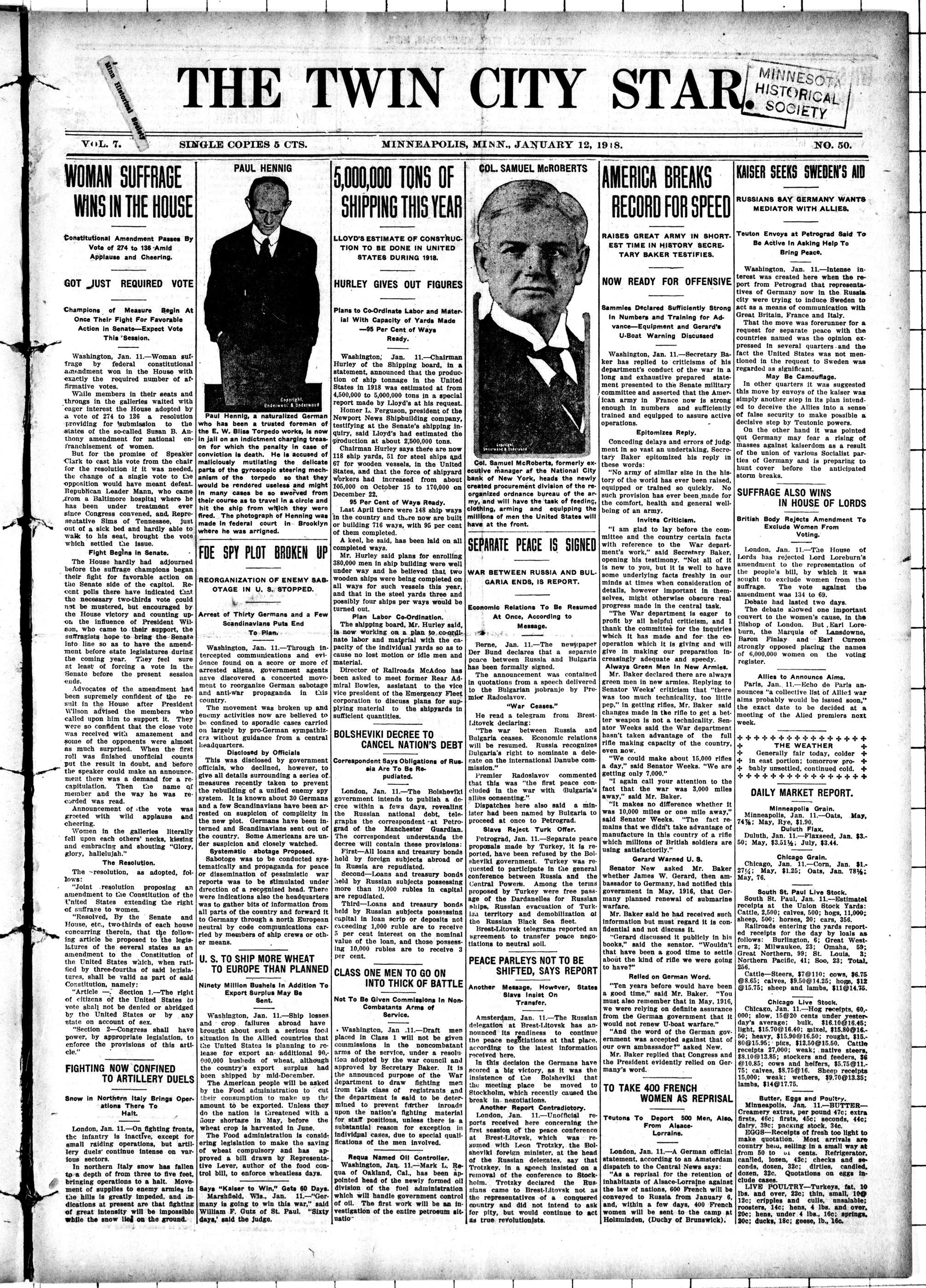
WOMAN SUFFRAGE WINS IN THE HOUSE
Constitutional Amendment Passes By
Vote of 274 to 136-Amid
Applause and Cheering.
Champions of Measure Begin At Once Their Fight For Favorable Action in Senate—Expect Vote This 'Session.
Washington, Jan. 11.—Woman suffrage by federal constitutional amendment won in the House with exactly the required number of affirmative votes.
While members in their seats and throngs in the galleries waited with eager interest the House adopted by a vote of 274 to 136 a resolution providing for submission to the states of the so-called Susan B. Anthony amendment for national enfranchisement of women.
But for the promise of Speaker Clark to cast his vote from the chair for the resolution if it was needed, the change of a single vote to the opposition would have meant defeat. Republican Leader Mann, who came from a Baltimore hospital where he has been under treatment ever since Congress convened, and Representative Sims of Tennessee, just out of a sick bed and hardly able to walk to his seat, brought the vote which settled the issue.
Fight Beginna in Senate.
The House hardly had adjourned before the suffrage champions began their fight for favorable action on the Senate side of the capitol. Recent polls there have indicated that the necessary two-thirds vote could not be mustered, but encouraged by the House victory and counting upon the influence of President Wilson, who came to their support, the suffragists hope to bring the Senate into line so as to have the amendment before state legislatures during the coming year. They feel sure at least of forcing a vote in the Senate before the present session ends.
Advocates of the amendment had been supremely confident of the result in the House after President Wilson advised the members who called upon him to support it. They were so confident that the close vote was received with amazement and some of the opponents were almost as much surprised. When the first roll was finished unofficial counts put the result in doubt, and before the speaker could make an announcement there was a demand for a recapitulation. Then the name of member and the way he was recorded was read.
Announcement of the vote was greeted with wild applause and cheering.
Women in the galleries literally fell upon each others' necks, kissing and embracing and shouting "Glory, glory, hallelujah."
The Resolution.
The -resolution, as adopted, follows:
"Joint resolution proposing an amendment to the Constitution of the United States extending the right of suffrage to women.
"Resolved, By the Senate and House, etc., two-thirds of each house concurring therein, that the following article be proposed to the legislatures of the several states as an amendment to the Constitution of the United States which, when ratified by three-fourths of said legislatures, shall be valid as part of said Constitution, namely:
"Article -. Section 1.—The right of citizens of the United States to vote shall not be denied or abridged by the United States or by any state on account of sex.
"Section 2—Congress shall have power, by appropriate legislation, to enforce the provisions of this article."
FIGHTING NOW CONFINED TO ARTILLERY DUELS
Snow in Northern Italy Brings Operations There To Halt.
London, Jan. 11.—On fighting fronts, the infantry is inactive, except for small raiding operations, but artillery duels continue intense on various sectors.
In northern Italy snow has fallen to a depth of from three to five feet, bringing operations to a halt. Movement of supplies to enemy armies in the hills is greatly impeded, and indications at present are that fighting of great intensity will be impossible while the snow lies on the ground.
PAUL HENNIG
Copyright,
Underwood & Underwood
Paul Hennig, a naturalized German who has been a trusted foreman of the E. W. Bliss Torpedo works, is now in jail on an indictment charging treason for which the penalty in case of conviction is death. He is accused of maliciously mutilating the delicate parts of the gyroscopic steering mechanism of the torpedo so that they would be rendered useless and might in many cases be so swerved from their course as to travel in a circle and hit the ship from which they were fired. The photograph of Henning was made in federal court in Brooklyn where he was arraigned.
FDE SPY PLOT BROKEN UP
REORGANIZATION OF ENEMY SAB
OTAGE IN U. S. STOPPED.
Arrest of Thirty Germans and a Few Scandinavians Puts End To Plan.
Washington, Jan. 11.—Through intercepted communications and evidence found on a score or more of arrested aliens, government agents have discovered a concerted movement to reorganize German sabotage and anti-war propaganda in this country.
The movement was broken up and enemy activities now are believed to be confined to sporadic cases carried on largely by pro-German sympathizers without guidance from a central headquarters.
Disclosed by Officials
This was disclosed by government officials, who declined, however, to give all details surrounding a series of measures recently taken to prevent the rebuilding of a unified enemy spy system. It is known about 30 Germans and a few Scandinavians have been arrested on suspicion of complicity in the new plot. Germans have been interned and Scandinavians sent out of the country. Some Americans are under suspicion and closely watched. Systematic abotage Proposed. Sabotage was to be conducted systematically and propaganda for peace or dissemination of pessimistic war reports was to be stimulated under direction of a recognized head. There were indications also the headquarters was to gather bits of information from all parts of the country and forward it to Germany through a north European neutral by code communications carried by members of ship crews or other means.
U. S. TO SHIP MORE WHEAT TO EUROPE THAN PLANNED
Ninety Million Bushels In Addition To Export Surplus May Be Sent.
Washington, Jan. 11.—Ship losses and crop failures abroad have brought about such a serious food situation in the Allied countries that the United States is planning to release for export an additional 90,000,000 bushels of wheat, although the country's export surplus had been shipped by mid-December. The American people will be asked by the Food administration to cut their consumption to make up the amount to be exported. Unless they do the nation is threatened with a flour shortage in May, before the wheat crop is harvested in June. The Food administration is considering legislation to make the saving of wheat compulsory and has approved a bill drawn by Representative Lever, author of the food control bill, to enforce wheatless days.
Says "Kaiser to Win," Gets 60 Days. Marshfield, Wis., Jan. 11.—"Germany is going to win this war," said William F. Gutz of St. Paul. "Sixty days," said the judge.
MINNEAPOLIS, MINN., JANUARY 12, 1918.
5,000,000 TONS OF SHIPPING THIS YEAR
5,000,000 TONS OF SHIPPING THIS YEAR
LLOYD'S ESTIMATE OF CONSTRUCTION TO BE DONE IN UNITED STATES DURING 1918.
HURLEY GIVES OUT FIGURES
Plans to Co-Ordinate Labor and Material With Capacity of Yards Made —98 Per Cent of Ways
Washington; Jan. 11.—Chairman Hurley of the Shipping board, in a statement, announced that the production of ship tonnage in the United States in 1918 was estimated at from 4,500,000 to 5,000,000 tons in a special report made by Lloyd's at his request. Homer L. Ferguson, president of the Newport News Shipbuilding company, testifying at the Senate's shipping inquiry, said Lloyd's had estimated the production at about 2,500,000 tons. Chairman Hurley says there are now 118 ship yards, 51 for steel ships and 67 for wooden vessels, in the United States, and that the force of shipyard workers had increased from about 105,000 on October 15 to 170,000 on December 22. 95 Per Cent of Ways Ready.
30 PER CENT OF WAYS READY.
Last April there were 148 ship ways in the country and there now are built or building 716 ways, with 95 per cent of them completed.
A keel, he said, has been laid on all completed ways.
Mr. Hurley said plans for enrolling 380,000 men in ship building were well under way and he believed that two wooden ships were being completed on all ways for such vessels this year, and that in the steel yards three and possibly four ships per way would be turned out.
Plan Labor Co-Ordination.
The shipping board, Mr. Hurley said, is now working on a plan to co-ordinate labor and material with the capacity of the individual yards so as to cause no lost motion or idle men and material. Director of Railroads McAdoo has been asked to meet former Rear Admiral Bowles, assistant to the vice vice president of the Emergency Fleet corporation to discuss plans for supplying material to the shipyards in sufficient quantities.
BOLSHEVIKI DECREE TO
CANCEL NATION'S DEBT
Correspondent Says Obligations of Russia Are To Be Repudiated.
London, Jan. 11.—The Bolshevik government intends to publish a decree within a few days, revealing the Russian national debt, telegraphs the correspondent at Petrograd of the Manchester Guardian. The correspondent understands the decree will contain these provisions:
First—All loans and treasury bonds held by foreign subjects abroad or in Russia are repudiated.
Second—Loans and treasury bonds held by Russian subjects possessing more than 10,000 rubles in capital are repudiated.
Third—Loans and treasury bonds held by Russian subjects possessing capital in loan scrip or deposits not exceeding 1,000 ruble are to receive 5 per cent interest on the nominal value of the loan, and those possessing 10,000 rubles are to receive 3 per cent.
CLASS ONE MEN TO GO ON
INTO THICK OF BATTLE
Not To Be Given Commissions In Non- Combatants Arms of
Service.
· Washington, Jan. 11.—Draft men placed in Class 1 will not be given commissions in the noncombatant arms of the service, under a resolution adopted by the war council and approved by Secretary Baker. It is the announced purpose of the War department to draw fighting men from tails class of registrants and the department is said to be determined to prevent further inroads upon the nation's fighting material for staff positions, unless there is a substantial reason for exception in individual cases, due to special qualifications of the men involved.
Regua Named Oil Controller
Washington, Jan. 11.—Mark L. Requa of Oakland, Cal., has been appointed head of the newly formed oil division of the fuel administration which will handle government control of oil. The first work will be an investigation of the entire petroleum situatio
COL. SAMUEL McROBERTS
Copyright
Sherwood & Fletcher
Col. Samuel McRoberts, formerly executive manager of the National City bank of New York, heads the newly created procurement division of the reorganized ordinance bureau of the army, and will have the task of feeding clothing, arming and equipping the millions of men the United States will have at the front.
SEPARATE PEACE IS SIGNED
WAR BETWEEN RUSSIA AND BUL
GARIA ENDS, IS REPORT.
Economic Relations To Be Resumed
At Once, According to
Berne, Jan. 11—The newspaper Der Bund declares that a separate peace between Russia and Bulgaria has been formally signed.
The announcement was contained in quotations from a speech delivered to the Bulgarian jsobranje by Premier Radoslavov.
"War Ceases."
He read a telegram from Brest-Litovck declaring:
"The war between Russia and Bulgaria ceases. Economic relations will be resumed. Russia recognizes Bulgaria's right to nominate a delegate on the international Danube commission."
Premier Radoslavov commented that this was "the first peace concluded in the war with Bulgaria's allies consenting."
Dispatches here also said a minister had been named by Bulgaria to proceed at once to Petrograd.
Slavs Reject Turk Offer.
Petrograd, Jan. 11.—Separate peace proposals made by Turkey, it is reported, have been refused by the Bolshevik government. Turkey was requested to participate in the general conference between Russia and the Central Powers. Among the terms proposed by Turkey were free passage of the Dardanelles for Russian ships, Russian evacuation of Turkisa territory and demobilization of the Russian Black Sea fleet.
Brest-Litovsk telegrams reported an agreement to transfer peace negotiations to neutral soil.
PEACE PARLEYS NOT TO BE SHIFTED, SAYS REPORT
Another Message, However, States Slavs Insist On Transfer.
Amsterdam, Jan. 11.—The Russian delegation at Brest-Litovsk has announced its readiness to continue the peace negotiations at that place, according to the latest information received here.
In this decision the Germans have scored a big victory, as it was the insistence of the Bolshevik that the meeting place be moved to Stockholm, which recently caused the break in negotiations.
Another Report Contradictory.
London, Jan. 11.—Unofficial reports received here concerning the first session of the peace conference at Brest-Litovsk, which was resumed with Leon Trotzky, the Bolshevik foreign minister, at the head of the Russian delegates, say that Trotzkey, in a speech insisted on a removal of the conference to Stockholm. Trotzky declared the Russians came to Brest-Litovsk not as the representatives of a conquered country and did not intend to ask for pity, but would continue to act as true revolutionists.
AMERICA BREAKS RECORD FOR SPEED
AMERICA BREAKS RECORD FOR SPEED
RAISES GREAT ARMY IN SHORT
EST TIME IN HISTORY SECRE-
TARY BAKER TESTIFIES.
NOW READY FOR OFFENSIVE
Sammles Declared Sufficiently Strong In Numbers and Training for Advance—Equipment and Gerard's
Washington, Jan. 11.—Secretary Baker has replied to criticisms of his department's conduct of the war in a long and exhaustive prepared statement presented to the Senate military committee and asserted that the American army in France now is strong enough in numbers and sufficiently trained and equipped to assure active operations.
Epitomizes Reply.
Conceding delays and errors of judgment in so vast an undertaking, Secretary Baker epitomized his reply in these words:
"No army of similar size in the history of the world has ever been raised, equipped or trained so quickly. No such provision has ever been made for the comfort, health and general wellbeing of an army.
Invites Criticism.
"I am glad to lay before the committee and the country certain facts with reference to the War department's work," said Secretary Baker, opening his testimony. "Not all of it is new to you, but it is well to have some underlying facts freshly in our minds at times when consideration of details, however important in themselves, might otherwise obscure real progress made in the central task.
"The War department is eager to profit by all helpful criticism, and I thank the committee for the inquiries which it has made and for the cooperation which it is giving and will give in making our preparation increasingly adequate and speedy.
Always Green Men In New Armies.
Mr. Baker declared there are always green men in new armies. Replying to Senator Weeks' criticism that "there was too much technicality, too little pep," in getting rifles, Mr. Baker said changes made in the rifle to get a better weapon is not a technicality. Senator Weeks said the War department hasn't taken advantage of the full rifle making capacity of the country, even now.
"We could make about 15,000 rifles a day," said Senator Weeks. "We are getting only 7,000."
"I again call your attention to the fact that the war was 3,000 miles away," said Mr. Baker.
"It makes no difference whether it was 10,000 miles or one mile away," said Senator Weeks. "The fact remains that we didn't take advantage of manufacture in this country of a rifle which millions of British soldiers are using satisfactorily."
Gerard Warned U. 8.
Senator New asked Mr. Baker whether James W. Gerard, then ambassador to Germany, had notified this government in May, 1916, that Germany planned renewal of submarine warfare.
Mr. Baker said he had received such information but must regard it is confidential and not discuss it.
"Gerard discussed it publicly in his books," said the senator. "Wouldn't that have been a good time to settle about the kind of rifle we were going to have?"
Relled on German Word.
"Ten years before would have been a good time," said Mr. Baker. "You must also remember that in May, 1916, we were relying on definite assurance from the German government that it would not renew U-boat warfare." "And the word of the German government was accepted against that of our own ambassador?" asked New. Mr. Baker replied that Congress and the President evidently relied on Germany's word.
TO TAKE 400 FRENCH
WOMEN AS REPRISAL
Teutons To Deport 500 Men, Also, From Alsace-Lorraine.
London, Jan. 11.—A German official statement, according to an Amsterdam dispatch to the Central News says:
"As a reprisal for the retention of inhabitants of Alsace-Lorraine against the law of nations, 600 French will be conveyed to Russia from January 6, and, within a few days, 400 French women will be sent to the camp at Holzminden, (Duchy of Brunswick).
KAISER SEEKS SWEDEN'S AID
RUSSIANS SAY GERMANY WANTS
MEDIATOR WITH ALLIES.
Teuton Envoys at Petrograd Said To Be Active In Asking Help To Bring Peace.
Washington, Jan. 11.—Intense interest was created here when the report from Petrograd that representatives of Germany now in the Russia city were trying to induce Sweden to act as a means of communication with Great Britain, France and Italy.
That the move was forerunner for a request for separate peace with the countries named was the opinion expressed in several quarters. and the fact the United States was not mentioned in the request to Sweden was regarded as significant.
May Be Camouflage.
In other quarters it was suggested this move by envoys of the kaiser was simply another step in its plan intended to deceive the Allies into a sense of false security to make possible a decisive step by Teutonic powers. On the other hand it was pointed out Germany may fear a rising of masses against kaiserdom as a result of the union of various Socialist parties of Germany and is preparing to hunt cover before the anticipated storm breaks.
SUFFRAGE ALSO WINS IN HOUSE OF LORDS
British Body Rejects Amendment To Exclude Women From Voting.
London, Jan. 11.-The House of Lords has rejected Lord Loreburn's amendment to the representation of the people's bill, by which it was sought to exclude women from the suffrage. The vote against the amendment was 134 to 69.
Debate had lasted two days.
Debate had lasted two days. The debate showed one important convert to the women's cause, in the Bishop of London. But, Earl Loreburn, the Marquis of Lansdowne, Baron Finlay and Earl Curzon strongly opposed placing the names of 6,000,000 women on the voting register.
Allies to Announce Aims.
Paris, Jan. 11.—Echo de Paris announces "a collective list of Allied war alms probably would be issued soon," the exact date to be decided at a meeting of the Allied premiers next week.
THE WEATHER
Generally fair today, colder in east portion; tomorrow probably unsettled, continued cold.
DAILY MARKET REPORT.
Minneapolis Grain.
Minneapolis, Jan. 11.—Oats, May,
74%; May, Rye, $1.90.
Duluth Flax.
Duluth, Jan. 11.—Flaxseed, Jan. $3.-
50; May, $3.51½; July, $3.44.
Chicago Grain.
Chicago, Jan. 11.—Corn, Jan. $1.-
27½; May, $1.25; Oats, Jan. 78½;
May, 76.
South St. Paul Live Stock.
South St. Paul, Jan. 11.—Estimatel
receipts at the Union Stock Yards:
Cattle, 2,500; calves, 500; hogs, 11,000;
sheep, 500; horses, 20; cars, 350.
Railroads entering the yards reported
receipts for the day by loals as
follows: Burlington, 6; Great Westen-
tion, 2; Milwaukee, 23; Omaha, 58;
Great Northern, 99; St. Louis, 3;
Northern Pacific, 41; Soo, 23; Total,
256.
Cattle—Steers, $7@110; cows, $6.75
@8.65; calves, $9.50@14.25; hogs, $12
@15.75; sheep and lamb, $11@14.75.
Chicago Live Stock
Chicago, Jan. 11—Hog receipts, 60,000; slow, 15@20 cents under yesterday's average; bulk, $16.10@16.45; light, $15.70@16.40; mixel, $15.80@16.50; heavy, $15.90@16.50; rough, $15.80@15.95; pligs, $12.50@15.50. Cattle receipts 27,000; weak; native steers, $8.10@13.85; stockers and feeders, $6@10.85; cows and heifers, $5.75@11.75; calves, $8.75@16.5. Sheep receipts 15,000; weak; wethers, $9.70@13.35; lambs, $14@17.75.
Butter, Eggs and Poultry.
Minneapolis, Jan. 11—BUTTER—Creamery extras, per pound 47c; extra firsts, 46c; firsts, 45c; seconds, 44c; dairy, 39c; packing stock, 34c.
EGGS—Receipts of fresh too light to make quotation. Most arrivals are country heu, selling in a small way at from 50 to 61 cents. Refrigerator, canled, lozen, 42c; checks and seconds, dozen, 32c; dirties, candled, dozen, 32c. Quotations on eggs include cases.
LIVE POULTRY—Turkeys, fat, 10 lbs, and over; 22c; thin, small, 10@12c; cripples and culls, unsalable; roosters, 14c; hens, 4 lbs, and over, 20c; hens, under 4 lbs, 16c; springs, 20c; ducks, 18c; geese, 16c.
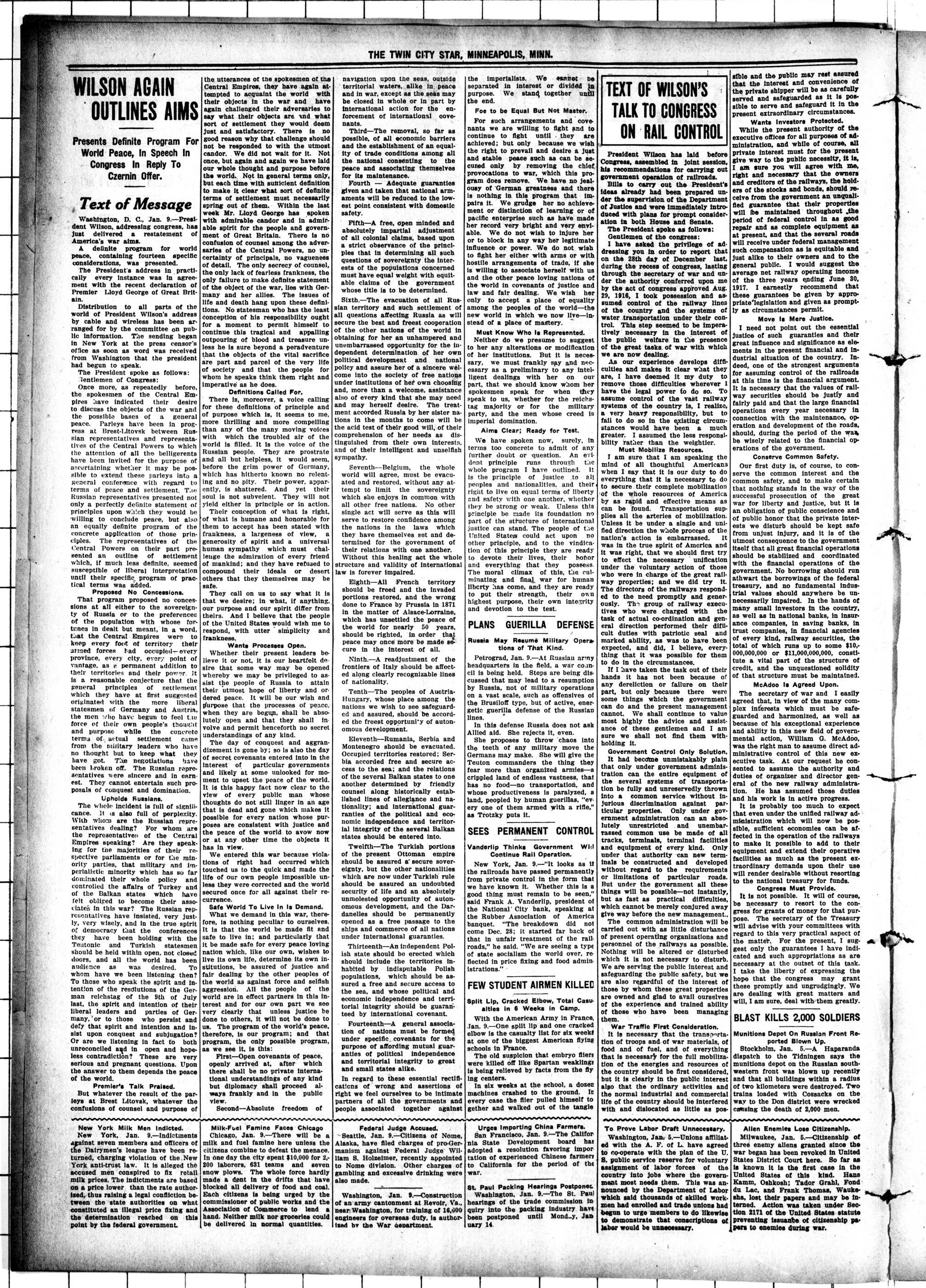
WILSON AGAIN OUTLINES AIMS
Presents Definite Program For World Peace, In Speech In Congress In Reply To Czernin Offer.
Text of Message
Washington, D. C., Jan. 9.—President Wilson, addressing congress, has just delivered a restatement of America's war alms.
A definite program for world peace, containing fourteen specific considerations, was presented.
The President's address in practically every instance was in agreement with the recent declaration of Premier Lloyd George of Great Britain.
Distribution to all parts of the world of President Wilson's address by cable and wireless has been arranged for by the committee on public information. The sending began in New York at the press censor's office as soon as word was received from Washington that the president had begun to speak.
The President spoke as follows: Gentlemen of Congress:
Once more, as repeatedly before, the spokesmen of the Central Empires have indicated their desire to discuss the objects of the war and the possible bases of a general peace. Parleys have been in progress at Brest-Litovsk between Russian representatives and representatives of the Central Powers to which the attention of all the belligerents have been invited for the purpose of ascertaining whether it may be possible to extend these parleys into a general conference with regard to terms of peace and settlement. The Russian representatives presented not only a perfectly definite statement of principles upon which they would be willing to conclude peace, but also an equally definite program of the concrete application of those principles. The representatives of the Central Powers on their part presented an outline of settlement which, if much less definite, seemed susceptible of liberal interpretation until their specific program of practical terms was added.
Proposed No Concessions.
Proposed No Concessions.
That program proposed no concessions at all either to the sovereignty of Russia or to the preferences of the population with whose fortunes in dealt but meant, in a word, that the Central Empires were to keep every foot of territory their armed forces had occupied—every province, every city, every point of vantage, as a permanent addition to their territories and their power. It is a reasonable conjecture that the general principles of settlement which they have at first suggested originated with the more liberal statesmen of Germany and Austria, the men who have begun to feel the force of their own people's thought and purpose while the concrete terms of actual settlement came from the military leaders who have no thought but to keep what they have got. The negotiations have been broken off. The Russian representatives were sincere and in earnest. They cannot entertain such proposals of conquest and domination.
Upholds Russians.
The whole incident is full of significance. It is also full of perplexity. With whom are the Russian representatives dealing? For whom are the representatives of the Central Empires speaking? Are they speaking for the majorities of their respective parliaments or for the minority parties, that military and imperialistic minority which has so far dominated their whole policy and controlled the affairs of Turkey and of the Balkan states which have felt obliged to become their associates in this war? The Russian representatives have insisted, very justly, very wisely, and in the true spirit of democracy that the conferences they have been holding with the Teutonic and Turkish statesmen should be held within open, not closed doors, and all the world has been audience as was desired. To whom have we been listening then? To those who speak the spirit and intention of the resolutions of the German reichstag of the 9th of July last, the spirit and intention of their liberal leaders and parties of Germany, or to those who persist and defy that spirit and intention and insist upon conquest and subjugation? Or are we listening in fact to both unreconciled aid in open and hopeless contradiction? These are very serious and pregnant questions. Upon the answer to them depends the peace of the world.
Premier's Talk Praised.
But whatever the result of the parleys at Brest Litovsk, whatever the confusions of counsel and purpose of
New York Milk Man Indicted
New York Milk Men Indicted.
New York, Jan. 9.—Indictments against seven members and officers of the Dairymen's league have been returned, charging violation of the New York anti-trust law. It is alleged the accused men conspired to fix retail milk prices. The indictments are based on a price lower than the rate authorised, thus raising a legal conflict between the state authorities on what constituted an illegal price fixing and the determination reached on this point by the federal government.
the utterances of the spokesmen of the Central Empires, they have again attempted to acquaint the world with their objects in the war and have again challenged their adversaries to say what their objects are and what sort of settlement they would deem just and satisfactory. There is no good reason why that challenge should not be responded to with the utmost candor. We did not wait for it. Not once, but again and again we have laid our whole thought and purpose before the world. Not in general terms only, but each time with sufficient definition to make it clear what sort of definite terms of settlement must necessarily spring out of them. Within the last week Mr. Lloyd George has spoken with admirable candor and in admirable spirit for the people and government of Great Britain. There is no confusion of counsel among the adversaries of the Central Powers, no uncertainty of principals, no vagueness of detail. The only secrecy of counsel, the only lack of fearless frankness, the only failure to make definite statement of the object of the war, lies with Germany and her allies. The issues of life and death hang upon these definitions. No statesman who has the least conception of his responsibility ought for a moment to permit himself to continue this tragical and appalling outpouring of blood and treasure unless he is sure beyond a peradventure that the objects of the vital sacrifice are part and parcel of the very life of society and that the people for whom he speaks think them right and imperative as he does.
Definitions Called For.
There is, moreover, a voice calling for these definitions of principle and of purpose which is, it seems to me, more thrilling and more compelling than any of the many moving voices with which the troubled air of the world is filled. It is the voice of the Russian people. They are prostrate and all but helpless, it would seem, before the grim power of Germany, which has hitherto known no relenting and no pity. Their power, apparently, is shattered. And yet their soul is not subvelent. They will not yield either in principle or in action. Their conception of what is right, of what is humane and honorable for them to accept has been stated with frankness, a largeness of view, a generosity of spirit and a universal human sympathy which must challenge the admiration of every friend of mankind; and they have refused to compound their ideals or desert others that they themselves may be safe.
They call on us to say what it is that we desire; in what, if anything, our purpose and our spirit differ from theirs. And I believe that the people of the United States would wish me to respond, with utter simplicity and frankness.
Wanta Processes Open.
Whether their present leaders believe it or not, it is our heartfelt desire that some way may be opened whereby we may be privileged to assist the people of Russia to attain their utmost hope of liberty and ordered peace. It will be our wish and purpose that the processes of peace, when they are begun, shall be absolutely open and that they shall involve and permit henceforth no secret understandings of any kind.
The day of conquest and aggrandizement is gone by; so is also the day of secret covenants entered into in the interest of particular governments and likely at some unlooked for moment to upset the peace of the world. It is this happy fact now clear to the view of every public man whose thoughts do not still linger in an age that is dead and gone which makes it possible for every nation whose purposes are consistent with justice and the peace of the world to avow now or at any other time the objects it has in view.
We entered this war because violations of right had occurred which touched us to the quick and made the life of our own people impossible unless they were corrected and the world secured once for all against their recurrence.
Safe World To Live In Is Demand. What we demand in this war, therefore, is nothing peculiar to ourselves. It is that the world be made fit and safe to live in; and particularly that it be made safe for every peace loving nation which, like our own, wishes to live its own life, determine its own institutions, be assured of justice and fair dealing by the other peoples of the world as against force and selfish aggression. All the people of the world are in effect partners in this interest and for our own part we see very clearly that unless justice be done to others, it will not be done to us. The program of the world's peace, therefore, is our program; and that program, the only possible program, as we see it, is this:
First—Open covenants of peace, openly arrived at, after which there shall be no private international understandings of any kind but diplomacy shall proceed always frankly and in the public view.
Second—Absolute freedom of
Milk-Fuel Famine Faces Chicago Chicago, Jan. 9.—There will be a milk and fuel famine here unless the citizens combine to defeat the menace. In one day the city spent $10,000 for 2,200 laborers, 631 teams and seven snow plows. The whole force hardly made a dent in the drifts that have blocked all delivery of food and coal. Each citizens is being urged by the commissioner of public works and the Association of Commerce to lend a hand. Neither milk nor groceries could be delivered in normal quantities.
THE TWIN CITY STAR. MINNEAPOLIS. MINN.
navigation upon the seas, outside territorial waters, alike in peace and in war, except as the seas may be closed in whole or in part by international action for the enforcement of international covenants.
Third—The removal, so far as possible, of all economic barriers and the establishment of an equality of trade conditions among all the national consenting to the peace and associating themselves for its maintenance.
Fourth — Adequate guarantees given and taken that national armaments will be reduced to the lowest point consistent with domestic safety.
Fifth—A free, open minded and absolutely impartial adjustment of all colonial claims, based upon a strict observance of the principles that in determining all such questions of sovereignty the interests of the populations concerned must have equal weight with equitable claims of the government whose title is to be determined.
Sixth.—The evacuation of all Russian territory and such settlement of all questions affecting Russia as will secure the best and freest cooperation of the other nations of the world in obtaining for her an unhampered and unembarrassed opportunity for the independent determination of her own political development and national policy and assure her of a sincere welcome into the society of free nations under institutions of her own choosing and, more than a welcome, assistance also of every kind that she may need and may herself desire. The treatment accorded Russia by her sister nations in the months to come will be the acid test of their good will, of their comprehension of her needs as distinguished from their own interests, and of their intelligent and unselfish sympathy.
Seventh—Belgium, the whole world will agree, must be evacuated and restored, without any attempt to limit the sovereignty which she enjoys in common with all other free nations. No other single act will serve as this will serve to restore confidence among the nations in the laws which they have themselves set and determined for the government of their relations with one another. Without this healing act the whole structure and validity of international law is forever impaired.
Eighth—All French territory should be freed and the invaded portions restored, and the wrong done to France by Prussia in 1871 in the matter of Alsace-Lorraine, which has unsettled the peace of the world for nearly 50 years, should be righted, in order that peace may once more be made secure in the interest of all.
Ninth.—A readjustment of the frontiers of Italy should be affected along clearly recognizable lines of nationality.
Tenth.—The peoples of Austria-Hungary, whose place among the nations we wish to see safeguarded and assured, should be accorded the freest opportunity of autonomous development.
Eleventh—Rumania, Serbia and Montenegro should be evacuated. Occupied territories restored; Serbia accorded free and secure access to the sea; and the relations of the several Balkan states to one another determined by friendly counsel along historically established lines of allegiance and nationality; and international guaranties of the political and economic independence and territorial integrity of the several Balkan states should be entered into.
Twelfth—The Turkish portions of the present Ottoman empire should be assured a secure sovereignty, but the other nationalities which are now under Turkish rule should be assured an undoubted security of life and an absolutely unmolested opportunity of autonomous development, and the Dardanelles should be permanently opened as a free passage to the ships and commerce of all nations under international guaranties.
Thirteenth—An independent Polish state should be erected which should include the territories inhabited by indisputable Polish populations, which should be assured a free and secure access to the sea, and whose political and economic independence and territorial integrity should be guaranteed by international covenant.
Fourteenth—A general association of nations must be formed under specific covenants for the purpose of affording mutual guarantees of political independence and territorial integrity to great and small states alike.
In regard to these essential rectifications of wrong and assertions of right we feel ourselves to be intimate partners of all the governments and people associated together against
Federal Judge Accused.
Seattle, Jan. 9.—Citizens of Nome, Alaska, have filed charges of pro-Germanism against Federal Judge William S. Holzelmer, recently appointed to Nome division. Other charges of gambling and excessive drinking were also made.
Washington, Jan. 9.—Construction of an army cantonment at Revoir, Va., near Washington, for training of 16,000 engineers for overseas duty, is authorized by the War department.
the imperialists. We cannot be separated in interest or divided in purpose. We stand together until the end.
Foe to be Equal But Not Master.
For such arrangements and covenants we are willing to fight and to continue to fight until they are achieved; but only because we wish the right to prevail and desire a just and stable peace such as can be secured only by removing the chief provocations to war, which this program does remove. We have no jealousy of German greatness and there is nothing in this program that impairs it. We grudge her no achievement or distinction of learning or of pacific enterprise such as have made her record very bright and very enviable. We do not wish to injure her or to block in any way her legitimate influence or power. We do not wish to fight her either with arms or with hostile arrangements of trade, if she is willing to associate herself with us and the other peace loving nations of the world in covenants of justice and law and fair dealing. We wish her only to accept a place of equality among the peoples of the world—the new world in which we now live—instead of a place of mastery.
Must Know Who Is Represented.
MUST KNOW WHO Is Represented.
Neither do we presume to suggest to her any alterations or modification of her institutions. But it is necessary, we must frankly say and necessary as a preliminary to any intelligent dealings with her on our part, that we should know whom her spokesmen speak for when they speak to us, whether for the rechstag majority or for the military party, and the men whose creed is imperial domination.
Aims Clear: Ready for Test.
We have spoken now, surely, in terms too concrete to admit of any further doubt or question. An evident principle runs through the whole program I have outlined. It is the principle of justice to all peoples and nationalities, and their right to live on equal terms of liberty and safety with one another, whether they be strong or weak. Unless this principle be made its foundation no part of the structure of international justice can stand. The people of the United States could act upon no other principle, and to the vindication of this principle they are ready to devote their lives, their honor and everything that they possess. The moral climax of this, the culminating and final war for human liberty has come, and they are ready to put their strength, their own highest purpose, their own integrity and devotion to the test.
PLANS GUERILLA DEFENSE
Russia May Reume Military Operations of That Kind.
Petrograd, Jan. 9.—At Russian army headquarters in the field, a war council is being held. Steps are being discussed that may lead to a resumption by Russia, not of military operations on a vast scale, such as offensives of the Brusiloff type, but of active, energetic guerilla defense of the Russian lines.
In this defense Russia does not ask Allied aid. She rejects it, even.
She proposes to throw chaos into the teeth of any military move the Germans may make. She will give the Teuton commanders the thing they fear more than organized armies—a crippled land of endless vastness, that has no food—no transportation, and whose productiveness is paralyzed, a land, peopled by human guerillas, "every one of them armed with a rifle," as Trotzky puts it.
SEES PERMANENT CONTROL
Vanderlip Thinks Government Will Continue Rail Operation.
New York, Jan. 9.—"It looks as if the railroads have passed permanently from private control in the form that we have known it. Whether this is a good thing must remain to be seen," said Frank A. Vanderlip, president of the National' City bank, speaking at the Rubber Association of America banquet. "The breakdown did not come Dec. 28; it started far back of that in unfair treatment of the railroads," he said. "We are seeing a type of state socialism the world over, reflected in price fixing and food administrations."
FEW STUDENT AIRMEN KILLED
Split Lip, Cracked Elbow, Total Casualties in 6 Weeks in Camp.
With the American Army in France, Jan. 9.—One split lip and one cracked elbow is the casualty list for six weeks at one of the biggest American flying schools in France.
The old suspicion that embryo fliers were killed off like Spartan weaklings is being relieved by facts from the flying centers.
In six weeks at the school, a dozen machines crashed to the ground. In every case the filer pulled himself to gether and walked out of the tangle
Urges Importing China Farmers.
San Francisco, Jan. 9.—The California State Development board has adopted a resolution favoring importation of experienced Chinese farmers to California for the period of the war.
St. Paul Packing Hearings Postponed Washington, Jan. 9.—The St. Paul hearings of the trade commission inquiry into the packing industry have been postponed until Monday, January 14.
TEXT OF WILSON'S TALK TO CONGRESS ON RAIL CONTROL
President Wilson has laid before Congress, assembled in joint session, his recommendations for carrying out government operation of railroads. Bills to carry out the President's ideas already had been prepared under the supervision of the Department of Justice and were immediately introduced with plans for prompt consideration in both House and Senate.
I have asked the privilege of addressing you in order to report that on the 28th day of December last, during the recess of congress, lasting through the secretary of war and under the authority conferred upon me by the act of congress approved Aug. 29, 1916, I took possession and assumed control of the railway lines of the country and the systems of water transportation under their control. This step seemed to be imperatively necessary in the interest of the public welfare in the presence of the great tasks of war with which we are now dealing.
As our experience develops difficulties and makes it clear what they are, I have deemed it my duty to remove those difficulties wherever I have the legal power to do so. To assume control of the vast railway systems of the country is, I realize, a very heavy responsibility, but to fail to do so in the existing circumstances would have been a much greater. I assumed the less responsibility rather than the weightier.
I am sure that I am speaking the mind of all thoughtful Americans when I say that it is our duty to do everything that it is necessary to do to secure their complete mobilization of the whole resources of America by as rapid and effective means as can be found. Transportation supplies all the arteries of mobilization. Unless it be under a single and unified direction the whole process of the nation's action is embarrassed. It was in the true spirit of America and it was right, that we should first try to effect the necessary unification under the voluntary action of those who were in charge of the great railway properties; and we did try it. The directors of the railways responded to the need promptly and generously. The group of railway executives who were charged with the task of actual co-ordination and general direction performed their difficult duties with patriotic zeal and marked ability, as was to have been expected, and did, I believe, everything that it was possible for them to do in the circumstances.
If I have taken the task out of their hands it has not been because of any dereliction or failure on their part, but only because there were some things which the government can do and the present management cannot. We shall continue to value most highly the advice and assistance of these gentlemen and I am sure we shall not find them withholding it.
Government Control Only Solution. It had become unmistakably plain that only under government administration can the entire equipment of the several systems of transportation be fully and unreservedly thrown into a common service without injurious discrimination against particular properties. Only under government administration can an absolutely unrestricted and unembarrassed common use be made of all tracks, terminals, terminal facilities and equipment of every kind. Only under that authority can new terminals be constructed and developed without regard to the requirements or limitations of particular roads. But under the government all these things will be possible—not instantly, but as fast as practical difficulties, which cannot be merely conjured away give way before the new management.
The common administration will be carried out with as little disturbance of present operating organizations and personnel of the railways as possible. Nothing will be altered or disturbed which it is not necessary to disturb. We are serving the public interest and safeguarding the public safety, but we are also regardful of the interest of those by whom these great properties are owned and glad to avail ourselves of the experience and trained ability of those who have been managing them.
War Traffic First Consideration.
Washington, Jan. 5.—Unions affiliated with the A. F. of L. have agreed to co-operate with the plan of the U. S. public service reserve for voluntary assignment of labor forces of the country into jobs where the government most needs them. This was announced by the Department of Labor which said thousands of skilled workmen had enrolled and trade unions had begun to urge members to do likewise to demonstrate that conscriptions of labor would be unnecessary.
sible and the public may rest assured that the interest and convenience of the private shipper will be as carefully served and safeguarded as it is possible to serve and safeguard it in the present extraordinary circumstances.
Wants Investors Protected.
While the present authority of the executive offices for all purposes of administration, and while of course, all private interest must for the present give way to the public necessity, it is, I am sure you will agree with me, right and necessary that the owners and creditors of the railways, the holders of the stocks and bonds, should receive from the government an unqualified guarantee that their properties will be maintained throughout the period of federal control in as good repair and as complete equipment as at present, and that the several roads will receive under federal management such compensation as is equitable and just alike to their owners and to the general public. I would suggest the average net railway operating income of the three years ending June 30, 1917. I earnestly recommend that these guarantees be given by appropriate legislation and given as promptly as circumstances permit.
I need not point out the essential justice of such guaranties and their great influence and significance as elements in the present financial and industrial situation of the country. Indeed, one of the strongest arguments for assuming control of the railroads at this time is the financial argument. It is necessary that the values of railway securities should be justly and fairly paid and that the large financial operations every year necessary in connection with the maintenance, operation and development of the roads, should, during the period of the war, be wisely related to the financial operations of the government.
Conserve Common Safety.
Our first duty is, of course, to conserve the common interest and the common safety, and to make certain that nothing stands in the way of the successful prosecution of the great war for liberty and justice, but it is an obligation of public conscience and of public honor that the private interests we disturb should be kept safe from unjust injury, and it is of the utmost consequence to the government itself that all great financial operations should be stabilized and coordinated with the financial operations of the government. No borrowing should run athwart the borrowings of the federal treasury, and no fundamental industrial values should anywhere be unnecessarily impaired. In the hands of many small investors in the country, as well as in national banks, in insurance companies, in saving banks, in trust companies, in financial agencies of every kind, railway securities, the total of which runs up to some $10,000,000 or $11,000,000, constitute a vital part of the structure of credit, and the unquestioned solidity of that structure must be maintained.
McAdoo Is Agreed Upon.
The secretary of war and I easily agreed that, in view of the many complex interests which must be safeguarded and harmonized, as well as because of his exceptional experience and ability in this new field of governmental action, William G. McAdoo, was the right man to assume direct administrative control of this new executive task. At our request he consented to assume the authority and duties of organizer and director general of the new railway administration. He has assumed those duties and his work is in active progress.
It is probably too much to expect that even under the unified railway administration which will now be possible, sufficient economies can be affected in the operation of the railways to make it possible to add to their equipment and extend their operative facilities as much as the present extraordinary demands upon their use will render desirable without resorting to the national treasury for funds.
Congress Must Provide.
Congress Must Provide
It is not possible. It will of course, be necessary to resort to the congress for grants of money for that purpose. The secretary of the Treasury will advise with your committees with regard to this very practical aspect of the matter. For the present, I suggest only the guarantees I have indicated and such appropriations as are necessary at the outset of this task. I take the liberty of expressing the hope that the congress may grant these promptly and ungrudgingly. We are dealing with great matters and, I am sure, deal with them greatly.
BLAST KILLS 2,000 SOLDIERS
Munitions Depot On Russian Front Reported Blown Up. Stockholm, Jan. 5.—A Haparanda dispatch to the Tidningen says the munitions depot on the Russian southwestern front was blown up recently and that all buildings within a radius of two kilometers were destroyed. Two trains loaded with Cossacks on the way to the Don district were wrecked causing the death of 2,000 men.
Allen Enemies Use Citizenship.
Milwaukee, Jan. 5.-Citizenship of three enemy allens granted since the war began has been revoked in United States District Court here. So far as is known it is the first case in the United States of this kind. Hans Kamm, Oskoshk; Tador Grahl, Fond du Lac, and Frank Thomas, Waukesha, lost their papers and may be interned. Action was taken under Section 2171 of the United States statute preventing issuance of citizenship papers to enemies during war.
bombing machines, reconnaissance machines and battleplanes, each a specialized type designed for a specific duty. Then, in a class by themselves, there are the hydroplanes, writes Arthur Benington in the New York World.
Battleplanes, which combine the duties of light cavalry and machine-gun squads, are the swallows, the thoroughbreds, the terriers, the wasps, of the air.
"You might as well ask me what kind of horse I consider the finest," replied an Italian aviator when asked for his opinion on the finest airplane. "It all depends upon what service you want your plane for. For dropping bombs on cities there is nothing like our own Capronl; the finest climbers I personally have encountered were German machines; the swiftest flyer up to date is the Italian S. V. A.; and I think the Austrians have the most reliable hydroplanes."
IMPROVED UNIFORM INTERNATIONAL SUNDAY SCHOOL LESSON
(By E. O. SELLERS, Acting Director of the Sunday School Course of the Moody Bible Institute, Chicago.)
(Copyright 1917. Western Newman Union.)
LESSON FOR JANUARY 13
JESUS BEGINS HIS WORK.
LESSON TEXT-Mark 1:12-22
GOLDEN TEXT—Repent ye, and believe in the Gospel.
ADDITIONAL MATERIAL FOR TEACHERS--Matt. 4:11-11; 8:16-22; Luke 4:1-12; 9:57-62; Heb. 4:14-16; Acts 9:1-9; John 6:26-38.
PRIMARY TOPIC—Jesus chooses four helpers.
MEMORY VERSE—Come ye after me.—Mark 1:17.
INTERMEDIATE TOPIC — Overcome temptation.
MEMORY VERSE-I Cor. 15:13.
SENIOR AND ADULT TOPIC—How Jesus faced his task.
1. Introduction (vv. 12, 13). Mark devotes little or no attention to the early incidents of the life of Jesus, and only suggests the events immediately following his baptism. Indeed, for the record of the Temptation and the Sermon on the Mount, we have to look to the other Gospel writers. In teaching the lesson we must not, however, overlook making some reference to these two outstanding events in the life of our Lord.
II. John the Baptist (v. 14, 15). This section not only disposes of John as having been put into prison, but immediately plunges Jesus into his public ministry. Jesus' entry into Galilee was a part of his connection with John, inasmuch as he withdrew himself to that place (See John 4:1:3), and made Capernaum his headquarters (Matt. 4:13). The message here recorded as proclaimed by Jesus was the identical summons which John the Baptizer had uttered. Jesus speaks of this new kingdom as being already come, referring, of course, to his own person and ministry, but in its actual establishment it was not really "at hand" until he shed his blood upon the cross and the Holy Spirit descended on the day of Pentecost, when there was opened the fountain for sin and uncleanliness for the world at large.
III. His Helpers Called. (vv. 16-29).
In this record, we have the call of four of his helpers: Simon, Andrew his brother, James and John his brother, the latter being the sons of Zebedee. Luke tells us (5:3) that Jesus was teaching. Those called were certainly at work and God always issues his call to those whose time and effort are being occupied, even though perhaps for selfish purposes. There is no place for an idler in the spiritual kingdom. This call was to "come ye after me" (v. 17), the purpose being that they might become "fishers of men." Notice he began upon the common, familiar ground of fishing, something mutually and thoroughly understood, and led them from that to a spiritual truth. In this we see a good pedagogical hint and a wise suggestion to the preacher and teacher, viz., that we must begin to teach our lessons through the medium of past experience and of present interests. Simon (Luke 5:5) appears to have been a double when Jesus called him. Nevertheless, he was willing to try Christ at least once, and so at his word, he let down the net. The evidence of obedience is found in verse 19, and Matthew (4:8) also Luke (5:11) tells us that when they left their nets, "they left all."
IV. His Helpers Trained (vv. 21, 22). The result of this call was (see v. 21) that as they went into the city they entered into the synagogue where Jesus taught them. The inference, of course, is plain. Whenever God calls a man into his kingdom, he begins at once to teach him the duties and responsibilities of the kingdom. Notice that in becoming fishers of men, then began close at home. Brother sought brother. This was not the first time that Jesus had called these brothers. (See John 1:40, 41). In the call, as accorded by St. John, we are led to believe that John (the unmentioned disciple) first sought an interview with Christ. The question of harmonizing the various calls which Jesus gave to his disciples is an interesting one and one which has given rise to a good deal of discussion. The one recorded in the first chapter of John occurred in Judea; this one occurred in Galilee. As to whether this is the one recorded in the fifth chapter of Luke, there seems to be a general opinion that it is not the same, though we can with profit compare the two callings in teaching this lesson. The probabilities are that there were three calls: First, the one recorded in John 1:35:42; second, that one recorded in Matthew 4:18:22; and the third and last was that which occurred just before their appointment to become apostles, the one recorded in Luke five.
Conclusion. When Jesus faced his great task, he did not face it alone. He had first of all the approval of God the Father. He also had the announcing of God the Holy Spirit, and he called in the co-operation and help of human agents. Jesus met his temptation and his tasks not in his own strength, but in the strength of the Spirit of God. At the same time being God, he called to his side those who in turn were to become fishers of men, leaders of others. His call to these disciples was three-fold; (a), to discipleship, (b), to fellowship (Phill. 8:10); and (c), to service.
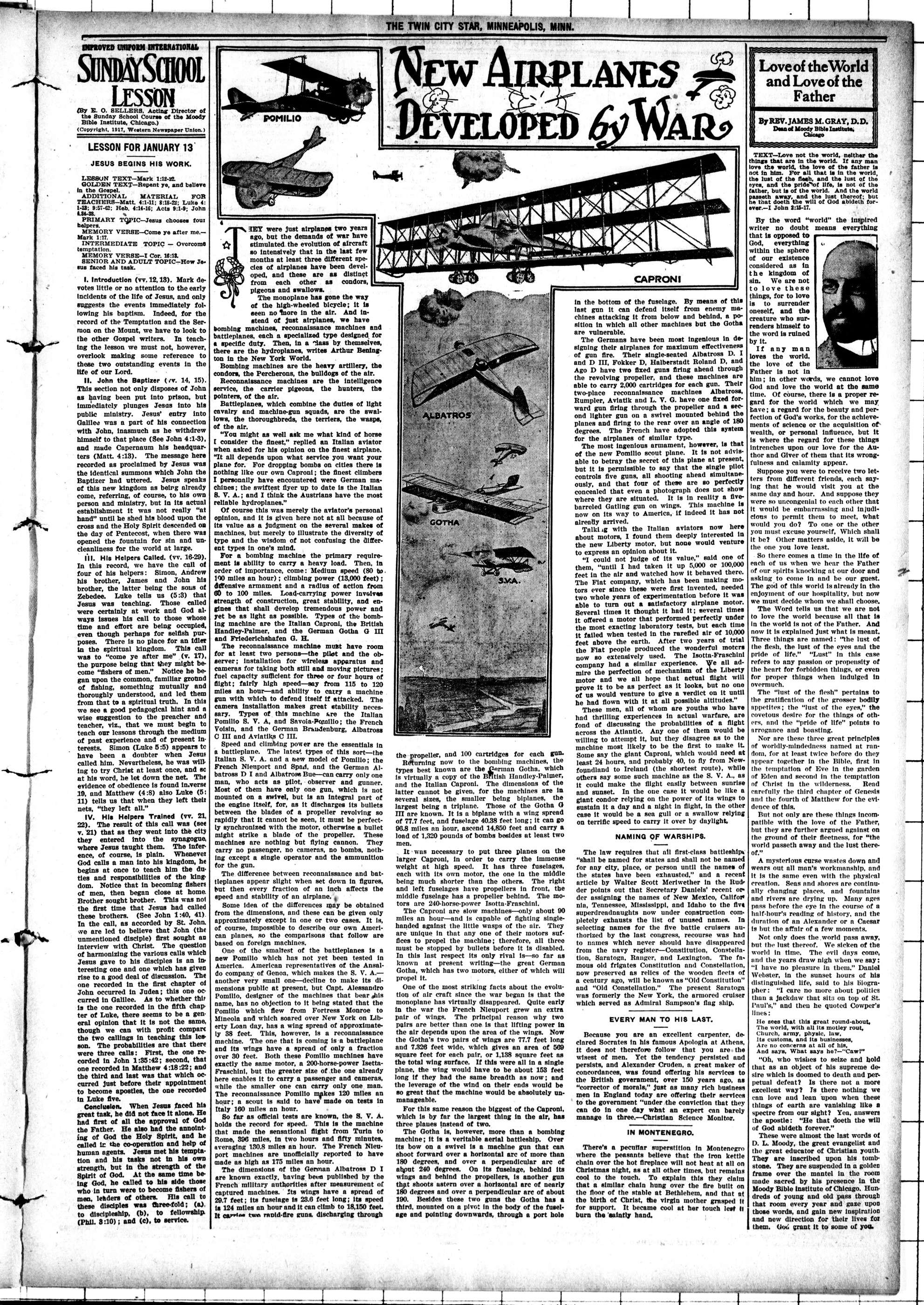
POMILIO
HEY were just airplanes two years ago, but the demands of war have stimulated the evolution of aircraft so intensively that in the last few months at least three different species of airplanes have been developed, and these are as distinct from each other as condors, pigeons and swallows.
T
The monoplane has gone the way of the high-wheeled bicycle; it is seen no more in the air. And instead of just airplanes, we have
Bombing machines are the heavy artillery, the condors, the Percherons, the bulldogs of the air. Reconnaissance machines are the intelligence service, the carrier pigeons, the hunters, the pointers, of the air.
Of course this was merely the aviator's personal opinion, and it is given here not at all because of its value as a judgment on the several makes of machines, but merely to illustrate the diversity of type and the wisdom of not confusing the different types in one's mind.
For a bombing machine the primary requirement is ability to carry a heavy load. Then, in order of importance, come: Medium speed (80 to 100 miles an hour); climbing power (13,000 feet); defensive armament and a radius of action from 60 to 100 miles. Load-carrying power involves strength of construction, great stability, and engines that shall develop tremendous power and yet be as light as possible. Types of the bombing machine are the Italian Caproni, the British Handley-Palmer, and the German Gotha G III and Friederichshafen G. H.
The reconnaissance machine must have room for at least two persons—the pilot and the observer; installation for wireless apparatus and cameras for taking both still and moving pictures; fuel capacity sufficient for three or four hours of flight; fairly high speed—say from 115 to 120 miles an hour—and ability to carry a machine gun with which to defend itself if attacked. The camera installation makes great stability necessary. Types of this machine are the Italian Pomilio S. V. A. and Savolia-Pomilio; the French Voisin, and the German Brandenburg, Albatross C III and Aviatiks C III.
Speed and climbing power are the essentials in a battleplane. The latest types of this sort—the Italian S. V. A. and a new model of Pomillo; the French Nieuport and Spad, and the German Albatross D I and Albatross Bue—can carry only one man, who acts as pilot, observer and gunner. Most of them have only one gun, which is not mounted on a swivel, but is an integral part of the engine itself, for, as it discharges its bullets between the blades of a propeller revolving so rapidly that it cannot be seen, it must be perfectly synchronized with the motor, otherwise a bullet might strike a blade of the propeller. These machines are nothing but flying cannon. They carry no passenger, no cameras, no bombs, nothing except a single operator and the ammunition for the gun.
The difference between reconnaissance and battleplanes appear slight when set down in figures, but then every fraction of an inch affects the speed and stability of an airplane.
Some idea of the differences may be obtained from the dimensions, and these can be given only approximately except in one or two cases. It is, of course, impossible to describe our own American planes, so the comparisons that follow are based on foreign machines.
One of the smallest of the battleplanes is a new Pomilio which has not yet been tested in America. American representatives of the Ansaldo company of Genoa, which makes the S. V. A.—another very small one—decline to make its dimensions public at present, but Capt. Alessandro Pomilio, designer of the machines that bear his name, has no objection to it being stated that the Pomilio which flew from Fortress Monroe to Mineola and which soared over New York on Liberty Loan day, has a wing spread of approximately 38 feet. This, however, is a reconnaissance machine. The one that is coming is a battleplane and its wings have a spread of only a fraction over 30 feet. Both these Pomilio machines have exactly the same motor, a 200-horse-power Issetthi Fraschini, but the greater size of the one already here enables it to carry a passenger and cameras, while the smaller one can carry only one man. The reconnaissance Pomilio makes 120 miles an hour; a scout is said to have made on tests in Italy 160 miles an hour.
So far as official tests are known, the S. V. A. holds the record for speed. This is the machine that made the sensational flight from Turin to Rome, 396 miles, in two hours and fifty minutes, averaging 130.8 miles an hour. The French Nieuport machines are unofficially reported to have made as high as 175 miles an hour.
The dimensions of the German Albatross D I are known exactly, having been published by the French military authorities after measurement of captured machines. Its wings have a spread of 29.7 feet; its fuselage is 23.6 feet long; its speed is 124 miles an hour and it can climb to 18,150 feet. It carries two rapid-fire guns, discharging through
NEW AIRPLANES DEVELOPED BY WAR
CAPRONI
ALBATROS
GOTHA
S.V.A.
the propeller, and 100 cartridges for each gun. Returning now to the bombing machines, the types best known are the German Gotha, which is virtually a copy of the British Handley-Palmer, and the Italian Capronl. The dimensions of the latter cannot be given, for the machines are in several sizes, the smaller being biplanes, the largest being a triplane. Those of the Gotha G III are known. It is a biplane with a wing spread of 77.7 feet, and fuselage 40.38 feet long; it can go 90.8 miles an hour, ascend 14,850 feet and carry a load of 1,320 pounds of bombs besides at least two men.
It was necessary to put three planes on the larger Capronl, in order to carry the immense weight at high speed. It has three fuselages, each with its own motor, the one in the middle being much shorter than the others. The right and left fuselages have propellers in front, the middle fuselage has a propeller behind. The motors are 240-horse-power Isotta-Fraschini.
The Caproni are slow machines—only about 90 miles an hour—and is capable of fighting single-handed against the little wasps of the air. They are unique in that any one of their motors suffices to propel the machine; therefore, all three must be stopped by bullets before it is disabled. In this last respect its only rival is—so far as known at present writing—the great German Gotha, which has two motors, either of which will propel it.
One of the most striking facts about the evolution of air craft since the war began is that the monoplane has virtually disappeared. Quite early in the war the French Nieuport grew an extra pair of wings. The principal reason why two pairs are better than one is that lifting power in the air depends upon the area of the wings. Now the Gotha's two pairs of wings are 77.7 feet long and 7,326 feet wide, which gives an area of 569 square feet for each pair, or 1,138 square feet as the total wing surface. If this were all in a single plane, the wing would have to be about 153 feet long if they had the same breadth as now; and the leverage of the wind on their ends would be so great that the machine would be absolutely unmanageable.
For this same reason the biggest of the Caproni, which is by far the largest thing in the air, has three planes instead of two.
The Gotha is, however, more than a bombing machine; it is a veritable aerial battleship. Over its bow on a swivel is a machine gun that can shoot forward over a horizontal arc of more than 180 degrees, and over a perpendicular arc of about 240 degrees. On its fuselage, behind its wings and behind the propellers, is another gun that shoots astern over a horizontal arc of nearly 180 degrees and over a perpendicular arc of about 190. Besides these two guns the Gotha has a third, mounted on a plovt in the body of the fuselage and pointing downwards, through a port hole
In the bottom of the fuselage. By means of this last gun it can defend itself from enemy machines attacking it from below and behind, a position in which all other machines but the Gotha are vulnerable.
The Germans have been most ingenious in designing their airplanes for maximum effectiveness of gun fire. Their single-seated Albatross D. I and D III, Fokker D, Halberstadt Roland D, and Ago D have two fixed guns firing ahead through the revolving propeller, and these machines are able to carry 2,000 cartridges for each gun. Their two-place reconnaissance machines Albatross, Rumpler, Aviatik and L. V. G. have one fixed forward gun firing through the propeller and a second lighter gun on a swivel mounted behind the planes and firing to the rear over an angle of 180 degrees. The French have adopted this system for the airplanes of similar type.
The most ingenious armament, however, is that of the new Pomilio scout plane. It is not advisable to betray the secret of this plane at present, but it is permissible to say that the single pilot controls five guns, all shooting ahead simultaneously, and that four of these are so perfectly concealed that even a photograph does not show where they are situated. It is in reality a five-barreled Gatling gun on wings. This machine is now on its way to America, if indeed it has not already arrived.
Talking with the Italian aviators now here about motors, I found them deeply interested in the new Liberty motor, but none would venture to express an opinion about it.
"I could not judge of its value," said one of them, "until I had taken it up 5,000 or 100,000 feet in the air and watched how it behaved there. The Flat company, which has been making motors ever since these were first invented, needed two whole years of experimentation before it was able to turn out a satisfactory airplane motor. Several times it thought it had it; several times it offered a motor that performed perfectly under the most exacting laboratory tests, but each time it failed when tested in the rarefied air of 10,000 feet above the earth. After two years of trial the Flat people produced the wonderful motors now so extensively used. The Isotta-Fraschini company had a similar experience. We all admire the perfection of mechanism of the Liberty motor and we all hope that actual flight will prove it to be as perfect as it looks, but no one of us would venture to give a verdict on it until he had flown with it at all possible altitudes."
These men, all of whom are youths who have had thrilling experiences in actual warfare, are fond of discussing the probabilities of a flight across the Atlantic. Any one of them would be willing to attempt it, but they disagree as to the machine most likely to be the first to make it. Some say the giant Caproni, which would need at least 24 hours, and probably 40, to fly from Newfoundland to Ireland (the shortest route), while others say some such machine as the S. V. A., as it could make the flight easily between sunrise and sunset. In the one case it would be like a giant condor relying on the power of its wings to sustain it a day and a night in flight, in the other case it would be a sea gull or a swallow relying on terrific speed to carry it over by daylight.
NAMING OF WARSHIPS.
The law requires that all first-class battleships "shall be named for states and shall not be named for any city, place, or person until the names of the states have been exhausted," and a recent article by Walter Scott Merlwether in the Ruder points out that Secretary Daniels' recent order assigning the names of New Mexico, California, Tennessee, Mississippi, and Idaho to the five superdreadnaughts now under construction completely exhausts the list of unused names. In selecting names for the five battle cruisers authorized by the last congress, recourse was had to names which never should have disappeared from the navy register—Constitution, Constellation, Saratoga, Ranger, and Lexington. The famous old frigates Constitution and Constellation, now preserved as relics of the wooden fleets of a century ago, will be known as "Old Constitution" and "Old Constellation." The present Saratoga was formerly the New York, the armored cruiser which served as Admiral Sampson's flag ship.
EVERY MAN TO HIS LAST.
Because you are an excellent carpenter, declared Socrates in his famous Apologia at Athens, it does not therefore follow that you are the wisest of men. Yet the tendency persisted and persists, and Alexander Cruden, a great maker of concordances, was found offering his services to the British government, over 150 years ago, as "corrector of morals," just as many rich business men in England today are offering their services to the government "under the conviction that they can do in one day what an expert can barely manage in three."Christian Science Monitor.
IN MONTENEGRO.
There's a peculiar superstition in Montenegro where the peasants believe that the iron kettle chain over the hot fireplace will not heat at all on Christmas night, as at all other times, but remains cool to the touch. To explain this they claim that a similar chain hung over the fire built on the floor of the stable at Bethlehem, and that at the birth of Christ, the virgin mother grasped it for support. It became cool at her touch less it burn the salty hand.
By REV. JAMES M. GRAY, D.D.
Dean of Moody Bible Institute,
Chicago
TEXT—Love not the world, neither the things that are in the world. If any man loves the world, the love of the father is not in him. World peace is in the world, the lust of the flash, and the lust of the eyes, and the pride"of life, is not of the father, but is of the world. And the world passeth away, and the lust thereof; but he that doeth the will of God abdideth forever.—I John 2:15-17.
By the word "world" the inspired writer no doubt means everything
writer no doubt that is opposed to God, everything within the sphere of our existence considered as in the kingdom of sin. We are not to love these things, for to love is to surrender oneself, and the creature who surrenders himself to the word is ruined by it.
C
If any man loves the world, the love of the Father is not in him; in other words, we cannot love God and love the world at the same time. Of course, there is a proper regard for the world which we may have; a regard for the beauty and perfection of God's works, for the achievements of science or the acquisition of wealth, or personal influence, but it is where the regard for these things intrenches upon our love for the Author and Giver of them that its wrongfulness and calamity appear.
Suppose you were to receive two letters from different friends, each saying that he would visit you at the same day and hour. And suppose they were so uncongenial to each other that it would be embarrassing and injudicious to permit them to meet, what would you do? To one or the other you must excuse yourself. Which shall it be? Other matters aside, it will be the one you love least.
So there comes a time in the life of each of us when we hear the Father of our spirits knocking at our door and asking to come in and be our guest. The god of this world is already in the enjoyment of our hospitality, but now we must decide whom we shall choose.
The Word tells us that we are not to love the world because all that is in the world is not of the Father. And now it is explained just what is meant. Three things are named: "the lust of the flesh, the lust of the eyes and the pride of life." "Lust" in this case refers to any passion or propensity of the heart for forbidden things, or even for proper things when indulged in overmuch.
The "lust of the flesh" pertains to the gratification of the grosser bodily appetites; the "lust of the eyes," the covetous desire for the things of others, and the "pride of life" points to arrogance and boasting.
Nor are these three great principles of worldly-mindedness named at random, for at least twice before do they appear together in the Bible, first in the temptation of Eve in the garden of Eden and second in the temptation of Christ in the wilderness. Read carefully the third chapter of Genesis and the fourth of Matthew for the evidence of this.
But not only are these things incompatible with the love of the Father, but they are further argued against on the ground of their fleetness, for "the world passeth away and the lust thereof."
A mysterious curse wastes down and wears out all man's workmanship, and it is the same even with the physical creation. Seas and shores are continually changing places, and fountains and rivers are drying up. Many ages pass before the eye in the course of a half-hour's reading of history, and the duration of an Alexander or a Caesar is but the affair of a few moments.
Not only does the pass away, but the lust thereof. We slicken of the world in time. The evil days come, and the years draw nigh when we say: "I have no pleasure in them." Daniel Webster, in the sunset hours of his distinguished life, said to his biographer: "I care no more about politics than a jackdaw that sits on top of St Paul's," and then he quoted Cowper's lines:
He sees that this great round-about, the world, with all its motley rout, Church, army, physic, law, its customs, and its businesses, Are no concerns at all of his, And says, What says he?-"Caw!" "Oh, who wisies to seize and hold that as an object of his supreme desire which is doomed to death and perpetual defeat? Is there not a more excellent way? Is there nothing we can love and lean upon when these things of earth are vanishing like a spectre from our sight? Yea, answers the apostle: "He that doeth the will of God abideth forever."
These were almost the last words of D. L. Moody, the great evangelist and the great educator of Christian youth. They are inscribed upon his tombstone. They are suspended in a golden frame over the mantel in the room made sacred by his presence in the Moody Bible Institute of Chicago. Hundreds of young and old pass through that room every year and gaze upon those words, and gain new inspiration and new direction for their lives for them. God grant it to some of you.
PUBLSHED EVERY FRIDAY BY
CHAELES SUMNER SMITH,
Minneapolis, Minnesota.
Entered in the Post Office at Minneapolis as second class matter.
MEMBER
NATIONAL NEGRO PRESS
ASSOCIATION
Subscription by Mail, Postpaid.
ONE YEAR .....$2.00
SIX MONTHS .....$125
THREE MONTHS ......65
Hamlet B. Rowe, Local Agent.
ADVERTISING RATES.
One Inch—1 Insertion—One Dollar.
Liberal discount given on 3, 6, 9,
Months, or 1 year contracts.
We do not run free ads, or over-run
the time contracted for by our ad-
vertisers We respect their right to
advertise at intervals, and rather have
them do so, than to run continuously
an "adv." and an increasing account.
Write all Checks payable to
THE TWIN CITY STAR
1317 North Sixth Ave.
MINNEAPOLIS - MINNESOTA
Call at 1317 6th Ave. N. on Wednesday
to insure matter for publication.
The Star's Phone, Hyland 1205.
OUR PROSPECTUS
The Star is the oldest Negro newspaper in Minneapolis. It was not published to put another Negro paper out of business, but because its present owner and editor, Chas, Sumner Smith, knew that it was a "long felt want" and thought it a good business proposition. The Star is doing as well as it has done since its advent, and its management has profited by past performances. We are here to deliver the goods in 1918 or go down with the old worn alibi, "because of the war." From the outlook, we are better off than ever; and with the encouragement given us by those who stand for the advancement of our race, we begin our new year under brilliant prospects. A Happy New Year to our readers.
Atty. W. R. Morris is a member of the Hennepin County Safety Commission, and The Star respectfully requests him to use his influence to prevent the showing of "The Birth of a Nation." He represents our race in that body and we want results.
There has been some action taken in the matter of the appointment of a policewoman and it is encouraging to believe that a fair conclusion may be reached. The Star presented the facts and it is up to the community leaders to settle the question.
Courtesies And Discourtesies
The St. Louis Argus published an extract from our editorial "The Houston Hanging" as a headliner and gave us credit—Thanks! The Seattle Searchlight has used The Twin City Star as one of its editorial contributors, and absolutely refuses to acknowledge it. There is a difference between the ethics of The Argus and the habits of The Search Light.
The management of the St. Paul Patriotic Entertainment finally accepted our advice, even if under severe chastisement. They donated the proceeds to the American Red Cross and arranged for talent from our race from the program. They could not very well eliminate the officeseekers. The dance was the big success and hereafter they will put some brains in their business and draw a bigger crowd by giving a Patriotic Dance, without any political subterfuges.
During this zero, weather, we are reasonably jealous of our friends, who are enjoying the California and Florida climates.
REMEMBER THE NEEDY.
Every effort to relieve those who are sick and in distress, is the duty of all at this time. There is much suffering about us and true charity begins at home, without the usual noise and notoriety.
In every Negro home there should be a Negro newspaper, especially the local paper. Your interests are local and your support of a local paper will enable it to better represent and protect your interest in the community. Papers of national circulation and "home town" papers are very interesting, but do your part to make your local paper a worthy representative of the race.
SIEBERLICH IS O. K.
Several charges have been filed for the removal of Mr. R. T. Seiberlich of the eighth ward draft board, and the case is being heard at the state capital. According to all reports Mr. Sieberlich was very considerate in all his dealings with the Negro conscripts and the fact that Mr. Wirt Wilson of the same board approves his actions is sufficient that he is O. K. Those who are fair to Negroes are generally considerate and fair-minded to all men. Both Mr. Wilson and Mr. Seiberlich are working hard and getting results—walth is a worthy record.
THE NEW YEAR
The colored American has every reason to take courage. The past year may have taken something away but it gave more than it took.
From the Twenty-fourth infantry we have lost three score of the best soldiers in the world, who, up to the bear-baiting of Houston, had an enviable record for discipline and soldierly courtesy.—But we have gained the unprecedented total of 700 colored commissioned officers in the United States army and have an equal status for service in the ranks.
We have heard the greatest Court of the land, by an obiter dictum, re-affirm its approval of ordinary "Jim-Crowism."—But the same court at the same time wiped out the very worst form of "Jim Crow" in the segregation ordinance, and removed from us the threat of an American Ghetto.
We had East St. Louis, a supremely savage effort to beat us back industrially.—But far from being beaten back, we have broken down the industrial wall that hemmed us in the Southeast, and have sent our hardy cohorts to every industrial center of the greatest industrial nation.
We have Chester in Pennsylvania, and Memphis in Tennessee. O, yes, Memphis with all the savage instincts that still infest its purleus.—But we also have Detroit in Michigan and we still have and have still better the Harlem in New York City—THE Harlem!
We have to pay more for our butter and eggs—but we have more to pay with. What boots it to the colored man if eggs be a dime a dozen and his wages so low and his chances to work so slim that he cannot spare the ten cents? It were far better for him that eggs should: ill at fifty cents a dozen, if he can earn from three to five dollars a day.
We are still stalked by the shadow of government-departmental segregation. But in substance we are represented in every department of government service, and have a high civil officer in the war department.
As a racial element in the world war we have earned the hate of Germany. But we have deepened the love of France. And one of the acknowledged assets of America is our loyalty and magnanimity.
Like all the gentle folk of the world we stand horrified and aghast at this World War and world murder.—But the colored American has gained, in both material and immaterial goods, and will gain proportionately more from this world conflict perhaps, than any other single element in the world.
WM. PICKENS.
Morgan College, Baltimore, Md.
Jan. 1, 1918.
SECY. SKINNER APPEALS FOR SUPPORT FOR N. A. A. C. P.
I would remind those persons who took out memberships in the Minneapolis Branch of the National Association for the Advancement of Colored People for the year ending December, 1917, to come prepared to renew their membership at the next regular meeting and bring an additional member and so make our branch one of the largest in the west.
Remember it is a duty you owe to yourself and every member of the race to become associated with the one Negro organization that selzes hold of the problems that confront us and reduces them to a happy solution. I desire that our membership at the end of the ensuing year be increased to 500 and I therefore appeal to every person, regardless of sex, whose love for his race, for equality and justice, transcend every other consideration and align himself and herself with this very worthy organization. Membership fee for one year, $1.00. If your duties prevent your being present at any of the meetings, mail the amount and a receipt will be promptly sent to you. Do not put it off, join the Minneapolis Branch of the National Association for the Advancement of Colored People.
THE OFFICIAL ORGAN.
The Twin City Star is the official organ for publishing all of the activities of the Minneapolis Branch of the National Association for the Advancement of Colored People. Individual notices of time and place of meetings will be discontinued and members are therefore asked to watch the Star. R. Augustine Skinner, Secretary, 2817 Chicago Ave., Minneapolis.
THE ELKS' BULLETIN
A New Negro Publication.
The Elks' Bulletin reached us last week. It is published monthly by the numbers of Pocahontess Lodge 129, I. B. P. E. of W. at Boston, Mass. It is a creditable periodical from every angle, full of news; and although a local publication it bids fair to be national in news of Elkdom within a few years. Bro. Dan Ware sent us this copy, which is dedicated to the general advancement of Elkdom. It is edited by Franklin H. Wright, 40 Agee St. Cambridge, Mass. The Elks' Bulletin has made a successful sent and has our best wishes. Keep it going, Dan! Either "move up or move out."
ADVERTISE IN THE STAR
---
THE TWIN CITY STAR, MINNEAPOLIS, MINN.
N. A. A. C. P.
The regular monthly meeting of the N. A. A. C. P. will be held on Sunday, January 13th, at St. Peter A. M. E. church, at 3:30 p. m. It is to be hoped that all members and friends will be present at this meeting as very important matters are to be discussed and a definite plan of campaign laid out, so that every Negro in our city can learn and become interested in this great organization and feel it a duty to assist in furthering its alms and purposes by becoming a member.
AN APPEAL FOR MEMBERSHIPS
We have read, with sincere satisfaction, the wonderful achievements of the N. A. A. C. P, for the past year, notwithstanding conditions as they exist in our midst in the hideous forms of oppression, prejudice, segregation, lynchings, etc. Every battle won is not a victory for certain individuals, but for the race, and the question arises: Why should the vast majority of our men and women be so eager to share in the spoils, but are unwilling to help in the chase? We loudly acclaim, murrah, we have secured another victory, but we are unmindful of the fact that we in a large measure, have not even morally helped to secure it. The N. A. A. C. P is the only tangible organization in the field today which is fighting consistently, tenaciously and efficiently those wrongs perpetrated upon a helpless race and securing the right guaranteed under our constitution. The war has brought about a revolution that the Negro can scarcely fall to appreciate, which will and must ultimately react to our betterment and the time for us to unite our forces into one solid phalanx is now, which will find us at the end of this war not as suppliants, begging for a crumb; but as men and women demanding that which we have justly merited. Our forefathers sacrificed their lives that we, today, might live without the yoke of slavery hanging about us. The victory is not complete. We have yet to carry on the fight so that our children can enjoy and live in perfect security and peace. The N. A. A. C. P, appeals to every member of the race to be loyal. Not to be a slacker, but merge our forces into one financially and morally, so as to secure our rights. Will you still put off your admission into the organization? Will you delay? "Procrastination is the tief of time." There are men and women of force, of character, of high intelligence who are willing and are prepared to champion the cause, but membership and funds are necessary. Will you not do your bit? The N. A. A. C. P, asks for no requirements, no searching examinations into your history, past, present or future. To be a Negro is the only credential necessary. Attend our meetings! Ask questions! Be informed and I am confident you will have regretted not becoming a member before this time. Membership $1.00 a year. We desire to have at the end of the present year not less than 200 memberships in Minneapolis. This is the time for action, for as Hannah More writes—
seizes the prompt occasion—makes the thought start into instant action—and at once plans and performs, resolves and executes.
R. Augustine Skinner,
Secretary.
MAYOR VAN LEAR STOPS "THE BIRTH OF A NATION"
Mr. Thomas Van Lear has ordered the manager of a Lake street theater not to show the film "The Birth of a Nation" next week, because it may create a feeling against the Negro citizen or incite a riot. The mayor is taking a step in the right direction. The Supreme Court of Minnesota has decided it "a vicious film" and if it is shown we expect Mr. Van Lear to revoke the license. His power to do so has been sustained by the Supreme Court of this state.
BILLY BLACK'S JAZZ BAND
Billy D. Black's Jazz and is entertaining at the Implement Dealer's Convention in the West Hotel this week. The members are Prof. Rufus Wilson, Hub Glover, Dad Henderson and Andy Quinn. They present the latest in the line of song and humor and are the musical feature of the convention.
Mrs. J. W. Haines and her daughter, Mrs. Luther Abbey, returned last week from Quincy, Ill., where they took the remains of Mr. J. W. Haines for burial.
"TOMMY" WAS APPREHENDED.
"Tommy" Jones, the advertising specialist, was detained at police headquarters on Tuesday night for soliciting advertisers. We informed the authorities that "Tommy" was a bona fide member of the staff of the Weekly Advocate. Editors Hale and Montgomery could not be located to advocate for "Tommy." He was picked up on his general reputation, and released next day.
The Young Girls' Beneficial Club has paid for twenty copies of the Twin City Star to be sent weekly to the boys at Camp Dodge. This is a recognition of merit and we are thankful.
We wish to have all the names of "persons attending" whenever possible and invite the young people to send in a full account of their socials.
The Patriotic Entertainment for the benefit of the Red Cross held in St. Paul Armory on January 8th drew a large crowd. Nelson's orchestra furnished the music and the dance after the program was a social success. Rev. G. W. Camp delivered the invocation. Atty. W. T. Francis presided and his introductions were in keeping with his admirable record as a toastmaster. Sec'y of State Julius A. Schmahl delivered a strong address, and expressed himself as "seeing a ray of hope for the Allies in the near future," and that "I can see here and there some cuss who is not right with his country." Hon. Daniel W. Lawler received an ovation on his introduction. Among the things he said: "We want no party politics in Minnesota this year. Do not question whether a man is a Democrat, Republican, Socialist; if he is a loyal American citizen—make a cross against his name. He spoke encouragingly of the Negro's past in the war and urged the united support at home for those off to war. He is one of the best friends of our race in Minnesota and his reception was a well deserved testimonial of appreciation.
Postmaster Otto N. Raths, a Spanish war veteran, made the most interesting and instructive address of the evening. He showed the need of strict economy and outlined a campaign of education, urging the value and necessity of purchasing Thrift Stamps and War Savings Certificates. Altho optimistic, he saw no reason for overconfidence and realized the great fight 'we must make for a real democracy.
Mr. Lawrence C. Hodgson, the brilliant and fair-minded journalist, made a favorable impression by his review of the war's effect. He said it would produce a world's democracy and was a blessing to all humanity. The greatness of men has never before been so wonderfully proven by a baptism of faith and loyalty. We must forget creed or color. Mr. Hodgson was introduced as "our next mayor" and the applause approved that he was a popular candidate. He has been especially fair to the Negroes in his newspaper articles, and they have a personal interest in "Larry Ho." He is an eloquent speaker and an authority on the municipal affairs of St. Paul.
Mrs. B. N. Murrell told of the work of the Red Cross among our women. She made a splendid report and had received many thanks from the boys at, Camp Dodge for the interest in their behalf. Mrs. Murrell appealed to all to do their bit for the Red Cross. Several workers were present in uniform. Mrs. Gladys Brown sang "Somewhere in France there is a Lilly." She is decidedly popular and one of our most pleasing singers. The song and drill by Chas. H. Miller and his Military Girls was very good. He was assisted by Mesdames S. E. Hall, Elenor Smith, Gladys Brown, Helen Davenport and Misses Lucille Elliott and Marie Gardner. They carried the flags of the Allies and the movements were executed in true military style.
Hon. W. R. Morris gave one of his usual talks, full of advice and philosophy. He urged loyalty and brotherly love. He said "We must forget all differences of race or color. We can forget all discriminations to win the war." Mr. Morris' remarks were not so welcome to many who remembered St. Louis and Houston, and the next speaker, Atty. B. S. Smith, inspired the audience when he said, "We should cultivate forgiveness and encourage remembrance, and had we forgotten our scars we would have been less than men. We have forgiven and will forgive, but forget—we can never." Atty. Smith's remarks struck a responsive chord and he was showered with congratulations after his remarks.
There were several prominent white ladies and gentlemen among the audience. The crowd arrived for the dance. During intermission Clarence Johnson and "Bojangles" Robinson furnished the "jazz." The committee under the management of Chairman C. E. Jones. Thomas Lewis, Geo. Lee and "Billy" Williams are responsible for the success. Several tickets were sold and the Red Cross was greatly benefited.
UNIQUE ENTERTAINMENT FOR OLD RESIDENTS
Invitations are issued for a birthday party on January 15th at Knox Hall celebrating the birthday of Mrs. Fannie Pierre and Mr. John Cheatham Only residents of St Paul, Anoka and Minneapolis, who have resided over 25 years are invited. The oldest clothes are to be worn. An old fashioned dinner will be served. The Virginia reel will be danced. Mrs. Margaret Washington has offered to take the aged in her auto. It is to be a great gathering of the old timers.
CARD OF THANKS.
I am thankful to my many friends for their kindness shown during the illness and death of my beloved husband. It was a great consolation to have such friends in the time of distress. May God bless them.
THE TWIN CITY STAR will be sent to any out of town address. Send your subscription in postage stamps Read your home paper while visiting in other cities. It's like a letter from home.
In Mine Run, Pa., a mining settlement of 25 families, every family subscribed to the Liberty loan. The total subscription was $6,650.
One-fourth of the United States, or 550,000,000 acres, is covered by forests. More than 22,000,000 cubic feet of wood is cut yearly, valued at $1,375,000,000.
Miss Cecella P. Bass, age twenty-one, and just admitted to practice before the bar in Pennsylvania, is said to be the youngest woman lawyer in the world.
The national sheep and wool bureau has suggested to President Wilson that he pasture a few sheep on the White House lawn to stimulate interest in sheep raising.
The seventh German war loan, subscriptions to which closed recently, totaled 12,430,000,000 marks (nominally $3,107,500,000). The total of the seven loans is 72,420,300,000 marks ($18,104,075,000).
The following seeds have grown after keeping for ten years: Beet, cabbage, carrot, celery, cauliflower, chicory, cucumber, eggplant, endive, gourd, musk-melon, okra, radish, squash, ground cherry, turnip and watermelon.
Returns of Bengal's jute crop for 1917 show a decrease of about 3 per cent in the area sown, compared with last year's final figures. Dacca, Farridpur, Pabna and Jessore report marked decreases, with declines being attributed to scarcity of seed and expectation of a fall in prices.
The importation of iron and steel into Japan made a new record in September. In that month $33,000,000 worth of iron and steel was imported at the 20 leading ports, while in August the imports of iron and steel at all Japanese ports amounted to less than $10,000,000 in value.
"The limit of horror," of which the German war correspondents speak as having been reached by the French artillery in the preliminary bombardment at Verdun, was produced by a giant gun throwing an enormous shell to a height of 30,000 feet (about 3% miles). M. Eugene Tardieu, in the Echo de Paris, says that at the moment of firing the effect is that' of an earthquake. Nothing like the devastating effect of this cannon has been seen during the war.
BRIEF CONDENSATIONS
Nine bombs were found concealed beneath the water in a corner of Stockholm harbor recently.
A recently patented cigar holder is little more than a pair of hinged jaws controlled by a spring.
A New Jersey inventor's toy, a modification of the ancient sling, enables a boy to throw a ball at twice as far as he could do it by hand.
To remove snow from city streets a motor-driven machine has been invented that cleanses an eight-foot swath at the rate of 600 feet a minute.
That stray wireless waves cause many unexplained fires at sea and explosions on warships is the theory of a French scientist of high standing.
The contents of a recently invented refrigerator are kept cool by the evaporation of water that flows slowly down its sides from a reservoir on top.
Hookworm disease will spread ere long all over Papua (British New Guinea) unless vigorous steps are taken at once to check it, in the opinion of Dr. J. H Waite of the Rockefeller Foundation, who has just investigated the malady in the huge island north of Australia.
FACTS AND FIGURES
Japanese government experts are raising tobacco in Korea from American seed.
A wheel chair has been patented that can be folded compactly for storage when idle.
Official figures show that the sewers of American cities are long enough to girdle the earth.
A Swiss scientist who made more than 2,000 tests decided that snails have no sense of sight.
India is now raising cotton on 13,263,000 acres of land, an increase of about 7 per cent from last year.
ODDS AND ENDS
New Orleans recently moved a brick church intact eleven blocks.
An electric light and magnet have been combined on a long flexible handle to recover parts dropped into unaccessible places around an automobile.
The United States weather bureau is established a permanent station (Puerto) Plata, Dominican Republic connection with its chain surrounding the Caribbean sea.
Just plain ability is a mighty good mascot.
Age makes some men cognizant of their lack of wisdom.
Every rose has its thorn—and the thorn outlasts the rose.
Behavior is a mirror in which everyone shows his image.
It takes a child to make a wise man feel like an ignorant fool.
Silence sounds awfully loud when the boss comes in unexpectedly.
Highways of happiness are sometimes cut through with pain and tears.
It takes a wise man to write a letter to a woman that doesn't mean anything.
When a woman writes a letter she puts in all the useless words she can think of.
How a rocky path does enjoy an encounter with a tender foot!—Chicago Daily News.
There are men who will pay their debts with promises and then ask for a receipt in full.
Don't expect engraved testimonials to your loyalty if you go back on your friends to gratify strangers.
The sea is the image of the seal; in it storm and calm alternate, and there are monsters and treasures in the depths.
POPULAR SCIENCE
One and a quarter million women are stated to be engaged in men's places on the British railways.
India ink originally came from China, but now it is successfully made in this country of lamp black and glue.
An Australian scientist has invented a fluorescent microscope to be used with ultra-violet rays, which enables differences in matter not perceptible by ordinary sight to be recognized.
A Harvard professor of chemistry is making experiment with lachrymogenic gas for use in the trenches. It causes copious weeping that renders accurate marksmanship impossible on the part of the enemy.
SOME POSTSCRIPTS
To enable those unacquainted with any sign language to converse with deaf mutes a Frenchman has invented a device resembling a typewriter which raises letters to spell words as keys are pressed.
Recently compiled official figures show that 753,170,953,000 cubic feet of natural gas were commercially utilized in the United States last year, about 20 per cent more than in the former record year, 1915.
Driven by an electric motor, a turntable has been invented for automobiles that is operated without a driver leaving his seat, the motor being controlled by a push button suspended from a long arm.
A Texan is the inventor of a combined shower bath and massage machine, brushes being revolved by an electric motor against a person standing within a tall cylinder into which water is sprayed.
For handling paralyzed persons an Englishman has invented a bed on which strips of webbing connected to a frame cover the mattress, the frame, webbing and patient being raised together by gearing.
By a French invention napthaline has been made available for automobile fuel; pipes conveying hot exhaust gases from a specially designed carburetor which has been primed with gasoline melting the napthaline—Houston Post.
SAYINGS OF A SAGE
There's many a slip twixt the crop
and the lip.
The grin that some men put on looks
most like chagrin.
The war is proving that man can be
a hero and still smoke cigarettes.
It is pretty hard to believe that
Adam would fall for a Ben Davis apple.
A great many people get their ideas
of art from the genius who white-
washes lemon trees.
IN OTHER CITIES
Washington is trying to abolish "jay- wniking."
San Francisco now, has women on police court juries.
Windsor Locks, Conn., is replacing town hall used since 1888.
IMPORTANT NOTICE
Unless notes are written plainly and properly arranged they will not be inserted. Many people send in notes regardless of names, initials or composition. Arrangement by the publisher will be charged for. Free notices must be correctly written.
Mrs. Geo. Gardner has recovered from several days' illness.
Mrs. J. E. Perry, wife of Perry, the painter, is on the sick list.
Mrs. Mary E. Pope has recovered from a severe attack of tonsillitis.
Mr. Lewis Ewing was confined to his home several days with neuralgia.
Mr. Frank Laurier, the well known chef, is employed on the Milwaukee Ry.
Mrs. Dimple Morris and Miss Alberta Malley are ill at the City Hospital.
Mrs. W. T. McIntosh, 3621 4th Ave.
So., is slowly improving after a serious illness.
Mr. John L. Gibson spent several
days in Des Moines, Ia., last week
on business.
Mrs. A. M. Price, 1915 4th Ave.
So., is confined to her bed with a
severe cold.
Mr. Phil Scott returned Thursday
from Canada, where he is employed
on the C. P. Ry.
The funeral of Mrs. Missouri Renix was held Saturday afternoon at Lawrence's Chapel.
A letter from Atty. Chas. W. Scrutchin of Bemidji, who sent a donation to the Red Cross, was read.
Noah Moss, the chauffeur, died in Chicago, according to reports received here by Undertaker Lawrence.
Dr. Valdo Turner of St. Paul has obtained an absolute divorce from his wife. Atty. W. T. Francis represented aim.
Miss Lucia Cunningham, 2810 Chicago Ave., entertained a party of young friends on Wednesday evening at her residence.
Mrs. A. W. Morris, 714 6th Ave. No., is very sick at her residence, suffering from la gripe, and is under care of her physician.
Send your subscription. Our prices have not changed because of the war. Let your dollar do its duty and The Star will reach a higher standard of service and better circulation.
Mr. and Mrs. J. M. Rose of Harlowton, Mont., are visiting Mr. and Mrs. Houston, 1907 4th Ave. So., indefinitely. Mrs. Rose is an experienced caterer and expects to locate in our city.
Mr. Wm. R. Rogers is doing some good publicity work for The Twin City Star. He is well known by nearly all the oldest citizens of both races and many are glad to know of the doings among our people.
The Wayman Home Circle will give a Male Mock Wedding and Musical Concert at St. Peter A. M. E. church on January 15th. Mr. Noah C. Stone, the manager, has secured a large cast of characters, and expects a crowded house.
Mrs. T. V. Botts, 3724 Minnehaha Ave., has returned from a visit to her relations in Louisville, Ky. She had spent several months in Winnipesq, Can. Mr. Botts underwent a minor operation at the Deaconess Hospital this week.
Mr. J. C. Trevan, 519 Humboldt Ave. No., received the news last week that his brother, Mr. George Trevan in Chicago, was very ill. Mr. Trevan is recovering from an accident sustained at the Loose-Wiles Biscuit office, where he mashed his foot.
Mrs. J. B. Glover, 3428 Oakland Ave., entertained at dinner on Jan. 4. These present were Rev. and Mrs. T. B. Stovall, Dr. Homer L. Johnson, Mr. and Mrs. Edw. Brown, Mr. and Mrs. Wm. H. Hyde, Mrs. English, Miss Francis Mask, Mr. Clay Sheare, and Mr. J. M. Mask.
Mr. Alfred Moore, formerly of Tuskegee Institute, holds a responsible position at Santrizos, the fruit and ice cream store. He is employed as head porter and is in charge of the stock. Mr. Moore draws an excellent salary and his services are in demand. He is also a hod carrier and member of the local union.
Since the government has taken over the railroads, many employees are out of employment. Several railroads men returned from Canada this week.
Mayor Ervin of St. Paul and his secretary "Larry Ho" are among candidates for mayor. "Tom" Lewis, the mayor's messenger, has filed for re-appointment.
Start the New Year by paying your delinquent subscription or a renewal.
[Image of a man with a mustache and a suit and tie].
Business Man Seeks Aldermanic Honors.
Mr. George S. Sheffield has entered the field as a candidate for alderman of the 8th ward. He has been for several years manager of the John W. Masury & Son, paint and varnish manufacturers at 1016 Nicollet Ave. Mr. Sheffield is a member of the Calhoun Commercial Club, and as one of its legislative committee, is deeply interested in the public affairs of our city, state and nation. He stands for the greatest good for the greatest number and counts among his friends many Negro citizens, for whom he wishes every opportunity, right and privilege accorded others. Personal contact with Mr. Sheffield will prove his interest in the advancement of our race, and the residents of the 8th ward are fortunate in having such a man for their choice. His ability as a business man and his unquestionable reputation as a fair minded citizen, makes him a logical candidate for the city council, where business methods and civic loyalty are much needed.
SUNDAY FORUM MEETING.
The members of the Minneapolis Sunday Forum were the witnesses at a very interesting meeting which was held at St. Peter's A. M. E. Church Sunday afternoon, Jan. 5th. The newly elected officers were installed in their respective offices by Mr. Will Jefferies, the former president, who has been very much appreciated for the interest that he has taken in The Forum. We sincerely trust that our newly elected president, Dr. Burton, will be equally successful. Dr. Burton gave a very interesting talk on "The Betterment of the Forum." Mrs. Blanche Oliver favored with a piano selection which was enjoyed by all.
Sergt. Z. A. Pope, who has been in the army for 30 years, made his report on the Christmas boxes that were donated through The Forum to the soldier boys at Camp Dodge. Sergt. Pope's talk was interesting in every detail, stating that he found conditions very good and all the men cheerful and contented. The talk was very stimulating along the lines of patriotism and loyalty to the cause in which we are now engaged. We hope at some future date to listen to something that Serg. Pope may care to give us. A short address by Atty. B. S. Smith was very timely. Last, but not least, a most inspiring talk by Rev. T. B. Stovall was highly appreciated. The meeting was then adjourned until the 3rd Sunday in January at Bethesda church.
Frances Mask, Secy.
FUNERAL OF MILBY FISHER
The funeral of Milby L. Fisher, footman at The Radisson Hotel, was held at Lawrence's Chapel on January 5th. He died after a lingering illness. Services were conducted by Rev. W. S. Cooper. The sermon was preached by Rev. B. N. Murrell of St. Paul. Rev. Beasley and Rev. Stovall assisted. The remains were taken to his birthplace, Galesburg, Ill., accompanied by his wife. Mr. Fisher was well liked by all who knew him, and in spite of his long suffering, he was always very pleasant. His wife has returned home and is greatly indebted to their many friends for every assistance. The Twin City Taxi Co. donated their services at the funeral. CARD OF THANKS.
We extend our heartfelt thanks for the kindness and sympathy shown us during the illness, and in the loss of our beloved husband and father, and for the many beautiful floral offerings.
Mrs. J. W. Haines.
SEND NEW YEAR'S GREETINGS.
Mr. and Mrs. Marcellus De Vaughn,
now at 328 Alosata Rd., Glendora,
Cal., send their New Year's greetings
to The Star and their many friends,
also a remittance for their subscription.
Many thanks.
SERVES ON FEDERAL JURY
Rev. D. E. Beasley spent the week in Duluth, where he is serving on the Federal jury. Rev. Beasley has served several times in this position.
SUBSCRIBE FOR THE STAR
THE TWIN CITY STAR, MINNEAPOLIS, MINN.
Condensed for Busy Folks
During the Red Cross drive at East Grand Forks in one week $950 was collected, 733 members enrolled, 211 Red Cross magazine subscribers secured.
The new city hall at Breckenridge was formally opened to the public with a municipal ball, music for the event being furnished by an orchestra from Fergus Falls. The Breckenridge chapter of the Red Cross served the refreshments.
Federal appropriations of $76,000 having been expended to date on draft expenses in Minnesota, Maj. H. L. Brady, Federal property and disbursing officer, announced that a new allowance of $55,000 will be made available in a few days.
It was the irony of fate that brought death to Mr. and Mrs. Geo. A. Liflin, each 80 years old, at Lake City within the same day. Both were among the oldest residents of Wabasha county, having lived there more than half a century. They died on their wedding anniversary.
For the second time in 32 years 8. L. Collins of Crookston the other day failed to meet the inbound Great Northern and Northern Pacific trains with his hack. Mr. Collins, having been elected to his first public office during the recent elections, took possession of the city assessor's office in the city hall. He has been in the livery business in Crookston for 32 years.
Otto' Wangerin, one of the four 6t. Paul men whose cases were among those appealed to the Federal supreme court for a decision on the draft law, will not serve his one-year sentence in this state at once, for he has already begun a fifteen-year sentence at Fort Leavenworth. The latter was imposed by a court-martial at Camp Dodge, which found Wangerin guilty of insubordination.
The Nonpartisan league meeting, scheduled for Wells, which aroused much feeling and open threats of violence, should the meeting be held, was held on the property of the Farmers' Co-operative Creamery company, out of doors. No seditious utterances were reported. About 100 farmers attended. The loyalty meeting planned to offset the Nonpartisan gathering, attracted the larger crowd. Delegates from all parts of the county, aggregating more than 500 persons, were in attendance.
A new file was established in the office of the Ramsey county register of deeds office when a wedding contract, the first of the kind to be recorded in this state, was placed on file. The contract contained the signatures of Veronica Mihalyi of St. Paul and George Davis, also of St. Paul, now a member of One Hundred and Fifty-first field artillery serving in France. The contract with Miss Mihalyi's signature affixed followed Davis to the trenches, where he signed, in the presence of the captain and adjutant of his regiment.
Clay county has paid $10,120 to mothers under the provisions of the mothers' pension act of 1913. In the last year $3,176 has been paid. Payments to mothers now range from $4 a month to $36 a month.
Croatians of the Hibbing district belonging to the Croatian Benefit society will meet at Hibbing Jan. 13 to elect officers and adopt loyalty resolutions. The local society is one of the old foreign societies on the range and has a big membership. A. D. Smith, St. Paul, investment clerk in the state treasury department for nine years, has resigned. He was recently admitted to the bar and will go into the office of James J. Giblin, city attorney of Eveleth. Carl J. Eklund will succeed Smith.
The Hibbing village council has decided that the village needs a police matron and has appointed Miss Vashta Gillpatrick to the position. She will particularly look after the children. She will see that the youngsters behave themselves at the postoffice, and that those too young do not frequent pool halls, and that young children are kept off the streets at night. Hotels and restaurants throughout Minnesota generally are complying with the rules and regulations laid down by the state food administrator, Walter A. Pocock, member of the investigating committee, said. No complaints have been received by Mr. Pocock from traveling men who have enlisted in the interests of conservation and who are to report any disregard to the rules.
A woodsman, believed, from the name on a hospital ticket found in his pocket, to be H. J. Turner, was found frozen to death on the ice about one-half mile from Glengarry point, near Walker. He appeared from tracks in the snow to be going to Walker. The man was evidently going to the hospital from Robinson's camp and becoming confused wandered about in a circle. C. W. Anding, county auditor of Winona county, was arrested at Winona by Deputy United States Marshal Joseph Buisson and charged with an attempt to cause insubordination, disloyalty and refusal of duty. Specifically, Anding is accused of urging Kurth Shellhas, Clarence Crawford and others to refuse to take the federal oath if drafted.
Red Lake county went "over the top" in the recent membership campaign for the Red Cross, 428 members being secured for the Red Lake county chapter. This county is one of the smallest in the state.
WEEKLY POTATO DAYS ARE URGED
Administrator Wilson Says Minnesota Crop Must Be Utilized By Consumer.
TO VISIT STATE TROOPS
Delegation From Safety Commission to Go To Camps Cody and Dodge Soon to See Minnesota
Inauguration of a potato day each week by grocers of the state on which special prices for potatoes would be made, and the co-operation of housewives to purchase enough potatoes to last them through the week on such days, would utilize last year's crop to the advantage of the consumer, distributor and grower, says A. D. Wilson, state food administrator.
"It is necessary now as a war measure, for everyone to eat potatoes and to purchase them in fairly regular quantities each week," Mr. Wilson says. "In this way, distribution would be regular everywhere during the next five or six months."
As a result of the food production campaign of last spring. Minnesota planted one of its largest acreages and raised one of its largest potato crops. It now rests with the housewife to use the potato freely in her home or a great part of the value of the crop will be wasted, it was said.
To Visit Minneapolis Troops
Governor Burnquist, Attorney General Smith and Commissioner March have been designated to visit the military training camps in which more than 16,000 Minnesota men are in training.
"The idea is to obtain first hand knowledge of actual conditions in the camps, although no complaints have been received," Secretary H. W. Libby explained. "The commission wished to keep in touch with the Minnesota boys and show them that the state is behind them."
Governor Burnquist said that because of the commission's action. Adjutant General Rhinow probably will abandon his proposed trip to Camp Cody to investigate criticisms made by a St. Paul clotier, who recently visited there.
+ + +
May Send Member to France A member of the public safety commission may be sent to France to receive the vote of Minnesota men there, and arrangements will be made to enable the Minnesota men in the American camps to exercise their right of franchise, according to proposals discussed at a recent meeting. Only the preliminaries were considered, however, as many legal questions remain to be answered, the secretary said, before any definite action can be taken. It is expected, however, that the plan can be put into operation without enactment of amendments to election laws which would necessitate an extra session of the legislature.
Pool Room Plea Denied.
The offer of pool room proprietors to donate a new ambulance monthly to the Red Cross, on condition that they are permitted to keep open until mid night and from noon until 11 P. M. on Sundays, failed to influence the state safety commission to change its recent early closing order. The commission also deplied the petition of a delegation of Blooming Prairie citizens, including four saloonkeepers, for repeal of the commission order limiting liquor sales there to quantities consumed in the saloons.
* * *
C. C. Pierson, director of the division of records, has reported to the state board of health that large losses of state-supplied anti-toxin are suffered through carelessness on the part of local health officers, acting as distribution agents. With a view to correcting the condition, the board authorized Dr. H. M. Bracken, executive officer to withdraw supplies from careless health officers, and appoint druggists or town officers as distributing agents.
* * *
Many Alhams Bear Firearms.
On Aug. 1, a law went into effect in Minnesota, making it illegal for aliens to hunt in this state, or to have in their possession firearms of any kind, but this does not apply to persons of foreign birth who have taken out their first papers. Under this act, the game wardens have prosecuted and convicted fifty-one persons for illegal possession of firearms and have confiscated 135 firearms of various kinds from aliens.
♦ ♦ ♦
Organizes Social Disease Division. The State Board of Health created a division on venereal disease and then discussed proposed regulation under which those diseases would be reported to the board and quarantined. Dr. H. G. Irvine, Minneapolis, was elected head of the new division, which will work in connection with the state commission on social hygiene recently appointed by Governor Burnquist. Dr. Egil Boeckmann was elected president of the board of health and Dr. Christopher Graham, was reelected vice president.
HOME COOKED SPECIAL SUNDAY DINNER, 50c. REGULAR DINNER, 35c.
RELIEF FOR DEFENDERS OF
THE HOUSTON VICTIMS
Washington, Dec. 23.—Colored people throughout the country are being given an opportunity to show how deep is their regret over the tragic hanging of 13 colored soldiers, and life imprisoning of 41 others at Fort Houston, and how deep is their sympathy for their bereaved and needy families, for the National Colored Comfort Committee is sending out one hundred thousand pledge cards with an urgent appeal to respond with contributions. R lie for these sorrowing and needy families is urgent. They need sympathy now in the form of financial help and need it quick. The National Colored Soldiers Comfort Committee has secured the resident address of the dependents of those 13 hung and 41 imprisoned for life, in order to reach them with relief.
Press reports show that America will face the problem of educating many of the Negroes drafted for war service. It may be a "problem" now, but it is a long neglected debt which she must pay with compound interest. Other "problems" will follow in rapid succession. America will learn the lesson of patroltic economy at the school of bitter and expensive experience. Nature's centrifugal forces are working, and she rigidly enforces the laws of compensation. The Negro is, and always has been, loyal to our Nation. The war has caused many heretofore indifferent Americans to become pro-Negro in this critical hour. The conservationists and economists have found that their neglect of the health, morals and rights of the Negro has been a willful waste—now a woeful want. Now that the handwriting on the wall is seen, the race will come into its own. The Negro will suffer side by side with the other Americans and by so doing will deliver the destinies of the race.
The Negro soldier will face harder battles in America, than "somewhere over there." These have paid the penalty and it is said "they faced death bravely." America's mob violence was the agitator, and race prejudice was their executioner. The death of these men has done more to bring about a real democracy in America than the onslaughts of a thousand black heroes in Europe. The world is watching and the Negro awakening. Those men knew the penalty and suffered the consequences. If the hell hounds of the South or anywhere, choose to intimidate, or in any way molest the Negro soldiers and especially their women, then somebody must die. This is the beginning of the end. The Negro soldier can give but one life. The question is whether it shall be in defense of his own or his country.
The Star wants to see American Negro soldiers in the European war making a record for the race in America. This is their country, their cause is here. If America will not defend them here, many will not get over there, because they will die in a riot or by order of a courtmartial. Neither will be their choice, but their destiny, because there must be real democracy in America. Many Southern white men are willing to die to prevent it, and Negroes are enlisted and willing to die to establish it.
The hanging of several Negro soldiers and the imprisonment of many by authority of the War Department is certainly some "comfort for the enemy."
WAITERS WANT MORE WAGES.
The waiters, who have been doing extra work at the various hotels, are asking for more wages. The increased cost of living and the salaries paid to laborers in other employment justifies their demand. They should get at least $2.00 for a day's services, even if employed only one meal. The preparation for the job, the time lost for other work, the advance protection given their employers by "booking a day or so ahead," with the services rendered, are well worth a few dollars. An extra waiter's expenses cannot be met with a dollar a meal, and that only about twice a week. There are too many places for working men now, where good salaries obtain, and good waiters will be wanted, if they are not paid better wages.
Are you a delinquent subscriber?
If so, why not send your subscription?
AGENTS WANTED—NOW!
Reliable and intelligent agents always wanted to solicit business for THE TWIN CITY STAR; also correspondents in principal cities. A chance to earn a good living. Write The Twin City Star, Minneapolis.
Open from 12 N. to 2 A. M.
CLASSIFIED ADVERTISEMENTS
SEE McDEW! for real estate.
FOR RENT.—1311 6th Ave. No., six room flat, light, sunny rooms, reasonable rent, all modern. Inquire in store 1309 6th Ave. No.
FOR RENT.—Nicely furnished room with modern conveniences, on car line, in walking distance of business district. Mrs. Houston, 1907 4th Ave. South. Call South 6434.
ONE LARGE ROOM neatly furnished, modern conveniences, in residential section. Mrs. W. W. Williams, 2900 Eleventh avenue South. Drexel 4728.
APARTMENTS IN DUPLEX—Four rooms up and five rooms down. Modern except heat, 2621 Stevens avenue. Cheap rent for the winter. Walter Smith, 2812 Elliot avenue. Telephone South 3113.
MODERN FLAT, 5 rooms, stove or furnace heat, all conveniences. Mrs. Fately, 1917 5th Ave. So. Call South 4948.
LOWER FLAT for rent; 5 rooms and bath, all modern; desirable location. near car line. 2111 Fifth Ave. S. Call Colfax 3306.
FOR RENT—Furnished Room, all modern, steam heated. For one or two gentlemen. 715 6th Ave. No. or call Mrs. Willis, Hyland 5020.
SIX-ROOM MODERN FLAT, downstairs, central location, near car line. Apply J. S. Wright, 2737 11th Ave. So. FOR RENT — Eight-room house; modern except heat; walking distance from town. Apply to A. Marshall, 715 E. 18th St. South 1848.
COAL. WOOD AND CHARCOAL
You can get 100 lbs. of Hard or Soft Coal, Bundle Wood or Charcoal. Delivered. Call Withers. Your coal man. Hyland 2331, or Hyland 4712.
EVERY DAY is BARGAIN DAY at the ROOT & HAGEMAN STORE, 407 Nicollet Ave.
THE STAR is the CHEAPEST and BEST NEGRO PAPER in the NORTHWEST. It needs 500 more Subscribers to keep it going. Help to get us A BIGGER CIRCULATION.
Owing to an increase in cost, we have raised our prices on all composition. Reading notices will be 10c per line under one inch and 50c per inch thereafter.
Secretaries of Lodges may send notices of their newly elected officers for free publication and office information.
Don't send in your ads and say "send me the bill" Send the bill with the ad or personal. If you haven't a dollar, wait until you get one.
Do not forget to send the money to the Star which you owe for subscriptions.
The Twin City Star stands for equal rights for all American citizens.
Get You Baggage Direct from
Maker
NORTHWESTERN
TRUNK CO.
RETAIL STORE
248 Nicollet Ave. Minneapolis
N. W. Tel. Hyland 5851.
SIDE CAFE
SAL SUNDAY DINNER, 50c.
DINNER, 35c.
Y OUR SPECIALTY.
day night. High Class Service.
723 6th Ave. No.,
Upstairs.
MINNEAPOLIS, MINN.
EUROPE FAGES DIRE FOOD AND FUEL SHORTAGE
Inadequate Supply of Heat Expected to Cause Mouth Suffering.
HOW THE ENEMY STANDS
People Have Less to Eat This Winter
Than Last, Is Belief—Two Fodder
Discoveries—Disaffection
in Austria.
London.—Europe is going to lead
the simple life this winter and for a
long time thereafter. There is not a
country that does not now realize the
real danger of extreme food shortage.
But food shortage is not the only or
in most cases the worst of the menaces. The nations face and realize
as never before the exhaustion of all necessary supplies. Although food will be scarce in all countries, whether belligerent or neutral, it is doubtful whether that will impose as much hardship on people as the shortage of fuel, writes Judson C. Williver in the New York Sun.
In Europe's climate food is fuel to the body quite as much as it is nourishment. Sharply restricted supplies of food, and that of a doubtful quality and poor variety, might be endured if there were plenty of fuel. It is when the supply of fuel, both outside and inside, falls below the necessities of physical effort that people begin to suffer.
Europe has neither carbon for its food nor carbon for its fireplaces, and in some respects the northern neutrals are even worse off than the belligerents. Rations of important food necessaries have been reduced by some of them even below the amounts allowed in Germany. England is by far the best supplied country in the matter of food, and the authorities are making desperate efforts to make the population, realize that rationing will soon be compulsory unless food consumption is considerably reduced. The food authorities have announced a policy of accumulating sufficient reserve to feed the country for three months, even if no imports shall be received during this time.
Question of Shipping.
In the case of England it is entirely a question of shipping. Big stocks of food have been gathered in Australia, New Zealand, Canada and elsewhere, but there are no ships to bring them here. England is probably better situated in the matter of coal supplies than any other country, but must divide with its allies, France and Italy, and so far as possible some of the neutrals hope to be taken care of from the English mines.
The German food situation is puzzling. Apparently the authorities are not nearly so confident about it as they would like the public to believe. The year's harvest turned out more satisfactory than seemed probable during the period of droughts and hallstorms in midsummer, but on the other hand reserves were heavily drawn upon before the harvest of 1917 was gathered. Reserves, indeed, may fairly be said to have disappeared.
The carefully cultivated official understanding in Germany is that there will be a better food supply this winter than last. The specific statements justifying this expectation are highly unsatisfactory. The Munich Medical union has declared that there will be less food, except potatoes, this winter than last. Throughout Germany there is apparently a pretty general belief that this is true, and widespread demand is voiced for an increase in the allowance of potatoes.
In Germany, as in England, the immediate result of the harvest was a great increase in the marketing of potatoes with the consequence that in many places there were not storage facilities to take care of them. The fear is expressed that a not inconsiderable portion of the potato yield will be wasted, partly because of overconsumption in the agricultural areas and partly from inadequacy of storage facilities. So from many German authorities comes the warning that despite a big yield of tubers the coming winter is likely to see conditions quite as bad regarding them, and worse as to many other things than last winter.
Ominous Suggestion.
The ominous suggestion is made by some of the German food authorities that it will not do to be too free with potatoes, because later it will be necessary to mix more potato flour with cereal flour to stretch the supply. Also as there was a short crop of fodder throughout the country potatoes are likely to be required to feed domestic animals.
The fear of such an event has caused widespread demand that more hogs be slaughtered that they may not require to be fed with potatoes that the people will need. The number of hogs in the country has been increasing this year, and the fact gives concern because the pig is an active competitor of a mutilation worker or anybody else in the matter of food requirements.
German authorities have determined that beyond providing a moderate meat ration the transmutation of vegetable into animal food is a dangerously wasteful process. So there is an effort to induce farmers and village dwellers to restrict the number of hogs and cattle to the point where it will
be just possible to raise the absolutely necessary meat ration. The relation of the general economic breakdown to agriculture is indicated in both England and Germany by matters affecting the supply of agricultural machinery. In Germany there is a most serious shortage of all kinds of agricultural tools and machines, because the old ones have worn out and there is neither metal nor manufacturing capacity to provide new ones. In England the complaint particularly concerns the supply of motor plows. The government long ago promised that thousands of these would be furnished in time to put a greatly increased acreage in cereals under cultivation in 1918. Now when the fall plowing season is on it develops that want of shipping or other reasons have prevented the delivery of anything like an adequate number of these machines.
A Dresden physician who is quoted as an authority, has recently discussed the German food situation as regards the requirements and supplies of various classes of consumers. He finds that children up to eight years of age are receiving a reasonably satisfactory ration, but the amount allowed to those from eight to eighteen is utterly insufficient and that the shortage seriously threatens the physical vitality of the next generation.
Some of the German jurisdictions have recently announced that newly married couples will be granted a
.
Little Princess Jeanne, youngest member of the Italian royal family, photographed while on a visit to wounded soldiers recently, returned from the Italian battlefront. The princess is one of the most popular members of the king's family, especially with the Italian public. She is idolized by the soldiery.
double food allowance for the first six weeks of their married life! Elsewhere provision has been made to double the food allowances of nursing and expectant mothers.
The effort to find fodder for animals has started the professors on many investigations and inquiries. Doctor Degen, director of the seed testing station in Budapest, claims to have discovered two valuable articles of fodder. He writes:
"The searush (Bolboschaenus maritimus) was known, as regards the part above ground, as a fodder equal in value to straw. Recent experiments have, however, shown that the tubers growing on the roots underground are far more valuable. They come very near to the horse chestnut in the amount of raw protein, raw fat and starch contents, without the bitterness. If they are used for the manufacture of spirits the wash, either wet or dried, can also be used for fodder.
"The pond bullrush (Schaenoplectus lacustris) also contains a valuable underground organ. The horizontal roots, containing a great quantity of starch, form a good concentrated fodder. If used in distilleries the wash is not so valuable as that from the searush. But in a time of need it is a raw material that can be used for various purposes."
Milk famine confronts all Europe. The situation has long been bad, and grows steadily worse everywhere. There is constant and increasing conflict between the various state and municipal authorities dealing with the food question throughout Germany. In this regard the German situation is much more complicated and difficult to handle than the English. The state and municipal governments in Germany are very jealous of their authority in their respective jurisdictions, and the federal authorities
dare not or cannot impose universal regulations upon them. In Saxony arrangements have been made to reimburse farmers who would import from other states cows and heifers in calf. Farmers making such purchases will receive a premium of 20 per cent of the price paid, not to exceed 300 marks. This arrangement has caused violent complaint because the prices of butter and milk are already fearfully high and the consumers complain that the farmers are making immense profits from producing them.
From Frankfurt comes the report that at present milk deliveries in that city amount to about one-sixth those of peace times. Receipts scarcely suffice to take care of the privileged customers, invalids, nursing and expectant mothers, and so forth. A large share of what is actually obtained is produced by the municipal authorities from their municipal dairies and farms. It has been a very expensive method, yet the situation is so bad that the town has decided to extend it still further.
German speaking Austria has long been jealous of the comparatively favorable food situation in Hungary, and recently the disaffection has become acute. It is charged that Hungary is feeding herself bountifully and leaving the rest of the empire to shift as it can. For whatever Hungary is willing to send into the German speaking regions outrageous prices are charged, and the subject has been discussed with painful frankness in the legislative bodies of both states. It was said that recently lard from Hungary had been sold in Austria at nearly eight times the price it would have cost in Hungary. The same general situation prevails as to many other Hungarian food supplies.
The Hungarians complain with equal rancor that they are charged excessive prices for all manufactured articles produced in Austria. The two governments have been trying to agree upon a general policy of leveling down the prices of both. But at this point they are confronted by the same difficulty which has been so many times experienced in Germany; no system of price control will stretch inadequate supplies to the point of adequacy. In Holland the state's control is being extended to almost all food supplies. There are indications that the rationing system is going to be established before winter shall have far advanced. The use of fat and margarine by bakers and confectioners and by hotels, restaurants and clubs in preparing food has been prohibited. The government has guaranteed prices for wheat, rye, oats, barley, etc.
As to crops not available for food the areas that may be planted have been strictly limited; in some cases to not more than 40 or 50 per cent of the plantings of normal years. A premium has been offered for increased areas of land under the plow. The government is going to requisition the entire crop of sugar beets, the factories will convert them into sugar, and this will be turned over to the government at a fixed price for distribution. The price demanded of the public will not be increased.
Although Denmark is, in proportion to area and population, one of the greatest agricultural producing and exporting countries in the world, it is now confronted with shortage of almost everything. The country's butter production has decreased alarmingly, and there is a demand for rationing. The government is undertaking to subsidize the production of butter so as to reduce prices; that is, to apply to butter practically the same rule that was applied to bread in England. The English government is subsidizing bread to the extent of about $40,000,000 a year, thus making it possible to sell the English loaf of war bread for four and one-half cents.
In Norway the government and the local food authorities are working to perfect a rationing system in time to save the country from disaster this winter. At Christiania a big scheme for storing reserves of food has been worked out and some 25 warehouses in various parts of the city are being stocked. Under a law passed last May the government has established a monopoly of the import of wheat, barley, oats, rye, beans, peas and lentils and other grains and meal used for human food except rice and potatoes.
Chance to Marry Free
Lorain, O.—Mayor L. M. Moore of Lorain has been mayoring two years, and has not yet performed a marriage ceremony. Now he wants to marry some couple before he becomes an "ex" and before his powers as a matrimonial splice expire.
"I have read up on the requirements and believe I can do a good job," said the mayor.
"All that I need is a couple. To the first applying I will marry them free, and give the bride a present."
---
JAPANESE BUILD
250 SHIPS A YEAR
Tokio.—Japan is able to build 250 ships a year, their tonnage totaling 1,000,000, according to a government statement. The shipbuilding business of Japan has had an unprecedented growth since the beginning of the war, and on September 1 there were 113 shipbuilding slips owned by 42 firms, besides 24 slips which are building and will be ready before the end of the year. These facilities are more than three times as great as at the beginning of the war. Each slip is capable of turning out a ship of more than 1,000 tonnage in less than a year.
$\textcircled{1}$
$\textcircled{2}$
$\textcircled{3}$
1—Clock face of the Etrelliers church in France as it fell in almost perfect condition from the steeple while the rest of the church was ruined. 2—Advanced dressing station of the British forces in Palestine, protected by sandbags. 3—Student aviators at an American "ground school" learning how to put together an airplane.
TROOPS FROM MADAGASCAR COOKING A MEAL
Photo From
London News Paper
French colonial troops from Madagascar preparing a meal. These native soldiers have been doing good work for the allies and are fearless fighters, never knowing when they are whipped.
French colonial troops from Madagascar preparing a meal. These native soldiers have been doing good work for the allies and are fearless fighters, never knowing when they are whipped.
"DUCK YOUR BEAN" THE SIGN HERE FIGHTS TO FREE LORRAINE
"DUCK YOUR BEAN," THE SIGN HERE
Photo From
Western Newspaper Union
DUCK YOUR BEAN
Photo From
Western New England Union
Dr. Georges Well, who was a member of the reichstag for Metz, was in Paris just before the outbreak of the war and instead of returning home to face certain death or imprisonment he at once enlisted in the French army. He is now attached to the corps of interpreters and has been lecturing in England.
American slang is naturally used by the Canadian troops, and these gunners from the Dominion, shown in action, have painted above their gun shelter the warning, "Duck Your Bean."
MAKING USE OF OLD KID AND LEATHER
After the War.
Photo From
Western Newspaper Union
In 1914, the old world, as we know it, suddenly became without form and void, and darkness was upon the face of the deep; but now we begin to believe that all the time the spirit of God was moving upon the face of the waters, and that presently he shall say, "Let there be light," writes Margaret P. Montague, in the Atlantic. The first act of the great drama was war and blood and destruction; but now there begins to be a great hope flaring through the darkness in many different quarters, and voices of many watchmen set upon towers begin to cry the glimmer of daybreak. Perhaps the world, sailing a dark track, has all along been headed toward a great consummation.—"Time's burst of dawn."
Business Failures in Holland
Business Failures in Holland.
Consul Frank W. Mahin reports from Amsterdam that the number of business failures in Holland during the first nine months of 1917 was 679, in comparison with 799 and 1,059 during the corresponding periods of 1916 and 1915, respectively. The number also declined in 1915 compared with 1914. Failures have decreased about one-half since the war began
The stage women's war relief committee is making great numbers of vests for our soldiers out of discarded kid gloves, old leather pillow tops and library table covers. Two of the members are here shown assorting and sewing the leather.
WHO IS WHO NOW
PROMINENT IN MANY STATES
PETER H.
hadn't been practicing law in Washington the upper house of the legislature. A was boomed by the Northwestern Pacific Democratic convention of 1000. Senate He was an officer in the Spanish-American staff of General Brooke in Cuba and the Rico. He also was accredited a member Alaskan boundary disputes between the
hadn't been practicing law in Washington very long before he was elected to the upper house of the legislature. After becoming congressman-at-large he was boomed by the Northwestern Pacific coast states for vice president at the Democratic convention of 1000. Senator Lewis also has had a military career. He was an officer in the Spanish-American war, being a member first of the staff of General Brooke in Cuba and then of Gen. Frederick D. Grant in Porto Rico. He also was accredited a member of the commission which settled the Alaskan boundary disputes between the United States and England.
AVOWED ENEMY TO KAISER
It has been said that the kaiser has some friends—whether they intend to be or not—in congress, but one thing is certain, Senator Henry Cabot Lodge of Massachusetts is not one of them. Senator Lodge has been one of the bitterest enemies the kaiser has had to reckon with. He has been strongly anti-German since the beginning of the world war in 1914.
The power of a United States senator is great enough in itself, but Senator Lodge's power in the senate is added to by reason of his assignment to three of the most important committees, those on foreign relations, finance and naval affairs.
Henry Cabot Lodge was born in Boston May 12, 1850. He graduated from Harvard college in 1871 and from Harvard Law school in 1875, with the degree of LL.B. In 1876 he was given the degree of Ph.D. by Harvard university. He served two terms in the
lower house of the Massachusetts legislature, for being literary by disposition, he was popular in the Bean City. After several terms in congress, Massachusetts elected him to the senate. That was in 1893, and he has been there ever since. If it will encourage the kaiser any, it is permitted to announce that Senator Lodge's term of office will end on March 3, 1923, which, doubtless, insures his being on the job until the end of the war.
lower house of the Massachusetts legisl
he was popular in the Bean City. After
setts elected him to the senate. That is
since. If it will encourage the kaiser
Senator Lodge's term of office will en
insures his being on the job until the
AMBASSADOR IN
AMBASSADOR IN HARD POSITION
International Film Service
in the situation? Or will he follow the and nothing more? So far it is imposs WANTS GREAT
in the situation? Or will he follow the old school of carrying out instructions and nothing more? So far it is impossible to say.
WANTS GREAT AMERICAN ARMY
One of the strongest advocates of military preparedness of the present Sixty-fifth congress, and of many congresses preceding that, is a fighting Californian—yes, a Californian, although born at Kuppenheim, grand duchy of Baden, Germany. This Californian is Representative Julius Kahn, ranking Republican member of the military affairs committee of the house, and representative of the Fourth Congressional district of California, which means the city of San Francisco.
Through eight different congresses, not including the present one, Representative Kahn fought for preparedness. And now that the United States is at war with the country where he was born and where his parents were born, Representative Kahn is still found fighting for a greater army and for greater effort to win the war. Conghressman Kahn
has drawn plans for an army of Americans not less than 4,000,000 strong. He realizes that we are up against a serious business and he proposes that Uncle Jim shall make such gigantic preparations now as will insure this serious business being brought to as speedy and as victorious a conclusion as possible.
has drawn plans for an army of Ameri realizes that we are up against a serio dam shall make such gigantic prepar business being brought to as speedy an
Senator James Hamilton Lewis is a "Rainbow division" all by himself. No, this isn't intended to be personal, although, of course, Senator Lewis is rather famous for his whiskers and his haberdashery. Senator Lewis is a "Rainbow" in that his career has been spread over a large part of the United States. He has been a distinguished son in more different states than any other public man today.
"J. Ham" Lewis is forty-eight years old. He was born in Virginia, raised and schooled in Georgia, went to the University of Washington, hopping way across the continent, became a member of the legislature there; later became congressman-at-large for the state of Washington; moved to Chicago, and, after holding several public offices, became United States senator from Illinois. If that isn't a real "Rainbow" career, we are very much mistaken. J. Hamilton Lewis
ton very long before he was elected to after becoming congressman-at-large he hic coast states for vice president at the or Lewis also has had a military career. american war, being a member first of the men of Gen. Frederick D. Grant in Porto mer of the commission which settled the United States and England.
M. B.
mature, for being literary by disposition, over several terms in congress, Massachuwas in 1893, and he has been there ever any, it is permitted to announce that and on March 3, 1923, which, doubtless, end of the war.
The neutrality of Carranza in Mexico is generally viewed as tantamount to a pro-German attitude, and the position which Senior Ygnacio Bonillas, the Mexican ambassador, occupies in Washington is therefore increasingly difficult. There is talk of President Wilson losing faith in Carranza and Carranza losing his power with the Mexican people and of Felix Diaz having embraced a pro-American, pro-entente policy as a preliminary to starting another revolution.
The Mexican ambassador knows that the future is certain to be shaped by the policy which Carranza pursues toward the German legation in Mexico City. Reports in Washington are that the German minister now virtually controls Mexico's foreign policy. Will the ambassador tell Carranza frankly what his confreres in Washington are saying and thereby make his own personality a dominant figure in old school of carrying out instructionssible to say.
AMERICAN ARMY
C MARRIS & EWINS
Americans not less than 4,000,000 strong. He
housed business and he proposes that Uncle
operations now as will insure this serious
and as victorious a conclusion as possible.
THE TWIN CITY STAR, MINNEAPOLIS, MINN.
OF FLANDERS
UNDERWOOD
UNDERWOOD
Spire of Notre Dame, Antwerp.
ACROSS the pointed roofs and awayward streets of Antwerp there fell one day 400 years ago the mellow din of bells. In a gay and golden peal the carillon of Notre Dame sang to the town until every eye turned toward the belfry and every foot hastened to the cathedral door. Over the threshold paced a procession rich with the color and stiff with the pomp of the middle ages. As the company went up the nave, where velvets and jewels caught added radiance from the crimson and amber of stained windows, the bells beat upon the air again with a louder triumph before they at last fell silent.
There was good cause for the lusty strokes which the carillon ringers tugged at their ropes on that pleasant day in 1507. For the new bell, the Big Bell, had come safe from the casting furnace; the bishop in his robes was there to consecrate it, and the king himself was standing as its sponsor.
When the final reverent word had been spoken that dedicated the bell at the service of God and Antwerp, Charles struck from the bronze sides one loud tone. The noise rose clear and deep through the hush of the cathedral. It floated among the dim rafters as a voice that promised blessings and it hummed into oblivion with a slow, portentous melancholy that might well have been a presage of its doom.
Big Bell Into a Furnace.
For doomsday has dawned upon the big bell of Notre Dame and upon the bells of all the other steeplees in Flanders—the Germans need metal. They have taken the doorplates and piano ornaments from the homes of Brussels and the splendid bronze horses from the Avenue Loulue. They have taken the chimes from Isegnem and Roulers, from Bruges and a dozen villages.
The bells are being made into guns. When next day they speak it will be in a roar that means ruin to the very fields over whose harvests they so long have rung the curfew and the angelus.
The bells have always meant much to Flanders. A wealthy lowland beset by greedy neighbors, the little kingdom has countless times been warned of marching enemies by the clamor from a steeple. In days of peace the Flemish developed their chimes into the lively lilt of the carillons which made their guilds of ringers noted throughout Europe. To hold the carillons they built some of the noblest towers the world has seen, and when the towers were built the cities vied with each other in filling them with noble bells. There were forty bronze voices in the tower of Bruges cathedral and the same number at Louvain. There were forty-four at Mallnes and almost a hundred in Antwerp's Notre Dame.
Every one of these had its baptismal name, as well as a popular nickname, "That's 'Doucement,'" the villagers would say as a high tone trembled on the air at evensong. Or, in the dawn, "La Pucele' is calling to matins." Or as an alarm crashed forth some anxious night, "The Thunderer! Here comes the enemy—"
Usually the alarm bell, which was as a matter of course the largest in the church, belonged not to the cathedral, but to the town. It was owned by the municipality because the toscis proved vital in primitive times to the town's existence. No fewer than three bells in Notre Dame were the property of Antwerp itself. The
burgers cocked their ears when any of these spoke, and bade one another hearken to "Carolus" or "Curfew" or "St. Mary's." Under the name engraved on the metal there was also cut a rhymed prayer, for the people half believed that the consecrated music could frighten away evil spirits. It was a summons to matias from Notre Dame that stole softly into the ears of Mary of Burgundy when she rode out of Bruges one fatal morning. The Emperor Maximillian centered by the side of his young wife as the hunting party, hawk at wrist, went its way to the woods at the edge of the town. Before angelus the ladies and lords came slowly back, the duchess—white faced, but gallant—striving to make light of a bad fall from her horse. She was about to become a mother, and the injuries were mortal, but for love of her husband Mary long kept that knowledge secret.
End of the House of Burgundy.
When she died, at 25, the hopeless tolling from the belfries threw all Flanders into mourning. They buried her in the south chapel of Notre Dame, in a tomb next to that of her father, Charles the Bold. The last of the house of Burgundy, the two were also the last native rulers of the Netherlands. Their resting place is very dear to the Flemish. It is not likely to be spared. For the gilded effigies of father and daughter are made of the copper that Germany covets for shells.
The Ambleve still flows by Stavelot. In that fact lies a gleam of hope. How to save part of its treasure was a lesson which this village on the road to Luxemburg taught the rest of Belgium when the French revolution raged. As the vandals drew near, the townspeople rallied to protect St. Remacle's relics. St. Remacle had been bishop of Liege from 652 until 602. His bones were inclosed in a case six feet long, fashioned of enameled copper plates. The coffer sparkled with a hundred gems—beryl, opal, amethyst. Into a sack the townspeople slipped their priceless reliquary, and they sank the cask in the waters of the Ambleve to wait the arrival of gentler times. It will be Stavelot's one stroke of modern good luck if today the coffer is again at the bottom of the stream.
A chauffeur is not usually unbending enough to add to his burden of dignity duties not essentially belonging to his place, muses the New York Post. Yet when recently an automobile stopped at the curb in front of a department store and the chauffeur all in green leaped out of his seat to stand at attention on the sidewalk while a young woman, the only other occupant of the machine, alighted and walked toward the entrance of the store, it did not end for him even with being chauffeur and footman. Suddenly the young woman turned as though she had forgotten something.
"My money, John," she said.
The man in green reached into his pocket, drew out a purse of feminine build, and extracted from it a roll of bills.
"Twenty-five will do," she ordered. He handed the money to her and replaced the rest of the money in the purse, which was returned to his pocket to await the next call upon it.
Out of Style.
Anne—She said that she had to get some warm clothes for winter. Nan—How hopeless out of style she always is!
Money Man Also.
Out of Style.
TheReason Of It
By P. P. Hargrove
One day when Stuart was going through the freight yards in search for things that should not exist there he discovered Mahoney behind a lot of rice sacks that were being shipped from New Orleans to California. Mahoney was but a youngster, whose real place was in a schoolroom instead of trying to tramp his way to the Pacific coast. Stuart had a violent hatred for "hobos." They had been the cause of trouble on his division ever since he had been promoted to the superintendency, and he was tired of them. Of late, since the steel works had closed down in Illinois and Ohio, and the news had gone forth that the oil fields of California were alluring.
But when Mahoney had jumped to the ground and looked Stuart in the eye, the warning and rebuke he started to let fly from his lips were left unsaid. For he saw an honest face searching his. The boy's body was straight as in anticipating an assault. It didn't take a great deal of questioning for the superintendent to find out why the boy was there. He told his story in unfaltering tone. Left without mother or father, cast upon the charity of an unsympathetic relative in St. Louis, he had broken all the cords that bound him to his Missouri birthplace and had started for the great West to find any sort of employment that would give him an unscolding bed.
When Mahoney had washed his face at the tank and then reported to the section boss, he was hungry enough to do ample justice to the baked beans and fried pork that were set before him. The next day he started picking up stray bits of iron that had fallen in the yards and when night had come, and he had met the superintendent again, who this time smiled kindly at him, his heart melted and a tear came in his eye.
A near neighbor of the Stuart family was Mrs. Cook, and her pretty daughter, Lettita, a young girl with artless ways, a pair of eyes as blue as the wings of a jay-bird, with auburn hair that hung in wavy curls about a beautiful forehead, whose laughter was infectious and whose dreams were as delightfully free from care as the winds about her were of malaria. One day as she was walking alessily about the railroad tracks she was caught by a pair of youthful hands just in time to miss a powerful engine that was flying through the yards hauling a through freight bound for the terminal at Oakland. She did not faint when she realized the dangerous position from which she had been snatched. She looked into Mahoney's face and thanked him while she was still in his arms, and the rushing cars were still making noise enough to drown all other sound.
Mahoney saw her to her mother's apartments. When he had supper at the section boss' ranch, his mind was preoccupied. His food almost went untaptied. A nervous itching had possession of his body. From that night on he was no longer a visitor at the Grand Pacific restaurant which was located over by the station, kept by Mrs. Hooligan and frequented in evenings by young men who played cards and drank beer. Mahoney had higher ambitions. When his day's work was finished he offered to do jobs around the dispatcher's office without pay if he were allowed to play with the mysterious keys and be taught the alphabet. In a little while he was efficient enough to make himself intelligible to the agent at Fabens, at which point the wood-yard was located. The young woman there was tolerant of his mistakes and patiently repeated, message after message that she might assist him in learning.
Time went on, and Mahoney gave up his job with the section. He had been given the operator's chair at Sierra Blanca. Before he had been there a week he had, with great difficulty, indited and forwarded a letter which concerned him more than all his other hopes; and when Miss Cook received it she was not offended. It was a boyish letter, free from affectation, and filled with expression of genuine and sincere love. The little girl's heart throbbed in riotous joy and she forgot all else that morning. Only his words that kissed her mind tenderly and lovingly, could she remember. She had his letter in her hand when her mother asked to see it. She had never had a sweetheart before, nor a secret, and when her mother scolded her for countenancing a common railroad man—she whose blood was as blue as the skies above—the poor girl, wounded and bleeding, tore the paper into fragments and then went into her room to weep. Yes, her mother was right, perhaps. Her former playmates and companions back in New Orleans would never permit her a moment's peace if they were to hear that she had chosen a lover from out the wilds of the Rio Grande, while her mother was staying there in hope of dissipating the hectic flush that had lit upon her cheeks. She would forget him—however hard that might be—she would do it. That
is what she told Mrs. cook that evening at tea, and she really thought she could.
Mahoney looked for a letter that never came. 'As mail train after mall train had come and left him to his gloomy and desolate home on the big hill with no answer from his first love, his mind found new theories as to how it was possible she might have missed receiving his message. So he wrote again. As the days wore on and he received no response, he asked Kennon, the night track man, if the Cooks were still at El Paso. Perhaps they had gone, he thought. But when he had been told over the wire that Miss Cook had been seen crossing the tracks that very afternoon, his heart sank within him, and for the first time he took a drink. The mesqual was bitter, and his head soon began to ache. The next morning, he made two solemn oaths. The first was that he would never speak to another girl or save her from death if he had the chance. His second resolve was that he would never take another drink. He has studiously observed the latter.
One morning the El Paso Chronicle had a story of Mahoney's bravery, and it was scattered all over the front page of that newspaper. Robbers had bound and gagged him at Sierra Blanca, but they had not secured his hands so fast that he could not crawl to the telegraph key and warn the approaching express that was soon due at Valentine of its impending danger. This incident was followed a week later by another story printed equally as conspicuous, telling how Mahoney, with a pistol, had shot the headlight out of an engine dashing by the station after the signal lights had failed to warn the engineer to get in on the sidetrack. Thus a collision with No. 21, which was hauling the general manager, was averted. Three weeks later Dave Mahoney was dispatcher at El Paso.
Fenning that his return might rekindle the dangerous flame which, apparently, had been successfully extinguished in her daughter, as soon as Mrs. Cook discovered Mahoney's presence, she arranged an excursion for herself and daughter into Chihuahua. A month's stay among the foothills of the Sierra Madres worked such wonderful results in the physical condition of Mrs. Cook that she concluded she was well enough to go back to her Louisiana orange grove. So one evening she wrote a message to Superintendent Stewart, telling him of her plans, and asking him to see to it that her belongings in the Magoffin flats were packed and made ready for shipment on her return, and that she would depart from Chihuahua the following afternoon. Mahoney was at the desk when the telegram was received. He did not sleep that night, and the following morning he asked to be relieved of work for the day.
In the evening he wandered over into the sleepy town of Junrez, just across the river from El Paso, and the terminal of the Mexican Central. He drifted into the dispatcher's office, and after shaking hands with the operator, took a seat. He could not tell why he remained. An indefinite something held him to his chair. In a little while the dispatcher asked Mahoney, to take his key while he walked over to the station. Mahoney had no more than glanced over the train sheet than the operator at Pueblo began nervously calling Junrez. Mahoney answered, and then came the message that made his head reel. The passenger train had run over half a dozen Mexicans, and all had been killed. At that moment the train was at the station and the Mexican officials were coming.
It did not take Mahoney a moment to grasp the real seriousness of the situation. If the train were caught, all hands, trainmen and passengers, would have to lie in jail and await tedious and vexatious questioning by the alcalde and his officers. He thought of her and mentally took a picture of that sweet face in a Mexican cell. A shudder passed over his frame.
"No. 16 has right of way to Juarez, limit 770 miles an hour. Make no stops unless for water. Disregard all signals. Have conductor say to American lady and her daughter on board your train that if train detained, American consul will proceed on special to protect them.
"MAHONEY.
Kevin Trammaster.
That was the order that went from the trainmaster's office to the conductor of No. 16. When the operator had returned to relieve Mahoney, and heard what had been done, he would have been powerless to have countermanded the order, even if he had been so inclined, for the train had already pulled out of Pueblo.
Two hours later a closed carriage was driven rapidly over the long bridge between the Mexican and American towns. There was no examination of the two passengers on the inside, for a young man who had a seat with the driver threw a gold piece to the inspector who was standing at the entrance. When the carriage stopped at the Magnoff flats Mr. Stewart happened to be standing at the corner. He recognized Mahoney and bowed to the ladies as they stepped to the ground.
As the carriage drove away Mahoney stood trembling near the blushing girl, while her mother was telling Mr. Stewart as rapidly as her tongue would permit, the experiences of the day. Presently, as she went to enter the door, she said: "Dear Mr. Mahoney, how kind and thoughtful you always are! Won't you come up and sit with us awhile?" "No, mamma," answered the daughter, "he hasn't time now. He and I are going to sit out here a while, and I am going to tell him that which I should have written him a year ago."
IMPORTED AND DOMESTIC WOOLENS AT POPULAR PRICES Your Patronage Desired.
N. W. MAIN 2259
KEYSTONE BUFFET
1313 Wash
FOR LADIES
Music Every Day fr
Kidd Mitchell, Prop.
LADIES SPECIALLY
Drex 1269
J. & H. Wet W
3753-55-57
High Grade Special
Dry Wash and Fash
OUR WORK IS OUR B
POPULAR PRICED SHOE
SPECIAL SAMPLE SH
WE FIX 'EM WHILE YOU
Men's Sewed Soles
Ladies' Sewed Soles
Men's Nailed Soles
Rubber Heels
Ladies' and Boy's Nailed Soles
SEVEN CORNERS' SHOE RE
1424 Washington Ave. So., M
BELL'S BAR
CLARENCE W.
BATHS, BARBER SH
POOL AND B
CIGARS, RACE PAP
244 THIRD AVE. SOUTH
Phone Northw
AIN 2259
Souvenirs for Ladies
Wednesday afternoon a
STONE BUFFET and CLUB
1313 Wash. Ave. South
FOR LADIES & GENTLEMEN
Music Every Day from 2 P. M. to 11 P. M.
Mitchell, Prop.
MINNEAPOLIS
DIES SPECIALLY INVITED EVERY DAY
Auton
& H. Wet Wash Laun
3753-55-57 Cedar Avenue
Grade Specialists in Wet Wash and Family Launder
WORK IS OUR BEST ADVERTISEMENT
R PRICED SHOE REPAIRING.
SPECIAL SAMPLE SHOES
E FIX 'EM WHILE YOU WAIT.
Soles ..... $1.00
D Soles ..... .85
Soles ..... .85
Soles ..... .40
Boy's Nailed Soles ..... .65
BORNERS' SHOE REPAIR SHOP.
Washington Ave. So., Minneapolis.
JOSEPH D
BELL'S BARBER SHOP
CLARENCE W. BELL, Proprietor.
BATHS, BARBER SHOP, POLITE BARBER,
POOL AND BILLIARD HALL
CIGARS, RACE PAPERS, SHOE SHINING
BARD AVE. SOUTH ..... MINNEAPOLIS,
Phone Northwestern, Main 2511.
1313 Wash. Ave. South
FOR LADIES & GENTLEMEN
Music Every Day from 2 P. M. to 11 P. M.
J. & H. Wet Wash Laundry 3753-55-57 Cedar Avenue
High Grade Specialists in Wet Wash Dry Wash and Family Laundering OUR WORK IS OUR BEST ADVERTISEMENT
BELL'S BARBER SHOP
CLARENCE W. BELL, Proprietor.
BATHS, BARBER SHOP, POLITE BARBERS
POOL AND BILLIARD HALL
CIGARS, RACE PAPERS, SHOE SHINING
244 THIRD AVE, SOUTH
MINNEAPOLIS, MINN.
Phone Northwestern. Nain 2611.
The Waiters' and Porters' Club
GLOVER SHULL, PRES.
311 HENNEPIN AVE. MINNEAPOLIS
EDDIE BOYD, SECV. LEE WHEELER, MANAGER
stult draft
South Side
212 Eleventh Ave
EXPERT BARBERS
CIGARS, POOL AND BILLIARDS
RACE PAPERS—
THOMPSON &
F. PEOPLE
HOME BUILDING
CONTRACTORS AND BUIL
818 METROPOL
OFFICE PH
You don't need money
I BUILD HOMES ON M
COTTAGES AND F
ITS JUST LIKE PAYING RENT.
HARRY
North Side Barber SH.
212 Eleventh Ave. S., Minneapolis.
EXPERT BARBERS; UP TO THE MINUS
POOL AND BILLIARD TABLES IN CONNE
RACE PAPERS—SHOES SHINED.
THOMPSON & CARVER, Props.
F. PEOPLES
HOME BUILDING CO.
CONTRACTORS AND BUILDERS
818 METROPOLITAN LIFE BLOG.
OFFICE PHONE NIC. 1534
don't need money; if you own you
I BUILD HOMES ON MONTHLY PAYMENTS.
COTTAGES AND FOUR FAMILY FLATS
LIKE PAYING RENT. PLA
South Side Barber Shop
EXPERT BARBERS; UP TO THE MINUTE. CIGARS, POOL AND BILLIARD TABLES IN CONNECTION. RACE PAPERS—SHOES SHINED. THOMPSON & CARVER, Props.
F. PEOPLES
HOME BUILDING CO.
CONTRACTORS AND BUILDERS
818 METROPOLITAN LIFE BLDG.
OFFICE PHONE NIC. 1534
You don't need money; if you own your lot.
I BUILD HOMES ON MONTHLY PAYMENTS.
COTTAGES AND FOUR FAMILY FLATS
ITS JUST LIKE PAYING RENT. PLANS FREE.
Practical Tailor
MEN'S SUITS AND OVERCOATS MADE TO
Dry Cleaning and Fancy Dyeing of Ladies' and Gentle
Phone N. W. Hyland 2875 1317 No. 6th Av
MISS SUITS AND OVERCOATS MADE TO ORDER
Printing and Fancy Dyeing of Ladies' and Gent's Gau-
dles
W. Hyland 2875 1317 No. 6th Ave., MI
MEN'S SUITS AND OVERCOATS MADE TO ORDER.
Dry Cleaning and Fancy Dyeing of Ladies' and Gent's Garments.
Phone N. W. Hyland 2875 1317 No. 6th Ave., Minneapolis.
.
Souvenirs for Ladies every Wednesday afternoon and Evening T and CLUB CAFE'S Ave. South & GENTLEMEN from 2 P. M. to 11 P. M. MINNEAPOLIS, MINN. INVITED EVERY DAY.
Wash Laundry
Cedar Avenue
lists in Wet Wash
family Laundering
TEST ADVERTISEMENT
Minneapolis. JOSEPH DAHL, Prop.
BARBER SHOP
DELL, Proprietor.
OP, POLITE BARBERS
BILLIARD HALL
ERS, SHOE SHINING
...MINNEAPOLIS, MINN.
tern, MAIN 2511.
SMOKE THE BEST
5C CIGAR
Sight Draft
W. S CONRAD CO., Distributors
NO. 140. E. 6th ST., ST. PAUL.
NO. 1. WESTERN AVE. MINN.
Barber Shop
e. S., Minneapolis
UP TO THE MINUTE.
AND TABLES IN CONNECTION.
HOES SHINED.
CARVER, Props.
ES
CO.
LDERS
TAN LIFE BLDG.
NE NIC. 1534
; if you own your lot.
MONTHLY PAYMENTS.
OUR FAMILY FLATS
PLANS FREE.
LEVITON
OATS MADE TO ORDER. of Ladies' and Gent's Garments. 1317 No. 6th Ave., Minneapolis.
Automatic 61809
JOHN H. HARRIS
```markdown
```
THE TWIN CITY STAR. MINNEAPOLIS. MINN.
There is a difference between efficiency and effectiveness. Efficiency is doing in the best way something that makes oneself better off; effectiveness is doing in the best way something that makes other people better off.
From stale bread cut six slices, remove the crusts and butter the bread.
Put through a food chopper sufficient fresh coconut from which the brown tin has been pared to make a cupful and a half. Separate the whites and yolks of three eggs, beat the yolks with
Bread
half a cupful of sugar, a half teaspoonful of vanilla and one pint of milk. Cut the bread in half-inch dice. Arrange half of it in a baking dish, sprinkling one quarter of the coconut through it. Pour over it half of the raw custard, add the remainder of the bread, another quarter of the coconut and the rest of the custard. Bake in a moderate oven until set in the center. Spread the top with a layer of quince jelly, cover with the remainder of the coconut and over all heap the whites beaten to a stiff froth and sweetened with three tablespoonfuls of sugar. Slift sugar thickly over the top and brown in the oven.
Pittsburgh Potatoes.—Wash, and pare potatoes and cut in half-inch cubes. There should be one quart. Put in a stewpan with one small onion chopped fine, and cover with boiling salted water, cook five minutes, add three canned pimentoes drained and cut in strips, and cook five minutes; drain and put into a buttered baking dish. Melt four tablespoonfuls of drippings, add the same amount of flour, cook until well blended; then add two cupfuls of milk gradually, stirring constantly. Bring to the boiling point and add a half pound of good cheese, grated, with three-fourths of a teaspoonful of salt and an eighth of a teaspoonful of pepper. Pour this sauce over the potatoes and bake in the oven until brown.
Puree of Pea-Pods—Chop the pods from two quarts of fresh peas, add five cupfuls of cold water and put on to cook for an hour and a half, then rub through a coarse sieve. There should be three cupfuls of the puree. Add three cupfuls of milk, a table-spoonful of sugar and salt and pepper to taste. Thicken with two tablespoonfuls each of fat and flour. Let boll up and serve piping hot.
The day is most fair, the cheery wind. Halooos behind the hill. Where bends the wood as seemeth good And the sappling to his will!
FRUIT FOR THE TABLE.
If there is any one thing that appeals to the eye and thus affords pleasure at
the table, it is a well-arranged, well-laid, attractively set table. The centerpiece is the first thing that the eye lights upon, so it should be just as attractive as possible. The professional knows that he must appeal to the eye in order to sell his wares. It should be just as important that the
the table, it is a well-arranged, well-laid, attractively set table. The centerpiece is the first thing that the eye lights upon, so it should be just as attractive as possible. The professional knows that he must appeal to the eye in order to sell his wares. It should be just as important that the home cateress have the same methods of coaxing an often jaded appetite. This does not mean that great expense is necessary, for the simplest, least expensive arrangement may be beautiful.
A very pretty centerpiece was used the other day, which almost anyone could repeat with small cost. An oblong wicker tray with a pretty feathery fern in a pot dressed with green paper was placed in the center of the tray, around it were arranged bunches of grapes, a few red apples and an orange or two for color. Fresh fruit, without which breakfast is an incomplete meal, is nine times out of ten served in the same manner day after day.
If bananas are to be served for the meal, buy them attached to the original stem, then arrange a background of green, either of fern or a few leaves or even crumpled green paper and the transformation will surprise and delight the eye, making a tame banana seem something out of the ordinary. The old-fashioned epergne is a treasure any woman would covet, for it lends itself to so many attractive arrangements of fruit, leaves or flowers. The old-fashioned standard silver cake basket is another artistic treasure. A birchbark boat, or hollow log (which may be bought at a florist's) filled with golden oranges, with the duller tone of a few bananas and a bit of green for the color setting is a most charming centerpiece. The fruit itself served in this unusual way takes on a new flavor.
There is such a wilderness of baskets to choose from for table baskets that almost any color or design may be found. A heap of white grapes surrounded with bright red polished apples, a most commonplace dish of fruit, is changed by its treatment into a study in colors.
Nellie Maxwell
We Need Bolivian Civilization.
The Indians of the Bolivian jungles bind their arms and legs in childhood so that below the knee and below the elbow they are strictly shrew and bone and can walk through the thorny underbrush and never know it. Some sort of protection might come in handy in the evening rush on certain street car lines.--Springfield Republican.
What
Can We
Do?
Coats That Welcome the Cold
The business of the American Red Cross is "To aid in the prevention and alleviation of human suffering in times of peace and war." It was originally organized to supplement the medical services of armies in times of war. When the American National Red Cross, by act of the United States congress, approved January 5, 1905, was incorporated and placed under government supervision, its purposes—in addition to its duties in times of war—were declared to be: "To continue and carry on a system of national and international relief in time of peace and apply the same in mitigating the sufferings caused by pestilence, famine, fire, floods and other national calamities." This organization has therefore a great work to do at all times; for there is always human suffering to be alleviated, but now that the world is racked with war, its work is tremendous, and it is doing it in a way that should make every man, woman or child who belongs to the Red Cross proud to be a member. It is the only hope of thousands of suffering human beings and stands between them and cold, hunger, sickness and despair. It is the instrument by which each one of us may make himself useful; our only means of extending helping hands to the innocent victims of the war.
No one can start the new year in a better way than by joining the Red Cross and by alding in the campaign for new members. In time of war the Red Cross chapters handle their ac-
Coats That We
The tonic of the cold is to be thanked for much of our progress. Northerners, obliged to stand it for months, get the habit of industry and resourcefulness; they have learned how to clothe themselves, to defy the weather and even to enjoy it. Inasmuch as there are not enough furs on the market to put fur garments in the reach of everyone, and because—the manufacture of fur clothing involves much time and work, which mean expense—the looms have been called upon to weave substitutes which provide as much warmth as the pelts of animals. Of course wool is our great dependence in putting up defenses against the blasts of winter.
The supreme achievements against the cold are voluminous coats of fur, or of cloth lined with fur. Next to these are fur fabrics and cloth woven to insure warmth. Coats made of these and trimmed with big collars and generous cuffs of fur make their wearers rejoice in winter and the vigor that is its gift. It is a tonic only bitter to those who do not know how to keep comfortable, or have not the means to.
Illustrated above is a cont for the heart of winter. It might be developed in many of the flat furs and trimmed with marten, but as pictured it is made of handsome seal plush. Its enveloping shawl collar broadens into a cage over the shoulders and back.
---
tivities through various committees. They undertake to raise and collect funds; to manufacture hospital garments and supplies; to take charge of transportation and supplies; to aid families of soldiers and sailors and their widows and children; to train for and assist in securing self-supporting positions for those permanently crippled or blinded. In any one of these lines of work women have proved themselves efficient. The manufacture of hospital garments and supplies is left almost wholly to them, while men handle the matter of raising and collecting funds and taking charge of transportation.
The work in hand just now calls for special activity in securing new members. The business men in any community are the ones to undertake the planning and carrying out of campaigns for increased membership in the Red Cross. In cities of considerable size good work is often done by creating a rivalry between men in various lines of business; the grocers undertaking to secure a greater number of members, for instance, than the dry goods men—or employees of one house entering into friendly competition with those of another house in the same line of business. An able business man at the head of a drive for new members will be able to engineer it in the most practical and efficient way. House to house canvassing for new members is about the most thoroughgoing method.
Welcome the Cold
and it has huge marten cuffs that may well answer the purpose of a muff. The wide band of marten about the bottom of the coat adds to its luxurious looks, more than to its actual warmth, serving a good purpose in both these directions. For one of the duties of the comfortable midwinter coat is to look its part.
This ample, straight hanging, conservative design is to be recommended for the midwinter coat, whether of fur or of wool fabric. When the active northern woman dons a coat of this kind, she gets into it and expects to stay in it for three or four months, or until the siege of winter is raised. Such a coat is suitable for street, motor and other wear, and it is designed on lines of proved merit. Its serviceable qualities are expected to outlast several winters, and its business is to be warm and convenient. This it accomplishes along with a style that does not point to other days.
Julia Bottomley
Because of the simplicity of waist styles the women turn more and more to the fine fabrics. For this reason sheer butiste in soft ecru, flesh or white, is very smart
N. W. Cedar 8190. Res. Dale 8935
HAMMOND TURNER
Attorney at Law
Suite 321, American Nat'l Bank
Fifth and Cedar Sts.
St. Paul.
WORKING-MEN'S
SOCIAL CLUB
FOR MEN ONLY
244 3RD AVE. S.
MINNEAPOLIS
OLIVER & JONES
MANAGERS.
Phone Hy. 3603.
Dr. Ellis Burton
DENTIST
Graduate Northwestern Dental
School of Chicago.
715 Sixth Ave. No.,
Minneapolis, Minn.
If you suffer from headaches or your eyes tire or blur the reading—Let me examine them, expert advice and examination FREE. I duplicate any broken lenses made by me or anybody else.
OPTOMETRIST-OPTICIAN
45 S. 6th St., Minneapolis
CHOICE CITY AND SUBURBAN PROPERTY FOR SALE
ON SMALL MONTHLY PAYMENTS.
802 Sykes Block.
N. W. Nic. 621 Minneapolis
N. W. Phone Nic. 1873
J. M. MORRIS
Real Estate Broker
Loans Collections
506 BOSTON BLOCK
MINNEAPOLIS, MINN.
T. S. Center 4639.
WALFRID WESTMAN
Photographer
1425 Washington Ave. So. Minn.
Peterson, The Druggist
1501 Washington Ave. So.
TOILET ARTICLES, DRUGS
PRESCRIPTIONS.
He Solicits You. Paironage.
THE SUNDAY FORUM MEETINGS
The regular meetings of the Minne-
apolis Sunday Forum are held bi-
monthly as follows:
First Sunday Each Month.
St. Peter A. M. E. Church, 22d St.
between 9th and 10th Aves.
Third Sunday Each Month.
Bethesda Baptist Church 1122 8th
St. So.
The public always invited.
Exercises begin at 3:30 p. m.
OSCAR GILBERT PRICE
Real Estate
Insurance and Loans
Choice Property for Sale or Rent
401 W. Lake St.
Tel South 4521 Minneapolis
THANN'S BUFFET MOVED
Occupies Phil Reid's Old Place.
Mr. Thann Travis has moved to 20 East. Fourth street, St. Paul. He is located at the old place, which was kept many years by the deceased, Phil Reid. Mr. Travis will thoroughly renovate and equip his new location, which is larger and more desirable for his patrons. His genial disposition and business like management will insure to the public every accommodation.—Advertisement.
RENEW YOUR SUBSCRIPTION.
The publisher of The Twin City Star urgently requests that subscribers send in their dues, or ask for a collector to call. The cost of publishing a newspaper is increasing, and it is important that subscriptions and ads be paid for NOW