Twin City Star
Saturday, April 27, 1918
Minneapolis, Minnesota
Page text (machine-generated)
THE TWIN CITY STAR. MINNESOTA HISTORICAL SOCIETY
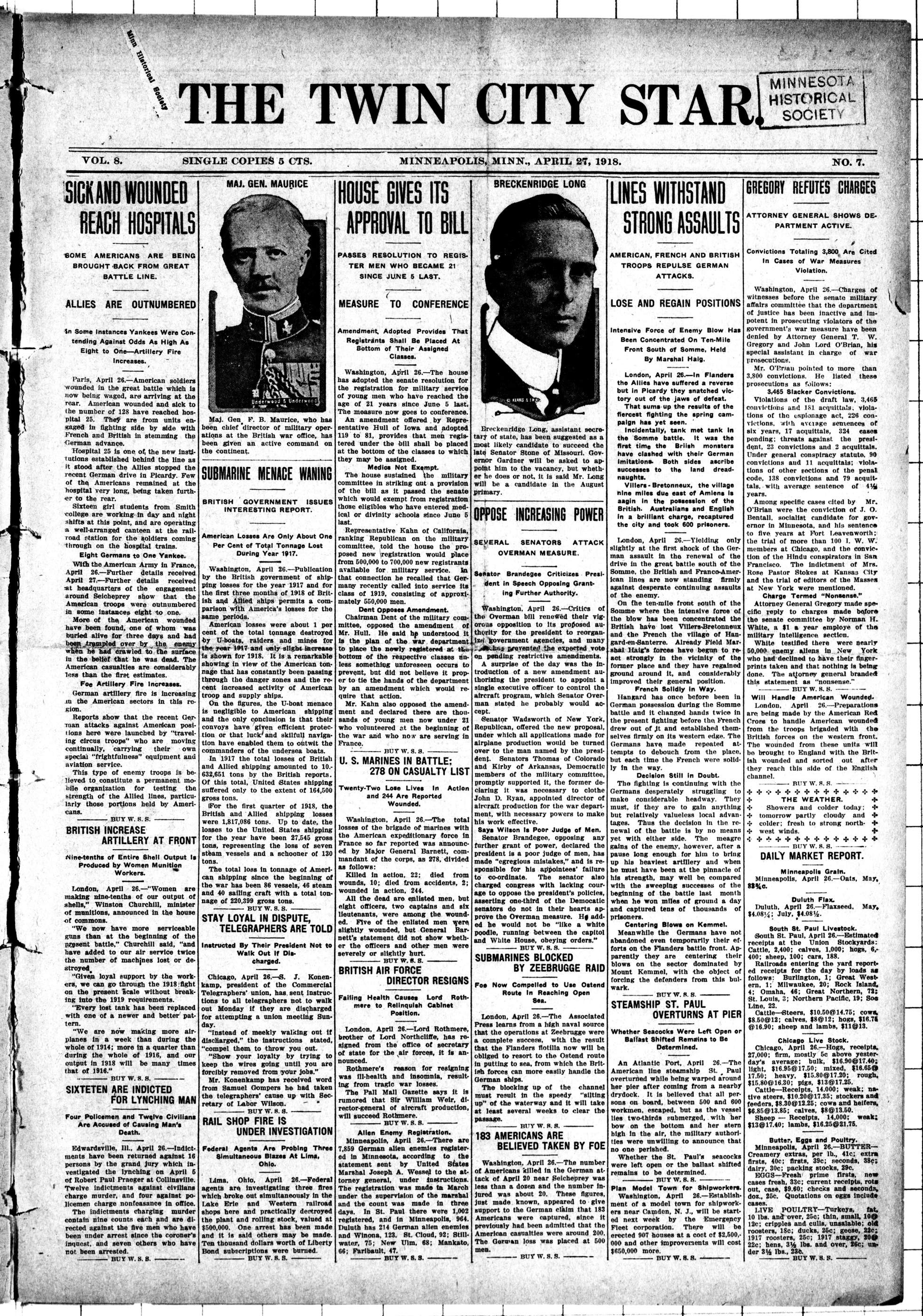
SICK AND WOUNDED REACH HOSPITALS
BOME AMERICANS ARE BEING BROUGHT BACK FROM GREAT BATTLE LINE.
ALLIES ARE OUTNUMBERED
In Some Instances Yankees Were Contending Against Odds As High As Eight to One—Artillery Fire
Paris, April 26.—American soldiers wounded in the great battle which is now being waged, are arriving at the rear. American wounded and slick to the number of 128 have reached hospital 25. They are from units engaged in fighting side by side with French and British in stemming the German advance. Hospital 25 is one of the new institutions established behind the line as it stood after the Allies stopped the recent German drive in Picardy. Few of the Americans remained at the hospital very long, being taken further to the rear. Sixteen girl students from Smith college are working in day and night shifts at this point, and are operating a well-arranged canteen at the railroad station for the soldiers coming through on the hospital trains.
Eight Germans to One Yankee.
With the American Army in France, April 26.—Further details received April 27.—Further details received at headquarters of the engagement around Seicheprey show that the American troops were outnumbered in some instances eight to one.
More of the American wounded have been found, one of whom was buried alive for three days and had been trampled over by the enemy when he had crawled to the surface in the belief that he was dead. The American casualties are considerably less than the first estimates.
Foe Artillery Fire Increases.
German artillery fire is increasing in the American sectors in this region.
Reports show that the recent German attacks against American positions here were launched by "traveling circus troops" who are moving continually, carrying their own special "frightfulness" equipment and aviation service.
This type of enemy troops is believed to constitute a permanent mobile organization for testing the strength of the Allied lines, particularly those portions held by Americans.
BRITISH INCREASE ARTILLERY AT FRONT
Nine-tenths of Entire Shell Output Is Produced by Women Munition Workers.
London, April 26.—"Women are making nine-tenths of our output of shells," Winston Churchill, minister of munitions, announced in the house of commons.
"We now have more serviceable guns than at the beginning of the present battle," Churchill said, "and have added to our air service twice the number of machines lost or destroyed.
"Given loyal support by the workers, we can go through the 1918 fight on the present scale without breaking into the 1919 requirements.
"Every lost tank has been replaced with one of a newer and better pattern.
"We are now making more airplanes in a week than during the whole of 1914; more in a quarter than during the whole of 1916, and our output in 1918 will be many times that of 1916."
SIXTETEN ARE INDICTED FOR LYNCHING MAN
Four Policemen and Twelve Civilians Are Accused of Causing Man's Death.
Edwardsville, Ill., April 26.—Indictments have been returned against 16 persons by the grand jury which investigated the lynching on April 5 of Robert Paul Praeger at Collinsville. Twelve indictments against civilians charge murder, and four against policemen charge nonfeasance in office. The indictments charging murder contain nine counts each and are directed against the five men who have been under arrest since the coroner's inquest, and seven others who have not been arrested.
Maj. Gen. F. B. Maurice, who has been chief director of military operations at the British war office, has been given an active command on the continent.
SUBMARINE MENACE WANING
BRITISH GOVERNMENT ISSUES INTERESTING REPORT.
American Losses Are Only About One
Per Cent of Total Tonnage Lost
During Year 1917.
Washington, April 26.—Publication by the British government of shipping losses for the year 1917 and for the first three months of 1918 of British and Allied ships permits a comparison with America's losses for the same periods.
American losses were about 1 percent of the total tonnage destroyed by U-boats, raiders and mines for the year 1917 and only slight increase is shown for 1918. It is a remarkable showing in view of the American tonnage that has constantly been passing through the danger zones and the recent increased activity of American troop and supply ships.
On the figures, the U-boat menace is negligible to American shipping and the only conclusion is that their convoys have given efficient protection or that luck and skillful navigation have enabled them to outwit the commanders of the undersea boats.
In 1917 the total losses of British and Allied shipping amounted to 10,632,651 tons by the British reports. Of this total, United States shipping suffered only to the extent of 164,500 gross tons.
For the first quarter of 1918, the British and Allied shipping losses were 1,817,086 tons. Up to date, the losses to the United States shipping for the year have been 27,545 gross tons, representing the loss of seven steam vessels and a schooner of 130 tons. The total loss in tonnage of American shipping since the beginning of the war has been 86 vessels, 46 steam and 40 sailing craft with a total tonnage of 220,399 gross tons.
Instructed By Their President Not to Walk Out If Discharged.
Chicago, April 26.—S. J. Konenkamp, president of the Commercial Telegraphers' union, has sent instructions to all telegraphers not to walk out Monday if they are discharged for attempting a union meeting Sunday.
"Instead of meekly walking out if discharged," the instructions stated, "compel them to throw you out.
"Show your loyalty by trying to keep the wires going until you are forcibly removed from your jobs."
Mr. Konenkamp has received word from Samuel Gompers he had taken the telegraphers' cause up with Secretary of Labor Wilson.
RAIL SHOP FIRE IS UNDER INVESTIGATION
Federal Agents Are Probing Three Simultaneous Blazes At Lima, Ohio.
Lima, Ohio, April 26.—Federal agents are investigating three fires which broke out simultaneously in the Lake Erie and Western railroad shops here and practically destroyed the plant and rolling stock, valued at $500,000. One arrest has been made and it is said others may be made. Ten thousand dollars worth of Liberty Bond subscriptions were burned.
MINNEAPOLIS, MINN., APRIL 27, 1918.
HOUSE GIVES ITS APPROVAL TO BILL
PASSES RESOLUTION TO REGISTER MEN WHO BECAME 21 SINCE JUNE 5 LAST.
Amendment, Adopted Provides That Registrants Shall Be Placed At Bottom of Their Assigned
Washington, April 26.—The house has adopted the senate resolution for the registration for military service of young men who have reached the age of 21 years since June 5 last. The measure now goes to conference.
An amendment offered by Representative Hull of Iowa and adopted 119 to 81, provides that men registered under the bill shall be placed at the bottom of the classes to which they may be assigned.
Medics Not Exempt.
The house sustained the military committee in striking out a provision of the bill as it passed the senate which would exempt from registration those eligibles who have entered medical or divinity schools since June 5 last.
Representative Kahn of California, ranking Republican on the military committee, told the house the proposed new registration would place from 500,000 to 700,000 new registrants available for military service. In that connection he recalled that Germany recently called into service its class of 1919, consisting of approximately 550,000 men.
Chairman Dent of the military committee, opposed the amendment of Mr. Hull. He said he understood it is the plan of the war department to place the newly registered at the bottom of the respective classes unless something unforeseen occurs to prevent, but did not believe it proper to tie the hands of the department by an amendment which would require that action.
Mr. Kahn also opposed the amendment and declared there are thousands of young men now under 21 who volunteered at the beginning of the war and who now are serving in France.
U. S. MARINES IN BATTLE;
278 ON CASUALTY LIST
Twenty-Two Lose Lives In Action and 244 Are Reported Wounded.
Washington, April 26.—The total losses of the brigade of marines with the American expeditionary force in France so far reported was announced by Major General Barnett, commandant of the corps, as 278, divided as follows:
Killed in action, 22; died from wounds, 10; died from accidents, 2; wounded in action, 244.
All the dead are enlisted men, but eight officers, two captains and six lieutenants, were among the wounded. Five of the enlisted men were slightly wounded, but General Barnett's statement did not show whether the officers and other men were severely or slightly hurt.
BRITISH AIR FORCE DIRECTOR RESIGNS
Failing Health Causes Lord Rothmere to Relinquish Cabinet Position.
London, April 26.—Lord Rothmere, brother of Lord Northcliffe, has resigned from the office of secretary of state for the air forces, it is announced.
Rothmere's reason for resigning was ill-health and insomnia, resulting from tragic war losses.
The Pall Mall Gazette says it is rumored that Sir William Weir, director-general of aircraft production, will succeed Rothmere.
BUY W. S. S.
Allen Enemy Registration.
Minneapolis, April 26.—There are 7,859 German alien enemies registered in Minnesota, according to the statement sent by United States Marshal Joseph A. Wessel to the attorney general, under instructions.
The registration was made in March under the supervision of the marshal and the count was made in three days. In St. Paul there were 1,002 registered, and in Minneapolis, 964. Duluth has 214 German alien enemies and Winona, 123. St. Cloud, 92; Stillwater, 75; New Ulm, 68; Mankato, 66; Faribault, 47.
BRECKENHURGE LONG
Breckenridge Long, assistant secretary of state, has been suggested as a most likely candidate to succeed the late Senator Stone of Missouri. Governor Gardner will be asked to appoint him to the vacancy, but whether he does or not, it is said Mr. Long will be a candidate in the August primary.
OPPOSE INCREASING POWER
SEVERAL SENATORS ATTACK OVERMAN MEASURE.
Senator Brandegee Criticizes President in Speech Opposing Granting Further Authority.
Washington, April 26.—Critics of the Overman bill renewed their vigorous opposition to its proposed authority for the president to reorganize government agencies, and many has prevented the expected vote on pending restrictive amendments.
A surprise of the day was the introduction of a new amendment authorizing the president to appoint a single executive officer to control the aircraft program, which Senator Overman stated he probably would accept.
Senator Wadsworth of New York, Republican, offered the new proposal, under which all applications made for airplane production would be turned over to the man named by the president. Senators Thomas of Colorado and Kirby of Arkansas, Democratic members of the military committee, promptly supported it, the former declaring it was necessary to clothe John D. Ryan, appointed director of aircraft production for the war department, with necessary powers to make his work effective.
Says Wilson is Poor Judge of Men. Senator Brandegee, opposing any further grant of power, declared the president is a poor judge of men, has made "egregious mistakes," and is responsible for his appointees' failure to co-ordinate. The senator also charged congress with lacking courage to oppose the president's policies, asserting one-third of the Democratic senators do not in their hearts approve the Overman measure. He added he would not be "like a white poodle, running between the capitol and White House, obeying orders."
SUBMARINES BLOCKED
BY ZEEBRUGGE RAID
Foe Now Compelled to Use Ostend Route In Reaching Open Sea.
London, April 26.—The Associated Press learns from a high naval source that the operations at Zeebruge were a complete success, with the result that the Flanders flotilla now will be obliged to resort to the Ostend route in putting to sea, from which the British forces can more easily handle the German ships.
The blocking up of the channel must result in the speedy "sitting up" of the waterway and it will take at least several weeks to clear the passage.
BUY W. S. S.
183 AMERICANS ARE
BELIEVED TAKEN BY FOE
Washington, April 26.—The number of Americans killed in the German attack of April 20 near Selcheprey was less than a dozen and the number injured was about 20. These figures, just made known, appeared to give support to the German claim that 183 Americans were captured, since it previously had been admitted that the American casualties were around 200. The German loss was placed at 500 men.
LINES WITHSTAND STRONG ASSAULTS
AMERICAN, FRENCH AND BRITISH TROOPS REPULSE GERMAN ATTACKS.
Intensive Force of Enemy Blow Has Been Concentrated On Ten-Mile Front South of Somme, Held By Marshal Haig.
London, April 26.—In Flanders the Allies have suffered a reverse but in Picardy they snatched victory out of the jaws of defeat. That sums up the results of the fiercest fighting the spring campaign has yet seen.
Incidentally, tank met tank in the Somme battle. It was the first time the British monsters have clashed with their German limitations. Both sides ascribe successes to the land dreadnaughts.
Villers-Bretonneux, the village nine miles due east of Amiens is aagin in the possession of the British. Australians and English in a brilliant charge, recaptured the city and took 600 prisoners.
London, April 26.—Yielding only slightly at the first shock of the German assault in the renewal of the drive in the great battle south of the Somme, the British and Franco-American lines are now standing firmly against desperate continuing assaults of the enemy.
On the ten-mile front south of the Somme where the intensive force of the blow has been concentrated the British have lost Villers-Bretonneux and the French the village of Hangard-en-Santerre. Already Field Marshal Haig's forces have begun to react strongly in the vicinity of the former place and they have regained ground around it, and considerably improved their general position.
French Solidly in Way.
Hangard has once before been in German possession during the Somme battle and it changed hands twice in the present fighting before the French drew out of it and established themselves firmly on its western edge. The Germans have made repeated attempts to debouch from the place, but each time the French were solidly in the way.
The fighting is continuing with the Germans desperately struggling to make considerable headway. They must, if they are to gain anything but relatively valueless local advantages. Thus the decision in the renewal of the battle is by no means yet with either side. The meagre gains of the enemy, however, after a pause long enough for him to bring up his heaviest artillery and when he must have been at the pinnacle of his strength, may well be compared with the sweeping successes of the beginning of the battle last month when he won miles of ground a day and captured tens of thousands of prisoners.
Centering Blows on Kemmel.
Meanwhile the Germans have not abandoned even temporarily their efforts on the Flanders battle front. Apparently they are centering their blows on the sector dominated by Mount Kemmel, with the object of forcing the defenders from this bulwark.
BUY W. S. S.
STEAMSHIP ST. PAUL
OVERTURNS AT PIER
Whether Seacocks Were Left Open or Ballast Shifted Remains to Be Determined.
An Atlantic Port, April 26.—The American line steamship St. Paul overturned while being warped around her pier after coming from a nearby drydock. It is believed that all persons on board, between 500 and 600 workmen, escaped, but as the vessel lies two-thirds submerged, with her bow on the bottom and her stern high in the air, the military authorities were unwilling to announce that no one perished.
Whether the St. Paul's seacocks were left open or the ballast shifted remains to be determined.
BUY W. S. S.
Plan Model Town for Shipworkers.
Washington, April 26.—Establishment of a model town for shipworkers near Camden, N. J., will be started next week by the Emergency Fleet corporation. There will be erected 907 houses at a cost of $2,500,000 and other improvements will cost $650,000 more.
NO.7.
GREGORY REFUTES CHARGES
ATTORNEY GENERAL SHOWS DEPARTMENT ACTIVE.
Convictions Totaling 3,800 Are Cited In Cases of War Measures
Washington, April 26.—Charges of witnesses before the senate military affairs committee that the department of justice has been inactive and impotent in prosecuting violators of the government's war measure have been denied by Attorney General T. W. Gregory and John Lord O'Brian, his special assistant in charge of war prosecutions.
Mr. O'Brian pointed to more than 3,800 convictions. He listed these prosecutions as follows:
3,465 Slacker Convictions.
Violations of the draft law, 3,465 convictions and 181 acquittals; violations of the espionage act, 226 convictions, with average sentences of six years, 17 acquittals, 324 cases pending; threats against the president, 23 convictions and 2 acquittals.
Under general conspiracy statute, 90 convictions and 11 acquittals; violations of other sections of the penal code, 138 convictions and 79 acquittals, with average sentence of 47% years.
Among specific cases cited by Mr. O'Brian were the conviction of J. O. Bentall, socialist candidate for governor in Minnesota, and his sentence to five years at Fort Leavenworth; the trial of more than 100 I. W. W. members at Chicago, and the conviction of the Hindu conspirators in San Francisco. The indictment of Mrs. Rose Pastor Stokes at Kansas City and the trial of editors of the Masses at New York were mentioned.
Charge Termed "Nonsense."
Attorney General Gregory made specific reply to charges made before the senate committee by Norman H. White, a $1 a year employee of the military intelligence section.
White testified there were nearly 50,000 enemy allons in New York who had declined to have their fingerprints taken and that nothing is being done. The attorney general branded this statement as "nonsense."
Will Handle American Wounded-
London, April 26—Preparations
are being made by the American Red
Cross to handle American wounded
from the troops brigaded with the
British forces on the western front.
The wounded from these units will
be brought to England with the Brit-
ish wounded and sorted out after
they reach this side of the English
channel.
Showers and colder today;
tomorrow partly cloudy and
colder; fresh to strong north-
west winds.
DAILY MARKET REPORT.
Minneapolis, April 26.—Oats, May, 88%c.
Duluth Flax.
Duluth, April 26.—Flaxseed, May, $4.0814; July, $4.0814.
South St. Paul Livestock.
South St. Paul, April 26.—Estimated receipts at the Union Stockyards: Cattle, 2,400; calves, 1,000; hogs, 6,400; sheep, 100; cars, 188.
Railroads entering the yard reported receipts for the day by loads as follows: Burlington, 1; Great Western, 1; Milwaukee, 2; Rock Island, 4; Omaha, 46; Great Northern, 72; St. Louis, 3; Northern Pacific, 19; Soo Line, 22.
Cattle—Steers, $10.50@14.75; cows, $8.50@12; calves, $8@12; hogs, $16.78@16.90; sheep and lambs, $11@13.
Chicago Live Stock.
Chicago, April 26.—Hogs, receipts, 27,000; firm, mostly 5c above yesterday's average; bulk, $16.90@17.40; light, $16.95@17.50; mixed, $16.65@17.50; heavy, $15.80@17.20; rough, $15.80@16.30; pigs, $13@17.25.
Cattle—Recrepts, 14,000; weak; native steers, $10.20@17.35; stockers and feeders, $8.30@12.5; cows and heifers, $6.55@13.85; calves, $8@13.50.
Sheep—Recrepts, 14,000; weak; $13@17.40; lambs, $16.25@21.75.
Butter, Eggs and Poultry.
Minneapolis, April 26.—BUTTER—Creamery extras, per lb, 41c; extra firsts, 40c; firsts, 39c; seconds, 38c; dairy, 30c; packing stocks, 29c.
EGGS—Fresh prime firsts, new cases fresh, 33c; current receipts, rots out, case, $9.60; checks and seconds, doz, 25c. Quotations on eggs include cases.
LIVE POULTRY—Turkeys, fat, 10 lbs. and over, 25c; thin, small, 10@12c; cripples and culls, unsalable; old roosters, 18c; ducks, 25c; geese, 22c; 1917 roosters, 25c; 1917 staggy, 20@2c; hens, 3½ lbs. and over, 26c; under 3½ lbs. 20c.
1
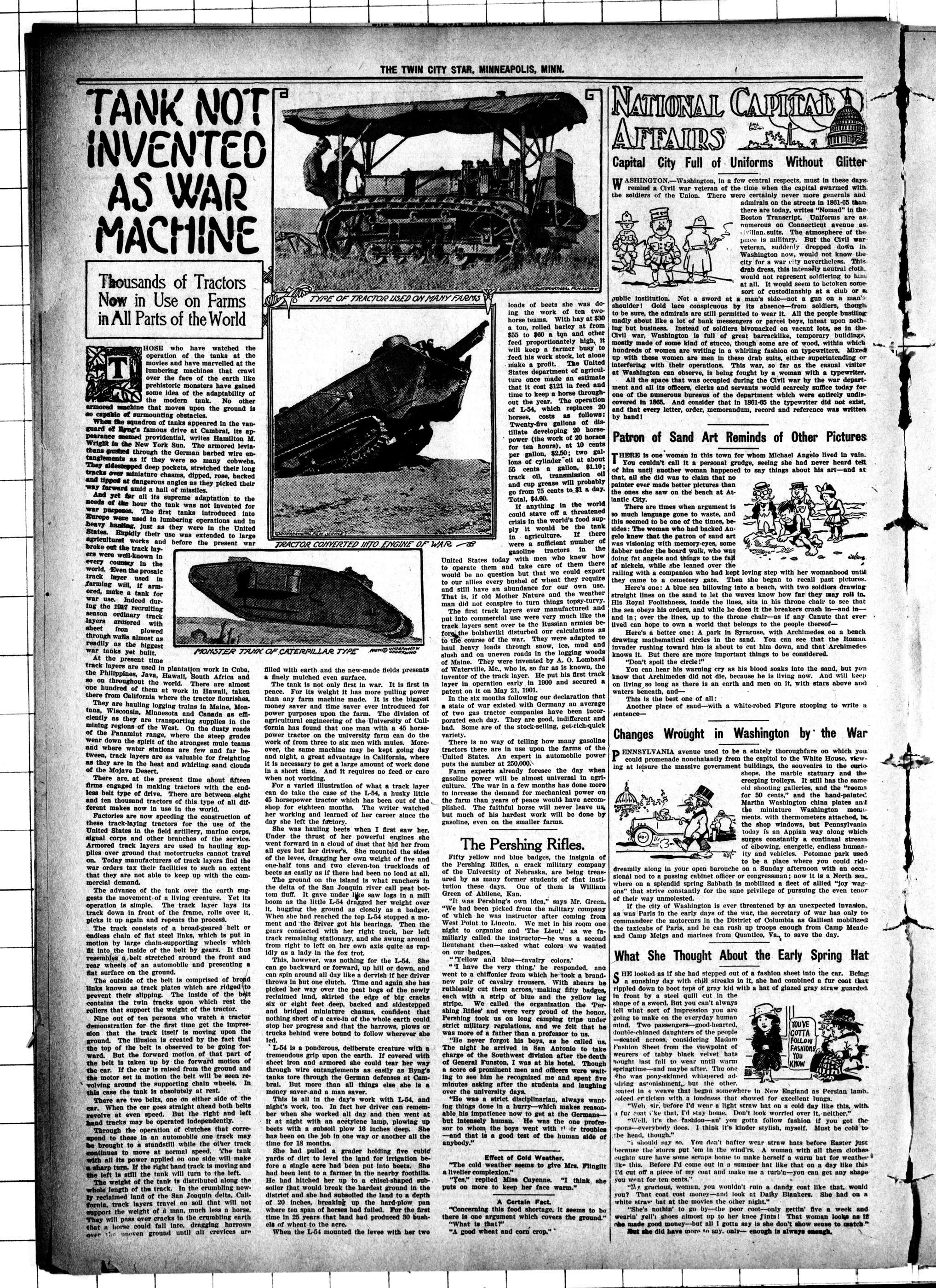
MONSTER TANK OF CATERPILLAR TYPE
TANK NOT INVENTED AS WAR MACHINE
Thousands of Tractors Now in Use on Farms in All Parts of the World
HOSE who have watched the operation of the tanks at the movies and have marvelled at the lumbering machines that crawl over the face of the earth like prehistoric monsters have gained some idea of the adaptability of the modern tank. No other that moves upon the ground is
HOSE who have watched the operation of the tanks at the movies and have marvelled at the lumbering machines that crawl over the face of the earth like prehistoric monsters have gained some idea of the adaptability of the modern tank. No other armored machine that moves upon the ground is so capable of surmounting obstacles. When the squadron of tanks appeared in the vanguard of King's famous drive at Cambrai, its appearance seemed providential, writes Hamilton M. Wright in the New York Sun. The armored levita-tans pushed through the German barbed wire entanglements as if they were so many cobwebs. They sidesteped deep pockets, stretched their long tracks over miniature chasms, dipped, rose, backed and tipped at dangerous angles as they picked their way forward amid a hall of missiles.
And yet for all its supreme adaptation to the needs of the hour the tank was not invented for war purposes. The first tanks introduced into Europe were used in lumbering operations and in heavy handling, just as they were in the United States. Euphilip their use was extended to large agricultural works and before the present war
broke out the track layers were well-known in every country in the world. Even the prosalv track layer used in farming will, if armored, make a tank for war use. Indeed during the 1947 recruiting season ordinary track layers armored with sheet iron plowed through walls almost as readily as the biggest war tanks yet built. At the
At the present time
track layers are used in plantation work in Cuba, the Philippines, Java, Hawaii, South Africa and so on throughout the world. There are almost one hundred of them at work in Hawaii, taken there from California where the tractor flourishes. They are hauling logging trains in Maine, Montana, Wisconsin, Minnesota and Canada as efficiently as they are transporting supplies in the mining regions of the West. On the dusty roads of the Panamint range, where the steep grades wear down the spirit of the strongest mule teams and where water stations are few and far between, track layers are as valuable for freighting as they are in the heat and whirling sand clouds of the Mojave Desert. There are at the present time about fifteen firms engaged in making tractors with the endless belt type of drive. There are between eight and ten thousand tractors of this type of all different makes now in use in the world.
Factories are now speeding the construction of these track-laying tractors for the use of the United States in the field artillery, marine corps, signal corps and other branches of the service. Armored track layers are used in hauling supplies over ground that motortrucks cannot travel on. Today manufacturers of track layers find the war orders tax their facilities to such an extent that they are not able to keep up with the commercial demand.
The advance of the tank over the earth suggests the movement of a living creature. Yet its operation is simple. The track layer lays its track down in front of the frame, rolls over it, picks it up again and repeats the process.
The track consists of a broad-geared belt or endless chain of flat steel links, which is put in motion by large chain-supporting wheels which fit into the inside of the belt by gears. It thus resembles a belt stretched around the front and rear wheels of an automobile and presenting a flat surface on the ground.
The outside of the belt is comprised of broad links known as track plates which are ridged to prevent their slipping. The inside of the belt contains the twin tracks upon which rest the rollers that support the weight of the tractor.
Nine out of ten persons who watch a tractor demonstration for the first time get the impression that the track itself is moving upon the ground. The illusion is created by the fact that the top of the belt is observed to be going forward. But the forward motion of that part of the belt is taken up by the forward motion of the car. If the car is raised from the ground and the motor set in motion the belt will be seen revolving around the supporting chain wheels. In this case the tank is absolutely at rest.
There are two belts, one on either side of the car. When the car goes straight ahead both belts revolve at even speed. But the right and left head tracks may be operated independently.
Through the operation of clutches that correspond to those in an automobile one track may be brought to a standstill while the other track continues to move at normal speed. The tank with all its power applied on one side will make a sharp turn. If the right hand track is moving and the left is still the tank will turn to the left.
The weight of the tank is distributed along the whole length of the track. In the crumbling newly reclaimed land of the San Joquín delta, California, track layers travel on soil that will not support the weight of a man, much less a horse. They will pass over cracks in the crumbling earth that a horse could fall into, dragging harrows over the uneven ground until all crevices are
THE TWIN CITY STAR, MINNEAPOLIS, MINN.
TYPE OF TRACTOR USED ON MANY FARM
OR USED ON MANY FARMS
GRANT NATIONAL FUN SERVICE
TYPE OF TRACTOR USED ON MANY FARMS
INTERNATIONAL FARM SERVICE
TRACTOR CONVERTED INTO ENGINE OF WAR
K OF CATERPILLAR TYPE
filled with earth and the new-made fields presents a finely mulched even surface.
United States to operate would be to our alliance and still be That is, if man did not
The first put into co-track layer for the b to the court haul heavy slush and of Maine. of Waterville inventor of
The tank is not only first in war. It is first in peace. For its weight it has more pulling power than any farm machine made. It is the biggest money saver and time saver ever introduced for power purposes upon the farm. The division of agricultural engineering of the University of California has found that one man with a 45 horsepower tractor on the university farm can do the work of from three to six men with mules. Moreover, the same machine may be kept going day and night, a great advantage in California, where it is necessary to get a large amount of work done in a short time. And it requires no feed or care when not working.
For a varied illustration of what a track layer can do take the case of the L-54, a husky little 45 horsepower tractor which has been out of the shop for eighteen months. The writer watched her working and learned of her career since the day she left the factory.
She was hauling beets when I first saw her. Under the thrust of her powerful engines she went forward in a cloud of dust that hid her from all eyes but her driver's. She mounted the sides of the levee, dragging her own weight of five and one-half tons and two eleven-ton truckloads of beets as easily as if there had been no load at all. The ground on the island is what ranchers in the delta of the San Joaquin river call peat bottom fuff. It gave under like saw logs in a mill boom as the little L-54 dragged her weight over it, hugging the ground as closely as a badger. When she had reached the top L-54 stopped a moment and the driver got his bearings. Then the gears connected with her right track, her left track remaining stationary, and she swung around from right to left on her own axis quite as rapidly as a lady in the fox trot.
This, however, was nothing for the L-54. She can go backward or forward, up hill or down, and can spin around all day like a dervish if her driver throws in but one clutch. Time and again she has picked her way over the peat bogs of the newly reclaimed land, skirted the edge of big cracks six or eight feet deep, backed and sidestepped and bridged miniature chasms, confident that nothing short of a cave-in of the whole earth could stop her progress and that the harrows, plows or trucks behind were bound to follow wherever she led.
* L-54 is a ponderous, deliberate creature with a tremendous grip upon the earth. If covered with sheet iron and armored she could tear her way through wire entanglements as easily as Byng's tanks tore through the German defenses at Cambrai. But more than all things else she is a money saver and a man saver.
This is all in the day's work with L-54, and night's work, too. In fact her driver can remember when she worked all day and then went at it at night with an acetylene lamp, plowing up beets with a subsoll plow 16 inches deep. She has been on the job in one way or another all the time for 18 months.
She had pulled a grader holding five cubic yards of dirt to level the land for irrigation before a single acre had been put into beets. She had been lent to a farmer in the nearby foothills. He had hitched her up to a chisel-shaped subsoller that would break the hardest ground in the district and she had subsolved the land to a depth of 20 inches, breaking up the hard-plow pan where ten span of horses had failed. For the first time in 25 years that land had produced 30 bushels of wheat to the acre.
When the L-54 mounted the levee with her two
see with her two "A good wheat and corn crop."
---
loads of beets she was doing the work of ten two-horse teams. With hay at $30 a ton, rolled barley at from $55 to $60 a tqn and other feed proportionately high, it will keep a farmer busy to feed his work stock, let alone make a profit. The United States department of agriculture once made an estimate that it cost $121 in feed and time to keep a horse throughout the year. The operation of L-54, which replaces 20 horses, costs as follows: Twenty-five gallons of distillate developing 20 horsepower (the work of 20 horses for ten hours), at 10 cents per gallon, $2.50; two gallons of cylinder oil at about 55 cents a gallon, $1.10; track oil, transmission oil and cup grease will probably go from 75 cents to $1 a day. Total, $4.60.
If anything in the world could stave off a threatened crisis in the world's food supply it would be the tank in agriculture. If there were a sufficient number of gasoline tractors in the United States today with men who knew how to operate them and take care of them there would be no question but that we could export to our allies every bushel of wheat they require and still have an abundance for our own use. That is, if old Mother Nature and the weather man did not conspire to turn things topsy-turvy.
The first track layers ever manufactured and put into commercial use were very much like the track layers sent over to the Russian armies before the bolshevik disturbed our calculations as to the course of the war. They were adapted to haul heavy loads through snow, ice, mud and slush and on uneven roads in the logging woods of Maine. They were invented by A. O. Lombard of Waterville, Me, who is, so far as is known, the inventor of the track layer. He put his first track layer in operation early in 1900 and secured a patent on it on May 21, 1901.
In the six months following our declaration that a state of war existed with Germany an average of two gas tractor companies have been incorporated each day. They are good, indifferent and bad. Some are of the stock-selling, get-rich-quick variety.
There is no way of telling how many gasoline tractors there are in use upon the farms of the United States. An expert in automobile power puts the number at 250,000.
Farm experts already foresee the day when gasoline power will be almost universal in agriculture. The war in a few months has done more to increase the demand for mechanical power on the farm than years of peace would have accomplished. The faithful horse will never leave us, but much of his hardest work will be done by gasoline, even on the smaller farms.
The Pershing Rifles.
Fifty yellow and blue badges, the insignia of the Pershing Rifles, a crack military company of the University of Nebraska, are being treasured by as many former students of that institution these days. One of them is William Green of Abilene, Kan.
"It was Pershing's own idea," says Mr. Green. "We had been picked from the military company of which he was instructor after coming from West Point to Lincoln. We met in his room one night to organize and 'The Lieut,' as we familiarly called the instructor—he was a second lieutenant then—asked what colors we wanted on our badges.
"Yellow and blue—cavalry colors."
"I have the very thing," he responded, and went to a chiffonier from which he took a brand-new pair of cavalry trousers. With shears he ruthlessly cut them across, making fifty badges, each with a strip of blue and the yellow leg stripe. We called the organization the "Pershing Rifles" and were very proud of the honor. Pershing took us on long camping trips under strict military regulations, and we felt that he was more of a father than a professor to us.
"He never forgot his boys, as he called us. The night he arrived in San Antonio to take charge of the Southwest division after the death of General Funston, I was at his hotel. Though a score of prominent men and officers were waiting to see him he recognized me and spent five minutes asking after the students and laughing over the university days.
"He was a strict disciplinarian, always wanting things done in a hurry—which makes reasonable his impatience now to get at the Germans—but intensely human. He was the one professor to whom the boys went with their troubles—and that is a good test of the human side of anybody."
Effect of Cold Weather.
"The cold weather seems to give Mrs. Flingit a liveller complexion."
"Yes," replied Miss Cayenne. "I think she puts on more to keep her face warm."
"Concerning this food shortage, it seems to be there is one argument which covers the ground." "What is that?"
WASHINGTON.—Washington, in a few central respects, must in these days remind a Civil war veteran of the time when the capital swarmed with the soldiers of the Union. There were certainly never more generals and
public institution. Not a sword at a man's side—not a gun on a man's shoulder! Gold lace conspicuous by its absence—from soldiers, though to be sure, the admirals are still permitted to wear it. All the people bustling madly about like a lot of bank messengers or parcel boys, intent upon nothing but business. Instead of soldiers bivouacked on vacant lots, as in the Civil war, Washington is full of great barracklike, temporary buildings, mostly made of some kind of stucco, though some are of wood, within which hundreds of women are writing in a whirling fashion on typewriters. Mixed up with these women are men in these drab suits, either superintending or interfering with their operations. This war, so far as the casual visitor at Washington can observe, is being fought by a woman with a typewriter. All the space that was occupied during the Civil war by the war department and all its officers, clerks and servants would scarcely suffice today for one of the numerous bureaus of the department which were entirely undiscovered in 1865. And consider that in 1861-65 the typewriter did not exist, and that every letter, order, memorandum, record and reference was written by hand!
Patron of Sand Art Reminds of Other Pictures
Patron of Sand Art Reminds of Other Pictures
THERE is one woman in this town for whom Michael Angelo lived in vain. You couldn't call it a personal grudge, seeing she had never heard tell of him until another woman happened to say things about his art—and at that, all she did was to claim that no.
railing with a companion who had kept loving step with her womanhood until they came to a cemetery gate. Then she began to recall past pictures.
Here's one: A blue sea billowing into a beach, with two soldiers drawing straight lines on the sand to let the waves know how far they may roll in. His Royal Foolishness, inside the lines, sits in his throne chair to see that the sea obeys his orders, and while he does it the breakers crash in—and in—and in; over the lines, up to the throne chair—as if any Canute that ever lived can hope to own a world that belongs to the people thereof—
Here's a better one: A park in Syracuse, with Archimedes on a bench drawing mathematical circles in the sand. You can see that the Roman invader rushing toward him is about to cut him down, and that Archimedes knows it. But there are more important things to be considered.
"Don't spoil the circle!"
You can hear his warning cry as his blood soaks into the sand, but you know that Archimedes did not die, because he is living now. And will keep on living so long as there is an earth and men on it, with stars above and waters beneath, and—
This is the best one of all:
Another place of sand—with a white-robed Figure stooping to write a sentence—
Changes Wrought in Washington by the War
Changes Wrought in Washington by the War
PENNSYLVANIA avenue used to be a stately thoroughfare on which you could promenade nonchalantly from the capitol to the White House, viewing at leisure the massive government buildings, the souvenirs in the curio
dreamily along in your open barcheau on a Sunday afternoon with an occasional nod to a passing cabinet officer or congressman; now it is a North sea, where on a splendid spring Sabbath is mobilized a fleet of allied "joy wagons" that strive constantly for the same privilege of pursuing the even tenor of their way unmolested. If the city of Washington is ever threatened by an unexpected invasion, as was Paris in the early days of the war, the secretary of war has only to commandeer the motorcars in the District of Columbia as Gallienl mobilized the taxicabs of Paris, and he can rush up troops enough from Camp Meade and Camp Melgs and marines from Quantico, Va., to save the day.
What She Thought About the Early Spring Hat
What She Thought About the Early Spring Hat
SHE looked as if she had stepped out of a fashion sheet into the car. Behaves a sunshiny day with chill streaks in it, she had combined a fur coat that rippled down to boot tops of gray kid with a hat of glazed gray straw guarded. In front, by a steel grill, out in the
coated in a weave that began somewhere in New England as Persian lamb, policed criticism with a loudness that showed for excellent lungs.
"Weh, sir, before I'd wear a light straw hat on a cold day like this, with a fur coat like that, I'd stay home. Don't look worried over it, neither."
"Well, it's the fashion—an' you gotta follow fashion if you got the spons—everybody does. I think it's kinder stylish, myself. Must be cold to the head, though."
"I should say so. You don't hafter wear straw hats before Easter just because the stores put 'em in the wind's. A woman with all them clothes oughta sure have some scraps home to make herself a warm hat for weather like this. Before I'd come out in a summer hat like that on a day like this I'd cut off a piece of my coat and make me a turbin—you can get any shape you want for ten cents."
"My gracious, woman, you wouldn't ruin a dandy coat like that, would you? That coat cost money—and look at Daily Blankers. She had on a white straw hat at the movies the other night."
"She's nothin' to go by—the poor coat—only gettin' five a week and wearin' yell' shoes almost up to her knee fins! That woman looks as if she made good money—but all I gotta say is she don't show sense to match."
A
public institution. Not a sword at the shoulder! Gold lace conspicuous by to be sure, the admirals are still permitably about like a lot of bank messing but business. Instead of soldiers Civil war, Washington is full of gr mostly made of some kind of stucco, the hundreds of women are writing in a w up with these women are men in the interfering with their operations. The at Washington can observe, is being f All the space that was occupied diment and all its officers, clerks and one of the numerous bureaus of the covered in 1865. And consider that in and that every letter, order, memorandy by hand!
Patron of Sand Art Re
THERE is one woman in this town f You couldn't call it a personal gr of him until another woman happened that, all she did was to claim that no painter ever made better pictures than the ones she saw on the beach at Atlantic City.
There are times when argument is so much language gone to waste, and this seemed to be one of the times, besides: The woman who had backed Angelo knew that the patron of sand art was visioning with memory-eyes, some dabber under the board walk, who was doing fat angels and things to the fall of nickels, while she leaned over the railing with a companion who had kept they came to a cemetery gate. The Here's one: A blue sea billowing in straight lines on the sand to let the w His Royal Foolishness, inside the lines the sea obeys his orders, and while he and in; over the lines, up to the three lived can hope to own a world that be Here's a better one: A park in S drawing mathematical circles in the invader rushing toward him is about it knows it. But there are more imports "Don't spoil the circle!"
This is the best one of all:
Another place of sand—with a w
sentence—
Changes Wrought in W
PENNSYLVANIA avenue used to be
could promenade nonchalantly from
ing at leisure the massive government
dreamily along in your open barouche-
sional nod to a passing cabinet officer
where on a splendid spring Sabbath
ons" that strive constantly for the sun
of their way unmolested.
If the city of Washington is ever
as was Paris in the early days of the
commandeer the motorcars in the Dis
the taxicabs of Paris, and he can rus
and Camp Melgs and marines from C
What She Thought Abo
SHE looked as if she had stepped out
a sunshiny day with chill streaks
ripped down to boot tops of gray kid
in front by a steel quill cut in
the shape of a sword. But you can't always
tell what sort of impression you are
going to make on the everyday human
mind. Two passengers—good-hearted,
double-chinned daughters of the people
—seated across, considering Madam Fashion Sheet from the viewpoint of wearers of tabby black velvet hats bought last fall to wear until warm springtime—and maybe after. The one who was pony-skinned whispered adoring astonishment, but the other, coated in a weave that began somewice voiced criticism with a loudness that "Web, sir, before I'd wear a light a fur coat like that, I'd want home. D "Well, it's the fashion—an' you spons—everybody does. I think it's the head, though."
"I should say so. You don't haift because the stores put 'em in the wighta sure have some scraps home to like this. Before I'd come out in a s'd cut off a piece of my coat and ma you want for ten cents."
"My gracious, woman, you would you? That coat cost money—and lo white straw at that the movies the oth "She's nothin' to go by—the po wearin' nell' shoes almost up to her
admirals on the streets in 1861-05 than there are today, writes "Nomad" in the Boston Transcript. Uniforms are as numerous on Connecticut avenue as civilian, salts. The atmosphere of the peace is military. But the Civil war veteran, suddenly dropped down in Washington now, would not know the city for a war city nevertheless. This drab dress, this intensely neutral cloth, would not represent soldiering to him at all. It would seem to betoken some sort of custodianship at a club or a
a man's side—not a gun on a man's by its absence—from soldiers, though fitted to wear it. All the people bustling,agers or parcel boys, intent upon noth-bivouacked on vacant lots, as in the eat barracklike, temporary buildings, though some are of wood, within which whirling fashion on typewriters. Mixed use drab suits, either superintending or his war, so far as the casual visitor sought by a woman with a typewriter. During the Civil war by the war depart- vants would scarcely suffice today for department which were entirely undis- tum, record and reference was written
minds of Other Pictures
or whom Michael Angelo lived in vain.udge, seeing she had never heard tell to say things about his art—and at
SALERS
I loving step with her womanhood until she began to recall past pictures, to a beach, with two soldiers drawing waves know how far they may roll in, sits in his throne chair to see that does it the breakers crash in—and in—one chair—as if any Canute that ever belongs to the people thereof—syracuse, with Archimedes on a bench sand. You can see that the Roman to cut him down, and that Archimedes unt things to be considered.
This blood soaks into the sand, but you cause he is living now. And will keep and men on it, with stars above and white-robed Figure stooping to write a Washington by the War
be a stately thoroughfare on which you in the capitol to the White House, view- buildings, the souvenirs in the curio
shops, the marble statuary and the creeping trolleys. It still has the same old shooting galleries, and the "rooms for 50 cents," and the hand-painted Martha Washington china plates and the miniature Washington monuments, with thermometers attached, to the shop windows, but Pennsylvania today is an Appian way along which surges constantly a continual stream of elbowing, energetic, endless humanity and vehicles. Potomac park used to be a place where you could ride
on a Sunday afternoon with an occa-
tor congressman; now it is a North sea,
is mobilized a fleet of allied "joy wag-
e the privilege of pursuing the even tenor
threatened by an unexpected invasion,
war, the secretary of war has only to
trict of Columbia as Gallieni mobilized
with troops enough from Camp Meade
quantico, Va., to save the day.
But the Early Spring Hat
of a fashion sheet into the car. Being
in it, she had combined a fur coat that
with a hat of glazed gray straw guarded.
YOU'VE GOTTA FOLLOW FASHIONS YOU KNOW
here in New England as Persian lamb, showed for excellent lungs. straw hat on a cold day like this, with don't look wrored over it, neither." gotta follow fashion if you got the linder stylish, myself. Must be cold to wear straw hats before Easter just andrs. A woman with all their clothes to make herself a warm hat for weather summer hat like that on a day like this me a turb'n—you can get any shape can't ruin a dandy coat like that, would look at Daisy Blankers. She had on a ear night." or coat—only gettin' five a week and
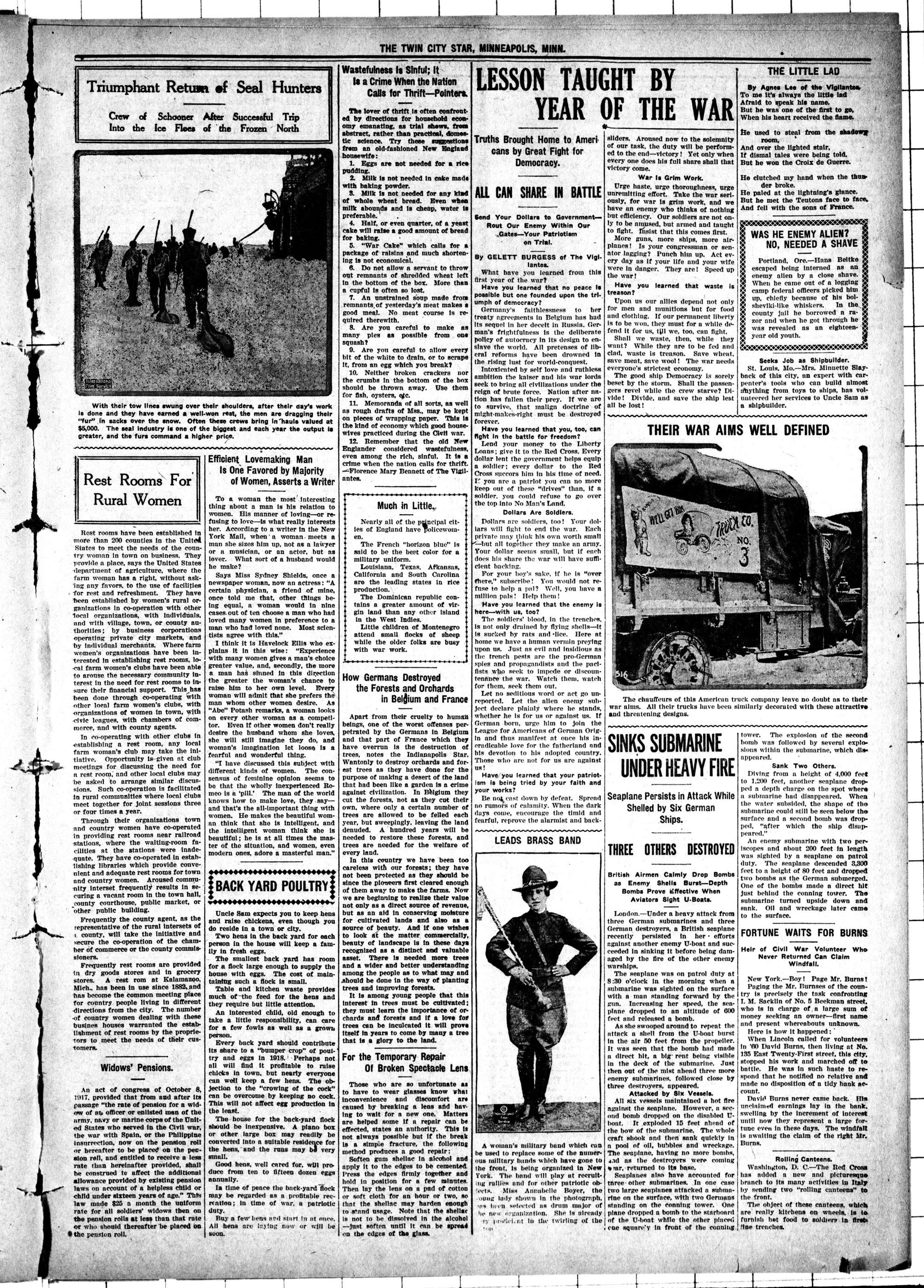
Crew of Schooner After Successful Trip Into the Ice Floes of the Frozen North
INTERNATIONAL
FILM SERVICE
With their tow lines swung over their shoulders, after their day's work is done and they have earned a well-won rest, the men are dragging their "fur" in sacks over the snow. Often these crews bring in hauls valued at $5,000. The seal industry is one of the biggest and each year the output is greater, and the furs command a higher price.
Rest rooms have been established in more than 200 counties in the United States to meet the needs of the country woman in town on business. They provide a place, says the United States department of agriculture, where the farm woman has a right, without asking any favors, to the use of facilities for rest and refreshment. They have been established by women's rural organizations in co-operation with other local organizations, with individuals, and with village, town, or county authorities; by business corporations operating private city markets, and by individual merchants. Where farm women's organizations have been interested in establishing rest rooms, local farm women's clubs have been able to arouse the necessary community interest in the need for rest rooms to insure their financial support. This has been done through co-operating with other local farm women's clubs, with organizations of women in town, with civile leagues, with chambers of commerce, and with county agents.
In co-operating with other clubs in establishing a rest room, any local farm woman's club may take the initiative. Opportunity is given at club meetings for discussing the need for a rest room, and other local clubs may be asked to arrange similar discussions. Such co-operation is facilitated in rural communities where local clubs meet together for joint sessions three or four times a year. Through their organizations town and country women have co-operated in providing rest rooms near railroad stations, where the waiting-room facilities at the stations were inadequate. They have co-operated in establishing libraries which provide convenient and adequate rest rooms for town and country women. Aroused community interest frequently results in securing a vacant room in the town hall, county courthouse, public market, or other public building.
Frequently the county agent, as the representative of the rural intersets of a county, will take the initiative and secure the co-operation of the chamber of commerce or the county commissioners. Frequently rest rooms are provided in dry goods stores and in grocery stores. A rest rom at Kalamazoo, Mich., has been in use since 1883, and has become the common meeting place for country people living in different directions from the city. The number of country women dealing with these businesses houses warranted the establishment of rest rooms by the proprietors to meet the needs of their customers.
Widows' Pensions
An act of congress of October 8, 1917, provided that from and after its passage "the rate of pension for a widow of an officer or enlisted man of the army, navy or marine corps of the United States who served in the Civil war, the war with Spain, or the Philippine insurrection, now on the pension roll or hereafter to be placed on the pension roll, and entitled to receive a less rate than hereinafter provided, shall be construed to affect the additional allowance provided by existing pension laws on account of a helpless child or child under sixteen years of age." This law made $25 a month the uniform rate for all soldiers' widows then on the pension rolls at less than that rate or who should thereafter be placed on the pension roll.
Efficient Lovemaking Man Is One Favored by Majority of Women, Asserts a Writer
To a woman the most interesting thing about a man is his relation to women. His manner of loving—or refusing to love—is what really interests her. According to a writer in the New York Mall, when a woman meets a man she sizes him up, not as a lawyer or a musician, or an actor, but as lover. What sort of a husband would he make?
Says Miss Sydney Shields, once a newspaper woman, now an actress: "A certain physician, a friend of mine, once told me that, other things being equal, a woman would in nine cases out of ten choose a man who had loved many women in preference to a man who had loved none. Most scientists agree with this."
I think it is Havelock Ellis who explains it in this wise: "Experience with many women gives a man's choice greater value, and, secondly, the more a man has shined in this direction the greater the woman's chance to raise him to her own level. Every woman will admit that she prefers the man whom other women desire. As "Abe" Potash remarks, a woman looks on every other woman as a competitor. Even if other women don't really desire the husband whom she loves, she will still imagine they do, and woman's imagination let loose is a fearful and wonderful thing.
"I have discussed this subject with different kinds of women. The consensus of feminine opinion seems to be that the wholly inexperienced Romeo is a 'pill.' The man of the world knows how to make love, they say—and that's the all-important thing with women. He makes the beautiful woman think that she is intelligent, and the intelligent woman think she is beautiful; he is at all times the master of the situation, and women, even modern ones, adore a masterful man."
BACK YARD POULTRY
Uncle Sam expects you to keep hens and raise chickens, even though you do reside in a town or city.
Two hens in the back yard for each person in the house will keep a family in fresh eggs.
The smallest back yard has room for a flock large enough to supply the house with eggs. The cost of maintaining such a flock is small.
Table and kitchen waste provides much of the feed for the hens and they require but little attention.
An interested child, old enough to take a little responsibility, can care for a few fowls as well as a grown person.
Every back yard should contribute its share to a "bumper crop" of poultry and eggs in 1918. Perhaps not all will find it profitable to raise chicks in town, but nearly everyone can well keep a few hens. The objection to the "crowing of the cock" can be overcome by keeping no cock. This will not affect egg production in the least.
The house for the back-yard flock should be inexpensive. A plano box or other large box may readily be converted into a suitable residence for the hens, and the runs may be very small.
Good hens, well cared for, will produce from ten to fifteen dozen eggs annually.
In time of peace the back-yard flock may be regarded as a profitable recreation; in time of war, a patriotic duty.
Buy a few hens and start in at once. All hena are laying now or will be soon.
THE TWIN CITY STAR, MINNEAPOLIS, MINN.
Wastefulness Is Sinful; It Is a Crime When the Nation Calls for Thrift—Pointers.
The lover of thrift is often confronted by directions for household economy emanating, as trial shows, from abstract, rather than practical, domestic science. Try these suggestions from an old-fashioned New England housewife:
1. Eggs are not needed for a rice pudding.
2. Milk is not needed in cake made with baking powder.
3. Milk is not needed for any kind of whole wheat bread. Even when milk abounds and is cheap, water is preferable.
4. Half, or even quarter, of a yeast cake will raise a good amount of bread for baking.
5. "War Cake" which calls for a package of raisins and much shortening is not economical.
6. Do not allow a servant to throw out remnants of shredded wheat left in the bottom of the box. More than a cupful is often so lost.
7. An unstrained soup made from remnants, of yesterday's meat makes a good meal. No meat course is required therewith.
9. Are you careful to allow every bit of the white to drain, or to scrape it, from an egg which you break?
10. Neither broken crackers nor the crumbs in the bottom of the box should be thrown away. Use them for fish, oysters, etc.
11. Memoranda of all sorts, as well as rough drafts of Mss., may be kept on pieces of wrapping paper. This is the kind of economy which good housewives practiced during the Civil war.
12. Remember that the old New Englander considered wastefulness, even among the rich, sinful. It is a crime when the nation calls for thrift. —Florence Mary Bennett of The Vigilantes.
Much in Little.
Nearly all of the principal cities of England have policewomen.
The French "horizon blue" is said to be the best color for a military uniform.
Louisiana, Texas, Arkansas, California and South Carolina are the leading states in rice production.
The Dominican republic contains a greater amount of virgin land than any other island in the West Indies.
Little children of Montenegro attend small flocks of sheep while the older folks are busy with war work.
How Germans Destroyed the Forests and Orchards in Belgium and France
Apart from their cruelty to human beings, one of the worst offenses perpetrated by the Germans in Belgium and that part of France which they have overrun is the destruction of trees, notes the Indianapolis Star. Wantonly to destroy orchards and forest trees as they have done for the purpose of making a desert of the land that had been like a garden is a crime against civilization. In Belgium they cut the forests, not as they cut their own, where only a certain number of trees are allowed to be felled each year, but sweepingly, leaving the land denuded. A hundred years will be needed to restore these forests, and trees are needed for the welfare of every land.
In this country we have been too careless with our forests; they have not been protected as they should be since the ploveres first cleared enough of them away to make the farms. Now we are beginning to realize their value not only as a direct source of revenue, but as an aid in conserving moisture for cultivated lands and also as a source of beauty. And if one wishes to look at the matter commercially, beauty of landscape is in these days recognized as a distinct and valuable asset. There is needed more trees and a wider and better understanding among the people as to what may and should be done in the way of planting trees and improving forests.
It is among young people that this interest in trees must be cultivated; they must learn the importance of orchards and forests and if a love for trees can be inculcated it will prove itself in years to come by many a tree that is a glory to the land.
For the Temporary Repair Of Broken Spectacle Lens
Those who are so unfortunate as to have to wear glasses know what inconvenience and discomfort are caused by breaking a lens and having to wait for a new one. Matters are helped some if a repair can be effected, states an authority. This is not always possible but if the break is a simple fracture, the following method produces a good repair:
Soften gum shellac in alcohol and apply it to the edges to be cemented. Press the edges firmly together and hold in position for a few minutes. Then lay the lens on a pad of cotton or soft cloth for an hour or two, so that the shellac may harden enough to stand usage. Note that the shellac is not to be dissolved in the alcohol—just soften until it can be spread on the edges of the glass.
LESSON TAUGHT BY YEAR OF THE WAR
Truths Brought Home to Americans by Great Fight for Democracy.
ALL CAN SHARE IN BATTLE
Send Your Dollars to Government—
By GELETT BURGESS of The Viiglantea.
What have you learned from this first year of the war?
Have you learned that no peace is possible but one founded upon the trumph of democracy?
Germany's faithlessness to her treaty agreements in Belgium has had its sequel in her deceit in Russia. German's frightfulness is the deliberate policy of autocracy in its design to enslave the world. All pretenses of liberal reforms have been drowned in the rising lust for world-conquest.
Intoxicated by self love and ruthless ambition the kaiser and his war lords seek to bring all civilizations under the reign of brute force. Nation after nation has fallen their prey. If we are to survive, that malign doctrine of might-makes-right must be destroyed forever.
Have you learned that you, too, can fight in the battle for freedom?
Lend your money to the Liberty Loans; give it to the Red Cross. Every dollar lent the government helps equip a soldier; every dollar to the Red Cross succurs him in his time of need. If you are a patrolt you can no more keep out of these "drives" than, if a soldier, you could refuse to go over the top into No Man's Land.
Dollars Are Soldiers.
Dollars are soldiers, too! Your dollars will fight to end the war. Each private may think his own worth small—but all together they make an army. Your dollar seems small, but if each does his share the war will have sufficient backing.
For your boy's sake, if he is "over there," subscribe! You would not refuse to help a pal? Well, you have a million pals! Help them!
Have you learned that the enemy is here—with us, too?
The soldiers' blood, in the trenches, is not only drained by flying shells—it is sucked by rats and lice. Here at home we have a human vermin preying upon us. Just as evil and insidious as the trench pests are the pro-German spies and propagandists and the pacifists who seek to impede or discountenance the war. Watch them, watch for them, seek them out.
Let no seditious word or act go unreported. Let the alien enemy subject declare plainly where he stands, whether he is for us or against us. If German born, urge him to join the League for Americans of German Origin and thus manifest at once his ineradicable love for the fatherland and his devotion to his adopted country. Those who are not for us are against us!
Have/you learned that your patriotism is being tried by your faith and your works?
Be not cast down by defeat. Spread no rumors of calamity. When the dark days come, encourage the timid and fearful, reprove the alarmist and back-
NATIONAL
COLLEGE
OF
MILITARY
SCHOOL
A woman's military band which can be used to replace some of the numerous military bands which have gone to the front, is being organized in New York. The band will play at recruiting rallies and for other patriotic objects. Miss Annabelle Boyer, the young lady shown in the photograph, has been selected as drum major of the new organization. She is already proficient in the twirling of the top.
THEIR WAR AIMS WELL DEFINED
WILL G1 AM
TRUCK CO.
NO.
3
The chauffeurs of this American truck company leave no doubt as to their war alms. All their trucks have been similarly decorated with these attractive and threatening designs.
The chauffeurs of this American truck company leave no doubt as to their war alms. All their trucks have been similarly decorated with these attractive and threatening designs.
sliders. Aroused now to the solemnity of our task, the duty will be performed to the end—victory! Yet only when every one does his full share shall that victory come.
War Is Grim Work.
Urge haste, urge thoroughness, urge unremilitent effort. Take the war seriously, for war is grim work, and we have an enemy who thinks of nothing but efficiency. Our soldiers are not only to be amused, but armed and taught to fight. Insist that this comes first.
More guns, more ships, more airplanes! Is your congressman or senator lagging? Punch him up. Act every day us if your life and your wife were in danger. They are! Speed up the war!
Have you learned that waste is treason?
Upon us our allies depend not only for men and munitions but for food and clothing. If our permanent liberty is to be won, they must for a while defend it for us, till we, too, can fight.
Shall we waste, then, while they want? While they are to be fed and clad, waste is treason. Save wheat, save meat, save wool! The war needs everyone's strictest economy.
The good ship Democracy is sorely beset by the storm. Shall the passengers revel while the crew starve? Divide! Divide, and save the ship lest all be lost!
THEIR WAR AIM
WELL GET RID
TRUCK
516
The chauffeurs of this American tr
war aims. All their trucks have been s
and threatening designs.
SINKS SUBMARINE UNDER HEAVY FIRE
Seaplane Persists in Attack While Shelled by Six German Ships.
THREE OTHERS DESTROYED
British Airmen Calmly Bombs
as enemy Shells Burst—Depth
London.—Under a heavy attack from three German submarines and three German destroyers, a British seaplane recently persisted in her efforts against another enemy U-boat and succeeded in sinking it before being damaged by the fire of the other enemy warships.
The seaplane was on patrol duty at 8:30 o'clock in the morning when a submarine was sighted on the surface with a man standing forward by the gun. Increasing her speed, the seaplane dropped to an altitude of 600 feet and released a bomb.
As she swooped around to repeat the attack a shell from the U-boat burst in the air 50 feet from the propeller. It was seen that the bomb had made a direct hit, a big rent being visible in the deck of the submarine. Just then out of the mist nhead three more enemy submarines, followed close by three destroyers, appeared.
Attacked by OX Vessels
All six vessels maintained a hot fire against the seaplanet. However, a second bomb dropped on the disabled U-boat. It exploded 15 feet ahead of the bow of the submarine. The whole craft shook and then sank quickly in a pool of oil, bubbles and wreckage. The seaplanet, having no more bombs, and as the destroyers were coming near, returned to its base.
Seaplanes also have accounted for three other submarines. In one case two large seaplanes attacked a submarine on the surface, with two Germans standing on the conning tower. One plane dropped a bomb to the starboard of the U-boat while the other placed one squarely in front of the conning
---
THE LITTLE LAD
By Agnes Lee of the Vigilantes
To me it's always the little lad
Afraid to speak his name.
But he was one of the first to go,
When his heart received the flame.
And over the lighted stair.
If dismal tales were being told.
But he won the Croix de Guerre.
He clutched my hand when the thunder broke.
He paled at the lightning's glance.
But he met the Teutons face to face.
And fell with the sons of France.
WAS HE ENEMY ALIEN?
NO, NEEDED A SHAVE
Portland, Ore.—Hans Beltke escaped being interred as an enemy alien by a close shave. When he came out of a logging camp federal officers picked him up, chiefly because of his bolshevki-like whiskers. In the county jail he borrowed a razor and when he got through he was revealed as an eighteen-year old youth.
St. Louis, Mo.—Mrs. Minette Slayback of this city, an expert with carpenter's tools who can build almost anything from toys to ships, has volunteered her services to Uncle Sam as a shipbuilder.
S WELL DEFINED
CO.
NO.
3
ruck company leave no doubt as to their
similarly decorated with these attractive
tower. The explosion of the second bomb was followed by several explosions within the submarine, which disappeared.
Sank Two Others.
Diving from a height of 4,000 feet to 1,200 feet, another seaplane dropped a depth charge on the spot where a submarine had disappeared. When the water subsided, the shape of the submarine could still be seen below the surface and a second bomb was dropped, "after which the ship disappeared."
An enemy submarine with two periscope and about 200 feet in length was sighted by a seaplane on patrol duty. The seaplane descended 3,300 feet to a height of 80 feet and dropped two bombs as the German submerged. One of the bombs made a direct hit just behind the conning tower. The submarine turned upside down and sank. Oil and wreckage later came to the surface.
FORTUNE WAITS FOR BURNS
Heir of Civil War Volunteer Who Never Returned Can Claim Windfall.
New York.—Boy! Page Mr. Burns! Paging the Mr. Burnses of the country is precisely the task confronting I. M. Sacklin of No. 5 Beckman street, who is in charge of a large sum of money seeking an owner—first name and present whereabouts unknown.
Here is how it happened:
When Lincoln called for volunteers in 00 David Burns, then living at No. 135 East Twenty-First street, this city, stopped his work and marched off to battle. He was in such haste to respond that he notified no relative and made no disposition of a tidy bank account.
David Burns never came back. His unclaimed earnings lay in the bank, swelling by the increment of interest until now they represent a large fortune even in these days. The windfall is awaiting the claim of the right Mr. Burns.
Rolling Canteens
Washington, D. C.—The Red Cross has added a new and picturesque branch to its many activities in Italy by sending two "rolling canteens" to the front.
The object of these canteens, which are really kitchens on wheels, is to furnish hot food to soldiers in first line trenches.
PUBLISHED EVERY FRIDAY BY
CHARLES SUMNER SMITH,
Minneapolis, Minnesota.
Entered in the Post Office at Minneapolis as second class matter.
MEMBER
NATIONAL NEGRO PRESS
ASSOCIATION
Subscription by Mail, Postpaid.
ONE YEAR $2.00
SIX MONTHS $125
THREE MONTHS .65
ADVERTISING RATES.
One Inch—1 Insertion—One Dollar.
Liberal discount given on 3, 6, 9
Months, or 1 year contracts.
We do not run free ads, or over-run
the time contracted for by our advertisers. We respect their right to
advertise at intervals, and rather have
them do so, than to run continuously
an "adv." and an increasing account.
Write all Checks payable to
THE TWIN CITY STAR
1317 North Sixth Ave.
MINNEAPOLIS - MINNESOTA
Call at 1317 6th Ave. N. on Wednesday to insure matter for publication.
The Star's Phone, Hyland 1205.
Send your subscription. Our prices have not changed because of the war.
Let your dollar do its duty and The Star will reach a higher standard of service and better circulation.
OUR UNCHANGED POLICIES.
Now that the candidates for office are entering the race in the coming primaries, and The Twin City Star has always taken an active part in discussing the political situation and presenting the issues of the campaign; it will try to maintain its former policies of giving a fair expression of the attitude of all office-seekers, so far as the Negro is concerned. It does not (for revenue only) write up every candidate as "a friend of our race" or "the right man in the right place." It gives each the advantage of the columns under "paid advertisements."
The Twin City Star intends to expose any candidate whose record has been against the Negro. Its editor has a fair knowledge of the history of several campaigns and has made a study of the value of the Negro vote. He is not bound by any individual or party, and has stood, at all times, for the political recognition of Negro voters. The Twin City Star is a paper with a worthy purpose, recognized by its readers as a reliable source of information, an intelligent and fearless advocate for equal rights for all men.
We have never known two injustices to make anything right. The Saturday News has prospered by being as just to the white man as it has ever been to the Negro. We have never gone off half-cocked upon any proposition. Whenever we grope, we are in search of the truth. We want to be right and avoid as nearly as possible being wrong. We are not for the Negro right or wrong. We want him to be right. We complain because a majority of white people will always side with a white man when a question arises between him and one of our color; still certain colored newspapers, without making any investigation whatsoever as to the evidence, would have the entire Negro race do identically what they condemn the white people for doing. Because the white people do wrong is no reason why the Negroes should do wrong. The best preparedness to receive justice is to be just yourself—Hopkinsville (Ky.) News.
Negro Must Use "Extreme Caution"
and Face Facts Squately.
Atlantic City, Feb. 28. "The American Negro needs to exercise extreme caution lest it be swept away on a wave of false optimism," says Floyd Delos Francis, secretary-general of the Negro American Alliance.
In a statement which the Alliance is sending out from its national headquarters, the Secretary General continues: "It is well to be optimistic and look on the bright side of thnigs, but there is a danger mark that must be carefully avoided. At the present time there is much machine-made opinion finding its way into the public print. The Negro is being assured that all is well. There is much talk about what he has done in the past and how he can be depended upon in the future. He is being lauded as an American citizen who always rises equal to the emergency. While being filled with enthusiasm by hired enthusiasts it is well for him to pause, face the facts squarely and use his common sense.
"We are at war with Austria, yet Austrian alien enemies have more privileges than Negro soldiers in uniform. The fact is that democracy is being made a farce and mockery right here in America. It is time for the Negro to cease fooling himself or when the war is over he will be lost." - Balto-Afro-American Ledger.
On Friday afternoon, April 19th, at the First Baptist church, St. Paul, the Women's Clubs of Pilgrim Baptist church were the guests of the Women's Missionary societies of the White Baptist churches. The subject of the day was "The American Negro; Wrong Conditions in America Affecting Him as a Citizen and the Remedy for the Same." Mrs. W. T. Francis was asked to deliver an address and made a strong plea for the civil and political rights and for the enactment of laws for the suppression of lynch, ing; also, for better educational facilities for Negro children in the public schools in the south and for the elimination of discrimination and segregation in the National Army.
Mrs. Gladys Brown sang a solo accompanied by Mrs. B. C. Archer, and a chorus led by Miss Cornelia Gordon and Mrs. Lillian McKnight, under the direction of Mrs. S. E. Hall, rendered Negro spirituals. Mrs. George W. James led the devotional.
THIS IS RACE LOYALTY.
A Good Example.
Mr. Beni, Beny, who owns a barber shop in the white residential section called up The Star office to buy $300 Liberty Bonds from a negro. He had learned that Editor Smith was one of the solicitors and wanted to help swell the fund collected by a Negro. On learning that Mr. Smith was not a solicitor, on account of assisting the organization of the Home Guard Companies, Mr. Berry wanted to buy his bond from any Negro among the solicitors. There being none he purchased from one of the several solicitors among his patrons.
This is an object lesson for race support. We do not claim that we should practice race selfishness, but regardless of everything, make some special effort to do something for race representation. A Negro agent on the drive should easily solicit an amount as large from persons of all nationalities, equally as well as a white man solicits from all nationalities. The fact that the sale was made by a Negro is honor enough for his race. Should we attempt to have a separate or Jim Crow solicitation, it is probable that he would not show up as well. Any white man who would not purchase a Bond from a Negro would be guilty of absolute disloyalty.
It is a good thing for more of our people to apply for some of the patriotic positions open to them, then we would not have so many complaints about "not being wanted"—instead, we find them ready to take advantage of any effort made by others to advance the race, to secure money or position for themselves.
A Recognition of Merit.
Miss Marienne Joffrey, the Twin Cities' talented pianist, appeared on April 19th at the Spring Concert of the Amphion Glee Club a male organization of 32 voles, of which she was the accompanist, and for Prof. Willard Patton of the Willard Patton school of Vocal Art, also in a piano number.
City Work for Negro Laborers.
There is a great opportunity for Negroes to secure employment as street laborers by applying to the Civil Service Commission in the City Hall. Wages about $3.00 per day. The Star has been informed that several crews are needed in asphalt and paving work. Many Negroes have been employed under the present Commission, and this privilege should be appreciated and taken advantage of.
"ENLIST OR WORK" CAMPAIGN.
The military authorities intend to push the enlist or work campaign among the Negroes. There are many idlers who have no lawful means of support. They will be drafted into the industrial army. Get work, gentlemen of leisure, even if as a side line.
OUR PATRIOTIC CHILDREN.
Claud E. Burnaugh, Jr., aged 6, and Earl Burnaugh, aged 7, sang at the Liberty Bond Drive at the Henry Simmons school on April 16th. They were the only Negro children on the program, and the only ones who knew the late war songs. Their parents feel this a special honor.
The Star wishes that more of our pupils would encourage the children to participate in public and should instruct them for these opportunities to display their talent and patriotism, which helps the Negro in every way.
Mr. Nye Seeks Judgeship.
Ex-Congressman Frank M. Nye is a candidate for judge of the district court. He has always shown his readiness to secure equal rights for Negro citizens. His legal ability, honesty and ripe judicial mind, fit him for the position. Mr. Nye is an eloquent speaker, often his voice has been heard, advocating justice to and opportunity for the Negro. It is their chance to show their gratitude by their suffrage, and they will.
The Twin City Star stands for equal rights for all American citizens.
Are you a delinquent subscriber? If so, why not send your subscription?
SEND YOUR SUBSCRIPTION
THE TWIN CITY STAR, MINNEAPOLIS, MINN.
Pads to be worn inside trousers to prevent the knees bagging are a Massachusetts inventor's idea.
A light wardrobe has been invented with doors so hung that it also can be used as a screen in a bedroom.
Resembling a large tracing wheel is a German inventor's device that accurately measures irregular lines.
A muscle from a frog's leg is utilized by a French inventor in a device that receives and records wireless signals.
The United States bureau of standards has developed a delicate thermoelectric test for the purity of platinum.
An electric fan and lamp have been combined by an inventor in such a manner that both can be operated from a single socket.
As flies crawl along the wires of a new trap to reach the bait they are electrocuted and fall into an easily emptied receptacle.
Government scientists in India have succeeded in making paper from three new materials—leaves of a West Australian plant, timber from East Africa, and bark of a tree found in Rhodesia.
ELMIRA PHILOSOPHY
It's never too soon to mend.
The gink who can't stop talking shouldn't start.
Few men have weak eyes from looking upon the sunny side of life.
Of the fifty-seven varieties of alibis the pickled variety has all other brands backed off the boards in point of popularity.—From the State Reformatory Summary.
POINTED PARAGRAPHS
Figures are like hens—they never lie.
If money talks it is probably a paying teller.
It is a difficult task to fathom a shallow mind.
A man's temper improves the more he doesn't use it.
The wise man gives words, but keeps his thoughts to himself.
Don't get too self-important. You may be as wise as an owl—exactly.
Genius may compel a man to like the disagreeable things he has to do.
What this country needs is a barometer that will indicate decent weather and keep it there.
Perhaps some people ask us foolish questions because they think they are the only kind we can answer.
When a man does something mean to you that you had thought of doing to him, it warps the golden rule.
A man in order to be great must be good, says an exchange. Great criminals and great rascals and William Hohenzollern please note. — Chicago News.
STARS AND STRIPES
If you carry the bundles home you can defeat old high-cost-of-delivery, anyhow.
A lot of us would like to compliment some high-browed chap on winning a Nobel peace prize.
It has taken a lot of citizens quite a while to realize that food conservation orders do not apply exclusively to the other fellow.
Whoever the "perfect lady" is who invented clothes that make men look as though they were wearing corsets, we hope that his garments pinch.
Most fellows have to climb the ladder to success, but occasionally some are yanked up on the express elevator that makes no stops between the first and twenty-second floors.—Chicago American.
WITH THE SAGES
The more a man can, the more he ought.—Louis Blanc.
If it be my lot to crawl, I will crawl contentedly; if to fly, I will fly with alacrity, but, as long as I can avoid it, I will never be unhappy.—Sydney Smith.
A fool always wants to shorten space and time; a wise man wants to lengthen both. A fool wants to kill space, and kill time; a wise man, first to gain them, then to animate them.—Ruskin.
Do good with what thou hast; or it will do thee no good. If thou wouldst be happy, bring thy mind to thy condition; and have an indifference for more than what is sufficient.—William Penn.
He had never seen his wife using a sewing machine.
He had never received typewritten communications.
He could not call in a stenographer and dictate a letter.
He had never seen a reaper or a self-binding harvester.
He had never struck a match on his pants or anywhere else.
He could not go from Washington to New York in a few hours.
One hundred years ago a man could not take a ride on a steamboat.
He had never seen an electric light nor dreamed of an electric car.
He couldn't take an anesthetic and have his leg cut off without feeling it.
He couldn't talk through the telephone, and he never heard of the hello girl.
He had never imagined such a thing as a typesetting machine or a typewriter.
He never heard a phonograph talk or saw a kinetoscope turn out a prize-fight.
He never saw through a Webster's Unabridged dictionary with the aid of a Roentgen ray.
He had never heard of the germ theory or worried over bacillus and bacteria. He had never looked pleasant before a photographer or had his picture taken.
MERE MUSINGS
When a theorist loads his gun, often he puts the shot in first.
And the greatest slaughter of all time was started as the playtime of an emperor.
Don't forget that the mightiest ship is driven by a propeller that cuts the water by inches.
Economic demands will assert themselves. You don't have to dig them from psychologic phenomena.
Fish may be building food, but there are some people who seem to have dined too freely upon the octopus.
Prussian military autocracy, seems to have some of the qualities of the lion, which will fight to the death over a stolen cow.
The great war has emphasized the truth that God never created either men or nations to be absolutely independent of neighbors and friends.
Maybe "his imperial highness'" mustache turns up because it is trying to get away from a mouth filled with blasphemy.
TRADE BRIEFS
Horse nose guards and kitchen utensils made of wire are wanted in Canada.
Paints, hardware, hoslery, patent medicines and felt hats are needed in Venezuela.
Motion-picture films, especially those depicting war scenes, are wanted in Switzerland.
Dry goods, hoslery, tapestry, office supplies, chemicals and dyestuffs are wanted in Argentina.
Hardware, tires, tubes, rubber goods, metals, stationery and novelties are in demand in Madras, India.
Slam offers a field for the sale of fireproof roofing to be used on warehouses which are to be built by the government.
A Mexican concern wishes to communicate with American manufacturers who could make pills from a formula submitted by the concern.
Commercial Attache W. F. Montavon, Lima, Peru, has requested that catalogues of railway equipment and construction material be sent to him.
FROM COMMERCE REPORTS
Department stores are a success in China, and are growing in favor.
Moving pictures are wanted in China to inform the people regarding industrial and social life in the United States.
Bavaria is to undertake the production of aluminum, from native clay to replace the bauxite formerly obtained from southern France and Dalmatia.
"The average Russian farmer is back on the land," says a traveler. "He will not accept money for his produce. He refuses to worry about the fluctuations in the value of the ruble."
BUYLIBERTYBONDS OR SEE U. S. LOSE
Add to Funds That Will Forever End Germany's Desired Iron-Hand Rule.
DUTY OF EVERYBODY TO HELP
Question Is Not Whether We Feel Like Subscribing, but Our People Must Spend or Be
By ALBERT BUSHNELL HART,
Of the Vigilantes.
Proclaim liberty throughout all the land unto all the inhabitants thereof—so runs the legend on the Liberty bell, which by a favorite tradition pealed out to the world the tidings of the birth of the United States of America on that famous July 4, 1776. We thought that message had gone out once for all; that freedom in the United States was a rock of Gibraltar that could not be scaled nor penetrated nor moved. We have thought that the old days of national sacrifice and anxiety were forever passed. What so strong, so permanent, so vigorous, so dominant as government of the people in these United States?
If the American Revolution had been only bell ringing and the passage of resolutions, we should not now be the foremost republic of the world nor any other kind of a republic. The Declaration of Independence was a bold statement of liberty which had still to be made good. The heroes of the Revolution knew how to watch as well as pray, how to march as well as to resolute. The Declaration of Independence is a mighty force in the world because when the country called soldiers sprang into the ranks. Liberty had to be spelled out by such big capital letters as Lexington, Illinois, Bennington, Eutaw, Rocky Mount, Trenton and Yorktown.
We Are Better Fortified.
We Are Better Fortified.
The hard fighting in the field won only half the battle. Our forefathers were able to "proclaim liberty throughout the land" because they found the sinews of war. It was one thing to raise the flag, another to raise troops and still another to "raise the wind." There was not a bank in the United States till the Revolution was nearly over and few were the people who had money enough to lend to anybody, yet that 3,000,000, of whom a fourth were slaves who could have no property, somehow induced the people of the country to turn in their small surplus of provisions, clothing and military supplies and take for it the obligations of the government, which toward the end of the dark period of the Revolution seemed little likely ever to be paid. They furnished about $65,000,000 in taxes, contributions and supplies and at the end of the war the national debts incurred in behalf of the Revolution were, including arrears of interest, $70,000,000, which was then about $20 a head on the population, man, woman and child, whites, Indians and negroes, seamen, farmers, plantation slaves as they ran.
Must Spend or Be Spent.
Make no mistake; this is not a question of whether we feel like subscribing to a loan any more than a question of whether we feel like receiving news of a break on the war front and the capture or retreat of the American troops. The nation is compelled to choose either to spend or to be spent. There is only one possible way to end the war to the honor and safety of the United States and that is to fight for it. Our sons fight in the army, our daughters fight in the Red Cross, we elders must fight with safe deposit boxes and mortgage deeds and sheets of securities.
In the days when the French were in the habit of recruiting troops in Switzerland, there was a saying, "No money, no Swiss!" Nowadays it is, "No money, no Yank!" for unless you subscribe to the loan your son cannot be trained or equipped or fed or transported over seas or carried to the front or protected by a barrage of artillery fire or put where he can attack the enemy.
Remember the Liberty Bell.
Remember the Liberty Bell.
The battle is going on from day to day in the national banks and the savings banks and the trust companies and the treasuries of the fraternities and the clubs and the churches and the restaurants just as much as in northern France or Belgium. No one soldier can win at the front nor a hundred thousand together. It would take a million, but if every one of that million hangs back, there is no army, no war, nothing but shame and misery for the nation. Just so, you cannot save your country all alone by your subscription to the third Liberty loan; but you can unite with a million others. Do your duty and expect and urge others to do theirs. That makes a victorious army of people pouring in their rattling dollars as the boys at the front hurl hand grenades.
"All the inhabitants thereof," that is what the Liberty bell aroused. Not the soldier only, not merely the Red Cross, the Y. M. C. A. and the other noble co-workers and co-fighters with the troops. You plain farmer, you banker, investor, manufacturer; you doctor, lawyer, teacher, scientific man, engineer, business man, railroad man, mechanic, working man; you schoolboy and schoolgirl, listen to the Liberty bell, subscribe to the Liberty loan.
If you suffer from headaches or your eyes tire or blur the reading—Let me examine them, expert advice and examination FREE. I duplicate any broken lenses made by me or anybody else.
PAEGEL
OPTOMETRIST-OPTICIAN
45 S. 6th St., Minneapolis
N. W. Cedar 8190. Res. Dale 8935
HAMMOND TURNER
Attorney at Law
Suite 321, American Nat'l Banks
Fifth and Cedar Sts.
St. Paul.
WORKING-MEN'S
SOCIAL CLUB
FOR MEN ONLY
244 3RD AVE. S.
MINNEAPOLIS
SYLVESTER W. OLIVER &
BENJAMIN JONES
Managers
Phone Hy. 3605.
Dr. Ellis Burton
DENTIST
Graduate Northwestern Dental
School of Chicago.
715 Sixth Ave. No.,
Minneapolis, Minn.
Peterson, The Druggist
1501 Washington Ave. So.
TOILET ARTICLES, DRUGS
PRESCRIPTIONS.
He Solicits Your Patronage.
CHOICE CITY AND SUBURBAN PROPERTY FOR SALE ON SMALL MONTHLY PAYMENTS.
802 Sykes Block.
N. W. Nic. 621 Minneapolis
T. S. Center 4639.
WALFRID WESTMAN
Photographer
1425 Washington Ave. So. Minn.
HAVE YOUR PIANO TUNED!
MY WORK GUARANTEED
HENRY R. MORGAN
711 Bryant Ave. No. Minneapolis
N. W. Hyland 5879
Office Hours: Sundays:
2 to 6 p. m. 10 to 1 p. m.
9:30 a. m. to 12:30 p. m.
R. S. BROWN, M. D.
Office 408-9 Tribune Annex
67 Fourth Street Soutr.
N. W. Main 2040. T. S. 3819
Res. 608 E. 14th St.
N. W. Main 2388 Minneapolis
DRS. BROWN & BURGER
Chronic Diseases and Orthopraxy
10 South 3rd Street
Nic. 3555 Minneapolis
Nothing Changed But the Price
Sight Drafts Still the Same Fine Old Cigar You've Always Liked
When your dealer asks you six cents apiece for your old friend Sight Draft, don't get the idea that he is trying to put something over on you.
The plain truth of the matter is that our labor and other manufacturing costs have increased so much that we had the choice of cutting down the size of the Sight Draft cigar, using inferior tobacco, or raising the price one cent.
We believed you would rather have the same old Sight Draft quality, the same old size, even if it cost you a penny more. So, from now on Sight Drafts will be six cents.
Try a Sight Draft today. It's worth six cents, and you experienced smokers KNOW it is. W. K. Greah & Sons, makers. W. S. Conrad Co., St. Paul, wholesale distributors — Advertisements
LOCAL NEWS
IMPORTANT NOTICE
Unless notes are written plainly and properly arranged they will not be inserted. Many people send in notes regardless of names, initials or composition. Arrangement by the publisher will be charged for. Free notices must be correctly written.
Secretaries of Lodges may send notices of their newly elected officers for free publication and office information.
Do not forget to send the money to the Star which you owe for subscriptions.
Mr. J. M. Morris has moved his office from the Boston block to his own building at 1719 Fourth avenue south.
TO FORM LOCAL COMPANIES.
Much enthusiasm was shown in the enlistment for Companies C and D of the Minnesota Home Guards. The provisional officers are: Company C—Captain, Gale E. Hilyer; first lieutenant, Clarence C. Underwood; second lieutenant, Geo. W. Hobart, and Clarence W. Bell, recruiting sergeant. Company D—Captain, Chas. Sumner Smith; first lieutenant, Albert W. Collier; second lieutenant, P. H. Southall.
Maj. W. W. Curtis, chief of staff, will conduct the exercises at the court house, representing the state. Gov. Burnuist will address the companies after complete organization. Atty. B. S. Smith and Atty. W. R. Morris will present the companies to the state in behalf of the citizens. Captains Joseph Sherwood and Clarence Wigington of St. Paul will respond. Exercises will be opened by America led by Mr. John M. Allison. Prayer by Rov. T. B. Stovall. Enrollment of men will conclude the exercises. A full account of the proceedings next week.
MEETING OF W. A. A. C. P
The Minneapolis Branch of the W. A. A. C. P. will hold a regular meeting at the Zion Baptist Church on Sunday, the 28th day of April '18 at 3:30 p. m., in connection with The Moorfield Storey Drive. Do not fail to be present! Become a member and help Minneapolis to secure its quota.
The Role Of The Social Worker. Never, perhaps, has the position of the social service worker, professional and volunteer, been so strategic as now. The war has made unprecedented demands upon this group, demands beyond all proportion to the number prepared to meet them. Governmental agencies, Red Cross, Y. M. C. A., and a host of other organizations have drawn their services and are making insistent demands for more.
To a large extent the social worker, and the definition has a wide scope—is being called upon to answer most perplexing questions: what shall be done with the crippled soldiers; how shall the increase in juvenile delinquency be met; what methods shall be used to Americanize the foreign born? These questions might be multiplied indefinitely.
Much of the progress and forward trend of the next few years will rest in the hands of the social workers backed by the intelligent conviction of the community.
WELDON HOWARD CAPTURED
Detective Mitchell of St. Paul returned this week from Seattle where he went to bring back Weldon Howard, who had stolen $154 from Mrs. Burton, mother of Dr. Burton. He had a big time over the road and had $27.15 when taken into custody. Howard was cared for by the Burtons. He will be sent to the school at Red Wing.
A SPECIAL NOTICE.
N. A. A. C. P.
All authorized solicitors for the Moorfield Storey Drive for new members for the National Association for the Advancement of Colored People have been furnished receipt books of the association signed by the local secretary. Get a receipt when you pay your dollar. R. Augustine Skinner, Local Sec. Secretary Skinner issues a timely warning. There are active promoters who are interested in the financial end of every movement. They have a habit of making a losing report of financial successes. The list of new members will be published. Make it 1,000.
Not For Boy Scouts.
The entertainment to be given by the Tabasco Club on May 8, is not a Boy Scout Benefit. They are a set of worthy young men, who are managing their own social and financial affairs. (Editor.)
Mrs Isabel Ford is ill at the University hospital.
Mr. Harry L. Davis is at the City Hospital with a broken arm.
Mrs. Mary Anderson has moved from 2422 25th Ave. So. to 3349 21st Ave. So.
Jordan M. Morris, Imperial Potentate of the Imperial Council, Nobles of the Mystic Shrine, will make an extended official visit to the Southern and Eastern Shrines.
HELP WIN THIS WAR.
ANNUAL WELCOME MEETING
The Annual Welcome and Get-together meeting of the Minneapolis Sunday Forum will be held on April 29th at St. Peter A. M. E. Church. A committee is working hard to make this one of the best ever given. It is the annual invitation by the Forum to strangers for better acquaintance and co-operation. A splendid program is being prepared.
Send us your subscription in stamps, check or postal order. Do it now!
Miss Lillian Thomas will be the Queen at the May Festival given by Ames Lodge of Elks.
Mr. S. G. Franklin, the news agent, has a Ford for his quick delivery service.
Mr. and Mrs. Clinton Borders have moved to 3635 40th Ave. So.
Mr. and Mrs. Cooper Lewis have moved to 3533 4th Ave. So.
Mr. R. H. Johnson, who has been employed for several months at the West Hotel billiard room, has charge as floor manager of the West Hotel Social club.
TWO HOME GUARD COMPANIES.
Negro Citizens to Form Sixteenth Battalion.
The formation of two local companies has been authorized by Gov. Burnquist, known as Co. C and Co. D of the 16th Battalion, Minnesota Home Guard. Attorney Gale P. Hilyer and Chas. Sumner Smith were authorized to form the respective companies, having been named as provisional captains. There is much enthusiasm among the Negroes over the opportunity to enter the military service of the state. Men of military record have offered their services and several musicians have decided to take active interest in organizing a band and fife and drum corps. The two local companies will begin work as a unit, and the St. Paul officers and men are invited to be present when the Minneapolis companies are mustered in. Over 130 members have enrolled.
HOME GUARDS FORMED.
A meeting Thursday night at the Old Capitol resulted in the organization and mustering in of two companies of Home Guards. These two companies will be known as "A" Company and "B" Company, Sixteenth Battalion, Minnesota Home Guards. Officers elected and sworn in A Company: Clarence W. Wigington, captain. Earl Weber, 1st lieutenant.
Jose H. Sherwood, captain.
Jose H. Sherwood, captain,
Orrington C. Hall, 1st lieutenant.
T. W. Stepp, 2d lieutenant.
Sergeants and Corporals will be announced later.—St. Paul Appeal.
Mrs. Sarah Johnson has moved from 1318 E. 25th St. to 2430 5th Ave.
So.
Negroes subscribed to Third Liberty Loan in large numbers to help win the war.
Wanted—A live, honest, correspondent and agent. Apply to Twin City Star.
Booker Washington Troop 82, Boy Scouts, were on the firing line Tuesday evening, distributing the Liberty bells. They covered one section of the city.
A service flag will be raised in Bethesda Baptist church on Sunday, April 28, with appropriate ceremonies.
SERGT. A. RAY IS DEAD.
Word has reached the Star that Sergt. A. Ray, sleeping car conductor on the South Shore railroad, died in Tennessee, where he was visiting on account of illness. This is sad news Sergt. Ray was of the U. S. regular army and represented the very best type of Negro soldier. He was dignified, handsome, a noble personality, of brilliant intellect and military bearing, and generally loved.
THE MU-SO CHORAL CLUB.
The latest acquisition to the musical circles of Minneapolis is the Muso Choral club. It was organized several months ago by a number of the music lovers of the city, and its purpose is the study and rendition of chorus and four part music, both for its own advancement and the advancement of the better class of music in the race. Its membership is limited to 30 active and 12 honorary members, and it now has a waiting list of 7 for active membership. Mrs. Beulah Van Hook is the president; Mrs. Cleo Walker, vice president; Mr. Paul Curry, secretary; Miss Essle Mason, treasurer and pianist, and W. C. Jeffrey, director.
Eoch Praises Americans.
Washington, April 25.—"I am not given to compliments, but the American soldier now in France is the equal of any fighting man in the world." This was the message of the Allied supreme commander to Secretary of War Baker during his recent trip in France as given to the house military affairs committee by the secretary.
THE TWIN CITY STAR, MINNEAPOLIS, MINN.
PRESIDENT WILSON APPOINTS A NEGRO JUDGE IN WASHINGTON, D. C.
1
MBS. MARY CHURCH TERRELL.
The recent appointment of Judge Robert H. Tarrell by President Wilson to succeed himself on the municipal bench of the District of Columbia, and the confirmation of the nomination by the United States Senate last Thursday makes a rather unusual record. Judge Terrell is the senior member in point of service of the five members of the court. He has served sixteen and one-half years consecutively. He has been confirmed by the Senate five times. His appointments have come from three presidents, all of whom are living. Roosevelt named him twice, Taft once, and Woodrow Wilson twice. He is the only Republican on the bench of the Municipal Court, but has
SCOTTISH-RITE MASONS
TO MEET IN CINCINNATI
(Special to The Twin City Star.)
Cincinnati, Ohio, April 8.—Announcement is made that the 37th annual session of the United Supreme Council of the 33rd degree of the Ancient and Accepted Scottish Rite of Freemasonry for the Northern Jurisdiction of the United States of America, will convene in the Consistorial Chamber of King Solomon Consistory, this city, on Monday, May 13, at 9 o'clock a. m.
All Illustrious Grand officers, deputies and active members of the Council are ordered to be present and a courteous invitation is extended to all past active members, members emeritus and honorary, to sit with this notable conclave. Those planning to attend should communicate with III. William Copeland, 33rd degree, 748 Barr St., Cincinnati, Ohio, for any information desired and should notify him of the true time scheduled for their arrival.
An elaborate program has been prepared covering those days, beginning with Divine Services on Sunday, May 12th, at St. Andrew's P. E. church, with business services and social diversions throughout Monday and Tuesday. Many notable Scottish Rite Masons from every northern state and from sections of Canada, will be in attendance and much business of importance relative to the growing order will be transacted. The call is signed by James Francis Rickards, M. P. Sovereign Grand Commander, and attested by William Henry Miller, Secretary General.
NINTH DISTRICT IS SECOND
Passed By St. Louis District for Liberty Loan Honors.
Minneapolis, April 26.-The Ninth Federal Reserve district has been deprived of the glory of first place in the Liberty Loan bond campaign by the Washington headquarters. But, despite this fact, citizens can put this locality in that position with a clear conscience, according to Arthur R. Rogers, district campaign chairman. A technicality barred the Minneapolis Reserve bank from claiming honor of being first to report. Mr. Rogers said, simply because an official bank statement of subscriptions could not be compiled before Monday. The St. Louis district, in Washington compilations of records, was first to report oversubscription, although the Minneapolis district is first in percentage.
DUBLIN SEES WORKLESS DAY
Anti-Conscription Protest Causes All Labor to Cease
Dublin, April 25.—Ireland's workless day, decided upon by the labor bodies as a protest against conscription is proceeding, according to the leaders' plan. The stoppage of work in Dublin was virtually complete, far more so than in the usual labor strike. The railroads did not attempt to operate. Tram cars disappeared from the streets and with rare exceptions there was no means of transportation available.
The newspapers failed to appear and none of the stores opened. The moving picture houses also remained closed and saloonbeers made Dublin very dry by closing.
P.
Judge Robert H. Terrell.
the backing of the lawyers of the District almost to a man without regard to politics. During his career as a judge he has presided in many cases of great importance to the people of his community. His reappointment meets the heartiest approval of all classes of citizens of the District of Columbia, among whom he has always maintained an unusual popularity. His estimable wife, Mrs. Mary Church Terrell, is one of America's leading women. She is a daughter of the late Robert R. Church of Memphis, Tenn., and brother of the great race leader, R. R. Church, Jr., of Memphis, Tenn. She is prominent in war activities, and has an international reputation as a lecturer.
Francis Condemns Wrongs Against Negro Americans
This country and its European allies are engaged in a titanic struggle to make the world safe for democracr. Thousands of black boys have been called from their homes in the South to the training comps to prepare for the journey across the sea to fight in the trenches in no man's land. When they left their homes they had to wait in dark and dingy seperate Negro waiting rooms to board Jim Crow cars, and as they whirl thru the state of Tennessee I fancy I can see the picture arising before their mind's eye of the recent horrible bruning at the stake of one of the members of the race; as they rode thru the state of Mississippi, Alabama, Georgia and Louisiana, I believe they saw in retrospect the pictures of black men and women and children lynched by unawful mobs. After they had reached the camp and especially at Houston, Texas, and while wearing the uniform of the American Army, and as they passed along the streets of Houston by the public parks, I feel with them the humiliation they suffered when their eyes rested upon the signs at the entrance to the park "Negroes Not Allowed."
A few day ago in the great city of New York, in its laudable purpose to celebrate the birthday of our first president, George Washington, whom we delight to honor as the father of our country, plans had been made for the parading of ten thousand American soldiers with a view to stirring patriotism and inspiring loyalty. It was intended that no black soldiers should participate in this patriotic demonstration, but the Negroes of that city, filled with patriotism to the country and loyalty to its flag, were not satisfied with the thought that they should not be represented in the honors given to the soldiers while in this country after they had trained for service abroad, demanded that some of the black soldiers from the same training camp whence came the white, be permitted to follow the flog on Broadway. After great pressure brought to bear upon municipal, city and government officials it was determined that one battalion, 600 Negroes, should be in the line, provided, that the Negroes of the city of New York should furnish the food for the black boys on the day of the parade. Undaunted by this unusual provision, they were equal to the emergency and met the condition and through their loyalty and patriotism their hearts were made glad by the sight of 600 real, simon pure, hundred per cent United States American patriots in that great celebration.
The deeds of the American Negroes in the wars in which this country has been engaged furnishes some of the brightest pages of American history and no greater loyalty upon the battlefields of France, and no nobler deeds of valor in the front line trenches will be done by any soldiers, and no man will die with a brighter smile on his face in sacrificing his life for the principles of democracy than will the Negro. This race segregation and discrimination is caused by the viper prejudice which has spread its virus from South to North, East and West, but we are praying that pulpit, church, press and all right thinking people will cry aloud and spare not until this crime against God and humanity is destroyed from the earth.
ATTY. W. T. FRANCIS.
BECAUSE
we wash clothes clean for less than home laundering costs and without the old-time wear and tear of the old-time laundry.
Phone Main 5080 for us to call.
Gross Bros.
MINNEAPOLIS DYE HOUSE
CLEANERS LAUNDERERS & DYERS
86-88-90-SOUTH 10TH STREET
ALEXANDER GROSS • IRVING H. ROBITSHEK • ALLEN M. GROSS
IMPORTED AND DOMESTIC WOOLENS AT POPULAR PRICES Your Patronage Desired.
A & H. Wet Wash Launcher
3753-55-57 Cedar Avenue
Grade Specialists in Wet Wash and Family Launderer
WORK IS OUR BEST ADVERTISEMENT
ER PRICED SHOE REPAIRING.
SPECIAL SAMPLE SHOES
WE FIX 'EM WHILE YOU WAIT.
1 Soles ..... $1.00
2 Soles ..... .85
3 Soles ..... .85
4 Soles ..... .40
5 Boy's Nailed Soles ..... .65
BORNERS' SHOE REPAIR SHOP.
Washington Ave. So., Minneapolis.
JOSEPH B
BELL'S BARBER SHOP
CLARENCE W. BELL, Proprietor.
BATHS, BARBER SHOP, POLITE BARBER
POOL AND BILLIARD HALL
CIGARS, RACE PAPERS, SHOE SHINING
BIRD AVE. SOUTH ..... MINNEAPOLIS
Phone Northwestern, Main 2511.
J. & H. Wet Wash Laundry
3753-55-57 Cedar Avenue
High Grade Specialists in Wet Wash
Dry Wash and Family Laundering
OUR WORK IS OUR BEST ADVERTISEMENT
BELL'S BARBER SHOP
CLARENCE W. BELL, Proprietor.
BATHS, BARBER SHOP, POLITE BARBERS
POOL AND BILLIARD HALL
CIGARS, RACE PAPERS, SHOE SHINING
244 THIRD AVE. SOUTH . MINNEAPOLIS, MINN.
Phone: Northwestern. Main 2611.
The Waiters' and Porters' Club
GLOVER SHULL, PRES.
311 HENNEPIN AVE. MINNEAPOLIS
EDDIE BOYD, SEGY. LEE WHEELER, MANAGER
ARRY LEVITO
Practical Tailor
'S SUITS AND OVERCOATS MADE TO ORIGINATE
Cleaning and Fancy Dyeing of Ladies' and Gent's Gauze
W. Hyland 2875 1317 No. 6th Ave., M
North Side Barber Shop
212 Eleventh Ave. S., Minneapolis
EXPERT BARBERS; UP TO THE MINUTE POOL AND BILLIARD TABLES IN CONNEKTION RACE PAPERS—SHOES SHINED.
THOMPSON & CARVER, Props.
HARRY LEVITON
MEN'S SUITS AND OVERCOATS MADE TO ORDER.
Dry Cleaning and Fancy Dyeing of Ladies' and Gent's Garments.
Phone N. W. Hyland 2875 1317 No. 6th Ave., Minneapolis.
South Side Barber Shop
212 Eleventh Ave. S., Minneapolis
EXPERT BARBERS; UP TO THE MINUTE.
CIGARS, POOL AND BILLIARD TABLES IN CONNECTION.
RACE PAPERS—SHOES SHINED.
THOMPSON & CARVER, Props.
TONE BUFFET and CLUB
1313 Wash. Ave. South
FOR LADIES & GENTLEMEN
Music Every Day from 2 P. M. to 11 P. M.
utchell, Prop.
MINNEAPOLIS
LADIES SPECIALLY INVITED EVERY D
1313 Wash. Ave. South
FOR LADIES & GENTLEMEN
Music Every Day from 2 P. M. to 11 P. M.
Kidd Mitchell, Prop. MINNEAPOLIS, MINN.
LADIES SPECIALLY INVITED EVERY DAY.
Drex 1269
J. & H.
375
High Grade
Dry Wash
OUR WORK
POPULAR PRICE
SPECIAL
WE FIX 'EI
Men's Sewed Soles .
Ladies' Sewed Soles .
Men's Nailed Soles .
Rubber Heels .
Ladies' and Boy's Nails
SEVEN CORNER
1424 Washington
BELL
CITY
BATHS, H
PO
CIGARS
244 THIRD AVE
A
HARR
P
MEN'S SUITS
Dry Cleaning and
Phone N. W. Hylan
South
212 E
EXPERIENCE
CIGARS, POOL A
RACT
THC
N. W. MAIN 2259
KEYSTONE
Fo
Music
Kidd Mitchell, P
LADIES S
Wash Laundry
Cedar Avenue
lists in Wet Wash
family Laundering
TEST ADVERTISEMENT
MINNEAPOLIS. JOSEPH DAHL, Proprietor.
BER SHOP
BELL, Proprietor.
POLITE BARBERS
BILLIARD HALL
ERS, SHOE SHINING
MINNEAPOLIS, MINN.
tern, Main 2511.
LEVITON
I Tailor
BOATS MADE TO ORDER.
of Ladies' and Gent's Garments.
1317 No. 6th Ave., Minneapolis.
Barber Shop
E. S., Minneapolis
UP TO THE MINUTE.
AND TABLES IN CONNECTION.
HOES SHINED.
HARVER, Props.
Souvenirs for Ladies every Wednesday afternoon and Evening and CLUB CAFE'
Ave. South
GENTLEMEN
m 2 P. M. to 11 P. M.
MINNEAPOLIS, MINN.
INVITED EVERY DAY.
Automatic 61809
C
```markdown
```
HAPPENINGS in the BIG CITIES Barrel of Apples Makes One Peck of Trouble CHICAGO.—The motorman's life is full of vexing problems. After a long, hard winter, full of difficulties, delays, cold hands and feet and petty quarrels with passengers, he looks forward to the balmy spring days. Then
small boy. That chap, ever full of mischief, ever watchful of a chance to play a trick that will reap him a good laugh and perhaps a "chase" by the unfortunate victim of the trick.
A Sixty-first street car was merrily bowling along the street. The motorman had a wide grin on his face. The conductor was checking up his books preparatory to a quick leave when the car reached the barn. With the right of way clear the popular automobile of the poor people was insured a fast voyage.
But alas! A barrel of apples stood innocently in front of a corner grocery. Along came a small boy. In an instant the barrel was overturned and hundreds of apples rolled into the street. The motorman's grin changed to sardonic laughter. Passengers silently cursed and the conductor knew he'd be late at home. There were cold suppers that night. The motorman could not start the car until the apples were gathered.
"In springtime a young boy's fancy lightly turns to thoughts of mischief."
Couldn't Get Cocktail Because of Her Uniform
NEW YORK.—A tall, dignified woman, of what might be termed the interesting age to avoid trouble, walked into the Park Avenue hotel's dining room with a couple of friends, and by way of introducing luncheon ordered cocktails for the party. "I am sorry."
down on the prohibition issue. She demanded that George C. Brown, who bosses everything around the place, be called. She laid the case before him. Brown took a peep at the uniform and sustained the waiter.
"Women have the same privileges and the same responsibilities that men save now," he said. "The government doesn't know the difference between a warrior in khaki and a warriorress, and they'd send me over for a year for gratifying the most beautiful thirst in America if it wore uniform."
At dinner that night a perfectly cool lady in khaki was waiting calmly on a sofa before the dining room for the hapless Brown to come back. Brown, according to a late report, went to his room via a fire escape.
Court Rules Woman's Toilet "Trash" Is Necessary
Court Rules Woman's Toilet "Trash" Is Necessary
RICHFORD, N. X.-Young men call them foolish frills. Husbands call them trash. Women call them make-up. But, hereafter, soap and perfume that are to be found on millady's dressing table are to have legal standing
that the $0 weekly he was paying for her support was insufficient in these panicky times of war and costly living to keep her in the necessities of life.
"But she spends it all on trash—fancy soap, face powder, and all that trash," began Whelan.
Just then the judge cleared his throat, frowned down upon him and brought the complaining husband to a sudden stop.
"Yes, they're trash, but they're a customary part of a woman's upkeep."
Whelan agreed that he would pay the sum, although the decision had not changed his opinion in the least.
Detroit Tommy's Revenge on His Doting Mother
Detroit Tommy's Revenge on His Doting Mother
TOLEDO.—There are no grounds to believe that Tommie McDuffie of Detroit ever read the adventures of that juvenile philosopher "Penrod Scofield" and yet the completeness of his revenge on a mother who favored "mlddy"
been chosen for its impossible combination of equally impossible flowers, a white silk shirtwaist, somewhat soiled in front where a piece of "lick'rice" had fallen, a green silk parasol, although it was cold and cloudy, a cretonne knitting bag and, crowning his disguise, a blonde wig.
In this garb Tommie swept up to the desk of the Park hotel and registered as "Miss Evelyn Smith Carew, Detroit." The clerk, after viewing the general effect of the prospective guest, was startled on observing "her" hands. They were red, somewhat chapped, grimy and the knuckles seemed to give unite evidence that their owner had been recently playing marbles in a cinder pit.
The real Tommie asserted himself at the police station, where a large, red-faced and grinning policeman demanded a kiss.
"Say, whatcher doin', kiddin' somebody? I'll bust you with this bumgershoot, you big stuff," was the highly unladylike announcement of Tommie, as his fists clenched.
A little later, his injured dignity soothed, Tommie explained the mystery of his appearance.
"Mother wanted me to wear milddy blouses to sell papers in," the masquerader said. "I wanted a suit of cordroys. Gee! Those milddy blouses are nothing for a fellow to wear. I thought if she wanted me to look like a girl I'd go the limit. I got these things a little at a time and then I hid them in the cellar. After I got everything I put 'em on and started for Cleveland."
GO HOME
PAPA
YOU LITTLE
DEVIL
small boy. That chap, ever full of r
play a trick that will reap him a good
unfortunate victim of the trick.
A Sixty-first street car was merril-
man had a wide grin on his face. The
preparatory to a quick leave when the
of way clear the popular automobile
voyage.
But alas! A barrel of apples sto-
cery. Along came a small boy. In an
hundreds of apples rolled into the stu-
cardic laughter. Passengers silently
be late at home. There were cold su-
not start the car until the apples were
"In springtime a young boy's fancy
Couldn't Get Cocktail
NEW YORK.—A tall, dignified wom
nesting age to avoid trouble, walke
room with a couple of friends, and by
cocktails for the party. "I am sorry,
madam," said the waiter, "but I cannot
serve you." "Why not?" "Because
you wear the army uniform."
The tall, handsome woman wore the
khaki of the Medical corps, and was
forsooth an officer in the corps, a surgeon bent on going abroad to serve with the Pershing forces. Her blouse was cut English fashion, revealing a
tie that sported the golden serpent
that is the emblem of the corps. The
lady in khaki refused to be turned
down on the prohibition issue. She ows everything around the place, be Brown took a peep at the uniform "Women have the same privileges save now," he said. "The government warrior in khaki and a warrioress, and gratifying the most beautiful thirst in. At dinner that night a perfectly on a sofa before the dining room for the according to a late report, went to his Court Rules Woman's Toil RICHFORD, N. Y.—Young men call the trash. Women call them make-up that are to be found on milady's dress
SOME MEN ARE FOOLISH ENOUGH TO THINK WE CAN LOOK PRETTY WITHOUT POWDER. ROUGE AN' 30 ON —
that the $9 weekly he was paying for panicky times of war and costly living "But she spends it all on trash—trash," began Whelan. Just then the judge cleared his brought the complaining husband to a "Yes, they're trash, but they're a Whelan agreed that he would pay not changed his opinion in the least.
Detroit Tommy's Revenge
TOLEDO.—There are no grounds to be ever read the adventures of that and yet the completeness of his revenge blouses" for a thirteen-year-old young man when the young man wanted "cordroys," smacks of that fictional hero's most abandoned crimes.
Tommie is in jail in Toledo, and locked up with him is the queerest collection of clothes that a Detroit newsboy ever had the patience to gather and the consummate nerve to wear.
He appeared in a ravishing gown of rustling silk, neatly pointed low shoes, with high French heels, silken hose, a flower-pot hat that, apparently, had been chosen for its impossible combin white silk shirtwaist, somewhat solled had fallen, a green silk parasol, although knitting bag and, crowning his disguise
In this garb Tommie swept up to tered as "Miss Evelyn Smith Carew, I general effect of the prospective guest. They were red, somewhat chapped, grunt evidence that their owner had be der pit.
The real Tommie asserted himself red-faced and grinning policeman des "Say, whatcher doin', kiddin' som gorsher, you big stiff," was the highly as his fists clenched.
the patrons of the street cars are in a joyful mood and the spring sunshine brings out their good nature. They are not harrassed by heavy clothing. The green grass peeping through the earth cheers them up and they murmur "This is the life." With the coming of the warm days the street car chauffeur sees a better world. No more wagons on the tracks, no breakdowns, doors that open easily and everything so happy and gay. But, alas, he has not reckoned with the
mischief, ever watchful of a chance to laugh and perhaps a "chase" by the bowling along the street. The motor-vehicle conductor was checking up his books car reached the barn. With the right of the poor people was insured a fast good innocently in front of a corner groin instant the barrel was overturned and scent. The motorman's grin changed to cursed and the conductor knew he'd popers that night. The motorman could be gathered. lightly turns to thoughts of mischief."
Because of Her Uniform
in, of what might be termed the inter- into the Park Avenue hotel's dining way of introducing luncheon ordered
WJ
demanded that George C. Brown, who called. She laid the case before him, and sustained the waiter, and the same responsibilities that men doesn't know the difference between a and they'd send me over for a year for America if it wore uniform." cool lady in khaki was waiting calmly he hapless Brown to come back. Brown, room via a fire escape.
let "Trash" Is Necessary
them foolish frills. Husbands call them p. But, hereafter, soap and perfume issuing table are to have legal standing
in court as "a customary part of a woman's upkeep." The decision was handed down by a village police judge here after weighing every side of the question. And, take it from Louis J. Whelan, who must pay an additional dollar each week to his wife because of it, the judicial finding is one that is attracting considerable interest in this village. Whelan, who is a foreman gardener on an estate near here, was summoned into court by his wife, who declared
her support was insufficient in these
g to keep her in the necessities of life.
fancy soap, face powder, and all that
throat, frowned down upon him and
sudden stop.
customary part of a woman's upkeep."
by the sum, although the decision had
be on His Doting Mother
believe that Tommie McDuffle of Detroit
juvenile philosopher "Penrod Scofield"
age on a mother who favored "middy"
GIMME A KISS
ation of equally impossible flowers, a in front where a piece of "lick'rice" h it was cold and cloudy, a cretonne a, a blonde wig.
at the desk of the Park hotel and regisDetroit." The clerk, after viewing the was startled on observing "her" hands. dimy and the knuckles seemed to give een recently playing marbles in a cin? at the police station, where a large, manded a kiss.
ebody? I'll bust you with this bum- unladylike announcement of Tommle,
THE TWIN CITY STAR, MINNEAPOLIS, MINN.
L
THE HAT MARKET
Here is the last word in the tailored blouse and separate skirt for utility wear and it is a very creditable last word. It isn't likely that anything better will be developed for the work-a-day outfitting of the average busy woman of today, although we may have equally good designs in both blouses and skirts for the same sort of wear. Neatness is the keynote in this kind of outfitting and it is the most potent charm of summer dressing.
The blouse is a strictly "shirtwaist" model, made of white wash-satin which proves to be very practical and desirable. It is one of the few designs with a high neck and buttons, straight up the front, and collar with small white pearl buttons. The cuffs button over with a single button and the waist will look well developed in wash silk, percale and other substantial weaves in cotton.
The skirt is simply two lengths of 54-inch wool material cut to fit about the hips and without plaits. The wide.
To Insure B
There are not many things that afford a woman more real satisfaction than to know that she is wearing a becoming hat, and her chances of acquiring such a valuable asset were never better than they are now. The shapes brought out this season are graceful and varied. There are almost no freakish hats, and there is a wide range of styles and considerable variation in size—in fact a hat for all types of faces. It is a good idea to give plenty of time to the selection of the right shape and to remember that trimming sometimes plays tricks upon the eye—altering the proportions of the shape apparently.
The first essential of becomingness in a hat shape lies in its proper fit. It is because the head size is too large or too small that many a pretty hat falls short of being a success on the head of its owner. When the head size is wrong all the lines are wrong the crown too large or too small and the brim, therefore not in the right position. When this matter of first importance is taken care of the other details of color, and trimmings and style are not hard to manage. Three hats shown here are irreproachable in style and quality of material and workmanship. The hat at the left is a good semidress model of sand-colored crepe georgette, having its upper brim of satin-straw braid in the same color. There is an odd drape made of the braid that extends across the front and it makes a fine background for the short and beautifully
---
shaped girdle is pointed at the end where it buttons over a large bone button at the left of the front. Snap fasteners above and below the button hold the belt in a neat adjustment to the figure. This girdle is the most popular that has appeared this season. The skirt is correct in length and width for a walking skirt, which should be in the neighborhood of two yards wide to insure freedom in walking, and reach an inch below the shoe tops for good style.
In cutting a two-piece plain skirt from wide material there is enough cut away to account for the girdle and pockets as ample and original as those that are shown on the model pictured. Twice the depth of the pocket is needed for making it, one-half of this length cut into two straps that fold upon the pocket and fasten down with bone buttons like that on the girdle, but smaller. The straps and pockets are lined with silk of the color of the crossbar in the material. In this skirt a deep tan ground is crossed with bars of flag blue.
becoming Hats
marked eagle quill that is posed against it.
The hat at the right is also of crepe georgette. It is a wide-brimmed model; one of those "halo" brims that are becoming a fixture in the millinery styles of midsummer. It is beautifully made with a balmasque finish about the edge of the brim. The trim consists of a collar, covered with narrow plaited ribbon, and small, conventional flowers of braid with stems. A hat very similar to this is covered with georgette tucked in the fashionable narrow cross tucks and finished with crepe flowers applied flat to the crown. They are hand made of the same crepe as the hat. These wide-brimmed, transparent or semitransparent hats, will make lovely headwear for the June bridesmaid and the June bride.
A hat of fine black milan faced with sand colored crepe finishes the group. It is trimmed with clusters of lacquered leaves, at each side of the front, in a bright shade of light blue. Hats are not easy to make this season. They require the work of a professional milliner.
Julia Bottomly
Plald Gingham Collars.
Plald gingham collars are worn on the new serge and crepe frocks. Some are tied about the neck, handkerchief fashion.
---
DAIRY HERD CAN GIVE MORE MILK
Make Improvement by Becoming Member of Co-Operative Bull Association.
SUPERIOR SIRES ESSENTIAL
Production Can Be Greatly Increased in Single Generation and Greater Economy. Effected—Scrub
(Prepared by the United States Department of Agriculture.) Every dairy herd should produce the maximum of milk at the minimum of cost. This is a war peed—produce more food at the least cost of feed. To do this the scrub bull must go. The co-operative bull association has sounded his death knell. No longer can he retard dairy development and hinder efficiency.
By breeding to superior sires milk production can be greatly increased in a single generation and greater economy effected. It has been impossible for the 4,000,000 farmers who produce the bulk of this country's milk supply, but who own an average of less than ten cows, to use bulls of high quality because of the great expense. By joining a bull association any dairy farmer may own a share in an excellent purebred bull at a cost far below that ordinarily paid for a scrub. The initial cost is smaller and the maintenance cost is very much less.
Scrub Bull Worth More as Beef.
Dairy bulls are judged by their ability to increase the production of their daughters over the dams. Scrub bulls can only decrease production—thus
THE BULL
Good "Head" of the Herd. lowering the efficiency of the herd. Their harm is not ended in one generation, but continues indefinitely. With beef at exceptionally high prices, sell the scrub bull, for his meat value far outweighs his dairy worth. A common practice for the farmer with a few cows is to breed to the nearest bull, regardless of breed, breeding, or conformation, and as a result dairy herd improvement is slow.
The cost of bull service also falls heavily on the commercial dairyman with a small herd, as bulls must be changed every two or three years to avoid inbreeding. As a rule, therefore, he buys a bull calf from the nearest farmer who keeps the breed in which he is interested. Too often cost is the first consideration. Too seldom is the bull purebred, and even then authentic production records of his ancestors are not usually available. The result is lack of improvement.
What a Bull Association Is.
A co-operative bull association is a farmer's organization whose purpose is the joint ownership, use, and exchange of three or more high-class, purebred bulls. The territory covered by the association is divided into three or more breeding blocks, and a bull is stationed in each block for the service of the 50 to 60 cows in the block. Every two years the bulls are interchanged. Thus, at small cost, a bull for every 60 cows is provided for six or more years. The cost of bull service is thus greatly reduced, the best of bulls are obtained, and the man with limited means and only a few cows is enabled to improve his herd. Bulls of outstanding merit are preserved for their entire period of usefulness. Associations of this kind teach co-operation, encourage careful selection of cows and calves, introduce better methods of feeding and management, intelligently fight infectious diseases of cattle, and assist in the marketing of dairy stock and dairy productions. Assistance in organization may be obtained by writing to the Dairy Division, Bureau of Animal Industry, United States Department of Agriculture.
One fact cited by the dairy specialists in support of the co-operative bull association is that about three-fourths of the 23,900,000 dairy cows in the United States are owned in herds of less than ten cows. The owners of these small herds in many cases can not afford to maintain purebred bulls, and for such owners the bull association offers the only practical remedy for the poor quality of dairy cattle. Through bull associations they can improve their cattle and decrease expense.
SUCCESSFUL GARDENS ON DIFFERENT SOILS
Good Tilth and Abundance of Plant Food Are Important.
Sandy Loam Is Excellent, as It Warmes Up Early in Spring and Enables Gardener to Get His Plants Into Ground Soon.
(Prepared by the United States Department of Agriculture.)
GARDEN FOR EVERY FARM
It is particularly important that every farm have a wellcared-for garden this year—to furnish fresh vegetables for home use, to reduce the cost of living and to increase the nation's food supply. The quantity of vegetables produced from the garden depends to a great extent upon its location. Give the garden the best site available.
Soils in good tilth and well supplied with plant food produce the best gardens. Successful gardens, however, can be grown on all kinds of soil from light sands to mucks and heavy clays. It is often possible to select a site with soil that will yield better results with less labor than nearby plats with less favorable soils. Good soil is essential to a successful garden. If the soil in the selected garden site is poor, it must be put into good condition before satisfactory results can be expected. Even where the soil is good to start with, it will be necessary to spend considerable time in improving it by cultivation and fertilization before it is in first-class condition for the production of vegetables.
A sandy loam is an excellent type of garden soil. Sandy soils, as a rule, warm up earlier than others in the spring, and enable the gardener to plant his crops early. Soils too sandy dry out very rapidly and the crops are liable to suffer from drought. The lay of the land has considerable influence upon the time when the soil can be worked, and a gentle slope toward the south or southeast is most desirable for the production of early crops. It is an advantage to have on the north and northeast a hill, a group of trees, some evergreens, a hedge, buildings, a tight board fence, or a stone wall in order to break the force of the wind.
Drainage Is Important
Good drainage of the garden area is of prime importance. If this does not exist naturally, it may be supplied by tillage or by artificial drains. The surface of the land should have sufficient fall to drain off surplus water during heavy rains, but the fall should not be so great that the soil will be washed. On hillsides washing can be overcome to a considerable extent by contouring the rows so as to cause the rains to run off slowly. The garden should not contain depressions in which water will accumulate or stand. If the surface is irregular, a little soil can be taken from high places and the low ones filled. Waste water from surrounding land should not flow toward the garden, and the fall below should be such that there will be no danger of it backing up. A garden site on the banks of a creek or stream that will be liable to overflow during the growing season should not be selected if any other land can be had.
A good fence around the garden plant is almost indispensable. It should protect the crops from all farm animals, including poultry, and should be tight enough to keep out rabbits. The question of proximity to the house is of as great importance in locating the garden as the character and contour of the ground. In every case it should be as near as possible, so that the work of caring for the crops may be done at odd times and the vegetables quickly secured by the housewife. A kitchen garden located near the kitchen door is a convenience in thousands of homesteads. It is desirable even where a separate larger garden is utilized for the production of the main portion of the vegetable supply for the family.
In selecting the location for the garden and in planning the arrangement of the crops, the gardener should understand that no amount of fertilizer, watering and care will replace sunshine. Careful consideration should be given to how many hours a day any part of the proposed garden space is shaded. As a rule, foliage crops, such as lettuce, kale and spinach, do fairly well in partial shade, but must have a minimum of three hours of sunshine a day. Plants which ripen fruits, such as the tomato and eggplant, should have a minimum of five hours' sunshine each day.
WAR FUEL SLOGANS
(Prepared by the United States Department of Agriculture.)
Keep up with the war program —burn wood.
Cut a cord and help win the war.
Save coal for munition industries by burning war fuel.
Now is the time to cut wood.
Coal is scarce—there's "wood to burn."
Wood is wartime fuel—cut it and burn it.
Rabbits Thrive Anywhere. Rabbitts thrive and do well in all parts of the country.
---
GERMANS SHOOT DOWN 6 BALLOONS
International Film Service
A French potrailee on a narrow gauge railway carrying a load of Poilus to the front lines in the Somme sector.
Twelve Observers in One Day Trust to Parachutes in Leaps for Life.
PERIL IN. BURNING GAS BAGS
Flames Likely to Overtake the Descending Observers—Many Narrow Escapes From Death—One Relates Experiences.
Behind the British Lines in France.
—Leaps for life from burning observation balloons when attacked by German airplanes was described by observers of the British Royal Flying corps to an Associated Press correspondent when he visited one of their camps behind the lines a few days ago.
A balloon ascent at the front is never a light undertaking, and on one day recently when the correspondent visited a station in a fairly inactive part of the line six balloons containing 12 men were shot down by German airplanes, all within sight of one another.
One of the 12 officers who were compelled to reach terra firma by the parachute route told the story of his trip.
"We were perched at 3,500 feet," he said, "and had been up only half an hour when a column of smoke two miles southward attracted our notice. "There goes No. 16," said my observer. "Two white flecks floating earthward told us that the two passengers of the balloon had got clear in time. Just then two similar specks appeared suddenly from under, another balloon warning us that the Boche was out for a wholesale killing this time. Six more white specks now appeared, and, since it was evident that the entire line was being attacked, I gave the order to haul down.
Sudden Attack by Airplane.
Sudden Attack by Airplane.
"At 1,000 feet, I ordered the winch stopped. No more balloons had been attacked, and although ours was now the only one up, I could see British fighting planes ascending from the airdromes behind us to chase away the enemy. So I decided to venture up again. We ascended to 3,000 feet this time, and soon were at work again.
"Then suddenly something happened. It happened swiftly as in a dream. We didn't even see the German Albatross approaching, but our ground officer and his scouts gave us the alarm just a second or two before the hawk was on us. I heard my observer, at the telephone, say suddenly, 'What's that? Stand by! Good Heavens!' Then he turned calmly to me and said with a smile, 'Sorry, old man, we must get out at once.' He helped me over the side first.
"I dropped and heard a "wumph" as the parachute left its case. This was the last sensation I attempted to analyze as I fell like a stone for 300 feet. I saw the balloon shoot violently upward, and then my view was blotted out by a large white umbrella which suddenly appeared above my head, and I realized that the parachute had opened. I didn't look down, as I felt my body swaying easily in the breeze. The roar above told me that the Albatross
POILUS HURRYIN
International Film Service
A French potraleete on a narrow to the front lines in the Somme sector.
GIVE BOMBS TO TOTS
Soldier Tells of Inhuman Acts Practiced by Boches.
Deadly Miasiles Disguised as Toys and Set to Explode at Certain Time.
Chicago.—The thrilling story of his experiences against the Huns in France was told by Sergt. Christopher Jones of the Royal British Field Artillery, in the psychopathic court here. Three times he was wounded and five times he went through the horrors of being gassed "over there." He has been doing duty at the British recruiting office here since his discharge in 1917. He still carries a piece of shrapnel in his skull, received at the Battle of Ypres, when for five days he lay in a shell hole, without food or drink, until a hospital dog rescued him.
Jones was in the fighting at Albert when that city was attacked and the cathedral destroyed.
That was where the Boches gave
had done its work and the balloon was afire. You cannot, of course, maneuver a parachute, and there is always the possibility of the burning balloon overtaking you and burning your only means of escape.
"But before I reached the ground I saw far in front the Albatross crashing to earth minus a wing. She had been hit by a cluster of antialrcraft shells.
"The next thing I knew was that I was lying in the middle of a plowed field, while a short distance off I saw my observer coming across toward me."
Narrow Escape From Death
All 12 of the officers of the wrecked balloons escaped safely on this occasion. They are not always so fortunate. At this same station a few days before an officer was shot and killed when dropping in his parachute. His balloon had been set alife by a German airplane, and, as usual, he and his companion took to their parachutes. They had hardly got clear of the balloon when the attacking air-
WORK OF CENSORS FULL OF THRILLS
Women of England Find in It a Most Attractive and Lucrative Professon.
HELP DRAW NET ON SPIES
System Is Perfect; One Marvels How German Secret Agent Can Slip Through, but Slip Through He Does.
London.—The latest and, to a woman, the most attractive profession is that of postal censor. To the well-educated woman in her service, the postal censorship offers opportunities for advancement not to be found elsewhere. The pay ranges from $7.25 a week while learning, rising by increments of $1 to $15 a week, the maximum for an examiner, with additional war bonus. There are at least fifty women earning more than $1,000 a year, supervising thirty or forty examiners each. They have all risen from the ranks.
Now they hold the proud title of D.A. C. (Deputy Assistant Censor), to which they have been elevated not so much for their languages as for their general capacity. One girl of nineteen, engaged two years ago as a typist at $5 a week, rose to $15 within six months. Another, beginning at $10, drew $20 within eight weeks.
Yet the plaint of the deputy chief censor is that "we cannot get enough of the right kind of women to be censors." The latter is the executive head of that vast machine, created mainly for restrictive measures, which yet feeds with valuable information not merely the war office, of which it
G TO THE FRONT
gauge railway carrying a load of Pollus
bombs to the children, bombs painted like toys and set to explode in a few minutes," said Jones. "The poor kid, they never had a chance. Yes, I saw old women given the bayonet.
"We charged them, but our officers wouldn't let us kill them. We had to take them prisoners when they hollered 'Kamerad.'
"When I was captured the Boches threw me into a 40-foot pit with a lot of other prisoners. They told me I could get out if I worked in the munition factories. I told them to go to h—, and stayed in the pit.
"One night two of us overpowered a guard, climbed upon the rope which they used to let water down to us, and escaped. We went through woods and swam rivers until we got to the sea. We got on a fishing boat and woke up on the coast of France."
Loan Sharks Busy in Army.
Camp Sheridan, Montgomery, Ala.— In an order from the war department officers are warned to keep a sharp lookout for loan sharks, many of whom have been reported operating in Na-
THE TWIN CITY STAR, MINNEAPOLIS, MINN.
plane swooped down on them, its machine gun in full play. One of the officers was killed, and, although the other escaped, his parachute was torn by a bullet
TOGETHER
The balloon commander told the story of an officer who had gone up alone and whose balloon was shelled when flying at 4,000 feet. On these occasions it is dangerous to haul down, for the position of the which is thereby given away to the enemy gunners. At last, after a cloud of shrapnel smoke had appeared almost under the basket and no response came down the telephone wire to inquiries as to whether everything was all right, the ground officer gave the order to haul down. Ten minutes later the car touched the ground, and the observer was found lying at the bottom of the basket, unconscious but unhurt. It was a bad case of shell shock, from which the officer was several months in recovering.
A few days ago, at a nearby station, a balloon suddenly caught fire, for no apparent reason. The two observers tried to escape in their parachutes, but the blazing balloon overtook them, and they were killed. Theories as to the cause of the disaster were numerous, but the one most generally accepted was that the balloon had been fired by an electric spark from a thunder cloud.
now forms an integral part, but the admiralty, the foreign office with its off-shoots, the propaganda department, contraband committee, and on which the whole of our blockade activities are based.
Is there enough of the right kind of women anywhere? The right kind of woman has many avenues open to her. Some offer service in France—adventure, romance, the making of history, the glamor of the uniform and a chance of honor and glory. But the woman censor, catch spies though she may, gets but little limelim.
Heroines in Bureau.
There are women in the censorship today with three or more years service who are not least among the heroes of war. They work in secret and in silence, behind closed doors, and their successes are hidden. They will not even tell their friends where they work, let alone what they do. Although the women examiners of mails number some 2,000, against some 500 male examiners, there has been little mention of the women. The recent decision of the authorities to remove some of the secrecy which shrouds the woman censor will lead the right women to apply for the work, though naturally there will be no disclosure which can possibly be of use to the enemy, and the discipline habit of calling everything confidential will continue.
The necessary qualifications are not merely languages, and what they do is not just to read other people's dull letters, as seems the general impression; it is much more interesting than that. There are women there who know no tongue but their own; they have been chosen for their judgment and their unquestionable discretion besides their education and general knowledge. One would emphasize the value of judgment and the opportunities for exercising it; it is a question of weighing up facts and coming to wise and reasonable decisions the whole time. To women with a happy blend of imagination and common sense the work is absorbing, at times thrilling.
It is an experience and an education, a privilege to be part of this wonderful mechanism, even as the humblest cog in its wheel of progress; to observe the details of its construction and to watch it expand week by week.
Censor Tightens Net.
For as the war widens the censor throws his net still further overseas, tightening it until one marvels how the German secret service agenda can slip through its manifold meshes. Slip through them he does, and that is why the country needs her daughters to help outwit him.
In the women's army or navy the average pay of officers is $625 to $875 with free quarters. They must leave their homes, and to the woman who is sertled in London this is a difficulty. But if the London dweller has not the robust health that enables her all day to stand on her feet, though she can do a good day's work "on her head," if her family falters at the thought of France, let her come forward to the censorship and stay in England. Here, as an ordinary censor or examiner of mails, she will have responsibility, with scope for individuality and the great chance of bringing a spy to book by her keenness in drawing close the net.
national Guard and National army camps. The order states that many of the money lenders have been taking $50, $75 and $100 Liberty bonds, frequently charging as much as 10 per cent interest on short time loans.
THE RED SACRAMENT
By Amelia Josephine Burr of the Vigilantes.
A comrade's blood had stained their ration red;
The very wine of life was in their bread
And yet on that grim sacrament they fed
And rose up strengthened to fulfill the task
The dead man left undone.
O God, we ask
That we by sorrow may be doubly strong
To fight thy war against imperial wrong
Until the dragon—or ourselves—be dead.
Our home, our birthplace, our native land—Southey.
TOGETHER
How close we draw in this our time of trial,
All patient comrades in a dedicated land!
Now rich and poor are one in self-denial;
The brave North grips the brave South by the hand.
So small it is, the world that bleeds and suffers!
Sea-sundered folk united in the crease,
Sending thier Best on the crease that offers,
Their rainbow banners following the Gleam!
How old the call of justice and of Honor
To generous hearts, good men and women true!
But with the badge of Righteousness upon her,
All Freedom armed to conquer War—how new!
How great the victory of Peace we strive for
In brotherhood, the welding of the free!
At last TOGETHER one ideal we live for
Value of Entertainment of Soldiers Proved When Band Is Sent From U. S.
A letter recently received in this country from Col. William Hayward, former New York public service commissioner, illustrating the value of entertainment for soldiers, describes the sensation produced in France by a negro band from the United States, whose membership also included musicians from Cuba and Porto Rico. The cost of organizing the band and sending it to France was $10,000, which was paid by Daniel G. Reid. When subscriptions were being raised Mr. Reid was the first man asked to contribute. He asked the total amount required, and when told $10,000, he is said to have remarked: "Till pay the whole check." The band is headed by Lieutenant Europe, who before the war days conducted the orchestra of the Forty-fourth street theater roof. Colonel Hayward in his letter also said:
"A lot of things are no fun, and one year ago I would have thought them unendurable. But what heathen we will be when it is all over! I shall not know how to act in polite society or what to do with the ordinary paraphernalia of civilization, like toilets, baths, club chairs. Umbrellas are obsolete. Do they still have them anywhere? Rain means nothing but a little bit—not much—deeper mud. Still nobody has any kick to squeal about, and all hands are so pleased to think they weren't left at home out of this beautiful party that optimism reigns supreme. Of course we know absolutely nothing about the war or how it's going except in our own little neck of the woods, and really don't care.
"Our band is the most wonderful thing over here. I don't believe any money ever bought as much pleasure and happiness for human beings as did Daniel G. Reid's in this instance."
Every woman who is at all patriotic these days is planning, studying and inquiring about foods; how to feed the family well on wholesome food and use the substitutes for flour, meat, fat and sugar that she is expected to provide. Those of us who wish to be on good terms with ourselves must be especially careful to follow our government's requests in regard to food.
Barley Muffins.
Take one cupful of buttermilk or sour milk, one tablespoonful of sirup, one egg, two tablespoonfuls of corn oil or any other vegetable fat; a teaspoonful of soda, two teaspoonfuls of baking powder, a teaspoonful of salt, and two cupfuls of sifted barley flour. Bake in well-greased gem pans 25 minutes in a moderate oven. Barley flour makes excellent pastry without the addition of wheat flour. In using barley when baking powder is used, increase the quantity of the baking powder slightly.
Potato Yeast Bread.
Take three cupfuls of hot mashed potato, firmly packed when measured, two teaspoonfuls each of salt, fat and sugar, a half a yeast cake dissolved in a fourth of a cupful of lukewarm water, and six cupfuls of wheat flour. Put a third of a cupful of hot water with the salt, fat and sugar in a bowl, add the potato, mix well; add the yeast and one cupful of flour; knead or stir in the flour at first, adding one cupful at a time; it will be very stiff at the last, but with good kneading it will be smooth. The second kneading, because of the moisture in the potato, will be soft; add no more flour. When it is light, knead into loaves and when again light, bake in a moderate oven one hour. This makes two loaves of moist palatable bread. And potatoes contain about 80 per cent water, if no water is used, four cupfuls of flour will be sufficient, but it will take patience to knead it, but the results will be good.
Oatmeal Bread.
Pour a cupful of scaled skim milk and one cupful of water over a cupful of oatmeal; let stand until lukewarm; add a tablespoonful of sugar, a teaspoonful of salt, a half a yeast cake, and flour to knead. This bread will rise quickly. Mold into loaves and bake in a moderate oven one hour. This makes two loaves.
WHEN RUSSIA FAILS
Don't Despair!
Every cause has a weak member.
Every great faith some irresponsible doubt.
Every strong law some undisciplined denial.
So the world goes on.
Finding success through failure.
Where is our personal organization weak?
How much does ignorance hold us back?
Are you surrendering confidence to suspicion.
Is selfishness blinding us to our whole human duty?
Are we bedeviled with "cold feet" and a "hot head?"
We say: "Poor Russia, or rotten Russia," according to our sympathy or our prejudice.
"We know how Russia feels, because we've known discord and disorder in our own hearts—before the steady mind took firm control.
Russia is the world's big example in unfitness.
Don't blame Russia, but avoid Russia's misfortune.
Let's study Russia and stop whatever in us is Russian disorder.
Russia is translating suffering into strength, ignorance into wisdom, vanity into sanity.
Probably doing the best she can; blind and broken as she is.
It is easy to say: "Take out a czar and put in a man of the people."
It is just as easy to say: "Take out a carbuncle of corruption and put in the contentment of perfect health."
It is an instant theory; an endless and distressing operation.
So the world waits and struggles, cursing or praying over the delay and the disgrace.
Russia seems to have been inevitable—a chapter of experience the allied world had to read.
Pig Skins, Now Wasted, Good For Shoes, Finest Saddlery, And Fancy Leather Articles
There has been an enormous decrease in cattle and hogs in the United States and elsewhere. There are 4,000,000 fewer hogs in this country than there was a year ago. Hogs play a most important part in the present crisis. The losses from cholera have been enormous, and the government is sending hog cholera experts into the states to help in the work of cholera control.
There is one source of loss that should be considered, and it does not pertain to disease, writes George H. Glover of the Colorado Agricultural college. Leather is scarce, and in the countries that have been the longest in war, the scarcity of leather is possibly causing the most concern. Pig skins are wasted and they make the finest of leather. It has been tested, and found to be highly satisfactory for shoes and it makes the finest saddle and fancy leather goods.
The rind on pork chops is not necessary, in the modern methods of curing meats. It is paid for by the consumer, is a total loss, and is a constant menace because of the fact that uncooked pork rinds in garbage spread hog cholera.
Of all the domesticated animals the hog is the most prolific, makes the greatest gains, provides the greatest variety of food products, thrives on the greatest variety of foods and ordinarily gives the quickest returns on the investment. At the present time nothing should be wasted. Why not save the pig skin?
Some Postscripts.
A small opening in one side of a new tobacco pouch enables pipes to be filled easily without waste. Italy has been gradually increasing its production of lignite until last year more than 1,500,000 tons were mined. Engineers in Norway are planning to consolidate and unite several small waterfalls to obtain 200,000 hydroelectric horsepower in one plant. A paper cap has been invented to be fastened to the end of a cigar as it is made to insure its sanitary condition and also to serve as an advertising band.
Half Million for Muskrat Skins.
The annual fur auction at St. Louis closed with sales totaling approximately $3,350,000. A lot of 710,000 muskrats brought $500,000. Many of the skins brought $1.50 each, an average price for good pelts being 75 cents. A few years ago muskrat skins sold on the market as low as 5 cents each. A collection of beaver brought $25 per skin and the small lot of marten from Alaska set a record price of $57 each. Extraordinarily high prices paid this year were said to be due to the high quality of furs. More than 350 buyers from all parts of the world attended the sale.
No use to cry over Russia's spilled milk.
But very important to prevent a similar catastrophe in our own lives.
Russia's deficit changes the world balance.
What is our shortage?
Russia's wasn't 100 per cent.
She's trying mighty hard to get out of the 50-50 class.
Renilizing the ruinous futility of serving a dozen masters, Russia is trying to become master of herself.
Can we say as much?—You and I?
What is our little pet personal despotism?
Have we cast it out, in the name of efficiency and perfect fitness for the world service calling us?
Russia is the sore toe of the allied cause.
Makes the whole movement of humanity stumble.
Has our personal patriotism a sore toe or a broken arm or a lost voice?
Is our loyalty punctured?
Is our first duty to humanity a victim of prejudice, procrastination or perversity?
Russia is an awful warning!
The greatest thing in the world today is to be right and ready!
That's the least we owe to the Biggest Cause.
Be fit to go forward with the true faith.
Every man must see his own heart.
Every man must put his mind in order to square with the great fact: a kaiserless world.
Russia has shown us the way, by falling down in it.
Today is the day our own soul must decide!
Not half way. Nor roundabout. Not by compromise or contradiction. Not by secret treaties with our personal despot. Not by any style of self-camouflage.
Today—We must go the whole way!
Give up all to win all!
Call it the Day of Consecration—and remember Russia!
JUST TO LAUGH
Undisturbed.
"We must learn to pay no attention to life's annoyances."
"That's what I'm doing. I've gotten so that the alarm clock can ring every morning without my noticing it."
A
"There is one thing in nature which human enterprise has never yet utilized."
"What is that?"
"The hours power of a cold."
Determination
"Yes. The dear girl is a perfect martyr. The fact that she toes in besides being a trifle foot-bleged doesn't prevent her from wearing her skirts just as short as anybody's."
The Trimmings.
A peroxide-wigged manicure cursed her "Anna Held" eyes on the patron before her and asked: "Shall I trim you close?" He smiled back and said: "Well, you might leave me enough for carfare home."
Agreement.
"Do your constituents agree with you?"
THE GUARDIANS
"I hadn't thought about that," replied Senator Sorghum. "But I am mighty careful to agree with them."
"Who is really boss in your home?" inquired the abrupt person.
"Well," replied Mr. Meekton's "Of course, Henrilette assumes command of the pug dog and the canary. But I can say pretty much what I like to the goldfish."
Layout for Vegetable Garden; Provides for Family of Five.
Here is an estimate for the layout of a vegetable garden to feed a family of five, requiring a piece of ground between one-third and one-half an acre: Tomatoes, 24 plants; peppers and eggplants, 12 each; summer squashes, 5 hills; winter squashes, cucumbers, muskmelons, 6 hills each; watermelons, 3 hills; pole limas, 12 hills.
Other vegetables in lineal feet: Radishes, 10; lettuce, 20; peas, 100; string beans, 10; dwarf limas, 50; sweet corn, 400; chard and kale, for family use, 50 each; early potatoes, 100; late potatoes, 600; cabbage, 150; cauliflower, 50; onions, beets and carrots, 200 each; celery, 100; parsnips, 125; ruts-bagas, 75; salisfy, 100.
For chicken feed: Sunflower, 100; chard and kale, 150 each; mangel-wurzel, 200; field corn in rest of available space—Country Gentleman.
ON THIS BEAUTIFUL PULLMAN BED
```markdown
```
MAY Q
Ames Lodge
AR
5th Street, Op
MO
A modern revival of the May Queen" with M music. Miss Lilliene T May. Come out and p at 11 P. M. sharp.
COMPLETE HOMEFURNISHINGS
MAY QUEEN BALL
Ames Lodge 106 I. B. P. O. E. of W.
ARCADIA HALL
High Street, Opposite Court House, Minneapolis
MONDAY EVENING, MAY 13.
a revival of the beautiful old time custom of "seen" with May Poles, Maids of Honor, and Lilliene Thomas has been selected as Guest out and participate in this novel event. sharp.
ARCADIA HALL
5th Street, Opposite Court House, Minneapolis, on
MONDAY EVENING, MAY 13.
A modern revival of the beautiful old time custom of "Crowning the May Queen" with May Poles, Maids of Honor, and appropriate music. Miss Lilliene Thomas has been selected as Queen of the May. Come out and participate in this novel event. Coronation at 11 P. M. sharp.
MUSIC BY McCULLOUGH'S ORCHESTRA Refreshments by the Lodge.
COMMITTEE OF ARR
iels, Walter Dodson, C
Bryant, P. H. Southall.
FLCOR COMMITTEE
Giles, Alex Irwin, Chair
RECEPTION COMMIS
Dr. W. Ellis Burton, B
Johnson, Dr. J. H. Ree
Sumner Smith, Chairms
REFRESHMENT COM
Stirman, Luke Ticheno
Chairman.
FREE OF ARRANGEMENTS: Benj. Berry, M.
M. Dodson, Clarence McCullough, Henry T.
H. Southall.
COMMITTEE: James Burke, Judge John
Arwin, Chairman.
ON COMMITTEE: Irving Rhoades, Henry
Burton, Bert Thompson, Thos. Roxboron
J. H. Redd, Edward Stewart, James B.
Th. Chairman.
MENT COMMITTEE: Alex Rogers, Dr. J. B.
Lake Tichenor, Roy Austin, Clyde Walker, F.
50 CENTS TA
GEORGE W. HOLBERT, General Chairman
T HOME GUARD B
Will Be Given by
Company B, 16th Battalion
Minnesota Home Guard
St Union Hali, Kent and Aurora Sts., St. Paul
On Monday Evening, April 29th.
Prof. Clarence Johnson's Orchestra.
Sherwood Lleut. O. C. Hall Lleut. Thadd.
Admission 35 Cents
ALL IS AUTHORIZED BY THE ADJUTANT GE
COMMITTEE OF ARRANGEMENTS: Benj. Berry, Maurice Daniels, Walter Dodson, Clarence McCullough, Henry Turner, George Bryant, P. H. Southall.
FLCOR COMMITTEE: James Burke, Judge Johnson, Jacob Giles, Alex Irwin, Chairman.
RECEPTION COMMITTEE: Irving Rhoades, Henry Thompson, Dr. W. Ellis Burton, Bert Thompson, Thos. Roxborough, Edward Johnson, Dr. J. H. Redd, Edward Stewart, James Branch, Chas. Sumner Smith, Chairman.
REFRESHMENT COMMITTEE: Alex Rogers, Dr. J. B. Sizer, Wm. Stirman, Luke Tichenor, Roy Austin, Clyde Walker, Fred Thomas, Chairman.
ADMISSION 50 CENTS TAXIS AT 1:45
FIRST HO
Compan
GEORGE W. HOLBERT, General Chairman.
THIS BALL IS AUTHORIZED BY THE ADJUTANT GENERAL.
THE COLORED TABASCO CLUB
eapolis Steel! & Machinery Co., cordially invi and friends to attend their SECOND DANCING AND PRIZE CARD PAR to be given at the COLISEUM HALL, WEDNESDAY EVENING, 2708 E. Lake St., Minneapolis, Minn. MUSIC ADM
Mahogany Finished Frame, Morrocoline Velour and Tapestry Covering in the New Blue Shades.
LIBERAL CREDIT EXTENDED
A
TAXIS AT 1:45
THE TWIN CITY STAR, MINNEAPOLIS, MINN.
Saving Today Is More Than a Habit—it's Your Patriotic Duty. Avail Yourself Now. of This Opportunity.
ATTENDED
GE CO.
7TH AND MARQUETTE
The Pulpit Aid Society of Bethesda Baptist Church Presents the Dramatic Reader—
K
MRS. JULIA CISNEY
In a modern 3-act drama, supported by the following, cast of characters: Susan, a House Maid—Miss Lucile Wilson. John Bellamy, "The Star"—Dr. W. Ellis Burton. Elizabeth Bradshaw—Miss Clara Holliday. Paul Bradshaw—Mr. Earl Duncan. Arnold Macy, a Bond Salesman. Triville Holmes. Martha Bradshaw—Mrs. Jennie Wilkinson. Elijah Bradshaw, an Exemplary Citizen—Mr. Phillip F. Hale. Rev. Birmingham Smollet, a Clergyman—Mr. William Smith. Rev. James Gleason, an Evangelist—Mr. Osborn Alexander. A Woman of the Town—Mrs. Julia Cisney. Blanche Dumond, of Submerged Tenth—Mrs. Blanche Davis. Judge Amos Bascomb, a Retired Jurist—Mr. Joseph English. Dan Burke, a Plain Clothes Man—Mr. Fred Kane. Mrs. Lula Maxwell, director. The Eternal Magdalene at Bethesda Baptist Church, Friday evening, May 3, 1918. Admission 35 cents. Every loyal citizen should see this wonderful rdama—an after-program social. Refreshments. Curtain at 8:30 promptly.
MU-SO CHORAL CLUB
in concert of 30 voices
under direction of
W. C. JEFFREY
At Pillsbury Settlement House
4th St. and 16th Ave. Minneapolis
WEDNESDAY NIGHT. MAY 8TH
Officers—Miss Bulah Van Hook, Press.
Miss Cleo Walker, Vice President.
Mr. Paul Curry, Secretary.
Accompanist—Miss Essie Mason.
COLORED DELEGATES TAKE PART
The Negro delegates to the Lincoln Club Conference were Atty. W. R. Morris, of the Eighth ward, who endorsed the nomination of Mr. J. E. Meyers; Atty. Harry L. Scott of the Fourth ward, who nominated Mr. Edgar L. Noyes, and John L. Gibson of the Third, who said nothing but stuck by Alderman Williams to the last as loyal as Friday to Crusoe. The editor of the Star was watching the proceedings and mingling with the aspirants for the political offices, who dared not take part, and Mr. Wash. R. Rogers, the veteran authority on Minnesota campaign was adding data to his valuable information.
PETER H.
IRELAND'S CONDITION GRAVE
St. Paul, April 26.—Although announcement was made at the home of Archbishop John Ireland that he was "doing well," it becomes known that his physicians have grave doubts for the recovery of the aged Catholic prelate. It is understood Archbishop Ireland's heart has become affected. Physicians said he was "resting easily," but that he was "not responding satisfactorily to treatment."
THE REPUBLICAN CONFERENCE.
There were many features of the old conventions days at the Lincoln Republican Club meeting at the Auditorium on April 20. The call was to find a loyal candidate to oppose Mayor Van Lear in the primaries. The fight on permanent chairman was won by the election of John Crosby. The attempt to put over a woman suffrage resolution, a war measure by ex-Senator Fosseen who was defeated for chairman, was a failure. The candidates for Mayor were Ald. James D. Williams, State Auditor Preus, Attorney Edgar L. Noyes and J. E. Meyers. Among the "old party war horses" were "Resolution Bill" Grimshaw, exMayor W. H. Eustis and ex-Mayor David P. Jones. Candidates were nominated by the working class and seconded by the captains of industry. Ex-Mayor Jones termed the meeting the white heat of amalgamation. An attempt to discredit the right and purpose of the assembly under the state primary law was shown in an able speech by an insurgent whose resolutions tested the strength of the organization. Alderman James D. Williams, although a popular choice, was the first nominee and could not get over the top. Atty. Harry L. Scott, a Negro nominated Edgar L. Noyes and accused the Republican club for forsaking the party of Lincoln, whose name it bore, by attempting to nominate a Democrat, not knowing that Alderman Williams was a life long Republican. Mr. J. E. Myers made a platform talk and became a possibility. Mr. Grinshaw nominated Auditor Preus. Both had many admirers, but "it could not be did." Ex-Mayor W. H. Eustis saw E. J. Couper as the man for Mayor, and regretted that Mr. Couper was unable to serve, because of his war activities, (the applause would not warrant his acceptance), but when he drafted J. E. Myers, he struck a popular chord and the fight was over. Withdrawal of candidates came in respective order for usual convention reasons. Even the insurgents walked in under a flag of truce. The nomination was made unanimous by wards. Mr. John L. Gibson, a Negro voter in the Third ward, was among the hold-outs, standing pat with his Hebrew friends for Alderman Williams, who is a man of integrity, was defeated in a close race for Mayor or solely because of his religion, he being a Catholic. Atty. W. R. Morris, also a Negro, ratified the nomination of Mr. Myers. He said that out of every great crisis there comes a leader and he knew Mr. Myers and regarded his a man among men. It can well be said for Mr. Myers that he refused to enter into the usual discussions as to his opponents' disloyalty.
There are three opponents to Mayor Van Lear, viz: Dr. Warham, Judge Tift and Mr. Myers, worthy of notice, also a few sensational starters, one of whom is Editor Gullford of the Twin City Reporter fame.
The convention was an attempt to revive the convention spirit under a clean system, to establish party organization and while the issue might have been to beat Mayor Van Lear, it was in a great measure to repeal the primary law which is well intended, but unworkable. It does not break up organization, it cannot take away the right of peaceable assembly to support any candidate or measure, nor does it remove corruption from organized politicians as was claimed by its supporters. It has been weighed and found wanting, at the expense of individuals, who sought office and communities which have suffered since its passage. A long farewell to all the greatness of the Primary Law.
THE STAR is the CHEAPEST and
BEST NEGRO PAPER in the
NORTHWEST. It needs 500 more
Subscribers to keep it going. Help
to get us A BIGGER CIRCULATION.
Read the Negro Papers.
MOORFIELD STORY DRIVE
Mass Meeting in Connection with Moorfield Story Drive
Under the Auspices of
Minneapolis Branch of the
NATIONAL ASSOCIATION FOR THE ADVANCEMENT OF
COLORED PEOPLE
At Mayor's Reception Room, Court House (Room 125)
WEDNESDAY EVENING, MAY 1st, 1918
Hon. Frank M. Nye, Ex-Congressman, will speak Ladies Especially Invited Everybody Come
Atty. B. S. Smith, President Atty. R. Augustine Skinner, Secretary
Ladies' Work Given Special Attention. Work Called for and Delivered to Any Part of the City. One Day Service.
Our Motto: "PROMPTNESS"
French Dry Cleaning, Dyeing, Repairing and Pressing
High Grade Work a Specialty.
Twenty Elegant Steam-Heated and Electric Lighted Rooms. A Ia Carte Meals at All Hours—Popular Prices.
246-250 FOURTH AVE. S., MINNEAPOLIS, MINN. Private Dining and Reception Room for Ladies. Special Temperance Beverages. Men's Buffet and Grill; Billiards; Barber Shop in Connection.
N. W. Main 5040
Ladies' Work Given Special Attention
Covered to Any Part of the
JAMES E. COMBS
TAIL
Our Motto: "P
French Dry Cleaning, Dyeing
High Grade W
809 Fourth Ave. So.
Office Phones—Main 2869; Auto 362
Twenty Elegant Steam-Heated
A la Carte Meals at All
STEWART
J. Ed. Stewart, Prop.
246-250 FOURTH AVE.
Private Dining and Reception
ance Beverages. Men's Buffet and
Connection.
A COMING EVENT.
Hon. Moorefield Story has shown his unwavering attitude in standing for fair play and justice to the Negro and is giving all of his time, money, energy and intelligence to secure their rights guaranteed under the constitution. His recent victory in arguing so successfully the Louisville segregation case in the supreme court in which a unanimous decision favorable to us was handed down, marks him one of, if not the greatest, modern abolitionists.
We can best show our appreciation to Mr. Story as he says: "Do not hold laudatory meetings but I shall feel best repaid, if every branch will join enthusiastically in the effort to secure 50,000 members for the N. A. A. C. P. We need a large membership to insure the permanent success of our great movement against race prejudice. Plans are being perfected for the great MOOREFIELD STORY DRIVE for members. Do your bit towards its success. Join the National Association for the Advancement of Colored? People! Do it NOW! The Minneapolis ranch has opened up its campaign to contribute its share to the 50,000 membership in the Moorefield Store Drive. If we are determined to stem the tide of prejudice and safeguard our rights; the association must be strong in numbers and in financial resources, and it will be a greater power throughout the nation. The membership fee is only ONE DOLLAR a year, one half of which is remitted to the New York National Headquarters and the other remaining half is retained in our treasury for local expenses. Will you not become a member and help the Association to make America free for black humanity? You must not be a slacker and you cannot be a conscientious objector. Have your dollar ready for the drive; let Minneapolis be in the race by sending no less than 500 memberships.
R. AUGUSTINE SKINNER.
Local Secy.
AGENTS WANTED—NOW!
Reliable and intelligent agents always wanted to solicit business for THE TWIN CITY STAR; also correspondents in principal cities. A chance to earn a good living. Write The Twin City Star, Minneapolis.
THE WAY TO MAKE MONEY.
If you wish to add to your income, you can do so by accepting an agency for The Twin City Star. Good commission to competent agents. Use your spare time in soliciting ads and subscriptions. Only honest and intelligent agents wanted. Call Hy.and 1205.
READ THIS CAREFULLY.
If you receive a newspaper by mail and do not wish to pay for it, just refuse it by informing your postman. Then it will be returned to the publisher and he will be notified to discontinue sending it. There is no reason why a person should pay for a paper forced on them, but every reason why it should be paid for when ordered and accepted.
Auto. 37032
ention. Work Called for and De-
e City. One Day Service.
BROS. HAROLD C.
ORS
"PROMPTNESS"
ing, Repairing and Pressing
ork a Specialty.
Minneapolis Minnesota.
74. Dining Room—Main 2831.
and Electric Lighted Rooms.
Hours—Popular Prices.
'S HOTEL
Chas. Brody, Mgr.
S., MINNEAPOLIS, MINN.
Room for Ladies. Special Temper-
Grill; Billiards; Barber Shop in
CLASSIFIED ADVERTISEMENTS
EVERY DAY is BARGAIN DAY
at the ROOT & HAGEMAN
STORE, 407 Nicollet Ave.
MALE HELP WANTED.
A reliable man to wash windows and cut lawns. Steady work till November. Good wages. Write to Louis Cavette, 4553 Bryant Ave. So. Call Colfax 947.
BUILDING LOT FOR SALE.
A fine building lot, 43 ft. front, 125 ft. to alley, sewer, curb, etc., all in and paid for. Lays high and is as level as a table. Situated on 11th Ave. So., in Minneapolis. Apply to J. S. Wright at Main Postoffice, Minneapolis.
COAL, WOOD AND CHARCOAL You can get 100 lbs. of Hard or Soft Coal, Bundle Wood or Charcoal. Delivered. Call Withers. Your coal man. Hyland 2331, or Hyland 4712.
THE SUNDAY FORUM
The regular meetings of the Minneapolis Sunday Forum are held bi-monthly as follows:
First Sunday Each Month.
St. Peter A. M. E. Church, 22d St.
between 9th and 10th Aves.
Third Sunday Each Month.
Bethesda Baptist Church 1122 8th St. So.
The public always invited.
Exercises begin at 3:30 p. m.
We have some among our advertisers and subscribers who are a credit to our race for their business-like methods. They pay promptly in advance and expect nothing unreasonable in return. Others want to know "Why we can't 'trust' them" or send a bill, and then a collector, and finally censor a Negro editor because he can't run his paper "like the white man." Few persons realize that it pays to pay as you go. The Star is not an installment plan proposition. It is a real newspaper run under many difficulties mostly due to the foolish notions and ignorant whims of those whom it serves and protects and from whom it should get its support and their consideration.
Do not waste your time making promises to our agents. Send your money by Express or Post Office Order or in cash or postage stamps.
YOUR PUBLICITY PAYS.
All persons interested in the progress of their lodges, churches, societies etc., should value the power of printer's ink. They should see that their secretaries SEND ALL NOTICES to the newspapers in proper time. They think the Editor should attend every affair, whether invited or not, and should know "What is going on?"—without being informed. Many exchanges clip from our columns, and often things done in Minneapolis get national publicity.