Twin City Star
Saturday, June 8, 1918
Minneapolis, Minnesota
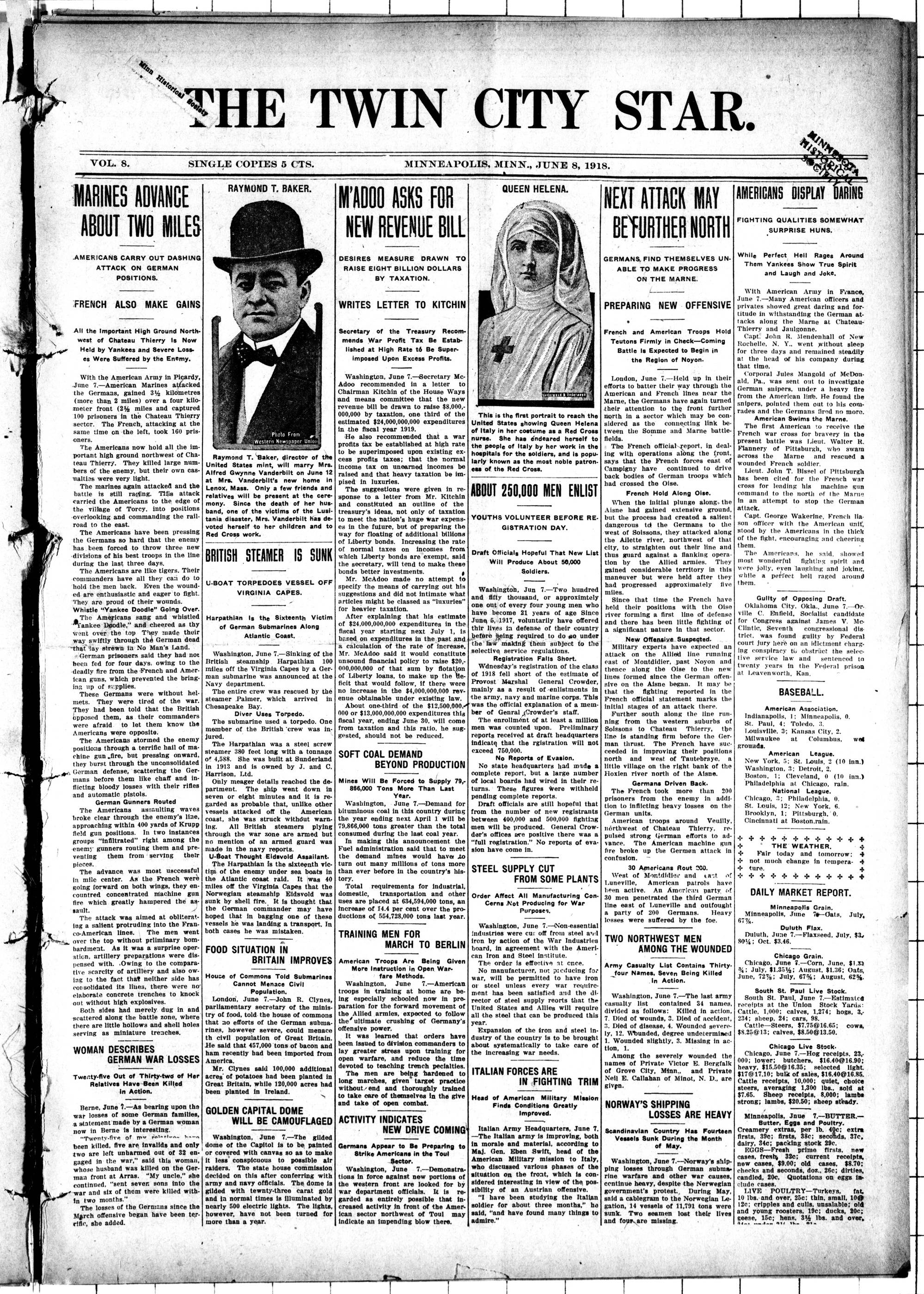
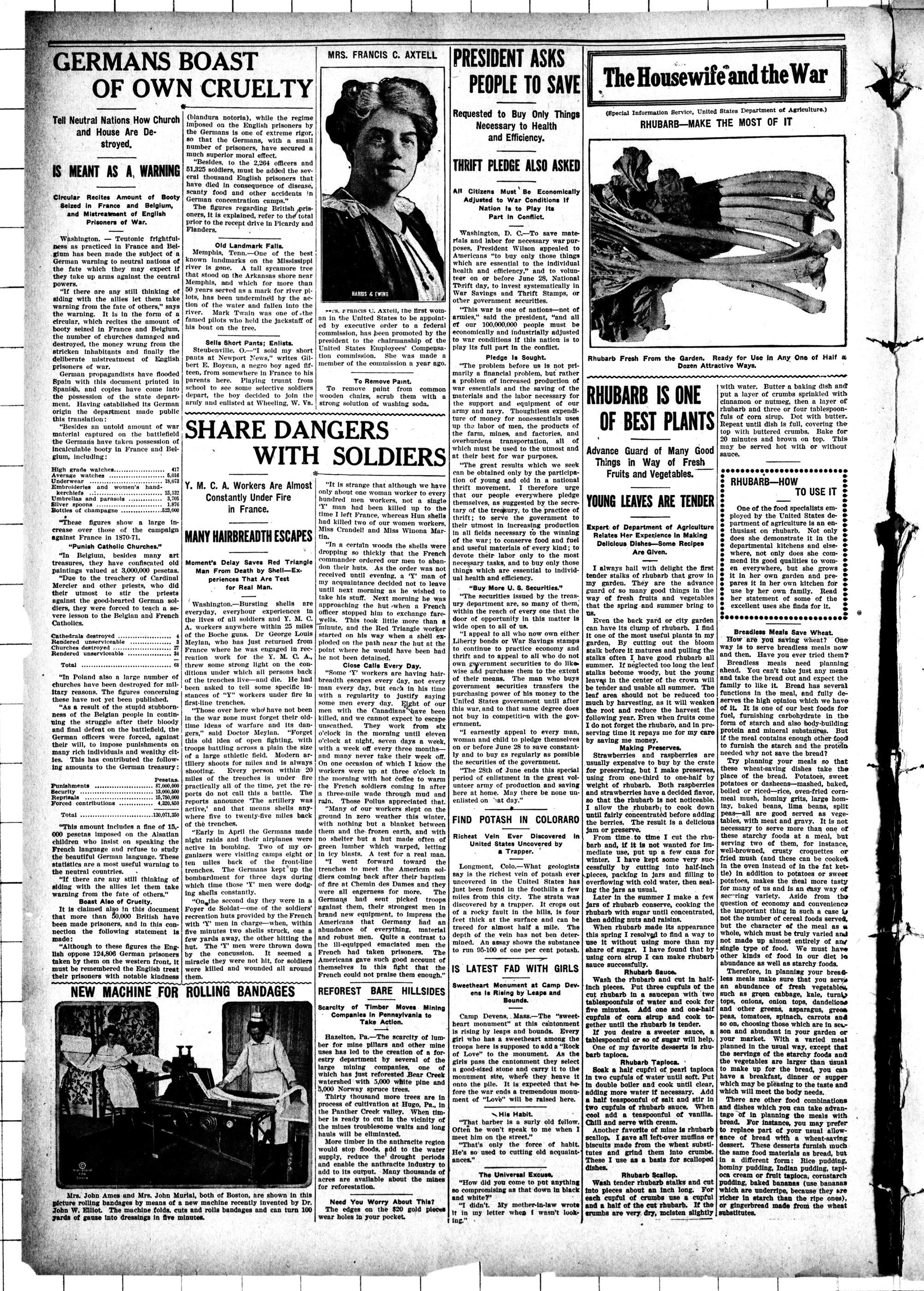
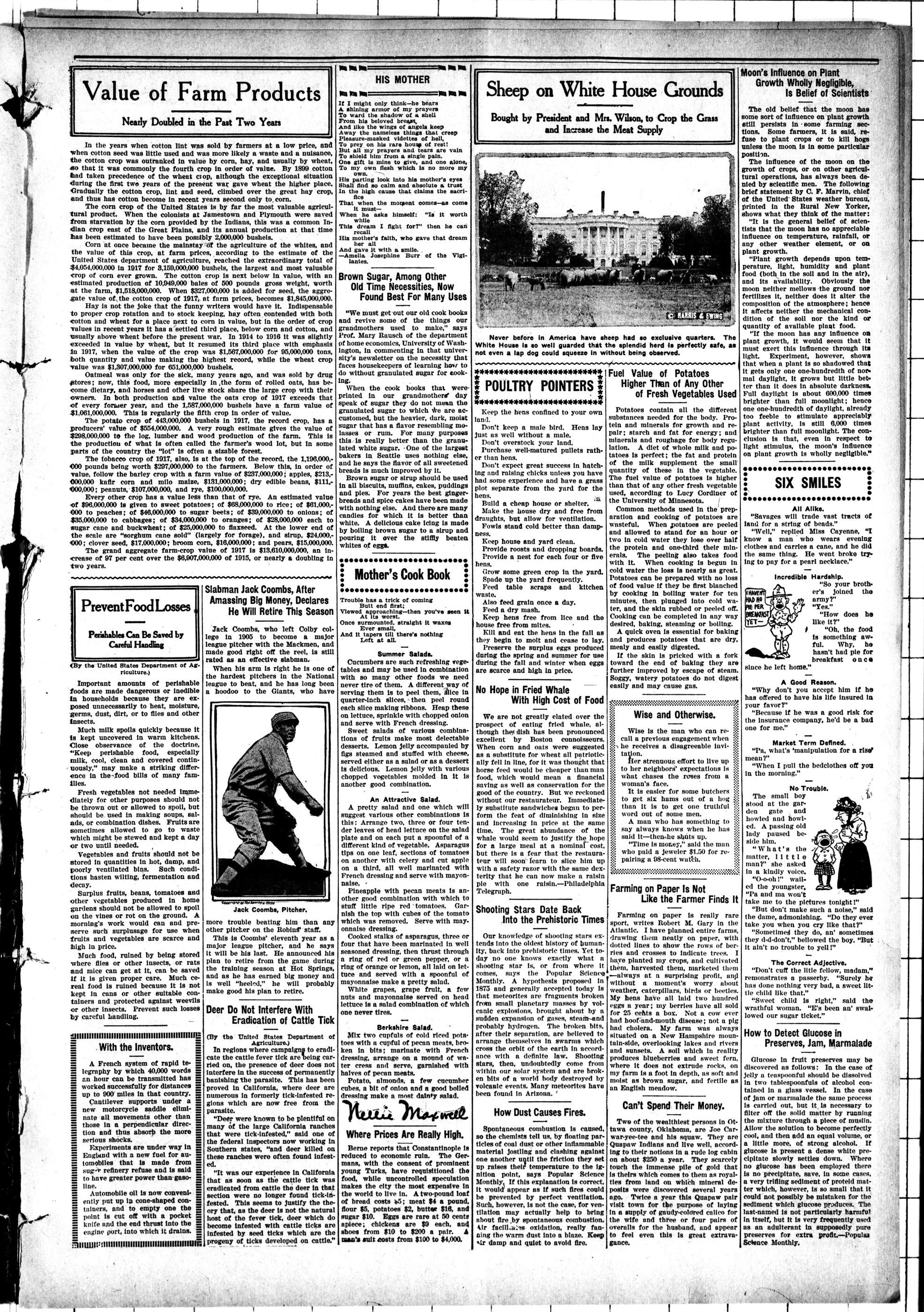
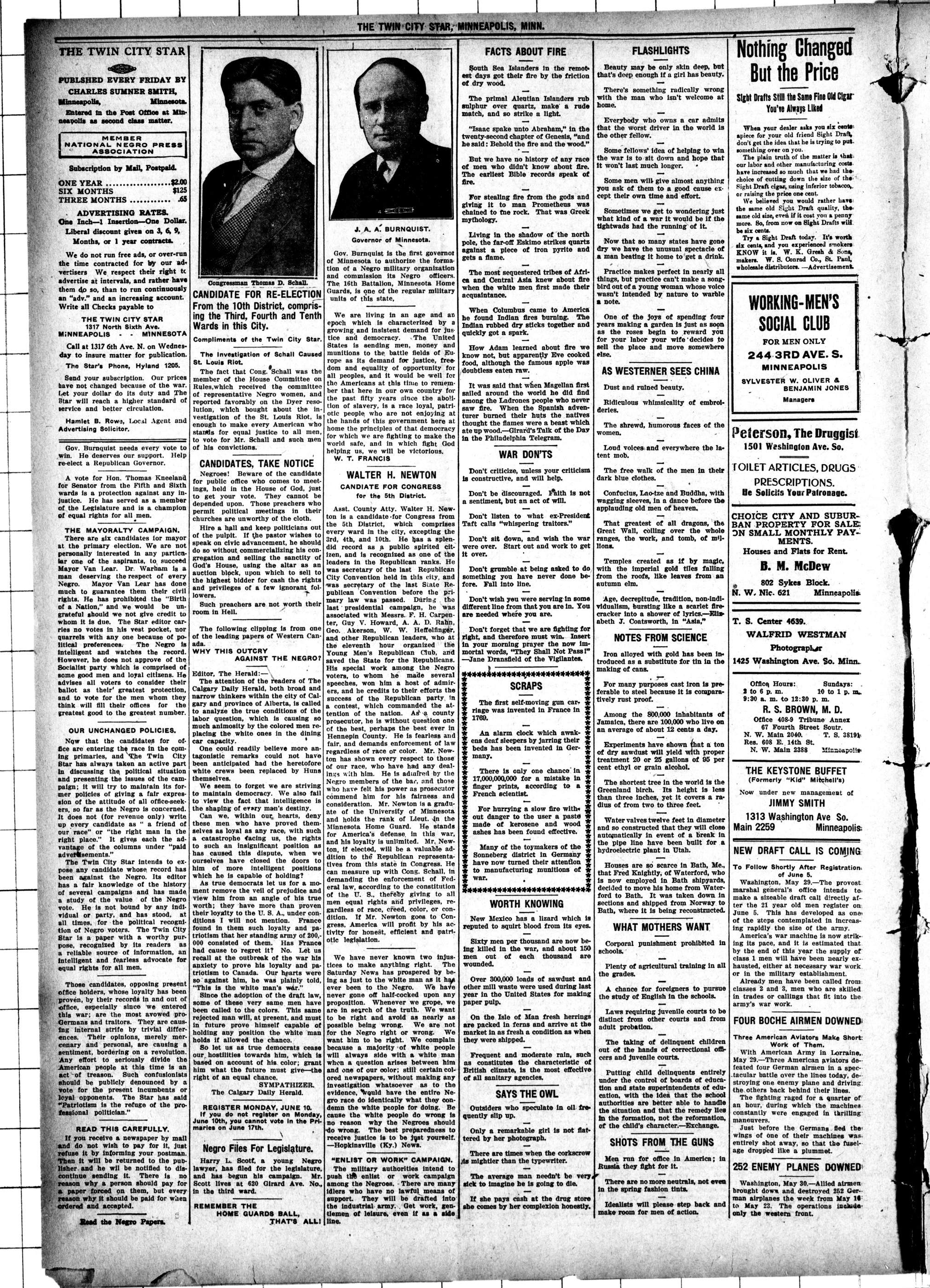
Page text (machine-generated)
VOL. 8.
MARINES ADVANCE ABOUT TWO MILES
AMERICANS CARRY OUT DASHING ATTACK ON GERMAN POSITIONS.
FRENCH ALSO MAKE GAINS
All the Important High Ground Northwest of Chateau Thierry Is Now Held by Yankees and Severe Losses Were Suffered by the Enemy.
With the American Army in Picardy, June 7.—American Marines attacked the Germans, gained $3\frac{1}{2}$ kilometres (more than 2 miles) over a four kilometer front ($2\frac{1}{2}$ miles and captured 100 prisoners in the Chateau Thierry sector. The French, attacking at the same time on the left, took 160 prisoners.
The Americans now hold all the important high ground northwest of Chateau Thierry. They killed large numbers of the enemy, but their own casualties were very light.
The marines again attacked and the battle is still raging. This attack carried the Americans to the edge of the village of Torcy, into positions overlooking and commanding the railroad to the east.
The Americans have been pressing the Germans so hard that the enemy has been forced to throw three new divisions of his best troops in the line during the last three days.
The Americans are like tigers. Their commanders have all they can do to hold the men back. Even the wounded are enthusiastic and eager to fight. They are proud of their wounds.
Whistle "Yankee Doodle" Going Over.
The Americans sang and whistled Yankee Doodle," and cheered as they went over the top They made their way swiftly through the German dead that lay strewn in No Man's Land.
German prisoners said they had not been fed for four days. owing to the deadly fire from the French and American guns, which prevented the bringing up of supplies.
These Germans were without helmets. They were tired of the war. They had been told that the British opposed them, as their commanders were afraid to let them know the Americans were opposite.
The Americans stormed the enemy positions through a terrific hail of machine gun fire, but pressing onward, they burst through the unconsolidated German defense, scattering the Germans before them like chaff and inflicting bloody losses with their rifles and automatic pistols.
German Gunners Routed
The Americans assaulting waves broke clear through the enemy's line, approaching within 400 yards of Krupp field gun positions. In two instances groups "infiltrated" right among the enemy gunners routing them and preventing them from serving their pieces.
The advance was most successful in mile center. As the French were going forward on both wings, they encountered concentrated machine gun fire which greatly hampered the assault.
The attack was aimed at obliterating a salient protruding into the Franco-American lines. The men went over the top without preliminary bombardment. As it was a surprise operation, artillery preparations were dispensed with. Owing to the comparative scarcity of artillery and also owing to the fact that neither side has consolidated its lines, there were no elaborate concrete trenches to knock out without high explosives.
Both sides had merely dug in and scattered along the battle zone, where there are little hollows and shell holes serving as miniature trenches.
WOMAN DESCRIBES
GERMAN WAR LOSSES
Twenty-five Out of Thirty-two of Her Relatives Have Been Killed in Action.
Berne, June 7.—As bearing upon the war losses of some German families, a statement made by a German woman now in Berne is interesting.
"Twenty-five of my relatives have been killed, five are invalids and only two are left unharmed out of 32 engaged in the war," said this woman, whose husband was killed on the German front at Arras. "My uncle," she continued, "sent seven sons into the war and six of them were killed within two months."
The losses of the Germans since the March offensive began have been terrific, she added.
THE TWIN CITY STAR.
SINGLE COPIES 5 CTS.
RAYMOND T. BAKER.
Photo From
Western Newspaper Union
Raymond T. Baker, director of the United States mint, will marry Mrs. Alfred Gwynne Vanderbilt on June 12 at Mrs. Vanderbilt's new home in Lenox, Mass. Only a few friends and relatives will be present at the ceremony. Since the death of her husband, one of the victims of the Lusitania disaster, Mrs. Vanderbilt has devoted herself to her children and to Red Cross work.
BRITISH STEAMER IS SUNK
U-BOAT TORPEDOES VESSEL OFF VIRGINIA CAPES.
Harpathian Is the Sixteenth Victim of German Submarines Along
Washington, June 7.—Sinking of the British steamship Harpathian 100 miles off the Virginia Capes by a German submarine was announced at the Navy department.
The entire crew was rescued by the steamer Palmer, which arrived in Chesapeake Bay.
**Diver Uses Torpedo.**
The submarine used a torpedo. One member of the British crew was injured.
The Harpathian was a steel screw steamer 380 feet long with a tonnage of 4,588. She was built at Sunderland in 1913 and is owned by J. and C. Harrison, Ltd.
Only meager details reached the department. The ship went down in seven or eight minutes and it is regarded as probable that, unlike other vessels attacked off the American coast, she was struck without warning. All British steamers plying through the war zone are armed but no mention of an armed guard was made in the navy reports.
U-Boat Thought Eldswold Assailant. The Harpathian is the sixteenth victim of the enemy under sea boats in the Atlantic coast raid. It was 40 miles off the Virginia Capes that the Norwegian steamship Eldsvold was sunk by shell fire. It is thought that the German commander may have hoped that in bagging one of these vessels he was landing a transport. In both cases he was mistaken.
FOOD SITUATION IN BRITAIN IMPROVES
Houce of Commons Told Submarines Cannot Menace Civil Population.
London, June 7.—John R. Clynes, parliamentary secretary of the ministry of food, told the house of commons that no efforts of the German submarines, however severe, could menace th civil population of Great Britain. He said that 457,000 tons of bacon and ham recently had been imported from America.
Mr. Clynes said 100,000 additional acres of potatoes had been planted in Great Britain, while 120,000 acres had been planted in Ireland.
GOLDEN CAPITAL DOME
WILL BE CAMOUFLAGED
Washington, June 7.—The gilded dome of the Capitol is to be painted or covered with canvas so as to make it less conspicuous to possible air raiders. The state house commission decided on this after conferring with army and navy officials. The dome is gilded with twenty-three carat gold and in normal times is illuminated by nearly 500 electric lights. The lights, however, have not been turned for more than a year.
MINNEAPOLIS, MINN., JUNE 8, 1918.
M'ADOO ASKS FOR NEW REVENUE BILL
M'ADOO ASKS FOR NEW REVENUE BILL
DESIRES MEASURE DRAWN TO
RAISE EIGHT BILLION DOLLARS
BY TAXATION.
WRITES LETTER TO KITCHIN
Secretary of the Treasury Recommends War Profit Tax Be Established at High Rate to Be Superimposed Upon Excess Profits.
Washington, June 7.—Secretary McAdoo recommended in a letter to Chairman Kitchin of the House Ways and means committee that the new revenue bill be drawn to raise $8,000.,000,000 by taxation, one third of the estimated $24,000,000,000 expenditures in the fiscal year 1919.
He also recommended that a war profits tax be established at high rate to be superimposed upon existing excess profits taxes; that the normal income tax on unearned incomes be raised and that heavy taxation be impired in luxuries.
The suggestions were given in response to a letter from Mr. Kitchin and constituted an outline of the treasury's ideas, not only of taxation to meet the nation's huge war expenses in the future, but of preparing the way for floating of additional billions of Liberty bonds. Increasing the rate of normal taxes on incomes from which Liberty bonds are exempt, said the secretary, will tend to make these bonds better investments.
Mr. McAdoo made no attempt to specify the means of carrying out his suggestions and did not intimate what articles might be classed as "luxuries" for heavier taxation.
After explaining that his estimate of $24,000,000,000 expenditures in the fiscal year starting next July 1, is based on expenditures in the past and a calculation of the rate of increase, Mr. McAdoo said it would constitute unsound financial policy to raise $20,000,000,000 of that sum by flotation of Liberty loans, to make up the deficit that would follow, if there were no increase in the $4,000,000,000 revenue obtainable under existing law.
About one-third of the $12,500,000,000 or $13,000,000,000 expenditures this fiscal year, ending June 30, will come from taxation and this ratio, he suggested, should not be reduced.
SOFT COAL DEMAND BEYOND PRODUCTION
Mines Will Be Forced to Supply 79, 886,000 Tons More Than Last Year.
Washington, June 7.—Demand for bituminous coal in this country during the year ending next April 1 will be 79,866,000 tons greater than the total consumed during the last coal year.
In making this announcement the Fuel administration said that to meet the demand mines would have to turn out many millions of tons more than ever before in the country's history.
Total requirements for industrial, domestic, transportation and other uses are placed at 634,594,000 tons, an increase of 14.4 per cent over the productions of 554,728,000 tons last year.
TRAINING MEN FOR
MARCH TO BERLIN
American Troops Are Being Given More Instruction in Open Warfare Methods. Washington, June 7.—American troops in training at home are being especially schooled now in preparation for the forward movement of the Allied armies, expected to follow the ultimate crushing of Germany's offensive power. It was learned that orders have been issued to division commanders to lay greater stress upon training for open warfare, and reduce the time devoted to teaching trench pecialties. The men are being hardened to long marches, given target practice without end and thoroughly trained to take care of themselves in the give and take of open combat.
ACTIVITY INDICATES
NEW DRIVE COMING
Germans Appear to Be Preparing to Strike Americans in the Toul Sector.
Washington, June 7.—Demonstrations in force against new portions of the western front are looked for by war department officials. It is regarded as entirely possible that increased activity in front of the American sector northwest of Toul may indicate an impending blow there.
QUEEN HELENA.
LOUISA WELENA
This is the first portrait to reach the United States showing Queen Helena of Italy in her costume as a Red Cross nurse. She has endeared herself to the people of Italy by her work in the hospitals for the soldiers, and is popularly known as the most noble patroness of the Red Cross.
ABOUT 250,000 MEN ENLIST
YOUTHS VOLUNTEER BEFORE REGISTRATION DAY.
Draft Officials Hopeful That New List Will Produce About 56,000
Washington, Jun 7.—Two hundred and fifty thousand, or approximately one out of every four young men who have become 21 years of age Since June 5, 1917, voluntarily have offered their lives in defense of their country before being required to do so under the law making them subject to the selective service regulations.
Registration Falls Short.
Wednesday's registration of the class of 1918 fell short of the estimate of Provost Marshal General Crowder, mainly as a result of enlistments in the army, navy and marine corps. This was the official explanation of a member of General Crowder's staff.
The enrollment of at least a million men was counted upon. Preliminary reports received at draft headquarters indicate that the registration will not exceed 750,000.
No Reports of Evasion.
No state headquarters had made a complete report, but a large number of local boards had wired in their returns. These figures were withheld pending complete reports.
Draft officials are still hopeful that from the number of new registrants between 400,000 and 500,000 fighting men will be produced. General Crowder's offices are positive there was a "full registration." No reports of evasion have come in.
STEEL SUPPLY CUT FROM SOME PLANTS
Order Affect All Manufacturing Concerns Not Producing for War Purposes.
Washington, June 7.—Non-essential industries were cut off from steel and iron by action of the War Industries board, in agreement with the American Iron and Steel institute.
The order is effective at once.
No manufacturer, not producing for war, will be permitted to have iron or steel unless every war requirement has been satisfied and the director of steel supply reorients that the United States and Allies will require all the steel that can be produced this year.
Expansion of the iron and steel industry of the country is to be brought about systematically to take care of the increasing war needs.
ITALIAN FORCES ARE IN FIGHTING TRIM
Head of American Military Mission Finds Conditions Greatly Improved.
Italian Army Headquarters, June 7.
The Italian army is improving, both in morale and material, according to Maj. Gen. Eben Swift, head of the American Military mission to Italy, who discussed various phases of the situation on the front, which is considered interesting in view of the possibility of an Austrian offensive.
"I have been studying the Italian soldier for about three months," he said, "and have found many things to admire."
NEXT ATTACK MAY BE FURTHER NORTH
NEXT ATTACK MAY BE FURTHER NORTH
GERMANS, FIND THEMSELVES UN-ABLE TO MAKE PROGRESS ON THE MARNE.
PREPARING NEW OFFENSIVE
French and American Troops Hold Teutons Firmly in Check—Coming Battle is Expected to Begin in the Region of Noyon.
London, June 7.—Held up in their efforts to batter their way through the American and French lines near the Marne, the Germans have again turned their attention to the front further north in a sector which may be considered as the connecting link between the Somme and Marne battlefields.
The French official report, in dealing with operations along the front, says that the French forces east of Campigny have continued to drive back bodies of German troops which had crossed the Oise.
French Hold Along Oise.
When the initial plunge along the Aisne had gained extensive ground, but the process had created a salient dangerous to the Germans to the west of Solssons, they attacked along the Allette river, northwest of that city, to straighten out their line and thus guard against a flanking operation by the Allied armies. They gained considerable territory in this maneuver but were held after they had progressed approximately five miles.
Since that time the French have held their positions with the Oise river forming a first line of defense and there has been little fighting of a significant nature in that sector.
New Offensive Suspected.
Military experts have expected an attack on the Allied line running east of Montdidier, past Noyon and thence along the Oise to the new lines formed since the German offensive on the Aisne began. It may be that the fighting reported in the French official statement marks the initial stages of an attack there.
Further south along the line running from the western suburbs of Solssons to Chateau Thierry, the line is standing firm before the German thrust. The French have succeeded in improving their positions north and west of Tautbraye, a little village on the right bank of the Hoxien river north of the Alsne.
Germans Driven Back.
The French took more than 200 prisoners from the enemy in addition to inflicting heavy losses on the German units.
American troops around Veully, northwest of Chateau Thierry, repulsed strong German efforts to advance. The American machine gun fire broke up the German attack in confusion.
30 Americans Rout 200.
West of Montdidier and east of Luneville, American patrols have been active. An American party of 30 men penetrated the third German line east of Luneville and outfought a party of 200 Germans. Heavy losses were suffered by the foe.
TWO NORTHWEST MEN
AMONG THE WOUNDED
Army Casualty List Contains Thirty-four Names, Seven Being Killed In Action.
Washington, June 7.—The last army casualty list contained 34 names, divided as follows: Killed in action, 7. Died of wounds, 3. Died of accident, 3. Died of disease, 4. Wounded severely, 12. Wounded, degree undetermined 1. Wounded slightly, 3. Missing in action, 1.
Among the severely wounded the names of Private Victor E. Bergfalk of Grove City, Minn., and Private Nell E. Callahan of Minot, N. D., are given.
NORWAY'S SHIPPING LOSSES ARE HEAVY
Scandinavian Country Has Fourteen Vessels Sunk During the Month of May.
Washington, June 7.—Norway's shipping losses through German submarine warfare and other war causes, continue heavy, despite the Norwegian government's protest. During May, said a cablegram to the Norwegian Legation, 14 vessels of 11,791 tons were sunk. Two seamen lost their lives and four are missing.
AMERICANS DISPLAY DARING
FIGHTING QUALITIES SOMEWHAT SURPRISE HUNS.
While Perfect Hell Rages Around
Them Yankees Show True Spirit
and Laugh and Joke.
With American Army in France,
June 7.—Many American officers and
privates showed great daring and fortitude in withstanding the German attacks along the Marne at Chateau-
Thierry and Jaulgonne.
Capt. John R. Mendenhall of New
Rochelle, N. Y., went without sleep for
three days and remained steadily at the head of his company during that time.
Corporal Jules Mangold of McDonald, Pa., was sent out to investigate German snipers, under a heavy fire from the American line. He found the snipers, pointed them out to his comrades and the Germans fired no more.
American Swims the Marne.
The first American to receive the French war cross for bravery in the present battle was Lieut. Walter R. Flannery of Pittsburgh, who swam across the Marne and rescued a wounded French soldier.
Lieut. John T. Bissel of Pittsburgh has been cited for the French war cross for leading his machine gun command to the north of the Marne in an attempt to stop the German attack.
Capt. George Wakerline, French liason officer with the American unif, stood by the Americans in the thick of the fight, encouraging and cheering them.
The Americans, he said, showed most wonderful fighting spirit and were jolly, even laughing and joking, while a perfect hell raged around them.
Gulity of Opposing Draft.
Oklahoma City, Okla., June 7. Orville C. Enfield, Socialist candidate for Congress against James V. McClintic, Seventh congressional district, was found guilty by Federal court jury here on an indictment charging conspiracy to obstruct the selective service law and sentenced to twenty years in the Federal prison at Leavenworth, Kan.
BASEBALL.
American Association.
Indianapolis, 1; Minneapolis, 0.
St. Paul, 4; Toledo, 3.
Louisville, 3; Kansas City, 2.
Milwaukee at Columbus, west grounds.
American League.
New York, 5; St. Louis, 2 (10 inn.)
Washington, 3; Detroit, 2.
Boston, 1; Cleveland, 0 (10 inn.)
Philadelphia at Chicago, rain.
National League.
Chicago, 3; Philadelphia, 0.
St. Louis, 12; New York, 6.
Brooklyn, 1; Pittsburgh, 0.
Cincinnati at Boston.rain.
THE WEATHER.
Fair today and tomorrow:
not much change in tempera-
ture.
DAILY MARKET REPORT.
Minneapolis Grain.
Minneapolis, June 7—Oats, July,
67%.
Duluth Flax.
Duluth, June 7—Flaxseed, July, $3
80½%; Oct. $3.46.
Chicago Grain.
Chicago, June 7—Corn, June, $1.33
½%; July, $1.35½%; August, $1.36; Oats,
June, 72½%; July, 67½%; August, 62½%.
South St. Paul Live Stock.
South St. Paul, June 7—Estimated
receipts at the Union Stock Yards:
Cattle, 1,000; calves, 1,274; hogs, 3.
234; sheep, 24; cars, 98.
Cattle—Steers, $7.75@16.65; cows,
$8.25@13; calves, $8.50@13.50.
Chicago Live Stock.
Chicago, June 7.—Hog receipts, 23,
000; lower; butchers, $16.40@16.90;
heavy, $15.50@16.35; selected light,
$17@17.10; bulk of sales, $16.40@16.85;
Cattle receipts, 10,000; quiet, choice
steers, averaging 1,300 lbs., sold at
$7.65. Sheep receipts, 8,000; lambs
strong; lambs, $20.50; sheep steady.
Minneapolis, June 7.—BUTTER.
Butter, Eggs and Poultry.
Butter, Eggs and Poultry.
Creamery extras, per lb. 40c; extra firsts, 39c; firsts, 38c; seconds, 37c, dairy, 34c; packing stock 29c.
EGGS—Fresh prime firsts, new cases, fresh, 32c; current receipts, new cases, $9.00; old cases, $8.70; checks and seconds, doz. 26c; dirties, candled, 20c. Quotations on eggs include cases.
LIVE 'POULTRY—Turkeys, fat, 10 lbs. and over, 25c; thin, small, 100¢ 12c; cripples and culls, unsalable; old and young roosters, 19c; ducks, 20c; geese, 15c; hens, 3½ lbs. and over, 24c; under 21¢ the 21¢
GERMANS BOAST OF OWN CRUELTY
International
Journal
Mrs. John Ames and Mrs. John Murial, both of Boston, are shown in this picture rolling bandages by means of a new machine recently invented by Dr. John W. Elliot. The machine folds, cuts and rolls bandages and can turn 100 yards of gauze into dressings in five minutes.
Tell Neutral Nations How Church and House Are Destroyed.
IS MEANT AS A, WARNING
Circular Recites Amount of Booty Seized in France and Belgium, and Mistreatment of English Prisoners of War.
Washington. — Teutonic frightfulness as practiced in France and Belgium has been made the subject of a German warning to neutral nations of the fate which they may expect if they take up arms against the central powers.
"If there are any still thinking of siding with the allies let them take warning from the fate of others," says the warning. It is in the form of a circular, which recites the amount of booty seized in France and Belgium, the number of churches damaged and destroyed, the money wrung from the stricken inhabitants and finally the deliberate mistreatment of English prisoners of war.
German propagandists have flooded Spain with this document printed in Spanish, and copies have come into the possession of the state department. Having established its German origin the department made public this translation:
"Besides an untold amount of war material captured on the battlefield the Germans have taken possession of incalculable booty in France and Belgium, including:
High grade watches ..... 417
Average watches ..... 5,016
Underwear ..... 18,673
Entherties and women's hand-kerchiefs ..... 15,132
Umbrellas and parasols ..... 3,705
Silver spoons ..... 1,876
Bottles of champagne ..... 523,000
"These figures show a large increase over those of the campaign against France in 1870-71.
"Punish Catholic Churches."
"In Belgium, besides many art treasures, they have confiscated old paintings valued at 3,000,000 pesetas.
"Due to the treachery of Cardinal Mercier and other priests, who did their utmost to stir the priests against the good-hearted German soldiers, they were forced to teach a severe lesson to the Belgian and French Catholics.
Cathedrals destroyed ..... 4
Rendered unservicable ..... 3
Churches destroyed ..... 27
Rendered unservicable ..... 34
"In Poland also a large number of churches have been destroyed for military reasons. The figures concerning these have not yet been published.
"As a result of the stupid stubbornness of the Belgian people in continuing the struggle after their bloody and final defeat on the battlefield, the German officers were forced, against their will, to impose punishments on many rich individuals and wealthy cities. This has contributed the following amounts to the German treasury:
Punishments 87,000,000
Security 13,000,500
Reprisals 15,750,000
Forced contributions 4,320,500
"This amount includes a fine of 15,000 pesetas imposed on the Alsatian children who insist on speaking the French language and refuse to study the beautiful German language. These statistics are a most useful warning to the neutral countries.
"If there are any still thinking of siding with the allies let them take warning from the fate of others."
Boast Also of Cruelty.
It is claimed also in this document that more than 50,000 British have been made prisoners, and in this connection the following statement is made:
"Although to these figures the English oppose 124,806 German prisoners taken by them on the western front, it must be remembered the English treat their prisoners with notable kindness
SHARE DANGERS WITH SOLDIERS
(blandura notorina), while the regime imposed on the English prisoners by the Germans is one of extreme rigor, so that the Germans, with a small number of prisoners, have secured a much superior moral effect. "Besides, to the 2,264 officers and 51,325 soldiers, must be added the several thousand English prisoners that have died in consequence of disease, scanty food and other accidents in German concentration camps." The figures regarding British prisoners, it is explained, refer to the total prior to the recent drive in Picardy and Flanders.
Old Landmark Falls
Memphis, Tenn.—One of the best known landmarks on the Mississippi river is gone. A tall sycamore tree that stood on the Arkansas shore near Memphis, and which for more than 50 years served as a mark for river pilots, has been undermined by the action of the water and fallen into the river. Mark Twain was one of the famed pilots who held the jackstaff of his boat on the tree.
Sells Short Pants: Enlists.
Steubenville, O.—"I sold my short pants at Newport News," writes Gilbert E. Boycan, a negro boy aged fifteen, from somewhere in France to his parents here. Playing truant from school to see some selective soldiers depart, the boy decided to join the arly and enlisted at Wheeling, W. Va.
SHARE DAILY WITH
Y. M. C. A. Workers Are Almost Constantly Under Fire in France.
MANY HAIRBREADTH ESCAPES
Moment's Delay Saves Red Triangle Man From Death by Shell—Experiences That Are Test for Real Man.
Washington.—Bursting shells are everyday, every hour experiences in the lives of all soldiers and Y. M. C. A. workers anywhere within 25 miles of the Boche guns. Dr George Louis Meylan, who has just returned from France where he was engaged in recreation work for the Y. M. C. A., threw some strong light on the conditions under which all persons back of the trenches live—and die. He had been asked to tell some specific instances of "Y" workers under fire in first-line trenches.
"Those over here who have not been in the war zone must forget their old-time ideas of warfare and its dangers," said Doctor Meylan. "Forget this old idea of open fighting, with troops battling across a plain the size of a large athletic field. Modern artillery shoots for miles and is always shooting. Every person within 20 miles of the trenches is under fire practically all of the time, yet the reports do not call this a battle. The reports announce 'The artillery was active,' and that means shells anywhere five to twenty-five miles back of the trenches.
"Early in April the Germans made night raids and their airplanes were active in bombing. Two of my organizers were visiting camps eight or ten miles back of the frontline trenches. The Germans kept up the bombardment for three days during which time those 'Y' men were dodging shells constantly.
"On the second day they were in a Foyer de Soldat—one of the soldiers' recreation huts provided by the French with 'Y' men in charge—when, within five minutes two shells struck, one a few yards away, the other hitting the hut. The 'Y' men were thrown down by the concussion. It seemed a miracle they were not hit, for soldiers were killed and wounded all around them.
ROLLING BANDAGES
HARRIS & EWING
**S. Francis C. Axtell, the first woman in the United States to be appointed by executive order to a federal commission, has been promoted by the president to the chairmanship of the United States Employees' Compensation commission. She was made a member of the commission a year ago.**
To remove paint from common wooden chairs, scrub them with a strong solution of washing soda.
"It is strange that although we have only about one woman worker to every hundred men workers, not a single 'Y' man had been killed up to the time I left France, whereas Hun shells had killed two of our women workers, Miss Crandell and Miss Winona Martin.
"In a certain woods the shells were dropping so thickly that the French commander ordered our men to abandon their huts. As the order was not received until evening, a 'Y' man of my acquaintance decided not to leave until next morning as he wished to take his stuff. Next morning he was approaching the hut when a French officer stopped him to exchange farewells. This took little more than a minute, and the Red Triangle worker started on his way when a shell exploded on the path near the hut at the point where he would have been had he not been detained.
Close Calls Every Day.
"Some Y" workers are having hairbreadth escapes every day, not every man every day, but each in his time with a regularity to justify saying some men every day. Eight of our men with the Canadians have been killed, and we cannot expect to escape unscathed. They work from six o'clock in the morning until eleven o'clock at night, seven days a week, with a week off every three months—and many never take their week off. On one occasion of which I know the workers were up at three o'clock in the morning with hot coffee to warm the French soldiers coming in after a three-mile wade through mud and rain. Those Pollus appreciated that.
"Many of our workers slept on the ground in zero weather this winter, with nothing but a blanket between them and the frozen earth, and with no shelter but a hut made often of green lumber which warped, letting in icy blasts. A test for a real man. "I went forward toward the trenches to meet the American soldiers coming back after their baptism of fire at Chemin des Dames and they were all eagerness for more. The Germans had sent picked troops against them, their strongest men in brand new equipment, to impress the Americans that Germany had an abundance of everything, material and robust men. Quite a contrast to the ill-equipped emaciated men the French had taken prisoners. The Americans gave such good account of themselves in this fight that the French could not praise them enough."
REFOREST BARE HILLSIDES
Scarcity of Timber Moves Mining Companies in Pennsylvania to Take Action.
Hazelton, Pa.—The scarcity of lumber for mine pillars and other mine uses has led to the creation of a forestry department by several of the large mining companies, one of which has just reforested Bear Creek watershed with 5,000 white pine and 5,000 Norway spruce trees.
Thirty thousand more trees are in process of cultivation at Hugo, Pa., in the Panther Creek valley. When timber is ready to cut in the vicinity of the mines troublesome waits and long hauls will be eliminated.
More timber in the anthracite region would stop floods, add to the water supply, reduce the drought periods and enable the anthracite industry to add to its output. Many thousands of acres are available about the mines for reforestation.
Need You Worry About This?
The edges on the $20 gold pieces wear holes in your pocket.
PRESIDENT ASKS PEOPLE TO SAVE
Requested to Buy Only Things Necessary to Health and Efficiency.
THRIFT PLEDGE ALSO ASKED
All Citizens Must Be Economically Adjusted to War Conditions If Nation Is to Play Its Part in Conflict.
Washington, D. C.—To save materials and labor for necessary war purposes, President Wilson appealed to Americans "to buy only those things which are essential to the individual health and efficiency," and to volunteer on or before June 28, National Thrift day, to invest systematically in War Savings and Thrift Stamps, or other government securities.
"This war is one of nations—not of armies," said the president, "and all of our 100,000,000 people must be economically and industrially adjusted to war conditions if this nation is to play its full part in the conflict.
Pledge Is Sought.
"The problem before us is not primarily a financial problem, but rather a problem of increased production of war essentials and the saving of the materials and the labor necessary for the support and equipment of our army and navy. Thoughtless expenditure of money for nonessentials uses up the labor of men, the products of the farm, mines, and factories, and overburdens transportation, all of which must be used to the utmost and at their best for war purposes.
"The great results which we seek can be obtained only by the participation of young and old in a national thrift movement. I therefore urge that our people everywhere pledge themselves, as suggested by the secretary of the treasury, to the practice of thrift; to serve the government to their utmost in increasing production in all fields necessary to the winning of the war; to conserve food and fuel and useful materials of every kind; to devote their labor only to the most necessary tasks, and to buy only those things which are essential to individual health and efficiency.
"Buy More U. S. Securities."
"The securities issued by the treasury department are, so many of them, within the reach of every one that the door of opportunity in this matter is wide open to all of us.
"I appeal to all who now own either Liberty bonds or War Savings stamps to continue to practice economy and thrift and to appeal to all who do not own government securities to do likewise and purchase them to the extent of their means. The man who buys government securities transfers the purchasing power of his money to the United States government until after this war, and to that same degree does not buy in competition with the government.
"I earnestly appeal to every man, woman and child to pledge themselves on or before June 28 to save constantly and to buy as regularly as possible the securities of the government."
"The 28th of June ends this special period of enlistment in the great volunteer army of production and saving here at home. May there be none unenlisted on 'at day."
FIND POTASH IN COLORARO
Richest Vein Ever Discovered In United States Uncovered by a Trapper.
Longmont, Colo.—What geologists say is the richest vein of potash ever uncovered in the United States has just been found in the foothills a few miles from this city. The strata was discovered by a trapper. It crops out of a rocky fault in the hills, is four feet thick at the surface and can be traced for almost half a mile. The depth of the vein has not been determined. An assay shows the substance to run 95-100 of one per cent potash.
IS LATEST FAD WITH GIRLS
Sweetheart Monument at Camp Devens is Rising by Leaps and Bounds.
Camp Devens, Mass.—The "sweet-heart monument" at this cantonment is rising by leaps and bounds. Every girl who has a sweetheart among the troops here is supposed to add a "Rock of Love" to the monument. As the girls pass the cantonment they select a good-sized stone and carry it to the monument site, where they heave it onto the pile. It is expected that before the war ends a tremendous monument of "Love" will be raised here.
His Habit
"That barber is a surly old fellow. Often he won't speak to me when I meet him on the street."
"That's only the force of habit. He's so used to cutting old acquaintances."
The Universal Excuse
"How did you come to put anything so compromising as that down in black and white?"
"I didn't. My mother-in-law wrote it in my letter when I wasn't looking."
The Housewife and the War
(Special Information Service, United States Department of Agriculture.) RHUBARB—MAKE THE MOST OF IT
```markdown
```
Rhubarb Fresh From the Garden. Ready for Use In Any One of Half a Dozen Attractive Ways.
RHUBARB IS ONE OF BEST PLANTS
Advance Guard of Many Good Things in Way of Fresh Fruits and Vegetables.
Expert of Department of Agriculture Relates Her Experience in Making Delicious Dishes—Some Recipes
I always hall with delight the first tender stalks of rhubarb that grow in my garden. They are the advance guard of so many good things in the way of fresh fruits and vegetables that the spring and summer bring to us.
Even the back yard or city garden can have its clump of rhubarb. I find it one of the most useful plants in my garden. By cutting out the bloom stalk before it matures and pulling the stalks often I have good rhubarb all summer. If neglected too long the leaf stalks become woody, but the young leaves in the center of the crown will be tender and usable all summer. The leaf area should not be reduced too much by harvesting, as it will weaken the root and reduce the harvest the following year. Even when fruits come I do not forget the rhubarb, and in preserving time it repays me for my care by saving me money.
Making Preserves.
Strawberries and raspberries are usually expensive to buy by the crate for preserving, but I make preserves, using from one-third to one-half by weight of rhubarb. Both raspberries and strawberries have a decided flavor, so that the rhubarb is not noticeable. I allow the rhubarb, to cook down until fairly concentrated before adding the berries. The result is a delicious jam or preserve.
From time to time I cut the rhubarb and, if it is not wanted for immediate use, put up a few cans for winter. I have kept some very successfully by cutting into half-inch pieces, packing in jars and filling to overflowing with cold water, then sealing the jars as usual.
Later in the summer I make a few jars of rhubarb conserve, cooking the rhubarb with sugar until concentrated, then adding nuts and raisins.
When rhubarb made its appearance this spring I resolved to find a way to use it without using more than my share of sugar. I have found that by using corn sipup I can make rhubarb sauce successfully.
Rhubarb Sauce
Wash the rhubarb and cut in half-inch pieces. Put three cupfuls of the cut rhubarb in a saucepan with two tablespoonfuls of water and cook for five minutes. Add one and one-half cupfuls of corn sirup and cook together until the rhubarb is tender. If you desire a sweeter sauce, a tablespoonful or so of sugar will help. One of my favorite desserts is rhubarb tapioca.
Rhubarb Tapioca.
Soak a half cupful of pearl tapioca in two cupfuls of water until soft. Put in double boiler and cook until clear, adding more water if necessary. Add a half teaspoonful of salt and stir in two cupfuls of rhubarb sauce. When cool add a teaspoonful of vanilla. Chill and serve with cream.
Another favorite of mine is rhubarb scallop. I save all left-over muffins or biscuits made from the wheat substitutes and grind them into crumbs. These I use as a basis for scalloped dishes.
Rhubarb Scallop.
Wash tender rhubarb stalks and cut into pieces about an inch long. For each cupful of crumbs use a cupful and a half of the cut rhubarb. If the crumbs are very dry, molten slightly
with water. Butter a baking dish and put a layer of crumbs sprinkled with cinnamon or nutmeg, then a layer of rhubarb and three or four tablespoonfuls of corn sirup. Dot with butter. Repeat until dish is full, covering the top with buttered crumbs. Bake for 20 minutes and brown on top. This may be served hot with or without sauce.
One of the food specialists employed by the United States department of agriculture is an enthusiast on rhubarb. Not only does she demonstrate it in the departmental kitchens and elsewhere, not only does she commend its good qualities to women everywhere, but she grows it in her own garden and prepares it in her own kitchen for use by her own family. Read her statement of some of the excellent uses she finds for it.
Breadless Meals Save Wheat.
How are you saving wheat? One way is to serve breadless meals now and then. Have you ever tried them? Breadless meals need planning ahead. You can't take just any menu and take the bread out and expect the family to like it. Bread has several functions in the meal, and fully deserves the high opinion which we have of it. It is one of our best foods for fuel, furnishing carbohydrate in the form of starch and also body-building protein and mineral substances. But if the meal contains enough other food to furnish the starch and the protein needed why not save the bread?
Try planning your meals so that these wheat-saving dishes take the place of the bread. Potatoes, sweet potatoes or dasheens—mashed, baked, boiled or riced—rice, oven-fried cornmeal mush, hominy grits, large hominy, baked beans, lima beans, split peas—all are good served as vegetables, with meat and gravy. It is not necessary to serve more than one of these starchy foods at a meal, but serving two of them, for instance, well-browned, crusty croquettes or fried mush (and these can be cooked in the oven instead of in the fat kettle) in addition to potatoes or sweet potatoes, makes the meal more tasty for many of us and is an easy way of securing variety. Aside from the question of economy and convenience the important thing in such a case is not the number of cereal foods served, but the character of the meal as whole, which must be truly varied and not made up almost entirely of any single type of food. We must have other kinds of food in our diet to abundance as well as starchy foods.
Therefore, in planning your breadless meals make sure that you serve an abundance of fresh vegetables, such as green cabbage, kale, turnip, tops, onions, onion tops, dandelions and other greens, asparagus, green peas, tomatoes, spinach, carrots and so on, choosing those which are in season and abundant in your garden or your market. With a varied meal planned in the usual way, except that the servings of the starchy foods and the vegetables are larger than usual to make up for the bread, you can have a breakfast, dinner or supper which may be pleasing to the taste and which will meet the body needs.
There are other food combinations and dishes which you can take advantage of in planning the meals with bread. For instance, you may prefer to replace part of your usual allowance of bread with a wheat-saving dessert. These desserts furnish much the same food materials as bread, but in a different form: Rice pudding, hominy pudding, Indian pudding, tapioca cream or fruit tapioca, cornstarch pudding, baked bananas (use bananas which are underripe, because they are richer in starch than the ripe ones), or gingerbread made from the wheat substitutes.
Value of Farm Products
Nearly Doubled in the Past Two Years
In the years when cotton lint was when cotton seed was little used and when the cotton crop was outranked in value so that it was commonly the fourth crop had taken precedence of the wheat crop during the first two years of the presGradually the cotton crop, lint and sack and thus has cotton become in recent The corn crop of the United States natural product. When the colonists ate from starvation by the corn provided dian crop east of the Great Plains, and has been estimated to have been poss Corn at once became the mainstay the value of this crop, at farm price United States department of agriculture $4,054,000,000 in 1917 for 3,159,000,000 crop of corn ever grown. The cotton estimated production of 10,949,000 bale at the farm, $1,518,000,000. When $32 gate value of the cotton crop of 1917, Hay is not the joke that the funn to proper crop rotation and to stock b cotton and wheat for a place next to values in recent years it has a settled usually above wheat before the present exceeded in value by wheat, but it is in 1917, when the value of the crop both quantity and value making the value was $1,307,000,000 for 651,000,000 Oatmeal was only for the sick, m stores; now, this food, more especially come dietary, and horses and other liv owners. In both production and value of every former year, and the 1,587,1,061,000,000. This is regularly the first The potato crop of 443,000,000 but producers' value of $554,000,000. A v $298,000,000 to the log, lumber and v the production of what is often called parts of the country the "lot" is often The tobacco crop of 1917, also, is 000 pounds being worth $297,000,000 to value, follow the barley crop with a f 000,000 kafir corn and milo maize, 000,000; peanuts, $107,000,000, and rye Every other crop has a value less of $96,000,000 is given to sweet potato 000 to peaches; of $46,000,000 to sugar $35,000,000 to cabbages; of $34,000,000 sugar cane and buckwheat; of $25,000 the scale are "sorghum cane sold" (1000; clover seed, $17,000,000; broom c The grand aggregate farm-crop w crease of 97 per cent over the $6,907,00 two years.
In the years when cotton lint was sold by farmers at a low price, and when cotton seed was little used and was more likely a waste and a nuisance, the cotton crop was outranked in value by corn, hay, and usually by wheat, so that it was commonly the fourth crop in order of value. By 1899 cotton had taken precedence of the wheat crop, although the exceptional situation during the first two years of the present war gave wheat the higher place. Gradually the cotton crop, lint and seed, climbed over the great hay crop, and thus has cotton become in recent years second only to corn.
The corn crop of the United States is by far the most valuable agricultural product. When the colonists at Jamestown and Plymouth were saved from starvation by the corn provided by the Indians, this was a common Indian crop east of the Great Plains, and its annual production at that time has been estimated to have been possibly 2,000,000 bushels.
Corn at once became the mainstay of the agriculture of the whites, and the value of this crop, at farm prices, according to the estimate of the United States department of agriculture, reached the extraordinary total of $4,054,000,000 in 1917 for 3,159,000,000 bushels, the largest and most valuable crop of corn ever grown. The cotton crop is next below in value, with an estimated production of 10,949 bales of 500 pounds gross weight, worth at the farm, $1,518,000,000. When $327,000,000 is added for seed, the aggregate value of the cotton crop of 1917, at farm prices, becomes $1,845,000,000.
Hay is not the joke that the funny writers would have it. Indispensable to proper crop rotation and to stock keeping, hay often contended with both cotton and wheat for a place next to corn in value, but in the order of crop values in recent years it has a settled third place, below corn and cotton, and usually above wheat before the present war. In 1914 to 1916 it was slightly exceeded in value by wheat, but it resumed its third place with emphasis in 1917, when the value of the crop was $1,567,000,000 for 95,000,000 tons, both quantity and value making the highest record, while the wheat crop value was $1,307,000,000 for 651,000,000 bushels. Oatmeal was only for the sick, many years ago, and was sold by drug stores; now, this food, more especially in the form of rolled oats, has become dietary, and horses and other live stock share the large crop with their owners. In both production and value the oats crop of 1917 exceeds that of every former year, and the 1,587,000,000 bushels have a farm value of $1,061,000,000. This is regularly the fifth crop in order of value.
The potato crop of 443,000,000 bushels in 1917, the record crop, has a producers' value of $554,000,000. A very rough estimate gives the value of $298,000,000 to the log, lumber and wood production of the farm. This is the production of what is often called the farmer's wood lot, but in some parts of the country the "lot" is often a sizable forest.
The tobacco crop of 1917, also, is at the top of the record, the 1,196,000-000 pounds being worth $297,000,000 to the farmers. Below this, in order of value, follow the barley crop with a farm value of $237,000,000; apples, $213,000,000 kafir corn and milo malze, $131,000,000; dry edible beans, $111,000,000; peanuts, $107,000,000, and rye, $100,000,000.
Every other crop has a value less than that of rye. An estimated value of $96,000,000 is given to sweet potatoes; of $68,000,000 to rice; of $61,000,000 to peaches; of $46,000,000 to sugar beets; of $39,000,000 to onions; of $35,000,000 to cabbages; of $34,000,000 to oranges; of $28,000,000 each to sugar cane and buckwheat; of $25,000,000 to flaxseed. At the lower end of the scale are "sorghum cane sold" (largely for forage), and sirup, $24,000,000; clover seed, $17,000,000; broom corn, $16,000,000; and pears, $15,000,000.
The grand aggregate farm-crop value of 1917 is $13,610,000,000, an increase of 97 per cent over the $6,907,000,000 of 1915, or nearly a doubling in two years.
PreventFoodLosses
Perishables Can Be Saved by Careful Handling
(By the United States Department of Agriculture.)
Important amounts of perishable foods are made dangerous or inedible in households because they are exposed unnecessarily to heat, moisture, germs, dust, dirt, or to files and other insects.
Much milk spoils quickly because it is kept uncovered in warm kitchens. Close observance of the doctrine, "Keep perishable food, especially milk, cool, clean and covered continuously," may make a striking difference in the food bills of many families.
Fresh vegetables not needed immediately for other purposes should not be thrown out or allowed to spoil, but should be used in making soups, salads, or combination dishes. Fruits are sometimes allowed to go to waste which might be stewed and kept a day or two until needed.
Vegetables and fruits should not be stored in quantities in hot, damp, and poorly ventilated bins. Such conditions hasten wilting, fermentation and decay.
Surplus fruits, beans, tomatoes and other vegetables produced in home gardens should not be allowed to spoil on the vines or rot on the ground. A morning's work would can and preserve such surplusage for use when fruits and vegetables are scarce and high in price.
Much food, ruined by being stored where flies or other insects, or rats and mice can get at it, can be saved if it is given proper care. Much cereal food is ruined because it is not kept in cans or other suitable containers and protected against weevils or other insects. Prevent such losses by careful handling.
With the Inventors.
A French system of rapid telegraphy by which 40,000 words an hour can be transmitted has worked successfully for distances up to 900 miles in that country. Cantilever supports under a new motorcycle saddle eliminate all movements other than those in a perpendicular direction and thus absorb the more serious shocks. Experiments are under way in England with a new fuel for automobiles that is made from sugar refinery refuse and is said to have greater power than gasoline. Automobile oil is now conveniently put up in cone-shaped containers, and to empty one the point is cut off with a pocket knife and the end thrust into the engine port, into which it drains.
---
is sold by farmers at a low price, and is more likely a waste and a nuisance, be by corn, hay, and usually by wheat, crop in order of value. By 1899 cotton cotton, although the exceptional situation went war gave wheat the higher place, climbed over the great hay crop, years second only to corn.
It is by far the most valuable agricul-town and Plymouth were saved by the Indians, this was a common In-dust its annual production at that timeably 2,000,000 bushels.
Of the agriculture of the whites, and trees, according to the estimate of the tree, reached the extraordinary total of bushels, the largest and most valuable crop is next below in value, with an acre of 500 pounds gross weight, worth 77,000,000 is added for seed, the aggregate farm prices, becomes $1,845,000,000. Writers would have it. Indispensable keeping, hay often contended with both corn in, but in the order of third place, below corn and cotton, and war. In 1914 to 1916 it was slightly assumed its third place with emphasis was $1,567,000,000 for 95,000,000 tons, the highest record, the wheat crop 200 bushels.
Many years ago, and was sold by drug lay in the form of rolled oats, has be stock share the large crop with their the oats crop of 1917 exceeds that 000,000 bushels have a farm value of fifth crop in order of value.
Bushels in 1917, the record crop, has a very rough estimate gives the value of food production of the farm. This is the farmer's wood lot, but in some a sizable forest.
At the top of the record, the 1,196,000,-farmers. Below this, in order of farm value of $237,000,000; apples, $213,-$131,000,000; dry edible beans, $111,-$100,000,000.
Than that of rye. An estimated value oes; of $68,000,000 to rice; of $61,000,-ear beets; of $39,000,000 to onions; of 00 to oranges; of $28,000,000 each to 000 to flaxseed. At the lower end of largely fororage), and sirup, $24,000,-orn, $16,000,000; and pears, $15,000,000. Value of 1917 is $13,610,000,000, an in-000,000 of 1915, or nearly a doubling in
Slabman Jack Coombs, After Amassing Big Money, Declares He Will Retire This Season
Jack Coombs, who left Colby college in 1905 to become a major league pitcher with the Mackmen, and made good right off the reel, is still rated as an effective slabman. When his arm is right he is one of the hardest pitchers in the National league to beat, and he has long been a hoodoo to the Giants, who have
C. W.
Jack Coombs, Pitcher.
more trouble beating him than any other pitcher on the Robins' staff.
This is Coombs' eleventh year as a major league pitcher, and he says it will be his last. He announced his plan to retire from the game during the training season at Hot Springs, and as he has earned big money and is well "heeled," he will probably make good his plan to retire.
Deer Do Not Interfere With Eradication of Cattle Tick
(By the United States Department of Agriculture.) In regions where campaigns to eradicate the cattle fever tick are being carried on, the presence of deer does not interfere in the success of permanently banishing the parasite. This has been proved in California, where deer are numerous in formerly tick-infested regions which are now free from the parasite. "Deer were known to be plentiful on many of the large California ranches that were tick-infested," said one of the federal inspectors now working in Southern states, "and deer killed on these ranches were often found infested.
"It was our experience in California that as soon as the cattle tick was eradicated from cattle the deer in that section were no longer found tick-infested. This seems to justify the theory that, as the deer is not the natural host of the fever tick, deer which do become infested with cattle ticks are infested by seed ticks which are the progeny of ticks developed on cattle."
If I might only think-he bears
a shining armor of my prayers
To ward the shadow of a shell
on his back
And like the wings of angels keep
Away the nameless things that creep
Pleasure-masked videttes of hell,
To prey on his rare hours of rest!
But all my prayers and tears are vain
To shield him from a single pain.
One gift is mine to give, and one alone,
To my own flesh which is no more my
own.
His parting look into his mother's eyes
Shall find so calm and absolute a trust
In the high cause that claims the sacri-
fice
That when the moment comes—as come it must—
When he asks himself: "Is it worth while
This dream I fight for?" then he can recall
His mother's faith, who gave that dream
her.
And gave it with a smile.
—Amelia Josephine Burr of the Vigilantes.
Brown Sugar, Among Other Old Time Necessities, Now Found Best For Many Uses
"We must get out our old cook books and revive some of the things our grandmothers used to make," says Prof. Mary Rausch of the department of home economics, University of Washington, in commenting in that university's newsletter on the necessity that faces housekeepers of learning how to do without granulated sugar for cooking.
When the cook books that were printed in our grandmother's day speak of sugar they do not mean the granulated sugar to which we are accustomed, but the heavier, dark, moist sugar that has a flavor resembling molasses or rum. For many purposes this is really better than the granulated white sugar. One of the largest bakers in Seattle uses nothing else, and he says the flavor of all sweetened breads is much improved by it.
Brown sugar or sirup should be used in all biscuits, muffins, cakes, puddings and ples. For years the best gingerbreads and spice cakes have been made with nothing else. And there are many candies for which it is better than white. A delicious cake iceing is made by boiling brown sugar to a sirup and pouring it over the stiffly beaten whites of eggs.
Mother's Cook Book
Trouble has a trick of coming
Butt end first;
Viewed approaching—then you've seen it
At its worst.
Once surmounted, straight it waxes
Ever small,
And it tapers till there's nothing
Left at all.
Summer Salade
Cucumbers are such refreshing vegetables and may be used in combination with so many other foods we need never tie of them. A different way of serving them is to peel them, slice in quarter-inch slices, then peel round each slice making ribbons. Heap these on lettuce, sprinkle with chopped onion and serve with French dressing.
Sweet salads of various combinations of fruits make most delectable desserts. Lemon jelly accompanied by figs steamed and stuffed with cheese, served either as a salad or as a dessert is delicous. Lemon jelly with various chopped vegetables molded in it is another good combination.
An Attractive Salad.
A pretty salad and one which will suggest various other combinations is this: Arrange two, three or four tender leaves of head lettuce on the salad plate and on each put a spoonful of a different kind of vegetable. Asparagus tips on one leaf, sections of tomatoes on another with celery and cut apple on a third, all well marinated with French dressing and serve with mayonnaise.
Pineapple with pecan meats is another good combination with which to stuff little ripe red tomatoes. Garnish the top with cubes of the tomato which was removed. Serve with mayonnaise dressing.
Cooked stalks of asparagus, three or four that have been marinated in well seasoned dressing, then thrust through a ring of red or green pepper, or a ring of orange or lemon, all laid on lettuce and served with a spoonful of mayonnaise make a pretty salad.
White grapes, grape fruit, a few nuts and mayonnaise served on head lettuce is a salad combination of which one never tires.
Berkshire Salad
Mix two cupfuls of cold riced potatoes with a cupful of pecan meats, broken in bits; marinate with French dressing, arrange on a mound of water cress and serve, garnished with halves of pecan meats.
Potato, almonds, a few cucumber cubes, a bit of onion and a good boiled dressing make a most dalty salad.
Nellie Maxwell
Where Prices Are Really High.
Berne reports that Constantinople is reduced to economic ruin. The Germans, with the consent of prominent young Turks, have requisitioned the food, while uncontrolled speculation makes the city the most expensive in the world to live in. A two-pound loaf of bread costs $5; meat $4 a pound, flour $5, potatoes $2, butter $16, and sugar $10. Eggs are rare at 50 cents aplece; chickens are $9 each, and shoes from $10 to $200 a pair. A man's suit costs from $100 to $4,000.
Sheep on White House Grounds
Bought by President and Mrs. Wilson, to Crop the Grass and Increase the Meat Supply
© KARRIS & EWING
Never before in America have sheep had so exclusive quarters. The White House is so well guarded that the splendid herd is perfectly safe, as not even a lap dog could squeeze in without being observed.
POULTRY POINTERS
Keep the stand confined to your own land.
Don't keep a male bird. Hens lay just as well without a male.
Don't overstock your land.
Purchase well-matured pullets rather than hens.
Don't expect great success in hatching and raising chicks unless you have had some experience and have a grass plot separate from the yard for the hens.
Build a cheap house or shelter.
Make the house dry and free from draughts, but allow for ventilation.
Fowls stand cold better than dampness.
Keep house and yard clean.
Provide roosts and dropping boards.
Provide a nest for each four or five hens.
Grow some green crop in the yard.
Spade up the yard frequently.
Feed table scraps and kitchen waste.
Also feed grain once a day.
Feed a dry mash.
Keep hens free from lice and the house free from mites.
Kill and eat the hens in the fall as they begin to molt and cease to lay.
they begin to molt and cease to lay. Preserve the surplus eggs produced during the spring and summer for use during the fall and winter when eggs are scarce and high in price.
No Hope in Fried Whale With High Cost of Food
We are not greatly elated over the prospect of eating fried whale, although the dish has been pronounced excellent by Boston connosseurs. When corn and oats were suggested as a substitute for wheat all patriotically fell in line, for it was thought that horse feed would be cheaper than man food, which would mean a financial saving as well as conservation for the good of the country. But we reckoned without our restaurateur. Immediately substitute sandwiches began to perform the feat of diminishing in size and increasing in price at the same time. The great abundance of the whale would seem to justify the hope for a large meal at a nominal cost, but there is a fear that the restaurateur will soon learn to slice him up with a safety razor with the same dexterity that he can now make a raisin pie with one raisin.—Philadelphia Telegraph.
Shooting Stars Date Back Into the Prehistoric Times
Our knowledge of shooting stars extends into the oldest history of humanity, back into prehistoric times. Yet today no one knows exactly what a shooting star is, or from where it comes, says the Popular Science Monthly. A hypothesis proposed in 1875 and generally accepted today is that meteorites are fragments broken from small planetary masses by volcanic explosions, brought about by a sudden expansion of gases, steam-and probably hydrogen. The broken bits, after their separation, are believed to arrange themselves in swarms which cross the orbit of the earth in accordance with a definite law. Shooting stars, then, undoubtedly come from within our solar system and are broken bits of a world body destroyed by volcanic events. Many meteorites have been found in Arizona.
How Dust Causes Fires.
Spontaneous combustion is caused, so the chemists tell us, by floating particles of coal dust or other inflammable material jostling and clashing against one another until the friction they set up raises their temperature to the ignition point, says Popular Science Monthly. If this explanation is correct, it would appear as if such fires could be prevented by perfect ventilation. Such, however, is not the case, for ventilation may actually help to bring about fire by spontaneous combustion. Air facilities oxidation, really fanning the warm dust into a blaze. Keep it damp and quiet to avoid fire.
Potatoes contain all the different substances needed for the body. Protein and minerals for growth and repair; starch and fat for energy; and minerals and roughage for body regulation. A diet of whole milk and potatoes is perfect; the fat and protein of the milk supplement the small quantity of these in the vegetable. The fuel value of potatoes is higher than that of any other fresh vegetable used, according to Lucy Cordiner of the University of Minnesota.
Common methods used in the preparation and cooking of potatoes are wasteful. When potatoes are peeled and allowed to stand for an hour or two in cold water they lose over half the protein and one-third their minerals. The peeling also takes food with it. When cooking is begun in cold water the loss is nearly as great. Potatoes can be prepared with no loss of food value if they be first blanched by cooking in boiling water for ten minutes, then plunged into cold water, and the skin rubbed or peeled off. Cooking can be completed in any way desired, baking, steaming or boiling. A quick oven is essential for baking and produces potatoes that are dry, mealy and easily digested. If the skin is pricked with a fork toward the end of baking they are further improved by escape of steam. Soggy, watery potatoes do not digest easily and may cause gas.
Wise and Otherwise.
Wise is the man who can recall a previous engagement when he receives a disagreeable invitation.
Her strenuous effort to live up to her neighbors' expectations is what chases the roses from a woman's face.
It is easier for some butchers to get six hams out of a hog than it is to get one truthful word out of some men.
A man who has something to say always knows when he has said it—then he shuts up.
"Time is money," said the man who paid a jeweler $1.50 for repairing a 98-cent watch.
Farming on Paper Is Not Like the Farmer Finds It
Farming on paper is really rare sport, writes Robert M. Gary in the Atlantic. I have planned entire farms, drawing them neatly on paper, with dotted lines to show the rows of berries and crosses to indicate trees. I have planted my crops, and cultivated them, harvested them, marketed them—always at a surprising profit, and without a moment's worry about weather, caterpillars, birds or beetles. My hens have all laid two hundred eggs a year; my berries have all sold for 25 coats a box. Not a cow ever had hoof-and-mouth disease; not a pig had cholera. My farm was always situated on a New Hampshire mountain-side, overlooking lakes and rivers and sunsets. A soil which in reality produces blueberries and sweet fern, where it does not extrude rocks, on my farm is a foot in depth, as soft and moist as brown sugar, and fertile as an English meadow.
Can't Spend Their Money.
Two of the wealthiest persons in Ottawa county, Oklahoma, are Joe Carwar-yee tee and his squaw. They are Quapaw Indians and live well, according to their notions in a rude log cabin on about $250 a year. They scarcely touch the immense pile of gold that is theirs which comes to them as royalties from land on which mineral deposits were discovered several years ago. Twice a year this Quapaw pair visit town for the purpose of laying in a supply of gaudy-colored calico for the wife and three or four pairs of overalls for the husband, and appear to feel even this is great extravagance.
Moon's Influence on Plant Growth Wholly Negligible, Is Belief of Scientists
The old belief that the moon has some sort of influence on plant growth still persists in some farming sections. Some farmers, it is said, refuse to plant crops or to kill hogs unless the moon is in some particular position. The influence of the moon on the growth of crops, or on other agricultural operations, has always been denied by scientific men. The following brief statement by C. F. Marvin, chief of the United States weather bureau, printed in the Rural New Yorker, shows what they think of the matter: "It is the general belief of scientists that the moon has no appreciable influence on temperature, rainfall, or any other weather element, or on plant growth.
"Plant growth depends upon temperature, light, humidity and plant food (both in the soil and in the air), and its availability. Obviously the moon neither mellows the ground nor fertilizes it, neither does it alter the composition of the atmosphere; hence it affects neither the mechanical condition of the soil nor the kind or quantity of available plant food.
"If the moon has any influence on plant growth, it would seem that it must exert this influence through its light. Experiment, however, shows that when a plant is so shadowed that it gets only one one-hundredth of normal daylight, it grows but little better than it does in absolute darkness. Full daylight is about 600,000 times brighter than full moonlight; hence one one-hundredth of daylight, already too feeble to stimulate appreciably plant activity, is still 6,000 times brighter than full moonlight. The conclusion is that, even in respect to light stimulus, the moon's influence on plant growth is wholly negligible."
SIX SMILES
All Allike.
"Savages will trade vast tracts of land for a string of beads."
"Well," replied Miss Cayenne, "I know a man who wears evening clothes and carries a cane, and he did the same thing. He went broke trying to pay for a pearl necklace."
Incredible Hardship.
"So your brother's joined the army?" "Yes."
I HAVEN'T
HAD NO
PIE PER
BREAKFAST
YET-
"How does he like it?"
"Oh, the food is something awful. Why, he hasn't had ple for breakfast once."
since he left home."
A Good Reason.
"Why don't you accept him if he has offered to have his life insured in your favor?"
"Because if he was a good risk for the insurance company, he'd be a bad one for me."
Market Term Defined.
"Pa, what's 'manipulation for a rise' mean?"
"When I pull the bedclothes off you in the morning."
No Trouble.
public.
The small boy stood at the garden gate and howled and howled. A passing old lady paused beside him.
"What's the matter, little man?" she asked in a kindly voice.
"O-o-oh!" walled the youngster, "Pa and ma won't
take me to the pictures tonight!"
"But don't make such a noise," said the dame, admonishing. "Do they ever take you when you cry like that?" "Sometimes they do, an' sometimes they d-d-don't," bellowed the boy. "But it ain't no trouble to yell!"
The Correct Adjective.
"Don't cuff the little fellow, madam," remonstrates a passerby. "Surely he has done nothing very bad, a sweet little child like that." "Sweet child is right," said the wrathful woman. "E's been an' swallowed our sugar ticket."
How to Detect Glucose in Preserves, Jam, Marmalade
Glucose in fruit preserves may be discovered as follows: In the case of jelly a teaspoonful should be dissolved in two tablespoonfuls of alcohol contained in a glass vessel. In the case of jam or marmalade the same process is carried out, but it is necessary to filter off the solid matter by running the mixture through a piece of muslin. Allow the solution to become perfectly cool, and then add an equal volume, or a little more, of strong alcohol. If glucose is present a dense white precipitate slowly settles down. Where no glucose has been employed there is no precipitate, save, in some cases, a very trifling sediment of proteid matter which, however, is so small that it could not possibly be mistaken for the sediment which glucose produces. The last-named is not particularly harmful in itself, but it is very frequently used as an adulterant in supposedly pure preserves for extra profit.—Popular Science Monthly.
Entered in the Post Office at Minneapolis as second class matter.
MEMBER
NATIONAL NEGRO PRESS
ASSOCIATION
ONE YEAR ..... $2.00
SIX MONTHS ..... $125
THREE MONTHS ..... .65
ADVERTISING RATES.
One Inch—1 Insertion—One Dollar.
Liberal discount given on 3.6.9.
We do not run free ads, or over-run the time contracted for by our advertisers We respect their right to advertise at intervals, and rather have them do so, than to run continuously an "adv." and an increasing account. Write all Checks payable to
Call at 1317 6th Ave. N. on Wednesday to insure matter for publication.
The Star's Phone, Hyland 1205.
Send your subscription. Our prices have not changed because of the war. Let your dollar do its duty and The Star will reach a higher standard of service and better circulation.
Hamlet B. Rows, Local Agent and Advertising Solicitor.
Gov. Burnquist needs every vote to win. He deserves our support. Help re-elect a Republican Governor.
A vote for Hon. Thomas Kneeland for Senator from the Fifth and Sixth wards is a protection against any injustice. He has served as a member of the Legislature and is a champion of equal rights for all men.
THE MAYORALTY CAMPAIGN.
There are six candidates for mayor at the primary election. We are not personally interested in any particular one of the aspirants, to succeed Mayor Van Lear. Dr. Warham is a man deserving the respect of every Negro. Mayor Van Lear has done much to guarantee them their civil rights. He has prohibited the "Birth of a Nation," and we would be ungrateful should we not give credit to whom it is due. The Star editor carries no votes in his vest pocket, nor quarrels with any one because of political preferences. The Negro is intelligent and watches the record. However, he does not approve of the Socialist party which is comprised of some good men and loyal citizens. He advises all voters to consider their ballot as their greatest protection, and to vote for the men whom they think will fill their offices for the greatest good to the greatest number.
OUR UNCHANGED POLICIES.
Now that the candidates for office are entering the race in the coming primaries, and The Twin City Star has always taken an active part in discussing the political situation and presenting the issues of the campaign; it will try to maintain its former policies of giving a fair expression of the attitude of all office-seekers, so far as the Negro is concerned. It does not (for revenue only) write up every candidate as "a friend of our race" or "the right man in the right place." It gives each the advantage of the columns under "paid advertisements."
The Twin City Star intends to expose any candidate whose record has been against the Negro. Its editor has a fair knowledge of the history of several campaigns and has made a study of the value of the Negro vote. He is not bound by any individual or party, and has stood, at all times, for the political recognition of Negro voters. The Twin City Star is a paper with a worthy purpose, recognized by its readers as a reliable source of information, an intelligent and fearless advocate for equal rights for all men.
Those candidates, opposing present office holders, whose loyalty has been proven, by their records in and out of office, especially since we entered this war; are the most avowed pro-Germans and traitors. They are causing internal strife by trivial differences. Their opinions, merely mercenary and personal, are causing a sentiment, bordering on a revolution. Any effort to seriously divide the American people at this time is an act of treason. Such confusionists should be publicly denounced by a vote for the present incumbents or loyal opponents. The Star has said "Patriotism is the refuge of the professional politician."
READ THIS CAREFULLY.
If you receive a newspaper by mail and do not wish to pay for it, just refuse it by informing your postman. Then it will be returned to the publisher and he will be notified to discontinue sending it. There is no reason why a person should pay for a paper forced on them, but every reason why it should be paid for when ordered and accepted.
Read the Negro Papers.
M.
Congressman Thomas D. Schall
CANDIDATE FOR RE-ELECTION
From the 10th District, comprising the Third, Fourth and Tenth Wards in this City.
Compliments of the Twin City Star.
The Investigation of Schall Caused St. Louis Riot.
The fact that Cong. Schall was the member of the House Committee on Rules,which received the committee of representative Negro women, and reported favorably on the Dyer resolution, which bought about the investigation of the St. Louis Riot, is enough to make every American who stands for equal justice to all men, to vote for Mr. Schall and such men of his convictions.
CANDIDATES. TAKE NOTICE
Negroes! Beware of the candidate for public office who comes to meetings, held in the House of God, just to get your vote. They cannot be depended upon. Those preachers who permit political meetings in their churches are unworthy of the cloth.
Hire a hall and keep politicians out of the pulpit. If the pastor wishes to speak on civic advancement, he should do so without commercializing his congregation and selling the sanctity of God's House, using the altar as an auction block, upon which to sell to the highest bidder for cash the rights and privileges of a few ignorant followers.
Such preachers are not worth their room in Hell.
The following clipping is from one of the leading papers of Western Canada.
Editor, The Herald:—
The attention of the readers of The Calgary Daily Herald, both broad and narrow thinkers within the city of Calgary and province of Alberta, is called to analyze the true conditions of the labor question, which is causing so much animosity by the colored men replacing the white ones in the dining car capacity.
One could readily believe more antagonistic remarks could not have been anticipated had the heretofore white crews been replaced by Huns themselves.
We seem to forget we are striving to maintain democracy. We also fail to view the fact that intelligence is the shaping of every man's destiny.
Can we, within our hearts, deny these men who have proved themselves as loyal as any race, with such a catastrophe facing us, the rights to such an insignificant position as has caused this dispute, when we ourselves have closed the doors to him of more intelligent positions which he is capable of holding?
As true democrats let us for a moment remove the veil of prejudice and view him from an angle of his true worth; they have more than proven their loyalty to the U. S. A., under conditions I will not mention. France found in them such loyalty and patriotism that her standing army of 200,000 consisted of them. Has France had cause to regret it? No. Let us recall at the outbreak of the war his anxiety to prove his loyalty and patriotism to Canada. Our hearts were so against him, he was plainly told, "This is the white man's war."
Since the adoption of the draft law, some of these very same men have been called to the colors. This same rejected man will, at present, and must in future prove himself capable of holding any position the white man holds if allowed the chance.
So let us as true democrats cease our hostilities towards him, which is based on account of his color; grant him what the future must give—the right of an equal chance.
SYMPATHIZER.
The Calgary Daily Herald.
REGISTER MONDAY, JUNE 10.
If you do not register on Monday, June 10th, you cannot vote in the Primaries on June 17th.
Negro Files For Legislature.
Harry L. Scott, a young Negro lawyer, has filed for the legislature, and has begun his campaign. Mr. Scott lives at 620 Girard Ave. No., in the third ward.
REMEMBER THE
HOME GUARDS BALL,
THAT'S ALL!
THE TWIN CITY STAR, MINNEAPOLIS, MINN.
4
Gov. Burnquist is the first governor of Minnesota to authorize the formation of a Negro military organization and commission its Negro officers. The 16th Battalion, Minnesota Home Guards, is one of the regular military units of this state.
We are living in an age and an epoch which is characterized by a growing and insistent demand for justice and democracy. The United States is sending men, money and munitions to the battle fields of Europe as its demand for justice, freedom and equality of opportunity for all peoples, and it would be well for the Americans at this time to remember that here in our own country for the past fifty years since the abolition of slavery, is a race loyal, patriotic people who are not enjoying at the hands of this government here at home the principles of that democracy for which we are fighting to make the world safe, and in which fight God helping us, we will be victorious. W. T. FRANCIS
WALTER H. NEWTON
CANDIATE FOR CONGRESS
for the 5th District.
Asst. County Atty. Walter H. Newton is a candidate-for Congress from the 5th District, which comprises every ward in the city, excepting the 3rd, 4th, and 10th. He has a splendid record as a public spirited citizen, and is recognized as one of the leaders in the Republican ranks. He was secretary of the last Republican City Convention held in this city, and was secretary of the last State Republican Convention before the primary law was passed. During the last presidential campaign, he was associated with Messrs. F. H. Carpenter, Guy V. Howard, A. A. D. Rahn, Geo. Akerson, W. W. Heffelfinger, and other Republican leaders, who at the eleventh hour organized the Young Men's Republican Club, and saved the State for the Republicans. His special work among the Negro voters, to whom he made several speeches, won him a host of admirers, and he credits to their efforts the success of the Republican party in a contest, which commanded the attention of the nation. As a county prosecutor, he is without question one of the best, perhaps the best ever in Hennepin County. He is fearless and fair, and demands enforcement of law regardless of race or color. Mr. Newton has shown every respect to those of our race, who have had any dealings with him. He is adduced by the Negro members of the bar, and those who have felt his power as prosecutor commend him for his fairness and consideration. Mr. Newton is a graduate of the University of Minnesota and holds the rank of Lieut. in the Minnesota Home Guard. He stands for America's defense in this war, and his loyalty is unlimited. Mr. Newton, if elected, will be a valuable addition to the Republican representatives from this state in Congress. He can measure up with Cong. Schall, in demanding the enforcement of Federal law, according to the constitution of the U. S., thereby giving to all men equal rights and privileges, regardless of race, creed, color, or condition. If Mr. Newton goes to Congress, America will profit by his activity for honest, efficient and patriotic legislation.
We have never known two injustices to make anything right. The Saturday News has prospered by being as just to the white man as it has ever been to the Negro. We have never gone off half-cooked upon any proposition. Whenever we grope, we are in search of the truth. We want to be right and avoid as nearly as possible being wrong. We are not for the Negro right or wrong. We want him to be right. We complain because a majority of white people will always side with a white man when a question arises between him and one of our color; still certain colored newspapers, without making any investigation whatsoever as to the evidence, would have the entire Negro race do identically what they condemn the white people for doing. Because the white people do wrong is no reason why the Negroes should do wrong. The best preparedness to receive justice is to be just yourself.—Hopkinsville (Ky.) News.
"ENLIST OR WORK" CAMPAIGN.
FACTS ABOUT FIRE
South Sea Islanders in the remotest days got their fire by the friction of dry wood.
The primal Alentian Islanders rub sulphur over quartz, make a rude match, and so strike a light.
"Isaac spake unto Abraham," in the twenty-second chapter of Genesis, "and he said: Behold the fire and the wood."
But we have no history of any race of men who didn't know about fire. The earliest Bible records speak of fire.
For stealing fire from the gods and giving it to man Prometheus was chained to the rock. That was Greek mythology.
Living in the shadow of the north pole, the far-off Eskimo strikes quartz against a piece of iron pyrite and gets a flame.
The most sequestered tribes of Africa and Central Asia knew about fire when the white men first made their acquaintance.
When Columbus came to America he found Indian fires burning. The Indian rubbed dry sticks together and quickly got a spark.
How Adam learned about fire we know not, but apparently Eve cooked food, although the famous apple was doubtless eaten raw.
It was said that when Magellan first sailed around the world he did find among the Ladrones people who never saw fire. When the Spanish adventurer burned their huts the natives thought the flames were a beast which ate up wood—Girard's Talk of the Day in the Philadelphia Telegram.
WAR DON'TS
Don't criticize, unless your criticism is constructive, and will help.
Don't be discouraged. Faith is not a sentiment, but an act of will.
Don't listen to what ex-President Taft calls "whispering traitors."
Don't sit down, and wish the war were over. Start out and work to get it over.
Don't grumble at being asked to do something you have never done before. Fall into line.
Don't wish you were serving in some different line from that you are in. You are needed where you are.
Don't forget that we are fighting for right, and therefore must win. Insert in your morning prayer the now immortal words, "They Shall Not Pass!"—Jane Dransfield of the Vigilantes.
SCRAPS
The first self-moving gun carriage was invented in France in 1769.
An alarm clock which awakens deaf sleepers by jarring their beds has been invented in Germany.
There is only one chance in 17,000,000,000 for a mistake in finger prints, according to a French scientist.
For hurrying a slow fire without danger to the user a paste made of kerosene and wood ashes has been found effective.
Many of the toymakers of the Sonneberg district in Germany have now turned their attention to manufacturing munitions of war.
---
WORTH KNOWING
New Mexico has a lizard which is reputed to squirt blood from its eyes.
Sixty men per thousand are now being killed in the war, and about 150 men out of each thousand are wounded.
Over 300,000 loads of sawdust and other mill waste were used during last year in the United States for making paper pulp.
On the Isle of Man fresh herrings are packed in ferns and arrive at the market in as fresh a condition as when they were shipped.
Frequent and moderate rain, such as constitutes the characteristic of British climate, is the most effective of all sanitary agencies.
SAYS THE OWL
Outsiders who speculate in oil frequently slip up.
Only a remarkable girl is not flattered by her photograph.
There are times when the corkscrew is mightier than the typewriter.
The average man needn't be very sick to imagine he is going to die.
If she pays cash at the drug store she comes by her complexion honestly.
FLASHLIGHTS
Beauty may be only skin deep, but that's deep enough if a girl has beauty.
There's something radically wrong with the man who isn't welcome at home.
Everybody who owns a car admits that the worst driver in the world is the other fellow.
Some fellows' idea of helping to win the war is to sit down and hope that it won't last much longer.
Some men will give almost anything you ask of them to a good cause except their own time and effort.
Sometimes we get to wondering just what kind of a war it would be if the tightwads had the running of it.
Now that so many states have gone dry we have the unusual spectacle of a man beating it home to get a drink.
Practice makes perfect in nearly all things, but practice can't make a songbird out of a young woman whose voice wasn't intended by nature to warble a note.
One of the joys of spending four years making a garden is just as soon as the roses begin to reward you for your labor your wife decides to sell the place and move somewhere else.
AS WESTERNER SEES CHINA
Dust and ruined beauty.
Ridiculous whimsicality of embroideries.
The shrewd, humorous faces of the women.
Loud voices and everywhere the latent mob.
The free walk of the men in their dark blue clothes.
Confucius, Lao-tze and Buddha, with wagging sleeves, in a dance before the applauding old men of heaven.
That greatest of all dragons, the Great Wall, colling over the whole ranges, the work, and tomb, of millions.
Temples created as if by magic, with the imperial gold tiles falling from the roofs, like leaves from an autumn elm.
Age, decrepitude, tradition, non-individualism, bursting like a scarlet firecracker into a shower of lyrics.—Elizabeth J. Coatsworth, in "Asia."
NOTES FROM SCIENCE
Iron alloyed with gold has been introduced as a substitute for tin in the making of cans.
For many purposes cast iron is preferable to steel because it is comparatively rust proof.
Among the 800,000 inhabitants of Jamaica, there are 100,000 who live on an average of about 12 cents a day.
Experiments have shown that a ton of dry sawdust will yield with proper treatment 20 or 25 gallons of 95 per cent ethyl or grain alcohol.
The shortest tree in the world is the Greenland birch. Its height is less than three inches, yet it covers a radius of from two to three feet.
Water valves twelve feet in diameter and so constructed that they will close automatically in event of a break in the pipe line have been built for a hydroelectric plant in Utah.
Houses are so scarce in Bath, Me., that Fred Knightly, of Waterford, who is now employed in Bath shipyards, decided to move his home from Waterford to Bath. It was taken down in sections and shipped from Norway to Bath, where it is being reconstructed.
WHAT MOTHERS WANT
Corporal punishment prohibited in schools.
Plenty of agricultural training in all the grades.
A chance for foreigners to pursue the study of English in the schools.
Laws requiring juvenile courts to be distinct from other courts and from adult probation.
The taking of delinquent children out of the hands of correctional officers and juvenile courts.
Putting child delinquents entirely under the control of boards of education and state superintendents of education, with the idea that the school authorities are better able to handle the situation and that the remedy lies in the formation, not the reformation, of the child's character.—Exchange.
SHOTS FROM THE GUNS
Men run for office in America; in Russia they fight for it.
There are no more neutrals, not even in the spring fashion tints.
Idealists will please step back and make room for men of action.
Nothing Changed But the Price
Sight Drafts Still the Same Fine Old Cigar You've Always Liked
When your dealer asks you six cents apiece for your old friend Sight Draft, don't get the idea that he is trying to put something over on you.
The plain truth of the matter is that our labor and other manufacturing costs have increased so much that we had the choice of cutting down the size of the Sight Draft cigar, using inferior tobacco, or raising the price one cent.
We believed you would rather have the same old Sight Draft quality, the same old size, even if it cost you a penny more. So, from now on Sight Drafts will be six cents.
Try a Sight Draft today. It's worth six cents, and you experienced smokers KNOW it is. W. K. Gresh & Sons, makers. W. S. Conrad Co., St. Paul, wholesale distributors. —Advertisement.
WORKING-MEN'S SOCIAL CLUB
FOR MEN ONLY
244 3RD AVE. S.
MINNEAPOLIS
SYLVESTER W. OLIVER &
BENJAMIN JONES
Managers
Peterson, The Druggist 1501 Washington Ave. So.
TOILET ARTICLES, DRUGS
PRESCRIPTIONS.
He Solicits Your Patronage.
CHOICE CITY AND SUBUR-
BAN PROPERTY FOR SALE.
ON SMALL MONTHLY PAY-
MENTS.
Houses and Flats for Rent.
B. M. McDew
802 Sykes Block.
N. W. Nic. 621 Minneapolis
T. S. Center 4639.
WALFRID WESTMAN
Photographer
1425 Washington Ave. So. Minn.
Office Hours: Sundays:
2 to 6 p. m. 10 to 1 p. m.
9:30 a. m. to 12:30 p. m.
R. S. BROWN, M. D.
Office 408-9 Tribune Annex
67 Fourth Street Soutr.
N. W. Main 2040. T. S. 38194.
Res. 608 E. 14th St.
N. W. Main 2388 Minneapolis
Now under new management of
JIMMY SMITH
1313 Washington Ave So.
Main 2259 Minneapolis
NEW DRAFT CALL IS COMING
To Follow Shortly After Registration of June 5.
Washington, May 29.—The provost marshal general's office intends to make a sizeable draft call directly after the 21 year old men register on June 5. This has developed as one of the steps contemplated in increasing rapidly the size of the army.
America's war machine is now striking its pace, and it is estimated that by the end of this year the supply of class 1 men will have been nearly exhausted, either at necessary war work or in the military establishment.
Already men have been called from classes 2 and 3, men who are skilled in trades or callings that fit into the army's war work.
FOUR BOCHE AIRMEN DOWNED
Three American Aviators Make Short Work of Them.
With American Army in Lorraine, May 29.—Three American aviators defeated four German airmen in a spectacular battle over the lines today, destroying one enemy plane and driving the others back behind their lines.
The fighting raged for a quarter of an hour, during which the machines constantly were engaged in thrilling maneuvers.
Just before the Germans fled the wings of one of their machines was entirely shot away, so that the fuselage dropped like a plummet.
252 ENEMY PLANES DOWNED
Washington, May 30.—Allied airmen brought down and destroyed 252 German airplanes the week from May 16 to May 23. The operations include only the western front.
Oke iy ane Septal eee alia ad a ti or) Be sige A. 2k. Ae, 0 Ti ueeercee CS FARIA a ee Pe eae eer aes sae ~.
a er ‘ b side os See ei Loe aie el hue | 6 a Nao 3 MM ch Cy Nel Meo a a aie
ae sd
LOCAL NEWS ° :
IMPORTANT NOTICE
Unless notes are written plainly
and properly arranged they will not
Be inserted. Many people send in
notes regardless of names, initials or
composition. Arrangement jby the
Publisher will be charged for. Free
wotices must be correctly written.
FLAG DAY PARADE.
June 14, 1918,
All organizations wishing to take
part im the Flag Day Parade, will
secure place in line by sending their
names to Chas. Sumner Smith, 1317
6th Ave. No,, who has been selected
to arrange a Division. Invitations are
extended to every military, civic, fra-
ternal or social organization wishing
to show their patriotism on June 14.
The U. 8. Flag will only be used as
the Standardd. Decorations of red,
‘white and blue may be used for floats,
ete,
Only one civic association has of.
fered to parade on Flag Day, June 14th,
as a Negro division. Of course, those
who wish to line up among the whites
can do so. But why not- show our
racial strength? Organization is not
segregation.
The next event {s the military re
ception by the Minneapolis Com
panies on FLAG DAY (evening) JUNE
crn
THE 16TH BATTALION BAND
Prof. W. H. Howard is teaching the
newly organized band of the 16th Bat-
talion, Minneapolis Home Guards.
Twenty men with instruments atgend-
ed rehearsal last Sunday. Several
were present who are waiting for
equipment which has been ordered.
The band will parade on Flag Day,
and furnish’ music for the dance of the
Battalion Ball, on that evening. Maj-
or Sherwood was present and paid a
high compliment to the professor and
"members, who received his remarks
with ‘frequent applause. .
Prof. W. H. Howard is organizing a
band for the 16th battalion, M. H. @.,
and is meeting with his usual suc’
cess. He has served as a musician
in the U. S. army, is a recognized
‘band leader and music teacher in this
city. AM musicians wishing to qualify
for membership are requested to meet
in the Elks’ Hall.on Sunday afternoon
at 4 o'clock sharp. 8th Ave. So. and
4th St.
Mr. and Mrs. Clarence Cunningham
are residing at 54 Aldrich Ave. No.
Miss Gledys Waters 1s the) sten-
ographer in the office of Atty. Gale
P. Hilyer.
SHERWOOD APPOINTED MAJOR.
Capt. Jose H. Sherwood of Com-
pany B. of St. Paul, was appointed
Major of the 16th Battalion of Min-
nesota Home Guards, this week. Seret.
Robt. L. Robinson of Minneapolis was
selected as Adjutant. Sergt. Geo. L.
Hoage was made Battalion Supply
Officer. Both rank as Ist Lieuten-
ants. The Battalion is composed of
Companies A. and B. of St. Paul, and
€. and D. of Minneapolis. It is the
only military unit of Negroes in this
state.
Miss Isabel Ford has returned to
her home, 720 Bryant Ave. No., after
being sick at University Hospital.
She is improving rapidly.
OLDEST CHAUFFEUR
LEAVES CITY
“Charlie” Butler, the oldest cMauf-
feur im Minneapolis, will leave this
week for Seattle, Wash. He has an
excellent letter from ‘the Pence Auto-
mobile Co., by whom he was employed
for the past 15 years. Mr. Pence says
that “he is leaving of his own free
will, and is the most expert automo-
bile operator in the city.” Charlie ex-
pects to enter governmental service.
He has a host of admirers and The
Star wishes him all success.
LEFT FOR WAR SERVICE
Mr. Carl Wade has gone to Camp
Dodge, where he has entered the Na-
tional Army as a chauffeur. Mr. Wade
is one of our popular young men and
will be greatly missed. He is the son
of Mrs. Mattie Hicks of St. Paul.
HOME GUARDS RECEPTION
Show your respect for your race and
your patriotic spirit by attending the
Home Guard Reception and Ball at
New Viking Hall on June 14th. It will
be an evening of pleasure, long to be
remembered. Only temperance refresh-
ments served, “Dancing till 2 a. m.
Everybody is invited. Admission 50
cents. A
FOR CONGRESS
THOS. D. SCHALL
Miss Eva B. Walker read before the
W. C. T. U. last Wednesday evening
‘at 30th and Oliver No. Miss Walker
was the recipient of much praise.
The Masonic Lodges will observe St.
John’s Day on Sunday, June 23rd, at
Bethseda Baptist church. Rev. Beas-
ley will preach the sermon.
Rev. H. P. Jones, former pastor of
St. James A. M. E. church, St. Paul,
fs expected to visit the Twin Cities this
month. Z
Boost for the Ball of the
SIXTEENTH BATTALION BAND,
Do not waste your time making
promises to our agents, Send your
money by Express or Post Office Or-
der or in cash of postage stamps.
A SOCIAL AND
FINANCIAL SUCCESS
The public reception and dance, giv-
en by the N. A. A. C. P., on Monday
night, was one of the brilliant social
successes of the ‘season. The large
Coliseum hall was thronged with danc>
ers, mostly young people, who spent an
enjoyable evening. The committee had
arranged every detail necessary, and
deserve credit for presenting one of
the best forms of social amusement,
which helped to secure funds for this
valuable organization, ~
LOCAL PRESIDENT
MAKES REPORT
Pres. B. 8. Smith announced at the
reception the results of the “Moore-
fiela Storey Drive,” which added 425
new members to the local branch. He
also gave an approximate report of the
receipts of the evening's entertain-
ment, which were about $30 or $40
above expenses. A full report will be
made in next issue.
ELKS TO ELECT OFFICERS
The election of officers of Ames
Lodge qf Elks will be held at their
meeting]on June 11th. Delegates will
be elected to attend the Annual Con-
vention,which will meet in Baltimore
in August, and officers elected for the
next ensuing term. A large attendance
js expected.
Sh nae tee amen ah
OS ll
ae ee 2. % ae
ok
ae 8 el
> RS a eS
ee a 1
LR a fee
Re of eam ES
Sag Px Be
Ma La
Scum ot.
ki k
|
| 3
pay it
PHIL F. HALE
Here he is again! Back with the
Advocate as one of the editors and
publishers. He was thrown down by
R, B, Montgomery and won this posi.
tion by coming to his rescue, when Ke
was arrested. This is a perfect pic-
ture of “Fill,” who is cooking for the
help at B, F. Nelson's Paper Co. Some
editor. If you don’t believe it, asl
the Defender.
GIBSON DENIES STATEMENT,
John L. Gibson, active in political
circles on the North Side, denies the
statement which appeared in the Ad-
vocate several weeks ago about Editor
Smith and Lieut. O. C. Hall, concern-
ing the arrest of Editor Montgomery,
who spent eight,days in jail after being
arrested for collecting Tunds from the
James J. Hill estate. Mr. Gibson says
“that he has asked Montgomery to re-
tract the statement, and he has failed
to do so.” The case will be called
before court. *
The Advocate man held a meeting
Sunday in the Sixth ward. There were
17 speakers present, and an audience
composed of three musicians. The edi-
tor hustled to the phone and tried to
assemble a crowd, and failed. Again,
the Montgomery meetings are a failure,
unless given in one of the Negro poli-
tical headquarters (churches).
Don’t Fail to Visit
DICKERSON’S CARNIVAL
Major Jose H. Sherwood, Capt. Clar-
ence Wiggington, and Lieuts, Geo. L,
Hoage and J. Homer Goins, of St. Paul,
were visitors to Companies C and D on
Monday night.
Mrs. Russell Underwood, of Girard
Ave. No., and her children are visiting
relatives in Delpheus, Ohio. They will
return in July. Mr, Underwood made
a recent trip to Seattle and Camp
Lewis, Wash.
Little Miss Dorothy Walker, one of
our most promising pianists, took part
in the Memorial exercises at Westmin-
ster Presbyterian church. She de-
serves special mention for the manner
in which she accompanied Miss Aileen
Puffer in her musical number, “Cover
‘Then Over With Beautiful Flowers.”
Mr. and Mrs, Chas, Harden, 1710
Sixth Ave. No., motored to Des Moines
last Sunday. :
Mr. Chas, Bellinger, of San Antonio,
Texas, is their guest during his visit
Thomas College, where his son is a
to attend the commencement of St
student. Mr, Bellinger has returned
home. a
Mrs. Eugene Shucks of Bemidji,
Minn., returned home Tuesday night,
after a week's visit with Mrs. Jennie
Johnson, 403 Fifth Ave. So.
Sergt. Z. ‘A. Pope, U. 8. A., retired,
is ill in the hospital at Ft. Snelling.
AGENTS WANTED—NowW!
Heliable and intelligent agents 4l-
ways wanted to solicit business for
THE TWIN CITY STAR; also corre.
spondents in principal cities. A
chance to earn a good living. Write
The Twin City Btar, Minneapolis,
/ ——
SMOKE THE RELIABLE
SIGHT DRAFT CIGAR
“THE TWIN CITY STAR, MINNEAPOLIS, MINN.
a
aaa
MOVING PICTURES AND BEFORE THEY HOLLE
DANCE A GREAT SUCCESS | o14 centieman Thinks Th
Poe 4 Be Somethi
‘The dance given by Company A, M. ooo Oe ee Tce
H, G. of St. Paul, was a great affair. Eee
| Moving pictures featuring Noble John. ap, »
son, were shown and appreciated. The | make wetirare 7 oO"
grand march was led by Chief of Gov- |“ gome excited gent he was
ernor’s staf Maj. W. A. Curtis and | eq hig lunch pall down on
wife, followed by Maj. and Mrs. J. H. | Step and then’ hmeclf bea
Sherwood, 16th Battalion; Capt. and |“ spjq { iver till ye about |
Mrs. Clarence W. Wiggington of Co. A: | y had th’ rough house wid
Capt. Chas. Sumner Smith and Mrs. | wint to wurrk in th’ gas ho
Edwards, Lieut. and Mrs. Orrington | “ssearcn me!” ses “Yo
©. Hall, Lieut. and Mrs. J. Homer! many rough houses it'd t
Goins, Sergt. and Mrs. Fret D. Mc-| tered accountant to keep
Cracken, and B. C. Archer, and-mem- | them
bers of Co. A and visitors. The last | “ewe thie round-hende
of the evening was spent in dancing. | starts n Donnybrook”
Chas. H, Millet directed the floor. ‘The | “wasn Tasks, “He dld?
first dance of Co. A was a suctess. “Well, somonbay did!
ee | got to locking horns, an’
TROUBLE IN RED CROSS RANKS} fiure wia a jar that shuk t
‘There {s trouble in the ranks of the
Red Cross workers, and it may be ser-
fous. One official has, resigned, and
more resignations may follow. Editor
Montgomery, who hag been interested
in the financial affairs of the Alpha
Chapter, is accused of being too active
in securing finances, and some ladies
have demanded that he be made to
Keep out of the Red Cross work. Mrs.
Horace Lowry will be asked to clear
the atmosphere. The Chapter is a
great organization, and if there is any
private profiteering among the work-
ers, they will get into serious trouble.
Mrs. Lowry warned against such in
her address before the Forum,
Dr. J. L. Titus, the pharmacist, has
returned to the city, He has been
away since Dec. 1, and was located in
northern Minnesota.
Napeleon Johnson is in Calgary,
Can., where he is pleased with condi
tions. He sends regards to his many
patrons, who will miss his famous
“Crawdads.” He is anxious to hear
about the Home Guards, of which he
was one of the first boosters.
Remember our friend Dahl, the Shoe.
‘man, for Alderman.
Lieut. Geo. W. Holbert is suffering
from a sprained hand, He fell from a
car on his arrival from a trip to Seat-
tle and Camp Lewis.
SUBSCRIBERS WANTED — Make
the Twin City Star a live and depend.
able weekly Negro newspaper by
sending your subscription.
Mr, C. J. Wyatt is doing a good bust-
ness at Wagner, S. D., where he owns
the Soo Quick Lunch. He was in this
city a few months ago, and secured
new fixtures for his establishment,
which is one of the best.
Mr. Frank Sanford is painting new
scenery and renovating the old ban:
ners of Dickinson’s Combined Shows.
Sanford is an artist of exceptional
ability.
Mr. Noah Kimbrough died last week
at his home in Oskaloosa, Iowa, aged
76 years. He was a Civil War veteran.
His son and daughter-in-law, Mr. and
Mrs. Harold Kimbrough, of Minne-
apolis, spent two weeks with him dur-
ing his illness. They returned home
this week. The funeral was on May
31, and was attended by many repre-
sentative citizens, who had known him
for many years,
Mr. Geo. W. Lunsford was among
the Sheriff's auxiliary in the Memor-
fal parade. Deputy John M. Allison
was a prominent figure among the
Sheriffs.
Mr. Jason Claiborne has returned
from a winter in the South with the
Pence family as chauffeur. Mrs. Clai-
borne is in Chicago with her parents.
Send a dollar on your account, or
get_a new subscriber. The Star is
THE PAPER. .
Dahl and Bastis will get the Negro
vote for aldermen in the 6th ward.
Then they may fight it out in the fall
election.
COMPANY “D” DRILL. |
The members of Company D, 16
Battalion, M. H. G,, are ordered to ¢e-
port at headquarters in the city hall
on Monday evening, beginning May
20th, and on each Monday thereafter
until further notice, for company
drill and instructions.
Charles Sumner Smith,
Captain Commanding Co. ‘D
Capt. Gale C. Hilyer of Company C
of the Home Guard announces tha
Friday of each week will be the reg
ular drill night of his company.
Do not forget to send the money
to the Star which you owe for sub
scriptions.
DICKERSON’S COMBINED
SHOWS. AND BIG CARNIVAL
JOHN A. DICKERSON
Owner and Manager
|A Show of Refined Amusement
EVERTHING TO ELEVATE
NOTHING TO DEGRADE
One Week Only
Washington Ave. S. & 13th Ave
Beginning June 1st till Monday,
June 8. Remember the clean
exhibition of last year.
Special Saturday Night Features.
BEFORE THEY HOLLER PEACE!
Old Gentleman Thinks There Should
Be Something Definite Happen to
‘Trenohacous Hund,
“Peace!” said my old man, “you
make me tired.”
Some excited gent he was, and plank-
ed his lunch pail: down on th’ bottem
step and then himself beside it.
“Did I iver till ye about the Garman
Thad th’ rough house wid when I first
wint to wurrk in th’ gas house?”
“Search me!” ses I. “You've had 80
many rough houses it'd take a char-
tered accountant to keep thrack of
them.”
“Well! this round-hended Proosinn
starts a Donnybrook—”
“Eh?” Tasks, “He did?”
“Well, somebody did! Annyway we
got to locking horns, an’ wint to the
flure wid a jar that shuk th’ gas tank.
Like all Garmans he was a dhirty fight-
er, 80 he was, an’ got me thumb In his
ugly mouth, an’ that made me mad, an’
I trompled him wid me knee, an—well,
he hollered peace, so he did. So I tuk
me leg out of his stommick, an’ me
finger out of his eye, and got up on me
feet, and reached over an’ give him 9
hand up, an’ he fetched me a belt wid
a piece of scantlin’ that Inid me by the
heels for quite a spell, an’ kept your
mother busy putting poultices on my
busted head.”
“What's that got to do with the
war?” I asks,
“Well, th’ Garmans {s_hollerin’
‘Peace’ ain't they, an’ Uncle Sam is,
maybe, good-natured enough to give
th’ bloody Huns a rest, and thin, he
gits smashed wid a scantling. No, str,”
he finished, as he gathered up his lunch
pail and started into the back door.
“th’ nixt Proostan I fit, it was who
wint to bed with poultices, so he did,
an’ I wint to work th’ nixt mornin’.
D’ye think I'm goin’ widout me can o
beer to buy thrift stamps, and thin
have th’ war end that way? Not
much, be jabers; we've got to lick ‘em
first, an’ then they can holler all the
‘pence’ they want."—Edward S. Pils:
worth of The Vigilantes.
German “Kultur.”
C. Journelle, a French writer, dls-
courses in the Atlantic Monthly of
“Prussian Manners,” and though he
never grows emotional or is otherwise
than calm and moderate in expression
he sets forth a most damning picture.
After showing how —unconquered
French repatriates are after months
of prison brutallty he gives it as his
bellef that the German tyranny doer
not consist simply in an exorbitant ap-
plication of the dogma of might. “It
has special mortifications, pecullar to
the race, which make it even more
painful if that is possible. It is not tn.
‘spired solely by the systematic des
‘potism and immorality cynically
‘adopted by Germany; it is not a pure
unadulterated application of any doc:
trine; it springs from a genuine Inck
‘of morality, and from a well-spring of
vicious antmalism, which psychologists
have so often detected in the German
blood.
“Not,” he adds, “‘that Iam so foollsh
‘as to hold that all Germans are low,
malignant, and brutal; hut it can be
said without hesitation that such Is,
generally speaking, their psychical
type, more or ,less emphasized; that
such are thelr racial characteristics, ax
appears from innumerable facts gath-
ered from the lps of our repatrinter
of every locality.” ‘
\ No Back Door.
A crowded elevator stopped with a
shudder at the ninth floor of one of
the large office buildings in the city.
The operator called “Out nine!” No
one volunteered to follow his sugges-
tion, however, and a crowd was walt-
ing to get on. “Step back In the car,
please,” said the operator as the crowd
on nine started to push its way In,
‘When all but one had squeezed In, and
the operator had repeated his request,
‘a small boy piped up in a compressed-
sounding volce, “Say, mister, there
hain't no back door to this car.”—In-
dianapolls News.
“Moonlighter” Introduced,
A new type of garden laborer, known
as the -“moonlighter,” has appeared in
London (Eng.) suburban country dis-
tricts, owing to the shortage of general
laborers, The moonlighter is a work-
man who is employed all day, but who
fs willing to earn a little extra money
by working during the moonlight
nights in the gardens and allotments,
His is the only sort of labor that the
suburbanite can now employ in the
digging and sowing of the vegetable
plot which every suburban householder
regards as an essential part of his
‘household.
To AVold Premature Old Age.
Men wear out too soon. In many
vocations a man fs an old man before
he reaches his fortleth year, This is
premature and for the most part un-
necessary, and it constitutes a serious
national economic loss. By improving
@ man’s physique and assisting him to
form healthy habits, ten or 15 years
can be added to his industrial eff
dency, and a substantial contribution
will be made to the wealth and pros.
perity of the country,
Pitch of Voice Tells,
An exceedingly valuable test is the
so-called “reading test.” If a normal
person is asked to read aloud continu-
ously and middenly has the sound of
his own volce excluded by two aolse
apparatuses, he will unknowingly raise
his voice almost to a shriek. Suppose
he claims a severe degree of deafness
in his right ear. If he is asked to read
aloud and the noise apparatus is set
going in his left ear, the voice will be
raised if the deafness {fs real, and If
not, there will be no change in loud-
ness or pitch,
MILITARY BALL
under the auspices of iy ze
- MINNESOTA HOME GUARD:
COMPANIES C and D
at tthe
New Viking Hall, Former Labor Temple
8th Ave. S. and 4th St, Mpls.
Flag Day Evening, June 14,1918
Transfer From all Cars Admission 50¢
Music by 16th Battalion Band
: Taxis at 1.45 ‘
( . 5 .
The Lady Minsirels’ Festival
. —will be given by—
QUEEN ESTHER TEMPLE No. 2. S. M. T. .
at Pillsbury Settlement House
15th Ave Sp. and 4th St. - .
Friday Evening, June 14th, 1918 .
Door Open at 7:15 ici
Dancing after Program Admission 25c
‘ Curtain at 8:15 p. m.
e
Hennepin Lumber Co.
‘ 226 Plymouth Building.
RETAIL LUMBER AND MILL WORK
We Finance Buildings.
Also all Kinds of Insurance through*
ARTHUR P. SMITH CO.
Office Phones—Main 2869; Auto 36774. Dining Room—Main 2831.
Twenty Elegant Steam-Heated and Electric Lighted Rooms.
A ia Carte Meals at All Houre—Popular Prices.
STEWART’S HOTEL
J. Ed. Stewart, Prop. Chas. Brody, Mgr.
|
246-250 FOURTH AVE. S., MINNEAPOLIS, MINN.
Private Dining and Reception Room for Ladies. Special Temper.
ance Beverages. “Men's Bulfet and Grill; Billiards; Barber Shop in
‘onnection.
N. W. Main 5040 Auto. 37032
Ladies’ Work Given Special Attention. Work Called for and De-
livered to Any Part of the City. One Day Service.
ames E. COMBS BROS, Harowo c.
TAILORS
’ Our Motto: “PROMPTNESS”
“French Dry Cleaning, Dyeing, Repairing and Pressing
7 High Grade Work a Specialty.
809 Fourth Ave. So. Minneapolis Minnesota.
oe
Py sriies iy ‘albert Bastis, for wien | HAROLD M. LEWIS
PF
Y A
ra Ae
ALBERT BASTIS
Socialist candidate for re-election to
the council from the 6th ward, is a
native son of the 6th ward. Mr. Bastis
is a member of the Bookbinders
Union. He has initiated and support-
ed a remarkably large number of 1a.
bor and progressive measures during
his term in the council.
He is friendly to the Negro voters
and was interested in their employ-
ment as laborers in the street and
sewer departments.
Two light housekeeping rooms for
rent, near business district, on car
line. Comfortably furnished. Also
one single room for $2.00 per week.
Ceit Drexel 3967. ;
‘Wanted—Subscribers to Pay.
HAROLD M. LEWIS
: eee
ey
| : &
HAROLD M. LEWIS
CANDIDATE for REPRESENTATIVE
31st Legislative District
Comprising th and 6th Wards
Loyalty Residence
Candidate + .. 1916 Third Ave. &
Political Advertisement for which
$5.00 fs to be paid.
A DESIRABLE FLAT.
A desirable flat, good location, all
modern, conveniently located near
car line. pply Jno. 8. Wright, Main
postoftice.
Call N. W. Orchid 19-W.
ADVERTISE IN THE STAR
THE NEW YORK CITY MUSEUM
I
Are they made of silk or are they of wool? That is the question that glues our eyes to the new showings of suits and leads us to take many an extra step for a closer view. It turns out that many of the suits for mid-summer are made of new weaves in silk fabrics that are soft and supple and have little luster, so they keep us guessing. Besides the all-silk fabrics there are silk and wool mixtures, all of them calculated to make us forget to deplore the scarcity of wool. In case the government should see fit to commandeer the wool production it will be no hardship to wear these new fabrics.
There are many belted models in the new modes and many coats open over trig-looking plique vests. Uneven lengths, cleverly applied buttons and unusual pockets are features that tone up their style—fine points in the technique of making. Skirts grow narrower and remain plain. Fashion still finds slenderness adorable and designers have grown marvelously clever in
Midsummer Blouses
Mere man varies the monotony of his workaday clothes by indulging himself in many changes of ties, and women in the same way rely upon blouses to give the spice of variety to their daily costuming. The new blouses that have just made their appearance for midsummer wear promise to fulfill their mission in the most refreshing way, for they are made of light colors with white in many ways. Manufacturers of fabrics and designers of blouses have worked together for the good of womankind this summer, the first producing striped and cross-bar as well as plain materials that are washable and the latter pleasing and versatile details of trimming.
Cluster tucklings, contrasting collars and cuffs, frills of net or plain organdle, narrow lace inserts and edgings and some hand embroidery finish off the clever planning and cutting which see to it that the new blouses are started right. They are adorably refined and dalny and sometimes they are just as simple as they look—but not often. It is their business to look simple and beautifully finished.
The blouse shown in the picture bears out these statements. It is of blue voile with white organdle collar and cuffs. There are two emplacements at the front, one of them a little simulated chemisette in white ground set in an applied affair that
---
looks like a vestee of the volle outlined with a corded edge and finished fashioning suits along such trim lines that they suggest slimness evea on a plump figure. This bit of camouflage is well worth considering.
The suit pictured might be made of one of the new silks or silk and wool mixtures, and it would be effective in pongee or poplin or in light weight wool materials. It embodies the salient features of the season's modes for midsummer with its coat pointed at the bottom and belted about the sides and front and its covered buttons applied in rows to the sleeves. Two of them at each side are slipped through actual button holes so that the belt across the front fastens on either side.
Georgette Sailor Hats.
Georgette sailor hats are still in vogue, and nothing more interestingly combines a shape of utility and a finish of smartness than this shape and this fabric.
Lovely and Practical
at each side with embroidered scallops. It fastens with white crochet buttons.
The simplest of these blouses are in striped or cross-bar organdie, Blue and white, light green and white, tan and white made up with collars and cuffs of white organdie finished with frills, or with these accessions in plain organdie of the same color as that in the blouse, make variety enough to suit everyone.
The best things about these and all the rest of their kind is their perennial freshness and their durability. Volles, batistes and organdies stand wear and tubbing better than heavier materials and look as good as new after long service, therefore their charm is permanent.
Julia Bottomly
Collarless Waists.
It may be from a spirit of conservation or it may be just another effort to be "different," but waists are trying to go collarless for a change, says the Dry Goods Economist. Organdies and volles trimmed with lace and hand embroidery are a charming medium for experiment for mid-summer. They are buttoned up the back or over the shoulder and under the arm, but they carefully avoid closing in front.
FARM ANIMALS
Especially Important to Protect Newly Farrowed Animals From Intestinal Parasites.
(Prepared by the United States Department of Agriculture.)
Recent investigations have shown the importance of taking special precautions with newly farrowed pigs to prevent their becoming infested with intestinal worms. Intestinal worms are very common parasites among pigs, and cause a great deal of damage to the young animals. It appears that as they become older, pigs become less susceptible to infection. Accordingly, if pigs can be protected from infection during the first few weeks of life they are less likely afterwards to be seriously injured by intestinal worms of the common variety.
The worms are spread by means of eggs of microscopic size which are deposited by the adult worms in the intestines of infested pigs, and which pass out of the body in the feces. After a period of incubation which varies ac-
One Way of Preventing Worms in Pigs is to Provide Good, Sanitary Quarters.
sording to temperature and other conditions, the egg contains a tiny embryonic worm, and is ready for further development when swallowed by a pig. The eggs are highly resistant and may retain their vitality for years. It is therefore evident that in course of time the ground in yards where pigs are kept may become very heavily laden with the eggs of the worms.
When the eggs are swallowed the young worms hatch out, but do not immediately settle down in the intestine. They get into the circulation and are carried to various organs of the body, including the lungs. Meanwhile they increase somewhat in size and undergo certain changes of structure. In a week or ten days they can be found in infected pigs examined post-mortem crawling up the windpipe into the mouth and down the esophagus into the stomach. In the normal course of events they finally reach the intestine again, where they develop slowly to maturity. Small pigs if their lungs are invaded by large numbers of the young intestinal worms are liable to develop pneumonia, which may prove fatal. It is not improbable that many cases of lung trouble among young pigs are caused by these worms.
The question of preventing losses among young pigs by worms, judging from the results of the investigations carried on in the zoological division of the bureau of animal industry, largely resolves itself into a question of providing good sanitary conditions for the pigs, particularly during the suckling period. The sows before farrowing should be kept in clean, dry places away from mud wallows, and until the pigs are several weeks old they should be kept preferably in buildings and pens with floors which can be easily cleaned and which are kept clean.
MENACE TO SHEEP INDUSTRY
Dogs and Coyotes Constitute One of Greatest Drawbacks to Wool and Mutton Business.
(Prepared by the United States Depart-
Wool and mutton are commanding higher prices than ever before and supplies of wool are being depleted so rapidly that it will take some time after peace is declared to restock the wool trade, says Bulletin 935, "The Sheep-Killing Dog," issued by the United States department of agriculture.
The United States is experiencing the greatest shortage of mutton and wool in the history of the country. It is the duty of the American farmer to increase the supply.
The sheep-killing dog constitutes one of the greatest menaces to the success of the sheep industry.
The dog not only kills sheep but keeps out of the sheep business men who are otherwise inclined to go into it.
The most effective method of dealing with the sheep-killing dog is through efficient legislation.
Notable progress has been made by several states in enacting good dog laws, and others are expected to take similar action.
No law, however well worded it may be, can be effective unless it is enforced and has the moral support of the people who are affected by it.
Uniform state dog laws are desirable.
The site located near the feed manger is an assurance of having feed near at hand in stormy as well as fair weather.
ENGLISH ARE, SHOWING MUCH INTEREST IN GREAT AMERICAN GAME OF BASEBALL
© Western Newspaper Union
Whenever the American soldier halts on his way through England to the fighting front in France, it means a game of baseball. Under these conditions the English are naturally showing more interest in the American game than heretofore, and an Anglo-American Baseball league has been formed in which may be mentioned some real diamond stars.
The photo shows Army Headquarters Baseball Team of London, a unit of the Anglo-American league.
One 1918 performance that seems to be a record breaker is the making of two unassisted double plays in one season by an outfielder, said outfielder being the world's greatest—Tristram E. Speaker.
To make two unassisted double plays in one game is going some, too.
Dick Hoblitzel turned this trick when he was with Cincinnati in a game with Philadelphia.
Pop Anson did the same thing for Chicago against Brooklyn in 1891.
Photo by
Western.Newspaper Union
Word has been received at the Chicago White Sox office that Red Faber, pitcher, has passed the physical test and is in the draft. Faber does not expect to be called until late in the season or after its close.
TENER TURNS EBBETS DOWN
National League Head Fails to Find Anything Against Stengel and Cutsaw of Pirates.
True to his threat of some time ago, President Ebbets of the Brooklyn club took Charley Stengel and George Cutsaw before President Tener of the National League.
However, from what can be learned, Mr. Tener has informed the Superbans' boss that there is nothing to be done; that neither of the players mentioned has said or done anything that could, by the wildest stretch of imagination, be construed into being an attack on the honor or integrity of Mr. Ebbets.
This action was the result of the story written from Jacksonville recently, in which the new Pirates took exception to certain statements alleged to have been made by Ebbets. Both Stengel and Cutshaw denied they had been trouble-makers while with Brooklyn, and in doing so they entered vigorous denials to statements alleged to have emanated from their whilom employer. Both "Casey" and George dared Ebbets to make good on certain things; and this, it is believed, caused the Brooklyn owner to approach Mr. Tener. However, as stated, the league executive has declined to act, stating, according to the best information obtainable, that there is nothing for him to "act upon."
John Murray, pitcher for Georgetown university last year, has been unconditionally released by the Boston Nationals.
BASEBALL STORIES
Ray Schalk remains without a peer among the catchers.
Lee Magee continues to slaughter the ball for Cincinnati.
An umbrella who thinks he can fight with his fists never will succeed.
Joe Wood, playing left field for the Cleveland Indians, is hitting like a piledriver.
Through a typographical error an exchange referred to the Pittsburgh team as the Irates.
Miller Huggins is getting six-cylinder power out of a two-cylinder pitching staff.
Robert Byrne, former Pirate, is now with the St. Paul club of the American association.
Cecil Sommer, pitcher, has been released by the Minneapolis American association club,
Roger Hornsby of the Cards, according to Fielder Jones, is weak on a low curve outside the plate.
Ferdle Schupp has been taking treatments from Bonesetter Reese at Youngstown, O., for a sore arm.
Eddle Cicotte will have to hurry back to form if the Sox expect to live up to their reputation as bell cows.
Fielder Jones is satisfied with Bert Gallia's pitching, and says that Bert ought to be a big winner this season.
John Benowitz, catcher, has been purchased from the Columbus A. A. team by the St. Joseph Western league club.
Ted Waring, former catcher and manager of the Quincy and Hannibal teams in the Three-I league, is now in France.
Dana Fillingim, obtained from Indianapolis by the Braves, once had short trials with the Mackmen and the Indians.
Burleigh Grimes is pitching high-class ball for the Dodgers. He is the only man of last winter's trade left to the Brooklyn club.
Bert Daniels, once a popular member of the Yankees, is sure to make a hit as manager of the St. Joseph team of the Western league.
Since Al Mamaux declared he was not a draft dodger, Col. Ebbets has decided that he shall be a Dodger no longer. He has been formally suspended.
The Boston Red Sox gave the impression for a time that the American league race might be a runaway, but that idea has been dispelled in short order.
The Brooklyn National league club will help Arthur Irwin, manager of the Rochester International league club, build up a team by shipping its cast-off players to him.
The new International league clubs are carrying many young players of unknown ability. It's a good scheme to dig up as many as possible, inasmuch as the big league will need plenty of material next year.
Joe Jackson has quit the champion White Sox to build ships at Wilmington, Del. Rowland has shifted Leibold to center field and put Eddie Murphy in right. Felsch will likely cover left the remainder of the season.
GOTHAM MANAGER POPULAR
New York has never before had two managers as popular with the fans as McGraw and Huggins.
Followers of the Giants swear by the "Little Napoleon," for he has given them pennant winners and has always had his club in the fight.
The advent of Huggins was popular here. Uncle Robby of the Dodgers is popular, too, and his plight this year is regarded as unfortunate, for Brooklyn has been hit mighty hard by the war.
ALTROCK BIG ASSET TO WASHINGTON CLUB
Veteran Is Valuable as Coach and Attraction for Fans.
Antics of Comedian on Side Lines Never Fail to Get Laugh From Spectators—Won Important Game for White Sox.
Old Nick Altrock, the veteran of White Sox fame, is wearing a Washington uniform again this year.
Nicholas is employed by Clark Griffith as a side-line comedian and coach, and he is a valuable asset. Take Griff's word for it.
With all of his monkey shines Altrock stands out as a favorite with the fans, wherever he goes. His antics on the side lines never fall to get a laugh. As a coach of younger players the veteran has proven himself capable, so Griffith feels well repaid for carrying him on the club roster. Mention of Altrock recalls a story told by Frank Isbell, who was with the White Sox in Altrock's time. "We had an important series on one time and Commy was especially desirous of winning the first game," said Izzy. "What's more, everybody knew it. "Well, as the players filed in the park Commy kept his eye peeled and he called each one of the pitchers into the office to ask them how they felt.
"One by one the pitchers were interviewed by the Old Roman, and without exception they gave Commy to understand that they could be feeling better than they were that day. Finally Nick Altrock came shambling along and Commy collared him.
"How's the arm today, Nick? asked Commy. Nick assured the boss he could beat any team in the world. So Commy sent for Jones and ordered him to pitch Nick.
"Pitch Nick? queried Jones in surprise. 'Are you kidding me?'
"Not a bit of it,' replied Commy. 'Pitch Nick!' And Jones started Nick that afternoon. What's more, Nick won his game, for he was all puffed up over getting that assignment and he got it because he was the only pitcher who hadn't shot an alibi at the Old Roman."
Photo by
Western Newspaper Union
Jess Barnes, the Giants' new right-handed pitcher, is beginning a career like Christy Mathewson's. When McGraw got him from the Boston Braves, he got a star who is on the way to filling the shoes that Mathewson left behind him.
UNIFORM TIME FOR STARTING
Clubs in American Association Could Not Agree and Matter Is Left to Individuals.
The American association clubs, asked to vote on a uniform time for startling games, could not agree and President Hickey thereupon announced that it would be left to each club to start its games at its own hour. Three clubs favor four o'clock. An oddity is that Minneapolis wants to start early, while St. Paul, ten miles away, wants to start late, and each may go its own way. It has been suggested that one city start early enough to have its games over before the other begins, so that the fans of the Twin cities can see both games each day if they choose.
Alexander Buys Bonds
Grover Alexander, before leaving for
Camp Funston, invested the $5,000 that
the Chicago club paid him as a bonus
in Liberty bonds.
STORIES of AMERICAN CITIES
Just Why Liberty Loan Fund Was Short $700
Just Why Liberty Loan Fund Was Short $700
CHICAGO.—A great volume of cheers accumulating in William Rasawich have been suppressed for the duration of the war. He awoke a bit early the other morning with enough headache to worry a bronze monument and minus $700 which he intended to invest in Liberty bonds.
Hordlenk, who worked at the next bench, began sewing rapidly without hitting anything with his needle. He assured William he was a patriot and would take him to a place to buy the bonds.
William drew the money from the bank and was proceeding along the street with the helpful Adam when they encountered a friend, whom Adam had known since he first peeked out of his bassinette. Oddly enough, the friend had invented a machine which with one whiff could asphyxiate the kalser, crack the kneecaps of his troops, feed the German populace, blow the sandals and bloomers off the Turks and make it possible for the poor to use whip cream in their coffee forever and a day.
All that the machine needed was one bolt, three platinum dizzy pins and a cerise plush ribbon, all of which could be bought for $84.75. William decided to further investigate the machine that would stop the war and so all repaired to a cute but not bizarre thirst parlor. Before sunlight skidded down over William's cheeks the party was having the tenth round, all of which tasted peculiar.
Twenty-four hours later William awoke a bit dazed. He felt for the $700. To put it pointedly—it had vanished. So had his friend Adam. William went to the police, who were sympathetic, but inclined to be giggly as he led up to the story's climax. So William is through cheering, for the duration of the war.
King of All "Cheap Skates" Found in New York
King of All "Cheap Skates" Found in New York
NEW YORK.—Not far from Herald square there is a blind man who makes a doubtful living selling newspapers. He has been there for years. It was a warm, spring morning with enough tang in the air to make New York-
forward he withdrew the top newspaper, retaining it until he had finished the article. All the while the blind man stood with upturned palm waiting for his two cents. Mr. Snappy Dresser ignored the mute appeal. He refolded the newspaper, slipped it under the blind man's arm, helped himself to a shrug and walked on.
A teamster with an unclean neck but perhaps a clean heart was driving by. He saw the performance and with a wild whoop jumped from his seat and grabbed the nifty dresser by the arm.
"Stealing the news from a blind man!" he exclaimed. "That's a little more than the limit. You wouldn't give a man the mumps when you got through with 'em.' And with that he delivered a back-hand slap across the headline purloiner's face.
And a cop on the corner, aroused by the crowd, walked over, saw what was going on and discreetly turned his face away. The man who cuts his hair, the man who gives only one cheer when three are called for, the man who holds out his littlest finger when asked to shake hands—all these may now be considered second-hand cheap men.
With Beloved Juliet Gone, Romeo Is a Sad Mule
With Beloved Juliet Gone, Romeo Is a Sad Mule
POUGHKEEPSIE, N. Y.—Two minds with but a single bray, four heels that kicked at one, only feebly describes the perfect romance of a pair of loving Dutchess county mules, the details of which were aired in the supreme court here before Justice Mor-
hires tory—and of the terrible grief of Romeo, since a motortruck, owned by Mr. Yardle, won the decision over Juliet. Life no longer holds any charm for Romeo. He not only refuses to work, but positively declines to get up when the alarm goes off. The extra hour of daylight means absolutely nothing to Romeo. Efforts to interest him by having some of the hired help bend over in his vicinity have failed. He cannot be induced to kick. And he and Juliet held the duet kicking record for Dutchess county. His bray, once of callope power, has been reduced to a pathetic sniffle.
Romeo has been introduced to many aspiring mules, but he refuses to put on the old work act with a new partner. Because Romeo's usefulness as an industrious mule has been totally destroyed, the owner wants Mr. Yardle to pay him for the loss of both animals. Justice Morschauer makes no secret of the fact that he is puzzled by the case. At a late hour he was still searching for an authority in mule lore.
Milwaukee Twins Hailed as "Champion Runaways"
MILWAUKEE—With the title of "Milwaukee's champion boy runaways" safely tucked away in their pockets, Joe and Billy Purpora, eleven years old, have added to their accomplishments the feat of successful financiering.
which they sold to the ragman and used the proceeds for things dear to the heart of every red-blooded youngster. The twins pillowed their heads at night in the rear hallway of a downtown moving picture theater, so Joe said, and were patrons of the place during the day.
Torn pants—that is, Joe was the offender—are blamed by Billy for having prompted the twins' latest expedition. Billy said Joe met with an accident necessitating an attempt to repair a rent in his pantaloons, the operation having made them late for school in the first place, and it was not altogether a success in the second place. So they just naturally didn't go to school. The rest has been told.
Patriotism in its most acute form attacked William. He was pressing trousers in his tailor shop at the time and when he got through cheering and applauding as a drum corps passed there was an aroma of stewed chevlet about the shop and the trousers had gone to their reward. William announced that he would pay for the trousers and would also invest $700 in Liberty bonds. Adam
Hordlenk, who worked at the next bencht anything with his needle. He assured take him to a place to buy the bonds.
William drew the money from the street with the helpful Adam when they known since he first peeked out of his had invented a machine which with a crack the kneecaps of his troops, feed dals and bloomers off the Turks and whip cream in their coffee forever and
All that the machine needed was a cerise plush ribbon, all of which decided to further investigate the man all repaired to a cute but not bizarre down over William's cheeks the party was tasted peculiar.
Twenty-four hours later William avowed To put it pointedly—it had vanished. So to the police, who were sympathetic, but the story's climax. So William is threw war.
King of All "Cheap Skat
NEW YORK.—Not far from Herald so a doubtful living selling newspaper was a warm, spring morning with enou
G.R.R.
cafe's
forward he withdrew the top newspap-
the article. All the while the blind m
for his two cents. Mr. Snappy Dresser
the newspaper, slipped it under the
shrug and walked on.
A teamster with an unclean neck-
by. He saw the performance and wif-
and grabbed the nifty dresser by the a
"Stealing the news from a blind
more than the limit. You wouldn't g
through with 'em." And with that he
headline purloiner's face.
And a cop on the corner, aroused
was going on and discreetly turned he
hair, the man who gives only one' che
who holds out his littlest finger when
now be considered second-hand cheap r
With Beloved Juliet Gone
POUGHKEEPSIE, N. Y.—Two mind
that kicked as one, only feebly de
loving Dutchess county mules, the
supreme court here before Justice Morschauser in an action which Samuel Beskin, owner of the mules and mayor of Beacon, has started to compel Frank Yardle of Ossining to recompense him for an accident which broke up his mule set.
Many in the courtroom were moved to tears, Justice Morschauser blinking at times, as the attorney for Beskin told of the devotion of Romeo and Juliet—the names under which the mules were listed in the Beacon direct
mules were hated in the Deaconry
tory—and of the terrible grief of Ror
Yardle, won the decision over Juliet.
Romeo. He not only refuses to work,
the alarm goes off. The extra hour o
Romeo. Efforts to interest him by ha
in his vicinity have failed. He cannot
held the duet kicking record for Dutch
power, has been reduced to a pathetic
Romeo has been introduced to man
on the old work act with a new partr
industrious mule has been totally des
pay him for the loss of both animals.
of the fact that he is puzzled by the
searching for an authority in mule lo
Milwaukee Twins Hailed
MILWAUKEE.-With the title of "safely tucked away in their pocket old, have added to their accomplishme
GWAN NOW,
YER MOTHER
IS WAITIN'
FER YOUSE
KIDS
which they sold to the ragman and us heart of every red-blooded youngster." In the rear hallway of a downtown m were patrons of the place during the Torn pants—that is, Joe was the c prompted the twins' latest expedition necessitating an attempt to repair a having made them late for school in the a success in the second place. So t The rest has been told.
SNAP
JUST LIKE DIS
MY INVENTION
WILL PUT DE
KAISER ON DE
BUM
AIN'T ITLL
ONLY COST
$694.75
h, began sewing rapidly without hitting William he was a patriot and would be bank and was proceeding along the encountered a friend, whom Adam had bassinette. Oddly enough, the friend one whiff could asphyxiate the kaler, and the German populace, blow the san-make it possible for the poor to use a day. One bolt, three platinum dizzy pins and would be bought for $694.75. Williamchine that would stop the war and so thirst parlor. Before sunlight skidded us having the tenth round, all of which woke a bit dazed. He felt for the $700. So had his friend Adam. William went inclined to be giggly as he led up toough cheering, for the duration of the
ates" Found in New York
square there is a blind man who makes righ. He has been there for years. It high tang in the air to make New York-
ers glad they were alive. Of those 1918 model cheap men walked up to the stand. He had on a high hat, frock coat, striped trousers, spats and mayonnaise mitts. A cane was crocked over his left arm. He looked like a man who could recite "What the men will wear" without missing a stroke. A glaring war headline on the blind man's newspapers caught his eye. He paused, and from a distance tried to read the announcement. This whetted his curiosity, and stepping
per, retaining it until he had finished man stood with upturned palm waiting ignored the mute appeal. He refolded blind man's arm, helped himself to a but perhaps a clean heart was driving with a wild whoop jumped from his seat arm. man!" he exclaimed. "That's a little give a man the mumps when you got delivered a back-hand slap across the by the crowd, walked over, saw what his face away. The man who cuts his ear when three are called for, the man asked to shake hands—all these may men.
e, Romeo Is a Sad Mule
is with but a single bray, four heels describes the perfect romance of a pair the details of which were aired in the
WILLIAM
meo, since a motortruck, owned by Mr. Life no longer holds any charm for but positively declines to get up when of daylight means absolutely nothing to living some of the hired help bend over be induced to kick. And he and Julietness county. His bray, once of calliope sniffle. Any aspiring mules, but he refuses to put her. Because Romeo's usefulness as an troyed, the owner wants Mr. Yardle to Justice Morschauser makes no secret the case. At a late hour he was still live.
as "Champion Runaways"
"Milwaukee's champion boy runaways" ents, Joe and Billy Purpora, eleven years ents the feat of successful financiering.
The wandering twins are back in the Purpora family circle. The couplet of Huckleberry Finns managed to amass the grand total of $2 during their absence from the parental roof. Accompanied by a big police sergeant the twins were returned to their home not the least bit fagged out by the experience and apparently very much regaled on candy and pies, which was their chief diet, according to Joe. Billy told interviewers that they spent the daytime in seeking out "junk."
Sed the proceeds for things dear to the
The twins pillowed their heads at night
moving picture theater, so Joe said, and
day.
Offender—are blamed by Billy for having
Billy said Joe met with an accident
rent in his pantaloons, the operation
the first place, and it was not altogether
they just naturally didn't go to school.
In the PUBLIC EYE
FRENCH HERO OF THE AIR
FRENCH HERO OF THE AIR
Sub-Lieut. Rene Fonck of the French aviation service started out the other day to avenge his friend, Lieutenant Chaput, who had just been killed by the Huns.
Lieutenant Fonck had only just left the region of the airdrome when he encountered an enemy squadrilla. He drove straight at them, opening fire with his machine gun, and shot down two of the Germans. He then went after a third machine and sent it crashing to earth.
Fonck returned to the airdrome to take on more gasoline and to rest before going out for the second patrol. On this patrol he met another squadrilla. One two-seater he shot to pieces in the air and two others he saw strike the ground, all within five minutes.
Lieutenant Fonck's achievement has never been equaled. He recently took a leading place among French aces, and is the greatest French air
battler since the death of Captain Guynemer. He is described as a remarkably cool and daring fighter. Recently he fought two German machines in a squadron of eight, felled one of them and put the other to flight.
battier since the death of Captain Gru-
ably cool and daring fighter. Recently a
squadron of eight, felled one of them.
A year ago Lieutenant Fonck was
entered the aerial service as pilot of
After more than 500 hours of flight over
man planes which had attempted to
into a squadron of pursuit planes. Ei-
cited officially as having destroyed his
old.
A year ago Lieutenant Forck was unknown as a fighting aviator. He entered the aerial service as pilot of an airplane regulating artillery fire. After more than 500 hours of flight over the line and two victories over German planes which had attempted to interfere with his work he was sent into a squadron of pursuit planes. Eight days later he became an ace, being cited officially as having destroyed his fifth airplane. He is twenty-three years old.
PERSISTENT HARRY NEW
PETER H.
fairs which has served him in good st New is young for his age and comes engage in newspaper work. He is par to his desk in the editorial rooms wh Washington.
fairs which has served him in good stead during the present crisis. Senator New is young for his age and comes from Indianapolis, where he used to engage in newspaper work. He is part owner of a paper now and gets back to his desk in the editorial rooms whenever his services are not needed in Washington.
CHAMPION OF BABIES
In all the cities of America there is a feud between the landlord and the baby. And in all the cities but one the landlord is usually the winner. Babies are not wanted in modern flats. But one city official, James F. Gannon, Jr., commissioner of revenue and finance in Jersey City, has been nosing about in the crevices of the law and has discovered a way of assuring to the baby its happy home. He has already opened fire on the baby-shy landlords of the city and dared them to put another infant out on the streets. Moreover, he offers his plan free of charge to all other cities, with the assurance that they can similarly make use of it to protect America's next generation. Commissioner Gannon admits that the landlord is within his technical rights in choosing whomever he likes for his tenants. But the city has technical rights, too. And he says to the landlord: "Very well, if
you insist on the letter of the law that on discriminating against families with assessment to the limit. If you try to before the bar of public opinion. And the side of the babies, and don't you f SCULPTOR WHO
you insist on the letter of the law the city will do the same. If you insist on discriminating against families with children the city will raise your tax assessment to the limit. If you try to come back we will fight the case out before the bar of public opinion. And you will lose. For Jersey City is on the side of the bables, and don't you forget it!"
SCULPTOR WHO RAISED A ROW
M.
the Paris salon and in Spain and Califo he resided for five years. Since the work is to be seen in a great many considered to be one of the best of liv
the Paris salon and in Spain and California, and in 1896 went to London, where he resided for five years. Since then New York has been his home. His work is to be seen in a great many public buildings in America and he is considered to be one of the best of living sculptors.
P.
ynemer. He is described as a remark- ly he fought two German machines in and put the other to flight. It is unknown as a fighting aviator. He is an airplane regulating artillery fire. Over the line and two victories over Ger- interfere with his work he was sent eight days later he became an ace, being fifth airplane. He is twenty-three years
For insistence perhaps Senator Harry New of Indiana wins the prize in the war senate of the United States. The junior senator from Indiana has a sticking power that equals that of the proverbial bulldog.
When New gets behind a war measure he stays behind it until it is put through. As one of the strongest advocates of universal military service he has brought the subject to the attention of the senate almost daily, despite the fact that at times it has seemed almost hopeless.
Tucked away in a seat beneath the galleries, Senator New is not often seen, but he is heard. He is quick to his feet whenever promise for action opens up, and he never leaves the chamber until his fight is disposed of.
When the Spanish war broke into Harry New was quick to get into the service. His service during that war gave him an insight into military af-
ead during the present crisis. Senator from Indianapolis, where he used to be owner of a paper now and gets back whenever his services are not needed in
PETER H. BURKE
the city will do the same. If you insist
with children the city will raise your tax
to come back we will fight the case out
and you will lose. For Jersey City is on
forget it!"
Gutzon Borglum, though a distinguished sculptor, probably attracted more attention to himself by his accusations against the members of the old aircraft production board than he ever did by his art work. Selected by his friend, President Wilson, to find out why the airplane program had collapsed, he asserted he had found plain evidence of incompetency, graft and pro-German influences. Those involved came back with counter-charges impugning Mr. Borglum's disinterestedness, which he angrily repelled.
Mr. Borglum, whose full name is John Gutzon de la Mothe Borglum, was born in Idaho in 1867, and was educated at St. Mary's college in Kansas. After studying art for a time in San Francisco, he went to Paris at the age of twenty-three and there studied and worked in the Academie Julien and the Ecole des Beaux Arts. He exhibited as a painter and sculptor in
California, and in 1896 went to London, where in New York has been his home. His public buildings in America and he is using sculptors.
CASE WHERE TRUE LOVE STOOD TEST
Rich Ranch Owner Becomes "Substitute" for His Boyhood Chum.
IS NOW IN FRANCE
Draftee, Rejected, Faces Death at Surgeon's Hands to Spare Man Who Married Girl He Himself Loved.
Fort Collins, Colo.—Joseph Emmett O'Neill, wealthy ranch owner in Colorado, rejected for military service under the draft, is with the United States army in France, taking the place of Walter Howard Stone, boyhood crum, who married the girl that O'Neill loved. The romance is one of renunciation akin to that of Sidney Carton in Dickens' famous "Tale of Two Cities," and calls to mind the passage of Scripture recorded in St. John 15:13: "Greater love hath no man than this, that a man lay down his life for his friends."
Romance Began in Youth.
Joseph Emmett O'Neill and Walter Howard Stone were born in Fort Collins, a college town in Colorado. The former was of a wealthy family, which owned great ranches that reached across the plains into the Rocky mountains. The parents of Stone were pioneers in the community and in modest circumstances. The girl in the romance was Marlon Palmer, whose father was one of the founders of the college and prominent in Colorado's financial and social life. The three families lived in the same block in Fort Collins, and when school days were over and Marlon became Miss Palmer, both young men became suturers for her hand.
Walter Stone became a bank clerk and was ambitious to rise in his profession. O'Nell, whose father had died, came into possession of the family fortune and the management of the ranches. The race was neck-and-neck for Miss Palmer's hand. Of course, in the nature of things, that state of affairs could not go on. Finally Miss Palmer's heart began to affect her neutrality. Then she summoned the two young men before her
A
Submitted to an Operation. and demanded that they be friends, no matter which was selected to be her husband. They agreed. Miss Marion, as girls sometimes do, followed the inclinations of her heart, and selected Stone, whose salary was meager, in preference to O'Neill and his wealth. Then came the draft.
Stone was summoned before the draft board and passed. He was placed in class 1 and filed no claim for exemption. O'Neill was examined and rejected. In February Stone was ordered to report. By this time an interesting event was pressed in the Stone home, and he asked for more time. The draft board was powerless, and his wife became seriously ill, because of worry. O'Neill was watching. He visited a noted surgeon in Denver and asked for an operation. He was told that his chances for recovery would be two in five, but he elected the operation.
Three weeks after the operation O'Nell returned to Fort Collins, sound and whole, and demanded a new examination. He passed as "qualified for military service." Then he asked that he be substituted for Stone. The draft board was unable to make such a substitution, but because of the urgent appeal of O'Nell they finally summoned Stone for re-examination and gave him a deferred classification because of nervous breakdown. O'Nell won his fight. Then he went further. He called Stone from his bank job and placed him in charge of the O'Nell ranches, which yield $50,000 a year. O'Nell stipulated that Stone manage the ranches on a "50-50" basis. And O'Nell went to war.
Marion Stone is now well and happy, following the arrival of a new member in the Stone family, a boy, who has been named Joseph Emmett Stone. Now, the father, who has regained his former health, is asking that he, too, be allowed to go to the army, and, if possible, be assigned to duty with O'Neill.
STOLEN GOODS AS PART OF HIS FEES
Tennessee Lawyer Claims Loot as Payment for Defending Negro Thieves.
Memphis, Tenn.—Three negroes stole $2,200 in money and diamonds to the value of $3,000 at Hot Springs, during the races there, and came to Memphis. Local authorities were notified to arrest the negroes. The trio went to jail and their hiten-good wealth was locked in a safe at police headquarters. Abe Cohen, a local attorney, called on the negroes and they readily employed him to secure their release. Incidentally, they gave him an order on the desk sergeant for the money and jewels. When the desk sergeant refused to give up the wealth Cohen went into chancery court and
SALAMI
Cohen Secured the Wealth.
secured a writ of replevin. Armed with the writ Cohen secured the wealth. He sued out another writ—a writ of habeas corpus—and the court freed the negroes. A little later officers from Hot Springs came to get the negroes and the money. The desk sergeant showed them the writ of habeas corpus instead of the prisoners and the receipts for the money and jewels instead of the money and jewels. The Hot Springs officers returned to Hot Springs, vowing it was a little hotter in Memphis. Cohen claims the money and jewels as "part of his fee" for defending the negroes.
COURT CAT STEALS FISH
Pet of a St. Paul Municipal Judge
Takes Week End Food
St. Paul, Minn.—Shyness, a cat and the official rat catcher for the municipal court, where rats appear daily, is in disgrace.
A small box is fixed to the window in the office of the municipal court which is open to the outside air and forms a first-class refrigerator in winter. The lid of the box is hard to open and requires some exertion even for a man to pull it open.
One night recently a whole fish was out in the refrigerator to form Shyness's week end repast, but Shyness was hungry and when the court house building was silent she managed to get her claws under the fastening and pry it open. Shyness looked overfed on Saturday and fish bones were plentiful in the office.
Even Judge Flinehous, whose special pet the cat is, thinks that a charge of pet larceny ought to be made against the animal and that it ought to have at least a suspended sentence.
STORK WINS LONG RACE
WITH AUTO—GIRL BORM
Wenatchee, Wash.—The fabled stork won a twenty-mile race against a big super-six automobile in the Wenatchee valley, when W. O. Fraley, a wheat rancher in Moses Coulee county, started from his ranch twenty miles from here with his wife in an automobile. An eight-pound girl was born. The mother and baby are now in a hospital here, both doing well.
Sad Ending for Hiram Justice's Patriotic and Family Af faire.
Bridgeport, Conn.—When the draft got Hiram Justice Wake he was living with a woman not his wife in Springfield. She refused to sign his questionnaire, so Wake returned to his legal wife here and she signed up for him to enable him to get a low rating. But after getting his signature Hiram went back to his old love in Springfield for a visit. His real wife became suspicious and exposed him, and he is now serving six months' in jail with a prospect of doing military duty.
CANDIDATE FOR RE-ELECTION
His record of faithful and efficient service demands the support of all law-abiding citizens
Inserted for Sheriff Langum for which $1.00 per inch is to be paid.
WALDO J. Mc
ALDO J. McDONAL
20 YEARS IN THE WARD
by Editor Smith for which is to be
KINEELAND
FOR—
ATOR
40 YEARS IN THE CITY 20
Political advertisement inserted by Editor
$5.00.
THOS. KNE
FOR
SENAT
sement inserted by Editor Smith for v
S. KNEEL
—FOR—
SENATOR
THOS. KNEELAND
-FOR-
31st District—5th and 6th Wards
Represented This District Four Terms
Inserted for Thomas Kneeland by Cha
is to be paid.
Thomas Kneeland by Chas. S. Smith
VOTE FOR
HARRY H.
1 by Chas. S. Smith for which
Inserted for Thomas Kneeland by Chas. S. Smith for which $1.00 is to be paid.
HARRY H. DOWNE
CANDIDATE FOR RE-ELECTION
ALDERMAN
5th Ward
ALDERMAN 5th Ward
Inserted by A. C. Egelston, 504 N. Y. Life $1.00 per inch is to be paid.
C. Egelston, 504 N. Y. Life Bldg., for H. be paid.
N. Y. Life Bldg., for H. H. Davis, for w
Inserted by A. C. Egelston, 504 N. Y. Life Bldg., for H. H. Davis, for which $1.00 per inch is to be paid.
Inserted by John P. Nash for W. M. Nash, for which the sum of $5.00 has been paid.
LLIAM M. NASH
Candidate for COUNTY ATTORNEY
Candidate for
Hennepin County
Assistant County Attorney under
County Attorneys Al. J. Smith and
James Robertson.
Prepared for and by Fred W. Putnam, Red Wing, Minn.
is to be paid by R. W. Marshall.
FRED W. PUTN.
by Fred W. Putnam, Red Wing, Minn.
by R. W. Marshall.
nam, Red Wing, Minn., for which $1000 all. PUTNAM
Prepared for and by Fred W. Putnam, Red Wing, Minn., for which $10.00 is to be paid by R. W. Marshall.
REPUBLICAN CANDIDATE TO
SUCCEED HIMSELF
Railroad and Warehouse Co.
Fred W. Putnam was born at Red Wing, Minn., Minnesota, of New England parenta ge., educated in schools and Minnesota State Univer sity. Was in pr Wing until appointed to his present office.
My platform is to support the pre sident in the vip war, and to give the public a square deal in all mat diction.
and Warehouse Con
in was born at Red Wing, Minn., in
ny England parenta ge, educated in
nesota State Univer sity. Was in prac
ticed to his presen t office.
to support the pre sident in the vigor
the public a square deal in all matter
Re d Wing, Minn., in Goodhue Co.
tage, educated in Red Wing pu-
er sity. Was in practice of law at
ten t office.
are silent in the vigorous prosecution
are deal in all matters under my j
missioner Vote for
COAL IN SMALL QUANTITI
WITHER'S SMALL-ORDE
SERVICE.
Quick and Convenient.
Hyland 2331. Hyland 47
Fred W. Putnam was born at Red Wing, Minn., in Goodhue County, Minnesota, of New England parent age, educated in Red Wing public schools and Minnesota State Univer sity. Was in practice of law at Red Wing until appointed to his presen t office.
My platform is to support the pre sident in the vigorous prosecution of war, and to give the public a square deal in all matters under my jurisdiction.
For Railroad and Warehouse Commissioner Vote for One
Wanted—A live, honest, correspondent and agent. Apply to Twin City Star.
EVERY DAY is BARGAIN DAY at the ROOT & HAGEMAN STORE, 407 Nicollet Ave.
Secretaries of Lodges may send notices of their newly elected officers for free publication and office information.
---
---
1920-1924
2004 LINCOLN
FRED W. PUTNAM
VOTE FOR
CANDIDATE FOR
FIFTH WARD
Office, 810 Security Bldg.
VOTE FOR
Primaries June 17th
SEE McDEW! for real estate.
or when $1.00
OWNES
AN
7th
Davis, for which
or which $10.00
M
missioner
Goodhue County,
Wing public
of law at Red
prosecution of
under my juris-
Vote for One
I X
QUANTITIES.
LL-ORDER
E.
invenient.
Hyland '4712
.
THE TWIN CITY STAR, MINNEAPOLIS, MINN.
H. J. H.
Primaries June 17, 1918
George G. Magnuson
Clerk of the Supreme Court
Prepared and Circulated by Hon. J.
A. Harris Campaign Committee
St. Cloud, Minn.
(Prepared and Inserted by Geo. P. Douglas, First Natl. Soo Line Bldg. for E. J. Conroy.)
480
E. J. CONROY CANDIDATE FOR MAYOR.
Always a friend of the Worker, it will be interesting to the Trades Unionists of Minneapolis to know that Mr. Conroy was a member of the old Knights of Labor, acting as a delegate from the Plasterers' Union, and while acting in that capacity met with many old time Union men of the vlcinity, who formulated the plans that have since been recognized as the nucleus of the present Trade Union movement. In 1892 Mr. Conroy was elected County Commissioner, in which capacity he served 8 years, acting as chairman of the Board for 4 years of that time, and as Chairman of the Board served as member of the Tax Levy Board, for 4 years.
Mayor Haynes selected Mr. Conroy to act as Chief of Police during the years 1903-4, and it is generally conceded that while acting in that capacity he gave much of his time and energy to the welfare of the community. Following this in 1906 he was elected Alderman from the Second Ward, and served 4 years in the City Council, and took active part in the field against the General Electric Company's proposed franchise, which ultimately resulted in reducing the electric lighting rates one-half from the former rate.
He also assisted in framing the present Gas Light Company franchise. In 1898 Mr. Conroy, as a member of the Board of County Commissioners, introduced a resolution providing that all County printing bear the label of the Printing Trades Council, which was finally passed after a bitter fight from those on the Board opposed to the resolution. During the millers' strike of 1904, as Chief of Police he handled the situation so conservatively and successfully as to receive many words of commendation from prominent members of Organized Labor.
CLASSIFIED ADVERTISEMENTS
FURNISHED ROOMS.
One or two furnished rooms, use of the house; all modern, gas and bath; respectable persons only; references. 820-3 36th St. Call A. D. Price, morning Nic. 1888, afternoon Main 2511.
Two Furnished Rooms—Single, for ladies or gentlemen; modern, near two car lines. Apply to Mrs. D. W. Willis, 2020 Fifth Ave. So. or call So. 4034.
FOR SALE—A BARGAIN.
RESTAURANT AND ROOMING HOUSE.
Located at 2010 Cedar ave., Minneapolis, near Milwaukee Shops and Sleeping Car Yards. Good business.
Selling at a sacrifice on account of sickness. Established Business, respectable patronage. Will sell on terms. Apply Mrs. Rogers, 2010 Cedar Ave., or Phone So. 6399.
BUY A. BOND.
5
CONGRESS
MEMBER LEGISLATIVE SESSIONS
1901-1905, 1909-1911-1917.
SUPPORTED FOLLOWING MEAS-
URES:
Inheritance Tax
Civil Service Law
Firemen's Pension
Child Labor Laws
Public Welfare Bill
Teachers' Pension
Workmen's Compensation Act
Firemen Two-platoon Law
Bi-monthly Payment of Wages.
Residence: 2319 First Avenue South,
House: N. W. So. 2200.
Office: N. W. Main 2658.
Prepared and circulated by I. M.
Cavanagh in behalf of W. D. Wash-
burn, for which $5.00 is to be paid.
(Inserted for Dr. Thos. E. Warham,
for which $10.00 will be paid.)
C. H.
A short biographical sketch of a former member of the ranks of union labor.
Thomas Tweed Warham was born in Canada, at Kingston, Ontario, on August 31, 1866. The son of Richard Lee Warham and Agnes Warham. The father of Thomas Tweed was a painter by occupation, who moved with his family in 1873 to Belleville, Canada. The son attended the public school of that town and continued his education in high school, from which he graduated when fifteen years of age.
Thomas Tweed Warham came to Minneapolis in 1886, where he took up the work of a painter and paper-hanger, at which he worked for several years. He was an active member of the Painters and Decorators' Union in connection with the Knights of Labor. He was one of the last seven members to hold the charter until it finally had to be surrendered. He has always stood out prominent for union labor, does so at the present time and will always do so.
It had always been his ambition to take up the study of medicine and surgery, and after a course of prepa ration he entered the medical department of Hammie University September, 1893, graduating in June, 1897, with the degree of M. D. C. M. He worked at his trade during the summer and saved his money, attended college in the winter, working his way through by his own resources.
Dr. Warham is not a pre-election friend of the Negroes. He has consistently manifested his friendship for the Negro, during the 32 years he has resided in this city. He resides at 3525 Nicollet Ave., Minneapolis.
THE SUNDAY FORUM
The regular meetings of the Minneapolis Sunday Forum are held bi-monthly as follows:
First Sunday Each Month.
St. Peter A. M. E. Church, 22d St.
between 9th and 10th Aves.
Third Sunday Each Month.
Bethesda Baptist Church 1122 8th St. So.
SUBSCRIBE FOR THE STAR
TO SEE AND ENJOY THE TWIN CITIES Send for a copy of the unique Picture Map Folder "The Twin Cities Today"
Handsomest Booklet of Information About Mineapolis and St. Paul Published
Printed in four colors, on finest paper. Tells how to see and enjoy all the interesting sights in and about Minnesota's Two Great Cities, in the least possible time, at the least possible expense. Contains much information and many pictures as well as ten splendid colored maps of Twin City interest.
These ten colored maps show attractively Minnehaha Falls and Park, Como Park and Lake Como, Lake Minnetonka, White Bear Lake, the Central Portion of Minneapolis, the Chain of Lakes, Phalen Park and Lake, the University Campus and the Central Portion of St. Paul, while the largest map shows the Twin Cities and surrounding suburbs, a territory 16 miles by 48 miles, with their famous Lakes, Rivers and Parks. The folder is most instructive and entertaining.
A copy of this interesting publication will be mailed to any address on receipt of six cents in stamps.
A. W. Warnock, General Passenger Agent, Twin City Lines, Minneapolis.
IMPORTED AND DOMESTIC WOOLENS AT POPULAR PRICES Your Patronage Desired.
A & H. Wet Wash Laun-
3753-55-57 Cedar Avenue
Grade Specialists in Wet W
Wash and Family Launder-
WORK IS OUR BEST ADVERTISEMENT
R PRICED SHOE REPAIRING.
SPECIAL SAMPLE SHOES
WE FIX 'EM WHILE YOU WAIT.
1 Soles ..... $1.00
2 Soles ..... .85
3 Soles ..... .85
4 Joy's Nailed Soles ..... .65
BORNERS' SHOE REPAIR SHOP.
Washington Ave. So., Minneapolis.
JOSEPH D
J. & H. Wet
3753-55-57
High Grade Special
Dry Wash and Fash
OUR WORK IS OUR B
POPULAR PRICED SHOE
SPECIAL SAMPLE SH
WE FIX 'EM WHILE YOU
Men's Sewed Soles
Ladies' Sewed Soles
Men's Nailed Soles
Rubber Heels
Ladies' and Boy's Nailed Soles
SEVEN CORNERS' SHOE RE
1424 Washington Ave. So., M
J. & H. Wet Wash Laundry
3753-55-57 Cedar Avenue
High Grade Specialists in Wet Wash
Dry Wash and Family Laundering
OUR WORK IS OUR BEST ADVERTISEMENT
Men's Sewed Soles ..... $1.00
Ladies' Sewed Soles ..... .85
Men's Nailed Soles ..... .85
Rubber Heels ..... .40
Ladies' and Boy's Nailed Soles ..... .65
SEVEN CORNERS' SHOE REPAIR SHOP.
1424 Washington Ave. So., Minneapolis. JOSEPH DAHL, Prod.
The Waiters' and Porters' Club
GLOVER SHULL, PRES.
311 HENNEPIN AVE. MINNEAPOLIS
EDDIE BOYD, SECY. LEE WHEELER, MANAGER
BELL'S BAR
CLARENCE W.
BATHS, BARBER SHOP
POOL AND BAR
CIGARS, RACE PAPERS
244 THIRD AVE. SOUTH
Phone No:thw
South Side
212 Eleventh Ave
EXPERT BARBERS
CIGARS, POOL AND BILLIARDS
RACE PAPERS—
THOMPSON &
HARRY
BELL'S BARBER SHOP
CLARENCE W. BELL, Proprietor.
MTHS, BARBER SHOP, POLITE BARBER,
POOL AND BILLIARD HALL
CIGARS, RACE PAPERS, SHOE SHINING
RD AVE. SOUTH ...MINNEAPOLIS,
Phone Northwestern, Main 2511.
North Side Barber Shop
212 Eleventh Ave. S., Minneapolis.
EXPERT BARBERS; UP TO THE MINU
POOL AND BILLIARD TABLES IN CONNE
RACE PAPERS—SHOES SHINED.
THOMPSON & CARVER, Props.
RRY LEVITO
BELL'S BARBER SHOP
CLARENCE W. BELL, Proprietor.
BATHS, BARBER SHOP, POLITE BARBERS
POOL AND BILLIARD HALL
CIGARS, RACE PAPERS, SHOE SHINING
244 THIRD AVE. SOUTH MINNEAPOLIS, MINN.
Phone Northwestern. Main 2011.
South Side Barber Shop
212 Eleventh Ave. S., Minneapolis
EXPERT BARBERS; UP TO THE MINUTE.
CIGARS, POOL AND BILLIARD TABLES IN CONNECTION.
RACE PAPERS—SHOES SHINED.
THOMPSON & CARVER, Props.
Practical Tailor
MEN'S SUITS AND OVERCOATS MADE TO
Dry Cleaning and Fancy Dyeing of Ladies' and Gentle
Phone N. W. Hyland 2875 1317 No. 6th Av
B'S SUITS AND OVERCOATS MADE TO ORIGIN
ning and Fancy Dyeing of Ladies' and Gent's Garments
7. Hyland 2875 1317 No. 6th Ave., Mi
MEN'S SUITS AND OVERCOATS MADE TO ORDER. Dry Cleaning and Fancy Dyeing of Ladies' and Gent's Garments. Phone N. W. Hyland 2875 1317 No. 6th Ave., Minneapolis.
THE WAY TO MAKE MONEY.
If you wish to add to your income, you can do so by accepting an agency for The Twin City Star. Good commission to competent agents. Use your spare time in soliciting ads and subscriptions. Only honest and intelligent agents wanted. Call Hyland 205.
---
Orex 1269
```markdown
```
Wash Laundry
Cedar Avenue
Allists in Wet Wash
Family Laundering
TEST ADVERTISEMENT
BARBER SHOP
BELL, Proprietor.
SHOP, POLITE BARBERS
MILLIARD HALL
BARBERS, SHOE SHINING
...MINNEAPOLIS, MINN.
Eastern, Main 2511.
Barber Shop
e. S., Minneapolis
; UP TO THE MINUTE.
D TABLES IN CONNECTION.
SHOES SHINED.
CARVER, Props.
LEVITON
BOATS MADE TO ORDER.
of Ladies' and Gent's Garments.
1317 No. 6th Ave., Minneapolis.
AGENTS WANTED—NOW!
Reliable and intelligent agents always wanted to solicit business for THE TWIN CITY STAR; also correspondents in principal cities. A chance to earn a good living. Write The Twin City Star, Minneapolis.
Read the Negro Papers.
```markdown
```
Automatic 61809
PETER H. BURKE