Twin City Star
Saturday, August 3, 1918
Minneapolis, Minnesota
Page text (machine-generated)
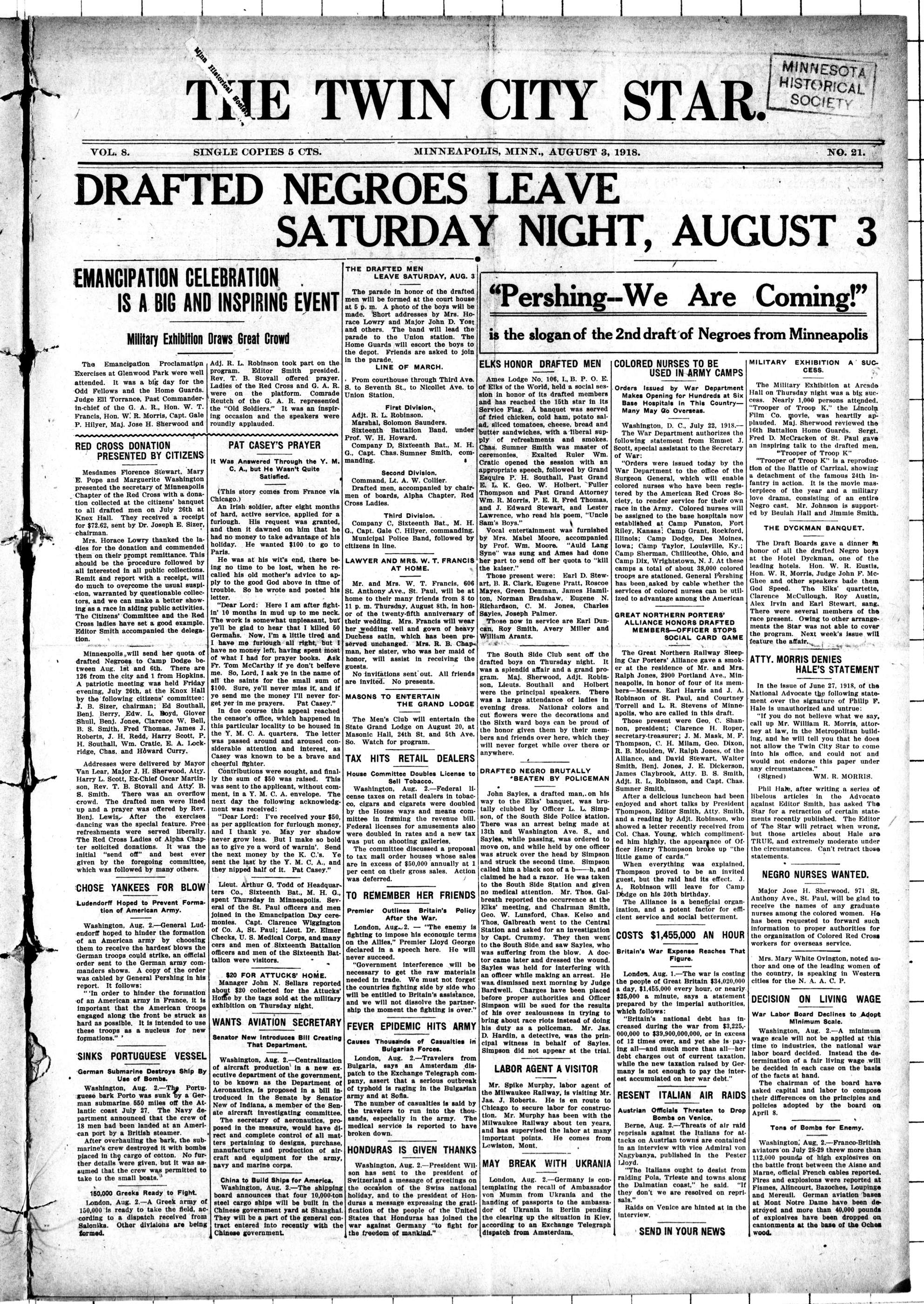
DRAFTED NEGROES LEAVE SATURDAY NIGHT, AUGUST 3
DRAFT
EMANCIPATION CEL
IS A BIG AND
EMANCIPATION CELEBRATION IS A BIG AND INSPIRING EVENT
Military Exhibition Draws Great Crowd
The Emancipation Proclamation Exercises at Glenwood Park were well attended. It was a big day for the Odd Fellows and the Home Guards. Judge Ell Torrance, Past Commander-in-chief of the G. A. R., Hon. W. T. Francis, Hon. W. R. Morris, Capt. Gale P. Hilyer, Maj. Jose H. Sherwood and
RED CROSS DONATION
PRESENTED BY CITIZENS
Mesdames Florence Stewart, Mary E. Pope and Marguerite Washington presented the secretary of Minneapolis Chapter of the Red Cross with a donation collected at the citizens' banquet to all drafted men on July 26th at Knox Hall. They received a receipt for $72.62, sent by Dr. Joseph E. Sizer, chairman.
Mrs. Horace Lowry thanked the ladies for the donation and commended them on their prompt remittance. This should be the procedure followed by all interested in all public collections. Remit and report with a receipt, will do much to overcome the usual suspicion, warranted by questionable collectors, and we can make a better showing as a race in alding public activities. The Citizens' Committee and the Red Cross ladies have set a good example. Editor Smith accompanied the delegation.
Minneapolis, will send her quota of drafted Negroes to Camp Dodge between Aug. 1st and 6th. There are 126 from the city and 1 from Hopkins. A patriotic meeting was held Friday evening, July 26th, at the Knox Hall by the following citizens' committee: J. B. Sizer, chairman; Ed Southall, Benj. Berry, Ed. L. Boyd, Glover Shull, Benj. Jones, Clarence W. Bell, B. S. Smith, Fred Thomas, James J. Roberts, J. H. Redd, Harry Scott, P. H. Southall, Wm. Cratic, E. A. Lockridge, Chas, and Howard Curry.
Addresses were delivered by Mayor Van Lear, Major J. H. Sherwood, Atty Harry L. Scott, Ex-Chief Oscar Martinson, Rev. T. B. Stovall and Atty B. S. Smith. There was an overflow crowd. The drafted men were lined up and a prayer was offered by Rev Benj. Lewis. After the exercises dancing was the special feature. Free refreshments were served liberally. The Red Cross Ladies of Alpha Chapter solicited donations. It was the initial "send off" and best ever given by the foregoing committee, which was followed by many others.
CHOSE YANKEES FOR BLOW
Ludendorff Hoped to Prevent Formation of American Army.
Washington, Aug. 2.—General Ludendorff hoped to hinder the formation of an American army by choosing them to receive the hardest blows the German troops could strike, an official order sent to the German army commanders shows. A copy of the order was cabled by General Pershing in his report. It follows:
"In order to hinder the formation of an American army in France, it is important that the American troops engaged along the front be struck as hard as possible. It is intended to use these troops as a nucleus for new formations."
SINKS PORTUGUESE VESSEL
German Submarine Destroys Ship By Use of Bombs.
Washington, Aug. 2.—The Portuguese bark Porto was sunk by a German submarine 550 miles off the Atlantic coast July 27. The Navy department announced that the crew of 18 men had been landed at an American port by a British steamer.
After overhauling the bark, the submarine's crew destroyed it with bombs placed in the cargo of cotton. No further details were given, but it was assumed that the crew was permitted to take to the small boats.
150,000 Greeks Ready to Fight.
London, Aug. 2.—A Greek army of 150,000 is ready to take the field, according to a dispatch received from Salonika. Other divisions are being formed.
VOL. 8.
THE TWIN CITY STAR.
TED NEC
SAT
CELEBRATION
AND INSPIRING EVENT
Adj. R. L. Robinson took part on the program. Editor Smith presided. Rev. T. B. Stovall offered prayer. Ladies of the Red Cross and G. A. R. were on the platform. Comrade Reutch of the G. A. R. represented the "Old Soldiers." It was an inspiring occasion and the speakers were roundly applauded.
It Was Answered Through the Y. M.
C. A., but He Wasn't Quite
Satisfied.
(This story comes from France via Chicago.) An Irish soldier, after eight months of hard, active service, applied for a furlough. His request was granted, and then it dawned on him that he had no money to take advantage of his holiday. He wanted $100 to go to Paris.
He was at his wit's end, there being no time to be lost, when he recalled his old mother's advice to apply to the good God above in time of trouble. So he wrote and posted his letter.
"Dear Lord: Here I am after fight-in' 10 months in mud up to me neck. The work is somewhat unpleasant, but ye'll be glad to hear that I killed 50 Germahs. Now, I'm a little tired and I have me furlough all right, but I have no money left, having spent most of what I had for prayer books. Ask Fr. Tom McCarthy if ye don't believe me. So, Lord, I ask ye in the name of all the saints for the small sum of $100. Sure, you'll never miss it, and if ye send me the money I'll never forget ver in me prayers. Pat Casey."
In due course this appeal reached the censor's office, which happened in this particular locality to be housed in the Y. M. C. A. quarters. The letter was passed around and aroused considerable attention and interest, as Casey was known to be a brave and cheerful fighter.
Contributions were sought, and finally the sum of $50 was raised. This was sent to the applicant, without comment, in a Y. M. C. A. envelope. The next day the following acknowledgment was received:
"Dear Lord: I've received your $50, as per application for furlough money, and I thank ye. May yer shadow never grow less. But I make so bold as to give ye a word of warnin'. Send the next money by the K. C.'s. Ye sent the last by the Y. M. C. A., and they nipped half of it. Pat Casey."
Lieut. Arthur G. Todd of Headquarters Co., Sixteenth Bat., M. H. G., spent Thursday in Minneapolis. Several of the St. Paul officers and men joined in the Emancipation Day ceremonies. Capt. Clarence Wiggington of Co. A, St. Paul; Lieut. Dr. Elmer Checks, U. S. Medical Corps, and many cers and men of Sixteenth Battalion officers and men of the Sixteenth Battalion were visitors.
Manager John N. Sellars reported about $20 collected for the Attucks' Home by the tags sold at the military exhibition on Thursday night.
WANTS AVIATION SECRETARY
Senator New Introduces Bill Creating That Department.
Washington, Aug. 2.—Centralization of aircraft production in a new executive department of the government, to be known as the Department of Aeronautics, is proposed in a bill introduced in the Senate by Senator New of Indiana, a member of the Senate aircraft investigating committee.
The secretary of aeronautics, proposed in the measure, would have direct and complete control of all matters pertaining to designs, purchase, manufacture and production of aircraft and equipment for the army, navy and marine corps.
China to Build Ships for America.
Washington, Aug. 2.—The shipping board announces that four 10,000-ton steel cargo ships will be built in the Chinese government yard at Shanghai. They will be a part of the general contract entered into recently with the Chinese government.
MINNEAPOLIS, MINN., AUGUST 3, 1918.
THE DRAFTED MEN
LEAVE SATURDAY, AUG. 3
The parade in honor of the drafted men will be formed at the court house at 5 p.m. a. Photo of the boys will be made. Short addresses by Mrs. Horace Lowry and Major John D. Yost and others. The band will lead the parade to the Union station. The Home Guards will escort the boys to the depot. Friends are asked to join in the parade
LINE OF MARCH.
- From courthouse through Third Ave.
S. to Seventh St., to Nicollet Ave. to
Union Station.
Sixteenth Battalion Band, under Prof. W. H. Howard.
Company D, Sixteenth Bat., M. H. G., Capt. Chas. Sumner Smith, commanding.
Drafted men, accompanied by chairmen of boards, Alpha Chapter, Red Cross Ladies.
Third Division.
Company C, Sixteenth Bat., M. H. G., Capt. Gale C. Hilyer, commanding, Municipal Police Band, followed by citizens in line.
LAWYER AND MRS. W. T. FRANCIS AT HOME.
Mr. and Mrs. W. T. Francis, 606 St. Anthony Ave., St. Paul, will be at home to their many friends from 8 to 11 p. m. Thursday, August 8th, in honor of the twenty-fifth anniversary of their wedding. Mrs. Francis will wear her wedding veil and gown of heavy Duchess satin, which has been preserved unchanged. Mrs. R. B. Chapman, her sister, who was her maid of honor, will assist in receiving the guests.
No invitations sent out. All friends are invited. No presents.
The Men's Club will entertain the State Grand Lodge on August 20, at Masonic Hall, 24th St. and 5th Ave. So. Watch for program.
TAX HITS RETAIL DEALERS
House Committee Doubles License to Sell Tobacco.
Washington, Aug. 2.—Federal license taxes on retail dealers in tobacco, cigars and cigarettes were doubled by the House ways and means committee in framing the revenue bill. Federal licenses for amusements also were doubled in rates and a new tax was put on shooting galleries.
The committee discussed a proposal to tax mail order houses whose sales are in excess of $50,000 annually at 1 per cent on their gross sales. Action was deferred.
TO REMEMBER HER FRIENDS
Premier Outlines Britain's Policy After the War.
London, Aug. 2. — "The enemy is fighting to impose his economic terms on the Allies," Premier Lloyd George declared in a speech here. He will never succeed.
"Government interference will be necessary to get the raw materials needed in trade. We must not forget the countries fighting side by side who will be entitled to Britain's assistance, and we will not dissolve the partnership the moment the fighting is over."
FEVER EPIDEMIC HITS ARMY
Causes Thousands of Casualties in Bulgarian Forces.
London, Aug. 2.—Travelers from Bulgaria, says an Amsterdam dispatch to the Exchange Telegraph company, assert that a serious outbreak of typhoid is raging in the Bulgarian army and at Sofia.
The number of casualties is said by the travelers to run into the thousands, especially in the army. The medical service is reported to have broken down.
HONDURAS IS GIVEN THANKS
Washington, Aug. 2.—President Wilson has sent to the president of Switzerland a message of greetings on the occasion of the Swiss national holiday, and to the president of Honduras a message expressing the gratification of the people of the United States that Honduras has joined the war against Germany "to fight for the freedom of mankind."
is the slogan of the 2nd draft of Negroes from Minneapolis
ELKS HONOR DRAFTED MEN
Ames Lodge No. 106, L. B. P. O. E. of Elks of the World, held a social session in honor of its drafted members and has reached the 15th star in its Service Flag. A banquet was served of fried chicken, cold ham, potato salad, sliced tomatoes, cheese, bread and butter sandwiches, with a liberal supply of refreshments and smokes. Chas. Sumner Smith was master of ceremonies. Exalted Ruler Wm. Cratic opened the session with an appropriate speech, followed by Grand Esquire P. H. Southall, Past Grand E. L. K. Geo. W. Holbert, Fuller Thompson and Past Grand Attorney Wm. R. Morris, P. E. R. Fred Thomas, and J. Edward Stewart, and Lester Lawrence, who read his poem, "Uncle Sam's Boys." Vocal entertainment was furnished by Mrs. Mabel Moore, accompanied by Prof. Wm. Moore. "Auld Lang Syne" was sung and Ames had done her part to send off her quota to "kill the kaler."
Those present were: Earl D. Stewart, B. R. Clark, Eugene Pratt, Roscoe Mayes, Green Denman, James Hamilton, Norman Bradshaw, Eugene N. Richardson, C. M. Jones, Charles Sayles, Joseph Palmer.
Those now in service are Earl Duncan, Roy Smith, Avery Miller and William Arantz.
The South Side Club sent off the drafted boys on Thursday night. It was a splendid affair and a grand program. Maj. Sherwood, Adjt. Robinson, Lieuts. Southall and Holbert were the principal speakers. There was a large attendance of ladies in evening dress. National colors and cut flowers were the decorations and the Sixth ward boys can be proud of the honor given them by their members and friends over here, which they will never forget while over there or anywhere.
DRAFTED NEGRO BRUTALLY
*BEATEN BY POLICEMAN*
John Sayles, a drafted man, on his way to the Elks' banquet, was brutally clubbed by Officer L. L. Simpson, of the South Side Police station. There was an arrest being made at 13th and Washington Ave. S., and Sayles, while passing, was ordered to move on, and while held by one officer was struck over the head by Simpson and struck the second time. Simpson called him a black son of a b—h, and claimed he had a razor. He was taken to the South Side Station and given no medical attention. Mr. Thos. Galbreath reported the occurrence at the Elks' meeting, and Chairman Smith, Geo. W. Lunsford, Chas. Kelso and Thos. Galbreath went to the Central Station and asked for an investigation by Capt. Crummy. They then went to the South Side and saw Sayles, who was suffering from the blow. A doctor came later and dressed the wound. Sayles was held for interfering with an officer while making an arrest. He was dismissed next morning by Judge Bardwell. Charges have been placed before proper authorities and Officer Simpson will be sued for the results of his over zealousness in trying to bring about race riots instead of doing his duty as a policeman. Mr. Jas. D. Hardin, a detective, was the principal witness in behalf of Sayles. Simpson did not appear at the trial
LABOR AGENT A VISITOR
Mr. Spike Murphy, labor agent of the Milwaukee Railway, is visiting Mr. Jas. J. Roberts. He is en route to Chicago to secure labor for construction. Mr. Murphy has been with the Milwaukee Railway about ten years, and has supervised the labor at many important points. He comes from Lewiston, Mont.
MAY BREAK WITH UKRANIA
London, Aug. 2.—Germany is contemplating the recall of Ambassador von Mumm from Ukrania and the handing of passports to the ambassador of Ukrania in Berlin pending the clearing up the situation in Kiev, according to an Exchange Telegraph dispatch from Amsterdam.
COLORED NURSES TO BE USED IN ARMY CAMPS
Orders Issued by War Department Makes Opening for Hundreds at Six Base Hospitals in This Country—Many May Go Overseas.
Washington, D. C., July 22, 1918.—The War Department authorizes the following statement from Emmet J. Scott, special assistant to the Secretary of War: "Orders were issued today by the War Department to the office of the Surgeon General, which will enable colored nurses who have been registered by the American Red Cross Society, to render service for their own race in the Army. Colored nurses will be assigned to the base hospitals now established at Camp Funston, Fort Riley, Kansas; Camp Grant, Rockford, Illinois; Camp Dodge, Des Moines, Iowa; Camp Taylor, Louisville, Ky.; Camp Sherman, Chillicothe, Ohio, and Camp Dix, Wrightstown, N. J. At these camps a total of about 38,000 colored troops are stationed. General Pershing has been, asked by cable whether the services of colored nurses can be utilized to advantage among the American
GREAT NORTHERN PORTERS'
ALLIANCE HONORS DRAFTED
MEMBERS-OFFICER STOPS
SOCIAL CARD GAME
The Great Northern Railway Sleeping Car Porters' Alliance gave a smoker at the residence of Mr. and Mrs. Ralph Jones, 2000 Portland Ave., Minneapolis, in honor of four of its members—Messrs. Earl Harris and J. A. Robinson of St. Paul, and Courtney Torrell and L. R. Stevens of Minneapolis, who are called in this draft.
Those present were Geo. C. Shannon, president; Clarence H. Roper, secretary-treasurer; J. M. Mask, M. F. Thompson, C. H. Milam, Geo. Dixon, R. B. Moulden, W. Ralph Jones, of the Alliance, and David Stewart, Walter Smith, Benj. Jones, J. E. Dickerson, James Claybrook, Atty. B. S. Smith, Adjt. R. L. Robinson, and Capt. Chas. Sumner Smith.
After a delicious luncheon had been enjoyed and short talks by President Thompson, Editor Smith, Atty. Smith, and a reading by Adjt. Robinson, who showed a letter recently received from Col. Chas. Young, which complimented him highly, the appearance of Officer Henry Thompson broke up "the little game of cards."
When everything was explained, Thompson proved to be an invited guest, but the raid had its effect. J. A. Robinson will leave for Camp Dodge on his 30th birthday.
The Alliance is a beneficial organization, and a potent factor for efficient service and social betterment.
COSTS $1,455,000 AN HOUR
Britain's War Expense Reaches That Figure.
London, Aug. 1.—The war is costing the people of Great Britain $34,020,000 a day, $1,455,000 every hour, or nearly $25,000 a minute, says a statement prepared by the imperial authorities, which follows:
"Britain's national debt has increased during the war from $3,225,000,000 to $39,900,000,000, or in excess of 12 times over, and yet she is paying all—and much more than all—her debt charges out of current taxation, while the new taxation raised by Germany is not enough to pay the interest accumulated on her war debt."
RESENT ITALIAN AIR RAIDS
Austrian Officials Threaten to Drop Bombs on Venice.
Berne, Aug. 2.—Threats of air raid reprisals against the Italians for attacks on Austrian towns are contained in an interview with vice Admiral von Nagybanya, published in the Pester Lloyd.
"The Italians ought to desist from raiding Pola, Trieste and towns along the Dalmatian coast," he said. "If they don't we are resolved on reprisals."
Raids on Venice are hinted at in the interview.
SEND IN YOUR NEWS
MINNESOTA HISTORICAL SOCIETY
NO. 21.
GUST 3
Coming!"
s from Minneapolis
MILITARY EXHIBITION A SUC- CESS.
The Military Exhibition at Arcade Hall on Thursday night was a big success. Nearly 1,000 persons attended. "Trooper of Troop K," the Lincoln Film Co. movie, was heartily applauded. Maj. Sherwood reviewed the 16th Battalion Home Guards. Sergt. Fred D. McCracken of St. Paul gave an inspiring talk to the drafted men. "Trooper of Troop K"
"Trooper of Troop K" is a reproduction of the Battle of Carrizal, showing a detachment of the famous 24th infantry in action. It is the movie masterpiece of the year and a military love drama, consisting of an entire Negro cast. Mr. Johnson is supported by Beulah Hall and Jimmie Smith.
THE DYCKMAN BANQUET.
The Draft Boards gave a dinner to honor of all the drafted Negro boys at the Hotel Dyckman, one of the leading hotels. Hon. W. R. Eustis, Hon. W. R. Morris, Judge John F. McGhee and other speakers bade them God Speed. The Elks' quartette, Clarence McCullough, Roy Austin, Alex Irvin and Earl Stewart, sang. There were several members of the race present. Owing to other arrangements the Star was not able to cover the program. Next week's issue will feature the affair.
ATTY. MORRIS DENIES
HALE'S STATEMENT
In the issue of June 27, 1918, of the National Advocate the following statement over the signature of Philip F. Hale is unauthorized and untrue: "If you do not believe what we say, call up Mr. William R. Morris, attorney at law, in the Metropolitan building, and he will tell you that he does not allow the Twin City Star to come into his office, and could not and would not endorse this paper under any circumstances." (Signed) WM. R. MORRIS.
Phil Hake, after writing a series of libelous articles in the Advocate against Editor Smith, has asked The Star for a retraction of certain statements recently published. The Editor of The Star will retract when wrong, but those articles about Hale are TRUE, and extremely moderate under the circumstances. Can't retract those statements.
NEGRO NURSES WANTED.
Major Jose H. Sherwood, 971 St. Anthony Ave., St. Paul, will be glad to receive the names of any graduate nurses among the colored women. He has been requested to forward such information to proper authorities for the organization of Colored Red Cross workers for overseas service.
Mrs. Mary White Ovington, noted author and one of the leading women of the country, is speaking in Western cities for the N. A. A. C. P.
DECISION ON LIVING WAGE
War Labor Board Declines to Adopt Minimum Scale.
Washington, Aug. 2.—A minimum wage scale will not be applied at this time to industries, the national war labor board decided. Instead the determination of a fair living wage will be decided in each case on the basis of the facts at hand.
The chairman of the board have asked capital and labor to compose their differences on the principles and policies adopted by the board on April 8.
Tons of Bombs for Enemy.
Washington; Aug. 2.—Franco-British aviators on July 28-29 threw more than 112,000 pounds of high explosives on the battle front between the Aisne and Marne, official French cables reported. Fires and explosions were reported at Fismes, Allincourt, Bazoches, Loupinge and Mereuil. German aviation bases at Mont Notre Dame have been destroyed and more than 40,000 pounds of explosives have been dropped on canonments at the base of the Oches wood.
WASHINGTON CITY
SIDELIGHTS
District Red Cross Motor Corps Doing Good Work
WASHINGTON.—Since the installation of the special telephone connection with the war department as many as 15 calls a day have been answered by the Red Cross motor corps of the District of Columbia. The District chapter
setting up steam outside a canteen. One
he trying to get Philadelphia on the tele-
connection the sergeant announced that it
is distressed, and the ever-present motor
can't I give the message for you?"
name is John Smith, and I want her to
in great haste by the Red Cross worker.
far as the wedding was concerned, but
sailed. The motor woman rushed to the
motion, and delivered the message to the
window, yelled back "Thank you miss, and
at when she sees me in uniform."
Be Mistaken in Judgment
le coarse like a pork chop. Her fair, fat
whatever contraption it is that women
etcetera into the state of mind they call
calls for the taking of convalescent soldiers at Walter Reed hospital out for airlings. Four cars are detailed each day for the service of the canteen workers.
Recently a troop train was getting up steam outside a canteen. One soldier had spent his entire rest time trying to get Philadelphia on the telephone. Just as he obtained the connection the sergeant announced that it was time to go aboard. The lad was distressed, and the ever-present motor woman came to his rescue with, "Can't I give the message for you?"
"Sure," said the soldier. "My name is John Smith, and I want her to marry me before I sail."
The unusual proposal was made in great haste by the Red Cross worker. The girl in Philadelphia declined, as far as the wedding was concerned, but agreed to meet her hero before he sailed. The motor woman rushed to the side of the train, by that time in motion, and delivered the message to the man, who, leaning far out of the window, yelled back "Thank you miss, and don't worry; she'll marry me all right when she sees me in uniform."
Proof That One Can Be Mistaken in Judgment
Proof That One Can Be Mistaken in Judgment
SHE was pink and white and a trifle coarse like a pork chop. Her fair, fat and fortiness was harnessed into whatever contraption it is that women use to compress their too, too solid etcetera into the state of mind they call
is of food cost, so we broke up and went
experience with the complacency of one who
hide problem. But the woman who wasn't
others held a different view.
and likes boarding, but Jim couldn't live
And the way I look at it, I ought to keep
especially as he thought enough of me to
ystitch of my own work, and it's got so
with a girl in my kitchen."
at big house? Then what are you doing
should think you would be home getting
as other cooks. I always meet Jim
dinner and the movies afterward. And I
because he likes his friends to see how nice
hind you would have felt cheap for mis-
like a bird in fine feathers.
mean-souled thing can do it.
My Woman "Look Different"
is of a street downtown. It was a street
ops and clamorously chatty with foreign
the saffron skin and glazed black hair.
a great farmhous and girls
are children they rem
not have never get
The of Cross we
and saw drills the
They may red shirt
bold, and look on
ed to win to be stric
of cou
millions
American
"I wouldn't think or paying such prices as cooks are asking these days of food cost, so we broke up and went to boarding."
The soap woman ended her experience with the complacency of one who has satisfactorily solved a country-wide problem. But the woman who wasn't a fine bird for all her foolish-fine feathers held a different view.
"That's all right, if your husband likes boarding, but Jim couldn't live anywhere except in his own home. And the way I look at it, I ought to keep house in turn for all he does for me, especially as he thought enough of me to put the deed in my name. I do every stitch of my own work, and it's got so now I wouldn't know what to do with a girl in my kitchen."
"And you do all the work in that big house? Then what are you doing all fiddled up this time of day? I should think you would be home getting dinner."
"Thursday is my day out the same as other cooks. I always meet Jim after office and we go to a cafe for dinner and the movies afterward. And I have to be rigged out in my best, because he likes his friends to see how nice he can dress me."
And if you had been walking behind you would have felt cheap for misjudging a pork chop for trying to look like a bird in fine feathers.
It is so easy to find fault. Any mean-souled thing can do it.
Just What Made Shabby Woman "Look Different"
Just What Made Shabby Woman "Look Different"
A WOMAN was crossing the cobbles of a street downtown. It was a street broken out in a rash of junk shops and clamorously chaty with foreign tongues. The woman, herself, had the saffron skin and glazed black hair of
For one thing, she caught the ex-
cited interest of a couple of obvious
fair, who must have been cross-cutting to
being so far from home. Both ejaculated
the one who was in white china silk made
in pale blue georgette.
Spend the balance of my days in black
and flower that makes her look so different
he saffron-faced one in a class to herself.
Country is folded the romantic history of
not be learned from a fashion page. It
must be born there.
Just a Mite Too Truthful
for that the following story will serve to
he puts in on his job. For Major Dan
District, has made the sky his limit when
ing his
send some
America?
Then he was happ
dren brood
they had
and pour
hands.
house to
had so ca
long handkerch
to part pastry on
be, somet
the strug
the coin
it into the
a smiling
"For Aly there
residents on the heights of Vanity Fair, who must have been cross-cutting to get somewhere to account for their belong so far from home. Both ejaculated at sight of the foreign woman, and the one who was in white china silk made open confession to the one who was in pale blue georgette.
"If I could look like that I'd spend the balance of my days in black satine and rusty lace. Must be the red flower that makes her look so different—got a picturesque walk, too."
But it was the shawl that put the saffron-faced one in a class to herself, for:
In the mantilla of the woman's country is folded the romantic history of Spain. The mystery of its grace cannot be learned from a fashion page. It must be taught in Spain.
And, by way of a first lesson, one must be born there.
Official's Office Boy Just a Mite Too Truthful
HE IS such a hard-working soldier that the following story will serve to emphasize the many hours a day he puts in on his job. For Major Dan Donovan, director of the draft in the District, has made the sky his limit when it comes to working on the job of puts.
A boy should be truthful. Still, when a
mer to a major, he ought to use—er, tact.
working some months longer than he now
, sir; the major is in a conference," or
—he has just stepped out of the office."
mer morning, when someone called up on
er.
the phone.
y. "Major Donovan hasn't some to work
Laborer
Ashtabula
tion of a
clistern, the
extending the
street
deep, and
rude.
The fin
upset the
it was no
boy can tie to, all agree in saying. A boy should be truthful. Still, when a boy is a sort of confidential messenger to a major, he ought to use—er, tact. After this particular boy has been working some months longer than he now has weeks he will learn to say: "No, sir; the major is in a conference," or "No, sir; the major isn't here right now—he has just stepped out of the office." He won't do as he did that other morning, when someone called up on the telephone and asked for the major.
"No, sir," replied the truthful boy. "Major Donovan hasn't some to work yet."
A man driving a car is being chased by a dog.
calls for the taking of convalescent soldiers at airings. Four cars are detailed each day for workers.
Recently a troop train was getting up s soldier had spent his entire rest time trying to phone. Just as he obtained the connection the time was to go aboard. The lad was distressed woman came to his rescue with, "Can't I give "Sure," said the soldier. "My name is Jo marry me before I sail."
The unusual proposal was made in great h The girl in Philadelphia declined, as far as th agreed to meet her hero before he sailed. The side of the train, by that time in motion, and man, who, leaning far out of the window, yellow don't worry; she'll marry me all right when she
Proof That One Can Be Miserable
SHE was pink and white and a trifle coarse l and fortress was harnessed into whatever use to compress their too, too solid etcetera in svelte, and she was dressed in all-over embroidery and a rose sweater ten years too young for her-or, to be entirely fair, make it nine.
And anybody with half an eye could tell that she was longing for the time to come to get home and put on something loose.
With her was a woman as plain as a bar of soap, who was saying this—allowing for the drawbacks of one who had to listen from behind:
"I wouldn't think of paying such prices as cooks are asking these days of food to boarding."
The soap woman ended her experience with has satisfactorily solved a country-wide problem a fine bird for all her foolish-fine feathers held.
"That's all right, if your husband likes be anywhere except in his own home. And the was house in turn for all he does for me, especially put the deed in my name. I do every stitch of now I wouldn't know what to do with a girl in."
"And you do all the work in that big house all fiddled up this time of day? I should think dinner."
"Thursday is my day out the same as oth after office and we go to a cafe for dinner and have to be rigged out in my best, because he lil he can dress me."
And if you had been walking behind you judging a pork chop for trying to look like a lil it is so easy to find fault. Any mean-soule
Just What Made Shabby Woman
A WOMAN was crossing the cobbles of a street broken out in a rash of junk shops and clongues. The woman, herself, had the saffron another
A
residents on the heights of Vanity Fair, who m
get somewhere to account for their being so far
at sight of the foreign woman, and the one who
open confession to the one who was in pale b
"If I could look like that I'd spend the
satine and rusty lace. Must be the red flower t
—got a picturesque walk, too."
But it was the shawl that put the saffron-
for:
In the mantilla of the woman's country is
Spain. The mystery of its grace cannot be lea
must be taught in Spain.
And, by way of a first lesson, one must be
Official's Office Boy Just a
HE IS such a hard-working soldier that the
emphasize the many hours a day he puts in
Donovan, director of the draft in the District, h
it comes to working on the job of putting local registrants into camp. Day and night he may be found at work—early in the mornin' sending men to Camp Meade—late o' night inducting them into the service.
But one morning last week he must have overslept himself, because he failed to show up at the office as early as usual.
Now, there is in the office a boy—a bright-faced, truthful boy.
Truth is one of the finest things a boy can tie to, all agree in saying. A boy shot boy is a sort of confidential messenger to a ma. After this particular boy has been working son has weeks he will learn to say: "No, sir; the 'No, sir; the major isn't here right now—he has
He won't do as he did that other morning the telephone and asked for the major.
The bright-faced boy picked up the phone.
"Hello?" he called.
"Is Major Donovan there?"
"No, sir," replied the truthful boy. "Major
put."
of the Red Cross motor corps has been in existence since the United States entered the war. Mrs. J. Borden Harriman is the colonel commanding. The work of the corps falls, roughly, into two general divisions—ambulance work and transport service. Calls for transport service range from those for national headquarters, the Potomac division, and the District chapter to those for the civilian relief workers on their errands of mercy, oftentimes far into the country, or to
YOU DO?
I DO EVERY STITCH OF MY OWN WORK—
another land than ours. Her shabby frock was somber enough for chief mourning, except for its vivid flower on her breast—a red rag of a rose—and her head was Madonna-covered with a rusty lace shawl full of holes. The traditional thousand of women might have crossed the street without attracting notice. This one was an exception. And it is the exception that counts.
NO, SIR, TH' MAJOR HASN'T COME TO WORK
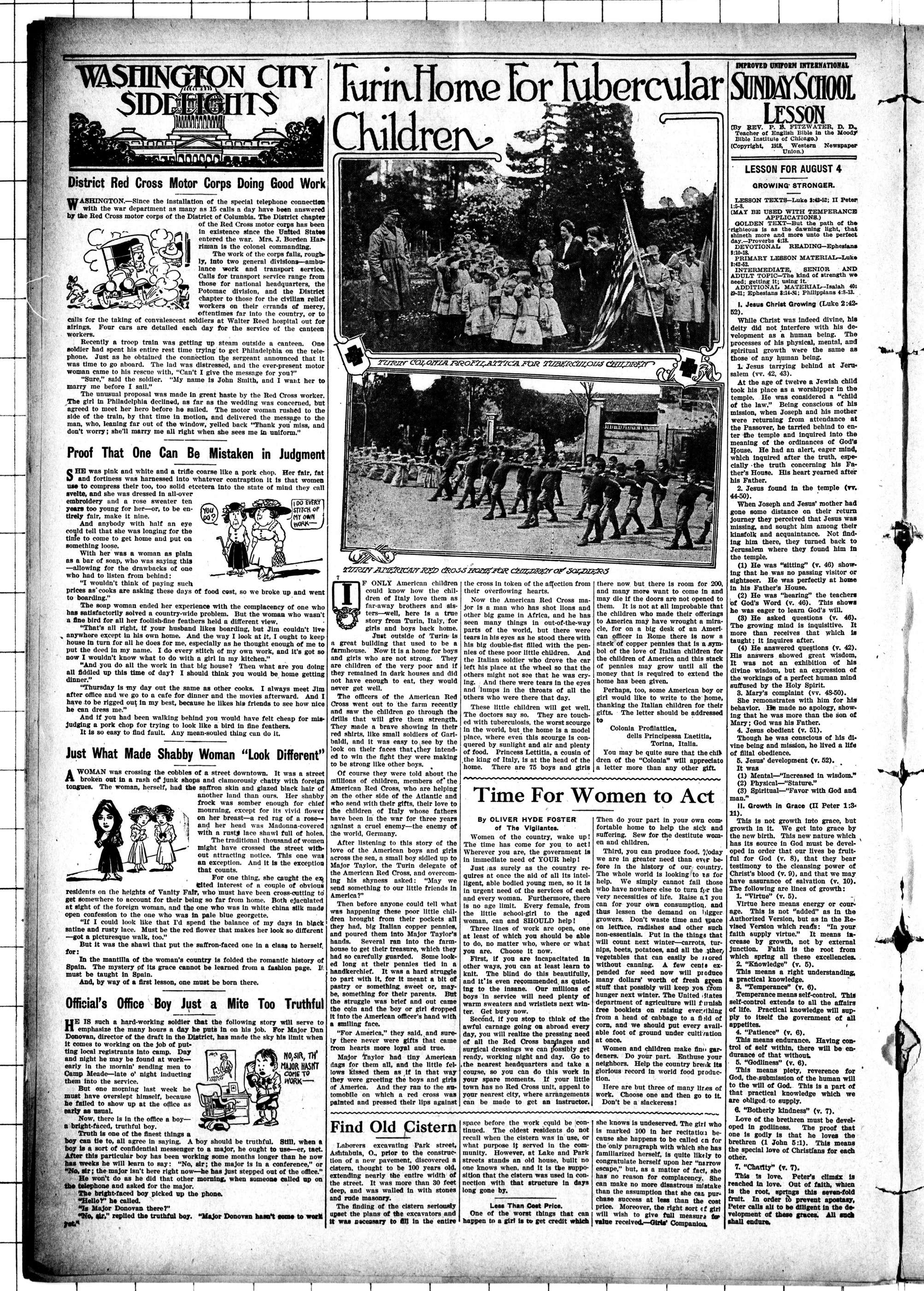
Turin Home For Tubercular
TURKHOUSE FOR TUBerculoid Children
TURKIN COLONIA PROFILATITICA FOR TUBerculoid CHILDREN
IF ONLY American children could know how the children of Italy love them as far-away brothers and sisters—well, here is a true story from Turin, Italy, for girls and boys back home. First published in Turin.
the cross in token of the affection from their overflowing hearts.
Now the American Red Cross major is a man who has shot lions and other big game in Africa, and he has seen many things in out-of-the-way parts of the world, but there were their and may then the to A cle.
F ONLY American children could know how the children of Italy love them as far-away brothers and sisters—well, here is a true story from Turin, Italy, for girls and boys back home. Just outside of Turin is a great building that used to be a farmhouse. Now it is a home for boys and girls who are not strong. They are children of the very poor and if they remained in dark houses and did not have enough to eat, they would never get well.
The officers of the American Red Cross went out to the farm recently and saw the children go through the drills that will give them strength. They made a brave showing in their red shirts, like small soldiers of Garibaldi, and it was easy to see by the look on their faces that, they intended to win the fight they were making to be strong like other boys.
Of course they were told about the millions of children, members of the American Red Cross, who are helping on the other side of the Atlantic and who send with their gifts, their love to the children of Italy whose fathers have been in the war for three years against a cruel enemy—the enemy of the world, Germany.
After listening to this story of the love of the American boys and girls across the sea, a small boy sidled up to Major Taylor, the Turin delegate of the American Red Cross, and overcoming his shyness asked: "May we send something to our little friends in America?"
Then before anyone could tell what was happening these poor little children brought from their pockets all they had, big Italian copper pennies, and poured them into Major Taylor's hands. Several ran into the farmhouse to get their treasure, which they had so carefully guarded. Some looked long at their pennies tied in a handkerchief. It was a hard struggle to part with it, for it meant a bit of pastry or something sweet or, maybe, something for their parents. But the struggle was brief and out came the coin and the boy or girl dropped it into the American officer's hand with a smiling face.
"For America," they said, and surely there never were gifts that came from hearts more loyal and true.
Major Taylor had tiny American flags for them all, and the little fellows kissed them as if in that way they were greeting the boys and girls of America. And they ran to the automobile on which a red cross was painted and pressed their lips against
Find Old Cistern
Find Old Cistern
Laborers excavating Park street, Ashtabula, O., prior to the construction of a new pavement, discovered a cistern, thought to be 100 years old, extending nearly the entire width of the street. It was more than 30 feet deep, and was walled in with stones and rude masonry.
The finding of the cistern seriously upset the plans of the excavators and it was necessary to fill in the entire
Time For Women to Act
the cross in token of the affection from their overflowing hearts.
Now the American Red Cross major is a man who has shot lions and other big game in Africa, and he has seen many things in out-of-the-way parts of the world, but there were tears in his eyes as he stood there with his big double-fist filled with the pennies of these poor little children. And the Italian soldier who drove the car left his place at the wheel so that the others might not see that he was crying. And there were tears in the eyes and lumps in the throats of all the others who were there that day.
These little children will get well. The doctors say so. They are touched with tuberculosis, the worst scourge in the world, but the home is a model place, where even this scourge is conquered by sunlight and air and plenty of food. Princess Lettitta, a cousin of the king of Italy, is at the head of the home. There are 75 boys and girls
By OLIVER HYDE FOSTER of The Vigilantes.
Women of the country, wake up! The time has come for you to act! Wherever you are, the government is in immediate need of YOUR help!
Just as surely as the country requires at once the aid of all its intelligent, able bodied young men, so it is in urgent need of the services of each and every woman. Furthermore, there is no age limit. Every female, from the little school-girl to the aged woman, can and SHOULD help!
Three lines of work are open, one at least of which you should be able to do, no matter who, where or what you are. Choose it now.
First, if you are incapacitated in other ways, you can at least learn to knit. The blind do this beautifully, and it is even recommended, as quieting to the insane. Our millions of boys in service will need plenty of warm sweaters and wristlets next winter. Get busy now.
Second, if you stop to think of the awful carnage going on abroad every day, you will realize the pressing need of all the Red Cross bandages and surgical dressings we can possibly get ready, working night and day. Go to the nearest headquarters and take a course, so you can do this work in your spare moments. If your little town has no Red Cross unit, appeal to your nearest city, where arrangements can be made to get an instructor.
space before the work could be continued. The oldest residents do not recall when the cistern was in use, or what purpose it served in the community. However, at Lake and Park streets stands an old house, built no one knows when, and it is the supposition that the cistern was used in connection with that structure in days long gone by.
Less Than Cost Price.
One of the worst things that can happen to a girl is to get credit which
there now but there is room for 200,
and many more want to come in and
may die if the doors are not opened to
them. It is not at all improbable that
the children who made their offerings
to America may have wrought a miracle, for on a big desk of an American officer in Rome there is now a stack of copper pennies that is a symbol of the love of Italian children for the children of America and this stack of pennies may grow until all the money that is required to extend the home has been given.
Perhaps, too, some American boy or girl would like to write to the home, thanking the Italian children for their gifts. The letter should be addressed to
You may be quite sure that the children of the "Colonia" will appreciate a letter more than any other gift.
Then do your part in your own com-
fortable home to help the sick and
suffering. Sew for the destitute wom-
en and children.
Third, you can produce food. Today we are in greater need than ever before in the history of our country. The whole world is looking to us for help. We simply cannot fail those who have nowhere else to turn for the very necessities of life. Raise all you can for your own consumption, and thus lessen the demand on bigger growers. Don't waste time and space on lettuce, radishes and other such non-essentials. Put in the things that will count next winter—carrots, turnips, beets, potatoes, and all the other vegetables that can easily be mored without canning. A few cents expended for seed now will produce many dollars' worth of fresh green stuff that possibly will keep you from hunger next winter. The United States department of agriculture will fumish free booklets on raising everything from a head of cabbage to a field of corn, and we should put every available foot of ground under cultivation at once.
Women and children make fine gardeners. Do your part. Enthuse your neighbors. Help the country break its glorious record in world food production.
Here are but three of many lines of work. Choose one and then go to it. Don't be a slackeress!
she knows is undeserved. The girl who is marked 100 in her recitation because she happens to be called on for the only paragraph with which she has familiarized herself, is quite likely to congratulate herself upon her "narrow escape," but, as a matter of fact, she has no reason for complacency. She can make no more disastrous mistake than the assumption that she can purchase success at less than the cost price. Moreover, the right sort of girl will wish to give full measure for value received.—Girl's Companion
(By REV. P. B. FITZWATER, D. D.
Teacher of English in the Moody
Bible Institute of Chicago).
(Copyright, 1918. Western Newspaper
LESSON FOR AUGUST 4
GROWING STRONGER.
LESSON TEXTS—Luke 2:42-52; II Peter 1:5-8.
(MAY BE USED WITH TEMPERANCE APPLICATIONS.)
GOLDEN TEXT—But the path of the righteous is as the dawning light, that shimnth more and more unto the perfect day.—Proverbs 4:18.
DEVOTIONAL READING—Ephesians 5:10-18.
PRIMARY LESSON MATERIAL—Luke 2:42-53.
INTERMEDIATE, SENIOR AND ADULT TOPIC—The kind of strength we need; getting it; using it.
ADDITIONAL MATERIAL-Isalah 40:
40-31; Ephesians 3:14-31; Philippians 4:8-13.
1. Jesus Christ Growing (Luke 2:42-52).
While Christ was indeed divine, his deity did not interfere with his development as a human being. The processes of his physical, mental, and spiritual growth were the same as those of any human being.
1. Jesus tarrying behind at Jerusalem (vy. 42, 43).
At the age of twelve a Jewish child took his place as a worshipper in the temple. He was considered a "child of the law." Being conscious of his mission, when Joseph and his mother were returning from attendance at the Passover, he tarried behind to enter the temple and inquired into the meaning of the ordinances of God's House. He had an alert, eager mind, which inquired after the truth, especially the truth concerning his Father's House. His heart yearned after his Father.
2. Jesus found in the temple (vv. 44-50).
When Joseph and Jesus' mother had gone some distance on their return journey they perceived that Jesus was missing, and sought him among their kinsfolk and acquaintance. Not finding him there, they turned back to Jerusalem where they found him in the temple.
(1) He was "diting" (v. 46) showing that he was no passing visitor or sightseer. He was perfectly at home in his Father's House.
(2) He was "hearing" the teachers of God's Word (v. 46). This shows he was eager to learn God's will.
(3) He asked questions (v. 46). The growing mind is inquisitive. It more than receives that which is taught; it inquires after.
(4) He answered questions (v. 42). His answers showed great wisdom, It was not an exhibition of his divine wisdom, but an expression of the workings of a perfect human mind suffused by the Holy Spirit.
3. Mary's complaint (vv. 49-50).
She remonstrates with him for his behavior. He made no apology, showing that he was more than the son of Mary; God was his Father.
4. Jesus obedient (v. 51).
Though he was conscious of his divine being and mission, he lived a life of filial obedience.
5. Jesus' development (v. 52).
It was
(1) Mental—"Increased in wisdom."
(2) Physical—"Stature."
(3) Spiritual—"Favor with God and man."
II. Growth in Grace (II Peter 1:3-11).
This is not growth into grace, but growth in it. We get into grace by the new birth. This new nature which has its source in God must be developed in order that our lives be fruitful for God (v. 8), that they bear testimony to the cleansing power of Christ's blood (v. 9), and that we may have assurance of salvation (v. 10).
The following are lines of growth:
1. "Virtue" (v. 5).
Virtue here means energy or courage. This is not "added" as in the Authorized Version, but as in the Revised Version which reads: "In your faith supply virtue." It means increase by growth, not by external junction. Faith is the root from which spring all these excellencies. 2. "Knowledge" (v. 5). This means a right understanding, a practical knowledge.
3. "Temperance" (v. 6). Temperance means self-control. This self-control extends to all the affairs of life. Practical knowledge will supply to itself the government of all appetites.
4. "Patience" (v. 6).
This means endurance. Having control of self within, there will be endurance of that without.
5. "Godliness" (v. 6).
This means piety, reverence for God, the submission of the human will to the will of God. This is a part of that practical knowledge which we are obliged to supply.
6. "Botherly kindness" (v. 7).
Love of the brethren must be developed in godliness. The proof that one is godly is that he loves the brethren (1 John 5:1). This means the special love of Christians for each other.
7. "Charity" (v. 7).
This is love. Peter's climax is reached in love. Out of faith, which is the root, springs this seven-fold fruit. In order to prevent apostasy, Peter calls all to be diligent in the development of these graces. All such shall endure.
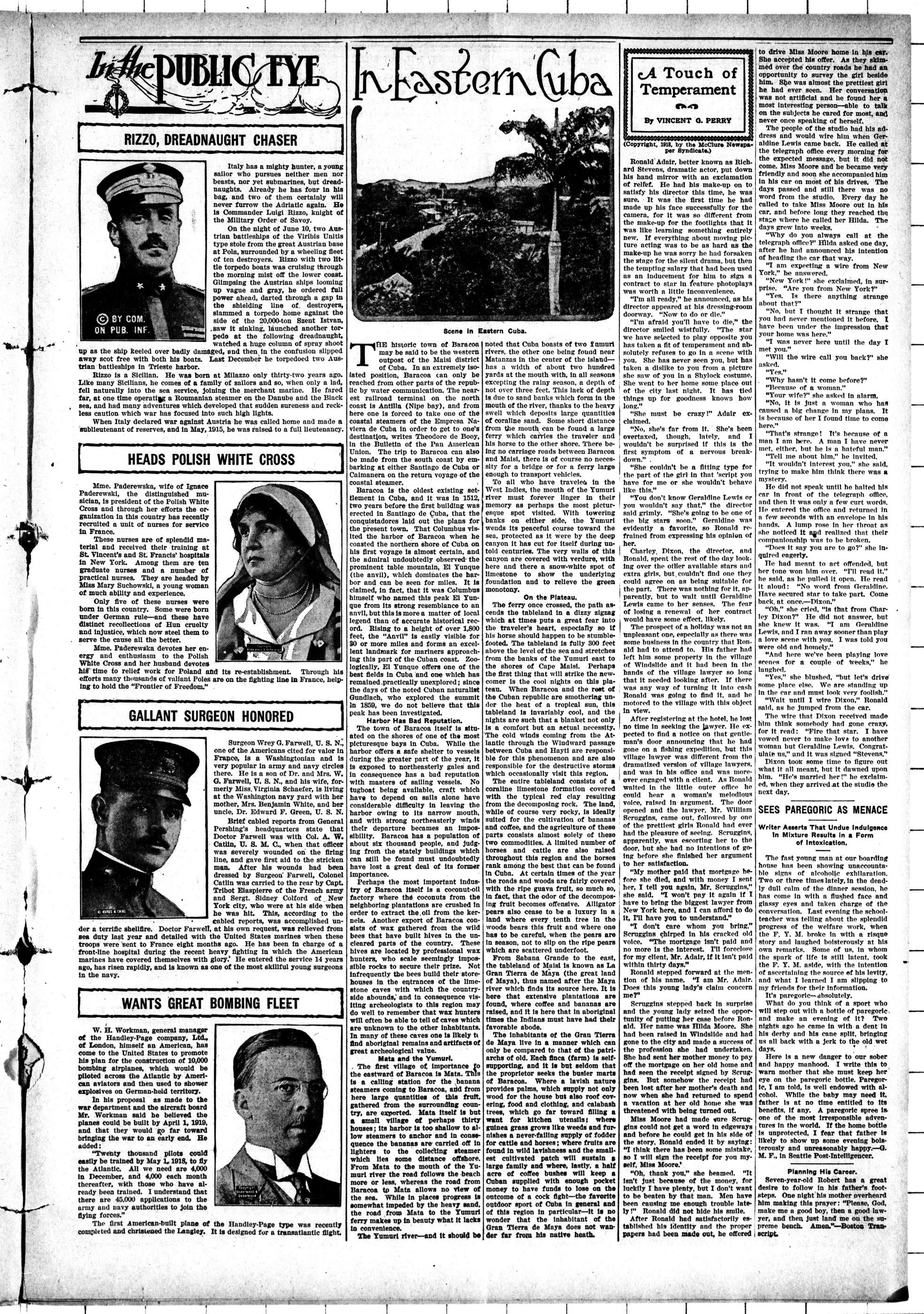
In the PUBLIC EYE
BY COM.
ON PUB. INF.
up as the ship keeled over badly dammed away scot free with both his boats. trian battleships in Trieste harbor. Rizzo is a Sicilian. He was born Like many Sicilians, he comes of a far fell naturally into the sea service, jo far, at one time operating a Roumanian sea, and had many adventures which de less caution which war has focused in. When Italy declared war against a sublieutenant of reserves, and in May,
up as the ship keeled over badly damaged, and then in the confusion slipped away scot free with both his boats. Last December he torpedoed two Austrian battleships in Trieste harbor. Rizzo is a Sicilian. He was born at Milazzo only thirty-two years ago. Like many Sicilians, he comes of a family of sailors and so, when only a lad, fell naturally into the sea service, joining the merchant marine. He fared far, at one time operating a Roumanian steamer on the Danube and the Black sea, and had many adventures which developed that sudden sureness and reckless caution which war has focused into such high lights.
When Italy declared war against Austria he was called home and made a subleutenant of reserves, and in May, 1915, he was raised to a full lieutenancy.
HEADS POLISH WHITE CROSS
HEADS POLISH WHITE CROSS
Mme. Paderewska, wife of Ignace Paderewski, the distinguished musician, is president of the Polish White Cross and through her efforts the organization in this country has recently recruited a unit of nurses for service in France.
These nurses are of splendid material and received their training at St. Vincent's and St. Francis' hospitals in New York. Among them are ten graduate nurses and a number of practical nurses. They are headed by Miss Mary Suchowski, a young woman of much ability and experience.
Only five of these nurses were born in this country. Some were born under German rule—and these have distinct recollections of Hun cruelty and injustice, which now steel them to serve the cause all the better.
Mme. Paderewska devotes her energy and enthusiasm to the Polish White Cross and her husband devotes
his time to relief work for Poland a efforts many thousands of valiant Poles ing to hold the "Frontier of Freedom."
his time to relief work for Poland and its re-establishment. Through his efforts many thousands of valiant Poles are on the fighting line in France, helping to hold the "Frontier of Freedom."
GALLANT SURGEON HONORED
C. KARNE & CO.
der a terrific shellfire. Doctor Farwell sea duty last year and detailed with troops were sent to France eight mon front-line hospital during the recent marines have covered themselves with ago, has risen rapidly, and is known as in the navy. WANTS GREAT
der a terrific shellfire. Doctor Farwell, at his own request, was relieved from duty last year and detailed with the United States marines when these troops were sent to France eight months ago. He has been in charge of a front-line hospital during the recent heavy fighting in which the American marines have covered themselves with glory. He entered the service 14 years ago, has risen rapidly, and is known as one of the most skillful young surgeons in the navy.
WANTS GREAT BOMBING FLEET
W. H. Workman, general manager of the Handley-Page company, Ltd., of London, himself an American, has come to the United States to promote his plan for the construction of 10,000 bombing airplanes, which would be piloted across the Atlantic by American aviators and then used to shower explosives on German-held territory.
In his proposal as made to the war department and the aircraft board Mr. Workman said he believed the planes could be built by April 1, 1919, and that they would go far toward bringing the war to an early end. He added:
"Twenty thousand pilots could easily be trained by May 1, 1918, to fly the Atlantic. All we need are 4,000 in December, and 4,000 each month thereafter, with those who have already been trained. I understand that there are 45,000 applications to the army and navy authorities to join the flying forces."
The first American-built plane of completed and christened the Langley.
The first American-built plane of the Handley-Page type was recently completed and christened the Langley. It is designed for a transatlantic flight.
Italy has a mighty hunter, a young sailor who pursues neither men nor beasts, nor yet submarines, or dreadnaughts. Already he has four in his bag, and two of them certainly will never furrow the Adriatic again. He is Commander Lulgi Rizzo, knight of the Military Order of Savoy.
On the night of June 10, two Austrian battleships of the Vibrils Units type stole from the great Austrian base at Pola, surrounded by a wheeling fleet of ten destroyers. Rizzo with two little torpedo boats was cruising through the morning mist off the lower coast. Glimpsing the Austrian ships looming up vague and gray, he ordered full power ahead, darted through a gap in the shielded line of. destroyers, slammed a torpedo home against the side of the 20,000-ton Szent István, saw it sinking, launched another torpedo at the following dreadnaught, watched a huge column of spray shoot
aged, and then in the confusion slipped Last December he torpedoed two Aus-
at Milazzo only thirty-two years ago. many of sailors and so, when only a lad, ding the merchant marine. He fared in steamer on the Danube and the Black developed that sudden sureness and recko such high lights. Austria he was called home and made a 1915, he was raised to a full lieutenancy.
SERVICIO
MADRID, CALIFORNIA
and its re-establishment. Through his are on the fighting line in France, help-
Surgeon Wrey G. Farwell, U. S. N., one of the Americans cited for valor in France, is a Washingtonian and is very popular in army and navy circles there. He is a son of Dr. and Mrs. W. G. Farwell, U. S. N., and his wife, formerly Miss Virginia Schaefer, is living at the Washington navy yard with her mother, Mrs. Benjamin White, and her uncle, Dr. Edward F. Green, U. S. N.
Brief cabled reports from General Pershing's headquarters state that Doctor Farwell was with Col. A. W. Catlin, U. S. M. C., when that officer was severely wounded on the firing line, and gave first aid to the stricken man. After his wounds had been dressed by Surgeon Farwell, Colonel Catlin was carried to the rear by Capt. Tribot Elaspiere of the French army and Sergt. Sidney Colford of New York city, who were at his side when he was hit. This, according to the cabled reports, was accomplished un-
at his own request, was relieved from the United States marines when these ago. He has been in charge of a heavy fighting in which the American glory.' He entered the service 14 years one of the most skillful young surgeons
BOMBING FLEET
GROVETT
GROVETT &
GROVETT
the Handley-Page type was recently It is designed for a transatlantic flight.
In Eastern Cuba
...
Scene In Eastern Cuba.
THE historic town of Barracon may be said to be the western outpost of the Malsi district
I may be said to be the western outpost of the Maisi district of Cuba. In an extremely isolated position, Baracoa can only be reached from other parts of the republic by water communication. The nearest railroad terminal on the north coast is Antilla (Nipe bay), and from here one is forced to take one of the coastal steamers of the Empresa Naviera de Cuba in order to get to one's destination, writes Theodore de Booy, in the Bulletin of the Pan American Union. The trip to Baracoa can also be made from the south coast by embarking at either Santiago de Cuba or Calmanera on the return voyage of the coastal steamer.
Baracoa is the oldest existing settlement in Cuba, and it was in 1512, two years before the first building was erected in Santiago de Cuba, that the conquistadores laid out the plans for the present town. That Columbus visited the harbor of Baracoa when he coasted the northern shore of Cuba on his first voyage is almost certain, and the admiral undoubtedly observed the prominent table mountain, El Yunque (the anvil), which dominates the harbor and can be seen for miles. It is claimed, in fact, that it was Columbus himself who named this peak El Yunque from its strong resemblance to an anvil, but this is more a matter of local legend than of accurate historical record. Rising to a height of over 1,800 feet, the "Anvil" is easily visible for 90 or more miles and forms an excellent landmark for mariners approaching this part of the Cuban coast. Zoologically, El Yunque offers one of the best fields in Cuba and one which has remained practically unexplored; since the days of the noted Cuban naturalist Gundlach, who explored the summit in 1859, we do not believe that this peak has been investigated.
Harbor Has Bad Reputation.
The town of Baracoo itself is situated on the shores of one of the most picturesque bays in Cuba. While the harbor offers a safe shelter to vessels during the greater part of the year, it is exposed to northeasterly gales and in consequence has a bad reputation with masters of sailing vessels. No tugboat being available, craft which have to depend on sails alone have considerable difficulty in leaving the harbor owing to its narrow mouth, and with strong northeasterly winds their departure becomes an impossibility. Baracoo has a population of about six thousand people, and judging from the stately buildings which can still be found must undoubtedly have lost a great deal of its former importance.
Perhaps the most important industry of Baracoa itself is a coconut-oil factory where the coconuts from the neighboring plantations are crushed in order to extract the oil from the kernels. Another export of Baracoa consists of wax gathered from the wild bees that have built hives in the uncleared parts of the country. These hives are located by professional wax hunters, who scale seemingly impossible rocks to secure their prize. Not infrequently the bees build their storehouses in the entrances of the limestone caves with which the countryside abounds, and in consequence visiting archeologists to this region may do well to remember that wax hunters will often be able to tell of caves which are unknown to the other inhabitants. In many of these caves one is likely to find aboriginal remains and artifacts of great archeological value.
The first village of importance to the eastward of Baracoa is Mata. This is a calling station for the banana steamers coming to Baracoa, and from here large quantities of this fruit, gathered from the surrounding country, are exported. Mata itself is but a small village of perhaps thirty houses; its harbor is too shallow to allow steamers to anchor and in consequence the bananas are carried off in lighters to the collecting steamer which lies some distance offshore. From Mata to the mouth of the Yumurl river the road follows the beach more or less, whereas the road from Baracoa to Mata allows no view of the sea. While in places progress is somewhat impeded by the heavy sand, the road from Mata to the Yumurl ferry makes up in beauty what it lacks in convenience. The Yumurl river—and it should be
Mata and the Yumurl.
noted that Cuba boasts of two *Luniuri* rivers, the other one being found near Matanzas in the center of the island—has a width of about two hundred yards at the mouth with, in all seasons excepting the rainy season, a depth of not over three feet. This lack of depth is due to sand banks which form in the mouth of the river, thanks to the heavy swell which deposits large quantities of coraline sand. Some short distance from the mouth can be found a large ferry which carries the traveler and his horse to the other shore. There being no carriage roads between Baracoa and Malisi, there is of course no necessity for a bridge or for a ferry large enough to transport vehicles.
To all who have traveled in the West Indies, the mouth of the Yumurl river must forever linger in their memory as perhaps the most picturesque spot visited. With towering banks on either side, the Yumurl wends its peaceful course toward the sea, protected as it were by the deep canyon it has cut for itself during untold centuries. The very walls of this canyon are covered with verdure, with here and there a snow-white spot of limestone to show the underlying foundation and to relieve the green monotony.
The ferry once crossed, the path ascends the tableland in a dizzy zigzag which at times puts a great fear into the traveler's heart, especially so if his horse should happen to be stumble-footed. The tableland is fully 300 feet above the level of the sea and stretches from the banks of the Yumurl east to the shores of Cape Malis. Perhaps the first thing that will strike the newcomer is the cool nights on this plateau. When Baracoa and the rest of the Cuban republic are smothering under the heat of a tropical sun, this tableland is invariably cool, and the nights are such that a blanket not only is a comfort but an actual necessity. The cold winds coming from the Atlantic through the Windward passage between Cuba and Hayti are responsible for this phenomenon and are also responsible for the destructive storms which occasionally visit this region.
The entire tableland consists of a coraline limestone formation covered with the typical red clay resulting from the decomposing rock. The land, while of course very rocky, is ideally suited for the cultivation of bananas and coffee, and the agriculture of these parts consists almost solely of these two commodities. A limited number of horses and cattle are also raised throughout this region and the horses rank among the best that can be found in Cuba. At certain times of the year the roads and woods are fairly covered with the ripe guava fruit, so much so, in fact, that the odor of the decomposing fruit becomes offensive. Alligator pears also cease to be a luxury in a land where every tenth tree in the woods bears this fruit and where one has to be careful, when the pears are in season, not to slip on the ripe pears which are scattered underfoot.
From Sabana Grande to the east, the tableland of Maisi is known as La Gran Tierra de Maya (the great land of Maya), thus named after the Maya river which finds its source here. It is here that extensive plantations are found, where coffee and bananas are raised, and it is here that in aboriginal times the Indians must have had their favorable abode.
The inhabitants of the Gran Tierra de Maya live in a manner which can only be compared to that of the patrilarchs of old. Each finca (farm) is self-supporting, and it is but seldom that the proprietor seeks the busier marts of Baracoa. Where a lavish nature provides palms, which supply not only wood for the house but also roof covering, food and clothing, and calabash trees, which go far toward filling a want for kitchen utensils; where gulnea grass grows like weeds and furnishes a never-failing supply of fodder for cattle and horses; where fruits are found in wild lavishness and the smallest cultivated patch will sustain a large family and where, lastly, a half acre of coffee bushes will keep a Cuban supplied with enough pocket money to have funds to lose on the outcome of a cock fight—the favorite outdoor sport of Cuba in general and of this region in particular—it is no wonder that the inhabitant of the Gran Tierra de Maya does not wander far from his native heath.
On the Plateau.
By VINCENT G. PERRY
(Copyright, 1918, by the McClure Newspaper Syndicate.)
Ronald Adair, better known as Richard Stevens, dramatic actor, put down his hand mirror with an exclamation of relief. He had his make-up on to satisfy his director this time, he was sure. It was the first time he had made up his face successfully for the camera, for it was so different from the make-up for the footlights that it was like learning something entirely new. If everything about moving picture acting was to be as hard as the make-up he was sorry he had forsaken the stage for the silent drama, but then the tempting salary that had been used as an inducement for him to sign a contract to star in feature photoplays was worth a little inconvenience.
"I'm all ready," he announced, as his director appeared at his dressing-room doorway. "Now to do or die."
"I'm afraid you'll have to die," the director smiled wistfully. "The star we have selected to play opposite you has taken a fit of temperament and absolutely refuses to go in a scene with you. She has never seen you, but has taken a dislike to you from a picture she saw of you in a Shylock costume. She went to her home some place out of the city last night. It has tied things up for goodness knows how long."
"She must be crazy!" Adair exclaimed.
"No, she's far from it. She's been overtaxed, though, lately, and I wouldn't be surprised if this is the first symptom of a nervous breakdown."
"She couldn't be a fitting type for the part of the girl in that 'script you have for me or she wouldn't behave like this."
"You don't know Geraldine Lewis or you wouldn't say that," the director said grimly. "She's going to be one of the big stars soon." Geraldine was evidently a favorite, so Ronald refrained from expressing his opinion of her.
Charley, Dixon, the director, and Ronald, spent the rest of the day looking over the other available stars and extra girls, but couldn't find one they could agree on as being suitable for the part. There was nothing for it, apparently, but to wait until Geraldine Lewis came to her senses. The fear of losing a renewal of her contract would have some effect, likely.
The prospect of a holiday was not an unpleasant one, especially as there was some business in the country that Ronald had to attend to. His father had left him some property in the village of Windslide and it had been in the hands of the village lawyer so long that it needed looking after. If there was any way of turning it into cash Ronald was going to find it, and he motored to the village with this object in view.
After registering at the hotel, he lost no time in seeking the lawyer. He expected to find a notice on that gentleman's door announcing that he had gone on a fishing expedition, but this village lawyer was different from the dramatized version of village lawyers, and was in his office and was moreover engaged with a client. As Ronald waited in the little outer office he could hear a woman's melodious voice, raised in argument. The door opened and the lawyer, Mr. William Scruggins, came out, followed by one of the prettiest girls Ronald had ever had the pleasure of seeing. Scruggins, apparently, was escorting her to the door, but she had no intentions of going before she finished her argument to her satisfaction.
"My mother paid that mortgage before she died, and with money I sent her, I tell you again, Mr. Scruggins," she said. "I won't pay it again if I have to bring the biggest lawyer from New York here, and I can afford to do it, I'll have you to understand."
"I don't care whom you bring," Scruggins chirped in his cracked old voice. "The mortgage isn't paid and no more is the interest. I'll foreclose for my client, Mr. Adalr, if it isn't paid within thirty days."
Ronald stepped forward at the mention of his name. "I am Mr. Adalr. Does this young lady's claim concern me?"
Scruggins stepped back in surprise and the young lady seized the opportunity of putting her seize before Ronald. Her name was Hilda Moore. She had been raised in Windslide and had gone to the city and made a success of the profession she had undertaken. She had sent her mother money to pay off the mortgage on her old home and had seen the receipt signed by Scruggins. But somehow the receipt had been lost after her mother's death and now when she had returned to spend a vacation at her old home she was threatened with being turned out.
Miss Moore had made sure Scruggins could not get a word in edgeways and before he could get in his side of the story. Ronald ended it by saying: "I think there has been some mistake, so I will sign the receipt for you myself, Miss Moore."
"Oh, thank you," she beamed. "It isn't just because of the money, for luckily I have plenty, but I don't want to be beaten by that man. Men have been causing me enough trouble lately!" Ronald did not hide his smile. After Ronald did satisfactorily established his identity and the proper papers had been made out, he offered
to drive Miss Moore home in his car. She accepted his offer. As they skimmed over the country roads he had an opportunity to survey the girl beside him. She was almost the prettiest girl he had ever seen. Her conversation was not artificial and he found her a most interesting person—able to talk on the subjects he cared for most, and never once speaking of herself.
The people of the studio had his address and would wire him when Geraldine Lewis came back. He called at the telegraph office every morning for the expected message, but it did not come. Miss Moore and he became very friendly and soon she accompanied him in his car on most of his drives. The days passed and still there was no word from the studio. Every day he called to take Miss Moore out in his car, and before long they reached the stage where he called her Hilda. The days grew into weeks.
"Why do you always call at the telegraph office?" Hilda asked one day, after he had announced his intention of heading the car that way.
"I am expecting a wire from New York," he answered.
"New York!" she exclaimed, in surprise. "Are you from New York?"
"Yes. Is there anything strange about that?"
"No, but I thought it strange that you had never mentioned it before. I have been under the impression that your home was here."
"I was never here until the day I met you."
"Will the wire call you back?" she asked.
"Yes."
"Why hasn't it come before?"
"Because of a woman."
"Your wife?" she asked in alarm.
"No, it is just a woman who has caused a big change in my plans. It is because of her I found time to come here."
"That's strange! It's because of a man I am here. A man I have never met, either, but he is a hateful man."
"Tell me about him," he invited.
"It wouldn't interest you," she said, trying to make him think there was a mystery.
He did not speak until he halted his car in front of the telegraph office, and then it was only a few curt words. He entered the office and returned in a few seconds with an envelope in his hands. A lump rose in her throat as she noticed it and realized that their companionship was to be broken.
"Does it say you are to go?" she inquired eagerly.
He had meant to act offended, but her tone won him over. "I'll read it," he said, as he pulled it open. He read it aloud: "No word from Geraldine. Have secured star to take part. Come back, at once—Dixon."
"Oh," she cried, "is that from Charley Dixon?" He did not answer, but she knew it was. "I am Geraldine Lewis, and I ran away sooner than play a love scene with you. I was told you were old and homely."
"And here we've been playing love scenes for a couple of weeks," he laughed.
"Yes," she blushed, "but let's drive some place else. We are standing up in the car and must look very foolish."
"Wait until I wire Dixon," Ronald said, as he jumped from the car. The wire that Dixon received made him think somebody had gone crazy, for it read: "Fire that star. I have vowed never to make love to another woman but Geraldine Lewis. Congratulate us," and it was signed "Stevens." Dixon took some time to figure out what it all meant, but it dawned upon him. "He's married her!" he exclaimed, when they arrived at the studio the next day.
SEES PAREGORIC AS MENACE
Writer Asserts That Undue Indulgence In Mixture Results in a Form of Intoxication.
The fast young man at our boarding house has been showing unaccountable signs of alcoholic exhilaration. Two or three times lately, in the deadly dull calm of the dinner session, he has come in with a flushed face and glassy eyes and taken charge of the conversation. Last evening the schoolteacher was telling about the splendid progress of the welfare work, when the F. Y. M. broke in with a risque story and laughed bolsterously at his own remarks. Some of us, in whom the spark of life is still latent, took the F. Y. M. aside, with the intention of ascertaining the source of his levity, and what I learned I am slipping to my friends for their information.
It's paregoric—absolutely.
What do you think of a sport who will step out with a bottle of paregoric and make an evening of it? Two nights ago he came in with a dent in his derby and his cane split, bringing us all back with a jerk to the old wet days.
Here is a new danger to our sober and happy manhood. I write this to warn mother that she must keep her eye on the paregoric bottle. Paregoric, I am told, is well endowed with alcohol. While the baby may need it, father is at no time entitled to its benefits, if any. A paregoric spree is one of the most irresponsible adventures in the world. If the home bottle is unprotected, I fear that father is likely to show up some evening bolsterously and unreasonably happy.—G. M. F., in Seattle Post-Intelligencer.
Planning His Career.
Seven-year-old Robert has a great desire to follow in his father's footsteps. One night his mother overheard him making this prayer: "Please, God, make me a good boy, then a good lawyer, and then just land me on the supreme bench. Amen."—Boston Transcript.
PUBLSHED EVERY FRIDAY BY
CHARLES SUMNER SMITH,
Minneapolis, Minnesota.
Entered in the Post Office at Minneapolis as second class matter.
MEMBER
NATIONAL NEGRO PRESS
ASSOCIATION
Subscription by Mail, Postpaid.
ONE YEAR .....$2.00
SIX MONTHS .....$125
THREE MONTHS .....65
Months, or 1 year contracts.
We do not run free ads, or over-run the time contracted for by our advertisers. We respect their right to advertise at intervals, and rather have them do so, than to run continuously an "adv." and an increasing account. Write all Checks payable to
THE TWIN CITY STAR
MINNEAPOLIS . . . MINNESOTA
Call at 1317 6th Ave. N. on Wednesday to insure matter for publication.
The Star's Phone, Hyland 1205.
Send your subscription. Our prices have not changed because of the war.
Let your dollar do its duty and The Star will reach a higher standard of service and better circulation.
```markdown
```
"THE REPUBLICAN PARTY IS THE SHIP; ALL ELSE IS THE SEA," said Frederick Douglass. Now is the most important time for Negroes to stand by the old party of Lincoln and Grant.
Keep Minnesota a Republican State.
Maj. J. W. A. Curtis, chief of staff of the Adjutant General's office, has been called to Washington for duty. He leaves with the best wishes of the officers and men of the 16th Battalion, M. H. G., which was mustered in by him. He has been their friend and advisor and will be greatly missed. Their loss is the Nation's gain.
MOORFIELD STOREY FOR
COLORED LIBERTY FIGHT
M. A. A. C. P's National President Volunteers Endorsement of Colored Inaugurating Movements for Rights of Citizenship.
(Special.)
Boston, Mass., July 20, 1918.—Great interest has been taken here in the attitude of Hon. Moorfield Storey as expressed by himself toward the National Colored Liberty Congress, which called 115 delegates to Washington from 30 states, and at the close of a whole week's session with five nightly mass meetings had a race petition presented to Congress and entered in the records of the House asking for the enforcement of democracy for Colored Americans. The interest was the greater because of Dr. Dubois' editorial in the Crisis against agitation in war time, and the attempt of Major Spingarn to prevent the Congress.
Without being consulted at all Mr. Storey sent the following letter to the Executive Secretary:
755 Exchange Building,
Boston, Mass., July 8, 1918.
Dear Mr. Trotter:
I congratulate you on the success of your Liberty Congress. Persevere. "Who would be free himself must strike the blow." Sincerely yours, (Signed) M. STOREY.
THE COLOR THAT DOES NOT RUN
"The colored troops fought bravely." It does not matter whether this historic report emerged from the Civil War or from one of the earlier struggles of the Republic. It has been historically true at all times. General Pershing reports from the field of France: "I cannot-commend too highly the spirit shown among the colored combat troops who exhibit fine capacity for quick training and eagerness for the most dangerous work." In these words the American commanding officer bears glad testimony to the bravery and devoted spirit of the American Negroes who are doing their full share for the defense of their country and the triumph of civilization and democracy.
It always has been so. In every war in which the United States has engaged, the report has been to the same effect as the historic message quoted: "The colored troops fought bravely." In the Continental army, in the American revolution, in the naval triumphs of the War of 1812, in the struggle between North and South and finally in the brief contest with Spain, the American of African descent proved his valor and staying qualities.
Now, in the greatest of wars and the greatest of duties, the Negro has conducted himself, so as to win the approbation of our greatest soldier. The kaiser will find that the American Negroes sent against his levled troops are of a color that will not run.—St. Paul Pioneer Press.
Read the Negro Papers.
"The colored troops fought nobly." That was more than half a century ago. They "fought nobly" on the plains, in the islands of the Pacific and the Atlantic, wherever they have been called on to fight. Properly led, they are magnificent fighting men; faithful, fearless, devoted, cheerful. And now in France they are living up to the reputation they have won on other, far distinct fields.
We have been told of the particularly valorous acts of two of them. Harry Johnson of Albany and Needham Roberts of Trenton, N. J. They have been enrolled among the heroes of the world and have been cited for the Crox de Guerre before the French army. They accomplished some incredible thing—fought with skill and calmness as their wounds accumulated, substituted one weapon for another as their assailants crowded about them, finally beat back a score and more of Germans before they sank unconscious at their posts as help came to them. For the arriving squads there was nothing to do except to carry them back to the lines for transport to the hospital; these two men had finished the job and Johnson's sole thought was of his duty: "Corporal London, turn out the guard!" were his first words when consciousness came back to him. They will get well of their wounds, but not as soon as they want to, and their only wish is to return to the trenches. Of them the French General, a soldier not unaccustomed to heroic and skilful military deeds, wrote to his superior:
"The American report is too modest. As a result of oral information furnished to me it appears that the blacks were extremely brave and this little combat does honor to the American." If the good and the great who have preceded the hero of the present are privileged to read the citation for conspicuous bravery that mark their honorable successors, how must the shade of Robert Gould Shaw rejoice!—The New York Sun.
FINE VERBAL OUTPUT.
Congressman Pou, Democrat, North Carolina, said in debate:
"As I stand here now I can see all over the South the vine-clad cabins of this kindly race. They have their faults, but disloyalty is not among those faults. In their homes you will find a burning love of country, a burning love for the flag. From these little homes throughout the South responding to their country's call the young Negro men are now answering, 'Here; we are ready,'"
Why then not enact a law that any man, white or black, who serves in the military or naval service of his country in this war, shall have the right to cast his vote in any election hereafter and to have it honestly counted? Why not a law against lynching, which is even more important to the loyal young and old "Negroes" of this country? Why not, by Presidential order, stop the numerous colorlines being drawn in the governmental departments at Washington, D.C., principally, and elsewhere in the country against Afro-Americans, who are eligible to appointment to clerical positions as a result of passing civil service examinations? Some one should inform Mr. Pou that fine words are good up to a certain point. Fine acts count.—Cleveland Gazette.
THOSE GEORGETTES
Of the creation of fads there is no end, and for every one fad, there are a thousand fools. The Georgette Crepe fad is on and as a result, thousands of women are naked. They put on thicker clothes to go to bed than they do to go into the streets. The "indications" are that some of these wearers are "kinder" shy on underwear. They haven't the quality that goes with Georgette. In fact, Summer is a tell tale. We find that we have an army of "outside show" ladies who dare not faint. Through the airy, gauzy, sleezy "creations," we see coarse, solled, dingy, underwear. Then too, size and shape of arms should regulate the style and texture of the material for waist. Broom sticks and mill posts should not be covered with Georgette.
Have you seen the one inch shoulder strap girls? Surely she must wear that simply as an "expression" of patriotism. She likes shoulder straps and in these days when patriotism is expressed in every possible way, she dons the strap.
But isn't it strange that these sleezely dressed women and girls cannot keep their arms down. Perhaps they feel light enough to fly, but we wish they would keep their wings down until they are ready to use more "mum."—Miss Nannie E. Burroughs in "The Worker."
We are living in an age and an epoch which is characterized by a growing and insistent demand for justice and democracy. The United States is sending men, money and munitions to the battle fields of Europe as its demand for justice, freedom and equality of opportunity for all peoples, and it would be well for the Americans at this time to reniember that here in our own country for the past fifty years since the abolition of slavery, is a race loyal, patriotic people who are not enjoying at the hands of this government here at home the principles of that democracy for which we are fighting to make the world safe, and in which fight God helping us, we will be victorious.
W. T. FRANCIS
SUBSCRIBE FOR THE STAR
THE TWIN CITY STAR. MINNEAPOLIS. MINN.
SOME NEW DEFINITIONS
Volunteer—A self-starter.
A Liberty bond—The allies.
S. R. O.—The subway trains.
Platitudes—Pacifists' ammunition.
Overhead expense—An umbrella.
I. W. W.—Imperial Wilhelm's workers.
Party line telephone—A listening post.
Obesity—A German disease of the head.
Atrocities—Fifty-cent beef and $14 shoes.
Pep—Farmhand answering the dinner bell.
Economy—A commendable form of patriotism.
Efficiency expert—A soldier who shoots straight—and first.
Parking privilege—one hook in the family clothes closet allotted to your use by friend wife.
Chaplain—A man who believes that if a man smite you on the cheek you should smite him on both cheeks.—Chicago Examiner.
BOMBS
A man doesn't wear a belt merely to keep up appearances.
There is no coal shortage in the kaiser's future home.
Some folks see Niagara falls; others prefer to remain single.
The best way to intimidate the Huns is to put up a brave front.
Because a fellow harbors a vicious dog is no reason to think his home is a safe haven for tramps.
It's going to be a great winter for high-priced quinine, the way the Peruvian barks are being sunk.
Faint heart ne'er won fair lady, but a lot of people will never be unconvinced that faint heart is to be congratulated, at that.
Some men make money by the sweat of their brows, but the big salaries come by the sweat of the other fellow's.
If women were as slow to reach the age of twenty-one as they are to become forty, the men would have to do all the voting.
A man will hold a 135-pound young lady on his lap till his legs go to sleep, but afterward feels imposed on if he has to get up in the middle of the night to hold a ten-pound baby while that same young woman gets a little sleep.
—Indianapolis*sStar
POINTED PARAGRAPHS
Dignity begins when boasting ends.
A pretty girl finds pleasant reflections in her mirror.
Many a man stubs his toe on the threshold of success.
Men do less than they should unless they do all they can.
A man's conscience is either his best friend or his worst enemy.
A man seldom gets it in the neck for keeping his mouth shut.
Madder is used in coloring red, and red will make a cow mudder.
The more you think about some men the less you think of them.
If a woman doesn't own a mirror she has lost all interest in life.
There is a private cemetery in the corner of every heart where fond hopes are interred.
If a man is abused while on earth and praised after shuffling off this mortal coll—well, that's fame.—Chicago News.
JUST THOUGHTS
The chronic borrower draws the line at trouble.
It is useless to advertise for a lost opportunity.
Trying to scale a precipice is another game of bluff.
Many a man who was born to succeed dies of heart failure.
A gentleman always shuts his eyes when he looks at a lady's faults.
There are fewer matter-of-fact men in the world than matter-of-falsehood men.
GLOSSARY WITHOUT GLOSS
Success—A failure in six figures.
Simplicity—The ornamentation of the chaste.
Wine—Wings too swift for the realities of life to overtake.
Help—To hinder, to retard, to make the task more difficult the next time.
Derelict—A woman who will go to a Bohemian table d'hote restaurant alone.
Confession—The act of purging one-self of one's sins by committing uttered ones.
Majesty—A word whose meaning is revealed when stripped of its first and last letters.
Anticipation—the belief that the world is a carousel and that the brass ring, will eventually come to you.
Logic—A character actor in the farce "Metaphysics," who portrays white, black, truth and error with equal facility.
Loyalty—That which is knocked down to the highest bidder. 2. A state of mind capable of establishing a preference.
Education—A course in the University of Wall Mottoes. 2. That which knows the price of everything and the value of nothing. 3. Ignorance in a frock coat.—Phillip Goodman.
IN OTHER CITIES
Philadelphia has a famine in dwelling houses.
Topeka store clerks are helping farmers evenings.
Muncie, Ind., is putting women into its fire department.
Berks (Pa.) paupers of almshouse are working on farms.
Hazleton (Pa.) retired business men are taking up farm work.
Tacoma wants printing of newspapers in German stopped.
Birmingham, Aln., threatens' whipping post for the disloyal.
Philadelphia has raised $10,000 for a war hospital for negroes.
Philadelphia refuses to increase
1918 salaries of city employees.
Bristol, Pa., has razed a standpipe.
150 feet high, 20 years a landmark.
Onondaga, Pa., long deserted, is being revived by coal mining operations.
New York city bans German in public school for the duration of the war.
Reading (Pa.) this year will save
$12,000 because it can't get oil to lay street dust.
ABOUT PERSONS
Eva S. Ahrens, deafmute, has won three prizes as a student in Reading, Pa., school of art.
C. L. Hume, Santa Ana, Cal., died in two hours the other day, after being stung by honeybees.
W. W. Scott of Lovelock, Nev., in three months last winter made $4,300, trapping fur-bearing animals.
Adrian Veenema, killed by a train in Greensburg, Pa., the other day, had made 18 transatlantic trips during the war.
Anton Gross of Hays, Kan., has been given a silk flag by neighbors, because he has five sons in the United States army.
STATISTICAL NOTES
California this year devoted 3,000 acres to spinach.
United States drilled last year 2,120 oil wells east of the Mississippi.
California has one cannery which will this year put up 3,000 tons of tomatoes.
The American Museum of Natural History in New York has a food exhibit showing how one can have three meals a day for 34 cents.
The president of the board of aldermen of New York city reports that it takes 50 cents to administer every $1 the city devotes to charity.
TRADE BRIEFS
Machinery for the manufacture of pasteboard and cardboard is wanted in France.
Gum tragacanth, a paste for cigars, is needed in China. Preferably, this should be in the form of powder.
Agencies for the sale of linoleums, carpets, upholstering fabrics, ties and novelties for men, cotton goods, dresses and general novelty drapery lines are wanted by a New Zealander.
TO SEE AND ENJOY THE TWIN CITIES Send for a copy of the unique Picture Map Folder "The Twin Cities Today"
Handsomest Booklet of Information About Mineapolis and St. Paul Published
Printed in four colors, on finest paper. Tells how to see and enjoy all the interesting sights in and about Minnesota's Two Great Cities, in the least possible time, at the least possible expense. Contains much information and many pictures as well as ten splendid colored maps of Twin City interest.
These ten colored maps show attractively Minnehaha Falls and Park, Como Park and Lake Como, Lake Minnetonka, White Bear Lake, the Central Portion of Minneapolis, the Chain of Lakes, Phalen Park and Lake, the University Campus and the Central Portion of St. Paul, while the largest map shows the Twin Cities and surrounding suburbs, a territory 16 miles by 48 miles, with their famous Lakes, Rivers and Parks. The folder is most instructive and entertaining.
A copy of this interesting publication will be mailed to any address on receipt of six cents in stamps. A. W. Warnock, General Passenger Agent, Twin City Lines, Minneapolis
IMPORTED AND DOMESTIC WOOLENS AT POPULAR PRICES Your Patronage Desired.
A & H. Wet Wash Laun-
3753-55-57 Cedar Avenue
Grade Specialists in Wet
Wash and Family Launder
WORK IS OUR BEST ADVERTISEMENT
R PRICED SHOE REPAIRING.
SPECIAL SAMPLE SHOES
WE FIX 'EM WHILE YOU WAIT.
1 Soles ..... $1.00
2 Soles ..... .85
3 Soles ..... .85
4 Boy's Nailed Soles ..... .65
BORNERS' SHOE REPAIR SHOP.
Washington Ave. So., Minneapolis.
JOSEPH B
J. & H. Wet
3753-55-57
High Grade Special
Dry Wash and Fo
OUR WORK IS OUR E
POPULAR PRICED SHOE
SPECIAL SAMPLE SH
WE FIX 'EM WHILE YOU
Men's Sewed Soles
Ladies' Sewed Soles
Men's Nailed Soles
Rubber Heels
Ladies' and Boy's Nailed Soles
SEVEN CORNERS' SHOE RE
1424 Washington Ave. So., N
High Grade Specialists in Wet Wash Dry Wash and Family Laundering OUR WORK IS OUR BEST ADVERTISEMENT
POPULAR PRICED SHOE REPAIRING.
SPECIAL SAMPLE SHOES
WE FIX 'EM WHILE YOU WAIT.
Men's Sewed Soles $1.00
Ladies' Sewed Soles .85
Men's Nailed Soles .85
Rubber Heels .40
Ladies' and Boy's Nailed Soles .65
SEVEN CORNERS' SHOE REPAIR SHOP.
1424 Washington Ave. So., Minneapolis. JOSEPH DAHL, Prep
The Waiters' and Porters' Club
GLOVER SHULL, PRES.
311 HENNEPIN AVE. MINNEAPOLIS
EDDIE BOYD, SEGY. LEE WHEELER, MANAGER
BELL'S BAR
CLARENCE WI
BATHS, BARBER SH
POOL AND B
CIGARS, RACE PAP
244 THIRD AVE. SOUTH
Phone Northw
South Side
212 Eleventh Ave
EXPERT BARBERS
CIGARS, POOL AND BILLIAR
RACE PAPERS—
THOMPSON &
HARRY
BELL'S BARBER SHOP
CLARENCE W. BELL, Proprietor.
BATHS, BARBER SHOP, POLITE BARBER,
POOL AND BILLIARD HALL
CIGARS, RACE PAPERS, SHOE SHINING
RID AVE. SOUTH ..MINNEAPOLIS
Phone Northwestern, Main 2511.
North Side Barber Shop
212 Eleventh Ave. S., Minneapolis.
EXPERT BARBERS; UP TO THE MINUTE
POOL AND BILLIARD TABLES IN CONNE
RACE PAPERS—SHOES SHINED.
THOMPSON & CARVER, Props.
HARRY LEVITO
BELL'S BARBER SHOP
CLARENCE W. BELL, Proprietor.
BATHS, BARBER SHOP, POLITE BARBERS
POOL AND BILLIARD HALL
CIGARS, RACE PAPERS, SHOE SHINING
244 THIRD AVE. SOUTH . MINNEAPOLIS, MINN.
South Side Barber Shop
212 Eleventh Ave. S., Minneapolis
EXPERT BARBERS; UP TO THE MINUTE.
CIGARS, POOL AND BILLIARD TABLES IN CONNECTION.
RACE PAPERS—SHOES SHINED.
THOMPSON & CARVER, Props.
HARRY LEVITON
Practical Tailor
MEN'S SUITS AND OVERCOATS MADE TO
Dry Cleaning and Fancy Dyeing of Ladies' and Gentlemen
Phone N. W. Hyland 2875 1317 No. 6th Av
S SUITS AND OVERCOATS MADE TO ORIGIN and Fancy Dyeing of Ladies' and Gent's Gau
W. Hyland 2875 1317 No. 6th Ave., M
MEN'S SUITS AND OVERCOATS MADE TO ORDER. Dry Cleaning and Fancy Dyeing of Ladies' and Gent's Garments. Phone N. W. Hyland 2875 1317 No. 6th Ave., Minneapolis.
THE WAY TO MAKE MONEY.
If you wish to add to your income, you can do so by accepting an agency or The Twin City Star. Good commission to competent agents. Use our spare time in soliciting ads and subscriptions. Only honest and intelligent agents wanted. Call Hyland 205.
---
Orex 1269
A
Wash Laundry
Cedar Avenue
Utilists in Wet Wash
Family Laundering
TEST ADVERTISEMENT
BARBER SHOP
BELL, Proprietor.
DOP, POLITE BARBERS
BILLIARD HALL
BERS, SHOE SHINING
MINNEAPOLIS, MINN.
Etern, Main Z511.
Barber Shop
e. S., Minneapolis
; UP TO THE MINUTE.
D TABLES IN CONNECTION.
SHOES SHINED.
CARVER, Props.
LEVITON
COATS MADE TO ORDER. of Ladies' and Gent's Garments. 1317 No. 6th Ave., Minneapolis.
AGENTS WANTED—NOW!
Reliable and intelligent agents always wanted to solicit business for THE TWIN CITY STAR; also correspondents in principal cities. A chance to earn a good living. Write The Twin City Star, Minneapolis.
Read the Negre Papera.
Automatic 61809
THE
MUSEUM
OF
ART
AND
SCIENCE
```markdown
```
War Expenses Taking $50,000,000 Each Day
The government recently closed its books for the fiscal year—the first fiscal year in the war—and has opened new annual records. Cabinet members and other heads of departments will make reports to President Wilson covering their stewardship of funds and responsibilities for the year just closed.
In government financial history the year will go down as a period of expense hardly dreamed of a decade ago. More than $12,600,000,000 is the actual outlay since July 1, 1917, to meet the multitude of big bills run up for the army, the navy, the shipbuilding program, airplane construction, coast defense requirements, other government activities, and the needs of the allies for American loans to finance purchases of war materials in this country. In peace times the government spent less than $1,000,000,000 annually.
With the addition of the $1,200,000,000 which the government spent in the three months of war preceding this fiscal year the war's cost in money to date has been $13,800,000,000.
War activities are now draining about $50,000,000 a day from the nation's public treasury, and in June the running expenses were greater than ever before, though loans to allies dropped to less than in any month since April, 1917, when the United States became a belligerent.
"Steamer" Demaree's Return To Form Has Proved a Life-Saver for New York Giants
The sudden return to form of Al "Steamer" Demaree has been a life saver for the New York Glants. When John McGraw's pitching staff was on the verge of collapse Demaree came to life and with his effective twirling a rout by the opposing clubs. One of his best exhibitions, a surpris-
W
Al Demaree.
ing one, was given against the Cubs in New York. In that game he blanked the league leaders with four hits. He was unusually fast in that game and won it easily. He recently defeated the Boston Braves with four hits and caused Dick Rudolph to lose his initial battle of the year. Demaree has made it possible for the Giants to keep up their confidence and also to stay within reaching distance of first place.
Hawaiian Island Has More Than 43 Feet of Rainfall
The reputation of being the rainiest place in the world has long been enjoyed by the hill station Cherrapunjil, on the slope of the Himilaya, in Assam. The latest official value, based on a 40-year record at the Cherrapunjil station, is 426 inches per annum. Blanford, the well-known authority on Indian meteorology, thought that the mean in some places at Cherrapunjil exceeded 500 inches, but nowhere amounted to 600 inches. So far as actual records go the rainfall on the Indian station is surpassed by that recently reported by D. H. Campbell of Stanford university, at Walaleale, in the island of Kauai, Hawaii. During the years 1012-16, inclusive, the Hawaiian station, which is 5.075 feet above sea level, recorded the astonishing mean annual rainfall of 518 inches, or more than 43 feet.
French Inventor Provides Way to Get Coffee Extract
Under a recent French patent an integral coffee extract is obtained in the following manner: Powdered coffee is heated in a series of closed vessels to a heat lying near the roasting point, and it is traversed by a current of cold air or inert gas. Such air charged with aromatic particles is sent direct into another set of chambers holding a dry powder or extract of coffee, this latter having been prepared from previously treated coffee, which has been deprived of aromatic substances. Such dry extract is obtained by infusion, concentration, then evaporation and transforming to a dry powder. In this extract the aromatic substances are added.
How Whittling Saved Food.
Demonstrations of food drying spread last year over Kentucky as a part of the national food saving work, according to the U. S. department of agriculture, and in that state 1,800 homemade driers were constructed. Here is one reason: The home demonstration agents preached the need for drying so earnestly that many men who had been whitling on street corners to while away the time became interested. They whittled for a purpose and made homemade driers. In Kentucky alone 306,000 pounds of dried products were saved last year.
Eat More Chicken Utilize Part of the Poultry Increase to Supply Meat for the Home Table
(Prepared by the United States Department of Agriculture.)
As a matter of business foresight and economy, as well as of patriotism, farmers who increase their production of poultry and eggs this year should plan to use a considerable part of the increase on their own tables. Much of the benefit of increasing the supply of products capable of very rapid increase, but perishable and bulky, will be lost if producers adopt the policy of marketing all the increase. In that case there would be no substitution on the farm of poultry products for the cured and compact meats which it is desired to reserve as far as possible for military use and shipment to the allies.
Many farm families could easily use several times as much 'poultry as is now consumed on the average farm. Analysis of the figures of the last census shows a very light consumption of poultry and eggs on the average farm. For the whole country the average yearly consumption of eggs per farm is only 137.5 dozen—2.6 dozen per week; of poultry, 60 head—or one bird every six days. The highest average consumption of eggs in any state is 211.2 dozen—four dozen a week. The highest average consumption of poultry in a state is 124.6 head—one bird in 2.9 days. Such averages indicate that farmers who use poultry and eggs freely on their own tables use from six to ten dozen eggs and four to six head of poultry weekly. In view of the extent to which large flocks can be made self-sustaining during the greater part of the year on most farms, this liberal scale of consumption of poultry products would seem practical generally.
The consumption of eggs on farms may be greatly increased and farmers still receive the benefit of good prices for fresh eggs in the season of scant production and give consumers the benefit of a larger supply and more moderate prices, if all farmers who can do so will preserve as many eggs when eggs are cheap as they can use at home when eggs are dear. The average farm price of eggs in the United States in April, May and June, 1917, was 29 cents a dozen; in October, November and December, 38.7 cents. In 1916 the average difference in farm prices in the periods compared was 12.3 cents a dozen. There is a period of from five to six months in every year when the average price of fresh eggs on the farm is about ten cents a dozen more than the average price during the season of heavy production. Inasmuch as eggs can be preserved in water glass, or in lime water, and kept in perfect condition for from six to nine months, and usable for a year or more, a farmer who preserves eggs when they are cheap for his own use can use eggs freely the year round and still have eggs to sell all through the season of high prices.
Thirty-five Persons Lynched in U. S. First Half of Year
Thirty-five persons were lynched in the United States in the first six months of this year, according to announcement by the division of records and research of Tuskegee institute at Tuskegee, Ala. The total exceeds by 21 the lynchings for the first six months of 1917 and by ten the number during a similar period in 1916. Thirty-four of the 35 persons lynched were negroes. Three negro women were included. Eight lynchings occurred in each of the states of Georgia and Louisiana, seven in Texas, four in Tennessee, two in Mississippi and one each in the states of Alabama, Arkansas, Florida, Illinois, North Carolina and South Carolina.
To Measure Day.
The length of the day and night at any time of the year may be easily ascertained by doubling the time of the sun's setting for the length of the day and doubling the time of its rising for that of the night.
U. S. War Industries Board Restricts Clothing Styles to Save Wool and Leather
Necessity for wartime conservation of wool and leather will be further reflected in civilian footwear and men's clothing for next spring trade. Restrictions upon manufacturers announced by the war industries board are expected to effect a substantial saving of leather and cloth so necessary for the nation's ever increasing fighting force. Both quantity and styles will be affected.
The height of women's shoes is to be reduced to a maximum of eight inches from heel to top, with the same maximum for overgaiters or "spats." All shoes, both leather and fabric, will be restricted to black, white and two floors of tan. Patent leather will be black only.
Shoe manufacturers may not, for the next six months, introduce, purchase or use any new style lasts.
Manufacturers are especially urged to encourage the sale of low-cut and low-effects in shoes; to reduce the number of boot samples for women and to co-operate with retailers and wholesalers to restrict the return of merchandise.
Marked changes are prescribed for men's clothing. Sack coats will be shorter, with a minimum of 30 inches for 36 sizes and $1\frac{1}{2}$ inches added for "longs." Double-breasted overcoats will be eliminated, and the length of topcoats will be a minimum of 43 inches for 36 sizes and two inches to be added for "longs."
Only three outside pockets will be allowed in sack coats and facings will not exceed $4\frac{1}{2}$ inches.
Side and back straps and flaps of trousers are to be eliminated, and no re-enforcement of trousers can be made with wool cloth.
Not more than ten models of sack suits are to be put out.
The maximum length of rain coats is fixed at 48 inches, while the maximum width of collars will be $3\frac{1}{2}$ inches. All double coats with detachable linings for civilian use are to be eliminated.
IT IS TO SMILE
Supply and Demand.
Supply
Peddler — Any
tins, ma'm'
H o u s e k e eper
(indignantly)
Those tins you
sold me last week
have all gone to
pieces.
Peddler—Yes'm.
I knew you'd
want some more
by this time.
"Who is the pompous gentleman?"
"A self-appointed investigator of conditions who has just returned from the front."
"With a 'message,' of course?"
"No. Strange to say, he didn't bring back a 'message.'"
Both Ways.
"Do you think if we save on this performance by cutting out the calcium, the public will look on it as a breach of faith?" "I think it will tend to put the show in a very bad light."
"Why did Smith marry his typewriter?"
A man and a woman sitting at a desk.
"I suppose he thought it was his only chance of being the family dictator."
Aid to Caution.
The Driver—Yes, I married my old girl through sympathy, like. Yes see. I knocked 'er down wiv me old taxi. The Misogynist—They wouldn't be so many blinkin, accidents then.
The Reason.
"How quietly that automobile came along."
"Yes; I suppose the wheels are so quiet because they're all tired."
Bomb Shells
In the good old days a girl blushed. Nowadays, according to the novelist, a wave of color suffuses her cheeks.
With their natural propensity for devlasing substitutes maybe the Germans will yet find one for the kaiser.
Many a man who gives the head waiter a big tip just because people were looking would enjoy catching him out in a boat and giving him a bigger one—when people weren't looking.
Food for thought is never predigested.
Pure Water for Troops.
To provide pure drinking water for American soldiers in the trenches and at other places where permanent waterworks have not been established, mobile water trains have been constructed and are operating in France under the jurisdiction of the army medical department. A statement by the surgeon general says each train is a miniature water filtration plant and carries an expert chemist, bacterologist and pumpman.
Three Thousand Trained Demonstrators to Help Nation Preserve 1,500,000,000 Quarts This Year
(Prepared by the United States Department of Agriculture.)
The home-canning drive for 1,500,000,000 quarts of "put up" foods in 1918 is on! Three thousand home-demonstration agents and leaders in boys' and girls' club work are ready to help the nation to this goal. They have started out to teach the nation to can and to do a good job of it. In addition to this number many thousands of volunteer leaders are working with these extension forces on the summer campaign. Last year the home canners put up 850,000,000 quarts.
Leaders are being trained in laboratories of the department of agriculture. This work will continue all summer and expert demonstrators will be turned out to carry the latest canning information into the field. District meetings of home-demonstration agents have just been held in all the Southern states to plan the summer's work and for special instruction in canning and drying. These are being followed by thorough county and community organization and instruction. In the North and West canning schools for demonstrators are being conducted at many of the state agricultural colleges and in community centers.
Every canning-club group among the boys' and girls' clubs in the North and West is organizing a demonstration team of expert canners. These teams
A young girl stands beside a large display of jars, each labeled with different contents, arranged in a pyramid-like formation.
A Canning Club Girl and Some of the Products She Conserved.
will be uniformed and will give demonstrations at public meetings in their communities. Overy thirty thousand boys and girls will take part in this work.
Ten manufacturers of rubber rings for glass jars have raised the quality of the rings to a standard required by the department of agriculture. This will be an important factor in encouraging more canning, for the assurance of good rings will mean an increased output of canned products among the home canners.
Manufacturers of glass jars, stone crockery ware, tin cans and fiber boxes are also co-operating in improving their products and in securing a sufficient supply to meet the summer's demands.
Sufficient sugar will be available this summer for home canning, according to the United States food administration. The only requirement made is for a signed statement that the amount purchased is to be used for that purpose. Local regulations governing the maximum amount of sugar for canning allowed to individuals during the season are made by state food administrators.
Potato Pens Prove Dismal Failure—Did Not Produce Their Seed, Christie Says
Last year people all over the country were building potato "pens." Somebody, somewhere, it was said, had raised enough potatoes to last an ordinary family a whole year in an open-work box eight feet square. The box was filled with soil and seed potatoes in the spring, and that was all there was to it. The vines grew out through the cracks all around, and the bin was full of good timbers in the fall. Fine business it was.
The only trouble with this grand scheme was that it didn't work. Professor Christie of Purdue university says that in Indiana most of these skyscraper potato gardeners didn't get back their seed. Of 40 pens tried in Indianapolis, according to City Garden Supervisor Osborne, not one succeeded.
Experiments by the United States department of agriculture were equally disappointing. In a potato pen at Washington 20 pounds of seed were planted and eight pounds of potatoes were harvested. The "barrel" plan was just as bad. The crop from two barrels weighed less than two pounds. It doesn't pay to be a mossback, of course, but it does pay to stick to approved methods of farming.—Farm Life.
TEACH US
Father in heaven, who lovest all,
O help thy children when they call;
That they may build from age to age
An undefiled heritage.
Teach us to bear the yoke in youth
With steadfastness and careful truth;
That, in our time, thy grace may give
The truth whereby the nations live.
Teach us to rule ourselves always,
Controlled and cleanly night and day;
That we may bring, if need arise,
No malmed or worthless sacrifice.
Teach us to look in all our ends,
On thee for judge, and not our friends;
That we, with thee, may walk uncowed
By fear or favor of the crowd.
Teach us the strength that cannot seek
By deed or thought, to hurt the weak;
That, under thee, we may possess
Man's strength to succor man's distress.
Teach us to delight in simple things,
And mirth that has no bitter springs;
Forgiveness free of all desire,
And love to all men 'neath the sun.
—Rudyard Kipling.
Life of an Airplane.
The life of a well-built airplane, barring accidents, is about six hundred hours of flying. The life of a motor is at least three hundred hours of running. Allowing an average speed of 100 miles an hour, these warplanes would be in good condition for flights totaling 60,000 miles. —People's Home Journal.
Last Half Hour of Day Is Most Important—Time to Review and Resolve Anew
The most important period of all your day is the last half hour.
That "home stretch," that silent time when the eyes begin to cloud and the clock must be wound and the cat be put out doors.
For life is a business and a day is significant.
Each one of our days is like unto a certain number in the one great column that makes up your life. And every figure must be added—some time.
Do you ever stop to consider how great is each figure that you add daily to the great column that is to represent the sum total of what you are to be at the very end?
The last half hour! What a time to think things over. To take invoice. To review. To resolve anew. To determine—and to will.
And what a time to dismiss all the little ripples of worry and discontent. And to bury every bitter thought, to resurrect every fine deed done and every useful effort attempted or accomplished.
Start tonight to make a chain of your last half hours. And as the years roll on, a new and strange power is sure to accumulate—a sort of reserve strength—an anchor, maybe, that shall keep you from drifting as some unexpected storm sweeps its way toward your frall craft.
Also, if you wisely use your last half hour, like as not you may soundly sleep as the storm spends its rage and passes on—Exchange.
Old Garments and Shoes Are Repaired for the Soldiers
Damaged garments and worn shoes are being repaired and reused in large numbers by the army, a summary of the accomplishment of the quartermaster corps' reclamation division says. Wives and mothers of men in service employed in a base repair shop at Fort Sam Houston fitted for reuse an average of 3,000 garments a day during May, and new shops for similar work are being established at various places. Nearly 170,000 pairs of shoes were repaired in April. Salvaging of garbage waste and metals also has shown profitable results. Mobile laundries, to travel with troops in France, have been developed, the statement adds, following successful operation of stationary laundries at camps within the United States.
Nine-Tenths of World at War.
Of the 1,600,000,000 people who populate the earth only 120,000,000 less than one-tenth—are at peace, statistics show. The Teutonic allies have 160,000,000 people and the entente nations 1,360,000,000.
Only have enough of the little virtues and common ideals and you need not mourn because you are neither a hero nor a salut-Henry Ward Beecher.
Ways With Fresh Fruits.
With the ever-bearing strawberry becoming so well known and common we do not need to limit ourselves to a few short weeks of the delicious berry, as it ripens until frost time. Fresh solid berries, crushed and mixed with their bulk in sugar, may be put in sterile cans and kept in a cool place without any further care, as they will keep well until spring, or as long as one wishes to keep them.
The wild raspberry is delicious canned in the old-fashioned way. Pack the fruit into jars and fill with boiling hot stirrup, then set them in the oven until the juice bolls; seal at once, and the fruit will keep good in color and excellent in flavor. Fresh raspberries may be crushed and mixed with sugar in the same way the strawberries are canned, or currants; any small fruit that is thoroughly crushed will keep perfectly.
Fruit juices of any kind, accented with a touch of lemon juice, sweetened to taste, and rich milk or thin cream added, make most appetizing frozen dishes.
Blackberry Flummery.
Cook together without stirring one pint each of blackberries and water; after cooking ten minutes molten three tablespoonfuls of cornstarch with cold water and add to the boiling berries; let cook until thick and all of the starch taste has been removed. Sweeten to taste and stir in the stiffly beaten white of an egg. Pour into a mold and chill. Serve unmolded with plain cream and sugar.
Strawberry Cocktails
Select large, perfect berries and cut them in halves, saving all the juice. For four portions use a pint of berries and add the juice and pulp of an orange, three tablespoonfuls of honey, the juice of a lemon and four tablespoonfuls of shaved ice. Fill the glasses and garnish each with a sprig of mint.
Currant Ice Cream.
Mash a quart of currants and cook until all the juice is extracted; strain and add honey to taste; add to a quart of thin cream or rich milk and freeze as usual.
Gooseberry Fool.
Cook a quart of gooseberries with a pint of water until tender. Press through a colander; add a tablespoonful of butter, three yolks of eggs, and honey to sweeten. Beat with the eggbeater five minutes and pour into a glass dish. Chill and serve with the beaten whites sweetened with three tablespoonfuls of honey and cooked over hot water.
Nellie Maxwell
"Khaki" Means Mud, or Muddy, and Said to Be a Hindu Word
The British soldiers in India used to wear white uniforms. It was a lot of trouble to keep clean, and the snipers were always picking off men who exposed themselves. One day a company of soldiers who proposed to sneak up on a nest of Hindus who were picking them off, went down to the muddy banks of a stream and daubed their white uniforms with the yellow mud—and marched away. From that day to this, the mud-colored uniform has been popular with the British in India—and it isn't necessary to state that it is popular with the soldiers of the United States. "Khaki" means mud, or muddy, and is a Hindu word. But it is going to mean something more in the days to come. It is going to mean exactly what the blue used to mean—victory. It is going to stand for courage, and patriotism, and sacrifice, and no greater tribute can be paid to men in the future than to say they wore the khaki—Columbus Dispatch.
Around the World
German interned allens are doing farm work in Arkansas.
United States may have barmalds, English style, presently.
Texas now has and is rigidly enforcing a drastic disloyalty law in addition to United States statutes.
War demands for glycerin may produce soap shortage in the United States.
Los Angeles man is suing a doctor for burning him seriously with radium.
---
To Distinguish Iron From: Steel.
The repairer of machinery often has to select pieces of metal from the scrap heap to make repairs on various machines, and is at a loss to know whether the metal he has selected is iron or steel. By using the following methods, wrought iron, cast iron and mild steel are easily distinguished from one another. File a bright spot on the metal and place a drop of nitric acid on the metal and leave it for a few minutes. The spot will appear ash-gray on wrought iron, brownish black on mild steel and a deep black on cast iron.—Popular Science Monthly.
The Measles
Man
By O. HENRY
(Copyright, 1918, by the McClure Newspaper Syndicate.)
Nancy Barton was the most popular girl in Millville. Every one acknowledged the fact. "It's no wonder," said Lucy West, rather enviously it must be admitted, to Ada Cabot, as they walked down the street together. "It's not Nancy herself—it's her mother—she's so hospitable and entertaining. Every time there's a skating party, or a theater party or a Red Cross meeting, Mrs. Barton's sure to say: 'Now you young folks, all come back to our house when it's over and we'll have a sociable cup o' tea.' And then she always takes the crowd up to their summer place for week-ends. Why, the only way the boys can repay the obligation is by 'squaring Nancy around.' You never hear or see anything of her father. Her mother's the 'whole family.'"
"There she goes now," exclaimed Ada excitedly, "with Phil Desmond in his roadster. I guess he likes her pretty well, but he could never take care of Nancy in the style she's been used to on his clerk's salary. Anyway," she added as an afterthought, "he's just been called to the colors, so I don't believe anything'll come of it—not for some time anyway. But Nancy Barton's certainly a lucky girl," and she looked again at the trim little car that was fast disappearing up the road.
Life was certainly "one good time after another," as even Nancy herself
A woman stands on a street corner, wearing a wide-brimmed hat and a long skirt. She looks towards a car driving down the street, surrounded by trees and a fence.
"I Guess He Likes Her Pretty Well," laughingly acknowledged, but sometimes she had to admit that she even got a little tired of the continued round of pleasure and longed for a quiet evening at home with a good book or even a pleasant chat with just one friend at a time.
"I really hardly have a chance to get acquainted with some of my friends," said Nancy to herself, when Phil Desmond had brought the little car to her door and gone back to his desk at the bank. "Mother always manages to have such a crowd around the house all the time or else I'm just coming home to get ready to go somewhere else. Now Phil Desmond—but there, I know I'm an ungrateful wretch—mother just does all this to make things pleasant for me, and this is how I appreciate it."
And Nancy went upstairs to pack her trunk, for she was leaving that evening for the home of one of her school friends to be maid of honor at her wedding.
"I almost hate to go," she told her mother when she was all ready, "especially since Beth and the twins are coming tomorrow. I'd just love to see those darling babies."
"Well, dear," said Mrs. Barton, "we'll try and keep them till you come back, and if we can't, why you can arrange to pay Beth and John a little visit later on."
Beth was Nancy's older sister, who had married John Orth about five years before, and insisted on living in a very tiny house in a very unfashionable suburb because, as she very frankly put it, "we can't afford to be fashionable. John's only a salaried man—and now with Billy and Bab to plan for—and she shrugged her shoulders expressively.
"But she seems mighty contented, just the same," was Nancy's opinion, the last time she had seen Beth and her twins. "Td like just that sort of life—even to having tw—" but there Nancy had flushed guiltily and looked about to see if anyone perchance could have overheard her unspoken thought.
So Nancy was packed off amid boxes and bundles filled with finery, and the week of her visit she was gayer than
ever getting her friend safely married off.
And then she came home, devoutly wishing that she need not accept another invitation for a month, and all of a sudden she found that she had no home.
For her father had the measles—and the house was quarantined. It was quite the most spectacular thing that Amos Barton had done in his very meek and uneventful life. Absolutely ruled over by his stronger minded and very clever wife, he had up to now merely furnished the background in the shape of funds to keep up the Barton reputation for hospitality.
But to go home was of course out of the question for Nancy. John Orth met her at the train and told her so, at the same time handing her no less than a dozen invitations from her various friends to come and stay with them during her father's illness. "Beth and the twins barely got off in time," he explained, "and your mother and a nurse are there to take care of him." Nancy stood on the station platform for a moment, undecided. Just then Phil Desmond rode by on his way back from lunch. Orth hailed him and the little roadster turned its gray nose in their direction.
In a moment Nancy's mind was made up. "John, I'm going home with you," she said quickly. "I'm going to stay with Beth and the twins—and help keep house."
"That's right," said John Orth, heartily, for he was very fond of his pretty sister-in-law. "That'll be fine," and he turned to greet Desmond with a hearty grip, for the two had been in college together and were great friends.
"I'm just carrying Nancy off to my place, Phil," he explained. "You know there's a 'measles man' up at her house, so she can't go home. You must come out with me for dinner some night, and see Beth and the twins—and—ahem—" with a twinkle in his eye, "we'll make Nancy get the dinner. Eh, Nan?"
Nancy nodded delightfully and echoed her brother-in-law's invitation. The Orth household was indeed a happy one, and Nancy found plenty to do helping Mary, the one maid-of-all-work in the house, and then lending Beth a hand with the chubby twins. In the evening very often the little roadster stood in front of the door, and many a delightful walk and ride did Nancy and Phil Desmond have together through the smooth country roads. "We're really just getting acquainted," Nancy confided to her sister when she returned from one of her walks. The "measles man" was better, but still Nancy lingered on at the Orth home. "May come again Sunday, Nancy?" asked Phil Desmond as he was taking his leave one evening. "You see I don't know how many more Sundays I shall be here!"
"Yes, do come," said the girl. "It's Mary's day out and I'll get that supper that I promised you that day at the station," and she waved to him gaily as he rode away.
Sunday came and it was a merry quartette that sat down to the evening meal in the Orth household. Nancy waited on the table, and Phil Desmond contrived to take hold of her hand every time she passed anything to him; but Nancy, demure, with eyes shining, feigned never to notice.
Then she taught the two men to wipe the dishes, although John Orth declared that he had "served his apprenticeship long ago, so he and Beth would retire so that Phil might have a few private lessons." And very much to Nancy's discomfiture they did so.
"I think you should have a clean towel," she said to Phil when she found herself alone with him. "You ought to know that much yourself," trying to be severe to cover her embarrassment. And she shook out a fresh towel with unnecessary force and held it out to him.
Phil Desmond took the towel and the two little hands that held it, and clasped them firmly in his. "Nancy," he said, "you know I love you, dear," titling her head until he compelled her eyes to meet his. "You've known that for a long time, little girl, but I hardly dared ask you before—you seemed so different in your own home. But I've wanted you so much, Nancy. Won't you cook my dinners for me always?" "Well," said Nancy, blushing rosy red under his gaze. "if you'll promise to wipe the dishes for me always, perhaps I may consider it."
And although he did not promise in so many words, somehow his answer completely satisfied her.
"Do you know," said Nancy some hours later, when the four of them were talking it over, "I know it sounds like a dreadful thing to say, but since it has all turned out so well I think that Phil and I will always owe a debt of gratitude to father for being the measles man" just at the right time."
Food Value of Pineapple.
Pineapple is wonderfully adaptable in combining with other foods and is highly recommended by physicians for throat trouble. Many have even found it very helpful in stomach trouble. In fact, the adaptability of the pineapple as a food is equal to its delicious flavor. Pineapple may be served as a dessert or salad by itself, or combined with other fruits, will add zest to any fruit salad. Pineapple fritters are fast becoming popular. The crushed or grated pineapple, sold under the same reliable name as the best canned whole slices, is used in making pineapple lea, ice creams and saunas and as filling for cakes and ples. Pineapple pie is a great favorite.
Tidbits, which are segments of the sliced pineapple, are most satisfactory in fruit cocktails and in salads.
WHAT CAN WE DO?
Red Cross Work in German Prison Camps
Germany now has 27 prison camps where American soldiers captured in battle are held.
The American Red Cross has accurate information about these camps and with the aid of the Swiss Red Cross keeps our soldiers and sailors supplied with nourishing food, new clothing, soap and other necessaries.
At the beginning of June there were about 300 men in uniform in German prison camps. The American troops have captured considerably more than 1,000 Germans, so the score is more than even in that respect.
In Berne, Switzerland, the American Red Cross has a great warehouse from which is sent to each American prisoner in Germany 20 pounds of food every week. Our government pays for this food and equipment and the Red Cross sees that it reaches the men.
Already there are enough supplies in the Red Cross warehouse at Berne to take care of 22,000 American prisoners—if the Germans can take that number!
Junior Red Cross Vacation Work.
Junior Red Cross members will not cease their efforts during vacation.
While they were in the schools they could be reached more easily but organization work among the children has gone so far that the chapters are still closely in touch with them and benefiting vastly by their help.
At present many chapters are asking the junior members to help get out some rush orders for knitted articles, comfort bags and hospital supplies.
They are doing this in preference to their regular junior work.
Any Junior Red Cross member who has lost contact with the Red Cross organization since school closed should go to the local chapter headquarters and offer his or her services. Of course, any child not now a member of the Junior Red Cross will be cordially welcomed by the Red Cross
Dainty Brocks for Midsummer
L
Copyright
C. H. H.
War does not make it a necessity to curtail dressing to the exclusion of dainty frocks for midsummer. The materials that make them are not needed by the soldiers, and the boys certainly like to see their wives and sweethearts in filmy and pretty clothes. These things look more desirable to them than ever. It is poor business to push economy in dress too far—for business must be maintained—that almost goes without saying. In the face of all its difficulties French genius has kept itself occupied turning out apparel to suit the needs—somewhat changed by the war—of its clients.
In the picture above at the right is a frock from Lady Duff-Gordon, in which net is posed over taffeta in a lovely summer gown. It is trimmed with very full ruchings of taffeta, fringed out at the edges, and would be effective in almost any of the light colors or in cream-colored net over a color. Turquise blue and pale green shades cannot be excelled by any colors used with white net for elegant effects, but it is for the wearer to choose what becomes her most in a color suited to this frock. It is not an extravagant affair and is suited to dinner or evening wear. Pale beige georgette renders a good account of itself as an afternoon and evening frock in the dress at the left of the picture. Its collar, vestee, cuffs and bodice ornaments are braided with silk soutache in the same shade. The bodice is cleverly designed in a modified arrangement of the surplice front
---
chapters and given an opportunity to enroll. In Central division—Illinois, Michigan, Wisconsin, Iowa and Nebraska—there are about 2,000,000 members of the Junior Red Cross. Manifestly this group of workers is a big factor in the Red Cross organization. The junior members are members of 15,000 auxiliaries to the 508 Red Cross chapters. Virtually every school is an auxiliary.
Red Cross Pig Clubs.
The Red Cross Pig club of Carroll county, Mo., was organized last fall with practically the entire population of the county constituting the membership. O. F. Turner, the agricultural county agent, asked 2,500 persons to raise one pig each, to be known as the Red Cross pig. Although the county has only 1,600 registered voters, 3,000 persons answered the call. A few days ago the department of agriculture announced that 3,000 porkers represent the output of the club.
Handkerchiefs.
If the handkerchiefs are yellow, the reason is that they have not been properly washed. To overcome this yellow color put the handkerchiefs in cold water, in which there is kerosene, about one teaspoonful to a quart, and a shaving of good laundry soap. Let the handkerchiefs boil in this about three hours. Take them out, dry in the sun, and they will be snowy white. This treatment will apply to any linen or white clothing.
Using Hudson Seal.
Hudson seal is to be seen on many coats of duvetyn and velour, and is most effective on such autumn colors as mahogany, nigger brown, battleship gray and navy.
Popular Outfit.
One piece loose-fitted robe and sash-draped effects are still in great demand.
STEPHEN
MERCER & CO.
and georgette makes the short ties that finish the front.
A very new and promising idea appears in the pretty dinner frocks of black net worn over foundations made of embroidered batiste or embroidered swiss organde. Girdles or sashes of black velvet finish them off and malines is sometimes combined with the net in bands on skirt and bodice. These are delightful interpretations of new war-time ideas in dinner and evening gowns.
Julia Bottomley
Hats Worn at Weddings.
At one of the weddings, at which Lord Strathcona's granddaughter was married, the bridesmaids wore immense hats of rose chiffon and silver lace with water illies resting against the crown and trailing over the brim. This may be a good idea for a wartime summer bride over here. At another big wedding, the bridesmaids wore coronets of gold leaves—for victory—and from them floated long tulle vells of Joffre blue.
Wide Plaita.
Wide plaits rather than tucks are a feature of autumn blouses. Hand embroidery combined with filet lace on georgette is the effective combination in many light-colored blouses, white and flesh, though the preference seems to be for the flesh-colored modem.
STORIES From the BIG CITIES
Incident That Kept Mr. Business Man Wondering
KANSAS CITY.—Mr. Business Man was walking on South Grand avenue, hurrying back from his noon luncheon. He was one of those circumstant individuals who are kind to their fellow men, but not given to heroes. As he
live together because they didn't get along and that mamma had left her there while she went to buy a new car."
For half an hour Mr. Business Man waited for the forgetful mother to return. Soon the volunteer nursemaid excused himself for a few minutes while he went to his place of business to explain he had an indeterminate job "wished on him," and that it would be impossible to say when he would be back. Then he returned to the little girl in the Ford.
One hour and thirty minutes after he had taken up his volunteer job—that was the time, for he kept track of it by his watch—a large motor car drew up beside the Ford. Several persons were in it.
"Come on, daughter," a woman in the back seat called.
"Why, mamma, I thought you were lost," replied the girl, climbing out of the machine she was in.
"Oh, nonsense," answered the mother, slightly irritated. The second motorcar whizzed away, leaving Mr. Business Man wondering at the many kinds of mothers he had known. The woman not even had thanked him.
Couldn't Fool Youngster With Story Like That
Couldn't Fool Youngster With Story Like That
NEW YORK.—There are children living on the East side who have never seen a blade of grass or a tree. Their playground is the gutter, and their idea of a pleasure faunt is a visit to the hokey-pokey man on the corner. The wan little faces have never been thilled by a room over a green hill
See the rawr chicken!" shirilled a swarthy little Italian lad. The box wagon bumped along up a hot, yellow, rocky incline. Then presently over on the left stretched the cool beauty of a young pine grove. An inarticulate murmur of appreciation rose from the group in the bottom of the wagon. Then one found the gift of expression and shot up an eager hand, the way inspired ones always do at school. "Christmas tree!" yelled a grimy little girl with one tan and one black stocking.
"Naw!" squealed a pallid little chap of flery eyes all garbed for his high adventure in an old shirtwaist of his mother's. "Not on yer life—see?"
He turned to the farmer for confirmation of his stand, plecking out the greenery with his radiant gestures.
"Them's pine trees, son," enlightened the farmer, smiling benignly behind his shrubbery of beard.
The little chap intensified his scanning of the grove. Then the small skeptic that lurks in all East side children came to the top with, "Aw—g'wan! Where's the pineapples?"
Rum Fumes Intoxicated Crew of American Ship
Rum Fumes Intoxicated Crew of American Ship
BOSTON.—An American ship from a French port staggered into this harbor recently and leaned up against a friendly pier. Just about the time that onlookers were asking each other if it could be its engines that were hic-
explained. The vessel had always been perfectly respectable before its last voyage to France and return, it was stated. But its downfall began when it left the West Indies for a French port a couple of months ago with a cargo of rum valued at about $1,000,000 under its belt.
As the rum, which was intended to hearten the pollus in the trenches, was in casks, the ship kept sober and respectable until it ran into heavy weather. Then some of the casks began to leak. In a short time more of them sprang leaks until rum was swashing around as generously as blige water.
The names of the rum rose up from the hold and seeped through the noses, mouths, eyes and pores of the 35 members of the crew—and the goat. After that, it was admitted, it was some party.
Mr. Curtis Is Going After Those Peach Preserves
Mr. Curtis Is Going After Those Peach Preserves
DETROIT.—Although John W. Curtis, former saloonkeeper at 534 St. Antone street, is indignant because the police searched his place without a search warrant or any other document to indicate their right in his home, he is most put out because of the confiscation of several jars of peach preserves which
eral days to get his automobile; the police directing him from one police station to another and from one garage to another.
George Kelly, attorney for Curtis, will ask Judge Wilkins to dismiss the case against Curtis and return his peach preserves and liquor. The attorney says that Curtis bought this liquor before the state became "dry" and that he has a right to hold it until such time as he disposes of it, so long as he doesn't violate any of the provisions of the statute. He also asserts that the main point in his argument will concern the searching of homes by the police without search warrants.
It is believed that if Curtis recovers his peach preserves he can sell them at a good profit.
WHERE IS YOUR MAMA?
live together because they didn't get there while she went to buy a new car. For half an hour Mr. Business M return. Soon the volunteer nursemaile he went to his place of business "wished on him," and that it would be back. Then he returned to the little girl. One hour and thirty minutes after that was the time, for he kept track drew up beside the Ford. Several pea "Come on, daughter," a woman in "Why, mamma, I thought you were the machine she was in. "Oh, nonsense," answered the mothe second'motorcar whizzed away at the many kinds of mothers he had thanked him.
Couldn't Fool Youngster
NEW YORK.—There are children like seen a blade of grass or a tree. The idea of a pleasure Jaunt is a visit to the wan little faces have never been thrilled by a romp over a green hill-side.
A settlement-house lady was taking a group of these East side children for their first outing on an upstate farm the other day. Happy as crickets, they all frisked out of the day coach and scampered into the seatless, long box wagon of the farmer who met them at the depot. Presently a stolled old hen waddled across the dusty road. "Aw-Mamie.
See the rawr chicken!" shrilled a swain bumped along up a hot, yellow, rocky left stretched the cool beauty of a you of appreciation rose from the group it found the gift of expression and shot it always do at school. "Christmas tree tan and one black stocking.
"Naw!" squealed a pallid little ch adventure in an old shirtwait of his he Turned to the farmer for com greenery with his radiant gestures. "Them's pine trees, son," enlighten his shrubbery of beard.
The little chap intensified his so skeptic that lurks in all East side child Where's the pineapples?"
Rum Fumes Intoxicated
BOSTON.—An American ship from a recently and leaned up against a f onlookers were asking each other if
```markdown
```
explained. The vessel had always been voyage to France and return, it was s left the West Indies for a French port rum valued at about $1,000,000 under it. As the rum, which was intended to in casks, the ship kept sober and resp. Then some of the casks began to leak leaks until rum was swashing around. The names of the rum rose up in noses, mouths, eyes and pores of the B After that, it was admitted, it was so Mr. Curtis Is Going After DETROIT.—Although John W. Curtis, street, is indignant because the po warrant or any other document to indi put out because of the confiscation of several jars of peach preserves which the officers thought was liquor.
Besides the preserves, the officers took Mr. Curtis, two automobile tires and a few quarts of liquor to a precinct station and kept them there till Charles H. Jasnowski, prosecuting attorney, interceded. Curtis was then brought before him, charged with illegal possession of liquor, and bound over to the recorder's court for trial. It took the former saloonkeeper sev-
eral days to get his automobile; the station to another and from one garage
George Kelly, attorney for Curtis, case against Curtis and return his pea says that Curtis bought this liquor before has a right to hold it until such time as violate any of the provisions of the s point in his argument will concern the out search warrants.
It is believed that if Curtis recover at a good profit.
passed a Ford a little girl called to him. She was crying.
"My mamma left me here and I am afraid she is lost," she said, wiping her eyes with the back of her hand.
"Won't you stop and talk to me?"
Mr. Business Man took a seat beside the desolate little figure. After awhile he took her to a nearby store and bought her a sack of candy. The child seemed greatly relieved at finding such a friendly man and confided in him that "mamma and papa didn't
along and that mamma had left her."
Man waited for the forgetful mother to
and excused himself for a few minutes
to explain he had an indeterminate job
he impossible to say when he would be
girl in the Ford.
Or he had taken up his volunteer job—
of it by his watch—a large motor car
persons were in it.
The back seat called.
he lost," replied the girl, climbing out of
other, slightly irritated.
By, leaving Mr. Business Man wondering
and known. The woman not even had
With Story Like That
living on the East side who have never
their playground is the gutter, and their
the hokey-pokey man on the corner. The
AW—MAMIE, SEE
TH' RAWR CHICKEN
rthy little Italian lad. The box wagon
ly incline. Then presently over on the
ing pine grove. An inarticulate murmur
in the bottom of the wagon. Then one
up an eager hand, the way inspired ones
!" yelled a grimy little girl with one
nap of flery eyes all garbed for his high
mother's. "Not on yer life—see?"
formation of his stand, plecking out the
ned the farmer, smiling benignly behind
anning of the grove. Then the small
ren came to the top with, "Aw—g'wan!
Crew of American Ship
French port staggered into this harbor
friendly pler. Just about the time that
it could be its engineers that were hic-
coughing, someone said: "Look at the crew! They look us if they're getting over a thirty days' souse party."
"Aw, you ought to see our goat," one of the crew shouted hourly down.
"He's still three sheets in the wind. He's propped up against the port rail now. Maybe he thinks it's a lamp-post."
Members of the crew were too thirsty to talk any more at the moment, but at the offices of the owners of the stewed ship her condition was
hen perfectly respectable before its last stated. But its downfall began when it a couple of months ago with a cargo of its belt. hearten the pollus in the trenches, was receptable until it ran into heavy weather. In a short time more of them sprang as generously as bilge water. from the hold and seeped through the 55 members of the crew—and the goat, the party.
For Those Peach Preserves
former saloonkeeper at 534 St. Antoline ice searched his place without a search locate their right in his home, he is most
TH POLICE DIDN'T HAVE ANY SEARCH WARRANT-
police directing him from one police
e to another.
will ask Judge Wilkins to dismiss the
ch preserves and liquor. The attorney
are the state became "dry" and that he
he disposes of it, so long as he doesn't
statute. He also asserts that the main
searching of homes by the police with-
sis his peach preserves he can sell them.
YANKS BUY OUT SIIIP'S CANTEEN
OVER THE TOP FOR THE LAST TIME
MALIAN
OFFICIAL PHOTO
Copyright
Underwood &
Underwood
An Italian solider who has gone on his last furough from the firing line, and who has given his life so that democracy might live. He had just started to go over the top to attack when his life was filleted out by an Austrian bullet.
Britsher Tired Out by Americans Who Purchase Everything in Sight.
HAVE WEAKNESS FOR CANDY
One Soldier Spends $15 for Sweets and Ginger Ale and Is Only Stopped by Seasickness—Discover English Money.
London.—"Next for candy," cried the keeper of the ship's canteen. In front of his booth is a long queue of American soldiers, patiently awaiting their turn to buy the sweets and souvenirs displayed on the counter and in the showcases. It is an incident of life of American soldiers on a transport bound for France.
The canteen-keeper is tired. Never in his experience on British vessels has he encountered such a rush of business. He has sold his wares in all the seven sens to people of many nationalities, and if he were awarding a prize to the best customer it would be bestowed promptly on the American soldier.
"I say," he exclaimed to the chief steward after he had closed shop the first day out, "what a sweet tooth they have! At the rate they're buying me there won't be a gumdrop left by the time we get halfway across."
Have Sweet Tooth.
On some of the British transports that are taking Uncle Sam's troops to France are as many as five canteens. The demand for chocolates is so great that the supply, large though it may have been, is quickly exhausted. American chewing gum is next in popularity. After the home variety of confections have been sold out, the soldiers begin to experiment with British sweets, of which toffee wins perhaps the most favor. If American "pop" could be had, it would be consumed in large quantities. Failing that, the troops drink Spanish ginger ale.
One soldier is known to have spent
"Diamond Dick's" Safe in London Contained $5,000 Worth of Valuables.
London.—Henry Jones, known to the underworld as "Diamond Dick," a notorious criminal, was arrested the other day on a charge of attempting to pick pockets.
In his possession was a key which fitted a safe in a large deposit vault. The safe contained nearly $5,000 worth of property and two wax impressions of keys, one being the impression of the master key of a large Piccadilly hotel, where Jones had been staying for nearly two years.
His bank pass book showed $1,000 to his credit. He was given three months hard labor as a suspected person.
MISS KAISER, HATES BILL,
SO COURT CHANGES NAME
Los Angeles.—"I just hate that hateful old German kaiser and you must change my name right away."
So declared Miss Adelaide C. Kaiser to Judge Charles W. Wellborn here. Judge Wellborn also hates the German kaiser, so he permitted Miss Kaiser to change her name to Adelaide Robert.
Hen Establishes Record.
Smith Centre, Kan.—Rev. F. M. Rice of this city, has a hen that has established what is believed to be a record of the maximum in production. She began to lay an egg a day in February and in April went to setting. Despite setting, she continued to lay and even afterwards when raising and mothering her brood. She did not cease laying eggs until she set for the second time late in June.
Kings county (N. Y.) officials have discovered that they work 33 hours a week, and are wondering how they will be affected by the antiloafing law, which requires 35 hours.
MUST MAKE GOOD TO GET BIG JOB
$15 for candy and ginger ale. He probably would have spent more before the ship reached port, but one day, greatly to his astonishment, he became seasick.
The canteen curios, such as shells on which are painted the American flag, attract many buyers, and before the trip is ended almost every soldier's kit contains one or more of these treasures.
On the British transports the barber shop is advertised on the door as "Hairdresser." As a rule-this sign is not understood by the American looking for a haircut or a shave. He thinks it is a place for women to have their hair dressed, and he passes it by. When he confesses to his comrades that he can't find the barber shop, he is made the victim of a good deal of joshing from those who have fathomed the secret.
The soldiers who patronize the hairdresser find the experience rather novel. It seems queer to be shaved in an immovable upright chair, and queerer still, but extremely satisfactory, to be charged half the price one pays in a first-class American shop.
"Discover" English Money.
It is on the ship that many Americans become acquainted for the first time with English money. Aside from a stray Canadian dime, they usually have never seen British coins, and when in exchange for an American bill they are given strange-looking pieces of silver and big disks of copper, they register, in the language of the movies, wide-eyed interest.
"What are these stove lids for?" asks an Iowan of a Texan, puzzled and showing some disdain for the big English pennies.
"You put 'em in a sock to bean a Mun with, I reckon," replies the Southern, hefting the coins. "Or, maybe," he adds, "we can use 'em to throw at submarines."
A sergeant steps up with information. "You use those things for tips," he volunteers. "They're worth two cents apiece. That's a good-sized tip in London."
MUST MAKE TO GET
Y. M. C. A. Workers Given Severe Test Before Getting Important Work.
NOT WHAT THEY EXPECT Have Visions of Performing Heroic Services and Then Find That War Is Not All Romance and Visions.
By MAXIMILIAN FOSTER.
Paris—On the way across the ocean the good-looking girl in the nutty, new uniform sat in a steamer chair, her eyes haze while she dreamed a dream of what her work in France was to be. One had a hint of what that vision was, for now and then, her voice low with suppressed emotion, she would talk a bit about it. In her mind's eye she saw herself somewhere out by No Man's Land, crouching beside a wounded boy in khaki whose last words she was taking down while she ministered to his last, parting wants. It was a fine, herole dream, that dream of hers.
In a nearby chair sat another war worker, this one a man. He too had a dream, and the dream was even more heroic than the girl's. Out in the frontline trenches he saw himself standing by with the boys in khaki, the air overhead filled with the puffs of deadly bursting sharpnel while he too, heroically brave, ministered to the vants of his charges.
Altogether Different.
The writer has just returned from a trip among a line of camps. There was a Red Triangle hut near the entrance of one camp. One side of the hut was flanked by a steaming mess kitchen; across a rutted road, a channel of traffic filled with men, mules, OR THE LAST TIME
THE TWIN CITY STAR, MINNEAPOLIS, MINN.
C. HARRIS & EWING
The canvas waterbags for cooling water are the most popular meeting places for soldiers in the many cantonments in America these hot days. Though the bag is only imperfectly shielded from the sun by its scant covering, the water is kept surprisingly cool.
reaching for the Iowan's coins, "better get wise to this English dough" He holds up a silver coin. "You know what that is?" A crowd has gathered to hear the lecture. "That's a shilling." says a voice.
That's a shilling, says a voice.
"Shilling your grandmother. That's a halfcrown. It's equal to two shillings and a sixpence. You want to be careful not to get it mixed up with one of these two-shilling pieces that's nearly the same size."
"How much is a shilling?" queries the Texan.
"About two bits," says the sergeant, who hails from California. "It's equal to two of these sixpences."
He gives the coins back to their owner and stalks off, followed by admiring eyes.
"Say," observes the Iowan, "we got a lot to learn. And when we get to France, I guess we'll run into some other kind of foolish money."
"War certainly is hell," says the Texan.
motors and trucks, was a stockade filled with German prisoners of war. A Y. M. C. A. secretary met the writer at the door. The secretary looked tired, fagged, worn out. In spite of that, however, his air was cheerful, brisk, cordial. Inside all was spick and span. There was a scattering handful of boys in khaki, the majority colored soldiers, who belonged about the place. At the hut's other end was a counter and behind the counter were two familiar faces. One was the girl who'd sat in the steamer chair, her eyes hazy as she'd dreamed her dream. The other was the man who'd come across with her—the fellow who'd seen himself framed herolically amidst the bursting shrapnel.
A trio of soldiers was draped about the girl's counter. The three, it happened, were whites. About the other counter were four other soldiers, and all the four were black. The man, a damp, muggy towel in his hand, was mopping off the counter. The look on his face was the same look one beheld on the face of the girl. It was a look of bored, excruciating weariness.
"What'll you have, eggs?" he was murmuring to a big-Galveston roused about.
The girl, her voice even more listless, was saying: "Cigarettes are 75 centimes the pack. No, there is no chewing tobacco today."
Their Bubble Pricked.
As they saw the writer it would be difficult to describe the look that spread upon their faces.
The girl was the first to regain her poise.
"I'm very well, thank you. The work? Oh, yes. It's not exactly what I thought it would be, but then, 'C'est la guerre." It took a struggle, though, for her to say it. Chewing tobacco, chocolate and cigarettes—that instead of glory.
The man was more brief.
The man was more bitter.
"The war—what I think of it? It's eggs, mostly—fried eggs."
Their bubble had been pricked. They were seeing the war, a large part of it anyway, face to face with its realities.
Outside, the hut secretary with a grin stopped to bid the writer good-by.
"That's the way with a lot of them from over home," he remarked. "They come over here, thinking they're going right up to the front where they can have a hand in the big show. But they're all right. That girl's got the right stuff in her, and after she's been tried out here a while she'll have a chance at bigger things. The man, too, is coming on. He's had a jolt just as all of us get it over here, but when he gets the romance all wiped out of him he'll be a mighty valuable person for our sort of work. No, there's mighty little romance in this man's scrap. You can't do much joy riding just now in France."
Ten hours is the legal work-day in Arkansas sawmills.
BRITISH OFFICIAL PHOTO
Copyright. Western Newspaper Union Photo Service.
A steam caterpillar, which is used to move the heavy pieces, brings up a camouflaged "grandmother" to assist in checking the advance of the Huns.
"OUR BOYS"SMILE AS THEY GO INTO BATTLE
Spirit of American Soldiers in France Described by Red Cross Worker.
CHEERFUL AND CONFIDENT
Each Believes If He Doesn't Get Into Action on Time Fight Will Be Lost—What American Women Are Doing.
South Bend, Ind.—Kathryn Carlisle, daughter of Charles A. Carlisle of this city, has been in France for a long time doing Red Cross work.
She has written a most interesting and thrilling letter to her parents, a letter that should stimulate Red Cross work throughout the world and give to our soldiers in the trenches, on the firing lines and in camp, their mothers, sisters, sweethearts and friends at home fresh hope and assurance that the American women are doing magnificent work in their behalf.
Here is what Miss Kathryn says:
I wish everyone at home, particularly the loved ones of our fighting men, could see "our boys" as they go into battle. It's the proudest moment of life and the greatest. Oh! how brave and splendid they are, with a smile on their lips. "Good-by," "We will see you soon again."
We feed from four to five thousand some days. Our canteen is always crowded.
Of course that compliment is our greatest reward. We all try and want to do for "our boys" the very best. They come and go at all hours of the day and night. Our Red Cross canteen is never closed. All of "our boys" on this line of communication stop and rest and have their meals and refreshments at this Red Cross canteen.
Want to Push on.
We always know, among the very first, when a big drive is on, and then we never seem to sleep. Nobody wants to. "Our boys" don't even care to stop long and rest; they want to push on. Everyone of these blessed men feel that if he fails to get there on time and at the very second when called into action the fight will be lost, and it will.
Here is a toast of our brave officers left with us. It expresses the attitude of "our boys" to us perhaps better than any word of mine:
"To our women, who sent us forth with courage in their hearts and tears in their eyes.
"To our women at home who are sacrificing all that we may win.
finding all that
"To our women over here who give
their own lives that we may live.
"God bless them, and damn the man
that does not respect them and the
coward that does not protect them."
"Our boys" mean every word
expressed, and no woman was ever more
thoughtfully considered and protected
than we of the American Red Cross
who serve "our boys" at the front.
FINDS LATEST VARIETY OF CONSCIENTIOUS OBJECTOR
Chicago.—Chicago has produced the latest variety of "conscientious objector," and, as a result, John Taylor probably will not serve Uncle Sam overseas. John, who had been called for service, walked into a courtroom here and confessed to embezzling more than $3,000 from his employer during the last two years. He said he objected to going to the army with a black mark against him—so he confessed. He was held for the grand jury.
Ban on Baseball Pools
Albany, N. Y.-The operation of baseball pools, prevalent throughout the country, has been held to be bookmaking by the appellate division of the supreme court, third department of New York state.
NEUTRAL SAILORS EAT SEAWEED
Over 5,000 American trucks, all heavily laden, have passed our front door in this last big drive. Every man in charge came in for rest and refreshment and a little chat with one of his native tongue, then with the smile of the soldiers and a wave of the hand in farewell, "Good-by until we meet again."
After every battle and at intervals we see "our boys" coming back.
Blood soaked, weary, but oh! how brave, "our boys," with bayonet and shell wounds will tell you quickly and firmly, "I am all O. K," "I can wait," "Look after Jim there," or "Look after this lad; he's gassed." The pity and the brutality of that horrible gas!
Get Best of Care.
Every American father and mother can rest in full assurance that if their boy comes in anywhere along the line the most thoughtful, considerate and efficient care is given to him immediately.
"Our boys," of course, come first, but in behalf of humanity, and the love of Christ, we never say or do anything to a wounded enemy, and we see them by the hundreds, that anyone could criticize. The American Red Cross is here for service, and it renders the best, day and night, to everyone that comes.
While it's work, hard work, and work all the time, we get a lot of it, and the sun shines just as brightly over here on the firing line as at home. Every day is a new one and its ups and downs fill up the time.
A splendid general came in the other day and he was a sight. His clothes were white with dust and his face black for want of a shave. The canteen was packed—it was one of our busy days. The general wanted to shave and wash up before eating, and the only spot vacant and available was the small private dressing room used exclusively by we American women. We excluded all the women, put the general in our private dressing room, with hot and cold water, and on the outside of the door we wrote a note and plinned it up, reading:
"BEWARE—Girls stay out. The general is shaving."
When our guest finished and came out he saw the sign, and doubtless read it with amusement, because he wrote just below it, as follows:
"Girls, your guest has finished. Many thanks to God's greatest gift to man—an American woman."
And then he signed his name, and that is one of our choice souvenirs.
$650 for a Tree.
Edinburg, Ind.—The W. T. Thompson Veneer company here has just bought from Wabash college at Crawfordsville a walnut tree for which it paid $630. The tree is on the campus, which is made up in part of native forest growths. Its body will be cut into airplane stock, while the stump will be made into veneer for piano cases. W. T. Thompson, head of the local company, say he regards the tree as the finest of its kind in Indiana.
Victims of Hun Submarine Drift Eleven Days.
An Atlantic Port.—The Norwegian steamer Augvald, 2,098 tons, bound from a French port for Baltimore, has fallen a victim to a German submarine. A transatlantic liner brought the news of the sinking of the Augvald in midocean and also landed 11 members of the crew of 27 men. Three of the crew were drowned and the remaining 13 are unaccounted for.
The rescued men were picked up by the liner after having drifted helplessly for 11 days, subsisting most of that time on seaweed and rainwater wrung from their clothing or caught in their caps.
According to the crew the steamer
PATRIOTIC GREEK MAKES READY TO FIGHT BOCHES
Spokane, Wash. — James L. Dorgan, a subject of Greece, is in a training camp preparing to fight for Uncle Sam against the Germans. Four years ago he came here from Athens with only a slight knowledge of the English language. In these four years he was graduated from the public schools and the high school. While attending school he worked in a newspaper office and accumulated $600. He also owns a Liberty bond and bought War Savings stamps.
BLUE GOWNS ARE BUSY
Restoring Maimed Soldiers to Trades. Their Job.
"Reconstruction Aids" Coax Wasted
Muscles Back to Their Nor-
Washington.—Teachers, nurses and healers too, are the "Blue Gowns" of the army medical corps, at work now in the hospitals of the United States and "over there."
Reconstruction aids is their official name, but the cheery hue of their distinctive uniform already has won a handler name for the special corps of seventy women whose membership treats and teaches among the maimed soldiers brought back from the battle front. Their is the work of coaxing back the wasted muscles and disused limbs of wounded men, and later by patient tutoring instilling deftness in new arts and vocations which the hospital schools are planning for the returned soldier.
Most of the "Blue Gowns" were recruited from the instruction staffs of manual training schools and civilian hospitals.
"Beside a table a young fellow in uniform was carving a conventional flower border on a wooden picture frame," says an official description of their work. "The design was his own and the work was his first piece. He was inclined to be clumsy because he was using his left hand. A 'Blue Gown' was ready to guide and advise him. As he becomes adept in left-handed carving he is preparing for the time when he again will begin to draft, this time with his left hand. This mental concentration upon a new task is believed by doctors and psychologists to be a valuable antidote for discouragement.
"At the same open-air workshop one man was knitting a scarf. One group of men, temporarily crippled, were carving designs upon wooden blocks, and several were learning to weave upon hand looms."
In the treatment rooms inside the "Blue Gowns" were guiding electrical appliances and administering the complicated series of treatments that perfect the restoration work started by the surgeon at the front.
was stopped by shell fire, the crew ordered into two boats and the ship was sunk with bombs.
Captain Egge of the Augvald left the ship with 12 men in his boat and it became separated from the other lifeboat containing 14 of the crew. For two days the latter boat drifted about and was then upset in a storm. Three of the men were swept away and the others managed to right the boat and bale it out. They lost all their food and fresh water and even their oars were gone.
Drifting helplessly, the men began to suffer for want of food and water. Seaweed was eagerly snatched up and chewed and every device they could think of was resorted to to catch rainwater. There was a succession of rainstorms and the men were almost continually drenched. Day after day went by and finally the rescue ship came over the horizon and the exhausted and starving men were soon safely on the deck of the liner.