Washington Bee
Saturday, December 15, 1906
Washington, D.C.
Page text (machine-generated)
```markdown
```
PAPER FOR THE PEOPLE
A FIRESIDF COMPANION.
is true if you see it in
THE BEE.
VOL. XXVI.NO. 29
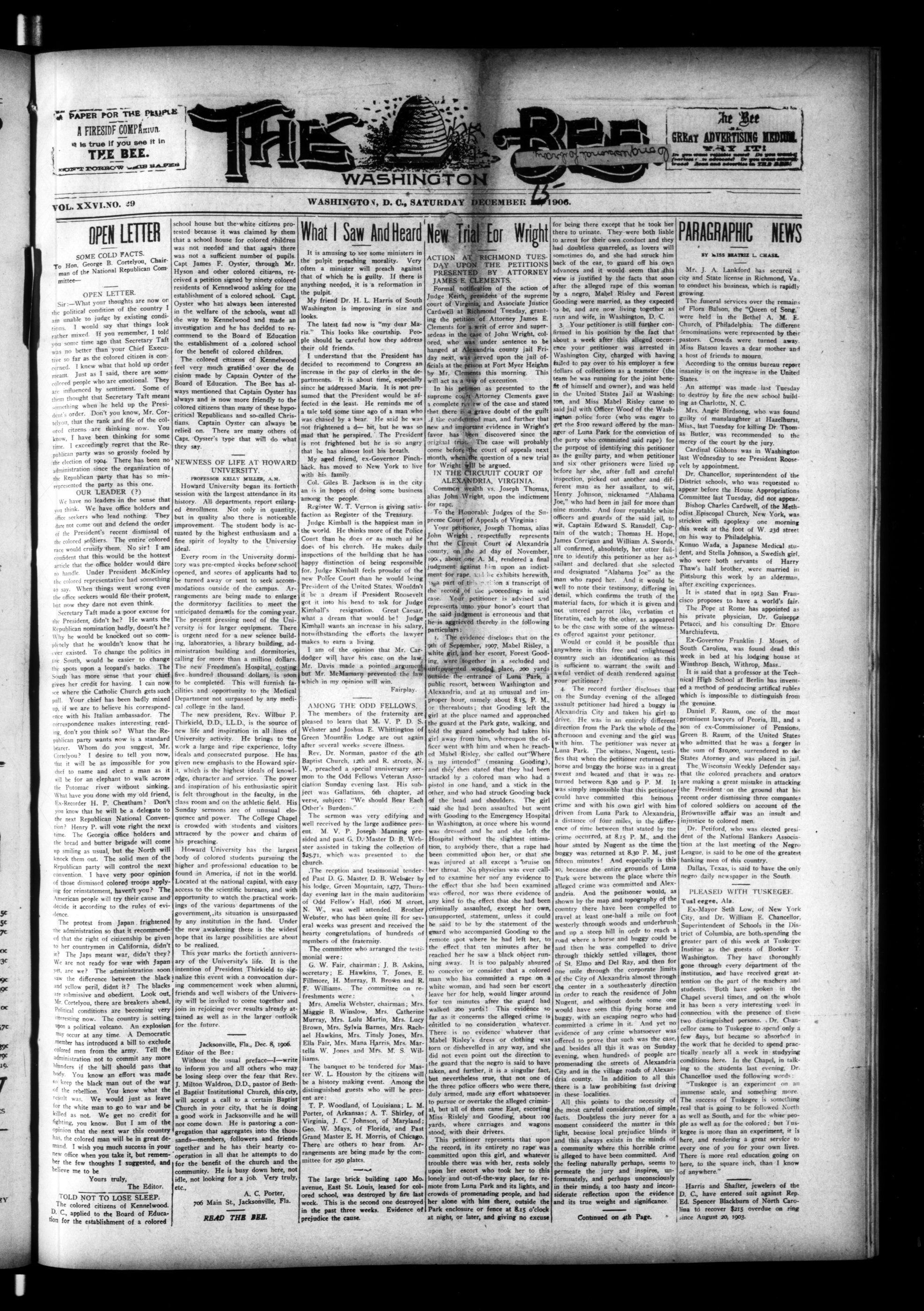
OPEN LETTER
SOME COLD FACTS
To Hon. George B. Cortelyou, Chairman of the National Republican Committee—
OPEN LETTER.
Sir: What your thoughts are now on the political condition of the country I am unable to judge by existing conditions. I would say that things look rather mixed. If you remember, I told you some time ago that Secretary Taft was no better than your Chief Executive so far as the colored citizen is concerned. I knew what that hold up order meant. Just as I said, there are some colored people who are emotional. They are influenced by sentiment. Some of them thought that Secretary Taft meant something when he held up the President's order. Don't you know, Mr. Cortelyou, that the rank and file of the colored citizens are thinking now. You know, I have been thinking for some time. I exceedingly regret that the Republican party was so grossly fooled by the election of 1904. There has been no administration since the organization of the Republican party that has so misrepresented the party as this one.
OUR LEADER (?)
We have no leaders in the sense that you think. We have office holders and office seekers who lead nothing. They dare not come out and defend the order of the President's recent dismissal of the colored soldiers. The entire colored race would crisply them. No sir! I am confident that this would be the hottest article that the office holder would dare to handle. Under President McKinley the colored representative had something to say. When things went wrong even the office seekers would file their protest, but now they dare not even think.
Secretary Taft made a poor excuse for the President, didn't he? He wants the Republican nomination badly, doesn't he? Why he would be knocked out so completely that he wouldn't know that he ever existed. To change the politics in the South, would be easier to change the spots upon a leopard's backs. The South has more sense that your chief gives her credit for having. I can now see where the Catholic Church gets such pull. Your chief has been badly mixed up, if we are to believe his correspondence with his Italian ambassador. The correspondence makes interesting, reading, don't you think so? What the Republican party wants now is a standard bearer. Whom do you suggest, Mr. Cortelyou? I desire to tell you now, that it will be as impossible for you chief to name and elect a man as it will be for an elephant to walk across the Potomac river without sinking. What have you done with my old friend, Ex-Recorder H. P. Cheatham? Don't you know that he will be a delegate to the next Republican National Convention? Henry P. will vote right the next time. The Georgia office holders and the bread and butter brigade will come up smiling as usual, but the North will knock them out. The solid men of the Republican party will control the next convention. I have very poor opinion of those dismissed colored troops applying for reinstatement, haven't you? The American people will try their cause and decide it according to the rules of evidence.
The protest from Japan frightened the administration so that it recommended that the right of citizenship be given to her countrymen in California, didn't it? The Japs meant war, didn't they? We are not ready for war with Japan yet, are we? The administration soon saw the difference between the black and yellow peril, didnt it? The blacks are submissive and obedient. Look out, Mr. Cortelyon, there are breakers ahead. Political conditions are becoming very interesting now. The country is setting upon a political volcano. An explosion may occur at any time. A Democratic member has introduced a bill to exclude colored men from the army. Tell the administration not to commit any more blunders if the bill should pass that body. You know an effort was made to keep the black man out of the war of the rebellion. You know what the result was. We would just as leave for the white man to go to war and be killed as not. We get no credit for fighting, you know. But I am of the opinion that the next war this country has, the colored man will be in great demand. I wish you much success in your new office when you take it, but remember the few thoughts I suggested, and believe me to be
TOLD NOT TO LOSE SLEEP.
The colored citizens of Kennelwood.
D. C., applied to the Board of Education
for the establishment of a colored
school house but the white citizens protested because it was claimed by them that a school house for colored children was not needed and that again there was not a sufficient number of pupils. Capt James F. Oyster, through Mr. Hyson and other colored citizens, received a petition signed by ninety colored residents of Kennelwood asking for the establishment of a colored school. Capt. Oyster who has always been interested in the welfare of the schools, went all the way to Kennelwood and made an investigation and he has decided to recommend to the Board of Education the establishment of a colored school for the benefit of colored children. The colored citizens of Kennelwood feel very much gratified over the decision made by Captain Oyster of the Board of Education. The Bee has always mentioned that Captain Oyster has always and is now more friendly to the colored citizens than many of these hypocritical Republicans and so-called Christians. Captain Oyster can always be relied on. There are many others of Capt. Oyster's type that will do what they say.
NEWNESS OF LIFE AT HOWARD
UNIVERSITY.
PROFESSOR KELLY MILLEE, A.M.
Howard University began its fortieth session with the largest attendance in its history. All departments report enlarged enrollment. Not only in quantity, but in quality also there is noticeable improvement. The student body is actuated by the highest enthusiasm and a fine spirit of loyalty to the University ideal.
Every room in the University dormitory was pre-empted weeks before school opened, and scores of applicants had to be turned away or sent to seek accommodations outside of the campus. Arrangements are being made to enlarge the dormitory facilities to meet the anticipated demands for the coming year. The present pressing need of the University is for larger equipment. There is urgent need for a new science building, laboratories, a library building, administration building and dormitories, calling for more than a million dollars. The new Freedmen's Hospital, costing five hundred thousand dollars, is soon to be completed. This will furnish facilities and opportunity to the Medical Department not surpassed by any medical college in the land.
The new president, Rev. Wilbur P. Thirkind, D.D., LL.D., is the source of new life and inspiration in all lines of University activity. He brings to the work a large and ripe experience, lofty ideals and consecrated purpose. He has given new emphasis to the Howard spirit, which is the highest ideals of knowledge, character and service. The power and inspiration of his enthusiastic spirit is felt throughout in the faculty, in the classroom and on the athletic field. His Sunday sermons are of unusual eloquence and power. The College Chapel is crowded with students and visitors attracted by the power and charm of his preaching.
Howard University has the largest body of colored students pursuing the higher and professional education to be found in America, if not in the world. Located at the national capital, with easy access to the scientific bureaus, and with opportunity to watch the practical workings of the various departments of the government, its situation is unsurpassed by any institution in the land. Under the new awakening there is the widest hope that its large possibilities are about to be realized.
This year marks the fortieth anniversary of the University's life. It is the intention of President Thirkield to signalize this event with a convocation during commencement week when alumni, friends and well wishers of the University will be invited to come together and join in rejoicing over results already attained as well as in the larger outlook for the future.
Jacksonville, Fla., Dec. 8, 1906.
Editor of the Bee:
Without the usual preface—I-write to inform you and all others who may be losing sleep over the fear that Rev. J. Milton Waldron, D.D., pastor of Bethel Baptist Institutional Church, this city, will accept a call to a certain Baptist Church in your city, that he is doing a good work in Jacksonville and he will not come down. He is pastoring a congregation that aggregates into the thousands—members, followers and friends together and he has their hearty cooperation in all that he attempts to do for the benefit of the church and the community. He is busy down here, not idle, not looking for a job. Very truly, etc.,
A. C. Porter,
706 Main St., Jacksonville, Fla.
READ THE BEE.
WASHINGTON
It is amusing to see some ministers in the pulpit preaching morality. Very often a minister will preach against that of which he is guilty. If there is anything needed, it is a reformation in the pulpit.
My friend Dr. H. L. Harris of South Washington is improving in size and looks.
The latest fad now is "my dear Maria." This looks like courtship. People should be careful how they address their old friends.
I understand that the President has decided to recommend to Congress an increase in the pay of clerks in the departments. It is about time, especially since he addressed Maria. It is not presumed that the President would be affected in the least. He reminds me of a tale told some time ago of a man who was chased by a bear. He said he was not frightened a d—bit, but he was so mad that he spired. The President is not frightened but he is so angry that he has almost lost his breath.
My aged friend, ex-Governor Pinchback, has moved to New York to live with his family.
Col. Giles B. Jackson is in the city an is in hopes of doing some business among the people.
Register W. T. Vernon is giving satisfaction as Register of the Treasury.
action as register of the Treasury.
Judge Kimball is the happiest man in the world. He thinks more of the Police Court than he does or as much as he does of his church. He makes daily inspections of the building that he has happy distinction of being responsible for. Judge Kimball feels prouder of the new Police Court than he would being President of the United States. Wouldn't it be a dream if President Roosevelt got it into his head to ask for Judge Kimball's resignation. Great Caesar, what a dream that would be! Judge Kimball wants an increase in his salary, notwithstanding the efforts the lawyer makes to earn a living.
I am of the opinion that Mr. Cardodger will have his case on the law, Mr. Davis made a pointed argument but Mr. McMamary prevented the law which in my opinion will win.
AMONG THE ODD FELLOWS.
The members of the fraternity are pleased to learn that M. V. P. D. S. Webster and Joshua E. Whittington of Green Mountain Lodge are out again after several weeks severe illness.
Rev. Dr. Norman, pastor of the 4th Baptist Church, 12th and R. streets, N. W., preached a special anniversary sermon to the Odd Fellows Veteran Association Sunday evening last. His subject was Gallatians, 6th chapter, 2d verse, subject: "We should Bear Each Other's Burdens."
The sermon was veryifying and well received by the large audience present. M. V. P. Joseph Manning presided and past G. D. Master D. B. Webster assisted in taking the collection of $25.71, which was presented to the church.
The reception and testimonial tendered Past D. G. Master D. B. Webster by his lodge, Green Mountain, 1477, Thursday evening last in the main auditorium of Odd Fellow's Hall, 1606 M street, N. W., was well attended. Brother Webster, who has been quite ill for several weeks was present and received the hearty congratulations of hundreds of members of the fraternity.
The committee who arranged the testimonial were:
G. W. Fair, chairman; J. B. Askins, secretary; E. Hawkins, T. Jones, E. Fillmore, H. Murray, B. Brown and R. F. Williams. The committee on refreshments were:
Mrs. Amelia Webster, chairman; Mrs. Maggie B. Winslow, Mrs. Catherine Murray, Mrs. Lulu Martin, Mrs. Lucy Brown, Mrs. Sylvia Barnes, Mrs. Rachael Hawkins, Mrs. Tinsley Jones, Mrs. Ella Fair, Mrs. Mana Harris, Mrs. Martella W. Jones and Mrs. M. S. Williams.
The banquet to be tendered for Master W. L. Houston by the citizens will be a history making event. Among the distinguished guests who will be present are:
T. P. Woodland, of Louisiana; L. M. Porter, of Arkansas; A. T. Shirley, of Virginia, J. C. Johnson, of Maryland; Geo. W. Mays, of Florida, and Past Grand Master E. H. Morris, of Chicago. There are others to hear from. Arrangements are being made by the committee for 250 plates.
The large brick building 1400 Mo. avenue, East St. Louis, leased for colored school, was destroyed by fire last week. This is the second one destroyed in the past three weeks. Evidence of prejudice the cause.
ACTION AT RICHMOND TUESDAY UPON THE PETITIONS PRESENTED BY ATTORNEY JAMES E. CLEMENTS.
Formal notification of the action of Judge Keith, president of the supreme court of Virginia, and Associate Justice Cardwell at Richmond Tuesday, granting the petition of Attorney James E. Clements for a writ of error and superseas in the case of John Wright, colored, who was under sentence to be hanged at Alexandria county jail Friday next, was served upon the jail officials at the prison at Fort Myers Heights by Mr. Clements this morning. This will act as a stay of execution.
In his petition as presented to the supreme court Attorney Clements gave a complete review of the case and stated that there is a grave doubt of the guilt of the condemned man, and further that new and important evidence in Wright's favor has been discovered since the original trial. The case will probably come before the court of appeals next month, when the question of a new trial for Wright will be argued.
IN THE CIRCUIT COURT OF ALEXANDRIA VIRGINIA.
Common wealth vs. Joseph Thomas, alias John Wright, upon the indictment for rape.
To the Honorable Judges of the Supreme Court of Appeals of Virginia:
preme Court of Appeals of Virginia:
Your petitioner, Joseph Thomas, alias John Wright , respectfully represents that the Circuit Court of Alexandra county, on the 2d day of November, 1900, about one A. M. , rendered a final judgment against him upon an indictment for rape, and he exhibits herewith, as part of this petition a transcript of the record of the proceedings in said case. Your petitioner is advised and represents unto your honor's court that the said judgment is erroneous and that he is aggrieved thereby in the following particulars:
1. The evidence discloses that on the 9th of September, 1907, Mabel Risley, a white girl, and her escort, Forest Gooding, were together in a secluded and unfrequented wooded place, 200 yards outside the entrance of Luna Park, a public resort, between Washington and Alexandria, and at an unusual and improper hour, namely about 8.15, P. M., or thereabouts; that Gooding left the girl at the place named and approached the guard at the Park gate, walking, and told the guard somebody had taken his girl away from him, whereupon the officer went with him and when he reached Mabel Risley, she called out "Where is my intended" (meaning Gooding), and they then stated that they had been attacked by a colored man who had a pistol in one hand, and a stick in the other, and who had struck Gooding back of the head and shoulders. The girl said she had been assaulted but went with Gooding to the Emergency Hospital in Washington, at once where his wound was dressed and he and she left the hospital without the slightest intimation, to anybody there, that a rape had been committed upon her, or that she was injured at all except a "bruise on her throat. No physician was ever called to examine her nor any evidence to the effect that she had been examined offered, nor was there evidence of any kind to the effect that she had been criminally assaulted, except her own unsupported, statement, unless it could be said to be by the statement of the guard who accompanied Gooding to the remote spot where he had left her, to the effect that ten minutes after he reached her he saw a black object running away. It is too palpably absured to conceive or consider that a colored man who has committed a rape on a white woman, and had seen her escort leave her for help, would linger around for ten minutes after the guard had walked 200 yards! This evidence so far as it concerns the alleged crime is entitled to no consideration whatever. There is no evidence whatever that Mabel Risley's dress or clothing was torn or dishevelled in any way, and she did not even point out the direction to the guard that the negro is said to have taken, and further, it is a singular fact, but nevertheless true, that not one of the three police officers who were there, duly armed, made any effort whatsoever to pursue or overtake the alleged criminal, but all of them came East, escorting Miss Risley and Gooding, about 100 yards, where carriages and wagons stood, with their drivers.
This petitioner represents that upon the record, in its entirety no rape was committed upon this girl, and whatever trouble there was with her, rests solely upon her escort who took her to this lonely and out-of-the-way place, far remote from Luna Park and its lights, and crowds of promenading people, and had her alone with him there, outside the Park enclosure or fence at 8.15 o'clock at night, or later, and giving no excuse
for being there except that he took her there to urinate. They were both liable to arrest for their own conduct and they had doubtless quarreled, as lovers will sometimes do, and she had struck him back of the ear, to guard off his own advances and it would seem that this view is justified by the facts that soon after the alleged rape of this woman by a negro, Mabel Risley and Forest Gooding were married, as they expected to be, and are now living together as man and wife, in Washington, D. C.
3. Your petitioner is still further confirmed in his position by the fact that about a week after this alleged occurrence your petitioner was arrested in Washington City, charged with having failed to pay over to his employer a few dollars of collections as a teamster (the team he was running for the joint benefit of himself and owner), and was held in the United States Jail at Washington, and Miss Mabel Risley came to said jail with Officer Wood of the Washington police force (who was eager to get the $100 reward offered by the manager of Luna Park for the conviction of the party who committed said rape) for the purpose of identifying this petitioner as the guilty party, and when petitioner and six other prisoners were lined up before her she, after full and careful inspection, picked out another and different man as her assailant, to wit, Henry Johnson, nicknamed "Alabama Joe," who had been in jail for more than nine months. And four reputable white officers and guards of the said jail, to wit, Captain Edward S. Ransdell, Captain of the watch; Thomas H. Hope, James Corrigan and William A. Swords, all confirmed, absolutely, her utter failure to identify this petitioner as her assailant and declared that she selected and designated "Alabama Joe" as the man who raped her. And it would be well to note their testimony, differing in detail, which confirms the truth of the material facts, for which it is given and not uttered parrot like, verbatim et literatim, each by the other, as appeared to be the case with some of the witnesses offered against your petitioner.
Would or could it be possible that anywhere in this free and enlightened country such an identification as this is sufficient to warrant the swift and awful verdict of death rendered against your petitioner?
4. The record further discloses that on the Sunday evening of the alleged assault petitioner had hired a buggy in Alexandria City and taken his girl to drive. He was in an entirely different direction from the Park the whole of the afternoon and evening and the girl was with him. The petitioner was never at Luna Park. The witness, Nugent, testifies that when the petitioner returned the horse and buggy the horse was in a great sweat and heated and that it was returned between 8.30 and 9 P. M. It was simply impossible that this petitioner could have committed this heinous crime and with his own girl with him driven from Luna Park to Alexandria, a distance of four miles, in the difference of time between that stated by the crime occurred, at 8.15 P. M., and the hour stated by Nugent as the time the buggy was returned at 8.30 P. M., just fifteen minutes! And especially is this so, because the entire grounds of Luna Park were between the place where this alleged crime was committed and Alexandria. And the petitioner was shown by the map and topography of the country there have been compelled to travel at least one-half a mile on foot westerly through woods and underbrush and up a steep hill in order to reach a road where a horse and buggy could be and then he was compelled to drive through thickly settled villages, those of St. Elmo and Del Ray, and then for one mile through the corporate limits of the City of Alexandria almost through the center in a southeasterly direction in order to reach the residence of John Nugent, and without doubt some one would have seen this flying horse and buggy, with an escaping negro who had committed a crime in it. And yet no evidence of any crime whatsoever was offered to prove that such was the case, and besides all this it was on Sunday evening, when hundreds of people are promenading the streets of Alexandria City and in the village roads of Alexandria county. In addition to all this there is a law prohibiting fast driving in these localities.
All this points to the necessity of the most careful consideration of simple facts. Doubtless the jury never for a moment consideerd the matter in this light, because local prejudice blits it and this always exists in the minds of a community where this horrible crime is alleged to have been committed. And the feeling naturally perhaps, seems to permeate the jury and inspires, unfortunately, and perhaps unconsciously in their minds, a too hasty and inconsiderate reflection upon the evidence and its true weight and significance.
Continued on 4th Page.
PARAGRAPHIC NEWS
PARAGRAPHIC NEWS
Mr. J. A. Lankford has secured a city and State license in Richmond, Va. to conduct his business, which is rapidly growing.
The funeral services over the remains of Flora Balson, the "Queen of Song," were held in the Bethel A. M. E. Church, of Philadelphia. The different denominations were represented by their pastors. Crowds were turned away. Miss Batson leaves a dear mother and a host of friends to mourn.
According to the census bureau report insanity is on the increase in the United States.
An attempt was made last Tuesday to destroy by fire the new school building at Charlotte, N. C.
Mrs. Angie Birdsong, who was found guilty of manslaughter at Hazehurst, Miss., last Tuesday for killing Dr. Thomas Butler, was recommended to the merely of the court by the jury.
Cardinal Gibbons was in Washington last Wednesday to see President Roosevelt by appointment.
Dr. Chancellor, superintendent of the District schools, who was requested to appear before the House Appropriations Committee last Tuesday, did not appear
Bishop Charles Cardwell, of the Methodist Episcopal Church, New York, was stricken with apoplexy one morning this week at the foot of W. 23d street on his way to Philadelphia.
Kunuo Wada, a Japanese Medical student, and Stella Johnson, a Swedish girl, who were both servants of Harry Thaw's half brother, were married in Pittsburg this week by an alderman, after exciting experiences.
It is stated that in 1913 San Francisco proposes to have a world's fair. The Pope at Rome has appointed as his private physician, Dr. Guiseppe Petacei, and his consulting Dr. Ettore Marchiafeva.
Ex-Governor Franklin J. Moses, of South Carolina, was found dead this week in bed at his lodging house at Winthrop Beach, Withrop, Mass.
It is said that a professor at the Technical High School at Berlin has invented a method of producing artificial rubles which is impossible to distinguish from the genuine.
Daniel F. Raum, one of the most prominent lawyers of Peoria, Ill., and a son of ex-Commissioner of Pensions, Green B. Raum, of the United States who admitted that he was a forger in the sum of $10,000, surrendered to the States Attorney, and was placed in jail.
The Wisconsin Weekly Defender says that the colored preachers and orators are making a great mistake in attacking the President on the ground that his recent order dismissing three companies of colored soldiers on account of the Brownville affair was an insult and injustice to colored men.
Dr. Petiford, who was elected president of the National Bankers Association at the last meeting of the Negro League, is said to be one of the greatest banking men of this country.
Dallas, Texas, is said to have the only negro daily newspaper in the South.
PLEASED WITH TUSKEGEE.
Tusl egee, Ala.
Ex-Mayor Seth Low, of New York City, and Dr. William E. Chancellor, Superintendent of Schools in the District of Columbia, are both spending the greater part of this week at Tuskegee Institute as the guests of Booker T. Washington. They have thoroughly gone through every department of the institution, and have received great attention on the part of the teachers and students. Both have spoken in the Chapel several times, and on the whole it has been a very interesting week in connection with the presence of these two distinguished persons. Dr. Chancellor came to Tuskegee to spend only a few days, but became so absorbed in the work that he decided to spend practically nearly all a week in studyyying conditions here. In the Chapel, in talking to the students last evening, Dr. Chancellor used the following words: "Tuskegee is an experiment on an immense scale, and something more. The success of Tuskegee is something real that is going to be followed North as well as South, and for the white people as well as for the colored; but Tuskegee is more than an experiment, it is here, and rendering a great service to every one of you for your own lives. There is more real education going on here, to the square inch, than I know of anywhere."
Harris and Shafter, jewelers of the D. C., have entered suit against RepEd. Spencer Blackburn of North Carolina to recover $215 overdue on ring since August 20, 1903.
SURVIVED MASSACRE
HORSE ONLY CREATURE THAT ESCAPED CUSTER'S FATE.
Skin of "Comanche" Mounted on Death of Animal and Placed on Exhibition in University
of Kansas.
Kansas City.—In the basement of the Natural History building of the University of Kansas at Lawrence, stands a light bay horse, saddled and bridled and looking mildly, through his glass eyes, at the few persons who daily find their way to the room where he is on exhibition.
It is Comanche, the only living thing—horse or man—of Gen. Custer's troops that is positively known to have escaped the massacre on the Little Big Horn, June 25, 1876. He was ridden by Capt. Keogh—gallant Capt. Keogh, who fought so well by the side if his chief and whose picture is given prominence in Mulvaney's portrayal of the battle. Comanche, also appears in the picture and is the only thing that, after the battle, could have been drawn from life.
It is commonly supposed that one of Custer's soldiers, desperately wounded and left for dead on the field, survived the battle a few days, but this is vigorously denied by army officers who are familiar with the story of the massacre. Even the horses of the troopers were ruthlessly put to
death by the Sioux savages, Comanche was probably left for dead, but he escaped, and was found after that dreadful day, wandering on the prairie near the battlefield by a trooper of the Seventh who had been sent to Maj. Reno by Gen. Custer the day before the fight.*
He was so badly hurt that it was thought best to kill him to end his
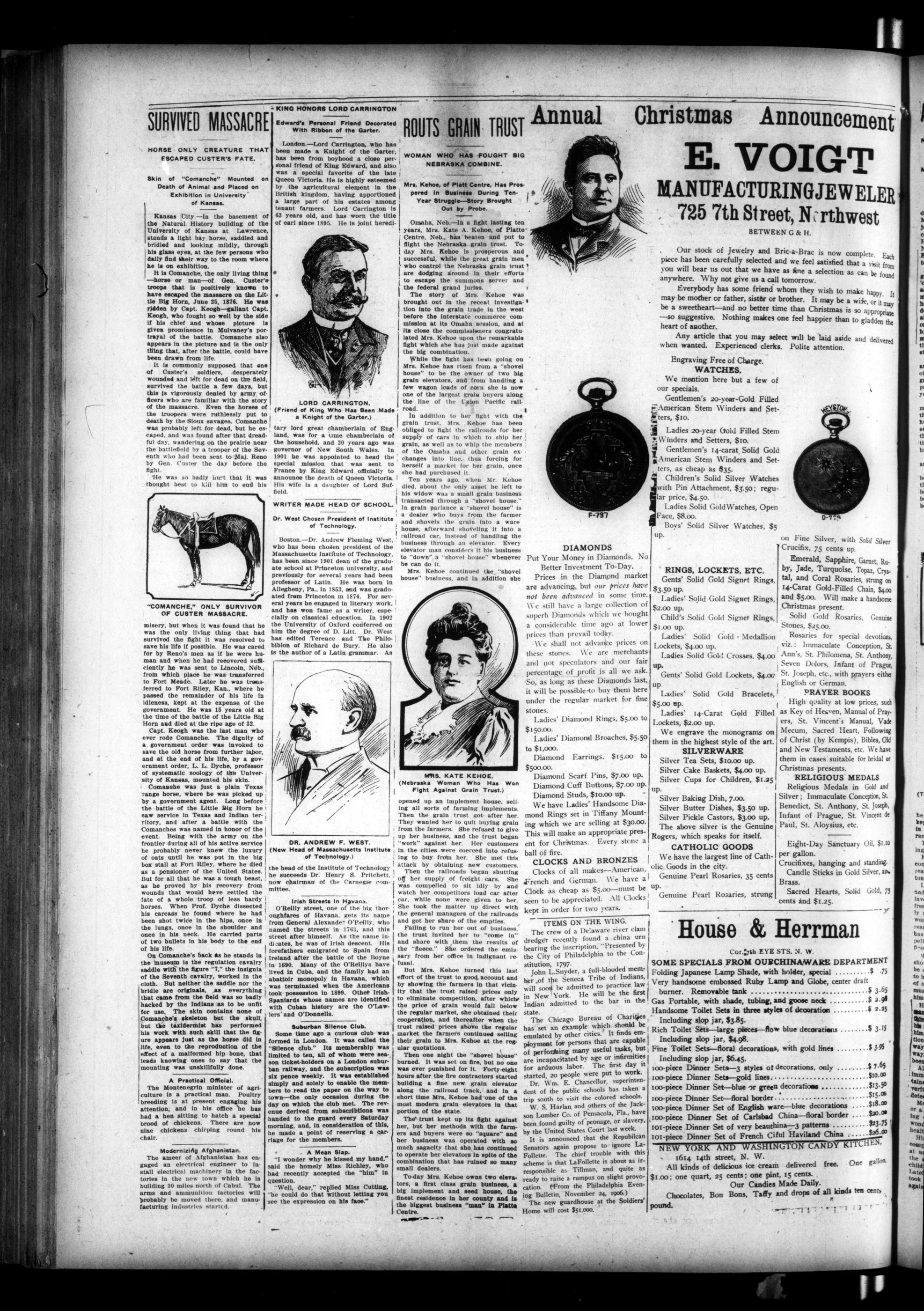
"COMANCHE," ONLY SURVIVOR OF CUSTER MASSACRE.
misery, but when it was found that he was the only living thing that had survived the fight it was resolved to save his life if possible. He was cared for by Reno's men as if he were human and when he had recovered sufficiently he was sent to Lincoln, Neb., from which place he was transferred to Fort Meade. Later he was transferred to Fort Riley, Kan., where he passed the remainder of his life in idleness, kept at the expense of the government. He was 15 years old at the time of the battle of the Little Big Horn and died at the ripe age of 32. Capt. Keogh was the last man who ever rode Cómanche. The dignity of a government order was invoked to save the old horse from further labor, and at the end of his life, by a government order, L. L. Dyche, professor of systematic zoology of the University of Kangas, mounted his skin.
Comanche was just a plain Texas range horse, where he was picked up by a government agent. Long before the battle of the Little Big Horn he saw service in Texas and Indian territory, and after a battle with the Comanches was named in honor of the event. Being with the army on the frontier during all of his active service he probably never knew the luxury of oats until he was put in the big box stall at Fort Riley, where he died as a pensioner of the United States. But for all that he was a tough beast, as he proved by his recovery from wounds that would have settled the fate of a whole troop of less hardy horses. When Prof. Dyche dissected his carcass he found where he had been shot twice in the hips, once in the lungs, once in the shoulder and once in his neck. He carried parts of two bullets in his body to the end of his life.
On Comanche's back as he stands in the museum is the regulation cavalry saddle with the figure "7," the insignia of the Seventh cavalry, worked in the cloth. But neither the saddle nor the bridle are originals, as everything that came from the field was so badly hacked by the Indians as to be unfit for use. The skin contains none of Comanche's skeleton but the skull, but the taxidermist has performed his work with such skill that the figure appears just as the horse did in life, even to the reproduction of the effect of a malformed hip bone, that leads knowing ones to say that the mounting was unskillfully done.
A Practical Official.
The Montenegrin minister of agriculture is a practical man. Poultry breeding is at present engaging his attention, and in his office he has had a hen sitting to hatch a special brood of chickens. There are now nine chickens chirping round his chair.
Modernizing Afghanistan.
The ameer of Afghanistan has engaged an electrical engineer to install electrical machinery in the factories in the new town which he is building 30 miles north of Cabul. The arms and ammunition factories will probably be moved there, and manufacturing industries started.
KING HONORS LORD CARRINGTON
Edward's Personal Friend Decorated With Ribbon of the Garter.
London.—Lord Carrington, who has been made a Knight of the Garter, has been from boyhood a close personal friend of King Edward, and also was a special favorite of the late Queen Victoria. He is highly esteemed by the agricultural element in the British kingdom, having apportioned a large part of his estates among tenant farmers. Lord Carrington is 63 years old, and has worn the title of earl since 1895. He is joint heredi-
E.
tary lord great chamberlain of England, was for a time chamberlain of the household, and 20 years ago was governor of New South Wales. In 1901 he was appointed to head the special mission that was sent to France by King Edward officially to announce the death of Queen Victoria. His wife is a daughter of Lord Suffield.
WRITER MADE HEAD OF SCHOOL.
Dr. West Chosen President of Institute of Technology.
Boston—Dr. Andrew Fleming West, who has been chosen president of the Massachusetts Institute of Technology, has been since 1901 dean of the graduate school at Princeton university, and previously for several years had been professor of Latin. He was born in Allegheny, Pa., in 1853, and was graduated from Princeton in 1874. For several years he engaged in literary wdrk, and has won fame as a writer, especially on classical education. In 1902 the, University of Oxford conferred on him the degree of D. Litt. Dr. West has edited Terence and The Philoiblson of Richard de Bury. He also is the author of a Latin grammar. As
DR. ANDREW F. WEST.
(New Head of Massachusetts Institute of Technology.)
the head of the Institute of Technology he succeeds Dr. Henry. S. Pritechett. now chairman of the Carnegie committee.
Irish Streets In Havana.
O'Reilly street, one of the big thoroughfares of Havana, gets its name from General Alexander O'Reilly, who named the streets in 1763, and this street after himself. As the name indicates, he was of Irish descent. His forefathers emigrated to Spain from Ireland after the battle of the Boyne in 1690. Many of the O'Reillys have lived in Cuba, and the family had an abattoir monopoly in Havana, which was terminated when the Americans took possession in 1899. Other Irish-Spanishards whose names are identified with Cuban history are the O'Lawlers and O'Donnells.
Suburban Silence Club.
Some time ago a curious club was formed in London. It was called the "Silence club." Its membership was limited to ten, all of whom were season ticket-holders on a London suburban railway, and the subscription was six pence weekly. It was established simply and solely to enable the members to read the paper on the way to town—the only occasion during the day on which the club met. The revenue derived from subscriptions was handed to the guard every Saturday morning, and, in consideration of this, he made a point of reserving a carriage for the members.
"I wonder why he kissed my hand," said the homely Miss Richley, who had recently accepted the "him" in question. "Well, dear," replied Miss Cutting, "he could do that without letting you see the expression on his face."
ROUTS GRAIN TRUST
WOMAN WHO HAS FOUGHT BIG NEBRASKA COMBINE.
Mrs. Kehoe, of Platt Centre, Has Prospered In Business During Ten-Year Struggle—Story Brought Out by Probe.
Omaha, Neb.—In a fight lasting ten years, Mrs. Kate A. Kehoe, of Platte Centre, Neb., has beaten and put to flight the Nebraska grain trust. Today Mrs. Kehoe is prosperous and successful, while the great grain men who control the Nebraska grain trust are dodging around in their efforts to escape the summons server and the federal grand juries.
The story of Mrs. Kehoe was brought out in the recent investigation into the grain trade in the west before the interstate commerce commission at its Omaha session, and at its close the commissioners congratulated Mrs. Kehoe upon the remarkable fight which she has just made against the big combination.
While the fight has been going on Mrs. Kehoe has risen from a "shovel house" to be the owner of two big grain elevators, and from handling a few wagon loads of coin she is now one of the largest grain buyers along the line of the Union Pacific railroad. In addition to her fight with the grain trust, Mrs. Kehoe has been obliged to fight the railroads for her supply of cars in which to ship her grain, as well as to whip the members of the Omaha and other grain exchanges into line, thus forcing for herself a market for her grain, once she had purchased it. Ten years ago, when Mr. Kehoe died, about the only asset he left to his widow was a small grain business transacted through a "shovel house." In grain parlance a "shovel house" is a dealer who buys from the farmer and shovels the grain into a warehouse, afterward shovelling it into a railroad car, instead of handling the business through an elevator. Every elevator man considers it his business to "down" a "shovel house" whenever he can do it. Mrs. Kehoe continued the "shovel house" business, and in addition she
MRS. KATE KEHOE.
(Nebraska Woman Who Has Won
Fight Against Grain Trust.)
opened up an implement house, selling all sorts of farming implements. Then the grain trust got after her. They wanted her to quit buying grain from the farmers. She refused to give up her business, and the trust began "work" against her. Her customers in the cities were coerced into refusing to buy from her. She met this attack by obtaining new customers. Then the railroads began shutting off her supply of freight cars. She was compelled to sit idly by and watch her competitors load car after car, while none were given to her. She took the matter up direct with the general managers of the railroads and got her share of the emplies. Failing to run her out of business, the trust invited her to "come in" and share with them the results of the "fleece." She ordered the emissary from her office in indignant refusal.
But Mrs. Kehoe turned this last effort of the trust to good account and by showing the farmers in that vicinity that the trust raised prices only to eliminate competition, after which the price of grain would fall below the regular market, she obtained their cooperation, and thereafter when the trust raised prices above the regular market the farmers continued selling their grain to Mrs. Kehoe at the regular quotations.
Then one night the "shovel house" burned. It was set on fire, but no one was ever punished for it. Forty-eight hours after the fire contractors started building a fine new grain elevator along the railroad track, and in a short time Mrs. Kehoe had one of the most modern grain elevators in that portion of the state.
The trust kept up its fight against her, but her methods with the farmers and buyers were so "square" and her business was operated with so much sagacity that she has continued to operate her elevators in spite of the combination that has ruined so many small dealers.
To-day Mrs. Kehoe owns two elevators, a first class grain business, a big implement and seed house, the finest residence in her county and is the biggest business "man" in Platta Centre.
J.
F-797
DIAMONDS
Put Your Money in Diamonds. No Better Investment To-Day.
Prices in the Diamond market are advancing, but our prices have not been advanced in some time. We still have a large collection of superb Diamonds which we bought a considerable time ago at lower prices than prevail today.
We shall not advance prices on these stones. We are merchants and not speculators and our fair percentage of profit is all we ask. So, as long as these Diamonds last, it will be possible to buy them here under the regular market for fine stones.
Ladies' Diamond Rings, $5.00 to $150.00.
Ladies' Diamond Broaches, $5.50 to $1,000.
Diamond Earrings. $15.00 to $500.00.
Diamond Scarf Pins, $7.00 up. Diamond Cuff Buttons, $7.00 up. Diamond Studs, $10.00 up. We have Ladies' Handsome Diamond Rings set in Tiffany Mounting which we are selling at $30.00. This will make an appropriate present for Christmas. Every stone a ball of fire. CLOCKS AND BRONZES Clocks of all makes—American, French and German. We have a Clock as cheap as $5.00—must be seen to be appreciated. All Clocks kept in order for two years.
ITEMS ON THE WING.
The crew of a Delaware river clam dredger recently found a china urn bearing the incription, "Presented by the City of Philadelphia to the Constitution, 1797.
John L.Snyder, a full-blooded member of the Seneca Tribe of Indians, will soon be admitted to practice law in New York. He will be the first Indian admitted to the bar in the state.
The Chicago Bureau of Charities has set an example which should be emulated by other cities. It finds employment for persons that are capable of performing many useful tasks, but are incapacitated by age or infirmities for arduous labor The first day it started, 20 people were put to work. Dr. Wm. E. Chancellor, superintendent of the public schools has taken a trip south to visit the coloured schools. W. S. Harlan and others of the Jackson Lumber Co. of Pensacola, Fla., have been found guilty of peonage, or slavery, by the United States Court last week. It is announced that the Repubilcan Senators again propose to ignore LaFollette. The chief trouble with this scheme is that LaFollette is about as irresponsible as Tillman, and quite as ready to raise a rumpus on slight provocation (From the Philadelphia Evening Bulletin, November 24, 1906.) The new guardhouse at the Soldiers' Home will cost $51,000.
E. VOIGT MANUFACTURINGJEWELER 725 7th Street, Northwest
Our stock of Jewelry and Bric-a-Brac is now complete. Each piece has been carefully selected and we feel satisfied that a gift from you will bear us out that we have as fine a selection as can be found anywhere. Why not give us a call tomorrow.
Everybody has some friend whom they wish to make happy. It may be mother or father, sister or brother. It may be a wife or it may be a sweetheart—and no better time than Christmas is so appropriate—so suggestive. Nothing makes one feel happier than to gladden the heart of another.
Any article that you may select will be laid aside and delivered when wanted. Experienced clerks. Polite attention.
Engraving Free of Charge.
We mention here but a few of our specials.
Gentlemen's 20-year-Gold Filled American Stem Winders and Setters, $10.
Ladies 20-year Gold Filled Stem Winders and Setters, $10.
Gentlemen's 14-carat Solid Gold American Stem Winders and Setters, as cheap as $35.
Children's Solid Silver Watches with Pin Attachment, $3.50; regular price, $4.50.
Ladies Solid GoldWatches, Open Face, $8.00.
Boys' Solid Silver Watches, $5 up.
Gents' Solid Gold Signet Rings. $3.50 up.
Ladies' Solid Gold Signet Rings, $2.00 up.
Child's Solid Gold Signet Rings, $1.00 up.
Ladies' Solid Gold Medallion Lockets, $4.00 up.
Ladies Solid Gold Crosses. $4.00 up.
Gents' Solid Gold Lockets, $4.00 up
Ladies' Solid Gold Bracelets, $5.00 up.
Ladies' 14-Carat Gold Filled Lockets, $2.00 up.
We engrave the monograms on them in the highest style of the art.
SILVERWARE
Silver Tea Sets, $10.00 up.
Silver Cake Baskets, $4.00 up.
Silver Cups for Children, $1.25 up.
Silver Baking Dish, 7.00.
Silver Butter Dishes, $3.50 up.
Silver Pickle Castors, $3.00 up.
The above silver is the Genuine Rogers, which speaks for itself.
CATHOLIC GOODS
We have the largest line of Catholic Goods in the city.
Genuine Pearl Rosaries, 35 cents up.
House & Herrman
SOME SPECIALS FROM OUECHINAWARE DEPARTMENT
Folding Japanese Lamp Shade, with holder, special ..... $ 75
Very handsome embossed Ruby Lamp and Globe, center-draw
burner. Removable tank ..... $ 3.05
Gas Portable, with shade, tubing, and goose neck ..... $ 2.98
Handsome Toilet Sets in three styles of decoration ..... $ 2.25
Including oloe jas $ 8.95
All kinds of delicious ice cream delivered free. One gallon $1.00; one quart, 25 cents; one pint, 15 cents. Our Candies Made Daily. Chocolates, Bon Bons, Taffy and drops of all kinds ten cents pound.
KEYSTON
D-729
on Fine Silver. with. No. Silver
Crucifix, 75 cents up
Emerald, Sapphire, Garnet, Ruby, Jade, Turquise. Topaz, Crystal, and Coral Rosaries, strung on 14-Carat Gold-Filled Chain, $4.00 and $5.00. Will make a handsome Christmas present.
Solid Gold Rosaries, Giannae Stones, $25.00.
Rosaries for special devotion, viz.: Immaculate Conception, St Ann's. St. Philomena, St. Anthony, Seven Dolors, Infant of Prague, St. Joseph, etc., with prayers either English or German.
PRAYER BOOKS
High quality at low prices, such as Key of Heaven, Manual of Pravers, St. Vincent's Manual, Vade Mecum, Sacred Heart. Following of Christ (by Kempis). Bibles, Old and New Testaments etc. We have them in cases suitable for bridal or Christmas presents.
RELIGIOUS MEDALS
Religious Medals in Gold and Silver; Immaculate Conception, St Benedict, St. Anthony, St Joseph, Infant of Prague, St. Vincent de Paul, St. Aloysius, etc.
Eight-Day Sanctuary 10 per gallon.
Crucifixes, hanging and standing.
Candle Sticks in Gold Silver, and
Brass.
Sacred Hearts, Solid 11.75
cents and $1.25.
A COMPOSER. AT .FIVE
REMARKABLE GIFTS OF A TENNESSEE BOY.
Melvin Hesselberg Writes Music and
Stories—Is Extremely Critical and
Will Allow No Changes In
His Works.
Nastilie Teen.—A new child won-
ler has been discovered in this city.
Meltyn Edward Hesselberg, who is
just turning two years old, already
composes music and writes stories.
Hesselberg is a name well known in
Nashville for the child's father is
Edward Hesselberg, a musician of in-
ternational fame.
Mr Hesselberg is a Russian, a grandmother of Davidoff, the great cellist. He, too, was precocious, for as a student in Moscow he was permitted to appear at the famous Philharmonic concerts, being the only student thus honored. When he graduated he received a gold medal, the only one tendered to any member of his class, and performed Lizst's famous "Dance Macabre" before a distinguished audience. Hesselberg then studied the piano with Hubinsteln. Mr. Hesselberg also is an artist and a writer, who makes a specialty of children's stories in the kindergarten form. From this artistic point of view it is easy to see where the teacher gets his talent.
I am Hesselberg was born with melodies in his soul. At the age of three and one-half years he began humming little melodies, which seemed to the musical ear of the father to have originality. He questioned the boy and asked where he had heard them.
"I was made it up," was the boyish answer.
Thinking the melody had merely been an accidental hitting of notes that went well together, Mr. Hesselberg had no further attention until he began saying that the boy remembered one of each melody as
```markdown
```
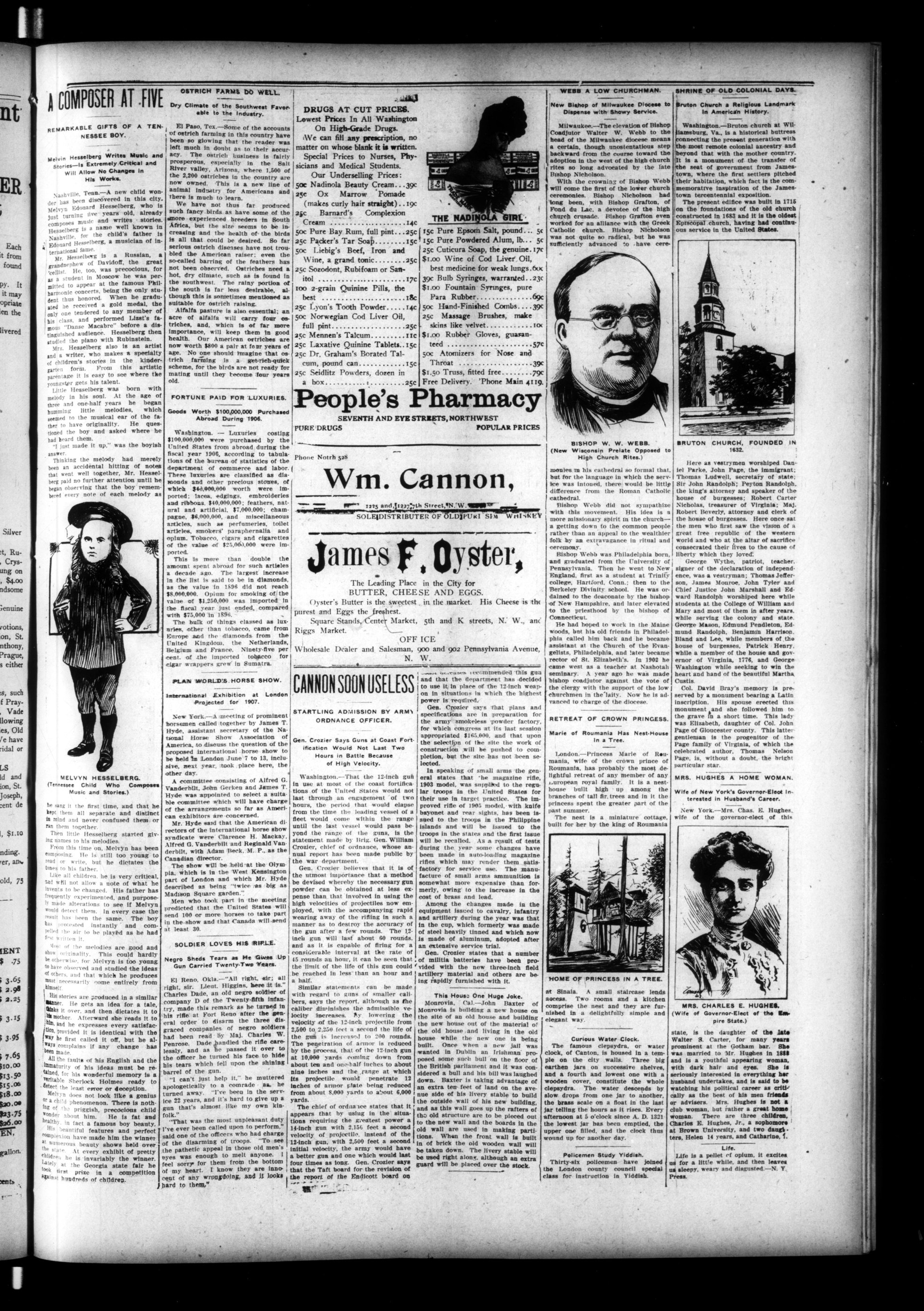
MELVYN HESSELBERG.
(Tennessee Child Who Composes
Music and Stories.)
MELVYN HESSELBERG.
(Tennessee Child Who Composes
Music and Stories.)
He first time, and that he
he knew all separate and distinct
in mind and never confused them or
together.
Hesselberg started give-
his melodies.
This time on. Melvyn has been
He is still too young to
write, but he dictates the
titles.
Children he is very critical,
who cannot allow a note of what he
is changed. His father has
experimented, and purpose-
operations to see if Melvyn
them. In every case the
from the same. The boy
instantly and com-
to be played as he had
melodies are good and
This could hardly
Melvyn is too young
and studied the ideas
that which he produces
come entirely from
He is now produced in a similar manner he gets an idea for a tale. Other men and then dictates it to him. Afterward she reads it to him and he expresses every satisfaction he is identical with the way he has called it off, but he always asks if any change has been made in his English and the immature his ideas must be retained. His wonderful memory is a veritable book Holmes ready to detect last error or deception.
does not look like a genius
honomenon. There is not
mongish, precocious child
in him. He is fat and
has a famous boy beauty.
all features and perfect
have made him the winner
beauty shows held over
at every exhibit of pretty
is invariably the winner.
the Georgia state fair he
prize in a competition
hundreds of children.
OSTRICH FARMS DO WELL.
Dry Climate of the Southwest Favorable to the Industry.
El Paso, Tex.-Some of the accounts of ostrich farming in this country have been so glowing that the reader was left much in doubt as to their accuracy. The ostrich business is fairly prosperous, especially in the Salt River valley, Arizona, where 1,500 of the 2,200 ostrichs in the country are now owned. This is a new line of animal industry for Americans and there is much to learn.
We have not thus, far produced such fancy birds as have some of the more experienced breeders in South Africa, but the size seems to be increasing and the health of the birds is all that could be desired. So far serious ostrich diseases have not troubled the American raiser: even the so-called barring of the feathers has not been observed. Oatriches need a hot, dry climate, such as is found in the southwest. The rainy portion of the south is far less desirable, although this is sometimes mentioned as suitable for ostrich raising.
Alfalfa pasture is also essential; an acre of alfalfa will carry four ostriches, and, which is of far more importance, will keep them in good health. Our American ostriches are now worth $800 a pair at four years of age. No one should imagine that ostrich farming is a get-rich-quick scheme, for the birds are not ready for mating until they become four years old.
FORTUNE PAID FOR LUXURIES.
Goods Worth $100,000,000 Purchased Abroad During 1906.
* Washington. — Luxuries costing $100,000,000 were purchased by the United States from abroad during the fiscal year 1906, according to tabulations of the bureau of statistics of the department of commerce and labor. These luxuries are classified as diamonds and other precious stones, of which $40,900,000 worth were imported. laces, edgings, embroideries and ribbons. $40,000,000; feathers, natural and artificial. $7,000,000; champagne. $6,000,000, and miscellaneous articles, such as perfumeries, toilet articles, smokers' paraphernalia and opium. Tobacco, cigars and cigarettes of the value of $25,004,000 were imported.
This is more than double the amount spent abroad for such articles a decade ago. The largest increase in the list is said to be in diamonds, as the value in 1896 did not reach $8,000,000. Opium for smoking of the value of $1,250,000 was imported in the fiscal year just ended, compared with $75,000 in 1896.
The bulk of things classed as luxuries, other than tobacco, came from Europe and the diamonds from the United Kingdom, the Netherlands, Belgium and France. Ninety-five per cent. of the imported tobacco for cigar wrappers grew in Sumatra.
PLAN WORLD'S HORSE SHOW.
International Exhibition at London Projected for 1907.
New York.—A meeting of prominent horsemen called, together by James T. Hyde, assistant secretary of the National Horse Show, Association of America, to discuss the question of the proposed international horse show to be held in London June 7 to 13, inclusive, next year, took place here, the other day.
A committee consisting of Alfred G. Vanderhilt, John Geiken and James T. Hyde was appointed to select a suitable committee which will have charge of the arrangements so far as American exhibitors are concerned.
Mr. Hyde said that the American directors of the international horse show syndicate were Clarence H. Mackay, Alfred G. Vanderbilt and Reginald Vanderbilt, with Adam Beck, M. P., as the Canadian director.
The show will be held at the Olympia, which is in the West Kensington part of London and which Mr. Hyde described as being "twice as big as Madison Square garden."
Men who took part in the meeting predicted that the United States will send 100 or more horses to take part in the show and that Canada will send af least 30.
SOLDIER LOVES HIS RIPLE.
Negro Sheds Tears as Me. Gives Up Gun Carried Twenty-Two Years.
El Reno, Okla.—"All right, sir; all right, sir. Lout. Higgins, here it is." Charles Dade, alld negro soldier of company D of the Twenty-fifth infantry, made this remark as he turned in his rifle at Fort Reno after the general order to disarm the three disgraced companies of negro soldiers had been read by Maj. Charles W. Penrose. Dade handled the rifle carelessly, and as he passed it over to the officer he turned his face to hide his tears which fell upon the shining barrel of the gun.
"I can't just help it," he muttered apologetically to a comrade as he turned away. "I've been in the service 22 years, and it's hard to give up a gun that's almost like my own kinfolk."
"That was the most unpleasant duty I've ever been called upon to perform," said one of the officers who had charge of the disarming of troops. "To see the pathetic appeal in those old men's eyes was enough to melt anyone. I feel sorry for them from the bottom of my heart. I know they are innocent of any wrongdoing, and it looks hard to them."
DRUGS AT CUT PRICES.
Lowest Prices In All Washington
On High-Grade Drugs.
We can fill any prescription, no
matter on whose blank it is written.
Special Prices to Nurses, Physicians and Medical Students.
Our Underselling Prices:
50c Nadinola Beauty Cream...39c
25c Ox Marrow Pomade
(makes curly hair straight)...19c
25c Barnard's Complexion
Cream ..... 14c
50c Pure Bay Rum, full pint.....25c
25c Packer's Tar Soap.....15c
50c Liebig's Beef, Iron and
Wine, a grand tonic.....25c
25c Sozodont, Rubifoam or San-
best .....18c
25c Lyon's Tooth Powder.....14c
50c Norwegian Cod Liver Oil,
full pint.....25c
25c Mennen's Talcum.....11c
25c Laxative Quinine Tablets..15c
25c Dr. Graham's Borated Tal-
cum, pound can.....15c
25c Seidlitz Powders, dozen in
a box.....25c
People's I SEVENTH AND EYE ST PURE DRUGS
People's Pharmacy
SEVENTH AND EYE STREETS,NORTHWEST PURE DRUGS POPULAR PRICES
Wm. C
1225 and, 1227, 7
SOLE DISTRIBUT
James F
Wm. Cannon,
1225 and,1227th Street,N.W. SOLE DISTRIBUTER OF OLDJPUKI SIM WHISKEY
James F. Oyster
The Leading Place in the City for BUTTER, CHEESE AND EGGS. Oyster's Butter is the sweetest in the market. His purest and Eggs the freshest. Square Stands, Center Market, 5th and K streets, Riggs Market: OFF ICE Wholesale Dealer and Salesman, 900 and 902 Pennsylvan N. W. CANNON SOON USELESS
Oyster's Butter is the sweetest in the market. His Cheese is the purest and Eggs the freshest.
Square Stands, Center Market, 5th and K streets, N. W., and Riggs Market.
OFF ICE
Wholesale Dealer and Salesman, 900 and 902 Pennsylvania Avenue, N. W.
STARTLING ADJ:MISSION BY ARMY
ORDNANCE OFFICER.
Gen. Crozier Says Guns at Coast Fort
ification Would. Not Last. Two
Washington.- That the 12-inch gun in use at most of the coast fortifications of the United States would not last through an engagement of two hours, the period that would elapse from the time the leading vessel of a fleet would come within the range until the last vessel would pass beyond the range of the guns, is the statement made by Brig. Gen. William Crozier, chief of ordnance, whose annual report has been made public by the war department.
Gen. Crozier believes that it is of the utmost importance that a method be devised whereby the necessary gun powder can be obtained at less expense than that involved in using the high velocities of projectiles now employed, with the accompanying rapid wearing away of the rifling in such a manner as to destroy the accuracy of the gun after a few rounds. The 12-inch gun will last about 60 rounds, and as it is capable of firing for a considerable interval at the rate of 15 rounds an hour, it can be seen that the limit of the life of this gun could be reached in less than an hour and a half.
Similar stationnis can be made with regard to guns of smaller calibers, says the report, although as the caliber diminishes the admissible velocity increases. By lowering the velocity of the 12-inch projectile from 2,500 to 2,250 feet a second the life of the gun is increased to 200 rounds. The penetration of armor is reduced by the process, that of the 12-inch gun at 10,000 yards coming down from about ten and one-half inches to about nine inches and the range at which its projectile would penetrate 12 inches of armor plate being reduced from about 8,000 yards to about 6,000 yards.
The chief of ordnance states that it appears that by using in the situations requiring the greatest power a 14-inch gun with 2.150,feet a second velocity of projectile, instead of the 12-inch gun, with 2.500 feet a second initial velocity, the army would have a better gun and one which would last four times as long. Gen. Crozler says that the Taft board for the revision of the report of the Endicott board on
...
Phone Notrh 528
THE NADINOLA GIRL
15c Pure Epsom Salt, pound... 5c
15c Pure Powdered Alum, lb... 5c
25c Cuticura Soap, the genuine. 17c
$1.00 Wine of Cod Liver Oil,
best medicine for weak lungs. 00c
39c Bulb Syringes, warranted... 23c
$1.00 Fountain Syringes, pure
Para Rubber..... 69c
50c Hand-Finished Combs..... 39c
25c Massage Brushes, make
skins like velvet..... 10c
$1.00 Rubber Gloves, guar-
anteed ..... 57c
50c Atomizers for Nose and
fitted free.....79c
'Phone Main 4119.
Pharmacy
STREETS, NORTHWEST
POPULAR PRICES
annon,
b Street, N. W.
ER OF OLD PURI SIM WHISKEY
Oyster
in the market. His Cheese is the 5th and K streets, N. W., and ICE 900 and 902 Pennsylvania Avenue, W. must be used recommended this gun and that the department has decided to use it in place of the 12-inch weapon in situations in which the highest power is required.
Gen. Crozier says that plans and specifications are in preparation for the army smokeless powder factory, for which congress at its last session appropriated $165,600, and that upon the selection of the site the work of construction will be pushed to completion, but the site has not been selected.
In speaking of small arms the general states that the magazine rifle, 1903 model, was supplied to the regular troops in the United States for their use in target practice. The improved rifle of 1905 model, with knife bayonet and rear sights, has been issued to the troops in the Phillipine islands and will be issued to the troops in the states and the first issue will be recalled. As a result of tests during the year some changes have been made in auto-loading magazine rifles which may render them satisfactory for service use. The manufacture of small arms ammunition is somewhat more expensive than formerly, owing to the increase in the cost of brass and lead.
Among the changes made in the equipment issued to cavalry, infantry and artillery during the year was that in the cup, which formerly was made of steel heavily tinned and which now is made of aluminum, adopted after an extensive service trial.
Gen. Crozier states that a number of militia batteries have been provided with the new three-inch field artillery material and others are being rapidly furnished with it.
THIS HOUSE ONE HUGE Joke.
Monrovia. Cal.-John Baxter of Monrovia is building a new house on the site of an old house and building the new house out of the material of the old house and living in the old house while the new one is being built. Once when a new jail was wanted in Dublin an Irishman proposed some such bull on the floor of the British parliament and it was considered a bull and his bill was laughed down. Baxter is taking advantage of an extra ten feet of land on the avenue side of his livery stable to build the outside wall of his new building, and as this wall goes up the rafters of the old structure are to be placed out to the new wall and the boards in the old wall are used in making partitions. When the front wall is built in of brick the old wooden wall will be taken down. The livery stable will be used right along, although an extra guard will be placed over the stock.
. . .
OFF ICE
New Bishop of Milwaukee Diocese to Dispense with Showy Service.
Milwaukee.—The elevation of Bishop Coadjutor Walter W. Webb to the head of the Milwaukee diocese means a certain, though unostentatious step backward from the course toward the adoption in the west of the high church rites so long advocated by the late Bishop Nicholson.
With the crowning of Bishop Webb will come the first of the lower church ceremonies. Bishop Nicholson had long been, with Bishop Grafton, of Pond du Lac, a devotee of the high church crusade. Bishop Grafton even worked for an alliance with the Greek Catholic church. Bishop Nicholson was not quite so radical, but he was sufficiently advanced to have cere-
P.
BISHOP W. W. WEBB.
(New Wisconsin Prelate Opposed to High Church Rites.)
monies in his cathedral so formal that, but for the language in which the service was intoned, there would be little difference from the Roman Catholic cathedral.
Bishop Webb did not sympathize with this movement. His idea is a more missionary spirit in the church—a getting down to the common people rather than an appeal to the wealthier folk by an extravagance in ritual and ceremony.
Bishop Webb was Philadelphia born, and graduated from the University of Pennsylvania. Then he went to New England, first as a student at Trinity college, Hartford. Cohn: then to the Berkeley Divinity school. He was ordained to the deaconate by the bishop of New Hampshire, and later elevated to the priesthood by the bishop of Connecticut.
He had hoped to work in the Maine woods, but his old friends in Philadelphia called him back and he became assistant at the Church of the Evangelists, Philadelphia, and later became rector of St. Elizabeth's. In 1902 he came west as a teacher at Nashotah seminary. A year ago he was made bishop coadjutor against the vote of the clergy with the support of the low churchmen in the laity. Now he is advanced to charge of the diocese.
RETREAT OF CROWN PRINCESS.
Marie of Roumania Has Nest-House In a Tree.
London.—Princess Marie of Roumania, wife of the crown, prince of Roumania, has probably the most delightful retreat of any member of any European royal family. It is a nesthouse built high up among the branches of tall fir trees and in it the princess spent the greater part of the past summer. The nest is a miniature cottage, built for her by the king of Roumania
HOME OF PRINCESS IN A TREE.
at Sinala A small staircase lends
access. Two rooms and a kitchen
comprise the nest and they are
furnished in a delightfully simple and
elegant way.
Curious Water Clock.
The famous clepsydra, or water clock, of Canton, is housed in a temple on the city walls. Three big earthen jars on successive shelves, and a fourth and lowest one with a wooden cover, constitute the whole clepsydra. The water descends by slow drops from one jar to another, the brass scale on a float in the last jar telling the hours as it rises. Every afternoon at 5 o'clock since A. D. 1321 the lowest jar has been emptied, the upper one filled, and the clock thus wound up for another day.
Policemen Study Yiddish.
Thirty-six policemen have joined the London county council special class for instruction in Yiddish.
SHRINE OF OLD COLONIAL DAYS.
Bruton Church a Religious Landmark In American History.
Washington.—Bruton church at Williamsburg, Va., is a historical buttress connecting the present generation with the most remote colonial ancestry and beyond that with the mother country. It is a monument of the transfer of the seat of government from Jamestown, where the first settlers pitched their habitation, which fact is the commemorative inspiration of the Jamestown tercentennial exposition.
The present edifice was built in 1715 on the foundations of the old church constructed in 1633 and it is the oldest Episcopal church, having had continuous service in the United States.
1
BRUTON CHURCH, FOUNDED IN 1632.
Here as vestrymen worshiped Daniel Parke, John Page, the immigrant; Thomas Ludwell, secretary of state; Sir John Randolph; Peyton Randolph, the king's attorney and speaker of the house of burgesses; Robert Carter Nicholas, treasurer of Virginia; Maj. Robert Beverly, attorney and clerk of the house of burgesses. Here once sat the men who first saw the vision of a great free republic of the western world and who at the altar of sacrifice consecrated their lives to the cause of liberty which they loved.
George Wythe, patriot, teacher, signer of the declaration of independence, was a vestryman; Thomas Jefferson, James Monroe, John Tyler and Chief Justice John Marshall and Edward Randolph worshiped here while students at the College of William and Mary and most of them in after years, while serving the colony and state George Mason, Edmund Pendleton, Edmund Randolph, Benjamin Harrison Bland and Lee, while members of the house of burgesses. Patrick Henry, while a member of the house and governor of Virginia, 1776, and George Washington while seeking to win the heart and hand of the beautiful Martha Custis
Col. David Bray's memory is preserved by a monument bearing a Latin inscription. His spouse erected this monument and she followed him to the grave in a short time. This lady was Elizabeth, daughter of Col. John Page of Gloucester county. This latter gentleman is the progenitor of the Page family of Virginia, of which the celebrated author. Thomas Nelson Page, is, without a doubt, the bright particular star.
MRS. HUGHES A HOME WOMAN.
Wife of New York's Governor-Elect Interested in Husband's Career.
New York.—Mrs. Chas. E. Hughes wife of the governor-elect of this
T. W.
MRS. CHARLES E. HUGHES. (Wife of Governor-Elect of the Empire State.) state, is the daughter of the late Walter S. Carter, for many years prominent at the Gotham bar. She was married to Mr Hughes in 1838 and is a youthful appearing woman, with dark hair and eyes. She is seriously interested in everything her husband undertakes, and is said to be watching his political career as critically as the best of his men friends or advisers. Mrs. Hughes is not a club woman, but rather a great home woman. There are three children, Charles E. Hughes, Jr., a sophomore at Brown University, and two daughters, Helen 14 years, and Catharine, f.
Life is a pellet of opium, it excites us for a little while, and then leaves us sleepy, weary and disgusted.—N. Y Press.
THE BEE
PUBLISHED AT
1109 Eye St, N. W., Washington, D. C.
W. CALVIN CHASE, EDITOR
Entered at the Post Office at Washington, D. C., as second-class mail matter.
ESTABLISHED 1886.
TERMS OF SUBSCRIPTION.
On copy per year.....$2.00
Six months.....1.00
Three Months......00
Subscribe monthly.....
```markdown
```
THE COLORED MAN AND POLITICS
The colored American as well as any other citizen has the same right to mix up as in anything else. We know that the colored man is respected by both Democrats and Republicans where he has the use of the ballot. The colored American lost his ballot because he did not know how to use it. He kept worthless white Republicans in office to the detriment of not only himself but his Democratic neighbor. Today the white Republican South, as well as the Democrat, will not respect the colored man because he has no ballot. What the colored man must do now, is to accumulate property and make himself proficient in everything the white man is deficient, and be able to do that which his white neighbor does. The colored man is not without funds among his white and more fortunate fellow citizens. The white Republicans North are as inimical to the colored man as the Democrats are in the South. We do not advise the colored citizen to do anything that will put his friends against him. There are some men in the Dem
There are some men in the Democratic party who do not want the colored man at any price. What of that? The colored man should not go where he is not wanted. It is unnecessary. When he is wanted he will be invited to participate in the laurels of the government.
To obtain such an invitation he must show that he is worthy and competent. The great mistakes that colored officeholders make; we mean those who are given representative places, are in promoting all white persons in the same office over worthy and deserving colored persons who are entitled to promotions and presuming themselves inferior to their white neighbors. When administrations place colored men in representative places, it is for the purpose of taking care of worthy and deserving colored persons. But, to a great extent the colored officeholder does not see it in that light. The colored man in politics has been a political failure. This new school of politicians is afraid to act. If you tell one what his duty is, he will say that you are endeavoring to dictate to him. Many of these new school politicians would make better cornfield overseers than they would make chiefs of departments. A small colored politician is as bad as a second rate white man who has been elevated from a scrub position to that of head master over a body of colored laborers. We shall be glad when Presidents' Democrats and Republicans will select men and not cowards to fill responsible positions.
THE CITIZENS' COMMIT- TEE (?)
A self-constituted body of men calling themselves the Citizens' Committee presented to Congress last week a petition setting forth certain alleged irregularities in the public schools. This self-constituted committee is headed by Rev. S. L Corrothers, who very often draw from his imagination. Just who authorized this committee to repre-
at the citizens no one knows but is self-constituted committee. there is not a member of this committee that represents anybody or anything. It is irresponsible and these agitators are doing more harm than good. The Bee desires to say to Senator Gallager and the District Committee that the alleged petition is the sentiment of a disgruntled set of irresponsible men who represent nothing but imaginary grievances. The Board of Education had to reform certain irregularities in our schools and the peoSchool should be placed upon a basis that would equal other High Schools. Now what is the composition of this alleged Citizens' Committee? There is not a bona fide citizen on this alleged committee. it is not believed that any one member of this alleged committee is the owner of any real estate in the city and The Bee is confident that not over two have any children in the schools. And if they have, they are supported out of the funds of the tax payers who have supported the schools from time immemorial.
This Citizens' Committee is composed of men who come to the city from other States and are either messengers or laborers in the government departments. The taxpayers of this city are about tired of being misrepresented in their public affairs. They want Congress to know that the bona fide citizens of Washington have been imposed upon long enough by a class of interlopers and disgruntled quasi politicians and it is hoped that Congress will tell those malcontents to return to their places and give their time to the government that pays them for their services.
ATTORNEY CLEIENTS WINS.
The case of John Wright was presented to the Court of Appeals in Richmond, Va., Tuesday morning by Attorney Clements. This is one of the greatest victories for an attorney that has ever been won by any Virginia lawyer.
The petition of Mr. Clements is published in full this week in The Bee. The case of John Wright was tried before Judge Charles E. Nicols of Alexandria County, one of the fairest judges in the state. It is quite evident that the jury that convicted Wright were misformed as to the real facts in the case. There was not sufficient evidence presented in this case to convict this unfortunate victim.
The argument that Attorney Clements made before the Court of Appeals was one of the strongest and most convincing that ever emanated from the lips from any member of the Virginia bar. It was shown at the trial that the attorney for Wright was laboring under a disadvantage. It was nine o'clock at night when Miss Rigley testified that she had been examined by a physician, which was too late for the attorney for the defense to summon the physician named by her to refute her testimony. The attorney for the defense contested every inch of ground, but it was plainly seen that the jury had been prejudiced by the testimony of Miss Rigley to such an extent that it would require the strongest testimony of the defense to overcome it. We have the most abiding faith in Judge Nicols and believe that he will be as fair towards Wright as the majority of the white people in the county, who now believe in the innocence of John Wright.
DR. CHANCELLOR.
We congratulate Dr.W. E. Chancellor on his safe return to the city from his Southern trip. His visit to Tuskegee was especially most enjoyably spent. A special from there shows that he was so much pleased with his trip that he remained there longer than what he had anticipated. Dr. Chancellor will give his opinion in the December 22nd issue of The Bee. This distinguished educator, with Commissioners West and Macarland, will also give their views on Tuskegee and Industrial Education. The articles of Mr. West and Dr. Chancellor will no doubt be interesting because they have personally visited the institution. Mr. West is an admirer of Dr. Wash-
ington's work, and having made a personal visit to the institution, we feel confident that his article and that of Dr. Chancellor and also that of Mr. Macfarland, will be agreeably received by the country. The address of Dr. Chancellor to the students of Tuskegee was electrifying. He was surprised. He said something which tells us that Tuskegee is doing something. Dr. Chancellor as just returned and he can tell us what Dr. Washington and Tuskegee is doing. The colored youth in Alabama is a factor. Hundreds of students are turned out every year. Young men in all branches of industrial art are making good and useful citizens. They will be respected notwithstanding the color of their skin.
HYPOCRISY EXPOSED.
In church as well as elsewhere, hypocrisy is bound to be exposed. Political hypocrisy is as dangerous as any other offense. Public men who are guilty of this offense cannot be trusted to govern a people. Political hypocrisy is on the order of diplomacy, which in itself is a kind of high-class hypocrisy. A man who holds the highest office in the gift of the people is a dangerous element in the body politic. He is not true to himself and neither is he true to those he governs. We have always known such offenses to destroy governments. The pulpit is often guilty of the offense and when it is exposed the sinner becomes more skeptical. The little faith that he had in the pulpit has all vanished. The man who gets upon the house top and cries catch thief, the man who always publishes to the world that he is looking for an honest man, very often do these things to hide their own hypocrisy and villainy.
"DEAR MARIA."
Will President Roosevelt explain to the country why he addressed Mrs. Storer as "Dear Maria"? Mr. Roosevelt must make a better defense than what he is making if he wants the country to believe him. Calling a man a liar is no argument against cold facts. Cold lead is very effective at times, let it be out of shot gun or on white paper. This is history repeating itself.' Ask Grover Cleveland if you have any doubts.
The Senior Senator from the State of Ohio, Mr. Foraker, introduced a resolution in the Senate last week requesting the Secretary of War to furnish the Senate all the facts in the dismissal of the colored troops. Some people, or rather the enemies of the Senator, will charge him with being insincere or that he has another motive. The country has always found Senator Foraker to be one of the most loyal and patriotic citizens in the world. He is always influenced by right and justice. He is the first man to strike down imposition and outrages committed upon any people, be they white or black. No man has a keener conception of the falsity of this administration than Senator Foraker. No man knows its intrigues better than he does. He has been thoroughly convinced that the dismissal of the colored troops in disgrace was an act of injustice and for that reason alone he has called upon the Secretary of War to furnish the Senate with the facts.
JUDGE MULLOWNY
The judge of the United States branch of the Police Court spoke out in open meeting last week. He is either going to be judge of the Police Court or nothing. While The Bee has the highest respect for the Commissioners of the District of Columbia, it thinks that they are going too far when they tell the Judge of the Police Court that they are opposed to him taking the personal bond of people in that court. The Bee feels confident that if the Commissioners said as much to the Judges of the Supreme Court as they have said to the Judges of the Police Court, they would be cited for contempt. At any rate, Judge Mullowny has declared his intentions and will act accordingly.
Jap spies tried to get inside the fortification at Sandy Hook. They were foiled
If it doesn't explain itself why so many Catholics are appointed on the police force. If this doesn't explain the reason that no other denomination can be appointed on the local police force. If the letter of President Roosevelt is not weak. If it would not be in good taste for him to resign the Presidency before he is impeached.
THE BEE WOULD LIKE TO SFI
Fairbanks or Foraker President
The Pope of Rome explain why Teddy wanted Ireland made an American Cardinal
IT IS RUMORLD
That the Catholic Church was as badly fooled as the colored American.
Ambassador Storer has another brief sale
That no colored officeholder will not attempt to defend President Roosevelt
Col. Giles B. Jackson will teach the money sharks how to hold on to the Jamestown Exposition money.
The alleged Citizens Committee is like a bubble.
A new head of the music department in the public schools will be selected.
Dr. W. E. Chancellor has a few new ideas.
Profi. Roscoe Conkling Bruce is to go up a step higher. Mrs. Joseph Bruce, the widow of the late B K. Bruce, will arrive in the city shortly from Mississippi and make her permanent home with her son on 17th street, N. W. Mrs. Bruce has two very interesting children and is a very amiable wife.
Do these facts so far seem to justify an impartial and unbiased mind in reaching a conclusion of guilt and fixing the punishment at death? Was not the abili of this petitioner proved by a preponderance of testimony, or was it not certainly sufficient to raise in the minds of the jury a reasonable doubt of the possibility of the petitioner's guilt? And was not the failure to identify him at once, at first sight, a fatal obstacle to the prosecution's case. Is not the evidence in each particular phase of it, saturated with reasonable doubt? And does not the evidence, or most of it seem to be infiltrated with prejudice and savor of collusion on the part of the prosecution?
What possible object could that craven soul, Anna Green, have in accusing this petitioner of having committed a rape upon her on August 23d except to try and shield herself from the awful crime of murder of Jackson Boney, for which she was arrested and held for the Grand Jury by the Coroner's Jury and by the Committing Magi-strate of Alexandria county? She never conceived of accusing this petitioner of a rape upon her until this Risley matter came up, and though she claims to have been assaulted by petitioner. August 23d, it was long after the attempted Risley identification that she was brought to the United States District jail to identify petitioner. She swears that after petitioner assaulted her, remaining 25 on thirty minutes with her in the bushes, she ran across the bridge and made no complaint to the United States watchman she met of any kind nor did she mention that she had been driven from Jackson Boney's buggy and had been herself criminally assaulted? Is it not plain what her object was in her corrupt testimony that she was willing to bring about the judicial murder of the petitioner to save her own miserable neck. Her depraved purpose, conceived in infamy and depravity was by charging that this petitioner had raped her on the night Boney was killed, and when she was with Boney to thus insinuate that petitioner had murdered Boney and thereby she would save herself from her impending fate. This fact furnishes only another evidence of the collusion on the part of the prosecution against the petitioner. That this strong, able-bodied mulatto woman of some thirty-five years of age, the companion and friend of Boney and standing charged and accused of his murder, in order to save her own miserable neck brought into court in this prosecution from her cell in the jail to swear to the infamous he that the petitioner perpetrated a rape upon her.
In the record it is stated in Warden Harris' testimony that Annie Green's identification of the petitioner was complete—that does not refer to the Risley case but to her pretended identification of petitioner as her assailant for the sole purpose, as above set forth. And is stated before this attempted identification on her part of this petitioner, as her assailant was long after the attempted identification on the part of Mabel Risley and after she herself being in the county jail at Alexandria had heard discussed over and over again the features, looks and general appearance and fullest description of petitioner.
And petitioner further states that had he known this vile woman, Anne Green, who was offered only in rebuttal at his trial and the last witness brought from her cell in the jail where she was stated being held for the murder of Jackson Boney at a late hour of the night of the second and last day of the trial was to testify he could have produced numerous witnesses to contradict and impeach her testimony and have shown that her actions immediately before and after Boney's death were such as to fasten the murder upon her and no one else.
But the petitioner had no opportunity to produce these witnesses as the case was hurried to a conclusion that same night, and not ended until the unseemly hour of one o'clock in the morning. It might not be inappropriate to state that another witness, Capp Turner, had been held in jail for about a week, charged with the rape of the said Mabel Risley, and two other witnesses, Thomas Nugent and Police Officer Wood, are each already clamoring for the $100 reward offered for the petitioner's life, each claiming that their individual services, and testimony convicted the petitioner
This petitioner believes and represents to the court that the foregoing is ample guard as the hour at which the alleged to have the awful verdict of death against him set aside and a new trial granted him in order that he may have time and opportunity to correct the mistakes made and indicated herein, and efficient time to do so before and during his trial. But there is another additional and safe reason why this new trial should be so ordered and that is upon the ground of after-discovered evidence that it was impossible for this petitioner to have knowledge of at the time of said trial nor until some time afterwards. In fact at petitioner's trial he was not given a moment's time to even argue a motion for a new trial or present his reasons therefor; but immediately after the verdict of the jury judgment was passed upon him at one 'clock in the morning, and he was im-
mediately sentenced to be hung.
The after-discovered evidences discloses matters of most vital interest to the petitioner's defense, one part of which is to positively contradict the witness, Mabel Risley in this: She swore positively that she was examined by her physician about this alleged rape upon her and she had been treated by him up to within three days of the trial which would bring it up to the 28th of October. But this petitioner has the positive evidence of her said physician to the effect that she never came to see him from the 9th of September, the date on which she claims to have been assaulted, until September 28th, and on the day later she was not examined nor treated by him in any way and she sat and talked with him about her proposed marriage to Gooding in a friendly way, and her physician states that she has never been to see him since that date. All this your petitioner is ready to verify.
Is it not reasonable to ask that should not the undue haste to begin this trial and the continuance and impetuous haste exercised during its progress to rush it to a conclusion on the night of the second day, also count in petitioner-favor, as he was without the slightest opportunity to get his own witnesses in rebuttal, nor was his attorney allowed a moment's time to argue a motion for a new trial.
Your petitioner further represents that said judgment is in other respects wrong and erroneous, and he therefore prays that a writ of error to act as a supersedeas may be awarded in order that the said judgment for the cause of error as aforesaid before the said court may be caused to come that the same may be reviewed, reversed and annulled. And your petitioner will ever pray, etc Joseph Thomas alias John Wright.
I. James E. Clements, of Alexandria county, an attorney practicing in the Supreme Court of Appeals of Virginia, hereby certify in my opinion it is proper that the decision complained of in the foregoing petition should be reviewed by the said Supreme Court.
THE BEE WOULD LIKE TO KNOW
Who has been playing with the Pope of Rome.
Why Storer disclosed so many facts.
If it was not a blow that almost killed father.
If Mr. Roosevelt would have the nerve to attempt to name a Presidential candidate.
Why Penrose offered his administration resolution in the Senate on the colored troops.
If any honest man would vote for President Roosevelt.
Mr. James A. Jackson, son of Col. Giles B. Jackson, and Mr. Frank Fertrell of New York City, arrived in the city Monday on business at the Capitol. Both gentlemen are the most enterprising citizens of New York city. Mr. Fertrell returned to New York Monday afternoon and Mr. Jackson accompanied his father to Baltimore, Md., where he was called on business, and was dined while here by his friends.
Miss Anna Gibson has been dangerously ill for several weeks. She is at the Manchester Flats in Corcoran street, N.W.
Krote's
L
A celebrated Rhine Wine Select vintage.Bottled in Coblentze xpressly for us.
$15 case qts., $1.50. qt., 80c. pt.
CHRISTIAN XANDER'S
Quality House 909 7th St. Phone M 274
BURNSTINE LOAN OFFICE
Gold and silver watches, diamonds,
jewelry, guns, mechanical tools,
ladies' and gent's wearing apparel.
Old gold and silver bought.
Unredeemed pledges for sale.
361 Pennsylvania Ave. N. W.
MONEY.
For everybody at terms low
lowest. Don't be deceive
us and investigate. Busin-
confidential. No one know
transaction with us. We lea-
point out the world, its ba-
good and lift man above the
the riotous passions of his
nature, pianos, or salary. It
a loan now anywhere and
money, come to us. Nothing
from loan. You get full am
tension in case of sickness w
tra charge.
METROPOLITAN LOAN AND
TRUST CO.
505 E. St., N W.
SAMUEL G. STEWART
Northwest
Wines Liquors ete
SOUTH WASHINGTON DRUG STORE.
310 412 STREET. N W CHRISTMAS IS NOT CHRISTMAS WITHOUT A VISIT TO RICHARDSONS DRUG STORE, WHERE THE CHRISTMAS THOUGHT RADIATES FROM EVERY SECTION OF THE STORE FOR EVERYWHERE ARE GOODS FOR GIFTS. TOILET ARTICLES AND A THOUSAND OTHER THINGS TO CHOOSE FROM. RICHARDSONS.
316 412 STREET. S. W
P. S.-DRUGS ABSOLUT
LY PURE
ST. LUKE HALL.
HEADQUARTERS I. O. of St. Luke. Richmond, Virginia.
THE HOTEL
Independent Order of St. Luke
Independent Order of St. Luke
WITH HEADQUARTERS
Richmond, Va., is a growing Fraternal Society, with several Incorporated Departments operating:
1 A Fraternal Society paying Sick Dues and an Endowment at death.
2 A Juvenile Department paying Sick Dues and an Endowment at death.
3 A Regalia Department.
4 A Savings Bank.
5 A Large Department Store.
6 A Weekly Paper—T. St. Luke Herald.
7 A Job Printing Office
The St. Lukes are now operative in 15 states, and are rapidly ing in every direction.
We want good, hustling Dept. Good terms for the right person or female. When you wish inclose testimonial as to charm and ability.
For further information, address
MAGGIE L. WALKER.
Grand Sec'y, I. O. St. Luke.
St. Luke Hall, Richmond, Va.
The Week in Society
O SUBSCRIBERS.
The Bee are notified
will be sent to them
and they will either
send a check or postal
The management will
subscribers with collectors.
B. L. C Subscription Depart-
be Washington Bee, 1009 Eye
ubies, who died in Itha-
tity was the sister of Miss
Meers. John and Wm.
this city.
H Clifton, of Troy, N.
this city last night enroute
here he will visit relatives
B Maxfield is able to
after having a severe at-
knee
Mrs. William Harrod, of
attended the fifteenth mar-
cary of Mr. and Mrs. Wal-
ner at their residence in the
last week.
who has spent quite
with old acquaintances, has
New Jersey.
Pratt arrived in this
work. He was the honored
entertainment given by Miss
her residence, Fort Worth,
his leaving
Baptist Publishing
a heavy loss by fire last
origin of the fire is not
Wiggins spent several
her way from the South
Worchester, Mass.
Hester Page gave a reception at
at 20th street, Newport
of Mr. and Mrs. Albert
own formerly of Washington.
Mr. Page are well pleased
spiritually given them in their
Heury Childs spent several days
Richmond, Va., with rela-
Dent, of this city, was
for Miss Luretta Fowler,
married at the home of her
Mr. P Kelson, Baltimore,
Taylor was the guest
Green while in Cleve-
Mr. Taylor was also entertain-
W. Chestnut and Mr.
at the homes in Cleve-
Mr. L Clure Lewis, of Ridge street,
wring from her recent
the gratification of her
Washington and elsewhere.
Dixon, after spending a
with friends, has return-
in Brooklyn, N. Y.
Mrs. Susie Hamilton, who was employed as an photographer in Richmond, been transferred to the Wash- office of the Development and Company.ement comes that Dr. W. Harry Minton, of Philadelphia, is their permanent abode Washington of Mrs. M. Jersey, was brief but pleas-
at the whist party
Big Four" in the card
Fellows Temple, Phila-
Moses. John C. Dancy
of Washington, D.
Smallwood, of Washing-
est of honor at a dance
Philia by Misses H. Har-
ard M. White at the home
More Miss Lola John-
cest of Dr. a1 Mrs. T.
Hamilton was in Rich-
tend the funeral of Mr.
in honor of Misses Ethel Lampion of this city by and Ester Hill at their ere. Hopkins and his bride. Bernice Ellis, of Gouch-Va, are making many city, where they expect to ently. of Mr. W. H.-Jening, of made his visit here in Wash-
Mrs. Julia B. Collier, of the city, attended the marriage of Miss H. Luretta Fowler, and was in Baltimore last month. A card party was given by Miss Rosina Bailey her residence in Baltimore in honor of Mrs. Henry Lee, of this city. Miss Alice King, after making some pleasant visits to friends in Washington and other cities, has returned to her home in Atlantic City.
Misses Rose Murphy, of Baltimore, Gertrude Ryan, of Washington, and Mrs. R. T. Givens, of New York City, were the honored guests at a reception given by Miss Anna Duncan, of Philadelphia, at her residence on the second instant.
Dr. A. M. Curtis has gone to Maharra College, Nashville, Tenn., to deliver a series of lectures, and to do surgical work in Memphis. He will be gone until about December 18th.
Mr. W. Sidney Pittman left the city Wednesday morning for Richmond, Virginia.
The Church Auxiliary of Shilohi Baptist Church met at the residence of Mr. and Mrs. Rose Wednesday evening and spent a most enjoyable time. This club numbers over three hundred members who are loyal supporters of Rev. J. A. Taylor. This same club met in True Reformers Hall Tuesday evening and interesting remarks were made by several of the members. New members are joining the club daily.
The second anniversary of Cosmopolitan Baptist Church, and the 12th anniversary of the Wm. McKinley Normal and Industrial School will be held in the Church, 708 O street, N. W., Sunday, December 16, and to continue until December 23. The speakers for Tuesday evening, December 18th and Thursday, December 20th are as follows: Congressman Jacob Alcott of New York, subject, "Industrial Education." Short addresses by Senator W. W. Cox. of New York; Crumpacker, of Indiana; Editor W. Calvin Chase, of The Bee; Rev. R. C. Woods, D.D.; Hon. Rufus H. White, of Baltimore, Md.
As witnesses that the Blind Students of the Maryland School can entertain, amuse and please any audience as well as the best seeing talents They will appear Monday evening, December 17, 1906, at the Metropolitan Baptist Church on R. street, between 12th and 13th streets, N.W., Rev. M. W. D. Norman, pastor, under the supervision of Mr. Charles Churchwill.
Some of the principal features will be the blind man singing a solo and shaving himself at the same time. A composition by the blind of a blind man up a tree, the blind man and an excursionist and the blind comedian. The blind will also play the organ and piano at the same time in perfect harmony. Chair caning contest will also be in operation by the blind. Prof Watson, the noted magician, will assist in this concert. The concert will be under the auspices of the Vigilalnt Club of the above named church.
Doors open at 7.30. Concert begins at 8 o'clock. Admission, adults, 15 cents; children under 12 years, 10 cents.
Ladies.—If you want better and longer hair, go at once to your drug store and ask your druggist to get you a box of Taylor's Hair Grower and Dandruff Cure (pomade). Price 25 cents. Made by Taylor Remedy Co., Louisville, Ky. Agents wanted everywhere; $2 to $5 per day. Write at once for particulars.
FULL DRESS AND TUXEDO SUITS.
$1.00-For Hire-$1.00.
Julius Cohen,
1104 7th street, N. W.
J. C. Powell, the florist, with F. H. Kramer, Central Market, and 916 F street. N. W., will be pleased to see all his friends during the holidays. Plenty of Roses, Carnations, Violets, Floral Designs and Decorations. Don't fail to call. Store phone, Main 3787. Market phone, Main 2197. Greenhouse phone, East 193. Private office phone, Main 3987.
House & Herrman
```markdown
```
A gift to be entirely satisfactory should be both pretty and useful, and something of lasting value best expresses you good wishes.
We have made special and careful preparations to meet your Christmas requirements and invite you to examine our stock, believing that you will find it the most attractive collection of suitable things exhibited anywhere.
We only handle qualities that are above suspicion and we are showing all the newest things in home furnishings and decorations.
Among the many things our big store contains you will find:
An early selection is advisable so as to get the best choice. We will gladly lay aside anything for future delivery.
WASHINGTON CandyKitchen
1614 Fourteenth Street, Northwest.
OUR CANDIES MADE DAILY
Delicious Ice Cream and Ice Cream Soda.
CANDY PRICE LIST.
12 pounds ..... $1.00
8 pounds ..... 1.00
6 pounds ..... 1.00
5 pounds ..... 1.00
12 boxes ..... 1.00
8 boxes ..... 1.00
ICE CREAM.
1 pint ..... 15 cents.
1 quart ..... 25 cents.
1 gallon ..... $1.00.
1614 14th STREET, N. W.
AGRICULTURE IN AFRICA.
Excepting, perhaps, some Malayan tribes, the African negroes are said to be the finest agriculturists of all the natural races. The Bongos are said to have a greater variety of garden plants around their huts than are found in the fields and gardens of a German village. Irrigation is practiced. The Angolos in the Congo district have practical irrigation. The Wachangut show wonderful skill in irrigating their terraced hillsides by tunnels of water diverted from the main stream. "They have a clear mode of irrigating equally a given surface. As the little canals of water are always elevated above the cultivated plants, they will tap them at a convenient spot above the beds to be watered, and then turn the stream into a rough conduit made of the hollow stems of bananas cut in half, the end of each stem overlapping the next. Then as the water enters the last joint it is freely turned right and left, distributing the vivifying stream in all directions."
-Southern Workman.
The Chinese Masons of Baltimore and the Chinese Reform Association are in a fight. The matter has reached the courts for settlement.
The object of this suit is to obtain an absolute divorce from the defendant, Georgiana Broadus, because of her adultery with the defendant, Alphonzo Waters.
On motion of the complainant, it is this 7th day of December, 1906, ordered that the defendant, Alphonzo Waters, cause his appearance to be entered herein on or before the fortieth day, exclusive of Sundays and legal holidays, occurring after the day of the first publication of this order; otherwise the cause will be proceeded with as in case of default. Provided, a copy of this order be published once a week for three successive weeks in the Washington Law Reporter, and The Bee, before said day.
A True Copy.
Test:
. R. Young, Clerk,
By Wins. F. Lemon, Asst. Clerk.
123
We offer this valuable residence on 21st street, N W., near Pa. ave., containing 10 rooms and bath, hot water heat, complete in every detail. Suitable for a physian. AT LOW PPICE OF $7,700
A GRAND VIOLIN RECITAL Friday Eve'g January 4,1907
AT POPULAR PRICES WILL BE GIVEN AT METROPOLITAN A. M. E. CHURCH, M Street, between 15th and 16th, A VIOLIN RECITAL BY OUR EMINENT VIOLINIST, JOSEPH H. DOUGLASS, ASSISTED BY HIS WIFE ON THE PIANO. THERE WILL BE OTHER ATTRACTIONS, AMONG WHICH WILL BE HISTORIC SELECTIONS AND VOCAL MUSIC. ADMISSION 25 and 35 CENTS.
Christmas Beverages
Christian Xander's
THE LEADING HOUSE IN TOWN. THE LARGEST AND BEST SELECTED STOCK SOUTH OF NEW YORK. 307 WINES, DISTILLATES, Erc. ABSOLUTE GUARANTEE FOR PURITY AND EXCEL- LENCE. MODERATE PRICES. NO OTHER HOUSE CAN COMPETE. GREATEST ADVANTAGES FOR BUYING
You can get things suitable for every member of the family here and pay for them at your leisure, after the more insistent Christmas demands have been settled. We invite you to open an account and will gladly arrange the terms to suit you.
Peter Grogan
817-819-821-823 Seventh Street,
PUY YOUR WNES AND DISTILLATES OF A WINE MERCHANT, WHO INTIMATELY KNOWS THEIR NATURE.
Xander's
TOWN. THE LARGEST AND
SOUTH OF NEW YORK. 307
ABSOLUTE GUARANTEE
ELENCE. MODERATE PRIC-
COMPETE. GREATEST AD-
BEVERAGES
PHONE, MAIN 274.
HOUSES.)
WASHINGTON.
Yourself
Christmas Gifts
for every member of the
at your leisure, after the
is have been settled. We
and will gladly arrange
s, Lace Curtains,
China Cabinets.
Toilet Tables,
Parlor Cabinets,
Music Cabinets,
Cheval Mirrors,
Shaving Stands,
Parlor Suites,
es, Parlor Tables.
Grogan
Between H and I Streets.
WILL BREED ZEBROIDS
NEW YORKER TO EXPERIMENT ON A LARGE SCALE.
Financier Claims Cross Between Horse and Zebra Greatly Superior to Animal Now in Domestic Use — His Purpose Explained.
New York—From zebras which he has imported at great expense Warner M. Van Norden, president of the Van Norden Trust company of this city, entertains great hopes that the zebroid (as the hybrid offspring of the horse and zebra is called), will come to be generally and favorably known in this country.
"The zebroid," explained Mr. Van Norden the other day, "makes an excellent all around animal for domestic use and I hope to introduce it in this country. It is already used in South Africa, where it has given satisfaction. I cannot say just how speedy the zebroid will be, but those I shall raise will be from the finest stock, especially suited for driving purposes. These animals are much more strong and vigorous than the horse and live about twice as long. They will rank with any of the horses in general use to-day and in value will range from $800 to $1,000. They will be very tough and able to endure twice the hardship the average horse can stand."
The parents, perhaps, of generations of American zebroids yet unborn are now contentedly munching hay in the barn at Mr. Van Norden's country place at Rye, N. Y., all unconscious of the weight of the responsibility resting upon their carefully groomed backs. In temporary quarters in one barn are three zebras, said to be among the finest of their species ever brought to this country. One of them is declared to be a genuine Grevy's zebra from Abyssinia and this animal alone is valued by Mr. Van Norden at $5,000.
The other two zebras belong to what is known as the Boblimil class. Two more, equally as valuable as those now in Rye, have been captured for Mr. Van Norden and will be shipped to this country early next spring. These animals are about six years old and, inasmuch as the life of the average zebra is about 50 years, they are as yet mere babies and are full of more life and tricks than young colts. So much for the zebra parents of the zebroids. Their parents on the other side will range from a full-blooded Arabian mare down to little burro fennies, through a list of horse-flesh including plebald, hackney and mustang.
The zebroids will owe their appearance in this country, however, not so much to Mr. Van Norden's desire to raise them for themselves alone as to his determination to solve the problem of telegony.
He is determined to demonstrate whether it is real, as breeders of blood stock assert, or whether it is a vagary of the breeder's mind, as scientists declare. Explaining the object of his undertaking, Mr. Van Norden said:
"All breeders believe in telegony. It has always been their claim that if a female animal is bred to one of a different species but of the same family and is afterward bred to one of her own species the second offspring will show resemblance to the first fire. Opposed to the claim of the breeders is that of the scientists, who say there is no such thing as telegony and that the breeders are mistaken in their diagnosis.
"A man who stands near the head of the scientists in their contention that there is nothing in the breeders' fear of telegony is Prof. W. Ewart, of Edinburgh university, and for years he has conducted experiments to support the correctness of his theories.
Ptole. Ewart is now experimenting with pigeons and rabbits. He asserts that no one has ever gone into the subject of telegony in such a manner as clearly to demonstrate the truth or falsity of the many claims made concerning it. The experiments of Prof. Ewart and others have thrown some light on the subject, but there is still much to be learned."
son City, Mo.-The state supreme court affirmed the decision of the trial court in awarding Mrs. Sallie Nephler, of Kansas City, $5,000 for injuries received in a fall caused by catching her foot in a hole in a Kansas City theater carpet. The decision says: "This is a somewhat unusual case. A hole in a carpet is not ordinarily such a menace to either life or limb as would justify the court in assuming it to be dangerous to persons passing over it. The question of whether it was in this instance of such character that the proprietors of the theater ought to have recognized it as a danger to their patrons and have guarded against it was a question of fact for the jury."
Order Girls from Matrimonial Club. Sterling. Ill. "Please send us 20 marriageable girls from your club. We can place them to their advantage." While these are not the exact words, they express the spirit of a proposition received by the Girls Matrimonial club of Rock Falls from the Men's Want to Marry club of Nettinger, Idaho. The girls' club was organized to vote on whom each member should marry. They maintain they did not form the club with a view to furnishing wives by the wholesale and to ship them out of the state. Similar propositions have been received from other western states, although this is the first job lot order sent to the club.
MR. AND MR. W.J. BRYAN
Recent Portrait of Man Who May Again Lead Democratic Hosts.
TO INCREASE OUTPUT
COSTLY MINE IMPROVEMENTS
PLANNED FOR KLONDIKE.
Indications Are That Dawson Will Be Center of World's Largest Gold Dredging Fields—Value of This Year's Product.
Dawson, Yukon—The gold output of of the Klondike for the season of 1906 reaches the total of $5,697,942. This figure is based on the average valuation of $16 to the ounce. By the Klondike is meant that area of placer producing streams within a radius of 50 miles of the city of Dawson.
The total output of the Klondike since the discovery of the camp in 1896 is $112,266,573.
These figures are based on the royalty collections by the Canadian government, which controls all the big camp. The figures are from the office of J. T. Littgow, comptroller of finances in the Yukon.
If anything the amounts here given are very conservative. They are well under the mark, particularly for the earlier years, because it is believed that many than evaded the payment of the royalty exacted by the government. Now evasion is impossible because all dust attempted to be taken across the boundary before it has received the stamp and certificate showing that the royalty is paid is confiscated.
The indication is that the output for the future will be greatly increased as soon as the many big streams now being acquired by the Guggenheimins of New York, Stigmund Rothschilds and associates of Detroit, Colonel Williams of Paris, Tex., and associates Dr. A. S. Grant of Toronto and N. A. Fuller of Michigan are fully equipped with driers, hydraulic and other means for working of low grade as well as high grade grounds at a profit. The Guggenheim alone have secured hundreds of claims, and are spending millions in improvements in the Klondike. It is believed that with all the improvements that these blue companies will make a heavy pay toll will be maintained here every summer and that Dawson will always be an active mining town and the center of one of the largest hydraulic and dredging fields in the world.
THOUGHT HIS WHISKER'S FALSE.
How Charles E. Hughes Nearly Lost
the Vote of a New Yorker.
Washington.—This is a story of
how Charles E. Hughes came near
losing a vote on the East side in New
York because a venerable Jew resi-
lting there got the idea in his mind that
the Republican candidate wore false
whiskers.
Marcus Braun, the well-known Hung-
arian, relates that a few days before
election he met an old man with a
long flowing beard who informed him
that he intended to vote for Hearst.
When asked why, the old man swore
by the prophet that he would not vote
for a man who practiced deceit.
Pressed for explanation, he confessed that Mr. Hughes' whiskers were not real, but that they were worn on the East side only to capture votes, and that they were removed as soon as Mr. Hughes moved away to speak in other sections of the city or upstate.
Mr. Braum said he saved a vote to the Republicans by convincing the old man that Mr. Hughes' hirsute adornment was the real thing.
Parla to Be Lighted By River.
Paris in the future may be lighted by electricity generated by an artificial Niagara 225 miles away. The municipal council has a scheme to construct a great dam 210 feet high on the Rhone at Seyssel, near Genera, and to generate electric power by the artificial falls thus created. The city will be illuminated, so to speak, by water power. The project, which will cost $12,000,000, was originated by Monsleur Mahl, who, with four other Parisian experts, is now in Geneva as a commission to examine and report on the project.
GOLD LEFT BY EMIGRANTS.
Attacked by Indians in Early Days, They Buried the Treasure.
Topeka, Kan.--We have heard of buried treasures, but did you ever know of a case in which one was found? Well, Joe Prentice, of Hebron, Neb., formerly of Sabetha, some time-ago found a buried treasure.
Prentice formerly operated a hard ware store in Sabetha. Prentice traded the store to John M. Evans now a resident of Ohio, and got, among other things, a farm near Hebron, Neb. People laughed at Prentice a good deal because of the farm. That country was not considered much of a farming country then.
When Prentice got hold of the farm Evans told him the following story: A party of immigrants were traveling over the country in the early days to seek their fortunes in the far west. One night near the present site of Hebron the party was attacked by Indians. A man named Wilcox or Wilson was wounded. The Indians were routed. The wounded man was taken to Fort Kearny and his brother was sent for. When the brother arrived the wounded man told him as heavily as possible where he had buried more than $2,000 during the night of the Indian attack. The wounded man died, but the brother could not unearthe gold. Later the land where the money was supposed to be buried passed into the hands of Evans.
Evans tried but could not locate the gold. Prentice paid no attention to the story. Some time ago while he was grading down the road near his house he uncovered on a steep incline a rusty can such as tomatoes and apples are put up in. Opening the can Prentice counted out $2,136.50 in gold and silver. In addition to this the farm which people joked Prentice so much about is now a very valuable property
MURDERER HAS PRIVATE JAIL.
His Precautions Will Cost Him Double Term of Imprisonment,
Rome.—A wealthy land owner, Raimundo Pace, was in 1898 condemned by the criminal courts of Roggia, in Italy, to ten years' imprisonment for having murdered a servant of his. Judgment was passed in default, and it was surmised at the time that the man had escaped to some distant land under an assumed name. Quite recently the police heard that he was in Foggia, and raided his house. They were very much amused in finding him safely locked up in a cell which he had built for himself in the basement of his house. One of his servants was paid by him to act as jailer, and by order of his master supplied him once a day with bread and a jug of water. During eight years Pace never stirred from his cell, and he told the police that after completing the full term of ten years to which he was condemned he intended petitioning the king for a royal pardon. As it is, the fortunate man has to start his punishment afresh, and in the end will have served almost twice his time.
GETS SNUG SUM IF REMARRIEB,
O'Day Makes Remarkable Provision in
Will for Widow,
New York.—The antithesis of the
document by which the late Daniel
O'Day sought to prevent his widow
from remarrying is the last will and
testament of Joseph Wildrewitz. His
widow, Pesha, should she marry again,
is to get $2,000, to be considered as a
wedding gift. Through the will of
Wildrewitz his orthodox plety
breathes. The instrument is written
in Hebrew, but a translation is
attached to it
"The living takes it into consideration,
at a time when his judgment is
clear," it begins, "to direct what his
hearts shall do after he is no more."
After bequeathing his $20,000 estate to his six children, Wildrewitz concludes his will with the remarkable clause:
"And to my wife, Pesha, in the event of her remarriage after my death, I further bequeath the sum of $2,000."
IF YOU WANT A MAGG
To Boardy
ADVERTISE
Go to
HOLME'S Hotel
333 Vt. Ave., S. W. For The
Best Afro-American Accommodation
in the District.
--European And American
Bar Stocked with fine ines, imported Brand
and pure old Rye Whiskey.
Best Line Cigars Goo on
5 & 10c and
Lodging 50. 75 & $1.00 Comfortably
heated by steam.
Give us a Call—
JAMES OTTOWAY H LMES Prop
Washington' D, C
Louis J. Kessel,
Imperter of and Wholesale Dealer in
WINES
AND
whiskies
Male Owner of the.....
... Following Brands:
Private Stock,
Old Reserve,
Hermit
Oxford,
Trenipst
25 TENTH SREET, N. W.
Telephone—Main—160
FRATERNAL
I. O. N. I. C. of A., fraternal, meets at Lecompte, La., the second and third Tuesday nights in each month. R. E. Pickens, W. P. P. J. E. Dalley W. C. S.
I. O. I. N. I. C. of A. F., No. 127 meets at its office, 608 Bolton street east, the first and third Monday nights in each month. Rev. S. J. Shephard, worthy president. T. P Haywood, W. C. S. Ocie Weathers W. P. P.
Golden Star Department of the I. O. N. I. C. of A. F., No. 248 meets at St. James, La., the first and third Saturdays in each month. J. W Walker, W P. P. Alex. Anoisan W. C. S.
Eastern Star Department, No. 243 of the I. O. N. I. C. of A. F., meets at Darrow, La., the second and fourth Saturdays in each month. Leon Baptise, W. P. P. M. Baptise, W. C. S. Dempsey Wilson, W. R. S.
Lippman Department of the I. O. N. I. C. of A. F., No. 152, meets at Kings Ferry, Fla., the fourth Friday in each month. Jack Lippman, W. P. P. Loula Underwood, W. C. S.
Western Star Department, No. 231, meets at Ennis, Tex., first and third Saturdays in each month. Spencer Gary, W. P. P. C. C. Carlies, W. R. S. A. Cattle, W. C. S.
Eagle's Wing Department, No. 27, meets at Ashville, Fla., the second and fourth Sundays in each month. G. B. Brown, W. P. L. D. Dixon, W. C. S.
Elizabeth Department, I. O. N. of
A. F., No. 53, meets at Chauncey,
Ga., on the first Saturday in each
month. Rev. E. Adams, W. P. P.;
Peter Stanley, W. C. S.
Department No. 136 meets at Datos
Rouge, La., first and third Wednesday
nights in each month. Jos. Newton,
W. P. P. M B. Stewart, W. C.
S.
Fraternal Sunrise Department
No. 17, meets at or Worth, Tex.
the first and third Wednesdays in each
month. R. R. Sloan, W. P. P.; M. Mathew
W. F. V. P.; I. B. Balenger, W. C.
S.
Sunrise Department, No. 31, meets at Dallas, Tex., second and fourth Thursday nights in each month. A. R. Brown, W. P. P. S. A. N. Hamilton, W. P. Reboce Carpenter, W. R: S. Savannah Slaughter, W. C. S. Department No. 13 meets at Lake City, Fla., first and second Monday nights in each month. Joe Dorsay W. P. P. W. M. Pasco, W F. V P. Giles Duncan, W. C. C. B Bartley, W. C. S.
NOTICE.
To all Departments of the I. O. N. I. C. of A. Fraternal, the semi-annual pass, word is ready for all Departments. Send for it at once. See Ritual, page 13.
Evergreen Department, No. 240, meet at Red Fish, La, the 1st and 3rd Friday in each month. A. T. Finley, W. P. P.; Chas. Dugar, F. V. P.; A. 1. Finley, W. C. S.
Harmony Department, No. 71 meet
PLAN ADAMLESS EDEN
WIDOWS UNITE TO RESIST MEN'S WILES.
Union Is Formed at Chicago and Application for a Charter Made—Rich Members Will Supply Building Fund.
Chicago.—The wildows of Chicago, or, rather, a progressive portion of them, have organized to protect themselves from married men, trifiers and the economic stress due to living the ruficial life. An application for a charter for the Widows' association has been made.
The object of the association is to provide a sort of a community home for widows, where they can have more freedom than in hotels and boarding houses and more congenial company than they can have in their flats or homes. As many of the widows have children, widows with children will be welcome in the home. Because of the "little encumbrances" they now find themselves boycotted by hotels and flinty-landlords. This is one of the crying evils that the association is to remove.
Only real widows are eligible to membership in the organization. Divorces and grass widows are barred. The candidate for membership, be she young and pretty or old and plain, must produce evidence that "he" is dead for keeps. A death certificate may be required by the by-laws.
The widows have discovered that married men consider widows their prey. The rules governing the home will seek to prevent men from sailing under false colors. No married men will be allowed to make sentimental calls on widows. But married men friends may call if accompanied by their wives.
There is a class of unmarried men whom the widows put down as trifers, who will not be welcome in the home. Experienced widows can always tell a trifter, but real young widows are pie for him. The organization is intended to assist all members, and the experienced widow will see to it that the young and inexperienced are not fooled by the different species of male.
Mrs. Emella Tenny is president of the Widows' association, Mrs. Emma Field is vice president, and Mrs. Emma Wassergard is the secretary. There are 50 other widows in the combination. The majority of them are under 35. While they will not discourage Cupid they will see that there is no whirlwind marriage panic. The moment a member marries she ceases to be a member. The social side of the home will be a feature. There will be assembly room for entertainments, reception room, a ball room, library, play rooms and grounds for the children, and everything that modern conditions require in the way of convenience and sanitary regulations.
The money to build will be subscribed by rich widows who have the betterment of their sisters at heart. There will be an initiation fee of $5, but the community of interest plan to pay expenses has not yet been adopted.
"We want the organization to mean something," said Mrs. Tenney. "I was left a widow with three children, and I found myself boycotted on every side because of my children. It required a hard struggle outside of the money side of the question to educate them. We propose to have widows educate their children where they will be surrounded by the best influences.
"The members may work outside or inside the home and there will be a fine nursery where children will be given every attention. Thousands of widows could now earn good livings for themselves if they could only find a place where their children could be properly cared for while they were at work."
NAMES OF TOWNS ON STAMPS.
Each of 6,000 Presidential Postoffices to Have Own Supply.
Washington.—Postage stamps of the issue of 1807 put on sale at the 6,000 presidential postoffices will bear on their face the name of the state and city in which the postoffice is situated. The chief reason for this innovation is said at the postoffice department to be the belief that it will help to de away with the big postoffice robberies and make it much easier to trace criminals.
The postoffice robbery in Chicago a few years ago is a good example of the case with which stolen postage stamps can be disposed of, for no trace of the perpetrators was ever discovered, at though nearly a hundred thousand dollars worth of stamps were stolen, and those mostly of small denominations
Another reason for the change is to enable the postoffice department to determine the amount of business done by the different postoffices and prevent adding through stamps sold at some offices to residents who do business by adjoining cities.
Their Lives Were Parallel.
Battle Creek. Mich. — remarkable
arallel has come to light in the death
of General William R. Shatter and
Thomas Ford, a farmer of Lacey town-
ship. They were born on the same
day in Galesburg, attended school to
teach, enlisted for service on the
same day in the civil war, were musc-
ered out on the same day, died on
the one day. November 12, within a few
ours of each other, and were buried
in the same day and at the same
PLAY BALL ON THE ISTHMUS.
Garfal Zone Is Given Up to American Sport—Teams Organize
Washington—Bassanah the states Banama by storm since the arrival on the canal zone of and members of enthusiastic American fans of the sport has spread from the marines, clerks and other officers of the isthmian canal and the commission and the social leader of Banama have placed their stam of apparel upon the great American sport.
Not content with a play baseball, Chief Ernie Stevens, Judge Gudson zone supreme court, Gov McCalon, and a score of men recently organized teams, known as "Old Newcomers," and played Cocoa grove, near the for the benefit of isthm. According to announcement game received by mem mission in this city, it was financial and social success the game Gov. Medender other members of the teams protested J. G. B time editor in Panama that he was a professional agreement was entered ifce would be done away ground that it would be
The game was an evi-
tional character and brought
navy and marine corps of
States into competition with
resentatives of many for-
C. C. Mallett, British cons
was a member of the
Arnold Shanklin, the Am-
sul general at Panama
Reed, the executive secre-
can zone, and a number
prominent Americans as-
Stevens team of "newcom
Little Miss Indies Parent's Testament
Beside Bed Dead
Oakland Cal.-Knowing that he was about to die, and was unable to dispose of her estate as she had placed in her days of health. Mr. Louse Bushnell called her ten children Sophie, to her bedside and had the child draw one of the strangest will that has ever been for probate in Alameda county. This is the will that the trembling child drew on a billhead of her father inside the deathbed of her mother. Fruitvale.-Last win. Of Louise Bushnell. Pa is to be my executor Pa is to have the house and sell it When he sells it give May $400 and Sophie $400—my share Sophie on bank book, $400; May other one Thirty dollars out of it grandma. One hundred for funeral. Eight, dollars for pa. Third bank book for pa. If I do not die I will not give my money away until I die.
The witnesses to the will are Mr. Henrietta Walther and Alivia B. Burns, neighbors, who were called in when the little girl had completed his task. Mrs. Bushnell died a few hours after she had signed the document. Although Mrs. Bushnell sought to dispose of more than $1,000 she had only $510 in cash, according to the petition of P. O. Huffaker for the probate of the bill. E. E. Bushnell husband of the dead woman who has a factory at Fruitvale, was named as executor of the document, but he is registered in favor of Huffager. Bushnell is one of the belts, and the others are May Elizabeth and Sophie Bushnell minor daughters, and Heilena Pap mother of the decedent.
STORK DRIVES FATHER MAD.
Leaves Home and Acts Strangely Whenever Child Is Born to Wife
Portland, Me.—A case that puzzles not only his family and town-men, but the physician, is that of William D. Trescarten, of Limestone, Aroock county, who acts strangely and then disappears from his home either just before or every time his a gives birth to a child
The Portland police were asked to look for Trescarten, who left his home a few days ago just previous to the birth of his fourth child
Grand Chancellor Willis H. Hall, of the Knights of Pythias, of which or organization Trescarten is a prominent member, has notified the members all over New England to be on the look out for their brother. Although ordinary circumstances a clear headed well-balanced business man Trescaren seems to change his personality entirely as soon as or just before the stork comes.
Area of Five Squares 435
Ages of Five Aggregate
Chester, Pa.—The age of the
members of the Rush family
435 years. Their names and ages
as follows: Margaret Rush 100
years old; Jacob Rush, 55 years old; George
Rush, 32 years, and Samuel Rush
years. Margaret and Henry reside
Philadelphia. The others reside
Delaware county. All are in the least
of health. The eldest daughter who
is dead, lived to be more than
years. For longevity the "female"
the record in this county
Plan a Greater Berlin
Berlin.-Minister of the interior by
Von Bethmann-Hollweg received
Burgomaster Kirschner for his views
on the proposed plan for the incorporation of the suburbs of Berlin into the city proper. In response Herr Kirschner has submitted to the minister a memorandum pointing out the necessity of providing first for the reorganization of the suburban municipalities. If the plan is carried out Berlin will have 3,069,000 that units
read what R. H. Boyd, D.D., LL.D. and The National Baptist Convention have done in blood-thrilling story, stranger than fiction.
Started a new years ago with one at writing table, a 5c. bottle of ink, three writing pens, and a 3c. tablet last year due a $125,000 worth of business. This great ten-year history is told in the November number of the Mc-
The November num-
Magazine is a great
Publishing House
the greatest issues
blished. Besides the
the magazine, this
the "History of the
Publishing House, cov-
ten years, with more
instations." You will see
well-furnished off-
showing the different
typewriters and ste-
petters, bookkeepers,
riders; in short, the vast
lored men, women, boys
yed in three great build-
and out by negroes. To
will cause the blood to
through your veins. No
never seen this great es-
sume imagine that any body
people is doing so much bus-
strated in this great num-
about a company that
do more than three thou-
and spent for stamps last
than fourteen thousand dol-
that every member of the
should avail himself of.
great to describe by words,
will have to read this ten-year
really have any idea of this
establishment, known as the "Nation Baptist Publishing House." This
illustrated monthly that
washed for the last four
it come out regularly every
four years we have not
other so fascinating in
character and comprehensive in scope.
same issue you will find an
emitted "Shell Lynching Be Sup-
hilized" by Winthrop D.
to LL D. Girard College, Phil-
pina. I gave you my word this
strongest article that I have ever
The number contains sixty pages.
Subscrip t to the magazine is
SPECIAL OFFER.
who will send one we will send the magazine for year and will make him a present copies of this great November these four copies you can sell make yourself a present of the
very per se sending one dollar we
need copies of this "National
Publishing House Number."
the press can be sold as fast as they
are bought. We request every
Sunday school teacher, presi-
tory Young People's Society, to send
a dollar for fifteen of these
to among their people. This
awaken the people as they
not before been awakened to the
progress of the colored race.
and orders and money to James
W. 420 South Eleventh street,
Philadelphia P.
reading more than fifteen copies
and the magazines for 7 cents
$ 1.00; 15 cents; $5.00 per
past issue
STREET, NEW YORK CITY. An passenger trains of the Baltimore Ohio Railroad and from New York Er now have direct ferry connection with Grand Terminal, in addition Liberty S. the South Ferry Terra having been discontinued.
Many third Street is the most popular terminal of the great metropolis because of its convenience to the hotel, theatre and shopping district. In the western beld of the terminal building a gate-stopped canopy was constructed wide, under which the main entrance of the 14th, 23rd, 28th street lines pass, so that passages are protected from the weather having the ferry house, and also avoid the annoyance of street traffic.
A baggage destined to New York City will be delivered to 23rd Street unless distinctly marked "Liberty Street," or otherwise.
A complete electric cab service has also been established for the transportation of passengers and baggage at very reasonable rates.
The importance of 23rd Street is most
finitely brought to attention in the
August number of the Book of the
Royal Blue published by the passenger
department of the Baltimore & Ohio,
under the title "Into the Heart of
Getham". The interest centers within
this area of 23rd street, Fifth ave-
nue and first way. Full page photo-
graphical detail present a most
and pictures of this most interesting
news cents for copy to D. B.
Knorr Manager Passenger Traffic, R.
O R R. Baltimore Md.
to advertise in The desire to appear in thanksgiving edition will matter at once.
McCALL PATTERN
10
15
BIG MARKET
McCALL MARITIME
50
YEAR
BIG MARKET
There are more McCall Patterns sold in the United
States than of any other make of patterns. This is an
account of their my in accuracy and simplicity.
State then of any other make of pattern. This is an account of their style, accuracy and simplicity.
MeCal's Magazine (The Queen of Patchwork) has more subscribers than any other Ladies Magazine. One month's supply (up to 59) costs $4. Latent number, 6 or 7. Every number gets a MeCal Print Free. Subscribe today.
Lady Agents Wanted. Hardware premiums or liberal cash commission. Pattern Catalogue (of five designs) and Premium Catalogue (showing six premiums went free. Address THE McCALL CO., New York.
THE BEE AND McCALL'S GREAT FASHION MAGAZINE for one year for $2.00. COUPON.
Editor Bee:—
Find enclosed two dollars. Send to my address below The Bee and McCall's Fashion Magazine for one year.
No.....
Street.....
Town or City....
BUY THE
NEW HOME
SEWING MACHINE
Before You Purchase Any Other Write
THE NEW HOME SEWING MACHINE COMPANY
ORANGE, MABS.
Many Sewing Machines are made to sell regard-
s of quality, but the "New Home" is made
wear. Our warranty never runs out.
We make Sewing Machines to suit all conditions of the trade. The "New Home" stands at the head of all High-grade family sewing machines. Sold by authorized dealers only.
FOR SALE BY
HIRING, LIVERY AND SALE STABLE.
Carriages hired for funerals, parties, balls, receptions, etc.
Horses and carriages kept in firstclass style. Satisfaction guaranteed Business at 1132 Third street, N. W Main Office Branch at 222 El reel street, Alexandria, Va.
Telephone for Office, Main 1727
Telephone Call for Stable, Main 1482-5.
OUR STABLES IN
FREEMAN'S ALLEY.
Where I can accommodate 50 hours
Call and inspect our new and modern
1132 Third street, N. W.
J. H. DABNEY. Pup
ate caskets and investigate our meth
NEW YORK CLIPPER
IS THE GREATEST
THEATRICAL SHOW PAPER
IN THE WORLD.
$4.00 Per Year. Single Copy, 10 Cts.
ROUND WEEKLY.
SAMPLE COPY FREE
FRANK QUEEN PUB. CO. (Ltd.)
PUBLISHERS
ITEMS ON THE WING.
Commander Peary has brought back from the North Pole fifteen Eskimo dogs.
Assistant Superintendent Hughes will hold an examination for teachers in the High Schools; also to fill several vacancies.
faction held a meeting of the higher degrees last week. Prominent members United efforts. Mutual benefits.
THE GOV'NOR OF MISSISSIPF' AND HIS LITTLE HYMN.
Old Vardaman sat in the shade of the tree.
He stroked his moustache, he pulled his goatee.
He filled his mint-julep glass up to the brim,
And, drinking it down, he yodeled this hymn:
I'm better'n any niggah,
Oh, yes, Lawd!
I'm better'n any niggah,
Oh, my Gawd!
He dreamed of the time when niggers were his.
He thought of the hours when it was his biz
To straddle his "hoss" under hat of wide brim,
To larrup a "coon" while he warbled this hymn:
I'm better'n any niggah,
Oh, yes, Lawd!
I'm better'n any niggah,
Oh, my Gawd!
He dreamed of the little half-brothers and cousins
And now he was Gov'nor, at the top,
FRANKHUME. Wholesale Grocer.
Agent for the District of Columbia for LIPTON'S renowned COFFEES and TEAS. OLD STAG Whiskey. The sole agent for the Artisan Cigars made in Porto Rica. The best and cheapest cigar made.
TERMS CASH: Interest charged after 30 days.
454 Pennsylv Bet. 4-1-2 A·HIGH
Pennsylvania Ave et. 4-1-2&6Sts. N. HIGH:DEGRE
Bet. 4-1-2 & 6Sts. N. W.
A HIGH DEGREE
of satisfaction is a rare thing in most $3.00 shoes. Shoes at this price usually lack style or comfort or both. The style of more expensive shoes and good solid value are found in our SIGNET SHOE
because of the exceptional attention stowed on the making. The only necessity in it anywhere is the price. A Goodyear-welted shoe, made of the season's handsomest leather, the most popular leathers. Looks first rate and wears the every time. It's worth your while to come in and the Signet over, even if you're not to buy. Always welcome.
Wm. Moreland
491 Penna Ave.
HOLTMAN'S OLD STAND. SIGN OF THE B
umbia Ice and Coal
AND L STS., N. W., NEAR K ST. MARY WOOD AND COAL UNDER COVER. COAL IS CLEAN, AND WE SELL CHEAP. TION ON COALFOR CHURCHES. YOUR NAME AND ADDRESS, AND WREST.
IS PROMPTLY FILL-ED. LEAVE YOUR ADDRESS AND TELL US THE KIND OF COALUMBIA COAL AND ICE COMPANY.
because of the exceptional attention bestowed on the making. The only cheapness in it anywhere is the price.
Looks first rate and wears that way every time. It's worth your while to come in and look the Signet over, even if you're not ready to buy
Wm.Moreland, 491Penna Ave
Wm.M
491Pe
HOLTMAN'S OLD ST
Columbia Ice
FIFTH AND L STS., N. W.,
WOOD AND COAL
OUR COAL IS CLEAN, AND
REDUCTION ON COAL
FILE YOUR NAME AND
DO THE REST.
ORDERS PROMPTLY FILL
AND ADDRESS AND TELI
WANT.
COLUMBIA COAL A
HOLTMAN'S OLD STAND. SIGN OF THE BIG BOOT
Columbia Ice and Coal Co.
FILE YOUR NAME AND ADDRESS, AND WE WILL DO THE REST. ORDERS PROMPTLY FILL-ED. LEAVE YOUR NAME AND ADDRESS AND TELLUS THE KIND OF COAL YOU WANT. COLUMBIA COAL AND ICE COMPANY.
Mme. Davis,
STAR
BORN CLAIRVOYANT
AND
CARD READER.
TELLS ABOUT BUSINESS.
Removes Spells and Evil Influences.
Reunites the Separated, and
Gives Luck to All.
1228 25th St. N.W., Washington, D. C.
N. B.—No letters answered unless
accompanied by stamp.
N., B.—Mention The Bee.
ROOMS FOR RENT.
Large, comfortable furnished hooms
fo neither ladies or gentlemen, 1207 K
street northeast.
in the swim,
He inflated his chest and roared out
the hymn:
I'm better'n any niggah,
Oh' yes, Lawd!
I'm better'n any niggah,
Oh' my Gawd!
Repeat chorus, soft pedal.
W. H. Jones,
906 Wichita,
Scientific America
A handsomely illustrated weekly,
culation of any scientific journal
year; four months, $1. Sold by all
MUNN & Co. 361 Broadway,
Branch Office, 63 F St., Washi
ter n' any niggah,
my Gawd!
y, soft pedal,
W. H. Jones,
ooh Wichita,
11.2
10
9
8
7
6
5
4
3
2
1
0
-1
-2
-3
-4
-5
-6
-7
-8
-9
-10
-11
-12
ania Ave.,
&6Sts. N. W.
DEGREE
exceptional attention be-
making. The only cheap-
there is the price.
Lelted shoe, made on seve-
son's handsomest lasts, in
lar leathers.
ate and wears that way
while to come in and look
er, even if you're not ready
ne.
Moreland,
Brenna Ave
AND. SIGN OF THE BIG BOOT
and Coal Co.
NEAR K ST. MARKET.
UNDER COVER.
WE SELL CHEAP.
FOR CHURCHES.
ADDRESS, AND WE WILL
ED. LEAVE YOUR NAME
US THE KIND OF COAL YOU
ND ICE COMPANY.
HOTEL MACEO
ESTABLISHED JAN. 27, 1897.
TELEPHONE:
803 COLUMBUS
HOTEL MACEO,
FIRST CLASS ACCOMMO-
DATIONS ONLY.
213 WEST 53D STREET, COR.
BROADWAY, NEW YORK
FIRST CLASS RESTAURANT
FOR LADIES AND GEN-
TLEMEN
IT HAS BEEN HEADQUAR-
TERS OF THE CLERGY
AND BUSINESS MEN ...
FOR THREE AND
ONE-HALF
YEARS
SALADS, OYSTERS AND
CHOPS A SPECIALTY.
REGULAR DINNER 6 TO 8
P.M., 35C.; SUNDAYS, 1 TO 8
P.M., 45C. OPEN FROM 7.30
A.M. to 12 P.M.
BENJ. F. THOMAS, PROP.
60 YEARS' EXPERIENCE
PATENTS
TRADE MARKS
DESIGNS
COPYRIGHTS & C.
Anyone sending a sketch and description may quickly ascertain our opinion free whether an invention is probably patentable. Communications strictly confidential. HANDBOOK on Patents sent free. Oldest agency for securing patents. Patents taken through Munn & Co. receive special notice, without charge, in the Scientific American.
A handsomely illustrated weekly. Largest circulation of any scientific journal. Terms, $3 a year; four months. $L. Sold by all new dealers.
MUNN & Co. 3618roadway, New York
Branch Office, CS F St., Washington, D.C.
Protective Benefit Association
DISTRICT OF COLUM Capital Stock Fully Paid We insure any person from 3 to 60 years of age in good hearts, without regard to sex. We pay sick and accident benefits varying from 75 cents to $10.00 per week, and a death benefit fund varying from $7.50 to $125.00. we are required to keep a certian RESERVE FUND on hand for the PROTECTION OF THE INSURED, thus putting it out of our power to render the Association other than LEGITIMATE, SAFE, SOUND AND RELIABLE. You can deal with us with the firm assurance that we will do whatever promised if you do your part.
. OFFICE: 609 F STREET, N. W. (First room front). from 1 to 3 o'clock P. M. DIRECTORS AND OFFICERS FOR
W.SidneyPittman Architect
J. A. Lankford
EXPERT BUILDERS EXAMINERS AND ESTIMATORS.
Plans gotten out at short notice from rough sketches, pencil drawings, written or verbal description, and mailed to any section of the country. In the past forty-two months we have designed, overhauled, repaired and built over Eight Hundred Thousand ($800,000) Dollars worth of work in Waskigtoun, D. C., and vicinity, the work being of nearly every description and character. WE MAKE A SPECIALTY OF DESIGNING FOR CHURCH
WE MAKE A SPECIALTY OF DESIGNING FOR CHURCHES SCHOOL BUILDINGS AND HALLS.
We also make a specialty of building up vacant lots, installing steam and industrial plants for schools, colleges and business places. Anyone contemplating having plans gotten out, buildings overhauled or repaired, we would be glad to have them call on or write us. Main Office 317 Sixth St., N. W., Residence, 1210 V Street, N. W., Washington, D. C. Telephone 4629.
SICK AND ACCIDENT INSURANCE UP TO $25.00 PER WEEK
WHOLE LIFE INSURANCE ON VERY LIBERAL TERMS
PAYABLE ONE HOUR AFTER DEATH.
AMERICAN HOME LIFE INSURANCE CO.,
FIFTH and G Streets N. W. Washington, D. C.
RENDERING IN MONOTONE, WATER COLOR AND PEN & INK
EXPERT BUILDERS EX
Plans gotten out at short re
ings, written or verbal descri
country. In the past forty-two
repaired and built over Eigh
lars worth of work in Waski
ing of nearly every description
WE MAKE A SPECIALT
ES, SCHOOL BU
We also make a specialty
and industrial plants for se
one contemplating having pl
repaired, we would be glad to
Main Office 317 Sixth St., N
Washington, D. C.
Branch, Miller's Hotel, Ri
Branch, Taner's Hotel, Norf
SICK AND A
ANCE UP TO
WHOLE LIFE
VERY LIKE
PAYABLE ONE
AMERICAN HOME
FIFTH and G Streets
AS. A. ROGERS
WM.
ASSO
ROGERS a
Embalmers a
1224 U STREET, N. W.,
PATENT DRAWINGS DRAFTING,DETAILING,TRACING BLUE PRINTING
INKford,
FINERS AND ESTIMATORS.
from rough sketches, pencil drawings, and mailed to any section of the months we have designed, overhauled, hundred Thousand ($800,000) Dollars, D. C., and vicinity, the work be-
character.
OF DESIGNING FOR CHURCH-
INGS AND HALLS.
building up vacant lots, installing steam engines, colleges and business places. Any-gotten out, buildings overhauled or them call on or write us.
Residence, 1210 V Street, N. W.,
Telephone 4629.
Id, Va.
Va.
PRESENT INSURANCE
100 PER WEEK
INSURANCE ON
GENERAL TERMS
AFTER DEATH.
THE INSURANCE CO.,
Washington, D. C.
W. H. CLIFFORD
SMITH
ED WITH
I CLIFFORD
Funeral Directors
'PHONE CONNECTION.
MY CREDIT IS GOOD AT GROGAN'S (sp is YOURS)
MY CREDIT IS GOOD
AT GROGAN'S
(SP IS YOURS
R. G. Swaine and Son
WHOLSALE GRO
932 Louisiana Avenue No. 10
Tel phone 1690 M
WE DO BUSINESS AT ONE PRICE
Misfit Cloth-
ing Parlor,
Fine Garments (Slightly Worn) Made by Our Leading Tailors. JUSTH'S OLD STAND.
Established 1865. 619 D St. N. W
FORD'S
HAIR POMADE
Premierly known as
"OZOMIZED OX MARROW"
80
Furnished rooms for rent
5th street, N. W.
The Ozenized Ox Marrow Co.
(None genuine without my signature)
Charles Ford Pritch
Furnished rooms for rent at 1117% 5th street, N. W.
PETER GROGAN,
J. D. O'Connor
Union Bar and Union Goods only. Yellow Keystone Pure Rye Whiskey. J. D. OCONNOR, BUFFET. Cor. 7th and P streets, N. W.
SHEET'S
10TH&F N.W.
E DQUARTERS
FOR
Fine CANDIES
HIGHER WAGES FOR NEGRO LABORERS
Powerful Labor Organization Will Protect Colored Workingmen and Women. Every colored citizen who has the interest of the race at heart, will rejoice to learn that a great Labor Union is using its strength and influence to secure higher wages for the negro laboring men and women. This is the first labor organization in this country to take up the battle in behalf of our race.
This Union proposes to see that the colored people are given their proper place in the work of this country, and accorded equal opportunities to work with other workmen and receive Union wages and hours. They will extend full protection to their negro members, and insist upon justice being done them.
The negro has an equal standing in this union with his white brother, and is eligible to hold any office in the organization.
When a member dies, $100.00 is paid to his beneficiary, this being one of the beneficial features of this Union.
If a leading negro of each locality will become a Deputy, and help extend this Union by forming new Lodges, he will uplift our people and do grand work for the race. He may continue his regular employment, forming the Lodge during idle moments, and receive good pay for his efforts.
Those of our readers who desire to take up this work should write THE INTERNATIONAL LABORERS' UNION, DAYTON, OHIO, and request sample Journal, Constitution and By-Laws and instructions about becoming a Deputy Organizer for this progressive Union.
Be sure to mention this paper and enclose 10 cents to pay the postage. Also give reference as to character and honesty.
Front Parlor suitable for a doctor and a back bedroom, 1410 First street. N.W.
Don't Empty Your Pocketbook in Buying Christmas Gifts.
CHRISTMAS, INSTEAD OFBEING A JOYFUL OCCA-SION, IS DREADED BYMANY A MAN, BECAUSE THE TAX ON HIS POCKET-BOOK IS TOO SEVERE FORHIS INCOME. THIS UNFOR-TUNATE STATE OF AFFAIRS CAN BE AVOIDED BYTHE EXERCISE OF A LIT-TLE JUDGMENT AND WITHTHE ASSISTANCE OF OUR LIBERAL OFFER OF CRED-IT, WHICH ENABLES YOUTO SPREAD THE CHRIST-MAS EXPENSES OVER MONTHS INSTEAD OF HAV-ING THEM COME ALL IN ALUMP. WE CORDIALLY IN-VITE YOU TO COME HERE AND PICK OUT ALL THEGIFT THINGS YOU WANTFROM OUR STOCK, ONCREDIT, AND ARRANGE THE PAYMENTS IN SUCHSMALL WEEKLY ORMONTHLY AMOUNTS THAT YOU WILL NEVER MISS THE MONEY. THERE ISNO STRING ATTACHED TOTHIS OFFER-NO INTERESTTO PAY-NO EXTRA EXPENSE WHATEVER JUSTTHE PLAINLY MARKEDPRICES, WHICH ARE ASLOW AS ANY YOU CAN FIND ANYWHERE IN THECITY. OUR STOCK CONTAINS THOUSANDS OFTHINGS PARTICULARLY SUITABLLE FOR GIFTS BE-CAUSE THEY ARE OF LAST-ING WORTH AS WELL AS ARTISTIC BEAUTY, AND IF YOU GIVE ANYTHING ATALL YOU NATURALLYWANT TO GIVE SOME-THING THAT WILL BE APPRECIATED. YOU ARE NOTLIMITED IN YOUR SELECTION HERE TO ANY PAR-TICULAR AMOUNT - YOU CAN BUY TO SUIT YOURTASTES AND YOUR JUDG-MENT.
RS,
RS,
LOWING DISCOUNTS OFF
OUR PLAINLY MARKED
PRICES:
10% FOR CASH OR IF PAID
IN 30 DAYS.
7½% IF PAID IN 60 DAYS.
5% IF PAID IN 90 DAYS.
CARPETS MADE, LAID,
AND LINED FREE.
ROGAN,
817-810-8
BETWEEN
Most Acceptable
Is Jewelry—but it is well to deal with a firm who has a honest values. For over twenty years we have served the and to-day we are better able to meet your demand holiday stocks NOW—they are complete and we can give tention which will help you in making a wise selection.
The Most Acceptable of All Gifts
Is Jewelry—but it is well to deal with a firm who has a reputation for fair dealing and honest values. For over twenty years we have served the people of Washington faithfully, and to-day we are better able to meet your demand than ever before. Inspect our holiday stocks NOW—they are complete and we can give you the necessary time and attention which will help you in making a wise selection.
This Sterling Silver Chatelaine Watch and Pin Only $3.00.
Sterling Silver Chatelaine Watch with sterling silver in, guaranteed mepiece, regular value our special
$3.00
Two Cuff Button Specials.
Solid Gold Cuff Button, set with diamond. An excellent Christmas gift.
Only $2.25
Solid Gold Cuff Buttons; plain and fancy designs, just the thing for Christmas.
Only $1.50
$4.00 Value.
Our Price.
$2.50.
Ladies' Solid Gold Rings, many patterns and birthstones on a leader at....
ing Silver Toilet Sets.
enings Until Selingen stmas.
Selinger's,
WHY NOT GIVE
RECEPTION CHAIRS,
PARLOR CABINETS,
PARLOR TABLES,
MUSIC CABINETS,
TABORETTES, PEDESTALS,
PARLOR ROCKERS,
MANTEL CLOCKS,
PORTIERES,
COUCH COVERS,
LACE CURTAINS,
CHINA-CABINETS,
LEATHER CHAIRS,
COUCHES, SETTEES,
FRAMED PICTURES,
DINNER SETS?
All Engraving Done Free. We employ the best engravers to do our work
Give the Lady a Watch.
Every Man Wants a Watch.
1824
300m Ladies 16kt
Solid Gold Watches
Waldburn or Elgin
movement, very late
design. Spe
chrt price $15.75
$15.00 Gentlemen's
H-k. Sold Gold-fill
Watht. with Elgin or
Waltham movement
Guaranteed 30 years
Very thin model
Spec al
price..... $10.00
Ladies' 14-kt. Solid
Gold Watch; Roman
or Polished Case; set
with pure white diam-
ond, 15-jewel. Elgin
or Waltham
movement.
Price: $20.00
$10.00 Gentlemen & Solid Gold Hunting Case Watch. 14 Jewel, Eighn or Waltham movement; newest patterns. Special price $32.50
12 1 2 3 4 5 6 7 8 9
#
Two Cuff Button
Specials.
Solid Gold Cuff But
ton, set with da
mond. An excellent
Christmas gift.
Only $2.25
Sterling Silver
Chatelaine Watch
with sterling sliv
pin,
guaranteed
timepiece, regular
$ value our special
T
Sold Gold Cuff
Buttons; plain and
fancy designs,
just the thing for
Christmas.
Only $1.50
Sterling Silver Toilet Sets.
We know you like our showing of toilet sets. It embraces the most desirable patterns. We have them at all prices and would ask 'our inspection'
The giving of a toilet set for Christmas is on of the best suggestions we can make it is a gift of elegance, as well as useful
```markdown
```
A Sterling Silver Set - comb,
brush, and mirror - in satin-lined
case, very heavy carvings.
Sells for $15 En-
graved free... $10.50
Actually worth $23-piece set in
Sterling Silver with heavy car-
ings. Very newest pattern. Engraved Free Satin-lined $16.00
case
Open Evenings Until Christmas.
JAY GOULD'S WONDER STORE Tree toys and millions of small toys, scrap pictures, "snow" cotillon favors, fancy paper, etc.
Last week funeral services (midnight) were held over the remains of the late Stewart Cambell, thirty-third degree, prominent undertaker of South Washington. Deceased was prominent member of the 19th Street Masons. All
J. JAY GOULD. 421 9th street.
WHY NOT GIVE BRASS BEDS, TOILET TABLES. CHIEVAL MIRRORS, BACHELORS' CHIFFONIERS. SHAVING STANDS, SLIPPER CHAIRS, HANDSOME RUGS, WRITING DESKS, MORRIS CHAIRS, TURKISH ROCKERS. BOOKCASES. LIBRARY TABLES, PRINCESS DRESSERS. DESK CHAIRS. BLANKETS, COMFORTERS
MORRIS
TURKISH
BOOKCAR
LIBRARY
817-810-821 823 SEVENTH STREET BETWEEN H & I STREETS
table of A man who has a reputation for fair dealing have served the people of Washington fair your demand than ever before. Inspect and we can give you the necessary time rise selection. Complete Showing
$3.75 $4.50 $ Boys and Girls' Solid Signet $1.50 Ba thing Rings engraved free
Boys and Girl's Solid Signet $1.50 Baby Signet Rings - some-
Rings unavailable thing new and novel $1.00
ger's, F St "Look the departments were out and represent- ed.
F St., Cor 9th. "Look for the Big Clock"
Police Officer Geo. T. Mahlum, of Denver, has filed suit for 160 acres of land in Manhattan on part which stands Trinity Church.
Gentlemen Solid Gold Signet Ring very handsomely carved only
The Solid Gold Signet Ring Roman finish, very neat pattern, our leader
W
```markdown
```
$4.00 Value.
Our Price.
$2.50.
$6.00 Value.
Our Price.
$4.25.
Beautiful Gentleman's Gypay Ring.
handsomely carried. This is an unusual val-
ue. Special. $4.25
Ladies' Solid Gold
Rings, many patterns and all birthstones only
a leader $2.50
Christmas Brooches
Diamond Brooches make most acceptable gifts. All our $Brooches. Brooches with genuine diamonds special for
M
I
Solid Gold Scarf Pins, Only
You have over 25 pat
teens to choose from, in
cluding many, novelty,
pins
Goods Laid Aside Upon delivery of small display for the advantage of this
```markdown
```
محمد بن محمد
الحسن بن محمد
الحسن بن محمد
T's Extra Heavy Gentleman's Signet Ring many patterns with heavy, carved side, on-
This landscapes
carved Solid Good
Geptleman's Signe
Ring, very heavy.
Roman finish other
designs.
-
#
$6.50 Value,
Our Price.
$4.25.
Pure write all
perfect dian
set in ar sty
mounting it al
low $0) in exhange
any time a
monds are es
ling in
Lady's Solid Gold Ring. set with genuine Hungarian opal; beautiful setting Special. 34.25
1864
$5.50 Plain Solid Gold Lockets for monograms The kind that open for 2 pictures Exact size of cut Special price $6.00
$10 Solid Gold Lockets Engraving free An unusually attractive finish Special price $4.00
Solid Gold Neck Chains $1.75 only.
Timothy L. Woodruff, of New York is out for Senator Platt's job. The Senator states that those who desire to step into the old man's shoes must wait awhile.
THE TUSKEGEE NORMAL- INDUSTRIAL INSTITUTE THE GREAT SCHOOL CONTROLLED BY NEGROES Some Succinct Facts About It-The Mainspring Of Its Influence And Power
VOL. XXVI.NO. 30
THE TUSKEGEE
-INDUSTRIE
THE GREAT SCHOOL CO
Some Succinct Facts
Of Its Influen
The Tuskegee Normal and Industrial Institute is what is known as an "Industrial School," that is to say, it is a school in which students are given a common school education and have at the same time an opportunity to learn a trade and to earn a portion of their way through school. Tuskegee celebrated its twenty-fifth birthday a year ago last April. The school was opened July 4, twenty-five years ago in a little shanty church with thirty pupils and one teacher. The total attendance last year was 1000, this year the indications are that it will be considerably more. One hundred and fifty-six officers and teachers are employed to teach these 1600 students. Since its foundation about 7,000 men and women have finished a full or partial course and have gone out from the school to work, either in the trades or as teachers in the public school and other schools throughout the South.
The purpose of the Tuskegee Institute is to give its students such a training as will fit them to do some remunerative work as soon as they are graduated. It is felt in this school that no education is complete and no education is at all satisfactory which does not prepare its pupils to do something. It has been found that different students have different sorts of ability. The advantage of a large school where a number of different trades are taught is that there a student has an opportunity to find out the thing he can do best and the thing he likes to do. It has been a frequent experience of the school that students who were not apt in their book studies turn out to be very efficient workmen in some one or other of the trades which the school teaches, and on the other hand it has been found that pupils who had a taste for the knowledge that can be acquired from books alone and who have gone through school without getting control of some one of the different trades have proved very much less efficient in after life than some of the duller fellows.
It has taken twenty-five years to bring the school up to its present state of efficiency. During the first ten or twelve years it may be said that Tuskegee was an industrial school only in its intentions. Students were given an opportunity to work their way through school but the trades were not developed to the extent they are now and there was no specialization in the trades which enabled the student to acquire the high efficiency that he now attains. In order to get the best results in this direction it was necessary to acquire a great plant. The education plant of the Tuskegee Institute contains at the present time 200 acres of land, 83 buildings which are used for dwellings, dormitories, class rooms and shop buildings with the equipment suitable in the different trades, live stock and personal property valued at $81,895. This does not include 22,500 acres of public land granted by the Act of Congress to this school. The cost of maintaining this large plant is $180,000 per year. This school has resources which net it about $90,000 per year; the rest of the money is obtained by contribution from friends of the school all through the North and in many of the Southern States. The cost of industrial education requiring so large a plant is of course considerable more than an ordinary academic plant. The cost per capita on the basis of the total enrollment last year was $117 per pupil; on the basis of the average attendance it was $141. All the pupils in attendance at any one time upon the school did not adequately represent the number that receive either directly or indirectly an education.
The extension work of the Tuskegee Institute includes the Negro Conference, Training School for Teachers, a night school in the town of Tuskegee and village of Greenwood, a Bible class and several other forms of extension work. Attached to the school is a village. It is proposed, as far as possible, to make this village a model so that it also will be a part of the education equipment of the Institute. In this village teachers and employees of the school live and taken with the school population at the institute and the village which has
W
THE
WASHINGTON
grown up about it makes a community of something like 2100 persons. THE ACADEMY OF SCIENCE
THE ACADEMIC DEPARTMENT.
The Academic Department is located in the Collis P. Huntington Memorial Building. This building, which is the largest on the school grounds, is the gift of Mrs. Collis P. Huntington, and was erected in memory of her husband. In this building all the teaching, other than the industrial and Bible training, is carried on.
The specific aim of this department in the general scheme of studies of the school is to give the student, by its instruction, such aid as the study of physics, chemistry and mathematics offer the blacksmith, carpenter, nurse and housewife; such aid as the study of literature and human nature offer the teacher. The value of this training is increased by the systematic correlation of the academic studies with the industrial training and the practical interests of the pupils. By this means the work of the student in the industrial department is lifted above the level of mere drudgery, since it is invested with the character of a demonstration. On the other hand the principles acquired in the academic studies, gain in definiteness, precision and interest by application to actual situations, and to real objects.
The total number of students actually in attendance in the Academic Department last year was about 1600, and were in Day and Night School. The Night School pupils attend academic exercises four evenings each week from 6.45 to 8.30, and one evening from 6.45 to 8.00. The Day School pupil attends academic exercises three days each week from 9.30 to 12.00 and 1.30 to 4.00 A Night School pupil of vigorous health and good ability ordinarily advances in his academic studies about one-half as rapidly as the average pupil in the Day School. The Night School is designed for those who are too poor to, pay the small charge made by the Day School. Students will not be admitted to the Night School where it is known that they are able to enter the Day School.
The expenses of the Day School student over and above the cost of clothing and in addition to what can be earned is about $45 or $50 for term of nine months. The rate of wages of the student depends upon their efficiency. Whatever a Night School student earns in excess of his board is placed to his credit to be used when he enters the Day School.
THE PHELPS HALL BIBLE TRAINING SCHOOL.
The Bible Training School is located in Phelps Hall, directly facing the Academic Building. Phelps Hall is a frame structure, three stories high, the gift of a generous New York friend. On the first floor are the Chapel, Library, Reading-room, office of the Dean and three recitation rooms. The two upper floors are used as a dormitory for the students of the department.
The aim of the department is to give its students a comprehensive knowledge of the whole English Bible, to give them such knowledge and training as will fit them to work as preachers and missionaries under the actual conditions now existing among the colored people and to give them courage and inspiration that will enable them to take up and sustain the work of upbuilding, through the church and through the Sunday school, the moral, material and religious life of the masses of the Negro people.
Since the School was founded in 1892, 481 men and 17 women have studied in the Bible Training School. Of this number, 50 men and 3 women have graduated. The graduates represent 11 States; 4 are from the British West Indies. They are distributed among seven denominations.
seven deserts.
The Extension Work of the Bible Training school consists in: (1) Mission Work. Every Sunday members of the School visit the Sunday schools and churches in the country about the School, walking sometimes five miles; they visit the almshouse and the county jail and make reports in writing on what they have seen and done. (2)
PROF. BOOKER T. WASHINGTON. THE WORLD'S GREATEST ED UCATOR, INDUSTRIAL AND BUSINESS PROMOTER.
The Night Bible School. This School was organized to help ministers who want to know more about the Bible and are not able to attend day classes; these men come to the school twice a week for two hours' instruction, some of them walking four or five miles. (3) The Ten Days' Visit of the Senior class to neighboring towns and settlements for the study of social conditions among the people.
THE INDUSTRIAL DEPARTMENTS.
The story of the Industries is the story of the School. The first need of the School was food, and the first industry was farming. Other industries have grown up as the demands of the school made them necessary and circumstances made the teaching of them possible and profitable. Including the Agricultural Department and the industries for girls, there are now thirty-seven different trades or professions taught at Tuskegee.
The industries are grouped under three departments: the School of Agriculture, the Department of Mechanical Industries and the Industries for Girls. Each one of these departments has a separate building, or group of buildings, in which the work of the school is done. The Agricultural School has, in addition to its laboratories, the Farm and
PROF. BOOKER T. WASHINGTON
the Experiment Station, where practical and experimental work is performed. THE SCHOOL OF AGRICULTURE. The work of the School of Agriculture centers in the Slater-Armstrong Memorial Agricultural Building, which was erected in 1897, at a cost of $10,000, and has, since 1901, been enlarged by a wing which cost $5,000. It contains a laboratory for such elementary work in chemistry as the study of agriculture demands and a museum, in which specimens of various products of the soil are preserved for illustrating the lectures.
The first industry, Farming, was started on a small scale in 1883, on the land on which Phelps Hall, Huntington Memorial Hall and the Canning Factory now stand. The farm comprises at the present time 2300 acres, divided about as follows: 100 acres used as a Truck Garden to supply the school's dining hall and the town market with vegetables; 50 acres devoted to orchard and small fruits; 1400 acres devoted to general farming; 650 acres to pastures and woodland.
An Extensive Live Stock Industry is conducted on the basis of this farm. The Dairy Herd contains 350 head of cattle, breeders, yearlings and calves, with 135 milch cows "at the pail." The Creamery received last year 79,286.6 gallons of milk, and manufactured 19,246 pounds of butter and 775 pounds of cheese. The Beef Herd contains 350 head of cattle, breeders, yearlings, calves and fattening cattle. The Swine Herd consists of 700 head of hogs. The Poultry Yard contains 534 fowls. Last year beef and hogs to the amount of 195,261
```markdown
```
pounds were slaughtered for the use of the school community. The Horse Barn contains 130 head of horses, mules and colts which have an annual earning capacity of $27,115.57. The Department includes also a Composting Division, which collected last year 2,023 tons of compost. The Aim of the Department of Practical Agriculture is to become as near as possible self sustaining; to teach pupils the underlying principles of farm management; to supply food for the students; to improve and raise the standard of hired farm labor and finally to show the relation which each division of the farm bears to the permanent progress of Southern Agriculture.
Landscape Gardening, Horticulture and Floriculture have recently been added to the industries taught by the school. Horticulture was started as far back as 1895. Floriculture was added in 1904 when, through the kindness of a friend, the School was given the money with which to build a Greenhouse. This has enabled the School to take up the work of beautifying the grounds and has enabled it to prepare a certain number of its students to perform a kind of service for which there is a very considerable demand. Last year the students in this department planted 1010 trees and 7803 shrubs, and did alto-
TON. THE WORLD'S GREATEST ED UC
BUSINESS PROMOTER.
gather for the institution, including the value of the trees and shrubs planted, labor to the amount of $7,392. Owing to the nature of the soil, the problem of laying our the grounds and maintaining the streets and providing for the surface drainage, has been one of the most trying problems the School has had to face. All this work is at present done by the students under the direction of the teacher of landscape gardening. THE MECHANICAL INDUSTRIES
THE MECHANICAL INDUSTRIES The shops in which the mechanical trades are taught are in the Slater-Armstrong Memorial Trades Building. This building contains the carpenter shop, printing office, tailor shop, repair shop, black-smith, shoe shop, foundry, the schools for wheelwrighting, harness-making and carriage trimming, plumbing, steamfitting, electric lighting and a number of other trades. The saw mill and the brick kiln, which are included in this department are necessarily outside this building. Brick masonry is taught on the ground where the actual operations are conducted.
The Girls' Trades are located in Dorothy Hall, a building erected in 1901. This building contains the laundry, the cooking school, the dressmaking and millinery shops. In this building baskets, mattresses, brooms and soap are made. The Hospital Training School is located in the Hospital at the northeast end of the grounds. The first bricks were used in building Alabama Hall. Brickmaking, the second industry on the grounds, was started in 1883. The first bricks were made by hand in the ravine between Alabama Hall and the Chapel. The first ma-
```markdown
```
chine for making brick was made of wood and run by horse power. It had a capacity of about 8,000 per day. The two machines now in use have a rated daily capacity of 25,000 each. They have been in operation since 1895. Last year 970,000 bricks were manufactured valued at $7,275. Of this number 278,284 valued at $2,262.27, were sold to parties outside the School, while 31,146, valued at $3,619.02, were delivered to the School. The following short descriptions will show what the various divisions of the Departments have done:
Brick-Laying and Plastering, started in 1883, were the next industries. Carpentry followed the next year. None of these industries were started merely for the purpose of teaching a trade. At the time the Brick Yard was established there was no brick made in this part of the country and it was found cheaper to manufacture the bricks on the ground than to ship them in. At the same time it gave an opportunity to teach the pupils the trade.
Blacksmithing was started in a little frame building 12 by 15 and with a very crude outfit. The School found it better and cheaper to have its own shop to do odd jobs at the School than to have them done elsewhere. This gave an opportunity to introduce the teaching
D UCATOR, INDUSTRIAL AND
of this trade at the School. Laundering and Plain Sewing were introduced in the same year and these, with cooking, furnished the basis for the instruction of the girls in the industries. The Blacksmith shop did work to the value of $2,312.82 last year. This included the iron work on twenty vehicles, the making of ten fire escapes and repair work for various departments of the school.
Carpentry was introduced in 1884. Work was begun in a small building known as the John F. Slater Carpenter Shop. This trade has steadily grown in importance since that time. At present there are five instructors and 125 persons employed. It does the woodwork on all the buildings erected by the school. Wood Turning Scroll and Machine Work, and Cabinet Making have been added since that time. This enabled the school to make a good deal of its own furniture and repairs that would otherwise have been done outside the school. The work done by this department last year amounted $22,202.04. This included $369.51 worth of work done for citizens of Tuskegee.
Printing was started in 1885 and has become one of the important industries of the school. Two papers, published in the interest of the school and its work, The Tuskegee Student and The Southern Letter, are printed in this office. Six monthly periodicals, several of them for organizations outside of the school, and considerable printing for business firms in the city and for other schools is done here. The value of the work of the printing office last year was $7,063.11. Further profitable development of this trade is hampered by lack
---
PAGES ONE TO EIGHT of the necessary machinery. The school needs particularly a new cylinder press and a type-setting machine to enable its students to fit themselves to take their places in the trade with experienced men.
1. Dressmaking and Millinery were started about this time and added to the department of Plain Sewing. The plain sewing had been started to furnish underwear and working shirts for the young men. The dressmaking and millinery were added to enable the young women to make their own clothes and to teach them how to make them neatly, economically and in good taste. To this must be added the Tailor Shop, where the uniforms for the young men and clothes for many of the teachers are now made. In the Tailor Shop last year, 240 full suits were made, 563 pairs of overalls, in addition to all the repairing for 1,500 students. During the same period 1,412 articles were made in the Millinery Division, 1,309 in the Dressmaking Division and 2,505 in the Division of Plain Sewing.
$2,833.34. Forty-one students were enrolled in this department last year, but not more than 16 at a time.
An abandoned cupola, which was presented to Mr. J. H. Washington by the authorities of a polytechnic school for the establishment of a foundry and mawhites near Tuskegee, brought about shop at the school After the machine shop was well started, a Plumbing and Steamfitting Division was established. Since that time the School has done its own plumbing. The total value of business from the Machine Shop last year was $16,729.04.
Thirty-five Hundred Electric Lights are used to light the buildings and grounds of the School. A dynamo was purchased in 1898 and the first electric lights used upon the grounds were those put into the Chapel in that year. This method of lighting was gradually extended to other buildings until nearly all are lighted by electricity. The work of putting in, extending and maintaining this plant has been made the basis of a course of practical instruction in electricity.
Painting was first taught as a separate industry in 1891. Previous to that time there were special students in the Carpenter and Wheelwright Shops who did this work. Since the trade was established the students have done a large amount of the work not only for the town of Tuskegee, where there is paint shop, but for the whole surrounding country. This work has ranged from painting wheelbarrows and wagons to the polishing and varnishing of the finest mahogany furniture.
A Bakery is the latest industry established at the School. This work has been done at the School for 20 years but it was first organized as a trade last term. The work is performed between 2 o'clock in the morning and 3 o'clock in the afternoon. There are now ten students employed in this department. They bake from 650 to 749 loaves of bread a day, using something like 15 barrels of flour a week. The School supplies, to a considerable extent, the families in the surrounding community with the bread they use.
Architectural and Mechanical Drawing were at first taught in connection with the separate industries. They now constitute a separate department. Mechanical Drawing is necessary in all mechanical trades, since a large part of the teaching consists in making designs and drawing patterns. There were 429 students enrolled in the Department of Mechanical Drawing last year. To a large extent the blue prints made in the Drawing-room by the students and the teachers are the actual text-books of the School in the different industries. The value of the work of the Department of Agricultural Drawing was in 1905 $1,318.30. Among the more important plans drawn last year were those for the new Dining Hall, for Emory Dormitory No. 3, additions to the cotages drawings for wagons, etc.
The Cooking School is, located with the other Girls' Industries in Dorothy Hall. In the early days of the School students received training in cooking in the preparation of the meals of the School. At the present time the meals are served by the students but cooking and domestic science are now thought in a separate building. The separation took place first in 1896, when a Cooking School was started in what is now the Sale Building. Since 1903 all the girls in the School have been expected to study Cooking and Domestic Science. There are two kitchens and two dining-rooms in the Girls' Trades Building, where they are taught to cook and serve meals. After they have had this training they serve for a month in the students' and teachers' dining-rooms, where they are expected to put into practice
Continued on 2nd Page.
THE COLLIE P. HUNTINGTON MEMORIAL (ACADEMIC) BUILDING
THE HOTEL
THE TUSKEGEE NORMAL
AND INDUSTRIAL
INSTITUTE
THE TUSKEGEE NORMAL
AND INDUSTRIAL
INSTITUTE
THE GREAT SCHOOL CONTROL
LED BY NEGROES—SOME SUCC
MAINSPRING OF ITS INFLUENCE AND POWER.
Continued from 1st Page
what they learned in the School. The food cooked in the school is served to guests of the School and others invited by the class. A portion is sold to the School commissary. Lunches are served er prepared at a small price to students and to visitors. In addition the School maintains a Practice Cottage where the girls of the Senior Class keep house and do their cooking on a small fixed allowance furnished them by the school. THE WORK OF SCHOOL EXTEN-
The actual work of Tuskegee has for some years grown beyond the limits of the School grounds. Every year sees the amount of this extension work increase. Thus for each department has taken the task of extending the influence of the School in an independent way, but the need of co-operation is rapidly bringing about organization in the work which will eventually make of it a distinct department of school administration.
The Annual Negro Conference was started fourteen years ago in February 1892. In that year Mr. Booker T. Washington sent out invitations to about seventy-five representative Negroes in Macon County, farmers, mechanics, school teachers and ministers. The majority of the men who came to this conference were farmers. Instead of seventy-five something like four hundred responded to this invitation. The success of the first conference has been repeated each year since, and the fame of its annual meetings has extended until Negro farmers come from all over the South to attend its meetings. So many visi-
THE COLLIE P. HUNTINGTON MEM
tors, students and teachers began coming to these conferences for the purpose of getting first-hand knowledge of conditions in the South that it was finally decided to hold the conference two days, giving the first day to the farmers and the second day to the students and teachers. This has resulted in the division of the work of the Annual Conference, into The Farmers' and Workers' Conferences. The Workers' Conference follows the Farmers' Conference, and takes its theme from it.
A Conference Agent is employed by the School, whose duty is to organize local conferences in different communities in the State and visit those conferences already established in order to encourage them in their work. At the last accounting about 81 local organizations had been established. Not all of these are now in existence. An effort is being made to keep in closer touch with these local organizations and give them the benefit of the constant oversight and encouragement of the school.
A Plantation Settlement was established in the Spring of 1898, on what is known as the Russel Plantation eight miles from Tuskegee. This was an original attempt, made by Mrs. Booker
The image provided is too blurry to accurately recognize any text or details. It appears to be a grayscale photograph of a natural scene, possibly a forest or a park, with trees and a body of water. The focus is on the trees, and the background is indistinct.
THE SLATER-ARMSTRONG BOYS'(TRADES) BUILDING
T. Washington, to adapt the methods of the "University Settlement" to the needs of he people who live in the primitive conditions that still obtain on the large plantations in the "Black Belt." The work was begun in an abandoned one-room cabin, the use of which had been loaned to Mrs. Washington by the owner of the plantation. Miss Annie Davis, a young woman graduate of the School, who had had some experience as a teacher, moved into this cabin, opened a School and began her life among the people. The school has been supported from the first by such funds as Mrs. Washington was able to obtain from friends. Several of the Tuskegee teachers made small contributions to maintain the work. From the first the parents of the children who attended the School have contributed what they could. For three years past they have been trying to pay small monthly tuition. Last year Miss Davis obtained $15 a month from the county toward the support of the teacher. There were sixty-five pupils enrolled last year. They raised on the few acres attached to the School 85 bushels of corn, 35 bushels of potatoes, 400 bushels of other vegetables in addition to the vegetables in the garden, and collards, cabbages and peas for Miss Davis and her family during winter. This family consists of another young woman and a boy.
The Mothers' Meetings established in the town of Tuskegee by Mrs. Booker T. Washington have extended their influence to other portions of the county and beyond to small communities in other parts of the State. Eleven of such communities in this county and elsewhere maintain meetings of this kind. The purpose of these meetings is to interest the women in the condition of their families and their homes, to suggest methods for helping their husbands in caring for their children, and to encourage those who are making an effort to improve and lift themselves out of the prevailing conditions. About 600 persons are reached through the medium of these meetings. Rural School Extension, a work intended to encourage the Negroes in the
EMORIAL (ACADEMIC)BUILDING
country districts to secure better school houses and maintain longer school terms has recently been taken up by the School. In a large number of places throughout the South, especially where the colored people own homes and are permanently settled on the land, it has become the custom for the people to supplement by voluntary contributions the funds given by the State. A similar effort is being made to improve the rural schools in Wilcox County and the region round about Snow Hill; in the neighborhood of Mt. Meigs, Montgomery County; in the neighborhood of Utica, Miss., and in the neighborhood of Denmark, S. C. Industrial schools of the same general character as that of Tuskegee, have been established at all of these places by Tuskegee graduates. Since September, 1905, when this work of Rural School Extension was begun, up to March 1, 1906, the Negro farmers in Macon County have contributed something more than $2,700 to the building of school houses and the lengthening of the school terms.
The Model Negro Village is situated just beyond the limits of the School grounds. This is the village of Green- wood. About 15 years ago the little
DOROTHY HALL — THE GIRL'S TRADES BUILDING
village of North Greenwood was started to the north of the School grounds. The houses built at that time now lie within the limits of the School farm. Four years ago he School purchased 200 acres of land west of the grounds and began to sell lots to the employees of the School. This was the origin of South Greenwood. Houses have been erected during the last three years in this village. Twenty of these belong to individuals. The others belong to the School and are rented to its employees. A Village Improvement Association conducts the affairs of this village, which with the School makes a community of about 2,100 inhabitants. This Improvement Association collects a vol-
DOROTHY HALL — THE C
untary pole and property tax which is used in maintaining the streets. This tax amounts at present to about $200 a year. The town is lighted at the expense of the Institute and if the effort now being made to find a sufficient water supply succeeds, the village will be made a part of the Institute water system. The Association is conducted by a Board of Control which is elected by the householders in the community. Incidentally this Improvement Association is a school in self-help and self-control.
A Local Negro Business League-a branch of the National Negro Business League, with headquarters in Tuskegee—was recently formed in the town and county for the purpose of encouraging the industrial and economic improvement of the people in this region. For several years past Negroes have been in business in the town and in the neighborhood of the School. There are something like 15 stores in small settlements in different parts of the county. For several years past one of the better conducted stores of the town has been that of a graduate of Tuskegee, A. J. Wilborn.
A Negro County Newspaper, The Messenger, was established in 1905 by C. J. Calloway, formerly Conference Agent of the School, in the interest of the Negro farmers of Macon County. In conjunction with the Macon County Negro Teachers and the Macon County Ministers Associations this paper is an important aid to the extension work of the School.
The Farmers' Institute was established in 1897 and has held monthly meetings, winter and summer, ever since that time. At these meetings the farmers hear simple lectures and demonstrations covering the principles of agriculture and are invited to give their own experiences in attempting to apply these methods to the soil. In connection with this and auxiliary to the work of the Farmers' Institute there has been established since 1903 a "Short Course in Agriculture," which runs from four to six weeks and is expressly adapted to the understanding and needs of farmers. For a number of years past, also, it has become customary to hold Negro Farmers' Fairs at which prizes have been the loom and the kitchen.
The Night School in the Town of Tuskegee had last year 116 students enrolled. It was started seven years ago and has been supported by the Institute. In addition to the common branches, brickmasonry, carpentry, cooking and sewing are taught. A considerable number of men who have not been able to attend day school, have learned enough of the industries to be able to work at them as trades. A number of the wom-
```markdown
```
en employed as cooks among the white families in the town are allowed to take lessons in cooking at this School. A Reading Room for town and country folk is maintained in the town by the Institute. The literature is supplied almost wholly by donations from the Carnegie Library of the Institute and by friends of the School. The special aim of this Institution has been to give the young colored people of the town an opportunity to read and to supply the country folk, in their weekly visits to town on Saturday, with suitable reading matter to take to their homse. Graduates and Former Students of Tuskegee, though beyond the control of the School, do not soon get beyond its
E GIRL'S TRADES BUILDING
with as many former students as possible. For this purpose the School employs a special agent who spends the larger part of his time in this sort of parochial work, going about the country to encourage, counsel and assist these former students where he can. During the eight months, 1905-6, this agent, Rev. R. C. Bedford, one of the Trustees of the School, has traveled about 12,000 miles. He has visited 14 schools, taught or established by former students. He has seen, talked with or communicated with by letter over 1000 graduates or fromer students.
Schools doing Tuskegee's work, established by Tuskegee students or under the direct influence of Tuskegee, are the special objects of Mr. Bedford's consideration and care. Large and small there are now about forty schools which are seeking, in some special way, to carry on the work of this School and turn the eyes of the masses of the people to industrial pursuits as a means of bettering their condition and of solving the problem in which their lives and fortunes are involved. DEEARTMENTS OF ADMINISTRATION.
The Administration of the Institute centers in the Administration Building, which contains the offices of the Principal and his Secretary, the rooms of the Executive Council, of the Treasurer, of the Auditor, of the Business Agent, and of the Commandant of the Battalion, who is also the head of the Police Department of the School. This building, which was completed in 1904, contains also the Post Office and the Students' Savings Bank.
Control of the School is vested in a Board of Trustees composed of eighteen persons, eight of whom live in Alabama, and the others in different parts of the North, five in New York, two in Massachusetts, one in Indiana, one in Illinois, and one in Wisconsin. Four members of the Board of Trustees who live in New York City compose a Committee on the Investment of the Endowment Fund and the others, all residents of Tusekgee, make up the Commission which has oversight of the funds which the School has from the State.
The Executive Council is the directing body in the School. It is made up of the Chief Executive Officers of the School, the Principal, Treasurer, General Superintendent of Industries, Director of Mechanical Industries, Secretary to the Principal, the Director of the Agricultural Department, the Commandant of the Battalion, the Dean of the Bible Training School, Business Agent, the Director of the Academic Department, the Auditor, the Superin-
tribal
time
of the
wise
which
to the
dent
to $0
perio
tendent of the Farm, the Land Extension Agent, the Registrar, the Dean of the Woman's Department, and the Director of Industries for Girls. The Executive Council is not merely a part of the administration but it is, like every other department of work of the Institute, in a certain sense a school—a school in which the members are at once pupils and teachers.
The Correspondence of the School is handled mainly by the Principal's Executive Secretary. This correspondence is relatively very large for an institution of this kind, because of the wide interest its work has aroused over the country and because of its influence among the Negro people not only at home, but also, to a certain extent, abroad. The School's postage bill last year amounted to $1,622.88. Of this it is estimated that about $1,000 was for letters; this would mean that 50,000 letters were sent out from the Principal's Office last year. The Treasurer, in addition to the
THE EXECUTI
THE EXECUTIVE C
[Picture of a group of 15 men and women, dressed in formal attire, posed in a semi-circle. The men are wearing suits and ties, while the women are wearing dresses with long sleeves.]
current expenditures and the funds given the School for increasing the plant and equipment—which amounted last year to something like $324,982.55—has charge of a number of permanent special funds, as the Dizer Fund, which was given to the school for the purpose of making loans to graduates to enable them to build homes in the village adjoining the School, the Harmon Fund, and ceratin other small funds that are employed, partly, in helping needy students and partly in aiding the people to buy land. A Savings Department was established at the School in 1901. This was to provide means for the students to de- the problem of the and an adequate of drainage and coming every year the Chapel was provided with ste lights. This was steam heating on ally steam heating until now about two tings are heated in now two seps Last year the boil plied the power for moved to a separ now used for heat as well as to
THE СНА
```markdown
```
THE CHAPEL
posit their money, to accustom them to
the habit of using a bank and so encour-
saving. The amount of deposits on
April 1, 1906 was $17,101.33.
The Business Agent, in addition to buying all the supplies of the school has charge of the Dining Hall, the Hospital, and the Bakery. Until the present year the work in the Bakery, though performed to a large extent by students, has not been regularly taught as an industry. It has not, therefore, been formally turned over to the Industrial Department. The Business Agent also has charge of the Commissary, from which supplies of meat and groceries are distributed to the School or sold, sometimes, to teachers and other members of the School community. He has likewise charge of the Sales Department, which sells school supplies and clothing to the students and other members of the school community. Sales to students and teachers last year amounted to $9,278.58. The purchases for the same period for the uses of the school amount-
9
COLUMBIA
THE CARNEGIE LIBRARY
```markdown
```
```markdown
```
age them, indirectly, in the habits of to $202,735.07. The school consumes upon an average 545 pounds of meat, 208 gallons of milk and 53 pounds of butter every day. The Hospital and Nurses' Training School was established in 1892. The Hospital has room for about twenty-five patients. About thirty students, five of them young men and twenty-five of them young women, receive training there every year. During the year 1905-6, 811 cases were treated in the operating room and about 1,000 cases cared for in the wards. This does not include the larger number of patients who come to the Hospital during the year for aid. A resident physician is in charge, who is assisted by a graduate pharmacist and two head nurses. Since the school was started it has sent out thirty-five graduates.
HEAT, LIGHT, WATER, DRAIN
AGE.
EXECUTIVE CO. UNCIL
the problem of providing light, heat and an adequate and economical system of drainage and of water supply is becoming every year more urgent. When the Chapel was completed in 1898 it was provided with steap heat and electric lights. This was the first attempt at steam heating on he grounds. Gradually steam heating has been extended until now about two-thirds of the buildings are heated in this way. The school now has two separate heating plants. Last year the boilers which had supplied the power for the shops were removed to a separate building and are now used for heating the boys dormitories as well as the Chapel. The coal
CHAPEL
consumed by these two plants amounts
at present to 4,450 tons annually, which
at a cost of $3.52 per ton, is equal to
$15,664. The cost of lighting the streets
and building is $5,503.2 a year. Of this
amount $526 50 is for lighting the streets
and $4,077.22 is for lighting the buildings.
Water was at first provided by means of shallow wells. Until 1892 this was the only source of supply. In 1892, 1890 and 1891 the School suffered for lack of supply. In 1891 a large spring was found on a piece of land about three-quarters of a mile from the School campus. It was believed at this time that this spring would supply all the needs of the School. The water was carried a considerable distance by gravitation to a large reservoir, where a pumping station was established and the water distributed from that point to different parts of the grounds. At that time the School was using 8,000 gallons
plans having
The body of
seat 2,400 p
the stage is
more. New
long since
crowds of
School on c
ebrations.
been increase
cation of gai
the Chapel
School center.
The Yourn
tion is amo
untary relig
the young m
11
As the school community has grown
The presen-
tion and it was the la-
belling on by the Sachievement
almost whoh
plans having
The body of
seat 2,400 p
the stage is
more. New
long since
crowds of
School on c
celebrations.
It been increase
cation of gai
the Chapel
School center
The Youn-
tion is amo-
nuntary reli-
the young m
day afternoon
Broom Room
enrollment
dance of
deaver Assoc
name place in
age attendan-
dents are o
Continued on 3d page
TUSKEGEE NORMALAND IN
DUSTRIAL INSTITUTE
Continued from 2nd Page.
of water a day. Later a second pumping station was erected to supply water to the stock. Now the School consumes 130,000 gallons. This is supplied in part by the wells, in part by the pumping station and in part by the water system of the town. The school is now sinking an artesian well in the hope of securing an adequate supply of water in that way. An extension of the water works system is needed in the direction of the new boys' dormitories, in order to insure protection in case of fire.
The Electrical Light Plant was use for lighting the Chapel when it was completed in 1898. The power was supplied through the Machine Shop. When a few years later a larger generator was installed it was found necessary to provide it with an engine of its own. By the time the Academic Building was completed in 1904, it was found that the machine was only able to light the building and the dormitories when most of the street lights were turned off. A larger machine was set up in August, 1904. Power is now furnished to 3,500 incandescent lights and ten arc lamps, used in lighting the buildings and grounds. When the new Dining Hall and the Tantum Dormitory are completed, at least 600 additional lights will be needed. It seems also desirable at some time in the near future to use electric motors to supply power to the different pieces of machinery in the shops, since it seems that this will be more economical than steam for tins
The Drainage System of the School is, as yet, in a very imperfect condition. Until now it has been necessary to rely upon the natural drainage of the land supplemented by such elementary provision as the actual conditions compelled. It is planned to make use of the excellent natural drainage system to carry off the waste and refuse of the School to a point farther down the ravine, into which it now flows, where it can be sorted out and used as fertilizer. In connection with this it is planted to so control the present course of the stream that much of the waste land can be reclaimed and converted into a truck garden.
DISCIPLINE
The discipline of the School, the department of students and the inspection and care of rooms, the guarding of the grounds, is in charge of the Commandant of the Battalion and the Dean of the Woman's Department.
Military Discipline of some sort has been enforced since the foundation of the school. The first day the students came together they marched. After Mr. J. H. Washington arrived at the grounds, he had, in addition to his other duties, charge of the military training and discipline of the School. He held this position until the present Commandant, Major J. B. Ramsey, came from Hampton to take in hand the discipline of the School. The boys in the School are divided into two battalions, one of four companies of ninety men each, made up from the Night School students, the other of five companies of eighty men each, made up from the Day School students. The officers are chosen from the Senior Class and represent the best men, from all points of view, in the school. Initiative, intelligence and positive, rather than negative qualities, are the qualifications, of good officers.
Drill and inspection take place every day in the week. The day students are divided into two squads, one of which of school girls living in the town; The drills every other day. The day student 9:30 on week days every student drills once a week. Between 8:00 undergoes an inspection. On Sunday there is a thorough inspection of all the rooms. A large part of the work of Commandant and his assistants consists in training the students to take care of their rooms and in drilling and training them in the little decencies of life.
The present Chapel was begun in 1895 and completed in 1888. Up to that time it was the largest and the most imposing building on the grounds. It was regarded by the School at the time as a great achievement because it was constructed almost wholly with student labor, the plans having been drawn on the grounds. The body of the building is intended to seat 2,400 people. The choir back of the stage is arranged to seat about 150 more. Nevertheless the building has long since proven inadequate for the crowds of visitors who come to the School on commencement and other celebrations. This year its capacity has been increased to about 3,000 by the location of galleries in the transcepts. In the Chapel the religious life of the School centers.
The Young Men's Christian Association is among the largest of the voluntary religious organizations among the young men students. It meets Sunday afternoon in Carnegie Library Assembly Room. The Association has an enrollment of 400, and an average attendance of 250. The Christian Endeavor Association, which meets at the same place in the evening, has an average attendance of 300. The younger students are organized into a club called
The Careful Builders, which meets Saturday evenings and Sunday afternoons, and is conducted under the direction of one of the administrative officers of the School. The Chapel Sunday School is composed of the entire student body, with the exception of the Phelps Hall Bible School students, who are excused on Sundays to do missionary work in the surrounding country. There are forty-one classes. They are taught b members of the faculty, post-graduates and members of the Senior and A Middle Classes, as it is expected that graduates will be called upon to do considerable work in the Sunday schools after they leave, no matter where they go.
The Young Women's Christian Association is the only religious organization composed exclusively of girls, upon the grounds. This society meets every Sunday in Douglass Hall. It does a large part of its work through the medium of committees in association with the members of the Woman's Club. Every Sunday one of the teachers takes a student with her to visit the Plantation Settlement and assist there in the Sunday school work. Another teacher takes with her two Senior or Y. W. C. A. girls to visit the county jail in the town. Every Saturday they give the jail a thorough cleaning. Often they take the prisoners old clothes, and sometimes fruits and flowers.
Music is an essential part in the training of Tuskegee students. All the students are given regular training in voice culture at some period of their studies. The choir, which consists of 150 voices, is made up of students selected at the beginning of each year. The School maintains a band, an orchestra and a glee club. A special effort is made to preserve the old Negro hymns and plantation melodies.
THE LIBRARY.
The Carnegie Library building was completed in 1902. It was erected at a cost of about $20,000. It contains in addition to the library proper, an assembly room, which is used as a lecture room for Senior and graduate students; a seminary room, where students who are preparing essays may work; and an historical room, where relics connected with the history of the School are kept. This room contains at present an interesting collection of West African curios, made by John W. W. Robinson, a graduate of Tuskegee, who has been for six years employed by the German government in teaching the natives of Togoland American methods of cotton culture.
The Library contains at present about 12,000 volumes. The first library of the School, which was started in Porter Hall in 1883, was made up, almost wholly, of books which were sent dqwn from the North in barrels, together with old clothes for the needy students. Porter Hall was the first building erected on the school grounds. Until two years ago it was still used by the academic classes. The library had one room in this building until 1899, when it was removed to the building which had been occupied up to that time by Mr. Washington as a residence. A special effort is now being made to furnish this library with books and pamphlets on Africa and the Negro, with the hope of making Tuskegee eventually a centre for information concerning the Negro and Negro history.
The African Exhibit at present in the historical room is an addition to a previous gift of African curios presented to the School some years ago by Mr. Robinson and now installed in the museum of the Agricultural Building. It includes specimens of the fabrics manufactured by the Hausa people of the Soudan and by natives of Togo and Dahomey, articles of leather and of iron manufactured by the natives together with other articles which illustrate their religious and social customs.
The Tuskegee Woman's Club was founded eleven years ago by Mrs. Booker T. Washington. By encouraging the formation of smaller clubs within its own organization, each to act independently in the performance of some specific service to the women of the community, it has extended its work to nearly every interest of women in the School and in the community. The Woman's Club largely supports the work of the Plantation Settlement on the Russel plantation. For three years it has maintained an "Out of Door" Sunday school at "Thompson's Quarters." Other organizations which the Woman's Club has fostered among the students are the Edna Cheney Circle, founded in honor of Mrs. Cheney, who died at Jamaica Plain, Mass., November 18, 1901; The Vesta Club, composed Margaret Murray Washington Club, The Humane Band and the Young Woman's Temperance Union.
The Twentieth Century Club is made up of the men of the faculty. Its purpose is to promote among the different departments of the school a better understanding of its work as a whole in order to secure a more hearty co-operation of the different departments and create a public spirit in the school community in favor of the work it is seeking to do. Debating Clubs are popular among the young men. The Willing Workers aim to keep their members informed on current topics. The Liberty Debating
J.
COMMISSIONER H. B. F. MACFARLAND. HIS OPINION OF INDUSTRIAL EDUCATION.
Club seeks to encourage the study of literature. The English and History Club seeks to give its members better training in English speaking and to widen their acquaintance with English and History. The Natural History Club makes a speciality of Agricultural literature. The Stokes Ministers' Union is made up of the members of the Phelps Hall Bible Training School. In addition to these there are the class organizations and the State Clubs. Ten States are represented by different organizations among the boys. THE MUSEUM
The Museum, which occupies the part of the lower floor of the Agricultural Building, was started in 1892 by Mr. J. H. Washington, Superintendent of Industries. Mr. Washington had found that some of the students knew little or nothing about such simple things as wood, coal, iron, stone, the common animals, plants, etc. The purpose of the museum was to get the students to observing the differences in the objects in the world about them, that being the basis of all scientific knowledge. Later Mr. Carver, Director of the Agricultural Department, added such things as jars of fruit, bottles of syrup, etc., to show what the farmer could do in the way of preserving some of the simpler products of the soil. After the Agricultural Building was finished in 1898 these things found a place together and that has since constituted the museum of the school. The collection has steadily grown since that time in the direction which the work of the school required The effort is now being made to make the museum complete in all those lines which directly concern the work of the School.
COMMISSIONER H. B. F. MACE
INDUSTRIAL EDU
INDUSTRIAL AND COMMER
CIAL EDUCATION
BY HENRY B. F. MACFARLAND COMMISSIONER OF THE DISTRIST OF COLUMBIA.
Industrial and commercial education is necessary in some degree at least for everyone. Every child should have enough to enable it to support itself if it becomes necessary to do it. No matter how rich the parents may be to-day, they may in this land of changing fortunes be poor to-morrow. The child who has not been taught something which will serve as a means of prompt and permanent employment is as helpless as a man who cannot swim thrown overboard in the middle of the ocean. Every day some man or woman comes to my office asking for employment under the District Government without being able to do well any specific thing. They are not typewriters, nor stenographers, nor engineers, nor carpenters, but simply as they say, able to do anything, which means able to do nothing. For all work is so specialized nowadays that unless a man can do some one thing well he is practically useless and therefore cannot hope to get permanent, satisfactory employment. Moreover, the only entirely independent people are those who have learned well a trade or some branch of practical industry. Political independence is a good thing, but financial independence is equally necessary. In ordinary life the man who can earn a living wage by some adequate service is independent, and the man who cannot is not. Now it does not do to leave preparation for such service to chance. Nothing is done in that way. The preparation must be made as part of the education of youth. Of course the public through its free schools has definitely undertaken the
```markdown
```
education of the boys and girls in every part of this country and it is responsible for the character of that education. It has come to be now generally recognized that we must have the manual training and the business training as well as the academic. Then, too, the great institutions all over the country for technical and industrial and commercial training are more and more supported by the public and more and more thronged by students. All who have led in the movement for this practical education are now recognized as the benefactors of the country and deserving of its gratitude. Among them all none has been more valuable, not only to his own people, but to all the people, than Booker T. Washington, of Hampton and Tuskegee.
TUSKEGEE'S GREAT WORK
BY COMMISSIONER HENRY L. WEST.
I recall with much pleasure a visit which I made to the Tuskegee Institute some years ago in company with the late President McKinley, who was then making a tour of the South. The splendid work accomplished by that Institute was demonstrated by the presentation of a series of contrasts between the young colored lad and and woman of the former day and of the present. There was presented for instance, a picture of the old cabin, in which no provision was made for the comfort or care of the sick; in contrast contrast to which was shown a neat frame cottage with a colored girl as trained nurse, and the surroundings being neat and clean without being expensive. I remember also that
MACFARLAND. HIS OPINION OF EDUCATION.
the services were held in a commodious edifice which was the work of colored brain and hand from the drawing of the plans to the finishing of the splendid organ! There was evidence everywhere in the shops and schools of the progress made by colored youths of both sexes and they manifested the greatest enthusiasm in their work. They were intelligent and earnest.
I believe that the Tuskegee Institute has done a very great deal to stimulate the colored race along industrial and educational lines and I am glad to say a word of commendation and to express the hope that it will continue to be a splendid factor in Negro development.
Very truly yours,
Henry L. West.
BOOKER T. WASHINGTON
BY WILLIAM E. CHANCELLOR,
SUPERINTENDENT OF SCHOOLS,
DISTRICT OF COLUMBIA.
How shall we know and recognize the man who is worthy of being called great by his contemporaries and of being long remembered by posterity? The fashion of things changes, and men arise who do not remember Joseph. The need of one nation or of one section of a nation differs from the human need elsewhere. There are but few men great enough to be useful to other lands and other ages than their own. The greatness of an age and of a land depends upon the production of a sufficient number of men sufficiently great, to bear up against the forces of social degeneration that are always at work; and the greatness of a man depends upon his own power to render constructive service in the land and age in which he happens to appear. To the really great man, it is a matter of indifference whether others recognize
```markdown
```
COMMISSIONER HENRY L WEST. HIS VISIT TO TUSKEGEE AND WHAT HE THINKS OF IT.
[Image of a man with a full beard and mustache, wearing a suit with a white shirt and a dark tie. The background is black.]
[The text is not clearly visible in the image. It appears to be a title or heading.]
SUPERINTENDENT WILLIAM ES TABROOK CHANCELLOR.
him as such; but it is a matter of supreme and absolute importance that he shall do what he plans so well that in his own heart he can respect himself as a servant of the human good. This self-respect is the source of the power of the man of the highest quality. His indifference to the individual opinions of most men and his intense concern to bring his product or his service up to his own high standards often cause him to pass, among the individuals who do not think carefully, for a man above and apart from them, as willful, ambitious, cold, and dominant. But as soon as many individuals have been gathered in one group, there arises the sense of the social need, which is the very need in the soul of the great man. When he comes, the color of the sky brightens, and the air grows warm.
For days and weeks I had been hearing about Booker T. Washington, that he was a man of but one idea, industrial education; that he had done very well "for a Negro"; that he was popular with white folks but no hero among his own kind; that he lived and prospered "upon the brokerage of philanthropy"; that the community about him understood him thoroughly and thought but little of him, though he was highly regarded "up North where he is not really known"; that he was really only half-educated; and similar distrustful things. I desired to know the truth.
It would seem that the appearance of a genuinely great man among the Negroes of America would be of incalculable advantage now both to this particular element in the nation and also to the nation as a whole. These people of so many different shades of color and of so many different race origins have a true group-consciousness; and this kinship of soul and this solidarity of life constitute them as Negroes. For the octoroon "to cross the great divide" is easy enough, if he will but abandon this group-consciousness and assume the notions and dispositions of the-race that affords him most of his structure, flesh, emotions, and ambitions. The leader of a race resists the impulse of those who are thinking of exile from the commu-
nity of their birth. He encourages the pride of the masses in themselves as they are, and develops their self-respect by embodying and expressing such self-respect himself.
At three o'clock, Sunday, December 9 Friendship Church in Atlanta was packed to the doors by a crowd of men, women and children assembled to hear Booker Washington and in the streets in front and at the side of the church were a thousand more persons, mostly colored, who could not gain admittance. At last, into that noisy, disappointed body of men upon the streets, the leader thrust himself, making his way to the church steps. There he raised his voice. In an instant there was silence like midnight. "Do not be discouraged. A discouraged man, a discouraged race cannot succeed," he cried. "Let us hope and work for the best." Only three or four sentences; but how the thousand voices cheered!
With his first phrase upon the plat form, Booker Washington had rivedet the attention of every person in the audience. "I love my people," he said. "As long as there are Negroes in the South, here I stay to make my home. Here let me die and be buried. Let us try to be more than Atlantans, than Georgians, more than Americans; let us be Christians." These sentences cut home clean to the hearts of those who listened and applauded. Stark with fear, several thousands had already fled from the city of race hatred; and other thousands were hoping to escape. Some would cross the color line in their journey northward. Here was a man of their own blood, telling them to love one another, to love the whites, to abide where they were. It was a crisis in the history of the city of Atlanta, for they listened and believed. What a convincing and uplifting address it was! It had something of the plain, humorous common sense of a Benjamin Franklin; and as much of the large charity and of the passionate idealism of a Henry Ward Beecher. Such a man is a leader; and his own people know him and fol-
Continued on 6th page
THE BEE
PUBLISHED AT
100 Eye St., N. W., Washington, D. C.
W. CALVIN CHASE, EDITOR.
Entered at the Post Office at Washington, D. C., as second-class mail matter.
ESTABLISHED 1880.
TERMS OF SUBSCRIPTION.
On copy per year.....$2.00
Six months.....1.00
Three Months......00
Subscribe monthly......20
IS THE INDUSTRIAL
SCHOOL A CRIME?
We print today the story of one of the most remarkable schools in the world, a school whose fame extends over the whole earth, and whose influence has been felt in regions as remote as India, Australia and Africa. This school was founded and is conducted by Negroes. It has become famous, however, not merely because it is a Negro school but because it is an industrial school.
An industrial school is not a manual training school. It is not a school where students do odd jobs to pay their way while studying something else. It is a school where students learn a trade while they are getting the elements of an education necessary to every vocation in life. It is a school where students work, not merely play at work; a school where they produce something that the world wants and not merely learn how others produce it. A school like Tuskegee Institute is a city in itself. It aims to produce for itself everything that it uses. It raises its own food, builds its own homes and produces, to a large extent, splendid teachers. In a school like Tuskegee a student has an opportunity to find out for himself what he can and should do, and to prepare himself for it. He has this opportunity because in the thirty-eight trades taught at the school and in the various departments of its administration and extension work he has an opportunity to learn anything from making butter to editing a newspaper. Tuskegee is a school all the way through. It is a great experiment station in education where its teachers have a chance to learn at the sources the methods of a radically new education. A motto of this school is: "Teach all that you do and do all that you teach." Teachers as well as students are learning by doing. Every one connected with the school is in some sense both a teacher and a pupil. The reason for this is that this school is dealing with real things; it is seeking in every direction to get definite results. This demands co-operation between one student and another. Mere book learning must always be more or less superficial because it is acquired under artificial conditions. Neither teacher or pupil is dealing with a real situation.
But the most interesting thing about this school is the fact that it is a Negro school, a school for Negroes, conducted by Negroes. It represents an investment of something like $2,500,000 and more, including in that sum the Million and One-half Dollar endowment. If the reader will notice the value of the products in the different departments for the year he will get some idea of the business carried by the school as a whole during a year. The carpenter shop did work to the value of $22,318.82 last year. The printing office last year did work to the value of $7,063.11. The brick yard did a business amounting to $7,275 during the same per-
---
iod. The receipts of the Tuekegee Institute Post Office are half those of the Republic of Liberia. There is no place in this country or in the world where Negroes have such varied and large responsibilities placed in their hands as in Tuskegee. The Executive Council of the Tuskegee Institute, made up of the heads of the various departments of the school's work has to meet problems and administer a business, which as a whole, if not as large is as varied and as difficult as the problems of the Standard Oil Trust. This council represents thirty-eight separate and distinct businesses, each one of which, in addition to the problem of administration, involves also an educational problem. For its teachers and its officers Tuskegee Institute is an unparalleled opportunity for the study of the most complex and important problems of social life. This, and not the Latin and Greek languages, is the real "higher education."
In the account which we have printed elsewhere in this paper we have given in a precise and succinct form the facts about this great Negro school. There are people who are willing to say that Booker Washington is little short of a criminal because he has provided the opportunity for and advised the members of his race to obtain the kind of education that Tuskegee offers. They say that he has injured his people in building up this great school which he has made famous all over the world. We do not believe it. Read the facts, gentle reader, and decide for yourself.
TUSKEEGE AND THE IDEALISTS.
Some people say that Booker T. Washington is, "too material." What do they mean? Do they mean it is more ideal to read a book than it is to cook a dinner? Do they think it is more ideal to spend money than to make it? More ideal to play the fiddle than shoe a horse? More ideal to rent a house than own a home? More ideal to be a clerk than a farmer? More ideal to have something done for you than to do it yourself? What do these people mean?
The most striking thing about Dr. Washington's school or the Tuskegee Institute is that it is a school for Negroes and by Negroes. It is one of the few schools where Negroes are in control of the institution and of themselves, from the top to the bottom.
No one hired Booker T. Washington to run an industrial school! He is not running that school to please anyone. He is running it because he believes that is the kind of a school that the great mass of his people need. After twenty-five years the rest of the world are beginning too to find that is the best sort of education for everybody. If Booker Washington had waited until now to urge industrial education for the Negroes, the Negroes would not now have it. It would have been said that Negroes are not fitted to learn the trades in a school. It would have been said only white boys can understand the principles; the Negro can learn those things only by rule of thumb. He can only imitate.
Tuskegee is a demonstration that the Negro can act on his own initiative. Dr. Washington has probably done more than any man, not excepting General Armstrong, to make it popular in all parts of the country. At Tuskegee, Negroes have made their own bricks; built their own buildings. They have created their own teachers; worked out by experiment their own methods; produced to a large extent their own text books. At Tuskegee Negroes preserve and sing their own songs; they even have the beginnings of a real Negro literature, which tells the story of the struggles of the people to rise and be men. Is it more noble to despise the labor of the masses of our people or to dignify it? Is it more ideal
DO WE NEED INDUSTRIAL
INTELLIGENCE?
Industrial education is good enough for Massachusetts. A commission which took a year to investigate the effects in the present system of education in that State made a report last spring in favor of industrial education. The report of this commission was thoroughgoing. It based its conclusions on the study of what has been accomplished abroad, particularly in Germany, during the past twenty years, and upon the study of the practical value of real life of the education which the present generation of Massachusetts children are getting. Here are some of the conclusions at which this commission arrived:
"The State needs a wider diffusion of industrial intelligence and this can only be acquired in connection with the general system of education into which it should enter as an integral part from the beginning:—
"The latest philosophy of education re-enforces the demands of productive industry by showing that that which fits a child best for his place in the world as a producer, tends to his own highest development physically, intellectually and morally. The investigation has shown that that vocation in which all other vocations have their root, namely, the care of the home, has been overlooked in the modern system of education."
The commission does not mean manual training when it says industrial training. It means that the student should be taught to work, taught to feel responsibility for and an interest in the thing that he is doing and the thing he intends to do in after life. The report says: "The wide indifference to manual training as a school subject may be due to the narrow view which has prevailed among its chief advocates. It has been urged as a masters, and vote with and for their pretended friends. When the colculural subject, mainly useful as a stimulus to other forms of intellectual effort,—a sort of mustard relish, an appetizer,—to be conducted without reference to an industrial end. It has been as completely severed from life as the other school activities. Thus it has come about that the overmastering influences of school traditions have brought into subjection both the drawing and the manual work."
The report points out that the great majority of young men and women when they leave school practically waste four of the best years of their life, so far as the productive value of their work is concerned, because they are wandering about trying to find some place in the life and work of the country 'nto which they would fit. Hitherto in America private philanthropy
ers
T's have
The mind may be cultured, while the hand is ignorant of nature's laws and nature's productions. The mind may be cultivated to the extent that it can count every star in the skies; it may be able to tell the cause of earthquakes, and count every drop of water in the ocean; but, that which nature produces from the ground is not cultivated and the hand is not trained to turn these productions into useful and beneficial instruments. What becomes of our existence? How shall the body exist? Fires would have to be built in the opening; our bodies would be exposed and then death would follow. When our prejudices and dislikes are inconsistent with existing conditions we should change them to conform with consistencies. No matter what our feelings may be, in presenting to the readers of The Bee the great work of a
great institution, we do so because the institution and its principles have won admiration of the civilized world. The work of both are unsurpassed. The youth under the care of both are the offsprings of the once wards of the nation. His speeches and his writings are translated in every human tongue. Whatever his mistakes have been let us forget and from this day demonstrate to the civilized world that there is gratitude in the heart of the Negro.
In presenting, therefore, the work of Tuskegee and its principal, only one-half has been told and when Aeschines read the Phillipies of Demosthenes to his pupils that won their admiration, what would you say if you heard him? If this is one-half of Tuskegee, what would be your thoughts if you saw the whole? Tuskegee is a city in itself and Booker T. Washington is the black cardinal of the South; this The Bee predicted twenty-six years ago. If we have any love for our progress and the struggling youths in the South, the time has come for colored Americans to show it and let our motto be: "If we cannot build, do not let us tear down. The time has come.
WHERE, O WHERE.
The President says he is for a square deal and believes in "rendering the things to Caesar the things which are Caesar's and to God the things which are God's," then as there is some uncertainty as to his whereabouts at the time the black soldiers proved their bravery at San Juan Hill
```markdown
```
Where, O where was he at the battle of San Juan Hill?
We are pleased that Joseph H. Douglass, who has performed on the violin to larger audiences in this country than any other colored man and won the cheering attention of white and colored people, is a native of this District. We have had an opportunity of listening to Mr. Douglass and we can truly say in the language of the Wilmington N. C., Messenger, "as a violinist he is wonderful." Popular prizes at Metropolitan Church, M street Friday evening, January 4, 1909 See advertisement elsewhere.
WHAT FREDERICK DOUG
LASS SAID
Washington, D. C., Nov. 1, 1908.
I have the honor to write a few lines as to my view of the Industrial School inaugurated and persevered in, and is tellingly and persistently carried on by Booker T. Washington.
That such a school, it may cause some of us to learn, was no new idea and that the principle was advanced a long time ago. I was reared with the idea that such a school was not only necessary but was the only instruction needed together with ordinary education, to enable our race to build up in this country to a standing reached by other peoples in our midst.
I can only say that the school Tuskegee meets our wants and that honor is due for the untiring zeal played by Booker T. Washington quote what Frederick Douglass was in a letter to Harriet Beecher Stowe regard to the necessity of Industrial Education:
My Dear Mrs. Stowe—You kindly informed me, when at your house fortightage, that you designed to do something which should permanently contribute to the improvement and elevation of the free colored people in the United States. You especially expressed an interest in such of this class had become free by their own exertion and desired most of all to be of service to them. In what manner and by which means you can assist this class most successfully is the subject upon which you have done me the honor to ask my opinion. * * * I assert, then the poverty, ignorance and degradation in the combined evils; or in other words, these constitute the social disease of the free colored people of the United States. * * * I am for no fancied or artificial elevation, but only ask fair play. How shall this be obtained? I answer first, not by establishing for our use high schools and colleges. * * * High schools and colleges are excellent institutions and will in due season greatly subservient to our progress. * * * Accustomed as we have been to the higher and broader modes of living and of gaining a livelihood we cannot and we ought not to hope that a single leap from our low condition can reach that of ministers, lawyers, doctors, editors, merchants, etc. They will doubtless be attained by us; but this will only be when we have patient and laboriously, and I may add more successfully mastered and passed through the intermediate gradations of agriculture and the mechanic arts.
Frederick Douglass
I might give you the letter in fact, but this much will serve the purpose as showing the view taken by one of the men who were foremost in the work of aniliorating the condition of the Negro and is true of Booker T. Washington who at the present time is the foremost man in the world carrying out the idea that Frederick Douglass championed. I certainly favor the Industrial education such as is furnished by the Tuskegee School. I wish the institution added success.
Lewis H. Douglass
ANOTHER BABY ON THE WAY
A new baby will be born to the woman on or about January 5th. It will be three fathers, Profs. W. E. B. Duell L. M. Hershaw and F. E. M. Murd. It will be christened and named "Horizon." The Bee wishes the named new-born long life, happiness and prosperity.
Ladies. If you want better and longer hair, go at once to your drug store and ask your druggist to get you a bottle of Taylor's Hair Grower and Dandruff Cure (pomade). Price 25 cents. Made by Taylor Remedy Co., Louisville, N. Agents wanted everywhere; $2 to per day. Write at once for particular
PROF. BOOKER T. WASHINGTON
Continued from 1.1 Page.
low him.
But oratory is not the final test of a great man. Can he do things? Can he make his dream come true? Can he bring cosmos where there was chaos? Can he turn poverty into prosperity, ignorance into intelligence, slovenliness into efficiency, worthlessness into morality? Can he confront a community and win?
Booker Washington has done exactly these things. As everyone knows, he has persuaded the Northern rich white man to take an interest in the Southern poor colored man. This is in itself no small achievement. He has persuaded the colored man to try to benefit by the kind of instruction that the Northerner has been willing to provide. This is a greater achievement. He has organized the instruction thus provided and the pupils thus won into a school that does accomplish in reality much more than lies upon the surface; and this is the greatest achievement of Booker Washington. To get two million dollars in buildings, lands and endowment for the colored people of the Black Belt; to bring together at one time in one place in a region that is still voting county by county whether or not to adopt the public school system, nearly two thousand generally unschooled young men and women; and so to combine trade instruction, daily manual labor and academic studies as to constitute a true education: in short, to solve the problem of how to make the Southern colored man useful to himself so that he can rise out of his poverty, out of his persisting servitude to landlords and to money lords, and out of his ignorance—this is the work that has brought to Booker Washington the love and the esteem of all white and black who know him and that will cause him to be remembered many, many a year after most of his contemporaries have been forgotten.
Incidentally, Booker Washington has written several books radiant with power. "Up from Slavery" has been translated into ten foreign languages; it is an inspiring book to any man. It is an example of the best kind of autobiography, a truthful self-relation; that it has sold over a hundred thousand copies in America speaks as well for the good taste of our reading public as it does for the literary skill of the man of action who wrote it.
I believe in Booker Washington. The more I know of him the better I like him. I believe in the kind of education that he has created for the kind of pupils whom he must necessarily gather about him. I count him as a potent factor in the peace of the Southland. I regard him as one of the most important Americans in this decade of the sunrise of the twentieth century. From every point of view Booker Washington is a tower of strength in this age and land.
Of course one man, even though he be a genius, cannot compass all the wisdom necessary for the uplift and guidance of over ten million people. Fortunately, there is room for more than one leader now in this vast movement for the welfare of the freedmen and of the sons and daughters of the freedmen. Fortunately, the wonderful "New South" is developing men of light and of leading among the white people, men who, like ex-Governor Northen of Georgia, are able to live above the color line. I heard this grand old man say to a vast audience, "At my age, my life belongs to God, and I would use it for the settlement of the race war. Let us have peace." His mild words fell like a benediction after the earnest plea of Washington for "absolute justice." And I heard Reverend Doctor White in a fashionable white church argue most eloquently for the spirit of law and order to prevail among his own parishioners.
These are the times that are trying the souls of men. No one speech, no one book, no one school, no one city, no one State will solve the whole race problem. It is worth while to live in the South in these stirring times. History is making fast there; and among those who are making it in respect to the future of the South, and in particular of the colored man there, none outranks, in the extent and in the quality of his service, Booker Washington, orator, author, educator, and statesman. Whoever South or North lends him a hand in this cause, renders a patriotic service to this country.
Note Owner of the.....
... Following Brands:
Private Stock,
205 TENTH SREET. N. W.
Telephone—Main—260
WHEN IN DOUBT BUY OF
entirely satisfactory should be the special and careful preparation requirements and invite you to bring that you will find it the most suitable things exhibited any suitable qualities that are above suit all the newest things in home for many things our big store contains.
A BIG STOCK OF Easy Chairs, Leather Chairs, Rockers.
MANY PRETTY Bookcases, Combination Cases, Dine Racks, Desk Chairs, and CALL SORTS OF PRETTY Corner Chairs, Reception Chairs, Cabinets, Music Cabinets, Pieces, Divans, and Parlor Tables, Sing Stands, Toilet Tables, Chair Dressers, Brass Beds, Slipper Shiffoniers and Lounges. Crystal Cabinets, Cellarette Parts of Den Furnishings. Plates, Chocolate Sets, Vase Blocks, Umbrella Jars, Parlor Jardinières, and Cut Glasses. And for every purpose, Couches, Portieres, Lace Curtains.
Action is advisable so as to get gladly lay aside anything for
Our Christmas Stock Contains Just The Things You Want
A gift to be entirely satisfactory should be both pretty and useful, and something of lasting value best expresses you good wishes.
We have made special and careful preparations to meet your Christmas requirements and invite you to examine our stock, believing that you will find it the most attractive collection of suitable things exhibited anywhere.
We only handle qualities that are above suspicion and we are showing all the newest things in home furnishings and decorations.
Among the many things our big store contains you will find:
A BIG STOCK OF
Morris Chairs, Easy Chairs, Leather Chairs, and Fancy Rockers.
MANY PRETTY
Writing Desks, Bookcases, Combination Cases, Library Tables, Magazine Racks, Desk Chairs, and Couches.
ALL SORTS OF PRETTY
Parlor Chairs, Corner Chairs, Reception Chairs, Gilt Chairs, Parlor Cabinets, Music Cabinets, Pedestals, Taborettes, Divans, and Parlor Tables.
Convenient Shaving Stands, Toilet Tables, Cheval Mirrors, Princess Dressers, Brass Beds, Slipper Chairs, Chiffoniers and Lounges.
Buffets, China and Crystal Cabinets, Cellarettes, and all sorts of Den Furnishings.
Rugs of all sizes and for every purpose, Couch Covers, Portieres, Lace Curtains. An early selection is advisable so as to get the best choice. We will gladly lay aside anything for future delivery.
DRUGS AT CUT PRICES.
Lowest Prices In All Washington
On High-Grade Drugs.
We can fill any prescription, no matter on whose blank it is written.
Special Prices to Nurses, Physicians and Medical Students.
Our Underselling Prices:
50c Nadinola Beauty Cream...39c
25c Ox Marrow Pomade
(makes curly hair straight)...19c
25c Barnard's Complexion
Cream.....14c
50c Pure Bay Rum, full pint...25c
25c Packer's Tar Soap...15c
50c Liebig's Beef, Iron and
Wine, a grand tonic...25c
25c Sozodont, Rubifoam or San-
itol .....17c
100 2-grain Quinine Pills, the best .....18c
25c Lyon's Tooth Powder.....14c
50c Norwegian Cod Liver Oil, full pint.....25c
25c Mennen's Talcum.....11c
25c Laxative Quinine Tablets.....15c
25c Dr. Graham's Borated Talcum, pound can.....15c
25c Seidlitz Powders, dozen in a box.....25c
People's SEVENTH AND EYE ST.
S Pharm
ND EYE STREETS, NORTHW
People's Pharmacy
SEVENTH AND EYE STREETS, NORTHWEST
FULL DRESS AND TUXEDO SUITS.
$1.00—For Hire—$1.00.
Julius Cohen,
1104 7th street, N. W.
Advice from Addis, Albeba Capital of Abyssina, states that King Menelik, lineral descendant of King Solomon (our Ancient Grand Master) is seriously ill.
---
PURE DRUGS
Contains Just The Thing You Want
factory should be both pretty of lasting value best expresses
and careful preparations to meet tats and invite you to examine you will find it the most attract- things exhibited anywhere.
that are above suspicion and best things in home furnishings
our big store contains you
STOCK OF
s, Leather Chairs, and Fancy
ckers.
PRETTY:
Combination Cases, Library
Desk Chairs, and Couches.
OF PRETTY:
Chairs, Reception Chairs, Gilt Music Cabinets, Pedestals, and Parlor Tables.
Toilet Tables, Cheval Mir- brass Beds, Slipper Chairs, and Lounges.
Cabinets, Cellarettes, and all Furnishings.
Chocolate Sets, Vases, Mantel Abbrella Jars, Parlor Lamps, Tues, and Cut Glass.
every purpose, Couch Covers, Face Curtains.
isable so as to get the best by aside anything for future
TRADE MARK
THE NADINOLA GIRL
15c Pure Epsom Salt, pound... 5c
15c Pure Powdered Alum, lb... 5c
25c Cuticura Soap, the genuine. 17c
$1.00 Wine of Cod Liver Oil,
best medicine for weak lungs. 60c
39c Bulb Syringes, warranted. 23c
$1.00 Fountain Syringes, pure
Para Rubber. 69c
50c Hand-Finished Combs. 39c
25c Massage Brushes, make
skins like velvet. 10c
$1.00 Rubber Gloves, guaranteed. 57c
50c Atomizers for Nose and
Throat. 39c
$1.50 Truss, fitted free. 79c
Free Delivery. 'Phone Main 4100
Pharmacy
TREETS, NORTHWEST
POPULAR PRICES
WE KNOW OUR OWN FLOWERS.
F. H. KRAMER.
Florist and Decorator.
J. C. Powell, the florist, with F. H. Kramer, Central Market, and 916 F street. N. W., will be pleased to see all his friends during the holidays. Plenty of Roses, Carnations, Violets, Floral Designs and Decorations. Don't fail to call. Store phone, Main 3787. Market phone, Main 2197. Greenhouse phone, East 193. Private office phone, Main 3087.
---
POPULAR PRICES
Annual C
---
F-797
DIAMONDS
Put Your Money in Diamonds. No Better Investment To-Day. Prices in the Diamond market are advancing, but our prices have not been advanced in some time. We still have a large collection of superb Diamonds which we bought a considerable time ago at lower prices than prevail today. We shall not advance prices on these stones. We are merchants and not speculators and our fair percentage of profit is all we ask. So, as long as these Diamonds last, it will be possible to buy them here under the regular market for fine stones. Ladies' Diamond Rings, $5.00 to $150.00.
Ladies' Diamond Broaches, $5.50
to $1.000.
Diamond Earrings, $15.00 to
$500.00.
Diamond Scarf Pins, $7.00 up.
Diamond Cuff Buttons, $7.00 up.
Diamond Studs, $10.00 up.
We have Ladies' Handsome Diamond Rings set in Tiffany Mounting which we are selling at $30.00.
This will make an appropriate present for Christmas. Every stone a ball of fire.
CLOCKS AND BRONZES
Clocks of all makes—American,
French and German. We have a Clock as cheap as $5.00—must be seen to be appreciated. All Clocks kept in order for two years.
IF
To Boor
ADVERTISING
HOLME'S Hotel
333 Vc. Ave. S. W. F For The
Best Afro-American Accommodation
Bar Stocked with fine lines, linen, bran and pure old Rye Whiskey
Best Line Cigars Goo on and
5 & 10c Lodging 50. 75 & $1.00 Comfortably heated by steam.
Give us a Call—
JAMES OTTOWAY HOLMES Pro
Washington, D, C
Christmas Announcement
E. VOIGT
MANUFACTURINGJEWELER
725 7th Street, N rthwest
Our stock of Jewelry and Bric-a-Brac is now complete. Each piece has been carefully selected and we feel satisfied that a visit from you will bear us out that we have as fine a selection as can be found anywhere. Why not give us a call tomorrow.
Everybody has some friend whom they wish to make happy. It may be mother or father, sister or brother. It may be a wife, or it may be a sweetheart—and no better time than Christmas is so appropriate—so suggestive. Nothing makes one feel happier than to gladden the heart of another.
Any article that you may select will be laid aside and delivered when wanted. Experienced clerks. Polite attention.
We mention here but a few of our specials.
Gentlemen's 20-year-Gold Filled American Stem Winders and Setters, $10.
Ladies 20-year Gold Filled Stem Winders and Setters, $10.
Gentlemen's 14-carat Solid Gold American Stem Winders and Setters, as cheap as $35.
Children's Solid Silver Watches with Pin Attachment, $3.50; regular price, $4.50.
Ladies Solid GoldWatches, Open Face, $8.00.
Boys' Solid Silver Watches, $5 up.
RINGS, LOCKETS, ETC.
Gents' Solid Gold Signet Rings,
$3.50 up.
Ladies' Solid Gold Signet Rings,
$2.00 up.
Child's Solid Gold Signet Rings,
$1.00 up.
Ladies' Solid Gold Medallion
Lockets, $4.00 up.
Ladies Solid Gold Crosses, $4.00
up.
Gents' Solid Gold Lockets, $4.00
up.
Ladies' Solid Gold Bracelets,
$5.00 up.
Ladies' 14-Carat Gold Filled
Lockets, $2.00 up.
We engrave the monograms on
them in the highest style of the art.
SILVERWARE
Silver Cups for Children, $1.25
up.
Silver Baking Dish, 7.00.
Silver Butter Dishes, $3.50 up.
Silver Pickle Castors, $3.00 up.
The above silver is the Genuine
Rogers, which speaks for itself.
CATHOLIC GOODS
We have the largest line of Catholic Goods in the city.
Genuine Pearl Rosaries, 35 cents
up.
Genuine Pearl Rosaries, strung
Wm. Ca
1225 and, 1227 7th S
SOLE DISTRIBUTER
James F.
Wm. Cannon,
1225 and. 1227 7th Street, N.W.
SOLE DISTRIBUTER OF OLD PURI SIM WHISKEY
James F. Oyster
The Leading Place in the City for BUTTER, CHEESE AND EGGS Oyster's Butter is the sweetest in the market. H purest and Eggs the freshest. Square Stands, Center Market, 5th and K street Riggs Market. OFFICE Wholesale Dealer and Salesman, 900 and 902 Penns N. W.
Oyster's Butter is the sweetest in the market. His Cheese is the purest and Eggs the freshest.
Square Stands, Center Market, 5th and K streets, N. W., and Riggs Market.
OFFICE
Wholesale Dealer and Salesman, 900 and 902 Pennsylvania Avenue,
N. W.
No one shall keep any kind of fowls in any square of the District of Columbia that has been 75 per cent improved without consent of the Health Officer, neglect to obtain the same $10 fine.
The Cathedral of the P. E. Church of the D. C. will be located at St. Alban's, on the Tennallytown road. It will be 500 feet long and of Gothic style.
Members of the Metropolitan police must reside in the D. C., according to the opinion of Corporation Council Thomas of the District.
The farmer in the long run is the main man in this country. The amounts produced by him during the last year was $6,794,000,000, while the R. R. man received $2,320,000,000, and the iron man $1,200,000,000.
---
Phor. e Noti b 528
BETWEEN G & H.
Mary and Bric-a-Brac is now complete. Each
selected and we feel satisfied that a visit from
we have as fine a selection as can be found
us a call tomorrow.
A friend whom they wish to make happy. I
sister or brother. It may be a wife, or it may
better time than Christmas is so appropriate
makes one feel happier than to gladden the
may select will be laid aside and delivered
clerks. Polite attention.
large.
few of
d. Filled
on Fine Silver, with Solid Silver
Crucifix, 75 cents up.
Emerald, Sapphire, Garnet, Ruby, Jade, Turquoise, Topaz, Crystal, and Coral Rosaries, strung on 14-Carat Gold-Filled Chain, $4.00 and $5.00. Will make a handsome Christmas present.
Solid Gold Rosaries, Genuine Stones, $25.00.
Rosaries for special devotions, viz.: Immaculate Conception, St Ann's, St Philomena, St Anthony, Seven Dolors, Infant of Prague, St. Joseph, etc., with prayers either English or German.
PRAYER BOOKS
High quality at low prices, such as Key of Heaven, Manual of Prayers, St. Vincent's Manual, Vade Mecum, Sacred Heart, Following of Christ (by Kempis), Bibles, Old and New Testaments, etc. We have them in cases suitable for bridal or Christmas presents.
RELIGIOUS MEDALS
Religious Medals in Gold and Silver; Immaculate Conception, St. Benedict, St. Anthony, St. Joseph, Infant of Prague, St. Vincent de Paul, St. Aloysius, etc.
Eight-Day Sanctuary Oil, $1.10 per gallon.
Crucifixes, hanging and standing.
Candle Sticks in Gold Silver, an-
Brass.
Sacred Hearts, Solid Gold, 73
cents and $1.25.
Cannon,
th Street, N.W.
TER OF OLD PURI SIM WHISKEY
Oyster
in the market. His Cheese is the
5th and K streets, N. W., and
FICE
900 and 902 Pennsylvania Avenue,
W.
Members of the Metropolitan police
must reside in the D. C., according to
the opinion of Corporation Council Thomas
of the District.
The farmer in the long run is the
main man in this country. The amounts
produced by him during the last year
was $6,794,000,000, while the R. R. man
received $2,320,000,000, and the iron man
$1,200,000,000.
```markdown
```
KEYSTONE
D-759
BURNSTINE LOAN OFFICE.
Gold and silver watches, chamonds,
jewelry, guns, mechanical tools,
ladies' and gent's wearing apparel.
Old gold and silver bought.
Unredeemed pledges for sale.
361 Pennsylvania Ave, N. W.
MONEY
For everybody at terrys lower than the lowest. Don't be deceived; come to us and investigate. Business strictly confidential. No one knows of your transaction with us. We lend on furp point out the world, its bad and its good and lift man above the power of the riotous passions of his animal nannature, pianos, or salary. If you have a loan now anywhere and need more money, come to us. Nothing deducted from loan. You get full amount. Extension in case of sickness without ex-
METROPOLITAN LOAN AND
TRUST CO.
505 S. ST. N.W.
SAMUEL G. STEWART
SAMUEL G. STEWART
144 Seventh Street Northwest Between L and M Wines Liquors, ete.
SOUTH WASHINGTON DRUG STORE.
316 4½ STREET, S. W.
CHRISTMAS IS NOT
CHRISTMAS WITHOUT A
VISIT TO RICHARDSON'S
DRUG STORE, WHERE THE
CHRISTMAS THOUGHT RADIATES FROM EVERY SECTION OF THE STORE, FOR EVERYWHERE ARE GOODS FOR GIFTS, TOILET ARTICLES, AND A THOUSAND OTHER THINGS TO CHOOSE FROM.
RICHARDSON'S,
316 4½ STREET, S. W.
P. S.—DRUGS ABSOLUTELY PURE.
ST. LUKE HALL.
L.0. of St. Luke,
Richmond, Virginia.
BANK OF MIDDLEBURG
Independent Order of St. Luke
WITH HEADQUARTERS AT
Richmond, Va., is a growing Fraternal Society, with several Incorporated Departments, operating:
1 A Fraternal Society paying Sick Dues and an Endowment at death.
2 A Juvenile Department paying Sick Dues and an Endowment at death.
3 A Regalia Department.
4 A Savings Bank.
5 A Large Department Store.
6 A Weekly Paper—The St. Luke Herald.
7 A Job Printing Office.
The St. Lukes are now operating in 15 states, and are rapidly spreading in every direction.
We want good, hustling Deputies.
Good terms for the right persons, male or female. When you write enclose testimonial as to character and ability.
For,further information,address
MAGGIE L. WALKER,
Grand Sec'y, I. O. St. Luke,
St. Luke Hall, Richmond, Va.
MCALL PATTERNS
10
ANNUAL
15
NONE HIGHER
MCALLS MAGAZINE
50
YEAR
INCLUDING A NEW PATTERN
There are almost McCall Patterns sold in the United
States than of any other mark of pattern. This is on
account of their style, accuracy and simplicity.
McCall's Magazine ("The Queen of Fashion") has more subscribers than any other Ladies' Magazine. One subscription costs 50 cents. The latest number, 5 cents, every subscriber gets a McCall's Pattern Free. Subscribe today.
A GENTLE WANTED. Handsose premiums or liberal cane. Artist. Catalogue (or 600 designs) and Premium Catalogue (shipping cost premiums) sent free. Address THE McCALL CO. New York
THE BEE AND McCALL'S GREAT FASHION MAGAZINE for one year for $2.00. COUPON.
Editor Bee:—
Find enclosed two dollars. Send to my address below The Bee and McCall's Fashion Magazine for one year.
No. .....
Street .....
Town or City.
BUY THE
NEW HOME
LIGHT RUNNING
SEWING MACHINE
Before You Purchase Any Other Write
THE NEW HOME SEWING MACHINE COMPANY
ORANGE, MASS.
FOR SALE BY
HIRING, LIVERY AND SALE SAMPLE
Carriages hired for funerals, parties, balls, receptions, etc.
Horses and carriages kept in first class style. Satisfaction guaranteed.
Business at 1132 Third street, N. W.
Main Office Branch at 222 11 reef street, Alexandria, Va.
Telephone for Office Main 1727
Telephone Call for Stable, Main 1482-5.
OUR STABLES IN
FREEMAN'S ALLEY.
Where I can accommodate 50 horses.
Call and inspect our new and modern
1132 Third street, N. W.
J. H. DARNEY. Pupate caskets and investigate our merb
NEW YORK
CLIPPER
IS THE GREATEST
THEATRICAL SHOW PAPER
IN THE WORLD.
$4.00 Per Year. Single Copy, 10 Cts.
ISSUED WEEKLY.
SAMPLE COPY FREE
FRANK QUEEN PUB CO. (Ltd)
ALBERT J. BOWE
PUBLISHERS
MANAGER
Mme. Davis.
STAR
CARD READER
TELLS ABOUT BUSINESS.
Removes Spells and Evil Influences.
Reunites the Separated, and
Gives Luck to All.
1228 25th St. N.W., Washington, D. C.
N. B.-No letters answered unless
accompanied by stamp.
N. B.-Mention The Bee.
ROOMS FOR RENT.
Large, comfortable furnished hooms
fo reither ladies or gentlemen, 1207 K
street northeast.
Furnished rooms for rent at 1117%
5th street, N. W.
Front Parlor suitable for a doctor
and a back bedroom, 1410 First street,
N. W.
A HIGH DEGREE
of satisfaction is a rare thing in most $3.00 shoes. Shoes at this price usually lack style or comfort or both. The style of more expensive shoes and good solid value are found in our
because of the exceptional attention be-
wed on the making. The only cheap-
ness in it anywhere is the price.
Coodyear-welted shoe, made on seve-
r of the season's handsomest lasts, in
the most popular leathers.
Books first rate and wears that way
every time.
We worth your while to come in and look
the Signet over, even if you're not ready
to buy
always welcome.
m.Moreland.
11Penna Ave
N'S OLD STAND. SIGN OF THE BIG BOOT
e & Herrman
because of the exceptional attention bestowed on the making. The only cheapness in it anywhere is the price. A Coodyear-welted shoe, made on several of the season's handsomest lasts, in the most popular leathers. Looks first rate and wears that way every time. It's worth your while to come in and look the Signet over, even if you're not ready to buy Always welcome.
Wm.Moreland, 491Penna Ave
House & Herrman
Cor. 7th EYE STS. N. W.
FROM OUR CHINAWARE DEPARTMENT
Lamp Shade, with holder, special ... $ 7.95
Crossed Ruby Lamp and Globe, center draft
Tile tank ... $ 3.00
Shade, tubing, and goose neck ... $ 2.95
Items in three styles of decoration ... $ 2.25
$ 3.85.
Gorge pieces—flow blue decorations ... $ 3.15
$ 4.98.
Floral decorations, with gold lines ... $ 3.95
$ 6.45.
—3 styles of decorations, only ... $ 7.00
—gold lines ... $ 10.00
—blue or green decorations ... $ 13.00
—floral border ... $ 15.00
Not English ware—blue decorations ... $ 18.00
of Carlsbad China—floral border ... $ 20.00
of very beautiful—3 patterns ... $ 23.75
of French Ciful Haviland China ... $ 26.00
AND WASHINGTON CANDY KITCHEN,
reet, N. W.
Juice ice cream delivered free. One gulp
cents; one pint, 15 cents.
Our Candie's Made Daily.
Bons, Taffy and drops of all kinds ten cents.
Ice Ice and Coal Co.
TS., N. W., NEAR K ST. MARKET.
AND COAL UNDER COVER.
LEAN, AND WE SELL CHEAP.
ON COAL FOR CHURCHES.
NAME AND ADDRESS, AND WE WILL
TOTLY FILL-ED. LEAVE YOUR NAME.
AND TELL US THE KIND OF COAL YOU
COAL AND ICE COMPANY.
YEARS'8'
PERIENCE
HOTEL MACEO
ESTABLISHED JAN. 27, 1897.
SOME SPECIALS FROM OURCHINAWARE DEPARTMENT
Folding Japanese Lamp Shade, with holder, special ..... $ .75
Very handsome embossed Ruby Lamp and Globe, center draft
burner. Removable tank ..... $ 3.65
Gas Portable, with shade, tubing, and goose neck ..... $ 2.98
Handsome Toilet Sets in three styles of decoration ..... $ 2.25
Including slop jar, $ 3.85.
Fine Toilet Sets—floral decorations, with gold lines ..... $ 3.95
Including slop jar, $6.45.
Columbia Ice and Coal Co.
Columbia Ice and Coal Co.
FILE YOUR NAME AND ADDRESS, AND WE WILL DO THE REST.
ORDERS PROMPTLY FILL-ED. LEAVE YOUR NAME AND ADDRESS AND TELL US THE KIND OF COAL YOU WANT.
COLUMBIA COAL AND ICE COMPAN.
60 YEARS' EXPERIENCE
PATENTS
TRADE MARKS DESIGNS
COPYRIGHTS &C.
Anyone sending a sketch and description may quickly ascertain our opinion. Whether an invention is probably patented, Communications strictly confidential, HANDBOOK on Patents is free. Oldest agency for securing patients.
Patents taken through Mums Co. receive medicaid, without charge in the
HOTEL MACEO
ESTABLISHED JAN. 27, 1897.
TELEPHONE:
803 COLUMBUS
HOTEL MACEO,
FIRST CLASS ACCOMMODATIONS ONLY.
213 WEST 53D STREET, COR.
BROADWAY, NEW YORK
213 WEST 53D STREET, COR
BROADWAY,NEW YORK
FIRST CLASS RESTAURANT
FOR LADIES AND GENTLEMEN
IT HAS BEEN HEADQUARTERS OF THE CLERGY
AND BUSINESS MEN
FOR THREE AND
ONE-HALF
YEARS
Scientific American.
A handsomely illustrated weekly. Largest circulation of a scientific journal. Termin. 8 years. Four months old. Sold by all newspaperers.
MUNN & Co. 361 Broadway. New York
Branch Office, 625 F St., Washington, D. C.
ed the 40th anniversary of the establishment at the Academy of Music, Philadelphia last week.
There were nearly 7,000 desertions from the U. S. Army in the last year, and the President can afford to cut out three companies. The Govt. must have soldiers to burn.
Mobs at Princeton, Ky., burn out the property of business men and terrorized the people yet the South claims that the negro is the bad man.
Drs. Greenbell and Hunt, now in Egypt, have secured new light on the Bible in Egyptian Record. The information comprises all classes of literature. The most important find is 45 lines, touching upon the visit of Jesus with His Disciples to the Temple at Jeru-
---
---
TELEPHONE:
803 COLUMBUS
HOTEL MACEO,
FIRST CLASS ACCOMMODATIONS ONLY.
SALADS, OYSTERS AND
CHOPS A SPECIALTY.
REGULAR DINNER 6 TO 8
P.M., 35C.; SUNDAYS, 1 TO 8
P.M., 45C. OPEN FROM 7.30
A.M. to 12 P.M.
BENJ. F. THOMAS, PROP.
salem and then meeting with a Phari-
see.
The house of Susan B. Anthony, at
Adams, Mass, 150 years old, was burn-
ed down last week.
protective Benefit Association
DISTRICT OF COLUMB
Capital Stock Fully Paid
We insure any person from 4 to 60 years of age
without regard to sex.
We pay sick and accident benefits varying from
per week, and a death benefit fund varying from
to keep a certian RESERVE FUND on hand for
OF THE INSURED, thus putting it out of our
Association other than LEGITIMATE, SAFE,
LIABLE. You can deal with us with the firm as
do whatever promised if you do your part.
many person from 4 to 60 years of age
to sex.
k and accident benefits varying from 7
death benefit fund varying from $7.50.
RESERVE FUND on hand for the
URED, thus putting it out of our pow-
er than LEGITIMATE, SAFE, SO
u can deal with us with the firm assu-
mised if you do your part.
We insure any person from 3 to 60 years of age , in good health, without regard to sex.
We pay sick and accident benefits varying from 75 cents to $10.00 per week, and a death benefit fund varying from $7.50 to $125.00. we are required to keep a certian RESERVE FUND on hand for the PROTECTION OF THE INSURED, thus putting it out of our power to render the Association other than LEGITIMATE, SAFE, SOUND AND RELIABLE. You can deal with us with the firm assurance that we will do whatever promised if you do your part.
WANTED AT ONCE!
Twenty Good Agents to represent the PROTECTIVE BENEFIT ASSOCIATION.
GOOD PAY STEADY EMPLOYMENT
Call early and secure territory.
OFFICE: 609 F STREET, N. W. (First room front) from 1 to 3 o'clock P. M. DIRECTORS AND OFFICERS FOR
Twenty Good Agents to represent the TECTIVE BENEFIT ASSOCIATE AY STEADY EMPLO and secure territory. OFFICE: 609 F STREET, N. W. (First lock P. M.
OFFICE: 609 F STREET, N. W. (First room front) from 1 to 3 o'clock P. M. DIRECTORS AND OFFICERS FOR
Dr. W. Bruce Evans, presider
O. T. Taylor, 1st vice-president,
Aaron J. Gaskins, and vice-president,
L. Melendez King, secretary,
Dr. I. A. Bovd, treasurer,
Dr. Harry J. Williams, musical direc
Dr. M. O. Dumas, medical director.
W. Sidney
idneyPitt Architect
W.SidneyPittman Architect
RENDERING IN
MONOTONE, WATER COLOR
AND PEN & INK
STEEL CONSTRUCTION
Phone: Main 6059—M. Office 4041
J. A. Lank
EXPERT BUILDERS EXAMINERS
Plans gotten out at short notice from
ings, written or verbal description, and m
country. In the past forty-two months we
repaired and built over Eight Hundred
lars worth of work in Washington, D. C.
ing of nearly every description and charac
WE MAKE A SPECIALTY OF DE
ES, SCHOOL BUILDINGS
We also make a specialty of building
and industrial plants for schools, college
one contemplating having plans gotten
repaired, we would be glad to have them
Main Office 317 Sixth St., N. W., Reside
Washington, D. C.
CONSTRUCTION A SPECIAL
M. Office 494 Louisiana
A. Lankforn
BUILDERS EXAMINERS AND EST
out at short notice from rough sketch
verbal description, and mailed to an
past forty-two months we have design
built over Eight Hundred Thousand
work in Washington, D. C., and vicin
very description and character.
SPECIALTY OF DESIGNING E
CHOOL BUILDINGS AND HA
e a specialty of building up vacant lot
plants for schools, colleges and busi
ing having plans gotten out, building
could be glad to have them call on or wri
Sixth St., N. W., Residence, 1210 W.
C. Telephone 4629
STEEL CONSTRUCTION A SPECIALTY. Phone: Main 6059-M. Office 494 Louisiana Ave., N.W.
J. A. Lankford,
EXPERT BUILDERS EXAMINERS AND ESTIMATORS.
Plans gotten out at short notice from rough sketches, pencil drawings, written or verbal description, and mailed to any section of the country. In the past forty-two months we have designed, overhauled, repaired and built over Eight Hundred Thousand ($800,000) Dollars worth of work in Washington; D. C., and vicinity, the work being of nearly every description and character.
WE MAKE A SPECIALTY OF DESIGNING FOR CHURCHES, SCHOOL BUILDINGS AND HALLS.
We also make a specialty of building up vacant lots,installing steam and industrial plants for schools, colleges and business places. Anyone contemplating having plans gotten out, buildings overhauled or repaired, we would be glad to have them call on or write us.
Main Office 317 Sixth St., N. W.,Residence, 1210 V Street, N. W., Washington, D. C. Telephone 4629.
Branch, Miller's Hotel, Richmond, Va.
Branch, Taner's Hotel, Norfolk, Va.
SICK AND ACCIDENT
ANCE UP TO $25.00 P
WHOLE LIFE INSUR.
VERY LIBERAL TE
PAYABLE ONE HOUR AFTER
AMERICAN HOME LIFE INSUR.
FIFTH and G Streets N. W.
AN HOME LIFE INSURANCE BUILDING
AMERICAN HOME LIFE INSURANCE BUMDEN
SICK AND ACCIDENT INSURANCE UP TO $25.00 PER WEEK WHOLE LIFE INSURANCE ON VERY LIBERAL TERMS PAYABLE ONE HOUR AFTER DEATH AMERICAN HOME LIFE INSURANCE CO., FIFTH and G Streets N. W. Washington, D. C.
WM. T. SMI
ASSOCIATED WITH
ROGERS and CL
Embalmers and Funeral
WM. T. SMITH ASSOCIATED WITH ROGERS and CLIFFORD Embalmers and Funeral Directors
---
AS. A. ROGERS
1224 U STREET, N. W.,
to 60 years of age, in good health,
fits varying from 75 cents to $10.00
varying from $7.50 to $125.00.
we are required
D on hand for the PROTECTION
g it out of our power to render the
ATE, SAFE, SOUND AND RE-
with the firm assurance that we will
part.
AT ONCE!
gets to represent the
REFIT ASSOCIATION.
STEADY EMPLOYMENT——
REET, N. W. (First room front)
THE FIRST YEAR.
My Pittman
Unitec
PATENT DRAWINGS
DRAFTING,DETAILING,TRACING
BLUE PRINTING
BANKFORD,
MINERS AND ESTIMATORS.
from rough sketches, pencil draw-
and mailed to any section of the
months we have designed, overhauled,
hundred Thousand ($800,000) Dol-
D. C., and vicinity, the work be-
character.
OF DESIGNING FOR CHURCH-
INGS AND HALLS.
Building up vacant lots, installing steam
colleges and business places. Any-
botten out, buildings overhauled or
them call on or write us.
Residence, 1210 V Street, N. W.,
Telephone 4629.
Id, Va.
DENT INSUR-
TO PER WEEK
INSURANCE ON
TERMS
AFTER DEATH
INSURANCE CO.,
Washington, D. C.
SMITH
WITH
CLIFFORD
General Directors
'PHONE CONNECTION.
```markdown
```
W. H. CLIFFORD
Don't Empty Your Pocketbook in Buying Christmas Gifts.
CHRISTMAS, INSTEAD OFBEING A JOYFUL OCCA-SION, IS DREADED BYMANY A MAN, BECAUSE THE TAX ON HIS POCKET-BOOK IS TOO SEVERE FORHIS INCOME. THIS UNFOR-TUNATE STATE OF AFFAIRS CAN BE AVOIDED BYTHE EXERCISE OF A LIT-TLE JUDGMENT AND WITHTHE ASSISTANCE OF OUR LIBERAL OFFER OF CRED-IT, WHICH ENABLES YOUTO SPREAD THE CHRIST-MAS EXPENSES OVER MONTHS INSTEAD OF HAV-ING THEM COME ALL IN ALUMP. WE CORDIALLY IN-VITE YOU TO COME HERE AND PICK OUT ALL THEGIFT THINGS YOU WANTFROM OUR STOCK, ONCREDIT, AND ARRANGE THE PAYMENTS IN SUCHSMALL WEEKLY ORMONTHLY AMOUNTS THATYOU WILL NEVER MISS THE MONEY. THERE ISNO STRING ATTACHED TOTHIS OFFER—NO INTERESTTO PAY—NO EXTRA EXPENSE WHATEVER — JUSTTHE PLAINLY MARKEDPRICES, WHICH ARE ASLOW AS ANY YOU CAN FIND ANYWHERE IN THECITY. OUR STOCK CONTAINS THOUSANDS OFTHINGS PARTICULARLY SUITABLLE FOR GIFTS BE-CAUSE THEY ARE OF LAST-ING WORTH AS WELL ASARTISTIC BEAUTY, AND IF YOU GIVE ANYTHING ATALL YOU NATURALLYWANT TO GIVE SOME-THING THAT WILL BE APRECIATED. YOU ARE NOTLIMITED IN YOUR SELEC-TION HERE TO ANY PAR-TICULAR AMOUNT — YOU CAN BUY TO SUIT YOURTASTES AND YOUR IUDG-MENT.
The Most Acceptable of All Gifts
MY CREDIT IS GOOD
AT GROGAN'S
(SP IS YOURS)
R. G. Swaine and Son
WHOLE SALE GROCERS
932 Louisiana Avenue, Northwest
Tel phone 1699 Main
WE DO BUSINESS AT ONE PRICE
Fine Garments (Slightly Worn) Made
by Our Leading Tailors.
JUSTH'S OLD STAND.
Established 1865. 619 D St. N. W
FORD'S
HAIR POMADE
Formerly known as
"OZONIZED OX MARROW"
80
KINKI is an ORULY HAIR that it can be put up in and style desired consistent with its length.
Hair. Formal. Formal was formerly known as OZONIZED OX MARBOW, and is the only one to be prepared from the mower of the air sacs of the air. Firstly hair straight, as shown above, is use makes the most sturdy and so-called to be a p 合 and easy to comb. These results may be obtained from one treatment: 1 to 4 or 5 or 6 or 7 or 8 or 9 or 10 or 11 or 12 or 13 or 14 or 15 or 16 or 17 or 18 or 19 or 20 or 21 or 22 or 23 or 24 or 25 or 26 or 27 or 28 or 29 or 30 or 31 or 32 or 33 or 34 or 35 or 36 or 37 or 38 or 39 or 40 or 41 or 42 or 43 or 44 or 45 or 46 or 47 or 48 or 49 or 50 or 51 or 52 or 53 or 54 or 55 or 56 or 57 or 58 or 59 or 60 or 61 or 62 or 63 or 64 or 65 or 66 or 67 or 68 or 69 or 70 or 71 or 72 or 73 or 74 or 75 or 76 or 77 or 78 or 79 or 80 or 81 or 82 or 83 or 84 or 85 or 86 or 87 or 88 or 89 or 90 or 91 or 92 or 93 or 94 or 95 or 96 or 97 or 98 or 99 or 100 or 101 or 102 or 103 or 104 or 105 or 106 or 107 or 108 or 109 or 110 or 111 or 112 or 113 or 114 or 115 or 116 or 117 or 118 or 119 or 120 or 121 or 122 or 123 or 124 or 125 or 126 or 127 or 128 or 129 or 130 or 131 or 132 or 133 or 134 or 135 or 136 or 137 or 138 or 139 or 140 or 141 or 142 or 143 or 144 or 145 or 146 or 147 or 148 or 149 or 150 or 151 or 152 or 153 or 154 or 155 or 156 or 157 or 158 or 159 or 160 or 161 or 162 or 163 or 164 or 165 or 166 or 167 or 168 or 169 or 170 or 171 or 172 or 173 or 174 or 175 or 176 or 177 or 178 or 179 or 180 or 181 or 182 or 183 or 184 or 185 or 186 or 187 or 188 or 189 or 190 or 191 or 192 or 193 or 194 or 195 or 196 or 197 or 198 or 199 or 200 or 201 or 202 or 203 or 204 or 205 or 206
READ THE BEE.
WHY NOT GIVE
RECEPTION CHAIRS,
PARLOR CABINETS,
PARLOR TABLES,
MUSIC CABINETS,
TABORETTES, PEDESTALS,
PARLOR ROCKERS,
MANTEL CLOCKS,
PORTIERES,
COUCH COVERS,
LACE CURTAINS,
CHINA CABINETS,
LEATHER CHAIRS,
COUCHES, SETTEES,
FRAMED PICTURES,
DINNER SETS?
PETER GROGAN, 817-819-821 823 SEVENTH STREET BETWEEN H & I STREETS
All Engraving Done Free.
We employ the best engravers to do our work.
120.00 Ladies' 14-kt. Solid Gold Watch, Waltham or Eligb movement; very latest design. Spe $15.75 dial price.....
Ladies' 14-kt. Solid Gold Watch; Ronan or Polished Case; set with pure white diamond; 15-inch, Elgin or Waltham movement. Spe $30.00
This Sterling
Silver Chatealine
Watch and Pin
Only $3.00.
Sterling Silver
Chatealine Watch
with sterling grip
pin; guaranteed
timepiece; regular
$5 value; our spec
Sterlin
Sterling Silver Toilet Sets.
Sterling Silver
Toilet Sets.....$1
A Sterling Silver
brush, and mirror — in
case; very heavy, can
hose; Sells for $16. Eg
graved free.
A Steeling Silver Net -comb, brush, and mirror -in satin-lined case; very heavy carvings; $10.50 grazed free.
Open Evenings Until Christmas.
JAY GOULD'S WONDER STORE
Free toys and millions of small toys,
ap pictures, "snow" cotillon favors,
cy paper, etc.
J. JAY GOULD.
9th street.
JAY GOULD'S WONDER STORE
Tree toys and millions of small toys,
scrap pictures, "snow" cotillon favors,
fancy paper, etc.
J. JAY GOULD.
421 9th street.
J. D. O'Connor
Union Bar and Union Goods
ml; Yellow Keystone Pure Rye
Whiskey.
J. D. O'CONNOR, BUFFET.
Cor. 7th and P streets, N. W.
Fine CANDIES HIGHER WAGES FOR NEGRO LABORERS
12 11 10 9 8 7 6 5 4 3 2 1
Powerful Labor Organization Will Protect Colored Workingmen and Women.
Every colored citizen who has the interest of the race at heart, will rejoice to learn that a great Labor Union is using its strength and influence to secure higher wages for the negro laboring men and women. This is the first labor organization in this country to take up the battle in behalf of our race.
This Union proposes to see that the colored people are given their proper place in the work of this country, and accorded equal opportunities to work with other workmen and receive Union wages and hours. They will extend full protection to their negro members, and insist upon justice being done them.
We know you'll like our showing of toilet sets as it embraces the most desirable patterns. We have them at the door, and would ask your inspection.
The negro has an equal standing in this union with his white brother, and is eligible to hold any office in the organization.
When a member dies, $100.00 is paid to his beneficiary, this being one of the beneficial features of this Union.
If a leading negro of each locality will become a Deputy, and help extend this Union by forming new Lodges, he will uplift our people and do grand work for the race. He may continue his regular employment, forming the Lodge during idle moments, and receive good pay for his efforts.
Those of our readers who desire to take up this work should write THE INTERNATIONAL LABORERS' UNION, DAYTON, OHIO, and request sample Journal, Constitution and By-Laws and instructions about becoming a Deputy Organizer for this progressive Union.
Be sure to mention this paper and enclose 10 cents to pay the postage. Also give reference as to character and bonesty.
In all probability the next heavyweight contest will be between Jade Johnson, colored, and Tommy Burns, French Canadian.
Is jewelry—but it is well to deal with a firm who has a reputation for fair dealing and honest values. For over twenty years we have served the people of Washington faithfully, and today we are better able to meet your demand than ever before. Inspect our holiday stocks NOW—they are complete and we can give you the necessary time and attention which will help you in making a wise selection.
Every Man Wants a Watch.
$15.00 Gentlemen's 14-kir soild Gold-fill of Wat h, with Elegant or Waltham movement Guaranteed 20 years' Very thin model, special price.....$10.00
$40.00 Gentlemen's Solid Gold Hunting Case Watch, 17-Jewel, 7-fold, or Waltham movement; newest patterns. Special price.....$32.50
Complete Showing of Signets
Gentlemen's Solid Gold Signet Ring; very handsomely carved; only $3.75
This Solid Gold Signet Ring, Roman finish, very neat pattern; our leader. $4.50
This handsomely carved Solid Gold Signet Ring, very luxurious Roman finish; our designs. $5.00
Silver Toilet S
10.50
Set—comb.
satin-lined
$10.50
Sterling Silver
Toilet Sets .....
Actually worth $ Sterling Silver with
insks. Very newest
graved Free Satin
case....
```markdown
```
R STORE. small toys,illon favors, GOULD. The M street High corporated last week intellectual and soo Principal officers, G Guy, W. Wurt, C. V
WE ALLOW THE FOLLOWING DISCOUNTS OFF
OUR PLAINLY MARKED
PRICES:
10% FOR CASH OR IF PAID
IN 30 DAYS.
7 1/4% IF PAID IN 60 DAYS.
5% IF PAID IN 90 DAYS.
CARPETS MADE, LAID,
AND LINED FREE.
Two Cuff Button
Specials.
Solid Gold Cuff Button,
set with diamond.
An excellent
Christmas gift.
Only $2.25
Actually silver $30-3-piece set in
Sterling Silver with heavy carvings. Very newest patterns. En-
hanced. Free. Satin-lined $16.00
The M street High School was incorporated last week. Objects, moral, intellectual and social improvement Principal officers, Geo. Williams, R. Guy, W. Hurt, C. Williams, A. Hall, E. Brown, M. Pum, J. Jackson and
```markdown
```
Every Man Complete Showing of Signet Rings.
$15.00 Gentlemen's
14-kt. so'd Gold-fill
Wat h, with Elgin or
Waltham movement
Guaranteed 20 years
Very thin model.
Spec al price.....$10.00
$10.00 Gentlemen's
Solid Gold Hunting
Case Watch, 17-Jewel,
Egia or Waltham
movement; newest
patterns.
Special price.....$32.50
button
But
acceleent
.25
Sold Gold Cuff Buttons, plain and fancy desgn; just the thing for Christmas.
Only $1.50
Set Sets.
The giving of a toilet set for Christmas is one of the best suggestions we can make it is a gift of elegance as well as useful.
Over $16.00
forth $29-3 piece set in over with heavy carv-newest patterns.
This solid Gold
Signet Ring. Roman finish, very
neat pattern; our
leader.
$4.50
Gold Signet $1.50
ee.
Boys' and Girls' Solid Signet $1.50
Rings; engraved free..... Baby Signet Rings — some
thing new and novel..... $1.00
$4.00 Value.
Our Price,
$2.50.
Ladies' Solid Gold
Rings, many patterns, and all
birthstones; only
leader $2.50
$6.00 Value.
Our Price,
$4.25.
Beautiful Gentleman's Gypsy Ring,
handmade carved.
This is an unusual value.
Special $4.25
$6.50 Value.
Our Price,
$4.25.
Lady's Solid Gold
Ring, set with
genuine Hunga-
tian opal; beautiful
setting.
Special $4.25
$55.00 Value.
Our Price,
$48.00.
Pure white and
perfect diamond
set in any style
mounting. Will allow
$50 in exchange
any time, as diamonds are increa-
ing in value.
Only $48.00
Christmas Brooches.
Diamond
Brooches make
many
gifts.
All our Brooches,
a s e t
diamonds
special
for
$4.75
You have over *patterns* to choose from, in-
cluding many novelty
plans.
ger's, FS
"Look
Agusta Savoy.
Rev Wm. Howe, the oldest Baptist clergyman in the world, died November 28th at Cambridge, Mass.
Mrs. Evaline Mosby, 605 Wicks avenue, Memphis Tenn. is 115 years old
Gentlemen's Solid
Gold Signet Ring;
very handsomely
carved; only
$4.00 Value.
Our Price.
$2.50.
Ladies' Solid Gold
Hings, many pat-
terns, and all
birthstones, only
a jea d $2.50
```markdown
```
WHY NOT GIVE
BRASS BEDS,
TOILET TABLES,
CHEVAL MIRRORS,
BACHELORS' CHIFFONIERS,
SHAVING STANDS,
SLIPPER CHAIRS,
HANDSOME RUGS,
WRITING DESKS,
MORRIS CHAIRS,
TURKISH ROCKERS,
BOOKCASES,
LIBRARY TABLES,
PRINCESS DRESSERS,
DESK CHAIRS,
BLANKETS, COMFORTERS?
F St., Cor 9th. "Look for the Big Clock."
This handsomely
carved Solid Gold
Gentleman's Signet
Ring, very heavy,
Roman finish; other
designs.
$5.00
Baby Signet R
thing new and new
$6.50 Value,
Our Price,
$4.25.
Lady's Solid Gold Ring. set with genuine Hunga- rional opal; beautiful setting $4.25 Special!
Lockets and Chains.
$8.50 Plain
Solid Gold
monograms.
The kind that
open for pic-
tures. Exact
size of cut. Spe-
cial price $8.00
$10 Solid Gold
Loc kets. Eng-
gravure. A
unusually
attractive finish.
Special price $8.00
Solid Gold Neck
only ..... $8.00
Her son who is living is 80. She at a time cooked for George Washington. The President has violated revised statutes of the Federal Government, section 178a( in receiving presents from Benjamin
Goods Laid Aside Upon payment of a small deposit. Take advantage of this.
This Extra Heavy Gentleman's
Gentleman's
heavy,
heavy,
many patterns,
with heavy, carved
sides-only
$6.50
t Rings — some — $1.00
novel.....
Pure white and
perfect dia m o o
mounting. Will allow
$5 in exchange
any time, as dia
increasing
in
value $48.00
Only.....
Neck Chains. $1.75
or 9th.
#