Washington Bee
Saturday, October 26, 1907
Washington, D.C.
Page text (machine-generated)
VOL.27 NO.22
HE WAS PROFUSE
He was a meeting called by Ros-
ince at his residence last week
school matters. Among those
are invited were Dr. W; J. E.
Dr. Dumas, Dr. Francis,
H. Terrell, H. C. Tyson, Rev.
Morse, ex-Justice E. M. Hewlett,
arrived too late to hear the ex-
Dr. Chancellor on the school
and his recent interview with
W. Calvin Chase.
Dr. Chancellor was asked why he had
Mr. Chase to the Franklin
School after what he had said against
"O!" he said; "I wanted him
to commit himself." One of his audi-
tors asked him if he thought a lawyer
would commit himself. To this reply
Dr. Chancellor was non-plussed. He
informed that Mr. Chase had cer-
l letters of his. This remark seemed
to excite the Doctor.
The discussion, so the information of the Bee is, was concerning the Editor and the schools. As a matter of fact Dr Chancellor called the Editor six times in one day before he perfected an interview with him. His first call was in the morning to The Bee office message was: "We (meaning himself and the editor) must get together." The editor did not go that day, but wrote him that he would call the next day at one o'clock. The next day at one o'clock the editor called with Dr. S. L. Currothers, but the superintendent was out. He phoned his regrets in the afternoon of the same way, and asked the editor to call that afternoon at 4.30 when the business of his office was over. The editor informed him that he would call, which he did, accompanied by Attorneys Jones and Scott, who heard the entire interview.
The superintendent admitted that Mr. Chase had never received an appointment in the schools and so far as he (the editor) was concerned there was nothing against him, and he pretended to be at a loss to know why Roscoe C Bruce should send him such a letter.
He (Dr. Chancellor) admitted that Mr Chase had written several articles at his suggestion, and had done many things for him for which he (the editor) had received no compensation.
"I haven't even paid my subscription for The Bee, nor a cent for your cut."
Attorney Jones then spoke up and asked Dr. Chancellor, "What has Mr. Chase received?" "Nothing," remarked Dr. Chancellor.
Every question that was put to Dr. Chancellor by Mr. Chase was admitted to be true. He asked the editor to name a superintendent for Bruce's place. Mr. Chase named Attorney Marshall and Attorney L. G. Gregory.
"Oh!" said Dr. Chancellor, "Mr.Gregory dd not pass the examination for supervising principal." That is not true, from information in possession of The Bee.
"If you can prove," said Dr. Chancellor, "that Bruce has lied on you I will dismiss him."
He made the same statement over the phone, and the same question was put to him in the presence of Attorneys Jones and Scott.
Dr. Chancellor was very profuse. He was willing to do anything, and he did concede everything. At the meeting last week he assured the invited delegation that Bruce would not be removed, notwithstanding what may be established against him.
MR. CHIASE DEMANDS OPEN SESSION.
Monday morning, September 21, Mr. W Calvin Chase, received the following letter from the secretary of the Board of Education, which explains itself: October 19, 1907.
Mr. W. Calvin Chase,
Dear Sir:
I am instructed by Capt. James F.
Oyster, president of the Board, to notify you to be present at a meeting of the committee at 3:30 Thursday afternoon, October 24, at the Franklin Bldg,
and be fully prepared to substantiate the charges which you have made in the matter of Assistant Superintendent Bruce.
In reply to the above letter Mr. Chase sent the following to Capt. James F. Oyster: Washington, D. D., Oct. 22, 1907. Capt. James F. Oyster, President of the Board of Education. Dear Sir:
I have the honor to acknowledge the receipt of a letter from Mr. Harry O. Hine, Secretary of the Board of Education, requesting me to be present on Thursday afternoon, October 24, at 3:30 o'clock, at the Franklin School Building, and be fully prepared to substantiate the charges I made against Roscoe Conkling Bruce. I shall be present, and will you kindly summons the following persons to be present also?: Dr. William E. Chancellor, Superintendent of Public Instruction, who should have been one of the defendants, for the reason that he made similra charges against me, knowing at the time they were false, and latterly admitted in the presence of witnesses that they were false; Dr. W. Bruce Evans, principal of the Armstrong Training School, and Dr. W. S. Montgomery, Supervising Principal. I also desire to suggest to you the propriety of having an open session, following the ancient aphorism, to wit: "He who runs may read." There should be no star chamber proceedings, but permit the public to see and hear; and above everything, permit the press to be admitted as well.
I have nothing to hide. Why should others who have made the broad declaration that Negro lawyers will be stopped from selling places in the schools? Knowing as I do your broad and patriotic, spirit, your interest in our public schools, your fairness toward the teachers, and your desire to clear out corruption if any exists in our public schools, I have thus addressed you with the knowledge that you desire the full rays of the calcium light to be turned on, an open session therefore should not be refused.
GREAT MASS MEETING
There was a great mass meeting at the Metropolitan Baptist Church, R street, between 12th and 13th streets, N. W., last Sunday afternoon in the interest of the National Training and Industrial Institute to be established in the District of Columbia for colored boys and girls. Rev. S. G. Lamkins, the promoter of the movement, feels very much encouraged at the outlook.
The meeting was opened by a selection from the Junior Choir of the Metropolitan A. M. E. Church, under the direction of Prof. John T. Layton. The invocation was delivered by Rev. E. B. Gordon, pastor of the Walker Memorial Baptist Church. Maj Charles R. Douglass introduced Gen. John B. Henderson as the presiding officer. The General made a very interesting speech, which was listened to with wrap attention by all who were present. He spoke of how he became the author of the amendment of the Constitution abolishing slavery in the United States. He said that he agreed with Mr. Lincoln in his famous discussion with Mr. Douglass when he said: "If slavery is not wrong, then there is no wrong on earth." Coming to the object of the meeting, he said that he favored the establishment of this industrial school and wanted to see it succeed, and believed it would succeed. He said that Academic Education, learn all the sciences you can but at the same time learn and have your children learn some useful occupation or trade that will make them independent. A man that can do well the various kinds of work, whether manual, technical, or otherwise, and do it as cheap, should stand an equal opportunity with the white man. He then complimented Rev. S. G. Lamkins upon the work that he had done for the establishment of the school, and introduced him as the next speaker, who would more fully explain the object of the meeting. Rev. Lamkins came forward and made a strong plea in behalf of the school. He was followed by Rabbi Abraham Simons. He said some preachers say that industrial education is a terribly dangerous thing. It hurts the religious spirit. I for one do not take that stand, but I believe that industrial education, is absolutely essential for any people, irrespective of color. I say to you that industrial civilization has nothing to do with pigment.
The next speaker was Prof. Mitchell Carroll, chairman of the Building Fund of the George Washington University. After emphasizing the importance of the establishment of just such a school as the one proposed he urged upon the people to join in the support of Rev. Lamkins in his efforts. He gave a brief outline of the method of campaign followed in raising $150,000 for the George Washington University.Mrs. Anna J. Cooper, late principal of the M Street High School, was the next speaker.
October 27th the New Union Station will be in use for passengers.
WASHINGTON, D.C., SATURDAY OCTOBER 26. 1907.
When the late Marcus A. Howard died this republic lost one of the most eminent men in it and the Republican party the maker of president.
Senator Hanna's success was made through that astute and wise politician, Mr. Elmer Dover, of Ohio. This young and brilliant Republican belongs to the State of Ohio, a State that has confidence in the men who represent it. Mr. Dover belongs to no faction, but is a Republican of the stalwart type, who believes in the principles of Lincoln, Grant, Garfield and McKinley. Mr. Dover is the man to be at the head of the National Republican Committee, if Mr. New retires. Mr. Dover is allied to no factions, but believes in the Republican party and its principles.
The late Senator Hanna found in Mr. Dover such asuteness and brilliant parts that merit his elevation.
What the Republican National Committee wants is a man like Mr. Dover. The party has confidence in him, because he is a graduate from the Hanna school of politics. He is honest with
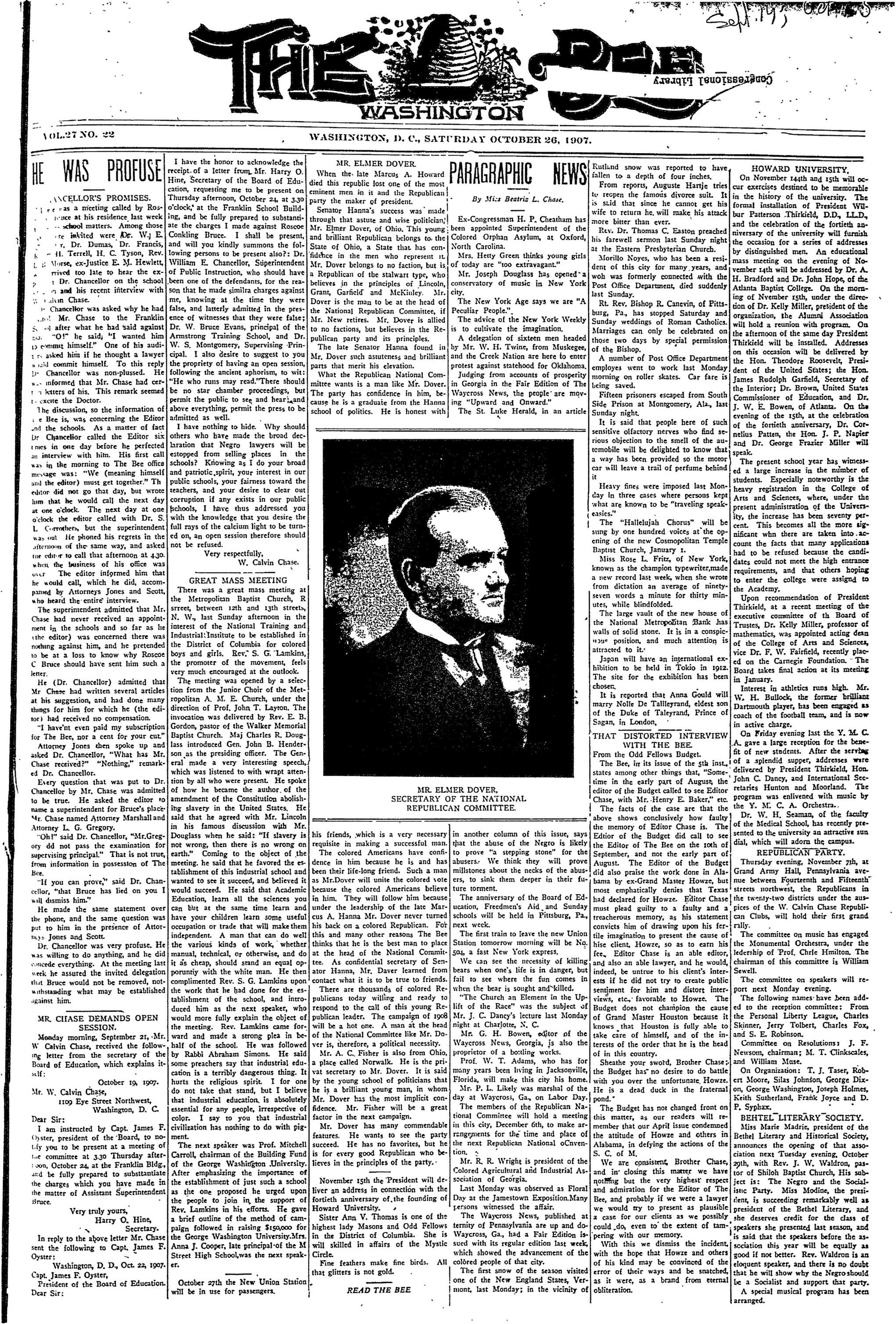
[Image of a man in a suit with a tie].
M.
MR. ELMER DOVER
SECRETARY OF THE NATIONAL
REPUBLICAN COMMITTEE.
his friends, which is a very necessary requisite in making a successful man. The colored Americans have confidence in him because he is and has been their life-long friend. Such a man as Mr.Dover will unite the colored vote because the colored Americans believe in him. They will follow him because under the leadership of the late Marcus A. Hanna Mr. Dover never turned his back on a colored Republican. For this and many other reasons The Bee thinks that he is the best man to place at the head of the National Committee. As confidential secretary of Senator Hanna, Mr. Daver learned from contact what it is to be true to friends. There are thousands of colored Republicans today willing and ready to respond to the call of this young Republican leader. The campaign of 1908 will be a hot one. A man at the head of the National Committee like Mr. Dover is, therefore, a political necessity.
Mr. A. C. Fisher is also from Ohio, a place called Norwalk. He is the private secretary to Mr. Dover. It is said by the young school of politicians that he is a brilliant young man, in whom Mr. Dover has the most implicit confidence. Mr. Fisher will be a great factor in the next campaign.
Mr. Dover has many commendable features. He wants to see the party succeed. He has no favorites, but he is for every good Republican who believes in the principles of the party.
November 15th the President will deliver an address in connection with the fortieth anniversary of the founding of Howard University.
Sister Ann V. Thomas is one of the highest lady Masons and Odd Fellows in the District of Columbia. She is will skilled in affairs of the Mystic Circle.
Fine feathers make fine birds. All that glitters is not gold.
READ THE BEE
PARAGRAPHIC NEWS
PARAGRAPHIC NEWS
By Miss Beatriz L. Chase.
Ex-Congressman H. P. Cheatham has been appointed Superintendent of the Colored Orphan Asylum, at Oxford, North Carolina.
Mrs. Hetty Green thinks young girls of today are "too extravagant."
Mr. Joseph Douglass has opened a conservatory of music in New York city.
The New York Age says we are "A Peculiar People."
The advice of the New York Weekly is to cultivate the imagination.
A delegation of sixteen men headed by Mr. W. H. Twine, from Muskegee, and the Creek Nation are here to enter protest against statehood for Oklahoma.
Judging from accounts of prosperity in Georgia in the Fair Edition of The Waycross News, the people are moving "Upward and Onward."
The St. Luke Herald, in an article
THE NEW YORK TIMES
in another column of this issue, says that the abuse of the Negro is likely to prove "a stepping stone" for the abusers. We think they will prove millstones about the necks of the abusers, to sink them deeper in their future torment.
The anniversary of the Board of Education, Freedmen's Aid and Sunday schools will be held in Pittsburg, Pa., next week.
The first train to leave the new Union Station tomorrow morning will be No. 504, a fast New York express.
We can see the necessity of killing bears when one's life is in danger, but fail to see where the fun comes in when the bear is sought and killed.
"The Church an Element in the Uplift of the Race" was the subject of Mr. J. C. Dancy's lecture last Monday night at Charlotte, N. C.
Mr. G. H. Bowen, editor of the Waycross News, Georgia, is also the proprietor of a bottling works.
Prof. W. T. Adams, who has for many years been living in Jacksonville, Florida, will make this city his home. Mr. P. L. Likely was marshal of the
Mr. P. L. Likely was marshal of the day at Waycross, Ga, on Labor Day.
The members of the Republican National Committee will hold a meeting in this city, December 6th, to make arrangements for the time and place of the next Republican National oCnvention.
Mr. R, R. Wright is president of the Colored Agricultural and Industrial Association of Georgia.
Last Monday was observed as Floral Day at the Jamestown Exposition.Many persons witnessed the affair.
The Waycross News, published at ternity of Pennsylvania are up and do Waycross, Ga., had a Fair Edition issued with its regular edition last week, which showed the advancement of the coloured people of that city.
The first snow of the season visited one of the New England States, Vermont, last Monday; in the vicinity of
Rutland snow was reported to have fallen to a depth of four inches. From reports, Auguste Hartje tries to reopen the famous divorce suit. It is said that since he cannot get his wife to return he, will make his attack more bitter than ever. Rev. Dr. Thomas C. Easton preached his farewell sermon last Sunday night at the Eastern Presbyterian Church. Morillo Noyes, who has been a resident of this city for many years, and woh was formerly connected with the Post Office Department, died suddenly last Sunday. Rt. Rev. Bishop R. Canevin, of Pittsburgh, Pa., has stopped Saturday and Sunday weddings of Roman Catholics. Marriages can only be celebrated on those two days by special permission of the Bishop. A number of Post Office Department employees went to work last Monday morning on roller skates. Car fare is being saved. Fifteen prisoners escaped from South Side Prison at Montgomery, Ala., last Sunday night.
It is said that people here of such sensitive olfactory nerves who find serious objection to the smell of the automobile will be delighted to know that a way has been provided so the motor car will leave a trail of perfume behind it.
Heavy fines were imposed last Monday in three cases where persons kept what are known to be "traveling speak-easies."
The "Hallelujah Chorus" will be sung by one hundred voices at the opening of the new Cosmopolitan Temple Baptist Church, January 1.
Miss Rose L. Fritz, of New York, known as the champion typewriter, made a new record last week, when she wrote from dictation an average of ninety-seven words a minute for thirty minutes, while blindfolded.
The large vault of the new house of the National Metropolitan Bank has walls of solid stone. It is in a conspicuous position, and much attention is attracted to it.
Japan will have an international exhibition to be held in Tokio in 1912. The site for the exhibition has been chosen. It is reported that Anna Gould will marry Nolle De Tallleyrand, eldest son of the Duke of Talleyrand, Prince of Sagan, in London.
THAT DISTORTED INTERVIEW WITH THE BEE
From the Odd Fellows Budget
The Bee, in its issue of the 5th inst., states among other things that, "Some-time in the early part of August, the editor of the Budget called to see Editor Chase, with Mr. Henry E. Baker," etc. The facts of the case are that the above shows conclusively how faulty the memory of Editor Chase is. The Editor of the Budget did call to see the Editor of The Bee on the 10th of September, and not the early part of August. The Editor of the Budget did also praise the work done in Alabama by ex-Grand Master Howze, but most emphatically denies that Texas had declared for Howze. Editor Chase must plead guilty to a faulty and a treacherous memory, as his statement convicts him of drawing upon his fertile imagination to present the cause of hise client, Howze, so as to earn his fee. Editor Chase is an able editor, and also an able lawyer, and he would, indeed, be untrite to his client's interests if he did not try to create public sentiment for him and distort interviews, etc., favorable to Howze. The Budget does not champion the cause of Grand Master Houston because it knows that Houston is fully able to take care of himself, and of the interests of the order that he is the head of in this country.
Sheathe your sword, Brother Chase; the Budget has' no desire to do battle with you over the unfortunate Howze. He is a dead duck in the fraternal pond."
The Budget has not changed front on this matter, as our readers will remember that our April issue condemned the attitude of Howze and others in Alabama, in defying the actions of the S. C. of M.
We are consistent, Brother Chase, and in closing this matter we have nothing but the very highest respect and admiration for the Editor of The Bee, and probably if we were a lawyer we would try to present as plausible a case for our clients as we possibly could do, even to the extent of tampering with our memory.
With this we dismiss the incident, with the hope that Howze and others of his kind may be convinced of the error of their ways and be snatched, as it were, as a brand from eternal obliteration.
HOWARD UNIVERSITY.
On November 14th and 15th will occur exercises destined to be memorable in the history of the university. The formal installation of President Wilbur Patterson Thirkield, D.D., LLD, and the celebration of the fortieth anniversary of the university will furnish the occasion for a series of addresses by distinguished men. An educational mass meeting on the evening of November 14th will be addressed by Dr. A. H. Bradford and Dr. John Hope, of the Atlanta Baptist College. On the morning of November 15th, under the direction of Dr. Kelly Miller, president of the organization, the Alumni Association will hold a reunion with program. On the afternoon of the same day President Thirkield will be installed. Addresses on this occasion will be delivered by the Hon. Theodore Roosevelt, President of the United States; the Hon. James Rudolph Garfield, Secretary of the Interior; Dr. Brown, United States Commissioner of Education, and Dr. J. W. E. Bowen, of Atlanta. On the evening of the 15th, at the celebration of the fortieth anniversary, Dr. Cornelius Patten, the Hon. J. P. Napier and Dr. George Frazier Miller will speak.
The present school year has witnessed a large increase in the number of students. Especially noteworthy is the heavy registration in the College of Arts and Sciences, where, under the present administration of the University, the increase has been seventy percent. This becomes all the more significant when there are taken into account the facts that many applications had to be refused because the candidates could not meet the high entrance requirements, and that others hoping to enter the college were assigned to the Academy.
Upon recommendation of President Thirkield, at a recent meeting of the executive committee of th Board of Trustes, Dr. Kelly Miller, professor of mathematics, was appointed acting dean of the College of Arts and Sciences, vice Dr. F. W. Fairfield, recently placed on the Carnegie Foundation. The Board takes final action at its meeting in January.
Interest in athletics runs high. Mr. W. H. Bullock, the former brilliant Dartmouth player, has been engaged as coach of the football team, and is now in active charge.
On Friday evening last the Y. M. C. A. gave a large reception for the benefit of new students. After the serving of a splendid supper, addresses were delivered by President Thirkield, Hon. John C. Dancy, and International Secretaries Hunton and Moorland. The program was enlivened with music by the Y. M. C. A. Orchestra.
Dr. W. H. Seaman, of the faculty of the Medical School, has recently presented to the university an attractive sun dial, which will adorn the campus.
REPUBLICAN PARTY.
Thursday evening, November 7th, at Grand Army Hall, Pennsylvania avenue between Fourteenth and Fifteenth streets northwest, the Republicans in the twenty-two districts under the auspices of the W. Calvin Chase Republican Clubs, will hold their first grand rally.
The committee on music has engaged the Monumental Orchestra, under the ledership of Prof. Chrle Hmilton. The chairman of this committee is William Sewell. The committee on speakers will report next Monday evening. The following names have been added to the reception committee: From the Personal Liberty League, Charles Skinner, Jerry Tolbert, Charles Fox, and S. E. Robinson. Committee on Resolutions; J. F. Newsom, chairman; M. T. Clinkscales, and William Muse. On Organization: T. J. Taser, Robert Moore, Silas Johnson, George Dixon, George Washington, Joseph Holmes, Keith Sutherland, Frank Joyce and D. P. Syphax.
BEHTEL LITERARY SOCIETY. Miss Marie Madrie, president of the Bethel Literary and Historical Society, announces the opening of that association next Tuesday evening, October 29th, with Rev. J. W. Waldron, pastor of Shiloh Baptist Church, His subject is: The Negro and the Socialistic Party. Miss Modine, the president, is succeeding remarkably well as president of the Bethel Literary, and she deserves credit for the class of speakers she presented last season, and is said that the speakers before the association this year will be equally as good if not better. Rev. Waldron is an eloquent speaker, and there is no doubt that he will show why the Negro should be a Socialist and support that party. A special musical program has been arranged.
. = =
= ._4 - aN eh 2 = 2,
yo ee Seed wt = one Zz . =a
. Gea SS ee
ev “sz I -
+ |e F
ris. < | top .
: ~
Ss .—-—— — 3 —
De os a 3
(2G eS peeere ey
=. * '
=z £ Ses a az ‘ et
= eee er
ee i Pe
2 —— z i ie a2 ee eee
5 . >
ie :
sso $ ci—2 SLi
aie ee ee
7 : rs
= i . 7
es " dbete Bee 2: SB i
et Be Fe — eae
(Fs 785 2 2 oe fe 8 8
ee “
q eB ab s 5 os j*# . 2 tee
His ie eae Sew Eee = a ee
—— [ee Soe PH a aS
t —
52 . : eieete, S3tte
(Geese seg ===
{rs A - G-- |
ye a‘ —_|——
| | ge] { 2 ay ~
Se E a7 ps Pa —t iH
2 H-— 1 et : Hy
. vr vr es vr vr
A t te -s-9. : 7 fame ces
co he $$ -§-$-8 era ei ef ms ——}—
é s elas —seee2— a
ener
1 Zl i242 a
ro = ed | 2 ee a
=
= v 3 r v
—_ a
f 115 Zz oe —~9" + a8.
LY + Pa >I ote i pr Snecceee tl {5a
A tebe 9-7 Pore PS ha beet —— Pel — eet re 3-3.
tes me en re caliaial cee 9,
a ———— ar
V3 — eh te | talalese 2 ce :
Pe ee —— a2
= ao! = ro
‘(Matien Cac Mark
‘ a 5 ‘ : .
a Seas Nose oc Biel ats connie soe, Se wares Sewwrais * 8. a os OS. & .
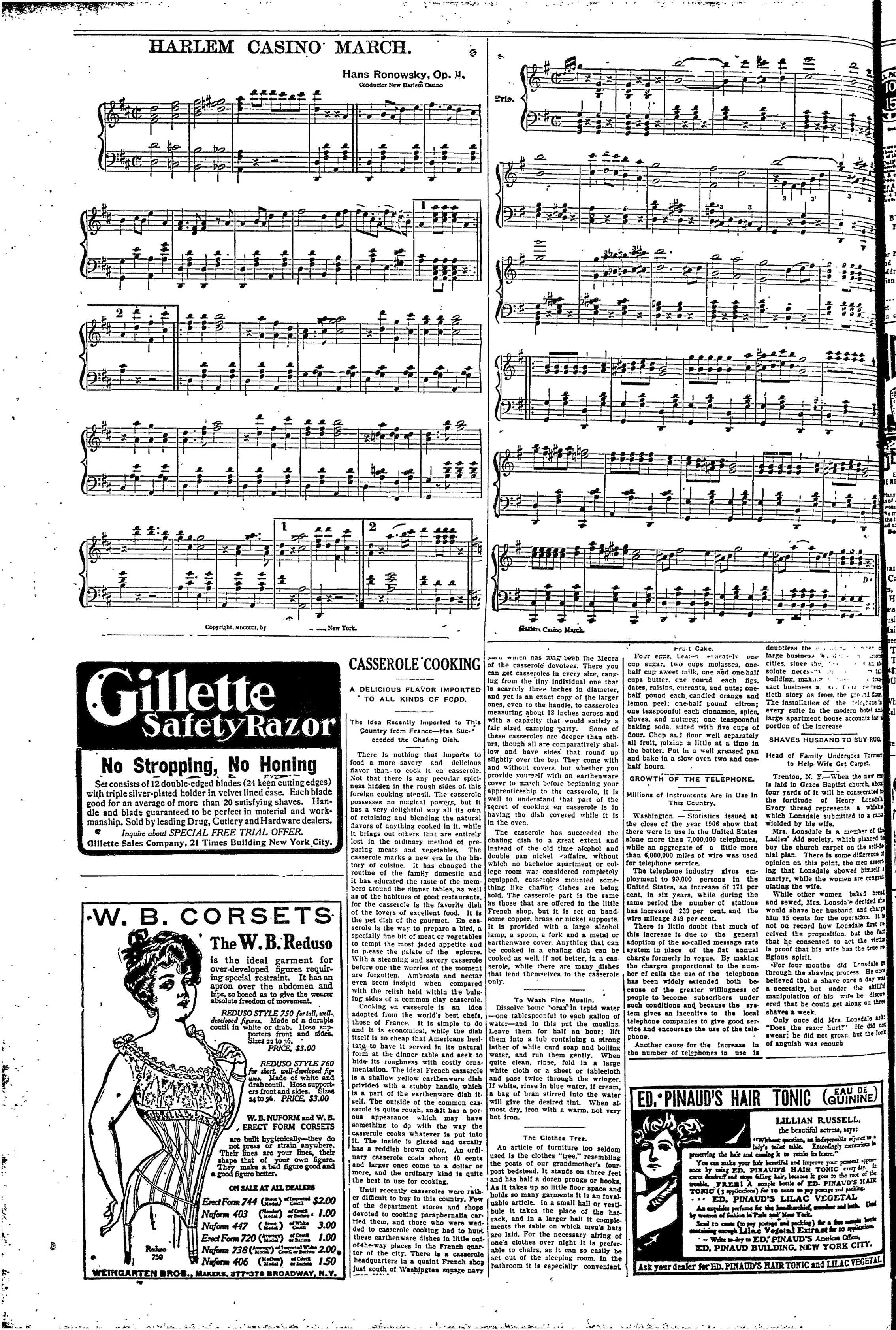
: HARLEM CASINO’ MARCH. ~ 2
. + : : Hans Ronowsky, Op. i.
Conductor New Harleti Casino
fftteee f£
| Ga ee
% ve vt wr
si 7 aS ,_|leee
0-9 TF eo oP at PER 1% z
pa a a pe Ee =
Vedic qaslee..
(3 eee == =
r e : te!
id ees eae f= te
eS a
Ph ig ——6-|_ 06 0 |_~09-— 6
«(Bee eee =
A 7 ig: i < ‘2 22 4
ry 8 ee oe ee
(6 - SS a ren Cr cme
zs ee || $89
= 6; — 9——8-| —
= == — toot SS
; 1
=e ae ee ed
+ + 6 s- £
¢_ledagh Ihe ieee
~ J —»—e?——__—_—- -|—p—__$— 5 —UL,-
a ee el
, Copyright, upcecct, by 7 = —+ New York, 7 ©
CASSEROLE COOKING
No Stropping, No Honing
s —_ _ = ree
Set consists of 12 double-edged blades (24 keen cutting edges)
with triple silver-plated holder in velvet lined case. Each blade
good for an average of more than 20 satisfying shaves. Han-
dle and blade guaranteed to be perfect in material and work-
manship. Sold by leading Drug, Cutlery and Hardware dealers.
e Inquire about SPECIAL FREE TRIAL OFFER.
Gillette Sales Company, 21 Times Building New York City.
A DELICIOUS FLAVOR IMPORTED
“TO ALL KINDS OF FOOD.
The Idea Recently imported to This
Country from France—Has Suc-*
ceeded the Chafing Dish.
There is nothing that imparts to
food a more savory and delicious
flavor than. to cook It en casserole.
Not that there is any pecuiar spici-
ness hidden in the rough sides of. this
foreign cooking utensil. The casserole
possesses no magical powers, but it
has a very delightful way all its own
of retaining and blending the natural
favors of anything cooked In it, while
it brings out others that are entirely
lost in the oidinary method of pre-
paring meats and vegetables, The
casserole marks a new era in the his-
tory of culsine. It has changed the
routine of the famHy domestic and
it has educated the taste of the mem-
bers around the dinner tables, as well
as of the habitues of good restaurants,
for the casserole {s the favorite dish
of the lovers of excellent food. It is
the pet cish of the gourmet. En cas-
serole is the way to prepare a bird, a
specially fine bit of meat or vegetables
to tempt the most jaded appetite and
to p.ease the palate of the epfcure.
With a steaming and savory casserole
before one the worrles of the moment
are forgotten. Ambrosia and nectar
even seem insipid when compared
with the relish held within the bulg-
ing sides of a common clay casserole.
Coohing en casserole is an {dea
adopted from the world's best chefs,
those of France. It Is simple to do
and It is economical, while the dish
itself Is so cheap that Americans hes!-
tate. to have it served in its natural
form at the dinner table and seek to
hide its roughness with costly orna.
mentation, The Ideal French casserole
is a shallow yellow earthenware dish
privided with a stubby handle, which
is a part of the earthenware dish it-
‘Self. The outside of the common cas-
serole is quite rough, an@Jt has a por-
ous appearance which may have
‘something to do with the way the
[casserole cooks whatever is put into
it, The inside is glazed and usually
has a reddish brown color. An ordl.
Mary casserole costs about 40 cents
and larger ones come to a dollar or
ore, and the ordinary kind is quite
jthe best to use for cooking. .
Until recently casseroles were rath.
er difficult to buy in this country. Few
of the department stores and shops
devoted to cooking paraphernalia car
ried them, and those who were wed
ded to casserole cooking had to hum
these earthenware dishes In little out
of-the-way places In the French quar
ter of the city. There is a casserole
headquarters in a quaint French sho;
just south of Wasbingtea square nav;
W. B. CORSETS
ney (Fe * .
ait, The W.B.Reduso
\ le f is the ideal garment for
si Ya Ké = ig over-developed figures requir-
Res “> Ga ingspecial restraint. It hasan
v4 3 we apron over the abdomen and
eh, hips, so boned as to give the wearer
’ x -Z absolute freedom of movement. .
3 REDUSO STYLE 750 for tall, well
. deedoped figures, Made of a durable
Mi. oo! in ‘white or drab. Hose sup- |
AZ RS Rosters front and sides,
rp 22 to 36,
cide PS PRICE, $3.00
Yrs. SP) nepuso sre 760
YE OS wal for short, twell-deoeloped fige
Sige, SESCONAS ons, Made of white and
S° PY, ¥;, , cy RY erabcoutil. Hose support.
foo Bisdet: YANN ‘ ers frontand sides. Sizes
ESTRS TEM ESD i 24036, PRICE, $3.00
SERIE: Ly W.B. NUFORM and W.B.
\\ Nj ay ERECT FORM CORSETS
’ Ni WY azo built bygienically—they do
)> N i] Rot or strain Tanywhere.
INN BEER cee
4 yf pe
i ee
Cy i HH Oft SALE AT ALL DEALERS
od A a Erect Form 744 (Si) “tz™ $2.00
AH} \ Ni Noform 403 CScis) Sc. 1.00
ey ii HH Nuforn 447 (Sua) a" 3.00
\j A ll Erect Form 720 ('xa5') SSc8, 1.00
Redwo "14 Neform 738 (SES) Uxiatae 2.00,
. ) 7 WB Neferm 406 CHET) SS 1.50
WEINGARTEN BROS., Maxrns. 377-379 BROADWAY, N.Y.
omu winch nas wie been me Mecca
of the casserole devotees. There you
can get casseroles In every size, rang-
ing from the tiny Individual one that
1s scarcely three inches in diameter,
and yet 1s an exact copy of the larger
ones, even to the handle, to casseroles
measuring about 18 Inches across and
with a capacity that would satisfy a
fair slzed camping party. Some of
these casseroles are deeper than oth-
‘ers, though all are comparatively shal-
low and have sidés' that round up
slightly over the tup. They come with
and without covers. but whether you
provide yourself with an earthenware
cover to march before beginning your
apprenticeship to the casserole, it {s
well to understand that part of the
secret of cooking en casserole is in
having the dish covered while it is
In the oven,
The casserole has succeeded the
chafing dish to a great extent and
instead of the old time alcoho! and
double pan nickel /affairs, without
which no bachelor apartment or col-
lege room was considered completely
equipped, cassrigles mounted some-
thing like chafing dishes are being
sold. The casserole part is the same
‘as those that are offered in the little
French shop, but it is set on hand-
some copper, brass or nickel supports.
It ts provided with a large alcchol
lamp, a spoon. a fork and a metal or
earthenware cover. Anything that can
be cooked In a chafing dish can be
cooked as well. /f not better, in a cas-
serole, while there are many dishes
that lend themeelves to the caéserole
only. o
To Wash Fine Muslin.
Dissolve kome Sorax"In tepid water
—one tablespoonful to each gallon of
watcr—and in this put the muslins.
Leave them for half an hour; Ift
them into a tub containing a strong
lather of white curd soap and boiling
water, and rub them gently. When
quite clean, rinse, fold in a large
white cloth or a sheet or tablecloth
and pass twice through the wringer.
If white, rinse in blue water, if cream,
8 bag of bran stirred Into the water
will give the desired tint, When al.
most dry, {ron with a warm, not very
hot fron.
‘The Clothes Tree.
An article of furniture too seldom
used fs the clothes “tree,” resembling
the posts of our graddmother’s four-
post bedstead. It stands on three feet
and has half a dozen prongs or hooks,
As It takes up so little floor space and
holds so many garments It is an fnyal-
uable article. In a small hall or yeati-
bule it takes the place of the hat-
rack, and in a larger hall it comple
ments the table on which men’s hats
are laid, For the necessary airing of
‘one’s clothes over night It {s prefer.
able to chairs, as it can so easily be
set out of the sleeping room. In the
bathroom it is especially convenient,
° 3 EAU DE
ED.PINAUD'S HAIR TONIC (auinine)
(ede \ LILLIAN RUSSELL,
ia the beautiful actress, sys?
tz on MM ‘Whose qocsion, ta indxpensile afjnct # *
9 fady’s toilet table,” Baceedingly menace
preserving the hair and coming ke te retain ics loser.”
‘You czm make your hae berstifal and improve your penocal PST
ance by using ED, PINAUD’S HAIR TONIC era oY. i
NOM cores dendradf and scope Gilling hair, becasee tk goes to the rot of the
es trestle, FREB! A mmple boule of ED. PINAUD'S HAR
j TONIC (5 eppGcationn) far 10 cents be pry postage tod pscking-
G -** ED, PINAUD'S LILAC VEGETAL cai
Aa eoquicles perfeme fot the handkerchief, stemioet
bby wennen of fanice le Pacis sa’ Dow York. wal
Sood ead fer 9 tee seat
4 emnsaing a Neier Bat rei ote 10 sppacion>
a + a Welee to-dey to ED! PINAUD'S American O6e%)
* ED. PINAUD BUILDING, NEW YORK CITY.
Ask your dealer fer ED. PINAUD'S HAIR TONIC and LILAC VEGETAL
= Prat Cake.
Four eggs. Leaien erarately one
cup sugar, two cups molasses, one.
half cup sweet milk, one and one-half
cups butter. cne pound each figs.
Gates, raisins, currants, and nuts; one
half pouad each. candied orange and
lemon peel; one-half pound citron;
one teaspoonful each cinnamon, spice,
cloves, and nutmeg; one teaspoonful
baking soda. sifted with five cups of
flour. Chop aud fiour well separately
all fruit, mixing a little at a time in
the batter. Put in a well greased pan
and bake in a slow oven two and one-
half hours, .
GROWTH OF THE TELEPHONE,
Millions of Instrusrents Are in Use In
This Ccuntry,
Washington. — Statistics issued at
the close of the year 1906 show that
there were In use in the United States
alone more than 7,000,000 telephones,
while an aggregate of a little more
than 6,000,000 miles of wire was used
for telephone service.
‘The telephone industry gives em-
ployment to 92,000 persons In the
United States, aa Increasa of 171 per
cent, in siz years, while during the
same period the number of stations
haz Increased 239 per cent. and the
wire mileage 349 per cent.
There fs Mttle doubt that much of
this Increase 1s due to the general
adoption of the socalled message rate
system {n place of the flat annual
charge formerly In vogue. By making
the charges proportional to the num-
ber of calls the use of the telephone
hes been widely extended both be
cause of the greater willingness of
people to become subscribers under
such conditions and because the sys
tem gives an Incentive to the local
telephone companies to give good ser-
vice and encourage the use of the tele
phone. :
Another cause for the Increase fn
the number of telephones In use is
doubtless the vic ann. 1 1 ter
large business “hei - 1 at
citles, since ihe, * +> + Fara
solute neces-"\ + =o
building, maka.r | co. s tr
Bact business a. 41. fia 2? tues!
Heth story as from, the gro.7d fo,
‘The instaliation of the tr'e,hoze ly
every sulte in the modern hotel ax
large apartment house accounts for
Portion of the fncrease
SHAVES HUSBAND TO BUY RUG
Head of Family Undergoes Tormet
to Help. Wife Get Carpet
Trenton, N. ¥.—When the nev ry)
1s laid {0 Grace Baptist church, abo)
four yards of It will be consecrated
the fortitude of Henry Lored.'s]
Every thread represents 8 waste
which Lonsdale submitted to a raz
wielded by his wife. :
Mrs. Lonsdale Is a member of tts
Ladies’ Aid society, which plaszed
buy the church carpet on the seifde
nial plan. There fs some diZerence d
opinion on this point, the mez sssert
Ing that Lonsdale showed bimself !
martyr, while the women are const!
vlating the wife,
While other women bakei breil
and sewed, Mrs. Lonsda’e decided
would shave her husband, and chart
him 15 cents for the operation It
net on record how Loosdale int”
celved the proposition. but the {1%
that be consented to act the rietis
is proof that his wife has the truem
Ngious spirit.
‘For four months did Lrusdale f
through the shaving process He oct
believed that a shave onre & day ™H
a necessity, but under the sult
manipulation of his wife be disco
ered that be gould get aiong oa thr
shaves a week. ,
Only once did Mrs. Lonsdale ss
“Does the razor hurt?” He did 2
swear? he did not groan, but the Io
of angulsh was enough
more McCall Patterns sold in the United
state of any other make of this. This is one
of their city, coronary and alimony.
Calls Magazine (The Queen of Fashion) has
been in any other Ladies' Magazine. One
entrance is numbered costs $8 per unit. Latest
and cheap. Every month gets a McCall Pro-
gram. See below.
Agents Wanted. Hardcover premium or
soft cover. In Pattern Catalogue [of two do
Fashion Catalogue (showing and promising
from. Address THE McCALL CO. New York.
THE BEE AND McCALL'S GREAT
FASHION MAGAZINE
for one year for $2.00.
COUPOUS.
For Bee—
and enclosed two dollars. Send to
address below The Bee and McCall's
Magazine for one year.
BUY THE NEW HOME SEWING MACHINE
Before You Purchase Any Other Write
NEW HOME SEWING MACHINE COMPANY
ORANGE, MAES.
Every Sewing Machines are made to sell veget-
dative yarn but the "New Home" is made
wear. Our guarantee never runs out.
We make Sewing Machines to suit all conditions
to trade. The "New Home" stands at the
end of all High-grade family sewing machines
built by authorised dealers only.
FOR SALE BY
FLNERAL DIRECTOR
RING, LIVERY AND SALE STABLE. Carriages hired for funerals, pars, balls, receptions, etc. Horses and carriages cept in first style. Satisfaction guaranteed business at 1132 Third street, N. W Main Office Branch at 222 Street, Alexandria, Va. Telephone for Office, Mair. 1727 Telephone Call for Stable, Main 482-5
FREEMAN'S ALLEY.
Where I can accommodate 50 her-
tall and inspect our new and modern
1132 Third street, N. W.
I. H. DABNEY, P.
caskets and investicate our meth-
NEW YORK
CLIPPER
IS THE GREATEST
THEATRICAL SHOW PAPER
IN THE WORLD
4,00 Per Year. Single Copy 10 Cts.
ASSURE WEEKLY
SAMPLE COPY FREE
FRANK QUEEN PUB CO.
PUBLISHING
Mme. Davis,
AIRVOYANT
AND
CARD READER.
TELLS ABOUT BUSINESS.
Removes Spells and Evil Influences.
Reunites the Separated, and
Gives Luck to All.
24th St. N.W., Washington, D. C.
N. B—No letters answered unless
accompanied by stamp.
N. B—Mention The Bee.
Large, comfortable furnished booms
for either ladies or gentlemen, 1207 K.
treet northeast.
Furnished rooms for rent at 111736
5th street, N. W.
Front Parlor suitable for a doctor
and a back bedroom, 1410 First street,
N. W.
OF OLD PRESERVES
OF OLD PRESERVES
DANITY DESSERTS MADE FROM LAST YEAR'S LEFT OVERS.
Numberless Dainties In Which They Can Be Utilized to Excellent Advantage—How Some of
With the shelves well filled with this season's jams, jellies and preserves, what to do with left over condiments from last year is a problem that confronts the housewife. They are far too good to give away, for they represent much time and considerable expense. There are numberless dainties that can be made, utilizing these jams and jellies of last year's make, and here are a few that should appeal to one and all. One of the simplest ways of using up jams is to make a pie crust and line a dozen individual cake tins with the pastry, put in the oven and cook to a golden brown. When this crust is cold fill the individuals with jam, and add to each a heaping tablepoonful of whipped cream or make a meringue and set in the oven to brown. This is a very popular French dessert, and to the person who loves pastry it is a great relief from the regulation pie.
Another simple and pretty dessert is made by putting a layer of jelly or jam in the bottom of a glass dish, over this pour a little boiled taplaoca pudding, then another layer of the jelly. Served from a glass dish this is a very attractive dessert.
French Pancakes—A dessert much liked, particularly by the male element. To make these take one plint of milk, two eggs, one tablespoon of sugar, one cup of flour, one tablespoonful of baking powder, one cup of cream, pinch of salt. Sift the flour, powder and salt together, add to it the eggs beaten with the sugar and diluted with the milk and cream, mix into thin batter. Pour about a half a cup of the batter on a large frying pan, put on hot fire and when well done spread with any kind of preserves, roll up, sift over them plenty of sugar and glaze with a red-hot poker.
Blackberry Jam Cake—One cup of dark brown sugar, one-half cup butter, three eggs, three tablespoons sour milk, one teaspoon of soda, one cup of jam, two cups of flour, two teaspoons of cinnamon, one-half grated nutmeg. Bake in two jelly pans and put together with white icing.
Fruit Charlotte—Line the bottom of a tin mold with white paper and the sides with split lady fingers or pieces of sponge cake. Next soak one ounce of gelatine in a half pint of cold water. When soft place on the fire until dissolved. Press one quart of any canned fruit through a sieve and add one cup of powdered sugar. When the gelatine is cold mix with the fruit and sugar, add one pint of whipped cream sweetened to taste, pour into the lined mold and place on the ice. This should be eaten very cold.
Fruit Pudding—One pint of flour, one teaspoonful of salt, one large spoonful sugar, two teaspoonfuls baking powder, one tablespoon butter, milk or water to moisten. Work this as little as possible and make into a soft biscuit dough. Divide into five parts, pat flat, lay two tablespoonfuls of any tart jelly or preserves on each and roll. Place in a pan and pour over them the following sauce: One tablespoon of butter, one cup of sugar, cream together; then add a pint of boiling water, stir and pour over the rolls; bake until done. This is really a delicous dessert.
Jam Pudding—To make this pudding take three eggs, one cup of sugar and one cup of any jam, preferably rather tart, half a cup of butter, a teaspoonful of soda dissolved in hot water, and half a cup of sour milk. Mix with enough slifted flour to make a batter not quite as stiff as for cake. This should be baked in shallow tins and served very hot with the following sauce: Two-thirds of a cup of sugar, butter the size of a large walnut, two tablespoonfuls of hot water and one egg. Cream all of this together and set over a pan of hot water and cook a few minutes until it is the consistency of thick cream.
Poached Eggs on Spinach.
Thoroughly wash some spinach in plenty of cold water. Lift out of water and put into pot with only the water that adheres from washing, and boil till tender, usually ten to fifteen minutes. When tender, strain and mince on a board very finely, adding pepper, salt, sprinkle of flour and one teaspoonful of brown sugar. Heat a frying pan, put in about one ounce of butter, and when hot add the spinach. Stir and thoroughly heat through. Serve in hot dish with poached eggs on top.
New Wall Paners
Striking colors do not seem to be favorite in the new, wall papers shown. The soft pastel shades predominate and it is notable that very little gold decoration is used.
There is an imitation of hand-tooled leather which is very good to look at, extremely modish for certain rooms, and costs ever so much less than the real leather. Japanese grasscloth, imitation burlap and the real burlap are also an excellent choice for rooms not to be furnished in light delicate furniture.
To Serve Unexpected Guest.
If you have a small allowance of meat or vegetables cut them up, put in cream gravy, and serve on toast. In this way the dish goes much farther and is better liked — Inez Griswold.
HUES IN HEADGEAR.
Combinations That Look Pretty in Fall and Winter Hats.
Violet is often combined with white, with gray and with certain blues. One model in white felt had its wide drooping brim bound in violet velvet of a lovely soft shade and was trimmed in three huge knots or choux of velvet in three shades of violet.
Such big velvet choux in contrasting colors or several shades of one color are a trimming much favored for wide brimmed hats of moderately high crown and otherwise without trimming. Well developed, the idea is very effective and the Parisian milliners attain striking and beautiful color schemes in this way.
Great velvet pansies, morning glories, etc., are used as flowers, as they have been upon the summer hats, and one finds the summer fad for dead white flowers and foliage inclosed in velvet flowers whose blossoms and foliage are white. Big roses are still in demand, but feathers of all imaginable—and unimaginable—kinds, wide, soft ribbons of faille, satin, etc., will probably be more generally used than flowers.
Wings come under the comprehensive head of feathers and are shown in forms and colorings even handsomer than those of the spring.
Household Helps.
Egg spoons that are stained should be rubbed with damp salt before polishing.
If a bedstead creaks at each movement of the sleeper, remove the slats and wrap the ends of each in old newspapers.
Have a small horseshoe magnet fastened to the end of a tape of ribbon of sufficient length so that it can be dropped to the floor to pick up scissors and needles.
Turn your coffee mill down very tightly, fill the hopper with granulated sugar, grind it through once or twice, or even three times, and you have an excellent powdered sugar.
To clean a carpet without taking up take a cup half full of cornmeal mixed with salt and sweep well. When spots are left take oxgall or ammonia. Both are very good things to make the carpet as bright as a new one.
Iron rust on stoves which have not been in use this summer can easily be removed by going over the parts with coarse sandpaper, afterward covering the places with hot tallow or any warm grease. The next day wash with hot soapsuds in which there is a liberal supply of kerosene. Fenders, grates and stoves can be cleaned in this manner.
Variety Cake.
Half a cup of butter, one and one-half cups of sugar, five eggs, half a cup of milk, two cups of flour, one teaspoonful of baking powder, half a teaspoonful of cinnamon, quarter of a teaspoonful of nutmeg, half a cup of chopped raisins, boiled icing. Cream the butter and sugar, put in the yolks of the eggs and beat well; beat in one cup of flour and the baking powder, sifted in it. Reserve two whites of the eggs for the boiled icing; whip the other three well and fold in the butter last. Divide the cake into three parts, add the spices and raisins, well floured; bake one layer of this fruit part and two layers of the plain part. Put boiled icing on all the layers, and put together, with the fruit layer in the middle.—Mrs. C. Vinton Henry.
Quick and Easy Laundry Work.
You can do a morning's work in one hour and a half by following these directions:
Put 8 cents worth of borax, 5 cents worth of salts tartar, 5 cents worth of sowdered ammonia, and one package of potash into five quarts of boiling water. Turn one quart of water onto the potash first and let it stand until cool, then add the rest. Let the mixture stand 24 hours, and it is ready to use. This makes enough for 20 washes.
When ready to use, take one coffee cupful of the "Quick and Easy," shave half a cake of soap, and add them to your boilerful of clothes. Boll half an hour. A good rinsing in your bluing water is all that is necessary, unless some collar or wristband is very much soiled—Harper's Bazar.
Savory Orrelet.
Cut tender, corn from two or three small ears. Take the seeds from a green sweet pepper. Mince finely half a cup of boiled ham or the same of dried beef which previously has been fried to a crisp; add a pinch of mixed herbs; salt to taste, using not so much salt if ham or dried beef is used. Beat four eggs well and add a pint of sweet milk. Mix all together and fry in oil or butter or bake ten minutes in the oven. A tablespoon of cornstarch dissolved in milk gives body to it.
Needlework Note.
A clever woman has put her knowledge of basketry to good account in the fashioning of a whisk-broom holder. This consists of two disks of basket work similar to those used for the bottom of a fancy basket and caught together at the sides by large fluffy bows of three-inch satin ribbon, the color being a delicate pink in harmony with her room furnishings. A band of ribbons of narrow width, but matching in tone, is used to suspend the holder.
Tinware.
Paste a piece of stiff brown paper across the hole, by means of a cold water paste. Pour hot water into the pan and allow to stand awhile. No amount of scraping will remove it. The pan can be washed in hot or cold water.
FULL DRESS AND TUXEDO SUITS.
$1.00-For Hire-$1.00.
Julius Cohen,
1104 7th street, N. W.
ST. LUKE HALL.
HEADQUARTERS L O. of St. Luke. Richmond, Virginia.
1. 2. 3. 4. 5. 6. 7. 8. 9. 10. 11. 12. 13. 14. 15. 16. 17. 18. 19. 20. 21. 22. 23. 24. 25. 26. 27. 28. 29. 30. 31. 32. 33. 34. 35. 36. 37. 38. 39. 40. 41. 42. 43. 44. 45. 46. 47. 48. 49. 50. 51. 52. 53. 54. 55. 56. 57. 58. 59. 60. 61. 62. 63. 64. 65. 66. 67. 68. 69. 70. 71. 72. 73. 74. 75. 76. 77. 78. 79. 80. 81. 82. 83. 84. 85. 86. 87. 88. 89. 90. 91. 92. 93. 94. 95. 96. 97. 98. 99. 100.
Independent Order of St. Luke
Independent Order of St. Luke
Richmond, Va., is a growing Fraternal Society, with several Incorporated Departments, operating:
1 A Fraternal Society paying Sick Dues and an Endowment at death.
2 A Juvenile Department paying Sick Dues and an Endowment at death.
3 A Regalia Department
4 A Savings Bank.
5 A Large Department Store.
6 A Weekly Paper—The St. Lake Herald.
7 A Job Printing Office.
The St. Lukes are now operating in 15 states, and are rapidly spreading in every direction.
We want good, hustling Deputies. Good terms for the right persons. male or female. When you write close testimonial as to character and ability.
For further information, address
MAGGIE L. WALKER,
Grand Sec'y, I. O. St. Luke,
R. Luke Hall, Richmond, Va.
Tomato Pillau.
Alternate layers of boiled rice and raw tomatoes in the baking dish. Sprinkle over each layer of tomatoes a little minced green pepper and tender young onion; also some previously stewed veal, chicken, or ham. Salt to taste. When the dish is full place a layer of green corn from the cob, and a little rolled cracker to give firmness, with bits of butter on top. Add a cup of veal broth, which must penetrate all of it, and bake half or three-quarters of an hour, according to degree of heat in the oven.
A. Chocolate Affair.
Chocolate now is served at afternoon functions where tea once was considered the only proper beverage. At a charming afternoon affair given by a girl who had become tired of the beaten track of the usual "teas" the refreshments served were composed-almost entirely of the chocolate variety. There were cups of hot chocolate with whipped cream, thin bread and butter sandwiches, with olives for a relish; this of course was followed by a chocolate ice, fancy chocolate cakes and chocolate bonbons.
To Remove Medicine Stains
Stains made by medicine and liniment are often obstinate to remove in the hands of an amateur. Iodine marks may be removed by washing the spots with strong ammonia until it fades, after which wash with tepid water and strong soap. Ammonia is equally good for removing cod liver oil stains. Fuller's earth made into a paste and thickly applied to the spots will also remove them.
Fairy Pudding.
One pint boiling water, stir into this three tablespoons of corastarch, mixed smooth with a little cold water, the juice of a lemon, piece of butter the size of a walnut and one beaten egg. It will thicken up nicely in three or four minutes. Then turn into mold. To be eaten with sugar and cream or rich milk.
Mexican Alole
Two tablespoonfuls of blanched almonds, three tablespoonfuls of rice. Grind the almonds fine first, then the rice, then mix; add a cup of sweet milk and cook in a double boiler until the mixture thickens. Add salt or sugar to taste and serve.
Columbia Ice and Coal Co.
Columbia Ice and Coal Co.
FIFTH AND L STS., N. W., NEAR K ST. MARKET. WOOD AND COAL UNDER COVER. OUR COAL IS CLEAN, AND WE SELL CHEAP. REDUCTION ON COALFOR CHURCHES. FILE YOUR NAME AND ADDRESS, AND WE WILL DO THE REST. ORDERS PROMPTLY FILL-ED. LEAVE YOUR NA AND ADDRESS AND TELL US THE KIND OF COAL YOU WANT. COLUMBIA COAL AND ICE COMPANY.
W.SidneyPittman Architect
RENDERING IN PATENT DRAWINGS
MONOTONE, WATER COLOR DRAFTING,DETAILING,TRAC
AND PEN & INK BLUE PRINTING
STEEL CONSTRUCTION A SPECIALTY.
Phone: Main 6059-M. Office 494 Louisiana Ave., N.W.
The Stock-Holders of the Leland Giants Base-Ball Association, has concluded to dissolve that Association in order to give room for the former, with it's increased Capital for the purpose of buying a Permanent Home For The Leland Giants Base-Ball Club and Establishing For All The People, The Only First Class, Up-To-Date Amusement Park, With It's Theater (Light Opera), Figure Eight, Shoot The Chutes, Minature Ry, Electric Theater, Dance Pavillion, Roller Skating, Hurley Burley, Double Swing, Boating, Auto Riding, and all the latest fun making devices and laugh producing concessions. together with a First Class Summer Hotel, large enough to accommodate 1000 guests, at it's present location, 79th and Wentworth Ave., twenty (20) minutes ride on the Electric Cars to the Loop District in Chicago.
The Public is Base-Ball mad, and amusement Crazy. Stocks have doubled in value in a single season. Millions can be made by those Who Take Stock In This New Enterprise.
Are You In Favor Of The Race Owning And Operating This Immense and Well Paying Plant, Where More Than 1,000 Persons Will Be Employed, between May and October of each year, where you can come with fear and Enjoy The Life and Freedom of a Citizen unmolested or annoyed? The Answer can only be effectively given by subscribing for Stock in this Corporation. it has been made purposely low so that all Loyal Members of the Race can have a Share and Interest in this Twentieth Century Enterprise. Think of it, Shares Only Ten (10.00) Dollars Each. You Squander More than this amount Any Holiday around Amusement Parks and Public Places, where you are not wanted and never welcome. Come! buy and build one of your own by filling out the attached Coupon and mail with Ten Dollars to the Leland Giants Base-Ball and Amusement Association. Do it to-day so that we may commence to build.
Mr Beauregard F. Moseley; Treas:-
which I am sending as Part (or infu-
shares of the Capital Stock of the
Association.
I agree to pay $......
$.....has been
certificate.
as Part (or infull) as subscription fee for
capital Stock of the Leland Giants Base Ball and
to pay $.....per month until the
has been paid, at which time I am to re
Name _____
Address _____
City _____
State _____
which I am sending as Part (or infull) as subscription fee for
shares of the Capital Stock of the Leland Giants Base Ball and Amusement
Association.
I agree to pay $.....per month until the full amount
$.....has been paid, at which time I am to recieve my stock
certificate.
James F
James F. Oyster
The Leading Place in the City for BUTTER, CHEE SE AND EGGS. Oyster's Butter is the sweetest in the market. H purest and Eggs the freshest. Square Stands, Center Market, 5th and K street Riggs Market.
OFF ICE
Wholesale Dealer and Salesman, 900 and 902 Penns N. W.
A·HIGH·DEGR
Butter is the sweetest in the market. His brings the freshest. Lands, Center Market, 5th and K streets,
OFF ICE
aler and Salesman, 900 and 902 Pennsylv
N. W.
HIGH·DEGR
Oyster's Butter is the sweetest in the market. His Cheese is the purest and Eggs the freshest.
Square Stands, Center'Market, 5th and K streets, N. W., and Riggs Market.
OFF ICE
Wholesale Dealer and Salesman, 900 and 902 Pennsylvania Avenue, N. W.
OF SATISFACTION IS A RARE THING IN MOST $3.00 SHOES. SHOES AT THIS PRICE USUALLY LACK STYLE OR COMFORT OR BOTH. THE STYLE OF MORE EXPENSIVE SHOES AND GOOD SOLID VALUE ARE FOUND IN OUR
because of stowed on the ness in it an A Goodyear ral of the s
SIGNET SHOE because of the exceptional attent stowed on the making. The only ness in it anywhere is the price. A Goodyear-welted shoe, made oral of the season's handsomest
because of the exceptional attention bestowed on the making. The only cheapness in it anywhere is the price.
Looks first rate and wears that way every time. It's worth your while to come in and look the Signet over, even if you're not ready to buy. Always welcome.
Wm.Moreland, 491Penna Ave HOLTMAN'S OLD STAND. SIGN OF THE BIG BOOT
All payments on Stock Accounts must be made to the order of Beauregard F. Moseley, Treasurer, 6258 Halsted Street, Chicago, Illinois. All Stock Accounts prefer as employees and should inform the Treasurer with their final remittance of their intentions to apply for employment. For further information address Leland Giants Base-Ball and Amusement Assn 6258
THE BEE
1109 Eye St., N. W., Washington, D. C.
W. CALVIN CHASE, EDITOR.
Entered at the Post Office at Washington, D. C., as second-class mail matter.
ESTABLISHED 1886.
TERMS OF SUBSCRIPTION.
One copy per year in advance.....$2.00
Six months ..... 1.00
Three months ..... .50
Subscription monthly ..... .20
. NOT TRUE
To the Editor of The Bee:
My attention has been called to an editorial in your issue of October 19, in which you quote an editorial from The Patrician, and then attribute to me the last paragraph of that quotation, as follows:
"I imagine the character of the population of the District, and think what a change would mean. A word to the wise."
Those are the words of the Editor of The Patrician, and not my words. No such words nor any statement of a similar character is in, my letter to the Washington Herald, to which you refer. I enclose a copy of the Washington Herald containing the letter to which you refer. You will see that it does not contain any such words of any. similar statement.
As I know you would not do me an injustice I expect you to publish this letter on your editorial page, so that those who read the editorial may see the fact.
MR. MACFARLAND'S DENIAL
The Bee last week reproduced an excerpt from the Patrician (St. Patrick's Church), which made the distinguished Commissioner say what he never said or thought about saying. His communication to The Bee this week puts another construction on his communication to the Herald of September 23, 1907. The Editor of The Bee has carefully read the article referred to by the Patrician, and no such language attributed to Mr. Macfarland was used by him. Mr. Macfarland discusses the present form of government from his standpoint. Sentiments expressed by him are more declaratory than argumentive. He gives his opinion concerning the present form of government as being the best, but he gives no logical reason why two hundred and fifty thousand people should not vote and be permitted to elect their own rulers. The Bee will admit that many of the Commissioners have been men of the highest integrity, and had their selection been left to the people it is quite evident that two-thirds of them would have remained quiet citizens out of a job. The Bee has the highest respect for Commissioner Macfarland, and is confident that he is a high moral Christian gentleman, but why hasn't he appointed two or three representative colored citizens to office? Why hasn't he recognized the eighty or ninety thousand colored Americans in the District of Columbia? His associate, Mr. West, a Democrat, has given the colored population more consideration in the way of respectable appointments than the colored people's friend, Mr. Macfarland. Why is this? Mr. West is under no obligations to the colored people, and yet he has given them more recognition. The Bee will not say that Mr. Macfarland has intentionally ignored them, but it will say that Mr. West has intentionally recognized them and goes out of his way to do them favors. The Bee would not intentionally misrepresent Mr. Macfarland, and it is more than pleased to know that he didn't entertain the same sentiment towards the colored Americans in this city as his pre-
decessor, Mr. Wight, once entertained. With pleasure Mr. Macfarland The Bee makes the correction because it will not knowingly misrepresent anyone.
Again, Mr. Macfarland, there are several young colored men under the District government who are entitled to recognition, but they have been ignored. The Bee desires to call your attention to Mr. David Warner, next to Dr. Wm. Tinday in length of service, who is the instructor of men or new clerks appointed by the Commissioners, and you have not seen fit to promote above a clerkship. New men have been placed over him to assistant assessors, but Mr. Warner, no doubt one of the most competent clerks under the District government, has been given no consideration whatever. Now that Mr. Wilson is dead, why not promote Mr. Warner, The colored people are entitled to recognition, and if there is no prejudice against Mr. Clark on account of his color, there is very reason to believe that he will succeed Mr. Davis.
PROHIBITION
There is a great deal of talk in this country in favor of prohibition. The Bee said some time ago that there were greater evils in this country than drinking whiskey. No man is compelled to get drunk. No man is obliged to make a hog of himself. In all the Prohibition states, cities and towns in the United States there is more whiskey to be found than in those places where licenses are granted and whiskey is sold without restriction. You may go in North Carolina, South Carolina, Iowa and many other states where the prohibition laws are enforced and you can obtain enough whiskey to drown yourself. If one-third of these prohibition advocates would employ the same time in establishing honest elections, good citizenship, eliminating "Jim Crow" cars, "Jim Crow" saloons and "Jim Crow" churches and other "Jim Crow" institutions they would do the country a service. Suppose a man does drink whiskey, whose business is it? Suppose he does get drunk, what have these temperance advocates to do with him? You very often hear a man say — in fact, many preachers say—that whiskey drinkers ought to be in the lower regions; but you will never hear these pious hypocrites condemn the man who ruins another man's daughter, outrages his wife or corrupts the morals of a good and happy home. You will find thousands of these prohibition advocates guilty of these very acts. Thousands of these prohibition advocates are moral lepers — the preacher not excepted. Watch the man, be he preacher or what not, but many of these preachers, especially those who cry out against whiskey and favor prohibition, are unfit to enter a decent home. If a man wants to drink whiskey, let him drink, and if he violates the law by virtue of drinking too much whiskey, let him be punished. Whiskey is distilled to drink; bread, meat and other things are purchased to eat. If you eat too much we are attacked very often with acute indigestion and die. If we drink too much whiskey it affects the heart and then we die. We die if we either eat or drink too much, no matter what it is.
COLORED SCHOOLS
The Colored Cijtzens' Committee will petition Congress to have the colored schools placed under colored control. Not in the history of our schools have they ever been in such condition and never were teachers so restrained from doing their duty. Today the colored teachers are restless, which naturally destroys their usefulness. Every week new rules are promulgated restraining teachers from doing any other work. Why is not this rule followed by our school officials? Why should teachers be restrained or prohibited from engaging in other vocations so long as they are not doing an injury to the schools? The Bee appeals to the Board of Education to promul-
gate such rules that will protect the teachers against so much terrorism in our schools? If the superintendent of schools is allowed to teach out of the city while employed in our schools, why should teachers be restrained? The Bee doesn't say that any one should be condemned for earning an honest living if it doesn't conflict with any other duties that he is performing. The citizens of Washington should not remain longer silent when they see their schools outraged and their teachers ostracized. There is a great deal that is going on in our schools that the public knows nothing about.
COLORED SCHOOLSA BAR?
Why don't the colored citizens get a move on them? Do they intend to sit and see their school system destroyed by the enemy? The meeting that was held at the residence of Roscoe Bruce last week at times certain suggestions were made meant nothing. The Democratic Times, that dislikes the colored citizens, stated that those present agreed with the plans suggested by the superintendent. That may be all true enough, but those present don't represent the people in this city, and if they subscribed to what Superintendent Chancellor poked down their throats The Bee wants it understood that ninety thousand colored people in this city repudiate everything that this self-constituted admiration meeting swallowed. Dr. Francis represents Dr. Francis, Professor Moore speaks for Professor Moore, alone, H. C. has no thoughts of his own, hence he represents no one, not even himself. Professor Kelly Miller stands always upon the fence, and so far as Bob Terrell is concerned, he is not in the question. The people will express themselves on the school question Monday, November 4th. The monster petition that is being circulated and signed will speak in no uncertain tones on this question. If this self-constituted and non-representative committee imagines that it represents anything, The Bee would suggest that it issue a call for a meeting of the people and ask them to indorse this reign of terror in the schools; try it. The people will act and don't be alarmed.
AT THE BARN DOOR
The recent speech of Mrs. Mary Church Terrell before the Missionary Society of Cleveland, Ohio, reminds The Bee of an old story told by a slave in wartimes. An old slave told the others to cuss his master whenever he attempted to whip him. So the old man tried it and received a more severe whipping than any he had received. So when he met his old friend from whom he had received the advice he related to him what he had received by taking his advice. "Why, man, you is a fool. I didn't tell you to cuss your master to his face. I meant cuss him while he is in the house and you at the barn door." Mrs. Terrell always makes such "hot air" speeches a long distance from the scene of action. There is as much prejudice in the North as there is in the South, and if these bleached colored Americans who are roaming all over the country would cease attempting to pass for white and get down to their naturals there would not be any excuse for this tirade against the South.
Perhaps if Mrs. Terrell would practice what she is preaching in Ohio there would be a great deal of virtue in what she is saying.
MR. ELMER DOVER
MR. ELMER DOVER There is no young man more qualified to be at the head of the Republican National Committee than Mr. Elmer Dover, at present secretary. He is in touch with all national characters, and at a moment's notice he is able to electrify the country. The Bee is anxious to see Mr. Dover at the head of the committee because he knows what to do. There is a vote that will be very necessary in 1908, and it is believed that Mr. Dover will be able to handle that vote because he is honored and respected by the
The West Virginia Advocate wants to know if they don't have other excitements in this city than the schools. Just at this time the schools are the prevailing excitement.
The Editor of the West Virginia Advocate ought to ask what will become of Du Bois if Editor Trotter drops him? Du Bois can do no harm to Editor Trotter. He is a patriotic and loyal American who loves honesty and fair play.
The ancient editor of The National View, Mr. Roscoe Simmons, of New York, asks the Editor of The Bee if he did not think well of Bruce at one time. O, yes; God thought well of satan at one time, but when he rebelled against the Lord's anointed he sent him to Hades. See!
Editor H. C. Bell, of the Odd Fellows' Budget, backs down and retires from the fight with The Bee. Did not Editor Bell call on the Editor of The Bee and ask for information concerning the arbitrary action of the Grand Master and Sub-committee of Management? Don't eat crow, Editor Bell.
Editor Manning, of The Indianapolis World, takes Correspondent Thompson to task on his write up of Architect Pittman. If the Editor of The Bee did not know the distinguished Editor of the World he would conclude by saying that his eyes were filled with that green-eyed monster jealousy. Let it go at that, Editor Manning.
"The notoriety the Governor of Virginia gained by his speech before the Bankers' Association at Atlantic City will prove no stepping stone for him." Well, Miss Chase, if it were not our governor, a Southern governor, the governor of Virginia, it would be doubtless as you say. But down here in these parts it is only necessary to "lynch the nigger" through the press, pulpit, on the hustings, in any kind of public assemblage, at funerals, or wherever—if you only hit the nigger, with your tongue, pen, fist, foot or pistol, if you will just go out of your way, leave your subject and abuse the "nigger," you are in line of promotion, from the preacher to bishop, from a roadside magistrate to the presidency of the United States.
Miss Chase, this may sound extravagant, but all the Negroes south of the Potomac know it is a fact. When a white man has nothing else to do, then he abuses the "nigger."
NEGRO NOT WANTED IN RAIL-WAY MAIL SERVICE—WHITE
POSITIONS.
Owing to the fact that white men in the South show no great interest in standing civil service examinations for the railway mail service, the postoffice is in a guardary. A few weeks ago examinations were held in various parts of the South for clerkships in the railway mail service (but eight out of ten of those who stood them were negroes. In one Southern city, officials of the postoffice department declare, every man who appeared to be examined was a Negro. The name of the city is not given. Many of the Negroes, it is understood, passed successfully, and now the department does not know what to do about it. The Negroes are not wanted, but how to get rid of them is a puzzle. Railway mail clerks are needed.
Under the law governing the classified service, those who stand at the top of the eligibility list get first call. Of course, anybody who knows anything about the civil service knows that it is an elastic sort of affair, but the powers that be here in Washington always make an effort to keep up the appearances, and they do not like to have situations such as that with which the Postoffice officials are now confronted come up. One of the reasons why President Roosevelt put John A. McIlhenny on the Civil Service Commission was that he wanted the Louisianian to formulate and carry into effect a policy which would bring bright young white men and women of the South into the Government service.
Commissioner McIlhenny has formulated a policy, and a good one at that. He has worked hard over it during the past year and has accomplished a great deal. But if the white men of the South will not stand the examinations the Negroes will get the jobs. As a matter of fact, the railway mail service is a branch of Government work that not many are anxious to take up, and therefore the failure of white men to take the recent examination need not be taken to mean that there is no interest among the white people of the South in the general question of getting into the Government employ through the civil service. On the contrary, Commissioner McIlhenny, since his trip through the South last spring, has received hundreds upon hundreds of letters which prove conclusively that interest is growing rapidly all the time. But this does not help the unfortunate Postoffice Department officials. They are face to face with a problem. They do not want Negroes in the railway mail service, but how can they help having them is a question.
WHO ARE OUR FRIENDS?
There is a class of people in this country who are constantly telling us that we are failures, that we can't succeed, for the world is against us. In short, they are constantly saying to the World, directly or indirectly, by word or by deed, that as a race we are no good. Some of these people are in the North. Others are in the South. Some of them are white people. Others of them are colored people. They put it in different words, but it amounts to this, that the Negro race is not strong enough to succeed in this country.
White people who are constantly abusing us because of our mistakes, and colored people who are constantly advertising our weakness, are not our friends. Whether they teach the world to despise, or merely invite it to pity us, these people are not our friends. Friends are the people who believe in us, not the people who pity us. They are the people who rejoice with us in our success, but are too true to our best interests to overlook our faults. As a race, we have many friends in this country.
We can make that number less by quarrelling among ourselves, by hunting up grievances and complaining about them, or we can increase our friends by burying our differences, and working united for those real and fundamental things which we are all agreed, and that we know to be good.
We can increase the number of our friends by making our platform broad enough so that every honest man, whether North or South, black or white, can stand on it.
We can increase the number of our friends in doing cheerfully and resolutely the things that are in our power to do, leaving those things that are not within our power to do to the wisdom, the justice, and good sense of the world. Let us turn our faces from the darkness to the dawn.
We are making wonderful progress. As a people we already, at the end of a little more than forty years, own, as Principal Washington has pointed out, more farm land than is contained in the European States of Holland and Belgium combined. We are beginning to build cities and suburbs of our own. We have thirty-three banks. Thousands of our people, that a few years ago were slaves now own their own homes; hundreds of our business men now have fortunes that can be numbered in five or six figures. Our doctors, our lawyers, and our preachers are every year improving in their knowledge of their professions, and gaining in the respect of the world. Our friends are those who bid us hope; not those who bid us despair—Emmett J. Scott in Tuskegee Student.
Believing your manly and courageous fight should command the support of every self-respecting Negro throughout the country, I take pleasure in sending you herewith two dollars for one year's subscription for your paper. I assure you that you have thousands of Negroes with you. Wishing you much success, I am,
Yours truly.
A Subscriber.
MR. JAMES LUCUS
There is a disposition on the part of the Plumbers Association in this city to prevent every colored man from obtaining a plumbers' license. The white plumbers have a monopoly. The colored citizens are at the mercy of this organization, and they are compelled to hire white plumbers and pay high prices for work that could be done cheaper and as good if colored men were not pushed to the wall. Some time ago Mr. James Lucus applied for a plumbers' license, but for some reason he could not obtain it. He was charged in the Police Court some time ago and fined twenty dollars for doing work better than a registered
plumber could do. Mr Lucas enterprising man, and if he was a license The Bee is confident would give satisfaction
GALBRAITH LAST SUNDAY
There was a large audience last Sunday afternoon at the Church, the occasion was ercises under the auspices of Liveley's class of that church committee was Misses M. Lagrah Jenifer, with Mr. F. pianist. Mrs. Dancy performs gracefully at the piano and several instrumental pieces
Mr. T. H. Tipton served as
ceremonies in the absence of R.
J. C. Dancy, who was suddenly
home in North Carolina
the death of his brother
Some of the most important
ures of the programme were a
Miss Katie West, entitled Tran-
anhood." The paper was wen-
ten and well delivered. Miss
brought out some strong poin-
fense of her sex, a paper by M.
Sprague, of Asbury Methodist
Pal Church, on "Friendship,
interesting and entertaining, reco-
madame Annie Lee Slade, a re-
by Miss Julia R. Bush, recre-
miss Miss Mamie Mason, of Uma-
A. M. E. Zion Church, a short
and recitation from Shakespeare,
W. Calvin Chase.
There were several instruments
vocal solos by others which p
added to the pleasure of the tr
Rv. S. L. Coarothers, pastor
church, made a short address,
which a collection was taken up f
benefit of the club.
ITEMS ON THE WING
The main reason that the moo
of the South is passing away
in the Negro is at the bottom of the
so it can be seen that the color
ther is some good after all.
The Board of Education of Hburg, Miss., has decided to have arate schools for the Italians, be and Russian Jews. It would be a plan if the Negro and these maties could effect a confederation United States makes a terrible in her unjust discrimination to some of her reliable citizens, viz. Negro.
Once a Mason, always the sage
Among the prominent young cem-
men of the District of Columbia
occupy responsible positions (often
the Government ) is Mr. H. C. S.
messenger and janitor of the T. B.
Bank, Pennsylvania avenue and I.
street northwest. He is up to do
Boston Green, colored, of 803
yx- sixth street, northwest, died
last week.
Our old friend, Ill, P. B. B.
thirty-third degree, M. D., is as he
ever. Doc is all right.
Our old friend, Dr. Murray, of S
Washington (eminent commander
Simon's Commandery, K. T.
doing business at the same o
Our friend, John R. Brown,
the third degree, of the United
Treasury Department, is convales
Brother Brown occupies a regre
position in the office, with
himself and honor to the race
Brother Daniel W. Erdner, Pastor of John F. Cook Lodge, M. F. A. A. Masons (Virginia Aventure) was buried last Tuesday. At Asbury Church, He leaves a widow a son and daughter. Require me. A great many of our office think that a man out the outside good. When some of them drop they are glad to mingle with the common herd. The brethren of the Compacking. The probability is that the next sion of the National Grand Lodge & A. A. York Masons for North Africa, will convene in the city of Winston, D. C.
For the information of some smart craftsmen (who know it Free Masonry is divided into two visions and subdivided into minor divisions
Comrade Davis has been elected fill the unexpired term of Comrade H. Mayne, deceased, of Fred Dore Post, G. A. R. Representatives of Department of the Potomac were present, also Miss. Matteu Bowen, when them all laughing from beginning end, and Mrs. Ball, the department commander of the W. R. Corp. Comrade Davis was installed by Comrade Johnson on the staff of the department commander. Mrs. Ball played piho, while Comrade Layton There was a large number present, they all enjoyed themselves. Reflections were served. Among the present comrades present was Col. R. Goodman, Commander of Charles Serner Post No. 0.
Bishop Potter, of New York ed Bishop Ferguson, DD, the colored bishop in attendance at Episcopal Convention held in Bedmond, to a dinner at his house. Goody white folks of Richmond very much up in arms over the mans Bishop Potter believes in the fatherhood of God and the brotherhood of mn. He is a very eminent member of the Masonic order, and very n
The Week in Society
Full particulars of the Bruce investigation will appear in The Bee next week. Mr. W. Rodger Jones, of Cincinnati, Ohio, who sang at the Exposition, has been on a visit in this city, since his return from Chicago. He had intended to enter the Law School of Howard University, but on account of ill-health he returned to his home. The services last Sunday at the Cosmopolitan Baptist Church were interesting. Rev. Dr. Drew preached excellent sermons both morning and evening. The members are rallying to every call and the clubs are making good headway toward success. The Sunday school is increasing in attendance. The choir will soon be organized, and good things are expected.
Mrs. Emma Clarkson and her daughter, little Mazzie, have returned to the city from Narragansett Pier.
Mrs. Ella V. Chase Williams will visit the city shortly.
Miss Fannie Chase, who is with her sister, Mrs. L. S. Goldsbery, in Lynchburg, Va., has entirely recovered from her recent illness.
Dr. F. J. Shadd is seriously ill at his home, Ninth and R streets. His friends are very solicitous about him.
Dr. West is all at his home. It is honored that he will recover soon.
Attorney W. H. Twine, of the Indian Territory, and J. A. Roper, president of The Homeseekers Bureau, Ockmulgee, Okla., were in the city this week, en route for Jamestown, Va. They are prosperous Westerners. Mr. J. D. Howard, of the Indianapolis Freeman, was in the city this week. Mr. W. Sidney Pittman, the architect, will leave the city Tuesday on a special car for Tuskegee, Ala., where he will be married to the only daughter of Prof. Booker T. Washington. Dr. J. E. Sheppard will be in the city in a few days. Mr. R. S. Edmond, of Lawrenceville, Va., was brought to this city last week, a very sick man.
Mr. W. R. Griffin, of the Washington Division, U. O. T. R., was best man at the marriage of Miss Maggie L. Butler, the daughter of Mr. and Mrs. R. P. Butler, Lynchburg, Va., to Mr. Captian Willis, chief of the Lynchburg Division.
Mrs. C. M. Stafford, of Charlotte, N. C., made a flying trip to Washington a few days ago.
Mr. W. B. Coles was called to Charlotte on account of the illness of Bishop Lomax, his father-in-law.
Mr. and Mrs. Charles Hall have been visiting Mr. and Mrs. Robert Taylor at their home in Chicago.
Mr. and Mrs. W., W. Berkley, formerly of. this city, more recently of Pittsburg, have moved to New York City.
Mr. J. H. Nutt, chief of the Baltimore division and deputy of Maryland of the G. W. O. of T. Reformers, was married in this city Monday afternoon, October 21st, to Mrs. Emma S. Craven, of Baltimore. Rev. Dr. W. H. Brooks performed the ceremonies, which took place at the residence of Mr. L. H. Nutt, 2526 Mesmore Place, N. W. They returned to Baltimore, Md., on the 5:30 train, and a reception will be held Sunday, the 27th, on Stricker street.
Mr. B. Taylor and F. C. Dudley, graduates of Biddle University, have entered the Theological Department of Howard University. Miss Josephine Mason, of Corcoran street, has returned to the city after a pleasant visit to relatives in New York. Several new subscribers have been added to The Bee within the last few weeks, and several Green Backs have been sent to back up its publication.
The Bee can be purchased at Dr. A. W. Gray, 12th and You streets; Thos. H. Leatherwood, 1516 14th street; Mr. Lee, 933 20th street; Mr. Ellis, 489 Missouri avenue. The Garfield Citizens' Association, under the leadership of Mrs.
A. W. Carroll, is doing noble work. Through their efforts another school will be added to the northeastern section of the city. Mrs. John R. Brown and children recently returned from a trip to West Virginia. Mr. Brown will spend a part of the month of November hunting in the wilds of the same state, after which he will visit his son, Roscoe C. Brown, who is doing well in the practice of dentistry in Richmond, Va.
Mrs. Cecilia DeNellottz, a resident of Washington, now a teacher in the Lincoln Institute, Jefferson City, Mo., is to read a paper before the State Teachers' Association in Denver.
Miss Marcia Montgomery was the guest of friends in Baltimore last week.
Mis Robinson, who has been visiting friends in Redbank, N. J., passed through the city last week en route for her home, in Richmond, Va. While here she was the guest of Mrs. M. E. Coleman, of Callam street. N. E.
Mr. J. D. Howard, of Indianapolis, Ind., and connected with the "Indianapolis Freeman," was in the city last week. While here he visited The Bee Office. Miss Florence Johnson, who has been visiting friends in New Jersey, has returned to the city. Mr. F. Burk, of the Land Office, has returned to the city after a pleasant trip to his home, in North Carolina.
A CORRECTION
In The Bee two weeks ago, in speaking of the marriage of Miss Maud Lemas, the type said Harris,when it should have read Miss Lemas was married to Mr. Howell Howard.
PITTMAN - WASHINGTON. From the Chicago Globe.
Miss Portia Marshall Washington,only daughter of Dr. Booker T. Washington, the well-known colored educator, is engaged to marry W. Sidney Pittman, a rising young colored architect of Washington, D. C. The wedding ceremony is carded to take place on Tuesday, October 31, at Tuskegee, Ala., at The Oaks, where the Washington family reside, rather than at the chapel of the Tuskegee Institute.
In keeping with the quiet manner of Miss Washington it will not at all be public. Only some of the older teachers of Tuskegee and a few relatives and close friends of the bride and her groom-elect are listed to be present. Miss Lilla M. Taylor, of Boston, a long-time frien dof the bride, will be the only bridesmaid. Miss Taylor is a niece of Mrs. Dr. Samuel Courtney, of this city.
The engagement, which has recently been quietly announced, dates back for some years. It meets the approbation of Dr. Washington and his family. The arrangements relative to the approaching wedding also meet his approval. Miss Washington within a few weeks has returned to Tuskegee from Berlin, where she went about two years ago, after her graduation at the Bradford, Mass., Academy, to further perfect herself in music and German. Last June, Mrs. Booker T. Washington went to Berlin, and after the completion of the course of her daughter, took her on a short European tour before returning to the United States.
That Miss Washington is engaged to W. Sidney Pittman, together with the near approach of the wedding day—just a little over four weeks away—will undoubtedly be a great surprise to a great many of her New England friends and most especially to her fellow students at Hanover, Framingham, Wellesley, and Bradford, at which places the greater portion of her life in Massachusetts and New England has been spent.
Portia Marshall Washington was born on the Tuskegee Institute reservation about twenty-four years ago. Her father then was struggling hard to get American philanthropists interested in his work there, which at that time was beginning to show the wholesome effects of industrial education upon the colored people of that community. Miss Washington is of slight figure and of medium height. She looks somewhat like her father. Of a retiring disposition, she does not care in the least for publicity.
W. Sidney Pittman is a native of Montgomery, Ala., and graduated from TuskegeeNormal Institute in 1897.From Tuskegee he started out to make a man of himself. He went to Philadelphia, where, after considerable sacrifice and hard labor, he graduated from the architectural department of.Drexel Institute. Returning to Tuskegee, he threw himself into the building construction department of that institution, and also superintended the construction of several school buildings, including one for which C. P. Huntington donated $80,000.
Two years ago Mr. Pittman went to Washington, D. C., and opened an office with $75 in cash. He had decided to try the experiment of independent practice, because, he says, there are a number of wealthy negroes in that city, and it is also a convention city. Inside of three months he was earning an independent living, and work has multiplied since then.
He designed and superintended the construction of the Negro Building at the Jamestown Exposition, which cost $42,000, under Government contract, and he has secured much patronage from white and colored residents of the National Capital.
He has also built a big Negro industrial school at Denmark, S. C., and recently his plans have been accepted for a Negro Young Men's Christian Association building at Washington, D. C., toward which John D. Rockefeller will donate $25,000 or $30,000, and for a training school for girls and women, which is to be built by Negro Baptist women in the District of Columbia. When he returns to Washington with his bride he will pu her in charge of a house designed, built and paid for by himself.
THE MASONIC FAIR.
The Grand Masonic Charity Fair closed its doors on on Friday night, October 18, ending one of the grandest of its kind ever held in the District of Columbia. The hall being filled each night with some branch of Masonry, Ladies of the Eastern Star, and their friends. On Thursday night, October 17, the Clover Club, eighty-four in number, Mr. Frank Gaines, president, attended the fair in honor of the chairman, J. Thomas Tasean, and after address of welcome by the chairman, and response by J. B. Askins, of the Clover Club, they with their ladies, under the marshalship of the only James Madison Jackson, repaired to the supper room, where they were served by the ladies of the Eastern Star.] Chairman Tisco deserves great credit for the success he had in his first effort to do something to build up his order financially. The hall was beautifully decorated and the many booths were attended by many sweet and beautiful ladies.
A WEEK OF JUBILEE AT GAL-
BRAITH
The first week in November, beginning with Sunday, the 3rd, will be a jubilee for Galbraith A. M. E. Zion Church. It is intended that this week of rejoicing will climax a series of strenuous efforts by the church, under the leadership of Dr. S. L. Corrothers, to raise the sum of $2,000, about $700 of which have already been secured.
The chief feature of the services on Sunday, November 33, will be the insertion of the cornerstone at 2 p.m., by the Knights of Jerusalem, as the one now in the building is too small and worn to distinctly mark the date and denomination of the church. Other fraternal organizations are invited to be present and assist.
Monday evening November 4, will be Citizens and Educational Night. Some of the most popular orators of the city will speak. Among them will be the Hon. W. T. Vernon, Register of the Treasury; Hon. H. B. MacFarland, Commissioner of the District of Columbia; Hon. B. H. Warner, of Columbia National Bank, and Dr. Thirkield, of Howard University. The music in general will be furnished by the choir of Galbraith Church. A solo will be rendered by Prof. John T. Layton and the Amphion Glee Club has been invited to render two numbers. No one should lose the opportunity to listen to this group of individuals, each of whom is a master in his particular line.
Tuesday evening, November 5, there will be a class reunion of all the Methodist churches of the city, in which brief addresses will be delivered by representative men and women, followed by general testimonies. On Wednesday evening, November 6, all the fraternal organizations in the District of Columbia will take part in the services. General Purdy, of the
Knights of Jerusalem; Grand Master of the United Order of Odd Fellows, William H. Houston; Chief Griffin, of the True Reformers; of the Masons, William H. Grimshaw, M. W. G. M. of the District of Columbia; Crispus Attucks, J. Aldridge Lewis, chief of organization.
One among the chief features of the evening will be a speech delivered by the Hon. Harry H. Clark, well known politician and attorney at the District Bar. Clark is a bold and fearless advocate of a remedy by injunction for discrimination, by jim crow car laws, between white and colored inerstate passengers. He has made an elaborate study of Judge Pritchard's rulings in the recent rate cases, and of the Constitution of the United States, and will expound that part of this memorable document which supports his views. He is the author of a pamphlet covering a wide range of facts and figures pertaining to the political status of the Negro, and is a walking bureau of information as to the conditions of the Negro in general. The general public should not fail to hear what might prove to be the very remedy which has been so long sought for by the colored people in vain.
Thursday evening, November 7, will be denominational night. There will be one or two selections rendered by every choir of the A. M. E. Zion connection in Washington, also one or two by the choirs of several Baptist churches, with brief remarks interspersed.
Friday evening, November 8, there will be a ministerial concert, Dr. Francis Grimke, of the Presbyterian Church, presiding. The participants will no doubt agreeably surprise the listening audience by their musical accomplishments. There will be solos, duets, quartets and music upon stringed instruments. Rev. George W. Lee will sing a solo of his own composition. The program is as follows: Solo, Rev. Lewis Sheaf; selection, Ministerial Orchestra, Drs. A. C. Garner, L. M. Beckett, B. F. Seaton and Mooreland; brief remarks, Dr. Welch, of the A. M. E. Church; solo, Rev. George W. Lee; duet, Drs. W. H. Davenport and P. H. Williams; address, Dr. J. Anderson Taylor; solo, Dr. M. W. Clair; quartet, Drs. S. N. Brown, A. C. Garner, J. W. Smith and D. E. Wiseman; address, Dr. L. B. Moore; address, Dr. M. W. D. Norman; solo, Dr. B. T. Perkins; recitation, Dr. Walter H. Brooks.
This rally will probably eclipse any in the history of Galbraith A. M. E. Zion Church. The church, through her worthy pastor, Dr. S. L. Corrothers, cordially invites the public to attend. Come and help a man who stands for the highest development of his race, and never alights an opportunity to defend it when wrongfully assailed.
THE F. E. GREEN CO.
818 19th St N. W. Washington, D. C.
Dyeing, Cleaning and Pressing.
J. Henry Foster, Manager.
Gentlemen's Neckties Cleaned and
Pressed.
Long Coats Dyed and Pressed, $1.00,
$1.50.
Blankets, $1.00, $1.50. Portieres Dyed or Cleaned, $1.00, $1.50. Our Dressmaking and Repair Department is at your service. Suits steam cleaned, $1.00.
WANTED!
One hundred voices for rendition of "Hallelujah Chorus—Thirty spranos, 25 altos, 20 tenors, 25 bassos. Meeting, Thursday, 8 p.m., each week, at Cadets' Armory Hall, O street between Sixtr and Seventh streets. Prof. W. A. Adams, of (Boston, musical director). Rev. S. P. W. Drew, pastor.
WANTED.
Want a position as waiter in a hotel or boarding house, to enable me to attend school at Howard University. Address Box 1, Pendleton, S. C., by November 1, 1907.
MR. LEON DE VOUX.
THE WORLD'S GREAT
The Bee begs leave to introduce Leon De Voux, the world's great very extensively, and has given which he is the master. Colored upon white photographers to do not satisfy them. There is not a city that will permit the photo off on exhibition.
Mr. De Voux is an expert in pictures the exact likeness of his years one of the most convenient Fourteenth Street Bank, 1359-6 Fourteenth street northwest. Mr. some of his own work as an evide photos are as natural as the pers patrons entire satisfaction, and if There is no artist in the United that he has. Mr. De Voux wants will be opened to the public on or the citizens of Washington should of the great offers that he is make studio and select the style or char
leave to introduce to the citizens of
art, the world's greatest photographers
y, and has given satisfaction in the
master. Colored Americans have
photographers to do their work and
in. There is not a white photographer
permit the photo of a colored American.
Rex is an expert in his profession. He
likeness of his patrons. He has le
the most convenient and commodious
Seet Bank, 1359-61 You streets, m
et northwest. Mr. De Voux will h
in work as an evidence of his artistic
natural as the person himself. He
satisfaction, and if he fails, your most
artist in the United States who has m
Mr. De Voux wants the world to kn
to the public on or about Wednesday
Washington should avail themselves
verses that he is making. The public
t the style or character of pictures
THE WORLD'S GREA TEST PHOTOGRAPHER. The Bee begs leave to introduce to the citizens of Washington Mr. Leon De Voux, the world's greatest photographer, who has traveled very extensively, and has given satisfaction in the profession of which he is the master. Colored Americans have largely, depended upon white photographers to do their work and accept it if it does not satisfy them. There is not a white photographer of any note in the city that will permit the photo of a colored American to be placed upon exhibition.
Mr. De Voux is an expert in his profession. He makes his pictures the exact likeness of his patrons. He has leased for a term of years one of the most convenient and commodious places near the Fourteenth Street Bank, 1359-61 You streets, near the corner of Fourteenth street northwest. Mr. De Voux will have upon exhibition some of his own work as an evidence of his artistic workmanship. His photos are as natural as the person himself. He means to give his patrons entire satisfaction, and if he fails, your money is refunded.
There is no artist in the United States who has made the reputation that he has. Mr. De Voux wants the world to know that his studio will be opened to the public on or about Wednesday, October 9th, and the citizens of Washington should avail themselves of the opportunity of the great offers that he is making. The public should inspect his studio and select the style or character of pictures desired.
MONEY REFUNDED.
If you are not satisfied with your funded. This proposition alone is public that Mr. De Voux is a like a natural image. So artistic pher in this country, who has travel his travels acquired great knowledge been pronounced superior to any not cost you anything to call and you anything if your photos don't Artists are known by their work they can do. This city has been made for years. Colored Americans may they will be seen and admired. Many kind of work in this line of there is no flattery about his natural shape and at the same time His studio opened October 7th first-class work, Mr. De Voux city have been looking for these His studio will have its opening thirty days, to enable the public is the artist that the people of this years. Mr. De Voux has succeeded in Hoag, the finest developing and colored race, as assistant and matron and Maxwell of St. Louis, Mo. Artists of other nationalities do The Bee presents a man who is try, no matter to which nationality Call and inspect his work. His west.
SPEC
BIG OFFER to all our Sub Farmer, Indianapolis, Indiana. To the Nation, Edited by an Able Farmer is the only Literary Fam sition of its own and has taken the rural people in every section of the er and his family something to the of routine duties. Every Issue Contains an Orig Within the next Thirty Day One: Th. Bee and American Far This unparalleled offer is made who pay all arrears and m Address 1109 Eye s
REPUBLICA
not satisfied with your pictures, your proposition alone ought to be sufficient. De Voux is a superior artist. His image. So artistic is his work. The country, who has traveled as Mr. De Voux, prired great knowledge in photo-making and superior to any artist in his line of anything to call and inspect his studio, your photos don't suit you. Known by their work. They are appalled this city has been in need of a first-trained Americans may have their picture and admired. Mr. De Voux claims work in this line of business. Flattery about his work. He portrays and at the same time makes the image opened October 7th and if the public, Mr. De Voux is the artist that is looking for theseyears. Will have its opening October 7th, and enable the public to be convinced of the people of this city have been successful in securing the service developing and printing artist as assistant and manager. He was a full of St. Louis, Mo. Other nationalities do not cater for color presents a man who is superior to any to which nationality he belongs. Select his work. His studio is 1359-6.
SPECIAL
ORDER to all our Subscribers. Theapolis, Indiana. The Leading Agriculturist by an Able Corps of Writers. Only Literary Farm Journal publication and has taken the leading place in every section of the United States. Only something to think about aside from a Contains an Original Poem by Solomon next Thirty Days we offer Two and American Farmer, both One Millionled offer is made to all new subscribers all arrears and renew within this address 1109 Eye street, N. W., W.
BLIGANS R
If you are not satisfied with your pictures, your money will be refunded. This proposition alone ought to be sufficient to assure the public that Mr. De Voux is a superior artist. He makes you look like a natural image. So artistic is his work. There is no photographer in this country, who has traveled as Mr. De Voux. He has in his travels acquired great knowledge in photo-making. His work has been pronounced superior to any artist in his line of business. It will not cost you anything to call and inspect his studio. It will not cost you anything if your photos don't suit you.
Artists are known by their work. They are appreciated for what they can do. This city has been in need of a first-class photographer for years. Colored Americans may have their pictures placed where they will be seen and admired. Mr. De Voux claims to be able to do any kind of work in this line of business.
There is no flattery about his work. He portrays the person in his natural shape and at the same time makes the image to be admired.
His studio will have its opening October 7th, and be continued for thirty days, to enable the public to be convinced that Mr. De Voux is the artist that the people of this city have been looking for these years.
Mr. De Voux has succeeded in securing the services of Mr. William Hoag, the finest developing and printing artist identified with the colored race, as assistant and manager. He was formerly with Sexton and Maxwell of St. Louis, Mo.
Artists of other nationalities do not cater for colored citizens' trade.
The Bee presents a man who is superior to any artist in the country, no matter to which nationality he belongs.
Call and inspect his work. His studio is 1359-61 You street northwest.
SPECIAL
BIG OFFER to all our Subscribers. The great American Farmer, Indianapolis, Indiana. The Leading Agricultural Journal of the Nation, Edited by an Able Corps of Writers. The American Farmer is the only Literary Farm Journal published. It fills a position of its own and has taken the leading place in the homes of rural people in every section of the United States. It gives the farmer and his family something to think about aside from the humdrum of routine duties. Every Issue Contains an Original Poem by Solon L. Goode.
Within the next Thirty Days we offer Two for the Price of One: Th. Bee and American Farmer, both One Year for $2.00. This unparalleled offer is made to all new subscribers, and all who pay all arrears and renew within thirty days. Sample Address 1109 Eye street, N. W., Washington, D. C.
REPUBLICANS RALLY
REPUBLICANS WILL MEET
Grand Republican Rally U
W. CALVIN CHASE REPUBLI
TRICT OF
At Grand Army Hall, Thursday
7:30
The Republicans of the Twenty
lumbia and all other local organiza-
tion organizations will hold the
Army Hall, Thursday Evening, N
object of this meeting is to inaugur
Delegates from this city to the ne
and to appoint a Committee to wom
mittee of Republicans to wait on
December 7th. All Republicans w
delegates by a convention are requ
Republican Rally Under the Auspice
CHASE REPUBLICAN CLUB
TRICT OF COLUMBIA
Army Hall, Thursday Evening, Novem
7:30 P. M.
Plans of the Twenty-two Districts in
other local organizations allied with
ons will hold their first Public
Thursday Evening, November 7th, at
meeting is to inaugurate plans for the
this city to the next National Repu
Committee to work in harmony w
plicators to wait on the National Rep
All Republicans who favor home re
convention are requested to be presen
Grand Republican Rally Under the Auspices of the W. CALVIN CHASE REPUBLICAN CLUB OF THE DISTRICT OF COLUMBIA At Grand Army Hall, Thursday Evening, November 7th, at 7:30 P. M. The Republicans of the Twenty-two Districts in the District of Columbia and all other local organizations allied with combined Republican organizations will hold their first Public Meeting in Grand Army Hall, Thursday Evening, November 7th, at 7:30 P. M. The object of this meeting is to inaugurate plans for the next Election of Delegates from this city to the next National Republican Convention and to appoint a Committee to work in harmony with a similar Committee of Republicans to wait on the National Republican Committee, December 7th. All Republicans who favor home rule and election of delegates by a convention are requested to be present.
ORGAN RECITAL
Will be given by Mr. William G. Braxton, at Metropolitan A. M. E. Church, M street between 15th and 16th streets northwest, Friday, November 8th, 1907. The following talent will also appear: Miss M. P. Burrill, the well-known ecutionist; Mr. J. H. Douglass, the world's greatest colored violinist, and grandson of the Hon. Frederick Douglass (Boston Globe); Prof. J. T. Layton, the renowned basso. Proceeds for the benefit of the church rally. Doors open at 7 p.m. Exercises at 8 p.m. Tickets of ada mission, 25 cents. Reserved seats, 35 cents. Telephone, Main 6615.
THE DUNBAR LITERARY. Dr. Tunnel, of the faculty of Howard University, will address the Dunbar
A TEST PHOTOGRAPHER.
He to the citizens of Washington Mrs. test photographer, who has traveled satisfaction in the profession of Americans have largely, depended on their work and accept it if it does white photographer of any note in the colored American to be placed upon his profession. He makes his pictures. He has leased for a term of and commodious places near the You streets, near the corner of De Voux will have upon exhibition of his artistic workmanship. His on himself. He means to give his fails, your money is refunded. States who has made the reputation of the world to know that his studio about Wednesday, October 9th, and avail themselves of the opportunity. The public should inspect his character of pictures desired.
our pictures, your money will be re-ought to be sufficient to assure the superior artist. He makes you look is his work. There is no photogra- led as Mr. De Voux. He has in- dge in photo-making. His work has artist in his line of business. It will dinspect his studio. It will not cost suit you.
They are appreciated for what in need of a first-class photographer may have their pictures placed where Mr. De Voux claims to be able to do business. work. He portrays the person in his one makes the image to be admired, and if the public wishes to inspect the artist that the people of this few years.
October 7th, and be continued for to be convinced that Mr. De Voux city have been looking for these securing the services of Mr. William printing artist identified with the mager. He was formerly with Sexo.
not cater for colored citizens’ trade is superior to any artist in the coun- he belongs.
his studio is 1359-61 You street north-
SICAL
describers. The great American the Leading Agricultural Journal of corps of Writers. The American am Journal published. It fills a par- he leading place in the homes of the United States. It gives the farm-ink about aside from the humdrum
final Poem by Solon L. Goode.
Us we offer Two for the Price of armer, both One Year for $2.00.
e to all new subscribers, and all renew within thirty days. Sample street, N. W., Washington, D. C.
NS RALLY
Under the Auspices of the
PUBLIC CLUB OF THE DISCOLUMBIA
By Evening, November 7th, at
P. M.
Two Districts in the District of Co-
tions allied with combined Repub-
ir first Public Meeting in Grand
November 7th, at 7:30 P. M. The
rate plans for the next Election of
next National Republican Convention
k in harmony with a similar Com-
the National Republican Committee,
who favor home rule and election of
vested to be present.
Literary and its friends next Sunday evening at 5:30 o'clock at the Colored Y. W. C. A., corner of Maryland avenue and Four-and-a-half street southwest. Other features of the program will be a recitation by Miss Jennie B. Browne, elocutionist; Mrs. Susie Taylor, soloist, and the Metropolitan A. M. E. Zion Choir will render several pleasing elections. All are cordially invited.
R. MacNeil.
Two or three communicating rooms, in three-story house, furnished or unfurnished, with privilege of dining room, parlor and kitchen, with furnace heat. 1831 5th street, N. W.
H. A. Davis.
FOR RENT
AROUND THE HOUSE
LITTLE THINGS THAT AMOUNT
TO MUCH.
Use Hydrogen Peroxide to Remove
Blood Stains—Cream of Tartar
When Ink Is Spilled—Proper
Way to Clean Ivory.
Hydrogen peroxide is good for removing stains caused by blood, but must be used with care. If gravy is spilled on your table linen or gown, it may be taken out quickly by the use of a little peroxide. To avoid weakening the material this should be immediately followed by the use of an alkali. If just removing a spot, sponge the fabric first with peroxide until the stain has vanished, then follow with a solution of weak ammonia. If you have been unfortunate in staining a handsome gown or blouse that cannot be laundered, dampen starch and place it thickly upon the stain. When dry brush off the starch. This may have to be repeated several times. Mildew is a stubborn stain. Try immersing the spots first in buttermilk, or lemon juice, then launder in the usual manner.
It is difficult to remove ink stains nowadays, because modern chemical inks are quilef distinct in character from the old compounds. However, many suggestions are offered for removing ink. One way is to cover the stain thickly with cream of tartar, then hold the fabric over a bowl, and pour boiling water through it. If the stain is taken in hand at once it will disappear quickly; if dry and old, it may need several fresh applications of cream of tartar and boiling water. If still obstinate, lay the article in the sun, moistening from time to time with the same mixture. Lemon juice and salt is also often an effective mixture. The fabric should be placed in the sun. Another remedy for ink stains on white goods is hot tallow. Dip the spots in the melted tallow, let it cool on the goods, then brush off and launder
To clean ivory that has become brown or of a blackish tint, dissolve rock alum in rain water; boll this and keep the ivory in the boiling solution for about an hour, taking it out from time to time and cleaning it with a soft brush; then let it dry in a damp linen rag, when it will be found thoroughly cleaned. Ivory is often bleached by the simple process of dampening it and exposing it to the rays of the sun, a process which must be frequently repeated.
It is said that potatoes will bake in much less time if the skins are greased before putting them into the oven. The skins will come off more easily and will be as thin as when boiled.
It will be economy to finish your sheets with the same width hem at each end. By so doing they can be used either side up, and gain much wear.
Sulphur Apples.
Peel, core and quarter your apples. Measure them into a market basket and to each gallon of prepared apples allow one tablespoonful of surphur. Put the sulphur into an old tin. Set this in the bottom of a barrel and drop a live coal upon the sulphur. Hang the basket of apples in the barrel and cover as quickly as possible, making barrel as nearly air tight as you can. Let the apples remain in the sulphur fumes several hours. Then place them in jars and tie a cloth over the top of each jar and your apples are all right. When you want to use them, soak them for an hour or two before using them Use just like green apples.
To Clean White Mackintosh
Unless extremely solled a white mackintosh may be cleaned by washing with soap and water; but if it is exceptionally dirty dip it first in cold soft water and then lay on a clean table or board. With a soft scrubbing brush scrub with yellow soap on both sides until dirt is removed. Then dip in three or four waters until soap is removed entirely, and hang it up in the air, without wringing it. If the mud stains around the bottom have been in long and are obstinate it is best to send it to an expert cleaner.
Tin and Acids.
No acids should ever be used to clean tinware. The best possible means of keeping it in good condition is to wash it in boiling water until every particle of grease is removed. Once a week it can be rubbed with a little powdered rotten stone and sweet oil mixed and finished with a little whitening on a piece of chamols. Tins that have become old and dingy can be brightened by rubbing with a moist piece of flannel dipped in saleratus.
A Bride's Aprons.
The most serviceable pieces in one trousseau this summer were the overall aprons given the bride by her girl friends at a linen shower. They are of prettily colored linen embroidered in white, and made to cover the dress completely from neck to hem. They are semi-fitting princess affairs, with wide kimona elbow sleeves, and button in the back with one large button.
Cheese Straws
One cup grated cheese; add one cup flour, half of a small cup butter and a quarter teaspoonful salt; knead all together until of the right consistency to roll without crumbling; bake
FOR CHILDREN TO EAT.
The Proper Diet for Little Folks Attending School.
By Katherine E. Magee.
Copyright, 1907, The Delineator, New York. To the child in school, breakfast is a meal that is of the utmost importance, especially when there is to be nothing but a light lunch to help in tiding over the working hours of the day. In spite of this fact there are many homes in which little thought is given to the first meal. The mother may have no appetite for breakfast. The other adult members of the family may feel just as she does about it, so, if it should chance that the children are hungry, they are given just enough to stay the cravings of the appetite, and are sent to school entirely unprovided with grist to keep the physical and mental mills going.
The dullness that is shown by many children in this country is not so much actual dullness as it is lack of proper fuel, and the pathetic nervous breakdowns that are so common among school-children may in many instances be traced to the scanty or badly prepared breakfasts with which they have been accustomed to begin the day.
In arranging a dietary for a child the mother should try to make some effort to discriminate between the foods that are merely filling and those that are nourishing. For example, it is not at all impossible that a child might eat so much as to be really uncomfortable, and yet actually be starved, for it is only the nourishing food, the food that is properly assimilated, that supplies the great force that is required to keep both the body and the mind growing.
Difficult as it is to prescribe a general dietary for children, it is still safe to say that a school-child's breakfast should comprise some such articles as the following: There should be some fresh, seasonable and not over-ripe fruit; a thoroughly cooked cereal, which should be served with unskimmed milk, or, better yet, with pure, fresh cream; eggs prepared in some easily digestible form—never fried; a broiled lamb chop, or a piece of tender steak, with toasted bread, or whole wheat muffins, and plenty of good, sweet milk. If the child does not like milk, a cup of cocoa will be found agreeable and nourishing as well as mildly stimulating.
If the child goes to school so far from home that a basket lunch is necessary, no less care should be taken in preparing this makeshift for a meal. It should be put up daintily, the various kinds of food being neatly wrapped in oilled paper. To send a child to school with a lunch composed of "any old thing" arranged in a hap hazard manner is to invite all kinds of lils to take possession of the little stomach.
The first thing, of course, is to be sure that the lunch box or basket is absolutely clean. Then cut several pieces of oiled paper. In one you may put a number of small sandwiches. Thinly sliced whole wheat bread with some sensible filling makes the best sandwiches, but there should be enough of them to assuage the cravings of hunger. In another packet place some tasty sweet. Avoid ple assiduously, but any cake that is not too rich, and that has only a plainicing, will answer the purpose nicely. Fruit, too, should be added, with some crisp cookies, or ginger wafers, but do not be tempted to insert any candy, unless you chance to have a supply of absolutely pure maple sugar.
Easy House Cleaning.
I have found that the upheaval which occurs in the spring and fall house cleaning can be entirely done away with and infinitely better results obtained. My plan is to take a room at a time whenever it seems very dusty and clean its walls and woodwork, as well as carpet or hardwood floors and rugs. The day this is done the other cleaning need not be so thorough. A room at a time in this way does not inconvenience the entire household, and, too, prevents the great accumulation of dust which comes with waiting for spring and fall cleaning. Closets I clean once a month, thus leaving no chance for disorder, and promoting cleanliness as a steady, not an occasional, feature of home life.—Harper's Dazzar.
Marshmallow Pudding.
Lay slices of angel food cake on small plates. Spread over a mixture made of one pound marshmallows cut in small pieces and a little milk. Set over a slow fire to melt. Whip cream to which add vanilla to taste. Spread this on marshmallows, then another layer of cake and marshmallows, and finish with cream. Set aside for one hour before serving.—Mrs. F. Hutchins.
Spanish Roast
Prepare the same as the hot pot, adding a clove of garlic, half a dozen each of stoned olives and small green peppers and a dash of tobacco sauce. Lift the pieces of meat from the liquid with a skimmer, and heap in a pyrmid; put a circle of vegetables about the base; strain and thicken the gravity in the pot with browned flour and plenty of butter, and serve in a gravy boat.—Good Housekeeping.
Oklahoma Lemonade.
Slice three well scrubbed lemons and one orange into a stone jar. Sprinkle the sugar between slices and cover with boiling water. When cold dilute to suit your taste with ice water, and serve in glasses.—Mrs. H. H. Williams.
COVER FOR THE BABY.
Will Be Pretty of Blue Silkoline Tied With Pink and Blue.
Materials: Two and a half yards of plain silkoline, three bolts of No. 1 ribbon, one skein of Shetland floss, one bat of fine cotton.
Divide the silkoline into two equal parts, place in a frame and put in layers of cotton between ready for tying.
Tie the ribbons all in tiny bows. Thread the needle with the Shetland floss using it double. Bring the needle up from the bottom, then down again, taking a stitch through one of the bows. Tie the yarn on the wrong side, with three or four extra needies tied in the knot to make a small tuft.
Continue the knotting in this manner—beginning with two and a half inches from the edges, making the tufts four inches apart. Turn in the edges all around and buttonhole closely with the yarn used singly.
Crochet a row of shells around the quilt, each shell of five double crochet fastened with a single crochet and placed close enough together to make the work lie flat and gulled at the corners.
On the right side, just inside the buttonholing, make a row of feather-stitching with the yarn.
This makes a light, dainty cover for the baby. It is very pretty of blue silkoline tied with white ribbons, or of white silkoline tied with pink and blue.
Fur Fashions.
Sable, mink and sealskin are the three skins which will be made up into the costliest coat, bolero and half-dolman forms, while muskrat, pony skin and mole-dyed squirrel skin will be seen in motor and long cloaks. Fur trimmed dresses will not be frequently seen, but cloth trimmings on furs, such as the three choice varieties above mentioned, will be. Stitched bands of cloth are to be used to define seams which heretofore were preferably left undefined, and silk braids of a close, fine mesh, will be employed for the same purpose in connection with soutache and lace ornamental fastenings.
Wide revers of sable or fox will be used for the squirrel-lined tweed coats, and these, being usually meant for practical warmth, are provided with big storm collars, also lined with fur. Scotch tweeds for motoring and long cloth pedestrian cloaks will also have fur in this way about the neck.
Take Sewing Easily.
The sewing in many households is left, like the housecleaning, for a general disturbance of happiness, comfort, and health when, if a little system were used, the burden would be lighter. For instance, every house needs napkins, table cloths, pillow cases, washrags and towels. The peaceful method is to secure these long before they are actually needed, and do the sewing at odd times. Cut carefully by the thread the twelve napkins, folding each one in clean tissue paper. Then when time lags, sew a napkin—ditto tablecloth. In like manner tear from the mussel half a dozen pillow cases. When the hands are idle, overseam the sides and bottom, and baste the hem. This can be done while conversing with a friend. Put in fifteen minutes at the machino finishing them, and you hardly know when you have made your pillow cases or hemmed your linen.—Mrs. Babb.
Handy Contrivance
One may have dozens of hooks in a closet, yet they will not take the place of one long curtain rod placed well back in the closets where skirts can be hung. The skirt hangers with large hooks must be used and dozens of skirts can be hung on this pole and take up so little room that it is remarkable that the idea is so late in making its arrival. Then if the hooks are placed closely together in neat rows, instead of here, there and everywhere, the waists can be placed on neat little paper hangers and hung in orderly rows, and it does not mean hanging several waists on one hook to be overtopped with a petticoat or bolero jacket, all to be taken down when the lower waist is needed. If women learned to properly place hooks in the clothes presses and wardrobes there would be less demand for more dress room.
Home Made Soap.
Put one can of lye or potash in one quart of cold water. When cool add six pounds of clean grease, stirring continually for ten to fifteen minutes, when pour into a box or pan to cool. When the soap becomes a little stiff, cut into bars. The next day remove it from the box or pan and place it on the shelf to dry. This soap is so white and pure that it is used often for toilet purposes.
Buttonholes Won't Tear
Cut buttonhole the proper size, bar it. Start at the back of the buttonhole, by passing the needle up through the cloth, then forward. Take a small stitch across the front edge of buttonhole, then back to starting point; repeat. Use the regular buttonhole stitch, stitching closely all around over the two threads. This buttonhole will not stretch or tear, and can be used in all kinds of material.
Oven Cloths from Aprons.
To use your old kitchen aprons for oven cloths put a patch over the holes and thin places. Then fold the goods and make any desirable shape, for instance 10x16 inches. Turn in the edges and stitch. Slitting through the center makes it firmer.
F-797
DIAMONDS
Put Your Money in Diamonds. No Better Investment To-Day. Prices in the Diamond market are advancing, but our prices have not been advanced in some time. We still have a large collection of superb Diamonds which we bought a considerable time ago at lower prices than prevail today.
We shall not advance prices on these stones. We are merchants and not speculators and our fair percentage of profit is all we ask. So, as long as these Diamonds last, it will be possible to buy them here under the regular market for fine stones.
Ladies' Diamond Rings, $5.00 to $150.00.
Ladies' Diamond Broaches, $5.50 to $1,000.
Diamond Earrings, $15.00 to $500.00.
Diamond Scarf Pins, $7.00 up.
Diamond Cuff Buttons, $7.00 up.
Diamond Studs, $10.00 up.
We have Ladies' Handsome Diamond Rings set in Tiffany Mounting which we are selling at $30.00.
This will make an appropriate present for Christmas. Every stone a ball of fire.
CLOCKS AND BRONZES
Clocks of all makes—American, French and German. We have a Clock as cheap as $5.00—must be seen to be appreciated. All Clocks kept in order for two years.
IF YOU WANT A PLACE
To Board,
ADVERTISE
E.VOIGT MANUFACTURINGJEWELER 725 7th Street, Northwest
Our stock of Jewelry and Bric-a-Brac is now complete. Each piece has been carefully selected and we feel satisfied that a visit from you will bear us out that we have as fine a selection as can be found anywhere. Why not give us a call tomorrow.
Everybody has some friend whom they wish to make happy. It may be mother or father, sister or brother. It may be a wife, or it may be a sweetheart—and no better time than Christmas is so appropriate—so suggestive. Nothing makes one feel happier than to gladden the heart of another.
Any article that you may select will be laid aside and delivered when wanted. Experienced clerks. Polite attention.
We mention here but a few of our specials.
Gentlemen's 20-year-Gold Filled American Stem Winders and Setters, $10.
Ladies 20-year Gold Filled Stem Winders and Setters, $10.
Gentlemen's 14-carat Solid Gold American Stem Winders and Setters, as cheap as $35.
Children's Solid Silver Watches with Pin Attachment, $3.50; regular price, $4.50.
Ladies Solid GoldWatches, Open Face, $8.00.
Boys' Solid Silver Watches, $5
up.
RINGS, LOCKETS, ETC.
Gents' Solid Gold Signet Rings,
$3.50 up.
Ladies' Solid Gold Signet Rings,
$2.00 up.
Child's Solid Gold Signet Rings,
$1.00 up.
Ladies' Solid Gold Medallion
Lockets, $4.00 up.
Ladies Solid Gold Crosses, $4.00
up.
Gents' Solid Gold Lockets, $4.00
up.
Ladies' Solid Gold Bracelets,
$5.00 up.
Ladies' x4-Carat Gold Filled
Lockets, $2.00 up.
We engrave the monograms on
them in the highest style of the art.
SILVERWARE
Silver Cups for Children, $1.25
up.
Silver Baking Dish, 7.00.
Silver Butter Dishes, $3.50 up.
Silver Pickle Casters, $3.00 up.
The above silver is the Genuine
Rogers, which speaks for itself.
CATHOLIC GOODS
We have the largest line of Catholic Goods in the city.
Genuine Pearl Rosaries, 35 cents
up.
Genuine Pearl Rosaries, strung
rh 52
Wm. Cannon,
1225 and,'1227'7th Street, N.W.
SOLE DISTRIBUTER OF OLD PURISSIM WPISKEY
CK AND ACCIDENT INSURANCE UP TO $25.00 PER WEEK HOLE LIFE INSURANCE
on Fine Silver, with Solid Silver
Crucifix, 75 cents up.
Emerald, Sapphire, Garnet, Ruby,
Jade, Turquoise, Topaz, Crystal,
and Coral Rosaries, strung on
14-Carat Gold-Filled Chain, $4.00
and $5.00. Will make a handsome
Christmas present.
Solid Gold Rosaries, Genuine
Stones, $25.00.
Rosaries for special devotions, viz.: Immaculate Conception, St Ann's, St. Philomena, St. Anthony, Seven Dolors, Infant of Prague, St. Joseph, etc., with pravers either English or German.
PRAYER BOOKS
High quality at low prices, such as Key of Heavea, Manual of Prayers, St. Vincent's Manual, Vade Mecum, Sacred Heart, Following of Christ (by Kempis), Bibles, Old and New Testaments, etc. We have them in cases suitable for bridal or Christmas presents.
RELIGIOUS MEDALS
Religious Medals in Gold and Silver; Immaculate Conception, St. Benedict, St. Anthony, S' Joseph, Infant of Prague, St. Vincent de Paul, St. Aloysius, e.
Eight-Day Sanctuary Oil, $1.10 per gallon.
Crucifixes, hanging and standing.
Candle Sticks in Gold Silver, and
Brass.
Sacred Hearts, Selid Gold, 75
cents and $1.25.
KEYSTONE
P-739
HONORS TO PEMAQUID
MAINE TOWN EARLIEST NEW ENGLAND COLONY.
Antedates the Settlements on Cape Cod of Princeton and Plymouth by Thirteen Years.
Pemaquid Harbor, Me.—Pemaquid is at last coming into its own again. Thanks to J. Henry Carlland, of Pemaquid Harbor, the legislature of Maine and the admirable work of Architect Austun W. Pease, of Portland, Me., Fort William Henry is soon to bloom again in all its old splendor and strength.
Jamesetown, Va., is not alone with its tencentenary celebration, for the like anniversary of the short-lived "North Virginia" (or Poseham) colony and the beginning of ship building in the United States has recently been observed at Bath, Me. Nor is Provincetown, Mass, unique in laying the cornerstone of a massive monument to commemorate the first landing of the Pilgrims on the shores of America. Work has begun on ro建ing the "castle" of Fort William Henry. It is at Pemaquid, midway between the Kennebec and Penobscot rivers, Me:
This monument inclosing the "rock of Pemaquid" commemorates the first landing of the Popham colony on the mainland of Maine, 13 years before the Leyden refugees touched foot on the sands of Cape Cod, and likewise marks the extreme eastern English outpost in New England—the site of four forts, for nearly two centuries the barrier against French possession of our eastern territory.
Any grammar school boy will tell you that Fort William Henry—a timber and earthwork entrenchment at the head of Lake George, N. Y.—was captured by the French in 1757, and that part of its brave defenders were massacred by the savages, but—such is the neglect of historians and teachers—not one in 10,000 ever heard of the massive stone Fort William Henry of Main, strongest and most expensive fortress ever erected in the United States, captured by three French men of war and a land force of Indians 61 years before!
The second fort at Pemaquid—Fort Charles—was destroyed in 1689 by a force of Indians under the noted Baron de Castin, and the eastern country devastated. In 1692 Sir William Phils was appointed royal governor of New England, with special instructions for the establishment of a strong fortress here to keep the French at bay. In August, Phils arrived at Pemaquid, bringing the great guns from the ruins of Fort Royal, Falmouth (Portland), laid out the work and left 100 men to finish it. According to Cotton Mather, the only original English authority on the
1607
FORT ROCK OF PEMAQUID.
Place of First Landing of the Popham
Colony in Maine.
subject. Fort William Henry was a quadrangle, 737 feet in circumference, with walls six feet or more thick; 22 feet high on the seaward side, ten feet in the rear, 12 on the east and 12 on the west side. In assauling Fort Charles, the savages had hidden behind immense granite rock near the shore, from which shelter they toured a murderous fire. This was enclosed by the "southwest flank" a round tower or castle, 29 feet high commanding the bay river. In the revolution the fort was torn down by the inhabitants to prevent English occupation. As it obstructed then, view, subsequent owners of the property carted off much of the front walls, throwing them down the river bank or using them for building purposes.
Some 15 years ago J. Henry Cartland came here, became interested, and organized a society to excavate and preserve the relics of Penaqual. At that time the Fort Rock was always covered by debris, shrubs, etc. A little excavating soon brought to light the original foundations of Fort William Henry, as sound as when first and 200 years before. In 1904, after a seven years' persistent effort and action, the legislature grudgingly appropriated $2,500 and a commission was appointed by the governor.
Nothing further was accomplished until a bill granting $2,000 more was passed last winter. The long desired work of rebuilding the old castle to its original height of 29 feet was begun April 1 from the plans of Austin W. Lewis, architect, Portland. It will allow a fireproof museum for the exhibition of the many precious relics here, portraits of those connectors, its altery, etc. At the present some of these a.e. shown in a little wooden building, and many more are stored away for lack of exhibition room.
A CHOIR SCHOOL FOR BOYS.
Splendid Episcopal Institution Just Dedicated at Washington.
Washington.—The Lane-Johnston Memorial building of the Washington Cathedral Choir School, just completed on the Protestant Episcopal Cathedral grounds on Wisconsin avenue, St. Albans, D. C., marks a new departure in educational work. The late Mrs. Harriet Lane-Johnston, niece of President Buchanan, bequeathed to the cathedral foundation $300,000 for the building and endowment of a choir school for boys, in which the pupils should receive a thorough training in church music, as well as in the studies of a preparatory school for college.
The completed memorial building is regarded as a model school for boys, and is believed to be the best arranged and best equipped structure of its kind in the United States. It
NEW CHOIR SCHOOL FOR BOYS.
Splendid Gift to Episcopallan Church
by Niece of President Buchanan.
NEW CHOIR SCHOOL FOR BOYS.
Splendid Gift to Episcopallian Church
by Nicee of President Buchanan.
Is a fireproof construction of Potomac
stone, three stories high, and is the
Gothic style of architecture. The
building is in the form of a letter E,
so familiar In the structures of
Tudor period of English architecture.
In the small or middle arm of the E
is a self-contained eight-room house
for the headmaster and his family,
with its separate entrance and staircases,
but opening on each floor into
the main school building, thus com-
bining the privacy of a home with im-
mediate access at all times to the
students and their work.
The west arm of the E contains the educational features of the school, the study hall, the class rooms and the laboratories, and in this wing is the entrance for day pupils. In the east arm are the dining room, the kitchen and housekeeping departments and a steam laundry provided with drying facilities, electric irons and a full equipment of the latest labor-saving devices. The kitchen arrangements are equally complete, and the entire bulding is lighted by electricity.
On the second floor are the dormitories for the boarding pupils with individual cubicles, or sleeping rooms, arranged after the manner of those at Groton school, and each dormitory is provided with shower baths in addition to the usual bathrooms. The master in charge of each dormitory has a sleeping apartment and study of his own, with open fireplaces in them. A self-contained suite of sitting room, bedroom and bath is provided for the matron of the school, connecting with the linen and serving room. There is also a large gymnasium for physical training.
Wireless Money Lending.
One of the most interesting types on the American track is the professional money lender. Money leading is absolutely forbidden, and so the entire transaction must be conducted sub rosa, but if a person who is "on" goes broke, and he has some article of jewelry of value with him, it is easy for him to realize money on it.
The lender is an irreproachably dressed person who sits on the grandstand with the rest of the crowd, and is known in his true colors only to the habitues of the track. A man who wants some capital makes an unobtrusive sign to him, and twirls a ring he may be wearing at the time. Shortly afterward both will proceed to a restaurant, where, for the benefit of lookers, they will greet each other as ordinary acquaintances. The exchange is then made over the drink they order; the loan broker has the ring and the better his capital. If the latter cashes in on the next race, he will return the money and the agreed upon premium and will receive back his ring.—The Bohemian.
Cardinal Manning's Tomb
The long-deferred monument to the memory of the late Cardinal Manning is at last to be erected—a movement being on foot to place an effigy in bronze over the cardinal's resting place in the crypt of the Westminster cathedral. The form of the memorial is to be a recumbent figure of the prelate clad in the full vestments of an archbishop. A panel of red marble in front of the tomb will bear a suitable inscription, recording the rank and dignity of the late Cardinal. The sarcophagus will be carved with the armorial bearings of his eminence, and also the arms of the See of Westminster. The cost of the memorial is estimated at from $3,000 to $3,500, of which about one-third is already in hand.—Westminster Gazette.
Same Thing.
"Did you mean," thundered the flowery orator, "by your recent statement that my veracity was not impregnable to the assault of a categorical verification?"
"No, I didn't," replied the plain citizen. "I just meant you were a liar"—Baltimore American.
VARIETY OF DISHES
MANY RECIPES AND ALL OF THEM GOOD ONES.
Suggestions for Savory Dishes That Will Tempt the Jaded Appetites of the Entire Family.
Cauliflower and Potato Souffle—Three ounces of mashed potatoes, three ounces of the white part of cauliflower, half ounce of butter, three eggs, half teaspoonful salt, scant half teaspoonful of pepper; beat the eggs well, whites and yolks separately; then add the potatoes, the cauliflower, chopped fine, and the seasonings; stir all well together, then fill small greased shells with the mixture and bake in a moderate oven for half an hour. A small ball of butter placed on the top will help to brown them, and any flavoring of chopped onion, parsley or herbs are an improvement.
. . .
A Salad of Cold Vegetables—This is an economical salad, as it can be made from whatever cold vegetables have been left from yesterday's dinner, such as peas, string beans, cauliflower, potatoes or beets. Cut them into small pieces, then place on the ice; when ready to serve line a salad dish with crisp lettuce leaves; put the cold vegetables in these and pour over a French dressing.
. . .
Scotch Apple Tart—Peel and core a half dozen tart apples and place in a crock in a slow oven, adding neither water nor sugar. When tender mix in Sultana raisins, allowing a quarter of a pound to each pound of apples. Turn into a deep baking dish, sprinkle with sugar and grated lemon; cover with a top crust, pricking well to allow for the escape of steam, and bake in a quick oven. Serve with milk.
. . .
English Apple Tart—Peel and core tart apples, put into a large saucepan, cover with boiling water; stew gently until the apples are tender, but unbroken. Line the edges of a deep pie tin with crust, then fill the center of the dish with apples, dropping into the center of each a spoonful of orange marmalade. Cover the top of the dish with strips of pastry arranged lattice fashion and bake quickly until brown. Serve hot.
. . .
Ham and Egg Loaf—Chop remains of cold bolled ham, and crushed crackers and from three to six eggs, well beaten, according to the amount of your meat. Bake in small tin, and when cold it can be sliced.
. . .
Old-Fashioned Pumpkin Wafers—A recipe for pumpkin wafers has been handed down in one household for generations. This is the way they are made: After preparing the pumpkin in the usual way by paring it and removing the seeds it is steamed until it becomes very dark, rich and thick looking, then sugar is added to taste, and it is cooked a second time in a moderately heated oven. When dry and thick it is of the right consistency to be rolled out on a floured board, and shaped with the tin cutter. The wafers are placed on plates, and when thoroughly dry are wrapped in oiled paper. They will keep indefinitely, and besides being delicious for afternoon tea, a few of them, dissolved in milk and the necessary ingredients added make a home-made pumpkin pie possible in a short time.
. . .
Bacon and Apples—Slice bacon thin and fry it crisp. Transfer to a platter and keep it hot while you fry thick slices of unpeeled sweet apples in the bacon fat. When these are tender, drain and put in the center of a hot platter. Lay the fried bacon about the edge of the dish, sprinkle sugar over the apples and serve.
. . .
Raisin Bread—Scald a pint of milk and beat into it a teaspoonful of melted butter and one of salt. When the mixture is lukewarm add half a yeast cake dissolved in a half cupful of hot water and beat in enough flour to make a good batter. Set in a warm room to rise for eight hours. Beat hard, add a cupful of flour and work in a cupful of halved and seeded raisins, plentifully dredged with flour. Set to rise until light, then bake.
Cream Sandwichas — Make nice short pastry and roll it rather thin, and cut three inches long and one and one-half inches wide, and bake in a hot oven. When done a light brown, brush over with the yolk of an egg; cut lenghtwise, and spread with raspberry jam, to form a sandwich. Put on whipped cream plentifully, and on the cream a stiff froth, made of a teaspoonful of powdered sugar and the white of an egg.
Cabbage and Tomato Pickle—Four quarts of chopped red cabbage, two quarts of chopped green tomatoes, two green peppers, chopped, one quart of good cider vinegar, four cupfuls of sugar, one heaping teaspoonful each of cinnamon, allspice, cloves, mustard, and black pepper. Mix and cook thoroughly.
Orange Jumbles—One pound of butter, one pound of sugar, two pounds of flour, three eggs, juice of two oranges, three teaspoonfuls of baking powder, pinch of salt. Roll thin, and bake in a quick oven, sprinkling with sugar before baking. Do not use flavoring extract instead of orange juice, for the juice provides just the quantity of moisture to mix well.
STARVED ROCK DOOMED.
Famous Pile on the Illinois River Slowly Disintegrating.
Utica, Ill.—Starved Rock, considered by many the most beautiful scenic resort in Illinois, and rich in historical interest, is said to be slowly disintegrating, due to the action of the Illinois river, which flows at its base and which is gradually wearing the sandstone that forms the composition of the famous pile.
The report that this rock is in danger of extinction recalls to mind the pathetic story which gave it an enduring place in Illinois history and makes it an object of intense interest to the thousands of tourists from all over the United States who annually visit it.
Starved Rock is located in La Salle county, and the surroundings appear
```markdown
```
FAMOUS STARVED ROCK. Its Destruction Said to Be Only a Question of Time.
FAMOUS STARVED ROCK. Its Destruction Said to Be Only a Question of Time.
Like a section of Colorado scenery, dropped by some freak of nature in the prairie lands of Illinois. It is a beautiful varance from the monotonic level plains that at most other points mark the Illinois soil. Some glacial freak ages ago is supposed to have brought about the strange formation, creating a valley 100 feet lower than the level of Lake Michigan and forming palsades along the Illinois river that have great scenic attractiveness. The rock rises abruptly from the water to a height of 157 feet, and from all sides presents a, bold and rugged appearance.
About the year 1770 a series of melancholy incidents occurred in the territory of the Illini tribe of Indians, the memories of which gave to the rock its name. Its beauty, is unchanged from that which marked it when it was first seen by white men, Marquette and Joliet, the famous French explorers, in 1673. Here is found in miniature, the wonder work of water and stone. There are hidden, rocky-walled inlets decorated with ferns and lichens, with some lone cedar or pine, standing lofty on an inaccessible, rocky ledge.
Marquette and Joliet landed opposite the rock on the plain upon which the great: Indian village of the Illini was situated. In 1681, La Salle, who was given the right to trade with the Indians by Louis XIV., erected a fort upon the rock, calling it Fort St. Louis. This fort was later destroyed. The final tragedy, which gave the rock its name was caused by the murder of Pontiac, the great Pottawatomie chief, by one of the Illini.
TELLS THE WHOLE STORY.
Civil Service Applicant Willing to Give Complete Information.
The civil service commission has received something unique in the way of a communication from Buckley Levin, an applicant for the position of janitor of a post office building in an Ohio town.
It seems the blank furnished him to fill out was not explicit enough in its answers for the commission, which sent it back for more information concerning the antecedents of the applicant. Here is Levin's reply:
"I was born in Melgsville, Morgan county, Ohio, the eighteenth day of April (have forgotten the hour), 1855; am 53 years six months and 16 days old. My father was born on the thirty-first day of December, 1817, in Guernsey county, Ohio. He is 82 years ten months and 14 days old. My grandfather was born at South Acworth, Mass., A. D. 1765; have forgotten the month and day. He had 24 children—15 boys and nine girls. He is dead now.
"His father, my great grandfather, was born in Londonderry, Ireland; don't know the date. He was one of triplets, three boys being born at once. I don't know whether he was first, second or third at that birth, but I think I could find out if necessary."—Chicago Inter-Ocean.
Morgan's Many Clubs.
J. Pierpont Morgan belongs to four times as many clubs as does the king of England. His royal highness is a member of twelve, while Mr. Morgan has his name on the lists of at least 50. Occasionally he visits some of them, while in the case of most of them he never has been inside their doors. Once a member of a club he never resigns.
WOOED IN AN AUTO
LOVELY SINGER WHO IS TO WED
IN GERMANY.
America.
Boston.—Woood and won on a sight-seeing automobile away out in Seattle, Washington, Marie Sophia Brodygnski has just set sail for this city, bound for the continent. In Dresden, Germany, she will meet the man who carries her heart with him, a heart which now belongs to him because he could sing and sing well. So can she, and their, courting was carried on in songs from a famous opera while the announcer on the auto was telling about the points of interest in the far-off northwestern city.
Early in the life of the soon-to-be bride, she thrived and prospered in the mixed atmosphere of convent seclusion and the brilliant gayettes of the Austrian court. Before she had reached her 18th year, she had to flee from her native land and go to Russia because of the emperor's displeasure due to the fact that two of his noblemen had fought a duel over the right to seek her hand in marriage. Hardly had she entered Russia, however, when her mother, who left Austria with her, fell in love with the Grand Duke Boris. This escapade of the elder Brogdyskni lift the younger woman practically alone, but her charm of manner and excellence of taste and judgment concerning matters of court, soon won her a way into the graces of the elite of the Czar's land.
Soon a favorite with the czar, Miss Brodgynski was one of the honored guests at the palace. She advanced with the leaders of that mighty court; she listened to words of admiration from the lips of Nicholas; she was petted and flattered above all the others until she aroused the envy and jealousy of the noblewomen. After a somewhat brief career as a leader among the social leaders at St. Petersburg, the attention of the czar shifted to some other favorite and Russia was no longer that home of which she was pleased. She was accused of plotting against the life of the emperor and he listened to her accusers, and to escape deportation to Siberia she fled to London. There thrown on her own resources, she
MARIE SODHIA BRODGYNSKI
Joined a comic opera company, her charming voice winning her great favor.
After singing there for three seasons she came to America, and at last found herself at Seattle whither she had gone in search of friends, and that is where her romance began.
The lucky man in the case is Lionel Harrison, or Harry Lyon, as he is better known to the people of Seattle, where he worked as clerk in a leading hotel, and sang when opportunity offered. But no one dreamed that Harrison spent his winters in Germany studying the language and grand opera at Bayreuth, while during the summers prior to this he traveled with light opera companies and saved every penny he could to help defray the expenses incident to his life work on the stage.
He had accepted an engagement this summer with a company at a fair salary, as usual. But the money was not for them evidently, and the "show closed." Lyon settled in Seattle with two cents. He began to look for a job and landed behind a hotel desk, while he hired a room at another and cheaper one and kept his voice flexible by daily work at the parlor plano.
One day he started out to look at Seattle on the big auto. He sat on the back seat. Shortly after a bewitching type of brunette was given a place at his side. She looked curiously at him and finally asked if he did not remember her.
Lyon leanced forward and said: "I am sure that I do remember you! You sang with me in Convent Garden, London, in 'The Bohemlan Girl', did you not?"
That settled it. The most vociferous notes from the megaphone failed to arouse them. The spieler was disgusted and pronounced them "deaf, dumb and blind!" They saw little of Seattle, but much of each other, and when Lyon left the hotel recently for the east, Maile had preceded him by a week. They will meet in Dresden, Germany.
FILIPINO EOY'S RECORD.
The Remarkable Ability Displayed by Claro Zumel.
New York.—It is a far cry from the primitive little school-house of Spanish times, in a northern province of the Philippines, to an up-to-date business college with hundreds of students in New York city—from a tiny Hocano shaver in a single garment, assiduously studying the "three Rs" in his native tongue, to a well-educated, well-dressed young man of 21, who is graduated in English, stenography and typewriting—one of six out of a class of 55—after a course of only six months, as an "intelligent and competent amanuensis."
Yet this is the record of Claro Zumel, who has lived less than one year in the United States. If there are many Filipinos as ambitious, as industrious and as capable as he, the
J.
Filipino Youth Who Has Won an Education Against Great Odds. Filipino legislature, which is to be convened in October by Secretary Taft, will soon become a real power in the government of the islands.
Born in San Miguel de Samat, a little barrio outside of Laoag, the capital of Ilocos Norte, the youngster, whose father was a tax collector, early conceived the idea of getting an education. To carry out his plans, he helped his mother to raise rice, tobacco and tree cotton mornings and evenings, and spent all his days in the public school. When he was 14 he went to Manila, where he worked in one of the convents of the Spanish frilars for a year at the munificent wage of 25 centavos (12½ cents) per month. The following year he entered another church school, where he not only worked hard the greater part of the time for the padres, but began Latin and continued his other studies with the avowed purpose of becoming a priest.
Three years later, on the breaking out of the Filipino revolution, he left the college, since he "no longer wished to have nothing to do with the Spaniards," and, destitute of money and with no friends who were able to help him, he went to work as a muchacho. But he had not lost his ambition—he had only changed its object, having decided that he wanted a commercial education, and the diploma received by him last week, thousands of miles away from his old home, is the fruition of that purpose.
ROYAL DOCTORS REWARDED.
Heraldic Lion Granted by King Edward to Two of His Physicians.
London.—King Edward, of England, the "fountain of honor," has granted to Sir Frederick Treves and Sir Frances Lakinger. Baronets, the latter his physician in ornary and surgeon apothecary and the former his sergeant surgeon, an honorable augmentation to their shields of arms in recognition of their skill and attention during his dangerous illness in 1902. The honorable augmentation consists of one of the lions of England as borne on the King's own royal arms—
Lion
Shield of Sir Frederick Treves with Augmentation.
a lion passant guardant, gold, on a field gules (red). The shield of Sir Frederick Treves with the augmentation is shown here.
The only other instance in which the charges of the royal shield were permitted to be borne on the shield of a member of the medical profession occurred in 1612, when James I, granted to Gideon Lelaune, his apothecary, who obtained the charter for the Apothecaries' society, the gold Mon passant guardant of the royal shield, as well as a feur lys of France, which was then also a charge upon it.
Isn't It Your Greatest Ambition
PETER GROGAN.
817-19-21-23 Seventh Street.
Good Furniture For Every Room and Purpose
It would be hard to find a better assorted or more comprehensive stock of Furniture than we are showing. There are all sorts of handsome pieces for every room in the house — beautifully upholstered Parlor Furniture and dainty Odd Suites, magnificent Bed Room Suites, and a wonderful showing of Brass and Enamel Iron Beds, all sorts of comfortable Chairs and Rockers, massive Hall Furniture, substantial pieces suitable for the Library and Sitting Room. Everything you can think of, and all of the latest and best patterns.
PE
817-19-2
LEGAL NOTICES.
FOUNTAIN PEYTON, ATTORNEY.
SUPREME COURT OF THE DIS-
TRICT OF COLUMBIA,
Holding a Probate Court.
No. 14586. Administration.
This is to give notice, that the subscriber, of the District of Columbia, has obtained from the Probate Court of the District of Columbia Letters Testamentary on the estate of Elizabeth Keckly, late of the District of Columbia, deceased. All persons having claims against the deceased are hereby warned to exhibit the same, with vouchers thereof, legally authenticated, to the subscriber, on or before the 16th day of September, A. D. 1908; otherwise they may by law be excluded from all benefit of said estate.
Given under my hand this 24th day of September, 1907. Rebecca J. Cole.
Home of Nat. Asso., Eighth street above Berry Place Northwest, Washington, D. C.
Attest, James Tanner, Register of Wills for the District of Columbia, Clerk of the Probate Court.
Fountain Peyton, Attorney.
W. C. MARTIN, ATTORNEY.
SUPREME COURT OF THE DISTRICT OF COLUMBIA.
Administraition Docket. No.14690 Estate of Louise C. Robain, Deceased. Application having been made herein tate by William Reynolds, it is ordered this third day of October, A.D. 1907, that W. George Robain and all others concerned., appear in said Court on Monday, the 11th day of November, A.D. 1907, at 10 o'clock a.m., to show cause why such application should not be granted. Let notice hereof be published in the "Washington Law Reporter" and the "Washington Bee" onct in each of three successive weeks before the return day herein mentioned $ ^{20}$ the first publication to be not less than thirty days before said return day.
Ashley M. Gould.
Attest:
James Tanner, Register of Wills for the District of Columbia, Clerk of the Probate Court. (Seal).
CREDIT FOR ALL WASHINGTON
TO HAVE A LUXURIOUS CAN BE PROUD OF AND THE COMING YOUR FRIENDS THE SATISFACTION IN LIFE. NOT ONLY POSSIBLE BUT ACCOMPLISHMENT, NO MAIN INCOME, IF YOU ALLOW UR RY THE MOST COMPLETE INGs IMAGINABLE. AND WHATEVER YOU WISH FRI DELIVERED AT ONCE AND WEEKLY OR MONTHLY A INCOME. OUR IMMENSE BUYING ENABLE US TO M LITTLE LOWER THAN YOU ELSE, AND EVEN THE LONG NEVER MAKE A DIFFERENT. ALL OUR PRICES A URES, AND IT IS EASY FOR IS NOT EXPENSIVE TO BU BEING LIMITED TO ANY S BLES YOU TO USE YOUR R AND TO SELECT PATTER YOU ARE GOING TO LIKE WITH US, AND WE WILL S TO FURNISH A BEAUTIFU
Credit Makes
Rugs, AND O Floor Co
Your Greater
WE A LUXURIOUS HOME — ONE THAT PROUD OF AND TAKE PLEASURES YOUR FRIENDS TO? THERE IS NO MOTION IN LIFE. IT IS QUITE POSSIBLE BUT COMPARATIVE FINISHMENT, NO MATTER HOW SLENDED IF YOU ALLOW US TO ASSIST YOU MOST COMPLETE STOCK OF HOME, INGINABLE, AND INVITE YOU TO WER YOU WISH FROM IT, HAVE THE ED AT ONCE AND PAY THE BILLS FOR MONTHLY AMOUNTS, TO SAVE YOUR IMMENSE BUSINESS AND ENABLE US TO MAKE OUR CASH POWER THAN YOU CAN OBTAIN AND EVEN THE LONGEST TERMS OF MAKE A DIFFERENCE OF MORE THAN ALL OUR PRICES ARE MARKED IN IT IS EASY FOR YOU TO PROVEN EXPENSIVE TO BUY ON CREDIT HUMMITED TO ANY SPECIAL AMOUNTS TO USE YOUR BEST JUDGMENT TO SELECT PATTERNS THAT YOU ARE GOING TO LIKE. COME AND TAKE AND WE WILL SHOW YOU HOW TO SH A BEAUTIFUL HOME.
Makes Buying
Rugs, Carpets,
AND OTHER
Floor Coverings
TO HAVE A LUXURIOUS HOME — ONE THAT YOU CAN BE PROUD OF AND TAKE PLEASURE IN WELCOMEING YOUR FRIENDS TO? THERE IS NO GREATER SATISFACTION IN LIFE. IT IS QUITE POSSIBLE, AND NOT ONLY POSSIBLE BUT COMPARATIVELY EASY OF ACCOMPLISHMENT, NO MATTER HOW SLENDER YOUR INCOME, IF YOU ALLOW US TO ASSIST YOU. WE CARRY THE MOST COMPLETE STOCK OF HOMEFURNISHINGS IMAGINABLE. AND INVITE YOU TO SELECT WHATEVER YOU WISH FROM IT, HAVE THE THINGS DELIVERED AT ONCE AND PAY THE BILLS IN SMALL WEEKLY OR MONTHLY AMOUNTS, TO SUIT YOUR INCOME. OUR IMMENSE BUSINESS AND CAREFUL BUYING ENABLE US TO MAKE OUR CASH PRICES A LITTLE LOWER THAN YOU CAN OBTAIN ANYWHERE ELSE, AND EVEN THE LONGEST TERMS OF CREDIT NEVER MAKE A DIFFERENCE OF MORE THAN 10 PER CENT. ALL OUR PRICES ARE MARKED IN PLAIN FIGURES, AND IT IS EASY FOR YOU TO PROVE THAT IT IS NOT EXPENSIVE TO BUY ON CREDIT HERE. NOT BEING LIMITED TO ANY SPECIAL AMOUNT. IT ENABLES YOU TO USE YOUR BEST JUDGMENT IN BUYING AND TO SELECT PATTERNS THAT YOU ARE SURE YOU ARE GOING TO LIKE. COME AND TALK IT OVER WITH US, AND WE WILL SHOW YOU HOW EASY IT IS TO FURNISH A BEAUTIFUL HOME.
Credit Makes Buying Easy
A stock that has been selected with such care that we gladly guarantee every yard to give good service. There are all sorts of beautiful effects and rich color schemes in Carpets and Rugs of all sizes, from the most reliable mills—every popular weave being shown in a profusion of good patterns. There are all sorts of attractive patterns in printed and inlaid Linoleums and good quality Oil Cloths, as well as a fine showing of reliable Mattings. The prices are all extremely reasonable, and we make no charge for sewing, lining or laying Carpets, or for waste in matching figures.
TER G
21-23 Seventh St
DR.MILES'A
FOR
Head
FOR
NEURALGIA.
SCATICA.
RHEUMATISM.
BACKACHE.
PAIN IN CHEST.
DISTRESS IN
STOMACH.
SLEEPLESSNESS
ER GRO
Seventh Street. B
R. MILES' ANTI-PAIN
FOR Headache
OR
MGIA.
CA.
WATISM.
CHE.
CHEST.
ESS IN
ACH.
ESSNESS
ON MILES'
Pain F
TAKE
of the LIT
AND THE F
DR.MILES' ANTI-PAIN PILLS FOR Headache
FOR NEURALGIA. SCATICA. RHEUMATISM. BACKACHE. PAIN IN CHEST. DISTRESS IN STOMACH. SLEEPLESSNESS
DR.MILES' ANTI-PAIN PILLS
TAKE ONE of the Little Tablets AND THE PAIN IS GONE
If you have Headache Try One
They Relieve Pain Quickly, leaving no bad After-effects
25 Doses
25 Cents
Never Sold in Bulk
CARE FOR YOUR HAIR.
MADAME DORSEY
THE TRUE HAIR GROWER.
has arrived in this city with a full line of preparations for different ailments of the scalp and hair causing the hair to grow on balds heads of both men and women.
Her preparations work like a charm, causing a luxurious growth of new hair.
408 First St. Northwest. P. St—Call and see hier; she gives perfect satisfaction to all.
W. S. RICHARDSON. DRUGGIST.
316 4½ Street, S. W.
A stitch in time saves nine
A stitch in time saves nine.
At this drug store are all the freshest drugs, choice perfumes and toilets. Before going to the James-town Exposition get your toilet articles at this store and save money. Soda Fountain open the year round.
RICHARDSON'S,
PURE DRUGS,
316 4½ Street, S. W.
Shampooing. Hair Cultivating
GREATEST Ambition
IS, HOME — ONE THAT YOU
TAKE PLEASURE IN WEL-
TO? THERE IS NO GREATER
IT IS QUITE POSSIBLE, AND
COMPARATIVELY EASY OF
MATTER HOW SLENDER YOUR
US TO ASSIST YOU. WE CAR-
STOCK OF HOMEFURNISH-
INVITE YOU TO SELECT
FROM IT, HAVE THE THINGS
TO PAY THE BILLS IN SMALL
AMOUNTS, TO SUIT YOUR
BUSINESS AND CAREFUL
MAKE OUR CASH PRICES A
YOU CAN OBTAIN ANYWHERE
LARGEST TERMS OF CREDIT
ENCE OF MORE THAN 10 PER
ARE MARKED IN PLAIN FIG-
OR YOU TO PROVE THAT IMM
JY ON CREDIT HERE. NOT
IS SPECIAL AMOUNT. IT ENA-
BEST JUDGMENT IN BUYING
RNS THAT YOU ARE .SURE
COME AND TALK IT OVER
SHOW YOU HOW EASY IT IS
WL HOME.
Buying Easy
ROGAN,
ANTI-PAIN PILLS
lache
Pain Pills
TAKE ONE
of the Little Tablets
AND THE PAIN IS GONE
If you have
Headache
Try One
They Relieve Pain
Quickly, leaving no
bad After-effects
25 Doses
25 Cents
Never Sold in Bulk
HOUSE & HERRMAN
RUGS CARPET
HOUSE & HERRMANN RUGS CARPETS
HOUSE & HERRMANN RUGS CARPETS
The newest weaves from the foremost looms of the country. Many designs shown are, to be found nowhere else in Washington at the prices we quote, and whatever may be desired in the way of carpets, the carpet department can save you money.
James H. Winsl
UNDERTAKER AND PRACTICAL EMBALM
ALL WORK FIRST CLASS. TERMS MOST REAS
James H. Winslow
UNDERTAKER AND PRACTICAL EMBALMER. ALL WORK FIRST CLASS. TERMS MOST REASONABLE.
Heating & Cook ing Stoves. Chinawa. e &c.
You can find everything needed for housekeeping in this mammoth establishment—and a spleridid assortment of each line to select from. We have all styles of Heating and Cooking Stoves of reliable make, which are guaranteed to give satisfaction, although priced at remarkably small figures. We show great quantities of beautiful China and Crockery, in new shapes and rich decorations, and many artistically framed Pictures. Our Drapery Department is replete with all the newest and daintiest effects in Lace Curtains and Portieres. Select whatever you want when you want it.
AN,
Bet. Hand I Sts.
If you have Headache Try One
They Relieve Pain Quickly, leaving no bad After-effects
25 Doses
25 Cents
Never Sold in Bulk
HERRMANN
CARPETS
and size. One of the most representative showings of made-up carpets, room size, in the city. The stock of velvet and tapestry brussels rugs is especially rich in unusual values.
HOUSE AND HERMAN.
Cor. 7th and I. Sts., N. W.
es H. Winslow
BERTAKER AND PRACTICAL EMBALMER.
FIRST CLASS. TERMS MOST REASONABLE.
TWELFTH AND R STREETS. N. W.
CREDIT
A remedy that's wont derfully effective for Coughs, Colds, Lung affections and grippe. Eminent physicians highly recommend it. 75c. bottle. 50c. full pint. ONLY AT
Quality House 909 7th St. Phone 909-704-6261
Established 1866.
Gold and silver watches, diamonds,
jewelry, pins, mechanics, tow-
parc..
Old gold and silver length.
Unregired designs for etc.
361 Pennsylvania Avenue.
JOHN E. MCGAW,
Pres. and Gen'l Mgr.
JOSEPH T. PEAKE,
Sec'y-Treas.
COLUMBIA ICE COMPANY.
Also
RETAIL DEALERS IN
WOOD AND COAL.
Cor. FIFTH AND L STREETS,
N. W.,
WASHINGTON, D. C.
TELEPHONE, MAIN 272.
PEOPLE'S DRUG STORE
GREAT DOUBLE VALUE DRUG
25c. Sanitol Tooth Powder, paste or liquid, 19 cents.
25c. Sozodont Powder, paste or liquid, 17 cents.
25c. Rubifoam, for the teeth, 19 cents.
25c. Lyon's Tooth Powder, 14 cents.
15c. Aromatic Tooth Powder, 10 cents.
10c. Chalk and Orris Root, 5 cents.
50c. Pure Glycerine, a fine product, full pound=25 cents.
35c. Blaud's Iron Pills, 5-grain, 100 in a bottle 17 cents.
25c. Graham's Borated Talcum, the best powder made, pound can, 15 cents.
25c. Double Distilled Witch Hazel, full pint, 15 cents.
25c. Laxative Quinine Tablets, just the thing for that cold of yours, 15 cents.
25c. Phosphate of Soda—the liver tonic —pound, 12 cents.
25c. Sedlitz Powders, 1 dozen in box, keep perfectly, 15 cents.
Quinine Pills, best grade, 2-grain, 100 in bottle; elsewhere, 25c.; special, 18 cents.
Beef, Lron and Wine, elsewhere 50c.; special, full pint, 25 cents.
15c. Chloride Lime, disiafectant, pound, 9 cents.
Porous Plasters—Belladonna, Belladonna and Capricum; elsewhere 10c. special, 4 for 25 cents.
$1.25 Zinc Douche Pans, 69 cents.
$2 Enameled Douche Pans, $1.19.
25c. Euthymol Tooth Paste, 17 cents.
10c Rose or Violet Cream, 8 cents.
10c. Camphor Ice, 8 cents.
25c. Rhinitis Tablets, 100 in bottle, 15 cents.
25c. Cherrifoam, makes teeth pearl, 19 cents.
Little Liver Pills, 7c. 4 for 25 cents.
25c. Espey's Cream, 15 cents.
25c. Sugar of Milk, full pound, 15 cents.
10c. Almond Cold Cream, 7c.; full pound, 49 cents.
Effervescent Phosphate of Soda; elsewhere, 25c.; special, 1-4 pound, 15 cents.
Lady Webster Pills, elsewhere 35c., special, 100 for 1<sup>e</sup> cents.
35c. Imported Combs, 21 cents.
75c. German Imported Combs, a great value, 49 cents.
$1 German-make Dressing Combs, coarse or coarse and fine, 69 cents.
3-grain Asafetida Pills, 100 for 15c.; 5-grain 100 for 45 cents.
5-grain, 100 for 25 cents.
50c. Olympian Massage Cream, 29 cents.
50c. Malvina Cream, 34 cents.
50c. Viola Cream, 34 cents.
Williams' Shaving Soap, cake, 5 cents.
15c. Rat Bisket, 12 cents.
25c. Dentacura Tooth Paste, 17 cents.
$1 Shoulder Braces, 69 cents.
$2 White Maple Crutches, pair, 98 cents.
50c. Solution of Formaldehyde, full pint (Parke, Davis & Co.), 39 cents.
Denatured Alcohol, 95 per cent; pint, 10 cents.
15c. Toilet Paper, full pound roll, 8 cents.
...You can get it for less at our Store than elsewhere.
PEOPLE'S DRUG STORE 824 7th St, N.W, just above King's Palace.
FOR RENT.
Nicely furnished room with or without board. No. 1742 Fourteenth street northwest.
A. H. Underdown,
1742 14th St. N. W.
HOLLY MOUNT PURE RYE
WHISKEY.
Sold Only
JOHN F. MEENEHAN,
14th St. and Rhode Island Avenue,
N. W..
WASHINGTON. D. C.
Phone N. 2166.
HIGHER WAGES TO NEGRO WORKMEN
HIGHER WAGES TO NEGRO WORKMEN
Secured by This New Union Order- Lrows By Leaps and Bounds- Started Five Years Ago with Nothing But a "Principle"—Now Has Over 400 Subordinate Lodges and 36,000 Members.
Over 30,000 homes of our people have been filled with joy, because of the Protection of a great and powerful Union Order, which is using its strength and influence to secure better conditions for our people. This is the first and only great Union Order in this country, holding an International Union Charter from the Courts, which gives full Protection and Benefits to our race.
There is no color, race or sex discrimination in this Order. The negro has an equal standing with the white members, and can be elected to hold any office. Every effort is made to advance the condition of the members, by securing equal opportunities to work with other workmen, to learn the trades and to have steady work at high wages and Union hours.
The Grand Lodge donates $10000 for the burial of each deceased member. A fine monthly Journal is published. A Membership Book of the Order is recognized by all Lodges everywhere. Distressed members are assisted. Each member and Subordinate Lodge has the privilege of buying stock in the Order, on low monthly payments, said stock paying 8 per cent interest, guaranteed.
A Leading Negro Deputy is wanted in each locality, AT ONCE, to form Lodges, sell Buttons, take Journal Subscriptions, sell Stock and act as DISTRICT DEPUTY ORGANIZER. Th's work can be done in spare hours, but many are devoting their whole time and attention to it. Big money is made by good hustlers.
Write at once. State name of this paper, and enclose 10 cents for full information and postage. Address THE I. L. U. GRAND LODGE, 34 to 40 Canby Building, Dayton, Ohio.
FORD'S
HAIR POMADE
Formerly known as
"OZOMZED OX MARROW"
DR. ROBERT L. PEYTON Crown and Bridge Work a Special
DR. KOBERT L. FEYTON,
Surgeon Dentist.
Office hours.—9 a.m. to 12 m.
to 5 p.m.
Saturdays and Sundays—& a.m.
to 1 p.m.
310 Four-and-a-Half Street S.W.
Washington, D. C.
COLE & SWAN,
WATCHMAKERS AND JEW-
ELERS.
WASHINGTON. D. C
Choicest jewelry of every kind.
To suit the most fastidious mind.
With taste and skill combined.
The best and finest you will find.
ColoredSkin Made Lighter
At last, science has discovered it. Every application makes the skin a shade lighter and softer. Price 50 cents per jar. Send 10 cents for sample. Francois de Salle