Washington Bee
Saturday, January 25, 1908
Washington, D.C.
Page text (machine-generated)
THE BEER WASHINGTON Congressional Library
VOL.27 NO.35
HIS GREAT SPEECH
THE NEGRO'S FUTURE.
THE NEGRO'S FUTURE.
Remarks of Henry Watterson — Carnegie Hall, New York City — January 17th.
The most serious problem for the former slave-holding States to solve—by reeflection one of the most serious problems for the states of the North to consider and help to solve—is known as the Negro question. As it stands, it is the embodiment of a century of misleading and error. Each side to the controversy has had its share in both the misleading and the error. Not until Heaven raised up in the proscribed race a man—a leader of men, though a Negro—who is with us here tonight—did a single ray of truth penetrate the surrounding darkness. Almost despairing, I had ceased to theorize, throwing myself back on a simple, childlike faith in God, when Booker T. Washington tappeared upon the scene to lighten the gloom and point the way. It rejoices me to stand by his side, to hold up his hands. Nobody can go to Tuskegee, and see what I saw there, and come awaq without being impressed. Ever since I went there, now many years ago, I have been filled with hope; for though the institution of African slavery be dead, and thank the Lord of Hosts for that, the Negro is here; he is here in ever-increasing numbers, and he is here to so stay. All schemes for getting rid of him are fantastic, and, if attempted, would prove abortive. He must be developed on new lines, educated to an anomalous situation, and resolved into the body of society, not as an irritant, but as a natural, indispensable component part. That's the problem.
Both Sections Responsible
Both Sections Responsible.
The two sections of the AmericanUnion were in the beginning, as you all know, jointly responsible for African slavery. Originally the slave trade existed both North and South. The African was brought here in Northern ships. When the North found slave labor unprofitable it sold its slaves to the South, which mistakenly thought it profitable. I have never heard that the North failed to put the money it got for its slaves in its pocket. I it so the glory of our common manhood that, when Virginia ceded an empire to the Federal Government, it was stipulated that human bondage should never cross its border. At last the Institution of African slavery precipitated the South into a ruinous war, and after this war it was discovered that slave labor had been more profitable in the South than in the North.
The Negro's Crown of Glory.
During a century of angry contention among the whites about the blacks, starting with the suppression of the African slave trade to culminate with the Proclamation of Emancipation, it was the black people, not the white people, who conducted themselves like Christian men and women, and if Gabriel should suddenly blow his horn and the world should come to an end this blessed instant, many a white man might be found holding up a black man betwixt himself and the fire, to plead his case before the recording angel. The black people ought to be very proud of this. It should constitute their point of departure in that soul journey from grace to grace toward perfection which is the goal of those that accept for their rule of life and death the religion of Christ and Him crucified!
Rights and Wrongs.
Many years ago, within the circle of a bay window overlooking one of the great avenues of the city of Washington, I was dining with a party of my friends. We had been discussing the race question, when, as if to punctuate our discussion, two men across the way—a black man and a white man—entered upon an alteration which came to blows. The police were conveniently, I might say characteristically, absent. A ring was formed, and in true Marquis of Queensbury style the race war upon a small but tangible scale was then and there fought out. Taking this to illustrate the interrupted conversation one among our group asked, apparently confident of the reply, "which are we for, the nigger or the Irishman?" It was an eminent statesman of the South who answered, "Well, before I decide that I should like to know which has the right of it." My own attitude toward the racial question has always grounded itself in the same principle. I want nothing for myself, or for my children, which I am not ready to give to my colored neighbor and his children. I live in a region peopleled by many blacks, good, orderly, hard-working folk. They know me, and they know that when I declare this I mean it.
I am, in my own home, served by black people, and very well served, having had no occasion to change a serving man, or woman, in many years. We go away, and sometimes are absent for months, returning to find the place as we left it. If they were actual members of the family they could not be more solicitous for our welfare.
Some Personal Experience.
I passed not a few of my boyhood days upon a plantation in Tennessee—in point of fact upon two plantations in Tennessee—where slavery existed in its complete but also under its milder aspects and conditions. From the earliest dawnings of intelligence which I can remember the system seemed to me as monstrous. "If slavery is not wrong," said Lincoln, "nothing is wrong." So I thought, and so I think. Thousands of men fought and fell on the oConfederate side of the War of Sections who believed the same thing; as did Washington and Jefferson, and the gentlemen of Virginia who made the first American Revolution.
When the second American Revolution came to pass, liberating as by the stroke of the sword nearly four million slaves from bondage, my sentiment of freedom was in excess of my sense of the magnitude and the complexities of the event. I accepted the situation. The last three Amendments to the Constitution I declared to be the actual and final treaty of peace between the North and the South. It was my opinion—based on feeling and not on knowledge or judgment — that invested with full citizenship the newly - liberated slave would be able to work out his own destiny. During the ten years of Reconstruction that followed, I devoted my energies toward the habilitation of the black man of the South as essential to the pacification of the white men of the North and South. There are plenty of black people living in Kentucky who remember well the contest we had with the elements of disorder masquerading as the Ku Klux Klan long after the disbandment of that drear organization in the States south of us, the struggle for the admission of Negro testimony to our courts of law — in point of fact, the stubborn fight for the expurgation of the old black laws from the statute books of the Commonwealth — narrowing itself down even to the right of the Negro to ride upon the street cars. Happily, Kentucky escaped the many dangers and evils which would surely have ensued if the extremism of those dark days had prevailed.
Because it did not, we have had no race war or serious racial conflict in Kentucky. The feudists of the mountains, the Night Riders of the tobacco belt are all whites, not blacks. Reasonable white people and reasonable black people find it easy to get along much as if there existed no color line. Each is inspired by a sense of duty to the other, which under the benign influence of religion and humanity, may yet blossom into the old domestic relations of confidence and affection, the manownership clause at once self-respecting and reciprocally respected.
What Shall We Do About It?
Unfortunately there are bad white men as there are bad black men; there are foolish black men as there are foolish white men, and they constitute the real menace and danger.
I am bound to tell you, after forty years of experience and observation and reflection, that I think we began wrong. We put the cart before the horse. Four millions of poor black people, with some centuries of abject slavery and many ages of barbaric night behind them, were not equal to using the freedom that came to them so suddenly, and especially the ballot, with prudence or intelligence. How could they? I don't blame them in the least. On the contrary, I sometimes wonder at their self-restraint. As, during the Sectional War, they were faithful servants, remaining at home and tilling the fields and taking care of the women and the children, so, since the war, according to their lights, they have tried to be good citizens. I glory in every step of progress they have made — and they haev made many strides — from that day to this. Temperamentally ever for the under dog — a crank about personal liberty if I am a crank about anything — my heart goes out to the black man wherever I see him honestly struggling to raise his children to a condition better than his own. Hence, let me repeat that I am glad to be here tonight, to witness what I see before me, and around me, to bear this testimony, and to ask you to fall behind, not to seek to march before, Booker Washington and his great work.
Every Man to His Vocation.
The race question is a mystery. oFr
the matter of that, life is a mystery.
Whence we came, whither we are go-
WASHINGTON, D. C., SATURDAY JANUARY 25, 1908.
M. B.
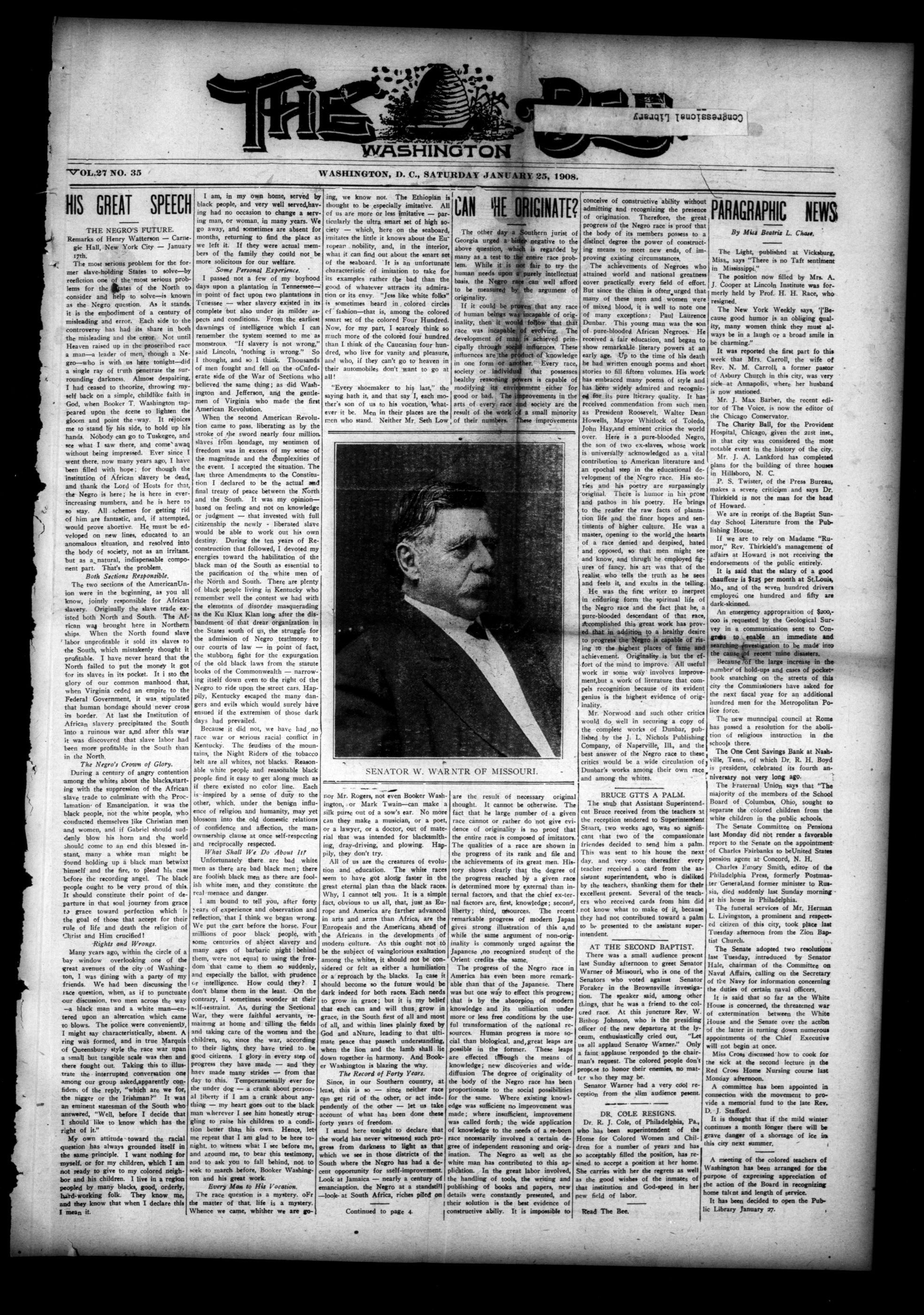
SENATOR W. WARNTR OF MISSOURI.
ing, we know not. The Ethiopian is thought to be especially imitative. All of us are more or less imitative — particularly the ultra smart set of high society — which, here on the seaboard, imitates the little it knows about the European nobility, and, in the interior, what it can find out about the smart set of the seaboard. 'It is an unfortunate characteristic of imitation to take for its examples rather the bad than the good of whatever attracts its admiration or its envy. "Jess like white folks" is sometimes heard in colored circles of fashion—that is, among the colored smart set of the colored Four Hundred. Now, for my part, I scarcely think so much more of the colored four hundred than I think of the Caucasian four hundred, who live for vanity and pleasure, and who, if they can't go to heaven in their automobiles don't want to go at all!
"Every shoemaker to his last," the saying hath it, and that say I, each mother's son of us to his vocation, whatever it be. Men in their places are the men who stand. Neither Mr. Seth Low
SENATOR W. WAR
nor Mr. Rogers, not even Booker Washington, or Mark Twain—can make a silk purse out of a sow's ear. No more can they make a musician, or a poet, or a lawyer, or a doctor, out of material that was intended for blacksmithing, dray-driving, and plowing. Happily, they don't try.
All of us are the creatures of evolution and education. The white races seem to have got along faster in the great eternal plan than the black races. Why, I cannot tell you. It is a simple fact, obvious to us all, that, just as Europe and America are farther advanced in arts and arms than Africa, are the Europeans and the Americans ahead of the Africans in the developments of modern culture. As this ought not to be the subject of vainglorious exaltation among the whites, it should not be considered or felt as either a humiliation or a reproach by the blacks. In case it should become so the future would be dark indeed for both races. Each needs to grow in grace; but it is my belief that each can and will thus grow in grace, in the South first of all and most of all, and within lines plainly fixed by God and aNature, leading to that ultimate peace that passeth understanding, when the lion and the lamb shall lie down together in harmony. And Booker Washington is blazing the way.
The Record of Forty Years.
Since, in our Southern country, at least, this is so — since neither race can get rid of the other, or act independently of the other — let us take account of what has been done these forty years of freedom.
I stand here tonight to declare that the world has never witnessed such progress from darkness to light as that which we see in those districts of the South where the Negro has had a decent opportunity for sself-improvement. Look at Jamaica — nearly a century of emancipation, the Negro at a standstill — look-at South Africa, riches piled on
Continued to page 4.
CAN THE ORIGINATE?
The other day a Southern jurist of Georgia urged a bitter negative to the above question, which is regarded by many as a test to the entire race problem. While it is not fair to try the human needs upon a purely intellectual basis, the Negro race can well afford to be measured by the argument of originality.
If it could be proven that any race of human beings was incapable of originality, then it would follow that that race was incapable of evolving. The development of man is achieved principally through social influences. These influences are the product of knowledge in one form or another. Every race, society or individual that possesses healthy reasoning powers is capable of modifying its environment either for good or bad. The improvements in the arts of every race and society are the result of the work of a small minority of their numbers. These improvements
RNTR OF MISSOURI.
are the result of necessary original thought. It cannot be otherwise. The fact that he large number of a given race cannot or rather do not give evidence of originality is no proof that the entire race is composed of imitators. The qualities of a race are shown in the progress of its rank and file and the achievements of its great men. History shows clearly that the degree of the progress reached by a given race is determined more by external than internal factors, and that the chief ex-ternal factors are, first, knowledge; second$^d$, liberty; third, resources. The recent remarkable progress of modern Japan gives strong illustration of this, and while the same argument of non-originality is commonly urged against the Japanese, no recognized student of the Orient credits the same
The progress of the Negro race in America has even been more remarkable than that of the Japanese. There was but one way to effect this progress; that is by the absorption of modern knowledge and its utilization under more or less free conditions by the useful transformation of the national resources. Human progress is more social than biological, and great leaps are possible in the former. These leaps are effected through the means of knowledge; new discoveries and wide-diffusion The degree of originality of the body of the Negro race has been proportionate to the social possibilities for the same. Where existing knowledge was sufficient no improvement was made; where insufficient, improvement was called forth; the wide application of knowledge to the needs of a re-born race necessarily involved a certain degree of independent reasoning and origination. The Negro as well as the white man has contributed to this application. In the great labor involved, the handling of tools, the writing and publishing of books and papers, new details were constantly presented, and their solution is the best evidence of constructive ability. It is impossible to
---
conceive of constructive ability without admitting and recognizing the presence of origination. Therefore, the great progress of the Negro race is proof that the body of its members possess to a distinct degree the power of constructing means to meet new ends, of improving existing circumstances.
The achievements of Negroes who attained world and national greatness cover practically every field of effort. But since the claim is often urged that many of these men and women were of mixed blood, it is well to note one of many exceptions: Paul Laurence Dunbar. This young man was the son of pure-blooded African Negroes. He received a fair education, and began to show remarkable literary powers at an early age. Up to the time of his death he had written enough poems and short stories to fill fifteen volumes. His work has embraced many poems of style and has been widely admired and recognized for its pure literary quality. It has received commendation from such men as President Roosevelt, Walter Dean Howells, Mayor Whitlock of Toledo, John Hay, and eminent critics the world over. Here is a pure-blooded Negro, the son of two ex-slaves, whose work is universally acknowledged as a vital contribution to American literature and an epocal step in the educational development of the Negro race. His stories and his poetry are surpassingly original. There is humor in his prose and pathos in his poetry. He brings to the reader the raw facts of plantation life and the finer hopes and sentiments of higher culture. He was a master, opening to the world the hearts of a race denied and despised, hated and opposed, so that men might see and know, and through he employed figures of fancy, his art was that of the realist who tells the truth as he sees and feels it, and exults in the telling.
He was the first writer to inpret in enduring form the spiritual life of the Negro race and the fact that he, a pure-blooded descendant of that race, accomplished this great work has proved that in addition to a healthy desire to progress the Negro is capable of rising to the highest places of fame and achievement. Originality is but the effort of the mind to improve. All useful work in some way involves improvement, but a work of literature that compels recognition because of its evident genius is the highest evidence of originality. Mr. Norwood and such other critics would do well in securing a copy of the complete works of Dunbar, published by the J. L. Nichols Publishing Company, of Naperville, Ill., and the best answer of the Negro race to these critics would be a wide circulation of Dunbar's works among their own race and among the whites.
BRUCE GTTS A PALM.
The snub that Assistant Superintendent Bruce received from the teachers at the reception tendered to Superintendent Stuart, two weeks ago, was so significant that two of the compassionate friends decided to send him a palm. This was sent to his house the next day, and very soon thereafter every teacher received a card from the assistant superintendent, who is disliked by the teachers, thanking them for their excellent present. Several of the teachers who received cards from him did not know what to make of it, because they had not contributed toward a palm to be presented to the assistant superintendent.
AT THE SECOND BAPTIST
AT THE SECOND BAPTIST.
There was a small audience present last Sunday afternoon to greet Senator Warner of Missouri, who is one of the Senators who voted against Senator Foraker in the Brownsville investigation. The speaker said, among other things, that he was a friend to the colored race. At this juncture Rev. W. Bishop Johnson, who is the presiding officer of the new departure at the lyceum, enthusiastically cried out, "Let us all applaud Senator Warner." Only a faint applause responded to the chairman's request. The colored people don't propose to honor their enemies, no matter who they may be.
Senator Warner had a very cool reception from the slim audience peent.
DR COLE RESIGNS
Dr. R. J. Cole, of Philadelphia, Pa. who has been superintendent of the Home for Colored Women and Children for a number of years and has so acceptably filled the position, has resined to accept a position at her home. She carries with her the regrets as well as the good wishes of the inmates of that institution and God-speed in her new field of labor.
Read The Bee.
PARAGRAPHIC NEWS
PARAGRAPHIC NEWS
The Light, published at Vicksburg, Miss., says "There is no Taft sentiment in Mississippi."
The position now filled by Mrs. A. J. Cooper at Lincoln Institute was formerly held by Prof. H. H. Race, who resigned.
The New York Weekly says, "Because good humor is an obliging quality, many women think they must always be in a laugh or a broad smile in be charming."
It was reported the first part for this week that Mrs. Carroll, the wife of Rev. N. M. Carroll, a former pastor of Asbury Church in this city, was very sick at Annapolis, where her husband is now stationed.
Mr. J. Max Barber, the recent editor of The Voice, is now the editor of the Chicago Conservator.
The Charity Ball, for the Provident Hospital, Chicago, given the 21st inst., in that city was considered the most notable event in the history of the city.
Mr. J. A. Lankford has completed plans for the building of three houses in Hillsboro, N. C.
P. S. Twister, of the Press Bureau, makes a severe criticism and says Dr. Thirkield is not the man for the head of Howard.
We are in receipt of the Baptist Sunday School Literature from the Publishing House. If we are to rely on Madame "Rumor," Rev. Thirkield's management of affairs at Howard is not receiving the endorsements of the public entirely. It is said that the salary of a good chauffeur is $125 per month at St.Louis, Mo., and of the seven hundred drivers employed one hundred and fifty are dark-skinned. An emergency appropriation of $200,000 is requested by the Geological Survey in a communication sent to Congress to enable an immediate and searching investigation to be made into the cause of recent mine disasters. Because of the large increase in the number of hold-ups and cases of pocket-book snatching on the streets of this city the Commissioners have asked for the next fiscal year for an additional hundred men for the Metropolitan Police force. The new municipal council at Rome has passed a resolution for the abolition of religious instruction in the schools there. The One Cent Savings Bank at Nashville, Tenn., of which Dr. R. H. Boyd is president, celebrated its fourth anniversary not very long ago.
The Fraternal Union says that "The majority of the members of the School Board of Columbus, Ohio, sought to separate the colored children from the white children in the public schools.
The Senate Committee on Pensions last Monday did not render a favorable report to the Senate on the appointment of Charles Fairbanks to be United States pension agent at Concord, N. H.
Charles Emory Smith, editor of the Philadelphia Press, formerly Postmaster General, and former minister to Russia, died suddenly last Sunday morning at his home in Philadelphia.
The funeral services of Mr. Herman L. Livingston, a prominent and respected citizen of this city, took place last Tuesday afternoon from the Zion Baptist Church.
The Senate adopted two resolutions last Tuesday, introduced by Senator Hale, chairman of the Committee on Naval Affairs, calling on the Secretary of the Navy for information concerning the duties of certain naval officers.
It is said that so far as the White House is concerned, the threatened war of extermination between the White House and the Senate over the action of the latter in turning down numerous appointments of the Chief Executive will not begin at once.
Miss Cross discussed how to cook for the sick at the second lecture in the Red Cross Home Nursing course last Monday afternoon.
A committee has been appointed in connection with the movement to provide a memorial fund to the late Rev. D. J. Stafford.
It is thought that if the mild winter continues a month longer there will be grave danger of a shortage of ice in this city next summer.
A meeting of the colored teachers of Washington has been arranged for the purpose of expressing appreciation of the action of the Board in recognizing home talent and length of service.
It has been decided to open the Public Library January 27.
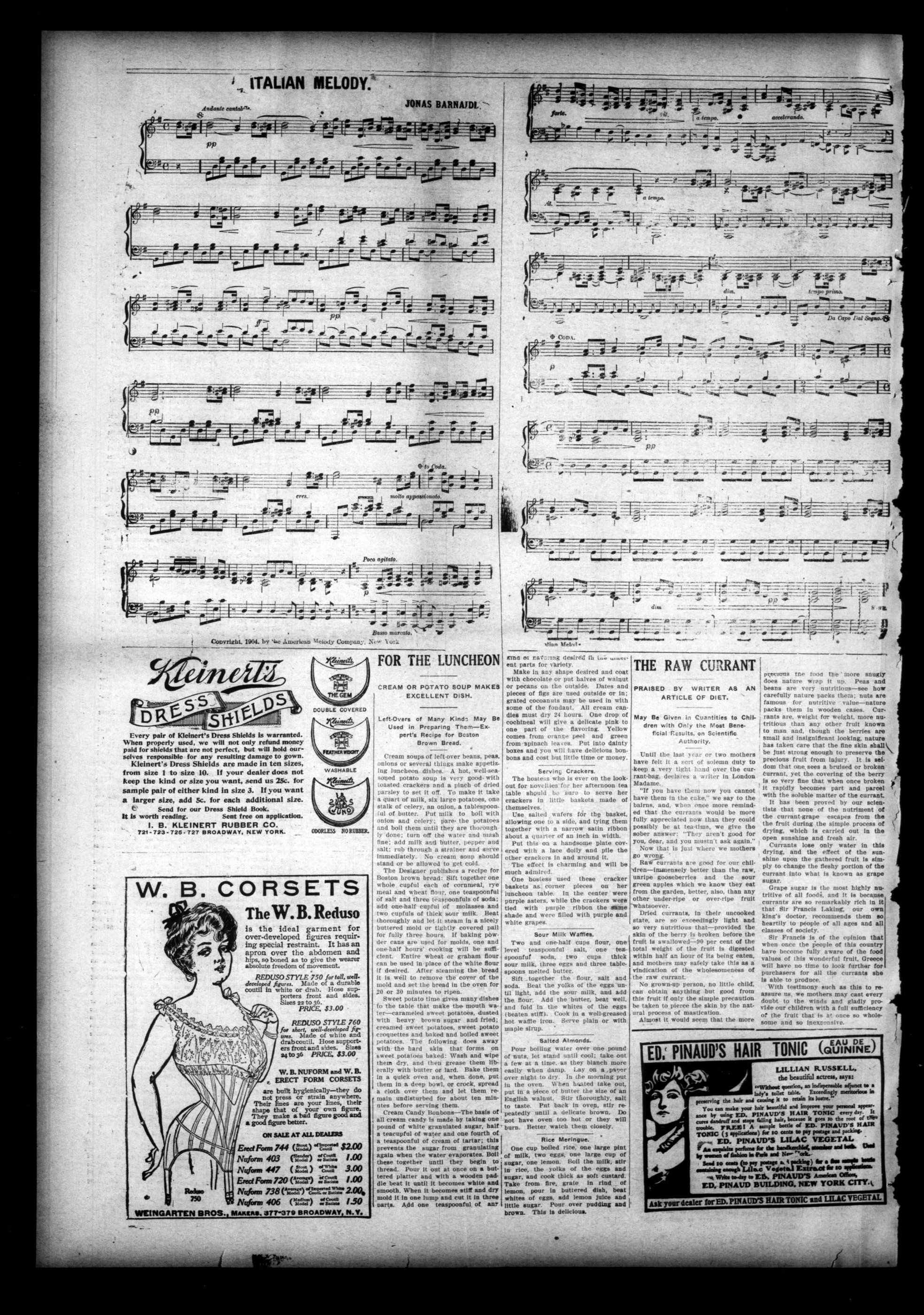
ITALIAN MELODY.
JONAS BARNAJDL.
Andante cantabile.
pp
pp
to Coda.
cres.
molto appassionato.
Poco agitato.
Basso marchelo.
Copyright, 1904, by the American Melody Company, New York.
Kleinert's
DRESS SHIELDS
Klineits
EST. 1870
THE GEM
DOUBLE COVERED
Klineits
EST. 1870
FEATHER WDGHT
WASHABLE
Klineits
2 S
CUND
ODORLESS, FOR RUBBER
Every pair of Kleinert's Dress Shields is warranted. When properly used, we will not only refund money paid for shields that are not perfect, but will hold ourselves responsible for any resulting damage to gown. Kleinert's Dress Shields are made in ten sizes, from size 1 to size 10. If your dealer does not keep the kind or size you want, send us 25c. for sample pair of either kind in size 3. If you want a larger size, add 5c. for each additional size. Send for our Dress Shield Book. It is worth reading. Sent free on application: I. B. KLEINERT RUBBER CO. 721-723-725-727 BROADWAY, NEW YORK.
W. B. CORSETS
The W.B. Reduso
is the ideal garment for over-developed figures requiring special restraint. It has an apron over the abdomen and hips, so boned as to give the wearer absolute freedom of movement.
REDUSO STYLE 750 for tall, well-developed figures. Made of a durable contil in white or drab. Hose supporters front and sides. Sizes 22 to 36.
PRICE, $3.00
REDUSO STYLE 760 for short, well-developed figures. Made of white and drab contil. Hose supporters front and sides. Sizes 24 to 36 PRICE, $3.00
W. B. NUFORM and W. B. ERECT FORM CORSETS
are built hygienically—they do not press or strain anywhere. Their lines are your lines, their shape that of your own figure. They make a bad figure good and a good figure better.
ON SALE AT ALL DEALERS
Erect Form 744 (Stout Model) of Imported Contil $2.00
Nuform 403 (Slender Model) of Contil or Batista 1.00
Nuform 447 (Stout Model) of White Contil 3.00
Erect Form 720 (Average Model) of Contil or Batista 1.00
Nuform 738 (Average Model) of Imported White Contil or Batista 2.00
Nuform 406 (Medium Model) of Contil or Batista 1.50
WEINGARTEN BROS., MAKERS, 377-379 BROADWAY, N.Y.
CREAM OR POTATO SOUP MAKES EXCELLENT DISH.
Left-Overs of Many Kinds May Be Used in Preparing Them—Expert's Recipe for Boston Brown Bread.
Cream soups of left-over beans, peas, onions or several things make appetizing lunchon dishes. A hot, well-seasoned potato soup is very good with coated crackers and a pinch of dried parsley to set it off. To make it take a quart of milk, six large potatoes, one stalk of celery, an onion, a tablespoon of butter. Put milk to boil with onion and celery; pare the potatoes and boil them until they are thoroughly done; turn off the water and mash fine; add milk and butter, pepper and salt; rub through a strainer and serve finely. No cream soup should stand or be allowed to get cold.
The Designer publishes a recipe for Boston brown bread: Sift together one whole cupful each of cornmeal, rye meal and wheat flour, one teaspoonful of salt and three teaspoonfuls of soda; add one-half cupful of molasses and two cupfuls of thick sour milk. Beat thoroughly and let it steam in a nicely buttered mold or tightly covered pall for fully three hours. If baking powder cans are used for molds, one and one half hours' cooking will be sufficient. Entire wheat or graham flour can be used in place of the white flour if desired. After steaming the bread it is well to remove the cover of the mold and set the bread in the oven for 20 or 30 minutes to ripen.
Sweet potato time gives many dishes to the table that make the mouth water—carameled sweet potatoes, dusted with heavy brown sugar and fried; creamed sweet potatoes, sweet potato croquettes and baked and boiled sweet potatoes. The following does away with the hard skin that forms on sweet potatoes baked: Wash and wipe them dry, and then grease them liberally with butter or lard. Bake them in a quick oven and, when done, put them in a deep bowl, or crook, spread a cloth over them and let them remain undisturbed for about ten minutes before serving them.
Cream Candy Lionbons—The basis of all cream candy is made by taking one pound of white granulated sugar, half a teacupful of water and one fourth of a teaspoonful of cream of tartar; this prevents the sugar from granulating again when the water evaporates. Boll these, together until they begin to thread. Pour it out at once on a buttered platter and with a wooden paddle beat it until it becomes white and smooth. When it becomes stiff and dry mold it in one lump and cut it in three parts. Add one teaspoonful of any
forte.
sit.
a tempo.
accelerando.
sit.
dim.
tempo primo.
Da Capo Dal Segno.
Copia.
dim.
alian Melody.
kind or naffing desired in the different parts for variety.
Make in any shape desired and coat with chocolate or put halves of walnut or pecans on the outside. Dates and pieces of figs are used outside or in; grated cocoanuts may be used in with some of the fondant. All cream candies must dry 24 hours. One drop of cochineal will give a delicate pink to one part of the flavoring. Yellow comes from orange peel and green from spinach leaves. Put into dalty boxes and you will have delicious bonbons and cost but little time or money.
Serving Crackers
The hostess who is ever on the lookout for novelties for her afternoon tea table should be sure to serve her crackers in little baskets made of themselves.
Use salted wafers for the basket, allowing one to a side, and tying them together with a narrow satin ribbon about a quarter of an inch in width.
Put this on a handsome plate covered with a lace dolly and pile the other crackets in and around it.
The effect is charming and will be much admired.
One hostess used these cracker baskets as corner pieces on her umcheon table. In the center were purple asters, while the crackers were tied with purple ribbon the same shade and were filled with purple and white grapes.
Sour Milk Waffles.
Two and one-half cups flour, one level teaspoonful salt, one teaspoonful soda, two cups thick sour milk, three eggs and three tablespoons melted butter.
Sift together the flour, salt and soda. Beat the yolks of the eggs until light, add the sour milk, and add the flour. Add the butter, beat well, and fold in the whites of the eggs (beaten stiff). Cook in a well-greased hot waffle iron. Serve plain or with maple sirup.
Salted Almonds.
Pour boiling water over one pound of nuts, let stand until cool; take out a few at a time, as they blanch more easily when damp. Lay on a paper over night to dry. In the morning put in the oven. When heated take out, put in a piece of butter the size of an English walnut. Stir thoroughly, salt to taste. Pit back in oven, stir repeatedly until a delicate brown. Do not have oven too hot, or they will burn. Better watch them closely.
Rice Merlingue.
One cup boiled rice, one large pint of milk, two eggs, one large cup of sugar, one lemon. Boil the milk, stir in rice, the yolks of the eggs and sugar, and cook thick as soft custard. Take from fire, grate in rind of lemon, pour in buttered dish, beat whites of eggs, add lemon juice and little sugar. Pour over pudding and brown. This is delicious.
ED. PINAUD'S HAIR TONIC (EAU DE QUININE)
LILLIAN RUSSELL,
the beautiful actress, says:
"Without question, an indispensable adjunct to a lady's toilet table. Exceedingly meritorious in preserving the hair and causing it to retain its lustre."
You can make your hair beautiful and improve your personal appearance by using ED. PINAUD'S HAIR TONIC every day. It cures dandruff and stops falling hair, because it goes to the root of the trouble. FREE! A simple bottle of ED. PINAUD'S HAIR TONIC (3 applications) for 10 cents to pay postage and packing.
ED. PINAUD'S LILAC VEGETAL
An exquisite perfume for the handkerchief, sunscreen and bath. Used by women of fashion in Paris and New York.
Seed 10 cents (to pay postage a packing) for a free sample bottle containing Lilac Vegetal Extract for 20 applications.
Write to-day to ED. PINAUD'S American Office,
ED. PINAUD BUILDING, NEW YORK CITY.
THE RAW CURRANT
PRAISED BY WRITER AS AN ARTICLE OF DIET.
May Be Given in Quantities to Children with Only the Most Beneficial Results, on Scientific Authority.
Until the last year or two mothers have felt it a sort of solemn duty to keep a very tight hand over the currant-bag, declares, a writer in London Madame.
"If you have them now you cannot have them in the cake," we say, to the balms, and, when once more reminded that the currants would be more fully appreciated now than they could, possibly be at tea-time, we give the sober answer: "They aren't good for you, dear, and you mustn't ask again."
Now that is just where we mothers go wrong.
Raw currants are good for our children—immensely better than the raw, unripe gooseberries and the sour green apples which we know they eat from the garden, better, also, than any other under-ripe or over-ripe fruit whatsoever.
Dried currants, in their uncooked state, are so exceedingly light and so very nutritious that—provided the skin of the berry is broken before the fruit is swallowed—20 per cent of the total weight of the fruit is digested within half an hour of its being eaten, and mothers may safely take this as a vindication of the wholesomeness of the raw currant.
No grown-up person, no little child, can obtain anything but good from this fruit if only the simple precaution be taken to pierce the skin by the natural process of mastication.
Almost it would seem that the more
precious the food the more snugly does nature wrap it up. Peas and beans are very nutritious—see how carefully nature packs them; nuts are famous for nutritive value—nature packs them in wooden cases. Currants are, weight for weight, more nutritious than any other fruit known to man and, though the berries are small and insignificant looking, nature has taken care that the fine skin shall be just strong enough to preserve the precious fruit from injury. It is seldom that one sees a bruised or broken currant, yet the covering of the berry is so very fine that when once broken it rapidly becomes part and parcel with the soluble matter of the currant.
It has been proved by our scientists that none of the nutriment of the currant-grape escapes from the fruit during the simple process of drying, which is carried out in the open sunshine and fresh air. Currants lose only water in this drying, and the effect of the sunshine upon the gathered fruit is simply to change the fleshy portion of the currant into what is known as grape sugar. Grape sugar is the most highly nutritive of all foods, and it is because currants are so remarkably rich in it that Sir Francis Lakking, our own king's doctor, recommends them so heartily to people of all ages and all classes of society.
Sir Francis is of the opinion that when once the people of this country have become fully aware of the food values of this wonderful fruit, Greece will have no time to look further for purchasers for all the currants she is able to produce. With testimony such as this to reassure us we mothers may cast every doubt to the winds and gladly provideour children with a full sufficiency of the fruit that is at once so wholesome and so inexcursive
McCall Patterns
10
15
MCCALL MAGAZINE
50
YEAR
MCCALL MAGAZINE
There are more McCall Patterns sold in the United States than of any other make of patterns. This is an account of their style, accuracy and simplicity.
McCall's Magazine (The Queen of Fashion) has many magazines than any other Lalley Magazine. One number is complete in twenty pages 8 60 pages and another number is complete in twenty pages 8 60 pages. A McCall's Magazine Express today.
THE BEE AND McCALL'S GREAT FASHION MAGAZINE for one year for $2.00. COUPO.
Editor Bee:—
Find enclosed two dollars. Send to my address below The Bee and McCall's Fashion Magazine for one year.
No.....
Street.....
Town or City....
BUY THE
NEW HOME
LIGHT RUNNING
SEWING MACHINE
Before You Purchase Any Other Write
THE NEW HOME SEWING MACHINE COMPANY
ORANGE, MARS.
Many Sewing Machines are made to sell regardless of quality, but the "New Home" is made wear. Our guaranty never runs out.
We make Sewing Machines to suit all conditions of the trade. The "New Home" stands at the head of all High-grade family sewing machines. Sold by authorised dealers only.
FULL DRESS AND TUXEDO SUITS.
S1.00-For Hire-$1.00.
Julius Cohen,
1104 7th street, N. W.
WE DO BUSINESS AT ONE PRICE
Misfit Cloth-
ing Parlor;
Fine Garments (Slightly Worn) Made by Our Leading Tailors. JUSTII'S OLD STAND. Istablished 1865. 619 D St. N. W
NEW YORK
CLIPPER
IS THE GREATEST
THEATRICAL SHOW PAPER
IN THE WORLD.
$4.00 Per Year. Single Copy, 10 Cm
ISSUED WEEKLY.
SAMPLE COPY FREE
FRANK QUEEN PUB CO. (Ltd)
PUBLISHERS,
MADRID, W. W. 89 2P NEW
Mme. Davis,
A
BORN CLAIRVOYANT AND
CARD READER
TELLS ABOUT BUSINESS.
Removes Spells and Evil Influencer.
-Reunites the Separated, and
Gives Luck to All.
1228 25th St. N.W., Washington, D. C.
N. B.-No letters answered unless
accompanied by stamp.
N. B.-Mention The Bee.
ROOMS FOR RENT.
Large, comfortable furnished booms fo reither ladies or gentlemen, 1207 K street northeast.
Furnished rooms for rent at 111734 5th street, N. W.
Front Parlor suitable for a doctor and a back bedroom, 1410 First street, N. W.
J.
Any article that you may select will be laid aside and delivered when wanted. Experienced clerks. Polite attention.
F-787
Prices in the Diamond market are advancing, but OUR PRICES HAVE'NT BEEN ADVANCED in some time. We still have a large collection of superb Diamonds which we bought a considerable time ago at lower prices than prevail today.
We shall not advance prices on these stones. We are merchants and not speculators, and our fair percentage of profit is all we ask. So, as long as these Diamonds last, it will be possible to buy them here under the regular market for
Darn with Colors of Raffia to Match Straw.
Often in moving a heavy piece of furniture the matting on the floor will have an ugly hole torn in it. The torn place is usually where it is the most noticeable and cannot be covered with a rug. There is an excellent way to remedy this defect by darning the place with raffia of colors to match the matting straw. It is much better than threads and the work can be neatly done. It may be necessary to run heavy cords across the work through which the raffia is be woven. The threads are sewed in place with a large darning needle. Torn places on the edge of matting can be remedied in the same manner. It is best to sew matting together with a loose stitch, using very heavy linen thread for the purpose, but where this cannot be done then use the regular matting tacks or ordinary tacks, placing first one side, then the opposite side to prevent the baggy appearance which, so often occurs. Never use a claw hammer to lift tacks from matting, since it invariably breaks the straw. Get an old blunt chisel, place it beneath the matting and tack head, pound gently with the hammer and pry the tack up. This will draw the tack out straight and leave the matting unbroken. If matting is used in a room during the winter, cover the floor with paper covering and pad lightly with newspapers. The cold air cannot penetrate a floor covering of that kind.
VARIETY OF THE CAKE MAKER.
Meant to Satisfy Longing for "Some- thing Different."
Instead of cooking all the sugar or ginger cookies the same size try cutting some out with small cans, baking the same as larger cookies.
Make a boiled frosting of one cup of sugar and a little water, boiled until it will thread. and then poured slowly over the beaten whites of two eggs. Beat until cold. Flavor and spread on small cookies; dip into cocoanut and press two cookies together. This makes a neat little cake, and may be made with colored or chocolate frosting and cocoanut omitted, just as one pleases.
The small round centers of dough left when cutting out doughnuts are nice fried and dipped in the frosting and cocoanut.
If sponge or angel food cake is tough, place in a stone crock or jar, cover carefully, and set in the cellar or cool place for a day or two, at the end of which time the cake will be molst and tender.
The ordinary paper cracker boxes, three by 12 inches in size, are nice to bake loaf cakes in, requiring little fire, and the parafin-paper with-which they are lined prevents the cake from sticking.
MANUFACTURINGJEWELER 725 7th Street, Northwest
Everybody has some friend whom they wish to make happy. It may be mother or father, sister or brother. It may be a wife, or it may be a sweetheart — and no better time than Christmas is so appropriate — so suggestive. Nothing makes one feel happier than to gladden the heart of another.
Our stock of Jewelry and Bric-a-brac is now complete. Each in-selected and we feel satisfied thata visit from you will-bear us out can be found anywhere. Why not give us a call tomorrow?
WATCHES
We mention here but a few of our specials.
Gnetlemen's 20-year Gold Filled American Stem Winders and Setters, $10.
Ladies' 20-year Gold Filled Stem Winders and Setters, $10.
Gentlemen's 14-karat Solid Gold American Stem Winders and Setters, as cheap as $35.
Children's Solid Silver Watches with Pin Attachment, $3.50; regular price, $4.50.
Ladies' Solid Gold Watches, Open Face, $8.00.
Boys' Solid Silver Watches, $5.00 up.
NOW THE FLOWER SANDWICH.
Dainty Morsels Which Are Served at Debutante Luncheons and Teas.
The latest wrinkle of the dainty housekeeper is to serve "flower sandwiches" to her guests at an afternoon tea.
Of course, these delicacies are exclusively feminine, and no woman is so foolish as to try to satisfy the masculine appetite with such morsels.
If milady's tea or luncheon table happens to be decorated with chrysanthemums she serves chrysanthemum sandwiches, or if sweet peas, violets, roses, carnations, prevail in the decorations, she will have her sandwiches to match.
The fragrance is extracted from the flowers and imparted to the sandwiches by cutting the butter to be used in thin blocks, wrapping it in cheese cloth, smothering it with flowers and letting it stand for several hours in a tightly closed jar.
The bread is cut in paper like slices, spread with the perfumed butter and sprinkled with petals of flowers.
The sandwiches are rolled and tied with ribbon to match the flowers.
After they have been put back in the jar with the flowers they are served in a veritable bed of blooms, and if they are not the most substantial things in the food line they are at least novel and dainty, and at present are quite the thing at debutante luncheons and teas.
Select a dozen or so of the smoothest and largest splints from the new broom and lay them away to use in testing cake when it is baking.
When cutting bread and butter specially thin, occasionally dip the knife in hot water, and never draw the knife over the same place.
When frying fish of any sort a little salt should be sprinkled on the base of the pan when it is hot and the fat is boiling. The fish can then be easily turned without being broken.
When cooking chops and steaks in a frying-pan or on a gridiron, never thrust a fork into them in order to turn them. If you do the juice will run out and the steak or chop will be hard or dry.
The dripping from roast meat, the skimmings from soups, and rendered down fat from meat trimmings, serve the same purpose, when clarified thoroughly as lard or butter. Use beef drippings for basting beef and game, keep mutton dripping for frying cutlets, fish, etc.
Too rapid boiling makes most vegetables tough. As a rule vegetables should be cooked uncovered.
Rice and macaroni require fast boiling.
Too much salt in gravy or soup may be counteracted by putting in a pinch of brown sugar.
When finely chopped nuts are needed for salads or sandwiches, run the nuts through the meat chopper.
E.VOIGT
a friend whom they wish to make happy. It
later, sister or brother. It may be a wife, or it
- and no better time than Christmas is so ap-
titive. Nothing makes one feel happier than
of another.
My and Bric-a-brac is now complete. Each in-
satisfied thata visit from you will-bear us out
. Why not give us a call tomorrow?
and deliveredwhen wanted. Experienced clerks.
anches, $5.00 up.
S.
Seconds. No Bet-
today.
fine stones.
Ladies' Diamond Rings, $5.00 to $150.
Ladies' Diamond Brooches, $5.50 to $1,000.
Diamond Earrings, $15.00 to $500.00.
Diamond Scarf Pins, $7.00 up.
Diamond Cuff Buttons, $7.00 up.
Diamond Studs, $10.00 up.
We have Ladies' Handsome Diamond Rings set in Tiffany Mounting, which we are selling at $30.00. This will make an appropriate present for Christmas.
Every stone a ball of fire.
coast meat, the and rendered dummings, serve on clarified thorter. Use beef beef and game, for frying out.
Spanish Salad.
Four large cucumbers.
One bunch celery.
Three large onions.
Four large tomatoes.
Two heads lettuce.
Two green peppers.
---
图
HINTS FOR THE COOK.
KEYSTON
D-779
Fruit Bread.
The night before you wish to bake, set a cake of yeast with a cupful of potato water. Mix with a little flour like a thin batter, let it stand all night in a warm place; in the morning sift your flour in your pan, then put a quart of warm milk in your flour, then add your yeast and two cups of sugar, one teaspoon salt, one cup of butter, one pound of currants, one pound seedless raisins, one pound of walnuts, one spoon of lemon or vanilla extract, three eggs. Mix it and work in just like you do bread. Then set it in a warm place to rise; when light, shape in small flat loaves, put in pans to rise again, when nice and light butter the top and sprinkle with sugar and clinnamon, or leave plain; then bake until a light brown in a not too hot oven. This you can keep for a whole week and it won't dry out.
Pumpkin Pie.
Three pounds of pumpkin, six ounces of butter, six eggs, three tablespoonfuls of wine, two of brandy, the rind and juice of one lemon, as much cinnamon as can be put on a dime.
Cut the pumpkin in slices, pare it, take out the seeds and soft parts, cut it into small pieces and stew in a small quantity of wafer until tender. Then press in a colander until dry.
Turn it out in a pan, put in the butter and salt and mash fine.
When cool whisk the eggs until light and stir in, add sugar to taste, also the brandy, wine and cinnamon.
This is sufficient for three or four pies.
Line the plates with paste and bake in a quick oven.
Candied Oranges. Candied orange is a great delicacy and the housewife will find these are nice to serve with the last course of dinner. Peel and quarter the oranges, make a sirup in the proportion of one pound of sugar to one pint of water. Let it boll until it will harden in water; then take it from the fire and dip the quarters of oranges into the sirup; let them drain on a fine sieve placed over a platter, so that the sirup will not be wasted. Let them drain until cool, when the sugar will crystallize.
Chop each separately until fine, then mix together and season with one tablespoonful of vinegar, juice of one lemon, salt and pepper.
Rice and Meat Casserole.
Boil a cupful of rice, line a buttered pan with the rice while hot. When cold fill center with chopped cooked meat of any kind, season well, add gravy. Set in pan of water and bake one-half or three-quarters of an hour. Turn out on a dish and serve with tomato sauce.
W.SidneyPittman Architect
RENDERING IN MONOTONE, WATER COLOR AND PEN & INK
STEEL CONSTR
Phone: Main 6059—M. Of
Leland Giants Base-Ball
Now Organiz
$1
The Stock-Holders of the Le
cluded to dissolve that Association in
increased Capital for the purpose of the
Giants Base-Ball Club and Establish
Class, Up-To-Date Amusement in
Figure Eight, Shoot The Chutes,
Pavillion, Roller Skating, Hurley
Riding, and all the latest fun making
gether with a First Class Summer
guests, at it’s present location, 79th
ride on the Electric Cars to the Loop.
The Public is Base-Ball mad, a
value in a single season. Millions of
This New Enterprise.
Are You In Favor Of The
mense And Well Paying Plant,
Be Employed, between May and Oc
out fear and Enjoy The Life and F
The Answer can only be effectively p
ition. it has-been made purposely low
have a Share and Interest in this T
Shares Only Ten (10.00) Dollars B
Any Holiday around Amusement
wanted and never welcome. Come!
the attached Coupon and mail with
and Amusement Association. Do it
Leland Giants Base Ball & Amusem
Giants Base-Ball and Amusement Assn.
Now Organizing—Capital Stock
$100,000
Holders of the Leland Giants Base-Ball Association, has con-
tributed that Association in order to give room for the former, with it’s
for the purpose of buying a Permanent Home For The Leland
Club and Establishing For All The People, The Only First
Amusement Park, With It’s Theater (Light Opera),
Soot The Chutes, Minature Ry, Electric Theater, Dance
Skating, Hurley Burley, Double Swing, Boating, Auto
the latest fun making devices and laugh producing concessions, to-
test Class Summer Hotel, large enough to accommodate 1000
present location, 79th and Wentworth Ave., twenty (20) minutes
eic Cars to the Loop District in Chicago.
Base-Ball mad, and amusement Crazy. Stocks have doubled in
season. Millions can be made by those Who Take Stock In
prise.
In Favor Of The Race Owning and Operating This Im-
mall Paying Plant, Where More Than 1,000 Persons Will
between May and October of each year, where you can come with-
joy The Life and Freedom of a Citizen unmolested or annoyed?
only be effectively given by subscribing for Stock in this Corpora-
mation purposely low so that all Loyal Members of the Race can
Interest in this Twentieth Century Enterprise. Think of it,
in (10,00) Dollars Each. You Squander More than this amount
around Amusement Parks and Public Places, where you are not
welcome. Come! buy and build one of your own by filling out
onion and mail with Ten Dollars to the Leland Giants Base-Ball
Association. Do it to-day so that we may commence to build.
Base Ball & Amusement Assn.
6258 Halsted Street, Chicago, Ill.
M. Moseley; Treas:-
Enclosed please find $___
As Part (or infull) as subscription fee for
capital Stock of the Leland Giants Base-Ball and Amusement
To pay $___ per month until the full amount
has been paid, at which time I am to recieve my stock
Name ___
Address ___
City ___
State ___
James H. Winslow
BERTAKER AND PRACTICAL EMBALMER.
FIRST CLASS. TERMS MOST REASONABLE.
The Stock-Holders of the Leland Giants Base-Ball Association, has concluded to dissolve that Association in order to give room for the former, with it's increased Capital for the purpose of buying a Permanent Home For The Leland Giants Base-Ball Club and Establishing For All The People, The Only First Class, Up-To-Date Amusement Park, With It's Theater (Light Opera), Figure Eight, Shoot The Chutes, Minature Ry, Electric Theater, Dance Pavilion, Roller Skating, Hurley Burley, Double Swing, Boating, Auto Riding, and all the latest fun making devices and laugh producing concessions, together with a First Class Summer Hotel, large enough to accommodate 1000 guests, at it's present location, 79th and Wentworth Ave., twenty (20) minutes ride on the Electric Cars to the Loop District in Chicago.
The Public is Base-Ball mad, and amusement Crazy. Stocks have doubled in value in a single season. Millions can be made by those Who Take Stock In This New Enterprise.
Are You In Favor Of The Race Owning And Operating This Immense And Well Paying Plant, Where More Than 1,000 Persons Will Be Employed, between May and October of each year, where you can come without fear and Enjoy The Life and Freedom of a Citizen unmolested or annoyed? The Answer can only be effectively given by subscribing for Stock in this Corporation. It has been made purposely low so that all Loyal Members of the Race can have a Share and Interest in this Twentieth Century Enterprise. Think of it, Shares Only Ten (10.00) Dollars Each. You Squander More than this amount Any Holiday around Amusement Parks and Public Places, where you are not wanted and never welcome. Come! buy and build one of your own by filling out the attached Coupon and mail with Ten Dollars to the Leland Giants Base-Ball and Amusement Association. Do it to-day so that we may commence to build.
Mr Beauregard F. Moseley; Treas:-
which I am sending as Part (or infu-
shares of the Capital Stock of the
Association.
I agree to pay $___
$___ has been
certificate.
N B.
All payments on Stock Ac-
counts must be made to the order
of Beauregard P. Moseley,
Treasurer, 6258 Halsted Street,
Chicago, Illinois. All Stock-
holders are entitled to prefer-
ance as employees and should
inform the Treasurer with their
final remittance of their inten-
tions to apply for employment.
For further information ad-
dress Leland Giants Base-Ball
and Amusement Assn. 6258
Halsted St. Chicago, Ill.
Name ___
Address ___
City ___
State ___
UNDERTAKER AND
ALL WORK FIRST CLA
James H. Winslow
UNDERTAKER AND PRACTICAL EMBALMER.
ALL WORK FIRST CLASS. TERMS MOST REASONABLE.
TWELFTH AND R STREFTS. N. W.
J H DABNEY
FUNERAL · DIRECTOR.
Hiring, Levery and Sale Stable.
H DABNEY
FUNERAL DIRECTOR.
Hiring, Levery and Sale Stable.
Required for funerals, parties, balls, receptions, etc.
Carriages kept in first-class style. Satisfaction guar-
ness at 1132 Third street northwest. Main office branch
street, Alexandria, Va.
For Office, Main 1727.
Call for Stable, Main 1428-5.
R STABLES IN FREEMAN'S ALLEY.
Accommodate 50 Horses.
Spect our new and modern stable.
I. DABNEY, Prop., 1132 Third Street N. W.
HIGH DEGREE
J H DABNEY
Horses and carriages kept in first-class style. Satisfaction guaranteed. Business at 1132 Third street northwest. Main office branch at 222 More street, Alexandria, Va.
J. II. DABNEY, Prop., 1132 Third Street N. W.
because of the exceptional attention bestowed on the making. The only cheapness in it anywhere is the price.
A Coodyear-welted shoe, made on several of the season's handsomest lasts, in the most popular leathers.
Looks first rate and wears that way every time.
It's worth your while to come in and look the Signet over, even if you're not ready to buy
Always welcome.
because of the exceptional attention bestowed on the making. The only cheapness in it anywhere is the price. A Coodyear-welted shoe, made on several of the season's handsomest lasts, in the most popular leathers. Looks first rate and wears that way every time. It's worth your while to come in and look the Signet over, even if you're not ready to buy Always welcome.
PATENT DRAWINGS DRAFTING,DETAILING,TRACING BLUE PRINTING
OF SATISFACTION IS A RARE THING IN MOST $3.00 SHOES. SHOES AT THIS PRICE USUALLY LACK STYLE OR COMFORT OR BOTH. THE STYLE OF MORE EXFENSIVE SHOES AND GOOD SOLID VALUE ARE FOUND IN OUR SIGNET SHOE
PUBLISHED
W. CALVIN CHASE, EDITOR
Entered at the Post Office at Washington, D. C., as second-class mail matter.
ESTABLISHED·1880.
TERMS OF SUBSCRIPTION.
One copy per year in advance.....$2.00
Six months .....1.00
Three months .....50
;Subscription monthly .....20
EDITOR WATTERSON.
When colored Americans can read such speeches as that delivered by Mr. Henry Watterson, editor of the Louisville Courier Journal, it is a pleasure and a relief to the better thinking class of the American people. Such speeches as these will redeem the South from its nefarious practices and convince the good people in the North that the South is not without men and women of human thoughts and patriotic utterances. The South should send such men as Mr. Watterson to the Senate. Instead of feeding upon the poisonous fumes of Vardamanism or Tillmanism the Southern atmosphere would be perfumed with a sweet political odor, and the uttered thoughts of eminent men would bloom like fine cultivated cotton in swamps where now exist venom and stagnant water.
The Bee does not despair; The Bee looks forward for a day of political emancipation of the colored Americans inaugurated by such men as Mr. Henry Watterson. Until that day comes the colored Americans must adhere to the principles of the Republican party and the representatives those principles, notwithstanding the seeming indifference on the part of those who, it is claimed, are too cowardly to enforce the Constitution of the United States.
The colored American is weak financially, but is not in possession of weapons of defense. He must, for a time, continue to be the hewer of wood until the approach of the political emancipation. The social element of every nationality wants to get away from the laboring element. The colored Americans don't seem to appreciate the dignity of labor. They are guided and controlled by glittering generalities.
Ex-Judge Norwood, of Savannah, Ga., would have the world to believe that colored Americans are imitative and are without either productive or inventive genius.
The history of the colored race shows to the contrary.
Mr. Watterson in his admirable speech argues as a sensible man and as a philosopher. There must be something great in the colored American because such men as Tillman and Vardaman have obtained their notoriety, not eminence by their abuse of him.
There is an aphorism as old as ancient history, "A citizen that everyone abuses must be an important factor." A man or a race that is of no importance in a town or country is permitted to pass unnoticed, untouched, and indeed no one gives him or it a passing, thought, except to say that old dog is harmless.
Mr. Watterson does not see the colored American as the prejudiced white man sees him. He regards him as human being and if given an opportunity before the courts and in governments he will become a factor.
The Bee extends to Mr. Watterson, one of America's greatest journalists and citizens, its sincere
thanks and gratitude, and thanks him for a copy of his speech,which is reproduced in this issue.
The advice that Prof. Booker T. Washington, in a recent address, gave to colored Americans was timely and should result in much good if it is heeded. What the colored Americans today want is a strong and wise leadership. They are in need of an educated and moral pulpit. They need leaders who are moral and upright, such men as Professor Washington named in that address.
Colored Americans have been falsely lead by men who saw nothing beyond a selfish and personal ambition. What is our leadership doing for the colored Americans? What has it done and what is it doing to day to improve the masses? Many Negro representatives, men and women, are making efforts to get away from the race. Many would be white if their skin and hair would permit them to join the Anglo-Saxon civilization.
Professor Washington is right when he advises colored Americans to accumulate property, live in peace and harmony with their neighbors, if they are permitted to do so. The Bee will admit that there are a few establishments that do not cater for Negro trade. Why should colored Americans go where they are not wanted? If they were more independent and had more self-reliance, what a better race we would have!
While it is true that many colored citizens were in business before the organization of the Negro Business League, it must be admitted that the organization of that institution into a national body has done more to emancipate the Negro and open his eyes to such extent that he sees new lights. Politics, that was once the direct object of Negro citizenship, is today only an incident to his citizenship. Property, education and good morals will make the Negro a citizen indeed and in fact. Professor Washington has not advised the Negro to commit any wrong On the contrary,he advocates good morals, the accumulation of property and live in peace with his neighbor. Will the critics of Professor Washington say that this is bad advice or good?
"The fault, dear Brutus, is in ourselves and not in the stars, that we are underlings."
THE COMING CONTEST. Prior to the meeting of the National Republican Committee The Bee endeavored to have the Republicans who would be interested in the election of delegates to the coming National Republican Convention to have a representative Republican delegated convention. Its object was to get rid of the very element that is now endeavoring to fleece those who may be candidates from being worried to death by a class of bum politicians who spring up every four years, and whose only object is to fleece. And also to encourage the better element of white and colored Republicans to participate in the election of delegates. This being the Capital of the Nation, there are hundreds of white Republicans as well as colored who want to take part in the election, but they dare not show their heads. It would have been much better to have had a representative convention of Republicans, who would have been a credit to the Republican party at the Capital of the Nation. What do we witness now? The curbstone politicians, the grafters, the cutthroats, the gamblers, and many others of this class representing themselves to be men of influence and character, but who are only bum politicians without character or influence, pretending that they are the people and men who represent districts that will follow them.
The Bee warns the people to beware of these Shylocks because they represent nothing, and indeed
do not represent themselves. It is the duty of every good Republican to see that the coming election is no farce.
A petition is being circulated among the colored teachers purporting to have come from the office, to the effect that all the colored teachers are satisfied with the present personnel in the colord schools. That is to say, that if the petition is signed the teachers commit themselves to the extent of being satisfied with the assistant superintendent, Mr. Roscoe Conkling Bruce, which is not true. They would admit that they are satisfied with the retention of John C.Nalle, one of the supervising principals, which is also not true. There are hundreds of teachers dissatisfied with both Bruce and Nalle, and their divorcement from the schools would give entire satisfaction.
If the Senate committee intends to investigate the schools, The Bee present personnel in the colored teachers be sent for and asked whom they want as the superintendent and whether the retention of Mr. Nalle is their wish. These two officials are among two of the most unpopular in the colored schools, and two of the most disliked.
Who authorized the petition to be sent around to the colored teachers? For any supervising principal to ask a teacher to sign a petition for the retention of any official is embarrassing and certainly objectionable.
MR. FORTUNE RETURNS.
Mr. T. Thomas Fortune, formerly editor of the NewYork Age, announces that he will resurrect The Freeman on or about February 1. It will be in magazine form and issued from No. 4 Cedar St., New York City.
The Bee welcomes its old and distinguished friend back into the field of journalism.
From the New York Tribune.
Col. Watterson's remarks last night at Carnegie Hall, on the Negro question, will, we hope, be widely read; for they show the existence at the South of sane and tolerant views too seldom brought to the attention of the Northern public. The North is too prone to consider the extravagant and violent utterances of sensationalists like Senator Tillman typical of the South's attitude toward the Negro. The Senior Senator from South Carolina has gone about the country preaching at Chautauqua lecture rates his gospel of hatred and contempt for the black man, and his pessimism has been taken by many to represent the average Southerner's total disbelief in the Negro's capacity for intellectual, moral or material progress. It is encouraging to be reminded that there are other Southern leaders who do not share this narrow and prejudiced view of the Negro's chaercter and the Negro's future. The failure of the experiment of intrusting the ballot to enfranchised slaves with no experience or political knowledge and without any competent leaders inevitably embittered the South, which, after suffering the evils of "carpet bag" misgovernment, was in no mood to credit the Negro with any fitness whatsoever for the duties of citizenship. For a while the outlook seemed desperate to the Southern people, and they were disposed to consider themselves hopelessly burdened with the care of an inferior race, incapable of self-improvement, and unfortunately elevated to a political status for whigh they were totally unprepared. Even Colonel Watterson, who has always advocated a policy of humanity and tolerance toward the Negro, confesses that until within the last ten or a dozen years, he could not see a single ray of light or hope. But he has come, with many other open-minded leaders of Southern opinion, to believe that the Negro is destined to work his way upward in a scale of worth and to find a natural and useful place in the South's economic and social system.
Colonel Watterson's visit to Tuskegee convinced him that the Negro race in America has at last found in Booker T. Washington the leader it needed. He saw that the work which Mr.Washington was doing and the spirit in which he was doing it opened the way to genuine race progress. It is the Tuskegee idea that the Southern Negro can make himself respected as a man and accepted as a citizen by demonstrating his ability to do a man's full work and to be a helpful factor in the civilization about him. In proportion as the Negro acquires education and property, acquips himself for industry, builds himself homes and churches and acquires
habits of thrift and sobriety, he will become a socially and economically desirable neighbor. Self-help is the best help, and the race which labors to improve itself and demonstrate its capacity and efficiency will have no trouble in obtaining all the civil and political recognition which should accompany proved fitness. Mr. Watterson and other Southerners of his type delight to honor and sustain the man who is starting his people on the upward path and who is doing as much for the South as a whole as he is doing for its Negro population. They are heartily co-operating with Mr. Washington in appeasing race animosities and removing race frictions. They speak the sober judgment of the South, and their utterances ought to have a hundred times as much weight as the sensationalism of a fomenter of race strife like Mr. Tillman.
OPEN LETTER
To the Senate Committee:
Senator Nathan Scott, of West Virginia, I desire to call your attention to a petition that will be presented to you purporting to have been signed with by the colored teachers in the public schools of this city.
This petition is no doubt the creation of the colored superintendent, Roscoe C. Bruce, and certain colored supervising principals. This man Bruce is objectonable to the colored schools, but many of these teachers are afraid to say so.
This petition was circulated by certain supervising principals under this colored superintendent, and many of the teachers refused to sign it unless they were permitted to make certain corrections. The objectionable feature of the petition is the retention of certain school officers, especially the retention of Mr. Bruce. I would suggest that your committee be requested to summon the colored teachers and ask them if they were not compelled to sign this petition. There were a few who refused to sign it because the administration of the present colored superintendent is as objectionable as the former white superintendent, Dr. William T. Chancellor.
When the petition was presented to the teachers they were informed that they had better sign it to prevent the return of Dr. Chancellor. I don't believe that your committee will tolerate the presentation of a petition that was secured by fear or intimidation. These colored teachers will testify if you will summon them before your committee. The colored schools are in need of a new superintendent or the reappointment of Professor Montgomery or Mr. George F. T Cook or Prbf. H. M. Brown. These men are popular educators and have the confidence of the people.
Now, Senator, don't go upon the theory that everything is satisfactory in the colored schools when you receive this petition. Please take the trouble and send for a few of these teachers, whose names I shall be pleased to furnish you. The teachers want relief, and the only way for them to get that relief is to abolish the office of the colored assistant superintendent or force the appointment of any one of the three persons named above.
I hope, therefore, that you will favorably consider my letter and before next week a bill shall have been introduced in the Senate and adopted relieving the colored people of their burden.
With my best wishes, believe me to be,
(Continued from first page.)
tiches, the Negro still a savage and less considered than the animals-yet it is England that piques herself on what Albion has done for freedom and the black man.
Let the Negro go to any alien community and try to get employment. Barred on every hand; plenty of sentiment, but no work. There are regions north, east and went which never knew slavery and were a unit for the Union, where the Negro is refused admittance. He is told to move on. He is what the President described the other day as "an undesirable citizen." Turn southward; plenty of work and wages for all who bring tranquil innids and willing hands. Bad people, slothful people, get on nowhere; but nowhere on the habitable globe has the liberated slave fared so well, nowhere has he so fair an outlook. as in the Southern States of North America.
Why? Because we know one another and because, no matter what anybody may say to the contrary, there is a common bond of association between us. Never can the white man of the South forget what the black man did during a war waged for his freedom; and what he might have done. Never should the black man of the South forget that he is the weaker in the race and for a long time must look to the white man for help of many kinds. It is through these reciprocal obligations and interests that the two races will reach some institutional system of liv-
ing and doing entirely satisfactory to both.
Nothing is to be expected from the rushing hot-house process, or from any artificial arrangement; everything is to be hoped from nature left to herself—unexposed by misdirected political considerations, uninfluenced by outsiders teaching false philosophies over the ordinary laws of common honesty and common sense.
The Negro in Africa has scarcely burst the chrysalis of the primitive state of man. In America he is yet in a state of racial childhood. As he realizes this the faster he will grow, the quicker he will learn, the sooner he will reach his racial manhood. In less than half a century he has achieved wonders. Before the century we have just begun is half over, he will have achieved greater still. He has yet and up an extensive scale to learn habits of method and order; habits of tenacity and acquisition; habits of sustained industry and sobriety without which no race—white, red, brown, or black—or any individual man—can get on and prosper.
He is a bad white man who will not help his neighbor black man when that neighbor black man show th spirit to help himself.He is a bad black man who cherishes hatred in his heart against the white man because he is a white man. He is a foolish black man who thinks because the mirage of social equality, which would prove a curse rather than a blessing, is denied him, that the white man hates him. Social questions the world over create their own laws and settle themselves. They cannot be forced. It is idle anywhere for anybody to contest, or quarrel, with them. No man should wish to go where he is not wanted; true, self-respecting men dismiss the very thought of it, going their own way, hoicing their own row, and giving praise to God that their happiness is within themselves and beyond the reach of any man, be he white, or black, king or vassal!
And now, my friends, I have said my say: I beg you to go hence this night believing these imperfect thoughts and poor words the honest emanations of one who has journeyed much, and far and wide, in this great land of ours. I was born and grew up in the National Capital, contemporary with the vexed slavery agitation. I saw the Union severed and made whole again. And since then I have been in every State and Territory of that Union, and I have yet to come away from one of them, north, south, east, or west, where I had not found something to make me proud of my country.
I know that the provincials of Fifth Avenue, like the boulevardiers of Paris, think themselves exceptional. They are as a matter of fact chiefly exceptional in their ignorance of everything outside 'the great white way." Their boasted superiority is largely the idiosyncrasy of clothes. They should study geography and learn that New York's every blood essential convertible terms; six months, and a change of raiment, readily converting a typical Vermonter Thye need to travel more on this side and less on the other side of the Atlantic Ocean; to learn something of their own people; the most homogeneous people on earth; differing only in externals, in local conditions and habitat; Massachusetts and Mississippi as to into a typical Texan.
Forty years have I been preaching this gospel, sustained by the best intelligence and manhood of the South. I commit it to your intelligence and your manhood unreservedly and wholeheartedly. It embraces the one rescript by which our vast domain can be permanently welded together instructing each of its sections to respect the others to love the others and to leave the others to keep house for themselves, ready to help the needy only in case of need. Thus, and thus alone, shall we escape the pitfalls of the dark ages, and come forth no less a blessed than an irresistible world power, black men and white men equally standing behind the guns, one God and one flag and one law for all.
Booker T. Washington's Advice. Booker T. Washington said in his address:
to become taxpayers; who them how to work six days
ek instead of spending half
k in idleness; who will teach
to save their money instead
it for whiskey and super-
who will teach them how to
lives, if necessary, in order
schoolhouse and extend the
to seven or eight months
educated leaders and work-
ll also teach-our people how
friendly and mutually help-
with the white man who is
or; who will teach the mass-
gathers, the
tempted to br
very narrow s
center front a
This is a gr
fail to give ugl
The fullness
lines from the
line, no matte
stout or slend
To avoid th
inch-wide tape
band of that
edges turned i
been adjusted
neck, and the
of the waist li
the center of
We need educated leaders and workers who will also teach our people how to live upon friendly and mutually helpful terms with the white man who is their neighbor; who will teach the mass-
es that our race, like all races, must begin at the bottom and lay the foundation for proper citizenship in industrial directions. This class of leaders and workers the Tuskegee Institute is trying to furnish.
Ambassador Bryce's Letter
The letter' from the British Ambassador, read by the chairman, was as follows:
There are, it seems to me, two things which most need to be done for the colored race. One is to provide a good education for those of superior talents who are to be its physicians, its clergymen, and, perhaps most of all, its teachers. The other is to do for the bulk of the race, by systematic training, that which many centuries of practice have done for the whites, viz: make the brain and the fingers skilled for the various forms of labor, turn out workmen who are able to earn their living by their handicraft, men with habits of steady application, men who can find pleasure in the exercise of skill.
This is an undertaking of supreme importance, affecting not only the welfare of the colored race itself, but also the interests of the States which they inhabit. It is the surest way along which the race can make solid and enduring progress. For the sake of it, one would like to see a dozen Tuskegee established in the South, following the lines which your Tuskegee has already traced.
SOME SEWING HINTS
FOR THE WOMAN OF ECONOMICAL TURN OF MIND.
Width of Shoulders a Distinctive Mark of the New Shirtwaists—How Proper Effect May Be Given Them.
The new shirtwaist is distinctive on account of the width of the shoulders. Do not imagine for one moment that this effect may be obtained by cutting the shoulder seam extra long—that is to say, by running it down on the arm.
It can't.
The proper width must be given by the correct line of the shoulder seam; otherwise the sleeve cannot be properly put in, and will droop in an ugly way over the arm, giving an ill-fitting, thoroughly home-made appearance to the shirtwaist.
It will be real economy to buy a plain shirtwaist of the newest cut and the proper bust measure and not attempt to remodel a pattern of the last season. The new pattern will be cut out according to the lines of an expert draughtsman, and with care in using it a perfect shirtwaist is bound to result.
In the majority of the waistsa shown variety is given by the different ways of trimming and not by different shaped patterns. When tucks are to be used, no matter how they are shaped or grouped, the length of the back and the fronts should be torn from the material, and the tucking done on these straight pieces.
If the waist is to button in front and the tucks are to run the full length, it will be found much easier to leave the fronts in one piece and tuck them. If it buttons in the back, the same idea will naturally follow. In so doing, the possibility of the two sides being unevenly spaced will be done away with.
When insertion of lace or embroidery are used between the groups of tucks it will be more economical if the pattern is pinned on the piece, and the fronts and back cut out before the insertion is sewed on. In this way will be avoided the waste of lace and embroidery when the neck and arm holes are cut out.
When basting the Insertion on, baste through to the right side of the material, and stitch it by machine on each side. Then the material is cut from beneath, leaving about one-eighth of an inch on each side to turn back and stitch down neatly so that it will not fray. The sleeves, cuffs and collars of all the lingerie waists should be trimmed in the same way. When cutting out the waist the grain of the material at both the center front and center back must be run on the straight. This, by the way, must be strictly observed when creasing for the tucks.
Care must be taken when fitting and putting the pieces together, particularly when using thin material, as an unlined waist has nothing to hang upon and keep it in position at the top save the collarband. The waistband must be depended upon for the rest, so both the collar and waistband must have careful attention. If it is necessary to make adjustments in a pattern, such as correcting the waist line, or the spacing of the gathers, the amateur invariably is tempted to bring the fullness into a very narrow space on each side of the center front and back. This is a great mistake. It cannot fall to give ugly lines to the waist. The fullness should fall in straight lines from the shoulders to the waist line, no matter whether the figure be stout or slender.
To avoid this have ready a piece of inch-wide tape or a straight muslin band of that width with the raw edges turned in. After the waist has been adjusted at the shoulders and neck, find the center back and front of the waist line and at the same time the center of the tape.
The Week in Society
Deputy Grand Master L. N. Porter, of the G. U. of O. F. of America, residing in Little Rock, Ark., was in the city Tuesday, the guest of National Grand Master W. L. Houston. Mr Porter, had been to Philadelphia, Pa., attending the meeting of the sub committee of management. He was entertained by his friend, Attorney W. C. Martin, and Mr. Houston before he left. Both the Grand Master and Deputy paid their respects to the Editor of The Bee. Mr. Porter is one of the most genial men in the West, and as an Odd Fellow is highly respected by the craft.
Professor Booker T. Washington left the city Tuesday evening on his way South. He was the guest of his son and daughter, Mr. and Mrs. Sidney W. Pitman. Editor A. E. Manning, of the Indianapolis World, is in the city visiting his brother, Mr. Peyton Manning, of West Washington. Grand Master W. L. Houston arrived in the city from Philadelphia, Pa., on Tuesday in company with Deputy Grand Master Porter, of Little Rock, Ark. Mrs. Dora Williams, of this city, made a visit to Hopkinsville, Ky. Mrs. William Ames and daughter, who paid this city a short visit, have returned to their home in Connecticut.
SONG SERVICE AT ST. LUKE'S CHURCH.
The service of song by the choir of St. Luke's Protestant Episcopal Church, under the direction of Mr. William H. Carter, precentor, last Sunday evening was one of the most satisfactory and enjoyable of the season. Nothing better in the shape of a song service has ever been heard in St. Luke's Church soloists were simply beyond criticism. The choirs also showed careful trains
The chorus also showed careful training. The following program was given: "Processional Hymn No. 493," of the hymnal; "oLrd's Prayer," Trice; "Magnificat" and "Nunc Dimitiss," Reed, hy the choir.
"Gloria," Mozart, choir; solo, "Nearer, my God, to Thee," Gounod, Miss Nettie Murray. "Ave Maria," Stewart, quartette, Misses Murray and Guy, Mesdames Smoor and others. Solo, "Ninety and Nine," Campion; "Sing the Blessed Morn," Gilchrist, Miss Murray and choir; solo, "Golgotha," Couchois, Mr. William H. Carter; "Glory to God in the Highest," Bayly, and "Recessional No. soz" by the choir.
The church was crowded by an appreciative audience. A liberal silver offering was received. Mr. Ralph Tyler, Auditor for the Navy Department, has been invited to address the Men's Club of St. Luke's Parish at the February meeting, which occurs on the second Wednesday.
HER BIRTHDAY.
Miss Ruth A Swann gave a birthday party to her many friends and school-mates last Wednesday, January 15th, at her residence, 1428 Pierce Place, northwest. The evening was spent in a most pleasant way. The gold-gilt of the School Cadets' uniforms mingled with the very pretty dresses of the girls and made a scene grand to look upon. Talent was numerous and the piano rang out with high-class music. Miss Swann's friends remembered her handsomely, for she was the recipient of many useful and ornamental presents. After games, and songs the party adjourned to the dining room, where a table laden with all the good things awaited the guests.
Among those present were: Misses Bertha and Rosalyne Smallwood, Viola and Gertrude Stoke, Estell L. Simmins, Minna Wooden, Mary Herbert, Florine Camper, Nettie White, Olive Speaks, Mary Cooper, Lydia Atkinson, aKtie Thompson, Estella Murray, Lillian Charity, Ethel Thomas, Lula Freeman, Florence Crawley and Ethel Swann, sister of the hostess; Adjutant George Mowbray; Capt. Russell Carroll; Lieuts. Alphonzo Burrell, Richard Banks, Ernest Hardy, Robert Brooks, Sergeant Ottie Brown, Messrs. Heyward Smith, Geo. Hickman, Jack Ryan, John Cox, Oliver H. Perry and oJhn White.
CITY BRIEFS.
The Cosmopolitan aBpist Church is meeting with success. C
Colored candidates for delegates are looking for a white running mate. Mr. L. H. Livingston, of the Pension Office, who died last week, was buried from the Zion Baptist Church Tuesday afternoon. Mr. Livingston was one of the most congenial members of the Odd Fellows and Masonic fraternity in this city. His remains were shipped to Cincinnati, Ohio. Mr. Robert H. Merriwether, son of the late aJmes H. Merriwether, is with Mr. John C. Kelan, 619 F street northwest. Mr. Merriwether is a young man well known in this city, and there is no doubt that he will succeed in his profession. The Bee wishes him success. The number of candidates for delegates has reached eighteen.
The Wilder petition is the latest thing presented in politics. He has doctors appealing to drug stores, and preachers to sign his petition. His running mate is Rv. Clair of Asbury Church.
Attorney R. R. Horner was indorsed for delegate by the Blaine Invincible Club last week. He is also being supported by Henry Lacy, Eugene Welburn, Fred Dyson, and others.
The people's ticket and the winning ticket will be announced next week.
Col. Stewart M. Lewis has been confined with la grippe. He is able to be aut again.
The Young Men's Progressice League will celebrate its eleventh anniversary Sunday evening .(tomorrow) in the Dumbarton Avenue Baptist Church, at 7:30 p.m.
REV. RICKS RESENTS THE INSULT.
Rev.]Edgar E. Ricks occupied the pulpit at the First Baptist Churc, West Washington, all day Sunday, January 19, and delivered three interesting sermons to a large and appreciative audience. The seating capacity of the auditorium was taxed to its fullest extent, especially at the evening service, at which service the young men were out in full force.
Rev. Ricks made some very terse and timely remarks in reply to the ex-parte council that convened at the Liberty Baptist Church Wednesday, aJnuary 15. He stated that the council only heard one side of the question. Thqee is nothing binding upon the church in its decision, for no cause can justly be decided with one-sided evidence. He gave it out as his opinion that the First Baptist Church would, out of respect for the Baptist ministry, attend to its own business. The consensus of opinion among, the members is that Rev. Ricks will remain their pastor, the Baptist ministry to the contrary notwithstanding.
REV. RICKS SPEAKS
Rev. Edgar E. Ricks, pastor of The First Baptist Church of Georgetown, addressed the Bethel Literary and Historical Society at the Metropolitan A.M. E. Church, on the subject "Duty." The address was filled with many pointed illustrations that carried home the facts and importance of performing one's duty in all conditions and under all circumstances. Music was furnished by the choir of the First Baptist Church; Professor Waker, leader. A solo was rendered by Miss Nailor, a member of the choir of the church.
The address was heartily received, and the open debate was entered into with much vim and vigor and "Duty" was discussed along secular, religious and political lines.
The largest audience of the present season of the society greeted the speaker and showered upon him many congratualtions at the close of the meeting.
THE PUBLIC SCHOOLS.
The investigation by Congress of the public schools will disclose matters that are unknown to the Board of Education, but were reported to Dr. Chancellor, who failed to disclose them to the oBard. Dr. Chancellor will testify before the Senate Committee the number of appointments he made in the Colored High School and for whom. The removal of David L. Monroe, and why he was removed. Mr. Monroe has al-
ready testified to the conditions that existed in the Armstrong aMnual Training School while he was engineer. Mr Monroe was a teacher and he was removed in violation of the law creating the new oaBrd of Education. The demotion and transfer of the Misses Patterson without cause or provocation,and the appointment of a friend to one of the supervisors. Dr. Chancellor has decided to tell all he knows concerning the recent examination of the supervising principals.
The demotion and unwarranted transfer of Professor Montgomery and the appointment of R. C. Bruce will also occupy some time in the Senate Committee. Conditions in the Colored High School will also be investigated, and reason asked why certain teachers are retained when conditions were reported.
TO THE BOARD OF CHARITIES.
Senate Bill No. 30, to provide a Home for Aged and Infirm Colored People.
Mr. Chairman and Gentlemen:
Upon this subject you act for the Commissioners. This makes the fourth time this subject was referred to the Commissioners for examination and report; the last time, Colonel Tracy, the Superintendent of Charitie, acted for the Commissioners.
In the Fifty-second Congress I appeared before the Commissioners upon this subject, and it was decided as to the money, the Commissioners had no jurisdiction over, and as to the institution they had no objections; it was claimed that we had 80,000 colored people in this city, and no institution, and therefore we needed one, and it went back to Congress with their favorable recommendation and passed. It was also decided that an institution built out of the people's money could not become a charge upon the local nor the general government; that they were run by Christian people, just as the churches, and therefore the Government could not interfere, only to see that they carried out the law in accordance with their own corporation, but in this case we agree that the Commissioners shall have supervision over the investment of this fund, and also the plans and specifications and contracts for the work shall have the approval of the Commissioners, and after the institution is completed, the Commissioners shall have the right to see that the association governs the institution in accordance with its own government.
We submit two questions for your recommendation: We wish you would recommend that we need such an institution and that there is no objection for us to use our own money in the erection of an institution, as this is a board which serves without compensation. We would be very thankful to have all the support you can give us in securing the passage of the bill, and also in the erection of an institution.
The secretary, in his annual report to the Fifty-second Congress, recommended that the money was justly due to the colored people and should be used for the benefit of the race either for educational or charitable purpose, and we all agree that a proportion of it should be used for the erection of an institution and for the establishment of an industrial farm for the maintenance of the institution.
Rev. James L. White,
Washington, D. C.
25331-2 15th St. N. W.
---
THE LONE STAR MERCANTILE ASSOCIATION, IC.
Amount of outstanding obligations,
$450.
Amount of assets, $850.
The above is a true statement of the
financial condition of The Lone Star
Mercantile Association, Inc., of the District
of Columbia.
(Signed.)
Spencer Adams, President.
A. D. Desmukes, W. A. Soders, J. R.
Bennett, Trustees.
Sworn to and subscribed to before me
this 20th day of January, 1908.
I solemnly swear that the foregoing report is a true report of the financial condition of said association.
Repudiates The Attack
WILLIAM LLOYD GARRISON ON MONROE' TROTTER — READS HIM A WHOLESOME LESSON—SHOWS HOW HE IS HURTING THE RACE.
To the Editor of Boston Transcript: There exists in Boston a group of colored men possessing a weekly organ conspicuous for its hostility to Booker T. Washington. Viewing him as a self-seeker influenced by unworthy motives,
fallen
hostilit
grn v
that r
hopeft
must
they have no opportunity to criticise his acts and asperse his character. Agreeing with them, concerning the value of agitation to rectify wrongs, and uncompromisingly demanding for the Negro equal civil and political rights, I, nevertheless, protest against the unfair spirit of their attacks upon Mr. Washington. To my mind it betrays a personal animosity and a distorted vision.
This condition of things, beginning with a lawless attempt to interfere with free speech in a public meeting, which culminated in the arrest of the ring-leader, as reached the proportion of a scandal, grieving many steadfast friends of the race. Affecting to see in Mr. Washington's recent address at the Whittier celebration in Amesbury indications of veering in the direction favored by the paper in question, the editor thus insultingly declares: "In all of his speeches we have noticed the flogging which it has been our painful duty to inflict, 'many a time and oft.'"
In the number of the paper containing these words, I was made inferentially to appear in harmony with such an attitude, detached quotations from Mr. Washington and myself being printed in contrast, and with the prominent headlines: "William·Lloyd Garrison vs. Booker T. Washington." Disclaiming the antagonism, and expressing my plain opinion of the proceeding, I wrote a dissenting letter to the editor. As its publication was refused, I am constrained to give it publicity through other channels. Excepting the introductory paragraph, the following is substantially the rejected communication:
"The assumption that such critics are actuated by a superior fidelity to principle is unwarranted. Had Mr. Washington ever betrayed a purpose to sacrifice principles for the prosperity of his institution, these frequent attacks upon him by members of his race would be intelligible. But upon the two distinct points of censure — those limiting the Negro to industrial pursuits and an indifference to the suffrage — he speaks with no uncertain sound. He sets no metes or bounds to the Negro's aspiration for learning, nor does he acquiesce in the annulment of the Fifteenth Amendment. While naturally giving emphasis to the particular field which Tuskegee covers, he is careful to demand for the race every right conceded to white fellow-citizens.
"There is cruelty in these aspersions. Mr. Washington is working in the most inflammable portion of the South. He not only carries the burden of a great university but upon his shoulders has fallen
cern' events in their proper proportion, never to allow discouragement to blind him to the real signs' of promise, and to preserve a serenity and poise that are a marvel to his friends and a confusion to his enemies. What unusual qualities meet and blend in one capable of such achievement!
"How easy for colored men with academic advantages, secure in the stronghold of anti-slavery sentiment, to affect disdain and indulge in bitter speech! It costs nothing and is no evidence of courage. Where an occasional office is tossed to a colored man by way of reward for political service, how quickly, as is the case with the white officeholder, do circumspection and subservience overtake him. He may be cloquent in denouncing the rendition of fugitive slaves when the law demanded it, and yet evince no scruple in helping to deport poor Chinamen for the crime of seeking larger opportunity and freedom in Boston. And a salaried position under the city government insures his support of a corrupt administration. Yet Booker T. Washington is held to an ideal standard which not one of his critics would ever dream of realizing in the same situation.
"To twist my statement of expressed conviction into an intended reproach on this leader of his race is to convey a false impression. I appreciate the difficulties which encompass him. I wonder at his patience, wisdom, courage and sagacity. For myself, with no restraint of speech, save those of fealty to truth and the requirements of justice, I am able to wield a free lance. He, on the contrary, lives in a region where a whisper at times precipitates the avalanche. That he is permitted to declare himself with the frankness that he does is only explicable on the ground that his sincere purpose and upright character compel public respect and confidence.
"But, however the colored people may differ with each other regarding methods and policies, there is room enough for all to help in the regenerating work without the unseemly strife that divides and weakens their efforts. Personally I beg to be spared further employment of my words to discredit one who in the consideration of the thinking civilized world, is the most remarkable living American, black or white, and to whom both races owe an immeasurable debt."
William Lloyd Garrison.
Lexington, January 11.
HER-TRU-LINE
The proper care of the hair is a duty every man and woman owes to themselves and friends as well. Nature makes an effort to preserve the hair, but by not giving the hair and scalp the proper attention man works against the effort of Nature by his carelessness and negligence.
You should help Nature in the direction in which she makes an effort to work, and the greatest help possible is by using "Her-Tru-Line."
The beauty of a fine suit of hair is very valuable to both man and woman.
"Her-Tru-Line" is the result of years of intelligent study and experiment and is a scientific preparation.
The attractiveness of a luxurious growth of beautiful hair is invaluable to man and woman alike.
"Her-Tru-Line" stimulates the growth of the hair, it takes out the curl and leaves the scalp in a clean and healthy condition.
"Her-Tru-Line" leaves the hair soft and glossy and easily dressed. "Her-Tru-Line" cur-s dandruff, ringworm and scalp tetter-
"Her-Tru-Line" leaves a nice, comfortable feeling in the scalp. It is a true luxury and a valuable addition to toilet accessories.
One jar of "Her-Tru-Line" will convince anyone that it will do all we claim for it.
This photograph of LulaSwanson and testimonial of Lovie Mayes show what HER-TRU-LINE will do for the hair in a short time.
October 15th, 1907.
Southern Medicine Co.
Atlanta, Ga.
Gentlemen:
I wish to say that my hair was only about three inches long and so kinky stiff and harsh I could not manage it at all. But since I took two jars of your HER-TRU-LINE I have as pretty suit of hair as any lady in Atlanta. I wish everyone with curly or kinky hair knew of this wonderful HER-TRU-LINE.
Yours respectfully
Miss Lovie Mayes,
Marietta Street,
Atlanta, G
FOR HOME SEWING
PROPER METHOD OF CUTTING
next the placket show whether a slant is cut and draped properly. The side seam should run down in almost a straight line from the hip to the lower edge. If it slants backward it gives the figure the effect of tilting forward.
The seams on each side of the placket should run in a straight sweeping line from the waist to the lower edge of the skirt at the back. If they run toward the sides, a very wide, ungraceful appearance is given the hips from the back.
Every day one sees in the streets skirts that have this fault, the result of incorrect fitting at the waist line. The waist measure corresponding with the hip measure has been too large for the figure.
Instead of taking in more at the dart seams, or the top of the gore seams, it has been turned in at the plait at each side of the placket, drawing the seams backward at the waist line.
There should never be any interference with these plaits at the back closing. They should be carefully marked from the pattern and pasted to position before fitting. If they twist or draw in any way, the correct effect at the center back will be lost. The fold edges of the plaits should be stitched down a few inches, and below this should hang-in good line close to each other to the bottom of the skirt, practically concealing the seam at the center back. A common mistake is the use of a pattern with hip measure too small. This results in a drawing apart of the plaits in the back from the waist down.
Blinding with a bias strip of a lightweight material is the usual method of finishing skirt seams. The importance of pressing should always be borne in mind.
Remember that over very round hips one or the other edge of the seams from the hip to the waist will sometimes seem to need to be fulled into the other in order to make it hang properly.
Gather the seam edge where the fullness seems to be required, draw this gathering thread to hold the seam to the same length as that to which it is to be joined, then wet and shrink the gathered edge with a hot iron.
This is an operation that needs care, but it is most satisfactory when properly done, giving a fit over the hips that cannot be acquired in any other way.
For a plain seven or nine-gored skirt simple lapped seams make a good tallored finish, and they may lap either toward the front or back. They are basted in the usual seam fashion, then both raw edges are turned in the same direction, showing on the outside a lapped effect or one gore over the other, and stitched from
I wish to say that my hair was only about three inches long and so kinky, stiff and harsh I could not manage it at all. But since I took two jars of your HER-TRU-LINE I have as pretty suit of hair as any lady in Atlanta. I wish everyone with curly or kinky hair knew of this wonderful HER-TRU-LINE.
Yours respectfully
Miss Lovie Mayes,
Maricetta Street,
Atlanta, Ga
the outside about three-sixteenths of an inch from the fold edge.
When the basting is removed the lapped edge is left free from the stitching line.
skirt is best marked while
Meat Loaf.
Meat Lunch
Two cups of chopped cold meat, one and one-half cups cold boiled rice, two eggs well beaten, three level tablespoons butter, two medium slices onion, finely chopped, one level tablespoon finely chopped parsley and pepper to taste. Melt the butter and cook the onion in it for three minutes without browning, then add the meat and rice. Remove from the fire, add the egg and parsley and season. Turn into a buttered baking dish and bake in a moderate oven until nicely browned. Turn on to a hot platter and pour around it a tomato sauce.
Mustard Plaster.
Trim the crust from a thin slice of light bread, then sprinkle it thickly with ground mustard. Spread a thin cloth over the mustard and dampen with vinegar or water. Your plaster is all ready with nothing to clean up after making it—and much better than the old sticky batter plaster. A piece of bread well dampened is better as poulftice than either flaxseed or slippery elm and will neither dry out nor sour so quickly.
Scissors for Toast.
In preparing bread for toast and for sandwiches I use a pair of scissors to trim the crusts, says a writer in Harper's Bazar. It saves about two-thirds the time, and is a much neater, easier way to get the crust off. I have a pair of scissors that I keep in the kitchen, and find them invaluable not only for cutting the crust off bread, but for trimming steak, making salads, etc.
Brownles.
One-half cup butter, one-half cup powdered sugar, one-half cup molasses, one egg, one cup (full measure) entire wheat flour, one cup pecan meats chopped or cut fine. Cream the butter, add the sugar, molasses, eggs well beaten, and flour. Beat well, add the nuts and bake in individual tins. When cool ice and place half a nut meat on each cake
Ovater Sauce.
Bring one pint of oysters to the boiling point in their own liquor; strain. Make a little stock with the giblets, neck and a few bits of veal; simmer and reduce the stock to one cupful. Melt one-fourth of a cupful of butter, add one-fourth of a cupful of flour, half a teaspoonful of salt and a dash of strained oyster liquor, the chicken stock and simmer five minutes, then add the oysters, just bring to the boiling point, remove from the heat and add the well-beaten yolks of two eggs diluted with half a cupful of cream, reheat without boiling, add a tablespoonful of lemon juice, salt and pepper and a tablespoonful of butter in bits.
---
DISHES THAT ARE POPULAR IN THE FATHERLAND.
Rostbraten a Real Deliacy, Not Expensive, and Easy to Prepare—Directions for the Compounding of Veal Goulash.
German cooking, the kind of cooking, that is, which one meets in German homes, is a thing that Americans seldom have the opportunity to study at close range, on this side of the water at least. There are a number of dishes that our housekeepers would do well to adopt in these days of soaring prices, particularly as the delicousness of most of them would seem to be in inverse ratio to the cost
The following recipes were obtained from a young American woman who has been sitting at the feet of her German mother-in-law with admirable results to the household income—and her husband's disposition as well. The names sound strange, but the dishes, once tried, will be found to taste much better than they sound, although rostraten certainly rings more pleasantly to the ear than "beef stew."
For rostbraten cut into nice pieces two pounds of top sirloin steak (cut in two slices) and a small Delmonico steak, using the bone. Pound this well on both sides until it is so thin you can see through it. Sprinkle both sides generously with salt and pepper. Then slice six medium-sized onions, and brown them golden brown in beef drippings, add the meat, browning on both sides; add enough hot water to keep it from burning, cover, and simmer about two hours, adding more water when necessary. When it is done there should be a rich gravy, which may be thickened lightly if desired. A few chopped mushrooms may be added to the gravy, or if one wants a foreign flavor, the meat may be spread with sardellen butter before serving in the gravy.
Sardellen may be obtained from the delicatessen shops; they must be well washed, and the skin and bones thoroughly removed, then mashed to a smooth paste with a little butter. The dumplings usually served with rostbraten are made aa follows: Sift into a bowl a cup of flour, break into it one egg, and stir them well together. Chop into small dice one hard dry roll, and add it to the mixture with enough warm milk (about a scant cup) to make a soft dough, and a pinch of salt. It may stand all day if desired. When ready to cook divide it in half and drop in boiling salted water, cooking about ten minutes, or until it is tender.
Veal Goulash—Have two pounds of nice lean veal cut up for stewing. Slice three or four onions very fine and fry them golden brown in beef drippings to which a little butter has been added, then add the veal and brown it well on both sides, sprinkling it very generously with paprika while browning. Then add enough hot water to keep it from burning, cover and simmer for about two hours, adding more water when necessary, and a little salt when it is about half done. The gravy may be thickened slightly before serving.
Useful Tissue Paper.
For packing glass, china and ornaments, a roll of tissue paper is invaluable.
When packing hats a wisp of tissue paper should be twisted around all upstanding ends of ribbons and wings, to prevent crushing.
Dress and blouse sleeves should be stuffed with soft paper, and a sheet of it placed between the folds.
Silk handkerchiefs, laces and ribbons should be ironed between a layer of tissue paper; and it is also a fine polisher for steel buckles and hatpins.
The tissue paper in which parcels are wrapped should never be thrown away, but smoothed out and laid away in a drawer for future use.
A small pad of tissue paper, sprinkled with methylated spirits, will give a brilliant polish to mirrors, picture glasses and crystal.
The pad, used without the spirits, is excellent for burnishing steel, rubbing grease spots off furniture and polishing silver.
Sweet Crackers.
Two and one-half cups sugar, two cups sweet milk, two eggs, a pinch of salt, one cup of butter and lard mixed, five cents baking ammonia, five cents lemon oil; pound the ammonia fine and soak in half the milk over night. Put together the ingredients and enough flour to make a stiff dough. Roll out very thin and prick with a fork to let the ammonia evaporate. Bake in a quick oven. Set aside at least 40 minutes before eating.
Apple Gustard Plc
Two large cupfuls of sour apple sauce real wet, one large cupful of sugar if you like it very sweet, yolks of two eggs and any spice you like in apple ple. Bake in deep ple plate. When done frost with the whites of the eggs and one big spoonful of sugar. Very good.
To Extract a Needle
Apply a magnet immediately; the flesh closes rapidly over a needle, which soon takes it out of sight. A magnet stops the penetrating movement of the needle and in a short time draws it free from the flesh without pain.
Flg Pudding.
Four eggs beaten well, one pound of figs, two cups of sugar and a little salt, one pint cracker crumbs, chop figs well and mix all together; steam one hour and serve with hard sauce.
NEW VEGETABLES IN MARKET.
Hostess Has Opportunity to Serve Novelties to Her Guests.
The hostess who likes to serve novelties at her table should make the most of the odd vegetables and fruits now on sale.
The yam, or Brazilian sweet patato, is increasing in favor. One exhibited recently in the window of a fancy grocer was more than a foot in length, with an average circumference of ten inches. The-price asked was 75 cents.
Any recipe for the cooking of the sweet potato may be applied to the yam. It should be boiled first and salted, when it is ready for serving in any of several different ways.
A tropical vegetable now shown is the chayarette. It is somewhat similar in general shape to the green pepper. It is, however, more fleshy inside, and in color is a very faint green, almost white in some places. The chayarette should be boiled first, then sliced, rolled in crumbs and fried. When so served the appearance is not unlike diminutive slices of fried egg plant. Served cold and mixed with green peppers and celery the chayarette may be used as a salad. The Egyptian melon is another conspicuous novelty of the fruiterer and fancy grocer. Fine specimens of this melon may be seen suspended in a network of cord in some of the windows.
The melons range in price from $1.50 to three dollars, and as a large melon may be served to a dozen or 15 persons the price asked is not as high as might at first appear.—Chicago Journal.
WAYS OF PREPARING FRUIT.
Apples and Pears of Great Value, Both Cooked and Uncooked.
These fruits are both useful and wholesome. An apple eaten raw the first thing in the morning will be beneficial to those who suffer from constipation. Baked apples are also good for the same purpose; and are easier of digestion than when uncooked. They are very good for children for either breakfast or supper, and may be varied by sometimes simply baking them on a tin, and afterwards sprinkling them with sugar; and at others, peeling, taking out the cores with an apple corer, filling the hole with sugar and putting a few cloves and a little water into the jar; when filled with apples, the it over with brown paper and put in the oven till the apples are cooked. Some sorts take so much longer than others that we cannot give time ror them. Pears cooked in the same way are very nice. Apple tea is a very pleasant drink, much appreciated by children. It is made by boiling apples, cut in half, with sufficient water to cover them, some sugar and thin lemon rind; the apples should be quite soft, then put into a colander for all the liquid to run from them. When cold, add a little lemon juice, and more sugar if needed.
Library Convenience
In the library of a well known scholar are some bookshelves, with an attachment which is ideal for a person who expects to use books for reference. Under the shelves, about 27 inches from the floor, is a recess the width of the shelves, and about two inches high. In this is a flat board, the width of the shelves and of the same wood, which can be pulled forward by putting the hand in a groove in the front lower edge. This serves as a shelf on which to lay a book, which is being used for references for a few moments, or to lay out a number of them when some one is looking up a particular subject. All the bookcases are made in this way and every one who has occasion to use them finds the shelves a great convenience.
Celery Jelly.
Celery jelly is an attractive basis for fancy salads. Cut up the outer green stalks and to one cupful of celery use one pint of water with one teaspoonful of salt. Cook until soft, add one-quarter of a box of gelatin that has soaked for half an hour in half a cupful of cold water; strain through a jelly bag and mold. When solid cut out the center and fill with the salad. Two oranges, two bananas and two apples diced form an attractive salad to serve with the celery jelly.
Lemon Butter.
Grated rind and juice of one lemon, three-fourths cup of sugar, one scant teaspoon butter. Put juice, grated rind and sugar in a saucepan, set on stove in a dish of boiling water. Beat an egg and when the sugar is melted and stirup hot stir in egg and stir mixture until it thickens, then stir in butter and remove from fire and put dish in cold water. Stir occasionally until cold. This will keep several days.
Hamburg Meat Cake.
The meat wants to be somewhat fat. For one pound of meat use two slices of stale bread soaked in a little water and press out, not too dry; add one egg. Chop small onion and cook in tablespoonful of butter. Don't let it burn. Mix well and season highly with pepper and salt. Make into small balls.
King's Pudding.
Two cups bread crumbs, one-half cup suet or butter, one-half cup molasses, one egg, one teaspoon of soda, one-half cup sweet milk, one-half teaspoon cloves, one teaspoon cinnamon, ninch of salt; boll or steam like a loaf of brown bread two hours; serve with lemon or hard sauce.
Silk and Lace Lend Themselves Best to Ornamentation.
Electric lights can wear pretty home-made shades just as the old kerosene and gas lamps used to, and there are many simple ways of making them. It is easier to plan the shade for the electric, for there is no danger of seeing your handiwork go up in lamps.
An ordinary nickel standard, to which the drop light is attached, may be fitted up with an ordinary wire frame, such as were used on the kerosene lamps.
A shade of fillet lace made up over a foundation of white or colored taffeta silk is artistic and simple to make. Purchase a good wire frame of the size desired and cover the rims with silk binding tape.
The necessary amount of silk is known by measuring the distance around the lower rim of the frame and then allowing just a little extra, so that the silk will not be too scant, although it should not be actually gathered below.
After the silk is measured carefully for the correct width of the frame it must be cut in long strips and joined neatly together, leaving enough material for a full four-inch ruffle and for a flat lining for the little top band of the frame.
A frame should be bought with this top piece, as a plain ruffle at the top will not look well.
The silk is then sewed neatly on the lower rim and drawn up and pinned tightly at the top to keep it firm and in place before it is sewed.
After this is done the silk is covered with an inexpensive fillet lace, which is very wide, so that it can be cut between the squares of the pattern and joined together without the seam showing.
LIKED BY THE LITTLE ONES.
Maypole Cake Pretty Ornament for Birthday Table.
This novel centerpiece for a birthday table is sure to please all the little guests. Any kind of simple cake will do provided it has plenty of curly-cues and sugar plums on the icing.
Place in the center of the table a looking glass plaque, edging it with crimped pink tissue paper and ferns. On this set the cake, from the middle of which rises the maypole. This may vary in size from a wooden knitting needle to a bamboo cane to suit the dimensions of the cake.
The pole is pressed firmly into the cake and crisscrossed up and down with a bright ribbon, the top being adorned with a bouquet of flowers. From the top of the pole hang long streamers of many colored baby ribbon, each ending in a package wrapped in pink tissue paper and containing a pretty toy.
These packages form a circle on the table around the looking glass lake. At a given time each guest takes a package, lifting it high from the table, the bright ribbons making a pretty curved screen above the cake. With scissors then cut the ribbons off close to the pole all around the circle, thus leaving a prize in each little hand.
Turkey Scallop.
Make a pint of gravy from the bones and skin; chop fine bits of meat picked from the bones; have ready a buttered pudding dish with a layer of dried and rolled bread or cracker crumbs. Add a layer of the minced turkey and dot with bits of butter, seasoning with salt and pepper. Moisten each layer with some of the gravy, with either milk or oyster liquid added, and so continue until the dish is full. Let the top layer be of crumbs, seasoned and dotted with butter and moistened with the gravy. Spread it smoothly over the top about a quarter of an inch thick. Invert a ple dish over it and bake in a moderate oven until it begins to bubble at the sides; remove the cover and brown. After you have partaken of this dish you will think the second stage of that bird better than the first.
Vanilla Caramelo.
The ingredients required are: One pound of cane sugar, one tablespoonful of honey, one level teaspoonful of butter, one tablespoonful of warm water, a small teacupful of cream. Vanilla. Brush a deep tin over with good salad oil. Put all the ingredients into a saucepan on the fire and stir them all the time till they boll. To test if it is cooked enough pour a few drops in very cold water, and if they feel crisp in a minute or two it is done. Flavor it strongly with vanilla. Pour it into the tin, and when it is nearly set cut it into strips one inch wide with a slightly oiled knife and then cut them across into squares. Wrap each in a little square of oiled paper.
Stuffed Onions.
Parboil onions for one hour (as many as are wanted), scoop out inside, and mix with an equal measure of cold cooked veal or chicken, and chop fine. Add one-fourth teaspoon salt, one-eighth teaspoon pepper, one teaspoon chopped parsley, one-fourth cup soft bread crumbs, one-fourth cup butter. Fill onions with above mixture. Bake slowly for one-half hour, baste three or four times with butter melted in water. Sprinkle buttered cracker crumbs on top 15 minutes before serving, and brown.
Layer or Loaf Cake
One cup sugar, butter size of an egg. Beat well one egg, one cup sweet milk with one-half teaspoon soda dissolved, one good teaspoon cream tartar in two cups flour. Vanilla flavor.
THE COMING ELECTION.
How the District Will Be Divided.
The District of Columbia will be divided into twenty-two districts, as follows:
First District—All that part of the county of Washington, outside the limits of the cities of Washington and Georgetown, lying east of Lincoln avenue and Bunker Hill road:
Second District—All that part of the county of Washington, outside the cities of Washington and Georgetown, lying west of Lincoln avenue and Bunker Hill road.
Third District—All that part of the city of Georgetown lying west of High street.
Fourth District—All the part of the city of Georgetown lying east of High street.
Fifth District—All that part of the city of Washington lying west of twenty-first street west.
Sixth District—All that part of the city of Washington lying south of K street north, between Fifteenth street west and Twenty-first street west.
Seventh District—All that part of the city of Washington lying between K street north and N street north, and Fi<sub>e</sub>teenth street west and Twenty-first street west, and north of N, between Fourteenth street west and Twenty-first street west.
Eighth District—All that part of the city of Washington lying north of N street north, between Seventh street west and Fourteenth street west.
Ninth District—All that part of the city of Washington lying between G street north and N street north, and between Eleventh street west and Fifteenth street west.
Tenth District—All that part of the city of Washington lying between G street north and the canal, and between Eleventh and Fifteenth streets west.
Eleventh District—All that part of the city of Washington south of canal and east of Eighth street west.
Twelfth District—All that part of the city of Washington lying between Seventh street west and Eleventh street west and between G street north and the canal.
Thirteenth District—All that part of the city of Washington lying between Seventh street west and Eleventh street west, and between G street north and N street north.
Fourteenth District—All that part of K street northm, between North Capitol street and Seventh street west.
Fifteenth District—All that part of the city' of Washington lying between D street north and K street north, and between North Capitol street and Seventh street west.
Sixteenth District — All that part of the city of Washington lying between North and South Capitol streets and Seventh street west, and between D street north and the canal.
Seventeenth District—All that part of the city of Washington lying between G street south and the canal, and between South Capitol and Eighth streets west.
Eighteenth District—All that part of the city of Washington lying south of G street and Eighth street west.
Nineteenth District—All that part of the city of Washington lying north of E street north, between North Capitol street and Fifteenth street east.
Twentieth District—All that part of the city of Washington south of E street north, between North and South Capitol streets and Fourth street east.
Twenty-first District—All that part of the city of Washington lying east of Fourth street east, and between E street north and E street south.
Twenty-second District—All that part of the city of Washington lying south of E street south and east of Fourth street east.
Dampening Clothes
Use hot water to dampen the clothes that are to be ironed and you will find it a great deal more satisfactory than cold. It dampens the clothes more evenly and makes them easier to iron. If the water is too hot to put the hands in use a whisk broom to sprinkle it with. Many laundresses prefer the whisk broom, as they claim that it is less likely to make the clothes too wet. The clothes may be ironed two hours later with good results.
Hubber for the Umbrella Jar.
Cut a piece of your old rubber mat,
and place it in the bottom of the umbrella jar. Umbrellas and canes are frequently the means of breaking these receptacles when dropped into them without proper care, and the rubber will help to prevent this. If you have not a piece of an old rubber mat to use, procure a piece of soft sheet rubber, such as is used for packing by steam fitters and plumbers.
Sweet Potatoes, Mexican Style
Boll them until tender, peel and cut in halves longwise. Put one tablespoonful of butter and two of minced onion into a saucepan and brown. Add one heaping tablespoonful each of green and red peppers, minced, two tablespoonfuls of tomato catsup, one of vinegar, and a teaspoonful of brown sugar. Stir well and pour over the potatoes.—Vogue.
Sauce for Duck.
Extract the juice from a quantify of sorrel leaves, add a glass of sherry, some mashed gooseberries, a little sugar. Two tablespoons butter. Boil eggs and serve.
Wm. Cannon,
1225 and, 1227 7th Street, N. W.
OLE DISTRIBUTER OF OLD PUR ~ SIM WHISKE
M
TICK AND ACCIDENT INSURANCE UP TO $25.00 PER WEEK
HOLE LIFE INSURANCE
PAYABLE ONE HOUR AFTER DEATH
AMERICAN HOME LIFE INSURANCE CO.
FTH and G Streets N. W. Washington, D. C.
HOUSE & HERRMANN RUGS CARPETS
foremost looms of the country. Many designs shown are to be found nowhere else in Washington at the prices we quote, and whatever may be desired in the way of carpets, the carpet department can save you money. One of the most representative showings of made-up carpets, room size, in the city. The stock of velvet and tapestry brusels rugs is especially rich in unusual values.
HOUSE AND HERMAN.
Cor. 7th and I Sts.. N. W.
M. HENNE
216 9th STREET,
WINES, LIQUORS & CIGA S
Patrick CAN
M. HENNESSY, 216 9th STREET, N. W.
Patrick CANNON
936 PENNSYLVANIA AVE. N W
IF YOU WANT A PLACE
To Board
ADVERTISE
Go to HOLMES' HOTEL,
No. 333 Virginia Ave., S.W.
Best Afro-American Accommoda
tion in the District.
EUROPEAN AND AMERICAN PLAN.
Good Rooms and Lodging, 50..
75c. and $1.00. Comfortably
Heated by Steam. Give
us a Call
James Otoway Holmes, Prop.
Washington, D. C.
Main Phone 2315.
WOMEN'S GUIDE.
A NEW PAMPHLET BY MRS.
MARY J. BOLTON — ITS
CONTENTS.
Birth and early life of the
authoress.
A word to the young girls and
mothers.
The man who is little protection
to his family.
Color line among Negroes.
A word to the better class preacher.
Why married people don't stay
together.
A talk to the mother of good
character.
Price, 15 cents.
Address, 512 You street northwest.
NESSY,
STEET, N. W.
RS & CIGA S.
CANNON
FORD'S
HAIR POMADE
Formerly known as
"OZOMIZED OX MARROW"
So STRAIGHTENS KINKY or CURLY
HAIR, that it can be put up in any style.
Ford's Hair Pomade was formerly
known as "OZONIZED OX MARROW" and is
the only hair pomade that makes kinky or curly hair straight, as
shown above. It makes the most stub-
pliable and easy to comb. These results
may be obtained from one treatment; 2 to 4
bottles of Ford's Hair Pomade do not remove
hair from the scalp, so it makes hair smooth,
nourishing the roots, gives it new life and
vigor. Being elegantly porrummed and
harmless, it is light and soft, making it a
gentlemen and chi dren. Ford's Hair Pom-
made has been made and sold continuously
and is registered in the United
States Patent Office, in 1874. Be sure to get
your bottle of Ford's Hair Pomade in
Cleveland and by us. The genuine has the
signature, Charles Ford, Press, on each package.
Refuse all other products. Only 50 oz. of
dryer or dealer can supply you. If your draggier or
dealer cannot supply you, buy one new bottle dealer
or send us 50 oz. for one bottle postpaid, or
$1.40 for three bottles or $2.80 for six box-
charges to all points in U.S.A. When ordering
send postal or express money order, and
mount your name and address plausibly to
The Ozenized Ox Marrow Co.
(None gemine without my signature)
Charles Ford Poin
153 E. KINZIE ST., CHICAGO, IL.
Agents wanted everywhere.
60 YEARS
EXPERIENCE
PATENTS
TRADE MARKS
DEMENDS
Copyrights & C.
Anyone sending a sketch and description may
quickly ascertain our opinion free whether an
invitation is probably patentable. Consumer-
ism will postpone until 10:00 a.m. on
sextant free. Offer agency for securing patents.
Patents taken through Munn & Co. receive
special notice, without charge, in the
Scientific American.
A bountyous illustrated weekly. Largest cir-
culation of any esteemed journal. Tarns, 88
a year for months. $L Sold by all newcomers.
MUNN & Co. 261 Broadway, New York
France Olson, 45 F. St. Washington, D.C.
---
GENUINE WILD HORSES
BOOK ABOUT BEASTS DISCOVERED BY PRJEVALSKY.
Captives from the Gobi Desert In Asia Studled Carcinally by the Russians Proved to Be a Distinct Species.
New York.—There was little prospect 30 years ago of the discovery of a genuine wild horse. There are, to be sure, the so-called wild horses of the Americas, but they are the descendants of horses that the Spanards brought to the western world some centuries ago. While evidence existed that wild horses were probably as abundant in prehistoric times in the south of Europe as zebras are to-day in British East Africa, most naturalists believed that true wild horses with an unbroken line of wild ancestry were extinct.
Then, in 1879, the Russian explorer Prjevalsky reported that he had discovered a new and quite distinct horse in the Gobi desert to the west of Mongolia. Two years later Pohakof published a description of the horse to which he gave the name Equus prjevalski. Then the brothers Grum-Grjimallo saw the horses in the desert and learned many new facts about them.
The Russians were greatly interested, and it was decided to capture a number of the animals and bring them to Europe. These efforts were successful, and five years ago a herd of about 30 of the Prjevalsky horses, after no end of trouble, were landed in Europe. Most of them are still in Russia, but a few were taken to England, where they are kept on the estate of the duke of Bedford.
The English naturalists did not make a scientific study of the animals in that country because the Russians have had a most thorough investigation in progress, with the advantage that nearly all the captive horses and a number of skeletons are in their hands. Very few of the English naturalists, believed that they were true wild horses, but looked upon them either as a kliang, hybrid, the kliang being a species of the ass, or as the offspring of escaped Mongol ponies.
The Russians, however, have settled the question. They have proved by the methods of comparative anatomy and in other ways that the Prjivalsky horse has no relationship with Mongol ponies or the kliang but is a
The Prjevalsky Horse.
valid and distinct species of the genus horse, without relationship to the ass, though it has some features that remind one of the Aslatic ass; but even in these features, as the tail, for example, the resemblance is closer to the horse than to the ass.
The results of the investigation were prepared for publication by Dr. W. Salenky, director of the Zoological museum of the Imperial Academy of Sciences, St. Petersburg. The book has just been translated into English and published in London under the title "Prjevalsky's Horse."
Many naturalists have held the opinion that the domestic horse of to-day was mainly derived from three wild species, which have been named the steppe, forest and plateau varieties. The Prjevalsky horse is a representative of the steppe variety.
The Mongolians have made many attempts to tame the wild horse, but in vain.
All efforts to tame the animals that have been brought to Europe, have also failed.
Thus far the horse will not submit to man, is afraid of him, and cannot be rendered serviceable. Though now accustomed to the sight of human, belings, the captives are very badly frightened if a person approaches nearer than within two or three rods of them.
Still some facts are known which indicate that there is hope that those horses may eventually be tamed. The explorer Koslov about 40 years ago saw a colt of six months belonging to a chief in the Gobl that had been so far tamed as to walk peaceably in a bridle. It would permit itself to be led up a stairway to the floor above, and even allowed the seven-year-old son of the chief to sit on its back.
It isractically impossible to capture adult animals on their native plains.' The Russians followed the comparatively simple Mongolian method of getting possession of some of the horses.
From time to time they could see from afar that young colts had been added to the herd within a day or two. They thereupon pursued the herd of horses until the colts became so exhausted that they could travel no further and then it was easy to capture them.
Not Much Under Cultivation.
Of the total area of Korea, about 52,477,000 acres, only 8.5 per cent., or 4,441,000 acres, are yet under cultivation. The soil is fertile and much of the unused land is arable.
---
Hero of Manila Bay Still in Splendid Health.
Washington. — Admiral George Dewey celebrated his seventieth birthday anniversary the other day. He is in splendid health and robust in physique. As is his custom, he spent the morning at his office, with the exception of an hour during which he attended a meeting of the Naval Relief association, of which he is president.
At the meeting of the association the admiral was presented with two handsome silver inkwella and a pen
Henry Palmer
ADMIRAL DEWEY.
tray. Former Surgeon-General Van Reypen of the navy made the presentation speech.
The health of the admiral was drunk from a decanter containing Madeira wine of the vintage of 1847. The decanter was formerly the property of George Washington and in his presentation speech Gen. Van Reypen said it was eminently fitting that the health "of the other George, whom we all love," should be drunk from the same decanter.
Dewey was in command of the Aslatic squadron when it tackled Admiral Montojo's fleet in Manila harbor, May 1, 1895. He smashed the Spanish fleet in the greatest naval battle since Trafalgar. He was promoted to be rear admiral on the receipt of the news and was made full admiral March 2, 1899. He is president of the general board of the navy.
Believed to Have Been Discovered by Dr. Simon Flexner.
New York.-The announcement that John D. Rockefeller had given to his institute an addition $2,600,000 is generally understood to mean that a remedy for cerebro-spinal meningitis has been discovered. The discoverer is believed to be Dr. Simon Flexner, chief of the institute, who has been
A. H.
DR. SIMON FLEXNER
searching the world for meningitis
anti-toxin ever since Mr. Rockefeller
promised the gift two years ago in
the event of the finding of a remedy
for the heretofore fatal disease. The
$2,600,000 gift is to be added to the
endowment fund for any use to which
the directors may choose to put it.
Doubtless a great part will be
employed in the world-wide exploitation
of the Flexner cure.
America Leads in Autos.
America now leads the world in the manufacture, sale and use of automobiles. This is the declaration of a French expert who has been keeping a record of the automobile business. Five years ago the United States built only 314 automobiles of all classes, while at the same time France built 23,711 machines. Last year the production in the United States was 60,000, in France 55,000, in England 28,000, in Germany 22,000, in Italy 19,000 and Belgium 12,000. In nine years in the countries named there have been manufactured, sold and used 550,000 automobiles, representing more than $1,000,000,000 of money.
HAS WIDE EXPERIENCE
IMPORTANT POSTS HELD BY
REAR-ADMIRAL BROWNSON.
Naval Officer Who Resigned as Chief
of Bureau of Navigation Has
Won Praise Both as Executive and Fighter.
Washington.—Rear-Admiral Willard
Herbert Brownson, who has resigned
as chief of the bureau of navigation
after a difference of opinion with
President Roosevelt, is an officer who
has proved numerous times that he
combines both the qualities of a fighter
and an executive. He has had a
particularly wide experience and has
held some very important posts, both
ashore and afloat, in all of which he
has won praiseworthy from those who have
had occasion to pass upon his work.
Brownson, who attained the rank of rear-admiral in 1905, had just come from command of the Asiatic fleet when he was appointed to the bureau of navigation last suit.
As a midshipman he leaded a daring "cutting out" party which defeated a gang of Mexican pirates; as a commander he handled the cruiser Detroit when it broke the Brazilian blockade in 1894; as a captain he commanded the Yankee during the Spanish-American war. He has been tried equally thoroughly in other lines of duty. He has done scientific work for the coast survey; he was in the hydrographic office for four years in important positions; he was commandant of cadets at the naval academy and he was superintendent of that institution from 1902 to 1904, when he made a record for efficient work; he was sent abroad in 1898 to purchase ships of war for this country, doing his work so well that he was thanked by the navy department.
One of Brownson's most interesting adventures came to him when, as a midshipman, he was attached to the
William J.
ADMIRAL W. H. BROWNSON
old Mohegan on the Pacific station. He was at that time 22 years old, having been born at Lyons, N. Y., in 1845. He was graduated at the naval academy in 1865. The Mohegan was cruising near Mazatlan, Mexico, when the citizens of that port appealed to Capt. Lowe, the commander, for protection against a crew of pirates who were killing innocent citizens, looting unprotected towns and committing depredations of frightful barbarity all along the coast
Capt. Lowe promised that he would deal with the pirates, and he soon thereafter located them in a cluster of tropical lagoons, almost inaccessible because of dense vegetation. The pirate captain had worked his vessel into a snug position, where he believed himself safe from all attacks, having got wind of the fact that the captain of the American man of war was looking for him. But he made a mistake in his calculations as to the kind of men who were in command of the vessel flying Old Glory. When Capt. Lowe discovered where the pirate craft was hidden he detailed Midshipman Brownson, with a boat's crew, to attack them. It was a desperate command that Brownson undertook, the small boat pulling up to the schooner unprotected. Brownson's boat, however, was permitted to reach the schooner unmolested. The pirate ship was utterly silent and deserted.
The moment, however, that the American sailors, headed by Brownson, climbed over the rail a volley of gunshots was poured upon them from the limbs of the trees near lily. The pirates had arranged an albush in this fashion, the whole crew being under cover and invisible. Realizing that he could do nothing in the way of reaching the pirates, Brownson's quick mind instantly conceived a plan for defeating them. He ordered his men below decks to escape the pirates' volleys and immediately started a dozen fires in the vessel's hold. As soon as the craft was well ablaze Brownson gathered up his dead and wounded—four men—got them and his crew into his boat and pulled away from the ship. In a short time the schooner was a mass of flames, the pirates being marooned in the swampy land without ammunition, food or anything except the clothing they had on. All their booty was lost with their ship and they themselves were easily killed or captured by the Mexican authorities. The people of Mazatlan presented Brownson with a silver service as an expression of their thanks.
DIPLOMA TO BLIND STUDENT.
George Rex Clark Wins A. B. Degree at Chicago University.
Chicago—George Rex Clark, blind from birth, graduated from the University of Chicago the other day with an A. B. degree, after a college life full of unusual experiences. He was the first blind student to receive a bachelor's degree from the institution, and, although his course was beset with many difficulties, he attained high honors.
Like Helen Keller, he made marvelous advancement in his studies and found time also to take up telegraphy and typewriting. He was also one of the most loyal rooters of his class on the football field, following the progress of games by the shouts of his
M.
classmates. He attended all the campus dances and became one of the most graceful dancers at the university.
It required only four years for Clark to receive the degree he sought. He made his course in the usual allotted time. All his books were of the raised letter kind. Many of them were not in print and often he was forced to wait until certain of his course books as well as his text books could be made to order.
Latin and Greek were the specialties in the curriculum which Clark sought. He spent most of his time in the study of Latin and received many As, the highest mark given. With the Greek script he found much trouble at first, but soon overcame the handicap, and in his last course in Greek he proved to be the best scholar in his class.
Clark has been one of the most conspicuous figures on the campus since he entered in the fall of 1903. At first he was assisted from building to building and from classroom to classroom by friends, but after a year's residence he dispensed with their services and found his own way, even going to the libraries and searching among reference books.
Clark is uncertain what he will do, but at present is considering going into the real estate business.
QUADRIGA FOR LONDON.
Group to Replace a Much Derided Statue of the Duke of Wellington.
/ London.—Capt. Adrian Jones has been commissioned to execute a sculptured group which is to complete the large arch on Constitution hill, at Hyde Park corner.
When this arch was designed three generations ago by the famous architect Decimas Burton, he intended that
Model of the Quadriga.
it should support a quadriqua, or four horsed charlot, but this part of his design was never carried out. Instead, the arch was surmounted by a fearful and wonderful equestrian statue of the duke of Wellington. For years this statue was a European jest. Of all the bad statues in London, and London has an unenviable fame for bad statues, this was universally acclaimed as the worst. The story goes that a French officer on seeing it for the first time stood for a while in mute and wonderstricken contemplation, then turned to his companion with the remark: "Nous sommes venges"—we are avenged.
For years Burton set aside, a sum of $10,000 as a gift to the nation if it would merely remove the statue from its position on his arch. But it was not till his death in 1855, that this was done. Since then the arch has remained bare.
The original intention of the architect will now be carried out by the quadriga of Capt. Adrian Jones, which is the gift of Lord Michelham.
Weight of British Salmon.
The average weight of the British salmon is eight pounds.
GIRL MARRIES INDIAN
WEDDING IS CLIMAX OF A WEST-
ERN ROMANCE.
Miss Marie Arnold Becomes Wife of Pueblo Chief After Long Engagement—Race Only Objection to Groom.
Denver, Col.—Closing a romantic betrothal that has lasted 11 years, and survived extraordinary obstacles, Miss Cora Marie Arnold of this city has just been married in Santa Fe, N. M., to Albino Chavarria, a full-blooded Indian. The ceremony was witnessed by the bride's sisters, the Misses Lillan and Geneva Arnold of Denver. It was performed by Rev. Mr. Rendon, a Presbyterian clergyman, after a score of ministers of different denominations had refused to solemnize the marriage during the last ten years.
Chavarria is chief of the Santa Clara Indians, a tribe of the Pueblos in New Mexico. He brought a band of his tribesmen to Denver in 1896 and they camped in the city park. Miss Arnold was one of the many young women who went to "see the Indians." As soon as she beheld Chavarria she fell in love with him. She made frequent visits to the camp, and at last invited the chief to call at her home. The Indian's first visit to his sweet-heart was the cause of a bitter family disagreement Objection was made only to Chavarria's race, his character
MRS. ALBINO CHAYARRIA.
CHIEF ALBINO CHAYARRIA
being above reproach. Miss Arnold announced her determination to marry her dusky lover despite family objections.
After a vain effort to get a Denver minister to marry them the couple went to Santa Fe, but there also the clergymen refused to officiate. A new obstacle appeared in the opposition of the chief's followers to his marriage to a white woman. The tribe was nearly disrupted in the quarrel that followed.
Miss Arnold returned to Denver alone, and since that time Chavarria has made frequent visits to the home of his fiancee. In an effort to break the engagement, George Wilder. Miss Arnold's stepfather, threatened to disinherit her, but she agreed to give up her third share of his $100,000 estate without a protest and still declared she would marry the Indian. In April, 1905, Mr. Wilder, broken by disappointment over the family trouble, jumped overboard from a steamer in the Gulf of Mexico and was drowned. He had kept his word, leaving a will in which he dishinherited his stepdaughter Cora.
Finding that Miss Arnold clung to her Indian lover with a fidelity that nothing could shake, her sisters at length consented to the marriage, and the three women went to Santa Fe last week, where a minister finally had been secured to perform the ceremony.
Chavarria is fully civilized, religious, fairly well educated and well to do. He speaks the Indian and Spanish languages, but does not understand English, and Miss Arnold set to work to learn the Spanish after she met him.
Chavarria owns a large farm near Taos, N. M., which he cultivates himself and it is understood that the couple will make their home there. He is 45 years old and his wife a few years his junior.
Dredged Up Five-Inch Shell.
Dregged Up Five-inch Shell.
A five-inch steel shell, loaded and
nuts, weighing about 40 pounds,
which rests on the desk of Col. William L. Marshall in the Army building has attracted much attention from visitors with in the last week. Col. Marshall of the corps of engineers is in charge of the dredging of Ambroe channel. Several weeks ago while one of the government dredges was sucking up sand from a point near the extreme east end of the channel there was a pounding heard in the dredging trub, and the five-inch shell was thrown into the dredgings. Later a piece of twisted machinery from its way through the tube and lodged in the sand bankers. The shell is thought to have been fired from one of the light batteries, at Fort Hanock. The fact that the shell did not explode as it shot through the tube is surprising.—N. Y. Tribune.
May Be as Much as Three Hundred Years Old.
New York—Recalled to life after possibly three centuries of innocuous desuetude in the rock-ribbed earth, Rameses I., an ancient and apparently estimable toad, now reposes in a round jar on the desk of Dr. Ditmar, curator of the Bronx Zoological park, and probably will be the subject of much interesting scientific inquiry.
As might be expected for one of his age, who was virtually dead for as long without knowing it, Rameses is a trifle near-sighted and somewhat deaf, but otherwise he seems to be healthy.
Frog Found in Rock in Montana. and he wiggles his feet and ears in quite an amable fashion.
Charles Van Zandt, who owns a silver mine near Butte, Mont., and Edward King, his superintendent, were slinking a shaft seven months ago, when they encountered Rameses, as he is now called, fully 200 feet below the surface. He was cozily ensconced in a pocket of rock, the only crack in which had been caused by the mining operations. It was that fact that caused the surprise when they found the toad was alive, although exceedingly somnolent. He was nearly blind then from having been so long in the dark, but he was breathing.
Having heard the theories of suspended animation. Mr. Van Zandt took Rameses to his bosom, warmed him up a bit, and then deposited him in a jar hermetically sealed. He kept him so until a few days ago, when he sent him on to the Bronx menagerie, having become thoroughly satisfied that the theory was plausible.
In the meantime examination of the rock where Rameses was found revealed nothing in the way of a fissure that could have been made before the sinking of the shaft, and the belief is that the toad crawled into a crevice that closed after him, perhaps in prehistoric times, at least so far as this country is concerned.
Dr. Ditmar sald that he had investigated the matter and had no reason to doubt its truth.
"There are no rifts in the rock at all," he said, "and it is well known that if a toad crawls into a dark and cold place; such as that where he was found, the ordinary functions of life may become suspended indefinitely. This toad was found several hundred feet below the surface of the earth, and there is no telling how long he may have been there. It might have been 300 years or even more."
NEW BENNINGTON MONUMENT.
Shaft to Sailors Killed in Gunboat Explosion Dedicated.
San Francisco. On January 7, officers, sailors and soldiers to the number of several thousand, representing the army and navy of the United States, dedicated a beautiful granite monument to the members of the 57 of their comrades who were killed in
6
Bennington Monument at San Diego, California. the explosion of the gunboat Bennington's boilers in the harbor of San Diego, Cal., July 21, 1905. This monument is 64 feet high and was erected by popular subscription on the plat of ground set aside as the last resting place of the Bennington boys. It stands on the summit of Pt. Loma, directly above Fort Rosecrans and overlooks the bay of San Diego, the ocean, parts of Mexico and the mountainous regions of southern California.
The unveiling of this tribute was an important and solemn occasion, a holiday being proclaimed in the city of San Diego. Excursion trains were run from all the neighboring towns. At least 7,000 officers and men participated in the unveiling ceremonies.
Concrete for Viaducts.
Concrete arches are being considered in luffalo for vladuct construction, says Cement Age. It was found that the metal girders used heretofore have become corrugated by the gas from locomotives, which does not affect concrete. It is the conviction that much money would have been saved had concrete been adopted long ago.
A HUNDRED THOUSAND CHRISTIAN SOLDIERS WANTED AT GREAT UNION REVIVAL MEETINGS.
Commencing Sunday, a January 26th, at the great Cosmopolitan emple Baptist Church, N street between Ninth and Tenth, these meetings will be conducted by the world's greatest colored evangelist, Rev. Simon P. W. Drew, DD. He will be assisted by several ministers, missionaries, praying bands, and jubilee singers.
Dr. Drew will preach the following sermons:
Sunday, January 26, at 10.30 a.m, sub-
[Picture of a man with a black headband and a white shirt. The background is a decorative border with a repeating pattern of small circles and lines. The man's face is centered in the frame.]
ject, "What Shall I Do to Be Saved?"
at 7:30 p.m., subject, "Handwriting on
the Wall"
Monday, aJanuary 27th, at 7:30 p.m.
subject, "Wide Mouth."
Tuesday, aJanuary 28, at 7:30 p.m., subjee, "The Pale Hourse."
Wednesday, January 29, at 7:30 p.m.
subject, "Can These Dry Bones Live?"
Thursday, January 30, at 7:30 p.m.
subject, "Death in the Pot."
Friday, aJanuary 31, at 7:30 p.m., sub-
COMMODORE TEMPLE BAPTIST CATHEDRAL
DENVER, CO.
COSMOPOLITAN BAPTIST CHURCH.
ject, "Come into the rk."
Sunday, February 2, at 10:30 a.m.
subject, "Behold the Lamb of God."
At 12:30 p.m. baptizing; at 7:30 p.m.
subject, "The Death of Christ." Hand
of fellowship extended to new members
and celebration of the Lord's Supper.
Church, and president of the Negro Baptist Preachers' Union of New York City, occupied the pulpit and preached two very able sermons.
Dr. Brown came to Washington to represent the Preachers' Union at the dedication of the new church. He is the founder of the great Day Star Baptist Church, and is deeply interested in the welfare of the race.
Rev. E. N. McDaniels, D.D., pastor of the Fountain Baptist Church, of Summit, N. J., and secretary of the Negro Baptist Preachers' Union of New York, also was a representative of the Preachers' Union of New York.
Senator W. B. Allison is the only living charter member of Lodge No. 125, Free and Accepted Masons of Du
Last Sunday the services were largely attended. The Rev. Richard J.Brown, D.D., pastor of the Day Star Baptist Church, and president of the Negro Baptist Preachers' Union of New York City, occupied the pulpit and preached two very able sermons. Dr. Brown came to Washington to represent the Preachers' Union at the dedication of the new church. He is the founder of the great Day Star Baptist Church, and is deeply interested in the welfare of the race.
Nev. E. N. McDaniels, D.D., pastor of the Fountain Baptist Church, of Summit, N J., and secretary of the Negro Baptist Preachers' Union of New York, also was a representative of the Preachers' Union of New York.
Senator W. B. Allison is the only living charter member of Lodge No. 125, Free and Accepted Masons of Dulbeque, Iowa. This lodge will celebrate its fifthth anniversary in March. Masonry is one of the Senator's pet hobbies.
Comrade R D oGodman, post commander of Sumner Post, No. 9, G. A. R, the oldest and only colored electrical helper in the Government Printing Office, has had his pay reduced by the Deputy Public Printer, whence it should have been increased. Christopher is at the bottom, of this deal.
Read The Bee.
George Dixon, colored the greatest little fighter that ever lived, was saved from burial in the Potter's Field last week by his white friends of the sporting fraternity, who have started a fund to secure a marble shaft to place on his grave.
LEGAL NOTICE
JAMES L. NEILL, ATTORNEY.
In the Supreme Court of the District of Columbia.
Raquel Cruz Carter vs. Heyward S.
Carter. No. 27531.
The object of this suit is to obtain absolute divorce on ground of adultery. On motion of the complainant, it is this 3rd day of January, A. D. 1908, ordered that the defendant cause his appearance to be entered herein on or before the fortneth day.exclusive of Sundays and legal holidays, occurring after the day of the first publication of this order; otherwise the cause will be proceeded with as in case of default; provided a copy of this order be published in the Law Reporter and the Washington Bee once a week for three successive weeks.
Harry M. Clabaugh Chief Justice. True Copy. Test: Johmn R. Young. Clerk. By J. A. C. Palmer, Asst. Clerk
Where it is not convenient to make a large cash outlay at the time of purchase, we shall be glad to extend convenient terms of credit, by which the payment for articles purchased becomes an easy matter. Investigate this feature of our business. When in doubt, buy of HOUSE & HERRMANN, Seventh and Eye Sts.; N. W.
DR.MILES' ANTI-PAIN PILLS FOR Headache
FOR NEURALGIA. SCATICA. RHEUMATISM BACKACHE. PAIN IN CHEST DISTRESS IN STOMACH. SLEEPLESSNESS
TAKE ONE of the Litle Tablets AND THE PAIN IS GONE
If you have Headache Try One
They Relieve Pain Quickly, leaving no bad After-effects
25 Doses - 25 Cents Never Sold in Bulk
Last Wednesday evening Summer Post, No. 9, G. A. R, held their public installation of officers at the G. A. R. Hall. Comrade. Goodman in part synopsis said to the installing officer that he was proud to have him present; that he and the colored comrade were on the same level during the war; he sacrificed every for Old Glory, and that the colored brother had all that he had. Comrade Goodman touched on many things appertaining to the war, the present, and the future. He received great applause. He was followed by the Rev. Dr. Vernon, the Register of the United States Treasury; Judge Robert Terrell, and others. The following officers were installed: Commander, R. D. Goodman, seventh term; senior vice, C. W. Hale; junior vice, G. W. Washington; adjutant, T. J. Stewart; surgeon, P. T. Lee; chaplain, Thomas W. West; quartermaster, W. H. Liverpool; officer of the day, J. H. B. Smallwood; officer of the guard, J. H. Ross; sergeant-major, W. G. Hall; color bearer, Silas Chapman; patriotic instructor, T. W. West. Ther were over five hundred people present. Everybody was pleased. The M. W. Grand Master, the Rev. A. B. Allen, will be in our city February 28, to make arrangements for the coming session of the M. W. National Grand Lodge, which will convene in Washington, D. C., May 20th, 1908.
The ladies of Columbus, Ohio, are selling emergency tags in the streets, the proceeds for the benefit of the worthy unemployed. (The District of Columbia should follow suit.) William Pickard, of Muscatine, Iowa, has been arrested for a murder committed twenty-eight years ago.
JAMES F. OYSTER
The Leading Place in the City for BUTTER, CHEESE AND EGGS.
Oyster's Butter is the sweetest in purest and Eggs the freshest.
Square Stands, Center Market, 5th Kiggs Market.
OFFICE
Wholesale Dealer and Salesman, 900
N. W.
Butter is the sweetest in the market. His Eggs the freshest.
Stands, Center Market, 5th and K streets, set.
OFFICE
Dealer and Salesman, 900 and 902 Pennsylva
N. W.
Oyster's Butter is the sweetest in the market. His Cheese is the purest and Eggs the freshest.
Square Stands, Center Market, 5th and K streets, N. W., and Kiggs Market.
Wholesale Dealer and Salesman, 900 and 902 Pennsylvania Avenue N.W.
M. H.
XMAS GOODS AT 1RICES 10 AT W. S. RICHARDSON'S, 316 41 BRUSHES, TOOTH BRUSHES, CLES, INCLUDING ALL KIND FUMERY SOAPS. RICHARDSON'S ESPEC LOGNE IS AN EXQUISITE BLORS, THE FRAGRANCE OF OR DOMINATING. DELICATE, LA TO BE FOUND FOR THE MON OTHER USEFUL THINGS THAT AND USEFUL XMAS PRESENT DON'T NEGLECT YOUR HEA ABSOLUTELY PURÉ—FOR CON TISM, AND A GENERAL HEA BE FOUND HERE. SATISFACT REFUNDED.
FOODS AT PRICES TO SUIT ALL CURRENCY. RICHARDSON'S, 316 41-2 ST N. W. CURRENCY, TOOTH BRUSHES, FANCY TOPS, INCLUDING ALL KINDS OF THE LASTY SOAPS.
RICHARDSON'S ESPECIALLY PREPARES AN EXQUISITE BLENDING OF DRY FRAGRANCE OF ORANGE BLOSSOMING, DELICATE, LASTING, NONE GUARD FOR THE MONEY. THOUSAND FREEL THINGS THAT WILL MAKE FUL XMAS PRESENTS.
REGLECT YOUR HEALTH CABINET EELY PURÉ—FOR COLDS, MALARIA AND A GENERAL HEALTH. FRESHEN HERE. SATISFACTION, OR YOUR D.
316 41-
XMAS GOODS AT RICES TO SUIT ALL CUSTOMERS. AT W. S. RICHARDSON'S, 310 41-2 ST N. W. COMBS AND BRUSHES, TOOTH BRUSHES, FANCY TOILET ARTICLES, INCLUDING ALL KINDS OF THE LATEST PERFUMERY SOAPS. RICHARDSON'S ESPECIALLY PREPARED CLOGNE IS AN EXQUISITE BLENDING OF DAINTY ODORS; THE FRAGRANCE OF ORANGE BLOSSOMS PREDOMINATING. DELICATE, LASTING. NONE BETTER TO BE FOUND FOR THE MONEY. THOUSANDS OF OTHER USEFUL THINGS THAT WILL MAKE PRETTY AND USEFUL XMAS PRESENTS.
DON'T NEGLECT YOUR HEALTH CABINET ARE TO ABSOLUTELY PURÉ—FOR COLDS, MALARIA, RHEUMATISM, AND A GENERAL HEALTH. FRESH DRUGS — BE FOUND HERE. SATISFACTION, OR YOUR MONEY REFUNDED. 316 41-2 S., N. W.
Columbia Ice and Coal Co.
Columbia Ice and Coal Co.
FIFTH AND L STS., N. W.,
J.
A present for every Butler in the Pho me, between December 31st and city Columbia Ice Co.,
CREDIT FOR ALL WASHINGTON
Rugs and Carp
There is satisfaction in buying Floor Coverings here, have such a splendid selection to choose from, and because the quality of everything we sell you. We o nificent stock of all the good makes of Carpets, and our Rugs embraces a vast variety of patterns in all sizes and Our prices are always economical, and we save you a yard on Carpets by making no charge for fitting or waste in matching figures.
satisfaction in buying Floor Coverings here, as splendid selection to choose from, and because quality of everything we sell you. We offer of all the good makes of Carpets, and ours a vast variety of patterns in all sizes and are always economical, and we save you carpets by making no charge for fitting or matching figures.
Rugs and Carpets
There is satisfaction in buying Floor Coverings here, because you have such a splendid selection to choose from, and because we guarantee the quality of everything we sell you. We carry a magnificent stock of all the good makes of Carpets, and our collection of Rugs embraces a vast variety of patterns in all sizes and all weaves. Our prices are always economical, and we save you 15c. to 20c. a yard on Carpets by making no charge for fitting or laying or for waste in matching figures.
EASY TERMS FOR CREDIT
Can be arranged, and the payments made in small weekly or monthly amounts that you can spare without inconvenience.
Peter Grogan
nged, and the payments made in small wee that you can spare without inconvenience. Peter Groga
Can be arranged, and the payments made in small weekly or monthly amounts that you can spare without inconvenience.
817-819-821-823 Seventh Street.
TheLife and Works of PAU
Containing his complete poetical w
With biographies of famous poet by
production by Walter Dean Howells,
Properly illustrated by J. T. Nichols B
Drop postal to The Bee Office, and a
and Works of PAUL LAWRENGH
ing his complete poetical works, his best she
phics of famous poet by Lida Keck Wigg
by Walter Dean Howells, editor of Harper
Illustrated by J. T. Nichols Bro., Illinois. Price,
to The Bee Office, and a representative wi
The Life and Works of PAUL LAWRENCEDUNBAR
Containing his complete poetical works, his best short stories, etc. With biographies of famous poet by Lida Keck Wiggins, and an introduction by Walter Dean Howells, editor of Harper's Magazine. Properly illustrated by J. T. Nichols Bro., Illinois. Price, $1.75. Drop postal to The.Bee Office, and a representative will call on you.
st in the market. His Cheese is the
t, 5th and K streets, N. W., and
FICE
900 and 902 Pennsylvania Avenue
W.
TO SUIT ALL CUSTOMERS. 36 41-2 ST N. W. COMBS AND HIES, FANCY TOILET ARTIXINDS OF THE LATEST PER-
SPECIALLY PREPARED CO-BLENDING OF DAINTY ODORANGE BLOSSOMS PRELASTING. NONE BETTER MONEY. THOUSANDS OF THAT WILL MAKE PRETTY ENTS.
HEALTH CABINET ARE TO COLDS, MALARIA, RHEUM-HEALTH. FRESH DRUGS — ACTION, OR YOUR MONEY
316 41-2 S., N. W.
e and Coal Co.
NEAR K ST. MARKET.
This ice is made from distilled water, drawn from artesian wells. It is from the same water veins that furnish the famous Columbia Springs.
Also retail dealers in Wood and Coal.
Corner Fifth and L streets, Northwest, Washington, D. C.
Phone Main 272.
John E. McGaw,
Joseph T. Peake, Pres. & Mgr.
Secy.-Treas.
Why not make a gift to your home by placing your order with the Columbia Ice Company for your coal and wood? and your ice for the winter and summer?
Absolute satisfaction guaranteed Phone. 5th & L. Sts. N.W. city of Washington that calls on
d Carpets
Floor Coverings here, because you choose from, and because we guard we sell you. We carry a mag- kes of Carpets, and our collection of patterns in all sizes and all weaves. al, and we save you 15c. to 20c. a charge for fitting or laying or for
Hobson the ever- Japan Now the as folle brother American man's by the On t the Tric al office speakers and oth-
nts made in small weekly or month without inconvenience. Grogan Between H and I Streets.
PAUL LAWRENGEDUNBAR
local works, his best short stories, etc.
set by Lida Keck Wiggins, and an in-
reels, editor of Harper's Magazine.
Iols Bro., Illinois. Price, $1.75.
and a representative will call on you.
S
POERDMECQ'S
HERRIES
-19 standards of Pedro Domecq's Sherries-the most delicate kinds extant, in their originality as sent from the Bordegas of that great ancient Xerez house to the sole distributer.
COLE & SWAN,
WATCHMAKERS AND JEWELERS,
No. 1514 14th St., N. W.
WASHINGTON, D. C.
Choicest jewelry of every kind,
To suit the most fastidious mind,
With taste and skill combined,
The best and finest you will find.
J. A. WHITE. STANDS
Nos. 216 and 218 Ninth street northwest. Families supplied with Oysters, Clams, Crab Meat, Hard and Soft Crabs Everything guaranteed to be fresh and delivered
Gold and silver watches, diamonds, jewelry, guns, mechanical tools, parcel.
Old gold and silver bougnt.
Unreleased pieces for sale.
got Penns Viana Wenne. N. N.
C E. OFFICTRS INSTALLED—SOCIETY OF FIRST BAPTIST CH,
COLORED, UNDER NEW LEADERS.
The First Baptist Church, of West
Washington, D. C., installed the following Christian Endeavor officers last
Sunday afternoon at four o'clock:
President, Miss Sadie A. Gaskins.
Vice president, Mr. James W. H.
Scott.
Recording secretary. Miss Lillian H.
Ford.
Corresponding secretary, Miss Helen
Alexander.
Treasurer, Mrs. Mary E. Milstead.
Temperance committee, Mrs. Agnes
Brent, Emma Thompson, Rachael Ferguson, Bettie Kenny.
Irayer meeting committee, Mrs. Sarah Watson. Mrs. Fannie Bailey, Mrs.
Ella Coleman, Mrs. Abbie McFarland,
Mrs. Sina Bruce, Mrs. Mary Diggs.
Missionary committee, Mrs. Fannie
Snothers, Mrs. Ella Coleman, Mrs. Saraphine Gaskins, Mrs. Emma Williams.
Social committee, Misses Sadie Williams, Mabelle Coleman, Pearline Shorter.
Decorating committee, Misses Georgie
Ferguson, Louise Williams, Emma Onley.
Pianistes, Miss Lena Hewlett, Miss Hattie Williams.
Choristers, Charles Lane, William Spencer.
Sunday school committee, Rev. Reed.
Program committee. oJseph Smothers, Misses Emma Lowry, Nellie Levenberry, Sadie Johnson, Stephen Bland.
Librarian, George Minor.
The installation exercises were conducted by Rev. oJseph Lee, of the Nineteenth Street Baptist Church. During the ceremony a solo was sung by Miss Fulson, a recitation was given by Miss E. Jackson, and a solo by the pastor, Rev. E. Ricks.
At the joint installation at the G. A. R. Hall of E. K. Roosevelt Auxiliary and the Fourth Immune Camp, No. 3, Spanish War Veterans, Capt. R. P. Holson, in part synopsis, says that in the event of war by this country with Japan that they (Japan) would win. Now the grand question presents itself, as follows: We wonder if the white brother will say, like in the Spanish-American War, viz., This is a white man's fight? The great mistake made by the colored brother is lack of unity. On the 11thh, Washington Division of the True Reformers installed 1,000 local officers at their hall. The principal speakers were C. L. Purdy, T. W. West and others. There were rdelegates present from various parts of the country. Governor Hughes, in touching upon the Negro question at the meeting of the Armstrong Association at Carnegie Hall, states that there is no color line, and good work, whether of hand or brain, trained skill, and sterling integrity are the same, irrespective of race, color, or precious condition of servitude. The effort should be likewise irrespective of race to increase the efficiency to produce the skill and to develop the character.
The Excise Board has given James E. Thomas permission to sell liquor at the new Union Station. The Commissioners have decided to add another wagon to the District of Columbia Pound service, and catch all tagless dogs.
```markdown
```
THE F. E. GREEN CO.
818 19th St N. W. Washington, D. C.
Dyeing. Cleaning and Pressing.
CHARLES H. JAVINS & SONS FISH,
POULTRY AND OYSTER
DEALERS,
930 C Street Northwest,
and
Center Market,
Washington, D. C.
Phone, Main 4480.
FOR RENT.
Nicely furnished room with or without board. No. 1742 Fourteenth street northwest.
A. H. Underdown,
1742 14th St. N. W.
HOLLY MOUNT PURE RYE
WHISKEY.
Sold Only
JOHN F. MEENEHAN,
14th.5t. and Rhode Island Avenue,
N. W.,
WASHINGTON. D. C.
Phone N. 3166.
J. D. O'CONNOR, Union Bar, and Union Goods. Yellow Keystone Pure Rye Whiskey. J. D. O'CONNOR'S BUFFET, Cor. Seventh and P Sts. N.W.
Phone N 4117.
SAMUEL G. STEWART
1141 Seventh Street Northwest,
Between L and M Streets.
Wies, Liquors, Etc.
Washington, D. C.
G ToC.E.Bunch
DEALER IN FINE FAMILY GROCERIES FRESH MEATS AND PROVISIONS. COR. FOUR AND HALF AND MD. AVE. S. W.
Louis J. Kessel,
Importer of and Wholesale Dealer in
WINES
AND
whiskies
The Owner of the.....
... Following Brands:
Pirate Stock,
Old Reserve,
Hermit
Oxford,
Tremost
3 TENTH SREET. N. W.
Telephone—Main—150.