Wisconsin Weekly Advocate
Thursday, May 3, 1900
Milwaukee, Wisconsin
Page text (machine-generated)
WISCONSIN
WEEKLY
ADVOCATE
DEVOTED TO THE INTERESTS OF THE NEGRO RACE
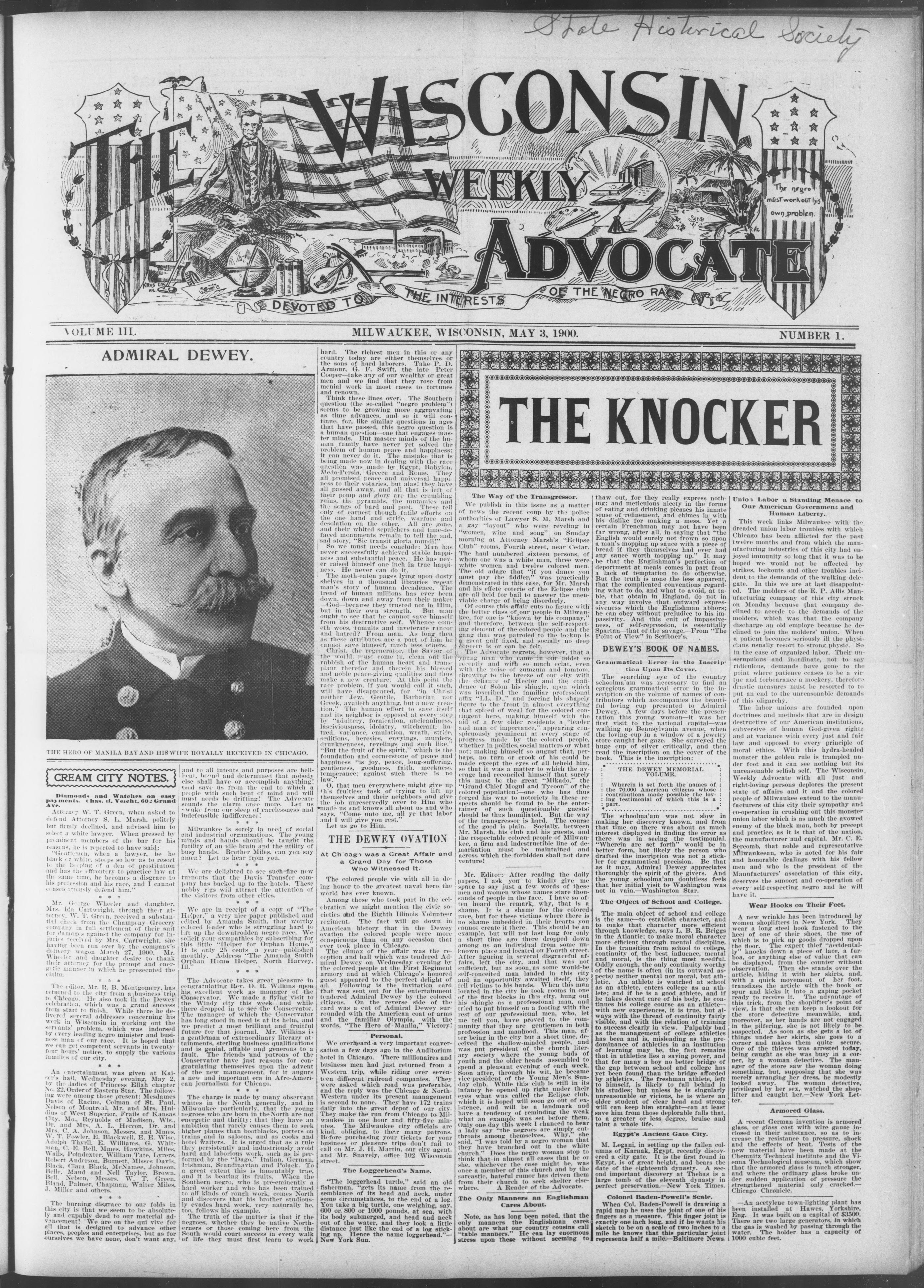
THE HERO OF MANILA BAY AND HIS WIFE ROYALLY RECEIVED IN CHICAGO
VOLUME III.
ADMIRAL
THE HERO OF MANILA BAY AND HIS W
CREAM CITY NOTES.
Diamonds and Watches on easy payments. Chas. H. Veacht, 602 Grand Ave.
Attorney W. T. Green, when asked to defend Attorney S. L. Marsh, politely but firmly declined, and advised him to select a white lawyer. When pressed by prominent members of the bar for his reasons, he is reported to have said:
"Gentlemen, when a lawyer, be he black or white, stoops so low as to resort to the keeping of a den of prostitution and has the effrontery to practice law at the same time, he becomes a disgrace to his profession and his race, and I cannot consciously defend him."
☆ ☆ ☆
Mr. George Wheeler and daughter, Mrs. Ida Cartwright, through their attorney, W. T. Green, received a substantial check from the Champeny Grocery company in full settlement of their suit for damages against the company for injuries received by Mrs. Cartwright, she having been run over by the company's delivery wagon March 27, 1900. Mr. Wheeler and daughter desire to thank their attorney for the prompt and energetic manner in which he prosecuted the claim.
* * *
The editor, Mr. R. B. Montgomery, has returned to the city from a business trip to Chicago. He also took in the Dewey celebration, which was a grand success from start to finish. While there he delivered several addresses concerning his work in Wisconsin in working out the servants' problem, which was indorsed by every leading negro minister and business man of our race. It is hoped that we can get competent servants in twenty-four hours' notice, to supply the various families of our city.
※ ※ ※
An entertainment was given at Kaiser's hall. Wednesday evening, May 2, by the ladies of Princess Ellah chapter No. 22. Order of Eastern Star. The following were among those present: Mesdames Davis of Racine, Colman of St. Paul, Nelson of Montreal, Mr. and Mrs. Huldius of West Superior, Frails of Kansas City, Mo., Reynolds of Madison, Wis., Dr. and Mrs. A. L. Herron, Dr. and Mrs. C. A. Johnson, Messrs. and Mines. W. T. Fowler, E. Blackwell, E. E. Wise, Adolph Thyrll, E. Williams, G. Whitman, C. E. Bell, Mmes, Hawkins, Miles, Walls, Poindexter, William Tate, Lyrers, Robert Anderson, Burnett, Misses Davis, Black, Clara Black, McNamee, Johnson, Belle, Maud and Nell Taylor, Brown. Bell, Nelson, Messrs. W. T. Green, Bland, Palmer, Chapman, Walter Miles, J. Miller and others.
* * *
The burning disgrace to our folds in this city is that we seem to be absolutely and cupably dead to our material advancement! We are on the qui vive for all that is designed to advance other places, peoples and enterprises, but as for ourselves we have none, don't want any,
and to all intents and purposes are hell-bent, bound and determined that nobody else shall have or accomplish anything! God save us from the end to which a people with such bent of mind and will must needs be drifting! The Advocate sounds the alarm once more. Let us awake from our sleep of carelessness and indefensible indifference!
* * *
Milwaukee is sorely in need of social and industrial organizations. The young minds and hands should be taught the futility of an idle brain and the utility of busy hands. Brother Miles, can you say amen? Let us hear from you.
* * *
We are delighted to see such fine new turnouts that the Davis Transfer company has backed up to the hotels. These hobby rigs will attract the attention of the visitors from other cities.
* * *
We are in receipt of a copy of "The Helper," a very nice paper published and edited by Amanda Smith, that worthy colored leader who is struggling hard to lift up the downtrodden negro race. We solicit your sympathies by subscribing for this little "Helper for Orphan Home." It is only 25 cents a year—published monthly. Address "The Amanda Smith Orphan Home Helper, North Harvey, Ill."
* * *
The Advocate takes great pleasure in congratulating Rev. D. R. Wilkins upon his excellent work as manager of the Conservator. We made a flying visit to the Windy city this week and while there dropped in to see the Conservator. The manager of which the Conservator has long stood in need is at its helm, and we predict a most brilliant and fruitful future for that journal. Mr. Wilkins is a gentleman of extraordinary literary attainments, sterling business qualifications and is genial, affable and generous to a fault. The friends and patrons of the Conservator have just reasons for congratulating themselves upon the advent of the new management, for it augurs a new and important era in Afro-American journalism for Chicago.
* * *
The charge is made by many observant whites in the North generally, and in Milwaukee particularly, that the young negroes who are born in the North are not energetic and thrifty; that they have an ambition that rarely causes them to seek higher planes than bootblacks, porters on trains and in saloons, and as cooks and hotel waiters. It is urged that as a rule they persistently and industriously avoid hard and laborious work, such as is performed by the "Dago," Italian, German, Irishman, Scandinavian and Polack. To a great extent this is lamentably true, and it is bearing its fruits. When the Southern negro, who is pre-eminently a hard worker and who has been trained to all kinds of rough work, comes North and discovers that his brother studiously evades hard work, very naturally he, too, follows his example.
The truth of the matter is that if the negroes, whether they be native Northernners or those coming here from the South would court success in every walk of life they must first learn to work
hard. The richest men in this or any country today are either themselves or the sons of hard laborers. Take P. D. Armour, G. F. Swift, the late Peter Cooper—take any of our wealthy or great men and we find that they rose from menial work in most cases to fortunes and renown.
Think these lines over. The Southern question (the so-called "negro problem") seems to be growing more aggravating as time advances, and so it will continue, for, like similar questions in ages that have passed, this negro question is a human question—one that engages master minds. But master minds of the human family have never yet solved the problem of human peace and happiness; it can never do it. The mistake that is being made now in dealing with the race question was made by Egypt, Babylon, Medo-Persia, Greece and Rome. They all promised peace and universal happiness to their votaries, but alas! they have all passed away, and all that is left of their pomp and glory are the crumbling ruins, the pyramids, the mummies and the songs of bard and poet. These tell only of earnest though futile efforts on the one hand and strife, warfare and desolation on the other. All are gone, and their whited sepulchers and time-defaced monuments remain to tell the sad, sad story. "Sie transit gloria mundi"
So we must needs conclude: Man has never successfully achieved stable happiness and substantial peace. He has never raised himself one inch in true happiness. He never can do it.
The moth-eaten pages lying upon dusty shelves in a thousand libraries repeat man's story of human decadence. The trend of human millions has ever been down, down and away from their maker—God—because they trusted not in Him, but in their own strength. But man ought to see that he cannot save himself from his destructive self. Whence cometh woes, tumults and inveterate rancor and hatred? From man. As long then as these attributes are a part of him he cannot save himself, much less others.
Christ, the regenerator, the Savior of the world, must come in, clean out the rubbish of the human heart and transplant therefor and therein his blessed and noble peace-giving qualities and thus make a new creature. At this point the race problem, if you would call it such, will have disappeared, for "in Christ neither Jew, Gentile, Barbarian nor Greek, availileth anything, but a new creation." The human effort to save itself and its neighbor is opposed at every step by "adultery, fornication, uncleanliness, lasciviousness, idolatry, witchcraft, hatred, variance, emulation, wrath, strife, seditions, heresies, envyings, murders, drunknenness, revelings and such like." "But the fruit of the spirit," which is the foundation and cornerstone of peace and happiness "is joy, peace, long-suffering, gentleness, goodness, faith, meekness, temperance; against such there is no law."
O. that men everywhere might give up this fruitless task of trying to lift up themselves and their neighbors and give the job unreservedly over to Him who made us and knows all about us and who says. "Come unto me, all ye that labor and I will give you rest."
THE DEWEY OVATION
At Chicago was a Great Affair and a Grand Day for Those Who Witnessed It.
The colored people vie with all in doing honor to the greatest naval hero the world has ever known. Among those who took part in the celebration we might mention the civic societies and the Eighth Illinois Volunteer regiment. The fact will go down in American history that in the Dewey ovation the colored people were more conspicuous than on any occasion that ever took place in Chicago.
The climax of the affair was the reception and ball which was tendered Admiral Dewey on Wednesday evening by the colored people at the First Regiment armory and at which Chicago's honored guest appeared to the perfect delight of all. Following is the invitation card that was sent out for the entertainment tendered Admiral Dewey by the colored citizens. On the reverse side of the card was a cut of Admiral Dewey surrounded with the American coat of arms and the familiar Olympia, with the words, "The Hero of Manila," Victory!
Personal.
We overheard a very important conversation a few days ago in the Auditorium hotel in Chicago. There millionaires and business men had just returned from a Western trip, while riding over seventeen different railroad companies. They were asked which road was preferable, and the reply was the Chicago & North-Western under its present management is second to none. They have 172 trains daily into the great depot of our city. They make the run from Chicago to Milwaukee in one hour and fifty-five minutes. The Milwaukee city officials are kind, obliging, to their many patrons. Before purchasing your tickets for your business or pleasure trips don't fail to call on Mr. J. H. Martin, our city agent, and Mr. Snavely, office 102 Wisconsin street.
The Loggerhead's Name.
"The loggerhead turtle," said an old fisherman, "gets its name from the resemblance of its head and neck, under some circumstances, to the end of a log. You take a big turtle, one weighing, say, 600 or 800 or 1000 pounds, at sea, with its body submerged, and head and neck out of the water, and they look a little distance just like the end of a log sticking up. Hence the name loggerhead."—New York Sun.
The Way of the Transgressor
We publish in this issue as a matter of news the recent coup by the police authorities of Lawyer S. M. Marsh and a gay "layout" who were reveling in "women, wine and song" on Sunday morning at Attorney Marsh's "Eclipse Club" rooms, Fourth street, near Cedar. The haul numbered sixteen persons, of whom one was a white man, three were white women and twelve colored men. The old adage that "if you dance you must pay the fiddler," was practically demonstrated in this case, for Mr. Marsh and his effete coterie of the Eclipse club are all held for bail to answer the unenviable charge of being disorderly.
Of course this affair cuts no figure with the better class of our people in Milwaukee, for one is "known by his company," and therefore, between the self-respecting element of the colored people and the gang that was patroled to the lockup is a great gulf fixed, and socially no deep concern is or can be felt.
The Advocate regrets, however, that a young man who came in our midst so recently and with so much eclat, even with the noise of zumzum and totomt, throwing to the breeze of our city with the defiance of Hector and the confidence of Solon his shingle, upon which was inscribed the familiar professional affix "LL, D." and forcing his shapely figure to the front in almost everything that spiced of weal for the colored contingent here, making himself with the aid of a few older residents a "leader and man of importance," appearing conspicuously prominent at every stage of progress made by the colored people, whether in politics, social matters or what not; making himself so august that, perhaps, no turn or crook of his could be made except the eyes of all beheld him, so that it was a matter to which the average had reconcilied himself that surely this must be the great "Mikado," the "Grand Chief Mogul and Tycoon" of the colored population!—one who has thus forged his way to notoriety in these respects should be found to be the entertainer of such questionable guests; should be thus humiliated. But the way of the transgressor is hard. The course of the good is plain. Socially, between Mr. Marsh, his club and his guests, and the respectable colored people of Milwaukee, a firm and indestructible line of demarkation must be maintained and across which the forbidden shall not dare venture!
---
Mr. Editor: After reading the daily papers, I ask you to kindly give me space to say just a few words of these men and women whose names stare thousands of people in the face. I have so often heard the remark, why, that is a shame. It is a shame for the colored race, but for these victims where there is no shame imbedded in their hearts you cannot create it there. This should be an example, but will not last long for only a short time ago there dropped down among us an individual from some unknown place and located on Fourth street. After figuring in several disgraceful affairs, left the city, and that was not sufficient, but as soon as some would-be self-conceited man landed in this city and an opportunity awaited itself, they fell victims to his hands. When this man located in the city he took rooms in one of the first blocks in this city, hung out his shingle as a professional man, and tried to put himself on a footing with the rest of our professional men, who, let me tell you, have proved to the community that they are gentlemen in both profession and manhood. This man, after being in the city but a short time, deceived the shallow-minded people, and was put president of the church literary society where the young buds of youth and the older heads assembled to spend a pleasant evening of each week. Soon after, through his wit, he became vice-president of the Young Men's Sunday club. While this club is still in its infancy he opened up right under their eyes what was called the Eclipse club, which it is hoped will soon go out of existence, and will be a landmark and have a tendency of reminding the weak what an example was set before them. Only one day this week I chanced to hear a lady say "the negroes are simply cut-throats among themselves. Why," she said, "I was told by a negro woman that they have branched out in the white church." Does the negro woman stop to think that in almost all cases that he or she, whichever the case might be, was once a member of this church and by the sarcastic, hateful rumor has driven them from their church to seek shelter elsewhere. A Reader of the Advocate.
The Only Manners an Englishman Cares About.
Note, as has long been noted, that the only manners the Englishman cares about are what our country cousins call "table manners." He can lay enormous stress upon these without seeming to
thaw out, for they really express nothing; and meticulous nicety in the forms of eating and drinking pleases his innate sense of refinement, and chimes in with his dislike for making a mess. Yet a certain Frenchman may not have been far wrong, after all, in saying that "the English would surely not frown so upon a man's mopping up sauce with a piece of bread if they themselves had ever had any sauce worth mopping up." It may be that the Englishman's perfection of deportment at meals comes in part from a lack of temptation to do otherwise. But the truth is none the less apparent, that the complicated conventions regarding what to do, and what to avoid, at table, that obtain in England, do not in any way involve that outward expressiveness which the Englishman abhors; he can obey without prejudice to his impassivity. And this cult of impassiveness, of self-repression, is essentially Spartan—that of the savage.—From "The Point of View" in Scribner's.
DEWEY'S BOOK OF NAMES.
Grammatical Error in the Inscription Upon Its Cover.
The searching eye of the country schoolma'am was necessary to find an egregious grammatical error in the inscription on the volume of names of contributors which accompanies the beautiful loving cup presented to Admiral Dewey. A few days before the presentation this young woman—it was her first visit to the national capital—was walking up Pennsylvania avenue, when the loving cup in a window of a jewelry store caught her gaze. She surveyed the huge cup of silver critically, and then read the inscription on the cover of the book. This is the inscription:
* THE DEWEY MEMORIAL
VOLUME,
Wherein is set forth the names of the 70,000 American citizens whose contributions made possible the loving testimonial of which this is a part.
The schoolma'am was not slow in making her discovery known, and from that time on there was about as much interest displayed in finding the error as there was in seeing the testimonial. "Wherein are set forth" would be in better form, but likely the person who drafted the inscription was not a stickler for grammatical precision. Be that as it may, Admiral Dewey appreciates thoroughly the spirit of the givers. And the young schoolma'am doubtless feels that her initial visit to Washington was not in vain.—Washington Star.
The Object of School and College.
The main object of school and college is the same—to establish character, and to make that character more efficient through knowledge, says L. B. R. Briggs in the Atlantic; to make moral character more efficient through mental discipline. In the transition from school to college, continuity of the best influence, mental and moral, is the thing most needful. Oddly enough, the only continuity worthy of the name is often (in its outward aspects) neither mental nor moral, but athletic. An athlete is watched at school as an athlete, enters college as an athlete; and if he is a good athlete, and if he takes decent care of his body, he continues his college course as an athlete—with new experiences, it is true, but always with the thread of continuity fairly visible, and with the relation of training to success clearly in view. Palpably bad as the management of college athletics has been and is, misleading as the predominance of athletics in an institution of learning may be, the fact remains that in athletics lies a saving power, and that for many a boy no better bridge of the gap between school and college has yet been found than the bridge afforded by athletics. The freshman athlete, left to himself, is likely to fall behind in his studies; but unless he is singularly unreasonable or vicious, he is where an older student of clear head and strong will can keep him straight—can at least save him from those deplorable falls that, to a greater or less degree, bruise and taint a whole life.
Egypt's Ancient Gate City
M. Legani, in setting up the fallen columns of Karnak, Egypt, recently discovered a city gate. It is the first found in Egypt, is of great height, and bears the date of the eighteenth dynasty. A second important discovery at Thebas is a large tomb of the eleventh dynasty in perfect preservation—New York Times.
Colonel Baden-Powell's Scale.
When Col. Baden-Powell is drawing a rapid map he uses the joint of one of his fingers as a measure. This finger joint is exactly one inch long, and if he wants his sketch to be on a scale of two inches to a mile he knows that this particular joint represents half a mile.—Baltimore News.
NUMBER 1.
KER
Union Labor a Standing Menace to Our American Government and Human Liberty.
This week links Milwaukee with the dreaded union labor troubles with which Chicago has been afflicted for the past twelve months and from which the manufacturing industries of this city had enjoyed immunity so long that it was to be hoped we would not be affected by strikes, lockouts and other troubles incident to the demands of the walking delegate. In this we are at last disappointed. The molders of the E. P. Allis Manufacturing company of this city struck on Monday because that company declined to accede to the demands of the molders, which was that the company discharge an old employee because he declined to join the molders' union. When a patient becomes seriously ill the physicians usually resort to strong physic. So in the case of organized labor. Their unscrupulous and inordinate, not to say ridiculous, demands have gone to the point where patience ceases to be a virtue and forbearance a mockery, therefore drastic measures must be resorted to to put an end to the unreasonable demands of this oligarchy.
The labor unions are founded upon doctrines and methods that are in design destructive of our American institutions, subversive of human God-given rights and at variance with every just and fair law and opposed to every principle of moral ethics. With this hydra-headed monster the golden rule is trampled under foot and it can see nothing but its unreasonable selfish self. The Wisconsin Weekly Advocate with all just and right-loving persons deplores the present state of affairs and it and the colored people of Milwaukee extend to the manufacturers of this city their sympathy and co-operation in crushing out this monster union labor which is as much the avowed enemy of the black man, both by precept and practice, as it is that of the nation, the manufacturer and capital. Mr. C. E. Sercomb, that noble and representative Milwaukeean, who is noted for his fair and honorable dealings with his fellow men and who is the president of the Manufacturers' association of this city, deserves the support and co-operation of every self-respecting negro and he will have it.
Wear Hooks on Their Feet.
A new wrinkle has been introduced by women shoplifters in New York. They wear a long steel hook fastened to the heei of one of their shoes, the use of which is to pick up goods dropped upon the floor. The expert thief "accidentally" knocks down a piece of lace, a furboa, or anything else of value that can be displayed, from the counter without observation. Then she stands over the article, hiding it with her skirts, and, with a quick movement of her foot, transfixes the article with the hook or spur and kicks it into a gaping pocket ready to receive it. The advantage of this trick, from the shoplifter's point of view, is that she can keep a lookout for the store detective meanwhile, and, moreover, as her hands are not engaged in the pilfering, she is not likely to be suspected. As soon as she gets a lot of things under her skirts, she goes to a corner and makes them quite secure. One of the thieves was arrested today, being caught as she was busy in a corner, by a woman detective. The manager of the store saw the woman doing something, but, supposing that she was merely arranging her dress, he modestly looked away. The woman detective, privileged by her sex, watched the shoplifter and caught her.—New York Letter
Armored Glass.
A recent German invention is armored glass, or glass cast with wire gauze inclosed in their substance, so as to increase the resistance to pressure, shock and the effects of heat. Tests of the new material have been made at the Chemnitz Technical institute and the Vienna Technological museum, which show that the armored glass is much stronger, and where the ordinary glass broke under sudden application of pressure the strengthened material only cracked. Chicago Chronicle.
—An acetylene town-lighting plant has been installed at Hawes, Yorkshire, Eng. It was built on a capital of $3500. There are two large generators, in which the gas is washed by passing through the water. The holder has a capacity of 1000 cubic feet.
---
TO HEM IN THE BOERS.
Hamilton's Division Engaged with the Federal Troops at Thaba N'Chu.
Thaba N'Chu, Tuesday, May 1.—Afternoon.—Gen. Hamilton's division was engaged yesterday and today in forcing a passage northward. At Houtney the Boer front held a line of hills commanding the sides of the Nek. The Canadians and Gordons attacked the hill to the left, and the Shropsires and Marshall's Horse, reported by a battery, also made an attack on the enemy, who finally fled, leaving many wounded; the passage was cleared. The Boers on the mountain are now shelling the outlying camp, necessitating removal to a safer place. The Boers have three guns on the hill to the eastward of this place, outside the range of the British artillery. The Boer shelling is not doing any damage. The enemy retain their positions and the British are not attempting to dislodge them.
Gen. Hamilton, by reaching Houtney, after a full day's fighting, secured the Thaba N'Chu-Bloemfontein road.
To Hem in the Boers.
London, May 2.—It is difficult to unravel the tangled stories coming from the neighborhood of Thaba N'Chu, but apparently the British forces are engaged in a movement having for its object the hemming in of the Boers still in that district. While Gens. French and Rundle are holding the Boers at Thaba N'Chu, Gen. Broadwood's cavalry has been pushed on Boutnek in the hope of intercepting the federal convoys between Ladybrand and Winburg. As Gen. Botha has been reinforced there is every prospect of sharp fighting. The new scene of operations and the general movements of the various columns are taken to indicate that Lord Roberts is deploying his arny, preparatory to beginning his northern march.
Advance from Three Points.
It now seems likely that it is the commander-in-chief's intention to advance simultaneously from Kimberley, Bloemfontein and Ladysmith, with the view of preventing the Boers from concentrating their forces at any given point. A dispatch from Bloemfontein, dated yesterday, chronicles the prevailing opinion among the townspeople there that the war is not likely to last more than six weeks once the British advance begins, but adds that the correspondent has been unable to discover any ground for this opinion beyond the fact that Gen. Carrington has arrived at the Marandellas base, whence a flying column will be dispatched in a direction not made public.
Kruger's Proclamation.
A dispatch from Pretoria gives the text of President Kruger's proclamation expelling British subjects from the Transvaal. It says: "As numerous burghers insist on the removal of the British, and as the government is desirous of complying with the wishes of the burghers and others favorable to the republic, all Britishers residing in the district and town of Pretoria must leave the state within thirty-six hours from noon, April 30. Exception will be made in the case of those obtaining special permits." Lord Roberts forwards a list of the casualties of Gen. Ian Hamilton's force. April 30, as follows: Killed—Maj. Showers, Lieut. Parker and one private; wounded—Four officers and five men; missing—Two officers and ten men.
Boer Attack Repulsed.
A dispatch from Mafeking describing the Boer attack of April 11, says: "The bombardment of the Creosots was the hottest of the siege. Many shells entered the hospital and women's lager. Under cover of the artillery a large force commanded by Cronje (the younger), including the German corps, advanced close to Fort Abrams. The garrison laid low untile the Boer force was at close range, when they fired a volley, killed five, wounded many, and the attack was repulsed. The bombardment then ceased. The Boers, under a Red Cross flag, later, were permitted to recover their dead."
Inspected by the Queen.
Windsor is in holiday attire today and decorated from end to end in honor of the naval brigade of the British cruiser Powerful, which assisted in the defense of Ladysmith. The naval men were summoned to the castle to be inspected by the Queen. The band of the Grenadier guards met the naval brigade at the railroad station and played them to the castle through cheering throngs of people. The inspection occurred in the quadrangle and was witnessed by the Duke of York, and other members of the royal family, and a number of high naval and military officers. Her majesty drove down the line of blue jackets who then advanced and gave three cheers for the Queen. Capt. Lambton of the Powerful and the officers of the vessel were afterwards presented to her majesty, who thanked Capt. Lambton and the brigade for their noble services to the empire. The captain replied that what they had done was nothing to what the navy was prepared to do for her majesty. The Queen, some time afterwards, saw the blue jackets entertained at dinner.
"All Well at Mafeking."
Lord Roberts has telegraphed to the war office from Bloemfontein, under today's date, that news has been received from Col. Baden-Powell. The British commander at Mafeking said all was well there.
Besieged Force Eats Locusta.
London, May 2.—A dispatch to the Times from Mafeking, dated April 20, says: "A side light is thrown upon the hungry condition of the garrison by the fact that the united efforts of the whites and natives have recently been devoted to catching a swarm of locusts which passed over the town."
Lady Sarah Wilson, telegraphing from Mafeking, April 19, says: "The investment is so close that no runners have entered or issued forth for ten days. There was a terrific bombardment on April 11, but with the exception of destroying some houses it was harmless. The Boers then made a determined attack on the southward forts which were successfully repulsed. The Boers have formed a new laager on the south. Many horses are dying. Trees are being cut down for fuel. The garrison is now eating the ambulance oxen, reserving the mules till the last. The daily ration is now six ounces of gritty oat bread, a pound of bully beef and a quart of skilly."
At the conclusion of Gen. Sir George White's visit to Windsor yesterday Queen Victoria decorated the defender of Ladysmith with the cross and star of the Royal Victorian order. Her majesty and the soldier had a lengthy conference. It is learned that the Queen was more angry than for years over the publication of the Spion Kop dispatches. Jameston, St. Helena, May 1.—The British auxiliary transport Bavarian has arrived here from Cape Town with 1099 Boer prisoners. All are in excellent health. They will be landed as quickly as possible, although the wharves are blocked with stores owing to the insufficient transport inland.
A MILLION FROM PAPA.
Munificent Wedding Present of E.
New York, May 1.—A check for a million dollars was the wedding gift E. C. Benedict, the millionaire banker, is said to have given to his daughter. No such magnificent wedding has ever been witnessed in Connecticut as that of Miss Helen Benedict and Thomas Hastings, which took place in the Second Congregational church, at Greenwich, Conn., yesterday afternoon. It abounded in novel features, and, as a spectacle, was a star feature of the social season.
A Presbyterian clergyman, assisted by a Baptist minister, officiated. Vocal music was rendered by a choir of thirty robed singers from Old Trinity Episcopal church of this city. A thousand members of New York's social set journeyed to Greenwich in a special train to participate in the festivities, and when the bride sailed away in her father's yacht for a wedding trip she carried with her, it is said, a check for $1,000,000, her father's wedding gift.
Friends in Childhood.
Miss Benedict and Mr. Hastings were friends in their childhood, but of late years had seen little of each other until Mr. Hastings, who is an architect and a member of the firm of Carrere & Hastings, was commissioned by Mr. Benedict to go to Indian Head and superintend the construction of the Italian villa. The friendship of bygone days was renewed. Two thousand invitations were sent out, all the well-known society people of New York being included. Mr. and Mrs. Cleveland received a special invitation and they went to Greenwich yesterday morning on an early train and were driven at once to Indian Head. The New York contingent left the Grand Central station at 2:05 p. m., on a special train of eleven coaches chartered by Mr. Benedict.
Among those who went were Gen. and Mrs. Nelson A. Miles. Mr. and Mrs. Daniel S. Lamont, ex-Secretary of the Treasury John G. Carlisle and Mrs. Carlisle, William Rockefeller, Mr. and Mrs. Joseph Jefferson, Maude Adams, Julia Marlowe, Admiral and Mrs. Philip, Mr. and Mrs. Lawrence Hutton, Mr. and Mrs. Henry Marquand, Mrs. Anson R. Flower, Mr. and Mrs. Macland Armstrong, Mr. and Mrs. Stanford White and Mr. and Mrs. Vernon H. Brown. Greenwich was reached at 3 o'clock. Mr. Benedict had ordered 200 carriages for the use of his guests.
The Decorations.
Two boatloads of flowers from New York were used in decorating the church where the wedding ceremony was performed, and the pulpit had been taken out in order to erect a platform in its place. The effect produced in the church was that of a wildwood of blossoms and vines in the South. The main arch was covered with Southern smilax, and on each side of the platform were palms and flowering magnolias. Across the intervening space were stretched Oriental tapestries, beneath which feathery yellow Forsythia was massed.
The officiating clergyman at the wedding was Rev. Thomas S. Hastings, father of the bridegroom and formerly president of Union Theological seminary. He was assisted by Rev. Henry M. Saunders of the Madison Avenue Baptist church, New York.
The bride's gown was of white and her bouquet was of white orchids, with orange blossoms. No bridesmaids were chosen, nor was there any maid of honor from among the bride's numerous friends. The bridegroom had Charles T. McKim for best man. After the ceremony there was a reception at the Benedict home, and later the bridal pair sailed on Mr. Benedict's yacht.
COAL MINES ON FIRE.
Apprehension for the Safety of Nine Men Who Are Not Accounted For.
Bristol, Tenn., May 1.—The coal mines at this place are on fire and there is great apprehension felt for the lives of the miners who went to work this morning. It is reported that all have escaped except nine, who are unaccounted for, but nothing reliable can be learned and there seems to be no way of getting information from the mines.
JURY DISAGREED.
Failed to Convict Brigham H. Roberts of Unlawful Cohabitation with Polygamous Wife. Salt Lake City, Utah, May 1.-The jury in the case of B. H. Roberts, on trial for unlawful cohabitation, disagreed and was discharged.
BRIDE'S VEIL ON FIRE.
Groom Had Rare Presence of Mind and Extinguished the Blaze. London, May 1.—During the marriage of the daughter of the Russian ambassador to Count Alexis Davidoff in the Russian chapel, London, Monday afternoon, at which the Prince of Wales, Lord Rosebery and most of the members of the United States and other embassies were present, the bride's veil caught fire from a candle which she carried in her hand. The bridegroom maintained his presence of mind, seized the veil and quenched the incipient blaze by crumpling the gauzy fabric between his hands. There was intense excitement until it was found that no serious damage had been done.
FIND WEALTH IN STOVEPIE.
Search of Dead Woman's Late Home
Reveals Hidden Cash.
Waukegan, Ill., May 1.—Mrs. Benjamin Gardner, one of the oldest settlers of Lake county, was buried at Milburn. She was thought to have left little property, but developments have revealed traces of hidden wealth. In a woodshed in the rear of the home in a joint of stovepipe was found a collection of tins and cloths among which was hidden $800 in cash. The aged woman owned a small farm, on which she lived a retired life.
Studying Fish Language
Prof. Kollicker of the Naples aquarium recently went down into the Mediterranean in an iron cage lit by electricity. With the aid of a powerful receiver and a specially-constructed phonograph he registered the expressions of surprise with which the fish welcomed his appearance. He notes that the sound made by one fish differs greatly from that of another, and has summed up the results of his experiment in the conviction that the sounds of fishes will yet be recognized as a language.—Indianapolis Press.
—An odd excuse for burglary was given by a one-legged boy, aged 14. He broke into a hardware store in Kansas City and was captured. He pleaded that he wanted to steal some tools which would enable him to make a wooden leg for himself.
—The largest ocean-going vessels can voyage up the River St. Lawrence as far as Montreal, over 1000 miles from the Atlantic ocean.
LAY DELEGATES IN.
Successful Termination of a Fight Which Has Continued a Hundred Years. Chicago, Ill., May 2.—By a unanimous vote today the delegates to the Methodist general conference decided to give equal lay representation in all Methodist conferences. The announcement of the vote was greeted with cheers, as it was a victory which had been fought for a hundred years.
A fight was expected over the matter, but it did not materialize. The matter was introduced by Rev. J. M. Buckley of the central New York conference. He moved the adoption of the rules of the last general conference with the exception of 1 and 18. This was carried almost unanimously and Dr. Buckley asked the vote on the Rock river proposition. The proposition made at the Rock River conference was for equal lay representation in all Methodist conferences, annual and general. The proposition was read and the unanimous approval followed. The book of discipline in reference to representation at conferences was changed to read thus:
"The lay delegates shall consist of one layman for each annual conference, except such conferences as have more than one ministerial delegate, which conferences shall each be entitled to-as many lay delegates as ministerial delegates. The provisional delegates by a practically unanimous vote were admitted to seats in the conference. There were some doubts as to the outcome of this matter early, but the vote over the equal representation proposition cleared these away and the overwhelming victory was not a surprise.
The twenty-ninth general conference of the Methodist Episcopal church—the twenty-third of the delegated congresses—began here today. It will last a month and is expected to be the most important of any conference since the memorable one of 1844, when the South branch of the church severed relations with the main body over the slavery question. The pit of the Auditorium theater was filled with delegates—from North and South and East and West; Warne and Smith from India, bronzed by the sun of the equator; Hagan and Camphor from Liberia, and innumerable others representing Methodism in all parts of the world. Further back in the big hall where the conference is to be held were the spectators and the provisional delegates, whose fight for admission to the conference is expected to occupy the first days of the meeting.
The peals of the great pipe organ were still echoing when venerable, white-haired Bishop Thomas Bowman arose to declare the conferenc opened.
Bishop Merrill Presides.
As the last note of the hymn died away Bishop S. M. Merrill took the chair, the first move made in the business of the conference. Grave questions confront the gatherings. The lay delegates demand vote for vote with the clerical representatives and there are 141 provisional lay delegates awaiting action by the conference. A determined effort will be made to raise the ban on dancing, card-playing and theater-going, and arguments advanced for the consecration of bishops of limited jurisdiction, the dropping of the time limit on pastorates, and the referring of the election of conference editors, secretaries and book agents to the committees governing the different societies. It is also expected that at least some steps may be taken looking to the reuniting of the South branch of the church with the main body. There will be a general morning session of the entire conference every day except on Sundays. The fourteen standing committees whose functions are analogous to those of congressional committees, meet three times a week, seven each day, and report to the general conference such reports as are deemed worthy of general discussion and action. Of the 750 delegates entitled to seats the greater number were present this morning.
Counseled Conservatism.
Behind Bishop Bowman were the other bishops in the places of honor on the stage, facing the audience. They, in common with the remainder of the assemblage, became silent as the veteran bishop raised his hand. In a few words he called attention to the importance of the conference, counseled conservatism and the gravest consideration of matters which would be brought up, and then declared the conference open.
Bishop H. W. Warren, following Bishop Bowman, announced the first hymn which was sung with vigorous enthusiasm by the great audience.
The Apostles Creed, led by Bishop J. M. Thoburn of India, was recited by the audiences and then Bishop S. D. Foss delivered a prayer. This was followed by the reading of Psalm 46 by Rev. H. H. Lowry, D. D., of the North China conference. "Gloria" was then chanted, the second Scripture lesson from the first chapter of Acts, 1st to 14th paragraphs, read by Rev. Austin Griffin of the Wyoming conference, and another hymn announced by Rev. Harry Swan of the West Texas conference.
A prayer by Rev. Hilary A. Gobin of the Northwest Indiana conference followed and was succeed by another hymn, announced by Rev. Jacob Yunkers of the North Germany conference.
Dr. David S. Monroe of the Central Pennsylvania was elected secretary of the conference by acclamation. He called the roll of districts and delegates in alphabetical order. The vote which provided for equal lay representation was taken and the fight for the seating of the 141 provisional delegates begun. Their cause was relieved of an embarrassment by the withdrawal of all rights to a seat by Mrs. M. Y. McMahon of Griggsville. Ill. In her communication she said she believed that by withdrawing she would aid the provisionals in securing seats.
"The general conference shall not allow of more than one ministerial representative for every fourteen members of an annual conference; nor of a less number than one for every forty-five; nor of more lay delegates from any annual conference than there are ministerial delegates from such annual conference; provided, nevertheless, that when there shall be any annual conference a fractional of two-thirds the number which shall be fixed for the ratio of representation, such annual conference shall be entitled to an additional delegate for such fraction; and provided also that no conference shall be denied the privilege of one ministerial and one lay delegate."
Fatal Dewey Salute
Chicago, Ill., May 2.—While firing a salute in honor of Admiral Dewey at Lockport on the drainage canal this afternoon, the quartermaster's sergeant, Richard Popp of Fowler's battery, was fatally injured by the explosion of a charge with which he was serving a brass nine-pound Napoleon gun.
Platte River Booming
Denver, Col., May 2.—A special to the Times from Sterling, Col., says: The Platte river is out of its banks and covering the flats. The Burlington & Missouri railroad bridge is going out and other bridges are weakening and may go out at any moment. Much damage to property is expected.
—Gen. Cranje has a nephew studying for a professional career in London who has become a British subject and whose sympathies are all with his new country.
MEET DEATH IN A MINE
Explosion of Blasting Powder Costs Many Lives.
CALAMITY IN UTAH.
Futile Efforts to Escape the Deadly After-Damp-Stories Told by Survivors.
Salt Lake, Utah, May 2.—Two hundred or more lives were lost in the explosion in Mine No. 4 of the Pleasant Valley Coal company, at Scofield, Utah. One hundred and thirty-seven bodies have already been recovered. The work of rescue is still progressing, although there is no hope that any of the men who are unaccounted for have escaped death.
The scene of the disaster is just outside this place on the line of the Rio Grande Western railroad. The explosion, which occurred in the winter quarters of the mine, is attributed by some to the blowing up of a number of kegs of blasting powder. A special train was sent from Salt Lake bearing Supt. Sharp of the coal company, Supt. Welby of the railroad company and some doctors.
As fast as bodies are reached they are taken to the boarding houses and other company buildings. There they are prepared for the coroner's inquest. These buildings are numerous and in each are from ten to thirty-five bodies, which are laid in long rows. To those which have been identified are attached tags with name and address. These await the coming of relatives or friends. Two hundred coffins have been ordered from local undertakers to be sent at once to the scene of the disaster.
The first news of the Scofield disaster received in Salt Lake City gave the list of killed at twenty-five, but it was not until evening that the full extent of the tremendous calamity was understood. As the list kept constantly growing, the anxiety of the inquirers increased. The calamity was so unprecedented that the mind did not seem to be able to grasp it. The state mine inspector is still without data to fix the blame. An inquest probably will determine the responsibility for the disaster. Nine-tenths of the men killed are Americans and Welshmen. The former come mostly from Utah, with a small number from Tennessee and Colorado.
The financial loss to the company cannot be estimated, but it will be very great, what with the various claims, expenses, loss of daily output and reduced tonnage on the railroad by the shipments being stopped. In every way it is regarded as the worst disaster that ever occurred in this part of the country. The nearest approach to it was the Southern Pacific, Almy (Wyo.) explosion five years ago, when over 100 men were killed.
List of the Known Dead.
The list of known dead this morning
was as follows:
John Hunter, Sr. Alexander Wilson, Jr.
Dan Muhr. Robert Hunter.
Peter Cocklett. James C. Hunter.
James Wilson. Dick Thomas.
Robert Ferrish. David Padfield.
Will Willsted. William Jones.
Robert Willsted. William Howe, boy.
Robert T. Evans. Valentine Loxon.
Llewellyn Evans. William Reese.
James Wallace, Sr. John James.
Ben Lloyd. R. Dixon.
John Lloyd. Feral Jacquetta.
George James. Sol Lappi.
Samuel Livesay. Harry Miller.
Anselmo Jachetta. Isaac Miller.
J. May. A. Langstaff and son.
Matt Kroskle. William Samuels and son.
R. V. Miller. T. J. Reilley.
William Davis. John Thomas.
Davis and son. Anderson.
Andrew Adamson. Henry Wilson.
William Parnley.
James Webber. Bernard Dougai.
Thomas Padfield. Thonas Williams and
Charles Edwards.
Andrew Hunter and William Gatherman.
son. John Price.
James Gatherman. George Coulthard.
John Burgs.
The difference between this list and the 137 given above is accounted for by the unidentified.
In one pile at No. 1 mine there are ten men, foreigners, as yet unknown. The injured, eight in number, were taken on a special train to Salt Lake City, leaving here at 7 o'clock.
There are one to three of the injured that will not survive. Among the injured are:
Thomas Livesay. Sandy Wilson.
John Wilson. John Kirton.
William Boweler. John Peddoe.
Thomas Sellers. William Livesay.
201 Bodies Recovered.
Salt Lake, Utah, May 2.—A special to the Desert News from Scotified dated 10:30 today says: At this hour 201 bodies have been recovered. It is now known that between 300 and 400 men entered the mines, and it is also known that a great majority of them have been killed. Two camps have always been conspicuous for the large number of married men employed. This fact makes the disaster more appalling and far-reaching in its results. Several families have been robbed of all their male representatives. In the Hunter family seven are missing. Among the dead are about twenty young boys who acted as couplers and trap boys. At Prevo, a mass meeting has been held for the relief of the families of the victims and $3000 subscribed.
MILLS TO REOPEN.
Three Plants of Steel and Wire Company Which Were Closed by Gates' Order.
Chicago, Ill., May 2.—A special to the Post from Joliet, Ill., says: The three local plants of the American Steel and Wire company, which have been closed since the order of Chairman John W. Gates over two weeks ago, will be reopened next Monday and over 1200 men be put back to work. Notice to this effect was sent to all the workmen today. At the local offices of the company nothing could be learned in regard to the resumption of work in the mills. It is said that all the surplus stock has been disposed of.
Mrs. Potter's Cows.
Mrs. James Brown Potter says: "I have always, whether working or not, confined myself to most simple forms of nourishment, and find them best for supporting any sustained efforts of mind or body. Personally I exist almost on milk, oatmeal, plain roast or boiled meats and fruits. I seldom, unless under orders, touch stimulants or wine of any sort. I avoid all 'made' dishes and pastries, which I do not find sustaining or nourishing. At the theater I take milk—in fact, I may say briefly there are three Alderney cows who live principally for me, and I principally contribute to keep them alive." Life and Beauty.
Pay for Their Coffins.
It appears that when Tommy Atkins arrives in India he has one rupee per month stopped out of his pay until fifteen rupees have been collected for a coffin. This fifteen rupees is invested in the regimental soda water machine, and should he die the machine provides him with a coffin and buries him decently; but, should he survive, when he leaves India he receives back his fifteen rupees and his share of the profits of the soda water.
TWENTY MEN SLAIN.
They Were Sheltered In a Church Which Is Set on Fire by the Fillpinos. Manila, May 2.—The American garrison of Catubig, Island of Samar, consisting of thirty men belonging to the Fortythird regiment, has been attacked by rebels. Twenty of the Americans were killed. The remainder were rescued.
The Americans were quartered in the Catubig church, which the enemy, numbering several hundred men, surrounded and fiercely attacked. The Americans fought for two days and then the rebels managed to ignite the roof of the church and it burned away and finally fell upon those inside the edifice. The walls remained intact, however, and were used as a shelter by the besieged Americans for three days longer, the enemy attacking the building on all sides at once. The Americans continued firing from the windows and doors of the church and did great execution among the Filipinos. It is estimated that over 200 of the latter were killed, many dead bodies being removed from the scene of the fighting.
After five days' resistance by the Americans a lieutenant and eight men arrived from Laoan and engaged the besiegers, who thereupon retired.
The fortunate arrival of these reinforcements prevented the annihilation of the American force entrenched in the church, who had repeatedly declined to surrender when ordered to do so by the Filipinos.
The ten survivors were without food, had little ammunition and were physically exhausted when relieved.
This fight has encouraged the Filipinos, who are now acting in an aggressive manner and threatening that section of the coast, particularly the town of Catarama, whence the garrison will probably be withdrawn to Laoan.
Shifting of Army Officers.
Washington, D. C., May 2.—Gen. Wesley Merritt of the army, who is soon to go upon the retired list, has asked for relief from duty as commanding general of the military department of the East and the war department granted the request, selecting Gen. J. R. Brooke as Merritt's successor. There has been much interest in the matter of Gen. Merritt's successor, for the reason that Gen. Otis was named as a possible candidate for the billet, which is one of the most attractive of the army. Gen. Otis may not return to the Philippines in the autumn as has been reported; there is already some talk of placing Gen. MacArthur in command of the forces in those islands, in which event Otis will probably be assigned to the command of the department of California, and Gen. Shafter relieved.
A FALSE STATEMENT.
Carter's Father-in-Law Denies the
New York, May 2.—Mr. Westcott, father-in-law of Oberlin M. Carter, the former United States army engineer, who is in Leavenworth prison for robbing the government, has turned on his son-in-law. He declares that the captain did not get any money from him, but that Carter gave him almost half a million dollars, which he invested. Carter, who lived at the rate of $30,000 a year, testified at the court-martial that he was controlling a large amount of bonds and other assets which belonged to Mr. Westcott, his father-in-law, and the income of which, Carter said, Westcott had allowed him to use since the death of Carter's wife in 1892.
The officers of the government have a written statement from Westcott in which he repudiates as false this statement of Carter. Westcott has given the government experts full access to his accounts in the banks and his private papers.
Invested for Carter.
These show, as the examiner reports, that, while Carter frequently through Greene and the Gaynors, or otherwise, made Westcott a depositary of money, in every instance it was turned over or invested as Carter directed, and that not a dollar stuck to Westcott's hands.
These papers also show that when the first charge of fraud was made against Carter by the board of inquiry appointed by the President, Westcott refused to longer keep Carter's securities left with him.
On the revelations found in Westcott's accounts and elsewhere the experts have made the following report to be used in the prosecution of R. D. Greene and John F. Gaynor, the contractors indicted in Savannah, and who have since found refuge in the decision of a New York judge:
How Money was Divided.
"February 10, 1893—Carter issued disbursing checks to the contractors, which were deposited by them for $48,000, of which one-third is drawn out by them and on the same date Carter invests $16,000 in bonds.
"August 7, 1893—Carter issued disbursing check to the contractors, which was deposited by them for $39,075, of which one-third, less $75 allowed for Carter's expenses to New York, is withdrawn by them, and two days later Carter invests $13,000 in bonds.
"December 3, 1893—Carter issued disbursing checks to the contractors, which were deposited by them for $63,075, of which one-third, less $75 allowed for Carter's expenses to New York, is withdrawn by them, and on the same day Carter invests $21,000 in securities."
Carter's Big Share.
"September 8, 1894—Carter issued disbursing check to the contractors for $461,075; September 11, cashed by them, $152,510. Deposited by Carter on same date, $103,022.78, and subsequently invested by him, including another collection December 4, $53,000."
The expert's report shows a continuance of the divisions month by month as the money was paid by the government from the beginning to the end of Carter's control at Savannah. It shows Carter's one-third of the spoil to have been over $550,000, exclusive of his share in the last checks for $575,749.90 which were paid over in New York at the time Carter was about to leave the district when succeeded by Capt. Gillette.
HEBREW SCHOLAR DEAD.
Louis Mayer, of Chicago, Whose Work as Translator is Highly Valued.
Chicago, Ill., May 2.—Louis Mayer, one of the oldest and best-known Jewish residents of Chicago, died yesterday of old age. Mr. Mayer was 85 years old and was born in Germany. He had lived in Chicago fifty-five years.
Mr. Mayer was one of the founders of Sinai temple, and was identified with the congregation of that church from its beginning. He was highly educated, and translated the Old Testament from the original Hebrew into English. He was regarded as an authority on ancient Hebrew, and his work as a translator is highly valued.
Mr. Mayer's wife died seven years ago. He left four children, Mrs. Rudolph Wolfson of Kansas City, Mrs. Mark Harris of Minneapolis and Mrs. H. B. Franklin and Benjamin S. Mayer of this city.
Just as surely indicates that the blood is lacking in vitality and the elements of health as does the most obstinate humor that the vital fluid is full of impurities. Hood's Sarsaparilla cures that tired feeling by enriching and vitalizing the blood, creating a good appetite and invigorating every organ of the body.
"I had that tired feeling all the time. Was as tired in the morning when I rose as I was when I went to bed. I took four bottles of Hood's Sarsaparilla and it made me feel like a new man. I could work hard and not feel tired." A. P. Charter, Creston, Iowa.
Hood's Sarsaparilla is sold by all druggists. Get Hood's and only Hood's.
Men as Hair Growers.
The longest recorded hair growing on a female head was eight feet. The longest recorded beard was twelve feet.
Patents to Inventors.
Messrs. Benedict & Morsell, solicitors of patents, Old Insurance building, Milwaukee, report patents issued to Western inventors April 24 as follows:
R. F. Barker and M. Corry, Marlinette, Wis., steam setworks for sawmill carriages; G. A. Bowen, Fond du Lac, Wis., refrigerator; J. S. Bullock, Racine, Wis., feeder for printing presses; C. I. Burt, Davenport, Ia., stock-fountain; L. Carr, Atchison, Kas., buckle; N. A. Christensen, Milwaukee, box or housing for compressors for air-brake systems; L. E. Fagan, Onsiaw, Ia., draft-equalizer; W. B. Hogan, Milwaukee, gate; P. S. Holum, De Forest, Wis., transplanter; F. B. Hull, Oskaloosa, Ia., portable-sprinkler; E. Janesch, Lincoln, Neb., tank-heater and feed cooker; J. A. Ramsey, Topeka, Kas., school desk; E. S. Saunders, Olathe, Kas., carfender; W. Westenberg, Early, Ia., shovel; Wm. Gagnier, Milwaukee design), pessory; C. W. Levalley, Milwaukee, chainlink (design).
—The Queen of Roumania ("Carmen Sylva") has again shown her sympathy with England by writing a poem in praise of that country's attitude in South Africa.
Sterling silver hearts 10c and upwards, engraving free. Archie Tegtmeyer Gold and Silversmith Co., Grove and National Ave., Milwaukee, Wis.
—Senator Hoar's fad is the cultivation of flowers. When not in Washington he spends several hours a day in his garden.
Fisher's Flavoring Extracts are endorsed by pure food laws and the U. S. government for their PURITY and STRENGTH. A. J. Hilbert Co., Milw.
—Gov. Wells of Utah was for five years a reporter on the staff of newspapers in New York and San Francisco.
Have you tried "M-B" Flavors? If not, why? Your grocer sells them.
—Col. Kekewich, who won distinction at Kimberley, is one of the best marksmen in the British army.
FOR WOMAN'S HEALTH
Earrest Letters from Women Relieved of Pain by Mrs. Pinkham.
"DEAR MRS. PINKHAM:—Before I commenced to take your medicine I was in a terrible state, wishing myself dead a good many times. Every part of my body seemed to pain in some way. At time of menstruation my suffering was something terrible. I thought there was no cure for me, but after taking several bottles of Lydia E. Pinkham's Vegetable Compound all my bad feelings were gone. I am now well and enjoying good health. I shall always praise your medicine."—Mrs. AMOS FESCHLER, Box 226, Romeo, Mich.
Female Troubles Overcome
"DEAR MRS. PINKHAM:—I had female trouble, painful menses, and kidney complaint, also stomach trouble. About a year ago I happened to pick up a paper that contained an advertisement of Lydia E. Pinkham's Vegetable Compound, and when I read how it had helped others, I thought it might help me, and decided to give it a trial. I did so, and as a result am now feeling perfectly well. I wish to thank you for the benefit your medicine has been to me."—MRS. CLARA STIEBER, Diller, Neb.
No More Pain
"DEAR MRS. PINKHAM:—Your Vegetable Compound has been of much benefit to me. When my menses first appeared they were very irregular. They occurred too often and did not leave for a week or more. I always suffered at these times with terrible pains in my back and abdomen. Would be in bed for several days and would not be exactly rational at times. I took Lydia E. Pinkham's Vegetable Compound, and menses became regular and pains left me entirely."—Mrs. E. F. CUSTER, Brule, Wis.
READY REFERENCE DIRECTORY
READY REFERENCE DIRECTORY
A List of Prominent and Reliable Business Concerns in Milwaukee by Whom Correspondence is Solicited.
ARCHITECTS AND SUPERINTENDENTS.
CHAS. FITZGERALD, room 19. Mack block.
EDUCATIONAL.
ST. JOHN'S MILITARY ACAD., Delafield. Wis.
ENGRAVERS AND ILLUSTRATORS.
CLARK ENGRAVING CO., 84 Mason street.
THE CRAMER-BOAKDMAN CO., McGeech bldg.
FRANK KRUS, Evening Wisconsin bldg.
FURNITURE—FINE AND MEDIUM GRADES.
Slater, Price & Dempsey, 137-9 Wisconsin st..
Latest styles. Photos and prices on request.
GRAIN, PROVISIONS, STOCKS AND BONDS.
The Hadden-Krull Co., Chamber of Commerce bldg.
LIQUOR AND MORPHINE HABIT.
Keeley Institute. Waukesha, Wis. Permanent cure
PATENT ATTORNEYS AND SOLICITORS
(REGISTERED.)
Erwin. Wheeler & Wheeler. 58-9 Loan & Trust.
JNO. S GREEN. 63 New Insurance bldg.
la les' and Gent's Clothes and awkls of Family Dyeing at real sofa is price. Mail or arrange promptly attended to. Write. HACK & ALTEN. 534 Clinton Street, Milwaukee. Wis.
PAYNE ON PORTO RICO
LEGISLATION NEEDED FOR INSULAR POSSESSIONS.
Wisconsin Republican Talks of the Tremendous and Lasting Consequence of the Constitutional Question Involved—Follows Lincoln and Webster.
Hon. Henry C. Payne, of Milwaukee, the Wisconsin member of the Republican National Committee, has been in Los Angeles, where he was interviewed by the Los Angeles Times, of which Gen. Harrison Gray Otis is president and general manager. Speaking of the Porto Rican question, Mr. Payne said:
"It is a momentous question, but the great body of the people has confidence, I find, in the ability and good faith of the administration, and is resting confident in the belief that the President and the Republican majority in Congress will do what is right by Porto Rico.
"President McKinley's declaration in his message that it was our plain duty to have free and unlimited trade with Porto Rico was an attractive program, and met with a sympathetic response. But it is the President's duty to change his mind, just as it is any other man's, when he sees, after a careful study of a question, that another policy is demanded by wisdom and justice.
"The fact is that the President and nearly all his advisers in Washington, a great majority of the Republican Senators and Representatives, arrived at the conclusion that the first legislation with regard to our insular possessions, if we may call them such, should be in the line of setting forth a principle, and that principle should be that these new possessions shall not hold the same relation to the country as do the Territories that have become incorporated and are incipient States.
"I think the more thoughtful people of the country are opposed to any plan to bring these islands in as integral parts of the nation. Call it what you please, we must come down to a colonial policy of some form. There is great anxiety on the part of the administration to get started right on this matter. Certain newspapers declared that the President's change of front was due to the pressure of the tobacco and sugar interests. That charge seems to me ridiculous in view of the fact that these interests want absolute free trade with Porto Rico.
"I was born and brought up in Massachusetts, and I always believed in Daniel Webster's interpretation of the Constitution, instead of that of Mr. Calhoun. Some Republican newspapers seem inclined to line up with Mr. Calhoun and the Dred Scott decision, in considering this Porto Rican matter, shouting that 'the Constitution follows the flag,' but I believe the country can more safely follow the teachings of Abraham Lincoln and Daniel Webster.
"Underneath the trifling tariff charges proposed there lies this old constitutional question, which is of tremendous and lasting consequence. You remember that John C. Calhoun and the champions of slavery maintained that the Constitution went with the flag into all territory acquired by the United States, and therefore the slaveholder had the right to carry his slaves and keep them in any territory. This view was maintained by the infamous Dred Scott decision of the United States Supreme Court, to the effect that the United States can acquire territory only for the purpose of forming States, and that all acquisitions must be treated as integral parts of the Union. Webster and Lincoln took the opposite view that new territory, acquired in one way or another, is not an integral part of the Union till it has been duly incorporated, and until then the government has constitutional power to regulate its affairs. Here is the real issue involved in all this Porto Rican discussion, and I firmly believe the thinking people of this country, after careful consideration, will prefer to follow Lincoln and Webster, whom history has vindicated, rather than Douglas and Calhoun.
"This little flurry about Porto Rico will soon be over. It will not affect the result of the Presidential election. The administration stands well with the people. It has fulfilled its pledges to them, and more, too. On the money question it has done better than it promised. It has builted better than the Republican platform. It has restored confidence and has revived business to the extent that we have more prosperity even than we had in 1892, which was high tide. I cannot doubt that such an administration will be sustained."
Expansion and Business.
Consul General Haywood has sent to the State Department the returns of Hawaiian trade for 1899. They show total exports and imports of $41,700,000, of which the United States secured no less than $37,500,000 of trade, leaving only $4,200,000 divided among all other countries.
A list of forty articles, all of which are of American manufacture or production, shows an increase in importations amounting to $5,267,680, as compared with 1898. The revenue from import duties in 1899 was $400,000 in excess of that of 1898. This is a large gain when it is considered that almost all goods imported from the United States are admitted there free of duty.
During the month of December, 1899, the largest amount of imports ever recorded for one month in Honolulu was received. Sixteen foreign steamers and forty-eight sailing vessels arrived in port with cargoes. This does not include the large number of United States transports that entered the harbor bringing stock and quartermaster's
supplies. There were forty general cargoes, amounting to a total of 45,000 tons; eleven cargoes of coal, the total being 22,850 tons; and thirteen vessels brought in lumber with a total of 9,198,520 feet. The acquisition of these islands by the United States has given an impetus to Honolulu that has attracted the commercial interest of the world. The carrying and shipping to this port has grown with such rapidity that the increase of trade in December, 1899, compared with December of 1898, is something phenomenal.
Figures of the Bureau of Statistics of the Treasury Department show that exports from the United States to the Hawaiian Islands have more than doubled since 1897, and were $4,500,000 larger in 1899 than in 1898. This shows the benefits to American producers and manufacturers of our expansion policy through Hawaiian annexation. Export figures from the United States to the Hawaiian Islands in the last three calendar years were as follows:
1897. 1898. 1899.
$5,478,224 $6,827,848 $11,305,581
Ohio's Bank Deposits Increase.
Ohio's Bank Deposits Increase. Prosperity in the Buckeye State has been advancing by leaps and bounds. It is in the air. People there feel, breathe and touch it. They cannot cross the streets or open their farmhouse doors without seeing abundant signs of it. Factory smoke stacks belch it forth. The well filled dinner pail savors of it. The wage-earner feels it in his pocket, while his wife and family sec it in their homes amid the luxuries and comforts with which they are now surrounded. New garments take the place of "Cleveland badges." Free soup and free silver have given way to honest work and honest money. The job hunts the man. The man isn't hustling for the job.
These facts are self-evident to all dwellers in Ohio, as well as to those who visit and pass through the "State of Presidents." If proof were needed it can be found right at hand in the last annual report of the Comptroller of the Currency, Charles T. Dawes, of Illinois. His official returns make the following remarkable exhibit:
Amount of deposits.—
July 18, 1894. June 30, 1899.
Banks. $32,251,021 $49,143,494
National 4,244,280 11,086,153
State and private 3,220,699 9,249,507
Loan and trust 4,912,024 11,490,420
Savings 4,912,024 11,490,420
Total $44,628,024 $80,969,583
Increase in five years, over 80 per cent. $36,341,559
per cent.
Number of
Average
depositors.
July
June
July
June
18,
30,
18.
30.
Banks.
1894.
1890.
1894.
1890.
1894.
1890.
National ..... 91,690
122,054
$352
$403
State, private ..... 15,908
37,888
267
294
Loan, trust ..... 4,469
7,033
721
1,315
Savings ..... 30,032
60,189
163
191
Total .....142,090
226,964
Average ..... $314
$357
In July, 1894, total deposits in all the banks of Ohio amounted to $44,628,024. Just five years later, on June 30, 1899, they amounted to $80,969,583. The increase was $36,341,559—or more than $0 per cent.
In July, 1894, there were 142,099 persons who had deposits in the banks of Ohio. At the end of June, 1899, there were 226,964 depositors. Within five years the number of people who had money to put away in the banks had increased by 84,865-a gain of 60 per cent. Notwithstanding this very large addition to the number of money savers in Ohio, which would alone account for most of the $36,000,000 additional in deposits, the figures of Comptroller Dawes show that the average amount to the credit of each depositor in the State of Ohio had increased by $43—from $314 in 1894 up to $357 in 1889.
It is perfectly safe to say that Republican prosperity under the administration of the Ohio President, William McKinley, has reached the pockets of the people in his own State.
Fears Strikers May Lose.
During the early part of one of the sessions of the Military Affairs Committee of the House of Representatives Messrs. Hay, Jett and Slayden were the only Democrats present, and the direct examination of the witnesses was proceeding with but few interruptions. The absence of objections rather alarmed some of these Idaho miners who appeared to give testimony in defense of the strikers, and one of them, rushing up to Mr. Sovereign, said with some excitement, "They are playing h—l with our case, and neither Sulzer nor Lentz is here." Sulzer was soon found, however, and he hastened to attend the committee.
Important statements made by Dr. France, the surgeon, who attended the miners, were those which refuted the charges of the Democratic resolution, that the men in the so-called "bull pen" received inhuman and brutal treatment, and that those who were dying in the hospitals were denied the presence of a priest or minister. Dr. France stated that there was but a solitary instance of Father Becker being denied admission to the hospital, and that was by Mrs. France, who told him that no one was permitted to visit William Lawlor, who was seriously ill with pneumonia, during the absence and without the consent of the physician. The witness stated, however, that he met Father Becker as he was leaving the hospital and took him to see the sick man.
Dr. France gave some official light on the case of Johnson, who committed suicide while insane. He said that, having noted the peculiar actions of Johnson, he asked for an examination by the Probate Court as to his sanity. Two physicians pronounced that he was suffering from acute mania, with a suicidal tendency. While at the depot buying a ticket to take Johnson to a neighboring city, where he could be placed in a proper asylum, Dr. France left him in charge of a soldier. The prisoner broke away and ran toward
the river. The guard, not knowing that he was insane, pursued, firing high to scare rather than wound the fugitive. Johnson jumped into the river and was drowned before he was rescued. Careful examination showed that he was not touched by a bullet. It was proved also by other witnesses that Johnson was subject to hereditary insanity, and had been treated in an asylum before.
In regard to the treatment of the prisoners at Wardner, Dr. France's testimony corroborated that of other witnesses. He said that they were given good, wholesome food, care was taken that they should be comfortably covered at night, and that sanitary measures were adopted to prevent disease. As to the presence of the Federal troops at Wardner it was most salutary upon the business interests generally of that town, and of Shoshone County. He believed that if they were withdrawn the old conditions of lawlessness which prevailed for seven years might be expected.
In reply to one of the few pertinent questions put by Mr. Sulzer, the witness stated that in the issuing of permits to miners, under his direction, no discrimination had been made against the Federation of Miners, as such, in a single instance.
Rural Free Delivery.
"The credit of rural free delivery belongs almost exclusively to the McKinley administration," said Hon. Perry S. Heath, First Assistant Postmaster General. "A movement to broaden the free delivery of the mails was begun by Postmaster General Wanamaker under the administration of Gen. Harrison. It took the form of village free delivery, and extended, as an experiment, the plan of delivering mails by carriers, as existing in cities of 10,000 population or $10,000 gross postal receipts, to forty or fifty selected villages of less population and smaller postal receipts. The experiment was a success as far as it went, but the succeeding Democratic administration, fearing its effect in poularizing Republican principles and disseminating Republican literature, ordered it dropped.
"It was a Republican administration that conceived and executed the idea of brightening the home of the farmer, educating his children, increasing the value of his land, compelling the improvement of his roads, and giving him ready access to a market for his crops by carrying the United States mails to him on his farm.
"Since the 4th of March, 1897, nearly 100,000 rural homes in all parts of the United States have been brought into close touch with the rest of the world by a daily visit of the rural postman."
"The initiation of some form of free delivery which should reach the heretofore isolated rural communities, was forced upon the last administration in its closing year by Congress, responsive to the wishes of the people. Forty-four rural experiments were reluctantly started, some of them in communities which neither asked nor appreciated the service. It was difficult to find such localities, but some were found, and the service was started there. apparently with the purpose of bringing rural free delivery into disrepute and demonstrating its impracticability.
"It is possible this result might have been achieved in time, but under the vivifying influence of a Republican postal policy, rural free delivery at once sprung into vigorous life. The appropriations were increased by Congress from $50,000 the first year to $150,000 the second year, and $450,000 the third year. On the 2d of April, 1900, close upon 1,000 rural routes had been established, some of them serving as many as twelve or fifteen hundred people daily, the average being 750 persons to a route. Not one State which has asked for the service has been left unrepresented. The good work is still going on. Nothing short of a revolution can now check it.
"Three years' experience has shown that the rural free delivery service is not inordinately expensive. It costs very little more than the old colonial style of postal service, which it supersedes, and it invariably brings a large and compensating increase in the amount of the mail matter handled, and consequently in the amount of postal receipts turned into the treasury. But even if it does cost more than the obsolete old plan, are not the farmers entitled to some of the benefits of the government which they help so liberally to support by their taxation?
"The country can well afford to continue and extend a system which makes better citizens, happier homes, and contributes so largely to the mental, moral and material advancement of the plain people."
The Cost of a Growler.
Mr. Talbert, of South Carolina, is making a specialty of growling at pension legislation. At a recent session devoted to the consideration of pension legislation this gentleman objected to each bill as it was called and offered argument in support of his suspicion. Mr. Sibley, of Pennsylvania, the gentleman who so recently severed his relations with the Democratic party, called attention to the fact that it cost the Government $7 an hour for the House to sit, and that Mr. Talbert had consumed enough time in his objections to pay all the claims passed at that session. But Mr. Talbert evidently thinks he has a pension-hating constituency.
A Republican Challenge.
The party which is trying to belittle the administration because a few Sulus in our Eastern possessions are the owners of slaves must have a short memory. On the slavery question the Republican party is ready to challenge comparison with the Democrats, and not make any undue reference to either Abraham Lincoln or the emancipation proclamation.
HAD A KEY TO THE BANK.
Sensational Developments in Robbery of Monticello Bank.
CAREFULLY PLANNED.
One of the Men Spent Several Hours Talking to Cashier on Day of Burglary.
Monticello, Wis., April 30.—[Special.]
Further investigations of the Monticeilo bank robbery goes to prove that there were either three or four men implicated. Suspicions rest strongly on two men who were in town two days the first of the week. Only one of them registered at the hotel and the name he gave was F. M. Simmons, Milwaukee. He called on a number of our business men, each of whom he tried to engage as reporter for the Mutual Mercantile agency. Finally he went to the bank of Monticello and induced J. F. Sears, the cashier, to be the reporter. He was at the bank for several hours and undoubtedly had plenty of time to get an insight of the vault door, safe, etc.; in fact so well posted was he of the surroundings that he, or one of the parties implicated, had a key to gain entrance of the bank at the front door. This man Simmons is a big, tall fellow and his description corresponds with that of "Lefty" Fitzgerald, who is supposed to have been implicated in Milton Junction and Deerfield bank robberies and the De Kalb (Ill.) postoffice robbery. To bear out this testimony, a conductor of the North-Western railway running through Evansville states that on the night of the Deerfield bank robbery the same men that this time boarded the train at Evansville after the Monticello bank robber boarded his train for Chicago. One of the operators at Evansville also states that he had seen these men there before taking the night train, but the last time his suspicions were aroused to the extent that he wired ahead to the conductor on the train to have him see where the men would leave the train. This time they got off at Clyborn, a suburb of Chicago.
It cost J. C. Steinman $20 to recover his horse and buggy with which the robbers made their escape, and the animal shows the effects of a hard drive, as the distance along eighteen miles of bad roads was made in about two hours. About two or three months ago a horse and buggy was stolen of a farmer named Rudy Zimmerman, who resides seven miles northeast of here, and the rig was also left at Evansville and in the same barn as in the latter case. This rig was also recovered. The district attorney of Green county is now in Chicago to put the case in the hands of detectives.
COMMITTED SUICIDE.
Herman Erb, Jr., Ex-Mayor of Appleton, Shoots and Kills Himself.
Appleton, Wis., April 30.—[Special.]—Herman Erb, Jr., ex-mayor of this city, and very well known throughout the state, committed suicide early Sunday morning. He returned Saturday night from the Wauwatosa sanitarium, where he had been under treatment for more than four months for nervous and mental troubles.
The tragedy has caused a profound shock throughout the city. Flags everywhere are at half-mast. The blow is a terrible one to his family and friends. The funeral will be held at 4 o'clock tomorrow afternoon.
The young man was mayor for the years 1897, 1898 and 1899. He was born January 31, 1873. He had been employed for ten years in the First National bank, and for several years past was receiving teller.
YOUNG MAN KILLED.
Walter W. Lessleyoung cf Fond du Lac Fatally Injured in Runaway Accident.
Fond du Lac, Wis.. April 30.—[Special.]—Walter N. Lessleyoung, aged 21 years, son of Louis Lessleyoung, was thrown from a carriage yesterday afternoon. He was thrown head first against an electric car pole and his head crushed. He was taken to St. Agnes' hospital, where he died in a few minutes. His companion, Fred Perrine, was thrown from the carriage at the same time but escaped uninjured. The accident happened at the corner of Follett and Main streets and was the result of their horse being frightened by a street car.
THE MAN WITH THE AXE.
He Goes Insane and Attacks People at Fond du Lac.
Fond du Lac, Wis., April 30.—[Special.]
Aldric Venn, a carpenter employed at the Moore & Galloway mills, who has been worrying for several days because of the illness of his father-in-law and also because of his own inability to proceed with the work of building twenty-five houses for which he has an imaginary contract, went violently insane and chased several of his nearest neighbors and his brother-in-law, Morton Peck, to places of safety. He was armed with an axe. Frank Notan, a policeman, and Dell Coffman, were thrown about at will by the demented man when they tried to arrest him, and only succeeded by strategy in corraling him and getting him to the police station, where he occupies a cell. He is violent and will probably be sent to the northern hospital.
LITTLE CHILD DIES.
Her Clothes Caught Fire and She was Terribly Burned. Merrill, Wis., April 30.—[Special.]—Enid, the little child of N. L. Alderson of the firm of Langley & Alderson, loggers, died today. Enid was playing around a fire in the schoolyard a few days ago and her clothes were ignited. She ran into a neighbor's house and was saved from immediate death through the efforts of a woman. While the burns she received were not necessarily fatal, the shock proved too great for her strength and resulted in death.
FALLS 120 FEET AND LIVES.
Gus Olson's Miraculous Escape from Death at Ocoonowoc.
Oconomowoc, Wis., April 30.—Gus Olson of Chicago, an expert engaged in building the steel tank for the municipal waterworks, Saturday afternoon fell a distance of 120 feet, is still alive, has no broken bones, but it bruised terribly. He was working on a ladder suspended by a rope. The latter gave away, but Olson clung to the ladder until it struck a guy rope 105 feet below, to which fact he owes his escape from instant death.
Wedding in Delayed.
Racine, Wis., April 30.—The missing of an earlier train to this city by Rev. Dr. Messing of Chicago delayed for a few hours the wedding of Louis Abrams of Chicago and Miss Jones of this city.
WORK OF CONGRESS.
WORK OF CONGRESS.
Senate.
Thursday, April 26.—Almost the entire session was devoted to consideration of the right of Nathan B. Scott of West Virginia to retain his seat in the Senate. Mr. Pettus (Ala.), who alone of the members of the committee on privileges and elections is opposed to the claim of Mr. Scott to a seat, made an elaborate argument to sustain his views. Mr. Morgan (Ala.) spoke in favor of his colleague's contention. Mr. McComas (Md.), Mr. Turley (Tenn.), Mr. Chandler (N. H.), Mr. Teller (Col.) and Mr. Allen (Neb.) supported the resolution declaring Mr. Scott entitled to his seat. The case went over without action.
Friday, April 27.—By a vote of 52 to 3 it was deceived that Mr. Scott was entitled to his seat, thus upholding the precedent that the Senate had no right to go behind the action of legislatures in cases similar to the West Virginia contest. Mr. Chandler gave notice that on Wednesday, May 2, he would call up the Clark contest.
Saturday, April 28.-Mr. Pettigrew asked immediate consideration of a resolution extending sympathy and hopes for success to the Boers in their war with Great Britain. A motion to refer the resolution to the committee on foreign relations was carried by 31 to 11. Efforts to secure a quorum failed, and the resolution remains subject to call at any time. A resolution was adopted providing that the exercises appropriate to the reception and acceptance from the Grand Army of the Republic of the statue of Gen. Ulysses S. Grant, to be erected in the capitol, be made the special order for Saturday, May 19, at 4 p. m. The following bills were passed: For the establishment, control, operation and maintenance of the northern branch of the National Home for Disabled Volunteer Soldiers, at Hot Springs, in South Dakota, and appropriating $150,000 for the purpose.
Monday, April 30.—By a vote of 29 to 20 refused to consider the pro-Boer resolution introduced by Mr. Pettigrew. Agreed to the conference report on the amendatory Porto Rico resolution. Passed bill appropriating $40,000 to enlarge and improve the public building at Burlington, Ia. Agreed to the conference report on the bill in behalf of Northwestern lumbermen, authorizing the secretary of war to make certain regulations on the management of loose logs on several specified rivers.
Tuesday, May 1.—Alaskan civil code bill passed, amendments being withdrawn. Harris' resolution passed concerning conservation of the water of the Arkansas river for the benefit of Colorado and Kansas. Tillman's resolution concerning tests of Krupp armor at Indian Head was agreed to. Consideration of army appropriation bill, carrying $114,951,500, was resumed. Lodge's amendment forbidding establishment of telegraph or cable lines in Alaska not owned and operated wholly by citizens of the United States was adopted. Berry's amendment giving preference to nontrust bldders on army contracts was defeated, 18 to 29. Stewart's amendment, "intended to prevent a Cuban cable monopoly," was rejected. Adjourned at 5:15 p. m.
Wednesday, May 2.—Passed bill for the creation of linked memorial parks on the battlefields of Frederickburg, Chancellorsville, the Wilderness and Spottsylvania, in Virginia. Received notice from Mr. Hoar that on Thursday, May 3, he would call up the Clark contest case for consideration. Heard Mr. Mason in support of his proposition to enact legislation to prevent the adulteration of food. Devoted the rest of the day to debate on the army appropriation bill, with the treatment of American soldiers in the Philippines as the chief subject.
House.
Thursday, April 26. After four days' discussion passed the postoffice appropriation bill. The attempt to strike out the $196,000 for special mail facilities from New York to New Orleans and from Kansas City to Newton. Kas., was defeated. The amendment providing for pneumatic tube service was defeated. The one allowing extra compensation for letter carriers for work in excess of forty-eight hours a week was adopted by a big majority. The bill to increase the salary of the director of census to $7500 and the salaries of supervisors of census by 2 per cent. of the amount received by their enumerators was passed. The final conference report on the Hawaiian government bill was presented, but not acted upon, owing to the absence of a quorum.
Friday, April 27.—Broke all records by passing ninety-one private pension bills, among them being one granting $40 a month to the widow of Col. John M. Stotsenberg of the First Nebraska, killed in the Philippines. Adopted the conference report on the Hawaiian government bill and sent it to the President.
Saturday, April 28.—The House passed a number of bills of importance, and the major portion of the session was devoted to the Senate bill to create a commission to adjudicate the claims of citizens of the United States against Spain, assumed by this country by the treaty of Paris. The bill was finally recommitted to the committee on war claims, with instructions to report back a bill to refer the claims to the court of claims. The Senate bills to recognize the services of Lieut. Newcomb and the officers and men of the revenue cutter Hudson, which rescued the torpedo boat Winslow at Cardenas, Cuba, by conferring gold and silver medals upon them and to retire Capt. Hodgson of the revenue cutter Huch McCulloch, for meritorious services, were passed.
Monday, April 30.—Sent to the committee on judiciary the joint resolution for a constitutional amendment to disqualify polygamists for election as senators or representatives. By a vote of 144 to 26 passed the Lacey bill to prohibit the transportation by interstate commerce of game killed in violation of local laws. Agreed to the conference report on the Porto Rico amendatory resolution. In committee of the whole considered the Senate bill for the creation of a commission to study and report upon the industrial conditions in China and Japan. Struck out the enacting clause by a vote of 58 to 54 after amending it by reducing the number of commissioners from five to three, providing that not more than two of these shall be of the same political party, and that none shall be members of either branch of Congress. Motion to strike out enacting clause was pending in open session when adjournment was voted.
Tuesday, May 1.—Entire day was devoted to consideration of the Nicaragua canal bill. Wednesday, May 2.—By a vote of 225 to 35 passed bill providing for the construction of a protected but not a fortified Nicaragua canal.
Outfielder Johnny Green has been released to St. Joseph by Manager Manning. Infielder Guiheen and Pitcher Hamilton have also been released by President Manning. Hamilton has already caught on with the Ogden (Utah) team. Patrick J. Conroy of Portland, Me., who recently signed with the New York Baseball club, has received by telegraph a favorable reply to his request for a release. He expects to play this season in the Atlantic or Connecticut State league. Popper Bill Schriver believes that St. Louis has a good chance to win the pennant this year. "Tebeau has a strong team and it is playing fine ball. They have a good chance, and I'll bet that the teams that beat them out will finish one-two, and don't forget that the Pirates are apt to be one of the teams.
```markdown
```
Pitcher Charley McDonald, the southpaw, will in all probability be loaned to one of the Eastern clubs for this season, as Mack has five seasoned pitchers who are doing good work for this early in the season.
Manager Jack Glasscock has released Pitcher Wienig and Infielder Hoffmann of Chicago and Catcher Kleinow of Milwaukee. The trio may go to Sioux City. Cy Swaim has reported and will pitch for Fort Wayne again this season.
* * *
At Tattersall's, Tuesday, May 8. Tom Sharkey will make his first appearance in a contest worthy of his acknowledged prowess since his great twenty-five-round battle with James J. Jeffries in New York, last November. His opponent will be Joe Choynski, the veteran of so many gallant fights. Sharkey in his career has
scored twenty-six knockouts, seventeen of them in succession; has had three wins and five draws, and lost only to Jeffries in a long and creditable battle. He has one draw with Corbett, and should have lost with Fitzsimmons. He knocked out Kid McCoy and Gus Ruhlin. Choynski has had over sixty ring fights, with adverse results but five times. Joe Hedmark, the fast Chicago featherweight, will meet Walter Campbell, a speedy and clever lad from the coast, for a purse and a goodly side bet. Jim Hall, the Australian middleweight, who is back in the game, is matched against Tim Scanlan, the Pittsburg heavyweight.
***
The baseball man who stated last fall that Mack had a better player in Young Conroy than Chicago had in Bradley made no mistake. Conroy is a corner and will be sought after by National league clubs before the end of next season. He is gracerful in his movements. runs the bases like a deer, hits well and uses excellent judgment on the field. There are few young players who conduct themselves with such ease and self-confidence as Conroy.
```markdown
```
Perhaps Frank DeHaas Robison will think that the kind of treatment the public receives from the management has something to do with the success and drawing power of a team when he reads of yesterday's splendid opening, the big attendance and the enthusiastic reception of the players.—Cleveland Plain Dealer.
* * *
The contract for publishing the L. A. W. Bulletin has been let to Emil Crossman & Bros., publishers of the Cycling Gazette and Motor Vehicle Review at Cleveland. Abbott Bassett, secretary of the organization since January, 1885, will be the editor of the Bulletin.
MARKET REPORTS
Milwaukee, May 2, 1900.
EGG AND DAIRY PRODUCTS
EGG AND DAIRY PRODUCTS.
MILWAUKEE—Eggs—Market easy at 11c for new, cases included; 10½c for new, cases returned; 10½c for old, cases included; dirties and seconds, 7@8c. The receipts were 919 cases.
Butter—Market steady. The receipts were 23,245 lbs today against 17,355 yesterday. The demand here is rather tame, although the price remains steady. Owing to the strength of Elgin. There was practically no trading in butter on the board today. Bids of 17c on extras and 17½c on prints were made and declined.
Fancy prints. 19c; fancy or extra creamery, per lb, 18c; firsts, 16c; seconds, 15c; extra dairy, 15c; lines, 13@14c; packing stock, 10@11c; roll butter, 12@13c; whey butter, 9@10c; imitation creamery, 15@16c; grease, 4@6c. Fancy dairy prints, 17c.
Cheese—Quiet. The receipts today were 2500 lbs against 2400 yesterday. Full cream flats, October, per lb, 11½@12c; full cream flats, new, 9½@9c; New York, full cream, 12@12½c; Young Americas, October, 12@13c; brick, fancy October make, 10@11c; winter, 9½@10c; inferior, 9@9½c; new brick, 9@9½c; limburger, fancy, October, 10@10½c; winter made, 9@9½c; imported Swiss, 24c; Block Swiss, domestic, 12@12½c; No. 1 imitation loaf, 12@13c; Sapsago, 19@20c; farmers, 9@10c.
NEW YORK—Butter—Receipts, 4846 pkgs; firm, Western creamery, 11@20c; factory, 13@14½c. Cheese—Receipts, 3495 pkgs; weak, fancy large, white, 10½@11c; fancy large, colored, 10½@10½c. Eggs—Receipts, 11,264 pkgs; firm, storage Western at mark, 13@13½c; regular packed at mark, 12@13c; Southern at mark, 11@12c. Sugar—Raw steady; refined steady. Coffee—Dull. Molasses—Steady.
CHICAGO—Butter—S easy; creameries, 12½@18c; datries, 12½@15½c. Eggs—Steady; fresh, 11c. Dressed poultry—Dull; turkeys, 9@11c; chickens, 8½@9c.
PLYMOUTH—Twenty factories offered
1010 boxes of cheese, which sold as follows:
111 twins 9c; 188 do 9%c; 701 daisies 10%c;
10 Young Americas at 9%c. Market active.
SEYMOUR—Sales of cheese were 77 twins
8%c; 90 daisies 10%@10%c.
MILWAUKEE LIVESTOCK MARKET
HOGS- Receipts, 17 cars; market 10c lower; light, 5.10@5.20; mixed and medium weights, 5.20@5.30; fair to good heavy, 5.20@5.30; fancy selected hogs, 5.30@5.35.
CATTLE- Receipts, 2 cars; steady; butcher steers, medium to good, 1050 to 1300 lbs, 4.40@5.00; fair to medium, 950 to 1050, 4.25@4.50; beifers, good to choice, 3.50@4.25; cows, fair to good, 3.00@3.50* canners, 2.00@2.00; bulls, common, 2.75@3.25; choice, 3.25@3.75; feeders, 800 to 950 lbs, 3.75@4.35; stockers, 500 to 750 lbs, 3.65@4.10; veal calves, 4.00@5.75; milkers and springers, common, 20.00@28.00; choice heavy cows, 35.00@48.00.
SHEEP- Receipts, none; market steady, shorn, 4.00@4.75; bucks, 2.50@3.25; lambs, shorn, common to choice, 4.50@6.00.
Chicago receipts: Hogs, 35,000; cattle, 17,000; sheep, 17,000.
CHICAGO POTATO MARKET
Burbanks, good to choice, 31@; do common to fair, 28@32; Rurals, round white, 28@34; Hebrons, common to choice, 26@30; Peerless, poor to choice, 26@30; Kings, common to choice, 27@30; mixed, red and white, 22@28c; do white, 25@30. New potatoes- Arrivals were one-quarter car from Louisiana. The market is fairly supplied,
MARKETS BY TELEGRAPH
MILWAUKEE—Flour—Steady. Wheat — Firmer, No. 2 spring, on track, 66½c; No. 1 Northern, on track, 67½c. Corn—Firm; No. 3 on track, 41c. Oats—Firm; No. 2 white, on track, 27½c; No. 3 white, on track, 26½c. Barley—Firm; No. 2 on track, 44c; sample on track, 37½c@44c. Rye—Dull; No. 1 on track, 57½c. Provisions—Lower; pork, 12.05; lard, 6.90.
Flour is steady at 3.65@3.75 for patents; bakers', 2.65@2.75, and 2.95@3.10 for rye.
Millstuffs are firm and quoted at 13.50 @13.75 for bran, 13.50 for standard middlings, and 14.25 for Milwaukee flour middlings.
CHICAGO — Close — Wheat—May, 65½c; July, 67½@67½c. Corn—May, 40½c; July, 41c. Oats—May, 227½@23c; July, 23½@23¾c. Pork—May, 12.00; July, 12.17½. Lard—May, 6.90; July, 6.95; September, 6.97½. Ribs—May, 6.70@6.72½; July, 6.77½; September, 6.72½. Flax—Cash N. W., 1.76. S. W., 1.76; May, 1.75; September, 1.25½; October, 1.19½. Rye—May, 53½c. Barley—36½@44c. Timothy—May, 2.50. Clover—7.00@7.10.
LIVERPOOL - Close - Wheat - Quiet, 1½%@
%d higher; May, 55½d; July, 859½d. Corn
-Quiet, 1½%@3½d higher; May, 4s3½d; July,
4s1½d; September, 4s1½d.
DULUTH - Close - Wheat - Cash No. 1
hard, 69½c; No 1 Northern, 67½c; No. 2
Northern, 65½c; No. 2, 62½c; No. 1 hard
to arrive, 69½c; No. 1 Northern to arrive,
67½c; May, 67½c; July, 68½c; September,
68½c.
NEW YORK - Close - Wheat - May, 73½c;
July, 73½c; September, 74½c. Corn-May,
46½c; July, 46½c; September, 46½c.
MINNEAPOLIS - Close - Wheat - In
store. No. 1 Northern. May, 65½c; July,
65½@66c; September, 65½c; on track, No. 1
hard, 67½c; No. 1 Northern, 65½c; No. 2
Northern, 64½c.
ST. LOUISE - Close - Wheat-No. 2 red,
cash, elevator. 70½c; track, 72@72½c; May,
69½c; July, 67½c; August, 67½c; No. 2 hard,
64½@66c. Corn-May, cash, 40½c; track,
41½@42c; May, 40c; July, 40½c. Oats-
No. 2 cash, 24½c; track, 25½c; May, 24½c;
July, 25½c; No. 2 white, 28½c. Rye-55½c.
Flor, 1.73. Lead-4.55. Spelter-4.45.
SOUTH OMAHA—Cattle—Receipts, 2600; active, strong; native steers, 4.00@5.25; cows and heifers, 3.60@4.65; stockers and feeders, 3.75@5.15. Hogs—Receipts, 8840; heavy, 5.17@5.30; mixed, 5.15@5.17; light, 5.05@5.17; pigs, 4.75@5.00; bulk of sales, 5.15@5.20. Sheep—Receipts, 4400; steady; muttons, 5.20@5.55; lambs, 6.00@6.00.
ST. LOUIS—Cattle—Receipts, 2300; market steady to 10c lower for natives, Texas weak; native shipping and beef steers, 3.70@5.75; stockers and feeders, 3.50@4.75; cows and heifers, 2.00@5.00; Texas and Indian steers, 3.60@5.00. Hogs—Receipts, 9000; 5@10c lower; pigs and lights, 5.00@5.20; packers, 5.15@5.30; butchers, 5.25@5.40. Sheep—Receipts, 3500; steady; muttons, 3.85@5.50; lambs, 5.75@7.50. Texas clipped sheep, 5.50; lambs, 6.00.
KANSAS CITY--Cattle--Receipts, 7000;
steady to 10c lower; native steers, 4.00@
5.15; Texas steers, 3.50@4.90; Texas cows,
3.00@4.15; native cows and helfers, 1.75@
4.50; stockers and feeders, 3.50@5.30; Hogs
--Receipts, 13,000; 5@10c lower; bulk of
sales, 5.15@5.30; heavy, 5.15@5.30; mixed,
5.12½@5.25; light, 4.90@5.15; plgs, 4.70@5.00;
Sheep--Receipts, 3000; weaker; lambs, 5.75@
6.60; muttons, 3.75@5.65.
Printed in the Interests of the Negro Race,
MILWAUKEE, WIS.
Richard B. Montgomery.....
.....Editor and Proprietor
Office 200 Fifth Street.
Telephone Black No. 244.
SUBSCRIPTION RATES.
Any part of the United States and Canada, postage paid.
Send money by Express Money Order, P. O. Money Order or Registered Letter to the Wisconsin Weekly Advocate.
ADVERTISING RATES
One inch, single insertion . . . 25c
One inch, per year . . . $9.00
Business locals 5c per line each insertion.
Apply for rates to the Advocate.
TO CONTRIBUTORS:
All communications must be sent with the name and address of the sender as an evidence of good faith, but not necessarily for publication. No manuscript returned if not accepted, unless accompanied by stamps.
All subscribers of the Advocate that fail to get their paper promptly will please notify us at once. The Advocate, at 209 Fifth street.
The Wisconsin Weekly Advocate company wishes to notify the public that all contracts and business transactions with this company must have the company stamp, otherwise they will be void. Neither will this company be responsible for paid subscriptions unless given to duly-accredited agents, who, on request, will give the company's receipt for same. Subscribers failing to receive their papers regularly will kindly notify the general office. Address all business communications to the general manager, 209 Fifth street.
Mr. Richard B. Montgomery
Entered at the Milwaukee P. O. as second class matter.
When Viscount Hinton, the London organ grinder, becomes an earl, he will probably be open to engagements by American dime museums.
If the formation of a revolver club in Milwaukee should be followed by a multiplication of such organizations, the hip pocket in Wisconsin may fall into such base uses as the average Kentucky hip pocket is put to.
The acquittal of Col. Colson, who shot and killed three men during a fusillade with an antagonist in the lobby of a hotel at Frankfort. is an encouragement for other Kentuckians to sustain their state's reputation as a locality where the revolver occupies a prominent place in arguments of all kinds.
The count who is said to be highly indignant over his arrest at Chicago on a charge of forgery, doesn't know that so-called counts have done a counting room business in that line in the past. Counts do not count for much in this country unless they have money enough to get along without indulging in "ways that are dark and tricks that are vain.
The news that Charousek, the famou$ \mathrm{s} $ chess player, has passed away at Buda Pest will give fresh vogue to the belief that death plays a silent hand in the games of chess and checkers, which absorb the brains of would-be champions. Sharply-contested games of chess are destructive to nervous energy, because of the concentration of mind that is required.
An earthquake shock in Oregon recalls the recent seismic disturbances in California and arouses doubt as to the policy of erecting tall buildings in the coast cities. San Francisco has until recent years found wooden construction more satisfactory to the nervous system; but lately the architects at the Golden Gate have been co-operating with capitalists in the construction of sky-scrapers. The effect of a good shake on a tower-like building is something to consider with a shudder.
More than $11,000 has already been contributed mainly by Massachusetts people, toward the guarantee fund of $70,000 to meet the expenses of the Cuban public school teachers who are to be taken to Cambridge for a summer course of instruction at Harvard University. They are to be lodged in the college dormitories and private houses, and President Eliot has offered his own house to be used by them. The number of teachers to be the recipients of these unusual advantages is 1450.
An electric mail coach which will seat eighteen persons has produced a very favorable impression in automobile circles in Germany. On fair roads it can be run with one charge over 47 miles at a speed of nine miles an hour or over 37 miles at a speed of 16 to 19 miles. The battery has eight cells and weighs 13,200 pounds. It is driven by 27 1-2 horsepower motors. It is equipped with iron tires, because with rubber tires the consumption of energy was found to be nearly 20 per cent higher.
A portable schoolhouse, to relieve the overcrowded condition of several St. Louis schools, is the odd innovation which the school board of that city has just established. The building is of frame, contains one room, to accommodate nearly 100 pupils, and will be in the same yard with the overtaxed permanent structure. When conditions change the annex will simply be moved to the point where needed. This plan is considered an improvement over the old method of renting rooms. Nine portable schoolhouses are to be put into operation.
The War Department has decided to send canned roast beef to the soldiers in the Philippines, because of the impossibility of providing the troops with refrigerated meat or beef on the hoof. This will suprise those who have been regarding canned roast beef with suspicion and disgust ever since the outcry against the product from the troops in Cuba. But the troops will get a different kind of canned beef this time, because no attempt will be made to work off a stale stock upon the government. The contractors have had their lesson, and there will be no repetition of Cuban blunders.
The attempt upon the life of the Prince of Wales suggests that few people are aware that Maj. Gordon Wilson, who is now shut up in Mafeking with his wife, Lady Sarah Wilson, and their relative, Col. Baden-Powell, was
the plucky Eton boy who so promptly "downed" the lunatic who made a mad attempt to assassinate the Queen at Windsor railway station many years ago. Maj. Wilson is the son of the millionaire squatter who lived at Ercildoune, near Ballarat, Australia, the antipodean Johannesburg of bygone days. After the Windsor episode the Queen naturally took some interest in young Wilson.
The French government has just purchased 100,000 tons of coal at Philadelphia and Newport News for delivery at Marseilles. The greater part of the fuel will be used at the great exposition now in progress at Paris. It has been feared that a coal famine might take place and the government officials made up their minds to have more than the ordinary supply on hand. The English and American Shipping company, whose vessels trade to Philadelphia from Spain with copper ore, will load return cargoes of coal to France. Nearly all of the purchase will be shipped from that port, and several large steamers are now due to begin fulfilling the carrying part of the contract.
Robert B. McClure, who died a few days ago at his home in West Middletown, Washington county, Pennsylvania, is said to have manufactured the first threshing machine ever used in the United States. It was a primitive affair, but Mr. McClure lived long enough to see it so perfected as to revolutionize at least one important branch of farm work. Mr. McClure was 82 years old, and the invention which he was instrumental in introducing to the agricultural world was only the pioneer of a score or more of farming implements now considered indispensable to the modern farmer. All have tended to lighten labor and to add to the farm's productive capacity.
Even "the waste Soudan" now presents a market for manufactured goods. United States Consul General Du Bois, stationed at St. Gall, points out that Switzerland for some time has had a successful export business with the Soudan, especially in watches and jewelry. The export business with Tripoli, which has suffered very much during the past year, now shows evidence of vigorous revival, as the caravans to the interior—going to Africa from Tripoli—will now be increased in number since the defeat of the rebels in the Soudan. Timepieces and jewelry to the amount of 1,379,150 francs ($275,830) were exported from Switzerland to the Soudan regions in 1897, and this was increased to $416,800 worth in 1898.
The question of the use of automobiles in the French army is now occupying considerable attention. In connection with this subject an interesting address was recently delivered at Lyons by Lieut. Humbert of the One Hundred and Twenty-first infantry, in which, after passing in review the different systems, electric, petroleum, etc., he showed the advantages and disadvantages of each type for military use and indicated what should be the qualities of a vehicle designed for this service. He shows that the automobile will render an important service in the colonies, in providing for the rapid supply of military posts and detachments, and describes the system of military automobiles, which the government has recently put in action in Senegal.
Irish immigration statistics continue to reveal a decreasing population in Ireland. The report of the register-general of Ireland for 1899 was laid on the table of the House of Commons a few days ago, and it shows that the number of emigrants who left Ireland in the year was 43,760, or 9.7 per 1000 of the estimated population, and an increase of 9875 over the numbers of 1898. Deducting those who were natives of other countries than Ireland, the net emigration of native Irish was 41,232, being an increase of 8991 over the previous year. As usual, the bulk were young men and women, 82 per cent, being between the ages of 15 and 35. Of the total, 35,433, or 85.9 per cent., went to the United States, 1005 to Australia, 397 to Canada, and 4141 to Great Britain.
W. A. Hawkins, general attorney for the El Paso & Northeastern railway, at Alamo Gordo, N. M., has received 1000 English and Mongolian pheasants from Pleasant Ridge, O., for distribution in the Sacramento mountains. This is the second lot of pheasants received there for propagation in the mountains. It is the intention of the railway company to make these mountains an excellent game preserve. Recently all the streams and large springs were planted with trout, and wild turkeys are found in abundance, and there is a plentiful supply of large game. It is thought that the Sacramentos will become the favorite hunting grounds of the Southwest. An effort will be made by the railway company and local citizens to originate a gun club for the purpose of taking up unoccupied government land and preserving game.
Farmers in many dry districts are now getting very good service from homemade windmills. A good mill of this type can be built for $5, and many of such mills will irrigate ten acres of orchard. A smaller form of the same mill is made for mounting on abandoned towers or upon buildings, the larger mills being set upon the ground and securely anchored there. Wind guards, or cut-offs, of boards or planking, are built all around the sails, which are raised and lowered by pulley and rope. The sails are made of old coffee sacks or any tough texture that happens to be available. A mill in Nebraska, the sails of which are 13 feet long and 9 feet wide, successfully irrigates a five-acre garden. The reservoir supplied by this mill is 150 feet long by 4 feet wide and 2 or 3 feet deep. The speed of the mill is regulated by its being raised or lowered within the wind-guards. On some farms these windmills are built one north and the other east and west, so as to insure service whatever the direction of the wind may be. In Nebraska, where the mills are very numerous, the prevailing wind is north and south.
Automobile Bells.
Special bells are now being made for automobiles. They can be attached to the footboard and can be reached by the foot of the operator.
CHICAGO NOTES.
LOCAL NEWS.
A Dewey reception and ball were given by an association of colored people at the First regiment armory, which was quite complimentary to the hero of Manila. Bethel A. M. E. church had a very successful fair during the week of April 22 in which they had a different programme every evening. On Thursday evening the audience was entertained with a mock trial, which was very interesting to those that were present.
The Baptist ministers' conference held a meeting at 2 p. m., with President Ducan in the chair and Dr. De Baptist read the Scripture. Then Brother Green led in prayer. There were present Brothers Knight, A. L. Harris, D. H. Harris, Russell, Green, Dickerson, Thomas and Ducan.
Dr. J. N. Croaker sang a baritone solo at the morning services at Quinn chapel Sunday. The title of the song was "The Pilgrim."
The Missionary society of Grace Presbyterian church presented the church with $125 to assist in meeting its obligations.
A colored Republican mass meeting was held in behalf of Judge Elbridge Hanecy for governor Monday evening, April 30.
The Bonhomie Social club entertained a crowded house last Monday, the 30th, which was their first annual ball, and everyone present seemed to have been highly entertained. You will find in the business columns of the Chicago notes that Wilkins, Faulkner & Co., real estate brokers, are selling property cheap in various parts of the city. An interesting woman's club, named the Baptist Mothers' club of Olivet Baptist church, has its meeting in the church once a month. This club organized for the purpose of discussing ways and means of raising and training children. Mr. George Faulkner wishes to notify strangers leaving Milwaukee and other places to visit the city that they can secure good rooms by calling on him at his office, 2938 State street.
The negro business men of Chicago are a credit to the race, and they are well patronized by the people of Chicago. The colored people are filled with race pride, and are helping one another in their enterprises. Strangers coming to the city will miss a treat if they fail to visit the favorite shining parlor, 2900 State street, J. I. Faulkner, proprietor. Mr. H. C. Faulkner of West Baden Springs came to the city last week. Mr. Faulkner had an accident happen him which resulted in a very severe strain, and he is in the city to be examined. He has an interest in the Wilkins-Faulkner company, real estate dealers of the city.
The Henry M. Turner, the colored grocery company, are doing wonderful business, and the colored citizens of the city are anxious to see the company have success. Mrs. E. D. Elby, who has been confined to her bed for a week at her home with la gripe, 2960 Armour avenue, is now able to be up. Mrs. Anna Butler of 4026 Cottage Grove avenue is on the sick list this week. Rev. A. J. Carey has just recovered from a short severe attack of cold.
Miss A. E. Perry of New York is visiting Mrs. C. P. Alexander of 2815 State street.
Mrs. Ethel Nance Sweeney is visiting Mrs. Robert Moony, her sister, of Indianapolis, Ind.
Mrs. Alice Brown has returned from Indianapolis, where she has been visiting her mother.
One of Olivet Baptist church's most prominent young ladies will be married early in June.
Miss Minnie Boyd of South Bend, Ind., arrived in the city last week for an extended visit with her sister, Mrs. Joseph Alexander of 3021 Dearborn street.
Mrs. Ephie Clark of 3547 Dearborn street, who has been very sick for several weeks, is up and out again.
Mr. Samuel Stewart and Mrs. Georgia Turner were united in marriage at the bride's home, 3210 Armour avenue, by Rev. D. R. Wilkins.
Mr. Charles B. Weekly, a very prominent young man of Pensacola, Fla., came to the city last week. Mr. Weekly has met so many of his old friends in the city that on securing a position he says he will send for his wife and make the city his home.
The editor overheard a conversation while walking down State street last evening, when a young man said to another: "John, come and go with me to the sermon this afternoon." John answered: "No; I can't because I have an engagement with my sweetheart to go out walking this afternoon." Then Jack said: "Leave that go until evening. Then you can easily let your arms go to waist."
Mr. Charlie Davis, an apparently healthy young man, died very suddenly at his home, 2826 State street. Mr. Davis was a single man.
Mr. Manual Golden, a well-known citizen of the city, was buried last Sunday from Quinn chapel with the honor of the rites of the Knights Templar, of which order he was a member. Rev. A. J. Carey officiated at the funeral.
Mr. Nick Edwards, my old friend, 2629 Armour, Flat B, is all life and smiles. We were glad to shake his hearty hand. Mr. Edwards has accepted the agency for the Advocate and our friends are requested to call at his place for the paper.
Mrs. J. L. Love, the kind and popular proprietress of the Knickerbocker restaurant and lunchroom, 2706 Store street, the place so justly celebrated for "home cooking," is doing first-class business and is glad to see her many friends whenever they call. We paid her a short visit and were treated royally.
Misses Mattie Allen and Susie E. Bush, two very comely, obliging and efficient young ladies, are the waitresses at the Knickerbocker and all who call receive due attention and polite service.
Anyone desiring wood or coal let them remember and call upon Mr. Frank Harris, who can duplicate the prices of any dealer in the city.
We had the pleasure of meeting Mrs. Estella Washington (nee Watson), formerly of Madison, Wis. Mrs. Washington's home and surroundings. No. 414 Twenty-seventh street, is all that is desirable to make one happy. Mrs. Washington was the belle of Madison.
Rev. J. F. Thomas of Olivet Baptist church is one of Chicago's great and good men. He is respected by all as a Christian gentleman of the highest-striking qualities. We are always pleased to meet this distinguished divine.
The Advocate correspondent omitted to say last week that Rev. Mrs. Mollie B. Craft, formerly of Milwaukee, was present at Olivet Baptist church on Easter Sunday and conducted the Sunday school review of the lesson. The attendance on that occasion was 400 and the interest manifested was remarkable. We had the pleasure of meeting the popular negro composer of songs, Mr. James L. Love, 336 Twenty-seventh street, better known as the headquarters
of theatricals. Mr. Love is a barber; and is usually kept very busy; yet he finds time in which to compose some excellent songs, among which are: "I Am Tired Wasting My Talent Fooling with You." "Don't be so Anxious to Run Down a Woman."
While in Chicago we paid Rev. A. J. Carcy and his estimable family a call and shall remember it as one of the most pleasant occasions of our life. Rev. Carcy is one of Chicago's leading ministers, being at the head of the largest and most fashionable parish in that city.
In this connection the Advocate wishes to correct an error that was made in last week's issue in regard to the Easter offering of Quinn chapel. Instead of $7.50, as was erroneously stated, the offering on that occasion was $750.
The thoughtful negroes of Chicago, who have been observing the drift of affairs in that city with regard to the employment of our people in various channels wherein they have worked heretofore, are becoming considerably alarmed respecting present conditions, and justly so, too, for, from indications, the colored man as an employee in Chicago is quietly getting the black eye on every side.
The cause or causes for the apparent disposition on the part of the businesspeople of that city to retire the colored man as an employee calls for serious investigation. To this end a mass meeting of our people has been decided upon to take place at Quinn chapel on Sunday, the 6th inst., at which place and time this important question will be given free discussion and a conclusion reached that will serve to avert the passing of colored people as employees.
[Name]
MR. GEORGE W. FAULKNER
Mr. George W. Faulkner, whose cut heads the Chicago department of the Wisconsin Weekly Advocate, is our representative in that city and editor of this department. Mr. Faulkner's office is at 2938 State street, where he keeps on sale copies of the Wisconsin Weekly Advocate and where all the Chicago business of the paper will be promptly and politely attended to. Mr. Faulkner, who is a member of the real estate and brokers' firm of Wilkins, Faulkner & Co., has also agreed to supply the Milwaukee agency with such help as our patrons may desire which cannot be obtained in Milwaukee. This help will come direct from the South.
CHURCH NEWS.
All the colored churches, of every denomination, are full of spiritual life and success in the way that everyone that visits these churches becomes interested. Quinn Chapel, A. M. E., Last Sunday had her usual crowd, morning and evening, and good singing by the choir. Rev. A. J. Carey preached three sermons, morning, evening and afternoon funeral service. Good collections.
Bethel A. M. E.
had their grand rally Sunday. Preaching in the morning by Rev. Thompson preaching in the evening by the pastor Rev. R. C. Ransom. Collection, nearly 88
Olivet Baptist
had preaching morning, evening and baptism in the afternoon. The pastor, Rev. J. F. Thomas, also preached three sermons Sunday, two at his church, and in the afternoon at Bethel to assist in the rally.
South Side Christian Church
had good preaching by the pastor, Rev. D. R. Wilkins, morning and evening; also good singing by the choir.
St. Thomas' Episcopal Church
was crowded all day Sunday at all of their services. Good preaching and good singing by choir.
St. Stephen's.
This church's membership is growing rapidly because of the great work which is being done by their faithful members. Good preaching by the pastor. Rev. H. A. Thompson, Sunday morning and evening.
SPORTING NEWS.
The Union Baseball Team Plays Great Ball This Season.
The team has won its two first games of the season by defeating two of Chicago's best local teams, having won an easy game from the Marquettes, Sunday, April 22, also won easily in their game last Sunday with the Spaldings.
Unions ..... 18) Unions ..... 6
Marquettes ..... 3) Spaldings ..... 4
The South Division High School Baseball team won an easy game from the Lakeview High School team by a score of 15 to 10. George and Frank Brown, the two colored local lightweight fighters of the city, fitted up their training headquarters on the south side, corner of Thirty-first street and Armour avenue, where they will be in training all this week for their next go, which will be at the Star theater next Friday evening. George and Frank are brothers. John Brown and Rob Harvey will cross cues in a billiard match at Jeffery's billiard parlor May 11. Both are good players and the boys of the sporting element expect to see an interesting game.
Columbia Giants.
The champion colored baseball team of America, are also playing great ball this season, having won every game this season. Played the Daytons on April 26- Daytons 7, Giants,4; April 27, Giants 10, Daytons 8; April 30, Logansport 8, Giants 16.
NOTICE.
The Great Negro Poet, Paul Laurence Dunbar.
Will be in the city Monday, May 7. and is expected to entertain a large and crowded house at Quinn chapel, south-east corner of Twenty-fourth street and Wabash avenue.
[Portrait of a man in formal attire with a mustache and a high hairstyle, set against a patterned background].
BILLY PIFER.
We take great pleasure in presenting the latest cut of Billy Piper, one of Chicago's business men, the leader of his profession, The Royal, situated at 2936 State street. I would like to give a little description of this beautiful palace. Large mirrors extend from floor to ceiling, the wall is adorned with fine pictures at the valuation of $8, to $9, also in connection with this he has a fine buffet where he serves fine lunches of the season and his musicians play the latest selections for the benefit of the many patrons. The above, who is sometimes called "Sporting Billy," is noted for his fine bred dogs and game chickens. He has one of the finest bred dogs in the world and has named this fine animal George Dixen. One of his famous birds he calls Admiral Dewey, because he has won so many glorious victories in the pit. It is said he has won 150 battles and has never received a scratch. Mr. Piper is the owner of a beautiful horse and buggy which takes him to and from his home to his business. This animal trots in the 3-minute class. He has often refused $2500 for this animal.
When in the city it will pay you to call and see this gentleman and his place of business, telephone No. So, 1218.
A Contest.
There will be a contest concert between Olivet Baptist church and Quinn chapel A. M. E. church Sunday schools on May 14, for a prize of a $10 banquet.
Business Invitation:
The prepictors of the Keystone, Elite and Tracy sample rooms, which is located 31 and 32 on State street, wish to have the Milwaukee citizens who expect to visit the city to call and sample their best.
Hawthorne's Tenderness for Animals.
George P. Bradford and Mr. Hawthorne had the care and milking of the cows, but not to the exclusion of other less Arcadian labors, as is evident from the American Note-Books, says Mrs. Ora Gannett Sedgwick in the Atlantic. Mr. Hawthorne seems to have had a rather tender feeling for his bovine charges, expressing forcibly in Blithedale Romance his indignation at their "cold reception" of him on his return from an absence of several weeks. I remember distinctly the names of two cows, Daisy and Dolly, from the fact that Messrs. Hawthorne and Bradford were particular always to assign to these cows adjoining stalls in the barn at night, because they fancied that they detected signs of special attachment between them in the pasture. I recollect also Mr. Bradford's often begging me to stop at the gate through which the long line of cows came at evening, and watch the varying and interesting expressions on their faces.
The pigs, too, come in for their share of Mr. Hawthorne's attention. When, in the following winter, the Brook Farmers, as a delicate attention, sent a spare rib to Mrs. George S. Hillard, with whom he was then staying in Boston, thinking to please him, he raised his hands in horror, and exclaimed, "I should as soon think of a sculptor's eating a piece of one of his own statues!"
Locusts Saved Them.
The Household Cavalry Composite regiment being met by an overwhelming force of Boers, from which there seemed little chance of escape, the sky suddenly was darkened by an immense swarm of locusts, which fell between the troopers and the enemy. The Boers could not locate the cavalry, and fired at random, wounding one or two men. The regiment, however, screened by the locusts, eventually galloped back safely to camp. New York Press.
Needed Cheering.
Husband—"Smikeson's wife is away and I'm going over there this evening to cheer him up."
Wife—"Why don't you bring him here?"
Husband—"Well—er—I'm not feeling very well and need a little cheering up myself."—New York Weekly.
JOHN F. JEFFREY'S
Billiard Parlor
and Buffet . . .
3004 State Street, - - Chicago.
Fitted up with Seven Brunswick
and Baike Tables.
...Give Him a Call...
WILKINS, FAULKNER & CO.
...The Leading...
Colored Real Estate Brokers,
Are Now Selling Property Cheap and
on Easy Terms at
GLENCO, ROBEY,
ENGLEWOOD and
SOUTH CHICAGO.
Their Office
at 2938 State St. South Side of
the City.
D. R. WILKINS
Of Wilkins, Faulkner & Co.
REAL ESTATE BROKERS,
INSURANCE
—AND—
EMPLOYMENT AGENTS
2938 State Street, CHICAGO
$100 FOR BRIGHT PEOPLE.
Flower Seeds Give Away.
If you are bright enough to rearrange these four groups of letters ("Guras," "Eat," "Ucfrl," "Foecef,") into the names of four well-known and common food articles, which are used by every housekeeper, you are sure to secure a cash reward, for the publisher of that interesting illustrated monthly magazine "Evening Hours" will pay One Hundred Dollars to the persons sending the correct names. You can only use each letter in its own group and use no letter more times than it appears in its own group, each group makes a name. The object is to advertise and introduce my publication into new homes. Send ten cents silver or six 2-cent stamps for a sample copy, and I will also send you free three packets of fresh and beautiful flower seeds. You will like "Evening Hours," and every member of the family will enjoy its illustrated short stories, literary selections, artistic fashions and its departments for women, children, the household and garden. The $100 will be paid at close of contest April 30, 1900. If two or more persons send the correct answer the $100 will be equally divided. Send your answer as early as possible, and if your answer is correct, you will receive cash reward as above stated. Address J. W. RING, Publisher, 120 Market street, Newark, N. J.
Leprosy Serum.
Some success has attended the treatment of leprosy by the injection under the skin in various parts of the body of the anti-venene of Calmette. The case was a woman 36 years old, and in three months she received forty-seven injections. As a result she was much improved, having lost her leprous expression and the infiltration in various parts of the body disappearing. The bluish color of the face changed to a healthy red. Some ulceration that was present disappeared with several tubercles. The skin became softer and fairer, and she gained fourteen pounds in weight.
The Japanese Way.
The Japanese in launching ships use no wine, but hang over the ships prow a large pasteboard cage full of birds. The moment the ship is afloat a man pulls a string, when the cage opens and the birds fly away, making the air alive with music and the whir of wings.—New York Post.
REV. G. W. MUGGAGE,
Pastor A. M. E. Zion Church.
Residence:
248 Morris St.. Fond du Lac, Wis.
REGULAR SERVICES—SUNDAYS:
Preaching...10:45 a. m. and 7:30 p. m.
Sunday School...3 p. m.
Prayer Meeting...9:30 a. m.
Class Meeting...12 m.
Y. P. C. E...6:30 p. m.
WEEK DAYS:
Thursday Night Prayer Meeting, 7:30 p. m.
Sacraments Quarterly Meeting, 2d Sunday
every 3d month.
Baptism of Infants, Special Day.
Baptism of Adults, Easter Day.
SPECIAL SERVICES—EASTER DAY.
Missionary: Collections.
CHILDREN'S DAY.
Endowment Collection: 50cents Money—New
BOARD MEETINGS.
Official—First and third Monday in each month.
Trustees—Monday after second and fourth Sunday.
S. S. Board—Call of Pastor.
Quarterly Conference—Call of P. E.
Northwestern House
APPLETON, WIS.
JOHN A. BRILL, - Proprietor.
Terms $1.00 Per Day.
Accommodations the best in the State. When in Appleton stop at the NORTHWESTERN
MR.T.W. BARTO.
of 511 Wells Street. has opened up a new Bakery and Lunch. Has stocked his store with Choice Goods, Fresh Bread, Rolls, Pies, Cakes and Candies and Choice Family Groceries, Milk and Tobacco and Cigars;
511 WELLS ST.
Don't forget to give him a call. Phone 405 Black.
Do You Wish to be a MASTER PAINTER
You know Good Painters make from $5.00 to $10.00 a day easy.
OUR BOOK
is so explicit that even Boys can become Masters of the trade.
PAINTING POINTERS
on Sign, House and Carriage Painting. Decorating, Graining, Gilding, Silvering and Calsomining. This Book will also teach you how to
CONTRACT FOR BUSINESS
on profitable basis. It will teach you all we know after having spent a life time in the business, and will generally
SAVE YOU MONEY.
Mailed postpaid for only 50c.
VAL - SCHREIFER SIGN WORKS Milwaukee, Wis.
S. F. PEACOCK & SON
Funeral Directors
AND
EMBALMERS
431 Broadway, MILWAUKEE, WIS.
CHAS. D. MILNE,
Electrical Contractor
110 Mason St.
General Repairwork.
Tel. Main 527.
Estimates Furnished.
FOR SALE—REAL ESTATE.
$2 DOWN,
$2 PER WEEK,
NO INTEREST,
BUYS A CHOICE LOT
IN TIPPECANOE ADDITION.
A FINE level piece of property, located on Howell avenue car line a short distance south of Tippecanoe lake and town hall, only 12 minutes' ride from business center of Bay View, and 25 minutes' ride from center of Milwaukee. Howell avenue is 100 feet wide at this point. Remember that one 5-cent fare will carry you to the property from any part of the city. Complete abstracts of title furnished. Don't forget the terms; $2 cash as first payment; balance $2 per week without interest until the whole of the purchase price is paid. For plats and prices call on or address CHARLES R. DAVIS.
ROOM 23, SENTINEL BUILDING TELEPHONE MAIN 1298. 2851
FOR RENT—Furnished rooms 815 Vliet Street. 1st flat. Morning before 10; evening after 7.
THIS IS THE PLACE
If you want a Suit or Overcoat made to order at the lowest price
Cleaning and Repairing Done Promptly
NEW YORK TAILORING CO.
322 Wells Street
MILWAUKEE...
GAS STOVE CO.,
MANUFACTURERS OF
AND SPECIALTIES
Instantaneous Cleanable Star Burners,
Adjustable Needle Valve.
For Natural, Artificial or Gasoline Gas.
139 Burrell St., Milwaukee, Wis.
WHEN IN MADISON
Call at the
Avenue
Hotel...
M. J. REGAN, Prop.
$2.00 Rate......
Free 'Bus.
GEO. W. DEWEY.
Furniture, Stoves, Carpets, General House Furnisher, 230-232 West Water St.,
Cash or Easy Payments.
Established in 1881. Furniture Exchanged.
W. T. GREEN,
Lawyer,
Notary Public.
Offices 17-18 Birchard Block.
105 Grand Avenue.
Telephone 193 Black.
WONDERFUL
DISCOVERY
Curly Hair Made Straight By
TAKEN FROM LIFE:
BEFORE AND AFTER TREATMENT.
OZONIZED OX MARROW
THE ORIGINAL—COPYRIGHTED.
This wonderful hair pomade is the only safe preparation in the world that makes kinky hair straight as shown above. It nourishes the scalp, prevents the hair from falling out and makes it grow. Sold over 40 years and used by thousands, Warranted harmless. Testimonials free on request. It was the first preparation ever sold for straight kinky hair. Beware of limitations. Get the Original OX MARROW CO. as the genuine never fails to keep the hair pliable and beautiful. A toilet necessity for ladies and gentlemen. Elegantly perfumed. The great advantage of this wonderful pomade is that by its use you can straighten your own hair at home. Owing to its superior and lasting quality it is the most economical. It is not possible for anybody to prepare a preparation equal to it. Full preceptions with a wide variety of products Sold by dealers or send us $1.40 Postal or Express Money Order for 3 bottles, express payment your name and address plainly to OZONIZED OX MARROW CO., 76 Wabash Ave., Chicago, Ill.
---
For First-Class Music
RAIDO
5791/2 SEVENTH STREET, MILWAUKEE, WIS.
ST. MARK'S A. M. E. CHURCH
REV. N. KNIGHT, PASTOR.
Local Preacher, Gilbert Hamilton.
Residence, 256 Seventh Street,
MILWAUKEE, WIS.
SERVICES SUNDAY 10:45 and 7:45
SUNDAY SCHOOL 3 P. M.
CHRISTIAN ENDEAVOR 7 P. M.
ALL ARE WELCOME.
Before Starting on Your Travels CALL ON
VALISES, SAMPLE CASES, Etc.
424 & 426 East Water St., Milwaukee.
Builds up both the body and nerves; brings refreshing sleep, insures a healthy
appetite, aids digestion and feeds blood. brain and bone It cannot fail to benefit in every case where more strength is required Once tried, you will never take a substitute. AT YOUR DRUGGIST
PABST MALT EXTRA
The Best Taste
CONSUMED BY
MALT BREWING CO.
MILWAUKEE, WIS.
RAPIDLY DEVELOPING NORTHERN WISCONSIN
The settler and manufacturer who have located in the northern portion of the Badger State are developing and improving that immense tract of rich country very rapidly. Tillers of the soil are coming in and new factories are going up. There is reason for this. The quality and quantity of iron ore, clay, kaolin, marl and timber lands tell the secret. Nature yields its riches to those who toil. Opportunities are still plentiful, for much of the rich undeveloped land is awaiting the settler and manufacturer. It can be obtained on easy terms and at low figures.
The Wisconsin Central Ry.
The pioneer road of the northern section of Wisconsin, affords cheap and excellent transportation facilities, thus opening the markets of the entire country to the products of that section. Those interested can obtain free illustrated pamphlets and maps upon application to W. H. KILLEN, Land and Industrial Commissioner. Burton Johnson, G. F. A.
Jas. C. Pond, Gen. Pass. Agent. Colby & Abbot Building, Milwaukee,
Marquette
Houghton
AND
Calumet
VIA
THE
NORTH-WESTERN
LINE
CANWRY
Through Sleepers
TO THE
COPPER
COUNTRY
Leave Milwaukee
12.35 a.m.
Daily, and
5.15 a.m.
Daily Except Sunday.
Same Excellent Service
South Bound.
TICKET OFFICES,
Chicago & North-Western Ry.
102 Wisconsin Street and
Depot on Lake Front.
RED JACKET
CALUMET
LAKE LINDEN
HANCOCK
HOUGHTON
L'ANSE
NESTORIA
ISHPEMING
MARQUETTE
NEGAUNEE
WEST
GLADSTONE
ESCANABA
MENOMINEE
MARINETTE
OCONTO
GREEN BAY
APPLETON
NEENAH-MENASHA
OSHKOSH
FOND DU LAO
MILWAUKEE
RACINE
KENOSHA
CHICAGO
A man and a woman stand on the shore of a lake, the woman pointing towards the water while the man looks on. In the background, there are two boats on the lake, and a barrel is visible in the foreground.
SHOWING WHERE THE BODY WOULD BE FOUND.
HER "SECOND SIGHT."
MYSTERY CLEARED UP BY A TEN-YEAR-OLD GIRL.
She Locates a Dead Body in the Bottom of the Illinois River—Claims that, in a Vision, She Saw the Woman Drown.
When the sullen waters of the Illinois River gave up their dead in the person of Mrs. Lucy Sommers some time ago there was not only cleared up one of the deepest mysteries that has ever occurred in Peoria, but at the same time there was evidence established corroboratory of a most extraordinary case of second sight.
One night early in January Mrs. Lucy Sommers, who was visiting her sister, Mrs. R. B. Craig at 822 Fayette street in Peoria, suddenly disappeared. She had been ill and suffering at times from
```markdown
```
GRACE HOLMES.
slight attacks of dementia, though it was not supposed that they were of a serious nature. But on the night mentioned she arose from her bed, and announcing to her mother, who was watching with her, that she was going to get a drink she left the room and was never after seen alive. When she did not return her mother gave the alarm and the inmates of the house turned out to hunt for her, supposing, of course, that in a fit of temporary aberration she had wandered to the house of one of the neighbors. But the most diligent inquiry failed to reveal her whereabouts and then the family became genuinely alarmed. A search-
SHOWING WHERE THE E
ing party was organized and they set out to find her. The ground was not frozen and they soon came upon footprints in the mud and going from the house. These were followed as far as they could be in the darkness, when the party returned home to await the coming of day before renewing the search. When the morning broke, however, the earth was frozen hard and the trail abandoned the night before was hard to follow. New parties were added, and a reward offered for the discovery of the woman dead or alive. The country was scoured for miles in either direction, but always without result.
Sometimes they fancied they had discovered the broken trail, but these fragmentary discoveries led to nothing tangible. At last, in despair, the relatives invoked the aid of bloodhounds. The trail they followed was a devious and winding one, running from the Craig home, on Fayette street, north by northeast to Glen Oak Park, thence in a westerly direction to Bradley Park, outside the city's limits and on its western border. Here the trail grew faint and it was only with difficulty that it was continued to the Easton farm, where it was lost, and the dogs stopped and never after did they get any further.
At this juncture little Grace Holmes appeared on the scene. She is a child about ten years old and especially bright for her age. Her parents are uneducated people and not in the best of circumstances. She declared that while lying in her bed at home more than a mile from the Craig house she had seen the unfortunate woman come out of the house, climb over the fence and make her way stealthily to the river, where she had plunged into an opening left by the icemen the day before.
This statement was borne out by the parents, who asserted that she had told the story identically as repeated on
---
coming downstairs in the morning, and that this was long before she could possibly have had an opportunity of learning the facts in the case from any source whatsoever. The child was questioned closely, but she stuck to her story with a persistence that began to disarm suspicion. She described the garments worn by Mrs. Sommers at the time of her departure, and to the surprise of her listeners her description proved to be entirely correct.
At length in response to her earnest solicitations she was allowed to go out and point out the resting place of the woman she insisted was in the river. She started from the house accompanied by her father and others and followed the streets she claimed to have seen Mrs. Sommers follow until she came to the foot of Spring street. From there she pointed out the exact spot at which Mrs. Sommers had gone down. She said that she walked calmly into the water and went down, down, down, until finally she disappeared altogether. The next night she saw the body again. It rose slowly from the bottom of the river, being caught in an eddy, and after whirling around several times moved away slowly down the stream, sometimes floating and sometimes rolling along the river bed. Once, according to her story, it stood erect in the water, but did not rise to the surface.
At her request she was then taken to a point at the foot of Fayette street. By this time the news of the child's attempt had became noised abroad and the river bank was lined with thousands of spectators eager and anxious to see what the outcome would be. After sitting quietly in her place for a few moments she rose quickly and with a hurried gesture pointed to a spot a few hundred feet from the shore, exclaiming as she did so: "She lies there."
The multitude broke up and a dragging party was at once put to work searching the hidden depths to wrest from them their secret. The hour passed, the afternoon and the day, but nothing was brought from the lake. In strict justice it must be said that the dragging process was not carried on according to her directions. She now declares that the net never toucher the body reposing on the bottom of the lake.
When it was known that the dragging had been unproductive those who had based their faith on the child's judgment began to waver and she was denounced as a fraud of the most pronounced type. Then a severe cold spell set in and the lake was locked in ice and the matter began to fade from the public mind. Not so the little girl. It was useless to tell her that she must be mistaken.
She declared that the body was still in the water, that she could see it and persisted in going to the river at intervals. During these visits she made the acquaintance of Captain Hefele, of the steamer Gazelle. She went to the captain and solemnly asserted that the body was fast to a snag in the bottom of the river. The captain paid no attention to the child, regarding the
ODY WOULD BE FOUND.
whole thing as one of her hallucinations. Again and again she went to him, begging him to go and release the body. Nothing would put her off. She declared that she could see the body and would not rest until it was released.
At length there came a day when the waters of the staid Illinois were far above their banks. The wind was blowing a hurricane and when the occupants of a cabin boat on the Tazewell side of the stream looked out of the window they saw what looked like a bag of some kind floating in the water among the willows in which their boat was fastened. A hasty examination convinced them that it was a human body, and upon rowing to its side it proved to be the body of the long-lost Mrs. Sommers. When the body was taken from the water the condition of the dress garments confirmed even to the smallest detail the statements of the child.
His Baby's Future Quite Apparent.
"Augh waugh!"
It was the baby. He had repeated this remark sixty times in the last hour.
Mr. Newleigh's hair, such as it was, stood on end.
"Gwow ahmb wowbdgow alwaugh!" added the baby, while people across the street got up and closed their windows.
Mr. Newleigh ground his teeth. "To think," he groaned, burying his face in his pillow, "that I should grow up to become the father of a railway porter!"—London Tit-Bits.
There are some women who begin dressing for an evening party at 2 in the afternoon, and who do not look particularly well, either.
Every young man overestimates his popularity in the community in which he lives.
BARGAINS IN
FINE CLOTHING
OME PRICE
TO ALL
WEST STREET
MEN
FASHIONABLE MISFIT AND UNCALLLED FOR
CUSTOM TAILOR MADE
CLOTHING
213 WHOLESALE RETAIL 217
Extra This Week
Closing Out Overcoats and Heavy Weight Suits prices guaranteed 25 per cent. less than any store in this city—also workmanship to be as good and better than any other store in this city. An example of our prices:
Also Heavy Weight Suits 25 per cent.less than we have been selling them before. Seeing is convincing. At the
213-217 West Water Street, I door south of News Building and Opposite Barrett's
The Emerson Shoe Co. CORNER GRAND AVENUE AND THIRD STREET, MILWAUKEE, WIS.
MR. GEORGE A. SCHECK, the manager of R. B. Grover & Co., manufacturers of the Celebrated Comfortable Custom Made Shoes, begs leave to announce to the many citizens of Milwaukee and vicinity that they have opened a new store in this city in the new building on the northeast corner of Third St. and Grand Ave. and carry a full line of goods. This makes 31 stores run by the firm at the present time.
A Goodyear Welt costs $3.50 and a Handsewed $5.00. The goods are honest all through and inspection is solicited.
THE BAR
GEO. W. SAYLES. ...ALL WORK CAREFULLY DONE... Lowest Prices and Satisfaction Guaranteed.
BRANDS
STOVES
AND
RANGES
ARE STRICTLY FIRST-CLASS. Sold by all reliable dealers. If your dealer does not keep them, write or call on
TONEY THE ARTIST
FINE ART
Shining Parlor
2162 GRAND AVENUE
Opposite Flanner's Music Store
MILWAUKEE, WIS.
FIRE AND BURGLAR ALARMS
in your residence you would do well
to call on
CHAS. D. MILNE Electrical Contractor
And General Repairwork. The best in the city.
Tel. Mzn 527.
HO MASON ST.
FOREST FIRES ABATING.
Fiames Have I Done Their Worst
in Northern Michigan.
GERONDALE WIPED OUT
“ae eee
Menominee, Mich., May 2.—[{Special}
—The forest fires are abating. A train
on the Wisconsin, Michigan « ..orthera
‘road reached Faithorn Junction, the
western terminal, last night. A force of
100 men are fighting tires west and north
of Fischer, Mich, *
Flames arespreadingnorthward and the
village of Gerondale on the Chicago &
North-Western road, twenty-two miles
north of this city, burned last night and
200 families rendered destitute.
The big camp of the Ludington, Wells
& Van Schaick company near Amex,
Mich., was burned and 3,000,000 feet of
jogs and cedar products owned by
Worcester & Co. were burned.
At last reports ten houses near Carbon-
dale and. west of Ingalls, Mich., were
burned.
The joss now reaches $100,000. | _
Fire on the Chicago, Milwaukee & St.
Paul road near Pembine, Wis., is becom-
ing dangerous. 2
Marinette, Wis., May 2.—[Special.|—
The fires have all burned out along the
Wisconsin & Michigan railroad, but they
are still spreading and are eating up val-
uable timber further north.
The Wisconsin and Michigan trains
are now sponing through to Faithorn
Junction although the track is in bad
shape. = .
The danger from the forest fires is still
great and especially to the standing tim-
ber. It has burned out around most of
the towns in Marinette county but is
likely to find its war over into forest
and along the “Soo” road towns unless
rain falls.
Quinonesec Mill Not Burned.
Appleton, Wis., May 2.—In regard to
the reported burning of Kimberley &
Clark company’s mill at Quinnesec, F.
©. Shattuck, one of the members of the
firm, said that forest fires have burned
the ‘car mill and endangered the pulp-
wood piles, but he has no fear for the
mill. On Sunday the mill was shut
down to let men out to fight fires near
the wood piles. He has been notified
that all danger is over.
Fires Around Crystal Falls, Mich,
Crystal Falls, Mich., May 2.—Forest
fires are raging in this vicinity and are
assuming threatening proportions. The
city is safe, but the outlying exploring
camps and the railroad construction
camps are in danger. Fires along the
Mansfield road have cut off communica-
tion with that place.
Extend Up Into Canada.
Houghton, Mich., May 2.—In_ every
county in the upper peninsula forest fires
are burning and great damge is being
done. Several small settlements” are
threatened with destruction. Reports
from the north shore of Lake Superior
state that similar conditions prevail in
Canadian territory and lumber jobbers
are fens fires at several points to save
the winter's cut of logs.
Burning West of Ashland,
Ashland, Wis., May 2.—The timber re-
gion surrounding Chequamegon bay be-
gan smoldering yesterday merning and
all day the horizon was indistinct from
every prospective. The sun assumed the
form of a large red ball and clouds of
smoke, driven by a swift southwest wind,
passed over the city. No danger is yet
feared in Ashland from the forest blazes,
but the fire has evinced no signs of abat-
ing. Several ratiway bridges were
burned on the line of the Chicago, St.
Paul, Minneapolis & Omaha railway,
which enters Ashand from the west, and
traffic between here and Washburn has
been suspended.
Train Abandoned Near Duluth.
Duluth, Migp., May 2.—Fierce fires
are rate x the forests in this vicinity.
A train on the Sauntry logging road of
the Northern Pacific, twelve miles from
here, is imprisoned in the woods at the
end of the branch. The bridges burned
while the train was in the timber. The
train is abandoned and the crew made
their way out.
pe residents of Woodland, a suburb
of Duluth, were alarmed when the fire
came out of the woods and caught in the
old race track buildings. Families began
moving their household effects. "The fire
department was summoned and stayed
oo fire. ‘
‘ive thousand ties belonging to the
Duluth, Messabe & Northern road
burned at Clark station. .
At Bayfield, Wisuluta and Mosiace
vet Wis., May 2.—Forest; fires
are raging between Bayfield and Wash-
burn, fanned by a high southwest wind.
Two Maney bridges were destroyed by
‘ire. A small bridge was burned on the
‘Omaha road and is being rebuilt.
Mosinee, Wis., May 2.—A large forest
‘fine wtarted north of town Sunday morn-
ling, and about 100 men were fighting all
day. The hay marsh along the, Mara-
‘thon road and about 10,000 feet of stan
ing ene owned by the Joseph Dessert
‘Lumber company were destroyed.
Flames Rage About Wausauker,
Wausaukee, Wis., May SS
Forest fires are raging in all directions,
and several bridges are burned out. A
Ja stock of cedar posts and poles at
Cedarville, four miles north of here, are
threatened, The railroad company sent
up_a_ special. train with thirty men to
‘save the stock.
Close calls are reported in many in-
stances in the farming district. In some
parts flames roll up sere feet high, burn-
ing green timber and all. Rain is much
looked for.
Minocqua Protected from Fires.
Minocqua, Wis., May 2.—[Special.]—
Minoequa, with the exception of about
two rods on the north, is surrounded by
water, which lessens her danger from
forest fires, which are raging in almost
every direction. The narrowest point of
Lake Kawaguesago is onethalt: mile
across, so but little apprehension is
feared that fire are the town.
On account of poles being burned off or
blown down, telegraph service between
here and Tomahawk has been inter-
Foes
. S$. Lemma’s jogging camp, two
miles north of Woodruff, has burned.
Fight for Their Hemes.
White Creek, Wis., May 2—[Special,
~—Forest fires are becoming a terror i
this ricaity. Fires came up in the tim-
ber from the west yesterday and, in spite
ef every effort of the ay ee. i ose
of being suffocated. Four hundred doi
lars’ worth of cedar ee belonging to
8. roe were burned in the town of
Newbuik
Fircher Mill is Closed.
Marinette, Wis., May 2.—[{Special.]--
The C. H. Worcester company closed its
mill at Fischer, Mich., this morning and
sent the crew north with special appa-
ratus to fight the fires which ary stili
burning. Over 3,000,000 feet of eg at
Hammond, it is said, was totally de-
stroyed by fire yesterday, causing a loss
of about $30,000 to the Worcester com-
pany. The fires are spreading toward
the main line of the Milwaukee road and
are burning along ‘the right-of-way ef
that corporation. Several bridges were
ou fire,
AUTOMOBILE LINE
AT ELKHART LAKE.
+
Will Cut Down Time Between Chi-
cago and the Resort to
Four Hours.
Elkhart Lake, Wis., May 2.—[Spe-
cial.]—A company is being formed here,
consisting of Chicago, Milwaukee, She-
boygan and Elkhart people, to operate a
line of automobiles, running between
Elkhart Lake, Lakeside Park and Glen-
beulah. The latter is two miles from
Elkhart Lake on the Princeton division
of = Chicago & North-Western rail-
road.
Elkhart Lake is one of the most noted
summer resorts in Wisconsin, and the
railroad facilities are very inadequate ix
the summer months. With the proposed
automobile line it will only be a fous
hours’ ride from Chicago to Elkhart
Lake via Sheboygan.
WARDENS NARROWLY
ESCAPE DROWNING.
SN agent
Boat Containing Three is Over-
_ turned In the Fox River
Near Genesee.
Genesee, Wis. May 2.—[Special.|—
Deputy Game Warden H. A. Bowman,
assisted by William Brown and George
Cortte, while searching for nets in the
Fox river, just above Mud lake, the drag
hook caught a snag at the bottom of the
river, which capsized the boat in ten feet
of water. It was due entirely to the
coolness of the occupants that all were
landed safely on shore, it being neces-
sary to float the boat down the river at
least twenty rods before a landing could
be made, the shores where the accident
occurred being nothing but quicksand.
a ~
SETTLE OLD ESTATE.
Sine
Demand Made by Milwaukee Man
May Tie Up Kenosha
Gas Deal.
Kenosha, Wis., May 2.—{Special.]—
William D. Kimball of Milwaukee filed
a petition in the probate court of this
city asking for administration “de bonis
non” of the estate of the late George
Kimball of this city, who died in 1865.
On account of some peculiarity of the
will the estate has never been settled.
It is of great interest at this time on
account of the fact that the settlement
demanded will block all the deals made
for the sale of the gas works in this city
on account of the fact that much of the
stock in the company belonged to the old
estate. The property, besides the’ stock,
is valned at $100,000 and is mostly, busi-
ness buildings on Main street.
BOY HANGS HIMSELF.
ee eee 3
Arthur Goelzer of Plymouth Has
Trouble at Home and Com-
mits Suicide.
Plymouth, Wis., May 2.—[Special.]--
Arthur Goelzer, son of John Goelzer, a
well-known farmer residing. near this
place, was found hanging in a deserted
barn on his father’s farm. He had been
dead some hours,
Young Goelzer was 20 years of age.
He had intended to go to Milwaukee and
work, but his friends persuaded him not
to leave home. He had some little trou-
ble at home and it is thought that this,
together with disappointment over his
not going to Milwaukee, caused him to
commit suicide.
FIRE THREATENS VILLAGE.
Cheese Factory aad Several Buildings
at Sagole Destroyed.
App'eion, Wis., May 2.—The village of
Sagole in the northern part of this coun-
ty came very near to being entirely de-
stroyed by. fire which started from the
engine in Theodore Nabbefeldt’s cheese
factory. In add.tion to the factory which
was destroyed, Mr. Nabbefeldt’s _resi-
dence and two barils are a total loss, For
a time it looked as though the whole vil-
lage was doomed. The ome is estimated
at from $10,000 to $15,000. Mr. Nabbe-
feldt carried no insurance.
Viroqua, Wis., May 2.—The LaFarge
four-room new schoolliouse was destroyed
by fire during school hours. Loss, $4500,
with $2000 insurance.
FISH FOR STATE HATCHERY.
Commissioners Are at Work at Toma-
hawk Lake.
Minocqua, Wis., May 2.—[Special.]—
Fish are being caught out of Tomahawk
lake for spawn for the state hatchery.
The fishermen are Supt. James Nevins
and F. C. Ramsdell of Madison, Capt.
W. H. Johnson of Winneconne and Fred
Pfister of Oshkosh. They have some fine
muskellunge and golden pike in their
pens. They sent in a load of suckers to
be distributed to their friends in Minoc-
qua. The state fish commission is go-
ing to send a large number of rainbow
trout to stock some of the lakes in this
vicinity. a <st
MARRIED SIXTY YEARS.
Anniversary at Fort Atkinson.
Fort Atkinson, Wis., May 2.—The six-
tieth wedding anniversary of Mr. and
Mrs. Stephan Rice, who were married in
this town ah Rev. M. Ostrander of Ash-
land in 1840, was celebrated here last
evening. Mr. Rice came here from Ver-
mont in 1837 and built a log cabin on his
farm near this city. The bride, Miss
Sama Roberts, and her parents emigrat-
ed in 1839 from Cazenovia, N. Y.
SAFE BLOWERS ROB STORE.
Cracksmen Secure Only About $25 at
Briggsville,
Portage, Wis., May __2.—{Special.]—
The general store of ‘Kimball gies i
Briggsville, ten miles north of this city,
was robbed last night by safe blowers.
Only about $25 in small change was sc-
cured. No merchandise was taken.
| Found a Large Pearl.
Prairie du Chien, Wis., May 2.—Winn
Allen, a eieeciese found a remarkable
pearl at Lynxville, the third largest pearl
Tound there the past year. It is a double
saucer shape, perfect luster and meas-
“ures over three-quarters of an inch in
diameter and over one-half inch thick. It
weighed 110 grains.
-FFORTS TO STOP
SPREAD OF FIRES.
Seen
State Fores: Warden Morley Sends
Out Instructions to His
Deputies.
Madiscn, Wis. May 2.—[Special.]—
Col. C. E. Morley, chief clerk of the
state land office, who is also state forest
warden, is sending out instructions to
all the fire wardens in the state urging
the exercise of great care to prevent the
‘spreading of the forest fires which now
exist in many counties in northern Wis-
consin.
“Timely effort now,” he says, “may
eee life and property, and no spirit of
false economy should stand in the way
of adopting every precaution to prevent
the spread of fire in the timber districts
of the state. Your town board should be
n¢tified by you to co-operate with you in
all proper ways in your effert to dis-
charge yeur duty.”
WANTED TO KILL
WIFE AND HIMSELF.
=
Dr. Leo Breitzmann of Grafton
Causes Great Excitement
in Neenah. .
Neenah, Wis., May 2.—[{Special.]—Dr.
Leo Breitzmanu, formerly of this city,
now a well-known physician of Grafton.
caused considerable excitement here last
night by brandishing a large butcher
knife and threatening to kill his wife
and himself. He had been drinking
heavily and was placed under arrest
charged with being drunk and disorderly.
Dr. Breitzmann and his wife, from
whom he has separated, quarreled over
the possession of their 9-year-old daugh-
ter, and this trouble caused the doctor
to drink heavily.
APPROPRIATIONS
FOR WISCONSIN.
atowancee in Sundry Civil Bill for
Harbors and for Public
| Buildings.
| Washington, D. C., "May 2.—[Special.}
‘The sundry civil appropriation was re-
ported to the House today. The esti-
mates for Wisconsin follow: For post-
office at Janesville, completion of the
building, $25,000; for continuing the im-
provement of the harbor at. Duluth and
Superior, $793,187; completing improve-
‘ment of the harbor at Kenosha, Wis.,
$135,000; for completing improvement
of the harbor of refuge at Milwaukee
bay, $105,650; completing improvements
harbor at Racine, $67,650; completing
work on harbor at Sheboygan, $52,000.
ABDUCTS YOUNG GIRL.
eae
Orphan Taken Out of Asylum at
Green Bay Cannot be
Found.
Marinette, Wis., May 2.—[Special.]—
Mary Ross, a 14-year-old orphan girl,
was practically abducted from the Home
of the Good Shepherd at Green Bay this
week. A telephone message was sent
to the sister of the institution stating
that the grandmother of the girl was dy-
ing and to send her home immediately.
This was done.
The message proves to have been a
fake as the child's grandinother was not
ill, The name of the parties who sent
the message cannot be ascertained, but it
looks now like a scheme to get her out of
the home,
No trace of the girl can be found. The
anthorities are working on the case.
‘The girl was sent to the Groen Bay in-
stitution by the Home association of
Marinette about a year ago. my:
+ yo 7
YOUNG MAN KILLED.
eis
Fatal Runaway Accident at St.
Peters in Fond du Lac
County.
Fond du Lae, Wis., May 2.—-[Special.]
—The 19-year-old son of Jagob Wirtz of
St. Peters. this couniy, was killed last
evening. He was hauling wood and driv-
ing a team of colts. The team started
to run and he was thrown out of the
wagon and his neck broken, a
RUSHED WITH ORDERS.
Lake Superior Mill wll Soon Start
Work.
West Superior, Wis., May 2.—[Spe-
cial.]—The Lake Superior flour mill will
be grinding within a few days in addi-
tion to the Freeman, which started this
week. Receiver Loring was in the city
from Minneapolis yesterday and fe said
that the orders for flour from these mills
have come in so fast lately that the re-
ceivers are losing while the mills are not
operating. The orders on hand now will
keep the iwo mills busy for some time.
QUESTION HORSE DEAL.
Man Arrested Charged with Selling
Mortgaged Animal,
Eau Claire, Wis., May 2.—[ Special. }—
Chief of Police Higgins received a tele-
gram from Sheriff Steig of Whitehall
asking him to arrest and hold Henry 5.
Fisher, a horseman, charged with ob-
taining money under false pretenses. It
is alleged he sold a horse that was cov-
ered with a mortgage for $100 te White-
hall parties. The prisoner claims that
the mortgage was released, althongh not
canceled on the record, ‘Sheriff Steig
took Fisher to Whiteball today.
_ APPLETON BOY ARRESTED.
George Reckert Held at Cloquet,
Minn., Charged with Robbery.
Cloquet, Minn., May 2—[Special.]J—
George Reckert is under arrest here on
‘a charge of stealing large quantities of
‘capper from mills at Appleton, Wis.
The chief of police of Appleton has been
communicated with and the young man
will be held for requisition papers.
Reckert was quite popular with the boys
and his arrest, while he was having a
jolly time with his associates, did not
seem to phase him in the least.
ALLEGED HORSETHIEF CAUGHT
Douglas County Sheriff Follows Man
for Three Days,
West Superior, Wis.. May 2.—[s;
cial.]—The sheriff here has captured ami
brought te town Peter Olson, the alleged
horsethief, who made off with a fine
turnout owned be the Bowser Livery
oie here. The team has been se-
cured also, Both the horses and the ul-
leged thief were stopped at Iron Moun-
tain, Mich., after being tracked for three
days.
Charged with Highway Robbery,
Merrill, Wis., May 2.—[{Special.J]—Two
men who are supposed to have been the
same persons who held up two women on
the Pine river road last Saturday and
robbed them of their pocketbooks, were
captured here last night.
AN EXPENSIVE JOKE,
+
Tid-Bits to Pay $500 for Publish-
ing a Funny Story About Baron-
- ess Burdett-Coutts,
Paris, May 1.—There is much amuse-
ment‘over the: libel action brought by the
proprietor of the Parisian Emporium aux
Trois Quatiers against Tid-Bits for the
publication of a story that the Baroness
Burdett-Coutts, with a perplexed expres-
sion, was passed along from each shop-
man she left to the next with the words,
“Pwo, ten.” The baroness bribed the
porter and the explanation is that he was
rE et
y as ‘ A.
Tf =. eee
We f
x = i s F
Geom?
BARONESS BURDETT-COUTTS.
told to “keep your two eyes on her ten
fingers.”
The proprietor demanded an apology
and complained that it made him appear
ridiculous, and it was also discourteous.
Tit-Bits refused to make any apology
and said that the whole thing was mere-
ly a joke and was a good advertisement
of the emporium,
On the trial of. the case in London Lord
Chief Justice Russell declared that he
did not see any humor in Tid-Bits’ ada-
mantine cheek in regard to an apology,
and the jury rewarded the emporium
£100 damages,
meticeageer teas
To be the First Governor of Hawaii
Under the Newly Established
Government.
Washington, D. C., May 1.—President
Dole has been selected as the first gov-
ernor of Hawaii, as was anticipated in
these dispatches, The formal announce-
f; SB
€
iy ae
3 Lgl
or ee
Ny) a (dae if
fl Mh hy OMe
1 To
|
rm OMe a“ YS
» Ve
Sh
ment will be made when the list of Ha-
Waiian officials to be appointed’ by the
President is complete.
DIED IN AN ASYLUM.
eo eee
Michael Munkacsy, the Celebrated
Painter, Passes Away
at Bonn.
Bonn. May 1.—Munkeesy, the cele-
brated painter, died in an asylum here
today. He will be buried at Budapest.
Michael Munkacsy was stricken with
paralysis of the spine some years ago
since which time his life has been de-
spaired of. His greatest werk was
“Christ Before Pilate,” which made a
sensation in Hurope before it was ex-
hibited in America. Lt is considered
by “some who are great critics the
most masterly interpretation of a theme
that has been essayed by many of the
world’s great painters. Munkaesy sprang
from the humblest rank of lift. His par-
ents were poor and lowly. Drifting to
Paris, he found a protector and a patron
in a banker named Sedelmayer, who was
something of a Midas. The Hnungarian’s
genius expanded under the influence of
gold, and in 1870, when he exhibited in
the Salon “The Last Day of: a Con-
demned Prisoner,” people knew t@at a
new painter had arisen. Next came
his “Night Prowlers,” “The Studio,”
“The Two Families” and “Milton Dic-
tating Paradise Lost. to His Daugh-
ters.” In 1882 “Christ Before Pilate” was
shown, and the Hungarian was firmly
seated in his fame. The latter ee
was purchased by John Wanamaker of
Philadelphia, In 1884 he painted “Christ
on Calvary,” and two years later “The
Last Moments of Mozart.”
QUICK MARRIAGE OF WIDOWER
Wede His Second Wife Before His
First is Buried.
Sioux City, Ia., May 1,—Willis E.
Mayne, 20 years old, and Miss Eunice
Arnson, aged 27, both of Minnehaha
county, South Dakota, were married last
week, while the body of Mayne’s first
wife, who had died the day before, was
lying in the house awaiting burial and
his five little motherless children were
looking to their grandmother for com-
fort,
The marriage was not exactly of
Mayne’s own choosing, as a brother of
the bride insisted on the ceremony. It
seems that before the death of the moth-
er of Miss Arnson, Mayne had secured
the good opinion of her mother, who sug-
gested that he look after the property.
The girl appeared infatuated with
Mayne, and was sent to Chicago to get
her away from his influence. After she
returned she went to live in the Mayne
family, against the wishes of his wife
and her mother.
SIXTEEN BUILDINGS LOST.
Destructive Fire at Gladwin, Mich.—
Boy Burned to Death.
Gladwin, Mich., May 1.—Aided by a
high wind, fire on Sunday destroyed six-
teen buildings here, including the Meth-
odist church, Michigan Central depot,
Brunswick hotel and the city hose house,
causing a total loss of $50,000. The fire
originated in a billiard hall, and Albert
Bergen, who slept there, is believed to
have burned to death. The destroyed
penmety: was insured for only about $5-
‘MADISON PEOPLE
BUILD GUUD ROADS.
Local Association, by Means of
Private Subscriptione, Construct
Drives and Parks.
Madison, Mis., May 1.—Twenty-five
miles of carriage drives and bicycle track
have been built and are being maintained
by the private er pans of Madison
citizens, In addition there has been laid
out many parks and hundreds of shade
trees planted, the whole forming one of
the most successful improvements, the
result of private enterprise, on record in
the Northwest. For this purpose public-
spirited citizens have subscribed and paid
$39,733.41 since the year 18¥2, The
work has all been dove under the aus-
pices of the Madison Park and Pleasure
Drive association, which was organized
April 10, 1399, under the law passed that
year. This association succeeds aucther
organized Jnly 10, 1894. At the annual
meeting of the association the board of
directors selects one of its members to
act with the president and secretary as
the executive committee, under whose di-
rection all improvements are carried out.
The present officers are: President John
M. Olin, Vice-President Andrew Kentz-
ler, Jr.; Secretary Charles N. Brown,
Treasurer Frank M. Hoyt, Directors
Frank G. Brown, C. F. Cooley, L. 8.
Hanks, Willet S. Main and Frank M.
Wooten,
y > ATT 2 7
CARPENTERS STRIKE.
All Bullding Operations at Racine
Stop as 250 Workmen
Quit Work.
Racine, Wis., May 1.—[Special.]—Two
hundred carpenters struck this morning
and fifty hodearriers and masens also
went out. All building has been sus-
pended in this city.
Ten days ago the Carpenters’ union No.
9 demanded of the building contractors
that they cut down the day to eight
hours and that double wages be paid for
over-time and also tor work on Sundays
and holidays. ‘They demanded that only
union men be employed and that the min-
imum wages be 30 cents un hour. Also
that each contractor be allowed only one
apprentice.
The contractors, after considering the
demands, decided that it would be impos-
sible to grant them. Their answer was
given last night and the strike followed
today.
It is estimated that $60,000 in building
will be affected by the strike, which
promises to be a long and bitter one.
n y ¢ va
TRIED TO KILL WIFE.
Henry Van Ceitter of Litt!e Chute
Nearly Commits Murder
at Neenah.
Neenah, Wis., May 1.—[Special.]—
Henry Van Deitter of Little Chute came
here yesterday and got very drunk. He
went to the restaurant kept by his di-
voreed wife on Wisconsin avenue and
mounted guard at the door, When his
wife came out the old man grabbed hold
of her and, pressing a revolver to her
temple, attempted to fire. The weapon,
a_cheap affair of 38-caliber, missed fire.
He next tried to shoot her in the side,
but the revolver again caught, thus say-
ing Mrs. ya Deitter from possible
death, Mys.-Van Deitter by this time
broke from the old man’s grasp, and
while he, thwarted in his intentions, fled,
frightened by a crowd that rapidly was
drawn to the spot by Mrs. Van Deitter’s
screams.
He was soon captured and locked up.
This morning he was taken before a jus-
tice and charged with carrying ¢on-
cealed weapons. He pleaded guilty and
was fined $10 and costs or thirty days
in the workhouse. At the end of his
sentence he will be arrested ona charge
ef attempting murder. Van Deitter is
65 years old an’ owns considerable prop-
erty in Little Chute.
HOLDS UP OPERATOR.
Masked Man Forces Station Keeper
at Sparta to Onen the Safe ‘
and Hand Over Cash.
Sparta, Wis., May 1.—[Special.]—The
night operator at the Chicago & North-
Western depot was held up, by a gnasked
robber last night and compelled, -at, the
point of a revolver, to, open money
drawer and. deliver up all cash Hy his
possession, Ree Fore ,
The operator was all alone at the time
and was forced to submit. The robber
secured $30 in cash.
No clue to the identity of the man has
as yet been obtained.
CLOSES $50,000 LAND DEAL.
Chippewa Copper Mining Company
Buys 1280 Acres in Douglas County,
West Superior, Wis., May 1.—{Spe-
cial. J|—The Chippewa Cone Mining
company has just closed a $50,000 deal
here. The company has purehased for
that price 1280 acres of land on the cop-
per range in this county, the land adjoin-
ing the 160 acres upon which the présent
200-foot shaft has been dug, Orditiarily
the land there would not be worth over
one-twentieth of the amount paid, but
the fine copper showing there raised the
price. as
ROCK WRECKS TRAIN.
Engine and Four Cars Derailed Near
Prairie du Chien.
Prairie du Chien, Wis., May 1,—A bad
freight wreck occurred on the Milwaukee
road at Turkey River. junction below
here. A rock weighing several tons fell
from the bluff, striking the track ahead
of a fast freight and tearing up the rails.
‘The engine was derailed and four cars
were sent down a twenty-foot embank-
ment. The engineer and firemen es-
eaped by jumping.
Left $11.000 in Coin.
St. Paul, Minn., May 1.—William H.
Neal was appointed special administrator
of the estate of Jesse H. Southwick of
Pierce county, Wis.. who died:April 24 at
Minneapolis. The appointment was made
for the purpose of opening Southwick’s
box at the German-American bank safer
ty deposit vault. It was diséovered when
the vault was opened that the deposit
consisted of about $11,000 in currency
and coin but no will.
Sued for Breach of Promise.
La Crosse, Wis., May 1.—[Special,J—
‘The May term of the cirenit court was
convened today by Judge Wyman of Vi-
roqua. The calendar is unusually short.
The principal case for trial is that of
Miss Frances Koenig ys. E. ©. Higbee,
one of the leading members of the La
Crosse bar,,who is in this action sued for
breach of promise. .
An Oshkosh Man Killed,
Ashland, Wis., May 1.—John Monahan
of Oshkosh, an employe on the work of
vepairs of the Adams Coal company dock,
fell from a high tramway and fractured
his skull and left thigh so seriously that
death resulted.
Dr. Raymond Resigns.
Madison, Wis., May 1.—Dr. John H.
Raymond, formerly of the State univer-
sity, has resigned the presidency of the
University of West Virginia to which he
was called about a year ago.
| IRON WORKS BURNED.
Destructive Fire at Beaver Dam
| Destroys Large Plant and
Freight Depot.
Beaver Dam, Wis., May 1.—[Special.]
_—The.Beaver Dam-Malleable Irow works
were destroyed by fire early this morn-
ing. The flames spread to the freight de-
pot of the Chicago, Milwaukee & St.
Paul road and in a short time the station
with its contents and five loaded cars
were consumed. The loss is estimated
at over $100,000.
The fire started shortly after midnight
near the engine in the iron works. “It
was discovered by the night watchman,
but it was spreading so rapidly that he
barely had time to escape with his life.
The watchman turned in the alarm and
when the department arrived the whole
building was in flames. The firemen soon
found it impossible to save the plant, so
they directed their attention to saying
the adjoining buildings.
The flames spread at once to the de
pot. On the south of the depot was
standing nine freight cars. The firemen
succeeded in removing four of them to
a place of safety, when they were driv
en back by the flames and intense heat.
‘The fire burn so rapidly that in less than
half an hour the buildings were a mass
of ruins.
The firemen did excellent, work in sav-
ing the buildings across the street and
in all direetions. At times three or four
were on fire at one time, which were ex-
tinguished without great loss. At times
it was thought the fire would spread
westward and destroy John S. Rowell's
large plant and the cotton factory.
The Beaver Dam Malleable Iron plant
has been in existence but a few years,
but the present management has made
it one of the most successful plants in
the city, employing 200 hands.
The loss to the plant is $65,000, with
$37,000 insurance. The loss to the rail-
way people is estimated at about $40,000,
‘Gustin’ Keneantenil
AN OLD INDIAN SCOUT.
‘Big Charlie” of Winnebago Tribe
Looking for Graves of His
Ancestors.
Menasha, Wis., May1.—[Special.]—
“Big Charlie,” one of the surviving mem-
bers of the tribe“of Winnebago Indians,
is in the Twin Cities. Big Charlie, or
“Blow-Snake,” as his Indian name is
translated, is a character who is well-
known in this section of the state. He is
a man 60 years of age, with gray hair
and moustache, but erect as all of that
race always are. He has had an inter-
esting career, according to his stories,
which is corroborated by white men who
have known his history.
About forty years ago he was employed
by the government as guide and scout
and participated in six battles. He killed
two Sioux and ten Cheyennes and sent
their scalps to the government. His fam-
ily and his brother, who had been saved
from death by the whites, were returned
to him, and Charlie was made a captain.
His eyesight has failed him and he has
tried for several years to secure a pen-
sion but has been unable to do so. He
states as his reason that at that time he
was unable to talk English and does not
know what company he was appointed to
command, and since he has learned to
| speak the language he is unable to secure
the necessary information. Big Charlie
makes his home at the reservation at
Wittenberg and has come to this city to
find.the graves of his mother’s ancestors
who are buried near the famous old coun-
cil tree.
: r n
RUNAWAY IS CAUGHT.
—__>+—__—_
Morton Brown of Chicago, Anx-
ious to See the World, Goes
to Fond du Lac.
Fond du Lac, Wis., May 1.—[Special.]
—This morning Chief of Police Schaffer
received word from the Chicago police
that a runaway boy named _ Morton
Brown, aged 15 years, was in Fond du
Lac. The message said that the boy's
home was in Chicago and that he had
run away last Friday, leaving his wid-
owed mother. Half an hour after the
message was received from Chicago a
policeman arrested the wanted boy at
the Lewis house. ‘The boy said that
he had left home and that he wanted to
see the world. The Chicago police will
send for the boy.
CAPT. ROGERS IS DEAD.
Member of Iron Brigade Dies at Eau
Claire.
Hayward, Wis., May 1.---[Special.]—
Capt. Clayton KE. Rogers, for many years
superintendent of the North Wisconsin
company here, died at Eau Claire, where
he had been the last three months under-
going treatment. Capt. Rogers served
with distinctionsin the Iron brigade dur-
ing the Rebellion, receiving especial men-
tion for his bravery in the battle of Get-
tysburg. He was 67 years of age. He
leaves a wife and ten children. Gen. E.
M. Rogers of Viroqua, candidate for gov-
ernor, is a brother.
Jacob Miller, Menomonie.
Menomonie, Wis., May 1.—Jacob Mii-
ler, an old settiec, died yesterday. He
was possessed of ‘marked ability as an
artist and had produced work in the tiv
of portraiture and landscape paintiaz
that has been ranked with the best work
of American painters.
Mrs. Hannah Billinghurst.
_ Horieon, Wis., May 1.—Hannah Bil-
linghurst, widow of former Congress-
man Charles B. Billinghurst, died at the
home of her son, C. B. Billinghurst, at
Pierre, S. D., of gastritis. Mrs. Billing-
hurst was the daughter of Judge Hiram
Barber of this place. The funeral serv-
ices will be held at Horicon, and the
burial will take place in the family lot
at Juneau.
Other Deaths in the State.
Whitewater, Wis., May 1.—Charles Hen-
derson, aged 35 years, died at Albuquerque,
Rome, Wis., May 1.—News of the death at
La Center, "‘Wash., of George Landerait.
an old soldier, formerly of this place, has
been_ received. 5
«Jefferson, Wis... Mgy 1.—James L. Kear-
ney, aged 36.
App leton, Wis., May 1.—Frank Femal died
of injuries received in a railroad accident.
Racine, Wis,,. May 1.—Robert Ellingham,
aged 29 years,
Brodhead, Wis., May 1.—Alonzo Barnes.
formerly of Milwaukee, died here. He was
60 years old.
AN ANTI-MONOPOLY LEAGUE.
Incorporates at Madison to Promote
People’s Political Well-Fare.
Madison, Wis., May 1.—[{Special.j—
The Anti-Monopoly league, with head-
quarters in Milwaukee, filed articles of
association with the secretary of state
today, its avowed purpose being “The
promoting of the political welfare of the
citizens of the state of Wisconsin.” Def-
inite information as to how this is to be
accomplished is not given. The incorpo-
rators are W. C. Pomeroy, R. A. Pratt,
James EF. Harvey, Peter Downey and M.
P. Magin, all of whom are known as
labor agitators. The organization is
without capital stock.
Fined for IMegal Fishing.
Menasha, Wis., May 1.—[Special.J--
Charles Schumann of the town of Nee-
nah was arrested on a_ warrant sworn
out by Game Warden Waite and fined
$6.40 by Justice McGinn for illegal fish-
ing.
THE CHEAPENING TELEGRAPH
Once Ten Words to Chicago Cost $2.05, Now Forty Cents.
"The increase in the use of the telegraph for business purposes has been accompanied by a steady reduction in the cost of messages. When the first Atlantic cable was laid the price of a twenty-word message between London and New York was $100, or $5 per word. Now the commercial rate between the two cities is 25 cents per word. To telegraph ten words from Chicago to New York in 1866 cost $2.05. Now it costs 40 cents.
"Telegraphing to distant parts of the world is still an expensive business. The rate per word for a message from San Francisco to Auckland, New Zealand, for example, is $2.87. From New York to Manila the rate is $2.45. The charge is not always in ratio to the distance. The rate from New York to some South American or West Indian ports is nearly $2 per word, but in reaching these points the messages travel twice across the Atlantic—Ainslee's Magazine.
Kentucky Lingo.
Here is a little dialogue that recently occurred between two rural members of the Kentucky militia which brings out some curiosities of dialect:
"We've bin ordered to Frankfort."
"I gad, I hain't goin'!"
"I gad, you hey to go!"
"I hain't, and there's lots more that hain't goin', nuther!"
"I gad, youns swored you'd go! We hain't got no unicorns and we hain't got no guns and we hain't goin', nohow. We 'most friz last time and didn't git nuthin' to eat!"
"Well, mebbe youns won't go, but if youns don't you'll git found like hell!"
Walrus Whiskers for Toothpicks.
Among curious articles of commerce are toothpicks made of walrus whiskers, vast quantities of which are shipped from Alaska to Europe. Those who ship them pull them out one by one with special tweezers. They are used principally by the wealthier classes in China and Russia, and are also beginning to come into favor in the most noted clubs in London.
DAN. GROSVENOR SAYS:
"Peruna Is an Excellent Spring Catarrh Remedy-I am as Well as Ever."
A. H.
Hon. Dan. A. Grosvenor of the Famous Ohio Family.
Hon. Dan. A. Grosvenor, Deputy Auditor for the War Department, in a letter written from Washington, D. C., says:
"Allow me to express my gratitude to you for the benefit derived from one bottle of Peruna. One week has brought wonderful changes and I am now as well as ever. Besides being one of the very best spring tonics it is an excellent catarrh remedy." Very respectfully, Dan. A. Grosvenor.
Hal P. Denton, Chief National Export Exposition, Philadelphia, Pa., writes: "I was completely run down from overwork and the responsibility naturally connected with the exploitation of a great international exposition. My physician recommended an extended vacation. When life seemed almost a burden I began taking Peruna, and with the use of the fifth bottle I found myself in a normal condition. I have since enjoyed the best of health."
Almost everybody needs a tonic in the spring. Something to brace the nerves, invigorate the brain, and cleanse the blood. That Peruna will do this is beyond all question. Everyone who has tried it has had the same experience as Mrs. D. W. Timberlake, of Lynchburg, Va., who, in a recent letter, made use of the following words: "I always take a dose of Peruna after business hours, as it is a great thing for the nerves. There is no better spring tonic, and I have used about all of them."
For a free book on "Summer Catarrh," address The Peruna Medicine Co., Columbus, Ohio.
Nasal CATARRH
In all its stages there should be cleanliness.
Ely's Cream Balm cleanses, soothes and heals the diseased membrane. It cures catarrh and drives away a cold in the head
ELY'S CREAM BALM CATARRH WEAD MAY-FEVER DEATHS HEADACHE SO CTS. FRANCE BROS. ELY BROS. NEW YORK
should be cleaniness.
Ely's Cream Balm cleanses, soothes and heals the diseased membrane. It cures catarrh and drives away a cold in the head quickly.
Cream Balm is placed into the nostrils, spreads over the membrane and is absorbed. Relief is immediate and a cure follows. It is not drying—does not produce sneezing. Large Size, 50 cents at Drug-gists or by mail; Trial Size, 10 cents by mail.
ELY BROTHERS, 56 Warren Street, New York.
WINCHESTER
CATALOGUE
GUN FREE
Send your name and address on a
postal, and we will send you our 156-
page illustrated catalogue free.
WINCHESTER REPEATING ARMS CO.
180 Winchester Avenue, New Haven, Conn.
MONEY MAKES MONEY.--If properly invested, Small investments bring great results, absolutely sure by our plan. Send stamp for particulars. NELSON & NELSON, 100 and 102 Wall St. New York City.
FARMERS and HORSEMEN, ATTENTION! 3 applications of Turkish Black Oil will heal and grow skin over worst case of old sore or harness gall; particulars free. Address TURKISH BLACK OIL CO., Riceville, Iowa.
DROPSY NEW DISCOVERY; gives quick relief & cures worst cases. Book of testimonials and 10 DAYS' treatment FREE. Dr. H. H. Green's Sons, Box 8, Atlanta, Ga.
M. N. U. No 18, 1900.
WHEN WRITING TO ADVERTISERS please say you saw the Advertisement in this paper.
PISO'S CURE FOR
CURES WHERE ALL ELSE FAILS.
Best Cough Syrup. Tastes Good. Use
in time. Sold by druggists.
CONSUMPTION
In histrionic circles and out of them the talk just now is the threatened insanity of Edmund Rostand, the talented author of "Cyrano de Bergerac" and "L'Aiglon." The fact that Sarah Bernhardt has made a most phenomenal success of the play of the latter title emphasizes the distress felt in Europe over Rostand's condition
In histrionic circles and out of them the talk just now is the threatened insanity of Edmund Rostand, the talented author of "Cyrano de Bergerac" and "L'Aiglon." The fact that Sarah Bernhardt has made a most phenomenal success of the play of the latter title emphasizes the distress felt in Europe over Rostand's condition
ALL WANT TO BE IRISH
Northern Diocese of Church of England Puts St. Patrick on Pages of Praver-book.
London, April 28.—Though the Queen has returned to England and her remarkable visit to Ireland is now a matter of history the latest fad shows no signs of abatement. Royalty's presence in Erin failed to make Irishmen flauntingly English; but, curiously enough, made Englishmen annoyingly Irish. Of this phase, which began by the universal wearing of the shamrock, there have been several striking examples this week. The lower house of the York convocation, composed of sedate clergy and laymen of the church of England's northern diocese, has adopted resolutions to put St. Patrick upon the pages of prayer book, from which he was unaccountably missing. St. Andrew is there, but Erin's patron saint was omitted when the reformers re-edited the liturgy.
On a par with this action is the agitation in England over Irishmen's right to wear kilts. Upon this momentous question William Gibson, son of Baron Ashbourne, lord chancellor of Ireland, has been lecturing to large audiences in London, dressed in the picturesque, abbreviated garb generally associated with Scotchmen. He makes an impassioned plea for the divine right of Hibernians to wear kilts. Mr. Gibson is a learned young man who married a French woman and consistently resides in England.
Bare-Legged Highlanders Suffer.
Now there is talk of making the new fresh guards brigade masquerade in kilts, though the reports which come from South Africa telling of the suffering of the bare-legged Highlanders and of the sorrows which are attached to this out-of-date uniform are recent enough to banish the suggestion into the long list of foolish absurdities. It is probable that the war office will take that view.
In consonance with the Queen's personal wishes, as many as possible of the new guards regiment will be mustered for the usual birthday trooping of colors and review in London on May 23. This canonizing and kilting would be merely humorous could the impartial onlooker forget the misery, poverty and stagnation of industries that prevail throughout southern and western Ireland: but in view of the conditions that exist in that portion of the British isles, the so-called shamrock craze in England can scarcely be considered anything but another instance on the part of a majority of England's people of their complete failure to grasp the nature of Ireland's needs, however well meant and generous may be these outward, skin-deep signs of friendship.
Keep Away from South Africa.
The effects of Sir Alfred Milner's proclamation requesting ladies to stay in England instead of going out to the Cape are beginning to be apparent in society, Lady Henry Bentinck and many others returning to London. Lady Randolph Churchill was not expected to return with the hospital ship Maine. Alfred Milner has not increased his social popularity by his frank utterances. Most society women preferred the bother and expense of canceling their arrangements rather than to face the criticisms attached to a trip so much decried by the high commissioner, but they like the author of their troubles more and more now that it is stated that Lord Roberts has approved Sir Alfred Milner's proclamation, cabled to his wife and daughter advising them not to go to the Cape, too late, however, to effect his purpose. According to the stories reaching London Lord Roberts' great kindliness and sympathy have been finding many outlets. During the wait at Bloemfontein he has visited every man in the hospital, carrying with him many little comforts. Going up to one of the wounded, he asked, cheerily: "Can I do anything for you?" receiving the reply: "Yes; I'd like you to keep my name out of the casualty list." This man's name did not appear, and his anxiety that his relatives should not be alarmed was appeased.
Another, a dying officer, Lord Roberts comforted by promising to watch over the future of his only child. With such incidents current, it is scarcely surprising that the nation adores its little general, and, as a whole, abstains from criticisms of anything he may do. If Gen. Buller had waited inactive as long as Lord Roberts has at Bloemfontein, the storm of pub'le criticism and impatience would well-nigh have forced his recall.
Dr. Parker's Attempt a Failure.
Dr. Parker. London's well-known preacher, repeated this week Rev. Charles Sheldon's Topeka Capital experiment. The paper put in his hands was Pearson's Illustrated Weekly News. The Kansas pastor seems rather to have taken the wind out of Dr. Parker's sail and the latter's effort is attracting comparatively little comment or attention. Dr. Parker recently celebrated the seventieth anniversary of his birth, upon which occasion he was the recipient of many gifts. The appearance of the new half-penny morning newspaper in London, though much heralded, caused little or no stir after the first issue was sold. The entrance of such an energetic man as Cyril Pearson into the field of daily journal-
ism was naturally looked forward to with general public interest, but the Express proved so similar to the Daily Mail that expectations were somewhat disappointed. One noticeable difference is that the Express prints news on the first page, an American plan in vogue with no other London morning, all of them devoting the first page to advertisements. So inured, however, is London becoming to American methods that a paper which had not a ghost of a chance of succeeding five years ago may now become a successful and popular medium.
Bad Week for Theaters.
This week has been disastrous for new theatrical productions. Edward Vroom's "Marasac of Gascony" at the Drury Lane theater has been mercilessly scored by the critics, who also object to Mr. Vroom's American accent. The press has also been unanimous in condemning an "American Beauty," which was produced at the Shaftesbury theater Wednesday and of which so much was expected.
The crusade against a certain class of plays continues. Samuel Smith, member of Parliament for Flintshire, has given notice of his intention to offer a resolution in the House of Commons on May 15, calling attention to the depraving character of some of the plays performed in London theaters. In the meanwhile "Zaza" flourishes at the Garrick theater. Charles Frohman has renewed his tenency of the theater so that the run of the play may be continued. He is also organizing a company for Australia:
EQER "SLIMNESS."
A Useful Strain of Subtlety in Their Temperament.
"There is in the Boer temperament a strain of subtlety, of what is called 'slimness,' of which they are themselves fully conscious, and on which they rely in their political and social relations interse and with the outer world. The quality was acquired in colonial times under an administrative system highly calculated to foster such a mental twist, and it found ample field for its expansion when the Boers trekking from the colony were able to set up house for themselves on the inland plateaus.
"In studying their dealings with the lower and higher peoples with whom they have been in continuous contact, this factor, usually overlooked, has to be steadily borne in mind, both as a danger to be guarded against and as a cue in forming a just estimate of their deeds or misdeeds. At times they seem almost like irresponsible beings—like the negro, nomoral rather than immoral—capable of terrible atrocities in their treatment of the heathen and the 'Canaanites'; capable of astounding duplicity in their negotiations with the paramount power. These things are often stigmatized in strong language, being, after all, mainly due to a mental obliquity of vision, which, however, has to be reckoned with."—From "The Boer States, Land and People," by A. H. Keane.
GOLF IN SINGAPORE.
The Course Embraces a Graveyard, a Hospital and an Asylum. Every man who has attempted country courses in all their varied development has grown to look with something of pain into the twinkling eyes of the friend who tells him, while leading him over to the prospective course, that it is a trifle "sporty." But here is the true "sporty" links in the course at Singapore, as described by Mr. Eddy for Walter Camp in Collier's Weekly:
"Singapore is only sixty miles from the equator. It averaged about 82 degrees at midnight. I played golf once—just nine holes—and then quit, and I was a spectacle—fairly wet through. We played over a Chinese graveyard, around the lunatic asylum and hospital, and finished on the lawn of the orphan asylum. The links are very sporty, the tombs serving for bunkers and other hazards, while a ball driven over the wall of the lunatic asylum is lost and you lose stroke and distance. The tombs are slowly being hacked to pieces by the wild efforts of the players to get the balls out of the crevices in the bricks."
Countess Lonyay's Lacome.
The Archduchess Stchpanie loses her huge jointure from the imperial treasury by her morganatic marriage, and her town and country houses, and she is deprived of all the benefits to which she was enti led under the settlement which was made in 1881, when she married the Crown Prince Rudolph, and the Emperor William and the Prince of Wales were witnesses of the marriage contract and attended the wedding at Vienna. The Countess Lonyay's income in future will be £12,000 a year, of which £10,000 is a voluntary allowance from her father-in-law, the Emperor Francis Joseph, while £2000 a year was irrevocably settled on her in 1881 by her father, the King of the Belgians. Count Lonyay's income from the family estate of Bedrog Giazi in Upper Hungary, is £3000 a year, which is burdened by a jointure to his mother and allowances to his brother and sister. The Emperor is going to give his daughter-in-law a house at Budapest, and he will provide her with a villa at Baden, near Vienna.
A BIT OF HUMAN NATURE.
Neither Husband Nor Wife Could Read the Programme.
It occurred at the opera house, and he morbidly clings to the idea that the entire audience knew just what happened, says the Detroit Free Press. He was there in good form, his wife looked the highly genteel without appearing conspicuous, and he was entirely satisfied with the family representation until he wanted to know the name of a very pretty and fascinating soloist. He held his programme close to his nose, held it at arm's length and held it at all intermediate points.
"Too bad," commented the matronly-looking woman on his right to the younger woman accompanying her, "that he can't read."
"Isn't it? And he has a bright face, too. Probably a self-made man."
They had whispered, but a good deal of noise is required in whispering against a stage singer, and he heard. He blushed until his hair itself was a light red, and turned half way about to address his wife. "Who is the woman we are listening to?"
"How can I tell? I have on my farseeing glasses. I tod you how it would be before we came."
"That's nice, isn't it? We don't know how many acts there are, we don't know where the scenes are laid, and we don't know one person from another. Which is the star?"
"Can I help you?" asked the good-natured matron to the right, still under the impression that he could not read. She went straight on telling him the name of the opera, the flimsy plot that carried it, where the scenes were laid, and was just discoursing upon the soloist in a way that was unconsciously patronizing, when the wife broke from suppressed jealousy-into speech:
"He can read all well enough, madam. He's a college graduate for that matter, and I can read in several modern languages; but he's proud and 63. That's all there is to it. Put these on," and she vigorously produced a pair of noseglasses. "I wonder if you'll ever have any sense."
He donned the glasses and looked silly.
GIVING A BALL IN A FLAT.
Crowded-Out Guests Made Use of a Neighbor's Apartments.
On the occasion of the Christmas fetes M. le Comte and Mme. le Comtesse de Kersabili, of good Breton nobility, gave a grand ball in their superb flat in Rue St. Petersburg. The comte and comtesse, completely forgetting the dimensions of their drawing rooms, had issued 600 invitations, and every one was accepted. All the doors were thrown open and the dancing began. Soon the gallery and the dining room were invaded, and then the bedrooms, the doors of which were indiscreetly forced by the suffocated guests. Some sat on the beds and others ate ices on the corners of the toilet tables. The late comers could not get in at all, but, greatly amused by the indescribable tumult, they contented themselves by remaining on the staircase which led from the first to the second floor.
Among others, one could see Mine. de Rothschild, in a most curious toilet of turkeycock green panne embroidered with emeralds and sappnires, a diadem made of the same two stones on her head, comfortably installed on one step, and talking with her usual wit with a gentleman friend who sat a step lower.
The crowd continued to increase, until at last a certain family of rich Brazilian "rastaquoneres" who occupy the second floor, and had not been invited, in spite of the advances they had made to the comtesse, saw their way to execute vengeance on their proud neighbors, Suddenly their valets, in fine liveries, opened the doors of the flat up above, and the guests of the Kersabilis, half stifled, and not exactly knowing what they were about, flocked into the cherry-colored drawing room of Mme. Lasia-Marquez, which was brilliantly lighted with a hundred pink electric lamps, and found the most acceptable shelter under the palm trees and tropical plants. Half an hour later the guests of the Comtesse de Kersabili began an upstairs ball, which was a greater success than the one below.—New Orleans Times-Democrat.
He Got the "Fifty."
At the expense of himself, a certain fashionable Philadelphia tailor told the following story yesterday. Quite recently a man went into his establishment and told him that Mr. So and So, a prominent customer (in full standing) had said that Mr. Tailor had several misfit suits to dispose of and as he needed a new suit immediately he thought he'd like to look them over. One was found to fit him perfectly and he took it at the price, $50. "But," he said, "Mr. Tailor, I have not enough ready money to pay you and must have the suit. Now, do you know Mr. Pancake, the Chestnut street confectioner? Well," on being assured that Mr. Pancake was also a customer in good standing," he owes me some money, which he has promised to pay this afternoon, and if you are agreed I will walk over there with you and ask him to send $50 of it to you." Such a proposition and the riddance of a bad suit could not be overlooked, and when they arrived at Mr. Pancake's shop, without preliminaries the man said: "You know that hundred you promised to send me to New York, Mr. Pancake? Well, just send fifty of it to Mr. Tailor and the other fifty to the address I gave you." That afternoon Mr. Tailor received a neatly done up package containing fifty beautiful cream puffs.—Philadelphia Times.
A Useless Drink.
Frederick Villiers, in his letter about Magersfontein, relates this incident: After the battle he came on some of the wounded enemy. "The Scandinavian in command had a bayonet thrust through his stomach and was dying. He signed to me that he was thirsty. I lifted him up and gave him a cup of condensed milk. A wounded companion lying by his side said, in very good English: 'It's no use to give it him, sir; it only runs out of the hole in his stomach.' This was true, but still the poor fellow had the sensation of the refreshing draught passing down his throat. It was his last drink, I can see his eager, hungry look even now, and, though an enemy, I wish I could have done more for him. A few hours afterward he was buried by the side of the heroes of the Highland brigade."—London Leader.
Try Grain-O! Try Grain-O!
Ask your grocer today to show you a package of GRAIN-O, the new food drink that takes the place of coffee. The children may drink it without injury as well as the adult. All who try it like it. GRAIN-O has that rich seal brown of Mocha or Java, but it is made from pure grains, and the most delicate stomach receives it without distress. One fourth the price of coffee. 15c and 25c per package. Sold by all grocers.
Cotton for Balloons.
German army authorities are now experimenting on a cotton stuff as a material for balloons. It is treated with rubber before being used. The fabric is said to have great strength, and is better than silk, which is apt to generate electricity.
Senator Platt of New York dines out less frequently than almost any other member of the Senate. He is fond of home life and generally spends his evenings over a book.
"I wish I knew what was the matter with me, my cheeks are so pale, my lips so white, my muscles so weak, and my nerves seem to be all unstrung. I am just about as tired and depressed in the morning as I am at night. If I could only get some rest, but sleep seems to do me no good."
Shall we tell you what is the matter?
Anemia—it's another name for starved blood, thin blood, poor blood. Of course this isn't the kind to have. What you want is rich blood, red blood. You want the old color back to your cheeks and lips. You want your nerves once more strong and steady. To make this change you must take a perfect Sarsaparilla, a Sarsaparilla made upon honor, a Sarsaparilla that you have confidence in.
"The only Sarsaparilla made under the personal supervision of three gradvales: a graduate in pharmacy, a graduate in chemistry, and a graduate in medicine."
"Too much cannot be said in favor of Ayer's Sarsaparilla. Since taking it I feel like a different person. I now enjoy and profit by my sleeping. My appetite is good, my nerves are strong and steady, and I know my blood is pure."—FRANK WENNERBERG, Des Moines, Iowa, Oct. 9, 1899.
25 cents a box. All druggists.
If your liver isn't acting just right, if you are constipated or bilious, take Ayer's Pills. When the bowels are all right the Sarsaparilla acts more promptly and more thoroughly.
The World's Copper Supply
Of the copper mines of importance in North America today, those of Montana, Arizona and Michigan are in the front rank, and Rio Tinto, in Spain, stands practically alone in Europe. Owing to interminable lawsuits, Butte's production is not increasing, but rather diminishing, and in Michigan, notwithstanding the investment of enormous capital in the opening up of new mines, the increase in production is small. The greatest individual copper mine in this country, if not in the world, is unquestionably Senator Clark's United Verde.—Indianapolis News.
What Do the Children Drink?
What Do the Children Drink?
Don't give them tea or coffee. Have you tried the new food drink called GRAIN-O? It is delicious and nourishing, and takes the place of coffee. The more Grain-O you give the children the more health you distribute through their systems. Grain-O is made of pure grains, and when properly prepared tastes like the choice grades of coffee, but costs about $ \frac{1}{4} $ as much. All grocers sell it. 15c and 25c.
—Miss Ella Little, an American, has received a doctorate at the University of Heidelberg, "summa cum laude." This is the first time the distinction has fallen to a woman.
Ask Your Dealer for Allen's Foot
Ease.
A powder to shake into your shoes. It rests the feet. Cures Corns, Bunions, Swollen, Sore, Hot, Callous, Aching, Sweating feet and Ingrowing Nails. Allen's Foot-Ease makes pew or tight shoes easy. Sold by all druggists and shoe stores, 25c. Sample mailed FREE. Address Allen S. Olmsted, Le Roy, N. Y.
—Gov. Steunenberg of Idaho is physically the most impressive governor in this country. He is far over 6 feet tall and of herculean figure.
—Sir Walter Besant is the latest English author to announce that he is considering a lecture and reading tour in the United States.
$18 Per Week.
A salary of $18 per week and expenses will be paid to man with one or two horse rig to introduce our Poultry Compound and Lice Killer among Farmers. Address, with stamp, Acme Mfg. Co., Des Moines, Iowa.
Bishop Doane of Albany, N. Y., is preparing to make a visit to the Philippines somewhat similar to that of Bishop Potter.
The Makers of Carter's Ink Say
"We can't make any better ink than we do; we don't know how to. We can make poorer ink, but we won't." Carter's Ink is the best.
Mrs. John V. L. Pruyn of Albany, N. Y., owns several specimens of the handiwork of Paul Revere as a silversmith.
STATE OF OHIO, CITY OF TOLEDO, LUCAS COUNTY.
Frank J. Cheney makes oath that he is the senior partner of the firm of F. J. Cheney & Co., doing business in the city of Toledo, county and state aforesaid, and that said firm will pay the sum of ONE HUNDRED DOLLARS for each and every case of Catarrh that cannot be cured by the use of Hall's Catarrh Cure.
FRANK J. CHENEY.
Sworn to before me and subscribed in my presence, this 6th day of December, A. D. 1886.
Hall's Catarrh Cure is taken internally and acts directly on the blood and mucous surfaces of the system. Send for testimonials, free.
F. J. CHENEY & CO., Toledo, O.
Sold by Druggists, 75c.
—Ex-Congressman John Davis of the Fifth Kansas district has gone totally blind. He was one of the founders of the Populist party and served two terms in Congress.
Piso's. Cure is the best medicine we ever used for all affections of the throat and lungs.—Wm. O. Endsley, Vanburen, Ind., Feb. 10, 1900.
—Gen. Luke Wright of the Philippine commission will be accompanied to Manila by his wife and daughter, Katherine.
Mrs. Winslow's Soothing Syrup for children teething, softens the gums, reduces inflammation, allays pain, cures wind colic. 256 a bottle.
—The output of the Cripple Creek district for the first quarter of 1900 is close to $2,500,000 monthly.
Double Trouble
The complication of
SPRAINS
and
BRUISES
is a very sore trouble, but
doubly, or separately, as sprain
or bruise, there is no remedy
known the equal of
St. Jacobs Oil
for a
PROMPT, SURE CURE
ALABASTINE Is a durable and natural cement-base wall coating. in 5 lb. paper packages, made ready for use in white and fourteen beautiful tints by mixing with cold water. It is a cement that goes through a process of setting, hardens with age, and can be coated and recoated without washing off its old coats before renewing.
various kaisomines on the market, being durable and not stuck on the wall with glue. Alabastine customers should insist on having the goods in packages properly labeled. They should reject all imitations. There is nothing "just as good."
Prevents much sickness, particularly throat and lung difficulties, attributable to unsanitary coatings on walls. It has been recommended in a paper published by the Michigan State Board of Health on account of its sanitary features; which paper strongly condemned kalsomines. Alabastine can be used on either plastered walls, wood ceilings, brick or canvas, and any one can brush it on. It admits of radical changes from wall paper decorations, thus securing at reasonable expense the latest and best effects. Alabastine is manufactured by the Alabasline Company of Grand Rapids, Michigan. Instructive and interesting booklet mailed free to all applicants.
W. L. DOUGLAS $3 & 3.50 SHOES UNION MADE
Worth $4 to $6 compared with other makes. Indorsed by over 1,000,000 wearers. The genuine have W. L. Douglas' name and price stamped on bottom. Take no substitute claimed to be as good. Your dealer should keep them—if not, we will send a pair on receipt of price and 25c. extra for carriage. State kind of leather, size, and width, plain or cap toe. Cat. free. FAST COLOR EYELETS W. L. DOUGLAS SHOE CO., Brockton, Mass.
EXCURSION RATES to Western Canada and particulars as to how to secure 160 acres of the best Wheat growing land on the Continent, can be secured on apples, or the tenderest of Immigration, Ottawa, Canada, or the undersigned. Specially con-
60 ACRE
FARMS IN
WESTERN
CANADA
FREE
EXCURSION RATES
to Western Canada and particulars as to how to secure 160 acres of the best Wheat growing land on the Continent, can be secured on application to the Superintendent of Immigration, Ottawa, Canada, or the unadjusted Specialist. Ducted excursions will leave St. Paul, Minn., on the lot and $d Tuesday in each month, and specially low rates on all lines of railway are being quoted for excursions leaving St. Paul on March 28th and April 4th, for Manitoba, Assiniboia, Saskatchewan and Alberta.
Write to F. Pedley, Supt. Immigration, Ottawa, Canada, or the undersigned, who will mail you at lases, pamphlets, etc., free: T. O. Currie, Stevens Point, Wis., Agent for Government of Canada.
DENSION JOHN W. MORRIS,
Washington, D.C.
Successfully Prosecutes Claims.
Late Principal Examiner U.S. Pension Bureau.
3 yrs in civil war, 15 adjudicating claims, atty since
JOLLY JOKER
"That little boy seems as busy as a bee." "Yes, he has hives."—Philadelphia Bulletin.
Maud—"If you kiss me I'll call mamma." Claud—"Don't you do it. I don't like to kiss old ladies."—Judge.
"I wish I knew whether Charles really loves me or not," said the dear girl as she toyed with her engagement ring.
She'd find it: "Doctor, my wife has lost her voice; what can I do about it?"
"Go home late some night."—Collier's Weekly.
"Yes, I found the editor in." "How did he strike you?" "He did it so quickly I don't know."—Cleveland Plain Dealer.
Fair Amateur—"Yes, I painted this. What school of painting would you call it?" Artist (gently)—"Boarding school."—New York Weekly.
"There's a man for you! He is not afraid to begin at the foot of the ladder." "What is he?" "He's a hod-carrier."—Harlem Life.
Ill-timed departure: The One—"Yes, sir, he died owing nobody." The Other—"What an unfortunate time to expire."—Indianapolis Press.
"Papa, what is meant by those war dispatches which speak of the enemy being bottled up?" "That, my boy, means a victory that is a corker."
Merchant—That woman owes me $50. Clerk—What for? Merchant—She came in here saying she wanted to buy a sideboard, and then didn't do it.
"What's the difference between a fiddle and a violin?" "A fiddle is a violine when the man who plays it has on a swallow-tailed coat."—Chicago Record.
A financier is a man who makes lots of money, isn't he, pa?" "No, Freddy—a financier is a man who gets hold of lots of money other people make."—Puck.
"That advertisement said my baldness could be cured if I would send a sample of my hair." "Well?" "None of the men in our office could spare me the sample."
"I see," said the girl to the bashful lover, "that a priest at Bethlehem is advising all the young men to marry. I wonder if I can get him to write you a personal letter."
Doctor—Do you notice a ringing in your ears? Fair Patient—Certainly. Doctor—Why do you say certainly? Fair Patient—I'm a telephone girl.—Philadelphia Record.
Gyer—Saw you out riding with your girl yesterday." Myer—"Yes. Did you ever meet her?" Gyer—"No; but father says he was once a pupil in her Sunday school class."—Chicago News.
Lady—"Why, you naughty boy. I never heard such language since the day I was born." Small boy—"Yes, mum. I s'pose dere wus a good deal o' cussin' de day you wuz born."—Pick-Me-Up.
Miss Wantoneaux—I thought you considered Tom one man in a million. Miss Maynchanz—So I do. Miss Wantoneaux—Yet you've become engaged to Mr. Richleigh. Miss Maynchanz—Yes; he is one man with a million.
Biggs (opening his envelope on pay day)—I see I have got my entire week's salary in one bill. Higgs (opening somewhat larger envelope)—That's nothing. I have here one bill for my entire week's salary.—Chicago Tribune.
Housekeeper—"I don't believe you ever did a stroke of work in your life." Tramp—"I was six years in one place, mum." Housekeeper—"Indeed! How did you happen to leave?" Tramp—"I was pardoned out, mum!"—New York Weekly.
"Now," said Mr. Meekton, as he got into his overcoat, "I must go home and explain to Henrietta." "Is she demanding an explanation?" "Certainly." "What about?" "My dear slr, how do I know? I haven't been home yet."—Washington Star.
The clergyman's little boy was spending the afternoon with the bishop's children. "At the rectory," he said, "we've got a hen that lays an egg every day." "Pooh!" said Master Bishop, "my father lays a foundation stone once a week."—London Globe.
"Are you an optimist by inheritance or are you a self-made optimist?" "What difference does that make?" "Why, if you inherited a cheerful disposition you needn't come round here trying to get personal credit for it; the only genuine optimists are the self-made kind."
Tess—I see you have a new young man visiting you now. He's a professional man, isn't he? Jess—My, no! He's too young to be more than an amateur. Tess—Don't be facetious. What's his profession? Jess—Really, I don't know. I believe I'm the object of his calling.—Philadelphia Press.
The wires were crossed: Hotel man (who thinks he is calling down his butcher)—Say, I am shy a heart and a liver, eight ribs, and a shoulder. Now, I want 'em right away. Railway office (which has been connected by mistake)—Sorry, sir, but the wreck has been cleared up.—Baltimore American.
Lady—I want to put in this ad. for a servant girl. It will go in three lines, won't it? Clerk (after rapid computation)—No, madam. It's three lines, and three words over. We'll have to charge you for four lines, but you can put in four more words if you wish. Lady (suddenly inspired)—Ah, just the thing. Say "police station opposite corner."—Philadelphia Press.
A man who lacks sense, bitterly objects to it in others.
40-inch Co'ored Crepons in lace stripe and polka dot effects, regular 75c value special, yard 39c 45-inch strictly all-wool Unfinished Worsted, a big bargain yard only 48c 50-inch Mohair Tweeds in rough and smooth finish, would be a bargain at 75c—Special yd. only. 48c 50 pieces Corded and Black Dress Stuffs, consisting of 38-inch novelty suitings, 36-inch plaid suitings, 36-inch check suitings and 38 inch lace and stripe suitings, worth up to 50; all to go yard at. 19c 23-inch Imported Satin Du Chasse very high lustre-greatest bargain ever offered, per yard at $1.00 $1.25 and $1.50 Fancy Striped Silk for Shirt Waists, trimmings, etc., choice friday, per yard 75c Balance of 65c and 50c Silks, large variety styles, patterns and col-rings—we will ose out at, per yard. 25c
Lot Slightly Damaged Ecru
Lace Curtains, worth up
to $1.50,
69C
Fine Nottingham Lace Curtains,
3½ yards long and 48-inches
wide and worth $2.50,
bargain
$1.49
Clothing Dep't Men's All-Wool Suits, dark and medium colored mixtures, bargain for..... $4.95 Boys' Double-Breasted Knee Pants Suits, strong and serviceable and all sizes, bargain only..... 98C Boys' All-Wool Bue and Fancy Mixed Suits, double-breasted and vestee styles, bargain..... $1.95
"Diamond" Black Ink sold everywhere at 5c per bottle. Pargain Only..... 3c
Good Luck Playing Cards, the 2c kind. Bargain Only..... 8c
Enve'opes—A good white envelope- 25 in package, regular 5c kind. Bargain only, per package..... 3c
Mucilage—Diamond Brand, 5c value. Bargain per bottle..... 3c
Colored Swiss, in stripes and dots, worth 12½c,
Bargain ..... 6c
Covert Cloth for Bicycle Suiting, worth 15c,
Bargain ..... 10c
Heavy Corded Cream Pique, worth 20c,
Bargain ..... 10c
Short lengths White Mull, worth 12½c,
Bargain ..... 6c
Short lengths Linen Lawn, worth 15c,
Bargain ..... 8c
Dotted Swiss. 15c value,
Bargain ..... 10c
Tan Lawns, 12½: quaity,
Bargain ..... 5c
To the Number of 200,000 to be Planted in Montana This Season.
There is hardly a farm or an orchard in western Montana upon which tree planting is not in progress this week. There has been a large delivery of nursery stock this spring, most of it having been sent to the farms during the past five days. The earlier estimates, published a month ago, seem to have been correct as to the number of trees that will be planted this spring. That number will not fall far short of 200,000, and may exceed that figure a little. The home nurseries have done a handsome business this spring, and their capacity has been taxed to the utmost to meet the demand for home-grown trees. The thrifty, hardy stock from these home nurseries has been growing in favor steadily for the past four years, since it was introduced. The inspection of the bulk of the trees received at Missoula this spring was superintended by Prof. Cooley, state inspector, who was assisted by D. E. Bandmann and the local, inspector, W. B. Harlan. All of these trees have been fumigated to destroy any possible pests that might have been introduced upon root or branch of the young trees. The importance of this fumigation and inspection cannot be overestimated, and upon its proper performance depends the continuance of the present
---
FRUIT TREES
speak for themselves.
36-inch All-wool Black and White Shepard Checks—just the thing for separate skirts and waists—regular
50c quality- yard. 25c
18 pieces strictly all-wool Bicycle Suiting, sold every- where at 89c- yard only. 48c
38 and 45-inch Imported Silk and Wool Novelty Suiting in two and three tone effects, worth 65c,
special. yard 29c
We carry as complete a line of Baby Carriages, Doll Carriages and Go-Carts as can be found in the city and our prices you will find are always as low as possible. All the latest designs and attachments. You will find them on second floor.
BARGAIN
Wash Goods and White Goods
30-inch Batiste, worth 12½c,
Bargain per yard.....5c
Black and white figured Duck Suiting, worth 12½c,
Bargain per yard.....6c
Dark colors Dress Ginghams,
Bargain per yard.....5c
Turkey red Oil Calico, worth 12½c,
per yard.....7c
Colored Swiss, in stripes and dots, worth 12½c,
Bargain per yard.....6c
Covert Cloth for Bicycle Suiting, worth 15c,
10c
healthy condition of the Montana orchards. There is not as much opposition to this inspection as there was a year ago, the importance of the matter being more generally understood than it was at first. The nurserymen, however, have at all times been willing to co-operate with the inspectors, and the latter have never received any discouragement from the shippers. This is as it should be.—Anaconda Standard.
Characteristics of Philadelphia Women.
Every portion of our great country has its individual characteristics, and the women of each section have their peculiar charm, native to themselves, and dissimilar to that of their neighbors. Take Philadelphia as an example. New York and Philadelphia are not many hours apart, yet the women of the two cities are in many ways altogether different. The fair Philadelphia is much the more conservative of the two; she is less ready to adopt a novel fad, less hospitable to improved theories, and even in her housewifery she is more staid and old-fashioned than her sister who dwells under heaven-aspiring roofs and sees the Statue of Liberty every day. The New York woman contentedly packs and squeezes her family and her goods into a narrow flat; the Philadelphia lives in a stately and ample house with a spacious back-building attached, and her home has front and back stairways.
---
BARGAIN FRIDAY
New Window Furnishings-that is the topic now agitated in every home at this particular time of the year. You can find here everything in the window drapery line that is fashionable and reliable. These items are simply our Extra Barmains.
Hammocks
We have a large fine stock of Hammocks and can't eat them all on the price. We carry all sty's and lots of them. Children's size Hammock that others offer at 75c, we sell 39c for.....
full s' size Hammocks, with valance, inlay and spreader. All fancy colors and strongly made through out, at only 79c
Very Fine Hammock with valance, pin low and spreader; good enough for anyone and only $1.25
BOSTON STORE
GRAND AVE. AND FOURTH ST.
50 dozen white washable leather Belts—white kid covered buckle Bargain price, each..... 9c
25 dozen Patent Leather Scoop Belts—double through-out. Hargain price, each..... 19c
100 dozen new Dog Collar Belts in Seal, Morocco and Patent Leather—steel studded worth 75c to $1.00. Bargain price..... 29c
We have purchased for 334% on the dollar a manufacturer's entire stock of Novelty Belts. which we put on sale
```markdown
```
The sacrifice of these excellent garments does not mean they are unworthy styles or qualities, for they are the season's latest and most correct garments that we purchased from an overstocked manufacturer at a low price.
$8.98 - Ladies' Ticycle and Walking Suits, made of all-wool plaid back materials, just the thing for rough and ready wear, for a $15.00 "snap" rough.
$8.98
$9.98 - Lot of 100 very fine Dress Skirts, made of fine imported broadcloths and extra quality tafeta silks, beautiful cheviots, handsomely draped skirts. Or dinarily retailers show these with price for $18.00 and $20.00. All for.
$9.98
$2.98 - 200 more of those wear-well Tafeta Silk Waists, all-over tucked body and sleeves, in all the new shades. You know that our competitors ask $4.50 for these.
$2.98 For
Suits and Skirts
In connection with this great hat sale we offer you the choice of hundreds of bundles or Fine Imported French Flowers-Also Rose and Foliage Bouquets. These are the $2.00 kinds offered at millinery stores. Our sale price..... 9c,15c and 49c TRIWED HATS-Remember we show the finest assortment of $5.00 and $10.00 Hats in Milwaukee, Investigate and you will see we do.
henominal Cuying and Phenomenal Selling IS THE ORDER OF THE DAY HERE:
An immense purchase of over 500 Dozen Ladies' and Misses' Hats from a very prominent manufacturer whose name we are requested (for business reason), to withhold. They cost us 75 per cent less than original cost. Now you get them for less than one-third original value.
Hats worth $5.00. Hats worth $3.00 and some not worth over $1.50 each. There are some trimmed and others untrimmed, and all go at one price, and it's..... 69c
I
For Waists, Skirts, Ruffling and Pleating. Sold everywhere for 69c. Here per yard, only..... 48c
Women's Dongola Kid, Lace or Button Shoes--round toes, patent leather tips--all sizes worth $1.50. Bargain 79c
Men's Dongola and Calf Shoes in lace or congress style--sing'e and double soles, all sizes, worth $2.00. Bargain 98c
Lot Misses Kid Lace Shoes, in black or co'ored--all sizes, worth $1.25. Bargain 79c
Lot Children's Kid Lace Shoes, in black or colored--all sizes. Bargain 69c only
and beautifully-appointed chambers for guests. She goes to market herself, and her servant behind her carries a basket in which to bring home her provisions; her table is always sufficiently spread to allow for an extra plate and cup. Most gracious and kindly is her welcome to the stranger within her gates, while in her courteous and exclusive inner circles the person presenting proper credentials is made free to the best with a charming and intimate cordiality, and a hospitality which knows no bounds. Philadelphiaans are solid folk, caring less for mere show and more for reality than do the people of some more prententious cities; and their town, their women and their style of living retain certain conspicuous American virtues, among which honesty, frugality and friendliness stand in the foremost rank.—Margaret E. Sangster in Collier's Weekly.
FORCED DRAFT.
Methods Employed for Increasing the Speed of Steamshaping
Of the various methods of forced draft, two have had the greatest vogue; that where the fireroom is closed and the air forced into it, and that where the fireroom is open but the ashpit is closed, either in the simple form or as part of the casing over the boiler front, the air in either case being forced into the ashpit and into a casing around the furnace door and thence over the fire. A modification of this latter form, with considerable elaboration for the purpose of heating the air forced in, is the system of Mr. Howden, which has probably been used more extensively than any other in merchant vessels, and is used almost exclusively today in the express steamers of all the great mail lines.
Governors' Salaries.
The system in which the fireroom is closed and the air forced in—then acting just as in the case of natural draft—is the one which has been used most in the naval service, for the reason that it requires the fewest fittings and, generally speaking, is the simplest. In all war vessels the boilers are below the protective deck in any event, so that it requires very little additional structural work in the way of bulkheads to provide for placing the fireroom under pressure. The system by induced draft or suction has been used to some extent, and
The salary of the governor of Kansas is $3000; the governor of Nebraska receives only $2500. The secretary of state of Kansas receives $2500; the secretary of state of Nebraska receives only $2000. Kansas is a state of 380,000 voting population, whereas Nebraska has 100,000 fewer votes, and until the appearance of Bryan the influence of Nebraska in American politics was less than that of any other state of similar population and like area. Kansas has ten electors; Nebraska has eight.—New York Sun.
UNDERPRICEDNESS MARKS ALL OUR OFFERINGS AND GENUINE WORTH STAMPS ALL OUR MERCHANDISE.....
as being the best that money can buy. Our list of bargains grows each succeeding day, until now it is too large for specific enumeration. We are to make a special effort to have you attend what we call our BARGAIN
SALE. The name means all it signifies. You will find some bargains still in what remains of the T. L. KELLY DRY GOODS STOCK.
Extra Special for and Only
50 Dozen Fancy Striped and Figured Nearsilk Petticoats, double ruffled flounce, all desirable styles—
a stupendous bargain, at.... 59C
Lot of Black Sateen Petticoats, ruffled flounce and a rare bargain, at..... 25C
Petticoats
quite successfully; but its use does not compare in extent with the other two already mentioned, and for the purpose of this article it need not be further considered.—Engineering Magazine.
Half Cents and Odd Cents.
The proposal that the government coin half cents to please women shoppers reminds me of the days of the pari-mutuels on our race courses. The odd cent never was accounted for in making change for the winners, but went by courtesy into the pocket of the manager. Thus: If 1000 persons won on Domino, and in a division of the spoils each was entitled to $12.54, all that he received was $12.50, the 4 cents in every case going to the manager of the pools. Here was a clean steal of $40 on one horse to win, besides what was stolen for a place and one-two-three. On big days the "odd cents" amounted to hundreds of dollars. So large, indeed, was the income from this source that smart men offered to operate the mutuals without charge to the club, depending on this revenue alone for ample compensation.—New York Press.
The drouth this season has cost the southwest far more than the disastrous freeze of last winter, having cut down the crops greatly, causing sickness, and advanced the price of coal and many other necessities.