Wisconsin Weekly Advocate
Thursday, July 26, 1900
Milwaukee, Wisconsin
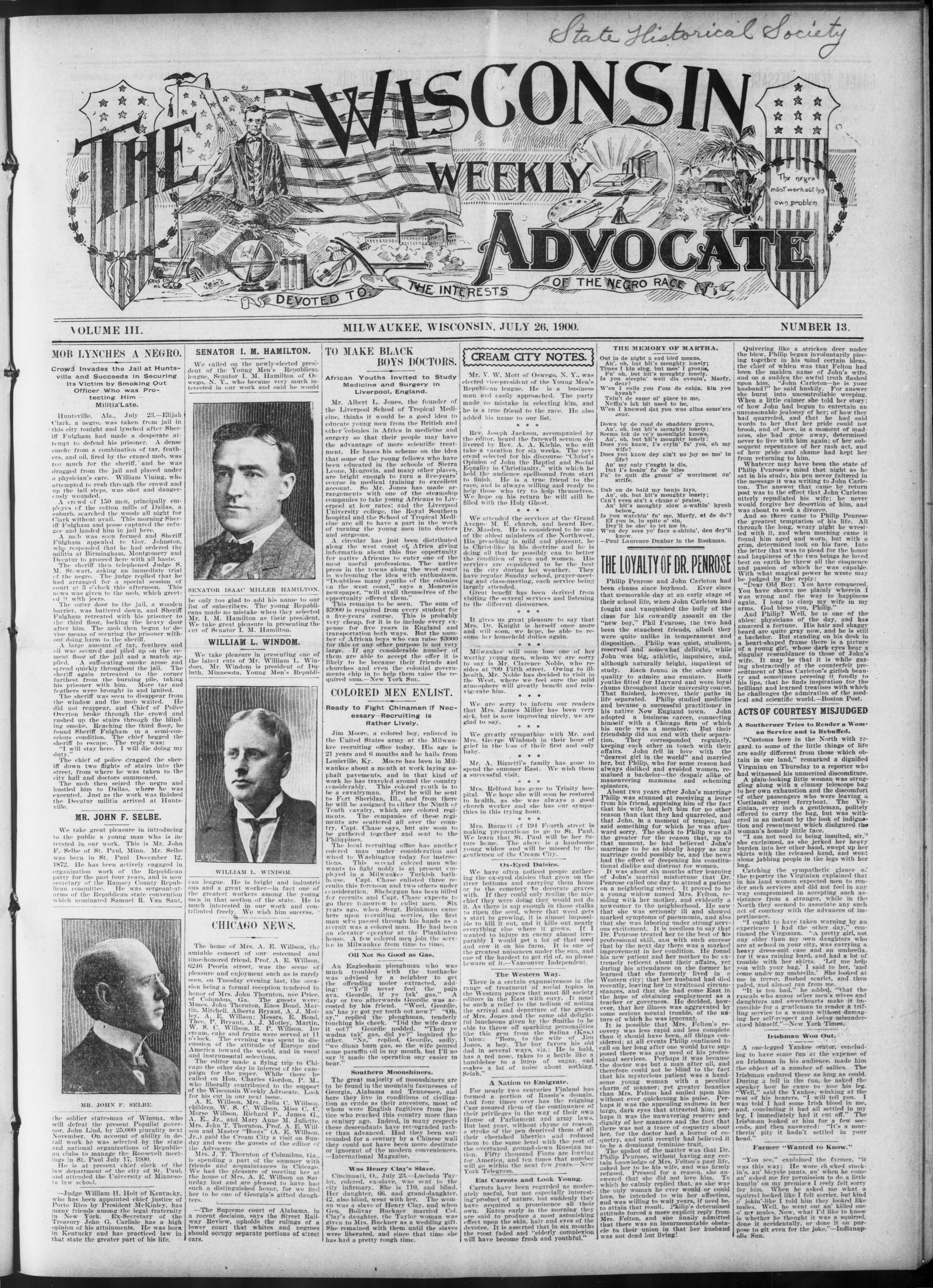
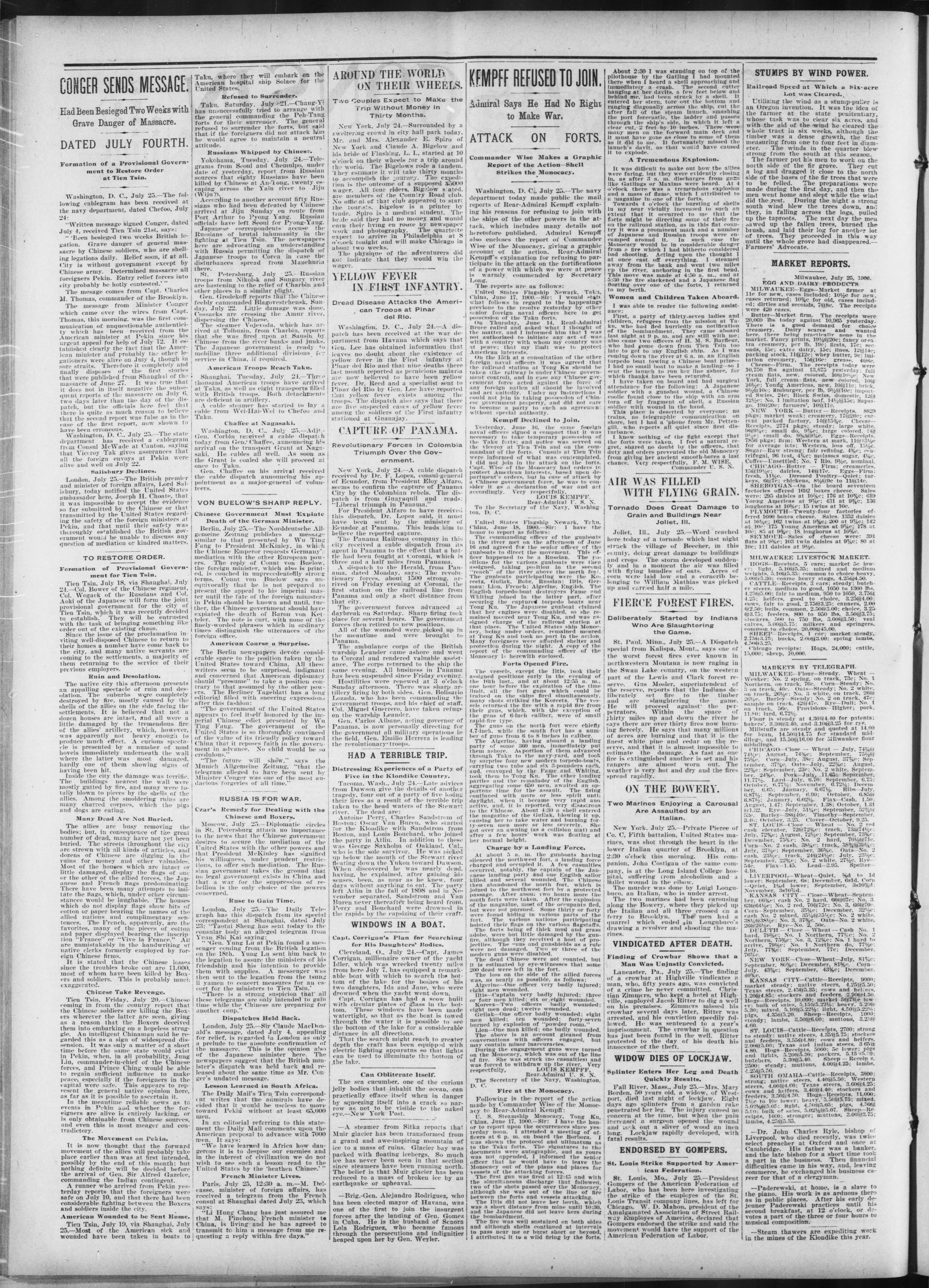
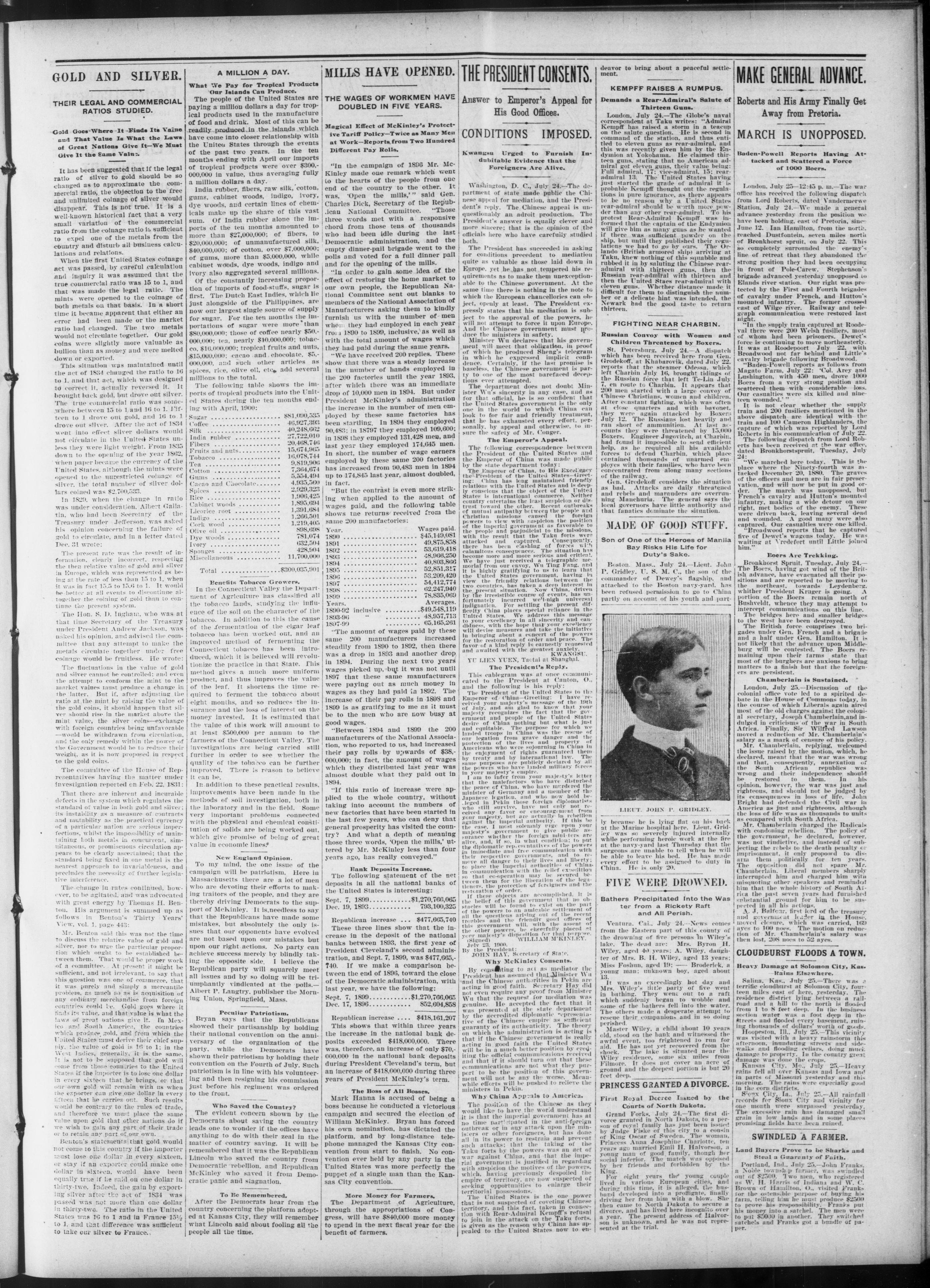
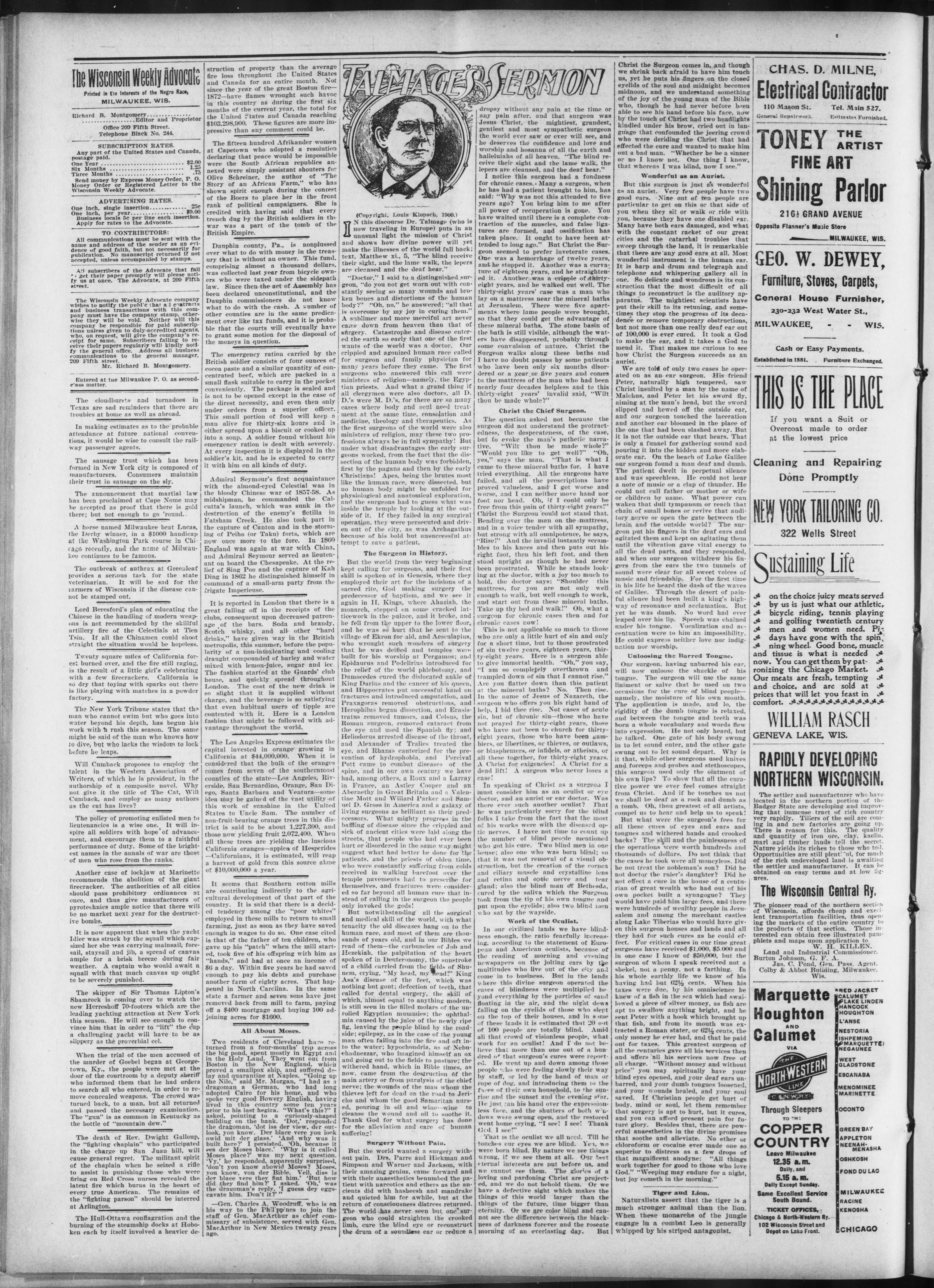
Page text (machine-generated)
State Historical Society
WISCONSIN
WEEKLY
ADVOCATE
DEVOTED TO THE INTERESTS OF THE NEGRO RACE
MOB LYNCHES A NEGRO.
Crowd Invades the Jail at Huntsville and Succeeds in Securing Its Victim by Smoking Out Officer Who was Protecting Him Militia Late.
Huntsville, Ala., July 23.—Elijah Clark, a negro, was taken from jail in this city tonight and lynched after Sheriff Fulgham had made a desperate attempt to defend his prisoner. A dense smoke from a combination of tar, feathers, and oil, fired by the crazed mob, was too much for the sheriff, and he was dragged from the jail and placed under a physician's care. William Vining, who attempted to rush through the crowd and up the jail steps, was shot and dangerously wounded. A crowd of 150 men, principally employees of the cotton mills of Dallas, a suburb, searched the woods all night for Clark without avail. This morning Sheriff Fulgham and posse captured the refugio and landed him in jail here.
A mob was soon formed and Sheriff Fulgham appealed to Gov. Johnston, who responded that he had ordered the militia at Birmingham, Montgomery and Decatur to proceed here with all haste. The sheriff then telephoned Judge S. M. Stewart, asking an immediate trial of the negro. The judge replied that he had arranged for a special session of court at 3 o'clock this afternoon. This news was given to the mob, which greeted it with jeers. The outer door to the jail, a wooden barrier, was battered down, and Sheriff Fulgham retreated with his prisoner to the third floor, locking the heavy door after him. The mob then began to devise means of securing the prisoner without doing harm to the sheriff.
A large amount of tar, feathers and oil was secured and piled up on the cement floor of the jail and a match applied. A suffocating smoke arose and spread quickly throughout the jail. The sheriff again retreated to the corner farthest from the burning pile, taking his prisoner with him. More tar and feathers were brought in and ignited. The sheriff was seen to disappear from the window and the mob waited. He did not reappear, and Chief of Police Overton broke through the crowd and rushed up the stairs through the blinding smoke. Reaching the third floor, he found Sheriff Fulgham in a semi-conscious condition. The chief begged the sheriff to escape. The reply was: "I will stay here. I will die doing my duty."
The chief of police dragged the sheriff down two flights of stairs into the street, from where he was taken to the city hall and doctors summoned. The mob then seized the negro and hustled him to Dallas, where he was executed. Just as the work was finished the Decatur militia arrived at Huntsville
MR. JOHN F. SELBE.
We take great pleasure in introducing to the public a young man who is interested in our work. This is Mr. John F. Selbe of St. Paul, Minn. Mr. Selbe was born in St. Paul December 12, 1872. He has been actively engaged in organization work of the Republican party for the past four years, and is now secretary of the Ramsey County Republican committee. He was sergeant-at-arms of the Republican state convention which nominated Samuel R. Van Sant,
KRO5
MR. JOHN F. SELBE.
the soldier statesman of Winona, who will defeat the present Populist governor, John Lind, by 25,000 plurality next November. On account of ability in detail work he was selected by the state and national organizations of Republican clubs to manage the Roosevelt meetings in St. Paul July 17, 1900.
He is at present chief clerk of the law department of the city of St. Paul, and attended the University of Minnesota law school.
Judge William H. Holt of Kentucky, who has been appointed chief justice of Porto Rico by President McKinley, has many friends among the legal fraternity in New York. Ex-Secretary of the Treasury John G. Carlisle has a high opinion of his attainments. He was born in Kentucky and has practiced law in that state the greater part of his life.
SENATOR I. M. HAMILTON.
We called on the newly-elected president of the Young Men's Republican league, Senator I. M. Hamilton of Oswego, N. Y., who became very much interested in our work and said he would
XRUS
SENATOR ISAAC MILLER HAMILTON be only too glad to add his name to our list of subscribers. The young Republicans made no mistake when they selected Mr. I. M. Hamilton as their president. We take great pleasure in presenting the cut of Senator I. M. Hamilton.
WILLIAM L. WINDOM.
We take pleasure in presenting one of the latest cuts of Mr. William L. Windom. Mr. Windom is president of Duluth, Minnesota. Young Men's Republi-
KAUS
WILLIAM L. WINDOM. can league. He is bright and industrious and a great worker—in fact one of the greatest workers among the young men in that section of the state. He is much interested in our work and contributed freely. We wish him success.
CHICAGO NEWS.
The home of Mrs. A. E. Willson, the amiable consort of our esteemed and time-honored friend, Prof. A. E. Willson, 6246 Peoria street, was the scene of pleasure and enjoyment such as is rarely seen, on Tuesday evening last, the occasion being a formal reception tendered in honor of Mrs. John Thornton, nee Price, of Columbus, Ga. The guests were: Mmes. John Thornton, Enos Bond, Martin, Mitchell, Alberta Bryant, A. J. Motley, A. E. Willson; Messrs. E. Bond, Theo. P. Bryant, A. J. Motley, Martin, W. S. C. Willson, R. P. Willson, Ice cream, cake and fruits were served at 11 o'clock. The evening was spent in discussion of the attitude of Europe and America toward the world, and in vocal and instrumental selections.
The editor made a flying trip to Chicago the other day in interest of the campaign for the paper. While there he called on Hon. Charles Gordon, P. M., who liberally contributed to the support of the Wisconsin Weekly Advocate. Look for his cut in our next issue. A. E. Willson, Mrs. Julia C. Willson, children, W. S. C. Willson, Miss C. C. Morse Willson, Richard P., James G., A. E., Jr., and Mary Anne M. Juliette, Mrs. John T. Thornton, Prof. A. E. Willson and Master "Boots" (A. E. Willson, Jr.) paid the Cream City a visit on Sunday and were the guests of the editor of the Advocate.
Mrs. J. T. Thornton of Columbus, Ga., is spending a part of the summer with friends and acquaintances in Chicago. We had the pleasure of meeting her at the home of Mrs. A. E. Willson on Saturday last and are pleased to have had such a distinguished honor, for we find her to be one of Georgia's gifted daughters.
—The Supreme court of Alabama, in a recent decision, says the Street Railway Review, upholds the rulings of a lower court that whites and negroes should occupy separate portions of street cars.
TO MAKE BLACK BOYS DOCTORS.
African Youths Invited to Study Medicine and Surgery in Liverpool, England.
Mr. Albert L. Jones, the founder of the Liverpool School of Tropical Medicine, thinks it would be a good idea to educate young men from the British and other colonies in Africa in medicine and surgery so that their people may have the advantage of more scientific treatment. He bases his scheme on the idea that some of the young fellows who have been educated in the schools of Sierra Leone, Menrovia, and many other places, are bright enough to turn a five-years' course in medical training to excellent account. So Mr. Jones has made arrangements with one of the steamship companies to take young Africans to Liverpool at low rates; and the Liverpool University college, the Royal Southern hospital and the School of Tropical Medicine are all to have a part in the work of turning the young men into doctors and surgeons.
A circular has just been distributed along the west coast of Africa giving information about this fine opportunity for native Africans to enter one of the most useful professions. The native press in the towns along the west coast is welcoming the idea with enthusiasm. "Doubtless many youths of the colonies on the west coast," says a Monrovia newspaper, "will avail themselves of the opportunity offered them."
This remains to be seen. The sum of $3000 is required from every student for a five-years' course. This is probably very cheap, for it is to include every expense for five years in England and transportation both ways. But the number of African boys who can raise $3000 for this or any other purpose is not very large. If any considerable number of them are able to accept the offer it is likely to be because their friends and churches and even the colonial governments chip in to help them raise the required sum.—New York Sur.
COLORED MEN ENLIST.
Ready to Fight Chinamen If Necessary—Recruiting is Rather Lively
Jim Moore, a colored boy, enlisted in the United States army at the Milwaukee recruiting office today. His age is 21 years and 6 months and he hails from Louisville, Ky. Moore has been in Milwaukee about a month at work laying asphalt pavements, and in that kind of work he has traveled around the country considerably. This colored youth is to be a cavalryman. First he will be sent to Fort Sheridan, Ill., and from there he will be assigned to either the Ninth or Tenth cavalry, which are colored regiments. The companies of these regiments are scattered all over the country, Capt. Chase says, but are soon to be gathered together and sent to the Philippines.
The local recruiting office has another colored man under consideration and wired to Washington today for instructions. This second colored man who wants to fight nobly is at present employed in a Milwaukee Turkish bathhouse. Capt. Chase enlisted three recruits this forenoon and two others under consideration. Sheboygan has been billed for recruits and Capt. Chase expects to go there tomorrow to enlist men. Six years ago, when Sergt. Brinkman came here upon recruiting service, the first man who passed through his hands as a recruit was a colored man. He had been an elevator operator at the Plankinton house. A few colored men join the service in Milwaukee from time to time.
Oil Not So Good as Gas.
An Eaglesham ploughman who was much troubled with the toothache was advised by a neighbor to get the offending moler extracted, adding: "Ye'll never feel the pain ava, Geordie, if ye tak' gas." A day or two afterwards Geordie was accosted by his friend. "Weel, Geordie, an' hae ye got yer tooth oot now?" "Oh, ay," replied the ploughman, tenderly touching his cheek. "Did the wife draw it oot?" Geordie nodded. "Then ye wadna tak' gas, did ye?" inquired the other. "Na," replied, Geordie, sadly, "we dinna burn gas, so the wife poured some paraffin oil in my mouth, but I'll no say it made the operation ony easier to bear."
Southern Moonshiners.
The great majority of moonshiners are to be found in the mountain fastnesses of Georgia, Alabama and Tennessee, and here they live in conditions of civilization as crude as their ancestors, most of whom were English fugitives from justice who reached this country more than a century ago. Indeed, in many respects these descendants have retrograded rather than advanced. Had they been surrounded for a century by a Chinese wall they could not have been more destitute or ignorant of the modern conveniences. International Magazine.
Was Henry Clay's Slave.
Cincinnati, O., July 23.—Lucinda Taylor, colored, ex-slave, was sent to the city infirmary. She is 110, and blind. Her daughter, 66, and grand-daughter, 42, also blind, went with her. The woman was a slave of Henry Clay, and when Gen. Bolivar Buckner married Col. Clay's daughter, the Taylor woman was given to Mrs. Buckner as a wedding gift. She remained with them until the slaves were liberated, and since that time she has had a pretty rough time.
CREAM CITY NOTES.
Mr. V. W. Mott of Oswego, N. Y., was elected vice-president of the Young Men's Republican league. He is a business man and easily approached. The party made no mistake in selecting him, and he is a true friend to the race. He also added his name to our list.
* * *
Rev. Joseph Jackson, accompanied by the editor, heard the farewell sermon delivered by Rev. A. A. Kiechle, who will take a vacation for six weeks. The reverend selected for his discourse "Christ's Opinion of John the Baptist and Social Equality in Christianity," with which he held the audience spellbound from start to finish. He is a true friend to the race, and is always willing and ready to help those who try to help themselves. We hope on his return he will still be filled with the Holy Ghost.
恋恋
We attended the services at the Grand Avenue M. E. church, and heard Rev. Dr. Masden. He is considered to be one of the ablest ministers of the Northwest. His preaching is mild and pleasant, he is Christ-like in his doctrine and he is doing all that he possibly can to better the condition of men and women. His services are considered to be the best in the city during hot weather. They have regular Sunday school, prayer-meeting and class-meeting, each service being largely attended.
Great benefit has been derived from visiting the several services and listening to the different discourses.
```markdown
```
It gives us great pleasure to say that Mrs. Dr. Knight is herself once more and will soon, we hope, be able to resume her household duties again.
```markdown
```
Milwaukee will soon lose one of her worthy young men, whom we are sorry to say is Mr. Clarence Noble, who resides at 209 Fifth street. Owing to ill-health, Mr. Noble has decided to visit in the West, where we feel sure the mild atmosphere will greatly benefit and reinvigorate him.
* * *
We are sorry to inform our readers that Mrs. James Miller has been very sick, but is now improving nicely, we are glad to say.
* * *
We greatly sympathize with Mr. and Mrs. George Winbush in their hour of grief in the loss of their first and only baby.
Mr. A. Bizzetti's family has gone to spend the summer East. We wish them a successful visit.
☆ ★ ★
Mrs. Relford has gone to Trinity hospital. We hope she will soon be restored to health, as she was always a good church worker and she has our sympathies in this trying hour.
```markdown
```
Mrs. Burnett of 194 Fourth street is making preparations to go to St. Paul. We learn that St. Paul will be her future home. The above is a handsome young widow and will be missed by the gentlemen of the Cream City.
Ox-Exed Daisies.
We have often noticed people gathering the ox-eyed daisies that grow on the river bottoms and carrying them home or to the cemetery to decorate graves with. If they could only realize the mischief they were doing they would not do it. As there is sap enough in those stalks to ripen the seed, where that weed gets a start to growing, it is almost impossible to kill it out, and it kills out nearly everything else where it grows. If I wanted to injure an enemy almost irreparably I would get a lot of that seed and sow it on his farm. It is one of the greatest nuisances under the sun, and one of the hardest to get rid of, so please beware of it.—Vancouver Independent.
The Western Way.
There is a certain expansiveness in the range of treatment of social topics in the Western papers that must fill society editors in the East with envy. It must be such a relief to the tedium of noting the arrival and departure of the guests of Mrs. Jones and the same old delightful luncheons given by the Smiths to be able to throw off sparkling personalities like this gem from the Salina (Kas.) Union: "Born, to the wife of Jim Jones, a boy. The boy favors his old dad in several ways, viz.: He is bald, has a red nose, takes to a bottle like a bumblebee to a lump of sugar, and makes a lot of noise about nothing. Selah."
A Nation to Emigrate
For nearly two centuries Finland has formed a portion of Russia's domain. And four times over has the reigning Czar assured them of the continuance of their privileges in the way of their own House of Parliament and army laws. But last year, without rhyme or reason, a stroke of the pen deprived them of all their cherished liberties and reduced them to the same level with the rest of the overtaxed, ground-down Russian nation. Fifty thousand Finns are leaving for America, and ten times that number will go within the next few years.—New York Telegram.
Fat Carrots and Look Young
Carrots have been regarded as moderately useful, but not especially interesting product of nature, but suddenly they have acquired a prominence all their own. Eaten early in the morning they are said to produce a most astonishing effect upon the skin, hair and eyes of the devotee. It is asserted that in six months the most faded and "elderly complexion will have become fresh and youthful."
THE MEMORY OF MARTHA.
Out in de night a sad bird moans,
An', oh, but hit's moughty lonely;
Times I kin sing, but mos' I groans,
Fu' oh, but hit's moughty lonely.
Is you sleepin' well dis evenin', Marfy,
dear?
W'en I calls you f'om de cabin, kin you
yehain?
Tain't de same ol' place to me,
Nuffin's lak hit used to be.
W'en I knewed dat you wus allus some'ers
aear.
Does you know, I'm cryln fu' you, oh my wife?
Does you know dey ain't no joy no mo' in life?
An' my only t'ought is dis.
Dat I's honin' fu' de bliss
Fu' to quit dis groun' o' worriment an' strife.
Is you watchin' fu' me, Marfy, at de do'?
Ef you is, in spite o' sin.
Dev' be sho' to let me in.
Dey it be sno' to tell me in.
W'en dey sees yo' face a-shlinn', den dey'll
know.
—Paul Laurence Dunbar in the Bookman.
THE LOYALTY OF DR. PENROSE
Philip Penrose and John Carleton had been chums since boyhood. Ever since that memorable day at an early stage of their school life, when John Carleton had fought and vanquished the bully of the class for his cowardly assault on the "new boy," Phil Penrose, the two had been the stanchest friends, albeit they were quite unlike in temperament and disposition. Philip was quiet, studious, reserved and somewhat delicate, while John was big, athletic, impulsive, and, although naturally bright, impatient of study. Each found in the other some quality to admire and emulate. Both youths fitted for Harvard and were loyal chums throughout their university course. That finished, however, their paths in life separated. Philip studied medicine and became a successful practitioner in his native New England town. John adopted a business career, connecting himself with a Chicago firm of which his uncle was a member. But their friendship did not end with their separation. They corresponded regularly, keeping each other in touch with their affairs. John fell in love with the "dearest girl in the world" and married her, but Philip, who for some reason had always disliked and avoided women, remained a bachelor—the despair alike of maneuvering mammas and scheming spinsters.
About two years after John's marriage Philip was stunned at receiving a letter from his friend, appraising him of the fact that his wife had left him for no other reason than that they had quarreled, and that John, in a moment of temper, had said something for which he was afterward sorry. The shock to Philip was all the greater for the reason that, up to that moment, he had believed John's marriage to be as ideally happy as any marriage could possibly be, and the news had the effect of deepening his constitutional dislike and distrust for women.
It was about six months after learning of John's marital misfortune that Dr. Penrose called one day to attend a patient on a neighboring street. It proved to be a young widow named Mrs. Felton, residing with her mother, and evidently a newcomer to the neighborhood. He saw that she was seriously ill and showed marked symptoms of pneumonia, and also that she was laboring under strong nervous excitement. It is needless to say that Dr. Penrose treated her to the best of his professional skill, and with such success that by the next day there was a marked improvement in her condition. He found his new patient and her mother to be extremely reticent about their affairs, yet during his attendance on the former he learned that she formerly lived in a Western city; that her husband had died recently, leaving her in straitened circumstances, and that she had come East in the hope of obtaining employment as a teacher or governess. He decided, however, that her illness was aggravated by some serious mental trouble, of the nature of which he was ignorant.
It is possible that Mrs. Felton's recovery was less rapid and less complete than it should have been, all things considered; at all events Philip continued to call on her long after one would have supposed there was any need of his professional services. Perhaps it was because the doctor was but a man after all, and therefore could not be blind to the fact that his mysterious patient was a handsome young woman with a peculiar charm of manner; yet greater beauties than Mrs. Felton had smiled upon him without ever quickening his pulse. Perhaps it was the appealing sadness in her large, dark eyes that attracted him; perhaps it was the unwavering reserve and dignity of her manners and the fact that there was not a trace of coquery about her, for the doctor had a horror of coquery, and until recently had believed it to be a dominant feminine trait.
The upshot of the matter was that Dr. Philip Penrose, without having any certain knowledge of Mrs. Felton's past life, asked her to be his wife, and was firmly refused. Pressed for a reason, she answered that she did not love him. To which he calmly replied that, as she was the only woman he ever would or could love, he intended to win her affection, and was willing to wait years, if need be, to attain that result. Philip's determined attitude forced a more explicit reply from Mrs. Felton, and she naily admitted that there was an insurmountable obstacle to their union in that her husband was not dead but living!
Quivering like a stricken deer under the blow, Philip began involuntarily piecing together in his mind certain ideas, the chief of which was that Felton had been the maiden name of John's wife, and on a sudden the awful truth flashed upon him. "John Carleton—he is your husband?" he said huskily. For answer she burst into uncontrollable weeping. When a little calmer she told her story; of how John had begun to entertain an unreasonable jealousy of her; of how they had quarreled, and that he had said words to her that her pride could not brook, and of how, in a moment of madness, she had gone away, determined never to live with him again; of her subsequent repentance of her rash act, and of how pride and shame had kept her from returning to him.
Whatever may have been the state of Philip Penrose's mind that night as he sat in his study, his pen never faltered in the message it was writing to John Carleton. The answer that came by return post was to the effect that John Carleton utterly repudiated his wife; he never would forgive her desertion of him, and was about to seek a divorce.
And so there came to Philip Penrose the greatest temptation of his life. All through the long, weary night he wrestled with it, and when morning came it found him aged and worn, but with a grim, determined look on his face. Into the letter that was to plead for the honor and happiness of the two beings he loved best on earth he threw all the eloquence and passion of which he was capable. With what magical power he wrote may he indiged by the reply:
"Dear Old Boy: You have conquered. You have shown me plainly wherein I was wrong and the way to happiness again. I long to clasp my wife in my arms. God bless you, Philip."
And Philip? Well, he is one of the ablest physicians of the day, and has amassed a fortune. His hair and shaggy beard are quite gray now, and he is still a bachelor. But standing on his desk in a heart-shaped frame there is a picture of a young girl, whose dark eyes bear a singular resemblance to those of John's wife. It may be that it is while gazing abstractedly at the counterfeit presentment of Miss Carleton's girlish beauty and sometimes pressing it fondly to his lips, that he finds inspiration for the brilliant and learned treatises with which he challenges the admiration of the medical and scientific world.--Boston Post.
ACTS OF COURTESY MISJUDGED
A Southerner Tries to Render a Woman Service and is Rebuffed.
"Customs here in the North with regard to some of the little things of life are sadly different from those which obtain in our land," remarked a dignified Virginian on Thursday to a reporter who had witnessed his unmerited discomfiture.
A plain-looking little woman was struggling along with a clumsy telescope bag to her own exhaustion and the discomfort of other passengers who were leaving a Cortlandt street ferryboat. The Virginian, every inch a gentleman, politely offered to carry the bag, but was withered in an instant by the look of indignation and resentment which disfigured the woman's homely little face.
"I am not used to being insulted, sir," she exclaimed, as she jerked her heavy burden into her other hand, swept up her skirts with the released hand, and went along jabbing people in the legs with her bag.
Catching the sympathetic glance of the reporter the Virginian explained that in his land women expected men to render such services and did not feel in any way compromised in accepting such assistance from a stranger, while in the North they seemed to associate any such act of courtesy with the advances of impertinence.
"I ought to have taken warning by an experience I had the other day," continued the Virgianan. "A pretty girl, not any older than my own daughters who are at school in your city, was carrying a heavy dress-suit case and an umbrella, for it was raining hard, and had a lot of trouble with her skirts. 'Let me help you with your bag,' I said to her, 'and come under my umbrella.' She looked at me in terror, flushed scarlet, and then paled, and almost ran from me.
"It is too bad," he added, "that the rascals who annoy other men's wives and daughters and sweethearts make it impossible for a gentleman to render a trifling service to a woman without damaging her self-respect and being misunderstood himself."—New York Times
Irishman Won Out.
A one-legged Yankee orator, concluding to have some fun at the expense of an Irishman in his audience, made him the object of a number of sallies. The Irishman endured these as long as could. During a lull in the fun, he asked the speaker how he came to lose his leg. "Well," said the Yankee, winking at the rest of his hearers, "I will tell you. I was told I had some Irish blood in me, and, concluding it had all settled in my leg, I immediately had it cut off." The Irishman looked at him for a few seconds, and then answered: "It's a murtherin' pity it hadn't settled in your head."
Farmer "Wanted to Know."
"You see," explained the farmer, "it was this way: He wore checked stockin's, an' bicycle pants, an' when he come an' asked me fer permission to do a little huntin' on my premises I reely felt sorry fer him. When he asked me what a squirrel looked like I felt sorrier, but kind o' jokin'-like I told him they looked like mules. Well, he went out an' killed one o' my mules. Now, what I'd like to know is whether he thought it was a squirrel, done it accidentally, or done it on purpose to git even fer the joke."—Indianapolis, Sun.
CONGER SENDS MESSAGE.
Had Been Besieged Two Weeks with Grave Danger of Massacre.
DATED JULY FOURTH.
Formation of a Provisional Government to Restore Order at Tien Tsin.
Washington, D. C., July 25.—The following cablegram has been received at the navy department, dated Chefoo, July 24:
"Written message signed Conger, dated July 4, received Tien Tsin 21st, says:
"Been besieged two weeks British legation. Grave danger of general massacre by Chinese soldiers, who are shelling legations daily. Relief soon, if at all. City is without government except by Chinese army. Determined massacre all foreigners Pekin. Entry relief forces into city probably be hotly contested.""
The message comes from Capt. Charles M. Thomas, commander of the Brooklyn.
The message from Minister Conger which came over the wires from Capt. Thomas, this morning, was the first communication of unquestionable authenticity which has been received from the American minister at Pekin since his urgent appeal for help of July 12. It established clearly the fact that the American minister and probably the other legationers were alive on July 4, though in sore straits. Therefore it completely and finally disposes of the first stories that were published from Shanghai of the massacre of June 27. It was true that it does not in itself negative the subsequent reports of the massacre on July 6, two days later than the day of the dispatch, but the officials here feel that there is quite as much reason to believe that the second report was false as in the case of the first report, now shown to have been erroneous.
Washington, D. C., July 25.—The state department has received a cablegram from Consul McWade at Canton, saying that Viceroy Tak gives assurances that all the foreign envoys at Pekin were alive and well on July 22.
Salisbury Declines.
London, July 25.—The British premier and minister of foreign affairs, Lord Salisbury, today notified the United States ambassador here, Joseph H. Choate, that it was impossible to accept the evidence so far submitted by the Chinese or that transmitted by the United States regarding the safety of the foreign ministers at Pekin, and that until their safety was thoroughly established the British government would be unable to discuss any question of mediation or kindred matters.
TO RESTORE ORDER.
Formation of Provisional Government for Tien Tsin.
Tien Tsin, July 18, via Shanghai, July 24.—Col. Bower of the Chinese regiment, Col. Wogack of the Russians and Col. Aoki of the Japanese will form the joint provisional government for the city of Tien Tsin, which it was recently decided to establish. They will be entrusted with the task of bringing something like order out of the existing chaos. Since the issue of the proclamation inviting well-disposed Chinese to return to their homes a number have come back to the city, and many native servants are coming to the settlements, a majority of them returning to the service of their previous employers.
Ruin and Desolation.
The native city this afternoon presents an appalling spectacle of ruin and desolation. The suburbs were completely destroyed by fire, mostly caused by the shells of the allies on the side facing the settlements. It is believed that not a dozen houses are intact, and all were a little damaged by the tremendous fire of the allies' artillery, which, however, was apparently not heavy enough to produce much effect. A curious spectacle is presented by a number of mud hovels immediately underneath the wall where the latter was most damaged, hardly one of them showing signs of having been hit. Inside the city the damage was terrific. The buildings nearest the wall were mostly gutted by fire, and many were totally blown to pieces by the shells of the allies. Among the smoldering ruins are many charred corpses, which the pigs and dogs are eating.
Many Dead Are Not Buried.
The allies are busy removing the bodies; but, in consequence of the great number of dead, many have not yet been buried. The streets throughout the city are strewn with all kinds of articles, and dozens of Chinese are digging in the ruins for money and other valuables. Most of the houses which are intact or little damaged, display the flags of one or the other of the allied forces, the Japanese and French flags predominating. There have been many attempts to imitate the flags, which, under other circumstances would be laughable. The houses which do not display flags show bits of cotton or paper bearing the names of the allied nations and complimentary sentences. The French, apparently, are the favorites, many of the pieces of cotton and paper displayed bearing the inscription "France" or "Vive la France." All are unmistakably in the handwriting of native clerks formerly employed by foreign Chinese firms.
It is stated that the Chinese losses since the troubles broke out are 11,000, most of whom have been killed by Boxers and soldiers. This is probably much exaggerated.
Chinese Take Revenge.
Tien Tsin, Friday, July 20.—Chinese coming in from the country report that the Chinese soldiers are killing the Boxers wherever the latter are seen, giving as a reason that the Boxers deceived them into embarking on a hopeless struggle. An intelligent Chinaman said he regarded this as a sign of widespread dissension. It was only a matter of a short time before the same state would exist in Pekin, when, in all probability, Jung Liu, commander-in-chief of the Chinese forces, and Prince Ching would be able to regain sufficient influence to make peace, especially if the foreigners in the capital were safe. This appears to represent the general native opinion here, as far as it is possible to ascertain it.
In the meantime reliable news as to events in Pekin and whether the foreigners are alive is entirely lacking, or is only obtainable from Chinese sources, and even this is most meager and contradictory.
The Movement on Pekin.
It is now thought that the forward movement of the allies will probably take place earlier than was at first intended, possibly by the end of this month; but nothing definite will be decided before the arrival of Gen. Sir Alfred Gazelee, commanding the Indian contingent.
A runner who arrived from Pekin yesterday reports that the foreigners were safe on July 10, and that there had been considerable fighting between the Boxers and soldiers inside the city.
American Wounded to be Sent Home.
Tien Tsin, July 19, via Shanghai, July 25.—Most of the American sick and wounded have been taken in boats to
Taku, where they will embark on the American hospital ship Solace for the United States.
Refused to Surrender.
Taku, Saturday, July 21.—Chang-Yi has unsuccessfully tried to arrange with the general commanding the Peh-Tang forts for their surrender. The general refused to surrender the forts, but said that if the foreigners did not attack him he would agree to maintain a neutral attitude.
Russians Whipped by Chinese.
Yokohama, Tuesday, July 24.—Telegrams from Seoul and Chenulpo, under date of yesterday, report from Russian sources that eighty Russians have been killed by Chinese at An-Tong, twenty escaping across the Yalu river to Jiju (Wiiu).
According to another account fifty Russians who had been defeated by Chinese arrived at Jiju Sunday en route from Port Arthur to Pyong Yang. Russian officials have left Seoul for Pyong-Yang. Japanese correspondents accuse the Russians of brutal inhumanity in the fighting at Tien Tsin. The newspapers here are advocating an understanding with Russia permitting the dispatch of Japanese troops to Corea in case the disturbances spread from Manchuria there. St. Petersburg, July 25. Russian troops from Nikolsk and Sungary river are hastening to the relief of Charbin and other places in a similar plight. Gen. Grodekoff reports that the Chinese feebly cannonaded Blagovestchensk, Sunday, July 22. Little damage was done. Cossacks are crossing the Amur river, dispersing the Chinese.
The steamer Vojevoda, which has arrived at Tolbuzin, from Charbin, reports that she was fired upon at Sausin by Chinese from the river banks and junks. The Japanese government is ready to mobilize three additional divisions for service in China, if required.
American Troops Reach Taku
Shanghai, Tuesday, July 24.—Three thousand American troops have arrived at Taku, as well as eight transports filled with British troops. Both detachments are deficient in artillery. A cable steamer has started to lay a cable from Wei-Hai-Wei to Chefoo and Taku.
Chaffee at Nagasaki.
Washington, D. C., July 25.—Adjit Gen. Corbin received a cable dispatch today from Gen. Chaffee, announcing his arrival on the transport Grant at Nagasaki. He cables all well. As soon as the Grant is coaled she will proceed at once to Taku. Gen. Chaffee on his arrival received the cable dispatch announcing his appointment as a major-general of volunteers.
VON BUELOW'S SHARP REPLY.
Chinese Government Must Expiate Death of the German Minister.
Berlin, July 25.—The Norddeutsche Allgemeine Zeitung publishes a message similar to that presented by Wu Ting; Fang to President McKinley, in which the Chinese Emperor requests Germany's mediation with the other European powers. The reply of Count von Buelow, the foreign minister, which also is printed, is couched in unprecedentedly strong terms. Count von Buelow says unequivocally that he is not prepared to present the appeal to his imperial master until the fate of the foreign ministers in Pekin should be known and until, further, the Chinese government should have expiated the death of Baron von Ketteler. The note is curt, with none of the finely-worded phrases which in ordinary times distinguish the utterances of the foreign office.
American Course a Surprise.
The Berlin newspapers devote considerable space to the position taken by the United States toward China. All these writers seem to be surprised, indignant and concerned that American diplomacy should "presume" to take a position contrary to that assumed by the other powers. The Berliner Tageblatt has a long editorial filled with sneering expressions after this fashion:
"The government of the United States appears to feel itself honored by the imperial Chinese edict presented by Wu Ting Fang. The government of the United States is so thoroughly convinced of the value of its friendly policy toward China that it reposes faith in the government in advance. No child would be so credulous."
"The future will show," says the Munich Allgemeine Zeitung, "that the telegram alleged to have been sent by Minister Conger was one of the most audacious forgeries of all time."
RUSSIA IS FOR WAR.
Czar's Remedy for Dealing with the Chinese and Boxers.
Moscow, July 25.—Diplomatic circles in St. Petersburg attach no importance to the news that the Chinese government desires to secure the mediation of the United States with the other powers and that President McKinley has signified his willingness, under prudent restrictions, to offer such mediation. The Russian government takes the ground that no legal government exists in China and that a war for the suppression of rebellion is the only choice of the powers concerned.
Ruse to Gain Time.
London, July 25.—The Daily Telegraph has this dispatch from its special correspondent at Shanghai, dated July 23: "Taotai Sheng has sent today to the consular body an alleged telegram from Yuan Shi Kai saying:
"Gen. Yung Lu at Pekin found a messenger coming from the British legation on the 18th. Yung Lu sent him back to the legation to assure the ministers of his friendship and his intention to provide them with supplies. A messenger was then sent to the legation from the tsung li yamen to concert measures for an escort for the ministers to Tien Tsin."
"There is a strong suspicion that all these telegrams are only intended to gain time while the Chinese are preparing for another com."
Dispatches Held Back.
London, July 25.—Sir Claude MacDonald's message, dated July 4, appealing for relief, is regarded in London as only a prelude to the absolute confirmation of the massacre. This is the opinion also of the Japanese minister here. The newspapers suggest that the British minister's dispatch was held back and released about the same time as Mr. Conger's undated message.
Lesson Learned in South Africa.
The Daily Mail's Tien Tsin correspondent writes that the admirals have decided that it would be useless to move toward Pekin without at least 65,000 men.
In an editorial referring to this statement the Daily Mail comments upon the American proposal to advance with 7000 men. It says:
"We have learned in Africa how dangerous it is to despise our enemies and in the interest of civilization we do not wish to see such a lesson read to the United States by the 'heathen Chinee.'"
French Minister Lives.
Paris, July 25, 12:30 a. m.-M. Delcasse, minister of foreign affairs, has received a telegram from the French consul at Shanghai dated July 23, which says: "Li Hung Chang has just assured me that M. Pinchon, French minister to China, is living and he has agreed to transmit to him a message from me requesting a reply within five days."
AROUND THE WORLD ON THEIR WHEELS.
Two Couples Expect to Make the Trip Without Money in Thirty Months.
New York, July 24.—Surrounded by a sweltering crowd in city hall park today, Mr. and Mrs. Alexander E. Spiro of New York and Claude A. Bigelow and his bride of Flushing, L. L., started at 10 o'clock on their wheels for a trip around the world. The Bigelows rode a tandem. They estimate it will take thirty months to accomplish the journey. The expedition is the outcome of a supposed $5000 wager. All four riders, Bigelow stated, are members of the Country Road club. No official of that club appeared to start the tourists. Bigelow is a printer by trade. Spiro is a medical student. The bride said they had no money and would earn their living en route by newspaper work and photography. The quartette expect to arrive in Philadelphia at S o'clock tonight and will make Chicago in about two weeks.
The physique of the adventurers did not indicate that they would win the wager.
Dread Disease Attacks the American Troops at Pinar del Rio.
Washington, D. C., July 24.—A dispatch has been received at the war department from Havana which says that Gen. Lee has obtained information that leaves no doubt about the existence of yellow fever in the First infantry at Pinar del Rio and that nine deaths there last month reported as pernicious malaria are now believed to have been yellow fever. Dr. Reed and a specialist sent to Pinar del Rio by Gen. Lee have reported that yellow fever exists among the troops. The dispatch also says that there are five suspected cases of yellow fever among the soldiers of the First infantry stationed at Guanajay.
CAPTURE OF PANAMA.
Revolutionary Forces in Colombia Triumph Over the Government.
New York, July 24.—A cable dispatch received by Dr. F. Lopez, consul-general of Ecuador, from President Eloy Alfaro, seems to confirm the capture of Panama City by the Colombian rebels. The dispatch is from Guayaquil and reads: "Liberal triumph in Panama." For President Alfaro to have received this dispatch, Dr. Lopez said, it must have been sent by the minister of Ecuador at Panama. This leads him to believe the reported capture. The Panama Railroaq company in this city received a cable dispatch from its agent in Panama to the effect that a battle had been fought at Corozal, which is three and a half miles from Panama.
A dispatch to the Herald, from Panama, dated Monday, says: The revolutionary forces, about 1500 strong, arrived on Friday evening at Corozal, the first station on the railroad line from Panama and only a short distance from that city.
The government forces advanced at daybreak on Saturday. Sharp firing took place for several hours. The government forces then retired to new positions.
All of the wounded were picked up in the meantime and were brought to Panama.
The ambulance corps of the British warship Leander came ashore and went to Corozal and rendered valuable assistance. The corps returned to the ship the same evening. All business in Panama has been suspended since Friday evening.
Hostilities were renewed at 3 o'clock Sunday afternoon. There was sharp artillery firing by both sides. Gen. Bolisario Lozada, who has been commanding the government troops, and his chief of staff, Col. Miguel Guerrero, have taken refuge on the warship Leander. Gen. Carlos Albane, acting governor of Panama, is now personally directing for the government all military operations in the field. Gen. Emilio Herrera is leading the revolutionary troops.
HAD A TERRIBLE TRIP.
Distressing Experiences of a Party of Five in the Klondike Country.
Tacoma, Wash., July 24.—Late advices from Dawson give the details of another tragedy, four out of a party of five losing their lives as a result of the terrible trip taken to the head waters of the Stewart river. The dead are:
Antoine Perry, Charles Sandstrom of Boston; Oscar Van Buren, who started for the Klondike with Sandstrom from Boston, and Louis Bouchard, who joined the party in Atlin. In addition to these was George Saxholm of Oakland, Cal., who is the sole survivor. He was picked up below the mouth of the Stewart river floating down the Yukon toward Dawson. When discovered he was nearly dead, having, he explained, after gaining his senses, been, as near as he knew, four days without anything to eat. The party left Atlin in the fall of 1898 and in November separated, Sandstrom and Van Buren never thereafter being heard from. Perry and Bouchard were drowned in the rapids by the capsizing of their craft.
WINDOWS IN A BOAT.
Capt. Corrigan's Plan for Searching for His Daughters' Bodies.
Cleveland, O., July 24.—Capt. James Corrigan, millionaire owner of the yacht Idler, which was wrecked twenty miles from here July 7, has equipped a remarkable boat with which to search the bottom of the lake for the bodies of his two daughters, Ida and Jane, who were drowned when the yacht went down.
Capt. Corrigan has had a scow built with circular plates of glass in the bottom. These windows have been made watertight, so that as the boat is towed through the water it is possible to see the bottom of the lake for a considerable distance in all directions.
That the search might reach to greater depth the craft has been equipped with electric lighting apparatus so that lights can be used to illuminate the bottom of the lake.
Can Obliterate Itself.
The sea cucumber, one of the curious jelly bodies that inhabit the ocean, can practically efface itself when in danger by squeezing itself into a crack so narrow as not to be visible to the naked eye.—New York Post.
—A steamer from Sitka reports that Muir glacier has been transformed from a grand and awe-inspiring mountain of ice to a mass of ruins. Glacier bay was packed with floating icebergs. So much ice has never been seen in that section since steamers have been running north. The belief is that Muir glacier has been reduced to a mass of broken ice by an earthquake or upheaval.
—Brig.-Gen. Alejandro Rodriguez, who has been elected mayor of Havana, was one of the first to join the insurgent forces after the landing of Gen. Gomez in Cuba. He is the husband of Scorna Lola Rodriguez, who became famous through the persecution and indignities heaped upon her by Gen. Weyler.
KEMPFF REFUSED TO JOIN.
Commander Wise Makes a Graphic Report of the Action—Shell Strikes the Monocacy.
Washington, D. C., July 25.--The navy department today made public the mail reports of Rear-Admiral Kempff explaining his reasons for refusing to join with the ships of the other powers in the attack, which includes many details not heretofore published. Admiral Kempff also encloses the report of Commander Wise of the Monocacy, giving a graphic account of the action. Rear-Admiral Kempff's explanation for refusing to participate in the attack on the fortifications of a power with which we were at peace is warmly commended by Secretary Long.
The reports are as follows:
United States Flagship Newark, Taku, China, June 17, 1900.—Sir: I would state what follows in regard to the happenings previous to the resolve yesterday by other senior foreign naval officers here to get possession of the Taku forts.
On Thursday, June 14, Read-Admiral Bruce called and asked what I thought of the matter, and I informed him that I was not authorized to initiate any act of war with a country with whom my country was at peace; that my limit was to protect American interests.
On the 15th at a consultation of the other foreign naval officers it was agreed that the railroad station at Tong Ku should be taken (the railway is under Chinese government control), and in case any Chinese government force acted against the force of any foreign nation all should be involved and act unitedly. Under my instructions I could not join in taking possession of Chinese government property, and did not care to become a party to such an agreement without special authority.
Kempff Declined to Join.
Yesterday, June 16, the same foreign naval officers signed a compact that it was necessary to take temporary possession of the Taku forts; and notice was served on the viceroy at Tien Tsin and on the commandant of the forts. Consuls at Tien Tsin were informed of what was contemplated. I did not join in the attack on the forts. Capt. Wise of the Monocacy had orders to protect American interests, based upon department's orders, but in case of attack by a Chinese government force, he was to consider it as a declaration of war and act accordingly. Very respectfully.
LOUIS KEMPFF.
Rear-Admiral U. S. N.
To the Secretary of the Navy, Washington, D. C.
United States Flagship Newark, Taku, China, June 18, 1900.—Sir: I have the honor to report as follows:
The commanding officer of the gunboats in the river met on the afternoon of June 16 and agreed for the senior officer of the gunboats to direct the movement. This officer happened to be a Russian. The positions for the various gunboats were then assigned, taking position in the second "reach" of the river above the north for. The gunboats participating were the Koreetz, Gullak, Bobr, Russian: Itfs, German: Lion, French: Algerine, English. The English torpedo-boat destroyers Fame and Whiting joined in the latter part, after securing the captured torpedo boats near Tong Ku. The Japanese gunboat claimed that her engines were disabled, so she remained moored near Tong Ku, and was assigned charge of the railroad station at that place. The United States ship Monocacy, being under orders, remained moored at Tong Ku and took no part in the action. Many foreigners were afforded shelter and protection during the night. A copy of the report of the commanding officer of the Monocacy is herewith enclosed.
Forts Opened Fire.
The vessels, except the Iltis, took their assigned positions early in the evening of the 16th inst., and at about 12:55 a. m., one hour before the expiration of the time limit, all the fort guns which could be trained on the ships fired simultaneously, many shots striking the Koreetz. The vessels returned the fire with a rapid fire from their guns, which, with the exception of the guns of 6-inch caliber, were of small rapid-fire type. The guns on the north fort were chiefly 4.7-inch, while the south fort has a number of guns from 6 to 8 inches in caliber.
The Algerine, having aboard a landing party of some 360 men, immediately put them ashore. As portion of them advanced through Taku to the navy-yard, and took by surprise four new modern torpedo-boats, carrying two tubs and six 3-pounders each, and, conveyed by the Fame and Whiting, took them to Tong Ku. The other landing parties and the remainder of the English, aggregating some 650 men, awaited an opportunity time for the assault. The firing continued with more or less spirit until daylight, when it became very rapid and active, and, it is reported, very disastrous to the Chinese. About 4:30 a shell entered the magazine of the Gullak, blowing it up, causing her to take water and burning forty-seven men more or less severely. She got over an awning (as a collision mat) and after a few hours' work was floating at her normal height.
Charge by a Landing Force.
At about 5 a. m. the gunboats having silenced the northwest fort, a landing force charged and occupied it. A few casualties occurred, notably, the captain of the Japanese landing party and one English sailor killed and several wounded. The Chinese then abandoned the north fort, which is joined to the northwest fort by a protected passage. After about two hours more the south forts were taken. After the explosion of the magazine, most of the occupants fled, but were not pursued. Some thirty or forty were found hiding in various parts of the fort. The various nations participating hoisted their flags on the various flagstaffs. The forte being of thick mud and
The forts being of thick mud and grass adobe, were but little damaged by the gunfire, although they received a host of projectiles. The guns and gunshields as a rule were not damaged. Two or three of the modern guns were disabled.
The dead Chinese were not counted, but it is estimated by eye-witnesses that some 200 dead were left in the fort.
The loss on the side of the allied forces was, as nearly as possible, as follows: Algerine—One officer very badly injured; eight men wounded.
Ittis—Captain very badly injured; three or four men killed; six or eight wounded. Koreez—Two officers badly wounded; eight men dead; twelve wounded.
Guilak—One officer badly wounded; eight men killed; ten wounded; forty-seven burned by explosion of "powder room."
Lion—One man killed; one badly wounded.
The above is an account gleaned from conversations with officers engaged, but may contain minor inaccuracies.
During the engagement guns were turned on the Monocacy, which was out of the line of fire. She was struck (no casualties) and was forced to withdraw up the river. Very respectfully, LOUIS KEMPFF, Rear-Admiral U. S. N. The Secretary of the Navy, Washington, D. C.
Fire at the Monocacy.
Following is the report of the action made by Commander Wise of the Monocacy to Rear-Admiral Kempff:
U. S. Steamship Monocacy, Tong Ku, China, June 17, 1900. -Sr: I have the honor to report upon the occurrences since yesterday noon. I attended a meeting of officers at 6 p. m. on board the Borbora. I was shown the protocol and ultimatum as to the Taku forts. The signatures to the documents were autographic, and as yours was not appended, I informed the senior officer that he would have to leave the Monocacy out of the plans and places for vessels of the attacking forces.
The first gun was fired at 12:45 and with the simultaneous discharge that followed, two of the shots passed over the Monocacy, although she was out of the line of fire between the forts and vessels attacking.
The Iltis did not leave her berth, which was a short distance from mine until 10:30, and the Japanese did not leave hers during the bombardment.
The fire was well sustained on both sides and although shells continued at intervals to pass near me or burst short or beyond, I attributed it to a wild fire by the forts,
About 2:30 I was standing on top of the pilothouse by the Gatling I had mounted there when I heard a shell approaching and immediately a crash. The second cutter hanging at her davits, a few feet below and behind me, had been struck by a shell. It entered her stern, tore out the bottom and ranging diagonally across the ship, cut the after fall of the steam launch, smashing the port forecastle, the ladder and passe through the ship's side, in which it left a clear cut, 2 feet by 10 inches. There were many men on the forward main deck and it must have gone as close to some of them as it did to me. It fortunately missed the launch's davit, as that would have caused it to explode.
A Tremendous Explosion.
It was difficult to make out how the allies were faring, but they were evidently closing in, as after 3 a. m. discharges from guns like Gatlings or Maxims were heard. At 4 o'clock there was a tremendous explosion and a mass of flame, which I attributed to a magazine in one of the forts. Towards 4 o'clock the bursting of shells in my near vicinity increased to such an extent that it occurred to me that the forts might be directing some of their fire on the railroad station, as in this flat country it was a prominent mark and a number of Japanese and Russian troops were encamped around it. In such case the Monocacy would be in considerable danger from a fire which I had hitherto considered bad shooting. Acting upon the thought I at once cast off everything. I steamed away from the bank and went two miles up the river, anchoring in the first bend. This move was made at 4:50 a. m., and at 5:30 the fire slackened and a Japanese flag floating over one of the forts, I returned to my berth.
Women and Children Taken Aboard I was able to render the following assist anca:
First, a party of thirty-seven ladies and children, refugees from the mission at Taku, who had fled hurriedly on notification of the bombardment. They came aboard last night at 9 p. m. and are still with me; also came two officers of H. M. S. Barfleur, who had come down from Tien Tsin too late to get to any English ship. As I was coming down the river at 6 a. m. an English torpedo boat towing a Chinese boat prize—I had no small boat to make a landing—so I sent the launch to run her line ashore, for which thanks have been returned.
I have taken on board and had surgical attendance for the following: A Japanese soldier with a gunshot wound, a Chinese coolie found close to the ship with an arm torn off by fragment of shell, a Russian soldier with wound in the hand.
This place is deserted by everyone; no trains, no telegraphic communication on shore, but I had a 'phone from Mr. Pettengill, who reports all quiet since first disturbance.
I know nothing of the fight except that the forts were taken. I feel a natural regret, shared no doubt by the officers., that duty and orders prevented the old Monocacy from giving her ancient smooth-bores a last chance. Very respectfully, F. M. WISE. Commander U. S. N.
AIR WAS FILLED WITH FLYING GRAIN.
Tornado Does Great Damage to Grain and Buildings Near Joliet, Ill.
Joliet, Ill., July 25.—Word reached here today of a tornado which last night struck the village of Beecher, in this county, doing great damage to buildings and crops. The storm developed suddenly and in a moment the air was filled with flying bundles of oats. Acres of corn were laid low and a corncrib belonging to William Mathias was picked up and carried half a mile.
FIERCE FOREST FIRES.
Deliberately Started by Indians Who Are Slaughtering the Game.
St. Paul, Minn., July 25.—A Dispatch special from Kalispa, Mont., says one of the worst forest fires ever known in northwestern Montana is now raging in the Swan Lake country, on the western part of the Lewis and Clark forest reserve. Gus Mosler, superintendent of the reserve, reports that the Indians deliberately set fire to the timber and are slaughtering the game. He will proceed against the perpetrators. Within the space of thirty miles up and down the river he says there are over thirty fires now burning fiercely. He says that many millions of acres are burning and that it is the finest white pine and cedar on the reserve, and that it is almost impossible to estimate the damage. As fast as one fire is extinguished another is set and his rangers are almost worn out. The weather is very hot and dry and the fires spread rapidly.
ON THE BOWERY.
Two Marines Enjoying a Carousal Are Assaulted by an Italian
New York, July 25.—Private Pierce of Co. C, Fifth battalion, United States marines, was shot through the heart in the lower Italian quarter of Brooklyn, at 2:30 o'clock this morning. His companion, John Costigan of the same company, is at the Long Island College hospital, suffering from alcoholism and a ballet wound in the elbow.
The murder was done by Luigi Lougubuco, an Italian, who is under arrest.
The two marines had been carousing along the Bowery, where they picked up the Italian and all three crossed on a ferry to Brooklyn. The men had a quarrel which ended in Lougubuco's drawing a revolver and shooting the marines.
VINDICATED AFTER DEATH.
Finding of Crowbar Shows that a Man Was Unjustly Convicted.
Lancaster, Pa., July 25.—The finding of a crowbar at Highville vindicates a man, who, fifty years ago, was convicted of a crime he never committed. Christian Zimmers, who kept a hotel at Highville, employed Jacob Ritter to dig a well on his premises. Zimmers missed his crowbar several days later. Ritter was arrested, and his conviction speedily followed. He was sentenced to a year's imprisonment. The crowbar in question has just been found in the well. Ritter protested to the day of his death his innocence of the theft.
WIDOW DIES OF LOCKJAW
Splinter Enters Her Leg and Death Quickly Results. Fall River, Mass., July 25.—Mrs. Mary Borden, 50 years old, a widow, of Westport, died last night of lockjaw. Eight days ago splinters from a garden rake penetrated her leg. The injury caused no concern at the time, but when the pain increased a surgeon opened the wound and took out a sliver of wood an inch long. Lockjaw rapidly developed, with fatal results.
ENDOBSED BY GOMPERS.
St. Louis Strike Supported by American Federation.
St. Louis, Mo., July 25.—President Gompers of the American Federation of Labor, who has been here investigating the strike of the employees of the St. Louis Transit company lines, has left for Chicago. W. D. Mahon, president of the Amalgamated Association of Street Railway Employees of America, declared that Gompers endorsed the strike and said the movement would have the support of the American Federation of Labor.
STUMPS BY WIND POWER.
Railroad Speed at Which a Six-acre Lot was Cleared. Utilizing the wind as a stump-puller is an Oregon invention. It was the idea of the farmer at the state penitentiary, whose task was to clear six acres, and with the aid of the wind he cleared the whole tract in six weeks, although the timber was a dense growth, the first measuring from one to four feet in diameter. The winds in the quarter blew strong from the south at this season.
The farmer put his men to work on the north side of the fir grove. They cut a log and dragged it close to the north side of the bases of the fir trees that were to be felled. The preparations were made during the first day, and then the men went home and slept while the wind did the rest. During the night a strong south wind blew the trees down, and they, in falling across the logs, pulled up the taproots. The next day the men sawed up the fallen trees, burned the brush, and laid their log for another lot of trees. They proceeded in this way until the whole grove had disappeared.—Farmers' Advocate.
MARKET REPORTS.
Milwaukee, July 25, 1900.
EGG AND DAIRY PRODUCTS
MILWAUKEE—Eggs—Market firmer at 11c for new, cases included; 10%c for new, cases returned; 10%c for old, cases included; dirties and seconds, 7@8c. The receipts were 420 cases.
Butter—Market firm. The receipts were 20,060 lbs today against 10,965 yesterday. There is a good demand for choice creamery. Dairy scarce and wanted here, there being practically none in the market. Fancy prints, 19%20c; fancy or extra creamery, per lb, 19c; firsts, 17c; seconds, 15c; extra dairy, 15c; fines, 12@14c; packing stock, 11@12c; whey butter, 9c; limitation creamery, 15@16c; grease, 4@6c. Cheese—Firm. The receipts today were 10,750 lbs against 13,875 yesterday; full cream flats, new, colored, 10@10c; New York, full cream flats, new colored, 10@10c; Young Americas, new, 10@11c; brick, 9%10c; limburger, per lb, 9%10c; imported Swiss, 24c; Block Swiss, domestic, 12@12%c. No. 1 imitation leaf, 14%15c; Sapsago, 19%20c; farmers' 10%11c.
NEW YORK—Butter—Receipts, 8829 pkgs; market weak; cremery, 17@20c; current packed factory, 14@15%c. Cheese—Receipts, 2774 pkgs; steady; large white, 9@9%c; small do, 9%c; large colored, 9@9%c; small do, 9%@9%c. Eggs-Receipts, 7856 pkgs; firm; Western at mark, 11@13%c for average lets; Western, loss off, 15%c. Sugar—Raw strong; fair refining, 4%c; centrifugal, 96 test, 4%c; molasses sugar, 4%c. Coffee—Unsettled; No. 7 Rio, 9%c, nominal. CHICAGO—Butter—Firm; creameries, 15@19%c; dairies, 14@17%c. Eggs—Firm; fresh, 11%c. Dressed Poultry—Quiet; turkeys, 6@7%c; chickens, 8@9%c to 11@14c. SHEBOYGAN—On the board seventen factories offered 1692 boxes cheese. Sales were: 295 daisies at 10%c; 176 at 10%c; 619 Young Americas at 9%c; 431 at 9%c; 136 longhorns at 10%c; 15 twins at 10c. PLYMOUTH—Twenty-four factories offered 1600 boxes cheese. Sales: 1352 daisies at 10%c; 162 twins at 9%c; 200 at 9%c; 142 at 10c; 175 Young Americas at 9%c; 178 at 10c; 85 at 9%c; 18 longhorns at 10%c.
SEYMOUR-Sales of cheese were: 391
flats at 9%c; 103 twin daisies at 9%c; 80 at
10c; 111 daisies at 9%c.
MILWAUKEE LIVESTOCK MARKET.
HOGS—Receipts, 5 cars; market 5c lower; light, 5.10@5.35; mixed and medium weights, 5.10@5.35; common to choice heavy, 5.00@5.30; course heavy stags, 4.25@4.50.
CATTLE—Receipts, 3 cars; steady; butcher steers, medium to good, 1050 to 1300 lbs, 4.25@5.00; fair to medium, 950 to 1050, 3.75@4.25; helfers, good to choice, 3.25@4.00; cows, fair to good, 2.75@3.25; canners, 2.00@2.50; bulls, common, 2.50@3.00; choice, 3.25@3.75; feeders, 800 to 950 lbs, 3.50@3.75; stockers, 500 to 750 lbs, 3.00@3.50; veal calves, 5.00@5.75; milkers and springers, common to choice, 20.00@45.00.
SHEEP—Receipts, 1 car; market steady, 2.75@3.75; bucks, 2.00@3.00; spring lambs, 4.50@5.25.
Chicago receipts: Hogs, 24,000; cattle, 15,000; sheep, 10,000.
MARKETS BY TELEGRAPH.
MILWAUKEE—Flour—Steady. Wheat — Weaker. No. 2 spring, on track, 73c; No. 1 Northern, on track, 76c. Corn—Steady; No. 3 on track, 40c. Oats—Steady; No. 2 white, on track, 26½c; No. 3 white, on track, 26½c. Barley—Steady; No. 2 on track, 47c; sample on track, 42½c. Rye—Dull; No. 1 on track, 56c. Provisions—Higher; pork, 11.80; lard, 6.72½.
Flour is steady at 4.30@4.40 for patients; bakers', 3.30@3.40, and 3.10@3.25 for rye. Millstuffs are steady and quoted at 14.00 for bran, 14.50@14.75 for standard middlings, and 15.50@16.00 for Millwaukee flour middlings.
CHICAGO—Close — Wheat — July, 74%@
74%c; August, 74%c; September, 75%@
75%c; Corn—July, 38c; August, 37%c; September, 37%c; Oats—July, 22%c; August, 22%c; September, 23c; No. 2 white, September, 24%c; Pork—July, 11.65; September, 11.77%; Lard—July, 6.70; September, 6.75; October, 6.77%; November, 6.72%; December, 6.65; January, 6.67%; Ribs—July, 6.87%; September, 6.90; October, 6.85%@
6.87%c; January, 6.02%c; Flax—Cash, 1.50; August, 1.47; September, 1.38; October, 1.31@1.32; Rye—July, 51%c; September, 52%@
53c; Barley—84%c; Timothy—September, 3.4c; October, 3.25; Clover—October, 9.25.
ST. LOUIS—Close — Wheat — No. 2 red cash elevator, 72@72%c; track, 73@74%c; July, 73%c; August, 72%c; September, 73%c; December, 75%c; No. 2 hard, 70%@71c.
Corn—No. 2 cash, 38%c; track, 38%@39%c; July, 37%c; September, 36%c; Oats—No. 2 cash, 23%c; track, 24@24%c; July, 23%c; September, 22%c; No. 2 white, 27%c; Rye—54c; Flax—1.45. Lead—3.95. Spelter—4.10
LIVERPOOL- Wheat-Quiet, %d to 1d lower; September, 6s; December, 6s1d, Corn-Quiet, 1d lower; September, 3s10%d; November, 3s10%d.
KANSAS CITY - Close - Wheat-September, 66%c; Cash No. 2 hard, 66%c7c; No. 3, 63%@64%c; No. 2 red, 70%@72c; No. 3, 66%@70c; Corn-September, 35%c; December, 32%c; cash No. 2 mixed, 35%@35c; No. 2 white, 38%@38%c; No. 3, 37%c; Oats-No. 2 white, 26%@26%c; Rye-No. 2, 50c.
DULUTH - Close - Wheat - Cash No. 1 hard, 79%c; No. 1 Northern, 77%c; No. 2 Northern, 75%c; No. 3, 72%c; No. 1 hard to arrive, 79%c; No. 1 Northern do, 77%c; July, 77%c; September, 77c; December, 76%c.
NEW YORK-Close - Wheat-July, 81%c; September, 80%c; December, 81%c; Corn-July, 43%c; September, 43%c; December, 40%c.
KANSAS CITY—Cattle—Receipts, 9000; market steady; native steers, 4.25@5.50; Texas steers, 2.45@5.35; cows and heifers, 1.20@4.85; stockers and feeders, 2.90@4.50; Hogs—Receipts, 10.000; market 567% lower; bulk of sales, 5.15@5.22½; heavy, 5.20@5.30; mixed, 5.10@5.22½; light, 4.50@5.22½; pigs, 4.35@5.20; Sheep—Receipts, 5000; steady; lambs, 3.50@6.00; muttons, 3.25@4.00.
ST. LOUIS—Cattle—Receipts, 2700; strong to steady; native steers, 4.35@5.75; stockers and feeders, 3.55@4.80; cows and heifers, 2.00@5.00; Texas and indian steers, 3.65@4.80; Hogs—Receipts, 5000; 5c lower; pigs and lights, 5.20@5.30; packers, 5.15@5.30; butchers, 5.30@5.40. Sheep—Receipts, 2500; steady; muttons, 4.00@4.25; lambs, 4.95@5.50.
SOUTH OMAHA—Cattle-Receipts, 3800; strong; native steers, 4.40@5.50; Western steers, 4.00@4.60; Texas steers, 3.60@4.25; cows and heifers, 3.40@4.40; stockers and feeders, 3.50@4.50; Hogs—Receipts, 11,000; 7½c to 10¢ lower; heavy, 5.50@3.75; mixed, 5.02@5.05; light, 4.50@5.05; pigs, 4.50@5.10; bulk of sales, 5.02@5.07. Sheep—Receipts, 1400; stronger; muttons, 3.00@3.75; lambs, 4.25@5.35.
—Dr. John Charles Ryle, bishop of Liverpool, who died recently, was twice select preacher at Oxford and once at Cambridge. His father was a banker, and the late bishop for a short time took a part in the business. Then financial difficulties came in his way, and, leaving commerce, he exchanged his business career for that of a clergyman.
—Paderewski, at home, is a slave to the piano. His work is as arduous there as in public places. After his early dejeuner Paderewski practices until his second breakfast, at 12 o'clock, or devotes a part of the three or four hours to musical composition.
—Steam thawers are expediting work in the mines of the Klondike this year.
GOLD AND SILVER.
THEIR LEGAL AND COMMERCIAL RATIOS STUDIED.
Gold Goes Where It Finds Its Value and That Value Is What the Laws of Great Nations Give It-We Must Give It the Same Value.
It has been suggested that if the legal ratio of silver to gold should be so changed as to approximate the commercial ratio, the objection to the free and unlimited coinage of silver would disappear. This is not true. It is a well-known historical fact that a very small variation of the commercial ratio from the coinage ratio is sufficient to expel one of the metals from the country and disturb all business calculations and relations.
When the first United States coinage act was passed, by careful calculation and inquiry it was assumed that the true commercial ratio was 15 to 1, and that was made the legal ratio. The mints were opened to the coinage of both metals on that basis. In a short time it became apparent that either an error had been made or the market ratio had changed. The two metals would not circulate together. Our gold coins were slightly more valuable as bullion than as money and were melted down or exported.
This situation was maintained until the act of 1834 changed the ratio to 16 to 1, and that act, which was designed to correct it, actually reversed it. It brought back gold, but drove out silver. The true commercial ratio was somewhere between 15 to 1 and 16 to 1. Fifteen to 1 drove out gold, and 16 to 1 drove out silver. After the act of 1834 went into effect silver dollars would not circulate in the United States unless they were light weight. From 1835 down to the opening of the year 1862, when paper became the currency of the United States, although the mints were opened to the unrestricted coinage of silver, the total number of silver dollars coined was $2,700,533.
In 1829, when the change in ratio was under consideration, Albert Gallatin, who had been Secretary of the Treasury under Jefferson, was asked his opinion concerning the failure of gold to circulate, and in a letter dated Dec. 31 wrote:
The present rate was the result of information, clearly incorrect, respecting the then relative value of gold and silver in Europe, which was represented as being at the rate of less than 15 to 1, when it was in fact 15.5 to 15.6 to 1. It would be better at all events to discontinue altogether the coining of gold than to continue the present system.
The Hon. S. D. Ingham, who was at that time Secretary of the Treasury under President Andrew Jackson, was asked his opinion, and advised the committee that any attempt to make the metals circulate together under free coinage would be fruitless. He wrote
The fluctuations in the value of gold and silver cannot be controlled; and even the attempt to conform the mint to the market values must produce a change in the latter. But if, after adjusting the ratio at the mint by raising the value of the gold coins, it should happen that silver should rise in the market above the mint value, the silver coins—exchange with foreign countries being unfavorable—would be withdrawn from circulation, and the only remedy within the power of the Government would be to reduce their weight, as it is now proposed in respect to the gold coins.
The committee of the House of Representatives having the matter under investigation reported on Feb. 22, 1831:
That there are inherent and incurable defects in the system which regulates the standard of value in both gold and silver; its instability as a measure of contracts and mutability as the practical currency of a particular nation are serious imperfections, whilst the impossibility of maintaining both metals in concurrent, simultaneous, or promiscuous circulation appears to be clearly ascertained; that the standard being fixed in one metal is the nearest approach to invariability, and precludes the necessity of further legislative interference.
The change in rates continued, however, to be agitated, and was advocated with great energy by Thomas H. Benton. His argument is summed up as follows in Benton's Thirty Years' View, vol. 1, page 443:
Mr. Benton said this was not the time to discuss the relative value of gold and silver, nor to urge the particular proportion which ought to be established between them. That would be proper work of a committee. At present it might be sufficient, and not irrelevant, to say that this question was one of commerce, that it was purely and simply a mercantile problem, as much so as is acquisition of any ordinary merchandise from foreign countries could be. Gold goes where it finds its value, and that value is what the laws of great nations give it. In Mexico and South America, the countries which produce gold, and from which the United States must derive their chief supply, the value of gold is 16 to 1; in the West Indies, generally, it is the same. It is not to be supposed that gold will come from those countries to the United States if the importer is to lose one dollar in every sixteen that he brings, or that our own gold will remain with us when the exporter can give one dollar in every fifteen that he carries out. Such results would be contrary to the rules of trade, and therefore we must place the same value upon gold that other nations do if we wish to gain any part of their trade or to retain any part of our own.
Benton's statements that gold would not come to this country if the importer must lose one dollar in every sixteen, or stay if an exporter could make one dollar in sixteen, would have been equally true if he said on one dollar in thirty-two. Indeed, the gain by exporting silver after the act of 1834 was passed was not more than one dollar in thirty-two. The ratio in the United States was 16 to 1 and in France 15½ to 1, and that difference was sufficient to take our silver to France.
A MILLION A DAY.
What We Pay for Tropical Products Our Islands Can Produce. The people of the United States are paying a million dollars a day for tropical products used in the manufacture of food and drink. Most of this can be readily produced in the islands which have come into closer relationship with the United States through the events of the past two years. In the ten months ending with April our imports of tropical products were over $300,000,000 in value, thus averaging fully a million dollars a day.
India rubber, fibers, raw silk, cotton, gums, cabinet woods, indigo, ivory, dye woods, and certain lines of chemicals make up the share of this vast sum. Of India rubber alone the imports of the ten months amounted to more than $27,000,000; of fibers, to $20,000,000; of unmanufactured silk. $40,000,000; of cotton, over $7,000,000; of gums, more than $5,000,000, while cabinet woods, dye woods, indigo and ivory also aggregated several millions.
Of the constantly increasing proportion of imports of food-stuffs, sugar is first. The Dutch East Indies, which lie just alongside of the Philippines, are now our largest single source of supply for sugar. For the ten months the importations of sugar were more than $80,000,000; those of coffee nearly $50,000,000; tea, nearly $10,000,000; tobacco, $16,000,000; tropical fruits and nuts, $15,000,000; cacao and chocolate, $5,000,000, and such other articles as spices, rice, olive oil, etc. add several millions to the total.
The following table shows the imports of tropical products into the United States during the ten months ending with April, 1900:
Sugar ..... $81,090,535
Coffee ..... 46,927,393
Silk ..... 40,248,602
India rubber ..... 27,722,010
Fibers ..... 20,468,746
Fruits and nuts ..... 15,674,965
Tobacco ..... 16,078,744
Tea ..... 9,819,906
Cotton ..... 7,364,674
Gums ..... 5,554,494
Cacao and Chocolate ..... 4,935,560
Spices ..... 2,929,323
Rice ..... 1,906,425
Cabinet woods ..... 1,895,694
Licorice root ..... 1,391,684
Indigo ..... 1,206,501
Cork wood ..... 1,219,405
Olive oil ..... 898,698
Dye woods ..... 781,074
Ivory ..... 632,504
Sponges ..... 428,904
Miscellaneous ..... 11,700,000
Total ..... $300,035,901
Benefits Tobacco Growers. In the Connecticut Valley the Department of Agriculture has classified all the tobacco lands, studying the influence of the soil on the character of the tobacco. In addition to this the cause of the fermentation of the cigar leaf tobacco has been worked out, and an improved method of fermenting the Connecticut tobacco has been introduced, which it is believed will revolutionize the practice in that State. This method gives a much more uniform product, and thus improves the value of the leaf. It shortens the time required to ferment the tobacco about eight months, and so reduces the insurance and the loss of interest on the money invested. It is estimated that the value of this work will amount to at least $500,000 per annum to the farmers of the Connecticut Valley. The investigations are being carried still further in order to see whether the quality of the tobacco can be further improved. There is reason to believe it can be.
In addition to these practical results, improvements have been made in the methods of soil investigation, both in the laboratory and in the field. Some very important problems connected with the physical and chemical constitution of solids are being worked out, which give promise of being of great value in economic lines.
New England Opinion.
To my mind, the one issue of the campaign will be patriotism. Here in Massachusetts there are a lot of men who are devoting their efforts to making traitors of the people, and they are thereby driving Democrats to the support of McKinley. It is,needless to say that the Republicans have made some mistakes, but absolutely the only issues that our opponents have evolved are not based upon our mistakes but upon our right actions. No party can achieve success merely by blindly taking the opposite side. I believe the Republican party will squarely meet all issues and by so doing will be triumphantly vindicated at the polls. Albert P. Langtry, publisher the Morning Union, Springfield, Mass.
Peculiar Patriotism:
Bryan says that the Republicans showed their partisanship by holding their national convention on the anniversary of the organization of the party, while the Democrats have shown their patriotism by holding their convention on the Fourth of July. Such patriotism is in line with his volunteering and then resigning his commission just before his regiment was ordered to the front.
Who Saved the Country?
The evident concern shown by the Democrats about saving the country leads one to wonder if the offices have anything to do with their zeal in the matter of country saving. It will be remembered that it was the Republican Lincoln who saved the country from Democratic rebellion, and Republican McKinley who saved it from Democratic panic and stagnation.
To Be Remembered.
After the Democrats hear from the country concerning the platform adopted at Kansas City, they will remember what Lincoln said about fooling all the people all the time.
MILLS HAVE OPENED.
THE WAGES OF WORKMEN HAVE DOUBLED IN FIVE YEARS.
Magical Effect of McKinley's Protective Tariff Policy-Twice as Many Men at Work-Reports from Two Hundred Different Pay Rolls.
"In the campaign of 1896 Mr. McKinley made one remark which went to the hearts of the people from one end of the country to the other. It was, 'Open the mills,'" said Gen. Charles Dick, Secretary of the Republican National Committee. "Those three words met with a responsive chord from those tens of thousands who had been idle during the last Democratic administration, and the empty dinner-pail brigade went to the polls and voted for a full dinner pail and for the opening of the mills.
"In order to gain some idea of the effect of restoring the home market to our own people, the Republican National Committee sent out blanks to members of the National Association of Manufacturers asking them to kindly furnish us with the number of men whom they had employed in each year from 1890 to 1899, inclusive, as well as with the total amount of wages which they had paid during the same years.
"We have received 200 replies. These show that there was a steady increase in the number of hands employed in the 200 factories until the year 1893, after which there was an immediate drop of 10,000 men in 1894. But under President McKinley's administration the increase in the number of men employed by these same factories has been startling. In 1894 they employed 90,483; in 18797 they employed 109,600; in 1898 they employed 131,428 men, and last year they employed 174,645 men. In short, the number of wage earners employed by these same 200 factories has increased from 90,483 men in 1894 up to 174,845 last year, almost doubled, in fact.
"But the contrast is even more striking when applied to the amount of wages paid, and the following table shows the returns received from the same 200 manufactories:
Year. Wages paid.
1890 $45,149,081
1891 49,875,858
1892 53,619,418
1893 48,966,250
1894 40,803,866
1895 52,851,317
1896 53,209,420
1897 54,412,774
1898 62,247,940
1899 78,835,069
Years. Averages.
1890-92 inclusive $49,548,119
1893-96 " 48,957,713
1897-99 65,165,261
The amount of wages paid by these same 200 manufacturers increased steadily from 1890 to 1892, then there was a drop in 1893 and another drop in 1894. During the next two years wages picked up, but it was not until 1897 that these same manufacturers were paying out as much money in wages as they had paid in 1892. The increase of their pay rolls in 1898 and 1899 is as gratifying to me as it must be to the men who are now busy at good wages.
"Between 1894 and 1899 the 200 manufacturers of the National Association, who reported to us, had increased their pay rolls by upwards of $38,000,000; in fact, the amount of wages which they distributed last year was almost double what they paid out in 1894.
"If this ratio of increase were applied to the whole country, without taking into account the numbers of new factories that have been started in the last few years, who can deny that general prosperity has visited the country? And what a depth of meaning those three words, 'Open the mills,' uttered by Mr. McKinley less than four years ago, has really conveyed."
Bank Deposits Increase.
The following statement of the net deposits in all the national banks of the United States is interesting:
Sept. 7, 1899.....$1,270,766,065
Dec. 19, 1893.....793,100,325
Republican increase ... $477,665,740
These three lines show that the increase in the deposit of the national banks between 1893, the first year of President Cleveland's second administration, and Sept. 7, 1899, was $477,665,-740. If we make a comparison between the end of 1896, toward the close of the Democratic administration, with last year, we have the following:
Sept. 7, 1899.....$1,270,766,065
Dec. 17, 1896.....852,604,858
Republican increase .... $418,161,207
This shows that within three years the increase in the national bank deposits exceeded $418,000,000. There was, therefore, an increase of only $70,000,000 in the national bank deposits during President Cleveland's term, but an increase of $418,000,000 during three years of President McKinley's term.
The Boss of All Bosses.
Mark Hanna is accused of being a boss because he conducted a victorious campaign and secured the election of William McKinley. Bryan has forced his own nomination, has dictated the platform, and by long-distance telephone managed the Kansas City convention from start to finish. No convention ever held by any party in the United States was more perfectly the puppet of a single man than the Kansas City convention.
More Money for Farmers
The Department of Agriculture, through the appropriations of Congress, will have $840,000 more money to spend in the next fiscal year for the benefit of farmers.
THE PRESIDENT CONSENTS.
Answer to Emperor's Appeal for His Good Offices.
CONDITIONS IMPOSED.
Kwangsu Urged to Furnish Indubitable Evidence that the Foreigners Are Alive.
Washington, D. C., July 24.—The department of state made public the Chinese appeal for mediation, and the President's reply. The Chinese appeal is unquestionably an adroit production. The President's answer is equally clever and more sincere; that is the opinion of the officials here who have carefully studied both.
The President has succeeded in asking for conditions precedent to mediation quite as valuable as those laid down in Europe, yet he has not tempered his requirements as to make them unexceptionable to the Chinese government. At the same time there is nothing in the note to which the European chancellories can object, openly at least. The President expressly states that his mediation is subject to the approval of the powers, he will not attempt to force it upon Europe. And the Chinese government must produce the ministers in safety.
Minister Wu declares that his government will meet that obligation, in proof of which he produced Sheng's telegram in which he expressed implicit confidence. Certainly, if the last promise is baseless, the Chinese government is party to one of the most barefaced deceptions ever attempted.
The department does not doubt Minister Wu's sincerity in any case, and as for that official, he is so confident that the United States government is the only one in the world to which China can look to for fair and friendly treatment, that he has exhausted every effort, personally, by appeal and otherwise, to insure the safety of Mr. Conger.
The Emperor's Appeal.
The following correspondence between the President of the United States and the Emperor of China was made public by the state department today:
The Emperor of China, to His Excellency the President of the United States—Greeting: China has long maintained friendly relations with the United States and is deeply conscious that the object of the United States is international commerce. Neither country entertains the least suspicion or distrust toward the other. Recent outbreaks of mutual antipathy between the people and Christian missions caused the foreign powers to view with suspicion the position of the imperial government as favorable to the people and prejudicial to the missions, with the result that the Taku forts were attacked and captured. Consequently, there has been clashing of forces with calamitious consequences. The situation has become more and more serious and critical. We have just received a telegraphic memorial from our envoy, Wu Ting Fang, and it is highly gratifying to us to learn that the United States government, having in view the friendly relations between the two countries, has taken a deep interest in the present situation. Now China, driven by the irresistible course of events, has unfortunately incurred well-nigh universal indignation. For settling the present difficulty China places special reliance in the United States. We address this message to your excellency in all sincerity and candidness, with the hope that your excellency will devise measures and take the initiative in bringing about a concert of the powers for the restoration of order and peace. The favor of a kind reply is earnestly requested and awaited with the greatest anxiety.
This cablegram was at once communicated to the President at Canton, O., and the following is his reply:
The President of the United States to the Emperor of China—Greeting: I have received your majesty's message of the 19th of July, and am glad to know that your majesty recognizes the fact that the government and people of the United States desire of China nothing but what is just and equitable. The purpose for which we landed troops in China was the rescue of our legation from grave danger and the protection of the lives and property of Americans who were sojourning in China in the enjoyment of rights guaranteed them by treaty and by international law. The same purposes are publicly declared by all the powers who have landed military forces in your majesty's empire.
I am to infer from your majesty's letter that the malefactors who have disturbed the peace of China, who have murdered the minister of Germany and a member of the Japanese legation, and who now hold be-leged in Pekin those foreign diplomats who still survive, have not only not received any favor or encouragement from your majesty, but are actually in rebellion against the imperial authority. If this be the case, I most solemnly urge upon your majesty's government to give public assurance whether the foreign ministers are alive, and, if so, in what condition; to put the diplomatic representatives of the powers in immediate and free communication with their respective governments, and to remove all danger to their lives and liberty; to place the imperial authorities of China in communication with the relief expedition so that co-operation may be secured between them for the liberation of the legationers, the protection of foreigners and the restoration of order.
If these objects are accomplished, it is the belief of this government that no obstacles will be found to exist on the part of the powers to an amicable settlement of all the questions arising out of the recent troubles and the friendly good offices of this government will, with the assent of the other powers, be cheerfully placed at your majesty's disposition for that purpose. (Signed) WILLIAM M'KINLEY.
July 23. 1900.
By consenting to act as mediator the President has assumed that Minister Wa and the Chinese authorities in Pekin are acting in good faith. Secretary Hay did not even require any proof from Minister Wu that the request for mediation was genuine. He accepted the fact that it was presented at the state department by the accredited diplomatic representative of the Chinese empire as sufficient guaranty of its authenticity. The theory on which the administration is acting is that if the Chinese government is really acting in good faith the United States will be in a much better position by crediting the official communications received and that if it should turn out that these communications are not what they purport to be the position of this government will not be any the worse. Meanwhile efforts will be pushed to relieve the ministers in Pekin.
Why China Appeals to America.
The position of the Chinese as they would like to have the world understand it is that the imperial government has at no time participated in the anti-foreign outbreak or in any attack upon the ministers or other foreigners, but has done all in its power to restrain and prevent such attacks; that the taking of the Taku forts by the powers was an act of war against China, and that the imperial government is justified in regarding with suspicion the motives of the powers, which, having previously despoiled the empire of territory, are now suspected of seeking opportunities to enlarge their territorial possessions.
The United States is the one power that is not suspected of coveting Chinese territory, and this fact, taken in connection with Rear-Admiral Kempff's refusal to join in the attack on the Taku forts, is given as the reason why China has appealed to the United States now to en-
deavor to bring about a peaceful settle ment.
KEMPFF RAISES A RUMPUS.
Demands a Rear-Admiral's Salute of Thirteen Guns.
London, July 24.—The Globe's naval correspondent at Taku writes: "Admiral Kempff has raised a storm in a teacup on the salute question. He is second in command of the station, and thus entitled to eleven guns as rear-admiral, and this was recently given him by the Endymion at Yokohama. He claimed thirteen guns, stating that no American admiral got eleven guns, their value being: Full admiral, 17; vice-admiral, 15; rear-admiral 13. The United States having just started the grade of admiral it is probable Kempff thought out the regulations in pure ignorance, as there appears to be no reason why a United States rear-admiral should be worth more powder than any other rear-admiral. To his protest Rear-admiral Kempff was informed that the captain of the Endymion will give him as many guns as he wanted if there was sufficient powder on the ship, but until they published their regulations we had to go by ours. The Orlando (British armored ship) arriving at Taku, knew nothing of this squabble and rubbed it in by saluting the Chinese rear-admiral with thirteen guns, then the Russian rear-admiral with thirteen and then the United Staes rear-admiral with eleven guns. Whether distance made it difficult for them to distinguish the number or a delicate hint was intended, the Newark had the good taste to return thirteen.
FIGHTING NEAR CHARBIN.
Russian Convoy with Women and Children Threatened by Boxers.
St. Petersburg, July 24. A dispatch which has been received here from Gen. Grodekoff, at Khabarovik, dated July 22, reports that the steamer Odessa, which left Charbin July 16, brought tidings of the Russian force that left Te-Lin July 7, en route to Charbin. It appears that 200 men started with a large convoy of Chinese Christians, women and children. After constant fighting, which was often at close quarters and with bayonet, they were again attacked by Boxers July 12. The Russians lost heavily and ran short of ammunition. At last accounts they were threatened by 15,000 Boxers. Engineer Jugovitch, at Charbin, had found it impossible to send efficient help, as he required all his available forces to defend Charbin, which place contained thousands of unarmed employees with their families, who have been concentrated from along many sections of the railway.
Gen. Grodeckoff considers the situation as bad. Attacks are daily threatened and rebels and marauders are overrunning Mauchuria. The general says the local governors have little authority and that fanatics dominate the situation.
MADE OF GOOD STUFF.
Son of One of the Heroes of Manila Bay Risks His Life for Duty's Sake.
Boston. Mass., July 24.—Lieut. John P. Gridley, U. S. M. C., the son of the commander of Dewey's flagship, and attached to the Boston navy-yard, has been refused permission to go to China partly on account of his youth and part-
J. B.
LIEUT. JOHN P. GRIDLEY. ly because he is lying flat on his back at the Marine hospital here. Lieut. Gridley was so severely injured internally while performing heroic work at the fire at the navy-yard last Thursday that the surgeons are unable to tell when he will be able to leave his bed. He has made every effort to be assigned to duty in China. He is only 20.
FIVE WERE DROWNED.
Bathers Precipitated Into the Waster from a Rickety Raft and All Perish.
Ventura, Cal., July 24.—News comes from the Eastern part of this county of the drowning of five persons in Wiley's lake. The dead are: Mrs. Byron H. Wiley, aged 40 years; A. Wiley, daughter of Mrs. B. H. Wiley, aged 13 years; Miss Foshun, aged 19: Broderick, a young man; unknown boy, aged about 13.
It was an exceedingly hot day and Mrs. Wiley's title party of five went in bathing. They went out to a raft which suddenly began to wobble and some of the bathers fell into the water. The others made a desperate attempt to rescue their companions and in so doing perished
Master Wiley, a child about 10 years old, stood on the bank and witnessed the awful event, too frightened to run for aid. He has not yet recovered from the shock. The lake is situated near the Wiley residence, some six miles from Filmore. It does not cover an acre of ground and the deepest portion is but 20 feet deep.
PRINCESS GRANTED ADIVORCE.
First Royal Decree Issued by the Courts of North Dakota.
Grand Forks, July 24.—The first divorce granted in North Dakota, to a person of royal family has just been issued by Judge Fiske of this city to a cousin of King Oscar of Sweden. The woman, Princess Anna Josephine Charlotte, ten years ago married Emil H. Halvorson, a young man of good family, though her social inferior. The match was opposed by her friends and forbidden by the King.
For eight years the young couple lived in various European cities, and during this time, it is alleged, the husband developed into a profligate, finally driving her from him with a blow. She then came to North Dakota to secure a divorce, and has lived here incognito over a year. The present address of Halvorson is unknown, and he was not represented at the trial.
MAKE GENERAL ADVANCE.
Roberts and His Army Finally Get Away from Pretoria.
Baden-Powell Reports Having Attacked and Scattered a Force of 1000 Boers.
London, July 25-12:45 p. m.—The war office has received the following dispatch from Lord Roberts, dated Vandermerwe Station, July 24.—We made a general advance yesterday from the position we have been holding, east of Pretoria, since June 12. Ian Hamilton, from the north, reached Dustfontein, seven miles north of Bronkhorst spruit, on July 22. This so completely surrounded the enemy's line of retreat that they abandoned the strong position they had been occupying in front of Pole-Carew. Stephenson's brigade advanced yesterday unopposed to Elands river station. Our right was protected by the First and Fourth brigades of cavalry under French, and Hutton's mounted infantry. The former crossed east of Wilge river. Railway and telegraph communication were restored last night.
"In the supply train captured at Roodeval there were 200 Welsh fusiliers, most of whom had been prisoners. Dewet's force is continuing to move northeasterly. It was at Roodepoort July 22, with Broadwood not far behind and Little's cavalry brigade following Broadwood.
"Baden-Powell reports as follows from Magato Farm, July 22: 'Col. Arey and Lushington, with 450 men, drove 1000 Boers from a very strong position and scattered them with considerable loss. Our casualties were six killed and nineteen wounded.'"
It is not clear whether the supply train and 200 fusiliers mentioned in the above dispatch are identical with the train and 100 Cameron Highlanders, the capture of which was reported by Lord Roberts in his communication of July 22.
The following dispatch from Lord Roberts has been received at the war office, dated Bronkhorstspruit, Tuesday, July 24:
"We marched here today. This is the place where the Ninety-fourth was attacked December 20, 1880. The graves of the officers and men are in fair preservation, and will now be put in good order. The march was unopposed, but French's cavalry and Hutton's mounted infantry, making a wide detour on our right, met bodies of the enemy. These were driven back, leaving several dead and wounded. A good many were also captured. Our casualties were one killed.
"Broadwood reports that he captured five of Dewet's wagons today. He was waiting at Vredefort until Little joined him."
Boers Are Trekking.
Bronkhorst Spruit, Tuesday, July 24. The Boers, having got wind of the British advance, have evacuated all their positions and are reported to be moving to the northeast, towards Leydenberg, whither President Krager is going. A portion of the Boers remain north of Bushveldt, whence they may attempt to intercept communications on this line. The bridges here and smaller bridges to the west have been destroyed. The British force comprises two brigades under Gen. French and a brigade and a half under Gen. Hamilton. It is not likely that the advance upon Middleburg will be contested. The Boers remaining upon their farms state that most of the burghers are anxious to bring matters to a finish but that the foreigners are persistent.
Chamberlain is Sustained.
Chamberlain is Sustained. London, July 25.—Discussion of the colonial office vote led to a spirited debate in the House of Commons today, in the course of which Liberals again aired most of the old charges against the colonial secretary, Joseph Chamberlain, and indulged in criticisms of the war in South Africa. Finally, Sir Wilfred Lawson moved a reduction of Mr. Chamberlain's salary as a mark of censure of his policy.
Mr. Chamberlain, replying, welcomed the issue raised by the motion, which, he declared, meant that the war was wrong and that, consequently, annexation of the South African republics was wrong and their independence should be restored to them. In his opinion, however, the war was just and righteous, and should not be judged by its consequences in loss of life. John Bright had defended the Civil war in America as just and righteous, although the loss of life was as thousands to units as compared with South Africa.
Mr. Chamberlain charged the Radicals with condoning rebellion. The policy of the government, he declared, however, was not vindictive, and instead of subjecting the rebels to the death penalty or imprisonment, it only proposed to disarm them politically for ten years. The opposition did not spare Mr. Chamberlain. Liberal members sharply interrupted him and charged him with misquoting other speakers and reminded him that the whole history of South Africa the past seven years had furnished substantial ground for him to be suspected in all his actions.
A. J. Balfour, first lord of the treasury and government leader in the House, moved closure, which was carried, 169 ayes to 100 noes. The motion on reduction of Mr. Chamberlain's salary was then lost, 208 noes to 52 ayes.
CLOUDBURST FLOODS A TOWN.
Heavy Damage at Solomon City, Kas.—Rains Elswhere.
Salina, Kas., July 25.—There was a terrific cloudburst at Solomon City, fourteen miles east of here, yesterday. The residence district lying between a railroad and a hill to the north is flooded from 1 to 8 feet deep. In the business section water was a foot deep in the streets and flooded every basement, ruining thousands of dollars' worth of goods.
Hoopeston, Ill., July 25.—This vicinity was visited with a heavy rainstorm this afternoon, inundating streets and sidewalks and flooding cellars, doing much damage to property. In the country great damage was done the crops.
Kansas City, Mo., July 25.—Heavy rains fell all over Kansas and Iowa and in parts of Missouri yesterday and this morning. The rains were especially good in the corn districts.
Sioux City, Ia., July 25.—All rainfall records for Sioux City and vicinity for one month were surpassed yesterday. The excessive rain has damaged small grain in low lands and in some places promising fields have been ruined.
SWINDLED A FARMER.
Land Buyers Prove to be Sharks and Steal a Guaranty of Faith.
Portland, Ind., July 25.—John Franks, a Noble township farmer, was swindled out of $2500. Two men, who registered as W. H. Harris of Indiana and W. C. Brown of Hamilton, O., visited Franks for the ostensible purpose of buying his farm, telling him he must produce $2500 to prove his responsibility. Franks put his money into a satchel. The men were to put $5000 in another. They switched satchels and Franks got a bundle of paper.
The Wisconsin Weekly Advocate
Printed in the Interests of the Negro Race,
MILWAUKEE, WIS.
Richard B. Montgomery.....Editor and Proprietor
Office 200 Fifth Street.
Telephone Black No. 244.
SUBSCRIPTION RATES.
Any part of the United States and Canada,
postage paid.
One Year ..... $2.00
Six Months ..... 1.25
Three Months ..... 7.73
Send money by Express Money Order, P. O.
Money Order or Registered Letter to the
Wisconsin Weekly Advocate.
ADVERTISING RATES.
One inch, single insertion ..... 25c
One inch, per year ..... $9.00
Business locals 5c per line each insertion.
Apply for rates to the Advocate.
TO CONTRIBUTORS:
All communications must be sent with the name and address of the sender as an evidence of good faith, but not necessarily for publication. No manuscript returned if not accepted, unless accompanied by stamps.
All subscribers of the Advocate that fall get their paper promptly will please notify us at once. The Advocate, at 200 Fifth street.
The Wisconsin Weekly Advocate company wishes to notify the public that all contracts and business transactions with this company must have the company stamp, otherwise they will be void. Neither will this company be responsible for paid subscriptions unless given to duly-accredited agents, who, on request, will give the company's receipt for same. Subscribers falling to receive their papers regularly will kindly notify the general office. Address all business communications to the general manager, 200 Fifth street.
Entered at the Milwaukee P. O. as second-class matter.
The cloudbursts and tornadoes in Texas are sad reminders that there are troubles at home as well as abroad.
In making estimates as to the probable attendance at future national conventions, it would be wise to consult the railway passenger agents.
The sausage trust which has been formed in New York city is composed of manufacturers. Consumers maintain their trust in sausage on the sly.
The announcement that martial law has been proclaimed at Cape Nome may be accepted as proof that there is gold there; but not enough to go round.
A horse named Milwaukee beat Lucas, the Derby winner, in a $1000 handicap at the Washington Park course in Chicago recently, and the name of Milwaukee continues to be famous.
The outbreak of anthrax at Greenleaf provides a serious task for the state veterinarian. It will be sad for the farmers of Wisconsin if the disease cannot be stamped out.
Lord Beresford's plan of educating the Chinese in the handling of modern weapons is not recommended by the skillful artillery fire of the Celestials at Tien Tsin. If all the Chinamen could shoot straight the situation would be hopeless. Twenty square miles of California forest burned over, and the fire still raging, is the result of a little girl's celebrating with a few firecrackers. California is so dry that toying with sparks out there is like playing with matches in a powder factory.
The New York Tribune states that the man who cannot swim but who goes into water beyond his depth, has begun his work with a rush this season. The same might be said of the man who knows how to dive, but who lacks the wisdom to look before he leaps.
Will Cumback proposes to employ the talent in the Western Association of Writers, of which he is president, in the authorship of a composite novel. Why not give it the title of The Cat, Will Cumback, and employ as many authors as the cat has lives?
The policy of promoting enlisted men to lieutenancies is a wise one. It will inspire all soldiers with hope of advancement, and encourage them to a faithful performance of duty. Some of the brightest names in the annals of war are those of men who rose from the ranks.
Another case of lockjaw at Marinette recommends the abolition of the giant firecracker. The authorities of all cities should pass prohibitory ordinances at once, and thus give manufacturers of pyrotechnics ample notice that there will be no market next year for the destructive bombs.
It is now apparent that when the yacht Idler was struck by the squall which capsize her she was carrying mainsail, foresail, staysail and jib, a spread of canvas ample for a brisk breeze during fair weather. A captain who would await a squall with that much canvas up ought to be severely punished.
The skipper of Sir Thomas Lipton's Shamrock is coming over to watch the new Herrereshoff 70-footers which are the leading yachting attraction at New York this season. He will see enough to convince him that in order to "lift" the cup a challenging yacht will have to be as slippery as the proverbial eel.
When the trial of the men accused of the murder of Goebel began at Georgetown, Ky., the people were met at the door of the courtroom by a deputy sheriff who informed them that he had orders to search all who entered, in order to remove concealed weapons. The crowd was turned back, to a man, but all returned and passed the necessary examination. The "gun" is as common in Kentucky as the bottle of "mountain dew."
The death of Rev. Dwight Galloup, the "fighting chaplain" who participated in the charge up San Juan hill, will cause general regret. The militant spirit of the chaplain when he seized a rifle to assist in punishing those who were firing on Red Cross nurses revealed the latent fire which burns in the heart of every true American. The remains of the "fighting parson" should be interred at Arlington.
The Hull-Ottawa conflagration and the burning of the steamship docks at Hoboken each by itself involved a heavier de-
struction of property than the average fire loss throughout the United States and Canada for an entire month. Not since the year of the great Boston fire—1872—have flames wrought such havoc in this country as during the first six months of the current year, the total for the United States and Canada reaching $103,298,900. These figures are more impressive than any comment could be.
The fifteen hundred Afrikander women at Capetown who adopted a resolution declaring that peace would be impossible were the South African republics annexed were simply assistant shouters for Olive Schreiner, the author of "The Story of an African Farm," who has shown spirit enough during the contest of the Boers to place her in the front rank of political campaigners. She is credited with having said that every trench dug by the British soldiers in the war was a part of the tomb of the British Empire.
Dauphin county, Pa., is nonplussed over what to do with money in the treasury that is without an owner. This fund, comprising almost a thousand dollars, was collected last year from bicycle owners who were taxed under the sidepath law. Since then the act of Assembly has been declared unconstitutional, and the Dauphin commissioners do not know what to do with the cash. A number of other counties are in the same predicament over like tax funds, and it is probable that the courts will eventually have to grant some motion for the disposal of the moneys in question.
The emergency ration carried by the British soldier consists of four ounces of cocoa paste and a similar quantity of concentrated beef, which are packed in a small flask suitable to carry in the pocket conveniently. The package is sealed and is not to be opened except in the case of the direst necessity, and even then only under orders from a superior officer. This small portion of food will keep a man alive for thirty-six hours and is either spread upon a biscuit or cooked up into a soup. A soldier found without his emergency ration is dealt with severely. At every inspection it is displayed in the soldier's kit, and he is expected to carry it with him on all kinds of duty.
Admiral Seymour's first acquaintance with the almond-eyed Celestial was in the bloody Chinese war of 1857-58. As midshipman, he commanded the Calcutta's launch, which was sunk in the destruction of the enemy's fictilla in Fatsham Creek. He also took part in the capture of Canton and in the storming of Peiho (or Taku) forts, which are now once more to the fore. In 1860 England was again at war with China, and Admiral Seymour served as lieutenant on board the Chesapeake. At the relief of Sing Poo and the capture of Kah Ding in 1862 he distinguished himself in command of a small-arm party from the frigate Imperieuse.
It is reported in London that there is a great falling off in the receipts of the clubs, consequent upon decreased patronage of the bars. Soda and brandy, Scotch whisky, and all other "hard drinks," have given way in the British metropolis, this summer, before the popularity of a non-intoxicating and cooling draught compounded of barley and water mixed with lemon-juice, sugar and ice. The fashion started at the Guards' club house, and quickly spread throughout London. The cost of the new drink is so slight that it is supplied without charge, and the beverage is so satisfying that even habitual users of tipple are contented with it. Here is a London fashion that might be followed with advantage throughout the world.
The Los Angeles Express estimates the capital invested in orange growing in California at $44,000,000. When it is considered that the bulk of the oranges comes from seven of the southernmost counties of the state—Los Angeles, Riverside, San Bernardino, Orange, San Diego, Santa Barbara and Ventura—some idea may be gained of the vast utility of this work of sunshine in the United States to Uncle Sam. The number of non-fruit-bearing orange trees in this district is said to be about 1,227,300, and those now yielding fruit 2,072,400. When all these trees are yielding the luscious California oranges—apples of Hesperides—Californians, it is estimated, will reap a harvest of gold from this source alone of $10,000,000 a year.
It seems that Southern cotton mills are contributing indirectly to the agricultural development of that part of the country. It is said that there is a decided tendency among the "poor whites" employed in these mills to return to small farming, just as soon as they have saved enough in wages to do so. One case cited is that of the father of ten children, who gave up his "patch" when the mill started, took five of his offspring with him as "hands," and had at once an income of $6 a day. Within five years he had saved enough to pay his debts and purchase another farm of eighty acres. That happened in North Carolina. In the same state a farmer and seven sons have just removed back from mill to farm, paying off a $400 mortgage and buying 100 adjoining acres for $1600.
All About Moses.
Two residents of Cleveland have returned from a four-months' trip across the big pond, spent mostly in Egypt and in the Holy Land. They went out from Boston in the New England, which proved a smallpox ship, and suffered delay and quarantine at Naples. "Going up the Nile," said Mr. Morgan, "I had as a dragoman a German, who had long adopted Cairo for his home, and who spoke very good Bowery English, having lived in this country some ten years prior to his last hegira. "What's this?" I asked, pointing to a curiously-shaped building on the bank. 'Dot,' responded the dragoman, 'dot iss der view, der outlook, you know. Der blace were you look owdid mit der glass.' 'And why was it built here?' I persisted. 'Oh, because it ees der Moses blace.' 'Why is it called Moses place?' was my next question. 'Vy, he responded, apparently surprised, 'don't you know abowid Moses? Moses, you know, von der Bible. Vell, diss is der blace vere they fint him.' 'But how did they find him?' I asked. 'Oh,' was the dragoman's reply. 'I guess dey eggs-cavate him. Don't it?'
—Gen. Charles A. Woodruff, who is on his way to the Philippines to join the staff of Gen. MacArthur as chief commissary of subsistence, served with Gen. MacArthur in New Mexico twenty years ago.
TALMAGES
(Copyright, Louis Klopsch, 1900.) IN this discourse Dr. Talmage (who is now traveling in Europe) puts in an unusual light the mission of Christ and shows how divine power will yet make the illnesses of the world fall back, text, Matthew xi., 5, "The blind receive their sight, and the lame walk, the lepers are cleansed and the deaf hear."
"Doctor," I said to a distinguished surgeon, "do you not get worn out with constantly seeing so many wounds and broken bones and distortions of the human body?" "Oh, no," he answered; "all that is overcome by my joy in curing them." A sublimer and more merciful art never came down from heaven than that of surgery. Catastrophe and disease entered the earth so early that one of the first wants of the world was a doctor. Our crippled and agonized human race called for surgeon and family physician for many years before they came. The first surgeons who answered this call were ministers of religion—namely, the Egyptian priests. And what a grand thing if all clergymen were also doctors, all D. D.'s were M. D.'s, for there are so many cases where body and soul need treatment at the same time, consolation and medicine, theology and therapeutics. As the first surgeons of the world were also ministers of religion, may these two professions always be in full sympathy! But under what disadvantages the early surgeons worked, from the fact that the dissection of the human body was forbidden, first by the pagans and then by the early Christians! Apes, being the brutes most like the human race, were dissected, but no human body might be unfolded for physiological and anatomical exploration, and the surgeons had to guess what was inside the temple by looking at the outside of it. If they failed in any surgical operation, they were persecuted and driven out of the city, as was Archagathus because of his bold but unsuccessful attempt to save a patient.
The Surgeon in History.
But the world from the very beginning kept calling for surgeons, and their first skill is spoken of in Genesis, where they employed their art for the incisions of a sacred rite, God making surgery the predecessor of baptism, and we see it again in H. Kings, where Ahaziah, the monarch, stepped on some cracked latticework in the palace, and it broke, and he fell from the upper to the lower floor, and he was so hurt that he sent to the village of Ekron for aid, and Aesculapius, who wrought such wonders of surgery that he was deified and temples were built for his worship at Pergamos; and Epidaurus and Podelirius introduced for the relief of the world phlebotomy, and Damocedes cured the dislocated ankle of King Darius and the cancer of his queen, and Hippocrates put successful hand on fractures and introduced amputation, and Praxagoras removed obstructions, and Herophilus began dissection, and Erasistratus removed tumors, and Celsus, the Roman surgeon, removed cataract from the eye and used the Spanish fly; and Heliodorus arrested disease of the throat, and Alexander of Tralles treated the eye, and Rhazas cauterized for the prevention of hydrophobia, and Percival Pott came to combat diseases of the spine, and in our own century we have had, among others, a Roux and a Larray in France, an Astley Cooper and an Abernethy in Great Britain and a Valentine Mott and Willard Parker and Samuel D. Gross in America and a galaxy of living surgeons as brilliant as their predecessors. What mighty progress in the baffling of disease since the crippled and sick of ancient cities were laid along the streets, that people who had ever been hurt or disordered in the same way might suggest what had better be done for the patients, and the priests of olden time, who were constantly suffering from colds received in walking barefoot over the temple pavements had to prescribe for themselves, and fractures were considered so far beyond all human cure that instead of calling in the surgeon the people only invoked the gods!
But notwithstanding all the surgical and medical skill of the world, with what tenacity the old diseases hang on to the human race, and most of them are thousands of years old, and in our Bibles we read of them—the carbuncles of Job and Hezekiah, the palpitation of the heart spoken of in Deuteronomy, the sunstroke of a child carried from the fields of Shunem, crying, "My head, my head!" King Asa's disease of the feet, which was nothing but gout; defection of teeth, that called for dental surgery, the skill of which, almost equal to anything modern, is still seen in the filled molars of the unrolled Egyptian mummies; the ophthalmia caused by the juice of the newly ripe fig, leaving the people blind by the roadside; epilepsy, as in the case of the young man often falling into the fire and oft into the water; hypochondria, as of Nebuchadnezzar, who imagined himself an ox and going out to the fields to pasture; the withered hand, which in Bible times, as now, came from the destruction of the main artery or from paralysis of the chief nerve; the wounds of the man whom the thieves left for dead on the road to Jericho and whom the good Samaritan nursed, pouring in oil and wine—wine to cleanse the wound and oil to soothe it. Thank God for what surgery has done for the alleviation and care of human suffering!
Surgery Without Pain.
But the world wanted a surgery without pain. Drs. Parre and Hickman and Simpson and Warner and Jackson, with their amazing genius, came forward and with their anaesthetics benumbed the patient with narcotics and ethers as the ancients did with hasheesh and mandrake and quieted him for awhile, but at the return of consciousness distress returned. The world has never seen but one surgeon who could straighten the crooked limb, cure the blind eye or reconstruct the drum of a soundless ear or reduce a
dropsy without any pain at the time or any pain after, and that surgeon was Jesus Christ, the mightiest, grandest, gentlest and most sympathetic surgeon the world ever saw or ever will see, and he deserves the confidence and love and worship and hosanna of all the earth and hallelniahs of all heaven. "The blind receive their sight and the lame walk, the lepers are cleansed, and the deaf hear."
I notice this surgeon had a fondness for chronic cases. Many a surgeon, when he has had a patient brought to him, has said: "Why was not this attended to five years ago? You bring him to me after all power of recuperation is gone. You have waited until there is a complete contraction of the muscles, and false ligatures are formed, and ossification has taken place. It ought to have been attended to long ago." But Christ the Surgeon seemed to prefer inveterate cases. One was a hemorrhage of twelve years, and he stopped it. Another was a curvature of eighteen years, and he straightened it. Another was a cripple of thirty-eight years, and he walked out well. The thirty-eight years' case was a man who lay on a mattress near the mineral baths at Jerusalem. There were five apartments where lame people were brought, so that they could get the advantage of these mineral baths. The stone basin of the bath is still visible, although the waters have disappeared, probably through some convulsion of nature. Christ the Surgeon walks along these baths and I have no doubt passes by some patients who have been only six months disordered or a year or five years and comes to the mattress of the man who had been nearly four decades helpless and to this thirty-eight years' invalid said, "Wilt thou be made whole?"
Christ the Chief Surgeon.
The question asked not because the surgeon did not understand the protractedness, the desperateness, of the case, but to evoke the man's pathetic narrative. "Wilt thou be made whole?" "Would you like to get well?" "Oh, yes," says the man. "That is what I came to these mineral baths for. I have tried everything. All the surgeons have failed, and all the prescriptions have proved valueless, and I got worse and worse, and I can neither move hand nor foot nor head. Oh, if I could only be free from this pain of thirty-eight years!" Christ the Surgeon could not stand that. Bending over the man on the mattress, and in a voice tender with all sympathy, but strong with all omnipotence, he says, "Rise!" And the invalid instantly scrambles to his knees and then puts out his right foot, then his left foot, and then stood upright as though he had never been prostrated. While he stands looking at the doctor, with a joy too much to hold, the doctor says: "Shoulder this mattress, for you are not only well enough to walk, but well enough to work, and start out from these mineral baths. Take up thy bed and walk!" Oh, what a surgeon for chronic cases then and for chronic cases now!
This is not applicable so much to those who are only a little hurt of sin and only for a short time, but to those prostrated of sin twelve years, eighteen years, thirty-eight years. Here is a surgeon able to give immortal health. "Oh," you say, "I am so completely overthrown and trampled down of sin that I cannot rise." Are you flatter down than this patient at the mineral baths? No. Then rise. In the name of Jesus of Nazareth, the surgeon who offers you his right hand of help. I bid thee rise. Not cases of acute sin, but of chronic sin—those who have not prayed for thirty-eight years, those who have not been to church for thirty-eight years, those who have been gamblers, or libertines, or thieves, or outlaws, or blasphemers, or infidels, or atheists, or all these together, for thirty-eight years. A Christ for exigencies! A Christ for a dead lift! A surgeon who never loses a case!
In speaking of Christ as a surgeon I must consider him as an oculist or eye doctor, and an aurist or ear doctor. Was there ever such another oculist? That he was particularly sorry for the blind folks I take from the fact that the most of his works were with the diseased optic nerves. I have not time to count up the number of blind people mentioned who got his cure. Two blind men in one house; also one who was born blind; so that it was not removal of a visual obstruction, but the creation of the cornea and ciliary muscle and crystalline lens and retina and optic nerve and tear gland; also the blind man of Bethesda, cured by the saliva which the Surgeon took from the tip of his own tongue and put upon the eyelids; also two blind men who sat by the wayside.
Work of the Oculist.
In our civilized lands we have blindness enough, the ratio fearfully increasing, according to the statement of European and American oculists, because of the reading of morning and evening newspapers on the jolting cars by the multitudes who live out of the city and come in to business. But in the lands where this divine surgeon operated the cases of blindness were multiplied beyond everything by the particles of sand floating in the air, and the night dews falling on the eyelids of those who slept on the top of their houses, and in some of these lands it is estimated that 20 out of 100 people are totally blind. Amid all that crowd of visionless people, what work for an oculist! And I do not believe that more than one out of a hundred of that surgeon's cures were reported. He went up and down among those people who were feeling slowly their way by staff, or led by the hand of man or rope of dog, and introducing them to the faces of their own household, to the sunrise and the sunset and the evening star. He just ran his hand over the expressionless face, and the shutters of both windows were swung open, and the restored went home crying, "I see! I see! Thank God. I see!"
That is the oculist we all need. Till he touches our eyes we are blind. Yet, we were born blind. By nature we see things wrong, if we see them at all. Our best eternal interests are put before us, and we cannot see them. The glories of a loving and pardoning Christ are projected, and we do not behold them. Or we have a defective sight which makes the things of this world larger than the things of the future, time bigger than eternity. Or we are color blind and cannot see the difference between the blackness of darkness forever and the roseate morning of an everlasting day. But
Christ the Surgeon comes in, and though we shrink back afraid to have him touch us, yet he puts his fingers on the closed eyelids of the soul and midnight becomes midnoon, and we understand something of the joy of the young man of the Bible who, though he had never before been able to see his hand before his face, now by the touch of Christ had two headlights kindled under his brow, cried out in language that confounded the jeering crowd who were deriding the Christ that had effected the cure and wanted to make him out a bad man. "Whether he be a sinner or no I know not. One thing I know, that whereas I was blind, now I see."
Wonderful as an Anrist.
But this surgeon is just as wonderful as an aurist. Very few people have two good ears. Nine out of ten people are particular to get on this or that side of you when they sit or walk or ride with you, because they have one disabled ear. Many have both ears damaged, and what with the constant racket of our great cities and the catarrhal troubles that sweep through the land, it is remarkable that there are any good ears at all. Most wonderful instrument is the human ear. It is harp and drum and telegraph and telephone and whispering gallery all in one. So delicate and wondrous is its construction that the most difficult of all things to reconstruct is the auditory apparatus. The mightiest scientists have put their skill to its retuning, and sometimes they stop the progress of its decadence or remove temporary obstructions, but not more than one really deaf ear out of 100,000 is ever cured. It took a God to make the ear, and it takes a God to mend it. That makes me curious to see how Christ the Surgeon succeeds as an aurist.
We are told of only two cases he operated on as an ear surgeon. His friend Peter, naturally high tempered, saw Christ insulted by a man by the name of Malchus, and Peter let his sword fly, aiming at the man's head, but the sword slipped and hewed off the outside ear, and our surgeon touched the laceration and another ear bloomed in the place of the one that had been slashed away. But it is not the outside ear that hears. That is only a funnel for gathering sound and pouring it into the hidden and more elaborate ear. On the beach of Lake Galilee our surgeon found a man deaf and dumb. The patient dwelt in perpetual silence and was speechless. He could not hear a note of music or a clap of thunder. He could not call father or mother or wife or children by name. What power can waken that dull tympanum or reach that chain of small bones or revive that auditory nerve or open the gate between the brain and the outside world? The surgeon put his fingers in the deaf ears and agitated them and kept on agitating them until the vibration gave vital energy to all the dead parts, and they responded, and when our surgeon withdrew his fingers from the ears the two tunnels of sound were clear for all sweet voices of music and friendship. For the first time in his life he heard the dash of the waves of Galilee. Through the desert of painful silence had been built a king's highway of resonance and acclamation. But yet he was dumb. No word had ever leaped over his lip. Speech was chained under his tongue. Vocalization and accentuation were to him an impossibility. He could express neither love nor indignation nor worship.
Unloosing the Barred Tongue.
Unloosing the Barred Tongue.
Our surgeon, having unbarred his ear, will now unloose the shackle of his tongue. The surgeon will use the same liniment or salve that he used on two occasions for the cure of blind people—namely, the moisture of his own mouth. The application is made, and lo, the rigidity of the dumb tongue is relaxed, and between the tongue and teeth was born a whole vocabulary and words flew into expression. He not only heard, but he talked. One gate of his body swung in to let sound enter, and the other gate swung out to let sound depart. Why is it that, while other surgeons used knives and forceps and probes and stethoscopes, this surgeon used only the ointment of his own lips? To show that all the curative power we ever feel comes straight from Christ. And if he touches us not we shall be deaf as a rock and dumb as a tomb. Oh, thou greatest of all artists, compel us to hear and help us to speak!
But what were the surgeon's fees for all these cures of eyes and ears and tongues and withered hands and crooked backs? The skill and the painlessness of the operations were worth hundreds and thousands of dollars. Do not think that the cases he took were all moncyless. Did he not treat the nobleman's son? Did he not doctor the ruler's daughter? Did he not effect a cure in the house of a centurian of great wealth who had out of his own pocket built a synagogue? They would have paid him large fees, and there were hundreds of wealthy people in Jerusalem and among the merchant castles along Lake Tiberias who would have given this surgeon houses and lands and all they had for such cures as he could effect. For critical cases in our time great surgeons have received $1,000, $5,000 and in one case I know of $50,000, but the surgeon of whom I speak received not a shekel, not a penny, not a farthing. In his whole earthly life we know of his having had but $62½ cents. When his taxes were due, by his omniscience he knew of a fish in the sea which had swallowed a piece of silver money, as fish are apt to swallow anything bright, and he sent Peter with a hook which brought up that fish, and from its mouth was extracted a Roman stater, or $62½ cents, the only money he ever had, and that he paid out for taxes. This greatest surgeon of all the centuries gave all his services then and offers all his services now free of all charge. "Without money and without price" you may spiritually have your blind eyes opened, and your deaf ears unbarred, and your dumb tongues loosened, and your wounds healed, and your soul saved. If Christian people get hurt of body, mind or soul, let them remember that surgery is apt to hurt, but it cures, and you can afford present pain for future glory. Besides that, there are powerful anaesthetics in the divine promises that soothe and alleviate. No ether or chloroform or cocaine ever made one so superior to distress as a few drops of that magnificent anodyne: "All things work together for good to those who love God." "Weeping may endure for a night, but joy cometh in the morning."
Tiger aud Lion.
Naturalists assert that the tiger is a much stronger animal than the lion. When these monarchs of the jungle engage in a combat Leo is generally whipped by his striped antagonist.
110 Mason St. Tel. Main 527. General Repairwork. Estimates Furnished. TONEY THE ARTIST FINE ART Shining Parlor
2161 GRAND AVENUE
Opposito Flanner's Music Store
MILWAUKEE, WIS.
GEO. W. DEWEY,
Furniture, Stoves, Carpets,
General House Furnisher,
230-232 West Water St.,
MILWAUKEE, - - WIS.
Cash or Easy Payments.
Established in 1881. Furniture Exchanged.
THIS IS THE PLACE
If you want a Suit or
Overcoat made to order
at the lowest price
Cleaning and Repairing Done Promptly
NEW YORK TAILORING CO.
322 Wells Street
Sustaining Life
on the choice juicy meats served by us is just what our athletic, bicycle riding, tennis playing and golfing twentieth century men and women need. P days have gone with the spin ning wheel. Good bone, muscle and tissue is what is needed now. You can get them by patronizing the Chicago Market. Our meats are fresh, tempting and choice, and are sold at prices that will let you feast in comfort.
WILLIAM RASCH GENEVA LAKE, WIS.
RAPIDLY DEVELOPING NORTHERN WISCONSIN.
The settler and manufacturer who have located in the northern portion of the Badger State are developing and improving that immense tract of rich country very rapidly. Tillers of the soil are coming in and new factories are going up. There is reason for this. The quality and quantity of iron ore, clay, kaolin, marl and timber lands tell the secret. Nature yields its riches to those who toil. Opportunities are still plentiful, for much of the rich undeveloped land is awaiting the settler and manufacturer. It can be obtained on easy terms and at low figures.
The Wisconsin Central Ry.
The pioneer road of the northern section of Wisconsin, affords cheap and excellent transportation facilities, thus opening the markets of the entire country to the products of that section. Those interested can obtain free illustrated pamphlets and maps upon application to W. H. KILLEN. Land and Industrial Commissioner. Burton Johnson, G. F. A. Jas. C. Pond, Gen. Pass. Agent. Colby & Abbot Building, Milwaukee, Wis.
Marquette
Houghton
AND
Calumet
VIA
THE
NORTH-WESTERN
LINE
C.N.W.R.Y.
Through Sleepers
TO THE
COPPER
COUNTRY
Leave Milwaukee
12.35 a.m.
Daily, and
5.15 a.m.
Daily Except Sunday.
Same Excellent Service
South Bound.
TICKET OFFICES,
Chicago & North-Western Ry.
102 Wisconsin Street and
Depot on Lake Front.
RED JACKET
CALUMET
LAKE LINDEN
HANCOCK
HOUGHTON
L'ANSE
NESTORIA
ISHPEMING
MARQUETTE
NEGAUNEE
WEST
GLADSTONE
ESCANABA
MENOMINEE
MARINETTE
OCONTO
GREEN BAY
APPLETON
NEENAH-MENASHA
OSHKOSH
FOND DU LAO
MILWAUKEE
RACINE
KENOSHA
CHICAGO
---
MOBRULEINNEWORLEANS
White Citizens Inflamed to the Point of Desperation.
Innocent and Inoffending Colored People Shot and Killed Indiscriminately.
New Orleans, La., July 26.—All last night and up to half-past 3 o'clock this morning mobs ran riot through this city on a hunt for negroes, and those unfortunates who fell into their grasp were either killed or so badly wounded that they were left for dead. After the mobs got started the negroes became terrorized and took shelter in their homes and the outhouses of white people who protected them, so it was only the unsuspecting and inoffensive negroes who were the victims. The police were powerless; as fast as they apparently dispersed a crowd in one section it only reformed and moved to some other point to continue its devilish work.
The mobs were composed almost entirely of boys under 21 years of age and they had no leaders, but acted on a common impulse. The movement started from a gathering of men at the Lee statue, corner of St. Charles avenue and Howard street. Being ordered to disperse, the crowd moved up St. Charles street, gathering force as it moved and gradually becoming inflamed to the point of desperation. It was not until after they had stopped in Morrison square, on Washington avenue and Franklin street, near the scene of the assassination of Capt. Day and Officer Lamb, that they listened to a speech from a man hailing from Kenner, and then started out to way lay the negroes. Most of the colored population had taken warning from the excitement of the night before and kept indoors, but there were some returning to their homes from work and it was one of these who was the first victim.
Indiscriminate Shooting.
He was in a crowded Henry Clay avenue car, near the square and when the mob saw him, they rushed for the car and dragged him out, firing one shot in the car. He turned out to be Alexander Ruffin, a Pullman car porter, and he was badly used up. He was cut and shot and beaten over the head. There was another negro with him in the car who hid under the seat and after the car had started they discovered him, but they could not catch it. J. Cluny, the conductor of a Peters avenue car, was shot in the foot on Franklin street and the car riddled with bullets. E. G. Davis, the motorman on the same car, was also shot in the foot. Frank Shepard, a white man who was in the crowd, got a bullet through his right arm.
Coming down to Jackson avenue, they met T. P. Sanders, the colored porter of Post & Bowles' insurance agency. He had heard the indiscriminate shooting and stepped out of his gate to see what it was about. He stepped into the arms of the mob and they made short work of him. They stabbed him, shot him in the back and took his watch away from him. They left him for dead. A dozen or more of the mob went out further into the rear of the town and met a negress named Esther Fields standing in her door, and brutally beat her.
Shot a Colored Roustabout.
The main crowd continued on downtown, heading for the Parish prison. They were met a block away by a squad of police who stopped them. They then began breaking into the second-hand stores on Rampart street in that neighborhood, hunting for arms and ammunition. The police made a demonstration and drove them off. After lingering around Rampart street for an hour, the mob divided, one section going downtown and the other starting back uptown. The latter crowd started for the new basin in the vicinity of the Illinois Central depot, as that is a popular rendezvous for negroes. Before starting, they indulged in a little pistol play and wounded Oswald McMahon, a 12-year-old boy, in the leg. The boy had been following the crowd. On the way up they went through the Poydras market and found a negro watchman, George Morris, whom they proceeded to chase through the market, shooting him as he ran. When he fell with two shots in the back, one of the young fiends stabbed him to finish him, and nearly did so.
Second-Hand Stores Looted.
John Deeds, a white man, was shot during the indiscriminate shooting in the Poydras market. They searched the vicinity of the basin thoroughly, and failing to find anyone, walked out towards Franklin street, where they passed a negro seated in front of a bar-room, whom they promptly shot. He was Dap White, a roustabout, and got a bullet in his right wrist.
About 1 o'clock they headed for the neighborhood of Canal street and on the way looted two second-hand stores. They were trying to break into one place and fired several shots into it with the result that they wounded one of their own crowd, a man named John Doran, who got a bullet in the leg.
They moved on down to Canal street and at the corner of Rampart started to break into another second-hand store, but a patrol wagon full of police came up and they desisted. They stood there for half an hour and then gradually melted away.
The downtown mob, however, did terrible execution and kept up its fiendish work until half-nast 3 o'clock. A notorious character named Pepe Roses took the lead and they headed for the neighborhood of Franklin and Custom House street. They found no negroes and were going down Villiere street, towards some negro hovels, when they saw a negro in a crowded Villiere street car. They halted the car, pulled the trolley off, ordered about twenty passengers out and then murdered the black. He was dragged out and filled with lead, being instantly killed. He was evidently a laborer. His name is not known.
Terrorized the Town.
They moved on out to the vicinity of the old basin, on Toulouse street, and terrorized that neighborhood, but evidently found no negroes. Then they went down as far as Keleree and Dauphine streets, where they found an old negro 75 years of age, named Baptist Filo, whom they beat and shot almost to death.
Coming uptown again, they headed for the French market and met an unknown negro on Decatur, between St. Philip and Ursulines, whom they promptly beat into an insensible condition and left
Hill Wasn't Advertising
Not long ago the New York state newspaper men gave a banquet at Stanwix hall in Albany, and among the guests of honor were ex-Gov. David B. Hill and Gov. Theodore Roosevelt. The latter entered the hall first, wearing an evening suit and his famous brown sombrero, made famous by the Rough Riders. It was a combination costume at once original and picturesque. Among the last of the guests to arrive was Mr. Hill, who was conventionally attired, even to his silk hat. "Ah!" exclaimed Col. Roosevelt, in his peculiar staccato
for dead. He was discovered an hour later and died shortly after. He had been pulled from a meat wagon, which he was driving to the French market. They found another negro in the market and promptly put an end to his existence. He is not known. They located the porter of the Louisville & Nashville pay car and chased him up the levee. He ran into the customhouse, where he was protected by the night watchman at the point of a Winchester. The crowd sulked around for a while and then gradually dispersed. Acting Mayor Mehle issued a proclamation at half-past 11 o'clock, calling on all good citizens to keep the peace, but it did not stop the rioting.
Just before daybreak the remnants of the mob gathered in the vicinity of the Spanish Fort railroad to waylay negroes as they were going to their work at Chalmette. Some of them came along and the mob chased them, firing as they ran. William Armstrong, a negro, sitting on the Claiborne bridge, was shot in the thigh last night by a mob that passed by. He made his way home and only reported his injury this morning.
Call for the Militia.
The mob spent itself about 5 o'clock, when a white baker, whose name is unknown, was shot in the leg, while a crowd of rioters were chasing a gang of negroes. The mayor, the police and citizens, arranged today to take precautions against a recurrence of the disorder. The mob was composed of boys and hoodlums and was without a leader. Leading citizens express great regret over the disturbances and declare that the mob in nowise represented the better class of citizens.
PANAMA BESIEGED.
Crisis.
Kingston, Jamaica, July 26.—A private telegram from Panama today says that city was this morning attacked by rebels.
Colon, July 26.—A special train left here at 7 o'clock yesterday evening with Sevanilla reinforcements under Gen. Serrano. This addition to the government forces promises hopeful results of the civil war.
An ambulance corps from the British cruiser Leander is assisting to the utmost in the care of the wounded in Tuesday's battle. The killed and wounded number over 500. The rebels' loss was terrific. The hospitals are full and some of the wounded are being brought to Colon.
Colon, July 26.—A terrific engagement still continues between the government troops and the insurgents around Panama, but the former are still holding their ground. Many have been killed and wounded, and a four-hours' armistice was agreed upon to attend the wounded and bury the dead. The steamer Bernard Hall arrived at Colon from Savanilla at 3 o'clock this afternoon with reinforcements for the government numbering 1000. They were brought by Gen. Campos Serrano, governor of the department.
Success of the Rebels.
Kingston, July 26.—The steamship Darien, which left Colon, Colombia, Monday, brings news that the revolutionists are sweeping all before them and that their success, in fact, is far more startling than is to be gathered from the dispatches that are permitted to be sent from Panama.
The retirement of the government forces at Corozal, near Panama, Sunday was an utter rout. It is believed that Colon has fallen since the steamer left, and the fall of Panama is momentarily expected.
The Panama railway is held by Gen Herrara, the leader of the revolutionists, and Barranquilla, the key to the republic, defended by Gen Campeo Serrano, is hotly besieged by the revolutionists. The governor of the department of Panama has implored Bogota, the capital, to send help, while Bogota, surrounded by revolutionary guerrillas itself, is in urgent need of relief.
Government Troops Mutinous.
Government Troops Mutinous.
The Colombian government is short of money, and the troops, wanting pay, are mutinous. If Barranquilla falls it probably will be impossible to prolong the government's resistance, and the war will end immediately. Gen. Herrara fights humanely, and the fact that he conducts his campaign on modern lines makes it more difficult to combat disaffection among the government's troops.
British marines from the warship Leander have landed and are guarding the Panama consulates, protecting American interests in default of an American warship.
Yellow fever is epidemic in Panama.
Armistice for Twelve Hours.
Panama, July 25.—Firing between the government and revolutionist troops around Panama continued throughout the night, but this morning the two camps agreed on a twelve-hours' armistice to collect their wounded and bury their dead. An ambulance from the British warship Leander was landed to assist in this work.
Two Rebel Generals Killed.
Among those killed last night on the revolutionary side were Gen. Temistocles Diaz and Gen. Joaquin Arosomena, and on the government side Col. Barona, Majs. Holguin and Rolando Linares, and Capt. Pedro Pacheco.
The American consul is conferring with the revolutionary forces. Never in the history of the country has such a calamitous state of affairs been known.
Washington, D. C., July 26.—Bulletin.—The state department has just received a dispatch from Consul-General Gudger at Panama announcing the collapse of the revolutionary movement there. He states that the Liberals unexpectedly surrendered and that quiet now prevails at Panama.
Government Troops Fled.
Kingston, Jamaica, July 26.—Advices from Colon announce that after a desperate battle Tuesday, July 24, the government troops turned and fled to Panama, throwing away their rifles. The government general, Lozada, has sought refuge on board the British cruiser Leander.
So much disorder prevails at Panama that ninety marines have been landed from the Leander for the protection of the consulates. American residents complain that there is no United States warship either at Colon or Panama.
The statement is again repeated that 1500 well-armed rebels are at Corozal, two miles from Panama, and 1500 more are reported nearby. Barranquilla, the key to the republic, is now besieged by rebels.
The rebels have taken Tumaco island, at the mouth of the Barbacos river, with the custom house. The town of Barbacos is also held by the rebels. This is an important position, as Barbacos borders on Eucador, from whence the rebels get their supplies.
manner, as he grasped Mr. Hill's hand, "now we have with us a real Albany swell. Gov. Hill is the only man here tonight with a silk hat." "I've a slouch hat myself," returned Mr. Hill, softly, "but I left it at home. I've given up wearing it since I went out of the advertising business."
—In the bottom level of the Gold Sovereign, a Crippie Creek property, a good strike is reported, the vein at this point bulging to a width of 8 feet, but narrowing down to 2 and 3 feet. The entire vein is ore, and assays taken are said to run very high in gold.
JOLLY JOKER
Exactly.—"Do you think it possible to love two girls at the same time?"
"Not if they know it?"
"Are you golfing this summer. Ethel?" "Yes; I've got a lovely golf hammock."—Indianapolis Journal.
"Have you lived very long in the suburbs?" "Not so very long; only about fourteen cooks."—Brooklyn Life.
Doctor—After this you ought to sleep like a baby. Patient (anxiously)—I hope you don't mean like my baby, doctor.
Some men, it is said, carry their sense of honor so far as to spend all their time in idleness because they object to take advantage of time!
"Yes, sir; I put in months of hard work forming that girl's mind."
"Well?" "Then she said she wouldn't have me."—New York World.
"How much money have you, Sammy?" "Well, if I didn't owe grandma a dime and sister a nickel I'd have fifteen cents."—Chicago Record.
"Our bookkeeper seems to be stepping high this morning." "Yes; some girl has either accepted him or gone back on him."—Chicago Record.
"I thought you and Rebecca were the same age." "We were; but she seems to have receded, while I've been going on."—Indianapolis Journal.
Ma—"Tommy, you seem to love pa better than you do me." Tommy—"Oh, ma, I don't mean to; but y' see, pa allus has his pockets full o' nickels."
The little girl slipped something beneath the edge of her plate. "I wish," she said, under her breath, "there was an anti-crust law! That's what I wish!" "Daughter, I notice that Harry isn't a bit gallant to other women." "No. indeed, ma; I broke him of that right after we were married."—Indianapolis Journal.
He—"I asked your father's consent by telephone." She—"What was his answer?" He—"He said, 'I don't know who you are, but it's all right.'"—Harvard Lampoon.
Clerk—How did the alarm clock work? I suppose you got up the moment it went off? Blake—I had to. Didn't have anything in bed to throw at it.—Boston Transcript.
"Can you depend on what Bondword says?" "You bet your life! Why, man. I've known him to quit a poker game loser just be cause he'd promised his wife he'd be home early."—Puck.
"Jones, you'll never get rich like other men if you take so many afternoons off to base-ball games." "Oh, I don't know; I'll outlive them and catch up in the long run."—Indianapolis Journal.
She—You told me you love me, but I suppose you have told the same thing to fifty other girls at least. He—What of that? You wouldn't want to marry a freak, would you?—Boston Transcript.
Mrs. Hatterson—"What! You have breakfast at half-past seven? Isn't that very early?" Mrs. Catterson—"Yes. But it is necessary now since my husband has given up business to play golf."—Life.
"David, dear. I won't go a step to the Paris exposition without you." "Now, Eliza, do you really want my loved presence, or do you want somebody to push you around in a wheel-chair?"—Indianapolis Journal.
"I cannot sing the old songs." she sang at a high pitch in the torture chamber, which is the music room. "I don't think you can sing the new ones either." growled the man on the porch—Detroit Free Press.
An Explanation.—Undertaker (to bystander at a funeral)—"Are you one of the mourners?" Bystander—"I am, sir." Undertaker—"What relation to the deceased?" Bystander—"None at all—but he owed me $5."—Chicago News.
The Palmist—"This line in your hand indicates that you have a very brilliant future ahead of you—" Simkins—"Is that so?" The Palmist—"Yes; but the other line indicates that you are too slow to ever catch up with it."—Chicago News.
Cleverton—Now that you have succeeded in getting on such intimate terms with New York's most exclusive literary set and meeting so many distinguished men, I don't see what you want to quit for. Dashaway—The fact is, I haven't a cent left.—The Smart Set. Wiggles—"Some persons hold that there is no such thing as perfect happiness in this world." Waggles—"Guess those persons never watched a young woman in oblivious contemplation of that brand-new ring on the third finger of her left hand."—Boston Transcript
Mrs. Hoon—"They say that Mrs. Swiftsmith is greatly troubled with insomnia." Mr. Hoon—"Yes, I understand that she discovered the fact a week ago, that her husband talks in his sleep, and she hasn't slept a wink since for fear of missing something."—Harper's Bazar.
"What a fine complexion Miss Homewood has," said Mr. Beechwood to Miss Northside. "I'm so glad you like it." chirruped Miss Northside. "It's a new complexion just brought out by a deserving druggist of my acquaintance, and I hope it will become popular."—Pittsburg Chronicle.
"It's gittin fashionable now, it seems, among the high-tone clubs to buy the most expensive chinware they kin find," said the good old soul, looking up from her paper. "You don't say!" exclaimed her husband. "Yes, indeedy; it says here. 'The Boston club has just paid $2,000 for a new pitcher.'"—Philadelphia Press.
He Organized the Chinese Army and Gave It High Standing.
An American is entitled to the credit—if credit it is—of reorganizing the Chinese army upon a basis approaching its present efficiency. Frederick Townsend Ward was a soldier of fortune and a native of Massachusetts. In 1860, when the Taoping rebels were everywhere successful, Ward, who was 26 years old, and had served in the French army, found himself in Shanghai. He organized a band composed of men of various nationalities, and offered to capture a city for a fixed price. The first achievement of his small army was the capture of the walled town of Sungkiang, which was held by 10,000 rebels. As a reward he was made a mandarin of the fourth rank. Ward then cleared the country around Shanghai, being paid so much cash after each victory he won. After a while he disappeared and was next heard of when the natives attacked the city in large force, when Ward appeared at the head of three well-armed and well-drilled native regiments, who rescued Shanghai. Thereafter he became one of the leading men in the defense of Shanghai. He adopted the Chinese nationality under the name of Hwa, married the daughter of a wealthy mandarin and was made a mandarin of the highest grade and admiral general in the service of the Emperor. General Ward died as the result of a wound received in directing an assault on Tsekie. The Chinese paid him the highest possible honors after his death by burying him in the Confucian cemetery at Ningpo. Ward's successor in command of the Chinese forces was Major Charles G. Gordon—"Chinese" Gordon.
SUN DIALS OF ANCIENT TIMES
How the Flight of the Honors Was indicated to Children of the Roar
It is probable that the earliest sun dial was simply the spear of some nomad chief stuck upright in the ground before his tent. Among those desert wanderers, keen to observe their surroundings, it would not be a difficult thing to notice the shadow shortened as the sun rose higher in the sky and that the shortened shadow always pointed in the same direction. The recognition would have followed very soon that this noonday shadow changed in its length from day to day. A six-foot spear would give a shadow at noonday in latitude 40 degrees of twelve feet at one time of the year and of less than two feet at another time.
This instrument, so simple, so easily carried, so easily set up, may well have begun the scientific study of astronomy, for it lent itself to measurement, and science is measurement, and probably we see it expressed in permanent form in the obelisks of Egyptian solar temples, though these no doubt were retained merely as solar emblems ages after their use as actual instruments of observations had ceased. An upright stick, carefully plumbed, standing on some level surface, may, therefore, well make the first advance upon the natural horizon. A knob at the top of the stick will be found to render the shadow more easily observed.—Knowledge.
RIGHT AND LEFT FACES
Physicgnomies Which Arc Stumbling Blocks to Photographers.
"One of the principal obstacles in the way of successful portrait photography," said an old-time local expert, "is the asymmetry of the average human face. The features of ninety-nine people out of a hundred are deniably asymmetrical—in other words, the right and left sides are different in size, shape and general contour. We don't notice this variation unless our attention is attracted to it, but it is there all the same, and for some reason that I am not able to explain it is generally emphasized by the camera. What I say applies, of course, to full-face pictures only, for when the head is turned slightly the deviations are scarcely ever discernible.
"Among men asymmetry often lends great strength to a countenance. Bismarck was a striking example of that fact, and so was Gladstone. If you are skeptical take a full-face picture of either and cover one-half of it with a card. Then reverse the process and examine the other side. You will be surprised. In fact, you will discover four different men, all distinct types."--New Orleans Times-Democrat.
Eutretaction Is Life.
Putrefaction is probably not death, but the contrary—the life that follows death, or a sort of resurrection. The laws of conservation and of conversion apply to vital as well as to inorganic forces. Fermentation or putrefaction is a vital process, reciprocally generated by and generating inconceivable millions of impalpable organisms, which charge the atmosphere and are everywhere at work, transmitting dead organisms into elementary living ones—and why not passing on the vital activity into higher forms?
Squirrels by Thousands
Colorado has sold sixty acres of timber near Devil's Head Mountain, where it is estimated there are 30,000 gray squirrels, which have lived and multiplied there for years, protected by public sentiment. The squirrels will be evicted by the woodcutters.
Working Children.
In Coburg-Gotha there are 5,455 children under 14 years of age employed at their homes in making buttons, dolls and toys for the factories. They work from four to six hours a day.
After a man passes fifty, he is second-handed as surely as an old wagon that the owner is willing to sell at less than half its original value.
A night latch is like a tombstone when it is put up for a late husband.
SELLING BY CANDLE.
A Quaint Old-Time Custom Which Still Prevails in Wales.
The custom of "selling by candle," an ancient ceremony, still prevails in several towns in England, notably at Aldermaston. It is letting land, not selling, however, and the property is a piece of meadow, the "church acre," which was bequeathed some centuries ago to the church. The custom of ceremony is as follows: A candle is lighted, and one inch below the flame is duly measured off, at which point a pin is inserted. The bidding then commences, and continues until the inch of candle is consumed and the pin drops out. To the one who is bidding as the pin drops out the land belongs. Every three years this ceremony is performed.
At Chedzoy the church acre is let every twenty-one years by this means, and at Tatworth a sale by lighted candle takes place every year. At Warton the grazing rights upon the roadside have been annually let by the same means, a custom which has been observed since the time of George III. The one who presides at the auction produces the old book containing the record of the annual lettings since 1815. An ordinary candle is then cut into five equal portions, about one-half inch long, one for each lot. At the last auction, attention was drawn to the fact that the sporting rights over an old gravelpit were included in lot No. 1, but unfortunately there were no fish in the pond. "Get on, gentlemen, please; the light's burning," was a frequent exhortation.
At funerals in some parts of Wales there is a curious custom. A poor person is hired—"a long, lean, ugly, lamentable rascal"—to perform the duties of sin-eater. Bread and beer are passed 'o the man over the corpse, or laid on it; these he consumes, and by the process he is supposed to take on him all the slias of the deceased and free the person from walking after death. When a sin-eater is not employed glasses of wine and funeral biscuits are given to each bearer across the coffin. The people believe that every drop of wine drunk at a funeral is a sin committed by the deceased, but that by drinking the wine the soul of the dead is released from the burden of the sin.
In some places it is the custom to send to the friends of a family, after a death, a bag of biscuits with the card of the deceased. These funeral biscuits—often small, round sponge cakes—were known as arvel bread—arvel meaning ale. When arvel bread is passed around at a funeral each guest is expected to put a shilling on the plate.
Even the Court Had to Laugh.
Former Judge Pimbrick of Arizona, while visiting a New Yorker a few weeks ago, related an amusing experience which he had in his younger days when presiding over a police court in a Southwestern town. His story was something like this: "One morning an Irish policeman brought a man amed Sisson up for trial. The man stuttered very badly and when I asked his name he stammered out, 'S-s-s-s-sis,' and then gave it up. "Again I asked his name. 'S-s-s-s-sis,' he same futile attempt.
"After a few more efforts to obtain his name, which called forth more 'sisses,' Iurned impatiently to the policeman and asked: 'What is this prisoner charged with, officer?'
"'I don't know for certain, yer 'Oner,' he replied, his eyes twinkling, 'but I suppose it must be sodawater.'"
"It was some time before I could restore order in court. In fact, I was a bit hilarious myself."
—Robert Graham of Evansville, who had a leg cut off by the cars, died at a Janesville hospital.
THE BALL-BEARING
DENSMORE
Best for Both Correspondence and Manifolding.
SEND FOR CATALOGUE.
UNITED TYPEWRITER and SUPPLIES CO..
Agents for Wisconsin and Northern Michigan.
414 BROADWAY,
Milwaukee, Wis.
Telephone 883.
E. D. Haven, Manager.
S. F. PEACOCK & SON Funeral Directors AND EMBALMERS
431 Broadway. MILWAUKEE, WIS
Builds up both the body and nerves; brings refreshing sleep, insures a healthy
appetite, aids digestion and feeds blood, brain and bone It cannot fail to benefit in every case where more strength is required Once tried, you will never take a substitute. AT YOUR DRUGGIST
ABST MALT EXTRA
The Best Tonic
MALT EXTRA
HOPP
PARKST BREWING CO.
MILWAUKEE, WI.
FOR RENT—Furnished rooms 317 Vict Street.
1st flat. Morning before 10; evening after 7.
FOR SALE—REAL ESTATE.
$2 DOWN.
$2 PER WEEK.
NO INTEREST.
BUYS A CHOICE LOT
IN TIPPECANOE ADDITION
A FINE level piece of property, located on Howell avenue car line a short distance south of Tippecanoe lake and town hall, only 12 minutes' ride from business center: of Bay View, and 25 minutes' ride from center of Milwankee. Howell avenue is 100 feet wide at this point. Remember that one 5-cent fare will carry you to the property from any part of the city. Complete abstracts of title furnished. Don't forget the terms; $2 cash as first payment; balance $2 per week without interest until the whole of the purchase price is paid. For plats and prices call on or address CHARLES R. DAVIS
ROOM 23, SENTINEL BUILDING.
TELEPHONE MAJN 1298. 2851
ST. MARK'S A. M. E. CHURCH
CORNER FOURTH AND CENTER SIX.
REV. N. KNIGHT, PASTOR.
Local Preacher, Gilbert Hamilton.
Residence, 256 Seventh Street,
MILWAUKEE, WIS.
SERVICES SUNDAY 10:45 and 7:45
SUNDAY SCHOOL 3 P. M.
CHRISTIAN ENDEAVOR 7 P. M.
ALL ARE WELCOME.
W. T. GREEN,
Lawyer,
Notary Public.
Offices 17-18 Birchard Block.
105 Grand Avenue.
Telephone 193 Black.
WHEN IN KENOSHA
CALL ON
MATT GREENWALD
Who is Up-to-Date in His Business.
AGENT FOR
E. KLINKERT'S RACINE KEG and
BOTTLED BEER.
Depot: No. 15 North Main Street.
Telephone 163.
KENOSHA = WISCONSIN
MR.T.W. BARTO.
of 511 Wells Street. has opened up a new Bakery and Lunch. Has stocked his store with Choice Goods. Fresh Bread, Rolls, Pies, Cakes and Candies and Choice Family Groceries, Milk and Tobacco and Cigars.
511 WELLS ST.
Don't forget to give him a call. Phone 405 Black. Northwestern House APPLETON, WIS.
JOHN A. BRILL, - Proprietor.
Terms $1.00 Per Day.
Accommodations the best in the State. When
in Appleton stop at the
NORTHWESTERN STRANGERS IN THE CITY
and those desiring a first-class place to room should not fail to call upon
Mrs. B. Nicolas
who has the nicest and best equipped rooms in the city. Give her a call.
The Chicago Tribune
is a newspaper for bright and intelligent people. It is made up to attract people who think. Is not neutral or colorless, constantly trimming in an endeavor to please both sides, but it is independent in the best sense of the word. It has pronounced opinions and is fearless in expressing them, but it is always fair to its opponents. Matters of national or vital public interest get more space in THE TRIBUNE than in any other paper in the West. For these reasons it is the newspaper you should read during the forthcoming political campaign.
THE TRIBUNE'S financial columns never mislead the public. Its facilities for gathering news, both local and foreign, are far superior to those of any other newspaper in the West.
It presents the news in as fair a way as possible, and lets its readers form their opinions.
While it publishes the most comprehensive articles on all news features, if you are busy the "Summary of THE DAILY TRIBUNE" published daily on the first page gives you briefly all the news of the day within one column. Its sporting news is always the best, and its Sunday Pink Sporting Section is better than any sporting paper in the country.
It is the "cleanest" daily printed in the West.
William Humphrey of Watertown Dies from His Injuries.
Mr. Humphrey was a Prominent Mason—Was Unable to Give Information as to Assailants.
Watertown. Wis., July 25.—[Special.]
—William Humphrey, the Watertown
liveryman who was brutally assaulted at
his barn in this city shortly after 9
o'clock last Friday night by two tramps,
died at 7 o'clock this morning.
After being assaulted, Mr. Humphrey
never gained strength enough to give a
satisfactory account of how the affair
happened, and the police have no clue by
which they might be assisted in hunting
down the murderer.
Mr. Humphrey was 51 years of age and unmarried. He was a prominent secret society man. He was a 32d-degree Mason, and belonged to Milwaukee Tripoli Temple of Shriners, was a member of the Milwaukee consistory, and was also secretary of the Masonic and Odd Fellows' lodges of this city. The people are considerably wrought up here over this murder and nothing will be left undone to hunt down the guilty ones.
AFTER FORTY YEARS.
Sisters United After Long and peculiar Separation—Each Supposed the Other Dead.
Chippewa Falls, Wis., July 25.—[Special.]—Mr. and Mrs. O. C. Williamson of Indianapolis are in the city, the guests of Mrs. David Kirk. The above mention contains a very strange and interesting story of two lives in one family that drifted apart while almost in childhood. Mrs. Williamson is a sister of Mrs. Kirk's, and the two have just been reunited after a separation of nearly forty years. They drifted apart when young girls, Mrs. Kirk coming to Wisconsin and Mrs. Williamson going to Chicago. After a few years the correspondence which they had been carrying on became very meager, and they lost track of each other. After the great Chicago fire Mrs. Kirk could never find any trace of her sister, and has always believed she perished in that great conflagration. Mrs. Williamson, who narrowly escaped death in the fire, made several efforts to locate her sister and never succeeding, finally came to the conclusion that she was not living. About a year ago she became possessed of facts which enabled her to locate Mrs. Kirk, and the two sisters, who have not seen each other since childhood, and who have each, for over twenty-five years, supposed the other dead, are at last reunited.
HIGHWAY ROBBERY.
An Appleton Servant Girl is Held Up by Masked
Appleton, Wis., July 25.—[Special.]—Mary Manthey, a servant girl employed at one of the summer cottages at Aloha Beach, an Appleton summer colony on Lake Winnebago, three miles from this city, was held up last night and robbed of her purse containing a small sum of money, by a highwayman disguised by a handkerchief over his face for a mask. The girl had been to Appleton and returned home on an interurban car which stops at Waverly Beach, nearly a mile from Aloha. She was walking down the track toward home when stopped by the highwayman, who snatched her pocket-book and made off.
On Sunday night Capt. N. M. Edwards was knocked down on a residence street, early in the evening, by three unknown men. After a brief struggle he escaped. It is not thought any robbery was intended, but the attack was in mere drunken wantonness.
FOOLED THE MOTHER.
Daughter Slips Away and Gets Married and Groom Has Irate Parent Arrested.
Spring Valley, Wis., July 25.—[Special.]—Mrs. Erdman and daughter Jennie of Ono went to Ellsworth on business yesterday. While there the girl slipped away from her mother and eloped with a young man named Clapp. To make it unique, the groom, after the ceremony, had Mrs. Erdman arrested and lodged in jail charged with making threats of bodily injury to him
Janesville, Wis., July 25.—[Special.]—George Vaughn of Rockford, Ill., arrived in the city this morning in search of his daughter Nellie, aged 18. He said the young woman left her home at Rockford yesterday afternoon and he had traced her to this city. She was seen alighting from the train yesterday afternoon and also on the streets last evening. The father is very much worried and with the aid of the police has been searching the city for the girl all this morning.
BOOK BY MADISON WOMAN.
Miss Eliza R. Scidmore's "China, the Long-Lived Empire."
Madison, Wis., July 25.—[Special.]—Madison people are particularly interested in the success of a new book by Miss Eliza Ruhama Seidmore, called "China, the Long-Lived Empire." Miss Seidmore is herself a former Madison girl, as the early years of her life were spent here, after the family's removal from Clinton, Ia. She accompanied her brother to Japan when he was made vice-consul-general, to Yokohama. She has called Yokohama "home" ever since. Although it is a long time since Miss Seidmore has lived here, she has kept in touch with many Madison friends, and has frequently visited her aunts, Mrs. David Atwood and Mrs. G. M. Oakley. The last time she was here was in the summer of '93, when she attended the meeting of a scientific society of which she is a member. This is by no means Miss Seidmore's maiden effort, though it bids fair to be her most successful. She is the author of other books on travel, among them, "Java, the Garden of the East," "Westward to the Far East," and "Eastward to the West," the last of which has been translated into French.
ADAM KUTA HELD FOR TRIAL.
Eaton Farmer is Charged with Attempt to Murder.
Green Bay, Wis., July 25.—[Special.]
—Adam Kuta of the town of Eaton, who was arrested for alleged cruel and inhuman treatment of two imbecile and deformed children, was held for trial in the circuit court. Bail was fixed at $200 and this was furnished. The charge against Kuta includes three counts, the first of which is attempt to murder. Kuta does not speak English and a Polish interpreter was necessary to take his testimony.
Father Shoots Bird and Saves His Daughter from a Terrible Death.
Sheboygan, Wis., July 25.—[Special.]
An eagle measuring 6 feet $1\frac{1}{2}$ inches from tip to tip of wings was killed by T. Smith, a farmer living in the town of Sheboygan Falls. While at work he saw the large bird fly close to his children and clasp his daughter Mary, aged 3 years. The man secured a rifle and shot the eagle. The child and bird fell to the ground, the child not being injured. The eagle was the first killed in Sheboygan county in a long time.
THEY ARE NOT DEAD.
Word is Received from Wisconsin Missionaries Who Are
Appleton, Wis., July 25.—[Special.]—A letter was received here yesterday by friends from Mrs. Elizabeth La Doux James, wife of Rev. Edward James, a missionary at Nanking, China, which encourages the belief of friends here that both are safe. The letter was written June 15 from a little place far up in the hills, about 100 miles from Nanking, where many families of missionaries go for the summer and where about 1000 women and children were at the time the letter was written.
So quiet is this little place and far removed from the scene of the Boxer outrages that Mrs. James at the time of writing had evidently not heard of the trouble at all, as no reference to it was made in the letter. Rev. Mr. James, at the time of writing, was at Nanking and it is probable that even he knew nothing of the troubles or he would have warned his wife.
Both Rev. and Mrs. James graduated from Lawrence university at Appleton in 1896.
The safety of Mrs. George W. Verity, formerly of Appleton, who for some years past with her husband has been doing missionary work in China, was still further assured yesterday by a letter received by Matthias Verity of Appleton from Mrs. Verity, who is now at Shanghai. The letter was written June 27 and mailed from Shanghai June 29 upon her arrival there.
The letter just received is dated "On the Canal, June 27, 1900," and reads as follows:
Dear Father Verity: I know that you are feeling very anxious these days about George and so am I for he has been away from me now just four weeks and how much has happened during this short time! He sent a telegram about two weeks ago saying that he was shut up in Pekin and telling me to come to Chinkiang (near Shanghai) with Mrs. Dr. Barrow and her little girl of our mission. Mr. King of the Baptist mission, who is engaged to Dr. Barrow, is escorting us. Before we started another telegram came from Tien Tsin ordering us to proceed immediately. We traveled eight days by cart over the roughest kind of a road and we had to put up in some of the dirtiest sorts of inns. But all these hardships count for nothing if I could only know how George is situated. We are traveling by boat now and expect to reach Chinkiang tomorrow or next day. I can scarcely wait for I have there to hear from the dear boy. China is in a very critical condition now and it looks as if the time for the long-talked-of partition has come at last. I am afraid our poor Christians will suffer—some have already!
Your letter to George came a few days before I told Tai An, but I did not forward it for I knew that there was no probability of it reaching him. Am keeping it until I can hand it over. Now that the English admiral with 1500 men has entered Pekin it seems as if we might hope that the foreigners shut up in there might soon be able to come away. I feel that the good Father will take care of our dear boy. Well, I will not write any more now but finish after I hear more.
Headed "Chinkiang," and evidently added to the letter at a later date, is the following:
We arrived here safely but there is no definite news from Pekin yet. A large force is on the way from Tien Tsin and probably by this time all the foreigners are safe. I am sure, we shall hear from him soon.
GUN SAVES LIVES.
Its Explosion Saves a Family in a Burning House from Cremation.
Madison, Wis., July 25.—[Special.] The family of John Loy in South Madison was saved from probable cremation by the explosion of a loaded shotgun early this morning. A fire that broke out in their dwelling house from some unknown cause spread until the flames enveloped the gun and ignited the powder it contained. The discharge awoke the family of five members and saved them from being burned up. The structure, which was consumed, was a two-story frame building. The loss is $1000 and insurance $500.
FALLS TO HIS DEATH.
Hudson, Wis., July 25.—[Special.]— Hans Thoen, a farmer from Pleasant Valley, fell from the porch of the Harres house and was killed. The body was found early this morning. He came from Baldwin last night and was on his way to Minneapolis. He was a brother of ex-County Clerk Thoen.
CATCH TWO YOUNG EAGLES.
Eau Claire Mail Carrier Captures Descendant of Old Abe.
Eau Claire, Wis., July 25.—[Special.]
—Henry Hadley, the rural route No. 1 mail carrier of Eau Claire, in addition to collecting mail scooped a couple of very young eagles into his buggy the other day. They were captured in the vicinity of Brackett. They are a pair of very lively birds and are mated. It is said Old Abe came from the town of Washington, so these must be either lineal descendants of Old Abe or in some way related so that historic bird.
LOGS FOR OSHKOSH MILLS.
High Water in River and Lake De- lights the Loggers.
Oshkosh. Wis., July 25.—[Special.]
The abundant rain of the last week has raised the lake and river level so that all the logs hung up can be floated down to the city. There are 3,000,000 feet of Keshena Indian logs to be brought down to the Radford, Paine and Hollister mills. There are many Red river logs to be brought down to Fond du Lac, Neenah and Menasha. From 75 to 100 men will go to work tomorrow.
SAVES HIS BROTHER'S LIFE.
Paraboo Boy, Sucks Poison from a Rattlesnake Bite.
Baraboo, Wis., July 25.—[Special.]—Louis, the 10-year-old son of Albert Young, living a few miles south of this city, was bitten by a large rattlesnake. His brother, who was with him, sucked the poison from the wound and afterwards he was taken home and medical aid summoned. It is thought the lad will recover.
Passenger Train Wrecked Near Wabasha, Minn.
DUE TO HEAVY RAINS
Earth Gave Way Shortly Before Train Came Along-Engineer and Fireman Killed.
La Crosse, Wis., July 24.—The Chicago, Milwaukee & St. Paul passenger train No. 2, which is due here at 3:05 a.m., was wrecked about 5 o'clock this morning at King's Coolie, near Wabasha, Minn., by running into a landslide at that place. Engineer Hathaway and Fireman Thomas were instantly killed and several passengers in the forward coaches were injured, some seriously.
The track runs between high bluffs and the Mississippi river between St. Paul and La Crosse and the heavy rains of yesterday loosened vast amounts of earth on a steep bluff which gave way shortly before the train came along. Trains passing there only a short time before report a soft track. A wrecking train has been sent to the scene from here.
RACINE ALDERMAN IS MISSING AGAIN.
Writes to Chief of Police to Look in the Lake for a Floater.
Racine, Wis., July 24.—[Special.]—Aiderman Albert Linck of the Sixth ward has again created a sensation here. This morning Chief of Police Schumacher received in his mail a letter from Mr. Linck stating that he had left the city for reasons which he could not explain and that he had gone to Chicago hoping to borrow some money, but had failed to secure what he needed. He further wrote that the chief had better look in the lake as he would probably find a "floater" there. Linck has been missing from the city for several days. His mother, with whom he lived, says that he told her he was going to Union Grove to work. He gave up his position in the machine shop here where he had been employed for some time. His friends do not think that he has killed himself, but think he has left the city for some reason which they refuse to make public. Several months ago he disappeared from Racine and was gone some time. He was found in St. Paul. He claimed that he knew nothing of where he had been from the time he left the city until he was found.
MURDER IS CHARGED.
Police Officer of Marinette Arrested on Complaint of Cigarmakers' Union.
Marinette, Wis., July 24.—[Special.]—Christian Eck, a member of the local police force, was arrested this morning on the charge of murder in the first degree. The complainant is C. F. Jensen, a member of the Cigarmakers' union. Eck shot and killed Joseph Mitchell, a journeyman member of the Cigarmakers' union, early Sunday morning. He was escorting Mitchell to jail for being drunk, when the latter tried to escape. The officer fired at him and the bullet struck him in the head, inflicting a fatal wound. The coroner's jury practically exonerated the policeman, but the Cigarmakers' union decided to make the complaint. The Trades council, which includes all the laboring unions of this city, held a meeting last evening and passed resolutions of sympathy with the efforts of the cigarmakers.
BODIES IDENTIFIED.
Men Murdered at Amazonia, Mo., Were Guy Shelliam and Henry Speth of Platteville.
Platteville, Wis., July 24.—The identification proves the parties killed at Amazonia, Mo., to be Guy Shelliam, aged 21 years, son of John Shelliam, chief of the local police, and Henry Speth, aged about 20 years, son of Christian Speth. Both were born and brought up in Platteville. They had been away from home several weeks and were supposed to be making their way to Kansas City, looking for work. They were murdered on a train. The particulars are unknown here. Arrangements will be made for the bodies to be brought here to the respective homes immediately. Both were well known in Platteville.
F. R. MOULTON RESIGNS.
No Longer Assistant Superintendent of Wisconsin Division of North-Western Road.
Janesville, Wis., July 24.—[Special.]—There is an authoritative rumor in railroad circles here that Fred R. Moulton, assistant superintendent of the Wisconsin division of the North-Western road, extending from Chicago to Fond du Lac, has resigned and that his successor will be named in a few days. Mr. Moulton admits that he will quit his present job very soon and go to running a train again. He has held the place of assistant superintendent over six years. The cause of his alleged resignation is said to be friction with those both above and below on the operation staff.
PEA PICKERS FROM SHEBOYGAN
Seven Hundred People Put to Work by Manitowoc Company.
Manitowoc, Wis., July 24.—[Special.]
—The Albert Landreth Pea Canning company brought here from Sheboygan, over the North-Western road, a crew of 698 pea pickers. The rains during the past week have quickened the growth of vegetation so much that the peas are ripening at a rate too fast for the local canning factories to handle. It was therefore, necessary to import outside pickers. They will arrive here every morning and leave every evening by train for the next week.
Find Skeleton of a Man.
Baraboo. Wis., July 24. While some telephone line repairers were in the vicinity of Mr. Zautow's farm about six miles south of this city, they discovered what they supposed to be the skeleton of a man, together with clothing, a carpet and a tin pail. Mr. Zautow remembers an old man in his vicinity last fall and identified the carpet and tin pail, which the man had with him at that time.
Wounded Farmer May Recover.
Racine, Wis.. July 24.—The name of the man who shot Farmer Frank Jandl is Joseph Raim and his home is in Chicago. This information was given by Frank Sloup, the partner of Raim, and who first went to the Jandl residence with the assailant, but he was in Chicago when the assault was made. Raim was traced to Milwaukee and there trace was lost. Jandl is resting easy and the physicians believe he will revover.
HELD UP BY THREE DRUNKEN POLANDERS.
Mrs. Charles R. Smith of Menasha Has an Exciting Experience with Thugs.
Menasha, Wis., July 24.—[Special.]—Mrs. Charles R. Smith, wife of the president of the Menasha Woodenware company, while returning last night from Appleton in her carriage with her coachman, maid and four children, was attacked by three drunken Polanders on the outskirts of the city. The men held up the horses and threatened to kill the occupants of the carriage. The driver whipped the horses and was able to get away. The men ran after the carriage into the city, where they were arrested and taken to jail. Mrs. Smith and the children were badly frightened. The men were brought up in the municipal court this morning and gave their names as Frank Schiglefski and Victor and Conrad Smolenski, employees of the Woodenware company. Conrad was fine $100 and costs or six months in the county jail, while Frank was fined $4.3S and Victor was discharged.
IRON MINE ON A ROCK COUNTY FARM.
Farmer John Malone, Town of Johns town, May Have Made a Very Rich Discovery.
Janesville, Wis., July 24.—[Special.]—John Malone, town of Johnstown, has discovered what he thinks to be and what experts tell him is an iron ore mine on his farm. He bought the place some three years ago and the spot where the ore shows above the surface is about 8 feet square. Grain or grass will not grow on this spot and that is what called Mr. Malone's attention to it. He has dug down about three feet and the material is full of iron and sulphur.
J. T. HEMPHILL DEAD.
He Married Frances W. Candee of Milwaukee Once a Banker at Sparta.
Minneapolis, Minn., July 24.—[Special.]—J. T. Hemphill, formerly secretary of the board of trade, died at his home after an illness of three days. Mr. Hemphill was born at Wooster, O., May 16, 1826. He married Frances W. Candee at Milwaukee in 1860. He studied law and in 1850 went to Australia, returning to the United States in 1856. For the past twelve years he had been a resident of Minneapolis. He came to this city from Sparta. Wis., where he had been for years engaged in the banking business and was recognized as one of the town's most substantial and able business men. He leaves three children, William A. Hemphill of Philadelphia; John H. and Allen C. Hemphill of Minneapolis.
John Dunneback, Kenosha.
Kenosha, Wis., July 24.—[Special.]—John Dunneback, one of the early pioneer settlers of Kenosha county, died at his home in the town of Somers this morning, at the age of 74 years. The deceased was born in Germany and came to Southport in 1840.
A. B. Carpenter, Arthur.
Platteville, Wis., July 24.—[Special.]—A. B. Carpenter, aged about 60 years, died at his home near Arthur this morning of consumption. He was an old soldier and highly-respected farmer of this community, and leaves a family.
Cook Jones, Georgetown.
Platteville, Wis., July 24.—[Special.] Word has been received of the death of Cook Jones. He was aged 73 years and a farmer living near Georgetown. He was one of the oldest settlers in this section. A large family, all grown, survive him.
NOT TAXED ENOUGH.
Sixty Society People of Racine Summoned to Appear Before Board of Review.
Racine, Wis., July 24.—[Special.]—About sixty of the most fashionable and prominent ladies and gentlemen of Racine are considerably agitated today on account of the action of the board of review, which has summoned them to appear before it tomorrow morning at 9 o'clock and testify in regard to the valuation of their personal property. It has been stated that the people have not been paying high enough taxes on their property and the board means to investigate.
The action of the board was brought about by statements made during the review of the assessment of the Racine Water company, which company is fighting its advanced taxation. The company was this year assessed on a valuation of $300,000, an increase of $115,000 over last year. The company, represented by Senator Quarles and Attorney Karney, appeared before the board and argued upon the advancement. Mr. Karney presented a list of sixty persons who, he claimed, were being under taxed. The list thus presented contains the names of the people summoned to appear before the board tomorrow. Many of the people say that they will not appear as the summons is not legal. They say that to be legal the summons must be made out by a justice of the pea
TO SUE FOR $40,000.
Marinette Lumber Company Starts Action Against "Soo" Road.
Marinette, Wis., July 24.—[Special.]—The Cook brothers have instituted another action for $40,000 against the "Soo" read for the loss of the cedar at Cavour. The case will be tried in Marinette at the October term. It is said that the complaint charges specifically that the defendant company by its negligence and failure to live up to an agreement entered into by the Messrs. Cook and the foreman of the company caused the loss complained of. Having neglected to provide the necessary freight cars when needed the plaintiffs had obtained these from other lines and loaded the cedar on them. When this had been done the company pleaded, it is alleged, that it did not have the engine to spare to do the hauling. A locomotive was also secured from another line, but no shipments were made, and soon afterward fire swept the property out of existence. It is also claimed that at the time the plaintiffs began operations at Cavour they had secured a promise from the railroad company or its authorized agent to have cars ready at hand to enable the Messrs. Cook to ship at frequent intervals that no great amount of stock might accumulate, but that such agreement was not complied with at any time.
Home from Dawson City:
Madison, Wis., July 24.—Jesse Edgren, whose wife died at Dawson City nearly two years ago, leaving a baby girl a few days old, arrived home from Alaska yesterday afternoon. The child was brought here a short time after its birth and has since been cared for by its grandparents, Capt, and Mrs. James Bennet.
Burglar's Steal Tobacco and Pipes.
Chippewa Falls, Wis., July 24.—[Special.] Thieves entered the store of R. E. Grafton at Cartwright and carried away the entire stock of cigars, pipes and tobacco. The goods were valued at $200.
A Dastardly Attempt to Derail a Passenger Train.
HE PREVENTS A WRECK
Alex Swan, a Laborer, Removes Obstruction from Track Just in Time.
Three Lakes, Wis., July 23.—[Special.]
Some time during last night eighteen ties were piled on the railroad track five miles south of that station. Alex Swan, a laborer, at Wilson & Co.'s camp at Stella junction, was coming to town early in the morning and noticed the obstruction just in time to remove it and prevent passenger train No. 27, due here at 4:29 a. m., from being wrecked. In addition to the pile of ties there were large rocks piled on a bridge a short distance north of it, which Mr. Swan succeeded in removing also. The train consisted of one coach, baggage car and two sleepers, one of the sleepers bearing a fishing party of thirty or more members of the Three Lakes Rod and Gun club of this place. All on board owe their escape to the heroic act of Alex Swan, who removed the obstruction after hearing the whistle of the engine in the distance.
TWO BODIES FOUND.
Manitowoc Mysteries Are Cleared Up-Missing Men Are Both Dead.
Manitowoc, Wis., July 23.—[Special.]
Arthur Hann and Emil Fehring, the two Manitowoc men who disappeared so mysteriously more than two weeks ago, and for whom a continual search has been made but without result, have been found. Brakeman Schwarz of the North-Western road, white engaged in the lake front switchyards, noticed something that resembled a human body oating about half-way down the slip. He notified Officer Sniffin and the two procured a boat and on arriving at the place found the body of a man, but they were unable to recognize who it was. They took the body to Vogt's undertaking rooms, where Frank Hahn identified the body as that of his missing brother. Arthur Rahn, who disappeared July 10. He was working with a crew of three men at the Reiss coal docks. The three men, including Rahn, sat down to their dinner at noon of Tuesday, July 10, and after finishing dinner Rahn left the other two men. When 1 o'clock came Rahn failed to report for work and the foreman, asking the two men where he was, they said he had gone off for a walk. He never returned, however. His coat, hat and dinner pail had been left on the docks. A reward was offered for his discovery, but was withdrawn a few days ago. Two of the carferries were in the slip, side by side, yesterday and it must have been through the working of their wheels that the body was brought to the surface. It is supposed that somehow or other Rahn accidentally fell into the slip and was drowned before help could reach him. He leaves a wife and two children. The body will be taken to New Holstein, where he formerly lived, for burial. He was about 45 years of age.
The body of Emil Fehring was recovered Saturday evening. Samuel Randolph, Jr., was walking along the dock on the lake front when he saw the head of a man appear above water. He jumped into a boat and with the help of Officer Sniffin brought the body ashore. They both believed it to be the body of Rahn, since it was quite generally supposed that Fehring was in Antigo. Wis., where he has a brother and was working at his trade. Letters found on his person addressed to him and the name on his key-ring soon showed that it was not Rahn, but Fehring. Fehring disappeared July 9 and nothing had been heard of him since. It was said that he had some domestic trouble and therefore left home. He was a cigar manufacturer by trade. The inquest took place before Justice Markham this morning. It is thought that he also fell into the river accidentally and that it was not a case of suicide.
AN INHUMAN FATHER.
Farmer Terribly Abuses His Children-Forced Them to Drink Whisky.
Janesville, Wis., July 23.—[Special.]—James Arner, residing on the McCue farm, in the town of Beloit, was brought into the municipal court this morning, charged with assault on his young son Thomas, a lad 12 years of age. Arner entered a plea of not guilty. Judge Fifield held him for trial. In default of $300 bail he was committed to jail. This is not Arner's first appearance before the court on the charge of abusing his family. He was arrested once before for assault and forcing his children to drink whisky, and on one occasion forced one of the boys to drink a pint or more.
When the sheriff arrived at the house last night Arner was beating the children and making himself a terror to his family. He was immediately taken in charge by Deputy Thomas Brown, the complainant. The oldest of the children had a black eye and has his face cut and the rest of the family showed the effects of a recent beating. Deputy Brown said the house looked like a slaughterpen, blood being spattered over everything from the cuts and bleeding noses of the children, caused by the beatings given them by the father. The children, Thomas, Myrtle, Mary, Julia and a younger child range from 12 years. They all show the effects of numerous beatings and punishments inflicted by the inhuman father.
EXTENSION TO JANESVILLE.
Milwaukee Road will Soon Have 300 Men at Work.
Wankegan, Ill., July 23.—[Special.]
—The Milwaukee railroad is arranging to cut down the grade on its Libertyville branch, preparatory to making it a through line to Janesville. Wis. The extension from Fox Lake to Janesville is now under construction. In reducing the grade a big job will at once be undertaken in cutting down the hill just east of Libertyville. Work will begin this week at laying additional tracks at that point and 300 men and much apparatus will be employed on the job until winter sets in. The reduction of the grade will enable the road to make faster time from Chicago to Libertyville and Fox Lake next season and later on to Janesville and that region.
SON OF PROF. PEARSON DIES.
Walter Pearson of Beloit Passes Away After Long Hiness.
Beloit, Wis., July 23.—[Special.]— Walter Pearson, aged 16, son of Prof. C. W. Pearson of Beloit college, died Sunday afternoon after a protracted illness. La Crosse, Wis., July 23.—[Special.]— Harry Turnbull, for twenty years connected with the Chicago. Burlington & Quincy railway, died suddenly this morning of liver troubles.
APPLETON BOY DIES IN THE PHILIPPINES.
Sergeant Albert H. Cockayne of the Signal Service Killed by the Insurgents.
Appleton, Wis., July 23.—]Special. [— Sergt. Albert H. Cockayne of Co. E. United States Signal corps, who was among those reported killed in the Philippines June 20, is an Appleton boy, the son of William Cockayne of this city. He served in the regular army in the Cuban campaign and was promoted for distinguished gallantry at El Caney and transferred to the signal corps. After the close of the Spanish-American war, through the influence of his company and regimental officers, he secured an appointment in the regular signal corps, and after a course at the signal college at Fort Meyer he was assigned to duty in the Philippines. No particulars are given in the cable dispatches regarding his death.
MAY BE MURDER.
A Tramp Shoots a Racine County Farmer Four Times and Escapes.
Racine, Wis., July 23.—Frank Jandl, a farmer of the town of Caledonia, lies at St. Mary's hospital with three bullets in his body and may die, having been murderously assaulted and shot by a man known only as "Joe." The stranger and a companion named Frank Sloup applied at the Jandl farm for work eight days ago. They proved worthless and were driven away. "Joe" returned and was permitted to remain. While Jandl was getting the breakfast, "Joe" enter the kitchen and deliberately shot him in the breast and ran from the house. Jandl followed and when outside the man fired four more shots, two taking effect in Jandl's arms.
The assailant is described as 21 years of age, 5 feet 6 inches tall, smooth, peaked face and weighs 140 pounds. He came from Chicago and said his father was a business man of that place. Officers and others scoured the country for him. Jandl is about 45 years of age and well-known in Bohemian circles.
It is learned that the man was seen soon after the shooting at Mahrbacher's saloon near Caledonia, where he asked for some beer. He offered the proprietor a $10 bill, which could not be changed. He then disappeared through the rear door and was not seen again until a Milwaukee, Racine & Kenosha electric car came along, which he stopped and got on. The police were informed last night that the fellow offered the $10 bill to the conductor and got it changed. The man left the car at National avenue, Milwaukee.
WORK ON THE ROAD.
Bradley and Collins Pushing Work on the Railway Out of
Tomahawk, Wis. July 23.—[Special.]
—When two men of such sterling business ability as W. H. Bradley and W. G. Collins possess become associated in railroad building it is a forerunner of assured success in such an undertaking. The extension of the Marinette, Tomahawk & Western railroad has already begun at a point eight miles from this city, where it will take a southeasterly direction to the Prairie river, thence due east to Antigo. Fifteen miles will be built and put into operation this year. The contract has already been let to Fuller & Huss, Chicago contractors, for the first fifteen miles, which will cost between $9000 and $10,000 a mile, without equipment. Next year the road may be built to Menominee. This route will open up valuable territory.
SURVEY COMPLETED.
Wisconsin Valley Advancement Association will Meet at Tomahawk July 26.
Tomahawk, Wis., July 23.—[Special.]
—The next meeting of the Wisconsin Valley Advancement association will be held on Thursday, July 26, at the Mitchell hotel. C. B. Pride of Appleton has written Secretary Rose that he expects to finish the survey of the Wisconsin river this week. "It is an extensive piece of work," writes Mr. Pride, "and I have had engineers constantly employed since I began the survey, but I think you will be satisfied with what has been done. I hope to deliver the report in person and go over it with you in detail."
E. S. Shepard of Rhinelander is preparing a mammoth map of the valley which it is expected will be submitted for inspection at the meeting on Thursday next.
MILLS RUNNING AGAIN.
High Water in the Mississippi River Allows La Crosse Sawmills to Resume Work.
La Crosse, Wis., July 23.—[Special.]— The rise of five feet in the stage of water here has made possible the resumption of the sawmilling business. The Holway and Nichols mills, two of the largest in the city, announce that they will begin sawing this week, and the Coleman mill will soon resume also. This is a great relief to the working people of La Crosse, a large number of whom are dependent upon the lumber companies for a livelihood and many of whom have been in hard straits owing to the shutting down of the local concerns.
AN OLD OFFENDER.
Lisle Graves of Green Bay Recog- nized by Prison Authorities.
Appleton, Wis., July 23.—[Special.]—Charles Kelley, claiming to be from California, captured in a box car at Appleton junction from which he had broken the seal, appeared before Judge Goodland in circuit court, at his own request, and pleaded guilty to larceny, receiving a sentence of six months at the Green Bay reformatory. He was leniently dealt with on account of his youth and a doubt as to his criminal intent. Upon his arrival at the reformatory he was recognized as Lisle Graves, a Green Bay young man, who was the third prisoner committed to the reformatory upon its establishment a few years ago, and the first one to be discharged from that institution after serving two years for larceny, and once making a desperate effort to escape. He will probably be transferred to the state prison at Waupun to serve his term.
BAD INDIAN SENT TO PRISON.
Money Penny Follows His Uncle's Example and Goes to the "Pen." Madison, Wis., July 23.—[Special.]—Money Penny, the Indian, who escaped from custody recently near Ashland, by jumping from a train, but was recaptured, was sent to the prison at Stillwater for two years by Judge Bunn in the Federal court today for selling liquor on the Odanah reservation. It was the fifth time he had been up for the same offense within about two years. He is a nephew of the Indian murderer of the same name now serving a life sentence at Waupun.
Made the Waiter Sad.
One of the greatest sorrows of famous personages is that it is impossible to live up to the ideal opinion which the people whom they meet in the ordinary affairs of life have formed of them. It is recorded that a certain literary man of high reputation had occasion to remark to a waiter in the restaurant where he sometimes lunches: "Waiter, this beetsteak is very tough." The waiter looked at him with a sorrowful expression and me." said the literary man, "why you sigh in that fashion?"
"Ah, sir," replied the waiter sadly, "you see I took you for a man who always said original things, and here you come and say just the same thing that all the rest of them do."
Try Grain-O! Try Grain-O!
Ask your grocer today to show you a package of GRAIN-O, the new food drink that takes the place of coffee. The children may drink it without injury as well as the adult. All who try it like it. GRAIN-O has that rich seal brown of Mocha or Java, but it is made from pure grains, and the most delicate stomach receives it without distress. One fourth the price of coffee. 15c and 25c per package. Sold by all grocers.
Football for British Prisoners.
A firm of athletic outfitters in London sent twelve footballs to the Gloucester regiment at the seat of war, who have arranged with the Boer general to forward them to Pretoria for use of the imprisoned men of the regiment.—Indianapolis Press.
OVARIAN TROUBLES.
Lydia E. Pinkham's Vegetable Compound Cures Them -Two Letters from Women. "DEAR MRS. PINKHAM:—I write to tell you of the good Lydia E. Pinkham's Vegetable Compound has done me. I was sick in bed about five weeks. The right side of my abdomen pained me and was so swollen and sore that I
The hus-
ave to
creation.
to do
your
Be-
n
ling
one.
actor
ery
to
ch
could not walk. The doctor told my husband I would have to undergo an operation. This I refused to do until I had given your medicine a trial. Before I had taken one bottle the swelling began to disappear. I continued to use your medicine until the swelling was entirely gone. When the doctor came he was very much surprised to see me so much better."—MRS. MARY S. Iowa
better."—MRS. MARY SMITH, Arlington, Iowa.
"DEAR MRS. PINKHAM:—I was sick for two years with falling of the womb, and inflammation of the ovaries and bladder. I was bloated very badly. My left limb would swell so I could not step on my foot. I had such bearing down pains I could not straighten up or walk across the room and such shooting pains would go through me that I thought I could not stand it. My mother got me a bottle of Lydia E. Pinkham's Vegetable Compound and told me to try it. I took six bottles and now, thanks to your wonderful medicine, I am a well woman."
—MRS. ELSIE BRYAN, Otisville, Mich.
ABSOLUTE SECURITY.
Genuine Carter's Little Liver Pills.
Must Bear Signature of
Brewwood
See Fac-Simile Wrapper Below.
Very small and as easy
to take as sugar.
CARTER'S
LITTLE
LIVER
PILLS.
FOR HEADACHE.
FOR DIZZINESS.
FOR BILIOUSNESS.
FOR TORPID LIVER.
FOR CONSTIPATION.
FOR SALLOW SKIN.
FOR THE COMPLEXION
Price
25 Cents
GENUINE
MUST HAVE SIGNATURE.
Purely Vegetable.
CURE SICK HEADACHE.
WANTED
SOLDIERS'
HOMESTEADS
TO PURCHASE,
Homestead Rights of Union
Soldiers, their widows
or heirs, who made a Homestead Filing on less than
160 acres before June 22,
1874, no matter whether
final proof was made or not.
Will pay $1.25 A. cash.
Send stamp for particulars, W.A. SALTER,
Hardesty, Okin.
ARTIFICIAL LIMBS.
Latest Patented Improved Legs
Eraces for All Deformities—Catalogue Faa
The Doerflinger Artificial Limb Co.
Milwaukee Wisconsin.
LACE
CURTAINS
25 to 40c par.
Lances and Gents' Clothes and alkinds of Family Dyeing at real sonable prices. Mail orders promptly attended to. Write, HACK & ALTEN, 534 Clinton Street, Milwaukee, Wis.
PENSION JOHN W. MORRIS, Washington, D.C. Successfully Prosecutes Claims. Late Principal Examiner U.S. Pension Bureau. 3 yrs in civil war, 15 adjudicating claims, atty since. DROPSY NEW DISCOVERY; gives quick relief & cures worst cases. Book of testimonials and 10 DAYS' treatment FREE. Dr. H. H. Green's Sons, Box S, Atlanta, Ga.
WHEN WRITING TO ADVERTISERS please say you saw the Advertisement in this paper.
PISO'S CURE FOR CURES WHERE ALL ELSE FAILS. Best Cough Syrup. Tastes Good. Use in time. Sold by druggists.
CONSUMPTION
A baby crocodile at the Philadelphia Zoo has been christened "Teddy" Roosevelt.
On the Voyage to Paris.—First Passenger—"Did you have breakfast, sir?" Second Passenger—"Yes, for a while."—Brooklyn Life.
The Henpecked Husband—"Is my wife going out, Mary?"
"Yes, sir."
"Do you know if I am going with her."—Tit-Bits.
Hewitt—"What are you raising whiskers for?"
Jewett—"Well, I don't mind telling you that I am wearing a necktie my wife gave me."—Harper's Bazar.
"Oh, James, here's an account of a hen who laid five eggs in one day." "Well, maybe she was getting ahead with her work so she could take a vacation."—Detroit Free Press.
"Where does the pain seem to be?" inquired the owl, in a sympathetic tone. "The pain," impatiently replied the snake, "is in my spinal-column. Did you think it was in one of my legs?"—Answers.
A young man from the country walked into one of the most stylish bar-rooms in Bangor, Me., the other day, leading a young heifer, and tied the animal to the foot rest of the bar while he drank two schooners of beer.
Little Nettie was learning to read, and part of her lesson ran thus: "The cat has a rat." "Huh!" she exclaimed, "the man who wrote this book didn't know much. Cats don't have rats; they have kittens."—Kansas City Star.
Mrs. Johnsing—"Can't stay long, Mrs. Snow; I just come to see ef yo' wouldn't join de mission band."
Mrs. Snow—"Fo' de lan' sakes, honey, doan come to me. I can't even play on a mounforgan."—Woman's Journal.
Lord Sayvan-De Livrus—"Ah! but your leisure clawss in this country have no titles."
Miss Sharpe—"Nonsense! What's the matter with 'hobo,' 'Weary Willie,' 'Dusty Roads,' and so on?"—Philadelphia Press.
Foreigner—"Have you any American composers?"
American (proudly)—"Lots of 'em. There's Schlossenwertz, Sweipicrenciiek, Mickiwitz, Ouscaspiel, Sweitzerwasserandt, and ever so many more."—New York Weekly.
Always in Season.—"Oysters are out of season, I believe?" said the puffy party.
"Yes," replied the head waiter, glancing across at the dude who was dining a soubrette. "this is the lobster season."—Philadelphia North American.
The Ways of Babies.—"Pa, I wouldn't have a little sister for anything."
"Why, Tommy?"
"Cause, pa, Jimmy Dobbs' little sister cries an' cries until he gets down on th' floor, an' lets her tramp up an' down on his stummiek."—Indianapolis Journal.
Swipsey—"Muggsy swiped a pair a' shoes from a store yistid."
Lifter—"Did they fit him?"
Swipsey—"I don't t'ink so. I heard one o' de fellers say dat a couple o' cops come along while Muggsy wuz tryin' de shoes on, an' dey pinched 'im."—Philadelphia Record.
Cahill—"Oi hod two brothers that niver voted the Dimmycratic ticket in their loives."
Costigan—"They must hov bin blame queer."
Cahill—"They was! Wan av thim died coming over and the other wan niver lift Oireland."—Judge. Diner (to restaurant waiter)—"What have you got for dinner?"
Waiter — Roast beef fricasseed chicken stewed lamb hash baked and fried potatoes College pudding milk tea and coffee."
Diner—"Give me the third, fourth, fifth, sixth, eighth, teenth and nineteenth syllables."—Tid-Bits.
"There you are," said the senator who was seeking a renomination, handing over a goodly check. "There's my contribution to the campaign fund."
"I don't suppose," said the machine boss, 'that you'll want a receipt for it."
"No. You just reseat me, that's all."—Philadelphia Press.
"Bixby went into a French restaurant and called for 'caffy oh lay.'"
"That's all right. 'Coffee with milk.' What then?"
"Why, he got mad."
"What for?"
"Because they didn't bring him coffee and an egg."—Cleveland Plain Dealer.
"I," said the gentleman who had fairly prespered, "am humbly proud of the fact that I took 'Get thee behind me, Satan,' as my motto when I began business life."
Wife (reading)—“Another mysterious suicide—unknown man throws himself from a cliff.”
Husband (thoughtlessly)—“Bet his wife was at the bottom of it.”
Wife—“Charles!”
Husband (hurriedly)—“Of the cliff, my love; not the suicide.”—Collier's Weekly.
McJigger—“I just saw Hallroom down the street. He—”
Thingumbob—“Huh! That fellow.”
McJigger—“What's the matter? Everybody at your boarding house seems to be down on him. Is it because he pays his board promptly?”
Thingumbob—“'Umph! It's worse than that. He lends the landlady money."—Philadelphia Press.
“Very well,” concluded the lady of the house. “I will engage you.”
"Yes, ma'am," said the pretty chambermaid, "and I think I'd better tell you, ma'am, that I've got a steady beau that I'm very fond of."
"Oh! that's all right."
"Yes, ma'am. So if you catch your husband tryin' to kiss me you'll know it ain't my doin's."—Philadelphia Press.
When it was become winter, the Grasshopper went to the Ant and asked for a cold hand-out or something,
"No," said the Ant, "it is useless to importune me. I am adamant!"
"And what," exclaimed the Grasshopper, turning away, "is to be expected of a —ant?"
This fable teaches that one may be shiftless yet equally witty.—Detroit Journal.
"My wife is mad and I don't blame her, and I'll tell you why," said Jones yesterday. "We have kept house for twenty years, and I figure that during that time we have had at least eighty hired girls. Several years ago Mrs. Jones was fortunate to secure a jewel of a girl; but she was indiscreet enough to brag about it around the neighborhood, with the result that one of the neighbors enticed her away, under promise of paying her higher wages, and my wife has not forgiven the woman that did it to this day. Ever since she has had a dream that some day she would be lucky enough to draw another prize in the hired-girl market, and when she did she had her plans all laid to keep her.
"Well, the other day the jewel was secured and Mrs. Jones simply hugged herself with delight when she realized what a treasure she possessed.
"The girl had only been with us one week when Mrs. Blank, one of our neighbors, called and casually remarked that she saw that we had another girl.
"Yes," answered Mrs. Jones with a sigh, 'I'm only going to keep her til! I get another. She is simply unbearable! She is insolent, lazy, slovenly, impudent
Mary
This smart little waist is an example of the variety which may be attained in this apparently-simple style of dress. The material is a pale-blue taffeta, ornamented and enriched with cordings, stitchings, lace guipure and narrow black velvet ribbon. The blouse portion, which is finished with a round open neck and band of stitching which overlies the small guipure yoke, is slashed open on each side of the front in a novel way and held together by small buttoned straps which are outlined in black velvet. Plaitings of white mousseline de soie show beneath the buttoned straps with very pretty effect. The small caps at the tops of the sleeves, which are tucked and outlined as they join the main sleeves by a line of guipure lace and black velvet, make a fashion note which deserves attention, as the effort to give breadth to the shoulders constantly is showing itself in small shoulder caps, epaulettes, and over falling collars. From Lord & Taylor.
"You're a loir, mum!" burst upon her astonished ears, and there stood the new girl in the doorway with all her Irish up. 'An' I'll have ye understand, mum, thot I'll not stay another minute in a house where they blackguard a poor, hardworking gur-rl's character!" and with that she flew to her room and packed up.
"Mrs. Blank has the girl now, and she never loses a chance to tell what a treasure she has and how Mrs. Jones abuses her girls, which makes my wife simply wild."—Detroit Free Press.
CONDUCTING A CAMPAIGN
The Election of a President is an Arduous Undertaking. From the day that any party convention nominates a candidate for President until the ballots are counted in November the chairman of that party's National Committee is an exceedingly busy man. The task of "running" a Presidential campaign has become very large."
The business transacted at a national headquarters is varied and extensive. The raising of the money for the campaign is an important and delicate task. The "literary bureau," which prepares political matter for the party newspapers, or to be distributed as leaflets, is very busy. Then the bureau of speakers, or "spellbinders," as they are sometimes jocosely called, requires skillful direction. The different nationalities demand attention, and for those voters who cannot speak English, political arguments in their own language must be prepared and circulated. There are, besides, pictures, songs, cartoons, buttons, badges and numberless devices for winning voters with which the National Committee must deal.
The election of a president will always be a serious matter, requiring thoughtfulness, skill and energy of the highest order. Moreover, a large sum of money is needed for legitimate expenses of a campaign. This a necessary evil, for the money must be raised by voluntary contribution; and those who give largely, to campaign funds, if they do not look for something in return, are always suspected of doing so. Youth's Companion.
Recognized Him Immediately
My companion pointed with his whip across the fields to a house, says a writer in the Lewiston Journal.
"Deacon Andrews lives there," said he. "The deacon's wife got pretty near scared to death last fall. She thought he'd been killed. I'll tell you how it was. He started to drive into the village one day and got down a few houses along the road and found one of the neighbors killing his hog.
"What are ye going to do with the insides?" the deacon asked.
"Nothin' much,' said the neighbor.
"Give 'em to me, will ye?"
"Jest as soon ye'd have 'em as not."
"I'll care for 'em when I come back,' said the deacon.
"Ye needn't bother to do that,' answered the neighbor. 'I'll send the man right up with 'em to your house. He can go jest as well as not.'
"So the man dumped the whole aggregation into his big oilcloth apron and started for the deacon's house. He kicked at the door with his foot, holding his apron hunched up before him. The deacon's wife came to the door.
"'Here's the deacon's——' he commenced and as he talked he lowered the apron so that she could look at its contents.
"She let one howl—'I allus said that horse would get away and smash him up—then she fainted on the kitchen floor."
Opened Her Mouth and Put Her Foot In.
We have all met people whose pride in their own possessions is so great that they can see no charms in those of others, relates Tit-Bits.
A young botanist was showing a party of ladies and gentlemen through a conservatory, and explaining to them the properties of some of the choiceest plants.
Among the visitors was a would-be young-looking middle-aged lady who, at every description, volunteered the statement that the plants and flowers she had at home were quite equal to anything exhibited here, or, indeed, anywhere. Just as they were passing a giant cactus she was heard to exclaim:
"Well, this is nothing extraordinary. I have a cactus at home that is still larger. I planted and reared it myself."
"Reared it yourself?" the botanist gently observed. "How remarkable! This specimen is sixty-three years old, and if yours is still larger—" The lady did not stay to hear any more, but executed a strategic movement to the rear.
BRIEF NOTES OF NOTABLES.
—Brig.-Gen. A. R. Chaffee, U. S. V. will deliver a course of lectures on the lessons of the Spanish-American war at the Newport naval college, at Newport, during the present summer. Some army officers may be detailed to the college to hear the lectures.
—The late Prof. C. A. Buchheim, professor of German at King's college, London, was one of those who made Dickens' name familiar in the Fatherland. His translations of some of Dickens' novels into German have had an immense circulation.
The Princess Eulalie of Spain will remain in Paris only during the proceedings for separation from her husband, as her health is poor and is causing great anxiety. Her physicians advise a speedy return to Madrid, where she will probably live in her former palace.
Samuel Smith, M. P., whose recent motion in the House of Commons with regard to what name been called "un-Smith-like plays" attracted so much attention, is a tall, spare man, slightly bent with years. He wears a long, straggling beard of yellowish-gray color and his hair is iron gray.
—Prof. Max Muller in a recent interview said: "I lost very little time on novels before my illness. Now I delight in them. Not that I read them extensively myself. They are read tq me. The old novels are very good. I am never tired of Sir Walter Scott, but modern fiction is mostly poor stuff."
—The death of the grand vizier, Sir Hamed Ben Musa, has caused, in northern Morocco at any rate, no disturbance whatever among the natives. His successor is his cousin, Hadj Mukhtar Ben Abdallah. The new grand vizier is a typical Moorish government official, in character as well as by descent.
—Capt. McCalla of the cruiser Newark, who is in command of the American contingent under Admiral Seymour of the British fleet, is a teetotaler. Correspondents who were thrown with him when he was in command of Guantanamo bay in the Marblehead, or "Tub of Blood," as that little ship was known in the navy, say that he was a most hospitable soul and never received a friend in his cabin without offering him a drink, but the drink was invariably raspberry vinegar.
Viscount Doneraille, grand senior warden of the English Free Masons, is the lineal descendant of the only lady who was ever made a Freemason. His ancestress, the Hon. Elizabeth St. Leger, the wife of Col. Richard Aldworth, and the mother of the first Viscount Donerile, who assumed the name of St. Leger, hid in a recess in a room in Doneraille court, County Cork, during the holding in that room of a meeting of a Masonic lodge. She was discovered and immediately initiated into the Masonic mysteries.
Tested by His Whistle
"Talking about the queer ways some people have of sizing up a man's capabilities for a job," said a resident of Paterson, N. J., the other day to a Washington Star man. "there recently died in my town a boss carpenter named Hebart, who had one question which he always asked of journeymen who applied to him for employment. If the applicant was found to possess all the other necessary qualifications Hebart would ask:
"What are your favorite tunes?"
"Why, what do you want to know that for?"
"You whistle and sing some at your work, don't you?"
"Oh, yes."
"Well, what tunes do you generally whistle or sing?"
whistle or sing.
"Oh, there's 'Old Hundred,' and 'Auld Lang Syne,' and 'Down by the Weeping Willows,' and—"
"That's enough!" the boss carpenter would exclaim. "You won't do for me. These tunes are too slow for me. Good-day."
On the contrary, if the applicant answered, "Oh, I generally whistle 'Yankee Doodle,' or 'The Fisher's Hornpipe,' or something of that sort, the carpenter would say at once:
"I think you'll do. Take off your coat if you want to and go to work."
Chinais Postal System
The postal system of the Chinese empire is still in a primitive condition. It is carried on under the direction of the minister of war by means of post carts in the eighteen provinces, and there are 2040 offices for runners scattered over the empire. There are also many private postal couriers, and during the winter the foreign customs office maintains a service between Pekin and the outposts. New York Tribune.
Constipation.
are a gentle laxative, suitable for any and every member of the family. One pill at bedtime will produce one good, natural movement the day following.
ROPEMAKING BY ELECTRICITY.
An Economical Innovation at the Charleston Navy Yard. This morning electricity formally supplanted steam as the motive power in the big ropewalk at Charleston navy-yard, and electricity is for the first time practically applied to ropemaking.
The new plant, which, in addition to the electrical generating apparatus of mammoth proportions, is entirely equipped with modern and improved rope-making machinery in every department and every detail, worked most successfully. Commander John E. Pillsbury, chief of the equipment department, who suggested the change, overcame many of the difficulties that stood in the way, and who has personally directed the installation of new power plant and machinery, came in for general congratulation from Admiral Sampson, Capts. Johnson, Dyer, Wadleigh, Farenholt, Commander Kearney, the chief engineer; Naval Constructor Baxter and other heads of departments, all of whom dropped in during the day to witness the operation of the plant, which was running in every detail, today's practical operating test including every machine and piece of apparatus in the entire plant.
The starting up was gradual, as a matter of precaution, and by reason of the nonappearance of some of the men called within a day or so for work under the new conditions, and also because of the lack of familiarity of some of the new men with the new arrangements. But by noon every machine in the break, preparatory, spinning and all the new modern vertical ropemaking machines were running to their full capacity, and the quarter-mile ropewalk was humming with the buzz and whirl of the seventy-two big double flying spinning machines, the big break and carding machines and the twenty-two new vertical ropemaking machines of various sizes which have been installed in the place of the long lines of small spinning jennies and the old-fashioned break and card machines of various sizes, all nearly a half century old, and which had practically been worn out in the service.
The vertical ropemaking machines are an advance in the direction of modern methods, as formerly there were but four or five of these, and they were used only for the manufacture of the very smallest size of rope, all more than a couple of inches in dimension having been laid up on the big quarter-mile alleys on the lower floor, with all the trouble and care and practically the same expense for labor as would have been required in turning out a 25-inch hawser.—Boston Post.
TRUANT LONDON CHILDREN.
Many of Them Brought to School by a Monkey Trick.
Monkeys are very amusing creatures, but one hardly thinks of them as useful in educational work. However, their aid has lately been sought by the London school officers, with admirable results. It seems that in one of the school districts there were not as many children reported by the parents as being of school age as the officers knew there ought to be—so, to ascertain the real number they called in the monkey to help them, in this way:
Two monkeys were gaily dressed, put in a wagon, and, accompanied by a brass band, were carried through the streets of the district. At once crowds of children made their appearance. The procession was stopped in a park, and the school officers began their work; distributing sweets to youngsters, they took their names and addresses. They found out that sixty parents kept their children from school. This ingenious method brought to school about two hundred boys and girls.—Indian Witness.
Strawberries on Trees
At last M. Baltet, the great French specialist, has been enabled to grow strawberries on plants of a decidedly tree-like nature. The method is simplicity itself. The runners are trained up vertically and tied to a stake, in the same way that a pot tomato plant it, and then the lateral buds are pinches out. Result—a strawberry tree on a small scale.—London Daily Mail.
BEST FOR THE BOWELS.
No matter what ails you, headache to a cancer, you will never get well until your bowels are put right. CASCARETS help nature, cure you without a gripe or pain, produce easy natural movements, cost you just 10 cents to start getting your health back. CASCARETS Candy Cathartic, the genuine, put up in metal boxes, every tablet has C. C. C. stamped on it. Beware of imitations.
Shot by a Dead Man.
After the battle of Spionkop one of the English soldiers was found dead with his finger on the trigger of his rifle. A Boer who attempted to take the rifle out of his hands was shot dead by a slip of the dead man's finger.
—Recently "Pilgrim's Progress" has been translated into Chinese, with illustrations by native artists. Before the Boxer outbreak reports said it was having a large sale in Pekin.
—It is estimated that there are 240,000 women domestic servants in London, and that 10,000 of these are always out of situations or changing their places.
A Dean's Witty Repartec.
Dean Dickinson, the dean of the Chapel Royal, Dublin, who preached before the Queen on Good Friday at the Viceregal lodge, is well known for his witty repartees as well as for his enthusiastic advocacy of temperance. On one occasion he was asked if he could suggest something suitable to put over a refreshment stall at a charity bazaar. He immediately said: "Here the wild asses quench their thirst" (Psalm civ. 11). At the General synod he never fails to give his opponent a smart answer. A violent attack was once made on him by a North of Ireland gentleman named Brush. After he took his seat, the dean rose and calmly said: "I am unable to conceive what handle I can have given to Mr. Brush to make such a sweeping accusation against me." Another time, when he heard that Mr. Fitzgerald, surgeon-oculist to the Queen in Ireland, was paying a holiday visit to Niagara, he promptly remarked: "He'll find a cataract there that he can't remove."—M. A. P.
What Do the Children Drink?
Don't give them tea or coffee. Have you tried the new food drink called GRAIN-O? It is delicious and nourishing, and takes the place of coffee. The more Grain-O you give the children the more health you distribute through their systems. Grain-O is made of pure grains, and when properly prepared tastes like the choice grades of coffee, but costs about 1/4 as much. All grocers sell it. 15c and 25c.
In the Interest of Science
Portugal was decidedly liberal to scientific men at the time of the recent eclipse. The customhouse employees were ordered to give astronomers every facility for the entry of their baggage, their instruments being admitted free on the presentation of a certificate from an astronomical observatory countersigned by a Portuguese consular agent.
Crosby Transportation Co. and
Grand Trunk Ry. system, Grand Haven Route, Shortest, cheapest and most popular line to all points in Michigan, Canada and the East. Steamers leave Milwaukee every night at 9:15 p. m. Write or call at ticket office, 400 East Water St.
Pennsylvania's Coal Output.
Pennsylvania's coal output is greater than that of all other parts of the country combined, equal in quantity to the mine returns of Great Britain, and larger than is taken from the mines of all nations in the world except the United Kingdom.
Do Your Feet Ache and Burn?
Shake into your shoes Allen's Foot-Ease, a powder for the feet. It makes tight or new shoes feel easy. Cures Corns, Bunions, Swollen, Hot and Sweating Feet. At all druggists and shoe stores, 25c. Sample sent FREE. Address Allen S. Olmsted, LeRoy, N. Y.
Bad Shooting.
Of the 45,000,000 bullets fired by the Russians during the Crimean war 44. 952,000 failed to fulfill their errand of death.
Lane's Family Medicine
Moves the bowels each day. In order to be healthy this is necessary. Acts gently on the liver and kidneys. Cures sick headache. Price 25 and 50c.
Largest in the World.
The Parliament building in Wellington, New Zealand, is the largest wooden structure in the world.
Did You Ever Run Across
an old letter—ink all faded out. Couldn't have been Carter's Ink, for it doesn't fade.
—Owing to the scarcity of boy labor the District Messenger company of London has been forced to utilize 18-year-old girls in four of its offices.
Hall's Catarrh Cure
—The total number of cattle in the world is estimated at 190,000,000. of which 44,000,000 are in the United States.
I do not believe Piso's Cure for Consumption has an equal for coughs and colds.—John F. Beyer, Trinity Springs, Ind., Feb. 15, 1900.
—The distance from Liverpool, England, to Halifax, N. S., is 2450 miles.
Cockroach Editor is a sur- exterminator for cockroaches, beddings, red ants, etc. Sent by mail for $1. M. FRYE & Co., 218 Sycamore St., Milwaukee, Wis.
—Canada's foreign trade has grown $46,000,000 during the past year.
Fisher's Flavoring Extracts are Eadorsed by pure fool laws and the U. S. government for their PURITY and STRENGTH, A. J. Hilbert Co., Milw.
—Nearly all the shoes worn in Japan are made of straw or wood.
Mrs. Winstow's Soothing Syrup for children teething, softens the gums, reduces inflammation, allays pain, cures wind colic. 25c a bottle.
—It is said that salmon, pike and goldfish are the only fish that never sleep.
—Western Australia has thirteen bank holidays.
A QUARTER OF A MILLION BUSHELS IN A PILE
ON THE WHEAT REGION
A SMALL SHIPMENT
SLABT
---
MOVING THE WHEAT CROP.
A Gigantic Industry Employing Millions of Capital and Countless Hands.
At the present time the quantity of wheat which is sent abroad from the United States and Canada annually is about 250,000,000. Yet this, large as it is, will certainly be more than doubled within the next ten years. always a politician. Every morning during the days of harvest he receives the reports of the Board of Trade the Chamber of Commerce where wheat is likely to be sold. He has a on his desk daily prices and a gen
Sir William Crookes, the distinguished president of the British Association for the Advancement of Science, writing recently of the proportion between wheat production and wheat consumption, ventured to name the year 1931 as a date when the world's bread-eaters would cry for more wheat than the world's farmers could produce. This may be an overestimate, yet the statistics from which such prophecies are drawn show how very closely the consumer treads upon the heels of the producer, and how imperative is the necessity of distributing the crop—grown perhaps half a world away from the centers of consumption—as soon as it is shaken from the threshers in a million fields, in order that every white man shall have his loaf, and have it before his last supply has run out.
Great Britain eats her entire wheat crop in about thirteen weeks, and then she must be supplied immediately with the products of America or Central Russia or India, or else she must suffer. If the United Kingdom be completely blockaded, say by the ships of allied Europe, her population would probably be totally extinguished by starvation within three months. The like is true of every country in western Europe, although in some of them actual starvation could be much longer averted.
When a European thinks of food he thinks in terms of wheat. He is the greatest of bread-eaters. Yet in the best of years Europe never produces enough, even including the crops from the vast fields of Russia, to supply her own needs. She is therefore absolutely dependent on the United States, Canada, India, Australia and Argentine.
Progressive Wheat Growers. The American and Canadian farmer, and particularly the Northwestern wheat farmer, who ploughs and reaps and threshes by machinery without so much as touching his product with his hands, is becoming pre-eminently a man of business. The Governments have supplied colleges for educating him, and they send him regular bulletins containing the results of long-continued experiments conducted by the Department of Agriculture. He is a wide reader, sometimes a thinker, and
always a politician. Every morning during the days of harvest he receives the reports of the Board of Trade or the Chamber of Commerce where his wheat is likely to be sold. He has also on his desk daily prices and a general advisory letter from his commission men. The primary movement of wheat is the natural flow to the local flour mill, where it is ground to feed the farmer's family, and toward the granary, where it is stored up for seed. The proportion of wheat thus actually retained and consumed in the country where it is grown is very large.
When the farmer has amply provided for himself, he begins to think of selling his surplus—which in 1898, for the United States and Canada, amounted to the enormous total of 450,000,000 bushels. Of this, something less than half is consumed in the cities of the United States and Canada, and something more than half is exported to foreign countries, either as wheat or as flour.
The wheat crop of the average year is, therefore, divided into three more or less equal parts, the first being consumed by the farmer and his immediate neighbors of the smaller towns and villages, the second going to supply the concentrated masses of population in the great cities, and the third being exported as wheat or flour to feed the foreigner.
Mr. Ray Stannard Baker, in an article on the Movement of Wheat, in McClure's Magazine, tells of the manner in which the wheat crop is disposed of by the wheat farmer.
There are three general methods by which this is done. In the prolific Northwest, where large numbers of farmers are cultivating from 3,000 to 10,000 acres of wheat a year, where the various farm buildings are connected by telephone, where the ploughing is done by complicated machinery, where the farmer owns from two to ten threshing machines, from twenty to fifty reapers and hundreds of cattle and horses, the sale of a crop becomes a large business proposition.
But the great mass of smaller farmers, especially throughout the winter wheat districts, still sell in the old-fashioned way, to the local elevator man or buyer. They keep themselves so thoroughly informed, however, as to the reigning prices in the great marts and the probabilities as to rise
THE FILM MACHINE
LAKE VESSELS LOADING AT A CHICAGO ELEVATOR.
or fall, that the commissions of the local dealer have been scaled to the lewest notch. Indeed, in this day of many railroads, if the small wheat grower is dissatisfied with local prices, he can combine with his neighbors-a not infrequent occurrence-and ship directly by carload lots to some city commission man, who is only too willing to buy his grain at the highest possible price.
So fierce is the competition among the wheat buyers that at some centers, most notably Minneapolis, vast systems of elevators have sprung up, each controlled by a powerful central house at the terminal point. There are no fewer than thirty-six elevator com-
LAKE VESSELS LOADING
panies in Minneapolis, controlling 1,862 country elevators with a combined capacity of nearly 50,000,000 bushels of wheat. A single company controls 115 country elevators having a capacity of 4.750,000 bushels of wheat. And the head of this company is also the head of other companies there, having lines of elevators in Minnesota and the Dakotas with a combined storage capacity of nearly 10,000,000 bushels. He also has lines of elevators in Nebraska and Kansas.
Perhaps no one thing so simplifies and facilitates the movement of wheat as the present rigid system of inspection and grading. In former times a load of grain must needs be carefully examined by every prospective purchaser, were he miller or commission man; and if this buyer sold again, a second examination became necessary, with its attendant disagreement as to quality. The business of wheat buy-
ing, indeed, was full of time-consuming details, and in the end neither party to a trade was likely to be satisfied. As a consequence, the State' government, or, in some primary markets, the local chamber of commerce, stepped in, and assumed charge of the whole system of grading and inspection; and now no portion of the great wheat business moves with more ease and efficiency, a degree of care and accuracy simply amazing to the outsider being constantly maintained.
At present the four great wheat elevator centers are Minneapolis, Duluth, Chicago and Buffalo. In the last-named city some of the elevators have a storage capacity of from 100,000 to 2,500,000 bushels, some of them built of steel, operated by electricity from Niagara Falls, protected from fire by pneumatic water systems, and having complete machinery for cleaning, drying and scouring the wheat, when that is necessary.
The elevators are provided with so-called "legs," long spouts, containing moving bucket-belts, which are lowered into the hold of a grain-laden vessel. Here the wheat is shoveled by grimy workmen, toiling in a cloud of dust, into the pathway of huge steam shovels, which, in turn, draw the yellow load—it looks from above like so much sand—to the ends of the "legs." where the buckets seize it and carry it upwards into the elevator, and distribute it among the various bins. A cargo of 180,000 bushels can thus be unloaded in a few hours, while legs on the other side of the elevator will reload it into cars, six at a time in five minutes, or in an hour fill a canal boat.
The cost of all these operations has been reduced to a ridiculously low figure—the entire work of unloading, storing and reloading rarely adding more than one cent to the price of a bushel of wheat.
Carriage to Seaboard.
The transportation of wheat from the West to the seaboard is a business of almost inconceivable magnitude. It means millions of dollars a year to railroad and ship owners, and during the rush season of the late fall, so great is the demand for transportation that shippers find difficulty in obtaining enough cars and vessels.
Most of the wheat of the Northwest now goes by way of the lakes, through the Sault Ste. Marie canal, to Buffalo, where it is shipped by rail or canal to New York, Boston, Baltimore and Philadelphia.
Few appreciate the magnitude of the lake shipping interests, which have been developed to a considerable extent by the transportation of wheat. Duluth-Superior is the second port in the United States in point of tonnage, being exceeded only by New York. The Sault Ste. Marie Canal passes two and a half times as much tonnage in eight months as the Suez Canal passes in a full year. Lake shipping furnishes, moreover, the cheapest transportation in the world, the rate being approximately three-quarters of a mill per ton per mile.
Some of the greater lake vessels carry enormous cargoes-up to 250,000 bushels of wheat in a single load. Without comparisons, it is difficult to form any conception of the immensity of a cargo of this size. In Duluth, 700 bushels are estimated as a carload. At that rate, a cargo of 252,000 bushels, which has actually been transported from Duluth to Buffalo, would fill 360 cars, or nine trains of forty cars each. At fifteen bushels to the acre, this cargo would represent the yield of 16,800 acres of land. In many localities a farm of 160 acres is looked upon as a large one. It would take 105 such farms to raise enough wheat to furnish this one cargo.
Until recently New York had the lion's share of the wheat export busi-
AT A CHICAGO ELEVATOR.
ness; but latterly Boston, Baltimore. Philadelphia, New Orleans, Galveston and Montreal have been large exporters. For the fiscal year 1899 New York took only 28.8 per cent, while New Orleans and Galveston had 16.9 per cent. each. Boston 12, Baltimore 9.4, and Philadelphia 6 per cent., the remainder being scattered between Montreal, Portland, Norfolk and Newport News.
To quote again from Mr. Baker, the average yield of wheat per acre is gradually creeping up. In 1890 it was only 11.1 bushels to the acre; in 1895 it was 13.7 bushels; while in 1898 it had reached 15.3 bushels. By the use of machinery, combined with cheaper rates of transportation for-supplies, the farmer can produce a larger yield more cheaply than ever before, so that, although the farm prices for wheat do not average higher from year to year, the farmer's profits are larger.
An outward laugh offtimes conceals an inward groan.
---
THE BAKERY
...UNION.... Laundry and News Co. 328 Wells Street GEO. W. SAYLES. ...ALL WORK CAREFULLY DONE... Lowest Prices and Satisfaction Guaranteed.
CORNER GRAND AVENUE AND THIRD STREET MILWAUKEE, WIS.
MR. GEORGE A. SCHECK, the manager of R. B. Grover & Co., manufacturers of the Celebrated Comfortable Custom Made Shoes, begs leave to announce to the many citizens of Milwaukee and vicinity that they have opened a new store in this city in the new building on the northeast corner of Third St. and Grand Ave. and carry a full line of goods. This makes 31 stores run by the firm at the present time.
A Goodyear Welt costs $3.50 and a Handsewed $5.00. The goods are honest all through and inspection is solicited.
PERFECTION
MADE IN THE USA
BY J. H. WILSON
DISTRICT OF NEW YORK
AND SPECIALTIES
Instantaneous Cleanable Star Burners,
Adjustable Needle Valve,
For Natural, Artificial or Gasoline Gas.
139 Burrell St., Milwaukee, Wis.
Before Starting on Your Travels
CALL ON
Geo. Burroughs & Sons
MANUFACTURERS OF
PREMIUM TRUNKS
VALISES, SAMPLE CASES, Etc.
424 & 426 East Water St., Milwaukee.
WHEN IN MADISON
Call at the
Avenue
Hotel...
M. J. REGAN, Prop.
$2.00 Rate.....
Free 'Bus.
Free 'Bus.
For the Safest and Quickest Road be tween Milwaukee and Chicago Take the Chicago Milwaukee & St. Paul Railway.
BEFORE PLACING
FIRE AND BURGLAR ALARMS
in your residence you would do well
to call on
CHAS. D. MILNE Electrical Contractor
And General Repairwork. The best in the city.
Fel. Main 527. 110 MASON ST.
Do You Wish to be a
MASTER PAINTER
You know Good Painters make from $5.00 to $10.00 a day easy.
OUR BOOK
is so explicit that even Boys can become Masters of the trade.
PAINTING POINTERS
on Sign, House and Carriage Painting, Decorating, Graining, Gilding, Silvering and Calsomining. This Book will also teach you how to
CONTRACT FOR BUSINESS
on profitable basis. It will teach you all we know after having spent a life time in the business, and will generally
SAVE YOU MONEY.
Mailed postpaid for only 50c.
VAL. SCHREIER SIGN WORKS, Milwaukee, Wis.
REV. G. W. MUGGAGE,
Pastor A. M. E. Zion Church.
Residence:
218 Morris St., Fond du Lac, Wis.
REGULAR SERVICES—SUNDAYS:
Preaching.....10:45 a. m. and 7:30 p. m.
Sunday School.....8 p. m.
Prayer Meeting.....9:30 a. m.
Class Meeting.....12 m.
Y. P. C. E.....6:30 p. m.
Thursday Night Prayer Meeting, 7:30 p. m.
Sacraments Quarterly Meeting, 2d Sunday every 3d month.
Baptism of Infants, Special Day.
Baptism of Adults, Easter Day.
SPECIAL SERVICES—EASTER DAY.
Missionary Collections.
CHILDREN'S DAY.
Endowment Collection. 50 cents Money—Now.
BOARD MEETINGS.
Official—First and third Monday in each month.
Trustees—Monday after second and fourth Sunday.
S. S. Board—Call of Pastor.
WONDERFUL DISCOVERY Curly Hair Made Straight By
BROOKLYN HOTEL
This wonderful hair pomade is the only safe preparation that makes kinky hair straight as shown above. It nourishes the scalp, prevents the hair from falling out and makes it grow. Sold over 40 years and used by thousands. Warranted harmless. Testimonials free on request. It was the first preparation ever sold for straightening kinky hair. It is theizonized Ox Marrow, as the genuine never keeps to keep the hair pliable and beautiful. A toilet necessity for ladies and gentlemen. Elegantly perfumed. The great advantage of this wonderful pomade is that it can be applied at home. Owing to its superior and lasting quality it is the most economical. It is not possible for anybody to produce a preparation equal to it. Full directions with every bottle. Only 50 cents. Sold by dealers or send us $1.40 Postal or Express Money Order for 3 bottles, expired. Write your name and address plainly to
AZONIZED OX MARROW CO., 7 Wabash Ave., Chicago, Ill.
---