Wisconsin Weekly Advocate
Thursday, August 9, 1900
Milwaukee, Wisconsin
Page text (machine-generated)
WISCONSIN
WEEKLY
ADVOCATE
DEVOTED TO THE INTERESTS OF THE NEGRO RACE
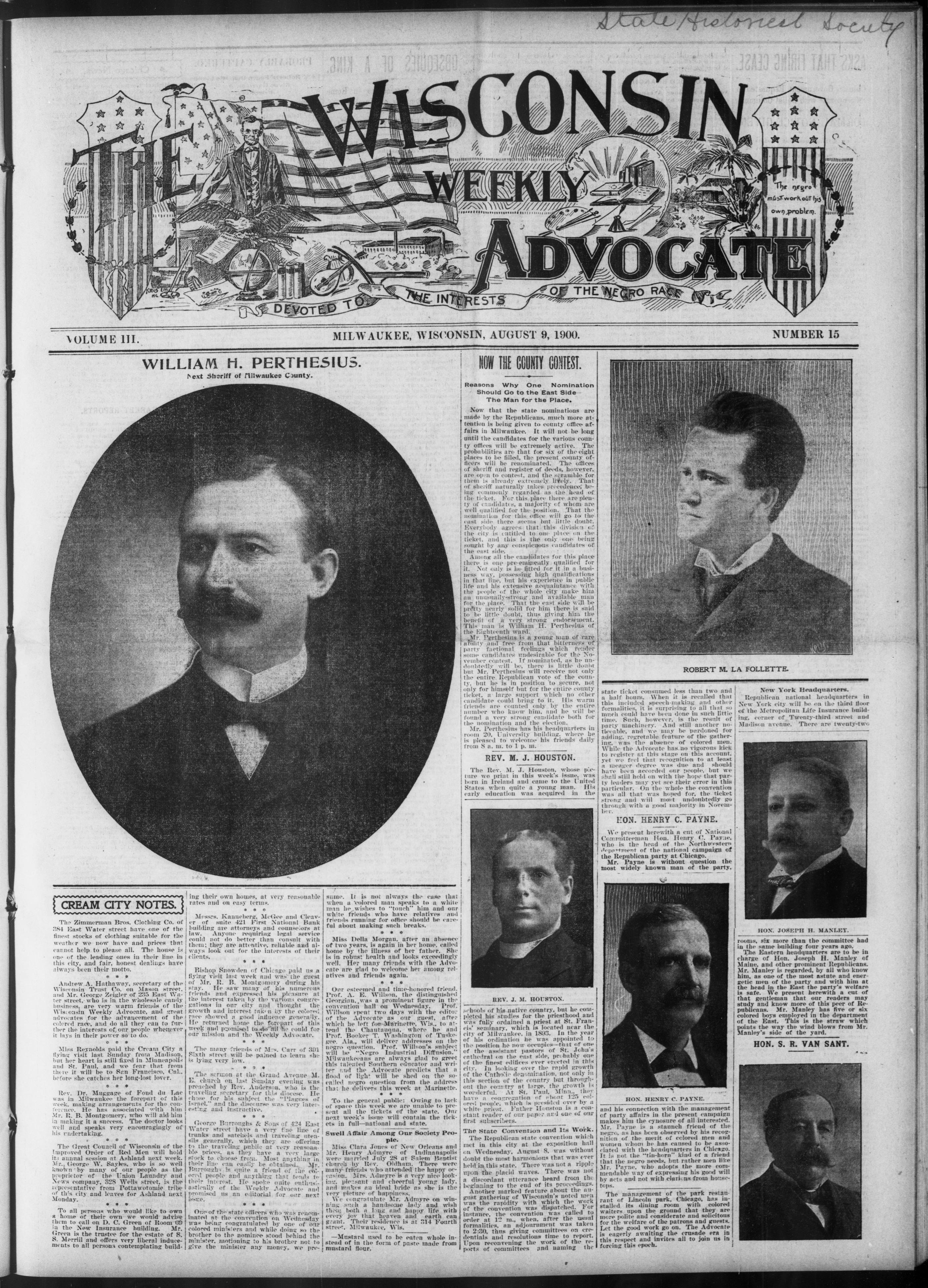
WILLIAM H. PERTHESIUS.
Next Sheriff of Milwaukee County.
VOLUME III.
WILL
CREAM CITY NOTES.
The Zimmerman Bros. Clothing Co. of 384 East Water street have one of the finest stocks of clothing suitable for the weather we now have and prices that cannot help to please all. The house is one of the leading ones in their line in this city, and fair, honest dealings have always been their motto.
```markdown
```
Andrew A. Hathaway, secretary of the Wisconsin Trust Co. on Mason street, and Mr. George Zeigler of 235 East Water street, who is in the wholesale candy business, are very warm friends of the Wisconsin Weekly Advocate, and great advocates for the advancement of the colored race, and do all they can to further the interests of our people whenever it lays in their power so to do.
☆ ☆ ☆
Miss Reynolds paid the Cream City a flying visit last Sunday from Madison, but her heart is still fixed in Minneapolis and St. Paul, and we fear that from there it will be to San Francisco, Cal., before she catches her long-lost lover.
水 承 承
Rev. Dr. Muggage of Fond du Lac was in Milwaukee the forepart of this week, making arrangements for the conference. He has associated with him Mr. R. B. Montgomery, who will aid him in making it a success. The doctor looks well and speaks very encouragingly of his undertaking.
* * *
The Great Council of Wisconsin of the Improved Order of Red Men will hold its annual session at Ashland next week. Mr. George W. Sayles, who is so well known by many of our people as the proprietor of the Union Laundry and News company, 328 Wells street, is the representative from Pottawotomie tribe of this city and leaves for Ashland next Monday.
To all persons who would like to own a home of their own we would advise them to call on D. C. Green of Room 69 in the New Insurance building. Mr. Green is the trustee for the estate of S. Merrill and offers very liberal inducements to all persons contemplating build-
---
ing their own homes, at very reasonable rates and on easy terms.
* * *
Messrs. Kanneberg, McGee and Cleaver of suite 421 First National Bank building are attorneys and counselors at law. Anyone requiring legal service could not do better than consult with them; they are attentive, reliable and always look out for the interests of their clients.
```markdown
```
Bishop Snowden of Chicago paid us a flying visit last week and was the guest of Mr. R. B. Montgomery during his stay. He saw many of his numerous friends and expressed his pleasure at the interest taken by the various congregations in our city and thought the growth and interest taken by the colored race showed a good influence generally. He returned home the forepart of this week and promised to do till he could for our mission and the Weekly Advocate.
* * *
The many friends of Mrs. Carr of 391 Sixth street will be pained to learn she is lying very low.
The sermon at the Grand Avenue M. E. church on last Sunday evening was preached by Rev. Anderson, who is the traveling secretary for this diocese. He chose for his subject the "Plagues of Israel," and the discourse was very interesting and instructive.
---
George Burroughs & Sons of 424 East Water street have a very fine line of trunks and satchels and traveling utensils generally, which they are offering to the traveling public at very reasonable prices, as they have a very large stock to choose from. Most anything in their line can easily be obtained. Mr. Burroughs is quite a friend of the colored people and anything that tends to their interest. He spoke quite enthusiastically of the Weekly Advocate and promised us an editorial for our next issue.
* * *
One of the state officers who was renominated at the convention on Wednesday was being congratulated by one of our colored ministers and while doing so the brother to the nominee stood behind the minister, motioning to his brother not to give the minister any money, we pre-
MILWAUKEE, WISCONSIN, AUGUST 9, 1900.
sume. It is not always the case that when a colored man speaks to a white man he wishes to "touch" him and our white friends who have relatives and friends running for office should be careful about making such breaks.
```markdown
```
Miss Della Morgan, after an absence of two years, is again in her home, called home by the illness of her father. She is in robust health and looks exceedingly well. Her many friends with the Advocate are glad to welcome her among relatives and friends again.
☆ ☆ ☆
Our esteemed and time-honored friend, Prof. A. E. Willson, the distinguished Georgian, was a prominent figure in the convention hall on Wednesday. Prof. Willson spent two days with the editor of the Advocate as our guest, after which he left for Marinette, Wis., to attend the Chautauqua, where he and Prof. Booker T. Washington of Tuskegee, Ala., will deliver addresses on the negro question. Prof. Willson's subject will be "Negro Industrial Diffusion." Milwaukeeans are always glad to greet this talented Southern educator and writer and the Advocate predicts that a flood of light will be shed on the so-called negro question from the address that he delivers this week at Marinette.
* * *
To the general public: Owing to lack of space this week we are unable to present all the tickets of the state. Our next week's issue will contain the tickets in full-national and state.
Swell Affair Among Our Society People.
Miss Clara Jones of New Orleans and Mr. Henry Admyre of Indinanapolis were married July 28 at Salem Baptist church by Rev. Oldham. There were many friends who attended the happy occasion. Mrs. Admyre is a very nice looking, pleasant and cheerful young lady, and makes an ideal bride as she is the very picture of happiness.
We congratulate Mr. Admyre on winning such a handsome lady and wish them both a long and happy life with every joy that heaven and earth can grant. Their residence is at 314 Fourth street, Milwaukee, Wis.
—Mustard used to be eaten whole instead of in the form of paste made from mustard flour.
NOW THE COUNTY CONTEST.
Reasons Why One Nomination Should Go to the East Side The Man for the Place.
Now that the state nominations are made by the Republicans, much more attention is being given to county office affairs in Milwaukee. It will not be long until the candidates for the various county offices will be extremely active. The probabilities are that for six of the eight places to be filled, the present county officers will be renominated. The offices of sheriff and register of deeds, however, are open to contest, and the scramble for them is already extremely likely. That of sheriff naturally takes precedence, being commonly regarded as the head of the ticket. For this place there are plenty of candidates, a majority of whom are well qualified for the position. That the nomination for this office will go to the east side there seems but little doubt. Everybody agrees that this division of the city is entitled to one place on the ticket, and this is the only one being sought by any conspicuous candidates of the east side.
Among all the candidates for this place there is one pre-eminently qualified for it. Not only is he fitted for it in a business way, possessing high qualifications in that line, but his experience in public life and his extensive acquaintance with the people of the whole city make him an unusually strong and available man for the place. That the east side will be pretty nearly solid for him there is said to be little doubt, thus giving him the benefit of a very strong endorsement. This man is William H. Perthesius of the Eighteenth ward.
Mr. Perthesius is a young man of rare ability and free from that bitterness of party factional feelings which render some candidates undesirable for the November contest. If nominated, as he undoubtedly will be, there is little doubt but Mr. Perthesius will receive not only the entire Republican vote of the county, but he is in position to secure, not only for himself but for the entire county ticket, a large support which no other candidate could bring to it. His warm friends are counted only by the entire number who know him, and he will be found a very strong candidate both for the nomination and the election.
Mr. Perthesius has his headquarters in room 20. University building, where he is pleased to welcome his friends daily from S a. m. to 1 p. m.
REV. M. J. HOUSTON.
The Rev. M. J. Houston, whose picture we print in this week's issue, was born in Ireland and came to the United States when quite a young man. His early education was acquired in the
9
REV. J. M. HOUSTON.
schools of his native country, but he completed his studies for the priesthood and was fully ordained a priest at St. Francis' seminary, which is located near the city of Milwaukee, in 1893. In the year of his ordination he was appointed to the position he now occupies—that of one of the assistant pastors of St. John's cathedral on the east side, probably one of the finest edifices ever erected in this city. In looking over the rapid growth of the Catholic denomination, not only in this section of the country but throughout the country at large, the growth is wonderful. At St. Paul, Minn., they have a congregation of about 125 colored people, which is presided over by a white priest. Father Houston is a constant reader of our paper and one of our first subscribers.
The State Convention and Its Work.
The Republican state convention which met in this city at the exposition hall on Wednesday, August 8, was without doubt the most harmonious that was ever held in this state. There was not a ripple upon the placid waves. There was not a discordant utterance heard from the beginning to the end of its proceedings.
Another marked feature about the august gathering of Wisconsin's noted men was the rapidity with which the work of the convention was dispatched. For instance, the convention was called to order at 12 m., when, after the usual formalities, an adjournment was taken to 2:30, thus giving committees on credentials and resolutions time to report. Upon reconvening the work of the reports of committees and naming the
W. C.
ROBERT M. LA FOLLETTE.
state ticket consumed less than two and a half hours. When it is recalled that this included speech-making and other formalities, it is surprising to all that so much could have been done in such little time. Such, however, is the result of party machinery. And still another noticeable, and we may be pardoned for adding, regretable feature of the gathering, was the absence of colored men. While the Advocate has no vigorous kick to register at this stage on this account, yet we feel that recognition to at least a meager degree was due and should have been accorded our people, but we shall still hold on with the hope that party leaders may yet see their error in this particular. On the whole the convention was all that was hoped for, the ticket strong and will most undoubtedly go through with a good majority in November.
HON. HENRY C. PAYNE.
We present herewith a cut of National Committeeman Hon. Henry C. Payne, who is the head of the Northwestern department of the national campaign of the Republican party at Chicago. Mr. Payne is without question the most widely known man of the party.
J.
and his connection with the management of party affairs in the present campaign makes him the cynosure of all interested. Mr. Payne is a staunch friend of the negro, as has been observed by his recognition of the merit of colored men and women whom he has caused to be associated with the headquarters in Chicago. It is not the "tin-hern" kind of a friend that the negro needs, but rather men like Mr. Payne, who adopts the more commendable way of expressing his good will by acts and not with clarions from house-tops.
The management of the park restaurant of Lincoln park, Chicago, has installed its dining room with colored waiters upon the ground that they are more polite and considerate and solicitous for the welfare of the patrons and guests. Let the good work go on. The Advocate is eagerly awaiting the crusade era in this respect and invites all to join us in forcing this epoch.
New York Headquarters.
Republican national headquarters in New York city will be on the third floor of the Metropolitan Life Insurance building, corner of Twenty-third street and Madison avenue. There are twenty-two
PETER H. BURGESS
rooms, six more than the committee had in the same building four years ago. The Eastern headquarters are to be in charge of Hon. Joseph H. Manley of Maine, and other prominent Republicans. Mr. Manley is regarded, by all who know him, as one of the most astute and energetic men of the party and with him at the head in the East the party's welfare is safe. We present herewith a cut of that gentleman that our readers may study and know more of this peer of Republicans. Mr. Manley has five or six colored boys employed in the department of the East. This is the straw which points the way the wind blows from Mr. Manley's side of the yard.
HON. S. R. VAN SANT.
M.
ASKS THAT FIRING CEASE.
Not an Ultimatum but Insists that American Minister Shall Not be Sent Out of Pekin.
Washington, D. C., Aug. 9.—The dispatch sent last night to the Chinese government through Minister Wu is not in the form or nature of an ultimatum. It insists, however, that the firing on the legations cease, and that the imperial government, if it desires to show its friendliness, shall co-operate with the relieving column. In this matter our government has proceeded on the assumption that the imperial government is willing to do all it can to aid in relieving the ministers.
The contents of the President's message would not be divulged by officials under orders from the President, who deemed that it would be most fitting for the Chinese minister to give out anything he might wish on this delicate subject himself.
From the best-sources it was learned that the communication talks a firm stand, but is framed in such language and so diplomatically expressed that the Chinese government, whose intentions the United States is not ready to impeach entirely, cannot take umbrage. The note is insistent upon two things. These are: 1. That our minister and his family, as well as other Americans and foreigners in Pekin, shall be protected by the imperial government and shall not be sent out of Pekin, unless the ministers find it agreeable and are willing to do so under instructions from their home governments.
2. That the troops of the Chinese government shall lend aid to the protection of ministers in Pekin and shall also act with the allied troops when they arrive in restoring order and putting a stop to bloodshed in Pekin, thus affording all the protection possible to the legationers.
Reply to the Edict.
The state department made public today the following memorandum sent yesterday to the Chinese government through Minister Wu:
"We are availing ourselves of the opportunity offered by the imperial edict of the 5th of August, allowing to the foreign ministers free communication with their respective governments in cipher, and have sent a communication to Minister Conger, to which we await an answer.
"We are already advised by him, in a brief dispatch received August 7, that imperial troops are firing daily upon the ministers in Pekin. We demand the immediate cessation of hostile attacks by imperial troops upon the legations, and urge the exercise of every power and energy of the imperial government for the protection of the legations and all foreigners therein.
Means Certain Death.
"We are also advised by the same dispatch from Minister Conger that, in his opinion, for the foreign ministers to leave Pekin as proposed in the edict of August 2, would be certain death. In view of the fact that the imperial troops are now firing upon the legations, and in view of the doubt expressed by the imperial government in its edict of August 2 as to its power to restore order and secure absolute safety in Pekin, it is evident that this apprehension is well founded, for if your government cannot protect our minister in Pekin it will, presumptively, be unable to protect him upon a journey from Pekin to the coast.
"We, therefore, urge upon the imperial government that it shall adopt the course suggested in the third clause of the letter of the President to his majesty, the Emperor of China, of July 23, 1900, and enter into communication with the relief expedition so that co-operation may be secured between them for the liberation of the legations, the protection of foreigners and the restoration of order. Such action on the part of the imperial government would be a satisfactory demonstration of its friendliness and desire to attain these ends."
The Best Method.
It will be observed that the note is not bellicose in tone, and its temper is generally commended as the best method of using the professed friendship of the imperial authorities to save the legioners. The demand for the immediate cessation of attacks on the legation is stern and emphatic, but the word "demand" gives way to "urge," when the imperial government is required to place itself in friendly communication with the advancing allies.
It is pointed out that while we have the undoubted right to demand that the firing upon our diplomatic representatives cease, to do more than advise and urge the Chinese government to co-operate with the forces of the powers for the relief of the ministers and restoration of order might possibly be deemed presumptuous and offensive. The authorities here are very hopeful that this moderation will carry weight, as it will afford the Chinese government an opportunity to comply without seeming to yield to a demand.
An Unavoidable Delay.
Although the note was delivered to Minister Wu early last evening, it had not been forwarded to the Chinese government at 10 o'clock this morning. The laborious work of translating it into precise Chinese, and then of putting it into the complicated cipher system which the Chinese employ, was responsible for the delay. The minister and his assistants had been at work almost constantly since it was received, but up to the hour named, had not finished putting it into cipher. It was expected, however, that it would go forward within a few hours.
Shanghai Report Doubted.
The state department is inclined to express incredulity over the report wired by the Shanghai correspondent of the London Daily News, yesterday, to the effect ahat Consul-General Goodnow had protested against the landing of troops at Shanghai by Admiral Seymour. The department has nothing from Mr. Goodnow on the subject and is not inclined to believe that he would undertake so grave a step as the lodgment of a protest against the action of the British admiral without consulting the department here.
Supply of Food Cut Off.
New York, Aug. 9.—A dispatch to the Tribune from London says: The news from China is almost limited to messages received from the ministers in Pekin.
The Express' correspondent in Shanghai sends the disquieting intelligence that Sheng has prohibited the export of foodstuffs to the north. Such a measure would militate seriously against the operations of the relief force, which is largely dependent upon Shanghai for its supplies from Nankin. The Express also reports that Li Hung Chang is endeavoring to negotiate terms with Russia. Satisfaction is generally expressed at the reported appointment of Count von Waldersee to the supreme command of the allied forces in China. The Post's correspondent in Berlin states that in well-informed circles the appointment of
the field marshal is held to foreshadow a dispatch to China of a largely-augmented German force.
TO HOLD SHANGHAI.
Admiral Seymour Arranging for Oc- question by the British.
Shanghai, Aug. 9.—Vice-Admiral Seymour has arranged with the viceroy of Nankin for a British occupation of the foreign settlements at Shanghai. Hong Kong, Aug. 9.—Two detachments of Indian troops here have been notified to prepare to proceed to Shanghai.
About 3000 black flags left Canton, ostensible for Pokin.
tensibly for Pekin. It is reported at Canton that the French intend to clear the Chinese craft from the creek separating the artificial island of Sha Mien and Canton. The Chinese protest against such action as calculated to cause disturbances.
Says Italians Left Pekin.
London, Aug. 9.—The Rome correspondent of the Daily Mail announces the reception there of official dispatches from the Italian minister in Pekin asserting that he left Pekin on July 31, presumably for Tien Tsin. This, however, is so utterly at variance with the action and intentions of the other ministers heard from that it seems almost incredible. If true it opens up an interesting field of speculation concerning the fate of the Italian representative.
The Chinese legation believes that the members of the foreign legations have not yet left Pekin, but that they will do so, and declares that the edict would not have been issued had not the foreign ministers signified a willingness to accept the escort.
Opposes Seymour's Plan.
The Shanghai correspondent of the Daily News, wiring yesterday, says: "United States Consul Goodnow strongly opposes Admiral Seymour's intention to land 3000 troops on the ground that such an act would not be warranted by the circumstances and would be likely to create trouble. M. Bezaure, the French consul, agrees to the arrangement, but says that if the British land forces the French will do likewise. The Austrians also will land men."
The Daily Chronicle, commenting upon American criticism of the character of the Chinese "news" printed in some London dailies, admits that the charges are only too true, and that the practices of certain papers in this respect are opposed to the best traditions of British journalism. It joins in the American protest against trashy sensationalism.
Almost all the news in this morning's papers upon which credence is placed comes either from Washington or direct from British officials.
Larger Army for Germany.
Berlin, Aug. 9. It is generally believed that Germany will send another expedition, bringing the total German contingent up to 30,000 by the middle of October, but neither the foreign office nor the minister of war will confirm the reports to this effect.
The first application for naturalization by a Chinaman was made here today. The applicant is a merchant of twenty-four years' residence.
Babes in the Woods.
Vancouver, B. C., Aug. 9.—Rev. Jonathan Lees, head of the London missionary society, arrived from Tien Tsin on the steamer Empress of India. He said that but for the Chinese converts, many missionaries would have been killed. They were invaluable during the siege. They built all the barricades under a rain of bullets.
Chance to Escape Lost.
He severely scored the foreign diplomats who, he says, are babies beside the wily Chinese. As an instance of how little the European representatives know of the native rulers, he said the day before Pekin was closed Sir Claude MacDonald persuaded some ladies who were visiting him that there was no danger and they might as well prolong their visit.
KAISER'S SELECTION
Von Waldersec's Appointment Approved by the Powers.
Bremen, Aug. 9.—The story of Von Waldersee's appointment is told here as follows: The Kaiser sent a telegraphic dispatch to Count von Waldersee on Monday evening asking if he would accept the appointment in case it were made. On receiving an affirmative reply Emperor William then proposed his name to the powers and had a conference with the count at 5 o'clock the following afternoon at the castle of Wilhelmshohe. The prompt acceptance of the Kaiser's proposition by the powers is in the nature of a surprise, and is thought to be due only to Gen. von Waldersee's reputation and his rank as field marshal and leader of the entire German army. This would make it impossible for any of the other nation's jealousy to subordinate such a leader.
The selection of the best officer in Germany is the strongest evidence of the extreme gravity which the Kaiser and the other powers attach to the present situation.
Berlin, Aug. 9.—The press here expresses great satisfaction over the reported appointment of Gen. von Waldersee to the post of head commander of the allies. It appears to be generally recognized that no better selection could have been made.
The Tageblatt says that Germany has always been in the front rank in furnishing able warriors to other nations—for example, Baron von Steuben in the American struggle for independence and the great Von Moltke in the Turko-Egyptian war.
Paris, Aug. 9.-The announcement that Gen. von Waldersee will be the generalissimo of the allied forces seems to provoke no disapproval in the papers. The reason of this is not only the improved relations between France and Germany of late years, but the intense hatred of England, which is so intense here that the French are possessed with the idea that England is merely intriguing in China in order to get control of everything. Thus they prefer to see French soldiers receiving orders from a German general.
CHINA WILL SUBMIT.
Secretary Long Says War is Unnecessary—No Extra Session.
New York, Aug. 9.—A special dispatch from Boston to the Commercial Advertiser says: Secretary Long has left Hingham for his vacation at Buckport, Me. Before leaving he said:
"We are not looking for territorial aggrandizement in China and would be content with proper indemnity. I think China will see the necessity of submitting to our demands, thus obviating war. Other powers may fight despite the safe deliverance of foreigners. I can only speak for the part America will play.
"I do not believe that the statement of a minister that cannot leave the capital of a country without danger to his life is equivalent to a declaration of war from the country which threatens him. I think the affair will work itself out amicably. In view of the facts as I believe them to be, an extra session of Congress is unnecessary."
BURNED BY BOXERS.
Austro-Hungarian Legation, with Its Archives. Destroved.
Vienna, Aug. 9.—The foreign office has received the following from Dr. A. Von
Rosthorn, secretary of the Austrian-Hungarian legation at Pekin, dated August 4:
"The Austro-Hungarian legation, with the archives, was burned June 21. Since June 20 we, with the French detachment, have been defending the French legation, which has been bombarded by cannon and rifle fire. Part of their building was destroyed by mines. We deplore the losses of Capt. Thomann and three sailors killed, and Boyneburg and two sailors severely wounded.
"Since July 16 the Chinese attacks have not been severe. The Chinese government wishes us to leave for Tien Tsin under safe conduct, but until now we have not fallen in with this offer."
Working Night and Day.
Bridgeport, Conn., Aug. 9.—The Union Metallic Cartridge company is working night and day to fill orders from several governments for ammunition. Besides the big orders for Krag ammunition the company has a contract for field artillery ammunition to fill for the United States government. The ammunition ranges in size from one pound to twelve pounds. The government is making war preparations on a big scale in view of the conditions in China, and large orders for ammunition have been placed with the company's agents by the war department.
Five Priests Killed.
Lyons, Aug. 9.—The Catholic Journal announces new massacres and a disaster to the missions in the southeast province of Chi Li. It says that five priests have been killed.
The Country Flooded.
New York, Aug. 9.—A dispatch to the Journal and Advertiser from Chefoo, August 5, via Shanghai, August 8, says: Owing to the heavy rains the Pei-Ho has risen and flooded the country in a way that will make the advance of the allies extremely difficult.
ANOTHER VICTORY.
The Relief Column Continues Its Triumphal March Toward Pekin.
Washington, D. C., Aug. 9.—The following dispatch has been received by the signal office of the army here:
Chefoo, Arg. 9.—Signal Office, Washington: August 6, Yang Tsun captured today. Wre up. Need own transportation. All well. SCRIVEN.
Yangtsun is the town which Gen. Chaffee indicated in his dispatch yesterday as being the objective of the international forces on their then-pending movement. It is at the junction of the PeiHo and the railroad leading to Pekin. Its capture will insure to the international troops, it is hoped, two routes of transportation to Pekin. It is 17.8 miles from Tien Tsin.
Washington, D. C., Aug. 9.—The following dispatch has been received at the war department from Gen. Chaffee, sent via Chefoo:
"Yang Tsun occupied today. Wounded: Second Lieut. Frank R. Long, Ninth infantry, moderate. Casualties, about sixty men, Ninth U. S. infantry, Fourteenth U. S. infantry and Battery F Fifth U. S. artillery. Nearly all from Fourteenth infantry. Names later Many men prostrated from heat and fatigue."
Refused to Leave.
Paris, Aug. 9.—[Special.]—The foreign office has received the following dispatch, which reached here in cipher, from M. Pichon, the French minister at Pekin, via Shanghai, today. August 9. the Pekin date not being given:
"The diplomatic corps has just been informed by the Chinese government that the powers have repeatedly demanded our departure from Pekin under escort and beg us to arrange our departure and fix a date. We have responded to the tsung li yamen that we could not leave our posts without instructions from our governments, to whom we leave the question.
"I should inform you that should we not depart from Pekin the foreign forces coming to our rescue should be of sufficient number to insure the safety and convey of 800 foreigners, of whom 200 are women and children and 50 wounded and more than 3000 native Christians, whom we cannot leave to be massacred. In any case, a Chinese escort should not be considered."
A DEPLORABLE STATE
Li Hung Chang Says the Boxers Have Control at Pekin.
Washington, D. C., Aug. 9.—An important dispatch has been received in diplomatic quarters in Washington, forwarded from the foreign office of one of the powers taking part in the international movement and giving with detail a conversation by Li Hung Chang, in which he expresses his despair over the condition of the Chinese government and his fears that the anti-foreign element has gained complete ascendancy at Pekin. The conversation was with the consul of the power receiving the dispatch and as he is an intimate friend of long standing with Earl Li, the latter spoke unreservedly of the deplorable condition of affairs among his own people. The dispatch as received in Washington is quite lengthy and quotes Li Hung Chang as saying that he is satisfied that the conservative or progressive element to which he belongs no longer has any influence at Pekin. The ascendancy of Li Ping Heng, the intense anti-foreign leader, is referred to, and it is stated that it was due to his proposition that the two conservative members of the tsung li vamen were beheaded. The names of the beheaded ministers are given in the dispatch as Yuen Chang and Hsie Chin Chang. This last event appeared particularly to depress Li Hung Chang, who regarded it as establishing that the progressive element favorable to the foreigners could expect no mercy. He even expressed the belief that he would be among those to suffer. He stated that, although summoned to Pekin, he had asked for twenty days' delay on the ground that he was not able to travel.
The substance of the foregoing dispatch has been communicated to the department. It is not strictly official as the conversation was to a certain extent confidential, but it none the less is considered as throwing light on the situation from the standpoint of the noted Chinese statesman.
Allies Lost 1130.
London, Aug. 9.—The losses of the allies in the recent operations are now said to be 1130 men, of which number the Russians lost 600, the Japanese 410 and the British 120.
A news agency dispatch from Chefoo, dated Sunday, August 5, says a messenger from Pekin reports that the Dowager Empress sent four cartloads of food to the legations on July 28.
Missionaries Escape to Japan.
New York, Aug. 9.—Rev. Dr. A. B. Leonard, secretary of the Episcopal Methodist Missionary society, today received a cablegram from Rev. W. H. Lace from Kobe, Japan, announcing the safe arrival at Kobe of various members of the Methodist Episcopal mission at Foo Chow. Besides Mr. Lacey and his wife the following were named as having arrived at Kobe: Rev. and Mrs. James Simester, Mrs. Julia W. Plum, Miss Sarah M. Bosworth and Miss Isabella Longstreet.
—A large colony of Mormons is moving into the Big Horn basin of Wyoming. There is not a member of the colony who has less than $1000 and many are worth much more. They represent the better class of Mormons.
OBSEQUIES OF A KING.
Rome, Aug. 9.—At an early hour this morning ten non-commissioned officers of Cuirassiers carried the casket containing the remains of the late King Humbert from the funeral train to the large hall of the railroad station, which had been transformed into a chapel, hung with sable draperies with gold ornamentation. The first chaplain of the court, assisted by a number of priests, pronounced the absolution, and the cortege started for the Pantheon, where rest the remains of Humbert's father, King Victor Emanuel II. The immense space surrounding the railroad station was entirely filled with people and as the casket was borne into the open air a touching and imposing spectacle was witnessed. All those present uncovered and remained bareheaded while the procession was in view. After the casket had been placed on a gun carriage, King Victor Emanuel III. took his place at the head of the princes who followed the remains. Behind his majesty were the Duke of Aosta, the Count of Turin, the Duke of Genoa, the Duke of Oporto, Prince Ferdinand of Genoa, and other royal visitors. Following them were the members of the diplomatic corps and the special envoys.
An Imposing Cortege.
Preceding the cortege, which was most imposing in its magnificence, was a battery of artillery, a band of music and then a battalion from each division of the Italian army and marine corps, many army and navy officers, representatives of the scientific and educational institutions, the mayors and municipal officers of Rome and Turin, deputations from all the departmental bureaus of the government, and behind those were the more important state bodies, including the cabinet ministers, senators and deputies, whose appearance made a striking group. Just ahead of the casket were about 100 priests and 100 friars, including the court chaplains.
The gun carriage bearing the casket was drawn by six horses and was surrounded by officers and functionaries of the civil and military houses of the royal princes and of the late King, and was immediately preceded by the late King's general aide-de-camp, Avogadre des Contest di Quinto, on horseback, bearing the sword of the late King.
Faces Stream with Tears.
As the body of the dead monarch was borne along towards the Pantheon, many of those present in the crowded street showed by their emotion the true worth at which he was held, for tears were streaming down their faces.
Behind the casket was the master of ceremonies of the court, bearing a wreath of iron, and following him was the late King Humbert's beautiful bay war horse, which was a very great favorite with the deceased. The horse was covered with long, black drapings.
When the head of the procession reached the Pantheon, an enormous crowd occupied every available foot of space. All the adjacent streets and the windows, balconies and terraces in the vicinity were also filled with spectators. Not a whisper of conversation interrupted the solemnity of the scene, the multitude remaining in respectful silence with uncovered heads.
As was the case in the square before the railroad station, the streets through which the procession passed were draped with black, and along the route poles were erected covered with cypress branches and with stringings of palms entwined with black bunting stretching across the streets. Innumerable flags were displayed at half mast and the funeral decorations which hung from the windows were so universal throughout the city that it can be literally said that the entire city of Rome was in mourning.
King Victor on Foot.
The procession marched in perfect order and at a slow pace. King Victor Emanuel, who was on foot, bore himself with dignity and carried his head high. The groups of officers in full uniform gave great brilliancy to the cortege. No less than 650 senators and deputies took part in the procession, many Radicals and Republicans being among the number.
During the march flowers were thrown from the windows on the passing casket. The whole portico of the Pantheon, where the procession arrived at 9:15 a.m., formed a veritable flower bed of wreaths and flowers there deposited.
At some points attempts were made to acclaim the new King, but such loyal exclamations and applause were repressed, as the solemn silence which prevailed along nearly the whole route more clearly expressed the profound grief of the people.
Simple Decorations.
The exterior decoration of the Pantheon was very simple. Under the immense portico had been erected two large altars upon which burned alcohol lamps. On the steps of the altars were placed the wreaths.
When the casket reached the Pantheon, ten non-commissioned officers of Cuirassiers lifted it from the gun carriage and carried it into the church where it was received by Mgr., the Count of Reggio, archbishop of Genoa, who was in his pontifical robes and surrounded by the cathedral functionaries. The casket was then raised to the top of a catafalque surmounted by a wreath of iron and on it was placed the helmet and sword of King Humbert.
Within the Church.
An hour before the arrival of the funeral procession Queen Helena, Dowager Queen Margaret, former Queen Marie Pia of Portugal, as well as some of the royal princes reached the Pantheon in carriages. The new King and the Italian princes on their arrival, took up position on the right side of the church, the Queen and princesses stationing themselves on the left
HARPERS' PROPERTY SOLD.
Bid in by Reorganization Committee
for $1,000,000.
New York, Aug. 9.—The Harpers Brothers building in Pearl and Cliff streets, together with all printing presses and other apparatus on the premises and with all rights to publish the Harper periodicals, were sold at the New York Real Estate exchange today for $1,000., 000, to Alexander E. Orr, chairman of the reorganization committee for the publishing house, the property and business were sold by Bryan L. Kennelly on a foreclosure sale on a mortgage held by the Norton Trust company. The right to use the name of Harper & Brothers is included in the sale.
—Shipments of deciduous fruits from California to date have been 2691 cars, against 2456 cars last season.
PROBABLY CAPTURED.
London, Aug. 9.—The war office has received the following dispatch from Gen. Roberts, dated Pretoria, August 7: "I fear that the Elands river garrison, under Lieut. Col. Hoare, has been captured, after ten-days' resistance. Delarey, learning of Hamilton's approach to Rustenburg, and seeing no chance of capturing Baden-Powell, hurried to Elands river. Hamilton has reported that the firing in the direction of Elands river ceased yesterday, and Hoare has evidently been captured. Hamilton left Rustenburg this morning, bringing Baden-Powell's forces with him.
"Dewet commenced crossing the vaal yesterday. Kitchener is now in pursuit. Methuen, who is on the right bank of the Vaal, has evidently come in contact with Dewet's advance guard, as his guns were heard by Kitchener this morning."
Dewet Crosses the Vital.
The following report, dated Pretoria, August 8, has been received from Lord Roberts:
"Kitchener was informed yesterday by an escaped British prisoner that Dewet's wagons had crossed the Vaal. Afterwards I heard the sound of guns, which, I think, must have been Methuen's, as I directed him to take up a position between Potchefstroom and Lindique, where he could intercept the enemy, who crossed the river at Dewetsdorp. Kitchener is crossing the Vaal with cavalry and mounted infantry.
"Hunter reports that he made 4149 prisoners in the Bethlehem-Harrismith district, a majority of whom are now enroute for Cape Town. Three guns and 4000 horses were captured and ten wagonloads of ammunition and 195,000 rounds of ammunition destroyed.
"The garrison of Elands river consisted of about 300 bushmen and Rhodesians. I had hoped that Carrington had been in time to withdraw the garrison; but it seems that Delarey, learning of Ian Hamilton's approach to Rustenburg, hurried westward and surrounded the garrison before Carrington arrived.
"Methuen telegraphs that he engaged a part of Dewet's force yesterday near Benterskroon. He drove the enemy off of a succession of hills, which they held obstinately.
"Our casualties, seven men killed or wounded, including four officers."
Boes Hover Near Pretoria.
Pretoria, Aug. 9.—A Boer commando consisting of 500 men, with two guns, is reported to have again appeared at Pyramid hill, eight miles north of Pretoria. Scouts have been seen close to the British outposts at night. There is some uneasiness here, it being thought by some that there is a possibility of an attempted rising by the burghers, encouraged by the nearness of the Boers in arms. The military authorities are vigilant, however, and every precaution has been taken to maintain order.
Trains running between Pretoria and Middleburg were sniped at by the Boers near Bronkhorstspruit. Two men were wounded. A force of mounted infantry drove the Boers off and burned the farms for ten miles around.
The Boers held a position five miles east of Wondestfontein. This is an advance station on the Delagoa bay line that is held by the French. Every intermediate station is strongly garrisoned by the British.
Prisoners Reach Colombo.
Colombo, Ceylon, Aug. 8.—Two hundred and thirty-three, prisoners of war from South Africa arrived here today. Their ultimate destination is Diyatalawa. One hundred and twenty-three of them are Boers, twenty-two Americanans, and eighty-eight Germans and Hollanders.
Tired of the Boer War.
New York, Aug. 9.--A dispatch to the Tribune from London says: The public interest in the South African war has waned, but the parliamentary session closed with a series of angry discussions on the subject, Mr. Chamberlain being fiercely baited by the Radicals on the communication which he alleges some opposing members have maintained with the Transvaal government. In all this there is a considerable element of party politics. It is commonly believed that the general election will take place in the autumn and the policy and conduct of the war will be the main issue before the candidates, hence the politicians are still talking of South Africa.
Everybody is heartily tired of the Boer war and anxious to have done with it as soon as possible, but the government is by no means convinced that the end is at hand, and it is significant that reinforcing drafts for two of the regiments at the front have just been ordered to hold themselves in readiness for embarkation next week.
KASSON IS MENTIONED.
Gov. Shaw May Appoint Him to Succeed the Late Senator Gear.
Des Moines, Ia., Aug. 9.—John A. Kasson is the latest addition to the list of senatorial aspirants. It is asserted here on good authority that Gov. Shaw is thinking of appointing him. Kasson is at present confidential adviser of the state department at Washington, and he always had an ambition to be senator. It is thought by some, however, that his connection with the department would prevent his acceptance. There is also a question as to his citizenship. He has resided in Washington so long that some declare he has lost his citizenship in Iowa. His friends say, however, that he is still a citizen of this state.
FIRE LOSS OF $300,000.
Two Large Manufacturing Plants in Beaver Falls Destroyed.
Beaver Falls, Pa., Aug. 9.—Fire last night totally destroyed the works of the Shelby Steel Tube company, and the Boston Electroduct company, doing damage to the extent of $300,000. The fire was discovered shortly before midnight, and burned so fiercely that for a time it was feared the Union Drawn Steel works would also be destroyed, but by heroic efforts, the firemen kept the flames from spreading. The origin of the fire is unknown. The loss was fully covered by insurance.
Chinese Conservatism
Chinese prejudice never disappears before the light, but it is daily being broken down by its own weight under external pressure. In years to come even the horrors of the Pekin carr may be discarded by foreign residents in favor of the foreign rickshaw, but this depends more on the mending of the Chinese roads than on the mending of Chinese manners.—London Telegraph.
Barrel-Bolling Extraordinary.
For a wager of $1015 two Austrians are going to attempt to roll an empty barrel weighing 440 pounds from Vienna to Paris, a distance of 837 miles, in 50 days. The route will be through Munich and Strasburg. On the barrel have been cut the arms of the cities of Paris and Vienna, the dates and the names of the two pedestrians.
The first Democratic national convention was held in 1832, and was presided over by Gen. Lucas of Ohio, after whom Lucas county in that state was named.
Michael Gorman had a hearing before Commissioner Humphrey on the charge of counterfeiting. He waived examination, and was put under bonds of $2000.
Sergt. James Smith of the Chicago avenue police station is suffering from blood poisoning caused by a pin scratch across the hand sustained while dispersing a crowd.
Walter W. Guy. 17 years old, was stopped by two boys about his own age at the point of a revolver and robbed of 60 cents near his home, 304 North Willow avenue, Austin.
An ordinance has been framed demanding that clairvoyants be forced to pay a license fee of $800 a year. It is said that the measure is urged by a class of clairvoyants to drive other members of the sect out of business.
Thomas White and Patrick Ryan, said by the police to be successors of "Black Jack" Yattaw in the practice of "bumboating," were arrested at the Randolph street docks and locked up at the Harrison street station on charges of selling liquor without a license.
Mrs. Emmons Blaine, to whom a position on the board of small park commission was offered, has notined Secretary A. W. O'Neill that she cannot accept the offer. She said that at some future day she would be pleased to take up the small park work in any manner that might be assigned to her.
Frank Gregory, a vaudeville performer, pleaded guilty to petty larceny in Judge Hutchinson's court and was sentenced to a year in the bridewell and to pay a fine of $50. Miss Ayesha Fatima, a Cuban dancer, prosecuted. Gregory broke into her room and carried off diamonds and jewelry valued at $500.
Heat caused deaths yesterday as follows: Samuel Baumberger, aged 36 years, at 24 Hawthorne avenue; Louis Lichtenstein, aged 14 years, of 30 Alaska street; Eugene Jewel, infant, at 5216 West Indiana avenue; Elsie Miller, 17 years old, at 644 Haddon avenue; Mary Riley, aged 60 years, at 349 Townsend street; Patrick Sullivan, aged 37 years, at 229 West avenue.
MARKET REPORTS.
Milwaukee, Aug. 9, 1900.
D. DAURY PRODUCT
MILWAUKEE—Eggs—Market firm at 11c for new, cases included; 10½c for new, cases returned; 10½c for old, cases included; dirties and seconds, 7@8c. The receipts were 503 cases.
Butter—Market firmer and ½c higher for extra creamery. The receipts were 20,680 lbs today against 20,135 yesterday. There is a good demand for choice creamery. Dairy scarce and wanted. The local demand continues good and top prices are easily realized for fancy stock. Fancy pruts, 20@20½c; fancy or extra creamery, per lb, 19½@20c; firsts, 17c seconds, 15c; extra dairy, 15c; lines, 12@14c; packing stock, 11@12c; whey butter, 9c; imitation creamery, 15@16c; grease, 46c
Cheese—Firm. The receipts today were 17,795 lbs against 8145 yesterday. Full cream flats, new, colored, 10@10%c; New York, full cream flats, new colored, 10@10%c; Young Americas, new, 10@11c; brick, 9@10%c; limburger, per lb, 9@9%c; imported Swiss, 24c; Block Swiss, domestic, 12@12%c; No. 1 imitation loaf, 14@15%c; Sapsgo, 19@20c; farmers', 10@11c. There is a good local demand for all grades of cheese. Brick was offered on the board for 9%c.
NEW YORK—Butter—Receipts, 373% pkgs; firm; cremery, 17@20c; current packed factory, 14@15%c Cheese-Receipts, 7846 pkgs; firm; large colored, 9@9%c; small colored, 10%c; large white, 9@9%c; small white, 10%c. Eggs-Receipts, 684 pkgs; steady; Western at mark, 11@13%c for average lots; Western, loss off, 15%c; Sugar—Raw firm; Coffee—Dull; No. 7 Rlo, 9%c.
CHICAGO—Butter—Steady; creameries, 15@20c; dakies, 14@17c. Eggs—Firm; fresh, 12c. Dressed poultry—Steady; turkeys, 7@7%c; chickens, 9c; chickens, spring, 11c; ducks, 8c.
MILWAUKEE LIVESTOCK MARKET.
HOGS—Receipts, 6 cars; market 5@10
lower; light, 5.20@5.40; mixed and medium
weights, 5.20@5.40; common to choice heavy,
5.15@5.35; common to good packers, 5.00@
5.20.
CATTLE—Receipts, 5 cars; steady; butcher
steers, medium to good, 1050 to 1300 lbs,
4.50@5.25; fair to medium, 950 to 1050, 4.00
4.50; helfers, good to choice, 3.25@4.00;
cows, fair to good, 3.00@3.40; canners, 2.25
@2.65; bulls, common, 2.50@3.00; choice, 3.25
@3.75; feeders, 800 to 950 lbs, 3.50@3.75;
stockers, 500 to 750 lbs, 3.00@3.50; veal
calves, 5.00@6.25; milkers and springers,
common to choice, 20.00@45.00.
SHEEP—Receipts, 1 car; market weak,
2.75@3.75; bucks, 2.00@3.00; spring lambs,
4.50@5.25.
Chicago receipts: Hogs, 26.000; cattle,
10.000; sheep, 11.000.
MARKETS BY TELEGRAPH.
MILWAUKEE—Flour—Steady. Wheat—
Firmer: No. 2 spring, on track, 73c: No. 1
Northern, on track, 76%c: Corn—Steady:
No. 3 on track, 39%c: Oats—Easy: No. 2
white, on track, 25%c: No. 3 white, on track,
24@24%c: Barley—Steady: No. 2 on track,
48c: sample on track, 42@48c: Rye—Dull:
No. 1 on track, 51%c: Provisions—Lower:
pork, 11.75: lard, 6.77.
Flour is steady at 4.10@4.25 for patents;
bakers: 3.10@3.25 and 3.10@3.25 for rye.
BARKETS, 3.10@5.25, and 3.10@5.25 101
Milstuffs are steady and quoted at 13.25%
13.50 for bran, 14.25@14.50 for standard middlings and 15.50@15.75 for Milwaukee flour middlings.
CHICAGO—Close — Wheat—August, 75%c: September, 76%@76%c: October, 77c: Corn—August, 38%c: September, 38%c: October, 38@38%c: Oats—August, 21%c: September, 22%@22%c: October, 22%c: September, No. 2 white, 23%c: Pork—August, 11.70: September, 11.75: October, 11.80: Lard—August, 6.75: September, 6.77: October, 6.82%: November, 6.77%: December, 6.67%: January, 6.67%: Ribs—August, 7.15: September, 7.15: October, 7.10: January, 6.07@6.10: Flax—N. W., 1.32: S. W., 1.32: August, 1.27%: September, 1.26%: October, 1.23%:
DULUTH—Close — Whtent — Cash No. 1 hard, 80%c: No. 1 Northern, 70%c: No. 3.73%c: No. 1 hard, to arrive, old, 80%c: No. 1 Northern, 78%c: No. 1 hard, new, to arrive, 80%c: No. 1 new, hard, to arrive, 80%c: NEW YORK—Close — Wheat—September, 81%c: December, 83%c: March, 85%c: Corn—September, 44%c bid; December, 41c; May, 40%c:
KANSAS CITY — Close — Wheat — September,
65%c; December, 88%c; cash No. 2
hard, 60%@67%c; No. 2 red, 73%@74c; Corn—
September, 36%c; December, 33%c; cash No.
2 mixed, 38%c; No. 2 white, 38%c; Oats—
No. 2 white, 23%@24%c.
ST. LOUISE—Close — Wheat—Lower; No. 2
red cash, 72%c; August, 72%c; September,
72%c; December, 75%c; No. 2 hard, 70%@
70%c; Corn—Lower; No. 2 cash, 37%c; Aug-
ust, 37%c; September, 37%c; December,
34%c; Oats—Lower; No. 2 cash, 20%c; Aug-
ust, 20%c; September, 21%c; May, 24c; No.
2 white, 24%c; Lead—Steady; 4.20; Spelter—
Dull; 4.05.
LIVERPOOL—Close — Wheat—Quet, 1½%@
%d higher; September, 6s2d; December, 6s
3d; Corn—Quet, 1½%@d higher; September,
3s11%d; October, 4s; November, 48%d.
- Receipts, 4500; 5c lower; pigs and lights, 5.25@5.40; packers, 5.20@5.35; butchers, 5.35@5.47. Sheep-Receipts, 1200; steady; native muttons, 4.00@4.40; lambs, 4.00@5.10; culls and bucks, 2.50@3.75; stockers, 3.50@3.85.
KANSAS CITY—Cattle—Receipts, 9000; steady; native steers, 4.25@5.80; Texas steers, 3.20@5.65; Texas cows, 2.75@3.35; native cows and heifers, 1.50@4.00; stockers and feeders, 3.00@4.50; bulls, 2.50@4.00. Hogs—Receipts, 9000; weak to 10c lower; bulk of sales, 5.12%@5.22%; heavy, 5.12%@5.27%; packers, 5.12%@5.27½; mixed, 5.05%5.20; light, 5.00%5.27½; yorkers, 5.20%5.27½; pigs, 4.60%5.15. Sheep-Receipts, 3000; steady to strong; lambs, 4.00@5.50; muttons, 3.25@4.25.
SOUTH OMAHA—Cattle—Receipts, 2900;
strong to 10c higher; native beef steers,
4.50@5.75; Western steers, 4.25@4.85; cows
and helfers, 2.80@3.75; calves, 3.00@5.75.
Hogs—Receipts, 10,000; 10@15c lower;
heavy, 5.02½@5.10; mixed, 5.00@5.05; light,
4.95@5.05; plugs, 4.50@5.00; bulk of sales,
5.00@5.05. Sheep—Receipts, 5800; 10@15c
lower; wethers, 3.80@4.20; lambs firm, 4.25
@5.25.
WON BY ALLIED FORCES.
Story from Shanghai that Gen. Mac Arthur is Talked of for Commander of Allied Forces.
Washington, D. C., Aug. 7.—The war department has received the following cablegram from Gen. Chaffee, dated Chefoo, August 7:
"Chinese were intrenched east and west through Peitsang. Balance of the Chinese were protected by flooded ground practically unassailable. Japanese, English and American forces, about 10,000 strong, attacked the Chinese right west of the river in flank. Other forces, consisting of Russian and French, about 4,000 strong, are on the opposite side between the river and the railroad. Chinese position is apparently strong; army of 30,000 reported between Pebang and Yang Tsun or crossing of road to Pei Ho. Yang Tsun objective. Our force 2000 and battery. Conemaugh arrived. Sixth cavalry left (at Tien Tsin) for guard of city and awaiting mounts. Ministers safe on 28th of July."
London, Aug. 7.—The parliamentary secretary of the foreign office, Mr. Brodrick, in the House of Commons today, answering a question, said her majesty's government had informed the Chinese government that its members will be held personally responsible if the members of the foreign legations or other foreigners at Pekin suffer injury.
Mr. Brodrick added that her majesty's government did not think any useful purpose would be served by further communications.
Answering another question, Mr. Brodrick said her majesty's government had no confirmation of the statement attributed to Li Hung Chang to the effect that the foreigners had left Pekin for Tien Tsin under escort.
Fort Riley, Kas., Aug. 7. Battery O, with its 7-inch siege guns, the largest in the army, and 175 men, were started for San Francisco during the night on hurry orders from Washington to proceed to China. The guns with the new carriages just received filled four cars. Two trains were necessary to carry the entire battery.
Tien Tsin, Sunday, Aug. 5, 8 a. m., via Shanghai, Aug. 7. This morning at daylight 16,000 allies attacked the Chinese at Peitsang and forced the enemy from the trenches. The Americans who participated were the Ninth and Fourteenth regiments, Reilly's battery and the marines. A heavy battle is still in progress.
Chinese Stronger than Expected.
London, Aug. 7.—The special dispatch to the Associated press from Tien Tsin, dated Sunday, August 5, 8 a. m., via Shanghai, August 7, is the only press message which has got through from Tien Tsin since the battle at Peitsang. Various Tien Tsin dispatches of earlier dates allude to reconnoitering encounters with the Chinese preparatory to a general attack on the Chinese positions, which are five miles long. The reconnoiseance has developed that the Chinese are in greater strength than expected, and the allies, according to a news agency dispatch from Tien Tsin, dated August 2, are each day pushing nearer to the Chinese positions.
The Russians who have been fighting around Tsai Chow are reported, according to a dispatch from Shanghai, dated August 6, to have killed 3000 Chinese. The taotai of New Chwang has refused the Russian demand to give up the forts there.
GEN. CHAFFEE'S DISPATCH.
Some Facts Regarding Strength and Position of the Chinese Army.
Washington, D. C., Aug. 7. The dispatch of Gen. Chaffee, written before the battle of Sunday, confirms the dispatches received at the navy department yesterday and also the press dispatches received today concerning the attack on the Chinese at Peitsang. Gen. Chaffee's dispatch, dated Friday, was not sent from Chefoo until today, an inexplicable delay. The most interesting feature of the dispatch is the information regarding the position of the Chinese army, and the fact that the advance upon Pekin is made by two columns, one on each side of the Poi river.
The international force, as given by Gen. Chaffee, would aggregate about 14,000 men, while the other dispatches say 16,000, but this difference can easily be accounted for, as more men might have been available when the movement began than when the conference was held on the 3d inst. This conference is supposed to have been between the several commanders present at Tien Tsin. It is evident that the foreign commanders do not underestimate the task which they have before them, as the dispatch shows that a thorough reconnoissance of the Chinese position had been made and that even before the advance of the international force from Tien Tsin the commanders were in possession of full information relative to the Chinese position. This is one of the most welcome features of the dispatch, as it proves conclusively that the international column did not blunder upon an intrenched position of the enemy.
Protected by Flooded Ground.
According to the war department map, the town of Peitsang covers both sides of the river, but the main portion of it is on the left side where the Japanese, English and American forces had arranged, according to Gen. Chaffee's dispatch, to attack the enemy in flank. The left of the Chinese on the other side of the river, according to the dispatch, was partially protected by flooded ground especially unassailable for that reason. According to the map there is a lake five miles from the river at this point and the ground may have been flooded from this lake through the dykes and canals which gridiron the country thereabout. The Russian and French forces were to attack the enemy's left on the right bank of the river, between the river and the railroad. This makes it probable that the flooded district only extended to the line of the railroad, which at this point is about a mile and a half from the river.
Communication with Tien Tsin.
Gen. Chaffee's dispatch also shows another important feature of the plan of campaign agreed upon by the international commanders. It is that the present objective point of the column is Yang Tsun. This is a town about fifteen miles beyond Peitsang at the point where the railroad crosses the Pei river from the right on the way to Pekin.
Once in possession of this point, the international force would have both the railroad and river in its rear for keeping open communication with Tien Tsin. It naturally would become the advance base from which the operations on Pekin could be projected. At this point the river veers to the right and from it the column would have to move over and along the line of the river. The Chinese evidently are as much impressed with the strategic advantages of Yang Tsun as the international commanders them-
selves, as Gen. Chaffee says in his cable that the enemy is reported thirty thousand strong at the crossing over the Pei river. Without doubt after the fight at Peitsang, the Chinese force there, if the report of Admiral Remey that it was forced to retreat proves correct, retired to Yang Tsun. There is no information as to the number of the enemy which met the advance at Peitsang, but judging from the casualties to the international force, it must have been large and may perhaps double the Chinese army which the column must encounter when it reaches Yang Tsun. The general feeling at the war department is that unless the Chinese generals have been completely demoralized by the Peitsang attack, there is very severe fighting ahead for the international forces and that the ground will be disputed all the way to Peking.
Three Columns Converging.
There is talk in army circles of the advance of a Russian column from the north toward Pekin. If this should prove true, and Japanese troops have left Shan Hai Kwan for the captial, three columns would be converging on the imperial city and its capture will be greatly expedited. Some surprise was expressed today that the allied commanders had not placed troops on armed junks and in tow of steam launches gone up the Pei Ho, but Rear-Admiral A. S. Crowninshield, chief of the naval bureau of navigation, said this was impossible because there are in some places only two feet of water in the stream, and it is likely that the Chinese have sunk junks loaded with stone in the channel to obstruct navigation.
Chinese Can Fight.
That the Asiatics can and will fight has been demonstrated beyond question by the fact that they stood before the allied forces for nearly a whole day before they finally gave way. It is true, however, that the Chinese outnumbered the allies two to one, as there were 32,000 of the former and but 16,000 of the latter. Army officers are of the opinion that the contest must have been a magnificent display of courage on the part of the foreigners, to say nothing of that of the Chinese.
It will be remembered that the allied forces in China consist of nearly all picked troops, and the rivalry between the different nationalities must have been intense, as each was naturally anxious to win glory of conducting themselves with the greatest gallantry on the field where is gathered the soldiers of the leading nations of the earth.
Diplomatic Situation Serious.
The news of this battle overshadowed to some extent the diplomatic situation, which, notwithstanding the action at Peitsang, has remained unchanged. The officials at the state department were disappointed, however, by not receiving a dispatch from Minister Conger, in view of the assurances given by the imperial government that communication with him in plain English would be permitted without restriction.
These assurances are now being looked upon with suspicion, and the officials would not be surprised if the Chinese are still playing fast and loose with the United States government. There is no doubt as to the safety of the ministers at the present time, notwithstanding renewed threats to cut them off their supplies and to massacre them.
Li Playing Possum:
Bremen, Aug. 6.—The Kolnische Zeitung says if it is true that Li Hung Chang has committed suicide this is the best evidence of the gravity of the situation which has yet been offered. London, Aug. 7.—A prompt denial has been given to the report that Li Hung Chang had committed suicide. It is now stated that he is in a despondent mood, and fears he will be denounced for the friendliness he has shown to foreigners.
Advance Strongly Resisted.
London, Aug. 7.—The correspondent of the Express at Tien Tsin believes that the advance of the allied troops on the capital will be strongly resisted, the time consumed in international conferences having enabled the Chinese to concentrate an enormous force.
The Shanghai correspondent of the Daily Mail reports that there has been great friction among the allies as to the appointment of a commander-in-chief. Gen. MacArthur has, it is stated, been put forward for the place by the Americans, while an unofficial Paris telegram says that Gen. Voyron, the commander of the French expeditionary corps, has actually been appointed.
Alleged Message from Conger.
New York, Aug. 7.—A dispatch to the Journal and Advertiser from Shanghai says: Col. Meade of the Marine corps has received by a native courier a message wrapped in pigskin, signed by Minister Conger, as follows:
"Help at once if at all. Besieged in British legation. No government in Pekin except military chiefs, who are determined on destruction of foreigners."
Boxer Movement Official.
Rev. Dr. Evans, an English missionary, searched the yamen of the Tien Tsin viceroy and found in his private papers full accounts of the doings of the foreign forces during the siege, with lists of their killed and wounded. He also found promises of pensions to the families of all skin Boxers. He found receipts for arms and ammunition from each village. This is proof of the official nature of the Boxer movement and also of the treachery of some one in the ranks of the allies. The Chinese left 5,000,000 taels in treasure in Tien Tsin.
From a trustworthy native source it is learned that Gen. Ma was murdered by a Boxer. There are 30,000 troops at Tang Tsun, under Gen. Sung; 40,000 at Peitsang under Gen. Tung-Fuli-Siang; 40,000 at Pekin already and more arriving daily, and 60,000 in camp twenty miles west of Tien Tsin.
THRILLING EXPERIENCES
Stories Told by Refugees Who Escaped from Tien Tsin.
San Francisco, Cal., Aug. 7. Among the refugees from China who returned on the Logan were the wife of Prof. C. D. Tenney of the imperial university at Tien Tsin and her children. They were among those who took refuge in Gordon hall during the bombardment and escaped uninjured. She and her busband had been together in China for eighteen years. Prof. Tenney is now accompanying the allied forces on the march to Pekin as an interpreter.
Prof. O. D. Clifford and his wife also came home. They bring with them a baby girl who was born in Tien Tsin on May 13. Mrs. Clifford is the daughter of Dr. Robert Coltman, who came home on the Coptic last week. Prof. Clifford was connected with the Imperial university.
Struck by a Shell.
Miss Lillie M. Tahr of Lincoln City, Ind., who spent two years in Tien Tsin, had three narrow escapes from the savage Boxers. She found safety with many others in Gordon hall during the siege and venturing out one day, was struck by a fragment of a 3-inch shell. On two other occasions she was shot at by riflemen, but was not hit.
The two children of United States Consul Ragsdale, who have returned to their home in the state, tell series of exciting experiences similar to those of others who lived through the perilous times in Tien Tsin.
The tales of Russian brutality are confirmed by Rev. Frank Haynes, a
Methodist missionary. He thinks the present trouble will be ended within a year. Many of the refugees from Tien Tsin escaped with only the clothing on their backs. Among those who lost everything are Henry Smith and wife, an English couple. Smith was a broker at Tien Tsin and had a fine home in the British concession.
Looting by Allied Forces.
Prof. O. D. Clifford of the Imperial university of Tien Tsin, who was one of the last to leave the besieged city, says: "Looting by the allied forces began as soon as they got the upper hand. The Russians led in this and went to extremes. They are naturally cruel, and expecting no mercy, they showed none. I was an eye-witness to eight cold-blooded murders by them. The victims were old and infirm Chinese. The Russians stole everything in sight, looting the houses in the settlement as the Chinese would have done."
Rev. Horace W. Houlding, a missionary whose labors were in South Chi-Li province between Ho Nan and Shan Tung, escaped with seventy-five others from Pei-Tai-Ho, the seaside resort north of Taku, on the British warship Humber.
Mrs. H. H. Montelle, whose husband is a turfman at Tien Tsin, with Mrs. Frank F. Davis of Philadelphia, passed through a trying experience during the bombardment and fighting at Tien Tsin and took advantage of the first opportunity to leave the place.
SCHEMING FOR DELAY
Empress Dowager Determined to Keep Allies Out of Pekin.
London. Aug. 7.—The Chinese Camarillo, with the Empress Dowager at its head, is doing everything in its power to prevent an advance of the allied army on Pekin. Heads are falling in order to convince the powers that the legations have no friends and are at the mercy of the Empress Dowager and of Prince Tuan. Troops are massed between Tien Tsin and the capital and are strongly intrenched, in order to warn the foreign commanders that they will be forced to fight their way into the city.
The communications of the ministers with their governments are closed because the Empress Dowager prefers to leave the civilized world utterly in the dark.
Preposterous Rumors.
Such reports as are allowed to pass out to the coast are menaces, like the rumor that Tung Siang has stopped the further entrance of supplies into the British legation; or confessions of terrorism, like the story that Prince Tuan has put to death Yuan Shih Kai and other vice-roys; or glittering promises, like the reiterated assurance that the legations are under the escort of a strong force and are journeying to the coast.
All those rumors are signs that the Empress Dowager is determined to keep the allies out of Pekin. Her motive is plain. She is convinced that if they once enter the capital some of them will not go out until provinces have been ceded to them in place of indemnities.
The situation is so perplexing that it is not strange that several powers are hesitating to sanction the advance of the relief column, but it is evident that the Empress Dowager is strengthened by every day of inaction and delay. The powers are now exposing the legations through vacillation to a renewal of the attack when their ammunition is well-nigh exhausted and they are dependent upon the Empress Dowager for supplies of food.
Revolt in Middle China.
Public opinion here strongly favors an advance of the allied army with all possible dispatch, after the Empress has been warned that she and her ministers will be held responsible for the safety of the legations. The foreign office remains silent, but the measures adopted for strengthening the Indian contingent and protecting British interests in the Yang Tse valley indicate clearly the government's recognition of the grave danger of a general revolt in middle China. There was no official confirmation here at midnight of the Washington report that a battle had been fought on Sunday at Pietsang, in which the allies had met with heavy losses, but had forced the Chinese to retreat from a strong position. Mr. Brodrick confessed that he had no information respecting the advance of the allies and at a late hour nothing was known in Parliament about the battle.
MERCHANTMAN LAUNCHED.
Steamship Sonoma Takes to the Water at Cramp's Shipyard.
Philadelphia, Pa., Aug. 7. The steamship Sonoma, built for the Oceanic Steamship company, was launched at Cramp's shipyard at 10:35 a.m. today. The Sonoma will engage in the trans-Pacific trade between San Francisco and Australia. With the exception of the St. Louis and the St. Paul, she is the largest merchantman ever built on the Delaware river. The principal dimensions of the vessel are: Length between perpendiculars, 400 feet; beam, 50 feet; load draft, 24 feet; displacement, 9700 tons. The contract speed is 17 knots and the ship is to accommodate 400 passengers.
RAIN CAME IN TIME.
Rise of a Foot in Level of Mississippi River Benefits Lumbermen.
Minneapolis, Minn., Aug. 7.—The copious rains of yesterday and today have saved the day for the sawmill men. There is a foot rise in the level of the Mississippi river and the big drives of logs will arrive in time to keep the mills running the rest of the season. One drive of 125,000,000 feet is now at Sauk Rapids and the Upper drive of 150,000,000 feet is above Aitkin and will reach here in a fortnight. But the season's cut will be at least 100,000,000 feet short.
AMERICAN COAL FOR RUSSIA.
Contract Made for the Delivery of 6000 Tons at Irkutsk.
Cronstadt, Aug. 7.—The Chesapeake and Ohio Coal company has contracted to deliver at Irkutsk, the central supply station for the Transbaikal and gold-washing regions in Eastern Siberia, 6000 tons of coal at 27 shillings a ton. This is the greatest sign of the progress of the American coal trade with Russia.
A FAMILY QUABREL.
Ohio Man Settled it by Shooting His Wife and Her Sister.
Cincinnati, O., Aug. 7,—John W. Jolly of Newport, Ky., this afternoon shot and killed Lottie Kleecamp, his wife's sister and mortally wounded his wife, at the home of their parents at Ninth and Overton streets, Newport, Ky.
A family quarrel caused the tragedy.
Gifts to Library Trustees
Marquette, Mich., Aug. 7. J. M. Longyear presented the Peter White library trustees with a valuable lot 140x76 feet on Front street, to be used as a site for the new library building. Mrs. Ellen S. White has given $5000 to assist in building the new library required by the terms of Mr. Longyear's gift.
Standard Oil Dividend.
New York, Aug. 7. The directors of the Standard Oil company of New Jersey have declared a dividend of $8 per share, payable September 15. In June 10 per cent. was distributed, and in March 20 per cent.
OFFICIAL CEREMONY.
OFFICIAL CEREMONY.
President McKinley and Cabinet to Attend Humbert Memorial at Washington.
Washington, D. C., Aug. 7.—Baron Fava, the Italian ambassador, announces that a memorial funeral service will be held at Washington on August 19, at 11 o'clock, in honor of King Humbert. President McKinley has already signified his purpose to come on from Canton and be present at the official ceremony and members of the cabinet in the city will also be present. The service will be at St. Matthew's Catholic church, with Cardinal Gibbons, as the principal dignitary of the church, officiating. All the embassies and legations in Washington have received invitations to be present, the foreign representatives being required to attend in unifirm. Most of the ambassadors and ministers are out of the city, but they are expected to return or send a members of their staff to represent them
CARDINAL GIRBONS
at this formal tribute to Italy's dead ruler. It is expected that Lord Pauncefote will not be able to come on from Newport, but will designate Mr. Lowther or another member of his staff to represent the British government.
In diplomatic quarters the announcement of this service at a Catholic church occasioned some little surprise in view of the conditions existing between the church and the Temporal authorities at home and the announcement was accepted as a most pleasant augury of the growing good feeling between the Vatican and the Quirinal. In this connection it was recalled that when the assassination of King Humbert was announced to the Pope, he decided that a mass be said for the dead monarch, at which the aged pontiff himself was the celebrant.
New King Takes Oath Saturday.
New King Takes Oath Saturday.
Rome, Aug. 7.—Signor Villa invited the deputies to take part in the funeral and announced that the new King would take the oath next Saturday in the Senate before the two chambers.
The House then arose amid cries of "Long live the King."
Humbert's Will Found.
Milan, Aug. 7.—The new sovereigns leave on Wednesday evening for Rome, where they will arrive the following morning. Prince Victor Napoleon is hourly expected in Rome from Brussels. The long-searched-for will has at length been found.
The Duke of Aosta and the Count of Turin are to accompany the body of Humbert from Monza, whither it is rumored that the royal family will not return.
Plan's for Bresci's Trial.
Bresci's trial will be held here, and for this reason the ministers and President Villa of the tribunal that is to try the assassin will arrive here today. The sentence condemning Bresci, about whose fate there can be little doubt, will be the first pronounced in the name of Victor Emanuel III.
YELLOWSTONETIMBERONFIRE
Flames Said to Extend Over Ten Miles of Territory. Helena, Mont., Aug. 7. -Fire is sweeping through the vast timbered area between the upper geyser basin and Yellowstone lake in the national park. It started Friday, and was soon beyond the control of the soldiers and road crews who were hurried to the scene. Deputy United States Marshal Sam Jackson said:
"It would take all the men in Montana and Wyoming to put out that fire. When I left it was said that the fire line extended for ten miles and was undoubtedly spreading. The timber in that region is dense and of pretty good size. It is dry and the wind fairly sweeps the flames through the tops of the big pines. The timber on the continental divide is heavier than in most sections of the park, and the fear is expressed that the fire will sweep through a great portion of it. It is said to be the worst fire that ever devastated the timbered regions of the park. The buildings at the upper geyser basin were in danger from the fire. If the fire is not checked before it reaches the timber surrounding the basin the buildings will surely be burned."
MRS. LOGAN'S EXPENSES.
Reported to Have Sent Drafts on Mr.
Joy for $45,000.
Washington, D. C., Aug. 7.—Neither Representative Joy nor Mrs. Logan offers a denial of the story that they are at outs over the expense account of last winter's European trip. Instead they seen to have reached the point where they have agreed to agree insofar as not giving out information is concerned. When Representative Joy was approached on the subject he smiled and said: "I have nothing to say." When it was suggested that he was doing Mrs. Logan an injustice to allow the story to circulate without denial that Mrs. Logan had serv in a charge of $45,000 for last winter's traveling expenses, and that, as he was dissatisfied, he had demanded an itemized bill, he replied: "It is purely a personal matter and I refuse to discuss it." When Mrs. Logan was asked about the matter she replied: "I have nothing to say."
The story which neither Representative Joy nor Mrs. Logan will discuss is that Mrs. Logan, at the request of Representative and Mrs. Joy, took Mrs. Joy to Europe for a health trip, and that she drew on the representative for sums aggregating $45,000.
ASSAYS $7000 TO THE TON.
Remarkably Rich Strike is Reported at the Bald Butte Mine.
Helena, Mont., Aug. 7.—A phenomenally rich gold strike is reported at the Bald Butte mine, west of Helena. One assay showed a value of $7100 per ton, while another, which is believed to be an average sample of the pay streak, ran $2700 per ton. The vein is about 2 feet in width and from actual development 200 feet in length, and from indications observed in the cross-cutting now in progress it is believed it will reach 600, if not more. The Bald Butte is one of the most noted mines in the state, having been a steady producer for ten years and paid over $1,000,000 in dividends, which will be greatly increased by this new uncovering, which is regarded as one of the richest gold strikes made in Montana during the last decade. The mine is owned largely by local capitalists.
OOM PAUL GIVES UP.
President Kruger Said to be Willing and Anxious to Surrender. Pretoria, Monday, Aug. 6.—It is stated positively that President Kruger is willing and anxious to surrender, provided a satisfactory promise is given as to his ultimate destination.
British Take Harrismith.
London, Aug. 7.—Lord Roberts reports to the war office under date of Pretoria, August 6, as follows:
"Harrismith surrendered on August 4. The neighboring country seems to be quiet. Kitchener is with the force south of the Vaal river. He was joined yesterday by a strong detachment of Brabant's Horse and the Canadian regiment.
"The Boers attacked the garrison at Elands river on the morning of August 4. Information was sent to Carringion, who was on the way to Elands river. Ian Hamilton, who reached Rustenburg yesterday, reported hearing heavy firing in the direction of Elands river.
"Today the firing seems more distant, which looks as if the Elands river garrison had been relieved and was retiring towards Zerust."
Communication Restored.
Cape Town, Aug. 7.—Railway communication with Natal has been re-established by Gen. MacDonald's capture of Harrismith. Heavy fighting at Elands river commenced on Sunday and continued Monday. No details are obtained, but it is believed that Gen. Carrington and Gen. Ian Hamilton relieved the garrison at Rustenburg, which is retiring to Zerust.
Many Burgher Desertions.
London, Aug. 7.—A Lourenco Marques correspondent of the Daily Telegraph states that a Frenchman just returned from the Boer front confirms the telegrams which have been received during the last few days describing the pitiable character of the Boer position.
Gen. Botha's commando, originally 750, now consists of only 63, and other commandoes have been reduced in like proportion owing to desertions. The remaining burghers have divided into two parties, one for peace and the other for war. The peace party is the stronger.
FATE OF THE REPUBLICS
Monarchical Government, Supported by Military Force.
Loudon, Aug. 7.—The secretary of state for the colonies, Mr. Chamberlain, in reply to a question in the house of commons today, said he had already made himself acquainted with the views of Canada and Australia, in regard to the main points of the South African settlement. He added that they were completely in accord with her majesty's government as to the necessity for the annexation of Orange Free State and the Transvaal to the British empire and the establishment of a government, supported by a military force, with the ultimate extension of representative self-government.
THREE LIVES LOST.
Engineer and Two Firemen Killed and Four Seriously and Seven Slightly Injured.
Lafayette, Ind., Aug. 7.—Three persons were killed and a number injured at an early hour this morning by the collision of a passenger train with a freight engine and caboose on the Monon railroad near South Raub, ten miles south of this city.
The freight engine was awaiting the passage of the passenger train on a side-track. The passenger was running at the rate of twenty-five miles an hour when the crash came. The killed:
LEWIS RAUB. Lafayette, freight engineer.
THOMAS CRAFT, Lafayette, freigaz
fireman.
JOSEPH HUDLOW, Lafayette, passenger fireman.
Seriously injured:
Henry W. Whitsell of Lafayette, passengerr, who will die from scalding.
Eugene McCool of Lafayette, freight brakeman, hip crushed.
Stephen F. Riely, Chicago, traveling man, hip hurt.
W. N. Tyson of Crawfordsville, left leg hurt.
Slightly injured:
J. F. Pope of Williamsport.
Mrs. Daniel Schrader of New Albany.
Charles Davis of Crawfordsville.
Daniel Schrader of New Albany.
C. H. Callahan of Bloomington, freige
C. H. Callahan of Bloomington, freight conductor.
Victor Belcher, freight brakeman.
Mrs. Louis Woodson of Chicago.
A BOY WITH A GUN.
Youth of 12 Holds Sheriff at Bay Latter Makes Arrest Later.
Santa Fe, N. M., Aug. 7.—Sheriff C. F. Blackington found himself balked by a 12-year-old boy yesterday. A couple of youngsters broke into a freight car at Magdalena and were detected. The sheriff arrived and one of the boys fled, but the other, Fred Barnett, stood in the car door with a Winchester in his hands and calmly ordered the sheriff to leave. This the latter did, but later surrounded the car with a posse and captured the youthful desperado.
GERMANY TO LEAD IN PRIZES.
Theodor Wolf Says It will Win the Honors of the Paris Fair.
Berlin, Aug. 7.—Theodor Wolf wires to the Berliner Tageblatt from Paris that Germany will get more first prizes at the exposition than any other nation. He estimates the number at 250. Germany will be first in industrial arts, with twenty grands prix and 100 gold medals.
CYCLONE IN GREAT BRITAIN.
Loss of Life on Both Land and Sea Are Reported.
London, Aug. 7. A regular cyclone has prevailed throughout the United Kingdom since early last evening. Loss of life on land and sea and the destruction of shipping and other property are reported.
Humbert Refused to Dye His Hair.
A story well authenticated is told in Italy of how Humbert refused to dye his hair. The instance is said to have been the only disagreement the King ever had with his wife, Margherita. When on his forty-eighth birthday the King's hair began to turn gray the Queen urged him to dye it. She urged so persistently that Humbert finally tired of it. The Queen at that time had a pet dog with long, silky white hair. One day, in the presence of the Queen, he took the dog to his apartment and dyed its hair the deepest black.
"How awful! How ridiculous" exclaimed the Queen. "Yes, ridiculous," retorted Humbert, "but not half so ridiculous, my dear, as for me to follow your advice and dye my hair."
Oysters cannot live in the Baltic sea. The reason is that it is not salty enough. They can only live in water that contains at least 37 parts of salt in every 1000 parts of water.
Wood-pulp paper as military clothing is used by the Japanese troops.
Victoria Says There will be Suitable Punishment for Chinese Atrocities.
London, Aug. 8. Parliament adjourned today after the appropriation bill had been passed by both Houses.
The Queen's speech at the proroguing of Parliament after stating that the relations with the powers of Europe and America continue friendly and a reference to the establishment of the commonwealth of Australia, refers to the war in South Africa, "which has placed in the strongest light the heroism and high military qualities of the troops brought together under my banner from this country, from Canada, Australia and my South African possessions."
The speech then says: "Believing the continued independence of the republics to be a constant danger to the peace of South Africa, I authorized the annexation of the Free State as a first step to the union of the races under an institution which may in time be developed so as to secure equal rights and privileges in South Africa."
Referring to China, the speech from the throne says: "The British and other legations at Pekin have been unexpectedly attacked by an insurgent mob, and it is feared many of their inmates have been murdered. How far the Chinese authorities are accomplices in this atrocious crime, and whether the British minister and his family are among the victims, are matters still in some uncertainty. The utmost efforts will be made by myself and my allies will visit with worthy punishment the authors of this unexamplied crime."
After a reference to the Ashanti rising, the speech devotes a few words to the distress caused by the famine and plague in India and thanks the Commons for the liberality with which they responded to the unusual financial demands due to the war, and adds that the satisfactory progress of the campaign gives fair ground for hoping that the excessive requirements of military expenditure will soon be abated. The speech closes with the usual reference to the sessions of legislation.
ence to the sessions of legislation.
The closing hours of the session in the House of Commons were enlivened by the sharp replies of the secretary of state for the colonies, Mr. Chamberlain, to his political critics.
An innovation in the Queen's speech which caused some comment was the mentioning of America specifically. The speeches from the throne usually allude to the powers generally or to the European powers.
WYNDHAM IS CAUTIOUS.
Not Ready to Fix Date of Close of the South African
London, Aug. 8.—With all the trouble in China on hand, there is more impatience than ever to be quit of the Boer war so as to enable Lord Roberts to spare an army corps, or a division at least, for China, but the end is not yet reached. When questioned on the subject in the House of Commons, Mr. Wyndham cautiously declined to fix a date for the close of the operations.
The war office has received a dispatch from Lord Roberts announcing that Harrismith had surrendered to Gen. MacDonald, so that through railway communication is now re-established between Natal and the Orange River colony. Another telegram from the commander-in-chief shows that Frederick Carrington, with his mounted infantry from Rhodesia, is now in touch with the Boers in the center of the Transvaal.
At the same time the guerrilla war goes on, and while Gen. Dewet is still at large small parties of Gen. Botha's men are harassing the outposts, capturing stores and driving in patrols in the vicinity of Pretoria itself.
London, Aug. 8.—The following dispatch from Lord Roberts has been received at the war office:
"As Warren has pacified the Western districts of Cape Colony, I am allowing him to return home and am replacing the whole of the troops in the colony under Forestier-Walker."
AERONAUT DROPS TO DEATH.
Slips from His Trapeze in Michigan and is Instantly Killed.
Holland, Mich., Aug. 8.—John Drew of Grand Rapids, Mich., an aeronaut 19 years old, was instantly killed at Macatawa, Mich., while trying to make a parachute drop into Lake Michigan. Great crowds on both sides of the bay witnessed the ascent of the balloon to a height of 500 or 600 feet, and all agree that when Drew cut the parachute loose it became twisted or momentarily entangled, and the sudden fall unclasped his hands from the trapeze bar, to which he had neglected to attach his safety belt. He struck in shallow water in Black lake, two rods from Macatawa shore, and was dead when his body was recovered by the lifesaving crew. His ribs were crushed and the body otherwise bruised.
INSURANCE COMPANY PAYS UP
Mrs. Hillmon-Smith Receives $22,000
After Twenty-One Years.
Leavenworth, Kas., Aug. 8.-The Mutual Life Insurance company of New York had settled its case with Mrs. Salie E. Hillmon-Smith by paying $22,000 cash. This is the second of the three original defendant companies to settle, leaving the Connecticut Mutual still holding out. The case has been in the courts for twenty-one years and has had six trials. About ten days ago a writ of execution was issued against the insurance company and placed in the hands of the United States marshal to levy on the property of the company in this city. Shortly after the writ was issued J. C. Allen, counsel for the company, arrived and opened negotiations for a settlement.
BOTH WERE KILLED.
Remarkable Marksmanship of a Pair of Duelists in Florida.
Pensacola, Fla., Aug. 8.—A duel in which both participants were killed took place at Grand Ridge, Jackson county, this state. A negro desperado named Washington, who was wanted by the authorities for several offenses, had armed himself and swaggered through the town during the forenoon defying arrest, when Kelly Sullivan, a private citizen, volunteered to arrest him. A warrant was placed in Sullivan's hands, whereupon he approached the negro, when the latter drew his pistol and fired. Sullivan, anticipating the negro's intention, also drew and fired. Both shots, which were nearly simultaneous, took effect. Both men fell and shortly thereafter expired.
Choate as Arbitrator.
London, Aug. 8.—United States Ambassador Choate has been appointed arbitrator between the British and Chinese governments and in the case of the sinking of the British dispatch boat Kow Shing during the Chino-Japanese war. The Kow Shing, Capt. Gatsworthy, while convoying Chinese troops, was attacked by Japanese warships and sunk off Asan July 25. 1894. Capt. Gatsworthy escaped to the Japanese, but many were killed.
Printed in the Interests of the Negro Race,
MILWAUKEE, WIS.
Richard B. Montgomery.....Editor and Proprietor
Office 200 Fifth Street.
Telephone Black No. 244.
SUBSCRIPTION RATES.
postage paid.
One Year $2.00
Six Months 1.25
Three Months .75
Send money by Express Money Order. P. O.
Money Order or Registered Letter to the
Wisconsin Weekly Advocate.
ADVERTISING RATES.
One inch, single insertion..... 25c
One inch, per year..... $9.00
Business locals 5c per line each insertion.
Apply for rates to the Advocate.
TO CONTRIBUTORS:
All communications must be sent with the name and address of the sender as an evidence of good faith, but not necessarily for publication. No manuscript returned if not accepted, unless accompanied by stamps.
All subscribers of the Advocate that fail to get their paper promptly will please notify us at once. The Advocate, at 200 Fifth street.
The Wisconsin Weekly Advocate company wishes to notify the public that all contracts and business transactions with this company must have the company stamp, otherwise they will be void. Neither will this company be responsible for paid subscriptions unless given to duly-accredited agents, who, on request, will give the company's receipt for same. Subcribers failing to receive their papers regularly will kindly notify the general office. Address all business communications to the general manager, 200 Fifth street.
Entered at the Milwaukee P. O. as second-class matter.
No, Li Hung Chang will not figure in history as "the great Hung." He will figure in history as the great unhung.
Nobody will dispute Minister Wu's declaration that Chinese methods are different from ours.
The verdict in the Jester case shows how hard it is to convict a man of a capital crime when the evidence is purely circumstantial.
If the Sultan were committed to the policy of paying his just debts, he wouldn't have so much ready cash for the purchase of Krupp guns.
In putting down the insurrection in Colombia, the government of that republic has simply paved the way for another rebellion. Governmental infelicity is chronic in Central America.
The Kentucky distillers who are to meet at an early day to discuss a proposition to limit the output of whiskey can get some pointers of value from the Woman's Christian Temperance Union.
The Zionists who were dipped in blueing at Mansfield, Ohio, will probably hereafter measure a people's artistic temperament before they set up their proselytizing establishments.
The fool and his cigarette are to blame for the fatal artillery accident at Springfield, Ill., and the fool probably escaped. If he wore a uniform, the National Guardsmen should make an example of him.
Summer weather has not reduced the imaginative power of the reporter of Binghampton, N. Y., who has sent out a story in regard to a fire in a peat section that roasted entire patches of growing potatoes and helped make things easy for camp commissioners.
The killing of Humbert may have been the outcome of a definite Anarchist plot, or it may not. The probability is, however, that a great many Anarchist groups which are making much of the opportunity for morbid sensationalism and mysterious innuendo were among the most surprised people in the world when the news of the cowardly murder came over the wires.
Last year the inventor of the Maxim gun wrote that gunpowder was originally used in war by the Chinese, not for the purpose of hurling projectiles, but to make a great noise, sputtering and smoke, for the purpose of intimidating the enemy. Consul-General Goodnow has reported that the firecrackers now used at celebrations were once used to frighten away evil spirits.
The highest point reached in the gold production of the United States during the days of the California excitement was $65,000,000, in 1853. It appears from the report of the chief of the Bureau of Statistics that last year the gold output of the mines of the United States was $72,500,000. The business of mining for gold is now conducted in this country with almost as much certainty as well-boring.
Mrs. Lillie Devereux Blake has long been a summer resident of Point o' Woods, Long Island, where Margaret Fuller Ossoli was lost with her husband and child in the wreck of the vessel in which they sailed from Italy. Mrs. Blake has organized a movement for the erection of a Margaret Fuller memorial, at Point o' Woods, in the form of a public library and reading room. How much more practical and sensible this than a shaft or a statue would have been! There can be no better memorials of the dead than those which minister to the comfort of the living.
Here is a notable instance of municipal contraction instead of expansion. The aggregate area of Fort Scott, Kas., including the city proper and all additions, has been reduced almost one-half by the throwing off of nearly all of the old boom additions of 1885-88. The extent of the fictitious boom is illustrated by the fact that the exclusion of two-fifths of the city will throw out about 200 people out of the city limits and will deprive the municipality of but $448 of city taxes. The city engineer has recommended that sixteen additions be thrown out in order to avoid the expense of keeping up the streets and bridges in them.
The Supreme court of Rhode Island has just decided that flowers are a necessary feature of a funeral. The case under consideration was an action brought by a florist against the adminis-
trators of the estate of a deceased citizen, who has refused to pay the plaintiff for flowers furnished on the credit of the estate. The court justified the expenditure, remarking that the custom of having flowers at funerals is well-nigh universal in this country, and that when not abused by extravagance or unseemly ostentation it is certainly to be commended as giving appropriate expression to our feelings of respect and love for the departed.
In the Variag, which has just made her successful trial trip, the Russian navy will have the feetest battleship of her class in the world. The Cramps may equal or excel her in the next big fighting machine they turn out for our own navy, but for the moment the Variag is the latest and the best. Though she flies the Russian flag, the Philadelphia Times points out that she is American built through and through. The Cramps used to build little wooden sailing vessels. At these same yards they now turn out huge modern steel constructions, with their powerful engines, that are nowhere to be excelled. This is the evolution of the Delaware shipbuilding industry.
There are several thousand Russian farmers in Ellis county, Kan. They came twenty-five years ago from Russia to escape drafting into the military service and to have freedom of religious worship. They are devout Roman Catholics. They settled on the open prairie. The land they came from was fine for wheat-growing, and they were wheat farmers. They brought seed wheat with them, and they went in for wheat-growing on the prairies, and snice then they have stuck to it. Their only crop, with the exception of garden truck for home use, is wheat. They own from 160 to 640 acres of ground each; they are out of debt, have money in bank, and are buying up all the adjoining land they can get, paying as much as $20 an acre for wild, unbroken prairie land. These Russians live in communities. They have no farmhouses.
Dr. Reynolds, the health commissioner of Chicago, shows by comparative figures of mortality that the average duration of life in that city has more than doubled in a single generation. In 1869 the average years for the total number of decedents were 13.9. In 1898 they were 29.4. The figures of the population show that with an average annual death rate of 14.4 to the thousand from 1894 to 1898, compared with the ratio of 40.6 to the thousand between 1845 and 1854, there has been a saving of more than 40,000 lives a year out of the average population of the last five years. This condition, it is pointed out, is better than the showing for England and Wales which was made during the Victorian jubilee in 1897. Besides this increase of life, is a reduction in the proportion of infant mortality to the total mortality. Under one year the reduction is 30 per cent.; between one and two years, 56 per cent.; between two and five years, 45 per cent. If Chicago's drainage canal does what is hoped from it, there ought to be further improvement in this way.
A correspondent of the Toronto Mail and Empire, describing the Canadian section in the British colonial building, says that as the visitor comes along the rose-bordered avenue from the palace, he is attracted by the sight, rare enough at this season, even in Paris, of a solid mass of beautiful, fresh, red-cheeked apples. These are arranged behind plate-glass at the side of the door, and facing up the avenue. The rows of apples extend to within a few inches of the ground, so that the effect is that of a bin full of tempting Edenlike fruit, in which the prevailing red color is relieved by a layer of Golden Russets. The majority of passers come up close to examine what they think is an excellent imitation, and some even then refuse to believe that the fruits are natural and genuine, until they have tried their flavor. After that they inspect the cold-storage showcase and the thermometer inside with increasing amazement, interest and praise. They are then convinced that we have means to bring the finest of last season's apples from the different provinces of Canada and to exhibit them in perfect condition at this time of year. The excellence of the natural fruit and the working reality of the modern Canadian cold-storage plant are quite a contrast to the numerous shams that are to be found all over the grounds, even the exhibits of the most important countries.
"Pigeon English for Wu."
Announcement of the change of Col. S. S. Sumner from the American legation at London to Pekin, China, recalls an amusing incident of the days when Col. Sumner was in command of Fort Myer, near Washington. Upon an occasion of ceremony at the fort a number of guests were invited, their entertainment being intrusted to the commanding officer. Among those who accepted the invitation to be present was Minister Wu of the Chinese legation, who came in full court dress to do honor to his host. Col. Sumner espied the distinguished visitor and excusing himself to a party of friends he sought out Minister Wu with the intention of being particularly agreeable and entertaining. In order to do this the brave colonel mustered all his knowledge of the Chinese language, which was of the variety known among Celestials as "pigeon English," embellished with "muchees" and "vellees." Leading his guest to the big bowl of punch which was conspicuously displayed in the dining room, Col. Sumner pointed to the contents and besought Wu to try a glass. "Muchee goodee," said Col. Sumner, "Champagnee punchee—take plentee." There was a suspicion of a smile about the face of the Chinese minister, but he restrained himself and solemnly drank a glass of the punch. "Havee moree," entreated Col. Sumner. "No hurtee; muchee goodee." "That is good punch. Col. Sumner," replied the Chinese minister in the best English imaginable. "and I will trouble you for another glass of it. Col. Sumner tells this as a good story on himself, and it made Minister Wu and the commander of Fort Myer good friends for life.
Modern Church Music.
The bigotry which has piously shut the best music out of the church is a survival of that asceticism which nipped, like a killing frost, everything vernal in the religious life. But as the rigors of bigotry have softened in the growing warmth of general enlightenment, and the love and culture of music have steadily advanced, the church has quietly dropped its old methods, and has unconsciously taker, on the new, until today it may be truthfully said that the best music of the world is laid under tribute for church services.—Harper's Magazine.
LA FOLLETTE IS NAMED.
Governor—Robert M. La Follette of Madison.
Lieutenant-Governor—Jesse Stone of Wautertown.
Secretary of State—William H. Froehlich of Jackson
State Superintendent—Lorenzo D. Harvey of Milwaukee.
Railroad Commissioner—Graham L. Rice of West Superior.
Insurance Commissioner—Emil Glijohann of Milwaukee.
All of these gentlemen hold these positions at present, having served one term and being candidates for a second.
Milwaukee, Wis., August 9, 1900. The convention yesterday was carried out exactly according to letter and harmony reigned supreme. The platform was unanimously adopted by acclamation, Gen. Bryant's nomination of La Follette was received with a hurrah and with but one or two short seconding speeches the nomination was made by acclamation, the other state officers were bunched into one nominating speech by H. K. Butterfield of Hartford and nominated by acclamation. Probably it was the first time in the history of political conventions that the orator had to read off the names of persons he was to place before the convention from a piece of paper. And at that he forgot the name of L. D. Harvey, state superintendent of schools, and was reminded of the omission by Secretary Stickney of the state committee. Then Gen. George E. Bryant was nominated for chairman of the state central committee by acclamation after being nominated by Judge L. H. Bancroft of Richland Center, George Wiswell sang "Old Shady" and there were speeches by Emil Baensch of Manitowoc and Morris McKenna of Fond du Lac. The committee escorting Little Bob appeared and the nominee was given an ovation. After his speech he was kept busy for a half hour or more shaking hands with the people. Mrs. and Miss La Follette in the reserved seats behind him were also the center of a glad little party and everything was lovely. During the handshaking a score or more of college boys broke out with the university yell every five minutes or so. At 5 o'clock the convention adjourned.
The Platform.
The platform as adopted by the convention is as follows:
The Republicans of Wisconsin, in convention assembled, heartily endorse the Republican platform adopted at Philadelphia, and pledge their enthusiastic support to the Republican candidates for President and Vice-President.
We endorse the national administration of William McKinley, and the work of our able senators and representatives in Congress.
We endorse the administration of Gov. Scofield, and the other present state officers as clean, capable and businesslike, and heartily commend its efforts towards carrying out the pledges of the Republican state platform adopted by the convention of 1898.
The great reformation effected in our general elections through the Australian ballot inspires us with confidence to apply the same method in making nominations so that every voter may exercise his sovereign right of choice by direct vote without the Intervention of interference of any political agency. We therefore demand that caucuses and conventions for the nomination of candidates for office be abolished by legislative enactment, and that all candidates for state, legislative, congressional and county officers be nominated at primary election upon the same day by direct vote under the Australian ballot.
The establishment by the last Republican Legislature of a state tax commission for the purpose of an exhaustive investigation of the complicated questions of taxation, was in accord with principles of sound public policy. This commission will be able to present the tact essential as a basis to sound legislative judgment, and to the enactment of such laws as may be necessary to compel each individual and every corporation transacting business within the state—except such fraternal and other associations as are now expressly exempted from taxation by law—to bear a justly proportionate share of the burden of taxation. To the immediate accomplishment of this end the Republican party of Wisconsin stands pledged.
The growth and development of business and commercial affairs require of necessity large aggregations of capital. Great enterprises may be honestly and fairly conducted with legitimate profits to investment and substantial good to the community; but combinations and trusts that destroy competition, restrain trade and create monopolies should be prohibited by law, and we demand the enactment of such legislation, state and national, as shall render these abuses impossible.
We heartily endorse the action of the last Legislature on the pass question, and demand that the next Legislature take such further action as shall be necessary to submit the constitutional amendment proposed and passed at the last session of the Legislature to a vote of the people for final ratification.
We approve the action of the last Legislature in imposing strict regulations upon lobbying at the state capitol, and demand such further legislation as shall restrict the lobby to legitimate argument before legislative committees.
We demand the enactment and enforcement of laws making character and competency requisites for service in our penal and charitable institutions.
We believe that the demand for better highways made by the farmers of Wisconsin should be encouraged by the state as favoring an improvement of great practical value for agricultural interests.
We pledge the party to an economical administration of public affairs, reducing all expenditures to a business basis.
Besides the platform the following resolution was recommended:
We record our high appreciation of the pronounced ability, invaluable public services, sound Republicanism and devotion to the national administration of John C. Spooner. We receive the announcement of his fixed determination to retire from official and public life, and especially of the cause for such determination, with profound regret.
La Follette's Acceptance.
Mr. La Follette in accepting the nomination spoke as follows:
Gentlemen of the Convention: From your committee I have received official announcement that you have nominated me as the candidate of the Republican party for governor of Wisconsin. Deeply impressed with the honor, I accept this nomination, with gratitude for the great confidence it implies and with a profound sense of the high obligations it imposes.
To the platform adopted here, I promise loyal support and devotion. For years I have with others advocated these principles and rejoice with you to see the Republican party pledged to give them the force of law. A presidential contest is before us. At the proper time and peace I shall give to a discussion of national issues the consideration their importance demands. Those issues will command attention and engage public thought throughout the approaching campaign; but your work here today will appeal directly to the intelligent judgment and personal interest of every citizen of Wisconsin, and I venture to make mention of some of its more important features
Promises Must be Kent.
Questions of immediate concern to the people of this state press for consideration, and you have here given assurance that in a spirit of fairness and justice to all, these questions are to be met with sincerity and settled with certainty.
Let no man be misled. More must not be promised than can be performed. Every problem presented must be wrought out with that care which shall work no wrong to any interest, but with that thoroughness and earnestness which shall insure good results with reasonable promptness. Payments may be so long deferred as to make it preferable to cancel the debt. Remedies may be so slow as to be wholly worthless. Investigation may be so expensive and so prolonged as to defeat its purpose. Fearlessly, but always with due regard the importance of the work in hand, the Republican party must now address itself to the full and faithful performance of all the pledges made to the citizen.
Problems of Taxation.
Each individual and every corporation transacting business within the state—except such fraternal and other associations as are now expressly exempt from taxation by law—must pay neither more nor less than a justly proportionate share of the taxes. Selfish human nature in the individual and in the corporation may resist, but there will be no halt and no compromise. This question must be settled, and rightly settled, upon a basis clearly shown to be just and equitable to all.
It is to be remembered that whatever is gained by an intelligent and thorough revision of the tax laws, should reound to the general advantage of the taxpayer. The contemplation of increased revenues must not in any event be permitted to encourage increased public expenditures. Efficiency in the service should be the highest and most important consideration, but with it there must ever go a guardianship of the public moneys under rules of the most rigid and exacting economy.
By no touch of magic, but step by step shall we make progress, until the interests of individuals, of corporations and the public, stand alike before the official, finding neither prejudice nor favor, but receiving the same measure of fair dealing that is accorded to either in a court of justice. Special interests will then no longer find necessity for perpetuating the lobby system that so prejudices them with the public, and the mercenary official, with no talent except for "sand-bagging," will find private life far more profitable than public life.
Prohibition of Passes.
The public official must owe no obligations anywhere, excepting to the public. He must be free to pass judicially, as it were, on all questions of conflicting interest, which come before him. Upon this plain, self-evident proposition rests the reason for the anti-pass legislation, the manifest justice and wisdom of which no unbiased citizen will question today. By its recorded pledges, the Republican party is fully committed to consummate and perfect every requirement necessary, to effectually prohibit public officers from accepting from any corporation any pass, frank or privilege of free transportation for himself or for his property, or from receiving reduced transportation rates or mileage other than is offered to the public.
If in the development of commercial enterprise, combinations should be formed, that cheapen production, in which the consumer shares the benefit, let them make this plainly manifest, then will they win public favor, and secure the sanction of the law. But combinations and trusts that destroy competition, restrain trade and create monopolies, which prey upon the consumer, must be met with prohibitory penalties by both state and national legislation.
But, gentlemen of the convention, with all of your good work, nothing which you have done, nothing which has been done by any convention in a quarter of a century, will give to every man who has had a share in the work, such enduring honor when it shall have ripened into statutory law, as the declaration made here today for the nomination of all candidates by direct vote at a primary election under the Australian ballot. The tests of experience will doubtless be required to perfect all the working details of a primary election law. It would be strange indeed if it were not so. But your great achievement is in having established the principle, and begun the overthrow of a system that is undermining representative government throughout the land. No longer in Wisconsin will there stand between the voter and the official a political machine with a complicated system of caucuses and conventions, by the easy manipulation of which it thwarts the will of the voter and rules official conduct. No valid reason can be given for continuing the caucus and convention another day. If the voter is competent to cast his ballot at the general election for the official of his choice, he is equally competent to vote directly at a primary election for the nomination of the candidates of his party. It is his right as a citizen and taxpayer, and who will dare to gainay or deny it?
Primary Election Law.
Inspired with confidence by the great reformation accomplished in our general elections through the Australian ballot, we advance the standards of reform and demand the application of the same method in making nominations, together with the sovereign right that each citizen shall for himself exercise his choice by direct vote, without the intervention or interference of any political agency.
Into the life of every generation comes some great opportunity for great public good. It has come to you today, and with high courage and patriotism, you have marked out the way to restore to the people the pure form of representative government given them by the fathers in the beginning.
To those who have, with unshaken confidence, borne the heat and burden of many a fight with me. I may be permitted to make open acknowledgment and express my lasting affectionate regard. No one knows so well your disinterested loyalty to the cause In which you have never faltered, but gone forward from the first, indifferent alike to political sunshine and to political storm. No one knows so well with what certainty I can turn to you for support in discharging every political duty which may come to me, with that largeness of spirit and breadth of view which shall unify and make strong our great party organization.
To Former Opponents.
To the Republicans who have stoutly and manfully opposed me in this and other contests, I tender that respect and admiration due to every worthy opponent. Good fellowship and good fighting go together. Standing by our convictions, let us put the differences that have divided us aside. As Republicans we have now one common purpose—the triumph of our party in the political battle that is on, and the right record which it must make for good government after the battle is won.
To you, gentlemen of the convention, and through you to the people of this great commonwealth, I here declare that if elected to the high office of governor of Wisconsin, it will be my purpose to maintain an efficient and economical public service, and, with the co-operation and support of my associates in state administration and the legislative department of the government, as best I can, endeavor to promote the interest and honor of the state, and command the confidence of an intelligent and patriotic public.
The Committees.
The convention named the following committees:
RESOLUTIONS:
First District—H. C. Martin of Lafayette.
Second District—H. W. Chynoweth of Dane county.
Third District—Philip Allen of Mineral Point.
Fourth District—Theodore Kronshage, Jr.,
of Milwaukee.
Fifth District-Joseph G. End of Sheborgan county.
Sixth District—H. S. Sweet of Fond du Lac.
Seventh District—Walter L. Houser of Mondovi.
Eighth District—E. H. Steiger of Freemont.
Ninth District—W. H. Flett of Merrill.
Tenth District—A. R. Hall of Menomonie.
PERMANENT ORGANIZATION.
First District—W. F. Carr of Janesville.
Second District—Frank Lawrence of
Dodge county.
Third District-H. B. Allen.
Third District—H. B. Allen.
Fourth District—John Schwartz of Milwaukee.
Fifth District—John F. Bruss of Cedarburg. Sixth District—E. L. Kelly of Manitowoc. Seventh District—F. M. Bohle of Fountain City.
Eighth District-Fred Frost of Portage. Ninth District-M. J. Wallrich of Sha wane
Tenth District—Kirby Thomas of West Superior.
STATE CENTRAL COMMITTEE.
Gen. George E. Bryant of Madison, chairman.
First District—C. C. Giddin of Racine, E. C. Wilder of Janesville.
Second District—A. G. Zimmermann of Madison, L. W. Cooper of Columbia county.
Third District—D. T. Parker of Richland county, J. A. Stone of Sauk county.
Fourth District—William T. Duke of Milwaukee, Charles Trunpf of Milwaukee.
Fifth District—John J. Kempf of Milwaukee, S. E. Gernon of Waukesha.
Sixth District—Andrew Knoil of Calumet, C. E. Pierce of Marquette.
Seventh District—F. W. Miner of Eau Claire, Dr. W. T. Searles of Sparta.
Eighth District—Frank Cady of Marshfield, Chas, Reynolds of Door county.
Ninth District—Warren J. Davis of Marinette, Henry E. McEachron of Wausau.
Tenth District—A. W. Anderson of Burnett, James Frear of Hudson.
Wants Peck to Resign.
Milwaukee, Wis., Aug. 8, 1900. For some time there has been a quiet movement in progress to get George W. Peck out of the office of chairman of the Democratic state central committee. This is a year of revolutions in politics in Wisconsin and Mr. Peck may have to submit to new conditions just as Mr. Wall did. The genial chairman and nominee for Congress has not recognized any attempt to depose him from the head of the state central committee and has told inquirers that nothing of the sort was going on. So he has calmly sat at his desk in parlor C of the Plankinton house as if nothing was amiss. The movement against him is now coming to the surface more than before and Mr. Peck may at last have to conclude that it is really in motion. The immediate ground for urging that a new man be selected for the position is that Mr. Peck ought to be chairman while he has a campaign of his own on in which he is personally interested and which will demand all of his energies. There will be nine other Democrats running for Congress in this state besides Mr. Peck and they fear that the Milwaukee nominee might get more of the help which the state central committee might be able to bestow than the candidates in the other districts. Mr. Peck denies that he would favor himself in that way. While he will not say much upon the subject, he is in a mood to accept gracefully the decision of the state convention, which will be held here on August 22, when the state central committee will be reorganized. The Oshkosh correspondent of the Neenah Times writes of this matter as follows:
Oshkosh, Wis., Aug. 6.—The Times of this city is vociferously demanding the resignation of George W. Peck as chairman of the Democratic state central committee, on the ground that George cannot keep up his fences for Congress and attend to the duties of chairman at the same time. The argument is a good one, but it is said there is a certain man in Oshkosh who wants the place. And why not?
FOND DU LAC NEWS.
Gathering of Colored Divines from Canada, Michigan and Wisconsin August 23 to 27 in Annual Conference. The nineteenth annual session of the Michigan and Canada conference of the A. M. E. Zion church will convene in this city August 23 at the Zion church and continue until August 27.
There will be two sessions daily. One of the most interesting meetings will be the Endeavor rally on Monday night, at which all of the local societies will be asked to take part. Bishop Walters is one of the trustees of the united society and will lecture on that evening. The bishop is now abroad, having attended the C. E. convention that was recently held at London, Eng. This meeting will be held in one of the large churches of the city, if arrangements can be made. The programme for the first day, Thursday, August 23, can only be given at this time and is as follows:
The conference will be called to order at 12 m., Bishop Alex Walters presiding.
The 18th hymn will be sung, after which the bishop will read the Scripture lesson.
The rest of the programme will be as follows:
Prayer.....J. R. Alexander, Windsor, Ont.
Roll call.
Introduction of members and delegates.
Appointment of committees.
A reception will be tendered the conference by the members of the local church in the evening. An interesting programme will be rendered, consisting of music and welcome addresses, as follows:
Address of Welcome
..... Hon. Mayor F. B. Hoskins
Pastors' Welcome.....Rev. J. H. Chandler
Address on "Christian Unity"
Address on Christian Unity
Rev. J. H. Thompson
"The Mother Church's Welcome"
Rev. Sabin Halsey
Responses will be made by the bishop and visiting ministers. A cordial invitation is extended to the citizens of Fond du Lac to attend the conference session.
Rev. G. W. Muggage was in the city a few days this week and during his stay he was the guest of Dr. Heron at the corner of Grand avenue and Fifth street. He was here in the interest of the annual conference and will expect a large attendance from Milwaukee. He left at 12 m. today for his home.
EVENING DRESS AT SEA.
Clothes of Any Kind No Longer Fashionable When on an Ocean Voyage. The time has passed when any old clothes that a traveler might possess were accounted good enough for an ocean voyage, says the New York Sun. Indeed, the dressing of passengers on some ocean liners has recently become so elaborate that persons looking for ease and informality are alarmed at the rapidity with which the former ideas on this subject are changing.
"I crossed on one of the big ocean liners in May," said a New Yorker who has just returned from Europe, "and three-quarters of the men on board put on evening dress for dinner. The crowd on board was made up, for the most part, of New Yorkers, and among them were a number more or less conspicuous in society. My first impulse, after the first night at dinner, was to follow the example of the others and put on evening dress the next night. But I thought the matter over and decided that I would travel as I always had, and attempt nothing so absurd. Besides, I thought that the number of men in evening dress might be considerably reduced. But my hope was not realized. The weather kept good, and there were several more recruits to the dress-suit brigade on the second night. All the way over they clung to this formal dress, and the majority was sufficiently great to make the outsiders feel a little uncomfortable. Ten years ago a man wore anything decent that he wanted to on shipboard, and elaborate dressing was considered very bad form for women. Apparently all that has been changed, and one woman, whose name is as well known as the Worth monument in New York, clung to her diamonds all the way over. It was the English, who boast of their common-sense methods of travel, who began this thing. The first men I ever saw in evening dress on a steamer were two young Englishmen on their way to this country. And dressing is still more elaborate on those steamers most patronized by the English."
The Great Northern hotel of Chicago, that most popular hotel, has restored colored waiter service in the grill room and restaurant upon the claim that the colored men give better satisfaction. Good for Manager Eden; we trust that he will restore the boys to the office where they once did good service.
The Anadia Telephone company is building a line from Whitehall to Pigeon Falls and Hah, where it will connect with the Ossio Telephone company. The Ossio line will build from there to Madison.
FOR RENT-Furnished rooms 317 Vict Street 1st flat. Morning before 10; evening after 7.
FOR SALE-REAL ESTATE
$2 DOWN.
$2 PER WEEK.
NO INTEREST.
BUYS A CHOICE LOT
IN TIPPECANOE ADDITION
IN TIPPECANOE ADDITION.
A FINE level piece of property, located on Howell avenue car line a short distance south of Tippecanoe lake and town hall, only 12 minutes' ride from business center of Bay View, and 25 minutes' ride from center of Milwaukee. Howell avenue is 100 feet wide at this point. Remember that one 5-cent fare will carry you to the property from any part of the city. Complete abstracts of title furnished. Don't forget the terms; $2 cash as first payment; balance $2 per week without interest until the whole of the purchase price is paid. For plats and prices call on or address
CHARLES R. DAVIS
CHARLES R. DAVIS.
ROOM 23. SENTINEL BUILDING.
TELEPHONE MAIN 1298. 2851
ST. MARK'S A. M. E. CHURCH
Corner Fourth and Cedar Sts.
REV. N. KNIGHT, PASTOR.
Local Preacher, Gilbert Hamilton.
Residence, 256 Seventh Street,
MILWAUKEE, WIS.
SERVICES SUNDAY 10:45 and 7:45
SUNDAY SCHOOL 3 P. M.
CHRISTIAN ENDEAVOR 7 P. M.
ALL ARE WELCOME.
W. T. GREEN,
Lawyer,
Notary Public.
Offices 17-18 Birchard Block.
105 Grand Avenue.
Telephone 193 Black.
WHEN IN KENOSHA
CALL ON
MATT GREENWALD
Who is Up-to-Date in His Business.
AGENT FOR E. KLINKERT'S RACINE KEG and BOTTLED BEER. Depot: No. 15 North Main Street. Telephone 163. KENOSHA - WISCONSIN
MR.T.W. BARTO.
of 511 Wells Street. has opened up a new Bakery and Lunch. Has stocked his store with Choice Goods, Fresh Bread, Rolls, Pies, Cakes and Candies and Choice Family Groceries, Milk and Tobacco and Cigars.
511 WELLS ST.
Don't forget to give him a call.
Phone 405 Black.
Northwestern House
APPLETON, WIS.
JOHN A. BRILL, - Proprietor.
Terms $1.00 Per Day.
Accommodations the best in the State. When in Appleton stop at the
STRANGERS IN THE CITY
and those desiring a first-class place to room should not fail to call upon
Mrs. B. Nicolas
who has the nicest and best equipped rooms in the city. Give her a call.
The Chicago Tribune
is a newspaper for bright and intelligent people. It is made up to attract people who think. Is not neutral or colorless, constantly trimming in an endeavor to please both sides, but it is independent in the best sense of the word.
It has pronounced opinions and is fearless in expressing them, but it is always fair to its opponents.
Matters of national or vital public interest get more space in THE TRIBUNE than in any other paper in the West.
For these reasons it is the newspaper you should read during the forthcoming political campaign.
THE TRIBUNE'S financial columns never mislead the public.
Its facilities for gathering news, both local and foreign, are far superior to those of any other newspaper in the West.
It presents the news in as fair a way as possible, and lets its readers form their opinions.
While it publishes the most comprehensive articles on all news features, if you are busy the "Summary of THE DAILY TRIBUNE" published daily on the first page gives you briefly all the news of the day within one column.
Its sporting news is always the best, and its Sunday Pink Sporting Section is better than any sporting paper in the country. It is the most popular destination in the West.
It is the "cleanest" daily printed in the West.
[Illustration of a man in formal attire with a decorative border].
(Copyright, Louis Klopsch, 1000.) FROM Trondhjem, Norway, where Dr. Talmage is now staying, he sends the following discourse, in which he shows that the world can never be benefited by a religion of human manufacture, which easily yields to one's surroundings, but must have a religion let down from heaven; text, Amos vii., 8: "And the Lord said unto me, Amos, what seest thon? And I said, A plumb line."
A solid masonry of the world has for me a fascination. Walk about some of the triumphal arches and the cathedrals 400 or 600 years old, and see them stand as erect as when they were built, walls of great height, for centuries not bending a quarter of an inch this way or that. So greatly honored were the masons who builted these walls that they were free from taxation and called "free" masons. The trowel gets most of the credit for these buildings, and its clear ringing on stone and brick has sounded across the ages. But there is another implement of just as much importance as the trowel, and my text recognizes it. Bricklayers and stone masons and carpenters, in the building of walls, use an instrument made of a cord, at the end of which a lump of lead is fastened. They drop it over the side of the wall, and, as the plummet naturally seeks the center of gravity in the earth, the workman discovers where the wall recedes and where it bulges out and just what is the perpendicular. Our text represents God as standing on the wall of character which the Israelites had built and in that way testing it. "And the Lord said unto me, Amos, what seest thou? And I said, A plumb line."
What the world wants is straight up and down religion. Much of the so-called piety of the day bends this way and that to suit the times. It is oblique, with a low state of sentiment and morals. We have all been building a wall of character, and it is glaringly imperfect and needs reconstruction. How shall it be brought into perpendicular? Only by the divine measurement. "And the Lord said unto me, Amos, what seest thou? And I said, A plumb line."
The whole tendency of the times is to make us act by the standard of what others do. We throw over the wall of our character the tangled plumb line of other lives and reject the infallible test which Amos saw. The question for me should not be what you think is right, but what God thinks is right. This perpetual reference to the behavior of others, as though it decided anything but human fallibility, is a mistake wide as the world. There are 10,000 plumb lines in use, but only one is true and exact, and that is the line of God's eternal right.
Society Utterly Askew.
The divine plumb line needs to be thrown over all merchandise. Thousands of years ago Solomon discovered the tendency of buyers to depreciate goods. He saw a man beating down an article lower and lower and saying it was not worth the price asked, and when he had purchased at the lowest point he told everybody what a sharp bargain he had struck and how he outwitted the merchant. "It is naught, saith the buyer, but when he is gone his way, then he boasteth" (Proverbs xx., 14). Society is so utterly askew in this matter that you seldom find a seller asking the price that he expects to get; he puts on a higher value than he expects to receive, knowing that he will have to drop. And if he wants $50, he asks $75. And if he wants $2,000, he asks $2,500. "It is naught," saith the buyer. "The fabric is defective; the style of goods is poor; I can get elsewhere a better article at a smaller price. It is oua of fashion; it is damaged; it will fade; it will not wear well." After a while the merchant, from overpersuasion or from desire to dispose of that particular stock of goods, says, "Well, take it at your own price," and the purchaser goes home with light step and calls into his private office his confidential friends and chuckles while he tells how for half price he got the goods. In other words, he lied and was proud of it.
Nothing would make times so good and the earning of a livelihood so easy as the universal adoption of the law of right. Suspicion strikes through all bargain making. Men who sell know not whether they will ever get the money. Purchasers know not whether the goods shipped will be according to the sample. And what, with the large number of clerks who are making false entries and then absconding and the explosion of firms that fail for millions of dollars, honest men are at their wits' end to make a living. He who stands up amid all the pressure and does right is accomplishing something toward the establishment of a high commercial prosperity. I have deep sympathy for the laboring classes who toil with hand and foot. But we must not forget the business men who, without any complaint or bannered procession through the street, are enduring a stress of circumstances terrific. The fortunate people of to-day are those who are receiving daily wages or regular salaries. And the men most to be pitied are those who conduct a business while prices are falling and yet try to pay their clerks and employees and are in such fearful straits that they would quit business to-morrow if it were not for the wreck and ruin of others. When people tell me at what a ruinously low price they purchased an article, it gives me more dismay than satisfaction. I know it means the bankruptcy and defalcation of men in many departments. The men who toil with the brain need full as much sympathy as those who toil with the hand. All business life is struck through with suspicion, and panics are the result of want of confidence.
The pressure to do wrong is stronger from the fact that in our day the large business houses are swallowing up the smaller, the whales dining on bluefish and minnows. The large houses undersell the small ones, because they buy in greater quantities and at lower figures from the
producer. They can afford to make nothing, or actually lose, on some styles of goods, assured they can make it up on others. So, a great dry goods house goes outside of its regular line and sells books at cost or less than cost, and that swamps the booksellers; or the dry goods house sells bric-a-brac at lowest figures, and that swamps the small dealer in bric-a-brac. And the same thing goes on in other styles of merchandise, and the consequence is that all along the business streets of all our cities there are merchants of small capital who are in terrific struggle to keep their heads above water. The ocean liners run down the Newfoundland fishing smacks. This is nothing against the man who has the big store, for every man has as large a store and as great a business as he can manage.
Need of Divine Support.
To feel right and do right under all this pressure requires martyr grace, requires divine support, requires celestial re-enforcement. Yet there are tens of thousands of such men getting splendidly through. They see others going up and themselves going down, but they keep their patience and their courage and their Christian consistency, and after awhile their success will come. There is generally retribution in some form for greediness. The owners of the big business will die, and their boys will get possession of the business, and with a cigar in their mouths, and full to the chins with the best liquor, and behind a pair of spanking bays, they will pass everything on the turnpike road to temporal and eternal perdition. Then the business will break up and the smaller dealers will have fair opportunity. Or the spirit of contentment and right feeling will take possession of the large firm, as recently with a famous business house, and the firm will say: "We have enough money for all our needs and the needs of our children. Now let us dissolve business and make way for other men in the same line." Instead of being startled at a solitary instance of magnanimity, it will become a common thing. I know of scores of great business houses that have had their opportunity of vast accumulation and who ought to quit. But perhaps for all the days of this generation the struggle of small houses to keep alive under the overshadowing pressure of great houses will continue; therefore, taking things as they are, you will be wise to preserve your faith and throw over all the counters and shelves and casks the measuring line of divine right. "And the Lord said unto me, Amos, what seest thou? And I said, A plumb line."
Begin at the Top.
In the same way we need to rectify our theologies. All sorts of religions are putting forth their pretensions. Some have a spiritualistic religion, and their chief work is with ghosts, and others a religion of political economy, proposing to put an end to human misery by a new style of taxation, and there is a humanitarian religion that looks after the bodies of men and lets the soul look after itself, and there is a legislative religion that proposes to rectify all wrongs by enactment of better laws, and there is an aesthetic religion that by rules of exquisite taste would lift the heart out of its deformities, and religions of all sorts, religions by the peek, religions by the square foot and religions by the ton—all of them devices of the devil that would take the heart away from the only religion that will ever effect anything for the human race, and that is the straight up and down religion written in the book which begins with Genesis and ends with Revelation, the religion of the skies, the old religion, the God given religion, the everlasting religion, which says, "Love God above all and your neighbor as yourself." All religions but one begin at the wrong end and in the wrong place. The Bible religion demands that we first get right with God. It begins at the top and measures down, while the other religions begin at the bottom and try to measure up. They stand at the foot of the wall, up to their knees in the mud of human theory and speculation, and have a plummet and a string tied fast to it, and they throw the plummet this way and break a head here and throw the plummet another way and break a head there, and then they throw it up, and it comes down upon their own pate. Fools! Why stand at the foot of the wall rectifying up when you ought to stand at the top rectifying down?
The Only Religion.
I want you to notice this fact, that when a man gives up the straight up and down religion of the Bible for any new fangled religion, it is generally to suit his sins. You first hear of his change of religion, and then you hear of some swindle he has practiced in a special mining stock, telling some one if he will put in $10,000 he can take out $100,000; or he has sacrificed his integrity or plunged into irremediable worldliness. His sins are so broad he has to broaden his religion, and he becomes as broad as temptation, as broad as the soul's darkness, as broad as hell. They want a religion that will allow them to keep their sins and then at death say to them, "Well done, good and faithful servant." and that tells them, "All is well, for there is no hell." What a glorious heaven they hold before us! Come, let us go in and see it. There are Herod and all the babes he massacred. There are Charles Guiteau and Robespierre, the feeder of the French guillotine, and all the liars, thieves, house burners, garroters, pickpockets and libertines of all the centuries. They have all got crowns and thrones and harps and scepters, and when they chant they sing, "Thanksgiving and honor and glory and power to the broad religion that lets us all into heaven without repentance and without faith in those humiliating dogmas of ecclesiastical old fogyism."
My text gives me a grand opportunity of saying a useful word to all young men who are now forming habits for a lifetime. Of what use to a stone mason or a bricklayer is a plumb line? Why not build the wall by the unaided eye and hand? Because they are insufficient, because if there be a deflection in the wall it cannot further on be corrected. Because by the law of gravitation a wall must be straight in order to be symmetrical and safe. A young man is in danger of getting a defect in his wall of character that may never be corrected.
Fun Is Wholesome.
Remember that the wall may be 100 feet high, and yet a deflection one foot
from the foundation affects the entire structure. And if you live 100 years and do right the last 80 years you may nevertheless do something at 20 years of age that will damage all your earthly existence. All you who have built houses for yourselves or for others, am I not right in saying to these young men, you cannot build a wall so high as to be independent of the character of its foundation? A man before 30 years of age may commit enough sin to last him a lifetime. Now, John or George or Henry or whatever be your Christian name or surname, say here and now: "No wild oats for me, no cigars or cigarettes for me, no wine or beer for me, no nasty stories for me, no Sunday sprees for me. I am going to start right and keep on right. God help me, for I am very weak. From the throne of eternal righteousness let down to me the principles by which I can be guided in building everything from foundation to capstone. Lord God, by the wounded hand of Christ throw me a plumb line."
"But," you say, "you shut us young folks out from all fun." Oh, no! I like fun. I believe in fun. I have had lots o fit in my time. But I have not had to go into paths of sin to find it. No credit to me, but because of an extraordinary parental example and influence I was kept from outward transgressions, though my heart was bad enough and desperately wicked. I have had fun illimitable, though I never swore one oath and never gambled for so much as the value of a pin and never saw the inside of a haunt of sin save as when many years ago, with a commissioner of police adn a detective and two elders of my church, I explored New York and Brooklyn by midnight, not out of curiosity, but that I might in pulpit discourse set before the people the poverty and the horrors of underground city life. Yet, though I was never intoxicated for an instant and never committed one act of dissoluteness—restrained only by the grace of God, without which restraint I would have gone headlong to the bottom of infamy—I have had so much fun that I don't believe there is a man on the planet at the present time who has had more. Hear it, men and boys, women and girls, all the fun is on the side of right. Sin may seem attractive, but it is deathful and like the manchineel, a tree whose dews are poisonous. The only genuine happiness is i na Christian life.
Harmful Pleasures.
There they go—two brothers. The one was converted a year ago in church one Sunday morning during prayer or sermon or hymn. No one knew it at the time. The person on either side of him suspected nothing, but in that young man's soul this process went on: "Lord, here I af, a young man amid the temptations of city life, and I am afraid to risk them alone; come and be my pardon and my help; save me from making the mistake some of my comrades are making and save me now." And quicker than a flash God rolled heaven into his soul. He is just as jolly as he used to be, is just as brilliant as he used to be. He can strike a ball or catch one as easily as before he was converted. With gun or fishing rod in this summer vacation he is just as skillful as before. The world is brighter to him than ever. He appreciates pictures, music, innocent hilarity, social life, good jokes and has plenty of fun, glorious fun. But his brother is going down hill. In the morning his head aches from the champagne debauch. Everybody sees he is in rapid descent. What cares he for right or decency or the honor of his family name? Turned out of employment, depleted in health, cast down in spirits, the typhoid fever strikes him in the smallest room on the fourth story of a fifth-rate boarding house, cursing God and calling for his mother and fighting back demons from his dying pillow, which is beswated and torn to rags. He plunges out of this world with the shriek of a destroyed spirit. Alas for that kind of fun! It is remorse. It is despair. It is blackness of darkness. It is woe unending and long reverberating and crushing as though all the moutnains of all continents rolled on him in one avalanche. My soul, stand back from such fun. Young man, there is no fun in shipwrecking your character, no fun in disgracing your father's name. There is no fun in breaking your mother's heart. There is no fun in the physical pangs of the dissolute. There is no fun in the profligate's deathbed. There is no fun in an undone eternity. Parracelsus, out of the ashes of a burnt rose, said he could recreate the rose, but he failed in the alchenic undertaking, and roseate life, once burned down in sin, can never again be made to blossom.
God's Plumb Line.
Oh, this plumb line of the everlasting right! God will throw it over all our lives to show us our moral deflections. God will throw it over all churches to show whether they are doing useful work or are instances of idleness and pretense. He will throw that plumb line over all nations to demonstrate whether their laws are just or cruel, their rulers good or bad, their ambitions holy or infamous. He threw that plumb line over the Spanish monarchy of other days, and what became of her? Ask the splintered hulks of her overthrown armada. He threw tha tplumb line over French imperialism, and what was the result? Ask the ruins of the Tuileries and the fallen column of the Place Vendome and the grace trenches of Sedan and the blood of revolutions at different times rolling through the Champs Elysees. He threw that plumb line over ancient Rome, and what became of the realm of the ancient Caesars? Ask her war eagles, with beak dulled and wings broken, flung helpless into the Tiber. He threw it over the Assyrian empire of a thousand years, the thrones of Semiramis and Sardanapalus and Shalmaneser, of twenty-seven victorious expeditions, the cities of Phoenicia kneeling to the scepter and all the world blanched in the presence. What became of all the grandeur? Ask the fallen palaces of Khorsabad and the corpses of her 185,000 soldiery slain by the angel of the Lord in one night and the Assyrian sculptures of the world's museums, all that now remains of that splendor before which nations staggered and crouched. God is now throwing that plumb line over this republic, and it is a solemn time with this nation, and whether we keep his Sabbaths or dishonor them, whether righteousness or iniquity dominate, whether we are Christian or infidel, whether we fulfill our mission or refuse, whether we are for God or against him, will decide whether we shall as a nation go on in higher and higher career or go down in the same grave where Babylon and Nineveh and Thebes are sepulchered.
SHORT, IMPRESSIVE TEMPERANCE SERMONS.
Dangers that Lurk in the Flowing Bowl-How Bright and Influential Men Have Been Dragged Down by the Demon Drink-Suppress the Traffic.
Dr. James J. Ridge gave an interesting account of the medical abstinence movement, past and present, from the discovery of distillation and the manufacture of spirituous liquors in the eleventh century. In Great Britain it was not till the seventeenth century that the use of spirits spread as an epidemic, but there were medical men, such as Dr. Bayard, who raised a warning voice not only against spirits, but against the use of ales, which he describes as "unwholesome and dangerous liquors," and said that "until it be made criminal to vend such thick and unwholesome liquors the people may drink on and die." At the commencement of the nineteenth century medical abstainers could be numbered by tens; to-day they amounted to many hundred. (Cheers.) The British Medical Temperance Association, founded in 1876 by a few medical men, now numbered in its ranks 486 doctors and 515 students.
There was an increasing number of doctors who admitted the advantages of total abstinence. Some of them, like the veteran abstainer. Sir Henry Thompson, had been content with practicing total abstinence, but had not declared themselves openly by joining a total abstinence society. The present position of the medical abstinence movement was one of healthy progress in the face of very great obstacles, and of both public and secret opposition. No such progress would have been possible had not the cause had truth and humanity on its side, but if the constant flow of misery, vice, disease and death, which it was the function of alcohol to produce, and the glory of the medical profession to reduce, was to be effectually arrested, then the number of men who preached total abstinence and practiced what they preached must be increased twentyfold.
Dr. C. H. Shepard, of the United States, in the course of a paper on "The Responsibility to the Physician in Regard to Drink," said that every argument in favor of alcohol as a medicine was equally cogent in favor of its use as a beverage. Alcohol did not prolong life, and it did not increase one's strength. It contained no element of nutrition, it robbed the tissues of the body, and paralyzed the inhibitory centers of the brain.
One of the South African delegates said he was in Ladysmith during the siege, and he could assure his audience that the total abstainers stood the trial much better than non-abstainers. (Cheers.)
The Alcohol as Food Question. Dr. John Madden, professor of physiology in the Milwaukee Medical School, takes direct issue in the Independent with Professor Atwater's recent favorable exposition of the food value of alcohol. Professor Madden insists that it is not entitled to be classed as a food because of the fact that it is oxidized in small quantity. From that point of view ether and chloroform and the alkaloids could be claimed as foods. Experiments made in Switzerland three years ago demonstrated that alcohol decreased both the strength of the individual contractions and the amount of work which the muscle was capable of doing before being fatigued, in some cases the decrease amounting to nearly 52 per cent. Other experiments have shown that "all the intellectual functions examined suffered a marked depression after the ingestion of small, moderate, and large doses of alcohol, and this depression makes its appearance immediately after the alcohol has been ingested." As to the heat-producing power of alcohol Professor Madden says: "In spite of the fact that really more heat is produced in the body by the oxidization of alcohol, the heat radiation, by reason of the dilatation of the peripheral vessels, is increased in a still greater degree, and the sum total of the effects is an actual decrease of bodily temperature." The professor denies in toto that alcohol deserves a place in the list of carbohydrate or any other'class of foods.
Thoughts on Temperances.
Great men should drink with harness on their throats.—Shakspeare.
Every inordinate cup is unblessed, and the ingredient is the devil.—Shakspeare.
I consider the temperance cause the foundation of all social and political reform.—Cobden.
He who would keep himself to himself should imitate the dumb animals, and drink water.—Bulwer.
If you wish to keep the mind clear and the body healthy, abstain from all fermented liquors—Sydney Smith.
If temperance prevails, then education can prevail; if temperance fails, then education must fall.—Horace Mann.
Temperance, that virtue without pride, and fortune without envy, that gives vigor of frame and tranquility of mind; the best guardian of youth and support of old age, the precept of reason as well as religion, the physician of the soul as well as the body, the utelar goddess of health, and universal medicine of life.—Sir W. Temple.
THE BAKERY
...UNION.... Laundry and News Co. 328 Wells Street GEO. W. SAYLES. ...ALL WORK CAREFULLY DONE... Lowest Prices and Satisfaction Guaranteed.
The Emerson Shoe Co. CORNER GRAND AVENUE AND THIRD STREET, MILWAUKEE, WIS.
MR. GEORGE A. SCHECK, the manager of R. B. Grover & Co., manufacturers of the Celebrated Comfortable Custom Made Shoes, begs leave to announce to the many citizens of Milwaukee and vicinity that they have opened a new store in this city in the new building on the northeast corner of Third St. and Grand Ave. and carry a full line of goods. This makes 31 stores run by the firm at the present time.
A Goodyear Welt costs $3.50 and a Handsewed $5.00. The goods are honest all through and inspection is solicited.
For the Safest and Quickest Road between Milwaukee and Chicago Take the Chicago Milwaukee & St. Paul Railway...
BEFORE PLACING
FIRE AND BURGLAR ALARMS
in your residence you would do well
to call on
CHAS. D. MILNE Electrical Contractor
And General Repairwork. The best in the city.
Tel. Main 527
110 MASON ST.
Do You Wish to be a
MASTER PAINTER
You know Good Painters make from $5.00 to $10.00 a day easy.
OUR BOOK
is so explicit that even Boys can become Masters of the trade.
PAINTING POINTERS
on Sign, House and Carriage Painting. Decorating, Graining, Gilding, Silvering and Calsomining. This Book will also teach you how to
CONTRACT FOR BUSINESS
on profitable basis. It will teach you all we know after having spent a life time in the business, and will generally
SAVE YOU MONEY.
Mailed postpaid for only 500.
VAL. SCHRIER SIGN WORKS, Milwaukee, Wis.
REV. G. W. MUGGAGE,
Pastor A. M. E. Zion Church.
Residence:
218 Morris St., Fond du Lac, Wis.
REGULAR SERVICES—SUNDAYS:
Preaching...10:45 a. m. and 7:30 p. m.
Sunday School...3 p. m.
Prayer Meeting...9:30 a. m.
Class Meeting...12 m.
Y. P. C. E...6:30 p. m.
WEEK DAYS:
Thursday Night Prayer Meeting, 7:30 p. m.
Sacraments Quarterly Meeting, 2d Sunday
every 3d month.
Baptism of Infants, Spectal Day.
Baptism of Adults, Easter Day.
SPECJAL SERVICES—EASTER DAY.
Missionary Collections.
CHILDREN'S DAY.
Endowment Collection. 50 cents Money—Now.
BOARD MEETINGS.
Official—First and third Monday in each month.
Trustees—Monday after second and fourth Sunday.
S. S. Board—Call of Pastor.
Quarterly Conference—Call of P. E.
WONDERFUL
DISCOVERY
Curly Hair Made Straight By
TAKEN FROM LIFE:
BEFORE AND AFTER TREATMENT.
This wonderful hair pomade is the only safe preparation in the world that makes kinky hair straight as shown above, and keeps scalp clean and gives the hair full falling out and makes it grow. Sold over 40 years and used by thousands. Warranted harmless. Testimonium free on request. It was the first preparation ever sold for straightening kinky hair. Beware of irritation. Get the Original Ozonized Ox Marrow, as the genuine never fails to keep your hair soft and beautiful and beautiful for indies and elegantly perfumed. The greatest advantage of this wonderful pomade is that by its use you can straighten your own hair at home. Owing to its superior and quality it is the most economical. It is not possible for anybody to produce a preparation equal to it. Tions with every bottle. Sold by deniers. 40 Postal or Express Money Order for 3 bottles, express paid. Write your name and address plainly to
OZONIZED OX MARROW CO.
76 Wabash Ave., Chicago, Mt.
---
Fond du Lac People Frightened and Are Now Using Beer.
Something Must be in the Fire Department Reservoir Which is Poisoning Water Supply.
Fond du Lac, Wis., Aug. 9.—[Special.]
For the first time in its history, Fond du Lac, always famous for its pure drinking water, has had its water supply contaminated and a committee of the common council and the Waterworks company is now engaged in efforts to locate the trouble and correct it before any harm is done.
The city's water supply comes from deep artesian wells from 600 to 1100 feet in depth. A large reservoir, filled with a reserve supply for fire purposes, adjoins the powerhouse, and it is thought that therein can be found the cause of the present difficulties.
Supt. Masson of the waterworks is of the opinion that the soft water in the reservoir from the recent heavy rains has become stagnant and causes the present disagreeable odor that can be detected in the water. This surmise hardly seems reasonable, as there have been heavy rains in this part and no trouble has ever before been experienced. A more likely theory is that some maliciously-inclined person has thrown something in the reservoir which has contaminated the water and until the reservoir is drained of its present supply and thoroughly cleaned there will be no relief. The city officials are determined to nip the trouble in the bud, and will take measures to prevent a similar occurrence. A conference of the council committee and the Water company officials was held last evening and another meeting will be held tonight.
The scare over the water supply has created a tremendous demand for bottled beer. Almost everybody in the town has sworn off on city water from real or fancied causes and the beer trade is not the only one that has doubled its output. Soft-drink counters are lued from end to end all day and evening. One of the local breweries ran out of the bottled product yesterday and teams were delivering the small-sized kegs all over the city.
Persecuting a Poor Woman.
Report comes to the city from Cedar Lawn that vandals have been wrecking property and committing depredations on various character on the farm of Mrs. Martha Gudex. A haystack on the farm was scattered all over a ten-acre field several weeks ago and after being restacked was again thrown all over the field. Posts put in for a new fence were cut down at the surface of the ground and the woman has been subjected to all sorts of persecution by what is evidently the work of an organized band. Mrs. Gudex can give no reason why she should be picked out as a victim for this persecution which has wellnigh driven her crazy.
Funeral of Wynn Edwards.
The funeral of Former Assemblyman Wynn Edwards was held at the Methodist church in Rosendale this afternoon, being preceded by a short service at the family home north of the village. The funeral was one of the largest attended ever held in the county. Members of the Edwin A. Brown post, G. A. R., and the county board, of which the deceased was a member, were present in a body. Burial took place in the Rosendale cemetery. Dr. Roos of Oshkosh and Dr. G. C. Bowe of this city, who made a post-mortem examination of the remains, found that death was caused by the bursting of an enlarged blood vessel above the heart.
The funeral of the late Carl Trapsehu was held at the home of Mr. and Mrs. M. Wagner, 80 East Second street, at o'clock this afternoon. Rev. H. W. Thompson of the People's Christian association officiated, burial taking place at Rienzi.
LIVES A CENTURY.
Mrs. Phebe Moulton of La Crosse is 100 Years Old-Met Gen. Lafayette.
La Crosse, Wis., Aug. 9.—[Special.—Mrs. Phebe Moulton is 100 years old today. She was born in South Berwick, Me., and was married to David Moulton in 1827 at Porter, Me. Her maiden name was Wentworth. She is in good health and it is very probable that she will live for some years yet. Her eyesight is good and she can read ordinary print readily.
Mrs. Moulton was the mother of three children, one of whom is alive. That one is Capt. I. H. Moulton of this city, one of the best-known business men of western Wisconsin. She was one of a family of twelve and survives them all.
She met Gen. Lafayette when he was in this country at a banquet and shook hands with him. She often speaks of this incident.
TO BUY A RAILROAD.
North-Western Company is After the Marshfield & Southeastern Railway.
---
Grand Rapids, Wis., Aug. 9.—[Special.]—It is reported as an absolute fact that the North-Western road will be extended to Grand Rapids. That company has offered W. A. Scott, president of the Marshfield & Southeastern road, $10,000 a mile for that road, which runs from Marshfield to Nekoosa, but Scott wants $20,000 a mile. It is also asserted on good authority that if the road cannot be purchased at a figure which the North-Western people deem reasonable that the latter company will run a parallel line from Nekoosa to Marshfield; in fact, surveyors are already at work. In that event a depot would be located in Grand Rapids, just north of the station of the Milwaukee road. If the North-Western company should buy the road it would use the track from here to Marshfield as a part of third main line and that section from here to Nekoosa as a branch. Such a deal would give Grand Rapids a through line to Milwaukee and Chicago.
LIQUOR BARREL EXPLODES.
Man with the Match Blown Across the Cellar.
Appleton. Wis., Aug. 9.—[Special.] After drawing the liquor out of a barrel in the cellar of a wholesale liquor store, yesterday, Fred Harp lit a match and held it close to the head of the barrel to read the brand thereon. The fumes from the barrel ignited and the barrel exploded, throwing Harp across the cellar and seriously burning him about the face and eyes. The flying pieces of the barrel missed him, but did considerable damage to bottled goods in the cellar.
Marinette, Wis., Aug. 9.—A memorial service will be held in St. Paul's Episcopal church shortly to honor the memory of the late Dr. Theodore Schepeler, its late pastor.
TERRIBLE HEAT CAUSES DEATH.
Four Persons Die In Oshkosh and Many Prostrations Are Reported.
Oshkosh. Wis. Aug. 9.—[Special.]—For five days Oshkosh has swoltered. The government thermometer, which is always some six degrees below private thermometers, has never fallen below 90. Yesterday it registered 96. There have been four deaths directly ascribable to heat. Wymm Edwards, former assemblyman for Fond du Lac county, who came to this city for medical treatment, and Peter King, for many years in business here, died from exhaustion brought on by the heat on Tuesday. Josiah B. Powers, for twenty-one years city clerk, was overcome and died in an hour, and Joseph Kushel, yardmaster for the Bander-ol-Chase company, died of sunstroke.
Marinette, Wis., Aug. 9.—The thermometer here registered 97 degrees in the shade, the hottest day of the year. Edward Lannage, a farmer, was overcome by the heat and is still in a critical condition. Manitowoc, Wis., Aug. 9.—The extreme heat which began here last Sunday morning still continues. The thermometer has hovered between 90 and 100 degrees in the shade for four days. The length of the hot spell is unusual for Manitowoc.
Gerhard Meyer, an old resident, was overcome by heat while entering a store. He was taken home and will recover. La Crosse, Wis., Aug. 9.—[Special.] The heat here is intense. Ninety-four degrees is the highest recorded at the weather bureau, but on the streets the mercury has gone as high as 130 degrees Many of the men engaged on the street improvement work have been forced to discontinue work, fearing prostration.
DIDN'T LOCATE HIS HEART.
Young Farmer Who Wanted to Commit Suicide Shot Too High. Monroe, Wis., Aug. 9.—[Special.] Edward Wells, a young farmer living near here, attempted to shoot himself, but misjudged the location of the heart and the bullet went two inches above it. The wound will probably not be fatal.
She Committed Suicide in a Cornfield Fifty Rods from Her Home.
Lima Center, Wis., Aug. 9.—[Special.]
—Mrs. William Garlock, the woman who has been missing since last Saturday, was this morning found dead about fifty rods from her home in a cornfield. She had shot herself.
MANY HORSES DYING.
Typhoid Influenza is Making Terrible Inroads on Animals in the Twin Cities.
Menasha, Wis., Aug. 9.—[Special.]—Typhoid influenza is a disease which has caused the death of a number of horses in and near the Twin Cities during the past month. It is a peculiar affection, the first symptoms being fever and loss of appetite. In the secondary stages it either locates in the stomach and bowels, or else goes to the lungs. In the former case, while sometimes fatal, the disease is amenable to medical treatment, but when the lungs are implicated it is somewhat like pneumonia and is nearly always fatal.
The disease has been prevalent every summer for the last four or five years and appears to be confined to that strip of territory between Winneconne and Appleton. Veterinarians do not profess to know its origin, but as it occurs every year at about the same time, between July 15 and lasts until about the middle of August, it is believed to have its origin, like hay fever, from the pollen of some kind of weed which ripens during that hot and dry spell.
This year there have been eight deaths among Neenah and Menasha horses during the last ten days.
SIMPLY DISGRACEFUL.
Consul's Comment on Shipment of American Citizens to Cape Town as Muleteers.
Washington, D. C., Aug. 9.—The department is in receipt of a dispatch from the consul-general of the United States at Cape Town, dated July 9, further relating to the shipment of American citizens as muleteers at New Orleans on British transports. In this instance Mr. Stowe remarks that he sends here free all who apply to him, but add: "I no sooner clear one vessel than another comes into port with more Americans who have been so foolish as to ship with mules for this country. Over 500 have arrived and further shipments of these muleteers ought to be prevented. The men used to obtain men at New Orleans, as told me by the men, are simply disgraceful."
FINDS LARGE COPPER NUGGET.
On River Bank Near Tony Brought from North on the Ice.
Tony. Wis., Aug. 9.—[Special.]—A copper nugget weighing 15 pounds and 11 ounces was found on the beach of Flambeau river fifteen miles southwest of here by Ed. K. Brown of Eau Claire, while on a land-inspecting excursion. It was brought here and found to be pure, containing no quartz or foreign matter whatever. It is the general opinion that it had been carried down the river on ice-cakes from the north, as smaller pieces have been picked up on the river beaches about here previously.
MERRILL'S BANK IS STRONG.
The Lincoln County to Have a Hand-some New Building-
Merrill, Wis., Aug. 9.—[Special.]—The Lincoln County bank, which has recently been reorganized with A. H. Stange as president, will, before the close of the year, occupy a new building. Mr. Stange has purchased a site in this city and will erect upon the same a bank and business block two stories in height and equipped with all modern conveniences. The bank as reorganized will be backed by all the Stange, Anson; Foster, Thielman and Van Hecke interests in this section, making it one of the strongest in the state.
TAKES CARBOLIC ACID.
Sickness Drives Baraboo Mgn to Commit Suicide.
Baraboo, Wis., Aug. 9.—[Special.]—Fred Rung of Ableman, aged 50, took carbolic acid and died in a short time. Sickness is probably the cause of the suicide. He leaves one daughter and three sons.
Pewaukee Hardware Store Robbed,
Pewaukee, Wis., Aug. 9.—[Special.]—The hardware store of F. E. McDowell was entered by burglars at an early hour this morning. The men took $8 worth of cutlery.
An Old Resident of Green Bay Passes Away.
CAME WEST IN 1847.
Was in Business in Milwaukee in the Early Days Before He Went North.
Green Bay, Aug. 8.—[Special.]—Alonzo Kimball, one of the oldest residents of Green Bay, died last evening at 7 o'clock in the ninety-second year of his life. Mr. Kimball was born at Le Roy, Jefferson county, New York, November 5, 1808, the fifth of a family of twelve children, four of whom lived to celebrate their golden wedding. His golden wedding occurred in Green Bay ten years ago, shortly after which his wife died in her eightieth year. His youth was spent on a farm. Ambitious for an education, he worked his way through Union-college, from which he was graduated in 1836, being at the time of his death the oldest living graduate of that
[Picture of a man with a white beard and a dark suit, facing slightly to the right.]
THE LATE ALONZO KIMBALL.
institution. He subsequently entered Andover Theological seminary, intending to follow the profession of his father, as a clergyman, but abandoned it on account of delicate health. He subsequently took up teaching and became principal of the Lee academy at Lee, Mass. In 1840 he married Sarah Weston of Dalton, Mass. Six children were born to them, five of whom survive: Mrs. M. H. Walker and C. T. Kimball of Green Bay, A. W. Kimball of Chicago, M. D. Kimball of Milwaukee and Mrs. W. H. Hobbs of Madison. He came West in 1847, by the steamer Jim Woods, from Buffalo to Milwaukee, and with his brother-in-law, Dr. Josiah Weston, established a general merchandise store on East Water street. Two years later he moved to Green Bay, where after a few years of teaching in the public school he engaged in the hardware trade. The business then established still bears his name, being the oldest in that line in northern Wisconsin, if not in the state. He was mayor of Green Bay for several terms and for many years president of the board of education. In 1871, when Peshtigo and other North Wisconsin villages were wiped out by forest fires, he was made treasurer of the relief committee and in that capacity had charge of the distribution of over a quarter of a million of dollars, which had been contributed from all parts of the world. It is worthy of mention that on a careful auditing of his accounts it was found that he had paid out to the sufferers of that awful calamity more money than he had received. For over forty years he was an elder in the First Presbyterian church of Green Bay, resigning the position a few years since on account of failing health. In politics he was a Republican. As one of the original abolitionists he at one time assisted Rev. Jeremiah Porter in helping a family of runaway slaves on their way to Canada. The manner in which these fugitives were concealed in the belfry of the old church and there supplied with food until the arrival of the Buffalo boat is a matter of history. The name of Alonzo Kimball for half a century in this community has been a synonym for personal and business probity and for right living. Probably no merchant who ever did business in this section had so many friends, and it is very sure that no man can say he ever received wrong at Mr. Kimball's hands.
TAKEN TO WAUPUN.
Wausan Officers Take No Changes with Walter Kinney.
Fond du Lac, Wis., Aug. 8.—[Special.]
—Walter J. Kinney, alias "Walter Stewart," who escaped from Sheriff Malone of Wausau and Bob Johnson at Eland Junction a year ago while being taken to Waupun, and who was captured in Minneapolis Monday, was taken to Waupun today by Sheriff T. R. Malone and Deputy Sheriff John M. Malone of Marathon county. Kinney was sentenced to a year for larceny of a bicycle. At Eland Junction at that time he broke away from the sheriff and jumped in front of a fast moving freight, clearing it and escaping into a swamp. He evaded capture until three weeks ago when he was arrested in Duluth. He made his escape from his captor there and Monday was caught in Minneapolis where he had gained prominence as a singer in one of the church choirs. He possesses a fine tenor voice. The officers were taking no chances with their prisoner this morning. They had to lay over here awaiting connections, and had their man handcuffed and with a pair of steel "governors" on his feet that regulated his step down to an eight-inch basis. Kinney says he is more contented than he has been for a year, and that he hasn't passed a happy day since his escape from Malone and Johnson a year ago.
YOUNG RUSSIAN DROWNED.
Meets Death While Bathing in River at Sheboygan.
Sheboygan, Wis., Aug. 8.—[Special.]—Peter Norwinski, aged 29 years, was drowned while bathing in the river at the foot of New York avenue, near the Sattler icehouse, last evening. He was a Russian and had not been in this country long. A wife and child survive him, their home being in Russia.
Funeral of Wynn Edwards.
Fond du Lac, Wis., Aug. 8.—[Special.]
—The funeral of Wynn Edwards, whose sudden death occurred at Oshkosh yesterday morning, will be held at 2 o'clock tomorrow afternoon at the family home in Rosendale and will be followed by services in the Rosendale M. E. church. The Fond du Lac G. A. R., post No. 130, of which he was a member, and the county board, on which he had served for ten years, will attend in a body.
FOUR MEN ATTACK STATION AGENT.
Thomas Burns of Western Union Junction Shoots One of His Assailants
Racine, Wis., Aug. 8.—[Special.]—Thomas Burns, baggage agent at Western Union Junction, was attacked by four men late last night and badly injured. He was struck over the head by one of the men with a piece of iron and a bad wound was inflicted over the eye. It is feared that Mr. Burns will lose the use of his eye. Two of his assailants were arrested and are in jail here. One of the men was shot in the leg by Burns and is in quite a serious condition.
Four men were stealing a ride on a passenger train which pulled into the Junction. The conductor, with the agent's help, put the men off the train. The passenger then pulled out of the station. The men returned and attacked Mr. Burns. One of the men had an iron bar in his hand and struck Burns over the head, inflicting an ugly wound. Burns then fired and shot one of the men. Help arrived and two of the men were arrested and brought to this city.
ARMY OF WORMS DESTROY LAWNS.
Grass at Green Bay Ruined by a Peculiar Pest Which Cannot be Combatted.
Green Bay, Wis., Aug. 8.—[Special.]—Many of Green Bay's most beautiful lawns have been ruined within the last few days by armies of worms which cannot be repulsed by any means known to local gardeners. This is a return of a pest that ruined many lawns in various parts of the city last year. The worm is of a species that has not been identified here. Its length varies from one-half inch to three-fourths of an inch. It burrows through the turf, close to the surface, wherever ants are to be found. There seem to be thousands of the worms on the infested lawns and as they move through the lawns they leave a trail of rusty-colored, lifeless grass.
MINISTER ARRESTED.
Pastor is Charged with Affectionately Kissing Another Man's Wife
Sheboygan, Wis., Aug. S.—There was a great deal of trouble here yesterday and as a result Rev. John F. Van Vlasselaer, who recently resigned as pastor of the Christian Science church here, is under arrest on a charge of using abusive language. The complaint was made by Carl Manthe.
Mr. Manthe alleges that on returning very suddenly to his home he found Rev. Mr. Van Vlasselaer affectionately kissing his wife. Mr. Van Vlasselaer denies this and says he was at the house because Mrs. Manthe had sent for him, she explaining that she had sent for the reverend gentleman because her husband had threatened her.
Mrs. Manthe began divorce proceedings against her husband Monday and she began removing the household furniture yesterday, which the husband objected to her doing, and the disturbance was the result. Manthe had Dr. Van Vlasselaer arrested, who, in turn, had Manthe arrested on the same charge of abusive language.
WITHOUT A SAILOR.
The Empty Yacht Had Canvas Spread and was Under Full Speed.
Marinette. Wis.. Aug. 8.—[Special.]—The captain of the steamer Atlanta reports a startling discovery fifteen miles off Cedar river. At that point a small sailboat, with a green-painted hull was sighted and there was apparently no one in it. The Atlanta hove to, and steamed up alongside the silent craft and to their surprise found it empty, with sails set and silently speeding on its way out into the lake. The interior of the boat gave evidence that someone had been in it when it left its moorings, and the general supposition of the captain of the Atlanta was that whoever had started from shore in that little craft had fallen out and was drowned. The boat is described as a one-masted, flat bottom, and about 15 feet long. There was quite a strong wind and the boat was about one-third filled with water, from the splashing waves. It is quite likely that some person or persons from Cedar River have found a watery grave.
MAYOR IS NOT POLICE CHIEF.
He Cannot Appoint Men on the Force
- Appleton Row Settled.
Appleton. Wis., Aug. 8.—[Special.]—At a special meeting of the board of fire and police commissioners, the muddle growing out of the contest between Mayor Hammel and Chief of Police Hoefer as to the right to appoint policemen, was settled by the claims of the mayor being denied. Mayor Hammel claimed to be ex-officio chief of police, and acting on this claim appointed P. J. Vaughn to fill a vacancy in the force. His action was ignored by the board. Chief of Police Hoefer appointed E. H. Fox, who has since been on duty, but the council refused to allow his claim for pay. The matter was argued before the board of commissioners, both sides being represented by counsel, and the board by a vote of 3 to 1 adopted a resolution declaring the chief of police to have the sole power of appointment. The mayor accepts their decision and the case will not be carried into the courts.
HE WAS AWAITING DEATH.
Man Lost Near Wausau Found in Exhausted Condition.
Wausau, Wis., Aug. 8.--August Maibach, who had been lost in the woods between Rib mountain and Mosinee hill since Sunday, was found by a farmer named Braun. He was lying beside a log in a swamp, having almost given up hope of rescue. He had wandered through the woods slashing and swamps until exhausted, and is in a very weak condition, but will soon be all right again.
NOSE BLEED CAUSES DEATH.
Emil Kawalle of Manitowoc Dies of Loss of Blood.
Manitowoc, Wis., Aug. 8.—[Special.] —Emil Kawalle, aged 24, died this morning at the hospital from loss of blood, caused by a flow from the nasal passage. Kawalle served through the Spanish-American war as a member of Co. H. Second regiment, and went to Porto Rico with that regiment. He was a member of the Spanish-American veterans and also of the Modern Woodmen.
To Enlarge Amerika.
Madison, Wis., Aug. 8.-Prof. Rasmus B. Anderson announces that he has purchased the Red River Tidende, a Norwegian paper published at St. Paul and consolidated it with Amerika. Prof. Anderson now has the most influential Norwegian paper in the Northwest.
WYNN EDWARDS IS DEAD
Nine Months Ago His Wife was Fatally Burned and He Never Recovered from Shock.
Fond du Lac. Wis., Aug. 7.—[Special.]
—Word was received here from Oshkosh this morning telling of the death of Wynn Edwards of Rosendale, this county. He died early this morning at the Tremont house. He left here Saturday to go Oshkosh to consult some physicians there as to his health. He was taken suddenly ill at 3 o'clock this morning and died before physicians arrived. Heart disease was the cause of death. Mr. Edwards has been in bad health for over a year. He had consumption and one lung was entirely gone while the other was affected. About nine months ago his wife was burned to death in a gasoline explosion. He never recovered from the shock and has been daily growing weaker and more miserable. At the time of his death he was worn down so that he weighed less than 100 pounds.
On Saturday Mr. Edwards went to Oshkosh, intending to remain there for several days. Yesterday he drove out in the country to see some friends. He stayed to supper and returned to the hotel in the evening. Shortly after 3 o'clock a ring from his room brought a bell boy there. Mr. Edwards told the boy to get water and call a physician. Before the boy returned Mr. Edwards had died.
The physicians stated that death was caused by heart failure. They found two bottles of narcotics in his room and they stated that he had taken some during the night, although they do not think that that had anything to do with his death.
Mr. Edwards' daughter. Miss Emily Edwards of Rosendale, received a letter yesterday from her father telling her that he intended taking a lake trip from Duluth to Buffalo, hoping it would benefit his health. He asked his daughter to go to Oshkosh. She was on her way to the train when she received word of Mr. Edwards' death.
Miss Edwards went on to Oshkosh and took charge of her father's remains. The body will be taken to Rosendale for burial.
Mr. Edwards was 58 years of age. He had been in the Legislature several terms and had been a member of the county board for years.
Three children survive. They are Miss Emily, John and Arthur. All resided at Rosendale.
Mr. Edwards was a member of the local post of the G. A. R. and served during the Civil war in Co. F, Twenty-first Wisconsin volunteers.
HAS CLOSE SHAVE.
Madison Soldier at Camp Douglas Cuts Wrist and Nearly Bleeds to Death.
Camp Douglas, Wis. Aug. 7.—[Special.]—The companies from Milwaukee, except Co. D. shot on the ranges this afternoon. The troop had a mounted revolver practice. It will take its practice march Thursday. Private "Tug" Wilson of Madison narrowly escaped death from a hemorrhage last night from a wound in his wrist, caused by a broken glass. The cut severed the arteries, and the man was very weak when found and taken to the hospital about midnight. His wounds were dressed by Surgeon Whiting. There have been no cases of prostration in camp, and no accidents except two or three minor ones. The general health of the camp is excellent.
RIORDAN WILL RETURN.
Famous Football Guard to Play on the Wisconsin University Team.
Madison. Wis., Aug. 7.—[Special.]—Jerry Riordan, the famous guard and captain in the Wisconsin "97" football team, will be back on the eleven next year. He will re-enter the university to take post-graduate work in history. As he has played football but three years on the team he is eligible for one more year under the rules. For the past two years Mr. Riordan has been principal of the high school at Baraboo.
PROF. EMERSON'S FUNERAL.
Services Held in the College Chapel at Beloit.
Beloit, Wis., Aug. 7.—[Special.]—The funeral of Prof. Joseph Emerson was held this afternoon at 2:30 o'clock in the college chapel. Friends viewed the body from 2 to 2:30 o'clock. The services were in charge of Dr. George R. Leavitt, Among the speakers were Dr. Joseph Collie of Delavan, a member of the first class to graduate from Beloit college in 1853. It is now planned by the college people here to have memorial services after college opens.
MILWAUKEEAN DISAPPEARS.
Commercial Traveler Applies to Neenah Police for Protection.
Neenah, Wis., Aug. 7.—[Special.]—E. T. Frank, a commercial traveler representing the I. J. Robinson company of Milwaukee, applied to the local police Sunday for protection against people whom he thought were trying to kill him. It was found that he was suffering from a mental disease brought on, probably, by hard work. Friends in Milwaukee were notified and he was kept at a local hotel awaiting their arrival. This morning he mysteriously disappeared and no trace of him can be found. It is feared he has committed suicide by jumping into the river.
MELLEN WINS FIRST PRIZE.
Northern Wisconsin Band Contest Held at Butternut.
Butternut, Wis., Aug. 7.—[Special.]—The northern Wisconsin band contest held here drew a crowd of 5000 people. Bands from Medford, Mellen, Prentice, Phillips and Park Falls entered the contest. Prizes were awarded as follows: Mellen, first; Prentice, second; Phillips, third.
Policeman Sues the City.
Racine, Wis., Aug. 7.—[Special.]—Ex-Policeman John Goetz, who was dismissed by the police and fire commissioners has brought suit against the city for $60 which he claims due him for his salary last month. He alleges that the board dismissed him without reason and without having charges preferred against him.
Green Bay, Wis., Aug. 7.—Frank Jenkins, the Robinsonville farmer who was thrown from his buggy while driving Saturday evening, died at the General hospital from concussion of the brain.
Mrs. Joseph Beausau of Fond du Lac Alleges She was Born in Canada in 1780.
Fond du Lac, Wis., Aug. 7.—[Special.]—Fond du Lac may lay successful claim to having as one of its citizens the oldest person in Wisconsin, if not in the United States. Mrs. Josephine Beausa according to the records, which are vouched for as being correct, is 120 years old. She was born in Canada in 1780, and for the last sixteen years has made her home here. She is slight of build, but possesses a remarkable vitality.
Southeastern Railroad will Erect Several Buildings There-A $25,000 Passenger Station.
Janesville, Wis., Aug. 7.—[Special.]—Officials of the Milwaukee road announce that Janesville will be the terminal of the Janesville & Southeastern railroad. Many new buildings will be erected, including a $25,000 passenger station.
LINCK IS ARRESTED.
The Racine Alderman's Mother Alleges that Her Son is Insane.
Springfield, Ill., Aug. 7.—Ald. J. Linck and Mrs. Lena Wyman of Racine, Wis., who disappeared from their homes about thirty days ago, were arrested here yesterday, living, it is said, as man and wife. The arrest was made at the instance of Linck's mother, who declares her son is insane, and will have a medical examination. Linck disappeared on July 6, and about the same time Mrs. Wyman was found to be missing from her home. The two disappearances were not believed to be connected in any way. The presence of the couple in this city was discovered through an indiscreet letter written by Mrs. Wyman to a friend in Racine, who showed it to Linck's mother. In the meantime Linck's family was under the impression that he had wandered away in a fit of mental aberration and the police of different cities were supplied with his description and photographs. Mrs. Wyman left her husband and one son, aged 10 years, in Racine. Linck is a member of the city council at Racine and said to be a prominent Mason and Odd Fellow. When his mother pleaded with Linck to return home he refused, and as a last resort she called the officers and had the couple placed under arrest. They are both in jail. Linck is a single man, 26 years of age, and Mrs. Wyman is ten years his senior.
TWO BOYS DROWNED.
While They Are Bathing in Lake Winnebago at Oshkosh They Disappear.
Oshkosh, Wis., Aug. 7.—[Special.] Two boys named Klabunde, aged 7 and 11 years, have disappeared and it is thought that they have been drowned. They were last seen bathing in Lake Winnebago at noon today. This afternoon their clothes were found on the beach but no trace of the boys can be found. The police are dragging the lake for the bodies.
TELLS OF A MURDER.
Indian Said to Have Been Killed on the Keshena Reservation.
Marinette, Wis., Aug. 7.—[Special.]—An Indian who arrived here today from Shawano brought the news of a murder on the Keshena reservation. An Indian by the name of George Dixon, in a drunken row, struck another Indian over the head, inflicting injuries from which the latter died in a short time. No arrests have been made as far as known. The alleged murderer has a number of relatives residing here.
HEAT CAUSES APOPLEXY
Fred Webb, an Old Resident of Chippewa Falls, Dles-Others Critically Ill.
Chippewa Falls, Wis., Aug. 7.—[Special.]—Fred Webb, an old citizen, proprietor of the local hack line, died today from a stroke of apoplexy which he suffered Saturday. Three other cases of apoplexy have occurred here during the last two days, caused by the intense heat. John Nolan, B. E. Reid and Daniel Beauchene were stricken, but it is thought they will recover.
RACINE FIRM FAILS.
Fashionable Millinery House is Forced to the Wall.
Racine, Wis., Aug. 7.—[Special.]—The Elite Millinery house, one of the large establishments in the city, owned by Mrs. B. Cohen, today displayed a notice in its window announcing that the firm had filed a petition in bankruptcy. Some days ago there was a rumor in the city that the firm was in financial difficulties. A meeting of its creditors was held and an effort was made to settle on a basis of 20 cents on the dollar, which was refused. The amount of the liabilities and assets are not known here. The creditors are for the most part Milwaukee and Chicago firms.
BOYS CONFESS TO CRIME.
Columbus Lads Rob Store of $150 in Cash.
Columbus, Wis., Aug. 7.—[Special.]—The money drawer of Fuller Bros.' store has been robbed at various times of an aggregate of about $150. Joe Culver, 11 years old, was detected when entering a back door, and on arrest confessed to having taken the money. Charles Wolc. aged 17, also confesses having received and used a portion of the money. Both boys are under arrest and had an examination this morning.
MILWAUKEE MAN DROWNS.
Jack Hagerty Loses His Life Near Holmes Landing. Marinette, Wis., Aug. 7.—[Special.] Jack Hagerty, a Milwaukee man, was drowned on the Main river drive yesterday near Holmes landing. He was walking on the logs with two companions when he slipped and fell in. His companions waited for him to show up to extend assistance, but he never came up. His body was recovered soon after.
DR. FLAGG RECOVERING.
His Physician States that He will Recover. Foxboro, Mass.. Aug. 7.—President Rufus C. Flagg of Ripon college is gradually improving, and his condition warrants his physician in stating that he believes his recovery is assured.
RUSSIAN DISLIKE OF TUNNELS.
Remarkable Statement by an American Railway Inspector.
There are, naturally, a number of sweeping curves through the Urals, but all tunneling has been avoided. The writer did not see a single tunnel in the Ural range. It is a remarkable fact that during the trans-Siberian railway inspection the writer did not observe a tunnel anywhere; and even after continuing the inspection right into the heart of Russia, about 2000 miles more of line had been covered before he saw the first tunnel. This was near Tyfa, not far from the illustrious Tolstoi's home; and it was while responding to a prearranged invitation from le grand Russe, that the writer came across this, the first tunnel noted, after 6000 miles of overland railway inspection.
Russian railway engineer would sooner blow up a small mountain than make a tunnel, leaving a yawning chasm between the rocks, with two "streaks of rust" at the bottom thereof as a souvenir of his activity. Or, if he finds that, after going to the mountain, the mountain is not likely to yield to him, his instructions are to circumvent it by a long detour. Anything to avoid tunneling! The primary aversion for tunnels in Russia is not alone their first cost, but their subsequent cost; for tunnels, like houses, always have "something the matter with them."-Cassier's Magazine.
Cameras in Congressional Library.
Contrary to the custom in most public buildings, visitors are permitted to carry their cameras into the congressional library, and in consequence all manner of operators, from the child with its first tiny box camera to the experienced professional, are found with all sizes and conditions of cameras "taking" the rooms and halls in their splendid furnishings and beautiful decorations. The crowds of visitors interfere somewhat with making time exposures, as there is hardly an hour in the day when strangers are not tramping their way through the building on their round of sightseeing. Next to the capitol, it attracts the most persons of any of the objects of interest in Washington, from 5000 to 10,000 visitors in a day being not uncommon, while there have been as many as 19,000 in a single day.
No Wonder He Wanted it Fumi
No Wonder he Wanted it Fugiated.
"Disinflict the house thor-r-r-oughly, me b'y," said Mr. O'Toole, when the negotiations for renting the cottage had been completed, "and we'll move in to onct."
"Why do you wish it disinfected?" inquired the agent. "The place is perfectly clean."
"Shure," replied Mr. O'Toole, as expressive of great shrewdness, "the last family thot lived in it hod tr-r-riplits."—Judge.
Fought for Meager Pay.
A paragraph about the pay of the officers when the old Constitution was compelling the people of the world to respect our young republic is worth giving. Hull, Bainbridge and Stewart won lasting honors on $2.50 a day. Morris, whose ready wit suggested the use of the kedge when she was in the race with the British squadron, was receiving $1.33 a day. Able seamen were paid $17 a month.—Scribner's Magazine.
Try Grain-O! Try Grain-O!
Ask your grocer today to show you a package of GRAIN-O, the new food drink that takes the place of coffee. The children may drink it without injury as well as the adult. All who try it like it. GRAIN-O has that rich seal brown of Mocha or Java, but it is made from pure grains, and the most delicate stomach receives it without distress. One fourth the price of coffee. 15c and 25c per package. Sold by all grocers.
Musical Fish
Many fish can produce musical sounds. The trigia can produce long-drawn notes ranging over nearly an octave. Others, notably two species of ophidium, have sound-producing apparatus, consisting of small movable bones, which can be made to produce a sharp rattle. The curious "drumming" made by the species called umbrivas can be heard from a depth of twenty fathoms.
Crosby Transportation Co. and
Grand Trunk Ry. system, Grand Haven Route. Shortest, cheapest and most popular line to all points in Michigan. Canada and the East. Steamers leave Milwaukee every night at 9:15 p. m. Write or call at ticket office, 400 East Water St.
Chinese Executioners
The state executioners in Canton, China, recently struck for higher pay. They received 500 cash (15 cents) after every execution, and they demanded double that amount.
Lane's Family Medicine
Moves the bowels each day. In order to be healthy this is necessary. Acts gently on the liver and kidneys. Cures sick headache. Price 25 and 50c.
The Chinese empire includes one twelfth of the land surface of the world and one-fourth of the world's population.
ABSOLUTE
SECURITY.
Genuine
Carter's
Little Liver Pills.
Must Bear Signature of
Grant Good
See Fac-Simile Wrapper Below.
Very small and as easy
to take as sugar.
CARTER'S
LITTLE
LIVER
PILLS.
FOR HEADACHE.
FOR DIZZINESS.
FOR BILIOUSNESS.
FOR TORPID LIVER.
FOR CONSTIPATION.
FOR SALLOW SKIN.
FOR THE COMPLEXION
Price
25 Cents
GENUINE
MUST HAVE SIGNATURE.
Purely Vegetable.
CURE SICK HEADACHE.
DISOUS CURE FOR
GURES WHERE ALL ELSE FAILS.
Best Cough Syrup. Tastes Good. Use
in time. Sold by druggists.
CONSUMPTION
Scenes and Incidents of Everyday Life in the Paris of America.
A TALE OF WHOA
Morning.
Goodby, old horse, we'll turn you out
To roam o'er hill and plain;
We've bought a horseless carriage and
We'll never need you again;
With naphtha, oil or gasoline
We'll ride from morn till dark
And on a Sunday afternoon
Go puffing through the park.
You're hardly worth a piece of pie!
Good-by, old horse, good-by!
Evening.
Come here, old horse, we need your pull
To get us home tonight;
This nasty, stinking, puffing thing
Is not perfected—quite.
Ten miles from home it fussed and fumed
And then refused to go;
And minus both a push and pull!
Is was a case of whon!
If you'll return, so will our joy.
Good boy, old horse, good boy.
Mrs. Hermann Oelrichs has named her new Newport villa Miramar, the Spanish for Seaview.
The stage coach line in Central park to Grant's tomb and back, has put on an automobile service. The fare will be increased from 5 to 10 cents.
Polo at Narragansett, golf at Southampton, golf at Bar Harbor, tennis and yachting at Newport, with luncheons, dinners and small dances everywhere this is the programme for the social world at the swell summering places.
Among the strangers in New York is the Earl of Latham, whose family name it Wilbraham. He was for a number of years captain of the Yoeemen of the Guard, and is a wealthy landed proprietor in England. He is at the Murray Hill hotel.
There is some prospect of the Casino hops being discontinued. Last Thursday there was not a single couple dancing, and the hop has long ago been ignored by society, and also by the townsppeople, who follow closely in the wake of the summer residents.
---
"Why did I select John Drew to play Richard Carvel?" said Charles Frohman, in reply to a question yesterday. "Because of his dexterity as a swordsman, for one thing, and then, too, I think he has just the qualifications to personate the young American gentleman of the interesting period of that novel."
Among the beach attractions of a resort near New York city is a "wild man," who, according to the posters outside, was caught alive in Borneo. His name is billed as "An-nahk-r-am," and it is declared that he eats cats, dogs, birds and mice. The name spelled backward bears a close resemblance to that of a famous Ohio statesman.
Mr. and Mrs. Bradley Martin and Lord and Lady Craven are again in London. Mrs. Bradley Martin was a guest at a large dinner given by Maj.-Gen. and Mrs. Maxwell at their new home, in Half Moon street. Lord and Lady Deerhurst and Lord and Lady Coventry were also present. Maj.-Gen. Maxwell was for merly governor of Khartoum.
Society is greatly excited over the announcement made recently that Mrs. Stuyvesant Fish had decided to give a grand ball and had selected the evening of August 21 for the event, which will be even more elaborate than anything ever before attempted by Mrs. Fish. It will be held at Crossways. There will be a double cotillon and special features introduced. It will probably be the biggest event of its kind of the season.
Mrs. William Astor gave a dinner at Beechwood, Newport, last night. It was her first entertainment of the season and was given for Mrs. Astor's guests, Col. and Mrs. John Jacob Astor, and the party included persons of note and distinguished foreigners. Beechwood was specially decorated for the occasion, and halls, piazzas and dining room were banked with palms and plants, while the floral decorations were American Beauty roses. An orchestra was in attendance, placed behind a screen of palms.
Newport society is aroused over a rumor that Mrs. Adolph Ladenberg is soon to marry a rich English nobleman whose name is kept secret. This engagement has been hinted at in the different London prints, but Mrs. Ladenberg remains silent on the subject. Newport is waiting with impatience for the announcement. She is the leading spirit of the Meadowbrook Hunt club, and was Miss Emily Stevens before her marriage to the millionaire banker. Adolph Ladenberg disappeared from the steamer Niagara on a voyage from Nassau in 1895.
Mrs. Hermann Oelrichs has returned to Newport from a flying visit to New York city. The housewarming at Rosecliff, to be given soon. will be also a garden fete, when the remarkable garden of Rosecliff will be seen at its best. Upon this Mrs. Oelrichs has lavished money and the best skill of the landscape gardener. Masses of vivid foliage plants form a carpet; trees are cut into curious shapes, and rare vines and plants are everywhere. Upon the occasion of the fete many of the dainty garden costumes brought from Paris will have a first wearing.
An engagement ring that lately left the jeweler's for the hand of beauty is declared to be quite too dinky for words, whatever that may mean. At any rate, it consists of two large pearls, one white and one pink, framed in a double heart-shaped setting of diamonds, surmounted by a true lover's knot. What an improvement on the old-time diamond solitaire! Speaking of rings, a society girl named Ada has lately been wearing on her littlest finger a ring set with an amethyst, a diamond and another amethyst, so all who run may read her pretty name in precious stones.
Public automobiles to hold ten persons are the latest. Stages of this kind were put into service the other day, running through Central park to Riverside drive, and thence to Grant's tomb and return. Besides the ten passengers inside there is room for one outside by the side of the driver. Three vehicles have been put on as a starter, and they are full on every trip. There is no standing up allowed. When the ten inside and one outside passengers are in their places the machine will not take any more. In this respect at least the new electric stages are a vast improvement on the trolley cars and other public carriers of the metropolis.
One of the effects of the diaphanous shirtwaist, that has been so fashionable this summer, is curious. At the summer resorts around New York when a girl appears in evening dress it is seen that she is apparently artistically tattooed on her neck and arms. The explanation is that she is sunburned by the pattern of her thin shirtwaist. Men who go down to the seashore at intervals declare that half the girls they see at the hops in the evening show the patterns of their waists and that some of them are extremely
THE LADY OF THE ROOM
beautiful. "Why go to a dime museum to see tattooed beauties when society provides them free of charge?" ask these young men. at Belcourt someone nominated Mr. Belmont for President on the "third party" ticket, at which the band resurrected that old-time air, "Silver Threads Among
J. Wadsworth Ritchie, a Boston society favorite and a cotillon leader, who went abroad with his wife two years ago, has imitated William Waldorf Astor and expatriated himself and become a British subject. Mr. Ritchie is a grandson of Gen. James S. Wadsworth, who was killed in the battle of the Wilderness. He is now in South Africa with the yeomanry. Mrs. Ritchie was Miss Emily Montague Tooker, daughter of G. Mead Tooker. She is now in Cape Town. Friends here are advised by letter that "Jack" Ritchie has sworn allegiance to Queen Victoria and changed his name to that borne by his mother's family, Wadsworth. Society is amazed and at a loss to understand it.
The curiosity often expressed concerning the value of the personal estate left by Adolph Ladenburg has been satisfied in the report of Henry E. Stanton of Jamaica, L. I. At the time of Mr. Ladenburg's death the estate was estimated at about $5,000,000. The report of the person appointed to fix the amount of the state transfer tax payable upon the estate places the actual value at $373,970.63, of which all but $10,000 is chargeable to Mr. Ladenburg's interest in the firm of Ladenburg, Thalman & Co. Of this amount the state gets $5000. Mrs. Ladenburg has a third interest in the estate, while her child, Eugenie Mary Ladenburg, who is 5 years old, is heir to the remainder.
Work of raising funds for the navy arch has practically been abandoned. Nothing more will be done until autumn, if then. Not a contribution of any moment has been received by the committee since April. All this was admitted at the offices of the Citizens' committee in the St. Paul building. The whole scheme for the arch has been altered. It has been decided to cut the amount to be raised from $1,000,000 to $500,000, and to dispense with the decorated columns, which are the feature that makes the original arch beautiful. Practically nothing has been received since Dewey's announcement of his candidacy for President. Most of the fund was collected before December 1 last.
The New York vaudeville stage is not to be graced by the presence of Lady Francis Hope, known to fame as May Yohe. Accompanied by her husband, Lord Francis, and a real English maid, whose speech is flavored with "Bow Bells," Lady Francis has arrived at the Hoffman house, and there she will put up until August 8. when the party will sail for England on the Oceanic. That she would play an engagement here she emphatically denied, using the maid as a mouthpiece. Lady Francis declined to see reporters and gave out her schedule by proxy. In the first place Lady Francis was said to be "very, very tired." They had come straight through from 'Frisco, and "five days on the railway are very hard, don't you know.'
"Steeple Bob" Merrill, with two helpers, lowered the old weather vane which surmounted the great gilt ball at the top of St. Paul's church steeple the other day. The vane had been in position since the building of the church, 106 years ago. It is 8 feet long and $4\frac{1}{2}$ feet in height; it is made of iron and copper and weighs about 250 pounds. The vane was completely covered with rust and several of the rivets were missing. It will be repaired and gilded. As soon as this has been done it will be hoisted up again and put in its old position. Hundreds of people watched "Steeple Bob" at his work. Among the spectators was Mrs. Merrill. She said she was not afraid of her husband falling. The work of repairing the steeple will continue for several weeks.
The will of Natalie Mayer, a daughter of Henry O. Havemeyer, who died on July 14 last at her home in Mahwah, N. J., from a self-inflicted pistol wound, was probated at Hackensack. The will was made in Paris on December 16, 1899. The first name in the list of bequests is that of Clifton H. Paige, who obtained notoriety through the investigation made by Coroner Vroom of Ridgewood after Mrs. Mayer's death. Paige is no relative of the Havemeyers, but for the last six or seven years had been a sort of private secretary and companion to Mrs. Mayer. He was given $10,000. One-third of the estate is to go into a trust for the husband, John Mayer, who is to receive the income and interest. The other two-thirds, and Mr. Mayer's third at his death, is divided equally among the children of the testatrix.
The nocturnal serenade is the latest diversion at Newport. Count Tarnowski of the Austrian legation, who is at Newport from Bar Harbor for a few days; Henry Clew, Jr., and Robert L. Gerry instituted this new mode of merrymaking, and their venture, rather daring as it was, considering the hour, proved a charming success. Occasionally the music induced speechmaking, and
at Belcourt someone nominated Mr. Belmont for President on the "third party" ticket, at which the band resurrected that old-time air, "Silver Threads Among the Gold," winding up quite as appropriately with a few strains of that newer creation, "The Tiger Lily." The rising of the sun put an end to the jollity, but as the serendaders were able to get only half way around among their friends they may be expected to resume at any time.
Walsingham of the Boston Herald rebels at the latest slang at Newport. He says: "The one word 'fierce,' the latest coinage of current slang, is the crowning gem of these lively young ladies' vocabulary. 'Fierce' greets one in the early morning on the seaside veranda and serves as a parting salute at night. 'That little word possesses a parrot-like reiteration that fairly shocks the senses even given the calming effect of the sea air. Unwelcome enough from masculine lips, it is doubly atrocious when voiced by the eternal feminine. But the 'society girl' a la vaudeville is not gifted with the power to vary her vocabulary. She is a species of human phonograph, only calculated to reproduce and not invent. The weak little brain has seized upon 'fierce' and 'fierce.' it is to the end of the chapter, until some other word replaces it. There is no flight sanctioned by 'smart' English society to which the young lady who prides herself on being so sprightly does not aspire."
DISPUTES THE SPEAKER
Political Meetings in England Are Interrupted by Questioners. The man who asks questions and insists on their being answered is a familiar presence at all party meetings. One of England's many debts to Scotland is the loan of the expressive word used to describe him. He is known as the heckler. The speaker is not allowed to disregard him. If a statement is disputed it is the orator's place to make it good. Any member of the audience may rise to his feet and shout out a contradiction whenever he feels like it, and by the custom of English public life the speaker is expected to make some reply on the spot. He is not, of course, bound to, but unless he has forgotten all the impromptus that shrewd men carry about with them for such emergencies he usually does.
Mr. Chamberlain was always a dangerous man to cross in debate, but the personal feeling against him was so bitter for years after his withdrawal from the ranks of the Separatists that many an unhappy man was driven to tilt against his shield. It was delicious to watch Mr. Chamberlain's handling of the situation. He would pause when the interruption grew serious and give the heckler a chance to make himself well heard. "Now, if you will allow me, I will ask that gentleman to get upon a chair, that we may all have the pleasure of seeing him." A dozen anxious hands would host the objector into unwelcome prominence. "Now, sir," came the clear, passionless voice, "will you kindly speak up? I should be sorry if anyone missed what you have to say."
The heckler, now quite unnerved, would stammer out something, and Mr. Chamberlain, listening with a malicious smile, would quietly readjust his eyeglass, and, turning to the audience, fling out a reply—cool, cutting and decisive. Harper's Magazine.
Fortune tellers-the assessors.
We are now in the August presence of dog days.
Is the shirtmaker to be regarded as a bosom friend?
The boat that hugs the shore isn't always a smack.
People who keep lots of servants are easily done for.
The pawnbroker does business "all by his loan some."
The shoe manufacturer seems to be in it with both feet.
The iceman tells us that his commodity sells like hot cakes.
Even the jailer may lack the means of shutting up his wife.
Though not especially literary, the baker is devoted to Browning.
When a man has the "dough," his wife doesn't do her own baking.
Has Its Uses.
Baseball is good while it lasts. It keeps a boy from smoking cigarettes while he wears the cage over his countenance.—New Orleans Picayune.
Don't, Don't
They are laxative pills, purely vegetable; they act gently and promptly on the liver, producing a natural, daily movement.
"For ten years I suffered terribly with stomach trouble. I never could retain all my food and had many hard hemorrhages from the stomach. I then began taking Ayer's Pills. They promptly cured me, and I feel extremely grateful to you."—JOHN GOOD, Proprietor Washington House, Washington, Ia., March 11, 1900.
THEY WANT AIR AND EXERCISE
Children's Minds Should Lie Fallow Till They Are Seven Years Old.
Sir John Gorst cannot be called a great educational reformer, but he is a weighty educational critic, and he has given the country some food for thought in his recent deliverance upon the subject of infant schools. There was a time when it was held that education could not be begun too early. Modern physiologists say, on the contrary, that until 7, at the earliest, a child's mind had much better be allowed to lie fallow. What it wants is air and exercise, and it has intellectual exercise enough in using its natural powers of observation. But Great Britain spends an enormous sum every year in educating, or preparing to educate, mites of 3 years old, and even under. So far as any education is really administered at such an age, it is an almost unmixed evil, and perhaps accounts for the number of dunces in the world.—London Correspondent.
BEST FOR THE BOWELS.
No matter what ails you, headache to a cancer, you will never get well until your bowels are put right. CASCARETS help nature, cure you without a gripe or pain, produce easy natural movements, cost you just 10 cents to start getting your health back. CASCARETS Candy Cathartic, the genuine, put up in metal boxes, every tablet has C. C. C. stamped on it. Beware of imitations.
Women in China.
It is something of a mistake to suppose that women in China have no rights that a man is not bound to respect. The idea that she is of no importance is altogether incorrect. In her home, as a wife, she exercises an authority that would make a denizen of the Western world gasp with wonder.
Finest Collection of Pearls.
One of the finest collections of pearls known is that of the Queen of Italy. It is so large that she cannot wear all of the rows she owns, and as they lose their color if not always in the light some of them adorn her ladies in waiting.
What Do the Children Drink?
Don't give them tea or coffee. Have you tried the new food drink called GRAIN-O? It is delicious and nourishing, and takes the place of coffee. The more Grain-O you give the children the more health you distribute through their systems. Grain-O is made of pure grains, and when properly prepared tastes like the choice grades of coffee, but costs about 1/4 as much. All grocers sell it. 15c and 25c.
An Artificial Larynx.
The larynx of a man in Sydney, Australia, became useless through disease, and he lost his voice. Prof. Stuart of the University of Sydney made an artificial one and it can be so regulated as to make the voice soprano, tenor, contralto or bass at will.
Do Your Feet Ache and Burn?
Shake into your shoes Allen's FootEase, a powder for the feet. It makes tight or new shoes feel easy. Cures Corns, Bunions, Swollen, Hot and Sweating Feet. At all druggists and shoe stores, 25c. Sample sent FREE. Address Allen S. Olmsted, LeRoy, N. Y.
Patron Saint of Russian Printers.
The printers of Moscow, Russia, are talking of erecting a monument to or otherwise perpetuating the memory of Ivan Fjodorow, who in 1553 printed the first books in that place.
Carter's Ink
is so good and so cheap that no family can afford to be without it. Is yours Carter's?
—English bankers in China give native commercial men a name for strict business honesty.
Piso's Cure for Consumption is an infallible medicine for coughs and colds.—N. W. Samuel, Ocean Grove, N. J., Feb. 17, 1900.
—A pet robin awoke a farmer in New Jersey in time for him to frighten away burglaries.
Hall's Catarrh Cure
When a mosquito has gorged himself with human blood he dies within a few hours.
Cockroach Exitor is a sure exterminator for cockroaches, bedbugs, red ants, etc. Sent by mail for $1. M. FRYE & Co., 218 Sycamore St., Milwaukee, Wis.
A lion always places its head near the ground when roaring.
Wisconsin Hair Grower and Dandruff Cure. A guaranteed dandruff cure and hair promoter. Send for booklet, Wisconsin Pharmacal Co., Milwaukee, Wis.
Good newspapers are printed at the treaty ports of China.
Fisher's Flavoring Extracts are Endorsed by pure fool laws and the U. S. government for their PULITY and STRENGTH. A. J. Hilbert Co., Milw.
The population of Finland includes 2,527,800 Russians.
Mrs. Winslow's Soothing SYRUP for children teething, softens the gums, reduces inflammation, alters pain, cures wind colic. 25c a bottle.
The population of Finland includes 2,527,800 Russians.
Vegetable Compound cures the ills peculiar to women. It tones up their general health, eases down overwrought nerves, cures those awful backaches and regulates menstruation.
It does this because it acts directly on the female organism and makes it healthy, relieving and curing all inflammation and displacements.
Nothing else is just as good and many things that may be suggested are dangerous. This great medicine has a constant record of cure. Thousands of women testify to it. Read their letters constantly appearing in this paper.
SANDWICHES
The meat that we cook for sandwiches is as good as it can be. The selecting, cooking and seasoning of meat is our business. We do more of it than anyone else in the world. LIBBY'S
POTTED HAM. - BEEF. - TONGUE
Put up in small key-opening cans to keep it just as we leave it. Just as economical as it is delicious. You will never be without some of our luncheon meats when you try them. Ask your grocer; he will get them.
Write for free book, "How to Make Good Things to Eat."
WANTED TO PURCHASE,
Homestead Rights of Union
Soldiers, their widow, on
heirs, who made a Homestead Filing on less than
160 acres before June 22,
1874, no matter whether
final proof was made or not.
Will pay $1.25 A. cash.
Send stamp for particu-
lars, W.A. SALVER,
Hardesty, Okla.
ARTIFICIAL LIMBS.
Latest Patented Improved Legs
Lraces for All Deformities—Catalogue Fros
The Doerflinger Artificial Limb Co.
Milwaukee, Wisconsin.
ATTENTION! CURES WHILE YOU SLEEP.
Falling of Womb; Whites; Pain in the Back; Bearing
Down Pains and all Female Weakness. By mail
$1.00. Write to W. A. F., Great Brigle, Va.
Ladies and Gent's Clothes and
attacks of Family Dyeing at real
sonable prices. Mail orders promptly
attended to. Write, HAUK &
ALTEN. 534 Clinton Street, Milwaukee. Wis.
WHEN WRITING TO ADVERTISERS please say you saw the Advertisement in this paper.
DROPSY NEW DISCOVERY; gives quick relief & cures worst cases. Book of testimonials and 10 DAYS' treatment FREE. Dr. H. H. Green's Sons, Box 8, Atlanta, Ga.
FARMERS ATTENTION! - WIFE, SONS, Daughters can make $10 to $20 a month; inclose stamp for particulars. FARMERS' MUTUAL ASSOCIATION, 498 W. Van Buren St., Chicago, Ill.
Don't sh cathartics, as salts, s, and unknown mix- re constipation, bilious- spepsia, and other liver native doses of the best
THE FARMER'S GROUP
PLAN A RUSKIN HALL.
ST. LOUIS TO HAVE ODD COLLEGE FOR WORKINGMEN.
Will Be Modeled After the Oxford, England, Institution-Place Where American Workingmen May Get Courses of Study at Home.
Two enthusiastic young Americans came over here, says a London correspondent, and put their time and money into the establishment of a novel institution that made a good many conservative Englishmen smile. The English workingmen, however, didn't smile at all, but concluded that the American idea was a good thing, and helped it along. It grew and grew until there was no doubt about its being a big success, and now, oddly enough, English workingmen are raising $20,000 in shillings and pennies to propagate in the United States the idea that originally came from there, and incidentally some of the English workingmen are kicking hard because their brethren are doing this thing.
The idea was to establish a workingmen's college, to which a man might go or from which he might get courses of study at home. That sounded rather dreamy, like some of the economic ideas of John Ruskin, in whose name the work was taken up. But it developed presently that it was not the in-
OXFO
tention to make struggling clerks and professional men out of well-paid laborers; also, that it was not the intention to give a foolish little smattering of culture, but merely to give workingmen of whatever age or condition such instruction in history, political economy, the principles of politics and the principles of labor movements, co-operation and similar things that would be of practical help to them in looking after their own interests.
The result was the establishment of Ruskin Hall at Oxford. A good deal was said about it at the time, but it was rather generally looked upon as a fad, and then forgotten except by those who had some personal interest in it. But the applications for residence in the hall at Oxford have from the first exceeded the limited accommodations, and two more halls have lately been established in Birmingham, another at Manchester and another at Birkenhead, and others are to be started soon. Furthermore, the number of students in the correspondence courses is already over 1,500, and is increasing rapidly.
To Begin in St. Louis.
To Begin in St. Louis. Various English labor leaders fell in with the idea, and the suggestion seems to have come from some of them that it should be carried back to the United States. In consequence, the general secretary of Ruskin Hall, H. B. Lees Smith, and two trained assistants, will go to St. Louis to establish a Ruskin Hall there, of which Mr. Smith will be principal. They expect to branch out from there until in time every big city in the United States has a branch of this unique college. Two prominent English labor leaders—C. W. Bowerman, Secretary of the London Society of Compositors, and James Sexton, Secretary of the National Dock Laborers' Union—have gone to the United States to talk with the labor leaders there and prepare the way for their co-operation. The $20,000 required to start the college in America has already been guaranteed, and a good deal of it has been raised mostly from members of the correspondence class. It has been said that the British trades unions as a body have been backing the undertaking, but this is not the case.
The reason for making a beginning in St. Louis doubtless is that Walter Vrooman, who was the founder of the college and supplied the first of the money to start it, was a St. Louis man, and was at one time active in politics and business there. He and his wife, a Baltimorean, who is interested as much in the new movement as her husband, now live in Oxford, and give practically all their time to Ruskin Hall, of whose council Mr. Vrooman is President.
It is the intention to open a hall in St. Louis as much as possible like that in Oxford, and to begin at once a correspondence school. As soon as the number of corresponding students in any other city seems to warrant it a hall will be established there also, and so on until, for all that the originators can see to the contrary, every American workingman from Maine to California will have an opportunity to become an undergraduate.
And what are these halls to be like, and how is this monumental scheme to be managed? The best answer can be had through some account of the peculiar features of the Ruskin Hall at Oxford. It is housed in an unpretentious, four-story structure that was at one time the residence of the fifth Duke of Marlborough, and was afterward often visited by John Ruskin while a friend of his lived there. It is just beyond beautiful old St. John's College.
To any one who visits it after reveling in all the luxury of the ancient seats of learning scattered all around it, it looks bare indeed. Pine tables predominate, and not many of the accompanying chairs have backs. Workrooms and bedrooms are furnished in the utmost simplicity. They have to be, for the total cost of residence, including board and lodging, is $2.50 a week, and the tuition and tutors' fees are 60 cents a week more.
Perhaps the queerest feature of the whole thing, and a feature that is to be preserved in the United States, is that every student in the hall is expected to work two hours a day at cooking, housecleaning, etc., as no servants are kept, and there are no women about the place. That is how the cost of residence is kept down to such a low figure. Although housework is not a part of the curriculum, the men soon become experts at it, and there is a growing suspicion at Ruskin Hall that a man can scrub a floor more effectively and more economically than a woman. I
RD RUSKIN HALL IN HOUSEHOLD
OXFORD RUSKIN HALL IN HOUSEHOLD DRESS. ks and laid laid inten- ttering working in such econ- and the co-op- had rather counted on finding a man with a mop in one hand and a textbook on political economy in the other. but was disappointed, for the prevailing maxim is, "One thing at a time." Although many of the students are married and occasionally bring their wives to Oxford with them, the women have to live elsewhere. Col. son, a man in one of made eloped Jason. The s when
What They Study.
If, as really seems possible, this experiment is going to have a marked effect on the British and American workingman, it becomes interesting to see what it is that they are being taught. The list of fourteen courses is made up of these branches: Sociology, in which special attention is given to the development of modern society and present social conditions; English constitution and political history, in which stress is laid on the origin and development of English government; English industrial history, covering land laws and the efforts of the workers to better their conditions; the industrial revolution, devoted to a consideration of the mechanical inventions and new indus-
B
RUSKIN HALL AT OXFORD. trial organizations, which changed England into a vast workshop.
The co-operative movement and the relation of co-operation to modern social and industrial problems. Trade Unionism. A short introduction into political economy. Principles of Politics, intended to give to the student an insight into the workings of modern political machinery and an understanding of the Constitution and self-government. The Labor Movement. Psychology especially as applied to habit, attention, reasoning, memory, emotion and instinct. Philosophy, based on the needs of an organic society rather than on the speculations of pedants. English Literature, especially with reference to essay writing. John Ruskin as the prophet of a new social order. Course for training and lecturing. There also are classes in English, French, German, mathematics and logic, as required.
The first Englishman to enlist in the new movement was the present general secretary, H. B. Lees Smith, who was at that time an Oxford undergraduate, but has since taken his degree, and will soon cut a figure in the United
States as head of the movement there. He is a trim, energetic, smooth-faced young man, who talks like an American, although he never has been in the United States.
FLOPEMENT A FAMILY TRAIT.
Descendants of Col. George Manning
Mons. Followed His Example.
Have Followed His Example. It is the latest dictum of science that acquired traits are not inherited. In the case of the Manning family, the disposition of the first member of whom there is any record must have been transmitted and the disposition has led to eight, if not nine, elopements.
George Manning was hired by Gen. Wheeler, of Steuben County, New York, many years ago to cut timber. He fell in love with Wheeler's daughter and she loved him, but her aristocratic father would not have it. They eloped and were married, going into Warren County, Pennsylvania, then a wilderness. Here Manning became very rich and was a colonel in the war of 1812. One of his daughters loved and was loved by one of his workmen named Sawyer. Manning would not consent, so they eloped. Three years later another daughter eloped and was married to a young doctor, Sullivan, who became rich and famous. Dr. Sullivan's daughter eloped with and was married to a young man who was objectionable to her father. Another daughter fell in love with a young man and this time, to prevent an elopement, the father gave his consent. Then the girl eloped with another lover.
RESS.
Col. Manning, the first eloper, had a son, also named Jason. The young man fell in love with the daughter of one of his father's teamsters, which made Col. Manning furious. Jason eloped with and married the girl. To Jason were born a son and a daughter. The son loved a young woman and when his father opposed him he eloped with and married her. Jason's daughter loved a young lawyer, George McCormick, but her father would not allow her to receive him. So she eloped with him and they were married. Now Jason's son, who eloped, has a daughter, who recently eloped with George Burns, her mother's cousin. The person who gives all this information says another elopement is imminent.—Washington Post.
Glories in His Crimes
The craving for literary laurels does not seem to be confined to any class or condition in life, judging from the following communication recently received by a prominent publishing firm: "Gentlemen: Dear Sir-I wish to put my life Before the puBlic if I can Get Anuf Out of it to give me a start in the world. I led a Crimmel life 21 years Arested 29 times shot at 27 times Realeased on 9-haBis Corpas Warents. Broke 13 jales Convicted 7 times Broke 1 pen and taken 27 convicts with me. Waylaid and shot my fathern law twice married separated and divossed. If I can get a start in the World Bye putting my life Before the puBlic I will doo so."
Bronze Tablets in a Marsh
Bronze Tablets in a Marsh. Constantino Maes, the eminent Italian archaeologist, has submitted to his government a memorial in which he affirms that 3,000 bronze tables, constituting the records of ancient Rome, from its foundation to the time of Vespasian, are buried in the marsh at Ostia, near Rome. He says that the tables were carried to Ostia after having been rescued from the fire which destroyed the capital in the year 69 A. D. Signor Maes wants the Italian government to drain the marsh in order to recover these invaluable records, and a commission will be appointed to investigate the matter.
Coast Trade Moving Southward
Quebec was originally the natural port of the Atlantic. It dropped down to Salem, to Boston, now to New York, and already New York business men are complaining of Norfolk, Charleston, Savannah, Pensacola, New Orleans and Galveston. Trade is finding its level, as the waters of the country debouch to the south. From wide areas east and west, and starting almost from the British-American line, the mighty Mississippi gathers trade as she flows to the Gulf.
People who can see a woman in the moon ought to put their imaginations to some practical use. They own undeveloped gold mines.
The very latest thing in door locks is the night key.
Some people are so disagreeable they feel ashamed when they laugh.
SHEAR
NONSENSE
Agreed cheerfully: The Mistress—Bridget, you must stay until I get another girl. Bridget—That was my intenshun, any way. 'I want to know the koind ov a woman ye are!"—Bazar.
Financial Tommy: Ma—Tommy, you seem to love pa better than you do me. Tommy—Oh, ma, I don't mean to; but ye' see, pa allus has his pockets full o' nickels.—Indianapolis Journal.
Flavilla—There are only two kinds of bachelors. Myrtilla—And who are they? Flavilla—Those who are too timid to propose, and those who are too courageous.—Indianapolis Journal.
School Teacher—What little boy can tell me where is the home of the swallow? Bobby-I kin, please. School Teacher—Well, Bobby? Bobby—The home of the swallow is the stummick.—Tit-Bits.
Highly Colored: Lady—You have been drinking rum. Sandy Pikes—Not a drop, mum. Lady—But how did your nose get so red? Sandy Pikes—From drinking circus lemonade, mum.—Chicago News.
Adjoining the Nursery: Mr. Bricktop (who has hit his thumb with a hammer) —“——! ———!! —!!! Mrs. Bricktop—John! Remember the children! If you must use such language, why don't you spell it?"—Town Toples.
"I nebber could un'stan,'" said Uncle Eben. "why it is dat I finds so much mo' satisfaction in marchin' foh miles, hollerin' 'hurrah,' dan I does walking a few furlongs behin' a mule, sayin' 'giddep.'"—Washington Star.
"Do you go away this summer. Mrs. Woods?" "Oh, yes; we spend two weeks in Michigan with my people, and two weeks in Ohio with my husband's people; then we come home and let them visit us."—Indianapolis Journal. Smith—If there is anything I dislike it is a shallow man. Jones—Yes, but there is one thing in his favor. Smith-I'd like to know what it is. Jones—A shallow man doesn't require as much watching as a deep one.—Chicago News.
"In England they say a man 'stands' for office. In this country we say a man 'runs' for office. Why is this?" "Well, the principal reason is that if a man 'stood' for office over here he'd never get one."—Chicago Times-Herald.
Wife—Oh, John! I was shopping at Joblotz to-day, and I saw just the sweetest thing there—Husband (diplomatically)—Yes. That's a great scheme of Joblotz to have mirrors all through the store.—Philadelphia Press.
Tried to Obey: Papa—Aha! You have disobeyed me. Willie—I tried not to. It isn't my fault. Papa—Not your fault, eh? Willie—No, sir. You said, "Don't let me catch you at that again." an' I done my best not to let you.—Philadelphia Press.
Early Ambition: "Oh! mah goodness!" exclaimed little Abe Lincoln Snow, "I wisht I wuz laik de little boy in dis hyar story-book." "Whuffer?" asked his mother. "Kase hit sez he went to bed wif de chickens."—Philadelphia Press.
Equivocal Comment: "This," said the funeral director," is the very latest in caskets; what do you think of it?" "Well," said the cigar man from next door, after a long study of the article, "I'd hate to be seen dead in it."—Indianapolis Press.
Cupid's Bunker: "The Tiffington-Smith wedding is off." "How dreadful. What's the reason?" "Oh, Miss Tiffington wanted her name in three sizes larger type than his on the announcement cards, and he wouldn't have it."—Indianapolis Journal.
Consistent, at Any Rate: "Why, Dolly, where's Marie? I thought you were playing circus." "Well, she got mad and went home, 'cause I wouldn't give her any peanuts. I was the monkey and she was the tiger, and tigers don't eat peanuts."—Bazar.
A shop-keeper wrote to one of his customers as follows: "I am able to offer you cloth like the inclosed sample at half a crown a yard. In case I do not hear from you, I shall conclude that you wish to pay only two shillings a yard. In order to lose no time, I accept the last mentioned price."—Tit-Bits.
Hodown-I understand your wife insisted on drawing the plans herself for your new house. Jigsup-Yes, she's busy over there now. Hodown-Oh, I thought she had finished. She told my wife she had all the closets laid out. Jigsup-Yes, but now she's got to put the rest of the house around them. Philadelphia Press.
Client-I don't think you ought to charge so much for your services. You knew from the start that it would be impossible for you to win the case. Lawyer-And for that very reason I ought to be paid more than I ask. It takes talent to abstract matter for argument from a case which has nothing in it.-Boston Transcript.
"Oh, we had the loveliest arrangement at our church society last week! Every woman contributed to the missionary cause five dollars, which she earned herself by hard work." "How did you get yours?" "From my husband..." "I shouldn't call that earning yourself by hard work." "You don't know my husband!"—Baptist Commonwealth.
FRANCE'S SCHEME.
It is to Construct a Railroad to the Sudan.
The answer of France to the "Cape to Cairo" watchword of England is "To the Soudan without change of cars." This dream is vouched for as to its practicability by M. Berlier, engineer of the Seine tunnel and the Metropolitan underground of Paris. It involves other difficulties, however, than the twelve miles of tunnel between some point near Gibraltar and the coast of Morocco. France must first secure the consent of Spain and while at first glance this would seem impossible, when it is considered the latter would reap a large profit from having all the traffic between France and the latter's African possessions passing through her territory, it seems reasonable enough to suppose that terms might readily enough be arranged with her. Rumor some time ago, in fact, pointed to the completion of the pact by the reported agreement by which France and Russia were said to have given the right to fortify Centa.
The cost of the proposed tunnel is estimated at 123,000,000 francs, or less than the drainage channel cost Chicago, so that on the ground of expense there is no reason why the scheme should not be realized, especially as it would immensely benefit both Spain and France. But even this project does not exhaust the alluring possibilities of the theme to French engineers, one of whom says: "The projected railway line along the northern coast of Africa will extend to Cairo and the Isthmus of Suez. There another tunnel will be cut under the Suez canal itself and the railroad will continue on triumphantly along the shores of the Persian gulf, on, on, across the continent of Asia—to Bombay."—Chicago News.
"Rabbits is Insects."
"Miss, you can't bring dogs into the car," said the street car conductor to a young woman who tenderly held a wriggling little object wrapped up in a shawl. "Tain't a dog," snapped the young woman, and the discomfited conductor retreated to the rear platform amid a general titter. He studied the case for a few minutes, and then, returning to the young woman, said: "Miss, you can't bring cats in neither." "Tain't a cat," said the young woman; "it's a rabbit," and the long ears emerged in confirmation of her assertion. The conductor looked puzzled for a moment and then said: "Well, according to the rules of the company, dogs is dogs and cats is dogs: but rabbits is insects; so it can stay."
The Queen is a Duke
Queen Victoria holds the title of Duke of Lancaster. Most people imagine that her title of Duke of Lancaster merges in her superior title of Queen, but that is not so, as she would remain Duke of Lancaster even if she ceased to be Queen. The duchy of Lancaster was created in the reign of Edward III. and since 1461 the revenues of the duchy have been held separately and form no part of the hereditary revenues in view of which the civil list was granted.—Washington Times.
Elk Teeth Becoming Scarce.
Four hundred elk teeth were sold in Spokane, Wash., the other day for $1000. The demands of the members of the Order of Elks and the growing scarcity have increased the value of the teeth. Fourteen years ago a Montana man paid only $80 for an Indian head-dress that contained 800 elk teeth. Last year a similar head-dress containing only 280 teeth sold for $200.
THE BALL-BEARING
DENSMORE
Best for Both Correspondence and Manifolding.
SEND FOR CATALOGUE.
UNITED TYPEWRITER and SUPPLIES CO.,
Agents for Wisconsin and Northern Michigan.
414 BROADWAY,
Milwaukee, Wis.
Telephone 883.
E. D. Haven, Manager.
S. F. PEACOCK & SON Funeral Directors AND EMBALMERS
431 Broadway. MILWAUKEE, WIS.
appetite, aids digestion and feeds blood, brain and bone It cannot fail to benefit in every case where more strength is required Once tried, you will never take a substitute. AT YOUR DRUGGIST
MALT
The Best Taste
MALT
HOF
MALT
PROST BREWING CO.
WILWAUkee, WI.
110 Mason St. Tel. Main 527. General Repairwork. Estimates Furnished. TONEY THE ARTIST FINE ART Shining Parlor
2161 GRAND AVENUE
Opposite Flanner's Music Store
MILWAUKEE, WIS.
GEO. W. DEWEY,
Furniture, Stoves, Carpets,
General House Furnisher,
230-232 West Water St.,
MILWAUKEE, WIS.
Cash or Easy Payments.
Established in 1881. Furniture Exchanged.
THIS IS THE PLACE
If you want a Suit or Overcoat made to order at the lowest price
Cleaning and Repairing Done Promptly
NEW YORK TAILORING CO.
322 Wells Street
Sustaining Life
on the choice juicy meats served by us is just what our athletic bicycle riding, tennis playing and golfing twentieth century men and women need. Pie days have gone with the spin ning wheel. Good bone, muscle and tissue is what is needed now. You can get them by patronizing the Chicago Market. Our meats are fresh, tempting and choice, and are sold at prices that will let you feast in comfort.
WILLIAM RASCH
GENEVA LAKE, WIS.
RAPIDLY DEVELOPING NORTHERN WISCONSIN.
The settler and manufacturer who have located in the northern portion of the Badger State are developing and improving that immense tract of rich country very rapidly. Tillers of the soil are coming in and new factories are going up. There is reason for this. The quality and quantity of iron ore, clay, kaolin, marl and timber lands tell the secret. Nature yields its riches to those who toil. Opportunities are still plentiful, for much of the rich undeveloped land is awaiting the settler and manufacturer. It can be obtained on easy terms and at low figures.
The Wisconsin Central Ry.
The pioneer road of the northern section of Wisconsin, affords cheap and excellent transportation facilities, thus opening the markets of the entire country to the products of that section. Those interested can obtain free illustrated pamphlets and maps upon application to W. H. KILLEN. Land and Industrial Commissioner. Burton Johnson, G. F. A. Jas. C. Pond, Gen. Pass. Agent. Colby & Abbot Building, Milwaukee, Wis.
Marquette
Houghton
AND
Calumet
VIA
NORTH WESTERN
Through Sleepers
TO THE
COPPER
COUNTRY
Leave Milwaukee
12.35 a.m.
Daily, and
5.15 a.m.
Daily Except Sunday.
Same Excellent Service
South Bound.
TICKET OFFICES,
Chicago & North-Western Ry.
102 Wisconsin Street and
Depot on Lake Front.
RED JACKET
CALUMET
LAKE LINDEN
HANCOCK
HOUGHTON
L'ANSE
NESTORIA
ISHPEMING
MARQUETTE
NEGAUNEE
WEST
GLADSTONE
ESCANABA
MENOMINEE
MARINETTE
OCONTO
GREEN BAY
APPLETON
NEENAH-MENASHA
OSHXOSH
FOND DU LAO
MILWAUKEE
RACINE
KENOSHA
CHICAGO
---