Wisconsin Weekly Advocate
Thursday, September 20, 1900
Milwaukee, Wisconsin
Page text (machine-generated)
WISCONSIN
WEEKLY
ADVOCATE
DEVOTED TO THE INTERESTS OF THE NEGRO RACE
KULIN-O.
PHOTO
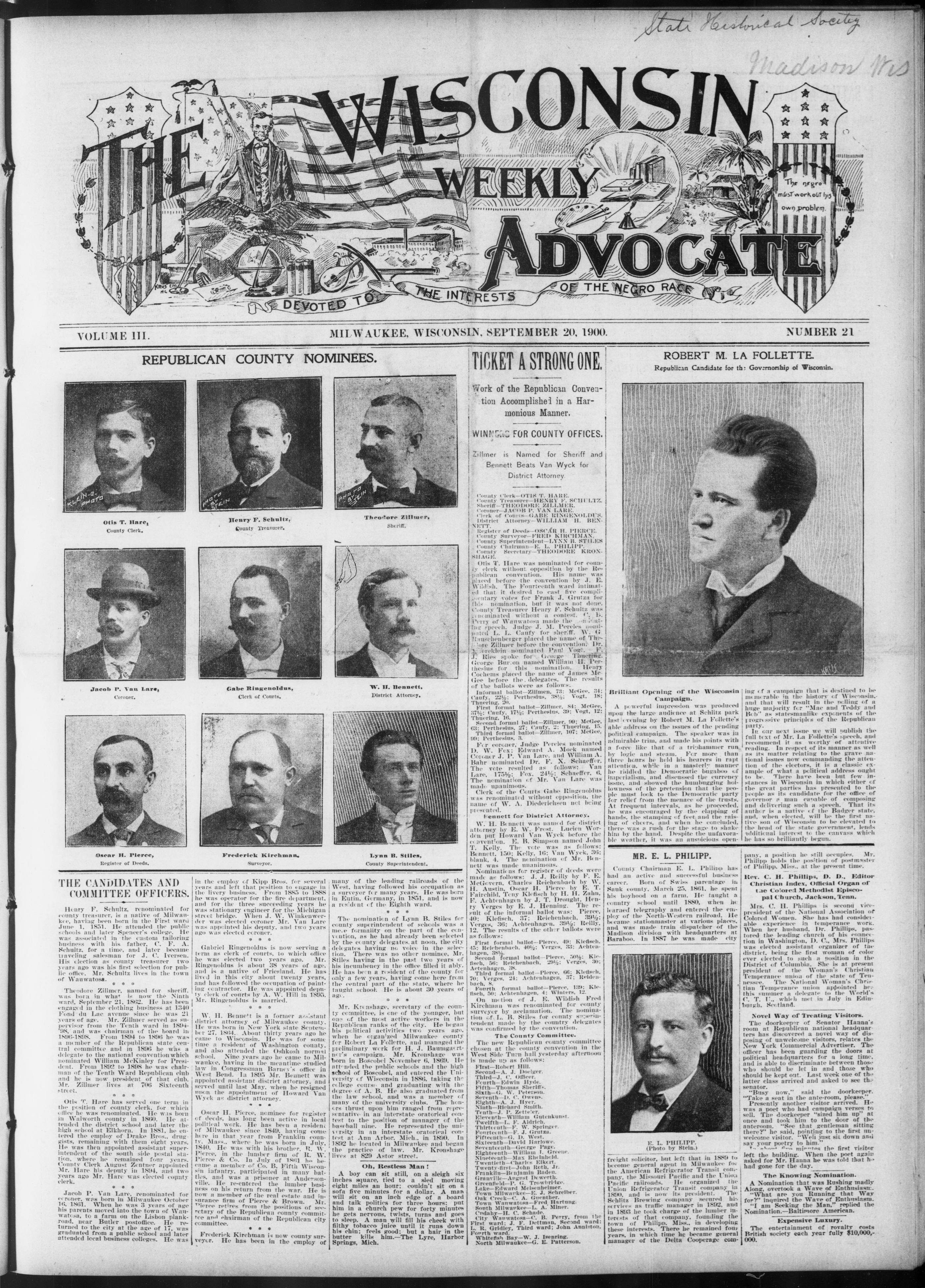
Otis T. Hare $ ^{1} $ County Clerk.
M. B.
Jacob P. Van Lare,
Coroner.
M. B.
Oscar H. Pierce,
Register of Deeds.
THE CANDIDATES AND COMMITTEE OFFICERS
Henry F. Schultz, renominated for county treasurer, is a native of Milwaukee, having been born in the First ward June 1, 1851. He attended the public schools and later Spencer's college. He was associated in the custom tailoring business with his father, C. F. A. Schultz, for a time, and later became traveling salesman for J. C. Iversen. His election as county treasurer two years ago was his first selection for public office. Mr. Schultz lives in the town of Wauwatosa.
---
Theodore Zillmer, named for sheriff, was born in what is now the Ninth ward, September 21, 1862. He has been engaged in the clothing business at 1340 Fond du Lac avenue since he was 21 years of age. Mr. Zillmer served as supervisor from the Tenth ward in 1894-98, and was chairman of the board in 1896-1898. From 1894 to 1896 he was a member of the Republican state central committee and in 1896 he was a delegate to the national convention which nominated William McKinley for President. From 1892 to 1898 he was chairman of the Tenth Ward Republican club and he is now president of that club. Mr. Zillmer lives at 706 Sixteenth street.
```markdown
```
Otis T. Hare has served one term in the position of county clerk, for which office he was renominated. He was born in Walworth county in 1860. He attended the district school and later the high school at Elkhorn. In 1881, he entered the employ of Drake Bros., drugists, remaining with them eight years. He was then appointed assistant superintendent of the south side postal station, where he remained four years. County Clerk August Zentner appointed Mr. Hare his deputy in 1894, and two years ago Mr. Hare was elected county clerk.
* * *
Jacob P. Van Lare, renominated for croner, was born in Milwaukee October 16, 1861. When he was 3 years of age his parents moved into the town of Wauwatosa, to a farm on the Lisbon plankroad, near Butler postoffice. He returned to the city at the age of 17, was graduated from a public school and later attended local business colleges. He was
PHOTO
BY
STEIN
Henry F. Schultz,
County Treasurer.
M. B.
Gabe Ringenoldus,
Clerk of Courts.
M. B.
Frederick Kirchman.
Surveyor.
in the employ of Kipp Bros. for several years and left that position to engage in the livery business. From 1885 to 1888 he was operator for the fire department, and for the three succeeding years he was stationary engineer for the Michigan street bridge. When J. W. Winkenwerder was elected coroner Mr. Van Lare was appointed his deputy, and two years ago was elected coroner.
```markdown
```
Gabriel Ringenoldus is now serving a term as clerk of courts, to which office he was elected two years ago. Mr. Ringenoldus is about 38 years of age, and is a native of Friesland. He has lived in this city about twenty years, and has followed the occupation of painting contractor. He was appointed deputy clerk of courts by A. W. Hill in 1895. Mr. Ringenoldus is married.
* * *
W. H. Bennett is a former assistant district attorney of Milwaukee county. He was born in New York state September 27, 1864. About thirty years ago he came to Wisconsin. He was for some time a resident of Washington county, and also attended the Oshkosh normal school. Nine years ago he came to Milwaukee, having in the meantime studied law in Congressman Barney's office in West Bend. In 1895 Mr. Bennett was appointed assistant district attorney, and served until last May, when he resigned upon the appointment of Howard Van Wyck as district attorney.
中 英 盆
Oscar H. Pierce, nominee for register of deeds, has long been active in local political work. He has been a resident of Milwaukee since 1849, having come here in that year from Franklin county, Mass., where he was born in July, 1840. He was with his brother, R. W. Pierce, in the lumber firm of R. W. Pierce & Co. In July of 1861 he became a member of Co. B. Fifth Wisconsin infantry, participated in many battles, and was a prisoner at Andersonville. He re-entered the lumber business on his return from the war. He is now a member of the real estate and insurance firm of Pierce & Brown. Mr. Pierce retires from the positions of secretary of the Republican county committee and chairman of the Republican city committee.
Frederick Kirchman is now county surveyor. He has been in the employ of
MILWAUKEE, WISCONSIN, SEPTEMBER 20, 1900.
PHOTO
BY
STAN
Theodore Zillmer,
Sheriff.
M.
W. H. Bennett,
District Attorney.
M.
Lynn B. Stiles,
County Superintendent.
many of the leading railroads of the West, having followed his occupation as a surveyor for many years. He was born in Eutin, Germany, in 1851, and is now a resident of the Eighth ward.
* *
The nomination of Lynn B. Stiles for county superintendent of schools was a mee formality on the part of the convention, as he had already been selected by the county delegates, at noon, the city delegates having no voice in the selection. There was no other nominee. Mr. Stiles having in the past two years of his incumbency in the office filled it ably. He has been a resident of the county for only a few years, having come here from the central part of the state, where he taught school. He is about 30 years of age.
☆ ☆ ★
Mr. Kronshage, secretary of the county committee, is one of the younger, but one of the most active workers in the Republican ranks of the city. He began his political activities two years ago, when he organized Milwaukee county for Robert La Follette, and managed the preliminary work for H. J. Baumgaertner's campaign. Mr. Kronshage was born in Boscobel November 6, 1869. He attended the public schools and the high school of Boscobel, and entered the University of Wisconsin in 1886, taking the college course and graduating with the degree of A. B. He also graduated from the law school, and was a member of many of the university clubs. The honors thrust upon him ranged from representative in an interstate oratorical contest to the position of manager of the baseball nine. He represented the university in an interstate oratorical contest at Ann Arbor, Mich., in 1890. In 1892 he located in Milwaukee and began the practice of law. Mr. Kronshage lives at 829 Astor street.
Oh. Bestless Man!
A boy can sit still, on a sleigh six inches square, tied to a sled moving eight miles an hour; couldn't sit on a sofa five minutes for a dollar. A man will sit on an inch edge of a board and talk politics for three hours; put him in a church pew for forty minutes he gets nervous, twists, turns and goes to sleep. A man will fill his cheek with filthy tobacco juice until it runs down his chin; feels good; but a hair in the butter kills him.—The Lyre, Harbor Springs, Mich.
TICKET A STRONG ONE.
TICKET A STRONG ONE.
Work of the Republican Convention Accomplished in a Harmonious Manner.
County Clerk—OTIS T. HARE.
County Treasurer—HENRY F. SCHULTZ.
Sheriff—THEODORE ZILLMER.
Coroner—JACOB P. VAN LARE.
Clerk of Courts—GABE RINGENOLDUS.
District Attorney—WILLIAM H. BEN-
NETT
Register of Deeds—OSCAR H. PIERCE.
County Surveyor—FRED KIRCHMAN.
County Superintendent—LYNN B. STILES.
County Chairman—E. L. PHILIPP.
County Secretary—THEODORE KRON-
SHAGE.
Otis T. Hare was nominated for county clerk without opposition by the Republican convention. His name was placed before the convention by J. E. Wildish. The Fourteenth ward intimated that it desired to cast five complimentary votes for Frank J. Grutza for this nomination, but it was not done. County Treasurer Henry F. Schultz was nominated without a contest. C. B. Perry of Wauwatosa made the nominating speech. Judge J. M. Pereles nominated L. L. Canfy for sheriff. W. G. Rauschenberger placed the name of Theore Zillmer before the convention. Dr. Mercklein nominated Paul Vogt. F. J. Ries spoke for George Thuering. George Bur. named William H. Perthesius for this nomination. Henry Cochems placed the name of James McGee before the delegates. The results of the ballots were as follows.
Informal ballot-Zillimen, 73; McGee, 34;
Caufy, $ 22 \frac{1}{2} $; Perthesius, $ 38 \frac{1}{2} $; Vogt, 183
Thuering, 20
First formal ballot—Zillmer, 84; McGee, $ 3 1 \frac{1}{2} $; Caufy, $ 1 7 \frac{1}{2} $; Perthesius, 39; Vogt, 12; Thuering, 16.
Second formal ballot—Zillmer, 99; McGee, 63; Perthesius, 27; Caufy, 2; Thuering, 15.
Third formal ballot—Zillmer, 107; McGee, 99; Perthesius, 3.
For coroner, Judge Percles nominated D. W. Fex; Edward A. Mock named Coroner J. P. Van Lare, and William A. Bahr nominated Dr. F. X. Schaeffer. The vote resulted as follows: Van Lare, $ 1 7 5 \frac{1}{2} $; Fox, $ 2 4 \frac{1}{2} $; Schaeffer, 6. The nomination of Mr. Van Lare was made unanimous.
Clerk of the Courts Gabe Ringenoldus was renominated without opposition, the name of W. A. Diederichsen not being presented.
W. H. Bennett was named for district attorney by E. W. Frost. Lucien Warden put Howard Van Wyck before the convention. E. B. Simpson named John T. Kelly. The vote was as follows: Bennett, 150; Kelly, 16; Van Wyck, 36; blank, 4. The nomination of Mr. Bennett was made unanimous. Nominations for register of deeds were made as follows: J. J. Reilly by F. E. McGovern, Charles Reichenbach by W. H. Austin, Oscar Pierce by E. T. Fairchild, Teny Klefisch by H. H. Zahn, F. Achtenhagen by J. T. Drought, Henry Verges by E. J. Henning. The result of the informal ballot was: Pierce, 40; Klefisch, 37; Reichenbach, $39\frac{1}{2}$; Verges, 36; Achtenhagen, $39\frac{1}{2}$; Reilly, 12. The results of the other ballots were as follows:
First formal ballot—Pierce, 49; Klefisch, 45; Reichenbach, $40\frac{1}{2}$; Verges, 33; Achtenbagen, $38\%$
Second formal ballot—Pierce, 50½; Kiefisch, 56; Relchenbach, 29½; Verges, 30; Actenhagen, 38.
Third formal ballot-Pierce, 66; Kleisch, 70; Verges, 24; Achtenhagen, 37; Reidenbach, 8.
Fourth formal ballot—Pierce, 139; Kleisch, 59; Achtenbahn, 4; Winters, 12.
nsch, 50; Aenemagen, 4; Winters, 12.
On motion of J. E. Wildish Fred Kirchman was renominated for county surveyor by acclamation. The nomination of L. B. Stiles for county superintendent made by the country delegates was confirmed by the convention.
The County Committee:
The new Republican county committee chosen at the county convention in the West Side Turn hall yesterday afternoon is made up as follows:
First—Robert Hill.
Second—A. J. Doelger.
Third—J. C. Officer.
Fourth—Edwin Hyde.
Fifth—Thomas Sheriffs.
Sixth—G. W. Peterson.
Seventh—D. C. Owens.
Eighth—A. J. Hver.
Ninth—Richard Smith.
Tenth—J. P. Zetteler.
Eleventh—William Gutenkunst.
Twelfth—L. F. Aldrich.
Thirteenth—F. W. Springer.
Fourteenth—F. Grutza.
Fifteenth—G. D. West.
Sixteenth—David Harlowe.
Seventeenth—George Page.
Eighteenth—William J. Greene.
Nineteenth—Max Rheinheld.
Twentieth—Charles Elkert.
Twenty-first—John Roth, Jr.
Franklin—Benjamin Baden.
Granville—Angust Deworth.
Greenfield—P. G. Trowbridge.
Lake—Edward Meisenhelmer.
Town Milwaukee—E. J. Schreiber.
Oak Creek—C. A. Guenther.
Town Wauwatosa—Fred Hartung.
South Milwaukee—L. A. Miner.
Cudahy—H. C. Schade.
City Wauwatosa—C. B. Perry, from the First ward; J. F. Dettman, Second ward; L. R. Gridley, Third ward; John Anniston, Fourth ward.
Whitefish Bay—W. J. Isenring.
North Milwaukee—G. E. Patterson.
ROBERT M. LA FOLLETTE. Republican Candidate for the Governorship of Wisconsin.
W. C.
Brilliant Opening of the Wisconsin Campaign.
A powerful impression was produced upon the large audience at Schlitz park last evening by Robert M. La Follette's able address on the issues of the pending political campaign. The speaker was in admirable trim, and made his points with a force like that of a trihammer run by logic and steam. For more than three hours he held his hearers in rapt attention, while in a masterly manner he riddled the Democratic bugaboo of imperialism, and discussed the currency issue, and showed the humbugging hollowness of the pretension that the people must look to the Democratic party for relief from the menace of the trusts. At frequent intervals, as he proceeded, he was encouraged by the clapping of hands, the stamping of feet and the raising of cheers, and when he concluded, there was a rush for the stage to shake him by the hand. Despite the unfavorable weather, it was an auspicious open-
MR. E. L. PHILIPP.
County Chairman E. L. Phillipo has had an active and successful business career. Born of Swiss parentage in Sauk county, March 25, 1861, he spent his boyhood on a farm. He taught a country school until 1880, when he learned telegraphy and entered the employ of the North-Western railroad. He became stationmaster at various places, and was made train dispatcher of the Madison division with headquarters at Baraboo. In 1887 he was made city
[Picture of a man in a suit and bow tie].
E. L. PHILIPP. (Photo by Stein.)
freight solicitor, but left that in 1889 to become general agent in Milwaukee for the American Refrigerator Transit company, the Missouri Pacific and the Union Pacific railroads. He organized the Union Refrigerator Transit company in 1890, and is now its president. The Schlitz Brewing company secured his services as traffic manager in 1892, and in 1893 he took charge of the lumber interests of that company, founding the town of Philipn. Miss., in developing these interests. There he remained four years, in which time he became general manager of the Delta Cooperage com-
ing of a campaign that is destined to be memorable in the history of Wisconsin, and that will result in the polling of a huge majority for "Mac and Teddy and Bob" as statesmanlike exponents of the progressive principles of the Republican party.
In our next issue we will publish the full text of Mr. La Follette's speech, and recommend it as worthy of attentive reading. In respect of its manner as well as its matter relating to the grave national issues now commanding the attention of the electors, it is a classic example of what a political address ought to be. There have been but few instances in Wisconsin in which either of the great parties has presented to the people as its candidate for the office of governor a man capable of composing and delivering such a speech. That its author is a native of the Badger state, and, when elected, will be the first native son of Wisconsin to be elevated to the head of the state government, lends additional interest to the canvass which he has so brilliantly begun.
pany, a position he still occupies. Mr. Philipp holds the position of postmaster of Philippe. Miss., at the present time.
Mrs. C. H. Phillips is second vicepresident of the National Association of Colored Women. She has had considerable experience in temperance work. When her husband, Dr. Phillips, pastored the leading church of his connection in Washington, D. C., Mrs. Phillips was elected assistant organizer of the district, being the first woman of color ever elected to such a position in the District of Columbia. She is at present president of the Woman's Christian Temperance union of the state of Tennessee. The National Woman's Christian Temperance union appointed her this summer a delegate to the World's C. T. U., which met in July in Edinburgh, Scotland.
Novel Way of Treating Visitors
The doorkeeper of Senator Hanna's room at Republican national headquarters has discovered a novel way of disposing of unwelcome visitors, relates the New York Commercial Advertiser. The officer has been guarding the doors at political headquarters for a long time, and is able to discriminate between those who should be let in and those who should be kept out. Last week one of the latter class arrived and asked to see the senator.
"Busy now," said the doorkeeper. "Take a seat in the ante-room, please."
Presently another visitor arrived. He was a poet who had campaign verses to sell. The doorkeeper "sized him up" at once and took him to the door of the anteroom. "See that gentleman sitting there?" he said, pointing to the first unwelcome visitor. "Weli just sit down and say your poetry to him."
In about five minutes the first visitor left the building. When the poet again asked for Mr. Hanna he was told that he had gone for the day.
The Knowing Nomination.
A Nomination that was Rushing madly Along, overtook a Wave of Enthusiasm. "What are you Running that Way for?" inquired the Wave of Enthusiasm. "I am Seeking the Man." replied the Nomination.—Baltimore American.
Expensive Luxury.
The entertainment of royalty costs British society each year fully $10,000,-000.
A BATTLE AT DAYBREAK
Allies Make an Attack Upon the Forts at Pei Tang.
Belief that Von Buelow's Note was Intended to Obstruct Negotiations and Bring on War.
Taku, Sept. 20.—The allies attacked the Pei Tang forts at daybreak. Heavy cannonading is going on.
Pekin, Sept. 14 (via Shanghai, Sept. 19).—Gen. Chaffee expresses a preference in favor of tents for the winter camp rather than unsanitary buildings. The indications are that 10,000 of the allies will winter at Pekin. The German force will be the largest. Some of the troops will probably be distributed in the surrounding cities to relieve the strain. The Japanese will withdraw the most of their force to Nagasaki. The Russians will retain at least 2000 here.
A joint expedition to Pao Ting has been planned by the British, German and French forces. The Dowager Empress has expressed her willingness to return to Pekin if guaranteed protection. The generals in command and the ministers of the powers are unwilling to assume such a responsibility. A number of small bands of Boxers have been reported in the neighborhood recently.
McKinley will Decline.
Washington, D. C., Sept. 20.—Germany's proposal to punish the Chinese who are responsible for the outbreaks in the Celestial empire before peace negotiations are entered upon is not likely to meet with the approval of the United States government.
The note of the United States in reply to Germany will say that while this government is fully determined to insist on the punishment of the instigators of the outrages against the United States minister and other American citizens, and will demand proper safeguards for native Christians, it is also anxious to begin negotiations for peace which will include proper reparation and the punishment of offenders.
If satisfactory arrangements can be made with Li Hung Chang, Prince Ching and other representatives of the imperial government for the carrying on of negotiations and sufficient guarantees for the lives and safety of native Christians are given, the American troops will be withdrawn from China, retired to the Philippines, and American interests be cared for through diplomatic channels. The idea of becoming embroiled in European intrigues over the Chinese trouble is distasteful to the administration, and an independent course will be followed if it should be made necessary by the action of the European powers.
Germany's Proposal Too Drastic.
There is a disposition to regard the circular note which Germany has addressed to all the powers as having been made for the purpose of delaying negotiations and bringing on a possible war of conquest and the dismemberment of the Chinese empire. While this government intends making a demand for the punishment of those responsible for the transgression of international law and outrages against American citizens, the United States is not ready to support Germany in a plan which practically declares a state of war to exist and demands executions and bloodshed before peace negotiations can be undertaken.
President McKinley has labored earnestly from the beginning of the trouble to secure harmony of action, but the ulterior designs of some of the European powers seems likely to prevent full concert
Russian Plan Modified.
Russia has announced that it is willing to modify its proposal to withdraw its troops and legation from Pekin to the extent of leaving a detachment there. With respect to the strength of the detachment to be left in Pekin, the Russian note proposes that this be determined by the allied commanders, whose knowledge of the military situation makes them pre-eminently the best judges of what should be done.
Why Germany's Plan is Opposed.
Germany's circular note demanding the surrender of those responsible for the Chinese outrages as a condition to the opening of peace negotiations shows conclusively, according to officials here, that the Berlin government proposes to take advantage of every opportunity to prevent any action favorable to peace being taken until Von Waldersee arrives in Pekin, when the military situation may be such that military operations against China may be necessary. The officials say there is no nation in the world that would surrender its subjects to be punished by foreigners. Under its system the United States federal government cannot violate the rights of a state and punish at the demand of a foreign nation an offender arrested for violation of state laws, and in this connection the Mafia riots in New Orleans were recalled.
Washington, D. C., Sept. 20.—The war department has received the following cablegram from Gen. Chaffee:
Taku (no date).—Adjutant-General, Washington: Pekin, Sept. 16.—To avoid further crowding at Pekin have had in mind a division of my force between Pekin, Hang Tsun, Tien Tsin, at the latter place leaving one battalion only, because the ground at Tien Tsin is low, damp and unsuitable. Other commanders have no instruction, but they assume that some of their troops will remain at Pekin during the winter. I state this as indicating what is to be ascertained here, not knowing, of course, the action being taken by the powers and the United States. Only one regiment Russian troops retired toward Tien Tsin yet. Have troops of other powers done so? Condition of Chinese seems better; gardeners entering hte city freely, relieving the distress prevailing same days ago. Slight resumption of trade; other conditions very fair, rendering the situation quiet. Expedition today by Wilson to expel Boxers to the westward. Telegraphed you on 30th that railroad is to be repaired. Li Hung Chang left Shanghai 14th. Remey reports Rockhill is expected at Taku 14th.
A portion of this dispatch is unintelligible to the department officials and they have asked the telegraph company for a correction on it.
Appeal for Peace.
The Chinese minister has received a dispatch from the viceroys of the southern provinces of China, making an appeal for the opening of peace negotiations without further delay. They represent that a prolongation of the present unsettled condition is a serious disadvantage to China and all parties concerned.
Left for Shanghai.
Hong Kong, Sept. 20.—Count von Waldsersee has left here on the German cruiser Hertha for Shanghai.
The British consul in Canton has received a telegram from officials at Kuei Yang saying that the missionaries of that district have left by way of Sze Chuan and that the taotai has sent soldiers to safely escort them to Chung King.
Remey Calls on Li.
Washington, D. C., Sept. 20.—Admiral Crowninshield, acting secretary of the navy, has received the following cable-
gram from Admiral Remey, dated Taku, September 19: "I have called upon Li Hung Chang officially. He arrived September 18 in a merchant vessel. He will proceed at once to Pekin. He desires that I tender his sincere thanks for the consideration he has received from the United States government."
Distrust of Russia.
Yokchama, Sept. 7, via Victoria, B. C. Sept. 20. The country is tremendously stirred up by the discussion of Russia's proposition to withdraw from Pekin. While there is no fear of Russia, there is the deepest distrust of her diplomacy and conviction that all the alliance exists between the Muscovite power and the Empress Dowager's government. The political situation here now hangs upon the outcome of this Russian question.
Inexpedient to Withdraw.
London, Sept. 20.—It was explained today at the British foreign office that "it was found inexpedient for the powers to accept the Russian withdrawal proposal," as they had reliable information that "the Boxers were ready to reoccupy Pekin as soon as the allies retired." Washington, D. C., Sept. 20.—The war department has received the following dismite
Taku (no date).—Adjutant-General, Washington: Pekin, Sept. 17.—As further reply to your number 38, the following is accepted here as reliable: Two daughters of Atwater and twenty-six others murdered at Tayunan, July 9. Clapp and wife with four others murdered at Taiku, July 31. Atwater, wife, two children and six others murdered by their escort near Pen Chow Fu August 15. Same message reports six persons, Dixon and wife, Occurren and wife, single gentleman and single lady as having escaped into the mountains from a mission thirty miles to north of Taikun. They escaped on horseback and possibly may have evaded their pursuers. CHAFFEE.
GOOD NEWS RECEIVED.
Encouraging Reports Received at Headquarters of the Idle Anthracite Miners.
Hazleton, Pa., Sept. 20.—Reports received at strike headquarters and elsewhere from various parts of the Hazleton region this morning brought nothing but good news to the idle anthracite coalminers. The first information brought here told of a break among the employees in the Lattimer mines, the first that has taken place there during the strike. The colliery was considered an invulnerable spot and the break there put the strikers in a good humor. The number of men who quit was quite small, however, but the union men are satisfied that they will make further inroads on the force there.
The next good news received by the strikers came from Coleraine and was to the effect that the colliery there was shut down tight. The McAdoo strikers have been trying for four days to close this place. The Evans colliery at Beaver Meadow also failed to start work this morning owing to not enough men putting in an appearance to operate the workings. Both the Colerafne and the Evans collieries are operated by the A. S. Van Winkle company. All of this company's mines in the Hazleton region are now closed.
A committee of three miners employed at the Coleraine mines this morning called upon Supt. Ayres and presented a set of grievances for the company's consideration. The grievances are as follows:
Supt. Ayres received the men pleasantly and told them they would receive an answer in three days.
CUBANS QUICK TO LEARN
Frauds Are Charged in Elections and Defeated Candidates will Contest.
Havana, Sept. 20.—The results of the election of delegates to the forthcoming constitutional convention are being freely discussed by the Havana delegates and other prominent Cubans. The conclusion reached is that the convention will be controlled by the revolutionary element. Senor Alfredo Zayas, nationalist delegate, says: "The convention will not allow itself to be influenced by any representative of the United States. It will adopt and follow an independent policy throughout, in my opinion, refusing to decide as to the relations which shall hereafter exist between Cuba and the United States. This is a matter that should be left to a special commission."
Mayor Rodriguez expressed the same opinion and other representative delegates in various parts of the island adopt the same attitude. In the main the delegates are capable men. Most of them, it is said, are in favor of immediate and absolute independence without the intervention of a protectorate. The defeated candidates here have raised the cry of fraud and have already held a mass meeting to protest against alleged illegal practices.
PORTO RICANS REGISTER.
Say that They Are American Citizens and Want to Vote.
Washington, D. C., Sept. 20.—Administration officials will watch with much interest the case of Dr. Francisco del Valle and his son, native Porto Ricans, who have applied for registration as voters in the Fourteenth ward of the city of Baltimore. Dr. Del Valle claims the right to register on the ground that he is a citizen of the United States. The question of his citizenship is now before the board of election supervisors in Baltimore, and is a matter that must be dealt with by the Maryland authorities. It is possible, however, that it may reach the federal courts, for if a decision adverse to Dr. Del Valle should be made in Maryland he could appeal to the federal courts on the constitutional question involved. Pending a judicial decision as to the status of the inhabitants of Porto Rico the officials of the government decline to recognize them as citizens of the United States.
THE M'GUIGANS QUARRELED.
Joseph Threw His Wife Out of the Window, Breaking Her Neck.
New York, Sept. 20.—Joseph McGuigan is locked up on the accusation of killing his wife, Mary, by throwing her out of the window of their third-story flat in Second avenue. Two daughters were present. The McGuigans quarreled and McGuigan, who is said to have been drunk, threw his wife out of the window. Her neck was broken by the fall.
JUSTIN M'CARTHY TO RETIRE.
Dublin, Sept. 20.—The venerable Justin McCarthy has announced his retirement from active politics, giving as his reasons his advanced age and increasing infirmity.
NETHERSOLE PAYS THE FINE.
Importation of Unmuzzled Pet Dogs Costs the Actress $10. London, Sept. 20.—Olga Nethersole, the actress, was fined £2 for allowing two dogs to be imported from the United States without muzzles.
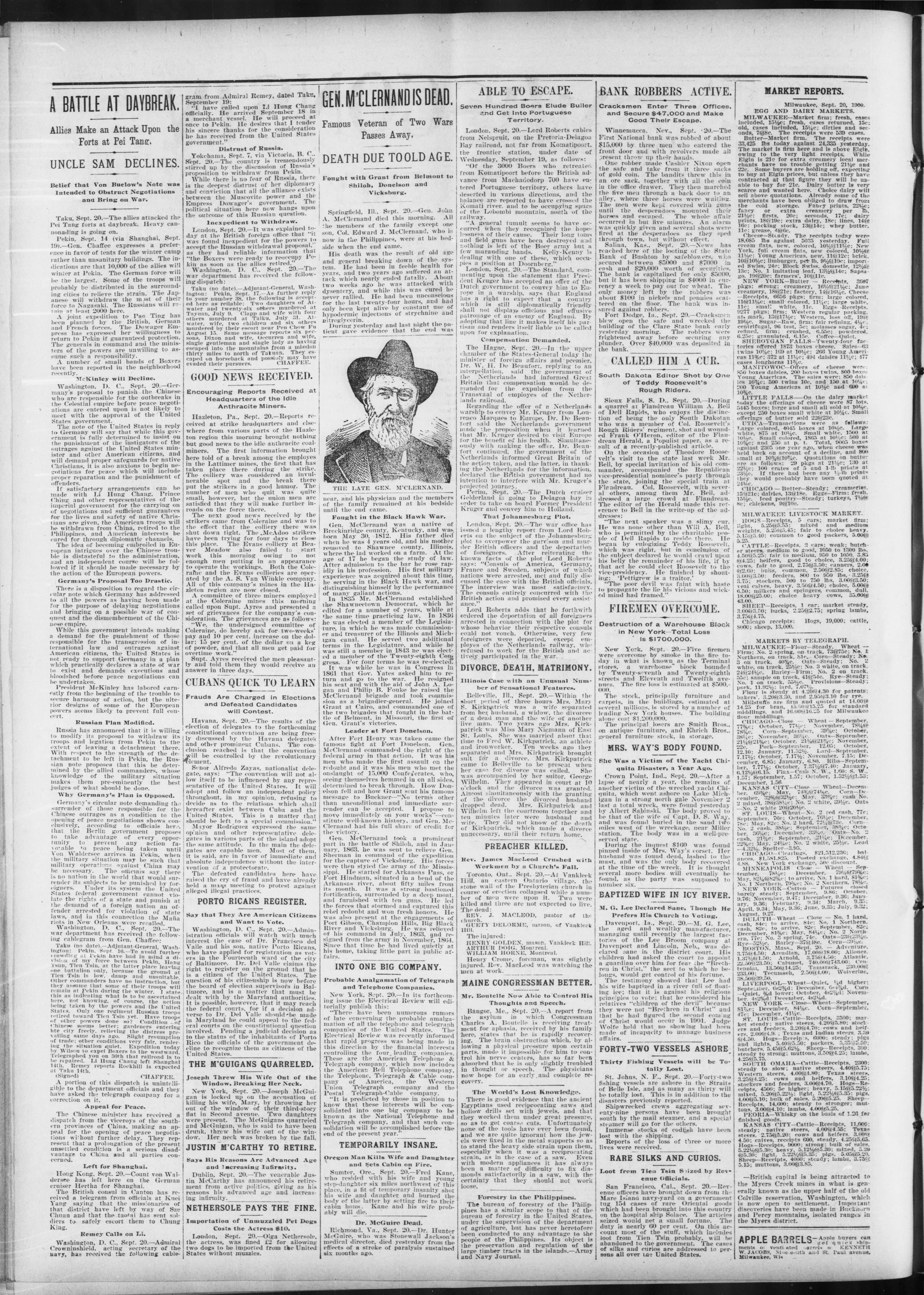
GEN. M'CLERNAND IS DEAD.
Springfield, Ill., Sept. 20.—Gen. John A. McClernand died this morning. All the members of the family except one son, Col. Edward J. McClernand, who is now in the Philippines, were at his bedside when the end came.
His death was the result of old age and general breaking down of the system. He had been in feeble health for years, and two years ago suffered an attack which nearly ended fatally. About two weeks ago he was attacked with dysentery, and while this was cured he never rallied. He had been unconscious for the last twenty-four hours, and had only been kept alive by constant use of hypodermic injections of strychnine and nitroglycerin.
During yesterday and last night the patient gave evidence that the end was
J.
THE LATE GEN. M'CLERNAND. near, and his physician and the members of the family remained at his bedside until the end came.
Fought in the Black Hawk War.
Gen. McClernand was a native of Breckinridge county, Kentucky, and was born May 30, 1812. His father died when he was 4 years old, and his mother removed to Shawnee county, Illinois, where the lad worked on a farm. At the age of 17 he began the study of law. After admission to the bar he rose rapidly in his profession. His first military experience was acquired about this time, he serving in the Black Hawk war, and distinguishing himself by the performance of many gallant actions.
In 1835 Mr. McClernand established the Shawneetown Democrat, which he edited for a number of years, while at the same time practicing law. In 1836 he was elected a member of the Legislature, in which he was made commissioner and treasurer of the Illinois and Michigan canal. He served two additional terms in the Legislature, and while he was still a member in 1843 he was elected a member of the Twenty-eighth Congress. For four terms he was re-elected. It was while he was in Congress in 1861 that Gov. Yates asked him to return and go to the war. He resigned his seat and with the aid of John A. Logan and Philip B. Fouke he raised the McClernand brigade and took commission as a brigadier-general. He joined Grant at Cairo, and commanded one of the two brigades that fought in the battle of Belmont, in Missouri, the first of Gen. Grant's victories.
Leader at Fort Donelson.
After Fort Henry was taken came the famous fight at Fort Donelson. Gen. McClernand commanded the right of the federal army in that action. It was his men who made the first assault on the redoubt and it was his men who met the onslaught of 15,000 Confederates, who, seeing themselves hemmed in on all sides, determined to break through. How Donelson fell and how Grant sent his famous message to Buckner—"No terms other than unconditional and immediate surrender can be accepted. I propose to move immediately on your works"—constitute well-known history, and Gen. McClernand had his full share of credit for the victory.
Gen. McClernand took a prominent part in the battle of Shiloh, and in January, 1863, he was sent to relieve Gen. Sherman in command of the expedition for the capture of Vicksburg. His forces were then styled the army of the Mississippi. He started for Arkansas Pass, or Fort Hindman, situated in a bend of the Arkansas river, about fifty miles from its mouth. It was a strong bastioned fortification, surrounded by a deep moat, and furnished with ten guns. He led the forces that stormed and captured this rebel redoubt and won fresh honors. He was also present at the engagements of Port Gibson, Champion Hills, Big Black River and Vicksburg. He was relieved of his command in July, 1863, and resigned from the army in November, 1864. Since that time he had lived quietly at his home, taking little part in public affairs.
INTO ONE BIG COMPANY.
Probable Amalgamation of Telegraph and Telephone Companies
New York, Sept. 20.—In its forthcoming issue the Electrical Review will editorially publish this: "There have been numerous rumors of late concerning the probable amalgamation of all the telephone and telegraph companies of the United States. The Electrical Review was recently informed that rapid progress was being made in this direction by the financial interests controlling the four leading companies. These are the American Telephone & Telegraph company, which now includes the American Bell Telephone company, the Telephone, Telegraph & Cable company of America, the Western Union Telegraph company and the Postal Telegraph-Cable company.
"It is predicted by those in position to know that these interests will be consolidated into one big company to be known as the National Telephone and Telegraph company, and that such consolidation will be accomplished before the end of the present year."
TEMPORARILY INSANE.
Oregon Man Kills Wife and Daughter and Sets Cabin on Fire.
Sumter, Ore., Sept. 20.—Fred Kane, who resided with his wife and young step-daughter six miles northwest of this place, in a fit of temporary insanity shot his wife and daughter and burned the body of the latter by setting fire to their cabin home. Kane and his wife probably will die.
Dr. McGuire Dead.
Richmond, Va., Sept. 20.—Dr. Hunter McGuire, who was Stonewall Jackson's medical director, died yesterday from the effects of a stroke of paralysis sustained six months ago.
ABLE TO ESCAPE.
Seven Hundred Boers Elude Buller and Get Into Portuguese Territory.
London, Sept. 20.—Lord Roberts cables from Nelspruit, on the Pretoria-Delagoa Bay railroad, not far from Komatipoort, the frontier station, under date of Wednesday, September 19, as follows:
"Of the 3000 Boers who retreated from Komatipoort before the British advance from Machadodorp 700 have entered Portuguese territory, others have deserted in various directions, and the balance are reported to have crossed the Komati river, and to be occupying spurs of the Lobombi mountain, south of the railway.
"A general tumult seems to have occurred when they recognized the hopelessness of their cause. Their long toms and field guns have been destroyed and nothing is left of the Boer army but a few marauding bands. Kelly-Kenny is dealing with one of these, which occupies a position at Doornberg."
London, Sept. 20.—The Standard, commenting upon the statement that President Kruger has accepted an offer of the Dutch government to convey him to Europe in a warship, says that England has a right to expect that a country which is still diplomatically friendly shall not display officious and effusive patronage of an enemy of England. By adopting that line it makes itself his partisan and renders itself liable to be called upon for explanation.
Compensation Demanded.
The Hague, Sept. 20.—In the upper chamber of the States-General today the minister of foreign affairs and premier, Dr. W. H. De Beaufort, replying to an interpellation, said the government of the Netherlands had informed Great Britain that compensation would be demanded for the expulsion from the Transvaal of employees of the Netherlands railroad.
Regarding the offer of a Netherlands warship to convey Mr. Kruger from Lourenco Marques to Europe, Dr. De Beaufort said the Netherlands government made the proposition when it learned that Mr. Kruger desired to visit Europe for the benefit of his health. Simultaneously with making the offer, Dr. Beaufort continued, the government of the Netherlands informed Great Britain of the action taken, and the latter, in thanking the Netherlands for the information, declared the British government had no intention to interfere with Mr. Kruger's projected journey. Perim, Sept. 20.—The Dutch cruiser Gelderland is going to Delagoa bay in order to take on board Former President Kruger and convey him to Holland.
That Johannesburg Plot.
London, Sept. 20.—The war office has issued a lengthy report from Lord Roberts on the subject of the Johannesburg plot to overpower the garrison and murder British officers and the deportation of foreigners. After reiterating the known facts of the plot Lord Roberts says: "Consuls of America, Germany, France and Sweden, subjects of which nations were arrested, met and fully discussed the case with the British officials. The interview was most satisfactory. The consuls entirely concurred with the British action and promised every assistance."
Lord Roberts adds that he forthwith ordered the deportation of all foreigners arrested in connection with the plot for whose behavior their respective consuls could not vouch. Otherwise, very few foreigners were deported, except employees of the Netherlands railway, who refused to work for the British and actively participated in the war.
DIVORCE, DEATH, MATRIMONY.
Illinois Case with an Unusual Number of Secusational Features
Belleville, Ill., Sept. 20.—Within the short period of three hours Mrs. Mary S. Kirkpatrick was a wife separated from her husband, a widow, the divorcee of a dead man and the wife of another live man. Two years ago Mrs. Kirkpatrick was Miss Mary Niemann of East St. Louis. She was married about that time to Fred W. Kirkpatrick, an athlete and ironworker. Ten weeks ago they separated and Mrs. Kirkpatrick brought suit for a divorce. Mrs. Kirkpatrick came to Belleville to be present when her case for divorce was called. She was accompanied by her suitor, George Wilhelm. They appeared in court at 10 o'clock and the divorce was granted. Almost simultaneously with the granting of the divorce the divorced husband dropped dead. Mrs. Kirkpatrick and Wilhelm left the courtroom together and ten minutes later were husband and wife. They did not know of the death of Kirkpatrick, which made a divorce unnecessary, until their return home.
PREACHER KILLED
Rev. James MacLeod Crushed with Workmen by a Church's Fall. Toronto, Ont., Sept. 20.—At Vankleek Hill, an eastern Ontario village, the stone wall of the Presbyterian church in course of erection collapsed while a number of men were upon it. Two were killed and three are not expected to live. The dead:
REV. J. MACLEOD, pastor of the church.
GUETY DELORME, mason, of Vankleek Hill.
The injured:
HENRY GOLDEN, mason. Vankleck Hill.
ARTHUR DOIG. Montreal.
WILLIAM HORNE. Montreal.
Henry Crome, foreman, was slightly injured. Rev. MacLeod was watching the men at work.
MAINE CONGRESSMAN BETTER.
Mr. Boutelle Now Able to Control His Thoughts and Speech.
Bangor, Me., Sept. 20.—A report from the asylum in which Congressman Charles A. Boutelle is receiving treatment for aphasia, received by his family here, states that he is rapidly recovering. The brain obstruction which, by allowing a physical pressure upon certain parts, made it impossible for him to control his nerve centers, has so far been absorbed that he is only slightly troubled in thought or speech. The physicians now hope for an early, and complete recovery.
The World's Lost Knowledge
There is good evidence that the ancient Egyptians used reciprocating saws and hollow drills set with jewels, and that they worked them under great pressure, so as to get coarse cuts. Unfortunately none of the tools have ever been found, and we are quite ignorant how the jewels were fixed in the metal supports so as to stand the heavy side strain upon them, especially when it was a reciprocating strain, as in the case of a saw. Even with modern appliances it has always been a matter of difficulty to fix diamonds satisfactorily in a saw, with the certainty that they should not work loose.
Forestry in the Philippines.
The bureau of forestry of the Philippines has a similar scope to that of the bureau of forestry in the United States. under the supervision of the department of agriculture, but has never heretofore been conducted to any advantage to the people of the Philippines. Its object is the preservation and regulation of the large timber tracts in the islands.—Army and Navy Journal.
BANK ROBBERS ACTIVE.
Cracksmen Enter Three Offices, and Secure $47,000 and Make Good Their Escape. Winnemucca, Nev., Sept. 20.—The First National bank was robbed of about $15,000 by three men who entered the front door and with revolvers made all present throw up their hands.
One robber made Cashier Nixon open the safe and take from it three sacks of gold coin. The bandits threw this in an ore sack, together with all the coin in the office drawer. They then marched the five men through a back door to an alley, where three horses were waiting. The men were kept covered with guns until the desperadoes mounted their horses and escaped. The whole affair occurred in but five minutes. An alarm was quickly given and several shots were fired at the desperadoes as they sped through town, but without effect.
Salina, Kas., Sept. 20.—News has reached here of the looting of the State Bank of Bushton by safeblowers, who secured between $5000 and $7000 in cash and $20,000 worth of securities. The bank is capitalized for only $5000, but it has been shipping in $4000 in currency a week to pay out for wheat. The only money left by the robbers was about $100 in nickels and pennies scattered on the floor. The bank was insured against robbers.
Fort Dodge, Ia., Sept. 20.—Cracksmen blew open the safe and wrecked the building of the Clare State bank early yesterday morning. The robbers were frightened away before securing any plunder. Over $40,000 was deposited in the bank.
CALLED HIM A CUR.
South Dakota Editor Shot by One of Teddy Roosevelt's Rough Riders
Sieux Falls, S. D., Sept. 20.—During a quarrel at Flandreau William A. Bell of Dell Rapids, who enjoys the distinction of being the only South Dakotan who was a member of Col. Roosevelt's Rough Riders' regiment, shot and wounded Frank O'Heron, editor of the Flandreau Herald, a populist paper, as a result of a recently-published article.
On the occasion of Theodore Roosevelt's visit to the state last week Mr. Bell, by special invitation of his old commander, accompanied the Republican vice-presidential nominee's party through the state, joining the special train at Flandreau. Col. Roosevelt, with several others, among them Mr. Bell, addressed a large crowd at Flandreau. The editor of the Herald made this reference to Bell in the write-up of the addresses:
"The next speaker was a slimy cur. He was none other than Will A. Bell, who is permitted by the charitable people of Dell Rapids to reside there. He began by eulogizing Teddy Roosevelt, which was right, but in conclusion of the subject declared he would crawl upon his belly the remainder of his life, if by that act he could elect Roosevelt to the vice-presidency. He finished by shouting: 'Pettigrew is a traitor.'
"The poor devil was faint with haste to propagate the lie his vicious and wicked mind had framed."
FIREMEN OVERCOME.
Destruction of a Warehouse Block in New York-Total Loss is $1700.000.
New York, Sept. 20.—Five firemen were overcome by smoke in the fire today in what is known as the Terminal stores, a warehouse block bounded by Twenty-seventh and Twenty-eighth streets and Eleventh and Twelfth avenues. The fire loss is estimated at $500,-000.
The stock, principally furniture and carpets, in the buildings, estimated at several millions, is stored by a number of leading New York houses. The building alone cost $1,200,000.
The principal losers are Smith Bros., on antique furniture, and Ehrich Bros., general furniture stock, in storage.
MRS. WAY'S BODY FOUND.
She Was a Victim of the Yacht Chiquita Disaster, a Year Ago.
Crown Point, Ind., Sept. 20.—After a lapse of nearly a year, the remains of another victim of the wrecked yacht Chiquita, which went ashore on Lake Michigan in a strong north gale November 2 last a total wreck, were found yesterday by Albert Sabinski. The body proved to be that of the wife of Capt. D. S. Way, and was found buried in the sand two miles west of the wreckage, near Miller station. The body was in a well-preserved state.
During the inquest $160 was found pinned inside of Mrs. Way's corset. Her husband was found dead, lashed to the mast, and was the only body recovered at the time of the wreck. It is thought several more bodies will eventually be found, as the party was supposed to number six.
BAPTIZED WIFE IN ICY RIVER.
M. G. Lee Declared Sane, Though He Prefers His Church to Voting. Davenport, Ia., Sept. 20.—M. G. Lee, the aged and wealthy manufacturer, managing until recently the largest factories of the Lee Broom company at Davenport and Lincoln, Neb., was declared sane in the district court. His children had asked the court to appoint a guardian over him for fear the "Brethren in Christ," the sect to which he belongs, would get control of his fortune.
The testimony showed that Lee had his wife baptized in a river full of floating ice; that it is against his religious principles to vote; that he considered his relatives "children of the devil" because they were not "Brethren in Christ" and that he had figured the second coming of Christ would occur in 1901. Judge Wolfe held that no showing had been made of incapacity to manage business affairs.
FORTY-TWO VESSELS ASHORE
Thirty Fishing Vessels will be Totally Lost.
St. Johns, N. F., Sept. 20.—Forty-two fishing vessels are ashore in the Straits of Belle Isle, and as many as thirty will be totally lost. This is in addition to the disasters previously reported.
Shipwrecked crews aggregating seventy-nine persons have been brought south by the mail steamer, and a special steamer will go for the others.
Immense stocks of codfish have been lost with the shipping.
Reports of the loss of three or more lives were received.
RARE SILKS AND CURIOS.
Loot from Tien Tsin Sized by Revenue Officials.
San Francisco, Cal., Sept. 20.—Revenue officers have brought down from the Mare Island navy-yard on a government tug 154 cases of rare Oriental goods which had been brought into this country on the hospital ship Solace. The articles seized would net a small fortune. The duty is nearly 60 per cent. On this account most of the stuff, which includes loot from Tien Tsin probably, will be abandoned to the government. The cases of silks and curios are addressed to persons all over the United States.
MARKET REPORTS.
Milwaukee, Sept. 20, 1906.
ND. DAIRY. MARKETS.
EGG AND DAIRY MARKETS. MILWAUKEE—Market firm; fresh, cases included, 1512c; fresh, cases returned, 15c; old, cases included, 1514c; dirties and seconds. 7@8c The receipts were 539 cases.
old, cases included, 15¼c; dirties and seconds, 7@8c. The receipts were 539 cases. Butter-Market firm. The receipts were 33,425 lbs today against 24,335 yesterday. The market is firm here and is above Elgin, owing to the very light receipts. While Elgin is 21c for extra creamery local merchants have no trouble getting 21½c and 22c. Some buyers are holding off, expecting to buy at Elgin prices, but unless they have contracted at that figure they will be unable to buy for 21c. Dairy butter is very scarce and wanted here. Choice dairy will sell above quotations. Already some of the merchants have been obliged to draw from the cold storage. Fancy prints, 22½c; fancy or extra creamery per lb. 21½c; firsts, 20c; seconds, 17c; dairy prints, 18@19c; extra dairy, 18c; lines, 14@16c; packing stock, 13@14c; whey butter, 11c; grease, 4@6c.
Cheese—Stadty. The receipts today were 18,085 lbs against 5035 yesterday. Full cream flats, new, colored, 10%@11%c; New York, full cream flats, new colored, 10%@11%c; Young Americas, new, 11@12c; brick, 10@10%2c; limburger, pet lb, 9%@10c; imported Swiss, 24c; Block Swiss, domestic, 12%@13c; No. 1 imitation leaf, 13%@14c; Sapsago, 19@20c; farmers, 10@11c.
NEW YORK—Butter — Receipts, 3607 pkgs; strong; creamy, 16%@21%c; June creamy, 18@21c; factory, 14%@14%c. Cheese—Receipts, 6656 pkgs; firm; large colored, 11%@11%c; small colored, 11%c; large white, 11c; small, white, 11c. Eggs—Receipts, 9277 pkgs; firm; Western regular packing, at, mark, 13@17%c; Western, loss off, 19%@19%c. Sugar—Raw, firm; fair refining, 19%c. centrifugal, 96 test, 5c; molasses sugar, 4c; refined, firm; crushed, 6.55c; powdered, 6.25c; granulated, 6.15c. Coffee—Quict.
SHEBOYGAN FALLS—Twenty-four factories offered 1873 boxes cheese. Sales—63 twins 10%c; 169 at 10%c; 266 Young Americas 11%c; 372 at 11%c; 494 daisies 11%c; 477 cases longhorns 11%c.
MANITOWOC—Offers of cheese were: 850 boxes daisies, 200 boxes twins, 800 boxes Young Americas. The sales were: 850 daisies 10%c; 500 twins 10c, and 150 at 10%c; 200 Young Americas at 10%c and 600 at 10%c.
LITTLE FALLS—On the dairy market today the offerings of cheese were 87 lots, 5445 boxes; large and small all sold at 10%c, except 250 boxes small white at 10%c. Small offerings of butter sold 22@23c.
UTICA-Transactions were as follows: Large colored, 4045 boxes at 10%c. Large white, 875 at 10%c. Small white, 1500 at 10%c. Small colored, 1865 at 10%c; 560 at 10%c; and 250 at p. t. Total, 9005 boxes against 2305 one year ago, when cheese was held back on account of a decline, and 800 small at 10%@10%c. Quotations on butter are as follows: 29 pkgs at 21%c; 130 at 22%c; 100 crates of 5 and 1-lb prints at 23%c. If there had been any 1-lb prints they would probably have been quoted at 24%c.
CHICAGO — Butter—Steady; creameries.
15@21c; dairies, 13@18c. Eggs—Firm; fresh.
15½c. Iced poultry—Steady; turkeys, 7½@
8c; chickens, 9@10c.
HOGS—Receipts, 5 cars; market firm; light, 5.25@5.55; mixed and medium weights, 5.25@5.45; fair to choice heavy, 5.15@5.40; common to good packers, 5.00@5.25.
CATTLE—Receipts, 2 cars; weak; butcher steers, medium to good, 1050 to 1300 lbs. 4.50@5.25; fair to medium, 950 to 1050. 3.85@4.25; hefters, good to choice, 3.25@4.00; cows, fair to good, 2.75@3.50; canners, 2.00@2.60; bulls, common, 2.50@2.85; choice, 3.00@3.50; feeders, 800 to 950 lbs. 3.25@3.75; stockers, 500 to 750 lbs. 3.00@3.50; veal calves, heavy, 3.50@4.50; choice, 5.00@6.50; milkers and springers, common, dull, 18.00@25.00; choice heavy cows, 35.00@43.00.
SHEEP—Receipts, 1 car; market steady, 3.00@3.50; bucks, 2.25@2.75; spring lambs, 3.75@4.75.
Chicago receipts: Hogs, 19,000; cattle, 800; sheep, 13,000.
MARKETS BY TELEGRAPH.
MILWAUKEE—Floor—Steady. Wheat—Firm; No. 2 spring, on track, 73@75%; No. 1 Northern, on track, 81e. Corn—Steady; No. 3 on track, 40%c. Oats—Steady; No. 2 white, on track, 25½c; No. 3 white, on track, 24@24½c. Barley—Firm; No. 2 on track, 55c; sample on track, 41@54c. Rye—Steady; No. 1 on track, 55½c. Provisions—Steady; pork, 11.92½; lard, 7.07½.
Flour is steady at 4.20@4.30 for patents; bakers, 3.20@3.30, and 2.95@3.10 for rye. Milstuffs are firm and quoted at 14.00@14.25 for bran, and 15.00@15.25 for standard middlings, and 16.00@16.25 for Milwaukee flour middlings.
CHICAGO—Close — Wheat — September, 77½¢; October, 77½¢; November, 78½¢; 78½¢; Corn—September, 39½¢; October, 38½¢; November, 36½¢; Oats—September, 21½¢; 21½¢; October, 21½¢; 21½¢; November, 22¢; Pork—September, 12.05; October, 12.10; January, 11.52¢; Lard—September, 7.17½¢; October, 7.17½¢; November, 7.15; December, 6.85; January, 6.80; Ribs—September, 7.77½¢; October, 7.37½¢; 7.40; January, 6.12½¢; 6.15; Flax—Cash N. W., 1.60; S. W, 1.57; September, 1.57; October, 1.52½¢; 1.53; December, 1.56
KANSAS CITY—Close — Wheat—December, 69½¢; May, 74½¢; 74½¢; Corn—December, 32½¢; 32½¢; May, 33½¢; cash No. 2 mixed, 38½¢; 38½¢; No. 2 white, 39½¢; Oats No. 2 white, 20%
ST. LOUIS—Wheat—No. 2 red cash, 77c;
September, 76c; October, 76½c; December,
78c; May, 82c; No. 2 hard, 72½c at 73c.
Corn-
No. 2 cash, 38½c; September, 38½c; October,
36½c; December, 33½c; Oats-No. 2
cash, 21½c; September, 21½c; December,
22½c; May, 24½c; No. 2 white, 25½c. Lead
-4.32½, Spelter -3.95.
CHICAGO—Clearings, $21,512,236; balances,
$1,581,825. Posted exchange, 4.84@
4.88. New York exchange, 50c discount.
MINNEAPOLIS Close — Wheat — September,
78½c; December, 79½c@79½c;
May, 82½@82½c; to arrive, No. 1 hard, 81½c;
No. 1 Northern, 79½c; No. 2 Northern, 78½c;
NEW YORK—Cotton — Futures closed
barely steady; September, 9.86; October,
9.76; November, 9.47; December, 9.36; January,
9.36; February, 9.34; March, 9.33;
April, 9.34; May, 9.36; June, 9.35; July, 9.52;
August, 9.77
DULUTH—Wheat — Close — No. 1 hard,
cash, 84c; to arrive, 84c; No. 1 Northern,
cash, 82c; to arrive, 82c; September, 82c;
December, 81%c; May, 84%c; No. 2 Northern,
77c; No. 3 spring, 74c; Oats—25%/23%c.
Rye—52%c; Barley—37%/48c. Corn—35%c.
BOSTON, Mass, Sept. 20. — Adventure,
3.75%/4.50; Arcadian, 17.00%/18.00; Allonez,
1.37%/1.50; Arnold, 3.75%/4.50; Atlantic,
22.50%/23.50; Calumet, 740.00%/743.00; Centen-
nial, 13.50%/14.25; Tamarack, 250.00%
233.00; Tecumseh, 2.50%/4.00; Woiverine,
38.50%/39.50.
LIVERPOOL—Wheat — Quiet ¼d higher;
September, 6s2%d; December, 6s4%d. Corn
— Quiet, %d lower; October, 4s2%d; November,
4s2%d; December, 482%d.
NEW YORK — Close — Wheat — September,
81%c; December, 84%c. Corn — September,
47c; December, 41%c.
ST. LOUIS-Cattle—Receipts, 3500; market steady; native steers, 4.20@5.80; stockers and feeders, 3.20@4.70; cows and heifers, 2.00@4.9.; Texas and Indian steers, 3.30@4.50. Hogs—Receipts, 6000; steady; pigs and lights, 5.40@5.50; packers, 5.25@5.50; butchers, 5.45@5.62½. Sheep—Receipts, 300; steady to strong; muttons, 3.50@4.25; lambs, 4.25@5.75
SOUTH OMAHA—Cattle—Receipts, 2300; steady to slow; native steers, 4.40@5.75; Western steers, 4.00@4.80; Texas steers, 3.25@4.25; cows and heifers, 3.10@4.25; stockers and feeders, 3.00@4.70. Hogs—Receipts, 4500; 5c higher; heavy, 5.15@5.22½; mixed, 5.20@5.22½; light, 5.22½@5.35; pigs, 4.00@5.10; bulk of sales, 5.20@5.25. Sheep—Receipts, 14,600; steady to stronger; muttons, 3.00@4.10; lambs, 4.00@5.25.
PEORIA—Whisky on the basis of 1.26 for finished goods.
KANSAS CITY—Cattle—Receipts, 11,000; steady; native steers, 4.00@4.55; Texas steers, 2.75@5.20; cows and heifers, 3.00@4.50; calves, receipts 600, steady, 4.25@5.65. Hogs—Receipts, 9000; strong; bulk of sales, 5.22½@5.30; heavy, 5.12½@5.30; mixed, 5.20@5.30; light, 5.22½@5.35; pigs, 5.05@5.25. Sheep—Receipts, 4000; steady; lambs, 3.75@5.15; muttons, 3.00@3.85.
British capital is being attracted to the Myers Creek mines in what is generally known as the upper half of the old Colville reservation, Washington, which is now open to settlement. Important discoveries have been made in Bucknorm and Percy mountains, isolated ranges in the Myers district.
APPLE BARRELS-Apple buyers can get quick shipments or ventiated carrels o KENNETH W.JACOBS, Niceenth and St. Paul avenue, Milwaukee, Wis
BRYANALTERSISSUES
CHANGES "PARAMOUNT" ONE WITH EVERY CAMPAIGN.
Country Better Off Because of His Defeat Four Years Ago-His Aid to Aguinaldo's Insurgent Rabble-Porto Rico's Trade Is Growing.
Mr. Bryan has found it so easy to say often and apparently quite thoughtlessly, that in accepting-he had better say achieving and conquering—the gold standard, we are subordinating ourselves to England.
On the contrary it is the very declaration and establishment of our equality with England that we hold with her in common use the best money in the world. We pay no tribute to her—our money is as good as hers, our credit is better and the demonstration is that we are lending England gold now. Instead of our going there to borrow it she comes to us to borrow it.
As to this ascent and advance in our position which Mr. Bryan opposed and prophesied downfall for, and all his asserted calamities and ruination, he has no faculty that is not too clouded to tell him what has happened. He was mistaken in his representation of the issues on which he made the presentation raised four years ago. The country is immensely better off because he was defeated. He probably knows that that is the opinion of the vast majority of his fellow citizens, though he claims that he is certain of the election, thinking he has a new toy to rattle that will please the population.
He seems also, in his declaration of the silver question, and we welcome his evasions on this thing—he was not worn out, but his countrymen, friends and foes, were tired out—when there fell upon him an inertia that could not be overcome and he escaped from the silver question at the beginning of "the second battle." He dodged it, and it is well to turn that which has been abandoned over to the cranks and the fanatics who had the insanity of insomnia as adherents and crusaders for the impracticable. Mr. Bryan fails to see and reason over the fact that the silver standard of money is and has long been a signal of the poverty of the people who have it. A secondary place belongs to them among nations, measured by every standard that gives an account of potentiality and international responsibilities. More than all, the payment of labor in silver coins or their paper representatives means the impoverishment of the laborer. Where labor is paid in gold, it is a sign that labor is elevated and honorable in the broadest sense of honor, and that the wages are so considerable they can conveniently be counted in gold.
Mr. Bryan has been an anxious student of current events, and through his protracted canvassing candidacy has acquired the habit of watching the turn of events. He has been keen to see every sign of the times, as in a sweltering city one watches the weather reports, and the necessity of a new thing to give him even a shadowy chance of success in the second Presidential campaign with McKinley has been a live coal on his brain. His first thought no doubt was that the "trust question" was the very thing, and he has sounded the trumpet over that for years, but his music was rather sensational than convincing.
Whatever may be the strength or weakness of the Democrats in their political organizations or as individuals they have not caught the confidence of the people as reformers. They are not executive in removing abuses. They displayed, during the Cleveland administration, that they had been outgrown by the country. They were small and the country great.
They did not appreciate the relation of the figures that tell the population and the wealth and power of the American people, and followed their leaders, dwelling upon extravagance without a consciousness of the magnitude of the resources or the necessities of understanding the demands of the growth of the country. The United States has become too big, too prosperous, too glorious for the happiness of the Democracy who haven't been regenerated. They have no statesman tall enough to look over the scenery of our splendor. They are not business men of the caliber to attend to our national business. The elamor that trusts are progeny of protection is overcome by European statistics. The Democracy are as much a trust organization as others, and nothing has ever been found in Republicanism as obviously improper as the Democratic silver and ice trusts.
There was nothing left for Mr. Bryan to do but to find or create another issue. Wars are always influential in politics. In our country they have made many Presidents. Mr. Bryan needed to get something out of the Spanish-Filipino war on which he could raise an issue. The demand was supplied from his overwrought imagination, with imperialism, and on this Mr. Bryan, in his ratification speech, placed the success or failure of the campaign for himself and party. He located, formulated, and emphasized it, so that there could be no mistake. He played it like a gambler and played it on the war in the Philippines, risking the fortunes of his party and his own on the proposition that Aguinaldo was a pure patriot at the head of a legitimate government, and that though he had been our "ally" in war, he had been scorned after the victory he had helped to win. The issue of our Presidential contest has, by the irrevocable act of Mr. Bryan, become very largely the official character of Aguinaldo and the nature and administration of his personal government.
Mr. Bryan's Indianapolis pronuncia-
mento and promise of an extra session of Congress is brandishing a torch to kindle wars, and offers a premium for the daily assaults in the Philippines upon American soldiers who are, by Mr. Bryan's fatal necessities of futile policy, presented as the instruments of a ruthless despotism and that we are warring in the Philippines to change the way of our republicanism and character of our government and make it imperialistic. Bryan's extra session, I believe, promises, if the November election approves it, more war and anarchy after Mr. Bryan's election, and guerrilla warfare until that time. The session to be held by Mr. Bryan would be an "open door," not to commerce in the Orient, but to European intervention in the Philippines. It seems a surprise that Mr. Bryan should have risked his case on a state of facts in the Philippines and did not know what it was. He has read Pettigrew's Senatorial interjections of irrelevancy into the Record, and has accepted the sinister compilation as a veritable history.
Mr. Bryan has broken himself by that blunder.
MURAT HALSTEAD.
PORTO RICO TRADE GROWING.
In Spite of the Wails of the Democ- orpts the Island Is Brightening.
Commerce between the United States and Porto Rico has developed rapidly since the new act went into effect on May 1, 1900. Imports into the United States from that island have increased 50 per cent over those of one year ago and are three times as great as the average when Porto Rico was Spanish territory, while exports to the island have increased nearly 150 per cent over one year ago, and are nearly five times as much as the average when Porto Rico was Spanish territory. During the month of July, whose figures have just been completed by the Treasury Bureau of Statistics, the exports from the United States to the island were $529,729, against $206,466 in July, 1899, and $156,296 in July, 1897. Taking the entire three months in which the new act has been in operation, May, June and July, the exports to the island were $2,117,207, against $873,453 in the corresponding months of 1899, $485,279 in the corresponding months of 1897, and $393,225 in the corresponding months of 1896. On the import side the figures for July, 1900, were $640,023, against $448,267 in July, 1899, $145,273 in 1897, and $254,676 in July, 1896.
It is apparent, therefore, from an examination of these figures that imports from Porto Rico in the three months' operation of the new law are fully 50 per cent in excess of those for the corresponding months of 1899, when the island was under the American flag, but the former tariff relations yet unaffected, while they are nearly three times as much as in the corresponding months of the closing years of Spanish control of the island.
The following shows the commerce between the United States and the island of Porto Rico in May, June and July of each year from 1896 to and including the year 1900, and enables a comparison of the trade of the first three months under the new law with the corresponding months of each year in the term covered. No comparison is made with 1898, owing to the fact that the hostilities in existence during June, July and August of that year would make the comparison an unfair one.
May, Imports from Imports to June & Porto Rico into Porto Rico from July. United States. United States. 1896 ..... $1252,243 $393,225 1897 ..... 1,060,529 485,279 1899 ..... 1,910,249 873,453 1900 ..... 2,962,147 2,117,207
Young's Standard Work.
"Protection and Progress," by John P. Young, is a work just from the press of Rand, McNally & Co., New York and Chicago. The title may suggest an argument in reply to Henry George, but the work is not directly controversial in character and only indirectly touches on any of George's themes. It is a new and valuable study of the economic basis of the American protective tariff system by a student whose marked ability for original investigations and luminous discussion of economic questions was demonstrated in his work on "The Manufacturing Industries of Japan" and "Bi-Metallism or MonoMetallism." This work is of greater importance and interest than either of those, and, indeed, marks a distinct advance in the discussion of the question of protection versus free trade. A striking feature is the chapter showing trusts and monopolies to be the natural outgrowth of free trade. Equally successfully in attacking another delusion the author shows the wretched blunder of economic theories which persistently look to the interest of the consumer and overlook those of the producer.
Mine Workers Are Neutral.
The United Mine Workers will, as an organization, maintain an entirely neutral ground. Politics will be eliminated for the good of the organization, which is the most powerful labor body in the world. More than one labor organization has been wrecked against political rocks. We will have no political entanglements of any kind. As a labor organization we have made our influence widely felt; and I believe that the only way in which we can keep the respect we now have is in pursuing our present course.—John Mitchell, President United Mine Workers of America.
Are Not Traitors Now.
"They are branded as traitors. They shall not come back." So said William Jennings Bryan at Richmond, Va., in 1896. And how he fawns and caresses David Bennett Hill and Arthur P. Gorman and other "traitors," who have returned to the fold. Not only that he encourages Senator Wellington and John Beatty to their treasonable assistance in giving comfort to the Tagals. Singular, isn't it?
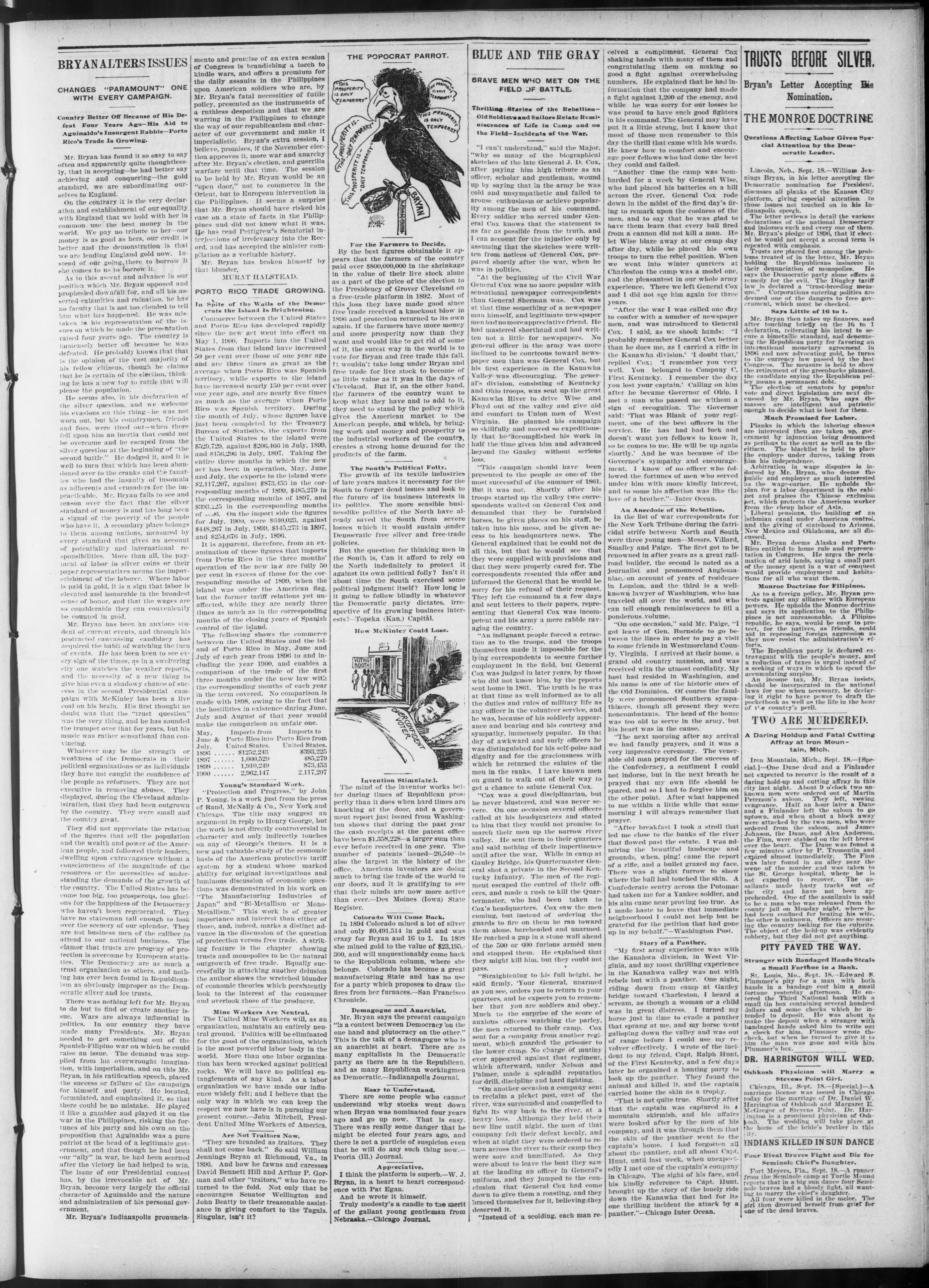
THE POPOCRAT PARROT.
THIS PROSPERITY IS ONLY TEMPORARY"
THIS PROSPERITY IS ONLY TEMPORARY"
THIS PROSPERITY IS ONLY TEMPORARY"
For the Farmers to Decide.
For the Farmers to Decide.
By the best figures obtainable it appears that the farmers of the country paid over $800,000,000 in the shrinkage in the value of their live stock alone as a part of the price of the election to the Presidency of Grover Cleveland on a free-trade platform in 1892. Most of this loss they have made good since free trade received a knockout blow in 1896 and protection returned to its own again. If the farmers have more money and more prosperity now than they want and would like to get rid of some of it, the surest way in the world is to vote for Bryan and free trade this fall. It wouldn't take long under Bryan and free trade for live stock to become of as little value as it was in the days of Cleveland. But if, on the other hand, the farmers of the country want to keep what they have and to add to it, they need to stand by the policy which gives the American market to the American people, and which, by bringing work and money and prosperity to the industrial workers of the country, creates a strong home demand for the products of the farm.
The South's Political Folly.
The growth of its textile industries of late years makes it necessary for the South to forget dead issues and look to the future of its business interests in its politics. The more sensible businesslike politics of the North have already saved the South from severe losses which it would sustain under Democratic free silver and free-trade policies.
But the question for thinking men in the South is, Can it afford to rely on the North indefinitely to protect it against its own political folly? Isn't it about time the South exercised some political judgment itself? How long is it going to follow blindly in whatever the Democratic party dictates, irrespective of its growing business interests?—Topeka (Kan.) Capitál.
How McKinley Could Lose.
How McKinley Could Lose.
VOTING BOOTH
ONERCONFIDENT VOTER
Inxention Stimulate.
The mind of the inventor works better during times of Republican prosperity than it does when hard times are knocking at the door, and a government report just issued from Washington shows that during the past year the cash receipts at the patent office have been $1,358,228—a larger sum than ever before received in one year. The number of patents issued—26,540—is also the largest in the history of the office. American inventors are doing much to bring the trade of the world to our doors, and it is gratifying to see that their minds are now more active than ever.—Des Moines (Iowa) State Register.
Colorado Will Come Back.
Colorado WILL Come Back.
In 1894 Colorado mined a lot of silver and only $9,491,514 in gold and was crazy for Bryan and 16 to 1. In 1898 she mined gold to the value of $23,195,300, and will unquestionably come back to the Republican column, where she belongs. Colorado has become a great manufacturing State and has no use for a party which proposes to draw the fires from her furnaces.—San Francisco Chronicle.
Demagogue and Anarchist
Mr. Bryan says the present campaign "is a contest between Democracy on the one hand and plutocracy on the other." This is the talk of a demagogue who is an anarchist at heart. There are as many capitalists in the Democratic party as there are in the Republican, and as many Republican workingmen as Democratic.—Indianapolis Journal.
Easy to Understand.
There are some people who cannot understand why stocks went down when Bryan was nominated four years ago and go up now. That is easy. There was really some danger that he might be elected four years ago, and there is not a particle of suspicion even that he will do any such thing now. Peoria (Ill.) Journal.
Appreciative.
I think the platform is superb.—W. J. Bryan, in a heart to heart correspondence with Pat Egan.
And he wrote it himself.
Truly modesty's a candle to the merit of the gallant young gentleman from Nebraska.—Chicago Journal.
BLUE AND THE GRAY
BRAVE MEN WHO MET ON THE FIELD OF BATTLE.
Thrilling Stories of the Rebellion- Old Soldiers and Sailors Relate Reminiscences of Life in Camp and on the Field-Incidents of the War.
"I can't understand," said the Major, "why so many of the biographical sketches of the late General J. D. Cox, after paying him high tribute as an officer, scholar and gentleman, wound up by saying that in the army he was cold and unsympathetic and failed to arouse enthusiasm or achieve popularity among the men of his command. Every soldier who served under General Cox knows that the statement is as far as possible from the truth, and I can account for the injustice only by assuming that the sketches were written from notices of General Cox, prepared shortly after the war, when he was in politics.
"At the beginning of the Civil War General Cox was no more popular with sensational newspaper correspondents than General Sherman was. Cox was at that time something of a newspaper man himself, and legitimate newspaper men had no more appreciative friend. He had mastered shorthand and had written not a little for newspapers. No general officer in the army was more inclined to be courteous toward newspaper men than was General Cox, but his first experience in the Kanawha Valley was discouraging. The general's division, consisting of Kentucky and Ohio troops, was sent up the great Kanawha River to drive Wise and Floyd out of the valley and give aid and comfort to Union men of West Virginia. He planned his campaign so skillfully and moved so expeditiously that he accomplished his work in half the time given him and advanced beyond the Gauley without serious loss.
This campaign should have been presented to the people as one/of the most successful of the summer of 1861. But it was not. Shortly after his troops started up the valley two correspondents waited on General Cox and demanded that they be furnished horses, be given places on his staff, be taken into his mess, and be given access to his headquarters news. The General explained that he could not do all this, but that he would see that they were supplied with provisions and that they were properly cared for. The correspondents resented this offer and informed the General that he would be sorry for his refusal of their request. They left the command in a few days and sent letters to their papers, representing that General Cox was incompetent and his army a mere rabble ravaging the country.
"An indignant people forced a retraction as to the troops, and the troops themselves made it impossible for the lying correspondents to secure further employment in the field, but General Cox was judged in later years, by those who did not know him, by the reports sent home in 1861. The truth is he was at that time as well informed as to all the duties and rules of military life as any officer in the volunteer service, and he was, because of his soldierly appearance and bearing and his courtesy and sympathy, immensely popular. In that day of awkward and surly officers he was distinguished for his self-poise and dignity and for the graciousness with which he returned the salutes of the men in the ranks. I have known men on guard to walk out of their way to get a chance to salute General Cox.
"Cox was a good disciplinarian, but he never blustered, and was never severe. On one occasion several officers called at his headquarters and stated to him that they would not promise to march their men up the narrow river valley. He sent them to their quarters and said nothing of their impertinence until after the war. While in camp at Gauley Bridge, his Quartermaster General shot a private in the Second Kentucky Infantry. The men of the regiment escaped the control of their officers, and made a rush to kill the Quartermaster, who had been taken to Cox's headquarters. Cox saw the men coming, but instead of ordering the guards to fire on them he ran toward them alone, bareheaded and unarmed. He reached a gap in a stone wall ahead of the 500 or 600 furious armed men and stopped them. He explained that they might kill him, but they could not pass.
"Straightening to his full height, he said firmly, Your General, unarmed as you see, orders you to return to your quarters, and he expects you to remember that you are soldiers and obey." Much to the surprise of the score of anxious officers watching the parley, the men returned to their camp. Cox sent for a company from another regiment, which guarded the prisoner to the lower camp. No charge of mutiny ever appeared against that regiment, which afterward, under Nelson and Palmer, made a splendid reputation for drill, discipline and hard fighting.
"On another occasion a company sent to reclaim a picket post, east of the river, was surrounded and compelled to fight its way back to the river, at a heavy loss. Although they held their new line until night, the men of that company felt their defeat keenly, and when at night they were ordered to return across the river to their camp they were sore and humiliated. As they were about to leave the boat they saw at the landing an officer in General's uniform, and they jumped to the conclusion that General Cox had come down to give them a roasting, and they braced themselves for it, believing they deserved it.
"Instead of a scolding, each man re-
ceived a compliment. General Cox shaking hands with many of them and congratulating them on making so good a fight against overwhelming numbers. He explained that he had information that the company had made a fight against 1,200 of the enemy, and while he was sorry for our losses he was proud to have such good fighters in his command. The General may have put it a little strong, but I know that most of those men remember to this day the thrill that came with his words. He knew how to comfort and encourage poor fellows who had done the best they could and failed.
"Another time the camp was bombarded for a week by General Wise, who had placed his batteries on a hill across the river. General Cox rode down in the midst of the first day's firing to remark upon the coolness of the men, and to say that he was glad to have them learn that every ball fired from a cannon did not kill a man. He let Wise blaze away at our camp day after day, while he placed his own troops to turn the rebel position. When we went into winter quarters at Charleston the camp was a model one, and the pleasantest in our whole army experience. There we left General Cox and I did not see him again for three years.
"After the war I was called one day to confer with a number of newspaper men, and was introduced to General Cox. I said, as we shook hands: 'I probably remember General Cox better than he does me, as I carried a rifle in the Kanawha division.' 'I doubt that,' replied Cox; 'I remember you very well. You belonged to Company C, First Kentucky. I remember the day you lost your captain.' Calling on him after he became Governor of Ohio, I met a man who passed me without a sign of recognition. The Governor said: 'That was Blank of your regiment, one of the best officers in the service. He has had bad luck and doesn't want you fellows to know it, so he comes to me. He will be up again shortly.' And he was because of the Governor's sympathy and encouragement. I know of no officer who followed the fortunes of men who served under him with more kindly interest, and to some his affection was like the love of a brother."—Inter Ocean.
An Anecdote of the Rebellion.
An Anecdote of the Rebellion. In the list of war correspondents for the New York Tribune during the fatricidal strife between North and South were three young men—Messrs. Villard, Smalley and Paige. The first got to be renowned in after years as a great railroad builder, the second is noted as a journalist and pronounced Anglomaniac, on account of years of residence in London, and the third is a well-known lawyer of Washington, who has traveled all over the world, and who can tell enough reminiscences to fill a ponderous volume.
"On one occasion," said Mr. Paige, "I got leave of Gen. Burnside to go between the lines in order to pay a visit to some friends in Westmoreland County, Virginia. I arrived at their home, a grand old country mansion, and was received with the utmost cordiality. My host had resided in Washington, and his name is one of the historic ones of the Old Dominion. Of course the family were pronounced Southern sympathizers, though all present they were noncombatants. The head of the house was too old to serve in the army, but his heart was in the cause.
"The next morning after my arrival we had family prayers, and it was a very impressive ceremony. The venerable old man prayed for the success of the Confederacy, a sentiment I could not indorse, but in the next breath he prayed that my own life should be spared, and so I had to forgive him on the other point. After what happened to me within a little while that same morning I will always remember that prayer.
"After breakfast I took a stroll that led me close to the banks of the river that flowed past the estate. I was admiring the beautiful landscape and grounds, when, ping! came the report of a rifle, and a bullet grazed my face. There was a slight furrow to show where the ball had touched the skin. A Confederate sentry across the Potomac had taken me for a Yankee soldier, and his aim came near proving too true. As I made haste to leave that immediate neighborhood I could not help but be grateful for the petition that had gone up in my behalf."—Washington Post.
Story of a Panther.
"My first army experience was with the Kanahwa division, in West Virginia, and my most thrilling experience in the Kanahwa valley was not with rebels but with a panther. One night, riding down from camp at Gauley bridge toward Charleston, I heard a scream, as though a woman or a child was in great distress. I turned my horse just in time to evade a panther that sprang at me, and my horse went galloping down the valley and was out of range before I could use my revolver effectively. I wrote of the incident to my friend, Capt. Ralph Hunt, of the First Kentucky, and a few days later he organized a hunting party to look up the panther. They found the animal and killed it, and the captain carried home the skin as a trophy.
"That is not quite true. Shortly after that the captain was captured in a mountain skirmish, and his affairs were looked after by the men of his company, and it was through them that the skin of the panther went to the captain's home. I had forgotten all about the panther, and all about Capt. Hunt, until last week, when unexpectedly I met one of the captain's company in Chicago. The sight of his face, and his kindly reference to Capt. Hunt, brought up the story of the lonely ride down the Kanawha that had for its one thrilling incident the attack by a panther."—Chicago Inter Ocean.
TRUSTS BEFORE SILVER.
THE MONROE DOCTRINE
Questions Affecting Labor Given Special Attention by the Democratic Leader.
Lincoln, Neb., Sept. 18.—William Jennings Bryan, in his letter accepting the Democratic nomination for President, discusses all planks of the Kansas City platform, giving especial attention to those issues not touched on in his Indianapolis speech. The letter reviews in detail the various declarations of the national Democracy and indorses each and every one of them. Mr. Bryan's pledge of 1896, that if elected he would not accept a second term is repeated with emphasis.
Trusts are placed first among the problems treated of in the letter, Mr. Bryan holding the Republicans insincere in their denunciation of monopolies. He says the Democratic party alone offers a remedy for the evil. The Dingley tariff law is declared a "trust-breeding measure." Corporations entering politics are deemed one of the dangers to free government, which must be checked.
Says Little of 16 to 1.
Mr. Bryan then takes up finances, and after touching briefly on the 16 to 1 declaration, reiterating his intent to secure a bimetallic standard, and denouncing the Republican party for favoring an international monetary agreement in 1896 and now advocating gold, he turns to the currency law passed by the last Congress. The measure is held to show the retirement of the greenbacks planned, the candidate saying the Republican policy means a permanent debt. The election of senators by popular vote and direct legislation are next discussed by Mr. Bryan, who says the masses are intelligent and patriotic enough to decide what is best for them.
Much Promised for Labor.
Planks in which the laboring classes are interested then are taken up, government by injunction being denounced as perilous to the court as well as to the citizen. The blacklist is held to place the employee under duress, taking from him his independence. Arbitration in wage disputes is indorsed by Mr. Bryan, who deems the public and employer as much interested as the wage-earner. He upholds the plan for a labor department in the cabinet and praises the Chinese exclusion net, which protects the American worker from the cheap labor of Asia.
Liberal pensions, the building of an isthmian canal under American control, and the giving of statehood to Arizona, New Mexico and Oklahoma, are all discussed. Mr. Bryan deems Alaska and Porto Rico entitled to home rule and representation in Congress. He urges the reclamation of arid lands, saying a small part of the money spent in a war of conquest would provide employment and habitations for all who want them.
Monroe Doctrine for Filipinos.
As to a foreign policy, Mr. Bryan protests against any alliance with European powers. He upholds the Monroe doctrine and says its application to the Philippines is not unreasonable. A Filipino republic, he says, would be easy to protect, for the natives, as friends, could aid in repressing foreign aggression as they now resist the administration's efforts.
The Republican party is declared extravagant with the people's money, and a reduction of taxes is urged instead of a seeking of ways in which to spend the accumulating surplus.
An income tax, Mr. Bryan insists, should be incorporated in the national laws for use when necessary, he declaring it right to have power to draft the pocketbook as well as the life in the hour of the country's peril.
TWO ARE MURDERED.
A Daring Holdup and Fatal Cutting Affray at Iron Mountain. Mich.
Iron Mountain, Mich., Sept. 18.—[Special.]—One Dane dead and a Finlander not expected to recover is the result of a daring hold-up and cutting affray in this city last night. About 9 o'clock two unknown men were ordered out of Martin Peterson's saloon. They left, vowing vengeance. Half an hour later a Dane and a Finlander left the saloon to go uptown, and when about a block away were attacked by the two men, who were ordered from the saloon, and James Johnson, the Dane, and Alex Anderson, the Finn, were stabbed on the left breast over the heart. The Dane was found a few minutes after by P. Tremontin and expired almost immediately. The Finn was later found in an alley near the scene of the murder and was taken to the St. George hospital, where he is not expected to recover. The assailants made hasty tracks out of the city and have not been apprehended. One of the assailants is said to be a man who was released from the county jail on Monday night, where he had been confined for beating his wife, the other is unknown. Officers are scouring the country looking for the culprits. The object of the hold-up was evidently robbery, but they did not get anything.
PITY PAVED THE WAY.
Stranger with Bandaged Hands Steals a Small Forthne in a Bank.
St. Louis, Mo., Sept. 18.—Edward S. Plummer's pity for a man with both hands in a bandage cost him a small fortune yesterday afternoon. He entered the Third National bank with a small tin box containing several hundred dollars and some checks which he intended to deposit. He was about to make the deposit when a stranger with bandaged hands asked him to write out a check for him. Plummer wrote the check, but when he turned to give it to him the man was gone and with him Plummer's box.
DR. HARRINGTON WILL WED.
Oshkosh Physician will Marry a Stevens Point Girl.
Chicago, Ill., Sept. 18.—[Special.]—A marriage license was issued in Chicago today for the marriage of Dr. Daniel W. Harrington of Oshkosh and Margaret E. McGregor of Stevens Point. Dr. Harrington is a prominent physician of Oshkosh. The wedding will take place at the home of the bride's brother in this city.
INDIANS KILLED IN SUN DANCE
Four Rival Braves Fight and Die for Seminole Chief's Daughter.
Fort Meyers, Fla., Sept. 18.—A runner from the Seminole camp at Turtle Mound reports that in a big sun dance four Seminole braves had a bloody fight, all wanting to marry the chief's daughter.
All four were killed in the melee. The girl then drowned herself from grief for one of the dead braves.
Richard B. Montgomery.....Editor and Proprietor
Office 200 Fifth Street.
Telephone Black No. 244.
postage paid.
One Year ..... $2.00
Six Months ..... 1.25
Three Months ..... 7.5
Send money by Express Money Order, P. O.
Money Order or Registered Letter to the
Wisconsin Weekly Advocate.
ADVERTISING RATES.
One inch, single insertion..... 25c
One inch, per year..... $9.00
Business locals 5c per line each insertion.
Apply for rates to the Advocate.
TO CONTRIBUTORS:
All communications must be sent with the name and address of the sender as an evidence of good faith, but not necessarily for publication. No manuscript returned if not accepted, unless accompanied by stamps.
All subscribers of the Advocate that fail to get their paper promptly will please notify us at once. The Advocate, at 209 Fifth street.
The Wisconsin Weekly Advocate company wishes to notify the public that all contracts and business transactions with this company must have the company stamp, otherwise they will be void. Neither will this company be responsible for paid subscriptions unless given to duly-accredited agents, who, on request, will give the company's receipt for same. Subscribers failing to receive their papers regularly will kindly notify the general office. Address all business communications to the general manager, 209 Fifth street.
Entered at the Milwaukee P. O. as second class matter.
Fitzsimmons will endeavor to give his business a higher tone by putting it on the basis of a muscle factory.
Now that the American Society of Professors of Dancing has declared against ragtime music, society, like the bear in Goldsmith's comedy, will "dance to none but the genteelest of tunes."
The sailing of the United States transport Lawton to bring back destitute miners from Alaska is an advertisement for the excessively boomed gold fields of the Klondike and Cape Nome that will materially reduce the receipts of the transportation companies next season.
In breaking the record for big grain eargoes by taking 170,000 bushels of wheat and 70,000 bushels of corn out of Manitowoc, for Buffalo, the steamer Gen. Orlando Poe showed that the big lake steamers are fast approaching the maximum limit of the new interlake channels. She draws 17 feet and 3 inches forward, and 17 feet and 10 inches aft, and the weight of her cargo is 7000 tons.
The Dismal swamp in Virginia has played an important part in the history of the country. As far back as 1740 it afforded a refuge for the Indians, who were being driven out of the country by the colonists. The hardy patriots of the revolution fled there when hard pressed by the British, causing the swamp to be hardly less famous than the morasses in which Marion and Pickens took refuge in the Carolina campaigns. During the Civil war thousands of slaves took advantage of its impenetrable shades, into which they were followed after the contest by bands of Confederate guerrillas, who held out for a month after Lee's surrender of Appomattox.
The plan to put a seawall completely around Manhattan Island seems likely to be carried out. It is estimated that such a wall of stone and twenty-five miles in length would cost $4,000,000. The sinking fund commission recently turned over to the dock board $1,500,000 to be devoted to this work, and it is expected that the rest of the money will be forthcoming when it is wanted. There was an attempt to get the money from the Legislature, but without success. So now the city of New York has taken up the matter and will most likely bear the expense. The waters around New York get on the rampage very often and a stout bulwark against them is absolutely necessary for the safety of the "longshore" district.
The First Massachusetts Heavy artillery was organized in June, 1862. It was a large regiment of 1800 men. Altogether 3000 men were on its rolls during the Civil war and of these about 400 survive. At a recent meeting of the survivors, held at Salem, Mass., a design for a Spottsylvania monument was accepted. This will be placed on the Harris farm, four miles from Spottsylvania courthouse, and will stand 84 feet high. At Spottsylvania the "Heavies" caught it. They had been in the forts around Washington for more than a year. Grant sent for them. They pitched in, and lost 398 men in one hour. Subsequently the "Heavies" suffered grievously at Cold Harbor and Petersburg.
There have been eight chief justices of the Supreme Court of the United States. The first was John Jay of New York, appointed by President Washington, who served from 1787 to 1795; the second, John Rutledge of South Carolina, who presided at only one term of the court, when his mind became diseased and the nomination was rejected by the Senate at the December session of Congress in 1795; the third, Oliver Ellsworth of Connecticut, 1796-1800; the fourth, John Marshall of Virginia, 1801-1835; the fifth, Roger M. Taney of Maryland, 1836-1864; the sixth, Salmon P. Chase of Ohio, 1864-1873; the seventh, Morrison R. Waite of Ohio, 1874-1888; the eighth, Melville W. Fuller of Illinois, appointed by President Cleveland in 1888, and still in office.
It is expected that the present trouble in China may aid in increasing the cultivation of tea in the Southern states. Several experiments in this direction have been made in different parts of the South under the direction of the department of agriculture, but so far there is only one considerable plantation in the United States. This is situated in South Carolina and produces several thousand pounds of tea annually. It is operated by a New Englander who spent a number of years in the tea countries of the East and was started by him somewhat in a philanthropic spirit to give employment to negro boys and girls. He supplied school
facilities for the employes. Both black and green trees are produced and some are sold at $1 a pound, though the average price is much less. This experiment has proved that tea may be successfully grown in South Carolina, at least, and it would indicate that there is a promising field for investment in this line of industry.
Among the many schemes which have cropped up as a result of the war in South Africa is one for establishing a great military reservation there to be used as training grounds by troops from Canada, Australia and India, as well as England. The reservation would be not less than 100 miles square and would be selected with the idea of all kinds of fighting ground in mind. Aldershot is inadequate for the purposes for which it was designed, and a new and larger training ground must be found. The plan of establishing one in South Africa is very good so far as England is concerned, but when it comes to providing ground for Canada, Australia and India, the matter takes on a humorous aspect. Any one of these countries could lose the Tight Little Isle many times over within its confines and why it should send its troops to South Africa for field maneuvers is not clear. Maybe the British mind will grasp the humor in this part of the scheme, if Mr. Punch will draw a cartoon around it.
Experiments are being conducted by the department of agriculture with a view of increasing the wheat-producing capacity of the United States, and furnishing a better grade of wheat. It is desired to procure a winter wheat which will be available for use in the Red River valley, a wheat which will stand exposure, and which will produce as good flour as the spring wheat now raised in this territory. The best wheat in America, according to a writer for the Evening Post, is the spring wheat of the Red River valley, and the great millers of the lake cities prefer it to any other, but wheat sown in the spring yields only about half the amount per acre that wheat sown in the winter yields, if the conditions are equally favorable. Therefore, it is estimated that should the department be successful in finding a winter wheat for the Red River valley which will produce as good flour as the spring wheat and will stand the exposure of the severe winter weather of that region, the problem will be solved. Thus far the experiments with Hungarian wheat, regarded as the best in the world, are prom-
It is not known generally that California owes to the late Collis P. Huntington the establishment on the Pacific slope of a state turf garden. Mr. Huntington always was interested in the promotion of agriculture, and for many years was a friend and patron of James Bradford Olcott of Connecticut. Mr. Olcott is endowed with a strain of quaint originality, and Mr. Huntington liked men of ideas. Mr. Olcott made up his mind many years ago that what this country needed most was the clothing of its hillsides and meadows with the ancient grazing grasses of older countries. He made two trips around the globe to collect the finest specimens of sod that the world could show, and these are maintained in a "grass garden" under the supervision of the Connecticut Agricultural Experiment station of Mr. Olcott's homestead in South Manchester, Conn. Mr. Olcott desired to start a state turf garden in California, principally for the reason that better turf is badly needed in that state, and also that his experiments might not be interfered with by the long New England winters. He appealed to Mr. Huntington and his request was not in vain. Mr. Huntington put at Mr. Olcott's disposal free transportation for his turf from the Atlantic to the Pacific, and also made arrangements for the establishment of the garden in a proper place in southern California.
Untidy Women.
Two neat women rode on an open street car. "Isn't it odd," said one confidently, "how women who wear glasses always seem so fascinating to men?"
"Huh!" rejoined the other. "Talking of spectacles, how does that suit you?" and she pointed to the seat ahead, where a big, blowsy woman and a really rather handsome man sat together in very much the same position that people assume in a waltz—or would—if they could waltz side by side. A "spectacle" indeed. She was a big chunk of a woman, who had been too lazy to fasten her skirt to her waist, so that there was a distinct stage wait between. Her skirt had twisted itself away, so that the demi-train hung partly in front, her necktie had dragged up at the back and— "How in the world do you suppose she combed her hair?" asked one of the women. "Well," contemplatively, "I should say with chopsticks."
"Or a paper-knife."
"Or a paper-knee.
"Or the leg of a chair."
Untidy, smudgy, indolent, yet the man leaned toward her adoringly.
Close by was another couple, and the attitude was nearly identical. Again "he" was not bad looking and "she" was a thin pattern of the stuff that shrews are made of. Her uncomely clothes hung on her like bags. Her hat was calamitous.
"What's the use of being neat and forsaken?" exclaimed one of the two women disgustedly. "Say, let us go home and touzle our hair."—Philadelphia Enquirer.
Old Man Got Religion.
"Two of the best known citizens of Montana," says a correspondent to the Chicago Record, "are Dan Fleury and Dave Davenport. Both belong to the sporting fraternity and are old-timers. Formerly they ranked with that class of gamblers known in these parts as 'hell roarers,' but age and growing infirmities have sobered them down and of late years they have been quiet and undemonstrative. For the last quarter of a century they have run together and have been in all kinds of games from whisky-poker up, and both have handled large sums of money. Of late Fleury has been troubled with rheumatism, and last winter went down to the Hot Springs of Arkansas to try the baths. When he returned last spring to his former haunts he missed Davenport and inquired as to his whereabouts.
"Dave is so old that he can't see the spots on the cards any more,' remarked the keeper of the leading resort in Helena, 'so he quit playing and got religion.' "What church?' inquired Fleury. "Unitarian,' answered the gambler. "Well,' remarked Fleury thoughtfully. 'Dave always did hunt for an easy ford.'" It is proposed to establish communication between Zanzibar and Pemba by wireless telegraphy.
GALVESTON AS IT WAS
BEAUTIFUL AND PROGRESSIVE SOUTHERN CITY.
The Greatest Cotton Port and the Fifth Commercial City in the United States-Has Risen Before from the Fury of Storm, Fire and Flood.
Galveston, previous to the devastating storm, was one of the most beautiful and progressive cities of the sunny South. Its history indicates that it has been one of the most unfortunate. In 1872 the entire eastern portion of the city was swept away by a tidal wave which followed a terrific storm that maged along the Gulf coast for three
ORPHANS' HOME.
days. When the city had recovered from this calamity and was built up in more beautiful and substantial style than ever, a devastating fire nearly destroyed it in November, 1885. Its enterprising citizens were not dismayed, however, and the city was soon rebuilt. In August, 1890, it was injured commercially to a great extent by the Brazos flood in which rich farming lands having an area of 1,380,000 acres were submerged for eight days to a depth of two to twenty feet. The loss as estimated by the United States Department of Agriculture was $7,414,000. The city has triumphed over all these adversities and will doubtless arise with increased strength from the present appalling disaster, for it is the greatest seaport of the South, being connected with the entire railway system of the United States and Mexico and having direct lines of steamship communication with all the great ports of the world. It is the largest cotton exporting point in the United States and among the 127 foreign exporting points in the country it holds fifth place. During the year 1898 its exports increased $10,500,000 and its export and import trade is now fully $100,000,000 a year.
Harbor Improvements.
A leading cause of the city's great commercial progress during the past few years is the harbor improvements made by the national government, involving an expenditure of over $8,000,-000. In 1895 the depth of the channel over the bar was only twenty-one feet. By the construction of jetties and other improvements which were finished in January, 1898, the depth was increased to twenty-eight feet and is still increasing at the rate of six inches each year owing to the action of the wind and tide. This depth of water permits the largest steamers to load and unload at the wharves. In addition to being the country's greatest cotton port, immense quantities of grain, lumber, live stock and dairy products are sent through Galveston. Much of the grain from Kansas, Nebraska, Iowa and the Dakotas, which formerly went to Eastern ports for shipment now goes to Galveston because the shippers can save in charges by loading at that port. The lumber exports in 1898-9 amounted to $1,247,914 and in 1899, the port handled $200,000 worth of eggs. Its trade in live stock, dairy products and poultry has developed rapidly since the harbor improvements.
Location and Description.
Location and Description.
Galveston is situated on the northeast extremity of Galveston Island at the mouth of Galveston Bay, the entrance to which is through the channel between the city and the southwest point of the peninsula of Bolivar. The island is twenty-seven miles long, runs northeast and southwest, and is from one and one-half to three and one-half miles wide. Where the city is built it is one and one-half miles wide. It is intersected with many small bayous and bordered through its whole length on the gulf side by a smooth, hard beach, forming a splendid drive and unsurpassed bathing. On this beach is the magnificent Sea Beach Hotel. The streets of the city are but a few feet above the level of the bay. They are
MASONIC TEMPLE.
wide and straight and the residence quarters are beautiful, abounding in luxuriant gardens shaded with magnolias and oleanders. During the summer months thousands of pleasure seekers from all parts of the South go to Galveston to enjoy the many attractions of the city and its surroundings. On the bay, or north side of the city, is the commercial section, with wharves stretching along for nearly two miles, lined with sheds and large storage
houses. In this same portion are three grain elevators with an aggregate storage capacity of 3,250,000 bushels. The island from the north side is connected with the mainland by railroad bridges and the longest wagon bridge in the world, nearly two miles in length. On the south side of the city, beginning within fifty yards of the medium gulf tide, the wealthy resident portion of the city is located and this was the first part to be struck by the full force of the recent storm and flood. All of the eastern end of the city was washed away and some of the handsomest and most expensive residences were here located. There was one home which alone cost the owner over $1,000,000. Among the principal buildings of the city are, or were, the new custom house and postoffice, the cotton exchange, the Court House, the Ball free school, the free public library, the Roman Catholic University of St. Mary, the John Sealey Hospital and the School of Medicine of the State University. All the buildings of the city were constructed on substantial and modern lines. The city had gas and electric light plants, a water works system valued at $450,000 and supplied from artesian wells and a number of first-class hotels. In 1893 the gross city valuations were $25,000,000. The city debt was $1,750,000 and the officials had authority to issue $1,500,000 in bonds to raise money for permanent improvements, and it owned property to the value of $1,955,560. The population, according to the figures given by the census bureau for 1900, is 37,789.
History of the City.
The island of Galveston was occupied by the famous pirate Lafitte in 1817 and continued to be his headquarters until his settlement was broken up in 1821. It is believed by many that somewhere on the island are buried treasures of the pirate and many stories of romance have been woven about the daring rover and his island home. The city of Galveston was founded in 1837. It was the scene of stirring events during the Civil War. The Federal forces occupied the city Oct. 8, 1862, but it was retaken by the Confederates on Jan. 1, 1863. During
GOVERNMENT BUILDING, GALVESTON.
the past few years the United States has spent $932,000 in the construction and equipment of coast fortifications near the city.
Bay of Galveston.
The bay of Galveston, the mouth of which is guarded by the island on which the city stands as a sentinel, is a body of water with an area of about 450 square miles. It has an irregular coast line and branches out into various arms. It receives the San Jacinto and Trinity rivers and Buffalo Bayou. Owing to the island being but little higher than the bay, inundations have often been threatened. The bay is quite shallow in most parts. Eentrance to it is through the recently constructed deep water channel and flanking it on either side are the stone jetties five miles long.
A Bad Case of Lockjaw.
1
A Whistling People.
The natives of Gomera, one of the Canary isles, converse with one another by whistling on their fingers. It is possible to understand a message a mile off. Each syllable of a word has its own peculiar sound. Gomera is cut up by a number of deep glens, which are not bridged over, and as it would otherwise be impossible for the inhabitants on separate sides of a glen to talk with one another without going a long way round to meet, they have hit upon the whistling device as the best means of communication.
Thought He Was Saving Money.
Hiram—Hurry up. Mandy, an' git away from this buildin'.
Mandy—What's yer hurry, Hi?
Hiram (chuckling)—The feller in the elevator forgot ter collect our fares.—Truth.
Almost every girl of sixteen has her mind made up that some day she will have a son named De Mountville, or a daughter named Geraidine.
About all some men are willing to do for a living is to breathe regularly.
JAMES T. BRETT & SON.
307 REED STREET and Always Open 410 GRAND AVENUE.
Telephones: South 122. Grand 2467. Milwaukee, Wis.
last week. trip from sent a por Phillips is ex, the of Episcopal second vice-ociation of I consider-
Pabst MaltExtract
The New York Press has found the ne plus ultra of shockingness—not stockingness: "Moonlight bathing at Narragan-
```markdown
```
J.
CREAM CITY NOTES.
Rev. and Mrs. Phillips of Jackson, Tenn., paid the editor a call last week. They stopped over on the trip from Waukesha, where they had spent a portion of their vacation. Rev. Phillips is the editor of the Christian Index, the official organ of the colored Episcopal church at Jackson, Tenn.
Mrs. C. H. Phillips is second vicepresident of the National Association of Colored Women. She has had considerable experience in temperance work when her husband was pastor of the leading church of his denomination in Washington, D. C. Mrs. Phillips was elected organizer in the District of Columbia. She was the first colored woman to hold such a position. She is president of the Colored Woman's Christian Temperance Union of Tennessee. The C. W. C. T. U. elected her a delegate to the C. W. C. T. U. which met in Edinburgh, Scotland, this summer.
痊 穴 率
Mr. Richard Steele is the owner of the best-equipped shoe-shining parlor in Neenah. His place is at 111 Wisconsin avenue. Give him a call when you are in the city.
* * *
We are daily sending colored servants to different parts of the state. Miss Brown left one day this week for Winona, Minn., to live in a private family. We also sent a colored girl for general housework to Oconomowoc.
```markdown
```
Mrs. J. Ashfield and Mrs. S. D. Alexander of Pittsburg, Pa., are visiting Mrs. M. Flowers, at 419 Thirty-fourth street, third flat, Chicago. These Pittsburg ladies are the representatives of the cultured and refined colored ladies of that city. We hope that their visit in the West will be pleasant and beneficial.
* *
Mrs. M. Flowers, 419 Thirty-fourth street, is a fine lady. Her business of manicuring, shampooing, chiropody and scalp treatment cannot receive too much praise. She is a thorough worker and well does she understand her trade. Her flat is fitted up to a king's taste.
```markdown
```
We here present one of the latest cuts of Dr. Elizabeth Warden, the well-known mental scientist of the age. At present she is located in our city at 209 Fifth street. The doctor is a resident of Louisville, Ky., where she has a
M.
home surrounded by comforts and luxuries without number. By her remarkable success as a physician she is called East to attend some very obstinate cases in which we have faith to believe she will be successful. Her power to lessen human woes has been proven during her short stay here and success is sure to crown her efforts.
* * *
Mrs. William Tate attended the A. M. E. conference at St. Paul, Minn., last week, and while there visited a number of old friends and relatives.
心 赤 靠
Mr. E. D. Sweetwood is assistant segeant-at-arms under George Wiswell. He is a very pleasant gentleman and is a solid friend of our race. And when around the national headquarters he is very kind to intercede for visitors and in introducing them and their business to the business men.
* * *
Mr. F. Eberhardt is a very pleasant conductor on one of the finest dining cars in the United States. He is a nice gentleman, and his car is fitted up in the most beautiful style. The waiters on his car, Messrs. S. M. Kitchen, H. Mashinton and J. B. Henderson, are very creditable young men. Too much cannot be said good of these young men. Judging from their bill of fare, this car furnishes the best of food for its tables. The car leaves daily from Milwaukee to Portage City, Wis., at 11 a. m.
```markdown
```
Mr. George Wiswell and family have returned from their summer home at Mackinaw Island, where they have been during the latter part of the summer. We hope they have had a very pleasant time and that they return much benefited from their lake and island visit. The old colenel has gone back to his post as sergeant-at-arms in Chicago.
* * *
James T. Brett and son have a nice establishment as funeral directors and embalmers at 410 Grand avenue, also one at 307 Reed street. Connected with this business is also a lady undertaker. Mrs. James T. Brett. She is a very nice lady to meet and understands her business well, is very accommodating and fond of colored people. They ask the patronage of our race.
---
Rev. T. W. Lewis, the new pastor of St. Mark's church, arrived here last night. He is a very honorable gentleman and speaks like a man of determination. It is our sincerest desire that the people of this community will appreciate his worthiness and tender to him the services necessary for carrying on the good work. Show him what Milwaukee people can and will do for their pastor. He called at our office and we greeted him with the heartiest welcome. We are at his service to do whatever we can to aid him.
Ne Plus Ultra of Shockingness
MRS. JAMES T. BRETT,
Lady Undertaker.
For the Safest and Quickest Road between
Take the Chicago; Milwaukee & St. Paul Railway.
Builds up both the body and nerves; brings refreshing sleep, insures a healthy
appetite, aids digestion and feeds blood, brain and bone It cannot fail to benefit in every case where more strength is required Once tried, you will never take a substitute. AT YOUR DRUGGIST
ABST/MALT EXT
The Best Tonic
MALT
HOPE
FAIRST BREWING CO.
MILWAUKEE, WI.
S. F. PEACOCK & SON Funeral Directors AND EMBALMERS
131 Broadway. MILWAUKEE WIS.
sett Pier, girls in Brant Rock, Mass., going to the postoffice in bathing costumes, Larchmont women wearing duck trousers. Chicago women attending church without hats, people eating 'hot corn' where the butter is put on with a paint brush, all these one can believe, but think of 'Sockless' Jerry Simpson yelling himself red in the face for shirtwaists for men'"
NEW ORLEANS' CLAY STATUE.
The Street Railroad Companies Triumph After Prolonged Contest. The removal of the statue of Henry Clay from Canal street has finally been definitely settled, an ordinance having been passed by the council providing for the removal of the statue from its present site, at the intersection of Canal street with St. Charles and Royal streets to Lafayette square.
The removal of the statue will mean the passing of one or the best-known landmarks of the city, around which many memories cluster. No special sentiment attaches to the statue itself, which is anything but an ornament in its present position, but people who remember the many important events which have occurred, and the many historic personages who have figured in occurrences around its base, will view with sentimental regret the removal of the old landmark; but even such persons are forced to admit that the motives underlying the demand for its removal outweigh any other consideration. It is not a disregard for memories of the past nor any lack of reverence for the memory of the statesman the statue is meant to honor that dictates the course resolved upon. It is a realization that in the present location the statue is a menace to life and limb, that it seriously impedes traffic upon one of the city's busiest thoroughfares. The several years of hesitation on the part of the authorities before finally sanctioning the removal is sufficient proof that the decision was finally arrived at with regret.
There can be no question at all that at this time the Clay statue is very much out of place in its present location. Crowded on all sides by immense electric cars and shrouded by a network of wires, the statue has ceased to be an ornament. Re-erected in Lafayette square, one of the most attractive spots in the city, the Clay statue will be seen to much better advantage, and the surroundings will be in every sense more appropriate.—New Orleans Picayune.
Insects and Music.
Tarantulas do not dance to the sound of the violin, but let the people they bite do the dancing; scorpions, however, enjoy fiddling, according to the Quarterly Review, and lizards go crazy for music of any kind. As for serpents, the boa constrictor and python are senseless to melody, but the cobra is fascinated by the flute and still more by the fiddle. Polar bears enjoy the violin; so do ostriches; wolves will stop in the chase to listen to a cornet; elephants are fond of the flute, especially the upper notes; tigers, while appreciating violin and flute, cannot stand the harmonica, while the musical seal shows no emotion on hearing any instrument, not even the bass drum.
A somewhat phenomenal gold strike is reported from the Golden Star, one of the Twin Sisters group in Boise basin, Idaho.
TALMAGES
DR. TALMAGE, in his journey westward through Europe, has recently visited scenes of thrilling historic events. He sends this sermon, in which he shows that nations are judged in this world and that God rewards them for their virtues and punishes them for their crimes. The text is Isaiah vii., 20. "In the same day shall the Lord shave with a razor that is hired, namely, by them beyond the river, by the king of Assyria."
The Bible is the boldest book ever written. There are no similitudes in Ossian or the Iliad or the Odyssey so daring. Its imagery sometimes seems on the verge of the reckless, but only seems so. The fact is that God would startle and arouse and propel men and nations. A tame and limping similitude would fail to accomplish the object. While there are times when he employs in the Bible the gentle dew and the morning cloud and the dove and the daybreak in the presentation of truth, we often find the iron chariot, the lightning, the earthquake, the spray, the sword and, in my text, the razor. This keen bladed instrument has advanced in usefulness with the ages. In Bible times and lands the beard remained uncut save in the seasons of mourning and humiliation, but the razor was always a suggestive symbol. David said of Doeg, his antagonist, "Thy tongue is a sharp razor working deceitfully"—that is, it pretends to clean the face, but is really used for deadly incision.
In this striking text this weapon of the toilet appears under the following circumstances: Judea needed to have some of its prosperities cut off, and God sends against it three Assyrian kings—first Sennacherib, then Esarhaddon and afterward Nebuchadnezzar. These three sharp invasions that cut down the glory of Judea are compared to so many sweeps of the razor across the face of the land. And these devastations were called a hired razor because God took the kings of Assyria, with whom he had no sympathy, to do the work and paid them in palaces and spoils and annexations. These kings were hired to execute the divine behests. And now the text, which on its first reading may have seemed trivial or inapt, is charged with momentous import, "In the same day shall the Lord shave with a razor that is hired, namely, by them beyond the river, by the king of Assyria."
Razors of Judgment.
Well, if God's judgments are razors, we had better be careful how we use them on other people. In careful sheath these domestic weapons are put away where no one by accident may touch them and where the hands of children may not reach them. Such instruments must be carefully handled or not handled at all. But how recklessly some people wield the judgments of God! If a man meets with business misfortune, how many there are ready to cry out: "That is a judgment of God upon him because he was unscrupulous or arrogant or overreaching or miserly. I thought he would get cut down. What a clean sweep of everything! His city house and country house gone. His stables emptied of all the fine bays and sorrels and grays that used to prance by his door. All his resources overthrown and all that he prided himself on tumbled into demolition. Good for him!" Stop, my brother. Don't sling around too freely the judgments of God, for they are razors.
Some of the most wicked business men succeed, and they live and die in prosperity, and some of the most honest and conscientious are driven into bankruptcy. Perhaps the unsuccessful man's manner was unfortunate, and he was not really as proud as he looked to be. Some of those who carry their heads erect and look imperial are humble as a child, while many a man in seedy coat and slouch hat and unblacked shoes is as proud as Lucifer. You cannot tell by a man's look. Perhaps he was not unscrupulous in business, for there are two sides to every story, and everybody that accomplishes anything for himself or others gets industriously lied about. Perhaps his business misfortune was not a punishment, but the fatherly discipline to prepare him for heaven, and God may love him far more than he loves you, who can pay dollar for dollar and are put down in the commercial catalogues as A1. Whom the Lord loveth he gives $400,000 and lets die on embroidered pillows? No; whom the Lord loveth he chasteneth. Better keep your hands off the Lord's razors, lest they cut and wound people that do not deserve it. If you want to shave off some of the bristling pride of your own heart, do so, but be very careful how you put the sharp edge on others. How I do dislike the behavior of those persons who when people are unfortunate say, "I told you so—getting punished—served him right!" If those I-told-you-so's got their desert, they would long ago have been pitched over the battlements. The mote in their neighbor's eyes, so small that it takes a microscope to find it, gives them more trouble than the beam which obscures their own optics. With air sometimes supercilious and sometimes pharaasical and always blasphemous they take the razor of divine judgment and sharpen it on the hone of their own hard hearts and then go to work on men sprawled out at full length under disaster, cutting mercilessly. They begin by soft expressions of sympathy and pity and half praise and lather the victim all over before they put on the sharp edge.
Let us be careful how we shoot at others lest we take down the wrong one, remembering the servant of King William Rufus, who shot at a deer, but the arrow glanced against a tree and killed the king. Instead of going out with shafts to pierce and razors to cut we had better imitate the friend of Richard Coeur de Lion. Richard, in the war of the Crusades, was captured and hopris-
oned, but none of his friends knew where, so his loyal friend went around the land from stronghold to stronghold and sang at each window a snatch of song that Richard Coeur de Lion had taught him in other days. And one day, coming before a jail where he suspected his king might be incarcerated, he sang two lines of song, and immediately King Richard responded from his cell with the other two lines, and so his whereabouts were discovered, and a successful movement was at once made for his liberation. So let us go up and down the world with the music of kind words and sympathetic hearts, serenading the unfortunate and trying to get out of trouble men who had noble natures, but by unforeseen circumstances have been incarcerated, thus liberating kings. More hymn book and less razor.
Especially ought we to be apologetic and merciful toward those who, while they have great faults, have also great virtues. Some people are barren of virtues. No weeds verily, but no flowers. I must not be too much enraged at a nettle along the fence if it be in a field containing forty acres of ripe Michigan wheat. Some time ago naturalists told us there was on the sun a spot 20,000 miles long, but from the brightness and warmth I concluded it was a good deal of a sun still. The sun can afford to have a very large spot upon it, though it be 20,000 miles long, and I am very apologetic for those men who have great faults, while at the same time they have magnificent virtues.
Nothing Ever "Happens:"
Again, when I read in my text that the Lord shaves with the hired razor of Assyria the land of Judea I think myself of the precision of God's providence. A razor swung the tenth part of an inch out of the right line means either failure or laceration, but God's dealings never slip, and they do not miss by the thousandth part of an inch the right direction. People talk as though things in this world were at loose ends. Cholera sweeps across Marseilles and Madrid and Paiermo, and we watch anxiously. Will the epidemic sweep Europe and America? People say, "That will entirely depend on whether the inoculation is a successful experiment; that will depend entirely on quarantine regulations; that will depened on the early or late appearance of frost. That epidemic is pitched into the world, and it goes blundering across the continents, and it is all guesswork and an appalling perhaps." I think, perhaps, that God had something to do with it and that his mercy may have in some way protected us; that he may have done as much for us as the quarantine and the health officers. It was right and a necessity that all caution should be used, but there have come enough macaroni from Italy, and enough grapes from the south of France, and enough rags from tatterdemalions, and hidden in these articles of transportation enough choleraic germs to have left by this time all the cities mourning in the cemeteries. I thank all the doctors and quarantines, but more than all, and first of all, and last of all, and all the time. I thank God. In all the 6,000 years of the world's existence there has not one thing merely "happened so." God is not an anarchist, but a King, a Father.
When little Tad, the son of President Lincoln, died, all America sympathized with the sorrow in the White House. He used to rush into the room where the cabinet was in session and while the most eminent men of the land were discussing the questions of national existence. But the child had no care about those questions. Now, God the Father and God the Son and God the Holy Ghost are in perpetual session in regard to this world and kindred worlds. Shall you, his child, rush in to criticise or arraign or condemn the divine government? No; the cabinet of the Eternal Three can govern and will govern in the wisest and best way, and there never will be a mistake and, like razor skillfully swung, shall cut that which ought to be cut and avoid that which ought to be avoided. Precision to the very hairbreadth. Earthly timepieces may get out of order and strike wrong, saying it is 1 o'clock when it is 2, or 2 when it is 3. God's clock is always right, and when it is 1 it strikes 1, and when it is 12 it strikes 12, and the second hand is as accurate as the minute hand.
National Sins Punished.
Further, my text tells us that God sometimes shaves nations. "In the same day shall the Lord shave with a razor that is hired." With one sharp sweep he went across Judea, and down went its pride and its power. In 1861 God shaved the American nation. We had allowed to grow Sabbath desecration and oppression and blasphemy and fraud and impurity and all sorts of turpitude. The South had its sins, and the North its sins, and the East its sins, and the West its sins. We had been warned again and again, and we did not heed. At length the sword of war cut from the St. Lawrence to the gulf and from Atlantic seaboard to Pacific seaboard. The pride of the land, not the cowards, but the heroes, on both sides went down. And that which we took for the sword of war was the Lord's razor. In 1862 again it went across the land; in 1863 again; in 1864 again. Then the sharp instrument was incased and put away.
Never in the history of the ages was any land more thoroughly shaved than during those four years of civil combat, and, my brethren, if we do not quit some of our individual and national sins the Lord will again take us in hand. He has other razors within reach besides war—epidemics, droughts, deluges, plagues—grasshopper and locust—or our overtowering success may so far excite the jealousy of other lands that under some pretext the great nations may combine to put us down. Our nation, so easily approached on north and south and from both oceans, might have on hand at once more hostilities than were ever arrayed against any one power. I hope no such combination against us will ever be formed, but I want to show that, as Assyria was the hired razor against Judea, and Cyrus the hired razor against Babylon, and the Huns the hired razor against the Goths, there are now many razors that the Lord could hire if, because of our national sins, he should undertake to shave us. In 1870 Germany was the razor with which the Lord shaved France. Japan was the razor with which he shaved China and America the razor with which he shaved arrogant, op-
pressive and Bible hating Spain. nations are to repent in a day. May a speedy and world-wide coming to God hinder on both sides the sea all national calamity. But do not let us as a nation either by unrighteous law at Washington or bad lives among ourselves defy the Almighty.
Instruments of God.
One would think that our national symbol of the eagle might sometimes suggest another eagle—that which ancient Rome carried. In the talons of that eagle were clutched at one time Britain, France, Spain, Italy, Dalmatia, Rhaetia, Noricum, Pannonia, Moesia, Dacia, Thrace, Macedonia, Greece, Asia Minor, Syria, Phoenicia, Palestine, Egypt and all northern Africa and all the islands of the Mediterranean, indeed all the world that was worth having, a hundred and twenty millions of people under the wings of that one eagle. Where is she now? Ask Gibbon, the historian, in his prose poem, "The Decline and Fall of the Roman Empire." Ask her gigantic ruins, bemoaning their sadness through the ages, the screech owl at windows out of which world-wide conquerors looked. Ask the day of judgment, when her crowned debauchees, Commodus and Pertinax and Caligula and Diocletian, shall answer for their infamy. As men and as nations let us repent and have our trust in a pardoning God rather than depend on former successes for immunity! Out of thirteen of the greatest battles of the world Napoleon had lost but one before Waterloo. Pride and destruction often ride in the same saddle.
But notice once more, and more than all, in my text, that God is so kind and loving that when it is necessary for him to cut he has to go to others for the sharp edged weapon. "In the same day shall the Lord shave with a razor that is hired." God is love. God is pity. God is help. God is shelter. God is rescue. There are no sharp edges about him, no thrusting points, no instruments of laceration. If you want balm for wounds, he has that. If you want divine salve for eyesight, he has that. But if there is sharp and cutting work to do, which requires a razor, that he hires. God has nothing about him that hurts, save when dire necessity demands, and then he has to go clear off to some one else to get the instrument. This divine clemency will be no novelty to those who have pondered the Calvarean massacre, where God submerged himself in human tears and crimsoned himself from punctured arteries and let the terrestrial and infernal worlds maul him until the chandeliers of the sky had to be turned out, because the universe could not endure the outrage. Illustrious for love he must have been to take all that as our substitute, paying out of his own heart the price of our admission at the gates of heaven.
Breadth of Divine Love.
King Henry II. of England crowned his son as king and on the day of coronation put on a servant's garb and waited, he, the king, at the son's table, to the astonishment of all the princes. But we know of a more wondrous scene—the King of heaven and earth offering to put on you, his child, the crown of life and in the form of a servant waiting on you with blessing. Extol that love, all pointing, all sculpture, all music, all architecture, all worship! In Dresdenian gallery let Raphael hold him up as a child, and in Antwerp cathedral let Rubens hand him down from the cross as a martyr, and Handel make all his oratorio vibrate around that one chord—"He was wounded for our transgressions, bruised for our iniquities." But not until all the redeemed get home, and from the countenances in all the galleries of the ransomed shall be revealed the wonders of redemption, shall either man or seraph or archangel know the height and depth and length and breadth of the love of God.
At our national capital a monument in honor of him who did more than any one to achieve our American independence was for scores of years in building, and most of us were discouraged and said it never would be completed. And how glad we all were when in the presence of the highest officials of the nation the work was done! But will the monument to him who died for the eternal liberation of the human race ever be completed? For ages the work has been going up. Evangelists and apostles and martyrs have been adding to the heavenly pile, and every one of the millions of redeemed going up from earth has made to it contribution of gladness, and weight of glory is swung to the top of other weight of glory, higher and higher as the centuries go by, higher and higher as the whole millenniums roll, sapphire on the top of jasper, sardonyx on the top of chalcedony and chrysoprasus above topaz, until far beneath shall be the walls and towers and domes of our earthly capitol, a monument forever and forever rising and yet never done, "Unto him who hath loved us and washed us from our sins in his own blood and made us kings and priests forever." Alleluia, amen.
Faith.—When our minds get perplexed by the doctrine that because law is everywhere, a living and loving God has been eliminated from the world, then faith in God's hearing our prayers unconsciously declines.—Rev. J. H. Barrows, Presbyterian, Oberlin, Ohio. God's Answer.—We must remember that God's no to our petitions is as much an answer as yes, and his no as much a blessing as his yes. We must be sure that if God does not answer our prayer in our own way he answers it in his way.—Rev. Wm. E. Territt, Presbyterian, Philadelphia, Pa.
The Unseen Power.—How we do work to keep the machinery of the church of God in motion. It needs the unseen power. No power is found in form alone. Every mighty force in the universe of God is unseen. We need form and organization, but we need the power of God back of them.—Rev. Chas. A. Shatto, Boston, Mass.
Old Age.—To very many the thought of old age comes like a penal sentence to servitude. It is associated with feebleness, discontent, sorrow and disappointment. It need not be so; but it may be sweeter as the breath of May and beautiful as its flower and rich as the ripe fruitage of October.—Rev. J. T. Steffy, Methodist, Pittsburg, Pa.
THE
HOUSEHOLD
"Portable" Egg-Beater
Ernest R. Godward, of Invercargill, New Zealand, has designed the eggbeater pictured below, which he claims has the advantage that it can be operated by the cook while walking about and attending to other duties, being taken up and laid down at will. The interior arrangement of the beater is arranged to cut all parts of the egg as the beater is shaken in the hand, their
```markdown
```
NEW KITCHEN UTENSII.
being two sets of spiral blades placed inside the casing, with a flat spiral cutter at the center. The ends are closed by two caps, which are provided with washers to prevent leakage, and are held in place by screw threads or other convenient fastening. By providing a removable cap at both ends the utensil can be more readily cleaned. When it is desired to use the utensil, one cap is removed and the eggs poured in, after which the cap is replaced and the beater is shaken lengthwise in the hand. The device can be made of tin or glass, and the cutters are mounted in cups attached to the end caps, which allows the whole mechanism to be easily removed for washing.
Suggestions
Meat immersed in milk, either sweet or sour, can be kept fresh some time. Bacon if soaked in sweet milk for some time before frying is greatly improved, and fries a rich brown. Meat for soup should boil very slow, merely simmer. When boiling a ham let it remain in the liquor in which it is boiled until cold. It will be tender and juicy. Chicken soup is improved by roasting the fowl twenty minutes before putting it on to boil. A sour stomach can often be relieved by a copious draught of pure water.
Fortunately for one's pocketbook, the plainer, cheaper foods with the exception of meat, are among the most wholesome and nutritious. The best way to get the better of the billious system without medicine is to take the juice of a lemon or two or three if the appetite craves them, in as much cold water as makes it pleasant to drink without sugar, before going to bed.
Tempting Bill of Fare.
BREAKFAST.
Strawberries.
Cornmeal mush. Cream.
Broiled chipped beef.
Stewed potatoes. Fried cucumbers.
Shirred eggs.
Rolls. Coffee.
LUNCHEON.
Broiled Sweetbreads on toast.
Fricassee of cold chicken. Dumplings.
Fried sweet potatoes.
White bread and butter.
Chocolate layer cake.
Tea.
DINNER.
Split pea soup.
Olives. Celery.
Roast beef.
Mashed potatoes. Creamed cauliflower.
Baked potatoes.
Lettuce, French dressing.
Poor man's pudding.
Fancy cakes. Cheese.
Dinner in Courses.
It is an old-established rule to serve but two vegetables with the meat course; at an elaborate dinner one is preferable. Such vegetables as corn on the cob, asparagus, or cauliflower may be served alone as a course. Where fish is not served, and unless it is very good, it is much better omitted, the vegetable may be served here; then will follow the meat and the starchy vegetables. If game is served, the salad is served with the game; otherwise it is served as a separate course. There is no objection, however, to serving salad with roast chicken following the heavier meat dish.
Preserved Pineapple.
Pare the pineapple and carefully pick out every particle of the eyes. A small, pointed silver knife is the best for this work. Either pick off with a fork, or grate off, the soft part, rejecting the hard core. Weigh, and allow three-quarters of a pound of sugar to each pound of fruit. Put all together in the preserving kettle, stir well, stand aside over night. In the morning, bring to a boil, skim and cook slowly half an hour. Pour into jars and seal.
Quick Pickles.
Cut small cucumbers, leaving a bit of the stem on each. Drop into boiling water, let boil five minutes, then take out into cans with a skimmer. Drain off all the water. Put a teaspoonful of salt and two or three peppers into each can and fill up with hat, strong vinegar and seal. We do not vouch for this recipe, but it may be tried by those who would like to simplify the work of pickle-making.
EXCURSIONS!! Every Saturday Night TO Grand Haven Muskegon Grand Rapids
ROUND TRIP GRAND HAVEN $1.00
MUSKEGON $1.00
GRAND RAPIDS $1.50
Visit the Fine Summer Resorts on the East Shore. A Ride of 170 Miles for $1.00.
Don't Forget these Cheap Excursions Every Saturday During the Summer.
THE MAIL
ROUND TRIP 50c. CHILDREN HALF PRICE. Fine Military Concert by Daily News Band. Refreshments Served Aboard the Steamers. Steamer Leaves Crosby Line Dock, Foot of West Water Street, at 9 A. M. Sharp. A GOOD TIME AND A PLEASANT TRIP. BRING YOUR FRIENDS
THE BAR
The Emerson Shoe Co. CORNER GRAND AVENUE AND THIRD STREET, MILWAUKEE, WIS.
MR. GEORGE A. SCHECK, the manager of R. B. Grover & Co., manufacturers of the Celebrated Comfortable Custom Made Shoes, begs leave to announce to the many citizens of Milwaukee and vicinity that they have opened a new store in this city in the new building on the northeast corner of Third St. and Grand Ave. and carry a full line of goods. This makes 31 stores run by the firm at the present time.
A Goodyear Welt costs $3.50 and a Handsewed $5.00. The goods are honest all through and inspection is solicited.
Before Starting on Your Travels
CALL ON
Geo. Burroughs & Sons
MANUFACTURERS OF
PREMIUM TRUNKS
VALISES, SAMPLE CASES, Etc.
424 & 426 East Water St., Milwaukee.
Strangers
in the City
and those desiring a first-
class place to room should
not fail to call-upon
MRS. B. NICOLAS
325 WELLS STREET
who has the nicest and best equipped
rooms in the city. GIVE HER A CALL.
Racine Dockbuilder Notified that He Must Hasten.
Work was to Have Been Completed Last June-Lighthouse Cut Off from Mainland.
Racine, Wis., Sept. 20.—[Special.]—On complaint of Capt. Warren of the United States harbor improvements, stationed in Milwaukee, a letter was today sent to John O. Jones, the contractor who is building the 950 feet of new dock on the north side of the river. The letter was from United States District Attorney M. C. Phillips and it states that unless the work on the new docks is hurried to completion the government will take charge and fine the contractor $500. The contract for $12,000 worth of work was let by the city of Racine last April with the understanding the work should be completed by June 1. The work has dragged on and the docks are not nearly completed. The high waves have washed out a channel cutting off the government lighthouse from the main shore and carrying sand into the river, thus interfering with navigation. The recent storms have caused much damage to property on account of the condition of the docks. The government states that Jones will be held responsible for all damage.
ALLEGED BANK ROBBERS CAUGHT.
Two Men Are Arrested at Tomah Charged with the Wilton Affair.
La Crosse, Wis., Sept. 20.—[Special.]
—The two men, George Howard and John Thomas, who say they hail from La Crosse, were arrested at Tomah, suspected of bank blowing at Wilton, Sunday morning. It is believed that they are two of the three men who were surprised while at work and fired at the citizens with their revolvers. They also answer the description of the men who stole the team at Tunnel Number Two, a few nours later. The team has been found, but not the buggy.
HOGS HAVE CHOLERA.
Disease is on the Rampage in Trempealeau County and Plgs
Galesville, Wis.. Sept. 20.—[Special.]
It is quite probable that there will not be a hog in this end of Trempealeau county within a month. Hog cholera is on the rampage and farmers who have hogs left are making every effort to dispose of them. On some farms every hog has been killed off by the disease. Farmers hereabours have lost thousands of dollars since the cholera made its appearance. It is claimed also that the disease is affecting sheep, which, if true, will prove disastrous to three-fourths of the farmers in the county. To illustrate how completely the cholera has affected the hog industry, at the last meeting of the Trempealeau county fair there was but one hog on the grounds, and this a diminutive porker of twenty pounds weight, which was brought there as a joke by the owner. Under the rules of the association the judges were obliged to award the youngster first premium as the largest hog shown.
POTATO SEASON IS ON.
The Work of Buying and Shipping Has Begun.
New London, Wis., Sept. 20.—[Special.]—The potato buying and shipping season in the Wisconsin potato belt has just about opened. The potato belt of this state comprises the counties of Waupaca, Waushara and Portage and also some of Shawano and Langlade counties. At the opening of the season the potatoes brought per bushel 22 cents, then went up to 25, and now are selling at 20 cents. When they get below 20 cents then the starch factories begin to buy their supply.
There are six starch factories, located as follows: Stevens Point, one; at Plainfield, one; Wautoma, one; Iola, one, and two at Waupaca.
FARM LAND $13.73 AN ACRE.
The Average Valuation of Property in Columbia County.
Portage, Wis., Sept. 20.—[Special.]—County Clerk D. R. Marshail has just completed the abstract of assessments for Columbia county based on the reports of the assessors of the several cities, villages and towns. The personal property valuation of the county is shown to be $2,660,330 for 1900, as against $2,253,115 for last year. The total valuation of farm land is $6,771,211—an average value of $13.73 per acre. The total value of real estate in the county is placed at $9,515,156, against $9,041,916 last year.
ATTEMPT TO CRACK SAFE.
Robbers at Pleasant Prairie Were Frightened Away.
Kenosha, Wis., Sept. 20.—[Special.] A bold attempt was made to crack the safe containing several hundred dollars in the general store of H. A. King at Pleasant Prairie. The cracksmen must have taken a very hurried departure, for the drill with which they had been working was left sticking in the safe. A hole had been drilled beneath the combination of the large safe and the work was ready for the insertion of an explosive-that would tear it open.
REMOVAL OF GALE COLLEGE
Directors May Decide to Locate at La Crosse. La Crosse, Wis., Sept. 20.—[Special.] The question as to whether Gale college is to be removed to La Crosse or not will be decided within the next two weeks, says Dr. Thomas, president of the college. At that time a meeting of the board of directors will be held. Dr. Thomas still has hopes that the college will be removed to La Crosse.
SUMMER SCHOOL DIRECTORS.
Stockholders of Columbia Catholic School Meet at Madison. Madison, Wis., Sept. 20.—[Special.] At the annual meeting of the stockholders of the Columbian Catholic Summer school these new directors were elected: Revs. P. J. McGrath of Charles City, In.; P. J. Donnelly of St. Paul: T. P. Hodinett of Chicago, and F. J. Van Antwerp of Detroit. The election of officers will take place in Chicago next month. The school will meet at Detroit.
Boys Capsize on Lake Monona.
Madison, Wis., Sept. 20.—Alfred Bushnell, a son of ex-Congressman A. P. Bushnell, and John Scott, a son of State Superintendent of Public Property Scott, were capsized while sailing on Lake Monona. The boys were in the water about half an hour before being rescued.
SHE MAKES PEACE WITH HER HUSBAND.
Man Has Wife Arrested on Charge of Poisoning Him and Then Forgives Her.
New London, Wis., Sept. 20.--[Special.]—Mrs. Augusta Pahlow of the town of Liberty, this county, who was arrested on complaint of her husband a few weeks ago, charging her with an alleged attempt to poison him by feeding him Paris green in coffee, has made peace with her husband and is living with him. She is enjoying her liberty under $500 bail. It is thought that the case will be dismissed, as it appears that Pahlow will withdraw the complaint.
HELEN SOUTHGATE IS NOT A BADGER.
Girl Shot in New York Lived at Appleton, Neb., Not Wisconsin
Appleton, Wis., Sept. 20.—[Special.]—Helen Forbes Southgate, reported to have once lived at Appleton, who was shot recently in Brooklyn by Henry Barbour, who then committed suicide, has at last been traced. She never lived in Appleton, Wis., but did live in Appleton, Sheridan county, Neb., where her father was pastor of a church a number of years ago. Her mother, Mrs. Sarah Forbes, was formerly an opera singer, beyond which nothing is known of her. Helen Forbes' father died at Appleton, Neb., when she was young, and she remained there with her mother until her adoption, several years ago by Bishop Southgate of the Episcopal church, who died in Brooklyn in 1896. Soon after his death Miss Forbes-Southgate quarried with her adopted mother over her having become a communicant of the Roman Catholic church, while attending school in Washington, D. C., and after staying for a time with friends in the East, rejoined her mother at Appleton, Neb., about three years ago, where she remained until last fall, when she became reconciled to her adopted mother and returned East to live with her. The mother, Mrs. Sarah Forbes, still lives in Appleton, Neb. Such is the Western end of the story of Miss Helen Forbes Southgate.
A SOUND SLEEPER.
Burglar Steals Revolver from Under the Pillow of an Oshkosh Man.
Oshkosh. Wis., Sept. 20.—[Special.]—A burglar entered the residence of S. Slister last evening. The residence was occupied by a young man named Carl Fugelburg, who was sleeping alone in the house. The burglar stole a revolver from under the pillow of the young man and took a $75 watch and a small sum of money. He overlooked a large sum which was concealed in the room. The young man thinks he must have been drugged as he slept so soundly.
The police have a clue to the burglar and an arrest will be made soon.
CATCH TAX DODGERS.
La Crosse Valuation Has Increased $651,137 in a Year.
La Crosse, Wis., Sept. 20.—[Special.]
—Tax Commissioner Reichelt has just completed the tax list of the city property. It shows $12,290,206 as the assessed valuation. It is an increase of $651,137 over last year. This increase is mostly due to the fact that many of the tax-dodgers, who have had mortgages and kindred property, have been corralled by the commissioners and will hereafter be compelled to pay taxes on them. There has been a decrease in the value of bicycles of $1020.
ATTENDANCE IS VERY LARGE.
Thirty-one Women and Thirty-Eight Men in Beloit's Freshmen Class.
Beloit, Wis., Sept. 20.—[Special.]— Registrar Collie reports an enrollment in the college Freshmen class up to this morning of thirty-eight young men and thirty-one young women. All the old classes are well represented, and the academy has a large number of students. Prof. T. L. Wright arrived here from Europe yesterday. W. A. Powell will have charge of the college rhetoricals in place of Prof. E. G. Smith
INDIANS TAKEN TO SCHOOL.
Oneida Children Are Sent to Hampton College.
Green Bay, Wis., Sept. 20.—[Special.]
Fourteen Oneida children, seven boys and seven girls, between the ages of 13 and 20, lett Green Bay last night on their way to Hampton, Va., where they will enter Hampton college, a government school. They were accompanied as far as Chicago by Rev. W. W. Soule, the Methodist missionary on the reservation.
MORE SMALLPOX AT MADISON
Charles Davey Taken with Disease of Which His Brother is Victim. Madison, Wis., Sept. 20.—[Special.] Charles Davey of this city came down with smallpox and was taken to the isolation hospital. He is a brother of Frank Davey of Calumet, Mich., who was taken with the disease here about three weeks ago while visiting here. He is still at the isolation hospital, but is recovering.
THE YOUNGEST VETERAN.
James Heath of New London Went to Civil War Aged 14.
New London, Wis., Sept. 20.—[Special.]—James Harland Heath, a barber in this city, is probably the youngest surviving veteran of the Civil war. At the time of his enlistment at Appleton in Co. E. Fortieth Wisconsin Volunteer infantry, he was a trifle over 14 years of age. He is now 55 years old.
BABY DIGESTS A SCREW.
Child Swallows Steel and Suffers No Serious Effects.
Racine, Wis., Sept. 20.—[Special.]—A 15-months-old child of Dr. and Mrs. Charles E. Bartholf of Union Grove recently swallowed a two-inch steel screw. An operation was unnecessary, and the child is just as well and healthy as ever. The screw had not undergone any change by reason of the digestive process.
Two Break Jail at Iron River.
Iron River, Wis., Sept. 20.—[Special.]
—Two men who had been arrested and confined in the city jail at the time it was quarantined on account of smallpox, and who were taken in charge of a special officer, confined in a claim shanty, a short distance from town, canceled their appointment at Waupun by taking to the woods when the officer wasn't looking.
Galesville Mill Completed
Galesville, Wis., Sept. 20.—[Special.]— The new plant of the Galesville Milling company commenced operations today. The plant cost $40,000,000. It has a trainload of orders ahead for shipments in northern Wisconsin and Michigan.
Indians Declare They will Hold Father's Estate.
NAME ADMINISTRATOR.
Trouble to Find Man Willing to Undertake Work as There will Probably be a Fight.
Appleton, Wis., Sept. 19.—[Special.]—An administrator has finally been found for the first Oneida Indian estate that has ever been probated in the Outagamie county court. The case is that of the estate of Moses Cornelius, who died intestate, a portion of his estate being ninety acres of land allotted him a few years ago by the government, and which will eventually become the property of his descendants in fee simple. This land was taken possession of by his three sons, James, Eli and Amos Cornelius, who announced that they proposed to hold it, by force if necessary, against the eight other heirs of their father, the orders of the court, and all others. In the face of these threats no person could be found willing to accept the administratorship of the estate, and the matter has hung fire for several weeks. The Indians of the Oneida reservation would not take sides in the prospective quarrel, and no white man cared to oppose the whole Oneida reservation, as was felt would be necessary. Finally, after consultation with the "head men" of the Oneidas, Lyman Powles, an Oneida Indian, accepted the administratorship and was yesterday appointed. The head men still exercise great influence among the Indians, although tribal relations have been abandoned for several years, and it is believed that the acceptance by Powles after consulting with them means that strong influence will be brought to bear against the defiant young bucks by their own people to make them submit peaceably to the orders of the court.
INDIAN TO GIVE EPISCOPAL RING.
Oneidas' Wish to Show Their Good will to Bishop-Coadiutor Weller.
Green Bay, Wis., Sept. 19.—[Special.]
—The Episcopal ring to be worn by Rev. R. H. Weller, who was recently elected bishop coadjutor for the diocese of Fond du Lac, will be presented by Oneida Indians. In a recent letter to Mr. Weller, Rev. F. W. Merrill, pastor of the Hobart Episcopal mission church at Oneida, offered congratulations and as a favor that the Indians of his mission be permitted to present the ring. The offer was accepted with a hearty expression of thanks. The jewel will be presented to Mr. Weller at his consecration.
MR. ARMOUR HELPS CONGREGATIONALISTS.
Wealthy Chicago Man Pays the Debt on Church at Oconomowoc.
Oconomowoe, Wis., Sept. 19.—[Special.]—The members of the Congregational church are very thankful to Philip D. Armour, the wealthy porkpacker, who is spending the fall months at the Armour estate on Oconomowoe lake, for a gift of $100 with which to pay for the electric lights recently placed in the church, and other debts contracted by the society.
OPENING OF VARSITY.
University of Wisconsin will Begin Fall Semester on Thursday. September 27.
Madison, Wis., Sept. 19.—[Special.]—The University of Wisconsin will open Thursday, September 27. It is expected that most of the faculty and students will arrive Monday to get settled for the year.
At a meeting of the regents the following new members of the faculty were elected: A. R. Crathone, instructor in mathematics; E. L. Hancock, assistant instructor in mathematics; Nellie Fisher, nurse at ladies' hall; J. G. Cumiff, instructor in English in place of George M. Miller, resigned.
President Adams has suffered a relapse and will be unable to be here for the opening of the university.
Beloit, Wis., Sept. 19.—[Special.]—Beloit college reopens with the chapel exercise this evening. The registration of new students is not complete. The indications are that there will be an increase generally. The applications far exceed expectations.
PRISON FOR JAIL BREAKER.
Charge of Burglary, Against Man Who Tried to Escape, Nolled.
Eau Claire, Wis., Sept. 19.—[Special.]
—Judge O'Neill today sentenced Ellott Carter, aged 23, to the Green Bay reformatory for one year for daytime burglary. He also sentenced Frank Sear to three years at Waupun for an attempt to break jail. The Sears case is remarkable because the prosecution for burglary, on which charge he had been put in jail, had been nolled. The judge will sentence Frank Howard, another burglar, this afternoon.
OLD LANDMARK GONE.
House Erected in Sheboygan Sixty Years Ago Being Torn Down. Sheboygan, Wis., Sept. 19.—[Special.] A house erected in Sheboygan sixty years ago by A. H. Edwards, and one of the oldest in these parts, is being torn down to make room for a new and remodeled residence to be built by James Slyfield.
NEW PASTOR AT MARINETTE.
Father Lochman of Oconto Succeeds Father Richard.
Green Bay. Wis., Sept. 19.—[Special.]
—Bishop Messmer has made the appointment of Rev. Father Lochman to Our Lady of Lourdes church at Marinette. He has been pastor of St. Joseph's church at Oconto for some years. He will relieve Rev. Father Richardson
LA CROSSE COAL AT $9.
Dealers Push the Price Up on Account of Strike.
La Crosse, Wis., Sept. 19.—[Special.]
—Local coal dealers met last evening and decided to push up the price to $9 for hard coal. They say that the strike demands it, as the miners will boost the price at the mines.
Burglary at Valley Injection
Valley Junction, Wis., Sept. 19.—[Special.]—Thieves broke into the residence of Dr. J. I. Meade during his absence and carried off a fine overcoat. There was no money in the house.
HOME FROM AFRICA.
Wausau Plumbers Advise Skilled Laborers to Remain in the United States.
Wausau, Wis., Sept. 19.—[Special.]—Clay McEwen and John Kabat, two young men whose homes are in this city, have just returned to Wausau from a four-years' stay in Africa. They are plumbers and started for Johannesburg four years ago this month, but instead went to Bulawayo, Rhodesia, where they engaged in business as hydraulic engineers, plumbers and agents for an American windmill, and did well until the outbreak of the Boer war. Selling out their stock of goods, they bought a wagon, seventeen donkeys and merchandise for trading, and with five Kaffirs crossed the veldt to Saulsbury, spending ten months on the trip. While on this trip they killed a lion and a zebra, besides many antelope of various kinds. The skins of the lion and zebra they brought home with them, as well as hundreds of horns and curios of various kinds.
Africa they say is a poor place for skilled laborers, except hydraulic engineers and steampipe fitters, carpenters and bricklayers, and even for these the wages before the war were growing smaller, and since then employment of any kind is difficult to obtain. Their advice is to stay in the United States.
WOMAN EATS SNAKES.
Strange Story of an Abyssinian Who was Thrown to Reptiles When a Child.
La Crosse, Wis., Sept. 19.—[Special.]
—There is a woman at a Pearl street hotel here who eats snakes. Her name is Bosco and she is an Abyssinian by birth. Bosco is not pleasing to look upon. Two repulsive eyeteeth protrude from her mouth, and when she buries her ivories in the neck of her reptile victim the head drops off and down her throat and the body of the snake coils headless at her feet to die in a few hours. She was born deformed and according to the belief of the Abyssinians in the locality where she was born all deformed infants must be given to the snakes. For some unknown reason the bite of the serpent was harmless to her and instead of dying an awful death she lived a more awful existence. Finding nothing to eat and the forces of nature working on her appetite, she began to devour her friends of the caves, the snakes. The habit grew so that now she cares very little for other food and considers snakes very choice morsels. The female employees at the hotel refuse to go into the room where she is kept, but wait upon her wants from the outside.
TO BUILD LOGGING ROAD
A Big Logging and Railway Contract is Closed at Mehrill
Merrill, Wis., Sept. 19.—[Special.]— The firm of Langley & Alderson, loggers, has closed a big logging and railroad contract with the A. H. Stange company and the Merrill Lumber company, which demands that a logging road elevon miles in length be constructed into tracts of timber owned by the latter above Star Lake, and 100,000,000 feet of pine now standing on the tract be logged out and loaded on cars within a period of a few years.
SHY ON HARD COAL.
West Superior Docks Are Caught with Small Supply.
West Superior, Wis., Sept. 19.—[Special.]—The local coal docks are caught rather shy in the amount of hard coal on hand, compared with the usual allowance of that variety. The strike, therefore, leaves them in poor condition to furnish the trade. Although the wholesalers are getting the orders to raise prices, the retailers have not as yet followed suit. Since the opening of navigation there had been but 204,000 tons of hard coal brought here up to September 1. This was but about one-sixth of the entire receipts, whereas usually the coal men figure that hard coal should compose one-third, or at least one-fourth, of the entire stock.
PULPWOOD RAFTS SAFE.
Feared that 12,300 Cords Had Been Lost in Storm.
Appleton, Wis., Sept. 19.—[Special.]—Three rafts, containing 12,300 cords of pulpwood, which were out on the lakes in the big storm of last week and were feared to have been lost, have been heard from and all are safe. One of 2300 cords landed at Green Bay last night, and two others from Canada, of 5000 cords each, are near port and reported all safe. They will be landed this week at the Long Tail Point docks of the Pulpwood company of Appleton and from thence shipped by rail to Fox River valley mills.
KINDNESS IS REPAID.
Old Soldier Leaves $12,000 to Wisconsin Veterans' Home.
Oshkosh, Wis., Sept. 19.—[Special.]—The Veterans' home at Waupaca is enriched by a legacy of about $12,000. It was left by Walter Houston, an aged soldier of the Rebellion, who resided many years in the town of Utica, this county, and died there. He visited the home some time ago disguised as a tramp soldier, and he was so kindly treated that he determined to remember the institution substantially when he died.
HOTELMEN'S CONVENTION
A Meeting Held at Superior-Dorman of Milwaukee is Secretary. West Superior, Wis., Sept. 19.—[Special.]—The members of the Wisconsin State Hotel association held their fifth annual meeting at the West Superior hotel. The following officers were elected: President, Robert Kelly, Superior; secretary, E. T. Dorman, Milwaukee (re-elected). The next annual meeting will be held at Racine.
DID NOT HURT CRANBERRIES.
Heavy Frost is Reported in Vicinity of Grand Rapids.
Grand Rapids, Wis., Sept. 19.—[Special.]—There was a heavy frost here last night, but no damage has been reported as yet to crabberries as there is plenty of water handy. The berries are nearly picked on the Brieres marsh and work is just commencing on other marshes. The quality is fine and the crop good.
No Sunday Shaves.
West Superior, Wis., Sept. 19.—[Special.]—The two barbers arrested upon complaint of their fellow union men, charged with opening for business on Sunday, today decided to plead guilty and paid fines of $2 each.
Creamery Company Incorporates.
La Crosse, Wis., Sept. 19.—[Special.]
—The Barre Creamery company is the name of a new corporation that has filed articles of incorporation here. They will build and operate a large creamery at Barre Mills, some miles from here.
Appointments to Western Wisconsin M. E. Churches.
Pastors Pass Resolutions Against Trusts-Want Bishop Mallalicu Sent Back Next Year.
Viroqua, Wis., Sept. 18.—At the close of the Methodist conference the bishop expressed his appreciation of the kindness of the conference to him and resolutions were passed asking the board of bishops to appoint Bishop Mallalieu as presiding bishop for this conference for the next two years. Resolutions were passed expressing the regret of the conference that trusts had become so large and dangerous a factor in this country. The assignment of pastors was as follows:
ASHLAND DISTRICT
A. M. Philcher, P. E., Pau Claire—Alabama, W. B. Pepper, Ashland, A. L. Tull; Barron, E. C. Dixon, Bayfield, A. B. Boulse; Cadott, Henry Stewart; Chetek, W. F. Bradley; Chili and Lindsley, J. E. Brlerley; Clam Falls and Loralne, J. Pickle; Clear Lake, W. M. Philpott; Colby and Unity, E. G. Vischer; Cumberland, C. A. Towne; Downing, W. J. James; Glen Flora, H. S. Lossey; Glenwood, W. F. Tomlinson; Grantsburg, T. O. Knudson; Greenwood, W. E. Kloser; Loyal, J. Hill; Marshfield, E. A. McKlney; Medford, W. F. Delap; New Richmond, W. S. Courtney; Odana, D. C. Thomas; Osceola, H. E. Ball; Phillips, W. H. Emerson; Pittsville, V. H. Helms; Prairie Farm, supply; Rib Lake, J. H. McManus; Rice Lake, W. P. Burrows; Rocky Ridge, N. P. Bull; St. Croix Falls, S. A. Hoffman; Shell Lake, A. N. Sweet; Spencer, Thomas Bigger; Stanley, P. Hull; Superior—Cummings avenue, O. A. Luce; Fifty-ninth street, H. P. Blake; First church, J. D. Searles, Washburn, J. A. Willey.
E. W. Trimm, P. E., Chippewa Falls; Altoona, E. D. Upson; Arcadia, W. E. Monroe; Arkansaw, John Holt; Augusta, A. J. Coran; Chippewa Falls, M. Benson; Colfax, L. R. Leake; Durand, J. Lelmkuhler; Eau Claire, First church, I. F. Nuzum; Lake street, F. W. Straw; Circuit, H. S. Snyder; Eau Claire, J. P. Greer; Eleva, E. P. Sanderson; Ellsworth, G. Derby; Fafrchild, J. Evans; Hammond, John Haw; Hudson, J. A. Lumley; Humbird and Alma, J. E. Cook; Knapp, C. A. Smith; Louisville, J. Jefferson; Lucas, F. G. Drake; Maiden Rock, M. A. Michales; Menominee, A. J. Davis; Merrillan, G. H. Kershaw; Modena, E. E. Andrus; Mondovi, W. Woodruff; Neillsville, A. V. Ingham; Ono, L. W. McKibbeln; Pein, G. W. Campbell; Prescott, W. F. Emery; River Falls, T. J. Snodgrass; Secherville, H. Philpott; Whitehall, L. N. Wooley; Woodville, W. Galloway.
LA CROSSE DISTRICT.
W. M. Martin, P. E., Sparta; Baraboo, First church, E. W. Mueller; Second church, W. G. Jones; Black River Falls, L. E. Brenner; Bloom City, B. Knott; De Soto, J Ford; Elroy, H. W. Bushnell; Galesville, E. Harris; Glendale and Kendalls, H. W. Bedford; Ironton, H. A. Rogers; La Crosse, Caledonia street, W. Moore; First church, W. J. McKay; West avenue, H. Goodsell; Leon, S. H. York; Manston, J. H. Benson; Melrose, L. E. Peckham; Necedah, A. D. Dexter; New Llsbon and Camp Douglas, C. L. Hocking; Newton, K. P. Kilbourn; North Freedom, A. B. Scoville; Norwalk and Wilton, A. R. Klein; Onalaska, L. E. Hosington; Reedsburg, L. B. Coleman; Sparta, F. M. Haight; Sparta circuit, J. T. Bryan; Springville, H. J. Witherbee; Stoddard, J. H. Daniels; Tomah, C. E. Butters; Trempealeau, J. Harris; Tunnel City, H. C. Chambers; Valley Junction, F. Decker; Viola and La Farge, A. O. Vaughan; Viroqua, J. Tresldder; West Salem, A. E. Webster; Wonewoc and La Valle, E. L. Cooper; W. R. Irish, conference agent of endowment fund.
PLATTEVILLE DISTRICT.
S. M. Trousdale, P. E., Platteville; Argyle, J. E. Webster; Belmont, Arthur Chalfant; Benton, W. Shepherd; Bloomington, A. Verran; Boscobel, J. V. Bennett; Cassville, D. Phillips; Cuba City, J. F. Poorman; Darlington, W. Atkinson; Dodgeville, W. W. Hurd; Dodgeville Circuit—C. Cook; Excelsor, D. Bell; Fayette, N. C. Bradley; Pennimore, R. Pengilly; Hazel Green, George Brown; Lancaster, J. T. Morgans; Lyndon, D. M. Siucair; Mineral Point, G. Merrifield; Montford, Frank Bell; Mount Hope, G. A. Pird; Mount Sterling, D. Streeter; Patch Grove, J. W. Custer; Platteville, H. E. Beeks; Platteville Circuit, D. Ellis; Prairie du Chien, L. R. Ferguson; Rewey, W. H. Chynoweth, Shullsburg, William Rowe; Soiders' Grove, J. A. Nell; South Wayne, J. Vincent. F. L. Hart, agent of church insurance.
MADISON DISTRICT.
H. W. Boiton, P. E., Madison; Albany, G. W. Pepper; Basswood, V. R. Thompson; Brooklyn, Y. W. Horton; Black Earth, J. E. Kundert; Belleville, C. C. Schwartz; Briggsville, H. P. Walden; Brodhead, R. W. Nicholas; Browntown, A. E. Smith; Dane, G. W. Briggs; Hancock and Coloma, E. T. Briggs; Highland, H. Miller; Juda, W. J. Dougil; Kilbourn City, J. E. Holden; Lodi, T. Foulkes; McFariand, T. J. Lewis; Madison, First church, supply; circuit, G. A. Joslin; Meripinnac, G. W. Denston; Monroe, G. W. Case; Monticello, A. L. Norfleet; Mount Horeb, J. H. Doulston; Muscoda, H. B. Brenaman; Oregon, G. N. Foster; Plainfield, F. H. Harvey; Pt. Bluff, T. M. McClung; Portage, W. O. Nunzen; Poynette, J. W. Barnett; Prairie du Sue, W. P. McClasky; Richland Center, J. W. Irish; S-xtonville, J. N. Mills; Spring Green, supply. R. Peoples; Strongs Prairie, Robert Smith; Verona, C. C. Deniston; Westfield, T. E. Foss; West Prairie, G. S. Joslin. E. F. Clough, superintendent Black Hills
E. E. Clough, superintendent Black Hills mission.
mission. W. D. Atwater, missionary Black Hills.
NEW TEACHER AT LAWRENCE.
Miss Mary Peterson of Toledo Succeeds Miss Sprackling.
Appleton, Wis., Sept. 18.—[Special.]—Miss Mary Peterson of Toledo, O., has been engaged to succeed Miss Ada Sprackling, resigned, as teacher of elocution and physical culture at Lawrence university. Miss Peterson is a graduate from the Cumnock school of oratory, Chicago, and has for several years been in charge of the elocutionary department at the Christian Brothers' college in Toledo
HELD UP AND ROBBED.
Sheboygan Stock Buyer Had Hard Time on Calumet Road. Manitowoc, Wis., Sept. 18.—Frank Thuemler, a Sheboygan stockbuyer, reported at police headquarters that he had been robbed of $175 and a gold watch. He alleges that the assault took place in a saloon on the Calumet road several miles from the city.
BODY FOUND IN RIVER.
Mystery in Disappearance of Hazelburst Farmer Cleared Up.
Rhinelander. Wis. Sept. 18.—[Special.]—The body of William Peters, a farmer at Hazelhurst Junction who had been missing since September 11, was found floating in the Wisconsin river. He leaves a wife and family of ten children.
SHOT BY HIGHWAYMEN.
Chicago Drummer Held Up Near Oil City. Elroy. Wis., Sept. 18.—A Chicago traveling man was held up near Oil City. The robbers fired two shots at him, one striking him in the shoulder.
Officers Pass Examinations.
Appleton, Wis., Sept. 18.—[Special.]—Before a military examining board. Second Lieut. Emil T. Kraning and Sergt. Zwicky of Co. F. Oshkosh, passed examinations for promotion to the ranks of first-lieutenant and second-lieutenant respectively.
Letter Accepting Nomination to Vice-Presidency.
No Imperialism or Militarism in Policy Toward Philippine Islands— Respect for the Flag.
New York, Sept. 17.—Gov. Theodore Roosevelt's formal letter accepting the vice-presidential nomination by the Republican party declares the silver question the paramount issue before the country, and the so-called imperialism and militarism threats of minor import. The administration of President McKinley is praised and the Democratic platform is denounced as presaging reaction and disorder, as well as dishonor for the flag, should its advocates secure the reins of state. The nation's welfare is held at stake in the coming election, the governor insisting it is the wageworker who will be the greatest sufferer if the Democratic policies secure indorsement at the polls.
Money Problem Before All.
After reviewing the prosperity brought about by the present administration the governor warns all against upsetting the financial system. He says any attempt to change the monetary basis of the country affects every home, and therefore must be most important. He scores the Democracy for advocating such a radical theory and then giving it second place. Unless it is made paramount, he declares, there is no justification in raising the issue at all.
Trusts are given attention in the letter, the governor saying that while many such combines are harmful, a wholesale denunciation or corporations will not avail. He holds publicity of the details of the business of great corporations the first step toward reform, giving the people a chance to judge the good from the bad and permitting equitable taxation. State laws then can do their share, and where they fail the nation must take a hand.
Expansion No New Policy.
Considerable space is devoted to the Philippines problem and the history of the nation's expansion. It is denied there is any departure from traditions in the present policy of the administration, the governor showing President McKinley's course to have parallels in the treatment accorded Louisiana and Florida when they were purchased by the United States.
The doctrine of "consent of the governed," according to Gov. Roosevelt, was not held by Jefferson or by any of those who were leaders in the taking in of Louisiana, Florida or Alaska. Even now, he says, in tracts as great in area as the Philippine archipelago the constitution has not followed the flag.
The Seminole war, which followed the purchase of Florida from Spain, is quoted as similar in every way to the present insurrection in the Philippines.
There is more danger of militarism in abandoning the Philippines to their tribes, guaranteeing them a stable government and protection against outside interference, says Gov. Roosevelt, than in the policy now pursued by the administration.
The question now before the country, the governor declares, is not whether there shall be expansion, but whether there shall be contraction—for the islands of the far East already are in possession of the United States.
ELOPING COUPLE CAUGHT.
Father Causes Arrest of Runaways as They Leave Train.
Clinton, Ia., Sept. 17.—Miss Mary Bealer, the 14-year-old daughter of Philip Bealer of Fenton, Ill., cloped yesterday with Albert Barnhard of Cedar Rapids, Neb. Barnhard engaged a livery rig, telling the liveryman that he wanted a good team as he was going to steal a girl and expected a hard drive. He went to Fenton, where he met his sweetheart and her sister going to church. He asked Mary to get in the carriage and ride with him, saying he wished to talk to her. He drove directly to this city.
At 1:30 o'clock the couple boarded the Colorado special for Cedar Rapids, Neb., the home of the groom. A message was sent to the sheriff at Boone and when the train arrived the two were placed under arrest.
Bealer later wired the sheriff to hold the runaways until his arrival and left on the North-Western train at 9 o'clock. When taken off the train at Boone, the couple said they were married here. The county clerk said, however, that no marriage license was issued to them.
SHORTAGE DISCOVERED.
Suicide of a Chicago Bank Teller Who Aided a Friend.
Chicago, Ill., Sept. 17.—A shortage of $20,000 in the Union National bank accounts was discovered today through an investigation prompted by the suicide yesterday of George S. Forbes, a teller of the bank. Forbes wrote a farewell note to his mother in which he said:
"I was weak and let the one I considered my best friend get me into trouble. I have not seen him since the 1st of September, and do not know where he is."
Officials of the bank believe that the friend referred to is William B. Dunton. Dunton and Forbes were both employed by the Union National bank, which was recently consolidated with the First National. Forbes' sole crime, the officials believe, was in covering up the accounts of the "friend" to whom he refers. Search is being made for Dunton.
DESTROYER BREAKS RECORD.
Famous Viper's Sister Ship Travels 43.5 Miles an Hour.
London, Sept. 17.—The torpedo-boat destroyer Viper's marvelous record of forty-three miles an hour has already been eclipsed, and the fastest vessel in the world is now its sister ship, the Cobra. The latter was built by the Armstrongs, and it was an exact duplicate of the Viper. Both have the turbine engines. The contract speed of each was thirty-four knots. The Viper did 37.113 knots on July 13. The Cobra, in an official trial over the same course at the mouth of the Tyne the other day, made 37.7 knots, or 43.5 miles.
DEWET REPORTED KILLED.
Boer General Reported to Have Fallen Sept. 7.
Pretoria, Sept. 17.—There is strong reason to believe that Gen. Dewet, who has caused the British so much trouble, was killed on September 7 near Potchefstroom. His Kaffir servant, who has reached Vereeniging, stated that Gen. Dewet was shot through the lungs, and died a few hours afterward.
Germans Kill 100 Boxers.
Berlin, Sept. 17.—An official dispatch from Shanghai says a German naval battalion, accompanied by forty Bengal Lancers, captured and burned the town of Liang, September 11. A hundred Boxers were killed. The Chinese regular troops occupying the place had previously fled. The German loss was one man killed and five men wounded.
Charles Sumner's Idealism.
Few persons at all conscious of their power for good by political means have been less selfishly ambitious than Sumner. Although egostical, vain and overbearing, he never sought power and glory chiefly for his own advancement, but as a means to an unselfish end. To him public life was not a personal affair. If there ever was a brutal, cowardly act it was Brooks' assault. It made Sumner an invalid for years and permanently injured his health; yet the victim bore the bully no grudge. Whatever extremes Sumner advocated were not for the purpose of revenge or punishment, but strictly for what he supposed to be the welfare of the negro. Perhaps he was exhibiting his idealism quite as much as his statesmanship when he advocated the removal from battle-flags the names of victories won over fellow citizens. Whatever we may think of his judgment, there can be but one opinion as to the magnanimity of his character. He never saw a wrong that he dared not attack, and never deceived himself with that most demoralizing question, "What's the use?" He was pre-eminently a man of principles and character.—Atlantic
America Leads in Wallpaper.
Fifty years ago wallpaper was imported from half a dozen different European countries, but even before the adoption of the Dingley tariff American machine methods turned the scales. In point of artistic patterns, France may still be slightly ahead. Her gobelin textures are inimitable, and German chemists have patented plans for achieving gandy color effects at a minimum expense. In every other respect America is taking the lead. Labor-saving contrivances, undreamt of in Europe, have reduced the cost of printing, sizing and rolling two-thirds.—Indianapolis Press.
What Do the Children Drink?
Don't give them tea or coffee. Have you tried the new food drink called GRAIN-O? It is delicious and nourishing, and takes the place of coffee. The more Grain-O you give the children the more health you distribute through their systems. Grain-O is made of pure grains, and when properly prepared tastes like the choice grades of coffee, but costs about 1/4 as much. All grocers sell it. 15c and 25c.
Japan Its Own Military Instructor.
The Japanese army is organized upon German lines, which supplanted the French system in 1872. Since 1880 the Jap has ceased to seek for instructors. He does not think the British training a thorough one for service in the field. Common sense chose them the German system, but they love the British nation. They are natural allies of Tommy Atkins, because they look upon his history as a record of bravery and courage and honor. - London Express.
To Fit the Case
A superintendent of a Congregational Sunday school in England relates the following true incident: The title of the lesson was "The Rich Young Man," and the golden text, "One thing thou lackest." A lady teacher in the primary class asked a little tot to repeat the two, and looking earnestly in the teacher's face, the child unblushing told her, "One thing thou lackest—a rich young man."—Ram's Horn.
Detected by Telescope.
A telescope was recently being tested at the Bausch & Lomb optical works, at Rochester, N. Y., and it was turned on a bridge and the observer saw a young thief take a tub of butter from a wagon and conceal it. The police were telephoned to and the thief was captured as he was attempting to carry away his prize a few hours later. This is an interesting use of the telescope.
One of the most dangerous and repulsive forms of Kidney Disease is DROPSY for which Dodd's Kidney Pills are the only certain cure. In Dropsy the Kidneys are actually
dammed up, and the water, which should be expelled in the form of urine, flows back and lodges in the cells of the flesh and puffs out the skin. Remove the filth which plugs up the drain. Restore the Kidneys to health. There is only one Kidney Medicine-
Dodd's
Kidney
Pills.
ABSOLUTE
SECURITY.
Genuine
Carter's
Little Liver Pills.
Must Bear Signature of
Brewwood
See Fac-Simile Wrapper Below.
Very small and as easy
to take as sugar.
CARTER'S
LITTLE
LIVER
PILLS.
FOR HEADACHE.
FOR DIZZINESS.
FOR BILIOUSNESS.
FOR TORPID LIVER.
FOR CONSTIPATION.
FOR SALLOW SKIN.
FOR THE COMPLEXION
Price
25 Cents
GENUINE
MUST HAVE SIGNATURE.
Purely Vegetable.
CURE SICK HEADACHE.
PISO'S CURE FOR
CURES WHERE ALL ELSE FAILS.
Best Cough Syrup. Tastes Good. Use
in time. Sold by druggists.
CONSUMPTION
THE FILM "THE LADY OF THE RING" BY JOHN BURTON.
The little maid in the sunbonnet has been much in evidence the past summer, and will continue to be so until the sun begins to shine with less fervor and the little maid's complexion needs no protection from his too ardent kisses. This model for school wear is made of white pique and trimmed with embroidery.
The little maid in the sunbonnet has been much in evidence the past summer, and will continue to be so until the sun begins to shine with less fervor and the little maid's complexion needs no protection from his too ardent kisses. This model for school wear is made of white pique and trimmed with embroidery.
TEA-TABLE SALAD.
Gone Dry—We are in receipt of the following inquiry: "Dear editor: our cow has gone dry, do you think we could sell her for dried beef? if so, whear?"—Indianapolis News.
Provision for the future: Mrs. Bonney—"Six motherless children, you say? And can't you find work?" Tramp—"Oh, they're not old enough for that yet, ma'am."—Brooklyn Life.
A serious pow-wow—"Hush, not so loud! We're having a conference of the powers." "Eh! Who is conferring?" "My wife, my mother-in-law and the cook!"—Cleveland Plain Dealer.
Charitable Old Lady—"Poor woman And are you a widow?"
Beggar—"Worse than a widow, ma'am. Me husband's living, an' I have to support him."—Glasgow Evening Times.
"I should have more faith in the college woman," said a man, "if she spent less time and energy in trying to prove to us that a part—her part—is greater than the whole."—New York Evening Sun.
The following fragment of conversation floated up the dumb-waiter of a certain household the other day: "Yas'm," said the voice of the colored waitress, "I'm a sassiety gal, I is—I scrubs my teef."
"I notice that a bear took possession of a Canadian backwoods brewery the other day." "What did the employees do—quit the bruin?" "No; they rallied and rushed the growler."—Cleveland Plain Dealer.
"Belinda, if my salary were raised we could be married tomorrow."
"All right, Augustus; I'll write your employer an anonymous letter and tell him we both think he is a mean old thing."—Indianapolis Journal.
Old-Fashioned: McJigger — "I see Mr. Barnpaws, the circus man, was married the other day. That was something of a comedown for him." Thingumbob—"Why so?" "The wedding was nothing but a one-ring performance."—Philadelphia Press.
"My dear," said Crimsonbeak to his wife the other morning, "I wish you would look over my wardrobe. I was up in my room a little while age, and the only things I could find which had any buttons on were my kodaks!"—Yonkers Statesman.
Mrs. Von Blumer—"Dear, dear, I dropped my diamond ring, off my finger this morning, and I cannot find it anywhere."
Von Blumer—"It's all right. I came across it in one of my trousers pockets."—Harper's Bazar.
What She Spent—Husband—"How much did you spend today?"
Wife—"Seventy-six dollars and seventeen cents."
Husband (ironically)—"Was that all?"
Wife (with an injured air)—"That was all I had."—New York Weekly.
He—"Wasn't that you on the piazza last night?"
She—"No."
"Then I wonder who in the world it was I kissed?"
"You can probably tell by going there tonight at the same time."—Life.
Mrs. Greene—"When Charles comes home late at night I always, give him a good talking to."
Mrs. Gray—"When Jack comes home late I say nothing, but let him do the talking. In that way, you see, I find out just what condition he is in."—Boston Transcript.
Dyspeptic Mother—"My son, I have corrected you often for rapid eating. Now, you have gobbled that banana at two bites; you will surely be ill. As punishment you shall not go out to play."
Penitent Son—"Well, ma, if I eat another banana nice and slow mayn't I go then?"—Life.
Guest—"What's that? Some stranded actor trying to beat you out of his board?" Hotel Proprietor—"No; those fellows don't give us any trouble. That's one of those rascally millionaires—paid his bill, but he's trying to skip without feeling the help; they're on to his little game, though."—Harlem Life.
Mr. Corntossel—"Blame 'f I c'n understand these here theater troupers."
Mr. Meddergrass—"What's matter?"
Mr. Corntossel—"Why, they advertised this here drummer o' Th' Back View o' Vengeance' as havin' plenty o' life in it, an' blame 'f they didn't kill sixteen people in th' first act."—Baltimore American.
Pat was talking with a cigarmaker, who was saying that he supposed President McKinley had smoked some of the cigars he had made
"Begorra," said Pat, "if yez had only known which one it was whin yez wurr making it yez could have kept it as a soovencer."—New York Mail and Express.
American Tenor (who has been abroad)—"Ah, my man, you are an eye doctor, I understand?" Oculist—"I am an oculist, sir." "Yes; well, what I want to know is whether there is any way to prevent the eyes from filling with water while singing?" "None that I know of, except to steel your heart against the sufferings of the audience."—Tit-Bits.
Father (meaningly)—"Who is the laziest boy in your class, Tommy?" Tommy—"I don't know, pa." Father—"I should think you would know. When all the others are industriously studying or writing their lessons, who is it sits idly
in his seat and watches the rest, instead of working himself?" Tommy—"The teacher,"—Glasgow Evening Times.
Helene—"Do you know that I have a higher regard for Jack Dasher now than ever, since overhearing a remark he made to a friend; it proves him so nobly self-sacrificing and generous."
Gladys—"What did he say?"
Helene—"Why, he said there was hardly a day passed that he didn't take something to his poor old uncle."—Richmond Dispatch.
TURN ABOUT.
Mabel is home from the sea and sun,
For an absence long atoning;
Home for the winter's romp and fun,
And the sad, sad waves are moaning.
She has bathed and basked in the sand and spray.
With the ocean breezes flouting.
And now it is time, in the ballroom gay.
Her shoulders have an outing.
Edwin L. Sabin In. Smart Set.
McJigger—"That was a sly dig Criteek gave Cribber about his new book."
Thingumbob—"Why, Cribber has been boasting about Criteek's very flattering comment upon it."
McJigger—"Yes, he was too deep for Cribber. Criteek told him there were some things in it that were decidedly original, and some others that were very clever."—Philadelphia Press.
AN OLD INDIAN ARSENAL.
Great Store of Arrowheads Discovered by a kelic Hunter.
Among the collections of Indian relies owned in Connecticut probably the finest, with one exception, is owned by Herbert Southmayd, who lives in the town of Durham. A large part of them were found by Mr. Southmayd himself, as he is a confirmed relic hunter, and knows many of the caves and camping grounds used by the tribes of the state. White flint, black flint, rose quartz, red and yellow jasper, limestone and glass stone were the stones used in the manufacture of 3000 arrowheads, varying from the size of a thumb-nail to those nearly as large as a hand. His axes include the fine-edged, highly-polished tool to the rough, unfinished specimens. He has thirty of these, one of which weighs 7 pounds, while the smallest turns the scales at 16 ounces.
Of his eleven pestles the longest measures $14\frac{1}{2}$ inches in length. Gouges used by the Indians in working out the inside of logs, which they had first charred, in making their canoes, number twenty. There are ten fine specimens of adze and twelve chisels. Of his three pipes the one he values most highly is short-stemmed, perfect bowled and was found a few miles from his home. It looks much like a common clay pipe of today excepting the color, which is that of red clay. The breastplates are notched around the edges, a notch for each battle the wearer was engaged in. On one of them can be counted sixty-five notches, denoting either a chieftain or one much given to fighting.
There are three war-club heads and a dozen hide scrapers, used in cleaning the hides from which their clothing and tents were made. Among the most interesting specimens to the ordinary man and which causes a peculiar sensation as their use is explained are the three scalping knives. A string of wampum was taken from a skeleton found in Portland. A red clay kettle is absolutely perfect. A bone ornament found in a cave is considered valuable, as but few of them are in existence. The drills used for making the holes for the leather thongs in the moccasins and skin canoes show great skill and patience, as they had nothing but stones with which they tapered these from about the size of a pencil down to a sharp point. Of these he has fifteen.
Brass arrowheads and a quiver divide honors with two iron tomahawks. During a rainstorm two years ago Walter Lane sought shelter under a shelving rock at North Guilford, and while stirring the ground up to ascertain what depth had been made by the decay of leaves he was surprised to find an arrowhead. Renewed effort brought out thirty-five of them. Returning next day with spade and sieve, he dug out 1200 specimens, and from evidences found it was doubtless a spot where they were made and laid away against the time of need. More than 2000 have been taken from that spot.
The government of Shanghai itself, as a municipality, is as oddly complicated and as full of apparent contradictions as the prerogatives and jurisdiction of the consular court. The foreign settlement is built upon lands held, under treaty, by a perpetual lease from the imperial government; not one foot of it is actually owned by the foreign residents. The holdings of Western powers in China, with the exception of the Russians at Port Arthur, are precisely of the same nature; the land upon which they have built barracks, residences and warehouses has all been granted subject to the same condition, each and all paying a perpetual and stipulated tax to the imperial government.—Chautauquan.
Longest Days at Various Points.
At London and Bremen the longest day has 16 hours; at Stockholm and Dantzig the longest day has 17 hours and the shortest 7 hours; at Tobolsk and St. Petersburg the longest day has 19 hours and the shortest 5 hours; at Tornea (Finland) the longest day is $21\frac{1}{2}$ hours and the shortest $2\frac{1}{2}$ hours; at Wardunys (Norway) the day lasts from May 21 to July 25 without interruption.
A NEW YORK VARIETY SHOW.
"Fiddle-Dee-Dec" and "Quo Vas Iss," at Wheater & Fines' Theater.
The opening of Weber & Fields' Music hall in New York city with De Wolf Hopper at the head of an all-star aggregation," was the feature of the new theatrical season in the great amusement city. The street was blocked with hansoms, broughams and what not, and there was "a hot time in the old town" as the seat-holders and standees crushed through the imposing new lobby with its decorations in white and green to the flower-bedecked lobbies within, and finally filled the house to all but suffocation. The boxes and chairs were filled with handsomely-gowned women and more or less clever men. The more or less clever men had paid $100 or more for each of the boxes, and $10 for seats, and the women, who were a good deal cleverer, probably didn't pay anything at all. Before the curtain went up it was: "Hello, Bill!" "Hello, Sam!" "How are you, Judge?" "Good evening, Commissioner!" "Hello, Bob!" "Why Mannie! when did you get back?"
"Yesterday, I couldn't miss this, you know. Who's that girl in red with Jim?"
"His wife, I suppose."
"Honestly, who is she?"
And so it went—a harrah, a jolly, well mer, happy family of "first nighters" that you can't duplicate off Broadway, from the time that Stromberg waved his baton in the air until the principals acknowledged their thanks for the tumultuous applause after the final curtain.
The "show?" Well, it's a go! Fiddle-Dee-Dee is funny, but a trifle long. "Quo Vas Iss" is short and merry and a hit.
The costuming was magnificent, the songs were attractive and tinkling, and the chorus—and after all the chorus is the main thing—was as pretty and active as ever.
Then there was Fay Templeton back again—and what a reception she received, especially when she sang her new coon song, Ma Blushing, Ma Rosie Sweet." Here is one of the verses and the refrain: Dar's a colored bud of beauty. Just I have to tell you.
REFRAIN
Ma blushin' Rosie, ma posie sweet.
Lillian Russell broke even her own record for beautiful gowns, and she, too, sang a coon song, which should stir envy, even in Weber & Fields' well regulated family. One of Lillian's songs is as follows:
I sigh for a change in the way of variety—
Something new.
I long to do something to startle society:
Yes. I do.
I'd like to go somewhere where nobody knows me
And be just a little bit gay.
Nobody knows how much good it would do
me
To be "outra" for a day.
Another:
Come back, my honey boy, to me;
I love you truly, 'deed I do.
Here at the cabin door I'm waitin' and I'm
longin'.
My arms stretched out this way to you. When you're away the birds don't sing: The wind through the old magnolia tree. All day an' night time, too, seems sighin' "Come back, my honey boy, to me." There were lots of lines that look solemn in cold type, but which went with a responsive roar of laughter. Here are some of them: Weber—We'll form a trust.
Fields—Well, it's the same thing.
Fields—this line in your hand says either you or your wife is very handsome.
Weber—Can you tell this by the hand?
Fields—You couldn't tell it by the face.
Warfield—For $10,000 I would get married.
Weber—But you are married.
Warfield—Ah! But my wife is a business woman.
Hopper—It is the passionate ignorance of each other's love that has kept my blood in circulation.
Weber—Accident insurance is no good. I was interested in it and nothing happened to me.
Kelly—I hired a vulture"—
Kelly—I fired a vulture
Ross—Not a "vulture," a voiture! A vulture is a bird.
Kelly—So was the hack. It was a nighthawk—a low-down buggy, and when I say "buggy" you can take it either way you please and not be far wrong.
Fields—(As Smallius, a Roman kid, in "Quo Vas Iss")—I'm dying, Lythia. I think I see heaven.
Fay Templeton (as Lythia)—What does it look like?
Fields—(Describing the school boys' heaven)—I see a great baseball field with a gold fence around it full of knot holes—and I see a policeman tied to a tree, and the boys are clubbing the life out of him, and I see a benevolent old angel giving out seven shooters to all the gang. I see the public school, and it has a sign on it. "Closed for good." Goodby Lythia. You'll never see me again.
Secretri's Fads and Freaks
Society's Fads and Freaks
Don't say "subberneck!" "celluloid" is the latest and most polite form.
Colored handkerchiefs are rather a fad at the present time. Men, as well as women, go in for these conspicuous fancies and consequently there are no end of colorings to choose from. White handkerchiefs will be covered with stripes and plaids of two shades of mauve or cherry, but there are also handkerchiefs entirely of plaid in bright colorings. The initial is in one corner, quite small, and in single letters instead of a monogram.
The fad of Oriental embroidery has seized the town, and all the girls who have not already secured materials are hastening to the fancy work shops and laying in supplies. It will take precedence over all other forms of fancy work this coming season—unless something else claims milady's favor, for, after all, she is an exceedingly fickle individual.
Those bags of suede, with gold mountings which every woman in Paris carried hung on her wrist last fall, are now due to become equally popular on this side of the water. These bags are no end of a convenience, as they hold all a woman's small belongings and add much to her comfort, says the Cincinnati Enquirer. At many of the jewelers are to be seen bags of gold network encrusted with jewels. But those of suede, with classes formed of two snakes with jeweled eyes and a chain of gold links, through which to slip one's hand, will be the ones most favored of fashion.
The postal-card craze has affected the needlewoman and the embroidered postal is the latest luxury for the collector's album. The Swiss embroideresses have chosen flowers with which to ornament these cards, and the favorite design is a spray of delicate blossoms, or one large flower, a bud and feathery foliage. The design is embroidered on the left-hand side of the card. The work is done with the graduated long stitch, both straight and slanting, in colored silks, and pricked through the card by hand or by machine. When thus decorated the card is pasted on the back of another card, the latter serving for the address.
WINCHESTER
GUN CATALOGUE FREE
Tells all about Winchester Rifles, Shotguns, and Ammunition
Send name and address on a postal now. Don't delay if you are interested.
WINCHESTER REPEATING ARMS CO.
180 WINCHESTER AVENUE NEW HAVEN, CONN.
HOW FORTUNES CAN BE MADE.
The Late C. P. Huntington Said it is by the Chemistry of Manufactures.
Mr. Huntington was of the opinion that the field of chemistry applied to commercial ends offered the greatest of the opportunities probably for amassing wealth which will open up in this country in the twentieth century. The great fortunes from the development of the transportation business have been made. Hereafter there is to be more and more distribution of those fortunes. But Mr. Huntington not long ago said that if a chemist were to make a discovery of some combination that would take the place of rubber he would have at his hand a fortune quite as great as that gained by Bessemer when he discovered his cheap process of making steel. In fact, Mr. Huntington declared that if he were a younger man, he would go to Africa or South America and undertake the cultivation of rubber, while at the same time he would keep in close alliance with all the chemists, with the hope that they might be able to make artificial rubber.
So, too, he said that the chemist on the botanist who was able to discover in some leaf or shrub or annual plant just the qualities that are in spruce timber and by a chemical or scientific process, of which he had the trade mark or the secret, was able to deliver a pulp to paper manufacturers as good as that of spruce timber, would not wait long for wealth or enormous wealth, and in gaining riches for himself would add greatly to the wealth of the world.—Holland, in Philadelphia Press.
Your Poor Back
Aches and aches and aches. Every movement hurts. Standing, lying, sitting, walking, always aches. You may have relief if you will. Science knows why your back aches. Science has given the world Dodd's Kidney Pills. They never fail. Thousands who have doubted just as you do now, have tried and proven them. Their evidence you have. They say they have been cured. Many had tried everything else and given up hope. Many had been given up by the doctors. They say that they have been completely cured by the use of Dodd's Kidney Pills. You, too, may be cured. Do not suffer a moment longer. Be sure you get the genuine Dodd's Kidney Pills.
Wart as a Barometer.
William Creiger of Northville, Mich., is a human barometer. He has a large wart on one of his cheeks, and during the dry weather it is small and rather dry. When a storm is coming twenty hours' notice is given Mr. Creiger by this wart swelling to two or three times its normal size. During the late drouth Mr. Creiger was the object of much prominence, as everybody wanted to know when rain would come, in order to save their corn and potatoes. The day before the rain did come the wart began growing larger and Creiger was sure the drouth would be broken, and it was. He is looked upon as better than the government guessers of weather probabilities.
Rhymes of the Months
The following characteristic rhymes of the months are said to have been written by Richard Brinsley Sheridan:
January—snowy.
February—flowy.
March—blowy.
April—showery.
May—flowery.
June—bowery.
July—moppy.
August—croppy.
September—poppy.
October—breezy.
November—wheezy.
December—freezy.
Best for the Bowels.
No matter what ails you, headache to a cancer, you will never get well until your bowels are put right. CASCARETS help nature, cure you without a gripe or pain, produce easy natural movements, cost you just 10 cents to start getting your health back. CASCARETS Candy Cathartic, the genuine, put up in metal boxes, every tablet has C. C. C. stamped on it. Beware of imitations.
The Man with the Voice.
Now that the campaign is approaching, the man of the hour will be the man behind the hurrah.—Baltimore American (Rep.)
TO CURE A COLD IN ONE DAY
Take Laxative Bromo Quinine Tablets. All druggists refund the money if it fails to cure. E. W. Grove's signature is on each box. 25c.
—There are cattle ranges in Oregon upon which bands of sheep never venture, and yet the cattlemen have not attempted in any manner to prevent them. Cougars and coyotes infest them.
The manufacturers of Carter's Ink have had forty years' experience in making it and they certainly know how. Send for "Inklings." free.
From Lower California comes the report of the alleged discovery of a diamond by W. W. Hitchecock of Bakersfield.
Piso's Cure is the best medicine we ever used for all affections of the throat and lungs.—Wm. O. Endsley, Vanburen, Ind., Feb. 10, 1900.
Four thousand Japanese and a number of Chinese are at present employed in the orchards and vineyards of Fresno county, Cal.
Hall's Catarrh Cure
Is taken internally. Price 75 cents.
—A strike of gold ore running from $20 to $100 per ton has been made in the Mattie mine, Boise county, Ida.
Each package of PUTNAM FADE-LESS DYE colors either Silk, Wool or Cotton perfectly at one boiling.
—Gold ore running $360 a ton has been discovered at the 100-foot level of the Piegan, near Marysville, Mont.
Cockroach Exitor is a sure exterminator for cockroaches, beddings, red ants, etc. Sent by mail for $1. M. FRYE & Co., 218 Sycamore St., Milwaukee, Wis.
—An attempt will be made to have Idaho's next Legislature provide the state with a dairy and food law.
Wisconsin Hair Grower and Dandruff Cure. A guaranteed dandruff cure and hair promoter. Send for booklet, Wisconsin Pharmacal Co., Milwaukee, Wis.
A German has four acres of grapes at Juliaetta, Idaho, and expects to make 3500 gallons of wine.
Fisher's Flavoring Extracts are Endorsed by pure food laws and the U. S. government for their PURIFY and STRENGTH, A. J. Hilbert Co., Milw.
A silver coin is usually in currency for about twenty-seven years.
-There are no snakes or frogs in Alaska, but there are toads.
Something New.
It has always been conceded that no ordinary paint equalled an enamel for all interior decorative purposes, as the former does not give the beautiful, smooth, mirror-like surface that the latter does.
The economical housewife of to-day has the walls, bath room and bedrooms enameled, as once done it lasts for years. Rubbed with a soft cloth once in a while, such rooms are kept clean and healthy with practically no labor.
Old articles of furniture are made to look like new with a coat of enamel and give good service for years when otherwise it would have been necessary to discard them.
In the past the price of enamel has been almost double that of paint, but Florentine Enamel Colors are sold at the same price as ordinary mixed paint and come ready for use. This brand of enamel is put up in twenty-three colors and comes in all size packages from pint to gallon cans, and we understand that nearly all dealers of paint carry it in stock on account of the great demand that exists for it. By writing to the manufacturers, Bradley & Vrooman Co., 2629-31-33-35 Dearborn street, Chicago, and stating what color is desired, anyone can get a sample package free of charge.
The Route to the Pole.
Although the eastern coast of Greenland is much nearer to Europe than the western, it is really much more accessible to explorers and far less is known about it. The eastern side of that continent is colder than the other. A small branch of the gulf stream flows up the western coast and migitates the severity of the temperature. That route to the Pole, therefore, has proved the most popular with explorers. Brainard and Lockwere thus enabled to carry the American flag to above the S3d parallel of latitude. Peary chose this path as the most promising. And the Norwegian, Sverdrup, who followed him up to the Arctic regions two summers ago, did likewise. New York Tribune.
Try Grain-O! Try Grain-O!
Ask your grocer today to show you a package of GRAIN-O, the new food drink that takes the place of coffee. The children may drink it without injury as well as the adult. All who try it like it. GRAIN-O has that rich seal brown of Mocha or Java, but it is made from pure grains, and the moss delicate stomach receives it without distress. One-fourth the price of coffee. 15c and 25c per package. Sold by all grocers.
A Peculiar Spanish River
Unique properties are possessed by the River Tinto, in Spain. It petrifies the sand of its bed, and if a stone falls in the stream and alights upon another in a few months they unite and become one stone. Fish cannot live in its waters.
Lane's Family Medicine
Moves the bowels each day. In order to be healthy this is necessary. Acts gently on the liver and kidneys. Cures sick headache. Price 25 and 50c.
Even that good old institution of the house, the back yard, is disappearing in New York. The new houses are filling the entire lot, and now, it is said, the time has come when ventilation from the rear is impossible.
Plans are perfected for the consolidation of the larger free libraries in New York with the new public library.
All Women Know
That ordinary treatment fails to relieve painful periods.
They know Lydia E. Pinkham's Vegetable Compound will and does and has, more than any other medicine.
Every woman knows about Mrs. Pinkham's medicine.
Every woman knows some woman Mrs. Pinkham has cured. But nine women out of ten put off getting this reliable remedy until their health is nearly wrecked by experiments or neglect!
Then they write to Mrs. Pinkham and she cures them, but of course it takes longer to do so. Don't delay getting help if you are sick. She has helped a million women. Why not you?
WANTED
SOLDIERS'
HOMESTEADS
TO PURCHASE,
Homestead Rights of Union
Soldiers, their widows or
heirs, who made a Homestead Filing on less than
160 acres before June 22,
1874, no matter whether
final proof was made or not.
Will pay $1.25 A.cash.
Send stamp for particulars. W.A. SALTEK,
Hardesty, Okin.
LACE
CURTAINS
25 to 40c pair.
Lafies and Gent's Clothes and aikinds of Family Dyeing at real sonable prices. Mall orders promptly attended to. Write, HACK &
ALTEN, 534 Clinton Street, Milwaukee, WI.
WHEN WRITING TO ADVERTISERS please say you saw the Advertisement in this paper.
DENSION JOHN W. MOKRIS Washington, D.C. Successfully Prosecutes Claims. Late Principal Examiner U.S. Pension Bureau. 3 yrs in civil war, 15 adjudicating claims, atty since
FOR RENT-Furnished rooms 31 Viet Street. 1st flat. Morning before 10; evening after 7.
$2 DOWN.
$2 PER WEEK.
NO INTEREST.
BUYS A CHOICE LOT
IN TIPPECANOE ADDITION
IN TIPPECANOE ADDITION.
A FINE level piece of property, located on Howell avenue car line a short distance south of Tippecanoe lake and town hall, only 12 minutes' ride from business center of Bay View, and 25 minutes' ride from center of Milwaukee. Howell avenue is 100 feet wide at this point. Remember that one 5-cent fare will carry you to the property from any part of the city. Complete abstracts of title furnished. Don't forget the terms; $2 cash as first payment; balance $2 per week without interest until the whole of the purchase price is paid. For plats and prices call on or address
CHARLES R. DAVIS
ROOM 23, SENTINEL BUILDING,
TELEPHONE MAIN 1298. 2851
ST. MARK'S A. M. E. CHURCH
REV. N. KNIGHT, PASTOR.
Local Preacher, Gilbert Hamilton.
Residence, 256 Seventh Street,
MILWAUKEE, WIS.
SERVICES SUNDAY 10:45 and 7:45
SUNDAY SCHOOL 3 P. M.
CHRISTIAN ENDEAVOR 7 P. M.
ALL ARE WELCOME.
W. T. GREEN,
Lawyer,
Notary Public.
Offices 17-18 Birchard Block.
105 Grand Avenue.
Telephone 193 Black.
WHEN IN KENOSHA
CALL ON
MATT GREENWALD
Who is Up-to-Date in His Business.
AGENT FOR
E. KLINKERT'S RACINE KEG and BOTTLED BEER. Depot: No. 15 North Main Street. Telephone 163. KENOSHA = WISCONSIN
MR.1.W. BARTO.
of 511 Wells Street. has opened up a new Bakery and Lunch. Has stocked his store with Choice Goods, Fresh Bread, Rolls, Pies, Cakes and Candies and Choice Family Groceries, Milk and Tobacco and Cigars.
511 WELLS ST.
Don't forget to give him a call.
Phone 405 Black.
Northwestern House
APPLETON, WIS.
JOHN A. BRILL, - Proprietor.
Terms $1.00 Per Day.
Accommodations the best in the State. Whe in Appleton stop at the
NORTHWESTERN
WHEN IN MADISON
Call at the
Avenue
Hotel...
M. J. REGAN, Prop.
$2.00 Rate .....
Free 'Bus.
Free 'Bus.
The Chicago Tribune
is a newspaper for bright and intelligent people. It is made up to attract people who think. Is not neutral or colorless, constantly trimming in an endeavor to please both sides, but it is independent in the best sense of the word. It has pronounced opinions and is fearless in expressing them, but it is always fair to its opponents. Matters of national or vital public interest get more space in THE TRIBUNE than in any other paper in the West. For these reasons it is the newspaper you should read during the forthcoming political campaign.
THE TRIBUNE'S financial columns never mislead the public.
Its facilities for gathering news, both local and foreign, are far superior to those of any other newspaper in the West.
It presents the news in as fair a way as possible, and lets its readers form their opinions.
While it publishes the most comprehensive articles on all news features, if you are busy the "Summary of THE DAILY TRIBUNE" published daily on the first page gives you briefly all the news of the day within one column.
Its sporting news is always the best, and its Sunday Pink Sporting Section is better than any sporting paper in the country.
It is the "cleanest" daily printed in the West.
THE LAMB MARKER
GOVERNMENT MEAT INSPECTION AT THE CHICAGO STOCK YARDS
SEEK IMPURE MEATS.
GOVERNMENT INSPECTS CATTLE AT CHICAGO YARDS.
Eceves, Hogs, Sheep and Calves Are Searched for Disease--Rigid Post and Ante-Mortem Examination of Each Animal by Lynx-Eyed Officials.
Few people have even the least knowledge of the great work done by the national government in inspecting the killing of cattle, hogs and sheep at the Chicago stock yards. This inspection is being carried on in the stock yards of forty-eight other cities in the United States, but it is operated on a far greater sale in Chicago than at any other point. Such a sharp watch for diseased and objectionable animals is maintained that it is practically an impossibility for unfit meat, designed for interstate or export shipment, to leave the inspected slaughter-houses at the yards. Every animal killed receives two or three inspections and when a diseased one is found the carcass is guarded as carefully as a box of jewelry until it is completely destroyed, as far as edible purposes are concerned.
Two kinds of inspection are given every beef, hog or sheep that goes out of the yards as being fit to eat. These examinations are antemortem and postmortem. Sometimes the first one alone is sufficient to bar out animals and they never get as far as the slaughtering pens. The antemortem inspection, of course, takes place "on the hoof" and is conducted just before the animals are driven onto the scales to be weighed for purchase by the packer from the stockman. The inspector examines each animal as it is driven forward toward the platform of the scales. Any animal that is evidently affected with disease or is emaciated is ordered cut out. The packer, of course, declines to buy an animal which the inspector has
GOVERNMENT
declined to pass, and the loss falls on the stockman. But after this antemortem inspection the animals become the property of the packer and all losses through ultimate condemnation of the stock must, of course, fall upon him. A sheep which bears on its skin plain evidence of "sheep scab," a hog with large, red cholera splotches on his hide, a steer with external tumors, sores or abscesses, or any animal which exhibits the ordinary indications of illness, such as inability to walk, etc., will be cut out. The law requires that the refused animal must be killed and turned into soap fat and fertilizer.
The number of animals cut out at the antemortem examination varies so greatly that the inspectors decline to strike an average on the number excluded per day. Thousands may be passed without one being refused, but in the next hundred 10 per cent or more may be condemned. As a matter of fact, however, many of the diseased animals pass this first inspection without exciting the suspicion on the part of the inspectors, for they bear no exterior evidence whatever of the fact that they are suffering from a dangerous illness.
Passing this first inspection successfully, the animals are weighed and sent to the slaughter-houses of the company purchasing them. Hogs receive by far the most careful inspection. Two inspectors watch the passing of the slaughtered hogs, while but one examines cattle, and there is also but one each for sheep and calves. The hogs are given the stricter examination because of their greater liability to disease and the greater danger to be found in the incipient stages of hog diseases, and it, of course, goes without saying that early stages of disease in any animals are more difficult to detect than those more advanced.
After going through the first operations at the slaughter-house the hog is strung up by the heels with hundreds of others and passes forward in a line that seems endless. The device to which the animals are strung up is fitted with a small wheel which rolls along a single track. Not far from the point where the hogs are first strung up and only a few feet from the line of moving carcasses sits the first of the hog inspectors. As each hog passes in front of him a workman with two
---
slashes of a knife removes the entire viscera from the already partially opened body of the hog and throws them on a platform at the side of the raised chair in which the inspector is sitting. Just above the head of the inspector and a little to the rear is an electric lamp, which throws a brilliant stream of light down on the platform.
Each time as the entrails are thrown down the inspector glances down at them. One glance is sufficient. Long, long practice at postmortems and familiarity with normal viscera enable the inspector to tell quicker than the wink of an eye if anything is the matter with the hog whose vital organs and intestines have been thrown before him. Spots on the lungs, enlargement of the lymph glands, darkened appearance of other glands, blackened spinal column and perhaps half a dozen additional points indicate to him at once that the hog is diseased. Every time this inspector finds a case which he thinks suspicious or clearly defined as unfit for food he steps forward from his chair and slips a wire loop through the flesh of the hog. The wire bears a large yellow card stating that the carcass is condemned. Also attached to the wire is a small lead seal for fastening the two ends of the wire together.
At that moment the wire is not sealed, but its presence bearing the yellow card signifies that the carcass is to be placed to one side for further examination. For removing this wire and card the United States laws prescribe a heavy fine and imprisonment.
Carcasses Examined Twice. Further down the line of moving porkers is the second United States inspector. The first inspector has neither the time nor the opportunity for doing more than to inspect that viscera of the animal. The hog has not yet been split in twain and he could not possibly see the interior conditions of the carcass, but before the swine have been pushed down as far as the second inspector each one has been chopped into halves by the sharp cleavers in the hands of
MEAT INSPECTION AT THE CHICA
the workmen. This official gives the inner cavities an examination and also carefully inspects the outer skin. Red spots on the hide or granular tubercles sticking to the abdominal or chest walls are the most common evidences of disease found by this inspector. The red spots indicate cholera and the tubercles are evidence of tuberculosis, or consumption. The official goes through the same tagging as was referred to above, unless the carcass was one that had already been tagged by the first inspector.
The yellow-carded hogs are run off on a side track and all of them kept together until after they can be visited by the inspectors after the killing day is over. Each carcass is then given a more thorough examination than was possible at the time when they were passing rapidly in front of the inspectors. If it is found that the pork bears evidence that it is impregnated with disease to an extent that would render its use in the least dangerous, condemnation is then completed. The two ends of the wire which was passed through the flesh by the inspector are pulled together, the loose end is imbedded in a slot in the piece of lead attached to the other end and with pinchers the lead is pressed over the wire. Thus the final sealing is completed. On the lead seal as well as upon the yellow cards appears "U. S. Condemnation."
All of the carcasses condemned are taken to refrigerated retaining rooms, where they are locked up by the United States employes, no one else having keys to the lock. When a room is filled it is sealed as well as locked, and it is a crime for anyone other than an inspector to break the seals. When the packing-house is ready to dispose of the condemned pork the seals are broken and the doors of the retaining rooms unlocked by the officials and, under the eye of an inspector, each hog is removed and pushed down through the hole in the top of the big rendering tank. Into this tank all kinds of offal must be thrown; so that the pork may at once be ruined for use as food. In this tank the pork is steamed and boiled until is decomposed. The fat rises to the surface and the bones and meat sink to the bottom. The fat skimmed from the top to be used in the manufacture of the cheapest kinds of soap
---
and the bones and meat are taken out to be used in making fertilizers. Pork for foreign export receives examination after passing this regular inspection which is so elaborate and thorough that it can scarcely be comprehended by anyone who has not made a personal visit to the yards and witnessed the work. From three different parts of the body of every hog which is designed for export bits of flesh are taken for microscopic examination. Traces of trichinae and other diseased conditions which can be detected only through the microscope are sought for with the utmost diligence.
Accept Beef Inspection. The requirements in regard to American beef maintainel by foreign countries are by no means as heavy as those on pork, and the United States inspection given for interstate trade is accepted as ample by all other countries. Cattle are not nearly so liable to disease as hogs and on a day when fifteen or twenty hogs might be thrown out in a single packing house there might be only one, two or three cattle. Diseased steers are often among the very finest appearing and heaviest that are purchased. That they are worthless is only discovered after they have been killed and opened. Tuberculosis is the disease with which the cattle are most often found to be afflicted. It is also often found among diseased hogs, but cholera is most common with the latter. The men who inspect hogs can just as well as not sit down while performing most of the work, so they remain on duty a half a day at a time, but those performing work over cattle must constantly walk about, so they are kept on duty only two hours at a time, the men laboring in two alternating shifts. In the cattle slaughtering department one man does all of the actual inspecting, but a second official puts the purple stamps on the beeves.
When the cattle inspector finds a suspicious beef he tags it in the same way as the hog inspector does a porker, and it is run off into a sidetrack, where it
GO STOCK YARDS.
is held to await final examination. The half beeves which are passed as all right are rolled on down the line to the point where their dressing is completed and here stands the stamper with his rubber stamp and inked pad ready to affix a purple oval stamp about three inches long, in which are letters half an inch high. At three different points on the abdominal and chest walls, anterior to the hind quarter, this official places his stamp, the three sections stamped being the three into which the half of the body of a beef is divided for transportation to the butcher.
In the cooling room, when the outside of the beef is more thoroughly dried, the same stamp is placed on the hind-quarter, making altogether four stamps which are placed on each half of a beef. Besides "U. S. Inspection" on the stamp there are a letter and two numbers, one number being immediately at the side of the letter and the other between two stars which are at the beginning and end of "U. S. Inspection," which curves about the oval. By these figures and the letter on the meat the department officials can tell if they are ever called on to do so what inspector passed the meat, in what abattoir it was killed and the day upon which it was killed. So, in case any dealer received a piece of the stamped meat and claimed it was not good he could return it to the stock yards and the government officials would trace the trouble back to the very beginning.
Inspection of the slaughtering of animals was established by the government in 1891, and since the year of the founding of the great plan it has grown and flourished and spread like the traditional green bay tree. Constantly increasing appropriations for its maintenance and support and increase of scope have been made by Congress and all the hopes and expectations of the promoters of the scheme have been realized. The burden of inspection is operated under the government department of agriculture.
"Didn't you hear about it?" "No."
"Why, the thing happened right down in your own neighborhood." "I know; but my wife's away for the summer."
Philadelphia Press.
The dirtier a boy, the worse he looks in curls.
Dewsmore
Dewsmore
DENSMORE
Best for Both Correspondence and
Manifolding.
SEND FOR CATALOGUE.
UNITED TYPEWRITER and
SUPPLIES CO..
Agents for Wisconsin and
Northern Michigan.
414 BROADWAY,
Milwaukee, Wis.
Telephone 883.
E. D. Haven, Manager.
REV. G. W. MUGGAGE Pastor A. M. E. Zion Church.
Residence:
218 Morris St., Fond du Lac, Wis.
REGULAR SERVICES—SUNDAYS:
Preaching...10:45 a. m. and 7:30 p. m.
Sunday School...3 p. m.
Prayer Meeting...9:30 a. m.
Class Meeting...12 m.
Y. P. C. E...6:30 p. m.
WEEK DAYS:
Thursday Night Prayer Meeting, 7:30 p. m.
Sacraments Quarterly Meeting, 2d Sunday
every 3d month.
Baptism of Infants, Special Day.
Baptism of Adults, Easter Day.
SPECIAL SERVICES—EASTER DAY.
Missionary Collections.
CHILDREN'S DAY.
Endowment Collection. 50cents Money—Now.
BOARD MEETINGS.
Official—First and third Monday in each month.
Trustees—Monday after second and fourth Sunday.
S. S. Board—Call of Pastor.
Quarterly Conference—Call of P. M.
WONDERFUL
DISCOVERY
Curly Hair Made Straight By
TAKEN FROM LIFE:
This wonderful hair pomade is the only safe preparation in the world that makes kinky hair straight as shown above. It nourishes the scalp, prevents the hair from falling out and makes it grow. Sold over 40 years and used by thousands. Warranted harmless. Testimonials free on request. It was the first preparation ever sold for this purpose by her. Browp of observations. Get the Original Ozonized Ox Marrow, as the genuine never fails to keep the hair pliable and beautiful. A toilet necessity for ladies and gentlemen. Elegantly perfumed. The great advantage you can straighten your own hair at home. Owing to its superior and lasting quality it is the most economical. It is not possible for anybody to produce a preparation equal to it. Full directions with every bottle. Only 50 cents. Sold by Makers of a service. Express Mail. Order for 3 bottles, express paid. Write your name and address plainly to OZONIZED OX MARROW CO., 76 Wabash Ave., Chicago, Ill.
MILWAUKEE... GAS STOVE CO., MANUFACTURERS OF
PERFECTION
PERFECTION GAS RANGES
AND SPECIALTIES
Instantaneous Cleanable Star Burners,
Adjustable Needle Valve,
For Natural. Artificial or Gasoline Gas.
139 Burrell St., Milwaukee, Wis.
Do You Wish to be a
MASTER PAINTER
You know Good Painters make from $5.00 to
$10.00 a day easy.
OUR BOOK
is so explicit that even Boys can become Masters
of the trade.
PAINTING POINTERS
on Sign, House and Carriage Painting, Decorating, Graining, Gilding, Silvering and Calsomining. This Book will also teach you how to
CONTRACT FOR BUSINESS on profitable basis. It will teach you all we know after having spent a life time in the business, and will generally
SAVE YOU MONEY.
Mailed postpaid for only 50c.
VAL. SCHRLIER SIGN WORKS, Milwaukee, WI.
BEFORE PLACING
FIRE AND BURGLAR ALARMS
in your residence you would do well to call on
CHAS. D. MILNE Electrical Contractor
And General Repairwork. The best in the city.
Tel. Main 527
IO MASON ST.
---
CHAS. D. MILNE,
Electrical Contractor
110 Mason St.
Tel. Main 527.
General Repairwork
Estimates Furnished.
TONEY THE ARTIST
FINE ART
Shining Parlor
2164 GRAND AVENUE
Opposite Flanner's Music Store
MILWAUKEE, WIS.
O. W. DEWEY, Furniture, Stoves, Carpets, General House Furnisher, 230-232 West Water St., MILWAUKEE. WIS.
Cash or Easy Payments.
established in 1881. Furniture Exchanged.
THIS IS THE PLACE
If you want a Suit or
Overcoat made to order
at the lowest price
Cleaning and Repairing
Done Promptly
NEW YORK TAILORING CO.
322 Wells Street
Sustaining Life
on the choice juicy meats served by us is just what our athletic, bicycle riding, tennis playing and golfing twentieth century men and women need. Pi days have gone with the spin ning wheel. Good bone, muscle and tissue is what is needed now. You can get them by patronizing the Chicago Market. Our meats are fresh, tempting and choice, and are sold at prices that will let you feast in comfort.
WILLIAM RASCH
GENEVA LAKE, WIS.
RAPIDLY DEVELOPING NORTHERN WISCONSIN.
RAPIDLY DEVELOPING NORTHERN WISCONSIN.
The settler and manufacturer who have located in the northern portion of the Badger State are developing and improving that immense tract of rich country very rapidly. Tillers of the soil are coming in and new factories are going up. There is reason for this. The quality and quantity of iron ore, clay, kaolin, marl and timber lands tell the secret. Nature yields its riches to those who toil. Opportunities are still plentiful, for much of the rich undeveloped land is awaiting the settler and manufacturer. It can be obtained on easy terms and at low figures.
The Wisconsin Central Ry.
The pioneer road of the northern section of Wisconsin, affords cheap and excellent transportation facilities, thus opening the markets of the entire country to the products of that section. Those interested can obtain free illustrated pamphlets and maps upon application to W. H. KILLEN. Land and Industrial Commissioner. Burton Johnson, G. F. A.
Jas. C. Pond, Gen. Pass. Agent. Colby & Abbot Building, Milwaukee, Wis.
RED JACKET
CALUMET
LAKE LINDEN
HANGOCK
HOUGHTON
L'ANSE
NESTORIA
ISHPEMING
MARQUETTE
NEGAUNEE
WEST
GLADSTONE
ESCANABA
MENOMINEE
MARINETTE
OCONTO
GREEN BAY
APPLETON
NEENAH-
MENASHA
OSHKOSH
FOND DU LAC
MILWAUKEE
RACINE
KENOSHA
CHICAGO
NORTH WESTERN
LINE
C & N WYR
---