Wisconsin Weekly Advocate
Thursday, October 4, 1900
Milwaukee, Wisconsin
Page text (machine-generated)
STATE KISKIN OF SOCIETY
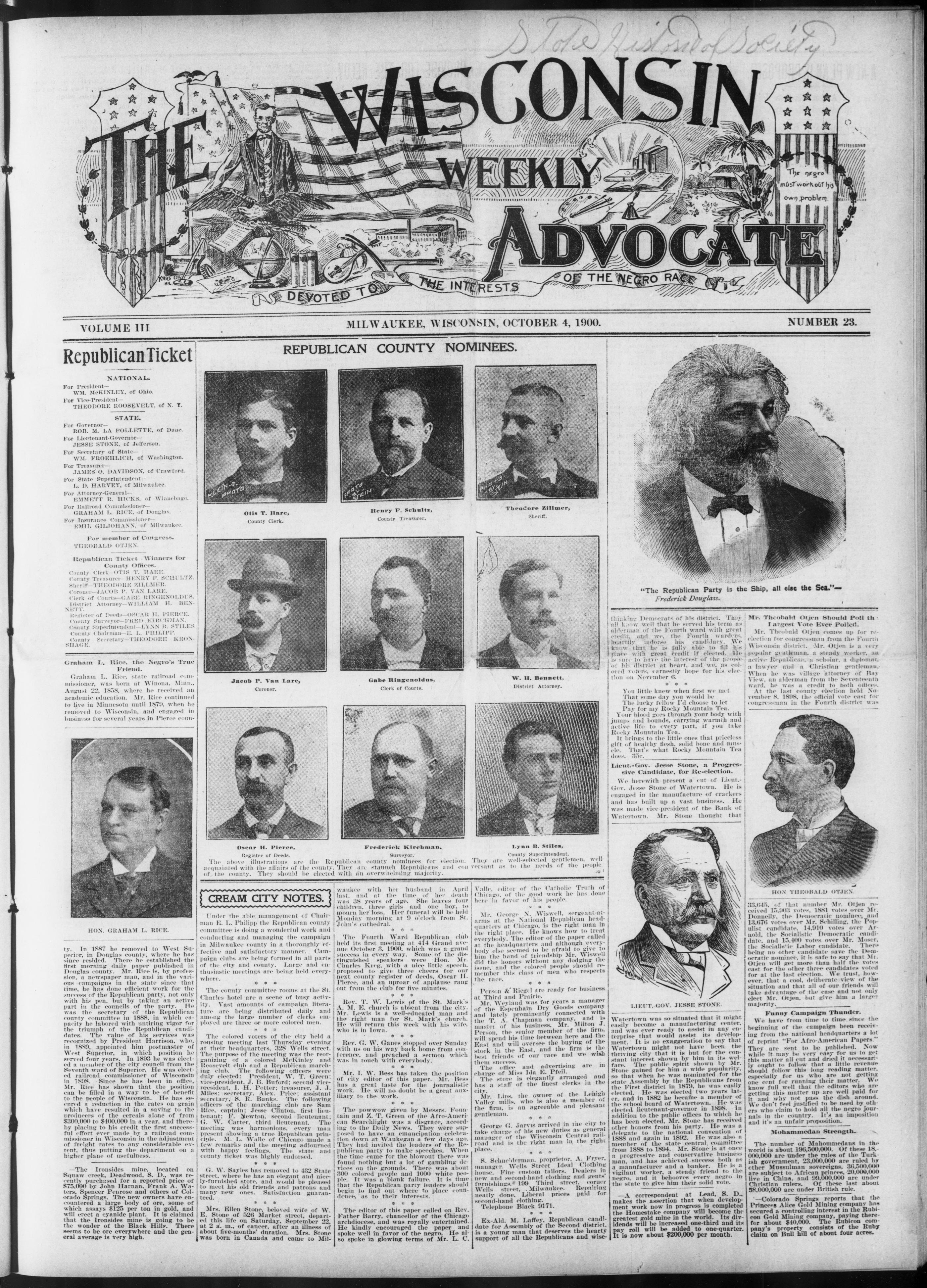
WISCONSIN
WEEKLY
The negro
must work out his
own problem.
ADVOCATE
DEVOTED TO THE INTERESTS OF THE NEGRO RACE
RepublicanTicket
RepublicanTicket
For President—
WM. McKINLEY, of Ohio.
For Vice-President—
THEODORE ROOSEVELT, of N. Y.
STATE.
For Governor—
ROB. M. LA FOLLETTE, of Dane.
For Lieutenant-Governor—
JESSE STONE, of Jefferson.
For Secretary of State—
WM. FROEHLICH, of Washington.
For Treasurer—
JAMES O. DAVIDSON, of Crawford.
For State Superintendent—
L. D. HARVEY, of Milwaukee.
For Attorney-General—
EMMETT R. HICKS, of Winnebago.
For Railroad Commissioner—
GRAHAM L. RICE, of Douglas.
For Insurance Commissioner—
EMIL GILJOHANN, of Milwaukee.
Republican Ticket - Winners for County Offices.
County Clerk—OTIS T. HARE.
County Treasurer—HENRY F. SCHULTZ.
Sheriff—THEODORE ZILLMER.
Coroner—JACOB P. VAN LARE.
Clerk of Courts—GABE RINGENOLDUS.
District Attorney—WILLIAM H. BENNETT.
Register of Deeds—OSCAR H. PIERCE.
County Surveyor—FRED KIRCHMAN.
County Superintendent—LYNN B. STILES
County Chairman—E. L. PHILIPP.
County Secretary—THEODORE KRONSHAGE.
Graham L. Rice, the Negro's True Friend.
Graham L. Rice, state railroad commissioner, was born at Winona, Minn.. August 22, 1858, where he received an academic education. Mr. Rice continued to live in Minnesota until 1879, when he removed to Wisconsin, and engaged in business for several years in Pierce coun
[Name]
HON. GRAHAM L. RICE.
ty. In 1887 he removed to West Superior, in Douglas county, where he has since resided. There he established the first morning daily paper published in Douglas county. Mr. Rice is, by profession, a newspaper man, and in the various campaigns in the state since that time, he has done efficient work for the success of the Republican party, not only with his pen, but by taking an active part in the councils of the party. He was the secretary of the Republican county committee in 1888, in which capacity he labored with untiring vigor for the triumph of the Republican candidates. The value of his services was recognized by President Harrison, who, in 1889, appointed him postmaster of West Superior, in which position he served four years. In 1893 he was elected a member of the city council from the Seventh ward of Superior. He was elected railroad commissioner of Wisconsin in 1898. Since he has been in office, Mr. Rice has shown that the position can be filled in a way to be of benefit to the people of Wisconsin. He has secured a reduction in the rates on grain which have resulted in a saving to the producers of the cereals alone of from $300,000 to $400,000 in a year, and thereby placing to his credit the first successful effort ever made by a railroad commissioner in Wisconsin in the adjustment of freight rates to any considerable extent, thus putting the department on a higher plane of usefulness.
The Ironsides mine, located on Squaw creek, Deadwood, S. D., was recently purchased for a reported price of $75,000 by John Harnan, Frank A. Waters, Spencer Penrose and others of Colorado Springs. The new owners have encountered a large body of ore, some of which assays $125 per ton in gold, and will erect a cyanide plant. It is claimed that the Ironsides mine is going to be the wonder of the Black Hills. There seems to be ore everywhere and the general average is very high.
REPUBLICAN COUNTY NOMINEES.
The above illustrations are the Republican county nominees for election. They are well-selected gentlemen, well acquainted with the affairs of the county. They are staunch Republicans and conversant as to the needs of the people of the county. They should be elected with an overwhelming majority.
KLEIN-O.
PHOTO
Otis T. Hare,
County Clerk.
M. B.
Jacob P. Van Lare,
Coroner.
M. B.
CREAM CITY NOTES.
Under the able management of Chairman E. L. Philipp the Republican county committee is doing a wonderful work and conducting and managing the campaign in Milwaukee county in a thoroughly effective and satisfactory manner. Campaign clubs are being formed in all parts of the city and county. Large and enthusiastic meetings are being held everywhere.
```markdown
```
The county committee rooms at the St. Charles hotel are a scene of busy activity. Vast amounts of campaign literature are being distributed daily and among the large number of clerks employed are three or more colored men.
```markdown
```
The colored voters of the city held a rousing meeting last Thursday evening at their headquarters, 328 Wells street. The purpose of the meeting was the reorganizing of a colored McKinley and Roosevelt club and a Republican marching club. The following officers were duly elected: President, W. T. Green; vice-president, J. B. Buford; second vice-president, I. H. Potter; treasurer, J. J. Miles; secretary, Alex. Price; assistant secretary, S. R. Banks. The following officers of the marching club are Sam Rice, captain; Jesse Clinton, first lieutenant; F. Newton, second lieutenant; G. W. Carter, third lieutenant. The meeting was harmonious, every man present showing a true Republican principle. M. L. Walle of Chicago made a few remarks and the meeting adjourned with happy feelings. The state and county ticket was highly endorsed.
G. W. Sayles has removed to 432 State street, where he has an elegant and nicely-furnished store, and would be pleased to meet his old friends and patrons and many new ones. Satisfaction guaranteed.
* * *
Mrs. Ellen Stone, beloved wife of W. E. Stone of 526 Market street, departed this life on Saturday, September 22, at 2 a. m., of cancer, after an illness of about five-months' duration. Mrs. Stone was born in Canada and came to Mil-
PHOTO
BY
STEIN
Henry F. Schultz,
County Treasurer.
M.
Gabe Ringenoldus,
Clerk of Courts.
M.
Frederick Kirchman.
waukee with her husband in April last, and at the time of her death was 38 years of age. She leaves four children, three girls and one boy, to mourn her loss. Her funeral will be held Monday morning at 9 o'clock from St. John's cathedral.
```markdown
```
The Fourth Ward Republican club held its first meeting at 414 Grand avenue October 3, 1900, which was a grand success in every way. Some of the distinguished speakers were Hon. Mr. Charles Kreg, with a nice little speech, proposed to give three cheers for our next county register of deeds, Oscar H. Pierce, and an uproar of applause rang out from the club for five minutes.
```markdown
```
Rev. T. W. Lewis of the St. Mark's
A. M. E. church is absent from the city.
Mr. Lewis is a well-educated man and
the right man for St. Mark's church.
He will return this week with his wife,
who is in Iowa.
* * *
Rev. G. W. Ganes stopped over Sunday
with us on his way back home from con-
ference, and preached a sermon which
was in touch with everybody.
* * *
Mr. I. W. Bess has taken the position
of city editor of this paper. Mr. Bess
has a great taste for the journalistic
work. He will no doubt be a great auxi-
iliary to the work.
```markdown
```
The powwow given by Messrs. Fountain and Z. T. Green of the Afro-American Searchlight was a disgrace, according to the Daily News. They were supposed to have an emancipation celebration down at Waukegan a few days ago. They had invited the leaders of the Republican party to make speeches. When the time came for the blowout there was found nothing but a lot of gambling devices on the grounds. There was about 300 colored people and 1000 white people. It was a blank failure. It is time that the Republican party leaders should begin to find out where to place confidence, as to their interests.
```markdown
```
The editor of this paper called on Rev. Father Barry, chancellor of the Chicago archdiocese, and was royally entertained. He kindly encouraged the paper and spoke well in favor of the negro. He also spoke in glowing terms of Mr. L. C.
PHOTO
BY
STEIN
ThecoCore Zillmer,
Sheriff.
M.
W. H. Bennett,
District Attorney.
M.
Lynn B. Stiles,
Valle, editor of the Catholic Truth of Chicago, of the good work he has done here in favor of his people.
☆ ☆ ☆
Mr. George N. Wiswell, sergeant-at-arms at the National Republican headquarters at Chicago, is the right man in the right place. He knows how to treat everybody. The editor of the paper called at the headquarters and although everybody else seemed to be afraid to give to him the hand of friendship Mr. Wiswell did the honors without any dodging the issue, and the colored people should remember this class of men who respects the race.
东亭
Person & Riegel are ready for business at Third and Prairie. Mr. Weyland was for years a manager of the Espenhain Dry Goods company and lately prominently connected with the T. A. Chapman company, and is master of his business. Mr. Milton J. Person, the senior member of the firm, will spend his time between here and the East and will oversee the buying of the stock in the East, and the firm is the best friends of our race and we wish them success.
The office and advertising are in charge of Miss Ida E. Pfeil. The store is elegantly arranged and has a staff of the finest clerks in the city. Mr. Lips, the owner of the Lehigh Valley mills, who is also a member of the firm, is an agreeable and pleasant gentleman.
☆ ☆ ☆
George G. Jarvis arrived in the city to take charge of his new duties as general manager of the Wisconsin Central railroad and is the right man in the right place.
* * *
S. Schneiderman, proprietor, A. Fryer, manager. Wells Street Ideal Clothing house. Fine custom tailors. Dealers in new and second-hand clothing and gents' furnishings. 199 Third street, corner Wells street, Milwaukee. Repairing neatly done. Liberal prices paid for second-hand clothing.
Telephone Black 9171.
* * *
Ex-Ald. M. Laffey, Republican candidate for Assembly of the Second district, is a young man that deserves the hearty support of all the Republicans and wise-
"The Republican Party is the Ship, all else the Sea."— Frederick Douglass.
thinking Democrats of his district. They all know well that he served his term as alderman of the Fourth ward with great credit, and we, the Fourth warders, heartily indorse his candidacy. We know that he is fully able to fill his place with great credit if elected. He is sure to have the interest of the people of his district at heart, and we, as colored voters, earnestly hope for his election on November 6.
***
You little knew when first we met
That some day you would be
The lucky fellow I'd choose to let
Pay for my Rocky Mountain Tea.
Your blood goes through your body with
jumps and bounds, carrying warmth and
active life to every part, if you take
Rocky Mountain Tea.
It brings to the little ones that priceless
gift of healthy flesh, solid bone and muscle.
That's what Rocky Mountain Tea
does. 35c.
Lieut. Gov. Jesse Stone, a Progressive Candidate, for re-election.
We herewith present a cut of Lieut. Gov. Jesse Stone of Watertown. He is engaged in the manufacture of crackers and has built up a vast business. He was made vice-president of the Bank of Watertown. Mr. Stone thought that
J. H. H.
LIEUT.-GOV. JESSE STONE.
Watertown was so situated that it might easily become a manufacturing center, and was ever ready to assist in any enterprise that would assist its development. It is no exaggeration to say that Watertown might not have been the thriving city that it is but for the constant interest shown by him in its welfare. The public spirit shown by Mr. Stone gained for him a wide popularity, so that when he was nominated for the state Assembly by the Republicans from the First district in 1879, he was easily elected. He was elected two years later, and in 1882 he became a member of the school board of Watertown. He was elected lieutenant-governor in 1898. In addition to the public offices to which he has been elected, Mr. Stone has received other honors from his party. He was a delegate to the national convention of 1888 and again in 1892. He was also a member of the state central committee from 1888 to 1894. Mr. Stone is at once a progressive and conservative business man, and has achieved success both as a manufacturer and a banker. He is a vigilant worker, a steady friend to the negro, and it behooves every negro in the state to give him their solid vote.
-A correspondent at Lead, S. D., makes the assertion that when development work now in progress is completed the Homestake company will become the greatest gold mine in the world. Its dividends will be increased one-third and its pay roll will be added to one-quarter. It is now about $200,000 per month.
Mr. Theobald Otjen Should Poll the Largest Vote Ever Polled.
Mr. Theobald Otjen comes up for reelection for congressman from the Fourth Wisconsin district. Mr. Otjen is a very popular gentleman, a steady worker, an active Republican, a scholar, a diplomat, a lawyer and a Christian gentleman. When he was village attorney of Bay View, an alderman from the Seventeenth ward, he was a credit to both offices. At the last county election held November 8, 1898, the official vote cast for congressman in the Fourth district was
[Image of a man in a suit with a mustache and a bow tie].
HON THEOBALD OTJEN.
33,645, of that number Mr. Otjen received 15,903 votes, 1881 votes over Mr. Donnelly, the Democratic nominee, and 13,676 votes over Mr. Schilling, the Populist candidate, 14,910 votes over Arnold, the Socialistic Democratic candidate, and 15,400 votes over Mr. Moser, the Socialistic Labor candidate. There being no other candidate save the Democratic nominee, it is safe to say that Mr. Otjen will get more than half the votes cast for the other three candidates voted for at the last election. We trust, however, that a cool, deliberate view of the situation and that all of our friends will take advantage of the case and not only elect Mr. Otjen, but give him a larger majority.
Funny Campaign Thunder.
We have from time to time since the beginning of the campaign been receiving from the national headquarters a lot of reprint "For Afro-American Papers." They are sent to be published. Now while it may be very easy for us to get this matter all cut and dried it necessarily ought to follow that a little revenue should follow this long reading matter, especially for us who are not getting one cent for running their matter. We know full well that the editors who are getting this matter up are well paid for it and why not pass the dish around. We don't feel justified to be used by others who claim to hold all the negro journals in the country. It's an imposition and it's an unfair proposition.
Mohammedan Strength.
The number of Mahomedans in the world is about 196,500,000. Of these 18,000,000 are under the rules of the Turkish government, 23,000,000 are ruled by other Mussulman sovereigns, 36,500,000 are subject to African princes, 20,000,000 live in China, and 99,000,000 are under Christian rulers. Of these last about 58,000,000 are under British rule.
Colorado Springs reports that the Princess Alice Gold Mining company has secured a controlling interest in the Rubicon Gold Mining company, paying therefor about $40,000. The Rubicon company's property consists of the Ruby claim on Bull hill of about four acres.
A NEW PLAN IS PROPOSED.
Unity of Action Between United States and Germany.
Von Buelow Issues a Note and Hay Sends Instructions to Minister Conger.
London, Oct. 4.—A special dispatch from Shanghai, under date of Wednesday, October 3, says the Chinese report that 2000 Boxers attacked two battalions of Germans at Kau Ku Men, near Pekin. The Boxers, it is added, lost 400 men and the Germans five. The latter burning the Boxers' villages around Pekin. Pekin, Friday, Sept. 28.—The Japanese expedition has returned here. It met with slight resistance at the village of Yaifa. Such expeditions have small effect on the Boxers, who recongregate in the villages as soon as the allied forces leave.
---
Berlin, Oct. 4.—An official of the foreign office informs the correspondent of the Associated press that Germany is issuing a second note to the powers regarding the method of securing punishment for those guilty of the outrages in China. This note is issued as a result of the edict of the Emperor of China beginning proceedings against Prince Tuan and others. The new note is as follows:
The Emperor of China has addressed to the powers an edict dated September 25, in which he orders the punishment of a number of princes and dignitaries, mentioned by name, for having encouraged the Boxers. On the assumption that the edict is genuine the German government, in furtherance of the procedure proposed in its circular note of September 17, has further proposed to the powers to come to an agreement to instruct their diplomatic representatives in China to examine and give their opinion on the following points:
1. Whether the list contained in the edict of persons to be punished is sufficient and correct?
2. Whether the punishments proposed meet the case?
3. In what way the powers can control the carrying out of the penalties imposed?
The information received up to the present concerning the reception of this proposal by the powers justifies the belief that a general understanding on this matter may be looked for.
United States and Germany Agree.
Washington, D. C., Oct. 4.—The United States government has taken another decisive step in the development of the Chinese situation in a note delivered today by Secretary Hay to the German charge d'affaires, Baron Speck von Sternberg. In the note, favorable action by this government on Germany's late suggestions concerning the punishment of Chinese criminals is expressed, and the announcement is made that the United States already has sent instructions to Minister Conger along the lines indicated.
The instructions to Mr. Conger are that he shall learn the names of Chinese offenders who are to be punished; also whether the punishment to be administered is adequate to their offenses, and, finally, whether the punishments are actually administered.
The American note is considered most important in the establishment of complete unity of action between the United States and Germany.
An Important Move.
The American note to Germany is regarded as one of the most important moves thus far made, not only in fixing the course of events in China, but in giving formal expression to a growing and most satisfactory state of feeling which has arisen lately between the governments at Berlin and Washington. This has come about after several extended conferences between Secretary Hay and Baron Sternberg, all of them looking toward common action by the two governments.
The point now under consideration is the supervision, by the ministers of the powers at Pekin, of the punishments to be administered by the Chinese authorities. The desires of Germany in this matter were expressed at length and were communicated to the President. They met with the most hearty approval, as they were seen to be in line with what the United States had announced as one of its chief aims, viz., to hold the guilty parties to the uttermost accountability for their wrongdoing.
Franco-Russian Proposition.
Washington. D. C., Oct. 4.—The French government, through M. Thiebaut, the French charge d'affaires, has presented to Secretary Hay a programme for the complete settlement of the Chinese difficulty and at the same time the Russian government through M. Dewollant seconds the French proposal, thus making it a joint Franco-Russian proposition. The proposal is under four heads, as follows:
1. Punishment of the guilty Chinese officials.
2. The interdiction of arms and munitions of war to China.
or war to China.
3. The payment of indemnity to the pow-
er.
4. Sufficient Chinese guarantee for the future. The proposal further asks for a competent legation guard at Pekin, the razing of the Taku forts and their destruction and the establishment of a line of communication between the seaboard and Pekin. The Franco-Russian proposal has been sent to the President.
Reception for Von Waldersee.
Pekin, Saturday, Sept. 29.—The commanders of the international forces are arranging for a combined official reception of Field Marshal Count von Waldersee. A detachment of mixed cavalry will escort him from Tung Chow to this city. The members of the diplomatic corps here are still of the opinion that only Prince Ching and Li Hung Chang can be recognized as peace negotiators.
Shanghai, Oct. 4.—The Dutch warships Gelderland and Holland have suddenly been ordered to Swatow and Amoy respectively.
AN IMPOSING FUNERAL.
Chinese will Pay High Honors to the Late Von Ketteler.
Taku, Monday, Oct. 1.—The Dowager Empress has deputed the highest official of the empire to make all necessary arrangements for a most imposing funeral in honor of Baron von Ketteler, the late German minister to China. She has also ordered the erection of a suitable temple at the capital to his memory. The superintendent of trade at Tien Tsin has been ordered to meet the body on its arrival here and the highest officials at other ports will pay the greatest honor to the dead.
An imperial edict degrades from all ranks and offices Prince Tuan, Lan Yi, Kang Ti, Tung Fuh Siang and others concerned in the Boxer movement.
MISSIONARIES BLAMED.
Peace Congress Says Religious Protectorate Should be Abandoned. New York, Oct. 4. A dispatch to the Times from Paris says: The international congress of peace, now being held
in Paris, has passed several resolutions concerning pol诈 in China.
The congress resolved that the action of the missionaries was often intolerable; that their religious propaganda should not be backed up by diplomatic or military force; that they should go into China at their own risks and perils; that Europe should abandon any religious protectorate in China; that forecible annexation of territory, especially that held sacred by the Chinese, should cease; that the powers should attempt to establish a stable native government, capable of undertaking internal reforms, and that the open door for the honest commerce of the world on equal terms is the only policy which gives any guarantee for the country's future peace and stability.
PROTEST OF AMERICANS.
Deplore the Withdrawal of United States Trouse from North China.
Tien Tsin, Monday, Oct. 1, via Shanghai, Oct. 4.—At a meeting of American citizens at Tien Tsin the following resolution was adopted:
We, citizens of the United States, deplore the contemplated withdrawal of a large part of the United States troops in North China. We feel the work of the allied armies is far from accomplished and that the refusal of the American government to take its part therein, is sure to be regarded by the allies as an unworthy act, and by the Chinese as a sign of indifference. We urge our government to carry to an end the work it has so honorably and efficiently begun and to maintain a sufficient force here to secure the protection of American mercantile and missionary interests until a settlement of the present trouble is accomplished.
Removing to Tien Tsin.
Tien Tsin, Tuesday, Oct. 2.—The Russian and Belgian ministers arrived here October 1. The German minister remains here. About 1800 American troops are to stay in North China. The missionaries will probably petition Washington to increase this number. The public telegraph between Pekin and Taku has been completed.
Gives Up to British.
Tien Tsin, Monday, Oct. 1, via Taku, Oct. 1, and Shanghai, Oct. 4.—British official reports announce that Shan Hai Kuan surrendered to a British warship September 29. Three British regiments will leave here October 2 to garrison Shan Hai Kuan and Chung Thien So Tching and take possession of the railroad
Berlin, Oct. 4.—The newspapers, as a whole, comment favorably on the answer of the Kaiser to the Chinese Emperor's telegram. Even the Vorwaerts is inclined to speak cheerfully, although it claims that William II, has repudiated the note of his foreign minister, Count von Buelow. The Vorwaerts says: "Emperor William disavows Count von Buelow in allowing Kuang Hsu to undertake the punishment and in beginning peace negotiations before the German demands have been complied with."
The other important papers also, as, for example, the Frankfurter Zeitung, say that the Kaiser's letter indicates that Germany has receded from the Von Bulow position.
Basis for Common Action.
The Rheinisch-Westfaelische Zeitung, published at Essen, praises the Kaiser's letter, but is dissatisfied with the emphasis placed on the religious sentiment. The National Zeitung says the letter affords "an indisputable basis for sober, effective common action on the part of the allies."
The Kreuz Zeitung, speaking of Emperor William's invitation to the Chinese Emperor to return to Pekin, says: "If this invitation is accepted, it will greatly facilitate peace negotiations. In any event there is no question that the Kaiser has gone a long way to Emperor Kuang Hsu." The Berliner Post takes the same view.
Summary Action Demanded.
London, Oct. 4.—Dr. Morrison, in Pekin, is still vigorously protesting against the inactivity of the powers occupying the capital.
In his dispatches he continues to urge summary action by the military officials. He takes the extreme position attributed to Germany and demands punishment first and negotiations afterwards.
The Times this morning prints two interesting messages from Dr. Morrison in Pekin. The first is dated September 26 and says:
"Prominent Russians here argue that the French legation will certainly leave and the others must necessarily follow the Russians, and that the withdrawal of the legations and the large reduction of the number of troops will render it more possible for the return of the court to Pekin.
"If the negotiations are carried on at Tien Tsin, Li Hung Chang, being the viceroy of the province and a resident of Tien Tsin, cannot be the plenipotentiary unless the ministers are prepared to appear before him as suppliants for peace and not as dictators. For thus their action will be interpreted throughout the empire.
Impossible Conditions Proposed
"It is difficult to believe that the court, which has moved south to near Tai Yuen Fu, will return to Pekin, inasmuch as several ministers have declared to Prince Ching that they will insist upon the execution of the chief agents implicated in the recent massacres—namely: Prince Tuan, Tung Fu Siang, Yu Hsien, and the others associated with the nefarious Dowager Empress. It is therefore improbable that the Empress will venture to return to Pekin, and yet the return of the Emperor without the Empress is believed to be impossible. While if the court should remain in the provinces and continue its flight towards Singan Fu, the dismemberment of the country becomes appreciably closer."
Dr. Morrison's second message is dated September 28 and says:
Objects to Yung Lu.
"Prince Ching has informed the doyen of the foreign ministers that Yung Lu and the viceroyes of Nauking and Wu Chang are appointed to act with Li Hung Chang in the forthcoming negotiations. As I have previously telegraphed, Yung Lu was foremost in attacking the legations and cannot be accepted as plenipotentiary.
"The announcement of Germany's declaration that the punishment of the high officials and the ringleaders responsible for the recent outrages as an essential preliminary to the negotiations has been received here with unqualified satisfaction. The punishment inflicted hitherto has been inadequate and the Chinese in the interior regard the allied forces as honored guests from afar. This delusion is strengthened by the inactivity of the troops except in the immediate neighborhood of Pelin."
Incited by Bogus Edicts.
Hong Kong, Oct. 4.—The entire delta land of the West river, near Canton, is in a state of dangerous irritation, consequent on the circulation of bogus edicts narrating the defeat of the allies.
Through the machinations of secret societies rioters are marauding and plundering the villages, especially the houses of native converts.
British and French gunboats are patrolling the waterways, and are having a salutary effect in preventing attacks on the steamers.
Some Hopeful Signs.
Washington, D. C., Oct. 4.—Signs now point to a harmonious settlement of the Chinese trouble. The offer which the German Emperor makes Emperor Kuang Hsu to place the troops under Field Marshal Count von Waldersee subject to
such orders as may be necessary to guarantee him full protection should he return to Pekin is considered important by administration officials. It should have the effect of sustaining the Chinese Emperor in his present conciliatory course and assure him of the support of a powerful force should Prince Tuan and other anti-foreign leaders attempt to stir up a revolution to protect themselves against the recent imperial edict ordering them before a court for punishment.
Some Concessions Necessary.
From an administration point of view few obstacles remain in the way of a speedy settlement. Some concessions may be necessary before a common policy can be adopted, but all nations that participated in the relief of Pekin show a disposition to be reasonable and make them. Consideration of the new propositions submitted by Germany and France will be given as soon as the President reaches Washington. The officials do not conceal the fact that they had feared that Germany contemplated delaying adjustment of the entire Chinese question in the hope of obtaining territorial reparation for the murder of her minister. This apprehension has been largely dissipated by the new suggestions advanced. They are in line to a great degree with the views of this government. It is understood to be the purpose of this government to take advantage of the renewal of the concert between the nations to formulate a method of settlement of the entire Chinese question.
HE SHOT TO KILL.
The Express Messenger Hides in the Grass and Brings Down a Train Robber.
Omaha, Neb., Oct. 4.—The Burlington passenger train was held up three miles south of Council Bluffs at 11 o'clock last night. Lying at the morgue in this city with a bullet through his heart is a man, powerfully built, with black hair and mustache, about 6 feet tall, aged apparently 45 years. He was one of two men who held up the train. Express Messenger Charles Baxter killed him.
The two men boarded the train at Union Pacific transfer and climbed over the tender just as the train was crossing the Mosquito Creek bridge. Engineer Donnelly and Frank Holman, fireman, who were in charge of the engine, were ordered to slow up as soon as the train had crossed the bridge. While one man held a revolver on the engine crew his companion went back and cut off the baggage and mail cars, leaving the day coaches and sleepers standing on the main line.
Blown Open with Dynamite.
Acting under orders, the engineer pulled the train half a mile down the track, where a stop was made. Here the robbers approached the express car and ordered Messenger Baxter to open the door. He refused to do so. Under compulsion Engineer Donnelly attached a stick of dynamite to the side door of the car and blew it open. In the meantime Messenger Baxter seized his gun, escaped from the door on the opposite side of the car and hid in the grass. As soon as the door was opened one of the robbers entered the car while his companion marched the engineer and fireman back to the engine.
Baxter crept around in front of the engine and seeing the robber keeping guard over the engine crew, fired one shot, killing him instantly. As soon as the shot was heard the robber in the car jumped to the ground and fled through a cornfield.
The Other Bandit Gets Away.
The dead man was picked up, placed on board and the train was backed into this city. The body was searched but nothing was found on it by which it could be identified. It was dressed in a neat suit of black clothes, over which overalls and jumpers had been drawn. In the pockets were found about $15 in money and a watch and chain. Conductor William McGrew, who was in charge of the train, thinks the dead man is one George of St. Joseph.
The robber who escaped was larger and taller than the dead man, being apparently over 6 feet in height. Both men wore masks and both wore overalls and jumpers. The door of the express car was badly shattered by the explosion of dynamite.
The robber inside the car was preparing to blew the safe at the time his companion was killed.
He ceased operations at once and no damage was done to the contents of the car, nor was anything taken. After putting on a new express car and transferring the freight the train proceeded to Kansas City.
DIDN'T LIKE THE SONG
Pittsburg Man Brings Suit for Being Ejected from a Theater.
Pittsburg, Pa., Oct. 4.—William J. Leader entered a novel suit in common pleas court No. 1, to recover from Harry Beeson, lessee and manager of the Uniontown opera house, $10,000 for alleged personal injuries. The plaintiff, on August 17, went to the playhouse, where there was an entertainment, and requested the musicians to render "The Mocking Bird" and they did.
When they played it again a young man, who, the plaintiff alleges, was Beeson's assistant, called to the plaintiff; "Let up on that mocking-bird business." Words followed, and the assistant called in a policeman to arrest the plaintiff. In a struggle which followed Leader was hurt.
CONTINGENT UPON ELECTION.
McKinley's Success Means Erection of $400,000 Plant in Detroit.
Detroit, Mich., Oct. 4.—Wallace Franklin of Detroit, representing Westinghouse, Church, Kerr & Co., says his company is preparing plans for a $400,000 steel car plant to be located in Detroit in case President McKinley is re-elected. The plant will be built near that of the Peninsular Car shops. The promoters state that in case Bryan is elected the plans will be indefinitely abandoned. The plant will be erected for the purpose of manufacturing steel cars. It will be run in competition with the pressed steel company organized two or three years ago.
NOVEL NUPTIAL CONTRACT.
Groom Remains at Home Attending to the Housework.
Wichita, Kas., Oct. 4.-Mrs. A. B. Cook and Kirby Rogers were married at Providence, near here, by Rev. Mr. Grey of Wellington. It was on the marriage contract that Mrs. Cook should take her wedding trip alone, while the groom remained at home, so Mrs. Rogers left for the East alone. Mr. Rogers will remain at home doing the housework while his wife takes her wedding trip. Rogers was a bachelor and Mrs. Rogers a widow. Both are rich in their own right. The couple met only two months ago.
DESIGNS ON PRINCE ALBERT.
Anarchists Alleged to Have Gone to Brussels to Attack Him.
Brussels, Oct. 4.—The authorities have received warning that three Italian Anarchists have arrived here. It is said that their mission is to make an attack on Prince Albert, the heir presumptive to the Belgian throne, when he arrives here with his bride, the Duchess Elizabeth of Bavaria, to whom he was married at Munich.
PROVIDE FOR THE NEEDY.
Strikers Still Holding Out for Complete Compliance with Their Demands.
Hazleton, Pa., Oct. 3.—At 3 o'clock this afternoon President Mitchell said to the Associated press: "I have just heard the rumor of a settlement, but you can positively say for me that I am not in negotiations with railroad presidents, nor have I received a communication from any of them."
Hazleton, Pa., Oct. 3.—W. B. Fairley of Alasigo Purcell, Ind., Fred Dilcher, Ohio, and Benjamin James, Pennsylvania members of the national executive board, held a private conference at noon today. The questions which were under discussion have not been made known, but it is believed they relate to relief measures. Contrary to the general impression, the striking mineworkers will not be given cash in the way of relief, but will be provided by the union with provisions and clothing for every member of each family needing assistance.
It is believed the plans adopted will provide for the establishment of supply depots in each mining town in charge of the local union officials where the needy men can be provided for upon application. The United Mineworkers will pay for the supplies. An official of the union said today that the bituminous miners and other organized labor will send supplies by the carload for the relief of anthracite miners. The same official said the nonunion men on strike will be just as well taken care of as if they belonged to the miners' organization
New York, Oct. 3.—The coal road presidents continued reticent today concerning the strike situation. At the office of the Erie and Lehigh Valley roads it was said no news had been received during the morning from the mines and that the conditions were without change there so far as they could tell at this distance. John Markle, managing partner of the Markle mines at Hazleton, Pa., did not leave town last night as was reported. He was at the office of the Lehigh Valley Coal company today, but his visit, it was said later by Vice-President Sayre of the coal company, had nothing to do with the strike.
At the office of the Pennsylvania Coal company it was said that Vice-President Thorne had no statement to make. There were two informal meetings of the independent operators, but no action bearing upon strike matters was taken.
Standing Together.
Hazleton, Pa., Oct. 3.—There is no material change in the strike situation hereabouts this morning. The collieries which have been working since the inauguration of the strike are still in operation. The mineworkers have completely ignored the notices of the Lehigh Valley and the Lehigh & Wilkesbarre Coal companies to the effect that an increase of 10 per cent. has been granted in wages and that the price of powder would be reduced, and so far as can be learned about the same number of men are idle today as yesterday.
An attempt was made at 2 o'clock this morning to blow up with dynamite the house occupied by Michael Zulick, a mineworker, in the eastern part of the city, but no extensive damage was caused. Zulick has been working since the strike went into effect. No other case of violence has been reported.
Shenandoah, Pa., Oct. 3.—Gen. Gobin has been informed that a big meeting of mineworkers is scheduled for tomorrow night at Lansford, Pa., in the Panther creek valley, to which locality the strike has not yet penetrated. It is understood that a large number of strikers from the vicinity of Hazleton will attend the meeting. At present there are no indications of trouble, but Gen. Gobin said today that if troops were needed they will be in readiness. Reports from the Panther creek valley today are to the effect that the Lehigh Coal and Navigation company collieries are still working with full forces, despite the great pressure brought to bear on the men there by strikers from other districts. It is said that about fifty striking mineworkers from Hazleton are making quiet but strenuous efforts to close the collieries. Meetings were held last night at Lansford, Coaldale and Summit Hill, all of which were largely attended but it is impossible to learn how many of the mineworkers joined the union. Similar meetings will be held every night.
Absolute peace reigns in and about Shenandoah. Gen. Gobin said today that he hopes to send the Eighth regiment home tomorrow. This will leave the Fourth regiment, Battery C and the governor's troop in the field, about 800 men in all. Maj. Farquhar, provost marshal, states that the foreigners in the vicinity of Indian Ridge colliery and the eastern end of Shenandoah are displaying an ugly disposition. He says he has ordered the provost guard to make frequent trips through that section.
Shamokin, Pa., Oct. 3.—Following the example of the owners of Midvalley colliery in shutting down their works until the strike is over, the Shamokin Coal company's Natalie colliery between here and Mount Carmel was closed down this morning. Before the strike 100 men and boys were given employment there, but during the past two weeks the big operation was worked with about 300 men.
Fifty-nine cars were loaded with coal at the North Franklin colliery at Trevorton yesterday, the only Reading company colliery operating in the North Schuylkill region. It was the largest one-day tonpage in the history of the operation.
Strikers on Parade.
Wilkesbarre, Pa., Oct. 3. — Fifteen thousand strong, the striking coalminers, headed by the leaders of the United Mineworkers of America, marched in parade yesterday. Afterward more than 20,000 of the workmen and their friends gathered in mass meeting at West Side park and listened to a speech by President Mitchell, their leader.
The most significant incident of the day was President Mitchell's reference to a proposed convention of miners to decide upon the course they are to pursue. By some it is taken as a hint that the miners may get together in convention and accept the offers of an increase which have been made by the individual operators. However, Mr. Mitchell, in answer to a direct question, said that not one local union in the entire anthracite coalfield had requested the calling of a convention of the miners.
Encouraged by Mitchell.
In his speech President Mitchell said: "This strike shall not be declared off by me. It shall not be ended until a convention of anthracite miners shall so decide. Every union and every colliery will be asked to send one or more delegates to a convention to determine the question for themselves. You must decide the question of your going back to work. I will not pretend to determine your fate or that of the 500,000 who are directly affected by this struggle. I firmly believe that victory will be achieved by the men standing together. Do not let one of you move until all move. If
you stand together we will achieve a greater victory than was ever attained by labor in the anthracite coal region." A significant move in the direction of peace developed last night at Shenandoah, where all the local branches of the United Mineworkers held meetings and selected delegates to a convention to be called later by President Mitchell. This is the first announcement of the selection of convention delegates.
A CLEVER SWINDLE.
Farmer Witnesses a Wedding and Unsuspectingly Signs a Note Which is Discounted.
St. Paul, Minn., Oct. 3.—A Carver county farmer living near Shakopee was recently victimized by a new method. A young couple was married at his house and he signed as a witness to the ceremony. Four days later a note for $450 bearing the farmer's signature was discounted at the Carver County bank. Neither the minister nor the bride and groom have been seen since the wedding. An elderly man in clerical garments stopped at the house of the farmer a few days ago and requested permission to remain all night. He asked the blessing at supper, held family prayers in the evening and won the confidence of the host and his family. Next morning there were more prayers and blessings, and the stranger stayed until late in the afternoon.
About 10 o'clock in the morning a young man and woman drove up and asked to be directed to the house of some minister, as they desired to get married. The farmer's wife thought of their guest and invited the couple into the house. The ceremony was performed in the presence of the farmer and his wife, and at its conclusion they gave their signatures as witnesses.
FIRE IN A FACTORY.
Five Firemen Seriously Hurt and $300,000 Worth of Property is Destroyed.
Williamsport, Pa., Oct. 3.—Five firemen were seriously hurt and $300,000 worth of property was destroyed in a big fire here today. The flames broke out shortly after midnight in the four-story shoe factory of J. E. Dayton & Co., occupying almost the entire block bounded by Fourth, Neece, Edwin and Elmira streets. The factory building, with its great stock of finished shoes and raw material, was entirely destroyed. Other occupants of the building who suffered total losses were the Royal Braid company and L. E. Whiteman & Co., bookbinders. The loss is $300,000, of which $250,000 falls on Dayton & Co. The property was only partly insured.
Several firemen were hurt by the falling of a portion of the building. Among them were: John Condon, seriously injured; Randall Allison, seriously injured; Powell Breon, ankle sprained; Joseph H. Hill, bad scalp wounds; Henry E. Page, arm badly injured.
The firemen held the flames in check for two hours, but they finally got beyond their control and burned until 6 o'clock this morning.
The stone chapel of the First Baptist church was partly destroyed and several other buildings adjoining the Dayton factory were badly damaged.
LIBEL SUIT LOST.
Gravamen Consists In Damage to Reputation and Not Injury to Plaintiff's Feelings.
Chicago, Ill., Oct. 3.—The decision for the defendant in the libel suit of A. Devin Duvivier against the Musical Courier has just been affirmed by the United States court of appeals. The opinion was handed down by Judge Grosscup and the case was heard by Judges Woods, Grosscup and Bunn. The opinion says:
"The gravamen of an act for libel is not injury to the plaintiff's feelings, but damage to his reputation in the eyes of others. It does not constitute libel that the plaintiff knew he was the subject, or the defendants knew of whom they were writing. It must appear on the face of the declaration that persons other than these must have understood to whom the article referred."
The suit was for $10,000 damages, and arose over a criticism by Florence French in the Courier in 1897. In it she characterized a pamphlet written by Duvivier as being merely a copy of a lecture delivered before the Illinois musical convention. She also made remarks which the complainant thought were libelous. His name, however, was not stated in the article itself, and he was only referred to indirectly.
KIDNAPED HER CHILD.
St. Louis Woman Recovers Her Offspring from a Convent in St. Louis.
St. Louis, Mo., Oct. 3.—Mrs. Ferdinand Provenchere kidnaped her child from the Visitation convent in Cabanne place last Sunday evening in a rather sensational manner. Husband and wife are separated, and the child had been placed in the convent during the afternoon by the father. When the mother called in the evening she was permitted to see her daughter. Then began a wild scene.
"I want my child; I must have her," screamed the frantic mother.
When Mother Acquin, the mother superior, tried to reason with her it was to no avail. She seized the child, and when it was taken away from her she made an attack on several persons who were in the room.
The sisters then telephoned for the police. The officer who responded was explaining the law to them when Mrs. Provenchere grabbed the child and ran away. When the officer was finally induced to go after her she was not to be found, and still has her daughter in her possession.
TROOPS WITHDRAWN.
Von Waldersee Given Official Notice-The Expedition to Pao Ting Fu.
Tien Tsin, Sunday, Sept. 30, via Taku, Sept. 30, and Shanghai, Oct. 3.-The American forces will not participate in the Shan Hai Kuan expedition.
The movement of Indian troops will begin in tend ays. The British and Germans continue sending troops to Pekin.
There are renewed preparations for an expedition in force against Pao Ting Fu. The troops will probably leave in a fortnight and columns from Pekin will cooperate with the expedition. Resistance is expected, as the Boxers are there in large numbers.
—Berlin's highest building, apart from the churches, is the 318-foot high chimney of the electric elevated road powerhouse. Only two church steeples surpass it, that of the new cathedral, 330 feet, and that of the Kaiser Wilhelm Memorial church, 340 feet.
GET MARRIED ON NEUTRAL GROUND.
Neither the Bride Nor Groom Had Homes So They Go to Ludington, Mich.
Ludington, Mich., Oct. 4.—[Special.]—A wedding, in which each of the contracting parties came from a distance and met on neutral ground, took place in this city. Miss Katherine L. Minor, who has been employed as a nurse in a hospital at Saginaw, Mich., was married to Bert E. Hubbell, a railway clerk of Menasha, Wis. Both were homeless, hence it was decided that each should come half way. The ceremony was performed by Rev. C. W. East at the Methodist parsonage and the couple took the carferry for their future home, which they will make at Menasha.
SITUATION UNCHANGED.
No Signs of an Agreement Between Operators and Striking Coalminers.
Shenandoah, Pa., Oct. 4.—Concessions announced yesterday by the Philadelphia & Reading Coal and Iron company were not sufficient to induce the striking mineworkers of the Schuylkill region to return to the collieries today. Mr. Pottier, organizer and leader of the foreign mineworkers here, says he made a careful canvass of this town last night and found the strikers determined to remain out until ordered to work by the mineworkers' convention, or by President Mitchell. In anticipation of a long strike the local foreign unions today appointed a committee to investigate cases of need among strikers' families.
Scranton, Pa., Oct. 4.—In spite of every preparation made by the Delaware, Lackawanna & Western company to get at least one of its collieries into operation today it was unable to do so. The strikers will pay no attention to the proffer of 10 per cent. advance, which the company said applied only to men who would return to work today. The Delaware & Hudson company and the Pennsylvania Coal company have not yet followed the action of the other big concerns here in posting wage-advance notices. The individual operators say they can do nothing until the coal-carrying railroads make it possible for them to act.
Philadelphia, Pa., Oct. 4.—According to Supt. Luther's report to President Harris of the Reading company, three additional collieries of that company failed to start up today. This leaves but one colliery in operation out of the thirty-nine the company was working previous to the mineworkers' strike.
The Reading company also has two small washeries at work, but they are producing only a few tons of fuel daily. Hazleton, Pa., Oct. 4.—The only incident of the morning in the Hazleton region worth mentioning was the march of about 200 mineworkers from Diamond, in the northern part of the city, to the No. 40 shaft of the Lehigh Valley Coal company in the eastern section of the town, where they expected to get more men to quit. Sheriff Harvey was waiting for the marchers at the shaft when they reached there at 5 o'clock. The sheriff told them if they placed a foot on private ground he would be compelled to arrest them for trespass. The strikers took the officer's advice and dispersed without even attempting to carry out their plans.
BUTCHER NEAR DEATH.
Frenchman Offers a Lion a Glass of Champagne and Suffers Severely for His Folly.
Paris, Oct. 4.—There was a serious accident today in the menagerie of a country fair near Privas, in the department of Ardeche. A large audience gathered to witness a local butcher enter the lion's cage, play a game of cards with the lion tamer and drink a bottle of champagne. The performance was successful until the butcher frolicishly and without warning the trainer, approached the lion and held a glass of champagne under his nose, whereupon the lion bounded upon the butcher, ground his shoulder within his jaws and mauled his body dreadfully. When the butcher was removed he was almost dead. In the meanwhile the audience was panic-stricken and in the stampede to escape from the menagerie many persons were trampled upon and badly injured.
TROUBLE IS THREATENED.
An International Crisis Over Canada in Boundary Line.
Vancouver, B. C., Oct. 4.—The dispute over the boundary line between the United States and Canada at the foot of Mount Baker has reached nearly to the stage of an international crisis. A Canadian pack train loaded with supplies for American-owned mines was seized yesterday by American customs authorities, who demand the payment of nearly $1000 duty. They allege the goods have crossed the boundary line into the states. The Canadian authorities declare that the boundary line is two miles farther to the south, and therefore the goods are still in Canada. Local feeling is very bitter and all kinds of trouble is threatened.
DERAILED TO AVOID A WRECK.
Train Thrown Off Track by Quickwitted Signal Operator.
Elgin, Ill., Oct. 4.—The operator at the Fox river switch, just below Elgin, gave the signal for a North-Western passenger train to cross the St. Paul track just before he heard the whistle of the through passenger on the St. Paul road. The latter was behind time, running rapidly on wet rails, and down grade. Suspecting that it would be impossible to stop the train, the operator, to prevent the St. Paul from dashing into the North-Western, which would have resulted in great loss of life, deliberately derailed the St. Paul train. The engine and several cars bumped over the ties, and the locomotive stopped within a few feet of the other train, but nobody was hurt. One track was blocked for several hours.
Girls Build a Sidewalk.
Some school girls of southeast Toledo who could not get the town authorities to build a stretch of sidewalk along a street which is on their way to school, and which is a mud hole in fall and winter, got together to the number of fifty with hammers and nails and all the planks they could find and built it themselves.
—In the western part of British Columbia is a novel railway, two miles in length. The rails are made of trees, from which the bark has been stripped, and these are bolted together. Upon them runs a car with grooved wheels 10 inches wide.
—Consumptives are to have an isolated hospital on Blackwell's island, N. Y. Commissioner John W. Keller has long been working for this improvement. They are to get the insane wards, occupants of the latter being apportioned among various state hospitals.
—Probably 100,000 people lost kindred in the Texas calamity.
KAISER MAKES A REPLY.
Imforms Emperor that Libations Do Not Wipe Out Massacres. TO PUNISH OUTRAGES.
The Only Suitable Atonement for the Murder of German Minister Text of the Reply.
Berlin, Oct. 3.-If the Chinese Emperor had any idea that his message to the Kaiser offering to pour libations on the altar as atonement for the murder of Baron von Ketteler, it is a case of misplaced confidence.
Most of the newspapers look upon the Chinese Emperor's letter to the Kaiser as a piece of childishness. The Hanover Courier says that such a clumsy attempt to induce Germany to accept a cheap apology is scarcely worthy of serious consideration. The government evidently takes the same view of the situation as that expressed by the Hanover Courier.
The Kaiser's answer to Kuang Hsu's letter is an order to the Stuttgart officers to hold themselves in readiness to proceed to China.
Approve Kaiser's Words.
The Freisinnige Zeitung points out that the Emperor's reply is in harmony with the note of Count von Buelow demanding the punishment of the advisers of Kuang Hsu. The paper doubts whether the Chinese ruler will follow the advice to return to Pekin. "since it would result in the downfall of the dynasty of the Manchus." A high official of the foreign office, discussing Kuang Hsu's letter, said:
"We see in this letter fresh proof of the Chinese Emperor's correct sentiments. Throughout all the troubles Germany never doubted the correctness of Kuang Hsu's attitude personally. It was the persons who seized the reins of government from him that were responsible for the atrocities. In the final settlement of accounts with China Germany will not demand harsher treatment for Emperor Kuang Hsu than any other power, not even the United States."
Von Ketteler's Slayer Talks.
Official advices from Pekin, dated September 23, assert that a further examination of the Chinese noncommissioned officer accused of the murder of Baron von Ketteler resulted in this statement:
"On June 21 I and my people received orders from a prince to shoot foreigners wherever we came across them."
The accused denied that the order was to shoot a minister, or the German minister, and he declared himself unable to say which prince gave the order.
The Kaiser's Reply.
Following is the reply of Emperor William to the Chinese Emperor's message:
To the Emperor of China: I, the German Emperor, have received the telegram of your majesty, the Emperor of China. I have observed with satisfaction that your majesty is anxious to expiate according to the custom and precept of your religion the shameful murder of my minister, which set at naught all civilization, yet, as the German Emperor and a Christian, I cannot regard that abominable crime as atoned for by a libation. Besides my murdered minister, there have gone before the throne of God a large number of our brethren of Christian faith, bishops and missionaries, women and children, who, for the sake of their faith, which is also mine, have died the violent death of martyrts and are accusers of your majesty. Do the libations commanded by your majesty suffice for all these innocent ones? I do not make your majesty personally responsible for the outrage against the legations, which are held inviolable among all nations, nor for the grievous wrongs done so many nations and faiths and to the subjects of your majesty of my Christian belief. But, the advisers of your majesty's throne and the officials on whose heads rests the blood-guilt of a crime which fills all Christian nations with horror, must expiate their abominable deed. When your majesty brings them to the punishment they have deserved, that I will regard as an expiation which will satisfy the nations of Christendom.
If your majesty will use your imperial power for this purpose, accepting to that end the support of all the injured nations, I, for my part, declare myself agreed on that point. I should also gladly welcome the return of your majesty to Pekin. For this, my general, Field Marshal Von Waiersee, will be instructed not only to receive your majesty with the honors due your rank, but he will also afford your majesty the military protection you may desire and which you may need against the rebels.
I also long for peace which atones for the guilt which makes good wrongs done and which offers to all foreigners in China security for life and property and, above all, for the free service of their religion. (Signed) WILLIAM I. R.
MOVEMENTS OF TROOPS
Where Boxers are congregating.
Pekin, Sept. 27. After the return of the German expedition to the southward yesterday a small Japanese force left Huang Tsun for Tsing Yang, where the Boxers are supposed to be congregating. The Russians remaining in Pekin are two battalions of infantry and a battery of artillery, Col. Trotiakoff commanding. They will hold the summer palace and the Machiapo railway terminus.
Wei Hai Wei, Province of Shan Tung, Monday, Oct. 1. The British first-class cruiser Terrible and the British second-class cruiser Arethusa, with the transports having on board the third brigade of British Indian troops, started for Taku today at short notice.
Pekin, Sept. 27, via Taku, Sept. 30, via Shanghai, Oct. 3.—Prince Chang has been informed of the issuance of an imperial decree naming Liu Kun Vi viceroy of Nankin and Chang Chi Tung, viceroy of Hankow, as assistant commissioners to negotiate terms of peace. Both the assistant commissioners are members of the progressive faction. The Italian marines are being withdrawn. Some concern is expressed regarding the plans of the Germans who are bringing a large force, which is expected to embark on a campaign of revenge, which it is predicted will seriously delay the establishment of peace.
TOO HORRIBLE TO DESCRIBE.
Tien Tsin, China, September 5, via San Francisco, Oct. 3.—A circumstantial narrative of the massacres in Shan Si province has reached here through a native Christian teacher, who escaped and after a remarkable journey through the country by foot and boat, has just arrived. The refugee's story directly implicates Hu Hsien, the governor of Shan Si, who has previously been charged with instigating and abetting the killing of foreigners. Much of it is too horrible for publication. Men, women, and children were butchered, their bodies mutilated and in many instances their heads placed on the gates of the villages. So far as known, the first murders occurred June 28, when two women, members of the China inland mission, were killed at Hisia Ti Hsi Fu. They were Miss Whitechurch and Miss Sewell, who lived alone at the mission, a remote place.
The next outrage took place at Shou Yang, about seventy-five miles from Tai Yuan Fu. In all thirty-three persons were slain. Among them were Mr. and
Mrs. T. W. Piggott, their son, Mr. Robertson, a tutor; Miss Duval, a teacher, and two daughters of Rev. Mr. Atwater of Yen Chou Fu. They were arrested and sent to Tai Yuan. On the march they suffered terribly. On arriving at Tai Yuan they were placed in separate rooms and suffered many indignities.
rooms and sheltered many maidens. On July 7 the governor ordered all foreigners to come to his yamen. He assured them they would be protected and escorted safely to the coast. The order was complied with and the entire party of foreigners was admitted between files of soldiers through the outer gate to the court. Once inside the walls, about forty Boxers fell upon the unarmed missionaries with swords, and a horrible butchery ensued. The bodies of the unfortunate men and women were hacked to pieces, their heads cut off and placed in baskets, which were placed over the four gates of the city. Forty native Christians were also slain and the following day the Catholic priests, said to have been all Frenchmen, were beheaded. In addition to the Piggott party from Shou Yang, the following perished at Tai Yuan: Mr. Stokes and wife, Mr. Simpson and wife, Mr. Beynan, wife and three children, Mr. Farthing, wife and three children, Dr. Leavitt, wife and one child. Dr. Miller Wilson and wife, Mr. Whitehouse and wife.
According to reports current here and at Pekin the governor at Shan Si sent a dispatch to the Pekin government reporting the massacre and demanding a reward. At Tai Ku, about twenty miles from Tai Yuan, F. W. Davis, C. D. Williams, D. H. Clapp and wife, Miss Rowena Bird and Miss Susan Partridge were killed. The heads were taken to Tai Yuan and placed in the baskets on the gates and it is said the hearts of the men were cut out and carried to Pekin. One hundred native Christians were killed at the same time, sixty-five of them being converts of the Roman Catholic mission. These people had no means of resistance and were simply slaughtered.
GEN. ANDRADE'S MISSION
Report of a Conspiracy to Start a Revolution Against President Castro.
New York, Oct. 3.—Gen. Ignacio Andrade, who was deposed from the presidency of Venezuela a little more than a year ago by the revolution of Gen. Cipriano Castro. arrived here last Wednesday incognito on a tramp vessel from Sun Juan, Porto Rico. He was seen in Central park on Sunday. His presence here and that of Gen. Nicolas Rolando, one of his trusted supporters, have given rise to the report that there is a conspiracy on foot to start a revolution again President Castro. When Castro overthrew Andrade after an exciting revolution the latter left
[Name]
GEN. IGNACIO ANDRADE. (Ex-President of Venezuela, who is in New York City.)
Caracas for San Juan, threatening to regain the presidency. He is reputed to be worth $2,000,000, and could stand the cost of a revolution. Gen. Rolando came here three weeks ago from Trinidad, well known as a hotbed of Venezuelan revolution. Gen. Rolando served under Andrade as governor of the state of Guayana. He resigned when Gen. Castro came into power. At the Hotel America yesterday Gen. Rolando admitted that he is not a friend of President Castro. He denied, however, that he is here to organize a revolution. Gen. Rolando also said that he was not aware of the presence here of Gen. Andrade.
"I shall stay here three months," said Gen. Rolando, "and then go to Italy. I am making arrangements to go into business in Venezuela. For the present I am out of politics."
An exporter doing business with Venezuela said yesterday: "There is hardly any possibility that Gen. Andrade will receive any support in Venezuela for his proposed revolution. There has been a wonderful improvement in business, and the people, who are now profitably employed, will not again be drawn into a conflict."
ATTACKED BY BOERS.
British Convoy Loses Forty-eight Men-Train Derailed and Five Cold Stream Guards Killed.
London. Oct. 3.--The following dispatch has been received from Lord Roberts, dated Pretoria, October 2:
"A convoy of twenty-two wagons, escorted by sixty wounded men, was attacked by 140 Boers October 1, near De Jager's drift, while on the way to Vrybeid. Twelve of the men escaped. The fate of the others is not known.
"The Boers derailed a train near Pan yesterday evening. Five Cold Stream guards were killed and nineteen injured.
New York, Oct. 3.—A dispatch to the Journal and Advertiser from Lourence Marques says: "The restrictions around Kruger are increasing and he is virtually a prisoner. He has been allowed to use the Portuguese governor's carriage. While driving yesterday he met a party of burghers and made them a patriotic speech. The governor has now refused the use of his carriage. Kruger has been warned to make no more speeches and is forbidden to wear the green sash that is the insignia of his office. Kruger expects to sail on a Dutch cruiser for Holland next week."
Johannesburg, Oct. 3.—The military governor, on September 28, informed headquarters that he would be prepared for the return of 3000 to 4000 refugees weekly after October 10.
CENSUS OF ARKANSAS.
First of the States to be Enumerated -Small Increase Shown. Washington, D. C., Oct. 3.-Late today the census bureau announced officially the population of Arkansas, the first of the states to be enumerated. The population, according to the recent census, is 1,311,564. This is an increase over the population in 1890 of 183,385, or 16.25 per cent.
SOLDIERS' STORIES.
ENTERTAINING REMINICENCES OF THE WAR.
Graphic Account of Stirring Scenes Witnessed on the Battlefield and in Camp-Veterans of the Rebellion Recite Experiences of Thrilling Nature.
During the war the Confederates had very few holidays of a festive nature. Their thoughts were fixed upon matters of the most vital importance and it was a rare thing to see the soldiers and civilians get together for a big frolic. It was my fortune to witness one such occasion. The place was Atlanta and the time was the summer of 1863.
A private soldier went to the leading hotel of the city and called for a room. After he had been shown to his apartment his partner stationed himself directly under his window in the rear of the building. The two exchanged signals and were soon ready for business. It was a dark night and the soldier in the upstairs room soon stripped the bed of its sheets, quilts and pillows. He rolled these into a big bundle and put in a few towels and other small articles. When everything was ready the package was thrown down to the man who was waiting for it. Unfortunately for the thieves, they had attracted the attention of some of the servants and they were caught in the act.
Such sneak-thieving made the citizens indignant and the thousands of soldiers in camp around the city agreed with them that the rascals deserved very severe punishment. But what penalty would suit the case? It was out of the question to send them to the penitentiary. That would suit them too well, for it would keep them out of the army. The soldiers insisted that they should be drummed out of the army and the citizens demanded that they should be tarred and feathered.
Finally it was settled that both punishments should be inflicted, and early the following morning it was known all through the city and in the camps that the victims would be the central figures of a spectacular parade to take place that day.
By 8 o'clock there were crowds of people on the streets, and two hours later every available point of view was occupied. Ladies and children looked down from the windows and house-tops along the main thoroughfares; the sidewalks were packed and business was practically suspended. The thousands who stood there in the hot and dusty streets waited patiently, and at last, just before the hour of noon, the sound of a drum was heard in the distance. Every eager face was turned in that direction, and a tumult of cheers announced the approach of the expected sensation. The drum-beat grew louder and the cheering became almost deafening.
Then a spectacle was seen the like of which had never been witnessed before by the oldest inhabitant. Marching in the center of a cordon of guards came two tall figures. Just what they were it was hard to tell. They were apparently half-bird, half-human. Half of their heads and faces had been shaved. They had been covered with tar from their heads to their ankles, and feathers had been piled on as long as they would stick. The musicians were playing "The Rogues' March," and the prisoners kept step to it in a lively fashion. They looked like a couple of gigantic ostriches, and not at all like the dashing troopers who had been captured the night before. Tramp, tramp, tramp, up and down the streets of the city the two culprits marched under the blazing sun, and thirty thousand people stared at them and shouted until they were hoarse and laughed until they were exhausted.
The drummer seemed to enjoy it; the guards wore a broad grin; the populace howled with delight, and the negro lookers-on were overjoyed to see two white men so disgraced. But the most surprising thing of all was the way the two men behaved. Instead of being crestfallen they threw their heads back and swaggered like conquering heroes. They looked up to the windows and balconies, and ogled the girls, and one of them had the impudence to throw a kiss to a bevy of pretty misses who occupied a conspicuous place overlooking the procession.
The whole city was wild, and if a Federal raiding party had come along just then I doubt whether there would have been any organized resistance. The carnival spirit had seized everybody, and mirth ruled the hour.
As the procession passed the place where I was standing I asked an officer what he thought of it.
"They deserve it," was his reply. "Tarring and feathering is just the thing for sneak-thieves. It is right to drum them out of the service. They have disgraced their uniform, and no good soldier wants to serve with them."
"What will become of them?" I asked.
"Oh, the conscript officer will attend to that," he answered. "He is at the other end of the street with a file of men waiting for them."
I suggested that if they were forced into the army again good soldiers would have to serve with them.
The officer looked at me with an air of superior wisdom.
"That is a very different thing," he said. "They will go into a regiment of strangers under new names, and their associates will not know who they are. We can't let them go, you know, for the Confederacy needs every man who can carry a gun." I ran ahead of the procession to a point some distance out on Whitehall street. Here the thieves were released by their guards. Before they could take advantage of their freedom they
were again under arrest and marching off to camp. "The conscript officer has got them!" shouted a dozen voices. It was even so. The men had not been out of the Confederate service two minutes before they were in it again. They had been drummed out in military fashion, tarred and feathered by the civilians, and now they re-entered the army with an opportunity to die like heroes or perhaps desert at the first favorable chance. Which would they do? I never heard of them again, but I feel confident that they were inside of the Federal lines in less than a month from that day.
Although it was the jolliest Confederate holiday ever seen in that part of the South, and I doubt whether anything like it occurred in any other city while the war lasted.—Wallaee Putnam Reed, in Chicago Times-Herald.
Among the Veterans.
One day about forty years ago, out in Kansas, when volunteers were being called for, a tall, thin lad of 16 left the plow in the middle of the field and started for the barn back of the farmhouse. He had worked all morning, but his mind was not on his work, and the furrows turned up were irregular. "It's no use," he muttered as he approached the barn. "I can't stand it longer. Father must let me go. If he won't consent to it I will go without it." The lad was taken with a fit of coughing as he approached the powerful man who was cleaning the great hay loft. The man stopped in his work as the boy came nearer.
"Father. I just can't stand it any longer," the boy said. "I'm going to war. The paper yesterday said they were calling for volunteers and they need every one they can get. I simply can't rest or work or do anything while I feel this way. Now, don't say 'no' again, but tell me I can go. I'll take care of myself and you can get along here without me. Mother will let me go if you will. I know."
"But, my boy," said the man, laying his hand affectionately on the boy's shoulder, "you couldn't stand it. I would like nothing better than to have my boy fight for his country, but you must look to your health first. That cough of yours worries me, and it's that alone which makes me hold you back. Never let it be said that your father prevented you from doing your duty toward your country. Go, if you will. We'll try to get along."
It required no more for both father and son to break down. There, in the barn, they cried, the one from sorrow and the other from joy.
No company was being organized in that town, so "Long Jim," as he was called, was compelled to go to a neighboring village, seven miles away. His father offered to drive him there, but the boy wanted to walk and experience all the hardships. He arrived shortly before noon and went directly to the recruiting station. Many others were being examined, and Jim's heart beat fast as he stood in line awaiting his turn. At last he was taken into a little room where the examining physician was. Up to then he had not coughed once. His father was worrying unnecessarily, he thought.
Hardly had this passed from his mind when he felt that tickling sensation in his throat. The physician was looking at him and was about to speak. Jim coughed a little, and the medical man turned suddenly. The boy restrained the cough and stood erect. Poor Jim! He choked, his eyes became swollen, and with blood running from his nose and mouth he fell to the floor unconscious.
When Jim was revived he was lying in his own bed and his mother and father were bending over him.
"Wouldn't they take me?" he asked in a pitiful tone.
"Don't think about that," his mother said. "The doctor says you must keep quiet." Jim stayed in bed six months and then went back to farming. His cough remained, but it didn't grow worse. Apparently he had forgotten all about going to war, but he was deeply interested in the fighting and in anything the county weekly had to say regarding the regiment with which he might have served.
When the war was ended and the men came back Jim was continually hanging around them. He had matured wonderful during those four long years, and because of his ill luck and the interest he displayed he was made an honorary member of the little post organized in that section of the country at the time the G. A. R. was started.
"Long Jim" was a guest of Chicago in August. He came here with the veterans and wore a uniform. He has seen everything that has happened and has camped at the same schoolhouse with his comrades. He calls the post his post and has claimed everything to which the rest were entitled. But he did not march in the parade. He is too honest. He sat on the reviewing stand dressed in full uniform, and when his comrades went by he stood on his chair and shouted. Then he explained to his nearest visitor that those few men were all that were left in his old regiment.
"But why are you not out there marching with them?" the man asked. "Oh, I had an accident about forty years ago which barred me," was all he said.—Chicago Post.
Never ask what you have no right to know; never tell other people what they have no right to know.—Theodore L. Cuyler, D. D.
London newsboys are now prohibited from yelling forth the contents of their wares.
Memory is the treasurer and guardian of all things.—Cicero.
HOUSEHOLD DEPARTMENT
Kitchen Economics.
Use cold mashed potatoes for croquettes or add two eggs beaten separately, more seasoning, and bake in a dish.
Save every bone and bit of meat and all juices on the platter to make soup.
The little turnip left is just enough for the soup.
All fat from the soup or boiled meat or gravies should be boiled up with water, left to harden, melted again, and be strained into the dripping holder—the best thing for frying.
Cold mutton cut into small bits and stewed up, well seasoned and put on toast is better than when first served.
A cup of cold boiled rice added to griddle cakes or waffles is a great improvement and saves the rice.
The waters in which fresh tongue, mutton or chicken is boiled may be used for soup. Mixing meat flavors is an improvement.
After cutting all the ham from the bone that can be nicely used, boil the bone with cabbage. Being free from fat, it flavors the cabbage nicely without making it greasy.
Save all broken bits of bread, dry them in the oven and roll for use instead of cracker crumbs.
Save pieces of stale bread for Queen pudding, or soak and use for griddle cakes.
Muffins left for breakfast may be split and toasted for lunch.
Many a housewife dreads the operation of removing ashes from the kitchen stove on account of the muss it always makes on the floor and the flying dust which alights every where and must be wiped off after it settles. It has taken a woman to overcome this obstacle, as we illustrate herewith, Mary R. Beritzhoff, of
```markdown
```
ASH SCUTTLE. Chicago, being the inventor of this patent coal scuttle and dustless ash receiver. The scuttle is similar to those now in use, with the addition of a tightly closing lid in front. In the center of this is a spring-controlled plate covering an opening, which is exactly large enough to admit the shovel which goes with the scuttle. This shovel is provided with a hinged top, which enters the opening in the lid when the load of ashes is not large enough to raise it, but when the shovel is too full the lid tilts outward and rests on top of the scuttle cover, forming a tight closure while the ashes are being dumped inside. Upon the withdrawal of the shovel the gate immediately flies shut and the dust settles inside the scuttle instead of on the furniture and dishes in the room.
What to Try:
Try a sun bath for necrosis.
Try a wet towel to the back of the neck when sleepless.
Try swallowing saliva when troubled with sour stomach.
Try buttermilk for removal of freckles, tan and butternut stains.
Try taking your cod liver oil in tomato sauce, if you want to make it palatable.
Try a hot, dry flannel over the seat of neuralgie pain, and renew it frequently.
Try a cloth wrung out from cold water, put about the neck at night, for sore throat.
Try walking with your hands behind you, if you find yourself becoming bent forward. Try planting sunflowers in your garden, if compelled to live in a malarial neighborhood.
To Keep Butter Sweet
If you have not a cool storeroom where any amount of butter may be kept sweet and firm, cover the butter with a brine, says the Delineator. First make the butter into rolls and wrap these in pieces of muslin. Make a brine of six quarts of water, using so much salt that an egg will float in it. Add two tablespoonfuls of granulated sugar and half a tablespoonful of saltpeter. Have the brine come to a boil, and when it is cold strain it over the butter. The brine should more than cover it. A weight can be put over the rolls to keep them under the surface to exclude the air.
Too Much Salt.
Salt draws the juices from beef in corning, toughens the fiber, makes it very indigestible and less nutritious. On cucumbers it draws out the water, toughens the fiber and renders them very indigestible. Salt acts in exactly the same way on fish as on meat. There are two ways of considering these changes. I would hardly say that salt destroys the food value, although it robs the flesh of part of its food value by making it less digestible.—Mrs. S. T. Rorer, in the Ladies' Home Journal.
Fruit Salad Dressing.
A fruit salad dressing that is substituted for the sweet dressing of wine and sugar is prepared by beating together until light and creamy the yolks of four eggs. Then beat in, little by little, a cupful of fine sugar and a half teaspoonful of salt. Have ready the strained juice of two lemons, which is stirred into the mixture, and pour at once over the salad. This is excellent served with peaches and pears cut in large dice.
MARKET REPORTS.
Milwaukee, Oct. 4, 1900.
EGG AND DAIRY PRODUCTS.
EGG AND DAILY PRODUCTS.
MILWAUKEE-Eggs-Market firm and demand very good for strictly fresh, while held stock is rather slow and not as desirable. Fresh, new, cases included, 16½c; fresh, cases returned, 16c; old, cases included, 16½c; held fresh, cases returned, 13@14c; seconds, 7@8c. The receipts were 339 cases.
Butter-Market steady. The receipts were 44,190 lbs today against 23,356 yesterday. The market continues steady for creamery extras; the demand is somewhat less active, hardly being sufficient to absorb the receipts. The demand for fancy dairy continues good and the supply light, and more could be readily disposed of; the bulk of the receipts is of a medium grade and moves moderately. Fancy prints, 22½c; fancy or extra creamery, per lb, 21½c@22c; firsts, 20c; seconds, 17c; dairy prints, 18@19c; extra dairy, 18c; lines, 14@16c; packing stock, 13@14; whey butter, 11c; grease, 4@8c.
Cheese—Stadry. The receipts today were 24,735 lbs against 2645 yesterday. Full cream flats, new, colored, 10% at 11c; New York, full cream flats, new colored, 10% at 11c; Young Americas, new, 10% at 11c; brick, 9% at 10c; limburger, per lb, No. 1, 9% at 9c; imported Swiss, 24c; Block Swiss, domestic, 12% at 12c; No. 1 imitation loaf, 13% at 14c; Sapsago, 19% at 20c; farmers', 10% at 11c. The market for new American full cream is steady and the demand continues fair for fine makes. Limburger is in fair supply and moderate demand; brick, If choice, is in fair demand, but off slow; supply moderate; there is a good demand for choice Swiss; the supply being only fair.
NEW YORK — Butter — Receipts, 2801
pkgs; dull; creamy, 16@21c; June creamery, 17½@20¼c; factory, 13½@16½c. Cheese — Receipts, 5171 pkgs; steady; large white, 11½@11½c; small white, 11½@11½c; large colored, 11½c; small colored, 11½c. Eggs — Receipts, 3671 pkgs; firm; Western, regular packing, at mark, 12½@18c; Western, loss off, 20c. Sugar—Saw steady; fair refining, 4½c; centrifugal, 96 test, 5c; molasses sugar, 4c; refined weak, crushed, 6.15c; powdered, 5.83; granulated, 5.75. Coffee — Quiet.
CHICAGO—Butter—Weak; creameries, 10@21c; dairies, 13@18c. Eggs—Firm; fresh, 16c. Iced poultry—Dull; turkeys, 7½@8c; chickens, 8@8½c.
SHEBOYGAN FALLS—Twenty-slx factories offered 2288 boxes cheese and all except 87 sold, as follows: 147 twins at 10½c, 172 Young Americas 10½c, 411 at 10½c, 683 dalsies, 11½c, 50 at 11½c, 426 longhorns, 11½c, 302 at 11½c.
MANITOWOC-Offers of cheese were:
650 boxes daisies; 150 boxes twins; 600 boxes Young Americas. Sales were: 300 daisies at 10%c, and 350 at 10%c; 70 twins at 10c and 80 at 10%c; 600 Young Americas at 10%c.
UTICA—Transactions were as follows:
Large colored, 3975 boxes at 10%c; Large
white, 400 at 10%c; 120 at 10%c; Small
white, 250 at 10%c; 75 at 10%c; 410 at 11c.
Small colored, 260 at 10%c; 1305 at 11c.
Total, 6795 boxes against 8456 last year and
6020 the year before. Sales on curb were
800 boxes large at 11@11%c, mostly at 11c,
and 500 small at 11@11%c; bulk at 11%c.
Sales of creamy butter reported were
only 33 pkgs at 22c.
MILWAUKEE LIVESTOCK MARKET
MILWAUKEE LIVESTOCK MARKET.
HOGS—Receipts, 13 cars; market dull;
5c lower; light, 5.10@5.40; mixed and medium weights, 5.15@5.40; fair to choice heavy, 5.20@5.40; common to good packers, 4.95@5.20.
CATTLE—Receipts, 5 cars; dull; butcher steers, medium to good, 1050 to 1300 lbs, 4.50@5.25; fair to medium, 950 to 1050, 3.85@4.25; heffers, common, 2.75@3.25; good, 3.50@4.25; cows, fair to good, 2.75@3.25; canners, 2.00@2.60; bulls, common, 2.50@2.85; choice, 3.00@3.50; feeders, 800@950 lbs, 3.25@3.65; stockers, 500 to 750 lbs, 2.85@3.25; veal calves, heavy, 3.50@4.00; choice, 5.25@6.00; milkers and springers, common, 20.00@25.00; choice heavy cows, 35.00@45.00.
SHEEP—Receipts, 1 car; market steady, 3.00@3.75; bucks, 2.25@2.75; spring lambs, 4.00@4.75.
Chicago receipts: Hogs, 31,000; cattle, 10,000; sheep, 14,000.
MARKETS BY TELEGRAPH.
MILWAUKEE—Flour—Steady. Wheat—Steady. No. 1 Northern, on track 81½c. Corn—Steady. No. 3 on track, 41c. Oats—Steady. No. 2 white, on track, 26c. No. 3 white, on track, 24½c. Barley—Firm. No. 2 on track, 60c; sample on track, 49@ 60c. Rye—Steady. No. 1 on track, 55½c. Provisions—Steady; pork, 13.10; lard, 7.32. Flour is steady at 4.15@4.25 for patents; bakers', 3.20@3.30, and 2.95@3.10 for rye. Millstuffs are firm and quoted at 14.00 for bran, 14.75 for standard middlings, and 16.00 for Milwaukee flour middlings.
CHICAGO—Close — Wheat — October,
76%c; November, 77%c; December, 78%c;
Corn-October, 40c; November, 37%c; December,
34%c; May, 35%c; Oats-Cash, 22%c@22%c;
22%c; November, 22%@22%c; December,
22%c; May, 24%@24%c; Pork-October,
13.10; November, 11.62%c; January, 11.85;
May, 11.90; Lard-October, 7.17%@7.30;
November, 7.27%@7.30; December, 7.12%;
January, 6.97%; Ribs-October, 6.05; November,
7.35; January, 6.32; Flax-Cash N.
W., 1.61%; S. W., 1.61; October, 1.59; May,
1.58%; December, 1.56; Rye-October, 52%;
December, 53%c; Barley-Cash, 39@56c;
Timothy-October, 4.35; Clover-October,
10.25.
NEW YORK—Close — Wheat-December,
83%c; May, 86%c; Corn-December, 42%c;
May, 41%c.
DULUTH—Close — Wheat — No. 1 hard,
cash, 82%; to arrive, 82%; October, 82%;
December, 83; May, 85%; No. 1 Northern
cash, 80%; to arrive, 80%; October, 80%;
December, 81; May, 83%; No. 2 Northern,
75%; No. 3 spring, 72%; Oats—23%@23%;
Rye—53c. Barley—38@55c. Flax—Cash,
1.62; to arrive, 1.62; October, 1.61; Nov-
ember, 1.58; December, 1.55½; May, 1.40; Corn
—41c.
MINNEAPOLIS — Close—Wheat—October,
79c; December, 79@79%c; May, 81%c; to arrive,
82%c; No. 1 Northern, 80%c; No. 2
Northern, 77%@79%c.
LIVERPOOL — Wheat — Steady, %@7%d
higher; December, 68%d; February, 68%d;
Corn—Steady, %@7%d higher; November,
42%d; December, 48%d; January, 38%d;
KANSAS CITY—Cattle—Recelpts, 4.80@5.60;
steady; native steers, 4.80@5.60;
Texas
steers, 2.80@4.85; cows and helfers, 2.00@4.75;
stockers and feeders, 3.00@4.20; Hogs—
Recelpts, 7000; steady to strong: bulk of
sales, 5.22@5.30; heavy, 5.25@5.35; mixed,
5.20@5.30; light, 4.65@5.32%; pigs, 4.25@5.25; Sheep—Recelpts, 2000; steady; lambs,
4.00@4.00; muttons, 2.00@4.25.
ST. LOUIS—Cattle—Recelpts, 3500; market
steady; native steers, 4.00@5.70; stockers
and feeders, 2.40@4.75; Texas steers,
3.00@4.50; cows and helfers, 2.25@3.50;
Hogs—Recelpts, 4000; lower; pigs and lights,
5.15@5.30; packers, 5.15@5.25; butchers, 5.25@5.40; Sheep—Recelpts, 1500; steady to
strong; sheep, 2.00@4.25; lambs, 4.00@5.25.
SOUTH OMAHA—Cattle—Receipts, 4500 steady; native steers, 4.40@4.70; Texas steers, 3.25@3.90; cows and helfers, 3.00@3.75; stockers and feeders, 3.00@4.65; Hogs—Receipts, 9500; weak to stronger; heavy. 5.00@5.20; mixed, 5.15@5.20; light, 5.20@5.25; pigs, 4.00@5.00; bulk of sales, 5.17%@5.22½ Sheep—Receipts, 7000; steady; sheep, 3.00@3.80; lambs, 4.00@4.80.
—The section man sees his job grow daily more unstable. The Missouri Pacific is using a weed-killer on its Kansas lines that is attached to the locomotive and does 100 miles of work a day.
FITS Permanently Curved, Nofts or nervousness after first day's use of Dr. Kline's Great Nerve Restorer. Send for FREE $2.00 trial bottle and treatise. DR. R. K. HLINE, Ltd., 921 Arch St., Philadelphia, Pa.
Railway Whistles Interdicted.
Railway whistles inflict torture on so many people that Austria has introduced a system of silent signaling to start and stop the trains. Belgium is trying compressed air whistles instead of steam, and Germany experiments with horns.
CATARRH
ELY'S
CREAM BALM
CATARRH
ROSE-COLD
CURES COLD
IN HEAD
HAX-FEVER
DEAFNESS
HEADACHE
ELY BROS.
NEW YORK
Nothing but a local remedy or change of climate will cure
CATARRH.
The specific is Ely's Cream Balm
It is quickly Absorbed, Gives Relief at once.
Opens and cleanses the Neural Responses.
Nasal Passages.
Allays Inflammation.
Heals and Protects the
Membrane.
Restores the Senses of Taste and Smell.
No Mercury, No Injurious drug. Regular Size, 50
cents; Family Size, $1.00 at Drugrists or by mail.
ELY BROTHERS, 56 Warren Street, New York.
The Wisconsin Weekly Advocate
Printed in the Interests of the Negro Race,
MILWAUKEE, WIS.
Richard B. Montgomery.....Editor and Proprietor
Office 200 Fifth Street.
Telephone Black No. 244.
SUBSCRIPTION RATES.
Any part of the United States and Canada,
postage paid.
One Year.....$2.00
Six Months.....1.25
Three Months......75
Send money by Express Money Order, P. O.
Money Order or Registered Letter to the
Wisconsin Weekly Advocate.
ADVERTISING RATES.
One inch, single insertion..... 25c
One inch, per year..... $9.00
Business locals 5c per line each insertion.
Apply for rates to the Advocate.
TO CONTRIBUTORS:
All communications must be sent with the name and address of the sender as an evidence of good faith, but not necessarily for publication. No manuscript returned if not accepted, unless accompanied by stamps.
All subscribers of the Advocate that fail to get their paper promptly will please notify us at once. The Advocate, at 200 Fifth street.
The Wisconsin Weekly Advocate company wishes to notify the public that all contracts and business transactions with this company must have the company stamp, otherwise they will be void. Neither will this company be responsible for paid subscriptions unless given to duly-accredited agents, who, on request, will give the company's receipt for same. Subscribers failing to receive their papers regularly will kindly notify the general office. Address all business communications to the general manager, 209 Fifth street.
Entered at the Milwaukee P. O. as second-class matter.
The Boer war seems to have gone up in smoke, on the Portuguese frontier.
Astronomical observatories are preparing to watch the flight of the price of coal.
A New Jersey jury has decided that an automobile is not a nuisance. But a cad who runs one may be.
The floods in India may give Europeans wet feet, but they will bring good crops for the starving Asiatics.
Corbett's family matters are not a subject of international interest, but the reporters who send out dispatches seem to think so.
If President Loubet failed to give his wife notice that he was going to bring those 22,000 friends home to dinner, he is a mean old thing.
Texas is a big state; but with the storms rolling in upon her, as they have lately, she needs all her bigness, and every bit of her courage.
Premier Sprigg of Cape Colony knew that Oom Paul was "at sea" in a double sense when he ventured to call him a thief. It isn't safe, as a rule, to "sass" Transvaal burghers near at hand.
Discovering that it was causing a great deal of unhappiness, the Census Bureau will not send out any more bulletins of cities smaller than 25,000, but will turn to the states. For some reason, the people of the states are not worried into sleeplessness by rivalry over size.
People who have been critics of New York city because her people show no eagerness to put their hands into their pockets for the furtherance of monument schemes, will please take notice that New York's contributions to date for the Galveston relief fund aggregate $300,000.
The North German Lloyd Steamship Company has contracted with Stettlin builders for the construction of two enormous transatlantic steamers, to be called the Kaiser Wilhelm II. and the Kron Prinz Wilhelm. The new Kaiser Wilhelm will be 706 feet long, or about twenty feet longer than the Deutschland. The coming 1000-footer is now only 194 feet distant.
The new United States torpedo-boat destroyer Bailey is not propelled by turbine engines, but she ran at the rate of 30 knots an hour on the Hudson river, the other day, and did it so handily that her builders predict two knots more when she is "limbered up." Some of this speed may be due to Yankee lines. If it is, a Yankee hull fitted with turbine engines might run away from everything afloat.
Maj. Mott's report of the French maneuvers is to the effect that the automobile is serviceable in France only because of the good condition of the average roads, and that in his opinion it would not be practicable to use it here for military purposes. This coincides with the observations of those who recently tried to take an automobile battery from Chicago to Washington. The "auto" can't stand the jig-dancing imposed by the irregularities of the average American road.
A small sailing yacht bound for New York from New York, via the St. Lawrence, the lakes, the Mississippi river, the Gulf of Mexico and the Atlantic ocean, has been compelled to navigate the Illinois canal on a pontoon, owing to the fact that she draws six feet of water. It will be a long time before craft drawing over six feet of water can go from the lakes to the Gulf by the back way, despite Chicago's claims that her river forms a link of an important commercial waterway.
United States Consul Halstead of Birmingham relates an instance from a London paper of an English firm that sent a cargo of clocks to the west coast of South Africa, but could not compete with a German article of inferior quality. It was finally discovered that the German clocks ticked loudest. This pleased the natives, who would not have a clock that could not be heard. The English firm then sent out a cargo of extra-loud tickers and had no difficulty in cornering the market.
The Dead sea, having for thousands of years been a solitude in the midst of a desert, is to have a line of mechanically-propelled boats. The first steamer, 100
J. H.
The above illustration is Rev. A. J. Carey, pastor of Quinn chapel, Chicago. He is one of the brightest men of the race. He is a stanch Republican, who believes in the principles of the party. He is not a political preacher, but a Christian leader of his people, an advocate in the advance of progress of his people's interest on all lines of progress. We are proud of Rev. Carey and give to him the full measure of our respect and honor.
feet long, was built at Hamburg, and a second steamer has been ordered. The first vessel has been named Prodomus, the "forerunner." It will carry freight and thirty-four persons. The promoters of the enterprise are the inmates of a Greek cloister in Jerusalem, and the management is in German hands. The influx of tourists in the last few years has been notable.
Twenty-eight cases of scarlet fever had developed at Toledo at last accounts from a case of the disease under treatment on the Christian Science plan. The health department of the city has taken matters in hand, and the quarantine which should have been instituted at the outset will now curb the progress of the fever. Christian Scientists are at liberty to practice the tenets of their belief until they come in conflict with common sense and the laws of the land. Then they should be brought up with a jerk, with all violators of the laws made and provided.
The bureau of American republics has issued a bulletin containing an account of deposits of rose garnet rock in Mexico that are to be worked on a large scale. This valuable deposit was found by Prof. William Nivin of New York city and is reported to have passed into the hands of a United States syndicate. The rose garnet from these quarries is said to be of the finest quality and equal to the best onyx in beauty. Portions of the rough material were shipped to New York recently and sold for $25 a cubic foot. The stone will be used in the manufacture of mantelpieces, table tops and wainscoting.
Most of the paper masks that are seen in this country are made in Germany, and Consul Hughes, at Coburg, informs the state department that the industry is flourishing. There has been a big increase in the output during the past year, and next year it is predicted that there will be an increase in the price. The paper masks are made by doubling one sheet of a specially-prepared paper, wetting it and molding it by hand over a face form; it is then dried in artificial heat and cut off of the form. Openings are cut for eyes, nose and mouth, and it is painted and decorated by hand as desired. Last year the masks sold at wholesale for one-third of a cent each and next year's goods are now being quoted at 43 cents a gross.
"Ouida" has been heard from in a new book in which she empties the vials of her scorn upon the cad. The cad, she declares, is "making life and death and all eternity seem ridiculous by the mere existence of his own intolerable fatuity and bestiality." From a more philosophic standpoint than Ouida's it will be conceded that the cad is intolerable, and deserves to be shriveled up with reproach. But philosophers are likely to conclude that "Ouida" accords him too much importance. Life and eternity are vast and serious things. They will go on long after the human race has approximated perfection, when the cad's coarse laugh has ceased to produce raspy vibrations that jar the sensitive nerves of the refined and make discord of the harmony of the revolving spheres.
A new use has been found for the kangaroo and a movement has been started in France which has for its purpose the preservation, or rather the cultivation, of this beast, which has been rapidly proceeding toward extermination. Dr. Brisson, a French surgeon, says that there is likely soon to be an exceptional demand for the animals in consequence of the success attending the use of kangaroo tendon in the hospitals. It has been employed in scores of instances to tie up the fractured bones of a man's leg, in order that he may use his knees while the bones are knitting together. Kangaroo tendon, he says, is as strong as silver wire. It is taken from the tail, and, being animal in its nature, is absorbed, and the leg does not have to be cut open, as is necessary when silver wire is used.
Glass Dissolved in Water
Every kind of glass at a sufficiently high temperature, says Professor Carl Barus, must eventually show complete solubility in water. Under pressure glass dissolves in water heated to 410 degrees Fahrenheit. Sea water more than about 660 feet beneath the surface will remain liquid at that temperature, and if it penetrates the earth's crust where the temperature is equally high, it will, apart from the pressure, liquefy the silicates, or glassy rocks. Professor Barus concludes that at a depth of about five miles, silicates in contact with water are virtually fluid, and that the level of aqueous fusion in the earth is five times nearer the surface than is that of igneous fusion.
—Colorado Springs reports that in the Elkton mines, at a depth of 800 feet, a cross cut has encountered a parallel vein of which 18 inches assays $100 in gold to the ton.
THE FIRST TOUCH OF AUTUMN.
RELATIVE SIZE OF THE CELESTIAL EMPIRE.
PROVINCE OF
MANCHURIA
CHINA
BELAND
ENGLAND
MOLLAND
GERMANY
BERLIN
PARIS
VIENNA
AUSTRIA
ROUMANIA
BERLIN
BULGARIA
ITALY
ROME
TURKEY
GREECE
PORTUGAL
SPAIN
Area (miles). Population. Area (miles). Population.
China .....4,218,000 483,000,000Australia .....2,973,000 5,000,000
Canada .....3,456,000 6,000,000Europe .....1,349,000 275,000,000
The above map shows at a glance, with an approximation to accuracy, the relative areas of China, Canada, Australia and all Europe, without Scandinavia and Russia. Europe will be readily recognized, standing white on the black background of Australia. Canada forms the shaded background to Australia, and the black line running roughly around all represents the area of China. The diagram and the figures attached give some idea of the vastness of the Ancient Empire, which recently has fallen into anarchy and chaos.
ELMAR SPEA.7
She Is Only Seven Years Old, but Weighs 180 Pounds. Green County, Ark., boasts one of the heaviest girls in the United States for her years. She is Elmar Spear and
age is only 7. Despite this she weighs 180 pounds. Her hight is 51 inchest. Elmar is phenomenally strong and can readily lift a man weighing 200 pounds and carry him across a room. She enjoys excellent health and her mind is as bright as her body is abnormally developed. If her
```markdown
```
veloped. If her ELMAR SPEAK present rate of growth and development is maintained she will probably be the largest and heaviest woman in the world.
The Butterfly King.
The London Express, in announcing the death of William Watkins, one of the foremost entomologists of the day, gives this interesting story of his life: Of Welsh extraction, he began collecting butterflies when he was a schoolboy of nine. At that time there were fields in the vicinity of Peckham, and the first butterfly Mr. Watkins ever caught was the "peacock." From thenceforth he became an ardent entomologist; he gradually went on collecting moths, and eventually he made this the business of his life.
His parents articled him to some ship and insurance brokers, but while out with them he devoted all his leisure time to collecting. Indeed, it was no unusual occurrence for him to stay out until midnight in pursuit of the treasures he coveted. Taking a dislike to the shipbroking business, and manifesting the inevitable desire to "see life," he went to India, where he had plenty of scope for his love of entomology.
After a sojourn of six years in India, he returned to England, and was able to sell a large collection to Mr. Horniman, the well-known tea merchant.
He then began business as a professional entomologist, and opened establishments in Plecadilly and in the Strand. In 1881 he formed the Insect House in the Zoological Gardens. During the past ten years he resided
at Eastbourne, where he carried on the breeding of butterflies of the most diverse specimens. His success earned for him the name of "The Butterfly King."
Resigned to His Fate.
The following story of a negro slave is told by a French officer conducting an exploring expedition recently up one of the rivers which flow into the Congo: "One night while we were in camp there came from the jungle a youthful voice crying out to our boatman in the Yakoma tongue: "Halloa, Sangos! Do you know on the Ubanqui the Yakoma chief Dembassi of the village of Dimassa?"
"He was living when we left Ubanqui."
"He is my father. When you see him on your return, salute him for me. Tell him that his son, now become a man, has not much to complain of in his situation, but that he longs for his native country, his father's village and his friends. Tell them that I am a slave of the Sango chief, and that he treats me well."
"How came you here?" asked the boatman.
"My father, debtor to a Bougbou, sold me to his creditor eight times twelve moons ago. From market to market I have passed, through many hands to finish here fifty moons ago. You will give my message to my people, will you not?"
Taught How to Kindle Fires. Up in Oregon they are teaching in the special schools a number of simple household duties. For instance, one of these is how to kindle a fire. Now, at first blush, it would seem to be trifling with time to teach a boy or girl how to start a fire in a stove or on a hearth. But as a matter of fact the mass of children grow up without understanding that art. It requires a certain skill and knowledge, which it is found the many do not have. Fire mismanagement by girls has been a prolific source of woe. It means ill-cooked food, waste of fuel, loss of time and danger to life and property. But, then, why should parents by neglect of home duty force this new task upon even a special school system?
More than 1,000,000 people are treated in the hospitals of London each year.
JAMES T. BRETT & SON,
307 REED STREET and Always Open 410 GRAND AVENUE.
Telephones:
South 122.
Grand 2467.
THE CATHEDRAL AT MONZA.
Curious Relics in the Town Where Humbert was Killed.
The cathedral dedicated to St. Giovanni is undoubtedly the chief object of interest. It was built in the Fourteenth century, the architecture being in the Lombard-Gothic style. Marco da Campione, who deservedly won much fame for the artistic nature of his work, was the designer of this handsome edifice, which he built on the site of a church founded in 590 by the famous Lombard queen, Theodolinda.
The cathedral has double aisles and a transept, and is flanked on both sides with chapels. Should your eye chance to rest above the portal you will notice a very curious relief, which represents Queen Theodolinda amid her treasures, while below is a design portraying the baptism of Christ.
In the east transept is a relief representing the coronation of the Emperor Charles IV.
The celebrated iron crown with which the German Emperors were crowned as Kings of Lombardy is preserved in the chapel to the right of the choir. This is the identical relic which was used at the coronation of the Emperor Charles V. in 1530, of Napoleon in 1805 and of the Emperor Ferdinand I. in 1838.
It consists of a broad hoop of gold adorned with precious stones, round the interior of which is a thin strip of iron, which, tradition says, was made from one of the nails of the cross, which was brought by the Empress Helena from Palestine.
It is interesting to recall that it was used as the royal crown of the Lombards from the time of Theodolinda onward, though its present form is probably of the Twelfth century.
It was carried off by the Austrians in 1859, but after the peace of 1866 was restored, and since then a charge of 5 francs is made for viewing the venerable reliic.
The visitor to the cathedral should certainly see the treasury, which is a veritable repository of objects of historic interest. To begin with, there is a hen with seven eggs in pure gold—the idea being one of Theodolinda's, to symbolize Lombardy and its seven provinces.
Marquette Houghton AND Calumet
VIA
THE NORTH-WESTERN LINE
CANWRY
Through Sleepers
TO THE
COPPER COUNTRY
Leave Milwaukee
12.35 a.m.
Daily, and
5.15 a.m.
Daily Except Sunday.
Same Excellent Service South Bound.
TICKET OFFICES,
Chicago & North-Western Ry.
102 Wisconsin Street and Depot on Lake Front.
RED JACKET
CALUMET
LAKE LINDEN
HANCOCK
HOUGHTON
L'ANSE
NESTORIA
ISHPEMING
MARQUETTE
NEGAUNEE
WEST
GLADSTONE
ESCANABA
MENOMINEE
MARINETTE
OCONTO
GREEN BAY
APPLETON
NEENAH-MENASHA
OSHKOSH
FOND DU LAO
MILWAUKEE
RACINE
KENOSHA
CHICAGO
There are a couple of silvered loaves presented by Le Petit Caporal after his coronation, and the cross which was placed on the breast of the Lombard kings at the moment of their coronation, to say nothing of "ampullae" from the Roman catacombs—strange vessels with a dark red deposit which is supposed to to the blood of martyrs.—London Mail.
The human eye is from 1 to 1 $ \frac{1}{2} $ inches wide, and, in a perfectly proportionate face, the distance between the eyes is equal to the width of one.
S. SCHNEIDERMAN. Prop. A. F. YER. Mgr.
We desire to inform our Patrons and the Public, that we have vacated our former location, 724 Walnut Street, and have arranged for a very complete stock of New and Second Hand Clothing, Genis' Furnishings, Hats and Caps, AT... Third and Wells Sts., Under the Name of WELLS STREET IDEAL CLOTHING HOUSE We respectfully so leit a continuance of your valued patronage.
Special Attention Given to
Pressing Pants, 10c.
Overcoats, Cleaned and Pressed, 75c.
Ladies' Jackets, Cleaned and Pressed, 40c.
PROMPT SERVICE OUR MOTTO.
Cleaning, Dyeing and Repairing of Ladies' and Gents' Coaching.
WHEN IN KENOSHA
CALL ON
MATT GREENWALD
Who is Up-to-Date in His Business.
AGENT FOR
E. KLINKERT'S RACINE KEG and BOTTLED BEER. Depot: No.15 North Main Street. Telephone 163. KENOSHA - WISCONSIN
The Chicago Tribune
Avenue Hotel...
Free 'Bus.
ST. MARK'S A. M. E. CHURCH
REV. T. W. LEWIS, PASTOR.
Local Preacher, Gilbert Hamilton.
Residence, 256 Seventh Street,
MILWAUKEE, WIS.
SERVICES SUNDAY 10:45 and 7:45
SUNDAY SCHOOL 3 P. M.
CHRISTIAN ENDEAVOR 7 P. M.
ALL ARE WELCOME.
---
---
M.
The Human Eye.
WHEN IN MADISON Call at the
M. J. REGAN, Prop.
$2.00 Rate . . . . .
MRS. JAMES T. BRETT,
Lady Undertaker.
MR.T.W. BARTO.
of 511 Wells Street. has opened up a new Bakery and Lunch. Has stocked his store with Choice Goods, Fresh Bread, Rolls, Pies, Cakes and Candies and Choice Family Groceries, Milk and Tobacco and Cigars.
511 WELLS ST.
Don't forget to give him a call. Phone 405 Black.
NORTHERN WISCONSIN RAIL- ROAD LANDS
Are increasing in value from year to year. Railroads are the great civilizers, for they give the settler as well as the manufacturer equal opportunity to work in undeveloped fields, thereby rapidly settling the country and bringing forth its undiscovered riches. Northern Wisconsin is rich in iron ore, clay, kaolin, marl, timber and fine farm lands. It has made many a settler independent and added to the wealth of manufacturers who have sought this territory. Opportunities have not passed, as there is still a generous supply of land which can be obtained at low figures and on easy terms.
THE WISCONSIN CENTRAL RY.
Was one of the first roads to penetrate the vast Northern Wisconsin Wilderness which stretches across the State from east to west. It, also, has developed from year to year and today offers the best of transportation facilities, enabling all to ship the products of that section to any market in the world. Illustrated pamphlets and maps which are interesting as well as instructive can be obtained by addressing W. H. KILLEN, Land & Industrial Commissioner; Geo. T. Jarvis, Gen. Mgr.; Burton Johnson, G. F. A., or Jas. C. Pond, G. P. A., Colby & Abbot Building, Milwaukee, Wis.
Milwaukee and Chicago
is a newspaper for bright and intelligent people. It is made up to attract people who think. Is not neutral or colorless, constantly trimming in an endeavor to please both sides, but it is independent in the best sense of the word. It has pronounced opinions and is fearless in expressing them, but it is always fair to its opponents. Matters of national or vital public interest get more space in THE TRIBUNE than in any other paper in the West. For these reasons it is the newspaper you should read during the forthcoming political campaign. THE TRIBUNE'S financial columns never mislead the public. Its facilities for gathering news, both local and foreign, are far superior to those of any other newspaper in the West.
It presents the news in as fair a way as possible, and lets its readers form their opinions. While it publishes the most comprehensive articles on all news features, if you are busy the "Summary of THE DAILY TRIBUNE" published daily on the first page gives you briefly all the news of the day within one column. Its sporting news is always the best, and its Sunday Pink Sporting Section is better than any sporting paper in the country.
It is the "cleanest" daily printed in the West.
GREEN BAY
APPLETON
NEENAH-
MENASHA
MILWAUKEE
RACINE
KENOSHA
For the Safest and Quickest Road between
Take the Chicago; Milwaukee & St. Paul Railway.
BENJAMIN HENNING-DEAD
Former Mayor of Oshkosh Expires in New York.
HAD TO LEAVE STATE.
He Garanteed Railroad Bonds in 1860 and was Unable to Pay Judgment.
Oshkosh, Wis., Oct. 4.—[Special.] Benjamin Henning, formerly mayor of Oshkosh, died in New York at the age of 72 years. He was engaged in the banking business here and in Milwaukee. During his term as mayor, in 1860, he guaranteed a large amount of railroad bonds for the city. He was obliged to pay, but could not and was obliged to leave the city to escape judgment. He never dared to return to Oshkosh and has been an exile for many years. A year ago he wished to return, but friends advised him to remain away. He was quite wealthy, having been engaged in huge railroad projects in the East after he left Oshkosh.
M. S. Green. Fort Atkinson.
Fort Atkinson, Wis., Oct. 4.—[Special.]—M. S. Green, one of the most prominent men of this county, died at his home in this city at 11:30 o'clock today. Mr. Green was born in Springfield, N. Y., in 1810, and came to Milford, this county, in 1846, where he operated a grist mill until 1884 when he retired from business and came to this city to live. He was a member of the Wisconsin Assembly in 1864. His son, George P. Green of Green Bay, and his daughter, Mrs. John F. Whitcomb of Little Falls, N. Y., were at his bedside when death came.
Mineral Point, Wis., Oct. 4.—[Special.]—Arthur Mosher, aged 21, died of typhoid fever.
Buy Large Tract of Timber Land in Tennessee Which will be Worked at Once.
Ludington, Mich., Oct 4.—[Special.]—Two well-known Wisconsin lumbermen who formerly lived in this city, both of them ex-mayors, have recently interested themselves in a big timber deal in the South. L. K. Baker and F. E. Gary of Odanah, Wis., are the two men who have associated with them J. B. Gary and T. R Lyon of Chicago and formed the Baker Lumber company. They have purchased a block of Tennessee pine which consists of 26,000 acres and is estimated to produce 100,000,000 feet of lumber. The tract will be worked up at once, the contract to log having been let to Lilley & Terrell of Grand Rapids, Mich., for $6.50 per thousand feet. Mr. Gary, who is connected with the J. S. Stearns Lumber company of Odanah, expects to resign his position to take charge of the business of the new company.
MAY BE MURDER.
Fight at Oshkosh May Result Fatally-One of the Participants is Dying.
Oshkosh, Wis., Oct. 4.—[Special.]—The Gypsy fight which took place here Tuesday afternoon may turn out to be murder. Green Schwartz, one of the three who attacked the Friar camp, is at the point of death. Dr. Burton Clark, the attending physician, made affidavit to the court this morning that Green Schwartz suffered a fracture at the base of the skull, besides four large cuts in the head from two to six inches in length. He said: "The blood is oozing from his ears and injuries may prove fatal." William and Joseph Schwartz, for whom warrants have also been issued, are still at large. They have fled the country. Green is too badly hurt to be moved. If Schwartz dies Charles and Joseph Friar will be arrested on a charge of murder. They will offer the defense that they were protecting their property from the Schwartz men.
SHOT WHILE WORKING.
Will Haman of Summit is Fatally Wounded by Stray Bullet Fired by Hunter.
Reedsburg, Wis., Oct. 4.—[Special.]—Will Haman of the town of Summit, Juneau county, was severely and perhaps fatally wounded by a rifle ball. He was at work with his sister in a potato field, when they heard a gun shot in the woods fifty rods away, and a rifle ball struck the earth near them. An instant later the boy was struck in the breast by another bullet. His recovery is doubtful. The shot is generally believed to have been fired by some hunter's gun.
APPLETON PEOPLE SCARED.
Numorous Recent Burglaries Have Created a Reign of Terror. Appleton, Wis., Oct. 4.—[Special.]—The numerous recent burglaries here have created almost a reign of terror, especially among the women of the city. Every morning are heard several reports of attempted burglaries the night before, which upon investigation prove to be groundless. The patrol wagon was called out by three telephone alarms of burglaries last night, and in each case the alarm was found to be false. One case was a cat on a coal pile in the cellar, another was a cat on the roof, and the third a case where a son, supposed to have gone to bed early, made too much noise when he came home at an early morning hour.
FISH SEIZED AT KAUKAUNA.
Warden Captures 2450 Pounds in Transit to Green Bay.
Kaukauna, Wis., Oct. 3.—Game Warden Lucas of Fond du Lac got on the track of a fine haul of fish, netted by Lake Winnebago fishermen, and yesterday, after a long and exciting chase, succeeded in capturing the whole shipment in this city, while in transit from Oskosh to Green Bay. The whole consignment weighed 2450 pounds. Mr. Lucas sold two barrels here and consigned six barrels to Game Warden August Zinn at Milwaukee.
SHOCKED THE CONDUCTOR.
Knocked Off Top of Car While Oiling Trolley
La Crosse, Wis., Oct. 4.—[Special.]— Peter O. Johnson, a street-car conductor, was knocked from the top of his car, this morning, during the heavy storm and was severely injured. He was oiling the trolley when the presence of water on the car top caused the current to be short circuited.
Killed by a Train.
West Superior, Wis., Oct. 4.—[Special.]—Michael Dugan, a single man 34 years of age, who came here from Toronto, was run over in the Northern Pacific vards and died as the result.
BRAGG HAS HIS SAY.
He Refuses to be Seduced, by Promises, to Support the Populistic Doctrines.
Fond du Lac, Wis., Oct. 4.—[Special.]
—Gen. E. S. Bragg, who has refrained from making any utterance on the political situation since the adoption of the national party platform and the nominations of presidential candidates, has written a letter to J. Sterling Morton, at Nebraska City, Neb., secretary of agriculture during Cleveland's second administration, which defines his position and sounds the keynote of the address he will deliver in Milwaukee next week, upon invitation of sound money Democrats of the state metropolis.
The general states in his letter: "I shall proclaim my refusal to be seduced by any specious pretense or promise into the support of the Populistic doctrines which I thoroughly abhor and regard as destructive of the great party."
During his dictation of the letter to his stenographer in the presence of the local Evening Wisconsin reporter, he made a significant allusion to the stand taken by his friend, former Mayor Hewitt of New York, who served in Congress with him, and whose declaration was warmly endorsed by the general. Mr. Hewitt was quoted as follows by the general, reading from the Evening Wisconsin of Tuesday:
New York, Oct. 2.—Former Mayor Hewitt has written a letter to a friend defining his position in the present campaign, in the course of which he says:
"There is no longer any room for doubt as to the course which should be taken by men who believe in true democracy and desire to preserve its principles for the benefit of those who are to come after us. We are compelled by every consideration of honor, of duty and of interest to repudiate Bryanism and all that it represents.
"You ask whether a Democrat by voting for McKinley and Roosevelt could be considered false to the interests of Democracy. I answer that I don't see how a Democrat who is true to the interests of Democracy can in the present exigency take any other course."
The full text of the general's letter to J. Sterling Morton is as follows:
Fond du Lac, Wis., Oct. 3, 1900.—Hon. Sterling Morton, Nebraska City, Neb.—My Dear Mr. Morton: I have delayed, as I ought not to have done, answering your note, which came in my absence from home a good while since, requesting me to express my opinion as a Democrat, on the present political situation.
You made no mistake in thinking that I adhered to the doctrines of the old party to which we both belong, and was not liable to be side-tracked by any false lights that might be hung out on either side. My delay was the result, largely, of an undetermined question in my mind, whether it were better for me to write or to speak. I have now determined, upon the request of a large number of National Gold Democrats in Milwaukee, to speak in that city during the next week, in which I shall proclaim my faith in the fathers of the Democratic party, and their doctrines and my refusal to be seduced by any specious pretense or promise into the support of the Populistic doctrines, which I thoroughly abhor and regard as destructive of the great party which you and I have insisted all our lives, notwithstanding any errors it may have committed, as being the rock of salvation for the perpetuity of the republic. Faithfully yours. EDW. S. BRAGG.
DUCKED IN MENDOTA.
Class Rush Takes Place at Madison in Spite of Faculty's Threat.
Madison, Wis., Oct. 4.—[Special.]— Faculty threats notwithstanding, the freshmen and sophomores had their class rush yesterday afternoon and it was one that will go down in university annals as wildly exciting. Fifteen freshies and as many members of other classes were ducked into Lake Mendota yesterday after one of the hardest and longest fights that have ever been held.
The freshies outnumbered their opponents by a proportion of three to one and for a time had everything their own way. A howling aggregation of students had gathered outside of the "gym" about 4 o'clock. The new students were dismissed from drill about 4:30 o'clock after a cordial warning by one of the faculty members. No sooner had they reached the outside door than the tussle began. For a time it was all one's safety from injury was worth to announce that he was anything but a freshman. More than fifteen or twenty hats were lost in the first part of the scuffle.
Three times the freshies tried to carry a newly-picked victim to the lake shore, and as many times they were headed off. Finally the whole crowd made a rush, but the loss of one of the principal captives checked that half way between the lower campus and the boathouse. Various unsuccessful attempts were made to get someone off his feet and nearer to the lake shore. But the excitement did not reach the highest pitch until one poor fellow had lost his hat, coat, vest and his shirt was in rags, the result of rough handling.
The class spirit now broke out with a terrific energy and with a resounding warwhoop three men were carried off and thrown into the lake. Every man that was put in necessitated four or five others getting partially wet themselves in order to get him in and well ducked. While the captors were walking out of the shallow water another contingent from the opposing faction would come rushing in to the rescue, with the result that there was an exciting battle for the upper hand right in the water.
No quarter was given to anyone who had in any way manifested a partisan interest and who was once announced to the crowd as a proper victim.
The scene on the lake shore was a sight to behold. Amid the terrible yelling there was a rush and tumble and a fear that is seldom seen elsewhere. The crowds swayed back and forth to make room for new conquests.
After the ducking performance was thoroughly done, the class that claimed to have won the day joined hands and circled around in a regular Indian dance, howling over their victory. That meeting with no resistance, they formed in lockstep and filed through the crowds, quite unmolested. A phalanx was formed when they reached the lower campus, which swept everything before it. The classes finally broke up and joined in a good-natured rough and tumble on the campus.
The rush lasted for over two hours and there were from 800 to 1000 spectators, the more timid ones keeping their distance. Most of the boys, who were in the scramble, got pretty rough handling, but no one was hurt. There were a number that had lost their hats or a part of their wearing apparel, but there were quite a number more whose appearances were somewhat changed by getting into too close contact with the mud and water.
OSHKOSH IS FLOODED.
Cellars Filled with Water and Much Damage Doe.
Oshkosh, Wis., Oct. 4.—Oshkosh was to a large extent submerged by the rain yesterday. The property damage is considerable. All the cellars upon lower Main street were flooded and the loss will reach thousands of dollars. The normal school and the Frentz school were struck by lightning and lightning entered the Second ward school. The damage to the buildings was slight. The substation on the interurban road between here and Neenah was disabled and in many parts of the city sidewalks and outhouses were floated off. Main street is all torn up in process of paving and is an impassable canal of water and mud.
Incendiaries Piled Rubbish Against Side of Building at Waucedah, Mich., and Ignite It.
Marinette, Wis., Oct. 3.—[Special.]—The Waucedah hotel at Waucedah, Mich., was totally destroyed by fire last night, and another building near it was partially destroyed. The total loss is $3000, with no insurance. The fire was set by thieves, who stole $120 from the saloon and attempted to burglarize the store. The incendiaries piled rubbish against the side of the hotel, saturated it with kerosene and set fire to it. It was with great difficulty that the fire was prevented from spreading over the entire village. The hotel destroyed was one of the old landmarks of the Menominee range, having been built in 1870.
Iron Mountain, Mich., Oct. 3.—[Special.]—Two suspects have been lauded in jail here, charged with setting the Waucedah hotel on fire.
MRS. PENNOYER DEAD.
The Widow of Dr. Edgar Pennoyer of Kenosha Passes
Kenosha, Wis., Oct. 3.—[Special.]—Mrs. Huldah Weed Pennoyer, widow of Dr. Edgar Pennoyer and one of the bestknown women in southern Wisconsin, died at her home at the Pennoyer sanitarium, north of this city, this morning. The deceased was nearly 80 years of age and had been a resident of Kenosha for half a century. With her husband she assisted in the founding of the old Kenosha water cure, which later became the Pennoyer sanitarium. She was a woman of great culture and her home has always been one of the main meeting places of the cultured people of Kenosha. She was well known in many other cities in the state. Three children survive; Dr. Nelson Pennoyer and Miss Alice Pennoyer of this city and Milton Pennoyer of the J. V. Farwell company, Chicago.
SHEEP STOCK FARM.
T. W, Laughlih Buys Large Tract of Property in Taycheedah, Fond du Lac County.
Fond du Lac, Wis., Oct. 3.—[Special.]
—T. W. Laughlin, formerly manager of the Grand Central dry goods house in this city, who has made a special study of the sheep industry the past few years, has just purchased 143 acres in the town of Taycheedah, and makes the announcement that in the event of McKinley's election he will use the farm exclusively for sheep-raising. He takes possession of the property at once. The money consideration in the deal was $7000.
Mr. Laughlin now resides in the village of Taycheedah, where he has a large tract of lake-shore property. The farm he has purchased of Anthony Walsh lies on the east side of the Winnebago, just two miles from the village and a mile north of Peebles Corner. A brook fed by springs runs diagonally through the property, all of which is hilly and backed by the ledge. There are twenty acres of woods on the farm, which is peculiarly suited for sheep-raising.
MILLS MAY SHUT DOWN.
Menominee River So High it is Impossible to Sort
Marinette, Wis., Oct. 3.—[Special.]—A heavy rain and wind storm passed over Marinette early this morning. The wind did some damage, and the fall of rain was the heaviest known in years. The Menominee river is now higher than it has been at any time this year, and loss is feared from high water. The boom company will probably have to suspend the sorting of logs on account of the high water, and this will shut down most every sawmill in Marinette and Menominee. For several days past it has been almost impossible to sort logs.
MOTHER'S AWFUL DEED.
Two Rivers Woman Clasps Daughter in: Her Arms and Jumps Into Water.
Two Rivers; Wis., Oct. 3.—[Special.]
—Mrs. Valentine Rouillier committed suicide by drowning last night, taking with her her 2-year-old daughter. The bodies of both, clasped in a last embrace, were recovered at 3 o'clock this morning by the lifesavers in the Mishicott river, in about three feet of water.
The cause of the terrible deed is attributed to constant worrying because her husband intended to take up farming, to which she had a decided aversion. Her husband recently acquired a farm near Merrill and is there at present.
She was 23 years of age and is survived by a son 4 years of age, besides her husband and parents.
WOMAN BADLY BURNED.
Tries to Save Property from Destruction—She will Not Recover.
Oconto, Wis., Oct. 3.—[Special.]—The barn of Anton Lacount of this city was destroyed by fire last evening, the work of an incendiary. Mrs. Lacount, who is an elderly woman, attempted to recover some articles from the burning building and was badly burned. The physicians entertain no hopes of her recovery.
BADGER PRIZES OFFERED
University of Wisconsin Students
Publication is After Contributions. Madison, Wis., Oct. 3.—[Special.] Thirty prizes have been offered to the students for the best productions for the 1902 Badger. The competition work is on literary matter, comic features and art work, and the prizes are cash and merchandise. The Badger, which is a purely student publication, has a widespread reputation in the West, similar to the Yale and Harvard publications in the East, and the interest in that work is by no means confined to the student body. Old copies of the Badger have sometimes brought handsome prices
Large Contracts Closed.
Tomahawk, Wis., Oct. 3.—[Special.] The regular annual meeting of the board of directors of the Bradley-Watkins company and of the Pacific Fir company were held in this city and directors and officers elected for the ensuing year. Several large cedar contracts have already been taken and others are being considered.
WISCONSIN RIVER RISING RAPIDLY.
Wausau is Flooded and Railroads Are Washed Out-Great Log Boom Breaks Lose. Wausau, Wis., Oct. 4.—[Special.] During the past twenty-four hours nearly five inches of rain has fallen at all points in the Wisconsin valley. The river at this point rose six feet in twelve hours and is still coming up at the rate of two inches an hour. It is now within a couple of feet of the high-water mark of 1881 and word has been received that the great dam at Tomahawk has been opened and a further flood is expected.
spent and a further flood is expected.
All the mills in the city have been closed down. The sewer system proved inadequate to carry off the water and many streets are impassable. Hundreds of cellars have been flooded. The North-Western tracks are flooded and no trains are running. The eastbound limited, due here at 2:40 a. m., is stalled near Edgar, eighteen miles west of this city, between two washouts. In going over the one in the rear the coaches were submerged to the platforms. The westbound limited for St. Paul, due at 1 o'clock this morning, was stalled here, but took the Milwaukee track to Junction City at noon, and Wisconsin Central from there to Marshfield. The morning train that went to Eland Junction cannot return. At Marathon City the booms in the river gave way and several million feet of logs broke loose and are now on their way to Stevens Point. Millmen at Wausau are making preparations for a flood, but do not anticipate much damage. The dam at the paper mills at Brokaw stands firm and will withstand the flood, although the mill is submerged in three feet of water.
AGED COUPLE DRIVING 200 MILES.
Making Their Way from McCord to New Richmond Where They will Reside.
Tomahawk, Wis., Oct. 4.—[Special.]—William Ellis, 67 years of age, accompanied by his wife, who is two years his junior, passed through this city today with a horse and buckboard, on their way from McCord station, where Mr. Ellis had been employed as sawyer and filer in a sawmill, to New Richmond, 200 miles away. They were victims of the New Richmond cyclone a year ago last June. All their buildings and stock were blown away. When the storm came up they went into their cellar and saw their house lifted from over their heads and hurled into kindling wood. They have had a small house erected on the old site and they are going back to spend the remainder of their days.
FACULTY DISOBEYED.
Students Who Participated in Class Rush at Madison May be Suspended.
Madison, Wis., Oct. 4.—[Special.]—The class rush yesterday afternoon was the beginning of a period of awful suspense for the participants. It was learned, soon after the rush had taken place, that members of the faculty were on the scene spotting the rushers. It is said that the faculty have the names of all the men prominently identified with the affair and that an investigation will follow. A number of those said to have been concerned are among the signers of the peace treaty with the faculty.
Official information given out before the rush took place, was to the effect that the offending signers would be more severely dealt with than was the case at the last similar occurrence. The aggravating circumstance of yesterday's episode was the fact that Dean Birge had only a few moments before urged the new students not to participate in the rush, giving them warning as to the effect of their disobedience. The other classes, too, had been admonished by faculty members the same afternoon. If there should be any of the students disciplined it is likely that there will be over fifty directly involved, to say nothing of the hundreds who stood by and gave occasional assistance.
The students are going to stand by each other, according to their statements, regardless of class lines. If an investigation takes place a number of the ring-leaders will leave the university rather than stand trial.
FATHER STABS HIS SON.
Theodore Wasserman of Racine Probably Fatally Wounds Boy with a Large Pocketknife.
Racine, Wis., Oct. 4.—Theodore Wasserman, a shoemaker, stabbed his son Peter Wasserman, 15 years of age, the blade of the knife used perforating the left lung. The wife of Wasserman was sick in bed and he was preparing supper, using a pocketknife with a 6-inch blade to cut the bread. The son came home from work and the father asked him to assist in preparing supper. The lad refused, whereupon the father, it is said, became angry and made a lunge at him with the knife, wounding him. The doctors say the boy may recover.
STOCK DISAPPEARS AT NIGHT.
Creditors Have an Unpleasant Surprise at Racine. Racine, Wis., Oct. 4.—[Special.]—Local business men and attorneys were much surprised to find that the stock of the High Art Clothing company had disappeared during the night. The store was conducted by Moe Harris, a brother of Harry Harris of Milwaukee. It is said that the stock was taken out of the back door and removed to another store and sold out at a low price. There are a number of judgments against Harris.
NOT FOR EIGHTEEN YEARS.
Bishop Visits Pine Hill for First Time in Ages.
Black River Falls, Wis., Oct. 4.—[Special.]—Bishop Schwebach of La Crosse passed through this city today on his way to Pine Hill, where he will administer the sacrament of confirmation to a class of thirty-five. No bishop has been in Pine Hill for eighteen years. He will return to this city and confirm a class of twenty tomorrow.
MAY LOSE HIS SIGHT.
Pitchfork is Accidentally Thrust In to Farmer's Eyes.
Sheboygan, Wis., Oct. 4.—[Special.] A pitchfork was accidentally thrust into one of Carl Winkle's eyes while threshing at Howard, north of Sheboygan. The fork penetrated the brain and it is thought the young man will lose the sight of the eye. He is a farmer in the employ of Fred Braun, on whose farm he met the misfortune.
Farmer Sent to Prison:
Chippewa Falls, Wis., Oct. 4.—[Special.]—Jeremiah Bromlie, a farmer, was sentenced to two and a half years in state prison for a serious crime.
No Slot Machines at Appleton.
Appleton, Wis., Oct. 4.—[Special.]—The mayor last night ordered all slot machines discontinued.
Tied a Halter Around Her Neck and Hitched it to Animal.
THE HORSE RAN AWAY.
For Fully an Hour it Continued Mad Race with Body Attached
Chippewa Falls, Wis., Oct. 2.—[Special.]—The facts in the death of Mrs. Frederick Grover, a resident of Annsburg, a small town north of here, brought out by the inquest show that on Sunday afternoon she went into the pasture to get a horse with which to drive to where her husband conducts a cheese factory, a mile distant. She carelessly tied one end of the rope halter around her neck and the other around the horse's neck. The animal became frightened and for fully an hour ran around the pasture with the human body attached to the rope. Finally the animal tired and stopped. A man passing on the road saw the body of a woman lying on the ground and he attempted to release it, when the animal again started on its mad race. It was some time before it was captured. The body was frightfully mutilated. Not a stitch of clothes was left on it, the head was battered into pulp and was unrecognizable and nearly every bone in the body was broken. The rope was just the length to allow the body to come in contact with every fatal blow of the horse's heels.
SUICIDE ON DAY OF THE WEDDING.
Frank Whitehead of Whitewater Shoots Himself on His Nuptial Morn.
Whitewater, Wis., Oct. 2.—[Special.]
—Frank Whitehead, a farmer 35 years of age, living near this city, committed suicide this morning, shooting himself with a shotgun. He was to have been married at 2 o'clock this afternoon to Miss Lillie Taylor of this city. The families of both are highly respected and in good circumstances. Miss Taylor is prostrated with grief.
Everything was in readiness for the wedding. Whitehead had ordered a complete outfit of furniture for his house and the dealer, who is also the undertaker, was on his way to the house with the furniture when word was brought to him to get a coffin and care for the body of the prospective groom.
Groom was Frightened.
The only cause for the rash deed of Whitehead is that he was frightened. He had been engaged for about a year, but it was known that he felt shy and disliked the idea of the wedding ceremony. Yesterday he told one of his farmhands that he did not feel that he could stand up and get married before all of the people who would be present and that he would give anything if he could get out of going through the ceremony. He was nervous all day yesterday and walked about his room all last night. This morning after breakfast he took his shotgun and went to his room. Shortly afterwards a report was heard. Whitehead tied a string to the trigger and placed the muzzle to his head and then pulled the string. The charge entered his head, blowing the top of it off. Death was instantaneous.
Left No Word.
No letter or note was left by the dead man. Word was hurriedly carried to Mr. Taylor, the father of the bride-to-be. He was terribly shocked. When Miss Taylor was told of the awful affair she fainted away and has been prostrated since. The young farmer was very prosperous and both his family and that of Miss Taylor were wealthy. The parents of both had each drawn $1000 from the bank to be presented to the couple after the wedding today. To all appearances the match was a happy one. The dead man was the son of David Whitehead, a prominent farmer, and Miss Taylor is the daughter of Henry Taylor, a business man of this city.
SHOOTS HIMSELF IN STORE.
J. S. Bundy of Darien Commits Suicide at Portage.
Portage, Wis., Oct. 2.—[Special.]—Joseph S. Bundy of Darien, Wis., committed suicide here this morning by shooting himself through the head. He entered the gun store of T. P. Camp and purchased a 38-caliber revolver, which he had loaded with cartridges. The gun was no sooner loaded than he placed it against the right side of his head and fired. The ball entered near the right ear and came out at the left temple. He left a note asking that his wife, who lives at Oxford, be informed of his death. The note stated that she had left him on account of family trouble. He was a traveling salesman for the Humanized Dehorner company of Darien, Wis. He was about 45 years old.
INVASION OF HORNETS.
Many La Crosse People Frightfully Stung Have Started Crusade Against Pest.
La Crosse, Wis., Oct. 2.—[Special.]—La Crosse is having a hornet invasion and the offices downtown literally swarm with them. A regular crusade has been begun against the troublesome visitors and it is not at all uncommon to see a man going downtown with a bottle of benzine in one hand and a squirtgun in the other, with which to get after the hornets. Several people have been frightfully stung and a man presiding at a political meeting the other night was bitten on the leg and it threatened to break up the house for a few minutes.
SEARCHING FOR RELATIVES.
Former Resident of Marinette Dies in Alaska Leaving Estate.
Marinette, Wis., Oct. 2.—The chief of police received word from Juneau, Alaska, that Orrin Cole, a former resident of this city, died there, leaving an estate valued at $300,000. He has relatives in this state, and an effort is being made to locate them. He was in the lumber business here.
With Dewey at Manila
Racine, Wis., Oct. 2.—Dick Covert, who has been in the United States navy the past three years, and who was on board the United States steamship Baltimore during the famous battle of Manila, arrived home, having been discharged. During the battle young Covert had his leg broken by a heavy shell falling on it. He has had all of the navy he wants and will remain in Racine.
—Lightning has killed so many cattle while they were standing near wire fences that it is proposed to diminish the danger by means of ground wires, which will conduct the electricity into the earth.
SOON BE IN OPERATION.
Work on Prairie River Extension of Marinette, Tomahawk & Western Road.
Tomahawk, Wis., Oct. 3.—[Special.]—The work on the Prairie river extension of the Marinette, Tomahawk & Western railway is progressing favorably and it is expected that the company will begin operating fifteen miles of the road by December 1, and the extension of the Spirit river division will be brought into use about the same time. Thus far about 80,000 ties have been purchased for the new extension. The 45-pound rails on the "Soo" division of the Marinette, Tomahawk & Western railway are being replaced by new 60-pound steel rails, owing to increased traffic. The division is six miles in length and extends from this city to Tomahawk Junction.
Tomahawk will be illuminated by electricity within fifteen days. Wires and lamps are up and machinery is being placed. The city has an excellent system of sewers, the city building is progressing finely and will be under roof by October 15. It is of solid brick, two stories. Excavation is completed for the big brick block, corner of Wisconsin and Tomahawk avenues. The Maccabees are erecting a large block on the corner of Fourth street and Wisconsin avenue. The new brick plant inside the city limits is producing 20,000 brick daily. Postoffices have been established at Bay Mills, Spirit Falls and Gouda, on the Marinette, Tomahawk & Western railway. A farmers' fair day will be held once a month at Spirit Falls.
The mills are all running and will continue until the river freezes up. The last drive of the season on the Wisconsin river, between Tomahawk and Rhinelander, has reached this city. It contained 11,000,000 feet belonging principally to the United States Lumber company of Tomahawk. Other owners are the Merrill Lumber company, Alex. Stewart Lumber company, Gilkey & Anson and others. The Mitchell hotel has closed a successful season's business. The house has been filled with tourists from Tennessee, Illinois, Minnesota, southern Wisconsin and other states.
PROTEST BY BISHOP.
Dowie, the Zionite, Wants to Import Lacemakers Into This Country.
Fond du Lac, Wis., Oct. 3.—[Special.]
—It having been stated that Dowie, of Zion notoriety, was about to import a colony of laceworkers from Nottingham, England, for his new "heaven" near Chicago, hoping to escape the application of the alien contract-labor law on the plea that lacemaking is a new industry in this country, Bishop Grafton of Fond du Lac diocese recently wrote letters of protest to the secretary of state and the commissioner of Indian affairs at Washington. The protest was made on the grounds that the industry of lacemaking was introduced several years ago among the Indians of the mission schools at Oneida, Keshena and other points, and now is, as it has been for some years, an successful operation. It is announced in the last number of the American Churchman, the official publication of the Fond du Lac diocese, that the bishop has received satisfactory replies on the subject from the department.
AGAINST SYRIAN PRIEST.
Bishop Grafton Withdraws His Letter of Commendation Given to Marcus C. Daniel.
Appleton, Wis. Oct. 3.—[Special.]—Clerical circles in Outagamie county and various points along the Fox River valley are somewhat exercised over the actions of one Marcus C. Daniel, claiming to be an ordained minister of Kurdistan, Syria, who has recently solicited funds for a church in Syria at various points in the state. Charges of unclerical conduct have been made against him by Lutheran ministers at Ripon and Appleton, and Bishop Grafton of Fond du Lac has now published in the American Churchman a notice of withdrawal of a letter of commendation given recently to Daniel, his reason for the withdrawal being given as "in consequence of information received since date of letter."
GRIEF CAUSES SUICIDE.
Mary Strandburg of West Superior Driven Insane by Loss of Husband and Child.
West Superior, Wis., Oct. 3.—[Special.]—Crazed by grief for her late husband and child, Mary Strandburg drowned herself in Newton creek in this city.
NEARLY A MURDER.
Lively Saloon Row at Ashland Causes Many Arrests.
Ashland, Wis., Oct. 3.—A row occurred in a Finlander saloon here in which about fifteen Finns participated. When the fracas was along, it is alleged, J. Reel, the proprietor of the saloon, shot twice at one Rullond. The first glanced almost harmlessly off the top of his head, but the other was imbedded in Rullond's back near the heart. The chief of police and two patrolmen raided the place and arrested every occupant. They were arraigned in municipal court and all but Reel, the man who did the shooting, pleaded guilty to being drunk and disorderly. Reel was charged with assault with intent to kill and his hearing was continued.
TRAMPS FIGHT SHERIFF.
Men Charged with Oshkosh Robbery Arrested at Jefferson.
Johnson's Creek, Wis., Oct. 3.—Fred Jaehnke of Jefferson and four assistants arrested five tramps in the stockyards here after a desperate fight. Two of the tramps had a lot of cutlery and several revolvers which they had been trying to sell. It is supposed that the goods were stolen from the Percy Gun company store at Oshkosh two nights ago. The tramps are held pending identification of the articles found upon them. Oshkosh, Wis., Oct. 3.—[Special.]—Sheriff White has gone to Jefferson to identify the revolvers found on men arrested there suspected of robbing the Percy gun store in this city.
STRUCK BY LIGHTNING.
House at Marinette Set on Fire and Girl Shocked.
Marinette, Wis., Oct. 3.—[Special.]—The home of John Leonardson was struck by lightning early this morning. The entire house was shattered and seriously damaged. There were twelve people in it at the time and all escaped injury except a daughter, who was rendered unconscious. The house was set on fire, but the flames were extinguished before much damage was done. Plymouth, Wis., Oct. 3.—[Special.]—The barn belonging to John Zeit, living three miles southwest of here, was struck by lightning and totally destroyed, including grain and one horse. It was partly covered by insurance.
Elephants Becoming Scarce.
It is no secret to those concerned in Oriental trade that elephants are becoming scarce; but not many people in England know what has been the increase in price. According to our consul in Chiengmai, the price in northern Siam has gone up threefold. In that country the elephant is essential to drag timber from the forests, and while the cost of animal power has increased to such an extent, manual labor has also become more expensive, and, like elephantine labor, is becoming exceedingly difficult to obtain.—London Globe.
What Do the Children Drink?
Don't give them tea or coffee. Have you tried the new food drink called GRAIN-O? It is delicious and nourishing, and takes the place of coffee. The more Grain-O you give the children the more health you distribute through their systems. Grain-O is made of pure grains, and when properly prepared tastes like the choice grades of coffee, but costs about $ \frac{1}{4} $ as much. All grocers sell it. 15c and 25c.
The British government is the owner of over 25,000 camels. Several thousand are used in India to carry stores and equipments when the regiments are changing quarters.
The smallest wheat harvest in recent years was that of 1893, when it amounted to 396,000,000 bushels.
```markdown
```
A Very Bad Combine is that of
A Very Bad Sprain and
A Very Black Bruise
It often happens,
but just as often
St. Jacobs Oil
makes a clean, sure, prompt cure of both.
Hard Lines of London Ballet Girls.
Reports from various sources tend to show that the theatrical market is getting overstocked with ballet girls, and that consequently during the forthcoming pantomime season their salaries are likely to be lower than they hitherto were. This is to be deplored, for the life of the genuine ballet girl is by no means a rosy one. Here is an arduous apprenticeship, and undertaken at a cost which frequently entails sacrifices on the part of her parents. Advancing spinsterhood often brings want, unless the ballet girl manages to attract the notice and gain the friendship of one their chums who gets out of the ruck and employs her as a factotum and dresser.—London Telegraph.
Back-Ache?
If you have Backache you have Kidney Disease. If you neglect Backache it will develop into something worse Bright's Disease or Diabetes. There is no use rubbing and doctoring your back. Cure the kidneys. There is only one kidney medicine but it cures Backache every time
Dodd's
Kidney
Pills.
ABSOLUTE
SECURITY.
Genuine
Carter's
Little Liver Pills.
Must Bear Signature of
Grant Wood
See Fac-Simile Wrapper Below.
Very small and as easy
to take as sugar.
CARTER'S
LITTLE
IVER
PILLS.
FOR HEADACHE.
FOR DIZZINESS.
FOR BILIOUSNESS.
FOR TORPID LIVER.
FOR CONSTIPATION.
FOR SALLOW SKIN.
FOR THE COMPLEXION
Price
25 Cents
GENUINE
MUST HAVE SIGNATURE.
Purely Vegetable.
CURE SICK HEADACHE.
25 CTS
PISO'S CURE FOR
CURES WHERE ALL ELSE FAILS.
Best Cough Syrup. Testes Good. Use
in time. Sold by druggists.
CONSUMPTION
```markdown
```
WALKING IN BROADWAY.
I've crawled to the top of the Matterhorn.
I've scrambled up old Ben;
I've scaled the heights of bleak Mount
Biare.
Chasms to me are board and drink.
-F. A. C. in New York Mail and Express.
Miss Daisy Leiter, accompanied by her mother, Mrs. Levi Leiter, reached New York recently on the steamship Oceanic. She came home by way of Paris, where she was joined by Mrs. Leiter, who had previously returned from India. Miss Leiter said that she enjoyed her trip immensely. She was dressed in a tailormade heliotrope gown with hat to match. Nineteen trunks held her traveling outfit. Since she left America in February, 1899, to visit her sister, Lady Curzon, the wife of the viceroy of India, she has been reported engaged many times. First she was said to have accepted the Earl of Suffolk, aid to the viceroy. Next it was Maj. Colin Campbell who had the beautiful Chicago girl. This, however, was more than a year age, and other suitors have followed. During her stay in India Miss Leiter won admiration, not only for her beauty, but also for her accomplishments as a whip and her courage during a wild boar hunt. She saved the life of her escort. His horse, wounded by a savage wild boar, had thrown him to the ground. Miss Leiter, using all her strength, speared the boar as it was charging on her prostrate escort. This respite gave him time to get to his feet and finish the work begun by Miss Leiter.
Cupid is reaping a rich harvest of hearts this autumn. In the fashionable world of the 400 the weddings will follow each other closely all through October and November. Foremost in social importance is that of Miss Louisa Morgan, the eldest daughter of J. Pierpont Morgan, the multi-millionaire banker, to Herbert Livingstone Satterlee, a New York lawyer. It is said that Mr. Satterlee's bride will bring him a dower of $1,000,-000, the gift of her father, whose favorite child she is. Mr. Satterlee is a member of the New York Naval militia, and served as a member of Gov. Morton's and Gov. Black's staffs. Another wedding to be celebrated during November is that of Miss May Harper, daughter of Mr. and Mrs. Joseph Henry Harper, to Langdon Barrett Valentine, a Harvard man of the class of '87. Still another wedding in which society is interested is that of Miss Edith Whitney, daughter of Mr. and Mrs. Charles S. Whitney, to Henry Lewis Batterman. Miss Elizabeth Barnes, daughter of Mr. and Mrs. Henry Burd Barnes, will be married on November 8 to William B. Potts.
Matches at golf over the country between New York and Chicago with a few hazards like rivers and mountain ranges thrown in, may become fashionable. Or soon the truly athletic golfer may play over the imaginary links that stretch between Portland, Me., and Portland, Or. Dr. E. R. Pfarre, J. C. Hollenbeck and Eugene Crassouis of the Hackensack Golf club will set this fashion of long-distance cross-country golf. They have made a match that is attracting much attention among all New Jersey golfers. Each has posted $50 for a sweepstake. They will start on Saturday morning and, after playing over the Hackensack links, they will make a cross-country play for the links of the North Jersey Country club at Paterson. All strokes will count. Only two clubs can be used. Many wagers have been laid on the result and many friends of the three men will accompany them over the ground. After they have played the New Jersey Country club's links they will find a fine dinner awaiting them.
It has just leaked out that the stage has lost Ethel Irene Stewart, one of its sweetest and prettiest singers. Even the most intimate friends of the actress were ignorant until now of the fact that Miss Stewart and John L. Elliott, a millionaire mine owner and resident of this city, were married at Holland house on August 3 last. One evening while Miss Stewart was playing at the Victoria Mr. Elliott saw her and fell in love. In time he was formally presented to her, and lost no time in pressing his suit, with the result stated. Many years ago the young woman's parents, who were wealthy, resided in Los Angeles. Business reverses and the father's death came in course of time. Obliged to support her mother and herself, Miss Stewart came to New York and began her stage career under the management of Klaw & Erlanger. Next came her marriage, and with it comfort and affluence.
Right on top of the news that Mr. Hackett and Daniel Frohman had decided to go their separate ways after the current season comes the announcement that Charles Frohman and Henry Miller have likewise decided to part company. His three-years' contract with Mr. Frohman expired last July, and it has not been renewed. It is not apparent that there were any special disagreements between Mr. Miller and Mr. Frohman, no "Richard Carvel" affair to cause trouble; but whatever the reason, Mr. Miller and Mr. Frohman have parted. Mr. Miller has long been associated with Mr. Frohman's forces, and after several years of popularity as leading man in the Empire Stock company he was starred with considerable success, his greatest hit of all being made last season in "The Only Way."
What a lucky thing for Shakespeare that he died before Richard Mansfield decided to produce his "Henry V." remarks the New York Evening Sun. If he were alive today, he might naturally have insisted upon taking some part in the stage management. But we venture to predict—no matter where Mr. Shakespeare may be now, nor how high the number of degrees of Fahrenheit in his vicinity may be—that were he suddenly to return to life, after one short experience of a Mansfieldian rehearsal, he would hurry back to his old quarters singing, in the words of his contemporary poet, "I Left My Happy Home for You." Since the rehearsals of "Henry V." began, no less than eight actors and three horses have been ignominiously "fired" from the cast.
The season of public coaching in New York is to be opened on Tuesday next, the first day of the Morris park races. The Good Times, veteran of many seasons of public coaching in this and other cities, will be tooled between the Waldorf-Astoria and Morris park on each race day by Aurel Batonyi. The coach is booked to leave at 11:30 o'clock, and will reach Morris park in time for luncheon. The coach will return after the last race. The season as planned is to be a month long, at least, and may be longer. Plans are being laid for coaching events next spring on an extensive scale. Two four-in-hands are to be put in service, one on a short route and the other on a long route of probably sixty miles, round
trip. Several well-known amateur whips have already engaged the cushion for next spring's season.
Preparations for the wedding of Miss Elsie French and Alfred G. Vanderbilt, which will take place early in January, are already under way at Newport. The wedding is not to be a large one, and it is stated that Robert L. Gerry is to be best man. Bishop Potter will perform the ceremony at Trinity church, and he will be assisted by Rev. Henry Morgan Stone, rector of Trinity church, and Rev. E. J. Dennen, the assistant rector. The wedding breakfast will be served at Harbor View, the home of the bride's mother. Mrs. F. O. French.
FADS CF SOCIETY.
Some of the strapped evening slippers have pleated lace fans set in under the straps and pulled out in fan fashion over the instep.
The horse bit buckle and brooch is a new bidder for fashion's favor, which the horsey girl will appreciate.
The correct monogram for stationery is quite large, and, to the joy of the Anglomaniaes, "very" English.
Immense pearl, steel or gilt button are seen on the automobile driving and traveling coats. These are rather Eng
Miss Lulu Glaser's new operetta, written by Louis de Lange and Edgar Smith, with music by W. H. Neidlinger, will be called "Sweet Anne Page." The title would seem to indicate that the inspiration of the work had been drawn from Shakespeare's "The Merry Wives of Windsor," but such is not the case. The action occurs in England in 1688 and deals with the landing of William of Orange. It takes its title from the fact that its leading character enacts the part of Sweet Anne Page in a troupe of strolling players.
Among the many actresses staying at the Hotel Walton in Philadelphia lately was Miss Bettina Girard—looking younger and prettier than she has at any time in the past ten years. One of the hotel clerks at the Walton has an autograph album in which all the visiting celebrities inscribe their names. When Miss Girard was asked to add her name to the clerk's collection the other day she wrote in a large, round, steady hand: "Yours in ginger ale exclusively—Bettina Girard."
Elwyn A. Barron has pitted a play for E. S. Willard, called "Punchinello." The same title was used by John Ernest McCann for a play founded on Molloy's pretty ballad about Punchinello and Columbine, which was suggested by Richard Mansfield and written expressly to fit him, but has never yet found a purchaser. The Willard piece deals with the life of a strolling Italian actor.
Oscar Hammerstein's new playhouse has been opened. Several novelties in theatrical architecture have been brought into play, notably the housing of the orchestra in the proscenium arch, where it can be heard but not seen. Connected with the orchestra stand is an electric organ in the gallery, used in connection with all orchestral numbers.
The Prince of Wales is to be the guest a few days hence of Col. and Mrs. Ralph Vivian at Delfen lodge, near Fochabers, in Scotland, for the shooting. Mrs. Vivian, who was a Miss Endicott, was the widow of Marshal O. Roberts of New York, at the time when she married Col. Vivian.
James Henry Smith, whom the London papers miscall "Mr. Cooper, the heir to 'Chicago' Smith's millions," has leased a moor in Strathspey, Scotland, where he has recently been deerstalking, in company with Clarence Mackay. Mr. Smith and Mr. Mackay intend returning home early next month.
From the "Belle of Bohemia:"
My Prince Albert is my long suit. I'll take you on the roof-garden and let the wind "blow you off."
Just as soon as a man gets a little money along comes a girl.
along comes a girl.
How is your poor leg! (Aside.) She must have heard of those seven suppers.
Willie Collier's wife, who is the leading lady in "On the Quiet," lost her $300 diamond engagement ring on the street at New London, Conn. It was found by Mrs. Chappelle of that place. Collier and his wife went to New London and proved ownership.
The Rogers Brothers played to gross receipts of $12,000 the first week, and Klaw & Erlanger, their managers, presented Gus and Max Rogers each with a beautiful gold watch to commemorate their extraordinary success.
The advance sale for Viola Allen's engagement at the National theater, Washington, in "The Palace of the King" was over $1800 for the week.
"Richard Carvel" and John Drew will remain at the Empire for months to come.
—From the different reports furnished him E. B. Braden, in charge of the United States assay office at Helena, estimates the average cost of mining copper ore in Montana to be $3.77 a ton and cost of treatment $4.12 a ton, a total of $7.89. The average value is placed at $12.20 a ton (including the gold and silver), or a profit of $4.31 on each ton produced.
FADS CF SOCIETY.
Some of the strapped evening slippers have pleated lace fans set in under the straps and pulled out in fan fashion over the instep.
The horse bit buckle and brooch is a new bidder for fashion's favor, which the horse girl will appreciate.
The correct monogram for stationery is quite large, and, to the joy of the Anglomaniaes, "very" English.
Immense pearl, steel or gilt buttons are seen on the automobile driving and traveling coats. These are rather English and very "sporty."
It is whispered that old fashions in bracelets are to be revived, especially that showing a medallion or cameo set in a wide gold band.
Among the earrings, which are again becoming essential to the toilette, are pearl acorns set into cups of small brilliants.
The beauty patch is in vogue again and in Paris every second girl one meets has a bit of black plaster at the corner of the mouth, just under the temple or ear, stuck at one side of the dimpled chin or enhancing the pink glow of the cheek. In the evening the patch appears on one white shoulder and is permitted to take one of many forms. It may be circular, oblong, heart-shaped, a star, a flower or even a plump little Punch.
One of the newest things in the jewelry line this season is the introduction of delicately-carved ivory into the bits of filligree work with which women delight to adorn their costumes. This, with the new translucent enameling, and the use of unusual shades of gold, enables the skilled artisan to produce designs that are novel and that have a beauty that promises to make the "new art," as it is called, something more than a passing fancy.
Now it's the christening ring! George Vanderbilt, collector of millions, who has but recently become an ecstatic father, is responsible for this latest fad. He has given to the beautiful mother of the newest Vanderbilt heiress a marvelous ring, which Mrs. Vanderbilt will wear for the first time at the Biltmore christening, when the ecclesiastical officials of the house of Vanderbilt will bestow upon the tiny North Carolina maiden the time-mellowed name of Cornelia Stuyvesant. The ring is of dull Burmese gold, set with a pure "white" opal of a size suggestive of the diminutive closed hand of Mlle. Cornelia. Its antique setting is identical with the famous and unique "marriage ring" given by Napoleon to Josephine. The Vanderbilt christening ring is not without a background of romance. It was purchased by Mr. Vanderbilt for $6000 from a gem expert and curio dealer who is one of the characters of Europe. A hundred and fifty years ago the ring graced the hand of a princess of the blood royal at the christening of another lady not more born to the purple than is this daughter of an untitled American gentleman. Curiously enough, the initials wrought in the quaint design of this old ring are E. D.—those of Mrs. Vanderbilt, who was Miss Edith Dresser. The ring will be worn on the little finger of the left hand. This dispenses with the inevitable crest ring of the fashionable woman and leaves only the engagement ring guarding the narrow gold band, a trio of pretty stories. This will aid society to distinguish the matrons who have been honored by the attention of the stork. Mrs. Vanderbilt's birthday is in October—a fact that changes the baleful influence of the opal to the best kind of luck and lots of it. The christening ring, to be correct, must be set with the birthstone of the mother.
Wanted-Thinking Men in Politics.
If young men will think out present-day problems for themselves, and then join or organize a club belonging to that party which seems to be working for honest government and sane legislation, it will mean that the pirates who, sheltering themselves under the flag of party, gain possession of our cities and loot their treasuries, will be swept out of existence; that cleaner state politics will follow honest city government. And then the regulation of vicious monopolies will be an accomplished fact. There is a great future for thinking young men in politics, if they will work for it. And the riddance of our cities and states of ring rule will make another handsome increase in their opportunities.—Saturday Evening Post.
Wise Way of Hunting.
Hawks have been seen to follow in the wake of a moving railway train, to swoop down on small birds that were suddenly disturbed and frightened by the noise, and therefore for the moment were off their guard.
$1.50 for Nothing Sounds Questionable,
BUT IT'S TRUE HERE.
THIS ANNOUNCEMENT APPEARS BUT ONCE,
And if you are interested we urge you to answer promptly.
We have made arrangements with the publishers of "Modes and Fabrics," a monthly magazine, to have them send their publication to all names we furnish them with
FREE, EVERY MONTH, FOR ONE YEAR.
There are no conditions to this offer, further than to send us your name and address plainly written. The regular subscription price is $1.50 a year. We only want 2000 names more; write at once.
Mail Orders
Receive Prompt
Attention.
Samples on
Request.
ED. SCHUSTER & CO.
Dry Goods and General Merchandise,
Third & Harmon, Milwaukee
Low Prices for Relief 13 Goods"
our Strongest Argument.
WINCHESTER
"NEW RIVAL"
FACTORY LOADED SHOTGUN SHELLS
No black powder shells on the market compare with the "NEW RIVAL" in uniformity and strong shooting qualities. Sure fire and waterproof. Get the genuine.
WINCHESTER REPEATING ARMS CO. New Haven, Conn.
AMERICANS INVADE ENGLAND
This Season the Number of Tourists Breaks All Previous Records. The exodus of homeward-bound Americans has commenced, and during the next few weeks thousands of our transatlantic visitors will be crowding the liners for New York and Boston. All the steamers for October are "booked up." The American invasion of London has this year established a new record. A careful analysis of passenger lists of the various Atlantic companies shows that since the beginning of the year more than 80,000 visitors from the United States have reached this city.
This summer the middle-class tourist, with whom a trip to Europe happens but once in a lifetime, has been in constant evidence. Thousands of visitors of this variety have been with us all the summer, and Bloomsbury landladies who, with a bright eye for business, have called their places "Brooklyn," "Harlem" and "Penobscot," "just to make the dear Americans feel at home," have had a great season.
From the point of view of general trade, they have been a great success and have not only kept the West End going, but have contributed largely to the prosperity of the show towns of England.—London Daily News.
A Curious Case.
The state Supreme court of Michigan is called upon to settle a curious case. One Thompson was sent to the penitentiary at Jackson and was put to work for the Bronk-Buffington Shirt company as a leased convict. After working 567 days he was discharged on a writ of habeas corpus for the reason that his sentence was clearly illegal. Now he claims that the shirt company refuses to pay wages for the time he was in prison and forced to work for the contractors.
Best for the Bowels.
No matter what ails you, headache to a cancer, you will never get well until your bowels are put right. CASCARETS help nature, cure you without a gripe or pain, produce easy natural movements, cost you just 10 cents to start getting your health back. CASCARETS Candy Cathartic, the genuine, put up in metal boxes, every tablet has C. C. C. stamped on it. Beware of imitations.
Hand-Shaved Shingles
The superiority of the old-fashioned hand-shaved pine shingles to much of the machine-sawn stuff that is used nowadays is illustrated in the fact that the shingles taken from George Hamlin's barn at Avon, Me., when he recently recovered the roof, were still in excellent condition, though they had been laid in 1810.
A Hotel for Women.
In Edinburg, Ind., a hotel has been run exclusively for women for fifty years. A woman built the hotel and ran it for seventeen years, then it was sold to the present owner, who has been running it thirty-three years. A bachelor boarder remained at the hotel twenty-five years.
Lane's Family Medicine
Moves the bowels each day. In order to be healthy this is necessary. Acts gently on the liver and kidneys. Cures sick headache. Price 25 and 50c.
To Sweeten the Breath.
To Sweeten the Breath.
A cup of strong coffee will remove the odor of onions from the breath.
TO CURE A COLD IN ONE DAY
Take Laxative Bromo Quinine Tablets. All druggists refund the money if it fails to cure.
E. W. Grove's signature is on each box. 25c.
During the last twenty-five years the American people have imported $180,000,000 worth of precious stones.
Carter's Ink is the
best ink that can be made. It costs you no more than poor stuff not fit to write with.
—Anthracite coal has been discovered at Grassy mountain, about thirty-five miles northwest of Pioche, Utah.
Hall's Catarrh Cure Is taken internally. Price 75 cents.
—A mahogany coffin, with a gold monogram on the lid, is a pledge in the windows of a Cardiff pawnbroker.
Besides New Scales of all varieties, the Chicago Scale Co. have a number of Second-hand Wagon or Stock Scales in perfect order, which they will sell low for Cash. Send for their "Bargain List."
—The miners of the Yukon district, Alaska, employ 5280 men, who receive an average wage of $1 an hour.
I do not believe Piso's Cure for Consumption has an equal for coughs and colds.—John F. Boyer, Trinity Springs, Ind., Feb. 15, 1900.
—About one-fourth of all the agriculturists in Wurtemberg, Germany, are cultivators of vineyards.
PUTNAM FADELESS DYES are fast to sunlight, washing and rubbing.
—Edison's plan to cheapen electric power by abolishing dynamos will oust hundreds of mechanics.
Cockroach Exitor is a sure exterminator for cockroaches, bedbugs, red ants, etc. Sent by mail for $1. M. FRYE & Co., 218 Sycamore St., Milwaukee, Wis.
—A syndicate has been formed at Ochsenfurt, Bavaria, to apply electricity in agriculture.
Wisconsin Hair Grower and Dandruff Cure. A guaranteed dandruff cure and hair promoter. Send for booklet, Wisconsin Pharmacal Co., Milwaukee, Wis.
—Seven feet six inches is the greatest height known to be cleared by a horse.
Fisher's Flavoring Extracts are Endorsed by pure food laws and the U. S. government for their PURITY and STRENGTH, A. J. Hilbert Co., Milw.
--The prairie chicken, it is predicted, will soon become extinct in Kansas.
$1.50 for Nothing
BUT
THIS ANNOUNCEMENT APPRE
And if you are intre
We have made arrangements
Fabrics," a monthly magazine, to ha
names we furnish them with
FREE, EVERY MON
There are no conditions to this offer
and address plainly written. The n
year. We only want 2000 names mo
Mail Orders
Receive Prompt
Attention.
Samples on
ED. SCHUS
Dry Goods and Ge
Speed of Pioneer Ocean Liners.
The Britannia, the pioneer vessel of the Cunard company, was built on the Clyde in 1840, and she and three sister ships averaged a speed of $8\frac{1}{2}$ knots an hour. In a race between the first American ship, Washington, and the Britannia, the British vessel won by two days. With the inauguration of the Collins line in 1850, the Cunard company met with keen competition; but they held their own, and in 1855 they added the Persia to their fleet, and she averaged a speed of 13.1 knots per hour—which eclipsed every previous performance by any steamer. The average length of passage from Liverpool to New York was then twelve days.—London Daily Mail.
Try Grain-O! Try Grain-O!
Ask your grocer today to show you a package of GRAIN-O, the new food drink that takes the place of coffee. The children may drink it without injury as well as the adult. All who try it like it. GRAIN-O has that rich seal brown of Mocha or Java, but it is made from pure grains, and the most delicate stomach receives it without distress. One-fourth the price of coffee. 15c and 25c per package. Sold by all grocers.
Gout is rarely known among the working classes of Ireland. Their immunity from this complaint is thought to be due to the fact that their food consists largely of potatoes.
Mrs. Pinkham's Friends are everywhere.
Every woman knows some woman friend who has been helped by Lydia E. Pinkham's Vegetable Compound. What does this friend say about it? Read the letters from women being published in this paper. If you are ailing, don't try experiments. Rely on the reliable.
Mrs. Pinkham's great medicine has stood without a peer for thirty years. Puzzled women write to Mrs. Pinkham for advice which she gives without charge. The advice is confidential and accurate. It has helped a million women. Mrs. Pinkham's address is Lynn, Mass.
SEND NO MONEY
Cut out & return this ad, and we will send you this high wade, high arm, 20-year guaranteed Sewing Machine by freight, C. O. D., subject to examination. If you find it perfectly satisfactory - equal to the highest grade sewing machines sold everywhere at $80 to $50, $11.25 pay freight agent Our Special Offer Price, and freight charges. Use the machine three months, and if dissatisfied in any way we will return your money. Comes complete with quilter's screwdrivers, bobbinful solid oil can and instruction book. Beautiful improvement. Fastest running, best working sewing machine ever offered. MOST WONDERFUL BARGAIN & VER HEARD OF. Write for free Sewing Machine Catalogue. Address SEARS, ROEBUCK & CO., CINCA
WILL go further with the C. S. Co. than with any other reliable firm in buying useful articles, including Furniture, Beds, Mattresses, Stoves, Sewing Machines, Pianos, Organs, Watches, Bicycles, Safes, Blacksmiths' Tools, Mills, Lathes, Gasoline & Steam Engines, Plows, Scrapers, Carriages, Harness, Saddles, Wire Fencing and SCALES of all varieties. The Premium Wagon or Stock Scale, Steel Frames, Lists free. Chicago Scale Co. CHICAGO, ILL.
WANTED SOLDIERS' HOMESTEADS TO PURCHASE, Homestead Rights of Union Soldiers, their widows or heirs, who made a Homestead Filing on less than 160 acres before June 22, 1874, no matter whether final proof was made or not.
Will pay $1.25 A. cash. Send stamp for particulars. W. A. SALTER, Hardesty, Okin.
Don't bet on the Election be ore having a lucky Horse-shoe with an artistic painting of your can. Idate, McKinley or Bryan. Send 25c in s'umps. H. HAAS, 518 Paterson Aven e. West Ho oken, N. J.
LACE CURTAINS
25 to 40c pair.
Laines and Gents' Clothes and aikinds of Family Dyeing at real sonable prices. Mail orders promptly attended to. Write, HACK & ALTEN, 534 Clinton Street, Milwaukee, Wis.
M. N. U. No. 40, 1900
WHEN WRITING TO ADVERTISERS please say you saw the Advertisement in this paper.
APPLE BARRELS—Apple buyers can get quick shipments of ventilated barrels of KENNETH W. JACOBS, Nineteenth and St. Paul avenue, Milwankee, Wis.
Sounds Questionable,
IT'S TRUE HERE. ☑☑☑
YEARS BUT ONCE,
requested we urge you to answer promptly.
with the publishers of "Modes and
them send their publication to all
TH, FOR ONE YEAR.
; further than to send us your name
regular subscription price is $1.50 a
e; write at once.
STER & CO.
General Merchandise,
"Low Prices
for
Reliable Goods"
our
Strongest
MR. JONES' TRUST.
DEMOCRATIC CHAIRMAN STOCKHOLDER IN AN OCTOPUS.
Bryan's Campaign Manager Holds Cotton Ginners by the Throat-The Round Cotton Bale Trust and Why Bryan Does Not Denounce It.
Senator J. K. Jones, Chairman of the Democrat National Committee, is a defendant in a proceeding brought under the anti-trust law of Texas. He has company in his trouble. John E. Searles, well known in Wall street as one of the biggest "trust magnates," is a co-defendant. The Texans have placed these two gentlemen under fire because they are the heaviest stockholders in a concern known as the American Cotton Company. John E. Searles is President of the organization. The Chairman of the Democratic National Committee says his company is but a "large business concern," but the Texans—and Texas is a Democratic State—think differently. It is charged that the Jones-Searles combination constitutes a conspiracy against lawful trade and free competition.
The American Cotton Company is a monopoly if there ever was one. Not only is entrenched behind $7,000,000 capital stock, but it is fortified by patients which exclude the possibility of competition. Nicoll's Stock Exchange Handbook, a recognized authority, says: "The American Cotton Company is a corporation which controls the patients for machinery and processes in making round lap bales."
"Controls"—that word itself is suggestive of the "octopus." It is the word over which Mr. Bryan fumed in his St. Louis denunciation of trusts. Every cotton-ginning plant in the South must have one of the machines manufactured by the American Cotton Company. They save time and money. The cotton ginner must make his arrangements with the Jones-Searles combination. It
Agricultural
Exports in
18 5,
$553,210,026
In 1900.
835,912,952
Bank Deposits
in 1894,
$2,874,589,406
In 1899,
$4,608,096,005
Agricultural
Exports in
18 5,
$553,210,026
In 1900.
835,912,952
Bank Deposits
in 1894,
$2,874,589,406
In 1899,
$4,608,096,005
has exclusive possession of the field. The ginner must come to the terms of the combination. He can deal no place else. He cannot even buy independence from this $7.000.000 combination within a short time square miles of coal laid throughout the opened, and the wage p wage earning capacity o
The American Cotton Company refuses to sell its product. It leases its machines. The manufacturer attaches one to his plant and yearly pays tribute to the American Cotton Company. So great are the profits of this combination that in the short time the concern has been in existence Senator Jones is said to have risen from the estate of a comparatively poor man until he is now regarded as a millionaire. And the Southern ginners continue to swell the bank account of the Democratic campaign manager.
William Jennings Bryan, in his denunciation of trusts at St. Louis, gave a list of the great corporations of the country; but he left out the American Cotton Company and the American Ice Company. The others he denounced; but these two great Democratic organizations he ignored. He exclaimed: "Those who attempt to divide private monopolies into good monopolies and bad monopolies will never make any progress toward the overthrow of trusts."
Therefore Mr. Bryan will not succeed as a trust smasher. Even in making his division in monopolies Mr. Bryan showed strong discrimination. He specified such concerns as the Federal Steel Company. Yet this combination is only one of several iron and steel companies in the country. No one is forced to do business with the Federal Steel. There are the American Steel and Wire Company, the Republic Iron and Steel Company, the National Steel Company, the Carnegie Company, and there are others.
But Mr. Bryan made his division in favor of the American Ice Company, which had absolute control over the prices in New York City, and which, last spring, turned upon the poor of the tenement house districts and added to its wealth by the suffering of the poverty-stricken; and Mr. Bryan also makes his division in favor of a concern which is so strongly fortified that every cotton-ginning plant in the United States is forced to pay tribute to it. It depends, when Mr. Bryan denounces trusts, upon whose ox is being gored.
Prosperity on the Farm. Between July 2d, 1896, the date of Mr. Bryan's first nomination for the Presidency, and July 5th, 1900, the date
of his nomination this year, the price of ten of the principal farm products increased 45.8 per cent. There was not a single decrease in price of these articles, which include wheat, corn, oats, lard, mess pork, beef, cotton, wool, hay or butter. Against this the increase of the articles bought by farmers was only 19 per cent. There was an actual decrease in the price of sugar and tea, and small increases in the price of rice, sisal, iron, petroleum, tin plate, leather, sugar and cotton cloth. In every case a bushel of wheat will buy more to-day than it would four years ago.
These statements are all official and can be verified from the public records. The assertions of the Democrats and Mr. Bryan four years ago that McKinley's election would bring misery, have in every case been disproved. The farmers know the difference between distress and prosperity, and they are not likely to vote to bring about that old condition.
COAL EXPORTS BOOMING.
Value of the Exports to the Islands Now in Our Control.
A great part of the increased exports of coal have been due directly to the Republican policy of expansion. The following comparative table of exports for the years ending July, 1899, and 1900, shows an enormous percentage of gain in the export of coal to new lands over which the American flag has been waving (temporarily in Cuba):
Twelve months ending July:
1899. 1900.
Cuba 337,368 726,815
Porto Rico 21,980 53,829
Hawaii 37,982 117,741
Philippines 44,740 143,633
In the case of Cuba and of Porto Rico the exports of American coal have more than doubled. In the case of Hawaii they have increased threefold. In the case of the Philippines they have increased by more than 200 per cent. The opportunities and the "ifs." This enormous increase in the export demand for American coal means that
DEKIMLEY
within a short time thousands of square miles of coal lands now lying idle throughout the West may be opened, and the wage paying and the wage earning capacity of this country may be enormously increased.
Porto Rican Trade.
Four months' operations of the Porto Rican tariff law show an increase of more than 100 per cent in our exports to that island, as compared with the corresponding months of 1899, and more than 300 per cent as compared with the corresponding months of 1897 or 1896.
The act went into effect May 1, 1900, so that the figures for August, which have just been completed by the Treasury Bureau of Statistics, complete the record of the fourth month of commerce between the island and the United States under the new law, and rehder practicable a comparison of the four months' term with corresponding periods in preceding years.
The exports and imports are as follows:
Imports from Porto Rico into the United States:
1896. 1900.
May $480,821 $1,103,867
June 516,746 1,218,257
July 254,676 640,023
August 107,880 281,903
1896. 1900.
May ..... $113,069 $696,479
June ..... 178,313 890,999
July ..... 101,944 529,729
August ..... 194,361 408,638
Total 4 months. $587,686 $2,525,845
Decrease of Wool Imports.
Year ending June 30. Pounds.
1897—Cleveland and free trade ..... 350,852,026
1899—McKinley and protection ..... 76,736,209
Difference favoring protec-
tion .....274,115,817
Mr. Bryan favors free wool and large imports. What do the wool-growers say to that?
Well Answered.
"Hello, old chap!" exclaimed the man with his hat on the back of his head. "How are you prospering?" "I'm going to vote for McKinley," replied the man with the sample case. And no other answer was needed.—Chicago Tribune.
A vote for Bryan is a vote for adversity.
A vote for Bryan is a vote for a 50-cent dollar.
By the way, what has become of "Coin" Harvey?
An honest dollar is bound to win over a dishonest dollar.
Whatever Bryan in 1896 declared would happen did not happen.
The democratic party is responsible for nearly all of the wrongs of the Afro-American race.
The Afro-American people know too well what democratic success means to be beguiled by Bryan's smooth talk.
If you wish your wife and little ones at home to continue happy and contented, vote for McKinley.
"By their fruits ye shall know them," says the Bible. Judge the republican party by its achievements.
Free trade, free silver and free soup houses are what the democrats hold out to wage earners for votes.
American honor is involved in the question of the American dollar. Both must be preserved untarnished.
The republican party is in favor of the old flag and the American people as against all the rest of the world.
There are 89 Afro-American clerks in the pension office at Washington and their pay amounts to $87,740 per annum.
Bryan with his crude financial theories and faulty ideas of government is still airing his ignorance before the people.
Bryan is chasing around the country after votes like a "yaller purp" up and down the fields for a rabbit he saw last week.
The Bryanites are claiming all the earth; out, oh, how different it will be a ten o'clock on the night of November 6.
It seems that the Afro-American democrats are about to abandon the great contest for Afro-American votes which they were planning.
Protection to our wives, our sweethearts, our children, our merchants, our wage earners, our manufacturers, our ship builders, our country and the old flag.
The wage earner who works a full day is entitled to full pay in honest money for his toil. A 50-cent dollar is not honest money, and Billy Bryan knows it.
Bishop Turner's principal grievance is against the United States supreme court. Would it be improved by the addition of Bryan's men Tillman, Altgeld and Boss Croker?
Indiana is a close state in every election; majorities are always small, but a careful canvass of the state shows that McKinley will get a larger plurality than in 1896.
The American people need a president who is sincere, stable and trained. They need clear-headed William McKinley and they have decided to let him remain for four years more.
And now comes Mr. Hogg, of Texas, who says that Bryan will carry New York by 100,000. Mr. Hogg, of Texas, made some prophecies in 1896 and he was a little off in his calculations.
Gov. Roosevelt threw the weight of his influence to the school bill prohibiting the establishment of separate schools for the races, which passed the New York legislature last winter.
Senator Tillman says that the slaves in the south had full dinner pails. This was true in some cases, but not always. Many slaves were overworked and underfed by their democratic masters.
Be sure to make a vigorous fight for the republican candidates for congress in every district where there is a possible chance of election. A republican congress is needed to uphold the president.
Senator Jones, chairman of the national democratic committee, says he will not leave Chicago until Bryan is president. Mr. Jones should at once make arrangements for his permanent residence in Chicago.
It is the highest duty of every American citizen to maintain against all their enemies the integrity and the paramount authority of the United States. Bryan is not a good citizen; he would pull down the flag.
The men who make a business of risking their money on election bets are shrewd fellows and they are not influenced by sentiment. The odds are still three to one and upward in favor of McKinley.
J. W. A. Shaw, one of the Afro-American democrats who was given a place by Tammany, has returned to the republican fold. He says he made the greatest mistake of his life when he went over to the democracy a few years ago.
Bryan's campaign is evidently to try to stampede the people by an oratorical hurrah and thus keep them from sober thought and reason. It has failed simply because our people will think. Gab is great, but sense is greater.
Some white men interfered with the Afro-American Militia company of Columbia, S. C., recently and the company was disbanded by Gov. McSweeney because they dared to resent the attack. Thus the work of curtailing the rights of the race goes on.
Twas Pitchfork Tillman who said: "If McKinley is defeated the democratic party will take the rascally supreme court judges by the throats and teach them that there is yet liberty in the land."
Five states, Alabama, Louisiana, Mississippi, North Carolina and South Carolina, have undertaken to deprive 600,000 of the "governed" of the opportunity to give or withhold that consent guaranteed as a right by the Declaration of Independence.
Last week was "whiskers week" and the barbers' trade fell off. Men who intended to wear beards this winter neglected to shave. The fellow who made an election bet that he would not shave until Bryan is elected will not be of much use to the barbers.
Curator Farrington, of the Field Columbian museum, says that the world is 100,000,000 years old. Mother Earth will be twice as old as she now is when Bryan or any man who represents the dangerous elements of society is elected to the presidency.
It is said that the Goebelites in Kentucky are in favor of disfranchising the Afro-Americans in that state although there are according to the census of 1890 but 268,000 Afro-Americans to 1,860,000 whites. They can hardly say that there is danger of "negro domination" in Kentucky.
The Chicago Afro-American democrats gave notice that they would celebrate emancipation day with a grand to-do at which Bryan would declare against disfranchisement of the race in the south. Emancipation day has come and gone but the big demonstration did not materialize and up to date Bryan has not declared himself.
Twenty of the largest cotton mills of the Piedmont district of South Carolina have gone on half time because of the high price of cotton. The AfroAmerican planters are getting from two to three times as much for their cotton as they received under a democratic president. This is McKinley prosperity.
In 1896 South Carolina, with a population in 1890 of 1,151,149, and with not less than 230,000 voters, cast for all candidates for president, 68,907 votes, and 58,798 of them went to Tillman's man Bryan. The black men of South Carolina were not allowed to poll more than ten per cent. of their voting strength. That's Tillman's idea of "consent of the governed."
About a month ago Hon. J. Milton Turner, the prince of Afro-American democrats, came to Chicago with great flourish of trumpets and opened an Afro-American annex to the national democratic headquarters for the purpose of catching any stray votes that might happen to pass that way. Now Turner has flown and there is no head to the headquarters.
Bourke Cockran, the gentleman from Ireland, who has proposed the repeal of the fourteenth and fifteenth amendments, is now in the west speaking for Bryan. Four years ago Mr. Cockran said: "The American nation will never consent to substitute the republic of Washington, of Jefferson and of Jackson for the republic of an Altgeld, a Tillman or a Bryan."
Two months ago the city council of Montgomery, Ala., passed an ordinance providing separate seats for white and Afro-American passengers. To the credit of the Montgomery Afro-Americans be it said that they are boycotting the cars and the company's receipts are falling off alarmingly. Montgomery is a democratic city and it was a democratic city council that passed the obnoxious law.
By giving a number of good appointments to Afro-Americans, the Tammany democrats made many votes among the race in Greater New York, but when the race riots came the Tammany policemen clubbed and mistreated many innocent people simply because their faces were black. All of the New York democratic Afro-Americans except the men who hold jobs will vote the republican ticket this year.
"The gentleman from North Carolina, Mr. Linney, has seen fit to criticise the south for her treatment of the negroes. I want to say to him and all others who think like him that this is white man's government, and we intend to rule in the south by whatever means it is found necessary to employ. Congressman Talbert, of South Carolina, a Democrat, in a Speech in the Fifty-Sixth Congress.
In the states wherein Afro-American voters have been disfranchised, the whites are now discussing the idea of separating the school funds so that the taxes paid by Afro-American will go to support schools for the race. The southern democrats who claim they are the best friends of the Afro-Americans have a queer way of showing their friendship. First they disfranchise a man because he is illiterate and then take away his opportunity to acquire knowledge.
A sagacious business man's ideas of the political situation are presented in the Financial Review by Henry Clews. It is asserted that the Chinese war, the New England elections, the Galveston disaster all seem to have had little influence upon the stock market. It further says that no one is likely to buy stocks for the rise with any freedom until the outcome of the election is more certain than now appears. "As the country knows what to expect in case of Bryan's election prudence dictates a waiting policy." If the mere possibility of Bryan's election causes such a stagnation in stocks and paralysis in business it is easy to infer that his actual election would be a disaster of untold magnitude.
EXCURSIONS!! Every Saturday Night TO Grand Haven Muskegon Grand Rapids
ROUND TRIP GRAND HAVEN $1.00
MUSKEGON $1.00
GRAND RAPIDS $1.50
Visit the Fine Summer Resorts on the East Shore. A Ride of 170 Miles for $1.00.
Don't Forget these Cheap Excursions Every Saturday During the Summer.
ZINOAK
ROUND TRIP 50c. CHILDREN HALF PRICE. Fine Military Concert by Daily News Band. Refreshments Served Aboard the Steamers. Steamer Leaves Crosby Line Dock, Foot of West Water Street, at 9 A. M. Sharp. A GOOD TIME AND A PLEASANT TRIP. BRING YOUR FRIENDS
19
No. 432 State Street GEO. W. SAYLES ...ALL WORK CAREFULLY DONE... Lowest Prices and Satisfaction Guaranteed.
MR. GEORGE A. SCHECK, the manager of R. B. Grover & Co., manufacturers of the Celebrated Comfortable Custom Made Shoes, begs leave to announce to the many citizens of Milwaukee and vicinity that they have opened a new store in this city in the new building on the northeast corner of Third St. and Grand Ave. and carry a full line of goods. This makes 31 stores run by the firm at the present time.
A Goodyear Welt costs $3.50 and a Handsewed $5.00. The goods are honest all through and inspection is solicited.
TONEY THE ARTIST
FINE ART
Shining Parlor
216½ GRAND AVENUE
Opposite Flanner's Music Store
MILWAUKEE, WIS.
Before Starting on Your Travels
CALL ON
Geo. Burroughs & Sons
MANUFACTURERS OF
PREMIUM TRUNKS
VALISES, SAMPLE CASES, Etc.
424 & 426 East Water St., Milwaukee.