Wisconsin Weekly Advocate
Thursday, November 8, 1900
Milwaukee, Wisconsin
Page text (machine-generated)
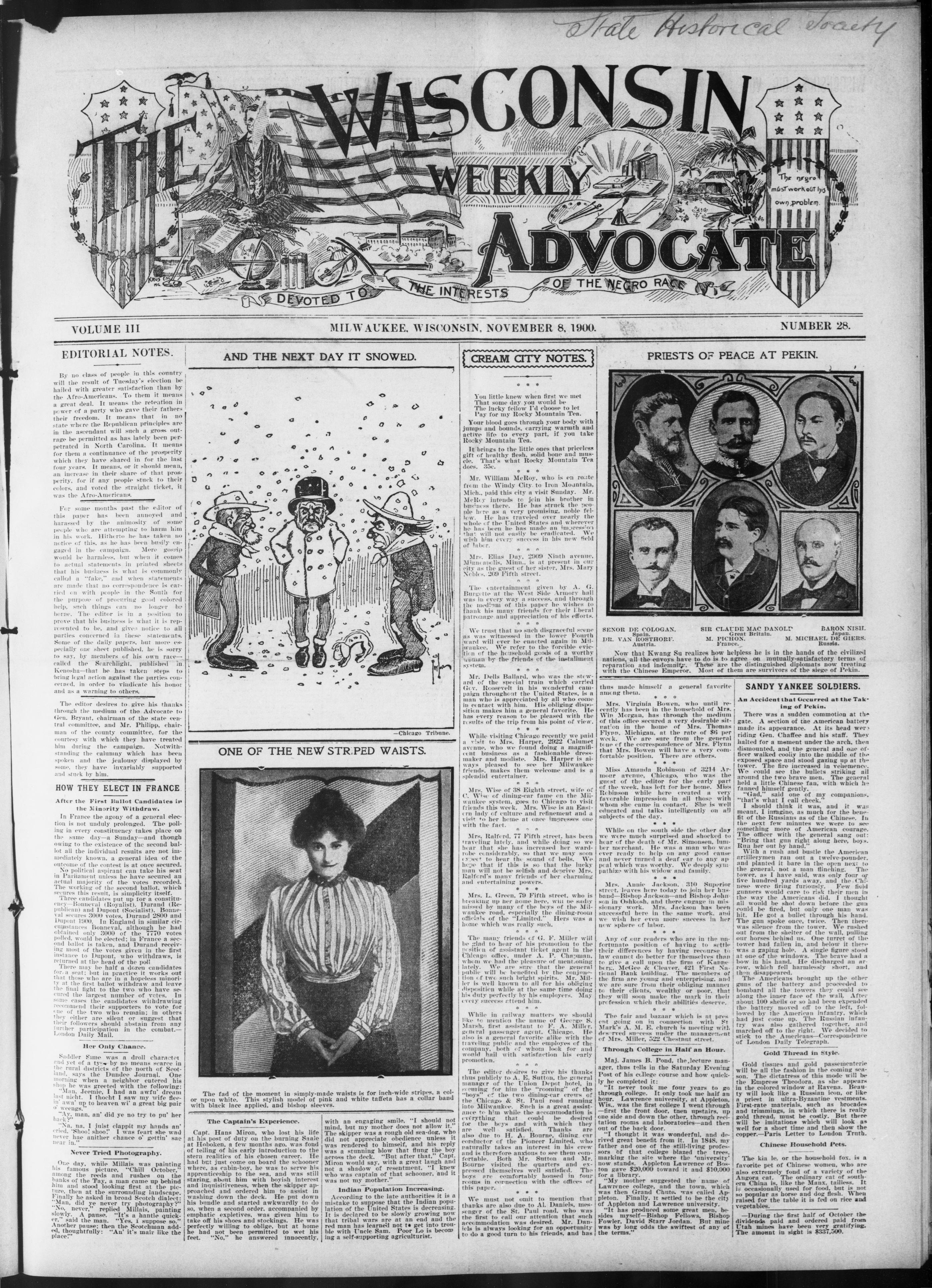
WISCONSIN
WEEKLY
ADVOCATE
DEVOTED TO THE INTERESTS OF THE NEGRO RACE
EDITORIAL NOTES.
By no class of people in this country will the result of Tuesday's election be hailed with greater satisfaction than by the Afro-Americans. To them it means a great deal. It means the retention in power of a party who gave their fathers their freedom. It means that in no state where the Republican principles are in the ascendant will such a gross outrage be permitted as has lately been perpetrated in North Carolina. It means for them a continuance of the prosperity which they have shared in for the last four years. It means, or it should mean, an increase in their share of that prosperity, for if any people stuck to their colors, and voted the straight ticket, it was the Afro-Americans.
For some months past the editor of this paper has been annoyed and harassed by the animosity of some people who are attempting to harm him in his work. Hitherto he has taken no notice of this, as he has been busily engaged in the campaign. Mere gossip would be harmless, but when it comes to actual statements in printed sheets that his business is what is commonly called a "fake," and when statements are made that no correspondence is carried on with people in the South for the purpose of procuring good colored help, such things can no longer be borne. The editor is in a position to prove that his business is what it is represented to be, and gives notice to all parties concerned in these statements. Some of the daily papers, but more especially one sheet published, he is sorry to say, by members of his own race-called the Searchlight, published in Kenosha—that he has taken steps to bring legal action against the parties concerned, in order to vindicate his honor and as a warning to others.
The editor desires to give his thanks through the medium of the Advocate to Gen. Bryant, chairman of the state central committee, and Mr. Philipp, chairman of the county committee, for the courtesy with which they have treated him during the campaign. Notwithstanding the calumny which has been spoken and the jealousy displayed by some, they have invariably supported and stuck by him.
HOW THEY ELECT IN FRANCE
After the First Ballot Candidates in the Minority Withdraw.
In France the agony of a general election is not unduly prolonged. The polling in every constituency takes place on the same day—a Sunday—and though owing to the existence of the second ballot all the individual results are not immediately known, a general idea of the outcome of the contest is at once secured. No political aspirant can take his seat in Parliament unless he have secured an actual majority of the votes recorded. The working of the second ballot, which secures this result, is simplicity itself.
Three candidates put up for a constituency—Bonneval (Royalist), Durand (Republican) and Dupont (Socialist), Bonneval secures 3000 votes, Durand 2800 and Dupont 1900. In England in similar circumstances Bonneval, although he had obtained only 3000 of the 7770 votes polled, would be elected; in France a second ballot is taken, and Durand receiving most of the votes given in the first instance to Dupont, who withdraws, is returned at the head of the poll.
There may be half a dozen candidates for a seat; but in practice it works out that those who are in a hopeless minority at the first ballot withdraw and leave the final fight to the two who have secured the largest number of votes. In some cases the candidates withdrawing recommend their supporters to vote for one of the two who remain; in others they either are silent or suggest that their followers should abstain from any further participation in the combat.—London Daily Mail.
Her Only Chance.
Saddler Sime was a droll character and yet of a tycoon by no means scarce in the rural districts of the north of Scotland, says the Dundee Journal. One morning when a neighbor entered his shop he was greeted with the following: "Man, Jeemie, I had an awfu' dream last nicht. I thocht I saw my wife fleein' awa' up to heaven wi' a great big pair o' weengs."
"Ay, man, an' did ye no try to pu' her back?"
"Na, na, I juist clappit my hands an' cried, 'Shoo! shoo.' I was feart she wad never hae anither chance o' gettin' sae near in."
Never Tried Photography.
One day, while Millais was painting his famous picture, "Chill October," among the reeds and rushes on the banks of the Tay, a man came up behind him and stood looking first at the picture, then at the surrounding landscape. Finally he asked in broad Scotch dialect; "Man, did ye never try photography?" "No, never," replied Millais, painting slowly. A pause. "It's a hantle quicker." said the man. "Yes, I suppose so." Another pause; then the Scotchman added, thoughtfully: "An' it's mair like the place."
Chicago Tribune
ONE OF THE NEW STRIPED WAISTS.
1
The fad of the moment in simply-made waists is for inch-wide stripes, a color upon white. This stylish model of pink and white taffeta has a collar band with black lace applied, and bishop sleeves.
The fad of the moment in simply-made waists is for inch-wide stripes, a color upon white. This stylish model of pink and white taffeta has a collar band with black lace applied, and bishop sleeves.
The Captain's Experience.
Capt. Hans Miron, who lost his life at his post of duty on the burning Saale at Hoboken, a few months ago, was fond of telling of his early introduction to the stern realities of his chosen career. He had but just come on board the schooner where, as cabin-boy, he was to serve his apprenticeship to the sea, and was still staring about him with boyish interest and inquisitiveness, when the skipper approached and ordered him to assist in washing down the deck. He put down his bundle and started awkwardly to do so, when a second order, accompanied by emphatic expletives, was given him to take off his shoes and stockings. He was perfectly willing to oblige, but at home he had not been permitted to wet his feet. "No," he answered innocently.
-Chicago Tribune.
made waists is for inch-wide stripes, a col-
ink and white taffeta has a collar band
leves.
with an engaging smile, "I should not mind, but my mother does not allow it." The skipper was a rough old sea-dog, who did not appreciate obedience unless it was rendered to himself, and his reply was a stunning blow that flung the boy across the deck. "But after that," Capt. Miron would say, with a great laugh and not a shadow of resentment. "I knew who was captain of that schooner, and it was not my mother."
Indian Population Increasing
According to the late authorities it is a mistake to suppose that the Indian population of the United States is decreasing. It is declared to be slowly growing now that tribal wars are at an end and the red man has learned not to get into trouble with Uncle Sam. Poor Lo is becoming a self-supporting agriculturist.
CREAM CITY NOTES.
* * *
You little knew when first we met
That some day you would be
The lucky fellow I'd choose to let
Pay for my Rocky Mountain Tea.
Your blood goes through your body with
jumps and bounds, carrying warmth and
active life to every part, if you take
Rocky Mountain Tea.
It brings to the little ones that priceless
gift of healthy flesh, solid bone and muscle. That's what Rocky Mountain Tea does, 35c.
***
Mr. William McRoy, who is en route from the Windy City to Iron Mountain, Mich., paid this city a visit Sunday. Mr. McRoy intends to join his brother in business there. He has struck the people here as a very promising, noble fellow. He has traveled over nearly the whole of the United States and wherever he has been he has made an impression that will not easily be eradicated. We wish him every success in his new field of labor.
Mrs. Ellas Day, 2009 Ninth avenue, Minneapolis, Minn., is at present in our city as the guest of her sister, Mrs. Mary Nebles, 209 Fifth street.
---
The entertainment given by A. G. Burgette at the West Side Armory hall was in every way a success, and through the medium of this paper he wishes to thank his many friends for their Liberal patronage and appreciation of his efforts.
* * *
We trust that no such disgraceful scene as was witnessed in the lower Fourth ward will ever be enacted again in Milwaukee. We refer to the forcible eviction of the household goods of a worthy woman by the friends of the installment system.
Mr. Dells Ballard, who was the steward of the special train which carried Gov. Roosevelt in his wonderful campaign throughout the United States, is a man who is appreciated by all who come in contact with him. His obliging disposition makes him a general favorite. He has every reason to be pleased with the results of the trip from his point of view.
* * *
While visiting Chicago recently we paid a visit to Mrs. Harper, 2922 Calumet avenue, who we found doing a magnificent business as a fashionable dressmaker and modiste. Mrs. Harper is always pleased to see her Milwaukee friends, makes them welcome and is a splendid entertainer.
交 交 交
Mrs. Wise of 38 Eighth street, wife of C. Wise of dining-car fame on the Milwaukee system, goes to Chicago to visit friends this week. Mrs. Wise is an Eastern lady of culture and refinement and a visit to her home at once impresses one with the fact.
Mrs. Ralford, 77 Fifth street, has been traveling lately, and while doing so we hear that she has increased her wardrobe considerably, so that we may soon expect to hear the sound of bells. We hope that if this is so that the lucky man will not be selfish and deprive Mrs. Ralford's many friends of her charming and entertaining powers.
---
Mrs. L. Green, 79 Fifth street, who is breaking up her home here, will be sadly missed by many of the boys of the Milwaukee road, especially the dining-room officials of the "Limited." Hers was a home which was really such.
* * *
The many friends of G. F. Miller will be glad to hear of his promotion to the position of assistant ticket agent in the Chicago office, under A. P. Chapman, whom we had the pleasure of mentioning lately. We are sure that the general public will be benefited by the conjunction of two such bright spirits. Mr. Miller is well known to all for his obliging disposition while at the same time doing his duty perfectly by his employers. May every success attend him.
☆ ☆ ☆
While in railway matters we should like to mention the name of George S. Marsh, first assistant to F. A. Miller, general passenger agent, Chicago. He also is a general favorite alike with the traveling public and the employees of the company, both of whom look for and would hail with satisfaction his early promotion.
The editor desires to give his thanks thus publicly to A. E. Sutton, the general manager of the Union Depot hotel, in securing for him the "rooming" of the "boys" of the two dining-car crews of the Chicago & St. Paul road running into Milwaukee. Such is a great assistance to him while the accommodation is everything that could be desired for the boys and with which they are well satisfied. Thanks are also due to H. A. Bourne, dining car conductor of the Pioneer Limited, who naturally takes an interest in his crew and is therefore anxious to see them comfortable. Both Mr. Sutton and Mr. Bourne visited the quarters and expressed themselves well satisfied. The boys are comfortably housed in four rooms in connection with the offices of this paper.
We must not omit to mention that thanks are also due to Al. Daniels, messenger of the St. Paul road, who was the first to call our attention that such accommodation was desired. Mr. Daniels is always looking for an opportunity to do a good turn to his friends, and has
PRIESTS OF PEACE AT PEKIN.
SENOR DE COLOGAN,
Spain.
DR. VAN ROSTHORF.
Austria.
SIR CLAU
M. PICI
France
Now that Kwang Su realizes how he
nations, all the envoys have to do is to
reparation and indemnity. These are
with the Chinese Emperor. Most of the
M. H. H.
Now that Kwang Su realizes how helpless he is in the hands of the civilized nations, all the envoys have to do is agree on mutually-satisfactory terms of reparation and indemnity. These are the distinguished diplomats now treating with the Chinese Emperor. Most of them are survivors of the siege of Pekin.
thus made himself a general favorite among them.
Mrs. Virginia Bowen, who until recently has been in the household of Mrs. Win Morgan, has through the medium of this office secured a very desirable situation in the home of Mrs. Thomas Flynn, Michigan, at the rate of $6 per week. We are sure from the general tone of the correspondence of Mrs. Flynn that Mrs. Bowen will have a very comfortable position. There are others.
SANDY YANKEE SOLDIERS.
An Accident that Occurred at the Taking of Pekin.
There was a sudden commotion at the gate. A section of the American battery made its appearance. At its head were riding Gen. Chaffee and his staff. They halted for a moment under the arch, then dismounted, and the general and one of ficer walked coolly into the middle of the
Miss Amanda Robinson of 3214 Armour avenue, Chicago, who was the guest of the editor for the early part of the week, has left for her home. Miss Robinson while here created a very favorable impression in all those with whom she came in contact. She is well educated and talks intelligently on all subjects of the day.
* * *
While on the south side the other day we were much surprised and shocked to hear of the death of Mr. Simonsen, lumber merchant. He was a man who was ever ready to help on any good cause and never turned a deaf ear to any appeal which was worthy. We deeply sympathize with his widow and family.
Mrs. Annie Jackson, 310 Superior street, leaves here today to join her husband—Bishop Jackson—and Bishop Johnson in Oshkosh, and there engage in missionary work. Mrs. Jackson has been successful here in the same work, and we wish her even more success in her new sphere of labor.
* * *
Any of our readers who are in the unfortunate position of having to settle their differences by having recourse to law cannot do better for themselves than to give a call upon the firm of Kanneberg, McGee & Cleaver, 421 First National Bank building. The members of the firm are young and enterprising, and we are sure from their obliging manner to their clients, wealthy or poor, that they will soon make the mark in their profession which their abilities deserve.
The fair and bazaar which is at presen t going on in connection with St Mark's A. M. E. church is meeting with deserved success under the management of Mrs. Miller, 522 Chestnut street.
Through College in Half an Hour.
Maj. James B. Pond, the lecture manager, thus tells in the Saturday Evening Post of his college course and how quickly he completed it:
"It never took me four years to go through college. It only took me half an hour. Lawrence university, at Appleton, Wis., was the first college I went through—first the front door, then upstairs, up one side and down the other, through recitation rooms and laboratories—and then out of the back door.
"I thought it was wonderful, and derived great benefit from it. In 1848, my father and one of the still-living professors of that college blazed the trees, marking the site where the 'university' now stands. Appleton Lawrence of Boston gave $20,000 toward it and $10,000 for a library."
"My mother suggested the name of Lawrence college, and the town, which was then Grand Chute, was called Appleton. Finally, it settled to be the city of Appleton and Lawrence university.
"It has produced some great men, besides myself—Bishop Fellows, Bishop Fowler, David Starr Jordan. But mine was by long odds the swiftest of any of the terms."
☆ ☆ ☆
---
* * *
* * *
NUMBER 28.
DE MAC DANOLD
Great Britain.
BARON NISH.
Japan.
M. MICHAEL DE GIERS.
Russia.
Allless he is in the hands of the civilized
gree on mutually-satisfactory terms of
the distinguished diplomats now treating
them are survivors of the siege of Pekin.
SANDY YANKEE SOLDIERS.
An Accident that Occurred at the Taking of Pekin.
There was a sudden commotion at the gate. A section of the American battery made its appearance. At its head were riding Gen. Chaffee and his staff. They halted for a moment under the arch, then dismounted, and the general and one officer walked coolily into the middle of the exposed space and stood gazing up at the tower. The fire increased in vehemence. We could see the bullets striking all around the two brave men. The general held a little Chinese fan, with which he fanned himself gently. "Gad," said one of my companions, "that's what I call cheek."
I should think it was, and it was meant, I imagine, as much for the benefit of the Russians as of the Chinese. In the next few minutes we were to see something more of American courage. The officer with the general sang out: "Bring that gun right along here, boys. Run her out by hand."
With a rush and bustle the American artillerymen ran out a twelve-pounder, and planted it bare in the open next to the general, not a man flinching. The tower, as I have said, was only four or five hundred yards away, and the Chinese were firing furiously. Few field gunners would care to risk their men in the way the Americans did. I thought all would be shot down before the gun could be fired, but only one man was hit. He got a bullet through his hand. The gun spoke once, twice. Then there was silence from the tower. We rushed out from the shelter of the wall, pulling our horses behind us. One turret of the tower had fallen in, and below it there was a gaping hole. A single figure stood at one of the windows. The brave had a bow in his hand. He discharged an arrow, which fell harmlessly short, and then disappeared.
The Americans brought up the other guns of the battery and proceeded to bombard all the towers they could see along the inner face of the wall. After about 100 shells or so had been expended the battery moved off to the left, followed by the American infantry, which had just come up. The Russian infantry was also gathered together, and marched off to the right. We decided to stick to the Americans—Correspondence of London Daily Telegraph.
Gold Thread in Style
Gold tissues and gold passementerie will be all the fashion in the coming season. The dictatress of this mode will be the Empress Theodora, as she appears in the colored window at Ravena. Beauty will look like a Russian icon, or like a priest in ultra-Byzantine vestments. First-rate materials, such as brocades and trimmings, in which there is really gold thread, must be costly. But there will be imitations which will look as well for a short time and then show the copper.—Paris Letter to London Truth.
Chinese Household Pets.
The kia le, or the household fox, is a favorite pet of Chinese women, who are also extremely fond of a variety of the Angora cat. The ordinary cat of southern China is, like the Manx, tailless. It is occasionally used for food, but is not so popular as horse and dog flesh. When raised for the table it is fed on rice and vegetables.
During the first half of October the dividends paid and ordered paid from Utah mines have been very gratifying. The amount in sight is $337,500.
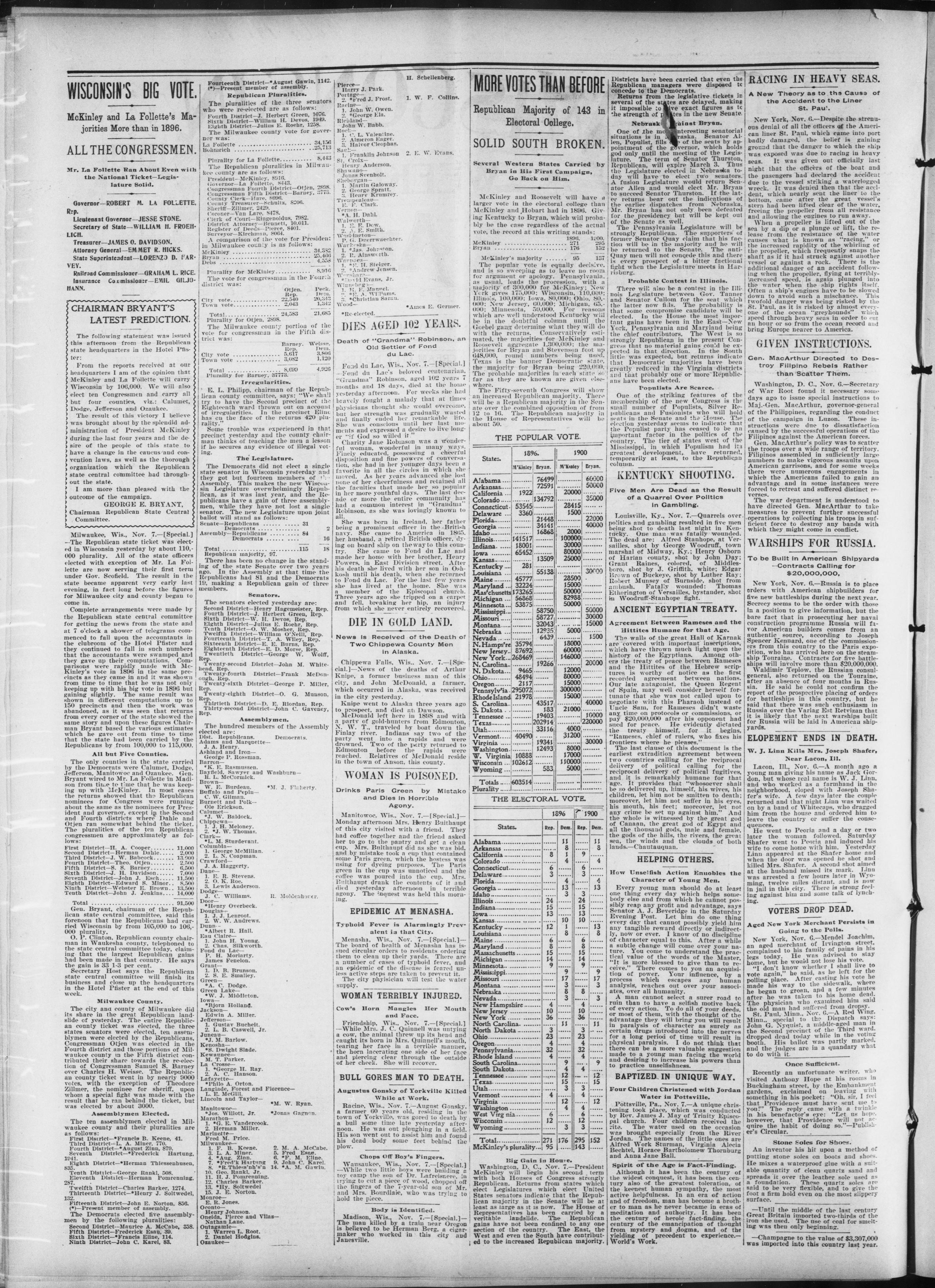
WISCONSIN'S BIG VOTE.
McKinley and La Follette's Majorities More than in 1896.
ALL THE CONGRESSMEN.
Mr. La Follette Ran About Even with the National Ticket—Legislature Solid.
Governor—ROBERT M. LA FOLLETTE
Rep.
Lieutenant Governor—JESSE STONE.
Secretary of State—WILLIAM H. FROEHLICH.
Treasurer—JAMES O. DAVIDSON.
Attorney General—EMMET R. HICKS.
State Superintendent—LORENZO D. FARVEY.
Railroad Commissioner—GRAHAM L. RICE.
Insurance Commissioner—EMIL GILJOHANN.
LATEST PREDICTION.
The following statement was issued this afternoon from the Republican state headquarters in the Hotel Pfister:
From the reports received at our headquarters I am of the opinion that McKinley and La Follette will carry Wisconsin by 106,000. We will also elect ten Congressmen and carry all but four counties, viz.: Calumet, Dodge, Jefferson and Ozaukee.
The result of this victory I believe was brought about by the splendid administration of President McKinley during the last four years and the desire of the people of this state to have a change in the caucus and convention laws, as well as the thorough organization which the Republican state central committee had throughout the state. I am more than pleased with the outcome of the campaign.
Milwaukee, Wis., Nov. 7.—[Special.]
—The Republican state ticket was elected in Wisconsin yesterday by about 110,000 plurality. All of the state officers elected with exception of Mr. La Follette are now serving their first term under Gov. Scofield. The result in the state became apparent very early last evening, in fact long before the figures for Milwaukee city and county began to come in.
Complete arrangements were made by the Republican state central committee for getting the news from the state and at 7 o'clock a shower of telegrams commenced to fall upon the accountants in the clubroom of the Hotel Pfister and they continued to fall in such numbers that the accountants were swamped and they gave up their computations. Comparisons were rapidly made with McKinley's vote in 1896 in the same precincts as they came in and it was shown from time to time that he was not only keeping up with his big vote in 1896 but gaining slightly. The same result was shown in different computations up to 150 precincts and then the work was abandoned, as it was seen that returns from every corner of the state showed the same story and upon these figures Chairman Bryant based the various estimates which he gave out from time to time that the state had been carried by the Republicans by from 100,000 to 115,000.
All but Five Counties.
The only counties in the state carried by the Democrats were Calumet, Dodge, Jefferson, Manitowoc and Ozaukee. Gen. Bryant wired to Mr. La Follette in Madison from time to time that he was keeping up with McKinley. In most cases the returns showed that the Republican nominees for Congress were running about the same as the nominees for President and governor, except in the Second and Fourth districts where Dahle and Otjen ran somewhat behind the ticket. The pluralities of the ten Republican congressmen are approximately as follows:
First District—H. A. Cooper.....11,000
Second District—Herman Dahle.....2,000
Third District—J. W. Babecock.....13,900
Fourth District—Theo. Otjen.....2,500
Fifth District—S. S. Barney.....6,500
Sixth District—J. H. Davidson.....7,000
Seventh District—John J. Esch.....11,500
Eighth District—Edward S. Minor.....8,500
Ninth District—Webster E. Brown.....13,500
Tenth District—John J. Jenkins.....14,000
Total.....91,500
Gen. Bryant, chairman of the Republican state central committee, said this forenoon that the Republicans had carried Wisconsin by from 105,000 to 106,000 plurality.
O. P. Clinton, Republican county chairman in Waukesha county, telephoned to the state central committee today, claiming that the largest Republican gains had been made in that county. He says the gain is 33 1/3 per cent.
Secretary Host says the Republican state central committee will finish its business and close up the headquarters in the Hotel Pfister at the end of this week.
Milwaukee County.
The city and county of Milwaukee did its share in the great Republican landslide of yesterday. The entire Republican county ticket was elected, the three states senators were elected, ten assemblymen were elected by the Republicans, Congressman Otjen was elected in the Fourth district and those portions of Milwaukee county in the Fifth district contributed their share towards the re-election of Congressman Samuel S. Barney over Charles H. Weisse. The Republican county ticket went in by nearly 9000 votes, with the exception of Theodore Zillmer, the nominee for sheriff, upon whom a special fight was made with the result that he ran behind the ticket, but was elected by about 3000.
Assemblymen Elected.
The ten assemblymen elected in Milwaukee county and their pluralities are as follows:
First District—*Francis B. Keene, 41.
Third District—L. A. Miner, 770.
Fourth District—*August Zinn, 879.
Seventh District—*Frederick Hartung, 1941.
Eighth District—*Herman Thiessenhusen, 835.
Tenth District—George Rankl, 508.
Eleventh District—Herman Pomrenning, 287.
Twelfth District—Charles Barker, 1274.
Thirteenth District—*Henry J. Soltwedel, 132.
Fifteenth District—John E. Norton, 856.
(*)—Present member of assembly.
The Democrats elected five assemblymen by the following pluralities:
Second District—Maurice A. McCabe, 358.
Fifth District—Frederick Easu, 39.
Sixth District—*Francis Eline, 114.
Ninth District—John C. Karel, 83.
The pluralities of the three senators who were re-elected are as follows: Fourth District—J. Herbert Green, 1076. Sixth District—William H. Devos, 1949. Eighth District—Julius E. Roehr, 1258. The Milwaukee county vote for gover-
district was:
Otjen.
Rep.
Peck.
Dem.
City vote..... 22,540
20,343
Town vote..... 2,043
1,342
Total..... 24,583
21,685
Plurality for Otjen, 2898.
The Milwaukee county portion of the vote for congressman in the Fifth district was:
Barney.
Rep.
Weisse.
Dem.
City vote..... 5,617
3,806
Town vote..... 3,082
1,120
E. L. Philipp, chairman of the Republican county committee, says: "We shall try to have the Second precinct of the Eighteenth ward thrown out on account of irregularities. In the precinct Elim has on the face of the returns 420 plurality." Some trouble was experienced in that precinct yesterday and the county chairman thinks of teaching the men a lesson if he secures any evidence of illegal voting.
The Legislature.
The Democrats did not elect a single state senator in Wisconsin yesterday and they got but fourteen members of the Assembly. This makes the new Wisconsin Legislature overwhelmingly Republican, as it was last year, and the Republicans have a gain of three assemblymen, while they have not lost a single senator. The new Legislature upon joint ballot will stand as follows:
Senate—Republicans 31
Democrats 2
Assembly—Republicans 84
Democrats 16
Total 115 18
Republican majority, 97.
There has been no change in the standing of the state Senate over two years ago. In the Assembly at that time the Republicans had 81 and the Democrats 19, making a Republican gain of three members.
Senators.
The senators elected yesterday are:
Second District—Henry Hagemeister, Rep.
Fourth District—J. Herbert Green, Rep.
Sixth District—W. H. Devos, Rep.
Eighth District—Julius E. Roehr, Rep.
Tenth District—O. W. Mosher Rep.
Twelfth District—William Gnell, Rep.
Fourteenth District—T. A. Wiley, Rep.
Sixteenth District—E. E. Burns, Rep.
Eighteenth District—E. D. Morse, Rep.
Twentleth District—George W. Wolff,
Rep
Rep.
Twenty-second District—John M. Whitehead, Rep.
Twenty-fourth District—Frank McDonough, Rep.
Twenty-sixth District—George P. Miller, Rep.
Twenty-eighth District—O. G. Munson, Rep.
Thirtieth District—D. E. Riordan, Rep.
Thirty-second District—John C. Gaveney, Rep.
Assemblymen.
The hundred members of the Assembly elected are:
Dist. Republicans. Democrats.
Adams and Maronette—
DIES AGED 102 YEARS.
Death of "Grandma" Robinson, an Old Settler of Fond du Lac.
Fond du Lac, Wis., Nov. 7.—[Special.]
—Fond du Lac's beloved centenarian, "Grandma" Robinson, aged 102 years 7 months and 18 days, died at the home yesterday afternoon. For weeks she had bravely fought a malady that at times physicians thought she would overcome, but her strength was gradually wasted and finally ended her remarkable life. She was conscious until her last moments and expressed a desire to live longer. "if God so willled it."
Charity Jane Robinson was a wonderful woman, wonderful in many ways. Finely educated, possessing a cheerful disposition and fine powers of conversation, she had in her younger days been a favorite in all the circles in which she moved. As her years advanced she lost none of her cheerfulness and retained all the faculties that made her so popular in her more youthful days. The last decade or more the entire community has had a common interest in "Grandma" Robinson, as she was lovingly known to all.
She was born in Ireland, her father being a prominent officer in the British navy. She came to America in 1865, her husband, a retired British officer, dying on board ship on the way to this country. She came to Fond du Lac and made her home with her brother, Henry Powers, in East Division street. After his death she lived with her son in Oshkosh until his death, when she returned to Fond du Lac. For the last few years she has lived at the home. She was a member of the Episcopal church. Three years ago she tripped on a carpet and fell, breaking her hip, an injury from which she never entirely recovered.
DIE IN GOLD LAND.
News Is Received of the Death of Two Chippewa County Men in Alaska.
Chippewa Falls, Wis.. Nov. 7.—[Special.]—News of the deaths of Arthur Knipe, a former business man of this city, and John McDonald, a farmer, which occurred in Alaska, was received in the city yesterday.
Knipe went to Alaska three years ago to prospect, and died at Dawson.
McDonald left here in 1898 and with a party of gold-hunters from Edmonton, N. W. T., traveled by boat down the Finlay river. Indians say two of the party went into a rapids and were drowned. Two of the party returned to Edmonton before the rapids were reached. Relatives of McDonald reside in the town of Anson, this county.
WOMAN IS POISONED.
Drinks Paris Green by Mistake and Dies in Horrible
Manitowoc. Wis., Nov. 7.—[Special.]—Monday afternoon Mrs. Henry Bulthaupt of this city visited with a friend. They had coffee together and the friend asked her to go to the pantry and get a clean cup. Mrs. Bulthaupt did as she was bid, and by mistake took a cup that contained some Paris green, which the hostess was using for dyeing purposes. The Paris green in the cup was unnoticed and the coffee was poured into the cup. Mrs. Bulthaupt drank the contents of it and died yesterday afternoon in terrible agony. The inquest was held this morning.
EPIDEMIC AT MENASHA.
Typhoid Fever is Alarmingly Prevalent in that City.
Menasha. Wis., Nov. 7.—[Special.] The board of health of Menasha has issued circular orders to residents ordering them to clean up their yards. There are a number of cases of typhoid fever, and an epidemic of the disease is feared unless active steps are taken to prevent it. The city physician will test the water supply.
WOMAN TERRIBLY INJURED
Cow's Horn Mangles Her Mouth and Face.
Friendship, Wis.. Nov. 7.—[Special.]
—While Mrs. J. C. Quinnell was untying a cow, the animal threw up its head and caught its horn in Mrs. Quinnell's mouth, tearing her face in a terrible manner, the horn lacerating one side of her face and piercing clear through the outside of her cheek. She will recover.
BULL GORES MAN TO DEATH.
Augustus Gonsky of Yorkville Killed While at Work.
Racine, Wis., Nov. 7.—August Gonsky, a farmer 60 years old, residing in the town of Yorkville, was gored to death by a bull some time late yesterday afternoon. He was out ploughing in a field. His son went out to assist him and found his dead body some feet behind the plow.
Chops Off Boy's Fingers
Wausaukee, Wis., Nov. 7.—[Special.]
—While two little boys were building a toy camp the son of Dr. Lafreisnere, in trying to cut a piece of wood, chopped off the fingers of the 7-year-old son of Mr. and Mrs. Bourdlaie, who was trying to hold the piece.
Body is Identified.
Madison. Wis. Nov. 7.—[Special.] The man killed by a train near Oregon is believed to be Herman Berg. a cigar maker who worked in this city and Janesville.
MORE VOTES THAN BEFORE
SOLID SOUTH BROKEN.
Several Western States Carried by Bryan in His First Campaign, Go Back on Him.
McKinley and Roosevelt will have a larger vote in the electoral college than McKinley and Hobart had in 1896. Giving Kentucky to Bryan, which will probably be the case regardless of the actual vote, the record at this writing stands:
1896. 1900.
McKinley 271 295
Bryan 176 152
McKinley's majority 95 127
McKinley's majority ..... 95 137
The popular vote is equally decisive, and is so sweeping as to leave no room for argument or apology. Pennsylvania, as usual, leads the procession, with a majority of 300,000 for McKinley, New York gives 175,000; Wisconsin, 110,000; Illinois, 100,000; Iowa, 80,000; Ohio, 80,000; New Jersey, 60,000; Michigan, 65,000; Minnesota, 50,000. For reasons which are well understood Kentucky will be in the doubtful column until the Goebel gang determine what they will do with the returns. Conservatively estimated, the majorities for McKinley and Roosevelt aggregate 1,300,000; the majorities for Bryan and Stevenson foot up 648,000, round numbers being used. Texas is the banner Democratic state, the majority for Bryan being 220,000. The probable majorities in each state so far as they are known are given elsewhere.
The Fifty-seventh Congress will show an increased Republican majority. There will be a Republican majority in the Senate over the combined opposition of from 12 to 16. The Republican majority in the House of Representatives will be about 50. THE POPULAR VOTE.
States. 1896. 1900
M'Kinley Bryan. M'Kinley Bryan.
Alabama 76499 60000
Arkansas 72591 50000
California 1922 20000
Colorado 134792 35000
Connecticut 53545 28415
Delaware 3360 1500
Florida 21448 22000
Georgia 34141 40000
Idaho 16868 2000
Illinois 141517 100000
Indiana 18001 30000
Iowa 65452 80000
Kansas 13509 25000
Kentucky 281 30000
Louisiana 55138
Maine 45777 28500
Maryland 32224 15000
Mas'chusetts 173265 50000
Michigan 56868 82988
Minnesota 53875 50000
Mississippi 58750 50000
Missouri 58727 30000
Montana 32043 15000
Nebraska 12935 5000
Nevada 6439 1500
N. Hamps're 35794 18000
New Jersey 87692 60000
New York 268469 146000
N. Carolina 19266 20000
N. Dakota 9465 12000
Ohio 48494 80000
Oregon 2117 15000
Pennsylv'ia 295072 300000
Rhode Island 21978 15000
S. Carolina 43517 40000
S. Dakota 183 21000
Tennessee 19403 10000
Texas 202914 220000
Utah 33116 4000
Vermont 40490 31200
Virginia 19341 30000
Washington 12493 8000
W. Virginia 10888 17000
Wisconsin 102612 110000
Wyoming 583 5000
Totals 603514
Plurality
THE ELECTORAL VOTE.
Big Gain in House.
Washington, D. C., Nov. 7.—President McKinley will begin his second term with both Houses of Congress strongly Republican. Returns from states which elect Legislatures which elect United States senators indicate that the Republican majority in the Senate will be at least as large as it is now. The House of Representatives has been carried by a veritable landslide. The Republican gains have not been confined to any one section of the country. The East, the West and even the South have contributed to the increased Republican majority.
Districts have been carried that even the Republican managers were disposed to concede to the Democrats.
Returns from the legislative tickets in several of the states are delayed, making it impossible to give exact figures as to the strength of polites in the new Senate.
Nebrask Brainst Bryan.
One of the most interesting senatorial situations is in Nebraska. Senator Allen, Populist, fills one of the seats by appointment of the governor, which holds god only until the meeting of the Legislature. The term of Senator Thurston, Republican, will expire March 3. Thus the Legislature elected in Nebraska today will have to elect two senators. A fusion Legislature would return Senator Allen and would elect Mr. Bryan to succeed Senator Thurston. If the latter returns bear out the indications of the earlier dispatches from Nebraska. Mr. Bryan has not only been defeated for the presidency but will be kept out of the Senate as well.
The Pennsylvania Legislature will be strongly Republican. The supporters of former Senator Quay claim that his faction will be in the majority and he will be returned to the Senate. The antiQuay men will not concede this and there is every prospect of a bitter factional fight when the Legislature meets in Harrisburg.
Probable Contest in Illinois.
There will also be a contest in the Illinois Legislature between Gov. Tanner and Senator Cullom for the seat which the latter now fills. The probability is that some compromise candidate will be elected. In the House the most important gains have been in the East—New York, Pennsylvania and Maryland being the chief contributors. The West is so strongly Republican in the present Congress that no material gains could be expected in that direction. In the South little was expected, but returns indicate that Democratic majorities have been greatly reduced in the Virginia districts and that probably one or more Republicans have been elected.
One of the striking features of the membership of the new Congress is the small number of Populists, Silver Republicans and Fusionists who will hold seats in the Senate and the House. The election yesterday seems to indicate that the Populist party has ceased to be an important factor in the politics of the country. The tier of states west of the Mississippi, in which Populism had its greatest development, have returned, temporarily at least, to the Republican column.
KENTUCKY SHOOTING.
Five Men Are Dead as the Result of a Quarrel Over Politics in Gambling.
Louisville, Ky., Nov. 7.—Quarrels over politics and gambling resulted in five men being shot to death last night in Kentucky. One man was fatally wounded. The dead are: Alfred Stanhope, at Versailles, shot by George Woodruff, town marshal of Midway, Ky.; Henry Osborn of Harlan county, shot by John Day; Grant Raines, colored, of Middlesboro, shot by J. Griffith, white; Edgar Brown of Buckeye, shot by Luther Ray; Robert Munsey of Burnside, shot from ambush. Fatally wounded: Thomas Etherington of Versailles, bystander, shot in Woodruff-Stanhope fight.
ANCIENT EGYPTIAN TREATY.
Agreement Between Ramesses and the Hittites Humane for that Age.
The walls of the great Hall of Karnak are covered with important inscriptions, which have thrown much light upon the history of the Egyptians. Among others the treaty of peace between Rameses and the Hittites of the Hebrew scriptures is worthy of notice as the first recorded agreement between nations. Our late antagonist, the Queen Regent of Spain, may well consider herself fortunate that she was not called upon to negotiate with this Pharaoh instead of Uncle Sam, for Rameses didn't waste any time on protocols or commissions, or pay $20,000,000 after his opponent had sued for peace. He evidently dictated the treaty himself, for it begins, "Rameses, chief of rulers, who fixes his frontiers where he pleases."
The last clause of this document is the earliest extradition agreement between two countries calling for the reciprocal delivery of political calling for the reciprocal delivery of political fugitives, and it is remarkably humane for that age. It provides that "whosoever shall be so delivered up, himself, his wives, his children, let him not be smitten to death; moreover, let him not suffer in his eyes, his mouth, his feet; moreover, let not any crime be set up against him." And the whole is witnessed by the great god of Canaan, the great god of Egypt and all the thousand gods, male and female, the gods of the hills, the rivers, the great sea, the winds and the clouds of both lands.—Chautauquan.
HELPING OTHERS.
How Unselfish Action Ennobles the Character of Young Men.
Every young man should do at least one thing every day which helps somebody else and from which he cannot possibly reap any profit and advantage, says Senator A. J. Beveridge in the Saturday Evening Post. Let him do one thing every day that cannot possibly yield him any tangible reward directly or indirectly, now or ever. I know of no discipline of character equal to this. After a while a subtle change will come over your nature. You come to understand the practical value of the words of the Master, "It is more blessed to give than to receive." There comes to you an acquisition of power. Your influence, by a process which escapes any human analysis, reaches out over your associates, over all humanity.
A man cannot select a surer road to ruin than to have a selfish motive back of every action. To do all of your deeds, or most of them, with the thought of the advantage they will bring you will result in paralysis of character as surely as certain drugs introduced into the nerves for a long period of time will result in physical paralysis. I do not think that there can be a more valuable suggestion made to a young man facing the world and desiring to increase his powers than to practice unselfishness.
BAPTIZED IN UNIQUE WAY.
Four Children Christened with Jordan Water in Pottsville.
Pottsville, Pa., Nov. 7.—A unique christening took place, which was conducted by Rev. James J. May of Trinity Episcopal church. Four children received the rite. The water used on the occasion was brought especially from the River Jordan. The names of the little ones are Alfred Work Sturman, Virginia Alecia Bechtel, Horace Bartholomew Thornburg and Anna Jane Ball.
Spirit of the Age is Fact-Finding.
Although it has been the century of the widest conquest, it has been the century also of the greatest toleration, of the keenest human sympathy, the most active helpfulness. In an era of action and of freedom, man has become a brother to man as he never became in eras of meditation and authority. It has been the century of heroic fact-finding, the century of the emancipation of thought from mystery and dogma, and of the yielding of precedent to experience.—World's Work.
RACING IN HEAVY SEAS.
A New Theory as to the Cause of the Accident to the Liner St. Pau'.
New York, Nov. 6.—Despite the strenuous denial of all the officers of the American liner St. Paul, which came into port badly damaged, the belief is gaining ground that the danger to which the ship was exposed was due to racing in heavy seas. It was given out officially last night that the officers of the boat and the passengers had declared the accident due to the vessel striking a waterlogged wreck. It was denied then that the accident, which nearly sent the liner to the bottom, came after the great vessel's stern had been lifted clear of the water, freeing the propeller from all resistance and allowing the engines to run away.
When a propeller is lifted out of the sea by a dip or a plunge or lift, the release from the resistance of the water causes what is known as "racing," or the increased rapidity of the whirling of the propeller, which frequently snaps the shaft as if it had struck against another vessel or against a rock. There is the additional danger of an accident following when the propeller, flying at terribly-increased speed, is again plunged into the water when the ship rights itself. Often a ship's engines have to be slowed down to avoid such a mischance. This twofold danger was being risked by the St. Paul, as it is risked by almost everyone of the ocean "greyhounds" which speed through heavy seas in order to cut an hour or so from the ocean record and bring Europe nearer to America.
GIVEN INSTRUCTIONS.
Gen. MacArthur Directed to Destroy Filipino Rebels Rather than Scatter Them.
Washington, D. C., Nov. 6.—Secretary of War Root found it necessary some days ago to issue special instructions to Maj.-Gen. MacArthur, governor-general of the Philippines, regarding the conduct of the campaign in Luzon. These instructions were due to dissatisfaction caused by the successful operations of the Filipinos against the American forces.
Gen. MacArthur's policy was to scatter the troops over a wide range of territory. Filipinos assembled in sufficiently large numbers to make vigorous assaults upon American garrisons, and for some weeks there were numerous engagements in which the Americans failed to gain an advantage and in some instances were forced to retreat and suffered distinct reverses. The war department is understood to have directed Gen. MacArthur to take measures to prevent further successful operations by collecting his troops in sufficient force to destroy any bands with which they might come in conflict.
WARSHIPS FOR RUSSIA.
To be Built in American Shipyards
--Contracts Calling for
$20,000,000.
New York, Nov. 6.—Russia is to place orders with American shipbuilders for five new battleships during the next year. Secrecy seems to be the order with those in a position to give information, but the bare fact that in prosecuting her naval construction programme Russia will favor American builders comes from an authentic source, according to Joseph Spencer Kennard, one of the commissioners from this country to the Paris exposition, who has arrived here on the steamship Touraine. Contracts for five battleships will involve more than $20,000,000.
Waldimir Teplow, the Russian consul-general, also returned on the Touraine, after an absence of four months in Russia. He said he could not confirm the report of the prospective placing of orders for battleships in this country, but he said that there was such enthusiasm in Russia over the Varieg Est Retvizan that it is likely that the next warships built for Russia will be laid in American shipyards.
ELOPEMENT ENDS IN DEATH.
W. J. Linn Kills Mrs. Joseph Shafer,
Near Lacon, Ill.
Lacon, Ill., Nov. 6.—A month ago a young man giving his name as Jack Gordon, but whose real name is W. J. Linn, and who worked as a farmhand in the neighborhood, eloped with Joseph Shafer's wife. A few days later the couple returned and that night Linn was waited on by a band of Whitecaps, who dragged him from the house and ordered him to leave the country or suffer the consequences.
He went to Peoria and a day or two later the woman followed. Saturday Shafer went to Peoria and induced his wife to come home with him. Yesterday Linn appeared at the Shafer home and when the door was opened he shot and killed Mrs. Shafer. A second shot aimed at the husband missed its mark. Linn was arrested a few hours later in Wyoming, twelve miles distant, and is now in jail in this city. There is strong feeling against him and some talk of lynching.
VOTERS DROP DEAD.
Aged New York Merchant Persists in
Going to the Polls.
New York, Nov. 6.—Mendel Joachim, an aged merchant of Irvington street, complained to his family of pains in his legs today. He was advised to stay home, but he would not lose his vote.
home, but I don't know whether I shall live to vote again," he said, as he left for the polling place. After casting his vote he made his way to the sidewalk, where he began to groan, and a few minutes after he was taken to his home dead. The physician who examined him said the old man had suffered from dropsy.
St. Paul, Minn., Nov. 6.—A Red Wing, Minn., special to the Dispatch says: John G. Nyquist, a middle-aged man in the Second precinct of the Third ward, dropped dead today while in the voting booth. His ballot was partly marked, and the judges are in a quandary what to do with it.
Once Sufficient.
Recently an unfortunate writer, who visited Anthony Hope at his rooms in Buckingham street, by the Embankment gardens, exclaimed on leaving with something in his pocket: "Oh, sir, I feel that Providence must have sent me to you!" The reply came with a twinkle in his benefactor's eye: "Let us hope, however, that Providence will not acquire the habit of doing so."—Publisher's Circular.
Stone Soles for Shoes.
An inventor his hit upon a method of putting stone soles on boots and shoes. He mixes a waterproof glue with a suitable quantity of clean quartz sand and spreads it over the leather sole used as a foundation. These quartz soles are said to be very flexible, and to give the foot a firm hold even on the most slippery surface.
—Until the middle of the last century Great Britain imported two-thirds of the iron she used. The use of coal for smelting was then only beginning.
—Champagne to the value of $3,307,000 was imported into this country last year.
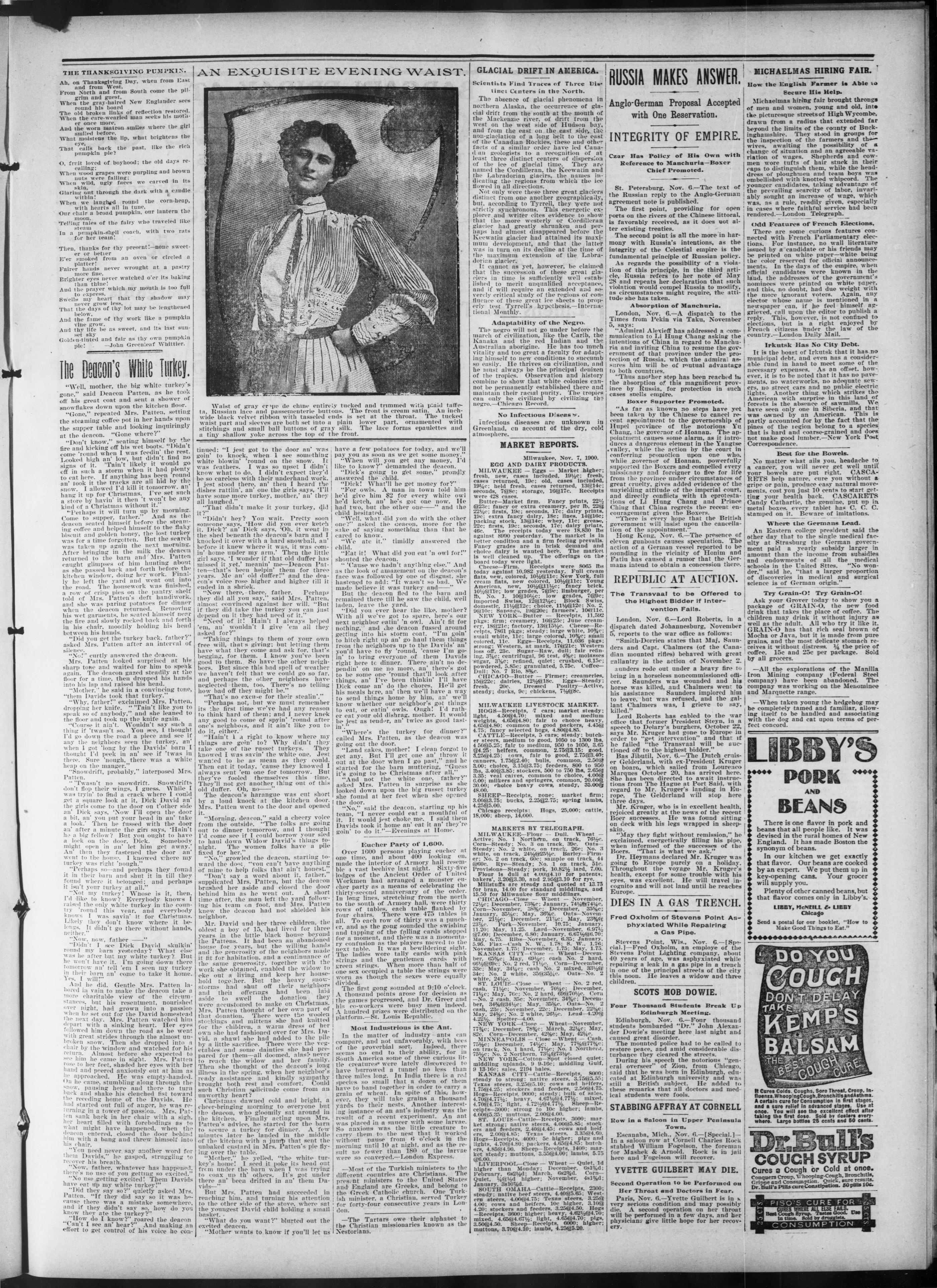
The Deacon's White Turkey.
"Well, mother, the big white turkey's gone," said Deacon Patten, as he took off his great coat and sent a shower of snowflakes down upon the kitchen floor.
"Gone," repeated Mrs. Patten, setting the steaming coffee pot in her hands upon the supper table and looking inquiringly at the deacon. "Gone where?"
"Don't know," seating himself by the fire and kicking off his wet boots. "Didn't come 'round when I was feedin' the rest. Looked high an' low, but didn't find no signs of it. 'Tain't likely it would go off in such a storm when it had plenty to eat here. If anything has been 'round an' took it the tracks are all hid by the snow. I allowed I'd kill it tomorrow, an' hang it up for Christmas. I've set such a store by havin' it then 't won't be any kind of a Christmas without it."
"Perhaps it will turn up by morning. Come to supper, father." And as the deacon seated himself before the steaming coffee and helped himself to the flaky biscuit and golden honey, the lost turkey was for a time forgotten. But the search was taken up again the next morning. After bringing in the milk the deacon returned to the barn and Mrs. Patten caught glimpses of him hunting about as she passed back and forth before the kitchen window, doing her work. Finally he left the yard and went out into the road. The housework was finished, a row of crisp pies on the pantry shelf, told of Mrs. Patten's deft handiwork, and she was paring potatoes for dinner when the deacon returned. Removing his wet garments, he seated himself near the fire and slowly rocked back and forth in his chair, moodily holding his head between his hands.
"Did you get the turkey back, father?" asked Mrs. Patten after an interval of silence. "No!" curtly answered the deacon. Mrs. Patten looked surprised at his sharp tone and waited for him to speak again. The deacon gazed steadily at the floor for a time, then dropped his hands into his lap and raised his head. "Mother," he said in a convincing tone, "them Davids took that turkey." "Why, father!" exclaimed Mrs. Patten, dropping her knife. "Tain't like you to speak so of anybody," and she leaned to the floor and took up the knife again. "Course it ain't. Wouldn't say such a thing if 'twasn't so. You see, I thought I'd go down the road a piece and see if any the neighbors seen the turkey, an' when I got 'long by the Davids' barn I thought I'd peek in an' see if 'twas in there. Sure 'nough, there was a white heap on the manger."
"Snowdrift, probably," interposed Mrs. Patten.
"Twasn't no snowdrift. Snowdrifts don't flop their wings, I guess. While I was tryin' to find a crack where I could get a square look at it, Dick David an' the girls come to the door on t'other side an' Dick says, 'Now I'll open the door a bit, an' you put your head in an' take a look.' Then he fussed with the door an' after a minute the girl says, 'Hain't he a big fellow? But you ought to have a lock on the door, Dick. Somebody might open in an' let him get away.' An' then they fastened the door an' went to the house. I knew where my turkey was right 'nough."
"Perhaps so—and perhaps they found it in their barn and shut it in till they found where it belonged; and perhaps it isn't your turkey at all."
"Not my turkey! Whose is it, then, I'd like to know? Everybody knows I raised the only white turkey in the country 'round this year, and everybody knows I was savin' it for Christmas. Likely they don't know where it belongs. It didn't go there without hands, neither."
"Now, now, father —"
"Didn't I see Dick David skulkin' round my barn yesterday? What else was he after but my white turkey? But he won't have it. I'm going down there tomorrow an' tell 'em I seen my turkey in their barn an' come to take it home. Yes, I will!"
And he did. Gentle Mrs. Patten labored in vain to make the deacon take a more charitable view of the circumstances, but his resentment, nourished over night, had grown into a passion when he set out for the David homestead the next day. Mrs. Patten watched him depart with a sinking heart. Her eyes followed him down the road as he went with great strides through the almost unbroken snow. Then she dropped into a chair by the window and watched for his return. Almost before she expected to see him he came in sight. Mrs. Patten rose to her feet, shaded her eyes with her hand and peered anxiously out at him as he approached. He was empty-handed. On he came, stumbling along through the snow, pausing here and there to turn back and shake his clenched fist toward the receding home of the Davids. He had started out full of anger, he was returning in a tower of passion. Mrs. Patten sank back in her chair with a sigh, her heart filled with forebodings as to what might have happened, when the deacon entered, closed the door behind him with a bang and threw himself into his chair.
"You need never say another word for them Davids," he gasped, struggling to recover his breath.
"Now, father, whatever has happened, there's no use of you getting so excited."
"No use getting excited! Them Davids have eat up my white turkey!"
"Did they say so?" quietly asked Mrs. Patten. "If they did say so it was because there was a mistake somewhere, and if they didn't say so, how do you know they ate the turkey?"
"How do I know?" roared the deacon. "Can't I see an' hear?" And making an effort to get control of his voice he cou
C
Waist of gray crope de chine entirely tucked and trimmed with praid taffetta, Russian lace and passemesterie buttons. The front is cream satin. An inch-wide black velvet ribbon with tasseled ends is set at the throat. The tucked waist part and sleeves are both set into a plain lower part, ornamented with stitchings and small ball buttons of gray silk. The lace forms epaulettes and a tiny shallow yoke across the top of the front.
Waist of gray crope de chine entirely tucked and trimmed with praid taffetta, Russian lace and passementerie buttons. The front is cream satin. An inch-wide black velvet ribbon with tasseled ends is set at the throat. The tucked waist part and sleeves are both set into a plain lower part, ornamented with stitchings and small ball buttons of gray silk. The lace forms epaulettes and a tiny shallow yoke across the top of the front.
tinued: "I jest got to the door an' was goin' to knock, when I see something white blowin' round on the snow. It was feathers. I was so upset I didn't know what to do. I didn't expect they'd be so careless with their underhand work. I jest stood there, an' then I heard the dishes rattlin', an' one the girls says, 'I'll have some more turkey, mother,' an' they all laughed."
"That didn't make it your turkey, did it?" have a few potatoes for today, and we'll pay you as soon as we get some money.
"When will you get any money, I'd like to know?" demanded the deacon.
"Dick's going to get some," proudly answered the child.
"Dick! What'll he get money for?"
"For owls. A man in town told him he'd give him $2 for every white owl he'd ketch, an' he's got one now. He had two, but the other one——" and the child hesitated.
"Didn't hey? You wait. Pretty soon someone calls, 'How did you ever ketch it. Dick?' an' Dick says, 'Oh, it went in the shed beneath the deacon's barn and I knocked it over with a hard snowball, an' before it knew where it was, it was comin' home under my arm.' Then the little girl says, 'I wonder if that old duffer has missed it yet,' meanin' me—Deacon Patten—that's been helpin' them for three years. Me an' old duffer!" and the deacon's voice rose higher and higher till it ended in a shriek.
"Now there, there, father. Perhaps they did all you say," said Mrs. Patten, almost convinced against her will. "But if they did take the turkey you can just depend on it they had need of it."
"Need of it! Hain't I always helped 'em, an' wouldn't I give 'em all they asked for?"
"Taking things to them of your own free will, that's giving; but letting them have what they come and ask for, that's begging, for them. I know you've been good to them. So have the other neighbors. But since this bad spell of weather we haven't felt that we could go so far, and perhaps the other neighbors have neglected them, too. There's no telling how bad off they might be."
"That's no excuse for their stealin'."
"Perhaps not, but we must remember its the first time we've had any reason to think hard of them; and I never kneek any good to come of spin' round after one's neighbors, and it ain't like you to do it, either."
"Hain't I a right to know where my things are gein' to? Why didn't they take one of the russet turkeys. They knew I was savin' the white one. Jest wanted to be as mean as they could. Then eat it today, 'cause they knew I always sent 'em one for tomorrow. But they've fooled themselves this time. They'll not get another thing out of this old duffer. Oh, no——"
The deacon's harangue was cut short by a loud knock at the kitchen door. Mrs. Patten went to the door and opened it.
"Morning, deacon," said a cheery voice from the outside. "The folks are going out to dinner tomorrow, and I thought I'd come see if I could borrow your sled to haul down Widow David's things tonight. The women folks have a pile fixed for her."
"No," growled the deacon, starting toward the door. "you can't have anything of mine to help folks that ain't honest."
"Don't say a word about it, father," supplicated Mrs. Patten, but the deacon brushed her aside and closed the door behind him as he went out. A short time after, the man left the yard following his team on foot, and Mrs. Patten knew the deacon had not shielded his neighbor.
Mr. David and her three children, the oldest a boy of 15, had lived for three years in the little black house beyond the Pattens. It had been an abandoned house for years, but the willing hands and the generosity of the neighbors made it fit for habitation, and a continuance of the same generosity, together with the work she obtained, enabled the widow to eke out a living and keep her household together. But the heavy snowstorms had shut off their neighbors and their offerings had been laid aside to swell the donation they were accustomed to make on Christmas. Mrs. Patten thought of her own part of that donation. There were the woolen stockings and mittens she had knitted for the children, a warm dress of her own she had fashioned over for Mrs. David, a shawl she had added to the pile by a little sacrifice. There were the vegetables and some dainties she had prepared for them—all doomed, alas! never to reach the widow and her family. Then she thought of the deacon's long illness in the spring, when her neighbor's ready assistance and kindly sympathy brought both rest and comfort. Could such Christian solicitude come from an unworthy heart?
Christmas dawned cold and bright, a cheer-bringing morning to everyone but the deacon, who gloomily sat around in the kitchen. Finally acting upon Mrs. Patten's advice, he started for the barn to secure a turkey for dinner. A few minutes later he landed in the middle of the kitchen with a jump that sent the unbaked custard in Mrs. Patten's pie flying over the table.
"Mother," he yelled, "the white turkey's home! I seed it poke its head out from under the barn when I was trying to coax up th' others. It's got under there an' been drifted in an' them Davids—"
But Mrs. Patten had succeeded in reaching him, and turning his attention to the other side of the stove, where sat the youngest David child holding a small basket.
"What do you want?" blurted out the excited deacon.
"Mother wants to know if you'll let us
have a few potatoes for today, and we'll pay you as soon as we get some money." "When will you get any money, I'd like to know?" demanded the deacon. "Dick's going to get some," proudly answered the child. "Dick! What'll he get money for?" "For owls. A man in town told him he'd give him $2 for every white owl he'd ketch, an' he's got one now. He had two, but the other one—" and the child hesitated. "Well, what did you do with the other one?" asked the deacon, more for the sake of saying something than that he cared to know. "We ate it." timidly answered the child. "Eat it! What did you eat 'n owl for!" shouted the deacon.
"Cause we hadn't anything else." And as the look of amazement on the deacon's face was followed by one of disgust, she hastened to add: "It wasn't so bad. We made believe it was turkey and——" But the deacon fled to the barn and remained there till he saw the child, well laden, leave the yard.
"Did you ever hear the like, mother? With all we've got to spare, here's our next neighbor eatin' 'n owl. Ain't fit for nothing," and the deacon fussed around getting into his storm coat. "I'm goin' to hitch right up an' go haul them things from the neighbors up to the Davids' an' you'll have to fly 'round, 'cause I'm goin' to bring everyone of them Davids right here to dinner. There ain't no dependin' on me no more, an' there's got to be some one 'round that'll look after things, an' I've been thinkin' I'll have Dick come an' do the chores. He'll get his meals here, an' then we'll have a way to send things home by him, an' we'll know whether our neighbor's got things to eat, or eatin' owls. Ough! I'd rather eat your old dishrag, mother. It would be jest as tender, an' twice as good tastin'."
"Where's the turkey for dinner?" called Mrs. Patten, as the deacon was going out the door.
"Land sakes, mother! I clean forgot to get any. But I'll get one an' throw it out at the door when I go past," and he started for the barn muttering, "Guess it's going to be Christmas after all."
"And not the white one, father?" asked Mrs. Patten in surprise as she looked down upon the big russet turkey she found at her feet when she opened the door.
"No," said the deacon, starting up his team, "I never could eat a mouthful of it. It would just choke me. I said them Davids took it home an' eat it an' they're goin' to do it."—Evenings at Home.
Eucher Party of 1,600.
Over 1600 persons playing eucher at one time, and about 400 looking on, made the interior of Armory hall resemble a vast beehive last night. Sixty-five lodges of the Ancient Order of United Workmen had arranged a monster eucher party as a means of celebrating the thirty-second anniversary of the order. In long lines, stretching from the north to the south of Armory hall, were thirty rows of tables, each table flanked by four chairs. There were 475 tables in all. To each row of thirty was a puncher, and as the gong sounded the swishing and tapping of the falling cards stopped for a moment, and there was a momentary confusion as the players moved to the next table. It was a bewildering sight. The ladies wore tally cards with pink strings and the gentlemen cards with green strings. When more than half of one sex occupied a table the strings were worn as though the sexes were equally divided.
The first gong sounded at 9:10 o'clock. A thousand points arose for decision as the games progressed, and Dr. Greer and his co-workers were busy men indeed. A hundred prizes were distributed on the platform.—St. Louis Republic.
Most Industrious is the Ant
In the matter of industry ants can compare, and not unfavorably, with bees of the proverbial sort. Indeed, there seems no end to their ability, for in South America some of these curious little creatures were lately discovered to have burrowed a tunnel no less than three miles long. In India there is a red species so small that a dozen of them have to band together in order to carry a grain of wheat. In spite of this, however, they will take grains a thousand yards to their nests. Another interesting instance of an ant's industry was the result of a recent experiment. An ant was placed in a saucer with some larvae. So anxious was the little creature to carry them to the nest that it worked without pause from 6 o'clock in the morning until 10 at night, and as the result no fewer than 180 of the larvae were so conveyed.—London Express.
Most of the Turkish ministers to the different countries are Christians. The present ministers to the United States and England are Greeks, and belong to the Greek Catholic church. One Turkish minister, a Christian, served Turkey for forty-four consecutive years in London.
The Tartars owe their alphabet to the Christian missionaries known as the Nestorians.
GLACIAL DRIFT IN AMERICA.
Scientists Find Traces of Three Distinct Centers in the North. The absence of glacial phenomena in northern Alaska, the occurrence of glacial drift from the south at the mouth of the Mackenzie river, of drift from the west on the west side of Hudson bay, and from the east on the east side, the non-glaciation of a long belt to the east of the Canadian Rockies, these and other facts of a similar order have led Canadian geologists to a recognition of at least three distinct centers of dispersion of the ice of glacial time. They are named the Cordilleran, the Keewatin and the Labradorian glaciers, the names indicating the regions from which the ice flowed in all directions.
Not only were these three great glaciers distinct from one another geographically, but, according to Tyrrell, they were not strictly synchronous. This energetic explorer and writer cites evidence to show that the more westerly or Cordilleran glacier had greatly shrunken and perhaps had almost disappeared before the Keewatin glacier had attained its maximum development, and that the latter was in turn on its decline at the time of the maximum extension of the Labradorian glacier.
It cannot as yet, however, be claimed that the succession of these great glaciers in time is sufficiently well established to merit unqualified acceptance, and if will require an extended and severely critical study of the regions of confluence of these great ice sheets to properly test Tyrrell's hypothesis.—International Monthly.
Adaptability of the Negro.
The negro will not go under before the march of civilization, like the Carib, the Kanaka and the red Indian and the Australian aborigine. He has too much vitality and too great a faculty for adapting himself to new conditions to succumb so easily. He thrives on civilization, and he must always be the principal deuizen of the tropics. Observation and history combine to show that white colonies cannot be permanently established there and maintain their racial purity. The tropics can only be civilized by civilizing the negro.—Chicago Record.
No Infections Diseases.
Infectious diseases are unknown in Greenland, on account of the dry, cold atmosphere.
MARKET REPORTS.
Milwaukee, Nov. 7, 1900.
EGG AND DAIRY PRODUCTS.
MILWAUKEE — Eggs — Market higher; fresh, new, cases included, 191%c; fresh, cases returned, 19c; old, cases included, 191%c; held fresh, cases returned, 13@14c; seconds, 7@8c; storage, 16@17c. Receipts were 428 cases.
Butter—Market firm. Fancy prints, 221%@23c; fancy or extra creamery, per lb, 22@221%c; firsts, 19c; seconds, 17c; dairy prints, 19c; extra fancy dairy, 18c; lines, 14@16c; packing stock, 13@14c; whey, 11c; grease, 22c; firsts, 19c; seconds, 17c; dairy prints, 46c. The receipts today were 18,830 lbs against 8990 yesterday. The market is in better condition and a firm feeling prevails. Fancy grades are in brisk demand and choice dairy is wanted here. The market is well cleaned up. The offerings on the board today were light.
Cheese—Firm. Receipts were 8065 lbs today against 10,982 yesterday. Full cream flats, new, colored, 10½@11¢; New York, full cream flats, new colored, 10½@11¢; Young Americas, new, 10½@11¢; fancy brick, 10½@11¢; low grades, 7@9; limburger, per lb. No. 1. 10@10¢; low grades, 7@9; imported Swiss, 12@12¢; Block Swiss, domestic, 11½@12¢; choice, 11½@12¢; No. 2. 9@10¢; Sapsago, 19@20¢; farmers, 10@11¢. NEW YORK—Butter— Receipts, 11,592 pkgs; firm; creamy, 16@23¢; June creamy, 18@21¢; factory, 13@15¢; Cheese—Receipts, 7861 pkgs; steady; large white, 10¢; small white, 11¢; large colored, 10¢; small colored, 11¢. Eggs—Receipts, 11,036 pkgs; strong; Western, at mark, 17@21¢; Western loss off, 23c. Sugar—Raw, dull; fair refining, 3¢; centrifugal, 96 test, 4¢; molasses sugar, 3¢; refined, quiet; crushed, 6.15c; powdered, 5.85c; granulated, 5.75c. Coffee—Dull. No. 7 Rio, 8¢%. CHICAGO—Butter— Firmer; creamers, 15@22¢; dairyles, 12½@18¢. Eggs—Steady; fresh, 20c. Dressed Poultry—Active; steady; ducks, 9c; chickens, 7½@8¢.
MILWAUKEE LIVESTOCK MARKET.
HOGS- Receipts, 7 cars; market steady.
light, 4.50@4.70; mixed and medium
weights, 4.65@4.80; fair to choice heavy,
4.65@4.80; common to good packers, 4.45@
4.75; fancy selected hogs, 4.80@4.85.
4.75; fancy selected hogs, 4.80@4.85.
CATTLE—Recelps, 5 cars; steady; butcher steers, medium to good, 1050 to 1300 lbs.
4.50@5.25; fair to medium, 950 to 1050, 3.65@4.25; helfers, common, 2.75@3.15; good.
3.25@4.25; cows, fair to good, 2.75@3.40; canners, 1.75@2.40; bulls, common, 2.50@3.00; choice, 3.15@3.75; feeders, 800 to 950 lbs, 3.40@3.85; stockers, 500 to 750 lbs, 2.65@3.35; veal calves, common to choice, 4.00@6.00; milkers and springers, common, 20.00@30.00; choice heavy cows, steady, 35.00@48.00.
SHEEP—Receipts, none; market firm;
3.00@3.75; bucks, 2.25@2.75; spying lambs,
4.25@5.00.
Chicago receipts: Hogs, 25,000; cattle,
18,000; sheep, 14,000.
MARKETS BY TELEGRAPH.
MILWAUKEE—Flour -- Dull. Wheat -- Active; No. 1 Northern; on track, 76c. Corn—Steady; No. 3 on track, 39c. Oats—Steady; No. 2 white; on track, 26c; No. 3 white, on track, 24½% of 25½c. Barley—Firmer; No. 2 on track, 60c; sample on track, 44@60c. Rye—Steady; No. 1 on track, 51c. Provisions—Steady; pork, 10.82% lard, 7.00. Flour is dull at 4.00% 4.10 for patents;
bakers', 3.20@3.30, and 2.95@3.10 for rye.
Millstillss are steady and quoted at 13.75 for bran, 14.00 for standard middlings, and 15.50 for Milwaukee flour middlings.
CHICAGO—Close — Wheat — November, 72%c; December, 73%c; January, 74%@74%c; Corn—November, 38%c; December, 35%c; January, 35%c; May, 36%c; Oats—November, 21%c; December, 21%c; May, 23%@23%c; Pork—November, 10.75; January, 11.20; May, 11.25; Lard—November, 6.97%@7.00; December, 6.80; January, 6.67%@6.70; May, 6.75; Ribs—November, 6.35; January, 5.95; Flax—Cash W. W., 1.78; S. W., 1.75; November, 1.75; December, 1.75; May, 1.75
KANSAS CITY—Close — Wheat—December, 65%c; May, 69%c; cash No. 2 hard, 66%@69; No. 2 red, 71%c; Corn—December, 33%; May, 34%c; cash No. 2 mixed, 33%@34c; No. 2 white, 35%@35%c; Oats—No. 2 white, 24%c
ST. LOUISE—Close — Wheat — No. 2 red,
cash, 71½c; November, 70½c; December,
71½c; May, 76c; No. 2 hard, 69@70½c; Corn
—No. 2 cash, 35c; November, 34½c; December,
34½@34½c; May, 35½c; Oats—No. 2
cash, 23c; November, 22c; December, 22½c;
May, 24½c; No. 2 white, 26½c; Lead —4.20
@4.22½c; Spelter —4.00.
NEW YORK—Close — Wheat—November,
77½c; December, 78½c; March, 32½c; May,
82c; Corn—December, 42½c; May, 42½c.
MINNEAPOLIS Close -Whent Cash
75%; December; 74%; May; 77%;@77%; on track, No. 1 hard; 77%; No. 1 Northern;
75%; No. 2 Northern; 74%;@73%.
NEW YORK—Cotton—Spot closed quiet;
middling uplands, 9 9-16c; middling Gulf,
9 13-16c; sales, 2194 bales.
KAN$AS CITY—Cattle-Receipts, 8000;
steady to strong; native steers, 3.75@5.55;
Texas steers, 3.25@5.10; cows and heifers,
1.75@4.25; stockers and feeders, 2.50@4.75;
Hogs—Receipts, 9000; steady; bulk of sales,
4.70@4.77½; heavy, 4.67½@4.77½; mixed,
4.70@4.75; light, 4.72½@4.77½; Sheep—Receipts,
3000; strong to 10c higher; lambs,
4.00@5.35; muttons, 2.00@4.00.
ST. LOUISE—Cattle-Receipts, 3000; market strong; native steers, 4.00@5.85; stockers and feeders, 2.40@4.45; cows and heifers,
2.00@4.85; Texas steers, 3.35@4.60;
Hogs—Receipts, 4000; 5c pigs and lights,
4.70@4.80; packers, 4.65@4.85; butchers,
4.85@4.90. Sheep—Receipts, 1400; market steady; muttons, 3.55@4.00; lambs, 5.75@6.00.
LIVERPOOL—Close — Wheat — Quiet, 1d higher than Monday; December, 6s1½d;
February, 6s2½d; March, 6s2½d. Corn—Quiet, ½¼d higher; November, 4s1½d;
January, 3s10¼d.
SOUTH OMAHA—Cattle-Receipts, 2300;
steady; native beef steers, 4.40@5.63; Western
steers, 4.00@4.75; Texas steers, 3.25@
4.00; cows and heifers, 10c heifers, 3.10@
4.20; stockers and feeders, 3.25@4.50. Hogs
—Receipts, 3600; higher; heavy, 4.62½@4.70;
mixed, 4.65@4.67½; light, 4.65@4.70; plgs,
3.50@4.50. Sheep—Receipts, 6000; higher;
muttons, 3.70@4.10; lambs, 4.52@5.20.
RUSSIA MAKES ANSWER
Anglo-German Proposal Accepted with One Reservation.
INTEGRITY OF EMPIRE.
Czar Has Policy of His Own with Reference to Manchuria-Boxer Chief Promoted.
St. Petersburg, Nov. 6.—The text of the Russian reply to the Anglo-German agreement note is published.
The first point, providing for open ports on the rivers of the Chinese littoral, is favorably received, as it does not alter existing treaties.
The second point is all the more in harmony with Russia's intentions, as the integrity of the Celestial empire is the fundamental principle of Russian policy.
As regards the possibility of a violation of this principle, in the third article, Russia refers to her note of May 28 and repeats her declaration that such violation would compel Russia to modify, as circumstances might require, the attitude she has taken.
Absorption of Manchuria.
London, Nov. 6.—A dispatch to the Times from Pekin via Taku, November 5, says:
"Admiral Alexieff has addressed a communication to Li Hung Chang asking the intentions of China in regard to Manchuria and inviting China to resume the government of that province under the protection of Russia, which the admiral assures him will be of mutual advantage to both countries.
"Thus another step has been reached in the absorption of this magnificent province by Russia, for protection in such cases suells empire.
Boxer Supporter Promoted.
"As far as known no steps have yet been taken by the Chinese to cancel recent appointment to the governorship of Hupel province of the notorious Yu Chang, the governor of Hoanan. The appointment causes some alarm, as it introduces a dangerous element in the Yangtse valley, while the action by the court in conferring promotion upon one who, while governor of Hoanan, powerfully supported the Boxers and compelled every missionary and foreigner to flee for life from the province under circumstances of great cruelty, gives added evidence of the unyielding attitude of the imperial court, and directly conflicts with th eprotestations of Li Hung Chang and Prince Ching that China regrets the recent encouragement given the Boxers.
"There is every hope that the British government will insist upon the cancellation of the appointment."
Hong Kong, Nov. 6.—The presence of eleven gunboats causes speculation. The action of a German vessel reported to be sounding in the vicinity of Honim and Fatin has caused a rumor that the Germans intend to obtain a concession there.
REPUBLIC AT AUCTION.
The Transvaal to be Offered to the Highest Bidder if Interventlon Falls.
London. Nov. 6.—Lord Roberts, in a dispatch dated Johannesburg, November 5, reports to the war office as follows:
"Smith-Dorrien states that Maj. Saunders and Capt. Chalmers (of the Canadian mounted rifles) behaved with great gallantry in the action of November 2.
Saunders rode out under a heavy fire to bring in a horseless noncommissioned officer. Saunders was wounded and his horse was killed, and Chalmers went to his assistance Saunders implored him to leave, but was refused, and the gallant Chalmers was, I grieve to say, killed."
Lord Roberts has cabled to the war office that former President Steyn, in a speech to Delary's burghers, October 22, says Mr. Kruger had gone to Europe in order to "get intervention" and that if he failed "the Transvaal will be auctioned off to the highest bidder."
Bas Jibutil, Nov. 6.—The Dutch cruiser Gelderland, with ex-President Kruger on board, which sailed from Lourenco Marques October 20, has arrived here. She has been directed to await instructions from The Hague at Port Said, with regard to Mr. Kruger's landing in Europe. The Gelderland will stop here three days.
Mr. Kruger, who is in excellent health, rejoiced greatly at the news of the recent Boer successes. He was found sitting on deck with his legs wrapped in sheepskin.
"May they fight without remission," he exclaimed, energetically filling his pipe, when informed of the successes of the Boers. "That is what we ask."
Dr. Heymans declared Mr. Kruger was going to Europe purely on a holiday. Throughout the voyage Mr. Kruger's health, except for some trouble with his eyes, was excellent. He will travel incognito and will not land until he reaches Europe.
DIES IN A GAS TRENCH.
Fred Oxholm of Stevens Point Asphyxiated While Repairing a Gas Pipe.
Stevens Point, Wis., Nov. 6.—[Special.]—Fred Oxholm, an employee of the Stevens Point Lighting company, about 40 years of age, was asphyxiated while repairing a leak in a gas pipe in a trench in one of the principal streets of the city this noon. He leaves a widow and three children.
SCOTS MOB DOWIE.
Four Thousand Students Break Up Edinburgh Meeting.
Edinburgh, Nov. 6.—Four thousand students bombarded "Dr." John Alexander Dowie's meeting here last night and caused great disorder.
The mounted police had to be called to restore peace, and amid considerable disturbance they cleared the streets.
During his speech the notorious "general overseer" of Zion, from Chicago, said that he was born in Edinburgh, educated at Edinburgh university and was still a British subject. He added to these remarks that all doctors and medical students were fools.
STABBING AFFRAY AT CORNELL
Row in a Saloon in Upper Peninsula Town.
Escanaba, Mich., Nov. 6.—[Special.]—In a saloon row at Cornell Charles Rock stabbed William Fogelson, the foreman for Mashek & Arnold. Rock is in jail here and Fogelson will recover.
YVETTE GUILBERT MAY DIE.
Second Operation to be Performed on Her Throat and Doctors in Fear.
Paris, Nov. 6.—Yvette Guilbert is in very serious condition and may possibly die. A second operation on her throat will be performed in a few days, and her physicians give little hope for her recovery.
MICHAELMAS HIRING FAIR.
How the English Farmer is Able to Secure His Help.
Michaelmas hiring fair brought throngs of men and women, young and old, into the picturesque streets of High Wycombe, drawn from a radius that extended far beyond the limits of the county of Buckinghamshire. They stood in groups for the inspection of the farmers and the wives, awaiting the possibility of a change of situation and an agreeable variation of wages. Shepherds and cowmen wore tufts of hair stuck in their caps to distinguish them, while the head-dress of ploughmen and team boys was embellished with knotted whipcord. The younger candidates, taking advantage of the prevailing scarcity of labor, invariably sought an increase of wage, which was, as a rule, readily given, especially in cases where faithful service had been rendered.—London Telegraph.
Odd Features of French Elections.
There are some curious features connected with French Parliamentary elections. For instance, no wall literature issued by a candidate or his friends may be printed on white paper—white being the color reserved for official announcements. In the days of the empire, when official candidates were known in the land, the addresses of the government's nominees were printed on white paper, and this, no doubt, had due weight with the more ignorant voters. Again, any elector whose name is mentioned in a newspaper can, if he feel himself aggrieved, call upon the editor to publish a reply. This, however, is not confined to elections, but is a right enjoyed by French citizens under the law of the country.—London Daily Mail.
Irkutsk Has No City Debt.
It is the boast of Irkutsk that it has no municipal debt, and even has a considerable fund in hand to meet some of the necessary expenses. As an offset, however, it is to be noted that it has no pavements, no waterworks, no adequate sewers, no street cars and no public electric lights. Another thing which strikes the American with surprise in this land of forests is the absence of sawmills. We have seen only one in Siberia, and that was owned by an American. This is partly accounted for by the fact that the pines of the region belong to a species that is hard and coarse-grained and does not make good lumber.—New York Post Correspondence.
Best for the Bowels.
No matter what ails you, headache to a cancer, you will never get well until your bowels are put right. CASCARETS help nature, cure you without a gripe or pain, produce easy natural movements, cost you just 10 cents to start getting your health back. CASCARETS Candy Cathartic, the genuine, put up in metal boxes, every tablet has C. C. C. stammed on it. Beware of imitations.
Where the Germans Lead.
An Eastern college president said the other day that to the single medical faculty at Strasburg the German government paid a yearly subsidy larger in amount than the income from subsidies and endowments of all the medical schools in the United Sttes. "No wonder," said he, "that a larger proportion of discoveries in medical and surgical science is of German origin."
Try Grain-O! Try Grain-O!
Ask your Grover today to show you a package of GRAIN-O, the new food drink that takes the place of coffee. The children may drink it without injury as well as the adult. All who try it like it. GRAIN-O has that rich seal brown of Mocha or Java, but it is made from pure grains, and the most delicate stomach receives it without distress. $ \frac{1}{4} $ the price of coffee. 15c and 25c per package. Sold by all grocers.
—All the explorations of the Manilla Iron Mining company (Federal Steel company) have been abandoned. The company was working on the Menominee and Marquette range.
—When taken young the hedgehog may be completely tamed and familiar, allowing itself to be handled and associating with the dog and cat upon terms of perfect concord.
There is one flavor in pork and beans that all people like. It was devised in the rural homes of New England. It has made Boston the synonym of beans.
In our kitchen we get exactly that flavor. Our beans are cooked by an expert. We put them up in key-opening cans. Your grocer will supply you.
Plenty of other canned beans, but that flavor comes only in Libby's.
Send a postal for our booklet, "How to
Make Good Things to Eat."
DO YOU
COUGH
DON'T DELAY
TAKE
KEMP'S
BALSAM
THE BEST COUGH CURE
R Cures Colds. Coughs, Sore Throat, Croup, Influenza, Whooping Cough, Bronchitis and Asthma. A certain cure for Consumption in first stages, and a sure relief in advanced stages. Use at once. You will see the excellent effect after taking the first dose. Sold by dealers everywhere. Large bottles 25 cents and 50 cents.
Dr.Bull's COUCH SYRUP
Cures a Cough or Cold at once.
Conquers Croup, Whooping-Cough, Bronchitis, Grippe and Consumption. Quick, sure results.
Dr. Bull's Pills cure Constipation. 50 pills 10c.
PISO'S CURE FOR
CURES WHERE ALL ELSE FAILS.
Best Cough Syrup. Tastes Good. Use
in time. Sold by druggista.
CONSUMPTION
The Wisconsin Weekly Advocate
Richard B. Montgomery.....Editor and Proprietor
Office 200 Fifth Street.
Telephone Black No. 244.
SUBSCRIPTION RATES.
One Year ..... $2.00
Six Months ..... 1.25
Three Months ..... .75
Send money by Express Money Order, P. O.
Money Order or Registered Letter to the
Wisconsin Weekly Advocate.
ADVERTISING RATES.
One inch, single insertion..... 25c
One inch, per year..... $9.00
Business locals 5c per line each insertion.
Apply for rates to the Advocate.
TO CONTRIBUTORS:
All communications must be sent with the name and address of the sender as an evidence of good faith, but not necessarily for publication. No manuscript returned if not accepted, unless accompanied by stamps.
All subscribers of the Advocate that fail to get their paper promptly will please notify us at once. The Advocate, at 200 Fifth street.
The Wisconsin Weekly Advocate company wishes to notify the public that all contracts and business transactions with this company must have the company stamp, otherwise they will be void. Neither will this company be responsible for paid subscriptions unless given to duly-accredited agents, who, on request, will give the company's receipt for same. Subscribers failing to receive their papers regularly will kindly notify the general office. Address all business communications to the general manager, 200 Fifth street.
Entered at the Milwaukee P. O. as second-class matter.
The report from California that prunes will be plentiful has been received with mournful silence in boarding-house circles.
The mud on the padded pantaloons of the football player shows how old scores are wiped out in the earth-disturbing game.
The new Shamrock will probably have skippers enough, but nobody believes the report that she is to be made of green cheese
The pork "shorts" will give Sir Thomas the cup if he will only ease up on the market long enough for them to get on the other tack.
The Australian suggestion that Queen Victoria's title be changed to Empress of the British Empire suggests the query, "Could she be Empress of anything else?"
The Chattanooga mother who used the hatchet cure for the cigarette habit probably prevented one case of hereditary insanity that would have been charged against tobacco.
The insanity plea made in the case of Ferrell, the murderer of Express Messenger Lane, would have been applicable to the jury had it brought in any other verdict than that of guilty.
Although the Duke of Abruzzi lost several fingers in the Arctic regions, his charter of a Swedish whaler for another expedition shows that he will continue to play for the pole with a full hand.
The suit against a Chicago firm charged with bottling Lake Michigan water for Waukesha water reveals the extent to which Chicagoans have become convinced of the beneficence of the big drainage canal.
Should Emperor Nicholas call the representatives of the world's powers together for another peace conference, many of them will have to scrub off the grime of war in order to make themselves presentable.
The Spaniards who blew up the forward part of the Maine could improve Havana's harbor by telling Gov.-Gen. Wood how to lift the remainder of the ship; but they will prudently refrain from acknowledging their skill.
Chicago's Calumet harbor scheme is suspiciously like another attack on Lake Michigan. But tapping the lake in two places will not increase the capacity of the drainage canal, and the lake interests will look on with serenity.
There may be a little satisfaction to British manufacturers in knowing that the orders which have been sent to the United States from South Africa were placed on this side of the Atlantic because Yankee workmen can turn out orders in quicker time.
It seems rather rough that because a certain bank employee wouldn't tell while he was kiting a round million of stealings, the other fellows who tell honestly and frankly should be caged from temptation. But in banking rules cannot be suspended without danger of suspending payment.
In getting within the purview of the Paris police, King George of Greece and the King of Belgium have apparently attested the bewildering quality of the atmosphere of the gay capital. But in these instances the atmosphere may have been only a side-board partner of other things that confuse.
The remark of Alvord, the New York bank embezzler, that "$700,000 is a lot of money, but it goes easy," is full of admonition for young men of the "fast sets" who imagine that they can go as they please with what seem like good bank accounts to back them.
When London gets on a drunk in welcoming her returning heroes, the resultant casualties should not be compared with the numerical strength of the innocent cause of it, but with the city's population. There is a great deal of London that gets fuddled on slight provocation.
William Saunders, who died in Washington the other day, was the oldest attache of the department of agriculture. He had received a thorough training in Scotland and England as a horticulturist and landscape gardener, and was first employed in this country by Johns Hopkins, in Baltimore. Forty-six years ago he formed a partnership with Thomas
Meehan, at Germantown, and to him Philadelphia owes the designs of Hunting and Fairmount parks. The beautiful arrangement of the graves of the fallen in the National cemetery at Gettysburg was also his work. At one time Mr. Saunders was the foremost writer on horticultural subjects in the United States.
Whenever war devastates countries they look to America to patch things up with neatness and dispatch. American bridge builders got contracts from Egypt while Lord Kitchener was campaigning in that country; large orders are coming from South Africa; and bridge builders are asked to replace the bridges destroyed in China.
The calling out of a detachment of Texas rangers to quell a possible disturbance growing out of the killing of a man at Cotulla is evidence that the value of human life is advancing in the Lone Star State. It is only a short time since Texas exhibited pride rather than trepidation over fatal social disturbances.
More seals were caught in the Arctic ocean during the season just ended than during any of the three preceding years. The treasury department has just received a dispatch from its agent in the fur seal district stating that 21,944 seals were taken during the season ending August 31. The figures for last year were 16,812, and for 1898 they were 18,047. The government has limited the take of any one year to 36,000 animals, but the hunters have been unable to find that number of eligible seals in any year since the limitation was applied. The agents of the department are now engaged in making a survey of the seal rookeries and hauling grounds with a view to obtaining trustworthy data upon which to base estimates of the condition of seal life.
It is announced that the Victoria Cross has been bestowed on Sergt. Arthur P. Lindsay of Strathcona's Horse, for rescuing a wounded trooper in the face of a heavy Boer fire at North Standerton on August 5. Only one other Canadian has ever previously gained the distinction of the V. C. He was Alexander Roberts Dunn, son of the Hon. J. H. Dunn, receiver-general of Canada. The circumstances were these: Dunn was a lieutenant in the Eleventh Hussars, and in the charge of the Light brigade, during the battle of Balaclava, seeing Sergt. Bennett, of his own corps at the mercy of a Russian artilleryman, he rode at the latter, struck him to the earth and killed him, rescued Sergt. Bennett and then rode to the succor of two others of his regiment, saving them both from death. Dunn was the first cavalryman to receive the cross, and also among the first of those recommended after its institution by the Queen in 1855.
A translation of old Dutch records of New Amsterdam is being made under the auspices of the Colonial Dames of New York, and will be published. The data embraces historical and genealogical matter of the period 1654 to 1670. The originals are in the state archives and suffering from age and handling. While these records are largely genealogical, there is much of interest concerning New York, the early names of its streets, and the quaint form of city government, particularly the paternal tendencies of the city fathers, who acted even in the capacity of matchmakers for the widows of men who had served in the city government. The records will be published in substantial volumes. The Colonial Dames will also have brass tablets placed upon the two graystone houses built on the Hudson by Sir William Johnson for himself and son, Sir Guy Johnson.
On the grounds selected as the site of the South Carolina Interstate and West Indian exposition, there stands an old colonial home, which was the scene of lavish comfort and open-hearted hospitality in days gone by. It is proposed to restore this old home, now somewhat touched by the tooth of time, to something of its original state, and to collect within its walls valuable relics of the past. No state in the Union, perhaps, says the Boston Transcript, contains more of these relics than South Carolina, and some of these are not only notable as antiques, but have the added value of being historic. The table which Henry Laurens, president of the Congress of 1777, used while he was a prisoner in the Tower of London, is in the possession of a lady of South Carolina; few cities possess finer specimens of the work of the most famous of the early miniaturists than Charleston does, while the old plantation homes on the Ashley and the Cooper, which in some cases have been in the same family for more than 200 years, are full of reminders of the men who made South Carolina a great state in the early days of the republic, and whose memories are still kept green.
Unique among the industries of the great Southwest stands the capture, sale and exportation of that remarkable saurian, the Gila monster. This creature, who finds its habitat on the dry and sandy mesas of southern Arizona, has been for years accorded chief place in the quartette of Arizona horrors—which also includes the rattler, the tarantula and the scorpion. Contrary to his established reputation, however, the Gila monster is, as a rule, a comparatively inoffensive member of society, contenting himself with basking in the sun, puffing like a steam engine and sending forth a greenish, frothy slime from his mouth. According to the Chicago American, there is at present a boom in the Gila monster industry; museums, natural history clubs and scientific clubs all over this country and in Europe are sending for specimens of this native Arizonian. The Indians—Pimas and Maricopas—and the Mexicans do a thriving business in their capture, receiving $5 apiece for each saurian. Securely caged, there are frequently ten or a dozen a week shipped from Phoenix, which is the center of the traffic. There are nearly always waiting orders, the supply being inadequate to the demand. A number of the orders recently filled have been for England and the Continent.
—The Anaconda Copper Mining company has declared a dividend of $1.25 a share with 75 cents extra, payable on October 27. The amount is $2,400,000, making a total so far this year of $4,800,000, and a grand total since incorporation three years ago of $16,950,000.
BARGAIN FRIDAY AT PERSON & RIEGEL CO.
Men's Underw'r
36c for Men's Fine Fleeced Camels'- Hair Shirts and Drawers, well finished, all sizes, winter weight.
Linens and
31C for 6-cent Huck Towelings extra good quality. Just for you.
Linens and Towels
$ 3 _ {2} ^ {1} \mathrm {C} $ for 6-cent Huck Towelings, 18 inches wide, extra good quality. Just one case here for you.
---
Milwaukee and Chicago
NORTHERN WISCONSIN RAILROAD LANDS
Are increasing in value from year to year. Railroads are the great civilizers, for they give the settler as well as the manufacturer equal opportunity to work in undeveloped fields, thereby rapidly settling the country and bringing forth its undiscovered riches. Northern Wisconsin is rich in iron ore, clay, kaolin, marl, timber and fine farm lands. It has made many a settler independent and added to the wealth of manufacturers who have sought this territory. Opportunities have not passed, as there is still a generous supply of land which can be obtained at low figures and on easy terms.
THE WISCONSIN CENTRAL RY.
Was one of the first roads to penetrate the vast Northern Wisconsin Wilderness which stretches across the State from east to west. It, also, has developed from year to year and today offers the best of transportation facilities, enabling all to ship the products of that section to any market in the world. Illustrated pamphlets and maps which are interesting as well as instructive can be obtained by addressing W. H. KILLEN,
Land & Industrial Commissioner; Geo. T. Jarvis, Gen. Mgr.; Burton Johnson, G. F. A., or Jas. C. Pond, G. P. A., Colby & Abbot Building, Milwaukee, Wis.
Marquette
Houghton
AND
Calumet
VIA
THE
NORTH-WESTERN
LINE
C & N W R Y
Through Sleepers
TO THE
COPPER
COUNTRY
Leave Milwaukee
12.35 a.m.
Daily, and
5.15 a.m.
Daily Except Sunday.
Same Excellent Service
South Bound.
TICKET OFFICES,
Chicago & North-Western Ry.
102 Wisconsin Street and
Depot on Lake Front.
RED JACKET
CALUMET
LAKE LINDEN
HANCOCK
HOUGHTON
L'ANSE
NESTORIA
ISHPEMING
MARQUETTE
NEGAUNEE
WEST
GLADSTONE
ESCANABA
MENOMINEE
MARINETTE
OCONTO
GREEN BAY
APPLETON
NEENAH-MENASHA
OSHKOSH
FOND DU LAO
MILWAUKEE
RACINE
KENOSHA
CHICAGO
Before Starting on Your Travels
CALL ON
Geo. Burroughs & Sons
MANUFACTURERS OF
PREMIUM TRUNKS
VALISES, SAMPLE CASES, Etc.
424 & 426 East Water St., Milwaukee.
---
T
18c for 25-cent Damask Towels, with knotted fringe plain white and colored borders.
$6^{1}_{2}c$ the yard for 8-cent fine, soft finish bleached muslin full 36-inch width.
19c for 25c Outing Flannel Skirt Patterns, crochet edge, some plain, some stripes and some checks.
For the Safest and Quickest Road between
Take the Chicago; Milwaukee & St. Paul Railway.
Laces, Ribbons, Handkerchiefs
3½C the yard for Torchon Laces, made to wear, specially fine qualities, insertions to match, 1 to 4 inches wide.
4C for Men's Plain White and Colored BorderHemstitched Handkerchiefs—our regular 6-cent line.
2C for Ladies' and Children's Plain White Hemstitched Handkerchiefs.
Friday's Shoe B
Boys' and Youths' German Calf Lace Shoes, with extension sole and steel shod bottoms, English back stay.....$1.50
Children's Hand-Turned Lace and Button Kid Shoes, patent tips, all sizes.....59c
Ladies' Felt and Leather Sole House Slippers—while they last.....29c
Children's sizes—not an over-large quantity.....23c
98c for a full-size Comforter, all-over floral designs and stripes sold up to today at $1.25 each.
52c for choice of a large line of Cushions, 75c values, fancy figured denims, some plain and some ruffled.
ST. MARK'S A. M. E. CHURCH
Corner Fourth and Cedar Sts.
REV. T. W. LEWIS, PASTOR.
Local Preacher, Gilbert Hamilton.
Residence, 256 Seventh Street,
MILWAUKEE, WIS.
SERVICES SUNDAY 10:45 and 7:45
SUNDAY SCHOOL 3 P. M.
CHRISTIAN ENDEAVOR 7 P. M.
ALL ARE WELCOME.
BEARING
MORE
respondence and
diding.
Catalogue.
WRITER and
wisconsin and
miligan.
ROADWAY,
Milwaukee, Wis.
OST
extract
Tonic
with the body
rings refresh-
res a healthy
appetite, aids
gestion and
edits blood,
rain and bone
cannot fail
benefit in
every case
here more
strength is re-
quired. Once
ed, you will
ever take a
substitute.
YOUR DRUGGIST
THE
ARTIST
ART
Darlor
...UNIC
Laundry and
No. 432 State
GEO. W. S
...ALL WORK CARE
Lowest Prices and Satisf
The Emerson
CORNER GRAND AVENUE A
MILWAUKEE
MR. GEORGE A. S.
ager of R. B. Gre
facturers of the Celebrated
Made Shoes, begs leave
many citizens of Milwaukee
they have opened a new
the new building on the
Third St. and Grand A
line of goods. This make
the firm at the present ti
A Goodyear Welt costs $5.00. The goods are honest all
solicited.
British Slow to Make Changes.
DENSHOLD
DENSMORE
Builds up both the body and nerves; brings refreshing sleep, insures a healthy
216 1/2 GRAND AVENUE
Opposite Flanner's Music Store
MILWAUKEE, WIS.
---
16c for Extra Large Huck Towels hemstitched-red borders-a good 20-cent grade.
4 $ _{1/2} $ c for yard-wide unbleached Muslin, very fine quality, worth 6 cents.
52c for excellent quality 10-4 Cotton Blankets,worth 65c, white and gray with borders.
Telephone 883.
E. D. Haven, Manager.
BEST MALT EXTRACT
The Best Taste
MALT EXTRACT
HOPP
PABST BREWING CO.
MILWAUKEE, WI.
14c for 25-cent Taffeta Ribbons in the very latest corded and lace effects-beautiful tints mostly 5-inch widths.
2c for Ladies' and Children's Plain White Hemstitched Handkerchiefs.
nose Bargains
worth $2.50 and $3.00 the pair.
At
1.95
Ladies' Vici Kid
Shoes—
Ladies' Box Calf
Shoes—
Ladies' Patent
Leather Shoes—
Ladies' Common
Sense Shoes—
either lace or but-
ton, handturned or
extension soles—
English back stays,
new style lasts.
Friday's Shoe Bargains
52c for choice of a large line of Cushions, 75c values, fancy figured denims, some plain and some ruffled. 6 $ _{2}^{1} $ c for 8c Silkolines in a great variety of pretty floral and Persian designs right for draperies.
307 REED STREET and Always Open 410 GRAND AVENUE.
Telephones:
South 122.
Grand 2467. Milwaukee, Wis.
UNION...
Bry and News Co.
432 State Street
W. SAYLES
CAREFULLY DONE...
and Satisfaction Guaranteed.
Persson Shoe Co.
BID AVENUE AND THIRD STREET,
MILWAUKEE, WIS.
GE A. SCHECK, the man-
R. B. Grover & Co., manu-
Celebrated Comfortable Custom
gles leave to announce to the
Milwaukee and vicinity that
ed a new store in this city in
g on the northeast corner of
Grand Ave. and carry a full
This makes 31 stores run by
present time.
Lelt costs $3.50 and a Handsewed
are honest all through and inspection is
THE BAKERY
The Emerson Shoe Co.
CORNER GRAND AVENUE AND THIRD STREET MILWAUKEE, WIS.
MR. GEORGE A. SCHECK, the manager of R. B. Grover & Co., manufacturers of the Celebrated Comfortable Custom Made Shoes, begs leave to announce to the many citizens of Milwaukee and vicinity that they have opened a new store in this city in the new building on the northeast corner of Third St. and Grand Ave. and carry a full line of goods. This makes 31 stores run by the firm at the present time.
A Goodyear Welt costs $3.50 and a Handsewed $5.00. The goods are honest all through and inspection is solicited.
---
M.
The London & Southwestern Railway company recently took off six trains in each direction which had been running between Richmond and Ludgate Hill. The service, be it noted, had been in force since 1869. Here is the curious point: The trains in question have always been run at a loss; they do not in any way act as a feeder to the main line, and
5C for Ladies' 8-cent Unlaunered Initial Handkerchiefs—narrow hemstitch.
```markdown
```
$ 6^{1} \mathrm{~C} $ for 8c Silkolines in a great variety of pretty floral and Persian designs right for draperies.
EMBALMERS and FUNERAL DIRECTORS
MRS. JAMES T. BRETT, Lady Undertaker.
they are not the trains used by season-ticket holders. To the lay mind these three reasons seem sufficiently strong to have justified the company long ago in discarding the service; instead of which it has been run at a loss for thirty years. —London Sphere.
—Ore which runs from $5 to $14.80 in gold per ton has been encountered on Spencer mountain, near Eldora, Col. The vein is 3 feet wide.
KEEPS LONELY VIGIL.
LIGHTHOUSE MAN HAS WORRY AND RESPONSIBILITY.
Works Amid Deep Solitude and Must Endure All Sorts of Weather-Place an Appointive One and Free from Wiles of Politicians.
The keeper of a marine lighthouse has not a job, but an office. He is a Presidential appointee and holds a commission which when read out sounds as important as that of the collector of customs or the postmaster. He holds an office of large trust and high responsibility. He is to keep his lamp trimmed and burning from the dusk of evening till the next daylight. His post is advanced to the edge of the deep and often raging waters—it is a lonely situation and through nights of all weathers he must stay and be vigilant at his post. Should he fall once in the performance of duty what disaster to vessels and crews might not come! The navigator knows and testifies to his worth in the position where he has been placed by the government, but it is certain that he is not much regarded by the general public.
LIGHTHOUSE
THE LIGHTHOUSE
The first lighthouse in the Chicago harbor, says the Chronicle, if it could be so denominated, when the smallest vessels made their way with peril into the shallow mouth of the unimproved river, was erected in 1831. Reckoning from that date, which, in fact, was six years earlier than the city's birth as a corporation, the vast commecne now carried on here had its beginning only sixty-nine years ago. There is nothing like this commercial wonder in the world now, nor ever was. All this since an immense number of men still living and not yet accounted old were born! from melting and also the burning up. Sometimes burn a whole night with snuffing. This, notwithstanding that the intensity of the is about equal to that of five ordinary Carcel burn description applies to the lenses, which are used lights on the seacoast. I order of lenses, such as lights in the Chicago h with three concentric wied. The annual consumes the lenses of the first or
When it first was in agitation to erect a lighthouse here of the old pattern, with a stationary light of no great power, there was a man in France deep in studies and busy with experiments to produce a marine light on a new principle that should take the place of every other the world round. Fresnel was that man. Indeed, he began with his experiments ten years earlier. Over in France was Fresnel at work on a marine light that was destined to send its appraising flashes from six several towers in the Chicago harbor over the waters to the horizon. The Frenchman lived to perfect his light; he was appointed secretary to the lighthouse board of France in 1825 and while he was in that position he replaced reflectors with lenses and invented the revolv-
This map shows the formation of the land which scientists now affirm connected Australia, Africa and America, making of the three one great antarctic continent. For proof of this the fact is pointed out that the ancient sea beaches of Patagonia, which are now far inland, have imbedded in them fossil shells.
This map shows the formation of the land which scientists now affirm connected Australia, Africa and America, making of the three one great antarctic continent. For proof of this the fact is pointed out that the ancient sea beaches of Patagonia, which are now far inland, have imbedded in them fossil shells
SOUTH
PACIFIC OCEAN
NEW
ZEALAND
SOUTH
AMERICA
SOUTH
ATLANTIC
OCEAN
FALKLAND
which are exactly like those found in parts of Australia. It is probably more than 1,000,000 years ago that the continuous coastline of both continents became divided.
The fauna of the three countries are beyond doubt descendants from the same ancestors, for it is absurd to assume that there could at one time have been a land bridge across the great expanses of ocean; or that there can ever have been migration by means of drifting wood.
The ostrich is cited as another proof. It is found both in Australia and Africa, but is, nevertheless, a non-flying bird. But it is more particularly among extinct animals, whose remains are from time to time unearthed, that investigators have been able to establish their theory beyond doubt.
Now, the discovery of an antarctic continent is looked forward to with more importance by scientists than the discovery of the north pole.
ing light. Then he added prismatic rings. The result was the system that still goes by his name and has long since changed the mode of lighthouse illumination throughout the world. It is now used exclusively by the United States.
Chicago people are accustomed to seeing the Fresnel light in the several lighthouses in the harbor, but probably few have ever inquired into the mechanism of the apparatus by which the flashes are produced. Take the one on the north pier as typical. Within it is an arrangement of lenses, supplemented by prisms, which revolve around a sperm oil-burning lamp. When one of the lenses comes opposite the observer the eye receives a bright flash preceded and followed by a brief eclipse. There are six orders of lenses, arranged according to size. The first three and largest are used in seacoast lights, and the last three in harbor and river lights. The lamp differs from other lamps in the provision of wicks. Carcel invented a lamp which is named for him, in which oil is fed to the wick by means of a pump, operated by clockwork, sometimes used in lighthouses and as a domestic lamp. Fresnel adopted the Carcel lamp, but improved it so that it pumps up to the burner four times as much oil as is consumed, which, by keeping the burners cool, prevents them
THE WAVE
from melting and also the wicks from burning up. Sometimes a wick will burn a whole night without requiring snuffing. This, notwithstanding the fact that the intensity of the Fresnel light is about equal to that of about twenty-five ordinary Carcel burners. The above description applies to the first order of lenses, which are used in the great lights on the seacoast. For the second order of lenses, such as used in the lights in the Chicago harbor, a lamp with three concentric wicks was adopted. The annual consumption of oil by the lenses of the first order is 694 gallons and of the second order 461 gallons. The lenses cost but little more than the old reflectors and the saving of oil is great. The ratio of effect of the lens light is to that of the reflector light as 4 to 1—that is, one gallon of oil burned in a lens throws as much light to the horizon as four gallons burned in a reflector light.
During the last twenty-five years there has been a great increase in marine lighting in the ninth lighthouse district, which includes Minnesota, Michigan, Indiana, Wisconsin and Illinois. The number of lighthouses in this district is 127, and every light is a Fresnel. A new lighthouse built at Manitou Island is fine, costing the government a good sum of money. Beside it is the fog signal contrivance and a
ALL ONE CONTINENT.
SOUTH
AMERICA
UTH
OCEAN
little distance off is the oil tank inclosed neatly. The house in which the lighthouse keeper dwells is supplied with the modern conveniences and is handsome enough to be called a villa. A large quantity of stores is required to be kept constantly in the district, and these are substantially housed in a government building in St. Joseph, Mich. The official headquarters of the ninth district is in Chicago. It is in charge of Commander F. M. Symonds, United States navy. Commander Symonds says that the Chicago lighthouses are reckoned among the best on the lakes.
HOT RACE WITH A GRIZZLY.
Lively Experience of a Colorado Post master with a Bear.
W. H. Person, local manager of a typewriter company, received a letter this morning from Tom Hamilton, postmaster at Hamilton, Routt County, describing a thrilling race with a bear which he enjoyed this week.
The bear was a big grizzly. The grizzly when he sees a human form is bound to do one of two things. He will either run at or away from the stranger, and if he does the former it is generally a case of doughnuts to pretzels that it is all off with the stranger. In this case the bear that runs at a man yearned for a closer acquaintance with the postmaster and would probably have interfered seriously with the future delivery of the United States mail but for the fact that Hamilton is something of a rough rider and had a horse under him.
Postmaster Hamilton had for the time being left the affairs of state in the hands of a subordinate while he went out to round up some straying cattle. He went about three miles from home and was standing beside his horse wondering which way to turn next when there was a stir in some brush ahead of him. It looked too small a disturbance for a cow, but he thought it might be a calf and went forward to investigate. He was within a few feet of the brush when a big grizzly stood on its hind legs and threw him a kiss.
Hamilton didn't stop to catch the kiss, but made a bolt for his horse. The steed had seen Mr. Bear and started away almost as eagerly as did his master, and it was nip and tuck for the saddle between bruin and the postmaster. After a run of 100 yards Hamilton caught the pommel of the saddle and threw himself aboard just as the bear made a bound for him. A pair of spurs went into the horse's hide and the animal leaped forward with a bound which made the bear feel that his meal of man was apt to escape. But he doubled himself up into a ball of fury and started red-hot after his intended victim. The chase kept up until the door of the postmaster's cabin was reached, when bruin turned about and made for the woods. He was allowed to escape.—Denver Times.
Risked His Life in a Canoe. A young Frenchman named Felix Chauchois, a Parisian student, about 25 years of age, was given an enthusiastic reception on the sands at Calais upon his reaching shore after an adventurous voyage across the channel from Dover in a small canoe.
M. Chauchois, who had been staying at Dover, left the English shore on Sunday morning at 8 o'clock in a canoe belonging to the Dover Rowing Club, of which he was a temporary member. It is an exceedingly frail craft, measuring about 14 feet in length and 2 feet wide, covered at both ends. The well in which the canoeist sat is 3 feet long by about 20 inches wide. She was in the same condition when he started as when used for ordinary pleasure purposes, the only protection he had to keep the water out being the ordinary weather boards.
There was a light northwesterly wind as he started from Dover, but later in the day the wind veered to southwest and freshened, and there was quite an unpleasant ripple on the water. Chauchois was at first carried away on the flood tide a good deal to the eastward, but he had the advantage of having his course for Calais given him by Captain Delahaye of the cross-channel mail packet Le Nord. It appears, however, that he drifted many miles out of his course, as the tide turned westward, and it was not until 10:30 on Monday that he reached Calais. He was unaccompanied throughout the passage.—London Chronicle.
Whenever a girl takes it into her head to wave a broom at the head of a mob, she is called a Joan of Arc.
LAW SETS WASH DAY.
LAW SETS WASH DAY.
CHICAGO JUDGE RENDERS DECISION IN QUARREL.
Decides on What Day Flat Occupants Shall Cleanse the Family Linen Housekeepers Must Wash on the Days Allotted to Them.
Strange as it may seem, the Chicago Woman's Club has never discussed the problem of wash day in an apartment building; neither has the West End Woman's Club, nor the Arche Club, nor, so far as anyone can find out, has any woman's club of the city. It is a rare occurrence that a matter comes before the public mind which has not previously been considered by the woman's club. It is seldom that women are forced to go outside the authority of their organizations for a solution of any really weighty problem. There can be no doubt that concerning the regulation of wash day the clubs have been negligent. They have had mothers' meetings, they have given their best thought to the solution of social problems, they have dabbled in domestic affairs to the extent of the servant question. Why they should have so neglected the prob-
A woman is sewing a garment on a machine. The machine is filled with water and steam. The woman is smiling.
INFLUENCE
HARCOURT
COMMON
LAW
VOLI
COMMON LAW PROTECTS WASH DAY.
lem of wash-day rights no one can say it is enough that they have, and that but for the timely intervention of the judiciary serious things might have happened.
It was Judge Tuthill who was brave enough to attempt a settlement of the matter. The wash-day litigation has reached a successful termination, and the public is agreed that no greater service has been rendered by the courts of Illinois. All America will look to Judge Tuthill's decision for authority in arranging wash days, and the world cannot but be influenced by its message of domestic peace. It marks the passing of the Monday wash-day, opening a new epoch, which, influenced by the strenuous life of the times, will have wash days instead of one.
There can be no argument as to which wash-day belongs to whom. Judge Tuthill has read the law on that question, and occupants of apartments must consider the wash-day regulations before renting their flat. According to the decree, the mater stands: First flat wash day, Monday; second flat wash day, Tuesday; third flat wash day, Wednesday; fourth flat wash day, Thursday, and so on until the seventh flat is reached, when, so the decree reads, a new laundry shall be established. It is so planned that every six flats shall share a laundry, taking it day by day in turn, so that no two families will expect to have the room on the same day, and so that no discussion can arise as to which day the laundry belongs to which family.
The case that brought the matter to a focus in the courts was that of a family living in the third flat of a building on Woodlawn avenue. The family in question was more forehanded than its neighbors, and thought to get soapsuds and ill-tempers out of the way before the middle of the week. Wednesday was its allotted day for the laundry, but, nothing daunted, the family housekeeper set her clothes a-soak Monday night, with the intention of washing on Tuesday. Early Tuesday morning she was busy over the tubs, when the family from the second flat—a mother and two sturdy daughters—invaded the basement. The discussion which followed was a trying one, and but for the timely intervention of the janitor might have resulted no one knows how seriously.
Now, as luck would have it, the janitor, man fashion, was unconscious of wash-day trials and tempers. The matron of the third flat had taken to the tubs first, and by right of possession they belonged to her. So, at least, the janitor decided, never thinking that in breaking one of the rules of the establishment he was laying himself open to litigation.
The family of the second flat were great "sticklers" for rules. They knew the right of the laundry was theirs for the day, and, whether or not, they had no intention of being trampled on by the people from the flat overhead.
Beisdes that, they were persevering people and fond of argument. and
would not let so good an opportunity pass.
Judge Tuthill has presided over the recreant masses these many years with never an opportunity for so distinguishing himself as he has done in the wash-day decision. He has never hesitated to mete out justice even of the sternest sort; he has never faltered in the doing of his duty, but it must be remembered that duty never came to him with so many perplexing complications as this of the wash-tubs brought. If he quailed before the stern facts as they were presented by the two chief witnesses, if he hesitated in choosing between the rights of the two sides of the case, no one will ever know. Wisely he kept his peace and, advising with no one, with his duty ever before him, he chose to emphasize the rule which has been held in many apartment houses, and which the better judgment of every thinking person will commend. It is now no longer a rule, but a law, unwritten, yet forceful nevertheless to hold every top flat occupant to her week's end wash day.
As for the women's clubs, it is too bad they did not "get in" on this discussion before the question was settled. As it is, one of the North Side clubs has decided to talk about it next week, and if possible to find some excuse for the action of the woman from the third flat,
JURISTIC
COMMON LAW
VOL. I
who has, in their estimation, been unjustly set upon throughout the trial. If such a decision is not possible, the club may decide to send her a testimonial of sympathetic sisterhood, expressing the trust that she will be resigned to retarded housework and midweek washings. Perhaps later in the year the Chicago club may undertake to throw further light upon the distressing domestic situation of the woman who occupies the third flat.-Chicago Chronicle.
The Resources of Siberia.
Under government encouragement it is said that Siberia is gaining 200,000 farmers per year. Among its exports are cereals, butter, wool, leather and dried and preserved meats. Already this remote country, which the popular imagination is apt to picture as a vast waste, the abode of frost and snow, and misery, is becoming talked of as a possible competitor with the well-known cereal-producing countries of the world. A member of the French bureau of foreign commerce estimates that, on the basis of the present population of Russia in Europe, Siberia can sustain 80,000,000 inhabitants, although it now has not one-tenth of that number. It produces one-tenth of the world's yield of gold, but owing to climatic obstacles many of its mines are not worked, and its immense coal deposits have hardly been touched.
Does Cooking Spoil Food?
Prof. B. Tyler, of Indianapolis, says that human life would average three or four times longer than it does if people would reject the senseless practice of cooking their food. Animals and fowl live much longer in proportion to the period of full development than man. Says Prof. Tyler: "Man, for some unknown reason, eats dead cells (cooked cells) to replace the dead cells that have been separated from the body. In cooking food all the acids and gases so necessary for the conservation and preservation of ideal health escape with the steam, and the food retains a greater supply of ash, lime and other such substances than nature requires for the amount of food taken into the system."
Not Available.
When, at 3 o'clock one morning, Mrs. Newman was convinced that she heard a burglar in the parlor, she cautiously awakened her husband.
"Very well," said Mr. Newman, with a drowsy patience born of frequent similar alarms. "I'll get my revolver from the drawer and go down and investigate."
"But, William," said his wife, with a sudden gasping remembrance, "your pistol isn't here, dear. I—I tied it up with ribbons for an ornament under your father's sword to-day."—Youth's Companion.
"Miss Anteek seems very much interested in that homely old musician." "Yes. She heard that he made overtures quite frequently."—Philadelphia Press.
JOLLY JOKER
"How do you suppose she manages to have the reputation of being so good-natured?" "Easy enough. She never cultivates any opinions of her own."—Brooklyn Life.
"Did that girl encourage you any?"
"Well, when I called she didn't appear herself, but she sent her mother in to see me instead of her father."—Indianapolic Journal.
Suggestion.—Wife — We need a new set of china, dear. This one is nearly gone. Husband—Why don't you wait until we get a new cook and start even?—Harper's Bazar.
"Does this climate agree with you?" said the solicitous person. "Very seldom," answered the man of serious mein. "I'm a professional weather prophet."—Washington Star.
Tommy—Pop, what does it mean to fritter your time away? Tommy's Pop—Oh, that's just another way of expressing the futility of arguing with a woman.—Philadelphia Record.
"What makes you look so gloomy?" "I just had an awful shock." "Did you, really?" "Yes, I just heard a man who is the same age as myself referred to as 'old.'"—Philadelphia Press.
"Isn't that prominent politician something of an egotist?" "I think so; he won't even let his wife's photograph be taken without his bust in the background."—Indianapolis Journal.
"Johnny! Johnny! You're so noisy. I'm going to have rubber soles put on all your shoes." "That's great, ma! And, oh, ma! get me some rubber elbows, too!"—Indianapolis Journal.
"No, Tommie, dear, you don't get any more jam. Next time, when you have been a very good child, you get some more." "Say, mother, do you think it will keep so long?"—Brooklyn life.
Mrs. Smith—So Hattie is going to marry Mr. Stickker, after all? Mrs. Brown—Yes, she was forced to it. It was the only way of ever having an evening to herself.—Boston Transcript.
"Why do you leave your windows open at night? Aren't you afraid of burglars?" "Yes, that's the reason. If I keep the windows shut they'd probably break the glass." — Philadelphia Press.
His Reason.—Costigan—Casey hozn't drank a dhrop since he took out the "accident policy." Cassidy—Whoy; Costigan—He sez he's noticed that it's always sober men that gits hurted.—Judge.
Husband — I see they're advertising bargains in patent medicines at Kutt & Price's drug store. Wife—Isn't that too aggravating? There isn't a thing the matter with any of us.—Philadelphia Record.
Compensation. — Cleverton — I find nowadays that if a man wants to marry a girl he has to work till he gets her. Dashaway—But if it's the right girl he doesn't have to work afterward.—Brooklyn Life.
"I suppose you have been a good boy," said the youngster's uncle. "Well," was the answer, "I haven't had to be as good as usual. You see, we only have one circus a summer nowadays."—Washington Star.
"She used to say he was a man of very strong will power." "Yes, that was before they were married." "And how does she put it now?" "Now she says he's as stubborn as an ox."—Chicago Times-Herald.
Jones—She's a fine-looking woman, and then such a splendid carriage she has! Smith—Splendid carriage? Guess there's some mistake. Never knew her to ride in anything but the trolley cars.—Boston Transcript.
“What are you buying all those traps for?” “Doctor's orders. He tells me I need a little recreation and insists that I should go duck-hunting with him.” “Huh! Seems to me that's a sort of quack remedy.”—Philadelphia Press.
Tess—I thought she was going to marry old Gotrox. Jess—She was, but she broke the engagement. Tess—What for? Jess—When she accepted him he told her she had put new life in him.—Philadelphia Press.
"Clarence, Penelope is going to give us a lovely easel." "Well, she shan't do it." "Clarence, what do you mean?" "Why, I've lived long enough to know that people who have easels are always trying to get rid of them."—Indianapolis Journal.
Logical.—Willie—Mamma, I dreamed last night that papa gave me a bicycle for my birthday and you gave me a watch. Mamma—But, Willie, you know dreams go by contraries. Willie—When you will give me the bicycle and papa the watch?—Brooklyn Life.
"We are just holding a love feast," said young Mr. Linger, audaciously, to Mr. Frisbie, when that father of an engaged daughter put his head in the parlor doorway at 11:25 p. m. "I thought it must be a protracted meeting." said the old gentleman, as he withdrew.—Harper's Bazar.
Mrs. Newrich—That Mrs. Hyart is a stuck-up thing. I know just as much about music as she does; she needn't get funny. Mrs. Browne—Why, what has she done? Mrs. Newrich—O! she tried to trip me up to-day. Asked if I'd ever heard somebody's "Songs Without Words."—Philadelphia Press.
"Did they have fresh vegetables every day where you boarded this summer?" "No," said the sad-looking citizen, "the farmer we visited bought everything at the cross-roads grocery store. There's only one thing worse than a green goods man and that's a canned goods man."—Washington Star.
Alfred E. Rosengka of Chicago Shoots Himself.
BULLET PIERCED HEART
Was Returning from a Hunting Expedition-Cadet at St. John's Academy.
Delafield, Wis., Nov. 6.—[Special.]—Alfred Eugene Rosengka of Chicago, a cadet at St. John's Military academy, accidentally shot and killed himself late yesterday afternoon. The charge of shot from a single-barrel Winchester rifle entered his heart, killing him instantly.
Rosengka was returning from a day's hunting with J. J. Pitcher, a student from Mount Pleasant, Ia., when the accident occurred. The boys were on the bridge on the Waukesha road just outside the village and a short distance from the academy. In some manner the gun slipped from Rosengka's hand and the hammer struck the edge of the bridge and the rifle was discharged.
The shot pierced the heart of the boy and he fell forward into the arms of Pitcher and died.
A wagon was passing by and the dead lad was taken to the Academy and his parents were notified of his death. His father is A. N. Rosengka, the manager of the Chicago business of the Pabst Brewing company. At 1:30 o'clock this afternoon the funeral occurred. The full battalion acted as an escort. The body was taken to Milwaukee and interred at Forest Home cemetery. The family formerly resided in Milwaukee.
TWO OLD SETTLERS DIE.
John Dickel and Paul Klumb of Washington County, Both Over 80 Years of Age.
Rockfield, Wis., Nov. 6.—[Special.]—John Dickel, residing near Richfield, died at the advanced age of 82 years. He has always lived on a small farm. He leaves two sons and two daughters.
The other pioneer settler was Paul Klumb, living one mile east of this place. His death occurred some time during the night, as the family found him dead in bed in the morning. Mr. Klumb was born in Coblentz, Germany, eighty-three years ago. In July, 1843, he came to this country with his parents. He was twice married. Six sons and three daughters were the issue of the first marriage, and one son of the second. The widow the sons and daughters survive.
Mrs. Adaline Nequette, Sheboygan. Sheboygan, Wis., Nov. 6.—[Special.]—Mrs. Adaline Nequette, wife of Capt. Nequette of the lifesaving station, died yesterday from throat trouble with which she had been afflicted fifteen years. A few hours before she died preparations were being made to go to Chicago to undergo an operation. Besides a husband and two sons, a father and brother residing in Milwaukee, survive.
TWO LADS RUN AWAY.
Spring City Boys Leave Their Homes for Parts Unknown and Can't be Found.
Waukesha, Wis., Nov. 6.—[Special.]—Percy Ellis and Willie Robinson, each about 14 years of age, have run away from home. They left this city Sunday night for parts unknown and have not been seen since. They had been heard to say that they were going up north and, as they were seen going toward the Wisconsin Central depot on the night of their departure it is believed that some place in the northern part of the state is to be their destination. Their parents are using all the means at their disposal to find them and bring them back.
One May Die.
While Thomas Stewart, together with his wife and brother-in-law Mr. Kennedy, of Niles, Mich., were driving into the city from Genesee, yesterday, his horses became unmanagable, and by a sudden leap broke the evener, and started to run away. All three persons were hurled from the buggy at the south end of East avenue, near the city limits. When picked up Mr. Stewart was partially unconscious and had the right side of his face terribly mutilated. Mr. Kennedy was also unconscious up to a late hour last night and there is small hope for his recovery. Mrs. Stewart came out of the melee without a single scratch.
TO PLAY THE BOYS.
Girls at New Richmond and Baldwin High Schools Organize Basketball Teams.
New Richmond, Wis., Nov. 6.—[Special.]—New Richmond high school girls do not propose to be outdone in the matter of athletics by their masculine classmates. The girls are going in for athletics under the leadership of Miss Bush, University of Wisconsin, '98, one of the assistant principals. They have already organized a basketball team and are at work practicing.
A mixed athletic club has been organized by the boys and girls of the Baldwin high school, officered as follows: President, L. Rogers; vice-president, Clara Jorstad; secretary, Emily Holmes; treasurer, Carl Dahl. Basketball teams, one of girls the other composed of boys, have been organized. The girls' team will play the boys in New Richmond at an early date.
UNKNOWN MAN KILLED.
Body Found Beside Railway Track Near Oregon.
Janesville, Wis., Nov. 6.—[Special.] The section crew of the North-Western road at Oregon, Wis., this morning discovered the body of an unknown man lying beside the track near that place. The body had been dragged some distance by a train. The right leg was cut off and the left foot was gone. There were numerous other wounds. There was a card in the man's pocket showing that he belonged to a cigarmakers' union. His hat bore the make of a Belvedere, Ill. hatter. It is thought that the man was stealing a ride and fell under the train and was killed. The body was taken to Oregon.
Chippewa Falls, Wis., Nov. 6.—[Special.]—Section men found the body of a man on the Wisconsin Central tracks east of here. The appearances indicate that he was struck by a train. There was nothing on the clothing to identify the man or locate his home.
Deer Are on the Watch.
Butternut, Wis., Nov. 6.—Hank Shienbeck, Louis Jung, Frank and Joe Hirtteiter, four hunters of more than local fame, went into the woods west of here Thursday, camping out for deer. They returned yesterday having three specimens of the denizens of the forest for their first outing. They reported having seen considerably more game, but that the deer are unusually wary.
JOHN M. KOHLER DIES SUDDENLY.
Ex-Mayor of Sheboygan and a Prominent Business Man—Heart Disease the Cause.
Sheboygan, Wis., Nov. 6.—[Special.]—Ex-Mayor John M. Kohler, president of the Kohler, Hayssen & Stehn manufacturing company, died suddenly last night of heart failure. Mr. Kohler was 56 years old. He was very active in charitable work and was the founder of the local Humane society and the Home for the Friendless. He had served as mayor of the city and as a member of the county board of supervisors. Mr. Kohler was a prominent member of the Masonic fraternity and was always prominent in matters which affected the interests of the city. He had been engaged in business here since 1871 and had built up the large establishment of which he was the head. He leaves a large family.
ONE KILLED. TWO INJURED.
Train Wreck on the North-Western Road Near Florence—George Kell Killed.
Florence, Wis., Nov. 6.—[Special.]—One man was killed and two were injured in a wreck near here at 6 o'clock last evening. An engine attached to an ore train on the Chicago & North-Western railway, on the Commonwealth branch, was derailed. Fireman George Kell of Wilson was killed, his body being buried under the engine. The injured are: Waby, John S., of Escanaba, conductor of rain. His hip was dislocated. He will die. Hogan, Tim, of Green Bay, engineer. Suffered scalp wound and leg injured but not seriously. He will recover.
USED GASOLINE TO START FIRE.
Watertown Girl is Horribly Burned and She Dies In a Few Hours.
Watertown, Wis., Nov. 6.—In starting a fire in a stove Miss Lena Polzin, a 16-year-old girl, poured a quantity of gasoline from a can into the flames with the result that an explosion followed. The fluid spread over the girl's clothing and in an instant she was a mass of fire. Before assistance reached her the girl was burned in a most terrible manner, her entire body being scorched to a crisp. She died from the effects of her injuries a few hours later.
HE TOOK BAD MONEY.
Neillsville. Wis., Nov. 6.—Wallace West and his son, Nelson West were arrested on a charge of passing counterfeit money. They live ten miles from this city, and on Saturday purchased a cow from a farmer in the town of Fremont in this county, paying for her in silver dollars and half dollars. The farmer came to town to pay up a store bill and learned that every piece, thirty-one in number, was counterfeit. Sheriff Tufts located the defendants and placed them under arrest. Their examination has been set for tomorrow. In default of bail they are confined in the county jail.
DROWNING ACCIDENTS.
Myron Baker and Louie Larson of Weyauwega Victims of Hunting Accident.
Weyauwega, Wis., Nov. 6.—[Special.] Myron Baker and Louie Larson of this place went duck-hunting yesterday and are supposed to be drowned, as they did not return when they expected, and searching parties found their boat capsized in Partridge lake, near Fremont, this forenoon.
Baker was a young grocer about 30 years old and unmarried. Larson was about 22 years old and unmarried.
Parties are still searching for the bodies
NEARLY KILLS BABY.
Insane Mother at Merrimac Strikes Child and Thumps Him Against Table
Baraboo, Wis., Nov. 6.—[Special.]—Mrs. George Lee, who resides at Merrimac, nearly took the life of her infant child last evening by thumping him against the table and striking him. A year ago she shot at her husband, and part of the time since has been at the Lake Geneva sanitarium. The child may not recover.
THOUGHT HE WAS A DEER.
Baraboo Hunter Fired Upon and Narrowly Escapes Death.
Baraboo, Wis., Nov. 6.—[Special.]—O. A. Gatwinkle had a narrow escape from death yesterday while hunting deer on the bluffs south of this city. He wore a brown coat and another hunter shot at him as he caught a glimpse of the garment through the timber. The ball passed through his coat and made a slight flesh wound near his heart. Kiel, Wis., Nov. 6.—[Special.]—Henry Tiedeman of Steinthal, while out hunting with a friend, was shot in his right arm and chest. They were in opposite directions, when they both saw a rabbit and fired at the same time, Tiedeman receiving the charge.
BUYS BALDWIN FRANCHISE.
Electric Road and Light Plant Sold to New Richmond Man. New Richmond, Wis., Nov. 6.—[Special.]—Ex-Sheriff E. J. Cave has purchased the franchise and plant of the Baldwin Electric Light company. It is his purpose to improve and extend the system.
JANESVILLE MAN MEETS DEATH
Conductor Morris Gee Falls Under Train at Brodhead.
Brodhead, Wis., Nov. 6.—[Special.]—Conductor Morris Gee was killed by the way freight at Juda last night. He was getting off the train and fell under the wheels. He leaves a wife and child in Jancsville.
Does Not Survive Operation.
Hurley, Wis., Nov. 6.—[Special.]—Mrs. Thomas McKenzie died last evening from the effects of a surgical operation made in a Milwaukee hospital six weeks ago. She was 41 years of age and leaves a husband and four children.
Jumped from Swing.
Niagara, Wis. Nov. 6.—[Special.]—Herman Kruger of Marinette, an employee of the Kimberley-Clark company at this place, had his right leg fractured by jumping from a swing.
MURDER OR A SUICIDE.
Mystery in Death of a Viroqua Man at Black River Falls.
It was Said He Took Carbolic Acid, but Lips and Throat Were Not Burned.
La Crosse, Wis., Nov. 5.—[Special.]—Black River Falls is at present deeply interested in what may develop into one of the deepest murder mysteries of its history. The supposed crime was committed October 15 last and the victim was a young man. Harry Morrison of Viroqua, Wis., late of Co. M, Fourth regiment, United States volunteer infantry, and who served in the Spanish war.
Morrison drifted into Black River Falls some time previous to his death and appeared to be in the best of health and spirits. He had some money and finally bought a piece of property. The former owners changed their minds about moving after the sale was made and an arrangement was effected by which they rented the place for $60 a year and allowed Morrison a room on the second floor. He took his meals at a hotel. Later on, the former owners decided to buy the property back, and offered the same terms they had given Morrison, the $60 already paid for rent to apply on the $300. This was agreed to and Morrison told his hotelkeeper and the saloon man with whom he ran an account that he hoped to get the money about October 15. Meanwhile the people who occupied the house had moved out of the city into a place not far from town. The wife came to the city and drew $240 from the bank and says she gave it to her husband to pay Morrison. The husband says he did so.
A Verdict of Suicide.
On the morning of the 15th Morrison was observed to go to his room in the house and that was the last seen of him by his friends. That morning the former proprietor came to town and went to the house, he says, to look over the premises before moving again, but states that he did not see the young man in the house. Later, in the afternoon, he again went to the place; this time to get a few nails, he contends, and came down on the street with the startling information that Morrison was "kicking his last." A hasty glance showed what was apparently evidence of suicide. Bottles were strewn around the body and the air was laden with the scent of carbolic acid. The dead man's head was reclining on his arm. A coroner's jury found, upon viewing the premises and without examining any witnesses, that he had taken his own life and the parents at Viroqua were asked to take charge of the body.
Evidences of Murder.
Upon the arrival of the body at Viroqua the undertaker had occasion to take off the shroud and noticed a hole in one side of the body, but, thinking it was made by the Black River Fails undertaker in embalming, he passed it by without comment.
The father, after the funeral thought over the case and concluded that everything did not seem just right, and concluded to investigate. He wrote to the Black River Falls undertaker and found that he had not made the incision in the body and further found that there were no burns about the lips and throat such as would some from carbolic acid in case of suicide by drinking it.
Cannot Find the Money.
He selected a trusted friend to go to Black River Falls to investigate and he has about completed his labors and is satisfied that his son's death was not the result of suicide but of deliberate murder.
The hotelkeeper and saloonman say they received no money from the boy and none of the $240 claimed to have been paid to him can be found. Another curious fact is that the room where Morrison died still smells very strongly of carbolic acid and the wood work in spots seems to be saturated with the dendly liquid.
The father will have the body examined immediately and examined by competent physicians at Viroqua. The stomach is to be taken out and a thorough search made for traces of carbolic acid and the wound in the side probed and examined to determine whether it was a stab or bullet wound. When the body was found there were no evidences of a struggle and was still warm.
The boy was light hearted and gay to all appearances and had no trouble that his friends have heard of. The almost unanimous conclusion here is that Morrison did not commit suicide, and the question uppermost is who was the cause of his death and what has become of the money it is said he received.
SUES FOR $10,000 DAMAGES.
Janesville Man Alleges He was Victim of False Prosecution.
Janesville, Wis., Nov. 5.—Chester C. Bennett, a well-known shoe dealer of this city was arrested on the complaint of D. J. Luby, a former partner, and was placed under $1500 bail. Three years ago Bennett accused Luby of appropriating about $2500 in goods and money, belonging to the firm and asked that a receiver be appointed and the partnership dissolved. The case came before Judge Bennett and a change of venue was taken to Dane county. Judge Siebecker referred it to Rufus B. Smith as referee and he decided for Luby. On this decision Luby has brought suit for $10,000 on the ground of malicious and false prosecution.
WITHOUT FIRE PROTECTION.
Part of the City of New Richmond Has No Water. New Richmond, Wis., Nov. 5.—[Special.]—Owing to a break in the water main in the center of the channel of the Willow river, the north side of the city is without fire protection. Owing to the high water it may be some days before the necessary repairs can be made. In the meantime, that portion of the city is supplied with water partially by fire hose strung across the bridge.
FATAL HUNTING ACCIDENT.
Robert Paul of Trenton, Near Waupun, Shot in the Side.
Waupun, Wis., Nov. 5.—[Special.]
—Robert Paul, 15 years old, of the town of Trenton, near here, was shot in the left side while climbing into a wagon after a day's shooting. He is in a critical condition and will probably die.
Boy Killed While Hunting.
Richland Center, Wis., Nov. 5.—Fred Durnford of Rockbridge was accidentally shot while hunting. The entire charge entered his side and he only lived a few hours. He was 18 years old.
Injury Max Prove Fetal
Sturgeon Bay, Wis., Nov. 5.—Thomas H. Smith, who was injured by being run over last Monday, is still in a comatose condition from the result of the blow in the head.
PROF. WOOD'S WORK WINS RECOGNITION.
Wisconsin University Professor is Honored Both at Home and Abroad
Madison, Wis., Nov. 5.—When Prof. R. W. Wood of the physic department of the University of Wisconsin visited England in February he gathered other honors than the silver medal of the Society of Arts of London in recognition of his work on the diffraction process of color photography.
Prof. Wood was invited to speak before the Royal society, one of the oldest and most scientific societies in the world; the Royal Photographic society and the London Camera club. For his address before the Physical society that body made him a fellow.
At the solar eclipse last May Prof. Wood was a member of the Johns Hopkins party of the government expedition stationed at Pinehurst. He is at present engaged on work bearing on the theory of the solar corona.
Aside from being a fellow of the London Physical society Prof. Wood is a fellow of the American Association for the Advancement of Science, member of the American Physical society and the American Astrophysical society.
OLD CRIME RECALLED.
Box of Plunder is Discovered Buried Under Tree Near
Lynn, Wis., Nov. 5.—[Special.]—While engaged in cutting down a maple tree which grew in his pasture, Andrew Olesen discovered a cavity near its base, and on investigation found a wooden box about two feet square filled with plunder. The box had been buried so long that the wood was thoroughly decayed. Among its contents were 120 silver dollars of both American and Mexican mintage. The dates were from 1846 to 1859. About $200 in gold coin, consisting of eagles and double eagles; several pounds of old gold and silver watch cases; candlesticks and a large quantity of solid silver knives, forks and spoons. This discovery recalls the fact that some twenty years ago a well-to-do farmer living between here and Romadka, the next station west, was supposed to have been murdered and his home robbed and then burned. Last year a skeleton of a human being was discovered buried by the roadside, near by where Olesen found the buried property. A neighbor of the missing farmer was suspected of the murder and robbery, but sufficient evidence could not be obtained to warrant his arrest. Later on the suspect was caught while burglarizing a store at Pittsville, Wis., and is now serving a twenty-year sentence in Waupun penitentiary for the crime.
SHOT THROUGH BODY.
The Suicide of John Strokey of Barneveld-He was Horribly Mutilated.
Barneveld. Wis., Nov. 5.—[Special.]—John Strokey, a farm laborer on the farm of D. J. Williams, about three miles west of here, committed suicide yesterday about noon by shooting himself with a shotgun, to which he had attached a string. The charge entered his right side, below the ribs, and came out through the back, leaving a large opening, exposing the liver and kidneys. He lived about forty minutes. He leaves a wife, who lives in this village. Despondency is generally supposed to be the cause for the act.
BRAVED A BURGLAR.
Green Bay Women Scream and Attract Crowd and the Robber is Caught.
Green Bay, Wis., Nov. 5.—[Special.]—A young man giving his name as Robert Price of Buffalo attempted to burglarize the Buscher residence early last evening. At the point of a revolver he escaped from Mrs. Buscher and daughter. The women's screams attracted attention and a crowd of men and boys chased Price several blocks to a woodyard, where he was cornered and arrested. He was sentenced on a minor charge this morning. The police believe Price is wanted elsewhere. If he is not called for he will be tried here on the charge of burglary.
SUMMER HOUSES BURN.
It is Supposed that Hunters Set Fires at Devil's Lake—No Insurance to Cover Loss.
Baraboo, Wis., Nov. 5.—[Special.]—Fire destroyed the summer homes of John Hofstatter, Mrs. R. Hofstatter and John Shields at Devil's Lake this morning. The loss is several thousand dollars with no insurance. It is supposed that hunters set the fire.
BISHOP SCHWEBACH'S DATES.
He will Confirm Many Classes This Month.
La Crosse, Wis., Nov. 5.—[Special.]--Right Rev. Bishop Schwebach will make the following visits in his diocese during the month of November. In most cases the bishop will conduct confirmation exercises, while in one or two places new church edifices will be dedicated. The places to be visited are: Rozellville, November 5; Weber, November 6; Stratford, November 7; Boyd, November 8; Somerset, November 11; East Farmington, November 12; Long Lake, November 13; Baraboo, November 25; Sauk City, November 26; Richland Center, November 27; Plain, November 28. Spring Green, confirmation and dedication of church, November 29.
ORATORS CHOSEN AT BELOIT.
Eight Are Selected to Contest for Honors.
Beloit, Wis., Nov. 5.—The annual preliminary oratorical contest took place in Pearson's auditorium Saturday night. Following are the names of the speakers who secured places for the home contest: T. L. Strothers, W. F. Wright, V. O. Vogt, A. L. Curtis, H. A. Whitlock, I. B. Davies, C. A. Parmelue, W. S. Hancock.
Actress Granted a Divorce.
Janesville, Wis., Nov. 5.—Judge B. F. Dunwiddie has granted a divorce to Florence B. Hansen from Charles H. Hansen on the ground of failure to support. The plaintiff is an actress and the daughter of S. Shawvian, a well-known traveling man. The defendant is a printer in Minneapolis. Mrs. Hansen was given the only child.
River-Bed Phosphates.
South Carolina negroes have started a new industry by the hand-picking of phosphate rock. During the summer they anchor boats on the Coosaw river, which is from 17 to 25 feet deep, and dive for the fertilized rock, sometimes bringing up a fragment weighing 100 pounds. The phosphate from the river bed is the most valuable known.
PURE BLOOD AND STRONG NERVES
With glowing health all things are possible, small annoyances fade into nothingness and real troubles are battled with successfully. Women who are
it and to my surprise I began to gain strength every day. I am so thankful that I tried it! It is certainly the most excellent tonic and strength giver. I recommend it very highly and wish that other people who are troubled in any way would take warning and use it."
TO PRESERVE WOMANLY BEAUTY
At all the stages of a woman's life Dr. Greene's Nervura blood and nerve remedy, is shown to be efficient to ward off the results of nervousness, or overwork, or impure blood. From early girlhood to advanced years, this worldrenowned medicine builds up the forces destroyed by disease, grief, or overexertion, and the effects of this great medicine are quickly felt and permanently retained. Let women guard well their health, and consult Dr. Greene freely. Nothing they can possibly do will so surely keep them strong and well, or repair the exhaustion from acute illness, nothing will work so continually to the preservation of beauty as the great health-giving Nervura. Dr. Greene's office is at 35 West 14th Street, New York City, where he may be consulted either by personal call or by letter Women may write in perfect confidence, and get Dr. Greene's advice free.
COST OF A PARIS GOWN.
Conditions a Bigger Item of Expense than Labor and Material.
The actual labor involved in the making of a £120 dress in Paris after it leaves the cutter's hands seldom exceeds £2. But, it may be asked, where does the rest of the money go? In the first place, quite £20 must be allocated to the chief for his originative genius, his administrative talent and the maintenance of himself and family. Then before his aristocratic clients can come in to give their orders he must provide an expensive establishment, luxuriously fitted and furnished in the heart of fashionable Paris. He must surround himself with an equally-expensive staff, composed of men and women who, by their suavity of manner, business experience, talent and tact, are competent to satisfy and even delight the most capricious, frivolous, irresolute, "fluical" creatures in the world. These items would absorb another £30. Interest on capital and on money outstanding would represent another £8.
Considering that bad debts in these smart establishments are officially declared to amount to 12 per cent, of the annual turnover, about £14 must be allowed for that eventuality. Adding £28 for the material, the total cost would be £102, leaving 15 per cent., or £18, profit! —London M. A. P.
Pariah Dogs Have Territorial Rules.
Parian Dogs Have Territorial Rules. Perhaps the most interesting and curious fact concerning these dogs is that they live in distinct quarters. All the streets in Constantinople are divided up into separate dog quarters, which are inhabited by sets of dogs varying from from perhaps ten or twenty in number. The frontiers of each quarter are known only to the dogs themselves; though one can get to know them by noticing how far a dog will follow one when enticed by some food. Each separate colony guards its colony with the utmost vigilance, and these same creatures which seem so indifferent to all that goes on around them will at once jump up and bark at any strange dog that encroaches upon their territory, and should the intruder persist they will set upon him and chase him out again. One wonders how the demarcation of these quarters was first arrived at.-London Graphic.
How's This?
We offer One Hundred Dollars Reward for any case of Catarrh that cannot be cured by Hall's Catarrh Cure.
F. J. CHENEY & CO., Toledo, O.
We, the undersigned, have known F. J. Cheney for the last 15 years, and believe him perfectly honorable in all business transactions and financially able to carry out any obligation made by their firm.
West & Truax, Wholesale Druggfsts, Toledo, O.
Walding, Klnnan & Marvin, Wholesale Druggfsts, Toledo, Ohio.
Hall's Catarrh Cure is taken internally, acting directly upon the blood and mucous surfaces of the system. Testimonials sent free. Price 75c. per bottle. Sold by all Druggists.
The Old Constitution
The naval board appointed to examine the old frigate Constitution has reported to the navy department that it will cost about $400,000 to place her in the condition contemplated by the Boston Patriotic society. It is estimated that $350,000 will be necessary in the construction department.
A Straw Schoolhouse
In Nebraska there are 141 log schoolhouses, 517 built of sod, one of baled straw and one of steel.
In the United States there are 134 cities which have a population exceeding 30,000. They have a total population of 18,872,462. The average population is 140,839.
blessed with perfect health are a constant joy to themselves and all around them. The beauty which health alone can make permanent is a crown which raises a woman above other women. Such beauty is always accompanied by a sweet disposition, for snappishness is a sure sign of ill-health and leaves its mark quickly on the features.
It seems to be the fashion for women to ignore health and sacrifice it to the little every-day trials, or offer it up on the altar of devotion to daily tasks. Then again the nervous organization of women is constantly attacked by woman's natural experiences, so that it is practically impossible for her to retain the beauty which nature gave her, unless she has discriminating advice and right support.
Dr. Greene's Nervura
Trials and troubles are easily overcome by the women whose strength is the genuine strength of perfect health. Dr. Greene's Nervura blood and nerve remedy, bridges the chasm that separates the sickly woman from happiness. It fills her veins with blood that is pure and clean.
Mrs. WM. E. Bosse, of 85 Farrington St., Flushing, L. L., says:
"In regard to myself, I have suffered for years with disease, having been troubled with great nervousness, female complaints, indigestion, and great weakness and prostration. I did not have strength to do much of anything. Knowing the great value of health and strength I consulted doctors and took many medicines, but they all failed to cure me, and I grew worse rather than better. I happened to see in the papers how much good Dr. Greene's Nervura blood and nerve remedy, was doing in restoring to health everybody who took it, and I thought I would better it.
An Ancient Remedy.
For evil smells of all kinds there is a valuable remedy: Cut two or three large onions in quarters and put them in saucers on the floor and on any high shelf in the room under treatment. This applies to invalids' bedrooms, etc. The onions must be renewed every six hours. This simple process is not at all modern, for the Greeks, as well as the chevaliers of the Middle ages, held onions in great respect owing to their hygienic properties. Onions were, moreover, used as a preventive in times of plague and other epidemics.
Russia's "Black Earth."
The soil of the greater portion of the grain region of Russia and Siberia is well known in that country as the "chennozem," or "black earth." It is a broad belt of prairie, 600 or 700 miles in average width, beginning in Hungary and extending northeastward to the Ural mountains, and then eastward into Siberia to unknown boundaries.
FOR CATARRH
COLDS
COUGHS
SORE-
THROAT
GRIPPE
CROUP
HOARSE
NESS
MRS. GEN. LONGSTREET
Says: "Besides being a good tonic Peruna is an effective cure for catarrh. I recommend your remedy, Peruna."
PERUNA
THE GREAT
TONIC
HALF
ACTUAL
SIZE.
If afflicted with sore eyes, use Thompson'sEyeWater
S
A TRIAL BOTTLE FREE.
Rheumatism, Sciatica and Neuralgia
withstand every other medicine, but
yield on the instant to "5 DROPS."
To enable all sufferers to test this
wonderful remedy, we will send free
a trial bottle on receipt of two
2-cent-stamps to pay for mailing. Large
bottles of 300 doses $1.00, sent prepaid
by mail or express.
"5 DROPS" is a preventive as well as a curative,
for the following diseases:
Rheumatism, Sciatica, Neuralgia, Gout, Dyspepsia,
Backache, Asthma, Hay
Fever, Catarrh, Liver and
DROPS
Trade Mark
5 DROPS
Kidney Troubles, Sleeplessness, Nervousness, Nervous and Neuralgic Headaches, Earache, Toothache, Heart Weakness, LaGrippe, Malaria, Paralysis, Creeping Numbness, and a long list of other ills.
Write us in haste and stop your suffering. Agents wanted.
SWANSON RHEUMATIC CURE CO.
160 Lake Street, Chicago, ILL.
Manila is Behind the Times.
Manila is one of the most important ports in the Philippine islands, but, strange to say, is one day behind all other places of its size in the world. This curious fact is accounted for in this way: Although the Philippine islands lie near the Asiatic coast, they were discovered by Spaniards who sailed from America. When they crossed the magic line where Sunday changes into Monday these fiery dons of proud Castillian ancestors did not revise their calendar. When told of this years later, and informed that their mode of reckoning time was not up to modern notions, they only said that that was so much the worse for modern notions. Anyhow, the fact remains that these islanders keep plodding along one day behind the rest of the world which reckons time by new style.—London Globe.
The Cry of Animals.
The roar of a lion can be heard farther than the sound of any other living creature. Next comes the cry of a hyena and then the hoot of the owl. After these the panther and the jackal. The donkey can be heard fifty times farther than the horse and the cat ten times as far as the dog. Strange as it may seem, the cry of a hare can be heard farther than that of either the cat or dog.
—Dikes of Japan cost in the aggregate more money than those of the Netherlands.
LUMBAGO
is Rheumatism of the back. The cause is Uric Acid in the blood. If the kidneys did their work there would be no Uric Acid and no Lumbago. Make the kidneys do their work. The sure, positive and only cure for Lumbago is—
Dodd's Kidney Pills
50c a box; 6 boxes $2.50.
All dealers or by mail on receipt of price.
DODDS MEDICINE CO., Buffalo, N. Y.
What Shall We Have for Dessert?
This question arises in the family every day. Let us answer it to-day. Try Jell-O a delicious and healthful dessert. Prepared in two minutes. No boiling! no baking! add boiling water and set to cool. Flavors:—Lemon, Orange, Raspberry and Strawberry. Get a package at your grocers to-day. 10 cts.
WHERE MUSTARD IS RAISED.
Santa Barbara County, California, Has Almost a Monopoly. Mustard, the sauce plant of a nation, is cultivated only in Santa Barbara county, Cal. This locality grows the mustard for the entire country and the hundreds of acres of brilliant canary yellow and brown are a pleasing sight to tourists who enjoy the pungent odor of the mustard flower.
In the region of which Lompoc is the center, 2500 acres are devoted to the industry occupying the attention of some 250 farmers. One of the peculiarities incident to the cultivation of mustard is that no farmer employs himself exclusively in growing it, because of its absolute refusal to yield two successive crops from the same soil. The mustard farmer must therefore alternate his crops, and he usually does so by putting half of his land in beans, barley, corn or beets, while the other half is given over to mustard, and thus a change in the soil becomes regular. What principle of the soil is withdrawn by this peculiar sauce piquant is a mystery that science has not as yet solved.
The Lompoc valley has been in the business of raising mustard for eighteen years, the farmers taking their cue from the abundance of wild mustard found on the hills and in the valleys of Santa Barbara county, and the success of the early devotees stimulated others to follow in their wake.
The best results are now secured from land lying in the middle of the valleys and along the banks of the Santa Yuez river. The soil is dark and almost without grit, and the heavier soil is preferred. In the cultivation of mustard much water and dampness are necessary, and one thing that contributes to the success of the Lompoc district is its close proximity to the sea, and the heavy fogs which roll in every evening are equivalent to rain, giving the soil the coolness required.
The sowing time for the brown variety is in January and March for the yellow. The ground is broken and cultivated, after which the seed is sown broadcast. four pounds to the acre. The mustard stalk is straw color, growing from 4 to 5 feet in height; the pods are from 1 to 4 inches in length, containing one row of seeds only. In harvesting the crop a reaper is used, cutting the stalks and throwing them in bunches, where they are left to cure until October. They are now thoroughly dry and are transported to some central place and spread out upon large sheets of canvas, where the stalks and pods are rolled with a heavy roller until crushed, after which they are raked off with handrakes. The chaff and seed remaining are run through a fanning machine, which separates all the light and loose material, and the seed is ready to sack and market.
Mustard is the greatest among herbs, but the least among seeds, and its use and annual consumption is becoming greater each year. San Francisco is the distributing point and much of the product is shipped to the East and Middle West—Chicago Record.
Prose Neglected for Poetry.
I would advise reading more books and fewer periodicals. The recent trend has been away from board covers to paper covers, says E. Benjamin Andrews in the Chicago Tribune. Reviews of books are read instead of books themselves. No reviewer ever yet gave an adequate idea of a book. It is as if a man should attempt to dine from the odors of a hotel kitchen. The rage is for poetry. There are lectures and discussions and courses of study. Prose is neglected. I have no fault to find with the poets; they have given us some of the best of our literature. It is not that we should love poetry less, but that we should love prose more.
Singular Will-Clause Contes
The Connecticut Supreme court will soon be called upon to decide as to the validity of a clause in the will of one Hall, who bequeathed $10,000 for the purpose of combatting the fundamental Christian doctrine that the soul is immortal. Natural heirs contest the will, raising no question as to the testator's soundness of mind, but declaring that it would be contrary to public policy to allow such a will to stand.
Discontented Turks.
The number of discontented Turks must be enormous. Forty-eight thousand have been exiled during the last eleven years. To these must be added those who have fled and those who are related to the exiles. During the last five years more than £1,000,000 ($4,888,000) has been spent by the Sultan in trying to persuade the fugitives to return.
Frozen Meat.
Meat has been preserved in a frozen state for thirty years, and found perfectly eatable at the end of that time.
—In Mexico school teachers usually have a cigar in the mouth. Even criminals before the bar are allowed to smoke.
CASTORIA
For Infants and Children.
The Kind You Have
Always Bought
Bears the
Signature
of
Chat. H. Hitchcock
In
Use
For Over
Thirty Years
CASTORIA
M.
COUNTESS CASTELLANE AND HER SPENPTHRIFT HUSBAND. From Photo. by Davis & Sanford. N. Y. Paris. Oct. 31.—The civil tribunal has appointed George J. Gould trustee of the Countess of Castellane, his sister. According to the pleadings in the case, her husband, Count Boni de Castellane, spent 23,000,000 francs in four years, whereas his income from his wife's fortune is only 3,000,000 francs. The ac tion in the case was the result brought by Mr. Gould against him. The court granted his request pointed him trustee. The pro were conducted in secret sessi the bare decision being announced The Castellanes are now staying country together.
HUMOROUS ITEMS.
Young Lady Patient—"Doctor, what do you do when you burn your mouth with hot coffee?"
Doctor—"Swear!"—Pick-Me-Up.
"Is it not lovely, when husband and wife are always of the same opinion?"
wife are always of the same opinion:
"Certainly; only it makes such a great difference whose opinion it is."—Brooklyn Life.
Delicate Irony—"Gracious, little boy! You're not going to kill the dear little birds, are you?" "No, dear lady; I'm merely goin to fire off several salutes in der honor. Dat's all."—Harper's Bazar.
Mamma—"Willie, you mustn't quarrel that way with Amy; and today of all days. Don't you know this is Sunday?" Willie—"Yes, but, mamma, this is a religious discussion we're having."—Philadelphia Press.
Answered—"To decide a bet," said the visitor. "how do you pronounce this new game that the swel's play with those funny sticks?" "Pronounce it?" exclaimed the gruff old sporting editor. "I pronounce it a dash-dinged nuisance!"
"I can't understand, major, why you don't marry." "Quite simple: it's because I can't get the one I want." "That's no reason. Take a girl who can't get the one she wants and then matters become equalized."—Fliegende Blaetter.
He—"Do you really think her heart was broken when he jilted her, as she so loudly proclaimed? I noticed she married in less than a year."
She—"True enough. But look whom she married—a glue manufacturer."—Indianapolis Press.
"My son, before you study history, you must understand the philosophy of it."
"How is that attained?"
"By practice. You must learn to discriminate between lies of doubtful origin, and those which everybody has agreed to accept."—Life.
It is said that Mr. Evarts was once going up in the elevator at the state department with many applicants for ministerships and consulships. "Well," said he to a friend, "this is the largest collection for foreign missions that has been taken up for a long time."
Hoax—"Why is the merchant who doesn't advertise like a man in a rowboat?"
Joax—"Because he goes backward, I suppose."
Hoax—"No; because he has to get along without sales."—Philadelphia Press.
First Theatrical Manager—"I thought you were going to put on 'The Winter's Tale,' and now you are billing 'Midsummer Night's Dream.'"
Second Manager—"Yes; I didn't like the name of the other piece. It sounded too much like a frost."—Philadelphia Record.
"Yes, the bride was given away by her eldest brother."
"Why not her father?"
"Well, the old man's exeremely conscientious. He said he couldn't act a lie like that, because he knew he'd have to keep her and her husband."—Philadelphia Press.
In the clock and watch department of the Paris exposition an expert called the attention of the Shah of Persia to a queer little pendule, which he wished his majesty to buy. "This little clock," said he, "fires a pistol every hour!" "To kill time, I suppose," said the witty ruler, as he walked away.
A mother was showing her dear little Joe a picture of the martyrs thrown to the lions, and was talking very solemnly to him, trying to make him feel what a terrible thing it was. "Ma," he said, suddenly. "oh, ma, just look at that little lion right behind there; he won't get any."—Cincinnati Enquirer.
"Well, to tell the truth," replied Satan, with a forced laugh, "the bottomless pit is a fiction." The shade of the golfist filled as to its eyes with tears. "How quite provoking?" it exclaimed. "A bottomless pit would make such a lovely natural hazard, don't you know?"—Modern Society. "My eyes are no longer like stars to you, I suppose?" she exclaimed during a heated conversation with her presumed lord and master. "Well, suppose you go away about a hundred million miles, and I'll take a look at them and decide," suggested the
tion in the case was the result of a suit brought by Mr. Gould against his sister. The court granted his request and appointed him trustee. The proceedings were conducted in secret session, only the bare decision being announced. The Castellanes are now staying in the country together.
cruel, unfeeling man.—Baltimore American.
At a large exhibition of pictures an Irishman was standing, catalogue in hand, before a vivid representation of the Deluge, when an old lady, seeing he had a catalogue, asked him to tell her the subject of the painting. "A summer's day in the west of Ireland, madam." replied the Irishman promptly.—Cornhill Magazine.
A Scotch divine took one of his parishioners to task for his nonattendance at kirk; the man said: "I dinna like lang sermons." The parson, with some wrath, replied: "John, ye'll dee, and go to a place where ye'll not have the privilege of hearing long or short sermons." "That may be," said John, "but it winna be for lack of parsons."
"It's very discouraging," said the young man. "I confess that at times I considered myself a genius."
"But perhaps you are," suggested his friend, soothingly.
"Impossible. I explained my plans to half a dozen hard-headed, practical men, and not one of them seemed to think I was a blamed fool."—Life.
The Hat was Removed—"Madam," complained the man-behind-the-hat, "I can't see the stage; if you'd kindly remove—" "Oh!" snapped the lady, "I guess you're seeing your money's worth." "You're right," he replied. "I only paid $1.50, but here I can see the price tag of your hat, and it's marked $3.98."—Philadelphia Press.
A fully-equipped fashion plate huntsman met a young farmer in the roadway and inquired:
"Beg pawdon, young man, but can you tell me whethed there are any wabbits awound heath?" "Plenty of them," was the ready reply: "but don't let that worry you, they're harmless."—Richmond Dispatch.
Flatte—"I thought I'd practise on my cornet last evening, but to save me I couldn't get the right pitch on it."
Bratte—"Couldn't you get the window
Bratte—"Couldn't you get the window open?"
"What's the window got to do with it?"
"Well, the right pitch would have been through that."—Philadelphia Record.
A recent joke in Punch.—Miss Ethel—"And how much are the guinea pigs, please?" Naturalist—"Two-and-six apiece, Miss." Miss Ethel—"Oh, but we want a whole one!" Isn't this a variation of the oldtimer about the grocer and his eggs? Customer—"How much are your eggs apiece?" Grocer—"We don't sell 'em by the piece, we sell 'em by the dozen."
Biggs (to cabman)—"What will you charge to take me and my wife to Blank's hotel?"
Cahman—"Half a crown, sir."
Cabman—"Half a crown, sir.
Biggs—"And how much for taking me alone?"
Cabman—"The same, half a crown."
Biggs (to his wife)—"There, my dear, you see how much you are valued at."—Tit-Bits.
Parson Johnson (after the ceremony)—"May yo' bofe be very happy! Yo', Jim, have got a good wife, an' yo' ma'am, have got a fine, upright, exemplary Christian husband—mah fee am two dollahs."
Jim Jackson—"P-please trust me till next week Friday, pahson."
Parson Johnson—"Trust yo'! Why, yo' coarse, low-down, light-fingered chicken thief, I wouldn't trust yo' wif an old cat I wanted to get rid of."—Judge.
Dialogue in Weber & Fields' Music hall, New York city;
Enter Dave Warfield as the Hebrew.
Warfield—"I want to know if I lost when I betted something?"
Fields—"Mebbe; tell us."
Warfield—"Do you know about military codes?"
"Sure!"
Warfield—"What must a man be before he can buried be mit military honors?"
Weber—"A captain."
Weber—"A captain.
Fields—"No; a generals."
Warfield—"Den I guess I lose, 'cause I bet he must be dead."
She was a new servant, to whom the tea cozy was an unknown tea requisite.
One day her mistress drew her attention to it, remarking:
"Always put that on when you bring in the tea."
Mary thought it the funniest servant's cap she had ever seen, and used every hapin she could find to adjust it.
They had company that afternoon, and when Mary sailed in with the tea they fairly shouted with laughter. "I meant on the teapot, not on your head, you silly girl!" said her mistress. And Mary realized that she was the cause of all the fun.—Tit-Bits.
THE TURN OF LIFE.
The Most Important Period in a Woman's Existence. Mrs. Johnson Tells How She Was Helped Over the Trying Time.
CHARLOTTE JOHNSON
Owing to modern methods of living, not one woman in a thousand approaches this perfectly natural change without experiencing a train of very annoying, and sometimes painful symptoms.
Those dreadful hot flashes, sending the blood surging to the heart until it seems ready to burst, and the faint feeling that follows, sometimes with chills, as if the heart were going to stop for good, are only a few of the symptoms of a dangerous nervous trouble. The nerves are crying out for assistance. The cry should be heeded in time. Lydia E. Pinkham's Vegetable Compound was prepared to meet the needs of woman's system at this trying period of her life.
The three following letters are guaranteed to be genuine and true, and still further prove what a great medicine Lydia E. Pinkham's Vegetable Compound is for women.
Mar. 12, 1897.
"DEAR MRS. PINKHAM:— I have been sick for a long time. I was taken sick with flooding. All my trouble seemed to be in the womb. I ache all the time at the lower part of the womb. The doctor says the womb is covered with ulcers. I suffer with a pain on the left side of my back over the kidney. I am fifty years old and passing through the change of life. Please advise me what to do to get relief. Would like to hear from you as soon as possible."—MRS. CHARLOTTE JOHNSON, Monclova, Ohio.
"I have been taking your remedies, and think they have helped me a great deal. I had been in bed for ten weeks when I began taking your Vegetable Compound, but after using it for a short time I was able to be up around the house. The aching in the lower part of womb has left me. The most that troubles me now is the flowing. That is not so bad, but still there is a little every day. I am not discouraged yet, and shall continue with your medicine, for I believe it will cure me."—Mrs. CHARLOTTE JOHNSON, Monclova, Ohio.
April 13, 1900.
"I send you this letter to publish for the benefit of others. I was sick for about nine years so that I could not do my work. For three months I could not sit up long enough to have my bed made. I had five different doctors, and all said there was no help for me. My trouble was change of life. I suffered with ulceration of the womb, pain in sides, kidney and stomach trouble, backache, headache, and dizziness. I am well and strong, and feel like a new person. My recovery is a perfect surprise to everybody that knew me. I owe all to Lydia E. Pinkham's Vegetable Compound. I would not do without your medicine for anything. There is no need of women suffering so much if they would take your remedies, for they are a sure cure."—Mrs. CHARLOTTE JOHNSON, Monclova, Ohio.
When one stops to think about the good Mrs. Johnson derived from Mrs. Pinkham's advice and medicine, it seems almost beyond belief; yet it is all true as stated in her three letters published above at her own request.
As a matter of positive fact Mrs. Pinkham has on file thousands of letters from women who have been safely carried through that danger period "Change of Life." Mrs. Johnson's cure is not an unusual one for Mrs. Pinkham's medicine to accomplish.
$5000 REWARD. — We have deposited with the National City Bank of Lynn, $5000, which will be paid to any person who can find that the above testimonial letters are not genuine, or were published before obtaining the writer's special permission.
LYDIA E. PINKHAM MEDICINE CO.
Beer Tablets
A German scientist, it is asserted, has invented beer tablets, so that a lover of beer can carry a little brewery in his waistcoat pocket. One of these tablets, dropped into a glass of water, at once becomes a glass of foaming beer.
Coughing Leads to Consumption
Kemp's Balsam will stop the cough at once. Go to your drugist today and get a sample bottle free. Sold in 25 and 50 cent bottles. Go at once; delays are dangerous.
Russia's Few Papers
Only 279 papers are printed in Russia, 172 of them being in the Russian language, 65 in Polish and 42 in German.
Lane's Family Medicine
Moves the bowels each day. In order to be healthy this is necessary. Acts gently on the liver and kidneys. Cures sick headache. Price 25 and 50c.
Trick of Sand Eels.
Sand eels bury themselves in the mud by means of their long, horny, projecting lower jaws.
TO CURE A COLD IN ONE DAY
Take Laxative Bromo Quinine Tablets. All drugstores refund the money if it fails to cure.
E. W. Grove's signature is on each box. 250
Guests on the Left.
The place of honor at a Chinese banquet is at the host's left hand.
I do not believe Piso's Cure for Consumption has an equal for coughs and colds.—John F. Boyer, Trinity Springs, Ind., Feb. 15, 1900.
—There are coal mines in Antrim, Ireland, but the output is not great, nor is the quality first-class.
Thirty minutes is all the time required to dye with PUTNAM FADELESS DYES. Sold by druggists.
—An old jug fetched £135 at a London auction. It was of mottled brown stoneware, and bore the date 1566.
Why doth the bus man improve each sitting minute because he is ok the White Flag 5-cent c gar that has Havaunai it. Mfg. by M. S. Meyer, Mi.waukee.
—Experts calculate that the Transvaal war has cost each great London daily newspaper about £60,000.
Fisher's Flavoring Extracts are Endorsed by pure food laws and the U. S. government for their PULITY and STRENGTH, A. J. Hilbert Co., Milwaukee.
—Five ounces and a half of grapes are required to make one glass of good wine.
Earms. Improved or Timberlands in this state for sale or excubition for city property. JOHN PETE..S. 1603 Vilet St. Milwaukee.
—There are only three Seminole tribes left in Florida—about 600 head.
IF THERE IS anything in the Drug Line, you cannot get in your city, write to SEGALL'S DRUG STORE, Milwaukee, Wis.
—The Edinburgh Presbytery is anxious to suppress Sunday funerals.
Mar. 12, 1897. When sick for a long time. I was taken armed to be in the womb. I ache all the The doctor says the womb is covered the left side of my back over the kidney. in the change of life. Please advise me I hear from you as soon as possible."— Ohio.
Jan. 23, 1898. And think they have helped me a great when I began taking your Vegetable at time I was able to be up around the of womb has left me. The most that is not so bad, but still there is a little and shall continue with your medicine, CARLOTTE JOHNSON, Monclova, Ohio.
April 13, 1900.
for the benefit of others. I was sick for my work. For three months I could amade. I had five different doctors, and trouble was change of life. I sufferedades, kidney and stomach trouble, backwell and strong, and feel like a new rise to everybody that knew me. I owe Compound. I would not do without no need of women suffering so much if they are a sure cure."—Mrs. CHARLOTTE
A good Mrs. Johnson derived from Mrs. Hans almost beyond belief; yet it is all washed above at her own request.
Pinkham has on file thousands of likely carried through that danger period he is not an unusual one for Mrs. Pink-
ed with the National City Bank of Lynn, $5000, who can find that the above testimonial letters shed before obtaining the writer's special PERLYDIA E. PINKHAM MEDICINE CO.
$3.00 W.L.DOUGLAS SHOES $3.50 UNION MADE
M.
The real worth of W. L. Douglas $3.00 and $3.50 shoes compared with other makes is $4.00 to $5.00. Our $4 Gilt Edge Line cannot be equalled at any price. Over 1,000,-000 satisfied wearers.
WE USE FAST COLOR EYELETS
FACTORY, BROCKTON, MASS.
One pair of W. L. Douglas $3 or $3.50 shoes will positively outwear two pairs of ordinary $3 or $3.50 shoes.
We are the largest makers of men's $3
and $3.50 shoes in the world. We make
and sell more $3 and $3.50 shoes than any
other two manufacturers in the U. S.
BEST
$3.50
SHOE.
The reputation of W. L. Douglas $3.00 and $3.20 shoes for style, comfort, and wear is known everywhere throughout the world. They have to give better satisfaction than other makes because the standard has always been placed so high that the weavers expect more for their money than they can get elsewhere.
THE REASON more W. L. Douglas $3 and $3.00 shoes are sold than any other make is because THEY ARE THE BEST. Your dealer should keep them; we give one dealer exclusive sale in each town.
Take no substitute! Insist on having W. L. Douglas shoes with name and price stamped on bottom. If your dealer will not get them for you, and direct to a State kind of leather, size, and width, plain or cap toe. Our shoes will reach you anywhere. Catalogue Free.
W. L. Douglas Shoe Co., Brockton Mass.
Ely's Cream Balm
QUICKLY CURES
COLD IN HEAD
Druggists, 50 Cts.
Apply Balm into each nostril.
ELY BROS., 56 Warren St., N.Y.
LACE
CURTAINS
Ladies' and Gents' Clothes and all kinds of Family Dyeing at reasonable prices. Mail orders promptly attended to. Write, HACK &
25 to 40c pair ALTEN, 534 Clinton Street, Milwaukee, Ws.
M. N. U.... No. 45, 1900
WHEN WRITING TO ADVERTISERS
please say you saw the Advertisement
in this paper.
ASTHMA
POPHAM'S ASTHMA SPECIFIC
Gives relief in FIVE minutes. Send
for a FREE trial package. Sold by
Druggists. One Box stock postpaid
on receipt of $1.00. Six boxes $3.00.
Address THOS, POPHAM, PHILA., PA.
TALMAGESSERMON
A. H.
THIS discourse of Dr. Talmage is appropriate for all seasons, but especially in these times of great political agitation. The text is, Daniel vi., 16, "Then the king commanded, and they brought Daniel and cast him into the den of lions."
Darius was king of Babylon, and the young man Daniel was so much a favorite with him that he made him prime minister, or secretary of state. But no man could gain such a high position without exciting the envy and jealousy of the people. There were demagogues in Babylon who were so appreciative of their own abilities that they were affronted at the elevation of this young man. Old Babylon was afraid of young Babylon. The taller the cedar the more apt it is to be riven of the lightning. These demagogues asked the king to make a decree that anybody that made a petition to any one except the king during a period of thirty days should be put to death. King Darius, not suspecting any foul play, makes that decree. The demagogues have accomplished all they want, because they know that no one can keep Daniel from sending petitions before God for thirty days.
So far from being afraid, Daniel goes on with his supplications three times a day and is found on his housetop making prayer. He is caught in the act. He is condemned to be devoured by the lions. Rough executioners of the law seize him and hasten him to the cavern. I hear the growl of the wild beasts, and I see them pawing the dust, and as they put their mouths to the ground the solid earth quakes with their bellowing. I see their eyes roll, and I almost hear the fiery eyeballs snap in the darkness. These monsters approach Daniel. They have an appetite keen with hunger. With one stroke of their paw or one snatch of their teeth they may leave him dead at the bottom of the cavern. But what a strange welcome Daniel receives from these hungry monsters! They fawn around him; they lick his hand; they bury his feet in their long manes. That night he has calm sleep with his head pillowed on the warm necks of the tamed lions.
But not so well does Darius, the king, sleep. He has an attack of terrific insomnia. He loves Daniel and hates this strategem by which he has been condemned. All night long the king walks the floor. He cannot sleep. At the least sound he starts, and his flesh creeps with horror. He is impatient for the dawning of the morning. At the first streak of the daylight Darius hastens forth to see the fate of Daniel. The heavy palace doors open and clang shut long before the people of the city waken. Darius goes to the den of the lions. He looks in. All is silent. His heart stops. He feels that the very worst has happened; but, gathering all his strength, he shouts through the rifts of the rock, "O Daniel, is try God whom thou servest continually able to deliver thee?" There comes rolling up from the deep darkness a voice which says: "O king, live forever. My God has sent his angel to shut the lions' mouths that they have not hurt me." Then Daniel is brought out from the den. The demagogues are hurled into it, and no sooner have they struck the bottom of the den than their flesh was rent, and their bones cracked, and their blood spurred through the rifts of the rock, and as the lions make the rocks tremble with their roar they announce to all ages that while God will defend his people the way of the ungodly shall perish.
Daniel's Greatest Offense.
Learn first from this subject that the greatest crime that you commit in the eyes of many is the crime of success. What had Daniel done that he should be flung to the lions? He had become prime minister. They could not forgive him for that, and behold in that a touch of unsanctified human nature as seen in all ages of the world. So long as you are pinched in poverty, so long as you are running the gauntlet between landlord and taxgatherer, so long as you find it hard work to educate your children, there are people who will say: "Poor man, I am sorry for him. He ought to succeed, poor man." But after awhile the tide turns in his favor. That was a profitable investment you made. You bought just at the right time. Fortune becomes good humored and smiles upon you. Now you are in some department successful, and your success chills some one. Those men used to sympathize with you stand along the street, and they scowl at you from under the rim of their hats. You have more money or more influence than they have, and you ought to be scowled at from under the rim of their hats. You catch a word or two as you pass by them. "Stuck up," says one. "Got it dishonestly," says another. "Will burst soon," says a third. Every stone in your new house is laid on their hearts. Your horses' hoofs went over their nerves. Every item of your success has been to them an item of discomfiture and despair. Just as soon as in any respect you rise above your fellows, if you are more virtuous, if you are more wise, if you are more influential, you cast a snow on the prospects of others. The road to honor and success is within reach of the enemy's guns. Jealousy says, "Stay down or I'll knock you down." "I do not like you," says the snowflake to the snowbird. "Why don't you like me?" said the snowbird. "Oh," said the snowflake, "you are going up and I am coming down." Young merchants, young lawyers, young artists, young farmers, at certain times there are those to sympathize with you, but now that you are becoming a master of your particular occupation or profession, how is it now, young lawyers, young doctors, young artists, young farmers—how is it now? The greatest crime that you can commit is the crime of success.
Decision of Character Again, my subject impresses me with the value of decision of character in any
I learn also from my subject that men may take religion into their worldly business. This is a most appropriate thought at this season of the year, when so many men are starting out in new enterprises. Daniel had enough work to do to occupy six men. All the affairs of state were in his hands; questions of finance, questions of war, of peace; all international questions were for his settlement or adjustment. He must have had a correspondence vast beyond all computation. There was not a man in all the earth who had more to do than Daniel, the secretary of state, and yet we find him three times a day bowing before God in prayer. There are men in our day who have not a hundredth part of Daniel's engagements who say they are too busy to be religious. They have an idea somehow that religion will spoil their worldly occupation, that it will trip the accountant's pen or dull the carpenter's saw or confuse the lawyer's brief or disarrange the merchant's store shelf. They think religion is impertinent. They would like to have it very well seated beside them in church on the Sabbath, to find the place in the psalmbook or to nudge them awake when they get sleepy under the didactic discourse, or they would like to leave it in the pew on Sabbath evening as they go out, closing the door, saying, "Good-night, religion; I'll be back next Sunday." But to have religion go right along by them all through life, to have religion looking over their shoulder when they are making a bargain, to have religion take up a bag of dishonest gold and shake it and say, "Where did you get that?" They think that is an impertinent religion. They would like to have a religion to help them when they are sick, and when the shadow of death comes over them they would like to have religion as a sort of nightkey with which to open the door of heaven, but religion under other circumstances they take to be impertinence.
Christianity for Busy Men.
Now, my friends, religion never robbed a man of a dollar. Other things being equal, a mason will build a better wall, a cabinet maker will make a better chair, a plumber will make a better pipe, a lawyer will make a better plea, a merchant will sell a better bill of goods. I say, other things being equal. Of course when religion gives a man a new heart, it does not propose to give him a new head or to intellectualize him or to change a man's condition when his ordinary state is an overthrow of the philosophical theory that a total vacuum is impossible, but the more letters you have to write, the more burdens you have to carry, the more miles you have to travel, the more burdens you have to lift, the more engagements you have to meet, the more disputes you have to settle, the more opportunity you have of being a Christian. If you have a thousand irons in the fire, you have a thousand more opportunities of serving God than if you only had one iron in the fire. Who so busy as Christ? And yet who a millionth part as holy? The busiest men the best men. All the persons converted in Scripture busy at the time of their being converted. Matthew attending to his custom house duties; the prodigal son feeding swine; Lydia selling purple; Simon Peter hauling in the net from the sea; Saul spurring his horse toward Damascus, going down on his law business. Busy, busy! Daniel with all the affairs of state weighing down upon his soul, and yet three times a day worshipping the God of heaven.
Again I learn from this subject that a man may take religion into his politics. Daniel had all the affairs of state on hand, yet a servant of God. He could not have kept his elevated position unless he had been a thorough politician, and yet all the thrusts of officials and all the danger of disgrace did not make him yield one iota of his high-toned religious principle. He stood before that age, he stands before all ages, a specimen of a godly politician. So there have been in our day and in the days of our fathers men as eminent in the service of God as they have been eminent in the service of the state. Such was Benjamin F. Butler, Attorney General of New York in the time of your fathers. Such was John McLean of the Supreme Court of the United States. Such was George Briggs of Massachusetts. Such was Theodore Frelinghuysen of New Jersey—men faithful to the state, at the same time faithful to God. It is absurd to expect that men
who have been immersed in political wickedness for thirty or forty years shall come to reformation, and our hope is in the young men who are coming up, that they have patriotic principle and Christian principle side by side when they come to the ballot box and cast their first vote and that they swear allegiance to the government of heaven as well as to the government of the United States. We would have Bunker Hill mean less to them than Calvary, and Lexington mean less to them than Bethlehem, but because there are bad men around the ballot box is no reason why Christian men should retreat from the arena. The last time you ought to give up your child or forsake your child is when it is surrounded by a company of Choctaws, and the last time to surrender the ballot box is when it is surrounded by impurity and dishonesty and all sorts of wickedness.
Religion in Politics.
Daniel stood on a most unpopular platform. He stood firmly, though the demagogues of the day hissed at him and tried to overthrow him. We must carry our religion into our politics. But there are a great many men who are in favor of taking religion into national politics who do not see the importance of taking it into city politics, as though a man were intelligent about the welfare of his neighborhood and had no concern about his own home.
My subject also impresses me with the fact that lions cannot hurt a good man. No man ever got into worse company than Daniel got into when he was thrown into the den. What a rare morsel that fair young man would have been for the hungry monsters! If they had plunged at him, he could not have climbed into a niche beyond the reach of their paw or the snatch of their tooth. They came, pleased, all around about him, as hunters' hounds at the well-known whistle coming bounding to his feet. You need not go to Numidia to get many lions. You all have had them after you—the lion of financial distress, the lion of sickness, the lion of persecution. You saw that lion of financial panic putting his mouth down to the earth, and he roared until all the banks and all the insurance companies quaked. With his nostril he scattered the ashes on the domestic hearth. You have had trial after trial, misfortune after misfortune, lion after lion, and yet they have never hurt you if you put your trust in God, and they never will hurt you. They did not hurt Daniel, and they cannot hurt you. The Persians used to think that spring rain falling into seashells would turn into pearls, and I have to tell you that the tears of sorrow turn into precious gems when they drop into God's bottle. You need be afraid of nothing, putting your trust in God. Even death, that monster lion whose den is the world's sepulcher, and who puts his paw down amid thousands of millions of the dead, cannot affright you. When in olden times a man was to get the honors of knighthood, he was compelled to go fully armed the night before among the tombs of the dead, carrying a sort of spear, and then when the day broke he would come forth, and, amid the sound of cornet and great parade, he would get the honors of knighthood. And so it will be with the Christian in the night before heaven, as, fully armed with spear and helmet of salvation, he will wait and watch through the darkness until the morning dawns, and then he will take the honors of heaven amid that great throng with snowy robes, streaming over seas of sapphire.
An Impartial Record.—The Bible is an impartial record of men and nations that have benefited mankind in successive ages of the world.—Rev. George Adams, Methodist, Brooklyn, N. Y.
Work.—The theme of work is discussed in the Bible more than any other one topic. It commences with the works of God and ends with Jesus' words, "The Father worketh hitherto, and I work."—Rev. F. E. Mason, Spiritualist, Brooklyn, N. Y.
Two Classes.—We find two classes—those who earnestly strive to perform their duty as they see it and those who evade duty when it is disagreeable or difficult to perform. It is duty of the latter kind that we ought to strive most to perform. From the "strenuous life," as our Governor puts it, all true moral strength comes.—Rev. Dr. H. A. Johnston, Presbyterian, New York City.
High Position of Woman.—The high position of woman to-day is due to Christianity. There was a time when woman was looked upon as having no capabilities. She had no control over her children and could be put to death if her husband so desired. There was no appeal to her nobler instincts and her divine nature was left undeveloped.—Rev. J. H. Zinn, Lutheran, Akron, Ohio.
Christ a Priest.—Christ was not a priest in his divine nature. It was only when he assumed the vesture of our human nature that he could worship God. At the same time all his acts of worship, of adoption, received supernatural merit from his divinity. The end intended by our Creator for us is supernatural and only obtained by supernatural means.—Rev. F. Harvey, R. C., San Francisco, Cal.
Prayer.—He who prays, prays in the immediate audience chamber of Jehovah. God is with us and within us, and His will is expressed in every law that man has discovered and that he himself has revealed. And among the chief laws that he has disclosed is the law of prayer; namely, that he has ordained certain results to follow the faithful petitions of his children, which would not otherwise have occurred.—Rev. Dr. Barrows, Oberlin, Ohio.
Pharisees. — There are pharisees among the rich who thank God that they are not improvident, thriftless and careless, as the poor about them, and pharisees among the poor as they look upon the rich with envy or hate. Much of our patriotism is pharisaism. We thank God that we are a prosperous, powerful and progressive people and forget the shameful beam in our own eye while we magnify the mote that is in our neighbor's eye.—Bishop Fallows, Episcopalian, Chicago, Ill.
TEMPERANCE TOPICS
HOMES ARE RUINED BY STRONG DRINK.
Thousands of Lives, Characters and Fortunes Are Annually Wrecked Along the Gilded Pathway Having Its Beginning in the Wine Room.
Mr. A-I must have a drop because my blood is poor.
Answer by Dr. Kerr-Alcohol injures the blood.
Mr. B-I can't do without a little because I suffer from indigestion.
Answer by Dr. Bowman-Alcohol retards digestion.
Mr. C-I have had brain fever and I need alcohol.
Answer by Sir Henry Thompson-Of all the people who cannot stand alcohol it is the brain workers.
Mr. D.-I am rather nervous and, therefore, I take a little.
Answer by Dr. Brunton-The effect of alcohol upon the nervous system is to paralyze it.
Mr. E.-I suffer with my liver, so I take a little occasionally.
Answer by Dr. Norman Kerr-Alcohol hardens the liver.
Mr. F.-I am a victim to kidney disease, that is my reason for taking alcohol.
Answer by Dr. Norman Kerr—Alcohol destroys the kidneys.
Mr. G.—I am weak and I need something to strengthen my muscles.
Answer by Sir B. Richardson—The action of alcohol is to lessen the muscular power.
Mr. H.—I have to work in a cold place, and must have some alcohol to warm me.
Answer by Dr. John Rae—The greater the cold the more injurious is the use of alcohol.
Mr. I.—I don't get enough food, so I rely upon a little alcohol to supply extra food to nourish me.
Answer by Dr. J. C. Reid—There is no support to the body in the use of alcohol.
Mr. J.—I have to undergo an operation, and I must take a little.
Answer by Dr. Bantock—I believe that all classes of operation are better without alcohol.
Mrs. K.—I have a little babe to nurse, and therefore I have to take stout.
Answer by Dr. Heywood Smith—It is a popular mistake to think that the drinking of stout makes you better nurses.
Mr. L.—I feel low sometimes, so it is needful for me.
Answer by Dr. Wilkes—Alcohol is a depresser, and people are under a delusion who think otherwise.
Mr. M.—I am rather "run down," and I have to take a little alcohol to build me up.
Answer by "The Lancet"—As an agent for producing degeneration alcohol is unrivalled.
Mr. N.—I have a weak heart, that is my reason.
Dr. Sims Woodhead—I never use brandy for the heart; hot milk is better.
Mr. O.—I have a complication of complaints. I am forced to take it.
Answer by Dr. Dickson, Canada—Alcohol is a most destructive agent to every organ and tissue of the body, either in a state of health or disease. Well, we won't go on to the end of the alphabet, but we might go on to the end of the twelve alphabets to show how useless alcohol is, and what an absurd thing it is to believe it to be a good medicine. Surely everybody who wants to know the truth will be satisfied with this. Now the next thing to do is to live it out.—Irish Temperance League Journal.
A Clean Sea Captain.
Miss Frances E. Willard, at one time when she sailed across the Atlantic, was given the seat of honor in the dining saloon at the right hand of the captain, who commanded one of the largest and fleetest steamships. That he was in sympathy with her temperance principles was proved when he told her that he had come from the grand old State of Maine, was a Good Templar, and had never known the taste of strong drink.
He had begun life in a humble way, was for years a sailor before the mast, and was promoted from one position to another until he had received the highest office—the captaincy of a first-class "ocean greyhound." He said he owed all his success to his clean habits. We wish the same might be said of every sea captain as well as of every officer on board of the many ocean steamers. If anyone needs a clear head not befogged with alcohol, it is he who commands or steers a ship or controls an engine. Temperance is best for every one.-Temperance Banner.
Wife's Lesson of Thrift.
An English clergyman tells of a printer who agreed with his wife on their wedding day that she was to have a pint of ale daily. His own potations being unlimited, ran frequently to quarts.
At the end of a year the man looked sheepishly at his wife and said: "Mary, we've had no holiday since we were wed, and only that I haven't a penny we'd take a jaunt down to the village and see thy mother."
"If thee'd like to go, John, I'll stand treat."
"Thou stand treat! Hast got a fortune, wench?"
"Nay, but I've gotten the pint o' ale," and she counted out before him 365 three pences--about $21.
The husband became thrifty from that day, saved his money, made investments, built a shop, a factory, warehouse and ended as a rich manufacturer with a country seat as mayor of Liverpool.
If I were a vodevevel artist.
Cavorting around on the stage.
I wouldn't swell up and get chesty,
Unless I were strictly the rage.
I wouldn't go posing and strutting.
Nor dress like a fright or a freak,
Nor say that my pay was a hundred
When I only drew twenty a week.
If I only
If I were a vodeveel artist.
With a voice that needed a file.
I wouldn't make fun of De Reszke
Or Lillian Russell the while.
I wouldn't call Sheehan a dead one,
I wouldn't call Melba a freak.
Or criticise Patti too sharply.
If I only drew twenty a week.
If I only
Drew twenty
A week.
I wouldn't claim all of the honors.
And thereby be stamped as unique.
—St. Louis Post-Dispatch.
PEOPLING A CONTINENT.
How Russia Encourages the Settlement of Her Eastern Territory
There are no "bad lands" in the whole of southern Siberia, and the rich, arable land extends hundreds of versts farther north, says a writer in Ainslee's Magazine. We passed through on the river steamers and the railroad in June and July and found the climate at that time altogether delightful. The vegetation, the trees and shrubs were like those of New England. The crops were well along, the people looked prosperous and contented. It is now several years since the Russian government adopted a system of colonization for Siberia. She makes a careful examination of all candidates for emigration, and those who have the requisite qualifications receive, with their families, free transportation to the new country. Lands are allotted to them which are exempt from taxes for twenty years; at the end of that time they may be rented or purchased at a moderate sum. They are almost entirely free from the obligation of military service for ten years. Money is lent to emigrants who already have a certain amount—otherwise they are not allowed to emigrate—which need not be repaid for thirty years. Agricultural implements are given them outright. No wonder that some of the cream of Russian peasantry has been induced to emigrate. Whole communities have found in their new home a lot which is better than anything they have ever known in the mother country.
Hardly a day passed as we steamed up the great rivers that we did not meet one or more steamers, sometimes towing barges in addition, filled with emigrants. They seemed to me to be the sturdiest people in the world, capable of enduring the strain and the hardships which attend the carving out of a living in a strange land. Among the third-class passengers on our own steamer were several peasant families that had made moderate fortunes in the new country and were going back to their own homes to set up a business with their capital.
The Sober Burro was Killed.
According to a report received yesterday morning at the general offices of the Mexican railway, a rather unusual incident happened on Friday, while the express was running into Vera Cruz. About seven miles from the city, when the train was running at a high rate of speed, the engineer, upon rounding a curve, saw a man riding a burro on the track but a few yards in front of the engine. The engine struck the man and burro, throwing them into the air. Upon the arrival of the train at Vera Cruz, it was discovered that the man who was riding the burro at the time of the accident was reposing on the little platform built on the front of English engines. He was unhurt, but in a very intoxicated condition, his thrilling experience evidently not having resulted in sobering him up. The burro was discovered lying beside the track yesterday morning, literally cut to pieces.—Mexican Herald.
The Parrot Silver and Copper Mining company, also a great Montana property, will pay its regular quarterly dividend of $1,30 a share, amounting to $344,775, on October 29, making a total for the year of $1,379,100, and a total to date of $4,394,833, on an authorized capital stock of $2,300,000.
WHEN IN MADISON
Call at the
Avenue
Hotel...
M. J. REGAN, Prop.
$2.00 Rate.....
Free 'Bus.
WHEN IN KENOSHA
CALL ON
MATT GREENWALD
Who is Up-to-Date in His Business.
AGENT FOR
E. KLINKERT'S RACINE KEG and
BOTTLED BEER.
Depot: No. 15 North Main Street.
Telephone 163.
KENOSHA - WISCONSIN
Northwestern House
APPLETON, WIS.
JOHN A. BRILL, - Proprietor.
Terms $1.00 Per Day.
Accommodations the best in the State. Whe
in Appleton stop at the
NORTHWESTERN
S. F. PEACOCK & SON
Funeral Directors
AND
EMBALMERS
431 Broadway. MILWAUKEE, WIS.
TAKEN FROM LIFE:
BEFORE AND AFTER TREATMENT.
OZONIZED OX MARROW
THE ORIGINAL—COPYRIGHTED.
This wonderful hair pomade is the only safe preparation in the world that makes kinky hair straight as shown above. It nourishes the scalp, prevents the hair from falling out and makes it grow. Sold over 40 years and used by thousands. Warranted harmless. Testimonials free on request. It was the first preparation ever sold for straightening kinky hair. Beware of imitations. Get the Original Ozonized Ox Marrow, as the genuine never fails to keep the hair pliable and maintain its shape. Gentlemen. Elegantly perfumed. The great advantage of this wonderful pomade is that by its use you can straighten your own hair at home. Owing to its superior and lasting quality it is the most economical. It is not possible for anybody to produce a preparation equal to it. Full directions with every bottle. Only 50 cents. Sold by dealers or send us $1.40 Postal or Express Money Order for 3 bottles, express paid. Write your name and address plainly to
AZONIZED OX MARROW CO. 76 Wabash Ave., Chicago, Ill. Sustaining Life
on the choice juicy meats served by us is just what our athletic, bicycle riding, tennis playing and golfing twentieth century men and women need. Pie days have gone with the spin ning wheel. Good bone, muscle and tissue is what is needed now. You can get them by patronizing the Chicago Market. Our meats are fresh, tempting and choice, and are sold at prices that will let you feast in comfort.
WILLIAM RASCH
GENEVA LAKE, WIS.
MILWAUKEE...
GAS STOVE CO.,
MANUFACTURERS OF
PROFECTION
MACHINERY DELIVERY
MADE IN THE USA
PERFECTION GAS RANGES
AND SPECIALTIES
Instantaneous Cleanable Star Burners,
Adjustable Needle Valve,
For Natural, Artificial or Gasoline Gas.
139 Burrell St., Milwaukee, Wis.
Do You Wish to be a
MASTER PAINTER
You know Good Painters make from $5.00 to
$10.00 a day easy.
OUR BOOK
is so explicit that even Boys can become Masters
of the trade.
PAINTING POINTERS
on Sign, House and Carriage Painting, Decorating, Graining, Gilding, Silvering and Calsomining. This Book will also teach you how to
CONTRACT FOR BUSINESS on profitable basis. It will teach you all we know after having spent a life time in the business, and will generally
SAVE YOU MONEY.
Mailed postpaid for only 50c.
VAL. SCHREIER SIGN WORKS, Milwaukee, Wis.
MR.T.W. BARTO.
of 511 Wells Street. has opened up a new Bakery and Lunch. Has stocked his store with Choice Goods, Fresh Bread, Rolls, Pies, Cakes and Candies and Choice Family Groceries, Milk and Tobacco and Cigars.
511 WELLS ST.
Don't forget to give him a call. Phone 405 Black. The Chicago Tribune
is a newspaper for bright and intelligent people. It is made up to attract people who think. Is not neutral or colorless, constantly trimming in an endeavor to please both sides, but it is independent in the best sense of the word. It has pronounced opinions and is fearless in expressing them, but it is always fair to its opponents. Matters of national or vital public interest get more space in THE TRIBUNE than in any other paper in the West. For these reasons it is the newspaper you should read during the fortcoming political campaign.
THE TRIBUNE'S financial columns never mislead the public.
Its facilities for gathering news, both local and foreign, are far superior to those of any other newspaper in the West. It presents the news in as fair a way as possible, and lets its readers form their opinions. While it publishes the most comprehensive articles on all news features, if you are busy the "Summary of THE DAILY TRIBUNE" published daily on the first page gives you briefly all the news of the day within one column.
Its sporting news is always the best, and its Sunday Pink Sporting Section is better than any sporting paper in the country.
It is the "cleanest" daily printed in the West.