Wisconsin Weekly Advocate
Thursday, March 7, 1901
Milwaukee, Wisconsin
Page text (machine-generated)
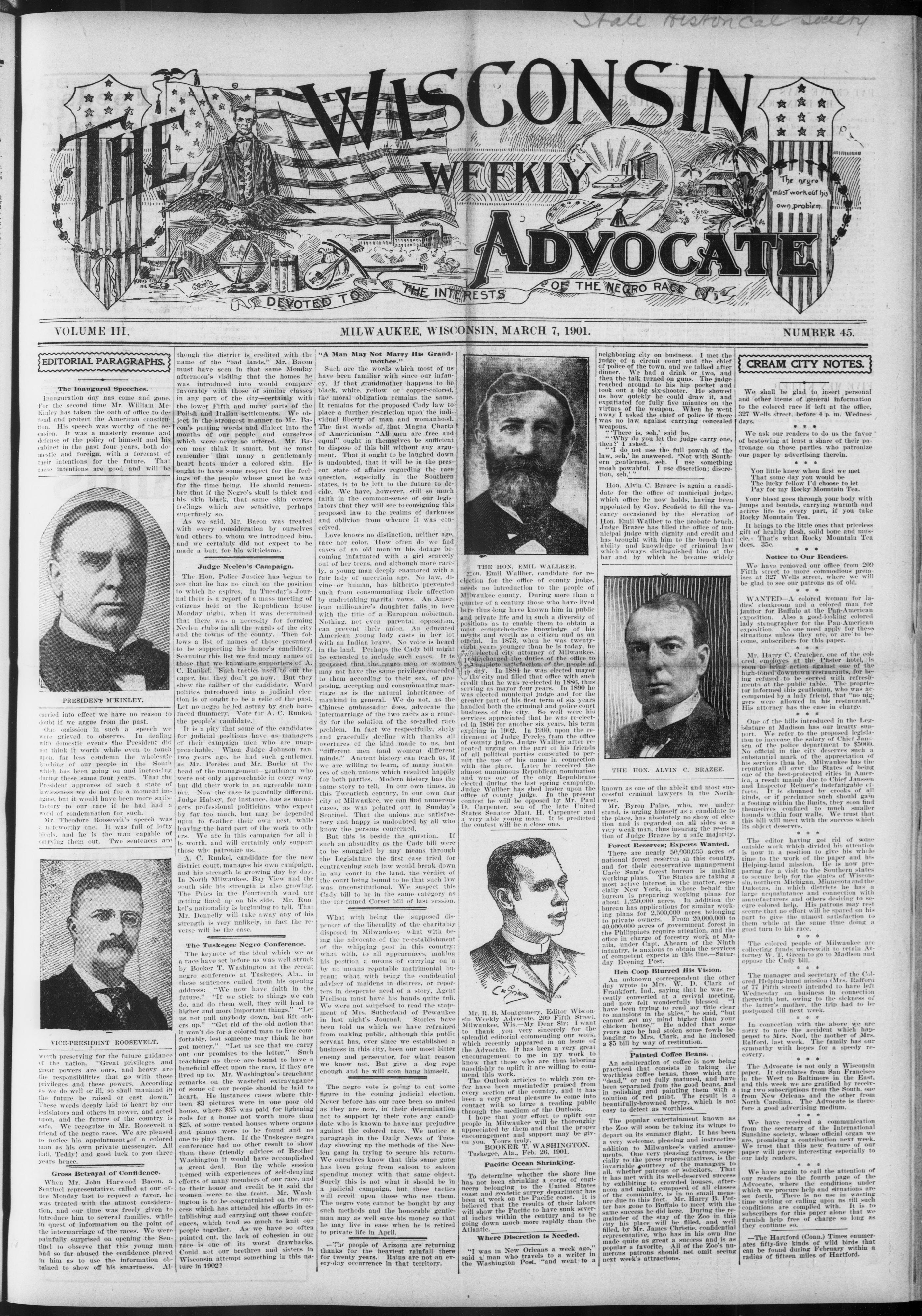
WISCONSIN
WEEKLY
Advocate
DEVOTED TO THE INTERESTS OF THE NEGRO RACE
EDITORIAL PARAGRAPHS.
The Inaugural Speeches.
Inauguration day has come and gone. For the second time Mr. William McKinley has taken the oath of office to defend and protect the American constitution. His speech was worthy of the occasion. It was a masterly resume and defense of the policy of himself and his cabinet in the past four years, both domestic and foreign, with a forecast of their intentions for the future. That these intentions are good and will be
[Name]
carried into effect we have no reason to doubt if we argue from the past. One omission in such a speech we were grieved to observe. In dealing with domestic events the President did not think it worth while even to touch upon, far less condemn the wholesale lynching of our people in the South which has been going on and increasing during these same four years. That the President approves of such a state of lawlessness we do not for a moment imagine, but it would have been more satisfactory to our race if he had had a word of condemnation for such.
Mr. Theodore Roosevelt's speech was a noteworthy one. It was full of lofty ideals, and he is the man capable of carrying them out. Two sentences are
T. H.
worth preserving for the future guidance of the nation. "Great privileges and great powers are ours, and heavy are the responsibilities that go with these privileges and these powers. According as we do well or ill, so shall mankind in the future be raised or cast down." These words deeply laid to heart by our legislators and others in power, and acted upon, and the future of the country is safe. We recognize in Mr. Roosevelt a friend of the negro race. We are pleased to notice his appointment of a colored man as his own private messenger. All hail, Teddy! and good luck to you three years hence.
Gross Betrayal of Confidence.
When Mr. John Harwood Bacon, a Sentinel representative, called at our office Monday last to request a favor, he was treated with the utmost consideration, and our time was freely given to introduce him to several families, while in quest of information on the point of the intermarriage of the races. We were painfully surprised on opening the Sentinel to observe that this young man had so far abused the confidence placed in him as to use the information obtained to show off his smartness. Al-
though the district is credited with the name of the "bad lands," Mr. Bacon must have seen in that same Monday afternoon's visiting that the homes he was introduced into would compare favorably with those of similar classes in any part of the city—certainly with the lower Fifth and many parts of the Polish and Italian settlements. We object in the strongest manner to Mr. Bacon's putting words and dialect into the mouths of our people and ourselves which were never so uttered. Mr. Bacon may think it smart, but he must remember that many a gentlemanly heart beats under a colored skin. He ought to have some respect for the feelings of the people whose guest he was for the time being. He should remember that if the Negro's skull is thick and his skin black, that same skin covers feelings which are sensitive, perhaps superfinely so.
As we said, Mr. Bacon was treated with every consideration by ourselves and others to whom we introduced him, and we certainly did not expect to be made a butt for his witticisms.
Judge Neelen's Campaign.
The Hon. Police Justice has begun to see that he has no cinch on the position to which he aspires. In Tuesday's Journal there is a report of a mass meeting of citizens held at the Republican house Monday night, when it was determined that there was a necessity for forming Neelen clubs in all the wards of the city and the towns of the county. Then follows a list of names of those presumed to be supporting his honor's candidacy. Scanning this list we find many names of those that we know are supporters of A. C. Runkel. Such tactics used to cut the caper, but they don't go now. But they show the caliber of the candidate. Ward politics introduced into a judicial election is or ought to be a relic of the past. Let no negro be led astray by such bare-faced flummery. Vote for A. C. Runkel, the people's candidate.
It is a pity that some of the candidates for judicial positions have as managers of their campaign men who are unapproachable. When Judge Johnson ran, two years ago, he had such gentlemen as Mr. Pereles and Mr. Burke at the head of the management—gentlemen who were not only approachable in every way, but did their work in an agreeable manner. Now the case is painfully different. Judge Halsey, for instance, has as managers professional politicians who expect by far too much, but may be depended upon to feather their own nest, while leaving the hard part of the work to others. We are in this campaign for all it is worth, and will certainly only support those who patronize us.
A. C. Runkel, candidate for the new district court, manages his own campaign, and his strength is growing day by day. In North Milwaukee, Bay View and the south side his strength is also growing. The Poles in the Fourteenth ward are getting lined up on his side. Mr. Runkel's nationality is beginning to tell. That Mr. Donnelly will take away any of his strength is very unlikely, in fact the reverse will be the case.
The Tuskegee Negro Conference.
The keynote of the ideal which we as a race have set before us was well struck by Booker T. Washington at the recent negro conference at Tuskegee, Ala., in these sentences culled from his opening address: "We now have faith in the future." "If we stick to things we can do, and do them well, they will lead to higher and more important things." "Let us not pull anybody down, but lift others up." "Get rid of the old notion that it won't do for a colored man to live comfortably, lest someone may think he has got money." "Let us see that we carry out our promises to the letter." Such teachings as these are bound to have a beneficial effect upon the race, if they are lived up to. Mr. Washington's trenchant remarks on the wasteful extravagance of some of our people should be laid to heart. He instances cases where thirteen $3 pictures were in one poor old house, where $35 was paid for lightning rods for a house not worth more than $25, of some rented houses where organs and pianos were to be found and no one to play them. If the Tuskegee negro conference had no other result to show than these friendly advices of Brother Washington it would have accomplished a great deal. But the whole session teemed with experiences of self-denying efforts of many members of our race, and to their honor and credit be it said the women were to the front. Mr. Washington is to be congratulated on the success which has attended his efforts in establishing and carrying out these conferences, which tend so much to knit our people together. As we have so often pointed out, the lack of cohesion in our race is one of its worst drawbacks. Could not our brethren and sisters in Wisconsin attempt something in this nature in 1902?
"A Man May Not Marry His Grandmother."
Such are the words which most of us have been familiar with since our infancy. If that grandmother happens to be black, white, yellow or copper-colored, the moral obligation remains the same. It remains for the proposed Cady law to place a further restriction upon the individual liberty of man and womanhood. The first words of that Magna Charta of Americanism "All men are free and equal" ought in themselves be sufficient to dispose of this bill without any argument. That it ought to be laughed down is undoubted, that it will be in the present state of affairs regarding the race question, especially in the Southern states, is to be left to the future to decide. We have, however, still so much faith in the common-sense of our legislators that they will see to consigning this proposed law to the realms of darkness and oblivion from whence it was conceived.
Love knows no distinction, neither age, race nor color. How often do we find cases of an old man in his dotage becoming infatuated with a girl scarcely out of her teens, and although more rarely, a young man deeply enamored with a fair lady of uncertain age. No law, divine or human, has hitherto prevented such from consummating their affection by undertaking marital vows. An American millionaire's daughter falls in love with the title of a European nobleman. Nothing, not even parental opposition, can prevent their union. An educated American young lady casts in her lot with an Indian brave. No voice is heard in the land. Perhaps the Cady bill might be extended to include such cases. It is proposed that the negro man or woman may not have the same privilege conceded to them according to their sex, of proposing, accepting and consummating marriage as is the natural inheritance of mankind in general. We do not, as the Chinese ambassador does, advocate the intermarriage of the two races as a remedy for the solution of the so-called race problem. In fact we respectfully, shyly and gracefully decline with thanks all overtures of the kind made to us, but "different men (and women) different minds." Ancient history can teach us, if we are willing to learn, of many instances of such unions which resulted happily for both parties. Modern history has the same story to tell. In our own times, in this Twentieth century, in our own fair city of Milwaukee, we can find numerous cases, as was pointed out in Sunday's Sentinel. That the unions are satisfactory and happy is undoubted by all who know the persons concerned.
But this is beside the question. If such an absurdity as the Cady bill were to be smuggled by any means through the Legislature the first case tried for contravening such law would break down in any court in the land, the verdict of the court being bound to be that such law was unconstitutional. We suspect this Cady bill to be in the same category as the far-famed Corset bill of last session.
What with being the supposed dispenser of the liberality of the charitabiy disposed in Milwaukee; what with being the advocate of the re-establishment of the whipping post in this country; what with, to all appearances, making his position a means of carrying on a by no means reputable matrimonial bureau; what with being the confidential adviser of maidens in distress, or reporters in desperate need of a story, Agent Frellson must have his hands quite full. We were not surprised to read the statement of Mrs. Sutherland of Pewaukee in last night's Journal. Stories have been told us which we have refrained from making public, although this public servant has, ever since we established a business in this city, been our most bitter enemy and persecutor, for what reason we know not. But give a dog rope enough and he will soon hang himself.
The negro vote is going to cut some figure in the coming judicial election. Never before has our race been so united as they are now, in their determination not to support by their vote any candidate who is known to have any prejudice against the colored race. We notice a paragraph in the Daily News of Tuesday showing up the methods of the Neelen gang in trying to secure his return. We ourselves know that this same gang has been going from saloon to saloon spending money with that same object. Surely this is not what it should be in a judicial campaign, but these tactics will recoil upon those who use them. The negro vote cannot be bought by any such methods and the honorable gentleman may as well save his money so that he may live in ease when he is retired to private life in April.
The people of Arizona are returning thanks for the heaviest rainfall there for twenty years. Rains are not an every-day occurrence in that territory.
M.
THE HON. EMIL WALLBER.
Mon. Emil Wallber, candidate for re-election for the office of county judge, needs no introduction to the people of Milwaukee county. During more than a quarter of a century those who have lived here thus long have known him in public and private life and in such a diversity of positions as to enable them to obtain a most comprehensive knowledge of his merits and worth as a citizen and as an official. In 1873, when he was twenty-eight years younger than he is today, he was elected city attorney of Milwaukee. Predischarged the duties of the office to complete satisfaction of the people of the city. In 1884 he was elected mayor of the city and filled that office with such credit that he was re-elected in 1886, thus serving as mayor four years. In 1890 he was elected municipal judge and for the greater part of his first term of six years handled both the criminal and police court business of the city. So well were his services appreciated that he was re-elected in 1896 for another six years, his term expiring in 1902. In 1900, upon the retirement of Judge Pereles from the office of county judge, Judge Wallber after repeated urging on the part of his friends of all political parties consented to permit the use of his name in connection with the place. Later he received the almost unanimous Republican nomination and was one of the only Republicans elected during the last spring campaign. Judge Wallber has shed luster upon the office of county judge. In the present contest he will be opposed by Mr. Paul D. Carpenter, son of the late United States Senator Matt. H. Carpenter and a very able young man. It is predicted the contest will be a close one.
C. S. Grimley
Mr. R. B. Montgomery, Editor Wisconsin Weekly Advocate. 209 Fifth Street, Milwaukee, Wis.—My Dear Sir: I want to thank you very sincerely for the splendid editorial commending our work, which recently appeared in an issue of the Advocate. It has been a very great encouragement to me in my work to know that those who are thus laboring unselfishly to uplift it are willing to commend this work.
The Outlook articles to which you refer have been unstintedly praised from every section of the country, and it has been a very great pleasure to come into contact with so large a reading public through the medium of the Outlook. I hope that your effort to uplift our people in Milwaukee will be thoroughly appreciated by them and that the proper encouragement and support may be given you. Yours truly.
BOOKER T. WASHINGTON.
Tuskogee, Ala., Feb. 26, 1901.
Pacific Ocean Shrinking.
To determine whether the shore line has not been shrinking a corps of engineers belonging to the United States coast and geodetic survey department has been at work on the Pacific coast. It is believed that the results of their labors will show the Pacific to have sunk several inches within the century and to be going down much more rapidly than the Atlantic.
Where Discretion is Needed.
"I was in New Orleans a week ago," said a man who travels to a writer in the Washington Post, "and went to a
neighboring city on business. I met the judge of a circuit court and the chief of police of the town, and we talked after dinner. We had a drink or two, and then the talk turned on guns. The judge reached around to his hip pocket and took out a big six-shooter. He showed us how quickly he could draw it, and expatiated for fully five minutes on the virtues of the weapon. When he went away I asked the chief of police if there was no law against carrying concealed weapons.
"There is, seh.' said he.
"Why do you let the judge carry one, then? I asked.
"I do not use the full powah of the law, seh,' he answered. 'Not with Southern gentlemen, seh. I use something moah powahful. I use discretion; discretion, seh.'"
Hon. Alvin C. Brazee is again a candidate for the office of municipal judge, which office he now holds, having been appointed by Gov. Scofield to fill the vacancy occasioned by the elevation of Hon. Emil Wallber to the probate bench. Judge Brazee has filled the office of municipal judge with dignity and credit and has brought with him to the bench that ability and knowledge of criminal law which always distinguished him at the bar and by which he became widely
C
THE HON. ALVIN C. BRAZEE.
known as one of the ablest and most successful criminal lawyers in the Northwest. Mr. Byron Paine, who, we understand, is urging himself as a candidate to the place, has absolutely no show of election and is regarded on all sides as a very weak man, thus insuring the re-election of Judge Brazee by a safe majority.
Forest Reserves; Experts Wanted.
There are nearly 50,000,000 acres of national forest reserves in this country, and for their conservative management Uncle Sam's forest bureau is making working plans. The States are taking a most active interest in the matter, especially New York, in whose behalf, the bureau is preparing working plans for about 1,250,000 acres. In addition the bureau has applications for similar working plans for 2,500,000 acres belonging to private owners. From 20,000,000 to 40,000,000 acres of government forest in the Philippines require attention, and the office in charge of forestry work at Manila, under Capt. Ahearn of the Ninth infantry, is anxious to obtain the services of competent experts in this line.—Saturday Evening Post.
Hen Coon Blurred His Vision.
An unknown correspondent the other day wrote to Mrs. W. W. D. Clark of Frankfort, Ind., saying that he was recently converted at a revival meeting, and now felt wonderfully blessed. "I have been trying to read my title clear to mansions in the skies," he said, "but cannot get my mind higher than your chicken house." He added that some years ago he had stolen some fowls belonging to Mrs. Clark, and he enclosed a $5 bill by way of restitution.
Painted Coffee Beans.
An adulteration of coffee is now being practiced that consists in taking the worthless coffee beans, those which are "dead," or not fully matured, and have been separated from the good beans, and in polishing and painting them with a solution of red paint. The result is a beautifully-browned berry, which is not easy to detect as worthless.
The popular entertainment known as the Zoo will soon be taking its wings to depart on its summer flight. It has been a very welcome, pleasing and instructive addition to Milwaukee's varied amusements. One very pleasing feature, especially to the press representatives, is the invariable courtesy of the managers to all, whether patrons or solicitors. That it has met with its well-deserved success by exhibiting to crowded houses, afternoon and night, composed of all classes of the community, is in no small measure due to this fact. Mr. Harry B. Potter has gone to Buffalo to meet with the same success he did here. During the remainder of the stay of the Zoo in this city his place will be filled, and well filled, by Mr. James Christie, confidential representative, who has in his own line made quite as great a success and is as popular a favorite. All of the Zoo's numerous patrons should not omit seeing next week's attractions.
CREAM CITY NOTES.
We shall be glad to insert personal and other items of general information to the colored race if left at the office, 327 Wells street, before 4 p. in. Wednesdays.
***
We ask our readers to do us the favor of bestowing at least a share of their patronage on those parties who patronize our paper by advertising therein.
* * *
You little knew when first we met That some day you would be The lucky fellow I'd choose to let Pay for my Rocky Mountain Tea. Your blood goes through your body with jumps and bounds, carrying warmth and active life to every part, if you take Rocky Mountain Tea. It brings to the little ones that priceless gift of healthy flesh, solid bone and muscle. That's what Rocky Mountain Tea does. 35c.
Notice to Our Readers.
We have removed our office from 209 Fifth street to more commodious premises at 327 Wells street, where we will be glad to see our patrons as of old.
***
WANTED-A colored woman for ladies' cloakroom and a colored man for janitor for Buffalo at the Pan-American exposition. Also a good-looking colored lady stenographer for the Pan-American exposition. No one need apply for these situations unless they are, or are to become, subscribers for this paper.
☆ ☆ ☆
Mr. Harry C. Crutcher, one of the colored employees at the Pfister hotel, is soon to bring action against one of the high-toned downtown restaurants, for being refused to be served with refreshments at the public table. The proprietor informed this gentleman, who was accompanied by a lady friend, that "no niggers were allowed in his restaurant." His attorney has the case in charge.
* * *
One of the bills introduced in the Legislature at Madison has our hearty support. We refer to the proposed legislation to increase the salary of Chief Janssen of the police department to $5000. No official in the city deserves such a substantial mark of the appreciation of his services than he. Milwaukee has the reputation all over the States of being one of the best-protected cities in America, a result mainly due to Chief Janssen and Inspector Reimer's indefatigable efforts. It is shunned by crooks of all kinds, or if perchance such should gain a footing within the limits, they soon find themselves confined to much smaller bounds within four walls. We trust that this bill will meet with the success which its object deserves.
* * *
The editor having got rid of some outside work which divided his attention is now in a position to give his whole time to the work of the paper and his Helping-hand mission. He is now preparing for a visit to the Southern states to secure help for the states of Wisconsin, northern Michigan, Minnesota and the Dakotas, in which districts he has a large acquaintance and connection with manufacturers and others desiring to secure colored help. His patrons may rest secure that no effort will be spared on his part to give the utmost satisfaction to them while at the same time doing a good turn to his race.
* * *
The colored people of Milwaukee are collecting funds wherewith to retain Attorney W. T. Green to go to Madison and oppose the Cady bill.
* * *
The manager and secretary of the Colored Helping-hand mission (Mrs. Ralford of 77 Fifth street) intended to have left Wednesday on business in connection therewith but, owing to the sickness of the latter's mother, the trip had to be postponed till next week.
* * *
In connection with the above we are sorry to note the accident which happened to Mrs. Noel, the mother of Mrs. Ralford, last week. The family has our sympathy with hopes for a speedy recovery.
```markdown
```
The Advocate is not only a Wisconsin paper. It circulates from San Francisco in the West to Baltimore in the East, and this week we are gratified by receiving two subscriptions from the South, one from New Orleans and the other from North Carolina. The Advocate is therefore a good advertising medium.
***
We have received a communication from the secretary of the International Sunshine society, whose official organ we are, promising a contribution next week. We trust that this new feature of our paper will prove interesting especially to our lady readers.
* * *
We have again to call the attention of our readers to the fourth page of the Advocate, where the conditions under which we procure help and situations are set forth. There is no use in wasting time writing or calling upon us till such conditions are complied with. It is to subscribers for this paper alone that we furnish help free of charge so long as they continue so.
—The Hartford (Conn.) Times enumerates fifty-five kinds of wild birds that can be found during February within a radius of fifteen miles of Hartford.
Intends to Keep In Hiding Until Assured of Square Deal—Invited to Surrender.
Omaha, Neb., March 5.—Pat Crowe, one of the alleged abductors of Edward Cudahy, Jr., has written a letter to a local paper touching on the kidnapping and asserting his innocence. The communication is a lengthy one and in many respects is a duplicate of the letter written to Mr. Cudahy three weeks ago. Chief of Police Donahue says there is no doubt in his mind as to the genuineness of the letter and of its coming from Crowe. Crowe says:
I make the following statement to show that I am not a fugitive from justice, but a fugitive from injustice, and so I intend to stay until I am assured of a square deal. It will be the happiest moment of my life when Chief Donahue and Mr Cudahy tell me that they are mistaken and have accused me wrong, and that must come when the truth is known. I have this to say regardless of who it reaches: That the hounding and browbeating of my brothers and sisters is an outrage and beneath the manhood of a common thief.
Chief Donahue also gave out the contents of a letter he wrote February 9 to Steve Crowe, a brother of Pat, and which was written in answer to the letter received by Mr. Cudahy at that time. Donahue makes the following proposition:
If Pat Crowe will surrender himself to me personally I will waive all my rights to the reward offered for his arrest; also to the reward offered for his arrest and conviction for the kidnapping of Edward A. Cudahy, Jr., on the night of December 18, 1900.
Chief Donahne said he had no wish to persecute Crowe and would do all he could to give him fair treatment should he surrender himself.
FIVE MEN KILLED IN MINE ACCIDENT.
Accidental Discharge of a Shot Causes Premature Explosion of Powder.
Joplin, Mo., March 5.—Five men were killed and two others seriously injured in a mine accident at the Engleside zinc mine in Center Valley, eight miles east of Joplin.
The dead are:
BUZZARD, WILLIAM.
FOSTER, HALE.
MORRIS, FRITZ.
STOTHARD, EDWARD.
WILSON, GEORGE.
The injured are:
Burton, John
Burton, John.
Daniels, William.
The seven men were in the ground cutting a drift from the main shaft. The five men killed were confined in the drift, and the other two were in the main shaft. Two shots had been fired, but the whole charge failed to explode. A full box of powder was sent down into the mine. One of the men accidentally discharged an unexploded shot, and the box of powder was set off with fatal results.
A man at the surface entrance of the mine was thrown thirty feet in the air.
FIRE SCARE IN ARLINGTON HOTEL
Washington, D. C., March 5.—Fire broke out in the Arlington hotel this afternoon. The flames originated in an attic room and apparently are under control. The fire was in the cupola of the building and was caused by an electric light wire. The damage was small. The Arlington hotel is the largest and most pretentious in Washington. Jackson park lies between it and the white house. Senator Spooner is a guest at the Arlington
SUPPLIES FOR ARCTIC TRIP.
Armour & Co. to Deliver Ten Carloads in New York by April 1.
Chicago, Ill., March 5.—Lieut. Evelyn B. Baldwin, the arctic explorer, yesterday closed a contract with Armour & Co. for $60,000 worth of provisions to be used by himself, companions and dogs in his third attempt to reach the North pole. The order calls for ten carloads, or twenty tons of provisions, to be delivered in New York April 1.
Fewer Jury Trials in England.
From the figures given by the Law Journal it would seem that trial by jury is becoming less and less popular. Out of 485 cases which are set down for trial in the Queen's bench division during the present term, 190 are set down as non-jury cases, which is a very much larger proportion than has hitherto been the case. It is the increasing sense of the uncertainty of the verdicts of juries which has given rise to this state of things, and it must be confessed that some verdicts which have been given of late quite account for the opinion.—London Globe
Top Mutinous Convicts Killed.
London, March 5.—A dispatch from Florence to a news agency says a serious mutiny of convicts has occurred at Santa Catrina prison, resulting in the military being called out and ten of the convicts being killed and fifty-seven wounded.
Suicide at Gile, Mich.
Ironwood, Mich., March 5.—Joseph Gamble, aged 46, proprietor of a boarding house at Gile, two miles from this city, committed suicide by shooting himself twice, one bullet lodging in his head and the other striking the heart.
Seven Killed by Dynamite.
Paris, March 5.—A dispatch received here from Irun, a Spanish town near the French frontier, says that a quantity of dynamite, stored in the customhouse there, exploded, killing seven persons and injuring many.
Noted Humorist Dead.
New York, March 5. - Isaac M. Gregory, who has been connected with Judge since its establishment, died today of Bright's disease, aged about 65 years.
Noted Composer Dead.
Brussels, March 5.—Peter Benoit, the distinguished composer, is dead.
Coffee a Barometer.
A cup of hot coffee is an unfailing barometer, if you allow a lump of sugar to droy to the bottom of the cup and watch the air bubbles arise without disturbing the coffee. If the bubbles collect in the middle, the weather will be fine; if they adhere to the cup, forming a ring, it will either rain or snow; and if the bubbles separate without assuming any fixed position, changeable weather may be expected.
—Two candidates have announced themselves, for county judge in Price county—E. W. Murray, the present incumbent, and Attorney H. C. Peters, ex-district attorney.
The Waterloo mine at Camp McKinney. Wash., has six feet of solid quartz, with values ranging from $10 to $3.75 in gold per ton.
During the year 1900 the Berlin electric trams caused 2652 accidents, involving the loss of 26 lives, while 134 persons were severely and 1302 slightly injured.
Senate.
The good roads resolution providing for a constitutional amendment authorizing state aid in improving country roads, and passed two years ago, was on the Senate calendar for action on the 28th without recommendation from the committee, but on motion of Senator Stout it was put over until March 8. Only two bills, 151 S. and 152 S., amending some technicalities in legal practice, were reported for indefinite postponement. Seven bills were passed, as follows: Making the regular appropriation of $2000 to the governor's contingent fund; establishing a district court in Milwaukee county; reducing the limit of population for cities of the second class from 40,000 to 30,000; relating to surrender of principal by sureties; amending the act creating a municipal court for Onelda county; relating to certificates of jurors; relative to changes of venue in Rock county. The bill requiring the university regents to pay a share of the cost of street and sewer improvements and sprinkling on streets adjoining the university, reported for indefinite postponement, was, on motion of Senator Miller, referred to the committee on state affairs. Senator Kreutzer's bill, increasing salaries of Supreme court and circuit judges, as amended to $6000 and $4000, with $400 expense money, respectively, was advanced to engrossment and third reading.
The committee on education reported favorably to the Senate on the 1st the bill appropriating $20,000 for a cottage for women students at the state university. It went to the committee on claims. Mr. McGill's time check bill, No. 5 A., was reported for concurrence by the committee on manufactures and labor. The following bills were passed: Permitting mutual insurance companies to insure against both fire and lightning within a radius of 100 miles of the city where the company is located, the amount in no case to exceed $2000; to enable cities of the fourth class to own water and lighting works. It requires ratification by two-thirds of the voters, the amount spent in any one year not to exceed 3 per cent. of the taxable property; relating to the filing of chattel mortgages; relating to chattel mortgages; relative to names of town insurance companies; amending the act creating the Dane county municipal court, giving it the right to try murder cases and providing that jurors shall be drawn under the jury commission system; providing for voting districts on the Oneida Indian reservation; enlarging the powers of officers in cases of unlawful sale of liquors. The following were concurred in: Legalizing the incorporation of the village of Gillett: relating to the drawing of jurors; prescribing the duties of notaries public. Senator Mosher's bill prohibiting the insurance of state property was on the calendar for third reading, but on motion of Senator Green was laid over. Adjournment was to 8 p. m. on the 4th.
The Senate had a large calendar when it met on the evening of the 4th, but after passing four Senate bills and ordering two Assembly bills to a third reading the Senate laid the rest of the calendar, containing fourteen bills, over. Among the bills passed by the Senate was the judiciary committee's bill requiring three years' study for admission to the bar, and Mr. Keene's bill providing that the aldermen and supervisors of newly-created wards in Milwaukee shall represent the ward in which they are thrown by the change in ward lines.
The anti-cigarette bill was reported to the Senate on the 5th by the committee on public health and sanitation for indefinite postponement. The committee on corporations reported favorably the bill putting the chief of police of Milwaukee on a salary of $5000. Senator Jones' resolution providing for a joint committee to report on matters pertaining to a budget was indefinitely postponed on motion of its author, in view of the report on budget made by the claims committee. Senator Mills' vessel taxation bill, making the tax 1 cent a ton, on the calendar for passage, was on his motion put over to March 21. Senators Burns and Munson alone voted against the bill increasing the salaries of Supreme and circuit judges, which passed by a vote of 30 to 2. The following bills were passed: Providing that election returns from townships may be sent to the county clerk by registered letter instead of by messenger; increasing the salaries of justices of the Supreme court from $4000 to $5000 and of circuit judges from $3600 to $4000, with $400 expense money; amending the law permitting cities of the third and fourth classes to acquire waterworks, giving the same powers for the acquisition of electric light plants; relating to the county court of Rock county, authorizing the municipal judge to act as county judge on request of the latter in certain cases. The following bills were concurred in: The McGill time check bill, relating to assignment of written evidence of indebtedness from employer to employe for wages; authorizing the commissioners of public lands to loan $80,000 to Portage county. Senator Roehr's bill fixing a heavy penalty for the use of what are known as knockout drops, was ordered engrossed.
The Overbeck anti-cigarette bill on the 6th gave the Senate the livestest session it has had so far this winter, and the bill was saved from defeat by one vote. It was rereferred to the committee on judiciary by a vote of 16 to 15 after there had been one tie vote. Senator McGillivray offered a memorial to Congress urging that the allowance for maintenance of Indian children in industrial schools in Wisconsin be increased from $167 to $180 per capita. Eight petitions for the primary election bill were received. Senator Mosher's bill prohibiting insurance of state property was up for engrossment. Senator McDonough offered an amendment exempting steam boilers. Senator Green moved that the bill be laid on the table. The motion was defeated, and before any further action was taken the Senate adjourned on account of the meeting of the apportionment committee.
Assembly.
In one of the most remarkable parliamentary skirmishes fought in the Wisconsin Legislature in recent years, a bill to employ more dairy and food commissioners was killed by the Assembly on the 28th. The bill was killed by striking out its enacting clause, a thing that has not been done in any Legislature in this state for years. Mr. Cady offered the amendment striking out the enacting clause, which brought things to a climax, and the vote resulted 52 to 42, with 6 absent or not voting. The Assembly committee on judiciary reported a big batch of bills and among those reported for indefinite postponement were the Senate and Assembly bills to establish bicycle sidepaths and the bill exempting from taxation land held for park purposes. The committee on federal relations reported favorably upon the bill appropriating $20,000 for the improvement of the levees on the Wisconsin river at Portage. The following bills were passed: To provide expenses of interment of deceased patients in county asylums; relating to a bridge across the Chippewa river at Durand; to prohibit the forging of railroad tickets or passes; relating to wagon bridge across Fox river; relating to evidence. Senator Riordan's bill, No. 71 S., relating to cancellation of void tax deeds, and Senator Devos' bill, No. 140 S., providing for the employment of a clerk by the district attorney of Milwaukee, were concurred in. Senator Miller's bill, No. 182 S., legalizing the acts of Dr. H. P. Clute, as state veterarian, was referred on motion of Judge Orton, who did not understand it.
After a long and bitter contest the Assembly on the 1st ordered to a third reading Mr. Lenroot's bill requiring that franchises granted by cities shall not take effect until thirty days after their passage by common councils, during which time the people have the right to petition to have it submitted to popular vote. It will require 10 per cent. of the voters as shown by the last preceding general election to secure the vote. It had been agreed In the committee that Milwaukee should be exempted from the act, but the Assembly knocked that out, and the bill applies to Milwaukee as well as to other cities. Among the bills passed by the Assembly was Mr. Elline's bill, No. 61 A., to authorize cities of the first class to acquire land outside of their limits, which is said to be intended to permit Milwaukee to buy state land outside of the city for a right of way for the proposed Twenty-seventh street viaduct. The following bills were passed: Authorizing cities of the first and second class to acquire land; to regulate treatment and control of dependent children; to provide for the registry of names; regulating hotels, inns and lodging houses; providing for election of constables; relating to streets and alleys; relating to indecent exposure of person; prohibiting shooting of any gun in railway cars; relating to highways; relating to cancellation of void tax deeds; providing for appointment of clerk by district attorney. Judge Orton moved to reconsider
the vote by which Mr. Dahl's bill to provide for the registry of names was passed, saying that it appeared dangerous. He feared it would give unscrupulous people a chance to assume the names of others. The motion prevailed and the bill was laid over.
After passing four Assembly bills and concurring in nine Senate bills on the 4th the Assembly adjourned leaving a large unfinished calendar. One Senate bill was ordered to a third reading. The calendar laid over includes nineteen bills that are recommended for passage and twenty-six that are to be killed
There were a large number of bills on the Assembly calendar for indefinite postponement on the 5th, but about half of them were saved for the time being by being referred to committees. Among the bills saved was Mr. Dahl's bill for the establishment of the Torrens system of land registration, which was laid over for two weeks. The Assembly then had a lively little debate over the Dahl joint resolution for a constitutional amendment to allow sheriffs to hold office for more than one term, and it was laid over for two days. Mr. Hall had three bills on the calendar relating to railroad corporations. They were designed to repeal the laws passed two years ago for the benefit of the Wisconsin Central Railroad company and to restore the law on the subject to its former state. The main provisions of the three were embodied in one, No. 276, which was ordered engrossed, and the other two, Nos. 277 and 278, were killed. The committee on agriculture reported in favor of the bill making appropriations to county fairs and the bill relating to weed commissioners. Mr. Hartung's bill, No. 134 A., extending the time of collecting to March 15, finally was referred. The old, old wide-tire wagon bill was on the calendar for a third reading, and it caused the usual debate. The bill was ordered to a third reading. Mr. Karel's bill, No. 340 A., relating to subcontractors and laborers' liens, was referred to the committee on judicial upon Mr. Karel's motion. Mr. Johnson's bill dividing the town of Howe in Marinette county and creating the town of Breed was passed under suspension of the rules. Mr. Hartung's bill, No. 548 A., relating to the construction of sewers in cities, was referred to the committee on cities. Mr. Thomas' bill relating to the admission of children to the Sparta home was laid over for a week. The Assembly got into a pariamentary tangle over Mr. Rankl's bill, No. 196 A., providing that notice of liens to owners shall be served within ten days instead of sixty days as at present. The bill was on the calendar for indefinite postponement, but Mr. Keene asked separate consideration upon it and moved its recommendation. The previous question was finally ordered and on a vote the bill was referred by a vote of 58 to 30.
At the evening session of the Assembly on the 5th a bill was introduced by the committee on education providing that the town, village or city treasurer be made ex-officio treasurer of all funds collected for library purposes. The bill applies to cities of the second, third and fourth class. Assemblyman Frost moved that bill No. 282 A., providing for the Eighteenth judicial circuit, be reconsidered, it having been killed at the morning session. After a long debate it was recommitted to the judiciary committee.
Among the bills reported to the Assembly on the 6th by the judiciary committee was the Milwaukee Orphan Asylum bill, which came in with a favorable report, in spite of the fight made against it by the heirs of the late Samuel Howard. Mr. Miner asked permission to introduce a bill regulating circuses and menageries which was received and sent to the committee on rules under a new rule adopted by the Legislature. Mr. Hall's joint resolution petitioning Congress for the passage of the Cullom bill, was on the calendar for passage, but as Congress has adjourned Mr. Hall asked to have it referred to a committee of one, which is one way of killing a bill. The following bills were passed: Permitting voting by methods other than by ballot; relating to separate assessment of lands and buildings; relating to the expense of maintaining inmates for home for feeble-minded; relating to deformed and crippled children; relating to terms of court in Fifteenth judicial circuit; relating to the commitment of insane persons: relating to the employment of veterinary surgeons; relating to mutual fire insurance companies; relating to judgments in employment; relating to waterworks and lightning; relating to bonds of justices of the peac; relating to the adoption of children. Dahl's bill, No. 170 A., relating to the registry of names, for which he made a strong plea, was sent back to judiciary committee. Mr. Owen's franchise bill, which was on the calendar as a special order, was laid over for two weeks. In order to permit the members to attend a meeting of the apportionment committee, the Assembly adjourned without completing its calendar.
New Touches in Stationery.
There is noticeable an increased use of small sizes in writing papers. Milady's note is now a very tiny, delicate affair, possibly a way she has of excusing herself for writing brief letters. "My paper is all used," she scribbles, and signs herself "Yours devotedly" with a thankful sigh there is room to write no more.
Pure white is the favorite color, though we see no end of all manner of hues in stationery. But white is the vogue in the best circles, and though fads in stationery come and go, this always has a sure following. Linen lawn and cambric are also still the popular papers.
In the matter of engraving the Berlin block still seems to lead. There is something so distingue about it, and as there is too difficult handwork about it for it ever to become cheapened, it is likely to remain long in fashion's favor. A point noticed about the season's cards is the centering of the address under the name and also the placing of the reception days in the center, instead of the lower corner, as formerly. Shaded Old English divides honors with the Berlin block. This style of engraving is a great favorite, for it has a certain individuality that appeals to many. For misses cards the black Old English is used, and the card is much smaller, about two inches square.
Dinner cards are prettier than ever, and a charming one for Washington's birthday showed a dainty liquor glass, in whose tempting contents floated a delicious-looking cherry. Underneath was the appropriate legend: "He didn't know all about cherries."—Philadelphia Telegraph.
Mud as a Life-Saver.
In London it was noticed that when the streets were muddy there was a marked diminution of diseases that were prevalent when dust is blowing. Catarrhal troubles are plentiful when people are compelled to inhale dust. Consumption, too, often gets its start from the breathing of flying particles of filth. Add sufficient water to transform the dust into mud, and the power for harm is gone, for mud is not inhaled. The germs that infest dry dust become inert in mud because these germs, vicious as they are, are too lazy to go anywhere unless they are carried. Moreover, mud is very likely to get ultimately into the drainpipe, and the germs are carried off where they can do no harm. Even when mud dries on the clothing and is brushed off the dust that arises therefrom does not appear to be as dangerous as that which has not been recently wet.—Leslie's Weekly.
Flies to Kill Pests.
Alexander Craw, quarantine officer of the California state board of horticulture, has received from Australia a box containing several million Tachina flies, which will be liberated in the San Joaquin valley to exterminate grasshoppers. A large importation of Australian ladybugs has also been received for distribution among Santa Clara orchardists for the destruction of the red spider, which is a pest there.
For a Rainy Day
"I've given a little attention to that new clerk of yours," remarked the man who wanted to do the clerk a favor, "and I want to say that I consider him a youth who will succeed. I notice he is the kind who puts something aside for a rainy day." "Dear me! and I've missed two umbrellas already," returned the merchant. "Much obliged for your tip. I'll watch him."
—The willow is, for its size the most valuable British tree.
EXCEEDS REVENUES.
Joint Committee on Claims of the Legislature Reports on Aggregate of Appropriations.
Madison, Wis., March 5.—[Special.]— The joint committee on claims at last evening's session of the Senate reported the budget for the session. It shows the total appropriations asked for by bills introduced at the present session, together with the standing appropriations provided by statute, exceed the revenues provided by existing statutes by $1,769,698. The total appropriations made by bills introduced foot up $3,667,480, while the total statutory appropriations aggregate $5,760,582, these covering the two years 1901 and 1902, while the total revenues for the same period for the two years are $7,658,364. The standing appropriations provided for before the commencement of the present session were as follows:
LIFE CRUSHED OUT.
Ashland, Wis., March 5.—[Special.]— Robert Burnside, night foreman at the Ashland Iron and Steel company's plant, met a horrible death last evening. While assisting in loosening a pile of frozen ore, the pile suddenly broke, four tons falling from the top, enveloping Burnside and crushing out his life instantly. He came here from St. Ignace, Mich., eight years ago, and his parents live in Ironwood.
SHOT BY AN UNKNOWN.
Black River Falls Man Has a Very Narrow Escape from Being Killed.
Black River Falls, Wis., March 5. [Special.]—Even Hanson, a well-known farmer of this vicinity, narrowly escaped being shot by what must have been a random bullet while on his way to this city yesterday. He heard the sharp report of a gun and the ball passed through his fur coat near the abdomen. Mr. Hanson said he could recall no enemy who in his opinion would be guilty of trying to shoot him.
MOTHER AND SON DIE.
Double Funeral Takes Place at
Hudson, Wis., March 5.—[Special.]—Mrs. Susan Keeley, widow of Thomas Keeley, who died here recently at the advanced age of 93 years, was to have been buried yesterday, but the funeral was deferred until this afternoon on account of the sudden death of her oldest son, Joshua D. Whitten, who passed away Sunday morning after a brief illness, aged about 70 years. There was a double funeral today. They were mother and brother of Dr. M. Whitten.
William M. Hatch, Janesville.
Janesville, Wis., March 5.—[Special.]
—William M. Hatch, a pioneer resident of this city, died at the home of his daughter, Mrs. Frank D. Kimball. He was 85 years of age. Besides the daughter he leaves one son, Martin W. Hatch of Sheboygan.
REFUND INSURANCE TAXES.
Operation of Wisconsin's New Law
Benefits Foreign Companies.
Madison, Wis., March 5.—Three life insurance companies will be refunded the following amounts, which were recently paid to the state as taxes: Aetna Life, $3156.45; Metropolitan Life, $2596.88; Home Life, $264.65. These companies paid these amounts under the Orton life insurance tax law of 1899, which taxed all life insurance companies 1 per cent. on all premiums collected from residents of this state. The new life insurance tax law which went into effect last Thursday changed the life insurance company taxes to 3 per cent. on the premiums collected in the state by home companies, and imposed merely an annual license fee of $360 a year on the outside companies. The taxes paid by the three companies named come under this act, and accordingly the amounts they had paid will be refunded.
HISTORY OF BADGER PRESS.
Wisconsin Newspapers Get Place in Historical Library.
Madison, Wis., March 5.—[Special.]— Arrangements were made at the recent meeting of the Wisconsin Press association for space in the state historical library for a collection of publications, documents and relics pertaining to the journalism of the state, more particularly of territorial days. R. W. Cheever of Clinton was appointed to take charge of the work of gathering material.
Residence is Destroyed.
Wautoma, Wis., March 5.—[Special.]
—The home of Ed Terrill, nine miles east of this village, was destroyed by fire caused by an overheated stovepipe. Most of the household furniture was saved. Loss estimated at $1300 with $350 insurance.
Sore Hands
Cuticura
SOAP
MEDICINAL
TOILET
PRICE 22CENTS
Red, Rough Hands, Itching, Burning Palms, and Painful Finger Ends.
One Night Treatment
Soak the hands on retiring in a strong, hot, creamy lather of CUTICURA SOAP. Dry, and anoint freely with CUTICURA, the great skin cure and purcst of emollients. Wear, during the night, old, loose kid gloves, with the finger ends cut off and air holes cut in the palms. For red, rough, chapped hands, dry, fissured, itching, feverish palms, with shapeless nails and painful finger ends, this treatment is simply wonderful, and points to a speedy cure of the most distressing cases when physicians and all else fail.
Cured by Cuticura
Cured by Cuticura
I WAS troubled with hands so sore that when I put them in water the pain would near set me crazy, the skin would peel off, and the flesh would get hard and break, then the blood would flow from at least fifty places on each hand. Words never can tell the suffering I endured for three years.
I tried at least eight doctors, but my hands were worse than when I commenced doctoring. I tried every old Granny remedy that was ever thought of without one cent's worth of good and could not even get relief.
I would feel so badly mornings when I got up, to think that I had to go to work and stand pain for eight or nine hours, that I often felt like giving up my job, which was in the bottling works of Mr. E. L. Kerns, the leading bottler of Trenton, N. J., who will vouch for the truth of my sufferings.
Before I could start to work, I would have to wrap each finger on both hands, and then wear gloves, which I hated to do, for when I came to take them off, it would take two hours and the flesh would break and bleed. Some of my friends who had seen my hands would say, "If they had such hands they would have them amputated"; others would say "they would never work," and more would turn away in disgust. But thanks to Cuticura, the greatest of skin cures, it ended all my sufferings.
Just to think, after doctoring three years, and spending dollar after dollar during that time, Cuticura cured me. It has now been two years since I used it and I do not know what sore hands are. I never lost a day's work while I was using it or since, and I have been working at the same business, and in acids, etc.
Complete External and Internal Treatment for Every Humor. Consisting of CUTICURA SOAP (25c.), to cleanse the skin of crusts and scales, and soften the thickened cuticle, CUTICURA Ointment (50c.), to instantly allay itching, inflammation, and irritation, and soothe and heal, and CUTICURA RESOLVENT (50c.), to cool and cleanse the blood. A SINGLE SET, is often sufficient to cure the most torturing, disfiguring skin, scalp, and blood humors, with loss of hair, when all else fails. Sold J. POTTER DRUG AND CHEM. CORP., Sole Props., Boston, U. S. A.
Millions of Women Use Cuticura Soap
Assisted by Cuticura Ointment for preserving, purifying, and beautifying the skin, for cleansing the scalp of crusts, scales, and dandruff, and the stopping of falling hair, for softening, whitening, and soothing red, rough, and sore hands, in the form of baths for annoying irritations, inflammations, and chafings, or too free or offensive perspiration in the form of washes for ulcerative weaknesses, and for many sanative antiseptic purposes which readily suggest themselves to women, and especially mothers, and for all the purposes of the toilet, bath, and nursery. No amount of persuasion can induce those who have once used it to use any other, especially for preserving and purifying the skin, scalp, and hair of infants and children. CUTICURA SOAP combines delicate emollient properties derived from CUTICURA, the great skin cure, with the purest of cleansing ingredients, and the most refreshing of flower odors. No other medicated soap ever compound d is to be compared with it for preserving, purifying, and beautifying the skin, scalp, hair, and hands. No other foreign or domestic toilet soap, however expensive, is to be compared with it for all the purposes of the toilet, bath and nursery. Thus it combines in ONE SOAP at ONE PRICE, viz., TWENTY-FIVE CENTS, the BEST skin and complexion soap, the BEST toilet and BEST baby soap in the world.
WINCHESTER GUN CATALOGUE FREE Tells all about Winchester Rifles, Shotguns, and Ammunition Send name and address on a postal now. Don't delay if you are interested. WINCHESTER REPEATING ARMS CO. 180 WINCHESTER AVENUE NEW HAVEN, CONN.
Wedded in a Sheep Wagon.
Wedded in a sheep wagon.
They have their own ideas of originality out in Wyoming. At Casper, that state, Ross Lambert, owner of a sheep ranch, and Miss Louisa Morrison were married at midnight while seated in a sheep wagon. The ceremony was witnessed by the bride's mother and a few friends. The bridegroom could well afford a stylish conventional wedding, but he said the bride wanted something unusual.
If Coffee Poisons You.
ruins your digestion, makes you nervous and sallow complexioned, keeps you awake nights and acts against your system generany, try Grain-O, the new food drink. It is made of pure selected grain and is healthful, nourishing and appetizing. It has none of the bad effects of coffee, yet it is just as pleasant to the taste, and when properly prepared can't be told from the finest coffees. Costs about $4 as much. It is a healthful table drink for the children and adults. Ask your grocer for Grain-O. 15 and 25c.
Berlin's Many Donkeys.
Berlin now contains 1000 donkeys which have been imported in the last eighteen months to take the place of dogs as beasts of draught. The change is due to the agitation of the S. P. C. A.
Lane's Family Medicine
Moves the bowels each day. In order to be healthy this is necessary. Acts gently on the liver and kidneys. Cures sick headache. Price 25 and 50c.
Arctic Flowers.
In the Arctic regions there are between 700 and 800 varieties of flowers. They are all either white or yellow.
—Sweden possesses an effective navy. The Swedes are reputed to be the best sailors in the world. This gift over the waters is a legacy from their forefathers.
Have you ever thought why your hair is falling out? It is because you are starving your hair. If this starvation continues, your hair will continue to fall.
There is one good hair food. It is Ayer's Hair Vigor. It goes right to the roots of the hair and gives them just the food they need. The hair stops falling, becomes healthy, and grows thick and long.
Ayer's Hair Vigor does another thing, also: it always restores color to faded or gray hair.
One dollar a bottle.
If your druggist cannot supply you, send us $1.00 and we will express a bottle to you, all charges prepaid. Be sure and give us your nearest express office.
J. C. AVBR Co., Lowell, Mass.
Send for our handsome book on The Hair.
Waukesha Girl Believes in Transmigration of Souls.
HER LOVER IS DEAD.
Believes Animal Contains Lover's Sonl and Has Justice of Peace Perform Marriage Ceremony.
Binghamton, N. Y., March 6.—[Special.]—A peculiar wedding ceremony was performed here yesterday in which the bride was Miss Edith Wagner of Waukesha, Wis., and the groom, her large maltese pet cat.
Years ago Miss Edith Wagner was engaged to Edward Hamblin. He was stricken with typhoid fever and on his deathbed promised to be always near her in some form. Later she came into possession of a large maltese cat which she firmly believed contained the soul of her dead lover.
Recently she was taken ill and the welfare of her cat, in case of her death, gave her much discomfort until she solved the problem by determining to marry the animal and thus give it the legal status of a husband, to which she could will her property. Several ministers, to whom she applied, refused to officiate, but finally a justice of the peace, whose scruples were overcome by a liberal fee, read the wedding service, a friend making the necessary responses for "Edward." The certificate was duly filled out and Miss Wagner accredited with the possession of a feline husband.
WOMAN TRIES TO JUMP FROM WINDOW.
Oshkosh Girl Goes Violently Insane While Being Treated at a Private Sanitarium.
Oshkosh, Wis., March 6.—[Special.]—The police were called to the sanitarium of Drs. Julia and Adeline Riddle on Main street last evening. One of the young women patients went violently insane and tried to jump out of a second-story window. She had broken out the glass and was half way out when discovered by her nurse, who pulled her back into the room and placed her under restraint. The sanitarium authorities refuse to give out any information more than that the young woman lives in this city and suddenly became insane. The woman had been rescued when the police arrived. A large crowd witnessed the affair.
WOULD RATHER DIE THAN BE ARRESTED.
John Wendt of Peshtigo, Crazed with Liquor, Attempts to Commit Suicide.
Marinette, Wis., March 6.—[Special.]—John Wendt of Peshtigo, a woodsman crazed from the effects of liquor, tried to commit suicide last night. He escaped from an officer and ran down the railroad tracks at Crivitz. When the officer caught up to him he whipped out a knife and gashed himself twice across the neck and once across the wrist. He bled profusely but fortunately none of the wounds were fatal. He was brought to the county jail here.
AN ABSOLUTE DIVORCE.
Mrs. Isabel Compton Granted Decree from Prof. M. B. Compton of Kenosha.
Kenosha, Wis., March 6.—[Special.]—The social circles of Kenosha were given a great shock today when a message was received from St. Joseph, Mo., stating that Mrs. Isabel Compton, wife of Prof. Mortimer B. Compton, the well-known musician, had been granted an absolute divorce from her husband on the charge of cruel and inhuman treatment. Mrs. Compton left Kenosha a short time ago, but her husband has since resided in Kenosha. It is stated that he made no contest to the divorce proceedings with the understanding that the wife should not demand alimony. It is stated that Mrs. Compton will at once go on the stage. She was at one time a well-known actress.
BOY TORN TO PIECES.
Lad Gets Caught in Revolving Belt at Sawmill and is Frightfully Mangled.
Stevens Point, Wis., March 6.—[Special.]—August V. Stark, son of Wendel Stark of Knowlton, was fatally hurt in Kronenwetter's sawmill near that town. The young man was repairing a shaft when his clothing was caught in the rap idly-revolving belt, hurling him around several times, tearing off one arm and breaking a leg in several places. He died in a few hours. The young man was 20 years of age.
HE SHOOTS HIS WIFE.
Fred Stanfest, Formerly of Milwaukee, Accidentally Discharges Shotgun He was Cleaning.
Apollonia, Wis., March 6.—[Special.]
While Fred Stanfest was cleaning a breech-loading shotgun at his home, five miles north of this place, a loaded shell was left in the gun, which was accidentally discharged and the contents entered and passed through the calf of his wife's leg. A physician arrived just in time to stop the bleeding, which was rapidly ebbing the woman's life away. Mrs. Stanfest's condition is critical.
Mr. and Mrs. Stanfest removed to this vicinity from Milwaukee six months ago.
25 BELOW AT GLIDDEN.
Coldest Day of the Winter and Furious Snowstorm Makes Traffic Impossible.
Glidden, Wis., March 5.—[Special.]— Yesterday was the coldest day of the season. At 7 a. m. the thermometer registered 25 degrees below zero. A furious snowstorm raged, making traffic impossible.
OLD FARMER BADLY HURT.
Falls from Carriage and is Dragged Along by Horse.
Ripon, Wis., March 6.—[Special.]—P. K. Pickard, a pioneer settler of this county and a retired farmer, suffered a severe accident while driving from his farm near Brandon to his home here. He was seized with an attack of vertigo. He fell out of the carriage and was dragged some distance. His face was seriously cut and his back and head injured.
ALLEGED SWINDLER IS HELD FOR TRIAL.
ALLEGED SWINDLER IS HELD FOR TRIAL.
L. Miller Waives Examination on a Charge of Obtaining Money Under False Pretenses.
Waupaca, Wis., March 6.—[Special.]—L. Miller, alias Hart, alias Lennon, was held to the circuit court in $2000 bail on a charge of obtaining money under false pretenses, preferred by Frank Stout, proprietor of the Hotel Florence sample room.
Last September Miller came to Waupaca and stopped at the Hotel Florence, saying that he would be here for ten days for the purpose of buying a carload or two of cows for his dairy farm in the state of New York. Every morning he would take a team and drive into the country for the alleged purpose of buying cows. At the end of the eighth day Miller said that he expected his cows in on the following Saturday and engaged two cars from the agent of the Wisconsin Central for shipping purposes. He said he expected his son here in a day or two with money, and borrowed $50 from Frank Stout. The next morning he went in the country with a team, left it at Sheridan and failed to return. Investigation showed that he owed George W. Ghoca of the Hotel Florence a $16 board bill and had worn away a $40 overcoat belonging to him. Whipple & Felker, liverymen, had a claim of $20 for livery, and Frank Stout one for $50 for borrowed money. Miller was located at Neillsville, where he went under the name of Hart, and was buying cows. It is said that he has been operating in Lancaster, Brillson, Columbus, Portage, Neillsville and other Wisconsin cities, and also in Illinois and Michigan.
GO 30,000 MILES TO BE MARRIED.
Bride and Groom Travel Great Distance and Meet at Racine Where They Wed.
Racine, Wis., March 5.—[Special.]—Dr. Henry M. Bridgeman, Cape Town, South Africa, and Miss Florence R. Jones of the Argentine Republic, formerly teacher in the Racine high school, were married this afternoon at the home of Mrs. Joseph Dietrich, sister of Miss Jones. The newly-wedded pair will leave for Kimberley, South Africa, their future home, and when they arrive there they will have traveled nearly 30,000 miles to be married. The bride-elect was giving private instructions to a family of children in the Argentine Republic when she first met Dr. Bridgeman, and he soon after went to Cape Town and began practice, and when the engagement was announced Miss Jones traveled to Racine alone, and the doctor came on from South Africa. Miss Jones before coming to Racine resided in Michigan and Chicago and is a brilliant woman.
WILL OPEN A NEW BANK AT WEST BEND.
C. C. Henry of Port Washington will Establish the Institution by May 1.
West Bend, Wis., March 6.—[Special.]
There will be a new bank opened here May 1. C. C. Henry of the Dennett Manufacturing company of Port Washington has severed his connection with that company and has purchased a lot in West Bend on which he will erect a bank building and May 1 he will establish a bank whose capital will be between $25,000 and $50,000.
BARABOO WON'T BUY.
The City will Not Take Control of the Waterworks Plant.
Baraboo, Wis., March 6.—[Special.] At a special meeting of the city council last night it was decided that the city would not take the primary steps necessary in order to purchase the waterworks plant. The officials ascertained that it would cost at least $2000 to have the plant appraised and as near as could be learned from reliable sources it is believed that the valuation would be at least $150,000, which is more than the city cared to pay and which is more than could be paid and come within the limit which the city must necessarily be bonded in order to secure control of the property. It is now the plan to let the existing franchise expire before attempting municipal ownership.
PUZZLED PHYSICIANS.
Marinette Boy Ill with a Strange Affliction-Swelled to Six Times His Natural Size.
Marinette, Wis., March 6.—[Special.]
—Leo Carron, the 8-year-old son of Michael Carron, died Monday night. He had been ill for years with an affliction which puzzled many physicians. At times he would swell up to six or seven times his normal size and in this condition would remain for many days. During this time he would take no nourishment and for fourteen days at a time he has lived without food, either liquid or solid form.
LAND BECAME VALUABLE
Oshkosh Man Paid $450 for Property Near Negaunee, Mich.,
and Sells it for $8500.
Oshkosh, Wis., March 6.—[Special.]—David Lloyd of this city this morning sold a half an acre of land near Negaunee, Mich., to the Oliver Mining company for $8500. Several years ago he bought the land for $450, but he had no use for it and had about abandoned it when a representative of the company called on him and offered $1800 for the land. Mr. Lloyd became sure the land must be valuable and so held out till he was offered $8500, which he accepted.
DRUNKEN MAN FROZEN.
Falls Asleep and is Overcome by the Bitter Cold.
Stevens Point, Wis., March 6.—[Special.]—Mike Moriary, a papermaker who has worked in the mills at Marianette, Niagara, Combined Locks and this city, had his feet so badly frozen that the toes may have to be amputated. While under the influence of liquor he went from Stevens Point to Plover, and, crawling into a barn, fell asleep. When found he was badly frozen.
MONUMENT AT WEYAUWEGA.
Contract is Let for the Memorial to the Soldier Dead.
Weyauwega, Wis., March 6.—The Soldiers' Monument association of Weyauwega has let the contract for the erection of a soldiers' monument in the public square to William Metzer of Clintonville. The contract price is $1391.12. It will be the first soldiers' monument in Waupaca county. The dedication will take place about July 1.
Thursday, Feb. 28.—Conference report on the war revenue reduction bill adopted without division. Final reports on the diplomatic and consular and agricultural appropriation bills were adopted. The major part of the day was devoted to the bill to promote the efficiency of the revenue cutter service. Although the bill is a House measure, its friends were very persistent, and in the face of many difficulties hung on to it with bulldog tenacity and finally forced the bill into such a parliamentary situation that it will be voted upon after five minutes' debate tomorrow.
Friday, March 1.—Concurred in Cuban and Phillippine amendments to the army appropriation bill-159 to 134. Final conference report upon the Indian appropriation bill was adopted and a number of minor bills were put through the final stages. The conference report on the St. Louis exposition bill (which agreed to Sunday closing) was agreed to and the bill was sent back to conference. A motion to concur in the Charleston exposition amendment was defeated-84 to 132. The revenue cutter service bill was sidetracked early in the day by a vote of the House.
Saturday, March 2. Throughout today the House was in the throes of the closing hours of the session, with many measures clamoring for attention and with crowded galleries looking down upon the weary legislators. Work began at 9 a. m. and proceeded until 5 o'clock in the afternoon; when a recess was taken until 9:30 p. m. to permit conference reports to be framed. Under suspension of the rules a number of important bills were passed, including those for a national standardizing bureau, for conferring bronze medals on the enlisted men of the navy and marine corps for distinguished heroism, and to amend the Chinese exclusion laws and the omnibus public building bill. The legislative appropriation bill was also finally disposed of, and many conferences were advanced. The Senate bill to prohibit the sale of firearms, opium and intoxicating liquors in certain islands of the Pacific was defeated, 117 to 79, two-thirds not having voted in the affirmative. When the public building bill was called up Mr. Bailey demanded a second, which was ordered, 110 to 5, whereupon he remarked that if he had known how widely and judiciously the "pork" in this barrel had been distributed he would not have attempted to head it off. The bill was passed without division. At 5 o'clock the House took a recess until 9:30 in the evening. Inauguration crowds filled the galleries at the night session. Attention was given to routine business and a number of bills were passed. At 10:30 the House took a recess until 2 p. m. Sunday. Sunday, March 3.—When the House, at 2 o'clock, took up its work Mr. Grosvenor (Ohio), from the committee on rules, presented a special order providing that after ten minutes' debate it should be in order to move concurrence in the Senate amendments to the river and harbor bill and to agree to the conference asked for by the Senate. Twenty minutes on a side were allowed under the rule. The special order was finally adopted, the Senate amendments were nonconcurred in and the bill was sent to conference. Messrs. Burton, Reeves (Ul.) and Catchings (Miss.) were appointed confeees. Mr. Cannon presented a partial conference report upon the sundry civil appropriation bill, disposing of all the minor issues, but leaving in dispute the items for the three expositions, for the purchase of the old Corcoran Art gallery in Washington, $332,000; the appropriation of $5,000,000 for a memorial bridge across the Potomac at Washington and the amendment touching the irrigation of arid lands. The report was adopted. The House refused to concur in the irrigation amendments, and by a vote of 65 to 116 defeated the amendment for the memorial bridge. Mr. Alexander (N. Y.) moved to recede and concur in the Senate amendment carrying $5,000,000 for the St. Louis exposition, $500,000 for the Buffalo exposition and $250,000 for the Charleston exposition. The motion provoked a lively debate. On a rising vote the motion to concur was defeated, 76 to 139. Mr. Dalzell (Pa.), from the committee on rules, presented a resolution for the appointment of a special committee of seven members of the committee on insular affairs, not more than four of whom shall be of one political party, to visit Cuba, Porto Rico and the Philippines and report upon the conditions there. At the evening session the debate was resumed, Mr. Bailey (Tex.) making an earnest speech on the subject of the situation in the Philippines. He urged the adoption of the resolution, as the best means of securing information concerning the situation there. The debate on this proposition, interrupted from time to time by the presentation of conference reports, occupied the House until midnight. During a recess from 10:55 until midnight the members gathered in groups and sang religious hymns, patriotic airs and ragtime melodies. Their efforts were heartily applauded by the occupants of the galleries.
Monday, March 4.—The House closed its session at 11:45 amid a demonstration from its members following the delivery of an impressive valedictory by Speaker Henderson. For an hour the body had been in the throes of dissolution with little business to perform. The galleries were almost empty, for there were too many sights and scenes without the building and too many restrictions on admission to permit an overflowing assemblage. Here and there on the desks of members were great clusters of flowers, paying farewell tribute to their services. Shortly before the closing hour Mr. Richardson (Tenn.), the minority leader, presented resolutions testifying the high regard of the House for the able, impartial and dignified manner in which Speaker Henderson had administered the duties of presiding officer. Coming from the minority, there was added significance in the tribute. The resolutions were unanimously adopted by a rising vote. Then the speaker, in slow and impressive tones, delivered his closing words to the House, thanking the members for their co-operation through a busy and eventful Congress. He concluded at 11:45 and announced the sessions of the House for the Fifty-sixth Congress adjourned.
Senate.
Thursday, Feb. 28.—An immense amount of business was disposed of, but not a single point raised was sharply controverted. The river and harbor bill, carrying appropriations of more than $50,000,000, was passed without a word of discussion, and the Senate adopted the conference report on the war revenue reduction measure without disturbing the smoothness of the proceedings. Final conference reports were made and agreed to on the diplomatic and consular and the agricultural appropriation bills and another conference on the post-office bill was ordered. The last hour and a half of the session was devoted to consideration of the sundry civil appropriation bill.
Friday, March 1.—During the greater part of the session the sundry civil appropriation bill was under consideration. An interesting and at times lively debate was participated in on a resolution to discharge the committee on interstate commerce from consideration of the bill requiring railroad companies to make detailed investigations of all accidents involving loss of life on their lines and to report to the Interstate commerce commission. No action was taken. The old question as to the reclamation of public lands in the arid and semi-arid sections of the country was brought up, but the efforts to attach an amendment to the measure appropriating money for the work was defeated. The bills appropriating $500,000 for the Buffalo Pan-American exposition, $5,000,000 for the St. Louis Louisiana Purchase exposition and $250,000 for the Charleston (S. C.) Interstate and West Indian exposition were attached to the bill as riders. By 56 to 16 the Senate sustained a point of order against Mr. Morgan's Nicaragua canal amendment to the bill.
Saturday, March 2.—The first thing the Senate did was to pass the deficiency bill. The omnibus public building bill, passed by the House, was taken up on motion of Mr. Fairbanks and passed. Mr. Jones moved consideration of his resolution to discharge the committee on judiciary from further consideration of the anti-trust bill, but before action was taken the Senate by a vote of 40 to 28 went into executive session. At 5:30 p. m. the Senate took a recess until 9 o'clock. At the night session Mr. Jones renewed his motion to take up for consideration his resolution to discharge the committee on judiciary from the further consideration of the anti-trust bill. The motion was lost, 24 to 36. The Senate therefore took a recess until 3 o'clock Sunday.
Sunday, March 3.—Sunday session of the Senate began at 3 o'clock, the Senate having been in recess since 10:30 Saturday. After a spirited fight both in conference and on the floor of the Senate the final conference report on the naval appropriation bill was agreed to, the Senate receding from the one contested amendment author-
izing the construction of three additional Holland submarine torpedo boats. A conference report on the general deficiency bill was agreed to without comment. During the afternoon and evening the Senate passed a large number of bills, among them being that to promote the safety of railway employees. At 8:45 last night a recess was taken until 10:30 p. m. When the Senate reconvened at 10:30 the scene in the chamber, particularly in the galleries, suggested a notable social function. The galleries were packed to the doors and hundreds of persons were unable to gain admission.
Monday, March 4.—One of the most notable occurrences in the history of congressional legislation marked the closing hours of the last session of the Senate of the Fifty-sixth Congress. Senator Carter (Mont.) signallized his retirement from the Senate after six years of brilliant service by talking the river and harbor bill to death. He occupied the floor, constructively, for nearly thirteen consecutive hours, although in the aggregate about three hours of that time were devoted to other business. Mr. Allison submitted a further disagreement on the sundry civil bill, the item in contention being the appropriation for the three expositions. From this the Senate receded and then passed the St. Louis exposition bill. In retiring as the president pro tem, of the Senate, Mr. Frye, in response to a resolution of thanks for his courtesy and impartiality, delivered a brief but feeling address to the Senate. At the conclusion of the session of the Fifty-sixth Congress Vice-President Roosevelt was sworn in, and immediately called the Senate of the Fifty-seventh Congress to order. It was a simple but beautiful and impressive ceremony. The new senators were sworn in in groups of four. At the conclusion of this proceeding the Senate attended the inauguration of the President on the east front of the capitol. At 1:45 the Senate returned to its chamber and adjourned immediately for the day.
Wednesday, March 6.—Mr. Morgan, who yesterday offered a resolution declaring the abrogation of the Clayton-Bulwer treaty between the United States and Great Britain, addressed the Senate for nearly two hours upon his proposition. His admonitions to Great Britain were particularly sharp. He declared that if Great Britain should endeavor to enforce the terms of the treaty the effort would result in a war in which the great empire, which had controlled for scores of years the commerce of the world, would be swept from power and her king would be left with only sovereignty over his own island. After a brief debate the amendment to the rules of the Senate placing a limit upon debate, offered yesterday by Senator Platt (Conn.) was referred to the committee on rules. The debate developed the fact that no intention exists on the part of the proponent of the amendment to urge its discussion at the present extraordinary session.
CHICAGO ITEMS.
—Gus Bode, 35 years old, was killed by a Chicago & Western Indiana train while walking on the tracks.
—John Fight, 10 years old, was run over and fatally injured by a wagon belonging to the L. Fish Furniture company.
—Stanislaurin Willand, 2 years old, was burned to death. Evidently the little one had secured matches, which were ignited and set fire to its dress.
—At the point of a revolver H. M. Thomas of De Kalb was forced to enter a cab by a man and three women, driven to a dark street, and there robbed.
—Because he was sick and unable to support his wife and four children, Ernest Walther, 49 years old and a German cigarmaker, hanged himself in the woodshed at the rear of his home.
—Louis Friedman, an expressman delivering goods to Hefter, Livingstone & Co., was killed in the elevator of the building. Friedman died in the patrol wagon on the way to the hospital.
—John H. Fichter, clerk of the town of Lake and a lumber dealer, was thrown from his bugg and severely injured about the head and back. The attending physician said the injuries would not result seriously.
—The St. Nicholas block, Roby and Madison streets, was invaded by fire for the third time within a trifle more than a year. The loss to occupants' foots up about $25,000. The building, which is owned by the Owsley estate, was damaged to the extent of $5000.
While turning a corner at Desplaines and West Madison streets Marshal John Campion of the fire department was thrown from his buggy and so severely injured that he was forced to quit his duties.
Eight cars and a portion of the car sheds of the Metropolitan Elevated road were destroyed by fire. For a time it looked as if the immense sheds with 200 cars housed therein would be destroyed, but prompt work saved them with a loss in rolling stock not to exceed $30,000.
The manner in which Charles E. Minor, a cornicemaker, met death is not known by the police. The theory advanced is that he was killed by the cars. His skull and left foot were crushed and he had other injuries. It was evident that death had been instantaneous. The body was found lying between the Rock Island tracks.
—Joseph Goldstein, a junk dealer was arrested on the charge of being the man who paid 11 cents for a quantity of rags, in which $3670 had been concealed by Mrs. Thomas Connoly. The money was the savings of a lifetime. Part of it had been raised by placing a mortgage on the house. Goldstein was taken before the Connoly, who identified him as the buyer of the rags. Goldstein denied he was the man and says he did not receive the money.
William P. McVeity, a linen importer and salesman doing business with the leading hotels of Chicago, was found in his office on the second floor of Medinah temple at 5 o'clock, writhing in agony from a shot in the left breast. McVeity was taken to the Samaritan hospital. Physicians there announced that the wound would probably prove fatal.
Henry Rasmussen was almost instantly killed at Bloomington, Ill., by being crushed under a massive iron beam. Mr. Rasmussen was a contractor and had a subcontract for the iron work of the addition to the Chicago & Alton railway shops at Bloomington. He was 35 years old. He leaves a wife, but no children.
Alfred J. Cross of Riverside died from a complication of troubles. For the last thirty years he was connected with the Chicago. Burlington & Quincy railroad as contracting freight agent in Chicago. Before entering railroad life as a freight contractor, Mr. Cross was connected with the lumber business in Chicago. He is survived by a widow, a son, Clarence Cross, and three daughters. Arrangements for the funeral will be completed today.
RIOT IN COMMONS.
Ten Irish Members of Parliament Object to Gag Rule and Are Forcibly Elected.
London, March 6.—A scene of unex-ampled violence and disorder, took place in the British House of Commons last night when ten Irish members, for refusal to obey an order of the speaker to leave the House, were dragged out by a posse of police. It was the first time in history that a policeman has been seen on the floor of the House.
The trouble arose from the opposition of the Nationalist members to the application of closure on the education estimates by Balfour. The Nationalists shouted "Gag! gag!" and refused to leave the House when the division was taken. The chairman twice asked them to retire to the division lobby, but they shouted: "Certainly not!" Mr. Flavin cried: "I protest against the way all Irish votes are closed."
Eugene Crean, member for southeast Cork, struggled desperately against removal, and there was a free fight on the floor lasting for five minutes, other Irishmen assisting him. Eventually he was carried out bodily by six policemen, amid vells and cheers.
Six Cops for Each Irishman.
The police then returned and carried out each of the remaining recalcitrants in the same manner, although there was no further actual resistance. Six police-men sufficed for each member, with the exception of Flavin, who is a big man and required eight. Many, as they were being carried out, waved their hands and shouted, "God save Ireland!"
The Nationalists fought and struggled frantically, but at length a superior force of police succeeded in dragging Mr. Crean out by the legs and arms and carrying him down the floor of the House, the Irishmen standing and wildly shouting "Shame!" "Murderers!" and "South African brutality!"
Free Fight on the Floor.
The speaker then called upon McHugh to retire, but he defiantly refused, his companions shouting approval. A strong body of twenty policemen again stormed the Irish benches. McHugh fought, struggled and impeded them in every way. Angry shouts rent the air. The benches below the gangway on the opposition side were a mass of mad and struggling humanity. Several policemen were struck with fists. Free fights between the police and the members were fairly general.
As McHugh was being carried out—his underclothes showing where the outer garments had been torn away in the struggle—Flavin shouted from the back benches, "Nineteen policemen to remove one Irishman!" and cries of "Shame!" were heard from the opposition benches. The speaker then ordered the removal of the others. Amid renewed howls of execration the police grappled with them and carried them by arms and legs over the benches and out of the House. While Donelan was being removed the Nationalists rose and sang "God Save Ireland." Flavin shouted against the Unionists, who sat silent in their seats during the scene: "You will be carried out of South Africa in the same way."
Whole Police Force Mobilized.
The excitement occasioned by last night's scenes is still very evident; and when the House met at noon today, in view of possible disturbances the whole police force on duty at St. Stephen's had been mobilized and reinforced by reserves.
John Redmond speedily rose and raised a question of privilege arising from "the painful scenes of last night." He claimed that members had been suspended without proper steps being taken to identify them and that their removal had been accompanied by undue violence. He was satisfied, he said, that members were suspended who had actually gone to the lobby to participate in the division.
The speaker, interrupting, pointed out that Mr. Redmond was not raising a question of privilege but a point of order. If he was properly informed of any wrongful suspension he (the speaker) would be glad to take steps to rectify them. Mr. Redmond tried to move an adjournment and appealed to Mr. Balfour, remarking that he presumed it was desired to institute means for preventing a recurrence of the scenes of last night, promised to consider what opportunity for discussion could be given. The subject was then dropped. It is understood that Mr. Balfour proposes to alter the House of Commons rule relating to suspensions, making the punishment so severe as to make a repetition of last night's revolt against the authority of the chair unlikely.
FLEET IN THE ICE.
The Entire F. & P. M. Line Steamers Imprisoned in the Pack at Ludington.
Ludington, Mich., March 6.—[Special.]
—Two carferries and three winter-line steamers, constituting the entire Pere Marquette fleet, lie hopelessly bound in the ice pack in Ludington harbor. The conditions of the blockade are extremely bad and so far the combined efforts of the fleet to effect a release have failed. The imprisoned boats are the carferries Pere Marquette and Muskegon and F. & P. M. steamers Nos. 2, 3 and 4. The blockade has already lasted forty-eight hours. The last vessel to arrive was the Muskegon, which came in last night.
For two days high west and northwest winds have piled up the ice in the harbor in an impenetrable mass. The weather is extremely cold and the five winter steamers are sheathed over with a heavy coating of ice. This is the only serious interruption of navigation that has occurred here this winter, and it places an absolute embargo on freight traffic. Over 500 cars are lying in the local Pere Marquette yards waiting to be moved. In entering the harbor yesterday the carferry Pere Marquette struck the bar and sheered against the south pier. A high sea was running at the time and the Pere Marquette pounded heavily against the solid structure for some minutes, springing her plates, and staving in her bulwarks above the rail in such a manner that her cars could not be unloaded. The Marquette will proceed at once to drydock for repairs.
Most of the passengers on the icebound boats have come ashore by walking over the rough ice.
COL. SANGER SELECTED.
Will Succeed Geo. D. Meiklejohn as Assistant Secretary of War Has a Good Record.
New York, March 6.—A special to the Tribune from Washington says: The President has selected William Cary Sanger of New York for assistant secretary of war, in succession to George D. Meiklejohn of Nebraska, who has held the office for the last four years. Col. Sanger's great military experience and legal ability are said to have been the chief elements which led to his selection for the office which, though already one of considerable dignity and responsibility, it is the intention of the President and Secretary Root to make much more important in every respect.
—The greatest waterfall is Niagara, which sends over 32,000,000 tons of water an hour.
COMMODORE CHAUNCEY.
How He Presented Wife's Compliments to Mrs. Commander Chancey.
"I remember an anecdote about Commodore Chauncey," writes a retired naval officer to the New York Evening Sun. "He was certainly an eccentric character, and it was generally thought at the time of his death by those who knew him that his written bequest of the 'Brooklyn navy yard and all its appurtenances' to his well-beloved daughter, Kate, was conceived in all seriousness. The commodore had a younger brother, a commander in the navy, who was not at all well-beloved by him. It happened in the course of the commodore's incumbency as commandant of the yard that the commander was ordered there for duty. The younger man's wife was very anxious to effect a reconciliation. She arranged a reception for the officers of the yard and persuaded her husband to deliver a verbal invitation to the commodore. This he did with not a very good grace as follows:
"Commodore Chauncey, Mrs. Commander Chauncey presents her compliments to Mrs. Commodore Chauncey, and requests the pleasure of her attendance with Commodore Chauncey at a reception to be given the officers of the yard next Tuesday evening."
To which the commodore instantly replied:
"Mrs. Commodore Chauncey sends her compliments to Mrs. Commander Chauncey, and will see her damned first."
A Club of Indian Women.
The only club of Indian women united with the general federation is one on a little island in Maine, whose membership is entirely made up of squaws, the association having been formed for the purpose of preserving Indian traditions and folklore. This club became a member of the Maine State federation soon after its formation, and last year paid its dues in Indian baskets—the work of its members. These were sold for a sum considerably in excess of the amount of the dues and the surplus was duly returned to the club.
MARKET REPORTS.
MILWAUKEE—Eggs—Market firm; fresh new, cases included, 15c; fresh, cases returned, 15½c; old, cases included, 14½c; second, 10@12c. Receipts were 321 cases. Butter — Market steady. Fancy prints, 23c; fancy or extra creamy, per fb, 22½c; firsts, 18@20c; seconds, 15@16c; dairy prints, 17c; extra fancy dairy, 16c lines, 13@14c; packing stock, 11@12c; whey, 8c; roll, wrapped, 12½@13½c unwrapped, 12@13c; grease, 4@5c. The receipts today were 21,208 Ibs against 7413 yesterday. The market here is well cleaned up on all grades a.i.d there is a good demand for all choice goods, both dairy and creamy. Choice dairy is wanted here. Low grades are not moving quite so freely, but there is a fairly good demand.
Cheese—Steady. Receipts were 1520 cases today against 2305 yesterday. Full cream flats, new colored, 10½¼¹¹c; Young Americas, new, 11½¼¹²c; daisies, new, 11½¼¹²c; fancy brick, 11½¼¹²c; low grades, 6¾¹¹c; limburger, per lb. No. 1, 10½¼¹¹c; low grades, 5¾¹¹c; imported Swiss, 12¾¹¹c; Block Swiss, domestic, 11½¼¹²c; choice loaf, 12¾¹¹c; No. 2, 9¾¹¹c; Sapsago, 16¾¹¹c; farmers', 10¾¹¹c.
NEW YORK — Butter — Receipts, 6002 pkgs; steady; fresh creamery, 17¾²²c; June cremery, 15¾²²c; factory, 11¾¹¹c. Cheese—Receipts, 1374 pkgs; firm; fancy large colored and white, 11¾¹¹c; fancy small colored, 12½¹¹c; fancy small white, 12¾²²¹c. Eggs—Receipts, 10.566 pkgs; firm; state and Pennsylvania at mark, 16¾¹¹c; Western at mark, 15¾¹¹c; Southern at mark, 15¾¹¹c. Sugar—Raw steady; fair refining, 3½¹¹c; centrifugal, 96 test, 4½¹¹c; molasses sugar, 3½¹¹c; refined quiet; crushed, 6¾¹¹c; powdered, 5.60¹¹c; granulated, 5.50¹c. Coffee—Dull and easy: No. 7 Rlo 7½¹¹c.
CHICAGO — Butter — Active; creameries, 15@22c; dalries, 10@19c. Cheese—Dull; 10%@11%c. Eggs—Qulet; 14%c. Dressed poultry—Qulet; turkeys, 8@10c; chickens, 9%@10c.
MILWAUKEE LIVESTOCK MARKET.
HOGS—Recelpts, 7 cars; market slow; light, 5.40@5.50; mixed and medium weights, 5.45@5.55; common to good packers, 5.25@5.50; fancy selected hogs, 5.55.
CATTLE—Recelpts, 2 cars; firm; butchers' steers, medium to good, 1050 to 1300 lbs, 4.35@5.00; fair to medium, 950 to 1050, 3.65@4.25; heifers, common, 3.00@3.60; good, 3.75@4.25; cows, fair to good, 2.75@3.50; canners, 2.00@2.60; bulls, common, 2.75@3.15; choice, 3.25@3.75; feeders, 800 to 950 lbs, 3.50@3.85; stockers, 500 to 750 lbs, 3.00@3.50; veal calves, common to choice, 4.50@5.75; milkers and springers, common to choice, 20.00@40.00.
SHEEP—Receipts, none; market steady, 3.00@4.00; bucks, 2.50@3.00; lambs, 4.50@5.00.
Chicago receipts: Hogs, 25,000; cattle, 15,500; sheep, 15,000.
MARKETS BY TELEGRAPH.
MILWAUKEE—Flour—Steady. Wheat —
Firmer: No 2 spring, on track, 69c; No 1
Northern, on track, 76c. Corn—Steady; No
3 on track, 38¾c. Oats—Steady; No. 2
white, on track, 28¼c; No. 3 white, on
track, 28¼c; No. 3 white, on track, 27@
27¾c. Barley—Dull; No 2 on track, 57c;
sample on track, 48@57c. Rye—Steady;
No. 1 on track, 52c. Provisions—Higher;
pork, 14.22; lard, 7.47.
Flour is steady at 3.95@4.00 for patents; bakers, 2.95@3.00, and 2.80@2.95 for rye. Millstuffs are firm and quoted at 15.00 for bran, 14.50@14.75 for standard middlings, and 15.50@16.00 for Milwaukee flour middlings.
CHICAGO—Close — Wheat—March, 74c; April, 74%c; May, 75%c; Corn—March, 39%c; May, 40%@40%c; Oats—March, 24%c; May, 25%c; Pork—March, 14.07%c; May, 14.22%c; Lard—March, 7.40@7.42%c; May, 7.45@7.47%c; July, 7.52%c; September, 7.60; Ribs—March, 7.05; May, 7.10; July, 7.15; September, 7.22%c; Flax—Cash No. 1, 1.57%c; May, 1.55@1.56%c; Rye—March, 50%c; May, 51%c; Barley—Cash, 38@58c; Timothy—March, 4.40; Clover—March, 10.75.
DULUTH — Close — Wheat — Cash No. 1
hard. 75¼c; No. 1 Northern. 73¼c; No. 2
Northern. 67½%@70½c; No. 3 spring. 63½%@
68½c; to arrive. No. 1 hard. 76½c; No. 1
Northern. 74½c; May. 76½c; July. 77c
Corn. 37½c; May. 38½c. Onts. 26½%@26½c.
Rye. 50½c. Barley. 35½c. Flax.-To arrive.
1.57; cash. 1.57½; May. 1.61½; September.
1.15. Receipts of wheat, 72,414 bus;
shipments, none.
MINNEAPOLIS — Close — Wheat — Cash.
74½c; May. 74½c; July. 75½%@75½c; on
track. No. 1 hard. 76½c; No. 1 Northern.
74½c; No. 2 Northern. 67½%@70½c.
NEW YORK—Close—Wheat—March, 79¹/4;
May, 75¹/4c; July, 79¹/4c. Corn—May, 46¹/4c;
July, 45c.
ST. LOUIIS—Close—Wheat—No. 2 red
cash, 72%c; May, 73%c; July, 72%c; No. 2
hard, 71%l@71%lc; Corn—No. 2 cash, 30%lc;
May, 38%c; July, 39%c; Oats—No. 2
cash, 26c; May, 26c; July, 25%c; No. 2
white, 29c; Lead, 4.22%l; Spelter—3.75.
KANSAS CITY—Close — Wheat—May,
66%l@67c; July, 67c; cash No. 2 hard, 68@
69c; No. 2 red, 70@71c; Corn—May, 37%lc;
cash No. 2 mixed, 36c; No. 2 white, 37c;
Oats—No. 2 white, 27%lc.
LIVERPOOIL—Close—Wheat—Steady, 1%@
5%d higher; March, 51%d; May, 51%lld;
July, 65%d; Corn—Steady, unchanged to
1%d higher; March, 39%d; May, 39%d.
5% higher: March, 5s10%d; May, 5s11%d;
July, 6s14%d; Corn—Steady, unchanged to
1% higher: March, 3s9%d; May, 3s9%d.
KANSAS CITY—Cattle—Receipts, 6000;
strong; native steers, 4.60@5.60; Texas
steers, 3.75@4.75; cows and heifers, 2.50@
2.75; stockers and feeders, 3.90@4.90. Hogs
—Receipts, 12.000; 2%@5c lower: bulk of
sales, 5.30@5.45; heavy, 5.25@5.47% mixed,
5.30@5.40; light, 5.25@5.35. Sheep—Receipts,
2000; strong; muttons, 3.75@4.50;
lambs, 4.90@5.05.
ST. LOUISE—Cattle—Receipts, 2500; firm; native steers, 3.50@4.65; stockers and feeders, 2.45@4.65; cows and heifers, 2.09@4.75; Texas and Indian steers, 3.50@4.70. Hogs—Receipts, 8000; strong; plgs and lights, 5.35@4.50; packers, 5.35@4.50; butchers, 5.50@4.65. Sheep—Receipts, 500; strong; muttons, 4.00@4.50; lambs, 4.50@4.30. SOUTH OMAHA—Cattle—Receipts, 2400; strong; native steers, 3.75@4.40. Texas steers, 3.00@3.85; cows and heifers, 3.25@4.25; stockers and feeders, 3.25@4.60. Hogs—Receipts, 6000; steady to shade stronger; heavy, 5.35@4.40; mixed, 5.32%@4.55; light, 5.25@5.35; bulk of sales, 5.32%@5.371. Sheep—Receipts, 3100; steady; common and stock sheep, 3.70@3.90; lambs, 4.25@5.10.
—One pattern of small arm will now be used by American fighting men ashore and afloat, and the army rifle is fast being placed aboard the warships.
Printed in the Interests of the Negro Race,
MILWAUKEE, WIS.
Richard B. Montgomery.....
.....Editor and Proprietor
Office: 327 Wells Street.
Telephone Black No. 244.
SUBSCRIPTION RATES.
Send money by Express MoneyOrder, P. O. Money Order or Registered Letter to the Wisconsin Weekly Advocate.
* ADVERTISING RATES.
One inch, single insertion..... 25c
One inch, per year..... $9.00
Business locals 5c per line each insertion.
Apply for rates to the Advocate.
TO CONTRIBUTORS:
All communications must be sent with the name and address of the sender as an evidence of good faith, but not necessarily for publication. No manuscript returned if not accepted, unless accompanied by stamps.
All subscribers of the Advocate that fail to get their paper promptly will please notify us at once. The Advocate, at 327 Wells street.
The Wisconsin Weekly Advocate company wishes to notify the public that all contracts and business transactions with this company must have the company stamp, otherwise they will be void. Neither will this company be responsible for paid subscriptions unless given to duly-accredited agents, who, on request, will give the company's receipt for same. Subscribers failing to receive their papers regularly will kindly notify the general office. Address all business communications to the general manager, 327 Wells street.
Mr. Richard B. Montgomery.
Entered at the Milwaukee P. O. as second-class matter.
The Helping Hand Colored Mission
incorporated under the laws of the State of Wisconsin has for its object the supplying of qualified colored help to those requiring the same. In order to be able to get servants from the mission it is necessary, that in order to partly cover expenses incurred, those parties desiring help should become subscribers for this paper. No actual charge is made. Parties who secure situations through this agency are also expected to become subscribers. We have at present on our books: Cooks, General Servants, Waitresses, Laundresses, Nurses, Coachmen, Porters, Walters. Office hours 9-12 and 1-4.
R. B. MONTGOMERY, Mgr. 327 Wells St., Milwaukee.
Judge Lynch of Indiana is an advocate of cremation as well as hanging.
Gen. Gomez is showing his fellow citizens in Cuba that he has a head for statesmanship as well as for fighting.
This winter's cold waves seem to be bent on reaching the Northerners who are lodging them at the winter resorts of the South.
It is said that in some localities people cumber the ground, but in the vicinity of the pickle factories in Wisconsin they actually cucumber it.
The Louisiana timber thieves who helped themselves to millions of feet of logs owned by Northern lumbermen have played an old game that first made its appearance in the pine woods of this section of the country.
Had Admiral Sampson laid less stress upon the need of "refinement," in his letter regarding the proposed promotion of warrant officers, and called attention to the need of especial fitness for important diplomatic duties, he would have touched upon the main point, and escaped criticism for snobbery.
The declaration of Mrs. Lillie Devereaux Blake that "No greater wrong has been done to man than not teaching him to sew" is interesting, but not important. She thinks that if man were properly instructed—that is, instructed according to her plan—he would give up his evenings to sewing and embroidery, instead of smoking. Mrs. Blake has a great deal of faith.
A Chicago physician announces that the indelible pencil which makes a bluish mark is poisonous when brought into contact with an abrasion of the skin, and may cause death. From the cases which he cites, it is a fair inference that even salt, which another Chicago physician announced a few weeks ago as an elixir of life, is powerless as an antidote against the terrible indelible pencil.
The new King of England, as Prince of Wales, has for years been urging more comfortable apartments for the housing and lodging of the London poor. At last the London county council has moved in that direction and a bill has been reported to expend $7,500,000 for this wise and benevolent undertaking. A very moderate rent is to be charged and the poor man is sure to get the worth of his money.
Farmers in Vermont are already beginning to talk of the maple sugar season and conditions permitting, buckets will be busy within a month and the industry will be on in earnest. Indications point to a large crop this year. The long-continued cold weather, heavy snow and general climatic conditions are said to have been favorable for a good flow of sap, and trees which suffered from the ravages of the forest tent caterpillar two years ago, have recovered their former vigor.
Emperor William's government has officially declared that American hens are superior to the fowls of the fatherland, and Count von Luckler of Silesia was dispatched to this land to observe the methods of that interesting adjunct of civilization. Count von Luckler recently spent nearly three months in this country and visited many of the big chicken farms in every section of the United States. He made copious notes of his observations, all of which will be published in Berlin and distributed throughout Germany.
A Kentucky farmer claims to have succeeded in cultivating ginseng. In early times the plant grew abundantly in the forests of central and southern Indiana and was extensively gathered for medicinal purposes, being largely exported to China. It is still found in some localities, but in limited quantities. Its propagation or cultivation was supposed to be impossible, but the Kentuckian claims to have accomplished it by pulverizing the soil and supplying artificial shade so as to make the conditions as nearly like those of nature as possible.
The ice harvest in the Hudson river valley is practically over. Millions of tons of ice have been housed, and hundreds of thousands of tons stacked, and employment for several weeks has been given to thousands of men. The ice is clear and thick and of uncommonly fine quality. There have been no heavy snowfalls, so both labor and time were economized in handling it. The extent of the ice industry along the Hudson is surprising to those who are not informed about it. The total number of houses is 445, with a total tonnage capacity of 3.768.000.
Representative McCleary of Minnesota, chairman of the House committee on library, has introduced in the House a bill to appropriate $7500 for the purchase of a replica of the bronze statue by Ferdinand Hamar lately erected at Vendome, France, of Jean Baptiste Donatien, Comte de Rochambeau, who, as lieutenant-general in the army of Louis XVI., commanded the forces sent by that monarch to the assistance of this country during our war of independence. By the terms of the bill the chairman of the joint committee on library and the superintendent of public buildings and grounds are authorized to select a site for the statue and pedestal.
That was a remarkable verdict which was brought in by the jury in the Hamilton murder case at Minneapolis. It was remarkable because it was right. When a man is tried for murder, the general expectation is that he will get off—unless he happens to be innocent. Nearly everybody who has read the accounts of the killing of Day has realized that the unfortunate young man could have been slain by no one but Hamilton. Hamilton, indeed, confessed his guilt when he was arrested, but retracted his admissions after conference with his lawyer. The defense was conducted with audacious ability, and left nothing undone to bewilder the jury. The verdict shows that the members of the jury were true to the promptings of their own common-sense.
Important discoveries relating to American prehistoric life continue to be made. Besides the profitable excavations in Colorado and in some parts of the far Northwest, Mexico is a promising field of study. Already generous in its contributions that relate to the Aztecs and cliff-dwellers, Mexico is now yielding up archaeological treasures in the form of buried cities and palaces, some of which reveal an amount and quality of carving and constructive skill quite unexpected by the men of science who are employed in excavations. The latest find, following that of an interesting buried village, is a cruciform structure in an almost perfect state of preservation in the state of Oaxaca, near the Indian village of Mitla. It is expected that this will throw much light on an earlier civilization.
Secretary Long has published an interesting letter received from Rear-Admiral Beardslee, retired, relative to a visit he made to Japan in November last. Admiral Beardslee served under Commodore Perry in the famous Japanese expedition of 1853, and his letter is of interest principally as showing the exceedingly warm feeling manifested by the Japanese for the American people. He says that the name of Perry is a sacred one to the Japanese, and his memory is reverenced. Although traveling as a private citizen, the admiral everywhere met evidences of the friendly feelings entertained by the Japanese of all classes toward the United States. At the instance of Admiral Beardslee a movement has been initiated to erect a monument at Kurihama bay, where Perry first landed and delivered President Fillmore's letter.
A piece of interesting history was brought to light in Washington when the will of George Collins, late of Wood's Run, was filed for probate. Collins was a veteran of the Crimean war, being a gunner in the First Royal artillery, under the command of Lord Raglan. Among other articles enumerated in the will, which were left to his only son, a well-known newspaper man of Washington county, is a medal which had been presented to him personally by the late Queen Victoria in acknowledgment of his distinguished bravery on the field of battle. Collins, after three years' service in the British army, deserted in 1858 from the barracks at Woolwich and came to the United States, where he afterward resided. During the recent jubilee of Queen Victoria he petitioned the throne for a pardon for the desertion, and, through his own explanations and the remembrance of his past bravery, the request was granted and a full pardon issued to him under the imperial signature. Collins died on December 21, 1909.
The Gentle Looter's Ways.
Looting and the selling of loot have not yet ceased in Pekin, says a correspondent in the London Daily Mail. The discovery was recently made that some Buddhist temples are built with gold-plated roofs, and numbers set out gold hunting. A British party found a temple with 1000 feet of metallic tiles. These were plated with gold, and the looters believed that they were only worth seven Mexican dollars a square foot. They were sold today, however, at $10 a tile. There is a Chinese report of a race between Japanese and French to seize six other temples. The Japanese won, and carried off twenty-one cartloads of loot. The British are now offering for sale three gods, each weighing two tons. They are made of copper and are plated with gold. Smaller gods are being sold daily.
Coney Island Washing Away.
Heavy storms have done a vast amount of damage to Coney island this winter, and it looks as though the geography of the place will be woefully changed. Many buildings along the beach have been moved inland to escape the breakers.
TRADE MARK
REGISTERED 1892.
U.S.PATENT OFFICE
WASHINGTON, D.C.
BEFORE USING
AFTER USING
Hartona will make the hair grow long and soft, straight and beautiful. Makes the hair grow on bald and thin places. Restores GRAY HAIR to its original color. Hartona cures Dandruff, Baldness, falling out of the hair, itching, and all scalp diseases. Hartona does not have to be used all the time, as it straightens the hair and gives it fresh life and lustre, and the hair stays and grows naturally beautiful and straight after the use of Hartona. No hot irons necessary. No pasting the hair down with grease. Hartona is positively harmless-one box can be used by every one in the family. Benefits and improves children's hair just the same as adults. To meet the popular and ever-increasing demand for Hartona Hair-Grower and Straightener, we have placed it on sale in 25c. and 50c. sizes, in our special round, patent box. See that the word Hartona is on every box.
Money positively refunded if you are not absolutely delighted with the Hartona remedies. Remember, we handle no fake goods, and you are positively protected by our $100.00 guarantee to any one proving otherwise. All our remedies are trade-marked, registered and copyrighted at United States Patent Office at Washington, D. C., in the years 1892 and 1900. We refer you, as to our responsibility, to the City Bank of Richmond, Va., Adams and Southern Express Companies, and to the editor of this paper.
We want lady and gentlemen agents, white or colored, in every city and town in the United States. Write to us to-day, no matter if you are employed or not, and we will show you how to make a splendid living, with easy and pleasant work, and no risk of losing your good money. Write to us and we will send you a book of over one hundred genuine testimonials in your own State of people who have used and are using Hartona remedies. Is this not fair and honest enough?
HARTONA FACE WASH.
Hartona Face Wash will gradually turn the skin of a black person five or six shades lighter, and will turn the skin of a mulatto person perfectly white. The skin remains soft and bright without continual use of the face wash. One bottle does the work. Hartona Face Wash will remove wrinkles, dark spots, pimples, blackheads, freckles, and all blemishes of the skin. You can regulate the shade of skin on neck, face and hands to any shade you wish. Full directions with each bottle. Hartona Face Wash is perfectly harmless, and is sent to any part of the United States on receipt of price, 50c. per bottle; securely sealed from observation. It is your duty to look as beautiful as possible. Thousands of delighted patrons send us testimonials every year. Please remember that your money is positively refunded if you are not perfectly satisfied and delighted with the Hartona remedies. We want agents in every city in the United States. Write to us, no matter if you are employed or not, and we will show you how to make money without risking any of your own money.
HARTONA NO-SMELL.
Hartona No-Smell will remove all smells and bad odors of the body; cures sore and aching feet, chafed limbs, etc. Hartona No-Smell is a God-send to all persons suffering from disagreeable odors caused by perspiration of the feet, arm-pits, etc. Sent anywhere on receipt of price, 10 cents and 25 cents a package. Address all orders to
Send us One Dollar, and mention this paper, and we will send you three large boxes of Hartona Hair-Grower and Straightener, two large bottles of Hartona Face Wash, and one large box of Hartona No-Smell. Goods will be sent securely sealed from observation.
Write your name and post-office and express-office address very plainly. Money can be sent by post-office money order, or enclosed in a registered letter, or by express. Address all Orders to
HARTONA REMEDY CO.,909 E.Main St.,Richmond, Va.
Meetings of Mr. A. C. Runkel's Supporters will be held as follows next week:
Monday, at 8 P. M., 310 Superior St., Bay View.
Tuesday, at 8 P. M., 327 Wells St.
Wednesday, at 8 P. M., 188 5th St.
Thursday, at 3 P. M., at Soldiers' Home.
Friday, at 8 P. M., 14th Ward.
Saturday, at 8 P. M., A. D. Meisselbach, North Milwaukee Park.
THE LIVING SEA.
How like the city is unto the sea;
The mighty wave of commerce breaks and beats
In restless surges through the city streets,
Swayed by the master tide of energy.
How many derelicts, long morn to morn,
Drift at the mercy of the wind and wave-
The flotsam and the jetsam of the pave— Deserted, rudderless and tempest-torn.
Here move great argosies with gold and bales,
Stanch ships that dare the cunning currents' might,
And through their long procession dart the light
Swift peasure craft with sun-emblazoned sails.
Yet am I minded only of one thing:
Unhailted, unsigned and insignaling!
—Theodosia Garrison in Ainslee's Magazine
Minister Won the Dog.
A minister was one day walking along a road, and to his astonishment he saw a crowd of boys sitting in front of a ring with a small dog in the center. When he came up to them he put the following question: "What are you doing with the dog?"
One little boy said: "Whocover tells the biggest lie wins it."
"Oh," said the minister, "I am surprised at you little boys, for when I was like you I never told a lie."
There was silence for a while, until one of the boys shouted: "Hand him up the dog!"—London Labor Leader.
Automobile Mail Wagons.
A prominent American firm of gasoline automobile builders has just shipped three postal wagons to the government of New South Wales. They are of nine-horsepower each and capable of carrying 1000 pounds of mail. The contract was secured in competition with several English firms.
Two candidates have announced themselves for county judge in Price county—E. W. Murray, the present incumbent, and Attorney H. C. Peters, ex-district attorney.
HARTONA REMEDY CO., 909 E. Main St., Richmond, Va.
Sustaining Life
on the choice juicy meats served by us is just what our athletic, bicycle riding, tennis playing and golfing twentieth century men and women need. Pie days have gone with the spin ning wheel. Good bone, muscle and tissue is what is needed now. You can get them by patronizing the Chicago Market. Our meats are fresh, tempting and choice, and are sold at prices that will let you feast in comfort.
WILLIAM RASCH GENEVA LAKE, WIS.
WHEN IN MADISON
Call at the
Avenue
Hotel...
M. J. REGAN, Prop.
$2.00 Rate.....
Free 'Bus.
BayView Mission
OF
ST. JOHN'S E. M. E. CHURCH
310 SUPERIOR STREET.
Rev. JOSEPH A. JACKSON, Pastor.
Services at 11 a. m. and
7:30 p. m. Sundays.
Wednesday and Friday Evenings,
at 8:30 p. m.
---
..HARTONA..
Preparations for the
arations for the
ons for the Ha
Preparations for the Hair!
The Original and Only Hartona.
Watchless and Positively
ening all Kinky,
Harsh, C
beautiful. Makes the hair grow on b
ing out of the hair, itching, and
hair life and lustre, and the hair st
ting the hair down with grease.
children's hair just the same as
we have placed it on sale in 25c
with the Hartona remedies. Remem
otherwise. All our remedies are
years 1892 and 1900. We refer
es, and to the editor of this paper
city and town in the United S
indid living, with easy and pleas
hundred genuine testimonials in
ough?
STACE WASH
on five or six shades lighter, and
annual use of the face wash. One
blackheads, freckles, and all bl
Full directions with each bot
part of the United States on receipt
able. Thousands of delighted pat
are not perfectly satisfied and de
, no matter if you are employed
NO-SMEL
body; cures sore and aching feet,
disagreeable odors caused by pe
Address all orders to
DNA REMEDY CO., 909 E.
AND OFFER.
You three large boxes of Hartona
o-Smell. Goods will be sent secu
plainly. Money can be sent by
9 E. Main St.,
...UN
Laundry a
No. 432
GEO. W
...ALL WORK C
Lowest Prices and
JAMES T. B
and Positively Unequaled for
g all Kinky, Knotty, Stubby
Harsh, Curly Hair.
Does the hair grow on bald and thin places. Re-
ceive hair, itching, and all scalp diseases. Hair
stretre, and the hair stays and grows naturally
down with grease. Hartona is positively l
air just the same as adults. To meet the
need it on sale in 25c. and 50c. sizes, in our
nea remedies. Remember, we handle no fake g
All our remedies are trade-marked, register
and 1900. We refer you, as to our respons
e editor of this paper.
Down in the United States. Write to us to do
with easy and pleasant work, and no risk o
ine testimonials in your own State of peo
E WASH.
Kinky shades lighter, and will turn the skin of a
one face wash. One bottle does the work.
Freckles, and all blemishes of the skin. Y
ations with each bottle.
United States on receipt of price, 50c. per box
bands of delighted patrons send us testimoni
fectly satisfied and delighted with the Harte
if you are employed or not, and we will sho
-SMELL.
Store and aching feet, chafed limbs, etc.
Odors caused by perspiration of the feet, and
orders to
EDY CO., 909 E. Main St., Richmon
OFFER.
Large boxes of Hartona Hair-Grower and Stra
oods will be sent securely sealed from observa
oney can be sent by post-office money order
Main St., Richmon
...UNION...
Landry and News
No. 432 State Street
GEO. W. SAYLES
WORK CAREFULLY D
Lowest Prices and Satisfaction Guarantee
ES T. BRETT & S
EMBALMERS a
FUNERAL DIR
positively Unequaled for Straight, Stinky, Knotty, Stubborn, Wash, Curly Hair.
Now on bald and thin places. Restores Grip, and all scalp diseases. Hartona does hair stays and grows naturally beautifully. Increase. Hartona is positively harmless-same as adults. To meet the popular demand in 25c. and 50c. sizes, in our special room.
Remember, we handle no fake goods, and medicines are trade-marked, registered and owned. We refer you, as to our responsibility, to this paper.
United States. Write to us to-day, no matter and pleasant work, and no risk of losing samples in your own State of people who use WASH.
Water, and will turn the skin of a mulatto. One bottle does the work. And all blemishes of the skin. You can reach bottle.
On receipt of price, 50c. per bottle; secured patrons send us testimonials every year and delighted with the Hartona remembrance employed or not, and we will show you how MELL.
Long feet, chafed limbs, etc.
And by perspiration of the feet, arm-pits, 2009 E. Main St., Richmond, Va.
MELL.
Hartona Hair-Grower and Straightener, not securely sealed from observation.
Present by post-office money order, or enclosed St., Richmond, W.
UNION...
Hay and News Co.
432 State Street
W. SAYLES
CAREFULLY DONE
Satisfaction Guaranteed.
BRETT & SON,
EMBALMERS and FUNERAL DIRECTOR
Matchless and Positively Unequaled for Straightening all Kinky, Knotty, Stubborn, Harsh, Curly Hair.
THE FOOD STORE
...UNION.... Laundry and News Co. No. 432 State Street GEO. W. SAYLES ...ALL WORK CAREFULLY DONE... Lowest Prices and Satisfaction Guaranteed.
JAMES T. BRETT & SON,
M.
307 REED STREET and Always Open 410 GRAND AVENUE.
Telephones: South 122. Grand 2467. Milwaul
Telephones: South 122. Grand 2467. Milwaukee, W ES going to visit HotSpring this winter, should p the
PARTIES
intending to Ark., this w tronize the RAMMEL BATH HO MARK S
intending to visit HotSpark., this winter, should onize the MMELSBERG TH HOUSE, MARK SARGENT, M
intending to visit HotSprings Ark., this winter, should patronize the
MARK SARGENT, Manager. 21 BATHS $3.00
MRS. JAMES T. BRETT,
Lady Undertaker.
CIRCUS
H. H. ROCKWELL DEAD.
One of the City's Best Known Business Men Dies at His Prospect Hill Home. WAS A VETERAN MANUFACTURER
For Years He was at the Head of a Big South Side Wood-Work-
Henry H. Rockwell, one of the best-known business men of the city, died this morning at 10 o'clock, the immediate cause of his death being complications resulting from a severe attack of the grippe. The funeral will be held Saturday afternoon, and interment will be at Forest Home.
Mr. Rockwell was born in Lewis county, N. Y., in 1838. In 1864 he came from his home in New York state to Chicago, where he was engaged in business for three years. In 1867 he came to Milwaukee, and was connected with the old firm of Judd & Hiles, on the corner of Clybourn and West Water streets, where they conducted a small woodworking factory. In 1870 this factory burned down and Mr. Rockwell entered into partnership with John A. Hiles & Co., who built the present factory, corner of Park
J. H.
THE LATE H. H. ROCKWELL. (Photo by Stein.)
street and Sixth avenue. Upon the death of J. A. Hiles in 1873 he formed a partnership with the late Caspar Sanger and C. H. Morse, under the firm name of Sanger, Rockwell & Co., and in 1893 the firm was incorporated under the name of the Rockwell Manufacturing company. Mr. Sanger retired from the business at that time.
Mr. Rockwell was married in Rome, N. Y., in 1862, to Miss Eliza A. Ward, who survives him. He also leaves four children—Gertrude, who is Mrs. James A. Cheyne of Pittsburg; Mrs. Mary Rockwell Mayhew, Miss Adeline and Fred W. Rockwell.
Walter P. Lindman, Milwaukee.
News has been received of the death of Walter P. Lindman, formerly a well-known business man of this city, at Union City, Wash., on March 4. Mr. Lindman lived in Milwaukee for more than forty years, but had resided in Washington for the past ten years. He was a brother of Oscar F. and John J. Lindman, prominent members of the Chicago board of trade, and also a brother of Mrs. Charles Richardson of this city and Mrs. Raphael Giannella of Wauwatosa. The interment was at Union City.
Gustav E. Mann.
Gustav E. Mann, a member of the Milwaukee Bag company, died suddenly last evening at his residence. 1716 Cedar
THE ZOO Wells Street, between 6th and 17th Sts.
1 TO 11 P. M. DAILY
ON THE ZOOLOGOGRAPH
(The Queen's Funeral—Mrs. Carrie Nation)
12 WILD ANIMAL ACTS and
HIGH-CLASS SPECIALTIES.
Permanent Zoological Features
Saturday, Children's Festival, Candy Matinee
This Coupon and 10c will limit any Public School pupil between the hours of 1 and 5 P. M., and will be exchanged a the box office for trade coupon, entitling the holder to 5c in trade at the candy or popcorn counter.
Regular Admission: Adults 25c. Children 15c
street, of stomach trouble. He was a son of Henry Mann, the well-known manufacturer, and was a successful young business man. He was an active member of the chamber of commerce and was popular in business circles. Henry H. Rockwell, one of the best Fire Department Engineer Dead
Fire Department Engineer Dead. Joseph Martin, engineer of company No. 14 of the fire department, died last night at St Mary's hospital. He had been a sufferer for two months past with cancer of the stomach. He lived at 728 Clark street.
WISHES TO PLEAD GUILTY.
Bert Tate, Negro Who Assaulted a White Girl in a Saloon.
Bert Tate, the negro pugilist who assaulted a white girl in a Wells street saloon last fall, is anxious to plead guilty and be sentenced. He was examined yesterday afternoon by physicians, who declared that his condition was such that he would scarcely live a great while. Tate's friends are anxious to have him serve his sentence and get out of jail as soon as possible, in hopes that his health may be benefited.
How an Ucast Vote Counted.
After three feverish recounts, a candidate for a Yorkshire town council was declared elected by a bare majority of one. "Tha owes that to me, boss," said a brawny collier, catching him by the arm. "If it 'ad been a dead 'eat, tha'd hev been forced to feight it o'er again. My vote made all t' difference." Not having a minute to call his own just then the candidate didn't stop to say a word of thanks, but the next day he made amends by calling in person at the miner's house. "Madam," he said to the buxom lady who answered the door, "I have come to thank your husband for his kindness yesterday. Without his help I wouldn't have got in. He practically won the election for me." The woman went red in the face. "What's that I 'ear?' she cried. "Won the election, did he? Why, he told me if he went he would vote for t' other man." "Ay, lass," came in a faint voice from the kitchen, "but tha sees Ah didn't go!"
Danish Farmers Work Together.
The Dane thoroughly understands the value of co-operation. Butter was at first made on every farm, but partly owing to the difficulty of procuring trained buttermakers, partly to the smallness of the farms, Danish butter was at first of uncertain quality and fetched a low price in England. So the go-ahead Danish farmer combined with his fellows, and at the present day almost every parish has its co-operative dairy. On an average 150 small farmers combine together to establish a dairy, subscribing between them £1200, that is £8 each, this being enough capital for a dairy of 850 cows. A co-operative society has also been formed for organized egg collecting for export. Local societies are established all over the country, whose members engage to deliver fresh eggs. They are fined £5 6s for every bad egg delivered after fair warning.—London Express.
No More Doubloons.
According to a London newspaper there will be no more doubloons in Jamaica. The coin which has been legal tender "at and after the rate of £3 4s" since the third year of the Queen's reign, is abolished. A royal proclamation, dated January 30, "directs and ordains" that the doubloon shall, as from the first day of April next, cease to be current or legal tender in the island.
TAKING THE HISTORY
HOW LYMPH IS MADE.
THE GLANDS AND DUCTS TAKEN FROM LIVING GOATS.
Process of Manufacturing the Liquid Conducted with Extreme Care-Living Cells Injected Into Human Body Chicago Has Only Laboratory.
The method of securing Dr. Roberts' goat lymph, which is being used to restore to physical vigor persons suffering from paralysis and various other ailments, was a few days ago partially demonstrated for the press at the laboratory of Dr. Joseph R. Hawley in Chicago, the only place where the lymph is made.
The material used in the making of the lymph are the lymphatic glands, ducts and reservoir, the spinal cord, the medulla oblongata, the pons varolli and the gray matter of the brain of a goat and certain fluids secured from the bull. The goat has the largest lymphatic system by far of any animal in existence. Reasoning by a process of exclusion it has been figured out that very likely the very large lymphatic system is responsible for the goat's healthiness and immunity from certain forms of diseases. The fluids from the bull are also used for their great strength, tenacity of life and virility.
To the Hawley laboratory at least half a dozen kids six or eight months old are brought every morning. The parts of the bull used are secured from animals at the stock yards just after they have been struck, but before they are yet dead. The time of the messenger's departure from the stock yards is timed to such a nicety that he arrives at the laboratory at the minute when the material which he brings is needed. This is arranged for the same reason the lymph glands are taken from the kid while it is still alive—in order that the vital principles may be obtained while they are still in the condition in which they exist in the living bodies.
A kid is brought into the laboratory and operating room. Everything in the apartment is perfectly sterilized, even the walls being covered with sterilized muslin. Close to the operating table stands a large glass jar. In the center of this jar is a tall, narrow vessel and the space between the walls of the two is filled with cracked ice. At the head of the operating table is the case of knives, scissors and other surgical instruments. In one corner a sprightly messenger boy restrains the kid until the doctor, his assistant and a trained nurse are ready for the operation.
A cup-shaped arrangement is soaked with chloroform and placed over the nose of the goat. When the influence of the drug is perfect and the kid is past all feeling the surgeon rapidly splits the skin on the neck and cuts away until he brings the carotid artery into view. The double vessel packed with ice is then brought close to the opening and all of the neck except the part opened is covered with a sterilized towel. The artery is then cut and the blood allowed to spurt into the inner vessel that is surrounded by ice. Serum from this blood is for use later on in the process of manufacture of the elixir. All of the good blood from the artery is caught in this way, but when venous blood appears, as it does in a few minutes, the vessel is taken away and the flow of blood stopped.
The jar of blood is then set aside and the surgeon goes to work removing the entire lymphatic system of the subject. This necessitates the dissection of almost the entire body, for glands and ducts are located from the neck down through nearly every part of the body. In all, there are seventy or eighty glands and ducts to be removed. To the eye of a layman these parts look like so much fat and can scarcely be distinguished from the latter, in which they are embedded. After they have been cut out and secluded from the air the doctor opens the head of the animal and takes out the gray matter of the brain, the medulla and the pons, and then with tweezers the operator seizes the spinal cord and draws it out of the spinal column.
After all these parts have been secured the carcass of the goat is removed and the surgeon proceeds to extract the lymph and the juices by simple pressure. Meanwhile there have arrived from the stock yards the animal parts which are used in the mixture. From these the fluids are first extracted by hand pressure. Then the remains, in which much liquid still exists, are placed in a retort, together with the goat products, from which the fluids have been partially squeezed. The operator turns to the jar containing the goat's blood. The corpuscles of the blood have settled to the bottom of the vessel, leaving the serum at the top. This serum is drawn off and with it is mixed a quantity of carbon water. The mixture is poured over the contents of the retort and the whole is thoroughly macerated and reduced to a soft pulp. The pulp is filtered and the liquid obtained is mixed with the fluids which were previously gotten out of all the substances. This liquid is subjected to a 200 or 300 pound pressure and one or two other processes which are still secret. The product is then pour-
A
DISSECTING FOR LYMPH GLANDS.
ed into colored bottles and sealed perfectly air tight. Light has a deleterious effect upon the substance, so it is put up in colored bottles, much darker than the lymph, which is a dark cream color. The liquid is administered to patients by hypodermic injections given twice a day during treatment. From six to twenty drops are given at each injection, according to the condition of the patient.
"This invention of Dr. Roberts is not claimed to be a cure-all or a remedy which will turn old men into boys," said Dr. Hawley, "but it is a food which will greatly benefit diseased or exhausted cells. It will not restore dead cells to life, but it can do remarkable things for the old, the infirm and diseased. It is simply cell food. For the degenerated, the atrophic and the diseased or infected cells we inject this lymph as a remedy and the results speak for themselves. If I should say that in 10 per cent of the cases treated the lymph failed to do any good I would be making a large estimate on the failures. In 50 per cent of the cases treated there have been perfect cures and in the other forty there has been all the way from a little to very great benefit."
What St. Paul Would Have Said.
What St. Paul Would Have Said. Blomfield, bishop of London, was once asked to preside at a meeting of the debating society of a certain theological college, where the students were all young men deadly in earnest. One of these gentlemen in the course of the debate, with strong indignation evident in his voice, addressed the chair, inquired, oratorically: "What sir, would the Apostle Paul have said could he have seen the life of luxury led by our present race of prelates and church dignitaries, riding about in their carriages and living in their palaces? What, sir, I repeat, would he have said?" "I think," said the bishop, interrupting the speaker in a meek and mild voice, "that he would have said: 'Things in the church must be looking up.'"—London St. James' Budget.
Wireless Telegraphy.
Wireless telegraph stations are to be erected at Inishtrahull, in the north of Ireland and at Kildonan, Arran, Scotland, respectively, for the purpose of reporting and signaling vessels at sea.
BLACK SKIN REMOVER.
REGISTERED
IN
PATENT OFFICE
U.S.
BEFORE AFTER
A Wonderful Face Bleach,
AND HAIR STRAIGHTENER.
both in a box for $1, or three boxes for $2.
Guaranteed to do what we say and to be the
"best in the world." One box is all that is
required if used as directed.
A WONDERFUL FACE BLEACH
A WONDERFUL FACE BLEACH.
A PEACH-like complexion obtained if used as directed. Will turn the skin of a black or brown person four or five shades lighter, and a malatto person perfectly white. In forty-eight hours a shade or two lighter will be noticeable. It does not turn the skin in spots but bleaches out white, the skin remaining beautiful without continual use. Will remove wrinkles, freckles, dark spots, pimples or bumps or black heads, making the skin very soft and smooth. Small pox pits, tan, liver spots removed without harm to the skin. When you get the color you wish, stop using the preparation.
THE HAIR STRAIGHTENER
that goes in every one dollar box is enough to make anyone's hair grow long and straight, and keeps it from falling out. Highly perfumed and makes the hair soft and easy to comb. Many of our customers say one of our dollar boxes is worth ten dollars, yet we sell it for one dollar a box.
Any person sending us one dollar in a letter or Post-Office money order, express money order or registered letter, we will send it through the mail postage prepaid; or if you want it sent C. O. D., it will come by express, 35c. extra.
In any case where it fails to do what we claim, we will return the money or send a box free of charge. Packed so that no one will know contents except receiver.
THOS. B. CRANE,
122 West Broad St.,
RICHMOND, VA.
CURLY HAIR
MADE STRAIGHT
BY THE
TAKEN FROM LIFE.
BEFORE AND AFTER TREATMENT.
WONDERFUL DISCOVERY
ORIGINAL
OZONIZED OX MARROW
[COPYRIGHTED.]
Will straighten your hair, quickly and easily so that you can do it yourself at home no matter how kinky or curly it is. This wonderful hair powder has the made and sold many years giving perfect satisfaction to everybody. It is the only safe preparation in the world that straightens kinky hair as shown above. Nourishes the scalp, cures dandruff, prevents falling, and makes the hair grow. Sold over forty years. Warranted harmless. Testimonials free to request for anybody to produce protraction more cold for straightening kinky hair. Beware of imitations. Get the Original Ozonized Ox Marrow as the genuine never fails to keep the hair pliable and beautiful. At toilet necessity for ladies and gentlemen. Elegantly perfumed. Owing to its superior and lasting quality, it is the most economical. It is not possible for anybody to produce protraction equal to it. Full directions with every bottle. Only 50 cents. Sold by dealers or we will ship you express paid one bottle for 65 cents or three for $1.40. Send postal or express money order, as we do not send goods C. O. D. Write your name and address plainly to OZONIZED OX MARROW CO., 76 Wabash Ave., Chicago, Ill.
For the Safest and Quickest Road between
Milwaukee and Chicago
Take the Chicago; Milwaukee & St. Paul Railway.
NORTHERN WISCONSIN RAILROAD LANDS
Are increasing in value from year to year. Railroads are the great civilizers, for they give the settler as well as the manufacturer equal opportunity to work in undeveloped fields, thereby rapidly settling the country and bringing forth its undiscovered riches. Northern Wisconsin is rich in iron ore, clay, kaolin, marl, timber and fine farm lands. It has made many a settler independent and added to the wealth of manufacturers who have sought this territory. Opportunities have not passed, as there is still a generous supply of land which can be obtained at low figures and on easy terms.
THE WISCONSIN CENTRAL BY.
Was one of the first roads to penetrate the vast Northern Wisconsin Wilderness which stretches across the State from east to west. It, also, has developed from year to year and today offers the best of transportation facilities, enabling all to ship the products of that section to any market in the world. Illustrated pamphlets and maps which are interesting as well as instructive can be obtained by addressing W. H. KILLEN, Land & Industrial Commissioner; Geo. T. Jarvis, Gen. Mgr.; Burton Johnson, G. F. A., or Jas. C. Pond, G. P. A., Colby & Abbot Building, Milwaukee, Wis.
Pabst
MaltExtract
The Best Tonic
Builds up both the body
and nerves; brings refresh-
ing sleep, insures a healthy
appetite, aids
digestion and
feeds blood,
brain and bone
It cannot fail
to benefit in
every case
where more
strength is re-
quired Once
tried, you will
never take a
substitute.
AT YOUR DRUGGIST
WE TELL YOU ALL ABOUT IT IN
The BOOK OF THE NewCentury
The finest Catalogue ever issued is yours on request. If interested in typewriters, you ought to have it.
UNITED TYPEWRITER and SUPPLIES CO.
Agents for Wisconsin and Northern Michigan—414 Broadway, Milwaukee, Wis.
Northwestern House
APPLETON, WIS.
JOHN A. BRILL, - Proprietor.
Terms $1.00 Por Day.
Accommodations the best in the State. When in Appleton stop at the
NORTHWESTERN
TONEY THE ARTIST
FINE ART
Shining Parlor
2161 GRAND AVENUE
Money Loaned on Securities and Wages Collected Notary Public and Real Estate Brokers. Houses and Flats to Rent.
W.F. Hunter&Co. Attorneys at Law, Office, 3240 STATE STREET, Chicago, Ill. Office Hours 8 a. m. to 8:30 p. m. Telephone 1100 So. and 1003 So. Parties desiring to deal in Real Estate or having any business such as mentioned above, can not do better than place their business with this firm.
MILWAUKEE...
GAS STOVE CO.,
MANUFACTURERS OF
PERFECTION GAS RANGES
AND SPECIALTIES
Instantaneous Cleanable Star Burners,
Adjustable Needle Valve,
For Natural, Artificial or Gasoline G2s.
139 Burrell St., Milwaukee, Wis.
Do You Wish to be a MASTER PAINTER You know Good Painters make from $5.00 to $10.00 a day easy.
PAINTING POINTERS on Sign, House and Carriage Painting, Decorating, Graining, Gilding, Silvering and Calsomining. This Book will also teach you how to
CONTRACT FOR BUSINESS on profitable basis. It will teach you all we know after having spent a life time in the business, and will generally
SAVE YOU MONEY. Mailed postpaid for only 50c.
VAL. SCHREIER SIGN WORKS. Milwaukee, Wis.
MR.I.W. BARTO.
of 511 Wells Street, has opened up a new Bakery and Lunch. Has stocked his store with Choice Goods, Fresh Bread, Rolls, Pies, Cakes and Candies, and Choice Family Groceries, Milk, and Tobacco and Cigars.
511 WELLS ST.
Don't forget to give him a call.
Phone 405 Black.
Before Starting on Your Travels
CALL ON
Geo. Burroughs & Sons
MANUFACTURERS OF
PREMIUM TRUNKS
VALISES, SAMPLE CASES, Etc.
424 & 426 East Water St., Milwaukee.
TAKES OATH OF OFFICE.
Washington Surpasses All Previous Efforts in the Line of Decorations.
Washington, D. C., March 4.—William McKinley of Ohio today was inducted into the presidential office, being the eighth in the illustrious line of presidents of the United States thus honored by the American people with a second and consecutive term. Simultaneously Theodore Roosevelt of New York became vice-president. The ceremony that marked this second assumption by President McKinley of the cares of state was most impressive and full of suggestion of the development of the republic during the past four years.
Crowds Gathered Early.
The crowds began to gather on the streets early with hope that the day would be better than the leaden skies early promised. By 7 o'clock the government departments that had been turned temporarily into barracks for visiting troops began to give up their occupants, who streamed toward Pennsylvania avenue from all directions. The hotel crowds began to put themselves in evidence about an hour later, while from the very early morning hours each of the depots contributed a steady but ever-increasing stream of tourists to the crowds already on the street. Military and civic organizations that had been delayed en route poured in with increasing rapidity. Trains ran in sections of four to six with apparently small regard to block system or any other conventional form of railroad schedule. The
[Name]
sound of bands filled the air as troop, company and marching club, one after the other, swung into Pennsylvania avenue at quickstep hurrying to their quarters in hope of a hasty breakfast before setting out for the rendezvous whence they were to fall in line for the big parade.
Fabulous Prices for Seats.
The prices of window seats in the houses and stores along the line of march reached an almost fabulous rate within the past week. It is reported that one wealthy senator paid $500 for a single room for the day in a hotel near Pennsylvania avenue and Fifteenth street, while ordinary second-story windows have been regularly held at from $25 to $50 and single chairs in store windows from $5 up.
Soon after 10 o'clock the street cars were stopped, the scattering groups of soldiers along the curbs sprang forward at the sharp word of command and lined up company front, waiting to take their places in line, and all was ready for the start to the capitol.
The splendid avenue never looked in better condition for a great parade. The entire length of the route, lined with human faces, was a sea of color. The national colors were everywhere. At the instance of the decorations committee, the householders along the line of march had avoided all cheap decorations and gave the preference to the red, white and blue at all points. What might have been a surplus of color was fortunately tempered by a soft and almost imperceptible haze, a precursor of spring in this climate.
Roosevelt Scans the Horizon.
The vice-president-elect was out early on the steps of the Cowles residence looking at the weather and chatting with several friends. He was bareheaded and wore in his buttonhole a "Roosevelt" carnation—one of a new crimson variety that has recently been named in his honor. Mr. Roosevelt was the recipient of an extremely-handsome floral piece from Capt. William Flanagan, late of his staff in New York. It was a basket of orchids, roses and carnations, each flower set in a separate tiny silver trumpet full of water.
A little before 10 o'clock Senator Spooner of Wisconsin, a member of the joint congressional committee, arrived. Soon after squadron A of New York, brilliant in their Hungarian uniform of light blue and yellow, clattered up at a trot and swung into position. squadron front, opposite the Cowles residence. A little later Representative Dalzell of Pennsylvania arrived and the party entered the carriages waiting for them and moved off at a sharp pace for the capitol.
Mrs. Roosevelt, Mr. Roosevelt's two sisters and the six children followed soon after in separate carriages, going to the Senate wing of the capitol, where from the private gallery they witnessed the swearing in of the new vice-president.
The Procession Starts.
It was just 10:30 o'clock when President McKinley entered the white house carriage, which was drawn by four superbly groomed horses belonging to the executive stables. With him in the carriage were Senators Hanna and Jones (Arkansas) and Representaitve Cannon. Secretary Cortelyou and the members of the cabinet took their places in their own carriages and with a trumpet blast the procession started. In one of the carriages Admiral Dewey and Gen. Miles were seated together. They were in full-dress uniform. The carriages left the grounds by the east gate and turned up Pennsylvania avenue to reach the rear of the escorting column and then countermarched, passing the white house again at 10:50 o'clock. Grand Marshal Greene and staff were at the head of the line.
A body of policemen, handsomely mounted, cleared the way for the escorting column as it swept into Pennsyl
vania avenue. There was little need, however, for their offices, for the crowd of spectators was thoroughly well-behaved. A military band from Governor's island had the honor of furnishing the music of the first detachment. The staff were very numerous and made a splendid appearance in full dress uniforms, representing every branch of the military service.
Gen. "Dan" Sickles and the Veterans.
After quite a break in the line, came the veterans of the Civil war, headed by Gen. Daniel E. Sickles sitting his charger in magnificent style, notwithstanding the absence of the leg he left on the field of Gettysburg. Two bands supplied stirring music for the veterans. The right of line was the Uniform Veteran union, followed by the Union Veteran legion, and they in turn by the grizzly old veterans of the Grand Army of the Republic. This contingent was led by the famous Rough Rider band, made up of the men who formed part of Roosevelt's famous command.
The band itself was a notable feature of the parade, most of the men being of almost gigantic stature and being clad in khaki. There were, according to the calculations, more than 1000 G. A. R. and kindred veteran organizations in line. Some of them were uniformed, almost as in the days of the Civil war; others wore nothing military but a slouch hat. A notable feature in this section of the column was a colored contingent composed of a few score of the negroes who had served their country during the Civil war.
Squadron A of Ohio, resplendent in black and yellow uniforms, white gauntlets and the red-topped chapeaux, followed as a personal guard of honor to the President. Their black chargers pranced proudly as their riders held them in check to accommodate the gait to the slow movements of the veterans. Immediately behind the Ohio squadron came the carriage of President McKinloy.
Continuous Roar of Applause.
The progress of the carriage was marked by a continuous roar of applause, men cheering and women waving their handkerchiefs and clapping their hands as the magnificent equipage with its sable coursers rolled down the avenue at a foot pace. The President was in high spirits and bowed from right to left to the cheering crowds as he journeyed to the capitol and was hatless most of the time. Senator Hanna attracted much attention as he sat beside the President.
Following this came the carriages containing members of the cabinet and the 'committees of the two houses of Congress. Then came Admiral Dewey and Gen. Miles, with their aides, and in full uniform, seated side by side in splendidly-horsed carriage. A good deal of enthusiasm was developed as the commanders of the land and sea forces passed along the avenue.
Porto Rican Battalion.
Now came one of the most notable and impressive features of the whole day's ceremony. Like veterans, at the word of command, the Porto Rican battalion swung into the line of march. They had been resting on Pennsylvania avenue near Eleventh street, and as the recoated artillerymen passed them they wheeled with a beautiful precision into their place without causing a second's delay in the marching line. The crowd sent up a mighty cheer as these soldiers, the infants of the United States army, stepped briskly along, showing their pride and pleasure by smiling faces.
Following the Porto Ricans came a regiment of United States marines. Their brass-tipped hemlets alone served to distinguish them from the red-caped artillery regiment that had passed but a few moments before. They were received with cheers by the watching crowd.
Following the marines came their brothers in the naval service—blue jackets with flat-topped caps, brown leggings and baggy blue shirts. Commander Belknap of the navy headed this detachment, which consisted of three battalions from the United States warships Dixie, Topeka, Puritan, Dolphin, Sylph, Lancaster and Hartford, all of which were lying in the Potomac just below Washington in honor of the inaugural. The jackies passed amid cheers from the watching landsmen and were followed by a light battalion of field artillery commanded by Capt. Parkhurst, U. S. A. Then the United States cavalry squadron moved forward with sabers flashing. Following the cavalry came a detachment of the hospital corps with stretchers and ambulances.
Mrs. McKinley and Guests.
At this moment there was a clatter of hoofs up the avenue and two carriages drove rapidly down the line, passing the procession as though it were standing still. They contained Mrs. McKinley and her guests, escorted by Adjt.-Gen. Corbin on their way to the capitol. The crowd quickly recognized Mrs. McKinley and her carriage was cheered continuously as it dashed down the line. Mrs. McKinley's guests were Miss Helen McKinley, Mrs. Duncan, Mr. and Mrs. Abner McKinley, Dr. and Mrs. Baer, Marshall Barber, George Barber, Benjamin McKinley and son, and Mr. and Mrs. William S. Hawk of New York.
The second brigade, following the regulars, consisted of the District National guard, commanded by Brig.-Gen. Harries, who brought up the rear.
Arrival at the Capitol.
It was 11:40 o'clock when the President, his cabinet and the escort reached the capitol. Mr. McKinley was conducted to the President's room off the Senate lobby, where he was immediately joined by the joint committee of the House and Senate. The admiral of the navy, the general of the army and their immediate staffs also entered and exchanged greetings with the commander-in-chief of the army and navy. After the greetings the President signed the bills which the dying Congress had passed. A great pile of them awaited him. Several bills of minor importance failed. There was some doubt about the St. Louis exposition bill. Chairman Tawney of the House committee anxiously stood by until the President affixed his signature. It was among the last bills signed. A few minutes before 12 o'clock the last bill which was to receive the presidential approval was signed and the President and the members of the cabinet entered the Senate chamber.
Drizzling Sleet Begins.
Just before 1 o'clock a drizzling sleet with hail began to fall, and over the sea of heads went up countless umbrellas, some of them of fantastic color and patriotic hue. The sky turned from gray to black and the signs look ominous. But the crowd held its ground, unmindful of the lowering sky and slanting hail.
It was just 1 o'clock when the official party came through the main doorway of the capitol. All eyes were strained toward the distinguished groups as they appeared. Usually the President comes among the first, but today there was an entire change, and the presidential party did not appear until all the invited guests had assembled and everything was in readiness to administer the oath
By this time the hail had turned into a steady drizzle of rain, making the officials and the ambassadors shift uneasily under the downpour.
When the special guests had been ushered to their seats there was a momentary lull, as the great concourse strained to catch the first glimpse of the President. As President McKinley stepped on the portico, in full view of the waiting multitude, a great cheer went up, which was echoed and re-echoed until
the huge stand fairly trembled with the volume of sound.
President Bows Acknowledgments.
The President bowed his acknowledgments of the greeting. His face wore a look of calm dignity and contentment. He put on his hat as he stepped into the open, and his overcoat was buttoned high up to keep off the beating drops. He moved across the portico, and then pausing at the top of the high marble stairs again waved his salutations to the continued huzzas. With him was Chief Justice Fuller, prepared to administer the oath.
Through the lines of senators and officials, all standing, to do him honor, the President proceeded to the central pavilion, going forward to the rolling and facing the vast assemblage at close range, again and again bowing his acknowledgments of the tremendous chorus which came from 40,000 throats. Then he turned and shook hands with Vice-President Roosevelt while another great cheer went up as the two central figures, McKinley and Roosevelt, stood out above the crowd.
Administering the Oath.
Now again a deep hush fell upon the assemblage as the President and the chief justice advanced to the center of the pavilion. The President removed his hat and then he raised his right hand. In the intense stillness, faintly could be heard the solemn words of the chief justice, and the measured response of the President, taking the oath to maintain inviolate the constitution and laws of the United States. He spoke in strong voice, easily heard by those near the front of the stand. His face looked very grave as the oath was pronounced. There was no demonstration as he concluded the oath. He turned again to the people, and advancing to the rail of the pavilion, began his inaugural address. He spoke in rather low tones at first, gradually growing more distinct until he was heard by all those on the stands and most of those in front rank of the crowds. He kept his hat off while he spoke. Occasionally he used gestures to emphasize some salient point of his address.
As the President spoke, the pent-up clouds gave out their full force and the pelting rain came down in sheets, throwing a watery veil over the dripping multitude. Under his pavilion the President was well protected and there was no faltering in the address as the downpour continued.
Cheers for "Free Cuba."
As he raised his voice, in a resounding phrase, for "free Cuba" there was a mighty shout of approval and frequently he paused to allow some well-turned sentence to receive its tribute of popular approval.
As the President closed his address, the vice-president and many senators grasped his hand in congratulation. Then he returned to the capitol, proceeding to the Senate wing, where a lunch had been spread in the committee room of the committee on military affairs. Here the President was joined by the vice-president, the inaugural committee, distinguished officers of the army and navy and a number of senators and other invited guests. Half an hour was spent in taking refreshments and then the President was escorted back to his carriage to join in the parade to the white house.
Roosevelt Takes the Oath.
Washington, D. C., March 4.—Standing upon a spot hallowed by history, and in the presence of a brilliant and distinguished assemblage, Theodore Roosevelt of New York, today was inducted into the office of vice-president of the United States. The solemn oath, the taking of which places Mr. Roosevelt in the van of a long list of eminent patriots and statesmen, was administered by Senator William P. Frye of Maine, president pro tempore of the United States Senate. The ceremony was thoroughly democratic, yet, in its very simplicity, profoundly impressive.
Looked to Wife for Inspiration.
As the new vice-president dropped the hand of Senator Frye, he glanced upward at his wife, seated in the executive gallery. She was the first of whom he thought in this momentous hour and to her he looked for inspiration.
An instant later, this vigorous American and man of letters and of affairs faced the United States Senate for the first time as its presiding officer. Not a flaw in the induction of the vice-president into office was noticeable. The whole was perfectly planned and beautifully executed.
The Senate was in session, constructively, having been so since 11 o'clock Saturday morning, although recesses, taken at intervals, had rendered the mental and physical strain the more endurable.
Early in the morning the galleries had been cleared by an executive session and they were not opened again until 10 o'clock, and then only to those who held cards of admission to the capitol and to the places reserved for them in the galleries.
At 10:30 a. m. the vice-president-elect arrived at the capitol, accompanied by Senator Spooner and Representative Dallzell. He went directly to the vice-president's room. Shortly before 11:30 o'clock Mrs. McKinley, escorted by Maj-Gen. Corbin, entered the executive gallery. She was accompanied by the members of her house party. She was assisted down the aisle of the gallery to a front seat which had been reserved for her. She chatted spiritedly with her friends and at times smiled recognition to some friend on the floor of the Senate or in the galleries.
President Steps Forward Briskly.
Just in advance of Senators Hanna of Ohio, Jones of Arkansas and Representative Cannon of Illinois, members of the inaugural committee, the President, fresh looking and vigorous, stepped briskly down the aisle to the historical red leather chair which had been placed for him in the area immediately in front of the secretary's desk. When seated, the President faced the distinguished assemblage upon the floor. As he took his seat the President bowed and smiled to Mrs. McKinley and she returned the salutation with a pretty wave of her gloved hand.
On each side of the President sat the members of the congressional inaugural committee, Senators Hanna, Spooner and Jones, in the order named, on his right, and Representatives Cannon, Dalzell and McRae on his left.
As the assemblage again was seated, the new vice-president ascended to his desk to deliver his inaugural address. Before the delivery of the speech the venerable chaplain of the Senate, Rev. Dr. W. H. Milburn invoked the divine blessing upon the assemblage and the ceremonies. The smile had faded from the vice-president's face by the time the prayer was concluded and he started delivery of his address. The inaugural was listened to with the utmost attention. The proclamation of the President calling the Senate into extraordinary session then was read by the clerk, the direction for the reading being the first official order of the new vice-president.
By direction of the vice-president those entitled to the floor of the Senate proceeded to the inaugural platform, where the induction into office of President McKinley occurred.
No Pistols in South Carolina.
As finally passed, the new law in South Carolina against the pistol-carrying habit makes it unlawful for any person, except a peace officer, to carry a deadly weapon less than twenty inches in length or four pounds in weight.
A CRASH IN WALL STREET.
John E. Searles, President of the Cotton Trust, Assigns.
FAILS FOR MILLIONS.
Was Interested in Many Big Corporations and Couldn't Pay a Note for $10,000.
New York, March 6.—John E. Searles, best known throughout the United States as a former director, secretary and treasurer of the American Sugar Refining company and now president of the American Cotton company, made an assignment late yesterday afternoon. The newcaused consternation in the business district. Because of his prominence in the management of the Sugar trust, of his subsequent election as president of the Western National bank and of his connection with a dozen well-known corporations he had been rated as a man of millions. No estimate of his liabilities or assets can yet be obtained. A man well informed in the matter made the assertion that the liabilities exceed the assets from $1,000,000 to $2,000,000. This is simply a guess.
Officer in Many Companies.
Mr. Searles is president and director of the American Cotton company, American Type Founders' company and the Hyatt Roller Bearing company; vicepresident and director of the Minneapolis & St. Louis Railroad company, International Trust company and Union Traction and Electric company; chairman and director of the Baltimore, Chesapeake & Atlantic railway; secretary and director of the Brooklyn Cooperage company; director of the American Coffee company, American Sugar Refining company, Preferred Accident Insurance company, Western National bank, Sprague Electric company, Terminal Warehouse company and Universal Lasting company; trustee of the American Deposit and Loan company, American Surety company, Brooklyn institute of Arts and Sciences, Equitable Life Assurance society of the United States, People's Trust company of Brooklyn, Terminal Improvement company and Mercantile Trust company; member of the Lawyers' club and Downtown association.
Indorsed Note for $10,000 Due.
Although no definite information on the point could be obtained, the statement was made that Mr. Searles had indorsed a note for a friend and that this note was one of the obligations falling due which he was unable to meet. This note, it is said, was for $10,000. A request had been made that the note be renewed, but the bank holding it declined to comply with the request. Upon receiving this answer from the bank officials it is understood Mr. Searles endeavored to convert into cash some of his many securities. These securities, it was explained by his counsel, Mr. Searles found to be not readily convertible and this forced the assignment.
Mr. Searles, since his retirement from the sugar trust, has devoted himself more earnestly to the American Cotton company than to any other corporation in which he was interested. His retirement from the American Sugar Refining company two years ago, which occasioned great surprise at the time, was attributed to a disagreement with Henry O. Havemeyer, the president of that company. Intimate friends of Mr. Searles, however, have believed that he saw in cotton greater opportunities for profit than in sugar. Mr. Searles became interested in the scheme of compressing cotton into round bales by a new process. By using this process Mr. Searles believed that a profit of at least $3,000,000 could be derived above that obtained under the old system. So firm was his belief in this that he became a prime mover in the formation of the American Cotton company, in which concern he is understood to have invested between $300,000 and $500,000.
Campaign Story Recalled.
This is the company which brought down on the head of Senator James K. Jones, as chairman of the Democratic National committee, sharp criticism during the last campaign. While William J. Bryan, Senator Jones' candidate for the presidency, was denouncing trusts Senator Jones was accused of insincerity because he held stock in the cotton-bale trust. The chairman of the Democratic national committee declared that this was not a trust, and Mr. Bryan, whose denunciation of trusts was interrupted about the cotton-bale trust, always supported Senator Jones' statement. The cotton trust was organized under the laws of New Jersey and was capitalized at $7,000,000. Mr. Searles was elected president, his son-in-law, Winthrop M. Tuttle, was elected treasurer, and George W. Oakley secretary. The directors were John E. Searles, David R. Francis, James K. Jones, Albert W. Walburn, Benjamin P. McDonald, William C. Lovering, Albert W. Smith, Joseph G. Ray and Cornelius N. Bliss. The company's stock has never been offered for sale either in the stock exchange or on the curb.
WERE TO BE BOILED.
Victoria, B. C., March G.—According to advices received by the steamer Empress of India, documents found by the foreigners in Pekin show that orders were issued to the Chinese that as many foreigners as possible were to be taken alive and according to these same orders, the fate planned for them was that their captors should "carry them to the temple of heaven and there put them through the process of being boiled."
The news of the finding of these documents was given by the Pekin correspondent of the Hong Kong Press. The same correspondent says that the documents show that instructions were sent to the viceroy of Nanking, Lin King Yi, to attack and massacre the residents of Shanghai.
Victoria, B. C., March 6.—Chinese papers received by the Empress of India say that in Kansu the Mohammedan revolution, of which the moving spirit is Gen. Tung Fuh Siang, is growing. The court, fearing that the rebels may invade Shen Si, are talking of moving their capital to Sze Chuan.
The Chinese army of the North has been transferred to Yu Nan and Kwei Chau and the Southern army of 30,000 has been ordered north to Shen Si. It is stated at the Chinese capital that in the event of peace negotiations failing these troops were to be pitted against the allies.
The Japan Mail says: "An explosion took place in the coal mines at Tyubari on the 12th, seventeen men being killed and two badly hurt. It is said there is no apprehension of fire in the mine."
The pirates are getting more boid on the West river near Canton and they recently attacked an European houseboat. They killed a Chinese boatman and severely wounded Mr. Brockhurst and Mr. Spalinger, European passengers. In Siam, because of the famine, the villagers are eating human flesh.
A UNITED STATES SENATOR
Says Pe=ru=na, the Catarrh Cure, Gives Strength and Appetite.
Hon. W. N. Roach, United States Senator from North Dakota.
Hon. W. N. Roach, United States Senator from North Dakota, personally endorses Peruna, the great catarrh cure and tonic. In a recent letter to The Peruna Medicine Company, at Columbus, Ohio, written from Washington, D. C., Senator Roach says:
"Persuaded by a friend, I have used Peruna as a tonic, and I am glad to testify that it has greatly helped me in strength, vigor, and appetite. I have been advised by friends that it is remarkably efficacious as a cure for the almost universal complaint of catarrh."—W. N. Roach, Larlmore, North Dakota.
No other remedy can take the place of Peruna
---
Mr. Ed J. Makinson, contractor and builder, 610 Grand Block, Wabash street, St. Paul, Minn., says:
"Many doctor bills can be saved by the use of Peruna. I have all my friends taking Peruna, and I have heard nothing but praise from them. Last fall I had a bad cough. I took four bottles of Peruna and it cured me. I am inclined towards consumption, as all my family have died with and I believe it.
Mr. E. J. Makinson,
Contractor and
Builder.
Mr. E. J. Makinson, Contractor and Builder.
wards consumption, as all my family have died with it. I weigh 185 pounds, and I believe it is Peruna that has given me such good health."—J. Makinson.
As a result of the changeable climate, catarrh has become one of the most prevalent and universal diseases known to man. Nearly one third of the people of the United States are afflicted with catarrh in some of its many phases and stages. Add to this the fact that catarrh rapidly tends to become fixed or chronic, also the further fact that it is capable of producing a great many other diseases, and we begin to realize the true nature of this dread disease.
So formidable has catarrh become that in every city or town of any size numerous doctors are to be found, who make the treatment of catarrh a specialty. Of course a great deal of good is accomplished in this way, but as yet a comparatively small number of the people can avail themselves of this treatment because of the great expense necessarily attached to it.
DO YOU
COUGH
DON'T DELAY
TAKE
KEMP'S
BALSAM
THE BEST COUGH CURE
$ \mathrm {N} $ Cures Colds, Coughes, Sore Throat, Group, Influenza,WhoopingCough,Bronchitis and Asthma. A certain cure for Consumption in first stages, and a sure relief in advanced stages. Use at once. You will see the excellent effect after taking the first dose. Sold by dealers everywhere. Large bottles 25 cents and 50 cents.
ESTABLISHED 1886.
TOWER'S
FISH BRAND
SLICKER
BLACK OR YELLOW
IS THE Original Slicker
WILL KEEP YOU DRY IN
THE HARDEST STORM.
Adapted to wants of the
Farmer, Fisherman,
Teamster, Motorman,
Ranchman, Miner, etc.
TAKE NO SUBSTITUTES. FREE CATALOGUES
SHOMING, FULL LIME, CRAFT AND MATS.
TOWER CO. BOSTON, MASS.
remedy. Peruna, comes as a great boon. Not only is it more successful in curing catarrh than the treatment of the catarrh specialists, but it is within the reach of every person in this land. Peruna can be bought at any drug store, and is a remedy without equal for catarrh in all forms, coughs colds, bronchitis, consumption, and all other climatic diseases of winter.
Peruna is not a guess, nor an experiment; it is an absolute, scientific certainty. Peruna cures catarrh wherever located. Peruna has no substitutes—no rivals. Insist upon having Peruna. Let no one persuade you that some other remedy will do nearly as well. There is no other systematic remedy for catarrh but Peruna.
rkhuff, attorney,
co un seller-at-
law, writes from
691 Gates ave.
Brooklyn, N. Y.,
the following:
A.
"I have used your Peruna for catarrh and find its curative powers all you recommend. It cured me of a very bad attack, and though I suffered for years I feel entirely relieved, and if it will benefit others, I gladly give it my likability."
Byron J. Kirkhuff,
Attorney and
Counsellor
at Law.
years I feel
entirely relieved,
and if it will
benefit others,
I gladly give it my
indorsement."—B. J. Kirkhuff.
If you do not derive prompt and satisfactory results from the use of Peruna,
write at once to Dr. Hartman, giving a full statement of your case, and he will be pleased to give you his valuable advice gratis.
Address Dr. Hartman, president of the Hartman Sanitarium, Columbus, Ohio.
inspired so beautiful flower seeds
in all 150 kinds, sure to delight and please
andivate your hearts, together with our great
narrated Plant and Seed Catalog. All
out Billion Dollar Spells. Teosilite.
for 16 cents stamp and this notice.
Catalog positively worth $100 to any
planter of garden and farm seeds.
JOHN A. SALZER SEED CO.
La Crosse, WI.
Cure Diseases of the Prostate Gland (often mitaken for stricture, bladder and kidney troubles)—too frequent urination, pain and smarting, small twisted stream, difficulty in starting, dribbling of urine, inability to hold the water, ammoniacal urine, etc., especially in middle aged and elderly men. Speedy relief and radical cure. $1 per box. Sample and literature (sealed). KNIVIC MILWUCK, Wis.
GREGORY SEEDS The old reliable. New varieties. New catalogue FREE.
J. J. H. GREGORY & SON, Marblehead, Mass.
LACE CURTAINS
5 to 400 pair.
Ladies' and Gents' Clothes and all kinds of Family Dyeing at reasonable prices. Mail orders promptly attended to. Write, NICK ALTEN, 534 Clinton Street, Milwaukee, WI.
M. N. U..... No. 10, 1901
WHEN WRITING TO ADVERTISERS please say you saw the Advertisement in this paper.
PISO'S CURE FOR
CURES WHERE ALL ELSE FAILS.
Best Cough Syrup. Tastes Good. Use in time. Sold by drugrists.
CONSUMPTION
BEST SPRING MEDICINE.
The Palm Given to Dr. Greene's Nervura.
That Grand Jury, the People, Have So Decided.
Used by Hundreds of Thousands in Spring as a Blood Medicinc.
Dr. Greene's Nervura blood and nerve remedy is indeed "The World's Great Spring Medicine." It has come to be recognized by almost everybody as the best possible spring medicine to take, and hundreds of thousands of our people use it during the trying spring months, to tone up anew the relaxed nerves, and re-invigorate and enrich the blood.
A spring medicine is a necessity if one wishes to keep in perfect health and vigor during the changes from winter to summer. This grand spring tonic, this perfect spring medicine, Dr. Greene's Nervura blood and nerve remedy, is exactly what the system needs at this season. It not only purifies, but makes rich, red blood; it not only strengthens and invigorates the nervous system, but re-energizes and revitalizes the nerves by feeding them with renewed nerve force and power. It is not only an aid to digestion, but it creates a regular, natural and healthy action of the bowels, liver, kidneys, which in the spring are always sluggish and inactive.
In fact, it is just what people need to make them well and keep them well during these months, so threatening to the health of all, and when it is considered that Dr. Greene's Nervura blood and nerve remedy is made entirely from pure, health-giving vegetable remedies, and that people give it more testimonials of cure than any other remedy on earth, no one can doubt that it is the very best spring remedy for everybody to use. Mr. Gustave Lelbach of 337 First street, Jersey City, N. J., says:—
"I was troubled with sick headaches, and could not sleep on account of the pains in my head. I was suffering night and day with dyspepsia, could not eat anything, my stomach would sour so. I had to starve myself to have any ease. I had to give up work at last, I was so nervous and miserable, and I was falling away in flesh so that my friends hardly knew me. I tried several remedies, but without avail. At last someone recommended Dr. Greene's Nervura blood and nerve remedy. I tried one bottle and began to improve. I started in to eat all right; then I picked up my health; my headaches disappeared, and my weakness and sour stomach went away. I used three bottles, and could sleep all night with ease; I used six bottles, and felt like a new man. I can now do a hard day's work without any trouble, and I am as happy as a bird in spring. I was so miserable, always suffering, always in pain, but now I am like a new man."
Use Dr. Greene's Nervura blood and nerve remedy this spring, for it is the discovery and prescription of a well-known physician, Dr. Greene, of 35 W. 14th street, New York City, who is responsible for its beneficial action, and who can be consulted free of charge, personally or by letter.
Penalty for Overcaution.
A curious example of the reward of excessive virtue is the case of certain pickle manufacturers who have been making their pint bottles hold a little more than a pint, to be on the safe side of the English law. When these pint bottles arrived at Canada they found that there was a law in operation which provides that any package measuring more than a pint must pay duty as a quart!—London Daily Chronicle.
The Original Scamp.
A scamp was originally only a traveler, but in the early middle ages most of the scampering was done for some good cause, and the man who scampered was in virtue of that fact adjudged to be a person of bad character.
—It is predicted that the Triumphal bridge at the Pan-American exposition will surpass in beauty the great Alexander bridge at the Paris exposition.
ABSOLUTE SECURITY.
Genuine Carter's Little Liver Pills.
Must Bear Signature of
See Fac-Simile Wrapper Below.
Very small and as easy to take as sugar.
CARTER'S LITTLE LIVER PILLS.
FOR HEADACHE.
FOR DIZZTINESS.
FOR BILIOUSNESS.
FOR TORPID LIVER.
FOR CONSTIPATION.
FOR SALLOW SKIN.
FOR THE COMPLEXION
GENUINE MUST HAVE SIGNATURE.
25 Cents
Purely Vegetable
CURE SICK HEADACHE.
Scenes and Incidents of Everyday Life in the Paris of America. Henry Rosenberg, brother-in-law of Oscar Hammerstein, purchased the Metropolis theater building, One Hundred and Forty-second street and Third avenue, for $275,000, from the New York Realty company. The building is a four-story stone structure. For three years past Mr. Rosenberg was lessee of the premises of which he now becomes purchaser. He has been in the theatrical business since 1889, and had a long experience with Mr. Hammerstein in the management of the Harlem Opera house.
The famous mansion which A.T. Stewart reared as a residence for himself more than a quarter of a century ago, at the corner of Fifth avenue and Thirty-fourth street, which later was the home of the Manhattan club, is to be torn down, and the work of demolition has already begun. The mansion cost over $1,000,000 and it was sold as it stood last Wednesday for its estimated value as a pile of second-hand building material. The material will be sold piece by piece for what it is worth as marble, stone, iron and wood.
At a reunion of the Grant Family association it transpired that Gen. Ulysses S. Grant was a descendant of Asiatic pirates, who existed prior to 600 B. C. At least six members of the association, including Mrs. Mary Grant Cramer of East Orange, N. J., a sister of Gen. Grant, who attended the reunion, were so informed. The celebration was in honor of the 300th anniversary of the birth of Priscilla Grant, who came to this country with her husband, Matthew Grant, in 1630. It was announced that there are now in this country 1200 descendants of the couple.
A 2-cent-a-night lodging house is one of the new enterprises that came into existence this winter, says a New York correspondent of the Pittsburg Commercial Gazette. It is down in Cherry street, a thoroughfare which, 100 years ago, was a fashionable place of homes, but nowadays is in the heart of the east side tenement district, close to the East river. One cannot expect to obtain luxurious accommodations for 2 cents, but such as they are they are always in demand among men whose finances are at a low ebb. Having paid your 2 cents to a powerful-looking young man at the front door, you go upstairs into a large room that covers the whole floor space of the building.
The room is bare of furniture, except for ropes stretched along in parallel lines about six feet apart and about a foot from the floor. You see that a number of men who have got there before you are reclining on the bare floor, with their heads supported by the ropes. That is a 2-cent lodging. The old stager can sleep in that position almost as comfortably as an ordinary person in a bed, from all appearances. There is something in getting the trick of it, but when once one has accustomed himself to letting the rope fit into his neck, he can dream away as calmly as if he were in a swell room in an uptown hotel. It is said that, at a certain time in the morning, an attendant loosens the ropes at one end, ad thus awakens all the lodgers at one time, but I cannot testify to the truth of that part of the entertainment.
"Charlie" Gates, son of John W. Gates, the steel magnate, who recently paid $51,000 for a Stock exchange seat, was initiated to membership the other afternoon. Mr. Gates appeared upon the floor of the exchange during the closing hour. When the brokers got at him and found after tearing off one collar that he still had another they attacked him with vigor, and soon discovered that he still had two more. They didn't leave much of them or his raiment.
Tea-Table Salad.
Beecher—"What! you don't approve of the tree school system?"
the tree school system.
Teacher—"No; I favor hire education."
—Philadelphia Record.
She—"What a tiny little egg that is you've got. Isn't it cute?"
He (after breaking it)—"Cute? I should say it was 'chic.'"—Catholic Standard-Times.
Maid (to absent-minded invalid)—"The doctor is here, sir."
Absent-minded Invalid—"Well, just tell him I am not able to see any one today."—Tit-Bits.
"They say my cousin is a wonderful doctor."
"You bet he is! I swallowed a nickel the other day and he made me cough up $2."—Topeka Capital.
Grief.—"Goodness! What's the trouble?" "Boo-hoo! All de kids on dis block are either too tough for me to play with, or else they're got the measles. Boo-hoo!"—Harper's Bazar.
"Expeditions to the north pole are about the most reckless of investments."
"How so?" "Because the returns are so very uncertain."—Philadelphia Times.
When a boy ceases whistling coon songs and attempts "When Other Hearts and Other Lips," etc., he needs no urging from his mother to wash his neck every day.—Augusta (Ky.) Chronicle.
Miss Budd—"Is an amethyst supposed to be unlucky?"
Mrs. Malaprop—"Well, if he ain't he oughter be. Anybody that don't believe in God don't deserve to have any luck."—Philadelphia Press.
A Gentle Hint.—Chatty Gent—"I believe you porters receive very poor wages?" Porter—"We do sor. If it wasn't for the tips rale gents, like yourself, gives us. we should make no sort of a livin.'"—Tit-Bits.
"There goes a man with a very interesting history," said the clerk in a book store.
"You don't say?" inquired the customer. "How do you know?"
"I just sold it to him."—Philadelphia Press.
Madge—"Dolly is having a hard struggle between duty and inclination since she joined the new women's club."
Marjorie—"So I thought. The last time I saw her she was wearing high-heeled shoes with a rainy-day skirt."—Town Topics.
"I suppose you take a great deal of pride in your business." "No," answered Mr. Cumrox. "I used to take pride in my business, but ma and the girls don't approve of it. The only thing we take pride in now is my daughter's husband's pedigree."—Washington Star.
"I was thinking," said the architect, "that you might call the house the Crescent."
"Not on your life," protested the proprietor of the new theater, "that would be a hoodoo from the start. The crescent is never full."—Philadelphia Press.
Miss Lafin—"What has become of Mr. Clay?"
Mr. Rand—"He has taken employment in a powder mill for six months."
Miss Lafin—"How strange!"
Mr. Rand—"Not at all. He wished to break himself of smoking."—Stray Stories.
All Forgiven.—Hogan—"Oi hov found the mon thot hit me wid the brick as Oi was passin' the alley. "Twas Garrigan." Grogan—"Are yez goin' to git even?"
"Oi am not. 'Twas all a mistake. Th' mon was only doin' his jooty. He t'ought Oi was th' cop in plain clothes."—Indianapolis Press.
First Graybeard—"Remember old Brown namin' his boy Hezekiah Aminidab, so's they would be no nonsense about him?"
Second, Graybeard—"Yep."
"Well, the boy has run off to be a circus performer, so's he kin carry some other name, that's all."—Indianapolis Press.
"Your husband seems to be making a large and unique collection of books," remarked the caller, looking with interest at the costly array of rare volumes on the library shelves.
"Yes," replied Mrs. Goswell, with well-bred indifference. "I believe he becomes more bibulous every day he lives."—The Bookseller.
"Eureka! I have it at last!" he shouted.
"What? Again?" inquired the Pessimist Editor.
"I have it now! Marvelous! Marvelous! I have devised an alarm clock which you may set for 6 o'clock, but which will not go off until you want to get up."—Baltimore American.
On the sands along the beach at Manila we spied a double almond—the beautiful native girl and I.
"Shall we eat a philopena?" I asked gaily.
At this I thought she would fall to the ground from sheer fright, so colorless grew her cheeks. Probably she thought I was a madman, probably a cannibal—who knows?—Indianapolis Sun.
On the wrong scent—"Musk" on a patchouli bottle.
Royal persons are fond of sport. There's the kingfisher.
Sometimes a burglar causes even the police to get rattled.
The audience is glad when a raw amateur performer gets done.
The weather gets here all at once, although it comes by degrees.
A man has to undergo a great deal when his business goes under.
Common sense isn't so common that it is uncommonly common.
It takes great faith to remove mountains, but a little worry makes a mountain of a molehill.
The man who looks down on others is seldom the one to whom others look up.
The "thick of the fray" does not describe the condition of a thread-bare overcoat.
The most realistic performance on record was when Samson brought down the house.
Without the right kind of teachers, no school can have the proper faculty for imparting knowledge.
Considering the hump, it would seem that the most appropriate material for bicycle suits is camel's hair.
People are like clocks; they are not sufficiently cleaned by simply having their hands and face washed.—Philadelphia Bulletin.
New Shapes in Spring Hats.
Spring models in hats do not differ strikingly from the last winter styles, but there is a hint of wider brims with the warm weather. All the new shapes have large crowns, so that they sit well over the head, and the trimming is low and flat, except in flowers and plumes. These stand erect as usual.
One of the new fancies is to cover straw braid with tulle and sew the sides of the braid together so that the edges are shown in the finished shape. Another idea is to use straw spangles and satin braid on a net foundation. Some toques are made of a number of narrow ruffles of tulle, each bordered with fine silver or gold cord. Others are of alternate folds of bias-cut lisse and tiny frills of tulle, covered with gold lace. Net is used as a foundation, even when straw braids are used.
A decided novelty is the use of several layers of tulle of different colors, such as yellow, mauve and blue, thus producing a curious effect of a highly impressionistic character. White, black and gold tulle are a dainty combination; square black spangles on white tulle are used effectively. Many of the hats and toques are lifted on the left side by a piece of wired net, straight at the bottom and curved at the top. This is concealed by a large, soft flower. A pretty toque is made of white lisse in concentric folds, trimmed with pale blue ribbon draped loosely around the brim, with pale pink roses on brim and crown.
Roses promise to be extremely popular, and will be generally of the large, full-blown variety, with crumpled petals. They are set closely together without foliage in trimming the brims of fancy hats. Deep pink or saffron roses are most liked for brims, while damask, deep red and a variety of bonbon tints are preferred for inside trimming.
Although roses are the favorite flower for trimming, other blossoms are used. Violets, hyacinths, cowslips and even foliage are seen. Gold still holds its popularity, but is not made conspicuous. White and cream tulle are employed to veil gold net, which thus is toned down to delicacy. Cluny and Luxeuil lace sometimes have the design outlined with gold thread, and gold lace is used sparingly. Wide, plain ribbons are used to a moderate extent in trimming, but piece silk is preferred for drapery in millinery.
Printed panne velvets, some in Persian designs, are shown in millinery textiles, and Pekin flambean, which is said to be merely a revival of what was known as "hair striped silks" twenty years ago, is to be seen. A novelty is net appliqued with figures cut from satin and velvet panne, outlined with gold cord.
Some handsome Paris hats have a large rosette of lace on the middle of the crown, drooping all around. The center is caught under an ornament. Brim draperies of lace and lace ties are seen also, and it seems probable that the coming season will employ lace largely.
A new style of ornament has appeared for hats, in the form of a half-inch wide strip of gold studded with cut steel. Old Egyptian designs, too, are popular, and one may expect to see sphinxes, eagles, ibises and scarabeli on most modern hats. Buckles, brooches, slides and every imaginable shape of ornament will be used lavishly, and one may choose silver or gilt as one pleases.—New York Tribune
Where to Put Whisky.
The way to take whisky is not to drink it but to put it in your boots, says an Edinburgh correspondent. The effect of whisky on the feet is wonderful. It keeps the wet off, and makes feet, sock and shoe perfectly pliable and prevents sores and chilblains. Prof. Rankine walks forty miles every Sunday on this treatment. His work at Edinburgh entails a good deal of confinement, and exercise is necessary to counteract its effect. His long walk, he says, leaves him quite fresh and fit for anything.
```markdown
```
of all their friends and relatives. There's only one certain way of keeping clean inside so as to prevent disease and that is to take CASCARETS. Perfect disinfectant and bowel strengtheners. All diseases are
The Limitations of Specialism
Specialization in every line of ability is becoming so increasingly characteristic of the day that there are departments of endeavor in which the worker has arrayed against him the entire weight of public influence whenever he is tempted to follow freely the inner promptings of his talent, and to try experiments, to feel his way along new openings. An actor who makes a success of one order of characterization is debarred from essaying another, and a different, order. A writer who triumphs in one "field" must live in that field thenceforward. This is no unimportant thing, and it deserves to be considered more carefully than we are wont to do. The matter to be regretted is that modern specialism stands often in the way of unfolding and perfecting of talent even within the limits of the one chosen calling.—Scribner's Magazine.
AFTER EIGHTEEN YEARS
Mrs. Doty of Highland, Iowa, Restored to Health-A Miraculous Case-Her Husband Is Cured of Bright's Disease by Same Means.
Highland, Iowa, March 4, 1901.—Special.)—Friends of Mrs. W. H. Doty are very much pleased to notice the wonderful improvement in her conditions. For eighteen years she has been a sufferer from rheumatism, and the torture she has endured during this time is past all description. Mrs. Doty tells the following story:
"I have suffered for the past eighteen years with Kidney Trouble and Rheumatism. I have tried doctors, patent medicines, plasters, liniments, electric treatments, and nothing did me any good. I had nearly lost all faith in anything, when I sent for six boxes of Dodd's Kidney Pills. I said to my husband I expected that it was some more money thrown away, but when I had taken them a week I could see that they were helping me. The lameness I had suffered with for so long is nearly all gone. It is not a quarter as bad as it was. For years I had to wear a warm bandage around my forehead to prevent the pain. Since using the Pills I have been able to remove this altogether.
"I cannot find words to express my heartfelt thanks to Dodd's Kidney Pills for their wonderful cure of my case. My husband has suffered from Kidney Trouble for years. Last spring a doctor said he had Bright's Disease, and treated him, but he received no benefit, and he kept growing thinner and weaker all the time. When I got Dodd's Kidney Pills he commenced taking four a day. He has taken them three months and is nearly well. His strength is increased, and the improvement in his case is almost miraculous. Dodd's Kidney Pills have certainly been a God send to us." It is just cases like those of Mr. and Mrs. Doty that have made Dodd's Kidney Pills so very popular in Iowa.
They are 50c a box, six boxes for $2.50. Buy them from your local drugsist if you can. If he cannot supply you, send to the Dodds Medicine Co.. Buffalo, N. Y.
Pat Registers.
The pompous man walked haughtily up to the hotel register, seized a pen, looked way off over the clerk's head, and inscribed, with great flourish, the following:
"Prof. Hewlitt Howler. Ph. D., LL. D., M. D."
Then he threw the pen down and stared superciliously at a man with a clay pipe, who immediately picked up the pen and wrote:
"Prof. Pat McCann, H. O. D. C. A. R. R. L. E. R."
After which they glared at each other, and the bellboy took the professor's grip and died.-Lndianapolis Sun.
Novel Wager Easily Won.
An Englishman made a wager that he could cook a plum pudding ten feet beneath the surface of the Thames, and won the bet by placing the pudding in a tin case and putting the whole in a sack of lime. The heat of the lime, slaking when it came in contact with the water, was sufficient to cook the pudding in two hours.
DEATH
begins in the bowels. It's the unclean places that breed infectious epidemics, and it's the unclean body—unclean inside—that "catches" the disease. A person whose stomach and bowels are kept clean and whose liver is lively, and blood pure, is safe against yellow fever, or any other of the dreadful diseases that desolate our beautiful land. Some of the cleanest people outside are filthiest inside, and they are the ones who not only "catch" the infections, but endanger the lives
Vetoes--English and American.
One need not look for changes of worldwide importance to follow the accession of a new ruler in Great Britain, for the power of the British sovereign is, after all, closely circumscribed. Though in theory, for example, the sovereign may veto an act of Parliament, in practice the privilege is not allowed. No English King or Queen, in fact, has exercised the power since Queen Anne vetoed a bill in 1707—almost 200 years ago. It is worth while to contrast this with the practice and power of our own chief executive. Although Washington, indeed, vetoed only 2 bills, and Lincoln 3, Grant vetoed 43 and Cleveland, in his first term alone, vetoed 301.—Saturday Evening Post.
Deafness Cannot be Cured
by local applications, as they cannot reach the diseased portion of the ear. There is only one way to cure deafness, and that is by constitutional remedies. Deafness is caused by an inflamed condition of the mucous lining of the Eustachian Tube. When this tube is infamed you have a rumbling sound or imperfect hearing, and when it is entirely closed. Deafness is the result, and unless the inflammation can be taken out and this tube restored to its normal condition, hearing will be destroyed forever; nine cases out of ten are caused by catarrh, which is nothing but an inflamed condition of the mucous surfaces.
We will give One Hundred Dollars for any case of Deafness (caused by catarrh) that cannot be cured by Hall's Catarrh Cure. Send for circulars; free.
F. J. CHENEY & CO., Toledo, O.
Sold by Drugges, 75c
The Deepest Mines.
The greatest depth at which mining operations are carried on in Great Britain is 3500 feet-at the Pendleton colliery, near Manchester. In the Lake Superior district this depth has been greatly exceeded, the Calumet and Hecla copper mine having a depth of 4900 feet. At Mons, in Belgium, a colliery is being worked at a depth of nearly 4000 feet.
What Do the Children Drink ?
Don't give them tea or coffee. Have you tried the new food drink called GRAIN-O? It is delicious and nourishing and takes the place of coffee. The more Grain-O you give the children the more health you distribute through their systems. Grain-O is made of pure grains, and when properly prepared tastes like the choice grades of coffee, but costs about 1/4 as much. All grocers sell it. 15c and 25c.
How to Make Ice.
Water in a shallow pan, in a sheltered place, will freeze even when the thermometer is above the freezing point. This is due to the rapid loss of heat of the earth after nightfall. In some hot countries ice is obtained in commercial quantities by setting shallow earthenware pans of water on the ground protected from the wind.
A Remedy for the Grippe.
Physicians recommend KEMP'S BALSAM for patients afflicted with the grip, as it is especially adapted for the throat and lungs. Don't wait for the first symptoms, but get a bottle to-day and keep it on hand for use the moment it is needed. If neglected the grip brings on pneumonia. KEMP'S BALSAM prevents this by keeping the cough loose and the lungs free from inflammation. All druggists, 25c and 50c.
Oldest Waterworks System.
The oldest waterworks system in the country is that of South Bethlehem, Pa. The original mains laid were made out of cedar logs, some of which have been recently taken up in a good state of preservation.
Coughing Leads to Consumption
Kemp's Balsam will stop the cough at once. Go to your druggist today and get a sample bottle free. Sold in 25 and 50 cent bottles. Go at once; delays are dangerous.
Two billion passengers and 950,000,000 tons of goods are carried in a year on the world's railways.
The great public schools of the large cities use Carter's Ink exclusively. It is the best and costs no more than the poorest. Get it.
There are several large factories in the United States devoted to the manufacture of rose water.
Piso's Cure for Consumption is an infallible medicine for coughs and colds. N. W. Samuel, Ocean Grove, N. J., Feb. 17, 1900.
Cape Colony has 30,000 acres of vine yards, with 90,000.00 vines.
Egyptian Reed Pens.
The Egyptian reed, which was used for making the pens found in Egyptian tombs, is a hard variety growing to about the diameter of an ordinary goose quill. Pens made from it are said to last for a day or two and do excellent work.
Nasal Catarrh quickly yields to treatment by Ely's Cream Balm, which is agreeably aromatic. It is received through the nostrils, cleanses and heals the whole surface over which it diffuses itself. Druggists sell the 50c size; Trial size by mail, 10 cents. Test it and you are sure to continue the treatment.
Announcement.
To accommodate those who are partial to the use of atomizers in applying liquids into the nasal passages for catarrhal troubles, the proprietors prepare Cream Balm in liquid form, which will be known as Ely's Liquid Cream Balm. Price including the spraying tube is 75 cents. Druggists or by mail. The liquid form embodies the medicinal properties of the solid preparation.
Snake Root and Rosin Weed.
A man in Western Kansas keeps ten others at work digging snake root and rosin weed from the prairies for the drug trade. In the past eighteen months he has shipped 35,000 pounds, some of it to Europe.
Each package of PUTNAM FADELESS DYE colors either Silk, Wool or Cotton perfectly at one boiling.
The Argentine republic has offered a large tract of fertile land to Japan if it will send her 20,000 immigrants.
FITS Permanently Cured. No fits or nervousness after first day's use of Dr. Kline's Great Nerve Restorer. Send for FREE $2.00 trial bottle and treatment. DR. N. H. KLINE, Ltd., 881 Arch St., Philadelphia, Pa.
The number of deaf mutes in the United States is over 111,000, the number of totally blind is 88,924.
MRS. WINSLOW'S SOOTHING SYRUP for Children teething; softens the gums, reduces inflammation, allays pain, cures wind colic. 25 cents a bottle.
—The biggest things in the way of guns ever produced will be exhibited at the Pan-American exposition.
THE SPENCERIAN BUSINESS College, Milwaukee, is the oldest and best school of business and shorthand in Wisconsin. Circulars free.
—Toronto's population is now estimated at 237,877.
E. W. BEEBE, M. D., Eye, Ear, Nose and Throat, 173 Wisconsin St. (opp, P. O.,) Milwaukee, Wis. Office hours from 10 to 12 and 3 to 5.
—The island of Formosa has only one railway line.
"SALZER'S SEEDS
WILL MAKE YOU RICH"
This is a darling statement, but Salzer's seeds bear it out every time.
Combination Corn.
Greatest onion earth. Will positively revolutionize corn growing.
Billion Dollar Grass.
Growing marvel of the age,
13 tons of hay per acre. First crop six weeks after sowing
What Is It?
Catalogue tells.
FOR 100c. STAMPS
and this NOTICE we mall
big seed catalog, 10 Grain
Samples including above, also
Spelta (80 bu. per A.) Data,
(850 bushel per A.) Data,
Barley, (173 bu. per A) Petosal, etc. Worth $10. to get a start.
John A. Salzor Seed Co. La Crosse, WI.
EXCURSION RATES
to Western Canada and
particulars as to how to secure
60 acres of land on the Conti-
nent, can be secured on
application to the Superi-
ntendent of Immigration,
Ottawa, Canada, or the
undersigned. Specially con-
160 ACRE IN
FARMS IN
WESTERN
CANADA
FREE
EXCURSION RATES
to Western Canada and particulars as to how to secure
160 acres of the best Wheat
growing land on the Continent, can be secured on application to the Superintendent of Immigration,
Ottawa, Canada, or the undersigned. Specially con-
ducted excursions will leave St. Paul, Minn., on the 1st and 3d Tuesday in each month, and specially low rates
on all lines of railway to St. Paul on March 28th and April 4th, for Manitoba, Assiniboia, Saskatchewan and Alberta.
Write to F. Pedley, Supt. Immigration, Ottawa,
Canada, or the undersigned, who will mail you at
lauses, pamphlets, etc., free: T. O. Currie, 1 New
Insurance Building, Milwaukee, Wis., Agent for
Government of Canada.
TO PURCHASE,
Homestead Rights of Union
Soldiers, their widows or
heirs, who made a Homestead Filing on less than
160 acres before June 22,
1874, no matter whether
final proof was made or not.
Will pay $1.25 A. cash.
Send stamp for particula. W.A. SALKER.
Hardesty, Okla.
7 re eS Ys
Bee
ay Sr iS A AA
foe Siena CaN \ \\2
(ie ark i}
WEY
“who preach the gospe! aga thon we.
make newspapers, the spoken word and
the printed word to gg side by side; text,
Luke xvi., 8, “The chfidren of this world
are in their generation wiser than the
children of light.”
Sacred stupidity and solemn incompe-
teney and sanctified laziness are here
rebuked by Christ. He says worldlings
are wider awake for opportunities than
are Christians. Men of the world grab
oceasions, while Christian people let the
most valuable occasions drift by unim-
proved. That is the meaning of our Lord
when he says, “The children | of this
world are in their generation wiser than
the children of light.”
A marked illustration of the truth of
that maxim is in the slowness of the
Christiana religion to take possession of
the secular printing press. The opportu-
nity is open and has been for some time
open, but the ecclesiastical courts, and
the churches, and the ministers of re-
ligion are for the most part allowing the
golden opportunity to pass unimproved.
That the opportunity is open I declare
from the fact that all the secular news-
papers are glad of any religious facts or
statistics that you present them. Any
animated and stirring article relating to
religious themes they would gladly print.
They thank you for any information in
regard to churches. If a wrong has been
done to any Christian church or Christian
institution you could go into any newspa-
per office of the land and have the real
truth stated. Dedication services, minis-
terial ordinations and pasteral installa-
tions, cornerstone laying of a church, an-
niversary of a charitable society, will
have reasonable space in any secular
journal if it have previous notice given.
If I had some great injustice done me,
there is not an editorial or a reportorial
room in the United States into which I
could not go and get myself set right,
and that is true of any well known Chris-
tian man. Why, then, does not our glori-
ous Christianity embrace these magnifi-
cent opportunities? I have before me a
subject of first and lost importance: How
shall we secure the secular press as a
mighty re-enforcement to religion and the
pulpit? *
Indiscriminate Hostility.
The first thing toward this result is
cessation of indiscriminate hostility
against newspaperdom. You might as
well denounce the legal profession be-
cause of the shysters, or the medical pro-
fession because of the quacks, or mer-
chandise because of the swindling bar-
gain makers as to slambang newspapers
because there are recreant editors and
unfair reporters and unclean columns.
Gutenberg, the inventor of the art of
printing, was about to destroy his types
and extinguish the art because it was
suggested to him that printing might be
suborned into the service of the devil,
but afterward he bethought himself that
the right use of the art might more than
overcome the eyil use of jt, and so he
spared the type and the intelligence of
all following ages. But there are many
to-day in the depressed mood of Guten-
berg, with uplifted hammer, wanting to
pound to pieces the type, who have not
reached his better mood, in which he saw
the art of printing to be the rising sun of
the world’s illumination. ; |
If, instead of fighting hewspapers, we |
spend the same length of time and the
same vehemence in marshaling their help
in religious directions we would be as
much wiser as the man who gets consent
of the railroad superintendent to fasten
a car to the end of a rail train, shows
better sense than he who runs his wheel-
barrow up the track to meet and drive
back the Chicago limited express. The
silfiest thing that a man ever does is to
fight a newspaper, for you may have the
Soor for utterance perhaps for one day in
the week, while the newspaper has the
floor every day in the week. Napoleon,
though a mighty man, had many weak-
nesses, and one of the weakest things he
ever did was to threaten that if the Eng-
lish newspapers did not stop their ad-
verse criticism of himself he would, with
400,000 bayonets, cross the channel for
their chastisement. Don’t fight newspa-
pers. Attack provokes attack. Better
wait until the excitement blows over and
then go in and get justice, for get it you
will if you have patience and common
sense and equipoise of disposition. It
ought to be a mighty sedative that there
is an enormous amount of common sense
in the world, and you will eventually be
taken for what you are really worth, and
you cannot be puffed up, and you cannot
be written down, and if you are the en-
emy of good society, that fact will come
out, and if you are the friend of good
society that fact will be established.
Speaking from Experience.
I know what I am talking about, for I)
can draw on my own experience. All the
respectable newspapers, as far as I know,
are my friends now. But many of you
remember the time when I was the most
continuously and meanly attacked man in
this country. God gave me grace not to
answer back, and I kept silence for ten
years, and much grace was required.
What I said was perverted and twisted
into just the opposite of what I did say.
There were millions of people who be-
lieved that there was a large sofa in my
pulpit, although we never had anything
but a chair, and that during the singing
by the congregation I was accustomed to
lie down on that sofa and dangle my feet
over the end. Lying New York. corre-
spondents for ten years misrepresented
our church services; but we waited, and
people from every neighborhood of
Christendom came there to find the mag-
nitude of the falsehoods concerning the
en eee ee ees sie ee se fe
a i
press for opportunity to preach the gos-
pel as I am. Young men in the min-
istry, young men in all professions and
occupations, wait. You can afford to
wait. Take rough misrepresentations as
a Turkish towel to start up your languid
circulation, or a system of massage or
Swedish movement, whose pokes and
pulls and twists and thrusts are salu-
tary treatment. There is only one per-
son you need to manage, and that is
yourself. Keep your dispositions sweet
by communion with Christ, who answer-
ed not again, get society of genial peo-
ple and walk out in the sunshine with
your hat off, and you will come out all
right. And don’t join the crowd of peo-
ple in our day who spend much of their
time damning newspapers.
Again, in this effort to secure the secu-
lar press as a mightier re-enforcement of
religion, let us make it the avenue of re-
ligious information. My advice, often
given to friends who propose to start a
new paper, is: “Don't! Don’t! Employ
the papers already started.” The biggest
financial hole ever dug in this American
continent is the hole in which good peo-
ple throw their money when they start a
newspaper. It is almost as good and as
quick a way of getting rid of money as
buying stock in a gold mine. Not more
printing presses, but the right use of
those already established. All their
cylinders, all their steam power, all their
pens, all their types, all their editorial
chairs and reportorial rooms are avail-
able if you would engage them in behalf
of civilization and Christianity.
Re-enforcement of Religion.
Again, if you would secure the secular
press as a mightier re-enforcement of re-
ligion and the pulpit, extend widest and
highest Christian courtesies to the repre-
sentatives of journalism. Give them
easy chairs and plenty of room when
they come to report occasions. For the
most part they are gentlemen of educa-
tion and refinement, graduates of col-
leges, with families to support by their
literary craft, many of them weary with
the push of a business that is preearious
and fluctuating, each one of them the
avenue of information to thousands of
readers, their impression of the services
to be the impression adopted by multi-
tudes. They are connecting links be-
tween a sermon, or a song, or @ prayer,
and this great population that tramp up
and down the streets day by day and
year by year with their sorrows uncom-
forted and their sins ulnpardoned. Oh,
the hundreds of thousands of people in
our cities who never attend churches!
Our cities are not so much preached to
by ministers of religion as by reporters,
Put all journalists into our prayers and
sermons. Of all the hundred thousand
sermons preached to-day there will not be
three preached to journalists and proba-
‘bly not one. Of all the prayers offered
for classes of men innumerable the pray-
ers offered for the most potential class
| will be so few and rare that they will be
thought a preacher's idiosyncrasy. There
are many journalists in our church mem-
Derships but this world will never be
brought to God until some reyival of re-
ligion sweeps over the land and takes
into the kingdom of God all editors, re-
porters, compositors, pressmen and news-
boys. And if you have not faith enough
to pray for that and toil for that you had
better get out of our ranks and join the
other side, for you are the unbelievers
who make the wheels of the Lord’s char-
iot drag heavily. The great final batile
between truth and error, the Armaged-
don, I think, will not be fought with
swords and shells and guns, but with
pens—quill pens, steel pens, gold pens,
fountain pens, and before that the pens
| must be converted. The most divinely
honored weapon of the past has been the
pen, and the most divinely honored weap-
on of the future will be the pen; proph-
et’s pen and evangelist’s pen and apos-
tle’s pen, followed by editor's pen and
author's pen and reporter's pen. God
save the pen! The wings of the Apoc-
alyptic angel will be the printed page.
The printing press will roll ahead of
Christ’s chariot to clear the way.
“But,” some one might ask, “would you
make Sunday newspapers also a re-en-
forcement?” I have learned to take
things as they are. L would like to see
the much scoffed at old Puritan Sabbaths
come back again. I do not think the
modern Sunday will turn out any better
men and women than were your grand-
fathers and grandmothers under the old
fashioned Sunday. To say nothing of
other results, Sunday newspapers are
killing editors, reporters, compositors and
pressmen. Every-man, woman and child
is entitled to twenty-four hours of noth-
ing to €o. If the newspapers put on an-
other set of hands, that does not relieve
the editorial and reportorial room of its
cares and responsibilities. Our literary
men die fast enough without killing them
with Sunday work.
God and the Printing Press.
All things are possible with God, and
my faith is up until nothing in the way
of religious victory would surprise me.
All the newspaper printing presses of the
earth are going to be the Lord's, and tele-
graph and telephone and type will yet an-
nounce nations born in a day. The
first book ever printed was the Bible, by
Faust and his son-in-law, Schoeffer, in
1460, and that consecration of type to the
Holy Scriptures was a prophecy of the
great mission of printing for the evangel-
ization of all the nations. The father of
the American printing press was a cler-
gyman, Rey. Jesse Glover, and that was
a prophecy of the religious use that the
oeoananol mintetry in thie cannire were +o
the king’s pew to indicate whom he
meant,
The. tendency of criticism in the theo-
logical seminaries is to file off from our
young men all the sharp points and make
them too smooth for any kind of execu-
tion. What we want, all of us, is more
point, less humdrum, If we say the right
thing in the right way, the press will be
glad to echo and re-echo it. Sunday
school teachers, reformers, young men
and old men in the ministry, what we all
want if we are to make the printing press
an ally in Christian work is that which
the reporter spoken of suggested—points,
sharp points, memorable points. But it
the thing be dead when uttered by living
voice it will be a hundredfold more dead
when it is laid out in cold type.
The Church and the Press.
Now, as you all have something to do
with the newspaper press, either in issu-
ing a paper or in reading it, either as pro-
ducers or patrons, either as sellers or
purchasers of the printed sheet, I propose
on this Lord’s day a treaty to be signed
between the church and the printing
press, a treaty to be ratified by millions
of good people if we rightly fashion it, a
treaty promising that we will help each
other in our work of trying to illumine
and felicitate the world, we by voice, you
by pen, we by speaking only that which
is worth printing, you by printing only
that which is fit to speak. You help us,
and we will help you. Side by side be
these two potent agencies until the judg-
ment day, when we must both be scsu-
tinized for our work, healthful or blast-
ing. The two worst off men in that day
will be the minister of religion and the
editor if they wasted their opportunity.
Both of us are the engineers of long ex-
press trains of influence, and we will run
them into a depot of light or tumble them
off the embankments.
That Providence intends the profession
of reporters to have a mighty share in
the world’s redemption is suggested by
the fact that Paul and Christ took a re-
porter along with them, and he reported
their addresses and their acts. Luke
was a reporter, and he wrote not only the
book of Luke, but the Acts of the Apos-
tles, and without that reporter's work
we would have known nothing of the
Pentecost and nothing of Stephen’s mar-
tyrdom, and nothing of Tabitha’s resur-
rection, and nothing of the jailing and
unjailing of Paul and Silas, and nothing
of the shipwreck at Melita. Strike out
the reporter’s work from the Bible and
you kill a large part of the New Testa-
ment. It makes me think that in the
future of the kingdom of God the re-
porters are to bear a mighty part.
About twenty-five years ago a repre-
sentative of an important New York
newspaper took his seat in my Brooklyn
church one Sunday night about five pews
from the front of the pulpit. He took
out pencil and reporter’s pad, resolved
to caricature the whole scene. When the
music began, he began, and with his pen-
cil he derided that and then derided the
prayer and then derided the reading of
the Seriptures and then began to deride
the sermon. But, he says, for some rea-
son his hand began to tremble, and he,
rallying himself, sharpened his pencil and
started again, but broke down again and
then put pencil and paper in his’ pocket
and his head down on the front of the
pew and began to pray. At the close of
the service he came up and asked for the
prayers of others and gave his heart to
God, and, though still engaged in news-
paper work, he is an evangelist and hires
a hall at his own expense and every Sun-
day afternoon preaches Jesus Christ to
the people.
And the men of that profession are go
ing to come in a body throughout the
country. I know hundreds of them, and
a more genial or highly educated class of |
men it would be hard to find, and, though |
the tendency of their profession may. be|
toward skepticism, an organized, com-
man sense gospel invitation would feu
them to the front of all Christian en:
deavor.
Men of the pencil and pen in all de-
partments, you need the help of the
Christian religion. In the day when peo-
ple want to get their newspapers at 2
cents and are hoping for the time when
they can get any of them at 1 cent and
as a consequence the attaches of the
printing press are by the thousand ground
under the cylinders you want God to
take care of you and your families. Some
of your best work is as much unappre-
ciated as was Milton’s “Paradise Lost,”
for which the author received $25, and
the immortal poem, “Hohenlinden” of
Thomas Campbell when he first offered
it for publication and in the column eall-
ed “Notices to Correspondents” appear-
ed the words: “To T. C.—The Lines
commencing, ‘On Linden when the sun
was low,’ are not up to our standard.
Poetry is not T. C.’s forte.”
© men of the pencil and pen, amid
your unappreciated work you need en-
couragement, and you can have it. Print-
ers of all Christendom, editors, reporters,
compositors, pressmen, publishers and
readers of that which is printed, resolve
that you will not write, set up, edit.
issue or read anything that debases body,
mind or soul. In the name of God, by
the Iaying on of the hands of faith and
prayer, ordain the printing press for
righteousness and liberty and salvation.
All of us with some influence that will
help in the right direction, let us put
our hands to the work, imploring God
to hasten the consummation. In a ship
with hundreds of passengers approaching
the South American coast the man on
the lookout neglected his work, and in a
Eternal Righteousness.-—-There is ne
hope in commerce or government or
anything else without the eternal foun-
dations of eternal righteousness.—Bish-
op Potter, Episcopalian, New York
City. a
OOOO
THIRD AND PRAIRIE STSEETS.
A Friday Bargain Sal
THAT SPEAKS FOR iTSELF.
e .
s —Men’s and
Silks and Velvets— Underwear Womens |
A great clearance of satin striped Silk Vel- \4 off on all our Men’s and Women’s Win- |
vets and Novelty Silks—these goods usually A, ter Underwear, no restrictions, we
sell trom $1.25 to $1.50 the yard—there think there are all sizes here but it will he wis
e
is a fine range of colors, 65 to come early— I
Bhs <j Secnko resi nestagesya saewohee a racabes e@enasees C Spiele cipcscuseict cans off
:
Velours and Flannelettes— Gloves and Mittens—
All the odds and exds of our 18¢ Velour and We are going to close ont all that is left of our
Fiannelette stock—some off the piece— 10 Men’s Winter Glove and Mitten stock as follows:
ColclosoiQ Wiel 5.55500. 25055. taseesee eiaccte IC 500 kinds. 2002 2.03 ame
i BGe KINGS. «505.5, ccedasings eactep dO
Outing Flannels 85e Kindécasie.:. tise. cit Ge
For immediate clearing we say —best 84 $1.00 kinds:............2.52.... 88
shilling Outing Flanne!s—............... 2c
Shirt Waists— rir Kt Skee
2 , eas Unit Web Suspenders that are honest
We continue our great Shirt Waist sale for 30e |
r DOC CON fe vccd sis! si vntcnenasokcnscackyecsi nase asee
another day—your size may be here.
$1.25 Shirt Waists, made of excellent 58c Sox—
quality flanne!—many shades ............ ‘Anaiba ‘ ‘
r case of those 18c Merino Sox;
A lot that sold in season at $2.00— d 1 1 ly. i
Bells FOE ON ii .s.7sccesassencentsscare h OC Cabs eee erate eee Ic
Handkerchiefs— sang cg eae
About 500 dozen here for quick - selling. Pe! ape — Sosa Night 43¢
Many styles and kinds of embroidered, Jace- Se eee anne an Caeser stare
trimmed, initial, scalloped, nemstitched—all Bleached Muslins
in three great piles—a won- 8&
deriul bargain assortment at... c-5c-Ic Full width, Soft Finish Bleached Muslin—
“ r t Be the yard grade... .sieve sis ceceacacs cess ae
orsets— :
Extraordinary sale of corsets, a well-known Unbleached Muslin
brand (we are obliged to withhold the name All you want to buy ofa 7e quality
on account of price cut) that never sells for of Unbleached Muslin—the I
less than $1.00, especially designed for ath- VORA cua Veo sieed eo oct Covworess an a “AC
letic purposes, cut low at hips, with an elastic
insertion which allows free piay to 73 Great Shoe Clearance—
every movement—onl¥..........-.seseeceees iC
: : A sale of Manutacturer’s Samp'e Shoes for wom-
Table Linen— en—such noted makes as Gray Bros., Crippen-
aos lene Gee : - dorf & Dittman, etc., regularly ] 85
EN ee of ve ae of silver eee ene worth $3, $4 and $6 the pair.........0.... gi
‘abi amask—handsome ne atterns,
ek wa Hake ge aiebcae ee i Boys’, Youths’ and Little Gents’ Shoes, satin and
to match, Sale price.....:.. oe eee oe wear-resisting kinds, 08c
oO OOEWEAT. .....cccccccceces coccesecs coesocces
Art Goods— Children’s Handturned Vici Kid Shoes, in
ae nee ae ia, red, black and wine, that are
ee iE ee
Fs ; re Rah ; W 2s - W. Shoes and Felt Slippers—
Imported Linen Finished Cushion coy- Women’s Warm PP
ers, handsome checked effects—special wA7c¢ cae worth up to 69
Stamped Laundry and Shoe Y, =nri oo ee ee ee ee
Baygs—choice of any left at just.. 2 price Children’s sizes, 49c.
een ape WORE EEA RC RR EPO GS OL A RDA COREE Al CRT Pe EE PE
THE PRESIDENT READING HIS INAUGURAL ADDRESS.
ame a alan cnencansensatanta SE
wags : RR oo BRR eo ANH
ae i Sak 2 aa
— gel) a ee
ns ee uu Genco ste RENE ;
eS rs : meen hs : 4 es Seeing Peewee
es Se hae Pe? ey.
ee 4 ks ee | hy
3 ih Se roe s . aes ae eo
re a foe Bs a
Pe : \ Be Bway
es ge. ‘ ~s cae f a Fa a
> aka eae Pee a ee Rigs 2
a PMS 2 os Pere tae ee
s ’ ts " we ant ate K. &
os ae a a ‘ Ree
Pager Se oat a
Immediately after William McKinley took the oath of office for the sec-
ond time as President of the United States he proceeded to read his inaugural
address. In this he outlined his policy during his coming term so far as cir-
ctunstances enabled him to do so.
rcs ene ae nen en a Soren
NERVE TONIC NOT NEEDED. | it” recently the clock was just on thi
tion was Reduced,
“Tl hear Hogan is sick,” said the bar
ber.
“Yes, but he’s better now,” said the
bailiff. “He went to a doctor, who
looked him over and then wrote out a
prescription.
“*How much will that cost, doc? asks
Hogan.
“*About a dollar and a half,’ says the
doctor.
“*Have you got that much to loan me,
doc? says Hogan.
“The doctor took the prescription back
and crossed off all of the items except
‘aqua pura.’
“You ean get that for 10 cents,’ he
says, handing it back to Hogan; ‘and
here’s a dime.’
“Don’t I have to take those things
you scratched off? asked Hogan.
“No,” says the doctor. “Those | are
nerve tonics. You don’t need them.’ ”-—
Chieago News. ae
Beats Turning Clock Back.
Turning the clock back is said to be a
time-honored custom among belated hus-
bands whose wives insist upon knowing
what time it is when they get home, but
a nimble-witted benedict has “gone the
old custom one better.” The only clock
in his home that strikes is a cuckoo clock
and as he came home “after a night of
it” recently the clock was just on the
point of striking three. He knew_ his
wife would be awake and would hear
what time it was. Jn a flash an idea oc-
| curred to him. As the clock struck three
he took up the burden of its refrain, and
| “enkooed” nine more times. Being some-
thing of a mimic, the deception was suc
cessful, “Was that 12 o'clock?” asked
his wife when he entered the room. “Yes,
darling,” replied the husband. But, all
‘the same, he was not quite comfortable
till the “better half” had gone to sleep
again.
| Advertises for Saints.
A decided innovation in church circles
has been introduced by Rev. Dr. E. E,
Whittaker of Ashtabula, O., panier of
the Park Street Methodist Episcopal
chureh. He is using large display news-
paper advertising to announce his church
services, and testifies to the fact that
two ten-inch advertisements resulted in
doubling his average Sunday evening at-
tendance and were instrumental in mak-
ing converts to religion. His adyertise-
ments are set double measure, oe of
column next to reading matter.” They
are written in an attractive manner and
are set in heavy, black-faced type. Here
is a sample of one of them:
Wanted—A few more saints, a few more
men, a few more Methodists, a few more
sinners to become saints. Meeting tonight
at the First M. E. Church, Subject:
“Fools and Their Companions.”
The dodger cannot take the place of a
The
Chicago
Tribune
isa newspaper for bright and intellicent peo-
ple, It is made vp to attract people who think.
Is not neutral or colorless, constantly trim-
ming in an endeavor to please both sides, but
itis independent in the best sense of the word.
It has prononnzed opinions and is fearless in
expressing thea but it is always fair to its
opponents.
Matters of national or vital public interest
get more space in THE TRIBUNE than in any
other paper in che West.
For these reasons it is the newspaper vor
should read during the forthcoming puiitical
canmpaign.
| 'PHE TRIBUNE'S financial columas never
“mislead the public.
Its facilities for gathering news, both lees:
and foreign, are far superior Lo those of any
other newspaper in the West.
It presents the uews in as faira way a8 pos
sible, and lets its readers form their opisiens.
While it pubiiehes the most compreiiensive
articles on all news features, if you are busy
the “Summary of THE DAILY TRIBUNE”
publisned daily on the first page gives you
briefly all the news of the day within one col-
umn.
Its sporting news is always the best, and i!
Sunday Pink Sporting Section is better than
any sporting paper in the constrs- e
Itis the “cleanest” daiiy printed in the West.
SF. DENGOCK & SON
7 s
Funeral Directors
AND
EMBALMERS
431 Broadway. MILWAUKEE. wis.
A A I
Whittaker says, and he is, not satisfied
with the “Church Notices” department
Dr. Whittaker pays full rates for his ad-
vertising.__
“Good Fat Mutton.”
A peasant was indicted for stealing
a sheep, the property of @ well
known county landlord, Sir Garre’’
Fitz-Maurice. He pleaded = that he
found the sheep straying on the
high road, and was simply driving it
home. “Can you read?” asked the judze-
“A little, me lord,” replied the prisone?-
“You could not have been ignorant. then,
that the sheep, belonged to your landlord.
Sir Garrett Fitz-Manrice, as his brand.
‘G. F. M.’ was on the animal,” said the
judge, “‘Thrue for ye, me lord,” replic#
the prisoner; “but shure I thought the
letters meant ‘Good Fat Mutton.”