Wisconsin Weekly Advocate
Thursday, April 4, 1901
Milwaukee, Wisconsin
Page text (machine-generated)
State Historical Society
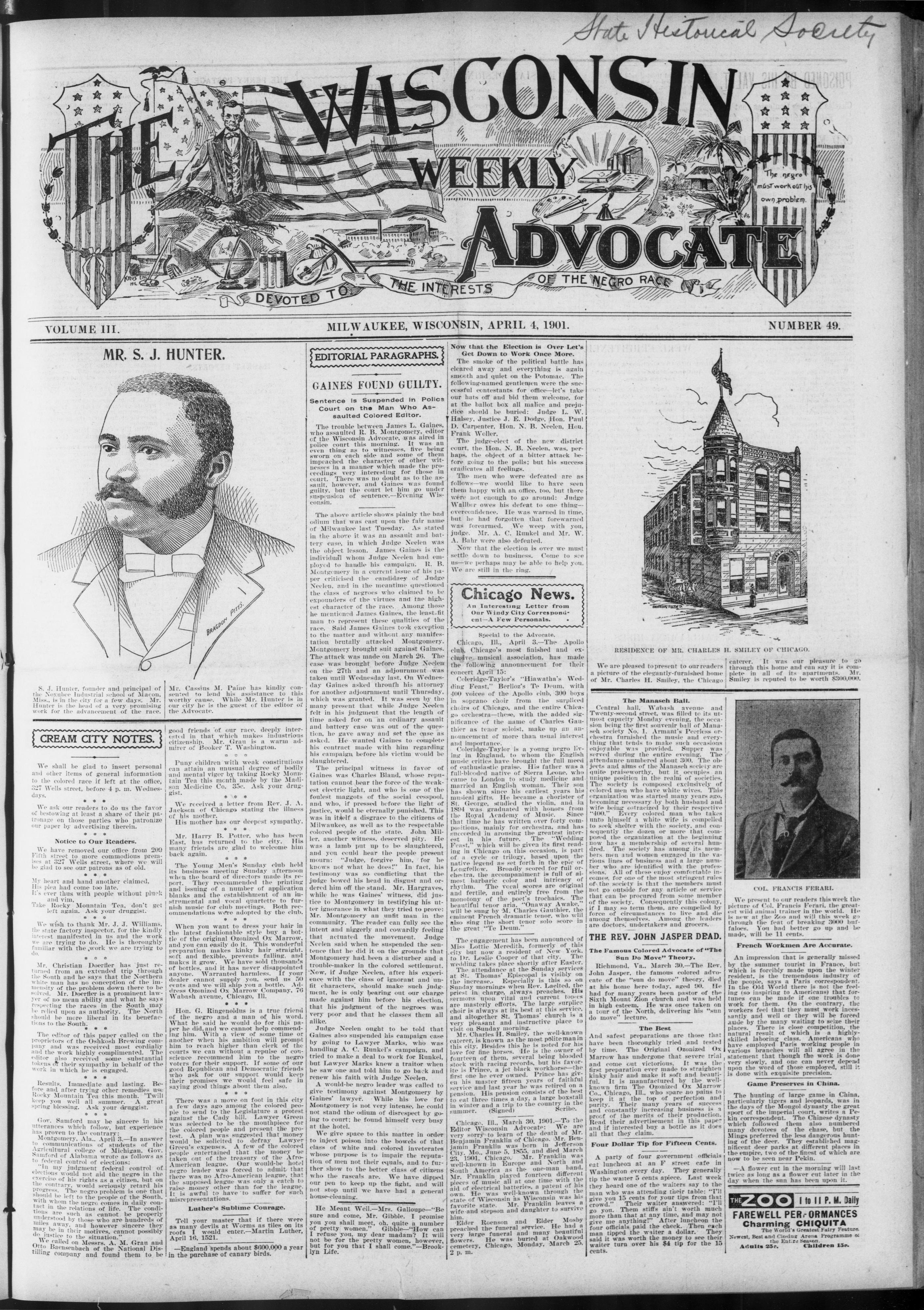
WISCONSIN
WEEKLY
ADVOCATE
DEVOTED TO THE INTERESTS OF THE NEGRO RACE
MR. S. J. HUNTER.
BRAGDON PITTS.
VOLUME III
MR. S. J.
S. J. Hunter, founder and principal of the Noxubee Industrial school of Macon, Miss., is in the city for a few days. Mr. Hunter is the head of a very promising work for the advancement of the race.
CREAM CITY NOTES.
We shall be glad to insert personal and other items of general information to the colored race if left at the office, 327 Wells street, before 4 p. m. Wednesdays.
**
We ask our readers to do us the favor of bestowing at least a share of their patronage on those parties who patronize our paper by advertising therein.
* * *
Notice to Our Readers.
We have removed our office from 209 Fifth street to more commodious premises at 327 Wells street, where we will be glad to see our patrons as of old.
***
My heart and hand another claimed,
His plea had come too late.
It's ever thus with people without pluck
and vim,
Take Rocky Mountain Tea, don't get
left again. Ask your druggist.
* * *
We wish to thank Mr. J. J. Williams,
the state factory inspector, for the kindly
interest manifested in us and the work
we are trying to do. He is thoroughly
familiar with the work we are trying to
do.
* ★ ★
Mr. Christian Doerfler has just returned from an extended trip through the South and he says that the Northern white man has no conception of the immensity of the problem down there to be solved. Mr. Doerfler is a prominent lawyer of no mean ability and what he says respecting the races in the South may be relied upon as authority. The North should be more liberal in its benefactions to the South.
* * *
The editor of this paper called on the proprietors of the Oshkosh Brewing company and was received most cordially and the work highly complimented. The editor also received some substantial tokens of their sympathy in behalf of the work in which he is engaged.
☆ ☆ ☆
Results. Immediate and lasting. Before and after trying other remedies use Rocky Mountain Tea this month. 'Twil keep you well all summer. A great spring blessing. Ask your druggist.
* * *
Gov. Samford may be sincere in his utterances which follow, but experience has proven to the contrary:
Montgomery, Ala., April 3.—In answer to communications of students of the Agricultural college of Michigan, Gov. Samford of Alabama wrote as follows as to federal control of elections:
"In my judgment federal control of elections would not aid the negro in the exercise of his rights as a citizen, but on the contrary, would seriously retard his progress. The negro problem is one that should be left to the people of the South, with whom the negro comes in daily contact in the relations of life. The conditions are such as cannot be properly understood by those who are hundreds of miles away, and however sincere they may be in their motives, cannot possibly do justice to the situation."
We called on Messrs. A. M. Grau and Otto Baensenbach of the National Distilling company and found them to be
and found them to be
Mr. Cassius M. Paine has kindly consented to lend his assistance to this worthy cause. While Mr. Hunter is in our city he is the guest of the editor of the Advocate.
Mr. Cassius M. Paine has kindly consented to lend his assistance to this worthy cause. While Mr. Hunter is in our city he is the guest of the editor of the Advocate.
good friends of our race, deeply interested in that which makes industrious citizenship. Mr. Grau is a warm admirer of Booker T. Washington.
* * *
Puny children with weak constitutions can attain an unusual degree of bodily and mental vigor by taking Rocky Mountain Tea this month made by the Madison Medicine Co. 35c. Ask your dru-gist
* * *
We received a letter from Rev. J. A. Jackson of Chicago stating the illness of his mother.
His mother has our deepest sympathy.
* * *
Mr. Harry B. Potter, who has been East, has returned to the city. His many friends are glad to welcome him back again.
* * *
The Young Men's Sunday club held its business meeting Sunday afternoon when the board of directors made its report. They recommended the printing and issuing of a number of application blanks and the establishment of an instrumental and vocal quartette to furnish music for club meetings. Both recommendations were adopted by the club.
* * *
When you want to dress your hair in the latest fashionable style buy a bottle of the original Ozonized Ox Marrow, and you can easily do it. This wonderful preparation makes kinky hair straight, soft and flexible, prevents falling, and makes it grow. We have sold thousands of bottles, and it has never disappointed anyone. Warranted harmless. If your dealer cannot supply you, send us 50 cents and we will ship you a bottle. Address Ozonized Ox Marrow Company, 76 Wabash avenue, Chicago, Ill.
* * *
Hon. G. Ringenoldus is a true friend of the negro and a man of his word. What he said he would do for this paper he did, and we cannot help commending him. With a view of some time or another when his ambition will prompt him to reach higher than clerk of the courts we can without a repulse of conscience recommend him to the negro voters for their support. If some of our good Republican and Democratic friends who ask for our support would keep their promises we would feel safe in saying good things about them also.
There was a move on foot in this city a few days ago among the colored people to send to the Legislature a protest against the Cady bill. Lawyer Green was selected to be the mouthpiece for the colored people and present the protest. A plan was suggested that money would be solicited to defray Lawyer Green's expenses. A few of the colored people entertained that the money be taken out of the treasury of the Afro-American league. Our would-be hotel negro leader was forced to admit that there was no Afro-American league, that the supposed league was only a catch to raise money other than for the league. It is awful to have to suffer for such misrepresentations.
Luther's Sublime Courage.
Tell your master that if there were as many devils at Worms as tiles on its roofs I would enter.—Martin Luther, April 16, 1521.
—England spends about $600,000 a year in the purchase of canary birds.
EDITORIAL PARAGRAPHS.
GAINES FOUND GUILTY.
Sentence is Suspended in Police Court on the Man Who Assaulted Colored Editor.
The trouble between James L. Gaines, who assaulted R. B. Montgomery, editor of the Wisconsin Advocate, was aired in police court this morning. It was an even thing as to witnesses, five being sworn on each side and some of them impeached the character of other witnesses in a manner which made the proceedings very interesting for those in court. There was no doubt as to the assault, however, and Gaines was found guilty, but the court let him go under suspension of sentence.—Evening Wisconsin.
The above article shows plainly the bad odium that was cast upon the fair name of Milwaukee last Tuesday. As stated in the above it was an assault and battery case, in which Judge Neelen was the object lesson. James Gaines is the individual whom Judge Neelen had employed to handle his campaign. R. B. Montgomery in a current issue of his paper criticised the candidacy of Judge Neelen, and in the meantime questioned the class of negroes who claimed to be expounders of the virtues and the highest character of the race. Among those he mentioned James Gaines, the least fit man to represent these qualities of the race. Said James Gaines took exception to the matter and without any manifestation brutally attacked Montgomery. Montgomery brought suit against Gaines. The attack was made on March 26. The case was brought before Judge Neelen on the 27th and an adjournment was taken until Wednesday last. On Wednesday Gaines asked through his attorney for another adjournment until Thursday, which was granted. It was seen by the many present that while Judge Neelen felt in his judgment that the length of time asked for on an ordinary assault and battery case was out of the question, he gave away and set the case as asked. He wanted Gaines to complete his contract made with him regarding his campaign before his victim would be slaughtered.
The principal witness in favor of Gaines was Charles Bland, whose reputation cannot bear the force of the weakest electric light, and who is one of the foulest maggots of the social cesspool, and who, if pressed before the light of justice, would be eternally punished. This was in itself a disgrace to the citizens of Milwaukee, as well as to the respectable colored people of the state. John Miller, another witness, deserved pity. He was a lamb put up to be slaughtered, and you could hear the people present mourn: "Judge, forgive him, for he knows not what he does!" In fact, his testimony was so conflicting that the judge bowed his head in disgust and ordered him off the stand. Mr. Hargraves, while he was Gaines' witness, did justice to Montgomery in testifying his utter ignorance in what they tried to prove: Mr. Montgomery an unfit man in the community. The reader can fully see the intent and niggerly and cowardly feeling that actuated the movement. Judge Neelen said when he suspended the sentence that he did it on the grounds that Montgomery had been a disturber and a trouble-maker in the colored settlement. Now, if Judge Neelen, after his experience with the class of ignorant and unfit characters, should make such judgment, he is only bearing out our charge made against him before his election, that his judgment of the negroes was very poor and that he classes them all alike.
Judge Neelen ought to be told that Gaines also suspended his campaign case by going to Lawyer Marks, who was handling A. C. Runkel's campaign, and tried to make a deal to work for Runkel, but Lawyer Marks knew a traitor when he saw one and told him to go back and renew his faith with Judge Neelen.
A would-be negro leader was called to give testimony against Montgomery by Gaines' lawyer. While his love for Montgomery is not very intense, he could not stand the odium of disrespect by going to court; he found himself very busy at the hotel.
We give space to this matter in order to inject poison into the bowels of that class of white and colored inveterates whose purpose is to impair the reputation of men not their equals, and to further show to the better class of citizens who the rascals are. We have dipped our pen to keep up the fight, and will not stop until we have had a general house-cleaning.
He Meant Well.—Mrs. Galloupe—"Be sure and come, Mr. Gibble. I promise you you shall meet, oh, quite a number of pretty women." Gibble—"How can I refuse you, my dear madam? It will not be for the pretty women, however, but for you that I shall come."—Brooklyn Life.
Now that the Election is Over Let's Get Down to Work Once More
Get Down to Work Once More. The smoke of the political battle has cleared away and everything is again smooth and quiet on the Potomac. The following-named gentlemen were the successful contestants for office—let's take our hats off and bid them welcome, for at the ballot box all malice and prejudice should be buried: Judge L. W. Halsey, Justice J. E. Dodge, Hon. Paul D. Carpenter, Hon. N. B. Neelen, Hou. Frank Woller. The judge-elect of the new district court, the Hon. N. B. Neelen, was, perhaps, the object of a bitter attack before going to the polls; but his success eradicates all feelings.
The men who were defeated are as follows—we would like to have seen them happy with an office, too, but there were not enough to go around: Judge Wallber owes his defeat to one thing—overconfidence. He was warned in time, but he had forgotten that forewarned was forearmed. We weep with you, judge. Mr. A. C. Runkel and Mr. W. A. Bahr were also defeated.
Now that the election is over we must settle down to business. Come to see us—we perhaps may be able to help you. We are still in the ring.
Special to the Advocate.
Chicago, Ill., April 3.—The Apollo club, Chicago's most finished and exclusive musical association, has made the following announcement for their concert April 15:
Coleridge-Taylor's "Hiawatha's Wedding Feast," Berlioz's Te Deum, with 400 voices of the Apollo club, 300 boys in soprano choir from the surpliced choirs of Chicago, and the entire Chicago orchestra—these, with the added significance of the name of Charles Gauthier as tenor soloist, make up an announcement of more than usual interest and importance.
Coleridge-Taylor is a young negro living in England, to whom the English music critics have brought the full meed of enthusiastic praise. His father was a full-blooded native of Sierra Leone, who came to London to study medicine and married an English woman. Their son has shown since his earliest years his musical gifts. He became a chorister of St. George, studied the violin, and in 1894 was graduated with honors from the Royal Academy of Music. Since that time he has written over forty compositions, mainly for orchestra, and has succeeded in arousing the greatest interest in his future. The "Wedding Feast," which will be given its first reading in Chicago on this occasion, is part of a cycle or trilogy, based upon the native legend as set forth in the epic of Longfellow. Broadly scored for full orchestra, the accompaniment is full of almost barbaric color and intricacy of rhythm. The vocal scores are original and fertile, and entirely free from the monotony of the poet's trochaics. The beautiful tenor aria, "Onaway Awake," will be sung by M. Charles Gauthier, the eminent French dramatic tenor, who will also sing the short tenor solo score in the great "Te Denn."
The engagement has been announced of Miss Lottie Meredith, formerly of this city but now a resident of New York, to Dr. Leslie Cooper of that city. The wedding takes place shortly after Easter. The attendance at the Sunday services at St. Thomas' Episcopal is visibly on the increase. Especially is this on Sunday mornings when Rev. Laelted, the priest in charge, always preaches. His sermons upon vital and current topics are masterly efforts. The large surplice choir is always at its best at this service, and altogether St. Thomas' church is a very pleasant and instructive place to visit on Sunday morning.
Mr. Charles H. Smiley, the well-known caterer, is known as the most polite man in this city. Besides this he is noted for his love for fine horses. He is the owner of fourteen of them, several being blooded stock with racing records, but his favorite is Prince, a jet black workhorse—the first one he ever owned. Prince has given his master fifteen years of faithful service and last year he was retired on a pension. His pension consists of the best to eat three times a day, a large boxstall in winter and a trip to the country in the summer. (Signed) Scribe.
Chicago, Ill., March 30, 1901.—To the Editor Wisconsin Advocate: We are very sorry to learn of the death of Mr. Benjamin Franklin of Chicago. Mr. Benjamin Franklin was born in Jefferson City, Mo., June 5, 1855, and died March 23, 1901, Chicago. Mr. Franklin was well-known in Europe and North and South America as the one-man band. Mr. Franklin played fourteen different pieces of music all at one time with the aid of electrical batteries, a patent of his own. He was well-known through the state of Wisconsin as Wisconsin was his favorite state. Mr. Franklin leaves a wife-and stepson and daughter to survive him.
Elder Roenson and Elder Mosby preached the funeral service. He had a very large funeral and many beautiful flowers. He was buried at Oakwood cemetery, Chicago, Monday, March 25. 2 p. m.
CHERM'S PUBLIC
RESIDENCE OF MR. CHARLES H. SMILEY OF CHICAGO. We are pleased to present to our readers a picture of the elegantly-furnished home of Mr. Charles H. Smiley, the Chicago caterer. It was our through this home and complete in all of its ap Smiley is reputed to be
The Manaseh Ball.
Central hall, Wabash avenue and Twenty-second street, was filled to its utmost capacity Monday evening, the occasion being the first souvenir ball of Manaseh society No. 1. Armant's Peerless orchestra furnished the music and everything that tends to make such occasions enjoyable was provided. Supper was served during the entire evening. The attendance numbered about 300. The objects and aims of the Manaseh society are quite praiseworthy, but it occupies an unique position in the realm of societies. The society is composed exclusively of colored men who have white wives. This organization was started many years ago, becoming necessary by both husband and wife being ostracized by their respective "400." Every colored man who takes unto himself a white wife is compelled to seek shelter with the society, and consequently the dozen or more that composed the organization at the beginning now has a membership of several hundred. The society has among its members men and women engaged in the various lines of business and a large number who are identified with the professions. All of these enjoy comfortable incomes, for one of the most stringent rules of the society is that the members must not go outside for any article or service that can be procured from some member of the society. Consequently this colony, if I may so term them, are compelled by force of circumstances to live and die among themselves. Among the leaders are doctors, undertakers and grocers.
THE REV. JOHN JASPER DEAD.
The Famous Colored Advocate of "The Sun Do Move" Theory.
Richmond, Va., March 30.—The Rev. John Jasper, the famous colored advocate of the "sun do move" theory, died at his home here today, aged 90. He had for many years been pastor of the Sixth Mount Zion church and was held in high esteem. He was once taken on a tour of the North, delivering his "sun do move" lecture.
The Best
And safest preparations are those that have been thoroughly tried and tested by time. The Original Ozonized Ox Marrow has undergone that severe trial and come cut victorious. It was the first preparation ever made to straighten kinky hair and make it soft and beautiful. It is manufactured by the well-known firm The Ozonized Ox Marrow Co., Chicago, Ill., who spare no pains to keep it at the top of perfection and purity. Their many years of success and constantly increasing business is a proof of the merits of their production. Read their advertisement in this paper and if interested buy a bottle as it does all that they claim.
Four Dollar Tip for Fifteen Cents
A party of four government officials eat luncheon at an F street cafe in Washington every day. They generally tip the waiter 5 cents apiece. Last week they heard one of the waiters say to the man who was attending their table: "I'll give you 15 cents for your tips from that crowd." Their waiter answered: "I'll go you. Them stiffs ain't worth much more than that at any time, and may not give me anything!" After luncheon the four officials paid the check. Then each man tipped the waiter a dollar. They said it was worth the money to see their waiter turn over his $4 tip for the 15 cents.
NUMBER 49.
H. SMILEY OF CHICAGO.
caterer. It was our pleasure to go through this home and can say it is complete in all of its apartments. Mr. Smiley is reputed to be worth $300,000.
M. B.
COL. FRANCIS FERARI.
We present to our readers this week the picture of Col. Francis Ferari, the greatest wild animal trainer in the world. He is new at the Zoo and will this week go through the feat of breaking 3000 buffaloes. You had better go up and be made, will be 11 cents.
French Workmen Are Accurate.
An impression that is generally missed by the summer tourist in France, but which is forcibly made upon the winter resident, is the tremendous industry of the people, says a Paris correspondent. In the Old World there is not the feeling (so inspiring to Americans) that fortunes can be made if one troubles to work for them. On the contrary, the workers feel that they must work incessantly and well or they will be forced aside by the many waiting to seize their places. There is close competition, the natural result of which is a highly-skilled laboring class. Americans who have employed Paris working people in various branches will all agree in the statement that though the work is done very slowly, and one can never depend upon the word of those employed, still it is done with exquisite precision.
Game Preserves in China.
The hunting of large game in China, particularly tigers and leopards, was in the days of the Mongol dynasty the great sport of the imperial court, writes a Pekin correspondent. The Chinese dynasty which followed them also numbered many devotees of the chase, but the Mings preferred the less dangerous hunting of the deer. They established magnificent deer parks at different places in the empire, two of the finest of which are now to be seen near Pekin.
—A flower cut in the morning will last twice as long as a flower cut later in the day when the sun has been upon it.
THE ZOO I to II P. M. Daily
FAREWELL PERFORMANCES
Charming CHIQUITA
The World's Greatest Fairy Feature.
Newest, Best and Closing Arena Programme of
the Entire Season.
Adults 25c. Children 15c.
POISONED BY HIS VALET.
Charles T. Jones Confesses that He Killed Millionaire Rice.
OLD MAN GIVEN PILLS.
Chloroform Finished the Job-The Plan to Commit Suicide.
New York, April 3.—Jones, the valetsecretary, in testifying at the Patrick hearing this morning, said that at the time he attempted suicide at the Tombs, Patrick had agreed to kill himself also.
New York, April 3.—Charles F. Jones, the valet-secretary of William M. Rice, the rich Texan, resumed the giving of testimony today in the proceedings against Albert T. Patrick, who is charged with causing Rice's death in order to obtain his property by means of a will, in addition to deeds and checks, which it is alleged were forged. Jones began today by relating that on Tuesday following Rice's death Patrick told him he had discovered the will witnessed in his (Patrick's) office. On this occasion Jones testified that Patrick asked when Rice had last been given mercury.
"I told him on Thursday," said Jones. "Patrick then told me that there would not be any traces of that left in the system at the time of autopsy, and that the embalming fluid would kill all traces of the oxalic acid which was a vegetable poison."
Witness then told of Dr. Curry having come to the apartments on Tuesday, where he met Patrick. The two had a long talk which Jones did not hear. The so-called Patrick will was then brought up. Jones said he had told Patrick that the provisions for Rice's relatives, which was discovered on the day following Rice's death, were too small, and that it would be impossible to get it probated. Patrick, Jones said, then had the so-called "Patrick will" drawn. The witness related at length the incidents of the day when the body of Rice was cremated.
Jones says that when he was locked up on October 4 he made a statement which was entirely fictitious and of which he could not recall even the most salient features. Jones then told how Mr. House had been appointed lawyer of both Patrick and himself and the events surrounding their commitment to the Tombs. From here Jones passed to his attempt to commit suicide.
Both Planned Suicide.
"Some time before I tried to commit suicide," said Jones. "Patrick and I had a talk in the reception room at the Tombs. Patrick told me his means were exhausted and that they were in desperate straits. Patrick wanted me to shoulder the responsibility for the time. I told him I would not confess until I could tell a straight story. I said I would rather kill myself on account of the disgrace of the thing. Patrick said this might be the best thing for us both, and said he would kill himself, too. He said he had a small knife in his cell. The knife would do for one and he would try to get some carbolic acid from Mr. Potts. He gave me the knife. I put it in my shoe and took it to my cell. Later Potts called. Patrick told me Potts would not get him the poison. About 4 o'clock in the afternoon after I had got the knife I sat in my cell writing some letters and preparing for the end. Just then I was called to the district attorney's office. While there I made a confession. I was brought back to my cell in the evening, and at about 4 o'clock in the morning I tried to cut my throat."
Relatives Notified by Jones.
A number of telegrams sent by Jones notifying relatives of Rice's death were placed in evidence. They all read alike, setting forth that Rice died under the care of a physician, and that the death certificate gave as the cause diarrhoea, old age and heart failure, concluding with the notice of the funeral.
THE VALET'S STORY.
Jones Gives Details of Plot Against Millionaire's Life.
New York, April 3.—Speaking in a voice as gentle as a woman, with a demeanor so careless and indifferent as to be wholly at variance with his revolting recital, Charles T. Jones stamped himself as one of the most cold-blooded and heartless of murderers. Cold-blooded in that his victim, William Marsh Rice, the old millionaire, was already at death's door when he was chloroformed; heartless because the eccentric man of wealth, whose fortune he had plotted to gain, had been a friend and benefactor to him.
On the stand before Judge Jerome, sitting as a magistrate, the former valet of Mr. Rice said that at the instigation of Lawyer Albert T. Patrick he gave the old man mercurial pills and oxalic acid, and that when these had no effect he chloroformed his employer, using chloroform furnished by Patrick and following Patrick's instructions.
Story of the Murder.
Jones narrative was as follows:
"At 1 o'clock I went to luncheon and thence to Patrick's house. Mrs. Francis opened the door for me. Patrick asked me into his room. He pulled out a bottle and gave it to me. It was oxalic acid. Patrick warned me about the amount of water to use. He said oxalic acid was a vegetable poison and would act on the heart, but to dilute it with twenty parts of water so that it would not burn the stomach.
"I did as he said. I gave a glass of it to Rice. He said he did not like it, and refused to take any more of it, asking me if I thought he ought to take it. I said: 'Do not if you don't want to.' Rice got up and said he felt better. Then his sight seemed to fail him. I lifted him into his bed. I went out and sent a telegram to Patrick, saying: 'Meet me on the south side of Fifty-sixth street and Madison avenue tonight.'"
Says Rice Killed His Wife.
"Patrick was there. He walked over to Fifth avenue. On the corner he produced a bottle of chloroform. He told me he was a man of family, had two children, that he had debts, and that any way Rice had killed his wife. He told me to take the chloroform and take a towel, fold it in cone shape, and spill the chloroform into it. He said; 'Rice, when you apply it, will seem restless and uneasy, and may talk and rave, but don't be afraid of that; it will be all right.'
"I did as Patrick told me. I returned home, took a napkin and saturated it with chloroform. I put it on my own face and then put it over the face of Mr. Rice, and left the room. I walked up and down in the hall. The bell rang several times. I did not open the door. Finally I went into Mr. Rice's room. I raised the window and took the napkin and towel away from his face and put them in the range, where I burnt them.
"I sent a hall boy for Dr. Curry, telling him that Mr. Rice was very bad. I went to the telephone to tell Patrick that Rice was pretty near gone. When Dr. Curry came Patrick was with him. I told them Rice was dead. 'Dead; oh, my God, doctor, that is the worst thing that could
have happened to me,' said Patrick."
Jones testified at length about the postmortem incident. He said Patrick on the day following took charge of the apartments. On that day Jones testified, at the request of Patrick, he made out the checks for $25,000 and $135,000, respectively, on Swenson & Sons and the Fifth Avenue Trust company.
Jones said Patrick also took charge of about $450 in bills and eight or nine dollars in silver from a drawer in the millionaire's writing desk. Jones said Patrick also took away two gold watches and all the private papers of Mr. Rice.
Drawing Up the Bogus Will.
In December, 1899, Jones said Patrick engaged him to draw a will on his typewriter and got Rice to sign it when his mind was not quite clear, and Patrick proposed to get witnesses for the will of 1896.
Continuing, the witness said Patrick then said he would arrange for witnesses, and mentioned Morris Meyer and Dr. L. Short.
"On March 15, 1900," said Jones, "I went to 302 Broadway, where I met Meyer. He said he would not sign the will as a witness unless he was convinced that the signature of Mr. Rice was genuine."
"In the will you drew up for Patrick do you remember something about the bequests?" was asked.
"I know there were large bequests to relatives. There was a large bequest to Weatherbee. I believe he was to get $25,000—at any rate, a much larger sum than under the former will. That was to make him keep quiet about a conversation I had with him when I asked him to be a witness."
STAGE HORSES WERE FRIGHTENED.
Jump Into the Orchestra While the Audience Makes a Wild Dash for the Doors.
New York, April 3.—At the performance of "Uncle Tom's Cabin" in the Academy of Music last night, two horses drawing a landau became frightened, jumped off the stage into the orchestra, severely injured their driver, David Peyser, and frightened the spectators so much that they for the moment lost their judgment. Men, women and children leaped to their feet while the employes of the theater shouted to them to remain quiet.
Unmindful of all warning the crowd made a rush for the street and the employees, seeing all efforts to bring about quiet were unsuccessful threw open all the exits to allow the spectators to get out. The police, attracted by the excited outpouring from the theater sent for the reserves and in a few minutes order was restored. Fifteen minutes later there was no sign that anything unusual had happened except the man on a cot in Bellevue hospital moaning with pain caused by several fractured ribs. In the play in the third act just as the curtain goes up, a landau drawn by a team of white horses is driven on the stage from the wings. The landau contains Uncle Tom (John E. Kellerd), the slave's owner, Augustin St. Clair, Mrs. St. Clair, and Aunt Ophelia.
The coach goes down to the center of the stage which represents St. Clair's house and garden in Louisiana. The party gets out and the coach is turned around and driven off. Peyser is a skilled driver and since the show opened drove the horses quietly at every performance until last night when they became unmanageable.
PARLIAMENT RISES FOR EASTER RECESS.
Rumors that Salisbury will Resign and that Balfour will Become Premier.
London, April 3.—Parliament has risen for the Easter recess after a session more satisfactory to the opposition than to the government. The record of business is meager, but that is a small matter in comparison with the lack of energy and judgment with which the House of Commons has been led.
The continuance of Lord Salisbury in power for many weeks is doubted by some of the most experienced parliamentary hands. There are rumors that he has sought to offer his resignation before his departure for Beaulieu, and that A. J. Balfour would be found in the upper house when Parliament reassembles. Another version is that nothing will be done for a fortnight, and that Lord Salisbury may consent to remain in office until the close of the session if his health improves on the Riviera.
There was no lack of gossip in the smoking room of the House of Commons during the closing hours, but the only points on which there was a general agreement were that the government had been on a downward grade since the King's speech was read, and that a stronger leader than Mr. Balfour was needed in the Commons.
HOSPITAL IS CLOSED.
Order of Bishop Els is Put Into Effect-Iron Mountain Nuns Expelled.
Iron Mountain, Mich., April 3.—Mercy hospital, better known here as Emergency hospital, will close its doors today by order of Bishop Eis, and the nuns have been ordered to leave the diocese. This is the result of an ecclesiastical scandal which occurred last January, when Ellen Hogan, a novitiate in the hospital, was arrested on an insanity charge, preferred by the mother superior. Miss Hogan was adjudge sane by the probate court. After being released from custody, by order of Judge Bergeron, Miss Hogan made severe charges against the mother superior. An investigation by Bishop Eis resulted in the order to close the institution.
CURTAIN RUNG DOWN.
Death Claims D'Oyly Carte, Theatrical Manager, and Harry Budworth, Old-Time Minstrel.
London, April 3.—D'Oyly Carte, the theatrical manager and impressario, died this morning at Tunbridge Wells, Counties of Kent and Surrey.
D'Oyly Carte died quite peacefully. He had long suffered from weakness of the heart, which was aggravated by the shock he sustained in the death of Sir Arthur Sullivan. He was in a comatose state yesterday but rallied before the end.
New York, April 3.—Harry Budworth, the old-time minstrel and vaudeville performer, died last evening of hemorrhage of the lungs at the home of a friend in this city.
Mr. Budworth was over 50, and at one time was one of the most popular of Haverly's minstrel troupe.
Increase in Employment of Servants.
Forty years ago in one section of the country, the South, in a white population of 8,000,000 probably not more than one family in twelve had a servant, the vast majority of the servants being then owned or hired by less than 400,000 families in the 18,000,000 of the rest of the American white population having servants was probably a little higher. Now, if among the household servants are included farm laborers, who in many cases do the heavy work about the house, an average of one family in four, perhaps, has some kind of a servant either regularly or irregularly.-Southern Farm Magazine
RUSSIAN DESIGNS.
Well-Informed Men Belleve that Neither England Nor Germany will Interfere.
Pao Ting Fu, Saturday, March 30. (Via Pekin, Sunday, March 31, by post to Che Foo.)—Chi Li at present has 10,000 Chinese troops, commanded by Liu Kluantes, the famous black flag leader, within twelve miles of Huo Lu, where there are 3000 French troops who are anxious to make an attack but are restrained by positive orders from Pekin, M. Pichon (the French minister) informed. Gen. Voyron, commanding the French troops, that he had received instructions from France to the effect that the government does not desire aggressive action on the part of the troops, provided the Chinese do not advance, which is not considered likely. There is littie chance of a collision
Early in March 150 Germans were attacked near the border and two men were killed. Two thousand soldiers entered Shan Si province through the Ante Suling pass, driving the Chinese beyond Shai Quan and then retiring to Ante Suling where they are now in camp. French officers state that Shan Si has a different people from the Chi Li province, the inhabitants being more arrogant, daring the foreign troops to enter. The French have large supplies at Cheng Ling and Huo Lu including camel trains. Pao Ting Fu is entirely peaceful and its condition is better than that of any
Forta will be Useless.
Pekin, April 2.—Regarding the destruction of the forts the generals are practically agreed that those at Taku, Shan Hai Kuan and Tien Tsin must at least be rendered useless, while the north fort at the entrance of the river Taku must be destroyed entirely, on account of the fact that ever since it was built it has caused lower water on the bar, having diverted the course of the stream. The merchants have frequently complained to the consuls, but no government has liked to ask China to destroy a fort at the entrance to an important river. This, however, can now be done as a matter of military necessity, and will give foreign merchants intense satisfaction, as in consequence of its being done the river will in a short time again be navigable as far as Tien Tsin.
The Question of Indemnity.
New York, April 2.—A dispatch to the Tribune from London says: The China question has again fallen into the background since nearly all well-informed men agree that neither England nor Germany will interfere with Russian designs in Manchuria and that Japan can be placated by concessions in Corea. The indemnity is now under discussion between Germany and England with the probability that the compromise agreed upon between them will be received by the powers after protracted delay.
China Forced to Yield.
St. Petersburg, April 2.—The superior councilor of the Chinese legation, Chu We Jte, is continuing the negotiations, as charge d'affaires, regarding the Manchurian agreement. The illness of the Chinese minister, Yang Yu, is now admitted to be due to apoplexy, which incapacitate him from work, probably for a long period. It is said the loss of half his estate through the destruction of a Chinese bank, combined with political cares, is undermining his health.
Unofficial observers scarcely understand how a doubt can possibly be entertained abroad that China will ultimately accept the Russian conditions after it is apparent that no power is willing to forcibly support China. For, as it is urged, while Russia undoubtedly prefers to carry through her plans as made, her diplomatic position would suffer as little as her military position from China's refusal to accept what Russia regards as moderate conditions of withdrawal.
FREIGHT HOUSE BURNS.
Fifty Cars Loaded with Grain Destroyed—Loss Is Covered by Insurance.
St. Louis, Mo., April 2.—Fire destroyed the Baltimore & Ohio Southwestern freight house and platform and fifty cars loaded with grain in East St. Louis, Ill., last night. The fire was caused by sparks from a switch engine. The damage is roughly estimated at $150,000. The loss is covered by insurance. St. Paul, Minn., April 2.—Last night in the five-story brick building at 188 East Fifth street, occupied by the Towle Syrup company, manufacturers and dealers in syrups and preserves, caused a damage estimated at from $75,000 to $100,000. Chattanooga, Tenn., April 2.—The plant of the Mountain Stove works burned today. Loss, $50,000. Insurance about $40,000.
REPORTS CONFLICTING.
One Says Nethersole Cannot Live and the Other Says She Is Rapidly Recovering.
London, April 2.—Olga Nethersole, the actress, who underwent a surgical operation last week, is progressing excellently and expects to go out at the end of this week.
New York, April 2.—A dispatch to a local paper from London says Miss Olga Nethersole's collapse in America has been followed by an illness from which it is thought she cannot recover. Her illness is due to cancer, and while an operation has been considered it has been decided it would not be successful and would hasten her death.
MINE FIRE IS OUT.
Damage to the Republic Mine Is Much Less than was at First Expected.
Republic, Mich., April 2.—[Special.]— The fire in Republic mine is out and work will be resumed shortly. Men went down in the mine today and found but very little smoke and gas. The damage is very small compared with what was expected at first.
American Shoes in England
Nearly 1,000,000 pairs of American shoes are now sold yearly on the British market, in spite of the tax on hides with which manufacturers on this side have to contend and from which British makers are exempt. The superiority of American machinery brings access to foreign markets. Besides shoes made here are more shapely and are sold more cheaply than those made in Europe.
"My hero dies in the middle of my latest novel." said the young author.
"That's a grave mistake," replied the editor. "He should not die before the reader does."—Atlanta Constitution.
—The people of Iceland are all poor, but there are no paupers, no dependents; all are self-supporting. There is little or no crime there.
Sappy—"I think I shall—aw—nevah have to stwuggle for gweatness. Aw, I was born gweat, doncherknow?" Crusty—"By Jove! How you must have shrunk!"—Tit-bits.
THE LEGISLATURE.
Senate.
The bill reapportioning the state into Assembly districts came into the Senate from the Assembly on the 28th, and after considerable debate it was referred by a vote of 16 to 15. Voting machines are in a fair way to be adopted in Wisconsin. The Hall resolution for a constitutional amendment authorizing their use, which was passed by the Assembly, was recommended for passage in the Senate by the committee on privileges and elections. An Assembly amendment was concurred in to Senator Gaveney's bill authorizing persons to change their names by filing a declaration with the register of deeds, the amendment providing that names should be changed in this manner only once. An Assembly bill legalizing the acts of H. P. Clute as state veterinarian was also concurred in. Senator Martin's bill, 361 S., designed to suppress the sale of the Police Gazette and similar publications in Wisconsin, was ordered to engrossment and third reading with two or three votes in opposition. Senator Miller's bill providing for a cottage for woman students at the state university, to cost $20,000, was reported unfavorably by the committee on claims and indefinitely postponed by the Senate.
The bill reapportioning the state into Assembly districts came back to the Senate from committee on the 29th with the changes in Brown county recommended for adoption. Senator Weed dissented from the report, but the Senate adopted the amendments and then concurred in the bill by unanimous vote, the two Democratic senators, Jacobs and Weed, voting "aye" with the Republicans. There will be another contest on the floor over the anti-cigarette bill, a majority and minority report being submitted. The bill which attempted to fix the salary of the Milwaukee sheriff and his deputies was reported back from the judicial committee with an amendment in the form of a substitute. The Hon' resolution providing for a constitutional amendment legalizing the use of voting machines in Wisconsin was passed without opposition or discussion. The amendment simply legalizes the use of the machines and does not make their use compulsory. Senator Mosher's bill appropriating $5000 for the purchase of books and pamphlets for the state historical library was passed. Senators Fearne, Greene, Stebbins, Weed and Wolff voting against it. The original bill asked for $10,000. Senator Hatton's bill appropriating $25,000 to the normal school fund income, for the completion of the buildings at Stevens Point and Oshkosh, was passed. Other Senate bills passed were: Relative to right of way of telephone lines; relating to commissioners of fisheries. The following Assembly bills were concurred in: Relating to ditches and drains; relating to a dam on Apple river; prohibiting the killing or catching of any wild birds other than game birds; prohibiting the soliciting or orders for oleomargarine. Two insurance bills, 162 S., relating to the licensing of insurance companies, and 254 S., providing for the licensing of insurance solicitors, were killed. Rereference to committee was secured for two other insurance bills. 28 S. and 211 S., both amending the standard policy. Adjournment was taken to the evening of the 3d.
Gov. La Follette on the evening of the 3d returned to the Legislature five bills to which he refuses to affix his signature One of the bills vetoed is that of Assemblyman Owen, known as 419 A., giving the boards of police and fire commissioners of cities of the second and third class power to remove members of the fire and police departments without trial if "the good of the service" so requires. Another bill is No. 257 A., by Assemblyman Zinn, which provides for an increase in salary of $600 to $1000 for the city veterinarian of Milwaukee. In vetoing Mr. Erickson's bill. No. 371 A., giving Adolphus P. Nelson authority to erect a dam on Wood river, Burnett county, the governor holds the state should always retain the right to repeal such privileges. The fourth Assembly bill vetoed is No. 132 A., by Mr. Gilman, giving the city of Durand power to erect a toll bridge over the Chippewa river. The Senate bill vetoed was No. 227 S., by Mr. Jacobs, relating to the change of venue from the circuit court and the county court of Dodge county. The governor holds that the bill would modify the existing law on the subject and which is unnecessary. The Senate session was short, adjournment being taken at 9 o'clock to allow the members of the committee on privileges and elections to attend the meeting of that committee.
Assembly.
The Assembly on the 28th reconsidered the vote by which Mr. Young's bill relating to the condemnation of land by street railway companies was ordered to a third reading, and referred it to the committee on cities for amendment. The Assembly concurred in Senator Kreutzer's bill increasing the salaries of the Supreme court and circuit judges, but there was a good deal of opposition to it. Mr. Softwedel's bill, No. 100 A., extending the scope of the present sweatshop law to cover all kinds of manufacturing, was passed as was bill No. 206 A., amending the law relating to change of grades of streets in Milwaukee. Mr. McCabe's bill, No. 460 A., prescribing the manner of receiving bills for public improvements, was passed. Senator Kreutzer's bill to commission instructors of military science as colonels and Senator Anson's bill to punish desecration of the flag were concurred in were: Relating to certificates of graduates; relating to justices of the peace; to prohibit catching of brook trout in certain rivers; relating to obstructions in inland waters; relating to subcontractors and laborers' licens; relating to Brodhead school district; relating to sale of real estate of infants, etc., relating to writs, etc.; relating to administering oaths; relating to transfer of certain sums of money from one fund to another; legalizing acts of certain corporations. A lot of bills on the calendar for killing were laid over, including Mr. Stevens' bill for a state home for inebriates and Mr. Karel's bill to establish a hospital for the treatment of tuberculosis.
At the evening session of the Assembly on the 28th it was decided to have the morning sessions begin at 9 o'clock instead of 10. Mr. Stevens offered an amendment to the bill authorizing S. D. Carpenter to begin suit against the state on an old outlawed claim. The amendment does not specify any amount of the claim, and lets the court settle that question. Both the bill and the amendment was referred to the judiciary committee.
The Assembly on the 29th killed the bill to convey to Ephralm Mariner and Charles F. Pfister the Sturgeon Bay Ship Canal company lands, but Mr. Keene saved it from burial by moving a reconsideration and asking that action upon his motion be deferred until the 4th. The bill was introduced by Senator Riordan and was passed by the Senate without opposition. The Assembly ordered to third reading Mr. Keene's bill to put the whole work of making the tax rolls and bills in the city of Milwaukee into the hands of the tax commissioner. The Assembly killed a number of bills, including Mr. Stevens' bill for a state home for inebriates. Mr. Barker's bill forbidding divorced people marrying within one year after the entry of the decree of divorce was on the calendar for killing, as it had been half a dozen times before, but Mr. Barker made a strong effort and saved it. An amendment to give judges the right to grant permission to marry sooner was adopted. The Assembly passed and concurred in the following bills: To authorize Jacob Bean and J. S. O'Brien to maintain dams on Namakagon river; relating to burial of soldiers, sailors and marines; relating to fish and game; relating to disputed lands in Chippewa county; relating to construction of sewers in cities; to allow Oconomowoc school district to borrow money; relating to election returns; relating to labels and trademarks; to authorize cities to acquire light or waterworks; to prevent mutilation of horses by docking. Among the bills ordered to a third reading was Mr. Williams' bill to authorize the establishment of county reformatory schools. The apportionment bill, as amended by the Senate, came back and was laid over under the rules. The Assembly adjourned to the 3d.
The Assembly on the evening of the 3d killed Mr. Spratt's bill providing for the repeal of the corrupt practice act. The vote was 48 to 21. Among the bills passed by the Assembly was one to change the law relating to the organization of railroad companies so that the amount of bonds issued by them does not exceed its actual property value. The lake shore drive bill, relating to Milwaukee, was also passed.
Dr. Barry—"What a remarkable case Mrs. Ayward's is!" Dr. Strong—"Case! The woman is a perfect showcase of maladies."—Harper's Bazar.
THE PENNY POSTAGE PLAN.
New Zealand's Rates will Carry Letters to This Country.
The United States postal authorities have not refused to deliver letters bearing the penny postage or New Zealand, and persons making complaints to that effect do not understand the laws and customs of the service. The United States has never been requested by New Zealand to do anything under the penny-postage plan. There has been no correspondence on the subject, and none is necessary. The postmaster at San Francisco or any other part will receive and forward all letters from New Zealand bearing penny postage stamps without question unless the envelopes are marked "short paid" before they come within the postal jurisdiction of this country. Then the additional postage will be collected and forwarded to the proper authorities in New Zealand.
Under the rules of the Universal Postal union the nation in which mail originates can fix its own postage. It pays all the expenses of transportation and enjoys the revenues from all mail sent outside its territory. When this mail reaches the United States or any other foreign country the postal authorities of that country take charge of it and deliver it without further cost to New Zealand. This arrangement is universal. If New Zealand or any other country sees fit to adopt a penny rate for foreign postage it is at liberty to do so without reference to the United States or any other country. At the same time the United States claims the right to fix the rate of postage upon letters to New Zealand and other foreign countries. Without authority from Congress the present rates cannot be changed.—W. E. Curtis in Chicago Record.
MARKET REPORTS.
Milwaukee, April 3, 1901.
G AND DAIRY PRODUCTS.
EGG AND DAIRY PRODUCTS.
MILWAUKEE—Eggs—Market firm; fresh
new, cases included, 13c; fresh, cases re-
turned, 12½c; seconds, 8c. Receipts were
826 cases.
Butter — Market steady. Fancy prints,
21½@22c; fancy or extra creamery, per lb.
21@21½c; firsts, 17@19c; seconds, 15@16c;
dairy prints, 17c; extra fancy dairy, 16c;
lines, 13@14c; packing stock, 11@12c; whey,
8c; roll, wrapped, 12½@13½c; unwrapper,
12@13c; grease, 4@5c. The receipts today
were 23,465 lb against 8764 yesterday.
There is a good demand for all choice
goods and 21½c is readily paid for extras.
The supply of choice creamery is not equal
to the demand. Low grades are rather
slow.
Cheese—Steady. Receipts were 4150 lbs today against 4755 lbs yesterday. Full cream flats, new colored, 10½@11c; Young Americas, new, 11½@12c; daisies, new, 11½@12c; fancy brick, 10½@11c; low grades, 6@8c; limburger, per lb, No. 1, 10½@11c; low grades, 5@8c; imported Swiss, 12@13c; Block Swiss, domestic, 11½@12c; choice loaf, 11@13c; No. 2, 9@10c; Sapsago, 16½@17½c; farmers', 10@11c.
NEW YORK — Butter — Receipts, 5488 pkgs; strong; fresh creamery, 16@22c; factory, 11@14½c. Cheese—Receipts, 783 pkgs; firm; fancy large colored and white, 11@11½c; fancy small colored, 12½c; do white, 12@12½c. Eggs—Receipts, 21,417 pkgs; strong; Western fresh, 13½c; storage western, 13½@14c; Southern at mark, 12½@13½c. Sugar—Raw irregular; fair refining, 3½@17-32c; centrifugal, 96 test, 411-16c; molasses sugar, 3-9-32c; refined steady; crushed, 5.75c; powdered, 5.35c granulated, 5.25c. Coffee—Easy; No. 7 Rio, 6½c.
CHICAGO—Butter—Qulet: creamerles, 15
@20½c; dairies, 11@18c. Cheese—Qulet; 11
@11½c. Eggs—Active; 12¼@12½c. Dressed
poultry—Dull; turkeys, 8½@11½c; chickens,
9@10c.
MILWAUKEE LIVESTOCK MARKET.
MILWAUKEE LIVESTOCK MARKET.
HOGS—Receipts, 3 cars; market weak; light, 5.90@6.05; mixed and medium weights, 6.00@6.10; common to good packers, 5.80@6.10; fancy selected hogs, 6.10@6.15.
CATTLE—Receipts, 3 cars; firm; butchers' steers, medium to good 1050 to 1300 lbs, 4.75@5.25; fair to medium, 950 to 1050, 3.85@4.50; heifers, common, 3.25@3.75; good, 4.00@4.50; cows, fair to good, 2.85@3.75; canners, 2.00@2.65; bulls, common, 2.75@3.25; choice, 3.50@4.00; feeders, 800 to 950 lbs, 3.50@4.25; stockers, 500 to 750 lbs, 3.25@3.75; veal calves, common to choice, 4.50@6.00; milkers and springers, common, 15.00@25.00; choice cows, 30.00@45.00.
SHEEP—Receipts, 1 car; market steady, 3.50@4.75; bucks, 2.50@3.50; lambs, 4.75@5.50. Shorn sheep and lambs, 50c per cwt less.
Chicago receipts: Hogs, 24,000; cattle, 17,000; sheep, 14,000.
MARKETS BY TELEGRAPH.
MILWAUKEE—Flour—Steady. Wheat —
Easier; No. 1 Northern, on track, 73c. Corn —
Firm; No. 3 on track, 43c. Outs—Steady;
No. 2 white, on track, 29c; No. 3 white,
on track, 28@28%c. Barley—Steady; No. 2
on track, 57%c; sample on track, 48@57%c.
Rye—Firm; No. 1 on track, 54c. Provisions
—Higher; pork, 15.60; lard, 8.50.
Flour is steady at 3.95@4.05 for patents;
bakers', 2.95@3.00, and 2.80@2.95 for rye.
Millstuffs are steady and quoted at 15.75@
16.00 for bran, 15.50@16.50 for standard
middlings, and 16.00@16.50 for Milwaukee
nour middlings.
CHICAGO — Close — Wheat—April, 71%c;
May, 72%@72%c; July, 73c. Corn—April,
40%c; May, 41%c; July, 42c. Oats—April,
24%c; May, 24%c; July, 24%c. Pork—April,
15.35; May, 15.45; July, 15.25. Lard—April,
8.60; May, 8.47%; July, 8.25@8.17%; Sept-
ember, 8.25@8.27%. Ribs—April, 8.25;
May, 8.25; September, 8.12@8.15; July, 6.15.
Flax—Cash Northwest, 1.55; May, 1.54.
DULUTH — Close — Wheat — Cash No. 1 hard, 73¾c; No. 1 Northern, 71¾c; No. 2 Northern, 66¾@70¾c; No. 3 spring, 61¾@66¾c; to arrive. No. 1 hard, 74¾c; No. 1 Northern, 72¾c; May, 73¾c; July, 74¾c. Corn-39¾c; May, 40c. Oats-27¾@27¾c. Ryre-50c. Barley-35¾55c. Flax-To arrive, 1.61; cash, 1.60; May, 1.62¾; September, 1.15. Receipts of wheat, 128,891 bus; shipments, none.
ST. LOUIS—Close—Wheat—No. 2 red cash, 70c; May, 70¾@71c; July, 69¾c; No. 2 hard, 71¾@71¾c. Corn—No. 2 cash, 40¾c; May, 40¾c; July, 41¾c. Oats—No. 2 cash, 27¾c; May, 25¾@25¾c; July, 24c; No. 2 white, 29¾c. Lead-4.22½. Spelter-3.80@3.82½.
NEW YORK—Close—Wheat—May, 78c; July, 78¾c. Corn—May, 47¾c; July, 467c. KANSAS CITY—Wheat—May, 65¾@65¾c; July, 66c; cash No. 2 hard, 68@69c. No. 2 red, 70c. Corn—May, 39c; July, 39¼@39¾c; cash No. 2 mixed, 40¼@40¾c. No. 2 white, 41c. Oats—No. 2 white, 28¾c.
LIVERPOOL - Close-Wheat-Quiet, ½@
1d lower; May, 51½d; July, 51½d. Corn-
Quiet, ¼@½d lower; May, 31½d; July, 3s
10½d.
MINNEAPOLIS - Close-Wheat - Cash,
71½c; May, 71½c; July, 73½c; on track,
No. 1 hard, 73½c; No. 1 Northern, 71½c;
No. 2 Northern, 68@69c.
SOUTH OMAHA-Cattle-Receipts, 210:
active and stronger; native steers, 4.20@
5.40; Texas steers, 3.25@4.00; cows and
helfers, 3.25@4.40; stockers and feeders, 3.25@
4.90. Hogs-Receipts, 5300; shade lower;
heavy, 5.97½@6.07½; mixed, 5.95@5.97½;
light, 5.90@5.97½; bulk of sales, 5.97½@6.00.
Sheep-Receipts, 1500; steady; sheep, 3.80@
4.95; lambs, 4.50@5.30.
KANSAS CITY—Cattle—Receipts, 7000; active and steady; native steers, 4.00@5.50; Texas steers, 4.25@5.00; native cows and heifers, 3.25@4.80; stockers and feeders, 4.00@5.00; bulls, 3.25@4.60; Hogs—Receipts, 12,000; weak; bulk of sales, 5.95@6.05; heavy, 6.00@6.10; packers, 5.95@6.05; mixed, 5.90@6.05; light, 5.85@6.00; yorkers, 5.80@5.95; Sheep—Receipts, 3000; steady; muttons, 4.00@5.00; lambs, 5.00@5.20.
ST. LOUI5—Cattle—Receipts, 1800; steady to strong; native steers, 3.50@5.65; stockers and feeders, 2.55@4.70; cows and heifers, 2.00@4.75. Hogs—Receipts, 6500; strong, pigs and lights, 5.80@6.05; packers, 5.95@6.10; butchers', 6.00@6.25. Sheep—Receipts, 2500; steady to strong; native muttons, 4.25@5.15; spring lambs, 8.25@8.75.
There is a wide difference in the price of seats. Thus a seat in the New York stock exchange cost $52,000, while a tailor in Buffalo advertises: "Pants 98 cents a leg. Seats free!"—Buffalo Commercial.
Little Elmer (who has an inquiring mind)—"Papa what is conscience?"
mind)—Tapa, what is conscience Prof. Broadhead—"Conscience, my son, is the name usually given to the fear we feel that other people will find us out."—Harper's Bazar.
MUSICAL SAND.
A Guiana Desert Which Produces Harmonious Chords.
Perhaps the most interesting experience of musical sands is that recorded by Kinglake in his journey across the desert. He says: "As I dropped my head under the sun's fire and closed my eyes against the glare that surrounded me I slowly fell asleep—for how many minutes or moments I cannot tell—but after awhile I was gently awakened by a peak of church bells—my native bells—the innocent bells of Marlen, that never before sent their music beyond the Blagdon hills. My first idea naturally was that I still remained fast under the power of a dream. I roused myself and drew aside the silk that covered my eyes, and plunged my bare face into the light. Then at least I was well enough awakened, but still those old Marlen bells rang on, not ringing for joy, but properly, prosily, steadily, merrily ringing for church. After awhile the sound died away, slowly."
Kinglake thought he had been the victim of a hallucination, but it is probable that he heard actual musical sounds, either issuing from the rocks beneath the sand or caused by the friction of the particles of sand over which the travelers were walking, as in the case of a carious mountain which Darwin visited in Guiana. It is called by the natives El Bramador, or the Bellower, because of the sound given forth when the sand covering it is put in motion.—Chambers' Journal.
Drying preparations simply develop dry catarrh; they dry up the secretions which adhere to the membrane and decompose, causing a far more serious trouble than the ordinary form of catarrh. Avoid all drying inhalants, fumes, smokes and snuffs and use that which cleanses, soothes and heals. Ely's Cream Balm is such a remedy and will cure catarrh or cold in the head easily and pleasantly. A trial size will be mailed for 10 cents. All druggists sell the 50c. size. Ely Brothers, 56 Warren St., N. Y. The Balm cures without pain, does not irritate or cause sneezing. It spreads itself over an irritated and angry surface, relieving immediately the painful inflammation. With Ely's Cream Balm you are armed against Nasal Catarrh and Hay Fever.
Free Delivery; More Papers Taken.
As rural free delivery spreads and grows the fourth-class postmasters will rapidly disappear from the government service. The saving effected by the establishment everywhere in farming sections of the rural delivery, and the greatly-increased returns consequent upon improvement in the mail service, will show the importance and value of the innovation, the success of which has been mainly due to the present postmaster general, Charles Emory Smith. On one route, within a few months after installation of free delivery, the circulation of daily and weekly newspapers increased 200 percent. Similar results on dozens of other routes have come very close to these figures.—Leslie's Weekly.
$100 Reward $100.
The readers of this paper will be pleased to learn that there is at least one dreaded disease that science has been able to cure in all its stages, and that is Catarrh. Hall's Catarrh Cure is the only positive cure now known to the medical fraternity. Catarrh being a constitutional disease, requires a constitutional treatment. Hall's Catarrh Cure is taken internally, acting directly upon the blood and mucous surfaces of the system, thereby destroying the foundation of the disease, and giving the patient strength by building up the constitution and assisting nature in doing its work. The proprietors have so much faith in itsitative powers, that they offer One Hundred Dollars for any case that it fails to cure. Send for list of testimonials.
Address, F. J. CHENEY & CO., Toledo, O.
Atlantic's Largest Steamer
The steamship Celtic, to be finished and launched this summer, will be the largest vessel on the ocean. It will have a displacement of 33,000 tons, nearly 5000 tons greater than the largest steamship now afloat; a half dozen long railway trains can be carried by her, she will be able to provide for 2500 passengers, almost an army brigade, and Capt. Ismay expects to see an even greater ship than the Celtic built within a year or two.
What Do the Children Drink?
Don't give them tea or coffee. Have you tried the new food drink called GRAIN-O? It is delicious and nourishing and takes the place of coffee. The more Grain-O you give the children the more health you distribute through their systems. Grain-O is made of pure grains, and when properly prepared tastes like the choice grades of coffee, but costs about $ \frac{1}{4} $ as much. All grocers sell it. 15c and 25c.
Britons Buy Our Axes
The war office has just placed an order with a British merchant for 3000 felling axes of a well-known brand manufactured in the United States, says the London Express. The axes are required for the troops in South Africa, and it appears British makers cannot supply them promptly enough.
Lane's Family Medicine
Moves the bowels each day. In order to be healthy this is necessary. Acts gently on the liver and kidneys. Cures sick headache. Price 25 and 50c.
Increased Population
The census of Austria-Hungary shows a population of 40,310,835, which is an increase of 10 per cent. during the last decade
Carter's Ink
best for school, home and office. It costs no more than poor ink. Always ask for Carter's.
If You Have Rhenmatism
Send no money, but write to Dr. Shoop, Racine, Wis., Box 149, for six bottles of Dr. Shoop's Rheumatic Cure; express paid. If cured pay $5.50. If not, it is free.
—The mayor of Limoges has issued a decree forbidding the ringing of church bells before 6 o'clock on winter and 5 on summer mornings.
I am sure Piso's Cure for Consumption saved my life three years ago.—Mrs. Thos. Robbins, Maple Street, Norwich, N. Y., Feb. 17, 1900.
—The census of Mexico's population takes into account eleven Indian languages.
All goods are alike to PUTNAM FADELESS DYES, as they color all fibers at one boiling. Sold by druggists.
A heat wave passed over Australia January 25, destroying homes, stock and crops.
FITS Permanently Cured. No fits or nervousness after first day's use of Dr. Kline's Great Nerve Restorer. Send for FREE $2.40 trial bottle and treatie. DR. R. H. KLINE, Ltd., 231 Arch St., Philadelphia, Pa.
The United States buys matches from Germany and Sweden.
MRS. WINSLOW'S SOOTHING SYRUP for Children teething; softens the gums, reduces inflammation, allays pain, cures wind colic. 25 cents a bottle.
The population of Maine at the first census in 1790 was 96,540.
E. W. BEEBE, M. D., Eye, Ear, Nose and Throat, 173 Wisconsin St. (opp. P. O.) Milwaukee, Wis. Office hours from 10 to 12 and 8 to 5.
Alaska has only .11 of an inhabitant to the square mile.
THE MASTER OF THE TELEPHONE
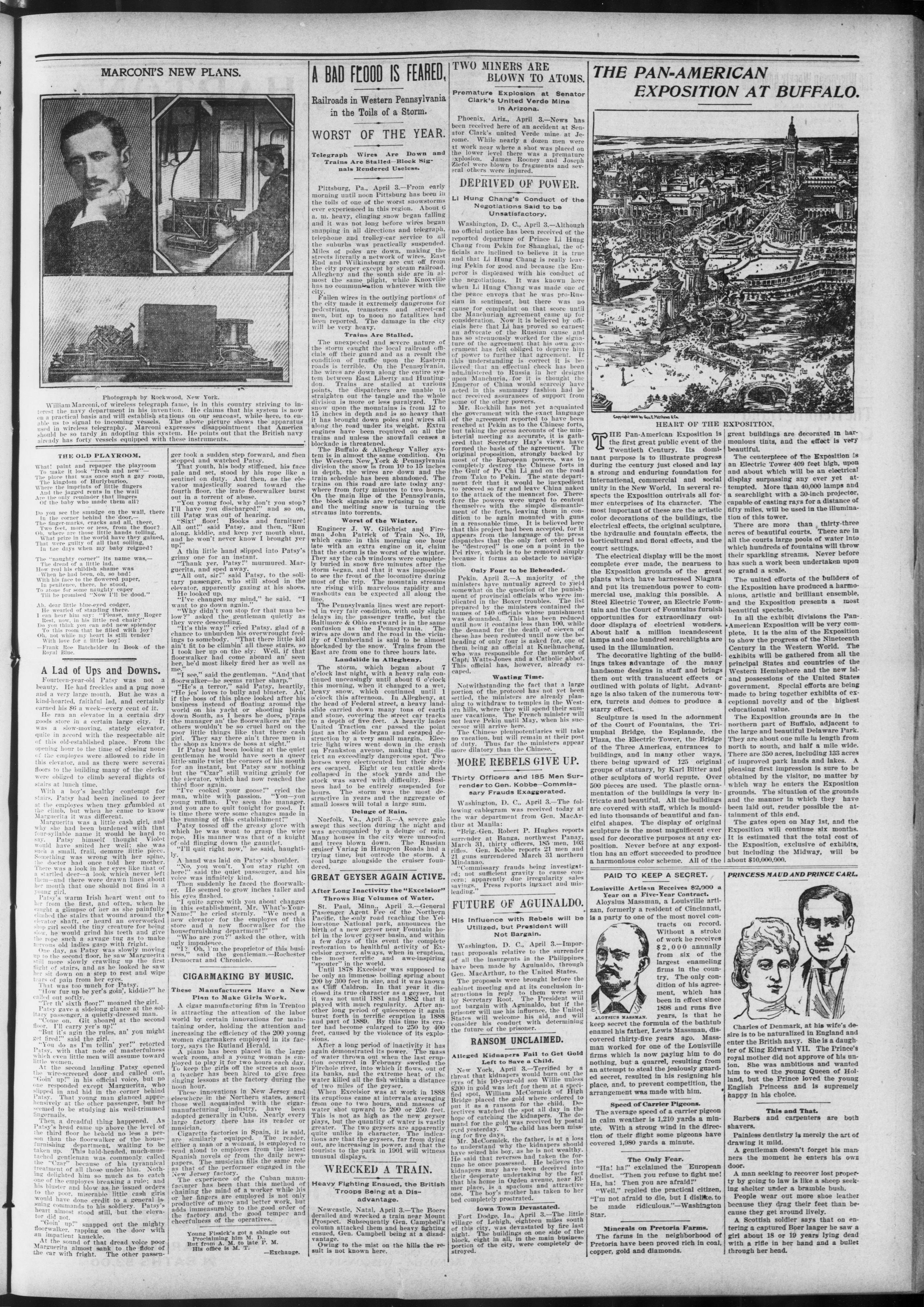
Photograph by Rockwood, New York. William Marconi, of wireless telegraph fame, is in this country striving to interest the navy department in his invention. He claims that his system is now on a practical basis and will establish stations on our seacoast, while here, to enable us to signal to incoming vessels. The above picture shows the apparatus used in wireless telegraphy. Marconi expresses disappointment that America should be so tardy in adopting this system. He points out that the British navy already has forty vessels equipped with these instruments.
THE OLD PLAYROOM.
What! paint and repaper the playroom
To make it look "fresh and new"—
The place that was once such a gay room,
The kingdom of Hurlyburloo.
Do you see the smudge on the wall, there
In the corner behind the door,—
The finger-marks, cracks and all, there,
Two feet, more or less, from the floor?
Oh, where are those little hands tolling,
What prize in the world have they gained,
That were guilty of all that soiling,
In the days when my baby reigned?
The "naughty corner" its name was,—
The dread of a little lad.
How real his childish shame was
When he had been, oh, so bad!
With his face to the flowered paper,
In penitence, there, he stood,
To atone for some naughty caper
Till he promised "Now I'll be dood."
Ah, dear little blue-eyed codger,
He weared of standing there.
I can hear him say: "Please, may Roger
Rest, now, in his little red chair?"
Do you think you can add new splendor
To this room that he filled with joy?
Oh, not while my heart is still tender
With love for a little boy!
—Frank Roe Batchelder in Book of the
Royal Blue.
A Lad of Ups and Downs.
Fourteen-year-old Patsy was not a beauty. He had freckles and a pug nose and a very large mouth. But he was a kind-hearted, faithful lad, and certainly earned his $6 a week—every cent of it.
He ran an elevator in a certain dry goods store in a certain large city. It was a slow-moving, stately elevator, quite in accord with the respectable air of this old-established place. From the opening hour to the time of closing none of the employees were allowed to ride in this elevator, and as there were several floors to the building many of the clerks were obliged to climb several flights of stairs at lunch time.
With a boy's healthy contempt for stairs, Patsy had been inclined to jeer at the employees when they grumbled at the climb, but when he came to know Marguerita it was different. Marguerita was a little cash girl, and why she had been burdened with that four-syllable name it would be hard to say. Patsy himself thought Violet would have suited her well: she was such a small, frail, demure little piece. Something was wrong with her spine, the doctor had once told her mother. There was a look in her eyes like that of a startled deer—a look which never left them—and there were drawn lines about her mouth that one should not find in a young girl.
Patsy's warm Irish heart went out to her from the first, and often, when he caught a glimpse of her as she painfully climbed the stairs that wound around the elevator shaft, or heard an overworked shop girl scold the tiny creature for being slow, he would grind his teeth and give the rope such a savage tug as to make nervous old ladies gasp with fright.
One day, as Patsy was slowly moving up to the second floor, he saw Marguerita still more slowly crawling up the first flight of stairs, and as he looked he saw her sit down on a step to rest and wipe tears of pain from her eyes.
That was too much for Patsy.
"How fur up be yer's goin', kiddie?" he called out softly.
"Ter th' sixth floor!" moaned the girl.
Patsy gave a sidelong glance at the solitary passenger, a quietly-dressed man.
"Come on. Git aboard at the second floor. I'll carry yer's up!"
"But it's agin the rules, an' you might get fired!" said the girl.
"You do as I'm tellin' yer!" retorted Patsy, with that note of masterfulness which even little men will assume toward little women.
At the second landing Patsy opened the wire-screened door and called out, "Goin' up!" in his official voice, but no one responded except Marguerita, who slipped in and hid in the corner behind Patsy. That young man glanced apprehensively at the other passenger, but he seemed to be studying his well-trimmed fingernails.
Then a dreadful thing happened. As Patsy's head came up above the level of the third floor he beheld no less a person than the floorwalker of the house-furnishing department, waiting to be taken up. This bald-headed, much-mustached gentleman was commonly called the "Czar" because of his tyrannical treatment of all those under him. Nothing delighted him so much as to catch one of the employees breaking a rule; and his bluster and blow as he issued orders to the poor, miserable little cash giris would have done credit to a general issuing commands to his soldiery. Patsy's heart almost stood still, but the elevator did not.
"Goin' up!" snapped out the mighty floorwalker, rapping on the door with an impatient knuckle.
At the sound of that dread voice poor Marguerita almost sank to the floor of the car with fright. The other passen-
ger took a sudden step forward, and then stopped and watched Patsy.
That youth, his body stiffened, his face pale and set, stood by his rope like a sentinel on duty. And then, as the elevator majestically soared toward the fourth floor, the irate floorwalker burst out in a torrent of abuse.
"You young fool, why don't you stop? I'll have you discharged!" and so on, till Patsy was out of hearing.
"Sixt' floor! Books and furniture! All out!" said Patsy, and then, "Run along, kiddie, and keep yer mouth shut, and he won't never know I brought yer up!"
A thin little hand slipped into Patsy's grimy one for an instant.
"Thank yer, Patsy!" murmured. Marguerita, and sped away.
"All out, sir!" said Patsy, to the solitary passenger, who still stood in the elevator, apparently gazing at his shoes. He looked up. "I've changed my mind," he said. "I want to go down again." "Why didn't you stop for that man below?" asked the gentleman quietly as they were descending. "It's this way!" cried Patsy, glad of a chance to unburden his overwrought feelings to somebody. "That there little kid ain't fit to be climbin' all these stairs, so I took her up on the sly: Well, if that floorwalker had come aboard an' seen her, he'd most likely fired her as well as me." "I see," said the gentleman. "And that floorwalker—he seems rather sharp."
"He's a terror," said Patsy, heartily. "He jes' loves to bully and bluster. An, if the boss of this place looked after his business instead of floating around the world on his yacht or shooting birds down South, as I hears he does, p'raps the manager an' the floorwalkers an' the others wouldn't be so cruel hard on the poor little things like that there cash girl. They say there ain't three men in the shop as knows de boss at sight."
If Patsy had been looking at the quiet gentleman he would have seen a queer little smile twist the corners of his mouth for an instant, but Patsy saw nothing but the "Czar" still waiting grimly for the elevator, which had now reached the third floor again.
"I've cooked your goose!" cried the man, white with passion. "You—you young ruffian. I've seen the manager, and you are to quit tonight for good. It is time there were some changes made in the running of this establishment!"
Patsy tossed off the greasy glove with which he was wont to grasp the wire rope. His manner was that of a knight of old flinging down the gauntlet.
"I'll quit right now," he said, haughtily.
A hand was laid on Patsy's shoulder.
"No, you won't. You stay right on here!" said the quiet passenger, and his voice was infinitely kind.
Then suddenly he faced the floorwalker. He seemed to grow inches taller and his eyes flashed.
"I quite agree with you about changes in this establishment, Mr. What's-YourName!" he cried sternly. "We need a new elevator for the employees of this store and a new floorwalker for the housefurnishing department!"
"Who are you?" asked the other, with ugly impudence.
"I? Oh, I'm the proprietor of this business," said the gentleman.—Rochester Democrat and Chronicle.
CIGARMAKING BY MUSIC.
These Manufacturers Have a New Plan to Make Girls Work. A cigar manufacturing firm in Trenton is attracting the attention of the labor world by certain innovations for maintaining order, holding the attention and increasing the efficiency of the 200 young women cigarmakers employed in its factory, says the Rutland Herald. A piano has been placed in the large work room, and a young woman is employed to play it for two hours each day. To keep the girls off the streets at noon a teacher has been hired to give free singing lessons at the factory during the noon hour.
These innovations in New Jersey and elsewhere in the Northern states, assert those well acquainted with the cigar-manufacturing industry, have been adopted generally in Cuba. Nearly every large factory there has its reader or musician. Cigarette factories in Spain, it is said, are similarly equipped. The reader, either a man or a woman, is employed to read aloud to employees from the latest Spanish novels or from the daily newspapers. The musician fills the same role as that of the performer engaged in the New Jersey factory.
The experience of the Cuban manufacturer has been that this method of chaining the mind of a worker while his or her fingers are employed is not only productive of more and better work, but adds immeasurably to the good order of the factory and the good temper and cheerfulness of the operatives.
Young Fissick's got a shingle out
Proclaiming him M. D..
But from A. M. to late P. M.
His office is M. T.
-Exchange.
A BAD FLOOD IS FEARED.
WORST OF THE YEAR.
Telegraph Wires Are Down and Trains Are Stalled—Block Signals Rendered Useless.
Pittsburg, Pa., April 3.—From early morning until noon Pittsburg has been in the toils of one of the worst snowstorms ever experienced in this region. About 6 a. m. heavy, clinging snow began falling and it was not long before wires began snapping in all directions and telegraph, telephone and trolley-car service to all the suburbs was practically suspended. Miles of poles are down, making the streets literally a network of wires. East End and Wilkinsburg are cut off from the city proper except by steam railroad. Allegheny and the south side are in almost the same plight, while Knoxville has no communication whatever with the city.
Fallen wires in the outlying portions of the city made it extremely dangerous for pedestrians, teamsters and street-car men, but up to noon no fatalities had been reported. The damage in the city will be very heavy.
Trains Are Stalled.
The unexpected and severe nature of the storm caught the local railroad officials off their guard and as a result the condition of traffic upon the Eastern roads is terrible. On the Pennsylvania, the wires are down along the entire system between East Liberty and Huntingdon. Trains are stalled at various points, the dispatchers are unable to straighten out the tangle and the whole division is more or less paralyzed. The snow upon the mountains is from 12 to 15 inches in depth and is so heavy that it has brought down poles and wires all along the road under its weight. Extra engines have been required on all the trains and unless the snowfall ceases a blockade is threatened.
The Buffalo & Allegheny Valley system is in almost the same condition. On the Western New York & Pennsylvania division the snow is from 10 to 15 inches in depth, the wires are down and the train schedule has been abandoned. The trains on this road are late today anywhere from forty minutes to two hours. On the main line of the Pennsylvania, the block signals are refusing to work and the melting snow is turning the streams into torrents.
Worst of the Winter.
Engineer J. W. Gilchrist and Fireman John Patrick of Train No. 19, which came in this morning one hour late with an extra engine on it, claim that the storm is the worst of the winter. They say the cab windows were completely buried in snow five minutes after the storm began, and that it was impossible to see the front of the locomotive during most of the trip. The mountain streams are rising with marvelous rapidity and washouts can be expected all along the line. The Pennsylvania lines west are reported in very fair condition, with only slight delays in the passenger traffic, but the Baltimore & Ohio eastward is in the same confusion as the Pennsylvania. The wires are down and the road in the vicinity of Cumberland is said to be almost blockaded by the snow. Trains from the East are from one to three hours late.
Landslide in Allegheny.
The storm, which began about 7 o'clock last night, with a heavy rain continued unceasingly until about 6 o'clock this morning, when it changed to a wet, heavy snow, which continued until 1 o'clock this afternoon. In Allegheny, at the head of Federal street, a heavy landslide carried down many tons of earth and stone, covering the street car tracks to a depth of five feet. A heavily laden United Traction car passed the point just as the slide began and escaped destruction by a very small margin. Electric light wires went down in the crash on Frankston avenue, making that district an exceedingly dangerous spot. Two horses were electrocuted but their drivers escaped. Eight or ten cattle sheds collapsed in the stock yards and the stock was saved with difficulty. Business had to be entirely suspended for hours. The storm was the most destructive in years and the aggregate of small losses will total a large sum.
Deluge of Rain.
Norfolk, Va., April 3.—A severe gale swept this section during the night and was accompanied by a deluge of rain. Many houses in the city were unroofed and trees blown down. The Russian cruiser Variag in Hampron Roads had a trying time, but outrode the storm. A coal barge alongside the cruiser foundered.
GREAT GEYSER AGAIN ACTIVE.
After Long Inactivity the "Excelsior"
Throws Big Volumes of Water.
St. Paul, Minn., April 3.—General
Passenger Agent Fee of the Northern
Pacific, the only road reaching the Yellowstone National park, announces the birth of a new geyser near Fountain hotel in the lower geyser basin, and within a few days of this event the complete restoration to healthful activity of Excelsior geyser, always, when in eruption, the most terrific and awe-inspiring "spontner" in the world.
Until 1878 Excelsior was supposed to be only an immense boiling spring about 200 by 300 feet in size, and it was known as Cliff Caldron. In that year it disclosed its true character as a geyser, but it was not until 1881 and 1882 that it played with much regularity. After another long period of quiescence it again burst forth in terrific eruption in 1888 and part of 1889. By this time its crater had become enlarged to 250 by 400 feet, caused by the violence of its explosions.
After a long period of inactivity it has again demonstrated its power. The mass of water thrown out when the last eruption occurred in February swelled the Firehole river, into which it flows, out of its banks, and the extreme heat of the water killed all the fish within a distance of two miles of the geyser.
When Excelsior was at work in 1888 its eruptions came at intervals averaging from one to two hours, and masses of water shot upward to 200 or 250 feet. This is not as high as the new geyser plays, but the quantity of water is vastly greater. The two geysers are apparently quite unlike in character. The indications are that the geysers, far from dying out, are increasing in power, and that the tourists to the park in 1901 will witness unusual displays.
WRECKED A TRAIN.
Heavy Fighting Ensued, the British Troops Being at a Disadvantage.
Newcastle, Natal, April 3.—The Boers derailed and wrecked a train near Mount Prospect. Subsequently Gen. Campbell's column attacked them and heavy fighting ensued, Gen. Campbell being at a disadvantage.
Owing to the mist on the hills the result is not known here.
TWO MINERS ARE BLOWN TO ATOMS.
TWO MINERS ARE BLOWN TO ATOMS.
Premature Explosion at Senator Clark's United Verde Mine in Arizona.
Phoenix, Ariz., April 3.—News has been received here of an accident at Senator Clark's united Verde mine at Jerome. While nearly a dozen men were at work near where a shot was placed on the lower level there was a premature explosion. James Rooney and Joseph Ziefel were blown to fragments and several others were injured.
DEPRIVED OF POWER.
Li Hung Chang's Conduct of the Negotiations Said to be Unsatisfactory.
Washington, D. C., April 3.—Although no official notice has been received of the reported departure of Prince Li Hung Chang from Pekin for Shanghai, the officials are inclined to believe it is true and that Li Hung Chang is really leaving Pekin for good and because the Emperor is displeased with his conduct of the negotiations. It was known here when Li Hung Chang was made one of the peace envoys that he was pro-Russian in sentiment, but there was no cause for complaint on that score until the Manchurian agreement came up for consideration. Now it is believed by officials here that Li has proved so earnest an advocate of the Russian cause and has so strenuously worked for the signature of the agreement that his own government has felt obliged to deprive him of power to further that agreement. If this understanding is correct it is believed that an effectual check has been administered to Russia in her designs upon Manchuria, for it is thought the Emperor of China would scarcely have acted in this summary fashion had he not received assurances of support from some of the other powers.
Mr. Rockhill has not yet acquainted the government with the exact language of the agreement reported to have been reached at Pekin as to the Chinese forts, but taking the press accounts of the ministerial meeting as accurate, it is gathered that Secretary Hay's views have formed the basis of the agreement. The original proposition, strongly backed by most of the European powers, was to completely destroy the Chinese forts in the Gulf of Pe Chi Li and on the road from Taku to Pekin. The state department felt that it would be inexpedient to proceed so far and leave China naked to the attack of the meanest foe. Therefore the powers were urged to content themselves with the simple dismantlement of the forts, leaving them in condition to be again mounted with guns in a reasonable time. It is believed here that this project had been accepted, for it appears from the language of the press dispatches that the only fort ordered to be "destroyed" is one on a point in the Pei river, which is to be removed simply because it forms an obstacle to navigation.
Only Four to be Beheaded.
Pekin. April 3.—A majority of the ministers have mutually agreed to yield somewhat on the question of the punishment of provincial officials who were implicated in the Boxer troubles. The list prepared by the ministers contained the names of 140 officials whose punishment was demanded. This has been reduced until now it contains less than 100, while the demand for the death of eleven of these has been reduced until the beheading of only four is asked for, one of them being an official at Kueihuacheng, who was responsible for the murder of Capt. Watts-Jones and a Catholic abbot. This official has, however, already escaped.
Wasting Time
Notwithstanding the fact that a large portion of the protocol has not yet been settled, the ministers are already planning to withdraw to temples in the Western hills, where they will spend their summer vacations. The French minister will not leave Pekin until May, when his successor will arrive here. The Chinese plenipotentiaries will take no vacation, but will remain at their post of duty. Thus far the ministers appear more dilatory than the Chinese.
MORE REBELS GIVE UP.
Thirty Officers and 185 Men Surrender to Gen. Kobbe-Commissary Frauds Exaggerated.
Washington, D. C., April 3.—The following cablegram was received today at the war department from Gen. MacArthur at Manila:
"Brig.-Gen. Robert P. Hughes reports surrender at Banga, northwest Panay, March 31, thirty officers, 185 men, 103 rifles. Gen. Kobbe reports 21 men and 21 guns surrendered March 31 northern Mindanao.
"Commissary frauds being investigated; not sufficient gravity to cause concern; apparently due irregularity sales savings. Press reports inexact and misleading."
FUTURE OF AGUINALDO.
His Influence with Rebels will be Utilized, but President will Not Bargain.
Washington, D. C., April 3.—Important proposals relative to the surrender of all the insurgents in the Philippines have been made by Aguinaldo, through Gen. MacArthur, to the United States. The proposals were brought before the cabinet meeting and at its conclusion instructions in reply to them were sent by Secretary Root. The President will not bargain with Aguinaldo, but if the prisoner will use his influence, the United States will welcome his aid, and will consider his conduct with determining the future of the prisoner.
RANSOM UNCLAIMED.
Alleged Kidnapers Fail to Get Gold Left to Save a Child. New York, April 3.—Terrified by a threat that kidnapers would burn out the eyes of his 10-year-old son Willie unless $200 in gold was left for them at a specified spot, William McCormick of High Bridge placed the gold where ordered to put it as a ransom for the child. Detectives watched the spot all day in the hope of catching the kidnapers. The demand for the gold was received by postal card yesterday. The child has been missing for five days.
Mr. McCormick, the father, is at a loss to understand why the kidnapers should have seized his boy, as he is not wealthy. He said that reverses had taken the fortune he once possessed. He believes the kidnapers may have been deceived into their desperate undertaking by the fact that his home in Ogden avenue, near Elmer place, is a spacious and attractive one. The boy's mother has taken to her bed completely prostrated.
Iowa Town Devastated.
Fort Dodge, Ia., April 3.—The little village of Lehigh, eighteen miles south of this city, was devastated by fire last night. The buildings on one side of the block, eight in all, in the main business portion of the city, were completely destroyed.
THE PAN-AMERICAN EXPOSITION AT BUFFALO.
THE CITY OF SAN FRANCISCO.
HEART OF THE EXPOSITION.
great buildings are decorated in harmonious tints, and the effect is very beautiful. The centerpiece of the Exposition is an Electric Tower 409 feet high, upon and about which will be an electrical display surpassing any ever yet attempted. More than 40,000 lamps and a searchlight with a 30-inch projector, capable of casting rays for a distance of fifty miles, will be used in the illumination of this tower.
There are more than thirty-three acres of beautiful courts. There are in all the courts large pools of water into which hundreds of fountains will throw their sparkling streams. Never before has such a work been undertaken upon so grand a scale. The united efforts of the builders of the Exposition have produced a harmonious, artistic and brilliant ensemble, and the Exposition presents a most beautiful spectacle.
In all the exhibit divisions the Pan-American Exposition will be very complete. It is the aim of the Exposition to show the progress of the Nineteenth Century in the Western World. The exhibits will be gathered from all the principal States and countries of the Western Hemisphere and the new island possessions of the United States government. Special efforts are being made to bring together exhibits of exceptional novelty and of the highest educational value.
The Exposition grounds are in the northern part of Buffalo, adjacent to the large and beautiful Delaware Park. They are about one mile in length from north to south, and half a mile wide. There are 350 acres, including 133 acres of improved park lands and lakes. A pleasing first impression is sure to be obtained by the visitor, no matter by which way he enters the Exposition grounds. The situation of the grounds and the manner in which they have been laid out, reuder possible the attainment of this end.
The gates open on May 1st, and the Exposition will continue six months. It is estimated that the total cost of the Exposition, exclusive of exhibits, but including the Midway, will be about $10,000,900. PRINCESS MAUD AND PRINCE CARL.
M.
Charles of Denmark, at his wife's desire is to be naturalized in England and enter the British navy. She is a daughter of King Edward VII. The Prince's royal mother did not approve of his union. She was ambitious and wanted him to wed the young Queen of Holland, but the Prince loved the young English Princess and is supremely happy in his choice.
Barbers and carpenters are both shavers.
Painless dentistry is merely the art of drawing it mild.
A gentleman doesn't forget his manners the moment he enters his own door.
A man seeking to recover lost property by going to law is like a sheep seeking shelter under a bramble bush.
People wear out more shoe leather because they drag their feet than because they get around lively.
A Scottish soldier says that on entering a captured Boer laager he saw a girl about 18 or 19 years lying dead with a rifle in her hand and a bullet through her head.
HE Pan-American Exposition is the first great public event of the
Twentieth Century. Its dominant purpose is to illustrate progress during the century just closed and lay a strong and enduring foundation for international, commercial and social unity in the New World. In several respects the Exposition outrivals all former enterprises of its character. The most important of these are the artistic color decorations of the buildings, the electrical effects, the original sculpture, the hydraulic and fountain effects, the horticultural and floral effects, and the court settings.
The electrical display will be the most complete ever made, the nearness to the Exposition grounds of the great plants which have harnessed Niagara and put its tremendous power to commercial use, making this possible. A Steel Electric Tower, an Electric Fountain and the Court of Fountains furnish opportunities for extraordinary outdoor displays of electrical wonders. About half a million incandescent lamps and one hundred searchlights are used in the illumination.
The decorative lighting of the buildings takes advantage of the many handsome designs in staff and brings them out with translucent effects or outlined with points of light. Advantage is also taken of the numerous towers, turrets and domes to produce a starry effect.
Sculpture is used in the adornment of the Court of Fountains, the Triumphal Bridge, the Esplanade, the Plaza, the Electric Tower, the Bridge of the Three Americas, entrances to buildings, and in many other ways, there being upward of 125 original groups of statuary, by Karl Bitter and other sculptors of world repute. Over 500 pieces are used. The plastic ornamentation of the buildings is very intricate and beautiful. All the buildings are covered with staff, which is moulded into thousands of beautiful and fanciful shapes. The display of original sculpture is the most magnificent ever used for decorative purposes at any exposition. Never before at any exposition has an effort succeeded to produce a harmonious color scheme. All of the
PAID TO KEEP A SECRET.
Louisville Artisan Receives $2,000 a
Kevin (4)
Year on a Five-Year Contract.
Aloysius Massman, a Louisville arti-
zan, formerly a resident of Cincinnati,
is a party to one of the most novel
contracts on record.
Without a stroke
of work he receives
$2,000 annually
from six of the
largest enameling
firms in the country. The only
condition of his agreement, which has
been in effect since
1898 and runs five
years, is that he
A. B.
ALOYSIUS MASSMAN. years, is that he keep secret the formula of the bathtub enamel his father, Lewis Massman, discovered thirty-five years ago. Massman worked for one of the Louisville firms which is now paying him to do nothing, but a quarrel, resulting from an attempt to steal the jealously guarded secret, resulted in his resigning his place, and, to prevent competition, the arrangement was made with him.
Speed of Carrier Pigeons
The average speed of a carrier pigeon in calm weather is 1,210 yards a minute. With a strong wind in the direction of their flight some pigeons have covered 1,980 yards a minute.
The Only Fear.
"Ha! ha!" exclaimed the European duelist. "Then you refuse to fight me! Ha, ha! Then you are afraid!"
"Well," replied the practical citizen, "I'm not afraid to die, but I dislike. to be made ridiculous."—Washington Star.
Minerals on Pretoria Farms.
The farms in the neighborhood of Pretoria have been proved rich in coal, copper, gold and diamonds.
This and That.
The Wisconsin Weekly Advocate
Richard B. Montgomery.....Editor and Proprietor
Office: 327 Wells Street.
Telephone Black No. 244.
SUBSCRIPTION RATES.
Three Months .....75
Send money by Express Money Order. P. O. Money Order or Registered Letter to the Wisconsin Weekly Advocate.
ADVERTISING RATES.
One inch, single insertion.....25c
One inch, per year.....$9.00
Business locals 5c per line each insertion.
Apply for rates to the Advocate.
TO CONTROITORS:
All communications must be sent with the name and address of the sender as an evidence of good faith, but not necessarily for publication. No manuscript returned if not accepted, unless accompanied by stamps.
All subscribers of the Advocate that fall to get their paper promptly will please notify us at once. The Advocate, at 327 Wells Street.
The Wisconsin Weekly Advocate company wishes to notify the public that all contracts and business transactions with this company must have the company stamp, otherwise they will be void. Neither will this company be responsible for paid subscriptions unless given to duly-accredited agents, who, on request, will give the company's receipt for same. Subscribers failing to receive their papers regularly will kindly notify the general office. Address all business communications to the general manager, 327 Wells street.
Mr. Richard B. Montgomery.
Entered at the Milwaukee P. O. as second-class matter.
The Helping Hand Colored Mission
incorporated under the laws of the State of Wisconsin has for its object the supplying of qualified colored help to those requiring the same. In order to be able to get servants from the mission it is necessary, that in order to partly cover expenses incurred, those parties desiring help should become subscribers for this paper. No actual charge is made. Parties who secure situations through this agency are also expected to become subscribers. We have at present on our books: Cooks, General Servants, Waitresses, Laundresses, Nurses, Coachmen, Porters, Waiters. Office hours 9-12 and 1-4.
R. B. MONTGOMERY, Mgr. 327 Wells St., Milwaukee.
A New York commercial journal states that a strong pressure is felt for small currency. Yes, and for larger amounts, too.
Those who are inclined to imitate the Houston, Texas, hypnotism by telephone are hereby notified that "the line is busy newow!"
The startling announcement that a bull fight at Nice was fatal to the bull is not flattering to the supposed skill of the toreadors.
From her repeated discoveries of shallow water, it may be suspected that the battleship Massachusetts has a hankering for "shore duty."
Rowing will be universally stimulated by the participation of the crew of the University of Pennsylvania in the grand challenge cup race at Henley in July.
The development of piracy off the Chinese coast gives the fighting powers an opportunity to hunt for pigtails without injuring the feelings of civilized peoples.
The theory that a Chicago man was murdered with cheese is in no way associated with some people's opinions of the delicatessen varieties of the dairy product.
Mrs. Nation shivers the theory that the object of her ambition is notoriety, by rebuking a saloonkeeper who has named his establishment "The Nation," after her.
Designer Watson's reported discovery of a new principle in naval construction may after all be the long-sought throwing of the point of chief resistance abaft the rudder.
Colorado's oil fire is only a small sample of what might happen in the Texas oil regions, where gushers are converting ravines and hollows into rivers and lakes of oil.
The report that King Edward favors the holding of a world's exposition in London is probably without foundation. World's expositions are getting to be a stale attraction.
Most of the Americans who have removed to England so far have gone for some other reason that that William Waldorf Astor's new book is not to be sold in the United States.
The Chicago papers are picturing extensive municipal improvements on the lake front, and at the same time showing by photographs the horrible condition of many of the down-town streets.
The surprise of the London public at the luxurious life of Ernest Terah Hooley, the bankrupt promoter, is not justified by the behavior of promoters of his class under similar circumstances.
Tennessee's legislative permission for a public hanging in the case of a negro miscreant was a creditable compromise with a spirit of revenge which threatened to give Judge Lynch an opportunity to hold court.
The deliberate plot against the life of the Czar is a grave indication of deep-seated political discontent. The attempt on the life of the Kaiser furnished evidence only of the unbalanced mind of the man who made it.
The Duke and Duchess of Cornwall have arrived safely at Gibraltar after the storm, which was magnified in order to stir the fears of loyal Britons. The reports as to the progress of the royal
pair will probably be a string of alternate sensational rumors as to dangers at sea and enthusiastic receptions at the stopping places. The Chicago women who tried to wreck a saloon after the style of the Kansas cyclone in skirts will have to prove that they didn't visit another saloon with less violent intent before they raised their hatchets in warfare.
Actors can "bring down the house" with happy hits, but until the opponents of the anti-Semitic play at St. Petersburg began their campaign with bottles filled with "a malodorous fluid" nobody knew how to clean out a house by a lucky throw.
California has done a noble thing in purchasing the Santa Cruz grove of giant redwood trees for $250,000 and constituting it a public park. There is little hope for any of the other redwood giants in California, owing to the liking that lumbermen have taken for them.
Designer Watson's plan of launching the second Shamrock in a box is a very clever but expensive way of hiding the yacht's lines. But he is unnecessarily alarmed, as both of the American defenders are so far under way that no use could be made of any discovery in the art of making a yacht slippery in a race.
Should the cure of an insane man in New Jersey by a heavy blow with a cuspidor thrown by a fellow patient develop a belief in that sort of doctoring, the air in legislative circles might become thick with spittoons thrown with a loving hope that they might forcibly expel delusions.
In a race from Chicago to Milwaukee, between two tugs, one of them broke the record by steaming over the reef at South Point. The winner did not touch, and her pilot is therefore a hero; had she touched she would have broken something more valuable than the record, and then the pilot would have been any old thing.
Watson's idea of running the lead for the ballast of the second Shamrock inside of her fin framing and sheathing was anticipated by Crowninshield, the builder of the Independence at Boston, who built a hollow fin for the lead. At any rate, the carrying of inside ballast is far older than the policy of bolting the weight to the keel of yachts, on the outside.
The declaration of Arnold Foster, parliamentary secretary of the British navy, that the naval estimates are framed strictly on the basis of keeping the British navy equal to the navies of any two other naval powers combined, sets a pace for naval development that other maritime nations would be foolish to imitate. Naval strength is not measured by the number of ships.
A Southampton dispatch quotes Andrew Carnegie as saying, on landing from the St. Louis, "New York is a great city, and you will have to go a long way to find a better." This could not refer to London or Paris, for from where he spoke they are within easy reach. Perhaps Mr. Carnegie's high opinion of Milwaukee is due to the fact that she has never asked him for anything.
Consul Nelson, at Bergen, Sweden, in a report of the state department, says that a successful attempt has been made to produce steel by electricity in that country. Experiments are being carried on in a factory there and already about 25,000 pounds have been produced in six drafts daily. This steel is of an excellent quality and meets with ready sales at high prices. On account of the cheap method of production the profits are large.
King Edward is evidently desirous to add to the business of the London tailors. He has announced that he will hereafter receive no deputation from any portion of the Kingdom unless its members are dressed in court uniform. This will be a Godsend to the tailors of the United Kingdom, as these deputations are numerous during the course of a year, and all of them are able to buy a court uniform in order to properly appear before his majesty the King.
A Melbourne paper offered a prize for the best suggestion of a name for the yet unselected capital of the Australian commonwealth. Some 6000 competitors responded, and the judges awarded the prize to "Wentworth," on the grounds that it was the most euphonious, that it was a great name in English history and that it was a well-merited compliment to the memory of William Charles Wentworth, who earned for himself the title of "the Australian patriot."
Tea culture may finally develop into one of the more important industries of Louisiana, although at this time the outcome of the experiments now being made is largely problematical. At the Louisiana experimental station Dr. W. C. Stubbs is conducting an elaborate experiment, and up to this time the results have been thoroughly satisfactory. He has an area of comfortable size, with 650 tea plants. They have grown until they now range from six inches to one foot in height. They are healthy, vigorous-looking plants, and if any injurious influences are at work no traces of them can be found.
The census of Vienna, the capital of the Austrian empire, was taken on the last day of the year 1900, but has only recently been published. It shows a population of 1,635,647, or nearly 63,000 less than there were in Chicago when the recent census of that city was taken. Vienna now ranks next to London, Paris and Berlin among the European capitals, while in this country only New York and Chicago are larger. During the past ten years Vienna has increased 21.9 per cent., or slightly faster than the average for the whole United States. Few large cities in this country show a larger rate. Of the two American cities larger than Vienna, Greater New York increased in ten years 37.8 per cent. and Chicago 54.4 per cent. In common with most large cities the population residing in the central districts of Vienna is slowly decreasing and the most rapid growth is in the outskirts of the city.
TRADE MARK
REGISTERED 1892.
U.S.PATENT OFFICE
WASHINGTON, D.C.
BEFORE USING
HARTONA
AFTER USING
HARTONA
Hartona will make the hair grow long and soft, straight and beautiful. Makes the hair grow on bald and thin places. Restores GRAY HAIR to its original color. Hartona cures Dandruff, Baldness, falling out of the hair, itching, and all scalp diseases. Hartona does not have to be used all the time, as it straightens the hair and gives it fresh life and lustre, and the hair stays and grows naturally beautiful and straight after the use of Hartona. No hot irons necessary. No pasting the hair down with grease. Hartona is positively harmless—one box can be used by everyone in the family. Benefits and improves children's hair just the same as adults. To meet the popular and ever-increasing demand for Hartona Hair-Grower and Straightener, we have placed it on sale in 25c. and 50c. sizes, in our special round, patent box. See that the word Hartona is on every box.
Money positively refunded if you are not absolutely delighted with the Hartona remedies. Remember, we handle no fake goods, and you are positively protected by our $100.00 guarantee to any one proving otherwise. All our remedies are trade-marked, registered and copyrighted at United States Patent Office at Washington, D. C., in the years 1892 and 1900. We refer you, as to our responsibility, to the City Bank of Richmond, Va., Adams and Southern Express Companies, and to the editor of this paper.
We want lady and gentlemen agents, white or colored, in every city and town in the United States. Write to us to-day, no matter if you are employed or not, and we will show you how to make a splendid living, with easy and pleasant work, and no risk of losing your good money. Write to us and we will send you a book of over one hundred genuine testimonials in your own State of people who have used and are using Hartona remedies. Is this not fair and honest enough?
HARTONA FACE WASH.
Hartona Face Wash will gradually turn the skin of a black person five or six shades lighter, and will turn the skin of a mulatto person perfectly white. The skin remains soft and bright without continual use of the face wash. One bottle does the work. Hartona Face Wash will remove wrinkles, dark spots, pimples, blackheads, freckles, and all blemishes of the skin. You can regulate the shade of skin on neck, face and hands to any shade you wish. Full directions with each bottle. Hartona Face Wash is perfectly harmless, and is sent to any part of the United States on receipt of price, 50c. per bottle; securely sealed from observation. It is your duty to look as beautiful as possible. Thousands of delighted patrons send us testimonials every year. Please remember that your money is positively refunded if you are not perfectly satisfied and delighted with the Hartona remedies. We want agents in every city in the United States. Write to us, no matter if you are employed or not, and we will show you how to make money without risking any of your own money.
Hartona No-Smell will remove all smells and bad odors of the body; cures sore and aching feet, chafed limbs, etc. Hartona No-Smell is a God-send to all persons suffering from disagreeable odors caused by perspiration of the feet, arm-pits, etc. Sent anywhere on receipt of price, 10 cents and 25 cents a package. Address all orders to
Send us One Dollar, and mention this paper, and we will send you three large boxes of Hartona Hair-Grower and Straightener, two large bottles of Hartona Face Wash, and one large box of Hartona No-Smell. Goods will be sent securely sealed from observation.
Write your name and post-office and express-office address very plainly. Money can be sent by post-office money order, or enclosed in a registered letter, or by express. Address all Orders to
The Chicago Tribune
is a newspaper for bright and intelligent people. It is made up to attract people who think. Is not neutral or colorless, constantly trimming in an endeavor to please both sides, but it is independent in the best sense of the word. It has pronounced opinions and is fearless in expressing then, but it is always fair to its opponents. Matters of national or vital public interest get more space in THE TRIBUNE than in any other paper in the West. For these reasons it is the newspaper you should read during the forthcoming political campaign.
THE TRIBUNE'S financial columns never mislead the public.
Its facilities for gathering news, both local and foreign, are far superior to those of any other newspaper in the West. It presents the news in as fair a way as possible, and lets its readers form their opinions. While it publishes the most comprehensive articles on all news features, if you are busy the "Summary of THE DAILY TRIBUNE" published daily on the first page gives you briefly all the news of the day within one column. Its sporting news is always the best, and its Sunday Pink Sporting Section is better than any sporting paper in the country.
It is the "cleanest" daily printed in the West.
Mount Olive Baptist Church
221 SEVENTH ST. Prayer Meeting Services, Tuesdays.
General Preaching,
Thursday Evening, 7:30 P. M.
Young People's Union,
Sunday Evening, 6:30 P. M.
Covington Meeting,
First Sunday Each Month.
Business Meeting
Last Friday of Each Month.
Rev. R. Emory.
S. F. PEACOCK & SON
Funeral Directors
AND
EMBALMERS
431 Broadway. MILWAUKEE, WIS
SPECIAL GRAND OFFER.
Sustaining Life
on the choice juicy meats served by us is just what our athletic, bicycle riding, tennis playing and golfing twentieth century men and women need. Pi days have gone with the spin ning wheel. Good bone, muscle and tissue is what is needed now. You can get them by patronizing the Chicago Market. Our meats are fresh, tempting and choice, and are sold at prices that will let you feast in comfort.
WILLIAM RASCH GENEVA LAKE, WIS.
WHEN IN MADISON
Call at the
Avenue
Hotel...
M. J. REGAN, Prop.
$2.00 Rate.....
Free 'Bus.
BayView Mission
ST. JOHN'S E. M. E. CHURCH
310 SUPERIOR STREET.
Rev. JOSEPH A. JACKSON, Pastor.
Services at 11 a. m. and
7:30 p. m. Sundays.
Wednesday and Friday Evenings,
at 8:30 p. m.
WHEN IN KENOSHA CALL ON MATT GREENWALD
..HARTONA..
THE CRANDEST OF ALL Preparations for the
arations for the
ons for the Hair
Preparations for the Hair!
The Original and Only Hartona.
atchless and Positively ening all Kinky, Harsh, O
tiful. Makes the hair grow on barking out of the hair, itching, and a life and lustre, and the hair staying the hair down with grease. Children's hair just the same as we have placed it on sale in 25c.
in the Hartona remedies. Remember otherwise. All our remedies are for years 1892 and 1900. We refer to it, and to the editor of this paper, city and town in the United States did living, with easy and pleasant genuine testimonials in your through?
FACE WASH
on five or six shades lighter, and with usual use of the face wash. One by blackheads, freckles, and all bleeds. Full directions with each bottle of the United States on receipt sale. Thousands of delighted patrons are not perfectly satisfied and delicately no matter if you are employed or not.
NO-SMEL
body; cures sore and aching feet, or disagreeable odors caused by perishable odors. Address all orders to ONA REMEDY CO., 909 E. AND OFFER.
You three large boxes of Hartona Smell. Goods will be sent securely plainly. Money can be sent by 9 E. Main St.,
...UN
Laundry and
No. 432 S
GEO. W.
...ALL WORK CARE
Lowest Prices and S
JAMES T. BR
and Positively Unequaled for
g all Kinky, Knotty, Stubby
Harsh, Curly Hair.
Does the hair grow on bald and thin places. Re-
ceive hair, itching, and all scalp diseases. Hair
stret, and the hair stays and grows naturally
down with grease. Hartona is positively Hair
just the same as adults. To meet the
need it on sale in 25c. and 50c. sizes, in our
nea remedies. Remember, we handle no fake g
All our remedies are trade-marked, register
and 1900. We refer you, as to our respons
e editor of this paper.
Down in the United States. Write to us to do
with easy and pleasant work, and no risk o
one testimonials in your own State of peo
E WASH.
For shades lighter, and will turn the skin of a
one face wash. One bottle does the work.
For freckles, and all blemishes of the skin. Y
ations with each bottle.
United States on receipt of price, 50c. per box
ands of delighted patrons send us testimoni
actly satisfied and delighted with the Hartona
if you are employed or not, and we will sho
-SMELL.
Store and aching feet, chafed limbs, etc.
odors caused by perspiration of the feet, a
orders to
EDY CO., 909 E. Main St., Richmond
OFFER.
Large boxes of Hartona Hair-Grower and Stra-
oods will be sent securely sealed from observa-
money can be sent by post-office money order
Main St., Richmon
...UNION...
Laundry and News
No. 432 State Street
GEO. W. SAYLES
WORK CAREFULLY D
Lowest Prices and Satisfaction Guarantee
ES T. BRETT & S
Actively Unequaled for Straight, Stinky, Knotty, Stubborn, Sh, Curly Hair.
Now on bald and thin places. Restores GRAY, and all scalp diseases. Hartona does not hair stays and grows naturally beautiful and crease. Hartona is positively harmless—one name as adults. To meet the popular and in 25c. and 50c. sizes, in our special round,
Remember, we handle no fake goods, and you ties are trade-marked, registered and copy-refer you, as to our responsibility, to the paper.
United States. Write to us to-day, no matter and pleasant work, and no risk of losing your results in your own State of people who have
WASH.
er, and will turn the skin of a mulatto per-One bottle does the work.
All blemishes of the skin. You can regu-ch bottle.
a receipt of price, 50c. per bottle; securely patrons send us testimonials every year. and delighted with the Hartona remedies. employed or not, and we will show you how to
HELL.
g feet, chafed limbs, etc.
by perspiration of the feet, arm-pits, etc.
09 E. Main St., Richmond, Va.
R.
Hartona Hair-Grower and Straightener, two neat securely sealed from observation.
ment by post-office money order, or enclosed
St., Richmond, Va.
UNION...
y and News Co.
432 State Street
W. SAYLES
CAREFULLY DONE...
and Satisfaction Guaranteed.
BRETT & SON,
Matchless and Positively Unequaled for Straightening all Kinky, Knotty, Stubborn, Harsh, Curly Hair.
THE BAKERY
JAMES T. BRETT & SON,
M.
307 REED STREET and Always Open 410 GRAND AVENUE.
Telephones: South 122. Milwaukee, Wis. Grand 2467.
ing to visit HotSprings, this winter, should pa the ELSBERG HOUSE.
PARTIES
intending to Ark., this w tronize the RAMMEL BATH HO MARK S
ntending to visit HotS Ark., this winter, sho ronize the MMELSBERG TH HOUSE, MARK SARGENT, M
intending to visit HotSprings Ark., this winter, should patronize the
MARK SARGENT, Manager. 21 BATHS $3.00
EMBALMERS and FUNERAL DIRECTORS
MRS. JAMES T. BRETT,
Lady Undertaker.
WE TELL YOU ALL ABOUT IT IN
The BOOK OF THE New Century
The finest Catalogue ever issued is yours on request. If interested in typewriters, you ought to have it.
UNITED TYPEWRITER and SUPPLIES CO.
Agents for Wisconsin and Northern Michigan—414 Broadway, Milwaukee, Wis.
Northwestern House
APPLETON, WIS.
JOHN A. BRILL, - Proprietor.
Terms $1.00 Per Day.
Accommodations the best in the State. Where in Appleton stop at the
NORTHWESTERN TONEY THE ARTIST FINE ART Shining Parlor
2161 GRAND AVENUE
Opposite Flanner's Music Store
MILWAUKEE, WIS.
Money Loaned on Securities and Wages Collected
Notary Public and Real Estate Brokers.
Houses and Flats to Rent.
W.F. Hunter&Co.
Attorneys at Law,
Office, 3240 STATE STREET,
Chicago, Ill.
Office Hours 8 a. m. to 8:30 p. m. Telephone
1100 So. and 1003 So. Parties dealing to deal
in Real Estate or having any business such as
mentioned above, can not do better than place
their business with this firm.
MILWAUKEE...
GAS STOVE CO.,
MANUFACTURERS OF
PERFECTION GAS RANGES
AND SPECIALTIES
Instantaneous Cleanable Star Burners,
Adjustable Needle Valve,
For Natural, Artificial or Gasoline Gas.
139 Burrell St., Milwaukee, Wis.
MASTER PAINTER
You know Good Painters make from $5.00 to
$10.00 a day easy.
OUR BOOK
is so explicit that even Boys can become Masters
of the trade.
PAINTING POINTERS
on Sign, House and Carriage Painting, Decorating, Graining, Gilding, Silvering and Calsomin-
ing. This Book will also teach you how to
CONTRACT FOR BUSINESS
on profitable basis. It will teach you all we
know after having spent a life time in the busi-
ness, and will generally
SAVE YOU MONEY.
Mailed postpaid for only 50c.
VAL. SCHRAIER SIGN WORKS. Milwaukee, Wis.
MR.T.W. BARTO.
of 511 Wells Street. has opened up a new Bakery and Lunch. Has stocked his store with Choice Goods, Fresh Bread, Rolls, Pies, Cakes and Candies and Choice Family Groceries, Milk and Tobacco and Cigars.
511 WELLS ST.
Don't forget to give him a call. Phone 405 Black.
Before Starting on Your Travels
CALL ON
Geo. Burroughs & Sons
MANUFACTURERS OF
PREMIUM TRUNKS
VALISES, SAMPLE CASES, Etc.
424 & 426 East Water St., Milwaukee.
TALMAGES SERMON
TALMAGES
N this discourse Dr. Talmage shows the Messianic sacrifices for the saving of all nations and speaks of Gethsemane as it appeared to him; text, I. Corinthians vi., 20, "Ye are bought with a price."
Your friend takes you through his valuable house. You examine the arches, the frescoes, the grass plots, the fish ponds, the conservatories, the parks of deer, and you say within yourself or you say aloud, "What did all this cost?" You see a costly diamond flashing in an earring, or you hear a costly dress rustling across the drawing room, or you see a high mettled span of horses harnessed with silver and gold, and you begin to make an estimate of the value.
The man who owns a large estate cannot instantly tell you all it is worth. He says, "I will estimate so much for the house, so much for the furniture, so much for laying out the grounds, so much for the stock, so much for the barn, so much for the equipage, adding up in all making this aggregate."
Well, my friends, I hear so much about our mansion in heaven, about its furniture and the grand surroundings, that I want to know how much it is all worth and what has actually been paid for it. I cannot complete in a month nor a year the magnificent calculation, but before I get through to-day I hope to give you the figures. "You are bought with a price."
With some friends I went to the Tower of London to look at the crown jewels. We walked around, caught one glimpse of them and, being in the procession, were compelled to pass out. I wish that I could take this audience into the tower of God's mercy and strength, that you might walk around just once at least and see the crown jewels of eternity, behold their brilliance and estimate their value. "Ye are bought with a price."
Now, if you have a large amount of money to pay you do not pay it all at once, but you pay it by installments—so much the 1st of January, so much the 1st of April, so much the 1st of July, so much the 1st of October, until the entire amount is paid, and I have to tell this audience that "you have been bought with a price," and that the price was paid in different installments.
The first installment paid for the clearance of our souls was the ignominious birth of Christ in Bethlehem. Though we may never be carefully looked after afterward, our advent into the world is carefully guarded. We come into the world amid kindly attentions. Privacy and silence are afforded when God launches an immortal soul into the world. Even the roughest of men know enough to stand back. But I have to tell you that in the village on the side of the hill there was a very bedlam of uproar when Jesus was born. In a village capable of accommodating only a few hundred people many thousand people were crowded, and amid hostlers and muleteers and camel drivers yelling at stupid beasts of burden the Messiah appeared. No silence. No privacy. A better adapted place hath the eaglet in the eyrie, hath the wmhelp in the lions' lair. The exile of heaven lieth down upon straw. The first night out from the palace of heaven spent in an outhouse. One hour after laying aside the robes of heaven dressed in a wrapper of coarse linen. One would have supposed that Christ would have made a more gradual descent, coming from heaven first to a half way world of great magnitude, then to Caesar's palace, then to a merchant's castle in Galilee, then to a private home in Bethany, then to a fisherman's hut and last of all to a stable. No! It was one leap from the top to the bottom.
Bringing Glad Tidings.
Bringing Glad Tidings.
Let us open the door of the caravansary in Bethlehem and drive away the camels. Pass on through the group of idlers and loungers. What, O Mary, no light? "No light," she says, "save that which comes through the door." What Mary, no food? "None," she says, "only that which was brought in the sack on the journey." Let the Bethlehem woman who has come in here with kindly attentions put back the covering from the babe that we may look upon it. Look! Look! Uncover your head. Let us kneel. Let all voices be hushed. Son of Mary! Son of God! Child of a day! Monarch of eternity! In that eye the glance of a God. Omnipotence sheathed in that Babe's arm. That voice to be changed from the feeble plaint to the tone that shall wake the dead. Hosanna! Hosanna! Glory to God that Jesus came from throne to manger that we might rise from manger to throne, and that all the gates are open, and that the door of heaven that once swung this way to let Jesus out now swings the other way to let us in. Let all the bellmen of heaven lay hold the rope and ring out the news, "Behold, I bring you glod tidings of great joy, which shall be to all people, for to-day is born in the city of David a Saviour, which is Christ the Lord!"
The second installment paid for our soul's clearance was the scene in Quarantania, a mountainous region, full of caverns, where are to-day panthers and wild beasts of all sorts, so that you must now go there armed with knife or gun or pistol. It was there that Jesus went to think and to pray, and it was there that this monster of hell—more sly, more terrible, than anything that prowled in that country—satan himself, met Christ.
The rose in the cheek of Christ—that Publius Lentullus, in his letter to the Roman senate, ascribed to Jesus—that rose had scattered its petals. Abstinence from food had thrown him into emaciation. A long abstinence form food recorded in profane history is that of the crew of the ship Juno. For twenty-three days they had nothing to eat. But this sufferer had fasted a month and ten days before he broke fast. Hunger must have agonized every fiber of the body and gnawed on the stomach with teeth of death. The thought of a morsel of bread
or meat must have thrilled the body with something like ferocity. Turn out a pack of men hungry as Christ was a-hungered, and if they had strength with one yell they would devour you as a kid. It was in that pang of hunger that Jesus was accosted, and satan said, "Now change these stones, which look like bread, into an actual supply of bread." Had the temptation come to you and me under those circumstances we would have cried, "Bread it shall be!" and been almost impatient at the time taken for mastication, but Christ with one hand beat back the hunger and with the other hand beat back the monarch of darkness. O ye tempted ones! Christ was tempted. We are told that Napoleon ordered a coat of mail made, but he was not quite certain that it was impenetrable, so he said to the manufacturer of the coat of mail, "Put it on now yourself and let us try it." And with shot after shot from his own pistol the emperor found out that it was just what it pretended to be, a good coat of mail. Then the man received a large reward.
I bless God that the same coat of mail that struck back the weapons of temptation from the head of Christ we may now all wear, for Jesus comes and says: "I have been tempted, and I know what it is to be tempted. Take this robe that defended me and wear it for yourselves. I shall see you through all trials, and I shall see you through all temptation."
The Temptation of Jesus.
"But," says satan still further to Jesus, "come, and I will show you something worth looking at." And after a half day's journey they came to Jerusalem and to the top of the temple. Just as one might go up in the tower of Antwerp and look off upon Belgium, so satan brought Christ to the top of the temple. Some people at a great height feel dizzy and a strange disposition to jump. So satan comes to Christ in that very crisis. Standing there at the top of the temple, they looked off. A magnificent reach of country. Grain fields, vineyards, olive groves, forests and streams, cattle in the valley, flocks on the hills and villages and cities and realms. "Now," says satan, "I'll make a bargain. Just jump off. I know it is a great way from the top of the temple to the valley, but if you are divine you can fly. Jump off. It won't hurt you. Angels will catch you. Your Father will hold you. Besides, I'll make you a large present if you will. I'll give you Asia Minor, I'll give you China, I'll give you Ethiopia, I'll give you Italy, I'll give you Spain, I'll give you Germany, I'll give you Britain, I'll give you all the world." What a temptation it must have been!
Go to-morrow morning and get in an altercation with some wretch crawling up from a gin cellar in the lowest part of your city. "No," you say, "I would not bemean myself by getting into such a contest." Then think of what the King of heaven and earth endured when he came down and fought the great wretch of hell and fought him in the wilderness and on top of the temple. But bless God that in the triumph over temptation Christ gives us the assurance that we also shall triumph. Having himself been tempted, he is able to succor all those who are tempted.
In a violent storm at sea the mate told a boy—for the rigging had become entangled in the mast—to go up and right it. A gentleman standing on the deck said: "Don't send that boy up. He will be dashed to death." The mate said, "I know what I am about." The boy raised his hat in recognition of the order and then rose hand over hand and went to work, and as he swung in the storm the passengers wrung their hands and expected to see him fall. The work done, he came down in safety, and a Christian man said to him, "Why did you go down in the forecastle before you went up?" "Ah," said the boy, "I went down to pray! My mother always taught me before I undertook anything great to pray." "What is that you have in your vest?" "Oh, that is the New Testament!" he said. "I thought I would carry it with me if I really did go overboard." How well the boy was protected! I care not how great the height or how vast the depth, with Christ within us and Christ beneath us and Christ above us and Christ all around us nothing can befall us in the way of harm. Christ himself, having been in the tempest, will deliver all those who put their trust in him. Blessed be his glorious name forever.
The third installment paid for our redemption was the agonizing prayer in Gethsemane. As I sat in that garden at the foot of an old gnarled and twisted olive tree the historic scene came upon me overwhelmingly. These old olive trees are the lineal descendants of those under which Christ stood and wept and knelt. Have the leaves of whole botanical generations told the story of our Lord's agony to their successors? Next to Calvary the solemnest place in Palestine is Gethsemane. While sitting there it seemed as if I could hear our Lord's prayer, laden with sobs and groans. Can this be the Jesus who gathered fragrance from the frankincense brought to his cradle and from the lilies that flung their sweetness into his sermons and from the box of alabaster that broke at his feet? Is this Jesus the comforter of Bethany, the resurrector of Nain, the oculist at Bethsaida? Is this the Christ whose frown is the storm, whose smile is the sunlight, the spring morning his breath, the thunder his voice, the ocean a drop on the tip of his finger, heaven a sparkle on the bosom of his love, the universe the dust of his chariot wheel? Is this the Christ who is able to heal a heartbreak or hush a tempest or drown a world or flood immensity with his glory? Behold him in prayer, the globules of blood by sorrow pressed through the skin of his forehead! What an installment in part payment of the greatest price that was ever paid!
The fourth installment paid for our redemption was the Saviour's sham trial. I call it a sham trial—there has never been anything so indecent or unfair in any criminal court as was witnessed at the trial of Christ. Why, they hustled him into the court room at 2 o'clock in the morning. They gave him no time for counsel. They gave him no opportunity for subpoenaing witnesses. The ruffians who were wandering around through the midnight, of course they saw the arrest and went into the court room. But Jesus' friends were sober men, were respectable men, and at that hour, 2 o'clock in the morning, of course they were at home
asleep. Consequently Christ entered the court room with the ruffians.
Oh, look at him! No one to speak a word for him. I lift the lantern until I can look into his face, and as my heart beats in sympathy for this, the best friend the world ever had, himself now utterly friendless, an officer of the court room comes up and smites him in the mouth, and I see the blood stealing from gum and lip. Oh, it was a farce of a trial, lasting only perhaps an hour, and then the judge rises for sentence! Stop! It is against the law to give sentence unless there has been an adjournment of the court between condemnation and sentence, but what cares the judge for the law? "The man has no friends. Let him die," says the judge. And the ruffians outside the rail cry: "Aha, aha, that's what we want! Pass him out here to us! Away with him! Away with him!"
The Divine Sympathizer.
Oh, I bless God that amid all the injustice that may have been inflicted upon us in this world we have a divine sympathizer. The world cannot lie about you nor abuse you as much as they did Christ, and Jesus stands to-day in every court room, in every house, in every store, and says: "Courage! By all my hours of maltreatment and abuse I will protect those who are trampled upon." And when Christ forgets that 2 o'clock morning scene and the stroke of the ruffian on the mouth and the howling of the unwashed crowd then he will forget you and me in the injustices of life that may be inflicted upon us.
Further I remark: The last great installment paid for our redemption was the demise of Christ. The world has seen many dark days. Many summers ago there was a very dark day when the sun was eclipsed. The fowl at noonday went to their perch, and we felt a gloom as we looked at the astronomical wonder. It was a dark day in London when the plague was at its height, and the dead with uncovered faces were taken in open carts and dumped in the trenches. It was a dark day when the earth opened and Lisbon sank, but the darkest day since the creation of the world was when the carnage of Calvary was enacted.
It was about noon when the curtain began to be drawn. It was not the coming on of a night that soothes and refreshes. It was the swinging of a great gloom all around the heavens. God hung it. As when there is a dead one in the house you bow the shutters or turn the lattice, so God in the afternoon shut the windows of the world. As it is appropriate to throw a black pall upon the coffin as it passes along, so it was appropriate that everything should be somber that day as the great hearse of the earth rolled on, bearing the corpse of the King. A man's last hours are ordinarily kept sacred. However you may have hated or caricatured a man, when you hear he is dying silence puts its hands on your lips, and you would have a loathing for the man who could stand by a deathbed making faces and scoffing. But Christ in his last hour cannot be left alone. What, pursuing him yet after so long a pursuit? You have been drinking his tears. Do you want to drink his blood? They come up closely, so that notwithstanding the darkness they can glut their revenge with the contortions of his countenance. They examine his feet. They want to feel for themselves whether those feet are really spiked. They put out their hands and touch the spikes and bring them back wet with blood and wipe them on their garments. Women stand there and weep, but can do no good. It is no place for the tender hearted women. It wants a heart that crime has turned into granite. The waves of man's hatred and of hell's vengeance dash up against the mangled feet, and the hands of sin and pain and torture clutch for his holy heart. Had he not been thoroughly fastened to the cross they would have torn him down and trampled him with both feet. How the cavalry horses arched their necks and champed their bits and reared and snuffed at the blood! Had a Roman officer called out for a light, his voice would not have been heard in the tumult, but louder than the clash of spears, and the wailing of womanhood, and the neighing of the chargers, and the bellowing of the crucifiers, there comes a voice crashing through—loud, clear, overwhelming, terrific. It is the groaning of the dying Son of God! Look, what a scene! Look, world, at what you have done!
Christ on the Cross.
I lift the covering from the maltreated Christ to let you count the wounds and estimate the cost. Oh, when the nails went through Christ's right hand and through Christ's left hand that bought your hands, with all their power to work and lift and write! When the nails went through Christ's right foot and Christ's left foot, that bought your feet, with all their power to walk or run or climb. When the thorn went into Christ's temple, that bought your brain, with all its power to think and plan. When the spear cleft Christ's side, that bought your heart, with all its power to love and repent and pray.
To-day we come with the gospel searching for your soul. We apply the cross of Christ first to see whether there is any life left in you, while all around the people stand, looking to see whether the work will be done, and the angels of God bend down and witness, and, oh, if now we could see only one spark of love and hope and faith we would send up a shout that would be heard on the battlements of heaven, and two worlds would keep jubilee because communication is open between Christ and the soul, and your nature that has been sunken in sin has been lifted into the light and the joy of the gospel.
Sympathy.—Any one who walks along the streets with an eye for any but his own troubles must have noticed the multitude of people there are whose faces show the signs of disappointment. In many cases no heart but their own knows their troubles, and they have no idea that God cares for them. It was Christ's appreciation of and sympathy for men and their secret troubles that gave him his hold upon the world.—Rev. Dr. Parkhurst, Presbyterian, New York City.
Sanctity of the State.-The doctrine of the sanctity of the State is the most dearly bought wisdom of human history. If the present officers of Kansas will not enforce the laws, let the officers be impeached and removed, if possible. Bleeding Kansas should learn the lesson of self-control.-Rev. S. G. Smith, St. Paul, Wis.
WESTERN MINING NOTES.
—A deposit of white topaz stones exists near Santa Barbara, Cal.
—In Nevada a tunnel has been driven through a ledge which runs from 30 to 70 per cent. in copper.
—The property of the Bertha Gold Mining company near Colorado Springs, Col., has been sold for $100,000.
—Two good strikes are reported from the Alma district in Colorado. Ore from one of them runs $125 per ton in gold.
—A four-foot body of ore in the Eclipse property on Battle mountain, near Colorado Springs, Col., runs $45 in gold per ton.
—The Mammoth mines in the Johnsville district, twenty miles west of Willcox, Ariz., have been sold for $200,000 to Eastern men
-At the Edison mine in Silver Creek district, Wash., another gold strike was made recently, the ore going as high as $250 in gold and copper.
-In Detroit mine No. 1, Boulder county, Col., a large body of decomposed rock has been encountered which will run from $800 to $1000 per ton.
-A letter from Ely, Nev., says that the Pilot Knob group has developed into a property that gives promise of becoming one of the big copper producers of the country.
-A strike has been made near Osborn, Ida. An assay shows 172 ounces in silver, 10 per cent. copper, and 40 per cent. lead. The shoot runs from a foot to eighteen inches in thickness.
—From the compilations of the mineral production of British Columbia for 1900 it is learned that the copper output reached a value of $1,615,289, an increase of $263,836 over the preceding year.
—An assay of copper silicate ore from the Cotopaxi property in Fremont county, Col., ran 28 per cent. copper, and the copper glance taken out in connection with it will go as high as 40 per cent. in copper.
—Sapphire mining is enjoying a boom in Fergus county, Utah. All of the companies operating there were unusually successful during the winter. A new vein has also been found at the mouth of Kelly Center.
—Rev. Charles W. McCrossan of Minneapolis, while in Ferguson, B. C., purchased the Metropolitan group, located a few miles up the north fork. Assays of ore taken from the mines run heavily in silver, gold, copper and lead.
—The Modesto News says that in the Haywards & Newell quicksilver mine in the Coast Range mountains, near Grayson, Cal., an important strike has been made, and that a ledge a foot thick has been uncovered at a depth of 180 feet.
—A gold strike has been made on Big Creek, between Wallace and Wardner, Ida., a twenty-foot vein being uncovered, three inches of which runs about $1000 per ton, while assays from other parts of the ledge have given as high as $55 per ton.
Drillers sinking a deep stock well near Colman, S. D., have discovered indications of oil. The water is so impregnated with the oil that it is unfit for drinking, stock refusing to touch it. The odor of petroleum coming from the water is unmistakable.
The Salt Lake Tribune says that the bringing in of gold dust from the Annie Laurie of Gold Mountain, the Horseshoe of Fay, Nev., and the Century of Park valley marked a new era as the amounts were valuable. They ran from $40 to $90 per pound.
-In the Windsor Castle mine near Idaho Springs, Col., an oreshoot two feet wide has been encountered, of which ten inches runs $30 gold, $18 silver, 8 per cent. lead and 7 per cent. copper to the ton. Alongside of it is a streak of mill ore that will average $10 per ton.
Copper claims known as the Baring group, situated in Salmon Basin, King county, Wash., are being developed by two young prospectors. The ledge, which is 20 feet wide, is traced for 3500 feet, the ore assaying $3.30 gold, $5.90 silver and $59 copper, the lowest assay going $7 in all metals.
In the Webfoot mine at Atlanta, Idaho, there has been opened a new vein of ore three feet in width in which is a pay streak some three inches wide of the regulation bonanza ore of that camp, carrying fully 75 per cent. ruby silver. Conservative estimates place its value at above $900 per ton.
The advent of soft weather has start-ed the placer miners in the Coeur d'Alene gold belt to work again and some good money is being taken out. The best pay reported is on the old Myrtle claim on Trail gulch, where several nuggets, the largest one worth a little over $100, have been picked up.
A mass of marvelously rich rock has been uncovered in the Oro Grande mine, Arizona. Ore valued at $1,500,000 is in sight and experts say that there are many more millions of rich rock in the mammoth ledge traced along its surface for 4000 feet. The vein varies in width from 100 to 300 feet.
An important strike has just been made in the East Whiting property of the Grand Central mine located at Central City, Gilpin county, Col. Assays taken in the breast of the tunnel, gave average values of 9.40 ounces in gold and 1.60 ounces in silver, the combined value being $188.96 a ton.
It has now been definitely determined that the rich strike recently made in W. S. Stratton's Lucky Gus claim is the extension of the Last Dollar vein. Another rich shoot has been found at a depth of 800 feet. The vein is six feet wide, and like the Last Dollar vein, has a rich core of high-grade ore from which tests have shown values of $15,000 per ton.
—A rich gold strike has been made in the Abbott, Mitchem and Conner mines at Turquois camp in the famous Dragoon range, Arizona. The assays show $93,000 per ton of ore. A blast revealed a body of ore containing nuggets of pure gold running up to $2 and $3 each in value. The ledge is four feet wide. Several assays run $2000 and $5000 per ton.
NORTH OR SOUTH
Always ask for tickets via the Monon Route
Six trains daily between Chicago and the Ohio river.
BLACK SKIN REMOVER.
REGISTERED
IN
PATENT OFFICE
U.S.
BEFORE AFTER
A Wonderful Face Bleach,
AND HAIR STRAIGHTENER
both in a box for $1, or three boxes for $1.
guaranteed to do what we say and to be the "best in the world." One box is all that is
required if used as directed.
A WONDERFUL FACE BLEACH
A PEACH-LIKE complexion obtained if used as directed. Will turn the skin of a black or brown person four or five shades lighter, and a malatto person perfectly white. In forty-eight hours a shade or two lighter will be noticeable. It does not turn the skin in spots but bleaches out white, the skin remaining beautiful without continual use. Will remove wrinkles, freckles, dark spo's, pimples or bumps or black heads, making the skin very soft and smooth. Small pox pits, tan, liver spots removed without harm to the skin. When you get the color you wish, stop using the preparation.
THE HAIR STRAIGHTENER
that goes in every one dollar box is enough to make anyone's hair grow long and straight, and keeps it from falling out. Highly perfumed and makes the hair soft and easy to comb. Many of our customers say one of our dollar boxes is worth ten dollars; yet we sell it for one dollar a box.
Any person sending us one dollar in a letter or Post-Office money order, express money order or registered letter, we will send it through the mail postage prepaid; or if you want it sent C. O. D., it will come by express, 35c. extra.
In any case where it fails to do what we claim, we will return the money or send a box free of charge. Packed so that no one will know contents except receiver.
THOS. B. CRANE,
122 West Broad St.,
RICHMOND, VA.
CURLY HAIR
MADE STRAIGHT
BY THE
TAKEN FROM LIFE.
BEFORE AND AFTER TREATMENT.
WONDERFUL DISCOVERY
ORIGINAL
OZONIZED OX MARROW
[COPYRIGHTED.]
Will straighten your hair, quickly and easily so that you can do it yourself at home no matter how kinky or curly it is. This wonderful hair pomade has been made and sold many years giving perfect satisfaction to everybody. Our world of straightens kinky hair as shown above. Nourishes the scalp, cures dandruff, prevents falling, and makes the hair grow. Sold over forty years. Warranted harmless. Testimonials free on request. It was the first preparation ever sold for straightening kinky hair. Beware of imitations. Get the Original Ozonized Ox Marrow as the genuine never fails to keep hair pliable and gentlemen. Elegantly perfumed. Owing to its superior and lasting quality it is the most-economical. It is not possible for anybody to produce a preparation equal to it. Full directions with every bottle. Only 50 cents. Sold by dealers or we will ship you express paid one bottle for 65 cents or three for $1.40. Send postal or express delivery to OZONIZED OX MARROW CO., 76 Wabash Ave., Chicago, Ill.
For the Safest and Quickest Road between Milwaukee and Chicago Take the Chicago; Milwaukee & St. Paul Railway.
NORTHERN WISCONSIN RAILROAD LANDS
Are increasing in value from year to year. Railroads are the great civilizers, for they give the settler as well as the manufacturer equal opportunity to work in undeveloped fields, thereby rapidly settling the country and bringing forth its undiscovered riches. Northern Wisconsin is rich in iron ore, clay, kaolin, marl, timber and fine farm lands. It has made many a settler independent and added to the wealth of manufacturers who have sought this territory. Opportunities have not passed, as there is still a generous supply of land which can be obtained at low figures and on easy terms.
THE WISCONSIN CENTRAL RY.
Was one of the first roads to penetrate the vast Northern Wisconsin Wilderness which stretches across the State from east to west. It, also, has developed from year to year and today offers the best of transportation facilities, enabling all to ship the products of that section to any market in the world. Illustrated pamphlets and maps which are interesting as well as instructive can be obtained by addressing W. H. KILLEN, Land & Industrial Commissioner; Geo. T. Jarvis, Gen. Mgr.; Burton Johnson, G. F. A., or Jas. C. Pond, G. P. A., Colby & Abbot Building, Milwaukee, Wis.
Pabst
MaltExtract
The Best Tonic
Builds up both the body
and nerves; brings refresh-
ing sleep, insures a healthy
appetite, aids
digestion and
feeds blood,
brain and bone
It cannot fail
to benefit in
every case
where more
strength is re-
quired Once
tried, you will
never take a
substitute. ©
AT YOUR DRUGGIST
---
Mrs. Mary Mannering Hackett has designed for her dear husband, James K., a trunk desk, which is a continual source of delight to him. In it are stowed away important papers, letters and contracts; valuable things which formerly were forever getting lost and causing the actor no end of anxiety. The desk, while roomy, is compact, and requires little more floor space than an ordinary trunk. Besides the indexed pigeonholes for papers, it has compartments for stationery requisites, a drop stand and jog-proof ink pot.
Wherever Mr. Hackett wanders on his theatrical tours the desk-trunk wanders too, and the actor says he wonders how he ever got along without it.—New York Mail and Express.
INDIAN MISSIONARY'S STORY.
Years of Toilsome Ministry Among the Choctaws.
Little York, Ind., April 2.—(Special.) Twenty-five years ago, the Rev. C. H. Thompson left Indiana. For a time he preached in Arkansas, afterwards entering on the regular missionary work among the Choctaw Indians.
For five years he lived and labored among the full bloods of the western prairies, until on April 4, 1885, having lost his wife, he left the circuit on which he had preached so long, and commenced traveling missionary work among the Indians of the various tribes scattered in the West. The irregular work involved a great deal of travel over the prairies. The drinking of so much alkali water, brought on Kidney Troubles, which terminated in Diabetes.
Finally, while laboring among the Creek Indians at Wagoner, Indian Territory, this noble man was stricken down completely. A Chicago specialist was summoned, and after a careful examination, declared that there was not the slightest chance of his recovery. Besides the prescriptions of the doctors, he tried many other medicines, but all to no avail. He says:
"I had concluded that my days were drawing to a close, when I picked up an Almanac telling of the cures of Diabetes by the use of Dodd's Kidney Pills. I sent for two boxes. I gained strength and spirits from the time I commenced to use them, and so I sent for more. I am now completely cured, and have not the slightest symptom of my old trouble.
"I am 68 years of age. I tell everybody of the wonders Dodd's Kidney Pills have done for me. I can certainly indorse them heartily, and vouch that they are all that is claimed for them. They have certainly been a God-send to me."
Dodd's Kidney Pills are the only Remedy that has ever cured Bright's Disease, Diabetes or Dropsy and they never fail.
Churches Among the Sioux.
Among the Sioux Indians there are now twenty-three churches, constituting the Dakota Indian Presbytery. These are in North and South Dakota, Nebraska and Montana. Three years ago there were 1331 members of these churches, with 16 native ministers, one lay preacher and two assistants.
Car Conductors Under Bond
Every conductor on the Brooklyn Rapid Transit railroad must now give a bond. Each man is backed for $500 by a surety company to guarantee his honesty. It costs the men $1 a year. The railroad company has been forced to such action by wholesale knocking down of fares.
You Can Get Allen's Foot-Ease FREE.
Write to-day to Allen S. Olmsted, Le Roy, N. Y., for a FREE sample of Allen's Foot-Ease, a powder to shake into your shoes. It cures tired, sweating, damp, swollen, aching feet. It makes new or tight shoes easy. A certain cure for Corns and Bunions. All druggists and shoe stores sell it. 25c.
There are 72,000,000 cubic miles of water in the Atlantic ocean; 141,000,000 in the Pacific.
ABSOLUTE SECURITY.
Genuine Carter's Little Liver Pills.
Must Bear Signature of
See Fac-Simile Wrapper Below.
Very small and as easy to take as sugar.
CARTER'S LITTLE LIVER PILLS.
FOR HEADACHE.
FOR DIZZINESS.
FOR BILIOUSNESS.
FOR TORPID LIVER.
FOR CONSTIPATION.
FOR SALLOW SKIN.
FOR THE COMPLEXION
GENUINE MUST HAVE SIGNATURE.
Price 25 Cents Purely Vegetable Carter's
CURE SICK HEADACHE.
GREEN RAPE costs 25 cents! per TON!
Greatest, Cheapest Food on Earth for Sheep, Swine, Cattle, Poultry, etc.
Will be worth $100 to you to read what Salser's catalog says about rape.
Billion Dollar Grass will positively make you rich; 12 tons of hay and lots of pasture per acre, so also Eromus, Penat, Spelta (400 bu. corn, 250 bu. costs per acre), etc., etc.
For this Notice and 10c. we mall big cannagel and 10 Farm Seed Novelties, fully worth $10 to get a start.
For 14c. 7 splendid vegetable and 3 brilliant flower seed packages and catalog.
JOHN A. SALZER SEED CO., LA CROSSE WIS.
Cure Diseases of the Prostate Gland (often mistaken for stricture, bladder and kidney troubles)—too frequent urination, pain and smarting, small twisted stream, difficulty in starting, dribbling of urine, inability to hold the water, ammoniacal urine, etc., especial lily in middle aged and elderly men. Speedy relief and radical cure $1 per box. Sample and literature (sealed). CROX CLINIC. Milwaukee, Wis.
THE LA CROIX CLINIC, Milwaukee, WI.
MANY COMMIT BIGAMY.
Government will Have Offenders Arrested and Punished for Their Crime.
Green Bay, Wis., April 2.—[Special.] Steps are to be taken by government authorities to stop the wholesale practice of bigamy and free love by the Indians living on the Oneida reservation near this city. Both customs have been in vogue among the less intelligent of the Oneidas for many years without interruption or interference on the part of government authorities. In view of the fact that the steadily-increasing privileges being granted the Oneidas may soon make them full-fledged citizens the authorities believe it is now time to act promptly and vigorously in order that serious complications of various natures may be avoided, so far as possible, when the Oneidas have arrived at full citizenship.
J. C. Hart, the new superintendent of the reservation, after investigating the conditions thoroughly, has fortified himself with legal advice and proposes to end the practice of bigamy by causing arrests and criminal prosecutions under state statutes for offenses that are reported hereafter.
Supt. Hart says the condition that was revealed by his investigation is something alarming and almost incredible. Bigamy and free love, he says, are practiced to a greater extent on the Oneida reservation than among the Sioux and other tribes of wild and semi-civilized Indians among whom he has lived during many years of experience as a government agent. It has not been an uncommon thing for Oneidas to "swap" wives. Sometimes in a transaction of this kind a pony or other personal property has entered into the bargain, being given as "boot" by the Indian who disposed of the squaw who was considered the least desirable. If an Indian tired of one wife, even after a number of years of married life and the birth of children, he did not hesitate to desert his wife and children and marry a younger single woman who had taken his fancy. Often the marriage ceremony was not considered necessary and was dispensed with entirely, even to the Indian form. Among the large number of Oneidas who have been reached and influenced by the missionaries living on the reservation, however, the marriage ceremony is regarded as sacred as it is among white people.
ROW AT LITTLE CHUTE.
Trouble Over Village Election May End in a Serious Fight-People Greatly Excited.
Little Chute, Wis., April 1.—[Special.]
The village is in a state of great excitement today over the election. At the caucuses E. F. Germanson was unanimously nominated for village president, John A. Kilscink declining. Since that time there has been considerable talk on the quiet among the villagers as it became known that Germanson was in favor of fire protection, which many do not favor. This morning all the ballots were made out for Kilscink alone. The Germanson party is wild and serious trouble is feared.
BOY MISSING SEVERAL DAYS.
William Lindauer of Manitowoc Has Disappeared.
Manitowoc, Wis., April 2.—[Special.]
—William Lindauer, a lad attending the Catholic parochial school, has been missing from home since Saturday and cannot be found. Not having been regular in attendance at school he was disciplined by his teacher and was chastised by his parents. Angered at the treatment he received he stole from home and left the city to parts unknown. He is the son of Mr. and Mrs. Peter Lindauer, Madison street. A search is being made to find him.
KNOCKED ON THE HEAD.
Louis Skailand of La Crosse Victim of Highway Men.
La Crosse, Wis., April 2.—[Special.]—Louis Skailand was the victim of a hold-up artist and as a result is wearing a deep gash in his scalp inflicted by some blunt instrument. He was on his way home at a late hour. As he passed the alley he was struck on the head and knocked to the ground. For several hours he lay unconscious and it was nearly midnight when he regained consciousness. A hurried search of his pockets confirmed his suspicions. He had been robbed, but of only 15 cents.
ENDEAVORERS' CONVENTION.
Rev. John A. Stemen of Viroqua President of Eleventh District.
La Crosse, Wis., April 2.—[Special.]—The Eleventh district convention of the Christian Endeavor society closed here Sunday night. The following officers were elected: President, Rev. John A. Stemen of Viroqua; vice-president, David Wartinbee of La Crosse; secretary, Miss Ella Kneeland of Galesville; treasurer, Miss Ella Hewitt of La Crosse.; junior superintendent, L. R. Dudley of West Salem.
TO EXCLUDE UNIVERSALISTS.
La Crosse Ministerial Union Stirred Up by Presbyterians.
La Crosse, Wis., April 2.—[Special.]—At a meeting of the local pastors' union an attempt was made by the Presbyterian members of the organization to introduce an amendment to the constitution excluding Universalist ministers from the union. Rev. Dr. Thomas and Rev. McKenzie Ross spoke at length in favor of the amendment, while Rev. Favile was very emphatic in opposition to it. The motion to amend was finally lost.
NEW LUTHERAN CHURCH.
Fine New Building to be Erected at Fort Atkinson.
Fort Atkinson, Wis., April 2.—[Special.]—The Lutherans of this city are to commence work this month upon a fine new church building. The structure is to be built of brick. The society is to do the excavating and lay the foundation and furnish all the material, while Cook & Winchester of Rockford hold the contract for completing the building for $19,980.
Asylum Superintendent Dies.
Trempealeau, Wis., April 2.—[Special.]—John S. Johnston, superintendent of the Trempealeau county insane asylum at Whitehall, and a former resident here, died suddenly last night, aged 44.
More Power at Ludington Mill.
Marinette, Wis., April 2.—N. Ludington Co.'s mill will be closed this week to admit of replacing the old engine with a much larger and more powerful one.
ELECTION RESULTS.
The Democrats Carry Their Tickets In Oshkosh, La Crosse, Madison and Racine.
City. Mayor.
Racine M. Higgins
Oshkosh John Muiva
Madison Storm Bull
Sheboygan F. Gottsacker
Fond du Lac F. B. Hoskins
Ashland B. Williams
Marinette Campbell
Kenosha J. Gotman
La Crosse Joseph Boschert
Indicial.
Supreme Court Justice.....J. E. Dodge First Circuit.....Judge Beiden of Racine Fourteenth District.....
Barron A. F. Wright
Bayfield W. H. Irish
Brown H. J. Hemington
Calunnet E. W. Paulson
Chippewa Judge Pannier
Crawford J. A. Curran
Door Jacob Dehos
Dane V. Zimmerman
Dodge Judge Barney
Douglas L. S. Larsen
Eau Claire G. L. Bienn
Fond du Lac A. E. Richter
Grant E. B. Goodsell
Green Lake J. M. Baker
Iowa Judge Jenks
Jefferson George Grimm
Kenosha C. L. Slosson
Lafayette C. F. Osborne
Langlade M. G. Flanders
Lincoln M. G. Hoffman
Manitowoe Judge Chloupek
Martnette W. B. Quinlan
Milwaukee Paul D. Carpenter
Monroe R. B. McCoy
Outagamine Henry Kreiss
Ozaukee Judge Eghart
Polk E. A. Sharlin
Portage Judge Murat
Price F. W. Murray
Richland Judge McCorkle
Sauk E. A. Runge
Sawyer S. J. Williams
St. Croix E. A. Scharin
Sheboygan P. T. Grigg
Taylor J. C. Hobbs
Trempealeau Judge Odell
Viroqua Daniel Wise D. O. Mahoney
Walworth J. F. Lyons
Washington G. Guchenmelster
Waukesha M. S. Griswold
Winnebago Judge Cleveland
Washburn W. H. Irish
Wapaca J. M. Hatch
NETS ARE SEIZED.
Game Warden Makes a Raid on Fishermen on Fox River and Lake Winnebago.
Appleton, Wis., April 3.—[Special.] Deputy Game Warden Julius Wait of Appleton and an assistant returned this afternoon from an all night and day cruise on the upper river and lower lake. Between the railway bridge and Neenah they captured 900 feet of net, which contained only a few fish, it being captured soon after being set. The nets were burned here this afternoon. There is some duck shooting in the vicinity of Neenah and Menasha on the lower lake and river.
THREE BOYS ESCAPE.
Runaways from the Waukesha Industrial School Are Captured Near La Crosse.
La Crosse, Wis., April 3.—[Special.]— The police have received notice that the three boys, who escaped from the industrial school at Waukesha, a couple of days ago, had been captured again. They were found a few miles away from town waiting for nightfall, intending to make good their escape. One of the boys was Otto Saupe of La Crosse, who had an unsavory reputation at home and who was sent to the institution on account of his misdeeds.
OUR IRON ORE NAVY.
Evolution of Great Lakes Freighters a Notable Achievement.
The development of the commercial navy of the Great Lakes, the chief work of which is found in the transportation of iron ore, constitutes one of the most remarkable evolutions of the century which has just closed. The first cargoes of the mineral were transported in vessels that carried only a few hundred tons and required more than two weeks for the journey. The new craft carry ten or twenty times as much, and little more than half as many days are given up to the delivery of each consignment at its port of destination. All the best of the lake vessels are employed largely or exclusively in the ore traffic—a natural sequence, since this is the one plum of internal commerce at which the railroads get scarcely a nibble. Indeed, the "all-rail" shipments, as they are termed, hardly exceed 500,000 tons yearly, out of a total of 20,000,000 tons. That the steam lines get even this morsel of comfort is largely due to the exigencies of sudden demand after the ice has sealed up the waterway.
The ships of the ore fleet range from 350 to 500 feet in length—the latter equal in size the trans-Atlantic liners of a few years ago. Few of them draw, when fully laden, more than 18 feet of water, and they are capable of carrying anywhere from 6000 to 9000 tons of ore, or a sufficient quantity to fill more than a dozen ordinary railroad trains. The modern vessels are built entirely of steel, even to the deckhouses, where the men eat and sleep, and the slender, bare masts. Essentially they are freight carriers, and yet for the accommodation of occasional guests there are fitted up on many of them rooms quite as handsomely furnished as those on the average ocean-going passenger steamer.
The vessels are lighted by electricity, steered and heated by steam; and in their equipment are included power windlasses and all the latest contrivances of the upto-date deep-water carrier.-The Century
MAY NOT ACCEPT CALL.
Providence, R. I., Rector Called to
Stevens Point Church.
Providence, R. I., April 3.—[Special.]—Rev. S. B. Blunt, curate of St. Stephen's Episcopal church, Providence, has been elected rector of the Church of the Intercession at Stevens Point, Wis., as successor to Rt. Rev. R. H. Weller, Jr., made bishop coadjutor of the diocese of Fond du Lac. Mr. Blunt stated that it was not likely he would accept the call.
Quail Being Domesticated.
Northern Indiana farmers are experimenting in the domestication of quail, and the results are reported as highly gratifying. Nearly every farmer in that section has from one to three coveys on his farm, and is giving them kind and careful attention. During the snow season the birds are fed regularly and on some of the farms they have become so tame that they roost with the barnyard fowls.
Cost of Mexico's Army
The Mexican army of more than 25,000 men is supported upon a trifle more than 1,000,000 Mexican dollars a month. The Mexican Congress does not cost $1,000,-000 a year.
Plant will be Built at a Cost c/$150,000-Prominent Men Are Interested. Eau Claire, Wis., April 3.—[Special.] There is a prospect of an addition to the brewing facilities of Eau Claire. Jacob Dorrer, Toney Hessel, M. Homs, John Neher and George Ritzinger, all local capitalists, are thinking of erecting a large brewing plant at an outlay of $150,000
EX-GOV. SCOFIELD'S HOUSE ROBBED.
His Oconto Residence Broken Into and the Furniture and Valuables Stolen.
Oconto, Wis., April 3.—[Special.]—Ex-Gov. Scofield arrived in the city yesterday from Superior to vote and also to place his residence in order to again reside here. Upon going into the house this morning he discovered that it had been broken into, the furniture and all of their valuables ransacked and many things carried away. No clue of the guilty parties has been as yet obtained. The extent of the loss is not known.
PROTECTED BY MAYOR.
Strikers Forbidden to Interfere with Laborers at Beaver Dam Iron Works.
Beaver Dam, Wis., April 3.—[Special.] Mayor Harvey issued the following procto go to work in the Malleable Iron to go to work in the Malleable Iron works:
Whereas, a written communication has been received by me from the president of the Beaver Dam Malleable Iron company, setting forth that a certain number of the former employees of the said company have by force and intimidation prevented some of the employees of said company from working in the shops of the said Malleable Iron company, and have asked protection for their men from the authorities of the said city.
Therefore, I, C. W. Harvey, mayor of said city, do hereby proclaim that any and all persons who desire to work in the shops and buildings of said company will be protected in so doing by the authorities of said city in so laboring in said shops, to the full extent of the power and authority vested in the said city, and that any and all persons who shall interfere in any manner with the laborers in said manufacturing shops will be dealt with as the law provides.
Protection will also be given all citizens to the end that good order may prevail throughout our city. C. W. HARVEY, Mayor. A large force of police and the sheriff and many of his deputies are ready to act. Twenty-six of the strikers have been enjoined by the circuit judge from interfering with the men who returned to work this morning.
TRAIN IS HELD UP.
Three Carloads of Lumber Jacks Are Under Quarantine Near Hudson.
Hudson, Wis., April 3.--[Special.] Three carloads of lumberjacks on their way from Gordon to Stillwater, Minn., were held up here last night by the police and militia, outside the city limits. Word was received that smallipox patients were enroute to Stillwater, and when the train arrived here the three cars were sidetracked and guarded by the militia to keep them from entering the city. It is thought the railway company will take the men back to Gordon.
DEATHS IN THE STATE.
Musoda, Wis., April 3.—[Special.]—William T. Briggs, an old and respected citizen of Musoda, died at his home here at the age of 78. Mr. Briggs has been an influential man in this locality for many years. He was a member of the Masonic order.
D. R. McDonald, Peshtigo.
Peshtigo, Wis., April 3.—[Special.]—D. R. McDonald died of pneumonia. He was an old and highly-respected resident of the town. He came here early in the '60s and was here at the time of the great Peshtigo fire. His first wife and family of children perished in the fire.
Mrs. Ann P. Davis, Racine.
Racine, Wis., April 3.—[Special.]—Mrs. Ann P. Davies, who has been a resident of Racine for fifty-seven years, died, aged 74 years.
Mrs. Sarah Cairns, Mazomanie.
Mazomanie, Wis., April 3.—[Special.]—Mrs. Sarah Cairns, a pioneer resident, died of heart disease.
J. McEiroy, Sun Prairie.
Sun Prairie, Wis., April 3.—[Special.] J. McEiroy, an old and respected citizen, is dead at the age of 86 years.
Platteville, Wis., April 3.—[Special.]— Mrs. Thomas Bass died at her home in this city of pneumonia. She was about 40 years old.
Mrs. J. E. Luce, Chilton.
Chilton, Wis., April 3.—[Special.]— Mrs. Luce, wife of Dr. J. E. Luce of this city, died yesterday.
KICKED IN THE FACE.
Chippewa Falls Boy Loses Use of One Exe.
Chippewa Falls, Wis., April 3.—[Special.]—Simon Corneiller, the 10-year-old son of Peter Corneiller, was kicked in the face by a horse. His face was terribly cut and his eye severely injured. The hoof crashed into the jawbone and cut and gouged the left eye. The boy will recover, but will lose the use of the injured eye.
Calumet County Fair.
Chilton, Wis., April 3.—[Special.]—The Calumet County Fair association which has been in a comatose condition since the last fair held a year ago last fall, evinces signs of renewed life and the project to have a fair next fall will doubtless be consummated.
G. T. Cook is Better.
Marinette, Wis., April 3.—[Special.]— G. T. Cook, who was stricken with heart disease in Chicago, is a great deal better and he will be brought home this week.
Mr. and Mrs. Birge to Receive.
Madison, Wis., April 3.—[Special.]— Acting President Birge and Mrs. Birge of the university have issued invitations for a reception to the senior class to be given Saturday evening, April 13.
Serious Crime Charged.
Rice Lake, Wis., April 3.—[Special.]— George Field, a stranger, was arrested charged with attempting to assault a woman here. He was bound over to the circuit court.
La Crosse Hunter Shot.
La Crosse, Wis., April 3.—William Miller accidentally shot himself in the hand while hunting.
Nervous Prostration.
A Noted Boston Woman Describes its Symptoms and Terrors.—Two Severe Cases Cured by Lydia E. Pinkham's Vegetable Compound.
ADELE WILLIAMSON.
"I am so nervous! no one ever suffered as I do! There isn't a well inch in my body. I honestly believe my lungs are diseased, my chest pains me so, but I have no cough. I am so weak at my stomach, and have indigestion terribly, and palpitation of the heart; am losing flesh; and this headache and backache nearly kills me, and yesterday I had hysterics.
"There is a weight in the lower part of my bowels, bearing down all the time, with pains in my groins and thighs—I can't sleep, walk, or sit, and blue—oh goodness! I am simply the most miserable of women."
This is a most vivid description of a woman suffering with nervous prostration, caused by inflammation or some other diseased condition of the womb.
No woman should allow herself to reach such a perfection of misery when there is no need of it. Read about Miss Williamson's case and how she was cured.
Two Bad Gases of Nervous Prostration Cured.
REWARD. — We have deposited with the National City Bank of Lynn, $5000, which will be paid to any person who can find that the above testimonial letters are not genuine, or were published before obtaining the writer's special permission. LYDIA E. PINKHAM MEDICINE CO.
W. L. DOUGLAS
$3 & $3.50 SHOES UNION MADE.
The real worth of W. L. Douglas $3.00 and $3.50 shoes compared with other makes is $4.00 to $5.00.
Our $4.00 Gilt Edge Line cannot be equalled at any price. We make and sell more $3.00 and $3.50 shoes than any other two manufacturers in the United States.
THE REASON more W. L. Douglas $3 and $3.50 shoes are sold than any other make is because THEY ARE THE BEST. Your dealer should keep them; we give one dealer exclusive sale in each town.
Take no substitute! Insist on having W. L. Douglas shoes with name and price stamped on bottom. If your dealer will not get them for you, send direct to factory, enclosing price and 25c. extra for carriage. State kind of leather, size, and width, plain or cap toe. Our shoes will reach you anywhere. Write for catalogue showing new Spring styles.
We use Fast Color Eyelets in all our shoes.
W. L. Douglas Shoe Co., Brockton, Mass.
FREE
Our 160 page illustrated catalogue.
FREE
WINCHESTER SHOTGUNS
and
FACTORY LOADED SHOTGUN SHELLS
the winning combination in the field or at the trap. All dealers sell them.
WINCHESTER REPEATING ARMS CO.
180 WINCHESTER AVE., NEW HAVEN, CONN.
Winchester
Factory loaded shotgun shells,
“NEWRIVAL,”
“LEADER,” and
“REPEATER.”
A trial will prove their superiority.
"DEAR MRS. PINKHAM;—I was suffering such tortures from nervous prostration that life was a burden. I could not sleep at all, and was too weak to walk across the floor. My heart was affected so that often I could not lie down at all without almost suffocating. I took Lydia E. Pinkham's Vegetable Compound and it worked like magic. I feel that your medicine has been of inestimable benefit to me."
MISS ADELE WILLIAMSON,
196 N. Boulevard, Atlanta, Ga.
REWARD. — We have deposited which will be paid to any person are not genuine, or were public mission.
W. L. DOUGAS
$3 & $3.50 SHOES
The real worth of W. L. Douglas $3.00 shoes compared with other makes is $4.00.
Our $4.00 Glit Edge Line cannot be equi price. We make and sell more $3.00 and than any other two manufacturers in the b.
THE REASON more W. L. Douglas $3 and $4 than any other make is because THEY ARE THE dealer should keep them; we give one dealer exclusive s
Take no substitute? Insist on having W. L. D name and price stamped on bottom. If your dealer will you, send direct to factory, enclosing price and 25c. e.
State kind of leather, size, and width, plain or cap toe reach you anywhere. Write for catalogue showing me
We use Fast Color W. L. Douglas Eyelets in all our shoes.
FREE
Our 160 page illustrated catalogue.
FREE
WINCHER SHOT
and
FACTORY LOADED
the winning combination
the trap. All dealers s
WINCHESTER REPEAT
180 WINCHESTER AVE.,
DIDN'T LIKE PHILLIPS BROOKS.
The Greatness of Simplicity Not Understood by Farmer Folk.
Phillips Brooks' eloquence and his power to sway audiences from laughter to tears are well remembered by all who ever heard him. Yet it is recorded that once at least he was weighed in the balance and found wanting, and by the members of a country parish at that. His predeliction for terse Saxon words the ability to use which with effect is so coveted by all orators and writers, proved his undoing.
The great preacher had been invited to spend a fortnight at the country house of a friend up the Hudson. When his acceptance was received, the rector and vestrymen of the only Episcopal church for miles around were greatly elated. Here was a chance to hear the noted clergyman and to draw the city people summering in the neighborhood to the church. A committee waited upon the clergyman the day after his arrival and easily obtained his consent to officiate at the service on the following Sunday.
The fact was duly advertised in the country papers, and when the day came the church was filled to the doors. The city people were out in great numbers, while the country folk had gathered from miles around. The sermon was followed with the closest attention, but on many honest country faces there was a look of great disappointment.
"So that's yer great preacher from Bosting, is it?" asked one of the farmers, as he helped one of the city boarders into the carry-all.
"I had nervous prostration terribly, caused by female weakness. I suffered everything; was unable to eat, sleep, or work. After a while I was induced to try Lydia E. Pinkham's Vegetable Compound, and I really began to improve on taking the first bottle. I continued to take the medicine, and am now better in every way, and feel like a different person. I am simply a well woman."
MRS. DELLA KEISER,
Marienville, Pa.
联 with the National City Bank of Lynn, $5000,
who can find that the above testimonial letters
written before obtaining the writer's special per-
LYDIA E. PINKHAM MEDICINE CO.
BELLS
UNION
MADE.
$0 and $3.50
$0.00 to $5.00.
Called at any
$3.50 shoes
United States.
$50 shoes are sold
BEST. Your
choice in each town.
Duplas shoes with
not get them for
arms for carriage.
Our shoes will
new Spring styles.
Shoe Co.,
Mass.
ESTER
GUNS
SHOTGUN SHELLS
in in the field or at
all them.
ATTING ARMS CO.
NEW HAVEN, CONN.
Winchester
Factory loaded
shotgun shells,
"NEWRIVAL,"
"LEADER," and
"REPEATER."
A trial will prove
their superiority.
"Yes; were we not fortunate to have this opportunity of hearing him?" replied the lady. As no answer was vouchsafed, she asked curiously: "What did you think of him?"
"Wal, I wus clear disappinted. I thought I wus again' to hear eloquence, but I'll be blowed if I didn't understand every word he said."
Iceland's Cable Hangs Fire
The laying of the first telegraph cable between Iceland and Europe seems to hang fire, writes a Copenhagen correspondent. The foreign governments who are interested in getting some quicker form of communication with Iceland than the mail for the good of the fishing and commercial interests of the respective countries have not been forthcoming with the necessary financial aid. Sweden has been very liberal in subscribing an amount for the purpose, and England is expected to do something, too, as her fishing interests near Iceland are quite the largest. The cable will probably connect Reykjavik, Iceland, with Granton, Scotland.
It is Bootmaker Now.
One of New York's most fashionable dealers in footgear has the word "bootmaker" on his window in large letters in approved British style. In England only the low-cut article is called a shoe, the ordinary laced, buttoned or gaiter varieties being known as boots. Hence the Gotham anglomaniac's window sign.
About 25,000 robin redbreasts are exported from England annually.
A personal slight—the thin man.
A fly wheel—the elopers' tandem.
A friendly spat—favorable applause.
Literary centers—penny newspapers.
The angry waiter serves things hot.
Kills time—the musician who murders the tempo.
His work is nearly all up-stares—the astronomer.
A "copper" of the right metal is as good as gold.
An old maid is still single when she's beside herself.
People who can't sing a little bit usually sing at it a lot.
A literary pursuit is generally a race for the elusive dollar.
Sensible, white-haired, elderly gentlemen never say "dye."
The value of the best submarine boat is decidedly under-rated.
The red herring ought to be served along with white and bluefish.
The tenor cannot always get what he wants by giving a note for it.
Some girls have expensive habits. Velvet riding gowns, for instance.
In a theater, D No. 2 or E No. 3 may be considered an A No. 1 seat.
If every man has his double, how is it that so many men are single?
We do not all have turn-up noses, but we must all "turn up our toes."
The theatrical backer generally keeps his eye on the things "in front."
It isn't the timber of a voice burning in its range that gives it warmth.
Poor Job! He was in hot water most of the time and thoroughly boiled.
Perhaps they say "time is money" because it takes time to make money.
An old maid may know better than a widow how to husband her resources.
"I'm not a father," said the policeman, "but I have a little Billy of my own."
The man who goes home late with a "skate" on is getting on pretty thin ice.
The society hand-shake isn't exactly what you'd call "a pretty how'd you do?
The armless man may not have a finger in the pie, but he can put his foot in it.
Men who get trusted for the materials may be said to build their houses on "sand."
Some unfortunate men haven't been "in the push" since they rode in a baby carriage.
The minister doesn't favor the Sunday-closing movement that affects his listeners' eyes.
The temperance pledge isn't a sad thing, even if it does do away with "smiles."
Don't mistrust every man who cannot look you straight in the eye. Some honest men are cross-eyed.
What with rolls and twists the baker, in spite of his loafing, has about all the exercise he kneads.—Philadelphia Bulletin.
Most men who have made their mark were started by someone who taught the young idea how to shoot.—Philadelphia Bulletin.
Poem Which Pleased Queen Victoria
Poem Which Pleased Queen Victoria
In reference to a paragraph that appeared in the London Daily Mail recently, a correspondent sends that paper a copy of the little poem, "She Noddit to Me," which was published about sixteen years ago in the Aberdeen Journal. This poem pleased the Queen so much that she ordered a copy of the northern paper to be sent to her regularly. If "Africa" is substituted for the word "Egypt" the poem seems particularly appropriate at the present moment:
I'm but an auld body
Livin' up in Deeside,
In a twa-room'd bit hoosle
Wi' a toofa' beside.
Wi' my coo and my grumphy
I'm as happy's a bee,
But I'm far prooder noo
Since she noddit to me!
I'm nae see far past wi't—
I'm gie trig and hall—
Can plant twa-three tawtles,
An' look after my kail;
And when oor Queen passes,
I'm oot to see,
Gln by luck she might notice,
And nod oot to me!
But I've aye been unlucky,
And the blinds were aye doon,
Till last week the time
O' her vesesit cam' roon'.
I waved my bit apron
As brisk's I could dae.
An' the Queen lauch'd fu' kindly
An' nodd to me!
My son sleeps in Egypt—
It's nae eese to fret—
An' yet when I think o't
I'm sair like to greet.
She may feel for my sorrow.
She's a mither, ye see—
An' maybe she kent o't
When she noddit to me!
"Crazy" Crocker's California Dream. When the late Charlie Crocker of Central Pacific railway fame crossed the plains in the '40s by ox team over the old emigrant trail from Council Bluffs to San Francisco, he predicted that, within a comparatively few years, a steam railroad would be running across the continent, following substantially the same course traveled by him. His prediction was considered so absurd by his associates that he was nicknamed "Crazy Crocker." M. Crocker had the satisfaction of not only seeing his prediction come true, but of being one of the leading spirits in the construction of the first transcontinental railroad. Since Mr. Crocker's dream was realized and the first transcontinental line was completed, five other distinct and separate lines have been built to the Pacific coast. National Magazine.
A Church on Shipboard.
The Standard is a palatial steam yacht recently built at Copenhagen for Czar Nicholas of Russia. The cost of the craft is said to exceed 12,000 kroner, or close to $3,000,000. Among the features peculiar to the vessel is the "church" constructed in close proximity to the imperial cabins. The outside of the church is modeled after the architecture of the Greek orthodox church, abounding in choicely-painted panels of saints and madonnas.
THOUSANDS OF FAIR WOMEN HERALD PRAISES FOR PERUNA
Catarrhal Dyspepsia and Nervous Prostration Make Invalids of More Women Than All Other Diseases Combined.
Miss Anna Prescott
Mrs. F.J. Lynch
Miss Marie Coats
HELM NY.
CURE all bowel troubles, appendicitis, biliousness, bad breath, bad blood, wind on the stomach, bloated bowels, foul mouth, headache, indigestion, pimples, pains after eating, liver trouble, sallow complexion and dizziness. When your bowels don't move regularly you are getting sick. Constipation kills more people than all other diseases together. It is a starter for the chronic alliments and long years of suffering that come afterwards. No matter what ails you, start taking CASCARETS to-day, for you will never get well and be well all the time until you put your bowels right. Take our advice; start with CASCARETS to-day, under an absolute guarantee to cure or money refunded.
Peruna is the woman's friend everywhere. It is safe to say that no woman ever used Peruna for any catarrhal derangement but what it became indispensable in her household.
Letters From Womer.
Every day we receive letters from women like the following. Women who have tried doctors and failed; women who have tried Peruna and were cured.
Miss Katie Klein, 6125 Bartmer avenue, St. Louis, Mo., writes:
"Peruna has done me more good for catarrh than the best doctors could. I had catarrh so bad, but after taking Peruna it is entirely gone, and I feel like a different person."
Miss Anna Prescott's Letter.
Miss Anna Prescott, in a letter from 216 South Seventh street, Minneapolis, Minn., writes:
"I am sincerely grateful for the relief I have found from the use of Peruna. I was completely used up last fall, my appetite had failed and I felt weak and tired all the time. My druggist advised me to try Peruna, and the relief I experienced after taking one bottle was truly wonderful.
"I continued its use for five weeks, and am glad to say that my complete restoration to health was a happy surprise to myself as well as to my friends."—Anna Prescott.
A constant drain of nervous vitality depleting the whole nervous system causes the mucous membrane surfaces to suffer accordingly. This is the condition called sys-
10c.
25c. 50c.
ALL DRUGGISTS.
CURE all bowel troubles, fousness, bad breath on the stomach, blo mouth, headache, in pains after eating, liver trouble, and dizziness. When your bowel larly you are getting sick. Const people than all other diseases starter for the chronic ailments suffering that come afterwards. Ails you, start taking CASCARE will never get well and be well you put your bowels right. Take with CASCARETS to-day, under antee to cure or money refunded.
Two wells have been sunk by the petroleum syndicate at places called Gebel el-Zeit and Gemsah, on the west coast of the Suez gulf, about 125 miles south of Suez. One of these wells has been sunk to a depth of 2380 feet, and the
EDUCATE YOUR BOWELS
Don't neglect the slightest sign of irregularity but see that you have at least one natural, easy movement a day. Pills, salts and black draughts are dangerous because they strain and weaken the bowels. What you want is a mild but sure tonic laxative, that tones and strengthens the bowels and stimulates their movements. Such a laxative is CASCARETS, and when you try them, you will find that it is the easiest thing in the world to make and keep your bowels clean and regular, strong and healthy. Sample box 10c. Month's treatment 50c. By keeping the bowels clean, all serious disorders are
similar medicine in the world. This is absolute proof of great merit, and our best testimonial. We have faith and will sell CASCARETS absolutely guaranteed to cure or money refunded. Go buy today, two 50e boxes, give them a fair, honest trial, as per simple directions, and if you not satisfied, after using one 50e box, return the unused 50e box and the empty box to us by mail, or the drawer from whom you purchased it, and get your money for both boxes. Take our advice—no matter what calls you—start today. Henhill will quickly follow us, and will bless the day you first started the use of CASCARETS. Book free by mail. Address: STERLING REMEDY CO., NEW YORK or CHICAGO.
tenic catarrh. It very nearly resembles, and there is really no practical difference, between this condition and the condition known as neurasthenia, or nervous prostration. Peruna will be found to effect an immediate and lasting cure in all cases of systemic catarrh. It acts quickly and beneficially on the diseased mucous membranes, and with healthy mucous membranes the catarrh can no longer exist.
Peruna a True Friend to Women.
Mrs. F. J. Lynch, writes the following from 324 S. Division street, Grand Rapids, Mich.:
The Peruna Medicine Co., Columbus, O.:
Gentlemen—"I earnestly recommend Peruna to any suffering woman, as it cures quickly. Last year I had a most persistent cough which nothing seemed to cure. Two bottles of Peruna did more for me than all the doctors seemed to do. In a couple of weeks I found myself in excellent health, and have been enjoying it ever since. Hence I look on Peruna as a true friend to women."—Mrs. F. J. Lynch.
Peruna is equally efficacious in curing catarrh of the throat as in curing systemic catarrh or catarrh of the stomach. Catarrh is essentially the same wherever located. Peruna cures catarrh.
Peruna Makes You Feel Like a New Person.
Miss Marie Coats, a popular young woman of Appleton, Wis., and president of the Appleton Young Ladies' Club, also speaks in glowing terms of Peruna. A letter recently received from her by The Peruna Medicine Company, of Columbus, Ohio, reads as follows:
EDUCATE YOU
Don’t neglect the slight
see that you have at least on
a day. Pills, salts and black
because they strain and we
you want is a mild but sure to
strengthens the bowels and s
Such a laxative is CASCA
try them, you will find that
the world to make and keep
regular, strong and healthy.
treatment 50c. By keeping t
disorders are
PREVENTED
LIVER TONIC
FOR THE BO
appendicitis, bil-
, bad blood, wind
ated bowels, foul
digestion, pimples,
allow complexion
is don’t move regu-
pation kills more
together. It is a
and long years of
No matter what
TS to-day, for you
all the time until
our advice; start
an absolute guar-
650
GUARANTY
similar medicine in
great merit, and our
will sell CASCARE
money refunded. G
fair, honest trial, a
not satisfied, after u
box and the empty b
whom you purchase
boxes. Take our ad
day. Health will qu
you first started the u
Address: STERLING
other to a distance of 2000 feet, writes a Cairo correspondent. In the deeper well three veins of good gas have been struck, and the last 300 feet have been through black, petroleum-bearing sand. The company is preparing to sink a third well, about 160 miles to the south of Suez, near the shore of the so-called large
"I am glad to call the attention of my friends to Peruna. When that languid, tired feeling comes over you, and your food no longer tastes good, and small annoyances irritate you, Peruna will make you feel like another person inside of a week.
"I have now used it for three seasons, and find it very valuable and efficacious."—Miss Marle Coats.
Diseased nerves are traceable directly to poor digestion, and poor digestion is directly traceable to catarrh. With the slightest catarrh of the stomach no one can have good digestion.
Very few of the many women who have catarrh of the stomach suspect what their real trouble is. They know they belch after meals, have sour stomach, a sensation of weight or heaviness, a fullness, irregular appetite, drowsiness, gnawing, empty sensations, occasional pain—they all know this; but they do not know that their trouble is catarrh of the stomach. If they did they would take Peruna.
Peruna cures catarrh wherever located. As soon as Peruna removes catarrh from the stomach the digestion becomes good, appetite regular, nerves strong, and trouble vanishes. Peruna strengthens weak nerves, not by temporarily stimulating them, but by removing the cause of weak nerves—poor digestion. This is the only cure that lasts. Remove the cause: Nature will do the rest. Peruna removes the cause.
If you do not derive prompt and satisfactory results from the use of Peruna, write at once to Dr. Hartman, giving a full statement of your case and he will be pleased to give you his valuable advice gratis.
Address Dr. Hartman, President of The Hartman Sanitarium, Columbus, O.
OUR BOWELS
The best sign of irregularity but
one natural, easy movement
draughts are dangerous
breaken the bowels. What
tonic laxative, that tones and
stimulates their movements.
ARETS, and when you
it is the easiest thing in
your bowels clean and
Sample box 10c. Month's
the bowels clean, all serious
BY
BOWELS
NEVER SOLD IN BULK.
TEED
TO CURE: Five years ago the first box of CASCARETS was sold. Now it is over six million boxes a year, greater than any in the world. This is absolute proof of ITS absolutely guaranteed cure or buy today, two 500 boxes, give them a single simple directions, and if you are using one 500 box, return the unused 500 box to us by mail, or the druggist from it, and get your money back for both device—no matter what ails you—quickly follow and you will bless the day use of CASCARETS. Book free by mail. MEREDY CO., NEW YORK or CHICAGO.
plain, or Southern plateau, of the Arabian desert, and the machinery for this purpose has arrived on the spot. The manager of the works is Prof. P. T. Wanner, a transatlantic; and all the workmen, laborers and tools are American, having been furnished by a well-known New York company.
FACE
HUMORS
Pimples, Blackheads, Red Rough and Oily Skin PREVENTED BY
MILLIONS of Women Use CUTICURA SOAP, assisted by Cuticura Ointment, the great skin cure, for preserving, purifying, and beautifying the skin, for cleansing the scalp of crusts, scales, and dandruff, and the stopping of falling hair, for softening, whitening, and soothing red, rough, and sore hands, for baby rashes, itchings, and chafings, in the form of baths for annoying irritations and inflammations, or too free or offensive perspiration, in the form of washes for ulcerative weaknesses, and many sanative antiseptic purposes which readily suggest themselves to women and mothers, and for all the purposes of the toilet, bath, and nursery. No amount of persuasion can induce those who have once used these great skin purifiers and beautifiers to use any others. CUTICURA SOAP combines delicate emollient properties derived from CUTICURA, the great skin cure, with the purest of cleansing ingredients and the most refreshing of flower odors. No other medicated soap is to be compared with it for preserving, purifying, and beautifying the skin, scalp, hair, and hands. No other foreign or domestic toilet soap, however expensive, is to be compared with it for all the purposes of the toilet, bath, and nursery. Thus it combines in ONE SOAP at ONE PRICE, viz. TWENTY-FIVE CENTS, the BEST skin and complexion soap, and the BEST toilet and baby soap in the world.
al and Internal Treatment for Every Humor. Consisting of CUTICURA SOAP (25c.), to cleanse the skin of crusts and scales and soften the thickened cuticle; CUTICURA OINTMENT (50c.), to instantly allay itching, inflammation, and irritation, and soothe and heal; and CUTICURA RESOLVENT (50c.), to cool and cleanse the blood. A SINGLE SET is often sufficient to cure the most torturing, disfiguring, and humiliating skin, scalp, and blood humors, with loss of hair, when all else fails. Sold throughout the world.
Convalescent Nursing--A New Idea. A comparatively new occupation for young women has been opened recently under the name of convalescent nursing. Professional nurses are often retained only through the critical stages of a disease or a surgical case, although good nursing of a kind is very much needed all through the subsequent convalescent stage, which may extend over weeks or months. It is not a high degree of technical skill which is required during this period so much as a general knowledge of the art of nursing and the little attentions and care taking which every convalescent needs to insure the speediest return to full health. It is just here that the usefulness and availability of the convalescent nurse, the new class comes in. The required training for this service extends over only eight weeks, the expense for preparation is correspondingly small, and the rates correspondingly low, being only about one-third that charged by the professionals. Leslie's Weekly.
If Coffee Poisons You.
ruins your digestion, makes you nervous and sallow complexioned, keeps you awake nights and acts against your system generally, try Grain-O, the new food drink. It is made of pure selected grain and is healthful, nourishing and appetizing. It has none of the bad effects of coffee, yet it is just as pleasant to the taste, and when properly prepared can't be told from the finest coffees. Costs about 1/4 as much. It is a healthful table drink for the children and adults. Ask your grocer for Grain-O. 15 and 25c.
New York is full of books and when the sixty-five Carnegie libraries are established and "stocked" there will be free books accessible to all. The first public library established in New York was in 1870.
Kemp's Balsam will stop the cough at once. Go to your druggist today and get a sample bottle free. Sold in 25 and 50 cent bottles. Go at once; delays are dangerous.
—The outdoor sporting tastes of the Emperor of Japan range from lawn tennis to football.
DON'T GET WET!
THE ORIGINAL
TOWER'S
TRADE.
MARK
FISH BRAND
OILED
CLOTHING
MADE IN BLACK OR YELLOW
IS SURE PROTECTION
IN
WET WEATHER.
ON SALE
EVERYWHERE.
CATALOGUES FREE
SHOWING FULL LINE OF GARMENTS AND HATS.
A.J.TOWER CO., BOSTON, MASS.
EXCURSION RATES to Western Canada and particulars as to how to secure 160 acres of the best heat convent, can be secured on application to the Superintendent of Immigration, Ottawa, Canada, or the undersigned. Specially con-
ducted excursions will leave St. Paul, Minn., on the last and 3d Tuesday in each month, and specially low rates on all lines of railway are being quoted for excursions leaving St. Paul on March 28th and April 4th, for Manitoba, Assiniboia, Saskatchewan and Alberta.
Write to F. Pedley, Supt. Immigration, Ottawa, Canada, or the undersigned, who will mail you mailes, pamphlets, etc.,见 tree: T. O. Currie. 1 New insurance Building, Milwaukee, Wis., Agent for Government of Canada.
Special Excursions to Western Canada during March and April.
M. N. U.....No. 14,1901
WHEN WRITING TO ADVERTISERS please say you saw the Advertisement in this paper.
RISO'S CURE FOR
CURES WHERE ALL ELSE FAILS.
Best Cough Syrup. Tastes Good. Use in time. Sold by Iruggista.
CONSUMPTION
THE CYCLONE SEASON
Vagaries of the Monstrous Disturbances Are Unexplainable—Some of the Queer Things Cyclones Have Done.
The months of April and May usually cover the time when the cyclone has its inning in the central valleys of the country. The records of recent years show that at about the first of May the cyclone season is at its height, although some of the frightful storms have not occurred until a month later. as not to be recognizable as footwear or carried off to considerable distances and dropped in places where, if found at all, they excited little comment. In several instances, however, the shoes have been found close to the bodies of the dead and in a condition that indicated very powerful electrical action.
Scientists have struggled with the cyclone problem for many years, but much of the mystery surrounding its origin is unexplained; also the reasons of the prodigious power it exerts upon objects in its path. They agree, however, on one thing, and that is the name. Cyclone, they say, is a misnomer, the correct designation being tornado, but the people who have actually wrestled
A
THE FLOOR IS BLOWING UP.
A WESTERN CYCLONE AT WORK.
with the monster and have seen it tossing their residences about in midair call it a cyclone, and cyclone it will be. Scientifically the cyclone is the storm that sweeps over the South Atlantic Ocean, with a diameter of from 100 to 1.000 miles.
The tornado travels in much smaller form, but in its reduced dimensions it has all the concentrated energy of the ocean storm. The diameter of the tornado is seldom more than 100 yards and frequently much less than that. It has been known to travel straight along a country road for more than a mile, wrecking everything in its path, but not injaring the fences on either side. The diameter of this tornado could not have been more than 80 or 90 feet, but its power was almost beyond belief.
But the curious freaks worked by the cyclone of the Kansas variety command more attention than its tremendous force. On one occasion the roof of an eight-room house was lifted bodily, carried 200 yards, half way into a grove, where it seemed impossible that it could have passed between the trees, and left lying flat, but upside down, in a vacant spot just large enough to receive it. Occasionally the side of a house is carried away and converted into kindling wood, while the rest of the edifice is quite uninjured.
In one instance, in Iowa, half a double house was shattered to bits, while the other half and the hall were quite untouched, even the carpet on the hall floor remaining unsoiled, and the paper on the wall showed neither spot nor scratch.
In another, the porch of a Kansas house was cut away as neatly as though with an ax, a queer contract being seen in a third case, where the house was destroyed and the porch left standing intact.
In Nebraska the second story of an eight-room house was taken off and the first was left, so little shock being given to the building by the violent removal of the upper half that the clocks on the mantelpieces were not disturbed, and continued to tick as usual.
A still more curious freak was played by the wind in a Kansas dwelling. A double house, with a hall in the middle, stood facing the direction from which the cyclone was approaching. When the storm was seen the residents took refuge in their cave and listened to hear the fall of their home. A terrible crash was heard, and they, of course, supposed that the house had gone. On emerging they were surprised to see the house standing as before, but were almost paralyzed with astonishment to find the northeast wall of the dining-room, which was on the opposite side of the house from the direction the storm came, had been blown out, the furniture, tables, dishes and all other contents had been carried off and crushed to atoms, and no other damage had resulted to any part of the building.
The cyclone which devastated Sherman, Texas, stripped nearly all of the dead of clothing, and from the feet of every corpse the shoes had been wrenched. This is a common trick of cyclones, but scientists cannot fathom it. In many instances the shoes disappear, being either torn to fragments so
T
as not to be recognizable as footwear or carried off to considerable distances and dropped in places where, if found at all, they excited little comment. In several instances, however, the shoes have been found close to the bodies of the dead and in a condition that indicated very powerful electrical action.
Some years ago a shoe was taken from the ruins caused by a Kansas cyclone, and its condition caused no little wonder. It had been ripped from the foot of a man who was killed. The strings were gone and the upper portions, from ankle to sole, were cut into tolerably regular strips from a quarter of half an inch in width. The sole seemed at first glance intact, but a
THE STORM
closer examination showed that this portion was pierced by a number of small round holes. They were the holes where the metal nails or tacks had been; the latter had disappeared, melted by the electricity.
Sometimes these remarkable effects are produced without visible injury to the body or to the clothing that remains on it, a circumstance quite unexplainable with our present knowledge. When the clothing is removed it is generally not found, being probably rent into indistinguishable rags, but when it or portions of it are left the wind treats it in the most whimsical manner. In Iowa, in 1885, all the clothing but the coat was torn from the body of a man, this garment remaining almost intact; in Kansas a body was stripped of all save a collar and cravat.
LOVE VAULTS FROM
A CIRCUS MAN'S HOME. Peter Sells is not the only circus man who has seen Cupid in his act of turning somersaults. Walter L. Main has sued his wife for divorce. He is one of Ohio's best-known showmen and lives in a magnificent home at Geneva, but Mrs. Main refuses to share it with him, and is in California. She was Florence Damon, a young school teach-
A
W. L. MAIN AND HIS WIFE
er of Trumbull, Ohio, which was also Main's home. At the time of their marriage, in 1887, Main was a poor country lad, whose natural bent was the training of animals, ponies and dogs. The year before he had been on the road giving performances in a small, round-top tent, and had met with enough success to encourage him to launch out again in a similar enterprise. His wife made and was in charge of the wardrobes, and took tickets at the tent entrance. Main made half a million in the business in fifteen years. Up to 1899 Mrs. Main traveled with her husband, who can not understand her present actions.
Weather Wit.
"What makes your hands so cold this morning, dear?"
"Oh, I suppose I should call it 'winter's icy grip,' since I've been shaking with the cold."—Judge.
PORTORICANWEALTH
INDUCEMENTS IN AGRICULTURE AND CATTLE RAISING.
Government Reports Facts Encouraging to Investors—Cultivation of Sugar Cane and Tobacco Insures Handsome Profits—Railways and Roads Needed.
People in search of reliable information about Porto Rico will find a lot of valuable statistics in the official report of the census of the island, issued by the United States War Department. The census was taken under the direction of Lieutenant Colonel J. P. Sanger, who has made his report a document of unusual interest.
While agriculture is now the principal source of wealth to Porto Rico, says Colonel Sanger, the early settlers were for many years engaged in cattle raising, and this is still an important industry, the rich and luxuriant pastures and many streams providing all that is necessary for this purpose. It may be said that all fruits and vegetables adapted to a tropical climate will yield abundantly in Porto Rico, and this is especially true of the coffee tree, the sugar cane, and the tobacco plant, the three staples of most importance in the order named, and grown widely over the island.
"In Porto Rico the select and renowned coffee is produced between 200 and 800 meters above the sea level. At this elevation are found the towns of Yauco, Lares, Maricao, Utuado, Cayey, etc., which form the productive region of the renowned coffee of Porto Rico. This region, which includes something more than the southwest quadrant of the island, is characterized by a climate of perpetual spring. The constant breeze refreshes the atmosphere and the frequent rains equalize the seasons so that not even
THE HIGH SCHOOL
in times of drought does the vegetation suffer as occurs on the southern coast of the island, nor during the rainy season are the rains so heavy as on the north coast. Owing to these favorable climatic conditions and to the fact that the coffee groves are situated in valleys sheltered from the strong winds, and the soil, of which we will presently speak in detail, is due the enviable reputation of the coffee of the country.
Altitude Affects Coffee Growth.
"In the central range of Porto Rico is the Sierra Luquilla, which has an elevation of 1,500 meters above the level of the sea, and it is observed that above the middle height of this mountain coffee groves do not exist. Whether owing to the climate or to the soil, which may be unsuitable, where grow only some shrubs in thickets and some worthless herbs, it is true that after 800 meters have been passed the coffee is not seen, and all attempts to grow it at that altitude have been without results.
"Coffee growers modify the climate by employing shade—that is, they plant their coffee groves beneath the shade of a grove of thick trees, as for example, the hucares, guaba, jobo, guama, mango, etc., and under the banana trees when the coffee groves are young.
"The coffee grows on hills of low elevation, associated with many other trees, which afford shade, modify the temperature, and protect the coffee from hurricanes and torrential rains. The composition of these coffee soils is variable, but in all of them sand predominates, and on the surface there is an abundant covering, the product of the decayed vegetation of the forest. The land which produces the renowned coffee of Porto Rico, as to its physical appearance, seems to be a very fine clay, and when it rains becomes as slippery as soap, and transit at such times is dangerous. It has a red color when moist, and when squeezed through the fingers resembles in its color and smoothness the oxide of iron paint, but when dry it becomes very hard.
"There are small plantations where the cultivation is both intelligent and intense, which produce thirty quintals (3,000 pounds) and more per hectare (two and one-half acres), but this is exceptional, for there are lands in the same region which scarcely produce one quintal (100 pounds). As an average crop, taken from the different classes of land, and taking into account also the variations that occur from year to year, a production of from ten to fourteen quinals per hectare may be counted on as the result of fairly intelligent cultivation."
The cofree tree is completely devel-
oped and producing after seven years if the conditions under which the growth has been perfected have been favorable. Otherwise it will need ten years, and the product will never compete with that of a good, sound tree. The cost of one cuerda (about one acre) of good coffee up to the date of production will average $180, United States currency.
When the tree is four years old it will not produce sufficient to cover expenses, and if the soil is not of the best quality the conditions will be the same after five or six years. In such districts of this department (Mayaguoz) as Las Marias and Maricoa, the produce of one cuerda (acre) will range from 200 to 1,200 pounds. A fair average will give for every cuerda 400 pounds. The topographical conditions of the coffee-growing districts are such, and the hills so steep, that the only agr cultural implement that can be used with effect is the common machete, or chopping knife. It is used for cleaning the ground and for making the holes.
The total cost of a hundredweight of coffee ready for market, including expenses for cultivation, is from $10 to $12. Porto Rican money, equal to. $6 to $7.20 United States currency. (This is about what Rio coffee sells for on the wharf at New York.) The produce is shipped in bags, containing each from S5 to 100 kilograms.
The quality of the Porto Rican coffee is excellent, and the principal markets have been Cuba and Spain, but very little having been imported into the United States, where it is not well known. Under favorable conditions the coffee crop of Porto Rico is easily worth from $6,000,000 to $10,000,000.
Being protected by the good climate, the Porto Rican sugar cane industry is an important one. Coast lands, cleared, which receive rains or irrigation and retain humidity some time without becoming swamped, are good for the sugar plant; these lands not sit-
...
uated high above the level of the sea, near the coasts, which are flooded by large rivers in extraordinary freshets, but which on account of their natural location and great depth are quickly drained, receive the name of tierras de vega, and are those used for the cultivation of sugar cane everywhere. These lands in general are alluvial lands, and are very rich in fertilizing elements.
Cultivation of Sugar Cane.
Sugar cane may be produced in Porto Rico, where the soil is sandy and loose, at $24.59 (American money) per acre. Cutting the cane will cost $2.40 an acre more. To manufacture a 1,200-pound hogshead of sugar from the cane costs $6. Besides these there are various other items of expense, such as terminal charges, transportation, and shrinkage. This latter is an important item, ranging from 6 per cent on steam vessels to 10 or 12 per cent on sailing craft. In 1897 Porto Rico produced 126,827,472 pounds of sugar, for which the planters received $3,782,465, or a fraction less than 3 cents a pound.
As in Cuba, the tendency is toward large plantations, with central mills for grinding. Comparatively few of the sugar estates are provided with steam vacuum machinery for making sugar, and nearly one-hair of the cane-grinding machines are worked by oxen. The hurricane of Aug. 8, 1899, damaged the sugar mills considerably, and the financial straits of the planters have made it impossible to restore the plants. Larger plantations or colonies, improved methods of cultivation, and central mills with improved machinery will in time no doubt add enormously to the output of sugar.
Several varieties of the tobacco plant are cultivated in the country—that called Guacharo, which is believed to be a native of Venezuela, the Virginia blanca, the Corazon de Vaca, the Cubano, and others. As yet the selection of the variety best suited for the purposes of the manufacturer has not been made. He prefers a leaf with color, elasticity, large intercostal spaces, and small ribs, which are the best for the manufacture of the different kinds of cigars which the consumer demands—essential qualities which oblige the maker to seek the locality productive of good tobacco, indeed the only selection that is now made.
Classed with agricultural industries is stock raising, which is an important and remunerative industry. In 1897 the island had 67,751 horses, valued at $2,000,000; 4,467 mules, worth about $134,000, and 303,612 cattle, valued at $6,000,000. The swine and sheep statistics were insignificant. There are 60,953
landed holdings, or "estates," in Porto Rico, comprising about 5,200,000 acres. Among the great drawbacks to agriculture are the lack of highways and railroads, and the inferior agricultural implements in use. General Davis, the military Governor, is trying to remedy the lack of highways, and has expended over $1,000,000-in the repair and construction of roads. Even roads in the immediate vicinity of the cities are in poor condition, and during the rainy season nearly all of them are almost impassable for vehicles. The total length of all railroads is about 159 miles, all tracks being narrow-gauge, and the rolling stock, roadbeds, etc., very inferior.
Coffee is the main product of the island, and 41 per cent of the cultivated land is given over to the crop. Sugar cane occupies 15 per cent and bananas 14 per cent of the land.
HEATHEN HAVE POPULAR CULT.
Christian Science Practiced by Inhabitants of South Sea Islands
Those who believe in "Christian Science" are recommended to study the beliefs of the South Sea Islanders. Even in those archipelagoes of "far-off isles of Eden, lying in dark purple spheres of sea," the fundamental principles of the "scientists" seem to be known, according to the Medical Record, for among the South Sea-Islanders no man falls sick or dies from natural causes. They would argue, if called upon to analyze their belief, that health is the natural condition, and that every departure from it must be caused by supernatural agency, and since disease is an evil, you must look for its agents among those who wish you evil.
Thus far they are at one with many good people in Europe, who take comfort in the thought that every visitation of sickness is a divine judgment for their sins, but savages push their logic further. Their gods do no mischief for mischief's sake, and since all
1
men have enemies, and are all free to invoke the unseen powers for either good or evil, the sick man has only to make his choice among the number of his ill-wishers and charge his heirs to avenge him.
"Every skilled craft tends to specialization. A few successes in causing illness by spells gave a man a reputation as an expert. The unsuccessful found him ready to remove their enemies for a consideration, he took to the business as a profession, handing his secret down to his son, and his son's son, until the trade became hereditary. A family that once acquired it took good care not to lose it by bungling, as the 'wise women' sometimes did, for the art of killing by witchcraft had this decided advantage over the art of healing, that if the spell failed there were other ways—a dose of something in the kava cup or a club stroke on a dark night. Thus among some of the Melanesians tribes it is not too much to say that the population is divided between the companies of those that caused disease and those that healed it."
NEW BOSS O' BANTAMS.
Harry Harris, the little Chicagoan who outpointed and outgeneraled Pedlar Palmer at the National Sporting Club, in London, the other night, has twice been defeated, and hardly comes up to the requirements of a champion
HARRY HARRIS.
compared with others who have held the title. He hasn't got the punch, although as clever as boxer as ever drew on the stuffed mitts. Steve Flanegan, now dead, and Clarence Forbes were the American boxers who took Harris' measure before he dreamed of crossing the big pond to conquer the old fistic world.
They say Mars is a funny world. If it is funnier than this one, it must be a freak.
Time is an expert beauty slaughterer.
```markdown
```
JOLLY JOKER
Mrs. Wiggles—Does your husband have a "den?" Mrs. Waggles—No, he roars all over the house.—Sommerville Journal. Dodson—Tapley hopes to be a social lion. Fogson—I don't see why he shouldn't be; he is already a cub.—Harlem Life. Mr. Newed—Um! Seems to me, my angel. this hash has a queer taste. Young Wife—Hash? That's frujtcake.—New York Weekly.
Munnybags—My daughter is going to marry a duke. Reporter—What you need, Mr. Munnybags, is a press agent. —Ohio State Journal.
Rap—I look upon you, sir, as a rascal. Partee—You are privileged to look upon me in any character you desire to assume, sir.—Ex.
"Yep. Blifkens has gone stark, staring daffy." "What caused it?" "Trying to keep track of the base-ball war."—Cleveland Plain Dealer.
He—Don't you think that is a funny story? She—Yes; but I have got the neuralgia too bad to-day to laugh at anything.—Sommerville Journal.
The Kangaroo—A hunter chased me ten miles to-day. The Ostrich—I'll bet you were mad, eh? The Kangaroo—Mad! I was hopping!—Town Topics.
His Profession: Prisoner—I was quietly attending to my work when this man arrested me Magistrate—What is your business? Prisoner—I am a burglar.—Tit-Bits.
Jake (timidly)—I wish I knowed what you would do if I should steal a kiss, Miss Linda. Miss Linda (coyly)—'T wouldn't take no great while to find out. Jake.—Puck.
Casey—Whoi don't ye pay Cassidy th' tin cints ye owe him? Costigan—Faith, Cassidy puts up such a good folight Oi wudn't be friends wid him fer anything.—Judge.
"Pa," asked little Georgie, "what's the pomp and circumstance of war, any way?" General Miles," replied the old gentleman, without looking up from his paper.—Chicago Times-Herald.
"My daughter had a quiet wedding on account of her husband's recent bereavement." "Has he lost a near relative?" "Yes; his first wife has been dead only six months."—Chicago Record.
"These druggists make me tired with their superfluous directions." "What's the matter now?" "Why, this prescription I had filled for the ague has a label on it: 'Shake before taking.'"—Philadelphia Press.
"I think Miss Sorosis is a girl of very pronounced character." "What leads you to that belief?" "She got all ready to go to the theater and never once asked if her hat was on straight."—Philadelphia Times.
A Different Point of View: Willie (crying)—Mamma—boo-hoo!—Joe hit me with a great big brick! Boo-hoo! Mamma—And what did you do to him, dear? Willie—I hit him gently with that same little brick he threw at me.—Exchange.
Criteek—That Western Napoleon of Finance whom you have written up in to-day's paper must be a man of enormous longevity. Editor—Why? Criteek—You say, "He is reputed to have made six million dollars in as many years."—Philadelphia Record.
Quashing an alibi: Defense Advocate—"Sir, the officer charged with being intoxicated while on duty is above the breath of suspicion." Police Commissioner—"Sir, your statement is ill-timed; the accused is even at this moment munching cloves."—Judge.
Tommy—Mamma makes me go to bed every night at 8 o'clock. Minister—Well, you know, she does that to make you healthy. Tommy—I guess that's so. I notice when pa doesn't get home to bed till after midnight he don't look healthy next morning.—Philadelphia Record.
Henrietta, of Catonsville, says: "My papa objects to my admirers sitting on the steps and talking with me until a late hour at night. He claims that he cannot sleep on account of our noise. What would you advise?" "Advise papa to sleep in the daytime."—Baltimore American.
"You told me," said the infuriated purchaser, "that that brook on the farm you sold me never ran dry." "Guess I did," said the real estate man. "It has been dry all summer." "When it was dry, it didn't run, did it? Therefore, it could not run dry; we never deceive."—Indianapolis Press.
Mrs. Church—You say they will not take any children in these flats? Mrs. Gotham—That's the rule, and they carry it out to the letter. "Why, when I came up-stairs I saw three or four dirty-faced children on the stairway." "Oh, well, those belong to the janitor." —Yonkers Statesman.
Mrs. Stubb—John, I expect to attend the sewing circle to-night. Mr. Stubb—Well, Maria, what is the program? Mrs. Stubb—We are going to discuss this man Aguinaldo. Mr. Stubb—Absurd! What has he to do with sewing? Mrs. Stubb—A good deal; don't the papers say he is hemmed in and his temper is ruffled?—Chicago News.
"Do you think you will win her?" asked his friend. "I am sure of it if only her father keeps his word with me." replied the suitor. "What do you expect him to do?" "I expect him to live up to his threat to kick me out of the house the next time I call, and if he does—" "Well?" "Well, you know something about girls, don't you?"- Chicago Post.