Wisconsin Weekly Advocate
Thursday, June 20, 1901
Milwaukee, Wisconsin
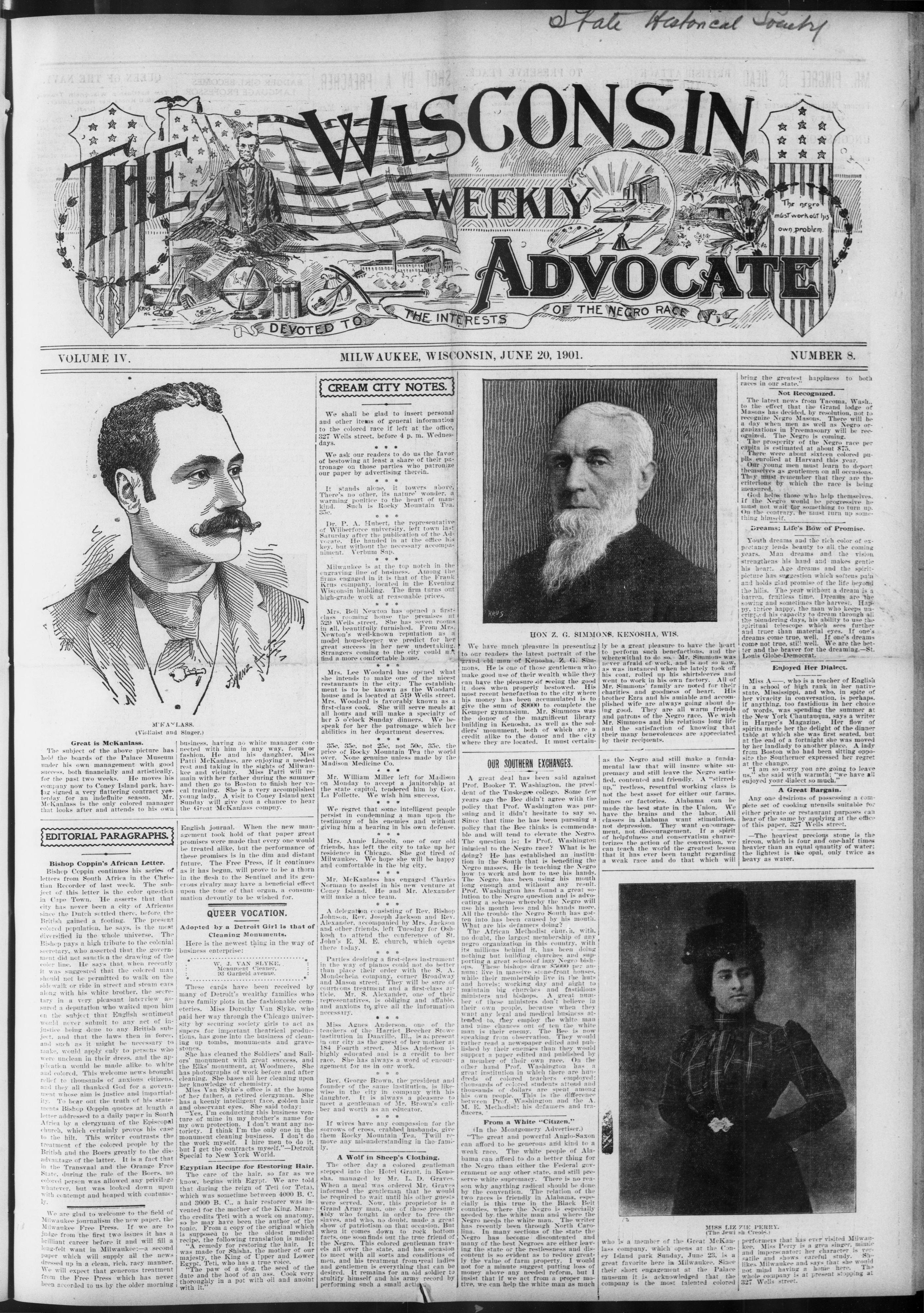
Page text (machine-generated)
WISCONSIN
WEEKLY
ADVOCATE
DEVOTED TO
THE INTERESTS
OF THE NEGRO RACE
JOHN Z.
VOLUME IV.
M'KAY
(Victoriaist an
Great is McKanlass.
The subject of the above picture has held the boards of the Palace Museum under his own management with good success, both financially and artistically, for the past two weeks. He moves his company now to Coney Island park, having signed a very flattering contract yesterday for an indefinite season. Mr. McKanlass is the only colored manager that looks after and attends to his own
EDITORIAL PARAGRAPHS.
Bishop Coppin's African Letter.
Bishop Coppin continues his series of letters from South Africa in the Christian Recorder of last week. The subject of this letter is the color question in Cape Town. He asserts that that city has never been a city of Africans since the Dutch settled there, before the British gained a footing. The present colored population, he says, is the most diversified in the whole universe. The Bishop pays a high tribute to the colonial secretary, who asserted that the government did not sanction the drawing of the color line. He says that when recently it was suggested that the colored man should not be permitted to walk on the sidewalk or ride in street and steam cars along with his white brother, the secretary in a very pleasant interview assured a deputation who waited upon him on the subject that English sentiment would never submit to any act of injustice being done to any British subject, and that the laws then in force, and such as it might be necessary to make, would apply only to persons who were unclean in their dress, and the application would be made alike to white and colored. This welcome news brought relief to thousands of anxious citizens, and they all thanked God for a government whose aim is justice and impartiality. To bear out the truth of his statements Bishop Coppin quotes at length a letter addressed to a daily paper in South Africa by a clergyman of the Episcopal church, which certainly proves his case to the hilt. This writer contrasts the treatment of the colored people by the British and the Boers greatly to the disadvantage of the latter. It is a fact that in the Transvaal and the Orange Free State, during the rule of the Boers, no colored person was allowed any privilege whatever, but was looked down upon with contempt and heaped with contumely.
We are glad to welcome to the field of Milwaukee journalism the new paper, the Milwaukee Free Press. If we are to judge from the first two issues it has a brilliant career before it and will fill a long-felt want in Milwaukee;-a second paper which will supply all the news dressed up in a clean, rich, racy manner. We will expect that generous treatment from the Free Press which has never been accorded to us by the older morning
business, having no white manager connected with him in any way, form or fashion. He and his daughter, Miss Patti McKanlass, are enjoying a needed rest and taking in the sights of Milwaukee and vicinity. Miss Patti will remain with her father during the summer and then go to Boston to finish her vocal training. She is a very accomplished young lady. A visit to Coney Island next Sunday will give you a chance to hear the Great McKanlass company.
English journal. When the new management took hold of that paper great promises were made that every one would be treated alike, but the performance of these promises is in the dim and distant future. The Free Press, if it continues as it has begun, will prove to be a thorn in the flesh to the Sentinel and its generous rivalry may have a beneficial effect upon the tone of that organ, a consummation devoutly to be wished for.
QUEER VOCATION.
Adopted by a Detroit Girl is that of Cleaning Monuments.
Here is the newest thing in the way of business enterprise:
* W. J. VAN SLYKE. *
: Monument Cleaner. :
: 93 Garfield avenue. :
* *
These cards have been received by many of Detroit's wealthy families who have family plots in the fashionable cemeteries. Miss Dorothy Van Slyke, who paid her way through the Chicago university by securing society girls to act as supers for important theatrical productions, has gone into the business of cleaning up tombs, monuments and grave-stones.
She has cleaned the Soldiers' and Sailors' monument with great success, and the Elks' monument, at Woodmere. She has photographs of work before and after cleaning. She bases all her cleaning upon her knowledge of chemistry.
Miss Van Slyke's office is at the home of her father, a retired clergyman. She has a keenly intelligent face, golden hair and observant eyes. She said today:
"Yes, I'm conducting this business venture of mine in my brother's name for my own protection. I don't want any notoriety. I think I'm the only one in the monument cleaning business. I don't do the work myself. I hire men to do it, but I get the contracts myself."—Detroit Special to New York World.
Egyptian Recipe for Restoring Hair.
Egyptian Recipe for Restoring Hair.
The care of the hair, so far as we know, begins with Egypt. We are told that during the reign of Teti (or Teta), which was sometime between 4000 B. C. and 3000 B. C., a hair restorer was invented for the mother of the King. Manetho credits Teti with a work on anatomy, so he may have been the author of the tonic. From a copy of the original which is supposed to be the oldest medical recipe, the following translation is made:
"A remedy for restoring the hair. It was made for Shisha, the mother of our majesty, the King of Upper and Lower Egypt. Teti, who has a true voice.
"The paw of a dog, the seed of the date and the hoof of an ass. Cook very thoroughly in a pot with oil and anoint with it."
CREAM CITY NOTES
---
We shall be glad to insert personal and other items of general information to the colored race if left at the office, 327 Wells street, before 4 p. m. Wednesdays.
宋 宋 宋
We ask our readers to do us the favor of bestowing at least a share of their patronage on those parties who patronize our paper by advertising therein.
* * *
It stands alone, it towers above, There's no other, its nature' wonder, a warming poultice to the heart of mankind. Such is Rocky Mountain Tea. 35c.
* * *
Dr. P. A. Hubert, the representative of Wilberforce university, left town last Saturday after the publication of the Advocate. He handed in at the office his key, but without the necessary accompaniment. Verbum Sap.
Milwaukee is at the top notch in the engraving line of business. Among the firms engaged in it is that of the Frank Krus company, located in the Evening Wisconsin building. The firm turns out high-grade work at reasonable prices.
* * *
Mrs. Bell Newton has opened a first-class rooming house the premises at 529 Wells street. She has seven rooms in all, beautifully furnished. From Mrs. Newton's well-known reputation as a model housekeeper we predict for her great success in her new undertaking. Strangers coming to the city could not find a more comfortable home.
* * *
Mrs. Lee Woodard has opened what she intends to make one of the nicest restaurants in the city. The establishment is to be known as the Woodard house and is located at 519 Wells street. Mrs. Woodard is favorably known as a first-class cook. She will serve meals at all hours and will make a specialty of her 5 o'clock Sunday dinners. We bespeak for her the patronage which her abilities in her department deserves.
* * *
35c, 35c, not 25c, not 50c, 35c, the price of Rocky Mountain Tea the world over. None genuine unless made by the Madison Medicine Co.
Mr. William Miller left for Madison on Monday to accept a janitorship at the state capitol, tendered him by Gov. La Follette. We wish him success.
牵牵牵
We regret that some intelligent people persist in condemning a man upon the testimony of his enemies and without giving him a hearing in his own defense.
* * *
Mrs. Annie Lincoln, one of our old friends, has left the city to take up her residence in Chicago. She got tired of Milwaukee. We hope she will be happy and comfortable in the big city.
* * *
Mr. McKanlass has engaged Charles Norman to assist in his new venture at Coney Island. He and Mr. Alexander will make a nice team.
* * *
A delegation consisting of Rev. Bishop Johnson, Rev. Joseph Jackson and Rev. Alexander, accompanied by Mrs. Jackson and other friends, left Tuesday for Oshkosh to attend the conference of St. John's E. M. E. church, which opens there today.
***
Parties desiring a first-class instrument in the way of pianos could not do better than place their order with the S. A. Mondschein company, corner Broadway and Mason street. They will be sure of courteous treatment and a first-class article. Mr. S. Alexander, one of their representatives, is obliging and affable, and anxious to, give all the information necessary.
章 尔 志
Miss Agnes Anderson, one of the teachers of the Harriet Beecher Stowe institution in Danville, Ill., is at present in our city as the guest of her mother at 184 Fourth street. Miss Anderson is highly educated and is a credit to her race. She has always a word of encouragement for us in our work.
* * *
Rev. George Brown. the president and founder of the same institution. is likewise in the city in company with his daughter. It is always a pleasure to meet a gentleman of Mr. Brown's caliber and worth as an educator.
\* \* \*
If wives have any compassion for the sorrows of cross, crabbed husbands, give them Rocky Mountain Tea. 'Twill remove any misunderstanding in the family.
A Wolf in Sheep's Clothing.
The other day a colored gentleman stepped into the Hotel Grant, in Kenosha, managed by Mr. L. D. Graves. When a meal was ordered Mr. Graves informed the gentleman that he would be required to wait until his other guests were served. Now, this proprietor is a Grand Army man, one of those presumably who fought in order to free the slaves, and who, no doubt, made a great show of patriotism on that occasion. But when it comes down to rock bottom facts, one soon finds out the true friend of the Negro. This colored gentleman travels all over the state, and has occasion to meet with all sorts and conditions of men, and his treatment from real ladies and gentlemen is everything that can be desired. It remains for an old soldier to stultify himself and his army record by performing such a small action.
KRÜS
HON Z. G. SIMMONS. KENOSHA. WIS.
We have much pleasure in presenting to our readers the latest portrait of the grand old man of Kenosha, Z. G. Simmons. He is one of those gentlemen who make good use of their wealth while they can have the pleasure of seeing the good it does when properly bestowed. His most recent benefaction to the city where his money has been accumulated is to give the sum of $9000 to complete the Kemper gymnasium. Mr. Simmons was the donor of the magnificent library building in Kenosha, as well as the soldiers' monument, both of which are a credit alike to the donor and the city where they are located. It must certain-
OUR SOUTHERN EXCHANGES.
A great deal has been said against Prof. Booker T. Washington, the president of the Tuskegee college. Some few years ago the Bee didn't agree with the policy that Prof. Washington was pursuing and it didn't hesitate to say so. Since that time he has been pursuing a policy that the Bee thinks is commendable and will tend to elevate the Negro. The question is: Is Prof. Washington inimical to the Negro race? What is he doing? He has established an institution in the South that is benefiting the Negro masses. He is teaching the Negro how to work and how to use his hands. The Negro has been using his mouth long enough and without any result. Prof. Washington has found a great solution to the Negro question and is advocating a scheme whereby the Negro will use his mouth less and his hands more. All the trouble the Negro South has gotten into has been caused by his mouth. What are his defamers doing?
The African Methodist church, with, no doubt, the largest membership of any negro organization in this country, with its millions behind it, has been doing nothing but building churches and supporting a great school of lazy Negro bishops. These bishops draw $5000 per annum; live in massive stone-front houses, while their membership live in the huts and hovels; working day and night to maintain big churches and fastidious ministers and bishops. A great number of those ministers don't believe in their own people, because when they want any legal and medical business attended to, they employ the white man and nine chances out of ten the white man is their enemy. The Bee is now speaking from observation. They would rather read a newspaper edited and published by their enemies than they would support a paper edited and published by a member of their own race. On the other hand Prof. Washington has a great institution in which there are hundreds of colored teachers employed; thousands of colored students attend and thousands of dollars are spent among his own people. This is the difference between Prof. Washington and the A. M. E. Methodist; his defamers and traducers.
From a White "Citizen."
"The great and powerful Anglo-Saxon can afford to be generous and kind to a weak race. The white people of Alabama can afford to do a better thing for the Negro than either the Federal government or any other state, and still preserve white supremacy. There is no reason why anything radical should be done by the convention. The relation of the two races is friendly in Alabama, especially is this true in the Black Belt counties, where the Negro is especially needed by the white man and where the Negro needs the white man. The writer has recently been through North Carolina. In many sections of the state the Negro has become discontented and many of the best Negroes are either leaving the state or the restlessness and discontent is so evident as to reduce greatly the value of farm property. I would not for a minute suggest putting loss of money above any needed reform, but I insist that if we act from a proper motive, we can help the white man as much
ly be a great pleasure to have the heart to perform such benefactions, and the wherewithal to do so. Mr. Simmons was never afraid of work, and is not so now, as was instanced when he lately took off his coat, rolled up his shirtsleeves and went to work in his own factory. All of Mr. Simmons' family are noted for their charities and goodness of heart. His brother Ezra and his amiable and accomplished wife are always going about doing good. They are all warm friends and patrons of the Negro race. We wish Mr. Simmons and his relations long life and the satisfaction of knowing that their many benevolences are appreciated by their recipients.
as the Negro and still make a fundamental law that will insure white supremacy and still leave the Negro satisfied, contented and friendly. A "stirred-up," restless, resentful working class is not the best asset for either our farms, mines or factories. Alabama can be made the best state in the Union. We have the brains and the labor. All classes in Alabama want stimulation, not depression. They want encouragement, not discouragement. If a spirit of helpfulness and conservatism characterizes the action of the convention, we can teach the world the greatest lesson that it has ever been taught regarding a weak race and do that which will
MISS LIZ
(The Jewi
who is a member of the Great McKanlass company, which opens at the Coney Island park Sunday, June 23, is a great favorite here in Milwaukee. Since their short engagement at the Palace museum it is acknowledged that the company is the most talented colored
```markdown
```
MISS LIZ ZIE PERRY.
The Jewi sh. Croole.
bring the greatest happiness to both races in our state."
The latest news from Tacoma, Wash., to the effect that the Grand lodge of Masons has decided, by resolution, not to recognize Negro Masons. There will be a day when men as well as Negro organizations in Freemasonry will be recognized. The Negro is coming. The prosperity of the Negro race per capita is estimated at about $75. There were about sixteen colored pupils enrolled at Harvard this year.
Our young men must learn to deport themselves as gentlemen on all occasions. They must remember that they are the criterions by which the race is being measured. God helps those who help themselves. If the Negro would be progressive he must not wait for something to turn up. On the contrary, he must turn up something himself.
Dreams; Life's Bow of Promise
Youth dreams and the rich color of expectancy lends beauty to all the coming years. Man dreams and the vision strengthens his hand and makes gentle his heart. Age dreams and the spirit-picture has suggestion which softens pain and holds glad promise of the life beyond the hills. The year without a dream is a barren, fruitless time. Dreams are the sowing and sometimes the harvest. Happy, thrice happy, the man who keeps uncrippled his capacity to dream through all the blundering days, his ability to use the spiritual telescope which sees further and truer than material eyes. If one's dreams come true, well. If one's dreams come not true, still well. We are the better and the braver for the dreaming.—St. Louis Globe-Democrat.
Enjoyed Her Dialect.
Miss A.—, who is a teacher of English in a school of high rank in her native state, Mississippi, and who, in spite of her vivacity in conversation, is perhaps, if anything, too fastidious in her choice of words, was spending the summer at the New York Chautauqua, says a writer in Harper's Magazine. Her flow of spirits made her the delight of the dinner table at which she was first seated, but at the end of a fortnight she was moved by her landlady to another place. A lady from Boston who had been sitting opposite the Southernner expressed her regret at the change.
"I am so sorry you are going to leave us," she said with warmth: "we have all enjoyed your dialect so much."
Any one desirious of possessing a complete set of cooking utensils suitable for either private or restaurant purposes can hear of the same by applying at the office of this paper. 327 Wells street.
The heaviest precious stone is the zircon, which is four and one-half times heavier than an equal quantity of water; the lightest is the opal, only twice as heavy as water.
ZIE PERRY.
sh Creole.)
performers that has ever visited Milwaukee. Miss Perry is a grea singer, mimic and impersonator; her character is versatile and shows careful study. Shilkes Milwaukee and says that she would not mind having a home here. The whole company is at present stopping at 327 Wells street.
NUMBER 8.
Not Recognized.
A Great Bargain.
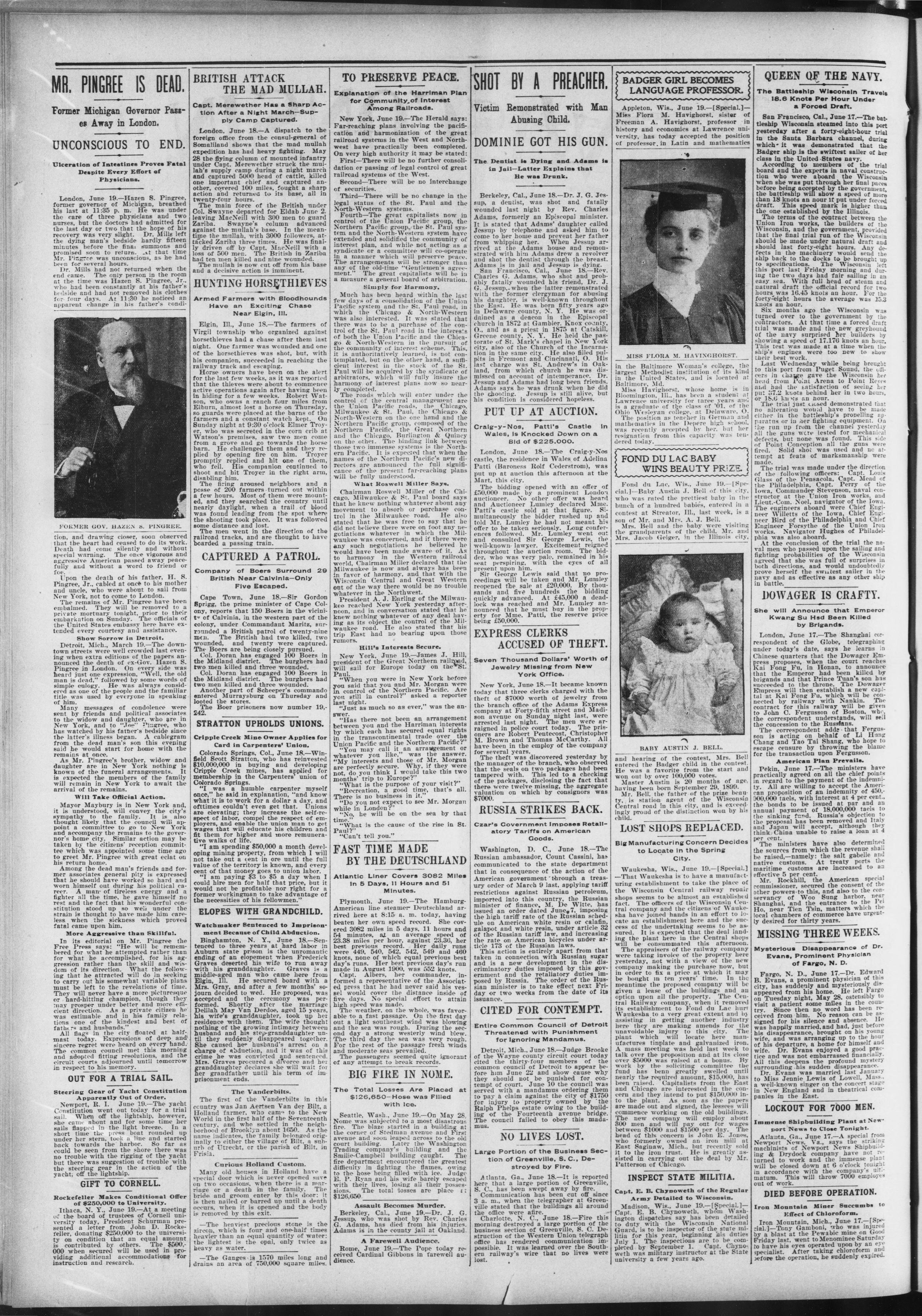
MR. PINGREE IS DEAD.
Former Michigan Governor Passes Away in London.
Ulceration of Intestines Proves Fatal Despite Every Effort of Physicians
London, June 19.—Hazen S. Pingree, former governor of Michigan, breathed his last at 11:35 p. m. He was under the care of three physicians and two nurses, but the doctors had admitted for the last day or two that the hope of his recovery was very slight. Dr. Mills left the dying man's bedside hardly fifteen minutes before the final summons and promised soon to return. At that time Mr. Pingree was unconscious, as he had been for several hours. Dr. Mills had not returned when the end came. The only person in the room at the time was Hazen S. Pingree, Jr., who had been constantly at his father's bedside and had not removed his clothes for four days. At 11:30 he noticed an apparent change in his father's condi-
FORMER GOV. HAZEN S. PINGREE. tion, and drawing closer, soon observed that the heart had ceased to do its work. Death had come silently and without special warning. The once vigorous and aggressive American passed away peacefully and without a word to friend or foe. Upon the death of his father, H. S. Pingree, Jr., cabled at once to his mother and uncle, who were about to sail from New York, not to come to London. The remains of Mr. Pingree have been embalmed. They will be removed to a private mortuary tonight, prior to their embarkation on Sunday. The officials of the United States embassy here extended every courtesy and assistance.
Show Sorrow in Detroit.
Detroit, Mich., March 19.—The downtown streets were well crowded last evening when extra editions of the papers announced the death of ex-Gov. Hazen S. Pingree in London. On every side was heard just one expression, "Well, the old man is dead," followed by some words of simple eulogy. He was always considered as one of the people and the familiar title was used by everyone in speaking of him.
Many messages of condolence were sent by friends and political associates to the widow and daughter, who are in New York, and to "Joe" Pingree, who has watched by his father's bedside since the latter's illness began. A cablegram from the dead man's son this evening said he would start for home with the remains at once.
As Mr. Pingree's brother, widow and daughter are in New York nothing is known of the funeral arrangements. It is expected the members of the family will remain in New York to await the arrival of the remains.
Will Take Official Action.
Mayor Maybury is in New York and, it is understood, will convey the city's sympathy to the family. It is also thought likely that the council will appoint a committee to go to New York and accompany the remains to the governor's home city. Similar action may be taken by the citizens' reception committee which was appointed some time ago to greet Mr. Pingree with great eclat on his return home.
Among the dead man's friends and former associates general pity is expressed that he should have worked so hard and worn himself out during his political career. A man of tireless energy and a fighter all the time, he gave himself no rest and the fact that his wonderful constitution stood up so well under the strain is thought to have made him careless when the sickness which proved fatal came upon him.
More Aggressive than Skillful.
In its editorial on Mr. Pingree the Free Press says: "He will be remembered for what he attempted rather than for what he accomplished, for his aggression rather than the skill and wisdom of its direction. What the following that he attracted will do in seeking to carry out his somewhat variable plans must be left to the revelations of time. They will never have a more picturesque or hard-hitting champion, though they may prosper under better and more efficient direction. As a private citizen he was estimable and in his family relations one of the kindest and best of fathers and husbands."
All flags in the city floated at halfmast today. Expressions of deep and sincere regret were heard on every hand. The common council met this morning and adopted fitting resolutions, and the circuit courts adjourned until tomorrow in respect to his memory.
OUT FOR A TRIAL SAIL.
Steering Gear of Yacht Constitution Apparently Out of Order. Newport, R. I. June 19.—The yacht Constitution went out today for a trial sail. When off the lightship, however, she came about and for some time her sails flapped in the light breeze. In a short time the press boat rounded up under her stern, took a line and started back towards the harbor. So far as could be seen from the shore there was no trouble with the rigging of the yacht but there was suggestion of trouble with the steering gear in the action of the yacht, off the lightship.
GIFT TO CORNELL.
Rockefeller Makes Conditional Offer of $250,000 to University.
Ithaca, N. Y., June 19.-At a meeting of the board of trustees of Cornell university today, President Schurman presented a letter from John D. Rockefeller, donating $250,000 to the university on condition that an equal amount is contributed by others. The $500,000 when secured will be used in providing additional accommodations for instruction and research.
BRITISH ATTACK THE MAD MULLAH.
Capt. Merewether Has a Sharp Action After a Night March—Supply Camp Captured.
London, June 18.—A dispatch to the foreign office from the consul-general of Somaliland shows that the mad mullah expedition has had heavy fighting. May 28 the flying column of mounted infantry under Capt. Merewether struck the mullah's supply camp during a night march and captured 5000 head of cattle, killed one important chief and captured another, covered 100 miles, fought a sharp action and returned to its base, all in twenty-four hours.
The main force of the British under Col. Swayne departed for Eldab June 2. leaving MacNeill with 300 men to guard Zariba. Swayne's column advanced against the mullah's base. In the meantime the mullah, with 3000 followers, attacked Zariba three times. He was finally driven off by Capt. MacNeill with a loss of 500 men. The British in Zariba had ten men killed and nine wounded.
The mullah is now cut off from his base and a decisive action is imminent.
HUNTING HORSETHIEVES
Armed Farmers with Bloodhounds Have an Exciting Chase Near Elgin, Ill.
Elgin, Ill., June 18.—The farmers of Virgil township who organized against horsethieves had a chase after them last night. One farmer was wounded and one of the horsethieves was shot, but, with his companion, succeeded in reaching the railway track and escaping.
Horse owners have been on the alert for the last few weeks, as it was reported that the thieves were about to commence active operations again after having been in hiding for a few weeks. Robert Watson, who owns a ranch four miles from Elburn, almost lost a horse on Thursday, so guards were placed at the barns of the farmers and a constant watch kept. On Sunday night at 9:30 o'clock Elmer Troyer, who was secreted in the corn crib at Watson's premises, saw two men come from a grove and go towards the horse barn. He challenged them and they replied by opening fire on him. Troyer promptly replied and hit one of them, who fell. His companion continued to shoot and hit Troyer in the right arm, disabling him.
The firing aroused neighbors and a posse of 200 farmers turned out within a few hours. Most of them were mounted, and they searched the country until nearly daylight, when a trail of blood was found leading from the spot where the shooting took place. It was followed some distance and lost. The men went in the direction of the railroad tracks, and are thought to have boarded a passing train.
CAPTURED A PATROL.
Company of Boers Surround 29 British Near Calvinia-Only Five Escaped.
Cape Town, June 18.—Sir Gordon Sprigg, the prime minister of Cape Colony, reports that 150 Boers in the vicinity of Calvinia, in the western part of the colony, under Commandant Maritz, surrounded a British patrol of twenty-nine men. The British had two killed, two wounded, and twenty were captured. The Boers are being closely pursued.
Col. Doran has engaged 100 Boers in the Midland district. The burghers had two men killed and three wounded.
Another part of Scheeper's commando entered Murraysburg on Thursday and looted the stores. The Boer prisoners now number 19, 242.
STRATTON UPHOLDS UNIONS.
Cripple Creek Mine Owner Applies for Card in Carpenters' Union.
Colorado Springs, Col., June 18.—Winfield Scott Stratton, who has reinvested $10,000,000 in buying and developing Cripple Creek mines, has applied for membership in the Carpenters' union of Colorado Springs.
"I was a humble carpenter myself once," he said in explanation, "and know what it is to work for a dollar a day, and ofttimes couldn't even get that. Unions are elevating; they increase the self-respect of labor, compel the respect of employers, and enable the union man to get wages that will educate his children and fit them for higher and more remunerative walks of life.
"I am spending $50,000 a month developing mining property, from which I will not take out a cent in ore until the full value of the territory is known, and every cent of that money goes to union labor.
"I am paying $3 to $5 a day when I could hire men for half that price, but it would not be profitable nor right for a former workingman to take advantage of the necessities of his fellowmen."
ELOPES WITH GRANDCHILD.
Watchmaker Sentenced to Imprisonment Because of Child Abduction
Binghamton, N. Y., June 18.—Sentenced to three years at hard labor in Auburn state prison is the unromantic ending of an elopement when Frederick Graves deserted his wife to run away with his granddaughter. Graves is a middle-aged man who came here from Elgin, Ill. He secured board with a Mrs. Gray, and after a few months' sojourn decided to wed. He proposed, was accepted and the ceremony was performed. Shortly after the marriage Delilah May Van Derdoe, aged 15 years, his wife's granddaughter, took up her residence with them. The wife thought nothing of the growing intimacy between husband and his step-granddaughter until they suddenly disappeared together. She caused her husband's arrest on a charge of abduction, and it was of this crime he was convicted and sentenced. Mrs. Graves procured a divorce and her granddaughter declares she will wait for her grandfather until his term of imprisonment ends.
The Vanderbilts.
The first of the Vanderbilts in this country was Jan Aertsen Van der Bilt, a Holland farmer, who came to the New World in the first half of the Seventeenth century, and who settled in the neighborhood of Brooklyn about 1650. As the name indicates, the family belonged originally to either the village of Bilt, a suburb of Utrecht, or the parish of Bilt, in Frisia.
Curious Holland Custom.
Many old houses in Holland have a special door which is never opened save on two occasions, when there is a marriage or a death in the family. The bride and groom enter by this door: it is then nailed or barred up until a death occurs, when it is opened and the body is removed by this exit.
—The heaviest precious stone is the zircon, which is four and one-half times heavier than an equal quantity of water: the lightest is the opal, only twice as heavy as water.
—The Ganges is 1570 miles long and drains an area of 750,000 square miles.
TO PRESERVE PEACE.
Explanation of the Harriman Plan for Community.of Interest Among Railroads.
New York, June 19.—The Herald says: Far-reaching plans involving the pacification and harmonization of the great railroad systems in the West and Northwest have practically been completed. On very high authority it may be stated: First—There will be no further consolidation or passing of legal control of great railroad systems of the West. Second—There will be no interchange of securities. Third—There will be no change in the legal status of the St. Paul and the North-Western systems.
Fourth—The great capitalists now in control of the Union Pacific group, the Northern Pacific group, the St. Paul system and the North-Western system have extended and solidified the community of interest plan, and while not acting as a syndicate or a committee will co-operate in a manner which will preserve peace. The arrangements will be stronger than any of the old-time "Gentlemen's agreement." The great capitalists will be in a measure a general board of arbitration.
Simply for Harmony.
Much has been heard within the last few days of a consolidation of the Union Pacific system and the St. Paul road, in which the Chicago & North-Western was also interested. It was stated that there was to be a purchase of the control of the St. Paul road in the interests of both the Union Pacific and the Chicago & North-Western in the pursuit of the community of interest scheme. This, it is authoritatively learned, is not contemplated, but on the other hand, a sufficient interest in the stock of the St. Paul will be acquired by the syndicate of arbitrators, which will fully insure the harmony of interest plans now so nearly completed.
The roads which will enter under the control of the central management are the Union Pacific roads, the Chicago, Milwaukee & St. Paul, the Chicago & North-Western on the one hand and the Northern Pacific group, composed of the Northern Pacific, the Great Northern and the Chicago, Burlington & Quincy on the other. The binding link between those two immense systems is the Northern Pacific. It is expected that when the names of the Northern Pacific's new directors are announced the full significance of the present far-reaching plans will be fully understood.
What Roswell Miller Says.
Chairman Roswell Miller of the Chicago, Milwaukee & St. Paul board says that he knew nothing whatever about any movement to absorb or purchase control in the Milwaukee road. He also stated that he was free to say that he did not believe there were on foot any negotiations whatever in which the Milwaukee was concerned, and if there were any such negotiations he believed he would have been made aware of it. As to harmony in the Western railroad world, Chairman Miller declared that the Milwaukee is now and always has been in favor of harmony, and that with the Wisconsin Central and Great Western out of the way there would be no trouble whatever in the Northwest.
President A. J. Earling of the Milwaukee reached New York yesterday afternoon, and in conversation stated that he knew nothing whatever of any deal having as its object the control of the Milwaukee road. He also stated that his trip East had no bearing upon those rumors.
Hill's Interests Secure.
New York, June 19.—James J. Hill, president of the Great Northern railroad, will sail for Europe today on the St. Paul.
"When you were in New York before you said that you and Mr. Morgan were in control of the Northern Pacific. Are you still in control?" asked a reporter last night.
"Just as much so as ever," was the answer.
"Has there not been an arrangement between you and the Harriman interests by which each has secured equal rights in the transcontinental trade over the Union Pacific and the Northern Pacific?"
"You may call it an arrangement or whatever you like," was the answer.
"My interests and those of Mr. Morgan are perfectly secure. Why, if they were not, do you think I would take this two months' trip to Europe?"
"What is the purpose of your visit?" "Recreation, a good time, that's all. There is no business in it." "Do you not expect to see Mr. Morgan while in London?"
"No, he will be on the sea by that time."
"What is the cause of the rise in St. Paul?"
"Can't tell you."
FAST TIME MADE BY THE DEUTSCHLAND
FAST TIME MADE BY THE DEUTSCHLAND
Atlantic Liner Covers 3082 Miles In 5 Days, 11 Hours and 51 Minutes.
Plymouth, June 19.—The Hamburg-American line steamer Deutschland arrived here at 8:15 a. m. today, having beaten her own speed record. She covered 3082 miles in 5 days, 11 hours and 54 minutes, at an average speed of 23.38 miles per hour, against 23.36, her best previous record. Her daily runs were 449, 540, 542, 542, 549 and 460 knots, none of which equal previous best day's runs. Her best previous day's run made in August 1900, was 552 knots. Capt. Albers, her commander, informed a representative of the Associated press that he had never said his vessel would cover the distance inside of five days. No special effort to attain high speed was made.
The weather, on the whole, was favorable to a fast passage. On the first day out a light southeast wind was blowing and the sea was rough. During the second day a strong westerly wind blew. The third day the sea was very rough. For the rest of the passage fresh winds and moderate seas prevailed. The passengers seemed quite ignorant of any attempt to break records.
BIG FIRE IN NOME.
The Total Losses Are Placed at $126,650-Hose was Filled with Ice.
Seattle, Wash., June 19.—On May 28, Nome was subjected to a most disastrous fire. The blaze started in a building at the corner of Stedman avenue and First avenue and soon leaped across to the old court building. Later the Washington Trading company's building and the Smilie-Campbell building caught. The fire department encountered the greatest difficulty in fighting the flames, owing to the hose being filled with ice. Judge E. P. Ryan and his wife barely escaped with their lives, losing all their possessions. The total losses are place at $126,650.
Assault Becomes Murder
Berkeley, Cal., June 19.—Dr. J. G. Jessup, who was shot by Rev. Charles G. Adams, has died from his injuries. Adams is in the county jail at Oakland.
A Farewell Audience.
Rome, June 19.—The Pope today received Cardinal Gibbons in farewell audience.
SHOT BY A PREACHER.
Victim Remonstrated with Man Abusing Child.
DOMINIE GOT HIS GUN.
The Dentist is Dying and Adams is in Jail—Latter Explains that He was Drunk.
Berkeley, Cal., June 18.—Dr. J. G. Jessup, a dentist, was shot and fatally wounded last night by Rev. Charles Adams, formerly an Episcopal minister. It is stated that Adams' daughter called Jessup by telephone and asked him to come to her home and prevent her father from whipping her. When Jessup arrived at the Adams house and remonstrated with him Adams drew a revolver and shot the dentist through the breast. Adams is in jail and Jessup is dying.
San Francisco, Cal., June 18.—Rev Charles G. Adams, who shot and probably fatally wounded his friend, Dr. J. G. Jessup, when the latter remonstrated with the former clergyman for abusing his daughter, is well-known throughout the East. He was born fifty years ago in Delaware county, N. Y. He was ordained as a deacon in the Episcopal church in 1872 at Gambier. Knox county, O., and as a priest in 1875 at Catskill, Greene county, N. Y. He held the pastorate of St. Mark's chapel in New York city, also of the Church of the Incarnation in the same city. He also filled pulpits in Fremont and Cincinnati, O. His last charge was St. Andrew's in Oakland, from which church he was dismissed on account of intemperance. Dr. Jessup and Adams had long been friends. Adams says he was drunk when he did the shooting. Jessup is still alive, but his condition is considered hopeless.
PUT UP AT AUCTION.
Cralg-y-Nos, Patti's Castle In Wales, Is Knocked Down on a Bid of $225,000.
London, June 18.—The Craig-y-Nos castle, the residence in Wales of Adelina Patti (Baroness Rolf Cederstrom), was put up at auction this afternoon at the Mart, this city.
The bidding opened with an offer of £50,000 made by a prominent London auctioneer. No other offer was heard and Auctioneer Lumley declared Mme. Patti's castle sold at that figure. Simultaneously the bidder rushed up and told Mr. Lumley he had not meant his offer to be taken seriously. Long conferences followed. Mr. Lumley went out and consulted Sir George Lewis, the well-known lawyer. Excitement reigned throughout the auction room. The bidder, who was very pale, remained in his seat perspiring, with the eyes of all present upon him.
Sir George Lewis said that no proceedings will be taken and Mr. Lumley reopened the sale at £20,000. By thousands and five hundreds the bidding quickly advanced. At £45,000 a deadlock was reached and Mr. Lumley announced that he must buy in the property for Mme. Patti, the reserve price being £50,000.
EXPRESS CLERKS ACCUSED OF THEFT.
Seven Thousand Dollars' Worth of Jewelry Missing from New York Office.
New York, June 18. It became known today that three clerks charged with the theft of $7000 worth of jewelry from the branch office of the Adams Express company at Forty-fifth street and Madison avenue on Sunday night last, were arrested last night. The men were arraigned in police court today. The prisoners are Robert Pentecost, Christopher M. Brown and Thomas McCarthy. All have been in the employ of the company for several years. The theft was discovered yesterday by the manager of the branch, who observed that the seals on two packages had been tampered with. This led to a checking of the packages, disclosing the fact that there were twelve missing, the aggregate valuation on which by consignors was $7000.
RUSSIA STRIKES BACK.
Czar's Government Imposes Retaliatory Tariffs on American Goods.
Washington, D. C., June 18.—The Russian ambassador, Count Cassini, has communicated to the state department that in consequence of the action of the American government through a treasury order of March 9 last, applying tariff restrictions against Russian petroleum, imported into this country, the Russian minister of finance, M. De Witte, has issued an order dated June 7, imposing the high tariff rate of the Russian schedule on American white resin or calafin, galapot and white resin, under article 32 of the Russian tariff law, and increasing the rate on American bicycles under article 173 of the Russian laws.
This action is entirely apart from that taken in connection with Russian sugar and is a new development in the discriminatory duties imposed by this government and the retaliatory duties imposed by Russia. The order of the Russian minister is to take effect next Friday or two weeks from the date of its issuance.
CITED FOR CONTEMPT.
Entire Common Council of Detroit Threatened with Punishment for Ignoring Mandamus.
Detroit, Mich., June 18.—Judge Brooke of the Wayne county circuit court today cited the thirty-four members of the common council of Detroit to appear before him June 22 and show cause why they should not be punished for contempt of court. June 10 the council was served with a mandamus ordering them to pay a claim against the city of $1750 for injury to property owned by the Ralph Phelps estate owing to the building of the Fourteenth avenue bridge. The council failed to obey this madamus.
NO LIVES LOST.
Large Portion of the Business Section of Greenville, S.C., Destroved by Fire.
Atlanta, Ga., June 18.—It is reported here that a large portion of Greenville, S. C., has been swept away by fire. Communication has been cut off since 3 a. m., when the telegrapher at Greenville stated that the buildings all around the office were afire. Charlotte, N. C., June 18.—Fire this morning destroyed a large portion of the business section of Greenville, S. C. Destruction of the Western Union telegraph office has rendered communication impossible. It was learned over the Southern railway's wire that no lives were lost.
BADGER GIRL BECOMES LANGUAGE PROFESSOR.
Appleton, Wis., June 19.—[Special.]— Miss Flora M. Havighorst, sister of Freeman A. Havighorst, professor in history and economics at Lawrence university, has today accepted the position of professor in Latin and mathematics
1911
in the Baltimore Woman's college, the largest Methodist institution of its kind in the United States, and is located at Baltimore, Md.
Miss Havighorst, whose home is in Bloomington, Ill., has been a student at Lawrence university for three years and is a graduate of the class of '01, of the Ohio Wesleyan college, at Delaware, O.
The position as teacher in German and mathematics in the Depere high school, was recently accepted by her, but her resignation from this capacity was tendered today.
Fond du Lac, Wis., June 19.—[Special.]—Baby Austin J. Bell of this city, who was rated the prettiest baby in the bunch of a hundred babies, entered in a contest at Streator, Ill., last week, is a son of Mr. and Mrs. A. J. Bell. Mrs. Bell and the baby were visiting the grandparents of the child. Mr. and Mrs. Jacob Geiger, in the Illinois city,
1911
BABY AUSTIN J. BELL. and hearing of the contest, Mrs. Bell entered the Badger child in the contest. He was a favorite from the start and won out by over 100,000 votes. Master Austin is 20 months of age, having been born September 29, 1899. Mr. Bell, the father of the prize beauty, is station agent of the Wisconsin Central road in this city, and is exceedingly proud of the distinction won by his child.
LOST SHOPS REPLACED.
Big Manufacturing Concern Decides to Locate in the Spring
Waukesha, Wis., June 19.—[Special.]
—That Waukesha is to have a manufacturing establishment to take the place of the Wisconsin Central railway repair shops seems to be almost an established fact. The officers of the Wisconsin Central company and the citizens of Waukesha have joined hands in an effort to locate an establishment here and the success of the undertaking seems to be assured. It is expected that the deal landing the plant here in the Central shops will be consummated this afternoon.
The appraisers of the railway company were taking invoice of the property here yesterday, not with a view of the new company making the purchase now, but in order to fix a price at which it may be bought in ten years' time. In the meantime the proposed company will be given a lease of the buildings and an option upon all the property. The Central Railway company, when it removed its establishment to Fond du Lac hurt Waukesha to a very great extent and by assisting in getting another industry here they are making amends for the unavoidable injury to this city. The plant which will locate here manufactures tinplate and galvanized iron. A mass meeting was held last week to talk over the proposition and at its close over $5000 was raised at a bonus. By work by the soliciting committee the fund has benn greatly swelled until nearly the required amount, $15,000, has been raised. Capitalists from the East and Chicago are interested in the concern and they intend to put $150,000 into the plant. As soon as the papers are made out and signed, the lessees will commence working on the old buildings. The new company will employ about 300 men and will pay out for wages between $1000 and $1500 per day. The head of this concern is John E. Jones, who formerly owned an iron mill at East Saginaw, Mich., but recently sold it to the iron trust. He is greatly assisted in carrying out the deal by Mr. Patterson of Chicago.
INSPECT STATE MILITIA.
Capt. E. B. Chynoweth of the Regular Army Detailed to Wisconsin. Madison, Wis., June 19.—[Special.] Capt. E. B. Chynoweth, whom Washington dispatches say has been detailed to duty with the Wisconsin National Guard, is to be inspector of the state militia for this year, beginning his duties July 1. The inspections are to be completed by September 1. Capt. Chynoweth was military instructor at the State university a few years ago.
QUEEN QF THE NAVY.
The Battleship Wisconsin Travels 18.6 Knots Per Hour Under a Forced Draft.
San Francisco, Cal., June 17.—The battleship Wisconsin steamed into this port yesterday after a forty-eight-hour trial in the Santa Barbara channel, during which it was demonstrated that the Badger ship is the swiftest sailor of her class in the United States navy. According to members of the trial board and the experts in naval construction who were aboard the Wisconsin when she was put through her final paces before being accepted by the government, the battleship will show a speed of more than 18 knots an nour if put under forced draft. This speed mark is higher than the one established by the Illinois.
The terms of the contract between the Union Iron works, the builders of the Wisconsin, and the government, provided that the final trial run of the Wisconsin should be made under natural draft and should last forty-eight hours. Any defects in the machinery would send the ship back to the docks to be brought up to specifications. The Wisconsin left this port last Friday morning and during the two days had fair sailing in an easy sea. With full head of steam and natural draft the official record for two hours was 16.45 knots an hour. For the forty-eight hours the average was 15.3 knots an hour.
Six months ago the Wisconsin was turned over to the government by the contractors. At that time a forced draft trial was made and the new greyhound of the navy surprised her builders by showing a speed of 17.176 knots an hour. This test was made at a time when the ship's engines were too new to show their best work.
Last Wednesday while being brought to this port from Puget Sound, the officers in charge gave the Wisconsin her head from Point Arena to Point Reeves and had the satisfaction of seeing her put 37.2 knots behind her in two hours, or 18.6 knots an hour.
The trial just closed demonstrated that no alteration would have to be made either in the battleship's propelling apparatus or in her fighting equipment. On the run up from the channel yesterday all the guns were tested for mechanical defects, but none was found. This side of Point Conception all the guns were fired. Solid shot was used and no attempt at feats of marksmanship were made.
The trial was made under the direction of the following officers: Capt. Louis Glass of the Pensacola, Capt. Mead of the Philadelphia, Capt. Perry of the Iowa, Commander Stevenson, naval constructor at the Union Iron works, and Lieut.-Com. Noel, navigator of the Iowa. The engineers aboard were Chief Engineer Willetts of the Iowa. Chief Engineer Bird of the Philadelphia and Chief Engineer Forsythe of the Union Iron works. Navigator Hughes of Philadelphia was also aboard.
At the conclusion of the trial the naval men who passed upon the sailing and fighting probabilities of the Wisconsin agreed that she was full of surprises in both directions, and would undoubtedly prove herself the swiftest sailer in the navy and as effective as any other ship in battle.
DOWAGER IS CRAFTY.
She will Announce that Emperor Kwang Su Hsd Been Killed by Brigands.
London, June 17.—The Shanghai correspondent of the Globe, telegraphing under today's date, says he learns in Chinese quarters that the Dowager Empress proposes, when the court reaches Kai Fong Fu, in Honan, to announce that the Emperor had been killed by brigands and that Prince Tuan's son has succeeded to the throne. The Dowager Empress will then establish a new capital at Kai Fong Fu, which will be connected by railway with Nankin. The contract for this railway will be given to John C. Fergusson of Boston, who the correspondent understands, will sell the concession to the Russians. The correspondent adds that Fergusson is acting on behalf of Li Hung Chang and Tao Tai Shang, who hope to escape censure by throwing the blame for the transaction upon Fergusson.
American Plan Prevails.
Pekin, June 17.—The ministers have practically agreed on all the chief points in regard to the payment of the indemnity. All are willing to accept the American proposition of an indemnity of 450,000,000 taels, with interest at 4 per cent., the bonds to be issued at par and an annual payment of 18,000,000 taels to the sinking fund. Russia's objection to the proposal has been removed and Italy and Japan will accept, although they think China unable to raise a loan at 4 per cent. The ministers have also determined the sources from which the revenue shall be raised,—namely: the salt gabelle and native customs. At treaty ports the maritime customs are increased to an effective 5 per cent.
Mr. Rockhill, the American special commissioner, secured the consent of the other powers to this, and also to the conservancy of Woo Sung harbor, near Shanghai, and the entrance to the Pei Ho, near Tien Tsin, matters which the local chambers of commerce have urgently desired for thirty years.
MISSING THREE WEEKS.
Fargo, N. D., June 17.—Dr. Edward B. Evans, a prominent physician of this city, has suddenly and mysteriously disappeared from his home. He left Fargo on Tuesday night, May 28. ostensibly to visit a patient some miles in the country. Since then no word has been received from him. No reason can be assigned for his silence and absence. He was happily married, and had, just before his disappearance, brought on his young wife, and was arranging up to the hour of his departure, a home for himself and wife. Dr. Evans enjoyed a good practice and was not embarrassed financially. All this deepens the profound mystery surrounding his sudden disappearance.
Dr. Evans was married last January to Miss Jennie Lewis of Lowell, Mass., a well-known singer on the concert stage in New England and in the theatrical companies in the East.
LOCKOUT FOR 7000 MEN.
Immense Shipbuilding Plant at Newport News to Close Tonight.
Atlanta, Ga., June 17.—A special from Newport News, Va., says the striking machinists of Newport News Shipbuilding & Drydock company have not returned to work and the immense plant will be closed down at 6 o'clock tonight in accordance with the company's ultimatum. This will throw 7000 employees out of work.
DIED BEFORE OPERATION.
Iron Mountain Miner Succumbs to Effect of Chloroform.
Iron Mountain, Mich., June 17.—[Special.]—Tony Gamboni, who was injured by a blast at the Pewabic mine on Good Friday last, went to Menominee Saturday to have his eyes operated upon by an eye specialist. After taking chloroform and before the operation, he suddenly expired.
WHEN FLORA DRIVES.
When Fora drives I just sit back and smile.
Enjoying her discomfiture a while
I lost-the port assigned to me.
Before I act the part assigned to me. She takes the ribbons almost savagely. Soon as we lose the haunts of trade and guile.
The cue is taken soon. In sleepy style Old Dobbin ambles up the woodland aisle—It's just as well, perhaps, he cannot see When Flora drives.
She says I take advantage—would revile My thieving ways. Her tears are crocodile! She makes me thief with opportunity. I tell her so. And she relents? Not she! But that's the shortest, most delightful mile When Flora drives.
—Edward W. Barnard in Lesile's Weekly.
A Present from the Prince
Young Gildmore Goldrock told me this strange story, and I will give the story in Goldrock's own words, as he gave it to us in the smokeroom of the Anglo-American club: "It happened last year," said Goldrock, as he hoisted his feet on to the mantelpiece and addressed his words to the clock.
"I was crossing to Liverpool and happened to strike up an acquaintance with the young Pole who shared my stateroom. He was a pleasant young fellow, and in the course of a day or two we became great friends. He told me that his name was Ladislas Nadokoff, and that he had been studying medicine at Philadelphia. He further confided that he was on his way to London to visit a friend of his youth.
"In return I told him how I was going to England to spend a few months with my married sister, the Countess of Darnford, with whom my wife was already staying, having crossed before me, since I had been detained a few weeks in New York on business.
"Nadokoff then told me he, too, had a sister who was married to a Russian nobleman who was a sort of sheriff in his own county, and commander of a posse of Cossacks. So, on the strength of our aristocratic connections, our confidences grew so that we used to talk quite freely of political matters.
"Nadokoff's politics were a bit mixed. At the time I thought this was because he was quite young, and had not learned that political views should be used as a means to a profitable end.
"But his politics had been acquired in some other place than America, the land of the free. He hinted of old scores, dating back hundreds of years, which were to be wiped out by younger and more vigorous generations. Notwithstanding his family connections, he hated the Russians. 'Down with everything and hang the expense,' was his motto, and he talked a lot about the iron-handed tyranny of the Russian government, while I sat around and swapped sympathetic seditions.
"I noticed that often as we were talking together a gentleman with a bald head and a large white mustache used to pass along and lean on the rail or look at the sky when he came within earshot of us.
"Then I used to change the conversation to railroads or pork, which are far safer subjects than Russian politics; for somehow I mistrusted this elderly gentleman, who spoke English like a German, drank his tea with lemon, and while he gave himself out as a commercial traveler, walked as though he were waiting for the clink of the spurs at his heels and the rattle of his sword at his side.
"He was registered on the passenger list as Mr. William Smith, which was strange, considering that his handkerchief was embroidered with the initials J. K. It takes a Russian to spell Smith with a K.
"As we approached Queenstown, Nado-koff, who had been looking ill and worried throughout the voyage, seemed to grow more ill at ease.
"At bedtime, the night before we reached Queenstown, he did not turn up in the stateroom. I waited till long after 'lights out,' then I grew anxious about him, and passed the word for the steward, who went to look for him.
"He had disappeared.
"The ship was searched high and low by the watch, who were warned by the captain to hold their tongues about the matter, but no trace of him could be found.
"'E's just been and gone and slipped overboard.'" said our stateroom steward; 'they do sometimes, you know.'
"Strange to say, as we were hunting round the decks Mr. Smith, who, I knew, had retired to his stateroom an hour or more before, joined us in our search."
"Still stranger, as I was returning to my berth, I saw Mr. Smith disappearing down the passage, although his berth was situated on the other side of the ship.
"When I looked over at Nadokoff's empty berth I noticed that his portmanteau had been moved since I had left the cabin. When I came to open my own portmanteau I found it locked. Then I remembered that earlier in the evening, as Nadokoff was going along to the stateroom from the smoking cuddy on deck. I had given him my key, and asked him to get me a few cigars, which were stowed away in the pocket of my flannel jacket.
"He had evidently jumped overboard with my key, but I was too troubled about him to worry about that, besides which I knew that my wife had a duplicate key on her bunch.
"At Liverpool a half crown to the customs officer passed my portmanteau all right, and I did not open it till I reached my brother-in-law's house in Park lane, where my wife was staying. My wife had the key on her ring, and stood by as I unlocked the bag.
"You dear old boy,' she cried, as the bag opened and showed a large jewel case, which lay on the top of my clothes. 'You have been wasting your money again on me at Tiffany's, I know. It's too wicked of you!"
"I felt a bit uncomfortable, for the fact was I had been too busy in New York to remember my usual visit to Tiffany's, besides which I had never set eyes on the jewel case before.
"I'm afraid it is not for you, dear, said I, as I opened the case. My wife gasped as the lid flew up and showed a bracelet formed of a heart-shaped mass of opals framed in a most wonderful setting of diamonds.
"Oh! how lovely,' she sighed; 'but, anyway. I hate opals; they are unlucky. But who is it for, dear?' she added.
"I told her I did not know. Then I saw tucked in under the bracelet a small note. I opened it.
"Dear friend,' it ran. 'I can bear my life no longer, so tonight I shall jump overboard. My last request I am sure you will faithfully execute. Take this bracelet to the Countess Zalinska, and tell her it is a parting gift from her old lover, Prince Ladislas Nadokoff. She lives in Park lane, quite close to your sister's house. Farewell, dear friend; may we meet in a kinder and less troubled world. Thine, Ladislas.'
"My wife had lifted the bracelet, and, as women will, for its better inspection, was about to clasp it on her wrist.
"Don't, dear,' said I, hastily. I did not reason why, but somehow I disliked the idea of her wearing it.
"She put it back in the case obediently, but laughed at me for a superstitious old hubby.
Then I showed her the letter, and told her the story of my friend on the boat. Then she cried a little, and offered to deliver it to the Countess Zalinska, an offer which I gladly accepted, for I was beginning to look forward to my commission with some misgivings.
"I hate scenes. My wife likes them, so the next morning, after breakfast, she
made a careful toilet, and prepared to visit the countess.
"I gave her the bracelet and my blessing, and told her to break the news gently to the countess, who might still be fond of her old lover, and how to dodge the count, if such a person existed, and to bluff the game through on the pretense of calling for a subscription for a home for lost dogs.
"My wife had not left the house many minutes before Jeanette, my sister's maid, made her appearance at the door of the breakfast room.
"'If you please, sir,' said she, 'there's a gentleman waiting to see you.' Then, with a giggle, 'E's got a policeman with him.'
"'Show him in, and the cop as well,' said I, beginning to feel a little uncomfortable, for I remembered that I was in a foreign country.
"In a minute, who should walk in but William Smith. The policeman stayed outside with Jeanette. It seemed to me that he knew Jeanette, and that he came as near winking at her as a policeman could.
"Mr. William Smith, I believe,' said I, rising.
"Forgive me—Mr. Goldrock,' said my visitor, politely, 'but William Smith is merely my nom de guerre. I am Johann Katchachieff, of the Russian Imperial police.
"Oh, lor!" I murmured, under my breath. 'What have I been doing? Please to meet you. Mr. Katchachieff,' I replied, politely. 'What do you want of me?
"You remember a young man who shared your stateroom on the Umbria?
"Just a bit."
"He jumped overboard the night before that vessel reached Quenstown," he continued.
"'That's so,' I assented.
That's so, I assented.
"What I require to know is: what became of a certain bracelet in his possession?"
"Then you won't find out from me!" I replied, rather shortly, for I did not feel like giving away poor Ladisla's love affairs to a 'trap', and a Russian 'trap at that.
"Look here,' said he, curiously, 'if you do not tell me at once, I have an order for your arrest from the chief commissioner of the English police."
"I beckoned to the policeman who was standing at the door with Jeanette.
"Come here, constable, and see fair play,' said I.
"The bracelet,' said I, was placed in my portmanteau by Mr. Nadokoff before he jumped overboard, with a note, in which he asked me to deliver it to a lady who lives close by here. My wife has just gone out for that purpose.'
"Heavens!" cried the Russian, 'where does she live? That bracelet is a bomb, and was sent by a secret society in New York as a means to the assassination of the Countess Zalinska, who is the wife of the chief of police. Directly the clasp is snapped—"
"I didn't wait to think. I just streaked to the door, pushing the policeman in front of me.
"Run," I yelled. "We tumbled down the hall steps, and lighted up Park lane to the admiration of the surrounding citizens.
"It did not take us long to reach the countess" house.
"The policeman was first, the Russian second while I was a close third.
second, while I was a close third.
"The door was opened, and we plunged in, and tore upstairs.
"'Where's the countess?' gasped the Russian.
"A frightened servant jerked a finger toward a door.
"We tumbled into the room.
"In the countess' hands was the bracelet.
"She was in the act of clasping it on her wrist when the Russian pounced upon it, snatched it from her, and flung it out of the window.
"There was a fearful report, followed by a clatter of falling glass below.
"The countess had fainted.
* * * * * * * * *
"Katchachieff seemed to know all about it. He told me how Ladislas had belonged to a Nihilist club in New York and how he had been commissioned to deliver the bracelet to the countess.
"He had opened his sealed letter of instructions the night before we reached Queenstown, and not till then had he become aware of the identity of his victim.
Fretty Things to Wear.
The outing season brings to the front the natty little white duck hats. One of these inexpensive cotton hats has a small brocaded buffalo on the front. The crown is soft, in alpine shape, while the trimming is of stiffer material and about three inches wide.
Among the fads of the hour in jewelry is the floral brooch. It is most effective when the fruit or flowers of the pin match the gown in color.
A shirtwaist of Indian pongee is both serviceable and extremely stylish. The prettiest trimming for a waist of this material consists of bands of Oriental embroidery mixed with tinsel. A vest of the embroidery is also appropriate.
One of the latest novelties in tuckings is the so-called "sunburst waist." Tiny tucks are made to radiate from the bust to the sleeves, and are caught together at the center with a jeweled or rhinestone brooch.
A charming dressy little cape may be made of pleated glace silk with a scarf of ivory applique lace laid on by way of trimming. The lace is modishly set off by threadings of black velvet, and the high collar is becomingly lined with lace of the same kind as that used for the scarf.
The lacy white hose to be worn with white suits and evening gowns are most fascinating in their variety. Tiny embroidered designs of all sorts appear just above the instep. One pair embroidered by the wearer herself with dainty blue bow knots is extremely pretty.
The Empire gown is gaining steadily in favor in Paris. One exquisite toilet was seen there of white voile over satin, trimmed with a broad gold galloon surrounding the long skirt, which was draped slightly on the hips in tunic form. A gold band also encircles the waist line, which was placed just below the bust. A short bolero of gold passementerie added the finishing touch.
Boas of every description are seen, from ostrich and coque feathers to the silk and ribbon ruche. Novelties must therefore be found in the art metal pendants chosen for the boa. Some of the latest fancies in these pendants are tiny chestnut burrs of silver and enamel acorns or apples. Another odd design is a metal bar, from which hang two or three tiny coins. Such a pendant, however, is best used only on the broad ribbon ruche.
Dainty little fichus complete the toilet in a graceful fashion, and are worn with gowns of every description. They may sometimes be drawn into a point at the back, and are prettiest when made of some filmy stuff and edged with soft lace.
Horse Famine in Kansas.
Central Kansas is complaining of a horse famine. The farmers have been too ready to sell their horses to English army purchasing agents, and now are compelled to pay from $125 to $140 for animals that a year and a half ago found no purchasers at $75.
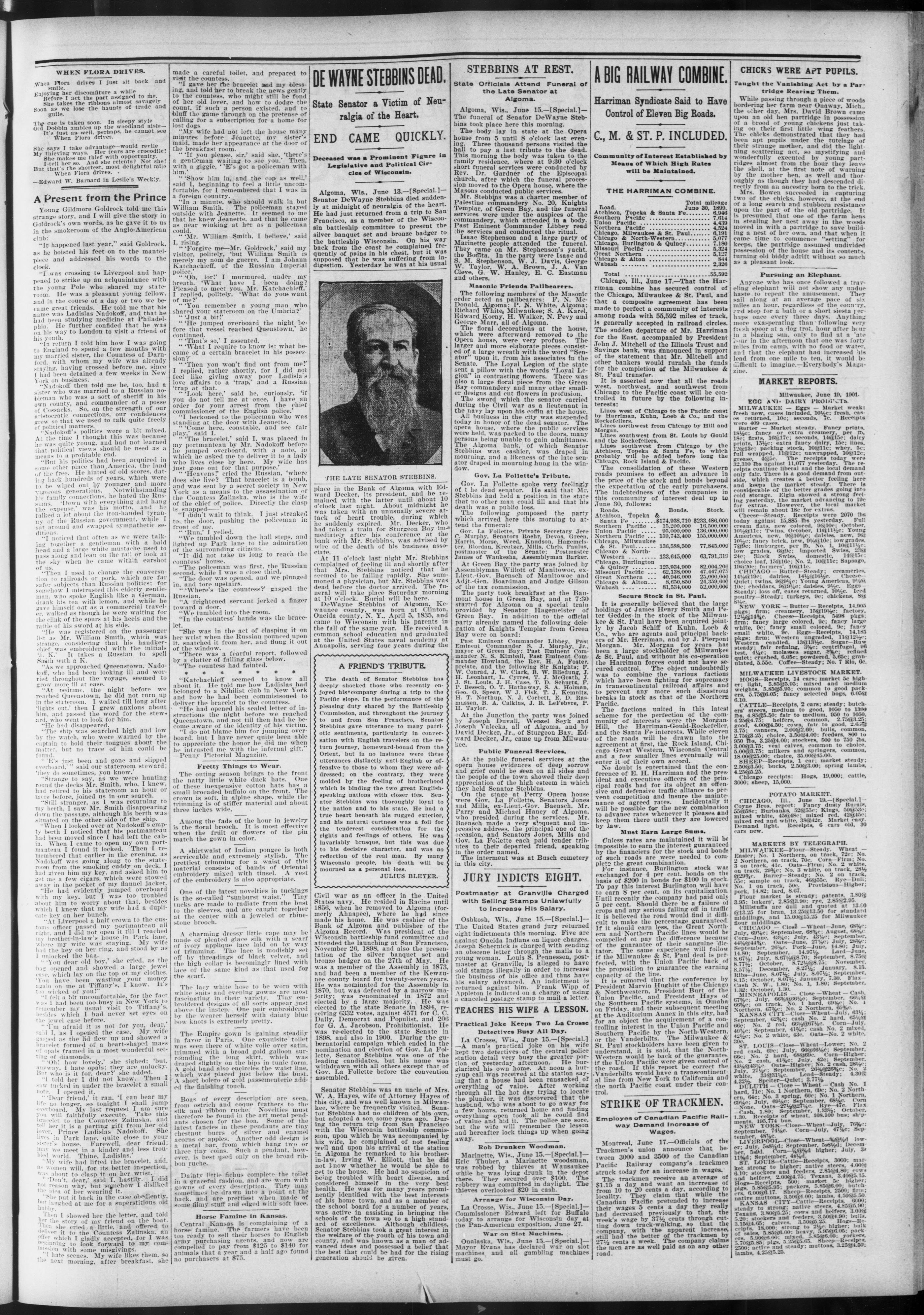
DE WAYNE STEBBINS DEAD.
Deceased was a Prominent Figure in Legislative and Political Circles of Wisconsin.
Algoma, Wis., June 13.—[Special.]—Senator DeWayne Stebbins died suddenly at midnight of neuralgia of the heart. He had just returned from a trip to San Francisco, as a member of the Wisconsin battleship committee to present the silver banquet set and bronze badger to the battleship Wisconsin. On his way back from the coast he complained frequently of pains in his chest, but it was supposed that he was suffering from indigestion. Yesterday he was at his usual
[Name not visible in the image]
place in the Bank of Algoma with Edward Decker, its president, and he remained with the latter until about 10 o'clock last night. About midnight he was taken with an unusually severe attack of heart trouble, during which he suddenly expired. Mr. Decker, who had taken a train for Sturgeon Bay immediately after his conference at the bank with Mr. Stebbins, was advised by wire of the death of his business associate. At 11 o'clock last night Mr. Stebbins complained of feeling ill and shortly after that Mrs. Stebbins noticed that he seemed to be failing rapidly. She summoned a physician, but Mr. Stebbins was dead before the doctor arrived. The funeral will take place Saturday morning at 10 o'clock. Burial will be here.
DeWayne Stebbins of Algoma, Kewaukee county, was born at Clinton, Oneida county, N. Y., April 5, 1835, and came to Wisconsin with his parents in the fall of the same year. He received a common school education and graduated at the United States naval academy at Annapolis, serving four years during the
A FRIEND'S TRIBUTE
The death of Senator Stebbins has deeply shocked those who recently enjoyed his*company during a trip to the Pacific slope. In the performance of the pleasing duty shared by the Battleship Commission, and throughout the journey to and from San Francisco, Senator Stebbins gave utterance to many patriotic sentiments, particularly in conversation with English travelers on the return journey, homeward-bound from the Orient, but in no instance were these utterances distinctly anti-English or offensive to those to whom they were addressed; on the contrary, they were molded by the feeling of brotherhood which is binding the two great English-speaking nations with closer ties. Senator Stebbins was thoroughly loyal to the nation and to his state. He had a true heart beneath his rugged exterior, and his natural curtness was a foll for the tenderest consideration for the rights and feelings of others. He was invariably brusque, but this was due to his decisive character, and was no reflection of the real man. By many Wisconsin people, his death will be mourned as a personal loss.
JULIUS BLEYER.
Civil war as an officer in the United States navy. He resided in Racine until 1856, when he removed to Algoma (formerly Ahnapee), where he had since made his home. He was cashier of the Bank of Algoma and publisher of the Algoma Record. Was president of the Wisconsin battleship fund committee and attended the launching at San Francisco, November 26, 1898, and also the presentation of the silver banquet set and bronze badger on the 27th of May. He was a member of the Assembly in 1873, and had been a member of the Kewaunee county board for twenty-seven years. He was nominated for the Assembly in 1870, but was defeated by a narrow majority; was nominated in 1872 and elected by a large majority. He was elected to the state Senate in 1894, receiving 6332 votes, against 4571 for C. C. Daily, Democrat and Populist, and 206 for G. A. Jacobson, Prohibitionist. He was re-elected to the state Senate in 1898, and also in 1900. During the gubernatorial campaign which ended in the nomination and election of Gov. La Follette, Senator Stebbins was one of the leading candidates, but his name was withdrawn with all others except that of Gov. La Follette before the convention assembled.
Senator Stebbins was an uncle of Mrs. W. A. Hayes, wife of Attorney Hayes of this city, and was well known in Milwaukee, where he frequently visited. Senator Stebbins had no children of his own, but adopted a son some years ago. During the return trip from San Francisco with the Wisconsin battleship commission, upon which he was accompanied by his wife, he complained of not feeling well and upon his arrival at the station in Algoma he remarked to his brother-in-law, Irving W. Elliott, that he did not know whether he would be able to get to the house. He had no suspicion of being troubled with heart disease, and considered himself in the very best health. He was for many years prominently identified with the best interests of his home town, and as a member of the school board for a number of years, was active in assisting in bringing the schools of the town up to a high standard of excellence. Although childless, Senator Stebbins took a great interest in the welfare of the youth of his town and county, and was known as a man of advanced ideas and possessed a belief that the best that could be had for the rising generation should be given.
STEBBINS AT REST.
STEBBINS AT REST.
Algoma, Wis., June 15.—[Special.]— The funeral of Senafor DeWayne Stebbins took place here this morning.
The body lay in state at the Opera house from 5 until 8 o'clock last evening. Three thousand persons visited the hall to pay a last tribute to the dead. This morning the body was taken to the family residence, where at 9:30 o'clock short funeral services were conducted by Rev. Dr. Gardner of the Episcopal church, after which the funeral procession moved to the Opera house, where the Masons conducted public services.
Mr. Stebbins was a charter member of Palestine commandery No. 20, Knights Templar, of Green Bay, and the funeral services were under the auspices of the commandery, which attended in a body. Past Eminent Commander Libbey read the services and conducted the ritual
Isaac Stephenson and a large party of Marinette people attended the funeral. They came on Mr. Stephenson's yacht, the Bonita. In the party were Isaac and S. M. Stephenson, W. J. Davis, George W. Taylor, W. A. Brown, J. A. Van Cleve, G. W. Hanley, E. C. Eastman and others.
Masonic Friends Pallbearers
The following members of the Masonic order acted as pallbearers: F. N. McDonald, Algoma; P. N. White, Algoma; Richard White, Milwaukee; S. A. Karel, Edward Koeny, H. Walker, N. Pevy and George Marr, all of Algoma.
The floral decorations at the house, which were afterward removed to the Opera house, were very profuse. The larger and more elaborate pieces consisted of a large wreath with the word "Senator" upon it, from his associates in the Senate. The Loyal Legion of the state sent a pillow with the words "Loyal Legion" in contrasting flowers. There was also a large floral piece from the Green Bay commandery and many other smaller designs and cut flowers in profusion.
designs and cut howers in prudence. The sword which the senator carried during the Civil war as a lieutenant in the navy lay upon his coffin at the house. All business in the city was suspended today in honor of the dead senator. The opera house, where the public services were held, was packed to the doors, many persons being unable to gain admittance. The Algoma bank, of which Senator Stebbins was cashier, was draped in mourning, and a likeness of the late senator draped in mourning hung in the window.
Gov. La Follette's Tribute.
Gov. La Follette spoke very feelingly of t he dead senator. He said that Mr. Stebbins had held a position in the state that no other man could fill and that his death was a public loss.
The following composed the party which arrived here this morning to attend the funeral:
Gov. La Follette, Private Secretary Jere C. Murphy, Senators Roehr, Devos, Green, Harris, Morse, Weed, Knudson, Hagemelster, Rlordan, Kreutzer, Mills, Chris, Paulus, postmaster of the Senate: Postmaster James of Waukesha, Assemblyman Barker.
At Green Bay the party was joined by Assemblyman Willott of Manitowoc, ex-Lieut.-Gov. Baensch of Manitowoc and Adjt.-Gen. Boardman and Judge Gilson of the tax commission.
The party took breakfast at the Baumont house in Green Bay, and at 7:30 started for Algoma on a special train provided by Senator Hagemeister of Green Bay. In addition to the official party already named the following delegation of Knights Templar from Green Bay were on board:
Past Eminent Commander Libbey, Past Eminent Commander S. J. Murphy, Jr., mayor of Green Bay; Past Eminent Commander N. S. Kimball, Past Eminent Commander Howland, the Rev. H. A. Foster, prelate, and the following Sir Knights; F. W. Conrad, J. W. Clark, B. W. Bliedung, J. H. Leonhart, L. Cyrres, T. J. McGrath, J. J. St. Louis, J. H. Case, T. D. Schurtz, F. P. Besech, O. T. Hathaway, S. A. Holman, Geo. O. Spear, W J. Flsk, T. J. Kemnitz, H. T. Northup, N. J. Corbett, E. D. Rasmussen, B. A. Calkins, J. B. LeFebvre, P. H. Taylor.
At the Junction the party was joined by Joseph Duvall, Wenzel Seyk and Joseph Valecka, all of Algoma, and by David Decker, Jr., of Sturgeon Bay. Edward Decker, Jr., came up from Milwaukee
Public Funeral Services.
At the public funeral services at the opera house evidences of deep sorrow and grief could be seen on all sides and the people of the town showed their deep appreciation of the high esteem in which they held Senator Stebbins. On the stage at Perry Opera house were Gov. La Follette, Senators Jones and Mills, ex-Lieut.-Gov. Baensch. Mr. Parry and Michael Haney of Algoma, who presided during the services. Mr. Baensch made a very eloquent and impressive address, the principal one of the occasion, and Senators Jones, Mills and Gov. La Follette each paid tender tributes to their departed friend, speaking in the order named. The interment was at Busch cemetery in this city.
JURY INDICTS EIGHT.
JURY INDICTS EIGHT.
Postmaster at Granville Charged with Selling Stamps Unlawfully to Increase His Salary.
Oshkosh, Wis., June 15.—[Special.]—The United States grand jury returned eight indictments this morning. Five are against Oneida Indians on liquor charges. Joseph Schernick is charged with sending an obscene letter through the mails to a young woman. Louis S. Pennessen, postmaster at Granville, is alleged to have sold stamps illegally in order to increase the business of his office and thus have his salary advanced. An indictment is returned against him. Frank Wipp of Appleton is indicted on a charge of using a canceled postage stamp to mail a letter.
TEACHES HIS WIFE A LESSON.
Practical Joke Keeps Two La Crosse Detectives Busy All Day.
La Crosse, Wis., June 15.—[Special.]
—A man's practical joke on his wife kept two detectives of the central police station detail very busy the greater portion of yesterday afternoon. He burglarized his own home. At noon a hurryup call was received at the station saying that a house had been ransacked of everything of value. After working through all the hot day trying to locate the plunder, it was discovered that the husband, who was about to go away for a few hours, returned home and finding everything open took all he could find of value and hid it. The police are sore, but the wife will remember the lesson and hereafter lock things up when going away.
Bob Drunken Woodman
Marinette, Wis., June 15.—[Special.]—Eric Thuber, a Marinette woodsman, was robbed by thieves at Wausaukee while he was lying drunk in the depot there. They secured over $100. The robbery was committed in daylight. The thieves overlooked $20 in cash.
Arrange for Wisconsin Day.
La Crosse, Wis., June 15.—[Special.] Commissioner Edward left for Buffalo today to arrange for Wisconsin day at the Pan-American exposition, June 27.
War on Slot Machines.
Onalaska, Wis., June 15.—[Special.] Mayor Evans has declared war on slot machines and all gambling machines must go.
A BIG RAILWAY COMBINE.
Harriman Syndicate Said to Have Control of Eleven Big Roads.
Community of Interest Established by Means of Which High Rates will be Maintained.
THE HARRIMAN COMBINE.
Total mileage
Road. June 30, 1899.
Atchison, Topeka & Santa Fe. 6,946
Southern Pacific 7,614
Union Pacific 4,439
Northern Pacific 4,524
Chicago, Milwaukee & St. Paul. 6,191
Chicago & North-Western. 5,077
Chicago, Burlington & Quincy. 7,180
Missouri Pacific 5,324
Great Northern 5,127
Chicago & Alton 844
Wabash 2,326
Total .....55,592
Chicago, Ill., June 17.—That the Harriman combine has secured control of the Chicago, Milwaukee & St. Paul, and that a composite agreement has been made to perfect a community of interests among roads with 55,592 miles of track, is generally accepted in railroad circles. The sudden departure of Mr. Harriman for the East, accompanied by President John J. Mitchell of the Illinois Trust and Savings bank, was announced in support of the statement that Mr. Mitchell and other bankers would turnlsh the funds for the completion of the Milwaukee & St. Paul transfer.
It is asserted now that all the roads west, northwest, and southwest from Chicago to the Pacific coast will be controlled in future by the following interests: Lines west of Chicago to the Pacific coast by Harriman, Kuhn, Loeb & Co., and the Rockefellers.
Lines northwest from Chicago by Hill and Morgan.
Lines southwest from St. Louis by Gould and the Rockefellers. Lines southwest from Chicago by the Atchison, Topeka & Santa Fe, to which probably will be added before long the Chicago, Rock Island & Pacific. The consolidation of these Western roads promises to effect an advance in the price of the stock and bonds beyond the expectation of the early purchasers. The indebtedness of the companies in this community of interest deal up to June 30, follows:
Roads.
Aitchison, Topeka & Santa Fe ..... $174,938,710
Southern Pacific ..... 15,200,000
Union Pacific ..... 95,000,000
Northern Pacific ..... 159,743,400
Chicago, Milwaukee & St. Paul ..... 136,588,500
Chicago & North-Western ..... 133,645,000
Chicago, Burlington & Quincy ..... 125,934,000
Missouri Pacific ..... 62,138,000
Great Northern ..... 40,946,000
Chicago & Alton ..... 8,650,850
Wabash ..... 81,534,000
Bonds.
Stock.
$233,486,000
16,500,000
136,000,000
155,000,000
77,845,000
63,791,319
82,004,200
47,447,075
25,000,000
24,359,600
52,000,000
Secure Stock in St. Paul.
It is generally believed that the large holdings of James Henry Smith and Peter Geddes in the stock of the Milwaukee & St. Paul have been acquired jointly by Jacob Schiff of Kuhn, Loeb & Co., who are agents and principal backers of Mr. Herriman, and by J. Pierpont Morgan. Mr. Morgan for years has been a large stockholder of Milwaukee & St. Paul, and without his co-operation the Harriman forces could not have secured control. The object undoubtedly was to combine the various factions which have been fighting for supremacy in transcontinental railroad affairs and to prevent any more such disastrous breaks in stock as that of the Northern Pacific.
The factions united in this latest scheme for the perfection of the community of interests were the Morgan-Hill, the Harriman-Gould-Rockefeller, and the Santa Fe interests. While eleven of the roads will be drawn into the agreement at first, the Rock Island, Chicago Great Western, Wisconsin Central and a few smaller lines eventually will enter it of their own accord. No doubt is entertained that the conference of E. H. Harriman and the president and executive officers of the principal roads had for its object an offensive and defensive traffic alliance to prevent competition and insure the maintenance of agreed rates. Incidentally it will be possible for the new combination to advance rates whenever it pleases and keep them there until they are lowered by law.
Must Earn Large Sums.
Unless rates are maintained it will be impossible to earn the interest guaranteed by the financiers for the stock and bonds of such roads are were needed to complete the great combination.
For instance, Burlington stock was exchanged for 4 per cent. bonds on the basis of $200 in bonds for $100 in stock. To pay this interest Burlington will have to earn 8 per cent. on its capitalization. Until recently the company had paid only 5 per cent. Should there be a failure of crops and any serious falling off in traffic it is believed the road would find it difficult to make the percentage guaranteed. If it should earn less, the Great Northern and Northern Pacific lines would be compelled ot pay the difference because of the guarantee of their sanguine dictator. The same experience will follow if the Milwaukee & St. Paul deal is perfected, with the Union Pacific back of the proposition to guarantee the earning capacity of the line.
It is rumored that the conference by President Marvin Hughitt of the Chicago & Northwestern, President Burt of the Union Pacific, and President Hays of the Southern Pacific systems, in Omaha on Friday, and their subsequent meeting at the Auditorium Annex in this city, had for an object the acquirement of a controlling interest in the Union Pacific and Southern Pacific by the North-Western, or the Vanderbilts. The Milwaukee & St. Paul stockholders have been given to understand, it is said, that the North-Western would be back of the guarantee if the Union Pacific were given control of the road. If this report be correct the Vanderbilts would have a transcontinental line from New York to California and the north Pacific coast under their control.
STRIKE OF TRACKMEN.
Montreal, June 17.—Officials of the Trackmen's union announce that between 3000 and 3500 of the Canadian Pacific Railway company's trackmen struck today for an increase in wages. The trackmen receive an average of $1.15 a day and want an increase of from 10 to 20 cents a day, according to locality. They claim that while the Canadian Pacific pretended to increase their wages 5 cents a day they really had decreased previously to that, the week's wage by $37½ cents through cutting down track-walking, so that the company, with the apparent increase, still had the better of the trackmen by $27½ cents a week. The company claims the men are as well paid as on any other road.
CHICKS WERE APT PUPILS.
Taught the Vanishing Act by a Partridge Rearing Them.
While passing through a piece of woods bordering her farm near Onaway, Mich., the other day, Mrs. David Brown came upon an old hen partridge in possession of a brood of young chickens just taking on their first little wing feathers. The chicks demonstrated that they had been apt pupils under the tutelage of their strange mother, and did the lightning scattering act, so mystifying and wonderfully executed by young partridges almost from the hour they leave the shell, at the first note of warning by the mother hen, as well and thoroughly as though they had descended directly from an ancestry born to the trick
Mrs. Bowen succeeded in capturing two of the chicks, however, at the end of a long search and stubborn resistance upon the part of the old partridge. It is presumed that one of the farm hens in stealing her nest away in the woods moved in with a partridge to save building a nest of her own, and that when it came time to commence "setting" for keeps, the partridge assumed undivided possession of the house and its contents, turning old biddy adrift without so much as a pleasant look.
Pursuing an Elephant
Anyone who has once followed a traveling elephant will not show any undue haste to repeat the amusement. They sail along at an average pace of six miles an hour, regardless of the country, and stop for a bath or a short siesta perhaps once every three days. Anything more exasperating than following very fresh spoor at a dog trot, hour after hour in a blazing sun, only to find at a 'ate hour in the afternoon that one was forty miles from camp, with no food or water, and that the elephant had increased his lead from one mile to ten, it would be difficult to imagine.—Everybody's Magazine.
MARKET REPORTS.
Milwaukee, June 19, 1901.
FGC. AN1. DAIRY PRODUCTS.
EGG AND DARK PRODUCTS.
MILWAUKEE — Eggs — Market weak; fresh new, cases included, 10½c; fresh, cases included, 90c; seconds, 7c. Receipts were 400 cases.
Butter — Market steady. Fancy prints, 18½¢; fancy or extra creamery, per lb, 18¢; firsts, 16@17¢; seconds, 14@15¢; dairy prints, 15½¢; extra fancy dairy, 15¢; lines, 12@13¢; packing stock, 10@11¢; whey, 5¢; full wrapped, 11@12¢; unwrapped, 10@12¢; grease, 4@5¢. The receipts today were 32,310 lbs against 11,077 yesterday. The receipts continue liberal and the local demand only fair. There is a good demand from outside, which creates a better feeling here and keeps the market steady. There is considerable of the better grades going into cold storage. Elgin showed a strong feeling yesterday, the market advancing to 19¢ for extras. However, the local market will remain about 18¢ for extras.
Cheese—Steady. Receipts were 2070 lbs today against 15,885 lbs yesterday. Full cream flats, new colored, 9@10c; October, 10%@11c; Twins, October, 11@11%c; Young Americas, new, 9@10%c; daisies, new, 9@10%c; fancy brick, new, 9@10%c; low grades, 7@9c; limburger, per 1b, No. 1, 10@11%c; low grades, 6@9c; imported Swiss, 23@24c; Block Swiss, domestic, 14@15c; choice loaf, 15@16c; No. 2, 10@11c; Sapsago, 19@20c; farmers', 10@11c.
CHICAGO—Butter—Steady; creamerles, 14%@19c; dairies, 14%@16%c. Cheese—Qulet; twins, 9@4%c; Young Americas, 9%@10c; cheddars, 9@9%c; daisies, 9%c. Eggs—Steady; loss off, cases returned, 10%c. Iced poultry—Steady; turkeys, 9c; chickens, 8@14c
NEW YORK — Butter — Recelpts, 14.905
pkgs; firm; creamery, 15@19½c; factory,
12½@14½c. Cheese—Recelpts, 5498 pkgs;
firm; fancy large colored, 9c; fancy large
white, 9c; fancy small colored, 9c; fancy
small white, 9c. Eggs—Recelpts, 14.185
pkgs; firm; Western ungraded, 11@12½c;
Western candled, 13@13½c. Sugar—Raw
steady; falr refining, 3½c; centrifugal, 96
test, 4½c; molasses sugar, 3½c; refined
quiet; crushed, 6.05c; powdered, 5.65c; gran-
ulated, 5.55c. Coffee—Steady; No. 7 Rio, Gc.
MILWAUKEE LIVESTOCK MARKET.
HOGS—Recelpts, 14 cars; market 5c higher; light, 5.85@5.95; mixed and medium weights, 5.85@5.95; common to good packers, 5.75@6.05; fancy selected hogs, 6.05@6.10.
CATTLE—Recelpts, 2 cars; steady; butchers' steers, medium to good, 1050 to 1300 lbs, 4.85@5.50; fair to medium, 950 to 1050, 4.25@4.75; helfers, common, 2.75@3.25; good, 4.00@4.50; cows, fair to good, 2.65@3.75; canners, 2.00@2.60; bulls, common, 2.75@3.25; choice, 3.50@4.00; feeders, 800 to 950 lbs, 3.25@4.00; stockers, 500 to 750 lbs, 3.00@3.75; veal calves, common to choice, 5.00@3.75; milkers and springers, common, 18.00@25.00; choice, 35.00@45.00.
SHEEP—Recelpts, 1 car; market steady; 2.50@3.50; bucks, 2.50@3.00; spring lambs, 4.25@5.25.
Chicago recelpts: Hogs, 19,000; cattle, 3000; sheep, 15,000.
POTATO MARKET
CHICAGO, Ill., June 19.—[Special.]—Coyne Bros. report: Fancy dusty Ruralas, 55@58c; Burbanks, 52@55c; Klings, 50@53c; mixed white, 45@48c; mixed red, 42@45c; mixed red and white, 38@42c. Market easy. Demand light. Receipts, 6 cars old, 30 cars new.
MARKETS BY TELEGRAPH.
MILWAUKEE—Flour—Steady. Wheat — Easier; No. 1 Northern, on track, 72c; No. 2 Northern, on track, 70c. Corn—Firm; No. 3 on track, 41c. Oats—Firm; No. 2 white, on track, 29%c; No. 3 white, on track, 28%@29%c. Barley—Steady; No. 2 on track, 55c; sample on track, 46@55c. Rye—Dull; No. 1 on track, 50c. Provisious—Higher; pork 14.82; lard 8.67.
Flour market is steady; patents, 3.80@
2.95; kers, 2.85@3.90; rrre, 2.85@2.95.
3.95 bakers, 2.80 bakers, middlings, dull and quoted at 13.00
@13.25, bran, 13.25@13.50 for standard
middlings, and 15.00@15.25 for Milwaukee
flour middlings.
CHICAGO Close -Wheat-June, 68%c
July, 69%c; September, 68%c; August, 68%c
Corn-June, 43%c; July, 43%c; September,
44%@44%c. Oats-June, 27%c; July, 28%c;
September, 26%c. Pork-June, 14.80; July,
14.80; September, 14.97%c. Lard-June,
8.67%c; July, 8.67%@8.70; September, 8.75%
8.77%c; October, 8.72%@8.75; November,
8.57%c; December, 8.27%c; January, 8.15
Ribs-June, 8.07%c; July, 8.07%; September,
8.15; October, 8.07%; January, 7.30. Flax-
Cash N. W., 1.80; No. 1, 1.80; September,
1.32; October, 1.30.
MINNEAPOLIS Close -Wheat -Cash,
67%c; July, 66%@66%c; September, 66%@
66%c; on track. No. 1 hard, 69%c; No. 1
Northern, 67%c; No. 2 Northern, 65%c.
KANSAS CITY-Close-Wheat-July, 63%c
September, 62%c; cash No. 2 hard, 65%@
66c. No. 2 red, 66%@67%c. Corn-July,
40%c; September, 41%c; cash No. 2 mixed,
42%c; No. 2 white, 43c. Oats-No. 2 white
50c.
ST. LOUIS—Close —Wheat—Lower; No. 2
red cash, 63c; July, 66@66%c; September,
66c; No. 2 hard, 68@68%c; Corn—Higher;
No. 2 cash, 41%c; July, 42c; September,
43%@43%c; Oats—Higher; No. 2 cash, 28%c;
July, 27%c; September, 26%@26%c; No. 2
white, 31@31%c; Lead—Steady; 4.30@
4.32%c; Speiter—Quiet; 3.77%c
DULUTH — Close —Wheat — Cash No. 1
hard, 71c; No. 1 Northern, 69c; No. 2 Northern,
64c; No. 3 spring, 60c; No. 1 Northern,
69%c; July, 69%c; September, 68%c; Corn
—None. Oats—27%@27%c; Rye—47c; Flax
—Cash, 1.80; September, 1.33%; October,
1.30. Receipts of wheat, 108.100 bus; ship-
ments, 195,774 bus.
NEW YORK—Close —Wheat—July, 76%c;
September, 74%c; Corn—July, 47%c; September,
48%c.
LIVERPOOL—Close —Wheat—%@%d lower;
July, 58%8d; September, 58%8d; December,
58%d; Corn—%@%d higher; July, 3s
11%d; September, 48%d.
ST. LOUIS—Cattle—Recelpts, 3000; market strong to higher; native steers, 4.00@6.10; stockers and feeders, 2.85@4.80; cows and helfers, 2.00@4.75; Texans, 3.40@5.15. Hogs—Recelpts, 500; market 5c higher, pigs, 5.85@5.95; packers, 5.85@6.00; butchers, 6.00@6.17. Sheep—Recelpts, 2500; firn, native muttons, 3.50@4.00; lambs, 4.50@5.50. KANSAS CITY—Cattle—Recelpts, 6000; steady to strong; native steers, 4.85@5.90; Texans, 3.80@5.25; cows and helfers, 3.00@5.20; stockers and feeders, 3.50@4.90; bulls, 3.15@4.65; calves, 3.50@5.25. Hogs—Recelpts, 18,000; strong to 21ac higher; bulk of sales, 5.85@6.00; heavy, 5.95@6.05; packers, 5.90@6.00; mixed, 5.85@6.00; yorkers, 5.70@6.05; pigs, 5.25@5.65. Sheep—Recelpts, 2500; active and steady; muttons, 3.25@4.50; lambs, 4.25@5.25.
Printed im the Interests of the Negro Race,
MILWAUKEE, Wis.
pea a pg ee
Richard B. Montgomery............-+-
eenetecceesceeseesbditor and Proprietor
Office: 327 Wells Street.
Telephone Black No. 244.
SUBSCRIPTION RATES.
Any part of the United States and Canada,
‘postage paid.
Ome Year ......cccccceenecccceesecses $200
Six Months ........-.ccssssecceessee LBD
Three Months ........2.---2eeeceree TS
Send money by Express ee P.O.
Money Order or Registered Letter to the
Wisconsin Weekly Advocate.
ADVERTISING RATES.
One inch, single insertion.......-..-.-. 25¢
One inch, per year..........-..-.--. $9.00
Business locals Sc per line each insertion.
Apply for rates to the Advocate.
TO CONTRIBUTORS:
_it communications must be sent with the
name and address of the sender as an evi-
dence of good faith, but not necessarily for
publication. No manuscript returned if not
secepted, unless accompanied by stamps.
A’! subseribers of the Advocate that fail
to get their paper promptly will please noti-
fy us at once. The Advocate, at 827 Wells
street.
The Wisconsin Weekly Advocate company
wishes to notify the public that aj] contracts
and business transactions with this com-
pany must have the company stamp. other-
wise they will be void. Neither will this
company be responsible for paid subserip-
tions unless given to duly-accredited agents,
who, on request, will give the company’s re-
ceipt for same. Subscribers failing to re-
ceive their papers regulariy wil kindly noti-
fy the general office. Address all business
communications to the general manager,
327 Wells street.
Mr. Richard B. Montgomery.
Entered at tue Milwaukee P. O. us second-
ass matter.
The Helping Hand
Colored Mission
incorporated under the laws of the
State of Wisconsin has for its object
the supplying of qualified colored
help to those requiring the same.
In order to be able to get servants
from the mission it is necessary,
that in order to partly cover ex-
peeses incurred, those parties de-
riring he!p should become subscrib-
ers for this paper. No actual charge
is made. Parties who secure situa-
tions through this agency are also
expected to become subscribers.
We have at present on our books:
Cooks, General Servants, Wait-
resses, Laundresses, Nurses,
Coachmen, Porters, Waiters.
Office hours 9-12 and 1-4.
R. B. MONTGOMERY, Mgr.
327 Wells St., Milwauke2
The most astonishing thing about that
Vassar girl’s jump of 13 feet 744 inches
is that there wasn’t a mouse in sight.
Herron was red when he was in the
church. Now he is read out of the
church.
Abbe Moreaux’s theory as to the sun
spots is more werthy of consideration
than the average rumor as to the prob-
able ending of the Boer war.
—_——_—_—_—
Andrew Carnegie ought to endow a
chair in some American university to in-
struct American youth in the Scotch vir-
tue of living within one’s ncome.
No. the poor fellow killed by leaping
from Brooklyn bridge was not thinking
of a literary career; he was qualifying
himself for the lecture platform.
Better evidence than the statements of
men hired to find fault with it will be
required to convince Minnesota people
that their election law is a failure.
* Summer is a little behind time this
year, but from the tornado reports it is
evident that she is likely to break in upon
us quite suddenly in order to make up for
Jost iime,
“Cheiro,” the palmist, has gone te cul-
tivating vines in France. If he can bring
his cenius as a grafter into play in his
new line, the million with which he is
said to have retired wiil be multiplied in
stort order
The new antiseptic discovered at Ann
Arbor may not be good for “internal
use,” but it will get into the human anat-
winy if it proves to have any value in the
preservation of focd articles externally
as well as internally.
The foreign effort to throw discredit up-
on American locomotives will not stay
the development of a growing export
trade in railway equipment. American
locomotives have never failed at home;
and conditions here are more exacting
than railway demands in Europe.
In the case of Capt. Blackburn, who
has sailed from Gloucester in a twenty-
five-foot boat, hound for Enrope, it is
ap even question whether he will be
@rowned by ihe swamping of his boat, or
killed by the embalmed canned goods
that he has in the provision locker.
——————
That Georgia sheriff who risked his
life to protect a negro prisoner from a
mob of lynchers is the hero of the hour.
Like many another hero, however, his
nobility is not recognized by his neigh-
bors. On the contrary, they look upon
him as the meanest man they know.
The impressive fact is not that the
Americans who sat down with King Ed-
ward the other day possessed so and so
many millions. It is that when they got
up from the table they retained their
money. Baccarat for high stakes isn’t
the thing now that Edward has ceased
to be Prinse of Wales and has become
Kine of Encland.
It looks like a reaction against co-edu-
cation. The management of Leland
Stanford University announces that only
a limited number of girls will be admit-
ted after next year, while the Armour
Institute at UhYeago has abandoned co-
education with a “short, sharp shock,”
leaving a class of forty-seven young
women in their third year with no
chance to graduate.
_—_————
There can be no presumption that the
inmates of a lunatic asylum are danger-
ous cr unskillful workmen from the fact
alone that they are insane, holds the Sa-
preme court of California, in the case of
Atkinson ys. Clark, and a superintendent
of an insane asylum who allows some of
the inmates to assist in tearing down a
brick wall is not liable for an injury re-
ceived by a regular workman, who was
also engaged in the work, unless the evi-
dence shows that the superintendent was
careless or unskillful in the selection of
the inmates.
Some Americans are altogether too
ready to make concessions. An upreflect-
ing editor remarks:
They are getting away ahead of us in
the old country. At Vienna a diverced
women’s club has been tormed to provide
a home and remnnerative work for those
who are obliged to earn their living.
Getting ahead of the United States!
Not by a good deal. If there were a di-
vorced women’s club in this country nine-
tenths of the persons eligible for member-
ship would be married again before the
organization had time to pass upon their
applications.
A portrait of the late President James
Buchanan, painted by William M. Chase,
and said to be a very excellent likeness,
has been presented to the Mercersburg
academy, in the Franklin county, Pa.,
borough of that name, by Mrs. Henry E.
Johnston of Washington, D. C., who is
better known, both in this country and in
Europe, as Harriet Lane, the mistress
of the white house under the administra-
tion of President Buchanan. Mercers-
burg is the birthplace of James Buchan-
an, and it is therefore singularly appro-
priate that his portrait should bang in
the hall of its academy.
The greatest gathering of Canadian
troops since Confederation is to take
place in Toronto during the visit of the
Duke and Duchess of Cornwall and
York. It is understood that the govern-
ment, instead of having a number of
reviews in different places, will make the
military feature of the trip an attraction
at one point only, and Toronto is the
chosen city. Not less than 10,000 men
are to be assembled in that city. They
will be brought from every part of the
Province of Ontario, and inelude all arms
of the service. Pay and subsistence will
be furnished by the Dominion govern-
ment, the cost of transportation, etc., for
the two or three days that the men will
be away from their homes keing not less
than S40.000_
According to a statement from the
War Department, enlistments are pro-
gressing at a satisfactory rate. They
now average about 500 or 600 a day.
| There was a decided let down in the
number of daily recruits immediately
‘after the surrender of Aguinalde, but
enlistments have since picked up. Th~
ented of Secretary Root fixing the num
| ber of men in each company on a peace
footing has enabled the recruiting officers
/to make good progress iv completing
certain regiments. _The new order cut
down the number of men required for
‘the infantry and cavalry companies, and
the surplus thus obtained was trans-
ferred to the artillery. It is nqw stated
‘that the infantry and cavalry regiments
are now about four-fifths filled and that
more than one-third of the increase au-
thorized for the artillery has been cb-
tained.
Investigations directed from Washing:
ten discover 275 cases of leprosy in the
‘United States. It is thought this is
barely a quarter of the aciuai cases
existing. It is the intention of those
who are compiling the figures to make
a report to Congress, including such ree-
ommendations as may seem warranted.
One recommendation will be for the erec-
tion of two large government hospitals
for lepers, one in the South and the
other in the North. It is noteworthy
that nearly all the 275 reported victims
are foreigners. The Scandinavians
seemed peculiarly susceptible to the dis-
‘ease. They either had it when they
landed in America or contracted it soon
iatiee landing. Every one of the cases
in the Dakotas and Minnesota is in the
country, rather remote even from the
small towns. The disease seems to, he
spreading most rapidiy in Louisiana.
The experiment of employing dogs on
outpost duty is being tried by the Brit-
ish in South Africa. Among the an-
cients dogs were trained in considerable
numbers for the purposes of war, and
mention is made of them by Plutarch,
Pliny, and other writers. The Romans
kept dogs in towers on fortifications in
order that no enemy should approach
unobserved; while the Knights of St.
John employed them on picket daty, and
partois were always aecompanied by
them. The mastiffs of the Knights of
Rhodes knew a Turk from a Christian
by the smell. Then there is the spaniei
which saved the Dutch Republic by
waking William the Silent during the
night atttack on Mons. Many nations
are training dogs, especially Germany,
which has devoted nearly twenty years
to training and experimenting, and em-
ploys them as sentries and to search
for the wounded.
; LIFE ON PACIFIC SLOPE.
People Tex: per What is Disagrecable
with Good Humor.
The author of “Life and Sport on the
Pacific Slope” says that in assemblages
where a little patience and good humor
temper what is disagreeable the people
of the Pacific slope are at their best.
Once, at a performance of some play,
several youths were guying the principal
character, to the annoyance of everybody
else. Suddenly a man said to them, very
politely:
“That lady on the stage is making so
much noise that we cannot hear what
you are saying. But I hope we shall
have the peseure of listening to your
criticisms later, when the act is over.”
Silence followed the remark.
At times something more forcible is
needed. A certain woman had one day
been rudely treated by a minor railway
official. She was very indignant, and
quite at a less for words; but she had
a saving sense of humor, and turned to
a stranger at her elbow.
“Sir,” said she, ‘will you tell this man
what I think of him?”
The stranger, without betraying the
least excitement, said in a melancholy
drawl:
“Sir, this woman thinks you are an
| urderstrapper, clothed with a little brief
authority, whose only qualification for
‘the place you occupy is your extraordi-
nary impudence.”
—It has been determined to form a
company for the purpose of working the
oil wells recently discovered at Belmont,
near Lausanne, in Switzerland.
#¢BE*NOT DECEIVED*-
®TO THE COLORED PEOPLE OF AMERICA.
i King of all Hair Tonics,
| “ OZONO.”
a @
pUr Se: he RS
AN FORE. ‘° #AFTER. ’ ‘BEFORE. eee AFTER
"a. —— ee a ee nee ee te
2
i. Recognizing the fact that there are many SO-CALLED hair-growers and
hair-straighteners now on the market, and knowing to a certainty that nee
#qN of these are frauds pure and simple, we wish to make a straight-forward,
honest statement to the colored race See 8 this great paper. In
‘the year 1871 our late secretary, Mrs. 8. M. Moore, through a fortunate
G@\ circumstance, acquired the receipt for OZONO. It was not offered for sale
or purchase to any extent until 1875, when it was put upon the market and
“4 met with marked success. After a thorough test by the colored pe of
f§\ that time it was pronounced an honest, legitimate remedy, true to all that
was claimed for it, and worthy in every respect of the confidence of every
“ member of the colored race, because they found it to cause the hair to grow
£N long and straight, soft and fine, and as beautiful as an April morning. Row,
whenever a genuine article appears upon the market there ure always a
‘a number of people who imitate and make capital out of the merits of other
FEN people’s goods. Seeing our marked success, numerous firms have entered
the market, offering hair-growers and hair-straighteners, many of which are
‘ae worthless, causing the hair to fall out and cee great damage to the hair
9% and scalp, and the colored people are bogie ese Spacious compounds,
which are filled with animal fats, and do the hair more harm than good. To
"a. these let us sound a warning—be careful what you useon your hair. Do not
GR be deceived by flaring advertisements and big words. Buy the King of all
Hair Tonics,
(i OZONO,
WS which is sold with an iron-clad guarantee to do all that is claimed for it, or
we will forfeit $50.00. Now, we ask youa plain question—would we abso-
4, lutely agree to forfeit $50.00 if you are dissatisfied with our preparations,
FEN if they were not true to all'we claim for them? We have advertised for
several years under this guarantee, and we are glad to say that every one
‘mm, Who has used Ozono has been satisfied in every respect.
A) 20,000 people are Ged using our eee and oe purchaser
recommends Ozono as the King of all Hair Tonics. Ozono will positively
@ take the Kinks out of Knotty, Kinky, Harsh, Ourly, a, Trouble-
g§S some Hair. It will make short, harsh hair long and straight. It will cure
your head of all itching, worrying scalp diseases. Itch, Eczema, Dandruff,
@y, 2nd Scurf can not live after Ozono has been applied. It will stop your hair
EWS from falling out. It will restore gray hair to its natural color, making the
hair long and soft.
ik Now, right here, let us make a statement. Many firms are advertisin;
US remedies to straighten hair, but when oeey send the preparation they tell
you to use hot irons. Friends, do not use hot irons; ee will burn up the
“life of the hair, and cause it to oop out. Ozono straightens without any
£¥S outside assistance. Nothing but Ozono is necessary, and the hair stays
straight forever. You can stop the use at any time. The good effects on
wi, the hair are secn in a day or two after the first application.
ZEN The price cf Ozono is 50c. a bottle—4 boxes do the work. We make
this liberal offer, which is good at any time: Cut out this coupon and send
a to us, enclosing with it the sum of One Dollar, and we will forward to you
£48 four large boxes cf Ozono and one large bottle of Electrical. Skin Refiner,
which makes black skin bright, rough skin soft and pliant, and cures ail
gy, skin diseases. Also removes all facial imperfections, and actually Temoves
“V8 small-pox pits. We will also include one fancy jar of our Electrical Skin
Food—Nature’s great beautifier—removes wrinkles, moth patches, freckles,
4, 2nd all facial blemishes; makes the old look young and the young look
Ee. younger. “
We will also include one package of our celebrated Scalp Soap, which is
Ay absolutely CHEMICALLY PURE, and no soap but a pure soap should ever
Sm, WwW WS. Bw Bw. B-w-B-B-B-B.-B-B-B-B-.o-B.O.-'
—e And Grand Trunk =
4 Lh. Railway System
’ f \ is | \ at . | qe phartee and saan sauvect
TTD Za eating 82569, painds in, Michigan,
5 mere ra rat as aes rates and good service.
a Were Visit the Pan-American Expo
Se Peta oT Pes We have the | t -
oe Se Se i= bcursiane te Grand. Haven:
ee a re ee) Grand Rapids and Muskegon
SS SS ee every Saturday night.
Grand Haven, $1.00. Muskegon, $1.00, Grand Rapids, $1.50?
E. G. Crossy, G. M. J. C. Grirrin, G. P. A.
*Phone Main 894 _______ ssa. Ticket Office, 400 E. Water St.
BRETT
EMBALMER and
FUNERAL DIRECTOR
307 REED STREET and Agave Oeee
410 GRAND AVENUE.
a
Telephones:
South 122. Milwaukee, Wis.
The author of the book on gamblers
and gambling mentions that when he first
came into the world, in 1750, there was
no such thing as a faro table admitted
into the houses of people cf rank and
fashion; that in his childhood peonle had
too much pride to receive tribute from
the proprietor of such a machine, and
that excessive gambling was not as a rule
carried on in private houses, but at clubs.
where the “play” was deeper than ever
was before or since. One can scarcely
imagine, however, deeper play at any
period than was carried on in the ‘‘club-
land” of the regency; indeed, play sur-
vived in that most exclusive country long
after Fox and the wild prince had given
up the dice box. The dandies continued
it—Byron, Brummell, Alvanley, D'Orsay
—how many score of men I could men-
tien who gambled away the whole of
Deep Play.
be used onthe scalp. And, lastly, to prove our liberality, we will put in a pint:
peneee of ‘Anti-Oulor, a positive cure for Sore Throat or Mouth, all forms of
Womb Diseases, Chilblains, Sore and Frosted Feet; also removes all
smelis and odors aoe from the human body, such as feet, arm pits, etc.
The actual value of this Grand Aggregation is = ie bat we let you
have it for $1.00, simply to introduce honest goods. In order to protect the
ublic in general from imitations of our ee and to avoid mistakes, we
Bave placed upon our coupon our Trade-Mark, one head showing Short
Hair and the other head Long Hair. The U. 8. Government has granted us
this trade-mark, and it is registered in the Patent Office at Washin pion: 80,
if the coupon has this trade-mark on it, you will make no mistake. Use
only the coupon having the two heads on it. As to our eee we!
‘refer you to the Editor of this paper or to the Metropolitan Bank of Rich- ,
mond, Va. We have cieseaiade of testimonials we have not space to pub-
lish. -Here is a sample of one:
Boston Ohemical Company : |
Dear Sirs,—You are at liberty to state in any newspaper that I have |
used OZONO, and give it my most hearty recommendation. I have been ,
fooled so often, it does me good to recommend honest goods.
5 MAGGIE B. PROCTOR, |
Here is another: Box 114, Fairfield, Texas. |
Gentlemen,—After using OZONO a short while only, I am glad to say |
that my hair is already straight and growing finely. Q.
MISS BESSIE POWERS,
383 Missouri street, Tolede, 0. ;
A last word. OZONO is absolutely guaranteed to straighten hair and
cause a beautiful and luxurious growth. If your hair is already straight, '
you can use it to secure a glossy long growth. Buy only the genuine {
“OZONO.” Send us $1.00 at once, and the goods will be sent the same
day we receive your order. ‘
| BOSTON CHEMICAL CO., (
. 810 E. Broad St., Richmond, Va. |
meee MMR OS tt, ee cee Uy ie eri eeMib ass, AY
°
i Boston Chemical Co., ;
SS 310 East Broad Street, RICHMOND, VA. 4
\er mi ma TI enclose you $1.00, for which please send at orce hi
the following goods: f
4 Boxes of Ozono, worth $2.00. 1 Bottle Electrical Skin Refiner, *
worth 60c. 1 Bottle Electrical Skin Food, worth 50c. 1 Package
(1 pint) Anti-Odor, worth 50c. 1 Package Scalp Scap, worth 50c.
Total, $4.00. §
NAM. 2. occ cccscesccccescccccceses sy. MOUS, NOws.....2. ay
MGPOB RG So oa sare Yee es Sune anid sisnib.« tices o's cdg CN eeanea a¥ beenekWnvenrsce ones aa
MOODOT sBisis dss vans sees sa5iste00 vehi cy) SEMUD es oc Gea snceanns 4
If you want 4 lots like above, send $3.00. If you have a friend who has 4
no coupon, let her write her name on a piece of paper and pin to coupon “)
when you send your order. o Ai
Reese
ieee we te ek eG
i aa 5 : Bie eto ve
aie By ae 2 Seemtimermsuede eo) BP eee are
Die 8 ose Retest rae garage dulabenener a
t ers as i ae ere
ae ee ee a me hg oe
1! a Sie Ge
ecteet Ge Pa: 2a ag =f
eas i : a oad 2
| gem fee es 3 Sema...
\ Rae: Lot t f oe . z >
Re 4 Ae a -
[sat g et YA a
He? = Fee a ea N ee
. AINION....
Laundry and News Co.
No. 432 State Street
GEO. VV SAYEES
ALL WORK CAREFULLY DONE...
Lowest Prices and Satisfaction Guaranteed. pee <!
PARTIES ~~
intending to visit Hot Springs,
Ark., this winter, should pa-
tronize the
RAMMELSBERG
BATH HOUSE,
MARK SARCENT, Manager.
21 BATHS $3.00
‘their great estates, won by sword or
jance far away in “the dead centuries,”
or loaded their property with burdens in
a single night which would keep their
children and their grandchildren ee for
years to come! That a young fellow just
‘come mio a great estate should drop a
‘few thousands in a single night was not
deemed worthy of remark, for in those
days every one played, high church cler-
gy, bishops and all. One remembers Dis-
raeli's “young duke,” who went on play-
ing cards all night and all next day, till
he and his companions were sitting knee-
deep in cards and the servant in attend-
ance was fain to lie down and snatch a
little sleep.—Longman’s Magazine.
—Maurice Girard, a porter with the
Imperial Bitters company, fell down an
elevator shaft and was killed. He was
20 years old and lived at 1625 Elston
avenue.
Come to this wide-awake city! Visit our fine store! We were here since 1856! Modern store and selling goods of the most reliable character. It will be quite easy to find us as our location is central.
Whittelsey Dry Goods Co. 492 MAIN STREET
WHEN IN MADISON
Call at the
Avenue
Hotel...
M. J. REGAN, Prop.
$2.00 Rate .....
Free 'Bus.
Free 'Bus.
Northwestern House
APPLETON, WIS.
JOHN A. BRILL, - Proprietor.
Terms $1.00 Per Day.
Accommodations the best in the State. When in Appleton stop at the
TONEY THE ARTIST FINE ART Shining Parlor
2164 GRAND AVENUE
Opposite Flanner's Music Store
MILWAUKEE, WIS.
MILWAUKEE...
GAS STOVE CO.,
MANUFACTURERS OF
PERFECTION
MACHINERY CO.
PERFECTION GAS RANGES
AND SPECIALTIES
Instantaneous Cleanable Star Burners,
Adjustable Needle Valve,
For Natural, Artificial or Gasoline Gas.
139 Burrell St., Milwaukee, Wis.
MASTER PAINTER
You know Good Painters make from $5.00 to
$10.00 a day easy.
OUR BOOK
is so explicit that even Boys can become Masters
of the trade.
PAINTING POINTERS
on Sign, House and Carriage Painting. Decorat-
ting, Graining, Gilding, Silvering and Calsomin-
ing. This Book will also teach you how to
CONTRACT FOR BUSINESS
on profitable basis. It will teach you all we
know after having spent a life time in the busi-
ness, and will generally
SAVE YOU MONEY.
Mailed postpaid for only 50c.
VAL. SCHRJER SIGN WORKS, Milwaukee, Wis.
NORTH OR SOUTH
Always ask for tickets via the Monon Route THE SHORT LINE BETWEEN Chicago, Indianapolis, Cincinnati, Louisville
Six trains daily between Chicago and the Ohio river. For folders, rates, etc., call at any Monon ticket office or address
FRANK J. REED,
Gen'l Pass. Agent, Chicago.
S. B. JONES,
C. P. Agent, 232 Clark St., Chicago.
The Blue and the Gray Review Incidents of the Late War, and in a Graphic and Interesting Manner Tell of Camp, March and Battle.
"I do not wonder," said the Captain, "that historians fail to give satisfactory descriptions of battles. The tendency is to sacrifice details to picturesque generalizations, and to eliminate whatever detracts from dramatic narrative, and the unmilitary writer is not conscious of creating false impressions when he does all this. In addition to this, materials for history, in the shape of official reports, letters of correspondents and carefully prepared papers by general officers, are not easily mastered by men and women unfamiliar with military maneuvers or incapable of considering judicially army prejudices and controversies. Then, again, battles seen from the standpoint of the commanding general do not closely resemble the same battles seen from the standpoint of the brigade commander or the man in the ranks, and little wonder is it that the lay reader is often confused as to facts.
"Breckinridge's charge at Stone River on the 2d of January, 1863, has been described by hundreds of officers and military historians, and yet not one gives a picture of the battle on that day as I saw it. Nothing that appears in the official reports of Rosecrans, Crittenden or Palmer, or Bragg, or Breckinridge, shakes the impression or blurs the picture that holds possession of my mind. I read acquiescently the reports as to the situation on the morning of the 2d of January as to the position of the troops, as to what Rosecrans saw and surmised as to what new dispositions were made to meet the expected onslaught, as to what Maj.. Mendenhall did in concentrating artillery, as to what happened before the rebels reached the river, and what followed. But another picture comes up in my mind.
"We were in Palmer's division and our brigade occupied a point of high ground that seemed to extend out tantalizingly toward the enemy. We had spent the greater part of the New Year's day and night in throwing up breastworks, and shortly after noon, on the 2d, we were lounging in line, arms stacked behind the works, gossiping over hardtack without coffee. There had been a good deal of noise, of course, but artillery firing didn't count with the boys, and just at that time there was a lull. It was so quiet that we distinctly heard the tramp of marching men, and, looking to our right, we saw a full division of our own troops massed in close battle order moving toward us. They came within a few hundred yards, and settled down like a great flock of blackbirds. Then another division settled down in the same way, a little to our left and rear.
"We noticed that there was no talking among the men, that orders were given in low tones, and that the brigades were unaccompanied by batteries. We noticed also that there was a gathering of general officers in our rear, and that there was no firing along the line. There was so little noise and confusion that we heard Col. Granville Moody, sitting on his horse some little distance from us, say, 'May God have mercy on those poor men.' Looking then to the front we saw in the distance great orderly masses of gray pressing forward. On they came, line after line, until there were five lines visible, and then, while we stood gawking in amazement, there came down upon us a hail of bullets, knocking splinters of stone from our breastworks and splinters of wood from our guns, still stacked.
"We dropped to the ground, crept to the gun-stacks, took our rifles, and fell into line along the breastworks. On the instant it seemed to me the heavy masses of men in blue on our left and right spread out like great fans and came into line of battle. Away in the distance to the left we saw our advance brigades crumble to pieces and the men come trailing back. At a signal, sixty pieces of artillery massed near us opened on the advancing Confederate column. We were in the midst of terrific battle before we realized it.
"We could see then that there had been careful preparation for this attack. We knew that that long line of belching cannon was not there by accident. We knew that the divisions that had come over so quietly to us had been sent by some one who anticipated the attack, but to us the storm came like the sudden bursting of a hurricane. Minute after minute passed and still the sixty cannon roared and the ground in front was half hidden by smoke. Then suddenly all was still again, and looking forward we saw charging columns meet with a crash. We saw thin lines of our own men in blue plunge down into the smoky indistinctness of the conflict. Still we crouched with tense nerves, until the major general commanding the division said hoarsely, 'Go.' Then it seemed to me that the whole army swept forward.
"When I read the accounts of the battle I know that this is not true, but the vision comes up of all the army in sight sweeping forward at a full run; of fleeing men in gray, of captured flags and artillery, until in the dusk we came squarely upon the intrenched lines of the rebel army and were recalled. Then I remember the elation with which brigadier and major general spoke to us and with what a quick, elastic step we returned to our old intrenchments.
"The picture, as I see it, is that of the magnificent advance of Breckinridge's corps; the silent gathering of our own divisions to meet the attack; the mysterious, awesome silence that came just before the Confederates opened fire; the sheet of flame that came from the line of cannon, the magnificent counter-charge of the Union troops, and the retreat of Breckinridge's men, shattered and broken. In no official report, in no letter of any correspondent is the battle described as I saw it, and no historian gives an adequate idea of the tremendous activities of those three hours in which victory came to the Union army."—Chicago Inter Ocean.
Found Her Boy.
A Boston daily newspaper mentioned the other day, as an instance of patriotic fervor chastened by filial feeling, a youth who entered his name at a recruiting office, and enthusiastically told his friends he was going South with the Sixth Regiment. Three days later he was seen wearing a sober look, but bearing very quietly a great disappointment. His widowed mother had convinced him that he ought not go to the war, and had refused to sign her consent to his enlistment.
His submission had a noble precedent in the boy George Washington, who joined the navy, but gave up his berth and his eager desire at the will of his mother.
In connection with this we are reminded of a strange story told by the Portland, Maine, Express.
A soldier, who had returned from Georgia with a recruiting detachment, said that when on the way South with his regiment, an elderly woman came to the car windows during the halt at Worcester, and with tears in her eyes gave him a letter to her son. Would he please try to find him?
It was a blind commission—and a wild request—for she could only say that she thought her missing boy "might have enlisted somewhere;" but the soldier promised the woman that he would do all he could to find the wanderer. Arrived at Chickamauga he devoted some of his spare time to searching among the regiments there for the name that was on the outside of the letter. He was as much astonished as gratified when, after a two days' hunt, he found the very man. The stranger opened the letter, turning pale as he read it, and before he had finished it he fainted away.
It appeared that this young man, when a boy at home nine years before, had become angry with his parents and had run away. In all this time he had not written to them, and they had no idea of his whereabouts or his fate. The strangely guided letter broke his hardened spirit, and he immediately wrote to his mother in a passion of remorse. "If I get out of this war alive," he told her, "I will come right home, and make up in the future for all the trouble I have made you and father suffer."
War, like every other dark dispensation, has its bright episodes, and the agitation it creates now and then uncovers a hidden joy in an old sorrow. Youth's Companion.
Thanked and Damne3.
Gen. Felix Agnus, proprietor of the Baltimore American, and one of the bravest and most popular of Maryland's soldiers in the Union army during the War of the Rebellion, tells this story of his experience during the troublous times of the early '60's:
"I was wounded at the battle of Gaines' Mills. The bullet entered my chest and shattered my shoulder bone, and I fell unconscious. When my senses returned I found that a Confederate, also wounded, had fallen across me, for the battle had been a hand-aoh-hand affair. The man was faintly whispering for water. I lifted up my canteen—it was filled with cold coffee—and handed it to him. He took a long drink and handed the canteen back to me. 'Yank,' he said, 'thank you.' And then he added, with equal sincerity: 'D—n you.'
"Not long ago," continued Gen. Agnus, "I was in the Carrollton Hotel in Baltimore, when a party of ex-Confederates who were giving a dinner captured me and took me as a prisoner into the banquet-room. They called on me for a speech and I told them the story of the man with whom I had shared my canteen when we were both wounded on the battlefield, expressing my admiration for the spirit which thanked me and d——d me in the same breath. The next day a fine-looking gentleman called upon me at my office. He had heard my story, he said, and had come to tell me that he was the wounded soldier. From that day to this we have been the best of friends."
A story which illustrates the power of women in time of war is related of Mother Bickerdyke, who was with the Western army and who now resides in the State of Kansas and has celebrated her seventieth birthday.
She had but little respect for the red tape that some of the army surgeons dotted so much upon. They complained at headquarters, and one day Gen. Sherman asked her from whom she received her orders. Her quick response was, "From the Lord Almighty, and," said she, "there's no man in this army that outranks Him." Gen. Sherman replied, very thoughtfully, "I reckon that's true, and only one woman, and that's Mother Bickerdyke."
A cotton flannel "silence cloth" not only makes the tablecloth look infinitely handsomer, but preserves the varnished surface from stains from hot dishes.
A thankful heart is not only the greatest virtue, but the parent of all other virtues.—Cicero.
THE WEYLAND CO.
Friday's Wondrous Bargain List
Friday's Wondrous Bargain List
The extraordinarily low prices tell the bargain story more forcibly than words can. We urge an inspection of the stocks—especially priced for tomorrow's selling—of which we mention a few.
$2.00 and $3.00 Patent Leather, Vici Kid and Calf Shoes, sizes to fit youths and little $1.39 10 Calf and Patent misses and boys— 98c Men's, 75c Tenn at.
A line of $1.50 and $2.00 Calf and Patent Leather Shoes for women, misses and boys— while they last only.....
almost
2³c
4¹c
5c
efs
1c
hs, 5c
Women's 8c Ecru Vests, all sizes, Friday. 4c
Children's Jersey Ribbed 10c Vests. 3c
Men's Plain Ecru Summer Weight Underwear, 25c grade, at. 19c
$1.25 House Wrappers, in all sizes, many patterns to select from. 68c
Children's Washable Duck Caps, great values at 15c, Friday at. 9c
N."
Kelson's
at the governor, resolved married of con-been the es-court- own family, giris governor or his conver-
Eliz-a-What
boy." uttered
D. C Adams
GROCER
Terms Cash. Telephone
Cor. Third and Wells
MILWAUKEE, - WISCO
Free Homes to
D. P.
Those wishing a First
Hour are Cordially
WOODARD
519 Wells St., Milwaukee, Wis
SUNDAY 5 O'CLOCK
You Can Buy a
Fine Piano
for
$10.00
Cash and $1.50 Per Week
Corner Broadway and Mason St.
While in city visit . . .
STEPHENS'
---
Shoes
Study these prices
Women's, Men's,
$3.50 and $4.00 W
Calf Sho
dals, hand
turned a
hand-wed
$2.00 an
er, Vici
sizes to f
women, misses, boys, youths and
gents...
A line of $1.50 and $2.00 Calf an
Leather Shoes for women, misses a
while they last only...
Wash Goods
5e Shirting Calicoes, in an almost endless variety of pretty patterns..... $ 2^{3} \mathbf{c} $
7e Full Width Bleached Muslin..... $ 4^{1} \mathbf{c} $
Shilling Dress Goods, in stripes, checks and plaids..... $ 5 \mathbf{c} $
Handkerchiefs
5c plain white and colored border Handkerchiefs. 1c
Children's 10c Floral Wreaths, 5c
choice.
"SPARE THE OLD WOMAN."
Limit to Contributions to Jackson's Matrimonial Ventures.
A good story is told in Missouri at the expense of its once famous governor, Claiborne F. Jackson. Before he solved the enigma of love-lock he had married five sisters—in reasonable lapses of consecutiveness. After one wife had been lost and appropriately mourned he espoused another, and he kept his courting within a narrow circle of his own relatives, for he rather liked the family.
The antiquated father of these girls was almost deaf, and when the governor went to this octogenarian to ask for his surviving daughter the following conversation ensued:
"I want Lizzie!"
"Eh?"
"I want you to let me have Eliz-a-beth!"
"Oh, you want Lizzie, do you? What for?"
"For my wife!"
"For life?"
"I want—to—marry—her!"
"Oh, yes! Just so. I hear you, boy."
"I'm precious glad you do!" muttered
the governor.
"Well," slowly responded the veteran. "you needn't hallo so that the whole neighborhood knows it! Yes; you can have her. You've got 'em all now. my lad; but for goodness' sake, if anything happens to that 'ere poor misguided gal, don't come and ask me for the old woman!"
Jackson solemnly promised that he never would -Tit-Bits.
Chappie's Shave.
He was one of these smooth-faced young men who chew gum because it's ladylike and smoke cigarettes because it's manly. He couldn't have stood under the mistletoe in a shirtwaist for five minutes without tempting something with a deep bass voice and whiskers to meander that way.
"Hair cut?" asked the barber, as he threw his head back on the rest.
"Naw, course not!" indignantly replied the customer. "Can't yer see I want a shave?"
The barber heaved a weary sigh as he lathered the face, which looked like an advertisement for somebody's complexion balm. Then he picked up a neck razor, whipped it over the strop once and scraped the lather off with the back of the instrument.
"By Jove, a shave makes a man feel better?" ejaculated the smooth-faced one, rubbing his hand gently over his skin.
"That's the fourth one c' them things today," growled the barber.—Denver Times.
-In India if you see a quantity of strings tied from side to side of the street, with three-cornered pieces of paper fastened to them, you may know that a birthday is being celebrated in one of the houses.
Strangers Visiting the City, and others wishing to get FIRST-CLASS ACCOMMODATIONS should call on Mr. Bell Newton 527 Wells St. Milwaukee, Wis.
Rooms at Reasonable Rates.
S. F. PEACOCK & SON
Funeral Directors
AND
EMBALMERS
131 Broadway. MILWOUKEE, WIS
```markdown
```
We have recently had an opportunity to secure several thousand pairs of shoes at prices much below cost. We bought the shoes and now we mean to sell them quickly.
$2 and $3 0xfords 89c
A great sale of M. D. Wells' Sample Lines—Latest shapes, hand-sewed welts, mannish shapes, hand-turns in opera shapes, all sizes, all widths, low heels, French and Cuban heels, side and medium toes—Choice Friday at..... 89c
Infants' and Children's $1.00
rent Leath and Vici Kid Shoes and Sandals..... 49c
Men's, Boys' and Youths' 75c Tennis Oxford, at..... 39c
r Lining
Underwear
36-inch black taffeta Skirt Lining, Friday, the yard..... $ 4_{2}^{1} \mathbf{C} $
10c linen finish Skirt Facing, at..... $ 4_{4}^{3} \mathbf{C} $
65c paragon frame blk. gloria Umbrellas, assorted handles... 29c
25c Summer Corsets, white only, all sizes, Friday..... 19c
Children's 25c School Hats, all color braids, choice one day only at..... 14c
C Adams,
PROCER
ash. Telephone 6155
third and Wells Sts.,
KEE, - WISCONSIN.
Cats
Mus
Oliv
and
of C
Pro
Homes to all Nation
D. P. RED
---
D. C Adams, GROCER
Terms Cash. Telephone 6155 Cor. Third and Wells Sts., MILWAUKEE, - WISCONSIN.
s to all Nationalities
Free Homes to all Nationalities
The Wisconsin Colonization Bureau,
317 STATE STREET
wishing a First-Class Meal are Cordially Invited to Call
WOODARD HOUSE
St., Milwaukee, Wis. Mr. Lee Woo
SUNDAY 5 O'CLOCK DINNER A SPECIAL
For a First=Class Meal at Any
Specially Invited to Call at the
BOARD HOUSE
kee, Wis. Mr. Lee Woodard, Prop.
CLOCK DINNER A SPECIALTY.
Those wishing a First=Class Meal at Any Hour are Cordially Invited to Call at the
519 Wells St., Milwaukee, Wis. Mr. Lee Woodard, Prop. SUNDAY 5 O'CLOCK DINNER A SPECIALTY.
MONDSCHEIN PIANO CO.
HOTEL and RESTAURANT First-Class Accommodations Home Cooking a Specialty...
No. 2832 State St., CHICAGO, ILL. —The Ganges is 157 drains an area of 750,000
---
Lining
Umbrellas
Jobber In Catsups, Mustards, Olives and all kinds of Country Produce.
Milwaukee, Wis.
E.GRAM 207 and 209 Grand Ave. The Leading Music House in the city.
Steinway, Steck, Everett and other
& PIANOS.
Pianos For Rent or For Sale on Easy Terms.
Bargains in Second-Hand Pianos always on hand. Don't fail to give us a call.
The Ganges is 1570 miles long and drains an area of 750,000 square miles.
DR. EATON WILL REMAIN.
Announcement Made at Close -of
Commencement Exercises.
BELOIT GETS $450,000.
President Eaton Brings Joy the to
Beloit, Wis., Juna 19.—[Special.]—
President Eaton wil! remain with Beloit
college and the endowment is increased
‘These facts were given out at the close
of the graduating exercises today. There
was a scene of joy when President Eaton
uttered these words. The young men
cheered and the women and all men
wayed their handkerchiefs.
‘The college receives the gift, through
Dr. F. W. Gunsaulus, of a portrait of
atte pes
a
I ee
7 2s
& : ae
i ee s = Bees
PRESIDENT BATON
Oliver Goldsmith painted by Goldsmith’s
personal friend, Sir Joshua Reynolds, in
1778 x
Horace White of the New York Post
gives an annual prize of $90 for, Latin
work, and Mrs. J. W. Scott of Chicago
for prizes in oratory as a memorial to
her husband. : X
‘The graduation exercises of Beloit col-
lege took place today. The speakers repre-
senting the class were as follows: Erville
B. Woods, Walter V, Bingham, George
B. Bradshaw, Allen L. Curtis, Ethel B.
Davies, Ethelwyn Eaton, Jessie M. Em-
ery, Oscar E. Meinzer, Lucius C. Porter,
Von Ogden Vogt, Wirt Wright and Lil-
lian L. Dudley. :
The last named delivered the valedic-
tory.
The graduates were as follows:
Clement Leon Barr, Munnsyille, N. Y.;
Katherine Grace Woods Bill, Beloit; Wal-
ter Van Dyke Bingham, Estherville, Ia.;
George Burt Bradshaw, De Kalb, Tl; Ed-
wards Bennett Brown, Beloit: Daisy
Marte Buckeridge, Beloit: Ralph Arthur
Buell, Lake Geneva; Earle Albert Cleve:
land, Seward, Ul.; Bdgar Lathrop Cotting.
Red ‘Cloud, Neb.; ‘Allen Lewis Curtis, Cas.
tlewood, S$. D.;) Ithel Benjamin Davies,
Spring ‘Valley, Tl; Lillian Lee Dudley,
West Satem:' Ethelwyn Eaton, Belolt;
Charles B. Ebersol, Ottawa, Ill; Jesste
May Emery, La Crosse; Lewis Woodford
Ensign, Oak Park. 1: Andrew Emit!
Patch, Wood Lake; Benjamin Fosse, New
ark, Il.; Maud Gillies, Evansville; Clar.
ence Wilbur Hadden, Spring Green; Sher-
man Howard Herbert, Emerald Grove;
Norman W. Hollenbeck, Sheldon, Ia.; Alice
Elizabeth Kelsey, Beloit; Harvey Hayes
Lochridge, Waupun; Christian Smith Lor-
entzen, Beloit; Clarinda Laura McKenzie,
Waterford; Oscar Edward Meinzer, Davis.
Il.; Edwin Meyer, Beloit; Charles Arthur
Parmelee, Rochelle, {1.;' Edwin Arthur
Pearson, Beloit; Lucius Chapin Porter,
Pang Chuang. China; Albert Reuben Rice,
Boscobel; Kathryn Amber Richards, Beloit:
Herbert Elmore Schreiner, Lancaster; John
Edward Simmons, Racine; Joshua Apsley
Smale, Chicago, fl: Karl Sidney Smith,
Deiavan; Harry D. Snider, Kilbourn;
Georgia Mae Sprague, Elkhorn; Theodore
Lucius Strothers, Beloit; Clara Armstrong
‘Titus, Rochester, Minn.; Clayton Elmore
Udell, Genoa Junction: ‘Von Ogden Vogt,
Belolt; William C. Wheeler, Jr., Tacoma,
Wash; Eryille Bartlett Woods, Racine:
Wirt ‘Wright, Libertyville, Ul.; ' Frederick
William Zabler, Spring Prairie.
The Alumni association of Beloit col-
lege elected officers as follows: Robert
KK. Welch, ’87, president; George L. Col-
lie, "81, vice-president; Isaac Buckeridge.
‘76, rene Fred Staff, ’94, orator;
ee ee saa i sterantes Ss
dore LL, ight, '80, poet; Henry F.
Smith, ’97, alternate.
FIRE DAMAGES DEPOT.
Milwaukee Road’s Loss at Iron Moun-
taim, Mich.
Iron Mountain, Mich., June ee
ane Chicago, Milwaukee & St.
Paul railway depot was partly destroyed
by fire last ee The fire started about
midnight in the baggage room and ran
up the wall to the roof, where the fire-
men nent it confined. An explosion pre-
ceded the breaking out of the flames.
The building is damaged considerably,
but the contents of the ticket office and
baggage room were remoyed and -are
damaged by water only. The building
will be rebuilt at once.
JOHN G. OSBORNE TO WED.
Well-Known Milwaukee Young Man
to be Married at Sturgeon Bay.
Sturgeon Bay, Wis., June 19.—[Spe-
cial—Invitations are out for the wed-
ding of John G. Osborne of Milwaukee
and Miss Winifred Smith of this city.
which takes place on June 26.
OBITUARY MENTION.
Death of Oliver D. Corey.
Fond du Lac, June 19.—[Special.]—
Oliver D. Corey, aged 79, a pioneer of
this city, died yesterday at his home, 58
Merriil street. One daughter, Miss Mary
Corey of this city, and three sons, Sam
Corey of Green Bay, H. S. Corey. of
Denver and Al Corey of Pueblo, Col.,
survive him.
Mrs. John Wagner, Grand Rapids.
Grand Rapids, Wis., June 19.—[Spe-
cial.|—Mrs John Wagner, an old resi-
dent and a well-known nurse in this city,
died suddenly at Des Moines, Ia., last
night.
August Muelling, Wittenbers.
Wittenberg, Wis., June 19.—[Special.]
—August Muelling, a veteran of the Civil
war, died of heart disease. He was 81
years of age. 7
Great Lose of Lock
Ashland, Wis., June 19.—The storm on
Lake Superior caused much damage to
north shore logs. The Nestor estate,
which owns the East End mill, had a
Taft that was demolished along the mouth
of Gooseberry river. There were 1,500,-
000 feet of logs in the rate valued at
$20,000. G. A. Potter lost $7000 worth
of logs. He lost 500,000 feet of ee and
the Merrill & Ring company 350, feet
—a monetary loss of about $4000.
FATALLY STABBED
DURING A DISPUTE.
Brothers Quarrel Over a Line Fence
and Murder May be the
Result.
Mondovi, Wis., June 19,—[Special.]—
Phil and Lincoln Goss, brothers, living
on a farm about five miles west of here,
became involved in a dispute over a line
fence and as a result Phi was seriously,
if not fatally, stabbed.
SET THE ISOLATION
HOSPITAL ON FIRE.
Unknown Peopie at Green Bay Try
to Destroy the Pest
House.
Green Bay, Wis., June 19.—[Special.]
—The isolation hospital of this city,
which is situated in the heart of Green
Bay, was set afire last evening by some
unknown ree The damage was small
as the -department was immediately
called out and the fire extinguished. The
inmates had been released but a few
days ago and no one was in the building
when it was set atire.
MANITOWOC MAN
MISSING FOR MONTHS.
Se ae:
John L. Wicke, Jr-, Disappears and
it is Feared He Has Met with
Foul Play.
Manitowoc, Wis., June 19.—[Special.]
—John L. Wicke, Jr., of this city has
been missing since the first part of last
January. Every effort on the part of his
relatives to locate him have failed and
no trace of his whereabouts can be
found. He was traced as far as Mil-
waukee, but further than that nothing
can be learned. He left here with con-
siderable money in bis possession and it
is feared that he has met with foul play.
He was 32 years of age and unmarried.
In December he returned from South
Watertown, 8S. D., where he sold con-
siderable property. He was a carpenter
by trade. Carl Wicke of this city is his
ie and Fred Bauch his brother-in-
aw.
ans - ae
CHANGES AT ’VARSITY.
oe
Board of Regents Meets and Elect
New Professors and
Instructors.
Madison, Wis., June 19.—[Special.]—
The university regents at their sessiex
last night elected W. D. Taylor profasso1
of railway engineering, to fill the va
cancy caused by the death of the late
Prof. N. O. Whitney. Mr. Taylor is now
chief assistant engineer of the Chicage
& Alton. He was head of the depart
ment of physics and engineering in the
Louisiana State university from 1891 tc
1898, and bas had a railroad experience
of ten years and been chief engineer of
three roads and has recently done a re
markable piece of reconstruction work
for the Chicago & Alton in the rebuild.
ing of a bridge at Glasgow, Mo., putting
in both new foundations and new super:
structure while the road continued in
operation.
The regents decided that they would
not at present appoint® an ussociate dean
in the college of law in place of Charles
Noble Gregory, resigned, but will so di-
vide the work for the coming year as
to accomplish it with the present force.
Henry B. Lathrop was elected asso-
ciate professor of English literature. He
comes from Teland-Stanford university,
where he has been since 1892, for the
past three years as professor of rhetoric
and forensics. He graduated from Har-
vard in 1889, with the highest honors
in wnglish, and was an associate ae
sor at Hobart college and at Cambridge,
before going to Leland-Stanford.
Paul S. Reinsch was promoted to the
position of es of political science
and P. H, Meyer to the position of pro-
fessor of institutes of commerce. E. A.
Maurer to the position of professor of
mechanies and Otto Patzer to the posi-
tion of instructor in French.
Resignations were receiyed and_accept-
ed as follows: Charles Noble Gregory,
to accept the chancellorship of the college
of law at Iowa university; R. W. Wood,
to accept the position of professor of ex-
perimental physics at Johns Hopkins uni-
yersity; Prof. E. D. Jones, to accept the
position of professor of industry, an ene
merce at the University of Michigan;
Louis W. Austin, as assistant professor
of, pevaies.
The regents are taking up for careful
consideration the erection, within the next
two years, of the building for the college
of agriculture, an appropriation for which
was made by the last Levislature.
1 D >
CHILDREN ARE POISONED
a Sega
Two Little Boys at La Crosse Eat
Crackers Prepared for a
Troublesome Dog.
La Crosse, Wis., June 19.—[Special.]—
‘The 6 and 8 year old sons of Carl Mitte-
bach of this city had a narrow escape
from death today from eating poisoned
crackers. The little boys were at play
in the back yard and coming upon a num-
ber of crackers, proceeded to feast. They
were taken violently iil and subsequently
it was found that the poison had been
placed there by the neighbors for a trou-
blesome dog.
FOR SCHOOL OF COMMERCE.
Recommendations of President Plantz
of Lawreuce University.
Appleton, Wis., June 19.—[Special.j]—
At the annual meeting _ of _ the
trustees of Lawrence university, Pres-
ident Plantz read his report in’ which
he made a number of recommendations.
The report showed that three resigna-
tions had been tendered, that of Miss
Crowe being announced for the first time.
‘The other two instructors are Prof. Har-
ry Heard and Miss Alma Blount. ‘Pres-
ident Plantz recommended the establish-
ment of a school of commerce and the
appointment of a physical director for the
new gymnasium. ‘Che net expenditure
on the college grounds and buildings dur-
ing the past year was between $18,000
and $19,000. The inerease of assets over
those of last year was $20,000. An addi-
tion to Ormsby hall was recommended.
Prof. Francis H. Brigham, pastor of the
Methodist church at Green Bay was
recommended as a physical director.
The resignations of Miss Alma Bount,
professor of English literature, who has
secured a similar position in the Yps-
ilanti, Mich., Normal school, and that
of Miss Cora Crow, registrar at Law-
rence university, were accepted at the
meeting of the board of trustees held
this morning. Miss Mary Plimpton, pro-
fessor in English literature in the uni-
versity of Arizona, has been secured for
that chair at Lawrence, and J. H. Far-
ley of the class of 'S6, of Lawrence and
for the past two years teacher in the
Neenah high school, has been elected as
enceessor to Miss Crow.
Closes Big Paper Deal.
Kaukauna, Wis., June 19.—[Special.]
—The Thilmany Pulp and Paper com-
pany of this city closed the contract today
for a large order for making machine-
tinished book paper, for which they will
receive about $80,000, The purchasers
are Montgomery Ward & Co. of Chi-
cago.
TEACHERS’ INSTITUTES.
L. D. Harvey, Superintendent, An
nounces Time and Place of
Summer Meetings.
summer institutes for teachers, and as-
signed the conductors. The list in full
follows, giving respectively the places,
counties, dates, conductors and superin-
tendents:
Friendship, Adams, July 20—-A. A.
ham, Whitewater; Klien M. Bosworth, Ach.
land, and John P. Lewis, Friendship.
Mellen, Ashland, August 19.—J. T. Hooper,
Ashland, and W. L. Sehuppert, Glidden.
Barron, Barron, August 5—E. W. Waiker,
C. A. Donnelly, West Superior, and CH.
cea
Washburn, Bayfield, August 12—C. D.
Wee. Black River Falls; D. E. Cameron,
Washburn, and Jessie N. Smith, Washburn.
West Depere, Brown, July 15—W. F. Sell,
Milwaukee: F.’ J. Wells, Depere, and J. B.
Fournter, Green we
Alma, Buffalo, August 19—J. F. Sims,
River Falls; Mary McFadden, Oconto;
reel Saby, Alma, and W. J. Eberweina,
ma.
Grantsburg, Bumett, Ames 5G. L.
Bowsean, James A. Merrill, West Superior,
aud Mrs. Bey, S. Williams, Genisoy
Chilton, “alumet, Acguet S—W. HH.
Hickok, Burlington; A. Weber, Madixon; H.
J. Hughes, Stockbridge, and’ Leo I. Fox,
Chilton,
Chippewa Falls, ings, Jnly 290—0. J.
Schuster, Neenah; F. K. Sechrist, Stevens
Point; J. F. Bergen, Prairie du Sac; 8S. B.
‘Tobey, Chippewa Falls, and Aunie E.’ Schaf.
fer, Chippewa Falls.
Greenwood, Clark, July 8—C. BE. Slothow-
er, Madison; L. W. Wood, Nelilsville: D. L.
Hennessey, Loyal, and A. O. Rhea, Thorp.
Portage, Columbia, July 8—M. H. Jackson,
Columbus; H. A. ve Baraboo; G. W.
Swartz, Lodi, and E. H. Burlingame, Port-
age.
Soldiers’ Grove, Crawford, July 22—J. N.
Foster, Lake Geneva; J. N. Pratt, Prairie
du Chien; Ella Fink, South Milwaukee, and
E. E. Brindley, Soldiers’ Grove.
Madison, Dane, July 8—Albert Hardy,
Platteville; K. L. Hatch, Black Earth: R.
B. Dickie, Kenosha; Gertrude Zetninger,
Janesville; Sylvanus Ames, Stoughton, und
Guy Ives, Black Earth.
Juneau, Dodge, July S-A. J. Hutton,
Whitewater; L. S. Keeley, Mayvilie: D. F.
McLane, Juneau; C. H. Dietz, Waterloo,
and John Kelley, Juneau.
Sturgeon Bay, Door, August 5—W. C.
Hewltt, Oshkosh; G. H. Landgraf, Berlin,
and W. T. Anderson, Sturgeon Bay.
West Superior, Douglas, August 5—L. ¢.
MeNelll, C. W. ‘Smith, S.A. Lynch, West
aes and Mrs. Jennie Richardson, Lake
Nebagamon.
Menomonie, Dunn, August 19—-H. A.
Adrian, River Falls; F. &. Doty, Sparta; J.
N. Foster, Lake Geneva; W. A. Clark, Madl-
son, and N. O. Varnum. Menomonie.
Fan -Clatre, Eau Claire. August 5—H. A.
Adrian, River Falls; J. E. Phillips, Sank
City; John Callahan, New Richmond, and
E. A. Cleasby, Augusta.
Florence, Florence, October 8—W._ C,
Hewitt, A. W. Trettien, Oshkosh, and Vel<
Cc. Jensen, Commonwealth.
Fond du Lac, Fond du Lae, July 15-C,
FE. Patzer, Milwaukee: W. H. Hickok, Bur-
lington; A. M. Olson, Kaukauna, and A. B.
Adamson, Eldorado.
Crandon, Forest, September 2—A. M. O1-
se Kaukauna, and Robert A. Edgar, Cran-
jon.
Monroe, Green, July 29—H. C. Buell.
Whitewater; H. C. Lawton, Racine, and
J.C. Penn, Monroe.
Markesan, Green Lake, August 5—M. H.
Jackson, Columbus; J. C. Graham, Oshkosh,
and Walter H. Hunt, Kingston.
Dodgeville, Iowa. August 5—F. E. Doty,
Sparta; C. W. Smith. Kilbourn; Mary Me-
ier Oconto, and F. W. Metcalf, Dodge-
ville.
Hurley, Tron, October 3—J. W. Livingston,
Stevens Point, and A. L. Ruggles, Hur'ey.
Black River Falls, Jackson, July ‘°—1.
w. Fave Or Mary D. Bradford. Stevens
Point, C. D. Kipp. Black River Falls, and
T._B. Dell, Black River Falls.
Jefferson, Jefferson, July 20—W. H. Chee-
ver. Milwaukee: D. O. Hibbard, Racine: A.
L, Van Dusen, Jefferson, and John A. Hasel
wood, Jefferson
New Lisbon, Juneau, August 12—F. E.
Converse, Converse, Beloit; R. EB. Loveland.
Clinton: C. R. Thompson, New Lisbon, and
M, L. Bunnell, Mauston.
Kenosha, Kenosha, July 8—G. H. Land
graf, Berlin: Martina C. Erickson, Keno.
sha, and William Griffith, Wilmot.
Kewaunee, Kewaunee, Augnst_12—Thom-
as W. Boyee. Milwaukee; A. M. Olson, Kan-
kanna, and Willlam H. Driessen, Kewaunee.
Bangor, La Crosse, July 22—W. J. Pol-
lock, Milwankee; W. W.. Martin, Platte
ville; Mary .B. Huff, La Crosse, and R M
Jostad, West Salem.
Sno e Lafavette, July 22—Thomas
H. Gentle, Platteville; W. H. Cheever, MIl-
waukee (July 22-26); C. E. Patzer, Milwau-
kee (July 29-August 2), and J. H. Nattrass,
Booleans,
Ant Langlade, August 19—Albert Har-
dy, Platteville; F. K. Sechrist, Stevens
Polnt, and C. O. Marsh, Antigo.
Merrill, LincoIn, July 29—S. Y. Gillan,
Milwaukee; Mourits Mortenson, Waupaca,
and J. Harvey Hamlin, Merrill.
Manitowoc, Manitowoc, pet 19—C. F.
Patzer, Milwaukee: H. F. ling, Evans-
ville; I. N. Mitehell, Milwaukee, and Fred
Christianson, - Manitowoc.
Wausau, Marathon, Jnly_22—W. C. Hew-
Itt, Oshkosh, and John F. Lamont, Wausau,
Colby, Marathon, July 8—J. F. Sims, Riv-
er Falls, and John F. Lamont, Wausau.
Peshtigo, Marinette, July 8—M. A. Bu+se
witz, Milwaukee; R. W. Whitford, Dunbar;
Annie M. Johnson, Pembine, and R. C.
Ramsay, Peshtigo.
Westfield, ge wk August 19—-E. W.
Walker, West Superior; John Callahan,
New Richmond, and Ellen Hammond, Lib
oT, Bluff.
Milwaukee, Milwaukee, August 12—J. I.
Jegi, Milwaukee; Ella Tl. Fink, South Mil-
waukee; C. P. Cary, Milwaukee, and L, B.
Stiles, Milwaukee.
Tomah, Monroe, July 8—E. W. Walker,
West Superior; C. H. Maxson, Tomah; H.
8. Youker, Brodhead, and George H. Rob-
ertson, Glendale,
Oconto, Oconto, July y15—A. B. O'Neil,
Menasha; Mary McFadden, Oconto, and Asa
M. Royce, Oconto. .
Rhinelander, Onelda, August 26—G. C.
Shutts, Whitewater: F. A. Howell, Rhine-
lander, and Myra Germond, Rhinelander.
Appleton, Outagamie, July 8-H. E. Bol-
ton, Milwaukee; Arthur Burch, Milwaukee,
and G. D.-Ziegler, Appleton.
Port Washington, Ozaukee. August 5—C.
E. Patzer, H. E. Bolton, Milwaukee" A. J.
Hough, Port Washington, and Richard #e-
ger, Fredonia.
Durand, Pepin, August 5—L. W. Wood
Nellisville; W. F. Lusk, Hammond, and
Mary Olson, Porcupine.
Ellsworth, Pierce, Avgust 5—J. F. Sims.
River Falls: A. L. Thomsen, Glenwood; C.
J. Brewer and A. J. Ingll, Ellsworth.
St. Croix Falls, Polk, July 22—G. L. Row-
man. 8. A. Lynch, West Peper aes William
perm) Pepin, and C. W. Monty, St. Croix
Pats.
Plover, Portage, July 29—F. G. Kraege,
Berlin; William L. Bullock and A. P. Een,
Amherst.
Tnfon Grove, Racine, July &—J. A. Hage-
mann, Fort Atkinson; J. N. Foster. Lake
Geneva, and W. W. Storms. Burlington.
— Richland Center, Richland. August _19—A.
J. Hutton, Whitewater: Willlam H. Dudley.
Platteville; J. B. Logue. G. E, Pratt and
R. H. Burns, Richland Center.
‘Janesville, Rock, July 8—H. C. Buell,
Whitewater: R. E. Loveland, Clinton: A.
A. Upham, Whitewater: W. M. Ross, Janes-
ville, and David Throne, Alton.
Hammond, St. Croix, July 15—J. F. Sims,
River Fells: John Callahan, New Richmond:
W. F. Lnsk and John D. O'Keefe, Ham-
mond.
Reedsburg. Sauk, July 15—H. L. Terry,
Wankesha: Thomas W. Royce. Milwaukee:
Biroy, and W. C. Crocker, arr
West Bend, eee july 29—L. 8.
Keeley, Mayville; D. Schuler, Milwau-
kee, and Silas W. Bennett, West Bend.
Waukesha, wgeeeete, August 19—W. H.
Cheever, ‘Milwalfkee; 8. B. Ray and James
K. Lowry, Waukesha.
Weyauwega, Waupaca, July 8—Mrs. Mary
D. Bradford, Stevens Point; Taylor Frye,
New London; C. B. Stanley, Manawa; C.
R. Showalter and D. F. Burnham, Wau-
paca.
Wautoma, Waushara, July 22-G. W.
Swartz, Lodi; G. E. Dafoe, Plainfield, and
Guy Mumbrue, Wautoma.
Oshkosh, Winnebago, July 8—W. C. He-
witt, F. E.. Mitchell. Oshkosh, and George
Overton, Butte des Morts.
Grand es Wood, July 8—J. W. Liy-
Ingston, Colin A. Scott, Stevens Point; G. O.
Bantiing, Arcadia, and O. J. Leu, Grand
Rapids.
TN ”
UNCLE “IKE” IS
a
Ex-Congressman Stephenson Cele-
brates His Birthday Anniversary
—He Is Well and Hearty.
Marinette, Wis., June 18.—[Special.]—
Ex-Congressman ,Isaac Stephenson cele-
brated his seventy-second birthday an-
niversary,-here today. He received many
telegrams of congratulations and flowers
from friends in the city and other cities.
He was born in 1829 near Fredericton,
New Brunswick, and came to Wisconsin
when 16 rears -old, in 1846, He is in
good health and seems destined to live
many more years.
SENATOR STOUT AT
7
HEAD OF REGENTS.
Lees
Menomonie Man is Elected Presi-
dent of the University of
Wisconsin Board.
Madison, Wis., June 18.—[Special.]—
Senator J. H. Stout of Menomonie was
elected president of the state board of
university regents at the opening of the
session here today, succeeding George H.
Noyes of Milwaukee. B. J. Stevens of
Madison was elected vice-president, and
E. F. Riley secretary. The board then
took up the annual report of Acting Pres-
ident Birge, which included recommenda-
tions of appointees on the instructional
force. Consideration of the report will
be concluded at this evening's session.
The yearly budget and other business was
disposed of.
At the alumni dinner tomorrow Charles
F. Haring, Chicago, of the class of 'T5,
will be toastmaster. Toasts will be re-
sponded to as follows: “The Alumni and
the Faculty.” Howard L. Smith, Madi-
son, ’81; “The '50's,” 8. L. Benedict,
Portage, '56; “The University,” BE. A.
Birge, acting president; “The 60's,”
Charles E. Vroman, Chicago, ‘G8; “The
State,” Gov. Robert M. La Follette, 79.
All the members of the faculty are in-
vited to attend the banquet.
Q 7
WEDS JUST BEFORE
GOING TO PRISON.
Grace Hoeffner of Manitowoc ts
Convinced that George Ferris
is Innocent.
Manitowoc, Wis., June 18.—[Special.]
~Yesterday afternoon George “erris,
who was found guilty of highway rob-
bery in the circuit court by the jury last
week, was sentenced by Judge Kirwan
to two-years’ imprisonment in the state
reformatory at Green Bay. Before sen-
tence was passed upon him, upon being
asked by the judge what he had to say,
Ferris arose, and with tears in his eyes
he told the court that he was innocent
of the charge and had tried faithfully to
do his work wherever employed. ‘Only
the day before was he united in mar-
riage to Miss Grace Hoeffner of this
city, in the corridor of the county jail,
in the presence of a few intimate friends.
The engagement of the couple took place
several months ago, but the arrest of
Ferris on a serious charge interfered
with their plans. Nevertheless, even aft-
er Ferris had been declared guilty and
was awaiting a sentence to state prison,
the girl remained true and insisted that
the marriage take face. Sheriff Pierre
Burt left today with Ferris for the
Green Bay reformatory.
TAT 7
RUN SPREADING FIRE.
—_—_-—___
Joseph Pannenbacker and James
Nelson of Racine Are Fata!l-
ly Injured.
Racine, Wis., June 18.—[Special.]—-
Joseph Pannenbecker and James Nelson,
employed at the Racine Fire Engine
company were probably fatally injured
by an explosion of gasoline in a fire pot
used for soldering and repairing fire ex-
tinguishers. The gasoline set fire to the
clothing of the men and they both rushed
from the building. Fellow workmen ran
after them and with difficulty captured
them and extinguished the flames. The
men were taken to St. Luke's hospital,
where it is considered that Pannenbacker
cannot possibly recover. _
The burning clothes set fire to the fac-
tory, but prompt work on the part of
the fire department prevented the spread
of the flames and the damage was slight.
La Crosse, Wis., June abe ptrper ua
Major Downs, employed by the La Crosse
Plow company, was horribly burned by
accidentally spilling boiling tar over_him
today. The flesh literally dropped off his
upper limbs in places.
NO CHANGE UNTIL 1903.
Question as to What District Clark
County is In.
.La Crosse, Wis., June 18.—[Special.]—
The question of whether Clark county is
in the Seventh or Ninth congressional
district, involving further question of
whether the time of the reapportion-
ment, passed last winter, took effect af-
fer its passage, as set forth in the state
law, or_ in 1903 as prescribed in the
United States statutes, has just arisen in
a Roe manner, The postotiice at
Colby, Wis., was on the line between
Clark and Marathon counties. The in-
cumbent is a resident of Marathon
county and an effort was recently made
to move the pustomice from the county
line so as to be entirely in that county.
At about this time a Clark county man
asked Congressman sch to secure his
appointment as postmaster, while the
present postmaster relied upon Congress-
man Brown to hold his job. Congress-
men Esch and Brown, ee
Hicks and Secretary of State Froehlich
conferred and ‘have decided to treat the
law as not operative until 1903.
FELL ON HIS HEAD.
Adam Kicim of Two Rivers is Badly
Injured.
Two Rivers, Wis., June 18.—[Special.]
—Adam Klein, of the firm of Klein &
Pridzel, furniture dealers, fell while ad-
justing an awning, striking his head on
the cement sidewalk, so eaten! snjuring
him that for a time his life was
despaired of. Hopes are now enter-
tained for his recovery.
Ordained at Chilton.
Chilton, Wis., June 18.—[Special.]—
William Mortell, formerly of Ranjoul,
who has been for the past ten years a
student at St. Francis seminary of Mil-
os was ordained a priest here Fri-
ay.
THE NERVES GF WOMEN
PERC EE 5 als j
; L EN ill
; |e =,
a f ay bern 4 Si “a E
‘ TaN a aOR J
: } Vig saat 3 =) i,
: Vy j = vag
; Ti y iB ae NS Bc!
: 7 UN i Zi) ” Ki <Oyt Ns
a Ree eee
“Tam so nervous and wretched.” ‘I feel as if I should
fly.” How familiar these — are! Little things
annoy you and make you irritable. You can’t sleep, youare
unfit for ordinary duties, and are subject to dizziness.
That bearing-down sensation helps to make you feel
miserable.
You have backache and pains low down in the side, pain
in top of head, later on at the base of the brain.
Such a condition points unerringly to serious uterine
trouble.
If you had written to Mrs. Pinkham when you first ex-
perienced impaired vitality, you would have been spared
these hours of awful suffering.
Happiness will be gone out of your life forever, my sister,
unless you act promptly. Procure Lydia E. Pinkham’s
Vegetable Compound at once. It is absolutely sure to
help you. Then write to Mrs. Pinkham, at Lynn, Mass., if
there is anything about your case you do not understand.
You need not be afraid to tell her the ee - could
not explain to the doctor—your letter is seen only by women
and is absolutely confidential. Mrs. Pinkham’s vast experi-
ence with such troubles enables her to tell you just what is
best for you, and she will charge you nothing for her advice.
Mrs, Valentine Tells of Happy Results Accomplished by
Lydia EB. Pinkham’s Vegetable Compound.
“Drar Mrs. PrIncnam :—It is with pleasure that cs
Tadd my testimony to your list, hoping it may induce SESE.
others to avail themselves of the benefit of your val- & Es
uable remedy, Before taking Lydia E. Pink- G eS
ham’s Vegetable Compound, I felt very bad,
was terribly nervous and tired, had sick headaches, is, Basis
no appetite, gnawing pain in stomach, pain in my 1,
back and right side, and so weak I could scarcely Zs
stand. I was not abletodoanything. Had sharp Ga 4
painsall through my body. Before I had taken half G é)
a bottle of your medicine, I found myself improv- 4
ing. I continued its use until I had taken fonr jf, E
bottles, and felt so well that I did not need to | PARR Uta ©
| take an)’ more. Iam like a new person, and your ||Zamy {yy
medicine shall always have my praise.”—Mrs. W. TMRSW P.VALENTINE |
P. VaLentivg, 566 Ferry Avenue, Camden, N. J. MRS.W. P.VALENTINE.
eee
| $ Owing to the fact that some skeptics!
people have from time to time questioned
REWARD 22222
we are constantly publishing, we have
h 0 00 deposited with the National City Bank, of Lyan, Mass.. $5,090,
which will be paid to any person who can show that the above
testimonial is not genuine, or was published before obtaining the
writer's special permission.—Lypta E. PIngHAM Mapicixs Co.
ORLY Sie a eee a
“NEW RIVAL” FACTORY LOADED SHOTGUN SHELLS |
outshoot all other black powder shells, because they are made
better and loaded by exact machinery with the standard brands of
powder, shot and wadding. Try them and you will be convinced.
ALL ¢ REPUTABLE + DEALERS ¢ KEEP + THEM
ROOFS UTILIZED.
New York Schools Have Furnished
Novel Playgrounds for Children.
In New York os are now using ‘the
roofs of school buildings as playgrounds,
sass the Woman's Home poneeens
“The roof, which is reached by, a wide
doorway, is solidly floored with brick and
is surrounded by a wall six feet inheight.
It has a roof of wire netting quyorieg ue
a framework of iron girders. This is 1:
fect abore the wall, and is meant to pre-
vent missilies being thrown into the
streets. The. wire is strong, but is so
light that the air‘and sunshine are freely
admitted. The roof has an,area of nearly
900 square feet. @ne end is protected by
a canvas awning and is furnished with
chairs and benches. The-rest of the
space is for games and plays. The classes
meet there, as far as possible, and all re-
creation is taken there, as a matter of
course. Outside of school hours the play-
ground is open to all children, and in the
evening the fathers and mothers are in-
vited.”
Freak of a Cyclone.
If a cyclone be blown over a pond, at-
mospherie pressure will force the waiter,
together with any frogs, fishes or insects
it may contain, into the raretied portion,
says a London newspaper. An authentic
example may serve to confirm and_ex-
pe the working of this curious effect.
rofessor Smythe, while at ‘Teneriffe,
experienced a small whirlwind, which
passed close to his tent, and, seizing up-
on the end of a roll of biue cloth that
was hanging out of a chest, unrolled it,
although it was 40 yards long, and car-
ried it up to the sky, so high that it
looked like a piece of ribbon. There it
sailed slowly round in a circle, accom-
panied by otber+light articles of attire
sucked out from the tent: after which,
descending leisurely, all fell about 400
yards away.
Immigration from Enrope.
More immigrants are said to be arriv-
ing from Europe this year than ever be-
fore. Most of them come from southern
Enrope and Scandinavia. Italy furnishes
the largest quota this season. Most of
them are coming West to work on_rail-
road extensions of the Burlington, Unioa
Pacific and Great Northern. Italians. it
is said, are the best track workers that
ean be obtained, and they are zeusene
the Chinese heretofore employed by the
railreads on the Pacific coast.
Cuspidore for Umbrellas.
A bride and groom gvho recently wont
to housekeeping on Cedar avenue, Phils.
delphia, are blessed with a maid of aj
work who is fresh from the emeralid is|o.
This is her first “place,” and her ignor.
ance of ‘domestic affairs is only equate;
by her adaptability and her cheerfy
willingness to learn,-reports the Recor
At first she didn't know the names of th»
ordinary household utensils, even mix
taking, on one occasion when there was
company at dinner, the ice pick for the
carving steel. One day last week the
bride had been doing some shopping, ani
among other things she bought an um-
brella stand for the vestibule. It was
late when she reached home. “Did any
packages come?” she asked. “Yis,
mum,” was thesreply. “Th’ wagon cum
wid th’ cuspidore fer th’ umbrellies.”
Tre Case foe Teaste,
If raiiroad rates are so manipulated
that they sometimes favor the localities
in which the plants owned by trusts are
situated—and what disinterested student
can deny this?—why should we hesitate,
in season ard out of season, to agitate
the question of the control of the nativn-
al highways? If patent laws are another
reliance of the trusts, why should we hes.
itate to throw open to general use, in re-
turn for a reasonable compensation, ev-
ery patent that is emplozed hereafter for
monopolistic ends? ese remedies would
at least moderate the exactions of many
of tne trusts, and no further experience
of greater knowledge ought to be needed
to Somonstrate the wisdom of employing
all such means that stand so near at
hand.—Atlantic Monthly.
Dr. Hixery.
Dr. Rixey is a naval officer, and be-
came the white house physician about
three years ago. Since then he has
never failed to accompany the President
and Mrs. McKinley in every journey our
of Washington, no matter how long or
how brief if may have been. He re-
mained at Canton with the President
during his vacation last summer, and
while the President is here Dr. Rixey in-
variably calls at the whitehouse every
day, and_often twice a day. to watch
Mrs. MeKinley. Probably no lady of the
white house has ever required the same
unremitting medical care and attention
as Mrs. McKinley.—Philadelphia Ree-
ord.
¢’
PA 4 OCIA iN
eaaV VWI
THE DOG
The ex-champion swears by his quadruped friend and is sufficiently superstitious to believe that the animal will eventually land him on top in pugilism and as a sock and buskinite.
NOT HEAVY BETTORS.
Americans Wager Small Sums Only, Simply for Sport's
London, June 15.—Racing continues to drag crowds of fashionable people and the Ascot meeting next week promises to be quite the function of the year, despite the absence of the royal procession and the curious sight of the royal stand draped with black. Orders have been issued that all persons entering the royal enclosure shall be dressed in mourning, though girls will be permitted to wear white. Even under these restrictions the applications for admission to the enclosure have already far exceeded the available space.
Foxhall Keene has gone to Paris, expecting to win the Grand Prix with Olympian tomorrow. Although the horse has been kept going since the Derby he has gone to France in better condition than ever. Mr. Keene, discussing the effect of the American invasion of English racing, said it had been all for the benefit of the English turf.
"We have brought good horses over," continued Mr. Keene, "and your handicappers seem to appreciate them so highly that they generally race them at about the top of their handicap. This is a compliment we could sometimes do without. There are more than 400 American horses in training in England, and there will be more next year. American trainers are equal to any, though an Englishman trains my horses. Wishard, who trains Mr. Croker's, and Huggins, who trains for Mr. Whitney, cannot be beaten at their work. The English jockeys have learned a lot from ours. You see it daily. Altogether, Americans have improved English racing."
Americans Not Heavy Bettors.
Mr. Keene says the Americans are not heavy bettors, contrary to general supposition, but they do bet a little for sport's sake.
When the Ascot racing is over the scene of gaiety will be transferred to Henley. Indications point to the fact that there will be an unprecedented number of houseboats lining the Thames for the aquatic festival. Almost all the available rooms at Henley have already been engaged, and the University of Pennsylvania may find difficulty in getting suitable quarters. Their coming is eagerly awaited. All expert opinion is suspended until they are seen in trial spins. Houseboats are renting for the race week at 100 to 300 guineas, while houses are fetching the first figure. Altogether, whatever the Pennsylvanians do, they will not have to complain of lack of spectators or interest.
An important book which will be published early this autumn is a biography of Lord Milner, by Iyan Muller. The author and Lord Milner were in school together and subsequently were intimate at Oxford and have been life-long friends. Mr. Muller visited Lord Milner at Cape Town, and was admitted to his confidence in al lmatters relating to South Africa. The book will describe Lord Milner's career in Ireland and Egypt, and will contain a complete revelation of the difficulties with which his work in South Africa has been beset.
Dances and Dinners.
Any number of dances and dinners occurred in London this week. At nearly all of them American were prominent, notably at Carl Meyer's party Thursday at which Sarah Bernhardt and Coquelin acted a short comedy. Among the American present were Mrs. George Cornwallis West, Lady Cunard, Lady Clandebeye, the Hon. Mrs. Eaton, Miss Ward, Reginald Ward, Mesdames Leggett, Adair Ronalds, "Jack" Leslie. Newhouse and J. Ridgely, J. R. Carter, second secretary of the United States embassy, and Mrs. Carter, Countess Seilern and Lady Grey Egerton, while among the other guests were Alfred de Rothschild, the Austrian ambassador, Count Deym, Lady De Grey and the Countess of Shrewsbury and Annsley.
Parliament is Slow.
"If the houses of Parliament had the energy and enthusiasm of the new bishop of London, the metropolis would soon be in a fair way to nave rapid transit. As it is a slow-going legislative body, it is holding committee investigations and wasting time when, as the bishop says, twenty tubes are needed to carry the
working people in and out of London. The joint committee received testimony yesterday from the traffic managers of the omnibus associations to the effect that the tubes would not take off a single omnibus between Paddington and Victoria and along other important routes, and consequently would only injure one another and be of no advantage to the public. When the joint committee is occupied in this way capitalists and suburban residents despair of practical relief measures for the present block in traffic. There is little probability that any effective legislation will be enacted before the adjournment of Parliament, and this will involve the postponement of scores of measures for another year, when public interest will be centered on the coronation.
YANKEE METHODS IN ENGLAND
Matchmakers Wouldn't Combine, So Americans Started Plants. Sighing for fresh worlds to conquer, the Americans have invaded the match trade of Great Britain with an enterprise which threatens trouble for old-fashioned money-making concerns. The way they have done it illustrates the keen commercial spirit of the modern Yankee. It is an object lesson in American methods and Yankee push.
In 1897 the first steps were taken by the great Diamond Match trust of Chicago. Ill., and everywhere else in the United States. Smart agents came over to England with instructions to make a foothold for the trust. It is said that they first tried to amalgamate existing English companies. Failing to bring these great concerns into one huge combine with themselves, the trust agents set about the task of cutting them out on their own lines.
In this way they have been partially successful. At Linacre, near Bootle, they have built a great factory, employing 900 hands. The works cost at the outset £100,000, and were capable from the first of an output of 15,000 gross of boxes a day, each containing from 50 to 65 matches, which, reckoning it at the lowest figure, makes 108,000,000 matches a day. Not bad for a start. In this factory the Americans make a match which has filled the English matchmaking concerns with a certain amount of reasonable alarm. It is the same size and shape as the neat little wax vesta with which everyone is nowadays familiar, but it is made of wood.
Millions of matches made of wood are sold by the English firms every day. The American article, however, is not the great bundle of square-cut logs which some firms sell, nor the frail splinters which come from Norway and Sweden. It is up in boxes labeled "Swan Matches," and "Encourage Home Industries," is clean, smooth, round, pleasant to look upon and good to handle; it is no bigger than the wax match, though it hardly burns as long, and—is 40 per cent. cheaper to the trade!
Chinese Barbers.
The barber's calling is supported by government. What if his little squat razor only covers an inch or two at the time and makes the operation unnecessarily tedious; he has the advantage of knowing that he represents lawful authority, somewhat as a public vaccinator does at home. He ought never to suffer from being out of work. Then his perquisite, the combing, makes up for natural deficiencies. He can sell at clear profits tails of his own collecting and making. Perhaps the fact that Chinese hair offers very little variety in color simplifies this article of commerce. The more sable the better; children's heads are shaven in order that it may be black and thick as possible. Black is much more cheerful, a Chinaman plaits white silk into his hair when he goes into mourning. Tales of a tail might be multiplied. The Chinaman's is more expressive than any that has not the power to wag with satisfaction or droop with dismay. For convenience in work it is fastened up in a coil; but for a man to speak to his superior without letting it down is an insult. No Christian would enter church in this dishabille; a stranger might possibly do so, and in such a case, before beginning the service, the officiating minister would fix him with a glance and politely—for the natives expect politeness under all circumstances—address him: "Sir, will you kindly let down your tail?"—From the Quiver.
Dyspepsia
Most people eat more than is good for them. The stomach tries to digest all that's put into it, but if repeatedly overloaded, it goes on a strike. That's indigestion. Rich, over-sweet, indigestible food weakens the stomach and makes it unable to take care of the material put into it. More food taken into a weakened stomach than the stomach can digest, stays there, forms gases and rots, bringing on all the horrors of dyspepsia. The only way to cure dyspepsia is to clean out the digestive canal with CASCARETS. Keep it clean with Cascarets, eat light food sparingly, and give the stomach a chance to rest up and get strong again.
Be sure you get the genuine CASCARETS!
when he is pr. losing to a heiress, do you? —Indianapolis Journal.
"For six years I was a victim of dyspepsia in its worst form. I could eat nothing but milk toast, and at times my stomach would not retain and digest even that. Last March I began taking CASCARETS and since then I have steadily improved, until I am as well as I ever was in my life."
DAVID H. MURPHY, Newark, O.
The discovery by the neighbors that a
Cascarets
BEST FOR BOWELS AND LIVER.
THIS IS
THE TABLET
THEY WORK WHILE YOU SLEEP
10c.
25c. 50c.
NEVER SOLD IN BULK.
DRUGGISTS
GUARANTEED TO CURE all bowel troubles, appendicitis, biliousness, bad breath, bad blood, wind on the stomach, bloated bowels, foul mouth, headache, indigestion, pimples, pains after eating, liver trouble, sallow complexion and dizziness. When your bowels don't move regularly you are getting sick. Constipation kills more people than all other diseases together. It is a standard for the chronic aliment and long years of suffering that come afterwards. No matter what all you, start taking CASCARETS today, for you will never get well and be well all the time until you put your bowels right. Take our advice; start with CASCARETS today, under an absolute guarantee to cure or money refunded.
GUARANTEED TO CURE: Five years ago the first box of CASCARETS was sold. Now it is over six million boxes a year, greater than any similar medicine in the world. This is absolute proof of great merit, and our best testimonial. We have faith, and will sell CASCARETS absolutely guaranteed to cure or money refunded. Go buy today, two 50c boxes, give them a fair, honest trial, as per simple directions, and if you are not satisfied after using one 50c box, return the unused 50c box and the empty box to us by mail, or the drugist from whom you purchased it, and get your money back for both boxes. Take our advice—no matter what all you—start today. Health will quickly follow and you will bless the day you first started the use of CASCARETS. Book free by mail. Add: STERLING REEDY CO., New York or Chicago.
BRAVEST MAN OF THE YEAR.
William Allen Receives the Medal of
Honor and Reward Hospice Society.
The Royal Humane society of London has a gold medal which it awards annually to the man who in its opinion may be rightfully regarded as "the bravest man of the year." The award was made recently for 1900, and the medal went to William Allen, a Sunderland sailor, who left the sea about three years ago. On March 15, 1900, word was brought to Allen that three men were overcome by the fumes of tar gas, and were overcome by the fumes of tar gas, and were lying unconscious at the bottom of a still. Allen fastened a rope round himself and dashed into the still, and in a few seconds came out with one of the men. A second time he entered and yet a third, until the three men were rescued. Each time Allen risked his life in the venture. The case was brought to the attention of the Royal Humane society and it was resolved to award the medal to Allen, as "the bravest man of the year" among those whose gallantry in saving life had been brought before the society in 1900. Allen is said to be a typical seaman—quiet, modest and of excellent character.—Leslie's Weekly.
A Pike County Miracle.
Velpin, Ind., June 17.—Wm. O. B. Sullivan, farmer of this place, and who is a brother of ex-Representative Sullivan of Pike and Dubois Counties, has had a remarkable experience recently.
Mr. Sullivan is 49 years of age, and has been a citizen of Pike County for thirty years. For two years he has suffered much with Kidney Trouble and Rheumatism. His shoulders and side were very sore and stiff, and his back was so bad he could hardly straighten up at all. He had palpitation of the heart, and a smothering which was very distressing. He used three boxes of Dodd's Kidney Pills, and is as strong and well as ever he was. He pronounces his cure a miracle. Mr. Sullivan's statement of his case is startling:
"A month ago I was a cripple. Today I can do a hard day's work every day, and have not a single ache or pain."
Dodd's Kidney Pills have done some wonderful cures in Indiana, but none more miraculous than that in the case of Mr. Sullivan.
Bread and Cheese.
A couple advanced in years got married lately. The husband had a room in the house securely locked, the inside of which his wife had never seen, and, being curious as to its contents, she begged again and again to see the room. At last he consented, and, lo and behold, the room was full of whole cheeses! He explained matters by telling her that for every sweetheart he had in his young days he bought a cheese. His wife began to cry. "Don't cry, dear," he continued. "I've had no sweetheart since I met you." "It's not that," she replied, still sobbing. "I only wish I had been as thoughtful as you and bought a loaf of bread for every man that kissed me. We could have had bread and cheese enough to last us all our days."—London Tit-Bits.
Washington: Designed for Lawmakers
Washington; Designed for Lawmakers According to the New York Herald Washington is the only modern capital (except St. Petersburg), that was originally designed and laid out as a capital city. Likewise, the federal capitol has the unique honor of being the first building in history erected simply to hold a Legislature. The Roman Senate met in a temple, as did all ancient deliberative bodies. Mediaeval Legislatures were convened in palace halls or in monastic or semi-religious establishments. Even the state houses of our colonies were designed to shelter the entire government—legislative, executive and judicial. But the capitol at Washington was planned to hold the lawmakers of the nation and for no other purpose.
A Swiss Baden Baden.
Geneva, Switzerland, is trying to attract sinful tourists. It is announced that baccarat may be played for unlimited stakes in the Kur Saal hereafter.
Piso's cure for Consumption is an infallible medicine for coughs and colds. N. W. Samuel, Ocean Grove, N. J., Feb. 17, 1900.
The Russian government is said to be contemplating the construction of a waterway from the Gulf of Finland to the White sea.
Western Australia is the only colony under the commonwealth that does not pay its members of the legislative assembly.
CORBIN'S POTATO CROP.
New Mexico, but He Made it Pay.
The first Irish potatoes grown in New Mexico were raised by Adjt.-Gen. Henry C. Corbin. That was over twenty years ago. Corbin was then a major serving on the frontier posts, hundred of miles from civilization. Part of his work—and no small part of it—was to get suitable provisions for his men. Fresh vegetables in New Mexico were almost impossible to be had, and were correspondingly craved by the soldiers. Having been brought up on a farm, Maj. Corbin took an interest in the problem of growing things for the use of the post, and particularly in the possibilities of irrigation. One day it occurred to him by tapping a spring in the hillside and digging a ditch he might irrigate about an acre of ground, and that it would be a good scheme to plant the acre with potatoes. When he mentioned his plan he was scorned. He was told potatoes would not grow in New Mexico, and was reminded that there was no seed. There was not a potato short of "the States." But he was determined to try; so he sent for two bushels. They were sent "by the pound," and when they arrived the bill for them was $36. He cut them up carefully himself and assisted in putting the eyes into the ground. Then he superintended their cultivation and irrigation.
When digging time finally arrived there was joy in the camp.
"We sent them all around to the officers and men," the general relates, "and there never were potatoes like them. I have eaten potatoes before and since. I have eaten fine dinners and sat through elaborate banquets in later years; but nothing has tasted or will ever taste as did these potatoes. The fame of them went abroad, and the seed from my patch started the potato industry in the South-west."
A $5 A DAY COMPLEXION.
How One of Paris' Favorite Actresses Retains Her Beauty.
Apropos of complexions, the great secret of one of Paris' favorite actresses has just been feloniously disclosed by a spiteful French newspaper. This actress has been "no longer young" for years. But she has the complexion of a girl of 17, much to the chagrin of her rivals and the mystification of everyone who knows her. The story is afloat now that it is not the lady's own fair skin which has so marvelously withstood fell time's defacing hand. The credit for the victory is said to belong to an inventive hairdresser. This great artist has made an epidermis of goldbeater's skin which is perfectly transparent and exquisitely supple. It is delicately and carefully tinted a beautiful pale blush-rose hue, and has the soft texture of the peach.
The artist has turned out a stock of thousands of these wonderful masterpieces, each of which is flawless. A fresh one is worn by the actress in question every day. It absolutely escapes detection, as it fits with mathematical exactness into every dimple of the face. It cannot crack, and it yields to every movement of the face—except those produced by laughter. Thus the lady, though she cannot be boisterously merry, can smile gayly, sadly, or archely, as circumstances may require. It is to be noted (so goes the story still) that she only wears her artificial skin in private life, never on the stage, presumably owing to the fact that it would prove a serious hindrance to facial expression of any pronounced kind, either comic or tragic. The price which the lady is said to pay for the privilege of eternal beauty is $5 a day.—New York Commercial Advertiser.
Chapel of the Pyx.
The ancient Chapel of the Pyx at Westminster is to be thrown open to the public. This is one of the oldest and most interesting parts of the Abbey, the greater part of the fabric belonging to the reign of Edward the Confessor. It was used in early Norman times as a royal treasury, and a robbery from the chapel in the reign of Edward I. of treasure valued at £100,000 created a great deal of stir. Later is was used as a record chamber for the treasury, and more recently as a receptacle for the apparatus necessary for the trial of the Pyx—the standardizing of the coin of the realm. The documents formerly deposited in the Pyx chapel have been removed and henceforth the public will have the privilege of penetrating the recesses of this mysterious chamber.—Newcastle (Eng.) Chronicle.
A Literary Recipe.
To sell 1,000,000 copies in England, or even 500,000 of a book, says the London Sphere, you would have to provide all kinds of vulgar sensation, or a great amount of more or less foolish religiosity, which a mass of readers would need to mistake for profound thought.
BOYS WHOTRAIN FOR JOCKEYS
Schools Where Grit, Nerve and Muscle Are Developed.
When a boy enters a jockey school, he shuts the world behind him, like t. num that walls herself within a convent. All energy of body and soul is consecrated to his craft. To him life means the clank of the bridle, the hoof thud, the smell of straw and the bookmaker's cry. He never learns anything unrelated to this life. Of a dozen stable boys I found only two, says Allen Sangree, that could name the governors of their respective states. Most of them believed Roosevelt to be simply a Rough Rider, and knew him as Teddy. Only one could tell me his present office.
What they do develop is a savage grit that lets them nudge death familiarly with a smiling face, a forearm and leg of flexible steel, and wits unnaturally keen on a single line. And also that pitiful legacy of the veteran trainer—crabbed age of mind behind a baby face. You have the living picture of it all in 14-year-old Johnny Reiff, who earns in a year more than a dozen college professors.
The early training of a jockey is thorough, severe and relentless. The boys sleep in a stable loft over the horses. Summer and winter they are awakened at daybreak by a groom pounding on the boards. They jump into their clothes, shivering in the early morning's chill, and hurry to a pump, where a douse of cold water sweeps away the cobwebs of sleep. Then to the horses, and for two hours each boy "exercises his string." A "string" consists of two horses, and "exercising" means walking them about the track until they are agreeably warm. After breakfast—and the food of a jockey school is of the most nourishing sort—the youngsters exercise another "string," and employ an hour or more in doing chores. The afternoon they spend at the track, and by 8 o'clock in the evening they must be abed. Plenty of time is allowed them for recreation. The trainers encourage the boys in such sports as swimming, running and ball playing. By constant practice of open air diversions, Ted Sloan has maintained his excellent condition. To this day he will leap a five-foot fence rather than go through the gate. Marbles is the favorite game of stable boys. After winning a $25,000 race at Manchester last year, Johnny Reiff was found deeply interested playing marbles, while Lord Rosebery was waiting outside the naddock to congratulate him."—Ainslee's Magazine.
Kinship of Kings of Europe.
The sovereign families of Europe, despite all political differences, form one vast family, closely bound by ties of blood and innumerable intermarriages. This will be understood better when it is stated that every crowned head in Europe at the present moment is descended from Mary Queen of Scots, with the exception of the King of Sweden (who is the descendant of Bernadotte, one of Napoleon's chessmen), the King of Servia (who was recently but a peasant) and the Princes of Monaco and Montenegro. Common origins could be found further back than Mary, while some monarchs, like the German Emperor and the Czar of Russia might be descended differently by following the male line. There has been no room to show that the King of Roumania claims Mary as his ancestor. Mary Queen of Scots has over 1180 descendants living.—London Sphere.
Deafness Cannot be Cured
by local applications, as they cannot reach the diseased portion of the ear. There is only one way to cure Deafness, and that is by constitutional remedies. Deafness is caused by an inflamed condition of the mucous lining of the Eustachian Tube. When this tube gets inflamed you have a rumbling sound or imperfect hearing, and when it is entirely closed Deafness is the result, and unless the inflammation can be taken out and this tube restored to its normal condition, hearing will be destroyed forever. Nine cases out of ten are caused by catarrh, which is nothing but an inflamed condition of the mucous surfaces.
We will give One Hundred Dollars for any case of Deafness (caused by catarrh) that cannot be cured by Hall's Catarrh Cure. Send for circulars, free.
F. J. CHENEY & CO., Toledo, O.
Sold by Drugglists, 75c.
Spiders That Make Silk.
Silk comes from many sources, for almost every worm of aerial habits is more or less a silkworm. Then there are the spiders, which constantly let themselves up and down by almost invisible silken threads of their own spinning. What may be called the genuine silk-spinning spiders, however, are distinguished from the common web-spinners by the nature of their product. It is a true silk, strong, elastic, beautifully lustrous, and produced more abundantly in proportion to food than the ordinary filament. Stockings and mittens have been knitted of the spider silk. The only bar to its production in commercial quantities is the warlike habits of the insects.—London Express.
Wheat Brings Good Cheer in Kansas.
Commencing in the latter part of May and extending far into July the great wheat belt of Kansas is, perhaps, the liveliest place in the world. For the thirty days of harvest season the golden grain is reaped at the rate of $2,000,000 per day. The farmers are growing rich at the rate of $1000 per minute. But they forget all this and are pessimistic until after the grain has been placed behind granary doors and covered by fire insurance. Then they may go into town and spend $100 as easily as before they would spend 5 cents. Then the women folks may strike him for money, and get checks that would make a woman of fashion feel satisfied.—St. Louis Republic.
Do Your Feet Ache and Burn?
Shake into your shoes, Allen's Foot-Ease, a powder for the feet. It makes tight or New Shoes feel Easy. Cures Corns, Bunions, Swollen, Hot and Sweating Feet. At all Druggists and Shoe Stores, 25c. Sample sent FREE. Address Allen S. Olmsted, LeRoy, N. Y.
—The Belgian government has offered a prize for the best picture showing the evil effects of drunkenness.
MRS. WINSLOW'S SOOTHING SYRUP. for Children teething; softens the gums, reduces inflammation, allays pain, cures wind colic. 25 cents a bottle.
—A manuscript Bible of about the year 1410 was sold in London at auction for 1300 guineas.
GERMS OF DISEASE
are ever on the alert for weak spots where
they can carry on their deadly work.
There is only one way to guard against
them. Take
Ritmeier's Essence of Life
It cleanses the blood, increases your
weight, gives you refreshing sleep and a
healthful appetite. It will soon place
you on the road to vigorous health of
mind and body.
Price 35 cents a bottle at all drug-
gists, or sent, charges prepaid,
on receipt of price by
WM. RITMEIER
REMEDY CO.,
Milwaukee,
Wis.
NO KNIFE NO PLASTER NO PAIN
A Painless Home Treatment for Cancer, Tumors and Scrofula by a scientific Vegetable Compound. Consultation at office or by mail FREE. They will give or mail free to any one interested a 130-page book that contains much valuable information about the workings of this wonderful remedy. Address or call on
The Mason Vitalia Institute.
121 West 42d Street. New York City.
160 ACRE IN
FARMS IN
WESTERN
CANADA
FREE
EXCURSION RATES
to Western Canada and particulars as to how to secure 160 acres of the best Wheat growing land on the Continent, can be secured on application to the Superintendent of Immigration, Ottawa, Canada, or the undersigned. Specially conducted excursions will leave St. Paul in Montana and 3d Tuesday in each month, and specially low rates on all lines of railway are being quoted for excursions leaving St. Paul on March 26th and April 4th, for Manitoba, Assiniboia, Saskatchewan and Alberta.
Write to F. Pedley, Supt. Immigration, Ottawa, Canada, or the undersigned, who will mail you atlases, pamphiets, etc., free: T. O. Currie. 1 New Insurance Building, Milwaukee, Wis., Agent for Government of Canada.
DENSION JOHN W.MORRIS,
Washington, D.C.
Successfully Prosecutes Claims.
Late Principal Examiner U.S. Pension Bureau.
3 yrs in civil war, 15 adjudicating claims, atty since