Wisconsin Weekly Advocate
Saturday, December 7, 1901
Milwaukee, Wisconsin
Page text (machine-generated)
WISCONSIN
WEEKLY
ADVOCATE
The negro must work out his own problem.
VOLUME IV.
TO THE PUBLIC.
After a lapse of five months the Wisconsin Weekly Advocate again makes its appearance with a bid for its former patronage. This step is taken at the instance and with the advice of many of the proprietor's friends, whom he has not lost in spite of his temporary seclusion. These friends appreciate the fact that the editor has uncomplainingly bowed to the inevitable, and has heroically suffered for another's wrongdoing.
The Advocate will, as heretofore, be devoted to the best interests of the whole of the colored race in the state and elsewhere. These interests cannot be subserved by continual and fulsome flattery and self-congratulation, but will be best conserved by a kindly pointing out of the points wherein the race fails to raise itself to the standard which is desired by its own leaders and its white friends. With this object in view the Advocate will unhesitatingly continue to publish and comment upon everything of interest to the race, whether it shows to its advantage or not. Each action of any member of the race which shows an upward tendency will have its unqualified praise, while on the other hand such actions as tend towards the degradation of the race will be mercilessly exposed and condemned.
By a series of leading articles the readers of the paper will be kept in touch with all the latest matters in connection with the so-called race problem, while by a liberal and extensive use of exchanges, race news from all over the United States will be a prominent feature. Local news will find ready admission if brought to the editor's notice in time for publication.
The proprietor requests for himself the indulgence and forbearance of his former friends and patrons, while getting his affairs, which have naturally become a little tangled, into proper working order. A complimentary copy of this issue will be sent to all former subscribers and advertisers.
The President's Message
Mr. Roosevelt's message is unique in the annals of the United States. It is characteristic of the man. It is not permeated with rhetorical sentences, but anyone who has read it carefully cannot but confess that it breathes the spirit of true patriotism. The opening paragraphs dealing with anarchism strikes a chord which will vibrate throughout the length and breadth of the land. In all there are about a dozen questions which the President has touched upon, and every one of them is of far-reaching importance, and national importance at that. There is no beating about the bush in his words in regard to the so-called trusts, when he points out the clear duty of Congress to make it compulsory for the nation to assume power of supervision and regulation over all corporations doing an interstate business. The part
of the message devoted to the labor question should be read, marked and inwardly digested by all labor union bosses. The reciprocity question is handled by Mr. Roosevelt with extreme delicacy, and this is the one point in his message to which exception might be taken. The other points dwelt upon in the message in regard to aid to shipping, the commerce act and the department of agriculture will no doubt receive the attention of Congress on the lines laid down. The care of the forest lands, the irrigation of the arid lands, the alleviation of the Cuban, Hawaiian and Philippine lands are all dealt with. The necessity of the isthmian canal being controlled by the United States, the infallibility of the Monroe doctrine, the requirement that the navy must be kept up to the highest standard, while at the same time the army should be kept at its present point
all these are touched upon and many others. The question has been asked, "Why did not the President mention the Negro race question?" The answer will be found in that same silence. He does not acknowledge that there is any question, and by that dignified attitude he will effectually quench the sputterings of Senator Tillman and those of his caliber.
The Advocate's Policy.
During the last six months things have been humming in the political world. The editor has been approached by several people anxious to know the stand which the Advocate will take. The laws of the Medes and Persians were said never to alter, and so it may be said of the policy of the Advocate. In regard to municipal and county affairs it will remain true to its old policy of supporting the best man regardless of politics. As far as regards state af-
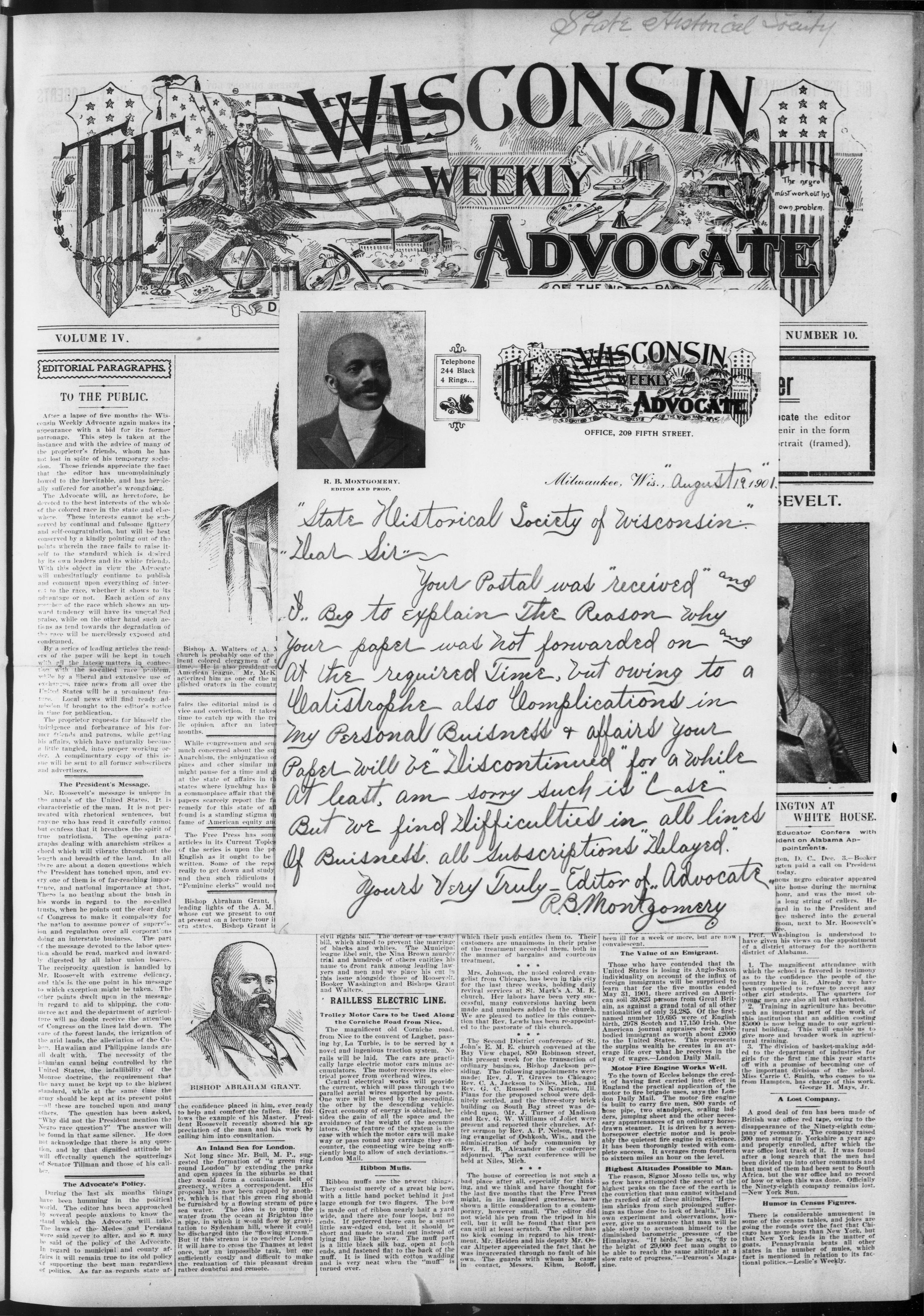
" State Historical Society of Wisconsin . "
Your Postal was " received " and I .. Bug to explain The Reason why your paper was not forwarded on at the required Time, but owing to a Walistrophie also complications in my Personal Business + affairs your Paper will be " discontinued " for a while At least, am sorry such is " Case " But we find difficulties in all lines of Business, all Subscriptions " Delayed " Your s Very Truly Editor of " Advocate R. B. Montgomery
1
Bishop A. Walters of A. M church is probably one of theinent colored clergymen of time. He is also president of American league. Mr. McK actorized him as one of the mplished orators in the country
fairs the editorial mind is of vice and conviction. It takes time to catch up with the trolic opinion after an inter months.
While congressmen and sen much concerned about the sup Anarchism, the subjugation o pines and other similar in might pause for a time and go at the state of affairs in the states where lynching has be a commonplace affair that the papers scarcely report the far remedy for this state of aff found is a standing stigma u fame of American equity and
The Free Press has some articles in its Current Topics of the series is upon the pro English as it ought to be written. Some of the report really to get down and study and then such ridiculous r "Feminine clerks" would not
Bishop Abraham Grant, leading lights of the A. M. whose cut we present to our at present on a lecture tour in ern states. Bishop Grant is
M.
BISHOP ABRAHAM GRANT.
the confidence placed in him, ever ready to help and comfort the fallen. He follows the example of his Master. President Roosevelt recently showed his appreciation of the man and his work by calling him into consultation.
An Inland Sea for London.
Not long since Mr. Bull, M. P., suggested the formation of "a green ring round London" by extending the parks and open spaces in the suburbs so that they would form a continuous belt of greenery, writes a correspondent. His proposal has now been capped by another, which is that this green ring should be furnished by a flowing stream of pure sea water. The idea is to pump the water from the ocean at Brighton into a pipe, in which it would flow by gravitation to Sydenham hill, where it could be discharged into the "flowing stream." But if this stream is to encircle London it will have to cross the Thames at least once, not an impossible task, but one sufficiently costly and difficult to make the realization of this pleasant dream rather doubtful and remote.
[Name]
R. B. MONTGOMERY EDITOR AND PROP.
" State History dear Sir " You .. Bug to expl our paper with the require alistrophe my Personal Paper will be at least, am But we find business. all yours VE
civil rights bill. The defeat of the Cady bill, which aimed to prevent the marriage of blacks and whites. The Municipal league label suit, the Nina Brown murder trial and hundreds of others entitles his name to front rank among leading lawyers and men and we place his cut in this issue alongside those of Roosevelt. Booker Washington and Bishops Grant and Walters.
BAILLESS ELECTRIC LINE.
Trolley Motor Cars to be Used Along the Corniche Road from Nice. The magnificent old Corniche road, from Nice to the convent of Laghet, passing by La Turbie, is to be served by a novel and ingenious traction system. No rails will be laid. The cars are practically large electric motor cars minus accumulators. The motor receives its electrical power from overhead wires.
Central electrical works will provide the current, which will pass through two parallel aerial wires supported by posts. One wire will be used by the ascending, the other by the descending vehicle. Great economy of energy is obtained, besides the gain of all the space and the avoidance of the weight of the accumulators. One feature of the system is the ease with which the motor cars will make way or pass round any carriage they encounter, the connecting wire being sufficiently long to allow of such deviations. London Mail.
Ribbon Mufis.
Ribbon muffs are the newest things. They consist merely of a great big bow, with a little hand pocket behind it just large enough for two fingers. The bow is made out of ribbon nearly half a yard wide, and there are four loops, but no ends. It preferred there can be a smart little saw-edged end, but it should be short and made to stand out instead of lying flat like the bow. The muff part is a little black silk bag, open at both ends, and fastened flat to the back of the muff. It is lined with cotton wadding and is very neat when the "muff" is turned over.
---
THE WISCONSIN
WEEKLY
ADVOCATE
DEVOTED TO THE INTERESTS OF THE NEWOR RAIL
Milwaukee , Wis . " August 191901
which their push entitles them to. Their customers are unanimous in their praise of the treatment accorded them, both in the manner of bargains and courteous treatment.
Mrs. Johnson, the noted colored evangelist from Chicago, has been in this city for the last three weeks, holding daily revival services at St. Mark's A. M. E. church. Her labors have been very successful, many conversions having been made and numbers added to the church. We are pleased to notice in this connection that Rev. Lewis has been re-appointed to the pastorate of this church.
☆ ☆ ☆
The Second District conference of St. John's E. M. E. church convened at the Bay View chapel, 850 Robinson street, this present week for the transaction of ordinary business, Bishop Jackson presiding. The following appointments were made: Rev. J. T. Graves to Chicago; Rev. C. A. Jackson to Niles, Mich., and Rev. G. C. Russell to Kingston, Ill. Plans for the proposed school were definitely settled, and the three-story brick building on South Bay street was decided upon. Mr. J. Turner of Madison and Rev. G. W. Williams of Joliet were present and reported their churches. After sermon by Rev. A. P. Nelson, traveling evangelist of Oshkosh, Wis., and the administration of holy communion by Rev. H. B. Alexander the conference adjourned. The next conference will be held at Niles, Mich.
乖乖乖
The house of correction is not such a bad place after all, especially for thinking, and we think and have thought for the last five months that the Free Press might, in its imagined greatness, have shown a little consideration to a contemporary, however small. The editor did not wield his pen from the tripod in his cell, but it will be found that that pen can still at least scratch. The editor has no kick coming in regard to his treatment. Mr. Heiden and his deputy Mr. Oscar Altpeter appreciated the fact that he was incarcerated through no fault of his own. The guards with whom he came in contact, Messrs, Kihm, Roloff,
OFFICE, 209 FIFTH STREET.
of Wisconsin
is " received " and
Reason why
warded on
but owing to
applications in
affairs your
need " for a while
if it " Case "
is in all lin-
tions " delayed .
Editor of " Advoca
Montgomery
been ill for a week or more, but are now convalescent.
The Value of an Emigrant.
Those who have contended that the United States is losing its Anglo-Saxon individuality on account of the influx of foreign immigrants will be surprised to learn that for the five months ended May 31, 1901, there arrived on American soil 39,823 persons from Great Britain, as against a grand total of all other nationalities of only 34,285. Of the first-named number 19,695 were of English birth, 2978 Scotch and 17,150 Irish. One American journal appraises each able-bodied immigrant as worth about £2000 to the United States. This represents the surplus wealth he creates in an average life over what he receives in the way of wages.—London Daily Mail.
Motor Fire Engine Works Well.
To the town of Eccles belongs the credit of having first carried into effect in England the practical application of the motor to fire brigade uses, says the London Daily Mail. The motor fire engine is built to carry five men, 800 yards of hose pipe, two standpipes, scaling ladders, jumping sheet and the other necessary appurtenances of an ordinary horse-drawn steamer. It is driven by a sevenhorsepower electric motor and is probably the quietest fire engine in existence. It has been thoroughly tested with complete success. It averages from fourteen to sixteen miles an hour on the level.
Highest Altitudes Possible to Man.
The reason, Signor Mosso tells us, why so few have attempted the ascent of the highest peaks on the face of the earth is the conviction that man cannot withstand the rarefied air of these altitudes. "Heroism shrinks from such prolonged sufferings as those due to lack of health." His own experiment and observations, however, give us assurance that man will be able slowly to accustom himself to the diminished barometric pressure of the Himalayas. "If birds," he says, "fly to the height of 29,000 feet man ought to be able to reach the same altitude at a slow rate of progress."—Pearson's Magazine.
---
NUMBER 10.
icate the editor enir in the form portrait (framed).
9.1901.
SEVELT.
1930
INGTON AT WHITE HOUSE.
Educator Confers with
ident on Alabama App-
pointments.
ington, D. C., Dec. 3.—Booker
ington paid a call on President
today.
nous negro educator appeared
ite house during the morning
hour, and was the most ob-
a long string of callers. He
card in to the President and
nce ushered into the general
room, next to Mr. Roosevelt's
ice.
Prof. Washington is understood to
have given his views on the appointment
of a district attorney for the northern
district of Alabama.
1. The magnificent attendance with which the school is favored is testimony as to the confidence the people of the country have in it. Already we have been compelled to refuse to accept any other girl students. The quarters for young men are also all but exhausted.
2. Training in agriculture has become such an important part of the work of this institution that an addition costing $5000 is now being made to our agricultural building. This will enable us to give more and broader work in agricultural training.
3. The division of basket-making added to the department of industries for girls for the first time this year starts off with a promise of becoming one of the important divisions of the school. Miss Carrie C. Smith, who comes to us from Hampton, has charge of this work.
A Lost Company.
A good deal of fun has been made of British war office red tape, owing to the disappearance of the Ninety-eighth company of yeomanry. The company raised 300 men strong in Yorkshire a year ago and properly enrolled, after which the war office lost track of it. It was found after a long search that the men had been divided up into other commands and that most of them had been sent to South Africa, but the war office had no record of how or when this was done. Officially the Ninety-eighth company remains lost.—New York Sun.
Humor in Census Figures.
There is considerable amusement in some of the census tables, and jokes are going the rounds over the fact that Chicago has more hogs than New York, but that New York leads in the matter of goats. Pennsylvania beats all other states in the number of mules, which fact is mentioned in relation to its factional politics.—Leslie's Weekly.
BIG LOSS TO WAUKESHA
Building Just Completed is Totally Consumed by Fire.
SANITARIUM IS BURNED
Milwaukee Contractors are the Heaviest Losers-Defective Chimney Probably the Cause.
Waukesha, Wis., Dec. 4.—[Special.] After fighting the flames for nearly three hours the Waukesha fire department was compelled to abandon the new Waukesha Springs sanitarium to the conflagration which started on the roof shortly after 10 o'clock last evening, and this morning nothing remained of the building, but a heap of smouldering ruins. The fire was discovered by some of the attendants, who were living in the old sanitarium, at about 10:15, and they immediately turned in the alarm. The only possible explanation of the fire is that it resulted from a defective chimney of the furnace, since the blaze was first noticed on the tar roof of the building. The local fire department responded quickly, but when the firemen arrived the roof of the main part of the building was burning fiercely and with the feeble water power which was to be had on the place, which is one of the highest points of the city, they were unable to successfully cope with the conflagration.
Milwaukee Sends Help.
Some of the principal stockholders held a consultation and it was decided to telephone to Milwaukee for aid, and upon receiving the message of Mayor Gove, Mayor Rose of Milwaukee instructed Foley to place such apparatus as Waukesha might need at its disposal, and if the special train had not been seriously delayed in the yards at Milwaukee it is likely that parts of the structure might have been saved. By the time they arrived here, however, the remainder of the structure was a mass of flames and there was no longer an opportunity to give any help.
For the first hour the Waukesha department held the fire under control very well, and if the water pressure had not been so weak they would have probably gotten the fire out. After the fire engine belonging to the Waukesha department had been brought to the scene of action there was not enough water to suffice. The brick walls began falling in shortly after 12 o'clock, and from that time until after 2 o'clock this morning the interior of the building was filled with the leaping flames and the smoke and dust caused by the falling walls. The only goods saved were some of the pieces of woodwork which were about to have been put in place and were lying about on the first floor.
Loss Falls on Contractors.
The company, as the building was being put up, insured each portion of it and the insurance at the time of the fire was $30,000. The greatest loss falls on the contractors, mostly Milwaukeeans. The contractors sustaining the greatest losses are: L. J. Mueller, Milwaukee, steam fitting; W. H. Halsey, Milwaukee, plumbing; Beach & Co., Milwaukee, gaivanized iron; M. Gleason, Waukesha, stone. A Milwaukee carpenter contractor is also a heavy loser by the fire.
The insurance companies in which policies were held are as follows: London, Liverpool & Globe company, German-American, North British Mercantile, Northern, Royal Exchange, Commercial Union.
The owners of stock in the Waukesha Sanitarimu company are: George H. Wibur, Milwaukee; Dr. J. H. McBride, Pasadena; Mr. C. F. Caples, New York, president of the company; F. H. Putney, Waukesha; Mrs. Eliza W. Jackson and A. J. Frame, Waukesha.
Building Almost Completed.
The sanitarium was located on the Jackson estate on College avenue and had one of the most beautiful locations in the city, being situated upon a high hill which commands a view of the entire city, and the conflagration last evening was visible for many miles on this account. The articles of incorporation of the Waukesha sanitarium were prepared about a year ago and the erection of the building was begun at once. It was an elegant structure, three stories in height, and the outer wall is of Cream city brick with limestone facing, while the inside was finished off with oak. The entire building was modeled after a famous English sanitarium and had all of the conveniences which could be desired for such an institution. At the time of the fire, the building had been practically finished, although some of the contractors' work had not yet been accepted, and the second and third floors were ready for use. It was expected that the patients would be moved to the new building by the first of the new year, but now they will have to occupy the old buildings on the Sanger estate until the structure is again built.
Will be Rebuilt.
Dr. Caples stated this morning that there was no question but that the institution would be rebuilt, and that the plans would probably be the same as for the burned building. The directors of the company are: Dr. J. H. McBride of Pasadena, Cal., formerly of Milwaukee, president; F. H. Putney, vice-president; Dr. B. M. Caples, secretary; A. J. Frame, treasurer, and George H. Wilbur. The building was so completely destroyed that it is doubtful whether there will be $100 worth of salvage from it, and the loss will probably be about $45,000. Of this amount $30,000 is covered by insurance in the following companies: Liverpool, London and Globe, $6500; German-American, $4500; Northern, $3000; Royal Exchange, $4000; North British and Mercantile, $2000; Caledonia, $2000; Commercial Union, $3000; Greenwich, $2500; Citizens'. $2500.
BELOIT SOLDIER KILLED.
Shot in the Head While at Target Practice.
Beloit. Wis., Dec. 4.—Beloit relatives today received the information of the death of Harry Hendee, a soldier in Troop A, Fifteenth United States cavalry, in the Philippine islands. Mr. Hendee was formerly a Beloit boy, but had more recently lived at Kenosha. He had been in the Philippines about one year. While at a target practice with his command recently he was struck in the forehead by a bullet and died almost immediately. His body will be brought to Beloit for burial.
CHANGE AT CAPITOL.
T. J. Palmer of Rock County Clerk of Board of Control.
Madison, Wis., Dec. 4.—[Special.]—T. J. Palmer of Rock county has been appointed clerk in the office of the board of control, succeeding M. McCaffrey, promoted to bookkeeper on the retirement of Capt. Howland. Mr. Palmer has been bookkeeper at the Northern Hospital for the Insane at Oshkosh.
Admitted to Wisconsin.
Madison, Wis., Dec. 4.—[Special.]— The Globe and Rutgers Fire Insurance company of New York has been licensed to do business in Wisconsin. It is a stock company with $400,000 capital stock.
DISPATCH WARSHIPS.
Germany Takes Steps to Enforce Payment of Claims Against Venezuela.
Port of Spain, Trinidad, Dec. 3.—Passengers arriving here from La Guayra, the port of Caracas, say that the German minister in the Venezuelan capital has recommended to his government that eight war vessels be stationed in the various ports of Venezuela to enforce the payment of claims against the republic. Gen. Guerra, who was removed recently from the office of minister of war and arrested on the charge of conspiracy, has applied for a trial by court- artial.
Gen. Centeno, formerly a friend of President Castro and Gens. Muguerza, Romeo Garcia, Hernandez, Michelena and Palacios, as well as the presidents of banks and principal merchants of Caracas, are prisoners in the capital, according to the latest advices. Eighteen mercantile houses in Caracas are closed and not a single bank transaction has taken place there in more than a week.
Chili Preparing to Fight.
Buenos Ayres, Dec. 3.—The conflict between Argentina and Chili is still pending. The Chilian government withholds its reply as to the basis proposed by the government of the Argentine republic. It is believed, however, that the proposition will be returned accompanied by serious comments.
The republic is greatly alarmed in both countries. It is notorious that Chili has recently purchased two torpedo-boat destroyers in England and is negotiating for an armored cruiser in the United States at the present moment. The Chilian government has summoned its minister at Buenos Ayres, Senor Concha Subercasaux, to Santiago de Chili, under pretext that fuller explanations are necessary.
Public opinion in the Argentine republic is in favor of a firm and resolute attitude.
SHOWING NO MERCY.
Gen. Smith Says Time for Negotiations with Philippine Rebels is Passed.
Manila, Dec. 3.—Advices from Catbalogam, capital of the Island of Samar, report that the insurgent general Lukban has offered to negotiate terms of surrender with Gen. Smith. To this offer the American commander replied that the time for negotiations had passed.
Lieut.-Com. James M. Heim, commanding the United States gunboat Frolic, during November destroyed 147 boats engaged in smuggling supplies to the insurgents.
Gen. Smith has ordered all male Philippines to leave the coast towns for the interior. In order to be allowed to return they must bring guns, prisoners or information of the whereabouts of insurrectionists.
Five hundred natives of Catbalogan have volunteered to fight the insurgents in order to bring peace to Samar. Of these 100 have been accepted. They are armed with bolos and spears and are doing scout duty under command of Lieut. Compton. At daylight yesterday Lieut. Baines of the Ninth infantry attacked and destroyed a rebel fort, inflicting heavy loss, and captured the officers' breakfast, which included canned goods. He found at the fort an arsenal with appliances for making and reloading cartridges.
Manila, Dec. 3.—Col. Wints' column has had a sharp brush with forty insurgents in the Sipa mountains, killing several of them and burning fourteen cuartels.
JURY UNABLE TO AGREE.
Maryland Man Caused Drowning of Girl by Rocking Boat.
Hagerstown, Md., Dec. 3.—In the case of Frank Rinehart, accused of causing the death of Miss Mary Frinbrock by rocking a rowboat, the jury has disagreed, and the accused has been released without bonds, subject to recall at any time.
After deliberating from 4 o'clock on Friday until 10 o'clock yesterday the jury informed the court that an agreement was impossible.
The defense asked for a dismissal, but it was decided to hold the case in abeyance.
Rinehart says he is confident of final acquittal.
CAPT. TILLEY ACQUITTED.
Naval Governor of Tutuila Cleared of Charges Against Him.
Auckland, New Zealand, Dec. 3.—The United States naval court at Tutuila, Samoa, has honorably acquitted Capt. Benjamin F. Tilley, the naval governor of Tutuila, of all the charges against him. No evidence to sustain these charges was presented to the court.
Commander Uriel Sobree has succeeded Capt. Tilley as naval governor of Tutuila. The charges against Capt. Tilley arose from certain allegations made by missionaries in Samoa against the captain's moral character.
MOVE MILL TO WELLS.
Kirby-Carpenter Company Sells to I Stephenson Company. Menominee, Mich., Dec. 3.—[Special.] The I. Stephenson Lumber company of Wells, Mich., yesterday bought the Kirby-Carpenter company's brick mill complete and will move it to Wells in the spring for use as a hardwood mill. The company will also build a maple flooring mill there.
CHAINED TO SHIP'S MAST.
Stowaway from Cuba Escapes from Steamer at Baltimore.
Baltimore, Md., Dec. 3.—A Cuban negro boy stowaway on a Norwegian iron ore steamer arriving here declares he was chained to a mast by the captain's orders to prevent his escape. He got away through the assistance of one of the crew and appeared in Baltimore with the shackles on his legs, like in slavery days
Several capitalists of southern California have bought 6300 acres of reclaimed land, seven miles from Stockton, from the California and Nevada Dredging company. The land will be improved to the highest possible condition and will be used to raise vegetables. A canning plant will be erected on the place and asparagus will be grown and canned for Eastern markets.
Not Too familiar.—Jack—"I hear Miss Bosting entered right into the spirit of your Halloween party." Tom—"Well, yes, but in a dignified way." "Why, I was told that she even suggested that you bob for apples." "Not exactly. What she said was: 'May we not—er—Robert for apples?' — Philadelph.a Press.
-It has been found in world's fairs lasting six months that nearly three-fourths of the attendance occurs in the last three months.
A Matter of Importance.
An English judge, traveling in the United States, finding himself short of cash, presented one of the drafts he had at a local bank, but was told he must be identified by someone.
He explained to the bank agent that as he knew no one in the district this was impossible, and he showed him his card, his letters of introduction, his name in his pocketbook, and the initials on his handkerchief, but all to no purpose. Identification was absolutely necessary.
During the conversation the stranger learned that the banker was also the local judge, and after he had exhausted all his attempts to convince him of his identity, he said, chaffingly:
"Come, judge, you must admit you've often hanged a man on less evidence."
"That may be so," replied the judge,
"but when it comes to parting with
money one has to be careful."—Tit-Bits.
Discovery of Coal in Ecuador.
Recently the Ecuadorian association received a cablegram from its chief engineer in charge of the railroad survey, which stated that a good quality of coal had been discovered on the railway near Riabamba. This place is on a direct line from Quito to Guaymep. It was already known that coal could be found in this part of the republic, but at inaccessible points distant from the railway route. This discovery will prove of greater benefit to the new railroad and of importance to the republic, which now secures most of its coal supplies from Australia and Chili.
LATEST MARKET REPORTS.
Milwaukee, Dec. 4, 1901.
EGG AND DAIRY PRODUCTS.
MILWAUKEE—Eggs—Market firm, fresh new, eases included, $23\frac{1}{2}$c; fresh, cases returned, 23c; storage, $18\frac{1}{2}$c; country storage, 16@17c; seconds, 9c. Receipts were 204 cases.
Butter—Market very firm; fancy prints, 25c; fancy or extra creamery, per lb. 24\frac{1}{2}$c; firsts, 20@21c; seconds, 17@18c; dairy prints, 20c; extra fancy dairy, 19c; lines, 17@18c; packing stock, 13@14c; rell. 14@16c; whey, 8c; grease, 4@5c. The receipts today were 17,021 lbs against 18,200 yesterday. The demand for fancy butter is brisk, there being very little in the market. Dairy is very scarce and in good demand. The receipts of fancy creamery are very light and not sufficient to meet requirements. Merchants have hard work filling orders.
Cheese—Firm. Receipts were 7072 lbs today against; 8900 lbs yesterday. Full cream flats, new, colored, fancy, 11@11½c; good to choice, 10@10½c; Young Americas, new, 11½@12½c; daisies, new, 11½@12c; fancy brick, new, 11½@12c; low grades, 10@11c; limburger, per lb. No. 1, 12½@13c; low grades, S@10c; imported Swiss, 24c; Block Swiss, domestic, 14@14½c; choice loaf, 13½@14c; No. 2, 12½@13½c; Sapsago, 20c; farmers, 10@11c. There is a fair demand for new made full cream and market is firm; brick is firm and Limburger steady to firm with light supply.
NEW YORK — Butter — Receipts. 4082 pkgs; firm; state dairy, 15@23½c; creamery, 16@25½c; June creamery, 18@22c; factory, 12½@15c. Cheese—Receipts. 3563 pkgs; firm; fancy large September, 10c; fancy small September, 10@11c; late made, best large, 9½c; do small, 10@10½c. Eggs—Receipts. 4268 pkgs; steady; state and Pennsylvania, 26@27c; Western at mark, 20c; Southern at mark, 20@25c. Coffee—Quiet: No. 7 Blo 6½c.
SHEBOYGAN—Daisies sold at 10%c,
Young Americas at 10%c and longhorns at
10%4@10%c.
PLYMOUTH—Twenty factories offered
872 boxes of cheese and all but 31 sold
as follows: 113 longhorns, 10%c; 125 longhorns, 10%c; 380 daisies, 10%c; 49 twins, 9%c; 48 twins, 9%c; 169 Young Americas, 10%c.
CHICAGO — Butter — Steady; creameries,
14@24%c; dairies, 13@20c; Cheese—Steady;
twins, 9%4@9%c; Young Americas, 10c;
daisies, 10@10%c. Eggs—Steady; loss off,
cases returned, 24c. Dressed poultry—
Steady; turtles, 6%2@9c; chickens, 6%2@8c.
MILWAUKEE LIVESTOCK MARKET.
HOGS—Recelpts, 14 cars; market steady;
light, 5.30@5.65; mixed and medium
weights, 5.55@5.75; common to good packers, 5.50@5.75; fancy selected hogs, 5.85@5.95. Pigs, 90 to 120 lbs. 4.75@5.25.
CATTLE -- Receipts, 5 cars steady; butchers' steers, medium to good, 1650 to 1300 lbs, 4.75@5.50; fair to medium, 950 to 1050, 3.50@4.00; heifers, common, 2.25@2.75; good, 3.25@4.00; cows, fair to good, 2.50@3.25; canners, 1.50@2.40; bulls, common, 2.25@2.75; choice, 2.85@3.50; feeders, 800 to 950 lbs, 2.60@3.25; stockers, 500 to 750 lbs, 2.25@2.75; veal calves, common to choice, 4.50@5.00; milkers and springers, common sell for carners; choice family cows, 30.00@42.00.
SHEEP—Receipts, none; market steady; 2.25@3.25; bucks, 1.75@2.25; lambs, common to choice, 3.50@4.50.
Chicago receipts: Hogs, 50,000; cattle, 16,000; sheep, 25,000.
CHICAGO POTATO MARKET.
CHICAGO, Ill., Dec. 4,—[Special.]—Coyne Bros. report: Receipts light; market firm; demand good; dusty Rurals, 82@84c; round white, 80@82c; long white, 80@82c; mixed white and red, 76@79c; Hebrons and Kings, 78@80c.
MARKETS BY TELEGRAPH.
MILWAUKEE—Flour—Steady. Wheat —
Steady; No. 1 Northern, on track, 75½c; No.
2 Northern, on track, 74½c. Corn—Steady;
No. 3 on track, 64c. Oats—Firmer; No. 2
white, on track, 47½c; No. 3 white, on track,
45@46c. Barley—Steady; No. 2 on track,
61c; sample on track, 55@61c. Rye—Steady;
No. 1 on track, 61½c. Provisions—Stronger;
pork, 16.32; lard, 9.50.
Flour market is steady; patents, 3.85@
3.95; bakers', 2.80@2.95; rye, 2.90@3.15.
Millstuffs are firm and quoted at 20.00@
20.50 for bran, 20.50 for standard mid
dilings, and 22.00 for Milwaukee flour
dilings, in 100-lb sacks; reg. dog, 23.00
CHICAGO—Close — Wheat — December,
75½%@75½c; May, 79½c; Corn—December,
63½%@63½c; May, 67c; Oats—December,
44½c; May, 45½c; Pork—January,
16.37½; May, 16.70; December, 15.37½
Lard—December and January, 9.50; May,
9.57½. Ribs—January, 8.32½; May, 8.50;
December, 8.32½. Flax—Cash N. W., 1.40;
No. 1, 1.30; December, 1.40; May, 1.45;
Rye—December, 60½c; May, 64½c; Barley
—Cash, 56@63c. Timothy—March, 6.55;
Clover—March, 9.35@9.40.
TOLEDO—Wheat — Strong, active; cash
and December, 82½c; May, 84½c; Corn—
Strong; December, 66c; May, 67½c; Oats—
December, 45½c; May, 46½c; Clover seed—
December, 5.67½; March, 5.80.
KANSAS CITY — Close — Wheat—December,
72½c; May, 76½c; cash no. 2 hard. 74
@75½c; No. 2 red. 78½c; Corn—December,
68½c; January, 68½c; May, 68½c; cash no.
2 mixed, 68½c; No. 2 whitc, 69c. Oats—
No. 2 white, 49c.
ST. LOUISE—Close—Wheat—Higher, No. 2
red cash, 82%c; December, 51%c; May, 82%
@82%c; No. 2 hard, 77%c; Corn—Higher,
No. 2 cash, 66%c; December, 66%c; May,
60%c; Oats—Higher; No. 2 cash, 47%c; Dec
ember, 47%c; May, 46%@46%c; No. 2 white,
47%@48%c; Lead—Stoady; 4.25@4.27%c. Spel-
ter—Firm; 4.15@4.17%c.
MINNEAPOLIS — Close—Wheat—Cash,
74%c; December, 73c; May, 75%@75%c; on
track, No. 1 hard, 77%c; No. 1 Northern,
74%c; No. 2 Northern, 72%c.
DULUTH — Close—Wheat—Cash No. 1
hard, 76%c; No. 1 Northern, 73%c; No. 2
Northern, 71%c; No. 3 spring, 68%c; to
arrive, No. 1 hard, 76%c; No. 1 Northern and
December, 73%c; May, 77c; Corn—63c.
Oats—44%c; Rye—58%c; Barley—Malting,
49@58c; Flax—Cash, to arrive and December,
1.37%c; May, 1.42%; Receipts of wheat,
341.996 bus; shipments, 231.085 bus.
ST. LOUISE—Cattle—Receipts, 4000; market steady; beef steers, 3.50@5.75; Texans, 3.15@5.35; stockers and feeders, 2.45@3.55; cows and heifers, 2.00@5.25. Hogs—Receipts, 6000; slow to lower; pigs, 5.60@5.70; packers, 5.60@5.70; butchers, 5.85@6.05. Sheep—Receipts, 100; steady, unchanged.
KANSAS CITY—Cattle—Receipts, 6000; strong; beef steers, 4.75@6.45; Texans, 3.00@4.85; cows and heifers, 1.75@5.25; stockers and feeders, 3.00@4.40. Hogs—Receipts, 21.00; steady; heavy, 6.15@6.25; packers, 6.00@6.20; medium, 5.90@6.15; porkers, 5.35@6.00; pigs, 4.50@5.35. Sheep—Receipts, 3000; strong; sheep, 3.00@3.75; lambs, 4.00@4.85.
They have doers of dastardly deeds in Kansas. A writer tells us of a tragedy committed in the classic wilds of Pratt county: "A scoundrel whose soul is incrusted in stratagems and spoils rode up to the Golden Valley schoolhouse in Pratt county one night last week and shot the new Sunday school organ through the left lung."
CHILTON BANK RESUMES PAYMENT.
CHILTON BANK RESUMES PAYMENT.
Theodore Kersten Arrives with Pile of Currency and Creditors Receive Money. Chilton, Wis., Dec. 4.—[Special.]—Today the German Exchange bank resumed payment. Theodore Kersten returned last night from Milwaukee and this morning an express package, under guard of a special messenger, arrived, containing a large sum in currency which will be paid to the creditors. Many drew their 30 per cent. dividend today.
MRS. DELL PHILLIP IS UNDER ARREST.
Charged with Breaking the State Medical Law at Mani-
towoc.
Manitowoc, Wis., Dec. 4.—[Special']—A warrant was issued in the municipal court this morning for the arrest of Mrs. Dell Phillip of Chicago, charging her with advertising and holding herself out to the public as an osteopathist and physician, without having a license from the state board of medical examiners. Mrs. Phillip appeared in court this morning and pleaded not guilty and her trial was set for Wednesday of next week. She has been stopping at the Windiate house in this city.
FACULTY TO CONTROL INITIATION EXERCISES
Will Endeavor to Eliminate Rough and Dangerous Treatment of Candidates at Lawrence.
Appleton, Wis., Dec. 4.—[Special.]—The presidents of each of the literary societies of Lawrence university were this morning instructed by President Plantz that they would be required to divulge their plans for the initiation exercises to the faculty before the initiation will be permitted. This is done obviously to eliminate the possibility of rough and dangerous treatment, resulting in serious accidents, such as that of last year when one of the students sustained serious and almost fatal injuries while being put through the initiatory exercises. The initiation of the Phoenix and Lawrean societies will take place next Friday evening.
KRETZINA WAS SHIPPED BY ERROR.
Milwaukee Poor Authorities Made a Mistake When They Sent Her to Fond du Lac.
Fond du Lac, Wis., Dec. 4.—[Special.]
—Kretzina Schoerer is to make one more journey. One more trip and then her name will be erased from the city and county records, as the officers hope, for all time. Superintendent of Poor George P. Dana of this city has received a letter from Superintendent of Poor Spindler of Milwaukee, stating that Kretzina was shipped back to this city through mistake. It appears that the officer at the station when Kretzina arrived in Milwaukee was tender-hearted—all Milwaukee policemen are known to be tender-hearted—and when Kretzina told him a tale of woe about being driven from her home in this city he immediately shipped her back here, expressing his indignation at the injustice heaped upon the poor woman by the heard-hearted city and county officials of Fond du Lac. Gretzina returned triumphant and went back to her old quarters at the county poor farm. An investigation was at once commenced and as a result Kretzina will again be sent to Milwaukee and the Milwaukee county officials will take her in charge.
WRESTLING AT RACINE.
Articles Signed by Chaplin of Fond du Lac and McCue of
Fond du Lac, Wis., Dec. 4.—[Special.]
—Articles of agreement for a wrestling match at Racine Monday evening, December 16, have been entered into by Adelbert Chapin of this city and John McCue of Racine. The men will meet at catch weights, which is a concession on the part of Chapin, who can scale 120 pounds in condition. Chapin has a wonderful record, never having lost a fall to a man in his class. Dan McLeod, who trained him for several bouts, considered him the best little man in the country. Chapin's last match was with George Locks. It took place at Sheboygan December 21, and Chapin won two falls in eight minutes. McCue is also a good little man. He has a long and honorable record, his only defeat in his class being at the hands of Adelbert Chapin last spring, to whom he succumbed after a long and terrific struggle. Though Chapin will unquestionably be the favorite, his best friends realize that he is up against a hard proposition.
CATTLE CREMATED.
Lantern Tipped Over in Barn at Appleton and Man Barely Makes His Escape.
Appleton, Wis., Dec. 4.—[Special.]—A valuable horse and several head of cattle owned by Wilber Boland of this city were burned to death in the barn last night. Mr. Boland was in the hayloft pitching hay into the manger when he accidentally tipped over the lantern, which exploded before it could be righted. The flames spread rapidly and it was with difficulty that he escaped from the building. The horse and cattle were on the floor below and efforts to rescue them from the barn were of no avail.
CAME FROM OSHKOSH.
Stranger Killed by the Cars Near Lewiston is Unidentified. Portage, Wis., Dec. 4.—[Special.]—Up to a late hour last night the body of the man who was killed by the cars near Lewiston station last Thursday, had not been identified. The man, in conversation with a farmer, at whose house he stopped on the day he met his death, stated that his home was in Oshkosh. The authorities here have asked the Oshkosh officials for information concerning his identity, but so far have heard nothing that would aid in identifying him. The body is at Murison's undertaking establishment here, but will be interred in Silver Lake cemetery with the coroner's sanction this afternoon.
NAMES A NEW JUDGE.
M. G. Hoffmann is Appointed in Lincoln County.
Madison. Wis., Dec. 4.--[Special.]-- Gov. La Follette has appointed M. G. Hoffmann county judge of Lincoln county, vice Thomas J. Matthews, resigned. Judge Hoffmann was elected to the office last spring and would have begun his official duties in a short time had he not been appointed to fill out the unexpired term of his predecessor.
For More Than a Quarter of a Century the reputation of W. L. Douglas $8.00 and $3.50 shoes for style, comfort and wear has excelled all other makes sold at these prices. This excellent reputation has been won by merit alone. W. L. Douglas shoes have to give better satisfaction than other $8.00 and $3.50 shoes because his reputation for the best $8.00 and $3.50 shoes must be maintained. Douglas Stores in American cities selling direct from factory to
GUN CATALOGUE. IT'S FREE. It illustrates and describes all the different Winchester Rifles, Shotguns and Ammunition, and contains much valuable information. Send at once to the Winchester Repeating Arms Co., New Haven, Conn.
WHERE DUMONT GOT IDEA.
Automobile Motor Gave Inventor Plan for Airship.
To the automobile is due the dirigible balloon, which has won fame, if not fortune, for its inventor and plucky exploiter, Santos-Dumont. The daring little Brazilian thus tells how he first became possessed with the idea of equipping a balloon with a motor:
"I got my first idea by putting an automobile motor under a cigar-shaped balloon filled with hydrogen gas while returning from the Paris-Amsterdam automobile race in 1897. From the beginning everybody was against the idea. I was warned that an explosive gas engine would ignite the hydrogen gas above it, and that the resulting explosion would end the experiment with my life. My balloon maker went to work without enthusiasm, and I met with nothing but discouragement."—Motor World.
A Clergyman's Discovery.
Fredericksburg, Ind., Dec. 2.—According to the positive declaration of Rev. E. P. Stevens of this place that gentleman has found a remedy for all diseases of the Kidneys and urinary organs. For years he suffered severely with these complaints, incontinence of the urine, making life a burden to him, but he never ceased experimenting in the hope that some day he would discover a remedy. After many failures he has at last succeeded and is to-day perfectly cured and a well man, and explains that his recovery is due to the use of Dodd's Kidney Pills. This remedy has been successfully applied to many cases of Lame Back, Rheumatism, Bright's Disease, Diabetes and other Kidney Diseases, and there seems to be no case of the kind that Dodd's Kidney Pills will not cure. This is the only remedy that has ever cured Bright's Disease.
To Avoid Lightning.
If out of doors keep away from trees, haystacks, houses, large sheets of water, river banks, etc. If in the open plain, where there are no trees or buildings, you are safer lying down than standing up. If near a wood, stay there, and do not go nearer. If near a single shade tree you are pretty safe thirty yards away. Indoors you are safest of all if you adopt Franklin's plan. Find the geometrical center of the room. Hang up a hammock by silken cords, get in and stay there. Failing a hammock, sit on one chair in the middle of the room with your feet on another, first placing beneath them a feather bed or hair mattress. But do not sit under the gas chandelier. Whether out of doors or indoors keep away from the chimney or from metallic masses of any kind. And possess your souls in patience.—London Mail.
Sweden Secure Against Attack.
There are a lot of picturesque old castles and fortresses on the coast of Sweden in which garrisons are still maintained, but they would not last an hour if attacked by modern guns and projectiles. They are reinforced, however, by earthworks, with the very best of artillery. Swedish guns rank among the highest, and several Swedish patents in ordnance have been already adopted by the fortification board of the United States. All the harbors are protected by torpedoes, and Stockholm is absolutely impregnable from the sea, being situated upon a fjord or bay that cannot be entered except through passages that are narrow and easily defended.—Chicago Record-Herald.
ELY'S LIQUID CREAM BALM is prepared for sufferers from nasal catarrh who are used to an atomizer in spraying the diseased membranes. All the healing and soothing properties of Cream Balm are retained in the new preparation. It does not dry up the secretions. Price, including spraying tube, 75 cts. At druggists' or Ely Bros., 56 Warren street, New York, mail it.
Another remarkable case of the restoration of an ancient Mexican mine is brought out by the announcement of the opening of a large body of high-grade ore in the Rosalia claim of the Calera Gold Mining company in Sonora. The ore is said to run $178 in gold to the ton.
We refund 10c for every package of PUTNAM FADELESS DYE that fails to give satisfaction. Monroe Drug Co., Unionville, Mo. Sold by druggists.
Since January 1, 118 lives have been lost by accident in the Swiss Alps—a larger number than in any similar period in the past.
Piso's Cure for Consumption promptly relieves my little 5-year-old sister of croup.—Miss L. A. Pearce, 23 Pilling street, Brooklyn, N. Y., Oct. 2, 1901.
Silk is the strongest of all vegetable or animal threads. It is three times as strong as a flaxen thread of the same size.
MRS. WINSLOW'S SOOTHING SYRUP for
Children teething; softens the gums, reduces
inflammation, allays pain, cures wind colic. 25
cents a bottle.
—It costs $4 for ten words by the new
telegraph line to Yukon.
No chance for disappointment if you serve
Mrs. Austin's famous Pancakes. All grocers sell it.
—New York city has thirty Japanese
Methodists.
MRS. H. F. ROBERTS
Says to All Sick Women: "Give Mrs. Pinkham a Chance, I Know She Can Help You as She Did Me."
"DEAR MRS. PINKHAM: The world praises great reformers; their names and fames are in the ears of everybody, and the public press helps spread the good tidings. Among them all Lydia E. Pinkham's name goes to posterity
M.
MRS. H. F. ROBERTS,
County President of W. C. T. U., Kansas
City, Mo.
with a softly breathed blessing from
the lips of thousands upon thousands
of women who have been restored to
their families when life hung by a
thread, and by thousands of others
whose weary, aching limbs you have
quickened and whose pains you have
taken away.
"I know whereof I speak, for I have received much valuable benefit myself through the use of Lydia E. Pinkham's Vegetable Compound, and for years I have known dozens of women who have suffered with displacement, ovarian troubles, ulcerations and inflammation who are strong and well to-day, simply through the use of your Compound."—Mrs. H. F. ROBERTS, 1404 McGee St., Kansas City, Mo. $5000 forfeit if above testimonial is not genuine. Don't hesitate to write to Mrs. Pinkham. She will understand your case perfectly, and will treat you with kindness. Her advice is free, and the address is Lynn, Mass.
ELY'S
CREAM BALM
CATARRH
ROSE COLD
HAY-FEVER
CUIRS COLD
IN
HEAD
DIABETES
HANDACHE
50 CTS.
FOUND MARK
ELY BROS.
NEW YORK
Nasal CATARRH
Ely's Cream Balm cleanses, soothes and heals the diseased membrane. It cures catarrh and drives away a cold in the head quickly.
Cream Balm is placed into the nostrils, spreads over the membrane and is absorbed. Relief is immediate and a cure follows. It is not drying—does not produce sneezing. Large Size, 50 cents at Drug-gists or by mail; Trial Size, 10 cents
ELY BROTHERS, 53 Warren Street, New York.
ASTHMA-HAY FEVER
CURED BY
DR.TAFT'S
ASTHMALENE
SEND FOR
FREE TRIAL BOTTLE
ADDRESS DR.TAFT.79 E.130TH ST.,N.Y.CITY.
"C. C. C." on Every Tablet.
Every tablet of Cascarets Candy Cathartic bears the famous C. C. C. Never sold in bulk. Look for it and accept no other. Beware of fraud. All druggists, 10c.
50,000 TRIAL BOXES FREE CHAMBARD'S TEA cures Constipation Billiousness, Stick Head-Ache, Eczemas. It cleanses the Bowels, regulates the Liver, the Bladder and the Kidneys, clears the Complication and restores Health. Strength and Wig. Relatable, no after-effects, no fatigue of the Stomach. Don't delay, write to-day for a free trial box Legoll's Pharmacy, 296 Seventh Ave., New York.
WHY GUESS?
WHEN YOU CAN BUY
WAGON SCALES.
FOR SO LITTLE FROM
JONES (HE PAYS THE FREIGHT).
BINGHAMTON, N. X.
If you want to invest a few dollars a month in a good company write to AMERICAN LUMBER AND RUBBER CO., 53 STATE STREET, BOSTON, MASS.
PENSION JOHN W. MORRIS, Washington, D.C.
Successfully Prosecutes Claims.
Late Principal Examiner U.S. Pension Bureau.
3 yrs in civil war. 15 adjudicating claims, atty shea
AGENTS and Canvassers Wanted. Mall 10 cents for sample and directions. Easy sellers for One Dollar. Address J. H. DeBruyn, Minneapolis, Minn.
SEND postal for list of 150 of the best farms in Central Iowa; all good investments. Geo. H. Gallup, Jefferson, Iowa.
ROBBED OF A LARGE SUM.
First National Bank of Ballston Spa, N. Y., is Closed.
A CARELESS EXAMINER.
Discovery of Irregularities in Teller's Accounts Running Through Long Series of Years.
Washington, D. C., Dec. 3.—The First National bank of Ballston Spa, N. Y., was closed today by a vote of the board of directors. The comptroller of the currency has issued a statement to the effect that this action was taken on account of the discovery of a defalcation by the teller, Charles E. Fitcham, amounting to $100,000.
Ballston, N. Y., Dec. 3.—The First National bank of this place was closed today, pending an investigation by a national bank examiner. It is stated that the closing of the bank's doors followed the discovery of irregularities in the accounts of the teller, Charles E. Fitcham. The bank began business in 1865. Judge J. S. Lamoreaux succeeded the late George West as president early in October of this year and H. J. Donaldson succeeded to the vice-presidency. The new executive officers began at once a thorough investigation of the bank's affairs and discovered indications of a defaication on the part of Teller Fitcham. The investigation was pursued until it was seen that the defaication had begun many years ago and attained large figures. Bank Examiners Graham and Van Vranken were sent for and yesterday began a thorough examination. At the closing of banking hours they reported a shortage of $100,000. The directors then decided to close the bank pending an investigation and a warrant for Fitcham's arrest was issued. Fitcham was bonded to the amount of $1000. He has a wife and one daughter. President Lamoreaux said today that it was not possible to determine the amount of Fitcham's defaication without an inspection of the outstanding certificates of deposit and depositors' pass books. The examination, he said, shows the teller alone is responsible. Mr. Lamoreaux added that it is not thought possible that any loss can come to depositors or certificate holders, as the bank has a surplus of $100,000 which it is hoped will nearly or quite meet the deficit and leave the bank's capital of $100,000 unimpaired.
An examination of the bank by Examiner Van Vranken last August failed to disclose any irregularity in the accounts.
BULLET STRUCK DOCTOR'S WATCH.
Professor of Osteopathy Has Duel with Highwayman Over Possession of $9000.
Chicago, Ill., Dec. 3.—A lone highwayman and Dr. L. C. H. E. Zeigler, professor of osteopathy, fought a pistol duel on the prairies west of Garfield park for the possession of $9000. One bullet flattened itself against the doctor's watch just over his heart and a second passed through his silk hat and tore its way through the nine $1000 bills that were hidden there in an envelope. The professor believes one of his bullets struck his assailant in the hand, and the police are searching for a wounded bandit.
Some weeks ago Prof. Zeigler advertised for 400 cadavers, to be used for purposes of demonstration at the schools of osteopathy in Illinois and other states. He announced in his published request for bodies that he was willing to spend $21,000 for the number of cadavers he required, and the police believe it was the publication of these figures that led up to last night's assault. The police also believe the hold-up to have been the outcome of a conspiracy, one of the phases of which was a confidence game whereby Dr. Zeigler was entrapped into carrying $9000 in cash on his person.
FEAR OF THE GALLOWS
Condemned Prisoner Assaults Spiritual Adviser with Iron Bar and Tries to Escape.
Mount Holly, N. J., Dec. 3.—A sensational scene was enacted in the county prison here today when Charles Brown, rendered desperate by fear of the gallowows on which he later paid the extreme penalty for complicity in the murder of Washington Hunter, attacked his spiritual adviser and attempted to escape.
At 8:30 o'clock this morning the death warrant was read to Brown and he was left alone in his cell with Rev. Mr. Diesieger. While the minister was reading the Scriptures Brown assaulted him with an iron bar, which he had concealed in his cell. The clergyman was rendered unconscious and Brown walked out of his cell into the corridor. He made his way to the jailyard and attempted to scale the wall.
Sheriff Fenton and Clerk Joseph Fleetwood, procuring revolvers, cornered the murderer, who, waving the iron bar in the air, defied the officials. The sheriff threatened to shoot him, and Brown, seeing the impossibility of escape, finally surrendered and was led back to his cell.
PHILIPPINE TEACHER HURT.
Miss Nina H. Paddock of Ann Arbor
Mich., is Badly Injured.
Detroit, Mich., Dec. 3.—Letters from Manila received here describe an accident by which Miss Nina H. Paddock, one of the school teachers sent from Ann Arbor to the Philippines, may lose her life. She slipped on a plank spanning a small stream near her school at Iloilo and broke her leg, afterward rolling into the muddy water beneath. The stream was running full with malaria envenomed water and blood-poisoning set in. As a last chance to save her life the surgeons took off the limb close to the hip and she is not yet convalescent.
PLENTY OF SLEEP NOW.
Kansas Man Dies Under Peculiar Circumstances.
Hiawatha, Kas., Dec. 3.—J. S. Lytle, a Kansas pioneer, died here at 6 o'clock this morning. His sickness fasted three years and was particularly noticeable in that he slept most of the time. While in Santa Ana, Cal., he slept from May 28 to August 20. He was brought home early in September and has been sleeping continuously since the second day of that month. He died a few moments after awakening from his last sleep. During his long sleep he was fed by means of a rubber tube which had been inserted by the doctors.
STEERS BALLOON OVER PARIS.
M. Sevaro Makes a Successful Trial Trip in His New Airship. Paris, Dec. 3.—M. Sevaro made a trial trip in his balloon yesterday, sailing over Paris. The balloon was steered without difficulty.
THE SHORT COURSE IN AGRICULTURE
Will be Opened at the State University Next Monday-Exhibit at Chicago Show. Madison, Wis., Dec. 4.—[Special.] The short course in agriculture will be opened on Monday, December 9. No changes have been made in the instructional force with the exception of Peter Dukleth, formerly an assistant, who has been promoted to the head instructorship of the farm dairying department in the place of Frank Dewhirst. The second year students arrived yesterday, 115 in number. The first-year students will be required to register on Saturday of this week. Their number will reach 175.
Many of the second-year students left today for Chicago to visit the International Fat Stock show, where representatives from the University of Wisconsin will defend the medal which was won last year by the university in competition with other institutions for the most com-
GOLD DISCOVERED NEAR OSCEOLA.
Mining Expert is Making a Careful Examination—Report Causes Great Excitement.
Osceola, Wis., Dec. 4.—[Speciak] During the past few weeks there has been considerable excitement between here and the trap rock range, three miles north of the village, it being reported that quite a large deposit of gold quartz had been found. Whether there is enough to pay to work the same remains to be seen. A Mr. Furguson of West Superior, a mining expert, arrived yesterday and will investigate the matter. This is his second visit here, and had there been nothing in view he would not have returned. It is the opinion of all that there are bright days in store for the farmers of Osceola.
FRANCHISES SECURED.
The Spooner Company May Now Build Its Interurban Railway
Madison, Wis., Dec. 4.—The action of the Stoughton common council in granting a fifty-year franchise to the line to operate within its limits completes the list of cities asked for franchise rights and the work of the construction of the line will begin immediately and according to P. L. Spooner, president of the company, it will be finished by January 1, 1903.
As soon as the high water of the spring subsides the dam at Kilbourn will be started. The entire cost of the dam and road will amount to $1,000,000 and will include the cities of Madison, Edgerton, Stoughton and Janesville. The car lines in these cities will also be under the management or the system. The route of the new road has not been decided upon and will not be until the line has been surveyed. It will follow the roadways as far as practical, and where a farmer's land has to be crossed a right-of-way will be purchased.
The entrance and exit to Madison is also undetermined, and while several routes have been proposed, the probable one is to continue the Elmside line by the Main, Allis, Tonywatha and Frost places, and then turn down, passing through McFarland and along the southeastern shore of Lake Wauubesa, crossing the Catfish just below the town of McFarland; thence through the town of Dunn, touching the western shore of Kegousa and into Stoughton. From Stoughton the line will run through the town of Dunkirk into the town of Albion, thence to Edgerton through the town of Fulton and into Janesville.
FIRE AT RACINE.
Property Valued at $10,000 is Quickly Consumed in Shirt and Skirt Factory.
Racine, Wis., Dec. 4.—[Special.]—Ten thousand dollars' worth of goods in the factory of the Modern Shirt and Skirt company in this city was damaged by fire last night. The damage to the building will amount to several thousand dollars. Fire broke out underneath the first floor and before the alarm could be sent in to the fire department the smoke and flames had destroyed the dress goods. Insurance amounting to $3000 was carried on the stock and $2000 on the building.
Assistant Fire Marshal Henry Blake was so badly burned by a sheet of flame that struck him in the face that he may lose his eyesight.
SHOPS BELONG TO RAILROAD.
Stevens Point Could Not Recover Title to Property. Stevens Point, Wis., Dec. 4.—In an exhaustive opinion to the Stevens Point council, B. R. Goggins, a Grand Rapids attorney, says he believes the city could not successfully prosecute an action to recover the title to property on which the Wisconsin Central railway shops are now located. He advised that the city and railroad company enter into an agreement so that factories could locate in the vacant buildings. This suggestion will be acted on at once. The Wisconsin Graphite company will locate a paint-mixing plant here, and another concern may establish a boiler and radiator factory in the largest building.
CLAIMED BY ADOPTED SON.
Suing for Estate Left by a Racine Man.
Racine, Wis., Dec. 5.—Anton Cook died in 1873, and his wife and three children recently applied to the court to determine the disposition of 200 acres of land. Mr. Cook was twice married, but by his first wife there was no issue. It was not known that there was an adopted son, but such appears to be the case. He is Charles Anton Cook, 54 years of age, who has been living in the South. He made claim in the county court to one-fourth of the estate, which in all is valued at $15,000 to $25,000.
Men Meet Death While at Work in Factories. Antigo, Wis., Dec. 4.—[Special.]—John Walkeaik, an employee of the Frost Veneer Seating company, was instantly killed yesterday. No one was present, but it is supposed that the end of an exhaust pipe was thrown by the force of the steam and struck him across the heart. He leaves a widow and several small children.
Washburn, Wis., Dec. 4. [Special.] Barney Theriault, while at work on the Northwestern Fuel company's dock here, was caught in the machinery and killed.
Team Goes Over Embankment.
Team Goes Over Embankment.
Appleton, Wis., Dec. 4.-A team of horses attached to a load of earth and driven by Chester Coburn missed its footing at the top of the Appleton street embankment and fell to the bottom of the ravine, a distance of seventy-five feet. The driver escaped and the team was only slightly bruised.
REWARD BADGER BRAVERY
Congress Asked to Honor Capts French and Newton.
TWO GALLANTOFFICERS
Congressman Otjen Submits Resolution Adopted by the Wisconsin Legislation.
Washington, D. C., Dec. 3.—Congressman Otjen today laid before the House of Representatives the resolution adopted by the Legislature of Wisconsin, relating to the gallant acts of Capts. Frank L. French and Harry W. Newton, during the campaigns in the Philippines, participated in by the Wisconsin volunteers.
Capt. Frank L. French resides in Sparta, Wis., and was a captain of the Thirty-fourth United States volunteers and distinguished himeslf in the expedition which resulted in the rescue of Lieut. Gilmore, U. S. N.
Capt. Harry W. Newton of Superior was with Gen. Funston on the expedition whish resulted in the capture of Aguinaldo.
The President of the United States and Congress are urged by the resolutions of the Wisconsin Legislature to suitably recognize the gallantry of these two Wisconsin soldiers.
ADE ENJOINS STUDENTS.
They Were Selling His Book at Too Low a Figure.
Madison, Wis., Dec. 3.—Two university students, H. E. Miller and W. F. Mabbett, have been enjoined by the courts, at the instigation of George Ade, from selling any more copies of the football story entitled "Grouch at the Game," or "Why He Changed His Colors," written by Ade after the Wisconsin-Minnesota football game. In their agreement with Ade, it is said, 10,000 copies of the story in book form were to be sold in the state of Wisconsin, the first 1000 to be sold to students at 50 cents a copy and the remainder at 25 cents. The two students, it is alleged, violated the contract and sold many copies to the students for 25 cents, and Ade has secured a temporary injunction until the affair can be satisfactorily arranged.
GO BACK TO KLONDIKE.
Two Rivers People Decide to Return in Quest of Gold
Two Rivers, Wis., Dec. 3.—[Special.]
—William Zahn and wife, who recently returned from Dawson City, where they had been engaged in mining for gold, have decided to return to the Klondike gold fields at once, and will leave today, accompanied by Fred Grumann, a brother of Mrs. Zahn.
Mr. Zahn recently sold his share in a claim he owned for quite a large sum. In returning from the gold fields this summer Mr. Zahn and wife nearly lost their lives when the Islander, on which they were passengers, was wrecked. They lost all of their belongings, including quite a lot of gold dust. Mr. Grumann, who accompanies them, has two brothers, Albert and George, living near Dawson City, where they have been successful in mining operations.
FARMER IS HELD UP.
Two Masked Men Secure $285
from Helmik Hansen of
Tisch Millis.
Kewaunee, Wis., Dec. 3.—[Special.]— Helmik Hansen, a farmer residing at Tisch Mills, was held up and robbed of $285 about eight miles from this city, by two masked men.
PETITION FOR A RECEIVER.
A La Crosse Company is Alleged to be Insolvent.
La Crosse, Wis., Dec. 3.—[Special.]—Morris & Hartwell, attorneys for the Exchange State bank of this city, today served notices of a motion to appoint a receiver for the La Crosse-Brown Harvester company, which capital is $200,000, on the ground that it is insolvent and has not for the past two years used its charter as contemplated. The suit is based on an unpaid judgment. There is much litigation with the stockholders already in the circuit and Supreme courts.
HUSTING STICKS TO LAW.
"Pete" Declines Offer to Play with National League. Fond du Lac, Wis., Dec. 3.—[Special.] Pete Husting, the well-known baseball player, who recently associated himself with his brother in the practice of law in this city, received a telegram yesterday from Harry Davis, now at Sacramento, Cal., playing in the American league, offering Husting a place in the National league for the winter. "Pete" promptly wired his declination, being determined to give his whole attention to the law.
GIVEN A LONG SENTENCE.
Five Years for Stealing Two Bags of Flour.
Janesville, Wis., Dec. 3.—[Special.]—Hugh Tulley of Beloit will spend the next five years behind prison walls at Waupun, on account of entering a Milwaukee road warehouse in Beloit and stealing two bags of flour. The five-years' sentence was given him by Judge Dunwiddy in the circuit court this morning. Tulley has already spent thirty months in the Waupun prison.
GIRL ATTEMPTS SUICIDE.
No Longer Loved by the Man of Her Choice
Janesville, Wis., Dec. 3.—[Special.] On account of being no longer loved by the man of her choice, Anna Smith, a domestic employed at the Highland house in this city, attempted to commit suicide last night by the use of chloroform. She will recover.
FIRE IN SORORITY HOUSE.
Co-Eds at Madison Nearly Lose Their Home. Madison, Wis., Dec. 3.—[Special.]—A fire broke out in the kitchen of the Pi Beta Phi society house yesterday afternoon, and after the fire department had extinguished it another was discovered in the basement. Beyond a little damage from the smoke the girls suffered no loss.
Farmer is Taken In.
Janesville, Wis., Dec. 3.—W. A. Dean, a prosperous farmer, made out a promissory note to show a stranger how to do it. He left the amount blank, but after the stranger had left the paper was missed. Mr. Dean notified the banks of the city and neighborhood not to accept the paper if it is presented for discount.
TRADUCER IS FOUND.
Experts Discover Author of the Anonymous Attacks on Mrs. Farson.
Chicago. Ill.. Dec. 4.—The woman who wrote the anonymous letter of attack upon Mrs. Robert B. Farson when the latter was a candidate for president of the Chicago Woman's club has been identified to the satisfaction of the special committee which investigated the subject. It is said that a large majority of the members already know who is held responsible for the letter, and that they have shown their disapproval of the attack on Mrs. Farson by snubbing the accused woman both in and out of the club meetings.
The committee of investigation secured specimens of the handwriting of every member of the club. These were submitted to two experts. Neither knew that the other was working on the case, but both decided on the same woman as the writer of the anonymous communication.
DIAZ TO SURRENDER.
Scheme of Insurgent Leader to Obtain Freedom of His Force from Imprisonment.
New York, Dec. 4.—A dispatch to the Herald from Colon, Colombia, says: Gen. Domingo Diaz, the insurgent leader, with a government officer, has taken a train for Panama. His going to Panama indicates that he has decided to surrender to Gen. Alban and obtain the freedom of his force from imprisonment. An announcement has been made that all political offenses committed previous to November 28 by those liberals who surrendered in Colon are forgiven. Municipal crimes are punished as before.
SECURITY RESTORED.
Capt. Perry Recalls Marines Landed to Protect the Railroad at
Washington, D. C., Dec. 4.—The navy department today received the following cablegram from Capt. Perry, commanding the battleship Iowa, dated Panama, December 4: "I have re-embarked all of our force from the isthmus, perfect security of transit being effectually restored.
HILL THREATENS ST. PAUL.
Big Shops May be Denied Because of Hostile Agitation.
St. Paul, Minn., Dec. 4. James J. Hill has become alarmed over the agitation raised in the Northwest against his railway combine and has written to certain representative business men of this city that unless it be stopped and the hostile press swung into line he will not give St. Paul the big railway shops promised to the city two years ago.
Acting on the news a secret meeting of the important jobbers was held, attended by members of the Jobbers' union, Manufacturers' association and chamber of commerce. The situation was discussed pro and con. Some favored attempting to swing the press into line, while others opposed Hill's attitude.
It is understood that the attorney general will serve papers on Hill if the latter is in Minnesota. If not here the fight will be taken into the federal courts.
"WINDOW SMASHER" TURNS UP
Maria Sweceney is in Jail at Great Fall, Mont.
Great Falls, Mont., Dec. 4.—A peculiar prisoner is confined at the city jail. She says she is Mrs. Maria O'Brien. She is accompanied by an infant child. She declares that she has periodical attacks of insanity, at which times she smashes all the plate-glass windows she can reach. She said:
"I came to this city this morning from Cascade and went to that place a short time ago from Missoula. I am a window-smasher by profession, I guess, at least that is what they call me, and I have such a bad reputation for breaking glass that I am not wanted in any of the cities. My maiden name was Sweeney, and my mother, who is well fixed, lives in Wisconsin. I have been in the insane asylum several times and was in the asylum at Oshkosh, Wis., for two years."
MILLIONS TO RELATIVES.
Will of Clement Studebaker is Admitted to Probate
South Bend, Ind., Dec. 4.—The will of Clement Studebaker was admitted to probate yesterday. It disposes of an estate worth several million dollars, all of which is left to relatives, with instructions to give such sums to charity as they desire.
Six thousand shares of Studebaker manufacturing stock are divided equally between Col. G. M. Studebaker, Mrs. C. A. Carlisle and Clement Studebaker, Jr., and each receives $5000 in cash. Seven grandchildren receive $10,000 cash each, and provision is made for their education.
The remainder of the estate goes to his widow and $25,000 a year is set aside for her.
NO GLOVES FOR FRENCH TROOPS
Cost was Too Much, but Soldiers are Unanimously Rejoicing.
It is announced that the French army will soon be deprived of gloves from motives of economy, says a Paris correspondent. Each of the 500,000 soldiers receives two pairs a year, and each pair costs 1 franc 25 centimes. But the inhabitants of Niort, who live by the manufacture of these gloves, are protesting vigorously against the proposed measure. Four thousand people will be thrown out of work should Gen. Andre persist in introducing the reform. Needless to say, every ploupion will hail it with delight. The glove, or, rather, the absence of it, has been the cause of more punishment than all the rest of the catalogue of military offenses.
WILL TAKE A VACATION.
Schwartz, Dupee & Co. Retire from Chicago Board of Trade.
Chicago, Ill., Dec. 4.—Weary of a business which pays $500,000 a year in profits, a firm of Chicago men will dissolve partnership on January 1, content with the wealth they have acquired, and determined to take a "vacation."
This unusual action will be taken by Schwartz, Dupee & Co., probably the largest grain and stock commission house in the country.
Brought Soldiers Home.
San Francisco, Cal., Dec. 4.—The United States transport Hancock has arrived forty days from Manila. She brings over 900 soldiers and 60 cabin passengers.
A Steamer Wrecked.
Seattle, Wash., Dec. 4.—The steamship Clara Brown was wrecked on Alka Point, near this port, during the storm last night. Tugs have gone to her assistance.
—In Holland no landlord has the power of raising the rent or of evicting a tenant.
SALSBURY GUILTY.
Verdict Returned In Bribery Case at Grand Rapids, Mich.-The Nichols Case.
Grand Rapids, Mich., Dec. 4.—The Superior jury in the bribery case against City Attorney Lant K. Salsbury returned a verdict of guilty today after deliberating all night.
Salsbury was indicted by the grand jury last summer on the charge of accepting a bribe of $75,000 for his assistance in pushing through a deal by which the city of Grand Rapids was to award to Eastern capitalists a $4,000,000 contract for furnishing the city with water from Lake Michigan.
One of the trial's sensational features was the charge of the prosecution that State Senator George Nichols, one of Salsbury's attorneys, had attempted to bribe the people's principal witness.
Indicted with Salsbury were Henry A. Taylor, a young New York millionaire; Attorney Thomas McGarry, and Stilson V. McLeod. Judge Newnham of the superior court today denied the motion to quash the contempt proceedings against State Senator George D. Nichols. He ordered the contempt proceedings stayed and directed the prosecuting attorney to proceed against Mr. Nichols on the charge of subordination of perjury.
RAILROAD IS BLAMED.
Verdict of Jury Which Investigated the Disaster at Adrian, Mich.
Adrian, Mich., Dec. 4.—The coroner's jury today found that the disastrous collision on the Wabash railroad near Seneca last Wednesday night between trains 13 and 4 was caused by the negligence of the Wabash Railroad company and the trainmen of train 4.
GIBL PREVENTS A FATALITY.
Thirteen-Year-Old Child Stops a Train from Crossing Burning Trestle. Crawfordsville, Ind., Dec. 4.—Jessie Earl, a 13-year-old girl of Advance, a small station west of here, perhaps saved the lives of many people by flagging the eastbound passenger train on the Chicago & Southeastern railroad. Jessie was on her way home from school, having a mile to walk along the railroad. When she had walked half the distance she came to a trestle which was on fire. Before she could find anyone to give the alarm she heard the whistle of the eastbound passenger train, which was coming down the grade at full speed.
Dropping her basket, the little one rushed down the track and by frantic waving of her apron attracted the attention of the engineer, who brought the train to a stop. The crew found that the burning trestle would have succumbed if the train had rushed upon it. The crew and passengers almost smothered the little one with congratulations for her brave act and gave her many mementoes as rewards for saving the train from plunging into the creek, thirty feet below.
KIND ACT TO A BONAPARTE.
Friends Give Decent Burial to Poor Descendant of Napoleon I.
Philadelphia, Pa., Dec. 4.—Albert Louis Leopold Napoleon Bonaparte, a descendant of the illustrious "little corporal's" family, has been saved from a pauper's grave in this city by friends. For twelve years Bonaparte was an inmate of the insane ward of the Philadelphia hospital. On Saturday he died of tetanus and people who did not know him in his sane days made arrangements to give him a decent burial. The interment was made in the Odd Fellows' cemetery. Bonaparte was 45 years old and was an expert machinist. His mind gave way about twelve years ago. He came to this city in 1888.
COURT-MARTIAL COSTLY.
Tutuila, Samoa. Nov. 15, via San Francisco, Dec. 4.—The general court-martial which has honorably acquitted Capt. B. F. Tilley of the charges of maladministration as governor of Tutuila and of conduct unbecoming an officer and a gentleman cost the nation $100,000. It is stated here that the charges against Capt. Tilley were brought about by letters written by a white woman living here to the navy department at Washington.
GIVES UP ITS CHARTER.
Passenger Rate of 2 Cents a Mile on Michigan Central. Detroit, Mich., Dec. 4. At a meeting of stockholders of the Michigan Central railroad in President Ledyard's office today, it was decided to give up the road's special charter on December 30 and to operate after that date under the general railroad laws of Michigan, which means a rate of 2 cents per mile on the main line of the road. The rate clerks are already at work rearranging the tariff sheets.
MISS STONE HEARD FROM.
Missionary a Prisoner at Gultepe on South Side of Mountains. Washington, D. C., Dec. 4.—The state department today received a cablegram from Spencer Eddy, United States charge of legation at Constantinople, reporting that Miss Stone and her companion, Mme. Tsilka, are held prisoners at a place called Gultepe, on the south side of the mountains.
Injured by Gas Explosion
Uniontown, Pa., Dec. 4.—While a party of engineers were surveying the Grindstone coal mine, an explosion of gas occurred, and several men were badly injured.
St. John, N. B., Dec. 4.—Tug Gypsum King, from Windsor, N. S. to New York, which arrived here today, reports the loss of the barges Gypsum Queen and Gypsum King, off Lepreaux yesterday. Each large had five men aboard.
Thrown from His Cab and Killed.
Thrown from His Cab and Killed. The following is a most interesting and, in one respect, pathetic tale: Mr. J. Pope, 42 Ferrar Road, Streatham, said:
"Yes, poor chap, he is gone, dead—horse bolted, thrown off his seat on his cab he was driving and killed—poor chap, and a good sort, too, mate. It was him, you see, who gave me the half-bottle of St. Jacobs Oil that made a new man of me. "Twas like this: me and Bowman were great friends. Some gentleman had given him a bottle of St. Jacobs Oil which had done him a lot of good; he only used half the bottle, and remembering that I had been a martyr to rheumatism and sciatica for years, that I had literally tried everything, had doctors, and all without benefit, I became discouraged and looked upon it that there was no help for me. Well," said Pope, "you may not believe me, for it is a miracle, but before I had used the contents of the half-bottle of St. Jacobs Oil which poor Bowman gave me, I was a well man. 'There it is, you see, after years of pain, after using remedies, oils, embrocations, horse liniments, and spent money on doctors without getting any better, I was completely cured in a few days. I bought another bottle, thinking the pain might come back, but it did not, so I gave the bottle away to a friend who had a lame back. I can't speak too highly of this wonderful pain-killer."
Spain's Mining Industries.
The great magnitude of Spain's mining industries is best illustrated by the fact that the industry provides one-third of the total exports of the country. The gross value of minerals produced in Spain in 1899 was the largest yet recorded and amounted to $33,430,000, an excess of over $2,500,000 over the previous year. The mines actually being worked in Spain cover an area of about 630,000 acres, and the total extent of mines included in concessions already granted amounts to nearly 1,600,000 acres. The growing interest in the mining industry may be judged from the fact that during the year 1899 new mines amounting to 169,441 acres were marked out, and at the end of that year 7385 petitions for mining rights remained to be examined and acted upon.
Costliest of All Monuments
Mrs. Leland Stanford is determined that the university at Palo Alto, Cal., founded in memory of her son, shall be one of the greatest educational institutions in the world. The magnificent Taj Mahal, that wonderful tomb at Agra, in India, cost $16,000,000, but this is less than the endowment of the Stanford university. The one monument is but a masterpiece of beauty, the other is the source of education and inspiration to higher achievements for the countless thousands in the years to come. Mrs. Stanford has given her entire time and attention to her son and to her husband, who bequeathed to her this trust of affection.—Kansas City Journal.
STATE OF OHIO, CITY OF TOLEDO, 53.
FRANK J. CHENEY makes oath that he is the senior partner of the firm of F. J. CHENEY & Co., doing business in the City of Toledo, County and State aforesaid, and that said firm will pay the sum of ONE HUNDRED DOLLARS for each and every case of Catarrh that cannot be cured by the use of HALL's CATARRH CURE.
FRANK J. CHENEY.
Sworn to before me and subscribed in my presence, this 6th day of December, A. D. 1886.
SEAL
A. W. GLEASON.
Notary Public.
Hall's Catarrh Cure is taken internally, and acts directly on the blood and mucous surfaces of the system. Send for testimonials, free.
F. J. CHENEY & CO., Toledo, O.
Sold by Druggists, 75c.
Hallis ice milk, Pills, are the best.
Hall's Family Pills are the best.
Had Library on Mormonism
Theodore Schroeder of Salt Lake City has given to the Wisconsin Historical library his library on Mormon history. This is one of the largest collections of books on this subject in existence, embracing, as it does, 23,000 bound volumes, pamphlets and newspaper files.
Wealth of Oklahoma.
Oklahoma has $250,000,000 of taxable property and its public institutions are valued at $12,000,000.
The managers of four Northwestern railroads are leaguing together to stimulate sugar beat cultivation. It requires $500,000 to equip a good factory.
Mrs. Austin's quick-raising Buckwheat makes tender, crispy brown cakes. Your grocer can tell all about it.
The ink of the Greeks and Romans was merely lampblack mingled with gum, in the proportion of three parts of the former to one of the latter.
are ever on the alert for weak spots where they can carry on their deadly work. There is only one way to guard against them. Take
It cleanses the blood, increases your weight, gives you refreshing sleep and a healthful appetite. It will soon place you on the road to vigorous health of mind and body.
Price 35 cents a bottle at all drug-gists, or sent, charges prepaid, on receipt of price by
WM. RITMEIER
REMEDY CO.,
Milwaukee,
Wis.
Capsicum Vaseline
Put Up in Collapsible Tubes.
A Substitute for and Superior to Mustard or any other plaster, and will not blister the most delicate skin. The pain allaying and curative qualities of this article are wonderful. It will stop the toothache at once and relieve headache and sciatica.
We recommend it as the best and safest external counter-irritant known, also as an external remedy for pains in the chest and stomach and all rheumatic, neuralgic and gouty complaints.
A trial will prove what we claim for it, and it will be found to be invaluable in the household. Many people say "It is the best of all your preparations."
Price 15 cents, at all druggists, or other dealers, or by sending this amount to us in postage stamps we will send you a tube by mail. No article should be accepted by the public unless the same carries our label, as otherwise it is not genuine. CHEESEBROUGH MANUFACTURING CO., 17 State Street, New York City.
FREE TALKING MACHINES. For particulars write JAS. J. LYONS. No. 7E Fifth Avenue, Chicago, Illinois
M. N. U..... No. 49, 1901
WHEN WRITING TO ADVERTISERS please say you saw the Advertisement in this paper.
PISO'S CURE FOR CURES WHERE ALL ELSE FAILS. Best Cough Syrup. Tastes Good. Use in time. Sold by druggists.
CONSUMPTION
Printed in the Interests of the Negro Race
MILWAUKEE, WIS.
Richard B. Montgomery.....
.....Editor and Proprietor
Telephone Black No. 244.
SUBSCRIPTION RATES.
ADVERTISING RATES
One inch, single insertion.....25¢
One inch, per year.....$9.00
Business locals 5¢ per line each insertion.
Apply for rates to the Advocate.
TO CONTRIBUTORS:
All communications must be sent with the name and address of the sender as an evidence of good faith, but not necessarily for publication. No manuscript returned if not accepted, unless accompanied by stamps.
The Wisconsin Weekly Advocate company wishes to notify the public that all contracts and business transactions with this company must have the company stamp, otherwise they will be void. Neither will this company be responsible for paid subscriptions unless given to duly-accredited agents, who, on request, will give the company's receipt for same. Subscribers failing to receive their papers regularly will kindly notify the general office. Address all business communications to the general manager, 327 Wells street.
Mr. Richard B. Montgomery.
The stork that visited the Vanderbilts made a play for a big tip.
Tripler's loss of liquid air takes the motive power from his lecture bureau.
Even the family affairs of royalty sometimes drop to the vulgar level of "cold poison."
The question now is whether the Colombian government, having lost its Colon, will come to a full stop.
A Cincinnati Spiritualist has discovered that the Chinese exclusion act does not operate in spirit land, or else Earl Li has sneaked across the border.
When Bob Fitzsimmons enters the ring to fight Jeffries he will leave behind him the false reputation for good judgment he has cultivated by repeatedly declaring that he would never fight again.
The Reading, Pennsylvania, parson who warns young women against the social hypnotist should be specific; that is, if he can do any better than the average girl in locating the hypnotists.
A Boer colonel with an Irish name has entered the British Parliament through Ireland, and in due time will make demonstrations in harmony with those of the commandoes in the field.
The proposed law to punish careless hunters who kill their fellows in the deer wood would increase the dangers of the sport by putting the hunters between the penitentiary and an open grave.
Although football players are quick in expressing themselves with their toes, there is "no kick coming" from them against the weather clerks, as the match days have been just the weather for football, as a rule.
The masts of the new seven-masted schooner are styled respectively the fore, main, mizzen, spanker, jigger, driver, and pusher. When the eight-masted schooner makes her appearance she should recognize the pigskin experts by styling the added mast the kicker.
The announcement from Paris of a successful test of anti-typhoid serum is of importance to the entire civilized world. If a cure or preventive has been found for typhoid fever, military campaigning will be relieved of a grave danger, and the mortality in cities where water facilities are questionable will be largely reduced.
The Hollanders are much rejoiced that their young Queen Wilhelmina has recovered from her illness, and will soon be back again at The Hague to attend to public business. Meanwhile her husband, Prince Henry, has gone to Prussia for a vacation. He is certainly not as popular as when he was first married to the Queen.
All the Alpine clubs of Europe have agreed to a uniform set of danger signals drafted by the French Alpine club for use by mountain-climbers in peril. Signals of distress are to be given by shouting, whistling, waving handkerchiefs or firing guns during the day, and by lantern or other lights at night. A signal repeated six times indicates extreme peril, and its return three times by the receiver signifies that its meaning has been understood.
The petrified forests of Arizona were recently examined anew under the direction of the general land office. The silicified logs lie in the greatest abundance within an area of eight square miles in Apache county. In some places they lie more thickly than they could have stood while living as trees, and it is thought that they must have been carried there by a swift current of water in the mesozoic age. Some of the agatized wood was found to resemble the araucarian pines of the Southern hemisphere.
A new and ingenious first-aid appliance has been fitted up on a public square in the neighborhood of the Etoile in Paris. As in the case of the fire-alarm post, a glass must be broken before access is gained to the apparatus. On this being done, a key is discovered, which unlocks the door of a box, containing the stretcher and the necessary materials and instruments for bandaging wounds which may require immediate attention. A telephone is also disclosed, which communicates directly with the nearest office of the municipal ambulance carriage service.
Tourists who have returned from the summit of Mount Shasta, Cal., report a phenomenon which may have an important meaning. Every summer heretofore in which men have scaled the peak a spring has bubbled boiling hot in a rock basin close to the monument. Eggs were
often dropped into it to boil. Near by was a mud lake. Now both the spring and the lake are absolutely dry. The disappearance of the water is attributed to volcanic disturbances within the mountain. There are many in the vicinity who believe that the ancient volcano is not as lifeless as it has seemed.
Montreal, Toronto and Quebec retain their old places at the head of the city list in the Canadian census. Quebec, however, is hard pressed by Ottawa, which goes up from fifth to fourth place, with the handsome gain of 15,748. Hamilton is fifth, and then comes Winnipeg, which has increased from 25,039 to 40,787. and has passed Halifax, St. John and London, although the last has made a very substantial gain. Another young giant of the West is Vancouver, which has nearly doubled its population, and has passed Victoria. Calgary has grown from 3876 to 12,142; but the most remarkable gain is that of Sydney, which has increased from 2247 to 9908.
An effort is to be made to remove a large red oak tree from the wildest section of Arkansas to Forest park, St. Louis, for the Louisiana Purchase exposition. The tree is 160 feet high and 12 feet in diameter at the base. A double tramway will be built from the tree to the river where it will be floated and towed to St. Louis. It is estimated that this will occupy six months. The tree will be dug up by the roots instead of being cut, and none of its branches will be trimmed, so that it will appear on exhibition just as it now stands in the woods.
There is in Lower California a strange colony of which the outside world rarely hears. It is made up of outlaws, and some of the most notorious escaped criminals have taken refuge in it. They live in a strange, rugged stretch of country, with the Gulf of California on one side and a range of foothills which spread down toward the Mexican border on the other. There are no ports at this point on the coast of California, and no railroads reaching in from the other direction, so the men are completely isolated. They are practically prisoners, because they dare not venture out, but no effort has ever been made to disturb them in their chosen refuge, though they have been congregating there for years.
One of the great packing houses of Chicago has prohibited profanity upon its premises. The primary purpose of the order was in itself excellent, namely, to protect employes against abuse by swearing foremen or overseers, but it cannot fail also to exercise a good influence over all those who work for the company, especially the younger men. In commenting on the order the Chicago Post truthfully says: "It is one of the better signs of the times that in these days the men at the head of affairs are presumed to be, if not Christians, at any rate gentlemen. They find ways enough of making their wishes intelligible and effective without resort to bluster or swagger or the indecencies of blasphemy."
Trans-Atlantic travel may be still relieved of the last of its attendant discomforts by the adoption of some of the modern systems, such as that recently installed on the Japanese mail steamer the Kumano Maru. The heating and cooling of the cabins in the vessel are all that can be desired. A thermo-tank system has been adopted by which air of a given temperature is supplied to all living apartments. Each cabin has its own adjusting apparatus, so that the amount of air to be admitted can be regulated to a nicety and without the usual attendant discomforts of either drafts or steam pipes. Refrigerating pipes are fitted in the central air supply reservoirs, so that when desirable the air supplied to the cabins can be cooled to a comfortable temperature. A similar provision of steam pipes will take care of very low temperatures.
In reply to inquiries, the officials of the ordnance bureau, war department, have stated that about 10,000 Mauser rifles and 12,000 Remingtons captured from the Spaniards during the war with Spain had been disposed of by public sale. These guns were mainly purchased by dealers in New York and elsewhere, who sold them to curiosity hunters as relics. A few of the captured rifles are still in possession of the ordnance bureau and are sold singly or in small lots at the uniform rate of $8.25 each, without the bayonet. A popular mistake has been made concerning the Remington rifles with which the Spanish sharpshooters were armed. It was supposed that those pieces were manufactured in this country. As a matter of fact, they were manufactured at the government armories in Spain, as were the poisonous brass-covered bullets which were fired from them in violation of the international rules of warfare. The rifles in question were made from a Remington pattern which was appropriated by the Spanish government, and hence were called Remington rifles.
The question is often asked what becomes of the enormously expensive yachts that are built to challenge for and defend the America's cup. This can be answered by what is going on now on two sides of the ocean. At City Island, at the New York entrance to the Sound, the Defender, which was the glory of the yachting world only a few years ago, is now being broken up. More than $200,000 was spent upon this boat, yet she was worthless for any purpose except America's cup races. Because of the peculiar quality of the metal used in her construction—then first tried and never used since—she began to go to pieces when laid up. She had finally to be sold for old junk. Her competitor in the America's cup races, the celebrated Valkyrie III., belonging to Lord Dunraven, is now being broken up in Scotland. She, too, was put up and sold at auction for junk a few weeks ago, bringing hardly more than $1000. The earlier wooden yachts, such as the Puritan, Volunteer and Colonia, constructed before the present extravagant methods were adopted, were refitted as cruisers and are now afloat. It is the opinion of many that such boats as the two Shamrocks, the Columbia, Constitution and Independence will soon be worth no more than what they would bring at auction as junk.
THE WEYLAND CO.
Thousands of Bargains in Holiday Goods At This Store Today
Christmas shopping suggestions that clearly indicate where the greatest values can be obtained where presents can be purchased at prices devoid of fancy profits.
Gloves & Mittens
Make useful and acceptable Christmas Gifts. Women's 75c kid gloves in de-
sirable shades and black..... 55c
Women's 2-clasp dressed and Mocha gloves, reds, tars, grays, black, and white. $1.25 2-clasp sorts..... 89c
Women's $1.75 fine kid gloves, soft pliable skins ,3-clasp, in all wanted street and evening shades, as well as black and white..... $1.38
```markdown
```
Umbrellas
Make a desirable gift for man or woman. We have a special assortment of choice imported handles, in pearl. silver, ivory, gold, etc-each one an exceptional value-
00 99 up $9 00 1$
AMERICAN BRIDGES IN AFRICA
Twenty of Them are to be Built for the Uganda Railroad. The British have just given a contract to the American Bridge company of Philadelphia for the construction of twenty steel bridges along the line of Uganda railroad in East Africa. The amount involved is about $1,000,000. English and Continental firms competed in the bidding, but their figures were higher and they could not guarantee to complete the work in so short a time as that agreed upon by the Philadelphia company.
The ordering of these bridges is a part of the plan adopted over a year ago by the British government to complete this great highway on a permanent basis. The first plans, on which the original estimates of cost were based, provided for wooden bridges, a partly ballasted line, the minimum equipment of rolling stock and the smallest possible station accommodations.
It was found that such extreme economy would be very expensive in the long run. The nature of the country precludes the possibility of working a partly completed line except at a prohibitive cost and at serious risk of accident. Accordingly, the road, which will be completed in a few months to Victoria Nyanza, is being completely ballasted and made as perfect as possible in all respects; this is the reason why the best of steel bridges have been ordered to replace the wooden structures already built and those which were soon to be constructed. All these improvements will make the line and its equipment cost about $24,750,000, which is more than twice the amount of the original estimate.
The building of this railroad is one of the most satisfactory enterprises yet undertaken in Africa. The British government was authorized by Parliament to undertake the work, at the cost of the nation, in 1896. About 360 miles of track laying from Mombasa on the Indian Ocean toward Victoria Nyanza had been completed on March 31, 1900. Just a year later 481 miles had been finished; on August 5 last, the completed portion of the line was 517 miles long, leaving only sixty-four miles to be built. Port Florence, the inland terminus of the road, is on the northeast coast of Lake Victoria. The line will be 581 miles long
The line will be 381 miles long. The British government has already transported one steamboat in sections to the lake. The cost of transportation, it was estimated, was about one-fifth of the cost of operating the whole railroad for a year. Two more steamers drawing ten feet will be carried by rail to the lake, early next year, as soon as the line is completed. These steamers, plying to various ports on all sides of the lake, will be feeders for the railroad. They will make the commerce of the regions all around Victoria Nyanza directly tributary to the railroad. The great enterprise is already having a remarkable effect upon the people near the lake. The natives are moving to the railroad route. The town of Nairobi has now 8000 inhabitants and numerous other centers of population are rapidly forming.
Henry M. Stanley said some years ago that over 50,000 porters were then employed along the English and German routes to Lake Victoria. The native demand for European goods was steadily increasing. The commodities at that time imported for the use of the natives and Europeans amounted to about 1300 tons annually and the cost of carrying these articles from the sea to the lake was about $1,950,000 a year. He believed that a great increase in the traffic would occur when freight rates were reduced by the railroad.
We have scarcely any idea of the enormous price that is charged in Uganda on the north shore of the lake for American and other cotton cloths. A piece of cloth that is worth 36 cents on the coast is sold in Uganda for $2.50; in other words, a ton of cloth purchased at the cloast for $570 is worth $3990 in Uganda, the difference of $3240 being required to cover profit and expense of carriage. It is reasonable to suppose that the demand for foreign commodities will greatly increase as soon as the enormous prices charged for them are reduced. The natives of East Africa have had
We have about 500 American Lady Corsets three styles which we desire to close out quick all sizes, in drab, white and black 58c chice.....
Men's Wear
Xmas neckwear galore, nooby and up-todate sorts and specially 18c
priced, 35c kinds at.....
75c kinds 48c
Shi
est silks, satins, reversible, hundreds
of patterns, 50c, 75c,
$1 and.....$1.25
Gloves—Wool Golf gloves in all
colors and sizes, 25c and.....50c
Kid Gloves—Elegant line of $1.75
goods, choice at.....$1.48
A usual $1.25 sort in this sale
at.....88c
Corsets Below Cost
1
very little to do with building the railroad. In the past two years an average of 22,248 men, of whom 19,742 were natives of India, have been working on the roadbed. Early next year, as soon as the grading operations and ballasting of the track are completed thousands of the Indian laborers will be paid off and returned to their homes.
Maine Governor's Costly House.
Gov. Hill's new house in Augusta with the lot and its surroundings will stand the governor completed plump $200,000. There is no other house in the state which cost any such money as this. The architecture is of a kind which will always be in fashion. It will be just as desirable in the next century as it is in this, is Go. Hill's idea. Dr. and Mrs. Hill are looking forward with pleasure to entering their new home. Mrs. Hill owned a house in St. Louis, another in San Antonio, Texas, and a Western ranch, all of which she has disposed of. She feels that she would again like to live in a home of her own. Dr. Hill says that what is exceedingly gratifying to him is that in erecting this new house he is adding something to the city. That he is doing this is apparent. Not only will the taxable property of Augusta be increased but this stately mansion will always be a prominent object on State street, admired by citizens. The mansion will be completed the first of September next. Gov. Hill and family will move in early in October, as now planned. Thus they will pass the following winter in their new home when the Legislature is in session. Being the largest and finest house in town it will be the scene of many notable social events. Gov. and Mrs. Hill are most hospitable entertainers, and are never as happy as when they have their friends with them.—Bangor (Me.) Commercial.
What an Election Costs.
It costs the city of New York one dollar and eleven and some fractions of a cent for every vote cast at a mayoralty election. That is the money actually expended by the bureau of elections for the Greater New York in rent of booths, places for the board registry to sit, polling places and the general expenses incidental to the collecting of votes of the greater city. Atogether $676,000 or thereabout were spent by the bureau of elections in defraying the cost of the last mayoralty campaign, and there is no reason to suppose that the figures will show a moderate change in this election. Of that amount $3,500,000 was expended for clerk hire alone. For rent of places for the board of registry to sit, polling booths, cartage and the repairs of the election appurtenances, $121,000 was paid; $35,000 was spent for the printing of the ballots and books for registering; $85,000 went for advertising the official nominations and the various other matters incidental to the election regulated by state, county and city laws; $75,000 was spent in miscellaneous rent hire, for extra help and the thousand and one things that become necessary two or three weeks preceding election day. This sum of $676,000, divided by the number of the actual votes cast, makes the cost about $1.11 a vote.—New York Times.
Biograph Pictures a Fad.
Almost every day one seems to be finding fresh sensations for society women to indulge in.
The very latest fad is to go to a biograph photographic studio in Regent street and there be taken in a moving picture.
Half of the smart women of London have already been or intend to be taken that way.
In many cases the results have been quite charming; for instance, I saw a lovely picture of the Duchess of Westminster, wearing a light-colored cloth dress, with the most becoming black ruffle. Though the portrait would have been more attractive had she removed her veil, still it may appear more natural as a moving picture.
There is also a very realistic group of Lady Grosvenor and her daughter. They are all represented as sitting at an afternoon tea table and are all darkly dressed. Also separate portraits of Lady Groszenor and Lady Shaftesbury.
men's Underwear
men's Non-Shrinkable Union Suits—ecru natural—and Women's Pants and s, all sizes, of a $1.25 sort... 88c
men's Ecru and Gray Cotton Fleec- 5c Pants and Vests 48c
men's Half Wool Black 20c Hose eizes 15c
UNION....
New and News Co.
432 State Street
W. SAYLES
CAREFULLY DONE...
and Satisfaction Guaranteed.
BRETT
EMBALMER and
FUNERAL DIRECTOR
Women's Underwear
Women's Non-Shrinkable Union Suits—ecru and natural—and Women's Pants and Vests, all sizes, of a $1.25 sort..... 88c
Women's Ecru and Gray Cotton Fleeced 65c Pants and Vests..... 48c
Women's Half Wool Black 20c Hose all eizes..... 15c
THE BAKERY
...UNION.... Laundry and News Co. No. 432 State Street GEO. W. SAYLES ...ALL WORK CAREFULLY DONE... Lowest Prices and Satisfaction Guaranteed.
JAMES T. BRETT
307 REED STREET and Always Open 410 GRAND AVENUE.
Telephones: South 122. Grand 2467. Milwaukee, Wis.
to visit HotSprings this winter, should pa the
PARTIES
intending to visit HotSprings Ark., this winter, should patronize the
MARK SARGENT, Manager. 21 BATHS $3.00
Holiday
Handkerchiefs
```markdown
```
Women's linen sheer lawn and initial handkerchiefs and a varied assortment of Children's Fairy Handkerchiefs these latter are of fine cambric, printed in fast colors none in the lot ever before sold at less than 8c. 4c
Women's 12c embroidered handkerchiefs, lace trimmed and escalloped handkerchiefs.....7c
Women's Irish, hand embroidered initial and Swiss embroidered handkerchiefs.....12c
Greatest variety of fancy handkerchiefs—fineest linen, embroidered and lace effects, exquisite patterns—
25c up to $3.00
Cost
about 500
adry Cor-
styles—
desire to
nick—all
b, white
.58c
Women'
Women's New
and natural—
Vests, all size
Women's Ecru
ed 65c Pants
Women's Ha
—all eizes ...
...UNI
Laundry an
No. 432 S
GEO. W.
...ALL WORK CA
Lowest Prices and S
JAMES T. BR
```markdown
```
A.
PARTIES intending to Ark., this w tronize the
Fancy Goods
You'll find all the novelties in fancy goods here that make such pretty presents and cost so little. Doylies of white check, stamped, some tinted, handsome floral designs. 3c
```markdown
```
Cushion Tops
A special for today, 25c lithographed designs, beautiful 18c subjects.....
Elegant patterns tinted on colored denim. with backs to match, for the 75c ones, these days 58c only.
MRS. JAMES T. BRETT, Lady Undertaker.
TALMAGESSERMON
TALMAGES
(Copyright, Louis Klopsch, 1901.)
N this discourse Dr. Talmage discusses a much talked of subject, and one in which all are interested. The text is Joel ii., 28, "I will pour out my spirit upon all flesh! your old men shall dream dreams, your young men shall see visions."
In this photograph of the millennium the dream is lifted into great conspicuity. You may say of a dream that it is nocturnal fantasia or that it is the absurd combination of waking thoughts, and with a slur of intonation you may say, "It is only a dream," but God has honored the dream by making it the avenue through which again and again he has marched upon the human soul, decided the fate of nations and changed the course of the world's history. God appeared in a dream to Abimelech, warning him against an unlawful marriage; in a dream to Jacob, announcing by the ladder set against the sky full of angels the communication between earth and heaven; in a dream to Joseph, foretelling his coming power under the figure of all the sheaves of the harvest bowing down to his sheaf; to the chief butler, foretelling his disimprisonment; to the chief baker, announcing his decapitation; to Pharaoh, showing him first the seven plenty years and then the seven famine struck years, under the figure of the seven lean cows devouring the seven fat cows; to Solomon, giving him the choice between wisdom and riches and honor; to a warrior, under the figure of a barley cake smiting down a tent, encouraging Gideon in his battle against the Midianites; to Nebuchadnezzar, under the figure of a broken image and a hewn down tree, foretelling the overthrow of his power; to Joseph of the New Testament, announcing the birth of Christ in his own household, and again bidding him fly from Herodic persecutions; to Pilate's wife, warning him not to become complicated with the judicial overthrow of Christ.
We all admit that God in ancient times and under Bible dispensation addressed the people through dreams. The question now is, does God appear in our day and reveal himself through dreams? That is the question everybody asks, and that question I will try to answer. You ask me if I believe in dreams. My answer is, I do, but all I have to say will be under five heads.
Remark the First.—The Scriptures are so full of revelations from God that if we get no communication from him in dreams we ought, nevertheless, to be satisfied.
With twenty guidebooks to tell you how to get to New York or Pittsburg or London or Glasgow or Manchester do you want a night vision to tell you how to make the journey? We have in this Scripture full direction in regard to the journey of this life and how to get to the celestial city, and with this grand guidebook, this magnificent directory, we ought to be satisfied. I have more faith in a decision to which I come when I am wide awake than when I am sound asleep. I have noticed that those who give a great deal of their time to studying dreams get their brains addled. They are very anxious to remember what they dreamed about the first night they slept in a new house. If in their dream they take the hand of a corpse, they are going to die. If they dream of a garden, it means a sepulcher. If something turns out according to a night vision, they say: "Well, I am not surprised. I dreamed it." If it turns out different from the night vision, they say, "Well, dreams go by contraries." In their efforts to put their dreams into rhythm they put their waking thoughts into discord. Now, the Bible is so full of revelation that we ought to be satisfied if we get no further revelation.
Adam's Sound Sleep.
Sound sleep received great honor when Adam slept so extraordinarily that the surgical incision which gave him Eve did not wake him, but there is no such need for extraordinary slumber now, and he who catches an Eve must needs be wide awake! No need of such a dream as Jacob had, with a ladder against the sky, when ten thousand times it has been demonstrated that earth and heaven are in communication. No such dream needed as that which was given to Abimelech, warning him against an unlawful marriage, when we have the records of the county clerk's office. No need of such a dream as was given to Pharaoh about the seven years of famine, for now the seasons march in regular procession and steamer and rail train carry breadstuffs to every famine struck nation. No need of a dream like that which encouraged Gideon, for all through Christendom it is announced and acknowledged and demonstrated that righteousness, sooner or later, will get the victory.
If there should come about a crisis in your life upon which the Bible does not seem to be sufficiently specific, go to God in prayer and you will get especial direction. I have more faith, ninety-nine times out of a hundred, in directions given you with the Bible in your lap and your thoughts uplifted in prayer to God than in all the information you will get unconscious on your pillow.
I can very easily understand why the Babylonians and the Egyptians, with no Bible, should put so much stress on dreams, and the Chinese in their holy book, Chow Kign, should think their emperor gets his directions through dreams from God, and that Homer should think that all dreams come from Jove, and that in ancient times dreams were classified into a science, but why do you and I put so much stress upon dreams when we have a supernal book of infinite wisdom on all subjects? Why should we harry ourselves with dreams? Why should Eddystone and Barnegat lighthouses question a summer firefly? Remark the Second—All dreams have
an important meaning. They prove that the soul is comparatively independent of the body. The eyes are closed, the senses are dull, the entire body goes into a lethargy which in all languages is used as a type of death, and then the soul spreads its wing and never sleeps. It leaps the Atlantic ocean and mingles in scenes 3,000 miles away. It travels great reaches of time, flashes back eighty years, and the octogenarian is a boy again in his father's house. If the soul, before it has entirely broken its chain of flesh, can do all this, how far can it leap, what circles can it cut, when it is fully liberated! Every dream, whether agreeable or harassing, whether sunshiny or tempestuous, means so much that, rising from your couch, you ought to kneel down and say: "O God, am I immortal! Whence? Whither? Two natures. My soul caged now—what when the door of the cage is opened? If my soul can fly so far in the few hours in which my body is asleep in the night, how far can it fly when my body sleeps the long sleep of the grave?" Oh, this power to dream, how startling, how overwhelming! Immortal, immortal!
The Cause of Some Dreams.
The Cause of Some Dreams.
Remark the Third.—The vast majority of dreams are merely the result of disturbed physical condition and are not a supernatural message. Job had carbuncles, and he was scared in the night. He says, "Thou scarest me with dreams and terrifiest me with visions." Solomon had an overwrought brain, overwrought with public business, and he suffered from erratic slumber, and he writes in Ecclesiastes, "A dream cometh through the multitude of business." Dr. Gregory, in experimenting with dreams, found that a bottle of hot water put to his feet while in slumber made him think he was going up the hot sides of Mount Etna. Another morbid physician, experimenting with dreams, his feet uncovered through sleep, thought he was riding in an Alpine diligence. But a great many dreams are merely narcotic disturbance. Anything that you see while under the influence of chloral or brandy or hasheesh or laudanum is not a revelation from God.
The learned De Quincey did not ascribe to divine communication what he saw in sleep, opium saturated, dreams which he afterward described in the following words: "I was worshiped; I was sacrificed; I fled from the wrath of Brahma through all the forests of Asia. Vishnu hated me. Seeva laid in wait for me. I came suddenly upon Isis and Osiris. I had done a deed, they said, that made the crocodiles tremble. I was buried for a thousand years in stone coffins, with mummies and sphinxes in narrow chambers at the heart of eternal pyramids. I was kissed with the cancerous kiss of crocodiles and lay confounded with unutterable slimy things among wreathy and Nilotic mud."
Do not mistake narcotic disturbance for divine revelation. But I have to tell you that the majority of the dreams are merely the penalty of outraged digestive organs, and you have no right to mistake the nightmare for heavenly revelation. Late suppers are a warranty deed for bad dreams. Highly spiced salads at 11 o'clock at night, instead of opening the door heavenward, open the door infernal and diabolical. You outrage natural law, and you insult the God who made those laws. It takes from three to five hours to digest food, and you have no right to keep your digestive organs in struggle when the rest of your body is in somnolence. The general rule is, eat nothing after 6 o'clock at night, retire at 10, sleep on your right side, keep the window open five inches for ventilation, and other worlds will not disturb you much. By physical maltreatment you take the ladder that Joseph saw in his dream and you lower it to the nether world, allowing the ascent of the demoniacal. Dreams are midnight dyspepsia. An unregulated desire for something to eat keeps it ruined. The world during 6,000 years has tried in vain to digest that first apple. The world will not be evangelized until we get rid of a dyspeptic Christianity. Healthy people do not want this cadaverous and sleepy thing that some people call religion. They want a religion that lives regularly by day and sleeps soundly by night. If through trouble or coming on of old age or exhaustion of Christian service you cannot sleep well, then you may expect from God "songs in the night," but there are no blessed communications to those who willingly surrender to indigestibles. Napoleon's army at Leipsic, Dresden and Borodino came near being destroyed through the disturbed gastric juices of its commander. That is the way you have lost some of your battles.
The Echo of Day Thoughts.
Another remark I make is that our dreams are apt to be merely the echo of our daytime thoughts. I will give you a recipe for pleasant dreams. Fill your days with elevated thought and unselfish action, and your dreams will be set to music. If all day you are gouging and grasping and avaricious in your dreams, you will see gold that you cannot clutch and bargains in which you were out-Shylocked. If during the day you are irascible and pugnacious and gunpowdery of disposition, you will at night have battle with enemies in which they will get the best of you. If you are all day long in a hurry, at night you will dream of rail trains that you want to catch, while you cannot move one inch toward the depot. If you are always oversuspicious and expectant of assault, you will have at night hallucinations of assassins with daggers drawn. No one wonders that Richard III., the iniquitous, the night before the battle of Bosworth Field dreamed that all those whom he had murdered stared at him and that he was torn to pieces by demons from the pit. The scholar's dream is a philosophic echo. The poet's dream is a rhythmic echo. Coleridge composed his "Kubla Khan" asleep in a narcotic dream and, waking up, wrote down 300 lines of it. Tartinia, the violin player, composed his most wonderful sonata while asleep in a dream so vivid that, waking, he easily transferred it to paper.
Waking thoughts have their echo in sleeping thoughts. If a man spend his life in trying to make others happy and is heavenly minded, around his pillow he will see cripples who have got over their crutch and processions of celestial imperials and hear the grand march roll down from drums of heaven over jasper parapets. You are very apt to hear in dreams
what you hear when you are wide awake. Now, having shown you that, having a Bible, we ought to be satisfied not getting any further communication from God, and having shown you that all dreams have an important mission since they show the comparative independence of the soul from the body, and having shown you that the majority of dreams are a result of disturbed physical conditions, and having shown you that our sleeping thoughts are apt to be an echo of our waking thoughts. I come now to my fifth and most important remark, and that is to say that it is capable of proof that God does sometimes in our day and has often since the close of the Bible dispensation appeared to people in dreams.
All dreams that make you better are from God. How do I know it? Is not God the source of all good? It does not take a very logical mind to argue that out. Tertullian and Martin Luther believed in dreams. The dreams of John Huss are immortal. St. Augustine, the Christian father, gives us the fact that a Carthaginian physician was persuaded of the immortality of the soul by an argument which he heard in a dream. The night before his assassination the wife of Julius Caesar dreamed that her husband fell dead across her lap.
Warnings from God.
It is possible to prove that God does appear in dreams to warn, to convert and to save men. My friend, a retired sea captain and a Christian, tells me that one night while on the sea he dreamed that a ship's crew were in great suffering. Waking from his dream, he put about the ship, tacked in different directions, surprised everybody on his vessel—they thought he was going crazy—sailed on in another direction hour after hour and for many hours until he came to the perishing crew and rescued them and brought them to New York. Who conducted that dream? The God of the sea.
In 1605 a vessel went from Spithead for the West Indies and ran on the ledge of rocks called the Caskets. The vessel went down, but the crew clambered up on the Caskets to die of thirst or starvation, as they supposed. But there was a ship bound for Southampton that had the captain's son on board. This lad twice in one night dreamed that there was a crew of sailors dying on the Caskets. He told his father of this dream. The vessel came down by the Caskets in time to find and to rescue those poor dying men. Who conducted that dream? The God of the rocks, the God of the sea.
Converted by Dreams.
There are people who were converted to God through a dream. The Rev. John Newton, the fame of whose piety fills all Christendom, while a profligate sailor on shipboard in his dream thought that a being approached him and gave him a very beautiful ring and put it upon his finger and said to him: "As long as you wear that ring you will be prospered; if you lose that ring, you will be ruined." In the same dream another personage appeared and by a strange infatuation persuaded John Newton to throw overboard that ring, and it sank into the sea. Then the mountains in sight were full of fire, and the air was lurid with consuming wrath. While John Newton was repenting of his folly in having thrown overboard the treasure another personage came through the dream and told John Newton he would plunge into the sea and bring that ring up if he desired it. He plunged into the sea and brought it up and said to John Newton, "Here is that gem, but I think I will keep it for you lest you lose it again." And John Newton consented, and all the fire went out from the mountains, and all the signs of lurid wrath disappeared from the air, and John Newton said that he saw in his dream that that valuable gem was his soul and that the being who persuaded him to throw it overboard was Satan and that the one who plunged in and restored that gem, keeping it for him, was Christ. And that dream makes one of the most wonderful chapters in the life of that most wonderful man.
A German was crossing the Atlantic ocean, and in his dream he saw a man with a handful of white flowers, and he was told to follow the man who had that handful of white flowers. The German, arriving in New York, wandered into the Fulton street prayer meeting, and Mr. Lamphier, the great apostle of prayer meetings, that day had given to him a bunch of tuberoses. They stood on his desk, and at the close of the religious services he took the tuberoses and started homeward, and the German followed him and through an interpreter told Mr. Lamphier that on the sea he had dreamed of a man with a handful of white flowers and was told to follow him. Suffice it to say that through that interview and following interviews, he became a Christian and is a city missionary preaching the gospel to his own countrymen. God in a dream!
Given Another Opportunity.
Given Another Opportunity. John Hardonk while an shipboard dreamed one night that the day of judgment had come and that the roll of the ship's crew was called except his own name and that these people, his crew, were all banished, and in his dream he asked the reader why his own name was omitted, and he was told it was to give him more opportunity for repentance. He woke up a different man. He became illustrious for Christian attainment. If you do not believe these things, then you must discard all testimony and refuse to accept any kind of authoritative witness. God in a dream!
The dream comes on me now, and I see the lightnings from above answering the volcanic disturbances from beneath, and I hear the long reverberating thunders that shall wake up the dead, and all the seas, lifting up their crystal voices, cry, "Come to judgment!" and all the voices of the heaven cry, "Come to judgment;" and crumbling mausoleum and Westminster abbeys and pyramids of the dead with marble voices cry, "Come to judgment!" And the archangel seizes an instrument of music which has never yet been sounded, an instrument of music that was made only for one sound, and, thrusting that mighty trumpet through the clouds and turning it this way, he shall put it to his lip and blow the long, loud blast that shall make the solid earth quiver, crying, "Come to judgment!"
Then from this earthly grossness quit, Attired in stars, we shall forever sit.
Character.—Character is life. When we speak of character we feel the pulse of religion, and we sound the depths of Christianity.—Rev. J. C. Mitchell, Episcopalian, Hoboken, N. J.
TEMPERANCE TALKS.
THE RUM TRAFFIC SHOULD BE SUPPRESSED.
Dangers that Always Lurk in the Flowing Bowl - How Bright and Influential Men Have Been Dragged Down by the Demon Drink.
A writer in a European temperance journal calls attention to the value of fruit as an antidote to the craving of liquor. He says:
"In Germany, the nation greatly in advance of other countries in matters relating to hygiene, alcoholic disease has been successfully coped with by the adoption of pure diet and natural curative agencies. I have said that the use of fresh fruit is an antidote for the drink crave, and this is true. I have met men who have told me that fruit has often taken away the craving for drink. It may be asked, how can fruit and pure diet do all this? The explanation is simple. Fruit may be called nature's medicine. Every apple, every orange, every plum and every grape is a bottle of medicine. An orange is three parts water—distilled in nature's laboratory—but this water is rich in peculiar fruit acids medicinally balanced, which are especially cooling to the thirst of the drunkard and soothing to the diseased state of his stomach. An apple or an orange eaten when the desire for liquor arises would generally take away that desire, and every victory would make less strong each recurring temptation. The function of fresh fruit and succulent vegetables is not so much to provide solid nourishment as to supply the needful acids and salines for the purification of the blood. Once get the blood pure, every time its pure nutrient stream bathes the several tissues of the body it will bring away some impurity and leave behind an atom of healthy tissue, until in time the drunkard shall stand up purified and in his right mind."
The Corner Stone.
"Father, please, don't go out to-night. The fire is burning warm and bright. Just hear the wind—how loud its roar; Don't go to-night to the Corner Store.
"I'll be as good as I can be;
I'll be as good as I can be,
Won't you just stay at home and see?
Mother will sing to you 'Rory O'Moore.'
If you'll only stay away from the Corner
Store."
"I'll be home early," at last he said;
"So be a good girl and go to bed."
He turned and left them; shut the door—
Off, as usual, to the Corner Store.
The night was dismal, dark and cold.
The wind shook the windows, the house
was old;
Poverty was known there more and more.
As the father went oftener to the Corner
Store.
Perhaps you will wonder what harm there could be,
In going to a place that to you and me
Would be all right—but this was before
Prohibition had entered the Corner Store.
The hours crept on with fear and dread,
The child long since had gone to bed,
But the mother must work as never before,
For father's money all went to the Corner Store.
The storm raged harder and the drifting snow
Piled the drifts higher; the hours went slow;
The fire burned out, while oft as before
The mother cursed the Corner Store.
The father came not, and wild with fear,
The woman waited for light to appear.
As soon as dawn she struggled o'er
The drifted road to the Corner Store.
He was not there. They said he went
home,
Quite early for him, perhaps about one.
They searched the roads and near his
own door,
Lay the dead drunkard of the Corner
Store.
In this day and age it may seem a bit
strange.
But this story is true. There has been a great change.
But there still is work as there was before The Maine law closed the Corner Store. National Advocate.
Alcohol and Children.
"Alcohol should find no place in the dietary of a child; alcohol should find no place in the atmosphere, no place in the surroundings of the whole life and education of childhood. * * * Experience and science both, not only show that childhood needs no alcohol, and gets no good or help from alcohol, but, alas, it shows that childhood gets great harm from it. * * * My feeling is very strong indeed, that not only is alcohol no help to a child physically, mentally, or morally, but that abstinence from alcohol is a very important aid to the growth of a healthy man, both physically, mentally and morally. * * * If we would keep in view the rearing of a strong race, we must see that alcohol is put away from the children altogether."—The Medical Temperance Review.
Tipplers Are Not Popular.
Social recognition is obtained and held only by the temperate. The influence of the good women of this country is having its effect in this matter, and we may soon expect to see the fresh young man who feels called upon to keep his "whistle wet" in order to make himself entertaining disappear from the face of the earth.—Atlanta Journal. Progress is the activity of to-day and the assurance of to-morrow.—Emerson.
THE
HOUSEHOLD
The little red ant, the terror to housekeepers, I have found by experience is not invincible. Finding them one day overrunning my refrigerator, I made an attack with soap and water, but to no avail. I procured an ounce of oil of sassafras, which banished the objectionable little creatures like magic. Since then they have appeared in my pantry and about the sink, but my oil has done its deadly work. My method is to follow the train—for they form a train in traveling—to its origin. Saturate a small cloth with the oil and apply to every portion of the distance covered by ants. If they come out of a crack, pour a little of the oil into it. This is sure death to them.—Good Housekeeping.
Honeycomb Pudding.
One-half cupful of butter, one-half cupful of sugar, one-half cupful of milk, one-half cupful of molasses, four eggs and one teaspoonful of soda; mix the sugar and flour together; add the molasses; warm the butter in the milk, then add the eggs, which must have been well beaten; lastly, put in one teaspoonful of soda, dissolved in a little hot water; stir well together and bake half an hour in buttered pudding dish. Serve hot, with sauce. To make the sauce beat the whites of two eggs and one-half cupful of powdered sugar to a stiff froth; add a little wine or lemon juice.
Celery and Apple Salad.
Pare three tart apples and cut into dice, mix with two cupfuls of celery cut into half-inch lengths. Arrange lettuce leaves into cups for individual serving, fill with the apples and celery and pour over a plain French dressing just before serving. Rosy-tinted apples, having a slice cut off the end to make them sit firmly, and carefully hollowed out until only a nice wall is left, make very pretty receptacles for this salad. The apples should not be prepared long before serving, as they turn dark after being cut.
App'e Meringue.
Peel and halve tart apples. Make a syrup of granulated sugar and water and put the apples in it, letting them cook until they can be pierced with a straw. Arrange the apples on the platter they are to be served in; boil the syrup down and pour over the apples. When cold, heap irregularly with a meringue of the whites of four eggs, four heaping tablespoonfuls of pulverized sugar and the juice of a lemon. Sprinkle with chopped almonds and set in the oven on a board and brown quickly. Serve very cold, with a rich custard.
Colory Sandwiches.
Use dainty little baking powder biscuits freshly baked but cold, or white home-made bread for these sandwiches. Only the very tender part of celery should be used and chopped fine and put in iced water until needed. Add a few chopped walnuts to the celery and enough mayonnaise dressing to hold them together; butter the bread before cutting from the loaf, spread one slice with the mixture and press another over it. If biscuits are used split and butter them. They should be small and very thin for this purpose and browned delicately.
Paranip Fritters.
Wash and scrape them and cut in slices, cover them with boiling water, cook until tender, mash them through a colander, return them to the fire, add to two large parsnips a tablespoonful of butter, salt and pepper to taste, and one egg beaten well. Mix thoroughly, remove from the fire, and when cool make into small flat cakes and fry in a little batter. Serve hot.
Household Notes.
Sunflower seeds are better bait for rat-traps than cheese.
A pinch of soda on a hot stove drives away disagreeable odors of cooking.
Sewer gas is counteracted by a handful of salt placed in toilet-room basins.
The white of an egg applied with a sponge will restore the luster of morocco
A pan of lime set on the shelves near jellies, fruits and jams will prevent their molding.
When there is a scarcity of cream, the white of an egg well whipped is an excellent substitute for the real article.
To keep flies away from gilt frames boil four or five onions in a pint of water and put it on with a soft brush.
A beautiful canary-colored dye can be made by steeping white clover blossoms in water, setting the dye with alum.
Cold starch is improved if there is added to every tablespoonful of starch half a teaspoonful of borax dissolved in a pint of water.
In bottling pickles or catsup, boil the corks, and while hot you can press them in the bottles, and when cold they are sealed tightly.
Chinese and Japanese matting may be much improved by sponging with strong salt and water, but the wet must not be allowed to sink through.
In cooking custards, or in heating anything required to boil quickly, do not have the spoon in the liquid, remembering that much of the heat will be conducted away by the spoon.
Never keep pickles in glazed earthenware, as it is apt to have lead in the glaze, and the vinegar will act on it; keep them in glass or hard stoneware:
Whittelsey Dry Goods Co.
Fond du Lac Wisconsin
Come to this wide-awake city! Visit our fine store! We were here since 1856! Modern store and selling goods of the most reliable character. It will be quite easy to find us as our location is central. Whittelsey Dry Goods Co.
492 MAIN STREET
WHEN IN MADISON
Call at the
Avenue
Hotel...
M. J. REGAN, Prop.
$2.00 Rate .....
Free 'Bus.
Northwestern House
JOHN A. BRILL. - Proprietor.
Terms $1.00 Per Day.
Accommodations the best in the State. Where in Appleton stop at the
NORTHWESTERN
MILWAUKEE...
GAS STOVE CO.,
MANUFACTURERS OF
PERFECTION GAS RANGES
AND SPECIALTIES
Instantaneous Cleanable Star Burners,
Adjustable Needle Valve,
For Natural, Artificial or Gasoline G:s.
139 Burrell St., Milwaukee, Wis.
Do You Wish to be a
MASTER PAINTER
You know Good Painters make from $5.00 to $10.00 a day easy.
OUR BOOK
is so explicit that even Boys can become Masters of the trade.
PAINTING POINTERS
on Sign, House and Carriage Painting. Decorating, Graining, Gilding, Silvering and Calsomining. This Book will also teach you how to
CONTRACT FOR BUSINESS
on profitable basis. It will teach you all we know after having spent a life time in the business, and will generally
SAVE YOU MONEY.
Mailed postpaid for only 50c.
VAL. SCHRIER SIGN WORKS, Milwaukee, Wis.
NORTH OR SOUTH
Always ask for tickets via the
Monon Route
THE SHORT LINE BETWEEN
Chicago,
Indianapolis,
Cincinnati.
Six trains daily between Chicago and the Ohio river.
For folders, rates, etc., call at any Monon ticket office or address
FRANK J. REED,
Gen'l Pass. Agent, Chicago.
S. B. JONES,
C. P. Agent, 232 Clark St., Chicago.
While in city visit . . .
STEPHENS' HOTEL and RESTAURANT First-Class Accommodations Home Cooking a Specialty...
No. 2832 State St., CHICAGO, ILL.
PRESIDENT SMESSAGE
Washington, D. C., Dec. 3.—Following
is the message of President Roosevelt,
which was read to both houses of Con-
gress’ today:
To the Senate and House of Representa-
‘fhe Congress assembles this year under
the shadow of a great calamity. On the
6th of September, President McKinley was
shot by an Anarchist while attending the
Pan-American Exposition at Buffalo, and
died in that city on the 14th of that
‘Of ike last lected presidents,
seven elect we
is the third who has been murdered, and
the bare recital of this act is sufficient to
justify grave alarm among all loyal Amer-
ean eltizens. Moreover, the circumstances
of this, the third assassination of an
American president, have a pecalinnty. sin-
ister signilicance. Both President Lincoin
and President Garfield were killed by as-
gassins of types unfortunately not uncom-
mon in history; President Lincoln failing a
victim to the terrible passions aroused by
four years of civil war, and President, Gar-
field ‘to the revengeful vanity of a disap-
pointed office-seeker. President McKinley
was killed by an utterly depraved criminal
belonging to that body of criminals who
object to all governments, good and bad
alike, who are against any form of popu-
jar liberty if it is guaranteed by even the
most just and liberal laws, and who are as
hostile. to the upright exponent of a free
ae: meng iL ~ to the tyrannical-and
irresponsible despot.
Ie is not too auch to say that at the
time of President McKinley's death he was
the most widely loved man in all the Unit-
ed States; while we have never had any
public man of his position who has been
so wholly free from the bitter animosities
fncident to public life. His political oppo-
nents were the first to bear the heartiest
and most generous tribute to the broad
Kindliness of nature, the sweetness and
tleness of character which so endeared
fim to his close associates. ‘lo a stand-
ard of lofty eategt, in public life he unit-
ed the tender affections and home virtues
which are all-important In the make-up of
national character. A gallant soldier in
the great war for the Union, he also shone
as an example to all our people because of
his conduct in the most sacred and inti-
mate of home relations. There could be
mo personal hatred of him, for he never
acted with aught but consideration for the
welfare of others. No one could fail to
respect him who knew him in public or
ivate life. The defenders of those mur-
terous erlminals who seek to excuse their
criminality a, pecs that it is exer-
cised for E ae tical ends, inveigh against
wealth and irresponsible power. But for
this assassination even this base apology
cannot be orged:
President McKinley was a man of mod-
erate means, a man whose stock sprang
from the sturdy tillers of the soil, who
had himself belonged among the wage-work-
ers, who had entered the army as a private
soldier. Wealth was uot struck at when
the president was assassinated, but the
honest. toll which is content with moder-
ate gains after a lifetime of unremitting
labor, largely in the service of the public.
Still less was power struck at in the sense
that power is irresponsible or centered in
the hands of any one individual. The
blow was not aimed at tyranny or wealth.
it was aimed at one of the strongest cham-
pions of wage-worker has ever had; at
one of the most faithful representatives
of the system of public rights and repre-
sentative government who has ever risen
to. public office. President McKinley filled
that political office for which the entire
People vote, and no president —not even
.incoln himself—-was ever more earnesily
anxious to represent the well thought-out
wishes of the people; this one anxiety in
every crisis was to keep in closest touch
with the people—to find out what they
thought and to endeavor to give eprom ice
to their thought, after having endeavored
to guide that thought aright. He had just
been re-elected to the presidency because
the majority of our citizens, the majority
of our farmers and wage-workers, believed
that he had faithfully upheld their inter-
ests for four years. They felt themselves
fn close and Intimate touch with him.
at felt that he represented so well and
so honorably all their ideals and aspira-
tions that they wished him to continue for
another four years to represent them.
And this was the man at whom th? a3s-
sassin struck! That there might be noth-
Ing lacking to complete the Judas-like in-
famy of his act, he took advaniage of an
oceasion when the president, was meeting
the people generally; and advancing es If
to take the hand outstretched to him in
kindly and brotherly fellowship, be turned
the noble and generous confidence of the
victim into an opportunity to strike the
fatal blow. There is no baser deed in all
oe sone a =, <
shock, the grief of the country, are
bitter In the minds of all who saw the dark
days, while the President yet hovered be-
tween life and death. At last the light
was stilled in the kindly eyes aud the
breath went from the-lips that even in
mortal agony uttered no words save of for-
giveness to his murderer, of love for his
friends, and of unfaltering trust in the
will of the Most High. Such a death,
crowning the glory of such a life, leaves us
with Infinite sorrow, but with such pride in
what he had accomplished and in Bis own
personal character, that we feel the Llow
not as struck at him, but as struck at the
nation. We mourn a fed and great presi-
dent who is dead; buf while we mourn we
are lifted up by the splendid achievements
of his life and the grand heroism with
which he met Bes crack:
en we turn from the man to { .
tion, the harin done ts so great an to excite
our gravest apprehensions and to demand
our wisest and most resolute action. ‘This
criminal was a professed Anarchist. in-
flamed by the teachings of professed Anar-
ehists, and Peis also by the reckless
utterances of those who, on the stump and
ia the public press. appeal to the dark and
evil spirits of malice and greed, onvy aud
sullen hatred. The wind is sowed by the |
tie who preach such doctrines, and they
rannot cacepe their share of responsibility
‘or the whiriwind that is reaped. ‘This
applies alike to the deliberate demagogue,
‘o the exploiter of sensationalism, and io
awe soe — vislonary who, for
eason. apologizes for cr!
excites almless. dis antont ig
The blow was aimed not at this presi-
tens, but at all presidents, at every sym-
ol of government. Lresident McKinley
yas as emphatically the embodiment of the
opular will of the nation expressed
‘hrough the forms of law as a New Eng-
a town meeting is in simiiar fashion
e embodiment ‘of the law-a!idine purpose
and practice of the people of the town. Ou
no conceivable theory could the murder of
the president be Seopted, as due to protest
against “inequities in the social order,”
gave as the murder of ali the freemen en-
zaged in a town meeting could be accepted
m8 a protest against that social inequality
which puts a malefactor in jail. Anarchy
is no more an expression of “social dis-
content” than picking pockets or wife-
beating.
‘The Anarchist, and especially the Anar-
chist in the United States, fs merely one
a of criminal, more dangerous than any
other because he represents the same de-
pravity in a greater degree. The man who
advocates anarchy directly or indirectly, In
any shape or fashion, or the man who
apologizes for Anarchists and their deeds,
makes himself morally accessory to murder
before the fact. The Anarchist Is a crim-
inal whose perverted instincts lead him to
mrefer confusion and chaos to the most be-
ee Se, ee ee eee a ee
treasonable.
I earnestly recommend to the Congress
that in the exercise of its wise discretion
‘it should take into consideration the com-
ing to this country of Anarchists or per-
sons professing pecs hostile to al!
‘government and justifying the murder of
those placed in authority. Such individua's
as those who no long ago gathered In open
meeting to yous: the murder of
| Humbert of Italy perpetuate a crime, al
the law should ensure their eg pun-
ishment. ane and those like should
be kept out of this country; and if found
here they should be promptly deported to
the country whence ey came; and far-
reaching provision should be made for the
punishment of those who stay. No matter
calls more urgently for the wisest ‘thought
of the Congress.
‘The federal courts should be given juris-
diction over any man who kills or attempts
to kill the president or any man who by
the Constitution or by law is in lin of
succession for the presidency, while the
punishment for an unsuccessful attempt
should be proportioned to the enormity of
the offense agi‘ust our Institutions.
Anarchy is a -rime aganst the whole
human race; and ai) mankiud should band
against the Anarchist. His crime should
be made an offense er, the law of na-
tions, like piracy and that form of man-
stealing Lncwn as the slave trade; for it is
of far blacker Infamy than either. It
should be so™declared by treaties among all
etvilized Ding Such treaties would give
to the federal government the power of
dealing with the crime.
A grim commentary upon the folly of the
Anarchist position was afforded by the at-
titude of the law toward this very crim-
inal who had: just- taken the life of the
president. The people would have torn
him limb from limb if it had not been
that the law he defied was at once Invoked
in his behalf. So far from his deed being
committed on behalf of the people against
the Pare. the government was
obliged at once to exert Its full police pow-
er to saye him from Instant death at the
hands of the meoete Moreover, his deed
worked not the slightest dislocation in our
governmental system, and the danger of a
recurrence of such deeds, no matter how
great it might grow, would wo-k only in
the direction of strengthening and_ giving
harshness to the forees of order. No man
will ever be restrained from ee
president by any fear as to his personal
safety. If the risk to the president's life
became great, it would mean that the office
would more and more come to be filled by
men of a spit which would make them
resolute and merciless in dealing with ev-
ery friend of disorder. This great coun-
try will not fali into anarchy, ‘and if An-
archists should ever become a serious men-
ace to is institutions, they would not mere-
ly be stamped out, but would involve in
their own ruin ere active or passive
sympathizer with their doctrines. The
American people are slow to wrath, but
when their wrath is once kindled it burns
like a consuming flame.
The Conutry’s Prosperity.
_ During the last five years business con-
fidcnce has been restored, and the nation is
to be congratulated because of its present
abounding prosperity, Such prosperity can
never ve created by law aione. although
it is easy enough to destroy it by muis-
chievous laws. if the hand of the Lord is
heavy upon any country, if flood or drought
comes, human wisdom is powerless to avert
the calamity. Moreover, no law can guard
us against the consequences of our own fol-
ly. he men who are Idle or credulous,
tne men who seek gains not by genuine
work with head or hand but by gambiing
in any form, are always a source of men-
nce not only to themselves Sut to others.
it the basiness world loses its head, it
loses what legislation cannot suppty. Fun-
damentally the weifare of each citizen, and
therefore the we fare of the aggregate of
citizens which makes the nation, must rest
upon individual thrift and energy, resolu-
tion and Intelligence. Nothing can take
the piace of this individual capacity; but
wise legislation and honest and intelligent
administration can give it the fullest scope,
= largest opportunity to work to good ef-
fect.
Industrial Combinations,
‘The tremendous and highly complex in-
dustrial development whicn went’ on with
ever accelerated rapidity during the latter
hait of the nineteenth’ century brings us
face to face, at the beginning of the twen-
tieth, with’ very serious social -probiems.
The old laws, and the old customs which
had aimost the binding force of law, were
once quite sufficient to regulate the’ accu-
mulation and distribution of wealth. Since
the industrial changes which have so enor-
mously increased the productive power of
mankind, they are no longer sufficient.
The growth of cities nas gone on beyond
comparison faster than the growth of the
country, and the upbuilding of the great
industrial centers has meant a startling in-
crease, not merely in the aggregate of
wealth, but in the number of very large
Individual, and especially of very large cor-
porate, fortunes, The creation of these
great corporate fortunes has not been due
to the tariff nor to any other governmental
action, but to natural causes in the busi-
ness world, operating in other countries as
they operate in our own.
, The progess has aroused much antagon-
ism, a gréat part of which is wholly witu-
out warrant. It is not true that as the
rich bave grown richer the poor have
grown poorer. On the contrary, never be-
jore has the average man, the wage-worker,
the farmer, the small trader, been so well
off as in this country and at the present
time. There have been abuses connected
with the accumulation of wealth; yet it
remains true that a fortune accumulated
in legitimate business can be accumulated
by the person sy benefited only on
gondition of conterring immense incidental
enefits upon others. Successful enterprise,
of the type which benefits all mankind, can
only exist if the conditions are such as to
offer great prizes as the rewards of suc-
cess.
The captains of industry who have driv-
en the railway systems across this conti-
nent, who have built up our commerce, who
have developed our manufactares, have on
the whole done great good to our people.
Without them the material development of
which we are so justly proud coold never
have taken place. Moreover, we should
recognize the immense importance to this
material development of leaving as unham-
pered as is compatible with the public good
the strong and forceful men upon whom
the success of business operations inevita-
bly rests. The slightest study of business
conditions will satisfy anyone capable of
forming a judgment that the personal equa-
tion is the most important factor in a busi-
ness operation; that the business ability of
the man at the head of any business con-
cern, big or little, is usually the factor
which fixes the guif between striking suc-
cess and hopeless failure.
An additional reason for caution in deal
ing with corporations is to be found in the
international commercial conditions of to-
day. ‘Ihe same business conditions which
have producedthe great aggregations of cor-
porate and individual wealth have made
them very potent factors in putemnacional
commercial competition. Business concerns.
which have the largest means at their dis-
posal and are managed by the ablest men
are naturally those which take the lead
in the stfife for commercial supremacy
among the nations of the world. America
has only just begun to assume that com-
mand!ng position in the international busi-
ness worid which we believe will more and
more be hers. it is of the utmost Import-
porate oy ag: xy Ene tita> pera ct ype ieee ap me
accuracy, known as “trusts,” es-
pecially to hatred and fear. Ticos are
precisely the twe emotions, particularly
when combined with ignorance, which un-
fit men for the exercise of cool and steady
Jodgment, In Liggett industrial con-
ditions, the whole ory of the world
shows that legislation will generally -be
both unwise and ineffective unless under-
taken after calm inquiry and with soben
self-restraint. Much of the legislation di-
rected at the trusts would have been ex-
ceedingly mischievous had it not also been
entirely ineffective. In accordance with a
well-known sociological law, the Ignorant
or reckless pettatoe has been the really ef-
fective friend of the evils which he has
pee pomiesey opposing: In dealing “SS
siness interests, for the government to
undertake by crude and fll-considered leg-
islation to do what may turn out to be
bad. would be to incur the risk of such far-
rons, national disaster that it would be
preferable to undertake Boring, at all. The
men who demand the impossible or the un-
desirable serve as the allies of the forces
with which they are Reena at war, for
they hamper those who would endeavor to
find out in rational fashion what the
wrongs really are and to what extent and
in what manner It is practicable to apply
remedies.
All this is true; and yet It fs also true
that there are real and grave evils, one of
the chief being over-capitalization because
of its many baleful consequences: and a
resolute and practical effort must be made
to correct these evils.
There is a widespread conviction In the
minds of the American people that the
great corporations known as trusts are in
certain of their features and tendencies
hurtful to the general welfare. This. springs
from no spirit of envy or uncharitableness.
nor lack of pride in the great industrial
achievements that have placed this country
at the head of the nations struggling for
commercial supremacy. It does not rest
upon a lack of intelligent aporeciation of
the necessity of meeting changing and
changed conditions of trade with new meth-
ods, nor upon ignorance of the fact that
combination of capital in the effort to ac-
complish great things is necessary when
the world’s progress demands that great
things be done. It is based upon sincere
conviction that combination and concen-
tration should be. not prohibited, but super-
vised and within reasonable limits con-
trolled: and in my judgment this cenvic-
tion is right.
It is no limitation upon property rights
or freedom of contract to require that when
men receive from government the privieg?
of doing business under eat form
which frees them from individ responsi-
bility, and enables them to cali into their
enterprises the capital of the public, they
shall do so upon absoiutely truthfw repre-
sentations as to the value of the Easy
in which the capital is to be invested.
Corporations engaged in interstate com-
merce should be regulated if they are
found to exercise a license working to the
public injury. It should be as much the
‘aim of those who seek for social better-
ment to rid the business world of crimes
of cunning as to rid the entire bedy politic
ot crimes of violence. Great corporations
exist only because they are created aud
safeguarded by our institutions; and it is
‘therefore our right and our duty to see
‘that they work ‘in harmony with these In-
stitutions.
The first essential in determining how
to deal with the great industrial combina-
tions is knowledge of the facts—publiclty.
In the interest of the public, the govern-
ment should have the ae to imspect and
examine the workings of the great corpor-
ations engaged in interstate business. Vub-
licity is the only sure remedy which we
can now invoke. What further remedies
are needed in the way of governmental reg-
ulation, or taxation, can only be deter-
mined after publicity has been obtained, by
‘process of law, and in the course of’ ad-
ministration. The tirst requisite is knowl-
edge, full and complete—-krnowledge which
may be mades public to the world.
Artificial bodies, such as corporations
and joint stock or other assecinciors, de-
pending upon any statutory iaw for their
existence or privileges, should be subject to
proper governmental supervision, and full
and accurate information as to their oper-
ations should be made public regularly at
reasonable intervals.
_ The large corporations, commonly called
trusts, oe organized in one state, al-
ways do business in many states, often do-
ing very little business in the state where
they are incorporated. ‘here is utter lack
of uniformity in the state laws about
them; and as no state has any exclusive in-
terest In or power over their acts, it has in
practice proved impossible to get adequate
regulation through state action. ‘There:
fore, in the interest of the whole people,
the nation should, without interfering with
the power of the states in the matter it-
self, also assume power of supervision and
regulation over all corperations doing an
interstate business. his is especially true
where the corporation derives a portion. of
its wealth from the existence of some mo-
nopolistic element or tendency in its busi-
ness, There wou!d be no \ardship in such
supervision ; banks are subject to it, and in
thelr case it is now ee as a simple
matter of course. Indeed, it is probable
that supervision of corporations by the na-
fional government need not go so far as is:
now the case with the supervision exercised
over them by so conservative a state as
Massachusetts, in order to produce excel-
lent, results.
When the constitution was adopted, at
the end of the eighteenth century, no hu-
man wisdom could foretell the sweeping
changes, alike in industrial and political
conditions, which were to take place by
the beginning of the twentieth century. at
that time it was accepted as a matter of
course that the several states were the
proper authorities to regulate, s> far as
was them necessary, the comparatively in-
significent and strictly localized corporate
bodies of the day. The conditions are now
wholly different and wholly different action
is called for. I believe that a law can be
framed whicb will enable the national gov-
ernment to exercise contro! along the jines
above indicated; profiting by the experi-
ence gained through the passage and. ad-
ministration of the interstate-commerce
act. If, however, the judgment of the con-
gress is that it lacks the comstitutional
power to pass such an act, then a consti-
tutional amendment should be swbmitted to
confer the power.
There should be created a cabémet officer,
to be known as secretary of conwmerce and
industries, as provided in the OWI Intro-
duced at the last session of the Congress.
It should be his province to deal with com-
merce in its broadest sense; imeluding
among many other things whatever con-
cerns labor and aii matters affecting the
great business corporations and our mer-
ehant marine.
The course proposed isone phase of what
should be a compretensive and far-reaching
scheme of constructive statesmanship for
the purpose of broadening our markets, se-
euwring our business interests on a safe
basis. and making firms our new position im
the international indstrial world; while
scrapulously safeguarding the rights of
wage-worker and capitalist, of investor and
private citizen, so as te secure equity as
between man and man in this republic.
Exclusive Chinese Labor.
With the sole exception of the farming
interest, no one matters is of such vital
moment to our whole people as the welfare
of the wage-workers. It the farmer and
the wage-worker are well off, it is abso-
lutely certain that all others wi'l be well
off too. It is therefore a matter for hearty
congratulation that on the whole wages we
to turn the inhabited alleys, the existence
of which is a reproach to our Capital City,
into minor streets, where the inhabitants
can live under conditions favorable to
health and morals.
American wage-workers work with their
heads as well as their hands. Moreover,
they take a keen pride in what they are
doing; so that, independent of the reward,
they wish to turn out a perfect job. This
is the great secret of our success in compe-
tition with the labor of foreign countries.
The most vital problem with which this
country, and for that matter the whole
civilized world, has to deai, is the problem
which has for one side the betterment of
social conditions, moral and ey in
large ne and for another side the effort
to deal with that tangle of far-reaching
questions which we group together when
we speak of “labor.” The chief factor in
the success of each man—wage-worker,
farmer, and capitalist alike—-must ever be
the sum total of his own individual quall-
ties and abilities. Second only to this
comes the poe of acting in combination
or association with others. Very great
good has been and will be accomplished by
associations or unions of wage-workers,
when managed with forethought, and when
they combine insistence upon their own
rights with law-abiding respect for, the
rights of others. The display of these
qualities In such bodies isa duty to the
nation no Jess than to the associations
themselves. eet there must also in
many cases be action La the government,
in order to safeguard the rights and in-
terests of all. Under our constitution there
is much more scope for such action by the
state and the municipality than the nation.
But on points such as those touched on
above the national government can act.
When all is said and done, the rule of
brotherhood remains as the indispensable
prerequisite to success in the kind of na-
tional life for which we strive. Each man
must work for himself, and unless he so
works no outside help can avail him: but
each man must remember also that he fs
indeed his brother's keeper, and that while
no man who refuses to walk can be carried
with advantage to himself or anyone else,
yet that each at times stumbles or halts,
that each at times needs to have the help-
ing hand outstretched to him. To be per-
manently effective, ald must’ always take
the form of helping a man to help himself ;
and we can all best help ourselves by join-
ing together in the work that Is common’
interest to all.
Defective Immigration Laws.
Our present immigration laws are un-
satisfactory. We need every honest and
efficient immigrant fitted to become an
American citizen, every immigrant who
comes here to stay, who brings here 2
strong body, a stout heart, a good head,
and a resolute purpose to do his duty well
im every way and to bring up his children
as law-abiding and God-fearing members of
the community. But there should be a
comprehensive law enacted with the object
of working a threefold improvement over
our present system. First, we should aim
to exclude absolutely not only all persons
who are known to be believers in anarchis-
tle principles or members of enarchistic
societies, but also all persons who are of a
low moral tendency or of unsavory reputa-
tion. This means that we should require
a more thorough bere of inspection
abroad and a more rigid system of exam-
ination at our immigration ports, the for-
mer being epee necessary.
The second object of a propere immigra-
tion law ought to be to secure bd a care-
ful and not merely perfunctory educational
test some intelligent capacity to appreciate
American institutions and ‘act sanely as
American citizens, This would not keep
out all Anarchists, for many of them be-
long to the intelligent criminal class. But
it would do what is also in point, that is,
tend to decrease the sum of ignorance, so
potent in producing the envy, suspicion,
malignant passion, and hatred of order,
out of which anarchistic sentiment Inevi-
tably springs. Finally, all persons should
be excluded who are below a certain stand-
ard of economic fitness to enter our indus-
trial field as competitors with American
labor. There should be proper proof of
personal capacity to earn an American
living and org money to insure a de-
[sae start under American conditions. |
This would stop the influx of cheap labor,
and the resulting competition which “gives |
rise to so much of bitterness in American
industrrial life; and it would dry uf the
springs of the pestllential social conditions |
in our great cities, where anarchistic or-
ganizations have their greatest possibility
of growth.
Both the educational and economic tests
in a wise immigration law should be de-
signed to protect and elevate the general
body poune and social. A very close
supervision should be exercised over the
steamship companies which mainly bring
over the immigrants, and they should be
held to a strict accountability for any in-
fraction of the law.
The Tariff and Reciprocity.
‘There is getieral acquiescence In our pres-
ent tariff aes as a national policy. The
first requisite to our oeapee, is the con-
tinuity and stability of this economic pol-
icy. Nothing could be more unwise than
to disturb the business interests of the
country by any general tariff change at
this time. Doubt, apprehension, uncertain-
ty are exactly what we most wish to avoid
in the interest of our commercial and ma-
terial well-being. Our a in the
past has shown that sweeping revisions of
the tariff are apt to PEraiee conditions
closely approaching panic in the business
world. Yet it is not only posstble, but
eminently desirable, to combine with the
stability of our economic system a supple-
mentary system of reciprocal benefit and
obligation with other nations. Such rect-
qepcity is an incident and result of the
irm establishment and preservation of our
present economfe policy. It was specially
provided for in the present tariff law.
Reciprocity must be treated as the hand-
maiden of protection. Our first duty is to
see that protectiom granted by the tariff
In every case where it is needed is main-
tained, and that reciprocity be sought for
so far as it can safely be done without in-
jury to our home industries. Just how
far this is must be determined according
to the individus! ease, remembering al-
ae that every application of our tariff
policy to meet our shifting national needs
must be conditioned wpen the cardinal fact
that the cuties must never be reduced be-
low the point that wil cever the difference
between the labor cost here and abroad.
The well-being of the wage-worker is 2
prime consideration of our entire policy of
economic legislation.
Subject to this proviso of the proper
rotection necessary to our industrial weli-
Pins at home. the primeiple of reciprocity
must command our hearty support. The
phenomenal growth of our export’ trade
emphasizes the urgency of the need for
wider markets and for 2 liberal policy in
dealing with foreign nations. Whatever Is
merely petty and vexatious in the way of
trade restrictions should be avoided. The
customers to whom we dispose ef our sur-
ius products im the long run. gen or
fadirectty, purchase those surplus products
by frying us something ia return, Their
ability to purchase our products shouid as |
far as possible be: secured by so arranging
our tariff as to enable as te take from
them those products which we can use
without harm to our own industries and
labor, or the use of which will be of
marked benefit to us.
It is most important that we should
maintain the high level of our present
prosperity. We have now reached the point
Te we oe ee.
for American we and would provide
an a for the navy. —
work for own countries just as rall-
pine et f ctetucteg ts Rae
ping es, al 10 incipa!
‘countries with which we have Bags,
would be of political as well as commerc'
benefit. From Tt standpoint it is un-
wise for the United States to continue to
rely upon the ships of copbesnd nations
for the distribution of our goods. It should
be made advantageous to carry American
goods in American-bullt ships.
At present American shipping is under
certain pont Spacwanieges when Da! in
competition with the shipping of foreign
countries. Many of the fast pe steam-
ships, at a speed of fourteen knots or
above, are subsidized; and all our ships,
sailing vessels and steamers alike, cargo
carriers of slow apres and mall carriers‘ of
high speed, have to meet the fact that the
original cost of building American ships is
greater than is the case abroad; that the
wages paid American officers and seamen
are very much higher than those paid the
officers and seamen of foreign competing
countries: and that the standard of living
on our ships is far superior to the stand-
ard of living on the ships of our commer-
clal_ rivals.
Our “government should take such action
as will remedy these {nequalities. The
American ‘merchant marine should be re-
stored to the ocean.
Need of Strict Economy.
The Act of March 14, 1900, intended un-
equivocally to establish’ gold ‘as the stand-
ard money and to maintain at a parity
therewith all forms of money medium in
use with us, has been shown to be timely
and judicious. The price of our govern-
ment bonds in the world’s market, when
compared with the price of similar obli-
eevane issued by other nations, is a flatter-
ing tribute to our public credit. This con-
dition it Is evidently desirable to maintain.
in many respects the national banking
law furnishes sufficient liberty for the prop-
er exercise of the banking function; but
there seems to be need of better safeguards
against the deraiging influence of commer-
cial crises and financial panics. Moreover,
the currency of the country should be made
responsive to the demands of our domestic
trade and commerce.
The collections from duties on eps
and internal taxes continue to exe the
ordinary expenditures of the government,
thanks mainly to the reduced army ex-
penditures, The utmost care shoula be
taken not to reduce the revenues so that
there will be any possibility of a deficit:
but, after providing against any such cen-
Baar, means should be adopted which
will bring the revenues more nearly within
the limit of our actual needs. In his re-
port to the Congress the secretary of the
treasury considers all these questions at
length, and [ ask your attention to the
report and recommendations.
I call special attention to the need of
strict ae in expenditures. The fact
that our national needs forbid us to be
niggardly in providing whatever Is actually
necessary to our well-being, should make
us doubly careful to husband our national
resources, as each of us husbands his pri-
vate resources, by scrupulous avoidance of
anything like wasteful or reckless expendi-
ture. Only by avoidance of spending money
on what is needless or unjustifiable can we
legitimately keep our income to the point
oo to meet our needs that are gen-
uine.
Inter-State Commerce.
In 1887 a measure was enacted for the
regulation of interstate railways, commonly
known as the interstate commerce act. The
cardinal provisions of that act were that
railway rates should be just and reasonable
and that all shippers, localities, and com-
modities should be accorded equal treat-
ment. A commission was created and en-
dowed with what were supposed to be the
necessary powers to excute the provisions
of this act.
That law was largely an_ experiment.
Experience has shown the wisdom of its
purposes, but has also shown, possibly
that some of its requirements are wrong,
certainly that the means devised for the
enforcement of Its provisions are defective.
Those who —- of the management of
the railways allege that established rates
are not maintained: that rebates and simi-
lar devices are habitually resorted to; that
these preferences are usually In favor of
the large shipper; that they drive out of
business the smaller competitor; that white
many rates dre too low, many others are
excessive: and that gross preferences are
made, affecting both localities and com-
modities. Upon the other hand, the raii-
ways assert that the law: by its very terms.
tends to produce many of these {Hega!
practices by Repriving, carriers of that
right of concerted action which —, claim
is necessary to establish and maintain non-
discriminating rates.
The act should be amended. The rail.
way is a public servant. Its rates should |
be just to and open to all shippers alike. |
The gente should see to it that witb.
in it® jurisdiction this is so and should
provide a speedy, inexpensive, and effective
remedy to that end. At the same time it |
must not be forgotten that our railways
are the arteries through which the commer- |
cial lifeblood of this nation flows. Nothing |
could be more foolish than the enactment
of legislation which would unnecessarily in-
terfere with the development and operation )
of these commercial agencies. The subject
is one of great importance and calls for the |
earnest attention of the Congress.
Hawaii, Porto Rico and Cuba. |
In Hawall our alm must be to develop the |
territory on the traditional American Hace. |
We do not wish a region of large estates |
tilled by cheap labor; we wish a healthy |
American community of men who them-
selves till the farms they own. All our leg-
islaiion for the islands should be shaped
with thix end in view: the well-being of
the average home-maker must afford the
true test of the heaithy development of the
islands. ‘The land policy should as nearly
us possible be modeled on our homestead
system.
It is a pleasure to say that it Is hardly
more necessary to report as to Porto Rico
than as to any state of territory within
mr continental limits. The island is thriv
img as never before, and it is being admin-
istered efficiently and honestly. Its Dee
rre new enjoying liberty and order under
the protection of the United States, and
upon this fact we congratulate them and
purselves, Their material welfare must be
us carefully and jealously considered as the
welfare of any other portion of our country.
We have given them the great gift of free
1ecess for thelr products to the markets
f the United States. I ask the attention
of the Congress to the need of legislation
voncerning the public lands of Porto Rico.
Im Cunha such progress has been made to-
want putting the independent government
of the fsland upon a firm footing that be-
fore the present session of the Congress
loses this well he an accomplished fact.
Cuba will then start as her own mistress;
ind to the beautiful Queen of the Antilles,
1s she unfolds this new page of her des:
ny. we extend our heartiest greetings ang |
yood wishes. Elsewhere T have dinenrectt |
fhe qnestion of reciprocity. In the ease of
Cute, however, there are welghty reasons
“f morality and of national interest why
the noliey should be held to have a peentiar
uppiteation, and T most earnestly ask your |
attention to the wisiom, Indeed to the vital |
peed, of providing for a substantial reduc-
fon In the tariff duties on Cuban imports:
inte the United States. Cnba hes in her
constitntion affirmed what we desired. that:
sre shonid stand. In International matters.
in closer end more friendly relations with
us than with any other power: and we are.
such as ours, having been forced by the
exigencies of war to take possession seat
allen. land, bas behaved to its inhabltacts
with the disirter zeal for thelr prog:
ress that our people have shown in the
Philippines. To leave the islands at this
time would mean that they would fall into
a welter of murderous anarchy. Such de
Sertion of duty on our part would be »
crime Sauiett humanity. The character of
| Gov. Taft and of his associates and snbor.
‘dinates is a proof, if such he needed. of the
‘sincerity of our effort to give the Islanders
a constantly Increasing measure of celf-goy.
ernment, exactly as fast as they show them.
selves fit to exercise it. Since the ciyii
government was established not an appoint.
ment has been made in the islamds with any
reference to considerations of political in.
fluence, or to aught else save the fitness
of the man and the needs of the eervice.
In our suet for the welfare and prog.
ress of the Philippines, it may be that here
and there we pass, pee. too rapidiy in giy-
ing them local self-government. It is on
this side that our error, if any, has bee:
committed. No competent observer, sincere.
- desirous of sotee out the fact and {u.
Inenced only by a desire for the welfare
of the natives, cau assert that we have not
gone far enough. We have gone to the very
—— of safety in hastening the process.
To have taken a single step farther or faster
in advance would have been folly and week.
uess, and might well have been crime. We
are extremely anxious that the native shel!
show the power of governing themselves.
We are anxious, first for their sakes, and
next, because it relieves us of a great bur.
den. There need not be the slightest fear
of our not continuing to give them all the
liberty for which they are fit.
‘The only fear is lest in our overanxlety we
give them a degree of Independence for
Which they are undt, thereby Merion een
tion and disaster. As fast as there is any
reasonable hope that in a given district the
people can govern themselves, self-govera-
ment has been given in that district. There
is not a locality fitted for self-government
which has not received it. But it may we!
be that in certain cases it will have to be
withdrawn because the inhabitants show
themselves unfit to exercise it; such tn-
stances have already occurred. In other
words, there is not the slightest chance of
our failing to show a sufficiently human!
tarian spirit. ‘The danger comes in the
opposite direction.
‘here are still troubles ahead In the ts
lands, ‘The insurrection has become an af-
fair of local banditt! and marauders. who
deserve no higher regard than the brigands
of portions of the old world. Encourage.
ment. direct or indirect, to these Insurrectos
stands on the same footing as encourage.
ment to hostile Indians In the days when
we still had Indlan wars. Exactly as our
aim Is to give to the Indian who remains
peaceful the fullest and amplest considera
tion, but to have it understood that we will
show no weakness if he goes on the war.
path, so we must make it evident, unless
we are false to ovr own traditious and te
the demands of civilization and humanity,
that while we will do everything in our
power for the Filipino who is peaceful, we
will. take the sternest measures with’ the
Fillpino who follows the path of the insur
recto and the Iadrone.
‘he hearties praise is due to large num-
bers of the natives of the islands tor theic
steadfzst loyalty. The Macabeves have beeu
conspicuous fox thely courage and devotion
to the tlag. I recommend that the secretary
of war be empowered to take some syst:-
matic action iu the way of aiding these of
these men who are crippled in tue service
and the families of those who are kiled.
‘The time has come when there should be
additional legislation for the Philippines.
Nothing better can be done for the tsiandy
than io introduce industrial enterprise.
Nothing would benefit them so much as
throwing them open to industrial develop
ment. ‘Zhe connection between idieness aud
mischief is proverbial, and the opportunity
to do remunerative work is one of the sures;
preventives of war. Of course no business
man will £ into the Phillippines unless it
is to bis interest to do so; and it is im
mensely to the interest of the Islands tat
he should go In. It is therefore necessary
that the Congress should pas laws by
which the resources of the islands cau be
developed; so that franchises (for limited
terms of years) can be granted to com
panies doing business In them, and every
encouragement be given to the incoming of
business men of every kind.
Not to permit this Is to do a wrong to
the Philippines. The franchises must be
granted and the business pemie only
under regulations which will quarenice the
islauds against any kind of improper ey-
ploitation, But the vast natural wealth of
the islands must be given the opportunity.
The field must be thrown open to individual
enterprise, which has been the reai factor
in the development of every region over
which our fag has flown. It is urgently
necessary to enact suitable laws dealing
with general transportation, mining, bank
ing, currency, homesteads, and the use and
ownership of the lands and timber. These
laws will give free play to Industrial enter-
prise; and the commercial development
which will surely follow will afford to the
people of the islands the ay proofs of the
sincerity of our desire to aid them.
Need of Ocean Cables.
I call your attention most earnest'y to
the crying need of a cable to Hawaii aad
the Philippines to be continued from the
Philippines to points im Asia, We should
hot defer a day longer than necessary: the
construction of such a cable. It fs demand
ed not merely for commercial but for poiltl
etl and military considerations.
Kither the Congress should immediatciy
provide for the construction of a govern
ment cable, or else an arrangement should
he made by which like advantages to those
accruing from a government cable may be
secured to the government by contract with
a private cable company.
St. Louis Exposition.
I bespenk the most cordial support from
the Congress and the people for the St.
Louis exposition to commemorate the ove
hundredth anniversary of the Louisiana
purchase. This purchase was the greatest
fnstance of expansion in our history. It
definitely decided that we were to becom:
a great continental republic, by fer the
foremost power in the Western hemisphere.
It is one of three or four great landmark»
in our bistory—the great turning poluts in
ovr development. It is eminentiy itting
that xi our peop e should join with heartiest
good will in commemorating it, and the
citizens of St. Louis, of Missouri, of a'l
the adjacent region, are entitled to every
aid in making the celebration a noteworthy
event in our annals. We earnestly ee
that foreign nations will appreciate the
deep interest our country takes in this ev
position, and our view of Its Importanis
Prom every standpoint, and that ther will
participate in securing Its suecess, The
tional government should be peprexented by
a full and complete set of exhibits.
Orher Recommendations.
The President also recommends:
Aid to irrigation in the arid West by pro-
tecting forests and constructing reservuirs
at headwaters of sireams. a
‘The work. of upbuilding the navy should
be continued.
‘There is po necd of am inerease In the
army.
‘National guard reorganization on the plan
provided for the regular army. s
Indians should. be treated #3 individua.s
and tribal funds broken.
‘A secretary of commerce-and industries
The census office should be made a Prt
mament census bureau. : ¥
Teeduction of tariff duties on Cuban im
ports into the United States.
ale eS es Seen ataae Ameri.
The death of Queen Victoria caus”
people of the United States deep and heart-
felt sorrow, to which the government! cave
full SS ‘When President Mckin-
ley died, our nation In turn received from
every quarter of the British empire ¢*
pressions of grief and ge one no less
‘sincere. The death of the Empress Dow.
ager Frederick of Germany also aroused
the genuine sympathy of the American pew
ple; and this sympathy was cordiaily re
-eiprocated wl Germany when the President
was assassinated. ‘Indeed. from every
quarter of the civilized world we received.
‘at the time of the D’resident’s death. assur
‘ances of such grief and regard as to toucl,
‘the hearts of our people. Inu the midst of
our affliction we reverently thank the A!
mighty that we are at peace with the na
tions of mankind: and we firmly intend
that our policy shall be sueh as to con
tinue unbroken these international re *
tions of mutual corners and good will,
THEODORE ROOSEVELT.
White House, December 3, 1901.
—Minnesota has male wife desertina
2 at Com she Gent meavietian yodet
WHAT A LEADING AGRICULTURIST SAYS OF WESTERN CANADA.
Prof. Thomas Shaw of Minnesota University Gives an Unbiased Opinion. In a letter to "The Farmer," St. Paul, dated Sept. 1, 1901, Prof. Thomas Shaw of the Minnesota State University has the following to say, after having made a trip through Western Canada:
"The capabilities of the immense area known as Western Canada are but little understood on this side of the line. Our people are apt to look upon it as a region of frost and snow, a country in which but a small portion of the land relatively will ever be tillable because of the rigors of the climate. True, the climate is cold in winter, but Western Canada has, nevertheless, just that sort of climate which makes it the most reliable wheat producing country in all the continent.
An Imense Area.
Western Canada is not only an immense area, but the same description will apply to those portions of the country that are capable of being successfully tilled or grazed. Nearly all of the prairie Province of Manitoba can be brought under cultivation, although probably not one-third of its surface has been laid open by the plough. Assiniboia to the west is a grain and stock country. Saskatchewan to the north of Assiniboia has high adaptation for the same. This also may be said of Alberta to the west. Here lies what may be termed a grain growing and stock producing empire, the resources of which have been but little drawn upon compafatively, viewed from the standpoint of the agriculturist. When it is called to mind that even in the Peace river country in Athabasca, and several hundreds of miles north of the Canadian boundary, wheat was grown which won a premium at the World's Fair in 1893, the capabilities of this country in wheat production loom up more brightly than even the brilliant Northern Lights of the land that lies toward the pole.
Adapted to Stock and Grain Production. The region under consideration is, however, mainly adapted to growing grain and grazing stock. Much of it is adapted to growing both grain and stock, but certain areas, especially towards the mountains, are only adapted to ranching, except where irrigation will yet be introduced. This, of course, can be done successfully along the many streams that flow down from the Rockies and water the country towards the east and north. The adaptation of the country for wheat production is of a high character. The cool nights that usually characterize the ripening season are eminently favorable to the filling of the grain, and to the securing of a plump berry, and consequently large yields. The crop this year is a magnificent one. In Manitoba and the territories it should certainly give an average of more than twenty bushels per acre. But should the yield be not more than twenty bushels, the crop will be a most handsome one, owing to the large area sown to wheat. Many farmers only grow grain. But those who do succeed as well in growing oats and barley as in growing wheat, hence these foods for stock should always be abundant. Some grow cattle mainly and others combine the two. The last named, of course, is doubtless the safest of the three during a long course of years; that is to say, where such farming is practicable.
Quality of the Live Stock.
It was a pleasurable surprise to note the high quality of the stock. The average of quality in cattle is higher than the average of cattle in our State, unless in the dairy classes. This opinion is not reached rashly or without ample opportunity for investigation. I spent three long days in the show ring at Winnipeg making the awards in the beef classes. I question if any of our States, single handed, could make such a showing in cattle. It was my privilege to make the awards at several shows, and at all of them were evidences that much attention is given to the improvement of the stock. I noted carefully the character of the herds that grazed along the railroad and everywhere the high average of the quality of the stock was in evidence.
Reasons for Quality in Stock.
The quality of the grass is good. Many of the settlers came from Ontario and had been schooled as to the value of good stock before going west. The railroads and the government have taken a deep interest in making it less difficult and costly to the farmers to secure good males. Those who are anxious of changing their residence should bear in mind that the lands in Western Canada are many of them free and others reasonably cheap. Information will gladly be given by any agent of the Canadian government, whose advertisement appears elsewhere.
Left and Right Limbs
Physiologists and scientists in general have been making some curious experiments, with a view to determine the relative length and strength of "right and left limbs." Fifty and nine-tenths per cent. of the men examined had the right arm stronger than the left; 16.4 per cent. had the two arms of equal length and strength, and 32.7 per cent. had the left arm stronger than the right. Of women, 46.9 per cent. had the right arm stronger than the left; 24.5 per cent. had the left stronger than the right.—London Family Doctor
Electric Lightships.
A new electrical apparatus for the guidance of ships at sea is being made at Baltimore. A shoal lightship will be equipped to throw a 13-inch electric beam skyward, and the reflection, it is promised, can be seen thirty or forty miles away.
-A sillyer coin is usually in currency about twenty-seven years.
WESTERN CANADAS.
Wonderful wheat crop for 1901, now the talk of the commercial world, is by no means phenomenal. The Province of Manitoba and districts of Assinibolia, Saskatchewan and Alberta are the most wonderful grain
WESTERN CANADA
producing countries in the world. In stock raising they also hold the highest position. Thousands of Americans are annually making this their home, and they succeed as they never did before. Move westward with the tide and secure a farm and home in Western Canada. Low rates and special privileges to homeeekers and settlers. The handsome forty-page Atlas of Western Canada sent free to all applicants. Apply for rates, etc., to F. Pedley, Supt. of Immigration, Ottawa, Can., or to T. O. Currie, 1 New Insurance Building, Milwaukee. Wis. Agent for Government of Canada.
THE GIRLS MEN LIKE.
Jorothy Dix Preaches a Little Sermon to Her Sex on the Art or Pleasing.
The other day a young girl complained to me that she was not admired by men.
"Why," she asked, "should some girls always have hordes of beaux, while other girls just as attractive in every way, as far as anybody can see, never have any? I am young. I am pretty, and well-educated, and well-placed in society, yet I am continually passed over for girls who have not half of my advantages. Why is it?"
"Perhaps," I suggested, "you lack adaptability."
"What do you mean by that?" she inquired.
"Well," I answered, "last night, when Jack Graham was here, I heard you arguing with him about a play. You said a certain actor played it and he said some other one did."
"Well," she replied, triumphantly, "and I was right, too."
"Ah," I said, "that was the fatal part of it. If you had been wrong and had allowed him to convince you of your error, and acknowledged his superior information and wisdom, he might have come back again."
"Do you mean," she exclaimed, "that I must sit still, and let a man carry his point when I know better?"
"It is the price of a man's self-affection," I answered sententiously, and then I went on seriously: "My dear girl." I said, "the woman who wants to be admired by men, and she is every mother's daughter of us, has always to remember that men regard women not as a necessity of life, but one of the luxuries. A man's real interest in the world is his business, and when he seeks a woman's society, whether she be a girl friend or his wife, it is for amusement and entertainment, just as he would go to the play, or read a book."
"If the play was dull, he would get up and leave after the first act. If the book combatted his every idea and theory, he would toss it aside. If more women realized this there would be fewer wives spending solitary evenings at home. After a hard day's work, in which he has fought out a hundred questions with business rivals and incompetent clerks, no man wants to come home to enter into a joint debate with his wife that lasts until bedtime. He wants to be soothed, to be admired, to be deferred and looked up to. Still less does any young man want to have his vanity ruffled by a snip of a girl who stands ready to dispute his statements and prove she is in the right. I should say it's an even choice between a wedding ring and having your say in a talkfest, for no man in his senses is going to espouse a woman with the arguing habit."
The tactful girl knows what to say to men, and what to leave unsaid. She doesn't rub her college diploma and her higher education in on honest John Poorman, who has had t go to work the minute he left the public school to support his mother. She doesn't tell the old beau, who has a monomania on thinking he is still one of the boys, to take the only seat in the car because she likes to show deference to old age. She doesn't rave over athletics to little thin-chested bank clerks, or talk to any man about any other living man.
On the contrary, she listens rather than talks, though she can furnish conversation in plenty when she strikes the silent man. She can absorb herself in golf, or take a heart interest in the grocery trade, or enthuse over records, or whatever the occasion demands. She realizes the Scriptural ideal of being all things to all men, and verily great is her reward. There are no people so intelligent as those who appreciate us.
Next to this, I think, the thing that men like most in women is good nature. I have never seen a man yet who admired a sharp-tongued woman or wanted to marry her. The clever woman whose wit and sarcasm make people laugh is applauded sometimes, but she is invariably shelved. It is honey, and not vinegar, with which a trap for masculine flies must be baited. No man likes to think that he may become the target for the ridicule of a woman, or that his wife may sharpen her wit on his faults in the after-marriage period of existence. The woman who has good-natured toleration for the shortcomings of others, and who can meet the inevitable bad quarters of an hour of life with a smile and a jest, has that which makes her desirable as a companion and invaluable as a wife.
Another thing that men like is simplicity. Airs and graces don't go with men. They make them tired. The girl who can join in any kind of a chorus, even if she gets off the key now and then, is more admired than a Calve who has to be coaxed to sing. The girl men like is the sort that can enjoy a sandwich supper just as much as she can champagne and terrapin; who can be just as jolly on a hayride as she could on an automobile; who can laugh just as heartily over a negro minstrel show as she could at Nat Goodwin, and who is always, at all times, ready to make the best of whatever comes along.
One of the mistakes girls make most frequently is that in trying to attract the admiration of men, they overdo some quality that they think men like. There are many virtues in life that require to be used with moderation. For instance, Men like a girl to be well dressed and present a good appearance, but they do not like the poor creatures whose brains are cut on the bias and shirred in the middle. They like the woman who laughs at a good joke, but they loathe the chronic gimmer. They like a girl who reads, but they don't want to be knocked down with Ibsen and Matterlinek. They like a girl to be athletic, but they don't want an imitation man.
They don't like the girl who preaches, but every man fears and dreads the woman who has no religion.
Finally, beloved, believe that there is no difference between a man's ideal woman and a woman's ideal woman. No girl ever makes a greater error than when she thinks that men admire qualities in a woman that other women do not admire. It is woman's privilege to brighten life, and to be all that is sweetest and tenderest, most gracious and sympathetic, and when she is that she has not only the admiration of men, but her own sex as well.—Dorothy Dix, in New Orleans Picayune.
Light at the Bottom of the Sea
Sunshine does not penetrate to the freezing cold depths of the ocean. It has been a misapprehension of the public that the slimy sea floor, with its total darkness, its monotonous topography and slow-moving currents, and its tremendous pressure of five tons to the square inch, is barren of life. Prof. C. C. Nutting claims that in the vast submarine regions there is not only light but air. All animal life requires oxygen. He believes the superficial oxygen-bearing waters and the deep-sea waters complete a circuit. This theory seems to be proved by the fact that the superficial and bottom layers abound with life, but the intermediate regions are practically barren. That there is light seems evident, because the deep-sea animals have eyes, and because there is beautiful coloration in the abyssal forms. Mr. Nutting believes that this light is supplied by phosphorescence. Certain forms of light-bearing seaweed fairly carpet the bottom in many places, and doubtless over considerable areas. These are, many of them, notably phosphorescent, and form miniature forests, every branch and twig of which is bedecked with fairy lamps of phosphorescent light.—Harner's Magazine.
FREE FOR TOBACCOTAGS
TOLSTOI TALKS OF CREEDS.
Inquired Minutely About American School Systems.
"But don't you still teach creeds in America?" Tolistoi asked me. I said we did not allow creeds to be taught in public schools. He asked me to explain the public schools of America, which I did. "Oh, that is grand," he cried. "knowledge, true science for every child." Still, he said, he was under the impression we taught creeds. "Now the Congregational, Baptist, Presbyterian, Methodist, as well as the Catholic, they must teach the church beliefs somewhere." I said that in the parochial Catholic schools I understood there was a certain amount of the creed taught. "But in your home your mothers, your teachers, somebody somewhere teaches a great deal of church belief." I replied that some parts of the Bible, like the Sermon on the Mount and the Lord's Praver, were read in our schools.
"That is good. How about the parents? Do they teach dogma to the infant?" I had to tell the truth, that some of our mothers teach dogmas, but nearly all, let the young brain of childhood form itself according to reason, and teach the child by example rather than precept.
"No creed should be taught a child." exclaimed the philosopher. When I said that some parents are so afraid to wrong
FROM
"STAR"
"HORSE SHOE"
"SPEARHEAD"
"STANDARD NAVY"
"J. T."
"PIPER HEIDSIECK"
"BOOT JACK"
"DRUMMOND" NATURAL LEAF
"OLD PEACH & HONEY"
"NOBBY SPUN ROLL"
"JOLLY TAR"
"E. RICE, GREENVILLE"
"GRANGERTWIST"
2 GRANGER TWIST TAGS being equal to one of others mentioned.
"Good Luck," "Cross Bow," "Old Honesty," "Master Workman," "Sickle," "Brandywine," "Planet," "Neptune," "Razor," "Tennessee Cross Tie," "Ole Varginy." 3
will include many articles not shown here. It will contain the most attractive List of Presents ever offered for Tags, and will be sent by mail on receipt of postage—two cents. (Catalogue will be ready for mailing about January 1st, 1902.)
Our offer of Presents for Tags will expire Nov. 30th, 1902. CONTINENTAL TOBACCO COMPANY. Write your name and address plainly on outside of packages containing Tags, and send them and requests for Presents to
the child's intellectual freedom that they do not teach the child any religion at all, just hoping it will grow up and be converted, he said: "Ah, that is fatal to religion, God, morality, the divine, the sublime. It wrongs the child for a parent to withhold strong, definite teachings there. But religious and moral teaching should be all proved, all true, all scientific, all fact."—Leslie's Monthly.
Stone Beetles are Honeycombing a Church.
Middletown, O., Nov. 28.—The First Presbyterian church building of this city is being ruined by a beetle that is eating its way into the stone, causing it to crumble. The church is one of the finest in southwestern Ohio and is built of brown sandstone. For some time myriads of small holes have been noticed in the church sides. Investigation showed that each hole extended in for about two inches, after which it widened into a small room, in which a beetle lived. Several of the insects were taken out, together with cocoons. The tower of the church is fairly riddled with the holes.
The beetles are similar to those that inhabit limestone quarries and often play havoc with the sides of the quarry in which they live. They are brown, have four legs and large, knifelike jaws. A similar beetle that eats into steel rails is known to exist in Germany.
Bride Grew Lean on Wieners, Bananas and Bread.
Cincinnati, O., Nov. 28.—No wonder that Colletta Patronella Roush wasted away until she weighed but 98 pounds. She claims that all during her wedded life, which has lasted only a few short months, she daily was compelled to eat wiener-wurst, bananas and bread, and that her husband, his mother and herself managed to exist on 30 cents' worth of the above appetizing rations a day. And because of all this she has filed a suit for divorce.
Last February 18 Mr. and Mrs. Roush were married. He was 23 years old, while the bride was just sweet 16. When the minister performed the ceremony he noted the apparent good health of the contracting parties and particularly the bride, who, for a girl so young, was more than ordinarily robust and healthy-looking.
Last June, when Mrs. Roush and her husband separated, she weighed 98 pounds, to which she had dwindled from 120, and now since she has been living with friends on Richmond street she weighs 130 pounds.
The charges that Mrs. Roush makes against her husband are most unusual. The primary cause of their separation, she claims, was the diet of wiener-wurst, bread and bananas. While they were living together, Mrs. Roush asserts, that
this diet was never changed. Morning, noon and night she ate the same thing and never any change. Finally, she says, in a fit of desperation she demanded that she be given some other kind of food. She formally made requisition to her husband on June 18. He, she declares, became highly indignant at such a request, and, in addition to threatening her life, ordered her to gather up her furniture, which she had purchased with $150, a wedding gift from her parents, who reside in New Albany, Ind., and he herself to some other place. Mrs. Roush did not tarry long and moved from her husband's mother's home and took quarters with Mrs. Brown, a former friend, and began to grow fat.
Roush is a street car conductor and, his wife says, earns $2 a day, and she believes that with this sum he could certainly have provided her with a little something more to eat.
Scrap Iron a Chinese Import.
Consul Henry B. Miller of Niuchwang writes that one of the peculiar features of the trade in China is the great quantity of old iron imported—plates tuber, wagon ties, horseshoes, railway spikes, wire rope, hoops and general scrap iron. This is worked over, welded together and put to various uses in the small blacksmith shops throughout the country. It illustrates the intense economy of the people and the small value of labor.
PAPERS BY THE PEOPLE
Danger of "Educated Ignorance."
Our government can be no purer than a majority of its citizens. Our aim should be to teach our youth that the first duty of citizenship is the exercise of the divine right guaranteed by our constitution through active participation in the selection of their public ser
J. B.
vants and in deciding upon those policies of government which shall prevail. Government cannot be made perfect any more than the human mind may attain omnipotence, but as education advances we can improve upon old methods, and we can demand from our public servants honesty and fidelity, and by the exercise of the elective franchise in our primaries and caucuses secure the highest standard of ability. If, however, as is too often the case, the so-called higher education leads us to forego this right, then we deserve misgovernment and spoliation and the arraying of one portion of our people against the other. Ignorance provokes discontent, and, if I may be permitted to use the term, "educated ignorance" provokes anarchy and confusion.
Teach our youth that the principles for which our forefathers fought are as dear to them as to those who took part in that great struggle; teach them that the great battles which ended in the emancipation of the slave are the glory of our country and were but another step in advance in our system of government; imbue them with respect for our flag; teach them that our country is really the home for those who love liberty, that it is truly the refuge for the oppressed, and that it offers equal opportunities to all.
BENJAMIN B. ODELL, JR.
Governor of New York.
Passing of the Hawaiian.
The civilization of the white man is not always a boon to the savage; it means, sooner or later, his doom. The red men are nearly gone, the aborigines of Australia are passing, and the Hawaiian race is rapidly melting away before the sunlight of civilized enterprise.
A.
In 1853 there were 71,019 Hawaiians in the islands still, even though foreigners had already begun introducing civilization. In 1872 the native population had dwindled to 49,044, to which must be added 1,487 part Hawaiians—children of an Hawaiian mother and a foreign husband.
The next twelve years saw a further drop to 40,144, and an increase of part Hawaiians to 4,218, while in 1890 there were only 34,436 Hawaiians and 6,186 part Hawaiians. Six years later the Hawaiians number 31,019, and the mixed population 8,485. The latest census brings to light the fact that not only has the pure native population continued to diminish, but the part Hawaiian numbers have decreased from 8,485 to 7,835. The Hawaiian population is now actually one-third the number of the Japanese im-
VICTIM OF HER OWN BEAUTY.
Miss Helen Vanderbilt-Wackerman Slandered Into Insanity.
In St. Giles' Infirmary, London, is a young woman in the worst stages of insanity. Her eyes have a terrifying look, her once handsome features have lost much of their beauty, and she suffers from delusions, refusing to eat because
[Illustration of a woman with curly hair, wearing a headband and a dress with a high collar.]
MISS VANDERBILT-WACKERMAN. she believes that some one has attempted to poison her.
A year ago this young woman was a merry creature—one of the most idolized persons in London society. She is Helen Vanderbilt-Wackerman, and her home is in Buffalo, from which city she went to London three years ago to study music and art. Her beauty won men. Her face, forehead, hands and neck were all of a soft ivory tint. Her hair is golden, her eyes are brown, and her shoulders and neck of such formation that artists raved over them. Several painted her and others sought her for a "pose." One of the portraits was by Ellis Roberts, and so strikingly handsome was it that when it was hung in the Royal Academy by the Hanging Committee, of which Hubert von Herkomer was a member, he objected to it, for he said it was "too beautiful to be true." It was not like anything on earth. When introduced to the subject he realized that the portrait was not false and he appealed to her to sit for him. She granted the request, and
I
migrant; there have been 29,834 to over 61,000 Japanese. In fifty years there will be scarcely any Hawaiians left to inhabit the Hawaiian Islands. The old customs and habits of the Hawaiians are dying out faster even than the race itself.
The Hawaiians do not work hard or systematically. In the old days, before the advent of missionaries and traders, all the Hawaiians lived comfortably without the need of working, thanks to the natural resources always available. Civilization brought to them the necessity of working for a living and seeing others occupy the lands which once were theirs. Japanese and Chinese and other alien races have come into the land, and do the better kinds of work, and the Hawaiian is left principally to fishing and boating, though even here the Chinese have intruded, and will soon drive out the poor Hawaiians.
It is sad to watch the passing of any race, and doubly so when the natives are such fine, well made, generous and good-natured souls. But the civilization of the white man is not kind to any of the colored races, and they go out one by one. With the end of the Hawaiians another picturesque race will have disappeared from this earth.
ALFRED STEAD.
Fellow Royal Colonial Society.
The most serious and persistent evil that disturbs co-operation among our people is found in the contentions and quarrels between employers and employees. Surely, as an original proposition there should be
The most serious and persistent evil that disturbs co-operation among our people is found in the contentions and quarrels between employers and employees. Surely, as an original proposition there should be no antagonism in this country between labor and capital. On the contrary, they should be in one close alliance and friendship. Our institutions forbid that an explanation of such antagonism should be found in class jealousy and abuses.
I desire distinctly to disclaim any intention to suggest what may be the cause or causes of the dislocation which unfortunately so frequently occurs in the relationship of labor to capital. Whether it results from unreasonable and irritating demands on the part of labor, or whether our workingmen listen too credulously to malign counsels, or whether again the trouble arises from the greed and avarice of capital and of its immense aggregations, I do not pretend to say. Perhaps all these have a share in creating the difficulty. But there is antagonism in this relationship where there should be a generous unity of purpose.
The situation itself proves that somewhere there are members of our partnership in American citizenship who act in violation of partnership duty; and I am sure that I venture nothing in making the assertion that the only remedy for this situation must be found in a return to the observances of the law of American co-operation. This return will not be accomplished by nursing real or im- while posing for him was treated as a member of the family. In society she continued to be a favorite.
One day, as unexpectedly as the lightning flashes from the sky, there came to her a request from the artist to whom she was sitting to leave his home, because of certain things he had heard concerning her conduct prior to entering his home. Pained and indignant, she demanded the name of her detractor. Herkomer refused to say more than that he himself believed her good, but that the stories besmirching her name compelled him to insist upon her leaving his home.
The matter did not end there. The friends of Miss Wackerman took up her cause, such men as the bishop of London and United States Ambassador Choate demanding an explanation, which was not forthcoming. Herkomer was finally obliged to leave London in disgrace and is now living in Germany. He at one time lived in Syracuse, N. Y. That was before his departure for Europe.
Despite the magnificent expression of faith in her given by her friends and by eminent persons, Miss Vanderbilt-Wackerman worried about it until her mind finally gave way.
"VERY WELL FOR WOMEN."
This Is Not Good Enough for Lady Henry Somerset's Prototypes.
Lady Henry Somerset, who has advised her young women proteges in an English industrial school so to perfect themselves that nobody can say of them, "Oh, they do very well for women," is probably the foremost leader of the feminist movement in Great Britain.
JOHN WILLIAM
She is the daughter of the Earl and Countess Somers, and is now just 50 years old. In 1890 she first achieved considerable importance by her election to the Presidency of the British Woman's Temperance Association, now the largest company of its kind in England. In 1892 she was elected Vice President of the World's Women's Christian Temperance Union, and in 1898, on the death of Miss Frances Willard, she succeeded that famous woman as President of the Internation-
aginary injuries on the part of labor not by lordly and selfish arrogance on the part of capital. A beginning must be made by conspicuous examples of a recognition of the duty and obligations which are the conditions upon which the full enjoyment of our partnership advantages depends. These examples should induce conservative and tolerant counsel; they should be prominently recognized and appreciated, and constantly pressed upon the view of all who may be remiss in their obligations to American co-operation—whatever the scope and nature of these obligations may be. GROVER CLEVELAND.
People Who Must Be Amused.
Sorry is the lot of the man or woman who must be amused every minute of the time. They dread a quiet Sunday afternoon or a rainy evening, when no one is likely to come in or it is impossible for them to go out.
QUILL
There is a class which amuses itself directly at the expense of others. It is composed of those who pride themselves upon their wit. Repartee and sharp little turns that have reference to another are a sort of revel to them. Bringing into notice the foibles and peculiarities of even a friend is not beneath their purpose to pose as wits. But retribution in the form of the loss of friends and the faculty for perceiving the ludicrous, becoming at last weakened through overwork, degenerates into caricature, or positive silliness.
It does not need a long experience to show us that those who surrender themselves to the desire for amusement miss its realization. The everyday duties, the close-at-hand service, the longing to be worthy of the gift of life, while driving from the mind the unworthy aim toward getting a good time out of the world, will instead supply that peculiar, broad, varied, interest, which furnishes happiness, including that lower order of satisfaction named amusement.
MARY B. BALDWIN.
Ought to Have Pool Tables.
Physiological and biblical science demonstrates that the primal and universal desire on the part of children is to play. The church ought to provide a place for its young people to hold social dancing parties. The modern church ought to have billiard and pool tables and ten
Physiological and biblical science demonstrates that the primal and universal desire on the part of children is to play. The church ought to provide a place for its young people to hold social dancing parties. The modern church ought to have billiard and pool tables and ten pin alleys for its members. Instead of belaboring legitimate amusements let the church recognize their value and their necessity in life.
R. A. WHITE. D. D.
al Association, which numbers over 500,000 members in various parts of the world. She founded the Industrial Farm Colony at Duxhurst, which has grown to remarkable dimensions. She succeeded to her father's vast estates in Hertfordshire, Worcestershire, Surrey, London, and since 1884 she has used her wealth for the good of her fellowmen.
Looked Like Cherries
There are many varieties of red peppers, or Chili peppers, in the market, of many shapes and sizes. They are all "hot i' the tongue,' but some are hotter than others. One variety resembles a cherry in appearance, and these are called cherry peppers, and are hotter than all the others; in fact, no thermometer can go high enough to show their hotness. A box of these peppers was displayed in front of a commission store on Front street yesterday, the top layer packed with stems down, so that even an Oregonian might have taken or, rather, mistaken—them for Royal Anne cherries. A passerby stopped to ask the price of the "cherries." He was told $1.50 per box. He asked how much the expressage would be to his home in Kansas and was told 90 cents. He planked down $2.40 and the box was marked with his address and handed to an express messenger.
When the Kansas man had gone a person who witnessed the transaction asked the dealer what he meant by swindling him. The dealer asked how. "By selling him peppers for cherries," was the answer. It then dawned on the dealer that the Kansas man had really supposed he was buying Oregon cherries, and he began to wonder what would happen in suffering, bleeding Kansas when the peppers reached there and were tasted. And he is still wondering.—Portland Oregonian.
Queer.
The prosaic individual who has outlived romance finds it hard to understand how two people can dawdle away hours and at their conclusion feel morally certain that only minutes have taken flight.
Lots of people are known as wicked because the towns they live in happen to be small.
If there is anything in hypnotism, why don't the bill collectors take it up?
WESTERN MINING NOTES.
The November and December production of Cripple Creek. mines will be large. The total for the two months will reach $5,000,000. Ore in bins warrant this estimate.
Report has it the Rothschilds have purchased the La Escuadra copper mine at Octalan, Mexico, for $2,000,000, thereby securing control of the principal copper mines in Mexico.
—In the Rambler mine near Battle Lake, Wyo., a two-foot vein of black oxide of copper has been uncovered which contains some of the richest ore ever opened in the mine. Several blocks of ore which were thought to be only green carbonate stain and have been overlooked for years now prove to be nearly solid copper glance, simply coated over with wash and copper stain. One piece found buried in the dump will weigh half a ton, and is a solid mass of copper glance.
Dredging for gold at the bottom of Middle creek in Shasta county, Cal., will soon begin in a novel way. A port Huron, Mich. company has just completed a barge which will be anchored in the stream. Then when a diver finds a portion of the bottom that shows signs of gold an iron cylinder thirty inches in diameter will be let down to the bottom. Then the air will be forced in until the water is expelled and the man inside will be able to go to the bottom and work as though he were above the surface, unimpeded by water.
A rich strike of gold, silver and copper ore has been made in the Emma mine, one of the properties being developed in the southwestern part of Butte, Mont... by the Butte Mining and Development company. While running a drain tunnel on the 400-foot level, at a distance of forty feet from the shaft, a vein of unknown width was cut, the ore from which has been assaying from $36 to $200 a ton for a distance of fifteen feet into the vein. The richnes of the ore increased with every foot of progress in the drift until a streak of ore was found about two feet wide that runs more than $1,000 a ton in silver alone, and the indications are that the vein is of great extent.
South Australian Apples.
South Australian apples are now sold in the Vienna market at from 5 cents to 10 cents each; choice ones even higher. The apples are packed and shipped in small, long boxes containing 100 each. Each apple is wrapped in tissue paper; and they are packed in wood wool (excelsior) and the leaves of corn husks.
WILLIAM T. GREEN
Lawyer
Notary Public
Rooms 17-18 Birchard Block.
105 GRAND AVENUE.
Telephone White 9214
MILWAUKEE.
You Can Buy a Fine Piano for
$10.00
Cash and $1.50 Per Week
S.A.
MONDSCHEIN
PIANO
CO. O
Corner Broadway and Mason St.
Sustaining Life on the choice juicy meats served by us is just what our athletic, bicycle riding, tennis playing and golfing twentieth century men and women need. Pig days have gone with the spin ning wheel. Good bone, muscle
and tissue is what is needed now. You can get them by patronizing the Chicago Market. Our meats are fresh, tempting and choice, and are sold at prices that will let you feast in comfort.
WILLIAM RASCH
GENEVA LAKE, WIS.
CALUMET
TELEPHONE
NO. 2621
WAGES COLLECTED.
NOTARY PUBLIC.
CALUMET TELEPHONE
NO. 2621
HOUSES AND FLATS TO RENT.
W. F. Hunter & Co.
ATTORNEYS AT LAW.
RESIDENCE: 3240 STATE ST.
OFFICE: 3240 STATE ST.
Office Hours: 8:00 A. M. 8:30 P. M.
Money Loaned on Securities.
Real Estate Broker.
CHICAGO.
S. F. PEACOCK & SON
Funeral Directors
AND
EMBALMERS
31 Broadway, MILWAUKEE, WIS
---
Those wishing a First=Class Meal at Any Hour are Cordially Invited to Call at the WOODARD HOUSE
Don't Let Your Hair Fall Out
FREE
Sample of
LUSTORONE
to every one.
When you can save it by the timely use of our great hair tonic, "LUSTORONE." If your hair has been scalded, burnt and split out by the roots by haunchy applications of injurious so-called hair tonics, or by sickness, fever and disease our celebrated "LUSTORONE" will prove a boon to you. A Godsend to suffering humanity because it produces an abundant and beautiful growth of soft, fine hair. As the hair grows it softens and becomes straight. "LUSTORONE" cures all scalp diseases. Removes scurf and disdruff. Causes the hair to grow out again on bald spots and bare places. It is the greatest hair tonic on earth. To prove the merits of this great remedy, we will send to any one who will send us their name and address together with roc. to pay for mailing case and postage, a free SAMPLE that will prove its own worth. Write to
DOMINION
M'E'G CO.
2220 East
Marshall St.
Richmond, Va.
Builds up both the body and nerves; brings refreshing sleep, insures a healthy
appetite, aids digestion and feeds blood, brain and bone It cannot fail to benefit in every case where more strength is required Once tried, you will never take a substitute. AT YOUR DRUGGIST
MALTENGER
The Best Home
MALT
HOP
PAGET DREWING CO.
MILWAUKEE, WI
WHEN IN KENOSHA
MATT GREENWALD
ST. JOHN'S E. M. E. CHURCH 310 SUPERIOR STREET.
Services at 11 a. m. and
7:30 p. m. Sundays.
Wednesday and Friday Evenings,
at 8:30 p. m.
Before Starting on Your Travels
CALL ON
PREMIUM TRUNKS VALISES, SAMPLE CASES, Etc. 424 & 426 East Water St., Milwaukee.
BLACK SKIN REMOVER.
REGISTERED
IN
PATENT OFFICE
U.S.
BEFORE AFTER
A Wonderful Face Bleach
AND HAIR STRAIGHTENER
both in a box for $1, or three boxes for $2. Guaranteed to do what we say and to be the "best in the world." One box is all that is required if used as directed.
A WONDERFUL FACE BLEACH.
A PEACH-LIKE complexion obtained if used as directed. Will turn the skin of a black or brown person four or five shades lighter, and a malatto person perfectly white. In forty-eight hours a shade or two lighter will be noticeable. It does not turn the skin in spots but bleaches out white, the skin remaining beautiful without continual use. Will remove wrinkles, freckles, dark spots, pimples or bumps or black heads, making the skin very soft and smooth. Small pox pits, tan, liver spots removed without harm to the skin. When you get the color you wish, stop using the preparation.
THE HAIR STRAIGHTENER
that goes in every one dollar box is enough to make anyone's hairgrow long and straight, and keeps it from falling out. Highly perfumed and makes the hair soft and easy to comb. Many of our customers say one of our dollar boxes is worth ten dollars, yet we sell it for one dollar a box.
Any person sending us one dollar in a letter or Post-Office money order, express money order or registered letter, we will send it through the mail postage prepaid; or if you want it sent C. O. D., it will come by express, 35c. extra.
In any case where it fails to do what we claim, we will return the money or send a box free of charge. Packed so that no one will know contents except receiver.
THOS. B. CRANE,
122 West Broad St.,
RICHMOND, VA.
CURLY HAIR
MADE STRAIGHT
BY THE
TAKEN FROM LIFE.
OZONIZED OX MARROW
[COPYRIGHTED.]
Will straighten your hair, quickly and easily so that you can do it yourself at home no matter how kinky or curly it is. This wonderful hair pomade has been made and sold many years giving perfect satisfaction to everybody. It is the only safe preparation in the world that straightens kinky hair as shown above. Nourishes the scalp, cures dandruff and provides full coverage. Saved over forty years. Warranted harmless, Testimonials free on request. It was the first preparation ever sold for straightening kinky hair. Beware of imitations. Get the Original Ozonized Ox Marrow as the genuine never fails to keep the hair pliable and beautiful. Aillet necessaire for all hair types. Excellent condition. Owing to its superior and lasting quality it is the most economical. It is not possible for anybody to produce a preparation equal to it. Full directions with every bottle. Only 50 cents. Sold by dealers or we will ship you express paid one bottle for 65 cents or three for $1.40. Send postal express delivery to OZONIZED OX MARROW CO., 76 Wabash Ave., Chicago, Ill.
NORTHERN WISCONSIN RAILROAD LANDS
Are increasing in value from year to year. Railroads are the great civilizers, for they give the settler as well as the manufacturer equal opportunity to work in undeveloped fields, thereby rapidly settling the country and bringing forth its undiscovered riches. Northern Wisconsin is rich in iron ore, clay, kaolin, marl, timber and fine farm lands. It has made many a settler independent and added to the wealth of manufacturers who have sought this territory. Opportunities have not passed, as there is still a generous supply of land which can be obtained at low figures and on easy terms.
THE WISCONSIN CENTRAL RY.
Was one of the first roads to penetrate the vast Northern Wisconsin Wilderness which stretches across the State from east to west. It, also, has developed from year to year and today offers the best of transportation facilities, enabling all to ship the products of that section to any market in the world. Illustrated pamphlets and maps which are interesting as well as instructive can be obtained by addressing W. H. KILLEN, Land & Industrial Commissioner: Geo. T. Jarvis, Gen. Mgr.; Burton Johnson, G. F. A., or Jas. C. Pond. G. P. A., Colby & Abbot Building, Milwaukee, Wis.
For the Safest and Quickest Road between Milwaukee and Chicago Take the Chicago; Milwaukee & St. Paul Railway.
TONEY THE ARTIST
FINE ART
Shining Parlor
2161 GRAND AVENUE
Opposite Flanner's Music Store
MILWAUKEE, WIS.