Wisconsin Weekly Advocate
Thursday, August 7, 1902
Milwaukee, Wisconsin
Page text (machine-generated)
State Historical Society
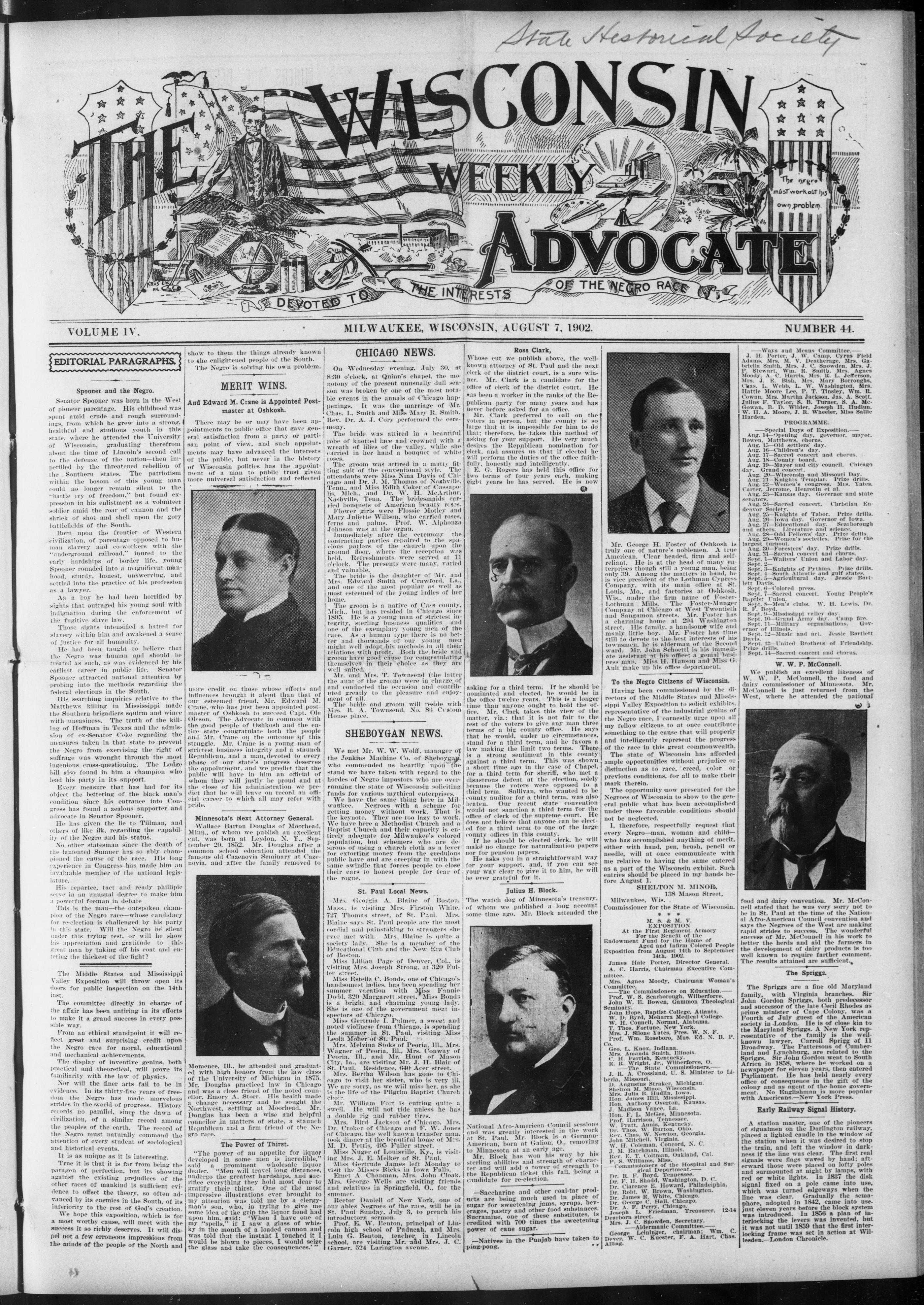
WISCONSIN
WEEKLY
ADVOCATE
DEVOTED TO THE INTERESTS OF THE NEGRO RACE
EDITORIAL PARAGRAPHS.
Spooner and the Negro.
Senator Spooner was born in the West of pioneer parentage. His childhood was spent amid crude and rough surroundings, from which he grew into a strong, healthful and studious youth in this state, where he attended the University of Wisconsin, graduating therefrom about the time of Lincoln's second call to the defense of the nation—then imperilled by the threatened rebellion of the Southern states. The patriotism within the bosom of this young man could no longer remain silent to the "battle cry of freedom," but found expression in his enlistment as a volunteer soldier amid the roar of cannon and the shriek of shot and shell upon the gory battlefields of the South.
Born upon the frontier of Western civilization, of parentage opposed to human slavery and co-workers with the
As a boy he had been horrified by sights that outraged his young soul with indignation during the enforcement of the fugitive slave law.
Those sights intensified a hatred for slavery within him and awakened a sense of justice for all humanity.
He had been taught to believe that the Negro was human and should be treated as such, as was evidenced by his earliest career in public life. Senator Spooner attracted national attention by probing into the methods regarding the federal elections in the South.
His searching inquiries relative to the Matthews killing in Mississippi made the Southern brigadiers squirm and wince with uneasiness. The truth of the killing of Hoffman in Texas and the admission of ex-Senator Coke regarding the measures taken in that state to prevent the Negro from exercising the right of suffrage was wrought through the most ingenious cross-questioning. The Lodge bill also found in him a champion who lead his party in its support. Every measure that has had for its object the bettering of the black man's condition since his entrance into Congress has found a zealous supporter and advocate in Senator Spooner.
He has given the lie to Tillman, and others of like ilk, regarding the capability of the Negro and his status.
No other statesman since the death of the lamented Sumner has so ably championed the cause of the race. His long experience in Congress has made him an invaluable member of the national legislature.
His repartee, tact and ready phillipic serve in an unusual degree to make him a powerful foeman in debate
This is the man—the outspoken champion of the Negro race—whose candidacy for re-election is challenged by his party in this state. Will the Negro be silent under this trying test, or will he show his appreciation and gratitude to this great man by taking off his coat and entering the thickest of the fight?
The Middle States and Mississippi Valley Exposition will throw open its doors for public inspection on the 14th inst.
The committee directly in charge of the affair has been untiring in its efforts to make it a grand success in every possible way.
From an ethical standpoint it will reflect great and surprising credit upon the Negro race for moral, educational and mechanical achievements.
The display of inventive genius, both practical and theoretical, will prove its familiarity with the law of physics.
Nor will the finer arts fail to be in evidence. In its thirty-five years of freedom the Negro has made marvelous strides in the world of progress. History records no parallel, since the dawn of civilization, of a similar record among the peoples of the earth. The record of the Negro must naturally command the attention of every student of sociological and historical events.
It is as unique as it is interesting.
True it is that it is far from being the paragon of perfection, but its showing against the existing prejudices of the other races of mankind is sufficient evidence to offset the theory, so often advanced by its enemies in the South, of its inferiority to the rest of God's creation.
We hope this exposition, which is for a most worthy cause, will meet with the success it so richly deserves. It will dispel not a few erroneous impressions from the minds of the people of the North and
13
show to them the things already known to the enlightened people of the South. The Negro is solving his own problem.
MERIT WINS
And Edward M. Crane is Appointed Post master at Oshkosh.
There may be or may have been appointments to public office that gave general satisfaction from a party or partisan point of view, and such appointments may have advanced the interests of the public, but never in the history of Wisconsin politics has the appointment of a man to public trust given more universal satisfaction and reflected
M.
more credit on those whose efforts and influences brought it about than that of our esteemed friend, Mr. Edward M. Crane, who has just been appointed postmaster of Oshkosh to succeed Capt. Ole Oleson. The Advocate in common with the good people of Oshkosh and the entire state congratulate both the people and Mr. Crane on the outcome of this struggle. Mr. Crane is a young man of strictest business integrity and a staunch Republican, and a man devoted to every phase of our state's progress deserves the appointment, and we predict that the public will have in him an official of whom they will justly be proud and at the close of his administration we predict that he will leave on record an official career to which all may refer with pride.
Minnesota's Next Attorney General.
Wallace Barton Douglas of Moorhead, Minn., of whom we publish an excellent cut, was born at Leydon, N. Y.. September 20, 1852. Mr. Douglas after a common school education attended the famous old Cazenovia Seminary at Cazenovia, and after the family removed to
Momence, Ill., he attended and graduated with high honors from the law class of the University of Michigan in 1875. Mr. Douglas practiced law in Chicago and was a close friend of the noted councilor, Emory A. Storr. His health made a change necessary and he sought the Northwest, settling at Moorhead. Mr. Douglas has been a wise and helpful councilor in matters of state, a staunch Republican and a firm friend of the Negro race.
The Power of Thirst.
"The power of an appetite for liquor developed in some men is incredible," said a prominent wholesale liquor dealer. "Men will travel long distances, undergo the greatest hardships, and sacrifice everything they hold most dear to gratify their thirst. One of the most impressive illustrations ever brought to my attention was told me by a clergyman's son, who, in trying to give me some idea of the grip the liquor fiend had upon him, said: 'When I have one of my "spells," if I saw a glass of whisky in the mouth of a loaded cannon and was told that the instant I touched it I would be blown to pieces, I would seize the glass and take the consequences.'"
CHICAGO NEWS.
On Wednesday evening, July 30, at 8:30 o'clock, at Quinn's chapel, the monotony of the present unusually dull season was broken by one of the most notable events in the annals of Chicago happenings. It was the marriage of Mr. Chas. L. Smith and Miss Mary R. Smith. Rev. Dr. A. J. Cory performed the ceremony. The bride was attired in a beautiful robe of knotted lace and crowned with a wreath of lilies of the valley, while she carried in her hand a bouquet of white roses.
The groom was attired in a matty fitting suit of the conventional style. The attendants were Miss Nina Davis of Chicago and Dr. J. M. Thomas of Nashville, Tenn., and Miss Edith Coker of Cassapolis, Mich., and Dr. W. H. McArthur, Nashville, Tenn. The bridesmaids carried bouquets of American beauty roses. Flower girls were Flossie Motley and Mary Juliette Willson, who carried roses, ferns and palms. Prof. W. Alphonza Johnson was at the organ. Immediately after the ceremony the contracting parties repaired to the spacious parlor of the church upon the ground floor, where the reception was held. Refreshments were served at 11 o'clock. The presents were many, varied and valuable.
The bride is the daughter of Mr. and Mrs. Edward Smith of Crawford, La., and one of the most popular as well as most esteemed of the young ladies of her home.
The groom is a native of Cass county, Mich., but has resided in Chicago since 1895. He is a young man of strictest integrity, sterling business qualities and one of the exemplary young men of the race. As a human type there is no better and thousands of our young men might well adopt his methods in all their relations with profit. Both the bride and groom have good cause for congratulating themselves in their choice as they are well suited.
Mr. and Mrs. T. Townsend (the latter the aunt of the groom) were in charge of and conducted the occasion and contributed greatly to the pleasure and enjoyment of all.
The bride and groom will reside with Mrs. B. A. Townsend, No. 86 Custom House place.
SHEBOYGAN NEWS.
We met Mr. W. W. Wolff, manager of the Jenkins Machine Co. of Sheboygan, who commended us heartily upon the stand we have taken with regard to the hordes of Negro impostors who are overrunning the state of Wisconsin soliciting funds for various mythical enterprises.
We have the same thing here in Milwaukee. Negroes with a scheme for getting money without work. That is the keynote. They are too lazy to work. We have here a Methodist Church and a Baptist Church and their capacity is entirely adequate for Milwaukee's colored population, but schemers who are desirous of using a church cloth as a lever for extorting money from the credulous public have and are creeping in with the same swindle that forces people to close their ears to honest people for fear of the rogue.
St. Paul Local News.
Mrs. Georgia A. Blaine of Boston, Mass., is visiting Mrs. Firston White, 727 Thomas street, of St. Paul. Mrs. Blaine says St. Paul people are the most cordial and painstaking to strangers she ever met with. Mrs. Blaine is quite a society lady. She is a member of the Educational Club and the New Era Club of Boston.
Miss Lillian Page of Denver, Col., is visiting Mrs. Joseph Strong, at 320 Fuller street.
Miss Estella C. Bonds, one of Chicago's handsomest ladies, has been spending her summer vacation with Miss Fannie Dodd, 320 Margarett street. Miss Bonds is a bright and charming young lady. She is one of the government meat inspectors of Chicago.
Miss Gertrude I. Palmer, a sweet and noted violinese from Chicago, is spending the summer in St. Paul, visiting Miss Leola Moher of St. Paul.
Mrs. Melvina Stoks of Peoria, Ill., Mrs. Wagner of Peoria, Ill., Mrs. Conway of Peoria, Ill., and Mr. Hunt of Mason City, Ia., are visiting Mr. J. H. Blair of St. Paul. Residence, 640 Acer street.
Mrs. Bertha Wilson has gone to Chicago to visit her sister, who is very ill. We are sorry, as we will miss her, as she is the life of the Pilgrim Baptist Church choir.
Mr. William Fort is cutting quite a swell. He will not ride unless he has a double rig and rubber tires.
Mrs. Bird Jackson of Chicago, Mrs. Dr. Croker of Chicago and F. W. Jones of Chicago, the well known transfer man, took dinner at the beautiful home of Mrs. M. D. Pettis, 495 Fuller street.
Miss Nuger of Louisville, Ky., is visiting Mrs. J. E. Melker of St. Paul.
Miss Gertrude James left Monday to visit the Misses Ricks in Iowa Falls.
Emet A. Chanman, Mrs. John Cloak, Mrs. George Wells are visiting friends and relatives in Springfield, O., for the summer.
Rector Daniell of New York, one of our ables Negroes of the race, will be in St. Paul Sunday, July 3, to preach his introductory sermon.
Prof. E. W. Penton, principal of Lincoln high school of Paducah, and Mrs. Lulu G. Benton, teacher in Lincoln school, are visiting Mr. and Mrs. J. C. Garner, 524 Larington avenue.
Ross Clark.
Whose cut we publish above, the well-known attorney of St. Paul and the next clerk of the district court, is a sure winner. Mr. Clark is a candidate for the office of clerk of the district court. He as been a worker in the ranks of the Republican party for many years and has never before asked for an office. Mr. Clark preferred to call on the voters in person, but the county is so large that it is impossible for him to do that; therefore, he takes this method of asking for your support. He very much desires the Republican nomination for clerk, and assures us that if elected he will perform the duties of the office faithfully, honestly and intelligently.
E. G. Rogers has held this office for two terms of four years each, making eight years he has served. He is now
M. H.
asking for a third term. If he should be nominated and elected, he would be in the office twelve years. This is a longer time than anyone ought to hold the office. Mr. Clark takes this view of the matter, viz.: that it is not fair to the rest of the voters to give any man three terms of a big county office. He says that he would, under no circumstances, stand for a third term, and he favors a law making the limit two terms. There is a strong sentiment in this county against a third term. This was shown a short time ago in the case of Chapel, for a third term for sheriff, who met a disastrous defeat at the election, solely because the voters were opposed to a third term. Sullivan, who wanted to be county auditor for a third term, was also beaten. Our recent state convention would not sanction a third term for the office of clerk of the supreme court. He does not believe that anyone can be elected for a third term to one of the large county offices in this county.
If he should be elected clerk, he will make no charge for naturalization papers nor for pension papers. He asks you in a straightforward way for your support, and, if you can see your way clear to give it to him, he will be ever grateful for it.
Julius H. Block.
The watch dog of Minnesota's treasury, of whom we published a long account some time ago. Mr. Block attended the
M. B.
National Afro-American Council sessions and was greatly interested in the work at St. Paul. Mr. Block is a German-American, born at Galion, O., removing to Minnesota at an early age.
Mr. Block has won his way by his sterling abilities and strength of character and will add a tower of strength to the Republican ticket this fall, being a candidate for re-election.
—Saccharine and other coal-tar products are being much used in place of sugar for sweetening jams, syrups, beverages, pastry and other food substances. Sucramine, one of these substitutes, is credited with 700 times the sweetening power of cane sugar.
—Natives in the Punjab have taken to ping-pong.
M. J.
Mr. George H. Foster of Oshkosh is truly one of nature's noblemen. A true American. Clear headed, firm and self-reliant. He is at the head of many enterprises though still a young man, being only 39. Among the matters in hand, he is vice president of the Lothman Cypress Company, with its main office at St. Louis, Mo., and factories at Oshkosh, Wis., under the firm name of Foster-Lothman Mills. The Foster-Munger Company at Chicago at West Twentieth and Sangamon streets. Mr. Foster has a charming home at 294 Washington street. His family, a handsome wife and manly little boy. Mr. Foster has time still to devote to the best interests of his townsmen, he is alderman of the Second ward. Mr. John Schoettl is his immediate assistant at his office; a genial business man. Miss H. Hanson and Miss G. Ault make up his office department.
To the Negro Citizens of Wisconsin.
Having been commissioned by the directors of the Middle States and Mississippi Valley Exposition to solicit exhibits, representative of the industrial genius of the Negro race, I earnestly urge upon all my fellow citizens to at once contribute something to the cause that will properly and intelligently represent the progress of the race in this great commonwealth. The state of Wisconsin has afforded ample opportunities without prejudice or distinction as to race, creed, color or previous conditions, for all to make their mark therein.
The opportunity now presented for the Negroes of Wisconsin to show to the general public what has been accomplished under these favorable conditions should not be neglected.
I, therefore, respectfully request that every Negro—man, woman and child—who has accomplished anything of merit, either with hand, pen, brush, pencil or needle, will at once communicate with me relative to having the same entered as a part of the Wisconsin exhibit. Such entries should be placed in my hands before August 1.
Milwaukee, Wis.
Commissioner for the State of Wisconsin.
M. S. & M. V.
EXPOSITION
At the First Regiment Armory
For the Benefit of the
Endowment Fund for the Home of
Aged and Infirm Colored People
Exposition from August 14th to September
14th, 1902.
James Hale Porter, Director General.
A. C. Harris, Chairman Executive Committee.
Mrs. Agnes Moody, Chairman Woman's
Committee.
The Commissioners on Education.—
Prof. W. S. Scarborough, Wilberforce.
John W. E. Bowen, Gammon Theological
Seminary.
John Hope, Baptist College, Atlanta. W. D. Byrd, Meharra Medical College. W. H. Council, Normal, Alabama. T. Thos. Fortune, New York. Mrs. J. Silone Yates, Pres. W. N. F. Prof. Wm. Roseboro, Mus. Ed. N. B. P.
The State Commissioners.—
J. R. A. Crossland, U. S. Minister to Liberia, Missouri.
D. Augustus Straker, Michigan.
Shelton M. Minor, Wisconsin.
Mrs. Julia B. Hudlin, Iowa.
Hon. James Hill, Mississippi.
Hon. Anthony Overton, Kansas.
J. Madison Vance, La.
Hon. F. L. McGee, Minnesota.
Prof. Harrison, Tennessee.
W. Pratt, Annis, Kentucky.
Dr. Thos. W. Burton, Ohio.
Rev. Chas. W. Newton, Georgia.
John Mitchell, Virginia.
W. H. Coleman, Concord, N. C.
J. M. Batchman, Illinois.
Rev. E. T. Coitman, Oakland, Cal.
P. S. Williams, Miss.
Commissioners of the Hospital and Surgical Department.—
Dr. R. F. Boyd, Tennessee.
Dr. F. H. Shadd, Washington, D. C.
Dr. Clarence E. Howard, Philadelphia.
Dr. Robt. W. Brown, Washington.
Dr. James R. White, Chicago.
Dr. George C. Hall, Chicago.
Dr. A. F. Perry, Chicago.
Dr. A. F. Perry, Chicago.
Joseph L. Friedman, Treasurer, 12-14
Dearborn street.
Mrs. J. C. Snowden, Secretary.
——Aldermanic Committee.——
George Leininger, chairman; Wm. C.
Dever. W. C. Kuester, F. A. Hart, Chas.
Alling.
NUMBER 44.
Ways and Means Committee. J. H. Porter, J. W. Camp, Cyrus Field Adams, Mrs. M. V. Deatherage, Mrs. Gabriella Smith, Mrs. J. C. Snowden, Mrs. J. P. Stewart, Wm. R. Smith, Mrs. Agnes Moody, A. C. Harris, Mrs. R. L. Jefferson, Mrs. J. E. Bish, Mrs. Mary Borroughs, Claas. L. Webb, L. W. Washington, Mrs. Hattle Moore Lee, P. T. Tinsley, Wm. R. Cowan, Mrs. Martha Jackson, Jas. A. Scott, Julius F. Taylor, S. B. Turner, S. A. McGowan, B. D. Wilder, Joseph H. Hudlun, W. H. A. Moore, J. R. Wheeler, Miss Sallie Harden.
PROGRAMME.
Special Days of Exposition. Aug. 14-Opening day, governor, mayor. Bowen, Matthews, chorus.
Aug. 19—M mayor and city council. Chicago day. Grand concert.
Aug. 20—Wisconsin and Missouri Day.
Aug. 21—Knights Templar. Prize drills.
Aug. 22—Women's congress. Mts. Yates. Carter, Jerrome, Henrotin et al.
Aug. 23—Kansas day. Governor and state senators.
Aug. 24—Sacred concert. Christian Endeavor Society.
Aug. 25—Knights of Tabor. Prize drills.
Aug. 26—Iowa day. Governor of Iowa.
Aug. 27—Educational day. Scanborough and others. Literature and science.
Aug. 28—Odd Fellows' day. Prize drills.
Aug. 29—Women's societies. Prize for the largest turnout.
Sept. 3—Knights of Pythias. Prize drills.
Sept. 4—South Atlantic and gulf states.
Sept. 5—Agricultural day. Jessie Bartlett Davis.
Sept. 6—Colored press.
Sept. 7—Sacred concert. Young People's Baptist Union.
BENNESSEY
Sept. 8—Men's clubs. W. H. Lewis, Dr.
R. F. Boyd.
Sept. 9—Mississippi valley day.
Sept. 10—Grand Army day. Camp fire.
Sept. 11—Military organizations. Governor of Illinois.
citor of minors.
Sept. 12—Music and art. Jessie Bartlett
Davis.
Sept. 13—United Brothers of Friendship.
Prize drills.
Sept. 14—Sacred concert and chorus.
W. W. P. McConnell
We publish an excellent likeness of W. W. P. McConnell, the food and dairy commissioner of Minnesota. Mr. McConnell is just returned from the West, where he attended the national
J.
food and dairy convention. Mr. McConnell stated that he was very sorry not to be in St. Paul at the time of the National Afro-American Council convention and says the Negroes of the West are making rapid strides to success. The wonderful success of Mr. McConnell in his work to better the herds and aid the farmers in the development of dairy products is too well known to require farther comment. The results attained are sufficient.
The Spriggs.
The Spriggs are a fine old Maryland family, with Virginia branches. Sir John Gordon Spriggs, both predecessor and successor of the late Cecil Rhodes as prime minister of Cape Colony, was a Fourth of July guest of the American society in London. He is of close kin to the Maryland Spriggs. A New York representative of the family is the well-known lawyer, Carroll Sprigg of 11 Broadway. The Pattersons of Cumberland and Lynchburg, are related to the Spriggs. Sir John Gordon went to South Africa in 1858, where he worked on a newspaper for eleven years, then entered Parliament. He has held nearly every office of consequence in the gift of the colony and as agent of the home government. No Englishman is more popular with Americans.—New York Press.
Early Railway Signal History.
A station master, one of the pioneers of signalmen on the Darlington railway, placed a lighted candle in the window of the station when it was desired to stop the train, and left the window in darkness if the line was clear. The first real signals were flags waved by hand; afterward those were placed on lofty poles and surmounted at night by lamps, with red or white lights. In 1837 the disk signal fixed on a pole came into use, which was turned edgeways when the line was clear. Gradually the semaphore, adopted in 1842, came into use just eleven years before the block system was introduced. In 1856 a plan of interlocking the levers was invented, but it was not until 1859 that the first interlocking frame was set in action at Willesden—London Chronicle.
---
TRACY SHOOTS HIMSELF.
Dead Body of Fugitive Found by Woman Picking Berries.
Right Leg.
Spokane, Wash., Aug. 6.—Harry Tracy, the outlaw, killed himself in a wheat field near Fellowes at 4:30 a. m. He was surrounded by a posse. In a fight with the sheriff's posse last night Tracy was wounded in the right leg between the knee and the thigh and 20 minutes later, knowing that his capture was certain, he killed himself with a revolver. The body of the outlaw was found in a wheat field this morning.
Tracy was surrounded in a field near Fellowes, a station on the Washington Central railroad, about fifty miles west of Spokane. The posse under Sheriff Gardner opened fire on the outlaw and a bullet pierced his right leg between the knee and thigh. About twenty minutes after being wounded he shot himself with one of his revolvers and his body was found this morning after daybreak. The revolver with which he killed himself was grasped tightly in his right hand. Tracy was hunted down by a posse of Creston citizens. Surrounded, he engaged in a running battle with his pursuers. His leg was broken by a bullet and an artery bled profusely. He crept
PETER
into a wheat field and tried to tie up the artery. Becoming desperate, he evidently put his revolver to his head and fired a bullet into his brain. At daylight this morning his body was found, already cold. After baffling the officers of two states, after a wonderful flight of nearly 400 miles across Oregon and Washington, Tracy was hunted down by four citizens of the little farming town of Creston and a sole deputy sheriff. Sheriff Gardner and posse arrived in time to guard the wheat field through the night, but the work had already been done.
The posse that will share the reward was made up as follows: C. A. Straub, deputy sheriff; Dr. E. C. Lantes, Maurice Smith, attorney; J. J. Morrison, railway section foreman, and Frank Liliengen. These men, armed to the teeth, set out from Creston yesterday afternoon about 2 o'clock
Boy Leads Officers.
They were working on the information of the Goldfinch youth who had been forcibly made the companion of the Oregon convict over twenty-four hours at the Eddy ranch on Lake creek, about three miles south from Fellowes, a station on the Washington Central railway. The party made all possible haste in getting to the ranch. When within a few hundred yards of the farm they encountered Farmer Eddy mowing in one of his fields. While engaging him in conversation they saw a man issuing from the barn door.
"Is that Tracy?" asked one of the party.
"It surely is," replied Eddy.
The party separated. Lanter and Smith accompanying Eddy in the direction of the barn, while the other two men swung around to the other side.
Two of the manhunters stepped behind the barn on a slight eminence, from which they could watch everything that went on and Eddy continued up to the door. Tracy came from the barn again and began helping his host unhitch the horses. He carried no rifle, although he had his revolvers in place.
The fugitive finally saw the men carrying rifles and turning sharply to Eddy, said: "Who are those men?"
Made Leap for the Barn.
Tracy pointed out the two men on the hill. Eddy informed his companion who the men were and the outlaw made a leap for the barn door. The pursuers, stepping a bit closer, commanded "Hold up your hands." The outlaw jumped behind Eddy and placed first the farmer and then his horse between himself and the pursuers. He commanded the farmer to lead his horse to the barn, and, remaining under cover, moved toward shelter.
When near the stable he broke and dashed inside. He quickly reappeared, rifle in hand, and started on a dead run. Turning on the two men nearest him, the desperado fired two shots, but without his usual luck, neither bullet taking effect. Without waiting for further fighting Tracy made a dash down the valley leading south from the barn and headed for the brush.
Man Hunters in Pursuit.
In an instant the manhunters were off in pursuit, firing as they ran. Coming to a rock, Tracy dodged behind it and resting his gun on the rock began a fusilade. Eight shots in all were fired by the outlaw, not one hitting its mark. Seeing that he was not succeeding, he bolted for a wheat field close by. At the edge of the field he stumbled, falling on his face and crawled into the grain on his hands and knees. It was growing dark and the pursuers, not daring to move in closer, decided to surround the place and wait for daylight.
Shortly after Tracy disappeared a shot was heard from the direction of the wheat field. No investigation was made, however, until this morning. As soon as dawn came an entrance was made into the wheat field.
Tracy Found Dead.
Tracy'e dead body was found lying amid the grain with his face turned toward the sky. His left hand thrown over his head held a revolver which had inflicted the death wound. The thumb
of his hand was on the trigger of the revolver. His right hand, thrown across the lower part of his body, firmly grasped the barrel of his famous rifle. Death was inflicted by the revolver. The top of his head was badly shattered Two bullet wounds on the left leg showed the cause of the man's despondency. One shot had broken the leg between the ankle and the knee. The other cut the tibial artery, which of itself was sufficient cause for death.
It is believed that both of these wounds were received after the convict left the shelter of the rock and made his break for a wheat field. The murderer had taken a strap and buckled it tightly around his leg in an attempt to stop the bleeding. Despite the tight strap the bleeding continued until he probably realized his hopeless condition and ended the struggle. He was dressed in blue overalls, a white shirt and wore no coat or vest. He wore a bicycle cap and a pair of rough shoes. He had one rifle and two revolvers.
Quarrel Over Reward.
Sheriff Gardner of Lincoln county and his assistants arrived on the scene in time to help in the final discovery of the remains and it is stated that he maintained that he and his deputies were entitled to at least a share of the booty. This was disputed by the Creston party, the members of which maintain that they did the work and that to them belongs the reward. Finally Sheriff Gardner was allowed to take the body with the understanding that he recommend that the reward be paid to the men from Creston.
The body, effects and horses of the notorious man were taken in charge by Sheriff Gardner and taken direct to Davenport, where they will be kept pending the decision of the final disposition of Tracy's body. Reports come from Davenport that wild excitement prevails. Stores are closed and people are crowding around to get a sight of the outlaw's body. It is stated that a heavy guard is kept around the morgue, where the body is kept, as well as around the corpse itself to prevent relic hunters from tearing the clothing to pieces and carrying away souvenirs.
HAD HIM SURROUNDED.
Fugitive Outlaw was Closely Pursued by Numerous Posse.
Spokane, Wash., Aug. 6.—Harry Tracy, escaped convict and murderer, is surrounded in a swamp near the Eddy farm, eleven miles southeast of Creston, Wash. For four hours before the special messenger left for reinforcements a long-range rifle duel between Tracy and the posse of eight men headed by Sheriff Gardner had been in progress. This news was brought to Creston by Jack McGinnis, a liveryman of Harrington, who is a member of Sheriff Gardner's posse. McGinnis proceeded at once to Davenport for reinforcements. A telephone message received from Davenport early this morning states that twenty-five armed men have already left in wagons for the scene of the battle. Sheriff Doust of Spokane county has also gone to the scene.
Tracy Leaves a Message.
The sheriff's office at Davenport received a message from Creston, stating that Tracy spent all day Monday at the home of L. B. Eddy, a rancher on Lake creek, three and a half miles south of Fellows. The outlaw made his appearance Sunday evening, and took possession of the place. He is reported to have been there Monday night, leaving about 7:30 o'clock.
Pinned to the well on a farm about a mile north of Odessa, where apparently Tracy had watered his horses, the following note, signed Harry Tracy, was found yesterday:
To Whom It May Concern: Tell Mr. Cudlhee to take a tumble and let me alone, or I will fix him plenty. I will be on my way to Wyoming. If your horses are any good, would swap with you. Thanks for a cool drink.
TRACY'S EVENTFUL CAREER
Has Killed Ten Men and Kept Authori- ties at Eav for Two Months.
Harry Tracy escaped from the Oregon state penitentiary at Salem on June 9 in company with David Merrill, after killing four men, Frank W. Ferrell, G.R.T. Jones and B. F. Fiffany, guards, and Frank Ingraham, a convict who tried to to prevent his flight. On June 28 Tracy killed Merrill near Napavine, Wash., shooting him from behind and leaving his body in the forest, where it was found on July 15. On July 3 near Seattle in a fight with a posse, Tracy shot and killed Charles Raymond, a deputy sheriff; E. E. Bresse, a policeman, and mortally wounded Neil Rawley, who died on the following day and seriously wounded Carl Anderson and Louis Zafrite, newspaper reporters.
Tracy committed many feats of daring during his flight, in the course of which he eluded various posses when apparently surrounded and held up numerous farmers whom he forced to furnish food and clothing and by threats of murdering their families compelled them to cover up his tracks. Perhaps his greatest show of daring was displayed on July 2 at South Bay, near Olympia, when he held up six men and forced four, including Capt. Clark of a large gasoline launch, to embark with him on Puget sound and pilot him up stream for ten hours.
In 1897 Tracy murdered Valentine Hoge, a Colorado cattleman, and William Strong, a boy, in the same state. A total reward of $5600 was offered for his arrest, Gov. McBride of Washington offering $2500 for his capture, dead or alive. The state of Oregon offered $3000 and a brother of one of the guards killed at the penitentiary offered $100. The reward for Merrill's capture amounted to $1500, which has been claimed by Mrs. Waggoner, the berry-picker, and her son, who found the body near their home.
He is described as not yet 30 years of age, in life as active as a cat, strong and well made, a splendid shot and quick to get "the drop," forceful in all his words and actions. He was not an ordinary criminal such as the police of the large cities know so well. To find Harry Tracy's prototype one must go back a score of years or more to the time when the "bad men," the "man-killers" of Texas, Missouri, the mountains of Kentucky and other sections of the West were still at their work.
The early history of Harry Tracy is wrapped in mystery. No one, so far as is known, can tell much about his boyhood. One report has it that he was brought up in Boston; another that he was born in California. His real name is said to be Sevvige. He was a professional crook as well as a Western deserado.
TRAMPS START COSTLY BLAZE IN CEDAR YARD.
Thousands of Telegraph Poles Destroyed at Stephenson, Mich.—Loss Fifty Thousand Dollars.
Stephenson. Mich., Aug. 6.—[Special.]—C. S. Hart's cedar yard caught fire about 5 o'clock this morning and the flames destroyed 18,000 telegraph poles, valued at $50,000. By good work of the fire department the remainder of the yard, containing $200,000 worth of cedar products, was saved. Tramps are supposed to have built a fire too close to the piles of cedar.
A DARING TRAIN ROBBERY
Masked Men Hold Up a Burlington Train.
Mount Carroll, Ill., Aug. 6.—A daring and successful train robbery occurred at Marcus, on the Chicago, Burlington & Quincy railway, five miles north of Savanna, about midnight. The fine vestibulated passenger train of eleven coaches, Conductor Emerson in charge, was flagged at the little station and six masked men boarded the engine. The engineer and fireman obeyed the imperative orders of the robbers, who at once uncoupled the engine and express car from the train and ran them a quarter of a mile up the track. They then blew up the express car with dynamite, ran the engine north a distance of a mile from Hanover and the locomotive becoming dead the robbers abandoned it and escaped. One of the highwaymen was killed, being shot above the eye and also in the leg. He met instant death while in the engine and his body was dumped to the ground by his companions as they sped away. The express messenger, Bye, claims to have done the shooting. The deed was done quickly, the trainmen and passengers making no defense. Six sacks of money were secured, but the amount is not known. The passengers were not molested.
sengers were not more There was no way of telegraphing news of the hold-up and a flagman walked back and gave the alarm. A special train of citizens and several policemen at once proceeded to the scene, but as the track runs along the Mississippi and the country is well adapted to successful flight, the robbers easily escaped. The work was evidently that of experts as they went at it coolly and methodically. The train attacked is one of the finest in the world and usually carried considerable money, which must have been known by the highwaymen. The dead robber was a stranger in this vicinity. He was a middle-aged man and well dressed. In his pocket was found an Iowa Central mileage credential from Grinnell to Gilman, Ia., issued in the name of A. L. Jacobs
Four explosions were required to complete the destruction of the safe and the car was badly wrecked. The robbers were eight in number, all masked. They evidently were railroad men, one being a good engineer. Messenger Bye fired five shots at the robbers but without avail and an attempt was made to blow him up in his car. The bandits had arranged to ditch the entire train of nine heavily-laden coaches had not the signal to stop been heeded. Several passengers in the buffet car, including the porter, were held prisoners during the struggle to crack the safe. It is thought that the dead robber was killed by a comrade by mistake. The body was put on the tender and run by the others a short distance and then thrown into the weeds.
The Engineer's Story.
La Crosse, Wis., Aug. 6.—The Burlington No. 47, which was held up near Lucas, arrived here at 10 o'clock and a twenty-minute stop was made for breakfast. Engineer John E. Mooney when seen told a vivid story of the hold-up. He said:
"The robbers stopped the train by swinging a white light. As soon as it stopped two men jumped into the cab and covered us with revolvers. One of them told the fireman to cut off the engine. After this was done the man who was pointing a gun at my head told me to pull the engine up a ways and I ran her up half a mile. Then they ordered me to jump off and we walked back towards the train, where we were joined by the express messenger and another robber. They took us to the rear of the buffet car and told us to sit there. One of the robbers left us. They worked for an hour blowing open the safe and finally brought the engine down again and all of them got aboard it. A few feet from the train they told me to jump off and run, which I most assuredly did. They ran the engine up seven miles and left her dead."
Covered with Six Guns.
Mr. Mooney says that he has been running on the Burlington since it was built fifteen years ago and this was his first experience and he sincerely hopes it will be the last. Six guns staring one in the face is none too pleasant a sensation to experience. Mr. Mooney believes that the robbers killed one of their own number, either purposely or accidentally. Several shots were fired, some by the robbers, and the rest by the express messenger. The dead man was dumped off a short distance from where the affair occurred, the robbers having taken his body on the engine when they started off. Mr. Mooney says that all of the men wore masks but that while one was holding a gun in his face the handkerchief which concealed his entire face except the eyes fell off and that he managed to get a good look at him. He could identify him, he says, as the young man had a sandy complexion, was about 5 feet 8 inches in height and wore good clothes.
The express car had two holes blown into its bottom and was left at East Dubuque. It is believed that the five bags of money only contained $2500.
The Company's Statement.
Chicago, Ill., Aug. 6.—Following is the official account of the robbery, issued by the general manager of the Chicago, Burlington & Quincy railway:
"Train 47 was held up last night about 11:30 at Marcus, about ten miles north of Savanna, Ill. The switch was turned for passing track and the train flagged. The two head cars, consisting of a mail and express car and a composite car were cut off and taken to the north switch, where the safe in the express car was blown open with dynamite and contents taken, after which the engine was cut off by the robbers and started north. As the robbers left the express messenger fired at them. One robber was found dead about one mile north of Marcus and his body was given over to the coroner. At least six men were concerned in the robbery. So far as is known only $2000 in silver was secured. None of the crew was hurt and none of the passengers molested. The express end of the rifled car was badly damaged."
Official announcement was made by the officials of both the Burlington road and the Adams Express Company that a purse of $1000 would be made up by the two companies and given to Express Messenger Byl for his bravery.
St. Croix Boom Shut Down
Stillwater, Minn., Aug. 6.-The St. Croix Boom Company shut down this morning as a result of their 350 employees demanding a ten-hour day. President Sauntry declares that the company will not consent to a reduction of hours and that the boom will remain closed until men are secured to work at the old terms.
AVOID DISSENSIONS.
Bishop Messmer's Address at Convention of the Federation of Catholic Societies.
Chicago, Ill., Aug. 5.—Delegates from more than 400 Catholic societies attended the opening session of the convention of the Federation of Catholic Societies which began here today. Solemn pontifical high mass was celebrated in the morning at the Cathedral of the Holy Name by Bishops Muldoon, Messmer and McFaul. Much interest centered about the attitude the delegates might assume on the question of the Spanish friars in the Philippines. All the regular sessions of the convention will be executive but an open meeting will be held tonight at which, officers say, the question of politics and the church probably will come up. The convention will continue over tomorrow and Thursday.
Bishop Messmer, in his sermon at mass, made no allusion to the warnings by Archbishop Ireland to the effect that the convention should take no action on the Spanish friar question. The burden of the bishop's address was one of conciliation. He said it was the duty of all true Catholics to work with heart and hand for the furtherance of Catholicity and that dissentions should never arise in the church.
Bishop Messmer, while pleading for "unity in heart and mind," for all Catholics, at the same time told the laity not to fear in their attitude of Americanship. He said they should obey their superiors in the matter of religion, but that the Pope had counseled straightforward progress in the path of their civic convictions.
LEAVES NEWSPAPER ROW
New York Times to Erect Modern Steel Structure in New York Uptown District.
New York, Aug. 5.—It is announced today that the New York Times has acquired the triangle bounded by Broadway, Forty-second street and Seventh avenue, and will at once begin the erection thereon of a large modern steel-construction building, primarily for its own use. In the nearly fifty-one years of its existence the Times has occupied buildings in "Newspaper Row," facing City Hall park and the announcement that it is to be moved to the uptown district has caused much comment.
In announcing the purpose of abandoning its present quarters the Times says: "To many of the older New Yorkers, the notion of a newspaper moving so far uptown will seem singular. For years the popular notion has been that the location near the city hall park where so many newspapers had their birth and where so many are now grouped, was an essential. This was true in the years gone by and is still true in great measure. The next eighth in months, however, promise to make a revolution in many respects owing to the new transit facilities which the underground railways and the Pennsylvania tunnel provides."
DR. BEARDSHEAR DIES
Prominent Iowa Educator Passes Away as Result of Nervous Prostration A Leading Educator.
Des Moines, Ia., Aug. 5.--Dr. William M. Beardshear, president of the Iowa State College at Ames, died early today as the result of nervous prostration with which he was overcome while attending the meeting of the National Educational Association at Minneapolis a month ago. Dr. Beardshear was president of the association.
Dr. Beardshear was one of the foremost educators in Iowa. Prior to assuming the presidency of the State Agricultural College ten years ago, he was superintendent of schools for West Des Moines. Before that he had been president of Western College at Tama, Ia.
MINING PLANT RUINED.
Boiler House, Engine House, Two Power Houses, Etc., Destroyed—Loss Placed at $100,000.
Trinidad, Col., Aug. 5.—Fire has destroyed the boiler house, engine house, two power houses, tipple, half of the tramway and half the box cars at Peerless mine in Aguilar owned by the Northern Coal & Coke Company. The loss is estimated at $100,000. The Brodhead mine, where four miners lost their lives by an explosion on Saturday, is still burning.
ALL HAIL THE KING
Great Street Demonstration Planned for Tomorrow, When Edward Returns to London.
London, Aug. 5.—All preparations have been completed for the return of King Edward to London tomorrow. The Victoria station has been brilliantly decorated. It is expected that his majesty's return to the capital will be marked by a great street demonstration en route to Buckingham palace. The trip to London will be made on a royal special train but there will be no invalid chair or other special arrangements as it is felt that his majesty is fully equal to the fatigue of the journey.
KING IS GAINING STRENGTH
Walks Up and Down Flight of Stairs Without Assistance.
Cowes, Aug. 5. King Edward yesterday for the first time since his illness walked up and down a flight of stairs without assistance. He also enjoyed a stroll upon the upper promenade deck of the royal yacht Victoria and Albert, from which a splendid view of the yacht races was obtainable. It has been definitely settled that the King will return to London Wednesday afternoon. He will travel in the usual royal saloon carriage, without an invalid's couch, and will not be screened from the public view.
Willing to Take Handicap.
A captain who had been drinking quite freely met a private of his command in the same condition. The captain ordered him to halt, and endeavoring in vain to assume a firm position on his feet and to talk with dignified severity, exclaimed: "Private Smith, I'll give you t'l (hic) 4 o'clock to gissober in." "Cap'n," replied the soldier, "as you're (hic) sight drunkern I am I'll give you t'l 5 o'clock to gissober in."—The Military Commonwealth.
Fashions in Hardwood Floors.
From two to four inches are said to be the proper widths for the planks of the plain hardwood floors used now. Parquetry or fancy effects are not considered nearly so desirable.
Pineapples grow so plentifully in Natal at certain seasons that it is not worth while carting them to market, and they are often given to the pigs in consequence.
MINERS ARE DEFEATED.
Judge Goff Renders Decision in Habeas Corpus Proceedings.
Clarksburg, W. Va., Aug. 6.—Judge Goff this afternoon in a lengthy opinion decided the habeas corpus case against the miners and agitators and remanded them to the custody of the marshal and sheriff, and they will be removed to Parkersbury to serve the balance of their sentences. The judge said the only question was as to the jurisdiction and that the Guarantee Trust Company of New York was entiled to a standing in court and it was not absolutely necessary for the fuel company to be made a party to the suit. The decision is a great disappointment to the miners, and their counsel say that no other action can be taken at present, at least.
MACHINISTS GO OUT
Superintendent of Allis-Chalmers Shops will Not Discharge Nonunionists.
Chicago, Ill., Aug. 6.—Because some nonunion men laughed at them, 250 union machinists employed in the big shops of the Allis-Chalmers Company at Twelfth street and Washtenaw avenue walked out yesterday and declared a renewal of the long strike at that plant which was only recently settled.
A number of union machinists were discussing with much bitterness the reports that had come out concerning the use of convict labor by the firm when it was fighting the union some time ago. This led to a reference to the fact that some of the nonunion men who had taken the strikers' places during the recent tie-up were still retained. The unionists were under the impression that the nonunion men were to have been gradually let out after the settlement of the protracted strike on June 12, 1902.
Several nonunion men gathered about and listened. They laughed at the strong denunciations heaped upon them and this stirred the unionists to the boiling point
Assault Starts General Fight.
Spurred on by the derisive laughter, one of the union men stepped out from the group and struck a nonunionist a stinging blow full in the face. Immediately a general fight was precipitated. The men went at each other fiercely. Noses were broken and clothing was torn. The trouble brought a crowd of other workmen to the scene. They interfered and finally order was restored. Then the union men withdrew to one side and hold an indignation meeting. They decided that they would not stay in the shops unless all the nonunion men were immediately discharged. The superintendent would not listen to the protests, it is said, but claimed that the nonunionists were working in the shops in accordance with the agreement made at the time of the settlement.
When this report was made to the men they marched out and left the machinists' section of the big plant practically deserted. They declared that unless a settlement is made today they would call out all the union machinists at the Gates Iron Works branch of the Allis-Chalmers Company in Elston avenue.
QUIET AT SHENANDOAH
Several Shots During the Night, but Shooters Could Not be Located.
Shenandoah, Pa., Aug. 6.—The sentries on duty around camp and the soldiers stationed at different parts of the town on provost guard duty reported everything quiet during the night. Some of the guardsmen said they heard several shots during the night, but could not locate them.
There was a little disorder in Mahanoy City late last night. A junk vender from Harrisburg who had been seen near a colliery was suspected of being a deputy and was set upon by a number of men. He escaped up the mountain and sought refuge with a colony of Roumanian Jews.
Slain with Pick Handle.
Wilkesharre, Pa., Aug. 6.—Lying in a pool of blood on a lonesome road in Nanticoke, the body of Daniel Sweeney, a watchman employed by the Delaware, Lackawanna and Western Coal Company was found early today. Across the top of the head were two wounds and the skull was crushed at the base. There are numerous other bruises about the body. Alongside the body lay a bloody pick handle.
Sweeney quit work at midnight and was followed by a score of men, making threats, and Sweeney was afraid of them. He took refuge in a saloon and waited there for some time. After he thought the crowd that followed him had dispersed he left for his nome. This was the last seen of him alive. The supposition is that the men who followed him from the mine were lying in wait for him and when he approached the spot where they were hiding they assaulted him with brass knuckles and beat his brains out.
At strike headquarters in this city a statement was given out to the effect that an investigation had been made of the killing of Watchman Sweeney at the Bliss mine, but there was no evidence to show that strikers had committed the crime.
The local coal operators say they now fear a reign of terror will spread over the coal region and that the state militia will be kept busy in many parts of the strike territory. Magistrate Shoemaker said today that friends of the rioters who were taken to Pottsville will institute habeas corpus proceedings to have the men released. Brig.-Gen. Gobin, in speaking of the conditions at Shenandoah said that Shenandoah, for its size, is more thickly populated than the tenement district of New York city. The sanitary conditions are bad and the manner in which the people live here would not be tolerated in large cities.
Gen. Gobin said that he had heard that many of the foreigners who have seen service in European armies, are secretly drilling and are being instructed by ex-officers from the armies of Russia, Germany and Austria.
Trolley Road Tied Up.
New Haven, Conn.. Aug. 6.—The Fair Haven & Westville Railroad Company, operating and controlling all trolley traffic, local and surburban, within a radius of ten miles of this city found its entire system practically tied up this morning as a result of a strike of its 400 conductors and motormen. The men demand changes and reforms in methods of administration. The officials of the company have thus far refused to yield. Meanwhile the public are walking. The action of the strikers is mainly due to the refusal of the company's officials to reinstate twenty-seven discharged employees, whose dismissal, the men say, was solely because of their identification with the work of organization.
SPORTING NEWS.
At Buffalo Manager Stallings assaulted Manager Leonard of the Rochester club for some trivial affair. The Worcester Spy says of the occurrence: "Whatever the decision in the Buffalo court is, Worcester patrons of Eastern League baseball know Manager Leonard well enough to be satisfied that he struck no man unless he had sufficient provocation."
Toledo is after Roy Rock of Centerdale, R. L, one of the players from the same class in which Lepine of Detroit was developed. Rock was shortstop for the Manhattan College team this season.
"Speaking about bombs," says the Philadelphia Inquirer, "Ban Johnson is shaking up one that will make that little affair at Baltimore look like a squib. And remember your Uncle Byron always delivers the goods."
The Philadelphia Athletics are negotiating with Pitcher Schmidt of Los Angeles. This is not "Germany" Schmidt, the erratic twirler, but a youngster who played in the Western League last season.
* * *
Joe Goddard, who ten years ago was the talk of the country, as he aspired to the heavyweight championship of the world, is dying at Cooper Hospital, Philadelphia, of a bullet wound in his head, as a result of an election riot at Dog Corner, near Camden, N. J. Goddard, the Barrier champion, was one of the hardest fighters who ever lived and one of the ring's notable characters. He is 48 years of age and came to this country in 1892. He fought all the prominent heavyweights and won nearly all his battles, being defeated by Denver Ed Smith.
* * *
Eugene Bezenah, who suffered the only knockout of his fighting career at Joe Gans' hands, has challenged the negro to another battle for the lightweight championship.
Commodore MacDonald of the Bridgeport (Conn.) Yacht Club says that he is as yet uncertain whether or not a protest will be lodged against the Trident, which has been selected to defend the Seawanhaka cup. T. Herrick Duggan, the designer of Trident, has finally decided to abandon one of the three centerboards with which the new yacht is provided. It is because of the use of more than one centerboard on the Trident that a protest is being considered.
* * *
The first regatta of the Cedar Lake Yacht Club was sailed Sunday. The yachts started in the following order: Emma-Jean, Capt. G. A. Kuechemster, Jr.; Marguerite, Capt. Sherlock; Breta, Capt. Sprinkman; Cuttysark, Capt. Decker. The yachts finished in the following order:
Cuttysark, 3:48:18; Breta, 3:50:57; Emma - Jean, 3:51:42; Marguerite, 3:53:45. The Breta was barred at a claim of foul.
* * *
A special purse of $3000 has been offered for a race between Dan Patch, Prince Alert and Anaconda, two in three heats, to be paced August 16 at Brighton beach. The match for $10,000 between The Abbot and Lord Derby is the star attraction of the week and will be trotted August 14.
* * *
The third annual meeting of the Western Chess Association was held at Excelsior, Minn. Officers were elected as follows: President, George B. Spencer, St. Paul; vice presidents—Michigan, Judge H. D. Smith, Cassopolis; Illinois, E. T. Rhodes, Chicago; Missouri, W. G. Hine, Savannah; North Dakota, J. Friedlander, Grand Forks; Nebraska, Nelson Hald, Danneburg; Minnesota, J. W. Clark, Minneapolis; Wisconsin, Capt. Rogers, Milwaukee. Chicago was chosen for the tournament for 1903.
```markdown
```
Five Eastern League players have made more than 100 hits. They are Halligan of Jersey City, Brain and Grimshaw of Buffalo, Massey of Toronto and Clancy of Worcester. Pete Cassidy of Providence is close to the mark with ninety-seven. Pitcher Platt of the Chicago Americans, predicts that within a few years it will be necessary to put the pitcher's slab several feet farther back. The frequency of small score games lends color to Platt's argument. Manager Smith of the Deckland, Me., team, has signed Fred Clarkson as pitcher and outfielder. He is a brother of Walter Clarkson, captain of the Harvard team, and also a brother of the famous John Clarkson.
Miss Daisy Brucker of Fond du Lac bowled 175 points in a match game recently. Miss Brucker only recently became a devotee of the sport, having bowled her first game not more than two months ago.
★ ★ ★
Manager McKibben of the St. Joseph club, who was suspended by President Sexton, has been reinstated. Hug, the Milwaukee pitcher, has been signed as a member of the Kenosha baseball team. Charles Dexter has signed with the Boston National League team. The popular Chicago player will probably go back to the catching department with Manager Buckenberger, although his great value as a utility man made the Boston management all the more anxious to secure him. Treasurer Billings of the Boston club is exercised over the attempts American League agents are making to secure Willis and Pittenger, and vows he will have the most dire revenge if they are not found with the Boston team next season. Long, Tenney and Carney are the only players signed for Boston next season.
Manager Nicol of the Rockford club has signed Shortstop Morissey and Outfielders Gleason and Bufka of the Michigan League. They will join the Rockford team at Evansville. Scharnweber, shortstop, and Conklin, outfielder, will be released.
Visit Milwaukee, the Most Beautiful City in America—Low Excursion Rates.
The Milwaukee Association of Jobbers and Manufacturers has made arrangements for two excursions to Milwaukee during August. Any merchant, manufacturer or dealer in Wisconsin, Iowa, Minnesota, North and South Dakota and Northern Michigan is entitled to a rate of one and one-fifth fare for the round trip, not alone for himself and family, but for any one actively engaged in his business.
All that is necessary is that you obtain from your wholesale dealer or manufacturer in Milwaukee a membership card entitling you to the rate, and full information without cost. Tickets for the two excursions will be on sale August 16 to 30.
In addition to displays by merchants generally, the large wholesale millinery houses will have their fall opening during all of that time, and it will be well for milliners to remember the date.
—The lunacy rate in hard-headed Dundee, Scotland, is to be raised a half-penny.
GINSENG WANTED If it grows in your locality you can make good wages. Write immediately for particulars.
STAR GINSENG GARDENS,
Box C. Auburn, N. Y.
FROM "RAPIDS AT NIGHT."
Here at the roots of the mountains.
Between the sonner legions of cedars and tamaracs.
The rapids charge the ravine:
A little light, cast by foam under starlight,
Wavers about the shimmering stems of the birches:
Here rise up the clangorous sounds of battle,
Immense and mournful.
Far above curves, the great dome of dark
Drawn with the limitless lines of the stars and the planets. Deep at the core of the tumult. Deeper than all the voices that cry at the surface. Dwells one fathomless sound. Under the hiss and cry, the stroke and the plungeant clamor. (Oh! human heart that sleeps. Wild with rushing dreams and deep with sadness.)
the abysmal roar drops into almost silence. While over its sleep plays in various ca
Rising supreme in utterance
It sways, and reconquers and floods all the
spaces of silence.
One voice, deep with the sadness.
"TO HER!"
Elbridge sat in one of the deep, leather-covered arm chairs of his club, reading. Friends came by and asked him to join them, but he shook his head to each.
"I'm waiting for a couple of old cronies of mine," he said, again and again. "We have an appointment to meet every year at this date, and we've kept it now for ten years."
At last one of the cronies came.
"Hello, Boyd!" he called. "Am I late?" Boyd asked, glancing around him like a bird. "Where's Liscom?" "Hasn't shown up yet," Elbridge answered. "We'll wait here for him. How's the world with you, old man?" "Perfect. Business increasing beautifully. This is a fine year." "Have you seen Liscom lately?" "Yes, a week or two ago; he came into my office—why, let me see—" Boyd paused and computed. "That's queer; it seems only a few days, but it must have been in March." Boyd looked at his watch again.
"What's the use of asking when we've lost sight of his doings so completely? Was he looking well in March?"
"Oh, yes, looking fine. At least, I don't remember anything about his looks. He's been cadaverous these ten years."
Time passed again in perfunctory talk. Then Elbridge rose. "I'm afraid Liscom's ill," he said. "If he were well he would either have come or gotten word to us by this time. I think I'll call a cab and ride up to his address. You might go around to your brother's and come back after an hour. I'll leave a message here in case he comes while we're gone."
"I'll send word to the children and go with you." Boyd said.
The night air met them sharply on the street. They shivered as they walked the short block to the cab rank, and their minds were heavy with an indefinite sense of estrangement from their old friend.
"It would have been easier to keep trace of him if he hadn't lived in such an out-of-the-way place," Elbridge said.
"He likes out-of-the-way places," Boyd answered. "He's queer, anyway. Who else would keep this anniversary of the night he didn't get married? And who else would have stopped the ceremony to refuse to agree to the exact words of the promise? And yet he drinks her health every year, just the same."
"It's poetical," Elbridge murmured.
"Fudge!" said Boyd. "It's love."
"Love? When he refused to promise to love her 'until death do us part?'" Elbridge protested. "What do you suppose possessed him?"
"Nothing but hyper-conscientiousness," Boyd declared, as if they had not talked it all out dozens of times before. "I can remember just the way it happened, can't you? What a hush there was when that question struck him, and he didn't give the response; and then his voice: 'But I can't promise to love her all my life. I can promise to honor and cherish her, but love is beyond our control; no one can honestly promise it for the future. I can only say I love her now.'"
"What I'd like to forget is her face," Elbridge said, "and how she stood out for the full promise or none at all. I was drenched with sweat when it all broke up and we came away."
"And yet it was she who married, he who has never changed."
"Yes," Elbridge admitted, "and "I've heard she had a hard time before her husband died. He was about as untrue to her as a man could be."
The cab jolted on, passing far, dim streets. At last the two men left it. Liscom's neighborhood was forlorner than they remembered it. They were certain of the number of his house, but his name was above none of the bells in the entrance hall, so they rang up the janitor.
"Must have moved away before I came," the janitor declared. "I've been here six months, and there's been no such party here."
They turned away, baffled and depressed. "That's all we can do tonight," Elbridge said, conclusively. "Tomorrow I'll begin a systematic search."
As they stepped into the warm club on their return its very comfort and the invitation of its pleasant rooms seemed to accuse them. A servant handed Elbridge a telegram. He tore it open and gave an exclamation between relief and commiseration.
"At least he's alive," he said, passing the message to Boyd.
"Am too ill to join you," it said. "Come to me."
They went out again, exchanging surmises. He was ill, but his address did not suggest poverty. Their second excursion was the shorter of the two, and brought them into an attractive quarter of New York. A white-capped maid answered their summons and took them to Liscom. He was lying in bed, thinner and frailer than ever, but with brighter eyes. He grasped the hand of each
"Ive been down so long I'd lost count of the days," he said in a weak, eager voice. "When I remembered, I was afraid you'd have given me up and gone home. But I knew you'd come if you got my message." He elapsed their hands tighter. "You've stood by me, boys." he went on, tremulously, "but your job's done now. I wanted to bid you goodbye on this night that you've been helping me to bear for so long. I wanted to bid you goodbye and to have you wish me joy." He looked from one to the other.
He looked from one to the other, and
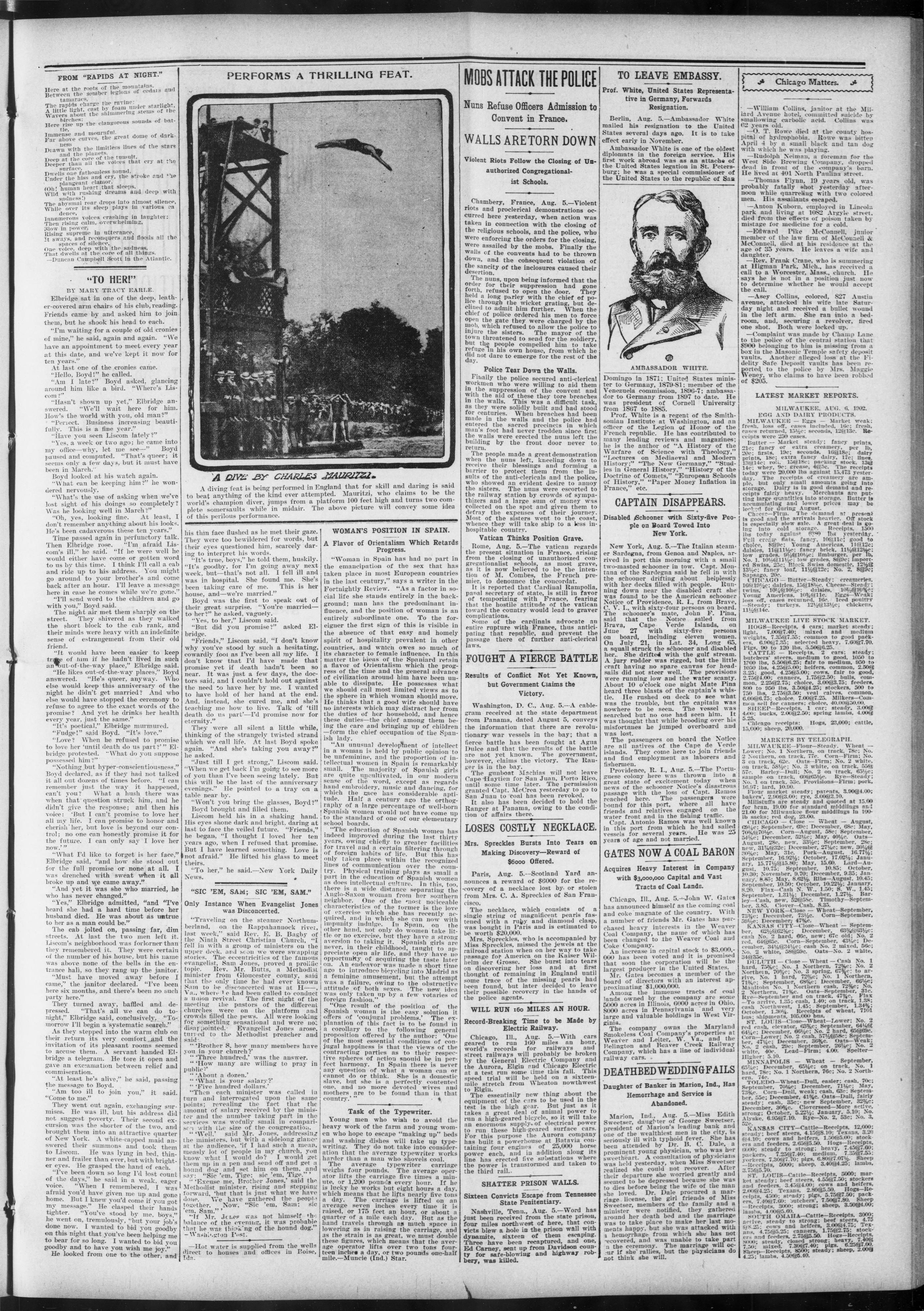
PERFORMS A THRILLING FEAT.
THE WATER CITY
A diving feat is being performed in England that for skill and daring is said to beat anything of the kind ever attempted. Mauritzi, who claims to be the world's champion diver, jumps from a platform 100 feet high and turns two complete somersaults while in midair. The above picture will convey some idea of this perilous performance.
WOMAN'S POSITION IN SPAIN.
A Flavor of Orientalism Which Retards Progress.
"Woman in Spain has had no part in the emancipation of the sex that has taken place in most European countries in the last century," says a writer in the Fortnightly Review. "As a factor in social life she stands entirely in the background; man has the predominant influence, and the position of woman is an entirely subordinate one. To the foreigner the first sign of this is visible in the absence of that easy and homely spirit of hospitality prevalent in other countries, and which owes so much of its character to female influence. In this matter the ideas of the Spaniard retain a flavor of Orientalism which the progress of the time and the general advance of civilization around him have been unable to dissipate. He possesses what we should call most limited views as to the sphere in which woman should move. He thinks that a good wife should have no interests which may distract her from the duties of her household, and hence these duties—the chief among them being the care and bringing up of children—form the chief occupation of the Spanish lady.
"An unusual development of intellect in a woman is held by public opinion to be unfeminine, and the proportion of intellectual women in Spain is remarkably small. The majority of Spanish girls are quite uncultivated, in our modern sense of the word, except as regards hand embroidery, music and dancing, for which the race has considerable aptitude. Half a century ago the orthography of a large percentage of well-born Spanish women would not have come up to the standard of one of our elementary school boards.
"The education of Spanish women has indeed improved during the last thirty years, owing chiefly to greater facilities for travel and a certain filtering through of foreign habits of life. But this has only taken place within the recognized lines of communication over the country. Physical training plays as small a part in the education of Spanish women as does intellectual culture. In this, too, there is a wide distance separating the Anglo-Saxon woman from her southern neighbor. One of the most noticeable characteristics of the former is the love of exercise which she has recently acquired, and in which she can now with impunity indulge. In Spain, on the other hand, not only do women take little or no exercise, but they have a strong aversion to taking it. Spanish girls are never, in their childhood, taught to appreciate open air life, and they have no opportunity of acquiring the taste later on. An endeavor was made a short time ago to introduce bicycling into Madrid as a feminine amusement, but the attempt was a failure, owing to the obstructive attitude of both sexes. The new idea was only taken up by a few votaries of foreign fashion."
"One result of the position of the Spanish woman is the easy solution it offers of 'conjugal problems.' The explanation of this fact is to be found in a corollary to the following general proposition offered by the author: 'One of the most essential conditions of conjugal happiness is that the views of the contracting parties as to their respective spheres of action should be in perfect harmony. In Spain there is never any question of what a woman can or cannot do or think. She is a domestic slave, but she is a perfectly contented one, and no more devoted wives and mothers are to be found than in that country.'"
Young men who wish to avoid the heavy work of the farm and young women who hope to escape "making up" beds and washing dishes will take up typewriting. They do not take into consideration that the average typewriter works harder than a man who shovels coal.
The average typewriter carriage weighs four pounds. The average operator lifts the carriage five times a minute, or 1,200 pounds every hour. If he is lucky he works but eight hours a day, which means that he lifts nearly five tons a day. The carriage is lifted on an average seven inches every time it is raised, or 175 feet an hour, or about a quarter of a mile each day. But as the hand travels through as much space in lowering as in raising the carriage, and as the strain is as great, we must double these figures, which means that the average operator lifts over two tons fourteen inches a day, or two pounds one-half mile.—Muncie (Ind.) Star.
his thin face flushed as he met their gaze. They were too bewildered for words, but their eyes questioned him, scarcely daring to interpret his words.
"It's true, boys," he told them, huskily. "It's goodby, for I'm going away next week, but—that's not all. I fell ill and was in hospital. She found me. She's been taking care of me. This is her house, and—we're married."
Boyd was the first to speak out of their great surprise. "You're married—to her?" he asked, vaguely.
"Yes, to her," Liscom said.
"But did you promise?" asked Elbridge.
"Friends," Liscom said, "I don't know why you've stood by such a hesitating, cowardly fool as I've been all my life. I don't know that I'd have made that promise yet if death hadn't been so near. It was just a few days, the doctors said, and I couldn't hold out against the need to have her by me. I wanted to have hold of her hand at the end. And, instead, she cured me, and she's teaching me how to live. Talk of 'till death do us part'—I'd promise now for eternity."
They were all silent a little while, thinking of the strangely twisted strand which we call life. At last Boyd spoke again. "And she's taking you away?" he asked.
"Just till I get strong," Liscom said. "When we get back I'm going to see more of you than I've been seeing lately. But this will be the last of the anniversary evenings." He pointed to a tray on a table near by. "Won't you bring the glasses, Boyd?" Boyd brought and filled them. Liscom held his in a shaking hand. His eyes shone dark and bright, daring at last to face the veiled future. "Friends," he began, "I thought I loved her ten years ago, when I refused that promise. But I have learned something. Love is not afraid." He lifted his glass to meet theirs. "To her," he said.—New York Daily News.
Only Instance When Evangelist Jones was Disconcerted.
"Traveling on the steamer Northumberland, on the Rappahannock river, last week," said Rev. E. B. Bagby of the Ninth Street Christian Church, "I fell in with a group of ministers on the upper deck, and soon we were swapping stories. The eccentricities of the famous evangelist, Sam Jones, proved a prolific topic. Rev. Mr. Butts, a Methodist minister from Gloucester county, said that the only time he had ever known Sam to be disconcerted was at H—— Va., where he had been called to conduct a union revival. The first night of the meeting the pastors of the different churches were on the platform and crowds filled the pews. All were looking for something sensational and were not disappointed. Evangelist Jones arose, turned to the Methodist preacher and said:
"Brother S, how many members have you in your church?
"Three hundred,' was the answer.
"How many are willing to pray in public?"
"About a dozen."
"What is your salary?"
"Five hundred dollars."
"Then each minister was called in turn and interrogated upon the same points; revealing the fact that the amount of salary received by the minister and the number taking part in the services was woftly small in comparison with the size of the congregation.
"Well.' said Mr. Jones, addressing the ministers, but with a sidelong glance at the audience, 'if I had such a mean, measly lot of people in my church, you know what I would do? I would get them up in a pen and send off and get a hound dog and set him on them, and say: 'Sio 'em Tige: sic 'em Tige.'"
"Excuse me, Brother Jones,' said the Methodist minister, rising and stepping forward, 'but that is just what we have done. We have gathered the people together. Now, "Sic 'em, Sam; sie 'em, Sam." "If Mr. Jones was not himself the balance of the evening, it was probable that he was thinking of the hound dog." -Washington Post.
Hot water is supplied from the wells direct to houses and offices in Boise, Ida.
Task of the Typewriter.
MOBS ATTACK THE POLICE
Nuns Refuse Officers Admission to Convent in France.
WALLS ARETORN DOWN
Violent Riots Follow the Closing of Unauthorized Congregationalist Schools.
Chambery, France, Aug. 5.—Violent riots and proclerical demonstrations occurred here yesterday, when action was taken in connection with the closing of the religious schools, and the police, who were enforcing the orders for the closing, were assailed by the mobs. Finally the walls of the convents had to be thrown down, and the consequent violation of the sancity of the inclosures caused their desertion.
The nuns, upon being informed that the order for their suppression had gone forth, refused to open the door. They held a long parley with the chief of police through the wicket grating, but declined to admit him further. When the chief of police ordered his men to force open the gate they were charged by the mob, which refused to allow the police to injure the sisters. The mayor of the town threatened to send for the soldiary, but the people compelled him to take refuge in his own house, from which he did not dare to emerge for the rest of the day.
Police Tear Down the Walls.
Finally the police secured anti-clerical workmen who were willing to aid them in the suppression of the convent and with the aid of these they tore breaches in the walls. This was a difficult task, as they were solidly built and had stood for centuries. When breaches had been made in the walls and the police had entered the sacred precincts in which man's foot had never trodden since first the walls were erected the nuns left the building by the front door never to return.
The people made a great demonstration when the nuns left, kneeling down to receive their blessings and forming a barrier to protect them from the insults of the anti-clericals and the police, who showed an evident desire to annoy the sisters. The nuns were escorted to the railway station by crowds of sympathizers and a large sum of money was collected on the spot and given them to defray the expenses of their journey. Most of the sisters went to the coast, whence they will take ship to a less inhospitable country.
Vatican Thinks Position Grave.
Rome, Aug. 5.—The vatican regards the present situation in France, arising from the closing of unauthorized congregationalist schools, as most grave, as it is now believed to be the intention of M. Combes, the French premier, to denounce the concordat.
It is reported that Cardinal Rampolia, panel secretary of state, is still in favor of temporizing with France, fearing that the hostile attitude of the vatican toward the country would lead to graver complications.
Some of the cardinals advocate an entire rupture with France, thus anticipating that republic, and prevent the passage there of further anti-clerical laws.
FOUGHT A FIERCE BATTLE
Results of Conflict Not Yet Known but Government Claims the Victory
Washington, D. C., Aug. 5.—A cablegram received at the state department from Panama, dated August 5, conveys the information that there are revolutionary war vessels in the bay; that a fierce battle has been fought at Agua Dulce and that the results of the battle are not yet known. The government, however, claims the victory. The Ranger is in the bay. The gunboat Machias will not leave Cape Haytien for San Juan, Porto Rico, until some time later. The permission granted Capt. McCrea yesterday to go to San Juan to coal has been revoked. It also has been decided to hold the Ranger at Panama, owing to the condition of affairs there.
LOSES COSTLY NECKLACE.
Mrs. Spreckles Bursts Into Tears on Making Discovery—Reward of $6000 Offered.
Paris, Aug. 5.--Scotland Yard announces a reward of $6000 for the recovery of a necklace lost by or stolen from Mrs. C. A. Spreckles of San Francisco.
The necklace, which consists of a single string of magnificent pearls fastened with a ruby and diamond clasp, was bought in Paris and is estimated to be worth $20,000.
Mrs. Spreckles, who is accompanied by Miss Spreckles, missed the jewels at the railroad station when on her way to take passage for America on the Kaiser Wilhelm der Grosse. She burst into tears on discovering her loss and at first thought of remaining in England until some trace of the missing pearls had been found, but later decided to leave their possible recovery in the hands of the police agents.
WILL RUN 160 MILES AN HOUR
Record-Breaking Time to be Made by Electric Railway.
Chicago, Ill., Aug. 5.—With cars geared to run 160 miles an hour, world's records for railways and street railways will probably be broken by the General Electric Company and the Aurora, Elgin and Chicago Electric at a test run some time this fall. This speed trial will be held on a sixteen-mile stretch from Wheaton nowthwest to Elgin.
The essentially new thing about the equipment of the cars to be used in the test is the high gear. But just as it takes a great deal of animal power to run a high-geared bicycle, so it will take an enormous supply of electrical power to run these high-geared surface cars. For this purpose the Aurora company has built a powerhouse at Batavia containing four engines of 25,000 horse power each, and in addition along its line has erected five substations where the power is transformed and taken to the third rail.
SHATTER PRISON WALLS.
Sixteen Convicts Escape from Tennessee State Penitentiary.
Nashville, Tenn., Aug. 5.—Word has just been received from the state prison, four miles northwest of here, that convicts blew a hole in the prison wall with dynamite, sixteen of them escaping. Three have been recaptured, and one, Ed Carney, sent up from Davidson county for safe-blowing and highway robbery, was killed.
TO LEAVE EMBASSY.
Prof. White, United States Representative in Germany, Forwards Resignation.
Berlin, Aug. 5.—Ambassador White mailed his resignation to the United States several days ago. It is to take effect early in November.
Ambassador White is one of the oldest diplomats in the foreign service. His first work abroad was as an attache of the United States legation in St. Petersburg; he was a special commissioner of the United States to the republic of San
AMBASSADOR WHITE.
Domingo in 1871; United States minister to Germany, 1879-81; member of the Venezuela commission, 1896-7; ambassador to Germany from 1897 to date. He was president of Cornell University from 1867 to 1885.
Prof. White is a regent of the Smithsonian Institute at Washington, and an officer of the Legion of Honor of the French republic. He has contributed to many leading reviews and magazines; he is the author of "A History of the Warfare of Science with Theology," "Lectures on Mediaeval and Modern History;" "The New Germany," "Studies in General History," "History of the Doctrine of Comets," "European Schools of History," "Paper Money Inflation in France," etc.
CAPTAIN DISAPPEARS
Disabled Schooner with Sixty-five People on Board Towed Into New York.
New York, Aug. 5.—The Italian steamer Sardegna, from Genoa and Naples, arrived in port this morning with a small two-masted schooner in tow. Capt. Montana of the Sardegna said he fell in with the schooner drifting about helplessly with her decks filled with people. Running down near the disabled craft she was found to be the American schooner Notice of Providence, R. I., from Brave, C. V. I., with sixty-four persons on board. The schooner's mate, John F. Pina, said that the Notice sailed from Brava, Cape Verde Islands, on June 27 with sixty-five persons on board, including eleven women. On July 21, in Lat. 34, Long 65, a squall struck the schooner and disabled her. She drifted with the gulf stream. A jury rudder was rigged, but the little craft having no spare canvas for head-sails did not steer well. The provisions were running low and the water scanty. About 10 o'clock one night Mate Pina heard three blasts of the captain's whistle. He rushed on deck to see what was the trouble, but the capitain was nowhere to be seen. The vessel was searched but no one had seen him. It was thought that while brooding over his misfortunes he jumped overboard and was lost.
The passengers on board the Notice are all natives of the Cape de Verde islands. They come here to join friends and find employment as laborers and fishermen. Providence, R. I., Aug. 5.—The Portuguese colony here was thrown into a great state of excitement today when news of the schooner Notice's disastrous passage with the loss of Capt. Ramos reached here. The passengers were bound for this port, where all have friends and relatives engaged on the water front and in the fishing traffic. Capt. Antonio Ramos was well known in this port from which he had sailed vessels for several years. He was 25 years of age and not married.
GATES NOW A COAL BARON
Acquires Heavy Interest in Company with $3,000,000 Capital and Vast Tracts of Coal Lands.
Chicago, Ill., Aug. 5.—John W. Gates has announced himself as the coming coal and coke magnate of the country. With a number of friends Mr. Gates has purchased heavy interests in the Weaver Coal Company, the name of which has been changed to the Weaver Coal and Coke Company.
An increase in capital stock to $3,000,-000 has been voted and it is promised that soon the corporation will be the largest producer in the United States.
Mr. Gates becomes a member of the board of directors with an interest approximating $1,000,000.
Among the immense tracts of coal lands owned by the company are some 5000 acres in Illinois, 6000 acres in Ohio, 8000 acres in Pennsylvania and very large and valuable holdings in West Virginia.
The company owns the Maryland Smokeless Coal Company's properties at Weaver and Leiter, W. Va., and the Belington and Beaver Creek Railway Company, which has a line of individual railway cars.
DEATHBEDWEDDINGFAILS
Abandoned.
Marion, Ind., Aug. 5.—Miss Edith Sweetser, daughter of George Sweetser, president of Marion's leading bank and one of the wealthiest men in the city, is seriously ill with typhoid fever. She has been attended by Dr. B. C. Dale, a prominent young physician, who was her sweetheart. A consultation of physicians was held yesterday, when Miss Sweetser realized she could not recover. After their departure she worried greatly and seemed to be depressed because she was to dies before being the wife of the man she loved. Dr. Dale procured a marriage license, the girl friends of Miss Sweetser, members of the family and a minister were notified, they gathered around her death bed and the marriage was to take place to make her last moments happy, but she was attacked with a hemorrhage from which she has not recovered, and was unable to take part in the ceremony. The marriage will occur if she rallies, but the physicians do not think she will.
William Collins, janitor at the Millard Avenue hotel, committed suicide by smallowing carbolic acid. Collins was 62 years old. O. T. Rowe died at the county hospital of hydrophobia. Rowe was bitten April 4 by a small black and tan dog with which he was playing. Rudolph Neiman, a foreman for the West Side Brewing Company, dropped dead in front of the company's barn. He lived at 401 North Paulina street. Thomas Flynn, 19 years old, was probably fatally shot yesterday afternoon while quarreling with two colored men. His assailants escaped. Anton Kuborn, employed in Lincoln park and living at 1082 Argyle street, died from the effects of poison taken by mistage for medicine for a cold.
—Edward Pike McConnell, junior member of the law firm of McConnell & McConnell, died at his residence at the age of 35 years. He leaves a wife and daughter.
—Rev. Frank Crane, who is summering at Higman Park, Mich., has received a call to a Worcester, Mass., church. He says he is not in a position just now to determine whether he would accept the call.
—Asey Collins, colored, 827 Austin avenue, attacked his wife late Saturday night and received a bullet wound in the left arm. She ran into a bedroom, and, securing a revolver, fired one shot. Both were locked up.
—Complaint was made by Champ Lane to the police of the central station that $900 belonging to him is missing from a box in the Masonic Temple safety deposit vaults. Another alleged loss at the Fidelity Safe Deposit vaults has been reported to the police by Mrs. Maggie Weney, who claims to have been robbed of $205.
LATEST MARKET REPORTS.
MILWAUKEE, AUG. 6, 1902.
EGG AND DAIRY PRODUCTS.
EGG AND DAIRY PRODUCTS.
MILWAUKEE — Eggs — Market weak; fresh, loss off, cases included, 16c; fresh, cases returned, 15½c; seconds, 12@13c. Receipts were 250 cases.
Butter — Market steady; fancy prints, 21c; fancy or extra creamery, per lb, 20c; firsts, 19c; seconds, 10@18c; dairy prints, 18c; extra fancy dairy, 17c; lines, 13@14c; roh, 15@18c; packing stock, 13@14c; whey, 9c; grease, 4@5c. The receipts today were 20,000 lbs against 15,473 yesterday. The receipts of creamery are ample, but only small amounts going into storage. Dairy is in good demand and receipts fairly heavy. Merchants are putting large quantities into storage. Butter is accumulating and lower prices may be looked for during August.
Cheese—Firm. The demand at present is good and the arrivals heavier. Off stock is especially slow sale. A great deal is going into cold storage. Receipts, 1500 lbs today against (£38) lbs yesterday. Full cream flats, fancy, 10@11%; good to choice, 8@9%; Young Americas, 11@12%; dalsies, 11@11%; fancy brick, 11@12%; low grades, 9@10%; limburger, per lb, No. 1, 10@11%; low grades, 8@9%; imported Swiss, 25c; Block Swiss domestic, 12@13%; fancy loaf, 11@12%; No. 2, 8@9%; Sapsago, 20c.
CHICAGO — Butter—Steady; creameries, 16@19%; dairies, 15@18%; Cheese—Steady; twins, 10@10%; dalsies, 10@10%; Young Americas, 10@11%. Eggs—Weak; loss off, cases returned, 10c. Iced poultry —Steady; turkeys, 12@13%; chickens, 11@14c.
MILWAUKEE LIVE STOCK MARKET.
HOGS—Recelpts, 4 cars; market steady;
light, 7.00@7.40; mixed and medium
weights, 7.35@7.55; common to good packers,
6.90@7.35; selected heavy, 7.60@7.70.
Plugs, 90 to 120 lbs, 5.50@6.25.
CATTLE — Recelpts, 2 cars; steady;
butchers' steers, medium to good, 1050 to
1200 lbs, 5.50@6.25; fair to medium, 950 to
1050 lbs, 4.25@5.00; helfers, common, 2.50@
3.25; good, 4.25@5.00; cows, fair to good,
2.75@4.00; canners, 1.75@2.50; bulls, common,
2.25@2.75; choice, 3.00@3.75; feeders,
800 to 950 lbs, 3.50@4.25; stockers, 500 to
750 lbs, 2.75@3.50; veal calves, common,
6.00@6.75; choice, 7.00@7.25. Milkers—Common
sell for canners; choice, 40.00@50.00.
SHEEP—Recelpts, 1 car; steady, 3.00@
4.00; bucks, 2.00@2.50; spring lambs, 4.00@
5.25.
Chicago receplts: Hogs, 22,000; cattle, 15,000; sheep, 20,000.
MARKETS BY TELEGRAPH
MILWAUKEE—Flour—Steady. Wheat—
Lower; No. 1 Northern, on track, 78c; No.
2 Northern, on track, 77c. Corn—Firm; No.
3 on track, 62c. Oats—Firm; No. 2 white,
on track, 58½c; No. 3 white, on track, 55@
57c. Barley—Dull; No. 2 on track, 65½c;
sample on track, 60@65½c. Rye—Steady;
No. 1 on track, 53c. Provisions—Firm; pork,
16.97; lard, 10.90.
Flour market steady; patents, 3.90@4.00; bakers, 2.90@3.00; rye, 3.00@3.10.
Millstuffs are steady and quoted at 15.00 for bran, 19.00 for standard middlings and 21.00 for Milwaukee flour middlings in 100 lb sacks; red dog, 23.00.
CHICAGO — Close — Wheat — August, 69%c; September, 69c; December, 68c; May, 70%c@70%c; Corn—August, 58c; September, 54%c; December, 52%c; May, 40%c; Oats—August, 28c, new, 33%c; September, 28c, new, 31%@32c; December, 27%c; new, 30%@30%c; May, 31c; Pork—August, 16.77%c; September, 16.32%c; October, 17.02%c; January, 15.77%@15.80; May, 15.00. Lard—August, 10.75; September, 10.85; October, 10.30; November, 9.70; December, 9.35; January, 8.85; May, 8.62%; Ribs—August, 10.45; September, 10.50; October, 10.22%; January, 8.20. Flax—Cash N. W., 1.50; S. W., 1.45; September, 1.31%; December, 1.27%; Barley—Cash, new, 52@58c. Timothy—September, 3.85. Clover—Bower, 8.35.
NEW YORK—Close — Wheat—September,
73%c; December, 73%c; Corn—September,
59%c; December, 47%c.
KANSAS CITY—Close—Wheat — September,
62%c@62%c; December, 63%c@63%c;
cash No. 2 hard, 66c, new; 67c old; No. 2
red, 64@65c. Corn—September, 43%c; December,
34%c@34%c; cash No. 2 mixed, 56c;
No. 2 white, 58@59c. Oats—No. 2 white,
34@35c.
DULUTH — Close — Wheat — Cash No. 1
hard, 75%c; No. 1 Northern, 72%c; No. 2
Northern, 70%c; No. 3 spring, 67%c; to arrive,
No. 1 hard, 72%c; No. 1 Northern,
71%c; September, 68%c; December, 66%c;
Manitoba No. 1 Northern cash, 72%c; No.
2 Northern, 71%c; Oats—September, 31c.
Rye—September and on track, 47%c. Flax
—To arrive, 1.35; cash, 1.40; on track, 1.88;
cash Northwest, 1.45; September, 1.34%;
October, 1.30%; Receipts of wheat, 7101
bus; shipments, 105,000 bus.
bus, simplicities—Bus—Wheat—Lower; No. 2
ST. LOUIS—Close—Wheat—Lower; No. 2
red cash, elevator, 63%c; September, 64%c
64%c; December, 66%c; No. 2 hard, 65%c@69c.
Corn—Lower; No. 2 cash, 57%@58c; September,
47%c; December, 36%c. Oats—Weak;
No. 2 cash, 29c; September, 26%c; No. 2
white, 40c. Lead—Flrm; 4.00. Spelter—
Higher; 5.10.
MINNAPOLIS — Wheat — September,
65%c; December, 65%c; on track, No. 1
hard, 78c; No. 1 Northern, 76c; No. 2 Northern,
74c.
TOLEDO—Wheat—Dull, easier; cash, 70c;
September, 70%c; December, 71%c; May,
73%c; Corn—Dull, weak; cash, 63c; September,
55c; December, 41%c; Oats—Dull, fairly
steady; cash, 35c; new September, 32%c;
December, 30%c. Cloverseed—More active,
strong; October, 5.22%; January, 5.10; No.
Alyske, 6.95@7.10. Rye—No. 2, 53c; No. 3,
52c
KANSAS CITY—Cattle—Recelpts, 12,000; steady; beef steers, 4.15@8.10; Texans, 3.20@4.10; cows and heifers, 1.50@5.00; stockers and feeders, 2.65@5.50. Hogs—Recelpts, 0000; steady to strong; heavy, 7.45@7.00; packers, 7.25@7.40; medium, 7.35@7.55; yorkers, 7.30@7.70; pigs, 6.80@7.07½. Sheep—Recelpts, 5000; sheep, 3.40@4.25; lambs, 3.75@5.70.
ST. LOUIS—Cattle—Recelpts, 5000; market steady; beef steers, 4.55@7.50; stockers and feeders, 3.45@4.00; cows and heifers, 2.00@4.25; Texans, 2.80@5.50. Hogs—Recelpts, 4500; steady; pigs, 5.75@7.50; packers, 7.40@7.60; butchers, 7.50@7.80. Sheep—Recelpts, 3000; strong; sheep, 3.50@4.00; lambs, 4.00@5.60.
SOUTH OMAHA—Cattle—Receipts, 3000;
active, steady to beef; steers, 4.75
@8.25; cows and heifers, 3.00@4.75; Tex-
ans, 4.75@5.25; canners, 1.75@2.75; stock-
ers and feeders, 2.75@5.50. Hogs—Receipts,
8000; steady, closed strong; heavy, 7.40
@7.50; mixed, 7.30@4.10; pigs, 6.25@7.00.
Sheep—Receipts, 8500; steady; sheep, 2.00
@4.25; lambs, 4.50@5.40.
Always ask for tickets
via the
Monon Route
THE SHORT LINE BETWEEN
Chicago,
Indianapolis,
Cincinnatl,
Louisville
Six trains daily between Chicago and the Ohio river.
For folders; rates, etc., call at any Monon ticket office or address
FRANK J. REED,
Gen'l Pass. Agent; Chicago.
S. B. JONES,
C. P. Agent, 232 Clark St., Chicago.
GEORGE HAYS Turning Mill and Box Factory
Rockers and all kinds of Restaurant Blocks, Extension Ladders, Tea Caddies, Boxes, Turning, Sawing, Mitchell Improved Washers, Trestels, Swinging Scaffolds. Repair Work PromptlyAttended to TELEPHONE MAIN 252. 228-230 Fifth St., Milwaukee, Wis.
While in city visit.... STEPHENS' HOTEL and RESTAURANT First-Class Accommodations Home Cooking a Specialty...
No. 2832 State St., CHICAGO, ILL.
WILLIAM T. GREEN
Lawyer
Notary Public
Rooms 17-18 Birchard Block.
103 GRAND AVENUE.
Telephone White 9214
MILWAUKEE.
WANTED--AGENTS
We want 100 agents in every city, town and hamlet in the U. S. for the Wisconsin Weekly Advocate. It will be devoted to the interest of the Negro race and will contain the news of their sayings and doings throughout the world.
50 Per Cent. Commission
ADDRESS
WISCONSIN WEEKLY ADVOCATE
MILWAUKEE, WIS.
Before Starting on Your Travels
CALL ON
CALL ON
Geo. Burroughs & Sons
MANUFACTURERS OF
PREMIUM TRUNKS
VALISES, SAMPLE CASES, Etc.
424 & 426 East Water St., Milwaukee.
TONEY THE ARTIST FINE ART Shining Parlor
2161 GRAND AVENUE
Opposite Flanner's Music Store
MILWAUKEE, WIS.
50 YEARS
EXPERIENCE
PATENTS
TRADE MARKS
DESIGNS
COPYRIGHTS & C.
Anyone sending a sketch and description may quickly ascertain our opinion free whether an invention is probably patentable. Communications strictly confidential. Handbook on Patents sent free. Oldest agency for securing patents.
Patents taken through Munn & Co. receive special notice, without charge, in the Scientific American.
A handsomely illustrated weekly. Largest circulation of any scientific journal. Terms, $3 a year, four months, $1. Sold by all newsdealers.
MUNN & Co. 361 Broadway. New York
Branch Office, 625 F St., Washington, D. C.
Printed in the Interests of the Negro Race, MILWAUKEE, WIS.
Any part of the United States and Canada, postage paid.
One Year ..... $2.00
Six Months ..... 1.25
Three Months ..... 7.5
Send money by Express Money Order, P. O.
Money Order or Registered Letter to the
Wisconsin Weekly Advocate.
One inch, single insertion..... 25c
One inch, per year..... $9.00
Business locals 5c per line each insertion.
Apply for rates to the Advocate.
TO CONTRIBUTORS:
all communications must be sent with the name and address of the sender as an evidence of good faith, but not necessarily for publication. No manuscript returned if not accepted, unless accompanied by stamps.
The Wisconsin Weekly Advocate company wishes to notify the public that all contracts and business transactions with this company must have the company stamp, otherwise they will be void. Neither will this company be responsible for paid subscriptions unless given to duly-accredited agents, who, on request, will give the company's receipt for same. Subscribers failing to receive their papers regularly will kindly notify the general office. Address all business communications to the general manager, 79 Fifth street.
Entered in the Postoffice at Milwaukee as Second-class matter.
Standard oil is the latest world-girdler.
Chicago's collapsible sidewalks are working with frequency and dispatch.
Mr. Rockefeller's new thatch ought to boom Standard Oil as a hair renewer.
W. K. Vanderbilt paid $18,400 for the picture of "a rag, and a bone, and a hank of hair."
The bicycle rider who has been looping the loop is just beginning to tumble to his business.
The actress's stolen jewels story is an old one, but May Yohe's version possesses elements of novelty.
The disheartening ravages of the corn beetle in Bessarabia are due of course to the seductiveness of corn juice.
That Madison platform whose downfall came near involving Mrs. Nation must have contained a weak plank.
Great Britain's work of reconstruction in South Africa seems to have made a good start, without an Andy Johnson.
The only thing that the Armour-Swift-Morris combine will fail to control in the Chicago stockyards district is the smell.
The old sailor who reports seeing a phantom ship on Green Bay must have had some of the stuff of which dreams are made.
The Mexican train robbery is ascribed to Americans probably because of the Yankee trick the desperadoes played on the conductor.
The German electrical inventor who has succeeded in talking over a distance of several miles, without wires, is no friend of the wire trust.
Curious some Nebraska special correspondent doesn't wire a story of a farmer whose potato crop was harvested for him by the earthquake, without cost.
The platform tumble at Madison may prompt Carrie Nation to hereafter test such structures with her hatchet after the manner of sounding car wheels.
One million dollars in treasure from Cape Nome on one steamer ought to be acceptable proof that the people up there are really scratching gravel for a living.
Mother Earth's trans-Mississippi tremble was merely an evidence of "that tired feeling" in comparison with the termagent outbreak in the West Indies.
If the fight at San Francisco was a "fake," Mr. Fitzsimmons deserves credit for the thoroughness with which he gave Jeffries' face a battle-scarred appearance.
Another Chicago girl has come to grief through the use of a complexion remedy. Why are girls so reckless in the pursuit of the kind of beauty that is only skin deep?
The rain of furniture upon the mob which attacked the Moderate Club in Venice might be tortured into a voluminous invitation to the assailants to take the chair.
M. Santos-Dumont has arrived in New York city from Europe. He came on the water, and not in the air. His ocean air voyage is something for the sweet bye and bye.
Now that John W. Mackay has gone, there remains only one of the mining kings who once swayed the destinies of the Far West, and that is Senator Stewart of Nevada.
If the Earl of Dunraven is made vice-roy of Ireland, it will not be because he cemented international friendships by sportsmanlike conduct during his yachting career.
There is a vein of humor in the report from London that Mr. Morgan will be unable to carry his ship deal to completion because he cannot command the necesssary funds.
The paragrapher of the Chicago News seems to "twit on facts" when he says, "It may be that the coal trust is keeping up the strike just to get the people used to high prices."
Forest fires in the woods may account for the haste of Mr. Tracy of Salem penitentiary to get away from favorite haunts in which the sheriffs seem to be unable to catch him.
CREAM CITY NOTES.
We will be glad to publish news of local and race interest if left at the office, 79 Fifth street, before G o'clock Wednesday evenings.
We would respectfully ask our readers to bestow at least a share of their custom upon those who advertise with us.
Anyone desirous of private tuition in the ordinary or higher branches without publicity can hear of a competent teacher at reasonable rates by applying at the office of the Advocate.
The various remedies and hair restorers advertised in this paper can be had at the advertised price at the office of this paper.
The Advocate is in a position to place an unlimited number of female color-cooks and general servants in the smaller cities of Wisconsin, Michigan and Minnesota. Wages from $6 to $7 per week and comfortable homes guaranteed. For further particulars address 729 St. Paul avenue, Milwaukee, Wis.
N. B.—Help is furnished only to subscribers to the Advocate.
The commissioner for Wisconsin of the M. S. and M. V. Expo would like to hear from every prospective exhibitor at once. He will ship the big Wisconsin exhibit during the coming week.
The mass meeting which was to have been called at Attorney Green's office last Tuesday night was postponed until last night (Friday.) We regret that it is too late to publish the resolutions adopted, but will do so in our next issue.
Attorney Marsh, a former resident, is in the city. Mr. Marsh is looking fine.
in the city. Mr. Marsh is looking fine. Prof. A. E. Willson, the veteran journalist and our esteemed friend and former associate in business, is in the city for a day or two. The Advocate is always glad to welcome these gentlemen, as are also their many friends. Prof. Willson is one of the most earnest advocates of Negro diffusion, industrial and commercial, that the race has. Mr. and Mrs. Gilbert Whitman entertained on last Friday evening in honor of Mrs. Brent and Miss Schley, who are visiting the city. A very pleasant evening was spent and buffet refreshments were served. Those present were Mr. and Mrs. A. V. Ramey, Mr. and Mrs. Adelph Thirll, Mr. and Mrs. Will Colman, Mr. and Mrs. Shelton M. Minor, Misses Clara Black, Rachelle Black, May Colman, Schley, Mrs. Chas. Colman, Mrs. Miles, Mrs. Baylor, Mr. Wm. Watson and Mr. Harry Jenkins.
M1s. Peter Clark entertained at dinner Sunday. Covers were laid for ten. Mrs. Clark's appointments were as usual in regal style.
S. M. Hudson.
We produce a very good cut of the popular proprietor of one of St. Paul's palace barber shops, Mr. S. M. Hudson. Mr. Hudson is another of St. Paul's solid and substantial business men. He and his wife are natives of the state of Mississippi and are quite wealthy.
A. E.
They own a magnificent home at St. Paul, besides property in their native state. Although Mrs. Hudson has resided in St. Paul but six months, yet in that time she is already known as one of the most expert needle workers in the Northwest. She will exhibit samples of fine embroidery and artistic needle work at the coming exposition of the Middle states at Chicago.
DETAILS END ROMANCE.
Sad Termination for One Whose Hope
Oft Had Been Deferred.
She had been teaching in the village for fifteen years, and the staid villagers had long ago made up their minds that Miss Elizabeth Trimble would never marry. Summer had now come, and with it vacation and a host of city boarders. Miss Elizabeth in those fifteen years had always been looking forward to these vacations with steadfast hope that some one of them would not only put an end to her teaching but her spinsterhood as well. She did not call herself a spinster, but there were a few heartless wags in the village who did.
Much to the consternation of many of the old gossips of the community, the undying hope of the schoolmarm at last looked as if it might be realized. Among the summer boarders was a young clergyman, who had studied too hard, so his doctors said, and who had come to the country from his city rectory for his health. Rev. Mr. Brown happened to board at the house which had sustained the life of Miss Elizabeth Trimble all those fifteen years, and the two found themselves together at odd times.
"I got a letter from my sexton today," at last said Rev. Mr. Brown, as he took a step toward the door one evening after dinner. The two had again been left alone.
"Good or bad news?" inquired Miss Elizabeth Trimble, as she felt a sort of misgiving.
"Both good and bad," was the reply. "They want me to come back to work. The substitute has proved a poor stick. Many of my congregation have not yet left the city, and they want me to take my vacation a little later in the summer."
"But why good news? Are you glad to go back?" asked the school teacher, now thoroughly alarmed.
"Bad, because I think that I ought to stay here a while longer for my health."
"Is that all?" she almost whispered.
"All except that I like the quiet out here," he said. "You see at home there are eleven children, six of whom were by my first wife, and five by my second, of whom I was bereaved only last year."
The voice of Miss Elizabeth was now inaudible, so that the minister did not hear her say: "Again."—New York Tribune.
A British young woman, a teacher in the Constantinople College for Girls, fell in love recently with an Arab sheikh. He converted her to Mohommedanism and then married her.
CHARMING MANNERS.
Good manners are merely expressions of thoughtfulness. There are plenty of women with Gainsborough hands and beautiful swanbended necks and divine topknots and luminous eyes and peaches-and-sugar complexions who aren't beautiful. Why? Because they are rude. Very good reason, don't you think? There is the peacock lady, the woman who has a fine profile and knows it, and who banks on that profile to carry her through the pleasant task of making a collection of friends. One can admire a profile once or twice or three times, but there's a hollowness about that kind of beautifying that you couldn't fill up in a million years. She has nothing back of the profile.
There is the lady of the acidulated countenance. She always looks as if she had been at a bargain sale of dill pickles. She is a sort of human persimmon. The frowns on her forehead charge the air with mental lemonade.
Money could not hire her to smile, for she is the sort of woman who, in her thoughts, is always berating the world and all the people in it. In her haste to hate she forgets how much there is to love and admire. Everything that is discouraging in life is as big as a mountain, while anything that is splendid and inspiring cannot be found without a special surveying instrument.
A third type is the woman who says "Well, that's I-I have to be the way I am," and who promptly goes ahead and does a lot of things she shouldn't, and says a lot of things she oughtn't, and prattles and tattles and makes her little world generally topsy-turvy and unrestful. If she is so disagreeable when she is she, she ought to be somebody else. Anyhow, if her model is not a good one she should take it back and change it.
Perhaps you are familiar with another type. Her motto is "It's all right for me, but it wouldn't be all right for some other woman." She rejoices over the fact that she has an individual air that makes her immune against comment. Don't believe it, Mrs. Self-Elated. What is rude in some other woman is rude in you.
I like a woman who, when I meet her on the street, has a cherry little sm'ie all ready for me, and whose soft greeting has a sweet little melody all its own. Such a woman makes the nightingales sing in one's heart. She doesn't send your soul into deep mourning as does the whiny lady, and the grouchy person and the woman with woes, woes, woes, until you can't rest. Plenty of people have troubles, and they don't shake them out and beat them and hang them up to air all the time, and display them for the sake of entertaining their acquaintances. There's no such thing as being without troubles, and when you run across a woman who gives you a smile and a bright little word don't tell yourself that it's easy enough for her, she hasn't anything to worry about. She may have, all wrapped up in the dress suit of her heart, more troubles to the square inch that you ever heard tell of. One never knows.
One can do a lot of pleasant things under the guise of good manners. It is good manners to rise when someone enters a room. That little courtesy is merely expressing pleasure and attention to the newcomer.
Why not? It doesn't hurt you. It shows graciousness, tact, thoughtfulness. Some people have an idea that good manners are merely a matter of being painfully uppish and uncomfortable polite. It's nothing of the sort. It is just living decently and accumulating a little self-respect.
Every little while some questioning individual pops up and asks about happiness and what brings it.
Good manners bring happiness, keen happiness. They lift one up from the midst of the commonplace, the selfishnesses of life, the sordid, morbid things.
They are, really, a matter of giving pleasure to others. And there is no happiness on earth that strikes in deeper than that which comes from being kind. By the same manner of argument it is easy to figure out that the sharpest conscience hurt is the one that comes from injuring some person other than one's self.
It doesn't pay to be grumpy.
Not a bit of it.
It doesn't pay to be a member of the Weeps Society, either. The only thing that pays is a brave heart filled up to the garret with simple, honest charity.
You've seen these awful parlors—haven't you—in the country districts, where the shades are always drawn, and Mr. Moth has garden parties in every corner of the carpet, and funeral pictures hang from the wall, and when you open the door you are struck deaf and dumb and blind and senseless with the close mustiness that chases out into the fresh air?
Some people shut up their hearts just that same way. Open up the windows. Let the sunshine mob the place. Scatter the moths helter-skelter and dig out the corners. You will have a nice, clean, healthy, hygienic reeling after your heart housecleaning. First thing you know you will have a party there. All the chairs in your heart will be filled with beautiful thoughts. Honest. And you will wonder how you ever lived under the old regime.
It's a fine thing, I tell you, to learn how to scare away the bogies. And that's it.—Chicago Record-Herald.
BARGAIN HUNTERS
Clothing to fit without being measured for. Prices less than you ever bought them for. Our specialty is misfit and uncalled-for custom tailor made clothing. Tailors' prices for full dress or Tuxedo suits from $30 to $60; our price from $15 to $18. English walking or good business suits made to measure by best of tailors from $18.00 to $35.00. Our price $8.00 to $18.00. Every suit bears our guarantee label. All garments bought of us are kept repaired and pressed free of charge for one year. To be convinced see our window display.
MILLER BROS.
213-15-17 West Water St. Milwaukee, Wis.
MIDDLE STATES and MISSISSIPPI VALLEY EXPOSITION
TO BE HELD IN CHICAGO
AUG. 14th to SEP
First Regim
The first practical demonstration people of the North of the de the negro race in this section.
A Grand Display of
The nation's first big event of go is the freest and most hosp States, the greatest summer n
The principal feature of t will be seen. Do not fail greatest of all Race Exposition
SPECIAL RAILR
G. 14th to SEPT. 14th, 1919
... AT ...
At Regiment Ar
practical demonstration ever given
the North of the development and
race in this section.
And Display of Race Pro
's first big event of the 20th century
neest and most hospitable city in the
greatest summer resort in the wee
principal feature of the Charleston H
en. Do not fail to visit Chicago
all Race Expositions.
SCIAL RAILROAD RA
AUG. 14th to SEPT. 14th, 1902,
First Regiment Armory
The first practical demonstration ever given to the people of the North of the development and growth of the negro race in this section.
A Grand Display of Race Progress
The nation's first big event of the 20th century. Chicago is the freest and most hospitable city in the United States, the greatest summer resort in the west. The principal feature of the Charleston Exposition will be seen. Do not fail to visit Chicago and the greatest of all Race Expositions.
For information, address
THE COM
Suite 701.
THE COMMITTEE,
167 Dearborn St
utter. Telephone
New York Tailoring
22 WELLS STREET
The New York 322 WELLS
The New York Tailoring Co.
322 WELLS STREET
(Bet. 3d and 4th Sts.)
Ladies' and Gents' Suits Made to Order.
We also Clean, Press, Repair and Dye
All kinds of Ladies' and Gents' Garments.
Satisfaction Guaranteed. . .
Milwaukee
TRADE-MARK.
HARTONA POSITIVELY STRAIGHTENS ALL Kinky, Knotty, Stubborn. Harsh, Curly Hair.
HARTONA makes the hair grow and glossy. Cures Dandruff, Bald Scalp Diseases. Prevents Falling texture Baldness. HARTONA POSITIVE KINKIEST HAIR. Guaranteed by receipt of price—25c. and 50c. per bottle.
HARTONA FACE BLEACH will black or dark person five or six shin of a mulatto person almost BLEACH removes Wrinkles, Dark Scalp heads, and all Blemishes of the harmless. Sent to any address or per bottle.
Hartona Remedies are absolutely is positively refunded if you are not us, and we will send you free a book one hundred people in your own using Hartona Remedies.
SPECIAL GRAND OFFICE
we will send you three large boxes AND STRAIGHTENER, two large BLEACH, and one large box of BLEACH, and all disagreeable odors cause Arm-Pits, &c.
Goods will be sent securely set your name and post-office and exp Money can be sent in Stamps or enclosed in Registered Letter or by Address all orders to—
INA makes the hair grow long, straight, better. Cures Dandruff, Baldness, Itching, Eczema. Prevents Falling Out of the Hair. Presses. HARTONA POSITIVELY STRAIGHT HAIR. Guaranteed harmless. Sent at price—25c. and 50c. per box.
INA FACE BLEACH will gradually turn the dark person five or six shades lighter, and will mulatto person almost white. HARTONA removes Wrinkles, Dark Spots, Pimples, Freckles. All Blemishes of the Skin. Guaranteed. Sent to any address on receipt of price—
A Remedies are absolutely guaranteed, and may refunded if you are not perfectly satisfied. Will send you free a book of testimonials or people in your own State who have used INA Remedies.
NIAL GRAND OFFER. Send us One mention this.
If you three large boxes of HARTONA HAIR RIGHTENER, two large bottles of HARTONA and one large box of HARTONA NO-SMELT disagreeable odors caused by Perspiration etc.
Will be sent securely sealed from observation and post-office and express office address will be sent in Stamps or by Post-Office Monetary Registered Letter or by Express.
All orders to—
HARTONA REMEDY CO.
HARTONA makes the hair grow long, straight, beautiful, soft, and glossy. Cures Dandruff, Baldness, Itching, Eczema, and all Scalp Diseases. Prevents Falling Out of the Hair and Premature Baldness. HARTONA POSITIVELY STRAIGHTENS THE KINKIEST HAIR. Guaranteed harmless. Sent anywhere on receipt of price—25c. and 50c. per box.
HARTONA FACE BLEACH will gradually turn the skin of a black or dark person five or six shades lighter, and will turn the skin of a mulatto person almost white. HARTONA FACE BLEACH removes Wrinkles, Dark Spots, Pimples, Freckles, Blackheads, and all Blemishes of the Skin. Guaranteed absolutely harmless. Sent to any address on receipt of price—25c. and 50c. per bottle.
Hartona Remedies are absolutely guaranteed, and your money is positively refunded if you are not perfectly satisfied. Write to us, and we will send you free a book of testimonials of more than one hundred people in your own State who have used and are using Hartona Remedies.
SPECIAL GRAND OFFER. Send us One Dollar and mention this paper, and we will send you three large boxes of HARTONA HAIR GROWER AND STRAIGHTENER, two large bottles of HARTONA FACE BLEACH, and one large box of HARTONA NO-SMELL, which removes all disagreeable odors caused by Perspiration of the Feet, Arm-Pits, &c.
Goods will be sent securely sealed from observation. Write your name and post-office and express office address very plainly. Money can be sent in Stamps or by Post-Office Money Order or enclosed in Registered Letter or by Express.
909 E. Main Street, RICHMOND, VIRGINIA.
AGENTS WANTED in Every Town and City. Liberal Salary Paid.
HARTONA
A. BAIRD. Cutter.
ADE-MARK. 5
DEFORMS USING
OCTAR HENRY
AFTER USING HARTONA
14th, 1902,
nt Armory
on ever given to the
opment and growth of
Race Progress
the 20th century. Chica-
able city in the United
ort in the west.
Charleston Exposition
visit Chicago and the
DAD RATES
MITTEE,
67 Dearborn St., Chicago.
Telephone Black 9343. Tailoring Co. STREET Sts.) Milwaukee, Wis.
---
long, straight, beautiful, soft, less, Itching, Eczema, and all out of the Hair and Prematurely Straightens THE Smiless. Sent anywhere on gradually turn the skin of a leses lighter, and will turn the skin white. HARTONA FACE Pots, Pimples, Freckles, Black-ink. Guaranteed absolutely receipt of price—25c. and 50c.
guaranteed, and your money perfectly satisfied. Write to of testimonials of more than state who have used and are
Send us One Dollar and mention this paper, and HARTONA HAIR GROWER bottles of HARTONA FACE HARTONA NO-SMELL, which by Perspiration of the Feet,
and from observation. Write its office address very plainly. Post-Office Money Order or express.
HARTON
TRADE-MARK.
AFTER USING
HARTONA
TRADE-MARK.
BEFORE USING
THE PO
Making melody in your heart unto the Lord—Ephesians, v., 16.
All music is not for the ear. A master painting, the colors all harmonizing one with the other, is music on canvas. A grand cathedral, every part harmonizing with every other part, is music in stone. A garden of flowers, filling the air with sweet odors that please, is music in perfume. Words written or spoken, that thrill our souls, harmonizing with conscience and truth, is music in thought, and sometimes the emotions of the soul, too deep for utterance, make music that we cannot express, it is too delicate to label and too sweet to describe. First of all, faith is music, in that it is harmony with facts. Christianity is a religion of facts. We look above us and we see facts expressed in star and planet; we look about us and see the facts of nature expressed in flower and tree and landscape, and from these facts we infer another fact behind them all, and when we open the Book we see that fact revealed, the fact of a living and loving God, friend and helper of his people. We accept the fact of man's sin that debases, pollutes, condemns; we proclaim the fact of man's redemption, Jesus Christ born a babe into the world, growing into manhood, suffering on the cross, rising from the dead, ascending up to glory. To believe in these facts is to make melody in our hearts unto the Lord; to disbelieve them is to make discord.
Again—hope is music in that it is harmony with the faithfulness of God. God has made some promises and I base my hope upon these promises. I believe that they will be fulfilled, because I have trusted him in the past, and he has never disappointed me. Despair is discord. To refuse to hope when God promises is to make grating discord in his ear.
Obedience is music, in that it is harmony with the authority of God. Disobedience is discord. A revolt against authority may be treason; a revolt against law is crime. Anarchy is the discord of refusing to be ruled by law and a revolt against love is sin. The son obeys the father, not so much because he must, or because he ought, as because he wants to. He is not thinking of father's power to compel obedience, but of the happy privilege of obedience. He just wants to obey him because he loves him. Is that your attitude toward God?
Righteousness is music, in that it is harmony with holiness and truth. Right relation is music; wrong relation is discord. No truth ever makes discord with another truth. You sometimes see ten or fifteen instruments in one orchestra, each one different, and yet each one in perfect harmony with all the rest. And so it is with scientific truth, moral truth, historic truth, religious truth, spiritual truth. Truth harmonizes with every truth in the universe. It is one great orchestra of music that sends up its melody into the heart of God.
Sympathy is music, in that it is harmony with the attitude of God toward people and conditions about us. God enters into the condition of every soul on this earth. What we need to do is to get the attitude of God toward all people. We know that his attitude toward sin is one of unrelenting hostility, that his attitude toward all kinds of uncleanness is one of opposition. When we come into God's attitude toward all men, we make melody in our hearts unto him.
Humility is music, in that it is harmony with the greatness of God. The lowest note may harmonize with the highest and discord may result when the low note tries to climb out of its place up toward the high note. "When I consider the heavens, the work of thy fingers, the moon, and the stars which thou hast ordained, what is man that thou art mindful of him?" It is not fitting that "an atom of this atom world" should be inflated with his own self-importance. Conceit often parades as self-respect and glories in its shame. Coleridge tells of a man who never mentioned his own name without taking off his hat. Real greatness and true humility are Siamese twins; they are united by a living ligament of grace. A man of large acquaintance with celebrities told me the other day that the greatest men he knew were most unconscious of greatness. They know their limitations and are humbled as they see themselves in contrast with what they desire to be. Only little men must increase their size by inflation. Those who put on airs do so to hide their nakedness, but they only make themselves ridiculous, for people can see through airs, however thick. As one rises in real worth of character, he sinks in the scale of self-conceit. As we rise toward heaven, self becomes smaller, until, by and by, when we reach the height of heavenly character, self will not amount to much. When such a climax of character has been reached, the discord of pride will be gone and the harmony of humility, which makes music unto the Lord, will fill the soul.
Joy is music, in that it is harmony with the will and pleasure of God. Whatever is against God's will is discord, and, when there is discord in the soul, there can be no joy. Sin, therefore, destroys joy. There may be fun at the expense of purity, amusement at the expense of good morals, and pleasure at the expense of consecration; but such fun, amusement and pleasure banish joy from the soul, and no sane man can afford to sacrifice a joy which is a foretaste of heaven for a fun, amusement or pleasure which is only the muddy froth and foam of earth. While we keep right with God there is joy in the soul which makes melody unto the Lord, but when sin puts us out of right relation with God the soul is filled with grating discord and no laughter produced by fun, amusement, or pleasure can prevent it from rasping the conscience and giving pain. Let us guard our souls as the master musician guards his instrument, that he may keep it in perfect tune, if we would be filled with joy, and the
pleasure of God is the keynote with which every faculty of the soul must harmonize, if we would make melody unto the Lord. When all that pleases him pleases us we have reached heaven on earth.
Gratitude is music, in that it is harmony with the kindness of God. This is the heart of the text, "Giving thanks always for all things unto God." There is no room here for the discord of complaint. The purpose of God in redemption is to bring the discordant nature and life of man into perfect harmony with his own nature and will.
God uses every means to reach the soul of man, and bring forth the response of of gratitude and love. Nature about him appeals to his sense of the beautiful and the stars above him bid him look up and worship their Creator. But the love of Jesus is his irresistible appeal. May we come into such harmony with God that every faculty of our being will vibrate in response to the appeal, and all the time make melody in our hearts to the Lord.
UNANSWERED PRAYERS.
There is a sense in which all prayers are answered either by obtaining the object sought or by securing something far better adapted to the ultimate end of all true prayer—perpetual happiness through unbroken goodness.
All prayers will be answered when they accord with wisdom, unselfishness and the highest good.
To answer every petition literally under the present order of things would make infinite wisdom the slave of human caprice, absolute holiness a partner in human folly, and boundless compassion the author of endless cruelty.
Prayers are sometimes unanswered because of the character and tendency of the objects sought. Men, like children, frequently crave those things which would be destructive to their best interests, both here and hereafter. Like Elijah under the juniper tree, they pray for that which falls far below the highest good, and like Paul, with his thorn in the flesh, we too often seek ease rather than strength. It is better to have grace to bear burdens than to be weak and free from burdens. Prayers sometimes remain unanswered because they spring from wrong motives. The soul of real prayer is unselfishness. Prayer in the case of Simon Magus was ignorant, because it sought the mere gratification of worldly pride.
The farmer who prays to save himself from labor will never secure a harvest. Israel at the Red Sea may call upon God until doomsday without avail unless they obey the divine "Go forward!" Maliciousness will find no aid or comfort in prayer. The "as thou wilt" of Jesus is the true standard of acceptable petition. Sometimes answers are sought in vain because divine methods of answering are rejected. There is no use praying for rain without clouds. If one prays for a disposition of sweet sympathy he may be compelled to accept the breaking power of sorrow.
There is a divine method in every natural and spiritual realm. Every grace of the spirit must be purchased by sacrifice. The chisel and the mallets are instruments by which beauty clothes the marble. Purity often comes only by fire. The greatest attainments come at the greatest cost. The pebbles are smooth and symmetrical by the crashing of the floods on the shore; Joseph's troubles paved the way to Joseph's throne. Through a prison window John Bunyan saw the triumphs of his pilgrim. True prayer must accept the price of its answer.
Pray to see Europe and you must accept the ocean voyage. Pray for physical power and you must accept discipline. Pray for spiritual power and you must accept self-sacrifice. Prayer is sometimes unanswered because of nonobservance of the conditions of true prayer. A purpose to do the will of God is the fundamental requirement in prayer. Without this prayer is not heard. God listens to man's voice when man listens to God's voice. It must also be addressed to the Father in the name of the only acceptable One—His Son, Jesus Christ. Cain prayed in his own name and went out with fallen countenance. Abel came through the lamb of atonement and was accepted.
The motion of human prayer to be effective must be seconded by the Divine Mediator. When prayer is prompted by the Holy Spirit, accompanied by simple, childlike confidence, offered in the name of the Savior, from a pure motive, and the petitioner is willing to accept the wise, just and divine method of answering, it will be heard in heaven and granted by Iufinite Love.
SERMONETTES
Virtue.—Virtue is courage.—Rev. Dr. Carson, Presbyterian, Brooklyn, N. Y. True Education.—True education means to be good, honest and pure. Rev. Dr. Rerbruch, Reformed, Canton, Ohio. God's Way.—There should be no question in our minds that God's way is best.—Rev. A. B. Coats, Baptist, Akron, Ohio.
Door of Our Faith.—Christ is the door of our faith. There is no advance in religious knowledge except through Christ; there is no revision in creeds save that to which he leads. Without him there can be change, but the change will be no improvement. The only possible improvement is to attune the music of our faith to the keynote of his name. Every forward movement must be through Christ, the door. His word is our charter; his life our guide; his person our star. Our motto is, "Not a new gospel, but more gospel."—Rev. Dr. Van Dyke, Presbyterian, New York.
OCTOBER GLOSSINE AFTER BEFORE AFTER
The True Hair Grower and Hair Straightener IS FOUND AT LAST.
Acts Quicker. Smells Sweeter, and Easier Applied than Any Other Preparation. IT WILL TAKE THE PLACE OF ALL OTHER HAIR TONICS.
Cures Dandruff, Tetter, Itch, and all Scalp Diseases at once and forever. Straightens curly troublesome Hair in from 7 to 30 days, without the use of hot irons or any other mediums. When the Hair has become straight, which it surely will if you use GLOSSINE, it will stay straight forever. It will stop the Hair from falling out in 2 to 4 days. It will restore Gray Hair to its natural color in 30 to 60 days. It will grow Hair on the baldest head in from 10 to 40 days. It will improve the hair at once. You do not have to wait. Just as soon as it is applied the Hair will become soft, lustrous, pliant, and wavy, so that you can dress it in any style you wish. It has never failed to straighten and beautify the most obstinate, curly, refractory, troublesome Hair, and will be sure to give you supreme satisfaction. It is good for all kinds of Hair for white or colored, for ladies and gentlemen, children or grown-up people, babies, and boys and girls. Good for the Hair, the Mustache, and the Eye-Brows. It is made from roots and herbs and leaves, and is
HERE IS A TRUE AND GENEROUS OFFER
JUST READ THIS.
Now you must send to us only the which will sell at retail for 50c agree to use it on your own Hair have commenced to use it) you done for you, they will eagerly receive for same, to compensate with us, and do us all the good you actually $6.00 worth of g have seen your Hair, they will GLOSSINE. PLEASE DON'T of GLOSSINE and seen its g and acme of all Hair Tonics b
Spec
To Continental C
Enclosed please find the s HAIR TONIC, worth 50c sell all that I do not use at notation of you allowing me to k me is not true, you are to retu the future, I will endeavor to privileges as specified above.
BEFORE
AFTER
HERE IS A TRUE AND GENEROUS OFFER-Not a Bluff to get
JUST READ THIS. Now, here is the gloss.
Now you must send to us only $2.00 and the very which will sell at retail for 50c. each or $6.00. We agree to use it on your own Hair: 2d. Just as so have commenced to use it) you must talk it up to done for you, they will eagerly buy it. 3d. You receive for same, to compensate you for your kind with us, and do us all the good you can, by showing you actually $6.00 worth of goods for only $2.00 have seen your Hair, they will buy thousands of GLOSSINE. PLEASE DO NOT WAIT A MINUTE of GLOSSINE and seen its good effects you will and acme of all Hair Tonics by the best people of
$4.00—This O
Special Trick
To Continental Chemical Company
Enclosed please find the sum of $2.00, for your HAIR TONIC, worth 50c. each, or $6.00 in a sell all that I do not use at no less than 50c. per application of you allowing me to keep the money that me is not true, you are to return the $2.00 that I the future, I will endeavor to find some one who privileges as specified above.
Name
Street
State
Nearest Express
JUST READ THIS. Now, here is the glorious opportunity we offer you. Remember, GLOSSINE sells at 50c. for an extra large box Now you must send to us only $2.00 and the very moment we receive the money we will at once send to you 12 extra large boxes of GLOSSINE which will sell at retail for 50c. each or $6.00. We exact of you only the following easy conditions, which are easily complied with: 1st. You agree to use it on your own Hair: 2d. Just as soon as you see the improvement in your own Hair (which will be in a few days only after you have commenced to use it) you must talk it up to your friends, showing your own Hair to prove its merits, and, as they will see what it has done for you, they will eagerly buy it. 3d. You are to sell it for no less than 50c. per box, and you are to keep all of the money that you receive for same, to compensate you for your kind efforts in introducing the great remedy in your locality. All we ask is that you act fair with us, and do us all the good you can, by showing the people, white and colored, what GLOSSINE has done for you. REMEMBER, we send you actually $6.00 worth of goods for only $2.00. Why? Because we know it will give you a beautiful head of Hair, and, when the people have seen your Hair, they will buy thousands of boxes. Every one whom you sell a box, white or colored will be a walking advertisement for GLOSSINE. PLEASE DONOT WAIT A MINUTE, but fill out the Coupon and mail to us at once, and after you have received the $6.00 worth of GLOSSINE and seen its good effects you will certainly become our Agent. Remember that GLOSSINE is now recognized as the standard and acme of all Hair Tonics by the best people of the country, who are sending us hundreds of testimonials daily.
To Continental Chemical Co., 1700 Lucas Ave., St. Louis, Mo.:
Enclosed please find the sum of $2.00, for which please send me at once twelve (12) of your regular extra large boxes of GLOSSINE HAIR TONIC, worth 50c. each, or $6.00 in all. In return for this favor, I hereby bind myself to use GLOSSINE on my own Hair, and to sell all that I do not use at no less than 50c. per package. I also agree not to cut the price under any consideration. And for and in consideration of you allowing me to keep the money that I receive for same, I agree 'act as your Agent in the future. But if all that you have told me is not true, you are to return the $2.00 that I hereby send to you. If free lackness or any other good reason, I cannot act as your Agent in the future, I will endeavor to find some one who will take the Agency in my place. To all these agreements I hereby bind myself for the privileges as specified above.
If you send only $1.00, 6 boxes, worth $3.00 will be sent to you.
```markdown
```
To Each Subs
To the Wisconsin We
will present a handso
of an elegantly gotten
President McKinley.
To Each Subscriber
To the Wisconsin Weekly Advocate will present a handsome souvenir of an elegantly gotten up portrait of President McKinley.
To Each Subscriber
To the Wisconsin Weekly Advocate the editor will present a handsome souvenir in the form of an elegantly gotten up portrait of the late President McKinley.
EARLY CIGAR TONGS.
Relics of the Days When Matches Were unknown.
Some customs seem to have as many lives as the proverbial cat. In the good old days of Queen Bess every smoker had in his outfit a pair of tobacco tongs. If he were a gallant of the court, they were made of silver, if a substantial merchant, of brass, but if a workingman, of cheap iron ware. They were a necessary implement to the smoker. Matches were unknown, and the only available fire in the daytime was the blazing log upon the hearth. With the poker a small piece of glowing ember was broken off, which with the tongs was applied to the freshly charged pipe. Hundreds of these tongs are to be found in the collections of antiquarians. Most of them are clumsy objects, but a few are so graceful in outline and artistic in workmanship that they seem to be of French and Flemish rather than English origin.
These tongs were revived on a small scale some twenty years ago, when they were employed for holding cigarettes. The cigarette tongs were from two to four inches in length connected at the upper end by a smart spring, which kept the ends together when in a position of rest. When used the smoker opened them and caught the cigarette between the tips close up to the mouth end. The contrivance enabled the user to burn the cigarette down to the last whiff, and protected the fingers from the discolor-
---
WHAT GLOSSINE WILL DO.
Now, here is the glorious opportunity we need $2.00 and the very moment we receive the c. each or $6.00. We exact of you only the air: 2d. Just as soon as you see the impact you must talk it up to your friends, showing by buy it. 3d. You are to sell it for no less than you for your kind efforts in introducing you can, by showing the people, white and goods for only $2.00. Why? Because we will buy thousands of boxes. Every one who NOT WAIT A MINUTE, but fill out the Good effects you will certainly become our best people of the country, who are
4.00—This Coupon is we special Trial-Order Chemical Co., 1700 Lucas St. Sum of $2.00, for which please send me a c. each, or $6.00 in all. In return for this less than 50c. per package. I also agree to keep the money that I receive for same, I turn the $2.00 that I hereby send to you. Find some one who will take the Agency If you send only $1.00, 6 boxes, w
Name
Street (if any)
State
Nearest Express Office
fred A. Grunitz
DEALER IN
Salted & Smoked Meats
OF ALL KINDS.
Fish and Oysters in Season
502 WELLS ST.
describer
Weekly Advocate the editor
me souvenir in the form
up portrait of the late
$4.00—This Coupon is worth $4.00 to You—$4.00.
ing vapor that produces the brown stain upon the fore and middle fingers. The new tongs 'shown nowadays are somewhat larger, and are intended to hold cigars as well as to reach a coal from the fireplace to a pipe. They are made of iron, steel and gun metal, and many of the latter are said to be manufactured from warships, cannon and other trophies of the late war with Spain.—New York Evening Post.
In several parts of the world a resinous substance, called ozocerite, and bearing considerable resemblance to beeswax, is found, usually in connection with rock salt and coal. There are deposits in Austria, Russia, Roumania, Egypt, Algeria, Canada and Mexico, but ozocerite has, so far, not been discovered in sufficient quantities to pay for mining anywhere except in the district of Rorysylay, in Austrian Galicia, and on an island on the west coast of the Caspian sea. In mining this mineral wax shafts are sunk until a bed or "nest" of ozocerite is struck. Then connecting galleries are driven. There is considerable danger, and many lives have been lost in consequence of the sudden forcing up of the soft wax into the shafts by the enormous pressure to which it is subjected. It is used largely for manufacturing ceresin, which is employed, together with beeswax, for making wax candles, as well as in the manufacture of phonographic cylinders, and for many similar purposes.—Brooklyn Citizen.
---
GLOSSINE THE WONDER
QUEEN OF ALL HAIR TONICS
FOR DIRECTIONS
BEFORE
AFTER
SEE INSIDE
STRAIGHTENS CURLY KINKY
KNAPPY HAIR
CONTINENTAL CHEMICAL CO
ST. LOUIS, MO.
your money, but a chance we offer you to secure a
various opportunity we offer you. Remember
moment we receive the money we will at once.
We exact of you only the following easy con-
sion as you see the improvement in your own
your friends, showing your own Hair to pro-
pare to sell it for no less than 50c. per box, a
ful efforts in introducing the great remedy in
the people, white and colored, what GLOS
Why? Because we know it will give you
boxes. Every one whom you sell a box, wh
TE, but fill out the Coupon and mail to us a
certainly become our Agent. Remember t
the country, who are sending us hundreds
Coupon is worth $4.00 to
Real-Order Agent
1700 Lucas Ave., St. Louis
which please send me at once twelve (12) off
all. In return for this favor, I hereby bind
a package. I also agree not to cut the price u
I receive for same, I agree 'act as your Agent
thereby send to you. If free tickness or an
will take the Agency in my price. To all
only $1.00, 6 boxes, worth $3.00 will be se
P. C.
House No.
(if any)
Office
Grunitz
IN
Smoked Meats
Winds.
Masters in Season
S ST.
the editor
in the form
of the late
Laun
Mines of Wax.
---
THE BAKERY
...UNION.... Laundry and News Co. No. 208 Sixth Street GEO. W. SAYLES ...ALL WORK CAREFULLY DONE... Lowest Prices and Satisfaction Guaranteed.
ELEGANT NEW
TONSORIAL PARLORS,
Second to None in the World.
Visitors to the city and those who appreciate
Cleanliness, Elegance and Comfort should
patronize
Slaughter's Turf Hotel Tonsorial Parlors,
217 Wells Street, Milwaukee.
Hot and Cold Baths in Connection. Franklin A. Hackley, Mgr.
so harmless that it can do no injury—not even to a three-day-old baby. Three boxes are sure to complete the treatment, and in most instances one box alone is sufficient, It is very cheap—50c. for an extra large size box, or $1.00 for three extra large size boxes, guaranteed a full and complete treatment. You will never have to use more than three boxes. After you have used that quantity your Hair will be in a perfect condition, and you will never have to use any Hair Tonic of any kind again. It is the greatest wonder of the century, and will take the place of all other Hair Tonics now on the market. No one, after once using GLOSSINE, will use any other Hair Tonic, because there is nothing to equal it in the whole wide world. Everybody be they white or colored, old or young, who will only use it, cannot fail to have a beautiful head of long, fine Hair. It is a wonder and as sure as sunrise. Who is it that will let a $1.00 bill prevent them from having a beautiful head of Hair?
FARMER KILLED BY POSSE.
Samuel Burrows of Nekimi is Slain Near Oshkosh.
Oshkosh, Wis., Aug. 6.—[Special.]—Samuel Burrows, a young farmer residing at Nekimi, about five miles from here, who made a murderous assault upon two young men yesterday afternoon, was surrounded by a posse this morning. He resisted capture and was shot several times and died while being brought to the city.
It is believed that Burrows was temporarily insane when he attacked the two young men, who were out riding their bicycles at the time of the assault. The names of the two men are W. L. Wentzel and Paul Schmiedl. The former was shot through the calf and in the face, while the latter sustained injuries about the head, face and left arm. Burrows fired several times at them while they were passing his farm.
The young men hastened to a neighboring farm where they were attended to. Word was then sent to the city and the authorities were notified. Sheriff Potter organized a posse, which consisted of Under Sheriff Spalding, B. A. Bowen, Eugene Robbins, A. Montag, R. Abrahams and C. Williams. When this posse reached the scene of the assault last evening they found Burrows marching up and down in front of his house, carrying a gun, and it was decided to wait until morning before attempting to capture him.
Early this morning the posse again went to the farm of the young man. He was still on guard and when the officers arrived he opened fire with his gun. He then retired to the cellar and after reloading, he again fired upon the men. R. Abrahams and A. Montag were struck by the shot and both sustained painful wounds.
While in the cellar loading his gun the members of the posse succeeded in approaching the rear of the house and several shots were fired into the basement. Burrows was hit twice, once in the leg, breaking it, and once in the face. The officers then made a rush and succeeded in overpowering the madman. He was then loaded into a wagon, but he expired on the way to the city. The officers had a hard time getting him under control, and it took four men to hold him in spite of his fatal injuries.
COLORED MEN FIGHT WITH CARVING KNIVES
Milwaukee Negro Locked Up at Waukesha on Charge of Assault with Intent to Kill.
Waukesha, Wis., Aug. 6.—[Special.]—Two negroes employed at the Fountain house got into a fight last evening in the kitchen and as a result Lucius Brinn received several bad cuts from a carving knife wielded by George Ewing of Milwaukee. The latter is held in the jail and this morning his hearing was set for Friday morning with bail of $500. He is charged with assault with intent to kill. Ewing said last night: "It should never have happened. I started jollying Brinn about a woman who had come to see him, telling him that he was a cheap guy and did not spend enough money on his female friend. He got sore and then we got into a scrap." From the information received by the officers it seems that after a few hot words had been exchanged between the men Ewing picked up a long meat knife, 22 inches from end to end, and began the slashing. His victim was unable to appear in court this morning, having received bad cuts about the hands and body. Ewing's hand was somewhat cut also.
CLAIMS MAN STOLE HER DIAMOND RING.
Wife of Appleton Baseball Team Manager Causes an Arrest to be Made
Menasha, Wis., Aug. 6.—[Special.]—Mrs. Mary Gerritts, wife of the manager of the Appleton baseball team, yesterday caused the arrest of Joseph Wirtz of Appleton, who, she alleges in her complaint, robbed her of a diamond valued at $85. Wirtz admitted having had the diamond in his possession, but says Mrs. Gerritts loaned it to him and that he lost it at New London. He was placed under bonds and the case was continued ten days. According to the story of both Mrs. Gerritts and Wirtz the two attended a dance at Menasha and that the diamond transfer took place there.
MILK IS POISONOUS.
La Crosse Cattle Affected with a Deadly Disease—Twenty-one of the Animals Ordered Killed.
La Crosse, Wis., Aug. 6.—[Special.]—Health Officer Murphy and a local bacteriologist have made a microscopic examination of the blood of some dead cows here and find there is no doubt of its being deadly anthrax. Twenty-one more animals are dead. The health department has ordered the bodies of all the cattle burned and warns everyone not to drink any milk without first sterilizing and to abstain from any that has the faintest suspicion. Meat also coming from this section is placed under the ban. The authorities think the disease has secured a foothold here and are afraid people may also take it. State Veterinarian E. D. Roberts of Janesville was wired a couple of days ago, but failed to put in an appearance.
OFFERED TO CITY.
The Electric Light Company is Willing to Sell Its Plant to the City of Portage. Portage, Wis., Aug. 6.—[Special.]—At a meeting of the common council last evening a proposition was made by the Portage Electric Light Company to sell its plant to the city. Mayor Jones favors municipal ownership of the city's lighting plant. The city now owns its water system at a great saving to the taxpayers.
WOMAN TAKES POISON.
Killed by a Dose of Carbolic Taken by Mistake.
Saylesville, Wis., Aug. 6.—[Special.]—Miss Callie Dodge died at 10 o'clock this morning from the effects of a dose of carbolic acid which it is thought that she took by mistake. She was 30 years old and leaves her parents, a sister and two brothers.
TWO SHOT BY A BOY.
Wausau, Wis., Aug. 6.—After badly wounding his sister and a brother with a gun which was thought not loaded, the 7-year-old son of John Wojciechowski, who resides on a farm near here, ran into the woods and although his parents and neighbors searched for him, he could not be located. It is thought that the young lad became so frightened when he saw the damage he had wrought that he fled into the woods, after informing his parents of the accident.
The boy was playing with a Winchester rifle which was supposed not to be loaded. The weapon was discharged, blowing off the calf of one of his sister's legs. The bullet next passed through the ankle of his 2-year-old brother, necessitating the amputation of the injured limb.
After the shooting the boy ran to the field upon which his parents were at work and after notifying them of the accident, fled from them. Later the lad was found hiding in the woods.
ENGINES WILL CRASH AT THE STATE FAIR.
Thrilling Exhibition Has Been Arranged For by Secretary True of the Board.
Madison, Wis., Aug. 6.—The head-end collision of two engines at the state fair is an assured thing, as Secretary John M. True has completed the final arrangements for the thrilling exhibition. Twenty thousand circulars advertising this feature are ready for distribution in the state. The collision will be held on September 10 and should prove an interesting addition to the fair. J. S. Connolly of Des Moines, Ia., will be in charge of the affair and he assures that everything will be as advertised. Two standard engines, weighing not less than thirty tons each, will crash together at full speed. Another special feature which is being advertised is the exhibition of horseback riding by a 10-year-old girl. A high hurdle running race by horses on the half-mile track will also be a new feature.
FUGITIVE PLACED UNDER ARREST.
Mathias Barteline of Two Creek is
Caught After a Long Chase—Two
Charges Against Prisoner.
Manitowoc, Wis., Aug. 6.—[Special.]—Mathias Barteline of Two Creeks, this county, against whom a warrant for his arrest had been issued several months ago, has at last been located and placed under arrest in Escanaba, Mich. Deputy Sheriff Kaufman left for that place yesterday to bring the prisoner to this city. The preliminary examination has been set for Thursday. Two charges have been preferred against Barteline, both of which are punishable by imprisonment in the state's prison.
GRIEF CAUSES DEATH
La Crosse Man, After Losing Wife and Five Children, Commits Suicide
La Crosse, Wis., Aug. 6.—With diptheria, the fatal disease which carried off four of his children within five days last week. the wife and another child of A. A. Braun died Monday, and yesterday the father plunged to death in the Mississippi river. The disease is raging in the Eighth ward and several deaths have occurred. In none of the cases, however, are there the sad results which have been shown in the Braun family. Four have been buried, two lie dead at home, the father in the bottom of the river, a suicide from grief, and remaining is a crippled boy of 13 years.
LOSES PRESENCE OF MIND
Janesville Hired Girl Becomes Rattled at Critical Moment and Allows Charge to Drown.
Janesville, Wis., Aug. 6. Instead of attempting to rescue the 2-year-old son of Mr. and Mrs. U. S. Hall of Johnstown, who had fallen into the cistern, the hired girl who had charge of the children, ran half a mile to a neighbor's house for assistance. When she returned with the help, it was found that the little boy had drowned in eight inches of water. Had the hired girl made an attempt to pull the little tot from the cistern he would not have been drowned. It is thought that the fall stunned the child and that he was then strangled to death while in this condition.
TWO CHILDREN DROWN.
Boy and Girl, Aged 13 and 10 Years Respectively, Meet Death on a Boom.
Wausau, Wis., Aug. 6.—John and Mary Andreyski, aged 13 and 10 years respectively, were drowned while crossing a boom on the local river yesterday afternoon. Instead of walking over the bridge, the boy and girl started across the boom on the river in the northern part of the city. They had gone half way over when the boy slipped and was drowned. The girl became excited and also slipped and met the same fate as her brother.
WOMAN MAY RECOVER.
Miss Uhlman of Neosho, Who was Shot from Ambush, Said to be Im-
proving.
Neosho, Wis., Aug. 6.—Miss Ida Uhlman, who was mysteriously shot from ambush on Sunday and who was found by friends after having remained alone by the roadside for several hours, was reported improving today and the attending physicians think she will recover. No trace has been found of the would-be murderers.
BEGIN WORK ON NEW ROAD
Tracks Being Laid on the Spur on Omaha Line at Chippewa Falls— 2000 Men at Work.
Chippewa Falls, Wis., Aug. G.—Work was begun yesterday on the Eau Claire, Chippewa Falls and North Eastern railroad and it is thought that the force of 2000 men put to work will be able to complete the line within a year. About a mile of track will be laid each day. Thomas Frawley, who died recently, was one of the prime movers in the extension of the Omaha system.
Pursuers.
Racine, Wis., Aug. 5.—[Special.]—H. C. Jones, a florist of Lexington, Ky., who came here from Milwaukee early this morning, was arrested shortly after noon on a charge of larceny after an exciting chase. Jones came to the city on an electric car and went to the factory of the Wisconsin Wheel Works, where he informed the officials that he intended to purchase a motor cycle valued at $200. He was given a machine to try and after procuring the machine he went to the express office and shipped it to Chicago.
The officers of the Wisconsin Wheel Works were notified of the shipment and a search was made for the man. He was found on the Chicago-bound train, but when officers attempted to place him under arrest he jumped through the car window and made for the neighboring woods. The officers gave chase and the Kentuckian was finally run down after leading the officers a merry chase for over three miles. He was brought back to the city and locked up at the county jail. He stated at first that his name was W. L. Mason, but he finally gave his real name.
FOUR PASSENGERS HURT ON A RACINE CAR,
Motorman Attempts to Cross Bridge at Full Speed and the Car is Derailed.
Racine, Wis., Aug. 5.—[Special.]—Four passengers, including ex-Mayor Graham of this city, were given a bad shaking up this morning while on board of an electric car, which was derailed on the Main street bridge. The motorman in charge of the car was anxious to cross the bridge before it opened to permit a tug to pass through and he approached the bridge at full speed. When he struck the bridge the bridgetenders had started to open it and the car was derailed. It crashed into the ironwork on the side of the bridge and was badly demolished. Ex-Mayor Graham was quite badly injured, but the other passengers escaped with a shaking up. Traffic on the bridge was delayed for over an hour.
TRIBUTE TO DR. ADAMS.
Associates at the Wisconsin University Adopt Memorial to Their Former President.
Madison, Wis., Aug. 5.—Dr. Charles Kendall Adams, the former president of the University of Wisconsin, was paid a rare tribute last evening by his former associates, who drafted a memorial which cites at length all the advantages and benefits which the school received from the hands of Dr. Adams. The committee consisted of Dean E. E. Bryant, Dr. C. F. Smith, Vice President Parkinson, J. F. A. Pyre, H. L. Russell, F. J. Turner and J. D. Mack. The memorial gives a history of Dr. Adams' work while at the 'varsity, reciting all the good deeds which have been chalked up against the former president of the Badger institution. A copy of the resolutions adopted will be forwarded to the wife of the deceased president.
NEW ELECTRIC LINE.
Interurban System is Opened Between Beloit and Rockford--Half Hour Service is Put In.
Beloit, Wis., Aug. 5.—The new interurban electric railway connecting Beloit and Rockford was opened for passenger traffic yesterday when an hourly service was put into effect. A number of new palace cars are expected and when they arrive a half-hourly service will be established. The line which is twenty miles in length, passes through the villages of Rockton and Roscoe and the roadbed is as good as can be made by gravel. The twenty miles are to be covered in forty-eight minutes and the fare will be 40 cents.
HAS NARROW ESCAPE.
Fire Marshal Cape of Racine Struck by Railway Gates While Going to Fire
Racine, Wis., Aug. 5.—[Special.]—Fire Marshal Cape of the Racine fire department had a narrow escape from death this morning while making a run to a fire.
While crossing the tracks of the North-Western railway, the gateman, who did not see the fire marshal, suddenly dropped the gates, as a train was approaching.
The gate dropped very fast and struck Marshal Cape upon the head, knocking him to the bottom of the buggy. He was quite badly injured and was unable to attend the fire to which he had been summoned.
The Official Announcement of the Oshkosh Postoffice Appointment is Made at Washington.
Washington, D. C., Aug. 5.—[Special.]
—President Roosevelt has appointed Edward M. Crane to be postmaster at Oshkosh to succeed Capt. Ole Oleson, whose term has expired. The appointment of Mr. Crane was officially announced at the postoffice department this morning by Fourth Assistant Postmaster-General Bristow.
GOVERNOR HEARS PLEAS
Effort to Secure a Pardon for a Noted Shoplifter
Madison, Wis., Aug. 5.—[Special.] Argument was heard by Gov. La Follette today on application for a pardon of Mary Owens, one of the four shoplifters who did business with several Milwaukee stores last spring and who in May was sent to the house of correction for a year for larceny. James H. Stover appeared in her behalf and argued that her punishment was excessive compared with that of the others, one of whom got off with a $200 fine, while the other two jumped their bail. The governor took the matter under advisement.
DR. ADAMS EULOGIZED.
Memorial Exercises Are Held at the First Congregational Church at Madison.
Madison, Wis., Aug. 4.—[Special.] Memorial services were held here yesterday at the First Congregational Church, for the late Dr. C. K. Adams, the former president of the University of Wisconsin, who died at his new home at Redlands, Cal., last week: There was a large attendance of university and townspeople, the big church being filled to overflowing.
Ex-Senator W. F. Vilas, member of the board of university regents, presided and paid a brief tribute to the memory of the departed scholar. Dr. E. G. Updike, pastor of the church, spoke briefly upon the relations of Dr. Adams to the church and Prof. Turner of the University of Wisconsin spoke on the relation of Dr. Adams to education, while Acting President Birge spoke along the same lines. Prof. F. A. Parker, head of the musical department of the university, had charge of the music. A quartette, consisting of the Misses Bessie Brand, Adelaide Forsman and Messrs. W. T. Mosley and W. G. Hamilton sang a number of selections.
All of the addresses were of the most eulogistic nature. Senator Vilas particularly spoke with much feeling.
"The expiring breath of Charles Kendall Adams," he said, "wafted to the realms above a soul ennobled by high ideals which had inspired the love and grateful remembrance of many men."
He spoke of the great educational work of Dr. Adams, and how he had climbed from the lowliest to the highest stations in life.
"His self-denial, industry and patience," he declared, "made his career and example an inspiration to the youth of the country. Dr. Adams' contributions to society were of the most valuable and enduring nature. Even at his death he added all that was left possible for him to add—the consecration of his life savings to the cause of education. For these noble acts Wisconsin would long hold him in affectionate remembrance."
Dr. Birge said that the qualities that made Dr. Adams a great educator were his faith in the capacity of young men and young women for higher education and his faith in the public to supply this education.
WOMAN IS SHOT DOWN.
Miss Ida Ullman, Residing Near Ocono mowoc, Is Probably Fatally Wounded.
Oconomowoc, Wis., Aug. 4.—[Special.]
—Miss Ida Uilman, daughter of Albert Ullman of Ashipun, was shot in the back of the head while on her way home from Rubicon, where she is employed in the office of Patrick Lacy. The bullet entered her head just below the ear and may cause her death. Her assailant is unknown.
Miss Ullman was on her way home alone and the shot was fired from ambush.
The towns are a short way apart and are 10 miles from here.
Miss Ullman is 25 years of age.
The shot was fired from a revolver.
OSHKOSH MAN BADLY INJURED IN WRECK.
A. J. Harrington Hurt in Smashup on the Ann Arbor Railway in Michigan.
Cadillac, Mich., Aug. 4.—[Special.]—A. J. Harrington of Oshkosh, Wis., had his back seriously injured and was hurt internally as a result of an excursion train wreck on the Ann Arbor Railway yesterday. No one was killed but eleven persons were injured. The train was bound from Durand to Crystal Lake and Frankfort and was running about thirty-five miles an hour. It is believed the wreck was caused by the flanges breaking on one of the wheels of the car next to the engine.
DROWNED WHILE BATHING
Fred Richter of Janesville Loses His Life in Rock Lake, Near Lake Mills.
Jefferson, Wis., Aug. 4.—[Special.]—Fred Richter of Janesville, who works in this city, was drowned in Rock lake at Lake Mills, Sunday evening, while enjoying a swim with a party of friends. He dove into the lake and never came to the surface again. It is thought he struck the bottom and never regained consciousness. The body was recovered later, but although resuscitation was attempted, life was extinct and the young man could not be restored. His mother fainted when she heard of the drowning.
GERMAN EDITOR DIES.
La Crosse, Wis., Aug. 4.—John Baenziger, editor of the Volksfreund, a German paper of this city, died yesterday, aged 65 years. He was stricken with paralysis three weeks ago. Mr. Baenziger was an old resident of La Crosse as well as an old newspaper man. He was well known in German circles about the state.
A. L. SMITH VERY ILL
Appleton, Wis., Aug. 3.—[Special.]—It is reported that the condition of A. L. Smith is such as to cause grave anxiety to his family and his physician. His sons, F. T. Smith of Milwaukee and A. L. Smith, Jr., of Madison, Me., have been telegraphed for. HEART DISEASE THE CAUSE.
Sudden Death of Dr. J. C. Banta at Pembe.
Wausaukee, Wis., Aug. 4.—[Special.]
—Heart disease was the cause of Dr. J.
C. Banta's sudden death at Penibine.
Instantly Killed at La Crosse.
La Crosse, Wis., Aug. 3.—Fred Rickleff, a bridgeman in the employ of the Milwaukee road here and who was to have married a Prairie du Chien girl within a short time, was instantly killed by the falling of a heavy steel beam. His neck was broken. He was 26 years old.
Aged Man Dragged by a Cow.
Appleton, Wis., Aug. 4.—John Schock of Menasha, 73 years of age, had four ribs broken and his head severely cut, while leading his cow to pasture. The animal took fright at a street car and dragged the old man a distance of a block.
FOUND IN THE WOODS.
Dead Body of Chippewa Falls Woman is Disovered.
WAS FOULLY MURDERED
Mystery Surrounding Disappearance of Woman Has Been Cleared—Husband Suspected of Crime.
Chippewa Falls, Wis., Aug. 4.—The mysterious disappearance of Mrs. George Wolf was cleared up yesterday afternoon when her body was found buried in the sand four miles south of this city. She disappeared on the evening of June 27, and when last seen was riding at night with her husband, whose whereabouts are unknown. Neighbors grew suspicious of her disappearance and notified the authorities, who began a search along the river where the two were last seen. The county offered $150 reward. George Bolinger, while prodding the earth with a wire, discovered the body. The face shows marks as though hammered with an iron or stone, but the features are recognizable.
SHEBOYGAN MAN FALLS FORTY FEET AND LIVES
James McGinniss Suffers Compound Fracture of Right Leg as a Result of Accident.
Sheboygan, Wis., Aug. 4.—[Special.] Last year James McGinniss, a carpenter, fell from the superstructure of the new dock of the C. Reiss Coal Company and received an injury to the spine. Saturday evening, just before quitting work for the day, he fell from a height of forty feet on the new salt warehouse addition, and received a compound fracture of the right leg with a broken left arm. He may be crippled for life. William Reinemann of Cleveland Station, aged 17 years, died Saturday night at the hospital of spinal meningitis.
MENASHA PAPER MILL IS DAMAGED BY FIRE.
Loss by Blaze Estimated to Reach $10,000—Incendiarism is Suspected.
Menasha, Wis., Aug. 4.—The Menasha Paper Company's plant, located here, was badly damaged by fire yesterday afternoon, it being estimated that the loss will amount to over $10,000. The cause of the fire is not known, but incendiarism is suspected by the officials of the company. It is thought that some of the union mill hand sympathizers may be at the bottom of the matter.
JAMES PEDIX DIDN'T COMMIT SUICIDE.
Coroner's Jury Finds that He Died of Heart Failure Caused by Overwork.
Fond du Lac., Wis., Aug. 4.—[Special.]—The coroner's jury in the case of James Pedix, who died suddenly last week, returned a verdict of death from heart failure caused by overwork. It was generally reported that Mr. Pedix had hung himself after taking a dose of Paris green, but this was not the case. It is unknown how the report was started.
ROBBERS LOSE BOOTY.
Kewaskum Residence Twice Entered, but on Second Trip Thieves Leave Stolen Goods.
Kewaskum, Wis., Aug. 4.—[Special.]—The residence of John Groeschel of this place was robbed last Saturday night of about $60 worth of jewelry and silver ware Sunday night. However, another attempt was made to rob the same place the next night, but Mr. Groeschel was awakened and the robbers were scared away. In their anxiety, to leave, the robbers left the valuables secured the night before. A posse is now in pursuit of the robbers.
FOREST FIRES RAGING.
Threaten Great Destruction Near Mercer and Manitowish, Where There Has Been But Little Rain.
Mercer, Wis., Aug. 4.—[Special.]—Forest fires raging in this vicinity and near Manitowish have caused severe loss to farmers and threaten widespread destruction. There has been no rain for some time and everything is dry and inflammable so that efforts which have been made to check the progress of the flames have been unavailing. At present it looks like ruin to many.
GOOD SHOWING MADE BY WISCONSIN CROPS.
Madison, Wis., Aug. 4.—[Special.] The oat crop in Wisconsin will be only $ \frac{1}{2} $ per cent. below the average in spite of a loss of $ 13\frac{1}{2} $ per cent. from lodging, according to the report of Secretary True of the state board of agriculture, issued late this afternoon and based upon reports received from forty-nine sections of the state. The average for spring wheat is 100 per cent. and for barley $ 102\frac{1}{2} $
STARKWEATHER TO RUN.
Former Minister and Mayor of Superior in Politics Again.
West Superior, Wis., Aug. 4.—Ex Mayor Charles S. Starkweather of this city may become the candidate for senator from the Eleventh district of this state. This announcement has been made in view of the deadlock which is now existing in Douglas county. Should Dresser win out in Polk county, Mr. Starkweather will be an independent candidate and it is thought that with the support of the Democratic party he will be able to secure election.
Mr. Starkweather formerly was the minister of the Church of the Redeemer in this city. He ran for alderman several years ago and was elected. Two years later, while sitting in the convention hall, his name was proposed for mayor. He accepted the nomination and was again elected to office. During his term he was charged with boodling. He was found guilty and dismissed from office. Two years after that he again ran for mayor to vindicate himself and he again was elected. Since that time he has not held any public office.
GETS INTO TROUBLE BY VIOLATING WISCONSIN GAME LAWS.
C. Shaffner Had Fifty Pounds of Venison in Ice Box at Twin Lakes, Ashland County.
Madison, Wis., Aug. 2.—[Special.]—The arrest of C. Shaffner, a Chicago attorney, for having venison in his possession in the closed season, was today reported to the state game warden's office by Deputy Oberholzer. Shaffner occupies an island in Twin Lakes, Vilas county, which he owns, and which is a somewhat well known resort. In his ice house the deputy found fifty pounds of venison. He took a few pounds of this for evidence and walked Shaffner seven miles through the woods to Conover, there taking the train for Eagle River, where Shaffner pleaded guilty and paid a fine of $25 and costs.
WILLIAM L. BOLTON ADJUDGED INSANE.
Former Principal of the North Greenfield School, Who Forged a Check, to Go to State Asylum.
Racine, Wis., Aug. 2.—William L. Bolton, formerly principal of the North Greenfield high school, who was arrested in Milwaukee on the charge of forgery, was brought to this city last night. The court appointed physicians to examine Bolton as to his sanity and he was adjudged insane. He will be taken to the state hospital. The breakdown of the young man's system is said to be due to overwork and study. He is 29 years old and was recognized as a leading educator.
SINGER CARRIED AWAY.
Prima Donna at Northern Chautauqua Has an Exciting Experience at Marinette.
Marinette, Wis., Aug. 2.—[Special.]—The weather so far has been perfect for the Northern Chautauqua Assembly and the attendance has been greater than at any former assembly. Miss Stone gave an illustrated lecture on her experiences last night to an immense audience. The Edison Projectiscope Company gives its last entertainment this evening and tomorrow morning Dr. MacArthur of New York, a Baptist clergyman, will lecture and in the evening Rev. Father Kelly, an eminent Catholic lecturer, will talk of "Joan of Arc."
Miss Cecilia knode, the prima donna of the Edison Projectiscope Company, had a narrow escape from being carried out into the bay in a rowboat with no oars. She was seated in the boat which was tied to the Chautauqua dock. The rope suddenly parted and she began to drift out. There was no one near the dock and her cries for aid were not heard. When it came time for her appearance she was missed and a searching party was organized. A steam launch, after securing the bay, found her. She was terribly excited over her experience and it was some time before she was able to go on with her number.
FOUR NEARLY DROWN.
Boat Containing Party of Ladies Sailed by Gardner Greene Capsizes at
Oconomowoc, Wis., Aug. 2.—[Special.]—Three young ladies of Milwaukee had a narrow escape from drowning while yachting with Gardner Greene of that city. The yacht capsized in the middle of the lake during a squall.
Miss Greene, one of the party, is an expert swimmer and she and her brother did their best to save the other two. While struggling in the water Mr. Greene was seized with a cramp and was nearly drowned.
The young people managed to hold onto the overturned boat until help arrived from the shore.
SHOT FIRED AT CHIEF.
La Crosse, Wis., Aug. 2.—[Special.] A bullet struck the city hall walls just above the heads of Chief of Police Bryne and Patrolman Horschak, who were sitting on the lawn. It was of large caliber and just missed the chief's head. He thinks it was a stray shot and not aimed at him.
CASH BAD MONEY ORDERS.
Insurance Agent Unknowingly Introduces Swindler to His Friends.
Janesville, Wis., Aug. 2.—A young man giving his name as John Ward and his home as Missouri, came here last week and applied to the local agent of an insurance company for a position. The agent introduced him to many of the company's patrons here. Saturday evening Ward called on one of the patrons and cashed a postoffice order, and on Monday and Tuesday called on others and cashed more. When they were presented at the postoffice for payment today all three were found to have been raised from smaller sums. The police are looking for the Missouri.
DRIVER'S NARROW ESCAPE.
Frightened Horse Runs Into Open Draw at Green Bay.
Green Bay, Wis., Aug. 2.—[Special.]
—Louis Le Duc, driver for Brauns & Van, grocers, had a narrow escape from drowning yesterday. The horse he was driving became frightened and ran into an open drawbridge at Walnut street. The driver jumped just in time and escaped injury. The horse was drowned.
MILWAUKEEAN GETS CONTRACT.
Mueller Company will Make Improvements at State Capitol. Madison, Wis., Aug. 2.—The Mueller Company of Milwaukee was awarded the contract for the new heating, lighting and ventilating system of the capitol. The contract amounts to $60,000, the limit of the appropriation.
Adopt Short Working Hours.
Kaukauna, Wis., Aug. 2.—[Special.] The eight-hour shift or system of work was adopted at the mills of the Thilmany Paper Company here today among the firemen only. The men received the notice two weeks ago, and coming as it did as a complete voluntary proposition from the company to the men, it was received with great pleasure by all the employees interested.
News has been received here of the death in Ceylon of Mrs. Colville B. Wilmot, granddaughter of Cyrus W. Field.
Carlos Zaldo, secretary of state of Cuba, arrived here and proceeded immediately to Liberty, N. Y., where his wife is seriously ill.
The Erie Railroad Company has expelled a small army of bootblacks from their ferry boats between New York and Jersey City. This will cause some uneasiness to commuters, but will relieve other passengers of a nuisance.
It is reported at Newport in social circles that Mr. and Mrs. O. H. P. Belmont will return to this country the middle of August and that they will bring as their guest the Duchess of Marlborough. The duchess has not been to this country since her marriage.
The American steam yacht Cherokee arrived at New York on Wednesday from Greenock, Scotland, after a fine run of eleven days. The Cherokee was owned by William Clark, the thread manufacturer, who died abroad. His body was brought on the Cherokee.
A man of good education and fine appearance, who is under arrest, admits that he has been making about $1800 a year by street begging. He adds that he could have done better if he had worked harder—"but a man must have some time to spend his money after he has got it, you know."
The young people of Quogue, a popular summer resort on the Long Island coast near New York, are preparing a unique comedy. They are arranging an entertainment where they will appear as living copies of well-known advertisements. The identity of those who will represent the characters is being kept a profound secret, which adds to the interest.
The marriage of Miss Alice Hay to James W. Wadsworth, Jr., will take place September 30 at the Falls, Newbury, N. H., the country home of the Secretary of State and Mrs. Hay. Only the immediate relatives and a few intimate friends will be present. After a short wedding journey the young people will go to Geneseo, N. Y., for the rest of the autumn.
Mrs. Burton Harrison, who arrived on the Celtic the other night after traveling through Europe for a six months' rest gathering material for future work, said that she had done no writing during her absence. "I want to write a human book or play," she said. "Something may come of the play idea. If I saw a historical novel in my path I would go round the block to get away from it."
Charles Frohman has consented to an arrangement proposed by the Henry B. Harris Company, by which he contracts to supply all the dramatic material for the new Hudson theater for the next five years. This theater is now in course of construction on Forty-fourth street, just off Long Acre square. While the stage end will be entirely under Mr. Frohman's control, the manager of the theater will be Henry B. Harris.
From Union square to the postoffice in eight minutes is one of the quick trips promised by the Inter-Borough Company, which will build the new subway system. About 3000 men will be employed, and they will receive in the aggregate nearly $2,000,000 a year in wages. This is based on the mileage as laid out, but the extension of the system will bring greater mileage and a consequent increase in the number of employees.
Miss Virginia Penny, who has spent almost a lifetime in seeking occupations for women in the United States so that they might be independent, is in an almost helpless condition in two small rooms in the rear of a tenement house at 134 West Sixty-first street. About eleven months ago Miss Penny, who is 73 years old, fell while leaving her rooms and injured her knee. In past years she printed several books, from which she realized but little. She is now in straitened circumstances.
Andrew Carnegie's gifts of millions of dollars to found libraries do not exempt him from the annoyance of labor troubles between the workmen and the subcontractors who are constructing his palace at Fifth avenue and Ninetieth street. Two hundred and fifty building workmen have laid down their tools and work is suspended by a general strike of the men, in sympathy with the striking painters and decorators. So it does not look as though Mr. Carnegie will be able to occupy his new house this winter, as he intended.
Golf was played in Wall street the other morning. The president of a big bank had just ascended the steps at the entrance of the big building when suddenly, in the middle of a conversation with a friend on a business subject, he said: "Wait a moment until I make a stroke." Then, reversing his umbrella and using it for a driver, he landed a peachstone lying at his feet on the top step clear across the street into a brother banker, whose body made a very convenient bunker. Then the business conversation was resumed after the golfer had enjoyed a chuckle at the success of his stroke.
The only man allowed to go hunting for blackbirds with a gun within the limits of Greater New York is John Donahue; but his hapiness is tempered by the fact that he is compelled to use blank cartridges. There were never so many blackbirds seen in Central park as this summer. They have so infested the mall as to become a nuisance. John is a keeper, and it is his business to parade up and down the mall with a gun on his shoulder. Now and then he fires it, and the birds make a break for the wilder corners of the park. Most of them have taken the hint and remain away from the mall altogether.
The newest occupation for women in New York is as an "emergency assistant." This assistant stands ready to help her acquaintances through times of domestic storm and stress for a consideration. She will take charge of a home and children when its mistress is suddenly called away; she will superintend the housecleaning or run a wedding, and is ready to come to the rescue of the distressed housewife whose servants have left her on the arrival of unexpected visitors. As may be seen the occupation offers infinite possibilities to the woman of education and refinement, tact and common sense, and some experience of general domestic problems.
Society learned recently of the engagement of Miss Julia Seymour Clark and Horace Chase Stebbins of New York city. Her engagement was announced two years ago last spring to Herbert L. Hunt, a son of the late Richard M. Hunt, the well-known architect, and was broken quite unexpectedly the following fall. No reason was made public. Miss Clark is a daughter of Mr. and Mrs. George Crawford Clark. Mr. Clark is a millionaire and a director in the
Mary
The funeral of John W. Mackay, the famous American millionaire, will take place in New York. Mrs. Mackay and her children will attend the funeral as chief mourners. Clarence Hungerford Mackay, who, by the death of his father, John W. Mackay, becomes the head of the family and of the great business interests which it controls, has for year been familiar with the various business enterprises in which his father was engaged. Up to the present time he has never taken active part in the direction of the Mackay business concerns, but it is well known among the friends of the family and among the men who were the business associates of John W. Mackay that Clarence had the confidence of his father in business matters, who gave him credit for having suggested some of his successful business schemes.
The fact that Clarence showed talent in the direction of business was a source of especial comfort to Mr. Mackay after the death of his elder son, John W., Jr., who was killed in France in 1895. Despite the fact that "Willie," as John W., Jr., was called in the family, was ardently devoted to music, being a fine performer on the violin and a student of music in all its branches, he was a good business man, and his father regarded him as a worthy successor. After the death of the promising young man, Mr. Mackay discovered that his son Clarence also possessed business qualities of no mean order, despite the fact that he had not been conspicuous in that respect during the lifetime of his brother.
Northern Securities Company. His gift to his daughter upon her marriage will be a handsome residence on Riverside drive. Mr. Stebbins is a descendant of the late Justice Salmon P. Chase of Ohio.
According to Town Topics, Peter Martin's bachelor dinner at Berger's two nights before he wedded Lily Oelrichs cost about $1500 more than he bargained for. It lasted until between 3 and 4 o'clock in the morning, and for the next twelve hours none of those present made an appearance in their usual haunts. The affair closed with a waltz. The men took tropical palms for partners, and whirled them around the ball room until the pots fell off. Of course the palms were ruined, and the pots were wrecked beyond repair. Berger had borrowed every palm he could secure from the florists, and many of them were prize winners. Some had been entered for the Horticultural Society's exhibit at the Casino.
Harris, Gates & Co. will send back a $20 bill which the firm received today from a woman in Missouri, instead of obliging the woman by so investing it that it will yield $200, the amount that she wants in order to go to California. She said in her letter that she had surreptitiously removed the bill from the family Bible, between the leaves of which it had been placed by her husband, who had proposed to deposit it later in a savings bank. The woman had evidently read of the millions that the firm is credited with having made in the July corn deal and the Louisville & Nashville and other railroad deals. Hers is not the only request of the sort that has been received by Harris, Gates & Co. lately, and they do not want to establish a precedent by paying $200 for $20 bills.
According to an evening paper a handsome young woman, an artists' model, paraded Fifth avenue the other day dressed only in a bathing suit. She first attracted attention of Forty-eighth street. Men were delighted and women appalled at the sight, and before long a big throng was trailing after her. Finally she became sensitive and turned quickly. She faced her followers and said sharply: "Well, what is it you all want? It is just like you vulgar New York people. Can't you go about and mind your own business?"
After giving vent to her feelings thus she hailed a passing hansom and requested to be driven to the Alpine at Thirty-third street and Broadway. At the Alpine it was learned that she was an artists' model and that she was posing for a painting for one of the artists living there.
Mrs. Elizabeth Drew Barstow Stoddard, wife of Richard Henry Stoddard, the poet, died the other afternoon at her home, 329 East Fifteenth street. Mrs. Stoddard had been suffering from influenza for several weeks past. The disease was complicated by pneumonia and pleurisy, and her death had been expected for several days. Mrs. Stoddard was born at Mattapoisett, Mass., on May 6, 1823. She was married to Mr. Stoddard in 1850 in this city, which has since been their home. She herself was well known in the literary world as a poet and novelist. During and shortly after the Civil War Mrs. Stoddard wrote three novels, "The Morgesons" (1862), "Two Men" (1865), and "Temple House," (1867). All are studies of New England life and character. Mr. Stoddard, who survives his wife, also is advanced in age and infirm.
Peter Dujke, a Danish gardener, was working around the house of Mrs. William E. Murray at 65 West Ninetieth street when he brought up with a spadeful of earth a diamond ear-ring. He took it with him to his home and afterward sold it to Jacob Meyer, a jeweler.
for 75 cents. Meyer was aware of the value of the stone, which he placed at between $600 and $700, and, thinking that all was not right, took the gardener's name and address and then informed the police at the Morrisania station. Detectives went to his house. He told his story, and an investigation was begun. Mrs. Murray was out of town and the house closed, but a daughter, Mrs. Howard, was found. Mrs. Howard identified the earring and said Mrs. Murray lost it ten years ago. It was one of a pair which Mr. Murray had bought for $1200 and had given to his wife. She lost one gem shortly after in the garden.
That famous Bowling Green landmark, the old Stevens house, probably will be demolished in the near future to make way for a $9,000,000 office building, planned to be the largest in the world. Plans have been prepared and final negotiations are now being completed by William H. Mairs, who owns the Stevens house property. He will erect a twenty-story structure on a plot which contains over an acre of land. It faces the great Standard Oil Building. The Mairs site is valued at $200 a square foot for the Broadway half, or $3,500,000. The Greenwich street half of the block will make the entire site for the new structure worth $4,500,000. The constructional outlay will be $4,500,000. The top floor of the new structure will be leased to a fashionable caterer. He will introduce an innovation for downtown office buildings in the form of private apartments. The rooms will occupy the entire nineteenth floor, and possibly the eighteenth.
The old Broadway Tabernacle in Herald square will soon be a ruin and a memory. It is being torn down to make room for a new hotel. Few churches have been better or more widely known to churchgoers than the Broadway Tabernacle. Many a thrilling episode has taken place within the old church, once a rallying place in New York for anti-slavery leaders. Decade after decade it has stood, an impressive landmark at the corner that perhaps will soon come nearer than any other point to being the center of New York's business and social life. In the period from 1845 to 1860, under the pastorate of Rev. Dr. Joseph P. Thompson, anti-slavery meetings in the tabernacle were frequently broken up by angry mobs that threatened violence and bloodshed, and at one time Dr. Thompson's life was even threatened. So great, in fact, did the feeling against the church become at one time that the present structure was set on fire at night and the roof and interior woodwork burned. The city's firemen refused to put out the flames, and members of the congregation formed a volunteer fire brigade and at last conquered the fire. Garrison, Phillips, Fred Douglass, Emerson, E. P. Whipple, Henry Ward Beecher and Louis Kossuth, all champions of emancipation, have spoken words inside the old tabernacle that thrilled their hearers and exercised a mighty influence upon the destinies of the nation and the negro race.
One Row of Corn 25 Miles Long.
Kansas is simply inexhaustible in the matter of oddities. Just when it might be supposed that she had run the whole gamut, she appears with another novelty such as nobody else in all the wide world would ever have thought of.
For example, a Kingman county farmer is growing a row of corn a little more than twenty-five miles long for no other reason than to be singular and extraordinary. He commenced in a fifty-acre field and went round and round in a circle with a lister until he had planted the whole in a single row which commences at one of the edges and terminates in the middle. When he cultivated it, of course he had to plow in the same way. As appearances go the field will make as much crop as it would if planted in the ordinary way.—Kansas City Journal.
RELEASING THE YUKON.
How the Ice Barrier is Blown Up by Dynamite.
The upheaval of the ice that binds the Yukon is always fascinating and exciting, but no greater and more spectacular scene in connection with the breaking has been chronicled than that at Five Fingers rapids this summer. The high rocky pillars that stand as barriers at the rapids choked with ice, and for days sustained a weight of hundreds of thousands of tons of ice and blockaded water, which, when it broke, tore through the gorge with terrific force and a speed of thirty miles an hour in wildest tumult.
All the rock barriers that form the channel and the "Fingers" were sustaining an untold weight of ice and water, gathered there as the result of the flow of days from the upper Yukon. The water spread far up the stream, and threatened to overflow the banks, and there is no telling what might have been the result had not the government blasted the keystone of ice from the lower portion and opened the gorge.
Capt. Jack Williams of the White Pass Company fired the charge which opened the jam. He was standing in front of the "Fingers" and yet on a piece of ice when the telling shot was fired. With unexpected suddenness the great mass of blocked matter forced the situation, and Williams was sent swirling down the stream before the crackling, maddening tumult of escaping waters and chaotic ice floes. Fortunately, he was swept to the base of one of the cliffs, and there found a narrow niche in which to cling. He seized the projecting wall and sprung to the niche, and with his back turned to the bluff and facing the wild procession of the elements he stood in fear and trembling. One solid hour he stood on that rock, and the grinding, crunching and plunging ice went past him in merciless roar.
William's fellows had gone to the lower end of the rapids, expecting to see him on some ice floes far down stream, or, perhaps, most likely, not see him at all. Walter Wensky, German consul at Dawson, happened along at that time, and, with a strong field glass, scanned the conyon. Wensky went up stream in the canyon. Wencky went up stream in the niche. The roaring of the rushing ice and water through the rocky gorge made it impossible to hear any one speak in the vicinity of where Williams stood and be heard. It was all men could do to hear one another when they stood together. The tremendous force of miles of ice and water above the "Fingers" was driving the water through the gorge at the hurricane speed of thirty miles an hour. It was one wild, plunging race, of which Consul Wensky says:
Never in my life had I seen such a spectacle of grandeur, such a magnificent demonstration of nature's physical forces exerting their awful power. If ever there was a scene awe-inspiring in its effort on man, this was one.
"There being no time to lose in an effort to save Williams, we rushed up the river, and after traveling some distance came to where we could shout across to a wood camp. A man named Ebo was there and he heard us. We told him of the predicament and the took a rope and went to the rescue. The line was made fast and dropped fifty feet over the bluff. It fell within the reach of Williams and he seized it. A few seconds later he was dangling from the line and swinging in mid-air as he desperately fought and climbed for life. The struggle did not last long. Muscular and active that he was, Williams soon sealed the cliff and was safe.
"The intensity of that grand escaping flood and jam thrills me yet. The ice was four hours passing through the gorge. It was swollen to fifteen feet above the normal level of the river as it made its escape, and went on plunging and grinding with the fury of a monster. Far below the rapids the river traveled at great speed, cutting away in the distance bends of the stream with whitemailed turbulent crest as far as the eye could reach, running until finally worn out and exhausted mile away."—St. Louis Globe-Democrat.
AUSTRALIA'S TARIFF.
Constitutional Crisis Imminent in the Commonwealth.
English business men having trade or political relations with Australia must not be surprised if so soon as the coronation festivities are over news of a big constitutional and commercial crisis in the commonwealth reaches them. It may be that the spirit of compromise, one of the least noble but the most useful of British virtues, may reign, and a conflict between the two houses of the federal Parliament in connection with the tariff will be avoided. All sane Australia trusts that such may be the case. At the present moment, however, the conflict looks inevitable. The Senate, ever jealous of its power, has disregarded the advice given it by the commercial community, and instead of using its free trade majority as a means for concentrating on a few of the markedly protectionist items on the tariff is leisurely proceeding to alter practically the entire tariff as it left the popular chamber, the House of Representatives.
Under the constitution each state has six members in the Senate, thereby giving little Tasmania, with about 200,000 people, the same weight as New South Wales, with a million and a half people. This concession was necessary if the constitution was ever to become acceptable to the small states of the union. Its influence upon the fiscal policy of the commonwealth, however, is likely, from a theoretical free trade point of view, to be most beneficial, for through it alone will free trade in the ultimate conflict be able to break down the least satisfactory labors of the protectionist majority of the House of Representatives. Had the Senate been elected on a population basis parties would have been equally divided. Today free traders can count on a majority of three or four.—Melbourne Correspondence of the London Chronicle.
The Redbug Poem.
"For the last several years the Herald has published," says the Union Springs (Ala.) Herld, "either in the spring or summer, its little 'Redbug Poem,' which is appropriate to the season. As there were so many outings last Friday, most of them being woodland picnics and fish fries, it is an opportune time for our 'annual poem.' so here it is:
If the chigger were bigger—
The Australian Dukite
One who has been all over the world said to me yesterday: "Your Martinique friend, fer-de-lance, is not to be compared with the dukite snake of Australia. It is like the pictures you have seen of sin, a long, red snake, with eyes the living embodiment of evil. The dukites never go alone. If you are unfortunate enough to kill one without killing its mate the latter will follow your trail remorselessly, like death, or fate, and, though you camp twenty miles from the spot, it will kill you as sure as you killed its partner."—New York Press
MISPLACED CONFIDENCE.
Pat Scores a Point on the Subject of Recommendations.
This story was told by the prototype of Capt. Joe, the hero of F. Hopkinson Smith's novel, "Caleb West":
An Irishman once applied to him for a job on board his ship.
"Well," said the captain, "where are your recommendations?"
"Shure, an' I haven't enny, Sur."
"Can't take you, then—got a German here with fine recommendations—have to give the job to him."
Pat begged so hard, however, that the captain finally agreed to take him and the German both on a trial trip, the best man to have the permanent job.
They were well out at sea when a storm arose one day while Pat and the German were scrubbing the deck. A big wave came along and swept the German overboard with his bucket. Pat immediately picked up his bucket and started after the captain, whom he found below.
"Well, Pat, what's the matter now?" the captain inquired.
"Faith, Sur, ye know that German what had such foeine ricommindations?" "Yes: what'of him?"
"Begorra, Sur, an' he's gone off with one o' your buckets."—New York Times.
A MISPLACED TIP.
Proposed Beneficiary was the Uncle of the Queen.
Robert Barr writes in the Saturday Evening Post of Philadelphia of his early experiences in England, and tells this story regarding the tipping system: "When I say I never gave a tip, I ought perhaps to add that once upon a time I offered one, which, to my surprise, was not accepted. I engaged to write for an American paper some articles on the London parks, and I asked a friend how I could get accurate information regarding them.
'Nothing simpler,' said the Englishman. 'Drop a line to the ranger of Hyde Park and he will set you right.'
"I wrote a courteous note to the ranger, and told him I did not mind parting with a dollar or two if he could put me in the way of writing an interesting article. My communication was ignored, so fearing I had not offered enough I again consulted my English friend, and told him the amount proffered.
"That was very generous of you,' he said sarcastically, 'and I am amazed your munificence has not met a readier response, for the ranger of Hyde Park is His Royal Highness the Duke of Cambridge, uncle to the Queen, and I am sure his expenses must be large.'"
Physicians Puzzled.
St. Aubert, Mo., Aug. 4.-Mr. E. R. Langendoefer of this place suffered very severely with a peculiar case of Kidney Trouble which completely baffled the skill of the local physicians and instead of getting any better he was gradually growing worse. He says: "A friend advised me to take Dodd's Kidney Pills, and after I had used two boxes I was entirely cured and have not since had the slightest symptom of the return of my trouble.
"I had tried all the surrounding physicians, but they did me no good and instead of getting better I grew worse till I used Dodd's Kidney Pills.
"I can sincerely say to everyone suffering with Kidney Trouble that Dodd's Kidney Pills will cure them, for they cured me satisfactorily and completely when all the doctors had failed."
Dollar Signs for Variation.
"Do you take any interest in astronomy?"
"Not much," answered Mr. Cumrox.
"It always struck me that astronomy was an occupation in which a man laboriously compiled long strings of figures without ever being able to put dollar marks in front of them."—Washington Star.
Do Your Feet Ache aïd Burn?
Shake into your shoes Allen's Foot-Ease, a powder for the feet. It makes tight or New Shoes feel Easy. Cures Corns, Bunions, Swollen, Hot and Sweating Feet. At all Druggists and Shoe Stores, 25c. Sample sent FREE. Address Allen S. Olmsted, LeRoy, N. Y.
Vesta is the only one of the smaller planets which can be seen with the naked eye. Its diameter is only 300 miles, and its whole surface but one ninth that of Europe.
Have used Piso's Cure for Consumption nearly two years, and find nothing to compare with it.-Mrs. Morgan, Berkeley, Cal., Sept. 2, 1901.
—Emerald and beryl are precisely the same substance, except for coloring matter. Amethyst and rock crystal are likewise identical.
Hall's Catarrh Cure
The barking of a dog is said to be an acquired habit and one lost if the animals are allowed to run wild.
FITS Permanently Cured. No fits or nervousness after first day's use of Dr. Kline's Great Nerve Restorer. Send for FREE $2.00 trial bottle and treatise. DR. K. H. KLINE, Ltd., 95! Arch St., Philadelphia, Pa.
Half a dozen motoring millionaires are going to construct a 25-mile speedway across Long Island.
MRS. WINSLOW'S SOOTHING SYRUP for Children teething; softens the gums, reduces inflammation, allays pain, cures wind colic. 20 cents a bottle.
It is impossible to break a flash of glass by singing.
Aerial view of the city of Bristol.
FULL COURSES in Classics, Letters, Economics and History, Journalism, Art, Science, Pharmacy, Law, Civil, Mechanical and Electrical Engineering, Architecture.
Thorough Preparatory and Commercial Courses
Courses.
Rooms Free to all students who have completed the studies required for admission into the Junior or Senior Year of any of the Collegiate Courses.
Rooms to Rent. Moderate charge to students over seventeen preparing for Collegiate Courses.
A limited number of candidates for the Ecclesiastical state will be received at special rates.
St. Edward's Hall, for Boys under 13 years, is unique in the completeness of its equipment.
The 99th year will open September 9, 1902.
Intalogues Free. Address
REV. A. MORRISSEY, C. S. C., President.
For mining stock investments write DAN. P. BAGNELL & CO., Spokane, Wash.
MRS. J. E. O'DONNELL
Was Sick Eight Years with Female Trouble and Finally Cured by Lydia E. Pinkham's Vegetable Compound.
"DEAR MRS. PINKHAM:—I have never in my life given a testimonial before, but you have done so much for me that I feel called upon to give you this unsolicited acknowledgement of
[Illustration of a woman with a floral border around her head.]
MRS. JENNIE E. O'DONNELL
President of Oakland Woman's Riding Club. the wonderful curative value of Lydia E. Pinkham's Vegetable Compound. For eight years I had female trouble, falling of the womb and other complications. During that time I was more or less of an invalid and not much good for anything, until one day I found a book in my hall telling of the cures you could perform. I became interested; I bought a bottle of Lydia E. Pinkham's Vegetable Compound and was helped; I continued its use and in seven months was cured, and since that time I have had perfect health. Thanks, dear Mrs. Pinkham again, for the health I now enjoy." Mrs. JENNIE O'DONNELL, 278 East 31st St., Chicago, Ill. — $5000 forfeit if above testimonial is not genuine.
Women suffering from any form of female ills can be cured by Lydia E. Pinkham's Vegetable Compound. That's sure. Mrs. Pinkham advises sick women free. Address, Lynn, Mass.
W. L. DOUGLAS
$3 & $3.50 SHOES
UNION MADE
W. L. Douglas shoes are worn by more men in all stations of life than any other make, because they are the only shoes that in every way equal those costing $5.00 and $6.00. W. L. DOUCLAS $4 SHOES
W. L. DOUCLAS $4 SHOES
CANNOT BE EXCELLED.
1896 sales,
1st 6 months,
1st 6 months,
Best imported and American leathers. Heyel's
Patent Calf, Enamel, Box Calf, Calf, Vil Kid, Corona
Cott, N. Kangaroo. Fast Color Eyellets used.
Caution! The genuine have W. L. DOUGLAS
name and price stamped on bottom.
Shoes by mail, 25c. extra. Illus. Catalog free.
W. L. DOUGLAS, BROCKTON, MASS.
LIBBY'S
NATURAL-LOAF
Libby's Natural Flavor Foods
Cooked Just Exactly Right, then put up in key-opening cans. You get them at your grocer's—just as they leave us—dainty, delicious and ready to serve. You will never keep house without LIBBY'S FOODS when you once try them.
LIBBY, McNEILL & LIBBY, CHICAGO
Ask for our booklet, "How to Make Good Things to Eat." It will be sent you free.
Get What You Ask For!
When you ask for Cascarets Candy Cathartic be sure you get them. Genuine tablets stamped C. C. C. Never sold in bulk. A substitutor is always a cheat and a fraud. Beware! All druggists, 10c.
PENSION JOHN W. MOBRIE
Washington, D.C.
Successfully Prosecutes Claims.
Late Principal Examiner U.S. Pennison Bureau.
3yrs in civil war, 15 adjudicating claims, atty since
WANTED Men for the United States
Navy; able bodied, age 18 to 28
and boys age 15 to 17. Write for information. Naval
Recruiting Rendezvous, 1421 Masonic Temple, Chicago
M. N. U. NO. 32, 1902
WHEN WRITING TO ADVERTISERS
please say you saw the Advertisement
in this paper.
PISO'S CURE FOR
CURES WHERE ALL ELSE FAILS
Best Congh Syrup. Tastes Good. Use
in time. Sold by druggist.
CONSUMPTION
NORTHERN WISCONSIN RAIL
ROAD LANDS
See ee ee
‘Are increasing in value from year
year. Railroads are the great civilizers,
for they give the settler as well as the
manufacturer gt opportunity to work
Im undeveloped fields, thereby rapidly set-
Ung the country and bringing forth its
ered riches. Morthern Wiscon-
sin fs rich in iron ore, clay, kaolin, marl,
timber and fine farm lands. It has made
many a settler independent and added to
the wealth of manufacturers who have
sought this territory. Opportunities have
not passed, as there is still a generous
supply of land which can be obtained at
Jow figures and on easy terms.
THE WISCONSIN CENTRAL RY.
‘Was one of the first roads to penetrate
the vast Northern Wisconsin Wilderness
which stretches across the State from
east to west. It, also, has developed
from year to year and today offers the
best of transportation facilities, enabling
all to ship the products of that section to
any market in the world. Illustrated
pamphlets and maps which are interest-
ing as well as instructive can be obtained
by addressing W. H. KILUEN,
Land & Industrial Commissioner:
2
WISCONSIN CENTRAL RAILWAY,
ICKET OFFICE, 409 EAST WATER ST. Tel. 624,
"To axp Frot Stl ey
Bt. Paul, Minneanot’s, Iron *S:00an) *7:15 8m
Towns, Aghisnd, Sapertor. “eA pn] *3:00 pm
Duluth, Pacitic Cows .....: | Sates segigate
Mees tiet. Chippewa Falls }'472:01 pm] 3:20 1
ee ee eae ee
- i $509 wn) *7:ldam
Fond 4a Lar Oshkosh, Nee- °7:35 an 10:15 am
Beads Bletacta-.-c,-nceoveon [PLZ:O1 oun 13280 9m
| 1338 pl 98:00 5m
k. F. POTTER, Gen'l Supt.
JAS. C. POND, Gen'l Pass. Agt.
Milwaukee, Wis.
SSS SSS SSS SSS SSN SSS SSS.
y
J Z
J %
Z
e
B V
¥Curly Hair Made Straight By
ia De
a ie aa r =
A fam BS
Cee: ———
=== 5 ss 4
SS” 5 J
SS = %
C. deta t
a FalAs 7 a
TAKEN FROM LIFE:
f BEFORE AND AFTER TREATMENT. Y
ORIGINAL 3
OZONIZED OX MARROW¥Y
Y
(Copyrighted.) %
This wonderful hair pomade is the only safe 4%
broparation in the world that makes kinky or
corly hair straight as shown above. It nour-
ishes the scalp and prevents tho ‘halr from
falling out or breaking off, cures dandruff and %
makes the hair grow long and silky. Sold over
forty years and used by thousands. Warranted ¥
harmless. ‘Testimonials free on request. It
was the firs: preparation ever sold for
straighteniug kinky hair. Beware of imita- %
tions. Get the driginal Ozonized Ox 3
Marrow asthe genuine never fails to keep
the hair straight; soft and beautiful. A toilet
necessity for ladies, gentlemen and children. 4
Kiegantly perfumed. | The great advantage of
this wonderful pomade is that by its uso you ¥
can straighten your own hair at home. Owing
to lis superior. and lasting —- itis the %
best'and most economical. It is not possible
for anybody to produce a preparation equalto %
it. Full directions with every bottle. Only 50 ¥
eénts, Sold by druggists and dealers or send %
us &9 cents for one bottle or $1.40 forthree ¥
bottles. "We pay all express charges. Send
postal orexpress money order. Write your ?
hame and address plainly to Lag
4 OZONIZED OX MARROW €O.,
76 Wabash Avenue, Chicago, Illinois.
CRRA RE RR EEE EEE ECR BEC ERC RC ETE
MILWAUKEE...
GAS STOVE CO.,
MANUFACTURERS OF
ee
FS 4
PERFECTION GAS RANGES
AND SPECIALTIES
Instantaneous Cleanabie Star Burners,
Dor Natural, Artificial or Gasotine Qs.
139 Burrel! St., Milwaukee, Wiz
WHEN IN MADISON
Call at the
Avenue
Hotel...
M. J. REGAN, Prop.
$2.00 Rate....0.-
aa Free ’Bus.
Northwestern House
10HN A. ora ia
Terms $1.00 Por Day.
NORTHWESTERN ~
SF PEAGOGK & SCH
Funeral Directors
EMBALMERS
$31 Broadway, MILWAUKEE, WIS
INRID) a
(gale Naas
sy ee 6 Sea
Py et
Y Bake, ISS.
Bie ae aos aaa
The consensus of opinion of those
who have studied the silo problem in-
dicates that the circular form is pref-
erable. There are, however, many
square and rectangular silos in success-
ful operation. Especially is this the
case with those having rounded corners.
Where great strength and large capac-
ity are demanded the frame circular
silo will best meet the requirements.
This form of silo can be made quite
durable by plastering the inside with
cement. The circular stave silo, owing
to its simplicity and economical con-
struction, seems to fully meet the re-
quirements of the farmer. With the
form of silo properly erected the waste
of silage is reduced to the minimum.
Hoops for the silo can be made of
any suitable material, such as half
inch, seven-sixteenths inch or five-
eighths inch round iron, one-eighth
inch flat fron two inches wide or wire.
The woven wire fence hoop is often
used since it is regarded as being very
economical. Doors may be simply
sawed out, or made continuous from
the bottom to the top of the silo. The
juga
=, rs ey
i
= ET Ts
ee ies Th
i TM
Ue oy | i yi
ea ik
ee me
are gee
= Ss ee
CIRCULAR SILO.
sawed out doors may be ranged one
above the other, with a stationary
ladder placed alongside running to the
top of the silo, as shown in the cut.
When the silo is built on the outside
of the barn, a roof is needed. This
may be simply a shed roof constructed
with plank, or a neat, inexpensive shin-
gle roof, as shown in the cut.
A Suitable Dust Bath.
All chickens seem to thoroughly en-
joy a dust bath, and its use undoubted-
ly is a benefit to their plumage, besides
ridding them of lice. If the plumage
is to be kept clean and bright, especial-
ly on birds intended for exhibition pur-
poses or of white varieties, it is essen-
tial that the dusting place be kept ab-
solutely dry, as otherwise it will soil
the plumage and the fine bird on which
you may pride yourself will look very
dingy. 5
The roofed box in the sketch will
give an idea of how birds may be pro-
vided with a dry dust bath in nearly
all kinds of weather. Cloths may be
tacked across the top ends, with hooks
at bottom for stormy weather, if the
box is In a field. Some poultry raisers
allow their fowls the liberty of the
sheds where the farm machinery is
housed and here they get a fine dusting
in all sorts of weather, but if the birds
roost on them it does not improve their
looks nor the working of the farm im-
plements. Better keep them out, and
assign them quarters more fitting. The
WS
shill gas 3 2 et
4) eae ee
Ray ee ee
ee
AN ALL-WEATHER DUST BOX,
cost of cleaning machinery of hen
manure on some farms would build
palatial abodes for the hens and make
them a profitable part of the farm.—
Jonn’G. Knott, in Farm and Home.
To Make. Hens Lay.
When hens do not lay in summer, the
fault may be due to overfeeding, owing
to the abundance of insects, grass and
seeds on the range or pasture. It is bet-
ter te send such hens to market if they
are over two years old, and depend
upon the early hatched pullets as win-
ter layers. All pullets that are to be
retained should be kept in good grow-
ing condition, not fat, by allowing a va-
riety of food, meat being much better
than corn or wheat for all kinds of
young poultry.
Feeding Grain to Steers.
Feeding grain to steers on grass is
justified when pastures are short and
where these cannot be supplemented
with some kind of fodder. Where
steers are partly warmed up with
grain before being turned to grass it
may prove an excellent practice to con-
tinue feeding them about one peck per
day. By following this practice the
animals may be kept going from the
first day. Such animals may be mar-
keted earlier than those that are grass
fed alone and invariably will command
a little higher price. It is generally ad.
visable to grind corn for grass fe¢
steers. Animals on grass alone fre.
quently lose weight during the first
weeks after being turned out, so that
the time required to make this up is
entirely lost. When grain is feed it is
a good plan to feed a little roughage
such as timothy or clover hay, during
the first week after turning to grass in
order to prevent scouring.—Iowa
Homestead.
| A One-Man Saw.
A cross-cut saw will get through 2
great deal more wood with a giver
‘amount of muscle than any other hand
device. With this rocking walking
beam attachment and its weighted and
swinging pendulums, one man can eas
0 G 3
Pig yt
x fine
\ fl \ Pay
Sie mn e
mR) % PERU.
K ° § Lia i (6
= 3 Ss PRY,
2 Se no
a 2 WES. att:
ONE-MAN CROSSCUT SAW.
ily manage the saw. The post, as
shown in the cut, should be about eight
feet high to admit of having a pendent
sufficiently long to give the required
length of stroke. The weight on the
outer pendent should be just sufficient
to prevent the saw from riding. The
spring from main post to the saw
should be strong enough to help the
sawyer on the return stroke. A stout
cord running over a pulley with a
weight attached may take the place of
the spring. A stiff wire with a hook
in the lower end answers very well in
place of the wooden pendent shown in
the cut. When it is adjusted just right
the walking beam will see-saw easily,
as it follows the motion of the saw.—
John Jackson, in Agricultural Epito-
mist.
Bie be Wit RinotnatRen es
The use of the fruit-spraying pumps
makes easy the task of whitewashing
stables, henhouses and cellars, and it
is much more effectual than the use of
the brush, because by making the
stream a little larger and more forci-
ble, which most spraying nozzles ad-
mit of, a stream can be sent into cracks
and crevices where the brush would
not reach. It may not prove as pene-
trating or as powerful a disinfectant
as the gas from burning sulphur and
charcoal, but it takes next rank, and
can be used where it might not be well
to use the sulphurie acid gas, as in
cellars under living rooms. If it is to
be used as a disinfectant, or as an in-
sect destroyer, the addition of a little
carbolic acid or a little dissolved cop-
peras to the whitewash may be an ad-
vantage, and we prefer the latter, at
least in cow stables, because it emits
no offensive odor. Let the lime be
thoroughly slaked, and strained through
a cloth, so that it may be thin enough
to work weil in the nozzle. And sides,
ceilings, corners and floors can be well
sprayed in one-fourth the time needed
for the use of the brush. Applied dur-
ing the hot weather, it does not take
long to dry, and two coats can easily be
given if one does not look thick enough
when dried—New England Home-
stead.
Handy Hay Derrick.
W. A. Clearweather, of Indiana,
sends Iowa Homestead a sketch of a
derrick which he has found very handy
for building stacks
out in the field.
The runners are 4 b
made out of 2x12 \e Ys,
stuff fourteen fect mm,
long, the center Dp
eross piece 3x8, ZAIN
and the outside eZ.
cross pieces 2x8, N= |e
all let in as shown Wass.
in the illustration. —
Ne
5 4 D»
The four braces are made of 4x4
stuff. The post may be either round or
be ten feet high. The pole “a” should
square and should be about thirty feet
long, so as to make a good-sized stack.
It should be made of pretty good tim-
ber. Whiteoakis good and seasoned red
elm is also very good for this purpose.
Have the blacksmith make a fork like
that seen at “b” to fasten on the top
of the post upon which the pole re-
volves. An old buggy spindle is a
very good thing for putting on this
piece. The illustration shows the lo-
eation of pulleys and the method of
adjusting the pole for stacking. In
stacking set the derrick to the wind.
ward of the stack.
tis il
Ensilage is not only the cheapest of
all cattle foods, but a supply in winter
prevents a complete change from green
to dry food. A change means less
milk, unless some succulent food, such
as ensilage of roots, Is allowed in addi-
tion to hay and grain. Some cows fall
off in milk when put on dry food and
do not regain in yield until the next
spring. Regulating the milk supply by
regulating the food and its quality re-
quires a study of both summer and
winter conditions.
Feed Green Corn,
One of our best dairymen fn an ad-
dress before a farmers’ institute said
that during the summer, his pastures
getting short and havipg no soiling
erop, he commenced cutting off and
feeding his milk cows his corn. He
kept a close account and found it paid.
This shows the importance of feeding
well at all times if the fiow of milk is
to be maintained and that it can be
done profitably and a good product ob-
tained.
The most extensive cemetery is In the
catacombs of Rome; over 6,000,000 hu-
man beings are there interred.
We Advertise What We Have; and Have What We Advertise. Dr =
essing Sacques
sas a $2.00 Sacques
“SK 0. Broken lines of regular |
i j $1.50, $1.75 and $2.00 | At only
nn pwd _ » ww - White Lawn Dressing |
GRAND AVE. & THIRD™ST.’ ory and hemstitehed | 7 Cc
THE METROPOLITAN TRADE CENTER. trimmed. Clean-up |
sale price 3 J
ct" Short Lengths and B
a’ Short Lengths an roken Lots %
SALE QB ALL DEPARTMENTS ARE REPRESENTED “ig
> ° 49
Housekeepers’ Laces-Embroid’es House Wrappers
I bd n 15c Wash Laces 98c Wrappers :
1 n e a Broken lines of regu- } os splendid assort- }
r iaewe 5 : ed Jot of regular;
iitbin = 2 | PioiBasin Wear ince
de Paris, Normandy At only pers, light and dark |
Regular $1.00 Cream) At Only Vals, Duchess and | colorings, lined }
Bleach Al11-Linen | fine French Torchon } c waists— 10-inch Cc
Table Damasks, 72 f Cc Lace Edgings and In- flounce, neatly
inches wide—to clean sertions, 3 to 5 inches andl trimmed. Clean-up | each
E | z @ yar Sale prices@~ J
up the line s@~ J ayard wide. Clean-up Sale |
prices |
$2.00 Bedspreads ; ; Belts
zi roideries
Regular $2.00) 4s oa 20c Embroide 50c Belt
Heavy Mar- | Broken lines fine 15c, Brok hi }
seilles Quilts— i 18c and 20c¢ Nainsook | ee os | At only
nice patterns, | and Cambric Em-! Atonly Regular 50c Silk,
full size. | e brotderies, Badges, tn- | Satin, Canvas and |
Clean-up Sale | sertions and Flounc- * iC Leather Belts, as- C
price sa J Each ings, 2 to 7 inches | sorted styles and
wide. Clean-up Sale | ayard colors. Clean-up
20c Fringed Towels see —— bargain | Sale pricesam canh:
Regular 20c full size | Atonly 2
Linen Fringed Towels i ry
—always a bargain | Cc Necktie, Hosie
at ate each. ow | 25c Neckties 25c Stockings
up Sa = Pree J Each. Large assortment of | Broken lots of) : .
2 broken lines regula~ Children’s Regular | t only
18c Turkish Towels 95. Neckwear <i Atonly 5c, 20¢ and 25c |
: : , > Plain Black, Plain |
Splendid quality | AtOnly Men’s and Women’s . {
18c Turkish Towels, | 1 wear — Bows, Tecks, { Cc fonts Waree dl eed i Cc
good size and cheap 4 Ping Pongs, Bat | fants’ Cashmer e |
at regular price. | 2C Wangs otc. Cleans each Stockings. Clean | i
Gleaeup (Sule Wings, ete. ean-up Stockings. eani- a pair.
pricesee~ j Each, Sale prices@” i up Sale pricesa> J :
THE WISCONSIN
WEEKLY ADVOGATE
Is in a position to place Colored Female
Help in the following cities at wages
ranging from $4 to $7 per week:
_ Appleton Neenah
_ Calumet Neillsviile
Eau Claire Marinette
Florence Marquette”
- Fond-du-Lac Oconomowoc
| Jefferson Racine
_ Kenosha Sheboygan
Manitowoc Waupaca
Waupun
For particulars address
R. B. MONTGOMERY
Wisconsin Weekly Advocate, 79 Fifth Street, Milwaukee
Announced, After Prayer.
What seems to be a new story of the
beloved McCosh of Princeton has it that,
as he was about to begin the morning
prayer in the chapel, following the an-
nouzcements and notices for the day, a
student came with a request from the
professor of French that the latter's
class assemble at 9 o'clock, instead of
9:30 o'clock, the usual hour. The good
old doctor protested that the notice came
too late; but the student said the matter
was so important to the professor that it
ought to be read.
“Very well,” said the doctor—“Til an-
nounce it after prayer.”
He then began to pray. He prayed for
everybody of note, running down through
the ‘list from President of the United
States to the members of the New Jer-
‘sey’s House of Representatives, and
finally switched into the local officials,
ending with the instructors in the college.
says the Philadelphia Times. Then the
belated notice came to his mind; and
here was the final invocation:
“God bless the faenity of Princeton.
and especially Prof. | Karge, whos¢
French class will be held this’ morning
at 9 o'clock, instead of 9:30 o'clock, as
usual!”
—Bug originally means goblin. The
Welsh word bug means a ghost. The
iTebrew word, which in Psalms xc:5 is
represented by “terror,” was in the early
translations rendered bug, the verse be-
ing: “Thou shalt not be afraid of any
bugs by night.”
he Oliver
e
Typewriter..
I fi
AE lb
no a ean TO
ase
a ee
AN Re eae
Ned Eatarreseneen ay
: tea ob
The Standard Visible Writer
GOLD MEDAIS AND FIRST AWARDS,
Philadelphia, 1899. Earls Court, Lon:
don, 1899. Omaha, 1899. Paris 1990,
Venice, 1901. Lille (France), 1901
Buffalo, 1901.
It is @isplacing old style machine:
everywhere, and holds first place ir
the estimation of the majority of lead
ing representative business and pro
fessional men. Write fer Catalogue.
Wm. C. Kreul
484-436 Broadway, - Corner Mason Street
MILWAUKEE
NELSO r : THE MOST PERFECT 7
Ma:
piscovery ce s
me CURY tian MAKING
IN
yor. A : R Teliin
ee Mae EVER DISCOVERED.
A ee) —‘“Swaranteed Perfectly Harmless,
in me \ a ELEGANTLY PERFUMED.
Iwan iY
=x aR Eo 4 Do not ruin your hair by using dangerous
engge “FN mee; and worthless preparations when you can
+ ee get this reliable remedy. @ 8 2 OY S
So 2 . : :
Not only straightens the hair, but, by nour-
Nelson $ aiPaigh tine ishing the roots, prevents it from "alting
out, removes dandruff, cures itching, irritating ip diseases, and. gives a
long and beautiful head of hair. It is used and highly endorsed by the best
peer ae sections of this country. We guarantee Straightine to be free
$ from all injurious chemicals, and cannot injure the hair. Straightine does not
make the hair sticky or gummy, and will not become rancid. Straightine is
sold at all drug stores. Price, 25 cents a can (one month’s treatment). If
your druggist does not keep it he will get it for you, or we will send it by mail,
securely wrapped, on receipt of 30c. in stamps. Address,
NELSON MANUFACTURING CO., Richmond; Va.
43° Agents can make big money. Write for terms. 3
<
Rewnre al (Mngsioys
of different professions solic-
iting money in Wisconsin for
purposes unknown to any per-
son in that state and for use
elsewhere. Driven out of
other states they are overrun-
ning this. We think it an im-
perative duty on us as being
the only negro paper in the
state, to protect its generous
philanthropists. From now
on, we shail warn the mayor
and chief of police of every
city in Wisconsin against such
adventurers.
Those wishing a First-Class Meal at Any
Hour are Cordially Invited to Call at the
519 Wells St., Milwaukee, Wis. Mrs. Lee Woodard, Prop.
PRE OOHOR
SUNDAY 5 O'CLOCK DINNER A SPECIALTY. =