Wisconsin Weekly Advocate
Thursday, November 20, 1902
Milwaukee, Wisconsin
Page text (machine-generated)
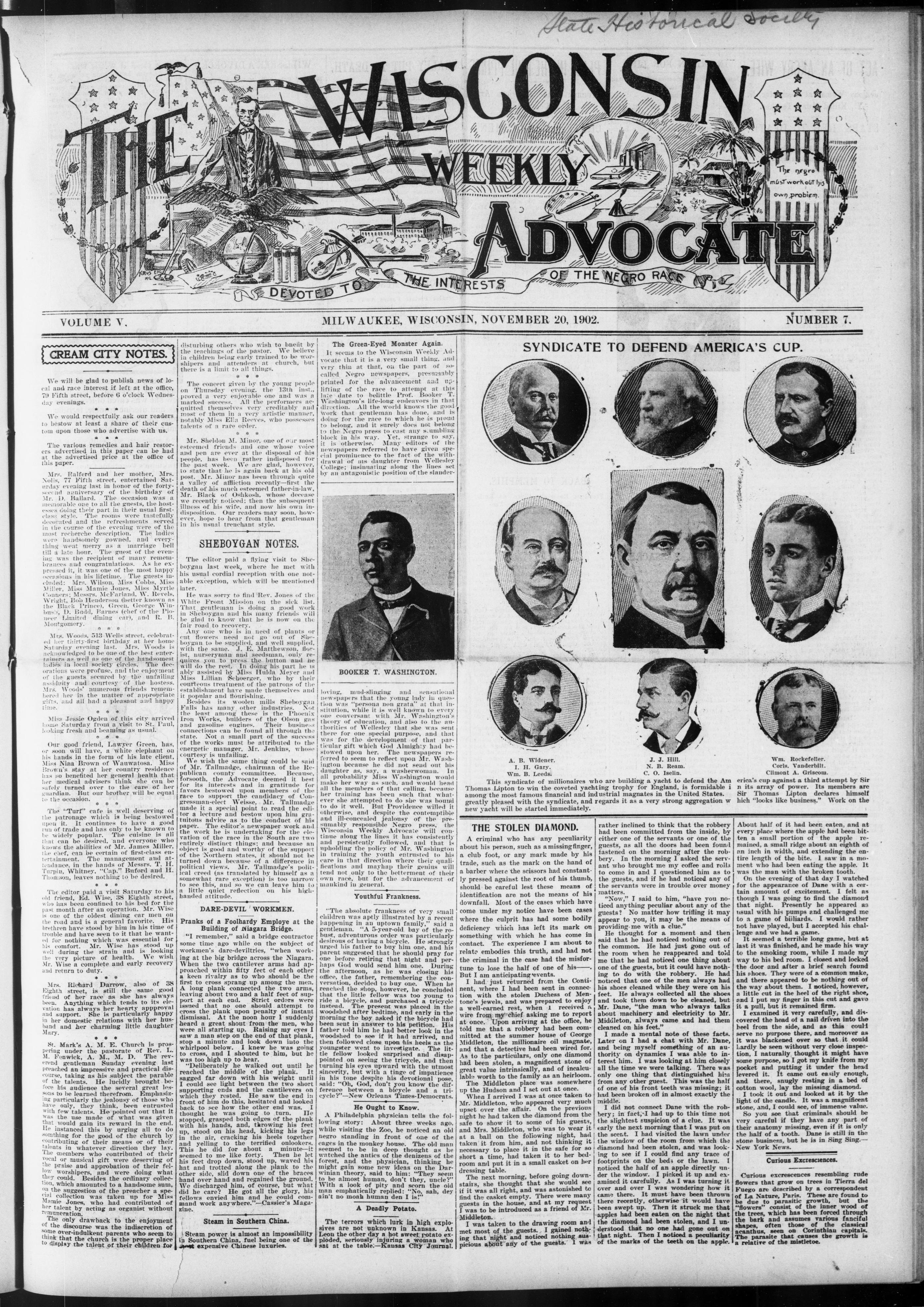
WISCONSIN
WEEKLY
ADVOCATE
DEVOTED TO THE INTERESTS OF THE NEGRO RACE
VOLUME V.
We will be glad to publish news of local and race interest if left at the office, 79 Fifth street, before 6 o'clock Wednesday day evenings.
☆ ☆ ☆
We would respectfully ask our readers to bestow at least a share of their custom upon those who advertise with us.
☆ ☆ ☆
The various remedies and hair restorers advertised in this paper can be had at the advertised price at the office of this paper.
Mrs. Ralferd and her mother, Mrs. Nolls, 77 Fifth street, entertained Saturday evening last in honor of the forty-second anniversary of the birthday of Mr. D. Ballard. The occasion was a memorable one to all the guests, the hostesses doing their part in their usual first-class style. The rooms were tastefully decorated and the refreshments served in the course of the evening were of the most recherche description. The ladies were handsomely gowned, and everything went merry as a marriage bell till a late hour. The guest of the evening was the recipient of many remembrances and congratulations. As he expressed it, it was one of the most happy occasions in his lifetime. The guests included: Mrs. Wilson, Miss Cobbs, Miss Miller, Miss Mamie Jones, Miss Myrtle Conners; Messrs. McFarland, W. Revels, Wright, Bob Henderson (better known as the Black Prince), Green, George Winbush, D. Budd, Barnes (chef of the Pioneer Limited dining car), and R. B Montgomery.
***
Mrs. Woods, 513 Wells street, celebrated her thirty-first birthday at her home Saturday evening last. Mrs. Woods is acknowledged to be one of the best entertainers as well as one of the handsomest ladies in local society circles. The decorations were profuse, and the enjoyment of the guests secured by the unfailing assiduity and courtesy of the hostess. Mrs. Woods' numerous friends remembered her in the matter of appropriate gifts, and all had a pleasant and happy time.
***
Miss Jessie Ogden of this city arrived home Saturday from a visit to St. Paul, looking fresh and beaming as usual.
***
Our good friend, Lawyer Green, has or soon will have, a white elephant on his hands in the form of his late client, Miss Nina Brown of Wauwatosa. Miss Brown's stay at her country residence has so benefited her general health that her medical advisers think she can be safely turned over to the care of her guardian. But our brother will be equal to the occasion.
The "Turf" cafe is well deserving of the patronage which is being bestowed upon it. It continues to have a good run of trade and has only to be known to be widely popular. The cuisine is all that can be desired, and everyone who knows the abilities of Mr. James Miller, the chef, can be certain of first-class entertainment. The management and attendance, in the hands of Messrs. T. H. Turpin, Whitney, "Cap." Buford and H. Thomson, leaves nothing to be desired.
* * *
The editor paid a visit Saturday to his old friend, Ed. Wise, 38 Eighth street, who has been confined to his bed for the past month after an operation. Mr. Wise is one of the oldest dining car men on the road and is a general favorite. His brethren have stood by him in his time of trouble and have seen to it that he wanted for nothing which was essential for his comfort. Mr. Wise has stood up well during the strain and is looking the very picture of health. We wish Mr. Wise a complete and early recovery and return to duty.
* * *
Mrs. Richard Darrow, also of 38 Eighth street, is still the same good friend of her race as she has always been. Anything which tends to its elevation has always her hearty approval and support. She is particularly happy in her domestic relations with her husband and her charming little daughter Mary.
* * *
St. Mark's A. M. E. Church is prospering under the pastorate of Rev. L. M. Fenwick, A. M., M. D. The reverend gentleman Sunday evening last preached an impressive and practical discourse, taking as his subject the parable of the talents. He lucidly brought before his audience the several great lessons to be learned therefrom. Emphasizing particularly the jealousy of those who have only, they think, been entrusted with few talents. He pointed out that it was the use made of what was given that would gain its reward in the end. He instanced this by urging all to do something for the good of the church by contributing of their means or of their talents in whatever direction they lay. The members who contributed of their vocal or musical gift were deserving of the praise and approbation of their fellow worshipers, and were doing what they could. Besides the ordinary collection, which amounted to a handsome sum, on the suggestion of the preacher a special collection was taken up for Miss Mamie Jones, who had contributed of her talent by acting as organist without remuneration.
The only drawback to the enjoyment of the discourse was the indiscretion of some over-indulgent parents who seem to think that the church is the proper place to display the talent of their children for
disturbing others who wish to bneat by the teachings of the pastor. We believe in children being early trained to be worshipers and attenders at church, but there is a limit to all things.
* * *
The concert given by the young people on Thursday evening, the 13th inst., proved a very enjoyable one and was a marked success. All the performers acquitted themselves very creditably and most of them in a very artistic manner, notably Miss Ella Reeves, who possesses talents of a rare order.
```markdown
```
Mr. Sheldon M. Minor, one of our most esteemed friends and one whose voice and pen are ever at the disposal of his people, has been rather indisposed for the past week. We are glad, however, to state that he is again back at his old post. Mr. Minor has been through quite a valley of affliction recently—first the death of his much esteemed father-in-law, Mr. Black of Oshkosh, whose decease we recently noticed; then the subsequent illness of his wife, and now his own indisposition. Our readers may soon, however, hope to hear from that gentleman in his usual trenchant style.
SHEBOYGAN NOTES.
The editor paid a flying visit to Sheboygan last week, where he met with his usual cordial reception with one notable exception, which will be mentioned later.
He was sorry to find Rev. Jones of the White Front Mission on the sick list. That gentleman is doing a good work in Sheboygan and his many friends will be glad to know that he is now on the fair road to recovery.
Any one who is in need of plants or cut flowers need not go out of Sheboygan to be supplied, and well supplied, with the same. J. E. Matthewson, florist, nurseryman and seedsman, only requires you to press the button and he will do the rest. In doing his part he usably assisted by Miss Hulda Meyer and Miss Lillian Schoerger, who by their courteous treatment of the patrons of the establishment have made themselves and it popular and flourishing.
Besides its woolen mills Sheboygan Falls has many other industries. Not the least among these is the Phoenix Iron Works, builders of the Olson gas and gasoline engines. Their business connections can be found all through the state. Not a small part of the success of the works must be attributed to the energetic manager, Mr. Jenkins, whose courtesy is unfailing.
We wish the same thing could be said of Mr. Tallmadge, chairman of the Republican county committee. Because, forsooth, the Advocate deemed it best for its interests and in gratitude for favors bestowed upon members of the race to support the candidacy of Congressman-elect Weisse, Mr. Tallmadge made it a special point to read the editor a lecture and bestow upon him gratious advice as to the conduct of his paper. The editor's newspaper work and the work he is undertaking for the elevation of the race in the South are two entirely distinct things; and because an object is good and worthy of the support of the Northern states, it should not be turned down because of a difference in political views. Mr. Tallmadge's political creed (as translated by himself as a somewhat rare exception) is too narrow to see this, and so we can leave him to a little quiet reflection on his high-handed attitude.
DARE-DEVIL WORKMEN.
Pranks of a Foolhardy Employee at the Building of Niagara Bridge.
"I remember," said a bridge contractor some time ago while on the subject of workmen's dare-deviltries, "when working at the big bridge across the Niagara. When the two cantilever arms had approached within fifty feet of each other a keen rivalry as to who should be the first to cross sprang up among the men. A long plank connected the two arms, leaving about two and a half feet of support at each end. Strict orders were issued that no one should attempt to cross the plank upon penalty of instant dismissal. At the noon hour I suddenly heard a great shout from the men, who were all starting up. Raising my eyes I saw a man step on the end of that plank, stop a minute and look down into the whirlpool below. I knew he was going to cross, and I shouted to him, but he was too high up to hear.
"Deliberately he walked out until he reached the middle of the plank. It sagged far down with his weight until I could see light between the two short supporting ends and the cantilevers on which they rested. He saw the end in front of him do this, hesitated and looked back to see how the other end was. I thought he was going to turn. He stopped, grasped both edges of the plank with his hands, and, throwing his feet up, stood on his head, kicking his legs in the air, cracking his heels together and yelling to the terrified onlookers. This he did for about a minute—it seemed to me like forty. Then he let his feet drop down, stood up, waved his hat and trotted along the plank to the other side, slid down one of the braces hand over hand and regained the ground. We discharged him, of course, but what did he care? He got all the glory, his fellows envied him and he could command work anywhere."—Cassier's Magazine.
Steam in Southern China.
Steam power is almost an impossibility in Southern China, fuel being one of the most expensive Chinese luxuries.
MILWAUKEE, WISCONSIN, NOVEMBER 20, 1902.
The Green-Eved Monster Again
It seems to the Wisconsin Weekly Advocate that it is a very small thing, and very thin at that, on the part of so-called Negro newspapers, presumably printed for the advancement and uplifting of the race to attempt at this late date to belittle Prof. Booker T. Washington's life-long endeavors in that direction. All the world knows the good work that gentleman has done, and is doing for the race to which he is proud to belong, and it surely does not belong to the Negro press to cast any s.umbling block in his way. Yet, strange to say, it is otherwise. Many editors of the newspapers referred to have given special prominence to the fact of the withdrawal of ms daughter from Wellesley College; insinuating along the lines set by an antagonistic position of the slander-
J. H.
BOOKER T. WASHINGTON.
loving, mud-slinging and sensational newspapers that the young lady in question was "persona non grata" at that institution, while it is well known to every one conversant with Mr. Washington's theory of education, and also to the authorities of Wellesley that she was sent there for one special purpose, and that was for the development of that particular gift which God Almighty had bestowed upon her. The newspapers referred to seem to reflect upon Mr. Washington because he did not send out his daughter as, say, a washerwoman. In all probability Miss Washington would make her way as such, and would head all the members of that calling, because her training has been such that whatever she attempted to do she was bound to do it well. But Providence willed it otherwise, and despite the contemptible and ill-concealed jealousy of the presumably responsible Negro press, the Wisconsin Weekly Advocate will continue along the lines it has consistently and persistently followed, and that is upholding the policy of Mr. Washington in training the youth entrusted to his care in that direction where their qualifications and mayhap their genius will tend not only to the betterment of their own race, but for the advancement of mankind in general.
Youthful Frankness.
---
"The absolute frankness of very small children was aptly illustrated by a recent happening in an uptown family," said a gentleman. "A 5-year-old bay of the robust, adventurous order was particularly desirous of having a bicycle. He strongly urged his father to buy him one, and his parent suggested that he should pray for one before retiring that night and perhaps God would send him one. During the afternoon, as he was closing his office, the father, remembering the conversation, decided to buy one. When he reached the shop, however, he concluded that the little fellow was too young to ride a bicycle, and purchased a tricycle instead. The present was placed in the woodshed after bedtime, and early in the morning the boy asked if the bicycle had been sent in answer to his petition. His father told him he had better look in the woodshed to see if it had arrived, and then followed close upon his heels as the youngster went to investigate. The little fellow looked surprised and disappointed on seeing the tricycle, and then turning his eyes upward with the utmost sincerity, but with a tinge of impatience in his tone despite his devotional pose, said: "Oh, God, don't you know the difference between a bicycle and a tricycle?"—New Orleans Times-Democrats.
He Ought to Know
A Philadelphia physician tells the following story: About three weeks ago, while visiting the Zoo, he noticed an old negro standing in front of one of the cages in the monkey house. The old man seemed to be in deep thought as he watched the antics of the denizens of the forest, and the physician, thinking he might gain some new ideas on the Darwinian theory, said to him: "They seem to be almost human, don't they, uncle?" With a look of pity and scorn the old man emphatically replied: "No, sah, dey ain't no moah human den I is!"
A Deadly Potato.
The terrors which lurk in high explosives are not unknown in Kansas. At Leon the other day a hot sweet potato exploded, seriously injuring a woman who sat at the table:—Kansas City Journal.
SYNDICATE TO DEFEND AMERICA'S CUP.
A. B. Wildener.
I. H. Gary.
Wm. B. Leeds.
J. J. Hill.
N. B. Ream.
C. O. Iselin.
Wm. Rockefeller.
Corls. Vanderbilt.
Climont A. Griscom.
This syndicate of millionaires who are building a yacht to defend the Am Thomas Lipton to win the coveted yachting trophy for England, is formidable in among the most famous financial and industrial magnates in the United States. greatly pleased with the syndicate, and regards it as a very strong aggregation w new yacht will be started immediately.
This syndicate of millionaires who are building a yacht to defend the Am Thomas Lipton to win the coveted yachting trophy for England, is formidable in among the most famous financial and industrial magnates in the United States. greatly pleased with the syndicate, and regards it as a very strong aggregation w new yacht will be started immediately.
THE STOLEN DIAMOND.
A criminal who has any peculiarity about his person, such as a missing finger, a club foot, or any mark made by his trade, such as the mark on the hand of a barber where the scissors had constantly pressed against the root of his thumb, should be careful lest these means of identification are not the means of his downfall. Most of the cases which have come under my notice have been cases where the culprit has had some bodily deficiency which has left its mark on something with which he has come in contact. The experience I am about to relate embodies this truth, and had not the criminal in the case had the misfortune to lose the half of one of his——. But I am anticipating events.
I had just returned from the Continent, where I had been sent in connection with the stolen Duchess of Mentone's jewels, and was prepared to enjoy a well-earned rest, when I received a wire from my chief asking me to report at once. Upon arriving at the office, he told me that a robbery had been committed at the summer house of George Middleton, the millionaire oil magnate, and that a detective had been wired for. As to the particulars, only one diamond had been stolen, a magnificent stone of great value intrinsically, and of incalculable worth to the family as an heirloom. The Middleton place was somewhere
The Middleton place was somewhere up the Hudson and I set out at once.
When I arrived I was at once taken to Mr. Middleton, who appeared very much upset over the affair. On the previous night he had taken the diamond from the safe to show it to some of his guests, and Mrs. Middleton, who was to wear it at a ball on the following night, had taken it from him, and not thinking it necessary to place it in the safe for so short a time, had taken it to her bedroom and put it in a small casket on her dressing table.
The next morning, before going downstairs, she thought that she would see if it was all right, and was astonished to find the casket empty. There were many guests in the house, and at my request I was to be introduced as a friend of Mr. Middleton.
I was taken to the drawing room and met most of the guests. I gained nothing that night and noticed nothing suspicious about any of the guests. I was
rather inclined to think that the robbery had been committed from the inside, by either one of the servants or one of the guests, as all the doors had been found fastened on the morning after the robbery. In the morning I asked the servant who brought me my coffee and rolls to come in and I questioned him as to the guests, and if he had noticed any of the servants were in trouble over money matters. "Now," I said to him, "have you noticed anything peculiar about any of the guests? No matter how trifling it may appear to you, it may be the means of providing me with a clue."
He thought for a moment and then said that he had noticed nothing out of the common. He had just gone out of the room when he reappeared and told me that he had noticed one thing about one of the guests, but it could have nothing to do with the robbery. He had noticed that one of the men always had his shoes cleaned while they were on his feet. He always collected all the shoes and took them down to be cleaned, but Mr. Dane, "the man who always talks about machinery and electricity to Mr. Middleton, always came and had them cleaned on his feet."
I made a mental note of these facts. Later on I had a chat with Mr. Dane, and being myself something of an authority on dynamics I was able to interest him. I was looking at him closely all the time we were talking. There was only one thing that distinguished him from any other guest. This was the half of one of his front teeth was missing; it had been broken off in almost exactly the middle.
I did not connect Dane with the robbery; in fact, I had up to this time not the slightest suspicion of a clue. It was early the next morning that I was put on the scent. I had visited the lawn under the window of the room from which the diamond had been stolen, and was looking to see if I could find any trace of footprints on the beds or the lawn. I noticed the half of an apple directly under the window. I picked it up and examined it carefully. As I was turning it over and over I was wondering how it came there. It must have been thrown there recently, otherwise it would have been swept up. Then it struck me that apples had been eaten on the night that the diamond had been stolen, and I understood that no one had gone out on that night. Then I noticed a peculiarity of the marks of the teeth on the apple.
NUMBER 7.
ICA'S CUP.
Wm. Rockefeller.
Corls. Vanderbilt.
Climont A. Griscom.
erica's cup against a third attempt by Sir n its array of power. Its members are Sir Thomas Lipton declares himself high "looks like business." Work on the
About half of it had been eaten, and at every place where the apple had been bitten a small portion of the apple remained, a small ridge about an eighth of an inch in width, and extending the entire length of the bite. I saw in a moment who had been eating the apple. It was the man with the broken tooth. On the evening of that day I watched for the appearance of Dane with a certain amount of excitement. I felt as though I was going to find the diamond that night. Presently he appeared as usual with his pumps and challenged me to a game of billiards. I would rather not have played, but I accepted his challenge and we had a game.
It seemed a terrible long game, but at last it was finished, and he made his way to the smoking room, while I made my way to his bed room. I closed and locked the door and after a brief search found his shoes. They were of a common make, and there appeared to be nothing out of the way about them. I noticed, however, a little cut in the heel of the right shoe, and I put my finger in this cut and gave it a pull, but it remained firm.
I examined it very carefully, and discovered the head of a nail driven into the heel from the side, and as this could serve no purpose there, and moreover as it was blackened over so that it could hardly be seen without very close inspection, I naturally thought it might have some purpose, so I got my knife from my pocket and putting it under the head levered it. It came out easily enough, and there, snugly resting in a bed of cotton wool, lay the missing diamond. I took it out and looked at it by the light of the candle. It was a magnificent stone, and I could see, of immense value.
So you see that criminals should be very careful if they have any part of their anatomy missing, even if it is only the half of a tooth. Dane is still in the stone business, but he is in Sing Sing.—New York News.
Curious Excresciences.
Curious excrescences resembling rude flowers that grow on trees in Tierra del Fuego are described by a correspondent of La Nature, Paris. These are found to be due to parasitic growth, but the "flowers" consist of the inner wood of the trees, which has been forced through the bark and assumes various fanciful shapes, often those of the classical acanthus, seen on Corinthian capitals. The parasite that causes the growth is a relative of the mistletoe.
ACT OF AN ANGRY WIFE.
Jealous Woman at Rochester, N. Y., Killed Music Teacher.
STABS HER TO DEATH.
Rochester, N. Y., Nov. 19.--Mrs. Lulu Miller Youngs, wife of former City Purchasing Agent Frank E. Youngs, killed Florence K. MacFarlan, a music teacher, 21 years old, daughter of James MacFarlan, at 543 Court street, after a struggle in the house, the victim fleeing before her assailant, who stabbed her in the breast and arms, the fatal thrust penetrating the woman's heart as she begged for her life. Jealousy was the cause. Within an hour after the crime was committed the police arrested the woman accused of the crime at the home of her father.
To her parents Mrs. Youngs confessed the crime, but declared she did not know how badly her victim was injured. Her intention, she said, was not to kill, but to maim. Frank E. Youngs, the husband of the woman under arrest, is a well-known man about town.
Note Left Husband.
A note in Mrs. Youngs' handwriting was found on the dresser at their home. It reads:
Frank: May God forgive you for all the trouble you have caused me. LULU.
trouble you have caused me. LULU.
Miss MacFarlan was rooming in the family of Mrs. Louis Savoy. Mrs. Phillip St. Louis, an aged woman who acts as cook, was the only other person in the house at the time. The door bell rang, and a tall woman stood at the door. Miss MacFarlan invited her in, and they sat in the little parlor. Suddenly Miss MacFarlan rushed out of the parlor toward the dining room. Mrs. Youngs was close behind her. A blow had been struck before this, for Miss MacFarlan stumbled and fell against the dining room table, and blood spurted over the white linen spread.
"What kind of play is this?" cried the aged woman, thinking that the women were playing. But Miss MacFarlan regained her balance and started for a little pantry. Mrs. Youngs rapidly followed her victim.
Miss McFarlan reached the pantry first and closed the door, trying to brace it against the entrance of the other, but Mrs. Youngs seemed to be possessed of the strength of a dozen women, and threw it open, advancing upon the girl, who fell upon her knees begging to be spared. The woman again attacked her, thrusting the knife into her breast, and, waiting a moment to exclaim that she had avenged the loss of her husband's love, left the house. She was arrested an hour later at the home of her father.
Letters in Girl's Room.
A search of Miss McFarlan's room was made, a picture of Youngs being found on the mantel. A number of letters were found which shed a little light on the tragedy, and pictures of the girl were also seen on the dresser. A gold locket, with the initials "F. K. M." was hanging from a slender gold chain on her neck. On opening it a picture was seen on the inside which was identified by the officials as that of Youngs.
Mrs. Youngs' father said:
"My daughter was married to Youngs about two years ago, and they have not lived happily. He has been running around with this woman for some time, and my daughter has been heartbroken over his actions. She has pleaded with him to no avail, and then she thought, I suppose, the only way to end the matter was to attack this woman, who came between them."
"Did your daughter admit to you that she killed the girl?"
Intent to Kill Denied.
"She told her mother and her sister at the house that she went to this girl's residence and stabbed her, but she did not know that she had killed her. She told us that this girl took her into the parlor and that while there Lulu, my daughter, upbraided her for her actions. The woman did not deny my daughter's accusations, she says, but instead began to abuse and berate her. Angered beyond control, Lulu pulled out the knife and stabbed her. I don't think she went there to kill her, and if the other woman had not insulted my daughter I do not think this crime would have been committed."
PLOTS AGAINST PRESIDENT
Anarchist Unburdens Herself in Moment of Religious Fervor—Assassins Chosen by Lot.
New York, Nov. 19.—Disclosures of three alleged plots to assassinate President Roosevelt since he has taken office were made in Hoboken by Mrs. Lena Dexheimer, who says she is a converted Anarchist.
Mrs. Dexheimer is an intelligent German woman. That she had been an Anarchist was a secret until one day last week, when she attended a meeting of the Mothers' Club at the First Methodist Episcopal Church, and unburdened herself in a moment of religious fervor.
In her association with Anarchists she says she learned of a plot to kill the President one year ago. The drawing of lots resulted in the task falling upon a young Frenchman named Melov. She had long talks with him afterwards, and tried to dissuade him from carrying out the plan.
He finally consented to return to France. Some weeks later he was killed on the streets of Paris, apparently by accident, but really, Mrs. Dexheimer says, by his own choice.
She was next told that, Melov having failed, a new lottery had been drawn. This time a man named Muller, or Mueller, had been chosen. A few days later this man was found dead from poison, self-administered. Another lottery indicated a woman named Schroeder, living in Harlem, was chosen, and she also ended her life by poison.
Mrs. Dexheimer says her connection with Anarchists began nineteen years ago, when she met Emma Goldman.
The woman's sanity will be made the subject of investigation.
NO TRACE OF EGAN.
Railway Company Assumes that He Has Perished and Appoints His
Successor.
St. Paul, Minn., Nov. 19.—In a circular issued today by the Great Northern Company the company accepts as a fact that Benjamin F. Egan, the missing superintendent of the Kalispen division, has perished and appoints A. E. Long as successor with the title of acting superintendent.
Mr. Egan disappeared in the mountains two weeks ago yesterday and search since then, carried on hourly by 200 men, has failed to find traces of the missing man.
IN PRISON FOR LIFE.
Joseph Beck of Menominee, Mich., Pleads Guilty to Awful Crimes.
Menominee, Mich., Nov. 19.—[Special.]—Joseph Beck, the self-confessed murderer of Julia Wozniak, 10 years old, on September 28, pleaded guilty in the circuit court this morning and was sentenced to life imprisonment at hard labor at the branch state prison in Marquette by Judge Stone.
The prisoner showed no emotion during the trial, all of which only took twenty minutes.
Beck was taken on the 11:30 o'clock train to Marquette, having been in the
[Name]
city only two hours. He was brought here at 9:30 this morning from Iron Mountain, where he was taken after the crime to prevent a lynching. No one knew of his coming today, as the matter had been kept quiet to prevent any violence. There was no crowd at the depot to meet him, and the prisoner was hustled to the jail before many people knew he had arrived. He was taken immediately to the court room, where he pleaded guilty.
The testimony of Chief of Police English and Drs. Hicks and Grignon was taken and the prisoner sat through all without moving a muscle. When asked if he had anything to say, he said no. Judge Stone then pronounced him guilty of murder in the first degree, and in delivering the sentence said that a double crime had been committed almost too horrible to realize as having been committed by a man of his intellect. He hoped he would think and repent, as he would have ample opportunity.
PLAN A MASSACRE.
Chinese Government Said to be Preparing for Another Outbreak Against Foreigners.
Pekin, Nov. 19.—The Chinese government is declared to be secretly planning another outbreak against the foreigners. News has been obtained from reliable sources that the Dowager Empress has received secret reports from all viceroyso and governors regarding the number of soldiers and amount of war munitions that could be raised, and instructions have been given to train the Manchoos in the use of the rifle and in Western drill, they then to be drafted to the different provinces to instruct the soldiery. Reports are now being received from the provinces of Yunnan and Kueichou that the Boxers are massing in those provinces.
The military Mandarin Lieu Lian Yu of Chenchou Fu, in the province of Honan, who was responsible for the murder of the English missionaries Bruce and Lewis last August, was executed at Channsha, in the presence of the British consular representatives. It had been reported that Lieu Lian Yu had escaped. The throne recently issued an edict ordering that he be beheaded and this order was carried out.
STORK CALLS ON ROYALTY
Daughter Born to the Queen of Italy— will be Called "Mafalda."
Rome, Nov. 19.—Queen Helena was accouched of a daughter this morning. The mother and child are announced to be doing well.
The new princess will be named "Mafalda."
The child born to the King and Queen of Italy today is the second daughter, the first, Princess Yolande Mafgherita, having been born at Rome on June 1, 1901.
The accouchement occurred a month earlier than was expected. The King yesterday was shooting on the island of Monte Christo when he was suddenly summoned home. He immediately boarded a yacht and was landed on the beach in the neighborhood of Rome. As there were no debarkation conveniences the King was carried ashore on the backs of sailors. A motor car was in waiting and he soon reached the palace.
The birth of another princess instead of an heir to the throne is a great public disappointment. United States Ambassador Meyer was the first outsider to personally congratulate the King. The sovereign was in excellent spirits. He declared he was satisfied with another daughter and said the Queen and the child were doing well.
APPEAL IS DENIED BY SUPREME COURT.
Application was Not Made Within the Time Prescribed by the Statute.
Washington, D. C., Nov. 19.—Justice Brewer of the United States supreme court today denied the application for an appeal from the decision of Judge Caldwell for the appointment of a master in chancery to supervise the coming election in the Colorado Fuel & Iron Company on the ground that the appeal had not been taken within the thirty days allowed by the statutes.
ARREST OF "BEAUTY DOCTOR."
Peoria Woman Held for the Death of a Patient in Pekin, Ill.
Peoria, Ill., Nov. 19.—Sheriff Mount and Coroner Holmes of Tazewell county came to Peoria and arrested Mrs. "Dr." Etzler, the magnetist, osteopath and beauty doctor, who is charged with the death of Mrs. Hattie Hart at Pekin. Mrs. Etzler was very vehement over her accusation, and says she will stir up some sensational developments. She characterizes the prosecution as blackmail. She admits that she canvassed Pekin, selling her beauty cure, but does not know whether or not she sold Mrs. Hart a bottle, as she kept no record.
PEACE IN THE PHILIPPINES
Chicago, Ill., Nov. 19.—"Peace now reigns throughout the entire archipelago, 1000 miles long and 700 miles wide."
This announcement was made by Maj.-Gen. Adna R. Chaffee at the banquet given in his honor by the Union League Club last evening. The soldier lowered his voice and there was satisfaction in his tone, as he announced the triumph of the American army.
But he was unwilling to take more than a modest share of the credit due. In front of the speaker's table sat a man dressed in civilian's clothes and few knew who he was. Pointing to him, Gen. Chaffee said:
"The officers and men in my command helped me to my honor, and they helped my loyal friend, Loyd Wheaton, to his honor, and no man is freer to acknowledge it than this prince of soldiers."
Gen. Wheaton bowed his head and there was loud applause.
Gen. Wheaton had been invited to sit with the guest of honor at the speakers' table, but modesty made him late. Gen. Chaffee saw him first as he threaded his way among the tables. He arose and reaching across the table beckoned him to approach.
Gen. Wheaton made his way round the board and Gen. Chaffee fell upon his neck without further ceremony. He threw his arm over the other's shoulder and hugged him, while Gen. Wheaton blushed modestly through his beard and dropped his head to hide the tears that coursed down his cheeks.
What they said was drowned by the cheers and salvos of the guests and then Gen. Wheaton sat down within sight of his former commanding officer. In his speech Gen. Chaffee referred often to the loyalty of his former subordinate, giving him his share in the honors, and each time Gen. Wheaton hid his bronzed face behind his hand and wiped away furtive tears.
BACK TO MEMPHIS.
President Roosevelt Given an Enthusiastic Reception in the Tennessee Metropolis.
Memphis, Tenn., Nov. 19.—President Roosevelt and party arrived in the city this morning promptly at 9 o'clock from Smedes, Miss., on a special train over the Yazoo & Mississippi Valley Railroad. The President upon his arrival here was given an enthusiastic demonstration. He was met by a large delegation of representative citizens with bands and escorts of police officers and detectives in plain clothes.
Cannon Boomed Salute.
The local committee desired Gen. Wright to await the President's coming at the Gayoso Hotel, but the general vetoed the arrangement and was the first to grasp the President's hand as he stepped from the train. The President greeted Gen. Wright with great cordiality.
The parade was at once formed, and as the long line swung into motion for the march through the city cannon stationed on the river front near the custom house boomed a salute of twenty-one guns.
The parade was headed by police officers, bands and a large escort of citizens on horseback, after which came the carriage containing the President, Gen. Luke E. Wright, Secretary Cortelyou and Chairman W. J. Crawford of the general committee.
The line, of march was first through the residence portion of the city to the custom house, and along the route many houses were decorated with flags and bunting. In the business portion of the city the crowds and decorations increased, the principal buildings being gay with colors. Along Main street the sidewalks presented solid lines of people and the President was kept busy bowing his acknowledgments of greetings.
The parade ended at the Hotel Gayoso, where the party alighted and an informal reception was held. Several hundred citizens shook hands with the President. Gen. Wright, who arrived in his native city last night, was also cordially greeted.
President Makes a Speech.
Gov. McMillan, Gen. Joe Wheeler and a number of other distinguished personages were present at the breakfast. In response to a toast proposed in his honor by Judge Hammond, on behalf of Mrs. Hammond, President Roosevelt responded as follows:
I do know of Southern women for I am the son of one of them (applause.) If anything could add to my pleasure at being here, on behalf of the nation, to speak of the debt of gratitude that we owe to Gen. Wright for the way he has stood for whatever is highest and best, out in the Philippines, it would be to have the chance of meeting Mrs. Wright. (Applause.)
I wish to say here that no small part of our future success in dealing with the people of the Philippines will depend upon the social attitude taken by our leading representatives toward them, and the work and a great debt of gratitude is due not only to Gov. Wright for the work that he has done in his sphere, but to Mrs. Wright for what she has done in hers. (Applause.)
Now, one word about the ladies of Memphis. That you are charming goes without saying; anyone can see that (applause), and that you have the proper spirit I am certain after having listened to Mrs. Hammond directing the judge what to say. (Applause.)
After the reception, President Koosevelt retired to his room for a short rest. The programme arranged for the day was very elaborate. At the Gayoso Hotel a banquet was tendered the President and Gen. Wright by the ladies of Memphis. This afternoon there were two receptions to Gen. Wright, one by the white citizens of Memphis at the Auditorium and the other by the colored people at their own hall on Beale street. Both of these receptions were attended by the President.
Failed to Shoot a Bear.
Smedes, Miss., Nov. 19.—President Roosevelt's bear hunt in Mississippi is ended, and he has not had even a shot at a bear. The last day of the chase was simply a repetition of the three preceding days so far as his luck was concerned. Try as the hunters would, they could not get a bear within range of the President's rifle.
The camp outfit was loaded into six mule wagons, the beds and sides of which were formed of the boards used for the table and tent floors.
When all was in readiness the President and the members of the party mounted their horses and rode into Smedes.
Upon the President's arrival here he found 500 people, practically all the negroes from the surrounding plantations, assembled to greet him. He thanked them for their demonstrations. At 9:30 the special train started for Memphis.
LEGALLY PUT TO DEATH.
JOHN TRUCK TAKES A SEAT IN ELECTRIC CHAIR.
Auburn, N. Y., Nov. 18.—John Truck was put to death in the electric chair in the state prison here today for the murder of Frank W. Miller at Virgil, Cortland county, March 14, 1899. Truck met his fate calmly and five minutes after the witnesses had assembled in the death chamber he was pronounced dead. The motive for the murder of Miller was robbery. Truck first crushed in the skull of his victim and then set fire to the house, thinking thus to destroy the evidence of his crime. The body of Miller was recovered, however, and the crime was traced to Truck, who had a criminal record. He was also suspected of other crimes in Cortland county, including one if not two more murders.
BISHOP THOMPSON DIES.
Venerable Prelate Passes Away at His Home in Jackson, Miss
Jackson, Miss., Nov. 18.—Bishop Hugh Miller Thompson of the Episcopal diocese of Mississippi died at 5 o'clock this morning.
The cause of death was cancer of the throat. Since his arrival here from New York a week ago Bishop Thompson had been sinking rapidly and had made all preparations for the end, which came peacefully and while surrounded by his family and friends.
He was born in Londonderry, Ireland, in 1830, and came to America with his parents when a child. He was almitted to the ministry when 22 years old and filled several prominent pulpits in Chicago, New York and elsewhere. He was appointed bishop of the diocese of Mississippi in 1886.
The funeral has been arranged for Thursday in order that all clergymen of the Mississippi diocese may be present. A number of Southern bishops will attend and Bishop Gailor of Tennessee will conduct the services. The remains will be interred under the chancel of St. Columbia chapel, a small stone edifice in the corner of the yard of the bishop's home.
Bishop Thompson was well known in Wisconsin and Milwaukee, where he labored for twelve years. In 1858 and 1859 he was rector of St. Matthew's, Kenosha. In 1860 he was elected professor of church history at Nashotah and filled that chair for ten years. During part of that time he was assistant rector of St. Paul's, Milwaukee. In 1860 he was editor of the American Churchman, then published here. From Wisconsin he went to Chicago, where he was rector of St. James'. He was consecrated assistant bishop of Mississippi in 1863.
CUBA REBELLIOUS.
Campaign Against Platt Amendment Begun—Plan to Rescind All Military Orders
Havana, Nov. 18.—An agreement between the nationalists and six members of the radical party has given the coalition control of the House of Representatives. Speaker Pelayo and his associates, representing the Republicans, have resigned, as they are now in the minority. The new controlling element is not considered antagonistic to President Palma, but there is reason to believe that a strong campaign against the Platt amendment will be begun, and that an attempt also will be made to rescind all the military orders.
An expert on tariffs says that the effect of a treaty with the United States will be to deliver all trade in articles of prime necessity into the hands of Americans. Therefore, opposition to the treaty is more likely to be felt from the Spaniards, who control commerce here, than from the planters. However, as the Spaniards are foreigners, it is not likely they will take any part in the negotiations.
It is held that if Cuba accepts a 20 per cent. reduction in American duties in exchange for the bulk of her trade there will be no chance later of obtaining larger concessions, as the island then will have nothing to offer in return.
Nevertheless, it is said in some quarters that Americans will find themselves deceived if they think a treaty will give them all the Cuban trade, as the people will continue to buy European articles even at higher prices.
SUIT WAS DISMISSED.
Action Brought by Victor K. McElhenny Against American Malting Company.
New York, Nov. 18.—The suit brought by Archibald Hutchinson and Victor K. McElhenny, Jr., against the directors of the American Malting Company to compel them to restore to the treasury of the company $1,855,350 alleged to have been illegally presented as dividends to the holders of preferred stock of the company and also to restore $650,000 alleged to have been lost to the company by the mismanagement of the directors was today dismissed in the supreme court.
TROUBLE FOR SMOOT.
Mormon will Find Road to United States Senate Somewhat Rocky—Preparing for a Fight.
Salt Lake City, Utah, Nov. 18.—The Ministerial Alliance of Salt Lake City is making preparation for a vigorous fight against the election of Apostle Reed Smoot to the United States Senate and, failing in this, to carry the fight against him to the halls of Congress. A plan for organized efforts on this line, it is said, has already been outlined and will be taken up at the next meeting of the alliance. The general idea is to make a fight similar to that waged against Brigham H. Roberts in the House.
VETERAN EDITOR DIES.
John Bell Bouton, Formerly of Cleveland Plain Dealer and Latterly of New York Journal of Commerce.
Cambridge, Mass., Nov. 18.—John Bell Bouton, formerly one of the editors of the Cleveland Plain Dealer and afterwards for about thirty years an editor and properietor of the New York Journal of Commerce, died today at his home in this city at the age of 72 years. Mr. Bouton was the author of a number of works of fiction and of travel. For ten years he was one of the editors of Appleton's annual encyclopedia.
WILL SEEK A DIVORCE
Wife of Roland B. Molineux Takes Up Her Residence in South Dakota.
Sioux Falls, S. D., Nov. 18.—Mrs. Roland B. Molineux authorizes the statement that she is in South Dakota for the purpose of securing a divorce from her husband, who was last week acquitted of the charge of murder after two sensational trials.
Mrs. Molineux declines to state the nature of the grounds upon which the suit will be based. Nothing in reference to it will be definitely known until after the expiration of the six months necessary to establish a residence, when the papers in the suit will be filed in the office of the clerk of courts and the contents will become public property.
Mrs. Molineux refers to her husband in terms which are anything but flattering. She does not refer to him by name or as her husband, but invariably speaks of him as "that man."
Says She is Martyred.
New York, Nov. 18.—The following dispatch from Mrs. Malineux at Sioux Falls has been received:
Your information is correct. Am in Sioux Falls to institute divorce proceedings. I have been martyred and I am justified in seeking my freedom.
Mrs. Molineux has taken apartments of three rooms in the Cataract hotel in Sioux Falls and will make her home there. She has had a piano placed in her apartments with which to pass away her leisure hours.
At the home of Gen. Molineux in Brooklyn all information in regard to the report was refused.
Mrs. Molineux's absence from court during her husband's latest trial revived rumors of family differences, but she went to the Molineux residence in Brooklyn a few hours after her husband was acquitted.
Simply for Appearances.
Her visit to the home of Gen Molineux last week, after the acquittal of the son and husband, was simply for appearances, at the earnest solicitation of Gen. Molineux. She consented to visit his home for a period of two days after the verunct had freed her husband, but on the understanding and promise that she should not see her husband. After remaining there two days, during which time she did not speak to or see her husband, she left for Sioux Falls with the intention of procuring a divorce.
New York, Nov. 18.—Roland B. Molineux and his father were in conference with their counsel, George Gordon Battle, today. At the close of the talk Mr. Battle made the following statement:
"Neither Gen. Edward L. Molineux nor his son, Roland B. Molineux, nor any other member of the family, will make any statement in regard to the report in the press that Mrs. Roland B. Molineux has gone to South Dakota with the purpose of instituting an action for divorce against her husband.
"They regard it as a private matter concerning which no public utterance should be made. Gen. Molineux desires to say further that all the members of his family have at all times treated Mrs. Roland B. Molineux with the utmost kindness and consideration. This is his last word on the subject."
Mr. Battle said that he had not been retained to defend the divorce suit.
Sioux Falls, S. D., Nov. 18.—Mrs. R. B. Molineux today gave out in her own handwriting the following statement:
"It is true I am in Sioux Falls for the purpose of instituting divorce proceedings. I have no plans except that I shall be a resident here for the next six months."
HAS STRANGE MALADY.
Prof. Kelsey Dying of an Affliction of the Liver which is Said to be Very Rare.
Ann Arbor, Mich., Nov. 18.—Prof. Francis Kelsey, head of the Latin department of the University of Michigan, former head of the American classical school at Rome, Italy, and author of many Latin text books, lies at the point of death from a strange affection of the liver. An operation which has just been performed may save his life. Prof. Kelsey's liver was found full of cysts infected with germs. The operation was for the purpose of removing these cysts, but many could not be removed. The surgeons say that the case is the first of the sort in the United States in nine years and the eighteenth case known of in the world.
—W. Guenther, 36 years old, died from the effects of injuries received from a fall from a roof.
—Augustia Fosteman, 35 years old, died of heart disease at her home. The woman had been in poor health for some time.
—The body of a man 70 years old was found lying on the railroad tracks. The police believe the man was struck by a passenger train.
—In an accident caused by the collapse of a scaffolding surrounding an elevator shaft which was being repaired, Sherman Moran, aged 26, was killed and two were injured.
—Charles Cullen, 26 years old, was shot in the right cheek in a quarrel. The bullet is said to have been fired by Emil Charbonneau, 21 years old, and he was placed under arrest.
City hall employees are marveling at the fortune of "Con" O'Neill, an elevator man, whose careful selection of horses at the Latonia and Oakland tracks yielded $120 on an investment of $1.
Mrs. Benjamin S. Sanborn of Evanston, wife of a member of the board of trade, found a sneak thief in her room. She grappled with him, made him disgorge her watch and chain and jewelry from his pockets, and then attempted to arrest, but after an exciting scuffle the thief broke away and made his escape.
—Herman B. Wickersham, formerly president of the Lincoln park board and Marquette Club, is under arrest on a warrant sworn out by Justice Q. J. Chott charging the embezzlement of a trust fund. The accused man refuses to make an explanation, and the police magistrate alleges that more startling charges will be made.
—The oft-recurring strikes at the Conkey printing plant at Hammond, Ind., which have been marked by disorder and bloodshed, culminated in the shooting of a 19-year-old striker, Arthur Rusch. His assailant was one of a group of private detectives, all of whom fled before the police arrived. Rusch was shot in the chest and his condition is considered critical.
An Important Decision.
A London justice has just made an important decision regarding dressmakers' disputes. He will not have dresses tried on in court because "he had long since come to the conclusion that with ordinary dresses any lady could wear a dress to make it look as if it did not fit," and he was also perfectly satisfied that "any milliner or dressmaker could pull it about and make it fit when it did not do so." This decision is respectfully commended to the justices of our city court.
A Career of Wedded Bliss.
If America had a fair at which a flitch of bacon was given to the couple which has lived together without quarreling, the prize would undoubtedly go to Mr. and Mrs. John Iams of Washington county, Ia. They have been married for seventy-four years and protest that a cross word never darkened the happiness of their wedded life. Mr. Iams is 93 and his wife is 92, and they have ten children, thirty-six grandchildren and sixty-five great-grandchildren.
Itchiness of the skin, horrible plague. Most everybody afflicted in one way or another. Only one safe, never failing cure. Doan's Ointment. At any drug store, 50 cents.
—William IV. was at the time when he succeeded to the throne the first William of Hanover, the second William of Ireland and the third William of Scotland.
—The smallest bone in the human body is the lenticular, seated in the ear.
A
Another club woman, Mrs. Haule, of Edgerton, Wis., tells how she was cured of irregularities and uterine trouble, terrible pains and backache by Lydia E. Pinkham's Vegetable Compound. "A while ago my health began to fail because of female troubles. The doctor did not help me. I remembered that my mother had used Lydia E. Pinkham's Vegetable Compound on many occasions for irregularities and uterine troubles, and I felt sure that it could not harm me at any rate to give it a trial.
"I was certainly glad to find that within a week I felt much better, the terrible pains in my back and side were beginning to cease, and at the time of menstruation I did not have nearly as serious a time as heretofore, so I continued its use for two months, and at the end of that time I was like a new woman. I really have never felt better in my life, have not had a sick headache since, and weigh 20 pounds more than I ever did, so I unhesitatingly recommend Vegetable Compound."—Mrs. MAY HAULE, Edgerton, Wis., President Household Economics Club. —$5000 forfelt if original of above letter proving genuliness cannot be produced.
Women should remember there is one tried and true remedy for all female ills, Lydia E. Pinkham's Vegetable Compound. Refuse to buy any other medicine you need the best.
STEDMAN'S MENTHOL INHALERS
1
```markdown
```
The Medicated Air Treatment
BREATHE IT IN
will cure Coughs, Colds,
Catarrh, Headache, Asthma,
Bronchitis, and all nasal and throat diseases.
Prevents La Grippe and Pneumonia.
Sold by all druggists or sent by mail on receipt of price.
Send address on postal card for further information.
STEDMAN & CO.
Milwaukee, Wis.
WET WEATHER COMFORT
There is no satisfaction keener than being dry and comfortable when out in the hardest storm.
YOU ARE SURE OF THIS IF YOU WEAR
TOWER'S
FISH BRAND
WATERPROOF
OILED CLOTHING
MADE IN BLACK OR YELLOW
AND BACKED BY OUR GUARANTEE.
A.J. TOWER CO., BOSTON, MASS.
ASK YOUR DEALER.
If he will not supply you
send for our free catalogue of garments and hats.
CATARRH
ELY'S
CREAM BALM
CATARRH
ROSE COLD
HAYFEVER
CURES COLD IN HEAD
DEHNESS
HEADACHE
ELY BROS.
NEW YORK
COLD IN HEAD
Ely's Cream Balm
Easy and pleasant to
use. Contains no
injurious drug.
It is quickly absorbed,
Gives Relief at once.
It Opens and Cleanse
the Nasal Passages.
Allays Inflammation.
Heals and Protects the Membrane. Restores the Senses of Taste and Smell. Large Size, 50 cents; Tria. Size, 10 cents, at Druggists or by mail. ELY BROTHERS, 56 Warren Street, New York. HAMLIN'S WIZARD OIL FOR EARACHE ALL DRUGGISTS SELL IT
WHEN WRITING TO ADVERTISERS please say you saw the Advertisement in this paper.
WANTED Ladies to become trained nurses or midwives; the best school is Red Cross, 468 Eighth street, Milwaukee, Wis., tuition reasonable. Send for booklet.
A THANKSGIVING SONG
O Thou, to whom our fathers bowed of old,
Whose holy name was by their lips extolled,
Be our thanksgiving lifted unto Thee
For blessings multiform and manifold!
Thanksgiving for all gracious eye-delight—
The nimble water dancing down the height,
The irradiant tints that flower the open
fields,
The glamour of the sunset and the night!
Thanksgiving for the sweetnesses of
speech—
The harmonies that tuneful bird-tongues teach.
The passionate arpeggios of the wind.
The lyric tree-tops calling each to each!
Thanksgiving for high friendship!—for the thrill
Of heart to heart when twilight hours grow still;
For noble thoughts and sacrificial deeds
That show the working of the master will!
Thanksgiving for the manifest design
Through which the ascending coils of being shine!—
For every beckoning beacon-fire that leads
The striving mortal up to the divine!
Thanksgiving for Thine unremitting ward
In stress of strife, in time of blessed accord
And mayst Thou be our guide and guar
dust still
dian still,
O Lord, that wert of old our fathers' Lord
—Clinton Scollard in Collier's Weekly.
A TARDY THANKSGIVING.
BY MARY E WILKINS.
"I s'pose you air goin' down to Hannah's to spend Thanksgivin', Mis' Muzzy?"
The old lady who asked the question was seated in Mrs. Muzzy's best hair-cloth rocking chair, which had been brought out of the parlor for the occasion. She had a mild, tiny featured face, wore a false front of auburn hair and a black lace cap decorated with purple ribbons, and was knitting—putting new heels into some blue yarn stockings.
The answer she got to her question, delivered in her prim, purring, company tone, made her jump nervously.
"No; I ain't goin' a step, not if I know what I am about!"
The words shot out of Mrs. Muzzy's mouth as if each one had had a charge of powder in its rear, and the speaker went on jerking the stout thread viciously through the seam she was sewing.
She was a squarely built woman, compactly fleshy. There was a bright red color in each of her cheeks; there was not a vague line in her whole face; her mouth opened and shut unhesitatingly and fairly, and she looked out of her small brown eyes directly, with no circumlocution.
"Mebbe you air goin' to your brother Andrew's then?" ventured the old lady feebly.
"No, Mis' Field; I ain't a-goin' nowhere."
"But," purred the old lady, "ain't you afear you'll be awful lonesome? Lor.",
I don't know what I should do ef it warn't for Serrah an' her children on a Thanksgivin' day. To be sure, you ain't got any children an' grandchildren to go to, but thar's your sister Hannah an' hers an' Andrew an' his, an' it kinder seems as if brothers an' sisters come next."
"Thar ain't no use talkin'," said Mrs. Muzzy in a loud, clear-cut voice. "I ain't a-goin' to Hannah's to Thanksgivin', an' I ain't a-goin' to Andrew's to Thanksgivin', an' I ain't a-goin to hew Thanksgivin' to hum. I ain't got nothin' to give thanks fur, as I see on. I spose ef I could go to meetin' Thanksgivin' mornin' an' hear the sermon, an' then set down to turkey an' plum puddin', an' be a-thankin' the Lord in my heart fer lettin' my husband fall off the scaffold in the barn an' git killed last summer, an' fer lettin' my daughter Charlotte die of quick consumption last spring, an' my son John two years ago this fall, I might keep Thanksgivin' as well as other folks. But I can't, an' I ain't a-going to puttend to. Thar's one thing about it—I ain't a hypocrite, an' I never was."
"What air you a-goin' to do, Mis' Muzzy?"
"Do!" Mrs. Muzzy sniffed. "Do! I'm a-goin' to stay to hum an'—do my pig-work."
The old lady's small featured countenance, from its very mechanism, was incapable of expressing any very strong emotion, but it took on now a look of gentle horror. She dropped her knitting work, and her dim blue eyes seemed to take up the whole of her spectacles.
"Lor' sakes, Mis' Muzzy! Pig-work on Thanksgivin' day! I never heard anything like it!"
"I don't keer. The pig-work has got to be done, an' I might just as well do it Thanksgivin' day as any other. I feel enough sight more like it than eatin' turkey an' plum puddin', with all I've been through."
"Ain't you a-goin' to meetin'?" "No." "Lor' sakes!" The old lady fell to knitting again in a mild daze. Mrs. Muzzy would have been too much for her in her best days; now she almost reduced her to lunacy. Still this old lady, who was a neighbor living about a quarter of a mile distant, felt for her the attraction which weak natures often feel for the strong. She was very fond of dropping in of an afternoon with her knitting work. There was not so much difference in their ages as one might think at first, either, although Mrs. Muzzy was so much younger looking. Her daughter, who had died the spring before, had been a schoolmate of Mrs. Field's Sarah.
The old lady often accepted the invitation to stay and take a cup of tea, but today she shortened her call a little. The "pig-work" on Thanksgiving day rankled in her mind, and she wanted to go home and tell her daughter Sarah.
After she had gone Mrs. Muzzy went from the warm sitting room into her cold, exquisitely neat kitchen and kindled a fire in the cooking stove and made herself a cup of tea. Though she was living alone every meal was prepared and eaten with religious exactitude. She spread a white cloth over the table, put on some slices of bread, a little dish of quince sauce and some custard pie. Then she sat down with a sort of defiant appetite.
She had finished her bread and sauce and begun on her pie when the kitchen door—whichled directly outdoors—opened and a girl of 20 or so walked in.
"How d'ye do, Lizzie?" said Mrs. Muzzy.
"Pretty well, Aunt Jane." replied the girl, listlessly, and she sank down in the nearest chair.
She was a tall, slender girl, with dun-colored hair. She had delicate features, and would have been pretty if it had not been for the pitiful droop at the corners of her mouth, the dullness of her eyes and dark rings under them.
"Hev some custard pie?"
"No, thank you, I am not hungry."
"Hev you ent any supper?"
"I don't know—yes, I think so—some bread and butter."
"I saw young Allen go by here 'bout 8 o'clock, ridin' with that Hammond girl," remarked Mrs. Muzzy, eyeing her niece sharply.
She only looked at her aunt in the same way she had done before, with an expression of misery too hopeless and settled to be augmented.
"Yes," she replied: "I saw them."
"She's a pretty-looking' gal. Her cheeks air as red as roses, an' she had on a hansome bunnit."
"Yes."
"It's quite a long time since he's been to see you." "Yes."
Never was such complete unresistance to a tormentor, if tormentor she meant to be.
"Well, I wouldn't mind, anyhow, ef I was you," said Mrs. Muzzy, looking at the girl's weary face and changing her tone a little. "Let him go, ef he wants to. Just show him you don't keer."
The girl woke up a litte at that. "Show him I don't care!" she cried passionately. "He knows I care. It would be a disgrace to me if I didn't care after I've been going with him for three years, and he leaving me for a new face. It's no use pretending I don't. I don't see why folks tell me to. My heart ought to be broken, and it is."
"I'd hey more sperrit."
"I've never seen it." "Would you? Well, I'm made different, I suppose," said the girl, and her face took on its listless expression again. Her aunt finished her second cup of tea and began to clear away the table.
"I ain't a-goin' nowheres: I'm a-goin' to stay to hum an' do my pig-work."
"Pig-work?"
"Yes; I'm a-goin' to hev 'em killed Tuesday."
Her surprise made Lizzie for a minute look like another girl. "But, Aunt Jane, why? I never heard of such a thing. Pig-work on Thanksgiving day!"
Mrs. Muzzy braced herself defiantly. "Look a-here, Lizzie Munroe," quoth she; "you think you're down as fur as anybody kin be, because you've lost your bean. Well, I've lost my husband, that I've lived with for forty year, and that was more than any beau, an' I've lost my daughter, both of 'em this year, an' two year ago this fall my son John, an' I don't see as I've got anything to be thankful for. I ain't a-goin' to keep Thanksgivin' day an' eat turkey an' plum puddin'. I feel enough sight more like doin' pig-work, an' I'm a-goin' to." The girl's dull eyes seemed to catch a gleam from her aunt's. For a minute she looked strangely like her. Mrs. Muzzy's passionate, defiant nature fired her niece's more unresisting, hopeless one.
"Well, Aunt Jane," she said, in a tote like an echo of her aunt's, "I don't wonder you feel so. And—I don't care about eating turkey and plum pudding either—I'll come over and help you."
Mrs. Muzzy looked startled for a minute. Perhaps her own spirit reflected in another looked differently to her.
"Well, Lizzie, jest as you like," she said then. "I'll be glad of your help; it's considerable to do, pig-work all alone, an' I've never been used to it"—with a sigh.
"Well, I'll come, Aunt Jane."
There was a long silence; then the girl took her sad face out of the door, and her aunt, having set away the last of her tea things, went back into her warm sitting room; the kitchen fire was going out and it was growing cold.
Thanksgiving morning, a week later, was gray and cloudy and the air felt like snow. Mrs. Muzzzy's kitchen was full of steaming, glowing heat. She had two immense iron kettles on her stove, and was busily cutting pork into small square bits to try out.
Lizzie was helping there, too. She had come over early. Her sad young face looked sadder this morning. The cold, gray light brought out all of the pitiful, drooping lines more plainly. She had probably been weeping instead of sleeping the night before. Her dun-colored hair was put back plainly and neatly; grief did not with her manifest itself in untidiness, though she never crimped her hair now. Lizzie looked like another girl with her hair crimped. Her dark print fitted over her slender shoulders trimly, and she wore a little white ruffle in the neck. She was cutting pork; too; her wrists, though small, were muscular, and she worked steadily and effectively, though with a pathetic indifference. Mrs. Muzzy's firmly set face betrayed little of it, but she really eyed her niece from time to time with furtive uneasiness.
She had an inner consciousness, ever present to herself, that her state of mind was highly culpable, but she undertook the responsibility for herself with sullen defiance. It was another thing, however, to be responsible for a similar state in another. Lizzie, standing there with her dull, hopeless face, indefatigably cutting pork, seemed to her like the visible fruit of her own rebellious nature.
"Hev you seen Jenny Bostwick lately?" asked she, with a desperate determination to alter her niece's expression.
"No," replied Lizzie slowly. "Joe hasn't left her. They're always together. I can't bear to go there."
"I know," said Mrs. Muzzy with a quick, sympathetic recognition of the feeling. "I felt that way after John died. I couldn't bear to go into Mis' Mann's, because there was her Edward—she'd had him spared, an' my boy'd been taken."
There was something startling in the frankness, almost shamelessness, of the girl's avowal of envious misery and her aunt's instantaneous sympathy with it. It was as if their two natures were growing more and more into an evil accord.
About 10 o'clock the front door bell rang.
"You go to the door, Lizzie," said Mrs. Muzzy; "you look better'n I."
Lizzie took off her apron and went obediently. Time was when the tinkle of the door bell could make her tremble all over, but she was calm enough now. It was six months since George Allen had been to see her, and she had given up all hope of his ever coming again.
Mrs. Muzzy heard the door open and shut, then a murmur of voices in the sitting room. One of the voices was unquestionably a man's, low pitched and earnest. Lizzie seemed to break into sobs now and then, and once she laughed. Mrs. Muzzy started when she heard that; she had almost forgotten how Lizzie's laugh sounded.
"Who on earth has Lizzie got in there?" she muttered to herself; but she was a woman who could keep her curiosity in check. She went steadily on with her work till the sitting room door opened and Lizzie came out.
But was it Lizzie? The girl with those pink cheeks and radiant eyes and that dimpling mouth? Mrs. Muzzy laid her knife down and stared at her.
"It's George! George!" said Lizzie in a happy trembling whisper that seemed almost ready to break out into a scream of joy. "He's come to—to take me to his house for dinner. I'm going home to change my dress and get ready." She was trembling so she could hardly move, but she began pinning on her shawl in joyful haste.
"Lizzie Munroe," said her aunt sternly, "you don't mean to say you're goin' on with that fellow after all that's happened?"
"Yes, I am; he's come for me." Great tears of pure delight rolled down her cheeks. She had her hood on now, and turned impatiently toward the sitting room door.
"Come for you! I s'pose ef he'd got married to that Hammond girl an' come for you, you'd gone just the same!" cried her aunt, with coarse sarcasm.
"Yes, I would!" cried Lizzie recklessly, her hand on the doorknob.
"I don't b'lieve but what that Hammond girl's given him the mitten, else he wouldn't a' come. I wouldn't play second fiddle for any feller."
"I would for him!" cried Lizzie, as shameless in her happiness as she had been in her misery. She opened the door a crack and peeped in; then she turned
to her aunt, her eyes like stars, her cheeks fairly ablaze.
"Goodby, Aunt Jane," she said. "I'm sorry to leave you alone with the pig-work. You'd better change your mind an' go over to mother's to dinner."
Mrs. Muzzy vouchsafed no reply, and Lizzie went into the sitting room and shut the door.
Pretty soon her aunt watched her and her truant sweetheart walking down the street. Lizzie was actually hanging on his arm in broad daylight.
"I don't see where she took such a disposition," muttered Mrs. Muzzy. "Not from my side. I'd never have made such a fool of myself over a feller."
Then she went on with her pig-work, righteous indignation and scorn against Lizzie mingling in her bosom with rebellion against the will of the Lord.
It had always been her boast that she wasn't one of the kind of women who are forever dropping things and getting burned and scalded and cutting her fingers. She thought there was no kind of need of it, if anybody had her wits about her, and didn't fly about like a hen with her head cut off.
She was to prove, however, today that her boasting for one occasion at least was vain.
She had lifted the first kettle of boiling lard off the stove in safety and deposited it in the sink. The second—how she did it she never knew, whether the sudden weakening of a muscle or the slipping of a finger occasioned it—she dropped bodily as she was lifting it from the fire.
None of the hot fat went on the stove or there would have been a worse complication of disasters. It landed on the floor and Mrs. Muzzy's right foot. She lost none of her resolute coolness with the sudden shock and agony. The kettle was scorching the floor; you could smell the burning paint. She lifted it on the stove hearth and cast a distrustful and indignant glance at the molten grease spreading over the floor.
Then she had luckily a pair of scissors within reach. She sat down and cut off with convulsive shivers of pain, but grim determination, her shoe and stocking. The foot was shockingly burned. She set her lips hard when she saw it.
"A half winter's job," said she.
"Well!"
She dragged herself in her chair with one foot, hitching herself along into the buttery to the flour barrel. She powdered the wounded foot thickly with flour and hitched back.
"There," said she, "that's all I can do. There ought to be oil and bandages and things, but I've got to set still. I wish somebody would come."
Then she sat there in silent endurance in the midst of the grease, which had cooled and formed a white coating over the kitchen floor. Her foot was a mass of torture. She did not have long to wait for help, however; she had not been sitting there half an hour when she heard quick footsteps on the frozen ground outside.
"Open the door. Jane," called the voice of her sister Hannah, Lizzie's mother. "I've got my hands full."
"I can't," responded Mrs. Muzzy, "you'll hev to do it yourself."
The door opened after a second. The called, who had a large plate in each hand, stopped short in utter dismay as she took in the aspect of things—her sister with her floury foot and pale face and the lard on the floor.
"Why, what hev you done, Jane?" she cried.
Mrs. Muzzy looked up and actually smiled, the first time her sister had seen her do so for many a day. "What hev you got thar, Hannah?" asked she.
"Why, I brough you over some Thanksgivin' dinner; but I guess you won't feel like eatin' any now."
"Yes, I do. Bring it here."
Yes, I do. Bring it here.
"But you want somethin' done more for your foot. Did you tip the hot bird right on to it? Don't it ache? Hadn't you better wait an' eat your dinner after the foot's been seen to?"
"No, Hannah; I want it now. I want to eat some turkey an' plum puddin' afore I'm an hour older, an' keep Thanksgivin'. I said I wouldn't, but the Lord got ahead of me, an' I'm glad he has. Bring it here an' I'll eat my dinner, an' then mebbe I kin hev somethin' more done for my foot."
Her sister gave in then, and Mrs. Muzzy, her forehead wrinkled with pain, sat there and ate her Thanksgiving dinner to the very last mouthful.
"Lizzie's feelin' happier," she remarked once.
"Yes; George came to take her to his folks to dinner."
"Well, I'm glad of it ef she's goin' to feel any better."
"You would be ef you was her mother," said her sister simply.—From "A Humble Romance."
Prospective Juror put on the Rack by the Attorneys.
The prospective juror was under examination by the attorney for the defense.
"Have you expressed an opinion on the merits of this case?"
"No, sir."
"Have you formed such an opinion?"
"No, sir."
"Have you read of the case?"
"No, sir."
"Do you know anyone who has formed an opinion?"
"Well, I can't just say as to that!"
Wen, I can't just say as to that:
"Ah! now we're beginning to get down to interesting facts. You think it possible that you may know such a person?"
"I think it probable."
"Yes, yes, of course. And do you know anyone who has read about the case?"
"I know a man who has a cousin who works on a newspaper and reads nearly everything."
"Ha! then you have some connection with a man who presumably has read about the case and formed an opiniou! We'll get the whole truth presently. Now, sir, do you know the prosecuting witness or any of his lawyers?"
"No, sir."
"Do you know anyone who does know them?"
"Speak up! Speak up! Don't try to conceal anything."
"Well, I know a man whose wife's brother once worked for the father of one of the lawyers."
"Challenged for cause!" cried the attorney for the defense triumphantly.—Brooklyn Eagle.
To Gamble in a Cemetery.
British residents of Greece are much wrought up over the action of the government in accepting the offer of a foreign capitalist to erect a gambling casino in the old British cemetery in Corfu. When the Ionian islands were ceded by England to Greece in 1864 it was specifically provided that the cemeteries would remain undisturbed. The new scheme includes an hydropathic institution, concert hall and casino where a full "lay-out" will be run after the fashion of Monte Carlo. At the end of thirty-nine years the establishment is to become the property of the town. This is the second time an attempt has been made to establish a gambling center in Corfu. Last spring a similar proposition was defeated. It is suspected that the backers of the present scheme are men who have been compelled to leave Ostend.
The largest church in the world is St. Peter's at Rome, accommodating 54,000 persons.
CAUSED HIS WIFE'S DEATH.
Waupaca County Woman Dies After Family Fight.
HUSBAND IS ARRESTED.
It is Alleged that Anderson Beat Woman so that She Soon Suc-cumbed.
Stevens Point, Wis., Nov. 19.—Mrs. Andrew Anderson died at Pine Grove yesterday as the result of injuries received in a quarrel with her husband a month ago. The family lived in the town of Royalton, Waupaca county, and during a family jar it is alleged that she struck or attempted to strike the man with a milk pail, whereupon he is charged with having knocked her down with a blow on the head with a shovel and continued to beat her after she lay upon the ground. Anderson was arrested in Waupaca last week on a charge or assault with intent to do great bodily harm. After the beating Mrs. Anderson came to Portage county to be taken care of by her mother. The death was investigated by Coroner Boston, and it is probable that the charge against Anderson will be changed to murder.
WANTS TAX REFORM.
Eau Claire County Board of Supervisors Send a Petition to the Legislature.
Eau Claire, Wis., Nov. 19.—[Special.]
The equalization committee reported to the county board this morning and sustained the contention of Supervisor of Assessments D. B. Foster in relation to the village of Fairchild. The board adopted a resolution requesting the members of the Legislature to secure a law to prevent offsets for indebtedness against valuation of bank stock and credits, declaring that the present system unjustly shifts the taxation burdens and encourages deception and perjury and corrupts the morals of the people. It had appeared that nearly half of the bank stock valuation in Eau Claire city had been wiped out by such offsets and that in the county it has disappeared altogether. In the same way nearly a million and a half dollars of bank stock and credits escaped taxation. It is said that the resolution is part of a concerted movement throughout the state to secure a change in the law.
The county board adopted a resolution demanding an adjustment of taxes of about $800, which it is claimed the state must pay to the county on the light guard armory site which the state recently sold, under a mortgage, for $4000. Negotiations are going on between the district attorney and the attorney general. The board re-elected Julius G. Ingram as asylum trustee for three years, and adopted a resolution asking the members of the Legislature to secure a law fixing a penalty for election officers who neglect to serve.
GOULETTE ACQUITTED.
Circuit Court Jury Finds Rhinelander Sa-loonkeeper Not Guilty of Murder
Rhinelander, Wis., Nov. 19.—The jury in the Goulette muder case brought in a verdict of not guilty at 12:10 o'clock this morning, after being out about five hours. John B. Goulette was charged with the murder of Elmer Bonnie.
Bonnie entered Goulette's saloon one evening and became mixed up in a row with the bartender and others. The fight, instead of abating, grew serious and the bartender stepped to the telephone and called Goulette, reporting that he was unable to stop the fight, and for him to come at once.
Goulette hurried to his saloon and, upon entering, ordered Bonnie out. Bonnie did not go at once and Goulette struck him with his left hand, it is charged, following it up with a blow from a clubbed revolver held in his right. The weapon was discharged by the blow and the bullet entered Bonnie's back, grazing the spinal cord, causing paralysis from which death resulted shortly after.
ICE FETE AT MADISON.
Varsity Girls to Raise Money for Wom en's Building.
Madison, Wis., Nov. 19.—At the mass meeting of the Self Government Association, held in Ladies' hall, plans were discussed for raising funds for the erection of the Women's building, at a cost of $75,000. The first project for this purpose will probably be an ice fete to be held in Madison this winter. The plan is to have a tent large enough to cover a rink that will accommodate 500 skaters.
SANG TOGETHER ON THE STREET.
Members of Salvation Army Fall in Love and Wed
Kenosha, Wis., Nov. 19.—Mrs. Sarah Brower was united in marriage to Samuel Allen, a member of the Racine Salvation Army. The marriage is the culmination of a romance started while both Mrs. Brower and Mr. Allen were members of the Gospel mission in this city. For many months the two sang together on the streets, and in the end they fell in love and decided to wed.
RICH MINE NEAR MELLEN
Gold, Silver and Platinum Found in Paying Quantities.
Mellen, Wis., Nov. 19.—The Holmes mine is now down to a depth of 122 feet. Returns have just come in from some of the quartz sent to Denver, Col. The assay is as follows: Gold, $18; silver, $8, and platinum, $12 to the ton.
JUDGE AND MRS. LYON CELEBRATE.
Golden Wedding Anniversary of State Board of Control President.
Madison, Wis., Nov. 19.-Judge and Mrs. William Penn Lyon celebrated the fifty-fifth anniversary of their marriage yesterday afternoon with a reception.
APPOINTED PRISON PHYSICIAN.
Dr. John Brown of Mazomanie is Named by State Board.
Madison, Wis., Nov. 19.-The state board of control has appointed Dr. John Brown of Mazomanie as physician at the state prison. The salary is $100 a month.
Calls Edgerton Pastor.
La Crosse, Wis., Nov. 19.—[Special.]— The congregation of the Norwegian Lutheran Church has extended a call to Rev. J. Linnevold of Edgerton, Wis., to succeed Rev. A. K. Sagen as pastor of the church.
A Much Debated Question.
In Germany a discussion has started urging that German children drop the words "mamma" and "papa" in favor of "mutter" (mother) and "vater" (father). "How," say they, "can anybody prefer the unmeaning 'mamma' to the deep and impressive 'mutter'? Nothing can replace for a German the word 'mutter,' certainly not the French 'mamma.' A certainly philologist, however, asks how it can be suggested that the word 'mamma' is derived from the French, seeing that it is probably to be found in all languages of the world. In the numerous dialects of Africa and in India the word for mother is 'mamma,' which is given as a title of honor to every elderly dame deserving of esteen and respect. 'Mamma' and 'papa' (baba) are so generally used in all parts of the world that they probably date back some thousands of years."—Philadelphia Ledger.
"George bet me a pair of gloves on the election."
"Which way did you bet?"
"I really don't know. I just know that I get the gloves either way."—Cleveland Plain Dealer.
LATEST MARKET REPORTS.
MILWAUKEE, NOVEMBER 19, 1902.
EGG AND DAIRY PRODUCTS.
EGG AND DAIRY PRODUCTS.
MILWAUKEE—Eggs—Market firm; fresh,
loss off, cases included, $22\frac{1}{2}@23c$; fresh,
cases returned, $22@22\frac{1}{2}c$; seconds, 16c; receipts of fresh eggs continue very light;
demand is good. Receipts were 249 cases.
MILWAUKEE—Eggs—Market firm; fresh, loss off, cases included, 22½¾c; fresh, cases returned, 22½¾c; seconds, 16c; receipts of fresh eggs continue very light; demand is good. Receipts were 249 cases. Butter—Market firm; extra and dairy, fancy prints, 27c; fancy or extra creamery, per lb, 26½c; firsts, 24c; seconds, 22c; dairy prints, 23c; extra fancy dairy, 22½¾c; lines, 18@19c; packing stock, 17@18c; renovated butter, 20½@21c; whey, 13c; grease, 5@6c; supply of creamery is only fair; demand is good and offerings are rather light; dairy is coming in more freely and demand is good, all offerings finding a ready market. Receipts, 32,183 lbs; yesterday, 15,500 lbs.
Cheese — Firm. The demand continues good; full cream flats, fancy, 12½@13c; good to choice, 10@11c; Young Americas, 12½@13c; daisies, 12½c; fancy brick, 12@12½c; low grades, 10@11c; limburger, per lb. No. 1. 11½@12c; low grades, 10@11c; imported Swiss, 25c; Block Swiss, domestic, 12½@13c; fancy loaf, 13½@14c. No. 2, 11@12c; Sapsago, 20c. Receipts, 7670 lbs; yesterday, 23,500 lbs.
CHICAGO—Butter—Firm; creameries, 18@27c; dairies, 18@22c. Eggs—Firm; loss off, cases returned, 23c. Cheese—Steady; twins, 11@11½c; daisies, 11½@12c; Young Americas, 11½@12c. Iced poultry—Quiet; turkeys firm, 11@12½c; chickens steady, 8@11c.
MILWAUKEE LIVE STOCK MARKET.
HOGS—Recelpts, 18 cars; market 5c lower; light, 6.00@6.15; mixed and medium weights, 6.10@6.20; common to good packing sows, 6.00@6.15; selected, 6.25@6.30. Pigs, 90 to 120 lbs, 5.25@6.00.
CATTLE — Receipts, 9 cars; weak; butchers' steers, medium to good, 1050 to 1300 lbs, 4.75@5.50; fair to medium, 950 to 1050 lbs, 3.75@4.50; helfers, common, 2.50@2.75; good, 3.25@4.50; cows, fair to good, 2.75@3.50; canners, 1.50@2.00; cutters, 2.25@2.50; bulls, common, 2.50@2.90; choice, 3.00@3.75; feeders, 800 to 950 lbs, 3.25@3.75; stockers, 500 to 750 lbs, 2.25@3.00; veal calves, common to choice, 5.00@6.00. Milkers—Common, 20.00@35.00; choice, 40.00@55.00.
SHEEP—Receipts, 2 cars; steady; 2.50@3.00; bucks, 2.00@2.50; light lambs, 3.00@4.25; choice, 4.50@5.00.
Chicago receipts: Hogs, 42,000; cattle, 22,000; sheep, 22,000.
MILWAUKEE HAY MARKET.
Timothy, firm; carlots, choice timothy, 12.00@12.25; No. 1 timothy, 11.00@11.50; No. 2 timothy, 9.00@10.50; clover and clover mixed, 7.00@9.00.
Prairie hay, steady; choice Kansas, 11.75
@12.00; No. 1 Kansas, 10.75@11.00; No. 2,
8.50@9.00; choice Nebraska, 10.50@11.00;
No. 1, 9.00@9.50.
Wisconsin prairie, 8.00@8.50.
Straw, steady; rye, 6.50@6.75; oats, 4.50@
5.00; wheat, 4.00@4.50; packing hay, 6.25@
6.50.
POTATO MARKETS
MILWAUKIN
Potatoes—Market firm; supply fairly good; demand fair. The fine weather enables the farmers to supply the local trade; quotable, per bus, carlots, on track, Rurals and Burbanks, fancy large up to 40@42c; choice Rose and Preeless, 36@38c; inferior stock down to 34c.
CHICAGO—Coyne Brothers report: Receipts, 50 cars; market firmer; rurals and burbanks, 43@45c; mixed stock, 40c.
MARKETS BY TELEGRAPH
MILWAUKEE—Flour—Steady. Whent Higher; No. 1 Northern, on track, 77c; No. 2 Northern, on track, 76½c. Corn—Steady; No. 3 on track, 56c. Oats—Firm and active; No. 2 white on track, 34c; No. 3 white, on track, 31@33c. Barley—Good demand for choice, low grades dull; No. 2 on track, 65c; sample on track, 40@63c. Rye—Firm; No. 1 on track, 52c. Provisions—Firm; pork, 15.40; lard, 10.97.
Flour markets steady; patents; 3.75@3.85; bakers'. 2.85@2.95; rye; 2.90@3.00.
Milstuffs are steady and quoted at 14.00
for bran, 13.25@13.50 for standard middlings
and 16.50@16.75 for Milwaukee flour middlings in 100-lb sacks; red dog, 18.50@19.00.
Delivered to country points, 1.00 extra.
CHICAGO—Close — Wheat — December,
75%@76c; May, 77%@77c; July, 74%c;
Corn—November, 58%c; December, 58%c;
January, 49c; May, 48c; July, 42%c; Oats—November, 29%c; December, 30%c; old,
28%c; May, 31%c; Pork—January, 15.70;
May, 14.67%c. Lard—November, 10.95; December, 9.95; January, 9.30; May, 8.67%c.
Ribs—January, 8.12%c; May, 7.85. Flax—Cash N. W, 1.22; S. W, 1.15; November, 1.15; December, 1.15; May, 1.22—1.22%c.
Rye—December, 50%@51c. Barley—Cash, 35%@58c. Timothy—January, 3.90. Clover—November, 11.15.
NEW YORK—Close — Wheat—December,
81%c; May, 81c. Corn—December, 62%c;
May, 48%c.
TOLEDO — Close — Wheat — Active, higher,
cash, 80c; December, 81c; May, 81½c. Corn
— Fairly active, higher; December, 46c
asked; May, 43½c. Oats — Dull, higher; December,
31½c; May, 32½c. Rye — No. 2, 52½c.
Seed — Dull, lower; November, 6.90; January,
6.97½; March, 6.90 bld. Prime timothy—
1.75. Prime alike, 8.70.
KANSAS CITY — Close — Wheat — December,
65½%@65½c; May, 70½%@70½c; cash No.
2 hard, 67½%@68½c; No. 2 red, 66½c. Corn—
November, 47c; December, 43½%@44c; May,
38c; cash No. 2 mixed, 45½%@46c; No. 2
white, 45c. Oats — No. 2 white, 33c.
DULUTH—Close — Wheat — Cash No. 1 hard, 76%c; No. 1 Northern, 75%c; No. 2 Northern, 73%c; No. 3 spring, 71%c; to arrive, No. 1 hard, 76%c; No. 1 Northern, 74%c; November, 75%c; December, 73c; May, 75%c; Macaroni—No. 1, 70c; No. 2, 68c; Oats—December, on track and to arrive, 30c; May, 31%c; Rye—On track and to arrive, 49c; Barley—35@53c. Flax—Cash and on track, 1.19%; to arrive, 1.18%; November, 1.19%; December, 1.18%; January, 1.19%; May, 1.23%. Receipts—Wheat, 266.883 shipments, 377.247.
ST. LOUIS—Close—Wheat—higher. No. 2 red cash elevator, 69c; December, '69c; May, 73%@74c. No. 2 hard, 67@71c. Corn—Higher. No. 2 cash, 47%c. December, 46%@46%c bld. May, 39%c. Oats—Higher. No. 2 cash, 31c bld. December, 30%c; May, 30%c. No. 2 white, 33%c. Lead—Steady, 4.00. Spelter—Lower, 5.00.
MINNEAPOLIS — Close — Wheat — December, 73c; May, 75%@75c; on track, No. 1 hard, 75%c; No. 1 Northern, 74%c; No. 2 Northern, 73c
SOUTH OMAHA—Cattle—Receipts, 5000.
Steady. Beef steers, 4.00@6.00; cows and heifers, 3.00@4.00; Texans, 2.00@4.50; canners, 1.50@2.50; stockers and feeders, 2.25@4.25. Hogs—Receipts, 8000. Steady; 5c lower. Heavy, 6.22@6.30; plgs, 5.50@6.10. Sheep—Receipts, 10,000. Steady. Yearlings, 3.50@3.85. lambs, 3.75@4.75.
KANSAS CITY—Cattle—Receipts, 14,000; steady to 10c lower; beef steers, 3.90@6.50. Texans, 2.10@4.25; cows and heifers, 1.75@4.40; stockers and feeders, 2.25@4.25. Hogs—Receipts, 13,000; weak to 10c lower; heavy, 6.30@6.45; packers, 6.25@6.40; medium, 6.30@6.45; yorkers, 6.30@6.35; plgs, 5.30@6.80. Sheep—Receipts, 6000; strong to 10c higher; sheep, 3.00@4.15; lambs, 4.00@5.20.
ST. LOUISE—Cattle—Receipts, 5000; market steady; beef steers, 4.40@6.45; stockers and feeders, 2.90@4.40; cows and heifers, 2.25@4.75. Texans, 2.50@4.90. Hogs—Receipts, 7000; 10c lower; plgs, 6.10@6.20; packers, 6.10@6.25; butchers, 6.20@6.35. Sheep—Receipts, 3000; steady; sheep, 3.40@3.85; lambs, 4.50@5.50.
OLD PEOPLE REMARRY.
Detective McDonald and His Wife of Years Ago Begin Second Honaymoon
Kenosha, Wis., Nov. 18.—[Special.] After having been divorced for over twenty years, and after each had married a second time, John A. McDonald, a retired Chicago detective, and Mrs. Mary Evans, who was his former wife, were remarried here yesterday. The ceremony was performed by Justice Calvin Stewart in the presence of a few friends of the aged detective and his bride. Twenty years ago yesterday Mrs. McDonald secured a divorce from her then husband on a charge of abandonment. McDonald went to Chicago soon after and there he married again. Mrs. McDonald remained in Kenosha, and later was married to Evans, from whom she subsequently separated. The second Mrs. McDonald and Mr. Evans are both dead.
After the separation from Mr. Evans, Mrs. Evans remained in Kenosha and worked as a nurse. For years she neither saw nor heard of her former husband, but a few years ago, when her son, Detective Charles McDonald, was killed in Chicago by Baron Curt von Bidenfeld, she met her husband. Over the grave of the son the reconciliation was begun which ended in the marriage yesterday morning.
McDonald is now 70 years of age and his wife only a few years his junior. In order to avoid the publicity of a second marriage they came to Kenosha and secured a court order which allowed them to be married without waiting the customary five days. The couple will live in the same house in which their first honeymoon was spent.
SLANDER IS CHARGED.
Poynette Physician and a Friend Made Defendants in $10,000 Damage Suit.
Portage, Wis., Nov. 18.—[Special.]—Mrs. Bertha Earley, wife of E. C. Earley of Poynette, yesterday filed suit in the Columbia county circuit court against Dr. L. A. Winn and James Lake of that village for $10,000 damages for alleged slander. This legal action is the sequel to a sensational episode which occurred some weeks ago. Dr. Winn and Mr. Lake were passing the Earley residence on the night of October 25, 1902, when their attention was attracted, they assert, by cries and moans apparently coming from the upper story of the house. Looking through an open window, they claim to have seen Mrs. Earley flogging her mother with a rope. The village marshal was hastily summoned. He had to open the door and ask for an explanation of the affair reported to him. Both women denied that there was any trouble between mother and daughter and insisted that they were playing. Mrs. Earley denies the entire story as told by Earley and Winn and says that the calling of the officer to her house was an outrage.
JOHN DIEDRICKS MAY BE INSANE.
Manitowoc Man Charged with Assault with Intent to Murder May Go to an Asylum.
Manitowoc, Wis., Nov. 18.—[Special.]
—John Diedricks, who is in jail here awaiting trial at the January term of the circuit court on a charge of assault with intent to murder, may not defend the charge as it is believed that he is insane and an inquiry and examination will be held this week. Several times of late Diedricks has assaulted the other prisoners, and on one occasion attacked one with a knife and the combined force of three men was necessary to subdue him. Diedricks was arrested in August for a murderous assault on his stepson. He charged the latter with being responsible for trouble which had occurred in the family.
KILLED IN RUNAWAY.
Charles Ortell, a Franksville Farmer, is Found Dead at Foot of Embankment.
Racine, Wis., Nov. 18.—Charles Ortell, a farmer, was killed last night in a runaway while on the way from Racine to his home near Franksville. His body, with neck and one leg broken, was found at the foot of an embankment by neighbors attracted to the spot by the neighing of a horse. It is believed the animals ran away and in a wild dash went over the embankment. Both horses were injured. Ortell was 55 years old and has a wife and seven children. He owned a large farm near Franksville. The coroner's jury returned a verdict of accidental death.
REFORMERS' LEAGUE MEETING AT BARABOO.
Petition Legislature to Make Thirty Day Voters' Qualification and Kill Cigarettes
Baraboo, Wis. Nov. 18.—[Special.] At the Federation of Reforms' meeting this morning addresses were made by Rev. Henry Colman of Milwaukee and Rev. W. A. Cutler of Milwaukee. Rev. H. A. Minor introduced a resolution urging the Legislature to provide the ward option of thirty days residence instead of ten as a qualification for voting and prohibiting the manufacture and sale of cigarettes and cigarette paper. The attendance is not large and many speakers are absent.
WORKMAN FALLS INTO VAT OF HOT WATER.
Menominee (Mich.) Man May Die of Injuries Received at Port Washington.
Port Washington, Wis., Nov. 18.—John Screidel, a workman in the Wisconsin chair factory, fell into a vat of hot water in the veneering room last night and was seriously scalded from head to foot before fellow workmen could get him out. His recovery is considered doubtful by physicians. Screidel came from Menominee, Mich., where his family now lives.
DAWSON ESTATE TIED UP.
His Children and His Divorced Wife and Her, Daughter Claim Monev.
Eau Claire, Wis., Nov. 18.—[Special.]
—The late John Dawson's son and daughter of Saginaw claim his estate, said to be worth $8000. Dawson's divorced wife and her daughter by another marriage, who live here, also claim the estate. Most of the estate, including certificates of deposit, is tied up in a safety deposit box in a local bank. Neither side to the controversy is allowed possession. An inventory of the contents has been made in the presence of both and legal proceedings must settle the affair.
Telephone Black No.244.
postage paid.
One Year ..... $2.00
Six Months ..... 1.25
Three Months ..... 75
Send money by Express Money Order, P. O.
Money Order or Registered Letter to the
Wisconsin Weekly Advocate.
ADVERTISING RATES.
One inch, single insertion ..... 256
One inch, per year ..... $9.00
Business locals 5c per line each insertion.
Apply for rates to the Advocate.
TO CONTRIBUTORS:
All communications must be sent with the name and address of the sender as an evidence of good faith, but not necessarily for publication. No manuscript returned if not accepted, unless accompanied by stamps.
The Wisconsin Weekly Advocate company wishes to notify the public that all contracts and business transactions with this company must have the company stamp, otherwise they will be void. Neither will this company be responsible for paid subscriptions unless given to duly-accredited agents, who, on request, will give the company's receipt for same. Subscribers failing to receive their papers regularly will kindly notify the general office. Address all business communications to the general manager, 79 Fifth street.
Entered in the Postoffice at Milwaukee as Second-class matter.
EDITORIAL PARAGRAPHS.
"I know of the bravery and character of the Negro soldier. He saved my life at Santiago, and I have had occasion to say so in many articles and speeches. The Rough Riders were in a bad position when the Ninth and Tenth cavalry came rushing up the hill carrying everything before them. The Negro soldier has the faculty of coming to the front when he is needed most. In the Civil war he came 400,000 strong, and I believe he saved the Union."—President Roosevelt.
The Negroes of Virginia are deserving of all praise and the support of the Negro press and the people in general for the steps they have taken in placing an embargo on the congressional election in that state. Their contention that the disfranchisement of the Negroes in the South was unconstitutional seems to us to be well taken. We hope they will receive that support from all lovers of justice which their endeavors deserve, and that the matter will be carried to the supreme tribunal of the country.
The declaration that a Christian Science teacher of Toledo died of auto-intoxication throws open a realm of cheap "jag."
The Toledo "Scientist" who possessed the power of "auto-intoxication," and is now dead, sped his auto on a down grade.
Buffalo Bill's announced two years' farewell tour in Europe isn't to be nearly as long as the average farewell performances of leading show people.
The Wisconsin man who was buncoed out of several thousand dollars at Spokane, Washington, could have done as well by patronizing home institutions.
Owing to the wirelessness, so to speak, of Marconi's system, a generous public will have to accept his statement that he received messages over 3000 miles of water.
Adjt. Gen. Corbin says American army officers should not marry till they attain the rank of major. But what if the young lady in the case thinks rank a minor consideration?
The governor of a Chinese province is pleading for the head of a popular mandarin who has been sentenced to decapitation, because of fear that his people may "lose their heads" also.
Mr. Ziegler's appointment of a photographer to take the place of Mr. Baldwin at the head of his Arctic expedition suggests the finding of the north pole with a long-range snap-shot instrument.
The next question when a titled foreign visitor makes an irruption into American society will be, "Are those clothes your own, or are you bride-staked by an international marriage broker?"
Count Castellane having been thrown out of the French Chamber of Deputies because he bought votes, will make another run for election with all the money at his wife's command. He is a persistent buyer.
Prof. Garner comes from the wilds of Africa with cylinders laden with simian language records, presumably to make monkeys of men. This is a scientific attempt to do what is common where poker sharps abound.
And now when the young Prince of Siam refrains from even looking at American girls, for fear he may be talked about as the Grand Duke Boris was, he finds himself the subject of gossip notwithstanding. There is censorious criticism for the ascetic as well as for the libertine. "People will talk."
Another report of success in the cure of scarlet fever with a new serum brings joy to the hearts of parents. This disease has been dreaded as much as diphtheria, because of its lasting sequelae, and the discoverer of a curative serum will be regarded as a public benefactor.
The refusal of Mrs. Patrick Campbell to appear on the Boston stage if the management persisted in bulletining her in electric lights with her husband's name abbreviated to "plain Pat" is warranted—from the box office standpoint by the fact that there, are many Irish
playgoers at the Hub. But seriously, the theatrical men who cut the name to fit the limitations of a sign board doesn't know when his brain is loaded.
The gold output of Alaska continues to increase. For the first ten months of 1902 it was $18,879,075, which is $4,000,-000 in excess of the output for the entire calendar year of 1901. Of this year's yellow harvest $5,007,980 came from Nome, while the Canadian Klondike contributed the remaining $13,861,095.
The October fire loss in the United States and Canada was only $9,593,300 more than $5,000,000 below that in the corresponding month of last year. In ten months of 1902 there has been a saving of $11,000,00 by not burning up. That is to say the figures for the opening ten-month periods of two years compare as follows: 1901, $135,395,250; 1902, $124,097,700. In comparison with 1900, the falling off in this year's fire loss appears to still greater advantage. In the first ten months of that year the fire loss amounted to $143,425,550.
HERMIT OF BOG MOUNTAIN.
Cuts Ten Tons of Hay Yearly and Gets It in on a Wheelbarrow.
At the base of Bog mountain is a farm under cultivation, owned and carried on by Silas Prescott. There is no highway leading into this place. About seventy-five years ago there was a large family of boys, sons of Samuel Prescott, settled on or near Prescott hill. One of these, Josiah, about sixty years ago cleared up a few acres of tillage and built a house at the base of Bog mountain. Much of the lumber he carried on his back from the highway, a distance of half a mile. He lived there the remaining part of his life. Five children were born on this farm
One of them, Silas B., now 54 years of age, has always lived on the birthplace. His father died in 1876 and his mother in 1871. Mr. Prescott lives alone, the town giving him his taxes on condition that he ask for no highway. A reporter called upon him and ascertained that he lived alone, had ten acres of tillage, cut about ten tons of hay, and gets it in on a wheelbarrow. His great hobby is, keeping bees and he has the business down fine, some years receiving large returns. This year the bees are a failure as to honey. They are so tame with him that he can spread honey on his face, lie down on the grass and the bees will come and take the honey away and do not sting him. He handles them without any fear.
Mr. Prescott says he never gets lonely. He spends a great deal of time in hunting and fishing, and in the season for them gets very many skunks. He says he has caught as many as four of these odoriferous inamals in a night without a dog. He takes a lantern on his arm and sets out for a night's hunt. A bridlepath leads from the fourth New Hampshire turnpike to his place. The darkest or stormiest night has no terror for him. Mr. Prescott once won a bag of meal on a wager that he could carry it home, a distance of two miles, letting down and putting up two pairs of bars himself, without setting the meal down. For diet he uses crackers, canned goods, fish, game and berries in their season. The reporter asked him how he would like a woman to keep house for him. He had a good many "ifs" in his answer. He seems to enjoy his mode of living as well as any he could have. In winter he cuts some wood and lumber, but summer or winter, work is not allowed to interfere with his interest in sport or recreation.
For several years he was a member of Messer Rifles, Co. A, Third Regiment, N. H. N. G. He was obliged to walk eight miles and was one of the most regular attendants at the company meetings. He was counted as one of the best and gave credit to his company, taking great interest in it and its affairs.
Convinced Her at Last.
"Yes," said the young man, as he threw himself at the feet of the pretty school teacher, "I love you, and would go to the world's end for you."
"You could not go to the world's end for me, George. The world, or the earth, as it is called, is round, like a ball, slightly flattened at the poles.
"I know; but what I meant was that I would do anything to please you. Ah, Angelina, if you but knew the aching void—"
"There is no such thing as a void, George. Nature abhors a vacuum. But, admitting that there could be such a thing how could the void you speak of be a void if there was an ache in it?"
"I meant to say that my life would be lonely without you; that you are my daily thought and nightly dream. I would go anywhere to be with you. If you were in Africa or at the north pole I would fly to you. 1——"
"Fly! It will be another century before man can fly. Even when the laws of gravitation are successfully overcome, there still remains, says a late scientific authority, the difficulty of a balance——"
"Well, at all events," exclaimed the youth, "I can get over that! I've a pretty fair balance in the bank, and I want you to be my wife. There!"
"Well, George, since you put it in that light, I will."—New York News.
Very Appropriate.
Miss Lillian Bell, the writer, was once commenting on the many variations of the United States army uniform, and asked a young army officer present if they were all allowed by the regulations:
"Yes," said he; "for instance, there are several shapes of the fatigue cap worn by officers, such as the cap with the soft crown and the bell crown. I always wear the bell crown," he continued, smiling, "out of deference to you."
"Oh," replied Miss Bell, with a little twinkle in her eye, "and I supposed you wore the soft crown out of deference to yourself."—New York Times.
A Quick Trip.
The new comet will before long be a naked eye object, and Mr. Christie, the astronomer royal, says it will be a brilliant one, too. Readers should, therefore, keep a lookout on clear evenings in the neighborhood of the well-known constellation Cassiopeia. The comet, which is already visible in any small telescope, is rushing toward us at the rate of 3,000,000 miles a day. It is on a six weeks' visit.—Cardiff (Wales) Western Mail.
Bread Crusts in Prison Diet.
The Ohio penitentiary managers and economists, says the Cincinnati Enquirer, had been wondering what to do with the crusts of bread that are left over every time the 1000 prisoners sit down to a meal. They finally decided to cut he crust of all bread and make the crust into bread pudding. Since this information has worked its way through the prison the piles of left-over crusts are daily increasing.
The Word Pen.
The word "pen" means a feather and is from the Latin penna, a wing.
WONDERFUL PROGRESS OF RAILWAY CONSTRUCTION
AILWAY construction in the United States has made wonderful progress. We already have over 200,000 miles of track, and still the building goes on. It is only by All this railroad construction has come in about two generations of time. When John Stevens in 1822 got a charter from the Pennsylvania Legislature to build a railroad from Philadelphia to Columbia, on the Susquehanna (which was never built), somebody asked one of the Pennsylvania papers, "What is a railroad?" The editor gave
[Illustration of a train carriage interior, showing a bed and a window with a view of the outside.]
it up, but said that "perhaps some other correspondent can tell." Evan Thomas, William C. Redfield, John Edgar Thompson and other railroad pioneers soon rendered this query obsolete. Yet there were only 23 miles of railroad in operation in 1830, 2,818
```markdown
```
R. H.
THE MODERN RAILWAY TRAIN.
in 1840, and 30,626 in 1860, on the eve of the Civil War, more than two-thirds of which was in the free States. By emancipating the country from its dependence on the water courses, the railroads built up the middle and prairie West, assisted in giving the loyal States the preponderance in resources which enabled them to save the Union in 1861-1865, planted vigorous and expanding communities on the Pacific coast, abolished savagery on an entire continent, and spread homes, schools, churches, and all the rest of the accompaniments of civilization from the Alleghenies to the margin of the great Western ocean. And yet it was only seventy-four years on the Fourth of July since work was started on the construction of the first of America's great roads; it is only fifty-one years since the waters of the west at Lake Erie were first reached by through rail from the Atlantic coast.
Are These King Solomon's Mines?
The mines of Tarhish, where King Solomon got his gold and silver and precious stones, were situated in what is now the southwestern part of Spain, according to Prof. Paul Haupt, of Johns Hopkins University, who has just returned from a tour of research abroad. There is no gold there now, nor precious stones with which to decorate temples. Baron Rothschild is the present owner of King Solomon's mines, and he gets therefrom iron ore in profitable quantity.
Professor Haupt spent a good deal of his time abroad applying modern science to the interpretation of the Bible, and as a result has added a vast amount of data to his already abundant store. After discovering to his own satisfaction, the mines of Tarshish in Spain he delved around in the ancient workings and found specimens of cryolite of indescribable beauty. Putting two and two of known geological facts together, he believes that King Solomon perhaps used much of this cryolite to ornament the temples.
Newcastle-upon-Tyne has a very ancient custom. When the business of the assizes is ended the mayor makes a quaint speech to the judges of the northern circuit. He says:
"My lords, we have to congratulate you upon having completed your labors in this ancient town, and have also to inform you that you travel hence to Carlisle, through Border county, much and often infested by the Scots. We therefore present each of your lordships with a piece of money, to buy therewith a dagger to defend yourselves."
Then, as required by custom, he gives the senior judge a jacobus, and the junior judge a carolus. It costs no little sum to buy these old coins.—London Answers.
It requires a good-sized sinking fund to keep some corporations afloat.
AILWAY construction in the United States has made wonderful progress. We already have over 200,000 miles of track, and still the building goes on. It is only by comparing this mileage with that of some of the rest of the great coun-
33
tries that the American people can fully realize the tremendous development which has taken place in this field in their own land. Figures of railroad activities for the world at large are not very trustworthy, but taking those which are most recent and reliable, the United States is seen to be far ahead of any other country. Germany has about 32,000 miles of main track, Russia 29,000, France 27,000, Austria-Hungary, 23,000, Great Britain and Ireland 22,000, while no other European country has as many as 10,000 miles. All of Europe has about 175,000 miles of road, or considerably less than the United States, while the entire world's mileage is approximately 500,000, of which the United States furnishes two-fifths.
Yet there are persons still living who have seen all the vast railway system of the United States created. "I consider this among the most important acts of my life, second only to my signing the Declaration of Independ-
ence, if even it be second to that." These were the words of Charles Carroll, of Carrollton, the last survivor of the signers, after throwing up the first shovel full of earth at the beginning of the construction of the earliest of American railroads intended to carry passengers and freight. The railway was the Baltimore and Ohio. The date was July 4, 1828. That was the beginning of the American railway system, which has immeasurably surpassed that of the whole of Europe in
"ROCKET." THE FIRST LOCOMOTIVE.
extent and in the amount of capital invested in it. All the great towns on the Atlantic coast in the closing years of that first third of the nineteenth century started in the race nearly at the same time for railroad extension to the West-New York, Philadelphia, Boston, Baltimore and Charleston. New York won. The Erie reached its terminus, Dunkirk, on Lake Erie, on May 14, 1851. Philadelphia came next, the Pennsylvania Central opening an allrail line from Philadelphia to Pittsburg on Dec. 10, 1852. Baltimore, which started first, was third in reaching its goal, the first train of the Baltimore and Ohio passing over that road
FIRST PASSENGER COACH.
to its Western terminus, Wheeling, on Jan. 1, 1853. Three months after this date by the consolidation of the little local roads into the New York Central, New York City got its second railroad connection with Western waters, the Erie giving it its first through line. Chicago was reached by a through line from the Atlantic in 1853, the Mississippi was struck at Rock Island in 1854 and at East St. Louis and Memphis in 1857, the Missouri was reached at St. Joseph in 1859, and the rails of the Central and Union Pacific met near Ogden, Utah, in 1869, and the continent was spanned.
In Ancient England.
IT'S THE ONLY PLACE Just What You Have Been Looking For Afro-American News Office 3104 STATE STREET
Here all the best and leading weekly journals and magazines from all parts of the U. S. can be found every week, including all other standard magazines, weekly and daily publications. Following is a list of the leading weekly papers for sale:
Wisconsin Weekly Advocate, Milwaukee; Reformer, Richmond, Va.; Planet, Richmond, Va.; Odd Fellows Journal, Philadelphia, Pa.; Guardian, Boston, Mass.; Atlanta Age, Atlanta, Ga.; State Capitol, Springfield, Ill.; Cairo Standard, Cairo, Ill.; Gazette, Cleveland, Ohio; Kentucky Standard, Louisville, Ky.; Detroit Informer, Detroit, Mich.; Colored American, Washington, D.C.; New York Age, New York City, N. Y.; Freeman, Indianapolis, Ind.; Recorder, Indianapolis, Ind.; Conservator, Monitor, Broad Ax, Chicago, Ill.
Magazines Published Every Month:
The Colored American, Porters and Waiters Mag, also the Buffalo Tragedy, Oration, entitled: "Climba Rugged," by Alton H. Blair
A Full Line of Stationer
Papers sent through the mail to a call and see for yourself. If we your order and we will get it for you
REMEMBER THE N
Afro-American
E. H. FAULKNER, Manager. 310
SEE OUR B
Good Warm Cheaper T
HERMAN
Mercha
235 Thir
Milwaukee.
The Colored American, Boston, Mass.; R. R. Porters and Waiters Magazine, Philadelphia, Pa.; also the Buffalo Tragedy by King Jefferson, and Oration, entitled: "Climb, 'Though the Rocks be Rugged," by Alton H. Blake (the Boy Orator.)
A Full Line of Stationery, Cigars and Tobacco
Papers sent through the mail to any part of the country. Give us a call and see for yourself. If we have not what you want, leave your order and we will get it for you.
REMEMBER THE NAME AND PLACE
Afro-American News Office
E. H. FAULKNER, Manager. 3104 STATE ST., CHICAGO.
SEE OUR BARGAINS!
Good Warm Clothes Are Cheaper Than Coal.
HERMANN NOLDE,
Merchant Tailor.
235 Third Street.
Milwaukee. Wisconsin.
BY DRIFTING SAND.
Contour of Grand Haven Harbor Has Been Gradually Changed by Waves. The first topographical survey of Grand Haven (Mich.) harbor and vicinity which has been made since 1895 is now in progress under the direction of government surveyors from Grand Rapids. The survey is being made with a view to ascertaining the effect of time on the sand hills around the harbor, and of learning where the sand goes that is known to have drifted in immense quantities from the hills in this vicinity.
For many years since the building of the piers at Grand Haven it has been found that the contour of the harbor entrance has been gradually changing and moving outward into the lake. Sand from somewhere has filled up the lake at the coast line and lessened the depth of water at the entrance, and more than once it has been found necessary to add a crib or two at the end of the piers to maintain a proper depth of water for the larger vessels of the lakes.
It is the theory of the government engineers that much of the sand which has made its appearance in the lake has been blown from the hills surrounding the harbor by diagonal winds, and this and other surveys which have been made are for the purpose of determining whether the theory is really correct, and if so, of finding some way by which the drifting of the sand may be checked.
The same conditions prevail at many other points on the east shore of the lake, but Grand Haven has been selected for the experiments because the data available at this port is more extensive and runs through a longer period of time than at other harbors. The first topographical survey here was made in 1856 and another was made in 1893. Between the years named, it is said, the hill northwest of the channel, known as Dewey hill, was lowered 57 feet by the drifting of the sand, and Five-Mile hill, south of the channel and just back of the light house, even more than that. At the time of the survey made in 1893 a number of sand fences, made of 10 or 12 foot boards closely placed together, were built at various points along the lake shore and in the vicinity of the hills named. In the nine years since then most of these fences have been obliterated by the shifting of the sand. One, just across the channel at the foot of Washington street, is still exposed for a foot or more.
It is thought that the survey now in progress will show great changes in the contour of the harbor within the last nine years. When the maps have been finished the changes will be studied closely, the effect of the fences noted and these or other means continued to prevent the drifting.
Burning Mud.
Nowadays everything that will burn is interesting. A fuel works at Stangfiorden, in Norway, where peat is made into a useful fuel, should be of especial interest to Massachusetts, which is said to be talking of opening up its extensive peat beds. The factory at Stangfiorden is run by electricity generated by water power and has been in operation since 1898. The chief difficulty in manufacturing fuel from peat is getting rid of the water with which it is always soaked. About 85 per cent. by bulk is water and practically all of this must
---
Boston, Mass.; R. R. Magazine, Philadelphia, Pa.; by King Jefferson, and 'Though the Rocks be like (the Boy Orator.)
y, Cigars and Tobacco
any part of the country. Give us have not what you want, leave u.
AME AND PLACE
News Office
4 STATE ST., CHICAGO.
BARGAINS!
Clothes Are Than Coal.
N NOLDE,
nt Tailor.
d Street.
Wisconsin.
ELK EXPRESS CO.
G. J. CHARLESTON, Mgr.
63 E. Sixth Street,
ST. PAUL, MINN.
THE NATIONAL TAILORING CO.
J. MARKS,
Proprietor.
Tel. 8755
BLCK
Ladies' and Gents' Tailoring, Cleaning, Dying, Repairing and Pressing promptly and neatly done.
Pants Pressed.....10c
Suits Pressed.....40c
Suits Cleaned.....75c
Repairing at Reasonable Prices
405 Grand Ave.,
Milwaukee, - - Wisconsin.
be removed before a satisfactory fuel is obtained. At Stangfiorden the wet peat is brought to the factory in boats, from which it is removed by electric conveyers and submitted to a preliminary rough drying and pressing. The briquettes thus formed are placed in chambers, through which warm, dry air is driven, and are finally placed in electrically heated retorts, where the drying is completed. The peat yields, besides these briquettes, tar, charcoal, creosote, sulphate of ammonia and other by-products. The electric power is obtained from five 80-kilowatt dynamos. The plant is capable of turning out 1000 centners (a centner is about 110 pounds) of air-dried peat a day. The fuel is said to burn well, yields little soot or ash and is really salable in Bergen and other towns.
Old New England.
The old saying that "praise to the face is open disgrace" is still firmly believed by some people. A young woman who was brought up by her New England grandmother, a notable housekeeper and example of thrift, says that the adage was a household guide in her family.
One day her grandmother went off to pay a visit, and the ambitious girl of 16 scrubbed and polished, swept and dusted until it seemed as if there was nothing left to do. Her heart beat high with the hope of a word of commendation as she sat in the kitchen doorway, waiting for her grandmother's return.
When the old lady arrived she looked about her with keen eyes, but there seemed no chance for criticism, until stooping down under the kitchen table, which stood near the open door, she saw that the south wind had wafted a bit of fluff from the hen yard.
With eyes that would twinkle in spite of herself, she pointed an accusing finger at this evidence of carelessness, and said soberly:
"Janet, my dear, I see there's a feather in the kitchen. It's high time I came home!"—Detroit Free Press.
By Rev. Thos. Spencer, D. D. This beginning of miracles did Jesus in Cana of Galilee, and manifested forth his glory.—St. John, ii., 11.
When St. John speaks of this miracle at Cana as the beginning of Christ's miracles we understand him to mean the first occasion on which our Lord, during his earthly life, put forth his divine power of working miracles. The apostle's way of speaking sweeps away all the idle traditions and fanciful dreams of an infancy filled with marvelous works, and bids us think of our Lord as undergoing a perfectly natural human development, a life differing from ours only in the respect that it was holier than ours. Through this miracle the light of his divine glory first shone in the sight of men. Let us look into some of the lessons which it has to teach us.
First of all, it is perhaps out of harmony with some people's straight-laced notions of religion that the Lord should have wrought his first miracle in order to prolong the pleasure of a wedding feast. They can see a reason for the miracles of mercy by which he healed the sick, but it seems strange to them that the Lord should have thought it worth while to replenish a failing supply of wine by a miracle, and should have given to that the distinction of being the beginning of his miracles.
And yet in truth there was a beautiful fitness in it all. We are overmuch tempted to throw a cloud over the religious life, to think of it too much as a thing of fastings and self-denials, as an enduring of hardness for Christ's sake. Even the very estate of matrimony itself, with all its ministry of gentleness and affection, has been by many despised as a lower state than that of the ascetic single life. It was well that Christ should put the seal of his approval upon it, adorning and beautifying it as a holy estate by his presence and first miracle at Cana. That is one of the lessons we are to gather here: That marriage is a holy estate, and that they who enter it may go attended by Christ's presence, and crowned by his blessing. These people had called him to the marriage, and he went. And surely there are few things in which human souls need more the guiding and blessing of Christ than when two lives are being made one in that union of weal or woe that must last until death. He will not refuse his presence when he is called to the marriage of those who feel their need of him, and ask his presence.
One may agree that marriage is solemn; but think that feasting is not solemn; while here Jesus prolonged the feasting, as well as blessed the marriage. It is part of the mission of Jesus to teach us how to take the good things of God without abusing them, or being enslaved by them. There are such things as innocent pleasures, and he can smile upon our use of these, and is willing to help us to them in proper measure.
Possibly these people were poor people, blessed more with friends than with ability to entertain their friends, so that all the supply of wine they were able to provide was exhausted before the guests had been properly served. As they sat at table, at their wedding feast, with light hearts, receiving the congratulations of their friends, there was overhanging them, all unconscious to them, perhaps, the mortification of having to tell their guests that there was no more wine to be had. Jesus thought it a thing worth while to let that marriage feast go on, its pleasure undimmed by any such confession, to spare the newly wedded pair anything of pain and mortification. It is a lesson that he has a care for what may be called the little things of men's lives, as well as the great things, and can be company with us in life's joys, as well as comfort us in its sorrows. He was no one-sided man, able only to weep with those who weep, but one equally able to rejoice with those who rejoice.
The mother of Jesus was present at that feast. It would seem that she was one of those good friends on whom so much of the pleasure of such an occasion depends, the friends who are not there to be ministered unto, but to minister. She discovered that the supply of wine had been exhausted. She went in her perplexity where she had gone in many a perplexity before, to the Son who had always been to her the most loving and obedient son that had ever made glad the heart of a mother. She laid the need before him. She met with what seemed to be a rebuke, but was simply an admonition that a change had now come into their relations. During his growth up to manhood, for her to request had been for him to obey. It was not to be so now. He had gone out into a wider life than that of the home. He was henceforth to be subject to no will save that of his heavenly Father. She recognized the larger life and higher work up on which he had entered. But she felt sure that he would carry into that life the same tender regard for another's need and perplexity that she had found in him in the home life at Nazareth. So she simply said to the servants: "Whatsoever he saith unto you, do it"; and she left all the rest to him.
He had as yet done no miracle, and we cannot say certainly that she expected him to work one. But her quiet, beautiful confidence that he would do something, either in a natural or a supernatural way, won its answer. The miracle was granted, not in answer to her intercession, but in answer to her faith. And they who draw near to the Lord with their need and their faith need no intercessors to stand between themselves and him to plead their cause.
You know how the story goes on. The servants were told to fill the water pots with water. They did so. Then at his bidding they drew out from those same water pots such wine as called forth the special praise of the governor of the feast. What the Lord does he does well. Never was tasted at a marriage feast such wine as that which had been so quickly changed from water into wine at the word of the Lord Jesus. What had the Lord proclaimed by this miracle, besides his sympathy with those whose need had called it forth? He had
proclaimed himself to be the Lord of nature. He had identified himself with the God who year by year turns water into wine by the genial influences of his rain and sunshine. What is done ordinarily through slow processes he did in a moment; and so doing, showed that he was the Orderer of nature's processes, the one who gave to nature its laws, and could set them aside whensoever he would, or could give to it new laws. That was the glory that he here manifested at Cana.
It is an exceeding great story. We receive so constantly the blessings of God through nature that we fail to appreciate as we should both the power and the goodness of God in granting us these blessings. The mechanism of nature works so smoothly that we are unconscious of the power of its forces. We partake of God's goodness so constantly that we come to think of it as something to which we have a right. We take it as a matter of course, and do not realize how good it is until the blessing is at the point of failing. The man who is becoming blind realizes the blessing of sight as he never knew it when he had perfect eyesight. We count too much of the value of our own toil, expended in the tilling of the ground, and do not realize how much God has been helping up all the while, until some year he withholds the rain and the grass will not grow in the fields and the sap will not flow through the vines.
So when Jesus proclaimed in this miracle that he held all nature in his hand and was its lord, it was an exceeding great glory that he manifested. No wonder that his disciples believed on him. Henceforth they accepted him not upon that testimony of John which had caused some of them to follow him, but upon the testimony of his own works. These proclaimed him man's Lord and man's friend; man's Lord in his supremacy over all the created nature of which man is a part; man's friend in the tenderness of his sympathy, in his quickness to listen to the cry of need in his readiness to respond to the appeal of faith.
THE LEGACY OF CHRIST.
When one dies it is always interesting to know what disposition he makes of his possessions. If the man be wealthy, there is more or less general attention to the matter of his will—what did he leave this or that member of the family, what to public institutions, what to charity? The general public usually places a monetary valuation upon the bequest, while the beneficiaries have different eyes with which to view their gifts, for there is often an intrinsic worth that the public does not, cannot account for, which the near ones fully appreciate.
When finally the old home is broken up and the children turn toward the world, there is usually a distribution of a few of the things that are left. One son takes father's old-fashioned watch, another receives the family Bible, ancient and worn, one daughter receives as her share a frilled cap and faded shawl, and thus the parceling continues. Perhaps the parents had previously designated the recipient of these homely articles, and each child cherished his gift sacredly.
Our Savior left no money, no lands, no home. He had no place to lay His head. His disciples followed Him for love, and though money was often given them. Jesus directed that it be handed to the poor. But still, when the Master died, He left them the richest legacy that earthly king ere bestowed upon his subjects. At the very moment when the mob was hounding Him in the streets of Jerusalem He turned to His disciples and bequeathed to them all He had to give away, "My peace I leave with you." This is the last will and testament of Jesus. It was not a lengthy will, but oh, how precious! Not as the world gives gave He. It was His peace, that peace that calmly awaited the onslaught of the whole world.
Were they disappointed? Perhaps, at first. But as time went on and the Savior verified His promise by sending them His Holy Spirit of peace on the day of Pentecost, the thought grew upon them that their Master had given them the greatest gift in the world. Riches come and go; houses and lands are confiscated by a ruthless enemy; kingdoms are overthrown and soon forgotten, but the peace of God abideth forever. So really Christ bequeathed to them the one thing that men sought after and failed to find because they sought amiss. The gift of God was not to be bought with money; it was not to be subdued by the sword. It is the blessed legacy of Christ to His brethren and sisters, and is to be handed down from generation to generation.
MANHOOD VERSUS MONEY. By Rey, L. A. Cra
No man can make a more valuable contribution to society than to be right and do right. The man who looks out upon life with the sole object of discovering ways and means by which to enrich himself, who seeks his own gain first, last and all the time, is nothing but a parasite upon the social body. The ills of society are largely due to the fact that in so many the lust for money dominates every other interest.
The passion for dividends begets injustice, heartlessness and dishonesty in business and explains not a little of the bitter class hatreds. The incarnation of the motto, "Every man for himself and the devil take the hindermost" may mean wealth for certain individuals, but it means poverty for others and disorder for society.
The individual who makes righteousness his aim is thereby enriching and ennobling his own life. He receives large dividends, although they are not in cash. Manhood is more than money. The noblest characters are not found among those who subordinate everything else to wealth-getting. Neither is happiness bought with cash. It is more likely to make its home with the day laborer than with the millionaire. The man who keeps his heart tender and unselfish and works righteousness with his fellow men will reap a satisfaction and happiness which the selfish if successful devotee of cash dividends can never know.
Memory.—Truly, if finite man, in order to make more comprehensible the God of his worship, assigns attributes to God, he will not leave out memory. For man may forget, but God never forgets—Rabbi Elkin, Hebrew, Newburgh
THE BOOMING CANNON
RECITALS OF CAMP AND BATTLE INCIDENTS.
Survivors of the Rebellion Relate Many Amusing and Startling Incidents of Marches, Camp Life, Foraging Experiences and Battle Scenes.
"Forty years ago," said the Major, "things seemed going to the dogs. The year 1862 was a blue one for the soldier in the field. The rebs seemed strong in front, and the people at home seemed divided in our support. In Illinois the Republicans were so absorbed in the war that the Democrats in November, 1861, elected a majority of the delegates to the constitutional convention here that met in 1862, and that convention was as much a thorn in our sides as Vallandigham was for the Ohio boys.
"The constitutional convention, through one of its committees, asked for reports from the several regiments as to whether troops from Illinois were well equipped and as well cared for as troops from other States. This impertinence roused the soldiers to action. Major Quincy McNeil of the Second Illinois cavalry, wrote the committee declining to answer any questions, and adding: 'You were elected to make a constitution for the State of Illinois. Why don't you do it.'
"This remark of Major McNeil's made him very popular in the army, and a good many soldiers wrote home to the same effect, and in the end the work of the convention was rejected, the soldiers in the field being almost unanimously against it. However, the elections in November, 1862, gave little comfort to the boys in the army. In fact, the first note of comfort that came to us in 1863 was when Governor Yates of Illinois, sent the Legislature home, and when Brough carried Ohio against Vallandigham. The latter came in October while we were penned up in Chattanooga, and the Army of the Cumberland made it a personal matter."
"Under the Ohio laws," said the Sergeant, "every soldier from that State, no matter whether he was serving in a Kentucky or Missouri or West Virginia regiment, was entitled to vote. If there were only three Ohio voters in a regiment the boys insisted that they must vote, and at least two of the Kentucky regiments the majority of the men were residents and voters in Ohio. They were never more considerately treated than on that day, when Illinois, Indiana, and Michigan soldiers surrounded the polls to see the Buckeyes plunk it to the Copperheads.
"All were very quiet, however, particularly the men who came in from the outposts, relieved from duty that they might cast their ballots. Late that night one of the squads was returning to the picket line, when the Colonel came over from division headquarters to say that a dispatch reported that Brough had been elected by 60,000 majority, home vote. Instantly it seemed to me that great camp was awake. In ten minutes bands were playing and men were cheering on the right, on the left, and down the center.
"The men headed for the outposts swung off at an eager step. They went out from the intrenched lines into the plain that lay between the Union army and the rebel army, perched on Missionary Ridge and Lookout Mountain, and marched erect to the outmost Union vidette line, and shouted to the rebel pickets in front: 'Sixty thousand majority for Brough. Put that in your pipe, Johnny, and smoke it.' And a Johnny replied sarcastically: 'Oh it is Brough, is it? I thought maybe you had captured a corporal.'
'But the soldiers in both armies understood the significance of the victory. The people at home were no longer indifferent. They had aligned themselves with the men who were fighting in front. The boys didn't know John Brough, but he stood for the cause they were fighting for, and that was enough. The beleagured army in Chattanooga was vibrant with the spirit of victory, and the besieging army on ridge and mountain was correspondingly depressed."
"My first vote," said the Captain, "was for Lincoln in 1864. Our division was near Atlanta, and the ballot-box was in the rear end of an army wagon. We were even then preparing for the march to the sea, and the regiments voted as they were concentrating for the new movement. When we knew that Lincoln had been re-elected Sherman cut loose from the Atlanta line, and jubilantly we marched eastward and southward. We had done our best for Old Abe at the polls, and we proceeded to do our level best in the field. I never go into an election booth now without thinking of the old army wagon near Atlanta and my first vote."—Chicago Inter-Ocean.
James Etter, a doorkeeper in the War Department, frequently occupied a chair from which he could not be induced to part, because it was once used by President Lincoln, and at the same time he wore a badge of a watchman pinned on the lapel of his coat. Mr. Etter explains the incident in this way: "One day during the civil war I was sitting here, when a tall, angular gentleman entered the main door and asked if the Secretary was in. I told him that it was too early for the Secretary to be in his office.
"At what hour can I depend on finding him here?' he asked.
"I told him, and with a pleasant Thank you," he departed.
"Promptly on the hour the tall gen-
dleman ascended the steps, walked in the door, and I was almost knocked speechless when he asked me if I would not go in the Secretary's office and ask him to step out into the hall. I recovered myself and told the stranger that I could not leave my post of duty, and even if I could I did not think the Secretary would come out to see him. "Oh, yes, he will,' was the answer, 'and as for leaving your post, I will be personally responsible for that. I am Mr. Lincoln, and I will simply take your badge and keep door for you while you deliver my message.'
"Well, I couldn't doubt him, and he stepped up to me and unpinned my badge, stuck it on his coat, took my chair just like an old-time watchman and remarked, 'Think I can fill the bill?' "I said I thought he could, and with a smile playing over his face as I walked away he said he'd keep things straight. I delivered his message to the Secretary, and it was only a few minutes before he and the President were talking together here in the corridor.
"When the President gave me back my badge he pinned it on, and thanked me for what I had done, and you must remember that watchmen are not usually thanked by those in power. I would not take any amount of money for this old chair, and I don't use it all the time, because I am afraid it will wear out. It is my 'Abe Lincoln chair.'" —New York Tribune.
A Duel to the Death.
G. H. Casler, who served in the Army of the Potomac as a member of Company H, One Hundred and Twenty-second New York Volunteers, told the following story to a Chicago Record reporter: "I shall never forget the scene the longest day I live. It was May 6, 1864. Just before General Gordon began his attack on us I said to my captain: 'It's mighty quiet over there; bet those rebs are up to some deviltry.' But the captain thought not. Then, as some of us were pretty tired and hungry, he gave us permission to go out and cook our coffee and bacon. We crept down among some bushes just outside of our lines and began to make preparations
S
THE REBEL SKIRMISH LINE CLOSING IN
for a meal, when a bullet came whizzing along beside our heads, making me drop a coffee pot and fall flat on my stomach. As the shot began to come thicker we looked up and saw the rebel skirmish line closing in on us. Then we dashed back into camp and in less than ten minutes we were engaged in the hottest fight we had during the war. The rebs seemed to come from all directions at once, and we found ourselves penned in like rats in a trap. On our right we had a very formidable breastwork. Here I was with Loomis a few minutes before he was killed. He was standing upon the inner edge of the breastworks and loading and firing with cool and deliberate aim. Suddenly a tall Georgian leaped upon the opposite side of the breastwork and started toward him. Twice was Loomis wounded, yet he held his ground. Then the rebel soldier and he began a hand-to-band battle. I tried to shoot the rebel, but as Loomis got in the way I did not dare. Suddenly the big fellow raised his gun, and the next instant plunged the bayonet through the body of poor Loomis. Then with the rebel's bayonet still sticking in his body he managed to plunge his bayonet into the Georgian's body, and the two men fell side by side, dead."
He Was It.
Cholly—I wish you'd go driving with me. It's perfectly safe, don't you know. Stableman said this horse was afraid of nothing.
Miss Peppery—Well, if he is he'll be likely to run away if he sees you, won't he?—Philadelphia Press.
Somewhat Anticipatory.
"A man is going to try to cross the Niagara River gorge on a bicycle with grooved wheels."
"Is he? Wonder if he'd like grooved wheels on his hearse?"—Cleveland Plain Dealer.
Rodrick—Yes, the minister lives on one side and the great divorce lawyer on the other.
Van Albert—H'm! they should get out a combination sign: "Knots Tied and Untied Here."
His Fate.
First Actor—Did you have a long run in New York?
Second Actor—No; but I had a long walk coming home.
The U. S. Geological Survey has for some years past been investigating the water supplies of the country in their economic bearings, and at the beginning of the present season it has taken up their consideration in a hygienic point of view. The investigation aims to discover the changing conditions as affected by pollution of various kinds, drainage and sewage, manufacturing, etc.
THE LIQUOR TRAFFIC
SHORT, IMPRESSIVE TEMPERANCE SERMONS.
Dangers that Lurk in the Flowing Bowl-How Bright and Influential Men Have Been Dragged Down by the Demon Drink-Suppress the Traffic.
There comes a sound of wailing in the night,
A moaning sad that echoes through the street;
Oh, sleepless eyes are weeping for the light,
Or ears are list'ning but for shuffling feet.
For its clink, clink, clink in the till behind the bar,
And its drink, drink, drink till they know not what they are,
And the hungry children cry,
And the weary mothers die,
From the clinking and the drinking at the bar.
Hands that labor on forever weary.
Now ne'er receive caresses as of yore.
There are hearts whose fondest hope is dreary—
Who're praying soon to have life's battle o'er.
For its clink, clink, clink in the till behind the bar.
And its drink, drink, drink till they know not what they are,
And the hungry children cry,
And the weary mothers die.
From the clinking and the drinking at the bar.
Homes there are with sorrow ever feeling.
In prayerless agony at every breast:
Silent death in kindly swiftness stealing
Brings their best promise of a dreamless rest.
For its clink, clink, clink in the till behind the bar.
And its drink, drink, drink till they know not what they are,
And the hungry children cry,
And the weary mothers die.
From the clinking and the drinking at the bar.
—Ram's Horn.
Alcohol-A Funny Medicine.
Mr. A.—I must have a drop because my blood is poor.
Answer by Dr. Kerr.—Alcohol injures the blood.
Mr. B.—I can't do without a little because I suffer from indigestion.
Mr. C.—I have had brain fever, and I need alcohol.
Answer by Sir Henry Thompson.—Of all the people who cannot stand alcohol it is the brain workers.
Mr. D.—I am rather nervous and, therefore, I take a little.
Answer by Dr. Brunton.—The effect of alcohol upon the nervous system is to paralyze it.
Mr. E.—I suffer with my liver, so I take a little occasionally.
Answer by Dr. Norman Kerr.—Alcohol hardens the liver.
Mr. F.—I am a victim of kidney disease, that is my reason for taking alcohol.
Answer by Dr. Norman Kerr.—Alcohol destroys the kidneys.
Mr. G. I am weak and I need something to strengthen my muscles. Answers by Sir B. Richardson. The action of alcohol is to lessen the muscular power. Mr. H. I have to work in a cold place, and must have some alcohol to warm me. Answer by Dr. John Rae. The greater the cold the more injurious is the use of alcohol. Mr. I. I don't get enough food, so I rely upon a little alcohol to supply extra food to nourish me. Answer by Dr. J. C. Reid. There is no support to the body in the use of alcohol.
Mr. J.—I have to undergo an operation, and I must take a little.
Answer by Dr. Bantock.—I believe that all classes of operation are better without alcohol.
Mrs. K.—I have a little babe to nurse, and therefore I have to take stout.
Answer by Dr. Heywood Smith.—It is a popular mistake to think that the drinking of stout makes you better nurses.
Mr. L.—I feel low sometimes, so it is needful for me.
Answer by Dr. Wilkes.—Alcohol is a depressor, and people are under a delusion who think otherwise.
Mr. M.—I am all "run down," and I have to take a little alcohol to build me up.
Answer by The Lancet.—As an agent for producing degeneration alcohol is unrivalled.
Mr. N.—I have a weak heart, that is my reason.
Dr. Sims Woodhead.—I never use brandy for the heart; hot milk is better.
Mr. O.—I have a complication of complaints., I am forced to take it.
Answer by Dr. Dickson, Canada.—Alcohol is a most destructive agent to every organ and tissue of the body, either in a state of health or disease.
Well, well, we won't go on to the end of the alphabet, but we might show how useless alcohol is, and what an absurd thing it is to believe it to be a good medicine. Surely everybody who wants to know the truth will be satisfied with this. Now the next thing to do is to live it out.—Irish Temperance League Journal.
What Makes for Temperance. It is a fact proved by drink statistics that America is becoming more temperate, but the best authorities do not attribute the improvement to the effects of legal penalties. Hard drinkers are no longer countenanced by desirable society. This is one reformatory force, and a stronger one yet is the increasing demand in many lines of business for men who are always sober and reliable.New York World.
---
Always ask for tickets via the Monon Route THE SHORT LINE BETWEEN Chicago, Indianapolis, Cincinnati,
Louisville
Six trains daily between Chicago and the Ohio river.
For folders, rates, etc., call at any Monon ticket office or address
FRANK J. REED,
Gen'l Pass. Agent, Chicago.
S. B. JONES,
C. P. Agent, 232 Clark St., Chicago.
GEORGE HAYS Turning Mill and Box Factory
Rockers and all kinds of Restaurant Blocks, Extension Ladders, Tea Caddies, Boxes, Turning, Sawing, Mitchell Improved Washers, Trestels, Swinging Scaffolds. Repair Work PromptlyAttended to TELEPHONE MAIN 252.
228-230 Fifth St., Milwaukee, Wis.
WHEN IN MADISON Call at the
Avenue Hotel...
M. J. REGAN, Prop.
$2.00 Rate.....
Free 'Bus.
WILLIAM T. GREEN
Lawyer
Notary Public
Rooms 17-18 Birchard Block. 103 GRAND AVENUE. Telephone White 9214 MILWAUKEE.
WANTED--AGENTS
We want 100 agents in every city, town and hamlet in the U. S. for the Wisconsin Weekly Advocate. It will be devoted to the interest of the Negro race and will contain the news of their sayings and doings throughout the world.
50 Per Cent. Commission
ADDRESS
WISCONSIN WEEKLY ADVOCATE
MILWAUKEE, WIS.
Before Starting on Your Travels
CALL ON
Geo. Burroughs & Sons
MANUFACTURERS OF
PREMIUM TRUNKS
VALISES, SAMPLE CASES, Etc.
424 & 426 East Water St., Milwaukee.
TONEY THE ARTIST
FINE ART
Shining Parlor
2161 GRAND AVENUE
Opposite Flanner's Music Store
50 YEARS? EXPERIENCE
PATENTS
TRADE MARKS
DESIGNS
COPYRIGHTS & C.
Anyone sending a sketch and description may quickly ascertain our opinion free whether an invention is probably patentable. Communications strictly confidential. Handbook on Patents sent free. Oldest agency for securing patents.
Patents taken through Mann & Co. receive special notice, without charge, in the
Scientific American.
A handsomely illustrated weekly. Largest circulation of any scientific journal. Terms, $3 a year, four months, $1. Sold by all news dealers.
MUNN & Co. 361 Broadway. New York
Branch Office, 625 F St., Washington, D. C.
Oneida Indian Injured While in Intoxicated Condition.
Nicholas Huff Breaks His Leg and the Bone is Forced Through the Flesh.
Appleton, Wis., Nov. 19.—[Special.] While in an intoxicated condition at his home, recently, Nicholas Huff, an Oneida Indian, was the victim of one of the most terrible accidents ever recorded among the tribe. The unfortunate man had been to some adjoining city where he received sufficient liquor to render him in an almost incapacitated condition. Arriving at his home he at once proceeded to climb the ladder to go on to the upper floor of his hut, where his sleeping apartment was located. While ascending the ladder he lost his grip on the rounds and fell backwards, catching his neck between the rounds and the wall. The weight of his body was so great as to break the large bone in his leg and pressing the lower end of it through the flesh. The unfortunate man laid in filth and squalor until nearly midnight, when some members of his family returned home and discovered his almost lifeless body. Medical attendance was promptly sent for, but Huff had already lost such a great quantity of strength and blood that it was almost impossible to revive him. The lower portion of the leg, however, was amputated and the man lived for several weeks. But blood poisoning finally set in and another amputation was necessary and a third amputation became necessary on the bone which was almost gone by now.
The attending physician this morning presented his bill for services before the county board of supervisors of Outagamie county and the matter will be referred to the supreme court as the local board of the county is of the opinion that the county cannot be held liable for the debts incurred by the Oneida Indians.
BURGLAR GOES TO PRISON
Man Caught in Act of Robbing La Crosse Store is Sentenced to Wau-
pun.
La Crosse, Wis., Nov. 19.—[Special.]—John Kennedy, the man who broke into P. Newburg's clothing store Sunday and was caught in the act, was last evening sentenced to one and a half years in states prison.
It turns out that there was more of an epidemic of burglary in the city the past two days than at first supposed. The Zeisler brewery retail department was entered shortly after the raid on the Park department store and the till tapped. Two watches near it were also taken. The same afternoon C. L. Hagen's saloon was entered and two good overcoats taken. The store of A. B. Moll was visited probably by the same parties and the cash drawer relieved of $10 in cash. Several other business houses were entered, but the losses are unimportant. The loss caused by the burglars at the Park department store is growing and will foot up to between $500 and $1000.
BLOWS OUT HIS BRAINS.
William H. Wedemerire of Eau Claire Gets Up Early in the Morning and Commits Suicide.
Eau Claire, Wis., Nov. 19.—[Special.]
—William H. Wedemerire, a harness manufacturer, went to bed last night at 7 o'clock. He arose and dressed at 5:30 o'clock this morning and went to his shop. An hour later he returned home and sat down on his bed and shot himself in the right temple with a large revolver, dying instantly. He leaves a widow and four children. No cause whatever is known for the suicide. He was one of the most popular citizens of this city, was a member of the John Barr Glenn Division, Uniform Rank, Knights of Pythias. He had some life insurance.
MAY BUILD ELECTRIC ROAD
Directors of the Fox River Line Visit Kaukauna.
Kaukauna, Wis., Nov. 19.—[Special.] There seems to be a very good chance that an electric line will soon complete the connection of all the Fox river valley cities. The recent visit to this city of Mitchell Joannes, president of the Fox River Electric line at Green Bay, and half a dozen other gentlemen prominent in business circles there, points in that direction. The recent change in the policy of Depere residents in regard to an electric line being built through their city also indicates an early move of this kind. The Fox river electric people at Green Bay having recently obtained a franchise to extend the line to the western limits of Depere is taken as a sure indication of the intention of this company.
SUCCUMBS TO OPERATION
Lynn Ketchum, Residing Near Randolph, Dies of Appendicitis.
Randolph, Wis., Nov. 19.—[Special.]—Lynn Ketchum, a young man living three miles south of Randolph, who was operated on last Saturday for appendicitis, died yesterday afternoon, aged 23. Mr. Ketchum was a member of one of the prominent families of this vicinity.
OBITUARY MENTION.
Mrs. Mary McB. Dunn, Portage.
Portage, Wis., Nov. 19.—[Special.]
Mrs. Mary McBride Dunn, wife of Engineer John S. Dunn, died Monday night, aged 35 years. She leaves a husband and three children.
Henry Schreiber. Rantoul.
Chilton, Wis., Nov. 19.—[Special.]— Henry Schrieber of Rantoul died yesterday. He was a prominent man in this county and operated a general store for many years. He was 59 years of age and is survived by a wife and children. He had always taken an active part in Calumet county politics.
Other Deaths in the State.
Oshkosh—Charles H. Jones, aged 25. He served in Co. F, Second Wisconsin Volunteers, during the Spanish war.
Appleton—Mrs. F. W. Kutler, aged 69, wife of a prominent G. A. R. man.
Bristol—Orin J. Benedict, a resident of Kenosha county since 1847.
Kenosha—H. D. Stanford of this city died in Texas, where he had gone for his health.
Kenosha-LeGrand Eastman, aged 94 years, formerly one of the best known farmers of the town of Pleasant Prairie, died at the home of his nephew, J. E. Eastman, in Rutland, Vt.
Short Course to Open December 1.
Madison, Wis., Nov. 19.-The short course in agriculture will open December 1.
TURNED BACK WHEN NEWS OF DEATH CAME.
Miss Ida Kellogg Returns to Charles City, Ia., to Prepare for Her Lover's Funeral.
Madison, Wis., Nov. 19.—[Special.]—Miss Ida Kellogg did not come to Madison when she learned that Carl Almquist, her fiance, had died. She received word while on the road, but turned back and returned to Charles City, Ia., to make arrangements for the burial. Mr. Almquist's body will be sent there tomorrow.
STRANGER GAVEDRUGS TO MANITOWOC WOMAN.
Another Bold Move Believed to Have Been Made in the Chase Kid-
Manitowoc, Wis., Nov. 19.—[Special.]
Another bold move, it is believed, has been made in the attempt to kidnap the little daughter of Mr. and Mrs. G. W. Chase and the police are unable to solve the mystery which surrounds the case. Sunday, a stranger representing himself as the assistant of the attending physician visited the home and prescribed for Mrs. Chase, leaving medicine which has been found to contain strong opiates. It is learned that the man was an impostor, but no trace has been found of him.
SHOOTS HIS FRIEND THROUGH THE HEAD.
Two West Superior Bartenders Go on a Spree which Ends in Mur-
der.
Superior, Wis., Nov. 19.—Tow bartenders, Isaac Niska and Jacob Gustafson, quarreled and Gustafson, it is charged, ended it by shooting his friend through the head. Death resulted in a few minutes. The men had been out together most of the previous night. They had quarreled and when Niska tried to urge Gustafson to take another drink the latter, it is said, became angry, drew his revolver and in a twinkling Niska lay at his feet. Gustafson, too much stupified to try to escape, was arrested.
HAUNTED HOUSE LEADS TO A DAMAGE SUIT.
Two Parties Go After Ghosts and Clash,
Each Supposing the Other
to be Spooks.
Racine, Wis., Nov. 19.—[Special.]—As a sequel to the supposed ghosts which many have declared they have seen in the house of Joseph Reiman, a suit for personal injuries is about to be brought. Frank W. Flegel, a young mechanic, a male companion and two young women visited the Reiman house one night last week, in the hopes of finding the ghosts. Mr. Reiman and his son, not believing in ghosts or haunted houses, were hiding in the house watching for the supposed spooks. The two parties clashed, each supposing the other to be the ghosts. In the fight that ensued Flegel alleges that he was badly pounded and his companion says that he lost two teeth. The Reimans claim that they had the right to protect their property. Flegel and his party are the plaintiffs in the case.
BOTH WIVES DIE OF COLD AND EXHAUSTION.
Strange Coincidence in the Deaths of the First and Second Mrs. John Woods.
Durand, Wis., Nov. 19.—[Special.]—The remains of Mrs. Mary Woods, who wandered away from John McRoberts' farm in the town of Waterville about 3 o'clock last Friday morning, were found yesterday in the Eau Galle river bottoms in the town of Waubeek, where she evidently had been overcome with exhaustion after crossing the Eau Galle river, which was in high flood owing to the heavy rains. It is thought that Mrs. Woods in going to an outbuilding several rods away from the McRoberts house lost her way in the darkness and rain and wandered into the woods which were near and led into the Eau Galle bottoms, where she must have wandered around for hours before being finally overcome. She had lost her shoes and stockings and was without any wraps when found. She was the second wife of John Woods of Chase Hill in the town of Eau Galle, Dunn county, and leaves two sons. Mrs. Woods was about 45 years old. Mr. Woods' first wife, who died several years ago, froze to death in a snow bank within but a few rods of their house.
AGED MAN DIES WHILE WORKING
Carl Falk of Caledonia Labored Although He was 80 Years Old.
Portage, Wis., Nov. 19.—[Special.]—Carl Falk, an old resident of Caledonia, died suddenly yesterday, while husking corn on the farm of Leonard Holl. He was 80 years of age, and had always been hale and hearty. He had worked for several days husking with the other men. He had lived alone for many years in a dugout in the Caledonia woods.
AGED MAN ASKS PROTECTION
Says He is Being Pursued by Man Who Wants to Kill Him.
La Crosse, Wis., Nov. 19.—William Kervan, an aged man, has applied to the county court for protection. He produced evidence to show that a man he did not know had been pursuing him with threats on his life. Judge Brindley issued a warrant for "John Doe," and an attempt will be made to arrest Kervan's persecutor.
WITNESS IS IN HIDING.
Miss Clara Koelsch of Neenah Spent Several Days in Appleton.
Appleton, Wis., Nov. 19.—Miss Clara Koelsch, who mysteriously disappeared from her home in Neenah a week ago, it is said, to escape being subpoenaed as a witness in a sensational suit, spent several days of last week in this city and is now believed to be in hiding somewhere in this vicinity.
Milwaukee Girl Weds in Racine
Racine, Wis., Nov. 19.—[Special.]—This afternoon at 2 o'clock Miss Bertha Ornstine of Milwaukee and Louis A. Swenson of this city were married at the home of the bride's sister, Mrs. B. A. Miller, 103 Sixteenth street, D. B. Cheney of the First Baptist Church of Racine officiating. After December 1 they will be at home at 802 Park avenue, this city. Mr. Swenson is superintendent of postal sub-station A.
La Crosse, Wis., Nov. 19.—[Special.]
—Navigation on the Mississippi is now closed.
DEATH WINS THE RACE.
Madison Student Dies Before Financee Reaches Bedside.
SHOT BY DRUNKEN MAN
Madison, Wis., Nov. 18.—[Special.]— Carl Almquist, the university student who was shot by John Davenport yesterday afternoon at his boarding house, died this morning at 8 o'clock at the city hospital.
Death won the race owing to poor railway connections. Miss Kellogg was expected at 9:15 o'clock, but she did not make the train and won't get here until late this afternoon.
It was a sad race with death that Miss Ida Kellogg of Charles City, Ia., made in hopes of arriving at the bedside of her fiance before he died, but death won. When it was decided late last evening that Mr. Almquist would probably succumb to his wound word was sent to Miss Kellogg, and she is now on her way here.
"Tell Carl. He's My All."
Last evening it was found that Olmquist's lungs had been pierced by the bullet and that death would probably occur in a few days. The young man told Chief of Police Baker that he wanted Miss Kellogg notified and the chief immediately wired her. At midnight the following telegram was received here:
"If I can't reach Carl in time, tell him he's my all."
Chief Baker also received a telegram from Almquist's uncle, J. G. Van Ness, at Anamosa, Ia., saying he was en route and that he and Miss Kellogg would get here this afternoon.
F. A. Bouton of Mason City, Ia., for whom Almquist formerly worked, arrived early this morning and is awaiting the coming of relatives. It is probable the murdered man's body will be taken to Charles City.
Story of the Murder.
The shooting took place at the Davenport Club, 913 University avenue, at 1:45 o'clock in the afternoon. Almquist, who was 27 years old, was the steward of the club. He bought all of the supplies and collected the board money from the forty students who took their meals at the club. Mrs. John Davenport did the work of cooking and serving and was assisted by her husband. Almquist never would hand over to the man his and the woman's wages because Davenport always spent the money in saloons, so he would always pay Mrs. Davenport and leave it to her to give what money she thought proper to her husband.
Drunken Man Demands Money.
Yesterday afternoon Davenport came home after a protracted spree and demanded money, first of his wife and then of the steward.
Being refused by both he flew into a great rage and said he would force them to give him the money, also declaring that they were stealing his money. He procured a revolver and rushed for Almquist, shooting him in the left breast. The student rushed out of the house, but fell. Davenport then attempted to shoot his wife, but the woman grappled with him and the bullet went wide off the mark.
The drunken man then turned the gun upon himself, sending a bullet of the 32-caliber revolver through his left temple. He fell to the floor and died instantly.
Dr. George Keenan was summoned and a call was sent in for a police ambulance. Almquist was at once taken to the hospital.
Almquist was a very bright student and exceptional expert as a mechanical draughtsman. He first entered the university seven years ago, but left to enter employment, returning this year to finish his education. He was a member of the Methodist church and only yesterday arranged to transfer his membership to Madison. The university registry gives his home as Delavan, Wis., but this is a mistake as he is not known there.
Tried Murder Before.
Davenport was an ex-Confederate soldier. He came to Madison during the Peck administration as a fireman in the capitol. A few years ago he attempted the life of Registrar Hiestand of the university, who interfered while he was cruelly whipping his wife in the tront yard. Halstand was going by on his wheel when the whipping was going on. He interceded. Davenport rushed for him with his knife drawn and followed the registrar far up the street.
The police were called and the man took refuge in the second story of the house. Chief Baker and three officers attacked the door of his chamber. He came out with his rifle cocked and threatened to kill them all. Through the strategy of the chief the man was captured. He was fined in the police court and released.
Had No Regard for Human Life.
More incidents coming to light in Davenport's career show he was a desperate man with little regard for human life. He formerly lived at Juda, Gfeen county, and Dr. Frank V. Smith of this city, who knew him there twenty years ago, states that on one occasion when he tried to collect a bill for $20 from Davenport the latter started to draw his revolver, threatening to kill him. The doctor never asked for the $20 again.
On another occasion Davenport struck his brother-in-law with a neckyoke, nearly killing him.
Feeling over the affair is intense, and it is safe to say that if Davenport had not ended his own worthless life, Wisconsin's capital city might have seen a sample of lynch law.
WILL DEBATE AT MADISON
Michigan-Wisconsin Contest Set for March 13.
Madison, Wis., Nov. 18.—[Special.]—The details of the Michigan-Wisconsin debate have now been completely arranged. The candidates for the Michigan debate team met at the home of Prof. Frankenburger and agreed upon the conditions of the contest. The question of the benefits of an income tax will be discussed. The debate will be held in Madison on March 13. The debaters have been chosen by the Wisconsin literary societies who will contest in a preliminary debate to determine the three men who will represent the Cardinal against Michigan. This preliminary contest will probably take place early in December.
CHETEK SCHOOL BURNS.
The City Recently Voted Down Proposition to Buy a Fire Engine.
Chetek, Wis., Nov. 18.—The Chetek high school building was totally destroyed by fire yesterday. The loss is $10,000, with insurance for $5000. A $2000 addition had just been completed and occupied but three weeks. The city recently voted down a proposition to purchase a fire engine and no protection was at hand.
Rival Factions in Kentucky Town Go Gunning for Each Other.
SHOOTING IN CEMETERY
Caney, Ky., Nov. 18.—This little town is in a state of siege on account of a fight between the Frisbee and Mans factions, which has been going on at intervals for the last twenty-four hours. Sunday the child of Bob Frisbee was buried in this county. Kelley and Bob Mans and Gatau Howard, enemies of Sam Frisbee and Frank and Al Lykins, were at the cemetery and began raising a disturbance. Frisbee's friends protested. The Mans boys walked outside the graveyard and dared the Lykins boys to follow. Frisbee and some friends started with the Lykins boys for the hotel by another route when the Mans boys began shooting.
Four Men Wounded
The Frisbees covered their retreat with revolvers and the Howard-Mans faction fired at them at long range. One or two spectators were slightly wounded and one of the Mans boys received a bullet in his shoulder. Frank Lykins was shot in the abdomen.
After reaching the house Frisbee and his friends stationed themselves at the windows and began firing rapidly at their enemies, when the Howard-Mans faction retreated. An hour later they returned, re-enforced by several friends, and riddled the hotel with bullets.
Escape to Mountains.
In the meantime Lykins and Frisbee had escaped to the mountains on horseback to alarm the neighborhood. Both sides are heavily armed. Frank Lykins will die and Kelley Mans is dangerously wounded. Both factions include men prominent in the affairs of the county. The town has no protection excepting from the county officers, who are powerless because of the standing of the participants in the battle. No arrests have been made, and each hour it is feared will bring on a renewal of the encounter.
SUICIDE IMPOSSIBLE.
Declaration of Doctors Present at Autopsy of Robert Remington—Mystery in Newport Tragedy.
New York, Nov. 18.—Did Robert Remington, who was found dead in a clubhouse at Newport, commit suicide as then supposed, or was he murdered? This is the question which was started by the publication of a story that Remington's brother, Edward P., had declared he had proof of the murder of Robert. Dr. Weddigen, a specialist in bacteriologist and microscopic work, who was one of the physicians who conducted the autopsy, made a statement at Williamsport, Pa. He said:
"I will say that it is simply impossible that Mr. Remington committed suicide. We base this belief on several facts. In the discharge of a thirty-two caliber revolver the powder will imbed itself in an object twelve feet away. It will burn hair at that distance. The autopsy developed the fact that there was no powder in the dead man's face. "Either one of the wounds in the mouth or temple was such that had Remington fired one he would have been unable to fire the revolver a second time." Dr. H. G. McCormick, one of the physicians who conducted the autopsy, gave out the following as a signed statement at Williamsport last night: "The wounds as found at the post-mortem cannot be reconciled with the theory of suicide."
A dispatch from Newport says the police there say that they were unable to find evidence of anything but self-inflicted death.
SAYS CHARGES ARE FALSE
Answer of Reading Company to Charges of Violating Commerce Law Made by W. R. Hearst.
Washington, D. C., Nov. 18.—The answer of the Philadelphia & Reading Railway Company to the complaint of William R. Hearst of New York against the anthracite coal carrying roads, was filed with the interstate commerce commission today. It enters a general and specific denial to all the charges, statements and inferences that the Reading is in any way violating the interstate law and denies as false and untrue all the allegations of unlawful combination, confederation or agreement.
CHIEF SUCCESSFULLY PLAYS A LONE HAND.
Menominee Officer, Unaided, Raids Disorderly House and Returns with Ten Prisoners.
Menominee, Mich., Nov. 18.—[Special.]
—Chief of Police English, lone-handed, raided an alleged disorderly house at an early hour this morning and arrested ten men, all prominent citizens of Menominee and towns north of here, and two women. No resistance was offered and the party went to jail quietly. The fines were later paid without a murmur.
HIS PROGRESS WAS RAPID.
Rose in Two Years from Office Boy to Trust Promoter—Now in the Penitentiary.
New York, Nov. 18.—Ronald F. Brennen, 22 years old, who rose in two years from the position of an office boy to that of president of a trust company which he organized, has been sentenced to Sing Sing for ten years. He was charged with securing money under false pretenses by filing false satisfaction records of mortgages on the property of persons whom he did not even know.
HUNTER TREED BY WOLVES.
E. C. Goodrich of Houghton, Mich., Has Unpleasant Experience.
Houghton, Mich., Nov. 18.—[Special.]
—E. C. Goodrich, an inspector for the Michigan Telephone Company, who became lost from his companions while hunting for deer, was treed by wolves and spent one bitterly cold night in the branches of a tall pine, while a pack of howling beasts circled around the base of the tree. The animals disappeared at dawn, but Mr. Goodrich wandered all that day and the ensuing night before he struck the railroad track, got his bearings and headed for home. His companions had searched for him, but found no trace and concluded he had been mistaken for a deer and killed.
Can you better invest $1.75 for your entire family circle than in a year's subscription
to The Youth's Companion
THE YOUTH'S COMPANION
A CHRISTMAS STORY
ANNUAL
SUBSCRIPTION
OFFER
CUT OUT this slip and send it at once with $1.75 and you will receive
FREE—All the issues of The Youth's Companion for the remaining weeks of 1902.
FREE—The beautifully illustrated Double Numbers for Thanksgiving, Christmas and New Year's.
FREE—The Companion Calendar for 1903, lithographed in twelve colors and gold.
And The Companion for the 52 weeks of 1903—a library of the best reading for every member of the family.
THE YOUTH'S COMPANION. BOSTON. MASS.
Mayer's SHOES
Mayer's shoes for the FARMER, MINER, LABORER, etc., are made of strong and tough leather. They are reliable in every respect and are guaranteed to give satisfactory wear.
PRICE from $2.00 up. Ask your dealer for our shoes and look for the trade mark stamped on the sole of every shoe.
F. MAYER BOOT & SHOE CO.,
MILWAUKEE, WIS.
Mexican MUSTANG LINIMENT IS THE BEST FOR Cuts, Old Sores, and All Open Wounds
Vegetable Preparation for Assimilating the Food and Regulating the Stomachs and Bowels of
Promotes Digestion.Cheerfulness and Rest.Contains neither Opium,Morphine nor Mineral. NOT NARCOTIC.
Recipe of Old Dr. SAMUEL PITCHER
Pumpkin Seed
Alc. Senaa
Rockelle Salo
Anise Seed
Peppermint
Bi-Carbonate Soda
Worm Seed
Clarified Sugar
Wintergreen Flavor.
Aperfect Remedy for Constipation, Sour Stomach, Diarrhoea, Worms, Convulsions, Feverishness and LOSS OF SLEEP.
Fac Simile Signature of
Chad H. Fletcher.
NEW YORK.
At 6 months old:
35 DOSES - 35 CENTS
EXACT COPY OF WRAPPER.
Can you better invest in family circle than in to The Youth Companion
CUT OUT this slip and se will receive
FREE—All the issues of The ing weeks of 1902.
FREE—The beautifully illust giving, Christmas and
FREE—The Companion Calendar colors and gold.
And The Companion for the 52 week reading for every men
THE YOUTH'S COMPANY
Mayer's Shoes
Mayer's shoes for the FA etc., are made of strong and reliable in every respect satisfactory wear.
PRICE from $2.00 up.
and look for the trade m every shoe.
F. MAY
Mexican MUST
IS THE B
Cuts, Old
All Oper
Tammany lived in the Seventeenth century. He was a native of Delaware, but settled on the banks of the Ohio river. He was chief sachem of his tribe, and his reign was discreet and peaceful. His great maxim was: "Unite. In peace unite for mutual happiness; in war, for mutual defense."
The little folks love Dr. Wood's Norway Pine Syrup. Pleasant to take; perfectly harmless. Positive cure for coughs, colds, bronchitis, asthma.
—Only five outbreaks of yellow fever in English ports are known to have occurred in the last century.
—Every square mile of sea is estimated to contain 120,000,000 fish.
---
For Infants and Children.
The Kind You Have Always Bought
Bears the Signature of
Chat H. Hitchur
In Use For Over Thirty Years
CASTORIA
THE CENTAUR COMPANY, NEW YORK CITY.
$1.75 for your entire year's subscription
IS COMPANION
CHRISTMAS STORY
ANNUAL SUBSCRIPTION OFFER
and it at once with $1.75 and you
Youth's Companion for the remain-
ated Double Numbers for Thanks-
New Year's.
ar for 1903, lithographed in twelve
weeks of 1903—a library of the best
ber of the family.
NION, BOSTON, MASS.
IOES
MILWAUKEE
F.MAYER
B.A.S.CO.
CUSTOM MADE
ARMER, MINER, LABORER,
and tough leather. They are
and are guaranteed to give
ask your dealer for our shoes
ark stamped on the sole of
ER BOOT & SHOE CO.,
MILWAUKEE, WIS.
ANG LINIMENT
BEST FOR
Sores, and
Wounds
DALMORE
DR. McNAMARA.
Established 1861 for the cure of Nervous Debility, Exhaustion of Brain Energy, Sexual Weakness, Kidney Afections, Blood Diseases, Barrenness, Monthly Period and Marriage. Unsurpassed facilities and life-long experience. Apply in confidence at 580 Broadway, Milwaukee, Wis.
IRON ORE Immense iron mine to develop. 20,000,000 tons—profit 50 cents a ton. Large contracts secured. Want small investors. Write for particulars to IRON ORE.
29 Broadway, New York.
IOWA FARMS $4 PER ACRE
CASH BALANCE CROPTIL PAID MULLHALL
If afflicted with weak Eyes, use Thompson's Eye Water.
---
HORSES CURED HIM.
Millionaire Found Trotters Better Than Medicine.
George Ketcham, the owner of the famous horse, Cresceus, was once thought to be the incurable victim of a chronic disease. A great many doctors had a whack at him and finally gave him up. Some sensible physician finally advised him to quit taking medicine and spend as much time as possible in the open air. He took this advice and left off pills and took up trotting horses. The result is that he is today a well man and a millionaire, and altogether one of the busiest men in the world.
The moral of such incidents seems to be that when one is a little sick he had better cut out the doctors and trust to nature.—Medical Talk.
The Test of Time.
Mrs. Clara J. Sherbourne, Professional Nurse of 257 Cumberland Street, Portland, Maine, says:
"I heartily wish those who suffer from some disturbed action of the kidneys would try Doan's Kidney Pills. They would, like me, be more than surprised. My back annoyed me for years. Physicians who diagnosed my case said it arose from my kidneys. When the grip was epidemic, I was worn out with constant nursing, and when I contracted it myself it left me in a very serious condition. I could not straighten nor do the most trivial act without being in torture. The kidneys were too active or the secretions were too copious, and I knew what was wrong, but how to right it was a mystery. It seems odd for a professional nurse, who has had a great deal of experience with medicines, to read advertisements about Doan's Kidney Pills in the newspapers, and it may appear more singular for me to go to H. H. Hay & Son's drug store for a box. But I did, however; and had anybody told me before that it was possible to get relief as quickly as I did I would have been loth to believe it. You can send any one who wishes more minute particulars about my case to me, and I will be only too glad to tell them personally. As long as I live I will be a firm advocate of Doan's Kidney Pills."
Cure Confirmed Five Years Later.
"Lapse of time has strengthened my good opinion of Doan's Kidney Pills, first expressed in the spring of 1896. I said then that had anybody told me that it was possible to get relief as quickly as I did I would have been loth to believe it. Years have passed and my continued freedom from kidney complaint has strengthened my opinion of Doan's Kidney Pills and given me a much higher appreciation of their merits."
A FREE TRIAL of this great kidney medicine which cured Mrs. Sherbourne will be mailed on application to any part of the United States. Address Foster-Milburn Co., Buffalo, N. Y. For sale by all druggists. Price 50 cents per box.
Discovery of Coal.
It is just a century ago that Daniel Fell made the first successful test of hard coal in Luzerne county, Pa., for heating purposes. It is said that the Indians knew of the "black stones" and made pipe bowls of them. Moravian missionaries early came across the strange mineral in their long journeys through the woods. Even after the coal had begun to be mined it was difficult to sell any. The people did not understand how to use it and asserted that it would not burn. Signed certificates that "stone coal will burn" had to be sold intending purchasers. Even as late as 1821 the Lehigh and Navigation Company sent but 265 tons to Philadelphia. Hard coal was first successfully used at the wire mills of White & Hazard. Falls of Schuylkill, through an accident in December, 1814. The coal cost $28 a ton. But the men could not ignite it. In exasperation they pitched a quantity of coal into a furnace, shut the doors and went about some other work. Some hours later the furnace doors were found to be red hot and the interior a mass of fire. William Henry, a manufacturer of muskets near Nazareth, had secured some of the coal in 1798 for his forges. His blacksmith told him the neighbors called him a fool for trying to burn the "black stones." In 1808, however, he built a mill and successfully used hard coal in it.
Wuertsburg, Wis., Nov. 17.—The working men and women of this district are greatly interested in the case of Mary Kowsky, who, in an interview, says:
"I have almost all my life been a sufferer from Backache and two years ago I caught cold on my Kidneys, and the agonies that followed were almost unbearable.
"I consulted different doctors, but the relief they gave me was only temporary. The terrible pains always returned and my suffering tempted me to try Dodd's Kidney Pills. They did me good almost from the start till now, after taking three boxes I am almost completely cured.
"I want all hard working people to know this, for with the help of Dodd's Kidney Pills I don't mean to suffer any more Backache."
A Shortage in Locomotives.
The two most completely oversold products of the United States are those of the steel mills and the locomotive plants. The railroad managers are in desperate straits for locomotives, though quantities of raw material and finished merchandise await shipment at many industrial centers. Eastbound lines are troubled rather by shortage of engines than one of cars. Most of them have enough cars for their present large tonnage, but are short of engines to haul the cars when loaded. The westbound merchandise traffic is heavy, and will be throughout the fall and winter. The roads being unable to bring enough coke to Western furnaces to permit these to keep working at full capacity, a number of furnaces have blown out the past two weeks.—Philadelphia Record.
Longest Words on Record.
One of the longest words on record occurs in a United States patent for a certain chemical compound. The patent reads thus.: "It is an amidobenzoflavine produced by transforming the nitrotetraamidoditolylphenylmethan of amididitolyprenyimethan into pentaamidoditolylphenylmethan."
"I owe my whole life to Burdoock Blood Bitters. Scrofulous sores covered my body. I seemed beyond cure. B. B. B has made me a perfectly well woman." Mrs. Chas. Hutton, Berville, Mich.
Some bone arrowheads and other ancient relics have been discovered during excavations at Clifford's Tower, York Castle, England.
GOOD TIMES IN LEE
They talk about the money tights—
There's no such things in Lee
When 'possums move about o' nights,
An' pure salvation's free.
What care we for the bulls and bears—
With 'possums runnin' loose?
We grind the cane; goodby to cares—
It's taters, beer an' juice.
The Sheriff hardly works "at tall,"
The debtor draws a breath;
The balliff's hoss is in the stall—
The bailiff's starved to death.
Good times in Lee, when cotton goes
At seven cents an' over;
The mortgage paid, the debtor's woes
Are gone. The mule's in clover.
Bring out the fiddle, draw the bow—
Tread light the giddy mazes,
Let winter come, let breezes blow—
Play like Miss Helen Blazes!
So tune the fiddle; get the straws,
And dance till out of breath.
The legislature's making laws—
The balliff's starved to death!
—Lee County (Ga.) Journal.
IN GAY NEW YORK.
Stephen V. White, familiarly known in Wall street as Deacon White, has sold his seat on the New York stock exchange for $80,000.
Lieut. R. E. Peary, the Arctic explorer, was the guest of honor here recently at a dinner given by the Peary Arctic Club, and at which he made his first formal statement about his work in the Arctic.
Friends of the family of Samuel I. Clemens (Mark Twain) said recently that reports of Mrs. Clemens' illness had been exaggerated. She has been ill for several months, but her condition, which was not critical at any time, has shown improvement.
In order that the steamship Teutonic might sail for Europe a bond of $17,000 was filed by the company to secure a libel placed on the vessel by a young woman residing in Brooklyn. She alleges she was hurt by a falling spar while a passenger on another steamer owned by the company.
Announcement is made of the engagement of Oswald Garrison Villard, son of the late Henry Villard, and grandson of William Lloyd Garrison, and Miss Julia Sandford of Lexington, Ky. Miss Sandford, who comes of an old Southern family, is visiting Mrs. Henry Villard at Thorwood, Dobbs Ferry.
The twenty employes of the banking house of Speyer & Co. received as a gift from James Speyer, the head of the firm, a full month's salary in celebration of the fifth anniversary of his marriage. The total amount was about $5000. Mr. Speyer was married in November, 1897, to Ellen L. Prince, who was Mrs. John A. Lowery.
Roland B. Molineux will go to work in the factory of the Devoe paint works, his father's concern, in Brooklyn. This announcement was made by Gen. Edward L. Molineux. When asked what the defense of his son had cost him he said: "It cost me a great deal—more than $100,000. I shall never be able to say exactly how much."
Prof. Nicholas Rood of Columbia University died at his home of pneumonia. He was head of the department of physics and had held the position for thirty-eight years. He was born in Danbury, Conn., in 1831. He was a member of the National Academy of Sciences of the American Philosophical Society of Philadelphia and American Academy of Arts and Sciences of Boston.
Lady Henry Somerset, the temperance advocate, sailed for England on the St. Louis, "I have been a month on this side," she said. "I came here to attend the W. C. T. U. convention at Portland, Maine. There is nothing that I can say before leaving, and I will not make a formal report to the organization of which I am a member on my return, though I will probably speak on what I have observed in this country."
Clinton Freeman Paige, Sr., aged 75 years, past grand commander New York Masonic Grand Lodge, and secretary general of the Scottish Rite bodies of the Northern Masonic jurisdiction of the United States, died at his home in Binghamton. For many years he was superintendent of the Syracuse division of the Lackawanna railroad, and in later years was prominently engaged in fire insurance lines.
The "holdup" of the Pennsylvania tunnel franchise has been broken. Leader Charles F. Murphy of Tammany Hall has left orders with the organization members of the board of aldermen to swing in line for the franchise, because it is a work of such vast importance to the interests of the city that no "holdup" should be allowed. This action of Mr. Murphy puts at an end all organized opposition to the passage of the franchise.
The municipal art commission has approved the plans prepared by the Municipal Art Society for an isle of safety at Fifth avenue and Twenty-third street. In the center of the isle will be an ornamental lamp-post rising to a height of about twenty feet. The cost of the improvement will be about $2000. The designs for the new street-corner signs, for which contracts have been let by Borough President Cantor, were also approved.
The interesting news has been disseminated from Charles Frohman's office that Mrs. Langtry, who is shortly to follow Mary Mannering at the Garrick Theater, is in Paris doing awful things to the male dressmakers of that city. In her communication to Mr. Frohman, Mrs. Langtry mentions the fact that Paquin, who has succeeded the far-famed Worth, is surpassing himself in the matter of costumes for her American appearance.
Resting in a mortuary chapel, a large room between decks having been fitted for that temporary use, the body of John W. Mackay arrived on the White Star liner Oceanic from Liverpool. Mrs. Mackay and her daughter, the Princess Colonna, were passengers on the same steamer. The body of Mr. Mackay was taken from the steamer and immediately conveyed to Greenwood cemetery, Brooklyn, where it was placed in a vault beside the remains of J. W. Mackay, Jr.
Two hundred women attended the luncheon in honor of the Emma Willard School of Troy at Sherry's the other day. There were deans and presidents from all the leading women's colleges in the country. Miss Thomas, president of Bryn Mawr, declared that women give too much time to children when they are young, and that cookery occupies too large a part of the activities of womankind. The things she said about the German hausfrau would have changed a "kaffee klatsch" into an insurrection. Mrs. Russell Sage presided.
Although theatrical managers are still making extraordinary offers to Molineux, nothing in the latter's behavior since he
has been before the public encourages the belief that he has any ambition to figure longer in the focus of popular attention. During his trial, while he lay in the Tombs, even when he was fairly in the shadow of the electric chair, he has been calm, dignified, imperturbable. The heroes of knock-'em-down-and-drag-'em-out dramas are not ordinarily made of that material. Besides nothing would more surely cause an estrangement between him and his faithful and dignified old father.
A curious state of affairs exists in the block between Forty-second and Forty-third streets, on the west side. In this block is the $40,000 home of Russell Sage. On each side and all around the residence of the aged financier construction or reconstruction is under way. The large building on one side is torn out, to be entirely remodeled. On the other a candy manufacturer is fitting out a residence as headquarters for his business. All the other buildings in the block are being turned, or have been turned, into stores or business houses, so that Mr. Sage finds himself isolated in an active storm center of the invasion.
Seven years ago David Rothschild, who was head of the R. Rothschild Sons Company, which failed in the financial panic of '93 and '94, found that his personal fortune of $2,500,000 had been swept away, that he was penniless, and owed nearly $700,000. Although legally freed of his debts by the bankruptcy court, he has paid them all, and is today president of the Federal Bank of New York, which was opened about a month ago at 590 Broadway. A friend loaned him $50,000 without security, and once Mr. Rothschild began to make money he started a systematic payment of his debts.
The dangers of automobile skidding on the hard asphalt pavements have finally persuaded the authorities of New York to permit the experiment of laying automobile tracks. Work of laying steel strips through the city will soon commence. An experimental section will first be laid at Murray street, between Broadway and Church street. A plan of the Automobile Club of America is to have these strips laid across the New Jersey meadows and thus connect with the thousand miles of Jersey macadam that radiate from Newark. Should this be done a wonderful impetus will be given to machine riding in "the foreign country." The cost of the enterprise, it is understood, is to be defrayed by the club.
Though the sun was obscured the other day the guests of the Waldorf had a tolerable substitute for that radiant orb. Harry Lehr dropped in on them in the afternoon, and his raiment diffused broad blotches of light wherever he strode. His coat and his trousers were tame enough, the effulgent effect being secured wholly by his socks and waistcoat. He wore a four-inch reef in his trouser legs and displayed hose painted from "the opulent dye pots of the angels." A number of guests hastened to their rooms and secured autogoggles to intercept the dazzling rays. When he went out the electrician received peremptory orders to increase the voltage, as it was feared that the sudden plunge into darkness might cause a panic.
---
One of the features of the new building of the chamber of commerce that has attracted great attention is the enormous rug upon the marble floor of the large assembly room. This rug is hand tufted Berlin 59.8x37.8, and weighs 2750 pounds. The rug is the largest and hand-somest carpet woven in one piece which has ever been brought to this country, and it is so heavy that it took fifty men to carry it into the chamber of commerce building. It was hand woven in Germany, and its enormous size precluded its being shipped in the hold of a steamship, which brought it to this country, and it was, therefore, placed on the deck, packed in a specially made zinc-lined case. The total weight of the package was more than three tons.
F. D. Millet, the American artist, long a resident of London, arrived on the steamer Oceanic. Mr. Millet said that he had come over here for the winter and to paint some portraits, for which he has already received orders. His plans, he said, were not made, and he did not know whether he would open a studio here or in Boston. Mr. Millet brought a number of portraits with him, among them one of Lady Carew of Ireland. He will give an exhibition during the winter. "Art has made advance in this country," Mr. Millet said. "This advance dates from the time of the Chicago fair. Now we have some of the finest decorations under way of any place in the world. It is possible for the student to get the finest art education without going out of his country. It is not necessary for anyone to go to France to finish an education."
It has been estimated the trial of Roland B. Molineux has cost more than any other for a capital offense in any other country where the English system of jurisprudence is in vogue. The cost of the county of New York in the first trial amounted to $250,000. This was expended in various directions, largely in fees for handwriting experts who were brought from distant states, and for detectives who endeavored to trace Molineux's movements from his fifteenth birthday to the time of his arrest. The defense expended about $75,000 in the first trial, and it is estimated the total on both sides for the two hearings will foot up nearly $500,000. Molineux has disposed of two plays, written by him in prison. One is a comedy, the other a melodrama, and both will be produced next season. The manager who bought them is a man of standing in his profession, and believes that his purchases will net large returns both to himself and the author.
Several guests of Holland House have been robbed of valuable jewelry during the last year, and the mystery may be cleared by the arrest of Patrick Bolan, a porter of the hotel, who was caught in the act of pawning a $2500 necklace on the Bowery for $35. Among thesufferers is said to be Mrs. R. S. McCormick of Chicago, wife of the United States ambassador to Austria-Hungary. She is reported to have been robbed of a $10,000 brooch while stopping at Holland House last spring. The necklace found on Bolan was identified as being a part of the collection of jewels stolen from Mrs. Matheson of Huntington, L. L., April 4. A pigskin case containing $12,000 worth of jewels was taken from her room. This robbery was not made public at the time by the police. A search of Bolan's room at 236 East Houston street was made by the police, and they foind a large assortment of jewelry. Among the articles was a solid gold watch, apparently of much value, on the back of which was engraved "Presented to James Gayley by the employees of the Missouri Furnace Company, November 11, 1882." Mr. Gayley is a prominent figure in the steel trust. Three other watches were found in the room. There were also rings and jeweled chains. Bolan told the police he had found the pearl necklace in a bureau drawer in the room occupied by Mr. and Mrs. Matheson. None of the other jewelry has been identified as belonging to the Matheson collection.
SYRUP OF FIGS
Acts Gently;
Acts Pleasantly;
Acts Beneficially;
Acts truly as a Laxative.
Syrup of Figs appeals to the cultured and the well-informed and to the healthy, because its component parts are simple and wholesome and because it acts without disturbing the natural functions, as it is wholly free from every objectionable quality or substance. In the process of manufacturing figs are used, as they are pleasant to the taste, but the medicinal virtues of Syrup of Figs are obtained from an excellent combination of plants known to be medicinally laxative and to act most beneficially.
To get its beneficial effects—buy the genuine—manufactured by the
CALIFORNIA FIG SYRUP CO.
Louisville, Ky. San Francisco, Cal.
New York, N.Y.
For sale by all druggists. Price fifty cents per bottle.
CATARRH THIRTY YEARS.
The Remarkable Experience of a Prominent Statesman—Congressman Meekison Gives Pe-ru-na a High Endorsement.
Congressman Meekison of Ohio.
Hon. David Meekison is well known not only in his own State, but throughout America. He was elected to the Fifty-fifth Congress by a very large majority, and is the acknowledged leader of his party in his section of the State.
Only one flaw marred the otherwise complete success of this rising statesman. Catarrh with its insidious approach and tenacious grasp, was his only unconquerable foe. For thirty years he waged unsuccessful warfare against this personal enemy. At last Peruna came to the rescue. He writes:
"I have used several bottles of Peruna and I feel greatly benefited thereby from my catarrh of the head. I feel encouraged to believe that if I use it a short time longer I will be fully able to eradicate the disease of thirty years' standing."—David Meekison, Member of Congress.
If you do not derive prompt and satisfactory results from the use of Peruna, write at once to Dr. Hartman, giving a full statement of your case, and he will be pleased to give you his valuable advice gratis.
Address Dr. Hartman, President of The Hartman Sanitarium, Columbus, Ohio.
Profit from Alabama Strawberries
Last season a fruit grower at Castleberry, on the Louisville & Nashville road, in South Alabama, made $1000 net on three acres in strawberries. This was after deducting the whole cost of cultivation, gathering, and everything else, the figures having been verified by General Freight Agent Sheppard of the Louisville & Nashville by an expert examination of his books. Others in that vicinity did almost as well, and the result is that the acreage in strawberries there has been increased from 45 to 300. A good many of the forty-five acres are in young plants, which will make their first crop next season. Of the 255 acres now being set out, 100 acres are being put in by employees of the railroad, who are operating together with the double purpose of developing the business and making money. Some idea of what 300 acres in strawberries means may be gathered from the fact that it will take 3600 pickers to keep up with the gathering, an acre in full bearing requiring twelve pickers. The location is in the pine woods section of Alabama, the soil being a light loam usually with a clay subsoil. -Atlanta (Ga.) Constitution.
Cost of Shah's Tour.
An inference as to the cost of the Shah's tour in Europe may be drawn from the fact that in February, before leaving Teheran, he arranged for a new Persian loan of $5,000,000. His Majesty's holiday in 1900 is said to have cost $2,000,000 apart from large purchases of real estate and artificial jewelry. But the father, the Shah Nasred-Din, spent $10,000,000 during his 6-months' progress through Europe in 1873.
One Hundred Thousand Dollars for Government Use of a Tent.
Mrs. Rice, wife of Col. Edmund Rice of the Nineteenth Infantry, received information October 2 that the court of claims will allow her $100,000 for the use the government has made of a patient of hers designed to lessen the labors of the soldier.
Col. Rice is a veteran who has seen forty years of service, and it has always been his aim to relieve his men of as much drudgery as possible, so that they would be in the best possible condition when they were needed for active service. He found the old knapsack both unwieldy and expensive, so he and Mrs. Rice collaborated on an idea that would save the government's money and the soldier's strength. Together they designed a folding tent, with straps and clasps, that would not only contain all of the soldier's outfit, but could be utilized as a cape in rainy weather. It did away with the knapsack entirely. The military authorities saw its advantages and immediately adopted it.
When Col. Rice was appointed military attache to Japan in 1896 he made the patent, with all prospective profits, over to Mrs. Rice, who will receive the $100,000 allowed by the court of claims, as well as the proceeds derived from its manufacture and sale elsewhere.—San Francisco Examiner.
Woman's Remarkable Feat of Alpinism.
Woman's Remarkable Feat of Alpinism.
Every year Madame Brassard, who keeps a little cocoa shop at Lyons, France, follows the French Alpine troops during the maneuvers in order to sell cocoa to the soldiers, with whom she keeps up in all their long marches. This year, in the course of a few days, Madame Brassard made the ascent of Mont Jovet, crossed in deep snow the Col de la Vanoise, reached the summit of Mont Froid in a snowstorm, then accompanied the troops to the top of Mont Cenis, and finally left them at Mont Frejus, after selling out her stock. She then returned home, refilling her basket at Lyons, and walked to Savoy to be present at the grand maneuvers. The profit from all these remarkable feats of Alpinism amounted to barely $30.—Leslie's Weekly.
Fish Bread in Norway.
A great deal is done in Norway to improve and preserve the provisions produced in the country and to procure a market for them abroad. The fisheries represent one of Norway's chief industries, and quantities of fish are sold at very low rates, particularly during summer. One way in which these are utilized is by means of an invention which quickly dries and pulverizes the flesh of fresh fish. The resulting product, called fish flour, is easy to transport from one place to another and has great nutritive value. A new and profitable branch of industry might be established in America by utilizing fish in this way.—Scientific American.
A Valuable Heirloom.
The Duke of Devonshire possesses as an heirloom Claude Lorraine's "Book of Truth," which is said to be one of the rarest and most valuable books in Europe. It is, at any rate, worth six times as much as the famous "Mazarin" Bible, the most costly book in the British Museum. The late duke refused $100,-000 for it.
The best way to cure indigestion is to remove its cause. This is best done by the prompt use of Dr. August Koenig's Hamburg Drops, which regulate the stomach in an effectual manner.
—The motto, "Dieu et Mon Droit," was first assumed by Edward III. of England when he took the title of King of France.
You can do your dyeing in half an hour with PUTNAM FADELESS DYES.
—Wood-chopping is to take the place of the treadmill at Derby (England) prison.
MRS. WINSLOW'S SOOTHING SYRUP for Children teething; softens the gums, reduces inflammation, allays pain, cures wind colic. 20 cents a bottle.
—Eggs are selling at 7 and 8 cents apiece in Pretoria.
POSITIVELY CURES
Rheumatism
Neuralgia
Backache
Headache
Feetache
All Bodily Aches
AND
CONQUERS
PAIN.
The Most Light
FOR THE LEAST MONEY
CONSULT
FRANKE The Heavy
Light Man
The LITTLE WONDER LAMP
O
needs no glassware; but it's 50 per cent, air 10 per cent, gasoline, a brilliant 500 candle power light costs one-third cent per hour; for stores, homes, hats and factories, it has no equal; the lightest store and brightest window is the store doing the most business. Regular price of this lamp is $14.00, but to introduce will sell the first 300 at $8.75 net, complete. Every lamp guaranteed for one year. Agents here is a chance, or a bright future; sells on sight; good man waste in every town. Write today. H. E. FRANKE, 138 Third St. Milwaukee, Wis. Reference, Mil Nat. Bank.
POSITIONSGUARANTEED
Free Trial. Wages $45 to $70 per month. Write for particulars at once. State age.
WISCONSIN SCHOOL OF TELEGRAPHY
H. O. HOWLAND, Manager, Oshkosh, Wis.
DR J. CAVANEY
DISEASES OF THE LUNGS
A SPECIALTY
OFFICE 411 GRAND AVE. Milwaukee.
RHEUMATISM CURED FREES
I have discovered a harmless remedy that will cure Rheumatism, and to prove its merits will give away 25,000 50c boxes free. C. H. ROWAN, Sta. R.
900, Milwaukee, Wis.
CANGER CURE FREE. A cure found at last. SEPTICIDE kills the cancer germs, and is curing the most malignant cases. We will send a FREE bottle to any cancer sufferer who will send full description of their case. SEPTICIDE MFG. CO., Milwaukee, Wis.
Stock Farm Bargain. Jackson Co., Wls., 340 acres, 125 acres in cultivation; plenty of timber; good, rich soil; house, barn and other buildings in good order. A positive bargain. Price $7500, easy terms. Particulars of J. H. MYERS, G-14, Mack block, Milwaukee, Wls.
IDLE MONEY judiciously invested, can be made to earn a handsome income. Earning power of my investments as high as 23 per cent. For particulars address JAMES BILL INGS, 27 William street, New York City.
—Henry VIII. was the first to assume the title of King of Ireland. The title King of Great Britain was assumed by James VI. of Scotland when he became James I. of England.
A household necessity, Dr. Thomas' Eclectric Oil. Heals burns, cuts, wounds of any sort; cures sore throat, croup, catarrh, asthma; never fails.
Japan has an avenue of trees fifty miles long, extending from the town of Namanda to Nikko.
P
The Oliver Typewriter ..
The Standard Visible Writer
GOLD MEDALS AND FIRST AWARDS.
Philadelphia, 1899. Earls Court, London, 1899. Omaha, 1899. Paris 1900
Venice, 1901. Lille (France), 1901
Ruffalo, 1901.
It is displacing old style machiner
everywhere, and holds first place in
the estimation of the majority of lea-
ding representative business and pro-
fessional men. Write for Catalogue.
Wm. C. Kreul
434-436 Broadway, Corner Mason Street
MILWAUKEE
BARGAIN HUNTERS
Clothing to fit without being measured for. Prices less than you ever bought them for. Our specialty is misfit and uncalled-for custom tailor made clothing. Tailors' prices for full dress or Tuxedo suits from $30 to $60; our price from $15 to $18. English walking or good business suits made to measure by best of tailors from $18.00 to $35.00. Our price $8.00 to $18.00. Every suit bears our guarantee label. All garments bought of us are kept repaired and pressed free of charge for one year. To be convinced see our window display.
MILLER BROS.
213-15-17 West Water St.
Milwaukee, Wis.
Open evenings till 9 p. m.; Sundays
till 12 m.
MILWAUKEE...
GAS STOVE CO.,
MANUFACTURERS OF
AND SPECIALTIES
Instantaneous Cleanable Star Burners,
Adjustable Needle Valve.
For Natural, Artificial or Gasoline Gas.
139 Burrell St., Milwaukee, Wis.
Beware of Impostors
of different professions soliciting money in Wisconsin for purposes unknown to any person in that state and for use elsewhere. Driven out of other states they are overrunning this. We think it an imperative duty on us as being the only negro paper in the state, to protect its generous philanthropists. From now on, we shall warn the mayor and chief of police of every city in Wisconsin against such adventurers.
AGRICULTURAL
Handling Corn Fodder. Where shocks are made of unbound fodder it will be necessary to employ the aid of a horse for building them
and they should be well tied with binder twine. Almost any device will answer for a horse around
and they should be well tied with binder twine. Almost any device will answer for a horse around which to shock the corn. Herewith is shown a device sent by a contributor for tying shocks that is very necessary. After the shock is made as large as desired, the shaft of this device is thrust through the shock a little above the half way distance from the bottom to the top, the end of the rope is brought around the shock and the end
passed over the smooth end of the shaft. By giving the handle a few turns the compass of the shock will be so drawn that it can be easily tied. Shocks tied in this manner seldom get twisted or out of condition.
For hauling in fodder we have two designs. One of theme is an ordinary sled-like device that is easily constructed and will be found very handy for hauling fodder. It will be found especially handy in loading fodder. Some use this sled for hauling and the shocks are not torn apart in hauling, but are simply tipped over on the sled and hauled away in this manner. The other device consists in a peculiarly constructed rack to be placed on a low-
A cart being pulled by two men.
wheeled wagon. By the aid of a simple derrick-like contrivance on the rear end of the wagon the shocks are easily lifted on the wagon and placed in a position on the load. We know of several farmers who have used this device, and they pronounce it good. Many ways can be provided for making racks that will be convenient for hauling fodder, and these are only given as starters along this line.-Iowa Homestead.
Winter Spraying of Fruit Trees. The spraying of fruit trees during the winter should not be neglected. Before the leaves start the trunk and every branch of the tree should be well sprayed with a solution of one pound of copper sulphate in twenty-five gallons of water to check scab, codling moth, bird moth, tent caterpillar, canker worm, plum curculio and San Jose scale on apple trees, to be followed up after the blossoms fall by the regular bordeaux mixture of four pounds each of sulphate of copper and lime to fifty gallons of water. Some prefer to use six pounds sulphate of copper instead of four pounds, but we are not sure that this is any better than the other, while for peach trees that have put out their leaves the use of three pounds of sulphate of copper to six or nine pounds of lime is thought strong enough for fifty gallons of water. But we are now speaking of a winter spray before the leaves come out. The mixture of fifty pounds each of lime, salt and flowers of sulphur is used on the Pacific coast for the San Jose scale, but in our Eastern climate it does not seem to be as effectual, as the frequent rains wash it off. A mixture of pure lime made as a thin whitewash and used on peach trees two or three times in the winter has been recommended as a spray that will keep the leaves and buds from starting early enough to be killed by the spring frosts.—American Cultivator.
Keeping Late Cabbage.
Late cabbage laid in shallow trenches roots up will keep well if not placed too close together in the trench. Dig a trench about eight or ten inches deep and two and a half to three feet wide, putting some cross-pieces of wood in the bottom of the trench for some odd and end boards to rest upon, making a rough kind of platform, leaving a space of two or three inches beneath. A little straw is spread over the boards and the cabbages are packed in head down in two layers, the upper layer being placed between the angles formed by the cabbages of the lower one. A coping is placed over to keep them dry and attention paid that they do not get frozen. American Gardening.
The Co-Operative Laundry. The co-operative laundry should be just as practical as the co-operative creamery. There is no labor that is so dreaded by those who have the house-
hold duties to perform as is the work of the laundry, and it is asserted that if it were not for this one item of labor the help question would not take on such a serious aspect as it does at the present time. It is suggested that a laundry for rural communities would give great satisfaction if not run on the co-operative plan, but simply placed on a business basis like any other private concern. If women simply demanded that laundry should be done away from home there is no question but what their demand would be satisfied.-Iowa Homestead.
Artificial Ice Ponds.
There are few better sources for getting good ice than from a properly constructed artificial pond, because they can be placed on a stream of pure running water, which can be let off during the summer months, and allowed to fill up before freezing weather. The bottom can be cleaned before the water is let in, and if there is no impurity above, the ice will be much purer than from the ordinary pond. A pond containing one hundred square rods should cut about twenty thousand square feet, or five hundred tons, when the ice will average nine inches thick, and this would be enough for several families or dairies. For a single family with small dairy, even six square rods would fill an icehouse ten feet square, twelve feet deep, or about thirty tons, more than many use for a dairy. If the ice was thicker or was cut more than once in a year, the amount would be largely increased. Both these might happen in ordinary winters in this climate. The ideal pond should be about $3\frac{1}{2}$ feet deep, and with a gravelly or sandy bottom. Water in the shallow pond freezes more quickly than in a larger pond or a running stream, and where it is filled quickly the ice is clearer. A grass bottom is allowable, if it be cleansed by mowing and raking before the water is let in. The shallow depth prevents danger from drowning unless one goes in head foremost. For the smaller houses one needs no expensive outfit of ice tools. A straight-edged board to mark off the squares, a cross-cut saw, and an ice chisel, a few pikes, a runway, with blocks and ropes to draw the ice up the run, are all that are absolutely necessary. Two men to cut, two to run it into the house and one to pack it inside will make a good gang for a small pond.—New England Farmer.
Cheese Press.
Here is a sketch of a cheese press that we have found to be very useful; it can be made at a trifling cost. The uprights are 2x4 inch scantling, 4 or 5 feet long, with pieces of the same fastened to the bottom for bases; 30 inches from the floor stout cleats are nailed firmly to the uprights, upon which rests a 2-inch plank, which serves as
a table; upon this plank is a cheese hoop with a cheese inside to be pressed; above this is a stout strip (2x4) with ends resting in mortises cut in the uprights; this strip should be
A table with two weights on either side.
5 or 6 feet in length; under it, in the center, is a block which rests upon a round follower the exact size of the cheese to be pressed. The power is furnished by the eccentrics, or arms, which are merely levers with unequal circular ends; these work on a bolt which pierces the circle near the top; to the ends of the arms fasten strings, which are tied to the side of the table to maintain the pressure. When the cheese is placed in the hoop, the follower and block adjusted, by pulling down on the eccentrics a pressure of any required degree is applied upon the cheese. Both the board and strip being elastic, the pressure is maintained as long as required.—Jacob Harper, in the Epitomist.
The Infant Bee.
When one thinks that any bee that walks out of its cradle, pale, perhaps, but perfect, knows at once all that is to be known of the life and duties of a bee, complicated as they are, and comprising the knowledge of an architect, a wax-modeler, a nurse, a lady's maid, a housekeeper, a tourist agency and a field marshal, and then compares that vast knowledge with the human baby, who is looked upon as a genius if it gurgles "Goo-goo," and tries to gouge its mother's eyes out with its fingers, one realizes that the boasted superiority of the human brain depends largely upon vanity.—Rural World.
The Milkhouse.
In planning a house for handling the milk the main points are ventilation sunshine, drainage and to have it handy to an abundant supply of cold water. The location should be where the air is pure, as milk absorbs odors and is easily tainted and spoiled for butter-making or any family purpose. The building should have at least one window on the south side, so as to allow the sun to shine in when desired, yet so arranged as to exclude the direct sunshine when necessary.
The best mulch for a strawberry bed is fine horse manure. Early in the spring it should be raked off the rows and worked in close to the plants using salt hay or any clean material in its place on the rows as a mulch after the plants are well grown, so as to protect the fruit from dirt and also to shade the soil..
HOUSEHOLD TALKS
Bean Soup.
Soak a pint of beans all night. In the morning put over the fire with two quarts of cold water, a half-pound of salt pork, cut small; a pound of cracked beef bones; an onion and a stalk of celery, chopped; salt and pepper to taste. Boll slowly for four or five hours, or until the liquid is reduced one-half. Strain through a colander, rubbing the peas through also. Return to the fire, stir in a tablespoonful of butter rubbed to a paste with one of flour, and when the soup boils up once serve.
Devil's Cake.
Half a cup of grated chocolate, half a cup of sweet milk, half a cup of brown sugar. Boil these ingredients together until thick as cream and let cool. One cup of brown sugar, half a cup of butter, two eggs, beaten; two-thirds of a cup of milk, vanilla flavoring. Mix well, beat in the boiled mixture, and two cups of flour sifted with a heaping teaspoonful of baking powder. Bake in layers and when cool put together with boiled frosting.
Boiled Stuffed Chicken.
Boil till about half cooked enough onions to fill the chickens to be cooked, and drain; mash them a little, moisten with milk, season with salt and white pepper and a chopped celery stalk or two to them. Fill the chickens, truss them, and boil till tender. Let the water in which they boil cook away slowly till only a half pint or so remains. Add to this half a pint of rich cream, season as needed with pepper and salt, thicken and serve.
Orange Marmalede.
Wash, seed and slice very thin a dozen oranges and two large lemons. If you have not a quart and a pint of juice add enough water to make that quantity of liquid. Put the fruit and liquor over the fire, cover and simmer very slowly until the peel is tender. Add three pounds of sugar and boil until the skin looks clear and is like jelly when poured in a saucer and cooled.
Pastry.
Into a pound of flour chop a halfpound of cold, firm butter until you have a coarse powder. Wet with a teacupful of iced water, work with a spoon to a paste, turn upon a floured board, roll out, fold over and roll out again, and repeat this process three times. Put for two hours or longer in the ice, then roll out and make into pies. Have all ingredients ice cold.
California Cookies.
One cupful of molasses, one-half cupful of milk, one egg, one-half cupful of butter, one-half cupful of sugar, one cupful of chopped raisins, one-half teaspoonful each of ground cloves, cinnamon and nutmeg, one teaspoonful of soda. Mix in flour like soft gingerbread and drop in spoonfuls on buttered tins. Bake quickly.
Fried Cod Steaks.
Trim the steaks well and flatten; cover each with a coating of oil, in which are lemon juice, a little onion juice, cayenne pepper and salt. At least an hour the fish should stay in this dressing, then lightly drained, dipped in egg, then in crumbs and fried. Or if it is preferred to have it broiled, drain it from the oil and put right on the gridiron over a hot fire.
Butter-Scotch.
Put into a saucepan a cup of sugar, a cup of water, two tablespoonfuls of vinegar and a heaping tablespoonful of butter. Boil steadily without stirring until a little dropped in cold water is brittle. Remove from the fire, add a tablespoonful of lemon juice, turn into a buttered pan and mark off into squares.
Fudge.
Boil together a cup of milk, one of sugar and one of grated chocolate until a little dropped in cold water hardens. Then remove from the fire, add a teaspoonful of vanilla and beat until creamy and granulated. Turn into a greased pan and mark off into squares.
Brief Hints.
Never light a lamp with paper, for fragments of it are sure to drop off into the burner.
A little borax in the last rinsing water will make handkerchiefs easier to iron and look better when done.
To imitate ground glass dissolve Epsom salts in beer and apply it with a brush to the glass. As it dries it crystallizes.
Knife-cleaning may easily be performed by rubbing the knives over with a slice of potato and then polishing them with brick dust.
Wash chamois leather in lukewarm soapsuds and finally rinse in slightly soapy water of the same temperature, for washing leather in clear water causes it to harden. Dry in the air and not near a fire.
For cleaning enameled baths, zinc tubs, etc., use a paste made of equal quantities of shaved yellow soap, whiting and soda, dissolved over the fire with the smallest quantity of water required to keep it from burning. Boiled starch is much improved by the addition of a little salt or dissolved gum arabic. A useful thing to remember is that the iron will not stick to the clothes if the starch used has been mixed with soapy water.
WE CONTINUE TO WARN THE BENEVOLENT PUBLIC AGAINST THE NUMEROUS BEGGARS FOR ALLEGED CHARITABLE INSTITUTIONS IN BEHALF OF THE NEGRO RACE. LOOK WELL TO THE CREDENTIALS OF SUCH MENDICANTS AND INQUIRE OF SOME REPUTABLE NEGRO CITIZEN REGARDING THE TRUTHFULNESS OF THEIR STATEMENTS.
Open Day and Night.
The Tur
Oysters, Game, Fish, Ste
Delicacy the Sea
Banquet Rooms for Dinner Parties
Table D'
NOTE- We have neither private rooms, n
general p
ne Turf Ca
me, Fish, Steaks, Chop
elicacy the Seasons Affo
for Dinner Parties, Etc. Cuis
Table D'Hote.
ither private rooms, nor "private" per
general public.
Oysters, Game, Fish, Steaks, Chops and Every Delicacy the Seasons Afford.
Banquet Rooms for Dinner Parties, Etc. Cuisine Par Excellent.
Table D'Hote.
NOTE—We have neither private rooms, nor "private" people, but cater to the general public.
DINNER FROM 5:30 TO 8:00, 35c.
J. L. SLAU 194 Third Street, Milwaukee "The Bachele
L. SLAUGHTE et, Milwaukee, Wis. Bachelors' H
194 Third Street, Milwaukee, Wis.
"The Bachelors' Home"
Steam Heat. Electric Light. Telephone in Every Room.....
...THE TURF EURO
A New and Modern Gentlemen
217 Wells Street,
Milwaukee.
Cafe in Connection: Prices with Accommodation
C. C. GITTINGS, Pres. E. E. BAILEY, Vice
GOLD M
Folding F
MANUFACTU
Gold Medal Camp F
Incorporated February, 1892.
URF EUROPEAN
New and Modern Establishment
Gentlemen Only.
J. L.
ee.
Section: Prices Moderate a
h Accommodations Furnis
s. E. E. BAILEY, Vice-Pres. W. G.
GOLD MEDAL
ing Furni
MANUFACTURED BY...
Val Camp Furniture
february, 1892. RACINE, V
A New and Modern Establishment for Gentlemen Only.
217 Wells Street, J. L. SLAUGHTER, Milwaukee. Prop. and Mgr.
Cafe in Connection: Prices Moderate and Consistent with Accommodations Furnished.
C. C. GITTINGS, Pres. E. E. BAILEY, Vice-Pres. W. G. GITTINGS, Sec—Treas.
GOLD MEDAL
Folding Furniture
....MANUFACTURED BY....
Gold Medal Camp Furniture Mfg. Co.
Incorporated February, 1892. RACINE, WIS., U. S. A.
New York Tailor
2 WELLS STRE
(Bet. 3d and 4th Sts.)
The New York 322 WELLS (Bet. 3d and
The New York Tailoring Co.
322 WELLS STREET
Ladies' and Gents' Suits Made to Order. We also Clean, Press, Repair and Dye All kinds of Ladies' and Gents' Garments. Satisfaction Guaranteed. . .
Alfred A. DEALER
Fresh, Salted & S
OF ALL K
Alfred A. Grunitz DEALER IN Fresh, Salted & Smoked Meats OF ALL KINDS. Fresh Fish and Oysters in Season N 6253. 502 WELLS ST.
TEL. MAIN 6253.
ELEGANT
TONSORIAL
Second to None
Visitors to the city and
ELEGANT NEW
TONSORIAL PARLORS,
Second to None in the World.
Visitors to the city and those who appreciate
Cleanliness, Elegance and Comfort should
patronize
Slaughter's Turf Hotel Tonsorial Parlors,
217 Wells Street, Milwaukee.
Hot and Cold Baths in Connection. Franklin A. Hackley, Mgr.
A. BAIRD, Cutter.
Bison
For Ladies and Gentlemen
of Cafe
inks, Chops and Every
sons Afford.
Etc. Cuisine Par Excellent.
ote.
"private" people, but cater to the
olic.
IGHTER, Prop. Wis. rs' Home"
PEAN HOTEL...
establishment for
Only.
J. L. SLAUGHTER,
Prop. and Mgr.
Moderate and Consistent
ons Furnished.
Pres. W. G. GITTINGS, Sec--Treas.
MEDAL
urniture
RED BY....
urniture Mfg. Co.
RACINE, WIS., U. S. A.
Telephone Black 9343.
Tailoring Co.
STREET
(h Sts.)
Milwaukee, Wis.
ed A. Grunitz DEALER IN Salted & Smoked Meats