Wisconsin Weekly Advocate
Thursday, December 11, 1902
Milwaukee, Wisconsin
Page text (machine-generated)
WISCONSIN
WEEKLY
ADVOCATE
DEVOTED TO THE INTERESTS OF THE NEGRO RACE
VOLUME V.
CREAM CITY NOTES.
We will be glad to publish news of local and race interest if left at the office, 79 Fifth street, before 6 o'clock Wednesday day evenings.
* * *
We would respectfully ask our readers to bestow at least a share of their custom upon those who advertise with us.
The various remedies and hair restorers advertised in this paper can be had at the advertised price at the office of this paper.
St. Mark's A. M. E. Church.
Last Sunday, Rev. Fenwick being slightly indisposed, the services were conducted by Rev. N. N. Faries of the National Soldiers' Home. At the evening service the preacher took for his text Matt. 24th Chap., 11-13 verses, dwelling specially on the last verse, "He that endureth to the end shall be saved." Mr. Faries is a very forcible preacher, but an extremist in his views, being opposed to dancing, card playing, theater going and the gratification of all worldly lusts not consistent with a Christian life. He is also a noted singer. At the close of the services Dr. Fenwick presented certificates to two deacons and ten deaconesses, and briefly addressed them on their duties as such. He instructed them to visit the poor, needy and sick, and to pray with them; to attend church regularly and generally to set; good example to others; above all not to prostitute their office to that of busy bodies and tale bearers; and he might have added, not to
Compound for sins they were inclined to. By damning those they had no mind to.
By damning those they had no mind to. The church has made rapid steps in advance since the incumbency of Mr. Fenwick, and is now in a good working condition. Those who attend the weekly prayer meeting on Wednesday evening and the class meeting on Friday evening enjoy a treat which they would like to share with a greater number.
***
The opening meeting of the Young Men's Sunday Club, which we announced last week, did not materialize; the only person who braved the first of the wintry Sundays was the secretary. It does not say much for the physical endurance of the young men of the race in Milwaukee if they were afraid to face 20 degrees of frost, in pursuit of knowledge of higher and better ideals.
* * *
Mr. Lawrence Shirley, formerly of Fond du Lac, called at the office of the Advocate Tuesday. Mr. Shirley represents the publishing house of Nicholls & Co. in Wisconsin and is soliciting orders for the works published by that firm.
* * *
Mr. Walter George, formerly chief cook on the pioneer Limited express, has accepted a position as steward of the New Turf restaurant owned by Mr. J. L. Slaughter.
* * *
Mr. C. H. Mason, formerly connected with this paper, paid a pleasant visit to the office of the Advocate Tuesday.
\* \* \*
Mrs. F. J. Mason has returned from a prolonger sojourn at Star Lake, where she went for the benefit of her health. Mrs. Benson is at present residing at 519 well street. Mr. Benson is doing a large business in his line of goods which are well and favorably known all over the country.
安治肃
A meeting to organize a branch of the G. U. O. O. F. was held at the home of Mr. James Miller, 522 Chestnut street, Tuesday evening. There was a large attendance and a good beginning was made. A second meeting will be held at the same place next Tuesday at 8:30 p. m., when all who wish to join the order are cordially invited to be present.
An Abbreviated Snowstorm.
"Mechanical devices are now made wonderfully real on the stage," said the old stock actor. "It hasn't been so many years ago since even the simple device of depicting a snowstorm was regarded an achievement. I remember on one occasion I was out with a 'ten, twent, and thirt' company playing repertoire, and in one melodrama I don't even now recall the name, for it was a pirated play—I took the part of an old man whose daughter, the heroine, had been abducted. I was supposed to be blind, and my strong scene was the third act, when I went out into a snowstorm in search of my daughter. She was lying in a drift, and as I hobbled across the stage I kept crying: 'Me che-ild! where is me che-ild?' Well, it was early in the season, and the play was the first attraction at that theater. The scene painters had been at work, and had dropped several paint brushes, hammers, and other articles into the sheet that held the snowstorm. As the stage hands in the flies shook the sheets to make the snow come out a couple of hammers came down and just missed me by an inch. I was blind, and didn't care to look up, but when a monkey wrench just grazed my temple I had presence of mind enough to yell: 'See yonder moon! The storm is over!' The stage hands took their cue and let up on me, and the audience never stopped to question how a blind man could see yonder moon."—Philadelphia Record.
Salem H. Wales, the father-in-law of Secretary of War Elihu Root, is dead.
shine Bulletin.
We are in receipt of the quarterly number of the International Sunshine Bulletin, which keeps up to its well-established reputation. We should like to see this publication in more of our homes. Nothing is allowed in its columns but what tends to elevate and uplift and relieve humanity in general, and bring sunshine into whatever homes
Mary E.
it enters. Mrs. Alden is to be congratulated on the success which has attended her in her noble and self-sacrificing efforts in this direction. The Advocate is the duly accredited official organ of this society for the Negro press of the United States, an honor which we highly appreciate. The whole drift of the society is praiseworthy in the extreme. The members simply bind themselves to perform some kind action every day to some individual. It is an ideal club, and one which gives great satisfaction to its members. We hope to see a regular club organized here next year.
THE TURF CAFE
Mr. John L. Slaughter, proprietor of the popular Turf European Hotel and Restaurant, has secured the services of Mr. Walter George, widely celebrated as a first-class chef and caterer, who will have the management of the culinary department of this already famous resort. Mr. George has had many years of experience in the dining car service of nearly all the leading railroads in the country and has been connected in various capacities with the best hotels and catering establishments.
Steward George is a high-priced functionary, and in order to engage him Mr. Slaughter was obliged to pay a more liberal salary than he has yet paid any previous employee. Mr. George will endeavor to demonstrate to the satisfaction of the discerning public his peculiar ability in the art of high-class gastronomy.
Special Sunday and holiday dinners will be made a feature of this unique establishment. The following bill of fare will be served Sunday, December 14:
MENU.
Blue Points.
Celery. Radishes.
Consomme, Clear.
Tapioca, a la Mont Glas.
Baked Whitefish, Tomato Sauce.
Potatoes, Julienne.
Salmi of Game a la Modern.
Cauliflower au Gratin.
Banana Fritters, Brandy Sauce.
Prime Ribs of Beef.
Mashed Potatoes. Buttered Beets.
Roast Young Turkey, Cranberry Sauce.
Braised Sweet Potatoes. Fried Parsnips.
Salad—Lettuce, French Dressing.
Cabinet Pudding, Brandy Sauce.
Apple Pie.
Tea. Coffee. Milk.
Dinner from 5 to 8 p. m.
Sunday, December 14.
Regular dinner, 35 cents; Sunday dinner,
50 cents.
Nerves and Colors.
Experiments on the nervous system show, according to a foreign physician, that the red end of the spectrum is exciting to the nerves, while violet, blue and green are calming. Every sufferer from nerves knows that a gloomy day affects him unfavorably, while the first ray of sunshine makes him gay again. It has been suggested that the green of vegetation, the blue of the sky and the blue green of the ocean may thus have a powerful influence in calming the spirits. The authority referred to above, however, cautions his readers against the adoption of too sweeping conclusions.—Family Doctor.
The Printer-Poet.
The printers of Paris have at last taken steps to preserve the memory of Hegesippe Moreau, the printer-poet of Louis Philippe's reign, whose name and reputation were fast falling into oblivion. They have set up a memorial slate on his grave in Monmartre cemetery. Moreau, who was a foundling, wrote exquisite verse, which has often been compared with that of Burns.
MILWAUKEE, WISCONSIN, DECEMBER 11, 1902.
WATERTOWN NOTES.
Amongst the numerous industries of this city is the manufacture of the automatic cashier, a device which saves about three-fourths of time and mental worry in calculation. The machine is manufactured by the Edward J. Brandt-Dent Company, whose representative we had the pleasure of interviewing and adding to the list of our subscribers. This device is being used by bankers, United States navy paymasters, United States treasurers, United States postoffice department and generally by merchants, manufacturers, municipalities, railroads and paymasters.
* * *
The Watertown Gas Company is fortunate to have for its superintendent so amiable a gentleman as Mr. Charles Mackay, whose name we have the pleasure of adding to our subscription list.
* * *
The Jahnke Creamery Company taps a fertile agricultural district and does an ever increasing business. The proprietors, L. F. Jahnke and L. Kohlhoff, are good samples of modern, progressive business men.
* * *
It might truly be said of the Archie family: "If you would see their monument, look around." for their work is to be found everywhere in the neighborhood. James J. Archie & Sons are proprietors of the Watertown Monumental Works, and they turn out work inferior to none in the state of Wisconsin. Their works are conveniently situated at the foot of Second street, near the Chicago, Milwaukee & St. Paul depot. They cheerfully furnish estimates and will guarantee satisfaction.
FRENCH RAILWAY STATISTICS.
Work and Wages Discussed by Consul General Gowdy.
Work and wages on French railways are briefly discussed by United States Consul General John K. Gowdy of Paris, in United States consular reports. He puts the total length of railways and steam and electric tramways in France at about 24,100 miles. According to the latest published returns those lines, in the year, carried 401,793,773 passengers; each traveler averaging $19\frac{1}{4}$ miles and spending 71 cents. Of this total 5.4 per cent, were first-class passengers, and 30.4 per cent, second-class. These roads carried in total 120,380,479 tons of goods; with each ton conveyed an average distance of 82 miles, at a rate a little less than $1\frac{1}{2}$ cents per ton-mile. The total receipts from passengers and freight were $274,503,437; operating expenses were $140,772,035, leaving a net profit of $133,731,402. The average ratio of expenses to profit was 51.3 to 48.7. There were 268,728 employees of all classes, including 26,754 women. It is difficult to give exact wages, as salaries are regulated by the length of service, kind of work and location—even upon the same line. It is stated, however, that as a general figure
—the station and track men receive from $18.50 to $28.06 per month; the engine driver, $36 per month and his "reward" for saving coal, etc., usually amounting to $14 more: firemen on the locomotives, about $25, plus $5.50 extra; a foreman in the shops receives as much as $48.50 per month; and ordinary shop workman, $19.30, and an apprentice, $14 per month. Of 71,273 men working on the principal railways, 56 per cent. receive from $16.59 to $26.05 per month, and 84 per cent. from $13.70 to $81.84 per month. These men average 28½ days per month, and from 7 to 12 hours per day. About 15 per cent. of the total are also lodged. The large majority of the women are employed vs gate keepers at grade crossings, and they receive very little salary; over one-third of the 15,310 women thus employed receive only about $2.90 per month; half receive from $2.90 to $4.80, and only 601 receive from $7.91 to $10.61 per month. Only five women receive as much as $26 to $32 per month.—Engineering News.
The contractor for the building of the New York rapid transit subway recently made the somewhat startling statement that owing to the great developments of the electric art now going on, a generation of electricity was not now over three years, whereas when he had originally figured on the work it was considered to be at least seven years. The great advance in the design and construction of an electrical equipment for the production and utilization of electric power for tracive purposes has enhanced the cost of equipment to such an extent that although the contractor in question had engaged the best electrical engineering talent in the preparation of his original estimates, he now finds that the actual cost for the equipment will exceed the estimate by many millions of dollars. This experience, however, is not altogether peculiar to electric traction equipments, for there is probably no large electric light or power company in existence, with operations extending back over fifteen or eighteen years, that has not found it essential to change its entire system two or three times in that period.—Cassier's Magazine.
Stone Withstood Destruction.
A French scientist visiting the ruins of Pierre, Martinique, notes that while much of the stone masonry is well preserved, every vestige of ironwork and other metals was destroyed by the fearful blasts of hot gases that came from Mt. Pelee, nothing being left but a black powder. Evidently some extremely rapid chemical action took place, which changed the metals into oxides, etc.
Mrs. Astor's annual ball will take place on January 12 at her home in Fifth avenue.
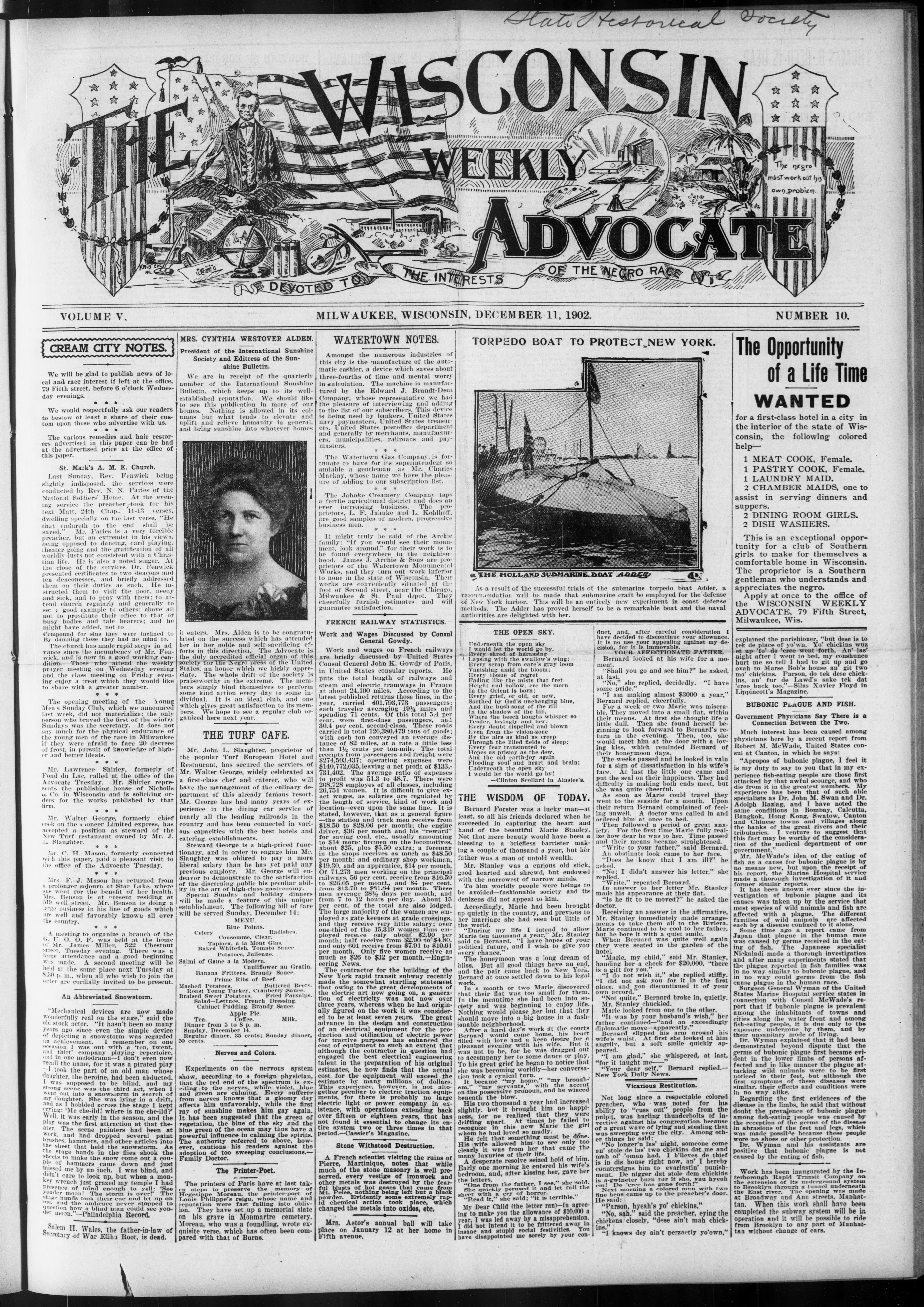
TORPEDO BOAT TO PROTECT NEW YORK.
THE HOLLAND SUBMARINE DOAT ADDER
As a result of the successful trials of the submarine torpedo boat Adder, a recommendation will be made that submarine craft be employed for the defense of New York harbor. This will be an entirely new experiment in coast defense methods. The Adder has proved herself to be a remarkable boat and the naval authorities are delighted with her.
THE OPEN SKY.
Underneath the open sky
I would let the world go by,
Every shred of harassing
Lapsing with the swallow's wing;
Every scrap from care's gray loom
Vanishing amid the bloom;
Every tissue of regret
Fading like the mists that fret
Height and hollow, ere the morn
In the Orient is born;
Every grief, or old, or new,
Soothed by God's unchanging blue,
And the hush-song of the rill
In the shadow of the hill,
Where the beech boughs whisper so
Tender, lovingly and low;
Every doubt dispelled and blown
Even from the vision-zone
By the airs as kind as creep
Through the illied fields of sleep;
Every fear transmuted to
Hopes as prismy as the dew,
And the old earth-joy again
Flooding soul and heart and brain;
Underneath the open sky
I would let the world go by!
-Clinton Scollard in Ainslee's.
THE WISDOM OF TODAY.
Bernard Forster was a lucky man—at least, so all his friends declared when he succeeded in capturing the heart and hand of the beautiful Marie Stanley. Not that mere beauty would have been a blessing to a briefless barrister making a couple of thousand a year, but her father was a man of untold wealth.
Mr. Stanley was a curious old stick, good hearted and shrewd, but endowed with the narrowest of narrow minds.
To him worldly people were beings to be avoided—fashionable society and its denizens did not appeal to him.
Accordingly, Marie had been brought up quietly in the country, and previous to her marriage she had seen but little of the world.
"During my life I intend to allow Marie ten thousand a year," Mr. Stanley said to Bernard. "I have hopes of your political future, and I wish to give you every chance."
The honeymoon was a long dream of bliss. But all good things have an end, and the pair came back to New York. Bernard at once settled down to his legal work.
In a month or two Marie discovered that their flat was too small for them. In the meantime she had been into society and was beginning to enjoy life. Nothing would please her but that they should move into a big house in a fashionable neighborhood.
After a hard day's work at the courts Bernard would come home, his heart filled with love and a keen desire for a pleasant evening with his wife. But it was not to be, for he was dragged out to accompany her to some dance or play. To his great grief he began to notice that she was becoming worldly—her conversation took a cynical turn. It became "my home," "my brougham," "my servants," with the accent on the possessive pronoun, and he winced beneath the blow. His two thousand a year had increased slightly, but it brought him no happiness, for he realized that they were drifting apart. At times he failed to recognize in this new Marie the girl whom he had loved so madly. He felt that something must be done. His wife allowed him to see only too clearly it was from her that came the long bururies of their life.
A desperate resolve seized hold of him. Early one morning he entered his wife's bedroom, and, after kissing her, gave her the letters.
the letters,
"One from the father, I see," she said.
She quickly perused it and let fall the sheet with a cry of horror.
"Read it," she said; "it is terrible."
My Dear Child (the letter ran)—In agreeing to make you the allowance of $10,000 a year, I was led away by a misapprehension. I did not intend it to be frittered away in insane and stupid social festivities. You have disappointed me sorely by your con-
duct, and, after careful consideration I have decided to discontinue your allowance. It is no use your appealing against my decision, for it is immovable. YOUR AFFECTIONATE FATHER. Bernard looked at his wife for a moment. "Shall you go and see him?" he asked, at last. "No," she replied, decidedly. "I have some pride."
"I am making almost $3000 a year," Bernard replied, cheerfully.
Bernard replied, cheerfully.
For a week or two Marie was miserable. They moved into a small flat, within their means. At first she thought life a little dull. Then she found herself beginning to look forward to Bernard's return in the evening. Then, too, she would meet him at the door with a loving kiss, which reminded Bernard of their honeymoon days.
The weeks passed and he looked in vain for a sign of dissatisfaction in his wife's face. At last the little one came and put the seal on their happiness. They had difficulty in making both ends meet, but she was quite cheerful.
As soon as Marie could travel they went to the seaside for a month. Upon their return Bernard complained of feeling unwell. A doctor was called in and ordered him at once to bed.
Then followed a period of great anxi- ity. For the first time Marie fully realize how dear he was to her. Time passed and their means became straightened. "Write to your father," said Bernard. An obstinate look came to her face. "Does he know that I am ill?" he asked. "No; I didn't answer his letter," she replied. "Write," repeated Bernard. In answer to her letter Mr. Stanley made his appearance at their flat. "Is he fit to be moved?" he asked the doctor.
Receiving an answer in the affirmative, Mr. Stanley immediately made arrangements to take them all to the Riviera. Marie continued to be cool to her father, but he bore it with a quiet smile. When Bernard was quite well again they were seated in the garden of the hotel. "Marie, my child," said Mr. Stanley, handing her a check for $20,000, "there is a gift for you." "I do not wish it," she replied stifly. "I did not ask you for it in the first place, and you discontinued it of your own accord."
"Not quite," Bernard broke in, quietly. Mr. Stanley chuckled. Marie looked from one to the other. "It was by your husband's wish," her father continued—"and an exceedingly diplomatic move—apparently." Bernard slipped his arm around his wife's waist. At first she looked at him angrily, but a soft smile quickly appeared. "I am glad," she whispered, at last, "for it taught me—" "Your dear self," Bernard replied. New York Daily News.
Vicarious Restitution.
Not long since a respectable colored preacher, who was noted for his ability to "cuss out" people from the pulpit, was hurling thunderbolts of invective against his congregation because of a great wave of lying and stealing that was sweeping over the city. Among other things he said:
"No longer'n las' night, someone come an' stole de las' two chickins dat me and mah ol' 'oman had. I b'lieves de thief is in dis house right now, an' I hereby countersigns him to evarlastin' punishment. De nigger dat stole dem chickins is a-gwineter burn tur it sho, yau hyeah em! De 'cree has gone forth!"
Next morning a colored man with two
Next morning a colored man with two fine hens came up to the preacher's door. He said:
"Parson, hyeah's vo' chickins."
"No, sah." said the preacher, eying the chickens closely, "dese ain't mah chickins."
"I knows dey ain't perzactly yo'own,"
NUMBER 10.
The Opportunity of a Life Time WANTED
for a first-class hotel in a city in the interior of the state of Wisconsin, the followlng colored help— 1 MEAT COOK. Female.
2 CHAMBER MAIDS, one to assist in serving dinners and suppers.
2 DINING ROOM GIRLS.
2 DISH WASHERS.
This is an exceptional opportunity for a club of Southern girls to make for themselves a comfortable home in Wisconsin. The proprietor is a Southern gentleman who understands and appreciates the negro.
Apply at once to the office of the WISCONSIN WEEKLY ADVOCATE, 79 Fifth Street, Milwaukee, Wis.
explained the parishioner, "but dese is to tek de place of yo'wn. Yo' chickins wuz et up 'fo' de 'cree went forth. An' las' night after I went to bed, my conshunce hurt me so tell I had to git up and go ovah to Marse Bob's house an' git two mo' chickins. Parson, do tek dese chickins, an' fur de Lawd's sake tek dat 'cree back too."—Silas Xavier Floyd in Lippincott's Magazine.
BUBONIC PLAGUE AND FISH.
Government Physicians Say There is a Connection Between the Two.
Much interest has been caused among physicians here by a recent report from Robert M. McWade, United States consul at Canton, in which he says:
"Apropos of bubonic plague, I feel it is my duty to say to you that in my experience fish-eating people are those first attacked by that awful scourge, and who die from it in the greatest numbers. My experience has been that of such able specialists as Dr. John M. Swan and Dr. Adolph Razlag, and I have noted the same conditions in Bombay, Calcutta, Bangkok, Hong Kong, Swatow, Canton and Chinese towns and villages along the banks of the great rivers and their tributaries. I venture to suggest that this fact may be worthy of the consideration of the medical department of our government."
Mr. McWade's idea of the eating of fish as a cause for bubonic plague is by no means new, but upon the receipt of his report, the Marine Hospital service made a thorough investigation of it and former similar reports. It has been known ever since the investigation of bubonic plague and its causes was taken up by the service that most species of wild animals and fish are affected with a plague. The different families of wild animals are affected each by a disease confined to it alone. Some time ago a report came from Japan that plague in the human race was caused by germs received in the eating of fish. The Japanese specialist Nickaladi made a thorough investigation and after many experiments stated that the plague reported in fish families was in no way similar to bubonic plague, and in no way could germs from the fish cause plague in the human race.
Surgeon General Wyman of the United States Marine Hospital service states in connection with Consul McWade's report that if bubonic plague is prevalent among the inhabitants of towns and cities along the water front and among fish-eating people, it is due only to the exposure undergone by them, and by their unsanitary mode of living. Dr. Wyman explained that it had been demonstrated beyond dispute that the germs of bubonic plague first became evident in the lower limbs of persons affected and in like manner the plague attacking wild animals were to be first noticed in their feet, but although the first symptoms of these diseases were similar, their effects and conditions were in no way alike.
Regarding the first evidences of the disease in the limbs, he said that without doubt the prevalence of bubonic plague among fish-eating people was caused by the reception of the germs of the disease in abrasions of the feet and legs, which was made possible because these people wore no shoes or other protection. Dr. Wyman and his assistants are positive that bubonic plague is not caused by the eating of fish.
Work has been inaugurated by the Interborough Rapid Transit Company on the extension of its underground system to Brooklyn through a tunnel underneath the East river. The opening was made at Broadway and Ann streets. Manhattan. When this work shall have been completed the subway system will be in operation and it will be possible to ride from Brooklyn to any part of Manhattan without change of cars.
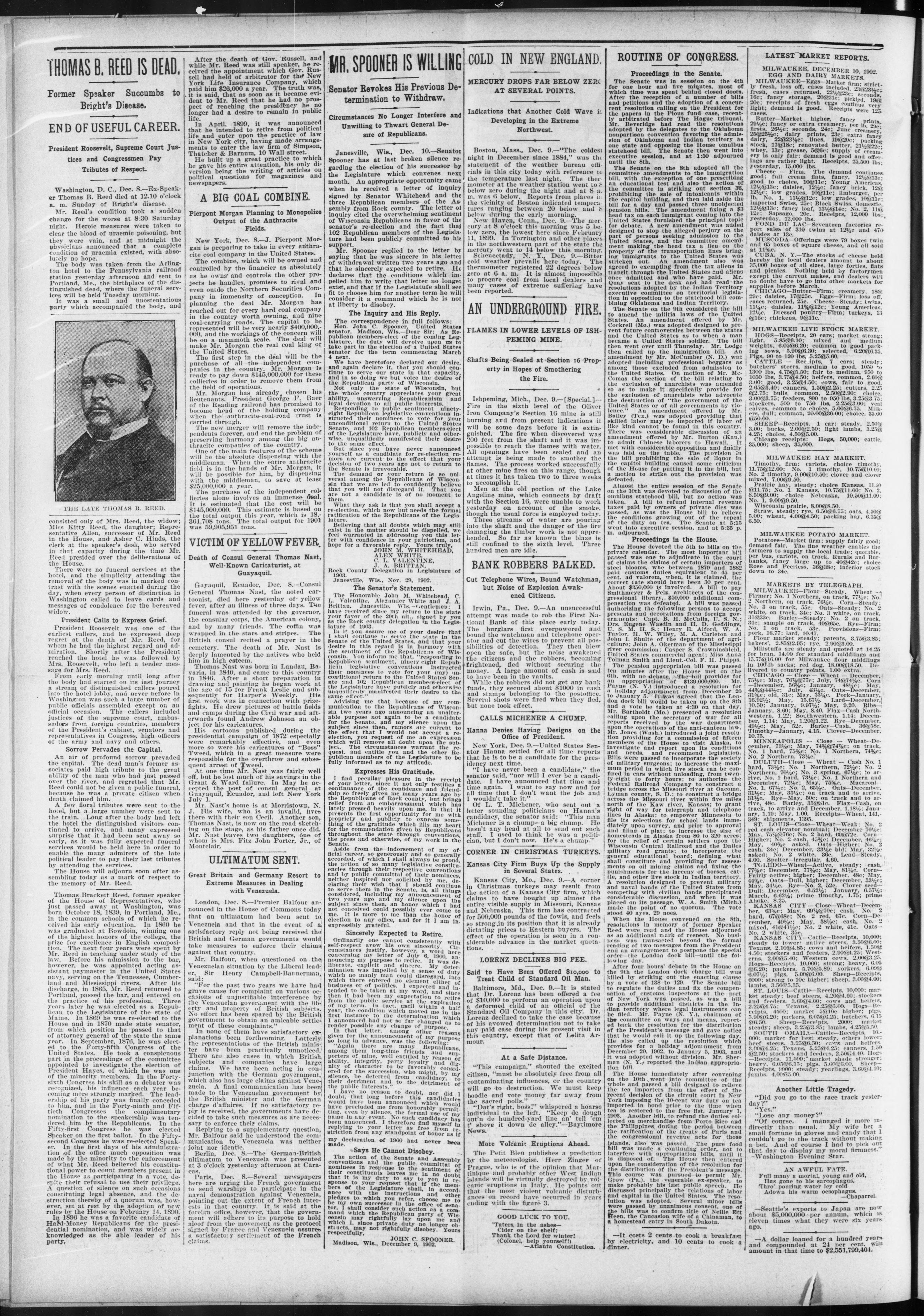
THOMAS B. REED IS DEAD.
Washington, D. C., Dec. 8.—Ex-Speaker Thomas B. Reed died at 12.10 o'clock a. m. Sunday of Bright's disease.
Mr. Reed's condition took a sudden change for the worse at 8:30 Saturday night. Heroic measures were taken to clear the blood of uraemic poisoning, but they were vain, and at midnight the physicians announced that a complete condition of uraemia existed, with absolutely no hope.
The body was taken from the Arlington hotel to the Pennsylvania railroad station yesterday afternoon and sent to Portland, Me., the birthplace of the distinguished dead, where the funeral services will be held Tuesday morning.
It was a small and unostentatious party which accompanied the body, and
M.
consisted only of Mrs. Reed, the widow; Miss Kitty Reed, the daughter; Representative Allen, successor of Mr. Reed in the House, and Asher C. Hinds, the clerk at the speaker's desk, who served in that capacity during the time Mr. Reed presided over the deliberations of the House. There were no funeral services at the hotel, and the simplicity attending the removal of the body was in marked contrast with the scenes enacted during the day, when every person of distinction in Washington called to leave cards and messages of condolence for the bereaved widow.
President Calls to Express Grief
President Roosevelt was one of the earliest callers, and he expressed deep regret at the death of Mr. Reed, for whom he had the highest regard and admiration. Shortly after the President reached the hotel he was followed by Mrs. Roosevelt, who left a tender message for Mrs. Reed. From early morning until long after the body had starred on its last journey a stream of distinguished callers poured into the hotel lobby, and never before in Washington was such a large number of public officials assembled except on an official occasion. The callers included justices of the supreme court, ambassadors from foreign countries, members of the President's cabinet, senators and representatives in Congress, high officers of the army and navy and others.
Sorrow Pervades the Capital.
An air of profound sorrow prevailed the capital. The dead man's former associates paid high tribute to the great ability of the man who had just passed over the river, and regretted that Mr. Reed could not be given a public funeral, because he was a private citizen when death claimed him.
A few floral tributes were sent to the hotel, but a large number were sent to the train. Long after the body had left the hotel the distinguished visitors continued to arrive, and many expressed surprise that it had been sent away so early, as it was fully expected funeral services would be held here in order to enable the many admirers of the late political leader to pay their last tributes by attending the services.
The House will adjourn soon after assembling today as a mark of respect to the memory of Mr. Reed.
Thomas Brackett Reed, former speaker of the House of Representatives, who just passed away at Washington, was born October 18, 1839, in Portland, Me., in the common schools of which he received his early education. In 1860 he was graduated at Bowdoin, winning one of the highest honors of the college, the prize for excellence in English composition. The next four years were spent by Mr. Reed in teaching under study of the law. Before his admission to the bar, however, he was appointed acting assistant paymaster in the United States navy, serving on the Tennessee, Cumberland and Mississippi rivers. After his discharge, in 1865, Mr. Reed returned to Portland, passed the bar, and entered on the practice of his profession. Three years later he was elected as a Republican to the Legislature of the state of Maine. In 1869 he was re-elected to the House and in 1870 made state senator, from which position he passed to that of attorney general of the state the same year. In September, 1876, he was elected to the Forty-fifth Congress of the United States. He took a conspicuous part in the proceedings of the committee appointed to investigate the election of President Hayes, of which he was one of the minority members. In the Forty-sixth Congress his skill as a debater was recognized, his influence each year becoming more strongly marked. The leadership of his party was finally conceded to him, and in the Forty-ninth and Fiftieth Congresses the complimentary nomination to the speakership was tendered him by the Republicans. In the Fifty-first Congress he was elected Speaker on the first ballot. In the Fifty-second Congress he was re-elected Speaker. In the first days of his administration of the office much opposition was made by the minority to the enforcement of what Mr. Reed believed his constitutional power to count members present in the House as participating in a vote, despite their refusal to use their privilege. A question of silence on such occasions constituting legal absence, and the destruction thereby of a quorum was, however, set at rest by the adoption of new rules by the House on February 14, 1890. In 1896 he was a favorite candidate of Hard-Money Republicans for the presidential nomination, and was widely acknowledged as the able leader of his party.
After the death of Gov. Russell, and while Mr. Reed was still speaker, he received the appointment which Gov. Russell had held of arbitrator for the New York Life Insurance Company, which paid him $26,000 a year. The truth was, it is said, that as soon as it became evident to Mr. Reed that he had no prospect of reaching the presidency he no longer had a desire to remain in public life. In April, 1899, it was announced that he intended to retire from political life and enter upon the practice of law in New York city, having made arrangements to enter the law firm of Simpson, Thatcher & Barnum, 10 Wall street.
He built up a great practice to which he gave his entire attention, his only diversion being the writing of articles on political questions for magazines and newspapers.
A BIG COAL COMBINE.
Pierpont Morgan Planning to Monopolize Output of the Anthracite Fields.
New York, Dec. S.—J. Pierpont Morgan is preparing to take in every anthracite coal company in the United States. The combine, which will be owned and controlled by the financier as absolutely as he owns and controls the other projects he handles, promises to rival and even outdo the Northern Securities Company in immensity of conception. In planning the deal Mr. Morgan has reached out for every hard coal company in the country worth owning, and nine coal-carrying roads. The capital to be represented will be very nearly $400,000,-000, and the workings of the concern will be on a mammoth scale. The deal will make Mr. Morgan the real coal king or the United States.
The first step in the deal will be the purchase of all the independent companies in the country. Mr. Morgan is ready to pay down $145,000,000 for these collieries in order to remove them from the field of operations. Mr. Morgan has already chosen his lieutenants. President George F. Baer of the Reading railroad has promised to become head of the holding company when the anthracite-coal-road trust is carried through. The new merger will remove the independents forever, and end the problem of preserving harmony among the big anthracite companies of the country.
One of the main features of the scheme will be the absolute dispensing with the middleman. When the entire anthracite field is in the hands of Mr. Morgan, it will be possible for him, by dispensing with the middleman, to save at least $25,000,000 a year. The purchase of the independent collieries alone involves an immense deal. It is estimated that the cost will be $145,000,000. This estimate is based on the total output this year, which is 18,361,708 tons. The total output for 1901 was 59,905,951 tons.
VICTIM OF YELLOW FEVER
Gayaquil, Ecuador, Dec. 8.—Consul General Thomas Nast, the noted cartoonist, died here yesterday of yellow fever, after an illness of three days. The funeral was attended by the governor, the consular corps, the American colony, and by many friends. The coffin was wrapped in the stars and stripes. The British consul recited a prayer in the cemetery. The death of Mr. Nast is deeply lamented by the natives who held him in high esteem.
Thomas Nast was born in Landau, Bavaria, in 1840, and came to this country in 1846. After a short preparation in drawing and painting he began work at the age of 15 for Frank Leslie and subsequently for Harper's Weekly. His first work was in connection with prizefights. He drew pictures of battle fields and camps during the Civii war and afterwards found Andrew Johnson an object for his caricatures.
His cartoons published during the presidential campaign of 1872 especially were remarkably effective, and even more so were his caricatures of "Boss" Tweed, which in a great measure were responsible for the overthrow and subsequent arrest of Tweed.
At one time Mr. Nast was fairly well off, but he lost much of his savings in the Grant & Ward failure. In May he accepted the post of consul general at Guayaquil, Ecuador, and left New York July 1.
Mr. Nast's home is at Morristown, N. J. His wife, who is an invalid, lives there with their son Cecil. Another son, Thomas Nast, is now on the road sketching on the stage, as his father once did. Mr. Nast leaves two daughters, one of whom is Mrs. Fitz John Porter, Jr., of Montclair.
ULTIMATUM SENT.
Great Britain and Germany Resort to Extreme Measures in Dealing with Venezuela.
London, Dec. S.—Premier Balfour announced in the House of Commons today that an ultimatum had been sent to Venezuela and that in the event of a satisfactory reply not being received the British and German governments would take measures to enforce their claims against that country.
Mr. Balfour, when questioned on the Venezuelan situation by the Liberal leader, Sir Henry Campbell-Bannerman, said:
"For the past two years we have had grave cause for complaint on various occasions of unjustifiable interference by the Venezuelan government with the liberty and property of British subjects. No effort has been spared by the British government to obtain an amicable settlement of these complaints."
In none of them have satisfactory explanations been forthcoming. Latterly the representations of the British minister have been practically unnoticed. There are also cases in which British subjects and companies have large claims. We have been acting in conjunction with the German government, which also has large claims against Venezuela. A final communication has been made to the Venezuelan government by the British minister and the German charge d'affaires. If no satisfactory reply is received, the governments have decided to take such measures as are necessary to enforce their claims.
Replying to a supplementary question, Mr. Balfour said he understood the communication to Venezuela was neither joint nor identic.
Berlin, Dec. 8.—The German-British ultimatum to Venezuela was presented at 3 o'clock yesterday afternoon at Caracas. Paris, Dec. 8.—Several newspapers here are urging the French government to send warships to participate in the naval demonstration against Venezuela, pointing out the extent of French interests in that country. It is said at the foreign office, however, that the government will adhere to its purpose to hold aloof from the movement as the protocol signed by France and Venezuela assures a satisfactory settlement of the French claims.
MR. SPOONER IS WILLING
Senator Revokes His Previous Determination to Withdraw.
Janesville, Wis., Dec. 10.—Senator Spooner has at last broken silence regarding the election of his successor by the Legislature which convenes next month. An appropriate opportunity came when he received a letter of inquiry signed by Senator Whitehead and the three Republican members of the Assembly from Rock county. The letter of inquiry cited the overwhelming sentiment of Wisconsin Republicans in favor of the senator's re-election and the fact that 102 Republican members of the Legislature had been publicly committed to his support.
Mr. Spooner replied to the letter by saying that he was sincere in his letter of withdrawal written two years ago and that he sincerely expected to retire. He declares that the conditions which impelled him to write that letter no longer exist, and that if the Legislature shall see fit to choose him for another term he will consider it a command which he is not at liberty to disobey.
The Inquiry and His Reply.
The correspondence in full foliows:
Hon. John C. Spooner, United States senator, Madison, Wis.—Dear Sir: As Republican members-elect of the coming Legislature, the duty will devolve upon us to take part in the election of a United States senator for the term commencing March 4 next.
We have heretofore declared our desire, and again declare it, that you should continue to serve our state in that capacity, and in so doing we but voice the desire of the Republican party of Wisconsin.
Not only the state of Wisconsin, but the whole country appreciates your great ability, unswerving Republicanism and loyal devotion to all public interests.
Responding to public sentiment ninety-eight Republican legislative conventions instructed their nominees to vote for your unconditional return to the United States Senate, and 102 Republican members-elect of the Legislature have, publicly and otherwise, unqualifiedly manifested their desire to the same effect.
But since you have never announced yourself as a candidate for re-election rumors are current to the effect that your decision of two years ago not to return to the Senate is irrevocable.
The demand or your return is so universal among the Republicans of Wisconsin that we are led to confidently believe that you will not disregard it. That you are not a candidate is of no moment to them.
What they ask is that you shall accept a re-election, which now but needs the formal ratification of the Republicans of the Legislature.
Believing that all doubts which may still exist in the matter should be dispelled, we feel warranted in addressing you this letter with confidence in your patriotism, and hope for a favorable reply. You truly.
Rock County Delegation in Legislature of 1903.
Janesville, Wis. Nov. 29, 1902
The Senator's Statement
The Honorable John M. Whitehead, C. L. Valentine, Alexander White and J. A. Brittan, Janesville, Wls.-Gentlemen: I have received since my return to the state your favor of the 29th ult., signed by you as the Rock county delegation in the Legislature of 1903.
In it you assure me of your desire that I shall continue to serve the state in the Senate of the United States, and that your desire in this regard is in harmony with the sentiment of the Republicans of Wisconsin. You inform me that, "responding to Republican sentiment, ninety eight Republican legislative conventions instructed their nominees to vote for your (my) unconditional return to the United States Senate and 102 Republican members-elect of the Legislature have publicly and otherwise unqualifiedly manifested their desire to the same effect."
Advising me that because of my communication to the Republicans of Wisconsin two years ago announcing an unalterable purpose not again to be a candidate for the Senate, and my silence upon the subject since then, rumors are current to the effect that I would not accept a reelection, you request of me an expression which will remove all doubt upon the subject. The circumstances warrant the request, and entitle you and the other Republican members of the Legislature to be fully informed as to my attitude.
Expresses His Gratitude.
I find peculiar pleasure in the receipt of your letter, since it not only testifies a continuance of the confidence and friendship so freely given me many years ago by the Republicans of Rock county, but brings relief from an embarrassment which has lately pressed heavily upon me, in that it presents the first opportunity for me with propriety and publicly to express something of the gratitude which fills my heart for the commendation given by Republicans throughout the state through conventions, the press and otherwise, of my work in the Senate.
Aside from the indorsement of my official career, so generously and so generally accorded, of which I shall always be proud, the action of so many legislative constituencies through their respective conventions and by public committal of their nominees, neither inspired nor solicited by me, declaring their wish that I should continue to serve them in the Senate, is, all things considered, including my announcement of two years ago and my silence upon the subject since then, an honor which I had not conceived could possibly ever come to me. It is more to me than the honor of election to any office, and for it I am inexpressibly grateful.
Sincerely Expected to Retire
Ordinarily one cannot consistently with self-respect avow his own sincerity. Circumstances justify, however, a word here concerning my letter of July 6, 1900, announcing my purpose to retire. It was deliberate, expleit and sincere. My determination was impelled by a sense of duty which no manly man could disregard, into which there entered no element either of business or of politics. I expected and intended to be taken at my word, and since then it had been my expectation to retire from the public service at the expiration of my term. In fact, until within a half year, the condition which moved me in the first instance to the determination which I announced had not so far changed as to render possible any change of purpose.
In that letter, among other reasons given for the announcement of my purpose so long in advance, was the follow-
"Again there are many Republicans, among them long-time friends and supporters of mine, well entitled by reason of ability, integrity, party loyalty and dignity of character to be favorably considered for the succession, who might, by my silence, be deterred from candidacy, to their detriment and to the detriment of the public interests."
I have no reason to doubt, nor did I doubt, that long before this candidacles would have been announced which would have precluded me from honorably permitting, even by silence, the formal use of my name in any event. No such candidacy has been announced. I therefore find myself in replying to your letter as free from restriction from any standpoint of honor as if my declaration of 1900 had never been
Says He Cannot Disobey.
The action of the Senate and Assembly conventions and the public committal of nominees in response to the sentiment of their constituents leaves me in no doubt that it is my duty to say to you in response to your request that if the members of the Legislature shall, in accordance with the instructions and other pledges to which you refer, choose me to be my own successor in the office of senator, I shall consider such action as a command which the Republican party of Wisconsin may rightfully lay upon me and which I, since private duty no longer obstructs, may not rightfully disobey. Yours respectfully,
JOHN C. SPOONER.
Madison, Wis., December 9, 1902.
COLD IN NEW ENGLAND
MERCURY DROPS FAR BELOW ZERO AT SEVERAL POINTS.
Indications that Another Cold Wave is Developing in the Extreme Northwest.
Boston, Mass., Dec. 9.—"The coldest night in December since 1884," was the statement of the weather bureau officials in this city today with reference to the temperature last night. The thermometer at the weather station went to 8 below zero during the night and at 8 a.m. was 6 below. Reports from places in the vicinity of Boston indicated temperatures ranging between 20 below and 8 below during the early morning. New Haven, Conn., Dec. 9.—The mercury at 8 o'clock this morning was 5 below zero, the lowest here since February 11, 1899. In Torrington and other places in the northwestern part of the state the mercury went to 14 below this morning.
Schenectady, N. Y., Dec. 9.-Bitter cold weather prevails here today. The thermometer registered 22 degrees below zero at 6 a. m. It is almost impossible to procure coal from local dealers and many cases of extreme suffering have been reported.
AN UNDERGROUND FIRE.
AN UNDERGROUND FIRE.
FLAMES IN LOWER LEVELS OF ISHPEMING MINE.
Ishpeming, Mich., Dec. 9.—[Special.] Fire in the sixth level of the Oliver Iron Company's Section 16 mine is still burning and from present indications it will be some days before it is extinguished. The fire when discovered was 200 feet from the shaft and it was impossible to reach the flames with water. All openings have been sealed and an attempt is being made to smother the flames. The process worked successfully at other mine fires on this range, though at times it has taken two to three weeks to accomplish it.
Men at the old portion of the Lake Angeline mine, which connects by draft with the Section 16, were unable to work yesterday on account of the smoke, though the usual force is employed today.
Three streams of water are pouring into the shaft and the danger of the fire damaging the timber work is not apprehended. So far as known the blaze is still confined to the sixth level. Three hundred men are idle.
BANK ROBBERS BALKED.
Cut Telephone Wires, Bound Watchman, but Noise of Explosion Awakened Citizens.
Irwin, Pa., Dec. 9.—An unsuccessful attempt was made to rob the First National Bank of this place early today. The burglars first overpowered and bound the watchman and telephone operator and cut the wires to prevent all possibilities of detection. They then blew open the safe, but the noise awakened the citizens and the robbers, becoming frightened, fled without securing the money. A large amount of cash is said to have been in the vaults. While the robbers did not get any bank funds, they secured about $1000 in cash and stamps belonging to the postoffice. Several shots were fired when they fled, but none took effect.
CALLS MICHENER A CHUMP
Hanna Denies Having Designs on the Office of President.
New York, Dec. 9.—United States Senator Hanna settled for all time reports that he is to be a candidate for the presidency next time.
"I have never been a candidate," the senator said, "nor will I ever be a candidate. I have announced that time and time again. I want to say now and for all time that I don't want the job and I wouldn't take it."
Of L. T. Michener, who sent out a letter sounding politicians on Hanna's candidacy, the senator said: "This man Michener is a chump—a big chump. He hasn't any head at all to send out such stuff. I used to think he was a politician, but I don't now. He's a chump."
CORNER IN CHRISTMAS TURKEYS
Kansas City Firm Buys Up the Supply in Several States.
Kansas City, Mo., Dec. 9.—A corner in Christmas turkeys may result from the action of a Kansas City firm, which claims to have bought up almost the entire visible supply in Missouri, Kansas and Nebraska. This firm has contracted for 500,000 pounds of the fowls, and feels so strong in its position that it is already dictating prices to Eastern buyers. The effect of the operation is seen in a considerable advance in the market quotations.
LORENZ DECLINES BIG FEE.
Said to Have Been Offered $10,000 to Treat Child of Standard Oil Man.
Baltimore, Md., Dec. 9.—It is stated that Dr. Lorenz has been offered a fee of $10,000 to perform an operation upon a deformed child of an official of the Standard Oil Company in this city. Dr. Lorenz declined to take the case because of his avowed determination not to take any paid case during his present visit in this country, except that of Lolita Armour.
At a Safe Distance:
"This campaign." shouted the excited citizen, "must be absolutely free from all contaminating influences, or the country will go to destruction. We must keep boodle and vote money far away from the sacred polls."
"Dat's right, boss!" whispered a hoarse individual to the left. "Keep de dough out'n de hundred-yard line an' tell 'em' shove it down de alley."—Baytimore News.
More Volcanic Eruptions Ahead.
The Petit Bleu publishes a prediction by the meteorologist. Herr Zinger of Prague, who is of the opinion that Martinique and probably other West Indian islands will be virtually destroyed by volcanic eruptions in Italy. He points out that the most violent volcanic disturbances on record have occurred in years ending with the figure 3.
'Taters in the ashes—
Clder on the shelf;
Thank the Lord fer winter!
(Colone), help yourself!)
-Atlanta Constitution.
ROUTINE OF CONGRESS.
ROUTINE OF CONGRESS.
Proceedings in the Senate.
The Senate was in sesssion on the 4th for one hour and five minutes, most of which time was spent behind closed doors. After the reception of a number of bills and petitions and the adoption of a concurrent resolution calling on the President for the papers in the Pious fund case, recently arbitrated before The Hague tribunal, Mr. Beveridge had read the resolutions adopted by the delegates to the Oklahoma nonpartisan convention favoring the admission of Oklahoma and Indian territory as one state and opposing the House omnibus statehood bill. The Senate then went into executive session, and at 1:50 adjourned until the 8th.
The Senate on the 8th adopted all the committee amendments to the immigration bill, with the exception of one prescribing an educational test and also the action of the committee in striking out section 30, prohibiting the sale of intoxicants within the capitol building, and then laid aside the bill for a day and passed three unobjected pension bills. The amendment fixing a $3 head tax on each immigrant coming into the United States furnished the principal topic for debate. A new amendment was added designed to stop the alleged perjury on the part of persons seeking admission to the United States, and the committee amendment making the head tax a lien on the property of the transportation lines bringing immigrants to the United States was stricken out. An amendment also was agreed to exempting from the tax aliens in transit through the United States and aliens once admitted and who have paid. Mr. Quay sent to the desk and had read the resolutions adopted by the Indian Territory executive committee on territorial legislation in opposition to the statehood bill combining Oklahoma and Indian Territory.
The Senate on the 9th considered the bill to amend the militia laws of the United States. An amendment offered by Mr. Cockrell (Mo.) was adopted designed to prevent future controversies between the states and the United States as to when a man became a United States soldier. The bill then went over until Thursday. Mr. Lodgec then called up the immigration bill. An amendment by Mr. McCumber (N. D.) was adopted including professional beggars as among those excluded from admission to the United States. On motion of Mr. McComas the section of the bill relating to the exclusion of anarchists was amended so as to make it specifically provide for the exclusion of anarchists who advocate the destruction of "the government of the United States or of all governments by violence." An amendment offered by Mr. Bailey (Tcx.) was adopted providing that skilled labor may be imported if labor of like kind cannot be found in this country. There was considerable discussion of an amendment offered by Mr. Burton (Kan.) to admit Chinese laborers to Hawaii. It met with considerable opposition and finally was laid on the table. The provision in the bill prohibiting the sale of liquor in the capitol building caused some criticism of the House for putting it in the bill, but a motion to strike out the provision was defeated.
Almost the entire session of the Senate on the 10th was devoted to discussion of the omnibus statehood bill, but no action was taken. A bill to refund internal revenue taxes paid by owners of private dles was passed, as was the House bill to relieve the conditions growing out of the repeal of the duty on tea. The Senate at 5:15 went into executive session, and at 5:35 p. m. adjourned.
Proceedings in the House.
The House devoted the 5th to bills on the private calendar. The most important bill passed was one to adjudicate in the court of claims the claims of certain importers of steel blooms, who between 1879 and 1882 paid customs duties equivalent to 45 per cent. ad valorem, when, it is claimed, the correct rate should have been 30 per cent. About $350,000 is involved. A bill to pay Smithmeyer & Pelz, architects of the congressional library, $50,000 additional compensation was defeated. A bill was passed authorizing the following persons to accept presents and decorations from foreign governments: Capt. B. H. McCalla, U. S. N.; Drs. Eugene Wasdin and H. D. Goddings, U. S. M. H. S.; Henry E. Alford, W. A. Taylor, H. W. Wiley, M. A. Carleton and John I. Shulte of the department of agriculture; John A. Okerman of the Mississippi river commission; Casper S. Crowninshield, United States commercial agent; Miss Anna Tolman Smith and Leut.-Col. F. H. Phipps.
The pension appropriation bill was passed ten minutes after the House met on the 6th, with no debate. The bill provides for an appropriation of $139,000,000. Mr. Payne (N. Y.) introduced a resolution for a holiday adjournment from December 20 to January 5. It was agreed that the London dock bill would be taken up on the 8th and a vote be taken at 4:30 on that day. Mr. Bartholdt (Mo.) presented a resolution calling upon the secretary of war for all reports received by the war department upon the operations of the anti-canteen law. Mr. Jones (Wash.) introduced a joint resolution providing for a commission of fifteen members of the House to visit Alaska, to investigate and report upon its conditions and needs, and recommend legislation. Bills were passed to incorporate the society of military surgeons; to increase the maximum period in which live stock can be confined in cars without unloading, from twenty-eight to forty hours; to authorize the Federal Railroad Company to construct a bridge across the Missouri river at Oacoma, Lyman county, S. D.; to construct a bridge across the Missouri river within five miles north of the Kaw river, Kansas; to grant right of way for telegraph and telephone lines in Alaska; to empower Minnesota to file its selections for school lands immediately upon survey, and prior to approval and filing of plat; to increase the size of homesteads in Alaska from 80 to 320 acres; for the relief of certain settlers upon the Wisconsin Central Railroad and the Dalles military road grants; to incorporate the general educational board; defining what shall constitute and providing for assessments on oil mining claims and fixing the punishments for the larceny of horses, cattle, and other live stock in Indian territory. A resolution designed to prevent military and naval bands of the United States from competing with civilian bands precipitated considerable discussion, and when it was placed on its passage, W. A. Smith (Mich.) made the point of no quorum. The vote stood 40 ayes. 29 noes.
When the House convened on the 8th, resolutions in memory of former Speaker Reed were read and the House adjourned as an additional mark of respect. No business was transacted beyond the formal reading of two messages from the President and an arrangement to postpone the special order—the London dock bill—until the following day.
After four hours' debate in the House on the 9th the London dock charge bill was killed by striking out the enacting clause by a vote of 138 to 129. The Senate bill to regulate the duties and fix the compensation of customs inspectors at the port of New York was passed, as was a bill to provide additional districts in the Indian territory where legal instruments can be filed. Mr. Payne (N. Y.), chairman of the committee on ways and means, reported back the resolution for the distribution of the President's message and gave notice that he would call it up the following day. He also called up the resolution which provides for a holiday adjournment from December 20, 1902, to January 5, 1903, and it was adopted without division. Mr. Sherman (N. Y.) reported the Indian appropriation bill.
The House immediately after convening on the 10th went into committee of the whole and passed a bill designed to relieve the tea importers from the effect of the recent decision of the circuit court in New York imposing the 10-cent war duty on tea imported in bond prior to the time when tea is restored to the free list, January 1, 1903. Another bill, to refund the duties collected on merchandise from Porto Rico and the Philippines during the period between the ratification of the treaty of Paris and the congressional revenue acts for those islands, also was passed. The pure food bill was made a continuing order, not to interfere with appropriation bills, until it is disposed of. The House then entered upon the consideration of the resolution for the distribution of the President's message. This course was pursued to permit Mr. Grow (Pa.), the venerable ex-speaker, to make probably his last public speech. He discussed principally the relations of labor and capital in the United States. The resolution was adopted. Several minor bills were passed by unanimous consent, one of the bills was to confirm title of Nellie Ett Heen, the Caucasian wife of a Chinaman, to a homestead entry in South Dakota.
-It costs 2 cents to cook a breakfast by electricity, and 10 cents to cook a dinner.
LATEST MARKET REPORTS.
MILWAUKEE, DECEMBER 10, 1902.
EGG AND DAIRY MARKETS.
MILWAUKEE—Eggs—Market firm; stricly fresh, loss off, cases included, 23@2312c; fresh, cases returned, 2212@23c; seconds, 16c; fancy storage, 20@21e; pickled, 19@20c; receipts of fresh eggs continue very light; demand is good. Receipts were 125 cases.
Butter—Market higher, fancy prints, 2912c; fancy or extra creamery, per lb, 29c; firsts, 2612c; seconds, 24c; June creamery, 5@2512c; dairy prints, 23c; extra fancy dairy, 22@2312c; lines, 19@20c; packing stock, 17@18c; renovated butter, 2112@22c; whey, 13c; grease, 5@6c; supply of creamery is only fair; demand is good and offerings are rather light. Receipts, 25,500 lbs; yesterday, 15,000 lbs.
Cheese - Firm. The demand continues good; full cream flats, fancy, 12½@13c; good to choice, 10@11c; Young Americas, 12½@13c; dalsies, 12½c; fancy brick, 12@12½c; low grades, 10@11c; limburger, per lb. No. 1, 11½@12c; low grades, 10@11c; imported Swiss, 25c; Block Swiss, domestic, 12½@13c; fancy loaf, 13½@14c. No. 2, 11@12c; Sapsago, 20c. Recelpts, 12,000 lbs; yesterday, 12,000 lbs.
FOND DU LAC-Seventeen factories report sales of 310 twins at 12½c and 470 dalsies at 13c.
MUSCODA-Offerlings were 79 boxes twin and 65 boxes of square cheese, and all sold at 11½c.
CUBA, N. Y.-The stocks of cheese held hereby the local dealers amount to about 35,000 boxes of all sizes, large forties, flats and plenics. Nothing held by factorymen except the current makes, and dealers will no doubt have to go into other markets for supplies before March.
CHICAGO—Butter—Firm; creamery, 18@
29c; dalsies, 17@25c. Eggs—Firm; loss off,
cases returned, 25c. Cheese—Steady; twins,
11¼c; dalsies, 11¼@12c; Young Americas,
12½c. Dressed poultry—Firm; turkeys, 13
@16c; chickens, 9@11c.
MILWAUKEE LIVE STOCK MARKET.
HOGS—Receipts, 20 cars; market strong;
light, 5.85@6.10; mixed and medium
weights, 6.05@6.20; common to good pack-
ing sows, 5.90@6.30; selected, 6.20@6.35.
Pigs, 90 to 120 lbs, 5.25@5.60.
CATTLE — Receipts, 7 cars; steady;
butchers' steers, medium to good, 1050 to
1300 lbs, 4.75@5.50; fair to medium, 950 to
1050 lbs, 3.75@4.50; heifers, common, 2.60@
3.00; good, 3.25@4.50; cows, fair to good,
2.03@3.40; canners, 1.50@2.25; cutters, 2.25@
2.75; bulls, common, 2.50@2.90; choice,
3.00@3.75; feeders, 800 to 950 lbs, 3.25@3.75;
stockers, 500 to 750 lbs, 2.25@3.00; veal
calves, common to choice, 5.00@6.75; Milkers, dull; common, 20.00@30.00; choice, 35.00@50.00.
SHEEP—Receipts, 1 car; steady, 2.50@3.00; bucks, 2.00@2.50; light lambs, 3.25@4.25; choice, 4.50@5.00.
Chicago receipts: Hogs, 50,000; cattle,
35,000; sheep, 35,000.
MILWAUKEE HAY MARKET
Timothy, firm; carlots, choice timothy;
11.75@12.00; No. 1 timothy, 10.75@10.00;
No. 2 timothy, 9.00@10.50; clover and clover
mixed, 7.00@9.50.
Prairie hay, steady; choice Kansas, 11.50
@11.75; No. 1 Kansas, 10.75@11.00; No. 2,
8.50@9.00; choice Nebraska, 10.50@11.00;
No. 1, 9.00@9.50.
Wisconsin prairie. 8.00@8.50.
Straw, steady; rye, 6.50@6.75; oats, 4.50@ 5.00; wheat, 4.00@4.50; packing hay, 6.25@ 6.50.
MILWAUKEE POTATO MARKET.
Potatoes—Market firm; supply fairly good; demand fair. The fine weather enables the farmers to supply the local trade; quotable, per bus, carlots, on track, Rurals and Burbanks, fancy large up to 40@42c; choice Rose and Peerless, 36@38c; inferior stock down to 34c.
MARKETS BY TELEGRAPH
MILWAUKEE—Flour—Steady. Wheat—Firmer; No. 1 Northern, on track, $77\frac{1}{4}$c; No. 2 Northern, on track, $76\frac{1}{2}$c. Corn—Steady. No. 3 on track, 55c. Oats—Steady. No. 2 white, on track, 34c; No. 3 white, on track, $31@33c$. Barley—Steady. No. 2 on track, 34c; sample on track, $40@65c$. Rye—Firm; No. 1 on track, 53c. Provisions—Firm; pork, 16.77; lard, 10.47.
Flour market steady; patents, 3.75@3.85; bakers', 2.85@2.95; rye, 2.90@3.00.
Millstuffs are steady and quoted at 14.25 for bran, 14.00 for standard middlings and 15.75@16.00 for Milwaukee flour middlings in 100-lb sacks; red dog, 18.00@18.50. Delivered to country points, 1.00 extra.
CHICAGO — Close — Wheat — December, 75%c; May, 76%@77c; July, 74%@74%c. Corn — December, 56%c; January, 48%c; May, 44%@44%c; July, 43%c; Oats—December, 31%c; old, 31c; May, 33%c; Pork—January, 16.92%c; May, 15.67%c. Lard—December, 10.50; January, 9.97%c; May, 9.20. Ribs—January, 8.60; May, 8.40. Flax—Cash Northwestern, 1.22; Southwestern, 1.14; December, 1.14; May, 1.20@1.22. Rye—December, 49%c; May, 52c. Barley—Cash, 36%@58c. Timothy—January, 4.15. Clover—December, 10.75.
MINNEAPOLIS — Close — Wheat—December, 73%c; May, 74%@74%c; on track, No 1 hard, 75%c; No. 1 Northern, 74%c; No. 2 Northern, 73%c.
DULUTH—Close — Wheat — Cash No. 1 hard, 73½c; No. 1 Northern, 72½c; No. 2 Northern, 70½c; No. 3 spring, 67½c; to arrive, No. 1 hard, 73½c; No. 1 Northern and December, 72½c; May, 75½c. Macaronl—No. 1, 67½c; No. 2, 65½c. Oats—December, 31½c; May, 33½c; on track and to arrive, 31½c. Rye—May, 50c; on track and to arrive, 48c. Barley, 35@51c. Flax—Cash, on track, to arrive and December, 1.18½; January, 1.19; May, 1.00. Receipts—Wheat, 141, 349; shipments, 1395.
ST. LOUIS—Close—Wheat—Weak; No. 2 red cash elevator nominal; December 70½c; May, 75½@76c; No. 2 hard, 69@72c. Corn—Higher; No. 2 cash, 45½c; December, 46½c; May, 40½c asked. Oats—Higher; No. 2 cash, 34c; December, 33½c bld. May, 32½c asked. No. 2 white, 36c. Lead—Steady, 4.00. Spelter—irregular, 4.60.
TOLEDO—Wheat—Active, steady, cash, 77%c;麦, 77%c; May, 81%c; Corn—Fairly active; higher; December, 48c; May, 44%c; Oats-Dull, higher; December, 33%c; May, 34%c; Rye-No. 2, 52c; Clover seed—Dull; December, 6.521%; January, 6.571%; March, 6.621%; prime timothy, 1.75; prime Alsike, 8.25.
KANSAS CITY—Close—Wheat—December, 63%c; May, 69%@70c; cash, No. 2 hard, 67@68c; No. 2 red, 67c; Corn—December, 40%c; May, 38%c; cash, No. 2 mixed, 41@411%; No. 2 white, 41c; Oats—No. 2 white, 35c.
KANSAS CITY—Cattle—Receipts, 10,000; steady to lower; native steers, 3.50@6.00; Texans, 2.10@4.85; cows and heifers, 1.50@4.50; stockers and feeders, 2.90@4.25; Westerns, 2.00@5.40; Western cows, 2.00@3.25; Hogs—Receipts, 10,000; strong; heavy, 6.05@6.20; packers, 5.70@5.80; yorkers, 6.00@6.071%; pigs, 5.00@6.00. Sheep—Receipts, 6000; strong to 10c higher; sheep, 3.00@4.00; lambs, 3.50@5.35.
ST. LOUIS—Cattle—Receipts, 10,000; market steady; beef steers, 4.20@4.60; stockers and feeders, 3.00@4.00; cows and heifers, 2.25@4.75; Texans, 2.25@5.00. Hogs—Receipts, 4500; market 5@10e higher; plugs, 5.90@6.20; packers, 6.05@6.25; butchers, 6.15@6.50. Sheep—Receipts, 2000; market steady; sheep, 3.25@3.85; lambs, 4.25@5.50. SOUTH OMAHA—Cattle—Receipts, 10,000; market for best steady, others lower; beef steers, 3.25@6.50; cows and heifers, 3.00@4.25; Texans, 3.25@4.27; canners, 1.50@2.50; stockers and feeders, 2.50@4.40. Hogs—Receipts, 11,500; market shade stronger; heavy, 6.05@6.15; plugs, 5.00@6.00. Sheep—Receipts, 9000; steady; yearlings, 3.60@4.10; lambs, 4.00@5.00.
Another Little Tragedy.
"Did you go to the race track yesterday?"
"Yes."
"Lose any money?"
"Of course. I managed it more indirectly than usual. My wife bet a small fortune in gloves and candy that I couldn't go to the track without making a bet. And of course I had to pick out that day to display my moral firmness."
-Washington Evening Star.
AN AWFUL FATE.
Full many a mortal, young and old,
Has gone to his sarcophagus,
Thro' pouring water lcy cold
Adown his warm oesophagus.
-Chaparrel.
—Seattle's exports to Japan are now about $5,000,000 per annum, which is eleven times what they were six years ago.
—A dollar loaned for a hundred years and compounded at 24 per cent, with amount in that time to $2,551,799,404.
A CHRISTMAS MISTAKE.
Old Santa Claus one morning was trying to peruse—
Though in a tearing hurry—his "Weekly Iceberg News."
And the name of Santos-Dumont that moment caught his eye.
The well-known navigator of machines that soar on high.
"Why,bless me!" muttered Santa. "A cousin, sure enough;
Our family, I notice, is always up to snuff.
The name's misspelled. These papers. They seldom get things right!
And he sent off for an airship that very selfsame night.
A month or so of waiting; and then it came apace
Upon a fast Dog-Special to Twenty North Pole Place;
And, just as pleased as ever was any girl or boy.
Now Santa Claus his treasure surveyed with chuckling joy.
He scorned his heartsick reindeer, who vainly pawed the snow.
He scorned his shining "auto" he'd bought a year age;
And after ardent practice, all loaded like a wain.
It southward sped, and southward, above the frozen world:
The rudder acted nicely, the twin propellers whirled;
And Santa Claus was overjoyed to have so fine a tip—
When suddenly a cat-fit appeared to seize that ship!
It canted, swooped, and wobbled; it veered from side to side!
Oh, never Santos-Dumont had such an awful ride!
This happened o'er a city—and lo, the air was filled
With presents scattered broadcast, from out the airship spilled;
And into gaping chimneys of children who were bad
Fell toys and gifts unnumbered they ought n't to have had!
And into patient chimneys of children who were good
Fell naught at all, or possibly some bits of splintered wood!
The children bad were boastful, the children good were grieved,
And Santa Claus was frantic that folks were so deceived.
So, naughty, naughty youngsters with gifts on Christmas day,
Don't think that Santa's plans for you were meant to end that way;
And you, the lads and lasses who tried to do just right,
And on Christmas day imagined that you received a slight
Pleas picture how it came to pass in spite of Christmas laws,
And much against the purpose of poor old Santa Claus;
And such a dreadful mix-up will ne'er take place again.
"FOR SALE (S. Claus the owner): One large new aeroplane!"
—Edwin L. Sabin in St. Nicholas.
THE CHRISTMAS STORM.
One stormy day in December, a few years ago, as I was trudging along the beach—a favorite pastime with me, if only, as in the present instance, a hurricane were blowing—I saw two figures some distance ahead of me, gazing fixedly out to sea, the man of commanding form, and his companion a young girl about 16, equally striking in her way. She was richly clad and stood on his left side, her hands clasped around his bended arm, and her head resting against his shoulder. They stood motionless, statuesque, gazing off into the distance. The pair would have arrested attention anywhere; but here on this lonely beach they were a mystery. I gazed curiously at them, slackening my pace more and more until I came to a rude standstill, when a quick, magnetic glance from the man brought me to my senses and my manners.
That night, in the smoking room of the hotel, I was introduced to one of the mysterious pair of the afternoon—Judge Wharton. Stories of storm and wreck were the order of the evening, and old Eph Ludlam, the retired captain of the life-saving station, held an easy lead.
"But," said he, "I never see sech a gale's we had down here twelve years ago, come Christmas Day."
"You mean the one in which the ship Albatross was nearly beached, don't you?" asked Judge Wharton.
"Yaas, that's the name," said Eph, taking a long look into the dignified face of the judge; "but say, shipmate, 'pears to me I've seen you afore."
"Perhaps you have," smiled Judge Wharton, rising and grasping the hand of Eph. "Do you remember the mate of the Albatross?"
"Blast me, if you're not the man himself!" cried Eph, with a look of surprise and pleasure.
"A judge and a sailor," broke in one of the party in surprise.
"No, a sailor and a judge, in the order of time," smiled the judge. "But, Eph, tell them about it."
"Not me," laughed Eph, "you tell them yourself, judge."
"Well," said the judge, "I will tell you that story—the story of my one Christmas at sea—a little child's prattle of Santa Claus against the background of the darkness and anxiety of a leaking ship off a lee shore.
"And this is the way the child got into the story: I was at Leghorn on my last voyage, as I had determined it should be, when I learned, to my surprise, that the United States consul of a neighboring city was no other than a former tutor of mine at Harvard, for whom I had a great affection and judge of my further surprise and grief to learn, on going to see him a few days later, that he was seriously ill of typhoid. He had me brought to his bedside, and besought me, in the event of his death, to take care of his little motherless child. Ten days later he died.
"I assumed the burden of the little child, Nellie, very reluctantly, even though it were for the sake of old friendship, and assigned her to the care of our colored stewardess; but so far from being a burden, the child became the life and the joy of the ship.
"We were well on our way homeward when an accident to our chronometer compelled us to depend for our position upon what is known as dead reckoning—a method of finding the position at sea by means of the courses we ran and the distance—the letter being obtained roughly by means of the log. But the method being subject to many errors, we were very glad to sight a ship in the distance, and signal for our latitude and longitude. The answer came shortly: Latitude 40 degrees 39 minutes north; longitude 63 degrees 50 minutes west.
"The answer dumbfounded us. According to our own calculations, our position was 38 degrees 40 minutes north, and 65 degrees 10 minutes west. We were prepared to receive an answer that would differ materially from our own calculations, but we were not prepared for a
POLLING
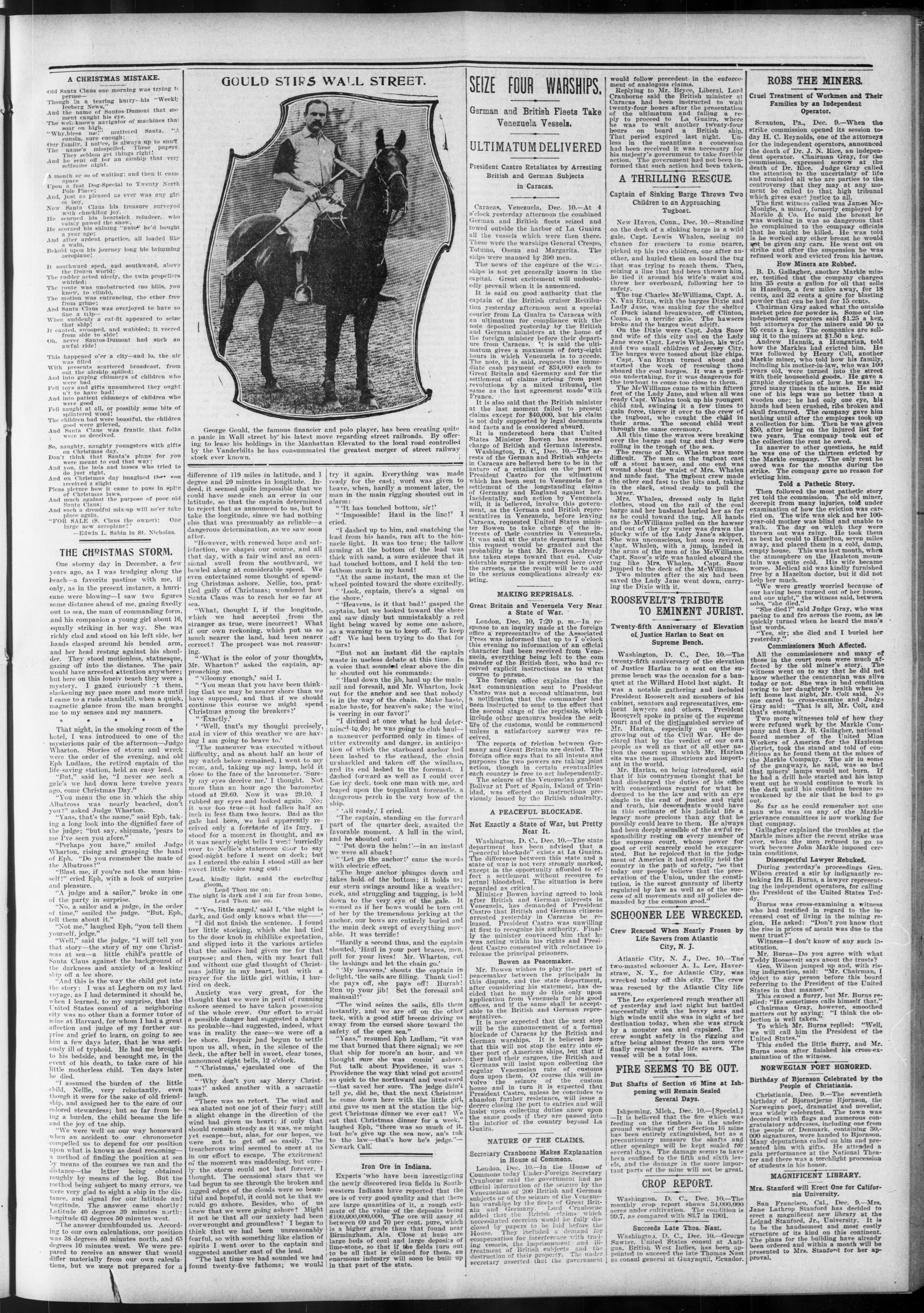
George Gould, the famous financier and polo player, has been creating quite a panic in Wall street by his latest move regarding street railroads. By offering to lease his holdings in the Manhattan Elevated to the local road controlled by the Vanderbilts he has consummated the greatest merger of street railway stock ever known.
difference of 119 miles in latitude, and 1 degree and 20 minutes in longitude. Indeed, it seemed quite impossible that we could have made such an error in our latitude, so that the captain determined to reject that as announced to us, but to take the longitude, since we had nothing else that was presumably as reliable—a dangerous determination, as we saw soon after.
"However, with renewed hope and satisfaction, we shaped our course, and all that day, with a fair wind and an occasional swell from the southward, we bowled along at considerable speed. We even entertained some thought of spending Christmas ashore. Nellie, too, prattled gaily of Christmas; wondered how Santa Claus was to reach her so far at sea.
"What, thought I, if the longitude, which we had accepted from the stranger as true, were incorrect? What if our own reckoning, which put us so much nearer the land, had been nearer correct? The prospect was not reassuring.
"What is the color of your thoughts, Mr. Wharton?" asked the captain, approaching me.
"Gloomy enough' said J.
"You mean that you have been thinking that we may be nearer shore than we have supposed, and that if we should continue this course we might spend Christmas among the breakers?' "Exactly.' 'Well, that's my thought precisely, and in view of this weather we are having I am going to heave to.'
"The maneuver was executed without difficulty, and as about half an hour of my watch below remained, I went to my room, and, taking up my lamp, held it close to the face of the barometer. 'Surely my eyes deceive me.' I thought. Not more than an hour ago the barometer stood at 29.60. Now it was 29.10. I rubbed my eyes and looked again. No; it was too true—it had fallen half an inch in less than two hours. Bad as the gale had been, we had apparently received only a foretaste of its fury. I stood for a moment in thought, and as it was nearly eight bells I went hurriedly over to Nellie's stateroom door to say good-night before I went on deck; but as I entered the cabin I stood still as her sweet little voice rang out:
Lead, kindly light, amid the encircling
gloom,
Lead Thou me on;
The night is dark and I am far from home,
Lead Thou me on.
“‘Yes, little angel,’ said I, ‘the night is
dark, and God only knows what the——’
"I did not finish the sentence. I found her little stocking, which she had tied to the door knob in childlike expectation, and slipped into it the various articles that the sailors had given me for that purpose; and then, with my heart full and without one glad thought of Christmas jollity in my heart, but with a prayer for the little girl within, I hurried on deck.
Anxiety was very great, for the thought that we were in peril of running ashore seemed to have taken possession of the whole crew. Our effort to avoid a possible danger had suggested a danger as probable—had suggested, indeed, what was in reality the case—we were off a lee shore. Despair had begun to settle upon us all, when, in the silence of the deck, the after bell in sweet, clear tones, announced eight bells, 12 o'clock.
"Christmas,' ejaculated one of the men.
"Why don't you say Merry Christmas?' asked another with a sarcastic laugh.
"There was no retort. The wind and sea abated not one jot of their fury; still a slight change in the direction of the wind had given us heart; if only that should remain steady as it was, we might yet escape—but, alas, for our hopes, we were not to get off so easily. The treacherous wind seemed to sneer at us in our effort to escape. The excitement of the moment was maddening, but surely the storm could not last forever. I thought. The occasional stars that we had begun to see through the broken and jagged edges of the clouds were so beautiful and hopeful, it could not be that we could go ashore. Besides, who of us knew that we were going ashore? Might it not be that all our anxiety had been overwrought and groundless? I began to think that we had been unreasonably fearful, so with something like elation of spirits I went over to the captain and suggested another cast of the lead.
"The last time we had sounded we had found twenty-five fathoms; we would
try it again. Everything was made ready for the cast; word was given to heave, when, hardly a moment later, the man in the main rigging shouted out in alarm:
"It has touched bottom, sir!"
"Impossible! Haul in the line!" I cried.
"I dashed up to him, and snatching the lead from his hands, ran aft to the binacle light. It was too true; the tallow arming at the bottom of the lead was thick with sand, a sure evidence that it had touched bottom, and I held the ten-fathom mark in my hand!
"At the same instant, the man at the wheel pointed toward the shore excitedly.
"Look, captain, there's a signal on the shore."
"Heavens, is it that bad!" gasped the captain, but we looked toward the shore and saw dimly but unmistakably a red light being waved by some one ashore, as a warning to us to keep off. To keep off! We had been trying to do that for hours!
"But not an instant did the captain waste in useless debate at this time. In a voice that sounded clear above the din he shouted out his commands:
"Haul down the jib, haul up the mainsail and foresail, and Mr. Wharton, look out for the anchor and see that nobody is in the way of the chain. Make haste, make haste, for heaven's sake; the wind is veering in our favor!"
"I divined at once what he had determined to do; he was going to club haul—a maneuver performed only in times of utter extremity and danger, in anticipation of which the starboard anchor had been lashed to the cathead, the chain urshackled and taken off the windlass, and its end lashed to the foremast. I dashed forward as well as I could over the icy deck, took one man with me, and leaped upon the topgallant forecastle, a dangerous perch in the very bow of the ship.
"All ready,' I cried.
"The captain, standing on the forward part of the quarter deck, awaited the favorable moment. A lull in the wind, and he shouted out:
"Put down the helm!'—in an instant we were all aback!
"Let go the anchor!" came the words with electric effect.
"The huge anchor plunges down and takes hold of the bottom; it holds us; our stern swings around like a weathercock, and struggling and tugging, is held down to the very eye of the gale. It seemed as if her bows would be torn out of her by the tremendous jerking at the anchor, our bows are entirely buried and the main deck swept of everything movable. It was terrific!
"Hardly a second thus, and the captain shouted, 'Haul in your port braces, men, pull for your lives! Mr. Wharton, cut the lashings and let the chain go.'
"My heavens,' shouts the captain in delight, 'the sails are filling. Thank God! she pays off, she pays off! Hurrah! Run up your jib! Set the foresail and mainsail!"
"The wind seizes the sails, fills them instantly, and we are off on the other tack, with a good stiff breeze driving us away from the cursed shore toward the safety of the open sea."
"Yaas," resumed Eph Ludlam, "it was me that burned that there signal; we see that ship for more'n an hour, and we thought sure she was comin' ashore. But talk about Providence, it was a Providence the way that wind got around so quick to the northward and westward
—that saved her sure. The jedge didn't tell ye, did he, that the next Christmas he come down here with the little girl, and gave us men at the station the biggest Christmas dinner we ever eat? We eat that Christmas dinner for a week," laughed Eph, "there was so much of it. but he's give up the sea now, an's tuk to the law—that's how he's jedge."—Newark Call.
Iron Ore in Indiana
Experts who have been investigating the newly discovered iron fields in Southwestern Indiana have reported that the ore is of very good quality and that there are large quantities of it, a rough estimate of the value of the deposits being $100,000,000,000. The ore will assay at between 60 and 70 per cent. pure, which is a higher grade than that found near Birmingham, Ala. Close at hand are large beds of coal and large deposits of lime-stone, so that if the fields turn out to be all that is claimed for them, an enormous industry will soon be built up in that part of the state.
SEIZE FOUR WARSHIPS.
German and British Fleets Take Venezuela Vessels.
ULTIMATUM DELIVERED
President Castro Retaliates by Arresting British and German Subjects
Caracas, Venezuela, Dec. 10.—At 4 o'clock yesterday afternoon the combined German and British fleets seized and towed outside the harbor of La Guaira all the vessels which were then there. These were the warships General Crespo, Totumo, Ossun and Margarita. The ships were manned by 390 men. The news of the capture of the warships is not yet generally known in the capital. Great excitement will undoubtedly prevail when it is announced.
It is said on good authority that the captain of the British cruiser Retribution yesterday afternoon sent a special courier from La Guaira to Caracas with an ultimatum for compliance with the note deposited yesterday by the British and German ministers at the home of the foreign minister before their departure from Caracas. It is said the ultimatum gives a maximum of forty-eight hours in which Venezuela is to accede. The note, it is said, requests the immediate cash payment of $34,000 each to Great Britain and Germany and for the settlement of claims arising from past revolutions by a mixed tribunal, the same as the last agreement made with France.
It is also said that the British minister at the last moment failed to present claims except for $40,000, but his claim is not duly supported by legal documents and facts and is considered absurd. It is understood here that United States Minister Bowen has assumed charge of British and German interests.
States Minister Bowen has assumed charge of British and German interests. Washington, D. C., Dec. 10.—The arrests of the German and British subjects in Caracas are believed here to be in the nature of a retaliation on the part of President Castro for the ultimatum which has been sent to Venezuela for a settlement of the longstanding claims of Germany and England against her. Incidentally, such action by Venezuela will, it is believed, involve this government, as the German and British representatives in Venezuela, before leaving Caracas, requested United States minister Bowen to take charge of the interests of their countries in Venezuela. It was said at the state department that this request would be granted and the probability is that Mr. Bowen already has taken steps toward that end. Considerable surprise is expressed here over the arrests, as the result will be to add to the serious complications already existing.
MAKING REPRISALS.
Great Britain and Venezuela Very Near a State of War.
London, Dec. 10, 7:20 p. m.—In response to an inquiry made at the foreign office a representative of the Associated Press was informed that up to 7 o'clock this evening no information of an official character had been received from Venezuela, everything being left to the commander of the British fleet, who had received explicit instructions as to what course to pursue.
The foreign office explains that the last communication sent to President Castro was not a second ultimatum, but a notification that the commander had been instructed to send to the effect that the second stage of the reprisals, which include other measures besides the seizure of the customs, would be commenced unless a satisfactory answer was received.
The reports of friction between Germany and Great Britain are denied. The foreign office says that to all intents and purposes the two powers are taking joint action, though in certain eventualities each country is free to act independently.
The seizure of the Venezuelan gunboat Bolivar at Port of Spain, Island of Trinidad, was effected on instructions previously issued by the British admiralty.
A PEACEFUL BLOCKADE.
Not Exactly a State of War, but Pretty Near It.
Washington, D. C., Dec. 10.—The state department has been advised that a "peaceful blockade" exists at La Guaira. The difference between this state and a state of war is not very strongly marked, except in the opportunity afforded to effect a settlement without recourse to actual bloodshed. The situation is here regarded as critical.
Minister Bowen having agreed to look after British and German interests in Venezuela, has demanded of President Castro that British and German citizens arrested yesterday in Caracas be released. President Castro was unwilling at first to recognize his authority. Finally the minister convinced him that he was acting within his rights and President Castro consented with reluctance to release the principal prisoners.
Bowen as Peacemaker.
Mr. Bowen wishes to play the part of peacemaker between the principals in this dispute, and the state department, after considering his statement, has decided that he may do this only upon application from Venezuela for his good offices, and if the same shall be acceptable to the British and German representatives.
It is now expected that the next step will be the announcement of a formal blockade of Caracas by the British and German warships. It is believed here that this will not stop the entry into either port of American ships, but that if they land their cargoes, the British and Germans will insist upon collecting the regular Venezuelan rate of customs dues upon them. Of course this will involve the seizure of the custom house and in turn it is expected that President Castro, unless he concludes to abandon further resistance, will issue a decree closing the port to entries and will insist upon collecting duties anew upon the same goods if they are passed into the interior of the country beyond La Guaira.
NATURE OF THE CLAIMS.
Secretary Cranboone Makes Explanation in House of Commons.
London, Dec. 10.—In the House of Commons today Under-Foreign Secretary Cranborne said the government had no official information of the seizure by the Venezuelans of 200 British and German subjects or of the seizure of the Venezuelan warships by the fleets of Great Britain and Germany. Lord Cranborne added that the British claims which necessitated coercion would be fully disclosed by papers to be laid before the House. They included a demand for compensation for interference with trading vessels, the imprisonment and ill-treatment of British subjects and the destruction of their property. The under secretary asserted that the government
would follow precedent in the enforcement of analogous claims.
Replying to Mr. Bryce, Liberal, Lord Cranborne said the British minister at Caracas had been instructed to wait twenty-four hours after the presentation of the ultimatum and failing a reply to proceed to La Guaira, where he was to wait another twenty-four hours on board a British ship. That period expired last night. Unless in the meantime a concession had been received it was necessary for his majesty's government to take forcible action. The government had not been informed that such action had been taken.
A THRILLING RESCUE.
Captain of Sinking Barge Throws Two Children to an Approaching Tugboat.
New Haven, Conn., Dec. 10.—Standing on the deck of a sinking barge in a wild gale, Capt. Lewis Whalen, seeing no chance for rescuers to come nearer, picked up his two children, one after another, and hurled them on board the tug that was trying to reach them. Then, seizing a line that had been thrown him, he tied it around his wife's waist and threw her overboard, following her to safety.
The tug Charles McWilliams, Capt. A. N. Van Ettan, with the barges Dixie and Lady Jane, was making for the shelter of Duck island breakwater, off Clinton, Conn., in a terrific gale. The hawssers broke and the barges went adrift.
On the Dixie were Capt. John Snow and wife of this city and on the Lady Jane were Capt. Lewis Whalen, his wife and two small children of Jersey City. The barges were tossed about like chips. Capt. Van Ettan turned about and started the work of rescuing those aboard the coal barges. It was a perilous undertaking, for it was dangerous for the towboat to come too close to them. The McWilliams came to within fifteen feet of the Lady Jane, and when all was ready Capt. Whalen took up his youngest child and, swinging it a few times to gain force, threw it over to the crew of the tugboat, who caught the child in their arms. The second child went through the same ceremony. All this time the waves were breaking over the barge and tug and they were rolling in the trough of the sea.
The rescue of Mrs. Whalen was more difficult. The men on the tugboat cast off a stout hawser, and one end was wound about the waist of Mrs. Whalen and made fast. The tugboat crew made the other end fast to the bits and, taking in the slack, stood ready to pull the hawser.
Mrs. Whalen, dressed only in light clothes, stood on the rail of the coal barge and her husband hurled her as far as he could toward the tug. All hands on the McWilliams pulled on the hawser and out of the icy water was drawn the plucky wife of the Lady Jane's skipper. She was unconscious, but soon revived. Capt. Whalen, with a jump, landed in the arms of the men of the McWilliams. Capt. Snow's wife was hauled aboard the tug like Mrs. Whalen. Capt. Snow jumped to the deck of the McWilliams.
Two minutes after the six had been saved the Lady Jane went down, carrying the Dixie with it.
ROOSEVELT'S TRIBUTE TO EMINENT JURIST.
Twenty-fifth Anniversary of Elevation of Justice Harlan to Seat on Supreme Bench.
Washington, D. C., Dec. 10.—The twenty-fifth anniversary of the elevation of Justice Harlan to a seat on the supreme bench was the occasion for a banquet at the Willard Hotel last night. It was a notable gathering and included President Roosevelt and members of his cabinet, senators and representatives, eminent lawyers and others. President Roosevelt spoke in praise of the supreme court and of the distinguished service of Mr. Harlan, especially on questions growing out of the Civil War. He declared that by the verdict of our own people as well as that of all other nation the court upon which Mr. Harlan sits was the most illustrious and important in the world.
Mr. Harlan, on being introduced, said that if his countrymen thought that he had discharged the duties of his office with conscientious regard for what he deemed to be the law and with an eye single to the end of justice and right and truth, his descendants would have in this estimate of his judicial life a legacy more precious than any that he possibly could leave to them. He always had been deeply sensible of the awful responsibility resting on every member of the supreme court, whose power for good or evil scarcely could be exaggerated. But he rejoiced that in the judgment of America it had steadily held the country in the path of safety, "so that today our people believe that the preservation of the Union, under the constitution, is the surest guaranty of liberty regulated by law as well as of the success of all movements and all policies demanded by the common good."
SCHOONER LEE WRECKED.
Crew Rescued When Nearly Frozen by Life Savers from Atlantic
Atlantic City, N. J., Dec. 10.—The two-masted schooner A. L. Lee, Haverstraw, N. Y., for Atlantic City, was wrecked today off this city. The crew was rescued by the Atlantic City life savers. The Lee experienced rough weather all of yesterday and last night but battled successfully with the heavy seas and high winds until she was in sight of her destination today, when she was struck by a monster sea and capsized. The crew sought safety in the rigging and after being almost frozen the men were finally rescued by the life savers. The vessel will be a total loss.
FIRE SEEMS TO BE OUT.
Ishpeming, Mich., Dec. 10.—[Special.]
—It is believed that the fire which was feeding on the timbers in the underground workings of the Section 16 mine has been entirely extinguished, but as a precautionary measure the shafts and other openings will be kept sealed for several days. The damage seems to have been confined to the fifth and sixth levels, and the damage in the more important parts of the mine will not be great.
CROP REPORT.
Washington, D. C., Dec. 10. The monthly crop report shows 34,000,000 acres under cultivation. The condition is 99.7, as compared with 86.7 in 1901.
Succeeds Late Thos. Nast.
Washington, D. C., Dec. 10.—George Sawter, United States consul at Antigua, British West Indies, has been appointed to succeed the late Thomas Nast as consul general at Guayaquil, Ecuador.
ROBS THE MINERS.
Cruel Treatment of Workmen and Their Families by an Independent Operator.
Scranton, Pa., Dec. 9.—When the strike commission opened its session today H. C. Reynolds, one of the attorneys for the independent operators, announced the death of Dr. J. N. Rice, an independent operator. Chairman Gray, for the commission, expressed sorrow at the death of Dr. Rice. Judge Gray called the attention to the uncertainty of life and reminded all who are parties to the controversy that they may at any moment be called to that high tribunal which gives exact justice to all.
The first witness called was James McMonigle, a miner, formerly employed by Markle & Co. He said the breast he was working in was so dangerous that he complained to the company officials that he might be killed. He was told is he worked any other breast he would not be given any cars. He went out on strike and after the suspension he was refused work and evicted from his house.
How Miners are Robbed.
B. D. Gallagher, another Markle miner, testified that the company charged him 35 cents a gallon for oil that sells in Hazelton, a few miles away, for 18 cents, and 32 cents a quire for blasting powder that can be had for 15 cents. Chairman Gray asked what the outside market price for powder is. Some of the independent operators said $1.25 a keg, but attorneys for the miners said 90 to 95 cents a keg. The companies are selling it to the miners at $1.50 a keg.
Andrew Hannik, a Hungarian, told how the Markles had evicted him. He was followed by Henry Coll, another Markle miner, who told how his family, including his mother-in-law, who was 100 years old, were turned into the street with their household goods. He gave a graphic description of how he was injured many times in the mines. He said one of his legs was no better than a wooden one; he had only one eye, his hands had been crushed, ribs broken and skull fractured. The company gave him nothing until after the employees took up a collection for him. Then he was given $50, after being on the injured list for two years. The company took out of the collection the rent he owed.
In answer to other questions, he said he was one of the thirteen evicted by the Markle company. The only rent he owed was for the months during the strike. The company gave no reason for evicting him
Told a Pathetic Story.
Then followed the most pathetic story yet told the commission. The old miner, decrepit from many injuries, told under examination of how the eviction was carried on. The wife was sick and her 100-year-old mother was blind and unable to walk. The day on which they were thrown out was rainy. He took them as best he could to Hazelton, seven miles away, and placed them in a cold, damp, empty house. This was last month, when the atmosphere on the Hazelton mountain was quite cold. His wife became worse. Medical aid was kindly furnished free by a Hazelton doctor, but it did not help her much.
"We were greatly worried because of our having been turned out of her house, and one night," the witness said, between sobs. "she died."
"She died?" said Judge Gray, who was pacing to and fro across the room, as he quickly turned when he heard the man's last words.
"Yes, sir; she died and I buried her yesterday."
Commissioners Much Affected.
All the commissioners and many of those in the court room were much affected by the old miner's story. The witness went on to say that he did not know whether the centenarian was alive today or not. She was in bad condition owing to her daughter's health when he left home last night, Mr. Colt said. No one cared to cross-examine and Judge Gray said: "That is all, Mr. Colt, and that's enough."
Two more witnesses told of how they were refused work by the Markle Company and then J. B. Gallagher, national board member of the United Mine Workers of America for the Hazleton district, took the stand and told of conditions as he found them at the mines of the Markle Company. The air in some of the gangways, he said, was so bad that miners' lamps would not burn. If he had a drill hole started and his lamp went out he would continue to work in the dark until his condition became so weakened by the air that he had to go out.
So far as he could remember not one man who was on any of the Markle grievance committees is now working for that company.
Gallagher explained the troubles at the Markle mines after the recent strike was over, when the men refused to go to work because John Markle imposed certain conditions.
Disrespectful Lawver Rebuked.
During yesterday's proceedings Gen. Wilson created a stir by indignantly rebuking Ira H. Burns, a lawyer representing the independent operators, for calling the President of the United States Teddy.
Burns was cross-examining a witness who had testified in regard to the increased cost of living in the mining region. He asked: "Don't you know that the rise in prices of meats was due to the meat trust?"
Witness—I don't know of any such institution.
Mr. Burns—Do you agree with what Teddy Roosevelt says about the trusts?
Teddy Roosevelt says about the trusts?
Gen. Wilson jumped up and, with rising indignation, said: "Mr. Chairman, I object to any person before this board referring to the President of the United States in that manner."
This caused a flurry, but Mr. Burns replied: "He sometimes calls himself that."
Chairman Gray, however, smoothed matters out by saying: "I think the objection is well taken."
To which Mr. Burns replied: "Well, we will call him the President of the United States."
This ended the little flurry, and Mr. Burns soon after finished his cross-examination of the witness.
NORWEGIAN POET HONORED
Birthday of Bjornson Celebrated by the People of Christiania.
Christiania, Dec. 9.—The seventieth birthday of Bjornstjerne Bjornson, the Norwegian poet, dramatist and novelist, was widely celebrated. The town was decorated with flags and numerous congratulatory addresses, including one from the people of Denmark, containing 30,000 signatures, were handed to Bjornson. Many deputations called on him and presented him with gifts. He attended a gala performance at the National Theater and there was a torchlight procession of students in his honor.
MAGNIFICENT LIBRARY.
Mrs. Stanford will Erect One for California University.
San Francisco, Cal., Dec. 9.—Mrs. Jane Lathrop Stanford has decided to erect a magnificent new library at the Leland Stanford, Jr., University. It is to be the handsomest and most costly structure of its kind on this continent. The plans for the building have already been ordered and within a month will be presented to Mrs. Stanford for her approval.
postage paid
One Year ..... $2.00
Six Months ..... 1.25
Three Months ..... 75
Send money by Express Money Order, P. O.
Money Order or Registered Letter to the
Wisconsin Weekly Advocate.
ADVERTISING RATES.
One inch, single insertion..... 25c
One inch, per year..... $9.00
Business locals 5c per line each insertion.
Apply for rates to the Advocate.
TO CONTRIBUTORS:
All communications must be sent with the name and address of the sender as an evidence of good faith, but not necessarily for publication. No manuscript returned if not accepted, unless accompanied by stamps.
The Wisconsin Weekly Advocate company wishes to notify the public that all contracts and business transactions with this company must have the company stamp, otherwise they will be void. Neither will this company be responsible for paid subscriptions unless given to duly-accredited agents, who, on request, will give the company's receipt for same. Subscribers failing to receive their papers regularly will kindly notify the general office. Address all business communications to the general manager, 79 Fifth street.
Entered in the Postoffice at Milwaukee as Second-class matter.
EDITORIAL PARAGRAPHS.
"I know of the bravery and character of the Negro soldier. He saved my life at Santiago, and I have had occasion to say so in many articles and speeches. The Rough Riders were in a bad position when the Ninth and Tenth cavalry came rushing up the hill carrying everything before them. The Negro soldier has the faculty of coming to the front when he is needed most. In the Civil war he came 400,000 strong, and I believe he saved the Union."—President Roosevelt.
Spooner's Acceptance
In another column we publish the letter of Senator Spooner which announces his candidacy for re-election in reply to a request by prominent Republicans. The declaration is clear and decisive and leaves no doubt as to Mr. Spooner's willingness to be continued in office. But this seems not to be enough to suit the demands of his opponents. The Milwaukee Free Press, the official organ of the La Follette element within the party, in commenting, editorially, upon Mr. Spooner's letter, seems to doubt his sincerity and boldly accuses the senator of being personally responsible for the defeat of "reform" legislation two years ago. Whether this latter charge is true or not the Wisconsin Weekly Advocate is not in the position to state positively, but it has its doubts as to the veracity of the matter, the same as a large majority of Republicans in the state have.
The policy of the Free Press is in pursuance of that which was originally mapped out by Gov. La Follette to the effect that Senator Spooner must not be returned to the United States Senate. It was carried out with scrupulous exactness prior to the state convention and was only sidetracked for the purpose of catching votes when the scheme met with universal condemnation by Republicans throughout the state, 90 per cent. of whom were then and still are for the return of Hon. John C. Spooner to the chamber of the United States Senate.
The "Half-Breed" pack are merely showing their teeth again and will continue to act ugly until they endanger the so-called hobbies of the governor's from becoming realities. But then, what does Gov. La Follette care about his much flaunted schemes of reform? They were good enough to ride him into office and have now served their usefulness. He is not now and has never been sincere in the advocacy of their adoption as state measures, but has preferred to use the defeat of such as a means to an end, namely, to charge the same to his enemies for campaign purposes. The governor that best serves the people of any commonwealth is the one who preserves harmony within the lines of the political body that elects him to office and has no faction to lay the blame of his personal misdeeds upon. This is the baby act of the small boy and is unmanly. Why make excuses at all? The game of politics is a hard one at best and the public is not interested in the "whys and wherefores" that usually follow failure.
However, this latest aspect in the matter of "La Follette vs. Spooner" is not in the nature of a surprise to the Wisconsin Weekly Advocate, as some months ago we gave an outline of the programme to be carried out in the event of La Follette's election. They are perturbed over the senator's announcement of his candidacy, as they had hoped to use his failure to do so against him in their argument for defeat before the next Legislature. Now that he has knocked that hope to pieces they seek to trump up other charges against him. But it will avail them nothing. Senator Spooner will be re-elected in spite of the opposition of "Bob" La Follette and the despicable Milwaukee Free Press.
A Negro Inventor.
Mr. Orville McNorton, formerly of Virginia but now of Washington, D. C., employed as a shorthand and typewriting teacher at the St. Francis Xavier school, has recently received from the patent office a patent for a switch operating device. The device is intended to do away with accident from switches being left open or becoming disarranged from any cause whatever. It is worked automatically, and it is impossible for a train to be derailed except when done intentionally. No matter whether a train is coming on one track or the other, the switch will be thrown to the rail where it is needed. The invention will almost revolutionize car shifting in railroad yards, as fewer switchmen will be required, the train doing its own switching.
This is by no means the first instance which goes to show that the Negro is a mere imitation and has no faculty for taking the initiative as is claimed by many of his detractors. We claim that for a race only forty years removed from a state of bondage it has made a most remarkable showing—one unparalleled indeed in the world's history.—Ed.
The Other Fellows on Current Topics.
The Mobile Weekly Press very tersely puts the whole Southern Negro question in a nutshell in a short editorial last week. It says: "The Democratic papers of the South are telling the President, that he is keeping the South solid by disapproving of the lyily white movement. They are rather profuse and liberal in their advice to a Republican President. Luckily we have a man who sees that the South IS solid and will remain solid against the Republican party. What the Democrats want is absolute power to make the Negro a chattel and keep him in abject servitude; to hold all the elective offices from constable to senator and have only a few men whom they may select to be appointed by the President. The President knows this and is on to their little game, and they are wasting space trying to tell him what to do."
* * *
The Chicago Conservator culls the following from a Southern white paper and comments upon it: "Brooker Washington seems to be the chief adviser of the President in Southern matters. Although Washington has been a wise guide to his own people Southern white men cannot regard him as the proper person to give advice and information to the President concerning his Southern policy, involving conditions of the white people of this section." The Conservator comments: "But does not that old Southern prejudice die hard though? But it IS dying by short inches just the same." The Advocate would add to this that the Negro population being in most of the states equal to the white and in some of them greater, the conditions of these Negroes must be of very grave concern to the head of the government, and that the affairs of both classes are so closely interwoven that no choice is left to any one who wishes to act rightly to both parties, but to consult with persons who are recognized to be leaders except by a few disgruntled sore heads.
***
It is pleasant to turn to the brighter side of the question and observe what a great Northern white paper has to say on the Negro question. The Chicago Chronicle in a recent article says in part: "The fashion—it is hardly more than a fashion—of treating every Negro, regardless of his merits is a wrong to the Negro race of which Americans have reason to be deeply ashamed. It is a fashion which does not prevail in the most enlightened countries of Europe, aristocratic as they are. It is more than shameful—it is dangerous. We have in this country some 8,500,000 people who have more or less of the Negro in them. For better or worse they are here to stay. It behooves us, therefore, to consider what may happen if as Mr. Roosevelt puts it 'it is to be declared that under no circumstances shall any man of color, no matter how upright or honest, no matter how good a citizen, no matter how fair his dealings with his fellows be permitted to hold any office under government.' It is fair to presume that intelligent and reasonable white men in the South to a great extent view the matter much as the President does, and that those who insist on treating the blacks as political pariahs are mossbacks who belong to a dead generation and who are themselves fast fading into the imperceptible."
The Chicago Conservator has a general denunciation of all colored newspapers who do not see eye to eye with it in the matter of Postmaster General H. C. Payne's position in regard to Southern representation—the Advocate among the number, we presume. The Conservator characterizes Mr. Payne as the original lily white Republican of the age. It says, "We give Payne no credit for Roosevelt's great acts. We believe the President chose Payne to bear his message to the public because Payne had publicly advocated the elimination of the Negro." This is blowing hot and cold air—mostly hot—from the same mouth with a vengeance. It seems to our probably obtuse mind that to speak of a man having no share in another man's GREAT acts, and then to seek to cast opprobrium upon him for being the one to communicate these same acts to the public is to say the least somewhat incongruous. The Advocate is in a position to know the stand which the Hon. H. C. Payne has always taken on the Negro question, as it has had the privilege and honor of his continued patronage for the past four years—ever since its institution—and it knows that the Negro race has no truer friend than that gentleman.
The Advocate has endeavored in season and out of season to impress upon the members of the Negro race that a "house divided against itself cannot stand." And now the New York Age tersely points out the same fact in connection with the action taken by different states concerning the three cases now on their way to the supreme court to test the constitutionality of the disfranchising laws in some Southern states. The Age shows that the Alabama and Virginia cases are being conducted by state associations, while the Louisiana case is being conducted by the National Afro-American Council and says: "It is unfortunate that all of these cases should not be placed under the general control of the council which was organised for just such work. We detract from the effectiveness of most of our efforts by division of counsel and money. The crying need of the race is unification of interests, counsel, action and capital." With every word of which we are in entire sympathy and agreement.
* * *
We do not suppose that the Washington Bee could refrain from criticising the "Sermon on the Mount" on account of its omission of something which in the judgment of the editor of that journal was desirable and worthy of mention. Editor Chase wished a paragraph in the President's recent message devoted entirely to the Negro question. For our part we are content to be classed among all the rest of the American citizens in that great sentence which will go down into history, "All that we can ask of any man," etc. To our mind the President can see "no difference" and it would have been out of place to suggest a matter to Congress which is at the present time "sub justice" and will receive soon the attention of the supreme court of the republic.
***
The Spectator of St. Joseph, Mo., in an editorial last week jumps upon the Advocate with both feet because according to it we defended Prof. Brooker T. Washington for sending his daughter to Wellesley College. Mr.Washington's action needs no defense at our or anyone's nands in the matter of his private affairs. As we have frequently mentioned, had that gentleman chosen not to cast in his lot with his people, but to bestow his abilities and energy in any other direction, such would have long ere this earned for him a competency, and he could have retired in peace and could have pleased himself as to where he would educate his family—as we sincerely trust he will do as it is.
Very Tall Corn.
John Martin of Platte county, Missouri, is looking for the man who can exhibit taller corn than was raised this season on his farm. Some stalks which he recently exhibited measured 17 feet, grown from seed which he procured in Mexico, and Mr. Martin claims the belt.
MILLIONS FOR RIVER
UPPER MISSISSIPPI IN NEED OR VAST SUM.
Big Projects Undertaken by Residents of Valley-Prominent Men Interested in the Improvements-Urge Development of Navigation and Commerce.
The Mississippi River problem is one of the oldest and most difficult with which Congress has to deal. It is many sided and subject to constantly changing conditions. Years of discussion and millions of money have not completely solved it, for the old father of waters is decidedly human in his characteristics and is afflicted with the frailties, the perversity and viciousness of humanity as well as possessing many of its virtues. To reform his habits and hold his mighty power in subjection to the will of man, to require him to surely and safely carry the commerce of an empire, are some of the details of what is known as the Mississippi River problem.
Upper Division Neglected.
The appropriations in the river and harbor bill show that the bulk of money appropriated for the improvement of this great water way has been and is being expended on the lower division of the river from Cairo to New Orleans. The inadequate work upon the upper division, northward from Cairo to St. Paul, has resulted in a gradually lessening of the depth of the channel until at the present time only small steamboats of light draft ply north of Cairo. Big packets like those between St. Louis and New Orleans have almost vanished from the upper Mississippi, and in periods of low water navigation for freight transportation purposes becomes uncertain by reason of long stretches of unimproved river.
These conditions have aroused public
The image shows a calm river with a dock extending into the water. A boat is moored near the dock, and there are trees and hills in the background. The water appears to be still, reflecting the surrounding landscape.
THE LAND OF THE LOST LIFE
sentiment in the upper Mississippi valley in favor of demanding permanent improvement of the upper river adequate for the needs of commerce and industry in that region in particular and for the benefit of the country in general. This sentiment found form and expression in a large and representative convention held at Quincy, in which twenty-four river towns were represented by men prominent in the commercial and industrial life of their communities.ume of water for all the miles of the Another ment is the Keokuk, by $125,000. wide and Unlike most required to situation is sluice the rectly into
Fifteen millions of dollars is the sum they ask Congress to appropriate, and to secure this they have organized the first Upper Mississippi River Improvement Association ever formed. These men represent an enormous constituency in the upper Mississippi valley and they will base their claims upon the broad ground that the contemplated improvements in the upper river make for the general improvement of the entire stream from its headwaters to the gulf.
It must not be taken for granted that the government has wholly neglected the upper division of the Mississippi. On the contrary, it has recently approved of a project for improving that division, but has failed to provide a sum which the people of the valley consider sufficient. The present available appropriation for the upper division is $200,000 a year, while on the lower division the appropriations are about $2,000,000 a year, or ten times greater. A large part of the latter amount, however, is used for the construction of levees made necessary by floods.
Project Now in Hand
The upper river improvement project, which has been approved by Congress, calls for a channel of four and one-half feet in depth, to be increased to six feet. This is on the basis of the extreme low water of 1854, which does not occur at periods of more than once in ten years. It practically means a low-water channel of six feet at ordinary low water, to be increased to eight feet.
In carrying out this project the Des Moines rapids at Keokuk have been overcome by a canal with three locks 80x350 feet. The depth of the canal was placed at five feet below extreme low water. The Des Moines rapids are immediately above the city of Keokuk, Iowa, between the States of Illinois and Iowa, with the State of Missouri a few miles to the southwest and beyond the Des Moines River. The canal extends along this west or Iowa shore between Nashville and Keokuk. It was opened to navigation in 1897. It is seven and one-half miles long and surmounts a fall of twenty feet, which is the slope of the river from the head of the canal to the foot. At high water boats go down outside of the canal, but when the river recedes to a stage of three feet above low water all boats pass through the canal.
In the opinion of the government engineers this canal has been the means of preserving navigation on the upper
Mississippi for the past twenty years. During that time there has been a gradual cheapening of freight rates and the decline in that particular in connection with the heavy charges necessary to transfer freight over the rapids by rail or by flatboat when the water was low would have been a greater tax than the traffic would bear and as a result river navigation would have fallen into disuse.
The locks of the Keokuk canal are massive structures of solid stone and the gates are operated by hydraulic pressure from the central point of the locks. Two men operate the locks and it is an impressive sight to see a towering steamboat enter the lock, the gate close, the water subside, the opposite gate open and the boat pass out, all under the control of two puny human instruments.
The Keokuk canal offers the difficulty of a long and shallow channel interrupted by three locks. Twenty minutes' time is consumed at each lock by the passage of a large boat, while the compensating advantage is absolute safety and certainty.
A movement is afoot which is a part of the general plan of upper Mississippi improvement, although there was no mention of any specific detail by the recent river convention, to replace the present canal with and its three locks by a single large lock adequate for all the needs of the large steamboats and tows which are the development of modern navigation. This project also includes a dam clear across the river, converting the rapids into a deep pool, on which boats may ply at any speed without hindrance. It is claimed by engineers who have investigated these proposed improvements an added advantage of such a dam would be that, while by substituting a quicker and more convenient passage of the rapids, it also would develop a great water power with a fall of from twenty to twenty-two feet and a vol-
OVEMENT.
nume of water sufficient to furnish power for all the manufactories within 100 miles of the rapids.
Another important recent improvement is the government dry dock at Keokuk, built in 1889 at a cost of $125,000. It is 400 feet long, 100 feet wide and is entered from the canal. Unlike most dry docks, no pumping is required to empty it of water, for the situation is such that by opening a sluice the water falls by gravity directly into the river outside of the canal, which is an enormous saving in the cost of operation. This dock is used for repairing the fleet of boats engaged in river improvement work and also for any private boat in need of urgent repairs which does not re-
THE FERRY
quire more than two or three days to complete. The government exacts a small fee for its use by private parties. There is only one other dock of the kind in the United States, and that is at Louisville on the falls of the Ohio, but the latter is much smaller. The Rock Island rapids have been improved by excavating a channel through the rocky reefs from 200 to 400 feet in width with a minimum depth of four feet below low water.
Since 1874 the government has been making improvements of various kinds on the upper Mississippi, and altogether since that date has expended about $9,000,000, which has been of vast benefit.
System of Improvement.
System of Improvement. In improving some sections of the upper river the work has been done by means of shore protection, closing dams and wing dams, constructed of brush and stone, which are found in abundance on the banks of the river. By this method of improvement all the side channels are closed by what are termed closing dams, thus confining the low water flow to a single channel. One bank of this channel is usually protected from caving by bank revetment and the river contracted by the construction of wing dams from the opposite shore. The width of contraction varies from St. Paul to the mouth of the Missouri in accordance with the low water discharge of the river at different places. At St. Paul the prescribed width of the improved river is 400 feet; at the mouth of the St. Croix it widens to 600 feet; below Lake Pepin it is 800 feet; below the mouth of the Wisconsin river, 1,000 feet; at Quincy, 1,200 feet; from the
---
Keokuk Canal Locks.
BUILDING A WING DAM.
Illinois river to the mouth of the Missouri. 1,000 feet.
The expenditures since 1874 have failed to meet the requirements of the people engaged in the navigation of the river and in commercial and industrial enterprises in the upper Mississippi valley. The only part of the river that has been thoroughly improved is a short piece extending from St. Paul to Red Wing, Minn. Just above Lake Pepin the river is now a broad sheet of water and occupies the entire valley from bluff to bluff. In that part of the river the improvement works are almost continuous and the results obtained have been very successful. While the river there is the smallest in volume than any other place in its course and the channel is only 300 feet wide, there is a continuous good channel the year round—far better, in fact, than is sometimes found between Cairo and St. Louis, after the river has received the tributaries for 700 miles of its course, including the Missouri, which is as large as the Mississippi itself. So far the work done has been very local in character, and improvements have been made principally at places where experience has shown they were needed most. These improved places are often disconnected by miles of unimproved river, and at the unimproved places sandbars still develop which give trouble at the low water season.
Plea for Reservoir System.
The people near the headwaters, particularly in St. Paul and Minneapolis, are urging an enlargement of the reservoir system, but this plan does not receive much consideration at the hands of engineers, who claim that the natural reservoir is Lake Pepin and that it is adequate.
The most radical element among the river improvement promoters want an ultimate development of the river to twelve feet. This would necessitate, according to the engineers, the building of movable dams similar to those on the Ohio River. The most optimistic see with the eyes of faith a day when the headwaters of the river will be connected with Lake Superior, thus furnishing a water outlet in a practically straight line from the great lakes to the isthmian canal, but this idea has no place in the present plan of development.
It is estimated that $15,000,000 will give the required depth at all points on the upper Mississippi and provide for those plans which seem local in their character, but are inseparably connected with the general scheme of improvement of hydraulic dredges in place of the dipper dredges and the sand pumps which now masquerade as hydraulic dredges, for even after the proposed improvements were made dredging would be necessary. Especially would this be true after a storm, when it might be necessary to remove a sand bar promptly instead of waiting for the river currents to do so.
Effect on River Commerce. Dwellers in the upper Mississippi valley expect that a favorable solution of the improvement problem relating to navigation will have a powerful effect upon Mississippi commerce and industry, for after all the main problem involved is commercial—the extension of trade and commerce on the part of the people of the upper Mississippi River not only among the people on its own banks and in the country south, but with the people of the world through its outlet to the gulf.
The men who have organized the Upper Mississippi River Improvement Association insist that the improvement of their section of the river is not a local question; that it is not a mere matter of building a dam or a dyke or removing a sand bar. They assert that the upper Mississippi valley is one of the most important commercial and industrial sections of the Union; that the paternal care the government formerly exercised over the stream has stimulated manufactures and has led the people to rely upon the government to keep the river in such shape that it can be fully utilized as a highway of middle west commerce. They point to the marvelous development of water ways in France in recent years, where by canalization even the smallest streams have been made available for the transportation of the nation's commerce. They feel that they are entitled to share with other sections of the country in the benefits of a phenomenal national commercial growth. Therefore, they regard the proposed improvement of the upper Mississippi as a national question—a question of promoting national commerce in the heart of the continent and extending and expanding Mississippi valley commerce as a part of the general plan of national trade expansion.
Queer Qualification.
The enthusiasts of the thoroughgoing lover of Browning takes some surprising turns. The author of "In a Tuscan Garden" tells a story concerning Doctor Furnival, one of the founders of the Browning Society. A young relative of the Englishwoman in London was looking out at one time for bachelor chambers in a block of flats. The secretary of the company to whom they belonged intimated that the testimony of two householders as to his rent-paying capacity would be required. The applicant gave the Englishwoman's name as one and Doctor Furnival's for the other.
Doctor Furnival's reply, after a glowing panegyric on the merits of the applicant, wound up by congratulating the company on getting as a tenant a man who "was not only a gentleman and a good fellow, but a member of the Browning Society."
When a woman wants to say anything mean pertaining to men in general she says they are all alike.
The Opportunity of a Life Time WANTED
for a first-class hotel in a city in the interior of the state of Wisconsin, the followlng colored help—
1 MEAT COOK, Female.
1 PASTRY COOK, Female.
1 LAUNDRY MAID.
2 CHAMBER MAIDS, one to assist in serving dinners and suppers.
2 DINING ROOM GIRLS.
2 DISH WASHERS.
This is an exceptional opportunity for a club of Southern girls to make for themselves a comfortable home in Wisconsin. The proprietor is a Southern gentleman who understands and appreciates the negro. Apply at once to the office of the WISCONSIN WEEKLY ADVOCATE, 79 Fifth Street, Milwaukee, Wis.
RAILWAYS.
A Famous Jackdaw.
The Brixton jackdow which was found dead last week in the bar of the Angell Arms at Brixton, was a great celebrity in his own way. All jackdaws have faus of their own, and the favorite fad of this particular bird was to travel all over London on omnibuses, trams and cabs. He was thoroughly well known to every 'busman in the Brixton district; he used to take his seat on a 'bus beside the driver, and would chatter most volubly till the journey to the city or elsewhere was accomplished, when he would fly back to his Brixton home. He was a bird of strong likes and dislikes, and when any of his master's customers failed to find favor in his sight he would assail them with a most embarrassing flow of language.—London Tatler.
TOOK HUSBAND'S PLACE.
Wife of Dane County Sheriff, Takes Convicts to Prison.
Handcuffed to Two Burly Criminals She Makes Trip to Waupun Alone.
Madison, Wis., Dec. 10.—[Special.]—Mrs. Ernest F. Burmeister, wife of the sheriff of Dane county, took her husband's place yesterday and took two burly criminals from here to Waupun prison. She was handcuffed to them both and carried a large revolver to use in case the men tried to get away from her. They behaved themselves splendidly, however, and Mrs. Burmeister returned here last evening feeling very well pleased with her trip to the prison.
The prisoners were Burt Holmes, a forger, sentenced to a year and eight months, and George Fredricks, sentenced to a year for a statutory offense. Accompanying Mrs. Burmeister and her prisoners, but not shackled to them, were Deputy Sheriff Gustave Erickson and two other prisoners, John Miller, counterfeiter, and Prince Arnold Maschke, thief, who went to the reformatory at Green Bay. The latter trio accompanied Mrs. Burmeister and her prisoners as far as Chester. From that point Mrs. Burmeister conducted her charges to Waupun by stage.
Mrs. Burmeister is a handsome blonde about 35 years old. She has six pretty little girls, the eldest being about 10 and the youngest 2.
Waupun, Wis., Dec. 10.—A novelty in prison annals was recorded yesterday when Mrs. Burmeister, wife of the sheriff of Dane county, appeared at the prison gate at 10 o'clock and delivered into the custody of Warden Towne two male criminals whom she had safely conveyed from Madison, under commitment from Dane county. Both had served terms here before.
It is believed to be the first time, and certainly is the only time within the recollection of the present officials of the prison, when the prerogative always heretofore accorded and associated with the sterner sex of conveying criminals to Waupun prison has been usurped by a woman. No trouble was experienced on the trip.
INGRAM FIRE LOSSES
New Buildings will Soon be Erected Where Desolation Now Reigns.
Ladysmith, Wis., Dec. 10.—[Special.]
The fire which destroyed the business portion of Ingram Monday night caught from a defective chimney in the saloon of Joe Adams. It spread north and south, destroying five buildings. H. A. Ostrander & Co. were the greatest losers. Their store and stock was entirely destroyed. The loss on the stock is $10,000, with $7900 insurance. Joe Adams' loss on his saloon building, barn and icehouse is $2500. Ed Blanchette suffered a partial loss on his saloon stock. The building was owned by Van Etten & Buckmaster. B. A. Grunseth's grocery suffered a partial loss of stock, but had $200 insurance. Napoleon LeClaire's loss is $800 on his building, partially insured. New buildings will go up where desolation now reigns.
THREE MEN INJURED IN RAILWAY WRECK.
Fireman is Thrown Into Firebox and Badly Burned-Others are Cut and Bruised.
Hurley, Wis., Dec. 10.—A serious wreck occurred on the North-Western road a few miles north of here. A southbound freight and a light engine northbound collided, completely demolishing both engines and seriously injuring three men. Fireman Pasterson was heaving a shovel of coal into his engine when the crash came, and he fell head foremost into the firebox, receiving frightful burns. Fireman Stewart was buried in the wreckage and was cut and bruised. Conductor Nelson of the light engine received slight injuries, both engineers escaping uninjured. The injured were taken to the hospital at Ironwood. All will recover.
POSTOFFICE WRECKED.
Nitro-glycerin Explosion Causes Great Havoc in Store at Cor-
Racine, Wis., Dec. 10.—[Special.]—Safe blowers secured an entrance to the postoffice and general store of Frank Lingsweiler at Corliss, seven miles west of here, shortly after midnight, and by the use of nitro-glycerine wrecked the safe and all the show cases and furniture. They secured several registered letters and a little money. Lingsweiler, the postmaster, resides next door to the store and heard the explosion, but thought little of it. The postoffice inspectors have been notified and are expected today.
Shawano Wis., Dec. 10.—[Special.]— This afternoon in circuit court at Shawano ex-Assemblvman Robert Hunt was discharged from custody by Judge Goodland in the case of the state vs. Hunt for mutilating the Oconto records. The judge directed a verdict after the state had submitted its evidence.
REORGANIZE OSHKOSH BANK.
It will be Known as the Old National Bank.
Oshkosh, Wis., Dec. 10.—The first of next February the National Bank of Oshkosh will go out of existence. The twenty-year charter of the bank will expire February 1 and it was optional with the company to secure an extension of the charter or entirely wipe off the slate, so far as charter is concerned, and reorganize under a brand new charter. Where the present concern is capitalized at $200,000 the new one will have a capital stock of $300,000. In the new company will be most of the present officers and stockholders and also a number of new ones. The name of the new bank will probably be "The Old National Bank of Oshkosh."
Washington, D. C., Dec. 10.—Authority was granted today for the reorganization of the National bank of Oshkosh, capital stock $300,000, to Charles Schreiber, S. M. Hay, Edgar P. Sawyer, J. H. Porter, Moses Hooper, William J. Hay and Phil H. Sawyer.
ROLLIN F. ALLEN DEAD.
Prominent Resident of Fond du Lac Dies Very Suddenly of Heart Disease.
Fond du Lac, Wis., Dec. 10.—[Special.]—Rollin F. Allen, a prominent resident of this city, died very suddenly this morning at 2 o'clock at his home on Forest avenue, after a short illness. Heart disease was the cause of his death. He is survived by a mother, three sisters and brother, all of whom live in Providence, R. I. Mr. Allen was 50 years old, and had held many public fices. Until recently he was president of the park board. He was identified prominently as a leader of the Republican party for many years. He was prominent in milling circles, formerly being a member of the firm of Allen & Trilben. In the early days he was associated with J. H. Aldridge in a similar business. A few weeks he entered into partnership with E. du Cew with the idea of taking up the same business.
Mrs. George Bradley, Sparta.
Sparta, Wis., Dec. 10.—[Special.]—Mrs. George Bradley, aged 63 years, died at her home in this city Monday evening of paralysis of the heart.
POCKET-BOOK THE CLUE.
Prisoner Had Letters Belonging to Murdered Man and Also His Purse.
Manitowoc, Wis., Dec. 10.—[Special.]
—A. Murdock, arrested at Two Rivers on a drunk and disorderly charge and serving ten days in jail here, is believed to be Bert Smith, under indictment on a charge of murder in Michigan, and the Michigan sheriff arrived here last evening to take his man over to face the charge. The crime was committed at Hart, Mich., last summer and a pocketbook bearing the name of the murdered man, found upon the person of Murdock, was the clue which led to the suspicion that he was the man wanted. Letters were also found upon him addressed to Burt Smith. Murdock was a millhand at Hart until a short time ago, disappearing shortly after the crime was committed there. He has been at Two Rivers for about six weeks. Sheriff James McVain of Oceana county departed for Michigan with his prisoner last evening, he having waived extradition papers.
DIES JUST AS REPORT SAID HE WOULD
All Details Told of in False Report Carried Out in Death or La Crosse Man.
La Crosse, Wis., Dec. 10.—[Special.]—Hartwell Warren, a brakeman, was killed by his train last night, every detail of the accident agreeing with a false rumor of his death last week. At that time a story, the source of which is still a mystery and finally attributed to the tangled condition of the telegraph wires on account of storms, reached here to the effect that Warren had been lost from his train and was found dead near Cassville on the track. Warren, however, was found in his caboose sleeping, at Savanna, not having gone out at all. Last night Warren was missed and Conductor Ben Benson ordered the crew to go back south of Cassville and search. The body was found on the right of way, all details of the former story having been carried out.
PENSION GRANTED ON DAY OF HIS FUNERAL
Veteran Passes Away at Manitowoc Before Congress Comes to His Assistance.
Manitowoc, Wis., Dec. 10.—[Special.]
—On the day that he was buried here, word was received from Washington, D. C., that the Senate had passed a bill granting a pension to Michael Mullens. The measure had been pending as a special bill through three sessions of Congress and was adopted in the lower house last year. Mullens died here Friday. He had served with the regular army in the Indian wars and with the volunteer army in the Civil War, a total of seven years. One of his last acts in life was the making of a will in which he bequeathed $100 to the local G. A. R. post. He was given a military funeral by the Grand Army and Spanish-American War Veterans.
BURGLARS LEFT EXPLOSIVE IN SAFE.
Son of Postmaster of Tomah Has Narrow Escape from Serious Injury in Opening Vault.
Tomah, Wis., Dec. 10.—[Special.]—While attempting to open the inner door of the vault of the postoffice safe which was blown up by burglars J. G. Graham, son of Postmaster Graham, had a narrow escape from death. He was using a wrench in trying to turn the bolt and the friction thus caused exploded nitro-glycerin which had been placed in the door by the burglars. Graham was severely burned about the face and eyes. The door was bent double by the explosion. Doctors report hat Graham was not seriously injured and that his eyesight was not harmed.
SUSPECTED OF MAKING WAY WITH HIS ENEMY.
John Rietzloff of Shawano is Charged with Knowing Whereabouts of Winfield Pike.
Shawano, Wis., Dec. 10.—John Rietzloff has been arrested charged with knowledge of the whereabouts of Winfield Pike, an employee of the pulp mills, who disappeared recently and cannot be found. Previous to the disappearance of Pike, the two men had quarreled. Rietzloff was arraigned yesterday afternoon, but no evidence was given which makes a very good case against Rietzloff. The hearing was adjourned for several days, when further evidence will be taken.
Pike has a wife and three small children dependent on him.
N. T. DAVIS PASSES AWAY.
Father of Mrs. E. R. Petherick Dies at Albert Lea, Minn.
Mazomanie, Wis., Dec. 10.-A dispatch from Albert Lea, Minn., brings the news of the death of Nat T. Davies, formerly a well-known citizen of Wisconsin, and the leading business man of Mazomanie. In his youth Mr. Davies was a lumberman, and was at one time a partner of the late Senator Thomas B. Scott, with whom he used to run rafts on the Wisconsin river. Mr. Davies went to Minnesota about fifteen years ago. He was father of Mrs. E. R. Petherick, wife of a well-known Milwaukee newspaper man.
RECOVER LOST MAIL BAG.
Pouch Taken by Highwayman Found Hidden Under a Bridge.
STAGE WAS HELD UP
Registered Mail Bag Rifled and About $79 in Cash Secured by the Robber.
Green Bay, Wis., Dec. 9.—[Special.]—The mail pouch reported missing by the driver of the Shawano stage last evening was brought to this city just before noon by Albert Fischer of the firm of Fischer & Bros. of Angelica and O. Stephenson, a resident of Lesser, Shawano county. The pouch was found under a small bridge crossing a creek only a few rods from where the driver claims he had been robbed last evening. It was picked up by Stephenson, who said: "I had made up my mind that the bag was under the bridge and when I came to it a bunch of letters were lying on the snow. I looked under the bridge and there it lay. It had been swung under the bridge from the side and had struck a post which spilt out the letters."
Examination showed that the registered letters and their contents, amounting to $79, were gone. A quarter and three stamps were left in an open letter in the pouch. The strap of the bag had been cut by the thief. One of the registered letters, which was sent by a Mr. Fischer, contained $16. All efforts to catch the thief have proved of no avail.
Story of the Robbery.
While on his way from Shawano to this city yesterday afternoon, the Shawano stage was held up and robbed of the mail pouch and all records in possession of the driver.
A man appeared in the neighborhood of Louy Jois' place, a saloon on the edge of the Oneida reservation, and stopped the horses by jumping at their heads.
He then attempted to seize the pouch and when Frank Lueke, the driver, clung to it the man slashed at one of the driver's hands with a knife, cutting through mitten. The man then disappeared in the woods, carrying the mail with him.
Tried to Protect Mail.
Lueke, the driver, is about 20 years old and has driven the Shawano stage for some time. In telling of the holdup he said:
"It was about 5 o'clock and growing dark. I was about three and a half miles from this city when a man appeared and stopped my horses by catching their heads. He then came up to me and said: 'Young fellow, give me that mail bag.' 'I guess not.' I said, and when he reached for it I reached over behind the seat, too. He made a slash at my hand and I felt the knife on my wrist. He had his revolver under my nose, too, and I let him take the bag. He then walked off. I didn't have any weapons of defense with me and was so bundled up that I couldn't have done anything anyhow, so I came on to town."
Couldn't Identify the Robber.
The boy was so shaken up that he could give no accurate description of the man and said he would not know the fellow again if he should see him.
The Shawano stage leaves here in the morning and returns in the afternoon of the next day. A second stage runs opposite to it. The mail is all put into one pouch, registered letters and all. It is composed not only of Shawano mail, but also of that brought to Shawano by other stage lines.
Shawano, Wis., Dec. 9.—If the robber who held up the Shawano-Green Bay stage thought he would secure valuables he was greatly mistaken. There happened to be nothing of value in the pouch which he took.
BLOWN TO DEATH.
Three Manitowoc County Men are Victims of a Boiler Explo-
Manitowoc, Wis., Dec. 9.—[Special.]—Three Manitowoc county men, Henry Steinbrecher of Cooperstown, Henry Hawks of Kossuth and Walter Kind of Larrabee, were killed at a boiler explosion at Bruce's Crossing, Mich., yesterday afternoon. News of the accident reached here this morning. All were residents of the northern part of the county and left here last spring. They were employed in a sawmill of which Steinbrecher was part owner. The mill was entirely wrecked by the explosion. Steinbrecher was 30 years of age and had a brother, a Catholic priest at Kaukauna. Hawks had no relatives here, and Kind's parents reside at Larrabee. The mill was established a year ago by Steinbrecher and Schmitt, who was also a Manitowoc man. The remains will be brought here for burial.
GREEN COUNTY LEADS IN INSANITY RECORD.
Percentage of Insane to Sane in that County is One to
Madison, Wis., Dec. 9.—According to statistics just completed in the office of the state board of control the percentage of insane to sane persons in Green county is 1 to 244. This is a larger showing of insanity than any other county in the state. The county having the lowest percentage of insanity, based on population, is Shawano, the percentage being 1 to about 900. Milwaukee county makes a better showing than the average, its percentage being 1 to about 550.
WISCONSIN SOCIETY ELECTION
Former Residents of State Hold Meeting in New York.
New York, Dec. 9.—The first annual meeting of the Wisconsin Society of New York was held last night at the Hotel Manhattan. These officers were elected for the coming year: President, Justice James A. Blanchard of the supreme court; honorary president, Frederick D. Underwood of the Erie railroad; vice presidents, H. L. Horton, Elljah R. Kennedy, Gilbert E. Roe, and Oscar E. Binner; secretary, Philip L. Allen; recording secretary, Charles W. Fricke; treasurer, Charles A. Jenny. The following trustees were chosen: George B. Hopkins, Henry S. Schwind, and A. Cressy Morrison.
WEALTHY WOMAN DIES
Mrs. C. J. Jackson Once Owned Much Land in Wood County.
Grand Rapids, Wis., Dec. 9.—[Special.]—Mrs. Cornelia J. Jackson died at the age of 80 years. She was a pioneer in this section of the state, moving here in 1857, and had continuously lived in this city for over forty years. She at one time owned a major part of the real estate upon which this city is located.
NEARLY BLEW UP SCHOOL
NEARLY BLEW UP SCHOOL
SAVED BY THE PRESENCE OF MIND OF A BOY.
Janitor of Wausau School Finds Boilers Red Hot and is About to Turn on Cold Water.
Wausau, Wis., Dec. 9.—[Special.]—An accident which might have proven frightful in its result was prevented by the presence of mind of a boy. Yesterday morning the janitor of the agricultural school building, which was lately completed and occupied, built a fire under the steam heating boilers not knowing that they were nearly empty. Later returning with a boy student he found the boilers red hot and was in the act or turning in cold water when pushed away by the boy. Had he been allowed his way what might have happened cannot be related. There are 140 students, the greater part adults, attending the different departments of this school, and though it was before the opening hour a great many of these were present. The boilers are ruined, school is suspended and an investigating committee is now at work.
LOVE COOLS IN A YEAR.
WAUSAU WOMAN FORGETS HUS BAND WHO IS IN PRISON.
She Now Wants to Wed Her Neighbor Her Violent Grief Being Short Lived.
Wausau, Wis., Dec. 9.—[Special.]—Ida Schwantes, who caused a sensation in court a year ago when in her grief she had to be torn from her husband, by the sheriff after he had received a life sentence in prison for the murder of the Klokow family, today manifested a change of spirit. She applied to the county clerk for a license to marry Albert Seibarth, her neighbor, but the application was refused because she had unlawfully assumed her maiden name.
TWENTY BELOW ZERO.
Very Cold Weather Reported by Grand Rapids—Suffering in the State
Grand Rapids, Wis., Dec. 9.—[Special.]—Intensely cold weather prevails here. The thermometer went down to 20 degrees below zero at 9:15 o'clock last night, causing much suffering. So far about six inches of snow has fallen, making better sleighing than has been enjoyed in this vicinity for a number of years. Kenosha, Wis., Dec. 9.—Kenosha had its first real winter weather yesterday, the thermometers registering 6 degrees below zero. La Crosse, Wis., Dec. 9.—The mercury went down to 10 degrees below in the government thermometer yesterday. It is a little warmer today.
Wausau, Wis., Dec. 9.—In the last twenty-four hours the thermometer has registered 12 degrees below zero here. It is much warmer today.
Askeaton, Wis., Dec. 9.—A cold wave struck this section Sunday evening, and yesterday it was 10 below zero.
Dodgeville, Wis., Dec. 9.—The mercury registered 16 degrees below zero here last night. It is about 10 below this morning.
VILLAGE IS BURNED.
Ingram, Gates County, is Almost Entirely Wiped Out by
Ladysmith, Wis., Dec. 9.—[Special.]— The village of Ingram, in this county, sixteen miles east of Ladysmith, was nearly wiped out by fire last night. Only a few buildings are left standing. The Ostrander Company's store and the large hotel are reported burned. The telephone office was burned and details are meager.
Ingram has a population of 125. It is on the "Soo" railway in Lawrence township, Chippewa county, ninety miles northeast of Chippewa Falls, the judicial seat, and thirty-five from Phillipps, the nearest banking point. H. Le Brun is postmaster. The hotel is conducted by Mrs. John Clark.
USES REVOLVER ON THEATRICAL MANAGER.
Discharged Actor Tries to Shoot Manager in Hotel at Water-
Watertown, Wis., Dec. 9.—[Special.]
There was a shooting affray in the lobby of the new Commercial Hotel yesterday. It is alleged that Edward Morris, formerly a member of "The Peddler's Claim" company, attempted to shoot Henry Marks, manager of the company. Morris had recently been discharged and he quarreled with the manager over that matter. No arrest was made and the company left for Joliet and Morris went to Chicago.
GAME LABELED "WHISKY."
Wardens are Now Trying to Locate the Shipper.
Madison, Wis., Dec. 9.—[Special.]—A barrel of partridges labeled "whisky" was captured in transit by Deputy Game Warden Stone at Hayward yesterday. It was sent here and sold by the state game warden today. The shipment purported to be a return of bottles to the distillery and there were bottles at the top and bottom of the barrel. Between them were three dozen partridges. Deputy Stone is now trying to locate the shipper.
BELOIT MAN IS VICE CONSUL
Charles F. Gammon Named to Tien Tsin Post.
Beloit, Wis., Dec. 9.—News has reached here of the appointment of Charles F. Gammon of this city to the post of United States vice consul at Tien Tsin, China. Mr. Gammon has been in the Chinese missionary field for a number of years.
BELOIT COLLEGE MISSION
The Students will Support One in India.
Beloit, Wis., Dec. 9.—[Special.]—At a mass meeting last evening of the Beloit College and Academy students it was voted to contribute for the support of F. B. McCusky, class of '98, who has gone as a missionary to India.
Mayer's
LADIES'SHOES
Embrace every feature of
style, grace, beauty and
durability—They wear well,
look well.
PRICE from $2.00 up. ASK
YOUR DEALER FOR OUR
SHOES.
F. MAYER BOOT
& SHOE CO.
MILWAUKEE, WIS.
MILWAUKEE
F.MAYER B.A.S.CO.
CUSTOM MADE
WHEN ACTOR BROKE DOWN.
Sight of Toys in Stage Scene Recalled Harrigan's Own Grief.
Ned Harrigan, who resumed his stage career in Boston recently, told an interesting anecdote the other night, just before he left New York for the "Hub." Friends had assembled to wish him luck, and the conversation naturally turned to the profession.
"I'll tell you about the only time I ever broke down," said the veteran actor. "It was in a little play where the bad son had gone away and his mother had to go and look at his toys and little shoes before finally giving him up in her heart.
"I had lost my own son just before, but in rehearsal this little scene had never touched me. The opening night, though, when that bit of realism came on, I went all to pieces, and actually had to ring down the curtain. The looking over the toys brought my own loss so keenly to me that I never played that scene again."—New York News.
The Hansons are Happy.
Ashley, N. D., Dec. 8.—Cured of that most dangerous of all diseases, Rheumatism of the Heart, J. H. Hanson of this place loses no opportunity of singing the praises of Dodd's Kidney Pills. "I am able to work again," says Mr. Hanson. "And am feeling better than I have for five years. Broken down and fairly used up and suffering from Rheumatism of the Heart and Dropsy I was in very bad shape. "Then I started taking Dodd's Kidney Pills and—well, you can see how I look and I feel as well as I look. My Rheumatism is gone and the Dropsy with it.
"I don't think they'll ever bother me again, but if they do I'll just get some more of Dodd's Kidney Pills. I know that will fix them."
Mrs. Hanson, too, whose health was far from good, teok the same remedy and she joins with her husband in recommending Dodd's Kidney Pills.
Anaesthesia Without Drugs.
Dr. Steiner, a Dutch physician, recently made a curious discovery while traveling in Java, says the London Chronicle. He chanced to stop one day at Sourabaya, where the Javanese maintain a large hospital for prisoners. His notice was directed to the fact that in the treatment of such cases as necessitated an anaesthetic the native physicians did not resort to a drug, but instead they were manifestly reducing their patients to a condition of stupor by compressing the carotid artery with their fingers. The Dutch physician was so impressed with this primitive method of rendering the patient at least partially insensible to pain that he made a careful study of it. He discovered that this method of anaesthesia, although unknown to modern surgery, was in all probability in vogue among the ancients.
"The Proof of the Pudding Lies in the Eating."
The doctors are dumbfounded, the druggists astonished, and the people excited and joyful over the wonderful cures and tremendous sales of the great Remedy, St. Jacobs Oil. Every case of Rheumatism—some of many years' standing—has given way to this powerful remedy. Thousands of certificates like the following can be furnished as to its value: George Scleyer, Publisher of the Chilton, Wis., "Volksbote," used St. Jacobs Oil for "almost unbearable pains in the back, which had completely prostrated him." A few applications cured him entirely. Mrs. Fred Eberle, Bellaire, O., was for a long time severely troubled with Rheumatism. St. Jacobs Oil instantly relieved and entirely cured her.
Rev. Dr. B. Pick, of Rochester, N. Y., suffered so intensely from Rheumatic pains that he was unable to preach. Several applications from a bottle of St. Jacobs Oil "relieved him."
F. Radder, Cleveland, Ohio, says: "Two applications of St. Jacobs Oil cured me of great and long-continued pain in my foot."
Messrs. C. L. Brundage and Son, Druggists, Muskegon, Mich., write:—"St. Jacobs Oil has a wonderful sale. We sold eight bottles at retail yesterday. This will give you some idea of how well it is liked in this section."
Mr. Louis Hinkel, of East Poesten, Kill, N. Y., says:—"I call St. Jacobs Oil the best liniment I ever used. It cured me of Rheumatism and pain in the back."
Herman Rittner, Manchester, N. H.:—"I have tried St. Jacobs Oil, and found it excellent. All those who have purchased it speak of it as 'simply incomparable.'"
Geo. G. Erffle, Palestine, Ill.:—"I was in bed suffering from a swollen leg. I used St. Jacobs Oil, its effect was wonderful. The following day I attended to my business again."
Dr. Otto Fuls, Reading, O., writes:—"The sale of St. Jacobs Oil is constantly increasing; it is praised by everybody, and never fails to give entire satisfaction."
—Funchal, Madeira, with a population of 50,000, has no public telephone service.
MRS. WINSLOW'S SOOTHING SYRUP for Children teething; softens the gums, reduces inflammation, allays pain, cures wind colic. 20 cents a bottle.
—Rats are being exterminated at Sebastopol to prevent the spread of plague.
Fruit acids will not stain goods dyed with PUTNAM FADELESS DYES.
—English has been made a compulsory subject of study in Austrian schools.
FITS Permanently Cured. No fits or nervousness after first day's use of Dr. Klue's Great Nerve Restorer. Send for FREE $2.00 trial bottle and treatise. DR. R. H. KLINE, Ltd., 931 Arch St., Philadelphia, Pa.
A cheap flat might be called "sweet and low."
A. B.
Many women and doctors do not recognize the real symptoms of derangement of the female organs until too late.
"I had terrible pains along my spinal cord for two years and suffered dreadfully. I was given different medicines, wore plasters; none of these things helped me. Reading of the cures that Lydia E. Pinkham's Vegetable Compound has brought about, I somehow felt that it was what I needed and bought a bottle to take. How glad I am that I did so; two bottles brought me immense relief, and after using three bottles more I felt new life and blood surging through my veins. It seemed as though there had been a regular house cleaning through my system, that all the sickness and poison had been taken out and new life given me instead. I have advised dozens of my friends to use Lydia E. Pinkham's Vegetable Compound. Good health is indispensable to complete happiness, and Lydia E. Pinkham's Vegetable Compound has secured this to me." —MRS. LAURA L. BREMER, Crown Point, Indiana, Secretary Ladies Relief Corps. —$5000 forfeit if original of above letter proving genuleness cannot be produced.
Every sick woman who does not understand her ailment should write Mrs. Pinkham, Lynn, Mass. Her advice is free and always helpful.
DO YOU
COUGH
DON'T DELAY
TAKE
KEMP'S
BALSAM
THE BEST COUGH CURE
It Cures Colds, Coughs, Sore Throat, Cronp, Influenza, Whooping Cough, Bronchitis and Asthma. A certain cure for Consumption in first stages, and a sure relief in advanced stages. Use at once. You will see the excellent effect after taking the first dose. Sold by dealers everywhere. Large bottles 25 cents and 50 cents.
Libby's
Peerless
Plum Puddings.
With the frost comes the appetite for heartier table dainties. Why spend time and labor when Libby's Plum Puddings are so delicious, pure, wholesome, and so easily secured? Ask your Grocer. They are among the best of
Put up in convenient size key-opening cans. Our little book, "How to Make Good Things to Eat," is free. Write for it. Libby's Atlas of the World mailed anywhere for five 2c stamps.
Libby, McNeill & Libby,
CHICAGO, U. S. A.
To prove the healing and cleansing power of Partine Toilet Antiseptic we will mail a large trial package with book of instructions absolutely free. This is not a tiny sample, but a large package, enough to convince anyone of its value. Women all
PAXTINE
TOILET
ANTISEPTIC
over the country are praising Paxtine for what it has done in local treatment of female ills, curing all inflammation and discharges, wonderful as a cleansing vaginal douche, for sore throat, nasal catarrh, as a mouth wash, and to remove tartar and whiten the teeth. Send to-day; a postal card will do.
Sold by drugglats or sent postpaid by us, 50 cents, large box. Satisfaction guaranteed. R. PAXTON CO., 216 Columbus Ave., Boston, Mass.
RHEUMATISM CURE FREE
RHEUMATISM CURE FREE
I have discovered a simple and absolutely harmless remedy that has thus far cured every case of Rheumatism, Gout, Sciatic Lumbago, Neuralgia, etc., even cases of sixty years' standing, and so confident am I as to the merits of this wonderful remedy that I will send every rheumatic sufferer a liberal trial box free Write for a free box today.
C. H. ROWAN,
Station B, Box 900. Milwaukee, Wis.
A New Rowton House in London.
Whitechapel has been considerably brightened by the cheerful looking edifice which has sprung up in Fieldgate street. The building is the latest addition to Lord Rowton's hotels for workingmen, and is the largest of the Rowton houses that have as yet been erected, the beds in the 816 cubicles accommodating as many weary heads.
Each dormitory is split up into twelve cubicles, which contain a bed, a chair and three clothes pegs. Over all is a shelf, which renders it impossible for the inmate of the adjoining cubicle to appropriate his neighbor's property. The dimensions of each cubicle are $7\frac{1}{2}$ feet long by 5 feet broad.
In the dining room, which is bright and open, 560 men can sit and eat in comfort. There are ten ranges, on which they may cook their own food, or if they are not so inclined, sixpence will buy a cut from a joint and two vegetables, all hot. A quiet smoke may be enjoyed in the library, where are newspapers and 450 books by well-known authors-Dickens being conspicuous. To this room quite a handsome appearance is given by the fine frieze representing the various stages in the farm laborer's day during the harvest. This is the artistic work of Henry Strachey.
In another smoking room, which has a seating capacity of 300, the walls are adorned with printed reproductions of well-known pictures. The charge for the use of all this is the same as in the other Rowton establishments—sixpence a night. An ample staff sees to the requirements of the inmates.—London Mail.
Convincing Proof.
Case No. 41,206.—Capt. Alfred G. Rigler of Hose Company No. 4, Canton, Ohio, says: "I had a weak back ever since I was a boy, and about six years ago the cause developed into rather a bad case of kidney complaint. It was not a little backache now and then, but backache which caused actual suffering day and night, and the harder I tried to get rid of it the worse it became.
"When the attacks were in the acute stage it was difficult to sit down, and when down it was just as hard to regain an erect position, on account of the twinges of pain in the kidneys. I can only describe some of the pangs as similar to that received from a knife thrust.
"In time, distressing, and terribly inconvenient urinary weakness resulted, causing annoying embarrassment during the day and loss of sleep during the night.
"I took everything which came to my notice from reading, from observation, and which my friends and acquaintances advised. I consulted physicians, but none of them were able to relieve the trouble, let alone stop it.
"It became so well known that I had a pronounced case of kidney complaint that I often received circulars from medical companies offering to cure me, and one day eighteen letters were handed to me by the mail carrier."
"When Doan's Kidney Pills attracted my attention I wanted to try them, just as I had tried everything else, and Mrs. Rigler went to Durban & Wright Co.'s drug store for a box. Relief followed.
"I knew after a dose or two that the medicine was acting directly on the kidneys from the altered condition of the kidney secretions, and, encouraged, I continued the treatment. Finally, the backache and other complications stopped.
"Let me sum up my opinion about Doan's Kidney Pills by saying I would willingly pay one month's wages for a box of them if I could not buy them for less. You can refer anyone to me about Doan's Kidney Pills and I will convince them that they act just as represented."
Four Years After.
"Lapse of time has strengthened my appreciation of Doan's Kidney Pills. I gave this remedy my unqualified endorsement in the summer of 1896, because of the results I obtained from a course of the treatment. I can now add to my original endorsement the experience of a number of others who are just as enthusiastic, when they express their opinion of Doan's Kidney Pills, as I."
A FREE TRIAL of this great kidney medicine which cured Mr. Rigler will be mailed on application to any part of the United States. Address Foster-Milburn Co., Buffalo, N. Y. For sale by all druggists, price 50 cents per box.
Shakespeare in Japan.
A serious attempt is being made to popularize Shakespeare in Japan. "Julius Caesar," translated by Mr. Tsubouchi, an eminent man of letters, has been many times presented, but the play has not become popular. Mr. Shima, librarian of the Kioto University, has translated "King Lear," using considerable latitude to adapt the play to Japanese taste, and it is hoped that the best histrionic talent will be procured for the production.—London Express.
Teacher—Johnnie, this is the worst composition in the class, and I'm going to write to your father and tell him. Johnnie—Don't keer if ye do; he wrote it for me."—Detroit Free Press.
Within three and one-half years eighty-two trusts have been formed, having an aggregate capital of $4,318,005,646.
Seven thousand fishermen on Puget sound have organized a trades union, chartered by the American Labor Union.
Five hundred and thirty-two tons of cigarettes were exported last year from Egypt.
Forty-four muscles are called into play in the production of the human voice.
ELY'S
CREAM BALM
TOURS
COLD IN
HEAD
ROOM COLD
MAY-FEVER
BANDS
BANDS
50 CITY
TOWN
ELY BROS.
BROOKLYN
ELY'S CREAM BALM
Cures CATARRH.
It is placed into the nostrils,
spreads over the membrane
and is absorbed. Relief is im-
mediate. It is not drying, does
not produce sneezing.
Druggists, 50 cts. or by mail.
Druggists, 50 cts, or by mail.
ELY BROS., 50 Warren, N.Y.
THE CHRISTMAS NIGHTMARE.
On the night before Christmas there's something amiss
With your placid, habitual slumber;
You suddenly find that your overworked mind
Is harassed by cares without number.
You are stirred by the thought that the gifts you have bought
Are less than your friends have expected;
And your heart is beset by a nervous regret
That the things were not better selected.
You cannot lie quiet, your brain's in a riot.
And fears for the dinner oppress you;
The goose may be tough or the cook in a
huff.
Or the children's behavior distress you.
You can't get your breath, you're worried
to death
to death
Lest the weather may turn out unpleasant;
Your eyes ache and burn as you toss and you turn
And think over every one's present.
That Dresden affair, expensive and rare,
Is really quite wasted on Dora;
And you're tempted to wish you had given
the dish
To Alice or Ethel or Flora.
Dick never will look in that beautiful book.
So you think you'll transfer it to Maisie;
Then you'll have to give Dick that ebony stick—
But by this time you're just about crazy.
As you tumble and roll, a fear fills your soul
soul
Let's some one left out should feel slight-
ed
The cream may fall short—there's only a quart—
And some one may keep dinner waiting:
Then the soup will get cold, and Edward will scold.
And give the late guest a berating.
You flounder and sigh—you're ready to cry—
Coy Sleep won't allow you to win her;
Oh, the night before Christmas holds nothing of bliss.
If you've asked your relations to dinner.
—Carolyn Wells in The Criterion.
The Shaws' Merry Christmas.
"I do' know as we can make much Christmas fer th' children this year," said Mrs. Shaw to her husband a few days before the holiday; "an' they expectin' it, too. But I don't see no way 'thout money, an' I guess it's just about as scarce as it kin be this year."
"It's not only skurce, Mary," said Mr. Shaw, "th' simply ain't any."
"Well, we c'n sell the melodeon, and that's good for $15, y' know."
"Yes, but Mary, 1 giv' ye that th' fust Christmas we kep' house, and I feel repugnant to partin' with it," said her husband.
"No more than I do," she answered. "An' it seems to me that I jest couldn't bear to see it go away. But we must have a little money for Christmas, an' the's that $6 balance to the doctor." "I suppose th' chil'ren'll feel putty bad if they don't hev no Chris'mas," said Mr. Shaw, reflectively. "An' ye can't do much 'thout a couple of dollars. Well, I'll see Perfesser Wilson today."
He drew on a brown plaid overcoat, wrapped a muffler about his neck, and went out. Times had once been good with the Shaws, but an ambitious brother had dragged Samuel into endorsing notes, with the almost invariable result. He had had to mortgage the place, and the interest kept them poor. There were two boys at home, Fred and Egbert, 14 and 12 years old. They were good boys and stood well at school. Today they were out coasting. Fred was a lad who liked sports of all kinds, while his brother was fond of books. Recently his chum, a year older, named Cassius, and called "Cash" by his familiars, had become possessed of a number of literary works, bearing chiefly on the adventures of one Keen Knife, otherwise the "Prince of the Prairies," and the boys had spent long and delightful afternoons in a haymow belonging to Cassius' father in perusal of the books. But even these novels were forgotten now in the atmosphere of Christmas, and speculation as to Keen Knife's escape from a band of unfriendly Indians had changed for grave consideration of the possibilities of new carpenter's tools and a small printing press.
If the boys had known the sacrifice that was to be made that their Christmas might be brighter, it is probable that they would have been sorry. The melodeon was always treated with great respect in the Shaw family. The boys had not heard it in years. The last time was on a soft summer evening, when Mrs. Shaw's young sister was there. She was to sail for Europe the next day as companion to a rich woman who had taken a great fancy to her. Even Egbert remembered that last evening very well. His youthful aunt played and sang such sweet, old-fashioned airs as "Then You'll Remember Me" and "Home, Sweet Home." Little Egbert recalled sometimes how in the intervals of the conversation that evening, while he was holding his aunt's hand, he had heard the boys shouting as they played in the old fair grounds, which were not very far away, and he remembered how, drowsy as he was, he finally put his head in his aunt's lap and went to sleep. When he awoke, his aunt had gone, and he had not seen her since. That was four years ago, and some sentiment respecting the absent sister had caused Mrs. Shaw to keep the melodeon locked ever since.
Mrs. Shaw was engaged in her usual occupation of mending when her husband returned. "I've sold the melodeon," he said, "and here's the money," he added, putting three $5 bills in his wife's hand. "Perfesser Wilson said he wouldn't send for it till the day after Christmas."
So they sat and planned what should be done with the money. It was finally portioned out as seemed best—about $4 for presents for the boys, including not only toys but useful articles as well; $4 to the doctor, $2.50 for little tokens for others, and the balance was to be expended on good things to eat. Monday was a busy day in the Shaw household. The boys' presents were safely hidden away, but there was no keeping from them the secret of the edible part of the preparations. Even in these preliminary indications of what was to be a merry Christmas there was much joy for the lads. A miniature pie was made for each, and the turkey was, for the time being, of more absorbing interest than even the venison steak and the roasted ears of corn upon which Keen Knife regaled himself in spare moments.
Mr. Shaw could not help remarking to his wife as he saw the generous preparations for the morrow that these advantages might have been more common if things had been different. "It always seems as though all our trouble came at once. First, paying them notes, then losing those government bonds, and Lucy going away," added his wife.
When the boys had gone to bed, which
was a reluctant duty on their part, the stockings were filled, and what was too bulky for these receptacles was placed upon a table. There was a rousing snow storm just beginning; the air had a penetrating chill; though it was still early, the street was very quiet, except for the crackling of the branches of the trees as the wind swept through them. Mr. Shaw took but a brief survey of the scene, remarking: "Well, I guess, mother, we're goin' to hev real Christmas weather." "Wouldn't mind anything, Samuel, 's long's the boys had a good time, except th' melodeon," she responded, patting the instrument tenderly.
Mrs. Shaw sat down before it and played a few cords softly. As they died away the wind moaned dismally around the window. A loose shutter rattled as the gust struck it. Mrs. Shaw began an old air she had known when a girl, and then suddenly the sound ceased, though her hands still touched the keys.
"Why, what's the matter with it?" she exclaimed. "It must be broken."
Mr. Shaw looked it over. Then he carefully removed the top. Some papers lay upon the bellows. His wife, who had been looking on intently, picked them up. "Something the boys have dropped in!" exclaimed Mrs. Shaw. "No, 'tain't," he replied. "Let me have 'em. They look like—like—they are—mother, sure's you're born, they're the bonds!"
Yellow and dusty and wrinkled—there they were, those precious bonds, a thousand dollars' worth of good negotiable government promises. The couple looked at each other in astonishment. "They've been there more'n three years!" exclaimed Mrs. Shaw.
"Yes, an' I reck'lect now how it was, too," said her husband. "Twas that warm night in September I threw my coat across th' melodeon. I never thought about the bonds not being in my pocket till I went to the bank in th' mornin'. The coat laid there all night, an' I never missed 'em till I got to the bank."
Mrs. Shaw again seated herself in front of the melodeon. "We'll sing one verse, even if it does wake the boys," she said, and the little melodeon enthusiastically responded to "Praise God from Whom All Blessings Flow."
The snow was still coming down when the family were at breakfast Christmas morning. The window sashes were piled high with it, and the drifts were deep in the front yard. All hands went into the shoveling business, and none too soon, for a way to the front gate had scarcely been cleared before there was a demand for it. The big sled belonging to the Beebe house was around leaving the arrivals from the early train.
"What on earth is it stopping here for?" exclaimed Mrs. Shaw.
But her question was answered in a most unexpected manner, for when a pretty young lady, followed by a demure maid, ran up the sidewalk, Mrs. Shaw burst into joyful tears. "It isn't Lucy?" she cried.
"But it is, sister!" answered the young woman. The boys crowded around, and helped carry the many packages into the house. Lucy explained how Mme. Bronson had died three months before; had left her several missions to perform in Europe, and had made the young girl her heir.
"And I'm coming back to live with you," she announcued. And when they told her of selling the melodeon, and how they found the bonds in it, Lucy said: "You can give it to me for my Christmas present."—Campbell Prince, Jr., in New York Mail and Express.
THE COLORS OF STARS.
They Differ in Tints as They Do in Brightness.
The wide difference which there is between star and star as to brightness is apparent on the very first glance toward the heavens; it requires a more careful scrutiny to realize that they differ also in their color, and in the character of their shining. The ancients carried their discrimination of the difference of the brightness of stars so far as to recognize six magnitudes, but when it came to the question of color, they hardly noted any difference at all. The stars in general were described as yellow, six only being recorded as "fiery." Of these six we should class five as being distinctly orange or red—Antares, Betelgense, Aldebaran, Arcturus and Pollux. The sixth. Simus, is to us an intensely white star, and there have been many discussions as to whether it has changed its color in the last 2000 years, or whether the description given of it—"fiery red"—is due to some mistake in the record, or whether the excessive scintillation of the star may account for it. For, as we see it now when near the horizon, a momentary flash of vivid red flame shoots out from time to time, due to the irregular dispersion of its light in passing through the tremulous atmosphere.
Assuming that the light of any star is partly white and partly colored, we may divide the stars into classes, depending entirely upon the depth of tint which they show, and not upon its color. A fivefold division suggests itself, something to the following effect: (1) Pure white, (2) tinted, (3) colored, (4) fully colored, (5) deeply colored. After the question of the depth of tint which the stars show, comes the question of the color of that tint. For naked eye stars the more refrangible colors do not come into consideration. The range is from orange red up to yellowish green, or, possibly, in a single instance—that of Beta Librae—to green. Alpha Lyrae, and possibly one or two other stars, have a distinct bluish tinge, but in general stars not passed as white may be very well scheduled under one of the five following heads: (1) red yellow, (2) orange, (3) orange yellow, (4) dish orange, (5) yellowish green. In working upon star colors with the naked eye it is impossible to use any artificial standard of color, but the wide field of view, and the ease and rapidity with which the attention can be turned from one part of the heavens to the other, will much more than make up for this deficiency. The stars must be compared one with another, the estimations of color must be purely relative, and the method will be found much the most accurate possible.—E. Walter Maunder, F. R. S., in Knowledge.
A Theatrical Innovation.
The directors of the Neues Theater in Halle have hit upon a novel idea. They were often asked by anxious parents whether the pieces about to be given would be suitable for young ladies. It is now announced that pieces which can be witnessed by young ladies without any offense will be advertised on white posters, and those suitable for older people on red posters. At the same time the red posters will not mean that there is anything objectionable in the piece, but that the subject of it will be somewhat freer than the other kind.—London Daily Mail.
SISTERS OF CHARITY STEDMAN'S MENTHOL INHALERS
Use Pe-ru-na for Coughs, Colds, Grip and Catarrh--A Congressman's Letter.
```markdown
```
TAKE DOWN REPEATING SHOTGUNS A Winchester Take-Down Repeating Shotgun, with a strong shooting, full choked barrel, suitable for trap or duck shooting, and an extra interchangeable modified choke or cylinder bore barrel, for field shooting, lists at only $42.00. Dealers sell them for less. This makes a serviceable all round gun within reach of everybody's pocket book. Winchester Shotgun outshoot and outlast the most expensive double barrel guns and are just as reliable besides. WINCHESTER REPEATING ARMS CO., NEW HAVEN, CONN
TRY MEXICAN MUSTANG LINIMENT THE GREATEST REMEDY FOR PILES
Cascarets
CANDY CATHARTIC
THEY WORK WHILE YOU SLEEP
ANNUAL SALE
10,000,000
BOXES
Greatest in the World
A MILLION AMERICAN BEAUTIES keep their blood pure, their complexion soft and clear, their breath sweet and their whole bodies active and healthy with CASCARETS Candy Cathartic. The quick effects of CASCARETS as system cleaners and blood purifiers; their promptness in curing pimples, boils, blotches, liver-spots, blackheads, and in sweetening a tainted breath, have become known through the kind words of ladies who have tried them. Hence the sale of nearly A MILLION BOXES A MONTH. The quickest, surest, way to beauty is to cleanse the blood, for Beauty's Blood Deep. The first rule for purifying the blood is to keep the bowels free, gently but positively. CASCARETS Candy Cathartic are the only medicine to do it. All druggists, 10c, 25c, 50c. Never sold in bulk. The genuine tablet stamped CCC. Sample and booklet free. Address Sterling Remedy Co., Chicago or New York.
In every country of the civilized world Sisters of Charity are known. Not only do they minister to the spiritual and intellectual needs of the charges committed to their care, but they also minister to their bodily needs.
With so many children to take care of and to protect from climate and disease, these wise and prudent Sisters have found Peruna a never failing safeguard.
Dr. Hartman receives many letters from Catholic Sisters from all over the United States. A recommend recently received from a Catholic institution in Detroit, Mich., reads as follows:
Dr. S. B. Hartman, Columbus, Ohio:
Dear Sir:—"The young girl who used the Peruna was suffering from laryngitis and loss of voice. The result of the treatment was most satisfactory. She found great relief, and after further use of the medicine we hope to be able to say she is entirely cured." —Sisters of Charity.
The young girl was under the care of the Sisters of Charity and used Peruna for catarrh of the throat with good results as the above letter testifies.
Send to The Peruna Medicine Co., Columbus, Ohio, for a free book written by Dr. Hartman.
The following letter is from Congressman Meekison, of Napoleon, Ohio: The Peruna Medicine Co., Columbus, O. Gentlemen: "I have used several bottles of Peruna and feel greatly benefited thereby from my catarrh of the head, and feel encouraged to believe that its continued use will fully eradicate a disease of thirty years' standing." David Meekison.
A. M. B.
Dr. Hartman, one of the best known physicians and surgeons in the United States, was the first man to formulate Peruna. It was through his genius and perseverance that it was introduced to the medical profession of this country. If you do not derive prompt and satisfactory results from the use of Peruna, write at once to Dr. Hartman, giving a full statement of your case, and he will be pleased to give you his valuable advice gratis. Address Dr. Hartman, President of The Hartman Sanitarium, Columbus, O.
1
```markdown
```
The Medicated Air Treatment
BREATHE IT IN—
will cure Coughs, Colds,
Catarrh, Headache, Asthma,
Bronchitis, and all
nasal and throat diseases.
Prevents La Grippe and
Pneumonia.
Sold by all druggists or sent
by mail on receipt of price.
Send address on postal card for
further information
STEDMAN & CO.
Milwaukee, Wis.
MILWAUKEE REFERENCE DIRECTORY.
Stocks, Bonds and Investment Securities.
ROGERS, C. C., Chamber of Commerce.
HADDEN-RODEE CO., THE, Chamber of Com.
Grain and Commission Merchants.
ROGERS, C. C., Chamber of Commerce.
BARTLETT & SON CO., L., Chamber of Com.
KRULL COMMISSION CO., ROB'T, Cham. of C.
Hay, Grain and Feed Dealers.
KRULL COMMISSION CO., ROB'T, Cham. of C.
Patent Attorney and Solicitor.
UNDERWOOD, H. G., 107 Wis. st. Tel. M. 502.
Business College:
Cream City Business College, E. W. & Wis. sts.
WHOLESALE.
Wines and Liquor Dealers. KISSINGER CO., J. P., 278 East Water at
Bicycles, Enameling and Sundries.
NAT. CYCLE SUPPLY & EN. CO., 155 W. W.
Printers' Supplies and Electrotypes.
GETHER & DREBERT CO., 91 Huron st.
Paper Boxes, Folding, Suit, Confectionery, Medicine Boxes.
MOLITOR, M., 118-120-122-124 Huron st.
SCHULZE & CO., A. GEO.
Gas, Gasoline Engines and Power Pumps—New and Second Hand.
LAUSON, C. P. & J., 103 West Water st.
MILWAUKEE MACHINERY CO., 290 E. Water.
H. MOOERS CO., Second and Sycamore sts.
Wholesale Saddlery and Harness.
DYER SADDLERY CO.
Scales, Gasoline and Gas Engines and Windmills.
FAIRBANKS, MORSE & CO., 134 Sycamore st.
Steam, Hotwater Heating Contractors
II. MOOERS CO., Second and Sycamore sts.
Boilers.
MIL. BOILER CO., 220 Oregon street.
DR. McNAMARA.
Established 1861 for the cure of Nervous Debility, Exhaustion of Brain Energy, Sexual Weakness, Kidney Affections. Blood Diseases, Barrenness, Monthly Period and Marriage. Unsurpassed facilities and life-long experience. Apply in confidence at 580 Broadway, Milwaukee, Wis.
DR. McNAMARA.
Established 1861 for the cure of Nervous Debility, Exhaustion of Brain Energy, Sexual Weakness, Kidney Affections, Blood Diseases, Barrenness, Monthly Period and Marriage.
Unsurpassed facilities and life-long experience. Apply in confidence at 580 Broadway, Milwaukee, WI.
POSITIONSGUARANTEED
Free Trial. Wages $45 to $70 per month. Write for particulars at once. State age.
WISCONSIN SCHOOL OF TELEGRAPHY
H. O. HOWLAND, Manager, Oshkosh, Wis.
STOCK FARM BARGAIN. Marquette County. Wis. 240 acres, 100 acres under plow, 50 acres good timber, soil rich, black loam, fine house, new barn and other buildings. Big bargain. Price $7500, easy terms. Particulars of J. H. MYERS, G 14, Mack block, Milwaukee, Wis.
CANCER CURE FREE. A cure found at last. SEPTICIDE kills the cancer germs, and is curing the most malignant cases. We will send a FREE bottle to any cancer sufferer who will send full description of their case. SEPTICIDE MFG. CO., Milwaukee, Wis.
DR J. CAVANEY DISEASES OF THE LUNGS A SPECIALTY
WHEN WRITING TO ADVERTISEERS please say you saw the Advertisement in this paper.
WHY NOT TRY SIGN PAINTING!
No experience required; no fraud; samples, instructions, etc., 10c. City Sign Co., Springfield, O.
THARTIC
ILE YOU SLEEP
The Oliver Typewriter .
The Standard Visible Writer
GOLD MEDALS AND FIRST AWARDS.
Philadelphia, 1899. Earls Court, London, 1899. Omaha, 1899. Paris 1900
Venice, 1901. Lille (France), 1901
Ruffalo, 1901.
It is displacing old style machines everywhere, and holds first place in the estimation of the majority of leading representative business and professional men. Write for Catalogue.
Wm. C. Kreul
434-436 Broadway, Corner Mason Street
MILWAUKEE
BARGAIN HUNTERS
Clothing to fit without being measured for. Prices less than you ever bought them for. Our specialty is misfit and uncalled-for custom tailor made clothing. Tailors' prices for full dress or Tuxedo suits from $30 to $60; our price from $15 to $18. English walking or good business suits made to measure by best of tailors from $18.00 to $35.00. Our price $8.00 to $18.00. Every suit bears our guarantee label. All garments bought of us are kept repaired and pressed free of charge for one year. To be convinced see our window display.
MILLER BROS.
213-15-17 West Water St.
Milwaukee, Wis.
Open evenings till 9 p. m.; Sundays
till 12 m.
PERFECTOR
AND SPECIALTIES
Instantaneous Cleanable Star Burners,
Adjustable Needle Valve,
For Natural. Artificial or Gasoline Gas.
139 Burrell St., Milwaukee, Wis.
Beware of Impostors
ot different professions soliciting money in Wisconsin for purposes unknown to any person in that state and for use elsewhere. Driven out of other states they are overrunning this. We think it an imperative duty on us as being the only negro paper in the state, to protect its generous philanthropists. From now on, we shall warn the mayor and chief of police of every city in Wisconsin against such adventurers.
G. V. MASHEK
HARDWARE,
NAILS,
CUTLERY,
UNIVERSAL STOVES & RANGES
HOUSE
FURNISHING
GOODS.
KEWAUNEE, WIS.
Water Trough of Plank,
Where one has need for a water trough of considerable dimensions the one illustrated can be readily made, and if well constructed will last for years. Each of the sides and each end should be made of one piece of plank. If it is necessary to use more than one piece of plank, the edges should be jointed, and then fastened together with wooden pins. In making the trough the end pieces should be let into the sides about one-half inch, and both the sides and the ends should be slightly sloping. In putting the pieces of the trough together use white lead at the joints, using no nails, but drawing the parts together with heavy iron rods having large heads on one end and screw threads on the other. When this is done make the bottom edge true, coat with white lead and fasten on with large wood screws. The trough, when completed, should be giv-
WATER-TIGHT TROUGE.
en two coats of paint, and when dry is ready for use. The lower part of the illustration shows the angle at which the ends should slope.
Kind of Cattle to Feed.
The kind of cattle to feed depends on circumstances. As a rule the good, well-bred steer will make the most money because he makes the most of his feed—that is, he puts it where it ought to go, into the high priced cuts of beef. But sometimes it pays best to feed common cattle and very common ones when they can be bought at a correspondingly low price. They usually make good gains, and, having been bought very low, they may sell at a big advance over their cost to the feeder, though still away below the top of the market. Common light feeders are selling in Chicago at $2.50 to $3 and good ones at $4.75 to $5.25. There may be more money in the stuff costing $2.50 than in the five-dollar stuff, because when fat a bigger advance may be secured for it. This is a year when good feeders are hard to secure at a reasonable figure, and hence attention is called to the cheaper and commoner kinds. But the feeder should remember that the common cattle must be bought very low. There is no pleasure in their company, and it is only justifiable when they make good money, to do which they must be laid in cheap.—National Stockman.
For a Kicking Horse.
Many horses have an ugly habit of kicking when in their stalls, and apparently no method has yet been found by which they can be effectually cured of this habit. Here, however, is a plan which was recently tested in Germany and which is said to have proven effective in every case. All that is necessary is to hang a bag of sand or gravel from the ceiling of the stable in such a manner that the bag will
CURE FOR KICKING HORSE.
be a little distance behind where the refractory horse is standing. Whenever he kicks he will strike the bag, and in return will receive a smart blow from it, which he will remember. It may take a few days to impress upon his mind that he will always be rewarded for his unmannerly conduct in this manner, but unless he is exceedingly stupid he will quickly learn the lesson, and then the bag may be removed. It is asserted that a horse once cured in this manner will never again think of kicking, but whether this is true or not time alone can tell.
An Expensive Food.
Potatoes are the most expensive of all the staple foods. They contain from 750 to 800 pounds of water in every 1,000 pounds, the solid matter being mostly starch. The farmer also finds the potato crop one of the most exacting in its requirements of labor, one of the greatest obstacles being warfare against beetles and diseases. At present prices potatoes are more expensive than beef, considering the actual proportion of nutritious matter contained, but it is only when prices are high that the potato crop is very profitable, owing to the expenses necessary for its cultivation.
Corn Fodder and Hay.
It is difficult to make a proper comparison between corn fodder and hay, because the quality of either largely depends upon the curing. Bright, green corn fodder, shredded or cut
fine, is superior to improperly cured hay, while good hay is far superior to corn fodder that was not cut down until the leaves turned yellow. If fodder is tender and julcy the animals will prefer the stalks to the leaves, as the stalks are rich in sugar, but much depends upon the stage of growth at which the stalks were harvested.
Feeding Lambs.
The large feeders generally prefer lamb feeding, rather than the older sheep, as they get quicker returns and generally secure higher prices in proportion to the investment. Good feeders can make light-weight feeding lambs often double in weight in a fourmonths' liberal feed. It would not do for the average feeder to figure on such returns, however. Older muttons, on the other hand, do not gain flesh so rapidly as lambs, nor do they bring so much on the market, the margin between the two ranging from $1.50 to $2. From this must be deducted the difference in the cost of feeders, as lambs sell higher than do thin muttons, the difference sometimes amounting to $1 per hundred weight. All other things being equal, it is a generally accepted statement that there is more money in lamb feeding than mutton feeding. The big exception to this, and one that ought to be taken advantage of by all feeders, is that feeding muttons can often be bought at bargains. A bunch or two of well-bought thin sheep from one to two years old, whether ewes or wethers, will often make a feeder far more money than his remunerative bunch of lambs. In this country it is a good rule that if one should see a cheap bunch of thin sheep not to miss the opportunity to buy it, as it will surely net a profit.—Field and Farm.
To Keep Cabbage
The burying of cabbage heads down and roots up is a mistake, although the custom is an old one. When the heads are buried and the ground becomes frozen the cabbages are completely sealed up and cannot be used. Later, as the ground thaws, the heads begin to rot, and a large proportion of them are lost from that cause. The proper plan is to select a high location, open a row with a one-horse plow, put the cabbages in, roots down and heads out, placing them close together, the heads slanting so as to turn water. Next make another row, throwing the dirt on the roots of the cabbages in the first row. When all the cabbages are put in they will be in a compact mass. Place straw on the heads and boards on the straw, to shed rain. If preferred, the cabbages may be thus placed under a shed and covered with straw. If the roots are put in the ground and the heads out the cabbages will be alive, the stalks will give crops of sprouts for early greens in the spring and not a head will rot, while they may be cut off from the stalks at any time when wanted, whether the ground is frozen or not, by simply lifting the straw. In fact, they will keep in such good condition as to begin growing in the spring, if not disturbed, in the effort to produce seed.—Philadelphia Record.
Profitable Fattening Feed.
A bunch of 400 steers fed at Clarendon, Texas, last winter netted the feeder $10 per head profit. The cattle were fed on kaffir corn and sorghum, with a small percentage of cottonseed cake. Nearly every farmer in the county could raise plenty of Kaffir corn and sorghum to finish a few head of cattle, and cottonseed cake can be secured from the mills without great expense. Exchange.
Corn for the Silo.
Corn should be put into the silo when it is almost ready to cut and can be put in at the time it is ripe enough to cut with good results. Formerly it was thought best to cut corn when rather green for silage, but later practice leans toward the stage of ripeness—just before it begins to dry out and the stalks become woody.—Dairy and Creamery.
Farm Notes.
Experiments in Iowa go to show that grass is the most economical sheep feed.
Beef production in the Eastern States is becoming an interesting proposition.
Darkness and low temperature are the primary requisites in the successful storing of potatoes.
Leaves should be thrown on the poultry house floor, not only because they afford scratching material in which the fowls can exercise, but also because they prevent draughts of air on the floor and assist in keeping the house warm.
A clean soil in the fall, and the weeds destroyed before they seed, will save one-half the labor in the spring. Seeds of weeds start off in growth very early, and the farmer cannot keep them out of the way. The time to destroy weeds is when they are just coming up through the ground, in spring, and by burning the refuse in the fall.
Grinding the corn and cob does not add much to the ration, but the ground cob serves to dilute the grain and increase the bulk, which makes the combination better than ground grain alone. When used with ground oats and bran it is excellent food, and it may be used with cut straw or hay. All grain foods, when ground, will give better results if fed with bulky materials, and the condition of the animals will be improved when both kinds are fed together.
HOUSEHOLD TALKS
Take a half-pound of chopped lean raw beef, put it in an earthen pint bowl, and a bit of pepper and salt for seasoning, and two tablespoonsful of cold water. Over the top of the bowl paste or tie closely a covering of thick brown wrapping paper. Set in a hot oven for fifteen minutes; it will require five minutes additional in a slow oven. While cooking, heat the cup it is to be served in. You will need, when the time is up, to press out the juice, and whatever you use to do this with must be hot. The patent potato masher or fruit presser is good. The reason everything connected with the operation must be hot is because the juice is not to be reheated on the range. It will lose its redness and curdle or coagulate if you do this. This may be served with angular bits of toast and should be served two or three times a day, using half a pound each time.—New York Tribune.
Popovers.
One pint of flour, three eggs, one pint of milk and one-half tablespoonful of salt. Beat the eggs sufficiently to mix smoothly with the milk. Stir the salt into the flour, then add enough of the milk and egg mixture to form a rather thick batter. When this has been rubbed perfectly smooth add the remainder of the liquid, and strain the whole to remove any lumps, and pour into tin cups or gem pans. Each cup should be half full. Bake in an even, moderate oven for three-quarters of an hour. Few housekeepers succeed in making good popovers, because the oven is usually too hot or the heat is allowed to die down before the popovers have been browned. The fire should be built up so that it will not need replenishing while the oven is in use.
Nut Loaf.
Put through the food chopper sufficient nut meats to measure one and one-half cupfuls; almonds, English walnuts, hazel and hickory nuts may be used in any proportions according to taste, also butternuts and black walnuts, but the latter should be taken in sparing quantity because of their pronounced flavor; add to the chopped nuts one pint of stale bread crumbs, one teaspoonful of salt and one teaspoonful of any preferred sweet herbs; mix well, add sufficient boiling water to moisten, cover closely and let stand for ten minutes to swell; now add another cupful of hot water and turn into a well-greased loaf pan; bake for an hour in a moderate oven and serve hot with a brown sauce, or it may be cooled and served sliced with mayonnaise.
Pickled Cauliflower.
Take solid heads, cut in small pieces so they will go in a can without breaking; wash well and cook in hot, salted water from three to five minutes. The salt not only seasons it but keeps it from coming to pieces as it is very tender. Skim out carefully into cold water which sends the salt all through it, then put into glass cans or small jars; prepare vinegar with about one teacupful of white sugar to two quarts of pure cider vinegar and one-half cupful of whole, white mustard seed—let the vinegar boil and pour on the cauliflower. Fill the can full and screw the cover on.
Wheat Griddle Cakes.
Sift a saltspoonful of salt with a quart of wheat flour and add enough milk to make a good batter. Now beat in a half yeast cake dissolved in warm water and set to rise all night. In the morning add a tablespoonful of melted butter, one of molasses and two well-beaten eggs. If too thin add more flour to the batter. Bake on a soapstone griddle.
Brief Hints.
Add a few drops of ammonia to the blue water to whiten the clothes.
Melted alum makes a good cement for uniting glass to metal. Melt it over the fire in an iron spoon.
Two pieces of cork placed at the bottom edge of a picture frame, to keep it out from the wall, will prevent dust accumulating there as it otherwise would.
To remove tea stains soak them as soon as possible in milk. If the fabric be a non-washing one let the milk stain dry in and afterward remove it with benzine.
Kerosene will remove rust and fruit stains from almost every kind of goods without injuring the fabric. Wash the soiled spot in kerosene as you would in water. This must be done before the fabric has been put into soap and water or it will do no good. In cooking articles that are to be immersed in boiling fat a light wire basket with a long handle should be used. Place the potato chips, fishballs or doughnuts in the basket and immerse in the fat until properly browned.
To remove ink stains from boards apply strong vinegar or salts of lemon. Another plan, if the above fails, is to scour the boards with sand wet with water in which a few drops of oil of vitriol are mixed; then rinse with strong soda water. Be careful not to touch the vitriol with the hands and to keep it well out of the way of children, for it is a corrosive poison.
WE CONTINUE TO WARN THE BENEVOLENT PUBLIC AGAINST THE NUMEROUS BEGGARS FOR ALLEGED CHARITABLE INSTITUTIONS IN BEHALF OF THE NEGRO RACE. LOOK WELL TO THE CREDENTIALS OF SUCH MENDICANTS AND INQUIRE OF SOME REPUTABLE NEGRO CITIZEN REGARDING THE TRUTHFULNESS OF THEIR STATEMENTS.
Open Day and Night.
The Tur
Oysters, Game, Fish, Ste
Delicacy the Sea
Banquet Rooms for Dinner Parties
Table D'
NOTE—We have neither private rooms, n
general p
The Turf Cafe
Game, Fish, Steaks, Chops a
Delicacy the Seasons Afford.
oms for Dinner Parties, Etc. Cuisine Pa
Table D'Hote.
ave neither private rooms, nor "private" people, bu
general public.
Banquet Rooms for Dinner Parties, Etc. Cuisine Par Excellent. Table D'Hote. NOTE- We have neither private rooms, nor "private" people, but cater to the general public.
DINNER FROM 5:30 TO 8:00, 35c. J. L. SLAUGHTE 194 Third Street, Milwaukee, Wis. "The Bachelors'
J. L. SLAUGHTER, Street, Milwaukee, Wis.
J. L. SLAUGHTER, Prop. 194 Third Street, Milwaukee, Wis.
Steam Heat. Electric Light. Telephone in Every Room.....
...THE TURF EUROPEAN
TURF EUROPEAN HO A New and Modern Establishment for Gentlemen Only.
217 Wells Street,
Milwaukee.
Cafe in Connection: Prices
with Accommodat
C. C. GITTINGS, Pres. E. E. BAILEY, Vice
GOLD M
Folding F
MANUFACT
Gold Medal Camp F
Incorporated February, 1892.
Street, Milwaukee. J. L. SLAUCE Pro
connection: Prices Moderate and with Accommodations Furnished.
S, Pres. E. E. BAILEY, Vice-Pres. W. G. GITTING
GOLD MEDAL
Building Furniture
....MANUFACTURED BY....
Medal Camp Furniture Mf
dated February, 1892. RACINE, WIS., U
217 Wells Street, J. L. SLAUGHTER, Milwaukee. Prop. and Mgr. Cafe in Connection: Prices Moderate and Consistent with Accommodations Furnished.
C. C. GITTINGS, Pres. E. E. BAILEY, Vice-Pres. W. G. GITTINGS, Sec—Treas.
GOLD MEDAL
Folding Furniture
....MANUFACTURED BY....
Gold Medal Camp Furniture Mfg. Co.
Incorporated February, 1892. RACINE, WIS., U. S. A.
A. BAIRD, Cutter.
New York Tailoring 322 WELLS STREET (Bet. 3d and 4th Sts.)
The New York 322 WELLS (Bet. 3d and
The New York Tailoring Co.
Ladies' and Gents' Suits Made to Order. We also Clean, Press, Repair and Dye All kinds of Ladies' and Gents' Garments. Satisfaction Guaranteed. . . .
Alfred A. Grus
DEALER IN
Fresh, Salted & Smoked
OF ALL KIND
Fresh Fish and Oysters
HOTEL. MAIN 6253. 502 WELLS ST.
ELEGANT NEW
TENSORIAL PARLO
Second to None in the World.
Visitors to the city and those who appreciate cleanliness, Elegance and Comfort should patronize
Fighter's Turf Hotel Tonsorial F
217 Wells Street, Milwaukee.
Cold Baths in Connection. Franklin A. Hadd
```markdown
```
TEL. MAIN 6253.
ELEGANT
TONSORIAL
Second to None
Visitors to the city and
Cleanliness, Elegance
patronize
Slaughter's Turf Hote
217 Wells Street
Hot and Cold Baths in Connection
ELEGANT NEW
TONSORIAL PARLORS,
Second to None in the World.
Visitors to the city and those who appreciate
Cleanliness, Elegance and Comfort should
patronize
Slaughter's Turf Hotel Tonsorial Parlors,
217 Wells Street, Milwaukee.
Hot and Cold Baths in Connection. Franklin A. Hackley, Mgr.
Northwestern House
APPLETON, WIS.
JOHN A. BRILL, - Proprietor.
Terms $1.00 Per Day.
Accommodations the best in the State. When in Appleton stop at the
NORTHWESTERN
LETON, WIS.
RILL, - Proprietor.
$1.00 Per Day.
the best in the State. When pleton stop at the
HOTEL and REST
First-Class Accom
Home Cooking a Sp
---
DUGHTER, Prop. ee, Wis. lors' Home"
EOPEAN HOTEL...
J. L. SLAUGHTER,
Prop. and Mgr.
Moderate and Consistent
ations Furnished.
ce-Pres. W. G. GITTINGS, Sec—Treas.
MEDAL
Furniture
FURNED BY....
Furniture Mfg. Co.
RACINE, WIS., U. S. A.
Telephone Black 9343.
Tailoring Co.
S STREET
14th Sts.)
Milwaukee, Wis.
fred A. Grunitz
DEALER IN
Salted & Smoked Meats
OF ALL KINDS.
Fish and Oysters in Season
502 WELLS ST.
NT NEW
L. PARLORS,
me in the World.
and those who appreciate
e and Comfort should
Hotel Tonsorial Parlors,
reet, Milwaukee.
on. Franklin A. Hackley, Mgr.
While in city visit . . .
STEPHENS'
HOTEL and RESTAURANT
First-Class Accommodations
Home Cooking a Specialty...
No. 2832 State St., CHICAGO, ILL.