Wisconsin Weekly Advocate
Thursday, January 1, 1903
Milwaukee, Wisconsin
Page text (machine-generated)
State Historical Society
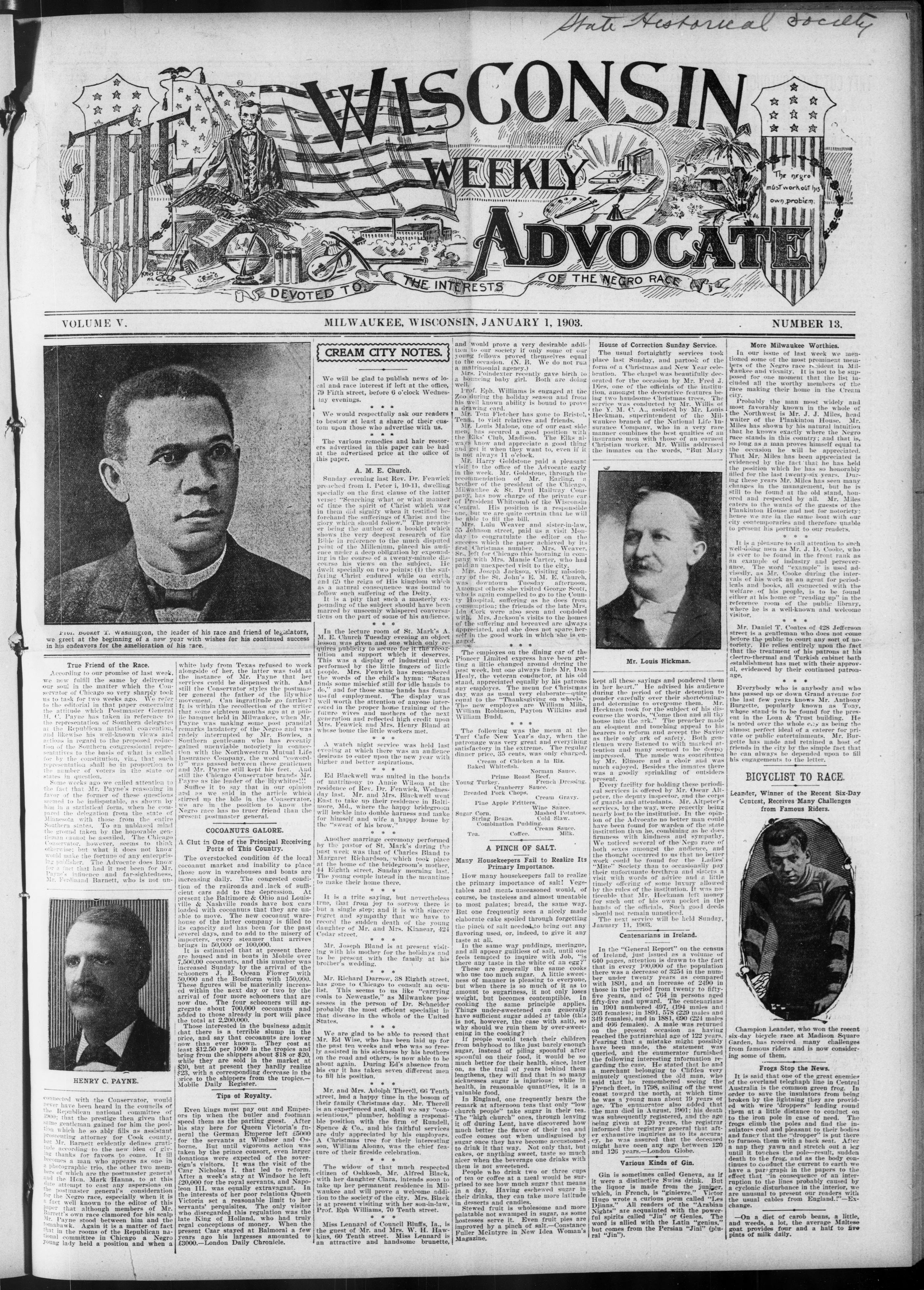
WISCONSIN
WEEKLY
The negro must work out his own problem.
ADVOCATE
DEVOTED TO THE INTERESTS OF THE NEGRO RACE
PRESIDENT
Fron. Booker T. Washington, the leader of his race and friend of legislators, we greet at the beginning of a new year with wishes for his continued success in his endeavors for the amelioration of his race.
VOLUME V.
Fri. Booker T. Washington, the l
we greet at the beginning of a new y
in his endeavors for the amelioration of
True Friend of the Race.
According to our promise of last week, we now fulfill the same by delivering our soul in the matter which the Conservator of Chicago so very sharply took us to task for two weeks ago. We refer to the editorial in that paper concerning the attitude which Postmaster General H. C. Payne has taken in reference to the representation of Southern delegates at the Republican national convention, and likewise his well-known views and actions in regard to the proposed reduction of the Southern congressional representatives to the basis of what is called for by the constitution, viz., that such representation shall be in proportion to the number of voters in the state or states in question.
Some weeks ago we called attention to the fact that Mr. Payne's reasoning in favor of the former of these questions seemed to be indisputable, as shown by him in a statistical form, when he compared the delegation from the state of Minnesota with those from the entire Southern states. To an unbiased mind the ground taken by the honorable gentleman cannot be assailed. The Chicago Conservator, however, seems to think otherwise; but what it does not know would make the fortune of any enterprising publisher. The Advocate does know for a fact that had it not been for Mr. Payne's influence and far-sightedness, Mr. Ferdinand Barnett, who is not un-
[Image of a man with a mustache and a suit]
HENRY C. PAYNE.
connected with the Conservator, would never have been heard in the councils of the Republican national committee of 1900; that the prestige then given that same gentleman gained for him the position which he so ably fills as assistant prosecuting attorney for Cook county, but Mr. Barnett evidently defines gratitude according to the new idea of giving thanks for favors to come. It ill becomes a man who appears as one in a photographic trio, the other two members of which are the postmaster general and the Hon. Mark Hanna, to at this date attempt to cast any aspersions on the postmaster general's consideration for the Negro race, especially when it is a fact well known to the editor of this paper that although members of Mr. Barrett's own race clamored for his scalp Mr. Payne stood between him and the tomahawk. Again it is a matter of fact that in the rooms of the Republican national committee in Chicago a Negro young lady held a position and when a
---
white lady from Texas refused to work alongside of her, the latter was told at the instance of Mr. Payne that her services could be dispensed with. And still the Conservator styles the postmaster general the father of the lilywhite movement. Can ingratitude go farther? It is within the recollection of the writer that some eighteen months ago at a public banquet held in Milwaukee, when Mr. Payne was making some post prandial remarks laudatory of the Negro and was rudely interrupted by Mr. Bowles, a Southern gentleman who has recently gained unenviable notoriety in connection with the Northwestern Mutual Life Insurance Company, the word "cowordily" was passed between these gentlemen and Mr. Payne still kept his feet. And still the Chicago Conservator brands Mr. Payne as the leader of the lilywhites!! Suffice it to say that in our opinion and as we said in the article which stirred up the bile in the Conservator, we are in the position to know the Negro race has no truer friend than the present postmaster general.
COCOANUTS GALORE.
A Clut in One of the Principal Receiving Ports of This Country.
The overstocked condition of the local cocoanut market and inability to place those now in warehouses and boats are increasing daily. The congested condition of the railroads and lack of sufficient cars add to the depression. At present the Baltimore & Ohio and Louisville & Nashville roads have box cars loaded with cocoanuts that they are unable to move. The new cocoanut warehouse of the latter company is filled to its capacity and has been for the past severel days, and to add to the misery of importers, every steamer that arrives brings in 50,000 or 100,000.
It is estimated that at present there are housed and in boats in Mobile over 7,500,00 cocoanuts, and this number was increased Sunday by the arrival of the schooners J. E. Ocean Flower with 50,000 and the Boniform with 150,000. These figures will be materially increased within the next day or two by the arrival of four more schooners that are now due. The four schooners will aggregate about 700,000 cocoanuts and added to those already in port will place the total at 2,200,000.
Those interested in the business admit that there is a terrible slump in the price, and say that cocoanuts are lower now than ever known. They cost at least $12.50 per 1000 in the tropics and bring from the shippers about $18 or $20, while they are sold in the market at $30, but at present they hardly realize $23, with a corresponding decrease in the price to the shippers from the tropics.—Mobile Daily Register.
Tips of Royalty.
Even kings must pay out and Emperors tip when the butler and footman speed them as the parting guest. After his stay here for Queen Victoria's funeral the German Emperor left £5000 for the servants at Windsor and Osborne. But until vigorous action was taken by the prince consort, even larger donations were expected of the sovereign's visitors. It was the visit of the Czar Nicholas I. that led to reform. After a week's stay at Windsor he left £20,000 for the royal servants, and Napoleon III. was equally extravagant. In the interests of her poor relations Queen Victoria set a reasonable limit to her servants' perquisites. The only visitor who disregarded this regulation was the late King of Holland, who had truly regal conceptions of money. When the present Czar stayed at Balmoral a few years ago his largesses amounted to £3000.—London Daily Chronicle.
CREAM CITY NOTES.
We will be glad to publish news of local and race interest if left at the office, 79 Fifth street, before 6 o'clock Wednesday evenings.
★★
We would respectfully ask our readers to bestow at least a share of their custom upon those who advertise with us.
☆ ☆ ☆
The various remedies and hair restorers advertised in this paper can be had at the advertised price at the office of this paper.
A. M. F. Church
Sunday evening last Rev. Dr. Fenwick preached from I. Peter i, 10-11, dwelling specially on the first clause of the latter verse: "Searching what or what manner of time the spirit of Christ which was in them did signify when it testified beforehand the sufferings of Christ and the glory which should follow." The preacher being the author of a booklet which shows the very deepest research of the Bible in reference to the much disputed point of the Millenium, placed his audience under a deep obligation by expounding in the course of a twenty-minute discourse his views on the subject. He dwelt specially on two points: (1) the suffering Christ endured while on earth, and (2) the reign of His kingdom which as a natural consequence was bound to follow such suffering of the Deity.
It is a pity that such a masterly expounding of the subject should have been marred by unseemly whispered conversations on the part of some of his audience.
* * *
In the lecture room of St. Mark's A. M. E. Church Tuesday evening an object lesson was given and one which only requires publicity to secure for it the recognition and support which it deserves. This was a display of industrial work performed by the little fingers of little people. Mrs. Fenwick has remembered the words of the child's hymn: "Satan finds some mischief still for idle hands to do," and for those same hands has found useful employment. The display was well worth the attention of anyone interested in the proper home training of the future wives and mothers of the next generation and reflected high credit upon Mrs. Fenwick and Mrs. Henry Bland at whose home the little workers met.
宋 启 启
A watch night service was held last evening at which there was an audience desirous to enter upon the new year with higher and better aspirations.
```markdown
```
Ed Blackwell was united in the bonds of matrimony to Annie Wilson at the residence of Rev. Dr. Fenwick, Wednesday last. Mr. and Mrs. Blackwell went East to take up their residence in Baltimore, Md., where the happy bridegroom will buckle into double harness and make for himself and wife a happy home by the "sweat of his brow."
\*\*\*
Another marriage ceremony performed by the pastor of St. Mark's during the past week was that of Charles Bland to Margaret Richardson, which took place at the home of the bridegroom's mother, 44 Eighth street, Sunday morning last. The young couple intend in the meantime to make their home there.
***
It is a trite saying, but nevertheless true, that from joy to sorrow there is but a single step; and it is with sincere regret and sympathy that we have to record the sudden death of the young daughter of Mr. and Mrs. Kinnear, 424 Cedar street.
Mr. Joseph Bland is at present visiting with his mother for the holidays and to be present with the family at his brother's wedding.
* * *
Mr. Richard Darrow, 38 Eighth street, has gone to Chicago to consult an oculist. This seems to us like "carrying coals to Newcastle," as Milwaukee possesses in the person of Dr. Schneider probably the most efficient specialist in that disease in the whole of the United States.
* * *
We are glad to be able to record that Mr. Ed Wise, who has been laid up for the past ten weeks and who was so freely assisted in his sickness by his brothers on the road and others, is now able to be about again. During Ed's absence from his car it has taken seven different men to fill his position.
***
Mr. and Mrs. Adolph Therell, 66 Tenth street, had a happy time in the bosom of their family Christmas day. Mr. Therell is an experienced and, shall we say "conscientious," plumber, holding a responsible position with the firm of Rundell, Spence & Co., and his faithful services are duly appreciated by his employers. A Christmas tree for their interesting son, William Alonzo, was the chief feature of their fireside celebration.
***
The widow of that much respected citizen of Oshkosh, Mr. Alfred Black, with her daughter Clara, intends soon to take up her permanent residence in Milwaukee and will prove a welcome addition to the society of the city. Mrs. Black is at present visiting with her son-in-law, Prof. Eph Williams, 70 Tenth street.
* * *
Miss Lennard of Council Bluffs, Ia., is the guest of Mr. and Mrs. W. H. Hawkins, 60 Tenth street. Miss Lennard is an attractive and handsome brunette.
and would prove a very desirable addition to our society if only some of our young fellows proved themselves equal to the occasion. (N. B. We do not run a matrimonial agency.) Mrs. Poindexter recently gave birth to a bouncing baby girl. Both are doing well. Prof. Eph. Williams is engaged at the Zoo during the holiday season and from his well known ability is bound to prove a drawing card. Mr. Tom Fletcher has gone to Bristol, Tenn., to visit relatives and friends.
Penn. to visit relatives and friends. Mr. Louis Malone, one of our east side men, has secured a good position with the Elks' Club, Madison. The Elks always know and appreciate a good thing and get it when they want to, even if it is not always 11 o'clock. Mr. Harry Goldstone paid a pleasant visit to the office of the Advocate early in the week. Mr. Goldstone, through the recommendation of Mr. Earling, a brother of the president of the Chicago, Milwaukee & St. Paul Railway Company, has now charge of the private car of President Whitcomb of the Wisconsin Central. His position is a responsible one, but we are quite certain that he will be able to fill the bill.
Mrs. Lulu Weaver and sister-in-law, 55 Johnson street, paid us a visit Monday to congratulate the editor on the success which the paper achieved by its first Christmas number. Mrs. Weaver, Sr., left for Chicago this morning in company with Mrs. Mamie Carter, who had paid an unexpected visit to the city. Mrs. Joseph Jackson, visiting missionary of the St. John's E. M. E. Church, was downtown Tuesday afternoon. Amongst others she visited George Scott, who is again compelled to go to the County Hospital, suffering as he does from consumption; the friends of the late Mrs. Ida Cork were also seen and condoled with. Mrs. Jackson's visits to the homes of the suffering and bereaved are always appreciated, and she does not spare herself in the good work in which she is engaged.
* * *
The employees on the dining car of the Pioneer Limited express have been getting a little changed around during the past week, but one always finds Mr. Dan Healy, the veteran conductor, at his old stand, appreciated equally by his patrons any employees. The menu for Christmas day was as usual very elaborate—quite equal to the "Thanksgiving on wheels." The new employees are William Mills, William Robinson, Payton Wilkins and William Budd.
* * *
The following was the menu at the Turf Cafe New Year's day, when the patronage was very great and everything satisfactory in the extreme. The regular dinner price, 35 cents, was only charged.
Cream of Chicken a la Riz.
Baked Whitefish.
Norman Sauce.
Prime Roast Beef.
Young Turkey.
French Dressing.
Cranberry Sauce.
A PINCH OF SALT.
Many Housekeepers Fail to Realize Its Primary Importance.
How many housekeepers fail to realize the primary importance of salt! Vegetables and meat unseasoned would, of course, be tasteless and almost uneatable to most palates; bread, the same way. But one frequently sees a nicely made elaborate cake spoiled through forgetting the pinch of salt needed to bring out any flavoring used, or, indeed, to give it any taste at all.
In the same way puddings, meringue, and all appear guiltless of salt, until one feels tempted to inquire with Job, "is there any taste in the white of an egg?" These are generally the same cooks who use too much sugar. A little sweetness of manner is pleasing to everyone, but when there is so much of it as to amount to sugariness, it not only loses weight, but becomes contemptible. In cooking the same principle applies. Things under-sweetened can generally have sufficient sugar added at table (this is not, however, the case with salt), so why should we ruin them by over-sweetening in the cooking?
If people would teach their children from babyhood to like just barely enough sugar, instead of pilling spoonful after spoonful on their food, it would be so much better for their health, since, later on, as the trail of years behind them lengthens, they will find that in so many sicknesses sugar is injurious; while in health, in reasonable quantities, it is a valuable food.
In England, one frequently hears the remark at afternoon teas that only "low church people" take sugar in their tea. The "high church" ones, through leaving it off during Lent, have discovered how much better the flavor of their tea and coffee comes out when undisguised by sugar once they have become accustomed to drink it that way. Not only that, but cakes, or anything sweet, taste so much nicer when the beverage one drinks with them is not sweetened.
People who drink two or three cups of tea or coffee at a meal would be surprised to see how much sugar that means in a day. Having eschewed sugar in their drinks, they can take more latitude in desserts and candies.
Stewed fruit is wholesome and more palatable not swamped in sugar, as some hostesses serve it. Even fruit pies are improved by a pinch of salt.—Constance Fuller McIntyre in New Idea Woman's Magazine.
House of Correction Sunday Service
House of Correction Sunday Service. The usual fortnightly services took place last Sunday, and partook of the form of a Christmas and New Year celebration. The chapel was beautifully decorated for the occasion by Mr. Fred J. Dies, one of the officials of the institution, amongst the decorative features being two handsome Christmas trees. The service was conducted by Mr. Willis of the Y. M. C. A., assisted by Mr. Louis Heckman, superintendent of the Milwaukee branch of the National Life Insurance Company, who in a very rare manner combines the best qualities of an insurance men with those of an earnest Christian worker. Mr. Willis addressed the inmates on the words, "But Mary
19
Mr. Louis Hickman
kept all these sayings and pondered them in her heart." He advised his audience during the period of their detention to ponder carefully over their shortcomings and determine to overcome them. Mr. Heckman took for the subject of his discourse the words, "Come thou and all thy house into the ark." The preacher made an eloquent and touching appeal to his hearers to reform and accept the Savior as their only ark of safety. Both gentlemen were listened to with marked attention and many seemed to be deeply impressed. The music was contributed by Mr. Elmore and a choir and was much enjoyed. Besides the inmates there was a goodly sprinkling of outsiders present.
Every facility for holding these periodical services is offered by Mr. Oscar Altpeter, the deputy inspector, and the corps of guards and attendants. Mr. Altpeter's services, by the way, were renectly being nearly lost to the institution. In the opinion of the Advocate no better man could have been found for warden of the state institution than he, combining as he does firmness with kindness and sympathy. We noticed several of the Nego race of both sexes amongst the audience, and the thought occurred to us that no better work could be found for the Ladies' "Mite" Society than to occasionally pay their unfortunate brethren and sisters a visit with words of advice and a little timely offering of some luxury allowed by the rules of the institution. It was noticeable that Mr. Heckman left money for such out of his own pocket in the hands of the officials. Such good deeds should not remain unnoticed.
The next service will be held Sunday, January 11, 1903.
Centenarians in Ireland.
In the "General Report" on the census of Ireland, just issued as a volume of 640 pages, attention is drawn to the fact that in every 100,000 of the population there was a decrease of 3254 in the number under twenty years as compared with 1891, and an increase of 2490 in those in the period from twenty to fifty-five years, and of 764 in persons aged fifty-five and upward. The centenarians in 1901 numbered 497, (194 males and 303 females); in 1891, 578 (229 males and 349 females), and in 1881, 690 (224 males and 466 females). A male was returned on the present occasion as having reached the patriarchial age of 122 years. Fearing that a mistake might possibly have been made, the statement was queried, and the enumerator furnished the following interesting information regarding the case. He stated that he and a merchant belonging to Clifden very minutely questioned the old man, who said that he remembered seeing the French fleet, in 1798, sailing off the west coast toward the north, at which time he was a young man about 19 years or age. The enumerator also added that the man died in August, 1901; his death was subsequently registered, and the age being given at 120 years, the registrar informed the registrar general that after exhaustive inquiries as to its accuracy, he was assured that the deceased might have been any age between 120 and 126 years.—London Globe.
Various Kinds of Gin.
Gin is sometimes called Geneva, as if it were a distinctive Swiss drink. But the liquor is made from the juniper, which, in French, is "ginievre." Victor Hugo wrote a curious poem called "Les Djinns." All readers of the "Arabian Nights" are acquainted with the powerful spirits called "Jin" or Genies. The word is allied with the Latin "genius," but comes from the Persian "Jini" (plural "Jin").
More Milwaukee Worthies.
In our issue of last week we mentioned some of the most prominent members of the Negro race resident in Milwaukee and vicinity. It is not to be supposed for one moment that the list included all the worthy members of the race making their home in the Cream city.
Probably the man most widely and most favorably known in the whole of the Northwest is Mr. J. J. Miles, head waiter of the Plankinton House. Mr. Miles has shown by his natural intuition that he knows exactly where the Negro race stands in this country; and that is, so long as a man proves himself equal to the occasion he will be appreciated. That Mr. Miles has been appreciated is evidenced by the fact that he has held the position which he has so honorably filled for the last twenty-six years. During these years Mr. Miles has seen many changes in the management, but he is still to be found at the old stand, honored and respected by all. Mr. Miles caters to the wants of the guests of the Plankinton House and not for notoriety; hence we are in the same boat with our city contemporaries and therefore unable to present his portrait to our readers.
☆ ☆ ☆
It is a pleasure to call attention to such well-doing men as Mr. J. D. Cooke, who is ever to be found in the front rank as an example of industry and perseverance. The word "example" is used advisedly, as Mr. Cooke during the intervals of his work as an agent for periodicals and books, all connected with the welfare of his people, is to be found either at his home or "reading up" in the reference room of the public library, where he is a well-known and welcome visitor.
* * *
Mr. Daniel T. Coates of 428 Jefferson street is a gentleman who does not come before the public to court any sort of notoriety. He relies entirely upon the fact that the treatment of his patrons at his electro-thermal and Turkish cabinet bath establishment has met with their approval, evidenced by their continued patronage.
欢 喜
Everybody who is anybody and who has passed up or down Grand avenue for the last few years knows Mr. Anthony Burgette, popularly known as Tony, whose stand is to be found for the present in the Loan & Trust building. He is noted over the whole city as being the almost perfect ideal of a caterer for private or public entertainments. Mr. Burgette has made and retained a host of friends in the city by the simple fact that he can always be depended upon to fill his engagements to the letter.
BICYCLIST TO RACE.
Leander, Winner of the Recent Six-Day Contest, Receives Many Challenges from Famous Riders.
1
Champion Leander, who won the recent six-day bicycle race at Madison Square Garden, has received many challenges from famous riders and is now considering some of them.
Frogs Stop the News.
It is said that one of the great enemies of the overland telegraph line in Central Australia is the common green frog. In order to save the insulators from being broken by the lightning they are provided with wire 'droppers' leading round them at a little distance to conduct on to the iron pole in case of need. The frogs climb the poles and find the insulators cool and pleasant to their bodies and fancy that the "dropper" is put there to furnish them with a back seat. After a nap they yawn and stretch out a leg until it touches the pole—result, sudden death to the frog, and as the body continues to conduct the current to earth we have a paragraph in the papers to the effect that "in consequence of an interruption to the lines probably caused by a cyclonic disturbance in the interior, we are unusual to present our readers with the usual cables from England."—Exchange.
-On a diet of carob beans, a little, and weeds, a lot, the average Maltese goat provides four and a half to five pints of milk daily.
THEY CUT THE AQUEDUCT.
Madrid, Dec. 30.—A dispatch from Tangier, Morocco, today announced that the rebels had cut the aqueduct which supplied Fez with water and added that the city was now practically without water. It was further asserted that unless the Kabyle tribesmen from the South come to the succor of Fez the place must surrender within three days. It is reported here that the Sultan of Morocco has been foiled in an attempt to break out of Fez by the rebels who are investing that city. Tangier, Morocco, Dec. 30.—Foreigners in the interior of Morocco have been advised to make for the coast, as provisions are scarce and communications are almost closed. The pretender himself is reported to be twenty miles from Fez.
The hostility against the Sultan is spreading in Fez. The Moors are exhibiting photographs of him arrayed in ridiculous garb. The Sultan yesterday assembled the nobles of the besieged town at the palace and exhorted them not to despair, assuring the chiefs that the imperial troop ultimately will triumph.
Madrid, Dec. 30.—Great Britain and France have notified Spain that they have no intention of taking any advantage of the situation in Morocco and that they desire the maintenance of the status quo, even in the event of the Sultan being dethroned and his place taken by the pretender. These communications have reassured the Spanish government, which is thus relieved of fears of international complications.
HE WAS FORCED OUT.
Lax Methods in the Land Office Caused Resignation of Commissioner Hermann.
Washington, D. C., Dec. 30.—Lax methods in the administration of his office and in the investigation of extensive land frauds, as well as the peculiations of certain clerks in his department, are given as the reasons for Birger Hermann's enforced resignation of the office of commissioner of the general land office. Although Mr. Hermann will not talk about the matter, it is quite well understood he was forced out of office because of friction with the secretary of the interior. A report was made to the President to the effect that the land commissioner had constantly shielded and had finally appointed to a place in the land department a man who had just been discharged for stealing and selling government publications from the office of the geological survey.
The friction between the commissioner of the general land office and the secretary of the interior began more than a year ago. Mr. Hermann requested that the charge be not made until after the Oregon elections in 1902, because he intended to be a candidate for the Senate, and was afraid that his removal from the land office would have a bad effect upon the members of the Legislature. After the Oregon election this fall there was still no sign of the resignation, although the complaints against the methods of the land commissioner grew louder and louder. Finally, came the trouble over the public land in Nebraska, so that the secretary of the interior insisted upon a resignation at once and presented the matter at the white house in such a light that the President directed Mr. Hermann to resign or be removed.
As soon as he leaves his present office Mr. Hermann will go back to Oregon and become an open candidate for the United States Senate. If he fails to be elected there he intends to return to Washington as a land claim agent. Charges were preferred against Harry King, chief of the draftsman's division of the general land office, and Fred P. Metzger, formerly chief clerk and also formerly confidential clerk to Commissioner Hermann, but now assistant chief clerk in the draftsman's office. The accusations are that King and Metzger have been receiving money for making private maps, when the government was entitled to all the compensation.
CHIEF KAW-BAW-GAM IS DEAD
Aged Indian Who Made His Home Neax Marquette.
Marquette, Mich., Dec. 30.—Kaw-baw-gam, the noted Chippewa Indian chief whom the first settlers found here when they landed in the '40s, is dead, after a two months' illness, at the age of about 103. He is survived by his wife, Charlotte, who is blind and helpless. Kaw-baw-gam was known throughout the Upper Peninsula.
Kaw-baw-gam was a son of Shau-wa no, or South Wind, chief of the Sault Ste. Marie band of Chippewas, and his wife a daughter of the famous chief, Madje Gees-hick. A sister of Kaw-baw-gam, Lizette, was married to John Logan Chipman, for many years judge of the superior court of Detroit and at one time congressman from the First district of Michigan.
For the past twenty years Kaw-bawgam had lived in a little cabin at the outskirts of Presque Isle park, supported by an allowance from the county and by contributions from Peter White.
COAL SITUATION ACUTE.
Operator Says Public Can Scramble for Fuel or Do Without It.
New York, Dec. 30.—The expressed belief of representatives of the coal carrying companies and of coal dealers is that for the next three days the coal situation will be acute all over the country. A representative of the coal department of the Delaware, Lackawanna & Western railroad said:
"The strikers clamored for public sentiment while they were on strike, and through public sentiment they got contributions from all over the country to support them while in idleness. Now the public can scramble for coal as it likes or do without it as far as the miners care."
STRATTON WILL PROBATED
Son Will Fight it in Higher Court of Colorado.
Colorado Springs, Col., Dec. 30.—Most unexpectedly in the county court here yesterday all objection to the probating of the will of the late W. S. Stratton was withdrawn by his son, I. Harry Stratton, and the will was admitted to probate. The estate involves a fortune of $10,000,000. It is understood that the fight of the son to prove that his father, who disinherited him, was not of sound mind when he made the will will be precipitated in the district court.
HIGHWAYMAN SHOT IN ATTEMPTED ROBBERY.
Conductor Has Desperate Struggle with Bandit Who Held Up His Train Near South Louisville, Ky.
Louisville, Ky., Dec. 30.—Conductor J, J. Keene had a desperate struggle on his train, the Louisville & Nashville New Orleans-Cincinnati northbound express at 2:30 o'clock this morning when nearing South Louisville and as a result was shot by the robber over the left temple. Conductor Keene is confident he killed or mortally wounded the robber with a bullet from a Winchester rifle.
The train reached this city at 3:30 and at 4 o'clock a special train of one coach and an engine left the Tenth street station for the scene of the hold-up. The train was manned by a large number of policemen and Louisville & Nashville employees to search for the dead body. The train was just entering the limits of South Louisville and all the passengers in the Pullman were asleep. Conductor Keene was passing through the car, as was his habit just before entering the Louisville station. As he entered the car the figure of a man wearing a mask jumped from a dark corner of the car and with drawn revolver commanded Keene to throw up his hands. Instead of doing so he grappled with the robber. A pistol ball momentarily stunned Keene and the robber pulled the bell cord, but before the train stopped the highwayman proceeded to rob the passengers in the sleeper. He held up Joseph Redford, the Pullman car conductor, and J. E. Moore, the only passenger taking $25 from the latter.
As the train slowed down the robber jumped off, but was followed by Conductor Keene, who had secured a Winchester. The conductor hurried after the robber, firing as he went, and emptied his rifle at the retreating burglar. At one of the shots the fleeing man let out a yell of pain. The firing aroused the passengers and caused considerable excitement. Conductor Keene was removed to a hospital. His wounds, however, are not serious. He is said to be the strongest man in Louisville and was at one time national champion in several amateur athletic classes.
No trace of the robber had been found up to noon, although a night watchman in the yards of the Southern railway reported that about daylight he found a man bleeding and lying along the tracks at Third and K streets. The man said he had fallen from a train. According to the watchman's statement, two men came along at this time and carried the injured man away.
RAILROAD MERGER PLANNED BY MORGAN.
Four Big Roads to be United Under One Management with Fred D. Underwood as President.
Chicago, Ill., Dec. 30.—One of the most important deals in the history of railway corporations was made known today, says the Daily News. Early in the year J. P. Morgan & Co. will announce consolidation of the Eric, Lehigh Valley and the Reading railroads. The merger will be planned after the manner of the Northern Securities Company, the stocks of the companies to be pooled and held as a basis for the issuance of a large amount of common shares, which will take as their name the title to be given the consolidated companies.
Four roads, according to the News informant, will be included in the merger, the Jersey Central being now controlled by the Reading Company. The plan for a coalescence, it is said, has been in contemplation for nearly a year and has been held in abeyance owing to the inability of the promoters to get possession of a majority of the Lehigh Valley shares.
The interested parties are particular to emphasize that the unification will not interfere with the individual management. The roads are not to lose their identity. The earnings will all flow into one treasury which will pay expenditures, dividends and have charge of the fiscal part of the companies generally. The holding concern will have a president who will be regarded as above the presidents of the different lines. He will be appointed by J. P. Morgan and it is intimated that President Underwood of the Erie is slated for the place.
MAKE NO APOLOGY.
Castro Not Disposed to Comply with One of the Demands Made by Germany.
Berlin, Dec. 30.—The Lokal Anzeiger's Caracas correspondent asked President Castro if he was ready to apologize to the powers, to which the President replied: "Gen. Castro has nothing to apologize for."
The bystanders, the correspondent adds, cheered and shouted "bravo" when they heard the President's reply.
The German merchants of Caracas, it is asserted by the correspondent, are ready to advance President Castro the money to meet the demands of Germany, "although they know the President is able to pay it himself."
The German government is completely silent as to when the blockade will be raised or whether it will be raised at all until every question concerning arbitration is settled. The acceptance of arbitration after the blockade was begun is certainly not received with popular favor in Germany.
OLD SCHOOLMATES TO WED.
Marriage of Mrs. McKinley's Niece to Young Attorney of Denver.
Canton, O., Dec. 30.—Miss Mary Barber, niece of Mrs. McKinley, will be married at 6 o'clock this evening to Ralph Hartzell, a prominent young attorney of Denver. Mr. Hartzell is the son of one of the oldest Canton families and was the schoolmate of the bride. Miss Barber is the oldest daughter of Mr. and Mrs. M. C. Barber and spent much time with Mrs. McKinley in the white house and on the extended trips made by the presidential parties. About 150 guests have been invited, mostly relatives and close friends. Mrs. McKinley will attend. Her present to the bride is a magnificent silver table service.
CAR STOOD ON END.
Number of Factory Girls Thrown in Heap Against Front Door.
Marion, Ind., Dec. 30.—A West Marion street car jumped from a twenty-foot embankment at Lenfesty avenue to the railway tracks below this morning. Out of the twenty-five passengers aboard sixteen were more or less injured; one perhaps was fatally hurt. A number of girls employed in factories were on the car. When the car jumped it stood on one end and all the passengers were thrown in a heap against the front door. The vestibule was smashed. Miss Anna Kiger will probably die of her injuries.
TO SUE FOR A DIVORCE.
Dresden, Saxony, Dec. 30.—King George has appointed a special court of seven judges to try the suit for divorce which the crown prince has decided to institute against the crown princess.
Shakes a Throne.
Berlin, Dec. 30.—King George of Saxony has ordered the preparation of a full, official account of the elopement of the Crown Princess Louise and the circumstances leading up to it. The most fantastical stories are in circulation, to the detriment of the royal people, especially with reference to the future king. The scandal is undermining the people's loyalty and respect for the throne. The dynasty being Catholic and the people Protestant, the affair is being utilized for sectarian controversy. The King's statement doubtless will affirm that the crown princess' sole reason for cloping was her criminal relations with Prof. Giron. The stories of ill-treatment on the part of her husband, of oppressive court ceremonials and of her fettered existence are classed as inventions.
Grand Duke Makes Threats.
The Crown Princess' own account of the immediate cause of her flight from Salzburg was telegraphed from Munich this morning. It says her father, the Grand Duke of Tuscany, intended to imprison his daughter either in a lunatic asylum or in an Italian convent. He had already consulted the court physician and several medical authorities in Vienna with the object of obtaining certificates warranting him in shutting her up. Her father, the crown princess adds, demanded that she be taken under guard to Dresden to apologize to the crown prince, and that she then choose between confinement in a convent or in a madhouse. The crown princess asks the Bavarian court to use its influence with the court at Dresden to permit her children to choose their vocation in life freely.
Infatuated with Frenchman.
New York, Dec. 30.—The Herold correspondent at Zurich, Switzerland, cables the report of an interview with the Crown Princess of Saxony in which she is quoted as saying that M. Giron is the only man she ever met whom she felt she could love and that it was a question of mutual love and affinity which made her life impossible without him.
"Between my husband and myself," said the princess, "there was no bond of sympathy. He was a typical rough officer. I myself was full of ideals. How miserable that life was! I tried so hard to bear it for the sake of my darling children whom I adore. I also hesitated for the sake of the Saxon people, whom I love deeply as they love me. But all that could not alter my resolution. The ills of my life at the court were too great to bear."
Contest Over a Dukedom.
New York, Dec. 30.—The Times correspondent in Vienna in a dispatch via London, scouts the alleged claim of the Archduke Leopold of Tuscany, brother of the Crown Prince of Saxony or Leopold Woelfling, as he will hereafter be called, to inheritance of the estate of the Archduke John, who disappeared many years ago under the name of John Orth. The correspondent says that his claim is at least premature, since the will of the presumably deceased archduke is still unopened and probably will be left unopened for several years to come.
STAGE DUEL TOO REAL.
Gun Used by Villain Loaded with Ball Cartridges Instead of Blanks and Hero is Killed.
Marion, Ind., Dec. 30.—Oliver Miller, an actor, was shot and killed on the stage of the Reese Opera House in full view of a large audience in South Marion last night during the performance of "Crawford's Claim," a melodrama of the Western type. The shot which killed him was fired by William Fogleson, another actor. The shooting was a part of the melodrama, but the revolver proved to be loaded with ball cartridges instead of blanks. The shooting took place during the third act. At the climax of the play Miller spoke the lines: "At last, Herbert Stanton, I hold the winning card."
"Yes, but I hold the trick," replied William Fogleson, who took the part of Sidney Woodard, the "villain," as he drew two revolvers, one of which he pointed at Miller and fired.
"I am shot, I am shot," cried Miller, as he fell to the stage. The bullet had passed through his heart.
Fogleson could not realize that his "play shooting" had resulted fatally, but when he saw blood streaming from a gaping wound in the breast he jumped from the stage and gasped, "I have shot him," and then collapsed on the floor.
Fogleson was placed in jail pending an investigation. There is a mystery as to who placed the cartridges in the revolver. One story is that Miller and Fogleson were in love with the same girl, who is an actress in the company. Fogleson says he thinks his 9-year-old brother got into his pocket and secured the gun and put the cartridges in it during the supper hour. He says he did not examine the revolver before he went on the stage.
BLAZE IN WHISKY HOUSE.
Fire in Heart of Wholesale District of Louisville, Ky., Does $100,000 Damage
Louisville, Ky., Dec. 30.—Fire which broke out about midnight in the wholesale whisky house of Bonnie Bros. at 139 West Main street, in the heart of the wholesale district of this city, caused a loss of about $100,000 and threatened for a time to destroy the Louisville & Nashville railroad's general offices and other property valued at three or four times that amount.
The flames, however, were gotten under control after a hard fight and the principal damage was confined to the building in which the fire started, the first three floors of which were occupied by the Bonnie Bros. and the top floor by the auditors of the Louisville & Nashville railroad. Bonnie Bros. were the heaviest losers, their stock, valued at about $85,000 being almost totally destroyed.
Wright & Taylor, wholesale whisky dealers, whose house is situated between the main buildings of the Louisville & Nashville railroad's general offices and Bounie Bros.' place, also sustained some loss. The railroad company's loss will not be serious.
BLAME IS SHIFTED.
Operator Says Train Dispatcher Canceled Order to Hold Express at Wanstead.
London, Ont., Dec. 29.—Andrew Carson, the operator at Watford, whose negligence is said to have caused the collision between the Pacific express and a freight train in which twenty-eight persons lost their lives, says he received the order for No. 5, the express, to pass the freight at Wanstead at 9:48 oclock, but declared positively that a few minutes later J. G. Kerr, dispatcher at London, called him and ordered him to "bust." or cancel the order.
"About 9:54, after calling Wyoming and ascertaining that the freight was there," Carson said, "the dispatcher called me rapidly a half dozen times. When I answered on the wire he told me to 'bust' this order. I wrote 'bust it' across the order just as No. 5 was coming in. Conductor McAuliffe came in and asked me what the order board was out against him for. I told him that we had had an order for him, but the dispatcher had 'busted' it. He asked me to hurry and write him a clearance order, which I did.
"After the train had started and was out of my reach the dispatcher learned that the freight had left Wyoming. I told him I could not stop No. 5, as it had left. He immediately began calling Kingscourt Junction, the station between Watford and Wanstead, on the railroad wire and I tried to raise them on a commercial wire. We both failed to do this, however, until after the express had passed the junction."
Carson admitted that he knew it was against the rules of the company to cancel a train order without sending a substitute for it, but said the dispatcher was his superior officer and he disliked to question his order or dispute his authority to take this action.
Dispatcher Kerr's order book in the local Grand Trunk office does not show that the order was "busted" or canceled as Carson claims. According to the book, it was still in force and should have been delivered to the conductor of the express. Kerr has not made any statement, even to the railroad officials, and will not until he takes the stand at the inquest.
Stewart Reaches His Family.
J. M. Stewart of Oshkosh, Wis., whose wife and two young sons are in the hospital, arrived and found them doing well. Mrs. Stewart's jaw is fractured and she has severe scalp wounds, and Earl, 6 years old, has a broken arm. Hobart, aged 5, has only minor injuries. Mrs. J. H. Cummings of Port Huron, George Stacey of Wanstead, Miss Manie Morse of Sarnia, Miss Hattie Northey and James Northey of Peterboro, J. A. Lamont of Wyoming, Out. William Morse of Sania and J. A. Rimplin of Toronto are resting comfortably, the surgeons say, and making good progress toward recovery.
One of the most pathetic features of the wreck is the triple loss sustained by the Bodley family of Port Huron in the death of Mrs. J. Bodley, her son, Clem Bodley, and her granddaughter, little Lottie Lynch, who died at Victoria Hospital. The badies of nineteen of the victims have been shipped to their friends at home.
GIRON'S RELATIONS WITH CROWN PRINCESS.
Frenchman Acknowledges Paternity of Unborn Child—Has Safe Refuge in Switzerland.
Brussels, Dec. 29.—The Petit Bleu has published M. Giron's own story of his relations with the Crown Princess of Saxony, in which he admits the paternity of her sixth child.
Geneva, Dec. 29.—Newspapers here allege that the Swiss government has refused the request of the German government to expel the Princess of Saxony from Switzerland.
Vienna, Dec. 29.—Archduke Leopold has refused to sign a renunciation of his rights as an Austrian subject. Emperor Francis Joseph insists that the archduke resign everything and never return to Austria. The archduke says he will never abandon his rights as an Austrian subject.
Rome, Dec. 29.—The request to dissolve the marriage of the Crown Princess of Saxony has not yet been received at the Vatican. It is said the request will be refused if it is made, because there is absolutely no canonical ground for the annulment of the marriage. The Pope, greatly grieved at the scandal, is reported to have dispatched to the Emperor of Austria a letter expressing deep condolence.
FREMONT'S WIDOW DIES.
Woman Who Knew Courts of Europe and Privations of Western Frontier Passes Away.
Los Angeles, Cal., Dec. 29.—Mrs. Jessie Benton Fremont, widow of Gen. John C. Fremont, died here late Saturday night of pneumonia after a short illness.
Mrs. Fremont had been ill only a few days, but, owing to her enfeebled condition and her age—she was 79 years old the disease made rapid progress.
Mrs. Fremont led a strange career between the privations of the Western frontier and the life at the courts of Europe. A Virginian by birth, plunged at 14 into the society which gathered about her father, Senator Benton, in Washington, she eloped at 16 with the fascinating young lieutenant, John C. Fremont.
Though she returned almost immediately to her father's home, she aided and abetted the schemes and explorations which brought her husband such renown as the "Pathfinder" and shared his conquest of California.
She led a brilliant life in society Europe and the United States, made the trip across Panama in 1848 to join her husband in California, and with him endured all the hardships of the time.
The Martha Washington Stamp.
The United States government has never issued a postage stamp decorated with the head of a woman. But this cannot be said after December 1. On that day the postoffice department will begin sending out to postmasters a new 8-cent stamp on which will be used the head of Martha Washington. The design is considered one of the most beautiful ever put out by the postoffice department. The head is encircled with a wreath. At the bottom on the left is 1732, the year in which Martha Washington was born; on the right, 1802, the year in which she died.—Washington Evening Star.
By presidential decree promulgated on July 25 the government of Indo-China is authorized to realize by means of a loan the sum of 70,000,000 francs ($13,510,009) for the purpose of constructing railroads in the French colony named.
Statistics show that the longest lived people have generally been those who made breakfast the principal meal of the day.
SPORTING ITEMS.
If the American Association contemplates entering Chicago now is the time to do it. After the two major leagues settle their war an agreement with the National Association will be the next thing in order. After that the lines will be tightly and permanently drawn as regards both territory and players.—Sporting Life.
```markdown
```
Pitcher George Villeman, who has been on Schenectady's twirling staff for the past two seasons, has been sold by Albany to Colorado Springs.
***
Pitcher Harry McNeeley of Colorado Springs was married in Buffalo to Miss Maude E. Swann of Colorado Springs.
* * *
Secretary Farrell of the National Association says that the name of Pitcher Stackpole appeared on the Providence reserve list through error. Haverhill is the only club that has any claim on him.
* * *
James Powell, who was a member of the famous Richmond (Va.) team of the early eighties, of which such players as Nash, Johnston and Glenn were members, is now a prosperous rancher in the Bitter Root valley in Montana.
Honus Wagner reports that Eddie Waddell's dad fell and broke two ribs the other night. Rube is in Winter Park, Fla.
* * *
If the players as a body should suffer financially through a peace pact between the National and American Leagues, let them blame it largely upon Delehanty. That player's fiagrant and disgusting breach of faith, following so many other breaches, was the last straw that broke the camel's back.—Sporting Life.
***
Tommy Ryan, the middleweight champion pugilist, has accepted the terms of the San Francisco Athletic Club to meet Jack Root, the Chicago champion. Root's manager has already given his consent for the match. The club offered to put on this star attraction for its January date, but Ryan insisted that he needed more time to train for such an important the weighing in to be done at the ring-side at 128 pounds.
LATEST MARKET REPORTS.
MILWAUKEE, DECEMBER 30, 1902.
EGG AND DAIRY MARKETS.
MILWAUKEE—Eggs—Market firm; strictly fresh, loss off, cases included, 23@231c;
fresh, cases returned, 22½@23c; seconds, 16c; fancy storage, 20@21c; pickled, 19@20c; receipts of fresh eggs continue very light;
demand is good. Receipts were 125 cases.
The market here is heavily stocked and merchants cannot get rid of their holdings, being obliged through an ill-arranged deal with Elgin, to hold to Elgin prices. The market here should be 27½c for the finest creamery, but Elgin says 29c and the local merchants and consumers must dance to the "trust" at Elgin. As they say in Rome the Elgin "wise men" need the money.
Butter — Market easy; fancy prints, 29½¢; fancy or extra creamery, per lb, 29c; firsts, 26½¢; seconds, 24c; June creamery, 25@25½¢; dairy prints, 23c; extra fancy dairy, 22@23½¢; lines, 19@20e; packing stock, 17@18c; renovated butter, 21½¢@22c; whey, 13c; grease, 5@6c; supply of creamery is only fair; demand is good and offering are rather light. Receipts, 12,500 lbs; yesterday, 26,060 lbs.
Cheese — Firm. The demand continues good; full cream flats, fancy, 13@14c; good to choice, 11c; Young Americas, 14c; daisies, 14c; fancy brick, 12@12½c; low grades, 10@11c; limburger, per lb, No. 1, 11½@12c; low grades, 10@11c; imported Swiss, 25c; Block Swiss, domestic, 12½@13c; fancy loaf, 14c; No. 2, 11@12c; Sapsago, 20c. Receipts, 8500 lbs; yesterday, 1500 lbs.
CHICAGO—Butter—Quilet, easy; creamer-
les, 18@27½c; dairies, 17@25c. Eggs—
Quiet, firm; loss off, cases returned, 25c.
Cheese—Dull, unchanged; twins, 13c;
daisies, 13½c; Young Americas, 13½c.
Dressed poultry—Firm; turkeys, 15@17c;
chickens, 8@12c.
MILWAUKEE LIVE STOCK MARKET.
HOGS—Receipts, 52 cars; market lower;
light. 5.85@6.20; mixed and medium
weights, 6.10@6.35; common to good pack-
ing sows. 6.00@6.35; selected, 6.35@6.50.
Pigs, 90 to 120 lbs. 5.00@5.50.
CATTLE — Receipts, 7 cars; steady; butchers' steers, medium to good, 1050 to 1300 lbs, 4.50@5.25; fair to medium, 950 to 1050 lbs, 3.50@4.25; heifers, common, 2.50@3.25; good, 3.50@4.25; cows, fair to good, 2.85@3.50; cauners, 1.50@2.25; cutters, 2.40@2.75; bulls, common, 2.75@3.25; choice, 3.50@4.00; feeders, 800 to 950 lbs, 3.25@3.75; stockers, 500 to 750 lbs, 2.25@3.00; veal calves, common to choice, 5.50@6.75. Milkers—Common, no demand; fancy, 35.00@50.00.
SHEEP—Receipts, 5 cars; steady, 2.50@3.25; ducks, 2.25@2.75; light lambs, 3.50@4.50; choice, 4.75@5.50.
Chicago receplts: Hogs, 45000; cattle, 9000; sheep, 18,000.
MILWAUKEE HAY MARKET
Timothy. firm; carlots, choice timothy,
12.00@12.25; No. 1 timothy, 11.25@11.75;
No. 2 timothy, 9.00@10.50; clover and clover
pixed, 9.00@10.50.
Prallei hay steady; choice Kansas, 11.50
@11.75; No. 1 Kansas, 10.75@11.00; No. 2,
8.50@9.00; choice Nebraska, 10.50@11.00;
No. 1, 9.00@9.50.
Wisconsin prairie, 8.00@8.50.
Straw, steady; rye, 6.50@6.75; oats, 4.50@
5.00; wheat, 4.00@4.50; packing hay, 6.00@
6.25.
Potatoes—Market firm; supply fairly good; demand good; per bus, carlots, on track. Rurals and Burbanks, fancy large up to 43c; choice Rose and Peerless, 40@41c; inferior stock down to 38c.
MARKETS BY TELEGRAPH.
MILWAUKEE—Flour—Steady. Wheat—
Lower. No. 1 Northern, on track, 76¾c; No.
2 Northern, on track, 75¾c. Corn—Firm
and good demand; No. 3 on track, 45c.
Oats—Steady; No. 2 white, on track, 33½c;
No. 3 white, on track, 32@33c. Barley—
Firm; No. 2 on track, 65c; sample on track,
40@65c. Rye—Steady; No. 1 on track, 52c.
Provisions—Firm; pork, 17.25; lard, 10.30.
Flour market steady; patents, 3.85@3.95;
bakers', 2.85@2.95; rye, 2.90@3.00.
Millstuffs are firm and quoted at 15.75
for bran, 16.00 for standard middlings and
17.50 for Milwaukee flour middlings in 100-
lb sacks; red dog, 20.00. Delivered to coun-
try points, 100 extra.
CHICAGO - Close - Wheat - December, 73%c; May, 76%c; July, 73%c. Corn-December, 44%c; January, 44%c; May, 43%@ 43%c; July, 42%c; September, 42%c. Oats-December, 32%c; old, 31%c; May, 33%c; July, 31%c. Pork-January, 17.27%; May, 16.45@16.47%Lard-December, 10.30; January, 9.92%; May, 9.55; July, 9.35. Ribs-January, 8.47%; May, 8.62%; Rye-May, 51 @51%c. Flax-Northwest, 1.22: Southwest, 1.14; May, 1.23. Timothy-January, 4.25. Clover-December, 10.85. Barley-Cash, 38 @58c.
NEW YORK-Close-Wheat-December, 84c; May, 80%c. Corn-December, 59c; May, 48%c.
TOLEDO-Wheat-Dull, easier; cash and December, 77%c; May, 80%c. Corn-Dull, easier; December, 45%c; May, 44c. Oats-Dull, easier; December, 34c; May, 34%c. Rye-No. 2, 52%c. Clover seed-Fairly active, firm; January, 6.80; March, 6.90; prime timothy, 1.80; prime alsike, 8.20.
DULUTH—Close — Wheat — Cash No. 1 hard, 74%c; No. 1 Northern, 73%c; No. 2 Northern, 71%c; No. 3 spring, 68%c; to arrive, No. 1 hard, 75c; No. 1 Northern, 74c; December, 73%c; May, 76c; Oats—May, 33%c; to arrive and on track, 32c; Rye—May, 51c; to arrive and on track, 49c; Barley—35@51c. Flax—Cash, on track, to arrive, December and January, 1.19½; May, 1.22½. Receipts—Wheat, 23,926. Shipments—None.
SOUTH OMAHA—Cattle—Receipts, 3000; steady; beef steers, 3.25@5.75; cows and heifers, 10c lower, 3.00@4.00; Texans, 3.00@4.25; canners, 1.50@2.50; stockers and feeders, 2.50@4.25. Hogs—Receipts, 10,000, 10@15c lower; heavy, 6.35@6.45; plgs, 5.00@6.25. Sheep—Receipts, 7000; steady; sheep, 4.25@4.75; lambs, 4.50@5.50.
LIKED GRAPES TOO WELL.
Colorado Woman Spoils Husband's Plan for Pretending Death.
The fondness of Mrs. E. Grant Angell of Grand Junction, Col., for grapes spoiled her husband's plan for pretending that he was dead and collecting his $6000 of life insurance. Their house was burned, and when the neighbors arrived from the nearest farms she said that her husband had returned to the house to save the cook stove and had not got out. When the ruins cooled a heap of charred bones was found by the stove. But while the search was going on the bereaved wife sat by and ate grapes, and this caused comment and suspicion. The coroner's jury said that the bones were Angell's, but an advertising doctor in town with whom the other doctors would not associate saw a chance for getting even, and proved that the bones were those of dogs and deer. Then the Modern Woodmen and the Woodmen of the World refused to pay, and when it was evident that the jig was up Angell returned, claiming that he had been overheated in the fire and had lost his mind for a time.
Record of the Past.
The best guarantee of the future is the record of the past and over fifty thousand people have publicly testified that Doan's Kidney Pills have cured them of numerous kidney ills, from common backache to dangerous diabetes, and all the attendant annoyances and sufferings from urinary disorders. They have been cured to stay cured. Here is one case:
Samuel J. Taylor, a retired carpenter, residing at 312 South Third street, Goshen, Ind., says: "On the 25th day of August, 1897, I made an affidavit before Jacob C. Mann, notary public, stating my experience with Doan's Kidney Pills. I had suffered for thirty years and was compelled at times to walk by the aid of crutches, frequently passed gravel and suffered excruciatingly. I took every medicine on the market that I heard about and some gave me temporary relief. I began taking Doan's Kidney Pills and the results I gave to the public in the statement above referred to. At this time, on the 19th day of July 1902, I make this further statement that during the five years which have elapsed I have had no occasion to use either Doan's Kidney Pills or any other medicine for my kidneys. The cure effected was a permanent one."
A FREE TRIAL of this great kidney medicine which cured Mr. Taylor will be mailed on application to any part of the U. S. Address Foster-Milburn Co., Buffalo, N. Y. For sale by all druggists, 50c per box.
Freaks of the Mont Pelee Eruption.
Prof. Angelo Heilprin, in an address on the Mont Pelee eruption, delivered to the Geographical Society last night, said the first phase was the emission from the crater of a brown-colored cloud which was impelled to a vast height. Almost simultaneously a black cloud, intensely luminous, shot downward toward the city and when over St. Pierre was shattered by a tremendous lightning stroke which sent the death-dealing blast in all directions.
Some of the freaks of the destruction, he said, were inexplicable. In one case a body was found scorched to a crisp and beside it lay a box of matches untouched by fire. Jewel boxes were picked up with the exterior unscathed and the trinkets inside fused in a solid mass. The address was illustrated by stereoicon slides, some of which showed the Mount Pelee crater in full eruption at close range.—Philadelphia Record.
Catarrh and Hay Fever.
Liquid Cream Balm is becoming quite as popular in many localities as Ely's Cream Balm solid. It is prepared for use in atomizers, and is highly prized by those who have been accustomed to call upon physicians for such a treatment. Many physicians are using and prescribing it. All the medicinal properties of the celebrated Cream Balm are contained in the Liquid form, which is 75 cts., including a spraying tube. All druggists, or by mail. Ely Brothers, 56 Warren street, New York.
Messrs. ELY BROS.:—I sold your Liquid Cream Balm to Mr. Wm. Lamberton, 1415 Delachaise street, New Orleans; he has used two bottles, giving him most satisfactory results.
GEO. W. M'DUFF. Pharmacist.
Elephant's Tusks Stolen.
Thieves sawed off the great tusks of Jumbo II. last night and carried them away. The elephant was the property of Bostock, and on account of his ugly disposition had caused his owner much trouble. He was known as a man-killer, and the deaths of a number of men are credited to him. When Bostock left his summer quarters, Jumbo II. was left behind. Friday he died. The thieves came prepared for a hard job, and their work was far from easy. The iron band which surrounded one tusk was almost sawed in two before the vandals decided to saw on each side of the ring. The tusks were four inches in diameter and three feet long.—Indianapolis News.
A Wonderful Lamp.
A new lamp has been invented that burns principally air and gives a most brilliant light. As an example of its light power this lamp can be hung in the center of a room 100 feet long and will give enough light to read the finest print at either end of room, or fifty feet away from lamp. For stores, halls and churches this is the cheapest light on earth. Burns 90 per cent. air and only 10 per cent. oil. Costs 1-3 cents an hour. H. E. Franke, the heavy light man, 138 Third street, Milwaukee, Wis., has the agency for the lamp and will be pleased to send catalogue and price list upon request.
The Last Chance.
Husband (bidding farewell to his wife, who, with her daughter, is leaving for treatment at the baths)—I tell you right now, Elsie, if our daughter does not become engaged during this trip, then you are sick for the last time.—Fliegende Bletter
Special couch bargains are being offered for the Xmas trade by the well-known firm of F. W. Schenck & Co. of Milwaukee, whose ad. appears elsewhere in this paper.
—Only the church steeple at Zudycotte, near Dunkirk, now rises above the sand which overwhelmed the entire village in 1777.
MRS. WINSLOW'S SOOTHING SYRUP for Children teething; softens the gums, reduces inflammation, allays pain, cures wind colic. 20 cents a bottle.
—A German lawyer has left $50,000 for the foundation of a school of cookery.
—Sweden has 324 co-operative societies with a membership of over 8000.
If you are coughing, take Dr. August Koenig's Hamburg Breast Tea.
Petroleum has been discovered about forty miles from Tunis.
WRECK ON GRAND TRUNK.
Express Running at High Speed Crashes Into Freight.
GREAT LOSS OF LIFE.
Car Roof Falls on Passengers and Wreckage Catches Fire—Twenty-four to Thirty Perish.
London, Ont., Dec. 27.—A train wreck bringing death to probably more than two score persons and terrible pain and suffering to fully as many more occurred at 10:10 o'clock last night at Manstead, Ont., a station on the Sarnia branch of the Grand Trunk, forty miles from this city, when the fast Pacific express, flying westward at the rate of fifty miles an hour and crowded to its capacity with passengers returning to their homes from holiday visits, crashed into an eastbound freight.
The latest estimate of the fatalities is 24 killed and 35 or more injured. The darkness of night and the raging of a blizzard added horrors to the wreck. Fortunately the fire horror was averted. A fire broke out in the wreckage of the day coach but it was smothered with snow and coats which were thrown on it before it gained any headway. The express was delayed two hours last night by the heavy travel and at Wanstead it was speeding to make up time. The freight was working slowly east under orders to take the switch at Wanstead and allow the express to pass. In the blinding snow storm neither engineer saw the other train approaching, apparently, and the freight had just commenced to pull in on the siding when the passenger train came up.
Came Together Head-On
The shock was awful. The trains came together squarely head-on. In a second the baggage and express cars of the passenger train telescoped into the day coach. This day coach was reduced to splinters and fragments back to the last three windows. It was crowded with human beings and the resultant loss of life and injury was harrowing. Fire that broke out was quickly smothered, but the fire was scarcely worse danger than the cold. For three hours or more wounded and maimed passengers were pinned underneath wreckage, crying piteously for help while they suffered from exposure to the elements. Exposure undoubtedly caused the death of some of the more seriously injured and caused the death of some of those who might have been saved if it had been only a question of extricating them from the wreckage.
The Pullman cars stayed on the track and were comparatively uninjured, although the passengers in them were severely shaken in the shock.
Arrival of Relief Train.
As soon as possible, a relief train with a dozen London doctors was dispatched from this city to the wreck. Half a dozen bodies were recovered within a short time and a number of wounded removed from the wreckage. Trains were made up to send the wounded to London hospitals. Efforts to identify the wounded and dead were attended with difficulty. The dead bodies taken from the wreck were frightfully mangled, some of them almost beyond recognition. The scenes attending the removal of the dead bodies from the wreckage were pitiful in the extreme. Several families were on the train and the air was filled with cries of those separated from their loved ones, not knowing whether they were killed or saved.
Edward Boise of Prescott was taken from the wreck alive, but he was so frightfully injured that he died two hours after being placed in the hospital in this city. J. A. Lamonte of Wyoming was the night operator at Wattford, the telegraph station nearest to the siding at Wanstead. Responsibility for the wreck has not been fixed. It is said by some that it came through a confusion in orders for which Lamonte was responsible. Lamonte was in some way injured in the wreck
Names of the Victims.
The dead:
H. P. LAWRENCE, Watertord, Ont.
EDWARD DEBEAU.
EDWARD ROYSE, Prescott, Ont.
MISS NELLIE GEDDES, Sarnla, Ont.
MR. BURRELL, London, Ont.
NICHOLAS JEFFRIES, London, Ont.
MRS. J. B. BARNES, Woodstock, Ont.
J. GILLIES, Sarnla Tunnel, engineer of
the express.
ALEXANDER CAMERON, Petrolla.
MR. SMITH, trainman, Sarnla Tunnel.
ALEXANDER STEWART, Petrolla, Ont.
MRS. ALEXANDER STEWART, Petrolla,
Ont.
LOTTIE LYNCH, Port Huron, Mich.
A. RICKETTS, Sarnla Tunnel.
MRS. TROTTER, Petrolla, Ont.
F. S. FREEMAN, Oll Springs, Ont.
CLEM PODLEY, Port Huron, Mich.
GAY DEBENIER, ticketed to La Crosse,
Wls.
DR. PENWARDEN, ticketed to Petrolla,
Ont.
In addition to the above, fifteen bodies remain to be identified.
The injured:
J. J. Cuthbertson and wife, Port Huron, Mich.
Flossie Cuthbertson, Port Huron, Mich.; bruises.
Mrs. Samuel Cummings, Port Huron, Mich.; cuts on face and head.
Lottie Lynch, Port Huron, Mich.
James P. Ramblin, Toronto, Ont.
Hattie Northey, Peterboro, Ont.
James R. Northey, Peterboro, Ont.
Nellie Coote, Chicago; bruises and internal injuries.
Frank E. Baker, London, Ont.; dislocated shoulder and lacerations.
W. N. Morse, wife and three children, Carmla.
Thomas Coote, Chicago; injury to hip.
George Stacey, Wanstead, Ont.
Edward Deevans, Prescott, Ont.
Dr. Basil Harvey, Chicago; lacerated wound on head and bruises.
Mrs. J. H. Stewart, Oshkosh, Wis.; fractured jaw and lacerations.
Russell Quinn, Chicago; bruises, burns and scalp wounds.
Mrs. W. Cott and Margaret Cott, London, Ont.
J. F. Shawles, Strathroy, Ont.
W. H. Cole and wife, Flint, Mich.
B. K. McDonald, Strathroy, Ont.
Mrs. T. N. Byrnes, Sarnia, Ont.
Annie Sinclair, Komoka, Ont.
Mrs. Pugsley, London, Ont.
Earl Stewart, Oshkosh, Wls.; fractured hip.
Hobart Stewart, Oshkosh, Wls.; broken arm.
Imprisoned by Falling Roof..
The ill-fated express consisted of two baggage cars, a smoker, two first-class coaches and two Pullmans. The smoker, which was telescoped by the coach behind it, had the sides knocked out of it, the roof falling and imprisoning the passengers. It was in this car that most of the awful havoc and loss of life occurred. The wreck shortly after the collision caught fire and but for the heroic efforts of a brigade of passengers, organized and led by an old man, who was himself a passenger on the ill-fated train, the dis-
---
aster might have been more disastrous to those pinned down in the wreck. By heroic efforts this brigade put out the fire by throwing snow on the flames with their hats and hands. They then turned their efforts to getting out the wounded, who had their sufferings increased by a blinding snow storm and the thermometer near zero. A Miss Cuthbertson of Port Huron, Mich., was imprisoned under the wreck two hours but was not seriously injured. The dead and injured are arriving in London by special train this morning and the work of identifying the dead and caring for the sufferers is being hurried as fast as possible.
Telegraph Operator's Neglect.
The accident is said to have been due to the failure of an operator to give orders to the express train to meet the freight at the station.
One of the passengers describes the accident as follows:
"We were running at about forty miles an hour when without the slightest warning the two trains met with terrific force. On examination it was found that the two engines were in the ditch. The baggage car was thrown on top of the first-class coach, instantly killing a great many and pinning about fifty other passengers in the debris. The screams, moans and prayers of the injured was heartrending. One poor woman begged that her child be saved, as she was dying. The little one was carefully taken from the wreck and probably will recover. The mother was afterward released, but only to die in a few minutes. About thirty people were killed and forty badly injured, some of whom will die. The trainmen, as well as every passenger, did all they could to relieve the sufferings of the victims."
Mangled Beyond Recognition.
The bodies taken from the wreck were frightfully mangled, some of them almost beyond recognition. The scenes attending the removal of the dead bodies from the wreckage were pitiful in the extreme. Several families were on the train and the air was filled with the cries of those separated from their loved ones, not knowing whether they were killed or saved.
Miss Nellie Geddes of Sarnia was among the killed. She was returning with her sister, Beatrice Geddes, from a visit to relatives in this city. Beatrice was slightly injured and was brought back to London on one of the early relief trains. Not finding her sister here she became convinced that she had been saved and had gone on to Sarnia, and this morning Beatrice left for Sarina confident that she would there meet her sister Nellie.
Bodies Brought to Lincoln.
The train bearing the dead bodies of the victims of the wreck reached here this afternoon. Immediately on the arrival of the train all the undertakers in the city were called into service and the work of removal was begun. There were twenty-five bodies in all and some of them were crushed beyond resemblance to human beings. The bodies were placed in a row in the train shed for identification. There are seventeen men, six women well advanced in years, one young woman about 25 years and one 11-year-old girl. A number were identified by their pocket pa-
Operator's Awful Blunder.
Montreal, Que., Dec. 27.-Supt. McGuigan of the Grand Trunk railway says his information is that there are about twenty-five killed and thirty injured, but a reliable list has not reached him. He cannot understand, he says, how the operator who is charged with the mistake made such a blunder. He is one of the oldest and most reliable operators, the superintendent added, and he went into the service with the Great Western railway in 1877. It appears he failed to give the order to the passenger train to meet the freight at the station.
Everything possible has been done to aid the injured.
OTHER RAILROAD WRECKS.
Three People Killed.
Louisville, Ky., Dec. 27.—A passenger train on the Illinois Central, bound for Cincinnati from New Orleans, crashed into a work train at Caneyville, eighty-four miles from Louisville, this morning. Three men were instantly killed and two injured. One of the engines was demolished and the other engine and three cars were derailed.
Killed:
ROBERT SMITH, engineer work train, Ellizabethtown, Ky.
,THOMAS BELL, fireman work train. Loulsville. Injured: W. O. ROBERTS. fireman passenger train. Central City, Ky. Louis Cofer, engineer passenger train.
Louis Cofer, engineer passenger train. Louisville, badly bruised and cut.
John Sandett, passenger, Louisville, arms cut and body bruised. The train left New Orleans Friday morning and was due in Louisville at 7:45 this morning. The engine of the work train was taking water at Caneyville when the passenger train crashed into it at full speed.
Went Into a Ditch.
Cleveland, O., Dec. 27.—The west-bound passenger train which left Pittsburgh for this city at 11 o'clock last night on the Cleveland & Pittsburg road jumped the track at Brady's Lake, O., early today while running rapidly and went into the ditch. J. A. Allen, baggageman, Albert Thornton and Edward French, Pullman porters, received slight injuries. It is said no passengers were hurt. The accident was caused by snow filling in a switch. The baggage car struck some freight cars on a siding and smashed them to pieces. The track was torn up for a distance of 150 feet.
Paola, Kas., Dec. 27.—A head-end collision occurred between two freight trains on the Missouri Pacific railroad a mile south of Dodson last night. T. P. Norton, brakeman, Sedalia, Mo., was killed, and William Bedell, engineer; — Spaulding, brakeman; J. W. Hill, engineer, and two firemen, were injured.
Wreck on Northern Pacific.
St. Paul, Minn., Dec. 27.—A fast freight on the Northern Pacific ran into the rear end of another freight this evening at Watah, a small station near St. Cloud, John Siefert of St. Joseph, Minn., who was riding in the caboose, was killed and a brakeman whose name could not be learned was fatally injured.
CODICIL NOT SIGNED.
Nevertheless Executors of Mrs. Grant's Will Intend to Carry Out Her Intentions.
Washington, D. C., Dec. 27.—The will of Mrs. Julia Dent Grant was admitted to probate today and letters of administration were issued to Brig.-Gen. Frederick Dent Grant, eldest son of the deceased. Gen. Grant, as executor, furnished bond in the sum of $60,000,000. It developed today that Mrs. Grant neglected to sign the codicil attached to the will. The codicil embraced the bequests of valuable articles of historic interest to the Metropolitan Museum of Art in Central park, New York, and to the United States government, being gifts received by Mrs. Grant from various foreign sovereigns during her husband's tour of the world. As the codicil is not signed it has no legal effect, but the executor states that it is the desire of the family to execute the provision of the codicil as fully as possible.
AS EMPEROR OF INDIA.
Scenes of Splendor Celebrate Accession of King Edward. OPENING OF DURBAR.
Dedphi, India, Dec. 29.—The viceroy, Lord Curzon of Kedlestone, made his state entry today into the capital of the moguls. This constituted the official opening of the dunbar held to celebrate the accession of King Edward as Emperor of India.
It was a splendid pageant, probably unparalleled in its magnificence. At the head of the elephant procession rode Lord and Lady Curzon on the state "Grand Tusker," 12 feet high, the largest elephant in India. Their howdah was decked with gold and silver and the elephant itself was almost hidden beneath a gold-worked saddle cloth. Surrounding them were footmen in scarlet and gold liveries and bearing massive silver staves. The Duke of Connaught, who represented King Edward, and the Duchess of Connaught followed. Their elephant was equally gorgeously comparisond. Then, in order of precedence came the Nizam of Hyderabad, the Mahajarah of Travancore and other ruling chiefs, seventy in all, their huge elephants forming a line a quarter of a mile in length. This glittering procession started from the railroad station preceded by dragoon guards and artillery, the viceroy's escort, and by heralds and trumpeters.
Guns Thunder a Royal Salute.
The route was lined throughout by British and native troops. From the saluting battery posted at the fort commanding the Lahore gate guns thundered out a royal salute as the viceroy passed, with the heralds and trumpeters sounding at intervals spirited fanfares. The cortege passed in front of a line of 150 elephants carrying the brilliantly dressed retainers of the ruling chiefs. The colossal beats all saluted by trumpeting and throwing their trunks in the air, presenting a truly imposing sight and afterward fell in line behind the official procession. Huge crowds of onlookers witnessed the spectacle, which, it is asserted, has never been surpassed in magnificence even in this country of Oriental splendor.
The heralds, pursuivants and trumpeters who followed the escort and immediately preceded the vice-regal procession were conspicuous by the splendor of their attire. They were followed by the newly constituted imperial cadet corps, comprising thirty maharajahs. The excitement was at a fever heat as the first elephants with gold and silver howdahs of the staff officers came in view and commenced to circle around the mosque.
Elephants with Canopies of Gold.
The finest elephants in Asia passed in front of the great Jumma Musjid, the steps of which were thronged with distinguished personages, including the viceroys, American and British guests and the delegates from the colonies and from other parts of the empire. The enormous animals shuffled slowly by, many of the massive howdays of quaint and rich design being surmounted by magnificent canopies of gold embroidered and bejeweled tapestry. The bodies of the animals were almost hidden by their trappings of crimson, purple and gold. Bands of gold encircled their tusks, golden bracelets were on their ankles, gold and silver bells were hanging from their neck chains and their heads were painted and decorated in every conceivable color. The mahouts were clad in the brightest attire, as were the attendant spearmen, who marched by the elephants' sides.
In the rear of the procession rode Gen Lord Kitchener, the commander-in-chief in India, surrounded by a brilliant staff and followed by the heads of provinces with escorts of Indian cavalry and tribal leaders from beyond the border line.
Salaams from Natives.
Down the main street moved the cortege through lines of saluting soldiers and excited, surging, salaaming throngs of natives; through the ancient city with the balconies and housetops teeming with life and through the Moree gate into the open park beyond. There, after a fourmile march, the elephants of the viceroy and the Duke of Connaught halted side by side, and the pageant was concluded with the great princes filing by, their elephants trumpeting a salute. The viceroy was in state uniform, Lady Curzon was dressed in gray, the Duke of Connaught had on a field marshal's uniform and the Duchess of Connaught was attired in blue. They received a flattering welcome at all points.
The viceroy and the Duke of Connaught subsequently drove to the main camp. The roads, after the passage of the procession, presented a scene of chaos as the camel carriages, mule carts, landaus, bicycles and bullock carts pressed onward in strange confusion. There were many breakdowns and many hours elapsed before the people were able to return to their camps.
SIXTY PEOPLE PERISH.
Two Steamers Collide and One Sinks with All on Board.
Victoria, B. C., Dec. 29.—News was brought by the steamer Tartar, which arrived yesterday, of a disaster in the Malacca straits. The steamer Bunsang was in collision with the steamer Kiang-yan, and the latter was sunk with sixty sailors and passengers.
Dispatches from Hakodate report that an outbreak of fire occurred on board the Iwanai Steamship Company's steamer Hokum Maru off the coast of Su Ttsu on December 3, and the vessel was sunk, eighteen of the crew losing their lives.
The Japanese sealers had a profitable season, although four vessels of the fleet of nineteen were lost-three of them, it is believed, with all on board, although there were rumors that the men of one the Tanya Maru, had been seized by the Russians. The total catch of schooners flying the Japanese flag amounts to 12, 621 skins.
EIGHTY MINERS ENTOMBED
Men Caught in Workings in a Province in Russia.
St. Petersburg, Dec. 29.—A fire has occurred in a coal mine at Bachmut, Ekatorinoslav province. A hundred miners were under ground when the fire started. Twenty of these have been rescued, but it is feared that the others have succumbed.
Buvs Cut-Over Lands
Menominee, Mich., Dec. 29.—[Special.]
—The Menominee Abstract and Land Association (limited), has purchased 5000 acres of cut-over farming lands in Menominee county from the Burns X Hick Lumber Company.
ADMINISTRATORS TAKE POSSESSION WHEN STRATTON MARRIED.
Son of Millionaire Finds All the Furniture Taken Out of
Colorado Springs, Col., Dec. 29.—Isaac Harry Stratton was spared the humiliation of taking his bride to a dismantled home only by a late train.
Unaware that during his absence Administrators Rice, Dines and Chamberlain had closed his house and commenced removing the furniture, Mr. Stratton expected that his father's home at 115 North Weber street would be waiting for his bride, formerly Miss Josephine A. Larrabee of Oshkosh, Wis. It was his home, and before leaving for Oshkosh he had made a thorough inspection of it, told the servants how merry would be his home-coming and the happiness he anticipated in taking his bride to such a home.
Mr. Stratton and his bride reached Colorado Springs at 2 o'clock Saturday morning. As nobody at home expected them, Mrs. Stratton suggested that they go to the hotel for the night. They went to the Alta Vista, and in the morning Mr. Stratton's lawyer, A. T. Gunnell, told him that had he driven to his home he would have found a closed house and rooms bereft of furniture. The celebrated contest to break the will of Winfield Scott Stratton, the late Cripple Creek mining king, in which the plaintiff is I. S. Stratton, his son, came up in the El Paso county court today.
Mr. Stratton left an estate of $14,000,000, of which his son was willed only $50,000, that sum to be forfeited should he contest. With the exception of $500,000 the entire fortune was left to the Myron Stratton Home for the Infirm, an institution that has been condemned by Prof. Wykoff of Princeton University, Gen. William Booth, founder of the Salvation Army, and others.
Mr. Stratton repudiated his entire family many years before his death and would have nothing to do with his son, who had committed no offense against him. Public sympathy is with young Stratton, and it is said that his legal battles are being fought by a syndicate which will reimburse him for forfeiture of the $50,000, should the suit fail.
HERMAN GOES OUT.
Enforced Resignation of Commissioner of the General Land Office
Washington, D. C., Dec. 29.—Binger Herrman, commissioner of the general land office, has resigned and will be succeeded by William A. Richards, now the assistant commissioner of the general land office. The change will take effect probably January 15. Mr. Herrmann's resignation was requested about two weeks ago by the secretary of the interior and was immediately presented. Charges have been preferred against two of the subordinate officials of the land office involving alleged irregularities, and they have been given a specific time in which to make answer.
Secretary, Spaulding Resigns.
Washington, D. C., Dec. 29.—Robert B. Armstrong, private secretary to the secretary of the treasury, will be appointed assistant secretary of the treasury on the reassembling of Congress, to succeed Gen. Spaulding, whose resignation has been in the hands of Secretary Shaw for some time. Mr. Armstrong comes from Illinois and his selection is a personal one with Secretary Shaw. He will have charge of the customs branch of the service.
Mr. Armstrong, who is 29 years of age, is regarded as a young man of excellent ability and has the entire confidence of the officials of the treasury department.
TO DEMAND MORE PAY.
Both Anthracite and Bituminous Miners to Ask Material Increase in Wages
Springfield, Ill., Dec. 29.—A demand for a material increase in wages will be made by both anthracite and bituminous miners of the United States at the annual convention of the United Mine Workers' Union, which opens at Indianapolis January 19. This declaration was made by W. D. Ryan, treasurer of the United Mine Workers of Illinois, who says that the operators are receiving a larger price for coal than ever before, and they cannot make the excuse that the mines are not paying expenses. Mr. Ryan says that the convention will produce figures to show the total cost of mining a ton of coal and give the public an idea of the profit being reaped by the operators.
Wilkesbarre, Pa., Dec. 29.—There was no work in any part of the anthracite region on Christmas day, less than 50 per cent. of the men worked on Friday, and not more than 70 per cent. on Saturday. Last week the losses aggregated 500,000 tons, and the coming week it is estimated that there will be 300,000 tons less than the normal amount mined. Pottsville, Pa., Dec. 29.—At meetings of local unions of the United Mine Workers held in this vicinity it was decided to lay the condition of the idle miners before the anthracite commission. Statistics were presented to show that there are still 5000 idle miners in this territory.
FLAMES IN THEATER.
Vaudeville People on Upper Floors Believed to Have Escaped.
Atlanta, Ga., Dec. 29.—Fire broke out in the Star Theater at 11:30 this morning and in a few moments flames shot through the roof. The block bounded by Decatur, Pryor, Edgewood avenue and Ivy streets, in the heart of the city, was in danger.
Charles H. Kingsbery's big clothing store occupied the building next door to the theater. There are a large number of vaudeville people living in the upper floors of the front part of the building, but it is believed all escaped. The theater building is worth about $35,000. At 1:15 p. m. the fire is not under control.
The fire was confined to the Star Theater. The theater people lost everything. The total loss will be about $40,000; uninsured. The fire was caused by a defective flue.
BIG LINER LOSES OFFICER
First Mate of La Champagne Crushed by Heavy Wave.
New York, Dec. 29.—La Champagne of the French steamship line arrived from Havre with fifty-seven cabin and 860 steerage passengers. On December 25, during a strong westerly gale, which lasted about six hours, Pierre Bardelles, the first officer of La Champagne, was killed by a high sea. Bardelles was standing on the bridge when a tremendous sea struck the vessel on the starboard side, throwing him down with great force. He was picked up unconscious, and died an hour later. His body was buried at sea.
Embargo on Venezuelan Commerce will Not be Lifted.
Some Hot-Headed American Skipper May Make Trouble by Attempting to Discharge Cargo at La Guayro.
London, Dec. 29.—It is reported here that the blockade of the Venezuelan ports by the allied fleet of England, Germany and Italy will not be lifted immediately upon the signing of a protocol taking the case to The Hague tribunal, but on the contrary, will be continued throughout the course of the arbitration. This report was confirmed by a semi-official dispatch from Rome, where the decision was first given out.
This course on the part of the powers has caused great surprise here, for it was generally believed that all impediments to commerce with Venezuela would be removed as soon as the first overtures for the settlement of the case were completed. This was held to be the most likely action by the creditors for the reason that by so doing Castro's government would the sooner be in a position to comply with the terms of the award.
May Upset the Settlement.
The new turn of affairs has aroused considerable discussion as to what view the United States will take of the determination to continue the blockade until the final settlement of the dispute. It is also feared in some quarters that Castro will take umbrage at what he is likely to consider the harsh action of the powers and will go back on the present peaceful settlement entirely. When the decision becomes generally known a loud protest is expected from British and German merchants who have large interests in Venezuela, and upon whom the restrictions to commerce have borne most heavily. It is also expected that the foreign merchants in La Guayra, Caracas and other Venezuelan cities will not receive the news with equanimity.
United States May Resist.
Washington, D. C., Dec. 29.—Whatever course the powers may take in the way of attempting to maintain a blockade of Venezuelan ports pending the settlement of the case by The Hague tribunal, it is certain that such action will be displeasing to this government. President Roosevelt from the first has regarded the blockade not only as a menace to peace and order and as harmful to American trade, but also as a constant source of danger to this country. He has before expressed the fear that the indignation of some hot-headed American skipper would involve the government in a diplomatic tangle with the allied fleets. It is consequently assured that the administration will resist any attempt to prolong the restriction of commerce.
MARINES NOT LANDED.
British Commander at La Guayra Denies a Report.
Caracas, Venezuela, Dec. 29.—There is no truth in the report circulated in the United States that British marines have been landed at La Guayra. Commodore Montgomery, the British commander, when interviewed on the subject, said no landing had taken place and that such a step would not be in accordance with the policy of Great Britain towards Venezuela.
La Guayra, Venezuela, Dec. 29.—The Dutch steamer Prins William V. from Amsterdam arrived here today. After undergoing the usual preliminaries, she was allowed to enter and discharge. The German school ship Charlotte has arrived here
The British cruiser Tribune has captured another schooner and sloop. Berlin, Dec. 29.—Foreign Secretary von Richthofen is awaiting the receipt of President Castro's answer to the proposal to submit the Venezuela dispute to the arbitration of The Hague tribunal with certain reservations before corresponding with Great Britain over the personnel of the tribunal or the date for raising the blockade.
"Assuming that President Castro declines to accept the reservations, will arbitration fall through?" asked the correspondent of the Associated Press of a foreign office official today.
The official replied: "A settlement will be reached by arbitration in any event."
PLOTTING AGAINST CASTRO.
Vice-President Intriguing to Seize the Public Offices.
Willemstad, Curacao, Dec. 29.—President Castro's power in Venezuela is believed to be at an end. While he is sojourning at La Victoria the vice president of the republic is intriguing against him and the revolutionists are resuming activities of unusual strength. Simultaneous with the arrival here of a report that Vice President Vincent Gomez at Caracas is plotting to assume command of the army in the capital, seize the offices and probably proclaim Castro a traitor to his country, another report announced that the revolutionists had attacked Castro's soldiers at Cauyarao and fought a determined battle, resisting every effort of a superior force to rout them.
The scene of the battle is in the vicinity of Coro, from which place it was announced recently that the revolutionists had received arms and ammunition because of assistance lent by the European powers that have blockaded the Venezuelan coast. Gen. Riora led the revolutionists, of whom there were 1200. His men were well supplied with guns and cannon, a feature hitherto practically unknown in the rebel army.
Roosevelt's Christmas Gift to Europe.
St. Petersburg, Dec. 29.—General satisfaction is expressed here at the turn of affairs in the Venezuelan controversy. President Roosevelt comes in for many compliments for "forcing" a recognition of The Hague tribunal. The Bourse Gazette describes Mr. Roosevelt's action as a "splendid Christmas gift to Europe."
PERE MARQUETTE DIRECTORS.
Annual Meeting of the Company is Held in Boston, Mass.
Boston, Mass., Dec. 29.—At a meeting of the Pere Marquette Railroad Company here today the following were elected to the directorate: Thomas H. West of St. Louis, F. K. Bixby of St. Louis, Samuel R. Shipler of Philadelphia, Newman Erb of New York., Myron J. Carpenter of Chicago, F. H. Prince was elected president and M. J. Carpenter vice president and general manager.
HUMBERTS BROUGHT TO PARIS.
Famous Swindlers Safely Lodged in Conciergegie Prison.
Paris, Dec. 29.—The members of the Humbert family, who were recently arrested in Madrid in connection with the great safe frauds in this city, arrived at Orleans railroad station here at 7:40 o'clock this morning. There was no demonstration. The prisoners were conducted to the conciergerie prison.
EDUCATED ALLIGATOR DEAD.
Vailsburg Saurian was Death to Chickens, but Friendly to a Cat.
Dick, the last survivor of a family of six alligators taken from their home in a Florida river and shipped North in a cigar box fourteen years ago, is dead. Dick, for an alligator, was highly educated. Frederick Ryerson of Vailsburg, N. J., was his owner. He had one bad habit, of which he could not be broken, and that was killing chickens. He would lie motionless in the grass in the rear of the house, and when an unsuspecting hen would happen near his open jaws would close like a flash and the chicken would disappear.
The alligator was friendly with Mr. Ryerson's cat, and they often dined from the same place. Dick knew his master's voice, and would answer to his call.
Popular in Iowa.
Grand View, Iowa, Dec. 29.—The most complete satisfaction is expressed in this district over results obtained recently by using Dodd's Kidney Pills for those complaints resulting from diseased Kidneys. This satisfaction finds frequent expression in words. People who have been cured seem to take pleasure in telling of it. Take what Mrs. Lydia Parker says for example:
"I was troubled with Backache," says Mrs. Parker, "and all the time when I was stooping over a stitch would take me in the back and I could not straighten up for a while.
"I sent and got a couple of boxes of Dodd's Kidney Pills, and before I had finished taking the first, the stitch had gone and it has not been back since."
Other people here have had similar experiences with Dodd's Kidney Pills, and their popularity is steadily on the increase.
Mountain Sickness.
No doctor has ever yet accounted for the cause of mountain sickness, a malady infinitely more distressing and more lasting in its effects than sea-sickness. It is only in comparatively very high altitudes that mountain sickness attacks the climber. The premonitory symptoms are an uncontrollable attack of nervousness. Though the mountaineer may be in a place that is absolutely safe he feels when attacked by this sickness that his last hour has come. As a rule he lies flat down and shouts for help. Then he gets violently sick and usually weeps. During the making of the railway to Jungfrau several medical men made various experiments to ascertain the actual cause of this mountain sickness, but without much result. Like sea-sickness, it seems to attack all sorts and conditions of people, and those who do not suffer from it are curiously enough often the most nervous.—Tatler.
Profitable Waste.
"All that glitters is not gold," and, on the other hand, not all that finds its way to the dustbin is worthless. For instance, in Salford in one year 208,620 mineral water bottles, 15,700 other bottles and ninety-seven tons of broken glass, estimated to represent 650,000 broken bottles, worth £3000 at retail rates, were picked out of the refuse at the destructors. The marked bottles were returned to the makers at 1d per dozen, while the other glass was sold for £150 to be used in making mortar. In Glasgow the corporation issues bags to business houses for the collection of waste paper, the contents being gathered periodically. In this way eighteen tons of paper are collected weekly and a profit of £200 per year is realized. Solder is extracted from old tin cans found among the refuse and is sold at a fair price.—Exchange.
All Tastes Provided For.
Sam—Did de pawson tell his flock dat St. Peter would give dem each a hahp? Remus—No; he knew bettah. He told dem dat St. Peter would give dem each a banjo.—Philadelphia Record.
20 MILLION BOTTLES
SOLD EVERY YEAR.
TRADE
MARK.
Happiness is the absence of pain, and millions have been made happy through being cured by St JACOS OIL of RHEUMATISM, NERALGURALIA, TOOTHACHE, HEADACHE, LAMENESS, SCALDS, BURNS, SPRAINS, BRUISES and all pains for which an external remedy can be applied. It never fails to cure. Thousands who have been declared incurable at baths and in hospitals have thrown away their crutches, being cured after using St. JACOS OIL. Directions in eleven languages accompany every bottle.
CONQUERS
PAIN
STEDMAN'S MENTHOL
INHALERS
25c
The Medicated Air
Treatment
BREATHE IT IN
will cure Coughs, Colds,
Catarrh, Headache, Asthma,
Bronchitis, and all
nasal and throat diseases.
Prevents La Grippe and
Pneumonia.
Sold by all druggists or sent
by mail on receipt of price.
Send address on postal card for
further information
FARM BARGAIN 240 acres, Wood Co., Wis. 130 acres under plow, 15 acres meadow, good house, barn and other buildings, good soil, a good dairy farm. All livestock, machinery, tools, grain and 40,000 feet of native white pine timber goes with the place. Price $5000, full description and terms on request. Write J. H. MYERS, G 14 Mack block, Milwaukee, Wis.
One Year ..... $2.00
Six Months ..... 1.25
Three Months ..... .75
Send money by Express Money Order, P. O.
Money Order or Registered Letter to the
Wisconsin Weekly Advocate.
ADVERTISING RATES.
One inch, single insertion ..... 25c
One inch, per year ..... $9.00
Business locals 5c per line each insertion.
Apply for rates to the Advocate.
TO CONTRIBUTORS:
All communications must be sent with the name and address of the sender as an evidence of good faith, but not necessarily for publication. No manuscript returned if not accepted, unless accompanied by stamps.
The Wisconsin Weekly Advocate company wishes to notify the public that all contracts and business transactions with this company must have the company stamp, otherwise they will be void. Neither will this company be responsible for paid subscriptions unless given to duly-accredited agents, who, on request, will give the company's receipt for same. Subscribers failing to receive their papers regularly will kindly notify the general office. Address all business communications to the general manager, 79 Fifth street.
Entered in the Postoffice at Milwaukee as Second-class matter.
EDITORIAL PARAGRAPHS.
"I know of the bravery and character of the Negro soldier. He saved my life at Santiago, and I have had occasion to say so in many articles and speeches. The Rough Riders were in a bad position when the Ninth and Tenth cavalry came rushing up the hill carrying everything before them. The Negro soldier has the faculty of coming to the front when he is needed most. In the Civil war he came 400,000 strong, and I believe he saved the Union."—President Roosevelt.
Lynch Law in the South.
Within the past week two lynchings have been perpetrated in districts in the South widely apart. One was in Pittsburg, Kan., where a man, an American citizen, was illegally done to death, and even at that turned out to be innocent of the crime imputed to him. The second case is recorded from Augusta, Ga., where a man and his wife have likewise been made to suffer the extreme penalty without the formality of a trial.
This paper has so often expressed its views on this subject that it would seem a matter of supererogation to again do so, were it not for the fact that the crimes for which these latest victims of lynch law (attributable entirely to the lack of respect for lawful authority in the South, whenever the Negro is concerned), have suffered and at least in one instance innocently so, differ so materially from that crime which, it has been claimed, so inflames and enrages the hotblooded and impetuous Southern gentlemen that the infraction of the law is looked upon with a lenient eye.
But in these two instances one fails to find the faintest shadow of an excuse, and consequently we must look deeper for the cause of such a state of matters. Is it to be found in the fear that the Negro race when given the treatment which by laws both divine and human, must be accorded to all alike, might become the dominant power in this country? Nothing else seems to us to account for this regrettable state of affairs, unless it is an unreasoning and unreasonable hatred of the race as a race. We cannot for one moment grant that this is the idea of the Southern gentlemen—men of chivalry as they have always proven themselves to be; and it must be therefore attributed to the "cracker" element amongst the Southern whites. But to whatever cause to attribute the present state of matters, it seems to us that it is now time when the hand of authority, and federal authority at that, should be heavily laid upon the perpetrators of such dastardly and cowardly deeds.
Football and the Public Schools.
We are quite at one with School Director Jeremiah Quin in the stand he has taken on the advisability of tacitly giving official recognition and sanction to this game as it is played in this country at the present day. The game was originally scientific, manly and at the same time harmless to its devotees. As its name implies it was played with the foot alone, and consisted in healthful running, finessing and kicking. The rivalry for supremacy between the respective elevens used to suffice even the most insatiable, and the skill displayed used to please and amuse the thousands of onlookers and the partisans of the "sides." But now all these things are changed. Nothing but brutal and brutish strength seems to be able to satisfy the craving for excitement both on the part of players and spectators. When we reflect on the training to be undergone by a team before entering a game; when we consider the numerous accidents both fatal and permanently incapacitating the victim, and when we contrast these with the almost total immunity from such in the real game, we are forced to the conclusion that Director Quin has acted wisely in calling public attention to the matter, and in shifting the responsibility from the school board officials and the school principals to where it properly belongs—into the hands of the parents of the pupils. It is said that this game has come to stay. But good, sound common sense forbids the thought. It certainly has become a society "fad" to attend the games and cheer on the rival teams. But so it was a society "fad" for the Roman ladies of old to fill the amphitheater and cheer the gladiators when fighting each other to the death, or pitting their strength against that of wild beasts—and probably the then public thought and said that gladiatorial fights had "come to stay."
It seems to the writer that much good
might be done by a teacher in each school informing herself of the mysteries and points of the real game and then forming clubs in their respective schools, as counter attraction to the brutal and dangerous form of pastime. Be this as it may, Jeremiah Quin has done his part (ably seconded by such an experienced educator as Principal McLenegan of the west side high), and we for our part earnestly trust that his action will be productive of good results, as it indeed already has. Anyone who knows either of these gentlemen must acknowledge the fact that neither of them is likely to put any hindrance in the way of innocent and harmless amusement.
A Word of Cheer from St. Paul.
The Commercial Club, St. Paul, Minn., December 25, 1902.
Dear Mr. Editor: The last issue of your most interesting paper reached me some days ago. Must say I was more than pleased to have the pleasure to peruse the columns of the Weekly Advocate. I must also give you due credit for the ground you have taken concerning the welfare of the Negro, for both present and future. You, my old friend, have made a strong plea to them in your latest issue, such as I believe, has never fallen from your pen before; and I readily see that you still have the same idea as of old; that is, to make the Wisconsin Advocate the strongest race paper of the day. I am well aware that if all is left to you, in due time it will take the first rank amongst Negro journals. I can only wish you success, a Merry Christmas and a Happy New Year.
The Christmas number of the Broad Axe of Chicago does it proud, and reflects the utmost credit on the enterprising management. The number ought to be secured by all who wish to preserve a record of the well-doing members of the race resident in Cook county, containing as it does articles contributed by prominent Negroes. It is pleasant to note that Mr. Taylor did not pollute his excellent issue with unsavory remarks concerning the ministerial element.
The football players have left the gridiron for the winter, but the game itself is on the gridiron now.
The divinity that doth hedge a king doesn't always make itself apparent in the case of a crown prince.
The stork seems to be partial with the Prince of Wales, whose brother-in-royalty, the Czar, would be pleased to have one boy.
It may not be so hard for consumers to view the spectacle of milk in a trust, as they have been long accustomed to see it in a pool.
In regard to the university defense of football, it can be said that no game in the category of university sports is in more need of defense.
The scientist's discovery that thoughts have color in the human system might be utilized by the proprietors of yellow journals in selecting their editorial corps.
The trouble between the tobacco trust and the independent dealers will cause a great deal of smoke; that is, if the fight is marked by a sharp cutting of prices.
Mark Twain says the number of jokes in existence is only thirty-four. The venerable humorist might gratify innocent curiosity by stating the number of that.
There is nothing startling in the report that Don Carlos still believes himself to be the King of Spain. If the people wore to believe it the case would be different.
The absconding of the Crown Princess of Saxony, because of the infidelity of her husband, simply exposes another skeleton in a long row of royal closets similarly occupied.
The foot and mouth embargo in Connecticut is "off," and the people of the state of wooden nutmegs and crushed limestone asphalted in imitation of anthracite coal can now run and "holler" their Yankee inventions.
A boy cigarette fiend with his characteristic carelessness in the handling of matches, caused the destruction of a tug at Atlantic City through the ignition of her gasoline supply. The growing use of oils for cooking and heating is making the cigarette a greater menace to society.
There is sometimes a great deal in a name. A man in Baltimore is suffering from increasing disinclination for physical exertion—not a rare complaint; but because a physician invited to make a diagnosis of the case called it ankylostomo, it has been considered of sufficient importance to telegraph accounts of it to newspapers in other cities.
The Railroad Gazette's preliminary estimate of the year's addition to the railway mileage of the United States puts it at 6026, exclusive of second tracks, sidings and electric lines. This is small enough compared with many years in the past, but not small when contemplated in connection with the fact that the United States is better supplied with railways than any other country in the world. With this year's addition, the aggregate mileage reaches 203,000. The main work of track extension having been done, it is in order that increased facilities for transportation should be gained by the construction of new rolling stock. The car output for the year has been the largest on record—164,547. This is 25,542 in excess of the output of last year. The locomotives built, exclusive of those constructed in railroad shops, number 4070, compared with 3384 a year ago.
Without Provocation.
Gardener (who has given notice to his master)—The fact is, sir, I can't stand the way in which folks in the village talks about I.
Parson—But, my good man, you mustn't mind that; it's a way people have all the world over. Why, now, I daresay they talk about me, too.
Gardener (hastily)—Oh, lor, sir, that they do; but I ain't as bad as that, sir!
Collapse of parson.—Spare Moments.
SOLDIERS' STORIES.
ENTERTAINING REMINISCENCES OF THE WAR.
Graphic Account of Stirring Scenes Witnessed on the Battlefield and in Camp-Veterans of the Rebellion Recite Experiences of Thrilling Nature.
On the morning of the 20th of September, 1864, the people of the North were treated to an extraordinary amount of news, even for those days. If a daily of that date could be easily found now I would like to look it over and see the startling intelligence that was reported. For it was on that morning that the news of Sheridan's great victory at Winchester came; and in the same breath the people were informed of an audacious and very nearly successful attempt to release the Confederate prisoners on Johnson's Island, off Sandusky, siege the United States gunboat Michigan, make a Confederate cruiser of her, and hold Lake Erie, and perhaps the adjacent waters under her dominion.
I was one of Sheridan's army, and the importance of the victory at Winchester was very clear to me, as it was to my comrades. The event that had happened near Sandusky on the same day (Sept. 19, 1864), when we learned of it, did not seem to us to be a matter of much importance. We were inclined to think it a madcap attempt of a few refugees in Canada, which never had any chance of success; and we were not much disturbed by the news.
We did not realize the gravity of that situation, as did the people of Buffalo, Sandusky, Toledo and Detroit. Those good citizens awoke on the morning of the 20th to the knowledge that a daring Confederate raid right among their homes had just missed success, when the consequences of success would have been to release a powerful body of the enemy right in the North, put the cities and towns of Lake Erie under tribute, drive off all commerce and travel from the lake, and create such terror in the North as would not be created by a great Confederate victory in the field. A "scare" was caused, like to nothing else in the whole course of the war. Troops were hurried to these points; before their arrival the citizens patrolled the streets with arms, and the excitement was at fever heat.
There was good cause for it. The daring nature of that attempt to seize Lake Erie, with all the tremendous consequences that would be sure to come from that stroke, are not well known to the veterans, as they should be. It was an important phase of the war that they did not see, and which they should have in mind. Briefly stated the plan was this:
The only United States vessel on Lake Erie was the Michigan, a steamer carry eighteen guns. She was at this time lying off Johnson's Island, in Sandusky Bay, which since 1862 had been used as a prison for captured Confederate officers, there being on Sept. 19, 1864, almost 2,400 of them there. The guns of the Michigan commanded the island, and no attempt at revolt on the part of the prisoners could be made while this was so. But if the Michigan could be captured, the prisoners could easily overcome their guard; they could arm themselves, cross to the mainland, get horses, and ride Southward at will, plundering and destroying as they went—for there were no troops in Ohio to stay them. And the steamer with a Confederate crew aboard could shell any city on the lake, if that were thought best, and could do infinite damage to the Union cause, besides the moral effect of such a victory. It would be much like a blockade of the lake ports.
The Canadian ports were at that time swarming with refugees, fugitives from the draft, and Confederate officers and agents. The plan which has been outlined was concocted by Jacob Thompson, the crafty secret agent of the Confederacy in Canada. He gave the charge of it to one of those daring men whom the Confederates had ready everywhere that audacity and devotion to their cause could be used.
John Yates Beall, who undertook this astonishing enterprise, and paid the penalty of failure with his life, was in many respects an extraordinary man. He was at this time in his thirty-second year. He was a native Virginian, a graduate of a university, and at the outbreak of the rebellion owned plantations and slaves worth a million and a half of dollars. He was an officer of the Second Virginia Infantry, which formed a part of the "Stonewall Brigade." He had seen much service, and was particularly chosen for the command of this expedition.
On the morning of Sept. 19 the steamer Philo Parsons, plying between Detroit, Sandusky and the islands, was boarded at Sandwhich and Malden by twenty-four men, who brought an old trunk with them. There was nothing peculiar in their appearance, and they excited no suspicion. Before reaching Sandusky the trunk was opened, knives and revolvers were distributed, and the party took complete possession of the boat. After cruising awhile among the islands, they captured another steamboat, the Island Queen, which had aboard passengers, including some soldiers going to Toledo to be mustered out. All these Beall put ashore, after exacting an oath of secrecy for twenty-four hours as to what had been done. He then took the Island Queen out into the lake, scuttled her, and with the Philo Parsons cruised up and down outside Johnson's Island. He cruised there all day, waiting for an expected signal, which never came.
The plot was in two parts. The other part was to be executed by a Confederate officer named Cole. He had made the acquaintance of the officers of the Michigan and they had consented to take supper with him on the evening of this day. He proposed to drug them, or in some way detain them from their boat; a signal would inform Beall of his success; the Michigan would be attacked and taken by surprise; a cannon shot over the island would inform the prisoners that their time had come; and the rest would be easy.
It was a well-laid plot, and only failed through Cole's want of caution. Suspicions were aroused by his actions and instead of supping with him that night the commander of the Michigan sent a squad ashore and arrested him. Beall saw that his plot had failed, as hour after hour passed without the signal being given, and in his desperation he urged his crew to go with him and attack the gunboat at whatever risk. But their spirit was not equal to his, and they refused. Near midnight Beall caused the Parsons to be put about and run for the Canadian shore, where the boat was scuttled and the crew disbanded.
Like all of his kind, this man was bold to rashness. He had been seen by so many Americans on this expedition who perfectly remembered his face, that it would seem perfect folly for him to venture over the border alone. But he did in the following January, and was recognized and taken near Suspension Bridge. He was conveyed to New York, where General Dix ordered his trial before a military commission, on charges of piracy and being a spy. He was defended by James T. Brady, more from a desire that he should have every reasonable chance than from any sympathy with him or his crimes. On this trial an extraordinary paper was produced from Jefferson Davis, avowing the acts for which Beall was being tried and stating that they had been done by authority of the Confederate government. But he was convicted, and sentenced to be hung.
There was never any doubt as to the justice of his conviction and sentence. The man who goes in disguise into the enemy's country to levy war by stealth always takes his life in his hand, and must expect to lose it if discovered. And this kind of war is abhorrent to all civilized nations.
President Lincoln was, as usual, earnestly appealed to for mercy; but Beall's offense had been too flagrant, the consequences of success would have been too disastrous to permit the President now to interfere. He consented, however, to delay the execution for a week, to allow the mother of the condemned man to visit him. On the afternoon of Feb. 24, 1865, John Y. Beall was hung at Governor's Island. He met his fate bravely—as men engaged in bad enterprises have done in all ages of the world.
After the assassination of the President and the death of the assassin, the story was set afloat that Booth was an intimate friend of Beall, and that the principal motive of the horrid crime was revenge for the execution of his friend. The story has not been generally believed; but it is impossible to say that there is no truth in it.J. F. F., in American Tribune.
Anecdotes of Grant.
Apropos of reminiscences concerning General Grant, the Detroit Free Press publishes the following, which come from his old home in Galena:
General Smith, one of the old residents of the place, was at dinner one day, before the war was fairly inaugurated, when a servant announced:
"Some one to see you, sir."
"A gentleman, James?"
"Well, no, sir; he's just a common man. I gave him a chair in the hall."
The "common man" was the tanner Grant, the future commander-in-chief of the army of America.
A few years later two gentlemen called on a young man who was located in a Chicago boarding house. Two pieces of pasteboard were sent to his room; on one was written in pencil the name U. S. Grant. The other bore the cognomen of General Grant's friend and chum, J. Russell Jones. The young man on whom General Grant was calling was Eugene Smith, the son of General Smith, of Galena. The "common man's" name was then the foremost in the world.
At one time the ladies of a certain church in Galena gave a series of tea parties for some charitable organization. Mrs. U. S. Grant belonged to the church circle, but would not give the tea party. "I haven't a whole set of china in the house," she said in excuse, "and I will not ask company to eat off broken or nicked dishes."
There were slaughtered in the United States in 1900, 5,530,911 beeves, 9,190,490 sheep, 30,654,333 hogs. The value of products of the cities in which slaughtering is an important industry, stated in millions of dollars, was Chicago 256, Kansas City 73, South Omaha 67, New York 42, St. Joseph, Mo., 29, East St. Louis, Ill., 27, Indianapolis 18, Milwaukee 13, St. Louis 13, Philadelphia 12, Buffalo 11, Cincinnati 10.
In January the death rate from accidents is slightly greater in rural parts than in cities; in February the death rates in city and country are about similar; in March the country is more dangerous; in April the rates balance again; in May and June the city leads; in July and August the country leads; in September the city is ahead; in October and November the country is more fatal, and in December the city leads.
Cheerfulness is an excellent wearing quality. It has been called the bright weather of the heart.—Samuel Smiles
Packing House & Freezers, Foot of N. Jefferson St.
The Opportunity of a Life Time
for a first-class hotel in a city in the interior of the state of Wisconsin, the followlng colored help—
1 MEAT COOK, Female.
1 PASTRY COOK, Female.
1 LAUNDRY MAID.
2 CHAMBER MAIDS, one to assist in serving dinners and suppers.
2 DINING ROOM GIRLS.
2 DISH WASHERS.
This is an exceptional opportunity for a club of Southern girls to make for themselves a comfortable home in Wisconsin. The proprietor is a Southern gentleman who understands and appreciates the negro. Apply at once to the office of the WISCONSIN WEEKLY ADVOCATE, 79 Fifth Street, Milwaukee, Wis.
SINGER
THE LATEST
Wheeler & Wilson
HAS ADVANTAGES CONTAINED IN
NO OTHER SEWING MACHINE.
Three Times
The Value of
Any Other
One Third Easier
One Third Faster
The only Sewing Machine
that does not fail in any
point.
406 Grand Avenue, Milwaukee.
Has a Quiet Way that Brings What She Wants.
There is a certain gentle feminine creature who is so sure of her welcome wherever she goes that, even with surly, unamiable people, owing to her pretty ways and ingratiating manners, she actually creates the pleasant reception which she so evidently and confidently expects. She is, it must be confessed, rather a selfish little creature, with all her loving little habits, and she always manages to get the best of everything, but she assumes that what she wants is her right so pretty that no one grudges it to her. Her name is Peggy, and she is only a little dog, but she might point a moral and adorn a tale nevertheless.
"I have known people who are just like Peggy," said one of her friends, "and they are the kind that all through life get everything they want. The gentle, exacting, softly selfish and affectionate women simply walk over everyone, and no one suspects it! A woman like that generally has a devoted husband, who is blind to her faults, works for her like a slave, and surrounds her with luxuries. Her children are brought up in the same cult, and her daughters are always ready to make any sacrifice to add to her comfort, while the poor mothers who are unselfishly devoted to their children and immolate themselves on the family altar find that their self-abnegation is taken as a matter of course, and they are not really loved as much as the Peggys of this world, with their overweening selfishness and soft, winning ways."
A Roof Garden Kennel.
A new departure is the roof garden kennel, the first one in New York having oeen established on the roof top of the Hotel Earlington, at present the home of some thirty-eight high-bred dogs. The kennels are situated in a room in a tower on the hotel roof. This room is exceptionally well lighted and is quite separate from the remainder of the hotel. Both sides of it are lined with kennels, one side being given up to the hospital group, the other being used as quarters by a number of bright-eyed bulldogs. The cost of the kennels has mounted already to the sum of $2500, an amount that might be begrudged dogs by any but a lover of the animals. The surroundings are artistic, the wood work being stained, the walls done in green and hung with pictures.
The Opportunity of a Life Time
for a first-class hotel in a city in the interior of the state of Wisconsin, the followlng colored help—
1 MEAT COOK, Female.
1 PASTRY COOK, Female.
1 LAUNDRY MAID.
2 CHAMBER MAIDS, one to assist in serving dinners and suppers.
2 DINING ROOM GIRLS.
2 DISH WASHERS.
This is an exceptional opportunity for a club of Southern girls to make for themselves a comfortable home in Wisconsin. The proprietor is a Southern gentleman who understands and appreciates the negro. Apply at once to the office of the WISCONSIN WEEKLY ADVOCATE, 79 Fifth Street, Milwaukee, Wis.
RAILWAYS.
*Daily. †Sun. only. †Ex. Sun. †Ex. Sat. †Ex. Mon. †Sat. only. †Mon. only.
MILWACKEE
LEAVE ABRIVE
*12:40 am
*4:25 am
*11:05 am
*7:00 pm
*8:50 pm
*7:00 am
+ 4:50 am
+ 4:25 am
+ 11:05 am
+ 7:15 pm
+ 7:00 am
+ 7:15 pm
+ 11:30 am
+ 1:00 pm
+ 7:15 pm
+ 7:55 am
+ 1:00 pm
+ 4:10 pm
+ 7:10 pm
+ 7:55 am
+ 10:00 am
+ 7:50 am
+ 1:00 pm
+ 11:30 am
+ 7:10 pm
+ 4:10 pm
+ 7:15 pm
+ 9:00 am
+ 8:40 am
+ 12:15 pm
+ 3:10 pm
+ 8:40 pm
+ 4:00 pm
+ 11:00 am
+ 7:20 pm
+ 1:45 pm
+ 4:45 am
+ 12:30 am
+ 4:45 am
+ 9:00 am
+ 11:00 am
+ 1:45 pm
+ 4:55 pm
+ 4:00 pm
+ 7:20 pm
+ 8:40 pm
Ruc. & S. W. Div.
*12:15 pm
+ 3:10 pm
+ 8:40 pm
+ 4:00 pm
+ 11:00 am
+ 7:20 pm
+ 1:45 pm
+ 4:45 am
+ 12:30 am
+ 4:45 am
+ 9:00 am
+ 11:00 am
+ 1:45 pm
+ 4:55 pm
+ 4:00 pm
+ 7:20 pm
+ 8:40 pm
Council Bluffs, Omaha and Kansas City.
*12:15 pm
+ 3:10 pm
+ 8:40 pm
+ 4:00 pm
+ 11:00 am
+ 7:20 pm
+ 1:45 pm
+ 4:45 am
+ 12:30 am
+ 4:45 am
+ 9:00 am
+ 11:00 am
+ 1:45 pm
+ 4:55 pm
+ 4:00 pm
+ 7:20 pm
+ 8:40 pm
Cincago.
*12:15 pm
+ 3:10 pm
+ 8:40 pm
+ 4:00 pm
+ 11:00 am
+ 7:20 pm
+ 1:45 pm
+ 4:45 am
+ 12:30 am
+ 4:45 am
+ 9:00 am
+ 11:00 am
+ 1:45 pm
+ 4:55 pm
+ 4:00 pm
+ 7:20 pm
+ 8:40 pm
adison (via Watertown
" (via Pr. du C. Div.)
" (via Pr. du C. Div.)
" (via Watertown)
" (via Pr. du C. Div.)
" (via Pr. du C. Div.)
Northern Division.
*7:45 am
*7:50 am
*11:30 am
*5:00 pm
*7:15 pm
*7:10 pm
Waukesha.
*7:45 am
*7:50 am
*8:35 am
*11:30 am
*1:55 pm
*4:10 pm
*8:10 pm
*7:15 pm
*4:50 am
*7:45 am
*11:05 am
*1:55 pm
*4:45 pm
*5:00 pm
*8:50 pm
*5:05 pm
*10:35 am
*4:15 am
*7:15 am
Oconomowoc and Watertown
Green Bay.
*12:45 am
*7:15 am
*10:35 am
*4:15 am
*7:15 am
TICKET OFFICE, 400 EAST WATER ST. Tel. 624.
TO AND FROM LEAVE ARRIVE
St. Paul, Minneapolis, Iron Towna, Ashland, Superior, Duluth, Pacific Coast ..... *5:00 am *7:15 am
Marshfield, Chippewa Falls, Eau Claire ..... *5:00 am *7:15 am
Fond du Lac, Oshkosh, Neenah, Menasha ..... *7:35 am *10:15 am
*12:01 pm *13:20 pm
*4:35 pm *6:15 pm
*8:45 pm *8:00 pm
The Oliver Typewriter . .
The Standard Visible Writer
GOLD MEDALS AND FIRST AWARDS.
Philadelphia, 1899. Earls Court, London, 1899. Omaha, 1899. Paris 1900
Venice, 1901. Lille (France), 1901
Ruffalo, 1901.
It is displacing old style machines everywhere, and holds first place in the estimation of the majority of leading representative business and professional men. Write for Catalogue.
Wm. C. Kreul
484-436 Broadway, - Corner Mason Street
MILWAUKEE
BARGAIN HUNTERS
Clothing to fit without being measured for. Prices less than you ever bought them for. Our specialty is misfit and uncalled-for custom tailor made clothing. Tailors' prices for full dress or Tuxedo suits from $30 to $60; our price from $15 to $18. English walking or good business suits made to measure by best of tailors from $18.00 to $35.00. Our price $8.00 to $18.00. Every suit bears our guarantee label. All garments bought of us are kept repaired and pressed free of charge for one year. To be convinced see our window display.
MILLER BROS.
213-15-17 West Water St.
Milwaukee, Wis.
Open evenings till 9 p. m.; Sundays
till 12 m.
PERFECTION
MASTER OF MACHINERY
AND SPECIALTIES
Instantaneous Cleanable Star Burners,
Adjustable Needle Valve,
For Natural. Artificial or Gasoline Gas.
139 Burrell St., Milwaukee, Wis
Beware of Impostors
of different professions soliciting money in Wisconsin for purposes unknown to any person in that state and for use elsewhere. Driven out of other states they are overrunning this. We think it an imperative duty on us as being the only negro paper in the state, to protect its generous philanthropists. From now on, we shall warn the mayor and chief of police of every city in Wisconsin against such adventurers.
G. V. MASHEK
HARDWARE,
NAILS,
CUTLERY,
UNIVERSAL STOVES & RANGES
HOUSE
FURNISHING
GOODS.
KEWAUNEE, WIS.
S. F. PEACOCK & SON
Funeral Director
AND
EMBALMERS
431 Broadway, MILWAUKEE, W.
PATROLMAN MONROE'S LONG BEAT.
PATROLMAN MONKOE'S LONG BEAT.
NORTH AMERICA
SOUTH
AMERICA
VENEZUELAN CORRUPTION
An American's Criticism of Affairs in South American Republic.
Notwithstanding President Cleveland's action on behalf of Venezuela, which saved that country the loss of part of its territory and which would have rendered the people of any nation our warmest friends, says an American long resident in the South American republic, the government and people of the United States are really more hated by the Venezuelans than those of any other nation—not excepting Germany and England up to the time of their present attack on Venezuela. Through their illiteracy and dense ignorance the Venezuelans have imbibed the idea that the United States government intends to absorb all Central and South American countries.
Their hatred of citizens of the United States was noticed and remarked upon by all our people residing in Venezuela, and was shown by them in various ways. Foreigners of other nationalities, among them English and Ger-
...
THE VIEW OF THE CITY
mans, considered the treatment of Americans by the Venezuelans a great joke, and improved the occasion to make sarcastic remarks about the "love" of the Venezuelans for us. The Venezuelan government officials are as characterless and corrupt as those of any on earth. One of the agents in a vision Court in England a person whose name wister, on the ground that The revising barrister ocept the assurance, how manded conclusive test point.
While Venezuela is a so-called "republic," President Castro has not permitted an election since he succeeded Guzman through a revolution to the Presidency. Castro arbitrarily regulates the tariff, and an import that has a duty of 5 per cent on it to-day may by his order have 25 per cent on it tomorrow. One of his acts since he became President was to order, under the penalty of imprisonment for its violation, all olive trees cut down, in order that he might derive more revenue from imported olives.
Most of the foreign companies and business men ascertain after they have invested their capital in Venezuela that they are subjected to systematic blackmail. If they do not contribute as called upon by the government officials they soon find their business hampered, if not entirely ruined, by said officials, who are responsible to no one but Castro, and it is understood that he "stands in" with them in their demands upon the foreign business people. As he alone, as already stated, regulates the tariff, it is plain how the business of any or all foreigners may be affected.
It is a quite common thing for the Secretary of war, the Secretary of the Interior and the private secretary of the President to call on foreign business men or their managers and "borrow" $5, $10 or $50. These "loans" are always made, and at once charged to business losses, as they are never paid. Nothing at all is done by the general government of Venezuela in the interests of its people. Everything attempted by Castro is with a view to his own perpetuation in office and his own enrichment. That also has been the policy of his predecessors, for he is no worse than the others. After each one is overthrown it is found that he has anticipated such result and has laid up
---
a fortune in Paris, not in view of the proverbial "rainy day," but to sport upon in Europe. There is no attempt to enforce any health regulations in Venezuela, and smallpox and yellow fever are always with them. In fact, it is not unusual to see persons broken out with smallpox walking the streets in the towns and cities of Venezuela.
There is one disease I should have excepted, however, and that is leprosy. Near Caracas they have a reservation, a few miles out of the city, for lepers. As insufficient provision is made for clothing and feeding these unfortunates, it is not unusual for the lepers—some of them minus ears, noses, fingers and toes—to parade through Caracas and demand food to keep from starving to death.
It is a rule, to which good lawyers usually adhere, never to tell more than one knows. A newspaper tells a funny story of a lawyer who carried the rule to the extreme.
One of the agents in a Midland Revision Court in England objected to a person whose name was on the register, on the ground that he was dead. The revising barrister declined to accept the assurance, however, and demanded conclusive testimony on the point.
The agent of the other side rose and gave corroborative evidence as to the decease of the gentleman in question.
"But, sir, how do you know the man's dead?" demanded the barrister.
"Well," was the reply, "I don't know. It's very difficult to prove."
"As I suspected," returned the barrister. "You don't know whether he's dead or not."
The barrister glanced triumphantly round the court, but his expression gradually underwent a change as the witness coolly continued:
"I was saying, sir, that I don't know whether he is dead or not, but I do know this: They buried him about a month ago on suspicion."
Convinced Him.
Mr. Pinchpenny stepped aboard the car at 4th Street, and paid his fare, but the conductor, who was very busy, forgot that he had received the nickel, and at 7th Street held out his hand.
"Fare," he said.
"I paid you half a mile back," protested Mr. Pinchpenny.
"I think not," rejoined the conductor.
"I say I did."
"I say you didn't."
Mr. Pinchpenny hesitated a moment, and then said, with the air of an injured citizen:
"Don't you rec'lect a man that go on about five minutes ago and held on to his nickel as if he didn't want to give it up, and you almost had to pry it out of his hand?"
"Yes."
"Well, that was me."
"I remember you now," said the conductor, passing on with a grin.
The nickel jingles as loudly in the contribution box as the $5 gold piece—and much more frequently.
JOLLY
JOKER
When you are lonesome you realize what poor company you are.—Life.
"Hi, Bill, look here! I weigh four pounds more'n you!" "Aw, y'r cheatin', Skinny. Youse got y'r han's in y'r pockets."—Baltimore News.
German Instructor (to usually late student)—"I see you are early of late; you used to be behind before, and now you are first at last."—Harvard Lampoon.
His Needs Were Small.—Landlady—"What portion of the chicken would you like, Mr. Newcomer?" Mr. Newcomer—"Oh, half of it will be ample, thank you."—Tit-Bits.
Mrs. Waggs—"I understand that drinking is one of your husband's failings." Mrs. Jaggs—"You have been misinformed; it is his most pronounced success."—Chicago Daily News.
Teacher—"Johnnie, this is the worst composition in the class, and I'm going to write to your father and tell him." Johnnie—"Don't keer if ye do; he wrote it fer me."—Detroit Free Press.
Mrs. Grady—"Mrs. Dolan loikes her second husband better than her first." Mrs. Dooley—"An' phwy?" Mrs. Grady—"Shure, he's in jail so much she has nearly all she earns fer hersilf."—Judge.
Consolation.—"I'm feeling very ill again, doctor; do you think I'm going to die?" "My dear madam, compose yourself; that is the last thing in the world that is going to happen to you."—Tit-Bits.
"Is this, then, to be the end of our romance?" he asked. "No," she answered; "my lawyer will call on you in the morning. I have a bushel and a half of your letters."—Chicago Record-Herald.
"Yes, I consider my life a failure." "Oh, Henry, how sad! Why should you say that?" "I spend all my time making money enough to buy food and clothes; but the food disagrees with me, and my clothes don't fit."—What to Eat.
"Oh. Major Bloodgore!" said a girlish gusher, "they say that during the war you were always cool in action." "Cool!" declared the major; "why, my dear girl, I was so cool that when I snivered people insinuated that I was trembling."—Baltimore Herald.
She—"Some persons claim that they cannot look from a height without wishing to cast themselves down. Did you ever have that feeling, Mr. Yearnso?" He—"Once." "Indeed? Where were you?" "I was in an elevated car, and I saw you in the street."—New York Weekly.
"But can you cook?" asked the prosaic young man. "Let us take those questions up in their proper order," returned the wise girl. "The matter of cooking is not the first to be considered." "Then what is the first?" he demanded. "Can you provide the things to be cooked?"—Chicago Evening Post.
Harris—"When I meet Flanders he generally has something to say about the virtues of his first wife, and my wife says Mrs. Flanders is always talking about her first husband's good points." Damon—"So they both have been married before?" Harris—"Yes. What a pity that first husband and that first wife couldn't have married one another! They'd make an ideal match.
Mrs. Temperton—"I've got the dearest old darling of a husband that ever happened. He has an awful temper, and about once a month he gets mad and tears up my best hat." Miss Singleton—"And you call him a dear old darling after that? How can you?" Mrs. Temperton.—"Well, you see, he always has a fit of remorse next day and buys me a better one."—Chicago News.
"Rather absent-minded, isn't he?" "Extremely so. Why, the other night when he got home he knew there was something he wanted to do, but he couldn't remember what it was until he had sat up over an hour trying to think." "And did he finally remember it?" "Yes; he discovered that he had wanted to go to bed early."—Philadelphia Press.
He was cutting an item from a newspaper. "It tells how a house was robbed, and I want to show it to my wife," he explained. "What good will that do?" a friend inquired. "A whole lot," was the reply; "you see, this house was robbed while the man was at church with his wife." "Say!" exclaimed the friend, excitedly, "you haven't got a duplicate copy of that paper, have you?"—Chicago Post.
First Pianist—"Did you have much of an audience at your recital yesterday afternoon?" Second Pianist—"Splendid! There were two men, three women and a boy. The boy, I afterwards learned, was employed about the place, and the two men came in for shelter, as it was raining at the time. But the three women were all right. They came to hear me, I know, for I gave them the passes myself."—Boston Transcript.
Mrs. Ferguson reached over, took a long, dark hair off her husband's shoulder and held it up for inspection. "That," he said, angry at her implied suspicion, "is from the horse's mane. I have just been currying him." "What made you suppose," she asked, haughtily, "that I thought it was anything else?" At which he shrank back behind his newspaper again, feeling as if he had kicked hard at something and missed it.—Chicago Tribune.
WE CONTINUE TO WARN THE BENEVOLENT PUBLIC AGAINST THE NUMEROUS BEGGARS FOR ALLEGED CHARITABLE INSTITUTIONS IN BEHALF OF THE NEGRO RACE. LOOK WELL TO THE CREDENTIALS OF SUCH MENDICANTS AND INQUIRE OF SOME REPUTABLE NEGRO CITIZEN REGARDING THE TRUTHFULNESS OF THEIR STATEMENTS.
The Turf Cafe
Game, Fish, Steaks, Chops a
Delicacy the Seasons Afford.
rooms for Dinner Parties, Etc. Cuisine Pa
Table D'Hote.
live neither private rooms, nor "private" people, b
general public.
Banquet Rooms for Dinner Parties, Etc. Cuisine Par Excellent. Table D'Hote.
NOTE—We have neither private rooms, nor "private" people, but cater to the general public.
DINNER FROM 5:30 TO 8:00, 35c.
J. L. SLAU 194 Third Street, Milwaukee "The Bachelo
J. L. SLAUGHTER, Street, Milwaukee, Wis.
J. L. SLAUGHTER, Prop. 194 Third Street, Milwaukee, Wis.
Steam Heat. Electric Light. Telephone in Every Room.....
...THE TURF EUROPEAN
TURF EUROPEAN HO A New and Modern Establishment for Gentlemen Only.
217 Wells Street,
Milwaukee.
Cafe in Connection: Prices
with Accommodati
C. C. GITTINGS, Pres. E. E. BAILEY, Vice
GOLD M
Folding F
MANUFACTU
Gold Medal Camp F
Incorporated February, 1892.
Street, Milwaukee. J. L SLAU Pro
Connection: Prices Moderate and
with Accommodations Furnished.
SS, Pres. E. E. BAILEY, Vice-Pres. W. G. GITTING
GOLD MEDAL
Building Furniture
....MANUFACTURED BY....
Medal Camp Furniture Mf
rated February, 1892. RACINE, WIS.,
217 Wells Street, J. L SLAUGHTER, Milwaukee. Prop. and Mgr. Cafe in Connection: Prices Moderate and Consistent with Accommodations Furnished.
C. C. GITTINGS, Pres. E. E. BAILEY, Vice-Pres. W. G. GITTINGS, Sec.—Treas.
GOLD MEDAL
Folding Furniture
MANUFACTURED BY.....
Gold Medal Camp Furniture Mfg. Co.
Incorporated February, 1892. RACINE, WIS., U. S. A.
A. BAIRD, Cutter.
New York Tailoring 822 WELLS STREET
The New York 322 WELLS
The New York Tailoring Co.
The New York Tailoring Co.
322 WELLS STREET (Bet. 3d and 4th Sts.)
Ladies' and Gents' Suits Made to Order. We also Clean, Press, Repair and Dye All kinds of Ladies' and Gents' Garments. Satisfaction Guaranteed. . . .
Alfred A. Grue
DEALER IN
Fresh, Salted & Smoked
OF ALL KIND
Fresh Fish and Oysters
HOTEL. MAIN 6253. 502 WELLS ST
ELEGANT NEW
INSORIAL PARLO
Second to None in the World.
Visitors to the city and those who appreciate Cleanliness, Elegance and Comfort sheathronize
Fighter's Turf Hotel Tonsorial
217 Wells Street, Milwaukee.
Cold Baths in Connection. Franklin A. Hae
Western House
LETON, WIS.
GRILL, - Proprietor.
$1.00 Per Day.
the best in the State. Whenever stop at the
While in city visit ...
STEPHE
HOTEL and RES
First-Class Accom-
Home Cooking a S
```markdown
```
TEL. MAIN 6253.
ELEGANT
TONSORIAL
ELEGANT NEW
TONSORIAL PARLORS,
Second to None in the World.
Visitors to the city and those who appreciate
Cleanliness, Elegance and Comfort should
patronize
Slaughter's Turf Hotel Tonsorial Parlors,
217 Wells Street, Milwaukee.
Hot and Cold Baths in Connection. Franklin A. Hackley, Mgr.
---
For Ladies and Gentlemen.
rf Cafe
breaks, Chops and Every
seasons Afford.
s, Etc. Cuisine Par Excellent.
'Hote.
nor "private" people, but cater to the
public.
JUGHTER, Prop. ee, Wis. ors' Home"
OPEAN HOTEL...
J. L SLAUGHTER,
Prop. and Mgr.
Moderate and Consistent
ations Furnished.
ce-Pres. W. G. GITTINGS, Sec—Treas.
MEDAL
Furniture
TURED BY....
Furniture Mfg. Co.
RACINE, WIS., U. S. A.
Telephone Black 9343.
Tailoring Co.
S STREET
1 4th Sts.)
Milwaukee, Wis.
fred A. Grunitz
DEALER IN
Salted & Smoked Meats
OF ALL KINDS.
Fish and Oysters in Season
502 WELLS ST.
NT NEW
L. PARLORS,
me in the World.
and those who appreciate
e and Comfort should
Hotel Tonsorial Parlors,
reet, Milwaukee.
on. Franklin A. Hackley, Mgr.
While in city visit . . .
STEPHENS'
HOTEL and RESTAURANT
First-Class Accommodations
Home Cooking a Specialty...
No. 2832 State St., CHICAGO, ILL.
O. Z. OLIN PASSES AWAY.
Former Postmaster of Waukesha Dies at Wheaton, Ill.
APPOINTED BY LINCOLN
He Was a Conductor on the Milwaukee Road Until Sunday Service Was Started
Waukesha, Wis., Dec. 29.—[Special.]
It was announced here Sunday that the relatives of O. Z. Olin, formerly a resident of this city, had received news of his death at Wheaton, Ill., where he has for several years past been residing. He leaves three children, Harvey C. of New York, Nora L., formerly teacher of music in the public schools here, but now teaching in Wheaton College, and Orson Z., Jr., whose family resides here, he being traveling auditor for the J. I. Case Threshing Machine Company of Racine.
Mr. Olin was 83 years old. He was born in Canton, St. Lawrence county, N. Y., April 24, 1819. In 1843 he married Emeline Hosley, and in 1844 came West and settled in the town of Waukesha. After the death of his first wife he married Lucy L. Church in 1846, and she was the mother of all his surviving children. On his arrival in the West he took a position with the Milwaukee road, and soon became a passenger conductor, which position he held till the road started to run Sunday trains, when his conscience would allow him to carry on the work no longer. In 1861 he was appointed postmaster by President Lincoln, and held the office for eleven years. After leaving the postoffice he was in the insurance and real estate business in this city while he remained here. During the whole of his residence in the West he was a member of the Congregational Church, and for thirty-five years was a deacon. He was also treasurer and clerk of the church for forty-one years. The body will be brought here tonight, and the funeral will take place from the house of O. Z. Olin, Jr., Tuesday afternoon. Rev. Mr. Cory will officiate.
DIES AFTER LOSING ALL OF HIS SAVINGS.
Manitowoc Man Saved Money Forty-six Years Hoping to Return to Native Land.
Manitowoc, Wis., Dec. 29.—[Special.]
—John Hansen, who for forty-six years had lived a life of recluse in a hut on the shores of Lake Michigan, died at St. Mary's Hospital this morning at the age of 82 years. Hansen is familiarly known as "Fisherman John," having engaged in fishing since his arrival here. For two years past he had been cared for at the hospital and had been in very feeble health as a result of injuries inflicted upon him in an assault by three men to force an entrance into his hut and after pounding the man to insensibility robbed him of the savings of years, secreted in a trunk, and with which he planned to return to his native country, Norway. Hansen was found bound to his bed a few days later and since that time has never recovered. The police have never succeeded in unearthing the thieves. Hansen had no known relatives.
Mrs. Joseph Shea, Fond du Lac.
Fond du Lac, Wis., Dec. 29.—[Special.]—Mrs. Joseph Shea, one of the earliest settlers of this county, died at Osceola Sunday afternoon of paralysis. She was 65 years of age and is survived by a husband, five sons—William of Eden, John of Chippewa Falls, Mike, James and Joseph of Osceola, and two daughters—Mary Shea and Mrs. Hannah Mack of Forest. The funeral will be held from the residence at 10 o'clock Tuesday morning. Father Downa will officiate.
John Hare. Elkhorn.
Elkhorn, Wis., Dec. 29.—[Special.]—John Hare, a prominent merchant, died here last night. He was born in Lincolnshire, England, in 1837, and came to Wisconsin in 1852. He had served as a member of the board of supervisors and other official positions. He left a wife, son and daughter.
Mrs. H. M. Field. Portage.
Portage, Wis., Dec. 28.—[Special.]—Mrs. Henry M. Field of Fall River died at the home of her daughter, Mrs. S. Potter in Iowa, whither she had gone on a visit. The remains were brought to Fall River for interment beside the body of her husband, who died twenty-two years ago.
M. H. Leahy, Racine.
Burlington, Wis., Dec. 29.—[Special.]
—Matthew Hilton Leahy, a prominent young business man of Racine, Wis., son-in-law of Theodore Riel, postmaster, Burlington, Wis., died Saturday. He was taken ill Christmas day at a family reunion.
Thomas Little, Lake Mills.
Lake Mills, Wis., Dec. 29.—[Special.]
—Thomas Little died Saturday night, aged 60. He was a prominent miller here for years.
Mrs. R. J. Williams, Portage.
Portage, Wis., Dec. 29.—[Special.]
—Mrs. R. J. Williams, a former resident of Cambria, died a few days ago at Lariimore, N. D.
Racine, Wis., Dec. 29.—[Special.]— Homer Adams, pioneer of this county, died yesterday at his home in Union Grove, at the age of 81 years. A wife and two sons survive.
SISTER SUPERIOR DIES.
Head of St. Joseph's Orphan Asylum, Green Bay, Passes Away.
Green Bay, Wis., Dec. 29.—[Special.]
—Sister Melania, sister superior of the St. Joseph Orphan Asylum, died late yesterday afternoon after a week's illness. She had been in charge of the asylum since it was founded in 1877 and has been remarkably successful in her work. She was 65 years of age. The funeral will be held Wednesday morning at 10 o'clock from the cathedral.
Sister Melania's family name was Loerbher and she came to this city from Jefferson, where she had been teaching school. She was born in Europe and came to this country while a child. Sister M. Rosamund, who is also at the orphan asylum, was her sister. She had relations in New York and Kansas cities. There were several remarkable coincidences connected with her death. Her death occurred in the jubilee year of the asylum, the jubilee being celebrated during the past summer. She died upon the day designated as the feast of the Holy Innocents, which, considering the fact that the greater part of her life has been spent with the orphans and friendless, seemed most appropriate. Msgr. J. J. Fox was present when death came and administered the last sacraments just before the end, which was most peaceful.
TO ENTERTAIN PRESIDENT
FOX RIVER VALLEY PEOPLE PLAN FOR ROOSEVELT'S VISIT.
Banquet May be Held at Appleton—Send a Delegation to Washington.
Appleton, Wis., Dec. 29.—[Special.]—Attorney J. E. Lahr of this city is in receipt of several letters from secretaries of Business Men's Associations in various cities of the Fox river valley in which they state that his suggestions regarding the manner in which President Theodore Roosevelt should be entertained while on his trip through the valley were favorable to them and the members of their respective associations and that they will put forth every effort to have the plans consummated. The proposition as stated to the various associations is to the effect that an informal public reception be given the President at every city in the Fox river valley and the trip be concluded with an elaborate private banquet to be held at some central point equally accessible to the people of all the cities in the valley. The suggestion further provides that delegations from each of the cities included, Green Bay, Depere, Oconto, Appleton, Neenah, Menasha, Oshkosh and Fond du Lac, be appointed and hold a meeting within the near future for the purpose of determining a definite plan of action, and that if necessary appoint a delegation whose duty it will be to go to Washington to make final arrangements and procure all necessary information regarding the proposed trip of the President. In case the above plans are decided upon a meeting will be held and it is possible that Appleton, being centrally located and equally accessible to the people of all the cities both north and south, may be directed as the city in which to hold the private banquet. It is proposed that invitations be sent to the prominent business men of each city and in this manner have a fair representation of every city present at the banquet.
DOG GAVE ITS LIFE
TO SAVE ITS FRIENDS
Had Animal Not Given Alarm, Seven Persons Would Have Perished in Flames.
La Crosse, Wis., Dec. 29.—[Special.]—When the ruins of the Lautz fire were being cleared up today the men came across the dead body of the faithful litale house dog that, according to the latest information, saved the entire family from death, losing its own life in doing it. The father, mother and six children slept on the third floor while a son slept on the second over the butcher shop. The barking of the dog awoke the boy on the second floor and he summoned the department, the dog then running to the rest of the family above. The flames had gained such headway, however, that the family had to be gotten out by the fire department in a suffocated condition. A search for the little dog was fruitless until today, when he was found in the ruins, having suffocated after saving its master and family from death.
NO WITNESSES APPEAR.
Investigating Committee Named by County Board Adjourns Indefinitely.
Fond du Lac, Wis., Dec. 29.—[Special.]—The committee of five men appointed by the chairman of the county board to investigate the charges made against the committee which erected a soldiers monument in the court house square last summer met this noon with Attorney Maurice McKenna, chairman of the county board. Several of the principal witnesses for some reason or other were unable to be present and the meeting was adjourned indefinitely.
The examination is directly a result of a petition presented to the county board by the G. A. R. requesting a thorough investigation and a public statement from the monument committee as to what was done with the money appropriated for the erection of the statue. It is alleged that the funds were misappropriated, but those in a position to know are of the opinion that the monument committee will be exonerated.
SUICIDE RATHER THAN SPINSTERHOOD.
Bangor Woman is So Lonesome that She Tries to End Her Life.
La Crosse, Wis., Dec. 29.—[Special.]—Miss Sarah Rich, well off in worldly goods but poor in not having a husband, and having reached the age where she gave up hope. attempted to commit suicide at her home in Bangor and was brought here before Judge Brindley and found insane. She had taken paris green to end her single lonesomeness and had made previous attempts to end her life. She was taken to Mendota. She protested loudly against the decision of the physicians.
CLAYTON QUAW WILL NOT FIGHT DIVORCE.
Trying to Effect a Reconciliation with His Wife, Now Teaching in This City.
Racine, Wis., Dec. 29.—Sadie Quaw will get a divorce from her husband, Clayton Quaw. without further opposition on his part. Mr. Quaw was former prominent citizen of Oshkosh and Racine. Mrs. Quaw sued for divorce on grounds of cruel and inhuman treatment. Mr. Quaw has been in Milwaukee making an effort to bring about a reconciliation with Mrs. Quaw, who is teaching school in that city, but in this he failed. He withdrew his answer to the complaint.
MAY EXTEND THE ROAD.
Milwaukee Railway May Build to Shawano and Oconto Falls.
Abrams, Wis., Dec. 29.—[Special.]—The Milwaukee road is rebuilding their depot at Oconto Junction. In so doing it is reported the company has in view an extension of the branch from Oconto Junction to Oconto Falls and possibly to Shawno. Engineers have been looking over the proposed route.
Cottage Grove Creamery Burns.
Cottage Grove, Wis., Dec. 29.—Fire entirely destroyed the creamery of A. C. Krethow with all the machinery it contained, besides a large supply of butter which was stored in the building. The loss is $5000, insured for only one-half.
DR. WINSLOW IS DEAD.
Was Formerly Mayor of His Home City and Member of State Central
Appleton, Wis., Dec. 27.—[Special.]—Dr. Rush Winslow died at 8:45 o'clock this morning at St. Elizabeth Hospital. At his bedside when the end came were his wife, his daughter Margaret, his son Kenelm, Dr. Talbot Rogers of Fond du Lac and Joseph Rogers of Racine.
Appendicitis was the cause of Dr. Winslow's death. He underwent two operations for the disease and it was thought that he was on the road to recovery when a sudden change came on Christmas eve. Yesterday it was thought that he could not survive the day, but he rallied toward night. This morning it was seen that death was near and his family went to his bedside for a last farewell. Death came quietly a short time after they arrived.
Descended from Old Family.
Dr. Rush Winslow is a direct descendent of Kenelm Winslow of Kempsey, England, who died in 1607, leaving the estates of "Clerkenleap" and "Newport Place," and whose will is still to be seen in Worcester, England. To Kenelm
[Name not provided]
DR. RUSH WINSLOW. Winslow and his wife were born five children, all of whom came to America, settling in New England, and Edward, the eldest son, becoming governor of Plymouth colony. Dr. Joseph Winslow, father of the late Dr. Winslow, was born February 25 and for a great many years practiced medicine at Fort Atkinson, Wis., where he died January, 1883.
Dr. Rush Winslow, the subject of this sketch, was born November 7, 1843, in Koshkonong. Wis. He received his primary education in the public schools at Fort Atkinson and as soon as he was sufficiently advanced in years he entered his father's office for the study of medicine. In the year 1867 he entered Rush Medical College, where, two years later, he graduated and then took a degree at Hahnemann College. The next year he entered Bellevue Hospital Medical College, New York, where one year later he received his dgree of M. D. From 1871 to 1873 he practiced his profession at Fort Atkinson and then moved to Appleton, where he had since made his home. He had been one of the foremost citizens of this city and had always stood in the front rank of those men who made the city what it is today.
Went Into Politics.
Although his time had always been closely taken up with his professional duties, having always enjoyed an extensive practice, yet he had found time since 1882, more for the sake of diversion and relaxation than anything else, to interest himself in politics. He had always been a pronounced Democrat and had the distinction of having been one of the most influential men in the Democratic ranks in this portion of the state. In civic affairs in Appleton he filled the office of alderman for a period of four years; was elected mayor in 1887, serving two years, and again in 1891 and 1892, the last year being the occasion of his fourth election to that office, and the only time the Republicans nominated an opposing candidate. He was a member of the board of visitors to the State University, appointed from the state at large; in 1893 he was appointed a member of the pension board of United States examiners, with headquarters in this city; he was a delegate to the national convention held at Chicago that nominated Grover Cleveland for the presidency, and was chairman of the congressional committee and a member of the state central committee.
SENT TO JAIL FOR HUGGING WOMEN.
Racine Man Punished for Showing Affection to Strangers on the Street.
Racine, Wis., Dec. 27.—[Special.]—In the municipal court this morning William Lockwood pleaded guilty to the charge of attempting to hug and kiss women and was fined $25 and costs. Being unable to pay the costs he was sent to the jail for fifty days. He is a well-known mechanic in the city and has been frightening women on the north side for the past two weeks and he is the second hugger who has been arrested within the last twelve days. The police have also received clues to other men who have been committing the same act in the city
Racine, Wis., Dec. 27.—Chris Sorenson, one of the contractors at the Mitchell & Lewis Wagon Company, aged over 50 years and married, was found guilty in the municipal court of assaulting girls on the public streets, it being alleged that he is one of the men who go about the city at night, attempting to hug and kiss young women.
FOX RIVER VALLEY INVITES PRESIDENT.
Fond du Lac, Appleton, Green Bay and Oshkosh May be Included in Tour.
Appleton, Wis., Dec. 27.—The Business Men's Associations of Fond du Lac, Oshkosh, Appleton and Green Bay have addressed petitions to President Roosevelt asking him to include the Fox River valley cities in his proposed trip through Wisconsin next spring.
SYRUP OF FIGS
Acts Gently;
Acts Pleasantly;
Acts Beneficially;
Acts truly as a Laxative.
Syrup of Figs appeals to the cultured and the well-informed and to the healthy, because its component parts are simple and wholesome and because it acts without disturbing the natural functions, as it is wholly free from every objectionable quality or substance. In the process of manufacturing figs are used, as they are pleasant to the taste, but the medicinal virtues of Syrup of Figs are obtained from an excellent combination of plants known to be medicinally laxative and to act most beneficially.
To get its beneficial effects—buy the genuine—manufactured by the
CALIFORNIA FIG SYRUP CO.
San Francisco, Cal.
Louisville, Ky.
New York, N.Y.
For sale by all druggists; Price: fifty cents per bottle.
GIFT TO MANITOWOC.
Public Library Building is to be Erected in that City.
CARNEGIE DONATES $25,000.
No Trouble Will be Experienced in Getting City to Make the Required Appropriation.
Manitowoc, Wis., Dec. 30.—[Special.]
Upon the condition that the city provide a suitable site and appropriate a sum of not less than $2500 to maintain a public library Andrew Carnegie has signified his willingness to donate $25,000 for the erection of a library building. The announcement came in a letter from Joseph Bertram, private secretary to Mr. Carnegie, to Mrs. J. F. Anderson, vice president of the loctl library board, yesterday.
At a meeting of the board last evening it was made public. The city council will be asked to take immediate action and authorize an acceptance of the gift.
The Manitowoc public library was established two years ago and the annual appropriation for its support is at present $2224, so it is not supposed that there will be any objection or opposition to increase in the amount so as to make it possible to accept Mr. Carnegie's offer.
Dowie Failed to Save Her.
Word has been received here of the death at Zion City, Dowie's village, of Mrs. Albert Kruger, a former resident of Collins, this county.' She was 24 years of age.
Pioneer Tradesman Dies.
Charles Holzknecht, a resident here for forty-five years, is dead at the age of 74, his demise having been sudden and caused by heart failure. For a number of years he was engaged in business here and was one of the pioneer tradesmen of the city.
SAYS DELINQUENTS ARE MURDERERS.
People Who Fail to Aid in Raising Money for Church Are Guilty of Awful Crime.
Manawa, Wis., Dec. 30.—[Special.]— In his sermon Father Darche said that all were guilty of the heinous crime of murder who refuse their help in raising funds for the church, because "we hear so frequently of the death of priests, caused, no doubt, on account of the great anxiety and worriment over obstinate and refractory members."
HOLDS CONTROLLING STOCK.
Milwaukeeans Buy Up Badger Long Distance Telephone Company.
Janesville, Wis., Dec. 30.—The stockholders of the Badger State Long Distance Telephone Company held a meeting here yesterday and it was expected that the new company, headed by John K. Fish and Charles C. Russell of Milwaukee, would be ready to take up the stock of the concern and wind up its affairs. The meeting was a special one and it was thought best not to make the transfer until the regular meeting on the third Tuesday, in January. The new company has secured control of 230 of the 280 shares of stock and instead of allowing the property to be foreclosed will pay its debts, bonds, etc., and vote the sale to the new corporation. The new company will be capitalized at $100,000 and will at once begin improving the property.
ENDS LIFE WITH A ROPE.
Whitewater Grocer Hangs Himself in Cellar.
Whitewater, Wis., Dec. 30.—Hans Sigwell, a grocer, hung himself in the cellar of his store yesterday. He was 48 years old and leaves a widow and two sons.
H. K DOWNING ARRESTED
Charged with Embezzling Funds of Milwaukee Concern Collected in Fond du Lac.
Fond du Lac, Wis., Dec. 30.—[Special.]—On complaint of S. I. de Krafft of Milwaukee yesterday afternoon H. K. Downing was arrested on a charge of embezzlement. Downing is accused of appropriating funds secured as subscriptions from Fond du Lac citizens to a circulating library. Mr. de Krafft arrived in the city yesterday and announced that all persons who have taken subscriptions may secure an adjustment by corresponding with his office at 463 Broadway, Milwaukee. The amount of money involved has not been made known. Downing was formerly employed in a music store in this city. He was released yesterday on $250 bail. The case will be brought up in the justice's court Monday morning.
LAZZARE'S OLD TRUNK.
Box Which Once Belonged to Eleazan Williams Presented to the Appleton Public Museum.
Appleton, Wis., Dec. 30.—[Special.] Among the recent acquisition to the museum at the public library in this city is a fur-covered trunk supposed to have been used by Eleazar Williams, the alleged lost dauphin of France. The trunk is about 3 feet square and is covered with deer hide. It was secured from the attic of the log house known as the old Williams homestead near Kaukauna and where Eleazar Williams is supposed to have lived for some time. On the cover of the trunk are inscribed the initials E. W. and the crest of the royal family of France.
WANTED AT GREEN BAY.
Robert Anderson, Who Escaped from Jail, is Arrested in Chicago.
Chicago, Ill., Dec. 30.—Robert Anderson, who is wanted in Green Bay, Wis., for jail breaking, has been arrested and was returned to that city today. He was employed as a coachman on the south side when arrested.
He is said to have stolen a team of horses in Waupaca, Wis., and sold them in Monticello. There he stole another team, disposing of them in Westfield, escaping arrest in the latter instance by riding away on a policeman's bicycle.
Later he was caught at Green Bay, broke jail and escaped to Chicago.
CHARITY BALL POSTPONED.
Appleton Society Event Delayed on Account of Dr. Winslow's Death.
Appleton, Wis., Dec. 30.—The charity ball for the benefit of the free public library, which was to have been given at the city hall and library building Monday evening, December 29, has been postponed to January 7 on account of the death of Dr. Rush Winslow. Dr. Winslow was prominent in the establishment of the library and Mrs. Winslow was one of the patronesses of the charity ball.
MAY BE AN ELOPEMENT
Oshkosh Servant Girl Has Been Missing a Week.
Oshkosh, Wis., Dec. 30.—Emma Raddatz, a servant girl in the family of Robert Mehlmann, disappeared a week ago and has not been located yet. She left behind nearly all her clothing and did not collect pay due her. It is thought the girl went away to be married.
Tobacco Crop Destroyed.
Janesville, Wis., Dec. 30.—Fire destroyed the tobacco shed of Thomas Whalen, just outside the city limits. The shed contained the crop of eleven acres of tobacco which was all ready for market.
Death Due to Apoplexy.
Dayton, O., Dec. 30.—H. L. Morey, former congressman from this district, died suddenly shortly after midnight at Hamilton, O., of apoplexy.
Power from Chappie Rapids is to be Brought to the City.
Marinette, Wis., Dec. 30.—The Marinette & Menominee Paper Company at its annual meeting Saturday decided to put in a power plant at Chappie Rapids, four miles from this city, and transmit the power here to be used by the street railway and for manufacturing purposes. The capital stock is to be increased from $750,000 to $1,000,000 to permit the work. The improvement will cost over $200,000. Chappie has over 4000-horsepower and within thirty miles of the city are three or four water powers. The two cities are taking quite a boom and contracts have practically been let for the construction of buildings to cost nearly a million dollars next year.
VICTIM OF ROW DIES.
Three Lakes Bartender in Jail Charged with Murdering George Vilau.
Rhinelander, Wis., Dec. 30.—George Vilau, a young woodsman employed at Three Lakes, died at the hospital here yesterday from a bullet wound inflicted by Frank Schmidt, bartender in Henry Glinsler's saloon, during a Christmas night row. It is reported that Vilau while intoxicated pounded the bartender's face and was shot when he tried to repeat the performance. Schmidt is confined in jail.
RUNAWAY MAY BE FATAL
Mr. and Mrs. Louis Christianson, Formerly of Milwaukee, Victims of Serious Accident.
Racine, Wis., Dec. 30.—Mr. and Mrs. Louis Christianson, living near the county line, started for South Milwaukee with a team attached to a light farm wagon. The horses ran away, threw Mr. and Mrs. Christianson to the road. It is said that Mr. Christianson's skull was fractured and that he will probably die. Mrs. Christianson had her arm broken and face cut. Mr. and Mrs. Christianson moved from Milwaukee to Racine county less than two months ago.
MENOMONIE STORE CLOSED.
John S. Sipple's House in the Hands of His Creditors.
Menomonie, Wis., Dec. 30.—The dry goods and clothing house of John S. Sipple closed its doors here yesterday and made an announcement that a representative of G. C. Stevens & Co., a Chicago cloak house, would begin an adjustment sale of the stock January 3. It is believed the suspension is only temporary.
YOUNG GIRL DISAPPEARS
Feared that Mary Herek Has Perished in the Cold.
Marinette, Wis., Dec. 30.--Mary Herek, the 13-year-old daughter of Mr. and Mrs. John Herek, who live in Menekaune, disappeared from home Sunday and no trace of her has yet been found. As she was scantily clad, it is feared she has perished in the cold.
PLATTEVILLE MAN INJURED.
John Kleibenstein Struck in Face by Brakestick.
Platteville, Wis., Dec. 30.—John Kleibenslein had his face crushed, skull fractured and teeth knocked out by being struck with the brakestick of a sled Saturday.
Took All the Medicine at Once
Marinette, Wis., Dec. 30.—John Smith, a Menominee man, 60 years old, was given medicine for asthma. He was suffering terribly and instead of taking it according to directions he swallowed the contents of the bottle. Physicians worked on him at the hospital for hours and he is still in a critical condition.
Mrs. John Brusenbach. Emmet
Emmet, Wis., Dec. 30.—[Special.]—Mrs. John Brusenbach of Emmet, mother of Mayor Brusenbach of Watertown, Wis., is dead, aged 69 years.
we
5 Z,
. 7 . |
Mice Alice Railew nat
& §@©Miss Alice Bailey, or &
Atlanta, Ga., tells how she was
permanently cured of inflamma-
tion of the ovaries, escaped sur-
geon’s knife, by taking Lydia E.
Pinkham’s Vegetable Compound.
Pinkham S yegetapie Voripound,
‘I had suffered for three years with
ferrible pains at the time of men-
Biruation, and did not know what
the trouble was until the doctor pro-
mounced it inflammation of the
wvaries, and proposed an operation.
<‘J felt so weak and sick that I felt
sure that I could not survive the or-
deal. The following week I read an
advertisement in the payer of Lydia
E. Pinkbam’s Vegetable Gom-
pound in such an emergency, and so
I decided to try it. Great was my joy
to find that I actually improved after
taking two bottles, and in the end I
was cured by it. I had gainedeighteen
pounds and was in excellent health.”
— Miss Aice Batey, 50 North Boule-
yard. Atlanta, Ga.— $5000 forfeit if original
of above letter proving genuineness cannot be pro-
duced.
The symptoms of inflammation
and disease of the ovaries are
a dull throbbing pain, accom-
panied by a sense of tenderness
and heat low down in the side,
with occasional shooting pains.
The region of pain sometimes
shows some swelling.
aie AT TIME
Ca
hee BED
efit, <A PLEASANT
Bibi) S82 } ERB
ee MANS
hee ORIN
Wie 3a aNe LNG
THE NEXT MORNING | FEEL BRIGHT AND NEW
AND MY COMPLEXION IS BETTER.
My doctor says it acts omy on the stomach, liver
and kidneys and is pleasant laxative, This drink is
raade front herbs, and is prepared for use as easily a8
tea. Itiscalled “Lane's Tea’? or
%
LANE’S FAMILY MEDICINE
All druggists or by mail 2% cts. and Socts. Buy itto
¢éay. Lane’s Family Medicine moves the
bowels each day. ‘In order to be healthy thisis
necessary. Address, O. F, Woodward, Le Roy, N.¥.
Cansicum Vaseline
Put Up in Collapsible Tubes.
A Substitute for and Superior to Mustard or any
other plaster, and will not blister the most delicate
akin, Tie paih aibkyigs #0 cuntaye aualiviot of
this articie are wonderful. It will stop the tooth-
ache at once, and relieve headache and sciatica.
We recommend it as the best and safest external
counter-irritant known, also as an external reme-
dy for pains in the chest and stomach and all
rheumatic, neuralgic and gouty complaints.
A trial will poe what we claim for it, and it
will be found be invaluable in the household.
Many people say “It 1s the best of all your prepa-
rations,””
Price 5 cents, at all druggists, or other dealers,
or by sending this amount to us in postage stamps,
we Will send you a tube by mail.
No article should be accepted by the public un-
less the same carries our lsbel, as otherwise it is
not genuine,
CHESEBROUGH MANUFACTURING CO,
17 State St., New York City.
A AS
A Are you entirely satisfied with
the goods you buy and with the
prices that you pay?
Over 2.000.000 people are trading with
us and getting their goods at wholesale
brices.
Our 1,000-page catalogue will be sent
on receipt of 15 cents. It tells the story.
1 CHICAGO
‘The house that tells the truth.
CITA, | WESTERN CANADA. Land of
2 A BON | the Sunshine. - Grain Growing.
iY eR Mixed Farming. THE REASO}
ih oft why more wheat is grown in West-
2 yfl ern Canada in a few short months,
WE GNE AAG Ss tccause rouotation grows in bro:
CEBAMGR pcrtion tothe sunlight. In 52 north
[Stitude, the spn dos double daty
at its longost day. It is a well-kuown fuct that the
mors nortiwrly the Jatituds in which grain will come to
fortection, the better it is. Therefore. 62 pounds per
busli-l i as fair w standard as 6) pounds in the east
Arca under crop in Weaterm Canada, 1902—
1,987,880 neres. Yield, 1902—117,922,754 bu.
. The conditions which render a country ae for
Mixed’ Farming are: Abundance of water and fuel:
eap building material. Good grass for pesture an
Hay. A fertilesoll; A sufficient rainfall and.a climate
Gilg on assured and adequate season of growth,
Ail these conditions are found in many parts of
Western Canada. ‘Sond to the following for an Atlas
and other literati . showing location of land in West.
Sian eatege ene neeedes eases
ght. ‘and pass-nger rates, elc., eto.
DEE SERE Ge Iuscronatiox, Soars, Canada, or
toT. O. Currie, 1 Now Insurance Building, Milwaukes,
Wis:, Agent foe the Govermmentet Gennee.
4 DR. McNAMARA.
Established 1864 forthe cure
gi Ey of Nervous Debility, Exhaustion
Ay Td oi Brain Energy, Sexuat Weak,
mH IX ness, Kidney tions, Blood
Jp) (ONS, Diseases. Barrenness, Monthly
g LM MINN Period and Marriage. Unsur-
MID Sestane ny cenatnss
ES, SEES Soscewepuwontes, Wis,
DR JZ. CAVANEY
DISEASES OF THE LUNGS
A SPECIALTY————_
OFFICE 411 GRAND AVE. _ Milwaukee.
CA CURE FREE . A cure found
NCER at last. SEPTICIDE kills
curing’ the siost, fslignant
cases, We will send 2 FREE bottle to a! can-
cer sufferer who will send full description OF thelr
ome, SEPTICIDE MFG. CO., Milwaukee, Wis.
emi eee mone er
Beare WHEN WRITING TO ADVERTISERS
a please say you saw the Advertisement
jim this paper.
OWA FARMS$4 fet int Rr
URYBTARM SS At oS
Traflicted with u
wat iyeus Thompson's Eye Water
2 .
HOW CHICAGO BUTCHERS VALUE A CARCASS. ;
fig nila thea ai
> ;
; :
s Hen) x 7 |
oe PRIM PORTERHOUSE auue
iad 2aibe.\ cHven co Accor f strom, 2010 |
: gatacts\ ones, | Ne ee E sainn fat tets Wy
| ‘ akoens, 2 St Mets, & at 20cts, f
‘ \ ir f atianay
oN VU yea i :
pee ~ oa | 124 tbs
ae a mean {Ob Bets,
S. \ lbs,
SHI akects, x ;
sole, s. Pitts ‘ Salt
; at : SHAG
uty 24103)
,
,
,
, .
>
: To fatten cattle profitably, the ie d.r sheuld know the cuts of the
» carcass which sell for most money. A good 1,200-pound steer dresses |
y about 800 pounds, and of this, 708 pounds are marketable meat. The
» best cuts are taken from the ribs, loin and hind quarters. These cuts.
weigh, in all, 346 pounds, and at the prices in the diagram sell for $44.58.
» The less valuable cuts from the fore quarters, belly and flank, weigh:
> 363 pounds, and bring only $16.48.
A re tank: tout a
es
Several years ago considerable was
being written about the Tamworths as
the only breed that would make good
bacon hogs. It is doubtless true that
this particular strain is best suited for
the purpose, but, on the other hand, it
is a question if it ever paid any farm-
er to raise them exclusively. ‘true,
there are specialists who have made
money in catering to the fancy bacon
market, but they found it profitable
only after long years of experimenting
and fully learning the secret of feed-
Ing to produce certain results. With
the average farmer, who raises what
pork he needs for home consuniptiou
and perhaps a dozen head besides. it is
doubtful if it pays him to experiment
much with breeds, beyond getting some
strain that will give him the best re-
turns in weight at the smallest expense
tor feed. If one is raising swine with
an idea of selling the progeny when
young to other farmers, then consid-
erable care should be taken to secure a
breed for which there is a demand, and
then to breed the animals on the plan
that will give strong, healthy and pure-
bred young, and in this way work up a
reputation. It must be admitted, how-
ever, that there is a demand for fancy
bacon, and if one is in a position to
risk quite a few dollars in the process
of learning how to raise this bacon,
after a while he will reap gratifying
returns.—Indianapolis News.
Why Don’t the Boys Ride?
Why is not something more being
done to encourage horseback riding
among the boys on the farm. Compar-
atively few farm boys can ride grace
fully and with ease. They get astride
the old mare, and jog along to and from
the stable and pasture, and call it rid-
ing a horse. It is as far from real gen-
uine horseback riding as day is from
night.
No class of horses sells better on a
market to-day than first class, well
broken saddle horses. There are deal-
ers, who make a business of training
these horses for the purchaser. Why
could not the farmer's boy do this
work instead. If he were given some in-
formation as to what the requirements
of a good saddle horse were, and how
to train such a horse for riding, it
would mean money in the farmer's
pocket.—Farm and Home.
Green Food for Poultry.
If you doubt the importance of green
feed for fowls in winter, hand them a
sample and see the voracity with
which it is devoured. When in doubt
as to chicken feed, ask the hens about
it. They know what they want and
what they need. Everybody who raises
fowls should make provision for some
green stuff for the winter. A little
patch of winter grain, alfalfa, rescue
grass, turnips, beets, cabbage or any
root or vegetable that fowls will eat
is good for them and will encourage
hens to lay. Hens have no almanac,
and the only way they have for distin-
guishing the seasons is by the sort of
stuff they have to eat. Feed spring
victuals and give physical comfort, and
you will have eggs to eat if not to sell.
Oiling Harness.
Unbuckle every strap, and wash care-
fully with water, -castile soap, and
sponge or cloth. Allow to dry for five
or ten minutes. Then oil, rubbing every
part of the harness, except the patent
leather, with a cloth well soaked in
neatsfoot oil, or pour out two or three
quarts of oil into a pan and draw each
piece through it slowly, bending and
rubbing the strap. The buckle holes
should have a little extra oil, also the
bellybands, breeching and the straps
that buckle to the bits. To give the
leather a new look, add to one pint of
oil a large teaspoonful of lampblack
and an ounce or two of beeswax.—
Field and Farm.
Billions in Agriculture.
In the industrial progress made by
the United States during recent years
there has been no more conspicvous
feature than the growth of agriculture.
The amount of fixed capital invested in
agriculture is about $20,000,000,000, or
four times that invested in manufac-
tures. More than half of the people of
pO io
the United States live on farms, and
more than a third of all the people en-
gaged in gainful occupations work on
farms. In one year the products of
American farms have reached an 4g
gregate value of nearly $5,000,000,000.
How to Treat Heaves.
In answer to an inquiry as to the
treatment of heaves, a correspondent
of the National Stockman writes as
follows: “To answer you in relation to
‘what you particularly wish to know, I
would have to know the age of your
horse and manner of breathing, that I
might locate the trouble which pro-
duces his irregular breathing. I will
say, however, that all forms of heaves
are incurable. The best that can be
done Is to alleviate. In old chronic
cases of so-called bilious heaves the
first thing to do will be to regulate the
feeding by feeding hay very sparingly
and oats plentifully. Wet all hay with
lime water and give Fowler's solution
of arsenic in tablespoonful doses three
times per day. This is best given by
mixing with a half pint of water and
use to wet the grain feed. So-called
bronchial heaves can be relieved by
feeding as above recommended and giv-
ing in the grain feed a tablespoon of a
mixture of powdered elecampane root
3 ounces, ginger 2 ounces, powdered
squills 2 ounces, powdered lobelia 3
ounces, fenugree 2 ounces, chlorate of
potash 4 ounces.
How to Conduct a Stock Sale.
A brisk demand for well-bred stock
of all kinds, particularly of the beef
breeds, has encouraged the sale of
such stock by public auction, the prices
being quite satisfactory. These live
stock sales first became popular in the
West, but are now fairly common ev
erywhere in the stock-growing sec-
tions. A cattle dealer of long experi-
ence lays great stress on preparing ani-
mals especially for the sale. Even if
an animal is well bred, has a good out-
line and other requirements, if its cou-
dition is unsatisfactory in any way, its
good qualities will be overlooked. The
cattle must be fed into good flesh and
must be well groomed and thoroughly
cleaned. This expert believes in judi-
cious advertising as a means of promot-
ing a sale. He advises that the sale be
held under cover, in order to be prepar-
ed for any kind of weather. The con-
ners of temporary sheds of a few
boards and props will make the buyers
comfortable. Before the sale begins,
coffee and sandwiches, on food of a sim-
‘ilar kind, are passed around. Well-
fed people make lively buyers. Finally
provide a good auctioneer, one who
knows all about stock and pedigrees
and how to describe them to the best
advantage. Good assistants should be
provided to handle the animals in the
ring. The sale is carried on brisk!y;
no unnecessary pauses. These sugges-
tions apply to general public sales of
any kind.—American Cultivator.
Farm Notes.
To have clean, Smooth-barked trees,
whitewash them.
A lighted lantern under the lap-robe
on a very cold day will help to keer
you warm.
If you did not cut out the borers
from peach, quince or apple in the
summer or fall, do it now.
A woolen rag moistened with castor
oil rubbed over the harness will keep
mice and rats from gnawing them.
Equal parts sifted coal-ashes, salt
and clay moistened with a very little
water will cement cracks in stoves.
Do not let the apples freeze either in
bins, or on the way to market. They
may tell yun it will do no harm, but
it will.
Small apertures in the walls of: build-
ings often admit draughts of air suffi-
cient to cause great injury to stock,
especially the dairy cow.
Give geese a dry shed from damp-
ness and drafts. They will stand al-
most any amount of cold if their
quarters are dry. Whole oats and
corn, some cabbage or boiled vegeta-
bles and plenty of pure water make
the best rations.
It may be an advantage to change
the garden location every two years
and sow clover on the plot. The rea-
son is that as the garden soil is sub-
ject to leaching, like other portions of
the farm, the clover roots go down
and bring the fertilizing ingredients to
the surface. As the garden is also
made rich by extra applications of ma-
nure a change of location enriches @
different plot every year or two, while
the close cultivation destroys the
weeds,
ge LIVER TONIC :
8 CANDY CATHARTIG os
10c. L-
$00. oon} T FORTHE es wn deen
all bowel troubles, appendicitis, bilious-
ness, bad Brent, Sas Pood wind on the
stomach, bloated bowels, foul mouth, head-
ache, indigestion. pimples, pains after eat-
=e liver trouble, sallow complexion and dizziness.
en = bowels don’t move regularly Zs are re petsing
sick, Constipation kills more people han other
diseases —. it is a starter for the chronic ail-
nents and long years of suffering that come afterwards.
No matter what ails you, start taking CASCARETS to-
day, for you will never get well and be well all the time
until you put your bowels right. Take our advice;
start with CASCARETS to-day, under an absolute
guara.atee to cure or money yefunded, a
EXODUS TO TEMISKAMING.
Many Americans Finding Homes in the
North Woods of Canada.
A great deal has been said and written
lately regarding the way in which the
Yast Northwest territory is filling up
With settlers from the United States.
While it is doubtless true that many resi-
dents of the Western border states ure
merely crossing the line to find homes on
the Canadian side, it is equally true that
a number, weary of the monotonous life
of the prairies, ‘are coming Hast. North
of the Ottewe river, at its headwaters in
New Ontario, is a country, fertile in soil
and rich in’ minerals, that has been
Opened to settlers within the last year or
two only, and it is hither that many
Americans, chiefly from the two Da-
Kotas, are immigrating. This is the now
famous Temiskaming region, really a
part of the Nipissing district, but, if its
Present rate of increase in population is
maintained, destined soon to possess a
distinct organization of its own.
It has long been known that ihe coun-
try around ti Temiskaming possessed
features that would, under certain con-
ditions, make it decidedly attractive to
settlers. The trouble for a long time
Was the difficulty of obtaining access to
it, but this difficulty has been overcome
by the building of a branch railway.
With the extension of a road past the
lake, the present American invasion is
Sure to be increased a hundred fold, to
Say nothing of the greater number of
Canadians “and Englishmen who will
seek homes in the new country. The
provincial government, which has had
engineers at work in the country for sev-
eral years, has now surveyed a number
of townships, has thrown open a million
of acres of land for settlement, and has
invited those in need of land to ‘come and
take it under the homestead plan of al-
lowing 160 acres to each settler, provided
he occupies it for a part of the year at
least, and improves the ground by clear-
ing it, putting up buildings, ete,
The first actual step toward booming
the region was taken little more than a
year ago, when, under government au-
Spices, a land seekers’ excursion was con-
ducted to Lake Temiskaming. Its effect
Was almost instantaneous. The prospec-
tive settlers, not only attracted by the
hint of riches to be wrested from the
forest and the virgin soil, but enchanted
by the wondrous beauty and rugged
strength of the colossal trees, and wood
surrounded lakes and the winding rivers,
entered their claims for homesteads, and
then returned to civilization to make
ready for the arduous task of fighting
the battle of life in the wilderness. The
tales of the wonders of Temiskaming
that they brought home with them a:-
tracted the attention of their friends and
neighbors, and many wrote to acquaint-
ances on the American side, urging them
to come and see for themselves what the
country was like. he result was that
there have been more excursions the
present year, and every excursion has
done much toward fulfilling the govern-
ment’s publicly stated desire to turn the
primeval forest country into a region of
smiling fields and_well-tilled farms.—To-
ronto Corr. New York Tribune.
London’s Flyless Summer.
Curious, as an evidence of the remark-
able weather, is the absence of the com-
mon fiy this autumn. During Septem-
ber houses in London are usually swarm-
ing with flies, All sorts of devices are
employed to destroy them. This year
hardly a fly has been seen.
But, what is worse, there has been and
still exists quite a plague of fleas. Peo-
ple do not like to confess the annoy-
ances they suffer from these terrible in-
sects, but they are here in unprecedented
myriads. A certain well-known powder,
warranted to kill the pests, has run out.
In a big store yesterday I asked how
this was. The shopman replied: “It’s
the fleas. They're very bad this year.”
In fact fleas were the cause of a coun-
ty court action the other day. An elder-
ly maiden lady sued her landlord for the
return of rent paid on a furnished villa.
The lady told the judge there were thou-
sands of fleas in the house, and _ that,
after spending two sleepless nights in
agony, she was compelled to flee. The
judge found the lady entitled to have
her rent money returned.
——_—__.__—_
Fashions in Butter Molds.
“Householders who find enjoyment in
the contemplation of butter,” says a
Washington market dealer, “notice that
the styles of molds change from seasor
to season. Not only do the shapes run
the gantlet from round to square, frow
square to ablong, and back again, but
the printing is also subject to the whims
and ca prices of fashion. The flowers of
the field and the fruits of_the orchard
in turn serve as models. Just at pres:
ent the favorite imprin< is the chrysan-
themum. Not only the big two and
Ups pocnt rolls for sale in the market
are thus decorated, but the tiny ne
served in the dairy restaurants are like-
wise ornamented with a diminutive fall
flower. Later on the acorn will probably
take its place for'a month or two.”
ec eres ieee es
As to Collars and Cuffs.
In no industry other than natural in-
dustry has one state so completely a mo-
nopoly as New York has in the collar
and cuff manufacture. Of fifty-seven es-
tablishments in the country this state has
fifty-three. It is safe to assume that at
least nineteen out of twenty collars that
are worn are made in New York state.
Of the $15,500,000 of products from the
collar and cuff factories, New York has
all but $65,000, Of the number of _peo-
ps employed in the business New York
as all but 189 of the 18,419. In the in-
dustry $10,000,000 of capital is invested,
and it is all in New York except $40,000.
——_—_
For Infants and Children.
The Kind You Have Always Bought
Bears the
Signature of y, Lele
THE OLD FOLKS AT HOME
Are Never Without Peruna in the House
for Catarrhal Diseases.
AO Maa. e
Pen OK ag \
io ee Nees“
SS e— WG
a Gy
= A iq se i
NU = Wik fe aii
\ Ui , ! Nya ||)
Se EN
Ay ASAE Be
UMN Ar
MR. AND MRS. J. 0. ATKINSON. INDEPENDENCE. MO.
Pas: aren Gas Ae
Se 8S 3 La
= e. RH I ke
? ei ’ ED
ere iT
SHOULD BE WORN BY EVERYBODY
because they are made on good fitting lasts and pat-
terns that are up-to-date.
We employ only skilled workmen and use the
best material in everything we make. .
Mayer’s shoes give satisfaction where others fail.
ASK YOUR DEALER FOR OUR SHOES and
see that the trade mark is stamped on every sole.
F. MAYER BOOT & SHOE CO.,
MILWAUKEE, WIs.
ow
Take off your hat to an OLD FRIEND.
tt
aon ears of faithful service spent in successfully fighting the ailments of MAE
and BE. St justly entitles
Mexican Mustang Liniment
to A GRAND DIAMOND JUBILEE.
RAN tt tt
It was the STANDARD LINIMENT two generations ago. It is the STAM
DARD LINIMENT of the present generation.
It grows on one as an Old Friend ought to grow.
| Py
Lah ioe Fa
@) ak rat) 2 ae co dibs
| a bid “
oe of
ae
—That $4.85 means the price, FREIGHT-PAID to your address of ove of the pret
tiest and cheapest couches ever put on this market. The cut shows you just
what itis like, but it canuot show you how splendidly strong and well-made
° itis. Frankly, it is the biggest dollars worth for every dollar that has ever
| been offered you. velours covered and guaranteed tempered steel springs, which make it the
soundest couch that can be bad, and its everlasting wear.
Bend for our new COUCH CATALOGUE. 1t will give youa lot of interesting information, ané
it’s free for the asking. \
F. W. SCHNECK & COMPANY, -unsiet:
s . 9 FURNISHERS
235-239 Third Street, Milwaukee, Wis.
GUARANTEED sesectesesie
rei TWraserinasniet Tin eeiapaate ee tae
seh casa tst ty: wer opi lanes oe
Eee iererpeieata sc puciinr k tee
Hales icky coleramt gs gies Sate ee
STERLING REMEDY CO., NEW YORK or CHICAG®
Uwe date of January 10, 1897, Dr.
Hartman received the following
letter:
“My wife had been suffering from a
complication of diseases for the past 25
| years.
“Her case had baffled the skill of some
of the most noted physicians. One of
her worst troubles was chronic consti-
pation of several years’ standing.
- “She also was passing through that
most critical period in the life of a
woman—change of life. In June, 1895,
I wrote to you about her case. You ad-
vised a course of Peruna and Manalin,
which we at once commenced, and have
to say it completely cured ‘her. She
firmly believes that she would have been
dead only for these wonderful remedies.
“About the same time I wrote you
about my own case of eatarrh, which
had been of 25 years’ standing. At times
I was almost past going. I commenced
to use Peruna according to your instruc-
tions, and continued its use for about a
year, and it has completely cured me.
«Your remedies do all that you claim
for them, and even more. Catarrh
cannot exist where Peruna is taken
according to directions. Success to
you and your remedies.”’
* _ John O. Atkinson.
In a letter dated January 1, 1900, Mr.
Atkinson says, after five years’ expe-
rience with Peruna:
«I will ever continue to speak a good
word for Peruna. In my rounds asa
traveling man I am a walking adver-
tisement for Peruna — have Sern
many people during the past year
use Peruna with the most satisfactory
results. I am still cured of catarrh.”*
John O. Atkinson,
Box 272, Independence, Mo.
When old age comes on, catarrhal dis-
eases come also. Systemic catarrh is el
most universal in old people.
This explains why Peruana has become
so indispensable to old people. Peruma
‘is their safeguard. Peruana is the only
remedy yet devised that meets these
cases exactly.
- Such cases cannot be treated locally;
nothing but an effective systemic rem-
edy could cure them. This is exactly
what Peruna is.
|. If you do not receive prompt and sat-
isfactory results from the use of Peruna,
write at once to Dr. Hartman, giving a
full statement of your case, and he wilf
be pleased to give you his valuable ad-
vice gratis.
Address Dr. Hartman, President of
The Hartman Sanitarinm. Columbus. 0.