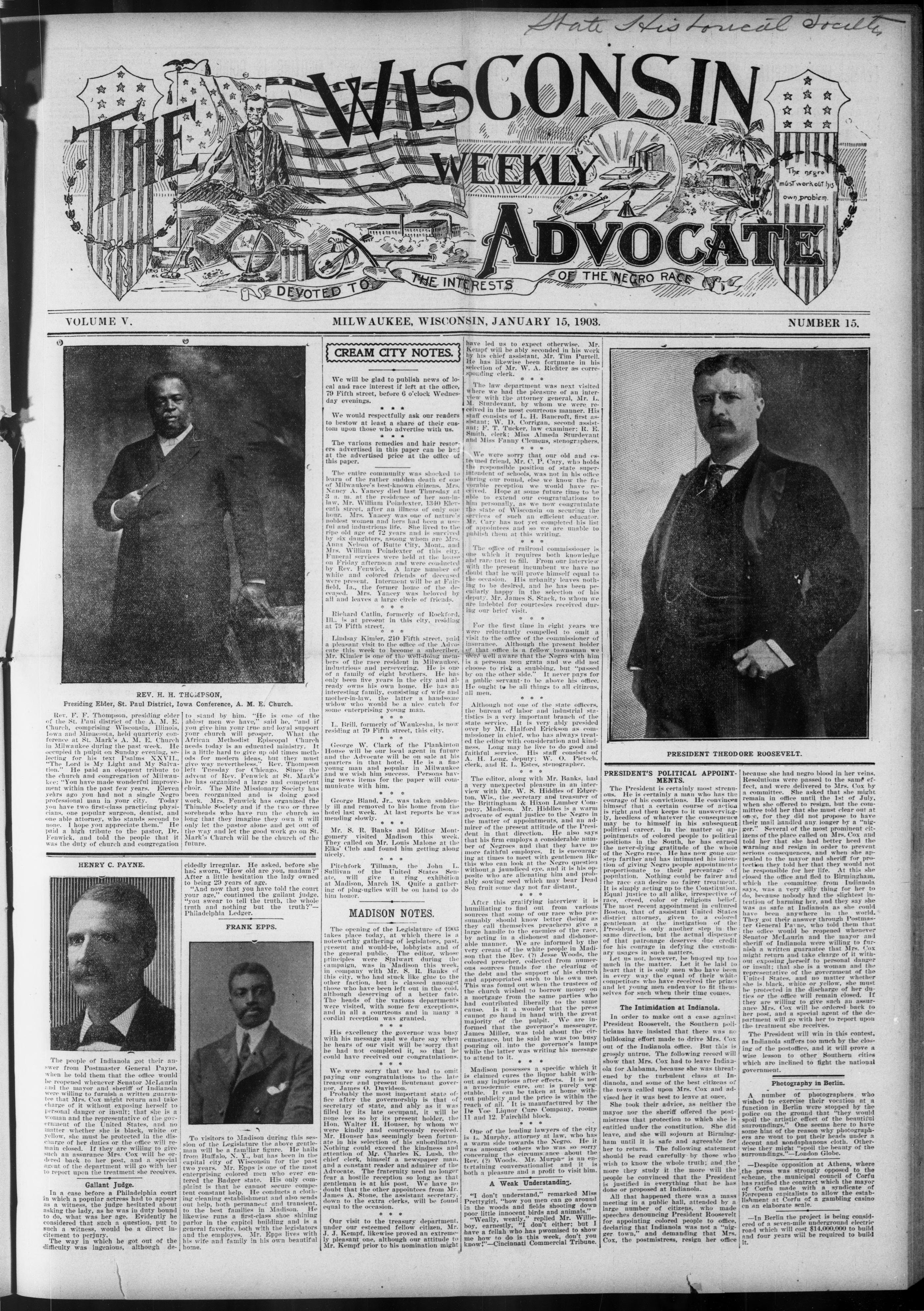
Wisconsin Weekly Advocate
Thursday, January 15, 1903
Milwaukee, Wisconsin
Page text (machine-generated)
WISCONSIN
WEEKLY
ADVOCATE
DEVOTED TO THE INTERESTS OF THE NEGRO RACE
13
Presiding Elder, St. Paul District, Iowa Conference, A. M. E. Church.
VOLUME V.
REV. H. H.
Presiding Elder, St. Paul District, I
Rev. F. F. Thompson, presiding elder of the St. Paul district of the A. M. E. Church, comprising Wisconsin, Illinois, Iowa and Minnesota, held quarterly conference at St. Mark's A. M. E. Church in Milwaukee during the past week. He occupied th pulpit on Sunday evening, selecting for his text Psalms XXVII., "The Lord is My Light and My Salvation." He paid an eloquent tribute to the church and congregation of Milwaukee; "You have made wonderful improvement within the past few years. Eleven years ago you had not a single Negro professional man in your city. Today you have two first-class practicing physicians, one popular surgeon, dentist, and one able attorney, who stands second to none. I hope you appreciate them." He paid a high tribute to the pastor, Dr. Fenwick, and told the people that it was the duty of church and congregation
HENRY C. PAYNE.
[Image of a man in a suit with a tie and a mustache, looking directly at the camera. The background is a striped pattern.]
[Image of a man in a suit with a tie and a mustache, looking directly at the camera. The background is a striped pattern.]
[Image of a man in a suit with a tie and a mustache, looking directly at the camera. The background is a striped pattern.]
[Image of a man in a suit with a tie and a mustache, looking directly at the camera. The background is a striped pattern.]
The people of Indianola got their answer from Postmaster General Payne, when he told them that the office would be reopened whenever Senator McLaurin and the mayor and sheriff of Indianola were willing to furnish a written guarantee that Mrs. Cox might return and take charge of it without exposing herself to personal danger or insult; that she is a woman and the representative of the government of the United States, and no matter whether she is black, white or yellow, she must be protected in the discharge of her duties or the office will remain closed. If they are willing to give such an assurance Mrs. Cox will be ordered back to her post, and a special agent of the department will go with her to report upon the treatment she receives.
Gallant Judge
In a case before a Philadelphia court in which a popular actress had to appear as a witness, the judge hesitated about asking the lady, as he was in duty bound to do, what was her age. Evidently he considered that such a question, put to such a witness, would be a direct incitement to perjury.
The way in which he got out of the difficulty was ingenious, although de-
to stand by him. "He is one of the ablest men we have," said he, "and if you give him your true and loyal support your church will prosper. What the African Methodist Episcopal Church needs today is an educated ministry. It is a little hard to give up old times methods for modern ideas, but they must give way nevertheless." Rev. Thompson left Tuesday for Chicago. Since the advent of Rev. Fenwick at St. Mark's he has organized a large and competent choir. The Mite Missionary Society has been reorganized and is doing good work. Mrs. Fenwick has organized the Thimble Society and if the two or three soreheads who have run the church so long that they imagine they own it will only let the pastor alone and get out of the way and let the good work go on St. Mark's Church will be the church of the future.
cidedly irregular. He asked, before she had sworn, "How old are you, madam?" After a little hesitation the lady owned to being 29 years of age. "And now that you have told the court your age," continued the gallant judge. "you swear to tell the truth, the whole truth and nothing but the truth?"—Philadelphia Ledger.
FRANK EPPS.
[Name]
To visitors to Madison during this session of the Legislature the above gentleman will be a familiar figure. He hails from Buffalo, N. Y., but has been in the capital city of Wisconsin for the past two years. Mr. Epps is one of the most enterprising colored men who ever entered the Badger state. His only complaint is that he cannot secure competent constant help. He conducts a clothing cleaning establishment and also sends out help, both permanent and transient, to the best families in Madison. He likewise runs a first-class shoe shining parlor in the capitol building and is a general favorite, both with the legislators and the employes. Mr. Epps lives with his wife and family in his own beautiful home.
MILWAUKEE, WISCONSIN, JANUARY 15, 1903
CREAM CITY NOTES.
---
We will be glad to publish news of local and race interest if left at the office, 79 Fifth street, before 6 o'clock Wednesday evenings.
★★
We would respectfully ask our readers to bestow at least a share of their custom upon those who advertise with us.
业 ★ ★
The various remedies and hair restorers advertised in this paper can be bad at the advertised price at the office of this paper.
The entire community was shocked to learn of the rather sudden death of one of Milwaukee's best-known citizens, Mrs. Nancy A. Yancey died last Thursday at 3 a.m. at the residence of her son-in-law, Mr. William Poindexter, 1340 Eleventh street, after an illness of only one hour. Mrs. Yancey was one of nature's noblest women and hers had been a useful and industrious life. She lived to the ripe old age of 72 years and is survived by six daughters, among whom are Mrs. Anna Nelson of Butte City, Mont., and Mrs. William Poindexter of this city. Funeral services were held at the house on Friday afternoon and were conducted by Rev. Fenwick. A large number of white and colored friends of deceased were present. Interment will be at Fairfield, Ia., the former home of the deceased. Mrs. Yancey was beloved by all and leaves a large circle of friends.
Richard Catlin, formerly of Rockford. Ill., is at present in this city, residing at 79 Fifth street.
```markdown
```
Lindsay Kimier, 210 Fifth street, paid a pleasant visit to the office of the Advocate this week to become a subscriber. Mr. Kimier is one of the well-doing members of the race resident in Milwaukee, industrious and persevering. He is one of a family of eight brothers. He has only been five years in the city and already owns his own home. He has an interesting family, consisting of wife and mother-in-law, the latter a handsome widow who would be a nice catch for some enterprising young man.
\* \* \*
L. Brill, formerly of Waukesha, is now residing at 79 Fifth street, this city.
☆ ☆ ☆
George W. Clark of the Plankinton House will be our local agent in future and the Advocate will be on sale at his quarters in that hotel. He is a fine young man and popular in Milwaukee and we wish him success. Persons having news items for the paper will communicate with him.
* * *
George Bland, Jr., was taken suddenly ill and removed to his home from the hotel last week. At last reports he was mending slowly.
***
Mr. S. R. Banks and Editor Montgomery visited Madison this week. They called on Mr. Louis Malone at the Elks' Club and found him getting along nicely.
* * *
Pitchfork Tillman, the John L. Sullivan of the United States Senate, will give a ring, exhibition at Madison, March 18. Quite a gathering of plug-uglies will be on hand to do him honor.
MADISON NOTES.
The opening of the Legislature of 1903 takes place today, at which there is a noteworthy gathering of legislators, past, present and would-be, lobbyists and of the general public. The editor, whose principles were Stalwart during the campaign, was in Madison this week, in company with Mr. S. R. Banks of this city, who had stuck like glue to the other faction, but is classed amongst those who have been left out in the cold, although deserving of a better fate. The heads of the various departments were visited, with some few exceptions, and in all a courteous and in many a cordial reception was granted.
☆ ☆ ☆
His excellency the governor was busy with his message and we dare say when he hears of our visit will be sorry that he had not completed it, so that he could have received our congratulations
```markdown
```
We were sorry that we had to omit paying our congratulations to the late treasurer and present lieutenant governor. James O. Davidson.
Probably the most important state of office after the governorship is that of secretary of state, and ably as it was filled by its late occupant, it will be none less so by its present holder, the Hon. Walter H. Houser, by whom we were kindly and courteously received. Mr. Houser has seemingly been fortunate in his selection of his subordinates. Nothing could exceed the kindness and attention of Mr. Charles K. Lush, the chief clerk, himself a newspaper man and a constant reader and admirer of the Advocate. The fraternity need no longer fear a hostile reception so long as that gentleman is at his post. We have no doubt that the other appointees from Mr. James A. Stone, the assistant secretary, down to the extra clerks, will be found equal to the occasion.
* * *
Our visit to the treasury department, under our esteemed fellow citizen, Mr. J. J. Kempf, likewise proved an extremely pleasant one, although our attitude to Mr. Kempf prior to his nomination might
have led us to expect otherwise. Mr. Kempf will be ably seconded in his work by his chief assistant, Mr. Tim Purtell. He has likewise been fortunate in his selection of Mr. W. A. Richter as corresponding clerk.
* * *
The law department was next visited where we had the pleasure of an interview with the attorney general, Mr. L. M. Sturdevant, by whom we were received in the most courteous manner. His staff consists of L. H. Bancroft, first assistant; W. D. Corrigan, second assistant; F. T. Tucker, law examiner; R. E. Smith, clerk; Miss Almeda Sturdevant and Miss Fanny Clemens, stenographers.
We were sorry that our old and esteemed friend, Mr. C. P. Cary, who holds the responsible position of state superintendent of schools, was not in his office during our round, else we know the favorable reception we would have received. Hope at some future time to be able to extend our congratulations to him personally, as we now congratulate the state of Wisconsin on securing the services of such an efficient educator. Mr. Cary has not yet completed his list of appointees and so we are unable to publish them at this writing.
```markdown
```
The office of railroad commissioner is one which it requires both knowledge and rare tact to fill. From our interview with the present incumbent we have no doubt that he will prove himself equal to the occasion. His urbanity leaves nothing to be desired, and he has been peculiarly happy in the selection of his deputy. Mr. James S. Stack, to whom we are indebtel for courtesies received during our brief visit.
* * *
For the first time in eight years we were reluctantly compelled to omit a visit to the office of the commissioner of insurance. Although the present holder of that office is a fellow townsman we were well aware that the Negro with him is a persona non grata and we did not choose to risk a snubbing, but "passed by on the other side." It never pays for a public servant to be above his office. He ought to be all things to all citizens, all men.
***
Although not one of the state officers, the bureau of labor and industrial statistics is a very important branch of the state service. It is very ably presided over by Mr. Halford Erickson as commissioner in chief, who has always treated the editor with consideration and kindness. Long may he live to do good and faithful service. His staff consists of A. H. Long, deputy; W. O. Pietsch, clerk, and R. L. Estes, stenographer.
☆ ☆ ☆
The editor, along with Mr. Banks, had a very unexpected pleasure in an interview with Mr. W. S. Hiddles of Edgerton. Wis., the secretary and treasurer of the Brittingham & Hixon Lumber Company, Madison. Mr. Hiddles is a warm advocate of equal justice to the Negro in the matter of appointments, and an admirer of the present attitude of the President in that direction. He also says that his firm employs a considerable number of Negroes and that they have no more faithful employees. It is encouraging at times to meet with gentlemen like this who can look at the Negro question without a jaundiced eye, and it is his opposite who are alienating him and probably sowing seed which may bear Dead Sea fruit some day not far distant.
* * *
After this gratifying interview it is humiliating to find out from various sources that some of our race who presumably should know better (being as they call themselves preachers) give a large handle to the enemies of the race, by acting in a dishonest and dishonorable manner. We are informed by the very cream of the white people in Madison that the Rev. (?) Jesse Woods, the colored preacher, collected from numerous sources funds for the clearing of the debt and the support of his church and appropriated such to his own use. This was found out when the trustees of the church wished to borrow money on a mortgage from the same parties who had contributed liberally to the same cause. Is it a wonder that the press cannot go hand in hand with the great majority of the pulpit. We are informed that the governor's messenger, James Miller, was told about the circumstance, but he said he was too busy pouring oil into the governor's lamps while the latter was writing his message to attend to it.
* * *
Madison possesses a specific which it is claimed cures the liquor habit without any injurious after effects. It is not a nypodermic cure, out is purely vegetable. It can be taken at home without publicity and the price is within the reach of all. It is manufactured by the De Voe Liquor Cure Company, rooms 11 and 12. Fairchild block.
***
One of the leading lawyers of the city is L. Murphy, attorney at law, who has a warm side towards the Negro. He it was amongst others who was so sorry concerning the circumsance about the Rev. (?) Woods. Mr. Murphy is an entertaining conversationalist and it is both a pleasure and a profit to visit him.
A Weak Understanding.
"I don't understand," remarked Miss Prettygirl, "how you men can go around in the woods and fields shooting down poor little innocent birds and animals."
"Weally, wealy," replied Mr. Willieboy, earnestly, "I don't either; but I have a fellah who has pwomised to show me how to do is this week, don't you know!"—Cincinnati Commercial Tribune.
T.
PRESIDENT THEODORE ROOSEVELT
PRESIDENT'S POLITICAL APPOINTMENTS.
The President is certainly most strenuous. He is certainly a man who has the courage of his convictions. He convinces himself that a certain course of action is right and then keeps to it unswervingly, heedless of whatever the consequence may be to himself in his subsequent political career. In the matter of appointments of colored people to political positions in the South, he has earned the never-dying gratitude of the whole of the Negro race. He has now gone one step farther and has intimated his intention of giving Negro people appointments proportionate to their percentage of population. Nothing could be fairer and the race can desire no fairer treatment. It is simply acting up to the Constitution. Equal justice to all alike, irrespective of race, creed, color or religious belief. The most recent appointment in cultured Boston, that of assistant United States district attorney, given to a colored gentleman at the instigation of the President, is only another step in the same direction, but the actual dispenser of that patronage deserves due credit for his courage in defying the customary usages in such matters.
Let us not, however, be buoyed up too much in the matter. Let it be laid to heart that it is only men who have been in every way the equal of their white competitors who have received the prizes and let young men endeavor to fit themselves for such when their time comes.
The Intimidation at Indianola.
In order to make out a case against President Roosevelt, the Southern politicians have insisted that there was no bulldozing effort made to drive Mrs. Cox out of the Indianola office. But this is grossly untrue. The following record will show that Mrs. Cox had to leave Indianola for Alabama, because she was threatened by the turbulent class at Indianola, and some of the best citizens of the town called upon Mrs. Cox and advised her it was best to leave at once.
She took their advice, as neither the mayor nor the sheriff offered the postmistress that protection to which she is entitled under the constitution. She did leave, and she will sojourn at Birmingham until it is safe and agreeable for her to return. The following statement should be read carefully by those who wish to know the whole truth; and the more they study it the more will the people be convinced that the President is justified in everything that he has done or proposed at Indianola.
All that happened there was a mass meeting in a public hall, attended by a large number of citizens, who made speeches denouncing President Roosevelt for appointing colored people to office, declaring that Indianola was not a "nigger town," and demanding that Mrs. Cox, the postmistress, resign her office
because she had negro blood in her veins. Resolutions were passed to the same effect, and were delivered to Mrs. Cox by a committee. She asked that she might remain in office until the 1st of July, when she offered to resign, but the committee told her that she must clear out at once, for they did not propose to have their mail handled any longer by a "nigger." Several of the most prominent citizens of the place called on Mrs. Cox and told her that she had better heed the warning and resign in order to prevent serious consequences, and when she appealed to the mayor and sheriff for protection they told her that they would not be responsible for her life. At this she closed the office and fled to Birmingham, which the committee from Indianola says, was a very silly thing for her to do, because nobody had the slightest intention of harming her, and she say she was as safe at Indianola as she could have been anywhere in the world. They got their answer through Postmaster General Payne, who told them that the office would be reopened whenever Senator McLaurin and the mayor and sheriff of Indianola were willing to furnish a written guarantee that Mrs. Cox might return and take charge of it without exposing herself to personal danger or insult; that she is a woman and the representative of the government of the United States, and no matter whether she is black, white or yellow, she must be protected in the discharge of her duties or the office will remain closed. If they are willing to give such an assurance Mrs. Cox will be ordered back to her post, and a special agent of the department will go with her to report upon the treatment she receives.
The President will win in this contest, as Indianola suffers too much by the closing of the postoffice, and it will prove a wise lesson to other Southern cities which are inclined to fight the national government.
Photography in Berlin
A number of photographers who wished to exercise their vocation at a function in Berlin were stopped by the police on the ground that "they would spoil the artistic effect of the beautiful surroundings." One seems here to have some hint of the reason why photographers are wont to put their heads under a decent and nondaphanons cloth. Otherwise they might "spoil the beauty of the surroundings."—London Globe.
—Despite opposition at Athens, where the press was strongly opposed to the scheme, the municipal council of Corfu has ratified the contract which the mayor of Corfu made with a syndicate of European capitalists to allow the establishment at Corfu of a gambling casino on an elaborate scale.
—In Berlin the project is being considered of a seven-mile underground electric road which will cost $14,000,000 to build and four years will be required to build it.
FLAMES IN A HOSPITAL
Three Story Infirmary Building at Pensacola, Fla., Burns.
Country.
Pensacola, Fla., Jan. 14.—Fire early today totally destroyed Bryan's large threestory infirmary on the corner of Bayley and Dardin streets. One of the patients named Blockton was burned to death in his room. All the patients were removed to St. Anthony's Hospital, where they were given prompt attention. Nothing was saved from the infirmary and the loss is total. Camden, N. J., Jan. 14.—The big factory building of A. Lunn & Co. of this city was destroyed by fire today. The loss, which is estimated at $130,000, is distributed among a number of firms who occupied portions of the building. Lunn & Co. carried on a wool scouring business.
Piqua, O., Jan. 14.—Five buildings were badly damaged by fire today, entailing a total loss of $150,000, with only a partial insurance in each case. The flames started in the book and wall paper store of Branson & Worley and before it could be controlled spread to the book store of G. W. Nash, the New York Dry Goods Company, the furniture store of Campbell & Besancency and Wendell's jewelry store, in which building the Republican Club had headquarters.
Williamsport, Pa., Jan. 14.—Mrs. Daniel Rowland was burned to death and her husband was fatally injured by leaping from a third story window today at Berwick, Pa. A fire started from an explosion in a drug store on the first floor and the firemen did not know anyone lived on the third floor until Rowland jumped from the window. His wife was found dead in her bedroom.
Princeton, N. J., Jan. 14.—The handsome residence of Prof. H. J. Westcott head of the Latin department, was totally destroyed by fire today. A defective chimney which set fire to the roof is given as the cause. Prof. Westcott's valuable library and manuscripts were saved
CHARGES OF BRIBERY.
Alleged Attempts to Corrupt Judge in Litigation Over the Minnie Healy Mine.
Butte, Mont., Jan. 14.—Jesse B. Roote, formerly one of the leading attorneys for Senator W. A. Clark, gave sensational testimony in the disbarment proceedings against A. J. Shores, chief counsel for the Amalgamated Copper Mining Company, who is accused of attempting to bribe Judge J. Edward Harney to render a decision favorable to the Amalgamated Copper Company in its litigation over the Minnie Healy mine, a property valued at about $10,000,000.
Attorney Roote, under oath, testified that the representatives of the Amalgamated Company were attempting to secure a new trial and Judge Harney was given the choice of confessing that he had received a bribe from the Heinzes for his decision, or of being confronted with damaging affidavits.
Continuing his testimony, Attorney Roote testified that Charles W. Clarkson of Senator Clark, had offered to give Harney $250,000 if he would tell all he knew about bribery rumors and acknowledge that he had been wrongly influenced by the Heinze interests in rendering his decision in the Minnie Healy case.
STIRRED UP BY DOLLIVER.
Iowa Senator Denounces Extreme Protectionists for Defeating Reciprocity Treaties.
Washington, D. C., Jan. 14.—While the Vest resolution directing the committee on finance to report a bill removing the duty on coal was under discussion, Mr. Dolliver of Iowa vigorously attacked those senators responsible for the holding up of reciprocity treaties in the Senate. He declared that it was true that the late Mr. Dingley, as chairman of the ways and means committee, which had prepared the tariff law of 1897, did put up certain duties for the xpress purpose of having them brought down by the reciprocity treaties. Senator Dolliver added that he ought to know the facts in this case, as he had served as a member of the ways and means committee, and also had been a member of the subcommittee which had direct charge of the reciprocity clauses and arrangements. He denounced the high protectionists of the East for their concerted and successful opposition to all the reciprocity treaties negotiated by President McKinley under the Dingley law.
Mr. Dolliver's speech caused a gendline sensation in the Senate and throughout the capitol.
UTTERLY BASELESS.
Denial of Story that Germany Had Bid for Franchises of Panama Canal Company.
Berlin, Jan. 14.—The German government has sent a note to the United States relating to the report that Germany is seeking to acquire Colombia's interests in the Panama Canal Company, affirming that the report is utterly baseless, and it is understood expressing the opinion that Germany's commerce would be benefitted by the construction of the canal by the United States.
KILLS MOTHER IN A RAGE.
Nine-Year-Old Boy Shoots Parent Because of a Thrashing.
Benton, Ill., Jan. 14.—Mrs. Frank Stucker thrashed her 9-year-old boy for some trivial offense and on her return from the barn, where she had been to milk the cows, she was met by the angry boy, who discharged a shotgun at her, inflicting fatal wounds. Mrs. Stucker did not lose consciousness at once and called the child to her and talked to him. In a fit of remorse he rushed from her and again securing the gun killed himself. The mother died in a few hours.
AMEND JUBAN TREATY.
Senate Committee Makes Concession to Beet Sugar Interests.
Washington, D. C., Jan. 14.—The Senate committee on foreign relations today agreed to recommend the adoption of an amendment to the Cuban reciprocity treaty providing that the reduction of 20 per cent in the tariff on Cuban sugar shall not be further reduced by any preferential rate given to another country. This action was taken at the instance of the beet sugar men.
PERISHED BY COLD.
Number of Deaths are Reported Due to Exposure to Extreme Weather.
Chicago, Ill., Jan. 12.—Two degrees below zero was the official temperature for Chicago and vicinity at 8 o'clock today, accompanied by a brisk northwest wind. Much suffering among the poor, who have with difficulty endured the weather since the coal famine became acute, has been reported and a number of deaths are said to have been due directly to the cold. Steps have already been taken by the mayor to provide a fund for relief of suffering among the destitute. The temperature, which was 6 below at midnight, began soon to moderate until at 7 o'clock this morning 1 below was registered. An hour later 2 below was reached.
Much delay to suburban and interurban transportation lines was occasioned by the intense cold and a number of minor accidents owing to the heavy fall of snow were reported. List of dead from the cold:
FRANK LEWIS, 40 years old; badly frozen; dled in a chair in a saloon.
frozen; died in a chair in a saloon R. ROSE, walked streets all night and led soon after entering warm room of a odging house
lounging house. C. G. POOL, Manila, Ia., cook on dining car; frozen stiff in his room.
PATRICK M'COVERN, overcome by cold and fell from his wagon, fracturing his skull.
WILLIAM MADIGAN, found dead in lodging house from exposure.
W. H. WAHL, swallowed laudanum because unable to secure food and fuel for his family.
Coldest Night of the Winter.
Detroit, Mich., Jan. 12.—Following on the heels of the most severe snow storm of the season yesterday, came the coldest night of the winter in this city. At 7:30 this morning the thermometer registered 5 below zero. The zero temperature was general all over the lower peninsula below Alpena, with the exception of a section close to the shore of Michigan near Grand Haven. Hundreds of people who live in Windsor, Ont., just across the river, and who are employed in this city, did not get to their work until nearly noon. The snow of yesterday froze into the ice in the river and packed it into an almost impenetrable mass and the ferries across the river had been able to make but four trips up to 9:30 o'clock. The car ferries had even more trouble, plowing through the ice with their trains.
Extends Over Wide Area.
Omaha, Neb., Jan. 12.—At 7 o'clock 3 degrees below was registered at the local weather bureau, with indications for little relief from the cold snap before tomorrow. The extreme cold covers Nebraska, Western Iowa and South Dakota. Des Moines, Ia., Jan. 12.—Extreme cold has prevailed throughout Iowa for thirty hours, the temperature ranging from zero to 6 below, accompanied by considerable wind. Hard coal cannot be obtained and the soft coal supply is exhausted in many places, resulting in much suffering. Columbus, G., Jan. 12.—The blizzard of Sunday was followed by intense cold, the temperature here being 3 below. The wind is from 30 to 46 miles over the state, causing much suffering.
Cleveland, O., Jan. 12.-The lowest temperature of the winter was recorded here early today when the government thermometer indicated 4 degrees below zero. Much suffering prevailed.
DEATH OF CONGRESSMAN.
Representative Tongue of Oregon Expires After Brief Illness of Inaugestion Action by the House.
Washington, D. C., Jan. 12.—Representative Tongue of Oregon died here yesterday about noon, after an illness of only an hour or two. Before Mr. Tongue realized his serious condition he was beyond the aid of medical skill. Death was caused by acute indigestion, producing paralysis of the heart. When the House met today, Mr. Tongue's desk was heavily draped with black and covered with flowers. Mr. Moody (Ore.) announced the death if his colleague, Representative Tongue, and offered the customary resolutions of regret which were adopted. The speaker appointed a committee to attend the funeral services and then adjourned.
SECRETARY MOODY HURT.
Horses Attached to His Carriage Run Away—He and Senator Hale Are Thrown Out.
Washington, D. C., Jan. 12.—The superintendent of the naval academy telephoned to the white house this afternoon that during the reception to Secretary Moody and Senator Hale at Annapolis this afternoon, the horses attached to their carriage ran away and Secretary Moody was thrown out and slightly bruised Senator Hale escaped uninjured.
MANIAC FROZEN TO DEATH
Tremens Victim Escapes Dozing Guards to Perish in Snow Storm.
Springfield, Ill., Jan. 12.—While two men who had been set to watch him dozed, Oren Kay, suffering with delirium tremens, escaped from his boarding house at Niantic at 3 o'clock yesterday morning and ten hours later was found frozen to death by a searching party. In his delirium Kay traversed the whole town in a driving snowstorm. When found he was crouched beneath a small bridge three-quarters of a mile from his boarding house.
BABCOCK BACK FROM CUBA.
Tells President Cuban Reciprocity Would Be Good Thing.
Washington, D. C., Jan. 12. President Roosevelt had a long conference today with Representative Babcock of Wisconsin, who has just returned from Cuba. Mr. Babcock told the President that he was heartily in favor of the ratification of the pending Cuban reciprocity treaty, particularly as he regarded the ratification as a good stroke of business policy for the United States.
DEAD ENGINEER AT THROTTLE
Fireman on Tennessee Train Discovers Condition After Eight-Mile Run.
Knoxville, Tenn., Jan. 12.—Passengers on an incoming Knoxville & Ohio railroad train rode several miles with the hand of a corpse at the throttle of the engine. When Engineer A. C. Young ran through Careyville Fireman Matlock knew something was wrong and stepped to the engineer's side. He found Young dead and immediately stopped the train.
CRUSHED UNDER FALLING ROOF.
Two Men Killed While Digging Coal for Their Families.
Williamsport, Pa., Jan. 12.-Hilliard Probst and Ira Green were crushed to death while digging coal near Bitumen, Clinton county. The two men went into a small private mine to dig coal for the use of their families when a roof caved in, killing them.
BIG FIRE IN NEW YORK
New York, Jan. 12.—Fire completely destroyed the eight-story building at Allen and East Houston streets which was occupied by Fayerweather & Ladew, manufacturers of leather belting. The loss will exceed $500,000.
The firm had 1000 employes, who will temporarily be out of employment. Large quantities of oil and grease were stored in the building and these made the fire fiercely hot and caused two explosions. One of them nearly caught a squad of firemen with sheets of flame and as a result of the other a water tower of the fire department was destroyed. The occupants of all nearby buildings, including a thickly-populated tenement house, were driven out. A portion of one of the walls fell on the Second avenue elevated structure and crushed a girdle. A battalion of fifteen men working on the railroad just got out of the way in time to save their lives. The origin of the fire has not been ascertained.
While the loss on the building was estimated at about $300,000, George Hall, one of the managers of the belting firm, said that stock valued at over $500,000 had been destroyed. The firm carried $621,000 insurance. Edward Ladew said that their employees who had been temporarily thrown out of work would be sent to the firm's factories at Fall River, Mass, Newark, N. J., and Charlotte, N. C.
Chicago, Ill., Jan. 12.—Fire today destroyed a four-story building at Dearborn and Illinois streets, causing a loss of $600,000, and threatened the destruction of a lodging house adjoining. The fire originated on the first floor and spread rapidly, due to the frozen fire plugs which had to be thawed before a stream of water could be brought into play. A number of business concerns occupied the building and suffered loss of varying sums, the heaviest being those of the Sun Leather and Sadderly Company, E. J. Ferguson, steam heating appliance; the Roberts Portable Oven Company and the D. C. Christie Engraving Company.
South Haven, Mich., Jan. 12.—The Colonial Hotel, a four-story brick structure, containing Reich & Cowles's plumbing store and Bruen's drug store, together with Barrett & Barrett's cider mill adjoining, were destroyed by fire last night. With a high north wind blowing, the flames spread with startling rapidity, while the firemen were handicapped by inability to secure an immediate supply of water, owing to the hydrants being frozen. The cider mill and hotel are a total loss, the damage being estimated at $50,000.
ROYAL FAMILY SCARED.
Supposed Anarchist Fires a Shot at Carriage in a Procession in Madrid
Madrid, Jan. 12.—King Alfonso, attended by the high officials of the palace, was returning from attendance at church Saturday afternoon when a man, who afterward gave the name of Jose Collado, fired from among the spectators at the second carriage in the procession. This carriage contained the Duke de Sotomayor. The bullet did not inflict the slightest injury on anyone. The royal guards had no difficulty in arresting Collado. When the King heard the shot he leaned out from the carriage to see what the matter was, but his mother pulled him back.
Collado, the would-be assassin, after being arrested, said that he meant to kill the Duke of Sotomayor. In the pockets of Collado was found some letters not yet posted, but marked as registered and addressed to President Roosevelt, King Edward of England. Kaiser Wilhelm, the Czar of Russia and the president of the high court of Mexico. Collado denied being an anarchist.
DOWN BELOW ZERO
Frigid Temperature Prevailed at Various Places.
St. Paul, Minn., Jan. 12.—One degree below zero was the warmest temperature reported in this city Sunday and last night it went down to 7 below. Moorhead, Minn., reports a minimum of 18 below and Duluth experienced 6 below. Full reports from the state have not yet been received, but the weather man—from the received reports—looks for slightly warmer weather tomorrow. Fuel is scarce and, although there is not yet an actual famine, there is much suffering.
Kansas City, Mo., Jan. 12.—Zero weather prevailed in Kansas City at 7 o'clock this morning, a fall of 11½ degrees in the past twelve hours. There is no prospect of moderation today and suffering because of lack of fuel will prove severe. The supply of coal in Kansas City, which was short on Saturday, had diminished greatly over Sunday. Similar conditions exist at all points throughout this part of the state.
St. Louis, Mo., Jan. 12.—An intensely frigid temperature prevails here. At 5 o'clock this morning the temperature registered 3 above, but by 8:30 o'clock the bright sunshine had raised the mercury to 10 above. Two inches of snow has brought out sleighs.
HEWITT CLOSE TO DEATH.
Former Mayor of New York and Founder of Cooper Union Growing Weaker. New York, Jan. 12.—Abram Stevens Hewitt, formerly mayor of New York and distinguished as a philanthropist, politician and student, is dying. Early this morning it was announced that Mr. Hewitt was growing weaker. Mr. Hewitt, who is in his eighty-first year, has been confined to his bed since Thursday, suffering from obstructive jaundice. At 9 o'clock the following bulletin was posted by the physicians attending Mr. Hewitt: "Mr. Hewitt's condition remains unchanged. His intellect is unclouded."
CITIZENS SEIZE COAL
Sixteen Carloads Appropriated by People Who Had Become Desperate.
Arcola, Ill., Jan. 12.—A trainload of coal, sixteen cars in all, was seized here by a crowd of 300 citizens who had been rendered desperate by the coal famine. The train was bound for Chicago and stopped here in a siding to await orders
Pope Signs a Brief.
Rome, Jan. 12.—The Pope signed a brief today by which hereafter the Catholic University at Washington will be under the jurisdiction of the congregation of studies presided over by Cardinal St. tolli.
ROUTINE OF CONGRESS.
Proceedings in the Senate.
Most of the time in the Senate on the 5th was occupied by discussion of the Vest resolution requesting the finance committee to report a bill removing the duty on anthracite coal. A House bill was passed amending the internal revenue laws allowing all distilled spirits now in bonded warehouse, or which may hereafter be produced and deposited therein the same allowance for loss from leakage or evaporation which now exists in favor of distilled spirits ganged and deposited prior to January 1, 1899. The statehood bill was taken up at 2 o'clock and Mr. Nelson continued his remarks. He had not concluded when at 4 o'clock, by unanimous consent, the Senate considered unobjected bills on the calendar. The bill providing for the retirement of Capt. Richmond P. Hobson brought forth a pretest from Mr. Cockrell, who thought Congress should not be made a court of appeals to hear applications from officers after they had been declared fit for active service. Mr. Morgan gave notice he would ceintinue to call the bill up until justice is accorded Capt. Hobson.
A lively debate occurred in the Senate on the 12th between Messrs. Aldrich, Vest and Carmack, when the first named endeavored to secure a postponement of the Vest resolution requiring the committee on finance to report a bill removing the duty on coal. Mr. Aldrich announced there were strong hopes of action being taken elsewhere with the view to removing the duty on coal. The proposition was not acceptable to Mr. Vest, who expressed the opinion that to allow the resolution "to go into the uncertain and nebulous future" would mean its defeat. Mr. Nelson continued his remarks in opposition to the omnibus statehood bill, and a large number of private pension bills were passed by unanimous consent. At 5:10 p. m. the Senate adjourned out of respect to the memory of the late Representative Tongue of Oregon.
Soon after the Senate met on the 13th Mr. Jones (Nev.) favorably reported the resolution of Mr. Stewart authorizing the committee on the District of Columbia to send for witnesses in connection with the coal investigation, to administer oaths and to compel the attendance of witnesses in necessary. The resolution was agreed to. Consideration of the Vest resolution directing the finance committee to prepare and report a bill removing the duty on coal then was resumed and continued until 2 o'clock, when the resolution went over for a day, after Mr. Tillman had given notice that he would then "string a live wire" and lay the blame for the present coal situation at the door of the President and the attorney general. Mr. Nelson concluded his remarks in opposition to the statehood bill, and at 4:15 o'clock the Senate went into executive session, adjourning soon afterward.
The Senate on the 14th acted promptly on the House bill providing rebates of the duty on coal for one year and passed it unanimously, without debate, a few minutes after it was brought over from the House. The militia bill also was passed, with an amendment striking out of the bill the section providing for a reserve force of 100,000 trained men, thus removing the objections made against it. An amendment by Mr. Beveridge, exempting certain persons having religious scruples against war from serving in the militia, was also passed. For an hour and a half Mr. Tillman occupied the attention of the Senate in a characteristic speech, in which he denounced trusts and monopolies and severely criticised the attorney general. The statehood bill was up for a short time, during which Mr. McCumber spoke in favor of granting statehood to Oklahoma, Arizona and New Mexico. After a brief executive session the Senate adjourned.
Proceedings in the House.
The House on the 5th passed the Philippine constabulary bill as it was reported from the committee except for an amendment limiting the number of assistant chiefs to four. The bill provides that the chief of the constabulary, and the assistant chiefs, who are United States army officers, shall have the rank, pay and allowance of brigadier general and colonel respectively, the difference between such pay and their pay in their regular grades to be paid out of the Philippine treasury. The bill also provides that when the Philippine scouts are ordered to assist the constabulary they shall be under the command of the chief or assistant chiefs. A substitute offered by Mr. Hull of Iowa to provide that the chief be a regular brigadier general of the army and the assistant chiefs officers not below the rank of lieutenant colonel was defeated. The present chief of the constabulary is Capt. Allen of the army. The resignation of Mr. Lanham of Texas, who has been elected governor of Texas, was laid before the House.
The 9th was private pension day in the House, and 144 bills were passed, none of especial importance. Mr. Russell (Texas), the successor of the late Mr. Graffenreid, criticised the House for undue haste in the consideration of private pension legislation, and precipitated quite a debate. He called attention to the fact that since the Civil war 10,000 special bills had been passed by Congress; over 1000 of these in the first session of the present Congress. In reply Mr. Lacey (Iowa) called attention to the fact that the cases before Congress were cases in which the general pension laws could not give relief. The fact that only 10,000 bills had passed in forty years, he thought, sufficient proof of the care and discrimination which had been exercised by Congress. Mr. Hull (Iowa), chairman of the committee on military affairs, reported the military appropriation bill, and gave notice that he would call it up on the 12th.
The House on the 12th after adopting a resolution to authorize the merchant marine and fisheries committee to investigate the coal situation at once, adjourned out of respect to the memory of the late Representative Tongne of Oregon, after appointment of a committee to attend the funeral. The resolution to investigate the coal situation recites the fact that a resolution has been introduced to extend the privileges to carry coal to coastwise ports to foreign steamers for ninety days, because the present scarcity of coal involves great suffering and distress, and authorizes the committee to investigate "facts, charges and necessities to inquire into the elements and conditions involved in the coal trade, the cost of coal, the methods, facilities and cost of transportation and distribution of the same, and the reasons or causes of such scarcity and distress." The committee is directed to report the testimony, with their conclusions thereon, to the House as soon as possible. It is given power to send for persons and papers, to administer oaths, etc., and incur such expense as may be deemed necessary. The meetings are to be held in Washington and in such other places as the committee may determine.
For the first time since the opening of this session of Congress the House was regaled on the 13th was a lively political debate. Gen Grosvenor of Ohio and Mr Clark of Missouri crossed swords during the general debate on the army appropriation bill and for two hours both sides of the House cheered on their respective spokesmen. The contest was entirely good-natured. There were several brilliant clashes and the House and the galleries were greatly entertained The remainder of the day was occupied by Mr. Hull (Rep., Iowa), who argued against the abandonment of the army transport service; Mr. Shattuc (Rep., Ohio), who assailed Edward Atkinson and the anti-imperialists; Mr. Moon (Dem., Tenn.), who denounced the refusal of the House leaders to allow the consideration of the Indian Territory statehood bill and who announced a policy of obstruction which he intended to pursue unless consideration were given it; Mr. Swanson (Dem., Va.), who argued the necessity of tariff revision, and Mr. Galnes (Dem., Tenn.), who urged the immediate advisability of placing coal on the free list.
The bill reported from the ways and means committee to provide for a rebate of the duties on foreign coal for a period of one year was passed in short order by the House on the 14th by practically a unanimous vote, 258 to 5. Mr. Grosvenor (Ohio), from the committee on rules, presented a resolution supplemental to that adopted the day before directing the committee on merchant marine and fisheries to investigate the coal situation. The resolution authorized sub-committees of the committee to take testimony. It was adopted. Rapid progress was made with the army appropriation bill after the coal bill had been passed. The most important amendments adopted were to increase the number of officers in the signal corps by twenty-three, namely, one colonel, two lieutenant colonels, four majors, eight captains and eight first lieutenants, and mother to prevent the discontinuance of the army transport service without action by Congress. At 5:30 p. m., after disposing of twenty-eight pages of the bill, the house adjourned.
The only beast of prey found in Australia is the dingo, or wild dog.
FIGHTING IS GOING ON
Pretender's Followers Said to be Overcoming Imperial Troops.
ANXIETY AT RABAT.
Europeans Fear the Consequences of an Immediate Attack by the Rebel Forces.
Madrid, Jan. 15.—Fighting is proceeding between the troops of the Sultan of Morocco and the forces of the pretender to the throne, according to a dispatch received by the Globo from Fez. The followers of the pretender are said to be overcoming the imperial troops.
The correspondent of the Globo adds that the inhabitants of Fez have risen against the Sultan and that anxiety reigns at Rabat, where the Europeans are in fear of an immediate attack by the pretender's forces.
The Sultan's representative at Tangier has been ordered to seize cattle and dispatch reinforcements to the Sultan.
SUICIDE OF WIN MERCER.
Well-Known Pitcher Takes His Life by Inhaling Illuminating Gas at Hotel.
San Francisco, Cal., Jan. 13.—Winnie D. Mercer, a pitcher of the American baseball team, was found asphyxiated in his room this morning. The watchman detected the odor of gas coming from Mercer's room and broke down the door. Clad in his night clothes and lying in the bed with his coat and vest covering his head, Mercer was found. From the gas jet in the center of the room was suspended a rubber tube and the end of this Mercer had placed in his mouth after turning the gas full on. Mercer's identity was established by papers found among his effects, one of which read: "Tell Mr. Van Horn of the Langham Hotel that Winnie Mercer has taken his life."
San Francisco, Cal., Jan. 13.—Mercer was a sufferer from pulmonary troubles, and as the disease refused to yield to treatment he became despondent.
There are few ball players in the country better known than Mercer. Formerly a college player he was induced to join the Washington club of the National League. He made a great success as a pitcher and New York offered a big sum for his release, but failed to get him. When the American League expanded Mercer was secured by the Detroit club. He was acting agent for the club last season and it was understood that he was to manage the team the coming season. He was a gentlemanly fellow of good habits and his death will be a shock to his friends throughout the country.
TRAIN STALLED IN SNOW.
Fourteen Passengers Imprisoned by Drifts and Spend a Most Disagreeable Night. LaPorte, Ind., Jan. 13.—Lake Eric passenger train No. 22, north bound. Sunday night became stalled in a huge snow drift one mile south of this city and remained fast there until 5 o'clock yesterday afternoon, when it was brought into town.
There were fourteen persons on the train, including the crew, all being imprisoned in the snowbound train until relief workers succeeded in reaching the imprisoned people and taking them off in sleighs. When the train became stuck last night the snow plow at Peru was sent here with a crew to dig out the train, but the plow jumped the track at Stillwell. A relief train which was sent from Michigan City became stalled for six hours in the snow a quarter of a mile north of the blocked passenger train.
The fourteen imprisoned persons spent a most disagreeable night, although the crew managed to keep the fires going in order to prevent the passengers from suffering.
MORRISON'S ILLNESS SERIOUS
Former Interstate Commerce Commissioner in Critical Condition.
Waterloo, Ill., Jan. 13.—Col. William R. Morrison, formerly interstate commerce commissioner, who is at home seriously ill with kidney trouble, may have to submit to an operation. Dr. Bryson of St. Louis is in consultation with Dr. Sonnott. As the colonel is along in years, however, it is hoped the operation may be avoided, although he has so much vitality that the doctors are hopeful that it would be successsful. Col. Morrison was for many years in Congress, representing this district.
STRATTON ESTATE SUED.
Claim Made that Samples from Independence Company Mine Were Salted.
Denver, Col., Jan. 13.—The Stratton Independence Company began suit for $6,000,000 against the executors and trustees of the Stratton estate and also against I. Harry Stratton, heir at law, alleging that the mine samples were "salted," so that the amount of ore was valued at $7,000,000 when in reality the ore in sight was worth only $2,000,000 or less.
SAYS STORIES ARE UNTRUE
Countess Lonyay Asks the Impertinent Rumors Be Denied.
Berlin, Jan. 13.—Countess Lonyay, the former Crown Princess Stephanie of Austria-Hungary, who, it has been asserted in the newspapers had been deserved by her husband, Count Elemer Lonyay, has telegraphed to the Neues Wienner journal from Cape Martin, near Mentone, France, as follows: "Stories untrue. Count here. Deny impertinent rumors."
Easily Explained.
Nurse (of insane asylum)—I can' make out what ails that new patient he keeps screaming "Mondays in January, first and third Thursdays, Sunday afternoons, second and fourth Wednesdays, Tuesday evenings in February, and things like that. House Doctor—That's easy. She's a society woman trying to keep track of her friends' reception days.—Judge.
A Tooth Brush Plant.
One of the most curious plants in the world is the tooth-brush plant, a species of creeper which grows in Jamaica. Butting a piece of stem and frying the ends the natives made a tooth brush, and dentifrice to use with it is prepared by pulverizing the dead stems.
The new East and West Cuba railway, which is near completion, is 300 miles long.
The vineyards of Germany aggregate 238,025 acres.
---
New Method of Bringing the Product of the Maine Woods to Market.
The largest log carrier in the world has been put into operation 100 miles north of Bangor, Me. It represents a triumph for backwoods engineering and opens up an almost inexhaustible source of supply for Bangor sawmills. By means of it Maine-cut logs, that in years past have gone down the Allegash to the St. John river, will now be driven over into Penobscot waters and down the east branch to the Bangor mills.
The carrier is longer by one-half than any other carrier in the world, transporting logs a distance of 3000 feet. It consists of an endless steel cable $1\frac{1}{2}$ inches in diameter and 6000 feet long running from Eagle lake to Chamberlain lake, over enormous sprocket wheels. Small carriers are fastened to the cable ten feet apart. These carriers differ from any others in the world. They consist of axles fastened to wooden frames, through the center of which passes the cable. On top of the carriages are large sharp spikes for the logs to rest upon. On each end of the axle are small flanged wheels, similar to those made for railroad cars. These wheels run on a track made of 12-pound rails solidly constructed. The rails form a double tramway.
The March of Science.
Oolitie, Ind., Jan. 12.—That Oolitie is right abreast of the times in the use of the most recent discoveries in medical science is shown by recent cases in which those dreaded Kidney Complaints that cause so many deaths have been completely cured by the new remedy, Dodd's Kidney Pills.
Many people in this neighborhood tell of aches relieved and pains departed because of the use of Dodd's Kidney Pills. One of these is W. A. Terry, the well known grocer. Here is his story:
"I suffered for four months with Kidney and Bladder Trouble and was so bad that I was almost confined to my bed. I could get no relief until I commenced using Dodd's Kidney Pills.
"I could notice an improvement the second day I took the pills. I would recommend Dodd's Kidney Pills to all sufferers from Kidney Complaints."
An Idle Match.
An Englishman was traveling in the compartment of a London train. At one of the stations a German entered the carriage and took the seat opposite.
When the train had started, the German, seeing the other's cigar, boldly asked for one.
Although astonished at the request, the Englishman nevertheless pulled out his case and handed it to the stranger.
The German lighted the cigar, took a few puffs and beaming affably through his spectacles, said:
"I would nod haf droubled you, bud I had a match in mine boggit, und I did not know vat to do mit him."
Kate E.
"I am so pleased with the results I obtained from Lydia E. Pinkham's Vegetable Compound that I feel it a duty and a privilege to write you about it.
"I suffered for over five years with ovarian troubles, causing an unpleasant discharge, a great weakness, and at times a faintness would come over me which no amount of medicine, diet, or exercise seemed to correct. Your Vegetable Compound found the weak spot, however, within a few weeks—and saved me from an operation—all my troubles had disappeared, and I found myself once more healthy and well. Words fail to describe the real, true grateful feeling that is in my heart, and I want to tell every sick and suffering sister. Don't dally with medicines you know nothing about, but take Lydia E. Pinkham's Vegetable Compound, and take my word for it. you will be a different woman in a short time."—MRS. LAURA EMMONS, Walkerville, Ont. $5000 forfeit if original of above letter proving genuineness cannot be produced.
Don't hesitate to write to Mrs. Pinkham if there is anything about your case which you do not understand. She will treat you with kindness and her advice is free. No woman ever regretted writing her and she has helped thousands. Address is Lynn, Mass.
AT
BED TIME
I TAKE
A
PLEASANT
HERB
DRINK
THE NEXT MORNING I FEEL BRIGHT AND NEW
AND MY COMPLEXION IS BETTER.
AND MY COMPLEXION IS BETTER.
My doctor says it acts gently on the stomach, liver and kidneys and is a pleasant laxative. This drink is made from herbs, and is prepared for use as easily as tea. It is called "Lane's Tea" or LANE'S FAMILY MEDICINE
All druggists or by mail 25 cts, and 50 cts. Buy it to day. Lane's Family Medicine moves the bowels each day. In order to be healthy this is necessary. Address. O. F. Woodward, Le Roy, N.Y.
ARE YOU SATISFIED?
Are you entirely satisfied with
the goods you buy and with the
prices that you pay?
Over 2,000,000 people are trading with
us and getting their goods at wholesale
prices.
Our 1,000-page catalogue will be sent
on receipt of 15 cents. It tells the story.
Montgomery Ward Co.
1
CHICAGO
The house that tells the truth.
TO BE TOLD IN A FLOWER.
"If you were dead, my darling.
And by your grave's white stone
The grasses grew to hide the eyes
That smile into my own—
If where your dear feet often trod
They might not tiead again,
And you were in the world of God
And I the world of men—
Oh, then, if by your grave, dear,
I spoke some loving word.
How would you give an answer, dear,
To tell me that you heard?"
"Dear, if you knelt beside me
And whispered through the mold
Above me, any tender words
I loved to hear of old—
If, in the grasses growing
Above that grave of mine.
Some little flower should blossom,
O, take it as a sign
That, while you knelt beside me,
And spoke your loving word,
Love sent it as a message
To tell you that I heard."
Then E. Rexford in Home and Flowers.
TOM'S FLIRTATION.
"And so you positively refuse to give up this intimacy?"
"Really, you ask too much, aunty. What else can I do in this stupid place? I am devoted to yachting, you know, and besides, Mr. Trevor is the only man here who has a motor car."
"But, my child, you are engaged to be married! What would Tom say if he should hear of it? And what would you do if he followed your example?"
"Oh, I wish he would! His devotion wearies me sometimes. He used to be quite a tease, but since our engagement he seems to have foresworn everything exciting."
Flossie tossed her pretty head until her blonde curls fell over her eyes from which gleamed a spirit of mischief. The first speaker was Miss Treadway, the girl's aunt, a wealthy woman of forty years, who had adopted her after the death of her parents. Flossie's fiance, a young doctor of good family and some means, was completing a medical course in Germany, and they were to be married as soon as he received his foreign diploma.
Mr. Trevor's summer home, a fine stone mansion overlooking the harbor, was the scene of many festivities. He had already given two dinners in Flossie's honor, at which functions Miss Treadway had served as an unwilling chaperon, for she realized that the brilliant company invited to meet them regarded her niece as the future Mrs. Trevor. Now we find her reproving her young relative, with indifferent success.
"Flossie," said Miss Treadway, "I think you ought to consider Mr. Trevor's feelings. It is not fair to him; he does not know about Tom. Perhaps you had better tell him?"
"And spoil all my fun? Why, auntie, what a fuss you are making about a trifle! I cannot mope here without men's society, Tom is in Germany, the sea divides us, and he is welcome to enjoy himself in like manner. However, there is no prospect of his doing anything so sensible. Why, I verily believe he spends all his leisure time writing to me. I get so many letters that I don't read half of them. And that reminds me, one came yesterday when I was getting ready to go out in the yacht. I haven't read it yet; really, I had forgotten it."
When she was alone Flossie curled her dainty self in a large easy chair and laughed softly as she recalled her aunt's words.
"Lose Tom," she repeated. "No danger of that; couldn't get rid of him even if I wanted to." Then she fell to musing, and a tender look came into her deep blue eyes. "Dear Tom," she murmured. "I do love him. I wouldn't give him up for twenty Mr. Trevors!" She went to her desk, found the letter, and having a fine sense of personal comfort, sank back into the soft depths of the chair, and with a box of chocolates in one hand, the letter in the other, began to munch sweets and read.
At first her expression was slightly bored, then astonished, and finally she threw the sweets and the letter on the floor, flung herself face down on a couch and commenced weeping. The portion of Tom's letter which had produced such dire results ran as follows:
"I had such a strange and exciting adventure that I feel it my duty to tell you all about it. You know that my hotel is in one of the best streets here, and that from my windows I can see much of the beauty and fashion of Berlin. However, I never dreamt of such a vision of loveliness as the piece of femininity whose acquaintance I made yesterday."
At this Flossie's blue eyes opened wide, she sat up, loosed her hold on the chocolates, and read on:
"The object of my admiration sat in her carriage alone and unattended just below my window. Suddenly I heard the rush of a runaway horse from the opposite direction, and seeing her alarm, I hastened down the steps and assisted her to the pavement. She smiled sweetly and was about to speak when her attendant returned and she re-entered the carriage and was rapidly driven away; not forgetting to throw me a kiss just as she was lost to view.
"The world seemed a blank without her" (here Flossie's expression became indignant); "I found on inquiry that she was staying at my hotel, and so had grounds for hope of a speedy meeting. That night, for the first time in years, my dreams were not of you alone, the beautiful blonde appeared to me more than once, always with that charming smile!"
"Fancy!" exclaimed Flossie
"Today the plot has thickened, and, however painful it may be for you to hear it, I feel it only honorable that you should know all particulars, and then judge for yourself if I am to blame. This morning I was seated near the front window reading. Keeping one eye on the street—you can easily imagine why—when there came a gentle tan at my door.
"Thinking it was the waiter, I shouted. 'Come in!' The door opened, and, to my utter amazement, there stood the beautiful blonde, all smiles and blushes. After I had recovered from the delicious shock which thrilled me from head to foot, I invited her to a seat on the sofa, and then endeavored to entertain this fairy guest to the best of my ability. You must not be shocked, dear, when I confess to you that we soon became great friends, and that she came of her own accord and sat on my lap——"
It was here that Flossie flung the obnoxious letter away from her and began to weep wildly; and was so absorbed in her grief that Miss Treadway entered unobserved.
"Why, what is this?" exclaimed her aunt. She bent over the prostrate form, and said: "Flossie, dear, tell aunty." The girl only grinned the more but at
The girl only cried the more, but at
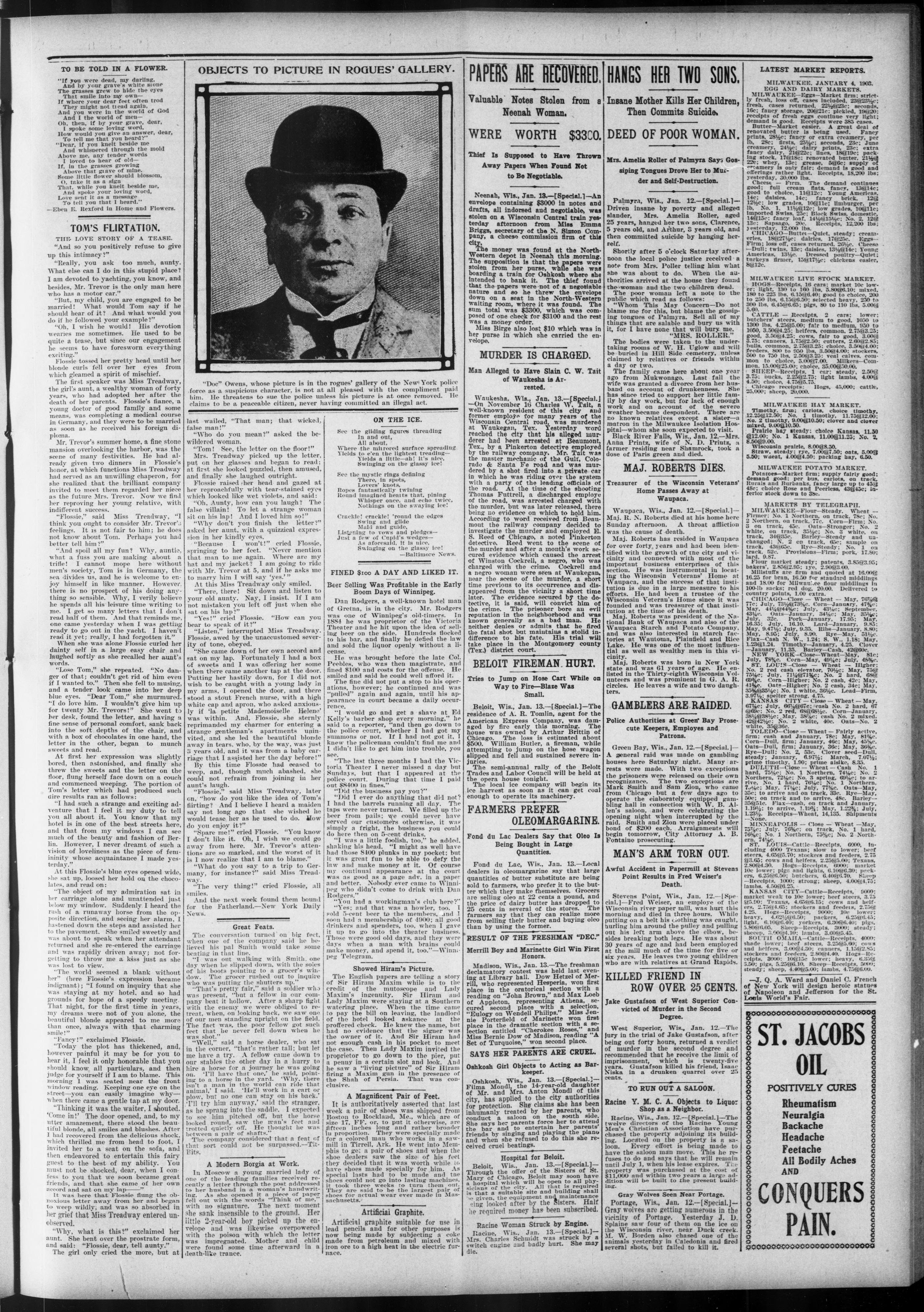
"Doc" Owens, whose picture is in the rogues' gallery of the New York police force as a suspicious character, is not at all pleased with the compliment paid him. He threatens to sue the police unless his picture is at once removed. He claims to be a peaceable citizen, never having committed an illegal act.
last wailed, "That man; that wicked, false man!"
"Who do you mean?" asked the bewildered woman.
"Tom! See, the letter on the floor!"
Mrs. Treadway picked up the letter, put on her glasses and began to read; at first she looked puzzled, then amused, and finally she laughed outright.
Flossie raised her head and gazed at her reproachfully with tear-stained eyes which looked like wet violets, and said:
"Oh, Aunty, how can you laugh? The false villain! To let a strange woman sit on his lap! And I loved him so!"
"Why don't you finish the letter?" asked her aunt, with a quizzical expression in her kindly eyes.
"Because I won't!" cried Flosse, springing to her feet. "Never mention that man to me again. Where are my hat and my jacket? I am going to ride with Mr. Trevor at 5, and if he asks me to marry him I will say 'yes.'"
At this Miss Treadway only smiled. "There, there! Sit down and listen to your old aunty. Nay, I insist. If I am not mistaken you left off just when she sat on his lap?" "Yes!" cried Flossie. "How can you bear to speak of it?" "Listen," interrupted Miss Treadway. Flossie, awed by the unaccustomed severity of tone, obeyed.
"She came down of her own accord and sat on my lap. Fortunately I had a box of sweets and I was offering her some when there came another tap at the door. Putting her hastily down, for I did not wish to be caught with a young lady in my arms, I opened the door, and there stood a stout French nurse, with a high white cap and apron, who asked anxiously if 'la petite Mademoiselle Helene' was within. And, Flossie, she sternly reprimanded my charmer for entering a strange gentleman's apartments uninvited, and she led the beautiful blonde away in tears, who, by the way, was just 3 years old, and it was from a baby carriage that I assisted her the day before!"
By this time Flossie had ceased to weep, and, though much abashed, she could not refrain from joining in her aunt's laugh.
"Flossie," said Miss Treadway, later on, "how do you like the idea of Tom's fiirting? And I believe I heard a maiden say not long ago that she wished he would tease her as he used to do. How do you enjoy it?"
"Spare me!" cried Flossie. "You know I don't like it. Oh, I wish we could go away from here. Mr. Trevor's attentions are so marked, and the worst of it is I now realize that I am to blame."
"What do you say to a trip to Germany, for instance?" said Miss Treadway.
"The very thing!" cried Flossie, all smiles. And the next week found them bound for the Fatherland.—New York Daily News.
Great Feats.
The conversation turned on big feet, when one of the company said he believed his pal Smith would take some beating in that line.
"I was out walking with Smith, one day when he slipped down, with the soles of his boots pointing to a grocer's window. The grocer rushed out to inquire who was putting the shutters up."
"That's pretty fair," said a soldier who was present, "but a fellow in our company beat it hollow. After a sharp fight with the enemy we were obliged to retreat, when, on looking back, we saw one of our men standing upright on the field. The fact was, the poor fellow got such feet that he never fell down when he was shot."
"Well," said a horse dealer, who sat in the corner, "that's rather tall; but let me have a try. A fellow came down to our stables the other day in a hurry to hire a horse for a journey he was going on. 'I'll have that one,' he said, pointing to a horse in the yard. 'Why, there isn't a man in the world can ride that animal,' I said. 'He'll work in a cart or plow, but no one can stay on his back.' 'I'll try him anyway,' said the stranger, as he sprang into the saddle. I expected to see him pitched off, but the horse looked round, saw the man's feet and trotted quietly off. He thought he was between a pair of shafts."
The company considered that a feat of that sort could not be surpassed.—Tit-Bits.
A Modern Borgia at Work.
In Moscow a young married lady of one of the leading families received recently a letter through the post addressed to her husband in a woman's handwriting. As she opened it a piece of paper fell out with the words "Think of me," with no signature. The next moment she sank insensible to the ground. Her little 2-year-old boy picked up the envelope and was likewise overpowered with the poison with which the letter was impregnated. Mother and child were found some time afterward in a death-like trance.
FINED $100 A DAY AND LIKED IT.
Beer Selling Was Profitable in the Early Room Days of Winnipeg.
Dan Rodgers, a well-known hotel man of Gretna, is in the city. Mr. Rodgers was one of Winnipeg's old-timers. In 1884 he was proprietor of the Victoria Theater and he hit upon the idea of selling beer on the side. Hundreds flocked to his bar, and finally he defied the law and sold the liquor openly without a license.
He was brought before the late Col. Peebles, who was then magistrate, and fined $100 and costs for the offense. He smiled and said he could well afford it.
The fine did not put a stop to his operations, however; he continued and was "pulled" again and again, until his appearance in court became a daily occurrence.
"I would go and get a shave at Ed Kelly's barber shop every morning," he said to a reporter, "and then go down to the police court, whether I had got my summons or not. If I had not got it, I knew the policeman couldn't find me and I didn't like to get him into trouble, you see.
"The last three months I had the Victoria Theater I never missed a day but Sundays, but that I appeared at the police court. During that time I paid out $8400 in fines."
"Did the business pay you?"
"Did I ever do anything that did not? I had the barrels running all day. The taps were never turned. We filled up the beer from pails; we could never have served our customers otherwise, it was simply a fright, the business you could do here then on 5-cent drinks.
"I was a little foolish, too," he added, shaking his head. "I might as well have had those 8400 plunks in my pocket; but it was great fun to be able to defy the law and make money at it. Of course my continual appearance at the court was as good as a page adv. in a paper and better. Nobody ever came to Winnipeg who didn't come to drink with Dan Rodgers."
"You had a workingman's club here?" "Yes; and that was a howler, too. I sold 5-cent beer to the members, and I soon had a membership of 4900; all good drinkers and spenders, too, when I gave it up to go into the theater business. Those were good old days, and they were days when a man with brains could make money, and spend it, too."—Winnipeg Telegram.
Showed Hiram's Picture.
The English papers are telling a story of Sir Hiram Maxim while is to the credit of the mutoscope and Lady Maxim's ingenuity. Sir Hiram and Lady Maxim were staying at a Southern watering place. When the time came to pay the bill on leaving, the landlord of the hotel looked askance at the proffered check. He knew the name, but had no evidence that the signer was the owner of it. And Sir Hiram had not enough cash in his pocket to meet the case. Then Lady Maxim invited the proprietor to go down to the pier, put a penny in a certain slot and look. And he saw a "living picture" of Sir Hiram firing a Maxim gun in the presence of the Shah of Persia. That was conclusive.
A Magnificent Pair of Feet.
It is authoritatively asserted that last week a pair of shoes was shipped from Boston to Rockland, Me., which are of size 17, FF, or, to put it otherwise, are fifteen inches long and rather broader in proportion. They were specially made for a colored man who works in a sawmill in Tirrell, Ark. He went into Memphis to get a pair of shoes and when the shoe dealers saw the size of his feet they decided that it was worth while to have shoes made specially for him. As special lasts had to be made and the shoes could not go into lasting machines, it took three weeks to turn them out. They are said to be the largest pair of shoes for actual wear ever made in Massachusetts.
Artificial Graphite.
Artificial graphite suitable for use in lead pencils and for other purposes is now being made by subjecting a coke made from petroleum and mixed with iron ore to a high heat in the electric furnace
PAPERS ARE RECOVERED
Valuable Notes Stolen from a Neenah Woman.
WERE WORTH $3300.
Thief Is Supposed to Have Thrown Away Papers When Found Not to Be Negotiable.
Neenah, Wis., Jan. 13.—[Special.]—An envelope containing $3000 in notes and drafts, all indorsed and negotiable, was stolen on a Wisconsin Central train yesterday afternoon from Miss Emma Briggs, secretary of the N. Simon Company, a cheese commission firm of this city.
The money was found at the North-Western depot in Neenah this morning. The supposition is that the papers were stolen from her purse, while she was boarding a train for Oshkosh where she intended to bank it. The thief found that the papers were not of a negotiable nature and so he threw the envelope down on a seat in the North-Western waiting room, where it was found. The sum total was $3300, which was composed of one check for $3100 and the rest was a money order.
Miss Birge also lost $10 which was in her purse in which she carried the envelope.
MURDER IS CHARGED.
Man Alleged to Have Slain C. W. Tait of Waukesha is Arrested
Waukesha, Wis., Jan. 13.—[Special.]
—On November 16 Charles W. Tait, a well-known resident of this city and former employee for many years of the Wisconsin Central road, was murdered at Waukegan, Tex. Yesterday word reached the city that his alleged murderer had been arrested at Beaumont, Tex., by a Pinkerton detective employed by the railway company. Mr. Tait was the master mechanic of the Gult, Colorado & Santa Fe road and was murdered by a shot fired into a private car in which he was riding over the system with a party of the leading officials of the road. At the time of the shooting Thomas Futtrell, a discharged employee of the road, was arrested charged with the murder, but was later released, there being no evidence on which to hold him. According to word received from Beaumont the railway company decided to investigate the murder and employed E. S. Reed of Chicago, a noted Pinkerton detective. Reed went to the scene of the murder and after a month's work secured evidence which caused the arrest of Winston Cockrell, a negro, who was charged with the crime. Cockrell and a negro woman were seen at Waukegan, near the scene of the murder, a short time previous to its occurrence and disappeared from the vicinity a short time later. The evidence secured by the detective, it is said, will convict him of the crime. The prisoner bore an evil reputation in the neighborhood and was known generally as a bad man. He neither denies or admits that he fired the fatal shot but maintains a stolid indifference to his fate. His trial will take place in the Montgomery county (Tex.) district court.
BELOIT FIREMAN. HURT.
Tries to Jump on Hose Cart While on Way to Fire-Blaze Was
Beloit, Wis., Jan. 13.—[Special.]—The residence of A. R. Tomlin, agent for the American Express Company, was damaged by fire early this morning. The house was owned by Arthur Brittin of Chicago. The loss is estimated about $500. William Butler, a fireman, while attempting to jump on the hose wagon slipped and fell and sustained severe injuries. The semi-annual rally of the Belolt Trades and Labor Council will be held at the opera house tonight. The local ice company will begin its ice harvest as soon as it can get coal enough to operate its machinery.
FARMERS PREFER
OLEOMARGARINE.
Fond du Lac Dealers Say that Oleo Is Being Bought in Large Quantities.
Fond du Lac, Wis., Jan. 13.—Local dealers in oleomargarine say that large quantities of butter substitute are being sold to farmers, who prefer it to the butter which they make themselves. Grocers are selling oleo at 22 cents a pound, and the price of dairy butter has dropped to 25 cents in several of the stores. The farmers say that they can realize more from selling their butter and buying oleo than by using the former.
RESULT OF THE FRESHMAN "DEC."
Merrill Boy and Marinette Girl Win First Honors.
Madison, Wis., Jan. 13.—The freshman declamatory contest was held last evening at Library hall. Dow Hetzel of Merrill, who represented Hesperia, won first place in the oratorical section with a reading on "John Brown," and Max Loeb of Appleton, representing Athena, secured second place with a selection, "Eulogy on Wendell Philips." Miss Jennie Porterfield of Marinette won first place in the dramatic section with a selection entitled "Cherokee Roses," and Miss Bernie Dow of Madison, reading "A Set of Turquoise," won second place.
SAYS HER PARENTS ARE CRUEL.
Oshkosh Girl Objects to Acting as Barkeeper.
Oshkosh, Wis., Jan. 13.—[Special.]—Filma Mondl, the 14-year-old daughter of Mr. and Mrs. Anton Mondl of this city, has applied to the city authorities for protection. She claims she has been inhumanly treated by her parents, who conduct a saloon on the south side. She says her parents force her to attend the bar and to entertain her parents' friends by singing and playing the piano and when she refused to do this she received cruel beatings.
Hospital for Beloit.
Beloit, Wis., Jan. 13.—[Special.] Through the offer of the Sisters of St. Mary of Chicago, Beloit may soon have a hospital which will be open to all physicians of the city. All that is required is that a suitable site and building shall be given, the equipment and maintenance being looked after by the Sisters. Half he required money has been subscribed.
Racine, Wis., Jan. 13.—[Special.]— Mrs. Charles Schmidt was struck by a switch engine and badly hurt. She may die.
HANGS HER TWO SONS.
Insane Mother Kills Her Children, Then Commits Suicide.
DEED OF POOR WOMAN.
Mrs. Amelia Roller of Palmyra Says Gossiping Tongues Drove Her to Murder and Self-Destruction.
Palmyra, Wis., Jan. 12.—[Special.]—Driven insane by poverty and alleged slander, Mrs. Amelia Roller, aged 25 years, hanged her two sons, Clarence, 5 years old, and Arthur, 3 years old, and then committed suicide by hanging herself.
Shortly after 5 o'clock Saturday afternoon the local police justice received a note from Mrs. Poller telling him what she was about to do. When the authorities arrived at the house they found the woman and the two children dead. The poor woman left a note to the public which read as follows:
"Whom This May Concern—Do not blame me for this, but blame the gossiping tongues of Palmyra. Sell all of my things that are salable and bury us with it, for I have none that will bury me.
"MRS. ROLLER."
The bodies were taken to the undertaking rooms of W. H. Uglow and will be buried in Hill Side cemetery, unless claimed by relatives or friends within a day or two.
The family came here about one year ago from Mukwonago. Last fall the wife was granted a divorce from her husband on account of drunkenness. She has since tried to support her little family by day work, but for lack of enough work and on account of the severe weather became despondent. There are no known relatives except a sister—a matron in the Milwaukee Isolation Hospital—whom she soon expected to visit.
Black River Falls, Wis., Jan. 12.—Mrs. Anna Printz, wife of N. D. Printz, a farmer residing near Shamrock, took a dose of Paris green and died.
MAJ. ROBERTS DIES.
Treasurer of the Wisconsin Veterans' Home Passes Away at Waupaca.
Waupaca, Wis., Jan. 12.—[Special.]—Maj. R. N. Roberts died at his home here Sunday afternoon. A throat affliction was the cause of death.
Maj. Roberts has resided in Waupaca for over forty years and had been identified with the growth of the city and vicinity and connected with most of the important business enterprises of this section. He was instrumental in locating the Wisconsin Veterans' Home at Waupaca, and the success of that institution is due in a large measure to his efforts. He had been a trustee of the Wisconsin Veteran's Home since it was founded and was treasurer of that institution at the time of his death.
Maj. Roberts was president of the National Bank of Waupaca and also of the Waupaca Starch and Potato Company, and was also interested in starch factories at Wautoma, Plainfield and Rice Lake. He was one of the most influential as well as wealthy men in this vicinity. Maj. Roberts was born in New York state and was 61 years of age. He enlisted in the Thirty-eighth Wisconsin Volunteers and was prominent in G. A. R. circles. He leaves a wife and two daughters.
GAMBLERS ARE RAIDED.
Police Authorities at Green' Bay Prosecute Keepers, Employes and Patrons.
Green Bay, Wis., Jan. 12.—[Special.]—A general raid was made on gambling houses here Saturday night. Many arrests were made. With two exceptions the prisoners were released on their own recognizance. The two exceptions are Mark Smith and Sam Zion, who came from Chicago but a few days ago to operate the elaborately equipped gambling hall in connection with W. B. Allen's saloon, and were celebrating the opening night when interrupted by the raid. Smith and Zion were placed under bond of $200 each. Arraignments will begin tomorrow, City Attorney A. B. Fontaine prosecuting.
MAN'S ARM TORN OUT
Awful Accident in Papermill at Stevens Point Results in Fred Weiser's Death.
Stevens Point, Wis., Jan. 12.—[Special.]—Fred Weiser, an employee of the Wisconsin river paper mill, was hurt this morning and died in three hours. While putting on a belt his clothing was caught, burling him around the pulley and pulling out his left arm above the elbow, besides breaking both legs. He was about 30 years of age and had been employed at the mill much of the time for five or six years. He leaves two young children who are with relatives at Grand Rapids.
KILLED FRIEND IN ROW OVER 25 CENTS.
Jake Gustafson of West Superior Convicted of Murder in the Second Degree.
West Superior, Wis., Jan. 12.—The jury in the trial of Jake Gustafson, after being out forty hours, returned a verdict of murder in the second degree and recommended that he receive the limit of imprisonment, which is twenty-five years. Gustafson killed his friend, Isaac Niska in a drunken quarrel over 25 cents.
TO RUN OUT A SALOON.
Racine Y. M. C. A. Objects to Liquor Shop as a Neighbor.
Racine, Wis., Jan. 12.—[Special.]—The twelve directors of the Racine Young Men's Christian Association have purchased the property adjoining its building. Located on the property is a saloon. Every effort is being made to have the saloon man move. This he refuses to do and says that he will remain until July 1, when his lease expires. The property was purchased at the cost of $11,000 and within two years a large addition will be built to the present building.
Gray Wolves Seen Near Portage.
Portage, Wis., Jan. 12.—[Special.]— Gray wolves are getting numerous in the vicinity of Portage. Yesterday J. D. Splaine saw four of them on the ice on the Wisconsin river, near Duck creek. M. W. Borden also chased one of the animals yesterday in Caledonia and fired several shots, but failed to kill it.
LATEST MARKET REPORTS.
MILWAUKEE, JANUARY 4, 1903.
EGG AND DAIRY MARKETS.
EGG AND DAIRY MARKETS.
MILWAUKEE—Eggs—Market firm; strictly fresh, loss off, cases included, 23@21½c; fresh, cases returned, 22½½c; seconds, 16c; fancy storage, 20@21c; plickled, 19@20; receipts of fresh eggs continue very light; demand is good. Receipts were 385 cases.
Butter—Market easier. A great deal of renovated butter is being used. Fancy prints, 28½c; fancy or extra creamery, per lb, 28c; firsts, 25½c; seconds, 23c; June creamery, 24½c; dairy prints, 23c; extra fancy dairy, 21@22c; lines, 18@19c; packing stock, 17@18c; renovated butter, 21½½c; whey, 13c; grease, 5@6c; supply of creamery is only fair; demand is good and offerings rather light. Receipts, 18,200 lbs; yesterday, 30,000 lbs.
Cheese — Firm. The demand continues good; full cream flats, fancy, 13@14c; good to choice, 11@12c; Young Americas, 14c; daisies, 14c; fancy brick, 12@12½c; low grades, 10@11c; limburger, per lb. No. 1, 11½@12c; low grades, 10@11c; imported Swiss, 25c; Block Swiss, domestic, 14@15c; fancy leaf, 14½@15½c; No. 2, 12@13c; Sapsago, 20c. Receipts, 12,200 lbs; yesterday, 12,000 lbs.
CHICAGO—Butteer—Quiet, steady; creameries, 18@21½c; dalries, 17@25c. Eggs—Firm; loss off, cases returned, 26½c. Cheese—Dull; twins, 13c; daisies, 13½@14c; Young Americas, 13½c. Dressed poultry—Quiet; turkeys firmer, 15@17½c; chickens easier, 8@12c.
MILWAUKEE LIVE STOCK MARKET.
HOGS—Receipts, 16 cars; market 10c lower; light, 130 to 160 lbs, 5.80@6.10; mixed, 180 to 225 lbs, 6.15@6.40; good to choice, 200 to 250 lbs, 6.15@6.50; selected heavy, 250 to 300 lbs, 6.45@6.65; pigs, 80 to 110 lbs, 5.00@5.60.
CATTLE — Receipts, 2 cars; lower; butchers' steers, medium to good, 1050 to 1300 lbs, 4.25@5.00; fair to medium, 950 to 1050, 3.50@4.25; helfers, common, 2.75@3.25; good, 3.50@4.25; cows, fair to good, 3.00@3.75; canners, 1.75@2.50; cutters, 2.60@2.85; bulls, common, 2.75@3.25; choice, 3.50@4.00; feeders, 800 to 950 lbs, 3.50@4.00; stockers, 500 to 750 lbs, 2.50@3.25; veal calves, common to choice, 5.00@7.00. Milkers—Common, 15.00@25.00; choice, 35.00@50.00.
SHEEP—Receipts, 1 car; steady, 2.50@3.75; bucks, 2.25@2.75; light lambs, 4.00@4.50; choice, 4.75@5.75.
Chicago reports. Horses 45,000; cattle
Chicago receipts: Hogs, 45,000; cattle, 25,000; sheep, 20,000.
MILWAUKEE HAY MARKET
Timothy, firm; carlots, choice timothy,
12.25@12.50; No. 1 timothy, 11.75@12.00;
No. 2 timothy, 9.00@10.50; clover and clover
mixed, 9.00@10.50.
Prairie hay steady; choice Kansas, 11.50
@12.00; No. 1 Kansas, 11.00@11.25; No. 2,
8.50@9.00.
Wisconsin prairie, 8.00@8.50.
Straw, steady; rye, 7.00@7.50; oats, 5.00@
5.50; wheat, 4.00@4.50; packing hay, 6.50.
MILWAUKEE POTATO MARKET.
Potatoes—Market firm; supply fairly good;
demand good; per bus, carlots, on track.
Rurals and Burbanks, fancy large up to 45@
48c; choice Rose and Peerless, 43@45c; in-
ferlor stock down to 38c.
MARKETS BY TELEGRAPH
MILWAUKEE—Flour—Steady. Wheat —
Firmer; No. 1 Northern, on track, 78c; No.
2 Northern, on track, 77c. Corn—Firm; No.
3 on track, 45c. Oats—Stronger; No. 2
white, on track, 35½c; No. 3 white, on
track, 34@35c. Barley—Steady and
unchanged; N. 2 on track, 65c; sample on
track, 43@65c. Rye—Steady; No. 1 on
track, 52c. Provisions—Firm; pork, 17.80;
lard, 0.87.
Flour market steady; patents, 3.85@3.95;
bakers', 2.85@2.95; 1ye, 2.90@3.00.
Millstuffs are firm and quoted at 16.00@
16.25 for bran, 16.50 for standard middlings
and 18.00 for Milwaukee flour middlings in
100-lb sacks; red dog, 20.00. Delivered to
country points, 1.00 extra.
CHICAGO—Close — Wheat — May, 76%@
77c; July, 73%@73%c. Corn—January, 47%c;
May, 44%@44%c; July, 43%c; September,
43%c. Oats—January, 34%c; May, 35%c;
July, 32c. Pork—January, 17.95; May,
16.35; July, 16.10. Lard—January, 9.85;
May, 9.47%; July, 9.35. Ribs—January, 8.80;
May, 8.95; July, 8.90. Rye—May, 51%c.
Flax—Cash N. W., 1.24; S. W., 1.18; May,
1.23@1.24. Tlmothy—January, 4.25. Clover
—January, 11.35. Barley—Cash, 42%@90.
NEW YORK—Close—Wheat—May, 81c;
July, 78%c; Corn—May, 49%c; July, 48%c;
ST. LOUIS—Close — Wheat — Higher;
No. 2 red cash elevator, 70%c; May, 75%c;
July, 71%@71%c; No. 2 hard, 68%c;
69%c; Corn—Higher; No. 2 cash, 42c; May,
41%c; Oats—Higher; No. 2 cash, 34c; May,
35%@35%c; No. 1 white, 36%c; Lead—Firm,
3.97%; spelter strong, 4.75.
KANSAS CITY — Close — Wheat — May,
67%c; July, 66%@67c; cash No. 2 hard, 67
@69c; No. 2 red, 68@68%c; Corn—January,
38%@38%c; May, 38%c; cash No. 2 mixed,
42@42%c; No. 2 white, 40c; Oats—No. 2
white, 35@36c.
TOLEDO—Close — Wheat — Fairly active,
firm; cash and January, 78c; May, 81%c;
Corn—Dull, firm; January, 46c; May, 45%c;
Oats—Dull, firm; January, 36c; May, 36%c;
Rye—Dull; No. 2, 53c; Clover seed—Dull,
steady; January, 6.97%; March, 7.07%;
primelimothy, 1.90; prime alske, 8.35.
DULUTH—Close — Wheat — Cash No. 1 hard, 75%c; No. 1 Northern, 74%c; No. 2 Northern, 72%c; No. 3 spring, 69%c; to arrive, No. 1 hard, 76%c; No. 1 Northern, 70%c; May, 77%c; July, 77%c; Oats—May, 35c; to arrive and on track, 33c; Rye—May, 50c; on track and to arrive, 48c. Barley—35@51c. Flax—cash, on track and January, 1.19%; to arrive, 1.19%; May, 1.22%; July, 1.23%; Receipts—Wheat, 14,135. Shipments—None.
MINNEAPOLIS—Close — Wheat—May, 75%c; July, 76%c; on track, No. 1 hard, 76%c; No. 1 Northern, 75%c; No. 2 Northern, 74%c.
ST. LOUIS—Cattle—Receipts, 6000, Including 4000 Texans; slow to lower; beef steers, 4.65@5.70; stockers and feeders, 2.75@3.65; cows and heifers, 2.25@5.00; Texans, 2.80@4.30. Hogs—Receipts, 6000; market 10c lower; plugs and lights, 6.10@6.30; packers, 6.25@5.50; butchers, 6.40@6.70. Sheep—Receipts, 1000; strong; sheep, 4.00@4.75; lambs, 4.50@6.25.
KANSAS CITY-Cattle-Recelpts, 9000; market weak to 10c lower; beef steers, 3.75 @5.90; Texans, 4.65@6.15; cows and heifers, 2.75@4.65; stockers and feeders, 2.75@4.25. Hogs-Recelpts, 9000; 10c lower; heavy, 4.621@6.50; packers, 6.25@6.45; light, 6.10@6.40; yorkers, 6.30@6.40; pigs, 5.80@6.05. Sheep-Recelpts, 3000; steady; sheep, 3.90@4.10; lambs, 3.60@5.45.
SOUTH OMAHA-Cattle-Recelpts, 4000; shade lower; beef steers, 3.25@5.60; cows and heifers, 3.00@4.30; canners, 1.15@2.85; stockers and feeders, 2.80@4.40. Hogs-Recelpts, 3000; 10@15c lower; heavy, 6.35@3.50; pigs, 5.25@6.10. Sheep-Recelpts, 5000; steady; sheep, 4.40@5.00; lambs, 4.75@6.00.
—J. Q. A. Ward and Daniel C. French of New York will design heroic statues of Napoleon and Jefferson for the St. Louis World's Fair.
ST. JACOBS OIL
POSITIVELY CURES
Rheumatism
Neuralgia
Backache
Headache
Feetache
All Bodily Aches
AND
CONQUERS
PAIN.
The Wisconsin Weekly Advocate
Printed in the Interests of the Negro Race,
MILWAUKEE, WIS.
Telephone Black No. 244.
SUBSCRIPTION RATES.
Any part of the United States and Canada,
postage paid.
One Year ..... $2.00
Six Months ..... 1.25
Three Months ..... .75
Send money by Express Money Order, P. O.
Money Order or Registered Letter to the
Wisconsin Weekly Advocate.
ADVERTISING RATES.
One inch, single insertion..... 25c
One inch, per year..... $9.00
Business locals 5c per line each insertion.
Apply for rates to the Advocate.
TO CONTRIBUTORS:
all communications must be sent with the name and address of the sender as an evidence of good faith, but not necessarily for publication. No manuscript returned if not accepted, unless accompanied by stamps.
The Wisconsin Weekly Advocate company wishes to notify the public that all contracts and business transactions with this company must have the company stamp, otherwise they will be void. Neither will this company be responsible for paid subscriptions unless given to duly-accredited agents, who, on request, will give the company's receipt for same. Subscribers failing to receive their papers regularly will kindly notify the general office. Address all business communications to the general manager, 79 Fifth street.
Entered in the Postoffice at Milwaukee as Second-class matter.
EDITORIAL PARAGRAPHS.
"I know of the bravery and character of the Negro soldier. He saved my life at Santiago, and I have had occasion to say so in many articles and speeches. The Rough Riders were in a bad position when the Ninth and Tenth cavalry came rushing up the hill carrying everything before them. The Negro soldier has the faculty of coming to the front when he is needed most. In the Civil war he came 400,000 strong, and I believe he saved the Union."—President Roosevelt.
Dr. Lorenz has sailed for home, but there will be no cessation of leg-pulling in America.
The new defender of the America's cup is to be named Eagle. She ought to be a screamer.
This is a flourishing period, apparently, for every sort of trust except trust in Providence.
Marconigrams is a rather long word for this age of expeditious short cuts. How would Marc'igrams do?
The Central American volcanoes, like the Central American peoples, are normally in a state of eruption.
In view of the state of some of the coal bins, it was considerate of 1903 not to start in with a cold New Year's.
The year 1903 came in like a lamb; but its going cut is still so far in the future that people will defer anxiety as to what may be in store for that time.
The whisky famine will make the man who wants to warm his inside pay dear for the privilege. The man who wants to warm his outside must pay dear because of the shortage of coal.
Since the Molineux-Adams case the sending of poisons through the mails has become so common that it behooves all the recipients of gifts of candy or medicine to try their gifts on the cat.
Rumors concerning the formation of a trust for the control of the pearl business will not disturb the average community, which is just now particularly interested in the black diamond trade.
---
In these days of high prices for fuel, a sudden drop in coal such as that experienced by the town situated over a caving mine near Scranton, is likely to draw out the slang remark "Doesn't that jar you?" The Chicago swimmer who made a record swim under water, and was pulled out in an unconscious condition, has lifted the record to a point where aspirants will have to consider the danger of staying under permanently.
Are the bonnets in England then so beautiful? A London pastor desperately proposes the holding of religious services in the dark, that the women of the congregation may think of their devotions instead of problems in millinery.
Chicago has periodical hotel fires with fatal results, to warn the owners and keepers of such institutions to construct safeguards. But for some reason the warnings do not interfere with the periodicity of the fatal occurrences.
---
The coal operators in the anthracite districts are making a supreme effort to relieve the coal famine in Philadelphia, Washington, New York and Boston. The people of the West will have to wait until the Eastern sufferers are supplied with fuel.
Wise old Benjamin Franklin said that a good way to get a man reconciled to you is to ask a favor of him. The principle has been adopted by the British war office, which is enlisting a company of Boers to go under a Boer leader against the Somali savages.
The success of wireless telegraphy has inspired a new pole-hunter, who would attack the mystery of the icy north with a fleet of ships started at intervals and provided with instruments for communication through the air during the long drift along the Nansen route. Communication in this way would be more regular than by balloons, which would have to take chances with the weather and the ice such as made Prof. Andree's buoys so inefficient.
---
YOUNG MAN IN COUNCIL.
Mayor Rose Appoints William R. Franzen to Succeed Ald. George Thuerin Fifteenth Ward.
William R. Franzen has been appointed by Mayor Rose to be alderman in the Fifteenth ward to succeed George Thuering, who resigned to become county treasurer. Mr. Franzen is a son of William Franzen, the well-known paper, rags and glass merchant, and is himself the vice
C. W.
WILLIAM R. FRANZEN.
Photo by Stein.
president of the Northern Glass Works located on Lincoln avenue and president of the William R. Franzen Paper and Bottle Company, located on River street. He was born and raised in the Fifteenth ward and has always been associated in business with his father. He is a Democrat, and although he has always taken an interest in public matters has never before figured in politics. He is very well acquainted in the ward, and lives with his father at 1706 State street. A large mass of glass run together is a unique ornament in the front yard of the residence. Mr. Franzen is a Democratic alderman in what is usually a Republican ward.
NOMINATE NEAL BROWN
Democratic Minority Cnoose Wausau Man Over Rose and Ryan. Madison. Wis., Jan. 15.—[Special,]—Neal Brown of Wausau, the "flesh and blood" man from the "Northland," who was the principal speaker of the Democratic party in the recent campaign, aside from the gubernatorial candidate, will receive the Democratic complimentary vote for United States senator, as opposed to John C. Spooner. This was decided upon by a vote of 15 to 12 at the Democratic caucus last night, Mayor Rose receiving the minority vote.
The result was due to the failure of the friends of National Committeeman Timothy E. Ryan of Waukesha, who received the complimentary vote as against Senator Quarles four years ago, to overcome the lead of the Milwaukee mayor and as a compromise they threw their strength to the Wausau orator. The caucus was held in the Senate chamber and was attended by the full Democratic strength of both houses. Sen-
P.
NEAL BROWN.
ator Merton of Waukesha was selected to preside. Joe Crowley of Milwaukee was made secretary. It was an empty honor that the caucus had to confer, Mr. Merton said, but nevertheless it was proper that the Democracy should have a candidate, as the importance of maintaining an organization was manifest. There were no nominating speeches respecting the candidates. The members had held private conferences in the lobby and corridors throughout the afternoon and had expressed their views respecting the candidates in forceful terms, so that culogistic speeches were not considered necessary. The informal ballot gave Mayor Rose 11, Timothy E. Ryan 8, and Hugh Ryan of Milwaukee 1. The first formal ballot eliminated Hugh Ryan from the contest, his supporter switching to Mayor Rose. The result of the ballot was Rose 12, Ryan 8, and Neal Brown 7. The balloting remained unchanged until the fourth, when the break began to Brown, the ballot resulting: Rose, 11; Brown, 11; Joe Crowley, 1; Ryan, 4. The fifth ballot was thrown out, as twenty-eight ballots were cast. On the following ballot all of the Ryan supporters broke to Brown, giving him 15 votes as against 12 for Mayor Rose.
A Potato Dinner.
A "potato dinner" was the unique feast which one of Biddeford's charming hostesses spread before her guests last week. In the dining room four tables were set and profusely adorned with autumn leaves and vegetables. For a centerpiece each table was supplied with a large squash. Around the base red, yellow and green leaves extended outward for, fully two feet, and flanking the sides was an artistic arrangement of vegetables and fruits. The only illumination in the room was furnished by large candles. Beside each plate a large potato rested on an autumn leaf. In the potato was a small hole into which the candle fitted. The menu cards were as dainty and as unique as the other details. They were in the shape of a potato and each was painted in water colors. As souvenirs of the party they were admirably appropriate. The dinner comprised many courses and each one was marked by having some form of the potato as its chief feature. There were soups, salads, croquettes, etc., in turn, but fine, new potatoes, just harvested from the fertile soil of York county, were employed in making them.—Kennebec Journal.
—The annual loss of fruit by insects is put by the United States entomologist at $300,000,000.
AGRICULTURAL
2.
Many farmers sell off the hogs raised on the farm and buy the hams and bacon used in the family, giving as an excuse that a well-arranged smokehouse is too expensive for them to have. The smokehouse shown in the illustration, while a homely affair, gives good service and will cost but little to build. A dry goods box or a piano box will answer the purpose nicely. The bottom is removed from the box and a hinged door is arranged as shown so that the meat may be easily put in and taken out. This cover is arranged so that it can be fastened with a staple and hook when the meat is being smoked. The smoking arrangement of this box is an ideal one. A hole is dug in the ground six or eight feet from the box and a trench dug from the hole to a point about the middle of the box. Have a length of stove pipe fastened to an old, heavy tin kettle, into which a hole has been cut by the tinsmith. When ready to smoke the meat build a fire of corn cobs in the kettle, set it in the hole and add stove pipe lengths to the center of the house, terminating with an elbow. After the fire is well started cover the kettle with a piece of tin, to force all the smoke possible through the stove pipe into the house. All
HOME MADE SMOKE HOUSE.
cracks about the house should be filled in so that the smoke will not escape. This is a crude affair, but it does the work quite as well as the most expensive appliances attached to smokehouses.
A Succession of Damages. "I remember," says Farmer Grindstone, "what an orful time two of my neighbors onct had when I lived down in Kansas. They used to spend every livin' thing they could scrape together a-lawin' of it over line fences. Gill's cows would break through Jones' fence and destroy his corn, and Jones would set his dog onto 'em and main one or two, and Gill's boy would shoot the dog, and Jones would lick the boy. Then Gill would sue Jones for not keeping up his fence, and Jones would turn round and sue Gill for the damaged corn, and Gill would sue Jones for the damaged cattle, and Jones would' sue Gill for the damaged dog, and Gill would sue Jones for the damaged boy; and the outcome of the whole performance would be that Gill would have left a damaged cow and a damaged boy and Jones would have a damaged fence and some damaged corn and a damaged dog, and after both havin' used a good deal of damaged language they would find their bank accounts badly damaged and the lawyers would get the benefit of the harvest.—Field and Farm.
Mulching the Strawberry Reds.
Mulching the Strawberry Beds. The most successful growers of strawberries in the country have decided that spring cultivation is not desirable, although for years this was the universal practice. They do the cultivation for the year after the plants have fruited, and in the winter mulch the plants lightly, putting on only sufficient to keep the plants from being heaved out of the ground by the alternate freezing and thawing of the soil in late winter and early spring. The mulch is left on by some growers until after the picking season, when it is raked up in piles and burned to destroy the insects in it; other growers rake the mulch off in the late spring and burn it, applying fresh mulch, which is allowed to remain during the season and until after picking. Either plan is good, but the main thing is to apply the mulch and do it as soon as the ground is frozen. While the plants may not need protection from the winter, the mulch will assist in protecting the crowns and the delicate runners and new plants which set late in the season, and it keeps the soil from becoming compacted by the heavy rains of winter. In all sections where there is winter, mulch is desirable for strawberry plants, and as it costs but little and is quickly applied, there is no excuse for not doing the work and reaping the profitable returns.
Breaking Colts.
Train the colts in winter. They are more easily handled than in summer because they are glad to see you coming to feed them. Then you can rub or pat them while they are eating. Halter and lead them to water and thus teach them to be led and become bridlewise. Ride them about now and then when you have time. In the spring when it is soft hitch them with a gentle horse to some light work for
a few times and your colt is about ready for service.
How to Handle Incubators.
I have had an experience of ten years, with four different makes of incubators, and have learned a few necessary things. One is that any incubator, if rightly handled, will give good results, or when poorly handled will make a failure. The best hatch I have ever made was 93 per cent, the poorest 50 per cent of fertile eggs. I have raised with brooder 70 per cent of chicks, and without brooder only about 50 per cent.
I have found that a child cannot operate one, as it requires brains, common sense and judgment, with a knack for surmounting unexpected difficulties. Too much attention is worse than not enough, twice a day, if properly adjust-
5TH
Day
9TH.
Day
15TH
Day
18TH.
Day
21ST
Day.
HOW THE EGG SHOULD LOOK.
ed, being all that is needed to look after a machine.
Avoid too much moisture. I use none now, having nearly spoiled a hatch in that way once. Cool and air eggs once each day, and turn twice. Don't fuss with eggs or chicks. Extremes of heat, say from 90 to 110 degrees, not too long continued, will make shells tender, and give better hatches. Chicks are as healthy as those hatched under hens, and have neither lice nor mites to contend with. One incubator holding 200 eggs requires about the same care as three old hens on forty-five eggs. A moisture test is absolutely necessary. The picture shows how the egg should look at different periods. A cave or cellar is the best place to operate an incubator. A brooder should face the south and have sunshine.—Mrs. L. M. Lutton, in Farm and Home.
Feeding Damaged Corn Fodder It is utterly useless to feed damaged corn fodder to cattle that are designed for market, for they will not gain a pound of fat on it. If possible, avoid feeding the frosted fodder at all, but if it must be given the stock, furnish it only after they have been well grained and had a fair supply of good roughage; give it to them largely for the purpose of keeping them busy when they are in the barn between meals. They will eat a little of it and break up most of it, so that it can afterward go to the hogs to nose over and from there to the manure heap. In many sections the oat crop was heavy, but in many instances badly damaged. If too badly damaged to sell to advantage, it may be fed, to gether with barley and oilmeal, to great advantage, giving it freely to cattle that are being fattened as well as to milch cows. In feeding this mixture the oats and barley should be ground together and the oilmeal added afterward and well mixed through.
To Tighten Barbed Wire. A guard from a mower or reaper, a, is caught on to the wire. Through one
mower or reaper, a wire. Through one end is pased a loop of stout wire, b. S or 10 inches long. The lever, d. should be four or five feet long. A common fence staple should be used at c to hold
end is pased a loop of stout wire, b. S or 10 inches long. The lever, d. should be four or five feet long. A common fence staple should be used at c to hold the loop b. By this method wire may be tightened for several posts at the same time.
Farm Notes.
All animals of the same variety are not alike, and scarcely any two will do equally well on the same feed. Each animal's wants should be supplied if possible. Cattle of different ages should be separated for feeding, as the weak ones will not do well with the strong. Cows are weak and shy; it takes them longer to eat their meals, and they should, therefore, be put where they cannot be domineered by their superiors in strength.
There are two most important things to be kept in mind by the fruit raiser—pruning and mulching. If those two duties are well performed success is nearly always certain. If well mulched the fertilizing material is thus supplied by filtration from the mulching down to the feeding roots, which is the very best self-regulating method of fertilizing. By allowing this mulching to remain in winter and early spring the roots are kept moist and vegetation prevented from springing up around bushes, or a heavy sod from forming.
Creamery Don'ts.
Don't overchurn the butter and make it salvy.
Don't let the steam run down while the separators are running.
Don't let the tubs stand in the hot sun after they reach the station. Don't mix grades without marking them and think they will all pass as extras. Don't think that the commission men are all trying to beat you in weights and prices. Don't weigh too heavy and expect your weights to hold out at the other end of the line.—Creamery Journal.
WE CONTINUE TO WARN THE BENEVOLENT PUBLIC AGAINST THE NUMEROUS BEGGARS FOR ALLEGED CHARITABLE INSTITUTIONS IN BEHALF OF THE NEGRO RACE. LOOK WELL TO THE CREDENTIALS OF SUCH MENDICANTS AND INQUIRE OF SOME REPUTABLE NEGRO CITIZEN REGARDING THE TRUTHFULNESS OF THEIR STATEMENTS.
The Turf Cafe
Game, Fish, Steaks, Chops a
Delicacy the Seasons Afford.
oms for Dinner Parties, Etc. Cuisine P
Table D'Hote.
ave neither private rooms, nor "private" people, b
general public.
Banquet Rooms for Dinner Parties, Etc. Cuisine Par Excellent. Table D'Hote.
DINNER FROM 5:30 TO 8:00, 35c. J. L. SLAUGHTE 194 Third Street, Milwaukee, Wis. "The Bachelors' H
J. L. SLAUGHTER, Street, Milwaukee, Wis.
194 Third Street, Milwaukee, Wis.
"The Bachelors' Home"
Steam Heat. Electric Light. Telephone in Every Room.....
...THE TURF EUROPEAN
TURF EUROPEAN HO
...THE TURF EUROPEAN HOTEL... A New and Modern Establishment for Gentlemen Only.
Cafe in Connection: Prices with Accommodation
C. C. GITTINGS, Pres. E. E. BAILEY, Vice
GOLD M
Folding F
....MANUFACT
Gold Medal Camp F
Incorporated February, 1892.
Connection: Prices Moderate and C
with Accommodations Furnished.
S, Pres. E. E. BAILEY, Vice-Pres. W. G. GITTING
GOLD MEDAL
Building Furniture
MANUFACTURED BY...
Medal Camp Furniture Mfg.
dated February, 1892.
RACINE, WIS., U
Cafe in Connection: Prices Moderate and Consistent with Accommodations Furnished.
C. C. GITTINGS, Pres. E. E. BAILEY, Vice-Pres. W. G. GITTINGS, Sec.—Treas.
GOLD MEDAL
Folding Furniture
....MANUFACTURED BY....
Gold Medal Camp Furniture Mfg. Co.
Incorporated February, 1892. RACINE, WIS., U. S. A.
A. BAIRD. Cutter.
New York Tailoring 322 WELLS STREET (Bet. 3d and 4th Sts.)
The New York 322 WELLS (Bet. 3d and
The New York Tailoring Co.
The New York Tailoring Co.
322 WELLS STREET (Bet. 3d and 4th Sts.)
Ladies' and Gents' Suits Made to Order. We also Clean, Press, Repair and Dye All kinds of Ladies' and Gents' Garments. Satisfaction Guaranteed. . . .
Alfred A. Grue
DEALER IN
Fresh, Salted & Smoked
OF ALL KINDS
Fresh Fish and Oysters
HOTEL. MAIN 6253. 502 WELLS ST.
ELEGANT NEW
INSORIAL PARLO
Second to None in the World.
visitors to the city and those who appreciate cleanliness, Elegance and Comfort should patronize
Gatherer's Turf Hotel Tonsorial Park
217 Wells Street, Milwaukee.
Cold Baths in Connection. Franklin A. Hac
Western House
LETON, WIS.
GRILL, - Proprietor.
$1.00 Per Day.
While in city visit .....
STEPHE
HOTEL and REST
```markdown
```
TEL. MAIN 6253.
ELEGANT
TONSORIAL
ELEGANT NEW
TONSORIAL PARLORS,
Second to None in the World.
Visitors to the city and those who appreciate
Cleanliness, Elegance and Comfort should
patronize
Slaughter's Turf Hotel Tonsorial Parlors,
217 Wells Street, Milwaukee.
Hot and Cold Baths in Connection. Franklin A. Hackley, Mgr.
---
217 Wells Street, Milwaukee.
For Ladies and Gentlemen.
rf Cafe
Steaks, Chops and Every
seasons Afford.
es, Etc. Cuisine Par Excellent.
D'Hote.
nor "private" people, but cater to the
public.
UGHTER, Prop. ee, Wis. lors' Home"
EOPEAN HOTEL...
J. L. SLAUGHTER, Prop. and Mgr.
Moderate and Consistent
ations Furnished.
ice-Pres. W. G. GITTINGS, Sec--Treas.
MEDAL
Furniture
TURED BY....
Furniture Mfg. Co.
RACINE, WIS., U. S. A.
Telephone Black 9343.
Tailoring Co.
S STREET
4th Sts.)
Milwaukee, Wis.
fired A. Grunitz
DEALER IN
Salted & Smoked Meats
OF ALL KINDS.
Fish and Oysters in Season
502 WELLS ST.
NT NEW
P. PARLORS,
one in the World.
and those who appreciate
e and Comfort should
Hotel Tonsorial Parlors,
reet, Milwaukee.
on. Franklin A. Hackley, Mgr.
While in city visit . . .
STEPHENS'
HOTEL and RESTAURANT
First-Class Accommodations Home Cooking a Specialty...
No. 2832 State St., CHICAGO, ILL.
Always ask for tickets via the Monon Route THE SHORT LINE BETWEEN Chicago, Indianapolis, Cincinnati,
Louisville
Six trains daily between Chicago and the Ohio river.
For folders, rates, etc., call at any Monon ticket office or address
FRANK J. REED,
Gen'l Pass. Agent, Chicago.
S. B. JONES,
C. P. Agent, 232 Clark St., Chicago.
GEORGE HAYS Turning Mill and Box Factory
Rockers and all kinds of Restaurant Blocks, Extension Ladders, Tea Caddies, Boxes, Turning, Sawing, Mitchell Improved Washers, Trestels, Swinging Scaffolds. Repair Work PromptlyAttended to TELEPHONE MAIN 252. 228-230 Fifth St., Milwaukee, Wis.
WHEN IN MADISON
Call at the
Avenue
Hotel...
M. J. REGAN, Prop.
$2.00 Rate .....
Free 'Bus.
WILLIAM T. GREEN
Lawyer
Notary Public
Rooms 17-18 Birchard Block.
105 GRAND AVENUE.
Telephone White 9214
MILWAUKEE.
WANTED--AGENTS
We want 100 agents in every city, town and hamlet in the U. S. for the Wisconsin Weekly Advocate. It will be devoted to the interest of the Negro race and will contain the news of their sayings and doings throughout the world.
50 Per Cent. Commission
ADDRESS
WISCONSIN WEEKLY ADVOCATE
MILWAUKEE, WIS.
Before Starting on Your Travels
CALL ON Geo. Burroughs & Sons MANUFACTURERS OF PREMIUM TRUNKS VALISES, SAMPLE CASES, Etc. 424 & 426 East Water St., Milwaukee.
TONEY THE ARTIST
FINE ART
Shining Parlor
2161 GRAND AVENUE
Opposite Flanner's Music Store
MILWAUKEE, WIS.
50 YEARS' EXPERIENCE
PATENTS
TRADE MARKS
DESIGNS
COPYRIGHTS & C.
Anyone sending a sketch and description may quickly ascertain our opinion free whether an invention is probably patentable. Communications strictly confidential. Handbook on Patents sent free. Oldest agency for securing patents.
Patents taken through Munn & Co. receive special notice, without charge, in the
A handsomely illustrated weekly. Largest circulation of any scientific journal. Terms, $3 a year four months, $1. Sold by all newsdealers. MUNN & Co. 361 Broadway. New York Branch Office, 625 F St., Washington, D. C.
THE POP
By Rev. Jenkin Lloyd Jones. The word "home" seems to spring from a root that indicates an inclusion; it suggests a place of seclusion. What night is to exhausted nature the home is to the soul of man—a place into which he escapes after he has been battered against the hard corners of an exacting world to regain his poise, to renew his strength. Happy is he who has a resting place where the flippant tongue does not irritate and where jest and gossip do not follow. Happy is she who has a place where she may trust her average self, her normal personality without being bolstered by the artificialities of dress, formality and the etiquette of society. Under such circumstances does the spirit reach its maximum power, mind assert its supremacy over matter and the soul rise superior to body.
It goes without saying, then, that the union of man and woman in marriage is the most holy and sacred of unions. It is not only the true basis of society, but within its sacred precincts the individual reaches his or her maximum.
Marriage is that mystic chemistry of the spirit which blends two lives in one and still leaves each life larger, nobler, freer than before. I have no new words with which to characterize this strongest, divinest passion of the human heart, that which gives us the best name for the Deity itself, the passion that has such overmastering power that it gives to life its divinest ecstasies and its saddest agonies. Love gives at once the highest glory and the darkest shame of mankind.
Who dare undertake to prescribe the method or to analyze the motions of this ruling passion? I, at least, will not mock the fathomless river with my petty plummet. Love may well scorn the small dykes of prudential expediencies that attempt to stay or swerve the splendid torrent in the heart of man or woman. There is but one golden rule in wooing, and that is simple loving. The worst enemy of the home is the irreverent maker of matches, however kind her motives.
From this most sacred period and most critical crisis in the life of a young man or woman let the tongue of gossip be silenced and the meddlesome hand hold off. If in superabundant gayety you must indulge in banter and in joke, go trifle with the man whose business prospects are tumbling into ruin; perpetrate your puns upon the women when the flame is setting its teeth into the ridge pole of her house, but, in the name of all purity, let the trifling tongue be still where the heart of boy or girl is learning the alphabet of love, for it is altogther probable that in these months and years the clock of their ideal strikes twelve. It is then if ever the soul finds its Bethel places, and, however rugged the mountain top may be, there the celestial ladder is discovered.
My first rule, then, is concerning wooing; keep flippant hands off and beware of trifling. I know of no more insidious poison to vitiate the purity and sweetness of life than the meddlesome innuendo, the persistent joking which even married men and women, who ought to have learned better by experience, inflict upon those who are tasting the bitter-sweet joys of wooing.
To those who have the exhilarating but dangerous passage to make I would say that, while I believe much in the subtle attraction that is the inner call of love, and while there is no substitute for that gravitation-which must eventually direct the tides of the heart, yet because you are men and women you must remember that you are something more than doves, and wooing must have in it a higher and stronger element than merely cooing. True courtship must contain a large investment of intellect as well as of heart.
The home-maker must be a thinking as well as a feeling being, and a little wise forethought may save many bitter afterthoughts. Great deliberation becomes those who would wisely wed. Hasty recklessness bargains for the agony of the divorce court. Saddest sequels often follow happiest wooings. Soberness, not fun, should direct this high undertaking. The ecstasy of the moment may be but a passing breeze, an exhilaration related more to lust than to love. A pretty face may charm, but it is the store of mind that sustains. Intelligence, not romance, furnishes the material for home-making.
HEAVENLY VISIONS
"I was not disobedient unto the Heavenly vision."—Acts 26:19.
Christianity consists largely in the ability to see visions—ideal things—and be lifted by them into a better life. In all the round of our living, to believe in good things is to see them and to have them.
To be cynical about men and women; about institutions and societies, is to put out one's eyes and walk in darkness. Nothing pays better than to believe in good things, in the good God and in the good in men. This makes life optimistic, charitable and helpful.
The best investment you can put in men is to believe in them. For it has this effect on men when they are be-
lived in, that they are stimulated to become what you believe them. If there is any manhood, it will hear that call and respond to it. Disbelieve in a man, and you make it hard for him.
But to be vitaly affected by a Heavenly vision, we must see one that will stop us on our way, as Paul was stopped on his way to Damascus, and ever after saw things in a new light. A vision that shall be like a new sun risen at high noon, or as if a great battle had been fought and the dead and wounded covered the ground, and the sun looked down on many a thing that we loved and cherished, dead and cold, all the banners of our resistance furled forever, and the true flag triumphant everywhere. Then a man awakes out of indolence into work; out of shiftlessness into care; out of selfishness to live God's truth and for his fellow men.
This vision is not so far off or so rare as some may think. The Heavenly visions cluster and crowd around us. Every blush is aflame with God and every spot is holy ground; every life is a holy land to be rescued from the infidels. God in this age, and in this land masses and multiplies Heavenly visions. Everyone who is brought up in a good family has every day visions that for his life he must not be disobedient to—the quiet, shining life of father and mother, the Christian home, where all the atmosphere is suffused with the beauty and fragrance of the Gospel.
A man must be obedient to the law of honor, integrity and commercial worth that is taught every day in this city and throughout the land, or sink himself to the lowest disgrace. The cleanness, order and temperance of Christian communities are the elevating and ennobling principles of our civilization and patriotism; all the lessons of industry, application and conduct taught in our schools; every pretty farmhouse nestling among the trees, where contentment, virtue and thrift reign; every court of justice and house of penal detention—all the rounds of our many-hued civilization constitute a vision of Heaven and incentive to Christian living. By all these or by some of these a man may be lifted to a vision of Jesus Christ, to a better life and a better outlook.
The majority of men are not moved by great things, but by many things. It is the cumulative agent that is drawn from a thousand sources and grows by a thousand tributaries that conquers men's minds and transforms their lives. We look too far off and hope for too great things when it is but a little turn in the path that will bring us into the right road.
The vision is not a solitary one. We are tempted to believe that it is the only one we shall ever have. This is a mistake. Paul's life was a series of Heavenly visions and repeated impulses to duty and service. We have repeated in this world what we believe in. If we believe in truth and righteousness, we seek and find these for ourselves. Patriotism, art, sense of beauty grow in souls devoted to them. Many pull down the shades, draw the curtains, close the blinds and say the world is dark.
All these visions are to lead to one desire and determination—to be obedient to them. It requires a great character to be obedient always. Anyone can disobey. Paul knew he had met his Master, and he promised to obey. And it was a grand thing for him to be able to say, when he stood before King Agrippa and thought of his whole life from the day of that ride to Damaseus, "I was not disobedient." For obedience is the one solid foundation of character and success—in the family, the school, the store, the bank and the railway.
Civilization is based upon obedience. A boy who will not obey has no place in the family and in the school. Disobedience is a source of demoralization and a menace to the well-being of society. Every switchman or engineer who will not obey is a peril to the traveling public. The man who persists in disobeying the laws of his mind and his body is on the way to the insane asylum. If we the disobedient to natural law we may escape with slight penalty. But if we are disobedient to conscience, to spiritual law, to Jesus Christ and the Heavenly visions, we are disobedient to the best and most effective things in our lives, and the loss and punishment must correspond.
Trust in God.—The Christian must have trust in God.—Rev. Dr. Barnes, Baptist, Pittsburg, Pa.
Obedience.—There can be no fellowship with God aside from obedience.—Rev. W. K. Wykoff, Methodist, Akron, Ohio.
Coal Strike.—In the coal strike capital assumes a divine right, above the divine right of labor, above the divine right of brotherly love and humanity.—Rev. Dr. McColester, Universalist, Detroit, Mich.
Thankful.—We should be thankful for everything that comes and everything that goes, and for the fact that we have rendered obsolete things no longer compatible with the spirit of progression, and for an ideal kingdom of heaven.—Rev. F. E. Mason, Independent, Brooklyn, N. Y.
HOUSEHOLD
DEPARTMENT
Separate the yolks from the whites of six eggs, add to the former sugar to taste, about five ounces; one dessert-spoonful of rice flour, and flavor with lemon juice, vanilla or orange flower water, stirring up these ingredients together. Whip the white of the eggs, mix them lightly with the batter, and put the butter into a small frying pan. As soon as it begins to bubble pour the batter into it, and set the pan over a bright, but gentle fire; when the omelette is set, turn the edges over to make it an oval shape, and slip it on to a silver dish, which has been previously well buttered. Put it in the oven, and bake from twelve to fifteen minutes; sprinkle finely powdered sugar over the soufflee, and serve it immediately.
Celery Sandwichs.
Use dainty little baking powder biscuits freshly baked but cold, or white home-made bread for these sandwiches. Only the very tender part of celery should be used and chopped fine and put in iced water until needed; add a few chopped walnuts to the celery and enough mayonnaise dressing to hold them together; butter the bread before cutting from the loaf, spread one slice with the mixture and press another over it. If biscuits are used, split and butter them. They should be small and very thin for this purpose and browned delicately.
Plum Pudding.
Rub together a cup of sugar and a half-cup of butter. Stir into this a half-pound of chopped and powdered suet, then beat in five eggs, a half-pint of milk and a teaspoonful of orange juice. Dredge with flour a cup each of stoned raisins and cleaned currants and a half-cup of minced citron. Add this fruit to the batter and stir in a quarter teaspoonful each of powdered cinnamon, cloves and nutmeg. Last of all, beat in a quart of flour, turn into a large mold and steam for six hours, then serve.
Pepper Pot.
Cut two pounds of cold boiled tripe into small bits and put it over the fire with a half-pound of cold boiled veal chopped fine and three quarts of veal stock, skimmed and freed from fat. Bring to a boil, add a bunch of soup greens cut small, a chopped onion and a cupful of potato dice. Cover closely, simmer for an hour and a half. season to taste, thicken with a white roux and when thick and smooth drop in small dumplings. As soon as these are done serve.
Walnut Wafers.
Beat two eggs very light and add to them half a pound of brown sugar; beat again and stir in half a cup of flour with a quarter of a teaspoonful of baking powder, a third of a teaspoonful of salt and half a cup of walnut meats slightly chopped. Drop in small spoonfuls on buttered tins, not too close together, and bake brown. The dough should not be too thin; try one or two and if too thin add a very little more flour.
Broiled Piga' Feet
Cream two tablespoonfuls of butter. Work gradually into it one scant tablespoonful of lemon juice, one-half a teaspoonful of salt, a dash of cayenne and one-half a tablespoonful of finely chopped parsley. After removing the cloth from each piece brush with melted butter and dust with salt and pepper. Place in a broiler and broil over a clear fire for six minutes. Transfer to a hot platter and spread with prepared butter.
White Potato Soup.
Into a cupful of mashed potatoes work a pint of hot milk and a tablespoonful of melted butter. Cook together a tablespoonful each of butter and flour, and pour upon them a pint of rich milk. When thick and smooth, pour this into the potato puree; stir until scalding hot; season with salt and pepper; stir in a tablespoonful of minced parsley, and pour gradually upon a beaten egg. Serve at once.
Nougat
Shell and blanch a heaping cup of almonds. Put over the fire a half-pound of granulated sugar and a tablespoonful of water and stir until melted. Have the almonds cut into bits, stir them into the syrup and pour all into a greased pan. As it cools mark into squares.
Hints for the Housewife.
Add a little soda when stewing a fowl to make the flesh more tender.
The remnant of stewed or preserved fruit left from tea will improve a tap-loca pudding the next day.
Tinware may quickly be cleaned by rubbing it with a damp cloth, dipped in soda. Rub briskly and wipe dry.
To prevent new lamp wicks from smoking, soak them thoroughly in vinegar before using, and let them dry before being put into the lamp.
To skin beetroot easily and quickly put it into cold water directly it is cooked. Pass the hand down the root and the skin will come off at once.
When stuffing a fowl which is to be roasted prepare and insert the stuffing over night and the flavor of the seasoning will penetrate through the entire bird.
To prevent gravies from becoming lumpy, remove the pan from the fire while the thickening is being stirred in. after which set the pan back on the fire and cook thoroughly.
Packing House & Freezers, Foot of N. Jefferson St.
Oscar Strauss May Be Called Upon as a Judge in Venezuelan Dif-
ficulties.
Oscar Strauss, one of the representatives of the United States at The Hague court of arbitration, may be called upon to act as one of the judges to decide the Venezuela dispute.
COMPROMISE ON METRIC PLAN.
A Proposed Duodecimal System of Weights and Measures.
The American Society of Mechanical Engineers has apparently not yet given up the idea of combating the introduction of the metric system into the United States. As a kind of compromise between the existing system and the metric, Prof. S. A. Reeve recently proposed before the society a duodecimal system, which takes as its standard the English yard. Upon the yard a system is to be reared, exactly as a system has been built upon the meter. The divisions, however, are duodecimal to suit the duodecimal numbers. It is claimed the small units of length will be obtained which are exactly equal to those now in use in machine shops. A unit of volume will be obtained corresponding with the meter, which unit is practically equal to the existing pint. This new pint, which is a cube measuring 3 inches on each edge, when filled with distilled water weighs $ 2 \frac{1}{2} $ per cent. of the present standard pound.
The standard yard multiplied by 1000 (which is the duodecimal expression for 1728 decimal) very closely equals the statute mile. Prof. Reeve believes that this new system of units is as beautifully correlated as are the measurements of the metric system.
So far as the influence of the proposed change on coinage is concerned, Prof. Receive states that if the arithmetical notation and the standard of weights and measures unite in becoming purely duodecimal in character, the monetary system is bound to follow. The standard in value, the dollar, and all its unit representations would remain unchanged. All bills of $5 or higher denominations would naturally be called in, and their equivalent issued in denominations of three, six, dozen, gross dollars, etc. This process could be as gradual as desired. Under duodecimal notation five and ten dollar bills would be inconvenient, but they would be usable. The half dollar and quarter dollar would remain unchanged. The dime, the nickel and the cent would have to be retired. In their place would be issued fractional currency under the following plan:
One dollar equals 10 bits (one dozen bits of 8 1-3 cents value each).
1 bit equals 10 groats.
1 groat equals 10 grets (for purposes where the mill is now used.)
The probable coins would be:
Silver half-dollar (equals 50 cents)
equals 6 bits equals 60 groats.
equals 0 bits equals 50 cents Silver quarter (equals 25 cents) equals 3 bits, equals 30 groats.
3 bits, equals 30 groats.
Silver bit (equals 8 1-3 cents) equals 1
bit, equals 10 groats
bit, equals 10 groats.
Nickel half-bit (equals 41-6 cents)
equals 6 groats.
Copper quarter-bit piece (equals 27% cents) equals 3 groats. Copper groat (equals 0.7083 cent.) Change for a quarter could ordinarily be had in a single convenient denomination, that is, in three silver bits, whereas now it requires two denominations, dimes and nickels, to make it. The practical objections to relying upon nickels alone for changing quarters are abvious. The progress of business toward finer margins and lower prices is steadily making the cent too large for many retail transactions. The smaller value of the groat meets this need.
The duodecimal system, as proposed by Prof. Reeve, necessitates the introduction of two new numbers. They are inserted by him between the 9 and the 10. The first is a peculiar-looking combination of the figure 1 and the 0, and is called the dek; the second is like an inverted 3, and is called an eln. Thus when our decimal 10 is reached it signifies a dozen. Prof. Reeve has complied some interesting new names for his duodecimal numbers, such as "dozone" (thirteen) "fitze" (five dozen). "twodzine" (two dozen and nine), etc. This, of course, brings in the use of the dek and eln, and he has "dedz" (dek dozen), etc.-Scientific American.
Shooting Out Searchlights.
An interesting experiment in night artillery work was made in Germany recently. A searchlight was placed at a distance unknown to the officers in command of a field battery, and after it was turned on the guns were brought into action against it. Six 4.7 guns were used, the range was obtained very rapidly, and within five minutes the light was broken into pieces. Another searchlight, at a range of about 2200 yards, was broken after a few rounds had been fired. By daylight, a balloon floating about 100 feet in the air was brought down on the twentieth round at 3200 yards, not by direct puncture, but by a shrapnel shell which exploded close to it. Two batteries fought a duel, the actual firing being against dummies; when the dummies were knocked down the marker telephoned to the real battery, and the men whose representative had been destroyed fell out.
A Notable Woman.
Mrs. Albert Burns of Laurens, S. C., has had a very busy life. In twenty-two years she has raised thirteen children. In addition to this she has started and run a sawmill, run a ginnery, which in the busy season she feeds herself; does general teaming, her own housework and takes in sewing.
The Opportunity of a Life Time
for a first-class hotel in a city in the interior of the state of Wisconsin, the followlng colored help—
1 MEAT COOK, Female.
1 PASTRY COOK, Female.
1 LAUNDRY MAID.
2 CHAMBER MAIDS, one to assist in serving dinners and suppers.
2 DINING ROOM GIRLS.
2 DISH WASHERS.
This is an exceptional opportunity for a club of Southern girls to make for themselves a comfortable home in Wisconsin. The proprietor is a Southern gentleman who understands and appreciates the negro. Apply at once to the office of the WISCONSIN WEEKLY ADVOCATE, 79 Fifth Street, Milwaukee, Wis.
RAILWAYS
TICKET OFFICE, 400 EAST WATER ST. Tel. 624.
TO AND FROM LEAVE ARIIVE
St. Paul, Minneapolis, Iron
Towns, Ashland, Superior,
Duiuth, Pacific Coast ... *5:00 am *7:15 am
*8:45 pm *8:00 pm
Marshfield, Chippewa Falls,
Kau Claire ... *5:00 am *7:15 am
†12:01 pm *13:20 pm
*8:45 pm *8:00 pm
*5:00 am *7:15 am
Fond on Lac, Oshkosh, Neenah,
Menasha ... *7:35 am *10:15 am
†12:01 pm *13:20 pm
*4:35 pm *6:15 pm
*8:45 pm *8:00 pm
LEGISLATURE IN SESSION
Irvine L. Lenroot Speaker of the Assembly and Mr. McGillivray President of the Senate.
Speaker of the Assembly-Irvine L. Lenroot of Superior.
Chief Clerk of the Assembly—C. O. Marsh of Antigo.
Sergeant-at-Arms of the Assembly A.M. Anderson of Grantsburg.
A. M. Anderson of Grantsburg. President Pro Tem. of Senate—J. J.
Sergeant-at-Arms of the Senate—Sanford McDonald of Ashland.
Madison, Wis., Jan. 14.—[Special.]—The Legislature of 1903 is in session.
Sharply at high noon Win Nowell, chief clerk of the last session, brought the gavel down in the Assembly, calling members to order and Lieut.-Gov. Davidson performed a similar office in the Senate.
Lieut.-Gov. Davidson called the Senate to order at noon today, making a brief speech in which he paid tribute to his predecessor, former Lieut.-Gov. Stone, deceased. Prayer by Rev. H. A. Winter followed. Secretary of State W. L. Houser, who was chief clerk of the last Senate, was at the desk, and as the first
[Name]
IRVINE L. LENROOT. (Speaker of the Assembly.) step toward organization read the list of hold-over senators. The new members were then called forward in turn and signed the roll, after which the oath of office was administered to all in a body. This ceremony concluded, the complete roll was called, every senator responding.
Senate Elects Officers.
Election of Senate officers was then proceeded with, resulting: Chief clerk, Theodore W. Goldin, Janesville; sergeant-at-arms, Sanford McDonald, Ashland; president pro tem., J. J. McGillivray, Black River Falls.
The three Democratic senators voted for Paul A. Hemmy of Dodge county for chief clerk, Herman C. Schuette of Manitowoc for sergeant-at-arms, and Ernst Merton of Waukesha for president pro tem., except that Senators McGillivray and Merton gave each other a complimentary vote.
President McGillivray did not mince matters in referring to party pledges in assuming his seat, his remarks supplementing the statements of Mr. Davidson. Concerning the duty of the Senate respecting party pledges he said:
The election has demonstrated that the people of the state desire legislation on taxation and a primary election law, and they have expressed their wish by a majority vote in the districts. This expression must find its way in the statutes through us, their representatives. Our duty is plain and I hope and trust that all senators will work for the fulfillment of these pledges and requests.
The customary resolutions for the appointment of a joint committee to wait on the governor and inform him the Senate was organized and ready to receive any message he might desire to transmit, that the chief clerk notify the Assembly of the organization, and for the distribution of copies of the statutes and other documents were adopted.
On motion of Senator Stout a resolution providing for a joint committee on rules was adopted. The rules of the session of 1901 were adopted until otherwise ordered.
Senator O'Neill announced the joint caucus to be held this evening to nominate a United States senator.
Senators Martin and Merton were appointed by Lieut.-Gov. Davidson to wait on the governor and inform him of the organization.
Recess was taken to 4 p. m.
Senate Committees.
Madison, Wis., Jan. 14.—Following are the Senate committees:
Judiciary—Kreutzer, Rlordan, Roehr, Martin, Cavency, Burns, Hudnall, Wipperman, Reukema, Whitehead, Merton, North. Increased to twelve members.
State Affairs—Hatton, O'Neill, Munson, Rlordan, Rogers.
Banking and Insurance—Roehr, Munson, Green, Morse, Gaveney.
Railroads—Willy, Eaton, McDonough, Hagemelster, McGillivray, Reukema, Boach, Sargun, Randolph
Education—Stout, Hatton, Martin, Kreutzer, Bird.
Manufacturers - Miller, Hagemelster, Johnson, Wipperman, Randolph. Assessment and Collection of Taxes- Whitehead, Gaveney, Hatton, O'Neill, Bird, Johnson, Stout. Corporations-Green, Boach, McDonough, Reehr, Willy.
Town and County Organization-O'Nelll, Wolff. North.
Public Lands—Rogers, McGillvray, Wylie.
Public Health—Eaton, Willy, Sarau.
Public Health—Eaton, Willy, Sarau.
Military Affairs—Burns, McGillivray, Miller, Hudnall, Merton.
Privileges and Elections—Morse, Miller, Martin, Munson, Whitehead.
Legislative Expenses—Johnson, Wylie, Randolph.
Federal Relations—Martin, Morse, Wolff.
Agriculture—Wylie, Beach, Eaton, Bird
North.
North.
Roads and Bridges—Wolff, Burns, Miller.
Engrossed Bills—Hudnall, O'Nell, Burns.
Enrolled Bills—Sarau, Eaton, Merton.
Bills on Third Reading—Reukema, Morse,
Mosher.
Joint Committee on Claims—Hagemeister, Mosher Kreutzer.
Joint Committee on Penal and Charitable Institutions—Mosher, Wolff, Rogers.
Joint Committee on Penal and Charitable Institutions—Mosher, Wolff, Rogers.
Joint Committee on Printing—Munson, North
North.
Joint Committee on Fish and Game—Wyperman, Green, Hatton.
Joint Committee on Forestry and Lumber—Mc Donough, Stout, Rlordan.
Joint Committee on Rules—Gaveney, Rlordan, Whitehead.
In the Assembly.
In the Assembly Mr. Nowell read the notice of the secretary of state as to
who composed the body. Notice of contest in the Second district of Racine county was read. The members of the Assembly were then called to the chief clerk's desk to register. Every member of the Assembly responded to the roll call. The members then were requested to rise while the oath of office was administered by Chief Justice Cassoday.
The Assembly then took a recess until 2:30 this afternoon.
2:30 this afternoon.
At the afternoon session of the Assembly the organization was perfected and members drew lots for seats while the Senate busied itself with routine matters.
Speaker's Committee Appointments.
Speaker Lenroot announced this morning that committee appointments would be made without reference to the caucus vote on speaker. His competitors for the speakership will be well cared for.
Chairmanships will be distributed as follows: Privileges and election, A. M. Andrew, Bayfield; judiciary, F. A. Cady, Marshfield; finance, Ira Bradford, Augusta; collection and assessment of taxes, George H. Ray; cities, C. L. Valentine; railroads, A. H. Dahl, Vernon; state affairs, C. W. Gilman, Mondovi.
Theodore Goldin, chief clerk of the Senate, has appointed Joe D. O'Brien of Milwaukee as assistant and F. E. Andrews. Bloomer, journal clerk.
The Caucuses.
Madison, Wis., Jan. 14.—[Special.]—Irvine L. Lenroot was made the unanimous choice of the Republican caucus last night after he had received a majority of the votes on the second ballot. In the same way C. O. Marsh of Antigo was selected for chief clerk and A. M. Anderson of Grantsburg for sergeant at arms. On the first ballot Mr. Lenroot received 36 ballots, George H. Ray 29 and Ira B. Bradford 9. The result of the second ballot was: Lenroot 38, Ray 28, A. M. Anderson 1.
C. W. Gilman of Mondovi was selected by acclamation to preside and A. H. Dahl of Vernon was chosen clerk in the same way. On motion of M. J. Wallrich of Shawano the following were named to represent the Assembly on the joint senatorial caucus committee: C. L. Valentine, Janesville; A. H. Dahl, Westby; P. J. Cosgrove, Stanley; Franklin Johnson, Baraboo, and Charles Barker, Milwaukee. N. E. Lane of Phillips, H. L. Ekern of Whitehall and F. J. Carpenter of Portage acted as tellers. Senator J. J. McGillivray was selected to preside as president pro tempore of the Senate at the Republican caucus last night, by acclamation. Senator James H. Stout was placed in nomination, but he withdrew when Mr. McGillivray's name was presented. Theodore Goldin was elected chief clerk and Sanford McDonald sergeant-at-arms.
MUST BE ON THE ALERT.
The Western Cranberry Growers are Dropping Behind Their Eastern Competitors.
Grand Rapids, Wis., Jan. 14.—[Special.]—About forty members of the Wisconsin Cranberry Growers' Association are meeting here. After an address by the president on the progress of the association the election of officers followed. Charles Briere was elected president, S. N. Whittlesey, vice president; W. H. Fitch, secretary; M. O. Potter, treasurer, and A. E. Bennett, member of the executive committee.
Mr. Porter of the Peycke Brothers, commission firm of Kansas City, Kan., an expert cranberry man, told the association that they would have to hurry if they expected to keep in the race for cranberry market as their Eastern competitors were so alert to every plan and device for cheapening the cost of growing, picking and handling that they could now do all three at the same cost that the Western grower could grow them for. He said that the Massachusetts grower began growing berries in 1828 and had perfected the methods of producing them so that now they could handle them very scientifically and consequently cheaply.
Judge Gaynor of this city said that he was aware that the Western grower was too slow and warned them that they would have to move rapidly or quit raising cranberries. Messrs. Fitch, Whittlesey, Kruger, Smith, Tuttle, James Gaynor and Gebhardt all offered suggestions that will be valuable, as their remarks were based entirely on experience. Resolutions were adopted petitioning the land commission of this state to place the state swamp lands on the market for sale, as that would assist the cranberry cause materially. A petition will also go to the Legislature asking it to appropriate a sum with which to defray the cost of an exhibition at the St. Louis Fair. Reports from the various committees show that this was a very good year both in the crop and also in the disposition of the berries.
SAYS THEY ABUSE HER.
Girl Tells Awful Story to La Crosse Humane Officer.
La Crosse, Wis., Jan. 14.—[Special.]—Mr. and Mrs. August Lau of Chipmunk Coolie have been arrested, charged with abusing a 15-year-old girl who was indentured from the Sparta school for dependent children. The girl told a sensational story to Humane Officer Berry. She said, showing deep scars, that Mrs. Lau had cut her across the forehead and arms with a butcher knife when she became angry at the girl. She says also that her work for the day begins at 3 o'clock in the morning, when she is expected to milk the cows and then stay up until late at night to do the chores.
MAKING GREEN BAY GOOD
Mayor Says that Gambling Houses Must Remain Closed.
Green Bay, Wis., Jan. 14.—[Special.]
—The owners of each of the eight gambling houses raided Saturday were fined $25 and costs, amounting to $31.50. Other arrests will follow, as forty names were taken by the police last Saturday of Green Bay men who were present in the gambling rooms at the time of the raid. Mayor Taylor stated that the raid on the gambling places would be continued until all were closed and kept so. Allie Edwards, who runs a notorious place, paid a fine today of $75 and costs.
Lack of Fuel is Being Felt in La Crosse.
La Crosse, Wis., Jan. 14.—[Special.]— The La Crosse rubber mills, employing several hundred hands, will be forced to stop work this week unless coal is obtained. They are now burning wood, but it is scarce and too expensive. The Novelty Wood Works is shut down on the same account. The railroad yards are nightly full of small children picking up coal that may fall by the side of the track. In some cases families are doubling up in one house to save fuel. The condition is becoming serious.
KITHCEN RANGE BLOWS UP.
Frozen Water Pipes Cause Accident at Steveus Point.
Stevens Point, Wis., Jan. 14.—[Special.]—The kitchen range in the residence of President Pray of the normal school blew up this morning, the water pipes being frozen. Mrs. Pray, her daughter Florence and a servant narrowly escaped injury.
WILL OF JACKSON I. CASE
Leaves All of His Property to Wife and Four Sons.
INCOME FOR CHILDREN.
Racine, Wis., Jan. 14.—[Special.]—The will of the late Jackson I. Case has been filed in the probate court by Thomas W. Spence of the law firm of Quarles, Spence & Quarles of Milwaukee. The document was drawn December 31, 1902, and witnessed by two of the servants of the Case household. To his widow is given the use of the bulk of the estate, the homestead, the property at Eagle lake, their summer home, and a large farm near the city, as well as quarter of all his personal property. To each of his four sons is left the sum of $50,000, to be held by the Milwaukee Trust Company and also three-fourths of the other personal property which is to be paid to the sons after they have reached the age of 35. From 21 to 25 years each is to receive $1500 annually and from 25 to 35 years of age, $2000. At the expiration of that time, or when each has reached the age of 35, they are to receive one-fourth of $600,000. Mr. Case desired that all interests in the different manufacturing plants be sold except his interest in the Shoop Medicine Company which he does not desire sold as long as Dr. C. I. Shoop lives. Mrs. Case, Dr. Shoop and Mr. Spence are named as the executors. Until these interests are sold Mrs. Case is to receive $400 a month. The estate is estimated to be worth $900,000.
RURAL ROUTES FOR OUTAGAMIE COUNTY
Fifteen Routes are Mapped Out by the Postoffice Department-Three Offices Discontinued.
Washington, Wis., Jan. 14.—[Speciali.]
The following rural free delivery routes will be established February 16 in Outagamie county:
Appleton—Four additional routes; area covered, 56 square miles; population to be served, 2010.
Black Creek—Two additional routes; area covered, 30 square miles; population, 915.
Greenville—One route; area covered, 11 square miles; population, 915.
Greenville—One route; area covered, 11 square miles; population, 420.
Little Chute—One route; area covered, 11
Welcome—One route; area covered, 16
square miles; population, 600.
The postoffices at Mackville, Batley, Cicero, Binghampton, Lawrenceville and South Osborn are to be discontinued. Pittsfield and Laney are to be supplied by rural carriers and Schueler is made a rural station of Appleton. Charles W. Miller has been appointed postmaster at Beechwood, Sheboygan county, vice J. F. Dresher, resigned.
THEY ARE LAID AT REST.
Mrs. Roller and Her Two Little Boys are Buried in Cemetery at Palmyra.
Palmyra, Wis., Jan. 14.--[Special.]-- The bodies of Mrs. Amelia Roller and her two little boys were buried today. Mrs. Roller hanged the boys and then committed suicide Saturday. The bodies were kept at W. H. Uglow's undertaking rooms until today when they were laid to rest in Hillside cemetery at 10 o'clock, Rev. S. Lugg officiating. The district attorney arrived here from Watertown at 1 o'clock yesterday afternoon. He at once made a thorough investigation. The house was searched and another letter found asking that some articles in the house be given to one of the neighbors who had been kind to Mrs. Roller.
It was at first thought best to have a post-morten, but the district attorney decided not to have any, as it was a clear case of murder and suicide during the temporary insanity of the woman. The yellow story in a Milwaukee penny dreadful that there was a suspicion that some one had murdered the children and the woman and had forged letters to hide the crime, is utterly without foundation.
FIRE AT MANITOWOC.
Blaze in Harris Store Discovered Just in Time to Prevent Serious Conflagration.
Manitowoc, Wis., Jan. 14.—[Special.]
—Fire that started in the Harris store from an attempt to thaw out water pipes was discovered just in time last evening to prevent a serious conflagration. As it was considerable damage was done to the stock by smoke and water. The alarm was turned in at 9:10 o'clock and within thirty minutes the fire was under control. The store is owned by Edward Harris. The loss was several hundred dollars.
GEN. BRAGG'S PLANS
Delays Starting for His Post in Hong Kong.
Fond du Lac, Wis., Jan. 14.—[Special.]—Gen. E. S. Bragg is expected to arrive home this week. His wife received a telegram this morning stating that the date of sailing had been changed and that he could not be home as soon as he previously expected. Monday Mrs. Bragg received a telegram stating that her husband would be home Wednesday and for her to be ready to leave for the Pacific that evening. Mrs. Bragg was all in readiness to start today and the receipt of the message was something of a disappointment to her. She is of the opinion now that it will be Monday or Tuesday of next week before the general will be ready to start for Hong Kong. Mrs. Bragg was unable to say when her husband would be in Madison to dispose of the cases in which he was interested before the supreme court.
SPECIAL FREIGHT WRECKED
North-Western Road is Blockaded for Several Hours.
Manitowoc, Wis., Jan. 14.—[Special.]
—A double header special freight train on the North-Western road from Kaukauna to Milwaukee was wrecked at Branch last evening and a blockade for several hours was the result. Several cars at the rear end of the train left the track and were ditched, completely blocking the way. The wrecking crew from Kaukauna worked all night clearing the track and making temporary repairs. The limited passenger train which arrives here at 9:54 o'clock was sent to Kaukauna by way of Sheboygan and Fond du Lac, over the Wisconsin division.
ONALASKA IS BURNED.
SUBURB OF LA CROSSE IS SWEPT BY FLAMES.
La Crosse, Wis., Jan. 13.—[Special.] Onalaska, a suburb of this city, was visited by a $50,000 fire early this morning, which for a time threatened the destruction of the business portion of the little municipality. It started in the general store of Thomas Thompson and before discovered had all but gutted the large building. The waterworks were frozen so that it was a full hour before any water was obtainable, and meanwhile the flames had destroyed two dwelling at the side of the store and had leaped to the Masonic temple, city hall and Hareley's livery stable. The horses were all removed from the latter and little damage was done to the building outside of a bad scorching and breaking all the windows. The Woodman hall next caught and the roof and upper story were badly damaged. The flames in the Masonic temple and city hall were put out before completely destroying the buildings.
The origin of the fire is a mystery. All the buildings were insured, but not fully. Mr. Thompson had an immense stock in the building at the time. All carried heavy insurance.
WANTS TO FIND HIS MISSING FAMILY.
Oshkosh, Wis., Jan. 13.—[Special.]— "Can you give me any information regarding my wife and children. I am owner of a large cattle ranch in the Black Hills with 1600 head of cattle and am drawing $125 a month as superintendent of construction of a new road just building and am anxious to communicate with my wife and children."
This is the substance of a letter written by a man signing himself as Seymour Hilp and received by a Ripon woman whose sister was formerly Miss Hilp. This letter was forwarded to Mrs. W. G. Buehring of this city, a daughter of the man. The letter was received after an absence of twenty-one years. The daughter wrote to the address given in the letter, but nothing has been heard in reply. The mother of the girl left her husband twenty-one years ago and nothing has been heard of him since that time. Mrs. Buehring is trying to locate him.
RAISE PRICE OF MILK.
Sheboygan Dealers Claim that They Are Entitled to Six Cents a Quart.
Sheboygan, Wis., Jan. 13.—[Special.]—Local milk dealers are trying to formulate an agreement among themselves by which the price of milk is to be raised to 6 cents per quart. The dealers claim that this advance is justified, as instead of paying 80 cents they now pay $1.35 per hundred and more for their supply from the farmer. They point to the high price of butter, cheese and beef. At the same time it was suggested that Sunday deliveries be done away with and that consumers be obliged to take their supply on Saturdays. This plan met with opposition from the larger dealers, who claim that even now they often find it difficult to get their needs from day to day, Sunday included, and that they assuredly could not get enough on Saturdays for two days' wants.
CIGARETTES START
FIRES IN HOTEL
Careless Smokers Start Two Blazes in the Hotel Racine—Small Damage Done.
Racine, Wis., Jan. 13.—Twice within twenty-four hours guests at the Hotel Racine were alarmed by fire breaking out in the building. All damage was small and at neither one of the fires was there any danger. The chief alarm was caused by the smoke which filled parts of the house. Both fires were caused by cigarettes. The first one was in the room of a traveling man, a couch being ignited by a cigarette. The second was in the sleeping room of two negro porters, one of them setting fire to the clothes on the bed with a cigarette.
BECAUSE HE DREW THE WILL.
Lawyer Loses $1200 Bequeathed to Him
by Friend.
Baraboo, Wis., Jan. 13.—[Special.]—Judge Sibecker has rendered a decision in the matter of the estate of the late Ashbury S. Metcalf of Reedsburg. Deceased had made his third will and the last was in favor of J. A. Stone of Reedsburg. According to the evidence Mr. Stone had been the friend and legal adviser of the deceased, and because Mr. Stone had loaned money to deceased he gave a third will in his favor. The will was drawn by Stone and for this reason Judge Siebecker sustained County Judge Kelsey's decision in refusing to receive the will for probate. Mr. Stone had furnished to the deceased, besides his friendly offices, money amounting to more than $1200, which Mr. Stone is obliged to lose.
OBITUARY MENTION.
William A. Morrill, Portage
Portage, Wis., Jan. 13.—[Special.]— Wililam Azro Morrill died at his home in this city, aged 64 years. During the Civil war he served in Co. E, Twenty-second Wisconsin. He was a native of Randolph, Vt. He was married to Malvina R. Worden in 1866. The funeral will be held at Briggsville today.
Mrs. C. E. Willard, Merrill.
Merrill, Wis., Jan. 13.—[Special.]—Mrs. Cinthia E. Willard of this city died at the home of her only son, Dr. L. M. Willard, at Wausau, where she had recently gone to visit. Mrs. Willard was 54 years of age and had been a resident of Merrill for nearly twenty-nine years, having moved here from Neenah in 1874.
Amos Willis, Prairie du Chien.
Prairie do Sac, Jan. 13.—[Special.]—Amos Willis, a prominent carpenter and builder and an old resident of this city, died today from a stroke of paralysis. He was 74 years of age. Enoch Wood, Black Earth. Madison, Wis., Jan. 13.—[Special.]—Enoch Wood, a member of the Dane county board of supervisors, was buried at his home in Black Earth yesterday afternoon.
F. J. Marek, Oconto Falls. Oconto Falls, Wis., Jan. 13.—[Special.]—Frank J. Marek, an old resident, died after a long illness.
Thanked by Thousands
900 DROPS
CASTORIA
A Vegetable Preparation for Assimilating the Food and Regulating the Stomachs and Bowels of
INFANTS & CHILDREN
Promotes Digestion. Cheerfulness and Rest. Contains neither Opium, Morphine nor Mineral. NOT NARCOTIC.
Recipe of Old Dr. SAMUEL PITCHER
Pumpkin Seed
Alx. Stenna
Rochelle Salts
Anise Seed
Peppermint
Bit Carbonate Soda
Worm Seed
Clarified Sugar
Wintergreen Flavor.
A perfect Remedy for Constipation, Sour Stomach, Diarrhoea Worms, Convulsions, Feverishness and Loss of Sleep.
Fac Simile Signature of
Charles H. Flitcher.
NEW YORK.
At 6 months old
35 Doses - 35 CENTS
EXACT COPY OF WRAPPER.
CASTORIA
For Infants and Children.
The Kind You Have Always Bought
Bears the Signature of
Charles H. Flitcher.
In Use
For Over Thirty Years
CASTORIA
THE CENTAUR COMPANY. NEW YORK CITY.
OAKLAND, CAL.—"I got your trial box of Doan's Kidney Pills and thank you very much for them. I think they are worth their weight in gold. I gave them to my son and they helped him so much that I bought two boxes. They have done him more good than the doctors could do. They said he had Bright's Disease and could not get well. His urine was green and his back nearly killed him. Now he is nearly well. I have five other sons whom I have advised to write you, as I would like to convince them of the merits of Doan's Kidney Pills."—Mrs. LEIGETT, 762 East 17th Street, Oakland, Cal.
NEW ORLEANS, LA.—"I take pleasure in congratulating you on your Doan's Kidney Pills. I received and used the sample and then purchased a box of C. L. Cusack & Co., Ltd. I must say I have been cured of dizziness by them, and have not had the slightest sign of this so-called vertigo since the use of Doan's Kidney Pills. I will recommend them to a great many others whom I know suffering from dizziness and kidney complaint. It is true, since using the pills, every one I meet remarks about how well I look. Thanking you for your free trial box."—GEO. JUNNOVILLE, ear of Preston & Stauffer, New Orleans, La.
Burning Leaves.
The burning of leaves in our London gardens has something to recommend it to the average gardener besides neatness. It is the belief of this gentleman (writes a correspondent) that if he does not cremate the garden rubbish speedily it will harbor and breed in the following spring a multitude of creeping things, which will eat up his beautiful young flowers. If you suggest to him that the leaves of your trees might be incorporated with the soil that grows your lilies he will shudder or smile, according to his sense of humor. If you dispute his reasoning as flying in the face of nature, he may submit to bury the leaves instead of burning them, but he will disclaim all responsibility for the hordes of devouring and loathsome animals which are certain to rise from their ashes.—London Chronicle.
Health Rules from an Old Bible
In the family Bible of a Roxborough man there are a number of medical rules, written over seventy years ago by the great-grandmother of the Bible's present owner. Among the rules are the following:
"A stick of brimstone worn in the pocket is good for them as has cramps.
"A loadstoan put in the place were the pane is, is beautiful for the Rheumatiz.
"A basin of water gruel, with haff a quart of old rum in it, with lots of brown sugar is good for Cold in Head.
"If you have hiccups, pinch one of your wrists wile you count sixty, or get somebody to skare you and make you jumpe.
"The carache—Put onion in ear after it is well roasted.
"The consumption—Eat as many peanuts as possible before going to bed."—Philadelphia Record.
Mother Gray's Sweet Powders for Children.
Successfully used by Mother Gray, nurse in the Children's Home, in New York. Cure Feverishness, Bad Stomach, Teething Disorders, move and regulate the Bowels and Destroy Worms. Over 30,000 testimonials. At all druggists, 25c. Sample mailed FREE. Address Allen S. Olmstead, LeRoy, N.Y.
All in His Eve.
"Hi, there!" shouted the customs officer, suspiciously. "Why are you holding your handkerchief to your face?" "There's a bit of cinder in my eye," answered the returning tourist. "Ah! foreign substance in the eye! You'll have to pay duty on it."—New York Times.
Encouraging.
"How appropriately the words are arranged here," she remarked, as she idly turned the pages of the dictionary.
"How do you mean?" inquired Mr. Slowe-Polk.
"Why, for instance, 'love' comes just a little before 'matrimony.'"—Baltimore Sun.
—On the railroads in Canada it is necessary to keep over 600 snowplows in operation every winter.
Old Sofas, Backs of Chairs, etc., can be dyed with PUTNAM FADELESS DYES.
—It is a popular saying in Brazil that every ton of rubber from the upper Amazon costs two lives.
Aching backs are eased. Hip, back, and loin pains overcome. Swelling of the limbs and dropsy signs vanish. They correct urine with brick dust sediment, high colored, pain in passing, dribling, frequency, bed wetting. Dean's Kidney Pills remove calculi and gravel. Relieve heart palpitation, sleeplessness, headache, nervousness, dizziness.
FREE: ASK AND YOU WILL FIND.
DOAN'S KIDNEY PILLS
A SPECIFIC TAR
Please send me by mail, without charge,
trial box Doan's Kidney Pills.
State.
(Cut post coupon on detached lines and mail to
Foster-Milburn Co., Buffalo, N.)
STEDMAN'S MENTHOL INHALERS
1
The Medicated Air Treatment
BREATHE IT IN
will cure Coughs, Colds,
Catarrh,Headache, Asthma,
Bronchitis, and all
nasal and throat diseases.
Prevents La Grippe and
Pneumonia.
Sold by all druggists or sent
by mail on receipt of price.
Send address on postal card for
further information
STEDMAN & CO.
Milwaukee, Wis.
Capsicum Vaseline
Put Up in Collapsible Tubes.
A Substitute for and Superior to Mustard or any other plaster, and will not blister the most delicate skin. The pain allaying and curative qualities of this article are wonderful. It will stop the toothache at once, and relieve headache and sciatica. We recommend it as the best and safest external counter-irritant known, also as an external remedy for pains in the chest and stomach and all rheumatic, neuralgic and gouty complaints. A trial will prove what we claim for it, and it will be found to be invaluable in the household. Many people say "It is the best of all your preparations,"
Price 15 cents, at all druggists, or other dealers, or by sending this amount to us in postage stamps, we will send you a tube by mail.
No article should be accepted by the public unless the same carries our label, as otherwise it is not genuine.
17 State St., New York City.
THIS
MEDY
sure to
GIVE
safaction.
Cream Balm
Relief at once.
ses, soothes and
e diseased mem-
It cures Catarrh
res away a Cold
head quickly. It
CATARRH
ELY'S
CREAM BALM
CATARRH
ROSE-COLD
HAY FEVER
CURES COLD
IN
HEAD
DEEPNESS
HEADACHE
ELY BROS.
NEW YORK
HAY FEVER
Ely's Cream Balm
Gives Relief at once.
It cleanses, soothes and heals the diseased membrane.
It cures Catarrh and drives away a Cold in the Head quickly.
It is absorbed. Heals an
is absorbed. Heals and Protects the Membrane.
Restores the Senses of Taste and Smell. Full size
50c...at Drugists or by mail; Trial Size 10c. by mall
ELY BROTHERS, 55 Warren Street, New York.
W. J. BAILEY
Gov. W. G. Bailey of Kansas refuses to take unto himself a wife from the many fair creatures who declare themselves anxious to share the comforts of the executive mansion of Kansas. Hundreds of charming girls of all ages are disappointed at their failure to land this splendid matrimonial catch. Recently the story went the rounds that G. W. Bailey was seeking for a wife.
ON TH' TRAIN.
When me an' my pa took a trip on th' cars
From here clean t' Kansas, one time,
We slep' in a sleeper both nights on th' way,
An' pa gived th' porter a dime!
We done lots o' things that big travelers does,
An' pa wasn't rattled a grain;
But one thing I 'member th' best of all, wuz
A feller we met on th' train.
That feller had traveled th' awfullest lot—
He'd been t' Tacomy an' back;
He'd been to El Paso one time when his train
Runned into another, right smack;
He'd et in th' diner till things didn't taste
No good 'cause they served 'em too plain.
I wish I was half as well posted as him—
The feller we met on th' train!
He set an' told pa of th' times he had bluffed
"Jist done it," he said, "on my gall." He'd fooled th' train robbers—'t wasn't no trick.
This feller we met on th' train.
I said t' my pa when th' feller got off,
I wilst we'd been t' places that way,
An' pa he jist smiled k' o' pitiful like
An' didn't have nothin' t' say.
But when we got home I was tellin' th' folks,
An' pa said: "Let up on that strain.
When you git as old as your pa, you'li ferglt
Th' liars you meet on th' train."
—Baltimore American.
HUMOROUS ITEMS.
If at first you don't succeed, fail, fail again.—Life.
Charity covers a multitude of skins.—Schoolmaster.
Teacher—How do you spell gnaw?
Scholar—N-i-t.—Judge.
Eware of the man whose dog dislikes to follow him.—New York Life.
Is the bark of a shin worse than the bight of a rope?—Harvard Lampoon.
A messenger boy has a walk in life, even though it be a mighty slow one.—Penn. Punch Bowl.
Mater (proudly)—I supply milk for mankind.
Calf (impudently)—Huh! I supply the brains.—Harvard Lampoon.
Sir Launcelot—I hear that Sir Urre's two cousins were put on the rack.
Sir Tristram—I see; strained relations in the family.—Princeton Tiger.
College Idiot, indefinitely—It certainly does bore one to death.
Kind Friend—What does?
College Idiot—Why, the garrote.—Columbia Jester.
"Is luncheon ready?" asked the cannibal chief, arrogantly.
"Not quite," answered the cook, courteously; "he is just combing his hair."—Penn. Punch Bowl.
Kitty—Fred called me a dream last evening.
Bertha—How funny! It was only last week Fred was telling me what awful dreams he had.—Tit-Bits.
Bess—May wears the worst clothes when she is riding horseback. Look at her now!
Sam—That certainly is one of her bad habits.—Princeton Tiger.
Old Gentleman—I'll give you a penny to stop crying.
Willie—A penny! Not on your life. Dis is a 10-cent howl. Der union don't allow us to cut prices.—Comfort.
Miss D. Fyre—Rev. Dr. Fourthly has denounced divorce as a profane act.
Miss D. Meenor—He's right; it certainly constitutes taking some one's name in vain.—Harvard Lampoon.
The Parson—My boy, I'm sorry to see you flying your kite on the sabbath.
Crawford—Why do lovers just sit, and sit, and sit in blissful silence?
Crabshaw—Because, as a general thing, there isn't room for either of them to get a word in edgeways.—Judge.
Customer—That dog I bought last week has turned out savage. He's already bitten a little girl and a policeman, and—
Dealer—Lor, how e's changed, mum!
He wasn't at all particular when he ate 'ere!—Punch.
TO COURT AND BACK.
The chauffeur is peculiar
In many of his ways
He goes a mile a minute—
Returns in thirty days.
Mr. Finiky—Miss Shapeleigh wears a very short skirt, doesn't she?
Miss Taylor—Well, who has a better right?
Mr. Finkly (half aloud)—Um—it is pretty fine, I admit; and her left, too!—Columbia Jester.
Grandpa—Yes, it's a good thing for a boy to travel, Freddy. It develops him. If he has anything in him travel will bring it out.
Freddy (who is precocious)—Yes, I discovered that when I was crossing the channel.—Tit-Bits.
Son of the House—Won't you sing something, Miss Muriel?
Miss M.—Oh, I daren't after such good music as we have been listening to...
Son of the House—But I'd rather listen to your singing than to any amount of good music.—London Punch.
"Well, well!" he exclaimed, as he tackled her first potpie, "where did you get this?"
"I made that out of Mrs. Shouter's cook book," replied the young wife. "It's a—"
"Ah!" he broke in, "this leathery part is the binding, I suppose."—Philadelphia Press.
THE SLEEPING SICKNESS
The Mysterious Malady that is Killing Many Thousands.
British East Africa, a territory of a million square miles, with a population of unnumbered millions, is threatened by the mysterious "sleeeping sickness," a disease which has already wrought terrible havoc in Uganda. Dr. G. C. Low, who with Dr. Castellani and Dr. Christy was sent out to Uganda on a royal commission to investigate the malady, has just returned to England, and the reports which he and his colleagues have sent to the foreign office and the Royal Society contain much new and important information on the nature of the disease and its alarming and continued spread.
The disease has now been ravaging Uganda for four years, and Dr. Low, who gave some information upon the question the other day, estimates that 70,000 natives have died of it, the majority of them within the last two years. How it got into Uganda cannot be discovered. Not less than 15,000 natives are now affected, and the disease is practically invariably fatal. Moreover, the disease is increasing in virulence in the new areas.
The "sleeping sickness" first manifests itself in a slight change in the mental attitude of the victim, so slight that the relatives are able to perceive it before any one else, even a European doctor. It attacks both sexes and all ages. Then the patient becomes dull in manner, next quite stupid, with a heavy look about the face and swelling of the lips. A disinclination to work develops and the patient lies about, taking less and less food. Lethargy, rather than sleepiness, is the outward sign. Tremors of the arms and tongue succeed, and finally the victim falls into a comatose state, which ends in death.
The commission made its way to Entabbe, the seat of government in Uganda, on the western side of Lake Victoria, and spent five months there studying the disease. A hospital had been specially erected by the government and Col. Sadler, the commissioner, and Dr. Moffatt, the P. M. O., rendered every possible assistance. The hospital accommodates sixteen patients and Dr. Low and his colleagues treated their patients with various drugs, but without discovering a cure.
Dr. Low says that the disease is a nervous complaint, consisting of inflammation of the brain and membranes of the brain, analogous to ordinary meningitis, but the usual treatment for meningitis has proved of no avail.-London Daily Mail.
Could Be Seen.
The scarcity of servant girls led Mrs. Vaughan to engage a farmer's daughter from a rural district of Ireland. Her want of familiarity with town ways and language has led to many amusing scenes.
"Can Mrs. Vaughan be seen?" the visitor asked.
"Can she be seen," sniggered Kathleen.
"Shure, an' Oi think she can; she's six feet high and four feet woide! Can she be seen? Sorrah a bit of anything else can ye see whin she's about."—Cassel's Journal.
FISHING FOR CISCOES.
No Longer a Lake Ontario Industry—A Peculiar Fish.
It was thirty years ago this winter that the ciscoes in Lake Ontario suddenly left its waters, never to return, says a Utica (N. Y.) dispatch to the New York Tribune. Where they went has always been a mystery, but a striking coincidence was their appearance shortly after in large numbers in a Lake Erie bay, near Sandusky, O.
The cisco, which belongs to the salmon family, is a peculiar fish as far as its abiding place is concerned. It inhabits only a few lakes in the United States and Canada, and then it moves about with a suddenness that bothers the fishermen who make a living by catching it for the market. The cisco resembles the sea herring, and its head tapers to a point. It runs in weight from $ \frac{3}{4} $ of a pound to $ 1 \frac{1}{2} $ pounds, and in length from 10 to 12 inches. The flesh has a fine flavor, and many compare it to the brook trout. A few years ago there was a large demand for the cisco, especially in the winter, when it was a common occurrence to see a keg of salted ciscoes displayed in front of a grocery store.
The ciscoes which the fishermen took from the waters of Lake Ontario were far famed, and Chaumont ciscoes were noted in the Eastern states. Chaumont is a little village on Lake Ontario, in Jefferson county, and it was the center of cisco fishing until 1872. The ciscoes came into Chaumont bay for the last time in November, 1872. Once in a while now a fisherman angling for bass will hook a lone cisco, but this happens rarely. These fishh are still caught occasionally on the Canadian shores of the lake, and they are caught in larger quantities in the eastern part of Lake Erie. When the cisco made its home in and about Chaumont bay it had never been seen around Sandusky. Why the fish left Lake Ontario has never been fully explained. Many reasons have been given, and the most probable one is that so much silt floated into the lake that it destroyed the cisco feedings grounds and spawning beds.
Signs are still frequently displayed. "Chaumont Ciscoes," but the Chaumont cisco is no more. Not a barrelful of ciscoes has been taken from Chaumont bay since 1872. Chaumont is now a pretty little summer resort, but the village thirty years ago was famous for its fish trade, not only for the enormous quantities taken from the bay each year, but for the remarkably fine quality of the meat, which was of exceptionally good flavor. Chaumont bay was the spawning place for the fish, and early in November they would appear in the bay in large numbers. Then the cisco fishing began. From early morning until late at night the bay was covered with boats, and the fishermen were busy hauling in their nets, which were always well filled. The fishing was not confined to the men of Chaumont, but residents of other parts of the state went to Chaumont bay to fish and about 20,000 barrels were shipped from Chaumont every year. Every shore farmer owned a fish net, which in those days cost from $1000 to $1500. The fishermen spent their summers in making the nets and the barrels in which to pack the fish. W. W. Enos, who is now postmaster at Chaumont, was the most extensive cisco dealer. In 1866 the largest catch was recorded. The fishermen were unable to care for them. The fish were salted down in boats, and the boats became frozen in the ice and were subsequently destroyed. The fishing season only lasted about two months.
Substitute for Quinine.
You think you are bilious. Well, I should think you would be. What did you expect your stomach and liver could stand. You ought to be thankful that you got off with simply being bilious. The wonder is that you have any stomach or liver left at all.
What would I advise? Well, in order to stir up your liver a little and give you a slight gymnastic exercise, I would advise you to go and find the doctor who gave you 100 grains of quinine and give him a good licking. Hit him with your hands; don't hit with a club or shoot him. Just use your open hand. After you have done this right I would quit using tobacco. If not entirely, at least nearly so. Say a little after supper each day. Use no alcoholic stimulants of any sort. Let your diet be simple and plain. Avoid excesses. Avoid everything fried during the hot season. Eat much fruit; drink much water. Take long nights' sleep. Behave yourself. Keep away from the doctors.—Medical Talk.
Milwaukee School of Millinery.
Millinery taught from foundation to finish. School opens February 2, 1903. New classes formed every Monday. Special attention given to custom work. French models always on hand. Evening classes Tuesday and Friday. Send for circular. Suite 9, 413 Milwaukee street, Milwaukee, Wis.
—Every square mile of sea is estimated to contain 120,000,000 fish.
MRS. WINSLOW'S SOOTHING SYRUP for Children teething: softens the gums, reduces inflammation, allays pain, cures wind colic. 25 cents a bottle.
—In the United States 40,000 locomotives haul 1,500,000 cars.
HEALTHY WOMEN
Praise Pe-ru-na as a Cure for Colds and a Preventive of Catarrh.
MISS. ELIZABETH UBER
MISS. SYBYL A. HADLEY
```markdown
```
MRS. M.J. BRINK FIRST STAGES OF CATARRH
A Serious Mistake Which Thou sands Are Making.
The first stage of catarrh is what is commonly known as "catching cold." It may be in the head, nose, throat or lungs. Its beginning is sometimes so severe as to cause a chill and considerable fever, or it may be so slight as to not hinder a person from his usual business. In perhaps a majority of cases little or no attention is paid to the first stage of catarrh, and hence it is that nearly one-half of the people have chronic catarrh in some form. To neglect a cold is to invite chronic catarrh. As soon as any one discovers the first symptoms of catching cold he
You and Your Horse
Need a good Liniment at times--
You can always depend upon T
Don't hesitate—get it at once.
DR J. CAVANEY
DISEASES OF THE LUNGS
A SPECIALTY
OFFICE 411 GRAND AVE. Milwaukee
LAND
Washington and Idaho; productive soil;
delightful climate, choice farms; will a
low $20 on railway fare if y u buy; write
Rosser-Jackson Co., Spokane, Wash.
10WA FARMS $4 PER
CASH BALANCE $CROP TIL PAID
Before it could be killed an escaped ferret destroyed eighteen chickens, eleven ducks, two pigeons and a valuable tame rabbit at Malton, Yorkshire, England.
In the eleven states interested in the industry 260,000 acres are sown in sugar beets.
times—one that penetrates and heals.
BOON THE OLD RELIABLE
MEXICAN
MUSTANG
LINIMENT.
---
Because
Its component parts are all wholesome. It acts gently without unpleasant after-e It is wholly free from objectionable subst It contains the laxative principles of plant It contains the carminative principles of p It contains wholesome aromatic liquids agreeable and refreshing to the taste.
should at once begin the use of Peruna according to directions on the bottle, and the cold is sure to pass away without leaving any bad effects.
Unless this is done the cold is almost sure to end in the second stage of catarrh, which is making so many lives miserable. If Peruna was taken every time one has a cold or cough, chronic catarrh would be practically an unknown disease.
Miss Elizabeth Uber. No. 57 Bassett street Albany N. Y. writes:
"I have always dreaded unsettled weather because of my extreme liability to catch cold, when a catarrhal trouble would quickly develop through my entire system, which it would take weeks to drive away. I am thankful to say that since I have taken PERUNA I do not have any reason to dread this any more. If I have been at all exposed to the damp, wet or cold weather, I take a dose or two of PERUNA, and it throws out any hint of sickness from my system."—Miss Elizabeth Uber.
Mrs. M. J. Brink, No. 820 Michigan avenue, St. Joseph, Mich. writes:
"This past winter during the wet and cold weather I caught a sudden and severe cold, which developed a catarrhal condition through my entire system, and so affected my general health that I was completely broken down, and became nervous and hysterical and unfit to supervise my home. My physician prescribed for me, but somehow his medicine did me no good. Reading of PERUNA I decided to try it. After I had taken but three bottles I found myself in fine health."—Mrs. M. J. Frank.
Sibyl A. Hadley, 26 Main street, Huntington, Ind., writes: "Last winter after getting my feet wet I began to cough, which gradually grew worse until my throat was sore and raw. Ordinary remedies did not help me and cough remedies nauseated me. Reading an advertisement of what PERUNA could do, I decided to try a bottle, and you can imagine how glad I felt when
For Lameness, Sprains, Cuts, Burns, Bruises
DR. McNAMARA.
Established 1861 for the cure of Nervous Debility, Exhaustion of Brain Energy, Sexual Weakness, Kidney Afections, Blood Diseases, Barrenness, Monthly Period and Marriage. Unperpassed facilities and life-long experience. Apply in confidence at 580 Broadway, Milwaukee, WI.
Odd Marriage Certificate.
At a wedding at Earlestown Baptist Church recently it was noticed when the certificate of marriage was made out that the name "Thomas" appeared on the document no fewer than nine times. Both the bride and the bridegroom were named Thomas, and, of course, their parents, also. The minister's name was Thomas, and the registrar also signed with the word Thomas. It was, indeed, a gathering of Thomas.—Tit-Bits.
```markdown
```
MISS. SARA McGAHAN.
It began to relieve me in a very short time. In less than two weeks I was completely cured."—Sibyl A. Hadley.
Miss Sarah McGahan, No. 197 3d street, Albany, N. Y., writes:
"A few months ago I suffered with a severe attack of influenza, which nothing seemed to relieve. My hearing became bad, my eyes became irritated and feverish. Nothing seemed right and nothing I ate tasted good. I took PERUNA and within two weeks I was perfectly well."—Sarah McGahan.
If you do not derive prompt and satisfactory results from the use of Peruna write at once to Dr. Hartman, giving a full statement of your case, and he will be glad to give you his valuable advice gratis.
Address Dr. Hartman, President of The Hartman Sanitarium, Columbus, O.
WESTERN CANADA HAS FREE HOMES FOR MILLIONS!
Upwards of 100,000 Americans have settled in Western Canada during the last 5 years. They are contented, happy and prosperous, and there is room still for millions Wonderful yields of Wheat and other grains. Best Grazing Lands on the Continent. Magnificent water and fuel. Good schools, and solled railway facilities.
FARMS IN WESTERN CANADA FREE
Free Homestead of 160 Acres. Free
the only charge being $10 for entry. Send to the following for an Atlas and other literature, as well as for certificate, giving you reduced railway rates, etc.: Superintendent of Immigration, Ottawa, Can., or to T. O. Currie, Callahan Building, Milwaukee, and J. M. MacLuchian, Wausau, Wis., the authorized Canadian Government Agents.
The Electrotonic Battery, marvelous beautifier and for treatment of nervous disorders. A household necessity. Price $5.00 complete. Agents wanted. Send for booklet. SWAN ELECTRIC MFG. CO., 59 William street, New York.
FARM FOR SALE. 120 acres, Barron Co., Wis. 2½ miles from station and good market. 90 acres cleared, good soil and water. A bargain, easy terms. Particulars of J. H. MYERS, G 14 Mack block, Milwaukee, Wis.
LATEST DISCOVERY. It will abundantly pay paper, young and old, to know, and secure, what I have to offer them. Particulars free. Address JACOB REEDER, Fresno, Cal.
M. N. U.....No. 3, 1903.
WHEN WRITING TO ADVERTISERS please say you saw the Advertisement in this paper.
The Oliver Typewriter.
The Standard Visible Writer
GOLD MEDALS AND FIRST AWARDS.
Philadelphia, 1899. Eurls Court, London, 1899. Omaha, 1899. Paris 1900
Venice, 1901. Lille (France), 1901
Buffalo, 1901.
It is displacing old style machines everywhere, and holds first place in the estimation of the majority of leading representative business and professional men. Write for Catalogue.
434-436 Broadway, Corner Mason Street MILWAUKEE
BARGAIN HUNTERS
Clothing to fit without being measured for. Prices less than you ever bought them for. Our specialty is misfit and uncalled-for custom tailor made clothing. Tailors' prices for full dress or Tuxedo suits from $30 to $50; our price from $15 to $18. English walking or good business suits made to measure by best of tailors from $18.00 to $35.00. Our price $8.00 to $18.00. Every suit bears our guarantee label. All garments bought of us are kept repaired and pressed free of charge for one year. To be convinced see our window display.
MILLER BROS.
213-15-17 West Water St.
Milwaukee, Wis.
Open evenings till 9 p. m.; Sundays
till 1 a.m.
MILWAUKEE...
GAS STOVE CO.,
MANUFACTURERS OF
PERFECTION
PERFECTION GAS RANGES
AND SPECIALTIES
Instantaneous Cleanable Star Burners,
Adjustable Needle Valve,
For Natural, Artificial or Gasoline Gas.
139 Burrell St., Milwaukee, Wis.
Beware of Impostors
of different professions soliciting money in Wisconsin for purposes unknown to any person in that state and for use elsewhere. Driven out of other states they are overrunning this. We think it an imperative duty on us as being the only negro paper in the state, to protect its generous philanthropists. From now on, we shall warn the mayor and chief of police of every city in Wisconsin against such adventurers.
G. V. MASHEK
HARDWARE,
NAILS,
CUTLERY,
UNIVERSAL STOVES & RANGES
HOUSE
FURNISHING
GOODS.
KEWAUNEE, WIS.
S. F. PEACOCK & SON
Funeral Directors
AND
EMBALMERS
431 Broadway. MILWAUKEE, WIS.
---
THE BOOMING CANNON
RECITALS OF CAMP AND BATTLE INCIDENTS.
Survivors of the Rebellion Relate Many Amusing and Startling Incidents of Marches, Camp Life, Foraging Experiences and Battle Scenes.
"I remember Thomas Nast best," sald the Major, "for his army work. He put genuine soldiers and the spirit of battle into his pictures in the last three years of the war, and he studied men and military movements to good purpose. In all his military cartoons he handled his pencil like a soldier—with a soldier's enthusiasm as well as with a soldier's daring. The people were never in doubt as to where he stood, and whether his picture was of a battle or a hospital scene, or in the nature of comment on the progress of the war, it was always appreciated by the boys in the army.
"Nast was not an idealist, although something of a hero worshiper. He was always sensitive on the question of short men, and he resented the claim of tallness for a man who was not tall. He always insisted that the pictures of Lee's surrender were misleading, because they left the impression that Lee was a very tall and very stately personage, and that Grant was a short man, inclined to slouchiness. He often said to me that most of the men who sketched the scene strove to make Lee the central figure, giving him size suited to the center of the stage, whereas Lee was, in fact, very little, if any, taller than Grant. In his later years Nast painted a picture to bring out this idea.
"He always put Grant in a picture at his best. As General or President, Nast's Grant had no stoop in the shoulders and no slouchiness in dress, but always had dignity of countenance and a soldierly bearing. Nast liked Sheridan, and always made Little Phil look larger and taller than he really was. He didn't like Schurz, and the latter always stood in his pictures thinner and more awkward than he really was. As a rule, however, Nast was fair to all soldiers, and he handled his pencil in the service of the Union with the vigor and passion of a cavalryman swinging a saber.
"Nast was more given than any other cartoonist to putting himself in cartoons. He did this when Andrew Johnson returned to the Senate in 1875. He had been merciless in his treatment of Johnson as President in the reconstruction era, pursuing him with unexamined bitterness. When Johnson took his seat in the Senate Nast pictured himself with a sketch book under his arm, welcoming Johnson to the Capitol with a low, satirical bow, and saying, 'Here we are again.' When Grant wrote his letter, in 1875, declining positively to be a candidate for a third term, Nast drew himself with peacock tall feathers, saying, 'We are not proud. Didn't I told you so?'
"One of Nast's best pictures of himself, however, was an impromptu sketch of his hunt for Nasby. He had illustrated the Nasby letters greatly to the satisfaction of Mr. Locke, but had never seen the latter. The Harpers were preparing to publish a new book by Nasby, and they asked Nast to go out to Toledo and have a conference with Locke as to illustrations. Nast and Nasby exchanged letters. Each had great admiration for the other, and both looked forward to the meeting with delight. It was arranged that Locke should meet Nast at the train, Nasby taking it for granted that he would know Nast, and Nast ready to bet that he would recognize Nasby on sight.
"Both were short men, but it so happened that Nast thought Nasby was a tall man, and Nasby had drawn a mental picture of Nast as a tall man. So when Nast stepped off the train at Toledo he walked about the station looking for his tall friend, Nasby, and the latter scanned the passengers for his tall friend, Nast. They missed each other until Mr. Locke had only one short man before him, and, after passing him three or four times, ventured the remark that he was looking for Mr. Thomas Nast.
"Nast ejaculated 'Good Lord!" and held out his hand. He asked if it was possible that he was addressing Mr. Locke. Then the story came out, each admitting that he had his eyes adjusted to take in a big, tall man. Nast sat down as soon as he entered Mr. Locke's house and made a sketch of the meeting, one of the very funniest pictures he ever put on paper."
"When Nast returned from Italy in 1861," said the Captain, "he thought he knew more about military matters than some of our Generals. He had served on Garibaldi's staff and had seen a good deal of war on the Italian scale. As soon as he went to the front in this country, however, he saw, as few newspaper men did, the massiveness of our armies and the magnitude of the struggle. He saw beneath the surface, and he began at once to get at the meaning of things, at the underlying principles of the war, at the sentiment of the people.
"One of his strongest pictures was 'Emancipation.' This came in January, 1863, when the army was divided on the question, and it started the wavering in the right direction. The picture struck at the root of the question and had great influence at home and in the army. Up to that time Harper's Weekly, in the matter of pictures, had not been over kind to President Lincoln, and some of the so-called cartoons on the last page presented the President in a bad light. Nast, in his full-page
or double-page pictures, soon changed all this.
"He struck also at the glmour of romance and chivalry thrown about the South. His 'Southern Chivalry' was as cutting and merciless as his Tweed cartoons of a later day. In contrast came 'Butternut Prisoners in the North' and 'Union Prisoners in the South,' 'Contrabands Coming into Camp' and 'Southern Exiles Far Away North,' 'Honor the Brave' and 'Trapping Rebel Guerrillas.' The faces of soldiers in a night scout, a cavalry attack, a grand review, did not have the wooden appearance of soldiers in other war pictures. They had fire in them, or suffering, or endurance, or high spirit, and soon came to pass that there were more of Nast's pictures in the soldiers' shebangs than of any other war artist.
"He touched the boys, too, in his pictures of 'Thanksgiving,' 'The Christmas Furlough,' 'Drawing Rations,' and stirred them with his 'Drummer Boy' and other battle pictures. While I was in the ranks I carried several of his superb pictures, full of action, and also dominated by a fine sentiment, from place to place, and scores of my comrades did the same. Nast didn't deal then with individuals so much as with great questions, or phases of national sentiment. He divined much in the soldier that was hidden to the common observer, and he saw things in army movements and moods that were sealed books to others. So it was that Thomas Nast was to the last a favorite among the fighting men of the Union army."—Chicago Inter Ocean.
A Story of the War.
"If the medical corps of the army should give their reminiscences they could add a great many incidents of the war which make such popular reading to-day," said an ex-army surgeon.
"In 1863 I was the acting assistant surgeon of the Eighteenth Pennsylvania Cavalry. We crossed the Potemac at Raccoon Fork and marched to Frederick, where the command was changed, General Hooker succeeding General Meade at the head of the division, and General Stahl was made commandant of cavalry, in place of General Pleasanton.
"On Sunday, July 2, the first brigade was engaged in a small fight at Littlestown, and following that we had another little flurry at Red Mills. Then came the battle of Gettysburg. I was detailed to take charge of the hospital at Hanover, which was a few miles away from the field, and two or three days after the fight a poor fellow was brought in who had been found in a wheat field, shot all to pieces. He had been in the broiling sun for three days without food or shelter of any kind, and he was in a horrible condition. His case seemed a hopeless one from the moment we laid eyes upon him, but everything was done to ease his dying hours, and to make him comfortable as he passed out of this world. Under the direction of the supervising surgeon, a large dose of morphine was administered in order that he might pass away with as little consciousness of pain as possible. But forty-eight hours afterward he still lived, and did not seem at all inclined to quit.
"Just then a young lady from Hanover, who had been helping around the hospital, asked if there were any special case of which she might take charge. She was told that there were, and was assigned to look after this poor fellow. She did her work so well that shortly after he was able to be removed from the field hospital to a better one, where he continued to improve, and, shortly after, entirely recovered. This man's name was McEwen, and he had been a private in a Missouri regiment. When discharged as convalescent he at once married the young lady who had done so much toward saving his life, and soon afterward returned to his company, where he rapidly rose in rank, and was finally mustered out as a captain."
Lincoln on Sham Piety.
Two ladies from Tennessee called at the White House one day and begged Mr. Lincoln to release their husbands, who were rebel prisoners at Johnson's Island. One of the fair petitioners urged as a reason for the liberation of her husband that he was a very religious man, and she rung the changes in the plious plea ad nauseam.
"Madam," said Mr. Lincoln, "you say your husband is a religious man. Perhaps I am not a good judge of such matters, but in my opinion the religion that makes men rebel and fight against their government is not the genuine article, nor is that religion the right sort which reconciles them to the idea of eating their bread in the sweat of other men's faces. It is not the kind to get to heaven on."
The fruits and vegetables canned and preserved each year in the United States have a value of more than $45,000,000. The number of pounds of tomatoes canned is double that of the corn. Of fruit canned peaches stand first in value, being four and a half million dollars. The plebeian pumpkin is canned to the value of more than $200,000.
Government statistics show accidents are increasing. In the last fiscal year there were 57,513 accidental deaths, and of these 43,414 were males and 14,099 females. Out of 1,000 deaths for all causes, the proportion of accidents was 57. In 1890 the corresponding proportion was 53.7.
It having been decided that many Paris hospitals are not up to modern requirements, it has been decided to pull them down and build new ones. The estimated cost will be $15,000,000
The first Bible printed in America was Eliot's Indian version, 1658-1663.
TEMPERANCE TALKS.
THE RUM TRAFFIC SHOULD BE SUPPRESSED.
Dangers that Always Lurk in the Flowing Bowl-How Bright and Influential Men Have Been Dragged Down by the Demon Drink.
"Pa, I have signed the pledge," said a little boy to his father on coming home one evening. "Will you help me to keep it?"
"Certainly," said the father.
"Well, I have brought a copy of the pledge; will you sign it, papa?"
"Nonsense, nonsense, my child. What could I do when my brother officers called"--the father had been in the army-"if I was a teetotaler?"
"But do try, papa."
"Tut, tut! Why, you are quite a little radical."
"Well, you won't ask me to pass the bottle, papa?"
"You are quite a fanatic, my child; but I promise not to ask you to touch it."
Some weeks after that two officers called in to spend the evening.
"What have you to drink?" said they. "Have you any more of that prime Scotch ale?" "No," he said, "I have not, but I shall get some. Here, Willy, run to the store and tell them to send some bottles up." The boy stood before his father respectfully, but did not go. "Come, Willy; why, what's the matter? Come, run along." He went, but came back presently without any bottles. "Where's the ale, Willie?"
"I asked them for it at the store, and they put it upon the counter, but I could not touch it. O pa! pa! don't be angry; I told them to send it up, but I could not touch it myself!"
The father was deeply moved, and, turning to his brother officers, he said: "Gentlemen, you hear that? You can do as you please. When the ale comes, you may drink it, but not another drop after that shall be drunk in my house, and not another drop shall pass my lips. Willy, have you your temperance pledge?"
"O pa! I have."
"Bring it, then."
And the boy was back with it in a moment. The father signed it, and the little fellow clung around his father's neck with delight. The ale came, but no one drank, and the bottles stood on the table untouched.
Children, sign the pledge, and ask your parents to help you to keep it. Don't touch the bottle, and try to keep others from touching it.
A Fu Fax and Figgers.
Here is a tangle for you to straighten out. The man who wrote the article may not know how to spell, but he does know what tobacco does for folks. I wish every one of my boys would write this out, spelling all the words correctly, and "do the sum" to see if the answer $1,338.54 is correct.
CAPTAIN MARY.
I hav of lait at sum stubbun lax and figgers. 2 siggars a day costing only a nikkle eech, for 20 years, at 1st Site appears to Bee a smol matter. Let us figger the cost. 10 sents daly for 365 daze reeches the sum ov $36.50. We will not rekkon interrist the first year, but the interist on $36.50 for 19 yeers at 6 per sent is $73.92, and the Totle ov prinsipple and intterrist at 6 Pur sent, compounded yeerly, at the end ov 20 yeers maiks the neet little Sum ov $1,338.54. That izzn't a grate eel, but it wood Bi 200 barrlls ov good flower, and in sum sekshuns ov the kuntry wood maik wun the oaner ov a good farm, with house, barn, wel, sissttern, froot treeze and wood lot on it, possibly a jurzy cow and sum Uther niknax throne into the bargin. But my expeeryunce has tot me that fax and figgers prodoose but a Slite impresshun on wun who has fully dessided to maik bacon ov his Branes bi turning his mouth into a smoakhouse. He communly prefers the hi and eggvalid privvylige ov bloin smoak thru his noze to having enny uther erthly pozezhun.
Sobriety Demanded Nowadays. In this day sobriety has come pretty nearly to mean total abstinence. As a cold business proposition, great corporations and private firms are enforcing practical abstinence. They demand such a condition of their employes that practically any drink at all becomes too much drink. Science has come from another direction to support the same end. The old idea of the efficacy of moderate drinking finds no support in modern medical science. "A man is as old as his arteries," is a saying well known in medicine. When the arteries take on the ossified character the end is at hand. Now, modern science says that frequent indulgence in alcohol tends to produce arterial ossification.—Indianapolis News.
A Swedish temperance society has been organized at Milbank, S. D., with sixty-eight members.
It is stated by Mr. Pinhorn, of the London Temperance Council, that, taking London as a whole, drink was the direct cause, at the very lowest estimate, of 42,000 deaths during 1901.
There is a statute in Pennsylvania, which provides that saloonkeepers shall be held responsible in damages for injuries resulting from their sale of liquors to intoxicated persons, and the Supreme Court of the State hasately made a decision which sustains the law as constitutional and equitable.
IT'S THE ONLY PLACE Just What You Have Been Looking For Afro-American News Office 3104 STATE STREET
Here all the best and leading weekly journals and magazines from all parts of the U. S. can be found every week, including all other standard magazines, weekly and daily publications. Following is a list of the leading weekly papers for sale:
Wisconsin Weekly Advocate, Milwaukee; Reformer, Richmond, Va.; Planet, Richmond, Va.; Odd Fellows Journal, Philadelphia, Pa.; Guardian, Boston, Mass.; Atlanta Age, Atlanta, Ga.; State Capitol, Springfield, Ill.; Cairo Standard, Cairo, Ill.; Gazette, Cleveland, Ohio; Kentucky Standard, Louisville, Ky.; Detroit Informer, Detroit, Mich.; Colored American, Washington, D.C.; New York Age, New York City, N. Y.; Freeman, Indianapolis, Ind.; Recorder, Indianapolis, Ind.; Conservator, Monitor, Broad Ax, Chicago, Ill.
Magazines Published Every Month:
The Colored American, Porters and Waiters Mag. also the Buffalo Tragedy. Oration, entitled: "Climbing Rugged," by Alton H. Blair
A Full Line of Stationers
Papers sent through the mail to a call and see for yourself. If we your order and we will get it for you
REMEMBER THE NEW Afro-American
E. H. FAULKNER, Manager. 310
SEE OUR B
Good Warm Cheaper T
HERMAN
Merchant
235 Thir
Milwaukee.
Colored American, Boston, Mass.; issues and Waiters Magazine, Philadelphia; the Buffalo Tragedy by King Jefferson; entitled: "Climb, 'Though the Road,' by Alton H. Blake (the Boy Orator)
Line of Stationery, Cigars and Tobacco
ent through the mail to any part of the country see for yourself. If we have not what you need we will get it for you.
MEMBER THE NAME AND PLACE OF THE AMERICAN NEWS CENTER, Manager. 3104 STATE ST., CHICAGO
WE OUR BARGAINS
Good Warm Clothes Are Cheaper Than Coal.
HERMANN NOLL
Merchant Tailor.
235 Third Street.
ee.
The Colored American, Boston, Mass.; R. R. Porters and Waiters Magazine, Philadelphia, Pa.; also the Buffalo Tragedy by King Jefferson, and Oration, entitled: "Climb, 'Though the Rocks be Rugged," by Alton H. Blake (the Boy Orator.)
A Full Line of Stationery, Cigars and Tobacco
Papers sent through the mail to any part of the country. Give us a call and see for yourself. If we have not what you want, leave your order and we will get it for you.
REMEMBER THE NAME AND PLACE
Afro-American News Office
E. H. FAULKNER, Manager. 3104 STATE ST., CHICAGO.
SEE OUR BARGAINS!
Good Warm Clothes Are Cheaper Than Coal.
HERMANN NOLDE,
Merchant Tailor.
235 Third Street.
Milwaukee. Wisconsin.
SINGER
THE LATEST
Wheeler & Wilson
HAS ADVANTAGES CONTAINED IN
NO OTHER SEWING MACHINE.
Three Times
The Value of
Any Other
One Third Easier
One Third Faster
The only Sewing Machine
that does not fail in any
point.
406 Grand Avenue,
Milwaukee.
THE MODERN FRANKNESS.
It Shocks Those of the Old School, Who Bore Privations in Secret.
This is the age of liberty and in common with many other things, the tongue has received considerable enfranchisement. Subjects which used to be forbidden are now openly mentioned as a matter of course and topics to which a few decades ago it would have been considered in bad taste to allude are spoken of without reserve.
"How openly people talk of their poverty nowadays," says grandmamma. "I do not think I like it. I prefer the dignified, old-fashioned reserve that bore its privations in secret and showed a brave face to the world. I think for people to be always saying how poor they are sounds like begging, for, of course, it always sets their friends to thinking what they can do for them.
"Another freedom of speech I do not
```markdown
```
Boston, Mass.; R. R.
azine, Philadelphia, Pa.;
by King Jefferson, and
'Though the Rocks be
like (the Boy Orator.)
y, Cigars and Tobacco
any part of the country. Give us
have not what you want, leave
u.
AME AND PLACE
News Office
4 STATE ST., CHICAGO.
BARGAINS!
Clothes Are
Than Coal.
N NOLDE,
t Tailor.
d Street.
- - Wisconsin.
ELK EXPRESS CO.
G. J. CHARLESTON, Mgr.
63 E. Sixth Street,
ST. PAUL, MINN.
The Opportunity
of a Life Time
WANTED
for a first-class hotel in a city in the interior of the state of Wisconsin, the followlng colored help—
1 MEAT COOK, Female.
1 PASTRY COOK, Female.
1 LAUNDRY MAID.
2 CHAMBER MAIDS, one to assist in serving dinners and suppers.
2 DINING ROOM GIRLS.
2 DISH WASHERS.
This is an exceptional opportunity for a club of Southern girls to make for themselves a comfortable home in Wisconsin. The proprietor is a Southern gentleman who understands and appreciates the negro. Apply at once to the office of the WISCONSIN WEEKLY ADVOCATE, 79 Fifth Street, Milwaukee, Wis.
like at all," she continued, "is the universal use of 'swear words,' as the children call them, by really nice girls. They actually say that word that begins with 'd,' which I cannot even repeat with perfect ease. 'Why, what else can I say to express my feelings, grannie?' said my granddaughter the other day when I remonstrated with her about it. 'When I was a girl,' I answered, 'and missed my croquet ball, I said "Oh, sugar!" and you ought to have heard her laugh.'"
"Well, for my part," said the young matron to whom she was speaking, "I like the honesty of today which says just what it thinks. My girls when they are grown up read everything and talk about everything that I do, and I find that their discrimination of what is good and what is bad is quite as good as my own, but I agree with you about the sweats words," she added. "I never hear a woman swear without a shudder."
The only beast of prey found in Australia is the dingo, or wild dog.
```markdown
```