Wisconsin Weekly Advocate
Thursday, March 12, 1903
Milwaukee, Wisconsin
Page text (machine-generated)
State Historical Society
WISCONSIN
WEEKLY
ADVOCATE
DEVOTED TO THE INTERESTS OF THE NEGRO RACE
(
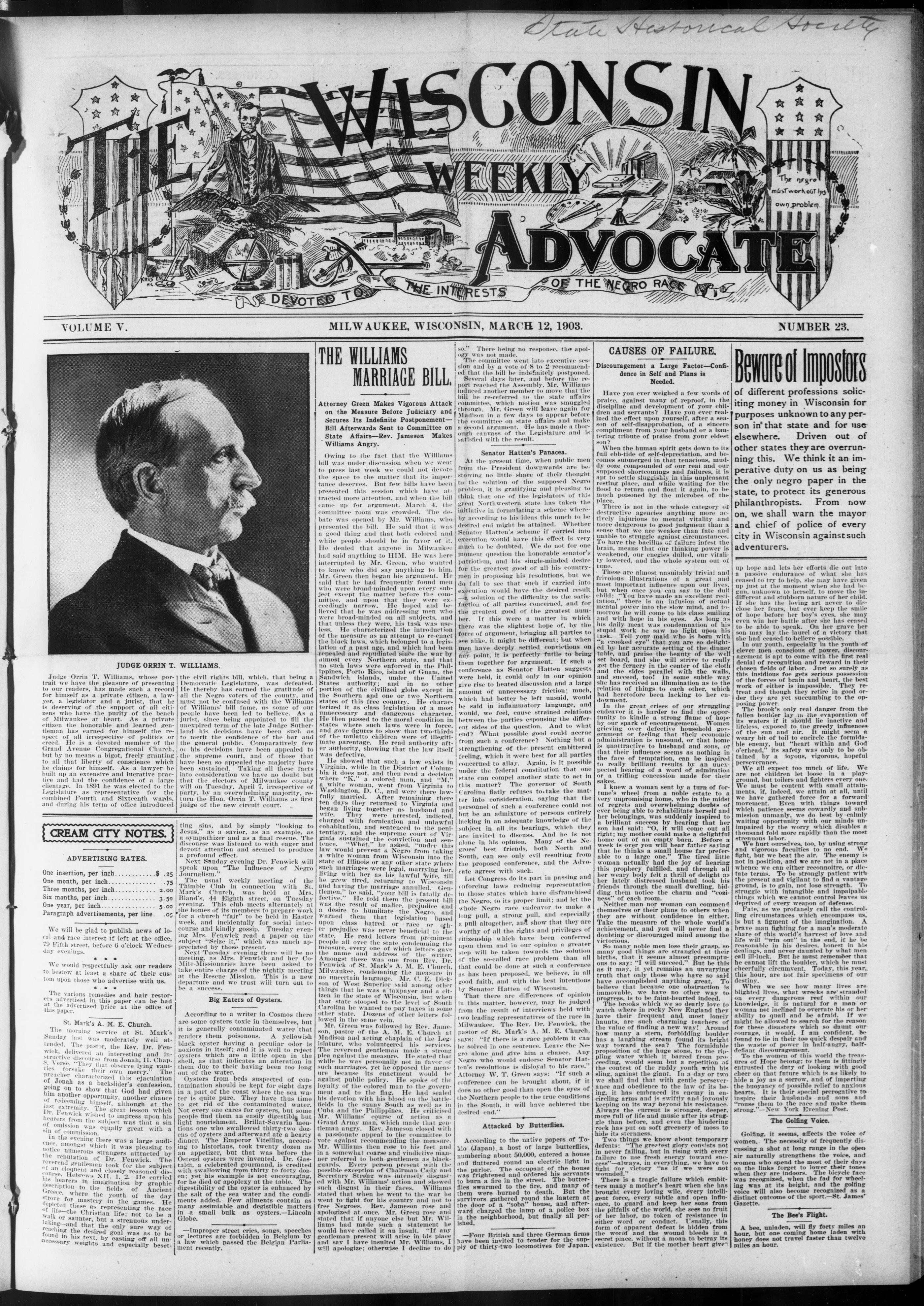
JUDGE ORRIN T. WILLIAMS
Judge Orrin T. Williams, whose portrait we have the pleasure of presenting to our readers, has made such a record for himself as a private citizen, a lawyer, a legislator and a jurist, that he is deserving of the support of all citizens who have the purity of the bench of Milwaukee at heart. As a private citizen the honorable and learned gentleman has earned for himself the respect of all irrespective of politics or creed. He is a devoted member of the Grand Avenue Congregational Church, but by no means a bigot, freely granting to all that liberty of conscience which he claims for himself. As a lawyer he built up an extensive and lucrative practice and had the confidence of a large clientage. In 1891 he was elected to the Legislature as representative for the combined Fourth and Sixteenth wards, and during his term of office introduced
CREAM CITY NOTES.
ADVERTISING RATES.
One insertion, per inch..... $ .25
One month, per inch..... .75
Three months, per inch..... 2.00
Six months, per inch..... 3.50
One year, per inch..... 5.00
Paragraph advertisements, per line..... .05
We will be glad to publish news of local and race interest if left at the office,
79 Fifth street, before 6 o'clock Wednesday evenings.
We would respectfully ask our readers to bestow at least a share of their custom upon those who advertise with us.
The various remedies and hair restorers advertised in this paper can be had at the advertised price at the office of this paper.
St. Mark's A. M. E. Church
The morning service at St. Mark's Sunday last was moderately well attended. The pastor, the Rev. Dr. Fenwick, delivered an interesting and instructive discourse from Jonah, II. Chap. 8, Verse. "They that observe lying vanities forsake their own mercy." The preacher characterized this ejaculation of Jonah as a backslider's confession, going on to show that God had given him another opportunity, another chance of redeeming himself, although at the last extremity. The great lesson which Dr. Fenwick wished to impress upon his hearers from the subject was that a sin of omission was equally great with a sin of commission.
In the evening there was a large audience, amongst which it was pleasing to notice numerous strangers attracted by the reputation of Dr. Fenwick. The reverend gentleman took for the subject of an eloquent and closely reasoned discourse, Hebrews XII. 1. 2. He carried his hearers in imagination by graphic description to the fields of Ancient Greece, where the youth of the day strove for mastery in the games. He depicted these as representing the race of life—the Christian life; not to be a walk or saunter, but a strenuous undertaking—and that the only sure way of reaching the desired goal was as to be found in his text, by casting off all unnecessary weights and especially beset
and especially beset-
VOLUME V.
the civil rights bill, which, that being a Democratic Legislature, was defeated. He thereby has earned the gratitude of all the Negro voters of the county, and must not be confused with the Williams of Williams' bill fame, as some of our people have been led to believe. As a jurist, since being appointed to fill the unexpired term of the late Judge Sutherland his decisions have been such as to merit the confidence of the bar and the general public. Comparatively few of his decisions have been appealed to the supreme court, and of those that have been so appealed the majority have been sustained. Taking all these facts into consideration we have no doubt but that the electors of Milwaukee county will on Tuesday, April 7, irrespective of party, by an overwhelming majority, return the Hon. Orrin T. Williams as first judge of the new circuit court.
ting sins, and by simply "looking to Jesus," as a savior, as an example, as a sympathizer and as a final rescue. The discourse was listened to with eager and devout attention and seemed to produce a profound effect.
Next Sunday evening Dr. Fenwick will speak upon "The Influence of Negro Journalism."
The usual weekly meeting of the Thimble Club in connection with St. Mark's Church, was held at Mrs. Bland's, 44 Eighth street, on Tuesday evening. This club meets alternately at the homes of its members to prepare work for a church "fair" to be held in Easter week, and incidentally for social intercourse and kindly gossip. Tuesday evening Mrs. Fenwick read a paper on the subject "Seize it," which was much appreciated by those present.
Next Tuesday evening there will be no meeting, as Mrs. Fenwick and her CoMite-Missionaries have been asked to take entire charge of the nightly meeting at the Rescue Mission. This is a new departure and we trust will turn out to be a success.
According to a writer in Cosmos there are some oysters toxic in themselves, but it is generally contaminated water that renders them poisonous. A yellowish black oyster having a peculiar odor is noxious in itself; and it is well to reject oysters which are a little open in the shell, as that indicates an alteration in them due to their having been too long out of the water.
Oysters from beds suspected of contamination should be kept for eight days in a part of the coast where the sea water is quite pure. They have thus time to get rid of the contaminated water. Not every one cares for oysters, but some people find them an easily digestible but light nourishment. Brillat-Savarin mentions one who swallowed thirty-two dozens of oysters and afterward ate a hearty dinner. The Emperor Vitellius, according to historians, took twenty dozen as an appetizer, but that was before the Ostend oysters were invented. Dr. Gastaldi, a celebrated gourmand, is credited with swallowing from thirty to forty dozen; yet his example is not encouraging, for he died of apoplexy at the table. The digestibility of the oyster is enhanced by the salt of the sea water and the condiments added. Few ailments contain as many assimiable and degistible matters in a small bulk as oysters.—Lincoln Globe.
—Improper street cries, songs, speeches or lectures are forbidden in Belgium by a law which passed the Belgian Parliament recently.
Big Eaters of Oysters.
THE WILLIAMS MARRIAGE BILL.
THE WILLIAMS MARRIAGE BILL.
Attorney Green Makes Vigorous Attack on the Measure Before Judiciary and Secures Its Indefinite Postponement Bill Afterwards Sent to Committee on State Affairs—Rev. Jameson Makes Williams Angry.
Owing to the fact that the Williams bill was under discussion when we went to press last week we could not devote the space to the matter that its importance deserves. But few bills have been presented this session which have attracted more attention, and when the bill came up for argument, March 4, the committee room was crowded. The debate was opened by Mr. Williams, who presented the bill. He said that it was a good thing and that both colored and white people should be in favor of it. He denied that anyone in Milwaukee had said anything to HIM. He was here interrupted by Mr. Green, who wanted to know who did say anything to him. Mr. Green then began his argument. He said that he had frequently found men who were broad-minded upon every subject except the matter before the committee, and upon that they were exceedingly narrow. He hoped and believed that he was addressing men who were broad-minded on all subjects, and that unless they were, his task was useless. He characterized the introduction of the measure as an attempt to re-enact the black laws, which belonged to a legislation of a past age, and which had been repealed and repudiated since the war by almost every Northern state, and that no such laws were enforced in the Philippines, Porto Rico, island of Guam, the Sandwich islands, under the United States authority; and in no other portion of the civilized globe except in the Southern and one or two Northern states of this free country. He characterized it as class legislation of a most unnecessary and dangerous character. He then passed to the moral condition in states where such laws were in force, and gave figures to show that two-thirds of the mulatto children were of illegitimate parentage. He read authority after authority, showing that the law itself was defective.
He showed that such a law exists in Virginia, while in the District of Columbia it does not, and then read a decision where "K," a colored man, and "M," a white woman, went from Virginia to Washington, D. C., and were there lawfully married. After remaining there ten days they returned to Virginia and began living together as husband and wife. They were arrested, indicted, charged with fornication and unlawful cohabitation, and sentenced to the penitentiary, and the supreme court of Virginia sustained the conviction and sentence. "What," he asked, "under this law would prevent a Negro from taking a white woman from Wisconsin into the state of Illinois or any other state where such marriages were legal, marrying her, living with her as his lawful wife, till he grew tired, returning to Wisconsin and having the marriage annulled. Gentlemen," he said, "your bill is fatally defective." He told them the present bill was the result of malice, prejudice and a desire to humiliate the Negro, and warned them that legislation based upon class hatred or race or other prejudice was never beneficial to the state. He read letters from prominent people all over the state condemning the measure, every one of which letters gave the name and address of the writer. Amongst these was one from Rev. Dr. Fenwick of St. Mark's A. M. E. Church, Milwaukee, condemning the measure in no uncertain language. Mr. C. E. Dickson of West Superior said among other things that he was a taxpayer and a citizen in the state of Wisconsin, but when that state stooped to the level of South Carolina he wanted to pay taxes in some other state. Dozens of other letters followed in the same vein.
Mr. Green was followed by Rev. Jameson, pastor of the A. M. E. Church at Madison and acting chaplain of the Legislature, who volunteered his services. The reverend gentleman made a strong plea against the measure. He stated that while he was personally not in favor of such marriages, yet he opposed the measure because its enactment would be against public policy. He spoke of the loyalty of the colored man to the government and to the flag. He had sealed his devotion with his blood on the battlefields in the sunny South as well as in Cuba and the Philippines. He criticised Mr. Williams' course of action as a Grand Army man, which made that gentleman angry. Rev. Jameson closed with a passionate appeal to the committee to vote against recommending the measure. Mr. Williams then rose to his feet and in a somewhat coarse and vindictive manner referred to both gentlemen as blackguards. Every person present with the possible exception of Chairman Cady and Secretary Strong was intensely disgusted with Mr. Williams' action and showed such disgust in their faces. Williams stated that when he went to the war he went to fight for his country and not to free Negroes. Rev. Jameson rose and apologized at once. Mr. Green rose and stated that if anyone else but Mr. Williams had made such a statement he would have called it an insult. "If any gentleman present will arise in his place and say I have insulted Mr. Williams, I will apologize; otherwise I decline to do
so." There being no response, the apology was not made.
The committee went into executive session and by a vote of 8 to 2 recommended that the bill be indefinitely postponed. Several days later, and before the report reached the Assembly, Mr. Williams induced another member to move that the bill be re-referred to the state affairs committee, which motion was smuggled through. Mr. Green will leave again for Madison in a few days to appear before the committee on state affairs and make a second argument. He has made a thorough canvass of the Legislature and is satisfied with the result.
Senator Hatten's Panacea
At the present time, when public men from the President downwards are bestowing no little share of their thought to the solution of the supposed Negro problem, it is gratifying and pleasing to think that one of the legislators of this great Northwestern state has taken the initiative in formulating a scheme whereby according to his ideas this much to be desired end might be attained. Whether Senator Hatten's scheme if carried into execution would have this effect is very much to be doubted. We do not for one moment question the honorable senator's patriotism, and his single-minded desire for the greatest good of all his countrymen in proposing his resolutions, but we do fail to see that such if carried into execution would have the desired result—a solution of the difficulty to the satisfaction of all parties concerned, and for the greatest good of the greatest number. If this were a matter in which there was the slightest hope of, by the force of argument, bringing all parties to see alike, it might be different; but when men have deeply settled convictions on any point, it is perfectly futile to bring them together for argument. If such a conference as Senator Hatten suggests were held, it could only in our opinion give rise to heated discussion and a large amount of unnecessary friction; much, which had better be left unsaid, would be said in inflammatory language, and would, we feel, cause strained relations between the parties espousing the different sides of the question. And to what end? What possible good could accrue from such a conference? Nothing but a strengthening of the present embittered feeling, which it were best for all parties concerned to allay. Again, is it possible under the federal constitution that one state can compel another state to act in this matter? The governor of South Carolina flatly refuses to take the matter into consideration, saying that the personnel of such a conference could not but be an admixture of persons entirely lacking in an adequate knowledge of the subject in all its bearings, which they are invited to discuss. And he is not alone in his opinion. Many of the Negroes' best friends, both North and South, can see only evil resulting from the proposed conference, and the Advocate agrees with such.
Let Congress do its part in passing and enforcing laws reducing representation in those states which have disfranchised the Negro, to its proper limit; and let the whole Negro race endeavor to make a long pull, a strong pull, and especially a pull altogether, and show that they are worthy of all the rights and privileges of citizenship which have been conferred upon them and in our opinion a greater step will be taken towards the solution of the so-called race problem than all that could be done at such a conference as has been proposed, we believe, in all good faith, and with the best intentions by Senator Hatten of Wisconsin.
That there are differences of opinion in this matter, however, may be judged from the result of interviews held with two leading representatives of the race in Milwaukee. The Rev. Dr. Fenwick, the pastor of St. Mark's A. M. E. Church, says: "If there is a race problem it can be solved in one sentence. Leave the Negro alone and give him a chance. Any Negro who would endorse Senator Hatten's resolutions is disloyal to his race." Attorney W. T. Green says: "If such a conference can be brought about, if it does no other good than open the eyes of the Northern people to the true conditions in the South, it will have achieved the desired end."
Attacked by Butterflies.
According to the native papers of Tokio (Japan) a host of large butterflies, numbering about 50,000, entered a house and fluttered round an electric light in the parlor. The occupant of the house was frightened and ordered his servants to burn a fire in the street. The butterflies swarmed to the fire, and many of them were burned to death. But the survivors gathered round the lantern at the door of a "soba" house, and afterward charged the lamp of a police box in the neighborhood, but finally all perished.
Four British and three German firms have been invited to tender for the supply of thirty-two locomotives for Japan.
CAUSES OF FAILURE.
Discouragement a Large Factor-Confidence in Self and Plans is Needed.
Have you ever weighed a few words of praise, against many of reproof, in the discipline and development of your children and servants? Have you ever realized the effect upon yourself, after a season of self-disapprobation, of a sincere compliment from your husband or a bantering tribute of praise from your eldest son?
When the human spirit gets down to its full ebb-tide of self-depreciation, and becomes submerged in that tenacious, muddy ooze compounded of our real and our supposed shortcomings and failures, it is apt to settle sluggishly in this unpleasant resting place, and while waiting for the flood to return and float it again, to be much poisoned by the microbes of the place.
There is not in the whole category of destructive agencies anything more actively injurious to mental vitality and more dangerous to good judgment than a sense that we are weaker than fate and unable to struggle against circumstances. To have the bacillus of failure infest the brain, means that our thinking power is weakened, our enegies dulled, our vitality lowered, and the whole system out of tune.
These are almost unsuitably trivial and frivolous illustrations of a great and most important influence upon our lives, but when once you can say to the dull child: "You have made an excellent recitation," there is an infusion of actual mental power into the slow mind, and tomorrow he will come to his class smiling and with hope in his eyes. As long as his daily meat was condemnation of his stupid work he saw no light upon his task. Tell your maid who is born with "a crooked eye" that you are so delighted by her accurate setting of the dinner table, and praise the beauty of the well set board, and she will strive to really get the fernery in the center of the cloth and the sides parallel with the walls, and succeed, too! In some subtle way she has received an illumination as to the relation of things to each other, which had heretofore been lacking to her endowment.
In the great crises of our struggling endeavor it is harder to find the opportunity to kindle a strong flame of hope by our spark of encouragement. Women grieving over defective household government or feeling that their economic administration is unsound, or that home is unattractive to husband and sons, or that their influence seems as nothing in the face of temptation, can be inspired to really brilliant results by an unexpected hearing of a word of admiration or a trifling concession made for their sakes.
I knew a woman sent by a turn of fortune's wheel from a noble estate to a very unpromising home, who in the midst of regrets and overwhelming doubts of ever being able to rehabilitate herself and her belongings, was suddenly inspired to a brilliant success by hearing that her son had said: "O, it will come out all right; my mother could make a delightful home out of an empty barn. Before a week is over you will hear father saying that he thinks a small house far preferable to a large one." The tired little woman actually had the joy of hearing this prophecy fulfilled, and through all her weary body felt a thrill of delight as her lately distressed husband took his friends through the small dwelling, bidding them notice the charm and "coziness" of each room.
Neither man nor woman can commend themselves or their plans to others when they are without confidence in either. Take the measure of the whole world's achievement, and you will never find a doubting or discouraged mind among the victorious.
So many noble men lose their grasp, so many good things are strangled at their births, that it seems almost presumptuous to say: "I will succeed." But be this as it may, it yet remains an unvarying truth that only those who have so said have accomplished anything great. To believe that because one obstruction is immovable, we have no other way to progress, is to be faint-hearted indeed.
The brooks which we so dearly love to watch where in rocky New England they have their frequent and most lonely haunts, are such charming teachers of the value of finding a new way! Around how many a stern, forbidding boulder has a laughing stream found its bright way toward the sea? The formidable proposition of the huge stone, to the rippling water which it barred from proceeding, would seem but a repetition of the contest of the ruddy youth with his sling, against the giant. In a day or two we shall find that with gentle perseverance and obedience to the law of its being, it has embraced its enemy in encircling arms and is swiftly and joyously keeping on its way beyond his resistance. Always the current is stronger, deeper, more full of life and music after its struggle than before, and even the hindering rock has put on soft greenery of moss to hide its sternness.
Two things we know about temporary defeats: "The greatest glory consists not in never failing, but in rising with every failure to use fresh energy toward success"—always, in everything, we have to fight for victory "as if we were not wounded."
There is a tragic failure which embitters many a mother's heart when she has brought every loving wile, every intelligent force, every subtle and open influence, to guard and keep her sons from the pitfalls of the world, she sees no fruit of her labor, no token of resistance in either word or conduct. Usually, this form of apparent defeat is hidden from the world and the wound bleeds in a secret place, without a moan to betray its existence. But if the mother heart gives
NUMBER 23.
Beware of Impostors
of different professions soliciting money in Wisconsin for purposes unknown to any person in that state and for use elsewhere. Driven out of other states they are overrunning this. We think it an imperative duty on us as being the only negro paper in the state, to protect its generous philanthropists. From now on, we shall warn the mayor and chief of police of every city in Wisconsin against such adventurers.
up hope and lets her efforts die out into a passive endurance of what she has ceased to try to help, she may have given up just at the moment when she had begun, unknown to herself, to move the indifferent and stubborn nature of her child. If she has the loving art never to disclose her fears, but ever keep the smile of hope before her boy's eyes, she may even win her battle after she has ceased to be able to speak. On her grave her son may lay the laurel of a victory that she had ceased to believe possible.
In our youth, especially in the youth of clever men conscious of power, discouragement is apt to come with the first real denial of recognition and reward in their chosen fields of labor. Just so surely as this insidious foe gets serious possession of the forces of brain and heart, the best work of either is impossible. They retreat and though they retire in good order they are yet succumbing to the opposing power.
The brook's only real danger from the fallen boulder lay in the evaporation of its waters if it should lie inactive and lifeless, exposed to the greedy influences of the sun and air. It might seem a weary bit of toil to encircle the formidable enemy, but "heart within and God o'erhead," its safety was only to be obtained by a joyous, vigorous, hopeful perseverance.
We all expect too much of life. We are not children let loose in a playground, but toilers and fighters every one. We must be content with small attainments, if, indeed, we attain at all, until we have gathered force for a forward movement. Even with things toward which patience seems cowardly and submission unmanly, we do best by calmly waiting opportunity with our minds unimpaired by the worry which disables a thousand fold more rapidly than the most strenuous labor.
We hurt ourselves, too, by using strong and vigorous faculties to no end. We fight, but we beat the air. The enemy is not in position, and we are not in a place whence we can either reconnoitre, or dictate terms. To be strongly patient with the present and vigilant to find a vantage ground, is to gain, not lose strength. To struggle with intangible and impalpable things which we cannot control leaves us deprived of every weapon of defense.
Fate, as we profanely call the controlling circumstances which encompass us, is but a figment of the imagination. A brave man fighting for a man's moderate share of this world's harvest of love and life will "win out" in the end, if he be reasonable in his desires, honest in his dealings, and never daunted by what men call ill-luck. But he must remember that he cannot lift the boulder, which he must cheerfully circumvent. Today, this year, this hour, are not fair specimens of our destiny.
When we see how many lives are blighted lives, what wrecks are stranded on every dangerous reef within our knowledge, it is natural for a man or woman not inclined to overrate his or her ability to quail and be afraid. If we might be allowed to search for the reason for these disasters which so daunt our courage, it would. I am confident, be found to lie in their too quick despair and the waste of power in half-angry, half-defiant discouragement.
To the women of this world the treasures of Hope belong; to them is fittingly entrusted the duty of looking with good cheer on that future which is as likely to hide a joy as a sorrow, and of imparting the buoyancy of possible relief to anxious hearts. It is their special prerogative to inspire their husbands and sons and "rouse them to the race and make them strong"—New York Evening Post.
The Golfing Voice.
Golfing, it seems, affects the voice of women. The necessity of frequently discussing a shot at long range in the open air naturally strengthens the voice, and women who spend the most of their days on the links forget to lower their tones when they are indoors. The bicycle face was recognized, when the fad for wheeling was at its height, and the golfing voice will also become recognized as a distinct outcome of the sport.—St. James' Gazette.
The Bee's Flight.
A bee, unladen, will fly forty miles an hour, but one coming home laden with honey does not travel faster than twelve miles an hour.
FIFTEEN PERSONS KILLED,
Freight Train Breaks in Two
: Near Olean, N. Y.
OIL TANK EXPLODES.
Spectators Attracted to the Scene are
& Overwhelmed by Wave of
Burning Naphtha.
ee aT.
Olean, N. Y., March 10.—Fifteex
persons were killed and forty-five in
jured in an explosion near here late last
night.
A freight train on the Erie, made up
principally of oil tank cars filled with
oil, broke in two near this city about ¢
o'clock, The two sections of the train
came together with a ‘crash and one of
the oil tanks was demolished. Fire
started almost instantly and the exy was
lighted up for miles. gpoaes
A large crowd of people ieft this city
for the scene of the fire. While they
were lined up alongside the track a ter-
rific explosion occurred. The flames com-
municated quickly with the other tank
cars and a second and third explosion
followed each other in rapid succession.
Sheets of flame shot out in all direc-
tions, Scores of persons were caught
within the zone of the fire and eu-
veloped in flames. Men and boys ran
screaming down the tracks with their
clothing a mass of flames. Others fell
where they stood, overcome by the heat.
Bodies Reduced to Ashes.
Many of the bodies were. incinerated.
Some of the victims were killed in their
tracks. Others were” hurled into the
creck to die. Some tried to flee, but sue-
cumbed to the fierce heat. The Olean
general hospital was soon crowded with
the injured survivors and every physician
nnd nurse in the city were impressed.
Some of the injured‘can not recover.
Word was sent at ouce to Olean police
headquarters by telephone. Every doc-
tor and ambulance in the city was sum-
moned. Grocery wagons and carriages
of all kinds were pressed into service,
and everything possible was done to
bring the injured without delay to the
hospitals for treatment.
Large crowds gathered at the hospital
and the faces of the injured were anxious-
ly scanned as they were borne into the
building on stretchers. Heart-rending
scenes were witnessed when one of the
blistered bodies was recognized by a
father or mother or brother and it was
with dufficulty that persons were re-
strained from invading the operating
room.
The Dead and Injured.
Owing to the fact that some of the
bodies were incinerated in the fierce
flames, or blown into the creek by the
fierce ‘explosion, the exact number of
killed will probably not be known for
several days. The number of injured,
too, is uncertain, as a large number of
them were able to reach their homes
and received treatment there. The
known casualties are as follows:
Dead:
JOHN STEMLINGER, aged 17.
NORMAN BROWN, 18.
JOHN TOBIN, 16.
JOHN M’ CREADY, 13,
JOHN M’MAHON, 19.
WALTER SWIFT, 19.
MICHAEL DRISCOLL, 22.
WALTER JACKSON, 13.
WALTER ROTH, 16.
RICHARD CONNELL, 19.
HERMAN BOLLMAN, 15.
RAPELO QUARINTO,
CARMEN SITLIANO.
MARTIN GALLAGHER, all of Olean.
HENRY GOMDER, 18 years old, Bord-
manville.
The injured at the general hospital are:
James McDonald, 16 yeurs old, limbs bad-
ly_burned.
Richard McDonald, his brother, badly
burned, leg fractured.
James McCready, 15 years old, burned
about face and legs.
Walter Jackson, 11 years old, burned
about back, cbest, face and hands; in-
haled flames; may dle.
Son of Yardmaster Sullivan.
Glen Cole, East Olean, struek by flying
splinter, burned.
"Two Blackwell boys of Bordenville.
Bert. Miller of “Bordenville, seriously
burned.
‘Three men bady burned; d‘d not leave
names at hospital; seut to their homes.
. Dozens of others were burned, but none
seriously.
Blown Into the Creok.
At the hospital one of the patients said
a young ber was blown into the creek
near him. e tried to save the lad, but
was unable to do so. The boy was
drowned. <
'The scenes rollowing the explosion will
never be forgotten by those who saw
them. It was about 9 o'clock in the
evening when the train was wrecked.
An Erie freight train west bound broke
in two on the hill two miles north of the
city. At first the forward part of the
train, released of all the weight of the
ears behind, shot forward with increased
speed. Brakes were applied and the
front portion of the train was brought al-
most to a standstill at the iron ‘bridge
across Olean creek. The rear cars, gath-
ering momentum as they came down the
hill, crashed into the forward part of the
train. Most of the cars in the train were
tank cars filled with refined oil or gaso-
line. They weighed thousands of tons
and the impact was terrific. One of the
tank cars caught fire soon after the col-
lision. The exact cause of the fire is not
known, but it is papnoeed to have started
from a spark from the grinding pieces of
iron in the wreckage. In a few minutes
another car of gasoline caught fire and
burst in flames with a terrific report.
Portions of the iron domes of the cars
were hurled a distance of several hun-
dred feet.
‘Those in the vicinity of the wreck who
escaped injury made valiant efforts to
rescue the wounded who were still lying
within reach of the flames. Boys were
burned to death before their fathers’
eyes, while the latter stood helpless to
save them. Men so badly injured: by the
flying pee of iron that they could not
move, laid in the gully with the flames
rolling down upon them until they per-
ished.
Fiftcen Bodies Recovered.
A short distance west of the iron
bridge a line was established heyond
which no one was perraitted to pass, as
one of the burning cars was still thought
to be in danger of exploding.
It was about 1 o'clock in the morning
when Deputy Sheriff Osterhout called
for volunteers to remove the dead and
injured. Three times as many as were
called for stepped forward and the grue-
some work was begun. In a short time
fifteen bodies had been recovered and
laid beside the track. Some of them
were so badly burned and distorted as
to be scarcely recognized. Several bod-
ies were found in the ditch. The body
of one boy was seen too close to the
SYMPTOMS OF CHOLERA.
SIX PEOPLE DIE UNDER PECULIAR
CIRCUMSTANCES.
Result of Pe aiestiacunnuss by the
Health Officials at New
York.
New York; March 10.—The Anchor
line steamer Karamania, from Marseilles,
Palermo and Naples, was detained at
quarantine today because a number of
the crew and passengers died under pe-
culiar circumstances on the voyage. Six
died in all, two of the crew and four
steerage passengers.
Health Officer Doty, after an exami-
nation, said: “All the symptoms of
those who died on the Karamania are so
similar to those of cholera that I propose
to keep the vessel, crew. and passengers
as if it were certain, The passengers,
733 in number, will be transferred to
Hoffmann island and will be detained
until I am sure they are free from in-
fection.”
gee pe
PUBLIC HAS RIGHTS,
Federal Judge Says Street Car Employes
Must Exercise Care and
Diligence.
St. Lonis, Mo. March 10.—In the
United States court of appeals an opin-
ion handed down by Judge Thayer de-
fines the rights and privileges of pedes-
trians and vehicles upon street railway
tracks and the duties of motormen in
running their cars.
The plaintiff, whose vehicle had heen
wrecked and the occupants injured, set
forth’ that the motorman was guilty of
negligence, and the defense set up the
claim that the plaintiff was guilty of
coutributory negligence.
Judge Thayer held that a motorman
is under the same obligations to exercise
ordinary care and prudence so as to ayoia
collisions and injuring persons as those
persons are to exercise care not to get
in the way of street cars, so as to be run
over and injured.
He says pedestrians and vehicles have
a right to cross the tracks of street raii-
ways at any point besides the regular
crossings and to use tracks for any dis-
tance for a matter of safety or conven-
lence, where they do not unnecessarily
interfere with or obstruct the passage of
the cars. A motorman, he says, has no
tight to act on the assumption that he is
entitled to a clear track at all times, and
that pedestrians or vehicles are bound at
their peril, no matter at what incon-
venience, to get out of the way.
He held that the plaintiff in this case
had a right to use the street railway
tracks as a convenience in avoiding the
mudhole in the street and that the mo-
torman was guilty of negligence in not
taking proper precautions to reduce the
speed of his car when he saw the vehi-
cle, so as to bring it under such control
that he could have avoided the collision.
Judge Sanborn filed a lengthy dissent-
ing opinion. He holds the trial judge
erred in eerie to allow the claim of
contributory negligence on the plaintiff’s
veer
NOW OUT OF POLITICS.
Cleveland Says He will Act in Advisory
Capacity Only—His View of
Trust Issue.
| New York, March. 10.—Former Presi-
dent Grover Cleveland denied that he had
‘come to New York city for any political
perce: “TI am not in politics,” declared
Mr. Cleveland. “I am out for good. Poli-
ties is furthest from my thoughts at pres-
ent, although I always am ready to act
in_an advisory capacity, if so desired.
_ When it was suggested to him that Ke-
publicans were claiming to be able to
eliminate the trust evils by publicity meas-
ures, while the Lemocrats and some part
of the independent voters on the other
hand claim the only adequate remedy is
reform of the tariff, the expresident said-
“You may say this for me, that Mr.
Cleveland gave it as his euinton that the
trust question will not be eliminated from
the next presidential canvass, and ex-
pressed himself as being entirely unable
to see how that gnestion could be wholly
divorced from the tariff issue, to say
nothing of the absolute necessity of a
good old-fashioned insistence upon tariff!
reform for its own sake and what it
would do for the people of the country.”
ae eee
CAUSED A PANIC.
Man Fires Three Shots at Some One on
the Steamer Kaiser Wilhelm
der Grosse.
New York, March 10.—As the steamer
Kaiser Wilhelm der Grosse was leaving
her dock today for Bremen a man stand-
ing in the crowd on the pier fired three
shots, apparently at someone on the
steamer, The shooting caused a panic
among the 760 passengers on the pier
Max Felder was arrested and a revolver,
three chambers of which had been emp-
tied, was found in his pocket, but he de-
nied that he had done the shooting.
HOPES OF BIRD FAMILY DIE.
Murderer Known to Have Been Hanged
Despite Constant Pleading.
Seattle, Wash., March 10.—A dispatch
received from Sitka, Alaska, states that
Homer Bird, who murdered two com-
panions on the Yukon river, was hanged
on Friday «according to the date set.
Bird’s life had been begged of President
McKinley and President Roosevelt on
several occasions by Mrs. Bird and her
daughter, Bernie Bird, whose unremitting
efforts to obtain executive clemency at-
tracted wide attention. Even to the last
the wife and daughter had hoped some
fortunate occurrence might prevent the
execution.
Bird made a short speech from the gal-
lows in which he declared his innocence,
theugh he showed little emotion and
spoke quietly. He walked from the jail
to’ the seaffold without assistance and
mounted the steps firmly.
——__-____-
—It has been estimated by an expert
in the employ of the government that
agricultural machinery reduces the num-
ber of men employed to do a given
amount of work to one-third, while man-
ufacturing machinery reduces the num-
ber to one-fiftieth.
—A violin without a sounding box has
been invented by Mr. Strob, an eminent
scientist of London, a diaphragm and
= being used to give volume to the
sound.
SEER
—W. J. Van Patton, who owns the
farm where Ethan Allen lived before the
Revolution, has decided to present it to
the city of Burlington, Vt., to be used
as a park,
et
—Hot cakes and cider are the usual
fare at Christmas eve supper in Devon-
shire.
a
—The Clyde’s mouth must be enlarged
to permit the exit of the two big Cunard
steamers now being builded therein.
‘LEGISLATURE.
ee
Praceedings in the Senate.
Fequesting the governor to call upon gov-
esting the vernor to ca ope ds
ernors of other states to sear en dele-
tes to a convention to be held tn Atlanta,
Ga, commencing July 4, A joint resolution
was introduced fn the Senate this nea]
to permit Mr. McGillivray to introduce a bil
to authorize the chief clerk of the Senate to
hire additional help for the rest of the ses-
sion. No. 3448, relating to — for
park leans ae eee re ordered en-
and read a .
Sree omualtive on state affairs introduced
two bills in the Senate on the 6th, One :.
mits O. N. Peterson and Gill to build a
dam across Flambeau river. | Another
amends the statute relating to the settle-
‘ment of federal war claims. The Senate
joint resolution to permit the introduction
of a bill providing for additional help in
‘the Senate was on the calendar for coneur-
rence, but was laid over to March 26 with
| only three or four votes against it. The bill
‘providing for the ‘taxation of railroad com:
panies on the ad yalorem basis was firs:
‘un the regular calendar, and was finally
{passed by unanimous vote, without a word
lof debate. There were 87 votes for the bill
jon roll call, 13 being absent. The commit-
tee on manufacturers and labor feported
‘favorably on bill 1318, providing that no
‘ehild under 16 years of age shall work in a
ifactory more than ten hours a day, nor
qmore than six days @ week, The resolution
ion the conference to consider the race gues-
ition was laid oyer. ‘The following bills
were passed: Relating to summons in case
‘of tenants holding over; relating to Jurisdic-
‘tion of justices in cities of the first class;
roviding for state insurance on public
Sutiaings; relating to the district court of
Milwaukee county; to regulate “baby
farms,” lying in hospitals. etc.; to provide
for registration of trade marks; making
husband or wife competent witness to a
will; relating to drainage districts. The
following bills were concurred In: Relating
to form of process Issued by justice of the
peace; relating to cutting of ice on mean-
dered lakes. This bill provides for the re-
peal of the law passed two years ago, which
taxes Ice cut and sulpped out of the state;
governing the importation of Western range
horses; peanne to powers conferred on
corporations. Mr. Bird offered an amend-
ment to 218S, relating to the sale of mer-
chandise, which was adopted and the bill
advanced. No, 2148, relating to chattel
mortgages, was indefinitely postponed. On
motion of Mr. Johnson the action of the
Senate on bill 1538, relating to the Tenth
and Sixteenth judicial cfreuits, which the
Senate refused to advance, was reconsid-
ered, and the bill will come up on the 17th,
when Mr. Kreutzer will return. The Sen-
ate then adjourned to 9 p. m. on the 9th.
Senator Kogers brought from Milwaukee
and had introduced at the evening session
of the Senate on the 9th, by Senator Hat-
ten as chairman of the committee on state
affairs a bill creating a juvenile court for
Milwaukee county, and providing that the
municipal judge shall preside over the new
court. The bill also provides for relieving
the circuit courts of trying cases of illegiti-
mate parentage, and imposes that duty on
the municipal court. The salary of the
judge is to be raised to $5000 a year for
these added duties, the increase from the
present salary being $1400.
The Senate on the 10th concurred in an
Assembly amendment to the bill enabling
married women to assign Interest {n life
Insurance. Bill 3318, taxing inheritances,
was laid over until tomorrow morning on
request of Senator Munson, azier the roll
call had been started on {ts passage. The
Hudnall barbering bill, No. 1408, on the
ealendar for indefinite postponement, was
laid over one week on motion of Mr. Hud-
nall. No. 2368 (Martin), establishing a
beard of veterinary examiners, was laid
over, as was 3458, relating to a dam across
Flambeau. Mr. McGillivray asked that bill
347, preventing double taxation of banking
Ren, be laid over until the 12th. Mr.
Whitehead objected, but later withdrew his
objection.
Goy. La Follette’s veto of Senator Mer-
ton's bill increasing the lng of the sten-
ographer of the Waukesha county court
‘was overruled by the Senate after a long
debate and the bill pean by a yote of 23
tov. The following bills were passed: Au-
thorizing certaln corporations to consoll-
date; authorizing boards of supervisors in
certain counties to build bridges; to com-
= railroad pent to rebuild thelr
nidges over the Yahara river; relating to
aetions and proceedings in partition: to
prevent sale of unsanitary milk; relating to
qualifications, duty and salary of state su-
erintendent, the salary being raised to
R500 per annum by the bill; relating to
drainage assessments; relating to pension
fund for firemen for members of the Mil-
waukee department; relating to fees in
county court; pee for a tax on In-
heritances, — and drafts. ae tol-
lowing Assembly bills were concurrt in:
To appropriate $20,000 to cotppews Falls
home; providing that stationery be provided
for the superintendent of illuminating oil.
Bill 668, relating to service of process on
corporations, was laitd over. The Martin
bil establishing a board of veterinary ex-
aminers was ordered engrossed and read a
third time without debate. The Hatten res-
olution providing for a conference on the
race question was then taken up. Mr. Hat-
ten, at the request of some senators, asked
that the consideration of the resolution be
laid over one week.
‘The Senate at the evening session on the
1th debated the propriety of dispensing
with 1ule 7, prohibiting smoking during the
sessions. Senatorial dignity was upheld,
the motion to amend the rule being lost
by a vote of 20 to 9.
Proceedings in the Assembly.
The following bills were passed by the
Assembly on the Sth: Requiring interurban
roads which operate lines fifteen miles long
to provide tollet rooms on all closed cars;
providing that high schools shall not be re-
quired to pay for the use of Camp Randall,
the state university athletic field; authoriz-
ing counties and towns to pay bounty for
xifiing rattlesnakes; providing for the es-
tablishment of local schools for the deaf
upon the application of local boards of edu-
cation, with the consent of the state board
of control. The bill appropriating $20,000
for the completion ang equipment of build-
ings at the Home for*the Feeble Minded,
Chippewa Falls, was passed under suspen-
sion of the rules. Two Senate bills were
advanced to the third reading—the Roehr
bill providing that married women may as-
sign their interest in life insurance policies
of which they are beneficlaries, and the
Hatten bill amending the charter of Ripon
College. The bill authorizing the reconyey-
ance to Mary A. Hamilton of a strip of land
in Fond du Lac was killed without debate.
The Brittan bill, providing for the survey
cee enon of Indian mounds, was
The Williams bill to prehibit marriages
between whites and negroes, on which the
judictary committee is divided, was, ou
motion of Mr. Coffland in the Assembly on
the 6th, withdrawn from that committee
and sent to the committee on state affairs.
The bill providing for the establishment of
a state park at Devil's: lake was recom-
mended for passage by the committee on
state affairs, with an amendment cutting
out, the $00 appropriation. ‘The bill pro-
viding for examination and license of bar-
bers was recommended for passage by the
committee on public health and sanitation
with an amendment reducing the fee. Two
Senate bills were concurred in: Mr. Roehr’s
bill, 808, giving married women the right to
assign their Innterest in life tusurance poll-
cles of which they are beneficiaries, and
Mr. Hatten's bill, 1208, amending the chas.
‘Tis of ‘Phee,” | members ee The
barbers’ Hcense Will, which the Assembly
refused to order to engrossment and _ third
ek was given a new lease of life.
The bill, 800A, which does away with the
requirements that all Insurance statements
must be published in the official state pa-
Ree and with but one publication in papers
lesignated by the insurance commissioner,
was passed without debate. No. 181A,
giving the state veterinarian jurisdiction
over local boards of health in enforcing
quarantine of diseased animals, was
passed. The Merton bill, 178, giving physl-
clans $4 per day for examination in _con-
tested Insanity cases, was concurred in.
Mr. Barker made another eet to Infuse
life Into his bill, 191A, providing immunity
for persons who turn state’s evidence {n
bribery cases. After twenty minutes’ de-
bate the bill was killed.
The Kehrein bill requiring that all mem-
bers of the state board of control shall be
physicians was reported for indefinite post-
ponement in the Assembly on the 11th.
The bill providing for the purchase by the
state of the Light Horse Squadron armory,
Milwaukee, was favorably recommended by
the military affairs committee to the com-
mittee on claims. The bill limiting county
appropriations for soldiers’ monuments to
$10,000 was reported for passage by the
committee on town and county organiza-
tlon. The Lang anti-trust bill, aimed at
the so-called druggists’ combine, was re-
ported for passage by the judiciary coi-
mittee, as was also the bill prohibiting
“spite” fences. The bill appropriating
$80,000 to the state board of agriculture
was favorably reported by the committee
on agriculture and went to the committee
on claims. The joint resolution introduced
by Mr. Thompson, direeting the tax com-
mission to investigate and eo on the
question whether the lumbering, mining
und other interests in Northern Wiscon-
sin are paying their just share of taxes,
was reported for indefinite ee ee
The Senate bill creating a municipal court
for Sawyer county was concurred in. The
Cady bill meng terms of county sehool
superintendents four years and changing
the time of their election to that of county
judges was rereferred to the judiciary com-
mittee at the request of its author, who
said there is some doubt as to its constitu-
tionality, the constitution prohibiting the
election of judges at the same time as
state or county officers.
Gov. La Follette sent tothe Assembly at
the evening session on the llth a message
stating his reasons for vetoing the Merton
bill, relating to stenographer’s salary in
the Waukesha county court. The vote on
passage over the veto was deferred for a
day.
$ OE UIN 2 SENN ANS VV Oe g
Manager McGraw of the New York
Giants has excnanged George Smith, who
played second bast last year on the New
York team, for Kid Gleason, the famous
New York second baseman. Smith will
| captain the Detroit American team, play-
jing second base.
ee *
A deal has been consummated whereby
Third Baseman Jimmy Burke of the
Pittsburg Pirates will be exchanged for
Shortstop Kruger of the St. Louis Cax-
dinals. Frank De Haas Robison will
probably throw in for good measure a
few of the fifteen pitchers Capt. Pat
Donovan has under contract.
ee 8
Tey. Hugh Spencer Williams, pastor of
the fashionable Cumberland Presbyterian
Church at Memphis, has come out
squarely in favor of Sunday ball. He
says: “It affords a recreation to a large
number of our people. It is not an im-
moral form of recreation. It gives peo-
ple a chance te stretch themselves, to
raise their voices, to inhale the pure air.
In a manner it allows the people to wor-
ship God in a rational way, by enjoying
themselves, by taking advantage of those
outdoor attractions which a Se
Creator never would have provided if He
had not intended that they should be em-
ployed.”
s* 8
Robert Fitzsimmons, former champion
middleweight and heavyweight of the
world, arrived in Pittsburg last Sunday,
met Philadelphia Jack O’Brien, and
agreed to meet him for the middleweight
championship of the world, during the
moras of June and July at some point
on the Pacific coast.
see
Dale Gear has added Billy Maloney to
his corps of catchers for the Kansas City
American Association team. .As soon as
Cincinnati released the fast little catcher
and outfielder Gear wired in a claim to
President Hickey and not five minutes
later a claim was received from Manager
Cantillon of Milwaukee. Malone played
under Hugh Duffy and was a general
favorite,
sf
Manager Gear of the Kansas City
American Association baseball club has
given out the following lineup for bis
1903 team: Catcher, Maloney: first base,
Grady; second base, Nance, Viox: third
base, McAndrews; shortstop, Leewe;
outtielders, Rothfus, Nance, Gannon,
Ganley and Gear; pitchers, Gibson, Dur-
ham, McDonald and Hill. Leewe has
not signed as yet, holding off for more
money.
Joe Corbett, hrother of James J. Cor-
bett. has signed to pitch for the Los An-
geles team.
Red Ehret, the olf Pittsburg twirler,
will be: found with the Nashville team in
the Sonthgrn League next season. Ehret
pitched good ball in the South last year.
s+
Dan M. Harper, the new burgess of
Patton, Pa., has signalized his advent in
office by issuing a permit for a fight be-
tween Jack O’Brien and Jack McAvoy.
Before Burgess Harper woald give his
consent to the contest the managers were
obliged to allow the burgess to appoint
three reputable citizens to sell tickets and
hold the cash until the fight is over, At
the first sign or intimation that the scrap
is a fake the spectators will receive their
money back. The burgess states that the
license was given for a fight, and not for
a game of ping-pong.
eee
Tommy Cody, the Chiago feather-
weight, is out with a challenge to Kid
Abel or Hugh McPadden. Cody will
make any weight demanded by Abel,
and is willing to fight him winner take
all. eee
B. J. (Kid) Weller of “big store
book” fame has opened up a future book
in Chicago on the American Derby, to be
run June 20. The Kid has made good on
his prices, and, by way of comparison, it
looks as though his former partner, Jim
O'Leary, who was first in the field with
a winter book on the Derby and other
big turf events, will have to loosen up
considerably with his quotations if he
expects to cope successfully with the
new book on the play that is likely to be
accorded the Washington park Derby.
A casual glance over their respective
sheets shows Weller’s prices on the fa-
yorite, Savable, to be 12,6 and 3, against
O’Leary’s 10, 4 and 2. On Dick Welles,
the second choice. the Kid lays 20, 10
and 5, while the best Jim will lay is 15,
6 and 3. Weller’s quotations also show
an increase of from 5 to 25 points on
nearly all the horses, which range from
20 to 1 to 100 to 1 straight, and a great-
er increase for “place” and show bets.
The Eastern nominations also fare much
better with the Kid. Mexican, Grants-
dale, Irich Lad, Lord of the Vale, Macey
Dwyer, Merry Acrobat, Onatas and
Yardarm are not, judging from his
prices, taken as seriously as by O'Leary.
On doubtful starters the Kid lays as
good as 1000 to 1.
i eee
Charley Moth defeated O. M. Nelson,
the heavyweight Scandinavian mat art-
ist, last Tuesday at Minneapolis, winning
three falls to two for Nelson,
CONGRESS.
Proceedings in the Senate
When the Senate met at noon on the 5th
for the special session called by President
Roosevelt, the beautiful chamber was more
like a conservatory than a hall of legisla-
tion. Flowers abourded in Inxuriant pro-
fusion. It was a fete day In the Senate, as
large erewds had gathered to witness ‘the
debut of fifteen new statesmen. After the
proclamation of the President convenin;
the Senate in extraordinary session had
been read Senator Hoar made an announce.
ment for the committee on privileges ana
elections. It was to the effect that In the
opinion of the committee the orderiy pro-
cedure was to swear in any senator-clect
who presented himself with a proper certl-
ficate and to postpone consideration of any
question that aa be raised as to his
qualifications. This statement cleared the
situation, if it needed clearing, in relation
to Senator Reed Smoot of Utah. His was
the only case {n which there was any ques-
tlon as to the administering of the oath.
As soon as the four men who were not
sworn In appear in the chamber and take
the oath of office the Senate will consist of
90 members, of whom 57 will be Repubil-
cans and 88 Democrats. The Republicans
will have a majority of 24, and will have
within three yotes of two-thirds.
When the Senate met on the 9th a letter
was read from President Pro Tem Frye ap-
pointing Mr. Kegan of New Jersey as pre-
siding officer in his absence. The oath of
office was-administered to James P. Clarke
of Arkansas; W. J. Stone of Missouri, and
Senator Gallinger of New Hampshire. Mr.
Stone was escorted to the desk by Mr.
Cockerell and Mr. Gallinger by Mr. Lodge.
Mr. Clarke walked to the desk unaccom
panied. There being no legislative business
to transact, the Senate, on motion of Mr.
Cullom of Illinois, went Into executive ses-
sion and an hour later adjourned for the
day.
Soon after the Senate met on the 10th,
Mr. Cullom, chairman of the committee on
forelgn relations, referred to the action of
the committee in passing a resolution call-
ing on the secretary of state for the copy
in Spanish of the pan-American canal
treaty. “I have it,” sald he, “and I think
it proper to present it. It is the original
treaty signed by the parties in Spanish.”
Mr. Cullom had overlooked the fact the
Senate was in legislative session, and was
proceeding to discuss the document when
Mr, Allison moved an executive session.
During the Inst Congress Mr. Cullom was
very careful to see that the treaty was not
diseussed except in executive session, and
he showed signs of embarrassment as he
promptly acquiesced In the motion to close
the doors, which was done eight minutes
after convening. When the Senate went
into executive session Senator Morgan se
eured consent for the attachment of the
Spooner law to the treaty as provided in
the preamble of the treaty. He also se-
cured consent for a call upon the secretary
of state for the correspondence leading up
to the acceptance of the option for the pur-
chase of the New Panama Canal Company's
property for $40,000,000.
At the opening of the session of the Sen-
ate on the 11th, Mr. Frye, the president
pro tempore, called the attention of sen-
ators to the fact that under a strict in-
terpretation of the rules only such business
as properly belongs to the matters under
consideration In executive session should
be presented at this extra session of the
Senate. Mr. Allison offered a resolution
authorizing the committee on rules to re-
examine the rules of the Senate with a
view to Imiting debate. The resolution
was referred. Mr. Hoar explained the need
ef a manual of parliamentary law, and said
he would at a later day Introduce a resola-
tion directing the committee on rules also
to consider this question. The Senate, then,
on motion of Mr. Cullony, went Into execu
tive session, and after ah address by Mr.
Morgan adjonrned.
# Chicago Matters.
a
LLLP LLL LALA
—Fire destroyed the plant of the Al-
ston Manufacturing Company, causing
a loss of $10,000,
—Thieves ransacked the home of W.
R. Haines and carried away jewelry
and clothing valued at $1000.
—Frank Kressil drank carbolie acid
in his barber shop because of despond.
eney caused by business troubles.
—Thomas McCutcheon, 50 years old,
was found asphyxiated in the Dewey
Hotel with a gas jet wide open.
—Fred Seydel, 55 years old, died at
the German Hospital from injuries re-
ceived in a cable car accident Febru-
ary 4.
—William Gloss, 55 years old, fell in
front of a switch engine in the Chicago
& North-Western railroad yards and was
instantly killed.
—Mrs. J. Welsh, 81 years old, died at
the home of her nephew, Hal Brink,
from the effects of illuminating gas
which she inhaled.
John H. Miller, 53 years old, an
employe of the Chicago City Railway
Company, was instantly killed at a cross-
ing of the Lake Shore & Michigan
Southern railroad in Grand Crossing.
—More than a score of persons at St.
Elizabeth’s Hospital morgue viewed the
body of the woman who first kneeled in
prayer on the bank of the river at Black-
hawk street Sunday and then plunged
into the water, but no one was able te
identify her,
-~An_ unidentified man, apparently
about 22 years old, was found lying on
the Chicago & North-Western tracks,
and is believed to have been struck by a
fast train, He weighed about 130
pounds, The name “Stack” was on the
collar,
—An increase of 5 cents an hour wil
be paid the carpenters in the building
season this year, This is in accordance
with an agreement signed between the
Carpenters and Builders’ Association
and the Carpenters’ Executive Council,
representing 7500 union carpenters.
| —The mystery attending the disap-
pearance of little Leona Blaney was
solved when the father, Joseph Blaney,
notified the pele that he had taken the
child. As his reason for this act Blaney
told the ponee he believed that the child
was not being properly taken care of.
—Striking teamsters pursued — two
wagons of the John McCleod Company
from the company’s establishment, drag-
ging Andrew Dwyer, driver of the sec-
ond wagon, to the street and assaulting
him, Dwyer received a blow on_ the
back of the head which is believed at
‘the county hospital to have produced
concussion of the brain.
_ Samuel Schoyer, 72 years old. who
Was part owner in the Leader clothing
store, died suddenly at the residence of
‘Mrs. Lillian L. Donnell. Mr. Schoyer
had resided with Mrs. Donnell for the
last four months, his former home being
in New Rochelle, N. Y., where his wid.
ow lives.
--Walter Callahan, 10 years old, owes
his life to his remarkable presence of
mind. While crossing the Chicago &
North-Western tracks his foot became
caught in the frog of a switch as a
freight train was approaching. The boy
was unable to release himself, and wher
the engine was within a few feet of him
he threw himself to the ground and let
the train pass over the foot.
Tiny Air Engine.
A Danbury man has made a com-
uo air engine which is half an inch
igh and no iareer than a dime, but it
runs as long as the air is applied.
Fee
—It is said that the firma hen eats
sixteen times her weight in a year. Her
eggs are six times her own weight and
worth six times the cost of her food.
Feed plenty of wheat, oats, grit, clover
and bone and less corn.
ad eine:
—In Japay 93 per cent. of silk spinners
are women.
ERR AN
= eS.)
‘ ay FS
SS) ,
ry \ Spas Dh
Sy Bie
we nent
we)
Aaa
yy
Mrs. F. Wright, of Oelwein,
:
‘lowa, is another one of the
million women who have been
restored to health by Lydia E.
s »
Pinkham’s Vegetable Compound.
A tome New York Lady Tells
of a Wonderful Cure:—
‘“My trouble was with the ovaries;
1 am tall, and the doctor said I grew
too fast for my strength. I suffered
dreadfully from inflammation and
doctored continually, but got no help.
I suffered from terrible dragging sen-
sations with the most awful pains low
down in the side and pains in the back,
and the most oor’ headaches.
No one knows what Iendured. Often
I was sick to the stomach, and every
little while I would be too sick to go
to work, for three or four days; I work
in a large store, and I suppose stand-
ing on my feet all day made me worse.
“At the suggestion of a friend of
iny mother’s I began to take Lydia
E. Pinkham’s Vegetable Com-
pound, and it is simply wonderful.
I felt better after the first two or three
doses ; it seemed as though a weight
was taken off my shoulders; I con-
tinued its use until now I can truth-
fully say I am entirely cured. Young
girls who are always paying doctor's
bills without getting any helpas I did,
ought to take your medicine. It
costs so much less, and it is sure to
eure them.— Yours truly, ADELAIDE
Prant, 174 St. Ann’s Ave., New York
City.” — $5000 forfeit if original of above totter
eseesialiain aniticiasiceieinia etnias Ee Seca nd
ae AT- ar
ASS BED Ti ME
Rares
Ly
j TAKE
ig A
a py 2&2 _ PLEASANT
ieee K
Mier «©=«DRIN
| THE NEXT MORNING | FEEL BRIGHT AND NEW
AND MY COMPLEXION IS BETTER.
My doctor says it acts gently on the stomach, liver
sande doce’ becbs, and is propared for use oo Sanlly eo
| tes. Itio called “Lanes Tea’? or
LANE’S FAMILY MEDICINE
_, All druggists or by mail 25 cts. and bocts. Buy itte
SSwelt cach dae ie aoe ere nie ee
necessary, Address, ©. ¥. Woodward, Le Roy, N.Y.
Dr. R. F. Nolte
3d St. and Grand Ave,, Milwaukee
Four years student and assistant to |
Prot. N. Senn, M. D., Ph. D., L. L. D.,
world’s greatestsurgeon. Four yar8 at
Columbia University a of Physi-
cians and Surgeons, world's greatest
and best medical schooi. Dr. Nolte
makes a specialty of curing PRIVATE,
NERVOUS, BLOOD: AND
SKIN DISEASES
Home treatment successfully given to
those who cannot callin m. Write
for rates of treatment. Ro cusree over
$1 to $2 per week for medicine and
treatment.
X-Ray Examination ...........--$1.00
Office Consultation .............. «50
Out-of-Town Consultation ....$1,00
I don’t pretend to cure in one sitting,
nor in a few days, but I guarantee a
complete cure with legitimate methods.
I pay NO railroad fare, nor give some-
thing for nothing.
Office Hours—9-12 a. m., 2-5 and 7-9 p. m.
) Put Up in Collapsible Tubes.
A Substitute for and berate to Mustard or any
| other plaster, and will not blister the most delicate
skin. The pain slleying, aud curative qualities of
‘this article are wonde-ful. It will stop the tooth-
sche ut once, and relieve headache and sciatics.
‘We recommend it as the best and safest external
‘gounter-irritan? known, also as an external reme-
dy for pains in the chest and stomach and all
rheumatic, neuralgie and gouty complaints.
“git HIME WHL prove what we claim for it, and 18
‘will be found to be invaluable in the household.
poor people say “ It is the best of all your prep»
ions,”*
Price't§ cents, at all dragetsts, oF other dealers,
or by sending his amount tous tage stan)
we will send yous tabe by mall. =
No article should be accepted by the public un-
less the same carries our Tabel, as ctherwise it is
| not genuine.
CHESEBROUGH MANUFACTURING CO.
| 47 State St., New York City.
= es The Genuine TOWERS
w@ ROMMEL
fa)\\ SLICKER
7) | HAS BEEN ADVERTISED
Nash YS. , ANB Sold Foe A
\@h) QUARTER OF A CENTURY.
UR saves. WATEROOE
RNG tics Meow CLOTHING
{ It is made of the best
b materials, in black or yellow.
\ ey ener and sold y
I FeeesteKTO THE
SIGN OF THE FISH.
TOWER CANADIAN, CO. Linted.. TCM Uae.
Yy TS
Over 2,000,000 people are now buy-
ing goods from us at wholesale
prices—saving 15 to 40 percent ou every-
thing they use. You can do it too.
Why not ask us vo send you our 3,000-
page catalogue }—it tells the story. Send
15 cents for it today.
3 CHICAGO
The house that tells the truth.
WHICH FORK?
Some persons yearn for knowledge
Of the kind you get at college;
Some long for musty facts from days
agone;
Some hunger te be knowing
What the future will be showing,
While others watch the present humming
on. ‘
But when I'm called out to dinner
By some pores sinner,
Who wan ways in the soctal swimming
pool
I would give a whole diploma,
Fen my college-bred aroma,
1 would give it all and gladly be a fool;
I would give my evening clothes,
‘and the joy that ebbs and flows,
Waen canal the mellow popping of the
cork,
Were I not always forgetting
One small thing that keeps me fretting—
If I only could recall “which fork!”
“Which fork?”
‘Theres quite a row beside me,
But the woe of woes betide me,
if ever I can get them sorted out;
For each one has its duty
Just as each its dainty beauty—
The oe one is three-tined, short and
stout;
But the rest—they have me guessing
In a manner most distressing,
And Be almost trade my hope of future
joy
For a chance to eat again
In the farmhouse dull and plain
SS tools I used to handle when a
Oy
For I’m sure I'll never learn,
‘Though T yearn, and yearn, and yearn,
‘Though I spend a dozen seasons in New
York,
Just what fork is next In line;
So from soup to nuts and wine,
I am haunted by the thought,
“Which fork?"
_S, W. Gillilan, in Baltimore American.
The Return of Yesterday.
When the exigencies of courtesy de-
prived Harding of his seat in the Two-
penny Tube, it did not happen to him to
take note of the girl for whom he had
risen. His mind was merely pondering
the instinct which causes women, as a
class, to crowd like ants into public
vehicles at the time when all the world
is returning from busmess, and mutely
demand a seat. He resettled his hat
upon his head, and, reaching out for a
strap, continued to read his evening
paper.
: 1 he train hurtled and clanked _hila-
viously through darkness, and Harding
had to brace his feet to keep from being
swung about. He shifted them after a
while, and shortened his grasp of the
strap. In doing so he glanced down at
the girl beside him. Something about
her struck an instant note of familiarity.
He could not place it. It was just that
degree which may be acquired by sitting
opposite to a person for an hour in a rail-
way carriage, yet with it Harding had a
vague conviction that, somewhere, he
had spoken to her. He studied inch by
inch the poise of her black hat-brim, the
slim, ungloved hands thrust into her
jacket pockets, groping meanwhile in his
mind for some definite association. It
contrived to worry him. Presently the
girl looked up. It was Margot.
“Why—why——” he found himself
saying. He bent and shook hands with
her. “How queer our running up against
each other like this!”
The wonder in his mind was how he
should not at once have known it was
she. Suddenly, at sight of her face, the
environment of the Twopenny Tube had
faded, and he was back in the old fifth
floor studio off the King’s road. with the
smell of varnish and oil stove and plas-
tered walls. He had a pastel sketch of
her yet that he made in those days—he
had come across it only a week ago
among a pile of forgotten canvases.
They exchanged the inconsequences of
people who meet after four years. Hard-
ing asked her how she liked the new
railway, and enlarged upon the advan-
tages of getting to the city in twenty
minutes with all the enthusiasm of a
man to whom time was of no value
whatever. All the while he was busy
defining in what ways she had changed.
She looked older. Her clothes were
shabby, but she was the kind of girl
who could wear shabby things with ab-
solute effect. Her face had to him a
look of hollowness under the cheap pic-
ture hat; her lips showed scarlet. Her
big shadowy eyes roved the carriage
while she talked, in swift continual note
of fellow-passengers. _He remembered
the old, restless trick of her hands in her
jacket pockets.
A little green signal was flashed upon
the black of the tunnel. A moment later
the jolting darkness gave place to a glim-
mer of white-tiled walls. A cool draught
blew down the back of Harding’s collar,
and simultaneously the sliding doors at
the end of the car drew apart to disclose
the vision of an automatic conductor,
who announeed “Ollan’ Park!”
Harding suddenly realized that he had
said nothing to her at all. “Look, you
might get out here, can’t you?” he said.
“You aren’t in a hurry? Come round as
far as the studio with me, and we can
have a chat.”
_ Outside a thin flurry of snow was fall-
ing, the first of the season, and the pave-
ment gleamed wet under the street
lamps. Talking became all at once pos-
sible, “How are you getting on?” Hard-
ing asked the girl.
“Oh, pretty well. On and off, you
know. It’s much the same.”
_ She spoke flippantly. Her eyes rested
for the space of a seeond upon his face.
“Four years,” said Harding, thinking.
“It's a bit of time. My Lord!”
At length a wide Vestibule flung a
comfortable square of light across the
pavement. “Here we are,” Harding said.
"hey paused under the gaslight in the
tiled hall, while he brushed the melting |
snowflakes from her jacket. The girl
coughed; a rasping cough that: seemed |
to shake the whole of her slim body.
_ “Got a cold, haven't you?” said Hard-
ing. genially. “So have I—beastly. Din!
oan to get in out of that wet. It is a
ght!
He stooped and fitted a sey i |
one of the doors. It opened eae
and he held it for her to enter. 3
“No stairs here, vou see?? Don’t fall’
fhe, things and kill yourself, and Pl find.
e gas.
He struck a light, revealing a di |
untidy room littered with are
tall Dutch easel stood at one end, and
costly hangings glowed in soft colors.
ee were chairs of old carved oak and
cane round mirror framed in beaten
golttaet stood in the middle of the
throat, Welle ane nee eee
at’ inet » you've got on,” she said
“What do you mean?” Harding paused,
oe burnt mateh still ieee his
ie this!” She indicated the sur-
te gs With a little sweeping ges-
az Oh, T don’t know,” returned ing;
T don’t know. * * * git down,” 2
BISHOP’S MOVE A DRAMATIC SUCCES.
| zi A Nt me any \
Pre 3B ay
vais
| iN
ars sf —
nae Bota aie sae : oP - Pe
— ch
: : ee ee: Segoe | &
3 eG ‘ ieee
: a é
oe
The new comedy recently produced at New York brings out W. H. Thompson
as a star. The play is written by John Oliver Hobbes and Murray Carson
and is clever. Mr, Thompson gives a performance that is highly praised by the
iwetropolitan critics.
presently said. “Take your hat off
awhile.”
She had said at first that she could not
stay, but it ended inevitably in her tak-
ing off her hat and jacket, and hanging
them on the easel. Without them she
looked more like herself of old days.
She had on a black frock with Jace about
it, and her bronze-gold hair was twisted
low upon her white neck in the knot he
remembered. Harding surveyed her mus-
ingly, stretched on the divan, with his
hands behind his head. He had nothing
to offer her but cigarettes. She smoked,
flung back in the big oak chair that fig-
ured in most of Harding’s portraits, her
slim feet crossed in front of her, and
chatted to him of forgotten things. As
she talked the old familiar surroundings
rose before him bit by bit through the
opal smoke of her cigarette. “Do you
remember Toto?” she cried. “And the
coffee pot that always boiled over? And
a day—the day you got fifteen shillings
for the Ludgate drawing?” He could see
it all as she spoke—the little disorderly
room, the newspaper are for a table-
cloth, and Margot bending over the tiny
oil stove that stood on a soap box be-
fore the empty grate.
She tossed at him a whirl of questions
about old student friends. “What has
become of Guild? And Baker—I’ve often
wondered about Baker?” To many of
these Harding found himself obliged to
reply, “Oh, gevting on, I believe,” or sim-
ply, “I don’t know.” ‘She seemed to 2x-
pect him to have kept up with all the
men he used to know.
Presentiy she rose and walked about
the room. She was looking at every-
thing. He watched her finger a little
medallion photograph on the mantelpiece,
and has glance toward him as she did
so. He was expecting that she would
ask him who it was. But, instead, she
came over and sat down again on an
arm of the oak chair.
“It’s like old times,” said Harding, “to
see you there.”
She jooied at him queerly.
“Paul,” she eried, “let’s play we are
back in the old days again just for an
hour or two? We'll pretend that every-
thing is just as it used to be! We'll for-
get that you’re famous and that ’'m—”
“What?” he asked quickly.
“About to beome famous!” She flung
a smile at him. “How do we_ know?
Tomorrow, perhaps, some one will come
to me and say, ‘Mademoiselle, I come to
offer you a three weeks’ engagement at
a salary of £100 a night!’ And I would
bow—so—and reply, ‘Monsieur, make it
£200, and I close!’ But for an hour we
will play that we have neither of us any
money in the world; we can’t even run
to baked potatoes. You see, I won't
damage your reputation by sending you
out from a Kensington studio—your own
studio—to buy baked potattoes!”
Harding laughed. Somehow her gayety
infected him; he was feeling light-heart-
ed as he had not done for years. The
old forgotten days came back to him
along the gray road of time. He looked
dreamily at, the girl. Her cheeks were
flushed; her eyes shone at him through
the mist of smoke.
| “Margot——” he cried.
_ When Harding awoke the big studio
was empty, and the early winter twilight
was.ecreeping through -the crack of the
opened door. He had aroused with a
start and a shiver. He turned down the
gas, beginning to flare yellow, and walked
across to the window. The long, straight
‘London street confronted him, gray-mist-
ed and hideous—a vista of somber pros-
perity.
He presently turned away, stretching,
and looked at -his watch. Half-way
through a yawn he stopped short. On
the floor at his feet lay a small shabby
feather from a hat. He picked it up
clumsily, and stood there withg it for
many minutes in his hand, thinking—
Free Lance.
The Albritton Family.
| The attention of President Eliot is
called to the Albritton family of Pierce
county, Ga., that he may learn that chil-
dren are still being born in parts of the
country. Thomas Albritton, a farmer,
died recently at the age of 104. He left
eighteen children, some of whom had set-
tled in Polk and De Soto counties, Fla.
Three of these sons have 563 descend-
ants, and of all the clan it is estimated
there are now Jiving 3000 members. Trip-
lets, the report says, have been such a
common occurrence in the family that
they pass almost unnoticed. Where is
Zola now and his Fecondite?
HISTORY OF STARCH.
Introduced Into England in the Time of
Queen Elizabeth.
Starch originated in Flanders. It was
introduced into England, with the big
raff, in the time of Queen Elizabeth. It
was like our starch of today, except that
it was made in colors—red, yellow, green,
blue. The effect of this was to tint deli-
cately the white linen to which the starch
might be applied. Before Queen Eliza-
beth’s time ruffles and ruffs were made of
tine Holland, which required no stiffen-
ing. Then the ruffs of cambric came,
and these must of necessity be starched.
When the Queen had ruffs made of
lawn and cambrie for her own princely
wearing there was no one in England
that could tell how to starch them; but
the Queen made special means for some
women that could starch, and Mrs, Gull-
ham, wife of the royal coachman, was
the first starcher.
In 1504 a Flanders woman, Frau Van-
der Plasse, came to London and estab-
lished there a school for the teaching of
starching. The school succeeded. The
Flanders frau got rich. She charged $25
‘a lesson, and an extra $5 for a recipe
for the making of starch out of wheat
floar, bran and roots. Yellow was the
most fashionable color in starch among
‘the nobility, The fast, racing set went
in for green. The Puritans used blue
‘araren, though at first they had been
against the stuff altogether, dubbing it ‘a
certains kinde of liquide matter which
they call starch, wherein the devil hath
willed them to wash and dive their ruffes,
which, when they be dry, will then stand
stiffe and inflexible about their necks.”
‘Starch is made from wheat, corn and no-
tatoes, and starving men have often sub-
sisted on it, finding it nourishing, though
not tasty.—Philadelphia Record.
RUSSIA’S STANDING ARMY.
Over a Million Men, Even in These Piping
Times of Peace.
_ The standing army of Russia in time
of peace numbers over a million, rank
and file, or 4 per cent. of the male popu-
lation between the ages of 21 and 60
years, It is divided as follows: Six hun-
dred and twenty-seven thousand infan-
try. in 25 army corps, 52 divisions, 209
regiments and 836 battalions; 117,000
cavalry, in 28 divisions and 634 squad-
rons; 138,000 artillery, with 412 batteries
of field artillery and 46 of horse artillery:
34,000 engineers, 34,000 commissariat,
transportation, medical and other depart-
mental troops, and 60,000 Cossacks, Lia-
bility to military service is general be-
tween the twenty-second and forty-fourth
birthdays, the only exemption being in
favor of the Cossacks of the Caucasus.
who have a special organization; the set-
tlers in Turkestan and the territories of
the Amur; the non-Russian population of
Astrakhan, the Asiatic provinces and
Archangel. A million men have every
October 1 attained the military age, but
only 300,000 are required to bring the
standing army up to its peace establish-
ment. Every urban and rural district
has its recruiting board, which is in-
formed of the number of recruits it must
furnish to each arm. Selection is made
between October 15 and November 15.
Usually about 48 per cent. of the con-
script candidates are exempt or ineligible.
—Detroit Free Press.
Historic Buildines.
The government buildings at Fort Gib-
son, Ind. T., are advertised for sale on
March 4. Here are a few ashes from
the Muskogee Phoenix:
“These buildings and the ground on
which they are located are to the terri-
tory what Monticello and Mount Vernon
are to Virginia; what Canton is to Ohio,
what the Hermitage is to Tennessee,
what the Alamo is to Texas, what Bunk-
er Hill is to Massachusetts and what
Osawatomie is to Kansas.
“There it was old Rough and Ready
‘Zack’ Taylor, as post commander, first
won his spurs and laid the foundation for
a career which ended only_in the white
house. Here the Plumed Knight, James
G. Blaine, battled for weeks with the
grim monster, and by the most narrow
margin won a victory over death. Here
Henry M. Stanley, the world’s greatest
explorer, dreamed of Darkest Africa and
a seat in Parliament, and here Gen. Sam-
uel Houston had his first vision of the
empire of Texas, as, living with the In-
dians, he conceived the idea _and_plans
for the Lone Star republic. Here Wash:
ington Irving wrote his name on the tab-
lets of American literature in undying
letters when he planned the “Tales of a
Traveler.’ Here Mrs. Bootes Dewey
lived and reigned ‘the belle of the frontier
post in the land of the red man. y
“A place so rich in historic memories
should not be sacrificed. A place so in-
tertwined with the politics, wars, litera-
ture and love of a nation should not be
destroyed.”
A.A. PENNELL 1S KILLED,
Corespondent in Burdicx Divorce
Proceedings Meets Death.
ACCIDENT OR SUICIDE?
Auto in Which He and Mrs. Pennell Were
Riding Plunges Over Cliff Into
Stone Quarry.
Buffalo, N. Y., March 11.—Arthur R.
Pennell, one of the chief figures in the
mysterious murder case of Edwin L.
Burdick, was dashed to death in an_au-
tomobile accident last night. Mrs. Pen-
nell, who was also in the automobile,
was probably fatally injured.
A story is current to the effect that
Pennell did not lose control of his ma-
chine as at first supposed, but instead
steered it madiy over the precipice be-
cause he had been suspected of knowing
who murdered Burdick. Pennell had
been named as corespondent in the suit
Burdick instituted against his wis.
Pennell and his wife were speeding
along Kensington avenue when they
neared an old stone quarry that is close
to the street. The quarry is about 30
feet deep and has a bottom of loose,
jagged stone.
Dashed Into Stone Quarry.
The machine was running at remark-
ably fast speed and when near the quar-
ry suddenly swerved from the read and
dashed oyer the precipice, hurling Pen-
nell to instant death on the rocks below
and inflieting mortal wounds on Mrs.
Pennell. Her recovery is considered ex-
tremely improbable and there is little
likelihood that she will ever regain con-
sciousness. 2
Mrs. Pennell had a cut about the wrist,
the index finger of her left hand broken
and her face was badly eut. Her breast
and body were badly bruised. It is con-
sidered probable that she sustained se-
vere internal injuries.
A friend who called Mr. Pennell up
on the telephene about 5 o'clock was in-
formed that Pennell was in, but that he
was just going for a drive. Mr. Pennell
himself answered the telephone and_said
that he would be back between 6:30 and
7 o'clock, making an appointment with
his friend for that hour, ‘
“Would 6 o'clock do?” he was asked.
“Oh, well, you might come at 6 o'clock,
but you better make it later,” said Mr.
Pennell.
Relates to Burdick Murder.
It is learned that the matter mentioned
in the telephone talk was something Pen-
‘nell considered most serious and which
weighed heavily on bim. It was in con-
nection with the Burdick murder. Re-
cently Pennell made the following state-
ment:
About this ease of Burdick, I have told
the authorities I went away to New York
before the murder and that I met Mrs.
Burdics: while I was away. In fact, I saw
Mrs. Burdick near New York two or three
days before the murder of Mr. Burdick.
I came home again Wednesday, the day be-
fore the murder. I have told it frankly and
the meeting was a proper one. But they
seem determined to drag all this business
out in the papers. I would do anything
to stop It.
Since the murder Pennell appeared
morose and seemed to be breaking down.
A couple of days ago Pennell wrote to
a friend in Pottsville, Pa., showing the
state of worry he was under. The fetter
is as follows:
I presume you have seen the newspaper
accounts of a mysterious crime here at Buf-
falo in which my name has most unjustly
found — publicity in the mass of sen-
sationalism and yellow journalism which
has followed the affair. The truth was ut-
terly lost. I had no connection with the
crime. My name was brought in through
the divorce proceedings which were then
pending. There was no truth in the charges
in those proceedings. They were absolute-
ly 4 under oath by the defendant and
myself.
Twas dragged in out of vindictiveness be-
cause my wife and myself had taken the
part of the wife against the husband and
she had come to me for legal adyice and
protection, The man in the case was all
the time in intimate relations with other
Ytomen. The case would have been quickly
tried and the charges disproved, but just
at this tlme and at the most unfortunate
time occurred his death at the hands of
some unknown woman and the whole mat-
ter became public. Then came a deluge of
Nes and falsehoods which had no basis of
fact.
‘The notoriety has been almost unbearable.
I want you and some of the friends I care
about to have the truth, and I know that
you will believe in me. I have been very
much broken up inall. A. R. PENNELL.
Pennell’s Life Heavily Insured.
Pennell carried $200,000 in life insur-
ance. Besides his wife he had no heirs
except his mother and brother, Fred. J.
Pennell.
The medical examiner and authorities
are watching by Mrs. Pennell’s bedside
to obtain an antemortem statement in
case she revives from the state of coma
in which she now is. It is believed that
such a statement from Mrs. Pennell
would reveal whether Pennell deliberate-
ly drove the automobile over the preci-
pice.
At 1 o'clock this afternoon it was
stated by the surgeons at the Sisters’
Hospital that Mrs, Pennell’s tempera-
ture and pulse are rising rapidly, There
is no hope for her recovery.
An examination, of the wrecked auto-
mobile was made today. It was stated
that the brake of the machine was set
tight. The lever was back on the re-
yerse motion and the power was shut
off, indieating that Pennell had tried to
save himself from plunging into the
quarry,
Search Pennell’s Office.
A policeman is on guard at Pennell’s
office in the Austin building today and
it is believed that the attorneys are now
making a search of the papers and be-
longings of the unfortunate victim. It
was also stated a search is being made
of the residence of the Pennells at 208
Cleveland Avenue. It is known that de-
tectives have been at the honse since
last night.
Identification evidently had been a fad
with Pennell. On the back case of the
handsome gold watch, which was stil)
ticking in his pocket, the intricate mon-
FEDERAL JUDGE CENSURED.
Wabash Injunction Condemned by Mis-
souri Assembly.
Jefferson City, Mo., March 11.—A reso-
Intion was adopted by the House yester-
day reproving Judge Adams of the
United States district court of St. Louis
for granting the recent Wabash injune-
tion.
——
Pickets are Withdrawn.
Colorado Bpringe, Col., March 11.—
Gov. James H. Peabody is expected in
Colorado Springs this afternoon to in-
vestigate for himself the strike condi-
tions. The infantrymen placed as pee
ets around the strike headquarters have
been withdrawn and quiet prevails.
SITUATION GRAVE.
Sentries are Patrolling the Levees
Along the Mississippi
River.
:
_ Caruthersville, Mo., March 11.—The
old levee, the greatest danger point along
ithe Mississippi, a mile and a quarter
south of here, is caving, wiih the river
‘showing a rise of four inches and rain
falling heavily. The situation is grave.
Government engineers regard it as the
Auost critical Hood point along the river.
Four hundred men are building a new
levee.
Landing places along the river are
‘submerged, many towns are entirely sur-
rounded and the river, waich continues
2 rise, has backed up for miles. The
levees alone are between the flood and
corneas le with 5000 inhabitants,
who are in fear of destruction and the
surrounding counties with farming and
ere, interests representing $3,000
| Mississippi Steadily Rising.
Memphis, Tenn., March 11.—The Mis-
| sissippi river is rising steadily at this
point, the gauge this morning marking
a rise of five-tenths of a foot in the past
‘twenty-four hours. It is believed that
ee river will reach 38 feet at Memphis.
Reports from Mississippi and Arkansas
today indicate that the gravest apprehen-
‘sion prevails regarding the flood situation.
In some districts armed sentries are pa-
trolling the levees. All streams and riv-
ers in» Arkansas are overtiowing. In
North ea the flood has already be-
gun encroaching at certain points and it
will take but a few inches more of water
to render work impossible at many of the
lumber industries in that section of the
city. Occupants of cabins there have
‘been compelled to flee to higher ground.
Vessels Cannot Reach Landings.
Evansville, Ind., Mareh 11.—The Ohio
river reached 42.4 fect this morning and
was stationary at that point. At the
weather burean it was expected that the
river would begin going higher during
the day. Navigation is now difficult and
at numerous points vessels cannot get
to landings. Ten miles below here the
tlood is above the foundation of the
houses near the river. At Rhams station
the water is 2 féet deep in houses and
business is suspended.
Several shanty boats ou the Wabash
and Green rivers have been crushed in
hy the flood and loss of life is feared.
‘Farmers about Mount Vernon have tled
from the high waters, taking their house-
hold goods and live stock. A large force
of men are at work where the Evansville
& Terre Haute railroad crosses White
river. At this point a trestle 2000 feet
long is necessary to keep the high water
from touching the railroad tracks and
to prevent the bridge washing away.
Situation at Cincinnati.
Cincinnati, O., March 11.—The river
here is stationary, but the local forecast
says it will pass the 52-foot stage Thurs-
day. The outlook now is that there will
be no disastrous flood at Cincinnati.
New Orleans, La., March 11.—The
river is rising here very slowly. The
gauge today marked 18.4, a rise of only
one-tenth in the past twenty-four hours.
The stage is still over a foot under the
record. Rainy weather is having the ef-
fect of softening the levees and all
Louisiana is praying for a return of sun-
shine. Six hundred men are at work
today strengthening various points along
the river front.
The engineers report. the levees be-
tween Southport and Carrollton in ex-
cellent condition and able to stand a
much greater strain than they have thus
far been subjected to.
River Banks Breaking.
Little Rock, Ark., March 11.—The Ar-
kansas river will pass the danger line in
the next twenty-four hours. The banks
of the stream are reported to be badly
caving. Factories at Devil's bluff have
been compelled to close.
Vicksburg. Miss., Mareh 11.—~The river
here has risen four-tenths of a foot in the
last twenty-four hours. Rain is falling.
There has been no reports of breaks in
the levee.
Ice Goes Out of Grand River.
Grand Haven, Mich., March 11.—Dan-
ger here from the ice gorgé in Grand
river is over. ‘Tlie ice went out today
without damaging the bridges. Forty
thousand logs which escaped from a raft
above the city were captured and boomed.
DUE TO INCENDIARY.
Destruction of Portiand Oe Dock and
Other Property—Loss Estimated
at $1,000,000.
Portland, Ove., March 11.—The Vie-
toria-dock, situated on the east bank of
the Willamette river, north of the rail-
read bridge, was entirely destroyed by
fire, together with 10,000 tons of wheat
and 2000 tons of salt stored on the dock.
Soon after the blaze had been put out
Canning, Wallace & Co. and Zan Bros.,
wholesale houses, and the Oregon Rail-
way and Navigation Company's Ash
street docks were set on fire. The tota
loss will not be iess than $1,000,000,
It is believed that the Victoria dock
fire was started by an incendiary, as a
man qwas seen leaving the dock after the
fire had gained some headway.
Three times during the last fortnight
fires have been started on docks in this
city, und it is supposed that the same
tan is responsible for all of them.
The barkentine Amazon was moored
near the dock and had it not been for
the fact that the wind was blowing from
the west she would haye been burned.
Earlier in the day the half block of
frame buildings bounded by Mississippi,
Russell and Goldsmith streets, in Al.
bina, not far from Victoria dock, was
destroyed. Eighteen families who lived
in the block were rendered homeless,
The ground floor was occupied by sey-
eral small stores.
Criminal Proceedings Begun Against Di-
fector of London Finance Cor-
poration.
London, March 11.—A warrant for the
arrest of Whitaker Wright, director uf
the London & Globe Finance Corpora-
tion, Limited, was issued today.
Following the order issued yesterday
to the official receiver of the corporation
by Justice Buckiey of the chancery di-
vision of the high court of justice to
criminally po Mr. Wright, a sum-
mons for the latter was obtained yester-
day Sree: but when an officer went
to his residence he Was informed that
Mr. Wright had gone to the contintent on
account of his health, hence the issue of
the warrants.
In the House of Commons today, Swift
MaeNeill, Irish Nationalist, asked Home
Secretary Akers-Douglas what _ steps
were being taken to prevent Mr. Wright
from escaping justice. The secretary de-
clined to answer such a question without
notification.
—_—________.
Destructive Fire in Denver.
Denver, Col. March 1.—The Evans
biock at the corner of Fifteenth and Law-
rence streets in this city was gutted by
fire this eis The total loss is esti-
mated at $100,000. The Hurlbut Gro-
eery Comer stock, valued at $50,000,
was destroy:
Every Six Years.
Mr. Pettus, whose well-worn frock coat
and baggy trousers have long been a fea-
ture of the Senate, startled his colleagues
recently by appearing in the Senate
chamber in a new suit of clothes. No
sooner was the full truth of this surpris-
ing innoyation appreciated than the ge-
nial Alabama jurist was made the butt
of numerous jokes, and it was slyly hint-
ed that he was becoming a “dude.” Fi-
nally, rising to the full height of his 5
feet 10 and the dignity of his 82 years,
Mr. Pettus said: “Gentlemen, I'm a new
senator, and I consider I’m entitled to a
new suit of clothes. .I expect to pur-
ae a new suit every time I'm re-elect-
—
The Sneed Puzzle
J. Scott-Montagu, M. P., the well
known English automobilist, gives in the
Car the different estimates of a motor
ear’s speed per hour, which were forth-
coming in an inquiry at a police court.
Here is his table:
Miles.
Private opinion of mechanic in charge.. 12
His opinion when talking to his friends. 20
His opinion when in court.............. 8
Policeman's private opinion............. 14
Policeman’s opinion in court........... 28
Farmer's opinion when his pony was
laker’s guaran’ MND b<ns iva rsese:
Actual speed. ....:...0..decesscsccecsscs 20
———
LATEST MARKET REPORTS.
MILWAUKEE, MARCH i1, 1903.
Pree AND NAIRY MARKETS.
MILWAUKEE — E; Market firmer.
There Is a better feellag and dealers ar
getting a shade higher prices for fresh
good, The demand Is fairly good. Storage
eggs are dull and not wanted. Strictly,
fresh, loss off, cases included, 16c; fresh,
cases returned, 15%c; fancy storage, 10@
lic. Receipts were 375 cases.
MILWAUKERE—Eggs — Market weaker.
There is an easier Seong owing to the in-
creased receipts, and a decline is noted;
fresh eggs bringing lic. Storage eggs are
dull and not wanted. ‘Strictly fresh, loss
off, cases Included, 15%c; fresh, cases Te-
turned, 15c; fancy storage, 10@lc. Re-
celpts were 480 cases.
Butter—Market firm. There ts a good de-
mand for all grades of creamery, which is
very scarce just now and wanted. There
Is an unusual shortage of fancy butter,
both in creamery and dairy, and all such
grades arriving is taken quickly. Cream-
ery, per Ib, 2749c; prints, 28c; firsts, 23@24¢3
seconds, 17c; June creamery, 18@24c; extra
say Sais. 18¢; site: ISOS ay =
2 offerin; ver, entiful. ecelpts:
20,000 Ibs.
Cheese — Firm. The demand continues
good; full cream flats, fancy, 14@l5c; good
to choice, 13¢; Young Americas, 14%4c; low.
ee jo@tic: Babee 2S es i
i3i4e; low les, ag
Swi Sse; Block Swiss domestic, 1gige:
fancy loaf. 12%@13%c; No. 2, Ae;
Sapsago, 20c. Receipts’ were 12,300 Ibs.
CHICAGO — Butter—Steady; creameries,
18@2iiee; dairies, 14G@24c. Eggs—Firmer;
at: mark, cases Included, lic. Cheese—
Steady: twins, 12 wGlahe: daisies, 1300
13%c; Young Americas, 13@134c. Dressed
Doultrs“Easy; turkeys, 15@18e; chickers,
ioe
ee eee een ee eee ee eS eR ne
HOGS—Receipts, 5 cars;_market strong:
light, 130 to 160 Ibs, 6.70@7.10; mixed,
180 to 225 Ibs, 7.15@7.45; good to choice,
200 to 250 Ibs, 7.25@7.50; selected heavy.
250 to_ 300 Ibs, 7. 65; pigs, 50 to 110
Ibs, 5.50@6.25.
CATTLE — Recelpts, 2 cars: strong;
butchers’ steers, medium to good, 1060 to
1300 Ibs, 4.50@5.50; fair to medium, 9%) to
3080 Ihe, 3-75@4 50; spelters, common. ——
50; good, 3.75@4.50; cows. fair to >
3.00@8.75; ‘canners, 1.75@2.00; cutters, 2.50
8.00; “bulls, common, 2.75@3.25; cholce,
3.50@4.00; feeders, 800 to 950 Ibs. 3.7383
4.50; stockers, 500 to 750 _ Ibs, ee %
veal calves, vee 90 to 105 Ibs, 4. 505
— 110 to 140 Ibs, —. Milkers—
Common, ee: choice, 35.00@45.00.
SHEEP—Recelpts, 1 car; steady; 3.00@
4.25; bucks, 3. 00G8.50; lambs, common to
cholee, 5.00@T.00.
Chicago receipts: Hogs, 25,000; cattie,
14,000; sheep, 15,000.
MILWAUKEE HAY MARKET.
setts firm; cariots, choice Reetaze
-12.00@12.25; No. 1 timothy, 11.50@11.75;
No. 2 timothy, 9.50@10.50; clover and clover
mixed, 9.00@10.00.
Prairie hay steady; choice Kansas, 11.50
S207 te 1 Kansas, 11.00@11.25; No. 2,
Straw, steady; rye, 8-75@7.00; oats, 6.008
6.50; wheat, 4m OR: ber ng hay, 6.50.
Wisconsin praitie, 6.50@7.30.
WITWATKEER POTATO MARKET.
Potatoes—Market quiet. Cariots, on track,
per bus, Rurals and Burbanks, oe. large,
= Rose and Peerless, 38@0c; small stock,
WARKETS RY TELEGRAPH.
MILWAUKEE-—Flour—Steady. Wheat —
Firmer; No, 1 Northern, on track, 79¢; No.
2 Northern, on track, 78e. Corn—Steady;
No. 3 on track,« se Gue-Someer: No.
2 white, on track, 35%c; No. 3 white, on
track, Souggsse, Barley—Steady and un-
changed; |No. 2 on pack, 64c; sample on
track, 46@65c. Ry@-Steady; No. 1 on
track, 52c. Provisions—Firmer; pork, 18.37;
lard, 10.22.
Flour market steady; patents, 3.90@4.00;
bakers’, 2.90@3.00; rye, 2.90@3.00.
Millstuffs are firm ‘and quoted at 17.00
for bran, 17.00 for standard middlings and
18.00@18.50 for Milwaukee flour middlings
In 100-1b sacks; red dog, 20.00, Delivered
to country points, 50c extra.
CHICAGO—Close — Wheat — May, T5%e;
duly, pe September, 70%e. * ‘Corn—
March, 45%¢; May, 47%@4A7%c: July, 44%e:
September, 43%c. Oats—March, 3354@
Bake: May, 34igaadse: July, 31%; Sep-
tember, 28%c. Pork—May, 18.8212; July,
17.82%; September, 17.65. Lard—May,
10.22%: July, 10.12%: September, 10.0744.
Ribs— May, 9.97%; July, 9.7714; September,
9.77%. Rye—May, Sic. Flax—Cash N. W.,
111; $. W., 1.00; May, L1Mg@1.12. Tim-
othy—Mareh, 3.50. Clover—March, 11.75.
Barley Cash, 42@b6c.
NEW_YORK—Close—Wheat—May, S0%c;
July, 77%e. Corn—May, 52%c; July. S05%e.
KANSANS CITY—Ciose—Wheat—May, 6514
@e%c; July, 68%@83ise; cash No. 2 hard,
ma7e; No. 2 red, 70c. Corn—April, 37"
@37%c; May, STHGST AC: duly, 37%e; cash
No. 2 mixed, 30@40%c; No. 2 white, 30:4@
de. Oats—No. 2 white, 36%c.
| FOLEDO— Wheat Dull. strong: cash, 75c;
as: Tie; July, 73%e. Corn—Duil, higher;
/Mareh, 45c; Mas, 44%c; July, 45c. Oats —
Dull, steady; March and May, B5%c; July,
‘B2c." “Rye—No. 2, S8ige. Seed—Active,
easler; cash, 7.05; March, 6.95; — 6.90;
October, 5.40; prime timothy, 1.60.
MINNEAPOLIS — Close — Wheat—May,
TKe; July, LaGTAMe: on track, No. 1
hard, 77%e;_No. Northern, 76%c; No. 2
Northern, T5%e.
ST. LOUIS—Close—Wheat—Bhigher; No.
2 red cash meri, See. somtnel, May,
C9Y%a6v%~e; July,, oe: 0. 5 ho
73e. Corn—Hi ser; No. 2 cash, 41c, nomi-
nal: May, le; July, ee Oats—
Higher: No. ‘i E 35e,/ nominal; May,
oe at whe: vee ae Lead
—Firm, 4.26%. Spelter—Firm, .
| DULUTH—Close — Wheat —Cash No. 1
hard, 75e; No. 1 Northern, T4c; No. 2
‘Northern, 72c; No. 3 spring, 69: to ar-
rive, No. 1 Northern, 75%ec; No. 2 North-
ern, 73%¢c; May and July, Toye. Flax—
Cash, 1.08%; on track and to arrive, 1.00%;
May, 1.10%; July, 1.12; September, 1.12;
October, 1.1, Oate-To arrive and on track,
B2igc; May, % ‘e—To arrive and on
eee 49%ge; nag sige. Barley —35@51c.
Receipts—Wheat, 65,101. Shipments—None.
KANSAS CITY—Cattle—Recelpts. 8000;
steady to weraeg: beef steers, 3.00@9.25;
‘Texans, 2.25@6.00; cows and helfers, 1.754
4.75; stockers and feeders, 2.50@4.55. Hogs
Receipts, 6000; strong to Ge _bigher:
Dery erin” Raat 6 ogo. sheep
ers, .32%;" pigs, \.
eee: en sheep, 3.3006.00;
ml ,
WaT LOUIS—Cattle—Recelpts, 2000:
‘steady to strong; beef steers, 3.50@5.20;
stockers and feeders, 2.35@4.00; cows and
helfers, 2.254450: Texans, sete.
Boge— Receipts, ‘4500: steady; pigs, 4
7.25; packers, 7.20G7-00;, haters’. 7.
7.70, Sheep—Receipts. ; firm; sheep,
4.00@5.75: lambg. 5.)0di7.40. ¥
| —Mrs. Laura B. Alderman is a suc-
cessful apple grower in North Dakota.
When she started her orchards the neigh
bors all prophesied failure. But ber
apples now Lose a reputation of their
own,
Printed im the Interests of the Negro Baca,
MILWAUKEE, WIS.
‘Telephone Black No. 244.
be
, SUBSCRIPTION RATES.
- Any part of the United States and Canada,
postage pald.
One Year .....,cccccercsesecccccccees $2.00
Aix Months .......----eeeeeeeeeeeeee 125
Three Months ....-....------eeeeeee2 27S
Send money by Express Lenin! ort eng P. O.
Money Order or Registered ter to the
Wisconsin Weekly Advocate.
ADVERTISING RATES.
One inch, single insertion............. | 25¢
One inch, Fae Year......-++-+++-4--- $9.00
Business locals 5¢ per line each Insertion.
Apply for rates to the Advocate.
i TO CONTRIBUTORS:
*_ Sil communications must be sent with the
mame and address of the sender as an evi-
dence of good faith, but not necessarily for
publication. No manuscript returned if not
accepted, unless accompanicd by stamps.
The Wisconsin Weekly Advocate company
wishes to notify the public that all contracts
and business. transactions with this com-
pany must have the company stamp. other-
wise “hey will be, void. Neither will this
company be responsible for paid subscrip-
tions unless given to duly-accredited agents,
whe, on request, will give the company’s re-
ceipt for same, Subseribers ao to re-
ceive their papers reser, will kindly noti-
fy the general office. Address all business
communications to the general manager,
79 Fifth street.
Entered In the Postoffice at Milwaukee as
Second-class matter.
EDITORIAL PARAGRAPHS,
“I know of the bravery and character
of the Negre. soldier. He saved my life
at Santiago, and I have had occasion to
say so in many articles and speeches.
The Rough Riders were in a bad position
when the Ninth and Tenth cavalry came
rushing up the hill carrying everything
before them. The Negro soldier has the
faculty of coming to the front when ue
1s needed most. In the Civil war he came
400,000 strong, and I believe he sdved
the Unien.”—President Roosevelt.
—_—_—————_
Now that Masecagni’s business troubles
have been turned over to Italian juris-
prudence, he ought to be able to shake
them off.
——————
Here in the north it is nearly spring,
yet the government troops in Honduras,
it seems, have not yet got through with
Christmas.
After all their talk, it would seem to
be impossible for either Jeffries or Cor-
bett to “land” a blow without striking
the mouth,
Sailors will be interested in the
achievement of a New York modiste,
who has invented a heavy-weather skirt
with neither reef-points nor ballast.
It has been agreed that Jeffries and
Corbett may continue to fight with their
mouths until July, at which time they
must resort to their fists, in the prize
ring.
—
People who have hopes of the toast
cure as a remedy for indigestion are
begged to observe that it has nothing to
do with the kind of toasts that prevail
at banquets.
The decision of the Massachusetts su-
preme court as to a reporter’s proprietary
right to news of his own gathering strikes
a blow at the mysterious system of
“grape vine specials.”
A side-light on one of the phases of
coeducation is cast by the order of Presi-
dent Jordan prohibiting flirting in the
quadrangle and library of the Leland
Stanford, Jr., University.
Itheca’s hard struggle with a typhoid
epidemic should be a warning to munici-
palities which are at all doubtful as to
the purity of their drinking water. “An
ounce of prevention,” etc., ete.
——
Dr. Alfred Russell Wallace, the scien-
tist, is jollying an immense constituency.
He says the earth is the whole thing, and
that it is the center of a stellar system
that is operating entirely for man’s ben-
efit.
The mowing down of a mile or two of
telegraph poles, near Babcock, Wiscon-
sin, by a piece of timber that swung
out of place on a flat car, illustrated the
extreme phase of the railroad right of
wary.
A German physician announces that he
has found 2,000,000 bacteria in half a
pound of strawberries. They don’t sell
strawberries by the box in Germany, and
purchasers get a good deal for their
money.
Ee
As for that Ann Arbor orator who has
been stricken from the interstate competi-
tion list because he tried to palm off as
his own a speech by Indiana’s junior
senator, he isn't the first university youth
who has got into trouble by the too free
use of Beveridge.
The editor of the country weekly cap
attend the convention and leave the task
of fulminating opinion to the galley boy,
if he likes; but the editor of the city daily
must stick to his grind. This reflection
gives point to the old saying, “God made
-the country; man made the town.”
The news of the establishment in Mil-
waukee of a “clearing house for bottles”
may provoke thirsty souls at a distance
to volunteer their services for the work
to which they are led by its name to
suppose it to be devoted. This would
have been avoided if it had assumed the
designation of a bottle exchange.
There is nothing oppressive in legislat-
ing that every automobile shall be
marked so that if it does any damage
it can be distinguished, and its own-
er can be held responsible. No automo-
bilist who means to treat the public
fairly will object to the enactment of a
law providing for this equitable precau-
tion.
WIDOWS OF MA. KAISER;
There are Two Who Claim Hid
Estate. ,
HE MARRIED TOO OFTEN|
Sensational Evidence Expected in wit
Case at Manitowoc—Alleged Wife
in Germany.
Manitowoc, Wis., March 12.—[Spe-
cial.]|—Two women, each claiming to be
the widow of Lawrence Kaiser, who died
last week, promise to make things in-
teresting in the probate court. A woman
claiming to be Mrs. Elizabeth Kaiser has
written from Germany making inquiry as
to the property of the deceased. She
claims to have been married to Kaiser in
the early ’60s, previous to his departure
to America, and has seven children.
Since 1878 she had heard nothing of him
until Jenuary. 25 of the .present year,
when she received a letter from Mr.
Kaiser in which he told of his serious
illness and told her to prepare proof of
her relations to him in order that she
might claim a portion of the property.
‘The records of the court here show that
Kaiser was married on February 12,
1867, and that his wife received a di-
vorce in 1870 on grounds of cruel and
inhuman treatment, One daughter by
that marriage, Minnie, resides here.
During the last years of his life Kaiser
married Mary Dotter. He made his will
in 1892 and. left nis property to her.
She claims the widow's share. There is
promise of sensational! developments in
the case,
page
Why the Carnegie Library Matter at
Ripon Has Gotten Into
the Courts.
Ripon, Wis., March 12.—[Special.]—
'The differences over the Carnegie library
site in this city have reached the stage
of a mandamus from Judge Kirwan to
the common council either to make pro-
vision for the payment for the site se-
lected and purchased by the library
board of directors, or to give the reason
why before the circuit court March 31.
The council has stood equally divided on
the questions involved in the controversy
and Mayor Strauss gave the casting
vote against putting the amount re-
quired in the tax levy, and when a reso-
lution to issue bonds passed by a ma-
jority, he vetoed it, because he claimed
‘a resolution for a bond issue requires a
three-fourths vote. The location of the
site by the library board is the real is-
sue and the mayor and objecting alder-
men claim eer. desire to have the ques-
tion submitted to the voters and de-
termined in that way.
LARGE NORMAL SCHOOL.
eee
Wili Give the Money for Institute at
Menomonie to Prepare Manual
Training Teachers.
Menomonie, Wis., March 12—L. D.
Harvey, former state superintendent of
schools, has spent the week here with
Senator Stout, inspecting the Menomonie
city and county schoo! systems, and
strongly advises the estabiishment of au
extensive normal school here for fitting
young men and women for teaching man-
ual training and domestic science. The
demand for teachers of this class is in-
creasing rapidly now, but no school in
the country is prepared for the work in
all its phases. Establishing a school of
that character would mean the outlay of
a re sum of money for new apparatus,
and it is said great care wot be re-
quired in the selection of competent
teachers, but that after the first year
the school would be nets supporting. It
is understood Mr. Stout is willing to bear
the expense of establishment if compe
tent teachers can be found.
EVERY ROOM IN HOTEL
ROBBED BY BURGLARS.
ae
None of the Twenty-five Guests Awake
While Their Property was
Being Taken.
West Superior. Wis.. March 12.—[Spe-
cial.]—A clever and daring burglary was
perpetrated here this-morning~about 1
o'clock. Two men dropped down through
the skylight at the Detroit boarding
house, where ore dock workmen room.
There were twenty-five in the house at
the time. The burglars went through ev-
ery room in the house, took all the mon-
ey they could find, about $150, and took
a collection of jewelry. The best in each
room was selected and the cheaper jewel-
ry was left. Not a person in the house
awoke and the men left by way of the
front door, which was found unlocked
from the inside in the morning. It is
supposed that the burglars took some out-
going freight train directly after the bur-
giary.
—____._____
WON'T SEND SOLDIER’S BODY HOME
Government Refuses to Pay for Its
Transportation.
Racine, Wis., March 12.—Relatives of
Sergt. Chris Hanson, who died at San
Francisco while en route home from the
zp eaipoiiees, were notified by the com-
manding officer of Co. B, Nineteenth In-
ear. that the government refuses to
pay for the transportation of the body
to Racine and that burial will take place
in San Francisco unless relatives are
willing to pay the charges. An appeal
was at once sent to Congressman Cooper.
eo
STRIKES GOLD AND COAL.
West Superior Man Thinks He has Masle
a Rich Strike.
West Superior, Wis., March 12.—[Spe-
‘cial.]—Constable August Fradrick of
this city, while bonne a well on his land
just outside the city limits, struck a lay-
er whith is claimed to contain coal and
traces of gold and other mineral. It
was struck at a depth of 130 feet. He is
having an analyses of the stuff and will
search further if his expectations are
realized.
—
Survives Serious Accident.
Mellen, Wis., March 33 ees)
Pat Cay a top loader, was badly
crushed and bruised Ea rer giving
way at the Foster & timer mill while
ee He was caught between a
large pile of logs, several rolling over his
body. Strange to say, no bones were
broken and the man bids fair to recover.
epee eens
Drops Dead in Doctor's Office.
Eau Claire, Wis., March 12.—[Spe-
cial.]—Gus Kitzman, are 42, dropped
dead in Dr. Ashum’s office yesterday of
apoplexy. He had gone there for treat-
ment_
THE FIELD OF BATTLE
INCIDENTS AND ANECDOTES OF
THE WAR.
The Veterans of the Rebellion Tell of
Whistling Bullets, Bright Bayoneta,
Bursting Bombs, Bloody Battles,
Camp Fire, Festive Buge, Etc., Ete,
‘like this,” said Pat. “I carried, at
Stone River, the cleanest and bright-
est rifle in the company. And all the
boys knew it. When the rebs shot that
rifle out of my hands I couldn't budge
on account of being stunned and boil-
ing over mad. Right at my side was
Mike Higgins, with as dirty a rifle as
ever a good soldier carried, and he
was firing as fast as he could load
and pull the trigger, and he was yell-
ing et me why in the devil didn't I
‘shoot, when I decided to slap him
once for luck. Just then something
élappat me on the side of my right
foot, and slapped both feet from un-
der me. Mike lifted me up and said
whatever it was that slapped me never
touched me. Then he shouldered me
off toward the rear.
“It was a case of must, Mike said.
I had to use my legs or be captured.
At first my feet were like wooden
blocks, but the further I walked the
better they felt, and finding a bright,
clean rifle on the field I became in-
terested in the shooting and forgot all
about slapping Mike or being slapped
by something that Mike said never
touched me. That night I found two
bullet holes in my hat, three in my
overcoat, two flesh wounds on one leg
and three scratches on the other, and
I never thought of my foot. My right
boot was full of blood, but Mike said
it came from a wound just above my
knee and I let it go at that.
“But that blood came from my foot
and from that day to this I have had
the jumping toothache in that foot,
whenever a storm is brewing. Rheu-
matism? No, sir, I can stand in the
water or in the snow all day and have
no pain. But three or four hours be-
fore a heavy rain or snow sterm is
due, there is a jumping, thumping
toothachey pain in that foot and no
questions asked. That continues until
the rain or snow comes, and then the
foot is as easy and comfortable as any
foot in this world. Mike told me la-
ter that the thing that struck me seem-
ed to fly up from the ground, but the
air was so full of flying things that he
thought I was lucky to escape with a
bruise, when a dozen of the boys were
shot through and through. This was
the view I took of the matter then,
and I never counted my lame foot as
n wounded foot, and yet it gives me
more trouble than all my other wounds
put together.”
| “It was often the case,” said the Ma-
jor, “that the wound which seemed
trifling at the time proved more se-
‘rious than the wound that received the
attention of surgeons. In one battle
I was shot through my sword arm,
and about the same time was strack
on the shoulder by a falling branch
of a tree. The wound in the arm
healed rapidly, but the shoulder is
lame to this day. A man in our com-
pany had two fingers shot off and re-
ceives a pension, but in a mountain
fight at a later date he sprained his
ankle. The wounded hand gives him
no pain or. trouble, whereas the ankle
that was only sprained, and which
received little attention at the time, has
been for forty years a seat of discom-
fort and pain.
“At the last reunion of our company
© man shot through the body at Shi-
loh was one of the most active of all
those present. A man whe escaped all
the flying bullets at Fort Donelson
and caught cold the second night was
one of the most feeble. One of the
boys who had a toe shot off at Cotton
Hill was the best dancer, and the
best marcher of the oid days was as
stiff as a spavined horse. A man who
had been thrown twenty feet in the
air by a mine explosion was as lively
as a cricket, and the fellow burned,
through putting his lighted pipe in his
pocket to escape the notice of the of-
ficer of the guard, was a cripple. Our
Colonel, wounded three times in as
many different battles, was there in
more robust health than he evet had in
the army, carrying his €5 years as
easily as he carried h\s 28 on the
march to the sea, while our Captain,
who had been struck by a spent ball
in front of Atlanta, counted himself
an invalid.
“That reminds me.” said the Ser-
geant, “of my own experienee with a
spent ball. We were going up Look-
out Mountain from the west. Things
were moving our way with a whirl,
and I never felt better in my life; a
musket ball struck me in the abdo-
men, and I never felt worse. I stag-
gered, dropped, and the boys, not ex-
pecting any one to be shot at that
time, ran on with the rejoicing line
sweeping up the mountain. I was a
disappointed and miserable man, the
pain of the wound driving me nearly
wild. I yelled for help and put my
hand inside my blouse to discover
what sort of a hole had been bored
into me. I found no wound, but my
neryous fingers clutched a musket ball
as die aie coe ein Mee ee
ficer, and he looked as miserable as I
felt, It was explained that the Gen-
eral had been severely wounded. He
eta assisted off his horse and was
‘laid at full length not ten feet froin
me.
| “He groaned and swore and asked
‘the doctor to be quick and give him
‘some relief from the damnable pain.
The doctor opened the General's coat,
‘felt about a minute, and then, hold-
‘ing out his hand to the aid, said:
“Thank God, it is only a spent ball.’
‘Instantly the General, who had heen
stretched out, relaxed and nerveless,
sat up and said roughly: ‘What's that?
A spent ball. Here, get out of the
way. Put me on my horse. I would
give all my year's pay to lick the man
who hit me with a spent ball.’ Once
on his horse, he rode away to the
front, like a charging cavalryman. The
doctor, looking after him. said to the
surprised hospital men, ‘A little exer-
cise will help him.’ Taking the hint, I
scrainbled to my feet and staggered
up hill, but the doctor shouted after
me, ‘Hold on, there; every step you
take makes the treatment of your
wound more difficult.’
“I thought what was good for a
Brigadier was good for a Sergeant,
and I struggled on. The doctor, think-
ing I was crazed by pain, rode after
me. When he came up to me I held
out my hand, with the musket ball
in it, and, looking at the ball in his
own hand, he said: ‘I see. Two of
you.’ I went on to my company. ‘om,
Dick, and Bluffer didn’t care anything
about the spent ball, and I got no sym-
pathy on that score. The spot where
the confounded ball struck, however,
is sore to this day, and occasionally
I wake up in the night as miserable
as I was that day on Lookout Moun-
tain. I don’t brag about being hit in
that battle, but I never was harder
hit in all my life.”—Chicago Inter
Ocean.
A Prayer Bricade.
Among several thousand others
Dave Day was a prisoner at Anderson-
ville, says the Denver News. Since
an occurrence which he relates in the
prison he has’ had great faith in the
power of prayer. The little slugzish
stream from which the prisoners were
supplied with water became unfit for
use in 1863, at the time Dave fell into
rebel hands, and they were not allow-
ed to get water from outside. He
Says the suffering thousands organized
what they called a prayer brigade,
consisting of about five hundred men.
Dave was a member. Among his com-
rades he was noted more for his bray-
ery than his piety, and they argued
that a good soldier must of necessity
be a good Christian away down in his
breast, where sits his “bosom’s lord.”
Dave was elected as Lieutenant of cne
of the praying squads, who were on
two hours and off four, as in regular
picket detail. He says the boys went
to work with a will and made a busi-
ness of praying for water, never di-
verting either to the right or to the
left. They prayed from early morn-
ing until the shadows lengthened out
across the grayer ground to meet those
of the setting sun. The prayer bri-
gade was joined by volunteers, until
at length nearly every miserable pris-
oner in the cruel stockade was down
on his knees praying for water.
For twenty-eight days the work was
kept up, never a backslider showing
up in the force. It was water or death,
and death seemed to look over and
mock the solemn scene. But still they
prayed. Some went crazy—stark, rav-
ing mad—while* many ‘died on their
bended knees! The dead-wagon came
in every morning and hauled away the
poor victims—dying for want of water,
and while praying for it. There was
no cessation, and the good work went
on. They were mocked from the out-
side, but the prayers went on until
the very stench of the awful prison
was turned into insence, floating away
to heaven, which seemed to deny their
appeal. On a beautiful June morning,
while the boys were forming for pray-
er, 2 great stalwart skeleton of a pris-
oner mounted a platform in front of
the brigade, and shouted out at the
top of his shattered voice: “There is
no God!” The men started, speechless,
at the speaker, who repeated the terri-
ble sentence, which was drowned amid
a volley of prayer and song. Over
there, on the highest ground in the
prison, at this moment burst forth
from the parched earth a stream of
sparkling water, which was named
“Providence Spring,” and to this day
its waters continue to flow, and seem
to say to the traveler as it did to the
poor prisoners: “Ye that are athirst,
come.”
Gen. Grant's Nam-sake.
A number of years ago a son was
born to a colored woman in.the South.
and, as he was her first, she looked
upon him with pride, and was much at
loss to find a name for him. Relatives
and friends, including her mistress,
were appealed to, but although many
names were suggested, all were dis-
carded.
After many days of deliberation, she
said one morning to her mistress
“Miss Mary, I’se found a name for my
boy; I'm going to name him Deli-
cious.”
“Why,” said the lady, “where did
you get that name?”
“Oh,” she replied, “I'm going to cal
him that cause I want to name him
for Mr. Grant.”
When it was explained to her that
the great hero was named Ulysses,
and not Delicious, she was somewhat
disturbed in mind, but Ulysses did
not please her, so the boy had to be.
gin life burdened with the name, Eg
bert Eugene.—Exchange.
A fine person or a beauteous face
are in vain without the grace of de-
portment.—Churchill.
. Schiller, Jr.
Fish and Oysters
Green Sis: Wis:
Packing House & Freezers, Foot of
ECONOMY
{74 Fifth Street
Shirts 6c Each Peivere
Other Work Proportionate.
BEST WORK IN CITY.
| i,
| Th
Ale ltee.
, ae |
Wheeler & Wilson
HAS ADVANTAGES CONTAINED IN |
NO OTHER SEWING MACHINE, :
Three Times |
. The,Value of 3
Any Other |
One Third Easier
One Third Faster:
ae dee oe es.
point. Sse
406 Grand Avenue,
Milwaukee.
CORN AS SUBSTITUTE FOR COAL.
Has Been Used for Fuel in the Farming
Districts.
Substitutes for coal have for many
years commanded attention. and espe-
cially so during the past eight or nine
months in the United States, with coal
prices at abnormal figures as a result of
the anthracite miners’ strike last year.
Peat and briquetted sawdust, wood, oil
and many other substances, have been
under consideration, and among them
also corn, this last particularly having
been spoken of as something quite new,
though, as a matter of fact, corn has,
for a long time, been used as fuel in the
farming districts of the western sections
of the United States, and that, too, with
very satisfactory results. In a general
way, it was recognized there that when
corn was abundant and cheap, and coal
was expensive, the former made a
cheaper fuel than the latter, although
no scientific determination of their rela-
tive efficiency had been made until a few
years ago, when tests were made by the
department of agriculture of the Uni-
versity of Nebraska. An account of
these, given in these pages at the time,
showed, among other things, that an
acre of land will produce from 40 to 86
bushels of corn, which, if burned, will
yield from 22,512,000 B. T. U. to 45,-
024,000 B. T. U., not counting the
heat that could be obtained from the
stalk. Since a ton of good coal will
give up from about 20,000,000 to 26.-
000,000 B. T. U., an acre of ground is
each year capable of producing _ fuel
which is equal to from 0.87 or 1.28 to
1.74 or 2.56 tons of coal. The stalk will
probably inerease this amount by one-
fourth or one-third.
The experience gained from boiler tests
with corn fuel made it appear doubtful
whether corn would be a practicable fuel
‘for the generation of power, unless it
were burned in some special furnace that
would insure the perfect combustion of
the volatile matter which forms so large
a percentage of the whole corn and which
is driven off at a comparatively low heat.
‘Some form of automatic stoker would
‘also be desirable, since the corn burns
rapidly and must be frequently fired,
making the work of the firemen very
arduous and at thé same time tending to
cause incomplete combustion by the ex-
cess of cold air entering through the fire
door. Undoubtedly corn may, at times,
be a cheap and economical fuel for do-
mestie use. It is cleaner and more easily
handled than coal and contains but a
very small amount of ash. It burns
rapidly with an intense heat and this is
apt to be destructive to the cast iron
linings of the stove. Here, again, there-
fore, some special form of firebox, that
will not be injured by the heat, and that
will utilize as much of the heat as_pos-
sible, should be used.—Cassier’s Maga-
gine.
Bad for the Baptisis.
Senator Kean was reading some
statistics in the Senate today to show
that the Mormon Sy te ‘had made
greater progress in the peepee new
states of Arizona and New Mexico than
the Methodists, Baptists and other de
nominations had made in other sections
of the country. Senator McComas
asked:
“Does the senator know whether the
Baptists have decreased in numbers in
Arizona aud New Mexico because those
territories are arid and there is a
searcity of water, interfering with the
immersion feature of their faith?”
Mr. Kean couldn’t answer.—New York
World.
Not
ina
Trust
The i
The Opportunity
of a Life Time
for a first-class hotel in a city in
the interior of the state of Wis-
consin, the followlng colored
help—
1 MEAT COOK, Female.
1 PASTRY COOK, Female.
1 LAUNDRY MAID.
2 CHAMBER MAIDS, one to
assist in serving dinners and
| suppers.
| 2 DINING ROOM GIRLS.
| 2 DISH WASHERS.
This is an exceptional oppor-
tunity for a club of Southern
girls to make for themselves a
comfortable home in Wisconsin.
The proprietor is a Southern
gentleman who understands and
appreciates the negro.
Apply at once to the office of
the WISCONSIN WEEKLY
ADVOCATE, 79 Fifth Street,
Milwaukee, Wis.
Office 99 Wisconsin St. Station Foot of Wisconsia St
Deity, 0x. Sas. Mon. only. see
San. ‘sua. only. ssiee] cane
°5:00 aim! 5:00 am
t7:15 ain| 16°43 am
°7:40 ain) iB am
9:00 an *11:00 am
Chicago, Racine, Kenosha and j |*11:00am/ +1:43 pm.
WAUKOGAD...ccsseseseerseee} | 12:45 710| 44:30 DID
*4:00pm| 4189 pm
*7:15 pm| #715 pm
Jeo -veeeeee (#10240 PI
sist fe 2330 am
Racine, Codahy anf South “7 :45em/*11:20 em
Milwaukee Specie cece: 11:35am) °1:55 pm
*3:85pm| °0:30 pm
Dulythand Superior j SHbopmn| $7380 am
sven | SB Oo bm| ta:60 am
St, Paul, Minneapolis and the ¢| 9:40 atn| 77:50 am
Northvertescveseeseeere 4 *7:20pm| *9:50am
28:00pm| *8:60 pm
4:55 am) 17:50 am
$6.20am) 46:05 am
Madison and Waukesha... fo a a im
30 om|' 49:88 pm
*8:00pm| *8:50 pm
Freeport... -.0--.2-.se-sses00e" Seo ea
Becht: Seat’ 235.am|t10:
Baier, Janewviti "S84 §| feeoam| "49:80 pon
75:30 pm)...........
$5:18 ara) “4:68am
arses acd aa
Fond Gu Lae, Oshkoun. See- : :
nad, “Appleton and Green | ("44/05 0m) {2:25 pm
BOY orcveer-cevaserarseseees 5:00pm! $7.05 pm
910118 pra|e13145 am
91 9:40 0). .ee nee
ft QE fesse enacts
APESand Oubkothe cons o- || $7ia0paa| 98:60am
Has) tales
Morinette and Menominee, | \¢{9'58 0%) 15:03 Pm.
MN ccccatsoesssasasseasete o{Bi9apm ska:48 én
i 3 Ea igeayrere
Marqnette, Houghton and p48 om woeee
ee ets em ‘igs te
fegaxnee peming .... | |*L0:46pra| 77:
50am
LaCrosse, Winona, Minnesota §| {4:85am) 17:80 om
‘and South Dakola.........-7| S8-00pm| °8:60 pm
$5:16am| °7:35 am
Aunt, eunmodar, too {] 2:35 ¢8| $280 9
1ron Mountain and Florence, }|"22:40ain! {6108 om
fists *7:35 am
Port Washington, Scboygan || $4:55 am|t10:65 am
and Maaitowoc...eseseeeses J] (9:68 arm} 18:50 pm
$1:80pm| 6:40 pm
7:30pm) 18:30pm
R: Grees lake ant “F785 am |F10:45 am
Princeton s.resctecrase-ood | 8:00pmn| 7:08 pin
VEU NUU TL TE MUNLLwOlel MULE
“Daily, Wan only. {Rx San) MILWAUKEE
% ‘Bx, Mon. ecient onan
Wat. only. © dMon. only. | Leave | anuiva.
91.2 :40 am|*12:20 am
LaCrogse, Winona, St. Paul (\e'4 50 amie 4.35 em
and Minneapotis...........+ 11:05 azal* 7:00 pm
“ThePioncer Limited”. .|* 9:50 %al* 7:00 aim
4:50 amie 4.25 am
Bou, Minn. Points............ }|f11:05 aig ¢:50em
7:15 ping 7:00am
Jowaané Dakota Points......../t 7:16 pm/q 6:50 am
Fratrie du Colen, lows’ aid { {22:20 amis ao
It 7:55 amit 1:00 pm
creesseseoe St Git emit 2:10 pam
Mineral Potnt Line - »
7:55 am/*10:00 am
if 7:60 amit 1:00pm
FAMCSVINE ...ceeseseseeeees-2e4 [T1280 ain|* 7:10 pm
1 4:10 pmip 7:10pm
If 7:25 pmi.-.......-.
6 tT 9:00 am|* 6:40 am
Rac, & BW. Div.....eee-..- j (112215 pray B:10 pm
Us y:e0 ply 8:40 pm
Council Bluff, Omahs end |* 4:00 pinje11:00 am
Kansas City.....seceseeeeee (15 7:20 pimit 1:45 pm
9:45 am)e12:40 am
7:20 aml* 4:45 am
a oe ey amir 00 sm
11:00 aia} 1:45pm
Iie er cbectovsosesansessssh ett tee ete GSE
+ 4:00pml> 7:10pm
iS 7:2) pul w:su pm
lege essere slecesescreee
adison (vie Watertown ...,..|1 7:4G amjriv ‘50 am
= (via Pr. du C. Bir}-s4 7250 am|® 9:50 910
= QvisPr. au C. Dly.)))1ti] su am|*i 0:00 an
= (via Watertown)......./t 5:0 spilt 3:45 pin
* eines Sat Bev... ek 1:00 pm
» . da We Dewsteesecseeereel® 7:30pm
ly F240 win}t1024, am
Rorthern Division....eeeeeee. {hp too te on
jt 7:00 am'S 6:50 aw
If 7:bu cult 7:50 am
i Cee
thd 2.0 sn /bl0:60 am
WouKOane ..sccceseceereer sees 4) LBS sme 1:00 pm
4:10 pmit 3:40 pm
B40 puil* 7:10 pm
© 7:46 pm}....-0-+0«
ie 4:50 aml?" @:00 om
7:45 am|* 7:00 «m
*11:05.ani|t 240 aro
. it 1:55 pn|ti0:50 am
Oconomowoc and Watertown 4.45 pint 3:45pm
5:00 pm)? 6:45 pin
‘i 1 babhe a a
etgeesepccceeseerseneit 5208 Dmit10:
Houghton” ‘end Gi2i45 « fe 4:15 00
eevee tit P2AS 6550
Bnenaneciy ACHTDS
WISCONSIN CENTRAL RAILWAY.
| “FICKET OFFICE, 400 EAST WATER ST. Tel. 624.
| Te awp Faox [| =eave anniva
I 6:
ES Eee ef) Stes) Sse
Pacific wevnee Clearance gar iara
nets. Qapee Tame { 113.01 pin| $3:209m
sesecseseeceseeee ¢| *6:45 pin] 98:00 pm
Fond 40 Lac, Oshkosh, N: B33 at t0.18 am
Woah, owarba cosctestonsses +12:01 pin} 13:20 07
s TS'S5 pm! *6:00 0
“"WDally. aly except Sunday, z
—<$<<_
Long
Distance
Phone 80
RAILWAYS.
The Opportunity of a Life Time
WANTED for a first-class hotel in a city in the interior of the state of Wisconsin, the followlng colored help— 1. MEAT COOK. Female.
1 PASTRY COOK, Female.
1 LAUNDRY MAID.
2 CHAMBER MAIDS, one to assist in serving dinners and suppers.
2 DINING ROOM GIRLS.
2 DISH WASHERS.
This is an exceptional opportunity for a club of Southern girls to make for themselves a comfortable home in Wisconsin. The proprietor is a Southern gentleman who understands and appreciates the negro.
Apply at once to the office of the WISCONSIN WEEKLY ADVOCATE, 79 Fifth Street, Milwaukee, Wis.
The Oliver Typewriter ..
The Standard Visible Writer
GOLD MEDALS AND FIRST AWARDS.
Philadelphia, 1899. Earls Court, London, 1899. Omaha, 1899. Paris 1900.
Venice, 1901. Lille (France), 1901.
Buffalo, 1901.
It is displacing old style machiner
everywhere, and holds first place in
the estimation of the majority of lead-
ing representative business and pro-
fessional men. Write for Catalogue.
Wm. C. Kreul
434-430 Broadway, Corner Mason Street
MILWAUKEE
BARGAIN
HUNTERS
Clothing to fit without being measured for. Prices less than you ever bought them for. Our specialty is misfit and uncalled-for custom tailor made clothing. Tailors' prices for full dress or Tuxedo suits from $30 to $60; our price from $15 to $18. English walking or good business suits made to measure by best of tailors from $18.00 to $35.00. Our price $8.00 to $18.00. Every suit bears our guarantee label. All garments bought of us are kept repaired and pressed free of charge for one year. To be convinced see our window display.
MILLER BROS.
213-15-17 West Water St.
Milwaukee, Wis.
Open evenings till 9 p. m.; Sundays
till 12 m.
Northwestern House
APPLETON, WIS.
JOHN A. BRILL, - Proprietor.
Terms $1.00 Per Day.
Accommodations the best in the State. When in Appleton stop at the NORTHWESTERN
While in city visit . . .
STEPHENS'
HOTEL and RESTAURANT
First-Class Accommodations Home Cooking a Specialty...
No. 2832 State St., CHICAGO, ILL.
S. F. PEACOCK & SON
Funeral Directors
AND
EMBALMERS
431 Broadway. MILWAUKEE, WIS
ELK EXPRESS CO.
THE PO
Lead us not into temptation, but deliver us from evil.—The Lord's Prayer.
In the prayer that teaches to pray, Jesus takes full account of the perils of life and teaches His followers what to think concerning temptation. It is significant that the petition gives expression neither to a hope of escape nor to a sense of despair. It is into temptation, but not into evil, that we are led; it is from evil, but not from temptation, that we are to ask to be delivered. None knew better than Jesus that temptations are at once a menace and an opportunity, and as our secret of safety He indicated a twofold attitude of mind, a sense of shrinking lest we be overconfident and fall of our equipment, a sense of security lest we falter and fail of the victor's crown.
The petition is not a cry for escape, but a confession of dependence. There is no escape possible but victory. To ask to be taken out of temptation is to ask to be taken out of the world. In the old parable of Eden the tree which represented temptation stood with its fruit low-hanging and inviting, a standing challenge, in the very center of the garden, where all must pass it every day. For all men all life is a series of testings; every day is a judgment day. The daily decisions of life test and attest us. Here is some call to duty; shall we accept it or decline it? Pain comes to us; shall we fret and chafe under it or bear it bravely and try to see its deeper meaning? Some richness of life is ours, knowledge, position, ability, money. Shall we clutch these things for ourselves or hold them in trust for the enriching of another's life? No man can escape these questions, and upon his answer depends his value of the social order.
Temptations are the penalty of manhood: they are the sign of a progress upward. Only a moral nature can be tempted. Temptations are the appeals of the lower nature, the impulses to be untrue to one's highest vision, and to carry into a higher stage of life the characteristics of a lower. In the nature of the case, therefore, they do not separate us from God. Only yielding does that. There is no experience of human life that lies outside the sphere of His purposes of grace. God never meant our lives to be artificially screened from danger. The safe life is not the sheltered life, but the victorious life. Untested virtue is only a possible virtue. The process of proving is for the purpose of approving. Testing manhood temptations reveal it and prove its worth.
Every morning brought a chance And every chance a noble knight.
But testing implies the possibility of failure and a moral failure is no trivial thing. The issues of eternal life are at stake upon the battlefields of the heart. Temptation met means the molding of character; yielding means its sure and terrible prevention. Consider it a matter of no moment when a tongue of flame destroys a canvas beyond price, break without a thought an infinitely precious vase, but do not call it a trifle when the higher faculties of the soul are deadened, when lofty ideals are eclipsed, when one is severed from the greatness and the glory of life.
Knowing human frailty, Jesus did not hesitate to teach us to walk warily. His own prayer in Gethsemane is the exact counterpart of this petition. He shrank from the trial whose shadow was deepening over His life, yet He did not decline to meet it. The bravest are not those who know no fear. He who alone of all men was never found wanting, taught that the only way to be safe was never to be overconfident. Had the disciple who denied Him gone into the palace offering Jesus' prayer instead of vaunting his own strength, he would not have gone out into his night of bitter remorse.
If the inevitable testings of life are a menace, perilous indeed are the testings that can be avoided, and if the petition invokes a spirit of dependence upon God, moment by moment, supremely does it rebuke a spirit of presumption. While it is profoundly true that God leads us into temptation, he does not lead us into all temptation. Into some we lead ourselves. But when one willfully makes a choice of circumstances or actions that are hostile to the higher life of himself or of others, he simply places himself at the mercy of the forces of evil. Compromise is fatal. There is no possible security outside the pathway of God's guidance.
A prayer of dependence and a prayer of confidence. Not a request that we be taken out of temptation, but that we be kept in temptation. We need falter in no testing into which duty shall lead us. When in loyalty to life's highest standard it is your purpose to try as best you can to do the right thing, count it all joy when you fall into manifold temptations. They are a bugle call to battle in which you may win the crown of an eternal life.
Yet ever let him that thinketh he standeth take heed lest he fall.
Evil is whatever harms men. If God is good, why is there evil in the world? This is the sphynx problem. The explanation of a horned and hoofed devil to whom we can attribute all of the world's evils is now seen to be a childish explanation. The devil is out of date. No sane mind any longer believes in a devil. Evil is the only devil there is. How account for it? Possibly no explanation will be wholly satisfactory. As a general proposition, however, we may assert that evil is the result of the wrong use of what is intended for good. Water and fire are blessings. Misuse them and they become the very fiends of destruction and suffering.
Another cause of evil is greed. Industry and commerce, for instance, are in their proper and legitimate use great blessings. Controlled by greed they become instruments of robbery, of injustice and suffering. There is no force, material or spiritual, which properly used may not bless men. Inseparably connected with this is the power to injure men if they misuse these forces.
There is no devil who divides the empire of the world with God and good. Man, evil of purpose, ignorant, careless, greedy, misusing beneficent forces, is the only devil known to modren knowledge. There are devils enough. Devils in homespun and in rags. Devils in silk hats and dress suits. The real devils whom humanity ought to fear are the men and women who pervert the sanctities of life and of nature and fill the world with evil and suffering.
Evil abides. The church and society need no longer fight the traditional devil. The modern fight is against evil men and evil women. The devil against which the church ought to fight is the devil of ignorance, of greed, of selfishness. The real problem of the times is not how to get people out of this world safely into some harp-playing world, but how to teach them to live decently and in order here.
CHURCH KEEPS ITS HOLD. By Rev. Leander
Are the churches losing their hold upon the people? They are not, nor can they. Christ said of the church. "The gates of hell shall not prevail against it." The church is doing what it was established to do. The cry that the church is losing its hold upon men is wholly owing to misapprehension of what the church is and what it exists for.
Simply an assembly or association of true believers in Christ. The exercises of the primitive church were praying, singing, observance of the memorial feast of the Lord's supper, and, in a word, the simple, spontaneous expression of a life of trust and communion with God. There have probably always been churches of this type, and in the main the Disciples, Baptists, Brethren and some other bodies are so to-day.
The church served two main purposes. It strengthened the spiritual life of believers by their association together. There is great conserving and developing power in association. It is this power that is depended upon in the founding of schools and in wellnigh everything done looking to social and intellectual progress. Heaped up coals glow, but scattered embers die. The church was meant to make the spiritual life of its members an aggressive force in the world for truth and righteousness.
Both the ends for which the church was planted have been accomplished and are being accomplished to-day. There is no hint in the New Testament that the church was intended or expected to gain the hearts of all men or even of most men.
SERMONETTES
Our Religion.—Our religion is just good citizenship, with strong, clean life. That is all there is in it. It is all there is in any religion.—Rev. Dr. Hall Unitarian, Cambridge, Mass.
Walk with God.—The man who walks with God meditates upon his works. He is confronted at every turn by tokens of the divine favor and evidence of his creative power.—Rev. W. F. Wykoff, Methodist, Akron, Ohio.
Toss Doctrines. Our capacity to toss doctrines from goal to goal as a football is tossed will not avail. The rising of the Christ in the dying self, the deeds of love and mercy, down even to the cup of cold water given-this will be the final judgment. Rev. Dr. Clampett, Episcopal, San Francisco Cal.
Mission of the Church.—To preach the Gospel and to minister to the poor is the mission of the church. God designed His church to be a great benevolent and charitable institution in the world. He evidently did not intend that His poor saints should be supported by civil governments or by secular charitable institutions. We do not hear of the early church casting off its poor saints upon the charities of the Roman government.—Rev. Dr. Holderby. Presbyterian, Atlanta, Ga.
TEMPERANCE TALKS.
THE RUM TRAFFIC SHOULD BE SUPPRESSED.
Dangers that Always Lurk in the Flowing Bowl-How Bright and Influential Men Have Been Dragged Down by the Demon Drink.
I suppose it's only natural that every parent should think his own boys and girls the cleverest and best-looking children in the world. And this was just me with my two little bairns, Victor and Cherry. They were twins, and the only children we possessed, and I often said to the wife, "They're worth more than all the children in the town."
They were only 7 years old at the time of which I write, and healthy, bonnie little twins they were. Cherry was clever with her needle, Victor was more than clever with his drawing. All the time when he wasn't at school he had his pencil in his hand, and his pocket-money, instead of being expended in sweets or toys, always went in drawing-books and crayons.
"I'm going to be an artitec, Dad, and, like Sir Christopher Wren, I'm going to build a great cathedral."
I like to see a boy determined what he's going to do when he gets a man, so I encouraged him all I could, and got him to bring his drawings to me when he had finished them. At this time I was a drinking man, a hard-drinking man, but I didn't think the children knew antyhing about it for my sin was committed when they enjoyed the innocent sleep of happy childhood.
But little pitchers have long ears, and little children have sharp eyes. It happened one night that I returned home sober. I had been offered a post abroad by a relative, and I wanted to talk the matter over with my wife, and to see if we could make up our minds to leave the old country for the sake of bettering our position in life. In order to write down some matters connected with our proposed journey, I wanted a pencil and paper, and not having either at hand, I opened my little Victor's drawer and took out one of his pencils and a drawing-book. This drawing-book was marked in large letters "Private," and my curiosity was aroused, so I opened it. To my great astonishment and dismay, the first few pages, which were all that he had filled, were covered with drawings of whisky bottles! Whisky bottles in all sorts of attitudes, with faces of men, and arms and legs of men. Some of the bottles were reeling through the street, some fighting at the street corner, some lying in the gutter with a policeman in the rear. And at the bottom of each page was written in a big, bold hand "Poor Old Dad!" I forgot all about the offer to go abroad. I felt thunderstruck, and never so ashamed in my life. Our little Victor aware of my sin! Our little Victor pittying his dad! Our little Victor ashamed of me, too! When I had recovered the shock of the discovery, I showed it to the wife.
"How did he know?" she exclaimed. "How did he know?" "Children know everything," said I sadly. "But he shall soon unknow this. I'm not going to be held up to ridicule by my own little son. Poor old Dad, indeed!"
Never was I so determined in my life about anything. It was a powerful challenge to me to fight my sin, and I accepted the challenge. To make a long story short, we accepted the offer to go abroad. We packed up our traps, but we left the whisky bottle behind! My little Victor is grown up now, but I have that drawing book still in my possession, with the clever sketches of whisky bottles, and the big, round writing at the bottom of every page, which reminds me, whenever I look at it, that these bottles were once true representations of Poor Old Dad!—National Advocate.
The Drunkard Never Looks Up. Take the best man on earth, soak him in whisky for a few years, and you have a sot—and a sot is quite unprepared to understand you when you appeal to his better self.
The better self still exists, but the whisky has distorted it, paralyzed it, and even when the vision is not altogether gone the will is so weakened that it is hard for it to act. It is said of Robinson Crusoe that, having vainly tried to catch the goats on his island by approaching them on the level, he finally succeeded in capturing them by coming down on them from the hillside. The goats never looked, and by coming at them from the highlands they were taken before they realized it.
Whisky makes a goat out of a man. The habitual drunkard never looks up. His thoughts, emotions, desires, all dip, his eyes are bent in the direction of the ground. He knows nothing about the stars. — Rev. Thomas B. Gregory.
Other Nations Fight Intemperance. The Belgian government has offered a prize of 1,000 francs for the best picture depicting the evils of drunkenness; Denmark has passed a law securing medical attention for the drunken persons at the expense of the publican who supplied the last drink; Norway prohibits the spending of more than threepence at one visit to any public house; the little German State of Waldeck refuses to grant marriage licenses to habitual drunkards, and the Argentine Republic has set us all an example by turning its drunkards into the streets with spades and brooms.
Do You Know
that singers are scoring a great hit with Lee Harrell's latest successes, "The Heart that I Love" and "My Nana Lou," and that professional piano players are more than pleased with his latest march hit "The Whirling Polka." You can obtain these pieces at any leading music store, and direct from the publisher by sending 25c a copy and they'll be forwarded to you at once. LEE HARRELL, Publisher of Music, 214 Fourth St., MILWAUKEE, WIS.
ZOMODONE, THE NEWEST AND MOST RAPID HAIR GROWER IN EXISTENCE.
Makes the Hair grow with lightning-like rapidity No waiting for results. ZOMODONE prevents falling Hair, Grey Hair, Brittle Hair, Curly Hair, Harsh Hair, and Scurf. Cures Dandruff, Itch, Tetter, Eczema, and Ring-Worm. No more Bald Heads, Scanty Partings, Splitting Ends, and Bald Temples. ZOMODONE grows long, luxuriant, soft, fine, silky Hair. Makes the Hair grow down to and below the waist line in most every instance in which it is used. ZOMODONE is a direct Hair food, and softens and lengthens the Hair, so that it can be arranged in any style desired. Not a fraud or a fake, to get your money, but an honest remedy, tried and true. ZOMODONE acts quickly; results are seen at once. If you want Hair down to your waist, send in your order right now—do not delay. No free samples sent; a sample is not sufficient to do good. Send us only $1.00, and we will send promptly all of the following great remedies, worth at retail $4.50: 3 large jars of ZOMODONE, worth $3.00; 1 large package of ALBUNA (Egg Shampoo), worth 50c., and 1 large package of CORALINE, the most exquisite and absolutely certain skin brightener and perfector known to science, worth $1.00. We will send four complete treatments for $3.00.
AGENTS WANTED. Everythi CREDIT EXTE to make money. Write quick for territory THE HELEN MARTIN TOILET CO
IT'S THE O
Just What You Have
Afro-American
AGENTS WANTED. Everything is in favor of the Agent. LIBERAL CREDIT EXTENDED: This is an unprecedented chance to make money. Write quick for territory and particulars. Address THE HELEN MARTIN TOILET CO., 910 E. Leigh St., Richmond, Va.
IT'S THE ONLY PLACE Just What You Have Been Looking For Afro-American News Office
3104 STATE STREET
Here all the best and and magazines from all be found every week, ind ard magazines, weekly Following is a list of the for sale:
Wisconsin Weekly Advocat Richmond, Va.; Planet, Ri Journal, Philadelphia, Pa. Atlanta Age, Atlanta, Ga field, Ill.; Cairo Standard, land, Ohio; Kentucky S Detroit Informer, Detroit can, Washington, D.C.; N City, N. Y.; Freeman, Ind Indianapolis, Ind.; Conse Ax, Chicago, Ill.
Magazines Publis The Colored American, Porters and Waiters Mag also the Buffalo Tragedy Oration, entitled: "Climb Rugged," by Alton H. Bl
A Full Line of Stationer
Papers sent through the mail to a call and see for yourself. If we your order and we will get it for you
REMEMBER THE N Afro-American E. H. FAULKNER, Manager. 310
SEE OUR B
Good Warm Cheaper T
HERMAN
Mercha
235 Thin
Milwaukee.
all the best and leading weekly magazines from all parts of the U.S. every week, including all other magazines, weekly and daily publication is a list of the leading weekly.
Consin Weekly Advocate, Milwaukee; Refreshmond, Va.; Planet, Richmond, Va.; Odd Raleigh, Philadelphia, Pa.; Guardian, Boston, Mass.; Isa Age, Atlanta, Ga.; State Capitol, St. Il.; Cairo Standard, Cairo, Ill.; Gazette, Ohio; Kentucky Standard, Louisville; Informer, Detroit, Mich.; Colored A Washington, D.C.; New York Age, New York, N.Y.; Freeman, Indianapolis, Ind.; Reedapolis, Ind.; Conservator, Monitor, Chicago, Ill.
Magazines Published Every Month:
Colored American, Boston, Mass.; Cars and Waiters Magazine, Philadelphia; The Buffalo Tragedy by King Jefferson, entitled: "Climb, 'Though the Roofed,' by Alton H. Blake (the Boy Orator)
Line of Stationery, Cigars and Tins
Sent through the mail to any part of the country free for yourself. If we have not what you need we will get it for you.
REMEMBER THE NAME AND PLACE
American News Co.
KNER, Manager. 3104 STATE ST., CHICAGO
E OUR BARGAINS
Good Warm Clothes Are Cheaper Than Coal.
ERMANN NOLD
Merchant Tailor.
235 Third Street.
kee. W
Here all the best and leading weekly journals and magazines from all parts of the U. S. can be found every week, including all other standard magazines, weekly and daily publications. Following is a list of the leading weekly papers for sale:
Wisconsin Weekly Advocate, Milwaukee; Reformer, Richmond, Va.; Planet, Richmond, Va.; Odd Fellows Journal, Philadelphia, Pa.; Guardian, Boston, Mass.; Atlanta Age, Atlanta, Ga.; State Capitol, Springfield, Ill.; Cairo Standard, Cairo, Ill.: Gazette, Cleveland, Ohio; Kentucky Standard, Louisville, Ky.; Detroit Informer, Detroit, Mich.; Colored American, Washington, D.C.; New York Age, New York City, N. Y.; Freeman, Indianapolis, Ind.; Recorder, Indianapolis, Ind.; Conservator, Monitor, Broad Ax, Chicago, Ill.
The Colored American, Boston, Mass.; R. R. Porters and Waiters Magazine, Philadelphia, Pa.; also the Buffalo Tragedy by King Jefferson, and Oration, entitled: "Climb, 'Though the Rocks be Rugged," by Alton H. Blake (the Boy Orator.)
A Full Line of Stationery, Cigars and Tobacco
Papers sent through the mail to any part of the country. Give us a call and see for yourself. If we have not what you want, leave your order and we will get it for you.
SEE OUR BARGAINS!
Good Warm Clothes Are Cheaper Than Coal.
HERMANN NOLDE,
Merchant Tailor.
235 Third Street.
Milwaukee. Wisconsin.
G. V. MASHEK
HARDWARE,
NAILS,
CUTLERY,
UNIVERSAL STOVES & RANGES
HOUSE
FURNISHING
GOODS.
KEWAUNEE, WIS.
REVONEL, WIS.
THE NEW YORKER
Actual Results from Baldness After Only 4 Months' Use of ZOMODONE.
leading weekly journals
parts of the U. S. can
including all other stand-
and daily publications.
leading weekly papers
Ke, Milwaukee; Reformer,
Richmond, Va.; Odd Fellows
Guardian, Boston, Mass.;
State Capitol, Spring-
Cairo, Ill.; Gazette, Cleveland,
Louisville, Ky.;
Mich.; Colored Ameri-
new York Age, New York
Manapolis, Ind.; Recorder,
Servitor, Monitor, Broad
ed Every Month:
Boston, Mass.; R. R.
Magazine, Philadelphia, Pa.;
by King Jefferson, and
'Though the Rocks be
ke (the Boy Orator.)
y, Cigars and Tobacco
any part of the country. Give us
have not what you want, leave
AME AND PLACE
News Office
4 STATE ST., CHICAGO.
ARGAINS!
Clothes Are
than Coal.
N NOLDE,
at Tailor.
d Street.
Wisconsin.
MILWAUKEE...
GAS STOVE CO.
COPFECTION
PERFECTION GAS RANGES
AND SPECIALTIES
Instantaneous Cleanable Star Burners,
Adjustable Needle Valve,
For Natural, Artificial or Gasoline Gas.
139 Burrell St., Milwaukee, Wig
OPPOSED BY DRUGGISTS.
Objection to Measure Designed to Ereak Alleged Combine.
Madison, Wis., March 11.—[Special.]
—Arguments on the Lang anti-trust bill, 418A, which is understood to be aimed especially at the druggists' combine, occupied the Assembly judiciary committee for about two hours yesterday afternoon. Most of the talk was against the bill, half a dozen or more of the Madison druggists being present, also Mr. Lange of the wholesale fir mof Yahr & Lange, Milwaukee, and Mr. Errant, a Chicago attorney, who represented the national association of druggists. Mr. Errant contended flatly for the right of the druggists to fix reasonable prices by agreement, and said it could be left to the courts to determine what reasonable prices are. "I stand for the under dog," he said. "You are not going to reach the big fellows by any legislation you may enact, and you know it."
E. Williams, a Madison druggist, said the trouble started with men outside the drug trade. Department stores put in lines of proprietary medicines which they sold near or even below cost, to attract other trade. This not only spoiled the druggists' trade in these goods, but gave the inference that they made big profits in all lines. No other class of men, Mr. Williams stated, receive so small compensation for such hard work and so long hours as the druggists.
Fred Brockhausen, who is representing the Milwaukee labor organizations before the Legislature, broke into the argument with the statement that all the anti-trust blis before the Legislature, aimed at the association of persons for mutual protection, are in reality aimed at labor organizations.
In executive session after the arguments were concluded the committee decided to recommend the bill for passage. The committee also decided to report for passage declaring a fence over six feet in height, built on a line between neighbors, a nuisance. These are what are commonly known as "spite fences," samples of which are found in almost every city.
For Monument at Shiloh.
Capt. F. H. Magdeburg and D. Lloyd Jones of Milwaukee and ex-Department Commander David James of Richland Center addressed the Senate committee on military affairs in behalf of the bill appropriating $10,000 for the erection of a monument to the Wisconsin soldiers on the Shiloh battlefield. Mr. Magdeburg declared Wisconsin had furnished more soldiers for the Union compared to the population than any other state. The commission wants $8500 for a monument and $1500 for its expenses. The committee decided to report the bill favorably, but it still has to go to the committee on claims.
Judge Brazee's Disclosures.
It develops that the Barker bribery bill seeking to grant immunity from punishment to persons who turn state's evidence was for the purpose of obtaining evidence necessary to convict city and county officials of Milwaukee who "hold up" citizens doing business with or having measures pending before the Milwaukee common council or the Milwaukee county board. This fact develops from a letter sent by Judge Brazzee of the municipal court in Milwaukee to Assemblyman Barker, who fathered the bill. Judge Brazzee makes some very interesting statements in his letter, which is as follows:
My Dear Barker: Referring to the bill of which we spoke to you on Saturday, will say the real object of the bill is to enable the district attorney to obtain the evidence necessary to commit any official who holds up citizens doing business with, or having measures pending before, the common council or board of supervisors. As the law stands, every person paying (even on demand) any sum to any public official is equally guilty with the one demanding and receiving. Under the circumstances, no man can be expected to criminate himself, no matter how he may have been outraged. The law (if it becomes a law) will enable the district attorney to convince such persons of the power to protect them in case they tell the truth. My experience teaches me the necessity of some such measure. The investigation of criminal cases, both in the office and before grand juries, has shown me that men will refuse to answer unless some assurance can be given of immunity. I do not suppose the necessity is so apparent to judges in farming communities, where the corruption that exists in larger cities is almost unknown. But in this city, and in this court, which probably tries as many criminal cases as all circuit judges in the state put together, we see and know of the necessity. Of course the court must be trusted to exercise a wise discretion in the matter, but this is always so, and a judge unworthy to be trusted is unworthy to be a judge. We must trust the governor in pardon matters; why not the judge on the bench?
No Power in Case of Felony.
No Power in Case of Felony.
If it be said the judge may suspend sentence if he see proper, just remember that our own supreme court has held that the bench has no power to do so in a felony case, and, therefore, one testifying would be obliged to plead guilty, enter upon the service of a sentence and be incarcerated for at least a month before there could be a hearing before the governor, and then, perhaps, be refused a pardon. No testimony could be obtained under such a condition of affairs. I trust the committee will consider this bill in all its bealings, for I am certain once it is passed beneficial results will be realized. You may use this letter if you think proper. Very truly yours, A. C. BRAZEE
Notwithstanding the statements of Judge Brazee the bill was killed because of letters sent to the Legislature by Judges Belden, Siebecker, Webb, Lindsay, Clementson, Burnell, Goodland and Dick, who feared it would cause prisoners to commit perjury in securing the conviction of other persons in order that they might secure immunity for themselves. Up to the present time the supposed object of the bill was to cure difficulties that developed during the Lydon trial.
Opposed to Eight-Hour Day.
John H. Moss, representing the Rockwell Manufacturing Company, Milwaukee, appeared before the Assembly committee on manufactures and labor yesterday afternoon in opposition to the bill providing for an 8-hour day for all labor employed by the state or a municipality. If the bill was to become a law, he said, he could not see how its provisions could be enforced. For instance, the company he represents receives lumber and manufactures it into all kinds of goods, some of which may be sold the state and some sold to individuals. It would necessitate having some 8-hour men and some 10-hour men and was utterly impracticable. It would amount, he said, to a confiscation of 20 per cent. of the wages of men employed on state work. The bill ought to be labeled, "A bill to rob every laboring man of his ambition." Several of the states have an 8-hour law, but in most of those states where it has been enforced it is now a dead letter.
HEIR TO A MILLION.
R. D. Townley, a Druggist of Waukesha, Hears that He will Receive Fortune
Waukesha, Wis., March 11.—[Special.]—According to facts known and proofs possessed by him, there seems to be no doubt in the mind of R.D.Townley, a leading druggist and well known business man of this city, that he is heir to a fortune of $1,020,000. Mr. Townley received a letter yesterday from his brother, William, who resides in Oregon, enclosing a letter that he had received from a John Townley of Lovelock, Neb., asking if he or any of his family had been keeping track of the litigation in progress over the property of Lord Townley in England and Scotland. The letter stated that after years of litigation the property of the Townley estate had been satisfactorily apportioned and that a large amount was due to the American heirs of Lord Townley of Scotland.
"I have known of the existence of this property and the fact that a suit was being carried on over it for many years," said Mr. Townley this morning. "In fact my father used to receive communications from English law firms in regard to it as long ago as twenty-five years. It had since slipped from my mind, but after receiving this letter yesterday there is no doubt in my mind but what I and my brothers and sisters are some of the legitimate heirs to this property. You may not have noticed it, but it is a fact that you can almost count the Townleys in the country on your fingers. It is a very uncommon name and I have traveled extensively in my time and have run across but few of that cognomen."
The letter stated that according to the apportionment of the courts, each American heir will receive as their portion of the estate the sum of $1,020,000, to be held in equity for four years, drawing interest at 2 per cent., making the payment of the moneys due in 1906.
According to Mr. Townley there are but few relatives or namesakes of his in the country, and he stated positively that he was very sure that he and two brothers and two sisters and a nephew were among the American heirs to the Townley estate. Mr. Townley now proposes to follow up the affair and will write immediately to get further particulars to aid in the locating of all the heirs.
DIDN'T KNOW HE WAS SIGNING A RELEASE.
Injured Man Says He Did Not Waive Right to Sue for Damages
Fond du Lac, Wis., March 11.—[Special.]—The case of Phillip Gardner and the Paine Lumber Company in circuit court before Judge Kerwin completed the testimony today. The arguments have been made and the facts will be ready for the jury by Thursday morning. The evidence yesterday afternoon was very interesting. Dr. M. E. Barnett of Oshkosh, who attended the complainant's wound, was put on the witness stand to testify for the defense in regard to the alleged receipt given by the plaintiff in full satisfaction for the damages of the loss of his right hand while in the employ of the defendant company.
The defense alleges that Gardner signed a receipt for $75 in lieu of the claim, but the plaintiff endeavored to show that he was lead to believe he was signing an order on the company for the doctor's bill. The suit is for $10,000 damages.
BRODHEAD TOBACCO SORTERS ON A STRIKE.
Demand Increased Wages, but Decline to Compromise—Hundred and Twenty-five are Out.
Brodhead, Wis., March 11.—[Special.]
—Because their demands for increased wages were refused, 125 tobacco sorters employed by the American Tobacco Company at this place went on a strike yesterday. They have been receiving 80 cents per 100 and demand $1 per 100. The company offers to compromise at 90 cents, but this the strikers refuse to accept and the plant is shut down. The company will make no effort to open the plant for the present.
SEVEN LESS POSTOFFICES.
New Rural Routes to be Established in Wisconsin.
Washington, D. C., March 11.—[Special.]—An additional rural free delivery route will be established April 1 at Ellsworth, Pierce county, with one carrier; length of route, 22 miles; population, 517.
These routes will be established April 15:
Allenville, Winnebago county, with one carrier; length of route, 24 miles; population, 550.
Fremont, Waupaca county, with two carriers; length of route, 44 miles; population, 895.
Larson, Winnebago county, with three carriers; length of routes, 74 miles; population, 1350. Menasha, Winnebago county, with one carrier; length of route, $ 2 4 \frac{1}{2} $ miles; population, 535.
Omro, Winnebago county, with three carriers; length of route, 75 miles; population, 1695.
Rush Lake, Winnebago county, with one carrier; length of route, 25 miles; population, 560.
Postoffices at Big River, Trimble, Zietau, Orihula, Winchester, Boom and Kero are to be discontinued.
INJURIES CAUSE DEATH.
Old Man is Knocked Down in a Saloon and Dies.
Rhinelander, Wis., March 11.—[Special.]—A report comes from Woodboro, a town west of here on the Soo road, of the death of a man under circumstances which will probably result in complications. Joseph Manger, 70 years old, became mixed up in a controversy regarding land matters in a Woodboro saloon Monday night, and being quite pronounced in his opinions it is alleged he was struck in the face by a bystander. Manger fell backwards and struck his head on the floor, injuring the brain. He died this morning. Manger owns forty acres of land in the town of Woodboro and has lived alone for years. He has a family in France.
NORMAL ORATORICAL CONTEST.
It will be Held at Oshkosh Friday, March 20.
Oshkosh, Wis., March 11.—The Wisconsin internormal oratorical contest will be held in this city March 20. All the normal schools will be represented except River Falls. The speakers and the subject of their orations are:
Oshkosh—Robert Wendt, "The Destined Rulers of the World."
Platteville—Guy C. Plits, "Aaron Burr." Stevens Point—Walter Muratt, "Alexander Hamilton."
Milwaukee—Louis Limper, "The Epoch Makers." Whitewater—Nellie Walseman, "Our Social Unrest." Superlor—Clair F. Hedgers, "The Spirit of the Trust."
FIGHT AGAINST FLAMES
FIGHT AGAINST FLAMES
Citizens of Hancock, Wis., Battle Hard to Save Town.
Hancock, Wis., March 11.—[Special.]
—Battling to save this village from destruction, everybody able to carry a bucket fought desperately for hours against the fire fiend. Word was sent to Plainfield asking that assistance be sent, and that city promptly responded by sending fire apparatus. The Plainfield firemen arrived at a critical moment and were able to check the devouring flames. Fire was discovered in the basement of the M. Plank & Company's department store at 10:30 last night. The cause is unknown, but the flames spread with great rapidity and soon the entire store and the Bank of Hancock next door were burning.
The smoke was so dense that all efforts to save the goods were futile and only a few goods in the show windows were gotten out. There was time, however, to carry out the bank fixtures and papers before the flames gained a very great headway in that building. The office and residence of Dr. Woods, on the second floor of the store building, was burned, but part of his property was saved. For a while it seemed that a dozen surrounding buildings were doomed and it was at that time that help was called from Plainfield. Just before the Plainfield department arrived the Commercial Hotel, a three-story building, was found to be on fire. Guests and employees dragged out all their property into the streets and got to places of safety. The bucket brigade worked strenuously and saved the hotel from destruction. The meat market and Hancock News buildings were badly scorched and were saved only by faithful work on the part of the citizens.
Losses are as follows: M. Plank & Co., loss on store and goods, $25,000; insurance for about one-half. Bank of Hancock, loss on building, $2500; insurance for $1700. Dr. Woods, Commercial Hotel, meat market and Hancock News suffered slight losses, covered by insurance. There is no fire protection except the bucket brigade. The vault of the bank has not been opened, but it is in good condition and it is not supposed that it has been damaged.
ADVISED REMOVAL OF MISS STUCKI.
University High School Inspector Said Milwaukee Teacher Had Better Give Up Brodhead Place.
Brodhead, Wis., March 11.—[Special.]
The school board has issued a statement in regard to the school trouble. It says that Miss Stucki of Milwaukee was removed at the advice of the University of Wisconsin inspector of high schools and that the responsibility rests entirely upon the board. The statement says that four months of careful investigation took place before the board acted and that since the removal of Miss Stucki the work of the school has been carried on without interruption and the standard of scholarship has not been lowered, although the reputation of the school has suffered as a result of ill-devised attempts to overthrow the government of the school.
BEAUTIFY OLD CEMETERY.
Progressive Association of Prairie du Chien Takes Up Work.
Prairie du Chien, Wis., March 11.—[Special.]—The question of preserving and beautifying the old federal cemetery in this city was taken up by the Progressive Association at a meeting held in the council chamber last night. Owing to a misunderstanding in the title of the property the work has not been done up to this time although Congress made an appropriation of $3500 for that purpose several years ago. An extension of time was procured by Congressmen Babcock at the last session, however, and the Progressive Association will take steps to have the title cleared and the improvements made during the coming summer. It is proposed to buy 100 feet fronting on Church street, directly in front of the cemetery for an entrance and to enclose the whole with a neat 5-foot iron fence and a beautiful arch entrance; to erect a monument to the unknown dead, besides beautifying and preserving the old monuments and vaults.
HEIRS QUARREL OVER CORPSE
Court force to Interfere and Appoints an Administrator.
Monroe, Wis., March 11.—Considerable comment has been caused here over a quarrel which has arisen among the surviving relatives of John Moreland, who dropped dead in his garden Monday, over the disposition of the remains. The body was first taken into the home of Miss Emma Newman, who for years was Mr. Moreland's housekeeper. When two of the sisters heard of this they immediately demanded* the body, and it was removed to the home of one of them, Mrs. Thomas McPhillips. When the remaining sister and an adopted son heard of this they demanded that the body be returned to Miss Newman's home. The controversy became so heated that County Judge Becker appointed J. Henry Durst special administrator, and directed him to take charge of the body. It was removed to the Presbyterian Church.
WISCONSIN CENTRAL WINS
Carries Its Point at Park Falls and will Lay Track.
Park Falls, Wis., March 11. After a serious contention, lasting a period of two weeks, during which time a crew of trackmen were driven from their work with water and the citizens had placed a cannon on the scene to prevent them from returning, the Wisconsin Central railroad has won its point with the Flambeau Paper Company and will begin work Monday laying the sidetrack over which the trouble arose. The Central has been given exclusive right of way.
CHURCH TRIAL AT MANITOWOC
Trouble in Polish Catholic Church is Investigated.
Manitowoc, Wis., March 11.—[Special.—Trouble of long standing threats to disrupt the congregation of St. Mary's Polish Catholic Church in this city and an investigation is now under way. Representatives of Archbishop Katzer were here yesterday to conduct a church trial. The trouble started two years ago and culminated recently in a riot in which two policemen of the city force were roughly handled when they attempted to interfere. Sensational charges are alleged to have been made.
FAILED TO REFORM.
Abel Brown Once More Behind the Bar He is an Interesting Genius.
Oshkosh, Wis., March 11.—Investigation reveals that Abel Brown, now serving a sixty days' sentence in the county jail for the theft of an overcoat, is an old offender, having served nine years in the Joliet penitentiary for robbing a jewelry store in Bloomington of over $20,000 worth of watches and gems. He also served seven years in the Albany penitentiary and minor terms elsewhere. He was recently before Judge Brazee of Milwaukee on the charge of stealing clothing. Despite Brown's confession of guilt, he was let go on promises of future good behavior. Just previous to his trial before Judge Brazee Brown had been released from the Milwaukee house of correction, where he had been incarcerated on conviction on a similar charge. While there he busied himself in literary work and wrote an article entitled "How Shall We Help the ex-Convict?" which was published and widely read. At the time he confessed to the general public his past record in an advertisement soliciting employment. Brown has in his time done much literary work and is a scholar of great attainments. He claims to have once been secretary of the Young Men's Christian Association for the state of New York, and that his wife was a graduate of Vassar. He alleges that, when 27 years of age, his wife and children died and that he took to drink. He is 52 years old, and says he will yet lead a useful life and put his talents to their proper uses. While in Milwaukee he was befriended by the Y. M. C. A. and when he came here brought a letter from Secretary Willis to the local association, asking that all possible aid be given in his evident desire to reform.
RELIEF FUND FOR SHEBOYGAN FIREMEN
Death of Chief Foley and Milwaukee Firemen Causes the Organization of Association
Sheboygan, Wis., March 11.—[Special.]
The Sheboygan Firemen's Relief Association has been organized by the members of the local department and the following officers elected: President, Ed. Bedford; vice president, Frank Zurn Butler; treasurer, John Ireland; secretary, Anton Buechle. A death indemnity of $100 will be paid during the first year, to be increased as the fund grows larger. It is the intention to have the city take charge of the fund later on as a relief and pension fund. An entertainment is to be given in the near future under the auspices of the association, the proceeds of which are to be turned over to the fund. The project has been talked over on many occasions for the past few years, but it was not until the recent fatal disaster at Milwaukee that it assumed any definite shape.
Mike Mueller, Ferdinand Holz, Charles Knaabe, Theo. Mollenhauer and John Mueller, who Sunday afternoon created a disturbance in the saloon of Henry J. Schulz on the Calumet road, were fined $5 and costs each in the municipal court, the total amounting to $41.37. All of the crew showing effects of a close acquaintance with the beer glasses dexterously handled by Mr. Schulz in trying to defend himself. The boys were able to pay their fines, their many friends in the audience contributing to the fund. Seven men at the city water plant walked out yesterday morning because the company refused to pay double wages for overtime. The places of the strikers were filled immediately.
WILL OF F. A. HOFFMAN.
Leaves Library to Northwestern University at Watertown.
Jefferson, Wis., March 11.—The will of the late Francis A. Hoffman, former governor of Illinois and of national reputation as an agricultural writer, was filed in probate yesterday. Northwestern University at Watertown, Wis., gets the bulk of the library. The ornamental works are left to his wife, as well as personal property not otherwise disposed of. The distribution is as follows: Sons—F. A., Jr., Chicago, Edmund Burke's works; Julius C., Chicago, complete sets of Fliegende Blaetter; Adolph, Cleveland, O., Chambers' Encyclopaedia; Gilbert, successor as agricultural editor and writer, all agricultural works and writings. Sixty-five hundred dollars' worth of bonds are divided into five portions, one going to Mrs. Marie Hoffman of Chicago, widow of a son, and the other four to Hans and Grethe, grandchildren by his son Gilbert. Personal property otherwise goes to the widow, who is named executrix.
TERRORIZED PASSENGERS.
Negro Brandishes Knife on Train and Throws Water.
Portage, Wis., March 11.—Charles Green, a negro, terrorized the passengers and defied the crew on a train between this city and La Crosse yesterday and was only placed in jail here after a struggle. Green became noisy and the conductor endeavored to quiet him. He refused and began throwing water on the passengers and with a big jack knife threatened to kill everybody in sight. He ran through the car, brandishing the knife, and the terrified passengers dodged him as he went. When the train reached Portage Green was put off, but he climbed on the pilot of the engine and with his knife held off anyone who attempted to interfere with him. The train was delayed twenty minutes while officers were called. After a struggle, Green was finally arrested.
GRACE DALTON STRICKEN.
Milwaukee Teacher at New Berlin Has the Scarlet Fever.
New Berlin, Wis., March 11.—[Special.]—An epidemic of scarlet fever has broken out among the pupils of school district No. 5, New Berlin. The teacher, Grace Dalton, of Milwaukee, was stricken with the disease Wednesday morning. Her case seems more serious as she evidently did not give up in time. It is hoped, however, that under careful treatment she will speedily recover. The school has been closed for a period of three weeks. Wautoma, Wis., March 11.—[Special.]—Several cases of scarlet fever have broken out in the village of Pine River and a number of families have been placed in quarantine to prevent a further spread of the disease.
NO PARDON FOR MURDERER.
Henry Ripple of Oshkosh Must Remain in Prison.
Oshkosh, Wis., March 11.—Gov. La Follette has refused the application for the pardon of Henry Ripple, sentenced for life for murder. Ripple was sentenced for the murder of Policeman Louis Hardy in 1892.
Strange Disease Afflicts Cattle.
Black River Falls, Wis., March 11. [Special.]—A strang malady has broken out among the cattle on the farm of William Kline in the town of Irvine. Nine have died within the past two days and many more of the herd are sick.
THE TEST OF GOLD.
A Vast Number of Kidney Suffering People, Cured by Doan's Kidney Pills, say but for the Free Trial they would still be in Agony. This means Golden Merit at your Command to Test.
Mayer's
COMFORT SHOES
Made with silk goring on the sides and over the instep. All styles and grades. We recommend them to persons wishing easy wearing and comfortable shoes.
They fit like a glove and always look stylish. The elastic retains its strength until the shoe is worn out. Price from $1.75 up.
If your dealer does not keep Mayer's shoes, write to us and we will help you get them. Look for the trade mark on the soles.
F. MAYER BOOT @ SHOE CO.,
MILWAUKEE, WIS.
WITH NERVES UNSTRUNG AND HEADS
THAT ACHE
WISE WOMEN
BROMO-SELTZER
TAKE
TRIAL BOTTLE 10 CENTS.
Red Hot Turkey.
A very earnest young Englishman is Prof. Francis H. Tabor, superintendent of the Boys' Club of Tenth street and Avenue A. His sociological labors and the fact that he has redeemed whole regiments of east side boys do not wholly detract from the grave impression made by his manners and presence, nor fail to strike awe to the hearts of society debutantes who aid in settlement work.
Prof. Tabor, who is a Cambridge man, was recently asked to dine at the home of a friend to meet a son just returning from student work at the famous English university. The daughter of the house and her girl friends designed special menus for the occasion. When the time came to write in the various items, "deviled turkey" served as a bone of contention
"It looks horrid, doesn't it?" said the daughter of the house. "This is my first dinner party, and I don't want to spoil it by offending so serious a man."
THE TEST A Vast Number of Kidney Suffering F say but for the Free Trial they w Golden Merit at your Command
COLUMBUS CITY, IA., Feb. 10, 1903. I received the sample package of Doan's Kidney Pills and took them according to directions. They did me so much good, I procured a 50-cent box at the drug store and have been greatly benefited. I had the backache so bad I could hardly walk; also had urinary troubles, that caused me to get up two and three times of a night. I am all right now. Long may Doan's Pills prosper. Yours truly, A. C. SIPE.
Severe and long standing cases should take advantage of free Medical Advice.
GRAND RAPIDS, MICH., Feb. 17, 1903. I received the trial package of Doan's Kidney Pills promptly and can truly say they are all and even more than recommended. I suffered continually with a severe pain in the back, which the pills entirely overcame, and I am able to work, which would not have been possible but for Doan's Kidney Pills. Mrs. J. A. SCHLAMB, 955 Buchanan St., Grand Rapids, Mich.
MILWAUKEE
F.MAYER
CASTORIA
For Infants and Children.
The Kind You Have
Always Bought
Bears the
Signature
of
Chat H. Hitchens
In
Use
For Over
Thirty Years
CASTORIA
panion. "We can't call it 'peppered,' 'griddled,' 'curried,' or 'sauted,' because it's just 'deviled,' that's all—as hot as Satan's residence."
"I know! We'll just use dashes."
When the much-traveled professor explored his dainty menu that evening, he was somewhat surprised to find that among other excellent dishes was:
D----d Turkey
The rest of the diners believe that the bud's bit of mischief savored of too much wit to have been born out of mere ignorance.—New York Times.
Noah was excitedly pacing the quarter deck.
"I see," he exclaimed, "the Standard Oil Company has just bought Popocata-petl for sulphur. If we don't hurry up, they'll get Mount Ararat and we won't be able to land."
Giving orders for full speed ahead, he anxiously awaited the denouement.
T OF GOLD.
People, Cured by Doan's Kidney Pills, would still be in Agony. This means to Test.
Aching backs are eased. Hip, back, and loin pains overcome. Swelling of the limbs and drops sign vanish.
They correct urine with brick dust sediment, high colored, pain in passing, dribbling, frequency, bed wetting. Doan's Kidney Pills remove calculi and gravel. Relieve heart palpitation, sleeplessness, headache, nervousness, dizziness.
FREE—SEALED WITH PUBLIC APPROVAL.
DOAN'S KIDNEY PILLS.
A SPECIFIC TAR.
Please send me by mail, without charge, trial box Doan's Kidney Pills.
Name......
Post-office......
State......
(Cut out coupon on dotted lines and mail to
Foster-Milburn Co., Buffalo, N. Y.)
Medical Advice Free—Strictly Confidential.
AUKEE
B.&S.CO.
MADE
MFORT SHOES
Temperature of Furnaces.
The temperature of a furnace may be determined by means of a small carbon filament incandescent lamp, fitted inside a telescope mounted on a tripod some distance from the furnace, and pointed at an aperture. When no current is passing through the filament it appears as a black line against the background of white-hot fire brick. As more current is sent through, the filament becomes brighter, until when it attains the same color as the glowing furnace it is invisible. By a further increase in current it becomes visible again. The value of the current is read on an instrument, and a comparison with a table gives the corresponding furnace temperature.—Electricity.
He Went West and Prospered.
Freeland, Kan., March 9.—One of the most prosperous farmers in Harper County is Mr. N. H. Mead. Some thirty-four years ago he left his home near Clarence, N. Y., and came to Kansas. Here he has thrived splendidly and last year harvested over one hundred and forty acres of wheat alone.
But everything has not gone well with Mr. Mead, for his health has not been good for the last few years. He has suffered a great deal with Kidney and Bladder Trouble and could get nothing to stop it. Lately, however, he has improved a great deal and he says that he has none of the old symptoms left and is feeling splendid again. He used Dodd's Kidney Pills and this remedy seemed to work wonders in his case. He says himself: "Dodd's Kidney Pills have made me well. They are all right and a reliable remedy for Kidney Trouble. They helped me right from the start, giving me great relief, and finally cured me."
A Fence of Horns.
A fence nearly 200 feet long at Livingston, Mont., is made entirely of horns of the elk—more properly called wapiti. These animals, like the others of the deer family, shed their horns once a year and grow new ones. The old horns are found in large numbers in the forests, and are used for various commercial purposes.—Exchange.
Thousands of Americans for Western Canada.
"There will be thousands of Americans coming up here in the spring," was the remark made by a farmer from the vicinity of Langdon, North Dakota, when he arrived in Winnipeg, Manitoba, the capital of Western Canada, a few days since. He was the advance guard of a large body who are following him, and he has already invested in several farming sections for himself and others and purposes to take up his permanent abode in this country. He went on to say: "Hundreds are coming from my district alone. I know this to be a fact, for many of them are neighbors of mine. The chief topic of conversation with the farmers is the coming immigration in the spring."
"The impression general in the pa of Dakota where I live that farmers can get from 10 to 15 cents more a bushel for wheat on the American side of the line than on the Canadian has not prevented people from turning their eyes to Canada as a place to live in. They know they can get land in this country which is every bit as fertile as that in Dakota at about one-quarter the price. It is safe to say that the exodus from Dakota into Canada this year will exceed the expectations of all Canadians."
The Government has established agencies at St. Paul, Minn.; Omaha, Neb.; Kansas City, Mo.; Chicago, Ill.; Indianapolis, Ind.; Milwaukee, Wis.; Wausau, Wis.; Detroit, Sault Ste. Marie and Marquette, Mich.; Toledo, Ohio; Watertown, S. D.; Grand Forks, N. D., and Great Falls, Mont., and the suggestion is made that by addressing any of these, who are the authorized agents of the Government, it will be to the advantage of the reader, who will be given the fullest and most authentic information regarding the results of mixed farming, dairying, ranching and grain-raising, and also supply information as to freight and passenger rates, etc., etc.
—Apples upon the surface of which are perfectly reproduced the photographs of the Emperor and Empress of Russia and the President of the French republic have been shown in France.
—The French Chamber of Deputies has adopted an amendment to the army bill appropriating $240,000 to provide wine for the soldiers.
—Christmas day, 1876, was the wettest in the past century.
TRADE MARK.
How?
By soothing and subduing
the pain, that's the way
St. Jacobs Oil
Cures
Neuralgia
Price, 25c. and 50c.
THE REASON WHY more wheat is grown in Western Canada in a few short months, is because vegetation grows in proportion to the sunlight. Therefore 63 pounds per bushel is as fair a standard as 60 pounds in the East. Up in Western Canada, 1902-1987, 350 acres.
FARMS IN WESTERN CANADA FREE
Free Homesteads of 160 Acrees Plentiful, the only charge being for entry. Abundance of water and fuel, building material, good grass for pasture and hay, a fertile soil, efficient rainfall and a climate giving an assured and safe season of growth. Send to the following for an Alaskan or other literature, and also for certificate giving you reduced freight and passenger rates, etc., etc.: The Simi intendent of Immigration, Cittaw, Canada, or to T. O. Currie, Callahan Building, Milwaukee, and J. M. MacLachlan, Wausau, Wis., the authorized Canadian Government Agents
FOUR YARDS OF THOUGHT.
Tom thought
That Dick thought
I thought
It was thoughtless
To think
Of the thoughts
It was thoughtless
He thinks he thought
That the thoughtless
Thinkers
Are not worth thought.
And then he thought
That the thought
He thought
Is a thought
The thoughtless
Would not think.
I am trying to think
While reading these thoughts.
I think
You will think
I am thoughtless
To think
Of so many thoughts
That are thoughtless.
—Baltimore Sun.
Mrs. Theresa A. Oelrichs, wife of Herman Oelrichs, swore off her taxes, claiming a residence in San Francisco.
Dr. Daniel C. Gilman, for many years president of Johns Hopkins University, has been elected president of the American Bible Society.
Former Sheriff Peter Bowe is dead at his residence here from pneumonia, in his seventy-first year. He was elected sheriff in 1879 on the Irving Hall ticket.
The "Amen Corner" Club on April 17 will give a dinner at the Fifth Avenue Hotel to all the great political leaders. Prominent men of all professions will also be invited.
Manager T. M. Hilliard of the Waldorf-Astoria says the report that George C. Boldt, proprietor of the hotel, is interested in building a $2,000,000 hotel in Chicago is not true.
About 250 employees of Tiffany's glass and decorating company are on strike because their daily supply of beer has been cut off by the firm. The men say the water is unfit to drink.
George R. Sheldon, a member of the New York stock exchange since 1880, has sold his seat for $82,000 to H. A. Harrison of H. A. Harrison & Co. This is a new high record, the highest price heretofore being $81,000.
The former home of the Knickerbocker Athletic Club at the southeast corner of Madison avenue and Forty-fifth street has been sold for $550,000. It is understool the new owners will convert it into an apartment house or hotel.
James J. Hill sailed on the Celtic for England. He will also visit the continent, the trip being for a rest and recreation. Sir Thomas J. Shaughnessy, president of the Canadian Pacific railroad, also is a passenger on the Celtic.
Trustees of Barnard College announced recently that a gift of $1,000,000 had been made to the college by a person whose name President Butler and Treasurer Plimpton suppressed. The money is to be used for the purchase of land adjoining the college.
Several Atlantic liners reached port bearing evidences of an unusually rough crossing. The big Wilhelm der Grosse and the Oceanic came into quarantine with stories of high winds and tremendous seas. Both were compelled to go under reduced speed for five days.
According to the report of President Lederlee of the health board, based on figures compiled by his inspectors, the population of New York is 3,732,903, divided as follows: Manhattan, 1,917,676; Brooklyn, 1,291,597; the Bronx, 268,341; Queen's, 182,681, and Richmond, 72,608.
While hunting wild flowers in a cemetery near Mamaroneck, Nellie Tyler, a 7-year-old school girl, discovered in some underbrush a mail bag filled with valuable registered packages and letters containing checks for hundreds of dollars, which was stolen from the local railroad station four months ago.
The fifth afternoon sale of the Ada Rehan collection of art curios brought $8178, making the sum total to date $32,215. An agent of the Chicago Museum of Art was the successful bidder for a bust of Ada Rehan as Katherine, the work of J. F. Hartley. He paid $425 for the bust, which cost Mr. Daly $1600.
Rev. William G. Murphy of New York has been chosen by the authorities in Rome as vice rector of the American College there. Father Murphy was born in New York in 1864 and was graduated from St. Francis Xaviers' College in 1884. At Rome he pursued his studies at the institution of which he is now vice rector.
Miss Helen A. Taylor, chief inspector of the women immigration boarding officers, slipped and fell while jumping from the rail deck of the steamship Erica and dislocated her left ankle. The accident to Miss Taylor recalls the criticism against appointing women as inspectors, on the ground that they could not board vessels without much personal risk.
News comes from Brussels of the death of Mrs. Charles J. Murphy, wife of "Corn Bread" Murphy, which took place February 5. Mrs. Murphy was Miss Catherine Tone, a lineal descendant of the Irish patriot, Theobald Wolfe Tone. She was deeply interested in her husband's propaganda of Indian corn in Europe and accompanied him on his journeys.
The retail cigar war reached an advanced stage when Morten & Co. of 44 Beaver street announced they would give cigars away. Last week Acker, Merrall & Condit and the United Cigar Stores Company cut the prive of imported Havanas. Now Morten & Co. have published this announcement: "We're in it, too. We will give away cigars to all customers on our books to date."
The directors of the Winifred Masterson Burke Relief Corporation, formed by John M. Burke, who last July set aside property to the value of $4,000,000 to be held in trust for the relief of worthy persons who are willing but temporarily unable to support themselves, held a meeting at Mr. Burke's office and elected Lyman J. Gage vice president to succeed the late Abram S. Hewitt.
Manager Maurice Campbell announces that the rumored deal by which Miss Henrietta Crosman was to appear under the Belasco management next season is off and that he had definitely arranged with Harrison Grey Fiske for Miss Crosman to open her New York engagement at the Manhattan Theater next year. This will be in an elaborate revival of "As You Like It," on September 7.
Tyrone Power is to be starred by Charles Frohman in Stephen Phillips'
epic drama, "Ulysses," a role in which Beerbohm Tree made a great success here. The American production will be made all the more interesting by the fact that Mr. Phillips will cross the Atlantic next September to personally look after its production. Mr. Frohman is at present at Brighton with Mr. Phillips.
John Byron Taylor of Watertown, a member of the firm of Taylor Bros., wholesale leather merchants, and a son-in-law of the late ex-Gov. Roswell P. Flower, paid $500 for a train to carry him from Syracuse to New York on a business errand. He did not get Pullman service, either, although it would have been furnished him at the same price had there been an available palace car in the Syracuse yards.
Members of the Finnish Relief Society in New York city have just received some of the "bread," which is almost the only food that can be obtained by their starving countrymen at home. It is made of the bark of pine trees and looks like brown sandstone. It is almost as hard as stone, and no one would ever suspect that it could be eaten. Its only redeeming feature is that it lasts for years in as palatable condition as when fresh.
Stuart Robson was 67 years old last Wednesday, and, though not able to celebrate his birthday because of illness, he received many congratulations from old friends in the form of letters and telegrams. Some of these sent to his home at Holyoke were from Grover Cleveland, Joseph Jefferson, Clara Morris, ex-Secretary of the Navy John D. Long and Senator A. P. Gorman, with whom he haw away from Paltimore as a boy. Both became pages in Congress.
James Henry Smith will erect a mansion at the northeast corner of Fifth avenue and Fifty-second street on part of the Hotel Langham site, opposite the residence of William K. Vanderbilt and W. D. Sloane. The price paid, judging by the figure quoted 10r the entire property, is between $750,000 and $1,000,000. The southeast corner of Fifth avenue and Fifty-second street was purchased several months ago by Morton F. Plant as a site for a new residence for $750,000.
John B. McDonald has awarded to the Westinghouse Electric Company and to the General Electric Company the contract for equipping the trains to be operated on the subway system. The cost of fitting out the subway trains will be $2,000,000. The companies will get the cars ready for operating as quickly as they can be built. It is the purpose of E. P. Bryan, who has charge of the operation of the system, to have all rolling stock ready by October, by which time it is planned to have cars in regular operation.
Ferdinand La Prince, a retired wealthy architect of this city, was found insane at Fire island. He was lurking behind a rock and threatened to shoot a number of the life saving crew who discovered him. He said the life saver was one of the evil spirits which infested the beach at night. He was finally persuaded to get into a boat and was sent to New York. Mr. La Prince has been spending the winter at Point o' Woods, Chautauqua, on Fire island beach, where he has been engaged in building an addition to his mother's cottage.
A postal card was received at Central park addressed "To the Stork, Central Park Menagerie, New York." It was mailed in Brooklyn, and written in German. "Anyone here by the name of Stork?" asked the letter carrier of the clerk who receives the mail. "Must be a new appointment. There is no one by that name on this floor," said the clerk. The card finally was taken to Commissioner Willcox's secretary, who translated the message as follows:
Kind Mr. Stork—Please bring me a little baby boy, and bring him tonight, so we will find him in the morning. Please let him have blue eyes and yellow hair.
A. W. H.
The writing seemed to indicate the sender is grown.
Nicholas Corelli, 13 years old, of Long Island City, because he preferred stealing rides on William K. Vanderbilt, Jr.'s automobile to going to school, was sent to the Brooklyn Truants' Home. Young Corelli hitched on Mr. Vanderbilt's automobile one day as it slowed up and rode all the way to the station. He repeated the experiment several mornings, until finally the millionaire took a fancy to him and allowed him to get up behind in the rear seat. Lately nothing would persuade him to go to school while there was a chance for an automobile ride. After his arrest he scribbled the following note:
Dear Mister Vanderbilt. They pinched me for ridin' on your autermobil. Can yer please help a feller out o' the Tooent jug.
NICK, yer friend.
Frank A. Munsey, the publisher, was arrested by a policeman of the bicycle squad for speeding his automobile along Riverside drive at a rate exceeding eight miles an hour. Mr. Munsey, accompanied by his chauffeur and two fashionably dressed women, was speeding along the drive, and at Ninety-sixth street the machine was going at the rate of eighteen miles an hour, according to the policeman, who timed the vehicle six blocks. In the west side court Mr. Munsey told Magistrate Pool his machine could not make the rate of speed alleged, and offered to take the magistrate out for a ride to prove the assertion. He also offered to bet $1000 to $100 with the magistrate that the machine could not make the rate of speed alleged. The magistrate, however, declined to accept the offer, and discharged Mr. Munsey with a warning not to violate the ordinance again.
A Lively Shark.
The representatives of the principal Australian papers were taken out to sea about fifty miles from Brisbane in the pilot boat to meet Mme. Melba on September 16. She was traveling from Canada to Australia by the mail steamship Miowera. While the pilot boat was waiting for the Miowera the ship's company had a most remarkable and probably unprecedented experience. A great gray shark about twelve feet in length was hooked on a schnapper line, which broke. The second big fish got on the schnapper line and escaped. Then a large shark hook with a chain was thrown out and the ravenous brute grabbed it and was caught.
All hands—pilot, cook and press men—tugged the shark to the vessel's side. A huge hook on the anchor tackle was put through his jaw and one eye, and the fish was then hauled out of the water. One of the crew ripped the monster open from the head to the tail. The vital organs and entrails were thrown overboard and then both jaws were hacked out for the sake of securing the teeth, nothing but the shell of the fish remained and the shark was lowered overboard. A rush was made to the side to see him sink, but the company was astounded to see him make off. First he swam about fifty yards away, returned to the steamer, then went off on another tack of about thirty yards, came back to the vessel and swam astern and was still swimming when he was lost sight of. That the fish could swim away with the whole of his interior from head to tail and the jaw and one eye gone, simply raised the hair of the pilots and crew, who had never seen or heard of the like before.—Sydney Telegraph.
Threatened With Loss of Hearing, Smell and Sight From the Ravages of Catarrh.
Pe-ru-na Cured Him.
"I Feel Like a Young Man Again."
Mr. J. W. Fuller.
A GREAT many remedies to temporarily relieve catarrh have been devised from time to
SAVE THE COUPONS
FROM
PEERLESS
STANDARD
EXCELSIOR
KING BIRD
OLD TOM
BADGER
SMOKING TOBACCO.
A GREAT many societies have been devised from time to time, such as sprays, snuffs, creams and other local applications, but, as a rule, the medical profession has little or no enthusiasm in the treatment of catarrh. It is generally pronounced by them to be incurable. It therefore created a great sensation in medical circles when Dr. Hartman announced that he had devised a compound which would cure catarrh permanently. The remedy was named Peruna and in a short time became known to thousands of catarrh sufferers north, south, east and west.
Letters testifying to the fact that Peruna is a radical cure for catarrh began to pour in from all directions. Thousands of such letters are on file in the office of The Peruna Medicine Co. Rev. E. Stubenvoll, Pella, Wis., writes: "I feel obliged to extend you my personal thanks for my complete restoration. All through the winter I suffered from throat and lung trouble, but recovered my entire health by the use of your excellent remedy, Peruna." The following letter from a prominent gentleman of Los Angeles is a case in point: Mr. J. W. Fuller, President of the Jewelers' Association of Los Angeles, Cal., has been in business in that city for seventeen years out of the forty-five that he has been engaged in business. Concerning his experience with Peruna he says:
Frog Skins for Books.
India could supply frog skins by the million. They are used in bookbinding—not in general bookbinding, but in the fantastic sort—used, in fact, as chicken skin was used at one time in fanmaking. Frogs' skin makes a very fine, soft leather, and in dyeing it will take the most delicate colors. A noted English binder has achieved some of his best effects by the judicious employment of frogs' skin as a decorative agent.—Capital, Calcutta.
—The ratification of the action of the Brussels beet sugar conference by France saves the government $20,000,000 a year in sugar bounties and leads it to reduce the tax on sugar 60 per cent. This will reduce the retail cost of sugar from 11 to 8 cents a pound.
—Liverpool expects a profit of $350,000 on last year's working of its municipal tramway system.
MRS. WINSLOW'S SOOTHING SYRUP for Children teething: softens the gums, reduces inflammation, allays pain, cures wind colic. 25 cents a bottle.
—Four new and rich tin mines are being developed in North Queensland.
JUNE TINT BUTTER COLOR makes top of the market butter.
—Untruth is better than friction.—Chaparral.
"I was troubled with catarrh of the head for many years. It affected my sense of smell, hearing and sight. I spent lots of money with doctors and the use of local applications to relieve me but to no purpose, until my attention was called to the wonderful effects of Peruna.
"I must say that I met with most surprising and satisfactory results. Peruna took hold of the complaint and drove it entirely out of my system.
"Although well along toward the allotted span of man's life I am pleased as a child over the results, and feel like a young man again."----I. W. Fuller.
Such letters as the above are not used for publication except by the written permission of the writer.
A pamphlet filled with such letters will be sent to any address free. This book should be read by all who doubt the curability of catarrh.
If you do not receive prompt and satisfactory results from the use of Peruna write at once to Dr. Hartman, giving a full statement of your case, and he will be pleased to give you his valuable advice gratis.
Address Dr. Hartman, President of The Hartman Sanitarium, Columbus, O.
ELY'S
CREAM BALM
CATARRH
ROSE COLD
HAYFEVER
CURES COLD
HEAD
DEATHNESS
HEADACHE
ELY BROS.
NEW YORK
TRADIEMARK
Ely's Cream Balm
Easy and pleasant to
use. Contains no injurious drug.
It is quickly absorbed.
Gives Relief at once.
It Opens and Cleanses
the Nasal Passages.
Allays Inflammation.
Heals and Protects the Membrane. Restores the
Senses of Taste and Smell. Large Size, 50 cents;
Trial Size, 10 cents, at Druggists or by mail.
ELY BROTHERS. 56 Warren Street, New York.
Saint Thomas Aquinas
DR. McNAMARA.
Established 1861 for the cure of Nervous Debility, Exhaustion of Brain Energy, Sexual Weakness, Kidney Afections. Blood Diseases, Barrenness, Monthly Period and Marriage. Unsurpassed facilities and life-long experience. Apply in confidence at 580 Broadway, Milwaukee, Wis.
If afflicted with weak Eyes, use Thompson's Eye Water
The Medicated Air Treatment
BREATHE IT IN will cure Coughs, Colds, Catarrh, Headache, Asthma, Bronchitis, and all nasal and throat diseases. Prevents La Grippe and Pneumonia. Sold by all druggists or sent by mail on receipt of price. Send address on postal card for further information STEDMAN & CO. Milwaukee, Wis.
SALZER'S SEEDS
Beardless Barley is prodigally prolific, yielding for Mr. J. E. Wells, Orleans Co. N. Y., 121 bu. per acre. Does well every whirl're
20th Century Oate. The oat marvel, producing 500 to 300 bus. per acre. The U. S. Ag. Department calls Salzer's Seed Oats the best. That Pays.
Golden Cate Corn. (New) 300 bushels per acre; truly a wonderful variety.
Macaroni Wheat. Greatest wheat on earth for arid, dry, hot soils—yields 63 bus. per acre. Introduced by U. S. Dept. of Agriculture. It's a wonder.
Speltz. Greatest cereal food on earth—50 bus. grain and 4 tons magnificent hay per acre. That Pays.
Victoria Rape makes it possible to grow hogs, sheep and cattle at a cost of but 1 a lb. Marvelously prolific, does well everywhere. That Pays.
Bromus Inermis this and Billion Dollar Grass are the two most wonderful grasses of the century. BROMUS produces 7 tons and Billion Grass 12 tons of hay and lots and lots of pasturage besides, per acre. Grows wherever soil is found.
Potatoes. $2.50 and up a barrel. 1,000,000 bus. elegant seed.
$10.00 for 10c. We wish you to try our great farm, seeds, hence offer to send 10 farm seed samples, Macaroni Wheat, Teosinte, Rape, Giant Clover, Speltz, etc., (worth $10 to get a start) with our great catalog for 10c postage.
John A. Salzer Seed Oo. LA CROSSE WIS.
The PRIDE of TELLFAIR
BY Elmore Elliott Peake
A story of love and business in a small Illinois town.
AUTHOR OF "The Darlingtons"
HARPER & BROTHERS FRANKLIN SQUARE, NEW YORK
FREE
PAXTINE
TOILET
ANTISEPTIC
PAXTINE TOILET ANTISEPTIC
To prove the healing and cleansing power of Paxtine Toilet Antiseptic we will mail a large trial package with book of instructions absolutely free. This is not a tiny sample, but a large package, enough to convince anyone of its value. Women all over the country are praising Paxtine for what it has done in local treatment of female ill, curing all inflammation and discharges, wonderful as a cleansing vaginal douche, for sore throat, nasal catarrh, as a mouth wash, and to remove tartar and whiten the teeth. Send to-day; a postal card will do.
Sold by draggists or sent postpaid by us, 50
seats, large box. Satisfaction guaranteed.
R. PAXTON CO., 218 Columbus Ave. Boston, Mass.
Farm For Sale. 50 acres Portage Co. House,
barn and other buildings; 40
acres under plow. Horses, machinery, tools, etc.
included. Price $2000. Write to HILES &
MYERS, G-14, Mack block, Milwaukee, Wis.
M. N. U.....No. 11, 1903.
WHEN WRITING TO ADVERTISERS
please say you saw the Advertisement
in this paper.
Always ask for tickets
via the
THE SHORT LINE BETWEEN
Chicago,
indianapolis,
Cincinnatl,
Louisville
Six trains daily between Chicago and
the Ohio river.
For folders, rates, etc., call at any
Monon ticket office or address
FRANK J. REED,
Gen’! Pass. Agent, Chicago.
S. B. JONES,
C. PR, Agent, 232-Clark-8t., Chicago.
. :
Turning Mill and
Box Factory
Rockers and all kinds of Restaurant
Biécks, Extension Ladders, Tea Cad-
dies, Boxes, Turning, Sawing, Mitchell
Improved Washers, Trestels, Swinging
Scaffolds. Repair Work PromptlyAttended to
‘TELEPHONE MAIN 252,
228-230 Fifth St., Milwaukee, Wis.
“WHEN IN MADISON a
Call at the
Avenue
Hotel...
M. J. REGAN, Prop. |
$2.00 Rate......- !
aan Free ’Bus. |
i nn a ta a a a a a a it a Sk ais ee
WILLIAM T, GREEN
| Lawyer
Notary Public
‘Rooms 17-18 Birchard Block.
{05 GRAND AVENUE.
‘Telephone White 9214
MILWAUKEE. |
WANTED-- AGENTS
We want 100 agents in every
city, town and hamlet in the
U. 8. for the Wisconsin Week-
ly Advocate. It will be do-
voted to the interest of the
Negro race and will contain the
news of their sayings and
doings throughout the world.
60 Per Cent. Commission
——— ADDREss-————
WISCONSIN WEEKLY ADVOCATE
a MILWAUKEE, wis.
Before Starting on Your Travels
(eo. Burroughs & Sons
PREMIUM TRUNKS
VALISES, SAMPLE CASES, Ete.
424 & 426 East Water St., Milwankea
TONEY iter
, FINE ART
Shining Parlor
4,°_80 YEARS’
e ae, EXPERIENCE
Pe Trace Marks
i DEsicns
Copyricuts &c.
Anyone sending a sketch and description mo
quickly ascertiin our opinion free whether ab.
Tivention is probably patentable. Commumrea-
tions strictly contidential. Handbook on Patents
sent free. Oliest ager\cy for securing patents.
Patents taken through Munn & Co. receive
special notice, without charge, ithe
Scientific American,
A handsomely illustrated weekiy. Largest cir-
ulation of any sclontitig journal, ‘Terms, $3 2
four months, $1 Sold byali newsdealers.
MUNA § Co,20100020~. New York
‘Branch Office, G25 F St.. Washmgton, D. C.
ue. oom 8 Beg eee EE a =
id BABS II Se EES Bee
aS GRiIc ODF ON ag
iM) ee cy an A
fey grt ere rari SL PUB ae TBP NY yee
RoR dea Lee ae ee NE Uinta
AQ ey ee ee eo oe a
6 Cg =
GP Pia? Ot] | paint, with the addition of a stron
‘ ait, 42 \ solution of washing soda, makes o
t Pa oe cae be ae MA | of the most lasting washes. A solt
ag 4 Re 5" eS tion of one pound of commercial po!
AB SE ee we 3, aoe oe ash in from two to four gallons ¢
\ a NE Cr water is also very good.—Canadia
i$ oe ME || Horticulturist.
Dee cee How to Harvest Clover.
re -t2%~ {| ‘The proper way to harvest clover |
aS ee, 6°W \ the proper way and there is but on
proper way. In the first place do n
was
cut it too green, nor allow it to get to
Economical Fertilizing. ripe. When about half the top bloom
There are many farms throughout
the country whose owners cannot af-
ford to fertilize them heavily or even
to give them the quantity needed to
keep them in fair condition. As a re-
sult such farms are running down be-
cause the cfops consume more fertiliz-
ing material than is supplied by the
farmer; in other words, the crops are
drawing too heavily upon the stored-
up fertility of the soil just as men
sometimes draw too heavily on the
stored-up or surplus vitality of their
bodies.
Any soil to do the work required of
it should be fertilized so that it will
be ag nearly fertile after the crop is
‘taken from_it as it was before, hence
fertilizers must be supplied in excess
of the needs of the growing crop. To
bring up a rundown farm is not an
easy task, especially when one is ham-
pered in the free use of fertilizing
material, but it may be done and in-
expensively by the combination of
green manures, commercial fertilizers,
stable manure and tillage.
Rely mainly on the legumes such as
cow peas, crimson clover and the vel-
vet bean for humus and nitrogen; use
stable manure scattered thinly over
the ground, and for commercial fer-
tilizers use mainly those richest in
potash and phosphoric acid. Supple-
ment these fertilizers by frequent and
thorough tillage and the farm will
gradually improve.» In growing any
crop one should have all the knowl-
edge possible of what plant food that
crop will take from the soil in the
greatest quantities, and in fertilizing
apply that particular food in excess
of the needs of the crop at least to
the extent that is taken from the soil.
This is a complex study, but one
which surely needs close attention, for
upon it depends largely the future re-
sults from the farm.
Clever for Logging.
A very convenient logging arrange-
isent for use in the wood lot in the
winter time is a travoy. It is made of
two crooked tree trunks about 5 or 6
irches in diameter, 6 feet long. The
crooked ends are bolted together, as
shown in the cut. The bent or bolster
is bolted about two-thirds of the way
hack. This piece should be strong and
nested a little in the center to form
a hollow for the log to rest in. The
log 1s held on by a chain, *which is
hooked around one end of the bolster
at a, passed over the log and under
the bolster at the other side of the
travoy. From there it is carried over
the front crosspiece, b, then under the
crook at the point, c.
‘To load the travoy, it is laid bottom
up on top of the log, or leaned against
its side, according to convenience. The
chain is put into place and the team
hitched on, drawing sideways. This
turns the travoy over and the log
comes up on top. The team ts then
unhitched, the chain passed through
Se :
HAULING LOGS MADE EASY.
under the point and rehitched to the
double tree and the log is loaded ready
to haul to the skidway.—H. L. Smith,
in Farm and Home. :
Nail Panctures.
We are frequently asked the best
treatment to pursue for nail wounds in
the foot of a horse, says an exchange.
When the nail has been removed, fol-
low the puncture through the sole or
frog to the soft tissues, then fill the
cavity with a solution made of equal
parts of gum camphor and carbolic acid
and pack with cotton. This treatment
should be repeated daily until recov-
ery is complete. Where this treatinent
is promptly and properly carried out
nail wounds in the foot of the horse
rarely result in abscess and suppura-
tion. Where abscess of the foot has
occurred remove all loose horn and
dress with cotton saturated with the
solution given.. The cotton should be
held in place by a bandage around the
foot.
Grain Smut Prevented.
In experiments at the Canadian cen-
tral station for the prevention of grain
smut, the best results were obtained by
spraying the seed with a solution of
half pint of formalin to five gallons of
water. The cost of two treatments
does not exceed one cent per bushel. It
was found to be an almost perfect pre-
ventive of smut.
Whitewash,
Ordinary whitewash, as frequently
used, has very little effect except to
disfigure the trees. To destroy the in-
sects and eggs hidden in the crevices
of the trees very much stronger appli-
eations have to be used. Soft soap,
reduced to the consistency ef a thick
paint, with the addition of a strong
solution of washing soda, makes on
of the most lasting washes. A solu-
tion of one pound of commercial pot-
ash in from two to four gallons of
water is also very good.—Canadian
Horticulturist.
How to Harvest Clover.
The proper way to harvest clover is
the proper way and there is but one
proper way. In the first place do not
cut it too green, nor allow it to get too
ripe. When about half the top blooms
get ripe and brown and some of the
leaves begin to brown then it is the
time to cut it for hay if the weather is
dry; otherwise-let it stand a few days
longer—for its better to let it * grow
than to get it wet in the swathe. It
does pot ripen fast in rainy weather,
but continues to grow.
Do not begin mowing until the dew
has gone off in the morning. Never
cut it when wet—or the hay will be
damaged. It is best to cut for only a
few hours and if the clover is not un-
usually heavy it can be raked late in
the afternoon in windrows and shock-
ed, when it can stand several days be-
fore stacking. This is the best way,
if the weather is favorable, as the hay
cures brighter and better. Otherwise
let it stand in the windrow and spread
out the next day to cure, and stack In
the afternoon.
By putting it in the windrow it saves
it from getting wet by the dew, which
is almost as bad on it as a rain.
_ Should it rain on it, spread out and
dry thoroughly—never stack it green,
as it will mold. Remember to have it
cured as thoroughly as it is practicable
to handle it without the leaves falling
off. A gallon or two of salt to the load
sprinkled over it at the time of stack-
ing improves it in color and prevents
it molding. It should be stacked in the
barn, or, if outdoors, covered” with
straw or something that will turn wa-
ter. If there are weeds in it, more
time will be required to cure it. Never
put it in the stack until the stems ars
dry enough that you can’t wring water
out of them. The hay should rattle.—
Missouri and Arkansas Farmer and
Fruitman.
The Stocky Wyandots,
In several Eastern States the Wyan-
dots lead in popularity, as shown by |
their great majority in the entries at.
iit tel te poultry shows,
Sis PS Be, <
a | Wail fy/:f says a writer in
fl ALY ge Farm and Home.
ic \ They are good
1g £3 & 3 ;| layers, have light
Bt! 4) lumage in the
atl ge Ni hugiarnawhi ye!
Ne a RS rieties, and are
wiped ie heavy enough to
‘sae «6make good market
Hit fam poultry shows,
(SS pS BS.
H | i el trick says a writer in
tl Par Farm and Home.
‘gw ‘ s
v They are good
| j| layers, have light
ag }é} plumage in the
a eee Ff Mt Kure and white ya-
NG a PS rieties, and are
wt? 2N heavy enough to
Cea rae make good market
WYANDOT COCKEREL poultry. ‘The
blocky build, as shown in the illustra-
tion, gives compactness, abundance of
breast meat, and a weight greater
than the apparent size. In the at-
tempt to produce extra large speci-
mens for the show room, some breed-
ers have developed a more rangy type
at the expense of one of the most
practical qualities of the breed; its
blockiness, which also goes with early
maturity of growth, and adaptation
to the broiler business.
Alfalfa Instead of Bran,
A ‘Texas dairyman has found he can
use alfalsa as a substitute for bran
with good results in feeding milk cows.
As a test he submitted for three weeks
an equal quantity by weight of cut al-
falfa hay for the bran =. uad been
feeding. ‘Lune cows gave an increased
Yield of both milk and butter as a re-
sult of the change to alfalfa. The al-
falfa was cut to half inch lengths.
The analyses of bran and alfalfa
show a composition almost identical,
and it is not to be wondered that the
feeding trial should show tne same re-
sults, The dairyman wav .as a few
acres of alfalfa can be very independ-
ent of all kinds of combinations that
tend to raise the cost of feed unduly.
Farm Notes.
The Iowa Agricultural College has
an “excursion day” each year. The
railroads give special rates, and farm-
ers from all over the State visit the
college. Last year nearly ten thousand
came and were well received.
Asparagus tops should be cut off
close to the ground and burned. The
soil should then be covered with rot-
ten manure. This fall treatment wil)
help to prevent the rush next year and
to insure an early growth of grass.
A spring dressing of nitrate of soda
will be an additional help.
Lime, sulphur and salt make 2 dead-
ly mixture for scale insects in climates
so dry that the coating will not wash
off. In the California climate this
wash slowly decomposes and gives off
poisonous vapors, which destroy the
insects under it. Rains spoil this ef.
fect and leave on the trees only a coat
of ordinary whitewash.
Those who, purchase fruit trees and
vines should read their contract with
the salesmen very carefully. It is well
known that, some contracts are so
worded as to permit of the substitutiou
of other varieties “Just as good,” if
the kind wanted cannot be supplied.
the consequence being that it is rare
to get the preferred varieties, especial.
ly of peaches, the trees seldom produc-
ing fruit according to the name of the
varieties tagged on them when recely.
ed. Of course, some seedsmen are
very careful, but the buyer should
never agree in writing to substttution
Mh gates (lah be eee
: Ladies Wishing to Have the Very Best _
Easter Hats and Bonnets
Should pay a visit to the establishment of
M.MORGAN& CO.
: 513 Grand Avenue. ‘ 4
Sa
Salt-Rising Bread.
Put a half-teaspoonful of salt into a
pint of hot water in a two-quart pitch-
er. When a little more than luke-
warm add one and a third pints of
wheat flour. Mix well and set the
pitcher in a vessel of water of the
same temperature as that used in mix-
ing. Let it stand in a place where the
temperature of the batter will not de-
crease until it has risen to twice its
original bulk. The process will re-
quire from five to eight hours, and
the batter may be stirred once or twice
during the rising. At the end of the
time add a sponge made of two and a
half quarts of flour and.one quart of
hot water. If a little more flour Is
necessary in order to make a soft
dough it may be added. Mix well and
leave in a warm place to rise. When
light, make into loaves, taking care to
keep the dough as soft as it can be
handled; lay the loaves in buttered
tins and after they have risen once
more prick them and bake.
WE CONTINUE TO WARN THE BENEVOLENT PUBLIC AGAINST
THE NUMEROUS BEGGARS FOR ALLEGED CHARITABLE INSTITU-
TIONS IN BEHALF OF THE NEGRO RACE. LOOK WELL TO THE CRE-
DENTIALS OF SUCH MENDICANTS AND INQUIRE OF SOME REPUTA-
BLE NEGRO CITIZEN REGARDING THE TRUTHFULNESS OF THEIR
STATEMENTS.
WOpen Day and Night, For Ladies ond Gentlemen,
The Turf Cafe
Oysters, Game, Fish, Steaks, Chops and Every
Delicacy the Seasons Afford,
‘Banquet Rooms for Dinner Parties, Etc. Cuisine Par Excellent.
Table D’Hote.
NOTE—We have-neither private rooms, nor “private” peeple, but cater to the
general public.
DINNER FROM 5:30 TO 8:00, 35¢.
j. L. SLAUGHTER, Prop.
194 Third Street, Milwaukee, Wis.
Cyster Patties.
Make a rich paste, and put in a cool
place. Put the oysters in a saucepan
iz their own liquor; skim, and add but-
ter and cream with salt and pepper;
roll out the paste quickly, and line
some small tin with it; put three or
four of the oysters in each with as
‘much gravy as it will hold, then cover
‘with a top crust. Bake twenty min-
utes in a quick oven, Glace over the
top with a little sweet milk or a light-
ly beaten egg, and set back in the
oven for five minutes.
3 5
“The Bachelors’ Home”
Steam Heat. Electric Light.
Telephone in Every Roomwesee
..1HE TURF EUROPEAN HOTEL...
A New and Modern Establishment for
Gentlemen Only.
217 Wells Street, J. L. SLAUGHTER,
Milwaukee. Prop. and Mgr.
Cafe In Connection: Prices Moderate and Consistent
with Accommodations Furnished.
Cinnamon Bune.
Sift one pint of flour, add one cup of
milk, one cup of butter, four eggs
beaten separately, one cup of sugar,
half a teacup of yeast, one teaspoonful
of cinnamon and one grated nutmeg.
Knead well, roll out, cut in large bis-
cuits, let rise and bake; when taken
from the oven sprinkle with white
sugar and ground cinnamon.
Strawberry Ice.
The juice of two quarts of straw-
berries, mashed and pressed hard; the
same quantity of water that you have
juice; three heaping cups of granu-
lated sugar.
To draw out the juice mash the ber-
ries and cover with the sugar, leay-
ing for an hour, then strain, add the
water and freeze,
Floating Island.
Make a custard of a quart of milk,
the yolks of five eggs and a cup of
sugar and flavor with vanilla. Set
aside until ice cold. Stir in eight
crushed macaroons and turn into a
glass bowl. Make a meringue of the
whites of the eggs, sweeten and flavor
to taste and heap upon the custard.
GOLD MEDAL ©
Folding Furniture
Gold Medal Camp Furniture Mfg, Co,
Chocolate Caramels.
Cook together two pounds of brow!
sugar, a half-pound of chocolate anc
a small cup of water. Boil until ¢
little dropped in cold water hardens
add two tablespoonfuls of butter anc
two teaspoonfuls of vanilla, pour int
a buttered tin, and, as it cools, mart
off into squares.
Brief Suggestions.
Some sort of a sharp relish is al
ways acceptable with cold meats.
Lemon pies and lemonade can be
made without lemons by the use of
acid phosphate and lemon essence.
A smooth, thick chocolate icing Is
one of the best to put upon a fruit
eake. Curiously enough, the various
flavors combine deliciously.
A cement that will unite card to
tin is made by boiling one ounce of
borax and two ounces of powdered
shellac in fifteen ounces of water till
the shellac is entirely dissolved.
If when frying fish of any kind a
little salt is sprinkled on the bottom
of the pan when it is hot and the fat
boiling the fish can be easily turned
without breaking in the least.
To make liquid glue dissolve the
glue in strong, hot vinegar, then add
one-fourth as much alcohol and a little
alum, This is a very useful cement
for mending various things, and will
keep a long time in a closely stoppered
bottle.
A. BAIRD, Cutter. Telephone Black 9343.
The New York Tailoring Co.
S22 wWELLS STREET
(Bet. 3d and 4th Sts.)
Ladies’ and Gents’ Suits Made to Order, e
We aes Gee. cren ccvarmes Milwaukee, Wis:
Satisfaction Guaranteed. .... 5
get Alfred A. Grunitz
S = E 7 DEALER IN
qe: sie Soe
ree Ei aes OF ALL KINDS.
Ware Fresh Fish and Oysters in Season
TEL. MAIN 6253. 502WELLSST.
Mixed Metaphor.
A good instance of mixing the meta-
phor is reported of Sir Thomas Myles,
who recently delievered an address on
“Cecil Rhodes.”
Sir Thomas paid a high tribute to the
force of character, the spirit of per-
sonal independence and the indomit-
able courage of Englishmen. He pic-
tured the British Empire as having
been in danger at the time of the late
war, and asked with emphasis:
“Was England to stand with her
arms folded and her hands in her
pockets?”
When the speaker realized from the
appearance of his audience what he
had done, he remarked that his only
apology was that he was an Irish-
man. ~
ee en Cree ed Lig ewe ge ei ay aces rye ee Dyan ee 2
- ELEGANT a
=
TONSORIAL PARLORS, :
JE
| Second to None in the World. E
| Visitors to the city and those who appreciate E
| Cleanliness, Elegance and Comfort should E
| eran eee |
| Staughter’s Turf Hotel Tonsorial Parlors,
217 Wells Street, Milwaukee. E
‘ Hot and Cold Baths in Connection. Franklin A. Hackley, Mgr. E
Mer Part of the Game.
“Marry me,” pleaded the young man,
“and I'll make you a good husband.”
“Should I marry you,” replied the au-
burn-haired beauty, “I'll attend to
making a good husband of you, all
right enough.”
An Obliginc Youth.
He—“Will you marry me?’
She—“No.”
He—“Then will you marry my cousin
Tom? He requested me to ask you
while I was about it.”