Wisconsin Weekly Advocate
Thursday, March 26, 1903
Milwaukee, Wisconsin
Page text (machine-generated)
WISCONSIN
WEEKLY
The negro
must work out his
own problem.
ADVOCATE
DEVOTED TO THE INTERESTS OF THE NEGRO RACE
One insertion, per inch..... $ .25
One month, per inch..... .75
Three months, per inch..... 2.00
Six months, per inch..... 3.50
One year, per inch..... 5.00
Paragraph advertisements, per line. .05
We will be glad to publish news of local and race interest if left at the office, 79 Fifth street, before 6 o'clock Wednesday evenings.
★ ★ ★
We would respectfully ask our readers to bestow at least a share of their custom upon those who advertise with us.
☆ ☆ ☆
The various remedies and hair restorers advertised in this paper can be had at the advertised price at the office of this paper.
Our esteemed citizen, Mr. Samuel R. Banks, barber, ex-politician, embryo doctor, and now coachman, the man of many accomplishments, must feel himself highly flattered at the attention which the daily press has bestowed upon him in recording his latest move. But we are behind the scenes and can quite appreciate the ex-politician's action. Friend Banks is out of politics for good, since Insurance Commissioner Host and politicians of that ilk gave him the cold shoulder and the rotten end of the stick in the matter of fulfillment of pre-election promises. This being so, and his Democratic friend O'Keefe having likewise gone back upon him, what more natural than that a Kentucky bred boy should grasp at the opportunity offered him of having under his control a lot of Kentucky thoroughbreds? What to such are all the janitorships at the capitol in comparison to handling the ribbons behind a high-stepping, closely docked pair? What are all the half tons of coal and half cords of wood (undelivered) to be compared to the satisfaction or sitting, arrayed in all the glory of brass buttons in confidential conversation with the millionaire embryo politician. Oh, yes! Mr. Banks can see as far through a stone wall as anybody.
* * *
Bishop Joseph A. Jackson, vice president of the Colored Theological Seminary at 177 South Bay street, paid a pleasant call at the office of the Advocate yesterday, and reported that Mrs. Grace Mitchell, who had been employed as a teacher in that institution for the past few months, had been suddenly called to the bedside of her father at Niles, Mich. Her place in the institution was filled by Miss Katie Hall of Chicago.
```markdown
```
Little Ruth, the daughter of Mr. and Mrs. T. J. Weaver, 55 Johnson street, has been on the sick list for the past week, but is now improving.
* * *
The death of Dr. Ide has left a wide blank in the ranks of the men of the time. He had been for all time the true friend of our people and his decease is one of the saddest blows that the church connection of Milwaukee has received in years. His sage advice will be missed by many who have been accustomed to resort to him for such.
We are sorry to record the death of Lee Fisher, Memphis, Tenn., a brother of an esteemed friend of ours, Miss Maggie Fisher, Superior street, Bay View, which took place at his residence last week. His relatives have our deepest sympathy.
Miss Marguerita Carter entertained her friends at afternoon tea last Thursday at her home, 79 Fifth street. The guest of honor was Miss Alice Gust. The little ones spent a pleasant afternoon.
***
Lee Harrell is one of the race whom we should all be proud of. He is at the same time a poet and a musician, and speaks in both capacities right to the heart of the people.
* * *
The example of Fred P. Dawson, who occupies a prominent position at Green Bay with the Chicago, Milwaukee & St. Paul railway, might be profitably followed by many in the city. He has so done the work required of him as to merit the approbation of his employers. At first a certain prejudice existed against him on account of his color, but the district master mechanic, N. S. Kimball, nobly stuck to his point and carried it, to his credit be it said.
***
Mrs. Daisy Lisle and Mrs. Ruby Anderson are making preparations for a brief Easter visit from Green Bay, although they prefer it as a permanent residence. They recommend the smaller cities as such and advise all to give such a trial. Both say that although Milwaukee is a very fair city, Green Bay is beter and held a committee meeting, where a special vote of thanks was awarded to the Advocate for being instrumental in sending them there. Frenchie Bell has likewise secured a very lucrative position in that enterprising city.
Rev. J. J. Anderson, pastor of the Palentine Baptist Church, 618 Fulton street, Chicago, paid a pleasant visit to the office of the Advocate Tuesday. Mr. Anderson is most energetic in his endeavors for the betterment of his people in every respect. He has within
the last few months reduced the debt on his church from $5000 to $1000. a feat which many of his brethren may well envy.
***
At a meeting of the Odd Fellows' Association held Tuesday evening, March 24, at 522 Chestnut street, it found that the number of paid members were now sufficient to warrant them in sending for a charter, which they will do on or about April 7. The need of a lodge of the G. U. O. of O. F. in Milwaukee has been long felt and much praise is due Mr. R. R. Gordon for his untiring efforts in bringing together the better class of men in the present association and we look forward to the erection of a commodious lodge room by this fraternity when fairly under working way.
* * *
Prof. Brown of Nuxabee College, Miss., is in the city at present in the interest of his institution, and paid a pleasant visit to the office of the Advocate.
TEACH THE JOY OF LIFE.
Study of Happiness May be Included in School Curriculum.
"It would seem that it might be possible and certainly worth the trying to teach the additional possibilities of happiness which are latent within us to our young people, with the rest of their school curriculum," said a teacher. "A philosophical analysis of what is really enjoyable would do no harm, and might result in much good, for, as a modern writer has truly remarked, 'That which most resembles happiness in this world we have within us.' This, of course, is one of the first principles taught by our religion. Be good and you will be mentally happy, is a fundamental truth, but, apart from moral teaching, there is in every one of us capabilities of enjoyment which often lie dormant forever, simply for the lack of cultivation. For instance, a child might be taught the value of sensations—he feels pleasure in certain things, a warmth in satisfying his hunger, in sunshiny weather, etc., but it is only as an animal feels it, not in the epicurean sense—that would greatly enhance his enjoyment. There are a great many things that give pleasure that we never take thought of. 'It's nice weather,' remarks a person with the undeveloped sense going out on a sunny spring day. He feels vaguely its charm, but does not analyze it, so it is lightly appreciated and immediately forgotten. Whereas the awakened intelligence which has been taught to take pleasure in everything understandingly, is able to enjoy a blended symphony of sound and physical exhilaration that is delightful. To such a one it is not merely a fine day—he stands in the flood of sunshine and hears the sounds of the earth mingling together, and listens to the wonderful music of spring. The diapason rendered by the wild March wind resounding like a steady bass as it roars through the forest; the running accompaniment of the rippling water on the shore, the continuous twittering of happy sparrows, into which comes at intervals the sweet long drawn out note of an early spring bird and the hoarse caw of a crow flying across the meadows—these, together with many other mingled tones, make up a symphony that does not require an orchestra and stage to be called music. This is only one instance of what the pleasures of pure sensation may give us. Their name is legion, and it is like awakening to a new world to understand and appreciate them."—New York Tribune.
Can Make High Speed.
This, taken in connection with the liberal size adopted for the canal section will enable vessels to make a very high speed on this route. The estimates have been worked out with the greatest care, from the known-time occupied by vessels in passing the Sault lock and the St. Clair canal, checking them by the most thorough investigation of all available data of the speed of vessels in existing ship canals. The result shows that a vessel of 11,700 tons displacement and 8600 tons cargo capacity would take only sixty-four hours to make the passage from Buffalo to New York city, 477 miles. About seven hours are required for the passage from Buffalo through the Niagara river and down the flight of locks to Lake Ontario; eleven hours more through the open waters of Lake Ontario bring the vessel to Oswego. About seventeen hours are then required for the passage up the Oswego valley and through the long canal section to the pools of the Mohawk river (of which about two hours are spent in traversing the open waters of Lake Oneida). Then nine and one-half hours are required for the passage down the Mohawk valley, eight hours for the passage from there to the Hudson and twelve hours for the run down the Hudson to New York. The total estimated cost of constructing the 21-foot waterway from Buffalo to New York is in round dnumbers $200,-000,000 ($199,400,000). Of this total about $42,000,000 is the cost of the division from Lake Erie to Lake Ontario, and the balance the cost from Lake Ontario to deep water in the Hudson river. Again, of the total cost of $200,000,000, almost exactly half is for the item of excavation; locks cost $36,000,000; right of way $12,500,000, and retaining walls, slope walls and back filling, $11,000,000. An allowance of 10 per cent. for engineering, superintendence and contingencies was made on all items.—Engineering News.
-Cress is the quickest growing of plants. Under perfect conditions it will flower and seed within eight days of planting.
MILWAUKEE, WISCONSIN, MARCH 26, 1903.
LETTER TO THE EDITOR.
Milwaukee, Wis., March 23, 1903. Editor of the Wisconsin Advocate:
I see in your issue of March 19 you refer to my speach I made on Negro journalism last Sunday night week. You took umbridg at my remarks in defence of Bishop H. M. Turner; against the wicked atact of the Congervator. You first make the statement that I did not say whether I agree with the Bishop or not. To this I will say that I did say that I did not agree with him on emigration. That while he was wild on the subject of emigration. I thought otherwise he was one of the greatest, if not the greatest Negro living and, I wished he could live a thousand years to bless the Negro race. I did not indorse his writing to senator Tilman for the reason that I do not think any man of sense takes seriously what Ben Tilman says. Then you say that I added that so soon as it (the Advocate) criticized the actions of any of his brethren he would no longer support it. I made no such statement, what I did say was, whenever the advocate slandered one of my brethrm then I would not support the Advocate. I have no objection, to being criticized, but I do object to being slandered. I am willing to allow the press the fullest criticism of public men, for criticism makes any man strong. I have no fear of criticism, but such intemperate, and unwarrantable, offenseve writting, as appeared in the Conservator, I say such harsh and unfounded things is wrong and deserves cure; The critic who in public print indulges such scathing terms as fanatic of the worst type, and does not represent the decent, sensible part of the Negro race, Gall. Bombas. Ranting, Ete. Such characterizations are grossly out of place in any paper. You will please do me the kindness to report me correctly. I am willing to stand by any thing I say till judgement. I have no retractions to make on my criticism of the article, in the Conservator. I can standsever criticism if it is refind in manner, but have no time for, coarse unchast language. Give us a clean classic paper free from mud slinging, and you will have my hearty support.
L. M. FENWICK, M. D.
Pastor St. Marks A. M. E. Church.
We cheerfully print the above letter, which speaks for itself. Differences of opinion are to be expected. WE think that some people DO take Senator Tillman seriously, but that was not the point at issue. Some of our people, the reverend doctor, for instance, have implicit faith in Bishop Turner, and it was the latter's endorsement of Tillman's views which the Conservator of Chicago and the Advocate wished to condemn in unmeasured terms. The only other point in Dr. Fenwick's communication with which we have anything to do is a matter of memory between him and ourselves as to whether he used the word "slandered" or "criticised," and as the reverend gentleman was speaking extempore it cannot be proved of the two he did use. But "slander" is a thing which every newspaperman carefully avoids, as the remedy, when it does creep in, is sharp and effective. We wish to reiterate that ministers—even Bishops, with a capital "B"—are only mortals and often very frail mortals at that and cannot in this enlightened age be allowed to take advantage of their brief half hour, when etiquette and reverence forbids interruption, to indulge in "swearing at large." We have, like the reverend doctor, nothing to retract and nothing to apologize for. The incident is closed so far as we are concerned and the minister and the editor are as good friends as ever and probably know each other better.
Ed. Advocate.
KNEW A FOOL BY HIS MOUTH
Young Man Worth Millions Who Couldn't Disguise His Idiocy.
A young man died a little while ago, says the New York Press, whose father left a fortune of $23,000,000, about one-third of which the youth inherited. The father, to give the boy mental training, hired him out to a newspaper at something like $6 a week. He never could have earned so much in his life, but to please his father something had to be paid to him.
There was a reporter on that paper who had been a preacher and had gone wrong. Afterward he became a forger, and was sent to Sing Sing. He was a wonderful judge of human nature, which may account for his being a rascal. The first day he saw the millionaire's son without knowing his name of antecedents, he remarked to a group of colleagues: "That fellow is a — fool. I can tell by his mouth, by the way he opens it, and he ain't got to say a word. Anybody can tell a fool by his speech; I can tell one by the way he opens his mouth, and I've never made a mistake." Time proved that he was right. So, be careful how you open your mouth.
A Defense of the Spanish Woman.
More awful rubbish is written about the people, especially the women, of Latin countries than of almost anything else. Take them all, the sparkling daughters of Andalusia, the nobly grave women of the Castiles, the enchanting Valencianas, the ruddy-cheeked women of the Asturias and of Galicia, the robust and wholesome Catalonians, the proud Aragonesas, and they make up a national grouping of women hard to surpass for charm and verve.—Mexican Herald.
Five-sixths of the cotton used in British mills is American.
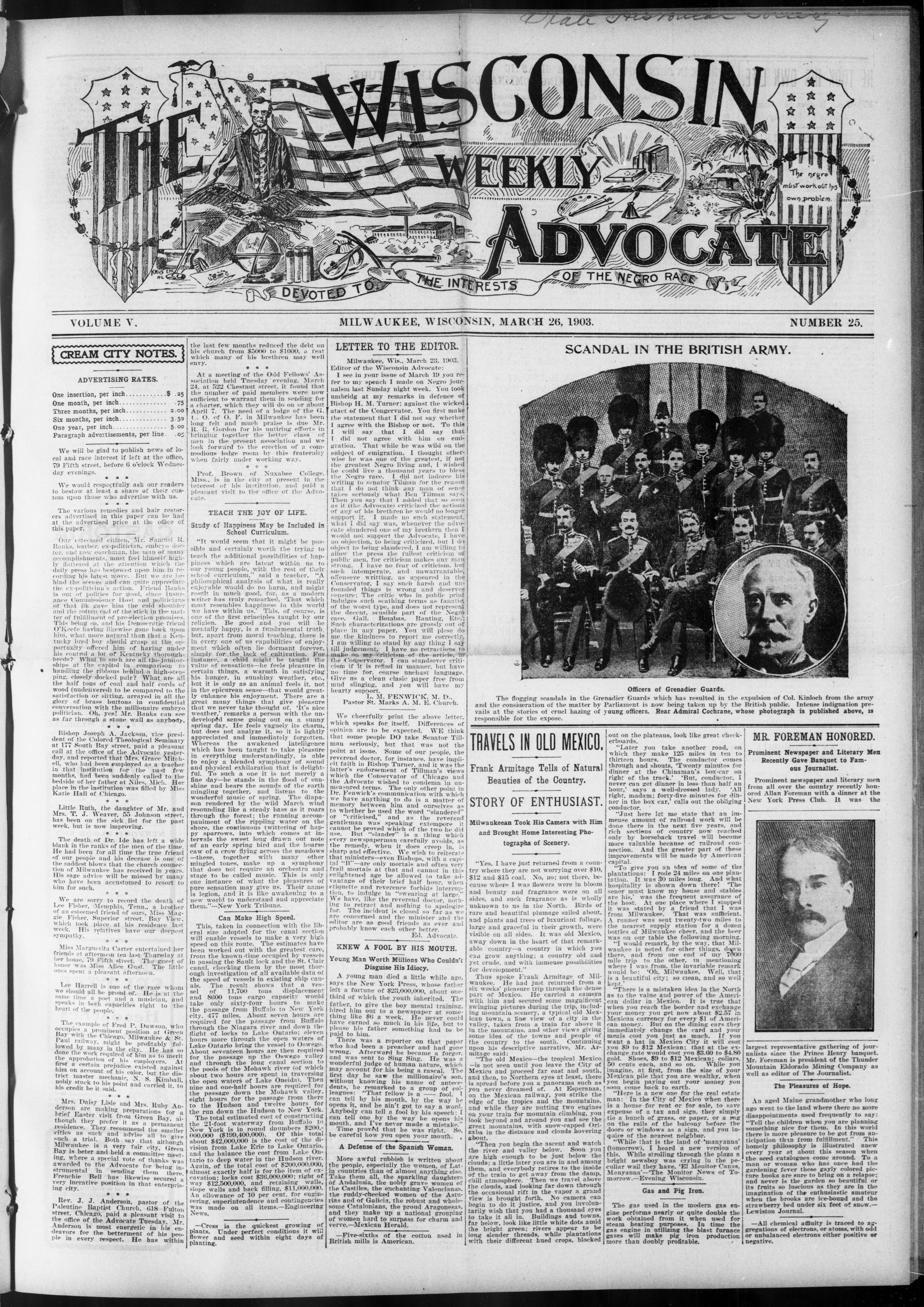
[Picture of a group of soldiers in uniform, with a portrait of a man in a suit and hat in the foreground].
The flogging scandals in the Grenadier Guards which has resulted in the expulsion of Col. Kinloch from the army and the consideration of the matter by Parliament is now being taken up by the British public. Intense indignation prevails at the stories of cruel hazing of young officers. Rear Admiral Cochrane, whose photograph is published above, is responsible for the expose.
TRAVELS IN OLD MEXICO.
Frank Armitage Tells of Natural Beauties of the Country. STORY OF ENTHUSIAST.
Milwaukeean Took His Camera with Him and Brought Home Interesting Photographs of Scenery.
"Yes, I have just returned from a country where they are not worrying over $10, $12 and $15 coal. No, no; not there, because where I was flowers were in bloom and beauty and fragrance were on all sides, and such fragrance as is wholly unknown to us in the North. Birds of rare and beautiful plumage sailed about, and plants and trees of luxuriant foliage, large and graceful in their growth, were visible on all sides. It was old Mexico, away down in the heart of that remarkable country—a country in which you can grow anything; a country old and yet crude, and with immense possibilities for development."
Thus spoke Frank Armitage of Milwaukee. He had just returned from a six weeks' pleasure trip through the dense part of Mexico. He carried a camera with him and secured some magnificent swinging pictures during the trip, including mountain scenery, a typical old Mexican town, a fine view of a city in the valley, taken from a train far above it in the mountains, and other views giving some idea of the towns and people of the country to the south. Continuing upon his descriptive narrative, Mr. Armitage said:
"The old Mexico—the tropical Mexico is not seen until you leave the City of Mexico and proceed far east and south, and then, to Northern eyes at least, there is spread before you a panorama such as you never dreamed of. At Esperanza, on the Mexican railway, you strike the edge of the tropics and the mountains, and while they are putting two engines on your train for mountain climbing, you look beyond and around you and see the great mountains, with snow-capped Oriaba in the distance and clouds hovering about.
"Then you begin the ascent and watch the river and valley below. Soon you are high enough to be just below the clouds; a little later you are in and among them, and everybody retires to the inside of the train to get away from the damp, chill atmosphere. Then we travel above the clouds, and looking far down through the occasional rift in the vapor a grand view is brought forth. No camera can begin to do it justice, and you involuntarily wish that you had a thousand eyes to take it all in. Buildings and towns, far below, look like little white dots amid the bright green; rivers appear to be long slender threads, while plantations with their different hued crops, blocked
Officers of Grenadier Guards.
out on the plateaus, look like great checkerboards.
"Later you take another road, on which they make 125 miles in ten to thirteen hours. The conductor comes through and shouts, 'Twenty minutes for dinner at the Chinaman's box-car on right of the track.' 'But, conductor, I never can get dinner in less than half an hour,' says a well-dressed lady. 'All right, madam; forty-five minutes for dinner in the box car,' calls out the obliging conductor.
"Just here let me state that an immense amount of railroad work will be done there in the next five years, and rich sections of country now reached only by horseback travel will become more valuable because of railroad connection. And the greater part of these improvements will be made by American capital.
"To give you an idea of some of the plantations: I rode 24 miles on one plantation. It was 30 miles long. And what hospitality is shown down there! 'The senor must know my house and stables are his,' was the frequent assurance of the host. At one place where I stopped it was stated by a friend that I was from Milwaukee. That was sufficient. A runner was sent twenty-two miles to the nearest supply station for a dozen bottles of Milwaukee cheer, and the beer was on our table the following morning.
"I would remark, by the way, that Milwaukee is noted for other things, down there, and from one end of my 7000 mile trip to the other, in mentioning where I was from, the invariable remark would be: 'Oh, Milwaukee. Well, that is a beautiful city; so clean, and so well kept.'
"There is a mistaken idea in the North as to the value and power of the American dollar in Mexico. It is true that when you reach the border and exchange your money you get now about $2.57 in Mexican currency for every $1 of American money. But on the dining cars they immediately change the card and your meals cost you just as much. If you want a hat in Mexico City it will cost you $9 to $12 Mexican; that at the exchange rate would cost you $3.60 to $4.80 gold. Shoes, $9 to $12 Mexican; collars, 50 cents each, and so on. While you imagine, at first, from the size of your Mexican pile that you are wealthy, when you begin paying out your money you soon come back to earth.
"Here is a new one for the real estate man: In the City of Mexico when there is a house for rent or for sale, to save expense of a tax and sign, they simply tie a bunch of grass, or paper, or a rag on the rails of the balcony before the doors or windows as a sign, and you inquire of the nearest neighbor.
"While that is the land of 'manyanna' (tomorrow), I heard a new version of this. While strolling through the plaza a bright newsboy was crying in the peculiar wail they have, 'El Monitor Canas, Manyanna'—'The Monitor News of Tomorrow.—Evening Wisconsin.
Gas and Pig Iron.
The gas used in the modern gas engine performs nearly or quite double the work obtained from it when used for steam heating purposes. In time the gas engine in utilizing the blast furnace gases will make pig iron production more than doubly profitable.
NUMBER 25.
ARMY.
expulsion of Col. Kinloch from the army
British public. Intense indignation pre-
nose photograph is published above, is
MR. FOREMAN HONORED.
Prominent Newspaper and Literary Men Recently Gave Banquet to Famous Journalist.
Prominent newspaper and literary men from all over the country recently honored Allan Foreman with a dinner at the New York Press Club. It was the
M.
largest representative gathering of journalists since the Prince Henry banquet. Mr. Foreman is president of the Thunder Mountain Eldorado Mining Company as well as editor of The Journalist.
The Pleasures of Hope.
An aged Maine grandmother who long ago went to the land where there no more disappointments used frequently to say: "Tell the children when you are planning something nice for them. In this world there is more pleasure to be got from anticipation than from fulfillment." This homely philosophy is illustrated anew every year at about this season when the seed catalogues come around. To a man or woman who has once had the gardening fever these gayly colored picture books are sure to bring on a relapse; and never is the garden so beautiful or its fruits so luscious as they are in the imagination of the enthusiastic amateur when the brooks are ice-bound and the strawberry bed under six feet of snow.—Lewiston Journal.
All chemical affinity is traced to aggregations of electrons, or atoms, with odd or unbalanced electrons either positive or negative.
HE TOOK HIS OWN LIFE.
Eminent British Officer was Under Scandalous Charges—London Great-
ly Shocked. London, March 25.—The Evening News announces that Maj.-Gen. Sir Hector MacDonald, commanding the British forces in Ceylon, against whom charges based on immoral acts were filed some time ago, committed suicide today by shooting in a hotel in Paris.
Colombo, Ceylon, March 25.—The news that Maj.-Gen. Sir Hector MacDonald, commander of the British forces in Ceylon, idol of the Highland Brigade in the South African war, was to be court-martialed created a profound sensation in military and social circles. That a soldier who has exhibited the utmost gallantry and bravery on the field of battle should have such serious charges preferred against him has astounded everybody. Sir Joseph West Ridgway, the governor of Ceylon, was authorized to convene a court-martial to try Sir Hector
London, March 25.—Not since the trial of Col. Valentine Baker, who was sentenced to twelve months' imprisonment on August 2, 1875, for assaulting a woman in a railroad carriage, has the military and social world been so shocked as by the news from Colombo that Gen. MacDonald was to be court-martialled on charges of immoral conduct. Gen. MacDonald has been decorated time and again for heroic action on the battle field, and the service list shows no more honorable war record than his. He has been wonderfully popular in the army and civil life.
While army officials and many of his brother officers were aware that charges were pending against Gen. MacDonald no intimation of their nature leaked out until the dinner of the officers of a Highland regiment March 21, at which MacDonald was not present. Lord Roberts, the commander-in-chief, paid tribute in a speech on that occasion to the Highland officers who had served with distinction, but did not mention MacDonald. This attracted considerable notice and the sensation was increased when another speaker, who was not aware of the facts in the case, lauded MacDonald as a typical Highland soldier, and found that his remarks were received in cold silence by a majority of the officers present.
ABUSIVE HUSBAND PUNISHED BY SON.
Alonzo Jackson Strikes His Wife and His Boy Lays Him Low with Two Bullets.
Chicago, Ill., March 25.—Coming to the rescue of his mother, who was being beaten by her drunken husband, Ray Jackson, 19 years old, shot and probably fatally wounded his father, Alonzo Jackson, at their home today. The son then started to give himself up, but yielded to the pleadings of his mother to try to escape. He was captured several hours later. According to the story of Mrs. Jackson her husband came home intoxicated and began to abuse her. The son interfered and was ordered from the house. He promised to go on condition that his mother suffer no further abuse, but had hardly reached the door when the elder man struck his wife and knocked her down. Ray drew a revolver and fired twice, both bullets taking effect in his father's right side. His chances of recovery are said to be small.
DROVE AN AUTOMOBILE UP THE CAPITOL STEPS.
Daring Exploit of Three Young Men at Washington—Reached Second Landing and are Arrested.
Washington, D. C., March 25.—Three men in an automobile attempted to ride up the steps at the east front of the capitol today. They reached the second landing, sixteen steps from the street, when the chain of the vehicle broke and it ran back, but without accident. The man who acted as chauffeur gave the name of J. D. Hurlburt and said he was from Detroit, Mich. His companions did not give their names, but one of them said he was a police commissioner of Hartford, Conn. The chauffeur was arrested, but later released on $10 collateral.
STATE WILL SELL RAILROAD.
Vandalia Line Offered for Sale to Sat isfv a Judgment.
Indianapolis, Ind., March 25.—Sheriff Bray of Clay county received from the clerk of Marion county a legal notice under which he will proceed to sell the Terre Haute & Indianapolis railroad to satisfy the judgment of the Marion superior court, affirmed by the state supreme court. The judgment is $913.905.01 and the costs are $1986.80. In addition there is 6 per cent. interest, which makes the total liability to the state of Indiana of the Vandalia a little over $1.000,000. It is thought that the Vandalia will bring an injunction proceeding in the federal court to prevent the sheriff from proceeding.
FOURTEEN KILLED IN RIOT.
Uprising in Trinidad Brings Serious Loss of Life:
Port of Spain, Island of Trinidad, March 25.—Fourteen natives were killed and forty were wounded during the rioting. Quiet has been restored. The government building was entirely destroyed by the rioters and the police barracks were damaged by fire and water. All the government records were destroyed. Kingston, St. Vincent, March 25.—Two hundred men of the Lancashire Fusiliers left the island of Barbadoes for Port of Spain, Trinidad, on board the British schooner, E. A. Sabean.
CASTRO RECONSIDERS.
President of Venezuela Withdraws His Resignation.
Caracas, Tuesday, March 24. After reading his special message to Congress today, Gen. Castro withdrew his resignation of the presidency of Venezuela.
Death of Naval Engineer.
New York, March 25.—Chief Engineer A. W. Morley, U. S. N., retired, is dead at his home in Brooklyn. He was one of the best known and most capable officers of the old engineer corps of the navy.
UPROAR IN CHINATOWN.
Leading Highbinder Societies of San Francisco Declare War Upon Each Other.
Portland, Ore., March 24.—Not since the fierce Highbinder fight, fifteen years ago, when several Chinamen were killed in Chinatown, has the Chinese section of the city been in such a state of uproar and excitement.
Two of the leading Highbinder associations of the city have declared open warfare and two more of the leading societies are fast being drawn into the trouble.
"A thirst for blood has arisen among them," said one of the conservative Chinese, and not until the cannery Chinamen are again all back at their work will quiet lie restored."
The Po Lin Tong and Bo On Tong societies are the leaders in the fight and are making preparations to contest their disputes to the bitter end. Fifteen Chinese of fighting fame arrived from Astoria Sunday night to be on hand when the trouble comes to a head. "They openly challenge us to fight," said a member of the Hop Sing Society," and say that we are afraid of them. If they would import all of the men they have on the coast we would still have the strongest society." Chinese thronged the police station last night and told their tales of fear to the police. The chief of police informed them that he would double the patrol in Chinatown until the trouble had abated.
REVOLUTION CAUSES FEARATSANDDOMINGO.
Minister of War Surrenders to the Enemy—Commerce Said to be at a Standstill.
San Domingo, March 24.—Quiet has been restored in this city by the warships in port.
The minister of war, Senor Picardo, has surrendered to the revolutionists and the minister of posts and telegraphs, Senor Oastillo, has joined the foreign minister, Senor Sanchez, in seeking refuge at the United States consulate.
The inhabitants of the villages around this city are joining in the revolutionary movement. No news is obtainable from the southern and northern parts of the island.
There was severe fighting yesterday at La Vega, but the result is not known.
If the North and South refuse to join in the revolutionary movement, the situation may become more serious than it is. Commerce is at a standstill and there is considerable anxiety as to the future.
A warship is going to San Pedro de Macoris, to the eastward of this city, in order to compel it to surrender. The warship Presidente, which is off the northern coast of the island, is in the possession of President Vasquez.
BLIZZARD IN MICHIGAN.
One of the Worst Storms of the Winter Raging in the Eastern Part of the State
Detroit. Mich., March 24.—Specials from Eastern Michigan state that one of the worst blizzards of the winter is raging in that section, with the temperature below freezing. Grand Rapids reports heavy snow, the temperature 2 degrees under the freezing point and snow plows being used on the local and interurban electric lines to keep them open. Much fear is felt for small fruits and peaches. At Benton Harbor and St. Joseph much damage has been done by the wind. Wires are down and a number of small buildings have been damaged. The big store of H. L. Bird & Co. at the principal corner in Benton Harbor is wrecked by the wind and its stock and fixtures ruined. There is a tremendous sea running on Lake Michigan and navigation is temporarily suspended.
In Detroit the temperature hovered close to freezing during the morning with a 45-mile an hour wind prevailing. There was no snow fall, however.
MARRIED TOO OFTEN.
Chicago Police Believe They Have the Man Who Deceived Kenosha Young Woman.
Chicago, Ill., March 24.—Edward Brandon, alias George Allen, alias Edward Priestly, 35 years old, who the police believe is wanted in various parts of the country on many charges of bigamy and swindling women, is a prisoner at central station. He was arrested early last night at the instance of Miss Theresa Reinhart of Minneapolis, who claims that some time ago Brandon was married to her under the name of George Allen and after living with her one day fled with $250 of her money. The police claim to have learned that Brandon was also married to Miss Minnie Evans of Kenosha, Wis., under the name of Edward Priestly, deserting her soon after the wedding, taking several hundred dollars of her money. While in Kenosha he is said to have moved in the best society.
MESSAGE FROM PALMA
Cuban Senate Must Ratify Amendments to Reciprocity Treaty by the must of March.
Havana, March 24.—President Palma has sent a message to the Senate to the effect that unless the amendments adopted by the United States Senate are approved before March 31 it will be impossible to conclude the reciprocity treaty. President Palma understands that the United States House of Representatives will be convened in September. The matter will be carried through by October. The senators supporting the administration are confident that the amendments will be approved. Senior Sanguilly, who has opposed the treaty in the Senate from the first, says he hopes that the amendments adopted by the United States Senate will now kill the treaty.
Makes International Mirth.
The proposition that the government shall adopt the metric system of weights and measures having been condemned by resolution in the last meeting of the American Society of Mechanical Engineers, the Electrical World and Engineer editorially assert that the society has made itself "An object of international merriment, to the pained astonishment of the scientific public."
Romance of Millions.
From Odessa comes a romantic story of a miser's millions. A man named Raeli died some months ago amid surroundings indicative of the utmost penury. Or his death bed he said to his friends: "I leave nothing but debts," but on a judicial inventory of his possessions being made it has been found that he died worth $20,000,000, most of which was invested in British securities.—Exchange.
FORM A GIGANTIC PACKING COMBINATION.
Seven Minor Concerns Merged Into a New Company Controlled by Armour, Swift and Others.
Chicago, Ill., March 25.One step further toward the consolidation of the packing interests of the country was taken yesterday when the National Packing Company was licensed to do business in Illinois. The new company unites seven of the smaller concerns under the management of a board of directors composed of men who control the great corporations. The seven individual packing houses will no more be in the market as competitors of the great houses. As they are now owned by the heads of the big companies, they will form an additional common bond between these concerns and, it is believed, lessen any possible competition among them.
The National Packing Company was incorporated in New Jersey on March 18 with a capital stock of $15,000,000 and its annual business is estimated at $150,000,000. It was organized for the purpose of doing business in Illinois. The concerns bought by the National company are as follows:
Omaha Packing Company, Omaha.
Hammond Packing Company, St. Joseph and Omaha.
G. H. Hammond Company, Chicago.
Hutchinson Packing Company, Hutchinson, Kan.
Anglo-American Provision Company, Chicago.
United Dressed Beef Company, New York.
Fowler Packing Company, Kansas City.
The officers of the concern are:
President
Secretary and Treasurer—J. D. Standish
Directors—J. Ogden Armour, P. A Valen-
tine, G. F. Swift, L. F. Swift, E. F. Swift,
Edward Morris, Ira N. Morris, Arthur
Meeker and Kenneth K. McLaren.
OPERA HOUSE AT TORONTO DESTROYED.
Family Which Occupied Rooms on the Third Floor Narrowly Escaped Suffocation.
Teronto, Ont., March 25.—The Toronto Opera House was burned today. The estimated loss was $150,000.
The fire is supposed to have originated from electric wires in the box office. Caretaker Chairman occupied rooms on the third floor with his wife and three children. They narrowly escaped suffocation.
The flames spread to the cigar factory of John Trebilcock in the rear, the premises being badly damaged.
Sullivan, Harris & Woods, the proprietors of the King of Detectives Company, lost all the scenery and costumes. They place their loss at $10,000 to $12,000.
Cape May, N. J., March 25.—The Marine Villa Hotel, valued at $60,000, was entirely destroyed by fire of unknown origin today. The insurance is $30,000. Fort Wayne, Ind., March 25.—A large part of the car building plant of the Pennsylvania railroad at this place was destroyed by fire this morning. Part of the main building, thirty-five finished cars and immense stores of materials were destroyed. The loss is between $75,000 and $100,000.
WILLIAM A. RUBLEE TO BE TRANSFERRED.
Present Consul General at Havana to be Succeeded by Frank M. Steinhart.
Washington, D. C., March 25.—Frank M. Steinhart is to be appointed consul general at Havana, succeeding William A. Rublee, who is to be transferred to some post of equal importance in the diplomatic or consular service. Mr. Steinhart is a resident of Illinois.
In the absence of direct information it is believed that the transfer is due to the fact that the Cuban climate does not agree with Mrs. Rublee.
It is understood that a place has been found Mr. Rublee as United States consul general at Vienna, a post almost as lucrative as that of Havana and much more to his liking. It is at present held by Carl Bailey Hurst, a son of Bishop Hurst, and resident of the District of Columbia.
SHE SUGGESTS SUICIDE.
Covington, Ind., Woman Denies that She Murdered R. J. Drake of Wisconsin.
Covington, Ind., March 25.—[Special.] Mrs. Elimira Myers Drake, who is held in jail here, charged with murdering her husband, Robert J. Drake, formerly of Richland Center, Wis., by the slow zinc process, submitted to an interview today in which she said Drake kept sulphate of serine round the house, and that when in fits of anger was almost crazy and might have taken the sulphate of serine himself.
The grand jury is closing its investigation today and it is thought that an indictment will be returned tomorrow.
An analysis of Drake's stomach shows that he died of slow zinc poisoning. Mrs. Drake has served one term in the Indiana reformatory and was charged with making a business of criminal operations. She is credited with being worth $30,000. Drake answered an advertisement she placed in a matrimonial paper and married her two years ago. His body was taken back to Wisconsin for burial.
KILLS STAGE COACH GUARD.
Lone Highwayman in California Foiled by Bravery of Driver.
Ukiah, Cal., March 25.—A lone highwayman attempted to hold up the stage coach traveling between this point and Mendocino City and shot and instantly killed the armed messenger, Q. A. Overmeyer. The driver, Harry Owaly, whipped up his horses and amid a rain of bullets escaped uninjured. The stage was held up in the same spot about a month ago by the same man, it is thought.
SENT TO THE REFORMATORY
Columbus Boy Pleads Guilty to a Serious Crime.
Portage, Wis., March 25.—[Special.]—Charles Becker of Columbus was yesterday given an indeterminate sentence of one to ten years in the reformatory at Green Bay on a plea of guilty to a charge of attempted criminal assault upon a girl near his home. Becker is only 19 years old.
Veteran Editor to Retire
Osceola, Wis., March 25.—[Special.]—Charles E. Mears, who has been editor and proprietor of the Polk County Press at this place since 1872, will retire from the field after April 4. Mears is the oldest continuous publisher in the upper St. Croix valley. Paul Van der Eike, the new publisher and owner, will get out his first issue of the Press on April 1.
LEGISLATURE
Proceedings in the Senate.
The session of the Senate on the 19th was the first one for a long time at which no petitions or communications of any kind reached the desk of the clerk, and the calendar was taken up immediately. The following bills were passed or concurred in: Providing that any balance of the annual appropriation for the State Historical Society must be added to the expenditures of the next ensuing year; amending the existing laws, so that a referee in case of absence of the official reporter shall call in some other competent reporter, whose compensation shall be the same as provided by law; relating to fees for registrar of deeds; amending the law relating to legal qualifications for kindergarten teachers by striking out the word "incorporated" in the respective section of the law of 1901; authorizing O. E. Peterson and L. E. McGill to build and maintain a dam across Flambeau river in Gates county; relating to certificates of proof of record; relating to bonds of soldiers' relief commission; to cure certain omissions in organizations of corporations; legalizing official acts of Thomas Marsh, justice of the peace in Waukee in Dane county; amending subsection 67 of section 925F of the Wisconsin statutes of 1888 relating to the general charter law, by inserting the words "so convicted of" after the word "person" in the third line; amending the laws relating to the house of correction of the city of Milwaukee; to authorize cities of the first class to establish building lines along boulevards; providing that the reports on statistics of farm products shall also contain reports of sugar beets, cattle other than milch cows, horses of all ages, sheep and lambs, swine 4 months old or over; and providing, further, that the reports shall be made to the secretary of the state board of agriculture instead of to the secretary of state; to authorize cities of the third class to issue bonds for school purposes; providing that police magistrates may solemnize marriages. The Senate refused to order to engrossment and third reading the bill relative to detaching counties from the Sixteenth judicial circuit and attaching same to the Tenth circuit.
Immediately after the call to order President Pro Tem. McGillilray in the Senate on the 20th announced the death of Justice Charles V. Bardeen of the state supreme court. The joint resolution from the Assembly was passed and as a mark of respect the Senate adjourned to the 23d. The only work done by the Senate at the evening session on the 23d was to pass a bill giving members of the legislative committee appointed to visit the state charitable and penal Institutions $150 each for expenses incurred. The committee consisted of Senator Miller and Assemblymen Dahl and E. W. Evans.
The Senate on the 24th ordered to a third reading the bill to provide that license money collected from street railways shall be paid to the several cities and villages through which they run in proportion to the mileage. The Senate passed a bill to refund the inheritance tax, collected under an unconstitutional law. The amount is $59,672. The Senate ordered to a third reading the Assembly bill providing that judges issuing permits for immediate marriages, in advance of the time prescribed by license, shall receive no compensation therefor. The Assembly bill providing that the state shall pay assurance companies for the bonds of the state treasurer was sent to the judiciary committee by the Senate, the opinion prevailing that it is unconstitutional. Senator Hudnall's bill to license barbers came up on a recommendation for indefinite postponement, and he asked that it be sent back to the committee on public health, which was agreed to.
The committee on corporations reported to the Senate at the evening session on the 24th in favor of bills opening to competition bids for asphalt paving in Milwaukee, and in favor of putting Milwaukee on a par with other counties in the matter of accepting bonds for its officers from surety companies. It recommended for indefinite postponement the bill to repeal all special charters and bring all cities under the general laws and also against the joint resolution to enable cities to issue bonds to run for fifty years instead of twenty, as at present. The committee on claims reported to the Senate favorably on the bill to reduce the school tax to 7-10 of a mill and take $350,000 from the general fund, and after another technical amendment the bill was ordered placed on the general file.
Lieut. Gov. Davidson on the 25th appointed Senators Stout, Kreutzer and Merton as the senate members of the legislative joint committee to receive President Roosevelt when he comes to Madison. The Senate ordered to a third reading the Stout educational bill, providing that children under 14 years of age shall attend school eight months in the year and that those under 16. if not at work, shall also be compelled to attend. The bill giving Thomas J. Flemming the right to redeem a portion of the state fair grounds forfeited to the state under a mortgage was also ordered to a third reading by a vote of 19 to 6. A bill was introduced by the committee on education to create a pension fund for the retirement of public school teachers in Milwaukee.
In the Senate on the evening of the 25th the committee on public health reported back the bill to license barbers and recommended that it go to the judiciary committee, which was ordered, despite the protest of Senator Kreutzer.
Proceedings in the Assembly.
At the opening of the Assembly session on the 19th, Mr. Ray moved that the vote by which the 19S, authorizing county boards to appropriate not to exceed $10,000 for soldiers and sailors' monuments without submitting the question to vote of the people, was nonconcurred in, be reconsidered. The motion carried 60 to 34. Mr. Ray then moved concurrence in the bill. After over an hour's debate the bill was concurred in 57 to 39. The consideration of the Assembly school committee bill was postponed until the 25th. A joint resolution was introduced by Mr. Cady providing for the appointment of a legislative committee to act with the citizens' committee in the reception of President Roosevelt April 3. The anti-cigarette bill, prohibiting the sale or importation of cigarettes into the state, was reported favorably for passage by the committee on health and sanitation with an amendment. Mr. Cady objected to the Timlin bill exempting pianos and organs from taxation, but it was passed by a vote of 70 to 22. Mr. Ray opposed the bill regulating automobiles, on the calendar for engrassment, believing it imposes too great restrictions on owners of automobiles. The substitute was adopted and the bill ordered to engrossment and third reading. The following bills were passed: Authorizing a dam across Brule river in Douglas county; amending the law providing for revocation of attorneys' license; providing that territory annexed to cities shall have the option as to granting of liquor license therein; providing for the rebinding and transcribing of public records; amending the law relative to courts taking judicial notice of acts of Congress; amending the law relative to Dane county court; authorizing the city of Milwaukee to locate isolation hospital outside city limits.
Speaker Lenroot in the Assembly on the 20th announced the death of Judge Bardeen. Mr. Wallrich introduced the joint resolution in the Assembly, and it was immediately passed and messaged over to the Senate. The joint committee to represent with the officers the Legislature at the funeral was appointed as follows: Senators Kreutzer, Hatten, Miller, Hudnall and North, Assemblymen Wallrich, Ekern, D. Evans, Dudgeon, Smelker, A. E. Smith, E. W. Evans. The Assembly adjourned to the 23d.
The Assembly on the evening of the 23d passed a bill under suspension of the rules, which is intended to clear up the complications respecting the election of supervisors in cities operating under special charters. The Assembly committee on public health and sanitation adversely reported the Lenroot bill, No. 212A, prohibiting the sale
of ice harvested from water in which sewerage flows for domestic purposes. Speaker Lenroot announced the appointment of the house members of the joint legislative committee to assist the citizens' committee in arranging for the reception and entertainment of President Roosevelt here April 3. The members appointed are Messrs. Cady, Andrew, Ray, Frear and Potter. The Assembly on the 24th passed the automobile bill, ordered engrossed the anti-cigarette and stationary engineers' bills, and laid over the Smalley school fund income bill. The Reynolds bill, making the offices of state dairy and food commissioner, bank examiner and commissioner of labor and statistics elective instead of apointive, was on the calendar for indefinite postponement, but the committee's recommendation was rejected, and the measure
was recommended to the committee on privileges and elections for further consideration. The Lord bill, providing that electors need not be registered in cities and villages of less than 3000 population, was referred to the committee on privileges and elections. The Assembly committee on finance, banks and insurance at the evening session on the 24th favorably reported bill No. 101A, providing that no life or fraternal insurance corporation shall issue certificates of insurance effective within this state containing a suicide clause volding such insurance after one year from the time of the issuance of such insurance, in the event of the insured coming to his death by his own act while insane.
In the Assembly on the 25th the Mosher bill providing for insuring the state buildings was concurred in, the judiciary committee bill providing that sulcides of insane persons a year after they have taken out life insurance shall not invalidate such insurance was advanced to engrossment, and the adverse recommendation of the committee on the Ray bill requiring state depositories to furnish surety company or United States, municipal, or other bonds to an amount 50 per cent. greater than the amount of state moneys to be received by such depositories was overridden and the bill amended and laid over. Among other Senate bills concurred in by the Assembly were the Stout bill providing that a diploma granted by the board of regents of normal schools to any persons who complete the training course for teachers of manual training and domestic science shall legally qualify the holder to teach the subjects mentioned one year in any school in the state. The Assembly committee on public health and sanitation favorably reported the Whitson bill creating the office of state vital statistician, and providing for a more complete registration of births and deaths.
complete registration of births and deaths.
The Assembly committee on cities, at the evening session on the 25th, adversely reported the Westfahl bill, No. 558A, authorizing the city of Milwaukee to employ a fire marshal and a deputy fire marshal. This committee also adversely reported the E. W. Evans bill, repealing section 925 of the statutes of 1898, requiring cities desiring to engage in municipal lighting to buy private plants if any exist within such cities and the owners of them are willing to sell, the prices being fixed by disinterested appraisers; and the Dudgeon bill, amending the same section so as to exempt Madison from its provisions. The committee on manufactures adversely reported the Lerov bill No. 84A, authorizing the commissioner of labor when requested by any central body of organized labor to appoint additional assistant factory inspectors who shall serve without pay.
CONGRESS.
Proceedings in the Senate.
A resolution was agreed to in the Senate on the 19th authorizing the committee on territories to sit during the recess to consider proposed bills relative to Alaska. At 11:08 the Senate went into executive session and took up the Cuban reciprocity treaty. Senators Foster (La.), Berry (Ark.) and Carmack (Tenn.) spoke in opposition. Senator Simmons (N. C.) spoke in favor of the treaty. All the committee amendments were adopted, including the Burton amendment for flour, corn and corn meal, but the last named was compromised so as to place these articles on the 30 per cent. list. The Democrats offered a number of amendments, but they were voted down. The treaty was then ratified by a vote of 50 to 16. The President was notified of the action and at 5:14 p. m. the Senate adjourned sine die.
Chicago Matters.
Three days ago Timothy Walsh, a policeman, died of pneumonia. He had served on the force eight years and was 35 years old. H. F. Moore, Jr., 11 years old, died at the Garfield Park sanitarium from injuries received March 16. He was struck by a street car and dragged several feet. Rev. Dr. William J. Chichester, pastor of the First Presbyterian Church of Chicago, died at the Piedmont Hotel, Atlanta, Ga., from blood poisoning resulting from nephritis.
Although probably fatally stabbed during a brawl in his residence, Ross Malone, a teamster, refused to tell the name of his assailant to the police. Three stab wounds had pierced Malone's neck and right side, and he was taken to the county hospital.
In a renewal of what is said to have been an old feud John Sweeney, who lives in a lodging house at Desplaines and Madison streets, was shot and probably fatally wounded by Edward Ennis, who lives at Madison and Halsted streets.
Charles E. Scharlau, an ex-member of the Legislature and an attorney, who had been prominent in German political and social circles in the northwest part of Chicago many years, died at his residence. He was 57 years old and leaves a widow and three children.
Dr. Herbert H. McCauley is dying at St. Joseph's Hospital in Joliet. Dr. McCauley was operated on for appendicitis and sank rapidly. He was the surgeon in charge of the contingent which left Chicago two years ago to aid the Boers in South Africa.
Described as Follows. To-Wit.
"In making a deal last year," said a Detroit speculator, "I came into possession of the deed to a certain piece of land in North Dakota. The value of the real estate was put at $600 and I paid taxes on it in January, and in February I wrote to the postmaster of the nearest town to send me particulars concerning my holdings. I sent him $2 for his trouble, and he earned the money. He wrote back:
"Went over to see your land.
"Cussed poor road all the way.
"Cussed poor road back again.
"Most of your land is under water.
"What ain't under water is afflicted with drought.
"You've either got to wet it all up or dry it all out.
"Can't burn up or run away.
"Keep your taxes up and pray to the Lord."
"Glad you sent me $2 instead of the deed.
"If you want any further particulars I'll ship you a barrel of water.'"—Detroit Free Press
Winter Whiskers
"This used to be the time of year when we cut the crop of winter whiskers, but there are no more whiskers to cut," observed the veteran barber. "The crop has been a failure for several years now, and I can't say I'm sorry, for the less whiskers there are the more shaves. Up until five or six years ago it used to be the thing for fashionable young men to wear Van Dyke beards during the winter months, and with the first approach of spring they would hasten to have them taken off. But the fashions in men's faces change just as do fashions in women's hats, and it is no longer considered good form to wear beards, even in cold weather. A closely cropped mustache is permissible, if a man has always worn one, but the proper caper is to have a perfectly smooth face."—Philadelphia Record.
Bats Not to be Blinded.
It has often been attempted to blind bats by tying a bandage over their eyes, but this does not prevent them from flying about a closed room as well as if they saw, and avoiding all obstacles, such as stretched strings crossing each other in all directions.
Haste of Surgeone.
Without doubt there is a disposition on the part of some surgeons to use the knife on slight provocation. With modern aseptic surgical methods, cutting has come to seem to them as much a matter of course as the administration of a dose of calomel seemed to their predecessors of two generations ago. Under such circumstances there is a natural tendency to perform operations without in all cases giving due weight to the wishes of patients and their friends. This is particularly true in public hospitals, where treatment, not of persons, but of cases, becomes inevitable. Therefore, it is not a bad thing for the medical profession to be sharply reminded of its responsibilities, as it has been by a Chicago court, which gives $3000 damages to the husband of a woman who was operated upon without her consent or that of her husband. The court holds that the outcome of the operation is not to be considered. In acting without express consent of some person competent to give it, the surgeon commits a violation, or trespass, on the body of the patient.—New York Tribune.
A Cure for Rheumatism.
Alhambra, Ill., March 23.—Physicians are much puzzled over the case of Mr. F. J. Oswald of this place. Mr. Oswald suffered much with Rheumatism and was treated by doctor after doctor with the result that he got no better whatever. They seemed unable to do anything for him and he continued to suffer till he heard of Dodd's Kidney Pills. Mr. Oswald began a treatment of this remedy which very soon did for him what the doctors had failed to do and they cannot understand it.
This is the same remedy that cured Hon. Fred A. Busse, our State Treasurer, of a very severe case of Rheumatism some years ago and which has since had an unbroken record of success in curing all forms of Rheumatism and Kidney Trouble. There seems to be no case of these painful diseases that Dodd's Kidney Pills will not cure promptly and permanently.
A Feline Barometer.
Cats often predict a rain storm by the act of rubbing their ears. This is because the air is filled with more electricity than usual, and the electricity pierces the skin of the animal. Electricity at this time is also in the hair of the cat and makes her feel as though she were covered with cobwebs.
Australia is to have a transcontinental railway from Adelaide to Port Darwin.
CASTORIA For Infants and Children. The Kind You Have Always Bought
AT BED TIME I TAKE A PLEASANT HERB DRINK
THE NEXT MORNING I FEEL BRIGHT AND NEW AND MY COMPLEXION IS BETTER.
My doctor says it acts gently on the stomach, liver and kidneys and is a pleasant laxative. This drink is made from herbs, and is prepared for use as easily as tea. It is called "Lane's Tea" or
LANE'S FAMILY MEDICINE All druggists or by mail 25 cts. and 60 cts. Buy it to day. Lane's Family Medicine moves the bowels each day. In order to be healthy this is necessary. Address. O. F. Woodward, Le Rov. N. Y.
Four years student and assistant to Prof. N. Senn, M. D. Ph. D., L. L. D., world's greatest surgeon. Four years at Columbia University College of Physicians and Surgeons, world's greatest and best medical school. Dr. Nolte makes a specialty of curing PRIVATE.
NERVOUS, BLOOD AND SKIN DISEASES
Home treatment successfully given to those who cannot call in person. Write for rates of treatment. No charge over $1 to $2 per week for medicine and treatment.
X-Ray Examination $1.00
Office Consultation .50
Out-of-Town Consultation $1.00
I don't pretend to cure in one sitting, nor in a few days, but I guarantee a complete cure with legitimate methods.
I pay NO railroad fare, nor give something for nothing.
Office Hours - 9-12 a. m., 2-5 and 7-9 p. m.
BROMO-
SELTZER
CURES ALL
Headaches
10 CENTS--EVERYWHERE
DALMORE
DR. McNAMARA.
Established 1861 for the cure of Nervous Debility, Exhaustion of Brain Energy, Sexual Weakness, Kidney Afections, Blood Diseases, Barrenness, Monthly Period and Marriage. Unsurpassed facilities and life-long experience. Apply in confidence at 880 Broadway, Milwaukee, Wis.
YOU CAN DO IT TOO
Over 2,000,000 people are now buying goods from us at wholesale prices—saving 15 to 40 percent on everything they use. You can do it too.
Why not ask us to send you our 1,000-page catalogue?—it tells the story. Send 15 cents for it today.
Montgomery Ward Co.
CHICAGO
The house that tells the truth.
Telephone Black No. 244.
SUBSCRIPTION RATES.
Any part of the United States and Canada,
postage paid.
Send money by Express Money Order, P. O. Money Order or Registered Letter to the Wisconsin Weekly Advocate.
ADVERTISING RATES.
One inch, single insertion..... 25c
One inch, per year..... $9.00
Business locals 5c per line each insertion.
Apply for rates to the Advocate.
TO CONTRIBUTORS
All communications must be sent with the name and address of the sender as an evidence of good faith, but not necessarily for publication. No manuscript returned if not accepted, unless accompanied by stamps.
The Wisconsin Weekly Advocate company wishes to notify the public that all contracts and business transactions with this company must have the company stamp, otherwise they will be void. Neither will this company be responsible for paid subscriptions unless given to duly-accredited agents, who, on request, will give the company's receipt for same. Subscribers failing to receive their papers regularly will kindly notify the general office. Address all business communications to the general manager, 79 Fifth street.
Entered in the Postoffice at Milwaukee as Second-class matter.
EDITORIAL PARAGRAPHS.
"I know of the bravery and character of the Negro soldier. He saved my life at Santiago, and I have had occasion to say so in many articles and speeches. The Rough Riders were in a bad position when the Ninth and Tenth cavalry came rushing up the hill carrying everything before them. The Negro soldier has the faculty of coming to the front when he is needed most. In the Civil war he came 400,000 strong, and I believe he saved the Union."—President Roosevelt.
Beware of Impostors
Beware of Impostors
of different professions soliciting money in Wisconsin for purposes unknown to any person in that state and for use elsewhere. Driven out of other states they are overrunning this. We think it an imperative duty on us as being the only negro paper in the state, to protect its generous philanthropists. From now on, we shall warn the mayor and chief of police of every city in Wisconsin against such adventurers.
The bears are giving the bulls no end of cotton batting.
According to the terms of his contract, Mr. Harris was obliged to write his song for Patti before the bawl.
Fitzsimmons is challenging fighters with a rapidity that indicates that he contemplates a get-rich-quick campaign.
The suit of a government officeholder that was, to secure a lost job, is like an attempt to make the created stronger than the creator.
A reported discovery of oil in Michigan foreshadows another lively spell for the peddlers of stock promising millions of return to investors.
It cannot be said that the strike of school children at Marshalltown, Iowa, is an exhibition of the spirit of "76," until a count of the rioters is made.
The Emperor William directs that the colonial reports be written in a clear, concise style, and that the verb be not in every case to the extreme end of the sentence thrown.
Mrs. McNealy, of Pound, Wisconsin, who drank buttermilk containing buttercolor, and nearly died from the effects, might have eaten uncolored oleomargarine without uncomfortable results.
It is reported that the new Shamrock is "full of new ideas." This is not altogether hopeful for British yachtsmen, because new ideas are very often poor ballast. It depends how they are stowed.
Alienists at Iowa City who attempt to pass upon the question of Hamlet's sanity will have to proceed "by the book," because there isn't as much of Hamlet obtainable as the gravedigger found of "poor Yorick."
The usual sugar of praise was scattered upon the designers of the Shamrock with the statement that her lines are "sweet." The same statement will be made as "taffy" for Herreshoff, when the Reliance is launched.
The third Shamrock will repeat the immense topsail yard trick of the first Shamrock to escape penalizing for sail spread. But it will be recalled that the big topsail brought Sir Thomas' first craft to grief on one important occasion.
The fatal whipping of a pupil by a tutor in Berlin, Germany, is one of the occasional results of a practice in school management that is favored here by many German-Americans, on no other ground than that the peculiar brand of school corrective is "made in Germany."
THE PO
By Rev. George P. Hall.
The gifted Frances E. Willard once said that of all the wonderful discoveries of the nineteenth century, the most wonderful was that woman had discovered herself. Fifty years ago the world never heard of a minister devoting a sermon to ladies, unless it was to score them for imagined follies.
J.
REV. G. F. HALL, thought that woman's sphere in the world was to cook, darn, wash, scrub, milk the cows and keep the house. But to-day, while she may do all these things, she is expected to be capable of rising above them. Then few women were educated. To-day the parent who does not give his daughter an equal chance with his son in securing a higher education is hardly considered honorable. Our girls have now greater privileges than ever before, and with these privileges come serious duties and dangers. I wish to make the following suggestions:
First-Remember this is the twentieth century and the world expects something of you more than a butterfly or mirror-tester. You are unworthy of the glorious age in which you live unless you are ambitious enough to try to excel in something.
You should be an all-around woman well-balanced physically, mentally, socially and spiritually. Don't be sickly—take long walks, ride the bicycle, play golf, bowl, skate, row. Spend as much time as possible in the open air, drinking in the pure ozone of God's atmosphere and bathing in the sunshine. To be strong is to be beautiful. Men pity, but as a rule do not like sickly women. To be well is largely a matter of will and exercise. Don't be ignorant—study, think, investigate. If possible, get a thorough collegiate training before you quit.
But don't go too far, and get too smart to marry. Without a good education, however, you cannot hope to be a real companion to the kind of man you ought to choose for your life's partner. And this leads me to say that a right training for the higher social and ethical duties does not come through poring over the insipid society novels with which our news stands are cursed nowadays.
Read something nobly stimulating. Something which will fire in your heart a desire to do something in the world worthy of remembrance. Such reading will keep you from foolishness and blunders.
Second—If you want to be happy go to work. Do something—teach, sew, cook, paint, anything rather than remain idle. God pity an idle woman, for the devil will surely get her sooner or later.
If you are rich, and do not have to work for a living, then be a Helen Gould. Go, visit the poor and needy, and make somebody happier for your visit.
If you are poor, don't wait for something to turn up, or hope in vain that some rich man will propose. Go to work, if only as a domestic. One of the best fields in the world to-day for a young girl thrown on her own resources is that of a domestic. At the end of the year you will have more money than the average stenographer, and you will have mastered the science of housekeeping, without which you cannot be a model wife.
In the third place, young girls should keep good company. All wellbalanced girls expect to marry some time. The bachelor girl by choice is not well balanced. There is something wrong with the girl who don't want to marry and never expects to marry. But in your search for a man look up, not down. Don't chum with an inferior. Avoid illiterate fellows. Shun the dude as you would the cholera.
The man who prides himself in being a "ladies' man" should not be trusted. Flirts and "mashers" are unworthy of a good girl's second thought. I think as little of them as I do of the young lady who cares more for a poodle dog than she does for a child. Marry, sister, but marry a man—a true man, a clean man, a man who believes there is a God, whether he belongs to church or not. Don't marry an infidel. Better marry a drunkard than a man who can see no higher power than himself—he will break your heart in the end.
Marry a man you can look up to and who will lead you higher, not lower. Cultivate a cheerful spirit. Look on the bright side. Help others, remembering that he best serves God who serves his fellow beings.
THE LORD OUR STRENGTH.
The Lord is my strength, and my shield; my heart trusted in him, and I am helped; therefore my heart rejoiceth,
and with my song will I praise Him.— Psalm 28:7. Let us look at seven helpful thoughts naturally flowing out from this text: First: Recognition of the true source of power and protection. We do well not only to know, but acknowledge God in all our ways, and He will direct our paths. Not our own right hand hath made us what we are—we are in His hands.
Second: God fortifies us within, if like David we are trusting God. Strength is given for every call of consecrated service. Indeed, if we would but draw on this unlimited source of strength, as we might, life would assume an entirely new phase for many of us.
Third: God fortifies us without. He is a shield to every one who will come under the shadow of His almighty wing. The average Christian requires to know more about this, if he would live up to his privileges. It will make a vast difference in what we think, and say, and do, when we fully realize this nearness of the Father.
Fourth: Heart trust naturally follows. Heart trust is the only kind that stands when the battle wages warm. We need it to meet the problems which confront every son and daughter of Adam.
Fifth: Heart's ease is the next step not "I will be helped," but "I am helped" is the testimony of David. A present, personal help—an actual realization, bringing peace for turmoil—surcase from sorrow. Sixth: Heart's joy next, a resolve to give expression in joyful living not "living at this poor, dying rate," but spontaneously rejoicing in the sunshine of his gracious presence.
Seventh: Heart praise. We will all be able to sing "over there," but the heart praise begins here; yes, it wells up by natural processes. Next to heaven's choir itself comes the united praise of congregational singing, "Neglect not the assembling of yourselves together."
SERMONETTES
Nature.—Nature hates similarity as much as she abhors a vacuum.—Rev. J. L. Levy, Rabbi, Pittsburg, Pa.
A True Life.—No man can live a true life unless he is free both morally and physically.—Rev. Dr. Bentley, New York.
An Essential Element.—Time is an essential element in the development of individual and national character.—Rev. A. J. Henry, Congregationalist, Brooklyn, N. Y.
The Black Man. The black man is not a white man with a colored skin. I have never been in favor of the suffrage which is conferred upon the black or white people of this country. Rev. Dr. Savage, Unitarian, New York. Thorough Test. There is no more thorough test of a young man's character than to turn him loose in a large city. The use which he makes of his time is a test of his character. Rev. W. Sheridan, Methodist, Louisville, Ky.
Most Importance.—I believe the question of most importance in our city is the question of child labor in the mills. There are considerations grave and far-reaching involved in it. It means much for the moral prosperity of our land.—Rev. Dr. Carlisle, Methodist, Columbia, S. C.
Wrongdoing.—Individual wrongdoing covered from the public has its enticements and leads men to wrongdoing, with the public approval, for revenue, and, publicly performed, it is a most heinous wrong. The first slays thousands, the second tens of thousands.—Rev. W. Major, Presbyterian, Seattle, Wash.
The Church.—The church can show indifference neither to the Jew nor the Gentile. To the church of the twentieth century belongs the responsibility of saving both. While praying for the downfall of the anti-Christ, we should not forget to ask for the baptism of the Holy Ghost on the church. This will teach us a deeper, holier, richer experience. But what does this prayer involve? It involves the idea of peril. We cannot read the history of the children of Israel without noticing this. Materialism, atheism, skepticism and popery have all done much to annoy the church. I say annoy, because they have attempted to destroy it, and all their attempts have been for naught.—Rev. E. T. Mohn, Methodist, Akron, Orio.
Supreme Importance.—It ought to be of supreme importance to man to know what God thinks of him. Man is usually very sensitive about his reputation. If he has attained a high place of honor and integrity he walks the paths of life with his head high. And what an awful revelation to his associates and friends would it be were his honor and integrity suddenly proved to have been but a shrewdly devised mantle of consummate deception. Yet such an unmasking is nothing compared with that, in the consummation, when God shall tear the mask from the heart and show man, by the piercing of the great judgment, what awful depravity and corruption were hidden there.—Rev. W. P. Sachs, Lutheran, Pittsburg, Pa.
TEMPERANCE TOPICS
HOMES ARE RUINED BY STRONG DRINK.
Thousands of Lives, Characters and Fortunes Are Annually Wrecked Along the Gilded Pathway, Having Its Beginning in the Wine Room.
There is no lack of argument or motive for united action against the drink evil. This is the Supreme Criminal of all Time. There is not a single crime that this hideous beast does not carry in its pouch. Murder seems a horrid thing. Let that word ring out on the startled air and our blood curdles. But murder is one of the mildest aberrations from. good citizenship that characterize this monster. The tortures of the Dark Ages were mere amusements compared with terrors and horrors that this evil inflicts upon its victims. Who can understand the thumbscrews of the mind? Think of the wheels that pull apart the joints of the soul! What abysses of agony are found in the racks of the spirit! The old external tortures soon found their limit in the benumbed nerve and fainting heart. But the hells that burn in the breast of him who is dying of delirium tremens defy all description. Then look upon the great army of a hundred thousand strong marching into these torments every year in free America!
These are only the picket line of the great host; the real uncounted army of the tortured crowd after this advance line. Paupers, lunatics, idiots of all ages and both sexes, mounting into hundreds of thousands of each class. It is impossible to estimate the crimes and woes of the drink evil.
Alcohol desolates the home. When the home sinks our private and public virtues go down with it. Think of the dread and horror that comes to the broken-hearted wife as the comforts are reduced to necessities. As necessary articles vanish, going out for rum. As the house falls into ruin and is abandoned for a hovel in the alley that no one else wants. As all her old companions lose track of her and disappear. As she watches her hungry and dying children, and receives only curses and blows from him whose name she took in the bright morning, now long gone. This horrid picture is repeated by the hundreds of thousands in this land of plenty. All this is the curse of the drink evil.
Surely there is no lack of argument of motive for this massing of all the forces against the drink evil.—Bishop C. H. Fowler, of the Methodist Episcopal Church.
A Holy Crusade.
The forces to be marshalled against the liquor evil embrace all workers for human good. The churches must be held to high accountability. They are, indeed, more constant in their temperance teaching and practice than any other forces in society. But it must be admitted that if all the churches presented a unity of teaching against the evil, and a solid line of total abstinence, there would hardly be left any room for saloons and drinking places. Put by the side of the churches the press of the country, and public opinion would make the sale of alcohol impossible. This is the final authority-public opinion. Whoever shapes public opinion makes the laws, fixes the pursuits and dictates the amusements. The pulpit and the press arused and united would cure 90 per cent of this evil in one year. It is a great thing to have the great papers sound the alarm and turn the public attention to this evil and demand some remedy.
Let all women join in a holy crusade, calling on God and pleading with men. Then something will happen. The great temperance organizations can nearly all be counted upon to move to the front when the hour of conflict is set. The valiant hosts of Prohibitionists are already on the picket line, fighting with stoical courage, waiting for the hosts to come to their support.
As I pass through the country, it seems certain that if all the churches and all the newspapers would come forward and stand where many of the churches and some of the great papers stand, all the other forces would be in the front line in short meter. God hasten the day.—Bishop C. H. Fowler, of the Methodist Episcopal Church.
Temperature Notes.
Menelik, the Emperor of Abyssinia, is an out-and-out temperance reformer. Not only has he prohibited the importation of intoxicants into Ethiopia, but their manufacture and sale are forbidden.
As the result of a protest by the United States Navy Department public gambling in Bremerton, Wash., has been completely ended. Games were running in five saloons, but the Mayor has closed them all and says they will not open again. Commandant Stirling notified the Mayor that no more battle-chips would be sent to the Puget Sound navy yard until the town presented a better moral tone.
The new Prussian Minister for Works and Railways has instructed the chief officials of the Prussian State railways to take every opportunity of inserting in all contracts for buildings clauses calculated to diminish the consumption of spirits by the workmen. The contractors will be required to see that an adequate supply of temperance drinks, especially pure water, coffee and tea, are available, and are to do their best to check the sale of spirits.
The man that makes a character makes foes.—Young.
LEE HARRELL'S LATEST HITS
Singers are scoring a magnificent success with "The Heart That I Love," and "My Nana Lou," the famous two-step song—the greatest of the day in the West. Piano players likewise are charmed with his latest march "The Whistling Polka." These can be obtained by the general public from music sellers or from the publisher at 25c a copy. Professionals who wish to sing or play these in public can have the same on request by sending 2c for mailing.
ZOMODONE, THE NEWEST AND MOST RAPID HAIR GROWER IN EXISTENCE.
Makes the Hair grow with lightning-like rapidity. No waiting for results. ZOMODONE prevents falling Hair, Grey Hair, Brittle Hair, Curly Hair, Harsh Hair, and Scurf. Cures Dandruff, Itch, Tetter, Eczema, and Ring-Worm. No more Bald Heads, Scanty Partings, Splitting Ends, and Bald Temples. ZOMODONE grows long, luxuriant, soft, fine, silky Hair. Makes the Hair grow down to and below the waist line in most every instance in which it is used. ZOMODONE is a direct Hair food, and softens and lengthens the Hair, so that it can be arranged in any style desired. Not a fraud or a fake, to get your money, but an honest remedy, tried and true. ZOMODONE acts quickly; results are seen at once. If you want Hair down to your waist, send in your order right now—do not delay. No free samples sent; a sample is not sufficient to do good. Send us only $1.00, and we will send promptly all of the following great remedies, worth at retail $4.50: 3 large jars of ZOMODONE, worth $3.00; 1 large package of ALBUNA (Egg Shampoo), worth 50c., and 1 large package of CORALINE, the most exquisite and absolutely certain skin brightener and perfector known to science, worth $1.00. We will send four complete treatments for $3.00.
AGENTS WANTED. Everythi
to make money. Write quick for territory
THE HELEN MARTIN TOILET CO.
IT'S THE O
Just What You Have
Afro-American
3104 STAT
Here all the best and l
and magazines from all
be found every week, inc
ard magazines, weekly
Following is a list of the
for sale:
Wisconsin Weekly Advocat
Richmond, Va.; Planet, Ric
Journal, Philadelphia, Pa.;
Atlanta Age, Atlanta, Ga
field, Ill.; Cairo Standard,
land, Ohio; Kentucky St
Detroit Informer, Detroit
can, Washington, D. C.; N.
City, N. Y.; Freeman, Ind.
Indianapolis, Ind.; Conse
Ax, Chicago, Ill.
AGENTS WANTED. Everything is in favor of the Agent. LIBERAL CREDIT EXTENDED: This is an unprecedented chance to make money. Write quick for territory and particulars.. Address THE HELEN MARTIN TOILET CO., 910 E. Leigh St., Richmond, Va.
IT'S THE ONLY PLACE Just What You Have Been Looking For Afro-American News Office 3104 STATE STREET
Here all the best and leading weekly journals and magazines from all parts of the U. S. can be found every week, including all other standard magazines, weekly and daily publications. Following is a list of the leading weekly papers for sale:
Wisconsin Weekly Advocate, Milwaukee; Reformer, Richmond, Va.; Planet, Richmond, Va.; Odd Fellows Journal, Philadelphia, Pa.; Guardian, Boston, Mass.; Atlanta Age, Atlanta, Ga.; State Capitol, Springfield, Ill.; Cairo Standard, Cairo, Ill.; Gazette, Cleveland, Ohio; Kentucky Standard, Louisville, Ky.; Detroit Informer, Detroit, Mich.; Colored American, Washington, D.C.; New York Age, New York City, N. Y.; Freeman, Indianapolis, Ind.; Recorder, Indianapolis, Ind.; Conservator, Monitor, Broad Ax, Chicago, Ill.
Magazines Published Every Month:
The Colored American, Porters and Waiters Magazin also the Buffalo Tragedy Oration, entitled: "Climb, Rugged," by Alton H. Blah
A Full Line of Stationers
Papers sent through the mail to a call and see for yourself. If we your order and we will get it for you
REMEMBER THE NEW Afro-American
E. H. FAULKNER, Manager. 310
SEE OUR B
Good Warm Cheaper T
HERMAN
Merchan
235 Thir
Milwaukee.
Colored American, Boston, Mass.; Issues and Waiters Magazine, Philadelphia; The Buffalo Tragedy by King Jefferson; entitled: "Climb, 'Though the Road,' by Alton H. Blake (the Boy Orator)
Line of Stationery, Cigars and
ent through the mail to any part of the country for yourself. If we have not what you need we will get it for you.
MEMBER THE NAME AND PLACE
American News
KNER, Manager. 3104 STATE ST., C
E OUR BARGAIN
Good Warm Clothes Are Cheaper Than Coal.
ERMANN NOLL
Merchant Tailor.
235 Third Street.
The Colored American, Boston, Mass.; R. R. Porters and Waiters Magazine, Philadelphia, Pa.; also the Buffalo Tragedy by King Jefferson, and Oration, entitled: "Climb, "Though the Rocks be Rugged," by Alton H. Blake (the Boy Orator.)
A Full Line of Stationery, Cigars and Tobacco
Papers sent through the mail to any part of the country. Give us a call and see for yourself. If we have not what you want, leave your order and we will get it for you.
SEE OUR BARGAINS!
Good Warm Clothes Are Cheaper Than Coal.
HERMANN NOLDE,
Merchant Tailor.
235 Third Street.
Milwaukee. Wisconsin.
G. V. MASHEK
HARDWARE,
NAILS,
CUTLERY,
UNIVERSAL STOVES & RANGES
HOUSE
FURNISHING
GOODS.
KEWAUNEE, WIS.
---
---
Actual Results from Baldness After Only 4 Months' Use of ZOMODONE.
Boston, Mass.; R. R.
Zine, Philadelphia, Pa.;
by King Jefferson, and
Though the Rocks be
(e the Boy Orator.)
y, Cigars and Tobacco
any part of the country. Give us
have not what you want, leave
AME AND PLACE
News Office
STATE ST., CHICAGO.
ARGAINS!
Clothes Are
than Coal.
N NOLDE,
Tailor.
Street.
Wisconsin.
MILWAUKEE...
GAS STOVE CO.,
PERFECTION
AND SPECIALTIES
Instantaneous Cleanable Star Burners,
Adjustable Needle Valve.
For Natural, Artificial or Gasoline Gas.
139 Burrell St., Milwaukee, Wis.
THE SHORT LINE BETWEEN Chicago, Indianapolis, Cincinnati,
Louisville
Six trains daily between Chicago and the Ohio river.
For folders, rates, etc., call at any Monon ticket office or address
FRANK J. REED,
Gen'l Pass. Agent, Chicago.
S. B. JONES,
C. P. Agent, 232 Clark St., Chicago.
GEORGE HAYS Turning Mill and Box Factory
Rockers and all kinds of Restaurant Biocks, Extension Ladders, Tea Caddies, Boxes, Turning, Sawing, Mitchell Improved Washers, Trestels, Swinging Scaffolds. Repair Work PromptlyAttended to TELEPHONE MAIN 252. 228-230 Fifth St., Milwaukee, Wis.
WHEN IN MADISON
Call at the
Avenue
Hotel...
M. J. REGAN, Prop.
$2.00 Rate . . .
Free 'Bus.
WILLIAM T. GREEN
Lawyer
Notary Public
Rooms 17-18 Birchard Block.
105 GRAND AVENUE.
Telephone White 9214
MILWAUKEE.
WANTED--AGENTS
We want 100 agents in every city, town and hamlet in the U. S. for the Wisconsin Weekly Advocate. It will be devoted to the interest of the Negro race and will contain the news of their sayings and doings throughout the world.
50 Per Cent. Commission
ADDRESS
WISCONSIN WEEKLY ADVOCATE
MILWAUKEE, WIS.
Before Starting on Your Travels
CALL ON
Geo. Burroughs & Sons
MANUFACTURERS OF
PREMIUM TRUNKS
VALISES, SAMPLE CASES, Etc.
424 & 426 East Water St., Milwaukee
TONEY THE ARTIST
FINE ART
Shining Parlor
2163 GRAND AVENUE
Opposite Flanner's Music Store
MILWAUKEE, WIS.
50 YEARS' EXPERIENCE
PATENTS
TRADE MARKS
DESIGNS
COPYRIGHTS & C.
Anyone sending a sketch and description may quickly ascertain our opinion free whether an invention is probably patentable. Communications strictly confidential. Handbook on Patents sent free. Oldest agency for securing patents.
Patents taken through Munn & Co. receive special notice, without charge, in the
A handsomely illustrated weekly. Largest circulation of any scientific journal. Terms, $3 a year four months, $1. Sold by all newsdealers. MUNN & Co. 361Broadway, New York Branch Office, 125 F St., Washington, D. C.
FARMERS CORNER
A Home-Made Fodder Cutter. No one will question the value of cut fodder for stock, and especially for horses, although many farmers will not use it because of the labor involved in preparing it. The home-made cutter shown here will do quite as good work as the more expensive machines, and it really does not take much time to prepare quite a lot of fodder. To make this machine, two boards, each one foot wide and five feet long, are required. Nail these together in V-shape, as shown, then make the legs of pieces three feet long, nailling a strip across each, as shown, to keep them from spreading. Have the blacksmith make a cutting blade; it may be formed from an old scythe, as shown in the illustration, arranging it so that a place is reserved for the handle and that the cutting portion is about two and one-half feet. Bolt a piece of iron at one end to one leg six inches below the box and bolt one end of the scythe to the other end of the iron, arranging them
```markdown
```
HOME-MADE FODDER CUTTER.
so that both will work easily. Lay a strip of iron against the top of the other leg, with space for the scythe to work in easily, as shown in the cut. The downward slanting motion of the scythe when in use will cut the fodder readily if the blade is kept sharp as it should be.—Indianapolis News.
A Farm Electric Light System.
A Farm Electric Light System. A well-known farmer in eastern New York State, J. T. McDonald, reports favorably of his experience with a farm electric-lighting plant. He put in a fifty-light dynamo costing $300 and paid out about $100 more for wiring, etc. He has a brook running through his farm which supplies the power. There are sixteen lights in the stables, and the house is lighted throughout whenever desired by turning on the switch. The power of the current is regulated by an indicator in the kitchen, and all the trouble necessary is to watch the indicator and change the voltage to correspond with the number of lights that have been turned on or off. The two wires are drawn tightly on a sweep, and so arranged with a gear wheel that the water gate may be easily managed, it being very sensitive to the slightest change in the voltage, and very easily controlled without leaving the kitchen. Mr. McDonald says the convenience cannot be realized without trial, and no other investment which he has made has pleased him so well. For those who have not a brook to furnish power, an apparatus has recently been invented, costing about $300 all up and wired ready for use. It is a combined gasolene motor and generator, and is said to prove quite satisfactory. American Cultivator.
Possible Yield of Soil.
A recent publication by Prince Krapotkin, the Russian economist, recites some of the effects of intensive culture in the possible yields. Thus in Belgium they grow enough agricultural products to feed their own population of 400 inhabitants to the square mile, and have enough left to send $5,000,000 worth each year to Great Britain. If we could do as well in our fields, the State of New York might furnish food for 23,000,000 people, and Texas could feed twice the present population of the United States. The prince tells of instances where eighteen tons of hay a year have been gathered from a single acre, and an acre has produced 1,500 to 2,000 bushels of potatoes. But this is as nothing compared to the crops under glass in Belgium and the isle of Jersey, where the land is kept under cultivation all the year, one crop being ready to succeed another without any interval. By this method he claims that thirteen acres under glass in Jersey have produced better money returns than 1,300 acres under ordinary methods of farm cultivation. This must be a satisfaction to those who are worrying from a fear that the world will not produce enough to feed the grandchildren of the present generation.—Exchange.
Proper Stabling for Horses.
Proper Stabling for Horses. The Farm Journal gives some points of value to be observed in caring for man's best friend on the farm: The use and value of farm horses are often seriously impaired by lack of proper stabling. They are crowded in filthy, ill-ventilated stables, the air so bad from the damp urine-soaked floors that the harness is rotted by it. The eyes and lungs and general health are injured, and disease of some kind is sure to follow. A side light strains the eye unequally. The light should come in the stable from the front, and the windows should be lime washed to mellow the light. A stable should never be dark. The stable should be well ventilated, but so carefully that no draft can possibly touch a warm horse. A draft on a horse warm from work or
driving will be sure to ruin him. Do not feed from a rack overhead, as the dust from the hay is apt to be breathed and is not good for the lungs. A deep manger is best. A wide manger for the grain is best, so the grain can be scattered to prevent bolting. The stalls should be five feet wide. A horse cannot rest in a narrower one, and in a wider one he might roll and get fast. Look out that the slight settling of the barn does not cause the stall floors to slope toward the mangers.
Starting a Balky Horse.
When a horse balks, no matter how badly he sulks or how ugly he is, do not beat him; don't throw sand in his cars; don't use a rope around his forelegs or even burn straw under him. Quietly go and pat him on the head a moment. Take a hammer, or even pick up a stone in the street, tell the driver to sit still, take the lines, hold them quietly while you lift up either front foot, give each nail a light tap and a good smart tap on the frog, drop the foot quickly and then chirp to him to go. In ninety-nine cases out of 100 the horse will go right on about his business, but the driver must keep his lines taught and not pull or jerk him back.
If I have tried this once I have tried it 500 times, and every time I have suggested it people have laughed and even bet $5 bottles of wine that I could not do it. So far I have won every bet. This may make you smile, but a horse has more common sense than most people are willing to give him credit for. The secret of this little trick is simply diversion. I am a firm believer that with kindness and proper treatment a horse can be driven with a string.—Missouri Valley Farmer.
That Horrid Bog Hole.
It is an awful sight to see dairy cows come wading into the barn through a pond of mud and manure tea coming up to the udder and wetting and beaubing the teats so soon to be stripped of their fluids. Say, there is little poetry about the cows coming home in the gloaming when they wade through this horrid bog hole. And the worst of it is there is no need of such a slough of despond. Take a team and draw in some old stock bottom or other trash if you can do no better and fill up the hole. Next summer you can draw it out for manure and fill up with dirt. Get rid of the nuisance in some way. It is robbing you of money and your cows of health.
Farm Timber Culture.
At the present rate of consumption the timber supply of the United States in view will, according to B. E. Fernon, be exhausted within thirty years. As sixty to one hundred years are required for the production of a full crop millable timber, and for other reasons, few farmers can engage in this business. For the production of wood for fuel purposes, however, the time required is only twenty to thirty years, and waste lands may be utilized for this purpose. It is claimed also that catalpa can be profitably grown for railroad ties and fence posts, also chestnut for the same purposes.—Exchange.
White Wyandotte.
White Wyandotte prize winner at the Chicago poultry show. Owned by A. W. Davis, Big Rock, Ill.
Cow and the Dairy.
No cow can get more out of her food than nature has put into it.
Ten cows are about as many as a man can milk properly in an hour.
Keep the stable and dairy room in good condition, fresh air and clean.
All persons who milk the cows should have the finger nails cut closely.
Milk with dry hands. Never allow the hands to come in contact with the milk.
Whitewash the stable once or twice a year. Use land plaster in the manure gutters daily.
Do not move cows faster than a comfortable walk while on the way to place of milking or feeding.
Good care is as important as good cows. The careless man will make but a sorry living even with the best of cows.
A large udder is not by any means an infallible sign of a good milker. A poor cow may sometimes have a large, fleshy udder.
Farm Notes.
It is estimated that the cost of protecting trees to prevent disease, by the use of spraying mixtures, is less than one-fifth of a cent per tree, and the spraying may also increase the profit on fruit, by inducing better quality.
In milking it is better for each man to have the same cows regularly. Both cow and milker will do better than with frequent changes.
It is well to remember that all crops have two values—their feeding value and their manurial value.
HOUSEHOLD TALKS
Dissolve a cake of compressed yeast in a gill of lukewarm water. Pour into a bowl a pint of milk and stir into it a pint of boiling water. Add a teaspoonful each of salt and sugar and when the liquid is bloodwarm add the yeast. Stir in a quart of whole-wheat flour, or enough to make a batter. Beat for nearly ten minutes, then beat in enough flour to make a dough that can be kneaded. Turn upon a floured board and knead for ten minutes and set to rise with a towel over it. At the end of three hours knead for five minutes, make into loaves, knead each of these for two minutes and set to rise for about an hour before baking in a steady oven.
Fried Cabbage.
Cut the cabbage very fine on a slaw cutter, if possible; sprinkle salt and pepper over it, stir well, and let stand for five minutes. Have an iron saucepan smoking hot, drop one tablespoonful of lard into it, then the cabbage, stirring briskly until quite tender. Heat one cup of sweet cream, stir it well, and after taking from the stove, beat into it three tablespoonfuls of vinegar. Pour over the hot cabbage and serve immediately. There is no offensive odor in cooking this.
Boiled Rice.
To a cup of rice allow two quarts of boiling water. Wash the rice and pick over carefully. Have the water alightly salted and at a hard boil while you drop in the rice. Boil steadily, without stirring, until each grain is tender. Drain in a heated colander, shake hard and stand at the side of the range for five minutes before heaping in a warm vegetable dish. Each grain should stand separate from every other.
Egg-Plant Fritters.
Cut the egg-plant in quarters and boil in salted water till tender, then scrape it out of the shell and beat till smooth. Have ready a thin batter into which stir the egg-plant, and fry on a soapstone griddle or drop into a kettle of hot lard or cottolene. Place a doiley on the dish in which they are served, to absorb the grease. These are delicious and very delicate.
Oyster Gumbo.
To one quart of oyster juice add one pint of boiling water; boil ten minutes, then add two tablespoonfuls of dried, finely pulverized leaves of the sassafras tree; boil twenty minutes, then add the oysters. Season with salt and cayenne pepper. Serve very hot.
Cheese Biscuit.
Into a pint of prepared flour rub a heaping tablespoonful of butter and a half-teaspoonful of salt. Moisten with enough rich milk to make a dough that can be rolled out. Roll into a sheet a quarter-inch thick, cut into rounds and bake.
Eggs Hindoo Style.
Boil hard, cut in half lengthwise, remove yolks, and mash them fine with grated ham, butter, pepper, salt and mustard to taste. Refill each half, brown in the oven, and serve hot on toast.
Indian Puffs.
Scald a pint of milk and pour it over a pint of Indian meal; add a pint of cold milk, three eggs, with the whites and yolks beaten separately, and a little salt. Bake in a heated gem-pan.
Cornmeal Mush.
Wet a cup of Indian meal with cold water, stir it into two quarts of cold water, add salt to taste and boil for two hours, beating up often from the bottom of the saucepan.
Saving Grain.
Horses at moderate farm work can be kept in good condition on partly cured clover and one-third the usual grain ration. We have been trying this scheme again this year on account of the high price of feed, and I am sure the horses are satisfied with the arrangement, says Alva Agee, in National Stockman. They like the green clover better than the cured, and a single cutting keeps for several days in piles in the barn. The earliest cut strip of clover has given its second crop this summer, and there is almost no slobbering from its use. The horses could do more work on dry feed doubtless, but they do all we want them to do, and they enjoy the feed, while the expense of feed this summer seems practically nothing, as we do not like to sell clover and peas off the farm, and they are improving the soil for a succeeding crop.
Frand in Mixed Feeds.
Farmers are getting shy of the mixed feeds now on the market. It appears that some of the feeds contain a good deal of ground hulls or corncobs, or other substances not very fattening in their tendency. As a result of recent analyses at the Massachusetts Experimental Station, many mixed feeds were found to be seriously adulterated with ground corncobs, and feeders are especially cautioned against them. Bulletin 85 states which feeds are the most economical to purchase, gives the relative values of all the most important concentrates, suggests a number of satisfactory grain rations, and furnishes much information about the composition and feeding value of condimental stock and poultry foods. New England Homestead
Packing House & Freezers, Foot of N. Jefferson St.
Not in a Trust
ECONOMY
LAUNDRY
174 Fifth Street
Shirts 6c Each Delivered
at Office.
Other Work Proportionate.
BEST WORK IN CITY.
THE LATEST
Wheeler & Wilson
HAS ADVANTAGES CONTAINED IN
NO OTHER SEWING MACHINE.
Three Times
The Value of
Any Other
One Third Easier
One Third Faster
The only Sewing Machine that does not fail in any point. 406 Grand Avenue, Milwaukee.
ACTRESS POSSESSES DRAMATIC POWERS. Miss Margaret Illington, Who Has the Leading Role in "If I Were King." Miss Margaret Illington has the leading female role in "If I Were King," with which E. H. Southern is now delighting
9
New Yorkers. The young actress has great dramatic powers and being only 22 years of age may be heard from later.
Sunday in London.
Knowing that, with all our ignorant and canting abuse of the continental Sunday, the Sunday of London (after nightfall, and in certain districts, at all events,) is not so much the Lord's day as the devil's day. I should rejoice to hear that any fearless clergyman had decided to abandon his evening service in favor of any wholesome entertainment whatsoever which could compete with the allurements of the evil places that are open round about him.—Hall Caine in Household Words.
Steel Trust's Salaries.
At the present time there are in the employ of the Steel Corporation and its subsidiary companies approximately 1750 men who receive salaries in excess of $2500 a year, divided as follows: Twelve with salaries of $20,000 a year and over, including the $100,000 salary of the president of the corporation itself. Fifty men $10,000 to $20,000 a year.
Fifteen hundred from $2500 to $5000 a year.—Review of Reviews.
for a first-class hotel in a city in the interior of the state of Wisconsin, the followlng colored help—
1 MEAT COOK, Female.
1 PASTRY COOK, Female.
1 LAUNDRY MAID.
2 CHAMBER MAIDS, one to assist in serving dinners and suppers.
2 DINING ROOM GIRLS.
2 DISH WASHERS.
This is an exceptional opportunity for a club of Southern girls to make for themselves a comfortable home in Wisconsin. The proprietor is a Southern gentleman who understands and appreciates the negro. Apply at once to the office of the WISCONSIN WEEKLY ADVOCATE, 79 Fifth Street, Milwaukee, Wis.
RAILWAYS
CHICAGO,MILWAUKEE&ST.PAULRY
WAGES ARE INCREASED.
Coal-Miners Awarded an Advance of Ten Per Cent.
No Discrimination Because of Membership or Non-Membership in Any Organization.
Washington, D. C., March 21.—The report of the commission appointed by the President last October to investigate the anthracite coal strike was made public today. The report is dated March 18 and is signed by all the members of the commission, who are Judge Gray of Delaware, Labor Commissioner Carroll D. Wright and Brig.-Gen. John M. Wilson, both of this city; Bishop John L. Spalding of Illinois, Edgar E. Clark of Iowa, Thomas H. Watkins of Pennsylvania and Edward W. Parker of this city. The report is to be illustrated and it will be accompanied by the testimony taken by the commission, but thus far only the report proper has been printed. This alone covers eighty-seven pages of printed matter.
In brief the commission recommends a general increase of wages amounting in most instances to 10 per cent.; some decrease of time; the settlement of all disputes by arbitration; fixes a minimum wage and a sliding scale; provides against discrimination of person; by either the mine owners or the miners on account of membership or non-membership in a labor union and provides that the awards made shall continue in force until March 31, 1906. The commission discussed to some extent the matter of recognition or non-recognition of the miners' union, but declined to make any award on this matter.
Awards are Summarized
Following is the commission's own summary of awards:
1. That an increase of 10 per cent. over and above the rates paid in the month of April, 1902, be paid to all contract miners for cutting coal, yardage and other work for which standard rates or allowances existed at that time, from and after November 1, 1902, and during the life of this award. The amount of increase under the award due for work done between November 1, 1902, and April 1, 1903, is to be paid on or before June 1, 1903.
2. That engineers who are employed in hoisting water shall have an increase of 10 per cent, on their earnings between November 1, 1902, and April 1, 1903, to be paid on or before June 1, 1903; and from and after April 1, 1903, and during the life of the award they shall have eight-hour shifts with the same pay which was effective in April, 1902, and where they are now working eight-hour shifts, the eight-hour shifts shall have an increase of 10 per cent, on the wages which were effective in the several positions in April, 1902. Hoisting engineers and other engineers and pump men, other than those employed in hoisting water, who are employed in positions which are manned continuously, shall have an increase of 10 per cent, on their earnings between November 1, 1902, and April 1, 1903, to be paid on or before June 1, 1903; and from and after April 1, 1903, and during the life of the award, they shall have an increase of 5 per cent, on the rates of wages which were effective in the several positions in April, 1902, and in addition they shall be relieved from duty on Sundays without loss of pay by a man provided by the employer to relieve them during the hours of the day shift.
Increase for Firemen.
That firemen shall have an increase of 10 per cent, on their earnings between November 1, 1902, and April 1, 1903, to be paid on or before June 1, 1903, and from and after April 1, 1903, and during the life of the award, they shall have eight-hour shifts, with the same wages per day, week, or month as were paid in each position in April, 1902. All employees or company men, other than those for whom the commission makes special awards, shall be paid an increase of 10 per cent. on their earnings between November 1, 1902, and April 1, 1903, to be paid on or before June 1, 1903, and from and after April 1, 1903, and during the life of this award they shall be paid on the basis of a nine-hour day, receiving therefor the same wages as were paid in April, 1902, for a ten-hour day. Overtime in excess of nine hours in any day to be paid at a proportional rate per hour.
8. During the life of this award the present methods of payment for coal milled shall be adhered to unless changed by mutual agreement.
In all of the above awards it is provided that allowances like those made shall be paid to the legal representatives of such employees as may have died since November 1, 1902.
Arbitration of Disagreements.
4. Any difficulty or disagreement arising under this award, either as to its interpretation or application, or in any way growing out of the relations of the employers and employed which cannot be settled or adjusted by consultation between the superintendent or manager of the mine or mines, and the miner or miners directly interested, or is of a scope too large to be settled or adjusted, shall be referred to a permanent joint committee to be called a board of conciliation, to consist of six persons appointed as hereinafter provided. That is to say: If there shall be a division of the whole region into three districts, in each of which there shall exist an organization representing a majority of the mine workers of such district, one of said board of conciliation shall be appointed by each of said organizations and three other persons shall be appointed by the operators, the operators in each of said districts appointing one person.
The board of conciliation thus constituted shall take up and consider any question referred to it as aforesaid, hearing both parties to the controversy and such evidence as may be laid before it by either party and any award made by a majority of such board of conciliation shall be final and binding on all parties. If, however, the said board is unable to decide any question submitted or point related thereto, that question or point shall be referred to an umpire to be appointed at the request of said board, by one of the circuit judges of the third judicial circuit of the United States, whose decision shall be final and binding in the premises.
The membership of said board shall at all times be kept complete, either the operators or miners' organizations having the right at any time when a controversy is not pending to change their representation thereon.
At all hearings before said board the parties may be represented by such person or persons as they may respectively select.
o suspension of work shall take place, by lockout or strike, pending the adjudication of any matter so taken up for adjustment.
5. Whenever requested by a majority of the contract miners of any colliery, check weighmen or check docking bosses, or both, shall be employed.
The wages of said check welghmen and check docking bosses shall be fixed, collected and paid by the miners in such manner as the said miners shall by a majority vote elect and when requested by a majority of said miners the operators shall pay the wages fixed for check welghmen and check docking bosses out of deductions made proportionately from the earnings of the said miners, on such basis as the majority of said miners shall determine.
6. Mine cars shall be distributed among miners who are at work as uniformly and as equitably as possible and there shall be no concerted effort on the part of the miners or mine workers of any colliery or collieries to limit the output of the mines or to detract from the quality of the work performed, unless such limitation of output be in conformity to an agreement between an operator or operators and an organization representing a majority of said miners in his or their employ.
7. In all cases where miners are paid by the car, the increase awarded to the contract miners is based upon the cars in
use, the topping required, and the rates paid per car which were in force on April 1, 1902. Any increase in the size of car or in the topping required shall be accompanied by a proportionate increase in the rate paid per car.
8. The following sliding scale of wages shall become effective April 1, 1903, and shall affect all miners and mine workers included in the awards of the commission. The wages fixed in the awards shall be the basis of and the minimum under the following sliding scale:
For each increase of 5 cents in the average price of white ash coal of sizes above pea coal, sold at or near New York between Perth Amboy and Edgewater and reported to the bureau of anthractte coal statistics, above $4.50 per ton f. o. b., the employees shall have an increase of 1 per cent. in this compensation which shall continue until a change in the average of sald coal works a reduction or an increase in sald additional compensation hereunder; but the rate of compensation shall in no case be less than that fixed in the award. That is, when the price of sald coal reaches $4.55 per ton, the compensation will be increased 1 per cent. to continue until the price falls below $4.50 per ton, when the 1 per cent. increase will cease, or until the price reaches $4.60 per ton, when an additional 1 per cent. will be added, and so on.
These average prices shall be computed monthly by an accountant or commissioner, named by one of the circuit judges of the Third judicial circuit of the United States and paid by the coal operators, such compensation as the appointing judge may fix, which compensation shall be distributed among the operators in proportion to tonage of each mine.
Working of the Sliding Scale.
In order that the basis may be laid for the successful working of the sliding scale provided herein, it is also adjudged and awarded:
That all coal operating companies file at once with the United States commissioner of labor a certified statement of the rates of compensation paid in each occupation known in their companies as they existed April 1, 1902.
9. No person shall be refused employment or in any way discriminated against on account of membership or nonmembership in any labor organization; and there shall be no discrimination against or interference with any employee who is not a member of any labor organization by members of such organization.
10. All contract miners shall be required to furnish within a reasonable time before each pay day a statement of the amount of money due from them to their laborers, and such sums shall be deducted from the amount due the contract miner and paid directly to each laborer by the company. All employees when paid shall be furnished with an itemized statement of account.
11. The awards herein made shall continue in force until March 31, 1906, and any employee or group of employees violating any of the provisions thereof shall be subject to reasonable discipline by the employer, and, further, that the violation of any provision of these awards, either by employer or employees, shall not invalidate any of the provisions thereof.
Coal and Iron Police Abolished.
The commission also makes a number of recommendations which may be summarized as follows:
The discontinuance of the system of employing "the coal and iron police," because this force is believed to have an irritating effect, and a resort to the regularly constituted peace authorities in case of necessity.
A stricter enforcement of the laws in relation to the employment of children.
That the state and federal governments should provide machinery for the making of a compulsory investigation of difficulties, similar to the investigation which this commission has made. With a few modifications the federal act of October, 1888, authorizing a commission to settle controversies between railroad corporations and other common carriers, could be made the basis of a law for arbitration in the anthracite coal mining business.
The commission, however, take a decided position against compulsory arbitration. On this point they add a quite lengthy commentary which closes in the following language:
The chief benefit to be derived from the suggestion herein made lies in placing the real facts and the responsibility for such condition authoritatively before the people, that public opinion may crystallize and make its power felt. If such a commission as that suggested could have been brought into existence in June last, we believe that the coal famine might have been averted—certainly the suffering and deprivation might have been greatly mitigated.
Review of the Controversy.
These awards and recommendations constitute the closing part of the report. The earlier pages and by long odds the larger portion of the report are devoted to a review of the controversy which led to the President's action in appointing the commission, to the appointment itself, and to the proceedings of the commission during its existence.
They review in a general way a production of anthracite coal, refer to the small area of country in which it is produced, and dwell at some length on the market conditions and prices of coal. They also refer to the hazardous nature of anthracite coal mining, and give an estimate of the losses occasioned by the strike. Those losses they estimate as follows: As to mine owners, $46,100,000; to the mine employees in wages, $25,000,000; to the transportation companies, $28,000,000. The commission says that in making their investigation they have done whatever it was practicable to do to acquaint themselves with the conditions which brought about the strike, and they make the following summary of their work:
We have gone through mines and inspected the various conditions which the production of anthracite coal involves; visited the breakers, the engine houses and pumping stations; examined the machinery by which the mines are protected from water and foul air; talked with the miners at their work and in their homes, and given attention to the economic, domestic, scholastic and religious phases of their lives; listened to and directed the examination and cross-examination of 558 witnesses; given free scope to the counsel who represented the operators, the nonunlon men and the miners and devoted an entire week to hearing their arguments.
While there have been differences of opinion among ourselves, there never has been a time during the five months of the existence of the commission when there was an unpleasant word spoken "or any indication whatever of thought or desire of aught save truth and justice.
Not So Bad as Represented
The commission then takes up the demands of the mine workers and the answers of the mine operators, giving in detail the reasons for the findings. In a general way they say that the conditions of the life of the mine workers outside the mines do not justify to their full extent the adverse criticisms made by their representatives. They also find that the social conditions in the mining communities are good and they fail to find that the wages are so low among the miners as necessarily to force them to put their small children to work. The commission also finds that the average daily rate of earnings in the anthracite regions does not compare unfavorably with that in other industries.
On the subject of recognition of the mine workers' union the commission say that they do not consider that this subject is within the scope of the jurisdiction conferred on them. They do say, however, that "the suggestion on a working agreement between employers and employees embodying the doctrine of collective bargaining is one which the commission believe contains many hopeful elements for the adjustment of relations in the mining regions."
Further on they say "the present constitution of the United Mine Workers of America does not present the most inviting inducements to the operators to enter into contractual relations with it."
Union Not Recognized.
The commission reports more than once their incapacity to make an award on the demand of the miners for a recognition of their union, because, they say, the union is not a party to the submission.
Attention is called to the fact that Mr. Mitchell appeared before the commission as "the representative of the anthracite coal mine workers" and not in his official capacity. They also call attention to the fact that the agreement to arbitrate was reached between the operators and a coal miners' convention. The commissioners say that "trades unionism" is rapidly becoming a matter of business. "If the energy of the employer is directed to discouragement and repression of the union he need not be surprised if the more radical ones are the ones most frequently heard."
They express the opinion that differences can best be settled by consultations by the employer with a "committee chosen by his employees," but they add that "in order to be entitled to such recognition the labor organizations must give the same recognition to the rights of the employer and of others which it demands for itself and for its members." They add: "The union must not undertake to assume or to interfere with the management of the business of the employer." They also pronounce as untenable the contention that "a majority of the employees of an industry by voluntarily associating themselves in a union acquire authority over those who do not so associate themselves."
WORST NOW OVER.
River is Falling at Memphis and the Flood Situation is Much Improved.
Memphis, Tenn., March 21.—The river is now falling at Memphis and it is believed the worst of the flood situation is over. Mayor Williams telegraphed the secretary of war last night accepting his offer to supply tents for flood refugees and asking that 500 tents be shipped at once. The tents will probably start today from Jeffersonville, Ind. The railroads west of Memphis are still under water.
Rainfall at New Orleans.
New Orleans, La., March 21.—The gauge here today marked 19.7 which is in excess of the record of 1897. It is rising very slowly. Reports from all quarters to the levee board continued encouraging today so far as conditions in the city and the country contiguous thereto are concerned. There is not a weak spot today along the city front. A heavy rain fell during the night and early this morning and the weather is cloudy and threatening further precipitation.
SAYS CONVEYANCES WERE FRAUDULENT.
Chicago, Ill., March 21.—An affidavit has been filed in the county recorder's office which clouds the claim of ownership to 6000 lots on the south side valued at $5,600,000 and the claimant to the property is preparing to establish her right to the property, which may result in many years of litigation. The claimant to the property is Mrs. Lucie Whitford, widow of the late Lot C. Whitford, one of the largest real estate owners and dealers in the city a number of years ago. Mrs. Whitford asserts in her affidavit that some of her husband's property has been transferred by deeds which are forgeries of her and her husband's signatures.
FIVE MEN DROWNED.
Collision Between a Tug and a Steam ship in the Delaware River Off Marcus Hook.
Philadelphia, Pa., March 21.—Five men of the crew of the tug Pilot of this city were drowned in a collision between the tug and the steamship Winifred in the Delaware river, off Marcus Hook, Pa., late last night. The remaining three members of the crew were saved.
The Winifred was towing the barge Conemaugh from Port Arthur, Tex., to this city and became fogbound in the Delaware bay on Thursday. The pilot had towed the Conemaugh and guided the Winifred from the anchorage and was pulling in hawser when the steamer crashed into her amidships with terrible force. The tug soon sank. The Winifred was uninjured.
IOWA POSTMASTER OUT.
Davenport Official Removed by the Department—Inspectors Make an Examination.
Davenport, Ia.. March 21.—George Metzger, postmaster of this city for over four years, and past commander of the G. A. R. department of Iowa, was summarily removed from his office as postmaster yesterday. He was removed by Special Examiner Stewart, who installed Capt. Lon Bryson, president of the Davenport Business Men's Association, as occupant of the office, pending an appointment by the President.
The removal of Mr. Metzger did not come as a surprise to thousands here, who were familiar with the facts of the situation, although a number of his friends declared that, no shortage having been officially found by the postoffice inspectors, who spent a couple of weeks at the local office early this month, the department would take no cognizance of a rumored shortage of between $5000 and $6000.
CARNEGIE NO DODGER
Will Ask No Reduction of His Assessment—Largest Taxpayer in New York City.
New York, March 21.—It is learned from tax department sources that inquiries made as to whether Andrew Carnegie would ask for a reduction in his tax assessment have elicited the reply that he would not and that he will pay on the $5,000,000 assessed on his personality and reality assessed at $2,000,000. Mr. Carnegie will be the largest taxpayer ever recorded on the final assessment rolls. His tax alone on personality figuring at the rate of $1.45, will be $72,-400. President Wells of the tax commission announces that the city will collect this year about $600,000,000 of personal assessments.
PACKERS INDIFFERENT.
One Firm will Pay Fine Imposed by Missouri Court and Go Right on with Its Business.
New York, March 21.—Ferdinand Sulzberger, president of the firm of Schwarzschild & Sulzberger, says concerning the decision of the Missouri supreme court in the beef trust cases: "It will not affect us in the least. We will pay our fine, that is, our lawyer so advises us, and go right on with our business."
Last Tributes Paid to the Late Justice C. V. Bardeen.
Madison, Wis., March 23.—[Special.]
The funeral services of Justice Charles V. Bardeen of the state supreme court were held Sunday afternoon at the family residence on Langdon street and at the Unitarian Church, of which Mr. Bardeen was a member. The services were largely attended by the state officials and the many other friends of the late justice. The services were simple and were conducted by Rev. Mr. Gilmoure.
Governor Accompanies Family.
At 3:30 o'clock the members of the Bar Association met at the Park Hotel and marched to the church in a body. The state officers met at the capitol and, with the exception of the governor, attended the services at the church together. The governor attended the services at the house and accompanied the family to the church.
The members of the supreme court and Circuit Judges O'Neill, Parish, Silverthorn, Dunwiddie, Tarrant and Halsey and Judge Williams of the superior court, Milwaukee, the members of the legislative committee appointed to attend the funeral and a number of the intimate friends of the family were all who attended the services at the residence and who accompanied the remains to the church.
Among those who came to attend the funeral were:
M. A. Hurley, Neal Brown, C. B. Bird,
M. B. Rosenberry, E. L. Bump, E. B.
Thayer, Robert Johnson, Wausau; A. R.
Week, Byron Park; Frank Lamoreaux.
Stevens Point; George H. Lusk, Thorp;
William Rowe, Eau Claire; Alfred H.
Bright, Minneapolis; J. C. Kerwin, Neenah;
W. L. Lueck, Juneau; H. F. Coon, Edgert
Minister Pays Tribute.
In the funeral sermon Mr. Gilmore said in part:
What a splendid lesson and encouragement Judge Bardeen's life is to young men. His life is an open book in which the youth may read how the higher positions are open to any man who adds to talent, industry and honesty and who will keep himself from evil companions and evil ways. His intellectual processes were such as characterize a large, well-stored and balanced mind. While he knew literature, art and poetry, the emphasis of his mental labor was rather on the law. To its pursuit he gave the best of his rational powers. He ornamented a profession which offers few prizes to mere genius unaccompanied by application whose treasures are locked up in books unattractive to the imagination, dry with principles and generalizations, and which can only interest a naturally large and strong mind disposed to patient and intense exertion. As a judge he displayed his powers at their best. Appreciative, kindly and just, he won the equal regard of plaintiffs and defendants. He united a broad grasp of legal principles gained by laborious research, with accuracy and fidelity in investigating the details of cases.
He was a hard working man. Only those who are ignorant of facts think the position of supreme court judges a sinecure; the labors of these men are enormous. They work almost as many hours a day as a mechanic and their task is infinitely more difficult and exhausting and calls for a higher order of talent. Nothing should prevent the speedy relief pending in the popular vote being given to lighten their labors by increasing their numbers.
Here dies a man to whom right and truth were sacred. He would not compromise with crime. He aspired and attained the measure and stature of a full grown man. A goodly legacy he bequeaths to us, the legacy of a well-rounded life, sound and clean to the core, ripe, mellow and sweet to the taste. As years draw on he will become a distilled spiritual influence, ever present with us, pervading, shaping and inspiring a thousand lives.
CONSTANT YAWNING CAUSES HER DEATH.
Mrs. Alma Pauline Jenner Dies at Oshkosh Under Very Peculiar Circumstances.
Oshkosh, Wis., March 23.—[Special.]
—Mrs. Alma Pauline Jenner died this morning of yawning. She had yawned constantly for three days, and no remedy was sufficient to cause her to sleep. She died of exhaustion. She was 37 years of age. It is supposed that the yawning was superinduced by an attack of the grippe.
HONORARY FRATERNITY ELECTS.
Twenty Madison Students Make Phi Beta Kappa.
Madison, Wis., March 23.—[Special.] The annual election of members from the senior and junior classes to the honorary fraternity Phi Beta Kappa was held Saturday afternoon. Only those whose yearly standings are exceptionally high are elected to this society. There were thirteen members of the senior class and seven of the junior class chosen to wear the key which symbolizes Phi Beta Kappa.
Juniors elected are:
Juniors elected are:
James B. Blake, Winona, Minn., C. H.; Miss Lucie N. Case, Milwaukee, C. H.; Miss Magdalen Evans, Madison, G. S.; Frederick A. Manchester, Richland Center, Eng.; George J. Marquette, Watertown, G. S.; Victor G. Marquisse, Altoona, M. C.; Miss Edna B. Zinn, East Troy, M. C.
The following seniors were elected:
Miss Fannie E. Brayton, La Crosse, A. C.; Miss George Challoner, Oshkosh, M. C.; Miss Eda Dessaint, Davenport, Ia., A. C.; Robert C. Disque, Burlington, Ia., M. C.; Stuart J. Fuller, Madison, M. C.; Arnold L. Gesell, Alma, Phil.; Homer C. Hockett, Madison, C. H.; Miss Emma G. Jaeck, Ouro, M. C.; William G. Marquette, Watertown, G. S.; Miss Theo B. Pickford, Madison, Math. Group; Paul A. Schule, Chicago, Ill., A. C.; Miss Josephine A. Wells, Portage, C. H.; Voyta Wrabetz, Kewaunee, Math Group.
ALLEGED WIFE-BEATER CAUGHT.
Fred E. Sterr of Dodge County Arrested at Fond du Lac.
Fond du Lac, Wis., March 23.—[Special.]—Chief Nolan arrested Fred E. Sterr and turned him over to August Gramlow, marshal of Mayville, and the deputy sheriff of Dodge county, Saturday morning. Sterr is wanted in Dodge county on a charge of beating his wife and abandoning his family. The assault upon his wife, the authorities say, was most brutal and feeling ran so high in the vicinity of LeRoy, where the family resided, that it was feared that the mobs would attempt to deal harshly with Sterr. Sterr, it is said, operates a sawmill and is quite well-to-do.
Crushed to Death Between Cars.
Janesville, Wis., March 23.—[Special.] —Leo Wright, a switchman, 21 years of age, employed by the Chicago, Milwaukee & St. Paul road, was killed this morning by being crushed between the bumpers of two freight cars. He leaves a father and three sisters.
St. Jacobs Oil
Is the greatest remedy in the world for all bodily
Aches and Pains
for which an external remedy may be used.
Price, 25c. and 50c.
Psoriasis, Scalled Head, Milk Crust, Tetter, Ringworm, etc.
Speedily, Permanently and Economically Cured, when All Else Fails, by Cuticura
The agonizing, itching, and burning of the skin, as in eczema; the frightful scaling, as in psoriasis; the loss of hair, and crusting of the scalp, as in scaled head; the facial disfigurements, as in pimples and ringworm; the awful suffering of infants, and anxiety of worn-out parents, as in milk crust, tetter and salt rheum,—all demand a remedy of almost superhuman virtues to successfully cope with them. That Cuticura Soap, Ointment, and Resolvent are such stands proven beyond all doubt. No statement is made regarding them that is not justified by the strongest evidence. The purity and sweetness, the power to afford immediate relief, the certainty of speedy and permanent cure, the absolute safety and great economy have made them the standard skin cures, blood purifiers and humour remedies of the civilized world.
Complete External and Internal Treatment
Bathe the affected parts with hot water and Cutiura Soap, to cleanse the surface of crusts and scales, and soften the thickened cuticle. Dry, without hard rubbing, and apply Cuticura Ointment freely, to allay itching, irritation, and inflammation, and soothe and heal, and, lastly, take Cuticura Resolvent to cool and cleanse the blood. This complete treatment affords instant relief, permits rest and sleep in the severest forms of eczema and other itching, burning, and scaly humours of the skin, scalp and blood, and points to a speedy, permanent and economical cure when all other remedies and the best physicians fail. As evidence of the wonderful curative properties of Cuticura Remedies and of their worldwide sale, we quote from
The Hon. Mr. Justice Finnemore's Letter.
"I desire to give my voluntary testimony to the beneficial effects of your Cuticura Remedies. I have suffered for some time from an excess of uric acid in the blood; and since the middle of last year, from a severe attack of Eczema, chiefly on the scalp, face, ears and neck, and on one limb. I was for several months under professional treatment, but the remedies prescribed were of no avail, and I was gradually becoming worse, my face was dreadfully disfigured, and I lost nearly all my hair. At last, my wife prevailed upon me to try the Cuticura Remedies, and I gave them a thorough trial with the most satisfactory results. The disease soon began to dissappear, and my hair commenced to grow again. A fresh growth of hair is covering my head, and my limb (although not yet quite cured) is gradually improving. My wife thinks so highly of your remedies that she has been purchasing them in order to make presents to other persons suffering from similar complaints, and, as President of the Bible Women's Society, has told the Bible women to report if any case should come under her notice when a poor person is so afflicted, so that your remedies may be resorted to." ROBERT ISAAC FINNEMORE,
CUTICURA REMEDIES are sold throughout the civilized world. PRICES: Cuticura Resolvent, 50c. per bottle (in the form of Chocolate Coated Pills, 25c. per vial of 60); Cuticura Ointment, 50c. per box, and Cuticura Soap. 25c. per tablet. Send for the great work, "Humours of the Blood, Skin, and Scalp, and How to Cure Them," 64 pages, 300 Diseases, with Illustrations, Testimonials and Directions in all languages, including Japanese and Chinese. British Depot, 27-28 Charterhouse Sq., London, E.C. French Depot, 5 Rue de la Paix, Paris. Australian Depot, R. Towns & Co., Sydney. POTTER DRUG AND CHEMICAL CORPORATION, Sole Proprietors, Boston, U. S. A.
Pictemaritzburg, Natal, Oct. 29, 1901.
CUTICURA REMEDIES are sold throughout ent, 50c. per bottle (in the form of Chocola Ointment, 50c. per box, and Cuticura Soap, 25c. of the Blood, Skin, and Scalp, and How to Cure Testimonials and Directions in all languages, 27-28 Charterhouse Sq., London, E.C. French R. Towns & Co., Sydney. POTTER DRUG prietors, Boston, U. S. A.
"ALL SIGNS FAIL IN A DRY TIME THE SIGN OF THE FISH NEVER FAILS IN A WET TIME.
"ALL SIGNS FAIL IN A DRY TIME THE SIGN OF THE FISH NEVER FAILS IN A WET TIME.
Remember this when you buy Wet Weather Clothing and look for the name TOWER on the buttons. This sign and this name have stood for the BEST during sixty-seven years of increasing sales. If your dealer will not supply you write for free catalogue of black or yellow waterproof oilled coats, slickers, suits, hats, and horse goods for all kinds of wet work. A. J. TOWER CO. THE SIGN TOWER'S BOSTON, MASS., U.S.A. TOWER CANADIAN CO. TORONTO, CAN. LIMITED. FISH BRAND
400 ACREMS IN FARMS IN WESTERN CANADA FREE WESTERN CANADA Is attracting more attention than any other district in the world. "THE GRANARY OF THE WORLD." "THE LAND OF SUNSHINE." The NATURAL FEEDING GROUNDS for STOCK
THE BAND OF SUNSHINE
The NATURAL FEEDING GROUNDS for STOCK
Area under Crop in 1902-1,987,530 Acres.
Yield in 1902-117,972,754 Bushels.
Abundance of Water; Fuel, Plentiful. Cheap Building Material; Good Grass for pastures and Hay, a fertile soil, a sufficient rainfall, and a climate giving an assured and adequate season of growth. Homestead Lands of 160 Acres Free, the only charge being $10 entry. Close to Churches, Schools, etc.; Railways tap all settled districts.
Send for Atlas and other literature to Superintendent of Immigration, Ottawa, Canada, or to T. O. Currie, Caliahian Building, Milwaukee, and J. M. MacLachian, Wausau, Wis., the authorized Canadian Government Agents, who will supply you with certificate giving you reduced railway rates, etc.
Americans bought in Paris last year $25,000 worth of goose liver pie, $28,000 of human hair and $120,000 worth of mushrooms.
---
BREATHE IT IN
will cure Coughs, Colds,
Catarrh, Headache, Asthma,
Bronchitis, and all
nasal and throat diseases.
Prevents La Grippe and
Pneumonia.
Sold by all druggists or sent
by mail on receipt of price.
Send address on postal card for
further information
Farm For Sale 160 acres, Wood County, Wis. Good house, stable and other buildings, 100 acres under plow, abundant timber, good water and plenty of it. Stock, tools and machinery included at price of $5000. A bargain. Write HILES & MYERS, G. 14, Mack block, Milwaukee, Wis.
M. N. U. No. 13, 1903.
WHEN WRITING TO ADVERTISERS please say you saw the Advertisement in this paper.
POPE LEOUS S PRIVATE PHOTOGRAPH
DR. JOSEPH LAPPONI.
Great responsibilities rest upon the shoulders of Dr. Joseph Lapponi, for he is the Pope's private physician and responsible for the physical well being of the head of the Catholic world. His name is signed to all the official bulletins concerning Leo's health.
Ould Mick McTegg, he lost wan leg,
A bullet shot it through the air.
So he stumped, avick, on a bit of a stick
Indures an' out an' iverywher:
He bought that leg, did Micky McTegg,
An' screwed it on, an' made it stick.
Thin the key he wound, around an' around,
Wid a clickety, clickety, click, click,
click.
Ah, musha me, but ye'll niver see
A leg that worked on such a plan.
For it took to tickin' an' clickin' an' klekin'
An' ran away wid the poor ould man.
It took McTegg to Ballykilbeg,
To Killann, Callan, an' Antrim.
Through Mayne, an' Moyne, Kildare an'
Clare,
To Rathnacusheran it carried him.
It wouldn't go slow at Ballyboe.
Nor Cork, nor Coyle, nor Boole, nor Bray.
It behaved unruly in Ballymagooly
An' acted outrageous in Ballybay.
They heard it crack at Ballinalack,
It bounced and jounced o'er Knockmeal-
Like the Flend it tore through Ballymore,
It raised a riot in Limerick town.
It scared the people by climbin' a steeple,
It tumbled off an' fell into the sea.
If it kipt up the motion across the green
ocean,
Shure, Micky is runnin' Ameriky.
—Robert Gilbert Welsh in Lippincott's.
IN GAY NEW YORK.
Henry Rodee, aged 73, one of the wealthiest and most prominent residents of Ogdensburg, disappeared from his home and it is believed he has thrown himself into the St. Lawrence river. He is said to be worth $500,000.
Oren Root, Jr., nephew of Elihu Root, secretary of war, has been made manager of the Metropolitan street railway system. Mr. Root was born in Columbia, Mo., while his father, Oren Root, Sr., was professor of mathematics in the University of Missouri.
Six boys, none over 14 years, said to be members of a gang who for weeks have been surrounding women on Central Park West, grabbing their chate-laine bags or pocketbooks and scurrying away, have been arrested.
Frank J. Ulrich, a prominent Democratic politician and state legislator from the Sixth district of Brooklyn, was probably fatally stabbed by William Getteys, a clerk. The men got into an altercation over an alleged insult offered by Getteys to two young women, which Ulrich resented.
Francesco Aymar Mathews, the novelist, is going on the stage, according to the announcement of Manager William A. Brady. Miss Mathews also is going to stop writing novels and go to writing plays. In deciding to go on the stage she has no desire to shine as a star, but in a year's work as an actress she expects to learn enough of the technical side of stage work to fit herself to write successful plays.
The curiously shaped gore lot downtown, which was a famous bit of old New York, now known as 56 Barclay street, will be the site of an eight-story business structure to be called the Triangle building. The lot is triangular in shape, only 1 inch wide at the northern end and no more than 22 feet 1 inch at the southern end, but on the West Broadway frontage is 104 feet $ 2 \frac{1}{2} $ inches and the rear line of the lot measures 102 feet and $ \frac{5}{8} $ inches.
A weekly society paper publishes a bit of gossip concerning August Belmont and the beautiful Countess Fabricotti. According to this authority Mr. Belmont has been most assiduous in his attentions to the countess. It was noticed that when the countess was at Palm Beach the financier was there; that when she was at Aiken, he was there, and that since her return to New York he has been her devoted attendant. Friends of Mr. Belmont are beginning to speak of the possibilities of a marriage. Although divorce is not recognized in Italy, the Count Fabricotti has married again in Switzerland, and the only obstacle to the marriage of the countess would be the obstacles of sentiment.
Orlando W. Joslin, who was for many years prominent in the silk trade in New York city, died at Paramaribo, Dutch Guiana, from empiritis. Mr. Joslin was born in Batavia, N. Y., seventy years ago. He settled in New York city when a lad of 16 and worked for years as a buyer for silk houses. He afterward formed the firm of Joslin, Joslin & Co., which later became Joslin, Bache & Co. He was one of the original members of the open board of stock brokers and also of the gold board. In 1873, when the crash in Wall street came, Jay Gould and Henry W. Smith were silent partners in Mr. Joslin's firm. He retired from the street many years ago and recently had been president of the Marowine Gold Company, whose mines are in Dutch Guiana.
A sharp definition must be drawn here between irritation and pain. Irritation is not pain, but only a frequent cause of it.
A MOVING TALE.
Where Pain Hurts Most.
Thus, a crumb lodged in the larnyx near the vocal cords produced violent irritation and prolonged coughing, which often results in actual pain. So, to, a fly or speck of dust in the eye sets up violent irritation and inflammation, followed by acute pain. Of the surface of the body, the finger tips and the end of the tongue are most sensitive; for instance, a burn on the fingers is much more painful than one on the back would be, while one on the tongue would be more painful still.
Deep wounds are not painful, as a rule, save as regards the surface injury. Of pains not caused by external injuries, neuralgia of the fifth nerve, the one which supplies the skin of the head and face, is the most intense. It has frequently driven people mad for the time being, and sufferers have been known to cut and even burn the flesh in desperate attempts to relieve it. The rupture of the branches of the dental nerve in toothdrawing also causes agony so intense that it has been stated that no human being could endure it for more than two seconds at a time.—Exchange.
New Attractions Seen in the Shops.
A charming trimming is formed of embroidered scrolls in red, green and lavender, combined with pale tan.
A pretty, rough straw hat of green has lines of brown straw here and there through it, and it is finished with a big brown chou at one side.
Oriental effects in trimmings are produced by combinations of deep, strong colors on a canvas foundation. Some of these trimmings are in the forms of medallions in odd shapes.
An effective hat is in a deep yellow and black straw and it is draped around the rim with a wide edge of yellow net that has a design of black and white. It is caught at intervals around the hat by tea roses and green leaves.
Gold thread is used in many of the trimmings of Oriental effect, and the popular strawberry is to be found in silk embroidery upon a white silk foundation, with a narrow edge of gold on either side. There is another pattern which has the effect of blackberries, but they are of a dull purplish color.
For a figure improver one of the most effective and comfortable things is a ruffled piece, made of a number of tiny ruffles of silk, to be put on at the top of the corset. It fills out the gown with a graduated fullness that is satisfactory. They are not inexpensive, these ruffled pieces, costing $3, $4 and $5, according to size.
A low-crowned wide-rimmed hat of satin straw in delicate color has the center of the rim formed by a line of fine lace, with a broad band of straw cut out below it. The entire crown of the hat is then covered with a straggling mass of small flowers, light in tone, in shades contrasting as a rule with the color of the hat. On a pale blue hat, for instance, the crown is covered with tiny pink roses.
Long, narrow, square-cornered cushions, which are so much worn with the new straight-front corsets, do not reflect upon the natural figure. When one of the new corsets is put on and pulled well down in front by the hosiery, the front, which is naturally low, is lower still. The full part of the figure is above the corset and the cushion give a satisfactory roundness to the long line which is supposed to make for style in the front of the up-to-date woman's bodice.
The half-made gowns of muslins, lawns, and other pretty, thin materials, trimmed with muslin and lace, are made up this year over fine lawn linings or drop skirts in place of the thin white lining silks which have been used in previous years. There is advantage in this, for the lawn is more durable and the gowns can be tubbed. These gowns come with the skirts made and with the insertions of lace set in, each gown being different and all much more satisfactory than the pattern gowns. With the skirts come the materials, trimmings and linings for the bodice, which is made at home to match the skirt. These pretty frocks are to be had at different prices, $25, $35, $40, according to materials and elaborateness of design. One gown of pale green, with embroidered effect in a cafe au lait shade, is trimmed with insertions of lace, which contrast delightfully with the green.
A pattern of heavy cream lace comes in the form of a lace flounce or broad band for the lower edge of a dress skirt, with panels of the lace tapering up to just below the waist line of the skirt. The lace is made in one piece. It is effective when made up in pongee gowns. A blue linen gown in which this heavy cream lace is used is particularly attractive.New York Times.
Manders—supposing a fellow was going to choose a wife, colonel, how would you advise him to set about it?
The Colonel-I should advise him to select a little one. Manders-What for? The Colonel-Because when it is a question of a choice of evils, it is best to choose the least-Cassell's Journal.
Method in It
DOAN'S DEAL GENTLY.
Its the gentle and effective action of Doan's Kidney Pills in Kidney, Bladder, and Urinary troubles that make them famous with Men, Women, and Children.
MOROCCO'S CAPITAL.
The City of Fez—Quaint, Ancient and Most Oriental of Towns.
A long line of gray walls, broken here and there by battlemented towers and topped by the while buildings of the Sultan's palace and a few minarets—such is the traveler's first view of Fez as he approaches the capital by the main caravan road. It is an unattractive approach, for the last eight or ten miles of the 175 that lie between Tangier and the largest and most important city of Morocco pass over a plateau between level, unbroken stretches of corn-growing country, bounded on the north by bare hills, and farther away, on the south, by a range of rugged mountains.
One sees little but its gray, monotonous walls appearing on the horizon. Yet it is an ideal site for a city and Mulai Idris, its founder and patron saint, did not err in fixing upon it as his capital when, early in the Ninth century A. D. he laid its foundations. There is a picturesque story told of the origin of its name; for Fas, as the Moors call it, means a "hoe" in Arabic, and it is said that as Mulai Idris turned the first sod he cried, "Here I plant my hoe"—a tradition almost identical with the naming of Kairouan by the great Okba. The main entrance to Fez, the Bab Segma, is an unworthy gateway for such a city, for it consists of little more than an archway cut in the wall, with no pretensions to size or decoration.
There is a second gateway on the right, in the wall that incircles the palace gardens, through which on the great feast days of the year the Sultan rides to pray at the "Msala" near by. The "Msala" itself is a short, white crested wall, with a niche or mihrab facing the East, and is situated only a few hundred yards away on the slope of the hill. Insignificant enough in itself, it presents on state occasions a marvelous picture.
Entering through the Bab Segma one passes for a short distance along a street lined with little shops, where dried figs and raisins, walnuts and groceries are exposed for sale. A sharp turn to the right leads one into the outermost of the public squares of the palace, an oblong enclosure, surrounded by high walls and pierced at each end by great gateways. On the right is the facade and entrance to the arsenal, a particularly hideous mixture of bad Oriental and worse European taste, while straight in front is the "Gate of the Lion," a fine archway in modern Moorish style, somewhat spoiled by its gaudy coloring, which time is happily softening. It is under the shade of its heavy roof that one of the several governors of Fez holds his public court and deals out what he calls justice. He sits cross-legged, attended by secretaries, in a deep niche in the gateway, while in a semi-circle before him squat his dozens of whiterobed and redcapped soldiers. Before him kneel the plaintiff and defendant, both talking volubly at the same time, and each calling God to witness that the other is a liar—which is probably true.
A second public square lies beyond this archway, on to which open the gates of the private precincts of the Sultan's palace, with their guards of soldiers, probably fast asleep. It is from this second square that the routes to old and new Fez respectively divide. The latter consists of the upper and more modern town and contains the palace, the "Mellah," or Jew's quarter, and a district almost entirely official, but boasts little of interest. —London Times.
Valley Forge Memorials
The state has been rather slow in making adequate provision for placing Washington's Valley Forge camp ground under public guardianship. The Valley Forge Memorial Association has acquired the Washington headquarters and some of the land about, but the greater part of the old encampment is still under private ownership. The Legislature is asked to pass a bill authorizing the purchase by the state of the rest of the camp ground and its conversion into a public park. This measure will naturally have a sympathetic friend in Gov. Pennypacker. We hope before the end of his administration to see all this historic and hallowed ground brought under state ownership and preserved as a perpetual reminder of the heroism and suffering of Washington's little army—the hope of the young republic—in the cruel winter of 1777-1778. — Philadelphia Press.
IN ITS ADVANCED and chronic form a cold in the head is known as Nasal Catarrh and is the recognized source of other diseases. Having stood the test of continued successful use, Ely's Cream Balm is recognized as a specific for membranal diseases in the nasal passages. It is not drying, does not produce sneezing. Price 50 cents at druggists or by mail. Ely Brothers, 56 Warren street, New York.
Give up prejudice and try it.
Messrs. ELY BROS.:—I have been afflicted with catarrh for twenty years. It made me so weak I thought I had consumption. I got one bottle of Ely's Cream Balm and in three days the discharge stopped. It is the best medicine I have used for catarrh.
FRANK E. KINDLESPIRE.
Proberta, Cal.
Long English Trains
The giant locomotives some time ago adopted by the Northeastern Railway Company for working the heavy mineral traffic from the Durham coal field to the Furness and West Cumberland districts are regularly hauling forty laden coke wagons over the Pennine Chain, despite the heavy gradient, the line at the Stainmore summit, near Kirkby Stephen, attaining an altitude of 1378 feet above sea level. The number of empty wagons for each locomotive has within the last few days been increased to sixty, which gives an average train length of nearly a quarter of a mile.—London Tit-Bits.
Mt. PLEASANT, OHIO. I received the sample of Doan's Kidney Pills, and never had any medicine do me so much good in so little time. I had Congestion of the Kidneys and Bladder so severe it caused a pressure on the lungs like Asthma, but through the use of Doan's Pills I am free and easy now. Geo. W. SMITH, Veterinary Surgeon, P. O. Box 41, Mt. Pleasant, Ohio.
Aged people find Doan's Kidney Pills a great comfort for declining years.
They cure incontinence and urinary weakness peculiar to children.
BAXTER SPRINGS, KANSAS. I received the free sample of Doan's Kidney Pills. For five years I have had much pain in my back, which physicians said arose from the kidneys. Four boxes of Doan's Pills have entirely cured the trouble. I think I owe my life to these pills, and I want others to know it. SADIE DAVIS, Baxter Springs, Kansas.
DISGUISED CATARRH
PERUNA
THE GREAT
There are a multitude of women, especially housewives, and all other women obliged to be on their feet constantly, who are wretched beyond description, simply because their strength and vitality is sapped away by catarrhal discharges from the pelvic organs. These women get up in the morning tired, drag themselves through their daily duties tired, only to go to bed at night as tired as before.
Mrs. Eva Bartho, 133 East 12th Street, New York City, writes:—"I suffered for three years with what is generally known as leucorrhea, in connection with ulceration of the womb. The doctors advocated an operation which I dreaded very much, and strongly objected to go under it. Reading of the value of Peruna, I thought it best to give this well-known remedy a trial, so I bought three bottles of it at once. Now I am a changed woman. Peruna cured me; it took nine bottles, but I felt so much improved I kept taking it, as I dreaded an operation so much. I am to-day in perfect health, and have not felt so well for fifteen years."—Mrs. Eva Bartho.
MISS LOUISE MAHON.
Miss Louise Mahon, 3 Glen Ballie Street, Toronto, Ont., Can., Secretary of the King's Daughters and Secretary of Lady Maccabeees, writes:—"If all women knew of the benefits to be derived from taking Peruna we would have many happier and more healthful women. My health has never been too robust, and I am easily fatigued and cannot stand much. About a year ago I was so run down that I had to take to my bed, and became weaker and weaker. A friend advised me to try Peruna, and I have great reason to be grateful, for in two weeks I was out of bed and in a month I was perfectly well, and I now find that my health is much more robust than formerly, so that I take Peruna once or twice a month and keep well."—Louise Mahon.
Peruna is such a perfect specific for each case that when patients have once used it they can never be induced to quit it until they are permanently cured. It begins to relieve the disagreeable symptoms at once. The backache ceases, the trembling knees are strengthened, the appetite restored, the digestion made perfect, the dull headache is stopped and the weakening drains are gradually cured. These results certainly follow a course of treatment with Peruna.
Barbara Alberty, corner Seventh and Walnut streets, Appleton, Wis., writes as follows in regard to Peruna:
"For years I have suffered with backache and severe pains in the side. I doctored so much that I became discouraged. A school friend told me how very much Peruna had benefited her and I sent out for a bottle, which did more to relieve me than all the other
A "Homing" Penny.
Take a penny, stamp it with a private mark, and put it into circulation. What are the chances that you will ever meet that penny again? Here is the true story of a recurrent halfpenny. In 1895 it was found by one of our readers on the floor of the Rutland cavern on the Heights of Abraham at Matlock. He picked it up for luck, and as a memorial of a jolly day had a hole bored in the coin for attachment to his watch chain. On the Queen's head he cut his initials, "W. P." For some years the halfpenny was treasured as a charm; then it was lost or went the way of all money. But yesterday from the conductor of a Putney bus our correspondent received his Matlock halfpenny in change. The curious boring of the hole drew his attention to it, and close examination showed the tell-tale initials, "W. P," still legible.—London Chronicle.
You Can Get Allen's Foot-Ease FREE.
Write to-day to Allen S. Olmsted, Le Roy, N. Y., for a FREE sample of Allen's Foot-Ease, a powder to shake into your shoes. It cures tired, sweating, damp, swollen, aching feet. It makes new or tight shoes easy. A certain cure for Corus and Bunlons. All druggists and shoe stores sell it. 25c
The Himalayas have several peaks over 28,000 feet, and more than a thousand which have been measured exceed 20,000 feet.
MRS. WINSLOW'S SOOTHING SYRUP for Children teething; softens the gums, reduces inflammation, allays pain, cures wind colic. 20 cents a bottle.
Goubet, the inventor of submarine torpedo boats, has become insane.
PUTNAM FADELESS DYES color Silk, Wool and Cotton at one boiling.
—Horses have now been dispensed with on the Berlin tramway system.
—The French sold in America in 1902 more than $800,000 of automobiles.
AL GENTLY.
of Doan's Kidney Pills in Kidney, es that make them famous with
Aching backs are eased. Hip, back, and loin pains overcome. Swelling of the limbs and dropsy signs vanish.
They correct urine with brick dust sediment, high colored, excessive, pain in passing, dribbling, frequency, bed wetting. Doan's Kidney Pills dissolve and remove calculi and gravel. Relieve heart palpitation, sleeplessness, headache, nervousness.
FREE—GOOD FOR OLD AND YOUNG.
Doan's Kidney Pills.
FOSTER-MILBURN Co., Buffalo, N. Y.
Please send me by mail, without charge, trial box Doan's Kidney Pills.
Name.....
Post-office.....
State.....
(Cut out coupon on dotted lines and mail to
Foster-Milburn Co., Buffalo, N. Y.)
Medical Advice Free—Strictly Confidential.
Mayer's SHOES
Mayer's shoes for the FARMER, MINER, LABORER, etc., are made of strong and tough leather. They are reliable in every respect and are guaranteed to give satisfactory wear.
PRICE from $2.00 up. Ask your dealer for our shoes and look for the trade mark stamped on the sole of every shoe.
F. MAYER BOOT & SHOE CO.,
MILWAUKEE, WIS.
MRS. EVA BARTHO.
A
PERUNA
THE GREAT
TOT
MRS. ANNA MARTIN.
Mayer's SH
Mayer's shoes for the FAR
etc., are made of strong and
reliable in every respect
satisfactory wear. PRICE from $2.00 up. A
and look for the trade m
every shoe.
F. MAY
SUMPTER
THE LAND OF
GOLDEN
PROMISE
OREGON
YOU CAN MAKE MONEY
IN
OREGON
LANDS
TIMBER
MINES
WE CAN SHOW YOU HOW.
WRITE US TODAY
500
FIVE
HUNDRED
500
FREE SUBSCRIPTIONS TO BEST
500
SUMPTER
Paper.
500
Don't overlook this: A little time and a port-
age stamp will get you all the information.
Killen-Warner-Stewart Comp'y
Herman Bldg., Milwaukee, WIs.
PAXTINE TOILET ANTISLEPT
To prove the healing and cleansing power of Paxtine Toilet Antiseptic we will mail a large trial package with book of instructions absolutely free. This is not a tiny sample, but a large package, enough to convince anyone of its value. Women all over the country are praising Paxtine for what it has done in local treatment of female ill, curing all inflammation and discharges, wonderful as a cleansing vaginal douche, for sore throat, nasal catarrh, as a mouth wash, and to remove tartar and whiten the teeth. Send to-day; a postal card will do.
Sold by druggists or sent postpaid by us, 50 cents, large box. Satisfaction guaranteed.
R. PAXTON CO., 218 Columbus Ave., Boston, Mass.
medicine I have ever taken. I used it faithfully for two weeks and it completely cured me. I have not had any pains since, anywhere, but feel like a new woman. I am truly thankful for what Peruna has done for me."—Barbara Alberty.
Mrs. Kate Mann, 806 Bathurst Street, Toronto, Ont., Can., Vice-President of the Ladies' Aid Society, writes:—"I am pleased to give praise to Peruna for the blessed relief I found through its use. I suffered for years with backache and dragging down pains and often had to go to bed and stay there when I was so busy that I could ill be spared. It was therefore a simple godsend to me when Peruna was brought to my notice. Every drop seemed to give me new life, and every dose made me feel much better, and I promised myself that if I found that it cured me I would advocate it so that other suffering women should know of it. I have been in perfect health for one year, I enjoy work and pleasure because in such fine health, and no trouble seems too heavy to bear when you are in good health. Peruna has simply been a household blessing, and I never will be without it again."—Mrs. Kate Mann.
MRS. KATE MANN.
MR. WATTE MANN
Mrs. Anna Martin, 47 Hoyt St., Brooklyn, N. Y., writes: "Perana did so much for metna I feel it my duty to recommend it to others who may be similarly afflicted. About a year ago my health was completely broken down, had backache, dizziness and irregularities, and life seemed dark indeed. We had used Peruna in our home as a tonic, and for colds and catarrh, and I decided to try it for my trouble. In less than three months I became regular, my pains had entirely disappeared, and I am now perfectly well."—Mrs. Anna Martin.
Mrs. Wm. Hetrick, Kennard, Washington County, Neb., writes:
"I am fifty-six years old and have not felt well since the Change of Life began ten years ago. I was in misery somewhere most of the time. My back was very weak, and my flesh so tender it hurt me to lean against the back of a chair. I had pain under my shoulderblades, in the small of my back and hips. I sometimes wished myself out of this world. Had hot and cold spells, dizziness and trembling of the limbs, and was losing flesh all the time. After following your directions and taking Peruna I now feel like a different person."—Mrs. Wm. Hetrick.
If you do not derive prompt and satisfactory results from the use of Peruna, write at once to Dr. Hartman, giving a full statement of your case, and he will be pleased to give you his valuable advice gratis.
Peruna can be purchased for $1 per bottle at all first-class drug stores. Address Dr. Hartman, President of The Hartman Sanitarium, Columbus, O.
HOES
MILWAUKEE
F. MAYER B.A.S. CO.
CUSTOM MADE
FARMER, MINER, LABORER,
and tough leather. They are
and are guaranteed to give
Ask your dealer for our shoes
mark stamped on the sole of
FYER BOOT & SHOE CO.,
MILWAUKEE, WIS.
Capsicum Vaseline
Put Up in Collapsible Tubes.
A Substitute for and Superior to Mustard or any other plaster, and will not blister the most delicate skin. The pain allaying and curative qualities of this article are wonderful. It will stop the toothache at once, and relieve headache and sciatica.
We recommend it as the best and safest external counter-irritant known, also as an external remedy for pains in the chest and stomach and all hematic, neuralgic and gouty complaints.
A trial will prove what we claim for it, and it will be found to be invaluable in the household. Many people say "It is the best of all your preparations." Price 15 cents, at all druggists, or other dealers, or by sending this amount to us in postage stamps, we will send you a tube by mail. No article should be accepted by the public unless the same carries our label, as otherwise it is not genuine.
17 State St., New York City.
210 Kinds for 16c.
It is a fact that Salzer's seeds are found in more gardens and on more farms than any other in America. There is reason for this. We own and operate over 5000 acres for the production of our choice seeds. In order to induce you to try them we make the following unprecedented offer:
For 16 Cents Postpaid
25 sorts wonderful onions,
20 sorts of chili, cabbage,
15 sorts magnificent carrots,
28 peasless lettuce varieties,
28 rare lesions radish,
20 splendid heet sorts,
75 gloriously beautiful flower seeds,
in all 210 kinds positively furnishing bushels of charming flowers and lots and lots of choice vegetables, together with our great catalogue telling all about Macaroni Wheat, Billion Dollar Grass, Teotoni Bromus, Spelt, etc. all for only 16c. in stamps and this onion seed at but 60c. a pound.
JOHN A. SALZER SEED CO.,
La Crosse, Wis.
If afflicted with Weak Eyes, use Thompson's Eye Water
SOLDIERS' STORIES.
ENTERTAINING REMINISCENCES OF THE WAR.
Graphic Account of Stirring Scenes Witnessed on the Battlefield and in Camp-Veterans of the Rebellion Recite Experiences of Thrilling Nature.
"Do you know," asked the Colonel, "that General Green B. Raum closed the debate in the House on the purchase of Alaska? That was a time when the Republicans and even the old soldiers were divided. The treaty ceding Alaska to the United States was signed March 30, 1867. It was not ratified, however, until June 20, and the House did not pass the bill appropriating the $7,200,000 purchase money until July 23, 1868; or two months after General Grant had been nominated for the Presidency.
"Many Republicans were disinclined to regard the Alaska purchase favorably, because it was the work of the Johnson administration. In the House the question of voting the money was one of mixed motives. Some who favored annexation were disposed to be resentful toward the Senate, because the treaty was ratified without consultation with the House as to voting the money to carry out the treaty. Banks led the annexationists, and Ben Butler the antis. The main fight was in the Committee of the Whole, and Raum, a new member, suggested to Banks and Garfield that, under the constitution, the House must vote the money to carry out a compact made by the treaty-making power of the government.
"He was asked to prepare an argument on this point and in presenting it locked horns with Butler and other lawyers of the House. He contended that as the treaty-making power had agreed to purchase Alaska, the House was in duty bound to vote the money. Logan and Cullom, more tenacious of the rights of the House, took a different view, and in the end they with Farnsworth and E. B. Washburne voted against the bill as amended in the House and as agreed upon in conference. Raum's speeches in favor of the bill attracted the attention of Grant, Seward, and others, and the boys of his old regiment took special interest in them.
"One of these boys, by the way, had a very trying experience. When the war came in 1861 he was a first-class engineer on one of our best railways and was earning $150 a month. He willingly gave up the $150 a month and accepted $13 a month as a volunteer in one of the Illinois regiments. He served through the war without a serious wound. On one occasion a cannon ball swished so close to his head as to stun and blind him for a few minutes, but he regarded the incident as scarcely worth talking about.
On his return from the army he applied for a position with the railway company, and the manager said at once he could have his old place and salary. The rules required, however, that the applicant pass a physical examination, which the recently discharged soldier, in superb health, and the manager regarded simply as a mere form. But the examination developed the fact that the soldier with a fine record of hard service could not distinguish colors and could not hear well.
"That swishing cannon ball had injured eyes and ears and had disqualified the otherwise well-equipped man for his old duty as engineer. He did not complain, but accepted a position with the same company as a stationary engineer, at $60 a month, and worked patiently and steadily for years. General Raum used this case in later years to illustrate the limitations imposed on willing workers and ambitious men by the incidental hardships of military service, which were not recognized in pension or other laws. I have no doubt that hundreds of old soldiers have carried the same mysterious handicaps through life, and I know that a good many heroes have gone unrewarded to their graves."
"That applies," said Dr. A. W. Gray, "to the men who did not come home, as well as to those who did. There was John McBride of Company D, Fifty-first Illinois, for example. John came into the regiment a tall, slender boy of 16. He looked like a boy, acted like a boy, and had a boy's voice. But he took to soldiering like a duck to water, and at Stone River made what the boys called a great hit. We, like a great many others in that battle, had been driven back and were resting in line with clusters of cedars and big blocks of rock in our front.
"McBride, restless and venturesome, was prospecting out in front, when he discovered a Confederate picket or sharpshooter hiding behind a big rock not far away. He decided to investigate on his own responsibility, and by jumping from one cluster of cedars to another, and from rock to rick, he finally reached the rock behind which the rebel sharpshooter was hiding. Without thought of consequences, he jumped upon this big rock and looked down upon four Confederate soldiers taking their lunch. Without a moment's hesitation, he shouted, 'Come on, boys, here they are. Surrender, every man of you.' Taken by surprise, the Confederates surrendered, and McBride came back to our line, guarding four prisoners.
"He was greatly elated, of course, as we all were, and as we opened our line to let him pass through General Rosecrans and staff passed. McBride, forgetting the etiquette of the occasion, shouted, 'See, General, I have captured four Johnnies.' Rosecrans turned with a frown, but smiled and said,
'You have done well. Take them back to the rear.' Thereupon McBride burst out, 'But, General, I don't want to take them back. I want to go out to the front and get some more.' And the prisoners were sent to the rear under another guard, McBride returning to the company for the fight that came before we were ready for it.
"Under the compensation rule of life that young fellow, the hero in such a daring exploit, should have returned home to receive the compliments of his old schoolmates and other friends, but on the first day at Chickamauga, when our command was lying near the Vineyard farm, or near that big corn field populous with dead soldiers, it was our fate to charge on the ridge that had been fought for most of the day and finally to occupy it. The men, when the rebel fire became hot and furious, were inclined to slide down a little from the top of the ridge so as to be sheltered from the rain of bullets. Seeing this, McBride raised himself on his elbow, and, waving his hand to those behind, shouted, 'Come up boys, come up.' He had scarcely uttered the words when a bullet struck him between the eyes and he fell dead at the top of the ridge."—Chicago Inter Ocean.
Gifts from Patriotic Ladies
Gifts from Patriotic Ladies. During the war the ladies throughout the North were scarcely less patriotic than men in the ranks. Though they did not march to the front and face the missiles of death, like the Spartan women, they devoted their lives to the interests, and labored night and day, many of them, for the comfort of the men in the ranks. Many a poor soldier was made happy, received blankets and clothing, and rejoiced in delicacies not on the army menu through the efforts and labors of the generous women at home. The hospitals especially were the frequent recipients of these gifts.
These articles contributed by the self-sacrificing and patriotic women were not unfrequently family keepsakes that partook of the nature of heart offerings upon the altar of the country. They came labeled with sentiments of devotion and love that were in some instances peculiar and interesting. On a box-quilt was a piece of paper on which was written, "My son is in the army. Whoever is made warm by this quilt, which I have worked on six days and the most of six nights, let him remember his own mother's love."
On a pillow sent to the hospital was inscribed; "This pillow belonged to my little boy, who died resting on it. It is a precious treasure to me, but I freely sacrifice it to a soldier."
On a pair of socks was pinned a paper inscribed: "These socks were knit by a little girl 5 years old."
On a bundle of bandages was written: "This is a poor gift, but it is all I have. I have given my husband and my boy, and only wish I had more to give."
On some eye shades were written: "Made by one who is blind! Oh, how I long to see the dear old flag you are fighting for!"
A Good Samaritan.
On the 4th of September, 1864, an ambulance train was proceeding from our army to Harper's Ferry with a load of sick soldiers. Near Charleston a party of Mosby's guerrillas dashed upon the train and captured it. The prisoners were taken through one of the neighboring mountain gaps, and thence southward toward Richmond. Near Rectortown his captors became convinced that one of the prisoners, Corporal Daniel A. Tremain, Company E, One Hundred and Fourteenth New York Volunteers, was too sick to proceed, and they left him at an old school house. The situation of the poor fellow would have been deplorable but for the kindness of a Good Samaritan, a sterling Union woman who lived near by, who had him brought to her own house and kindly treated. Being fearful that he might be snapped up any day and sent to Richmond, this noble woman caused information to be sent to the nearest Union headquarters, and soon the eyes of the sick soldier were gladdened by the sight of a company of blue-coated cavalry galloping into the yard. He was taken to Alexandria, where he was given a sick furlough. He died at his father's house the next January, of consumption; and nothing but the kindness of this woman restored him to his home for that brief time. This was not the only instance in which Mrs. Holland, of Fauquier County, Virginia, manifested her interest in the Union cause and in the men who were giving their lives and health to uphold it. Many veterans to-day cherish the most grateful memories of her.
The grand balance, or scale, used in the Bank of England is probably the most wonderful piece of mechanism to be seen anywhere. It stands about seven feet high, and weighs probably two tons. This scale is so perfectly adjusted that it can weigh a grain of dust or 4,000 pounds of gold. A postage stamp placed on one of the two weighing portions will move the index six inches. If the weight placed upon the scale is beyond its capacity an electric bell is set ringing; the machine declining to execute a task of which it is incapable.
There are more school gardens in Bavaria and Oldenburg than in any other part of Germany. In Prussia there are none, although there are a few public schools in which arboriculture is taught. A school for the cultivation of vegetables was established for young people who were past school age in Bavaria, Germany, some years ago.
Ennui is one of our greatest enemies; remunerative labor our most lasting friend.-Moser.
"PARAMOUNT" COMMISSIONER. James H. Blount, Who Hauled Down the Flag in Hawaii. James H. Blount, who died in Macon, Ga., recently, was for twenty years a representative in Congress and
was known the world over as "Paramount" Blount. He was a representative from the Macon district from the Forty-third to the Fifty-second Congress, inclusive. He was chairman of the Committee on Foreign Affairs of
M.
the House during the first Cleveland administration, and was sent to Hawaii by the President to haul down the American flag. When asked on what authority Mr. Blount was sent on this mission, administration officials answered that he was sent to Hawaii, as the personal commissioner of the President with "paramount authority" to investigate and act. By his direction the American flag, which had been raised over the islands, was hauled down.
This raised a storm among the opponents of the administration, and Mr. Blount was nicknamed "Paramount," a title which stuck to him through the remainder of his life. He was a close personal and political friend of Mr. Cleveland, who supported his action in Hawaii. Mr. Blount was a man of prominence in the South and a leader among the Southern Domocrats in Congress. Mr. Blount was born in Macon in 1837. He was one of the largest land owners in middle Georgia.
DELIGHTFUL SCENERY.
One of the Beautiful Cascades in the Cayuga Lake Region.
New York State affords the lover of nature many an opportunity to satiate his thirst for scenic delights. The majestic Hudson, the broad and gently sloping valley of the Mohawk, the forest lakes of the Adirondacks, the mountain views of the Catskills and the grandeur of Niagara are among these, but none offers to the tourist a more enticing invitation than the lake region of the central western part of the State, and particularly the vicinity of Cayuga Lake. Wakins Glen is famous, and its beauty has often been described. But not far away, hidden where the trav-
BIT OF NEW YORK STATE SCENERY.
cler seldom sees them, are many cascades and waterfalls which would stir the poet's heart, but which, like the flower that is born to blush unseen, attract no notice, save when some photographer and his camera get into the vicinity. Of such as these, familiar to many people of Ithaca, but having no other fame, is the delightful bit of scenery pictured on this page. It is a series of cascades on one of the creeks which flow into Cayuga Lake and is about two miles from the University City. It is known as Enfield Falls. The water that flows over the rocks like filmy lace falls a distance of about forty feet, and its music as it glides down into the bed of the creek and continues on its course to the lake is pleasing and refreshing.
ON THE TRAIN.
"I don't believe that man ever deceived anybody in his life," said the enthusiastic friend.
"And yet," said Senator Sorghum, "you want me to give him employment. You don't suppose I have time to teach him the rudiments of business, do you?"—Washington Star.
Mr. Subbubs—Why, what's the matter? Where's the new servant girl?
Mrs. Subbubs—It's all due to a misunderstanding. I told her to dust this morning, and the first thing I knew she had dusted.—Philadelphia Press.
No Longer His Own Master.
Stilphree—Well, now that you're married I suppose your wife expects you to live up to your ideals?
Tidemann (sadly)—No; to her ideals.
—Brooklyn Life.
WE CONTINUE TO WARN THE BENEVOLENT PUBLIC AGAINST THE NUMEROUS BEGGARS FOR ALLEGED CHARITABLE INSTITUTIONS IN BEHALF OF THE NEGRO RACE. LOOK WELL TO THE CREDENTIALS OF SUCH MENDICANTS AND INQUIRE OF SOME REPUTABLE NEGRO CITIZEN REGARDING THE TRUTHFULNESS OF THEIR STATEMENTS.
Ladies Wishing to Have the Very Best
Easter Hats and Bonnets
Should pay a visit to the establishment of
M. MORGAN & CO.
513 Grand Avenue.
Banquet Rooms for Dinner Parties, Etc. Cuisine Par Excellent. Table D'Hote.
NOTE-We have neither private rooms, nor "private" people, but cater to the general public.
DINNER FROM 5:30 TO 8:00, 35c.
J. L. SLAUGHTER, Prop.
194 Third Street, Milwaukee, Wis.
Steam Heat. Electric Light.
Telephone in Every Room.....
...THE TURF EURO
A New and Modern
Gentlemen
217 Wells Street,
Milwaukee.
Cafe in Connection: Prices
with Accommodat
C. C. GITTINGS, Pres. E. E. BAILEY, Vice
GOLD M
Folding F
....MANUFACTU
Gold Medal Camp F
Incorporated February, 1892.
IRF EUROPEAN
New and Modern Establishment
Gentlemen Only.
J. L.
e.
ction: Prices Moderate
in Accommodations Furnis
E. E. BAILEY, Vice-Pres. W. G. C
GOLD MEDAL
ing Furni
MANUFACTURED BY...
al Camp Furniture
february, 1892. RACINE,
A New and Modern Establishment for Gentlemen Only.
217 Wells Street, J. L. SLAUGHTER, Milwaukee. Prop. and Mgr.
Cafe in Connection: Prices Moderate and Consistent with Accommodations Furnished.
C. C. GITTINGS, Pres. E. E. BAILEY, Vice-Pres. W. G. GITTINGS, Sec—Treas.
GOLD MEDAL
Folding Furniture
....MANUFACTURED BY....
Gold Medal Camp Furniture Mfg. Co.
Incorporated February, 1892. RACINE, WIS., U. S. A.
w York Tailor WELLS STRE
The New York 322 WELLS
The New York Tailoring Co.
322 WELLS STREET
(Bet. 3d and 4th Sts.)
Ladies' and Gents' Suits Made to Order.
We also Clean, Press, Repair and Dye
All kinds of Ladies' and Gents' Garments.
Satisfaction Guaranteed. . .
Milwaukee
Alfred A. Grun
DEALER IN
Crosh Salted V Smok
TEL. MAIN 6253.
ELEGAN
TONSORIAL
ELEGANT NEW
TONSORIAL PARLORS,
Second to None in the World.
Visitors to the city and those who appreciate
Cleanliness, Elegance and Comfort should
patronize
Slaughter's Turf Hotel Tonsorial Parlors,
217 Wells Street, Milwaukee.
Hot and Cold Baths in Connection. Franklin A. Hackley, Mgr.
A. BAIRD, Cutter.
```markdown
```
PEAN HOTEL...
establishment for
Only.
J. L. SLAUGHTER,
Prop. and Mgr.
Moderate and Consistent
ns Furnished.
es. W. G. GITTINGS, Sec—Treas.
EDAL
urniture
ED BY....
urniture Mfg. Co.
RACINE, WIS., U. S. A.
Telephone Black 9343. Tailoring Co. STREET Sts.) Milwaukee, Wis.
d A. Grunitz DEALER IN
The Opportunity of a Life Time
WANTED
for a first-class hotel in a city in
the interior of the state of Wisconsin, the following colored help—
1 MEAT COOK, Female.
1 PASTRY COOK, Female.
1 LAUNDRY MAID.
2 CHAMBER MAIDS, one to assist in serving dinners and suppers.
2 DINING ROOM GIRLS.
2 DISH WASHERS.
This is an exceptional opportunity for a club of Southern girls to make for themselves a comfortable home in Wisconsin. The proprietor is a Southern gentleman who understands and appreciates the negro.
Apply at once to the office of the WISCONSIN WEEKLY ADVOCATE, 79 Fifth Street, Milwaukee, Wis.
The Oliver
Typewriter ..
The Standard Visible Writer
Philadelphia, 1899. Earls Court, London, 1899. Omaha, 1899. Paris 1900 Venice, 1901. Lille (France), 1901 Buffalo, 1901.
It is displacing old style machines everywhere, and holds first place in the estimation of the majority of leading representative business and professional men. Write for Catalogue.
434-436 Broadway, Corner Mason Street
MILWAUKEE
BARGAIN HUNTERS
Clothing to fit without being measured for. Prices less than you ever bought them for. Our specialty is misfit and uncalled-for custom tailor made clothing. Tailors' prices for full dress or Tuxedo suits from $30 to $50; our price from $15 to $18. English walking or good business suits made to measure by best of tailors from $18.00 to $35.00. Our price $8.00 to $18.00. Every suit bears our guarantee label. All garments bought of us are kept repaired and pressed free of charge for one year. To be convinced see our window display.
MILLER BROS.
213-15-17 West Water St.
Milwaukee, Wis.
Open evenings till 9 p. m.; Sundays
till 12 m.
While in city visit . . .
STEPHENS'
HOTEL and RESTAURANT
First-Class Accommodations
Home Cooking a Specialty...
No.2832 State St., CHICAGO,ILL. Northwestern House
JOHN A. BRILL, - Proprietor.
Terms $1.00 Per Day.
Accommodations the best in the State. When in Appleton stop at the NORTHWESTERN S. F. PEACOCK & SON Funeral Directors AND EMBALMERS 431 Broadway. MILWAUKEE, WIS.