Wisconsin Weekly Advocate
Thursday, April 23, 1903
Milwaukee, Wisconsin
Page text (machine-generated)
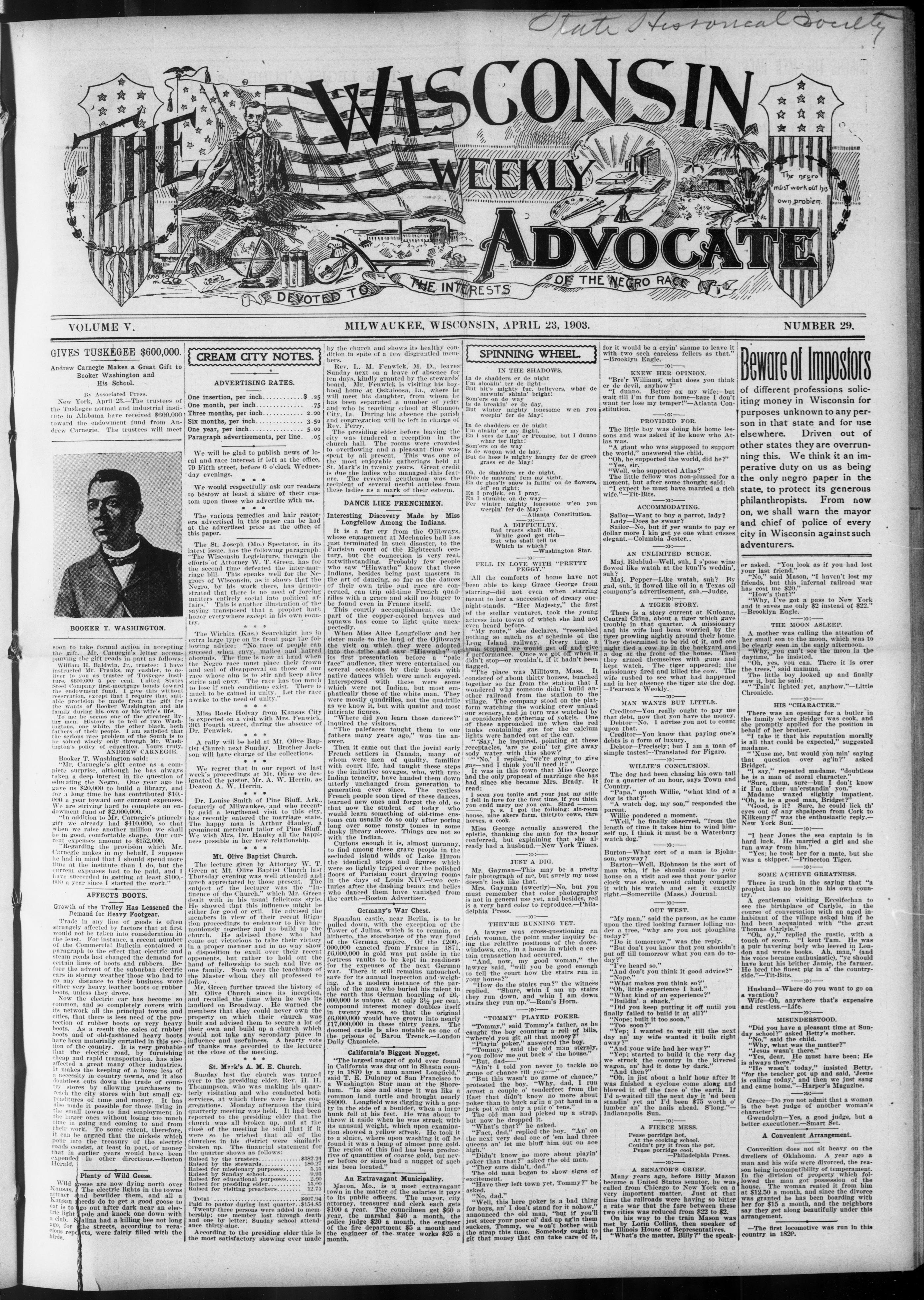
WISCONSIN
WEEKLY
ADVOCATE
DEVOTED TO THE INTERESTS OF THE NEGRO RACE
Andrew Carnegie Makes a Great Gift to Booker Washington and His School.
New York, April 23.—The trustees of the Tuskegee normal and industrial institute in Alabama have received $600,000 toward the endowment fund from Andrew Carnegie. The trustees will meet
[Image of a man in a suit with a bow tie].
BOOKER T. WASHINGTON.
soon to take formal action in accepting the gift. Mr. Carnegie's letter accompanying the gift reads in part as follows: William H. Baldwin, Jr., trustee: I have instructed Mr. Franks, my cashier, to deliver to you as trustee of Tuskegee institute, $600,000 5 per cent. United States Steel Company first-mortgage bonds toward the endowment fund. I give this without reservation, except that I require that suitable provision be made from the gift for the wants of Booker Washington and his family during his own or his wife's life. To me he seems one of the greatest living men. History is to tell of two Washington, one white, the other black, both fathers of their people. I am satisfied that the serious race problem of the South is to be solved wisely only through Mr. Washington's policy of education. Yours truly,
Booker T. Washington said:
"Mr. Carnegie's gift came as a complete surprise, although he has always taken a deep interest in the question of educating the Negro. One year ago he gave us $20,000 to build a library, and for a long time he has contributed $10,000 a year toward our current expenses. We are striving hard to complete an endowment fund of $2,000,000.
"In addition to Mr. Carnegie's princely gift we already had $410,000, so that when we raise another million we shall be in good, comfortable shape. Our current expenses amount to $152,000.
"Regarding the provision which Mr. Carnegie makes in my behalf, I suppose he had in mind that I should spend more time at the institute than I do, but the current expenses had to be paid, and I have succeeded in getting at least $100,000 a year since I started the work."
AFFECTS BOOTS.
Growth of the Trolley Has Lessened the Demand for Heavy Footgear.
Trade in any line of goods is often strangely affected by factors that at first would not be taken into consideration in the least. For instance, a recent number of the Commercial Bulletin contained a paragraph to the effect that electric and steam roads had changed the demand for certain lines of boots and rubbers. Before the advent of the suburban electric ears in stormy weather those who had to go any distance to their business wore either very heavy leather boots or rubber boots, unless they drove.
Now the electric car has become so common, and so completely covers with its network all the principal towns and cities, that there is less need of the protection of rubber boots or very heavy boots. As a result the sales of rubber boots and of old-fashioned heavy boots have been materially curtailed in this section of the country. It is very probable that the electric road, by furnishing cheap and rapid transportation, has also affected a great many other industries. It makes the keeping of a horse less of a necessity in country towns, and it also doubtless cuts down the trade of country stores by allowing purchasers to reach the city stores with but small expenditures of time and money. It has also made it possible for those living in the small towns to find employment in the larger ones without losing too much time in going and coming to and from their work. To some extent, therefore, it can be argued that the nickels which pour into the treasury of the electric roads consist, at least in part, of money that in earlier years would have been expended in other directions.—Boston Herald.
Plenty of Wild Geese
greese are now flying north over The electric lights in the towns and bewilder them, and all a needs do to get a good goose to go out after dark near an elec-pole and knock one down with salina had a killing bee not long the streets, according to ver-orts, were fairly filled with the
CREAM CITY NOTES.
ADVERTISING RATES.
One insertion, per inch. $ .25
One month, per inch. .75
Three months, per inch. 2.00
Six months, per inch. 3.50
One year, per inch. 5.00
Paragraph advertisements, per line. .05
We will be glad to publish news of local and race interest if left at the office, 79 Fifth street, before 6 o'clock Wednesday evenings.
We would respectfully ask our readers to bestow at least a share of their custom upon those who advertise with us.
The various remedies and hair restorers advertised in this paper can be had at the advertised price at the office of this paper.
The St. Joseph (Mo.) Spectator, in its latest issue, has the following paragraph: "The Wisconsin Legislature, through the efforts of Attorney W. T. Green, has for the second time defeated the inter-marriage bill. This speaks well for the Negroes of Wisconsin, as it shows that the Negro, by his work there, has demonstrated that there is no need of forcing matters entirely social into political affairs." This is another illustration of the saying transposed that a prophet hath honor everywhere except in his own country.
```markdown
```
The Wichita (Kas.) Searchlight has in extra large type on its front page the following advice: "No race of people can succeed when envy, malice and hatred abounds. The time is now at hand when the Negro race must place their frown and seal of disapproval on those of our race whose aim is to stir and keep alive strife and envy. The race has too much to lose if such conditions exist. There is much to be gained in unity. Let the race awake to the need of unity."
* * *
Miss Rosie Holvay from Kansas City is expected on a visit with Mrs. Fenwick. 303 Fourth street, during the absence of Dr. Fenwick.
* * *
A rally will be held at Mt. Olive Baptist Church next Sunday. Brother Jackson will have charge of the collections.
We regret that in our report of last week's proceedings at Mt. Olive we designated the pastor, Mr. A. W. Herrin, as Deacon A. W. Herrin.
* * *
Dr. Louise Smith of Pine Bluff, Ark, formerly of Milwaukee, and who recently paid a lengthened visit to this city, has recently entered the marriage state. The happy man is Arthur Hanley, a prominent merchant tailor of Pine Bluff We wish Mrs. Dr. Hanley all the happiness possible in her new relationship.
Mt. Olive Baptist Church.
The lecture given by Attorney W. T. Green at Mt. Olive Baptist Church last Thursday evening was well attended and much appreciated by those present. The subject of the lecturer was the "Influence of the Church," which Mr. Green dealt with in his usual felicitous style. He showed that this influence might be either for good or evil. He advised the members in view of their recent litigation proceedings to endeavor to live harmoniously together and to build up the church. He advised those who had come out victorious to take their victory in a proper manner and in no way show a disposition to exult over their recent opponents, but rather to hold out the hand of fellowship to such and live as one family. Such were the teachings of the Master whom they all professed to follow.
Mr. Green further traced the history of Mt. Olive Church since its inception, and recalled the time when he was its landlord on Broadway. He warned the members that they could never own the property on which their church was built and advised them to secure a lot of their own and build up a church which would not take any secondary place in influence and usefulness. A hearty vote of thanks was accorded to the lecturer at the close of the meeting.
St. Mark's A. M. E. Church.
Sunday last the church was turned over to the presiding elder, Rev. H. H. Thommpson, who was making his quarterly visitation and who conducted both services, at which there were large congregations. Monday afternoon the third quarterly meeting was held. It had been reported to the presiding elder that the church was all broken up, and at the close of the meeting he said that if it were so he wished that all of the churches in his district were similarly broken up. The financial statement for the quarter shows as follows:
Raised by the trustees.....$382.24
Raised by the stewards.....180.27
Raised for missionary purposes.....5.15
Raised by Sunday school.....9.93
Raised for educational purposes.....2.00
Raised for presiding elder.....15.00
Raised for visiting preachers.....12.75
Total .....$607.94
Paid to pastor during last quarter.....$154.85
Twenty-three persons were added to membership; one member lost through death and one by letter; Sunday school attendance thirty-nine.
According to the presiding elder this is the most satisfactory showing ever made
by the church and shows its healthy condition in spite of a few disgruntled members. Rev. L. M. Fenwick, M. D., leaves Sunday next on a leave of absence for ten days, kindly granted by the stewards' board. Mr. Fenwick is visiting his boyhood home at Oskaloosa, Ia., where he will meet his daughter, from whom he has been separated a number of years and who is teaching school at Shannon City, Ia. During his absence the parish and congregation will be left in charge of Rev. Perry.
The presiding elder before leaving the city was tendered a reception in the church hall. The rooms were crowded to overflowing and a pleasant time was spent by all present. This was one of the most enjoyable gatherings held at St. Mark's in twenty years. Great credit is due the ladies who managed this feature. The reverend gentleman was the recipient of several useful articles from these ladies as a mark of their esteem.
DANCE LIKE FRENCHMEN.
Interesting Discovery Made by Miss Longfellow Among the Indians.
It is a far cry from the Ojibways, whose engagement at Mechanics hall has just terminated in such disaster, to the Parisian court of the Eighteenth century, but the connection is very real, notwithstanding. Probably few people who saw "Hiawatha" know that these Indians, besides being past masters in the art of dancing, so far as the dances of their own tribe and race are concerned, can trip old-time French quadrilles with a grace and skill no longer to be found even in France itself. This courtly accomplishment on the part of the copper-colored braves and squaws has come to light quite unexpectedly.
When Miss Alice Longfellow and her sister made to the land of the Ojibways the visit on which they were adopted into the tribe and saw "Hiawatha" at its first presentation before a "pale face" audience, they were entertained on several occasions by their hosts with native dances which were much enjoyed. Interspersed with these were some which were not Indian, but most emphatically those of the white man. They were mostly quadrilles, not the quadrille as we know it, but with quaint and most intricate figures.
"Where did you learn those dances?" inquired the visitors.
"The palefaces taught them to our fathers many years ago," was the answer.
Then it came out that the jovial early French settlers in Canada, many of whom were men of quality, familiar with court life, had taught these steps to the imitative savages, who, with true Indian tenacity, have handed them down utterly unchanged from generation to generation ever since. The restless French people soon tired of these dances, learned new ones and forgot the old, so that now the student of today who would learn something of old-time customs can usually do so only after poring long over some musty tomes in some dusky library alcove. Things are not so with the Indian.
Curious enough it is, almost uncanny, to find among these grave people in the secluded island wilds of Lake Huron the identical steps and figures which were so lightly tripped over the polished floors of Parisian court drawing rooms in the days of Louis XIV.—two centuries after the dashing beaux and belles who danced them have vanished from the earth.—Boston Advertiser.
Germany's War Chest.
Spandau castle, near Berlin, is to be pulled down, with the exception of the Tower of Julius, which is to remain, as hitherto, the storehouse of the war fund of the German empire. Of the £200,000,000 exacted from France in 1871, £6,000,000 in gold was put aside in the fortress vaults to be kept in readiness for the expenses of the next German war. There it still remains untouched, save for its annual inspection and weighing. As a modern instance of the parable of the man who buried his talent in the earth this German hoarding of £6,000,000 is unique. At only $3\frac{1}{2}$ per cent, compound interest money doubles itself in twenty years, so that the original £6,000,000 would have grown into nearly £17,000,000 in these thirty years. The doomed castle is also notable as one of the prisons of Baron Trenck.—London Daily Chronicle.
California's Biggest Nugget
"The largest nugget of gold ever found in California was dug out in Shasta county in 1870 by a man named Longfield," said T. E. Dulaney of San Francisco to a Washington Star man at the Shoreham. "In size and shape it was like a common land turtle and brought nearly $4000. Longfield was digging with a party in the side of a boulder, when a large hunk fell at his feet. He was about to throw it aside when he was struck with its unusual weight, which upon examination showed a yellow streak. He took it to a sluice, where upon washing it off he found it was a lump of almost pure gold. The region of this find has been productive of quantities of coarse gold, but never before or since had a nugget of such size been located."
An Extravagant Municipality
Macon, Mo., is a most extravagant town in the matter of the salaries it pays to its public officers. The mayor, city attorney, treasurer and clerk each gets $100 a year. The councilmen get $60 a year, the marshal $40 a month, the police judge $20 a month, the engineer of the fire department $5 a month and the engineer of the water works $25 a month.
SPINNING WHEEL.
IN THE SHADOWS
In de shadders er de night
I'm alookin' ter de light—
But hit's mighty fur, believers, whar de
mawnin' shinin' bright!
Som'ers on de way
Is de breakin' er de day,
But winter mighty lonesome w'en you
weepin' fer de May!
In de shadders er de night
I'm atakin' er my flight,
En I sees de Lan' er Promise, but I dunno
whar ter light!
Som'ers on de way
Is de wagon wid de hay,
But de hoss is mighty hungry fer de green
grass er de May!
Oh, de shadders er de night.
Hide de mawnin' fum my sight.
En de ghos'ly snow is fallin' on de flowers,
lef'en right;
En I projick, en I pray,
En I stumble on de way—
Fer winter mighty lonesome w'en you
weepin' fer de May!
—Atlanta Constitution.
A DIFFICULTY.
Bad trusts shall die,
While good get rich—
But who shall tell us
Which is which?
All the comforts of home have not been able to keep Grace George from starring—did not even when starring meant to her a succession of dreary one-night-stands. "Her Majesty," the first of the stellar ventures, took the young actress into towns of which she had not even heard before. "My route," she declares, "resembled nothing so much as a schedule of the Long Island railway. Every time a train stopped we would get off and give a performance. Once we got off when it didn't stop—or wouldn't, if it hadn't been flagged
"The place was Milltown, Mass. It consisted of about thirty houses, bunched together so far from the station that I wondered why someone didn't build another railroad from the station to the village. The company stood on the platform watching the working crew unload our scenery, and in turn was watched by a considerable gathering of yokels. One of these approached me when the red tanks containing gas for the calcium lights were handed out of the car. 'Say,' he inquired, pointing at these receptacles, 'are ye goin' ter give away sody water with this show?'
"No," I replied, "we're going to give gas—and I think you'll need it!"
gas—and I think you'll need it.
It was in this town that Miss George had the only proposal of marriage she has had since she became Mrs. Brady. It read:
I seen you tonite and your just my stile I fell in luve for the first time, if you think you cudd mary me you can. Sned ——
p. s. I got the folloing: alt-room house, nine akers farm, thirtyto cows, three horses, a cook.
Miss George actually answered the epistle, thanking the man for the honor conferred, but explaining that she already had a husband.—New York Times.
JUST A DIG.
Mr. Gayman—This may be a pretty fair photograph of me, but surely my nose doesn't look like that.
Mrs. Gayman (sweetly)—No, but you must remember that color photography is not in general use yet, and besides, red is a very hard color to reproduce.—Philadelphia Press.
THEY'RE RUNNING YET
A lawyer was cross-questioning an Irish woman, the point under inquiry being the relative positions of the doors, windows, etc., in a house in which a certain transaction had occurred.
"And, now, my good woman," the lawyer said, "will you be good enough to tell the court how the stairs run in your house?"
"How do the stairs run?" the witness replied. "Shure, whin I am up stairs they run down, and whin I am down stairs they run up."—Ram's Horn.
"TOMMY" PLAYED POKER.
"Tommy," said Tommy's father, as he caught the boy counting a roll of bills, "where'd you git all that money?"
"Playin' poker," answered the boy.
"Tommy," said the old man sternly, "you follow me out back o' the house."
"But, dad——"
"Ain't I told you never to tackle no game of chance till you——"
"But this wasn't no game of chance," protested the boy. "Why, dad, I run acrost a couple o' tenderfeet from the East that didn't know no more about poker than to buck ag'in a pat hand in a jack pot with only a pair o' tens."
The old man had picked up a strap, but now he dropped it.
"What's that?" he asked.
"What's that?" he asked.
"Fact, dad," replied the boy. "An' on the next very deal one of 'em had three queens an' let me bluff him out on ace high."
"Didn't know no more about playin' poker than that?" asked the old man.
"They sure didn't, dad."
The old man began to show signs of excitement.
"Have they left town yet, Tommy?" he asked.
"No, dad."
"Well, this here poker is a bad thing for boys, an' I don't stand for it nohow." announced the old man, "but if you'll jest steer your poor ol' dad up ag'in them suckers, Tommy, we won't bother with the strap this time. Somebody ought to git that money that can take care of it,
for it would be a cryin' shame to leave it with two sech careless fellers as that." —Brooklyn Eagle.
KNEW HER OPINION
"Bre'r Williams, what does you think
er do, devil, anawh?"
er de devil, anyhow?
"I dunno. Better ax my wife;—but
wait till I'm fur fum home—kaze I don't
want ter lose my temper!"—Atlanta
Constitution.
PROVIDED FOR
The little boy was doing his home lessons and was asked if he knew who Atlas was.
"A giant who was supposed to support the world," answered the child. "Oh, he supported the world, did he?" "Yes, sir."
"Well, who supported Atlas?"
The little fellow was non-plussed for a moment, but after some thought said:
"I expect he must have married a rich wife."—Tit-Bits.
ACCOMMODATING.
Sailor—Want to buy a parrot, lady?
Lady—Does he swear?
Sailor—No, but if yer wants to pay en dollar more I kin get ye one what cusses elegant.—Columbia Jester.
AN UNLIMITED SURGE
Maj. Blublud—Well, suh, I s'pose wine flowed like watah at the kun'l's weddin', suh?
Maj. Pepper—Like watah, suh? By gad, suh, it flowed like oil in a Texas oil company's advertisement, suh.—Judge.
A TIGER STORY
There is a story current at Kuloang, Central China, about a tiger which gave trouble in that quarter. A missionary and his wife had been worried by the tiger prowling nightly around their home. They determined to be rid of it, and one night tied a cow up in the backyard and a dog at the front of the house. Then they armed themselves with guns and kept watch. The tiger appeared; the missionary fired and killed the cow. The wife rushed to see what had happened and in her absence the tiger ate the dog. —Pearson's Weekly.
MAN WANTS BUT LITTLE
Creditor—You really ought to pay me that debt, now that you have the money. Debtor—No. I advise you not to count upon that. Creditor—You know that paying one's debts is a form of luxury. Debtor—Precisely; but I am a man of simple tastes!—Translated for Figaro.
WILLIE'S CONCLUSION
The dog had been chasing his own tail for a quarter of an hour, says Town and Country.
"Papa," quoth Willie, "what kind of a dog is that?"
"A watch dog, my son," responded the parent.
parent. Willie pondered a moment.
Whille pondered a moment.
"Well," he finally observed, "from the length of time it takes him to wind himself up. I think it must be a Waterbury watch dog."
:0:
Burton—What sort of a man is Bjohnson, anyway?
Barton—Well, Bjohnson is the sort of man who, if he should come to your house on a visit and see that your parlor clock was slow, would calmly compare it with his watch and set it exactly right—Somerville (Mass.) Journal.
OUT WEST
"My man," said the parson, as he came upon the tired looking farmer lolling under a tree, "why are you not ploughing today?" "Do it tomorrow," was the reply. "But don't you know that you shouldn't put off till tomorrow what you can do today?"
"I've heard so."
"And don't you think it good advice?"
"None."
"Did you keep putting it off until you finally failed to build it at all?"
"Nope; built it too soon."
"Too soon?"
"Yep; I wanted to wait till the next day an' my wife wanted it built right away?"
"And your wife had her way?"
"Yep; started to build it the very day we struck the country in the kivered wagon, an' had it done by dark."
"And then?"
"Oh, in jist about a half hour after it was finished a cyclone come along and blowed it off the face o' the earth. If I'd a-waited till the next day it 'ud been standin' yet an' I'd been $75 worth o' lumber an' the nails ahead. S'long."—Indianapolis Sun.
:0:—
A FIERCE MESS.
Pease porridge hot,
At the cooking school.
Couldn't pry it from the pot,
Pease porridge cool.
—Philadelphia Press.
:0:—
A SENATOR'S GRIEF.
Many years ago, before Billy Mason became a United States senator, he was called from Chicago to New York on a very important matter. Just at that time the railroads were having so bitter a rate war that the fare between these two cities was reduced from $22 to $2. On his way to the train Mason was met by Lorin Collins, then speaker of the Illinois House of Representatives. "What's the matter, Billy?" the speak-
NUMBER 29.
Beware of Impostors
Beware of Impostors
of different professions soliciting money in Wisconsin for purposes unknown to any person in that state and for use elsewhere. Driven out of other states they are overrunning this. We think it an imperative duty on us as being the only negro paper in the state, to protect its generous philanthropists. From now on, we shall warn the mayor and chief of police of every city in Wisconsin against such adventurers.
er asked. "You look as if you had lost your last friend."
"No," said Mason, "I haven't lost my friends, but this infernal railroad war has cost me $20."
"How's that?"
"Why, I've got a pass to New York and it saves me only $2 instead of $22."
—Brooklyn Eagle.
A mother was calling the attention of her small son to the moon, which was to be clearly seen in the early afternoon.
The little boy looked up and finally saw it, but he said:
“Tain't lighted yet, anyhow.”—Little Chronicle.
HIS "CHARACTER."
There was an opening for a butler in the family where Bridget was cook, and she promptly applied for the position in behalf of her brother.
"I take it that his reputation morally is all that could be expected," suggested madame.
"'Xuse me, but would you min' saying that question over ag'in?' asked Bridget.
"I say," repeated madame. "doubtless he is a man of moral character."
"Sure, mum, sure—but I don't know if I'm afther un'erstandin' you."
I arrived waxed slightly impatient.
Madia waxed slightly impatient.
"Oh, is he a good man, Bridget?"
"Good, is it? Sure, he could lick th' eyes out of any shpalpeen from Cork to Kilkenny!" was the enthusiastic reply.— New York Sun.
:0:
"I hear Jones the sea captain is in hard luck. He married a girl and she ran away from him."
"Yes; he took her for a mate, but she was a skipper."—Princeton Tiger.
SOME ACHIEVE GREATNESS
There is truth in the saying that "a prophet has no honor in his own country."
A gentleman visiting Eccelfechan to see the birthplace of Carlyle, in the course of conversation with an aged inhabitant of the village asked him if he had been acquainted with "the great Thomas Carlyle."
"Oh, ay," replied the rustic, with a touch of scorn. "I kent Tam. He was a pair havering body who leeved in London and wrote books. Ah, man," (and his voice became enthusiastic), "ye should have Kent his brither Jamie, the farmer. He bred the finest pig in a' the countryside."—Tit-Bits.
Wife—Oh, anywhere that's expensive and restless—Life
MISUNDERSTOOD.
"Did you have a pleasant time at Sunday school?" asked Betty's mother.
"No," said the child.
"Why, what was the matter?"
"Jesus wasn't there."
"Yes, dear. He must have been; He is always there."
"He wasn't today," insisted Betty,
"for the teacher got up and said, 'Jesus is calling today,' and then we just sang and came home."—Harper's Magazine.
:0:
Grace—Do you not admit that a woman is the best judge of another woman's character?
Gwendolyn—Yes, a good judge, but a better executioner—Smart Set.
A Convenient Arrangement.
Convention does not sit heavy on the dwellers of Oklahoma. A year ago a man and his wife were divorced, the reason being incompatibility of temperament. In the division of property which followed the man got possession of the house. The woman rented it from him at $12.50 a month, and since the divorce was granted he has been boarding with her for $15 a month, and the neighbors say they get along beautifully under this arrangement.
The first locomotive was run in this country in 1820.
ORDERS THE MEN BACK.
First Opportunity to Test Decision of Strike Commission.
MUST RETURN TOWORK
by the Coal Combination.
Wilkesbarre, Pa., April 22.—The executive board of the three anthracite districts of the United Mine Workers of America in convention here issued instructions that all mine workers now on strike or locked out return to work immediately, pending an adjustment of all differences by the board of conciliation provided for by the anthracite strike commission. The board is to consist of six members, three appointed by the operators and three by the miners.
President Mitchell, the district presidents and board members of the United Mine Workers, met in executive session today to complete the arrangements for the adjustment of the mine workers' grievances. President Mitchell sent notices to the presidents of the coal-carrying roads that District Presidents Nicholls, Fahey and Detry had been appointed as the miners' representatives on the board of conciliation and asked that they make their appointments as soon as possible so that a meeting can be held.
Ashland, Pa., April 22.—When the mine workers reported at the collieries here today in compliance with the instructions issued by the leaders yesterday they were told there would be no work for them until Saturday, when operations will commence if the men are satisfied to work the mine hours as required by the company.
How the Public is Robbed.
New York, April 22.—The first victory in the fight for the dissolution of the coal trust before the interstate commerce commission was gained when Attorney Shearn, in the face of the combined opposition of all the lawyers of the defendant companies, forced into evidence tables showing the various rates for transportation of anthracite coal and that they were from 150 to 250 per cent. higher than on any other commodities.
In outlining the case for the prosecution, after discussing the matter of freight rates, Mr. Shearn referred to the downfall and throttling of the independ-
"They are absolutely in the grip of the coal carrying roads," he said, "and there is now no competition of any sort. They have given up their right to say what and when and where they shall mine coal, how they shall ship it and at what rate they will sell it.
"This combination has raised the price of coal to the extent that the people are forced to spend more than $100,000,000 a year more than they ought."
BROKERS' NEW HOME.
Handsome Structure of New York Stock Exchange Appropriately Dedicated.
New York, April 22.—The members of the New York stock exchange abandoned business today and devoted themselves to the ceremonies incident to the dedication of their handsome new building. These ceremonies were brief and impressive. After prayer by Rev. Morgan Dix of Trinity Church, Ransom H. Thomas, chairman of the building committee, formally handed the new building over to Donald McKay, president of the New York Stock Exchange Building Association, who in turn formally presented it to Rudolph Keppler, president of the exchange, for the use of the members. In accepting the building Mr. Keppler thanked the building committee for the manner in which the work had been performed. He followed with a defense of Wall street and of stock exchange methods, declaring they were legitimate and not gambling transactions.
Address by Mavor Low.
An address by Mayor Low on behalf of the citizens and invited guests followed and then the members and their guests including many men prominent in financial and business circles were shown through the building. The members of the consolidated exchange sent their well wishes with a large floral piece containing 500 American Beauty roses. The board room where the dedicatory ceremonies were held was crowded long before the hour set for the opening and the guests were entertained with music by bands and orchestras. The brokerage officers in the financial district were closed and flags flew from flagstaffs in honor of the event.
Presents Striking Appearance.
The building, which looks small beside the skyscrapers by which it is surrounded, presents a striking appearance with its massive and beautifully carved stone pillars and decorations. The interior has been arranged looking to the comfort in every way possible of the members. An impregnable vault has been built for the safety of securities, the heating, cooling and ventilating arrangements are perfect and the board and other rooms are large, comfortable and prettily decorted. The building, which fronts on Broad street, extends through to New street, with an opening on Wall street as in the old building. In the construction it was found necessary to go forty-two feet below the level of Broad stret. In the cellar of the exchange are the safe deposit vaults.
MINERS DEMAND MORE.
Not Satisfied with the Increase Granted by the Wolverine Mine at Calumet, Mich.
Calumet, Mich., April 22.—[Special.]— One hundred men at the Wolverine mine struck for more pay and the mine closed down last night. The company granted them a raise in wages, but they want more. Three hundred men are out of work.
KILLED BY SUNDAY PAPERS
News Dealer Dies from Blood Poisoning Contracted by Handling Them.
Providence, R. I., April 22.—Yellow journalism killed Willis Scribner, a news dealer. Blood poisoning was contracted while handling New York newspapers. It is claimed the special and Sunday supplements in their splotches of green, yellow, blue and black inks were often sticky and the ink would adhere to the hand. Scribner while ripping open a bundle of papers cut his thumb and got some of the ink into the wound. This was two weeks ago. In a few days his arm was terribly swollen and death was the result. He was 43 years of age.
Montreal, Que., April 22.-The grave diggers of Montreal are on strike for an increase of 25 cents a day in wages.
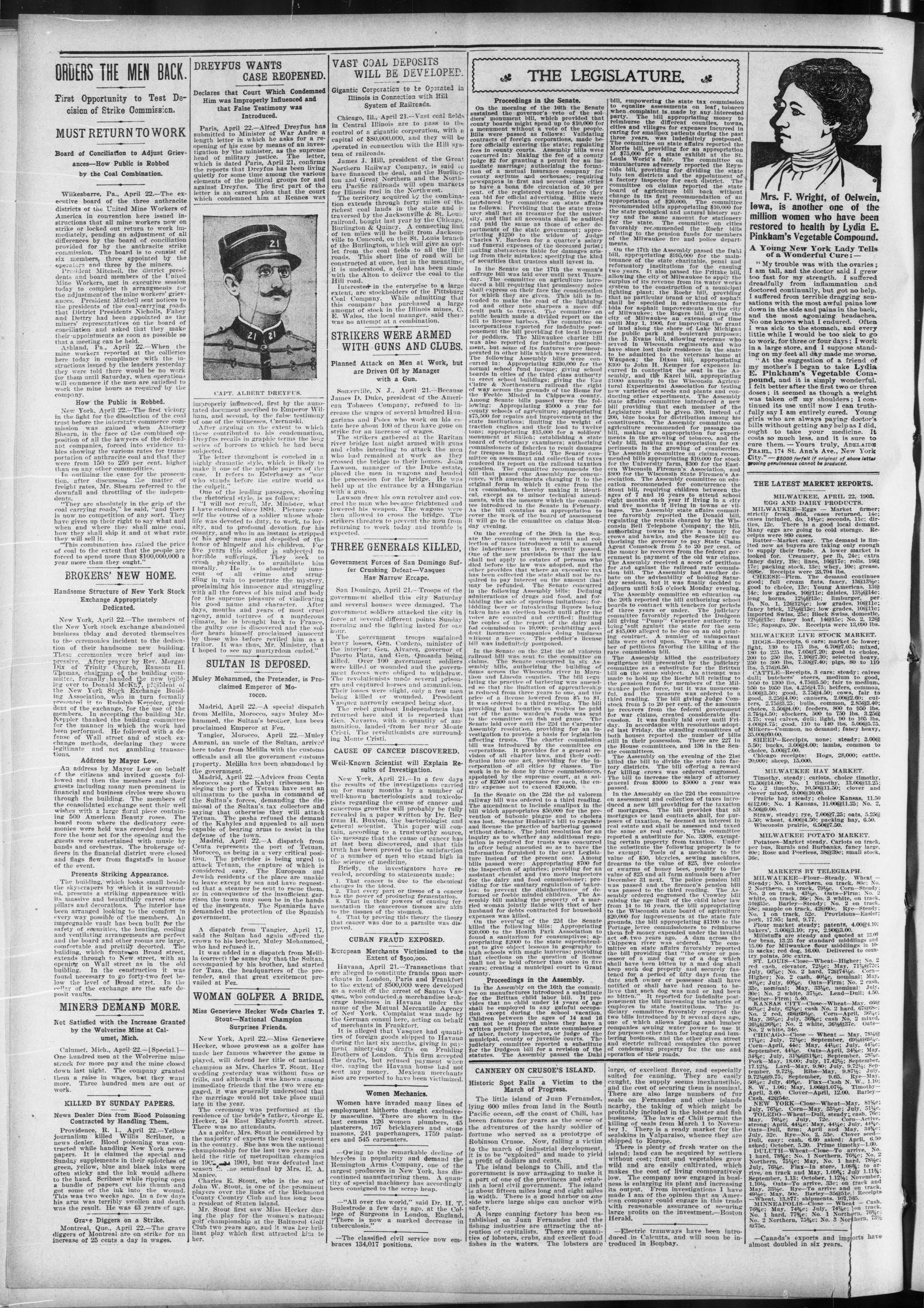
DREYFUS WANTS CASE REOPENED.
Declares that Court Which Condemned Him was Improperly Influenced and that False Testimony was Introduced.
Paris, April 22.—Alfred Dreyfus has submitted to Minister of War Andre a length letter in which he asks for a reopening of his case by means of an investigation by the minister, as the supreme head of military justice. The letter, which is dated Paris, April 21, confirms the reports that Dreyfus has been living quietly for some time among the various elements of the political groups for and against Dreyfus. The first part of the letter is an earnest plea that the court which condemned him at Rennes was
21
21
improperly influenced, first by the annotated document ascribed to Emperor William, and second, by the false testimony of one of the witnesses, Czernuski.
After arguing on the extent to which these contributed to his condemnation, Dreyfus recalls in graphic terms the long series of horrors to which he had been subjected.
The letter throughout is couched in a highly dramatic style, which is likely to make it one of the notable papers of the case. It refers to Esterhasey as "one who stands before the entire world as the culprit."
One of the leading passages, showing the rhetorical style, is as follows:
"I will not recall, Mr. Minister, what I have endured since 1894. Picture yourself the course of a soldier whose whole life was devoted to duty, to work, to loyalty, and to profound devotion for his country, and who in an instant is stripped of his good name and despoiled of the honor of himself and his children. For five years this soldier is subjected to horrible sufferings. They seek to crush physically, to arnibilate him morally. He is absolutely innocent of all crime and struggling in vain to penetrate the mystery, proclaiming his innocence and struggling with all the forces of his mind and body for the supreme pleasure of vindicating his good name and character. After days, months and years of most cruel agony, amid tortures of a murderous climate, he is brought back to France, the guilty one is discovered and the soldier hears himself proclaimed innocent by those who before reviled him as a traitor. It was thus, Mr. Minister, that I hoped to see my martyrdom ended."
SULTAN IS DEPOSED.
Muley Mohammed, the Pretender, is Proclaimed Emperor of Mo-
rocco.
Madrid, April 22.—A special dispatch from Mellila, Morocco, says Muley Mohammed, the Sultan's brother, has been proclaimed Emperor at Fez.
Tangier, Morocco, April 22.—Muley Amrani, an uncle of the Sultan, arrived here today from Melilla with the customs officials and all the government customs property. Melilla has been abandoned by the government.
Madrid, April 22.—Advices from Ceuta Morocco say the Kabyl tribesmen besieging the port of Tetuan have sent an ultimatum to the pasha in command of the Sultan's forces, demanding the dismissal of the Sultan's tax collectors and saying that otherwise they will attack Tetuan. The pasha refused the demand of the Kabyles and appealed to all men capable of bearing arms to assist in the defense of the town.
Madrid, April 22.—A dispatch from Ceuta represents the port of Tetuan, Morocco, as being in a very critical position. The pretender is being urged to attack Tetuan, the capture of which is considered easy. The European and Jewish residents of the place are unable to leave except by sea and have requested that a steamer be sent to rscue them, as in consequence of the insufficient garrison the town may soon be in the hands of the insurgents. The Spaniards have demanded the protection of the Spanish government.
A dispatch from Tangier, April 17, said the Sultan had again offered the crown to his brother, Muley Mohammed, who had refused it.
It was added in a dispatch from Melilla (correct) the same day that the Sultan, accompanied by his brother, had started for Taza, the headquarters of the pretender, and that great excitement prevailed at Fez.
WOMAN GOLFER A BRIDE
Miss Genevieve Hecker Weds Charles T. Stout—National Champion Surprises Friends.
New York, April 22.—Miss Genevieve Hecker, whose prowess as a golfer has made her famous wherever the game is played, will defend her title of national champion as Mrs. Charles T. Stout. Her wedding yesterday was without fuss or frills, and although it was known among immediate friends that the two were engaged, it was generally understood that the marriage would not take place until late in the year. The ceremony was performed at the residence of the bride's father, George E. Hecker, 34 East Eighty-fourth street. There was no attendants.
As a golfer, Mrs. Stout is considered by the majority of experts the best exponent in the country. She has won the national championship for the last two years and held the title of metropolitan champion in 1901, but was defeated last season in the semi-final by Mrs. E. A. Manice.
Charles E. Stout, who is the son of John W. Stout, is one of the prominent players over the links of the Richmond County Country Club and has long been a resident of Staten island.
Mr. Stout first saw Miss Hecker during the play for the women's national golf championship at the Baltusrol Golf Club two years ago, and it was her brilliant play which first attracted him to her.
Chicago, Ill., April 21.—Vast coal fields in Central Illinois are to pass to the control of a gigantic corporation, with a capital of $80,000,000, and they will be operated in connection with the Hill system of railroads. James J. Hill, president of the Great Northern Railway Company, is said to have financed the deal, and the Burlington and Great Northern and the Northern Pacific railroads will open markets for Illinois fuel in the Northwest.
The territory acquired by the combination extends through forty miles of the richest coal lands in the state and is traversed by the Jacksonville & St. Louis railroad, bought last year by the Chicago, Burlington & Quincy. A connecting link of ten miles will be built from Jacksonville to Concord, on the St. Louis branch of the Burlington, which will give an outlet from the coal fields to all the Hill roads. This short line of road will be constructed at once, but in the meantime, it is understood, a deal has been made with the Alton to deliver the coal to the Hill road.
Interested in the enterprise to a large extent, are stockholders of the Pittsburg Coal Company. While admitting that this company has purchased a large amount of stock in the Illinois mines, C. E. Wales, the local manager, said there was no attempt at a combination.
STRIKERS WERE ARMED WITH GUNS AND CLUBS.
Planned Attack on Men at Work, but are Driven Off by Manager with a Gun.
Somerville, N. J., April 21. Because James D. Duke, president of the American Tobacco Company, refused to increase the wages of several hundred Hungarians and Poles who work on his estate here about 100 of them have gone on strike for an increase of wages. The strikers gathered at the Raritan river bridge last night armed with guns and clubs intending to attack the men who had remained at work as they crossed the bridge to their homes. John Lawson, manager of the Duke estate, placed the men in wagons and headed the procession for the bridge. He was held up at the entrance by a Hungarian with a gun.
Lawson drew his own revolver and covered the man who became frightened and lowered his weapon. The wagons were then allowed to cross the bridge. The strikers threaten to prevent the men from returning to work today and trouble is expected.
THREE GENERALS KILLED.
Government Forces of San Domingo Suffer Crushing Defeat—Vasquez Has Narrow Escape.
San Domingo, April 21.—Troops of the government shelled this city Saturday and several houses were damaged. The government soldiers attacked the city in force at several different points Sunday morning and the fighting lasted for one hour. The government troops sustained heavy losses, Gen. Cordero, minister of the interior; Gen. Alvarez, governor of Puerto Plata, and Gen. Quosada being killed. Over 100 government soldiers were killed or wounded and the government forces were obliged to withdraw. The revolutionists made several prisoners and captured horses and ammunition. Their losses were slight, only a few men being killed or wounded. President Vasquez narrowly escaped being shot.
The rebel gunboat Independencia has returned here and it is reported that Gen. Navarro, with a quantity of ammunition, landed from her near Monte Cristi. The revolutionists are surrounding Monte Cristi.
CAUSE OF CANCER DISCOVERED.
Weil-Known Scientist will Explain Results of Investigation.
New York, April 21.—In a few days the results of the investigations carried on for many months by a number of well-known bacteriologists and toxicologists regarding the cause of cancer and cancerous growths will probably be fully revealed in a paper written by Dr. Bertram H. Buxton, the bacteriologist and general scientist. This paper will contain, according to a trustworthy source, the message that the cause of cancer has at last been discovered, and that this truth has been proved to the satisfaction of a number of men who stand high in the science of medicine.
Briefly, the investigators have revealed, according to statements made:
1. That cancer is due to the chemical changes in the blood.
2. That every part or tissue of a cancer has the power of producing fermentation.
3. That in their powers of causing fermentation the cancerous tissues are akin to the tissues of the stomach.
4. That by proving this theory the theory that cancer was due to a parasite was disproved.
CUBAN FRAUD EXPOSED.
European Merchants Victimized to the Extent of $500,000.
Havana, April 21.—Transactions that are alleged to constitute frauds upon merchants in London, Paris and Frankfurt to the extent of $500,000 were developed as a result of the arrest of Santos Vasquez, who conducted a merchandise brokerage business in Havana under the name of the Mutual Mercantile Agency of New York. Complaint was made by the German consul here, acting on behalf of merchants in Frankfort.
It is alleged that Vasquez had quantities of foreign goods shipped to Havana during the last six months, giving in payment ninety-day drafts on Fruhling Brothers of London. This firm accepted the drafts, but refused payment when due, saying the Havana house had not sent any money. Mexican merchants also are reported to have been victimized.
Women Mechanics.
Women have invaded many lines of employment hitherto thought exclusively masculine. There are shown in the last census 126 women plumbers, 45 plasterers, 167 bricklayers and stone masons, 241 paperhangers, 1759 painters and 545 carpenters.
—Owing to the remarkable decline of bicycles in popularity and demand the Remington Arms Company, one of the largest producers in New York, has discontinued manufacturing them. A quantity of special machinery has accordingly been consigned to the scrap heap.
—"All over the world," said Dr. H. T. Bulestrode a few days ago, at the College of Surgeons in London, England. "There is now a marked decrease in tuberculosis."
—The classified civil service now embraces 134.017 positions.
THE LEGISLATURE.
Proceedings in the Senate.
On the morning of the 16th the Senate sustained the governor's veto of the soldiers' monument bill, which provided that county boards might spend up to $10,000 for a monument without a vote of the people. Bills were passed as follows: Validating contracts of foreign corporations, made before officially entering the state; regulating fees in county courts. Assembly bills were concurred in: Making the fee of a county judge $2 for granting a permit for an immediate marriage; authorizing the formation of a mutual insurance company for county asylums and oorhouses; requiring newspapers in first and second class cities to have a bona fide circulation of 10 per cent. of the registered voters before they can bid for official advertising. Bills were introduced by committee on state affairs as follows: Providing that the state treasurer shall act as treasurer for the university, and that all accounts shall be audited and paid the same as those of other departments of the state government; appropriating $1250 to the widow of Judge Charles V. Bardeen for a quarter's salary and funeral expenses of the deceased jurist; making abstractors liable for damages arising from their mistakes; specifying the kind of securities that trustees shall invest in.
In the Senate on the 17th the woman's suffrage bill was laid over until next Thursday. The committee on agriculture introduced a bill requiring that promissory notes shall express on their face the consideration for which they are given. This bill is intended to make the road of the lightning rod and other note sharpers a more difficult path to travel. The committee on public health made a divided report on the bill to license barbers. The committee on incorporations reported for indefinite postponement the bill providing for local license for peddlers. The Milwaukee charter bill was also reported for indefinite postponement, but some of its features were incorporated in other bills which were presented. The following Assembly bills were concurred in: Appropriating $230,000 for the normal school fund income; giving school boards in cities of the third class authority to erect school buildings; giving the Eau Claire & Northeastern railroad the right of way across the grounds of the Home for the Feeble Minded in Chippewa county. Among Senate bills passed were the following: Appropriating $5000 a year for county schools of agriculture; appropriating $75,500 for repairs and improvements at the state institutions; limiting the weight of traction engines and their load to twelve tons; appropriating $15,500 for a soldiers' monument at Shiloh; establishing a state board of veterinary examiners; authorizing commissioners of fisheries to remit damages for trespass in Bayfield. The Senate committee on assessment and collection of taxes rendered its report on the railroad taxation question. The committee recommends the bill that passed the Assembly for concurrence, with amendments changing it to the original form in which it came from the tax commission, thereby making it identical, except as to minor technical amendments, with the measure which the committee introduced in the Senate in February. As the bill contains an appropriation to cover the work of the board of assessment it will go to the committee on claims Monday evening.
On the evening of the 20th in the Senate the committee on assessment and collection of taxes introduced a bill to amend the inheritance tax law, recently passed. One of the new provisions is that the law shall not apply to estates of persons who died before the law was adopted, and the other provides that where an excessive tax has been collected the state shall not be required to pay interest on the amount that may be refunded. The Senate concurred in the following Assembly bills; Defining adulterations of drugs and food, and forbidding the sale of spurious imitations; forbidding beer or intoxicating liquors being taken into an election booth until after the votes are counted and certified; limiting the copies of the report of the dairy and fed commission to 10,000; prohibiting accident insurance companies doing business without a license. The peddler's license bill was indefinitely postponed.
In the Senate on the 21st the ad valorem railroad bill was sent to the committee on claims. The Senate concurred in six Assembly bills, authorizing the building of dams across the Wisconsin river in Marathon and Lincoln counties. The bill regulating the practice of barbering was amended so that the limitation of apprenticeship is reduced from three years to one, and the price of a license lowered from $5 to $1. It was ordered to a third reading. The bill providing that bounties on wolves be paid out of the game warden's funds was sent to the committee on fish and game. The Senate laid over until the 22d the Carpenter Assembly resolution, providing for an investigation to provide a basis for legislation affecting trusts. The charter commission bill was introduced by the committee on corporations. It provides for a general revision of all charter laws, and their codification into one act, providing for the incorporation of all cities by classes. The work is to be done by three commissioners, appointed by the supreme court, at a salary of $2500 and expenses for each, the entire expense not to exceed $20,000.
In the Senate on the 22d the ad valorem railway bill was ordered to a third reading. The amendment to include smallpox in the bill which appropriates $50,000 for the prevention of bubonic plague and to cholera was lost. Senator Hudnall's bill to regulate and license the practice of barbering passed without debate. The joint resolution for an inquiry as to whether any additional regulation is required for trusts was concurred in after being amended so as to have the information furnished to the next Legislature instead of the present one. Among bills passed were: Appropriating $700 for the inspection of aplaries; providing for an assistant chemist and two more inspectors for the dairy and food commissioner; providing for the sanitary regulation of bakeries; to prevent the disinheritance of deformed or feeble minded children. The Assembly bill making the property of a married woman jointly liable with that of her husband for debts contracted for household expenses was killed.
On the evening of the 22d the Senate killed the following bills: Appropriating $20.000 to the Health Park Association to found a sanitarium for consumptives; appropriating $2000 to the state superintendent to give object lessons in geography to high schools with magic lanterns; providing that elections on the question of license shall not be held offender than once in five years; creating a municipal court in Grant county.
Proceedings in the Assembly.
In the Assembly on the 16th the committee on manufactures introduced a substitute for the Brittan child labor bill. It provides that no child under 14 years of age shall be employed in any gainful occupation except during the school vacation. Children between the ages of 14 and 16 can not be employed unless they have a written permit from the state commissioner of labor, factory inspector, or judge of the municipal, county or juvenile courts. The judiciary committee reported a substitute for the Dudgeon bill for a revision of the statutes. The Assembly passed the Dahl
CANNERY ON CRUSOE'S ISLAND.
Historic Spot Falls a Victim to the March of Progress.
The little island of Juan Fernandez, lying 600 miles from land in the South Pacific ocean, off the coast of Chili, has been famous for years as the scene of the adventures of the hardy soldier of fortune who served as a prototype of Robinson Crusoe. Now, falling a victim to the march of industrial development, it is to be "exploited" and made to yield a profit of dollars and cents. The island belongs to Chili, and the government is now arranging to make it a part of one of the provinces and establish a local civil government. The island is about fifteen miles long and eight miles in width. There is a good harbor on one side where large ships can anchor with safety.
A large canning factory has been established on Juan Fernandez and the fishing industries are attracting the attention of capitalists. There are quantities of lobsters, crabs, and excellent food fishes in the waters. The lobsters are
bill, empowering the state tax commission to equalize assessments on leaf, tobacco when complaint is made by any interested party. The bill appropriating money to reimburse the different counties, towns, cities and villages for expenses incurred in caring for smallpox patients during the past three years, was indefinitely postponed. The committee on state affairs reported the Morris bill, providing for an appropriation of $75,000 for a state exhibit at the St. Louis World's fair. The committee on manufactures adversely reported the Reynolds bill, providing for dividing the state into ten districts and the appointment of a factory inspector for each district. The committee on claims reported the state board of agriculture bill back without change in its first recommendation of an appropriation of $20,000. The committee recommended bills appropriating $10,000 for the state geological and natural history survey and the same amount for stationery for the state. The committee on cities favorably recommended the Roehr bills relating to the pension funds for members of the Milwaukee fire and police departments.
On the 17th the Assembly passed the Dahl bill, appropriating $995,000 for the maintenance of the state charitable, penal and reformatory institutions for the ensuing two years. It also passed the Fritzke bill, allowing the city of Milwaukee to apply the surplus of its revenue from its water works system to the construction of a municipal lighting plant; the Roehr bill, providing that no particular brand or kind of asphalt shall be specified in advertisements for bids for asphalt improvements in the city of Milwaukee; the Rogers bill, giving the city of Milwaukee an extension of time until May 1, 1906, for improving the grant of land along the shore of Lake Michigan for public park and boulevard purposes; the D. Evans bill, allowing veterans who served in Wisconsin regiments and who have since lost their residence in the state to be admitted to the veterans' home at Wäupaca; the Dixon bill, appropriating $300 to John H. Kemper for expenses incurred in contesting the seat in the Assembly, and the Karel bill, appropriating $1000 annually to the Wisconsin Agricultural Experimental Association for testing new varieties of seeds and plants and conducting other experiments. The Assembly state affairs committee introduced a new bill providing that each member of the Legislature shall be given 300, instead of 200, blue books for distribution among his constituents. The Assembly committee on agriculture recommended for passage the bill, making an appropriation for experiments in the growing of tobacco, and the Cady bill, making an appropriation for experiments in the growing of cranberries. The Assembly committee on claims recommended bills appropriating $10,000 for stock for the University farm, $300 for the Eastern Wisconsin Firemen's Association, and $800 for the Wisconsin State Firemen's Association. The Assembly committee on education recommended for concurrence the Stout bill, requiring children between the ages of 7 and 16 years to attend school eight months each year if living in a city and five months if living in towns or villages. The Assembly state affairs committee favorably reported the Donald bill, regulating the rentals charged by the Wisconsin Bell Telephone Company; the bill, authorizing towns to give a bounty for crows and hawks, and the Senate bill authorizing the governor to pay State Claim Agent Comstock from 5 to 20 per cent. of the money he recovers from the federal government in payment of the old war claims. The Assembly received a score of petitions for and against the railroad rate commission bill. The Assembly had another debate on the advisability of holding Saturday sessions, but it was finally decided to adjourn until 8:45 o'clock Monday evening.
The Assembly committee on education on the 20th reported the bill authorizing school boards to contract with teachers for periods of three years or under. The judiciary committee favorably reported the Dudgeon bill giving "Pump" Carpenter authority to bring 'suit against the state for the sum of $45,000 alleged to be due on an old printing contract. A number of unimportant bills were acted upon. There was a number of petitions favoring the killing of the rate commission bill.
The Assembly killed the contributory negligence bill presented by the judiciary committee as a substitute for the Brittan bill on the same subject. An attempt was made to hold up the Roehr bill relating to the pension fund for members of the Milwaukee police force, but it was unsuccessful, and the measure was ordered to a third reading. The bill giving Judge Comstock from 5 to 20 per cent. of the amounts he recovers from the federal government for war claims, created considerable discussion. It was finally laid over until Friday. In accordance with resolutions adopted last Friday, the standing committees of both houses reported the number of bills still in their possession. There are 227 in the House committees, and 136 in the Senate committees.
The Assembly on the evening of the 21st killed the bill to divide the state into factory districts. The bill offering a reward for killing crows was ordered engrossed. The bill to increase the salary of attorney general from $3000 to $5000 a year was passed.
In the Assembly on the 22d the committee on assessment and collection of taxes introduced a new bill providing for the taxation of mortgages. The bill provides that all mortgages or land contracts shall, for purposes of taxation, be deemed an interest in real estate and shall be assessed and taxed the same as real estate. This committee reported a substitute for No. 330S, exempting certain property from taxation. Under the substitute the following property is to be exempt: Tools of a mechanic to the value of $50, bicycles, sewing machines, firearms to the value of $25, five colonies or swarms of honey bees, poultry to the value of $25 and all farm animals born after December 31 next. The police pension bill was passed and the firemen's pension bill was passed to the third reading. The Assembly ordered engrossed the Crowley bill raising the age limit of the child labor law from 14 to 16 years, the bill appropriating to the Wisconsin state board of agriculture $20,000 for improvements at the state fair grounds, the bill appropriating $1100 to the Portage levee commissioners to reimburse them for money expended under the invalid act of two years ago. A dam across the Chippewa river was ordered. The committee on state affairs favorably reported the bill providing that "the owner or possessor of a mad dog or of a dog which shall have been bitten by a mad dog shall keep such dog properly and securely fastened for a period of fifty days from the date such owner or possessor shall have notified or shall have had reason to believe that such dog was mad or had been so bitten." It reported for indefinite postponement the bill increasing the salaries of employees in state institutions. The judiciary committee favorably reported the two bills introduced by it several days ago, one of which allows logging and lumber companies owning water power to use it for purposes other than for logging and lumbering business, and the other gives street and electric railroad companies the power of condemning property for the use and operation of their roads.
large, of excellent flavor, and especially suited for canning. They are easily caught, the supply seems inexhaustible, and the cost of securing them is nominal. There are also large numbers of fur seals on Fernandez and other islands nearby, the taking of which might be profitably included in the lobster and fish business. The laws of Chili permit the killing of seals from March 1 to November 1. There is a ready market for the sealskins in Valparaiso, whence they are shipped to Europe.
There is plenty of fresh water on the island; land can be acquired by settlers without cost; fruit and vegetables grow wild and are easily cultivated, which makes the cost of living comparatively low. The company now engaged in business is enlarging its plant and increasing its output. From investigations I have made I am of the opinion that an American company could engage in this trade with reasonable assurance of securing large profits on the investment.—Boston Herald.
—Electric tramways have been introduced in Calcutta, and will soon be introduced in Bombay.
O.
A Young New York Lady Tells of a Wonderful Cure:—
"My trouble was with the ovaries; I am tall, and the doctor said I grew too fast for my strength. I suffered dreadfully from inflammation and doctored continually, but got no help. I suffered from terrible dragging sensations with the most awful pains low down in the side and pains in the back, and the most agonizing headaches. No one knows what I endured. Often I was sick to the stomach, and every little while I would be too sick to go to work, for three or four days; I work in a large store, and I suppose standing on my feet all day made me worse.
"At the suggestion of a friend of my mother's I began to take Lydia E. Pinkham's Vegetable Compound, and it is simply wonderful. I felt better after the first two or three doses; it seemed as though a weight was taken off my shoulders; I continued its use until now I can truthfully say I am entirely cured. Young girls who are always paying doctor's bills without getting any help as I did, ought to take your medicine. It costs so much less, and it is sure to cure them. — Yours truly, ADELAIDE PRAHL, 174 St. Ann's Ave., New York City." — $5000 forfelt if original of above letter proving genuineness cannot be produced.
THE LATEST MARKET REPORTS.
MILWAUKEE, APRIL 22, 1903.
EGG AND DAIRY PRODUCTS.
GGG AND DAILY PRODUCTS.
MILWAUKEE—Eggs — Market firmer; strictly fresh laid, cases returned, 14c; cases included, do, 14%; seconds, 11c; dirties, 12c. There is a good local demand. Many eggs are going to cold storage. Receipts were 860 cases.
Butter—Market easy. The demand is limited now as buyers are taking only enough to supply their trade. A lower market is looked for. Creamery, per lb, 24c; extra fancy dairy, 19c; lines, 16@17c; rolls, 16@17c; packing stock, 13c; whey, 10c; grease, 5@6c. Receipts were 23,794 lbs.
CHEESE—Firm. The demand continues good; full cream flats, fancy, 13@13%c; good to choice, 13c; Young Americas, 13@14c; low grades, 10@11c; daisies, 13%@14c; long horns, 12%@13c; limburger, per lb. No. 1, 12@12%c; low grades, 10@11c; fancy brick, 12%@13c; low grades, 10@11c; imported Swiss, 25c; Block Swiss, domestic, 12%@13c; fancy loaf, 14@15c; No. 2, 12@13c; Sapsago, 20c. Receipts were 13,000 lbs.
MILWAUKEE LIVE STOCK MARKET.
HOGS—Receipts, 6 cars; market 5c lower; light, 130 to 175 lbs, 6.70@7.05; mixed, 180 to 225 lbs, 7.05@7.20; good to choice, 200 to 250 lbs, 7.10@7.30; selected heavy, 250 to 300 lbs, 7.30@7.40; pigs, 80 to 110 lbs, 5.75@6.50.
CATTLE—Receipts, 3 cars; steady; calves dull; butchers' steers, medium to good, 1050 to 1300 lbs, 4.75@5.50; fair to medium, 950 to 1050 lbs, 4.25@4.75; heifers, common, 3.00@3.50; good, 3.75@4.50; cows, fair to good, 3.25@4.00; cannurs, 2.00@2.60; cutters, 2.75@3.25; bulls, common, 2.85@3.40; choice, 3.50@4.00; feeders, 800 to 950 lbs, 3.75@4.50; stockers, 500 to 750 lbs, 3.25@3.75; veal calves, dull; light, 90 to 105 lbs, 4.00@4.75; good, 110 to 140 lbs, 5.00@5.75. Milkers—Common, no demand; fancy heavy, 35.00@60.00.
SHEEP—Receipts, none; steady; 3.00@5.50; bucks, 3.00@4.00; lambs, common to choice, 5.00@7.00.
Chicago receipts: Hogs, 28,000; cattle, 20,000; sheep, 15,000.
MILWAUKEE HAY MARKET
Timothy, steady; carlots, choice timothy, 13.50@14.00; No. 1 timothy, 13.00@13.25; No. 2 timothy, 10.50@11.50; clover and clover mixed, 9.00@10.00.
Prairie hay steady; choice Kansas, 11.50@12.00; No. 1 Kansas, 11.00@11.25; No. 2, 8.50@9.00.
Straw, steady; rye, 7.00@7.25; oats, 5.25@5.50; wheat, 4.00@4.50; packing hay, 6.50.
Wisconsin prairie, 6.50@7.50.
MILWAUKEE POTATO MARKET.
Potatoes-Market steady. Carlots on track, per bus, Rurals and Burbanks, fancy large, 40c; Rose and Peerless, 38@39c; small stock, 36c.
MARKETS BY TELEGRAPH.
MILWAUKEE—Flour—Steady. Wheat—Steady; No. 1 Northern, on track, 80c; No. 2 Northern, on track, 79½c. Corn—Steady; No. 3 on track, 43½c. Oats—Firm; No. 2 white, on track, 36c; No. 3 white, on track, 34@65c. Barley—Steady; No. 2 on track, 58c; sample on track, 42@60c. Rye—Steady; No. 1 on track, 52c. Provisions—Easier; pork, 17.95; lard, 9.77.
Flour market steady; patents, 4.00@4.10;
bakers: 3.00@3.10; rye: 2.90@3.00
Millstuffs are steady and quoted at 13.00
for bran, 13.25 for standard middlings and
15.00 for Milwaukee flour middlings in 10-
lb sacks; red dog, 16.00. Delivered to country
points, 50c extra.
ST. LOUIS—Close—Wheat—Higher. No. 2
red cash, elevator, 72½c; May, 71½c@72c;
July, 66½c; No. 2 hard, 72@74½c. Corn—
Higher. No. 2 cash, 40¼c, nominal; May,
40¼c; July, 40½c. Oats—Firm. No. 2 cash,
33c, nominal; May, 33½c, nominal; July,
30c; No. 2 white, 37½c. Lead—Dull; 4.50.
Spelter—Firm; 5.40.
KANSAS CITY—Close—Wheat—May. 66½c
66½c; July, 62½c; cash No. 2 hard, 67@68c;
No. 2 red, 69@68½c. Corn—April, 36½c;
May, 36½c; July, 36½c; cash No. 2 mixed,
36½@36½c; No. 2 white, 36½@37c. Oats—
No. 2 white, 34c.
CHICAGO—Close — Wheat — May, 78½@
17½¢; July, 72½¢; September, 69½@69½¢.
Corn—April, 44¢; May, 44½¢; July, 44½¢;
September, 44½¢; Oats—April, 34½¢; May,
34½¢; July, 31½@31½¢; September, 28½¢.
Pork—May, 18.00; July, 17.42½¢; September,
17.12½¢. Lard—May, 9.80; July, 9.72½¢; September,
9.72½¢. Ribs—May, 9.87½¢; July,
9.72½@9.75; September, 9.65. Rye—May,
50½¢; July, 49½¢. Flax—Cash N. W., 1.10.
S. W., 1.06; May, 1.06@1.07½¢. Timothy-
April, 3.60. Clover—April, 12.00. Barley-
Cash, 42@54¢.
NEW YORK—Close—Wheat—May, 81½¢;
July, 76½¢. Corn—May, 53½¢; July, 51½¢.
TOLEDO—Wheat—Dull, steady; cash, 76¢.
May, 76½¢; July, 72¢. Corn—Active,
strong; April, 44½¢; May, 44½¢; July, 44½¢.
Oats—Dull, firm; April and May, 34½¢;
July, 32c. Rye—No. 2, 53c. Clover seed—
Dull, easy; cash, 6.60 asked; April, 6.50
asked; October, 5.30. Prime timothy—1.00.
DULUTH—Wheat—Close—To arrive, No. 1 hard, 78%c; No. 1 Northern, 76%c; No. 2 Northern, 75%c; May, No. 1 hard, 78%c; July, 76%c; Flax—In store, 1.08%c; to arrive, on track and May, 1.09%; July 1.11%; September, 1.13; October, 1.12%; November, 1.10%; Oats—To arrive, 33c; on track and May, 33%c; Rye—To arrive and on track, 49%c; May, 50c; Barley-35@51c; Receipts—Wheat, 13,877; shipments, 107,765.
MINNEAPOLIS—Close — Wheat — Cash, 76%c; May, 74%c; July, 74%c; on track, No. 1 hard, 77%c; No. 1 Northern, 76%c; No. 2 Northern, 75%c; No. 3 Northern, 73%c @75c.
—Canada's exports and imports have almost doubled in six years.
THE HARPER'S SONG.
This sweetness tiembling from the strings,
The troubulous music in the lute,
Whose gemmed apparel gleamed and caught
The sunset 'neath the golden dome,
To the dark beauties of old Rome
My sorrowful lute hath haply brought
Sad memories sweet with tender thought.
When night had fallen, and lights and fires
Were darkened in the homes of men,
Some sighing escho stirred, and then
The old cunning wakened from the wires
The old sorrows and the old desires.
Dead kings in long forgotten lands,
And all dead beauteous women. Some
Whose pride imperial hath become,
Old armor rusting in the sands,
And shards of iron in dusty hands,
Have heard my lyre's soft rise and fall
Go trembling down the paven ways
Till every heart was all ablaze,
Hasty each foot, to obey the call
To triumph or to funeral.
Would hear, the old drowsy eyes would glow,
-John Masefield in London Speaker.
TWO GLACIER ACCIDENTS. BY FRANCIS GRIBBLE.
It was at the subscription dance on Richmond Hill that Herbert Meredith first met Edith Curzon. Finding he liked her better than the other girls he knew, he fluttered about her sufficiently to attract attention. In due course there followed other dances, and sundry river picnics and tennis parties, at which the fluttering continued, until Herbert found, or fancied, that his wings were singed. Turning the situation over in his mind, he came to the conclusion that he was in love. On this hypothesis he dutifully proposed marriage, and was accepted.
It could hardly have ended happily in any case, even if it had ended conventionally. Edith was pretty and everything that is attractive to the average young man, but she was not—though at first neither of them knew it—the one woman in the world who could keep Herbert's love as well as win it. Herbert had once or twice suspected that in the course of a three months' engagement. He was quite sure of it when Blanche Marsden came into his story and complicated it.
Blanche was Edith's cousin, and she came, innocent of any tragic purpose, to stay with Edith at the Laurels. She came, unfortunately, at the psychological moment when Herbert was just beginning to be embarrassed by the discovery that he was less passionately attached to Edith than he ought to be. He found presently, to his further embarrassment, that Blanche was all the world to him, and that he loved Edith only "as a sister"—or perhaps not quite so well. And Blanche loved Herbert. It is a perfectly commonplace situation, but none the less tragic upon that account. It has only three possible solutions—disloyalty, self-sacrifice, or suicide. Herbert, after many meditations and colloquies decided on the middle course
soliloquies, decided on the middle course. Edith loved him and would be heartbroken if he left her. Edith was poor and would have to earn her living as a governess, or a typewriter, or something equally unpleasant, if the engagement were broken off. His word was pledged to Edith. Therefore he would marry Edith.
And the end was an accident on the Gorner Glacier in the Zermatt valley.
They were all staying at the little hotel that Alexander Seiler built on the Riffelberg, 8500 feet above the level of the sea. Blanche, of course, had no business to be there. She knew that Herbert was expected, and it was very wrong of her to come. But her aunt, Mrs. Maitland, had invited her, and the invitation was very pressing, and she—well, she came. They started alone, and Herbert came to join them when the law courts rose. Both ladies climbed well, though not like gymnasts or Alpinists. After visiting some of the more accessible points they finally insisted on spending a day on the higher parts of the Gormer glacier.
"The lower part," Edith said, "is too ridiculously easy. Take us up above the Seraes, where the snow is, and never mind about a guide."
Herbert, believing himself, not without some reason, to be as good as any guide, promised readily, and they agreed to start at daybreak, which they did.
Herbert had made the rope fast round the waists of his two companions, and then round his own.
Then they started. He led the way himself, sounding the snow in front of him with his ice ax, to make sure that it would bear his weight. Edith followed at a distance of six or seven yards; Blanche was the same distance behind Edith. Thus, if one fell into a crevasse the other two would be able to hold up the weight. Their path led them across what is doubtless the wildest crevasse in all the Zermatt district.
Like the rest, it was covered and concealed by a bridge of fresh fallen snow. Herbert's ice-ax detected no sign of hollowness. Therefore, by all the laws of ice craft it should bear him. It did so, but he was a heavy man, and his weight weakened and loosened it. Edith followed, loosening it still further. Then, suddenly, there was a shriek of terror, and a heavy thud.
What had happened was almost the worst thing that could have happened. Almost before Edith had crossed the bridge, it had given way under Blanche's weight. Edith lay helpless on the side of the abyss, with her head just drawn over the edge. Blanche was dangling at the end of the rope some six or seven yards oelow her. The weight of the two rested upon Herbert. He pulled with all his strength, but could not move them. Blanche had dropped her ice pick when she fell and was helpless. Neither could she climb up the rope because the wall of the crevasse overhung her. She tried and failed. Few men could have done such a thing; certainly not one woman in ten thousand.
it was the last chance. Herbert jodeled, in the hope that there might be some other party on the glacier within earshot, though out of sight.
Ten minutes passed, only broken by an occasional desperate and unavailing shout for help. The pain across his chest was utterrible. He had lost another inch or two of ground, and he felt that his strength must soon fail him altogether.
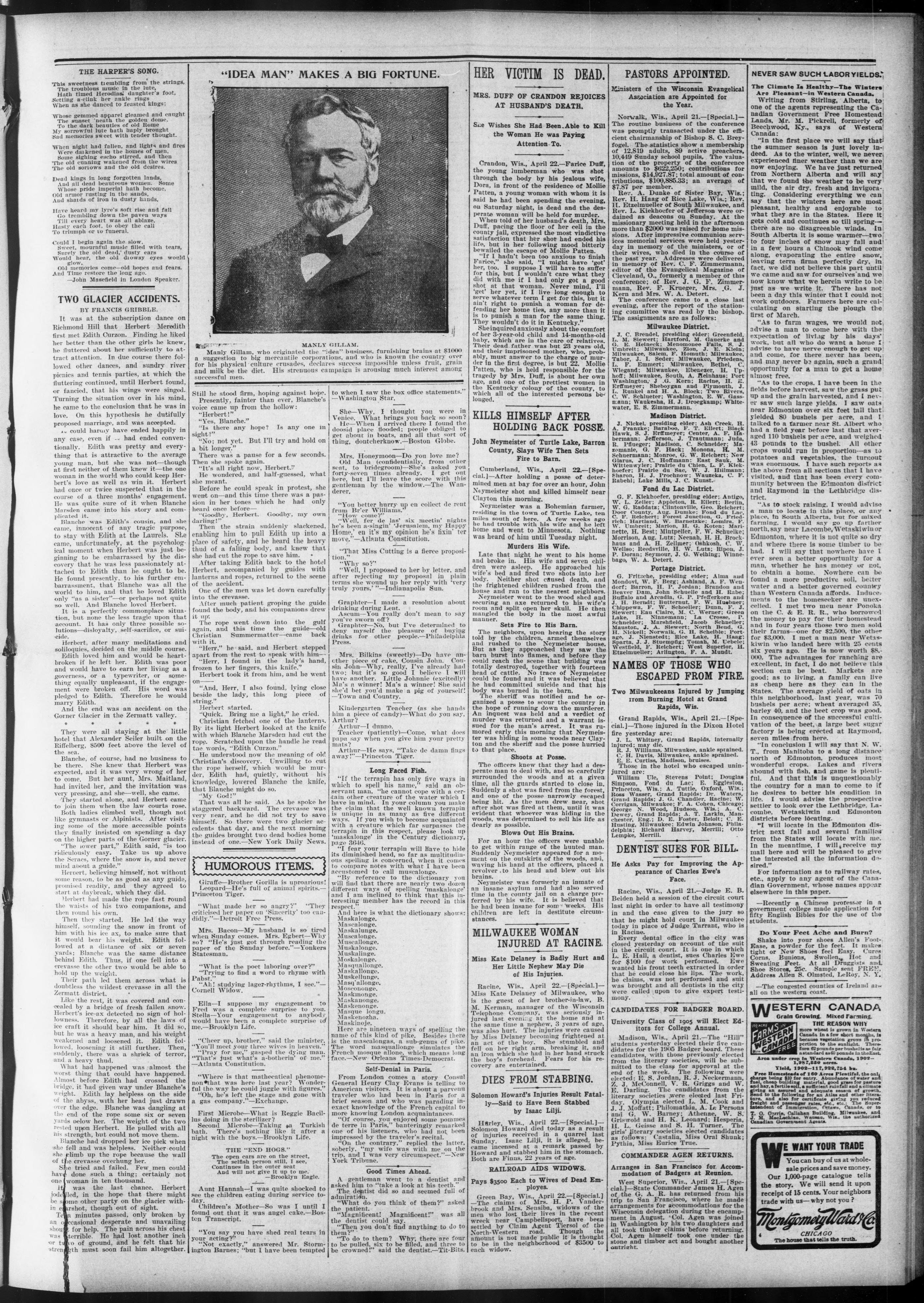
"IDEA MAN" MAKES A BIG FORTUNE.
Manly Gillam, who originated the "idea" business, furnishing brains at $1000 a suggestion to big mercantile corporations, and who is known the country over for his physical culture crusades, declares success impossible unless fruit, grain and milk be the diet. His strenuous campaign is arousing much interest among successful men.
Still he stood firm, hoping against hope. Presently, fainter than ever, Blanche's voice came up from the hollow:
"Herbert!"
"Yes, Blanche."
"Is there any hope? Is any one in sight?"
to when I saw the box office statements."
—Washington Star.
She—Why. I thought you were in Venice. What brings you back so soon.
He—When I arrived there I found the doosid place flooded; people obliged to get about in boats, and all that sort o
"No; not yet. But I'll try and hold on a bit longer." There was a pause for a few seconds. Then she spoke again.
Then she spoke again.
"It's all right now, Herbert."
He wondered, and half-guessed, what she meant.
Before he could speak in protest, she went on—and this time there was a passion in her tones which he had only heard once before—
"Goodby, Herbert. Goodby, my own darling!"
Then the strain suddenly slackened, enabling him to pull Edith up into a place of safety, and he heard the heavy thud of a falling body, and knew that she had cut the rope to save him.
After taking Edith back to the hotel Herbert, accompanied by guides with lanterns and ropes, returned to the scene of the accident.
One of the men was let down carefully into the crevasse.
After much patient groping the guide found the body, and his companions drew it up.
The rope went down into the gulf again, and this time the guide—old Christian Summermatter—came back with it.
"Herr," he said, and Herbert stepped apart from the rest to speak with him—"Herr, I found in the lady's hand, frozen to her fingers, this knife."
Herbert took it from him, and he went on—
"And, Herr, I also found, lying close beside the lady, this long piece of string."
Herbert started.
"Quick. Bring me a light," he cried. Christian fetched one of the lanterns. By its light Herbert looked at the knife with which Blanche Marsden had cut the rope. Scratched upon the handle he read the words, "Edith Curzon." He understood now the meaning of old Christian's discovery. Unwilling to cut the rope herself, which would be murder, Edith had, quietly, without his knowledge, lowered Blanche the knife, that Blanche might do so.
That was all he said. As he spoke he staggered backward. The crevasse was very near, and he did not try to save himself. So there were two glacier accidents that day, and the next morning the guides brought two dead bodies home instead of one.—New York Daily News.
HUMOROUS ITEMS.
Giraffe—Brother Gorilla is uproarious!
Leopard—He's full of animal spirits.—
Princeton Tiger.
"What made her so angry?" "They criticised her paper on 'Sincerity' too candidly."—Detroit Free Press.
Mrs. Bacon—My husband is so tired when Sunday comes. Mrs. Egbert—Why so? "He's just got through reading the paper of the Sunday before."—Yonkers Statesman.
"What is the poet laboring over?"
"Trying to find a word to rhyme with Pabst."
"Ah! studying lager-rhythms, I see."—Cornell Widow.
Ella—I suppose my engagement to Fred was a complete surprise to you. Stella—Your engagement to anybody would have been a complete surprise to me.—Brooklyn Life.
"Cheer up, brother," said the minister. "You'll meet your three wives in heaven." "Pray for me," gasped the dying man. "That's just what's a-botherin' of me."—Atlanta Constitution.
"Where is that mathematical phenomenon that was here last year? Wonderful the way he could juggle with figures." "Oh, he's left the stage and gone with a gas company."—Exchange.
First Microbe—What is Reggie Bacillus doing in the sterilizer?
Second Microbe—Taking a Turkish bath. There's nothing like it after a night with the boys.—Brooklyn Life.
THE "END HOGS."
The open cars are on the street,
The selfish person still. I see,
Continues in the outer seat
And will not give it up to me.
—Brooklyn Eagle.
Aunt Hannah—I was quite shocked to see the children eating during service today.
Children's Mother—So was I until I found out that it was angel cake.—Boston Transcript.
"You say you have shed real tears in your acting?"
"Not exactly." answered Mr. Stormington Barnes; "but I have been tempted
MANLY GILLAM.
ed the "idea" business, furnishing brains at $1000
corporations, and who is known the country over
s, declares success impossible unless fruit, grain
nuous campaign is arousing much interest among
st hope.
slanche's
one in
hold on
to when I saw the box office statements."
—Washington Star.
She—Why, I thought you were in
Venice. What brings you back so soon?
He—When I arrived there I found the
doosid place flooded; people obliged to
get about in boats, and all that sort of
thing, dontcherknow.—Boston Globe.
Mrs. Honeymoon—Do you love me?
Old Man (confidentially, from other seat, to bridegroom)—She's asked you forty-seven times already. I get out here, but I'll leave the score with this gentleman by the window.—The Wanderer.
"You better hurry up en collect de rent frum Br'er Williams."
"How come?"
"Well, fer de las' six meetin' nights he's been a-singin' 'Jerusalem, my Happy Home,' en it's my opinion he's fixin' ter move."—Atlanta Constitution.
"That Miss Cutting is a fierce proposition."
"Well, I proposed to her by letter, and after rejecting my proposal in plain terms she wound up her reply with 'very truly yours.'"—Indianapolis Sun.
Graphter—I made a resolution about drinking during Lent.
Ascum—You really don't mean to say you've sworn off?
Graphter—No, but I've determined to deny myself the pleasure of buying drinks for other people.—Philadelphia Press.
Mrs. Bilkins (sweetly)—Do have another piece of cake, Cousin John. Cousin John—Why, really, I've already had two; but it's so good I believe I will have another. Little Johnnie (excitedly) Ma's a winner! Ma's a winner! She said she'd bet you'd make a pig of yourself!—Town and Country.
Kindergarten Teacher (as she hands him a piece of candy)—What do you say, Arthur?
Teacher (patiently)—Come, what does papa say when you give him your pretty mats?
Arthur—He says, "Take de damn fings away!"—Princeton Tiger.
Long Faced Fish.
"If the terrapin has only five ways in which to spell his name," said an observant man, "he cannot cope with a certain other creature of the water which I have in mind. In your column you make the claim that the well known terrapin is unique in as many as five different ways. If you wish to become acquainted with a creature which far surpasses the terrapin in this respect, please look up 'maskalonge' in the Century dictionary, page 3646.
"I fear your terrapin will have to hide its diminished head, so far as multitudinous spelling is concerned, when it comes to compare notes with what I have been accustomed to call muscalonge.
"By reference to the dictionary you will find that there are nearly two dozen different ways of spelling 'maskalonge' and I am inclined to think that this interesting member has the record in this respect."
And here is what the dictionary shows: Maskalonge
Maskalonge.
Mascalonge.
Maskalunge.
Muscalonge.
Muscallonge.
Muskalonge.
Muskalonge.
Musquallonge.
Maskallonge.
Muskellunge.
Masq'allonge.
Moscononge.
Maskmonge.
Maskkanonge.
Maskenonge.
Masque longu
Maskenozha.
Maskinoie.
also tired
art—Why
dling the
Yonkers
ever?"
me with
I see."—
ment to
to you.
anybody
prise to
Maskalonge.
Mascalonge.
Maskalunge.
Muscalonge.
Muscallonge.
Muskalonge.
Muskalinge.
Moskalonge.
Masquallonge.
Maskallonge.
Muskellunge.
Masq'allonge.
Moscononge.
Maskinonge.
Maskanonge.
Maskenonge.
Masque longu.
Maskenozha.
Maskinoje.
Here are nineteen ways of spelling the name of this kind of pike. Besides there is the mascalongas, a sub-genus of pike. The word masquallonge simulates the French mosque allone, which means long face.—New Orleans Times-Democrat.
Self-Denial in Paris
From London comes a story Consul General Henry Clay Evans is telling to American visitors. It is about a parvenu traveler who had been in Paris for a brief season and who was parading inexact knowledge of the French capital to more knowing London acquaintances.
"Of course, you enjoyed some pommes de terre in Paris," banteringly remarked one of his listeners, who had not been impressed by the traveler's recital.
"On the contrary," replied the latter, soberly, "my wife was with me on the trip, and I was very circumspect."—New York Tribune.
Good Times Ahead.
A gentleman went to a dentist and asked him to "take a look at his teeth." The dentist did so and seemed full of admiration.
"What do you think of them?" asked the patient.
"Magnificent! Magnificent!" was all the dentist could say.
"Then you don't find anything to do to them?"
"To do to them? Why, there are four to be pulled, six to be filled, and three to be crowned!" said the dentist.—Tit-Bits.
HER VICTIM IS DEAD.
MRS. DUFF OF CRANDON REJOICES AT HUSBAND'S DEATH.
She Wishes She Had Been.Able to Kill the Woman He was Paying
Crandon, Wis., April 22.—Farice Duff, the young lumberman who was shot through the body by his jealous wife, Dora, in front of the residence of Mollie Patten, a young woman with whom it is said he had been spending the evening, on Saturday night, is dead and the desperate woman will be held for murder. When told of her husband's death, Mrs. Duff, pacing the floor of her cell in the county jail, expressed the most vindictive satisfaction that her shot had ended his life, but in her following mood bitterly bewailed the escape of Mollie Patten
"If I hadn't been too anxious to finish Farice," she said, "I might have 'got' her, too. I suppose I will have to suffer for this, but I wouldn't care what they did with me if I had only got a good shot at that woman. Never mind, I'll 'get' her yet, if I live long enough to serve whatever term I get for this, but it ain't right to punish a woman for defending her home ties, any more than it is to punish a man for the same thing. They wouldn't do it in Kentucky."
She inquired anxiously about the comfort of her 3-year-old child and 14-months-old baby, which are in the care of relatives. Their dead father was but 23 years old, and their imprisoned mother, who, probably, must answer to the charge of murder in the first degree, is but 22. Mollie Patten, who is held responsible for the tragedy by Mrs. Duff, is about her own age, and one of the prettiest women in the Kentucky colony of the county, to which all of the interested persons belonged.
KILLS HIMSELF AFTER HOLDING BACK POSSE
John Neymeister of Turtle Lake, Barron County, Slays Wife Then Sets Fire to Barn.
Cumberland, Wis., April 22.—[Special.]—After holding a posse of determined men at bay for over an hour, John Neymeister shot and killed himself near Clayton this morning. Neymeister was a Bohemian farmer, residing in the town of Turtle Lake, ten miles south of here. A few weeks ago he had trouble with his wife and he left home and went to Minnesota. Nothing was heard of him until Tuesday night.
Murders His Wife.
Late that night he went to his home and broke in. His wife and seven children were asleep. He approached his wife's bed and fired two shots into her body. Neither shot caused death, and the frightened children rushed from the house and ran to the nearest neighbors. Neymeister went to the wood shed and securing an axe returned to his wife's room and split open her skull. He then mangled the body in the most awful manner.
Sets Fire to His Barn.
The neighbors, upon hearing the story told by the children, armed themselves and rushed to the Neymeister house. But as they approached they saw the barn burst into flames, and before they could reach the scene that building was totally destroyed, together with fourteen head of cattle. No trace of Neymeister could be found and it was believed that he had committed suicide and that his body was burned in the barn.
The sheriff was notified and he organized a posse to scour the country in the hope of running down the murderer. An inquest was held and a verdict of murder was returned and a warrant issued for the man's arrest. It was rumored early this morning that Neymeister was hiding in some woods near Clayton and the sheriff and the posse hurried to that place.
Shoots at Posse.
The officers knew that they had a desperate man to deal with, and so carefully surrounded the woods and at a given time, all the guards started to close in. Suddenly a shot was fired from the forest, and one of the posse narrowly escaped being hit. As the men drew near, shot after shot was fired at them, until it was evident that whoever was hiding in the woods, was determined to sell his life as dearly as possible.
Blows Out His Brains.
For an hour the officers were unable to get within range of the hunted man. Suddenly Neymeister appeared for a moment on the outskirts of the woods, and, waving his hand at the officers, placed a revolver to his head and blew out his brains. Neymeister was formerly an inmate of an insane asylum and had also served time in the county jail on a charge preferred by his wife. It is believed that he had been insane for some weeks. His children are left in destitute circumstances.
MILWAUKEE WOMAN INJURED AT RACINE.
Miss Kate Delaney is Badly Hurt and Her Little Nephew May Die of His Injuries.
Racine, Wis., April 22.—[Special.]—Miss Kate Delaney of Milwaukee, who is the guest of her brother-in-law, B. M. Kerman, manager of the Wisconsin Telephone Company, was seriously injured last evening at the home and at the same time a nephew, 3 years of age, was also hurt. The injuries were caused by Miss Delaney becoming frightened at an act of the boy. She stumbled and fell on her right arm, breaking it, and an iron which she had in her hand struck the boy's forehead. Fears for his recovery are entertained.
DIES FROM STABBING.
Solomon Howard's Injuries Result Fatal ly—Said to Have Been Stabbed by Isaac Lilji.
Hurley, Wis., April 22.—[Special.]—Solomon Howard died today as a result of injuries received in a quarrel last Sunday. Isaac Lilji, it is alleged, became incensed at a remark passed by Howard and stabbed him in the stomach. Both are Finns, 22 years of age.
RAILROAD AIDS WIDOWS.
Pays $3500 Each to Wives of Dead Employes.
Green Bay, Wis., April 22.—[Special.] The claims of Mrs. H. P. Vanderbrook and Mrs. Sensiba, widows of the men who lost their lives in the recent wreck near Campbellsport, have been settled by Claim Agent Tiersol of the North-Western road. Though the amount is not made public it is thought to be in the neighborhood of $3500 to each widow.
NEVER SAW SUCH LABOR YIELDS.
The Climate Is Healthy-The Winters Are Pleasant-in Western Canada. Writing from Stirling, Alberta, to one of the agents representing the Canadian Government Free Homestead Lands, Mr. M. Pickrell, formerly of Beechwood, Ky., says of Western Canada:
"In the first place we will say that the summer season is just lovely indeed. As to the winter, well, we never experienced finer weather than we are now enjoying. We have just returned from Northern Alberta and will say that we found the weather to be very mild, the air dry, fresh and invigorating. Considering everything we can say that the winters here are most pleasant, healthy and enjoyable to what they are in the States. Here it gets cold and continues so till spring there are no disagreeable winds. In South Alberta it is some warmer—two to four inches of snow may fall and in a few hours a Chinook wind come along, evaporating the entire snow, leaving terra firma perfectly dry, in fact, we did not believe this part until we came and saw for ourselves and we now know what we herein write to be just as we write it. There has not been a day this winter that I could not work outdoors. Farmers here are calculating on starting the plough the first of March.
"As to farm wages, we would not advise a man to come here with the expectation of living by his days' work, but all who do want a home I advise to have nerve enough to get up and come, for there never has been, and may never be again, such a grand opportunity for a man to get a home almost free.
"As to the crops. I have been in the fields before harvest, saw the grass put up and the grain harvested, and I never saw such large yields. I saw oats near Edmonton over six feet tall that yielded 80 bushels per acre, and I talked to a farmer near St. Albert who had a field year before last that averaged 110 bushels per acre, and weighed 43 pounds to the bushel. All other crops would run in proportion—as to potatoes and vegetables, the turnout was enormous. I have such reports as the above from all sections that I have visited, and that has been every community between the Edmonton district and Raymond in the Lethbridge district.
"As to stock raising, I would advise a man to locate in this place, or any place, in South Alberta, but for mixed farming, I would say go up farther north, say near Lacombe, Wetaskiwin or Edmonton, where it is not quite so dry and where there is some timber to be had. I will say that nowhere have I ever seen a better opportunity for a man, whether he has money or not, to obtain a home. Nowhere can be found a more productive soil, better water and a better governed country than Western Canada affords. Inductions to the homeseeker are unexcelled. I met two men near Ponoka on the C. & E. R. R., who borrowed the money to pay for their homestead and in four years those two men sold their farms—one for $2,500, the other for $3,000. I met a man near Wetaskiwin who landed here with 25 cents six years ago. He is now worth $8,000. The advantages for ranching are excellent, in fact, I do not believe this section can be beat. Markets are good; as to living, a family can live as cheap here as they can in the States. The average yield of oats in this neighborhood, last year, was 70 bushels per acre; wheat averaged 35, barley 40, and the beet crop was good. In consequence of the successful cultivation of the beet, a large beet sugar factory is being erected at Raymond, seven miles from here.
"In conclusion I will say that N. W. T., from Manitoba to a long distance north of Edmonton, produces most wonderful crops. Lakes and rivers abound with fish, and game is plentiful. And that this is unquestionably the country for a man to come to if he desires to better his condition in life. I would advise the prospective settler to look over the Lethbridge, Lacombe, Wetaskiwin and Edmonton districts before locating.
"I will locate in the Edmonton district next fall and several families from the States will locate with me. In the meantime, I will receive my mail here and will be pleased to give the interested all the information desired."
For information as to railway rates, etc., apply to any agent of the Canadian Government, whose names appear elsewhere in this paper.
—Recently a Chinese professor in a government college made application for fifty English Bibles for the use of the students.
Do Your Feet Ache and Burn?
Shake into your shoes Allen's Foot-Ease, a powder for the feet. It makes tight or New Shoes feel Easy. Cures Corns, Bunions, Swollen, Hot and Sweating Feet. At all Druggists and Shoe Stores, 25c. Sample sent FREE. Address Allen S. Olmsted, LeRoy, N. Y.
The congested counties of Ireland are all on the western coast.
WESTERN CANADA Grain Growing. Mixed Farming.
FARMS
WESTERN
CANADA
FREE
Free Homesteads of 160 Acres Plentiful, the only charge being $10 for entry. Abundance of water and fuel, cheap building material, good grass for pasture, soil, a sufficient rainfall and a climate giving an assurance, a season of growth. Send to the following for an Atlas and other literature, and also for certificate giving you reduced freight and passenger rates, etc., etc.: The Superintendent of Immigration, Ottawa, Canada, or to T. O. Carrie, Callahan Building, Milwaukee, and J. M. MacLachlan, Wausau, Wis., the authorized Canadian Government Agents.
WE WANT YOUR TRADE
You can buy of us at wholesale prices and save money.
Our 1,000-page catalogue tells the story. We will send it upon receipt of 15 cents. Your neighbors trade with us—why not you?
Montgomery Ward Co.
CHICAGO
The house that tells the truth.
PASTORS APPOINTED.
Ministers of the Wisconsin Evangelical Association are Appointed for the Year.
Norwalk, Wis., April 21.—[Special.]—The routine business of the conference was promptly transacted under the efficient chairmanship of Bishop S. C. Breyfogel. The statistics show a membership of 12,819 adults, 89 active preachers, 10,449 Sunday school pupils. The valuation of the property of the conference amounts to $622,250; contributions for missions, $14,927.87; total amount of contributions, $100,885.33; an average of $7.87 per member.
Rev. A. Dunke of Sister Bay, Wis.; Rev. H. Haag of Rice Lake, Wis.; Rev. H. Etzelmueller of South Milwaukee, and Rev. L. Kiekhoefer of Jefferson were ordained as deacons on Sunday. At the missionary meeting held in the afternoon more than $2000 was raised for home missions. After impressive communion services memorial services were held yesterday in memory of the ministers, or of their wives, who died in the course of the past year. Addresses were delivered in memory of Rev. C. F. Zimmermann, editor of the Evangelical Magazine of Cleveland, O., formerly a member of this conference; of Rev. J. G. F. Zimmermann, Rev. F. Krueger, Mrs. G. J. Kern and Mrs. W. A. Detert. The conference came to a close last evening, after the report of the stationing committee was read by the bishop. The assignments are as follows:
Milwaukee District.
J. C. Brendel, presiding elder; Greenfield, L. M. Siewert; Hartford, M. Gauerke and G. E. Heckne; Menomonee Falls, S. J. Umbreit; Milwaukee, Zlion, J. E. Klein; Milwaukee, Salem, F. Homuth; Milwaukee, Tabor, J. I. Seder; Milwaukee, Friedens, L. F. Emmert; Milwaukee, Bethel, C. Wlegand; Milwaukee, Ebenezer, H. Uphoff; Milwaukee, South, A. Heinhaus; Port Washington, J. G. Kern; Racline, H. E. Erftmeyer; Sheboygan and Plymouth, J. L. Runkel and H. A. Block; Two Rivers, C. W. Schlueter; Washington, E. W. Gassmann; Waukesha, H. J. Droegkamp; Whitewater, E. S. Zimmermann.
Madison District.
J. Nickel, presiding elder; Ash Creek, H. A. Franzke; Baraboo, F. T. Ellert; Black Hawk, S. J. Erffmeyer; Center, A. F. Habermann; Jefferson, J. Trautmann; Juda, R. Pflueger; Madison, C. Schneider; Mazomanie, G. F. Hack; Monona, H. M. Schuermann; Monroe, G. W. Relchert; New Glarus, J. C. Hoffmann; East Sauk, M. Wittenwyler; Prairie du Chlen, L. F. Kleckhoefer; Prairie du Sac, W. J. Hillmann; Sharon, H. J. Prochnow; Wauzeka, C. F. Rabehl; Lake Mills, J. C. Kunst
Fond du Lac District.
G. F. Klekhoefer, presiding elder; Antigo, W. L. Zeller; Appleton, R. Eilert; Berlin, W. G. Raddatz; Clintonville, Geo. Reilchert; Door County, Aug. Dumke; Fond du Lac, C. F. Relchert; Forest Junction, G. Friedrich; Hartland, W. Barnetzke; Lomlra, F. W. Umbreit; Marion, H. G. Koten; Marinette, H. Best; Mintpeller, F. W. Schuelke; Morrison, Aug. Lutz; Neenah, H. H. Brockhaus and A. H. Zellmer; Oshkosh, C. W. Wellso; Reedsville, H. W. Lutz; Ripon, J. P. Doran; Seymour, J. G. Wethling; Winnebago, W. A. Detert.
Portage District
G. Fritsche, presiding elder; Alma and Mondovl, W. F. Berg; Ashland, A. F. Wendorf; Barron, H. P. Jordan; Brandon and Beaver Dam, John Schuelle and H. Rabe; Buffalo and Arcadia, G. P. Pfefferkorn and J. H. Berndt; Butternut, F. W. Huebner; Chippewa, F. W. Schoeller; Dunn, F. J. Siewert; Eau Claire, M. C. Werner; Green Lake, H. Ninnemann; La Crosse, P. Schneider; Marshfield, Jacob Schneller; Maustor, J. A. Siewert; North Bend, G. H. Nickell; Norwalk, G. H. Scheble; Portage, J. Nienstedt; Rice Lake, H. Haag; Sparta, J. J. Stuempfgil; Tomah, M. Uebele; Westfield, F. Helchert; West Superior, H. Etzelmuelter; Arlington, F. A. Mundt.
NAMES OF THOSE WHO ESCAPED FROM FIRE.
Two Milwaukeeans Injured by Jumping from Burning Hotel at Grand Rapids, Wis.
Grand Rapids, Wis., April 21.—[Special.]—Those injured in the Dixon Hotel fire yesterday are:
J. L. Whitney, Grand Rapids, internally injured; may die.
R. J. Williams, Milwaukee, ankle sprained.
C. H. Davis, Milwaukee, ankle sprained.
E. E. Curtiss, Madison, bruises.
Those in the hotel who escaped uninjured are:
William Ule, Stevens Point; Douglas Simpson, Fond du Lac; E. Eggleston, Princeton, Wis.; A. Tuttle, Oxford, Wis.; Ross Wasser, Grand Rapids; Dr. Waters, Grand Rapids; J. G. Chandler, Racine; W. Corrigan, Milwaukee; F. A. Cohen, Chicago; George N. Wood, Hudson, Wis.; A. C. Dewey, Grand Rapids; A. T. Larkin, Manchester, Eng.; D. E. Foster, Beloit; C. E. Husting, Milwaukee; Edwin Johnson, Philadelphia; Richard Harvey, Merrill; Otto Lempke, Merrill.
DENTIST SUES FOR BILL.
He Asks Pay for Improving the Appearance of Charles Ewe's Face.
Racine, Wis., April 21.—Judge E. B. Beiden held a session of the circuit court last night in order to have all testimony in and the case given to the jury so that he might hold court in Milwaukee today in place of Judge Tarrant, who is in Racine.
Every dental office in the city was closed yesterday on account of the suit in the circuit court. It is one in which L. E. Hall, a dentist, sues Charles Ewe for $100 for work performed. Ewe wanted his front teeth extracted in order that he could close his lips. The work, he claims, was not performed and suit was brought and all dentists in the city were called upon to give expert testimony.
CANDIDATES FOR BADGER BOARD.
University Class of 1905 will Elect Editors for College Annual.
Madison, Wis., April 21.—The "Hill" students yesterday elected their five candidates for the 1905 Badger board. These candidates, with those previously elected from the literary societies, will be submitted to the class for approval at the end of the week. The following were elected; E. S. Jordan, R. J. Neckermann, Z. J. McConnell, V. R. Griggs and W. E. Darling. The candidates from the literary societies were elected last Friday. Olympia elected L. M. Cook and J. J. Moffatt; Philomathia, A. L. Persons and G. W. Barney; Athenae, W. S. Griswold and H. K. Leonard; Hesperia, H. L. Geisse and S. H. Turner. The girls' literary societies elected candidates as follows: Castalia, Miss Oral Shunk; Pythia, Miss Eurice True.
COMMANDER AGEN RETURNS.
Arranges in San Francisco for Accommodation of Badgers at Reunion.
West Superior, Wis., April 21.—[Special.]—State Commander James H. Agen of the G. A. R. has returned from his trip to San Francisco, where he made arrangements for accommodations for the Wisconsin delegation during the encampment in August. Col. Agen was joined in Washington by his two daughters and all took timber claims before returning. Col. Agen himself took one under the stone and timber act and bought another outright.
mORE wheat is grown in Western Canada in a few short months, is because vegetation grows in proportion to the sunlight. Therefore 62 pounds per bushel is as fair a standard as 60 pounds in the East.
The Wisconsin Weekly Advocate
Printed in the Interests of the Negro Race, MILWAUKEE, WIS.
Telephone Black No. 244.
Any part of the United States and Canada, postage paid.
One Year ..... $2.00
Six Months ..... 1.25
Three Months ..... .75
Send money by Express Money Order, P. O. Money Order or Registered Letter to the Wisconsin Weekly Advocate.
ADVERTISING RATES.
One inch, single insertion..... 25c
One inch, per year..... $9.00
Business locals 5c per line each insertion.
Apply for rates to the Advocate.
TO CONTRIBUTORS:
All communications must be sent with the name and address of the sender as an evidence of good faith, but not necessarily for publication. No manuscript returned if not accepted, unless accompanied by stamps.
The Wisconsin Weekly Advocate company wishes to notify the public that all contracts and business transactions with this company must have the company stamp, otherwise they will be void. Neither will this company be responsible for paid subscriptions unless given to duly-accredited agents, who, on request, will give the company's receipt for same. Subscribers failing to receive their papers regularly will kindly notify the general office. Address all business communications to the general manager, 79 Fifth street.
Entered in the Postoffice at Milwaukee as Second-class matter.
EDITORIAL PARAGRAPHS.
"I know of the bravery and character of the Negro soldier. He saved my life at Santiago, and I have had occasion to say so in many articles and speeches. The Rough Riders were in a bad position when the Ninth and Tenth cavalry came rushing up the hill carrying everything before them. The Negro soldier has the faculty of coming to the front when he is needed most. In the Civil war he came 400,000 strong, and I believe he saved the Union."—President Roosevelt.
The self-sacrificing attorneys are now getting their contributions from the cause of the miners.
The submarine boat with which a German hopes to reach the north pole should be named the Refrigerator.
The big sloops cannot capsize because of the lead mines at the extremity of their keels, but they can be blown bald by sudden squalls.
---
A patent floating battery conceived by a New York millionaire may be a practical result of repeated investments in "floats."
Sir Thomas Lipton will please take notice that the Reliance has quietly slipped into the water. The news is of importance to him.
The presumption must be that their nearness to extinguishing apparatus makes it possible for Milwaukee's firemen to wear the combustible straw hat.
The story that an ancient coin was found in a lump of soft coal at La Crosse may be a ruse of the coal dealers for an advance in fuel to gold mine prices.
Raids of "get-rich-quick concerns" are frequent enough in Chicago to indicate that many people have surpluses for wildcat adventures in these times of prosperity.
A Montana rancher who is experimenting with a home-made airship may be figuring on the meat trust and its manipulating of prices to take him into high altitudes.
---
New Jersey corporations have become nearly as numerous as New Jersey mosquitoes; and, judging by the statistics of their capitalization, many of them are quite as big.
Spindle Top, in the Beaumont oil district, is a bit of flaming evidence that that particular section of Texas soil is too badly oil-soaked to be a good fire insurance risk.
The defense of the American woman from implication in "race suicide," by the convention of old maids at Pittsford, New York, is a display of good will that is acceptable as an alternative.
---
The fact that, while you may "strike it" now and then, you needn't expect to "strike it" every time is indicated by this: Thomas Alva Edison has taken out 791 patents, which have cost him $51,000 in fees.
The stepping of the mast of the cup-defender Reliance is an important event. The mast serves not only as a support for the sails but as the traditional spar upon which the sailors can scratch for breezes.
---
Aerial navigation has made rapid strides of late, but it has not advanced far enough to make a simple ascent and descent a commonplace incident. A Paris dispatch recently chronicled a short flight by the Lebaudy ship as something wonderful.
The hull of the Spanish warship Reina Christina, which was raised from the bottom of Manila bay with eighty skeletons in her fighting quarters was sufficiently riddled with shell holes to prove that the marksmanship of the gunners of Dewey's fleet was up to the demands of the thrilling occasion.
The discovery of a rich deposit of anthracite coal near Wilkesbarre, Pennsylvania, would have more interest for the people if the owners of the lands were not members of the Coal Trust. When a heavy deposit of hard coal is found outside of the combination of coal mines and coal roads, the fact will have some significance.
PAPERS BY THE PEOPLE
SOLUTION OF THE LABOR PROBLEM.
The solution of the labor problem is an impossibility, a conclusion I have reached after years of careful consideration of the question, and I base this assertion upon the fact that in order to solve satisfactorily this difficult problem the problem of life itself must at the same time be solved. By this I do not mean to say that unfortunate industrial conditions may not be ameliorated, for they can be to a greater or less extent when treated intelligently and fairly. The inborn restless hope
of mankind for advancement, the ceasele human race for opportunities to enjoy plane, the tremendous influence of cannot be killed, and as they are the ve problem of labor, the impossibility of its apparent.
of mankind for advancement, the ceaseless struggle of the human race for opportunities to enjoy life on a higher plane, the tremendous influence of belief on action, cannot be killed, and as they are the very essence of the problem of labor, the impossibility of its solution becomes apparent.
THREE TRUST EVILS AND THE REMEDY.
There are three trust evils. First, the watering of stocks, which defrauds the innocent purchaser of those securities. While only a few of our eighty millions are injured in that way, that evil must nevertheless be remedied, and its only remedy is publicity, for no one will buy a worthless share of stock if he knows the condition of the corporation that issues it. When statements of their business are published to the world,
every purchaser may know what he buys of trusts are the unjust raising of price lowering of wages. Prices are seldom are trusts, because the higher the prices they and therefore the smaller their profits. reductions of wages is less and less freq by the voluntary advancement of theployes of the steel trust and hundreds ofployers of labor, the possibility of such prevented.
The only method to prevent these wrong development of national control of corporess throughout the nation. Effective na must grow. Ironclad control of business themselves are perpetually changing and be created on the instant, and would it could. National control which account must develop as the changing methods dustry themselves develop. Moderation wisdom in all human legislation that att the business activities of 80,000,000 people
every purchaser may know what he buys. The other evils of trusts are the unjust raising of prices and the unjust lowering of wages. Prices are seldom arbitrarily raised by trusts, because the higher the prices the smaller the sales, and therefore the smaller their profits. Although unjust reductions of wages is less and less frequent, as is proved by the voluntary advancement of the wages of the employees of the steel trust and hundreds of other great employers of labor, the possibility of such a wrong must be prevented.
The only method to prevent these wrongs is the gradual development of national control of corporations doing business throughout the nation. Effective national supervision must grow. Ironclad control of business methods which themselves are perpetually changing and improving cannot be created on the instant, and would not be effective if it could. National control which accomplishes anything must develop as the changing methods or organized industry themselves develop. Moderation is the word of wisdom in all human legislation that attempts to regulate the business activities of 80,000,000 people.
HOW TO CHOOSE A HUSBAND.
It is easy enough to give advice on the choice of a husband—to say that he should be well off, good-tempered, in a suitable social stratum, good-looking, but not so handsome as to be a germ of heart disease, and congenial to a girl's own likes and dislikes.
But what is the use of advice? When love creates his own matchless atmosphere about a man the girl no longer sees him as he is. She
may have said: "I will never marry a w girls say that).
"I will never, never, never marry a p ---simply won't—marry anybody under vorite age among girls).
"The man I marry must be taller than tinguished appearance" (girls all want th
"I simply could not marry a man wh mers, or lisps, or says 'He, he!" when he
That is the way girls talk to their inn
may have said: "I will never marry a widower" (heaps of girls say that).
"I will never, never, never marry a poor man! I won't ---simply won't—marry anybody under 35" (35 is a favorite age among girls).
"The man I marry must be taller than I am and of distinguished appearance" (girls all want that).
"I simply could not marry a man who stoops or stammers, or lisps, or says 'He, he!' when he laughs."
That is the way girls talk to their inmost thoughts. Then
MEMORIAL TO WINNIE DAVIS.
Daughter of the Confederacy to Have a Hall Named After Her
Winnie Davis, the daughter of the Confederacy, who died a few years ago, is to be honored by a memorial, which is now in process of erection in connection with the State Normal School at Athens, Ga. The idea dates back to four years ago, when the State branch of the Daughters of the Confederacy held a convention at Rome, Ga. It was then decided that there could be no more appropriate method of honoring the memory of the southern President's daughter than by the addition to one of Georgia's Normal Schools for a dormitory for the children or grandchildren of Confederate
THE WINNIE DAVIS HALL.
veterans, and Athens was selected as the beneficiary. The Daughters of the Confederacy had collected $60,000 toward the cost when the Southern Educational Congress, at a meeting held a year ago, offered to contribute half of the additional $9,000 which was needed. This left only $4,500 to be provided, and that fund is now practically completed.
The school at Athens is badly hampered on account of suitable accommodations. The Winnie Davis hall will to a considerable extent relieve this condition. The nature of the memorial is looked upon approvingly in the south. Mrs. Jefferson Davis says of it: "It is to me one of the dearest of all efforts to do honor to my child's spotless name."
AMERICAN MACHINE IN PERSIA.
Fair Houri to Gain Freedom With the Coming of the Sewing Machine. The American harvesting machine is now seen in Palestine and Assyrian grain fields, even in the field where Ruth gleaned, and the American sewing machine has invaded Persia. Min-
C. R. WRIGHT
I
Q
cess struggle of the life on a higher belief on action, every essence of the solution becomes
Girls should be careful with vestibule of acquaintance to a friend-dship. There is an unerr an whether a man is good or encouraging an acquaintance in some of that refinement we
The best way to avoid fail men is not to know them.
the wrongs is the gradual corporations doing busi- live national supervision business methods which g and improving cannot could not be effective if a accomplishes anything methods or organized in- tation is the word of that attempts to regulate 0 people.
By Mrs. C. E. Humphrey
train is very much like that of head of a great mercantile o f his office he can, by touching presence the members of his rectly in charge of the several his orders. It is their duty in- carried out. The manager's m it is shared by his chief assis- tremely wearing. His atti- counsellor, commander and a
Relatively speaking, the m small business has a much ha has no one with whom to div- lieve him of the burden of det a dry goods store, he must bu properly displayed, write the
business. No one shares them his nerves," and unless he lear to meet the difficulties as they spirit, he soon goes to pieces.
I am not prepared to assent to make a success of a small but I will say that he who can petition, establish and satisfy his own, must be possessed of how to use them.
PRESIDENT ROOSEVELT HAS RECOMMENDED MANY WOUNDS
SUCH a collection of scars as that borne on never owned by an American chief executive wounded" President of the United States, or less serious nature have been received manhood.
During his football days he received many ranching career in the West he got three ribs. Lands he had a bone broken in his shoulder from. He was attacked by a grizzly bear while he escaped by a narrow margin. Two years before an infuriated steer in the Big Horn country of steer by the horns, vaulted to its back, and rode.
On more recent hunting trips in Colorado or mountain lions in which his quickness of hand tame. He was slightly wounded in the hand during he barely escaped death in the trolley accident he injured that an operation for abscess had to be.
President Roosevelt's last two injuries have of his intimate friend, General Leonard Wood play, which they used as exercise almost daily. Wood thrust his rapier through the President's on the forehead and narrowly missing his left friends were in a vigorous bout with the single nasium near the top of the White House. The and in the rapid play the President caught a had to shake hands with his left hand at the re
PRESIDENT ROOSEVELT HAS RECEIVED MANY WOUNDS DURING HIS LIFE
SUCH a collection of scars as that borne by President Roosevelt was never owned by an American chief executive before. He is the "most wounded" President of the United States. Fifteen injuries of a more or less serious nature have been received by him since he reached manhood.
During his football days he received many bruises, and during his ranching career in the West he got three ribs broken. Later in the Bad Lands he had a bone broken in his shoulder from a fall from a vicious horse.
He was attacked by a grizzly bear while hunting in Idaho in 1889, and escaped by a narrow margin. Two years before that he was chased by an infuriated steer in the Big Horn country of Wyoming. He grabbed the steer by the horns, vaulted to its back, and rode it for two miles.
On more recent hunting trips in Colorado he has had encounters with mountain lions in which his quickness of hand frequently saved his life.
He was slightly wounded in the hand during the Cuban campaign, and he barely escaped death in the trolley accident at Pittsfield. His leg was so injured that an operation for abscess had to be performed later.
President Roosevelt's last two injuries have been received at the hands of his intimate friend, General Leonard Wood, in single stick and rapier play, which they used as exercise almost daily. A few weeks ago General Wood thrust his rapier through the President's mask, bruising him severely on the forehead and narrowly missing his left eye. A week later the two friends were in a vigorous bout with the single stick in an improvised gymnasium near the top of the White House. The play became rather heated, and in the rapid play the President caught a heavy cut on the wrist. He had to shake hands with his left hand at the recent White House reception.
ister Griscom says it is "about the first thing one sees on entering a village" in the shah's domains. A New York idea influencing the price of wheat in the home of Nebuchadnezzar and a Yankee notion improving the condition of Oriental womanhood, says the New York World. These gifts from the barbaric West wipe out much of the debt we owe the far East. The introduction of the sewing machine into Persia means the doom of the harem. A Morocco monarch is about to lose his throne because of the bicycle, but the idea is there and the next generation of Moors may raise a monument to him for his progressiveness. The first hum of the machine in the seraglio may mean trouble for the favorite. Perhaps the daring odalisque will pay the penalty with his head. But in the end it means the intelligence and moral uplifting of the sex. And when the typewriter follows in its wake their emancipation will be complete.
A Wednesbury, England, resident in the sixteenth century left $1,000 to provide annually on St. Thomas' day three gowns and three coats to indi-
He comes along, pushes the imagined hero from the pedestal, and climbs up himself. The girl helps him, thinking that she has finally found a man so far above her preconceived notion that it is gross disloyalty to her newfound affinity to remember that she had ever known a dream knight. She changes the man of her spirit for the man of flesh and blood, joyously and with terrible abrupmess.
When a girl selects from her admirers the man of her choice, impelled by this fateful fascination, she often emerges from the enchanted atmosphere of love's young dream and regards her husband with astonishment, occasionally mixed with a sentiment that may be gently described as the opposite of agreeable. She sees the poor man as he is, and not as her rosy fancy painted him, and is surprised at herself for having made such a curious choice.
Girls should be careful whom they admit beyond the vestibule of acquaintance to the warm inner chambers of friedship. There is an unerring instinct that tells a woman whether a man is good or bad. She who is capable of encouraging an acquaintance with a bad man is lacking in some of that refinement which marks the true woman.
The best way to avoid falling in love with undesirable men is not to know them. Poverty is a disadvantage in a possible husband; but what a clean and wholesome disadvantage as compared with that of a low, debased nature! A girl may do far worse than marry a poor man. For instance, she might fall in love with and tie her life to an unhealthy one; and that spells Misery in large capitals!
BUSINESS RESPONSIBILITIES.
To the spectator standing by the side of the track when the Empire Express sweeps by at a mile a minute the power indicated by the rushing train is almost overwhelmingly impressive. And yet it is completely under the control of the engineer, who, with his hand on the throttle can, by the pressure of a single finger, regulate the speed of the express or bring it to a standstill. The position of the engineer with reference to the
very much like that of the man who stands at the head of a great mercantile establishment. As he sits in his can, by touching a button, summon to his members of his executive staff, who are discharged of the several departments, and give them orders. It is their duty individually to see that they are out. The manager's responsibility is large, but, as served by his chief assistants, his duties are not ex-wearing. His attitude toward his staff is that of a servant, commander and a deviser of plans.
lovely speaking, the man who owns and directs a business has a much harder task. In most cases he meets with whom to divide the responsibility or to re-load the burden of detail work. If he is conducting goods store, he must buy the goods, see that they are displayed, write the advertisements, look after the make collections, hire the clerks and perform the salesman himself. His hours are long, his duties are and his periods of pleasure extremely limited. Goes home at night, it is not to sit down and chat with wife and children, but to write business letters, to bill, or to draw up plans for the future. While sensibility resting upon the shoulders of the man, a big establishment is great, it is not to be com- muth that of the conductor of a small one. The latter usually compelled to bear all the vexations of his life. No one shares them with him. Things "get onto us," and unless he learns to be philosophical, and the difficulties as they arise with a firm and patient soon goes to pieces under the pressure.
Not prepared to assert that it takes a smarter man than a success of a small business than of a large one, he says that he who can, in the midst of sharp com- testestablish and satisfactorily develop a business of must be possessed of a hatful of brains, and know these.
NELT HAS RECEIVED MANY WOUNDS DURING HIS LIFE
Pescars as that borne by President Roosevelt was American chief executive before. He is the "most of the United States. Fifteen injuries of a more severe he have been received by him since he reached days he received many bruises, and during his last he got three ribs broken. Later in the Badger in his shoulder from a fall from a vicious horse, grizzly bear while hunting in Idaho in 1889, and begin. Two years before that he was chased by the Big Horn country of Wyoming. He grabbed the boot its back, and rode it for two miles.
Big trips in Colorado he has had encounters with a quickness of hand frequently saved his life. He died in the hand during the Cuban campaign, and the trolley accident at Pittsfield. His leg was so poor abscess had to be performed later.
Just two injuries have been received at the hands General Leonard Wood, in single stick and rapier exercise almost daily. A few weeks ago Generalough the President's mask, bruising him severely, newly missing his left eye. A week later the two about with the single stick in an improvised gymnastic White House. The play became rather heated, President caught a heavy cut on the wrist. He is left hand at the recent White House reception.
train is very much like that of the man who stands at the head of a great mercantile establishment. As he sits in his office he can, by touching a button, summon to his presence the members of his executive staff, who are directly in charge of the several departments, and give them his orders. It is their duty individually to see that they are carried out. The manager's responsibility is large, but, as it is shared by his chief assistants, his duties are not extremely wearing. His attitude toward his staff is that of counsellor, commander and a deviser of plans.
Relatively speaking, the man who owns and directs a small business has a much harder task. In most cases he has no one with whom to divide the responsibility or to relieve him of the burden of detail work. If he is conducting a dry goods store, he must buy the goods, see that they are properly displayed, write the advertisements, look after the finances, make collections, hire the clerks and perform the work of a salesman himself. His hours are long, his duties exacting and his periods of pleasure extremely limited. When he goes home at night, it is not to sit down and chat with his wife and children, but to write business letters, to make out bills, or to draw up plans for the future. While the responsibility resting upon the shoulders of the manager of a big establishment is great, it is not to be compared with that of the conductor of a small one. The latter is individually compelled to bear all the vexations of his business. No one shares them with him. Things "get onto his nerves," and unless he learns to be philosophical, and to meet the difficulties as they arise with a firm and patient spirit, he soon goes to pieces under the pressure.
I am not prepared to assert that it takes a smarter man to make a success of a small business than of a large one, but I will say that he who can, in the midst of sharp competition, establish and satisfactorily develop a business of his own, must be possessed of a hatful of brains, and know how to use them.
---
Q
gent persons of the parish. Following the custom of the times the money was invested in land (in this case in minerals), and the original legacy has increased in value to $30,000. Instead of the three gowns and three coats the charity commissioners who administer the funds are able to present 200 gowns and sixty coats.
Surprise for the Person.
A clergyman having occasion to go to London before Christmas, his wife asked him to buy a text for the gallery of the church for the Christmas decorations, according to "The King." He was very busy and forgot all about it till just before leaving, so wired for instructions to his wife as to words and dimensions. She wired back the following message: "Unto us a son is born, nine feet long by three feet high."—New York Tribune.
Valuable to Olive Growers
A new process for extracting oil from olives by a centrifugal machine, such as is used in sugar refineries, will effect an enormous saving to the olive growers of California. Lord Curzon is the twenty-seventh governor of India.
SHEAR
NONSENSE
Customer—What do you charge for ten cents' worth of camphor? Druggist (absently)—Twenty-five cents.—Chicago Daily News.
Anxious mother—Tell me doctor, is it a dangerous case? Physician—I fear it is. He has breakfastfooditis in an advanced stage.—Judge.
"Mamma, mamma, George struck me on the chin!" "Why did he do that?" "Cause he couldn't reach my nose."—Cleveland Plain Dealer.
His good taste: She—Your dog was trying to bite me, sir! He (touching his hat)—Yes, madam; he has a sweet tooth.—Yonkers Statesman.
Ascum—Twins at your house, eh? I'll bet they're pretty boisterous? Nupop—Partly so. One of them is girlsterous.—Philadelphia Press.
As bad as they make 'em: Knicker—Why do you think Jones the meanest man afloat? Bocker—He keeps a collection of plugged coins to put in his trousers' pocket at night.—Brooklyn Life.
Signs of the times: In a Montana hotel there is a notice which reads: "Boarders taken by the day, week or month. Those who do not pay promptly will be taken by the neck."—London Tit-Bits.
Seeking Oblivio "When a woman wishes to retire from the world," says the Manayunk Philosopher, "she enters a nunnery. All a man has to do is to marry a famous woman."—Philadelphia Record.
Casidy—Oi want a wreath av flowers, an' put on it, "He rests in pieces." Florist—Don't you mean "He rests in peace? Cassidy—Oi mane phwat Oi sed. "Tis fur Casey, that was blowed up in the quarry.—Tit-Bits.
Parliamentary procedure: "The first thing to be done," said the committee man in an important tone, "is to organize. Therefore——" "I beg your pardon,' said an older member; "we have not been photographed yet."—Judge.
"What it is, Bobbie?" asked the Sunday school teacher. "That's wrong about man bein' the noblest work of God." "Oh, no, it isn't. What made you think it was?" "Well, my ma says she made pa what he is."—Chicago Record-Herald.
He—"Miss Workman, I'm going to propose to you— She—Really, Mr. Phoxy, I'm sorry, but— He—That we have some ice cream— She—O! I shall be delighted to— He—Some evening when the weather gets warmer. Philadelphia Press. Quite plain: Old Dr. Grimshaw (to medical student)—And now, remember that to a physician humanity is divided into two classes. Student—And what are they, doctor? Old Dr. Grimshaw— The poor whom he cures, and the rich whom he doctors.—Tit-Bits.
Doctor—Why, how is this, my dear sir? You sent me a note stating you had been attacked with mumps, and I find you suffering from rheumatism. Patient—That's all right, doctor. There wasn't a soul in the house that knew how to spell rheumatism.—Tit-Bits.
Husband—Darling, I believe that I am failing. Wife (in alarm) Gracious! How often I have warned you, George, against your foolish speculations. Husband—I don't mean in business, dear; I mean I'm failing in health. Wife (relied)—Oh, is that all?—Exchange.
Easy for her: "I locked my safe the other day and couldn't remember the combination." "What did you do about it?" "Hinted to my wife that some letters from an ld sweetheart of mine were inside She got it open in ten minutes."—Indianapolo's Journal.
"What would you do if you could play the piano as good as I can?" asked the young lady of the housemaid. "Shure an' Oi wouldn't get discouraged at all, at all. Oid kape roight on larnin' till Oi could play it dacently," was the reply.—Chicago News.
A little local band was one day playing at Dunfermline, when an old weaver came up and asked the bandmaster what air they were playing. "That is 'The Death of Nelson,'" replied the bandmaster, solemnly. "Ay, mon," replied the weaver, "ye hae gi'en him an awful' death.'—Tit-Bits.
"I've got a story," said the new reporter, "about a thief who pretended to be a lodged in a hotel and so gained access to the other guests' rooms, where he gathered in all the loose money he could, and—" 'Head it 'False Roomer Gains Currency,'" suggested the snake editor.—Philadelphia Press.
"John," gasped the suffering politician to the sympathizing friend who had called to comfort his hours of illness, "John. I feel that the final change is coming. I am about to join the great majority." "Great Scott, Bill!" ejaculated the friend; "do you mean to say you are going to flop again?"—Chicago Tribune.
As to gossiping: "My dear," said Mrs. Cawker to her daughter, "when you are at Mrs. Cumso's this afternoon, I hope you won't think of repeating that bit of gossip about Mrs. Gilfoyle that Mrs. Fosdick told us this afternoon." "Why, mamma." "Well, because it would be ungenerous and unkind, and I don't think Mrs. Gilfoyle would like it told; and, besides, I want to tell it to Mrs. Cumso myself."—Smart Set.
WONDERFUL DISCOVERY Curly Hair Made Straight By
```markdown
```
This wonderful hair pomade is the only safe preparation in the world that makes kinky hair straight on above. It nourishes the scalp, prevents the hair from falling out and makes it grow. Sold over 40 years and sells thousands. Warranted harmless. Testimonials free. Request. It was the first preparation ever sold for straightening kinky hair. Beware of imitations. Get the Original Ozonized Ox Marrow, as the genuine never fails to keep the hair pliable and beautiful. A toilet necessity for ladies and gentlemen. Elegantly perfumed. The great advantage of this wonderful pomade is that by its use you can straighten your own hair at home. Most important. It is not possible for anybody to produce a preparation for full receptions with every bottle. Only 50 cents. Sold by dealers or send us $1.40 Postal or Express Money Order for 3 bottles, express paid. Write your name and address plainly to
OZONIZED OX MARROW CO.,
76 Wabash Ave., Chicago, Ill.
RAILWAYS
CHICAGO,MILWAUKEE& ST. PAULRY
*Daily. §Sun. only. †Ex. Sun.
‡Ex. Sat. ‡Ex. Mon.
§at. only. ‡Mon. only.
| LEAVE | ARRIVE |
| :--- | :--- |
| *12:40 am* | *2:20 am* |
| *4:50 am* | *4:25 am* |
| *11:05 am* | *7:00 am* |
| *8:50 am* | *7:00 am* |
| *4:50 am* | *4:25 am* |
| *11:05 am* | *6:50 am* |
| *7:15 am* | *7:00 am* |
| *7:15 am* | *6:50 am* |
| *11:30 am* | *6:50 am* |
| *7:15 am* | *1:00 am* |
| *7:55 am* | *1:00 am* |
| *4:10 am* | *7:10 am* |
| *7:55 am* | *10:00 am* |
| *7:50 am* | *1:00 am* |
| *11:30 am* | *7:10 am* |
| *4:10 am* | *7:10 am* |
| *7:15 am* | *7:15 am* |
| *8:00 am* | *8:40 am* |
| *12:15 am* | *8:10 am* |
| *8:20 am* | *8:40 am* |
| *4:00 am* | *11:00 am* |
| *7:20 am* | *1:45 am* |
| *4:45 am* | *12:30 am* |
| *7:20 am* | *4:45 am* |
| *9:00 am* | *11:00 am* |
| *11:00 am* | *1:45 am* |
| *1:45 am* | *4:55 am* |
| *4:00 am* | *7:10 am* |
| *7:20 am* | *8:40 am* |
Ric. & S. W. Dly.
Council Bluffs, Omaha and Kansas City.
Chicago.
adison (via Watertown)
(via Pr. du C. Dly.)
(via Pr. du C. Dly.)
(via Watertown)
(via Pr. du C. Dly.)
(via Pr. du C. Dly.)
Northern Division.
Waukesha
Oconomowoc and Watertown
Green Bay.
Marquette, Houghton and Lake Superior Points.
TICKET OFFICE, 400 EAST WATER'ST. Tel. 624.
TO AND FROM LEAVE ARRIVE
St. Paul, Minneapolis, Iron
Towns, Ashland, Superior,
Duluth, Pacific Coast ... *5:00 am *7:15 am
*8:45 pm *8:00 pm
*5:00 am *7:15 am
*12:01 pm *12:30 am
*8:45 pm *8:00 pm
*5:00 am *7:15 am
*7:35 am *10:15 am
*12:01 pm *12:30 am
*4:35 pm *6:15 pm
*8:45 pm *8:00 pm
*Daily. *Daily except Sunday.
When Athletes Succumb.
One of the greatest pugilists that America ever produced. John Dwyer of Brooklyn, left his regular occupation to enter the counting room. He died within a year of tuberculosis. The explanation in this case was simple enough. The immense lungs which were necessarily an advantage in the prize ring, fell into disuse in the counting room. Disuse meant degeneration, and degeneration meant a lack of resistance of which tubercle bacillus was not slow to take advantage.
The agricultural experiment station of the University of Minnesota has emulated the achievement of the man who made two blades of grass grow where one grew before. By grafting tomato vines upon potato plants, the experimenters have secured a flourishing crop that produces tomatoes at one extremity and potatoes at the other.
The Opportunity of a Life Time
WANTED
for a first-class hotel in a city in
the interior of the state of Wisconsin, the followlng colored help—
1 MEAT COOK, Female.
1 PASTRY COOK, Female.
1 LAUNDRY MAID.
2 CHAMBER MAIDS, one to
assist in serving dinners and
suppers.
2 DINING ROOM GIRLS. 2 DISH WASHERS. This is an exceptional opportunity for a club of Southern girls to make for themselves a comfortable home in Wisconsin. The proprietor is a Southern gentleman who understands and appreciates the negro. Apply at once to the office of the WISCONSIN WEEKLY ADVOCATE, 79 Fifth Street, Milwaukee, Wis.
THE LATEST
Wheeler & Wilson
HAS ADVANTAGES CONTAINED IN
NO OTHER SEWING MACHINE.
Three Times
The Value of
Any Other
One Third Easier
One Third Faster
The only Sewing Machine that does not fail in any point. 406 Grand Avenue, Milwaukee.
NORTH OR SOUTH
Always ask for tickets
via the
Monon Route
THE SHORT LINE BETWEEN
Chicago,
Indianapolis,
Cincinnati,
Louisville
Six trains daily between Chicago and
the Ohio river.
For folders, rates, etc., call at any
Monon ticket office or address
FRANK J. REED,
Gen'l Pass. Agent, Chicago.
S. B. JONES,
C. P. Agent, 232 Clark St., Chicago
WANTED--AGENTS
We want 100 agents in every city, town and hamlet in the U. S. for the Wisconsin Weekly Advocate. It will be devoted to the interest of the Negro race and will contain the news of their sayings and doings throughout the world.
WISCONSIN WEEKLY ADVOCATE
MILWAUKEE, WIS.
50 YEARS
EXPERIENCE
PATENTS
TRADE MARKS
DESIGNS
COPYRIGHTS & C.
Anyone sending a sketch and description may quickly ascertain our opinion free whether an invention is probably patentable. Communications strictly confidential, Handbook on Patents sent free. Oldest agency for securing patents. Patents taken through Munn & Co. receive special notice, without charge, in the Scientific American.
A handsomely illustrated weekly. Largest circulation of any scientific journal. Terms, $3 a year four months, $1. Sold by all newsdealers.
MUNN & Co. 361 Broadway, New York
Branch Office, 625 F. Ft., Washington, D. C.
INCIDENTS AND ANECDOTES OF THE WAR.
The Veterans of the Rebellion Tell of Whistling Bullets, Bright Bayonets, Bursting Bombs, Bloody Battles, Camp Fire, Restive Bugs, Etc., Etc.
"Few men," said the Colonel, "were entirely satisfied with their own conduct in battle. This was not because they failed in courage or in their duty, but because the greatness of the occasion made even the most heroic effort seem inadequate. There was so much to do under stress of circumstances, and so much left undone through mischance or misunderstanding, that the man who was in the thick of the fight generally came out of it with a very poor opinion of himself.
"I was reading the other day letters written by soldiers on the battlefields of Shiloh, Stone River and Missionary Ridge, and I was astonished at their simplicity and humbleness of tone. Writing of the second day at Shiloh, one man said: 'We started forward at sun up, our line as straight as a rule, and during the day I think we must have covered several miles. We didn't do much, however, except drive the rebels back, and when night came six of our company were among the wounded.' That man's regiment was in the movement described by General Grant as one of the most impressive and effective of the second day's battle.
"Another man, writing of the third day at Stone River, said: 'We didn't do much yesterday except get ready for the rebs. It was like working in the old gravel bank at home. About 2 o'clock two more divisions came over from the right and settled down near us, and we heard artillery and wagons moving quite near us in the rear. Everything was quiet in front, unusually quiet, and we thought things were moving all right, when there was a roar of musketry and the air was full of flying bullets. Before we could lower our rifles to the ground, chips and splinters were flying from them. We blazed away as hard as we could. Our own cannon fired over us. We hugged the ground close and kept pegging away. It didn't seem to me we were doing much good, but we fired as rapidly as we could load.
"Suddenly our own artillery ceased firing, and I thought the game was up. Then we were ordered forward, and we went at a full run down into the smoke in front. We crashed into a rebel line and went over. Some of the boys who found themselves in the rear of the first rebel line clubbed their muskets and ran back. Others droppped their muskets and grabbed the men nearest them. There was a rough and tumble fight and it seemed to me we were wasting our time when the rebels surrendered. After resting a minute we started forward again, and it seemed to me the whole army was going forward with us. Just at dusk the General rode up, said we had done very well indeed, and ordered us to return to our intrenchments."
"This is a description of the repulse of Breckenridge's corps on the left, one of the most decisive and picturesque battles of the civil war. The man who wrote the letter was in one of the regiments that led the charge that drove back the flower of General Bragg's army. The artillery firing to which he refers was from sixty cannon massed in the rear and on the flank of his division. The defeat or repulse of Breckenridge gave the Union army the splendid victory of Stone river, and yet this man in the front line of the battle wrote of it simply as if he had been describing a county fair at home.
"Among the old letters was one from a man who carried a rifle in the first day's battle at Stone River. It was written in the early morning of the next day, and in it the soldier says: 'We had a hard time of it all yesterday, We were in the fight all day. We did the best we could, but the rebels broke our lines and ran over us. Eight of the boys were shot, but we did pretty well until the third charge made by the rebs in front of us, when it seemed to me everything went to pieces. I was struck on the head, and had no more sense than a pig, but when I opened my eyes I looked for the flag. About twenty other boys did the same, and we all went creeping toward where the color-bearer had been shot.
"We got the flag, and while there was fighting all around us, we made a rush and got out. We had a terrible time in getting back to the main line, but when we got there we settled down to business and for the rest of the day kept up our end of the fight pretty well.' This is the story of the fight on the center and the right at Stone River, at which there was displayed the greatest heroism on the part of the regiments overwhelmed and the greatest devotion to the flag by men cut off from their commands who fought their way out, yet there is not a note of exultation in the whole letter."
"That reminds me," said the Major, "that I met the other day a man who never refers to his army life and never tells a war story. You would think there was probably something wrong in his record to be ashamed of, but I happen to know that he is the man that, when our regiment was surrounded on every side by rebel cavalry, tore the flag from the staff, wrapped it around his body under his blouse, and, as the boys were preparing to surrender, shouted, 'Let's make a run for it; here goes.' Dashing into the high weeds, he ran under the horse of
the nearest cavalryman and struck out for the hills. Two hundred other men followed, going every direction, and the rebels after them, but 150 escaped, and the leader of the party reported to his colonel with the flag all right.
"He admits that he did all this, but he asks: 'What's the use of talking about it?' He contends also that he acted on instinct and he believes devotion to the flag and standing by it and fighting for it, and trying to save it wrete inherited qualities coming down in the blood from the revolutionary and other wars. He carried our flag in a good many engagements, and he told me there were times when wounded men staggered to him or crawled to him, not, as he could see, with any idea of helping him, but with the thought of being near the flag and true to it. This, he says, was the finest thing in the soldier of the civil war, bue he doesn't talk about it." —Chicago Inter Ocean.
His Last March.
(John T. Mason, 74 years old, a veteran of the Civil War, was heard during the night singing "While We Were Marching Through Georgia." Next morning he was found lifeless in his bed, his cyes wide open. A physician who was called stated that the old man must have died about the time the song was heard by the others in the house.)
"Bring the good old bugle, boys, we'll sing another song!"
He heard the far-off chorus as his comrades marched along;
He heard the clank of saber, and the jangling bit and spur.
And high above he saw the flag that beckoned him: "O come!"
He saw them swing along the road—not graybeards, slow and bent.
Ah, no. He saw the boyish ranks of his old regiment.
With rhythmic tread it held its line, with fifers piping shrill;
A
He saw the ragged colors, that were waving to him still;
And calling—calling—calling, came the rolling of the drum:
"Fall in! Fall in for dress parade! The ranks are waiting. Come!"
The line wheeled when it neared him, and as in the light of noon
He saw the forms of comrades who across the South were strewn:
He saw the forms of comrades who across the South were strewn; He saw the brave companion who had battled by his side— The tears welled up again just as they did the day he died.
Call in his kindest, clearest tones: "This is the last relief!"
"March on!" The flag was waving, and the soldiers marched away;
And he went singing with them, far beyond the Gates of Day.
The bugle pealing gladly and the line with no more gaps—
The bugles singing sweetly in that benison of "Taps."
—W. D. Nebbitt in Chicago Tribune.
Earning His Shoulder Straps.
It was during the siege of Wagner, and the Union parallels were but a few hundred yards away from the grim black tubes that ever and anon embowled with outrageous noise and air—"disgorging foul their horrid glut of iron globes." A line of abattis was to be built across a clear space in point-blank range of the Confederate gunners and sharpshooters in front.
"Sergeant," says the officer in charge, "go pace that opening and give me the distance as near as possible."
Says the Sergeant (for we will let him tell the rest of the story):
"I started right off. When I got to the opening I put'er like a ship in a gale of wind. What with grape, canister, roundshot, shell and a regular bees' nest of rifle balls. I just think there must have been a fearful drain of ammunition on the Confederate army about that time. I don't know how it was, but I didn't get so much as a scratch, but I got powerfully scared. When I got under cover I couldn't er told for the life of me whether it was a hundred or a thousand paces. Says the Captain:
"Well, Sergeant, what do you make of it?
"Soon's I get my wind, says I:
"Give a guess, Captain.'
"He looked across the opening a second or two, then says:
" 'A hundred and seventy-five paces say.'
"Thunder, Captain,' says I; 'you've made a pretty close guess; it's just a hundred and seventy-one!"
"And," concluded the Sergeant, after the laugh had subsided, "that's how I got my shoulder straps."—American Tribune.
Edyth—Get out! I'll bet you cried for joy.
HOUSEHOLD DEPARTMENT
Two pounds of round steak, two red peppers, one can kidney beans, one good-sized onion, one large teaspoonful of salt.
Cut the beef into small squares, dredge well with flour, place one tablespoonful of butter in a pan, and when this is hot put in the meat and cook until the flour adheres to it. Place in a stewpan, cover with boiling water and simmer slowly until tender, then add chopped onions and beans; cook five minutes and serve either hot or cold. The gravy should be nearly cooked away before adding the beans.
One small hog's head, five or six pig's feet, one pepper pod, cut fine; one tablespoonful of pulverized sage; salt to taste.
Wash, scrape and singe the head and feet until clean; then put them over the fire in hot water and cook until the meat falls from the bones. Pick this meat into fine bits and work in pepper and sage with the hands, pack in a stone jar and put in a cool place. When cold, hold the jar over hot water for a few minutes and the cake will turn out whole. It will slice nicely.
Gluten Bread.
Mix together a pint of milk and one of boiling water and stir in a teaspoonful of salt and one of melted butter. When lukewarm add a beaten egg and a quarter of a yeast cake that has been dissolved in a gill of bloodwarm milk. Now make into a batter with gluten flour. Set in the warm kitchen, covered with a cloth, for six hours, then add enough gluten flour to make a dough that can be kneaded and knead for ten minutes. Form into loaves and knead each for five minutes, then set to rise again. Bake for an hour.
Peanut Candy.
Boil a pint of good New Orleans molasses until it hardens in cold water. Stir in two teaspoonfuls of extract of vanilla and a scant teaspoonful of baking soda. Have ready a quanttly of shelled and skinned peanuts. There should have been four quarts of these freshly roasted before shelling. Stir these well into the moasses and turn into buttered pans. Press flat and smooth with a knife or spoon and as it begins to stiffen cut or mark off the candy into bars with a knife.
Fish Hash.
Boil six good-sized potatoes and one cupful of stripped codfish together and while hot chop them fine together with three or four slices of boiled beet. Put the mixture on the stove in a granite stewpan, add a good-sized piece of butter and beat thoroughly with a silver fork. Place on a hot platter in any form desired, garnish with parsley, pieces of beet and carrot cut in fancy shapes, and slices of hard-boiled eggs.
Coffee Cake.
Into a cupful of bread dough that has had the second rising work a half-cup of butter, melted and creamed with a quarter cupful of sugar, a beaten egg, a quarter-teaspoonful of cinnamon and nutmeg and a half-teaspoonful of soda dissolved in a tablespoonful of milk. Knead for three minutes, make into a long loaf and set to rise for a half-hour. Now cover the top of the loaf thickly with sugar and bake in a steady oven.
German Fritters.
Three eggs well beaten, one pint of milk, two tablespoonfuls of sugar, one half teaspoonful of salt, one saltspoonful of cinnamon and a small pinch of powdered mace. Cut slices of bread in squares or oblong pieces, soak in the mixture until soft, and fry a golden brown in butter, putting a small piece of butter on each before turning. Serve very hot with butter and sugar or maple syrup.
One canful of pumpkin, two cupfuls of boiled milk, three eggs, one and one-half cupfuls of sugar, butter the size of a walnut, one-half teaspoonful of salt, one-half teaspoonful of cinamon. This will fill three pies. Molasses may be used instead of sugar if preferred.
Short Suggestions.
After washing a saucepan dry it in the fire before putting it away.
To whiten clothes put a tablespoonful of turpentine in the boiler when they are boiled.
To clean plaster of paris ornaments, cover them with a thick coating of starch and allow it to become perfectly dry. Then it may be brushed off and the dirt with it.
To cover jam pots easily, brush white of egg over white kitchen paper, cut into pieces of proper size and cover the pots while they are hot. The paper will stick tightly and be airproof, like parchment.
Spinach that is left from dinner may be at once mixed with a French dressing, packed in small cups or molds or in a bowl and put away. Next day turn it out on a bed of lettuce, add more French dressing and it is ready for the table.
To make a cheap floor stain mix one part of Brunswick black with seven parts of turpentine. Apply to the wood with a flat brush. Next day polish with beeswax and turpentine. Use more or less turpentine to make lighter or darker stain.
```markdown
```
IT'S THE O
Just What You Have
Afro-American
IT'S THE ONLY PLACE Just What You Have Been Looking For Afro-American News Office
3104 STATE STREET
Here all the best and and magazines from all be found every week, in ard magazines, weekly. Following is a list of the for sale:
Wisconsin Weekly Advocat Richmond, Va.; Planet, Ri Journal, Philadelphia, Pa. Atlanta Age, Atlanta, Ga field, Ill.; Cairo Standard, land, Ohio; Kentucky S Detroit Informer, Detroit can, Washington, D. C.; N City, N. Y.; Freeman, Ind Indianapolis, Ind.; Cons Ax, Chicago, Ill.
all the best and leading weekly in magazines from all parts of the U. S. and every week, including all other magazines, weekly and daily publishing is a list of the leading weekly
Insin Weekly Advocate, Milwaukee; Ref. Mond, Va.; Planet, Richmond, Va.; Odd H. al, Philadelphia, Pa.; Guardian, Boston, Ga. Age, Atlanta, Ga.; State Capitol, S. Ill.; Cairo Standard, Cairo, Ill.; Gazette, Ohio; Kentucky Standard, Louisville, Int Informer, Detroit, Mich.; Colored A Washington, D. C.; New York Age, New N. Y.; Freeman, Indianapolis, Ind.; Redcapolis, Ind.; Conservator, Monitor, Chicago, Ill.
Here all the best and leading weekly journals and magazines from all parts of the U. S. can be found every week, including all other standard magazines, weekly and daily publications. Following is a list of the leading weekly papers for sale:
Wisconsin Weekly Advocate, Milwaukee; Reformer, Richmond, Va.; Planet, Richmond, Va.; Odd Fellows Journal, Philadelphia, Pa.; Guardian, Boston, Mass.; Atlanta Age, Atlanta, Ga.; State Capitol, Springfield, Ill.; Cairo Standard, Cairo, Ill.; Gazette, Cleveland, Ohio; Kentucky Standard, Louisville, Ky.; Detroit Informer, Detroit, Mich.; Colored American, Washington, D.C.; New York Age, New York City, N. Y.; Freeman, Indianapolis, Ind.; Recorder, Indianapolis, Ind.; Conservator, Monitor, Broad Ax, Chicago, Ill.
Magazines Published Every Month:
The Colored American,
Porters and Waiters Ma-
also the Buffalo Traged!
Oration, entitled: "Climb
Rugged," by Alton H. Bl
A Full Line of Statione
Papers sent through the mail to
a call and see for yourself. If w
your order and we will get it for y
REMEMBER THE N
Afro-American
E. H. FAULKNER, Manager. 310
MILWAUKEE...
GAS STOVE CO.,
MANUFACTURERS OF
Colored American, Boston, Mass.; Illustrators and Waiters Magazine, Philadelphia; the Buffalo Tragedy by King Jefferson; en, entitled: "Climb, 'Though the Roofed," by Alton H. Blake (the Boy Orator)
Line of Stationery, Cigars and Tins sent through the mail to any part of the country free for yourself. If we have not what you need we will get it for you.
REMEMBER THE NAME AND PLACE
American News Co.
KNER, Manager. 3104 STATE ST., CH
KEE...
TOVE CO.,
FACTURERS OF
ECON
The Colored American, Boston, Mass.; R. R. Porters and Waiters Magazine, Philadelphia, Pa.; also the Buffalo Tragedy by King Jefferson, and Oration, entitled: "Climb, "Though the Rocks be Rugged," by Alton H. Blake (the Boy Orator.)
A Full Line of Stationery, Cigars and Tobacco
Papers sent through the mail to any part of the country. Give us a call and see for yourself. If we have not what you want, leave your order and we will get it for you.
REMEMBER THE NAME AND PLACE
Afro-American News Office
E. H. FAULKNER, Manager. 3104 STATE ST., CHICAGO.
PERFECTION
MADE IN AMERICA
PERFECTION GAS RANGES
AND SPECIALTIES
Instantaneous Cleanable Star Burners,
Adjustable Needle Valve,
For Natural. Artificial or Gasoline Gas.
139 Burrell St., Milwaukee, Wig
TONEY THE ARTIST FINE ART Shining Parlor
Shining Parlor
2164 GRAND AVENUE
Opposite Flanner's Music Store
MILWAUKEE, WIS.
Before Starting on Your Travels
CALL ON
Geo. Burroughs & Sons
MANUFACTURERS OF
PREMIUM TRUNKS
VALISES, SAMPLE CASES, Etc.
424 & 426 East Water St., Milwaukee
---
---
y, Wis.
Freezers, Foot of N. Jefferson St.
ired A. Grunitz
DEALER IN
Salted & Smoked Meats
OF ALL KINDS.
Fish and Oysters in Season
502 WELLS ST.
NLY PLACE
Been Looking For
News Office
leading weekly journals
parts of the U. S. can
including all other stand-
and daily publications.
leading weekly papers
te, Milwaukee; Reformer,
Richmond, Va.; Odd Fellows
Guardian, Boston, Mass.;
State Capitol, Spring-
Cairo, Ill.; Gazette, Cleveland,
Louisville, Ky.;
Mich.; Colored Ameri-
new York Age, New York
Manapolis, Ind.; Recorder,
Servator, Monitor, Broad
Boston, Mass.; R. R. magazine, Philadelphia, Pa.; by King Jefferson, and 'Though the Rocks be like (the Boy Orator.)
y, Cigars and Tobacco
any part of the country. Give us have not what you want, leave u.
AME AND PLACE
News Office
4 STATE ST., CHICAGO.
ECONOMY
LAUNDRY
174 Fifth Street
Shirts 6c Each Delivered at Office.
Other Work Proportionate.
BEST WORK IN CITY.
WILLIAM T. GREEN
Lawyer
Notary Public
Rooms 17-18 Birchard Block.
103 GRAND AVENUE.
Telephone White 9214
MILWAUKEE.
G. V. MASHEK
HARDWARE,
NAILS,
CUTLERY,
UNIVERSAL STOVES & RANGES
HOUSE
FURNISHING
GOODS.
KEWAUNEE, WIS.
---
Long Distance Phone 80
Property in Northern Part of the State Escapes Assessment.
CANNOT FIND OWNERS.
Madison, Wis., April 22.—[Special.]— Lumber piles will be assessed for taxation throughout the lumber regions in the northern part of the state this fall, as a result of the agitation begun by Assemblyman Le Roy a short time ago. Yesterday afternoon Mr. Le Roy held a consultation with the tax commission which is now engaged in an investigation to determine whether it is necessary or advisable to have changes made in the laws in order to enforce payment of taxes on lumber.
Judge Curtis is of the opinion that the laws are sufficient at the present time. The trouble has been apparently that the assessors were not aware that the laws are wide enough so that lumber piles may be assessed against the owners of the land on which they stand, holding him as the agent of the owners. Judge Curtis points to a decision written by the late Chief Justice Cole many years ago holding that where the owner of a lumber pile is unknown or absent the assessors have the right to assess the tax against the owner of the land.
Escapes Assessment
At the present time all of the lumber in the northern section of the state escapes taxation excepting, perhaps, during the first year when the assessors levy a tax against the logs. After they are cut, however, the mill men say the lumber does not belong to them; that it has been sold. Assessors have endeavored to find the whereabouts of the owners, but it has been impossible because each time the parties supposed to own the lumber would assert that it was sold to others residing in Eastern cities or sold to a great number of individuals. The enforcement of the tax against the owners of the land will mean that when mill men contract for the sale of lumber before it is sawed they will bind the purchasers for the payment of the tax.
Milwaukee's Municipal Coal Yard.
Milwaukee's Municipal Coal Yard. The Senate committee on corporations informally discussed the Milwaukee municipal coal and wood yard project yesterday afternoon. Fred Brockhausen stated that all of the labor unions heartily favored the movement. There is considerable doubt as to the right of Milwaukee to engage in a private enterprise, but that will not be considered, inasmuch as the bill simply empowers Milwaukee to engage in such a project if it wants to. The bill will probably be reported for passage, although members feel that it is likely to result in litigation.
Amend Cigarette Bill.
The Dudgeon anti-cigarette bill, which absolutely prohibits the importation of "coffin nails" into Wisconsin, was referred to Attorney General Sturtevant to have an amendment drawn. The measure extends the laws relating to the issuance of search warrants in order to lead to the discovery of cigarettes and to aid in the prosecution of dealers. Mr. Sturtevant objects to this section of the bill, holding that it would render it unconstitutional. The committee is very anxious to secure the enactment of a measure that will stand the test of the courts and it was for that reason that the attorney general was called into consultation.
Adjournment May 15.
The joint committee on rules that will endeavor to fix upon a day for final adjournment will hold its first meeting Thursday afternoon, when it will have all the committee reports before it. Because of the great number of bills before the committees it is considered absolutely impossible to wind up the session before May 15 at the earliest. There are some members who think it will be folly to endeavor to get away before May 23. The members would like to close, however, if it can be done without sacrificing too many measures, by the middle of May.
ANTI-TREATING BILL KILLED.
Proposed Check on Commercial Politicians Indefinitely Postponed.
Madison, Wis., April 22.—[Special.]—The Assembly last night killed the Barker anti-trust bill, the Reynolds state factory inspector bill and ordered to engrossment the Donald telephone bill. Mr. Barker made a valiant fight for his antitreating measure, which he said would do more to clean politics, prevent the blackmailing of ward heelers and protect candidates from the bleeding of commercial politicians than any other measure that could be passed, but the effort failed.
Mr. Barker said he presented the bill at the request of a warm personal friend of the governor; it would wipe out the worst and most corrupting influence in politics. There was a great deal of good, common sense in the bill and if the Assembly was as anxious for reform as it pretended to be it could never have a better opportunity to put it into effect. Mr. Frear endeavored to have the bill referred again, but it was voted down, and then he moved an adjournment, but it also failed. The bill was killed, however, by a vote of 45 to 28.
Telephone Bill Advanced
The Donald telephone bill, which will prevent the Bell Telephone Company from reducing its rates in cities in order to freeze out the independent companies by requiring a uniform charge in all cities of the same class throughout the state was sought to be re-referred, but its friends charged that it was simply an attempt to kill the bill in committee. Mr. Cady occasioned some amusement when his name was called on the roll call by stating he was at loss which way to vote inasmuch as he held in one hand the brief of an eminent attorney holding the bill to be unconstitutional while in the other he held the brief of another equally eminent attorney who held it was constitutional. He always favored the under dog in the fight and so voted for the passage of the bill.
Mr. Barker made an effort this morning to have the bill re-referred to the judiciary committee, but after a sharp discussion the Assembly refused, 61 to 26, to reconsider the vote advancing the bill. A remark by Mr. Root, that he had it straight that six members of the judiciary committee are opposed to the bill, brought Chairman Cady of the committee to his feet in indignant resentment of the remark, which he said must be the result of the gentleman's imagination, or a pipe dream. Such statements should not be made, he said. Mr. Root said he only stated what he had heard.
For David Stephens' Relief.
Mr. Dudgeon made a strong plea for the bill providing for the payment to David Stephens of Madison something over $5000 for stone furnished in the construction of the state historical library. The
stone was furnished to Contractor Bentley, who failed, and Mr. Stephens did not get his money. The claims committee turned the bill down, and it was on the calendar for indefinite postponement. If it were a private building, Mr. Dudgeon said, Mr. Stephens would have had a lien upon it for the material furnished, but it being a public building he had no protection. Several similar claims have been allowed in the past. The fight on the contributory negligence bill will be renewed on Thursday, notice being given that motions will be then made for a reconsideration of the votes by which the original and the substitute bills were killed.
TEST VOTE TAKEN.
Grain Inspection Bill will Probably be Rejected.
Madison, Wis., April 22.—[Special.]—The Hudnall grain inspection bill is expected to be killed in the Senate tonight by a vote of at least 18 to 15. Nevertheless grain inspection in Wisconsin will not be dead. A similar bill will be introduced in the Assembly next week, unless the Hudnall bill unexpectedly survives. It will pass the Assembly and grain inspection will be put up to the Senate again. In the mean time friends of the bill will begin work in districts represented by opposing senators. One vote was taken this morning which is regarded as a test vote, inasmuch as it accords with the claims of the opposition. That was on the motion to lay the bill over until Wednesday. Senator Whitehead voted for delay, but it is understood he will vote against the bill. The vote tonight is expected to be as follows:
Against the bill—Beach, Eaton, Gaveney, Green, Hagemeister, Johnson, Morse, Mosher, North, O'Neil, Randolph, Reukema, Klordan, Roehr, Rogers, Whitehead, Willy, Wolff—18.
For the bill—Bird, Burns, Hatton, Hudnall, Kreutzer, Martin, McDonough, Merton, Miller, Munson, Sarau, Stout, Wipperman, Wylie—15.
No Courtesy in This.
When the bill came up this morning Senator McDonough asked that it lay over until Wednesday. Senator O'Neil objected. Senator Hudnall asked as a favor to him and to Senator McDonough that the bill lay over. Senatorial courtesy, however, was not strong enough and the move failed, 17 to 16, the vote being as follows:
For postponement—Bird, Burns, Hatten, Hudnall, Kreutzer, Martin, McDonough, McGillivray, Merton, Miller, Munson, Sarau, Stout, Whitehead, Wipperman and Wylle—16.
Against—Beach, Eaton, Gaveney, Green Hagemeister, Johnson, Morse, Mosher, North, O'Neil, Randolph, Reukema, Rlordan, Roehr, Rogers, Willy and Wolff—17.
"I am fully aware that what I may have to say will not change the vote of a single senator," said Senator Hudnall when the question of indefinite postponement was put. "When senatorial courtesy is refused to the author of a bill," he continued, "I realize that it is of no avail to talk on the merits of the bill. Nevertheless, having such firm conviction in the merits of it, I cannot refrain from raising my voice in its favor." Continuing, he spoke of the great importance of the measure to West Superior. No citizen of the state ought to raise his voice in justice against the bill. Showing a map against the wall, Senator Hudnall proceeded to point out the natural advantages of Superior, which he referred to as the coming first city of Wisconsin. Senator Hudnall told how Duluth was enabled to secure its harbor in defiance of law and said that action was characteristic of that city since.
Duluth Furnishing Opposition.
Duluth Furnishing Opposition
It was Duluth that was opposing the bill. It was fortunate for Duluth to be the only seaport of Minnesota, for it got whatever it wanted. When Superior appeals to the Legislature for simple justice it is met with objections urged in behalf of a rival city in a rival state. Duluth was being built up at the expense of Superjor, he said, relating how flour milled in Superior was branded as manufactured in Duluth.
Coming to the merits of the bill, Senator Hudnall said Minnesota inspection was faulty; Wisconsin inspection as contemplated by the bill would remedy it as well as give to Superior the great advantage of the grain trade. He was able to see in the future a city at the head of the lakes greater than Chicago; the only question was whether it should be on the Wisconsin side or in Minnesota. Nearly all grain handled at Duluth, Senator Hudnall said, was inspected in Superior, and 60 per cent. of it was stored in Superior elevators, but Duluth got all the benefits. A part of the fees he thought ought to go into the Wisconsin treasury.
As it was after 12 o'clock Senator Kreutzer interrupted and said as it was evident Senator Hudnall was tired, a recess be taken. Senator Hudnall said he had much to relate, including many figures, and he favored the recess. So did Senator Whitehead, and a recess was taken until 7:30 tonight.
OBJECTIONS ARE OVERCOME
Assembly Committee Reports Amendments to the Banking Bill.
Madison, Wis. April 22.—[Special.] Important amendments to the banking bill were presented in the Senate this morning by the committee on finance, banks and insurance which will overcome nearly all the objections raised against the bill by the bankers. The loaning power of the banks is increased 25 per cent, and the amount of the banking examiner's fee is reduced. No change is to be required in the capitalization of the banks now in existence.
A bank will have one year in which to sell its real estate in place of ninety days as provided in the original bill. The reserve banks, in place of keeping on hand 25 per cent. of the total deposits in the banks and one-fifth in the vault, will be required to keep on hand 25 per cent. where the directors may decide to store it. Loans can be made to 10 per cent. of the capital and surplus to any one individual or corporation.
While the original bill provides an examination fee of from $12 to $75, the amendments proposed change the amount from $10 to $25, according to the capital.
TAXATION OF MORTGAGES.
New Measure Submitted by Assembly Committee on Assessment.
Madison, Wis., April 22.—A new bill providing for taxation of mortgages and mortgaged property was introduced by the committee on assessment and collection of taxes. It provides that for the purpose of assessment and taxation the interest of the mortgagor is to be assessed and taxed for only such value as shall remain after deducting the assessed value of interest of the mortgage in such real estate. The value of the property affected by such mortgage, less the value of the mortgage, shall be assessed and taxed to the owner of the real estate and the value of the mortgage assessed and taxed to the owner of the mortgage in the assessment district in which the real estate is situated. The tax of the interest of a mortgagee in any real estate shall constitute a lien on the property. The mortgagor may pay the taxes upon the interest of the mortgage, or he may redeem the land from the lien of such tax after it is returned as delinquent. The bill was referred back to the committee.
The deaths from pneumonia in Chicago have averaged over 500 a month this year.
Madison, Wis., April 22.—[Special.]— By a vote of 10 to 3 the board of university regents yesterday afternoon elected Prof. Charles Richard Van Hise president of the Wisconsin University to succeed the late Dr. Charles Kendall Adams. The resolution to elect Prof. Van Hise was introduced by Regent George F. Merrill, the regents voting as follows:
For—J. C. Kerwin, M. C. Mead, G. F. Merrill, A. J. Puls, J. M. Pereles, A. J. Frisby, H. C. Taylor, D. T. Parker, State Supt. Charles V. Cary, A. J. Myrland.
Against—William F. Vilas, B. J. Stevens, Edward Erons
Regent E. A. Edmonds did not vote. Prof. Van Hise will succeed the late Charles Kendall Adams as president. Since the academic year of 1900-1901, E. A. Birge, dean of the college of letters and science, has been acting president of the university. The election of Prof. Van Hise provides that he shall assume the new duties as soon as possible and not later than October 15 next. Dean Birge was granted a leave of
Committee Unable to Agree.
After the routine business of the meeting had been finished by the regents and Dr. E. A. Birge had handed in his report as acting president, a short recess was taken before the election of president. After the recess W. F. Vilas, chairman of the committee for the selection of a president, reported that the committee could not agree upon any man for the place. The committee's report was accepted and the committee declared discharged. Former Senator George F. Merrill then introduced the following resolution:
Resolved, that the position of president of the state university be tendered to Prof. C. R. Van Hise at a salary of $6500, with house rent free and $500 for the maintenance of the house, the term of office to commence as soon as it is possible for Prof. C. R. Van Hise to fill his present engagements and not later than October 15, 1903. The resolution was then adopted by a vote of 10 to 3, the division being given above.
Birge Retains Original Position.
Dean. Birge will retain his original position of dean of the college of letters and science.
The students heard of the election of Prof. Van Hise shortly after 6 o'clock, and the word was passed around among the fraternities and boarding houses for a meeting near the campus at 7 o'clock to march in a body to the residence of the new president. It took but a few minutes to gather the whole student body and they then marched through the principal streets to the residence of Prof. Van Hise on Francis street, where the varsity yell was given and a speech called for. Prof. Van Hise with a great deal of feeling in his voice, responded as follows:
Van Hise Addresses Students.
"I feel greatly impressed by this expression of your feeling. When I received the news this afternoon I could not help but feel the great responsibility that I have undertaken in accepting this new position. I ask the hearty co-operation of the students to serve the best interests of the university. I shall deavor to manage the affairs of the university so that the University of Wisconsin shall serve the best interests of the people of the state and through them the nation. I feel greatly this manifestation of your feeling. I thank you."
Jollification on Campus.
The fifteen hundred students then marched to the lower campus. A monster bonfire was started. University songs were sung and yells given. Several new yells were invented for the occasion. The popular one was started among the class in geology, which returned from the trip to the Delles Saturday. It was: "Hematite, Biotite, Sis, Boom, Bah; C. R. Van Hise, Rah, Rah, Rah"
Vilas for Birge.
Ex-Senator Vilas was strongly in favor of electing Dr. Birge. For months it has been known that the position lay between Van Hise and Birge.
Dr. Van Hise was born in 1857 on a farm in Fulton, Rock county, Wis., where his early boyhood was spent. Later the family removed to the village of Milton, where his education began in the district school. He attended the high school and seminary at Evansville; entered the University of Wisconsin in 1874, and graduated in 1879, having taught school during 1876-77. Prof. Van Hise graduated in the metallurgical engineering course; took the degree of B. S. in 1880, M. S. in 1882, Ph. D. in 1892.
He entered the faculty of the university immediately after graduating, as instructor. He has, therefore, been a member of the faculty twenty-two years, holding successively the positions of instructor in chemistry and metallurgy (1873-1883); assistant professor of mineralogy and petography (1888-1892); professor of Archaean and applied geology (1890-1892), and professor of geology since 1892. He is also nonresident professor of structural geology in the University of Chicago.
Remarkable Geologist.
Parallel to the instructional work of Prof. Van Hise is his research work in geology. He was assistant in the Wisconsin geological survey in 1881 and 1882 and has been consulting geologist to the Wisconsin state geological and natural history survey since 1897. He has been on the staff of the United States geological survey since 1883. Since 1888 he had charge of the Lake Superior division of this survey and since 1892 has also supervised the work of the crystalline rocks of the New England and Appalachian regions. Since its foundation in 1893 he has been one of the editors of the Journal of Geology. Numerous scientific papers have been published by him in various journals.
Favors School of Mines
Prof. Van Hise is in favor of a school of mines for the state university and he will probably work to that end. He has a plan which he will submit to the regents early next year whereby Wisconsin will have one of the finest mining institutes in the country.
GREEN BAY AGENT PROMOTED
F. R. Bolles of Milwaukee Road is to be Traveling Passenger Agent.
Green Bay, Wis., April 22.—[Special.] A change is to be made in the agents of the Milwaukee road at this point. F. R. Bolles, who has been here for the past ten months, has received a promotion and is to leave immediately. He will succeed H. E. Stewart as traveling freight and passenger agent of the road. The latter will make his home in Milwaukee. His successor will be Mr. Wilson of Marinette.
BIG FIRE IN LA CROSSE.
Large Buildings in Business District Gutted by Flames.
Losses Estimated at More Than $612,000 with Insurance for About 65 Per Cent of that Amount.
La Crosse, Wis., April 22.—[Special.]— Fire which caused a loss of over $518,000 in the business district last night threatened to sweep all of the buildings in that part of the city out of existence. For a time it seemed impossible to check the advance of the flames, but shortly after 1:30 o'clock this morning the fire was gotten under control, after the department had battled heroically for three hours. Winona had sent two fire companies to reinforce the local department.
Park Store's Heavy Loss.
At a meeting of the directors of the Park department store here this afternoon the loss by fire was figured to be $206,000, about 65 per cent. of which was covered by insurance. On the buildings the loss is figured at $100,000, with about the same amount of insurance. On the surrounding buildings the loss is estimated at $10,000, mostly in glass. Incendiarism and defective light wiring are the favorite causes assigned, although the origin is still a mystery. Sixteen out of eighteen departments in the Park store were completely destroyed. New buildings will be erected on the site at once, as it is the most valuable location in town. The Park store will reopen this week in other quarters to be selected.
The Buildings Destroyed.
Buildings destroyed were the Gile block (old postoffice), the Trade palace, Farland's millinery store, and two brick veneered buildings to the south on Fourth street. Aside from these the Willing building was damaged to the extent of several thousand dollars, and its stock of shoes and clothing destroyed. The McMillan building, across Main street on Fourth, was damaged to the extent of about $5000. It was saved from destruction only by heroic efforts of firemen, all the front windows having been burst out by the heat and the casements in the offices catching fire. Smoke and steam poured from this big structure, and at times it appeared to be on fire in a dozen places. The Reitzel stock, displayed in a front window, and some of the J. J. Poehling stock suffered.
It is impossible to give a correct estimate of the insurance this morning, but it is stated that 65 per cent. of the loss is covered.
Estimate of the Losses.
The best approximation of the losses sustained that could be secured is as follows: Mrs. John Paul, Jr. (Abner Gile estate), building at Fourth and
Fourth street ..... 60,000
J. E. Willing, damage of building..... 6,000
J. E. Willing, damage to stock..... 10,000
Park store, department, stock..... 206,000
McMillan building (W. W. Cargill)
damage by fire..... 5,000
Farland's millinery stock..... 15,000
Rhaefus block (L. Coren)..... 1,000
Other losses ..... 5,000
Norden hall, in the Gile building, was
destroyed, and with it went one of the
oldest Norwegian libraries in the United
States, valued at many thousand dollars.
The Wisconsin Telephone Company
suffered considerable loss as much of its
wires and many of its instruments were
destroyed
Many Lives in Peril.
To the police is due the credit of preventing a horrible accident. Early in the course of the fire the wall of the Park store fell outward into Main street, where a great crowd had gathered to watch the fire. A moment before the wall fell Chief of Police Byrne saw the danger, and with a dozen officers quickly beat back the crowd. A moment later the brick and burning timbers filled the street. Several persons were slightly injured, but none so seriously as to need medical care, with the exception of Capt. Desmond of fire station No. 5, whose foot was so crushed by falling debris that amputation may be necessary.
Panic at Y. M. C. A. Exhibition.
An athletic tournament was being held in Y. M. C. A. hall when the fire started. Smoke from the fire entered the hall by the rear door. Secretary Timmings explained to the spectators that the fire was over a block away, but in the scramble to get away a panic ensued and some of the young athletes were bruised. The spectators escaped without injury. The fire started at about 10:30 o'clock in the back of the Park store in Fourth street. Before it was under control the Park store was in ruins. The fire worked its way from the Park, the largest department store in the city, to the Farland millinery store, which was quickly destroyed. Meantime the fire had caught in the Coren and the Willing buildings, but was extinguished before these structures were destroyed.
Sends to Winona for Help.
By 11 o'clock the fire chief decided that the local department was too small to cope with the conflagration and so he telegraphed to Winona, Minn. A special train was made up and two engine companies from that city aided the local firemen in fighting the blaze. The Winona firemen did not arrive until after the fire was under control and as West Salem had sent to this city for help, the visiting firemen went on to that city to give aid. No word has been received from West Salem as to how serious the fire is at that place.
One of Oldest Buildings in City.
The Gile building, where the heaviest losses were suffered, was one of the oldest business structures in the city. It was built for use as a postoffice in 1879, and a few years ago was converted into a department store, with offices on the upper floors. The principal part of the stock is owned by William Doerflinger, but twenty-four of the smaller departments in the store are owned by other persons. The building itself is owned by Mrs. John Paul, daughter-in-law of the millionaire lumberman of that name.
Fireproof Doors Not Closed.
The building faced on Fourth and May streets, with fire walls and doors between the two sections of the structure. It is said that an effort was made to locate the fireproof doors and prevent the spread of the fire, but while the doors in the upper floors were closed, those in the basement were forgotten, and through them the fire spread to the May street side of the structure.
Tony Island to be Settled.
Green Bay, Wis., April 22.—[Special.] Tony's island, owned by the United States government, has been opened to settlement. The-plat for the island will be filed with Clerk of Court Handeyside on Wednesday morning, and after that time applications will be received for entering the island.
Just the same as ever
St. Jacobs Oil
continues to be the sure cure of
Rheumatism
and Neuralgia
TRADE MARK
Price, 25c. and 50c.
BEAUTY AND PURITY
Ancient and Modern Ideas on the Subject. Time and Disease the Effacing Agents of Beauty. What Has Science Done to Restore the Lily and the Rose?
CAN BE CURED BY DR. WORDEN
DECIDE NOW TO WRITE AND FIND OUT WHY DR. WORDEN
says that electricity, injections, ligatures, one day visit, secret methods, electric belts, medicines, and greasy salves all fall—positively never have and never will cure varicosece, notwithstanding all published or written statements to the contrary. I cure by a simple operation, which I make absolutely painless. You can look on while it is being done. It takes just five days and you are cured beyond all possibility of a return, for this is a genuine cure performed by an EXPERT, EDUCATED PHYSICIAN (strictly reliable), who is no more to be compared with common specialists than is the light of a fellow dip
Socrates called beauty a short-lived tyranny, Plato a privilege of nature, Theocritus a delightful prejudice, Theophrastus a silent cheat, Carneades a solitary kingdom, Homer a glorious gift of nature, Ovid a favor of the gods. Aristotle affirmed that beauty was better than all the letters of recommendation in the world, and yet none of these distinguished authorities has left us even a hint of how beauty is to be perpetuated, or the ravages of age and disease defied. Time soon blends the lily and the rose into the pallor of age, disease dots the fair face with cutaneous disfigurations and crimsons the Roman nose with unsightly flushes, moth, if not rust, corrupts the glory of eyes, teeth, and lips yet beautiful by defacing the complexion, and fills the sensitive soul with agony unspeakable.
If such be the unhappy condition of one afflicted with slight skin blemishes, what must be the feelings of those in whom torturing humors have for years run riot, covering the skin with scales and sores and charging the blood with poisonous elements to become a part of the system until death? It is vain to attempt to portray such suffering. Death in many cases might be considered a blessing. The blood and fluids seem to be impregnated with a fiery element which, when discharged through the pores upon the surface of the body, inflames and burns until, in his efforts for relief, the patient tears the skin with his nails, and not until the blood flows does sufficient relief come to cause him to desist.
Thus do complexional defects merge into torturing disease, and piqued vanity give place to real suffering. A little wart on the nose or cheek grows to the all-devouring lupus, a patch of tetter on the palm of the hand or on the limbs suddenly envelops the body in its flery embrace, a bruise on the leg expands into a gnawing ulcer, which reaches out its fangs to the sufferer's heart in every paroxysm of pain, a small kernel in the neck multiplies into a dozen, which eat away the vitality, great pearl-like scales grow from little rash-like inflammations in such abundance as to pass credulity; and so on may we depict the sufferings to which poor human nature is subject, all of which involve great mental distress because of personal disfigurations.
If there were not another external disease known, eczema alone would be a sufficient infliction on mankind. It pervades all classes, and descends impartially through generations. While some are constantly enveloped in it, others have it confined to small patches in the ears, on the scalp, on the breast, on the palms of the hands, on the limbs, etc., but everywhere its distinctive feature is a small watery blister, which discharges an acrid fluid, causing heat, inflammation, and intense itching. Ring-worm, tetter, scaled head, dandruff, belong to this scaly and itching order of diseases. Psoriasis, our modern leprosy, with its mother-of-pearl scale, situated on a reddened base, which bleeds upon the removal of the scale, is to be dreaded and avoided, as of old. Impetigo, barber's itch, erysipelas, and a score of minor disorders make up in part the catalogue of external diseases of the skin. Thus far we have made no allusion to those afflictions which are manifestly impurities of the blood, viz.: swelling of the glands of the throat, ulcers on the neck and limbs, tumors, abscesses, and mercurial poisons, with loss of hair, because the whole list can be comprehended in the one word scrofula.
It is in the treatment of torturing, disfiguring humors and affections of the skin, scalp, and blood, with loss of hair, that the Cuticura remedies have achieved their greatest success. Original in composition, scientifically compounded, absolutely pure, unchangeable in any climate, always ready, and agreeable to the most delicate and sensitive, they present to young and old the most successful curative of modern times. This will be consider ed strong language by those acquainted with the character and obstinacy of blood and skin humors but it is justified by innumerable successes where all the remedies and methods in vogue have failed to cure, and, in many cases, to relieve, even.
The Cuticura treatment is at once agreeable, speedy, economical, and comprehensive. Bathe the affected parts freely with hot water and Cuticura soap, to cleanse the sur ace of crusts and sciaes, and soften the thickened cuticle. Dry, without hard rubbing, and apply Cuticura Oin tment
DR. WORDEN
The Leading Specialist
Strictly Reliable.
to allay itching, irritation, and inflammation, and soothe and heal, and, lastly, take Cuticura Resolvent, to cool and cleanse the blood. This treatment affords instant relief, permits rest and sleep in the severest forms of eczema and other itching, burning, and scaly humors, and points to a speedy, permanent, and economical cure of torturing, disfiguring humors, eczemas, rashes, and inflammations, from infancy to age, when all other remedies and the best physicians fail. The remedies constituting the Cuticura system will repay an individual scrutiny of their remarkable properties.
Cuticura Soap contains in a modified form the medicinal properties of Cuticura Ointment, the great skin cure and purest and sweetest of emollients, combined with the most delicate and refreshing of flower odors. It purifies and invigorates the pores of the skin, and imparts activity to the oil glands and tubes, thus furnishing an outlet for unwholesome matter, which if retained would cause pimples, blackheads, rashes, oily, mothy skin, and other complexional disfigurations, as well as scalp affections and irritations, falling hair, and baby rashes. Its gentle and continuous action on thenatural lubricators of the skin keeps the latter transparent, soft, flexible, and healthy. Hence its constant use, assisted by an occasional use of Cuticura Ointment, realizes the fairest complexion, the softest, whitest hands, and the most luxuriant, glossy hair within the domain of the most advanced scientific knowledge to supply.
Cuticura Ointment is the most successful external curative for torturing, disfiguring humors of the skin and scalp, including loss of hair, in proof of which a single anointing with it, preceded by a hot bath with Cuticura Soap, and followed in the severer cases by a full dose of Cuticura Resolvent, is sufficient to afford immediate relief in the most distressing forms of itching, burning, and scaly humors, permit rest and sleep, and point to a speedy cure when all other remedies fail. It is especially so in the treatment of infants and children, cleansing, soothing, and healing the most distressing of infantile humors, and preserving, purifying, and beautifying the skin, scalp, and hair.
Cuticura Ointment possesses, at the same time, the charm of satisfying the simple wants of the toilet of all ages, in caring for the skin, scalp, hair, and hands far more effectually, agreeably, and economically than the most expensive of toilet emollients, while free from every ingredient of a doubtful or dangerous character. Its "One Night Treatment of the Hands," or "Single Treatment of the Hair," or use after athletics, cycling, golf, tennis, riding, sparring, or any sport, each in connection with the use of Cuticura Soap, is sufficient evidence of this.
Of all remedies for the purification of the blood and circulating fluids, none approaches in specific medical action Cuticura Resolvent. It neutralizes and resolves away (hence its name) scrofulous, inherited, and other humors in the blood, which give rise to swellings of the glands, pains in the bones, and torturing, disfiguring eruptions of the skin and scalp, with loss of hair.
Cuticura Resolvent extends its purifying influence by means of the pores to the surface of the skin, allaying irritation, inflammation, itching, and burning, and soothing and healing. Hence its success in the treatment of distressing humors of the skin, scalp, and blood, with loss of hair, which fail to be permanently cured by external remedies alone.
The grandest testimonial that can be offered Cuticura remedies is their world-wide sale, due to the personal recommendations of those who have used them. It is difficult to realize the mighty growth of the business done under this name. From a small beginning in the simplest form, against prejudice and opposition, against monied hosts, countless rivals, and trade indifference, Cuticura remedies have become the greatest curatives of their time, and, in fact, of all time, for nowhere in the history of medicine is to be found another approaching them in popularity and sale. In every clime and with every people they have met with the same reception. The confines of the earth are the only limits to their growth. They have conquered the world.
To the test of popular judgment all things mundane must finally come. The civilized world has rendered its verdict in favor of Cuticura.
FASTEN AGE MARKS.
Sick Kidneys make people look older than they are; hasten the evening days of life; fasten the marks of premature old age. The world over Doan's Kidney Pills is the recognized Kidney Specific.
ALABASTINE IS WHAT?
A natural, rock base composition for walls and ceilings to be used in white or any number of beautiful tints, in powder form, to be mixed with cold water, making a durable, sanitary and cleanly home. Any one can brush it on.
KALSOMINES ARE WHAT?
Unnatural glue and whiting decompositions for walls and ceilings that stick only until the glue by exposure decays, when they rub and scale off, spoiling walls and rendering them unsanitary and the rooms almost uninhabitable.
Alabastine possesses merit while the only merit hot or cold water kalsomines possess is that your dealer can buy them cheap.
There are many reasons why you should not use poisonous wall paper and unsanitary kalsomines. Buy Alabastine in 5 lb. packages only and properly labeled.
Please write us for Suggestions from our Artists in Decorating Your Rooms with ALABASTINE.
Aching backs are eased. Hip, back, and loin pains overcome. Swelling of the limbs and dropsy signs vanish. They correct urine with brick dust sediment, high colored, excessive pain in passing, dribbling, frequency, bed wetting. Doan's Kidney Pills dissolve and remove calculi and gravel. Relieve heart palpitation, sleeplessness, headache, nervousness. SALEM, MASS., March 31, 1903. I received the sample of Doan's Kidney Pills, and with the use of one more box from my druggist I am entirely cured of a very lame back.—W. A. CLEVELAND.
GALESBURG, ILL., March 30, 1903.—The sample of Doan's Kidney Pills came to hand. I also got one 50-cent box from our druggist, and I am thankful to say the pain across the small of my back disappeared like a snow bank in hot sun. Doan's Pills reach the spot. ELMER WARFEL.
ROSE GLEN, PA., March 29, 1903.—The free trial of Doan's Kidney Pills have been of great benefit to me. Since using them I have no occasion to get up so often at night. My complaint affected the bladder more when catching cold.—JOSEPH LEPPERAL.
The Belt for the Shirtwaist Suit.
The newest thing in belts for shirtwaist suits is the colored suede and white and colored wash belts. The suedes come in rich reds and greens, with gold or gunmetal buckles, and are particularly fetching with morning costumes. The wash belts are of the same material as the waist, or of white pique or butchers' linen, embroidered. They come with all sorts of buckles, which are easily detached, rendering the belt itself practically everlasting.
A Fine Farm Cheap.
200 acres, 100 in cultivation; rich, productive land; a fine S-room dwelling; large barn, 7 outhouses, 1 blacksmith shop, 1 well, 1 cistern, 3 living springs, stock ponds; 3000 bearing apple trees and all kinds of other fruit; 3 miles from town, in good neighborhood. This is a snap. Apple orchard alone worth price asked for entire farm. Price, only $5500. For particulars write today to J. H. Quinn & Co., Agts., Lebanon, Mo.
There were 3300 fewer deaths in Berlin last year than the year before. The decrease was largely among children between 6 months and 1 year old, and is thought to be due to the cool summer.
"The Klean, Kool Kitchen Kind" of stoves make no smoke, smell, soot, ashes or excessive heat. Always look for trade mark.
Mounted with silver fittings an Irish jaunting car is being made in Dublin for a Boston millionaire.
MRS. WINSLOW'S SOOTHING SYRUP for Children teething; softens the gums, reduces in flammation, allays pain, cures wind coilc. 25 cents a bottle.
Plants with white blossoms have a larger proportion of fragrant flowers than any other.
PUTNAM FADELESS DYES produce the brightest and fastest colors.
Germany's exports grew from $99,606,000 in 1901 to $114,495,000 in 1902.
CASTORIA
For Infants and Children.
The Kind You Have Always Bought
Bears the
Signature of Chas. H. Flitcher.
AT
BED TIME
I TAKE
A
PLEASANT
HERB
DRINK
THE NEXT MORNING I FEEL BRIGHT AND NEW
AND MY COMPLEXION IS BETTER.
My doctor says it acts gently on the stomach, liver and kidneys and is a pleasant laxative. This drink is made from herbs, and is prepared for use as easily as tea. It is called "Lane's Tea" or
LANE'S FAMILY MEDICINE
All drugists or by mail 25 cts, and 50 cts. Buy it to day. Jane's Family Medicine moves the bowels each day. In order to be healthy this is necessary. Address, O. F. Woodward, Le Roy, N.Y.
THE BEST
POMMEL SLICKER
IN THE WORLD
TOWER'S
FISH BRAND
Like all our waterproof
coats, suits and hats
for all kinds of wet work,
it is often imitated but
never equalled.
Made in black or yellow
and fully guaranteed by
A.J. TOWER CO. TOWER CANADIAN CO.
BOSTON MASS. USA. LIMITED TORONTO CAN.
Farm For Sale Juneau Co., Wisconsin, 120 acres, 100 acres under cultivation; 20 acres meadow. Rich soil. Good house, barn and other buildings. A tobacco farm. Price and particulars of HILES & MYERS, G 14, Matthews Bldg., Milwaukee, Wls.
ALABAST
A natural, rock base composition
white or any number of beautiful tints
water, making a durable, sanitary and
KALSOMINES A
Unnatural glue and whiting deco
stick only until the glue by exposu
spoiling walls and rendering them uns
itable.
Alabastine possesses merit whi
kalsomines possess is that your dealer
There are many reasons why you
and unsanitary kalsomines. Buy A
CAMBRIA, WYOMING.—Previous to taking the sample of Doan's Kidney Pills I could scarcely hold my urine. Now I can sleep all night and rarely have to get up, and that aching across my back a little above my hips is gone.—ISAAC W. STEPHENS, Cambria, Wyo.
DOAN'S KIDNEY PILLS
Doan's Kidney Pills.
FOSTER-MILBURN Co., Buffalo, N. Y.
Please send me by mail, without charge,
trial box Doan's Kidney Pills.
Name
Post-office
Medical Advice Free—Strictly Confidential.
THE SULTAN'S PAINTER.
A Tale that Sounds Like a Middle Ages Adventure.
Signor Fausto Lonaro, a Venetian painter, who was starving at home, went to Constantinople in search of work. He was caught in the streets of the Turkish capital taking sketches of the Oriental wayfarers, a crime contemplated in the Koran, which prohibits the reproduction on canvas of the features of the faithful. After several days spent in prison he was summoned to explain his conduct to the Sultan, who was so pleased with his drawings that he appointed him there and then court painter, gave him money and a palace to live in. The lucky Venetian is now busy covering the walls of Yildiz Kiosk with his pictures.—London Express.
They "Waited" and "Saw."
Warren's Corners, N. Y., April 20. "Wait and see—you're better now, of course, but the cure won't last."
This was what the doctors said to Mr. A. B. Smith of this place. These doctors had been treating him for years and he got no better. They thought that nothing could permanently cure him. He says:
"My kidneys seemed to be so large that there wasn't room for them, and at times it seemed as if ten thousand needles were running through them. I could not sleep on my left side for years, the pain was so great in that position. I had to get up many times to urinate and my urine was sometimes clear and white as spring water, and again it would be highly colored and would stain my linen. The pain across my back was awful. I was ravenously hungry all the time.
"After I had taken Dodd's Kidney Pills for four days my kidneys pained me so bad I could hardly sit down. On the morning of the fifth day I felt some better, and the improvement continued till I was completely cured." "As this was months ago and I am still feeling splendid, I know that my cure was permanent and genuine."
Good Roads in Missouri.
The Mexico (Mo.) Intelligencer received an item from its Duley correspondent to the effect that one of the citizens of Duley started for Mexico the other day with a load of chickens. Two miles from home he got stuck in the mud. All day he worked to get out, without success. The next day he went at it again with four horses, and again failed. Since then he goes out every morning and feeds his chickens, which are still in the wagon waiting for the road to dry up.
Catarrh and Hay Fever.
Liquid Cream Balm is becoming quite as popular in many localities as Ely's Cream Balm solid. It is prepared for use in atomizers, and is highly prized by those who have been accustomed to call upon physicians for such a treatment. Many physicians are using and prescribing it. All the medicinal properties of the celebrated Cream Balm are contained in the Liquid form, which is 75 cts., including a spraying tube. All druggists, or by mail. Ely Brothers, 56 Warren street, New York.
Messrs. ELY BROS.:—I sold your Liquid Cream Balm to Mr. Wm. Lamberton, 1415 Delachaise street, New Orleans; he has used two bottles, giving him most satisfactory results.
GEO. W. M'DUFF, Pharmacist.
How Photographs Tickle Vanity
A German photographer, Kunwald, says Photography, when taking a picture of a lady of doubtful age, "places sheets of celluloid between the negative and the printing paper, thus producing a very softening effect, which hides the discrepancies of age."
New Steel Plant.
The Monterey (Mexico) steel plant, with a capital of about $4,000,000 gold, in which several wealthy Americans are largely interested, started working on the 1st of this month. It is expected to produce 300 tons a day.
—An epidemic of diphtheria in the schools of Passaic, N. J., is said to have resulted from the promiscuous use of lead pencils.
—The first newspaper printed in the United States was published in Boston on September 25, 1790.
—Telegraph rates in the United States average double those in Europe.
—But 1300 miles of the Cape to Cairo road are yet to be built.
Scenes and Incidents of Everyday Life in the Paris of America.
De Witt Stearns, a mining promoter, who has been living for the last six months at the Astor House, died there suddenly from heart disease. Mr. Stearns came here from Iowa, and was on his way to South America.
A $250,000 gift by Andrew Carnegie to the Mechanics and Tradesmen's Institute was announced at the closing exercises of the institute's school department.
The trustees of the General Theological Seminary recently elected Dr. Wilford L. Robbins, dean of the cathedral at Albany, to be dean of the General Theological Seminary, to succeed the late Dean Hoffman, who died last summer. There were seven candidates.
The engagement of Miss Caroline M. Phelps Stokes to Robert Hunter, head worker of the University settlement, has just been announced. The wedding is to take place in June. Miss Stokes is the third daughter of Mr. and Mrs. Anson Phelps Stokes, Miss Stokes' fortune of $1,000,000 is inherited from her maternal grandfather, the late Isaac N. Phelps, and she is the prospective heiress to much more.
Preliminary steps have been taken for the foundation of a Morgan bank, which will probably be as large, if not larger, than the National City Bank, the recognized depository of the Standard Oil millions. President McCurdy of the Mutual Life; James H. Hyde, vice president of the Equitable, and Thomas F. Ryan of the Morton Trust Company have had charge of the negotiations which have in view the union of the National Bank of Commerce and the Western National Bank of the United States, whose combined resources will be over $30,000,000. The Western National Bank of the United States has a capital of $10,000,000 and a surplus of $2,500,000. The National Bank of Commerce, which is controlled by Mr. Morgan, has a capital of $10,000,000, a surplus of $4,000,000 and undivided profits of over $3,000,000.
J. Overton Paine and Arthur B. Paine, formerly carrying on business under the name of J. Overton Paine & Co., bankers and brokers of New York and Chicago, assigned for the benefit of creditors. The total liabilities of all kinds will be about $100,000 and assets $686,898. The cause of failure is inability to collect amounts due. The firm claims that it will be able to pay every just claim in full.
Antonio and Luigi Porgio, brothers, first-class passengers on the steamer Palatia, which arrived from Naples, were arrested as they were leaving the steamer, and jewelry valued at $4000 which they had in their possession was seized. The customs officers said each man had around his waist a canvas belt in which were ninety-six watches. In their pockets was other jewelry, including a diamond ring valued at $1000, other watches, earrings and silverware. The brothers were taken before United States Commissioner Huff and held in $1000 bail each for appearance on Monday.
The Vanderbilt wedding presents have been deposited in the vaults of the Aquid-neck Bank at Newport. Only the small and costly packages were taken to Newport, the others being sent to the Neilson home in New York. The articles placed in the vaults filled twelve barrels, ten boxes and two crates. There was one package exclusively of diamonds.
Those two apostles of the new reform, Rev. Dr. Charles H. Parkhurst and William S. Devery, formerly a deputy police commissioner, are apparently getting closer together. The "best chief New York ever had" says he likes the doctor. Dr. Parkhurst is drawing back a little now the matter has been brought up, but says he was mistaken in thinking Devery a fool.
"My opinion of Devery has changed," he said. "I used to consider him a fool. He is by no means a fool. I once regarded him as simply a big, beastly, chesty rascal. I find that I was too certain, and in a degree mistaken. Devery has since developed keenness, insight and powers of analysis which I did not believe him capable of. His opinion of Hill, which was expressed last year, showed considerable political sagacity. "Now, I don't say," resumed the clergyman, "that Devery is a saint. He is a smarter man than I thought, but I cannot say my opinion of him has changed in any other respect. So far as I see he has shown no signs of a change of heart."
A commission to serve without pay is to be appointed in New York to determine upon a comprehensive plan for the beautification of Greater New York. It will be made up of art experts and will be appointed by the mayor.
In memory of his boyhood days as a worshiper at St. Paul's Episcopal Church in Boston, J. Pierpont Morgan has presented to the church a priceless Book of Common Prayer. The book of prayer was presented to the parish on Easter Sunday, 1894, but the gift was kept secret until recently when it was used for the first time. During nine years it had lain in a safe deposit vault. The book is a large folio of 566 pages, beautifully printed on heavy hand-made paper and bound in vellum, with gold clasps. On the cover is a rich design in gold. The pages are decorated with ornamental borders in black and white, from designs, specially executed.
Senator Depew, in a speech in the Seventh Regiment armory, said the so-called inactivity of that regiment in the Spanish-American war was not chargeable to the officers or men. The senator said he had made a personal plea to the President in behalf of the regiment, which was eager to get to the front, and that the President said he could not use the troops at that time, and that the war department officials would not permit the President to tell him why. Later the officers of the regiment expressed a willingness to go to Cuba on a moment's notice, but were not given an opportunity.
Gloom pervaded the Ninth district when it became known that the appellate division of the supreme court had handed down a decision that Judge Leventritt was wrong in awarding Peter J. Garvey, William S. Devery's man, a peremptory writ of mandamus whereby the Tammany general committee is required to recognize Garvey as a member and admit him into its councils. "That's just a foul tip," commented Devery when he heard of the decision. "It means we've got to go to bat again. We ain't put out."
About 1000 volumes of Eugene F. Ware's "Ironquill" verses will be sold at auction at the public stores in Washington street. They are the English edition of his words, culled to English taste, with voluminous explanatory notes of the Americanisms which he uses. The books were consigned to Ware and are held for unpaid duty. Ware, who is widely known as a Kansas poet, but who at
present is pension commissioner at Washington, would greatly prefer to see this particular batch of his works burned up. At least that, is what he said when he was notified more than a year ago that the books were in the custom house and the duty and other charges amounted to $35.58. Ware let the customs people know the books had come here without his orders and he did not desire to connect himself with the situation in any way.
One of the interesting characters of the Bowery is Mike Lyons, proprietor of the "East Side Delmonico's." His place near Houston street is the Bowery's standard of what a restaurant should be. Lyons is full of reminiscences of well-known men who have eaten in his restaurant, but he is very careful to whom he confides them. Among some of his more intimate friends there is a tradition that Mr. Whitney and two or three other men of note in Wall street boarded at Lyons' for several weeks during the panic of 1873, and that their menu was confined to beef stews and coffee. Mr. Lyons is proud of the fact that he has had two Presidents among his regular customers. President Roosevelt, when he was police commissioner, followed police traditions by eating at Lyons', and spent much time in discussing the excise puzzle with the proprietor.
Coney Island is to burst into new splendors this summer. Already millions have been put into new buildings and amusement devices, and the whole tone of the resort is to be changed and heightened. Luna park is already practically completed. This enterprise will be on a scale larger than has been attempted before by any private corporation in the country. It will open on May 2, and has been built at a cost of more than $1,000,000. It covers an area of twenty-two acres, and is a complete "Coney Island" in itself, designed to combine all the pleasing and spectacular features of a world's fair, with spacious courts and avenues, canals, lagoons and electric illuminations similar but on a smaller scale to those of the exposition at Buffalo. There are colonnades and peristyles to aid the architectural effect, and scattered about the grounds are 132 towers for electrical display. Within the grounds will be forty different "shows." The original of these, "A Trip to the Moon," has been in operation on the island for several seasons, and excursionists are familiar with it. Among the additional features in this line will be the original productions of "Twenty Thousand Leagues Under the Sea," "War of Worlds," "The Naval Spectatorium," "The River Styx," "Shooting the White Horse Rapids," "The Grand Canyon," "Forty-nine Mining Camp," "The Whirl of the Town," "Dragoon Rouge," overland and incline railways; also the Japanese, Philippine, Irish, Eskimo and German villages, the infant incubator, the water show, casino and hippodrome and Yellowstone Park. Some of the buildings are the largest ever erected for amusement purposes. The "A Trip to the Moon" building has a ground floor area of 30,000 square feet and is 70 feet high. The Casino is 150 by 300 feet, and the naval spectatorium 200 by 300 feet.
There are employed in New York in musical plays between 1200 and 1500 women who appear in the chorus; the salaries range anywhere from $150 to $30 a week. Taking a mean average of $20 a week for the chorus girl it will be seen that no less than $24,000 is paid out every week in chorus girl salaries alone. In a season of thirty weeks the expenditures in salaries for chorus girls would amount to no less than $720,000. This is merely an estimate for some ten companies playing in New York, but when it is remembered that at present Chicago has probably half that number of musical plays on view and that scattered throughout the country there are innumerable companies playing musical pieces, each and every one of which must have its chorus, it may readily be inferred that the expenditure for this sort of material is something enormous.
Amelia Bingham, the actress, has caused the arrest of Graham Rice, proprietor of the Daily America, a Broadway sporting paper, on the charge of criminal libel. The bright young man who writes the Rialto piffle made some reference to an alleged row between Miss Bingham and her husband, declaring that the actress had received a black eye in the encounter. Miss Bingham's wrath accumulated under sympathetic words, and now it is useless for Rice to protest that the only things he writes are checks, and does not personally write the whole paper. Miss Bingham wants him in jail, and the first step is the police court.
Miss Dorothy Smart, youngest daughter of Col. Charles Smart, U. S. A., surgeon general in the Philippine islands, has been received into the convent of the Sisters of the Sacred Heart at Kenwood, Albany, as a novice.
Dr. John Huston Finley, professor of politics at Princeton University, when asked about the report published to the effect that he had been offered the presidency of the College of the City of New York and had accepted, said he had received an unofficial offer some time ago, but had made no answer, nor would he do until the formal tender is made him. Dr. Finley is a graduate of Knox College, Galesburg, Ill., and he received an A. M. from that institution in 1890. In 1892 he was made president of Knox College, and in 1900 went to Princeton as professor of politics.
Tide battered and wind swept, Coney island presents a picture of desolation. The beach is strewn with driftwood and debris, and cellars in the low lying parts of the island are filled with water and the overflow of sewage. Gangs of laborers are busy repairing the damage to the bulkheads in front of the Brighton Beach Hotel and the old concourse. The high tides burst through the Brighton Beach bulkheads and the inrushing waters flooded the cellar and destroyed the work of the gardeners. At Brighton Beach the waves rose as high as twenty feet.
Amusing incidents are common at the New York piers when the big liners sail or when they warp into their berths after a voyage. The Evening Post records one that happened at the White Star dock the other day. A well-dressed youth with an imperturbable countenance sat on a pile watching a steamer drawing up to the pier. Suddenly he threw his head back and yelled: "Oh-h-h Jim." No response from the crowded decks. Again he wailed: "Hi! Jim." Then the crowd on the dock took it up and yearned aloud for "Jim," to the immense gratification of the people on the ship as well as on the pier:
as on the floor.
Finally a red-faced young man pushed his way through the crowd on deck and leaned over the rail. He regarded the young man on the string piece in anger and affection.
"Bill, you Indian, what do you want?"
The young man breathed a sigh of holy calm and peace.
"Jim," he said, "you're looking great. I'll leave it to the crowd."
He turned to those behind him. "Jim went over to get some of those London trousers, the loose, baggy sort y' know," he complained, casually.
he explained, casually.
Jim turned a bright turkey red, and was vainly endeavoring to worm his way back into obscurity, but the passengers on deck had got interested and would not allow it. "Show us your pants, Jim," yelled a man on the pler, and the crowd took up the cry. The tormenters did not stop until the ship had docked.
[An Interesting Letter Concerning Pe-ru-na.]
MISS
DELLA.
JANVEAU
Miss Della Janveau, Globe Hotel, Ottawa, Ont., is from one of the oldest and best known French Canadian families in Canada. In a recent letter to The Peruna Medicine Co., of Columbus, Ohio, she says:
"Last spring my blood seemed clogged up, my digestion poor, my head ached and I felt languid and tired all the time. My physician prescribed for me, but a friend advised me to try Peruna. I tried it and am pleased to state that I found it a wonderful cleanser and purifier of the system. In three weeks I was like a new woman, my appetite had increased, I felt buoyant, light and happy and without an ache or pain. Peruna is a reliable family medicine."
MILWAUKEE
F. MAYER B. & S. CO.
CUSTOM MADE
Mayer's
SCHOOL
SHOES
Are made for boys and girls, in
every conceivable style—They
are made of the best material
only and will WEAR LIKE IRON.
PRICE from $1.50 up. ASK YOUR DEALER FOR OUR SHOES and
look for the trade mark stamped on the sole.
F. MAYER BOOT & SHOE CO.,
MILWAUKEE, WIS.
Adia Brittain, of Sekitan, O., writes: "After using your wonderful Peruna three months I have had great relief. I had continual heaviness in my stomach, was bilious, and had fainting spells, but they all have left me since using Peruna."—Adia Brittain.
If you do not derive prompt and satis-
MILWAUKEE
F. MAYER B. & S. CO.
CUSTOM MADE
PRICE from $1.50 up. ASK YOUR
look for the trade mark stamp
F. MAYER
Yours for a
BROM
10¢ SOLD EVERY
INSOMNIA
"I have been using CASCARETS for Insomnia, with which I have been afflicted for over twenty years, and I can say that Cascarets have given me more relief than any other remedy I have ever tried. I shall certainly recommend them to my friends as being all they are represented." THOS. GILLARD, Elgin, Ill.
BEST FOR THE BOWELS
Cascarets
CANDY CATHARTIC
REGULATE THE LIVER
Pleasant, Palatable, Potent, Taste Good, Do Good, Never Sicken, Weaken or Gripe, 10c, 25c, 50c.
CURE CONSTIPATION
If winter left you "all run down," wind up with Hires Rootbeer That will "set you going." Five gallons for 25 cents. Charles E. Hires Co., Malvern, Pa.
Birmingham is the oldest seat of manufactory in Europe.
factory results from the use of Peruna, write at once to Dr. Hartman, giving a full statement of your case and he will be pleased to give you his valuable advice gratis. Address Dr. Hartman, President of The Hartman Sanitarium, Columbus, Ohio
Yer's
SCHOOL
SHOES
Are made for boys and girls, in every conceivable style—They are made of the best material only and will WEAR LIKE IRON. YOUR DEALER FOR OUR SHOES and d on the sole.
YER BOOT & SHOE CO.,
MILWAUKEE, WIS.
Clear Head
NO-SELTZER
WHERE
FREE TO WOMEN!
PAXTINE
TOILET
ANTISEPTIC
PAXTINE TOILET ANTISEPTIC
To prove the healing and cleansing power of Paxtine Toilet Antiseptic we will mail a large trial package with book of instructions absolutely free. This is not a tiny sample, but a large package, enough to convince anyone of its value. Women all over the country are praising Paxtine for what it has done in local treatment of female ill, curing all inflammation and discharges, wonderful as a cleansing vaginal douche, for sore throat, nasal catarrh, as a mouth wash, and to remove tartar and whiten the teeth. Send to-day; a postal card will do.
Sold by druggists or sent postpaid by us, 50
events, large box. Satisfaction guaranteed.
R. PAXTON CO., 218 Columbus Ave., Boston, Mass.
SALESMEN WANTED
sure to Make $20 Per Week
season Now at Its BEST
end for Terms.
THE HAWKS NURSERY CO.
Wauwatosa, Wis.
Saint Thomas Aquinas
DR. McNAMARA.
Established 1861 for the cure of Nervous Debility, Exhaustion of Brain Energy, Sexual Weakness, Kidney Affections, Blood Diseases, Barrenness, Monthly Period and Marriage. Unauppassed facilities and life-long experience. Apply in confidence at 580 Broadway, Milwaukee, WI.
$2.50 for a silk elastic stocking for cure of varicose veins, milk leg, sprains, swellings, rheumatism, etc. Send for price list and order slip. WM. BEIMLER, 98 Second avenue, New York City.
M. N. U.....No. 17, 1903.
WHEN WRITING TO ADVERTISERS please say you saw the Advertisement in this paper.
If afflicted with weak Eyes, use Thompson's Eye Water
The Opportunity of a Life Time
WANTED
for a first-class hotel in a city in
the interior of the state of W
consin, the following colored
help—
1 MEAT COOK, Female.
1 PASTRY COOK, Female.
1 LAUNDRY MAID.
2 CHAMBER MAIDS, one to
assist in serving dinners and
suppers.
2 DINING ROOM GIRLS.
2 DISH WASHERS.
This is an exceptional opportunity for a club of Southern girls to make for themselves a comfortable home in Wisconsin. The proprietor is a Southern gentleman who understands and appreciates the negro.
Apply at once to the office of the WISCONSIN WEEKLY ADVOCATE, 79 Fifth Street, Milwaukee, Wis.
The Oliver
Typewriter . .
Philadeiphia, 1899. Earls Court, London, 1899. Omaha, 1899. Paris 1900 Venice, 1901. Lille (France), 1901 Buffalo, 1901.
It is displacing old style machines everywhere, and holds first place in the estimation of the majority of leading representative business and professional men. Write for Catalogue.
434-436 Broadway, Corner Mason Street MILWAUKEE BARGAIN HUNTERS
Clothing to fit without being measured for. Prices less than you ever bought them for. Our specialty is misfit and uncalled-for custom tailor made clothing. Tailors' prices for full dress or Tuxedo suits from $30 to $50; our price from $15 to $18. English walking or good business suits made to measure by best of tailors from $18.00 to $35.00. Our price $8.00 to $18.00. Every suit bears our guarantee label. All garments bought of us are kept repaired and pressed free of charge for one year. To be convinced see our window display.
MILLER BROS.
213-15-17 West Water St.
Milwaukee, Wis.
While in city visit . . .
STEPHENS'
HOTEL and RESTAURANT
First-Class Accommodations
Home Cooking a Specialty...
No. 2832 State St., CHICAGO, ILL.
Northwestern House
APPLETON, WIS.
JOHN A. BRILL, - Proprietor.
Terms $1.00 Per Day.
Accommodations the best in the State. When in Appleton stop at the
NORTHWESTERN
S. F. PEACOCK & SON
Funeral Directors
AND
EMBALMERS
431 Broadway. MILWAUKEE, WIS
ELK EXPRESS CO.
THE POR
By Rev. J. B. Remensnyder.
If a man die, shall he live again?—
Job. xiv., 14.
Every natural, well poised person holds life to be the dearest of all treasures. When a philosopher like Schopenhauer argues against the good of life we set him down as a pessimist. Only the morbid person, the misanthrope, the unhealthy mind lightly values life. Wrote John Stuart Mill: "The soul yearns for life." And said Dr. Samuel Johnson: "No wise man will be contented to die if he thinks he is to fall into annihilation." But with this passion for life how fearful becomes this shadow of death which palls the race of men! Just when the powers are ripest the thinker, the genius, the empire builder must drop his plans and retire from the stage of life. Shall we wonder, then, that from of old wise men should have asked Job's great question, "If a man die, shall he live again?" And that great pagan thinkers sought by natural proofs to construct a doctrine of immortality? The strongest of these, perhaps, was the historical one—that drawn from universal belief. The Egyptians, in the fabled bird the phoenix, rising from its own ashes; the Homeric poems, with Acheron and the realm of shades; the Hindu doctrine of metempsychosis, the transmigration of souls, and the hymns of the Rig-Veda, the next oldest book to the Bible in the world, all teach an existence beyond the grave. And are not such universal beliefs reflections of eternal truths? And do they not point to objective realities, just as the eye prophesies things to be seen and the bird's wing points to a medium fitted for flight? Hence wrote Victor Hugo: "My thirst for the infinite proves that my being is infinite. Winter is on my silvered head, but eternal spring is in my heart."
The philosophical argument, based upon the indestructibility of any simple entity, has also been resorted to. On this ground Plato held that "the soul was imperishable and immortal." And Kant, the intellectual giant of modern times, deduced the same result from the voice of conscience, which he called the "practical reason." The ethical argument drawn from the incompleteness and inequality and injustice of this stage of being has been adduced.
And even science is not without its proof. For Prof. Tait, in his "Treatise on the Unseen Universe," shows that the modern discovery of the conservation of force—that no particle of force amid all changes is ever lost—indicates the indissoluble nature of the soul. So the indestructibility of matter and the mystery of sleep, "twin sister of death," bring further corroborative proofs.
Such are the reasonings by which men in all ages have sought to frame a theory of immortality with which to break the lance of the grim tyrant death. Addison has thus strongly and beautifully voiced this sentiment:
"It must be so. Plato, thou reasonist well; else whence this pleasing hope, this fond desire, this longing after immortality? Or whence this secret dread and inward horror of falling into naught? Why shrinks the soul back on heres and startles at destruction? 'Tis the divinity that stirs within us; 'tis heaven itself that points out a hereafter and intimates eternity to man."
Yet what are theories, speculations, and philosophies when confronted with the remorseless logic of facts? So, with all their arguments, a tone of inconoslable lament and subdued despair characterizes the writings of the ancients. "Happier never to have been born," sings Sophocles, "than so soon to pass through the hapless gates of hades." And Haeckel's "Sleep of the Soul," Huxley's "Endless Sleep," and Hume's "Leap Into the Dark" show the same doubt and skepticism among modern secular philosophers.
And this, then, is the uniqueness and the glory of the Easter message. It meets fact with fact. It proclaims with a trumpet that rends the universal air: "Christ has risen! The Son of God has burst the bars of the grave! The king of terrors is discrowned! Jesus hath abolished death and brought life and immortality to light." This all men feel to be the most blessed and significant fact of history. It is the corner stone of Christianity. Well may Renan admit that this Easter message has revolutionized the world. Naturally and rightfully thinking men everywhere rose up and questioned its credibility. But Christ would have risen in vain had not the resurrection been satisfactorily attested. And so the church formulated the evidence, and little by little the world came to accept the Easter miracle as an indisputable historical fact. And then the nightmare of ages lifted. The sun of immortality rose to the zenith. A great inspiration unlifted humanity. The floodgates of history were reversed. Religion was transfused with hope and gladness. Literature took on sunnier moods. Art bloomed with lovelier forms. Ceme-
teries lost their horror and became peaceful couches where the loved pilgrims slept the "sleep beautiful," to be wakened by the joyful trump of endless life. The race had undergone a new creation.
The resurrection of Jesus is thus a demonstration of immortality. And of our personal immortality. For, as he was made man for us, so we triumph over death in him, our representative. And so is it a demonstration of our personal resurrection. Immortality and resurrection—were ever such twin truths heralded as these? And not without a divine inspiration has the blessed Eastertide been fixed by the church at the season when the earth shakes off her winter's sleep; when the birds come back and the flowers begin to bloom; when every seed that falls into the ground and dies, and rises again with a new body, is a witness to us of the resurrection of Christ, and a witness to us that some day life shall conquer death, light conquer darkness, and jay conquer grief in that realm of immortal being where "there shall be no more death, neither sorrow, nor crying, neither shall there be any more pain; for the former things are passed away."—Rev. xxi., 4.
HOPE HAS NO INFLUENCE. By Rev A. I
Ian Maclaren has recently said that a great change has come in the attitude of dying men and women toward human destiny. Men are more anxious about the welfare of those they leave behind. Granted that this is provided for, death may come as soon as it likes. It has no terrors for them.
Nor is this attitude an unreasonable or an unnatural one. It may indeed spring from a more perfect trust in God or it may mean that the doubt about living again may simply express itself more openly. But what is unreasonable is the turn given to this feeling. It is assured that immortality depends upon man's wish for it and that when men have ceased to desire to live again therefore they will not live again. The fallacy of this is apparent the moment you think of it.
Does our own existence in this world depend upon our wish? How many of us desired to be born? How many of us have sometimes wished we never had been born? Yet it makes no difference. We are here and here we have to bide till our time comes. So the future life does not depend upon man's wish for it—not even the belief in it. They never have depended on it. Nay, the belief has perished in spite of men's wishes. They have felt that it was something which had to be and they could not get away from it. Apart from any wishing man feels it must be so.
FUTURE LIFE IS SURE.
By Dr, John Merritte Driver. There may be those present who have parted company with the Bible and lack the time and training to profit by the tremendous conclusions of philosophy and biological science. To all such I would recommend Emerson's brief but comforting declaration. Whately, Butler and Gladstone were powerfully moved by the fivefold argument from probabilities, sometimes called the "common sense view," of the learned Paley.
Is it any more wonderful that we should live on one side of the grave than on the other? And how can a good God, after declaring that life is not only good, but very good, turn about and destroy it?
Is it any more wonderful that we should live again than that we should live at all? It is not so wonderful that we should live again as that we should live in the first place.
Is it any more wonderful that we should continue to live than that we should begin to live?
Suppose the contention of the infidel be true—namely, there is no God. What then? We have existed here without a God, why should we not exist hereafter without a God?
Does God love his children as we love ours? The Bible says so, but is it true? Jesus says so, but can we believe him? Then, in the name of the fatherhood of God, I declare both the resurrection of the body and the immortality of the soul.
SERMONETTES
The Dominant Religion.—Christianity is destined to become the dominant religion of earth. The good, the true in all religions will abide. The false, the fanciful, fanatical, mythical and mystical will give place. A mingling and comparing of religions will eliminate the false. It will take time yet, but marvelous progress has already been made.—Rev. W. S. Gilbert, Presbyterian, Portland, Ore.
Children in Heaven.—Why should children be taken? Who can train them better than the angels and the spirits beyond the grave? If every parent had his or her way there would not be a child in Heaven. They would rob Heaven if they could. They are mercifully taken from the evil that is to come. They are taken that Heaven may be brighter and better when we get there.—Rev. G. T. Thompson, Baptist, Philadelphia, Pa.
HOMES ARE RUINED BY STRONG DRINK.
Thousands of Lives, Characters and Fortunes Are Annually Wrecked Along the Gilded Pathway, Having Its Beginning in the Wine Room. A lady in a Western city wished to get some temperance information for the benefit of the boys in her Sunday-school class. In an exchange she tells how she went to work and what she learned as a result of her investigations. She says:
I selected thirty of the leading business firms of the city and addressed personal letters to the head of each firm. I varied these notes according to the business, but the idea of all was the same, viz.: "Is there room in your line of business for an exceptionally capable young man who has every qualification for business except that out of hours he drinks in moderation and with his friends?" In some of these letters I made straight application for a position, in others I asked advice regarding such a young man's prospects of business; in others I asked the question whether in selecting or engaging their employes the firm made any inquiries concerning the drinking habits of applicants; whether it was to their prejudice that they drank in moderation. I wrote to insurance companies asking what risks they took on drinking men. I wrote to wholesale merchants, retail merchants, editors, college presidents, bankers, lumbermen, wheat men, heads of public institutions—surely a mixed and motley crew, from which I might well expect a variety of answers. I forgot to mention with the rest the general managers of three important railways.
Now listen. In five days I had answers from every man but one, and afterward learned that he was out of the city until some time later, when he told me that he still wanted to be represented and would give me an answer. In five days those thirty men had responded, each for himself and without knowledge of the others, and all the same story. Not one had any time or use for men in their business who drank.
Types of Drinkers.
CHAMPAGNE.
HARD CIDER.
BEER.
BRANDY.
WHISKY.
GIN.
RUM.
WATER.
He who lives but for himself lives but for a little thing.—Barjand.
The illegal liquor dealers of Bangor, Maine, have just had to pay $28,000 in fines.
Of 7,579 summary convictions to the city jail of Pittsburg, Pa., during 1902, nearly every one was treated for alcoholism. One hundred and nine suffered from delirium tremens, and seven died of it.
According to the report of the workhouse directors of Zanesville, Ohio, for 1902, out of 468 prisoners received at that institution, 222 were sentenced for drunkenness alone. The report shows furthermore that a large part of the remaining sentences were for crimes and misdemeanors connected with saloons or the use of strong drink. The Pastors' Union, an organization consisting of all the pastors of La Crosse, Wis., has appointed a committee to look into the subject of intemperance among women of the city. This was brought about by recent wine-room raids by the police.
Bishop Cosgrove, of the Catholic diocese of Davenport, Ia., ordered all Davenport priests to preach against winerooms, gambling and all-night saloons, and as a result Davenport's vice is meeting with no little degree of opposition. As a further result letters have been received threatening death to the Bishop, and declaring that within thirty days the homes of all the priests would be blown up.
As a result of the new English licensing bill, which prohibits the serving of drunkards, one publican is said to have sent a typewritten letter round to certain of his customers, informing them that he must henceforth request the discontinuance of their custom. The liquor forces throughout England have taken cognizance of the fact that the new bill is being strictly enforced and they are therefore conducting their business accordingly.
WE CONTINUE TO WARN THE BENEVOLENT PUBLIC AGAINST THE NUMEROUS BEGGARS FOR ALLEGED CHARITABLE INSTITUTIONS IN BEHALF OF THE NEGRO RACE. LOOK WELL TO THE CREDENTIALS OF SUCH MENDICANTS AND INQUIRE OF SOME REPUTABLE NEGRO CITIZEN REGARDING THE TRUTHFULNESS OF THEIR STATEMENTS.
Banquet Rooms for Dinner Parties, Etc. Cuisine Par Excellent. Table D'Hote.
NOTE-We have neither private rooms, nor "private" people, but cater to the general public.
DINNER FROM 5:30 TO 8:00, 35c.
194 Third Street, Milwaukee, Wis.
...THE TURF EUROPEAN HOTEL...
A New and Modern Establishment for
Gentlemen Only.
217 Wells Street,
Milwaukee.
J. L. SLAUGHTER,
Prop. and Mgr.
Cafe in Connection: Prices Moderate and Consistent
with Accommodations Furnished.
C. C. GITTINGS, Pres. E. E. BAILEY, Vice-Pres. W. G. GITTINGS, Sec.—Troas.
GOLD MEDAL
Folding Furniture
....MANUFACTURED BY....
Gold Medal Camp Furniture Mfg. Co.
Incorporated February, 1892.
RACINE, WIS., U. S. A.
SEE OUR BARGAINS!
Good Warm Clothes Are Cheaper Than Coal.
HERMANN NOLDE,
Merchant Tailor.
235 Third Street.
Milwaukee. - - - Wisconsin.
ZOMODONE, THE NEWEST AND MOST RAPID HAIR GROWER IN EXISTENCE.
AGENTS WANTED. Everything is in favor of the Agent. LIBERAL CREDIT EXTENDED. This is an unprecedented chance to make money. Write quick for territory and particulars. Address THE HELEN MARTIN TOILET CO., 910 E. Leigh St., Richmond, Va.
ELEGANT NEW
TONSORIAL PARLORS,
Second to None in the World.
Visitors to the city and those who appreciate
Cleanliness, Elegance and Comfort should
patronize
Slaughter's Turf Hotel Tonsorial Parlors,
217 Wells Street, Milwaukee.
Hot and Cold Baths in Connection. Franklin A. Hackley, Mgr.
17 Wells Street, Milwaukee
safe in Connect
with
C. C. GITTINGS, Pres.
Foldi
Gold Meda
Incorporated Febr
SEE O
GOO
CH
HER
Milwaukee.
MARIE DE BOURBON
Actual Results from Baldness After Only 4 Months' Use of ZOMODONE.
AGENTS wc to make money. Writ
THE HELEN MART
Steam Heat. Electric Light.
Telephone in Every Room.....
Makes the Hair grow with lightning-like rapidity. No waiting for results. ZOMODONE prevents falling Hair, Grey Hair, Brittle Hair, Curly Hair, Harsh Hair, and Scurr. Cures Dandruff, Itch, Tetter, Eczema, and Ring-Worm. No more Bald Heads, Scanty Partings, Splitting Ends, and Bald Temples. ZOMODONE grows long, luxuriant, soft, fine, silky Hair. Makes the Hair grow down to and below the waist line in most every instance in which it is used. ZOMODONE is a direct Hair food, and softens and lengthens the Hair, so that it can be arranged in any style desired. Not a fraud or a fake, to get your money, but an honest remedy, tried and true. ZOMODONE acts quickly; results are seen at once. If you want Hair down to your waist, send in your order right now—do not delay. No free samples sent; a sample is not sufficient to do good. Send us only $1.00, and we will send promptly all of the following great remedies, worth at retail $4.50: 3 large jars of ZOMODONE, worth $3.00; 1 large package of ALBUNA (Egg Shampoo), worth 50c., and 1 large package of CORALINE, the most exquisite and absolutely certain skin brightener and perfector known to science, worth $1.00. We will send four complete treatments for $3.00.