Wisconsin Weekly Advocate
Thursday, May 7, 1903
Milwaukee, Wisconsin
Page text (machine-generated)
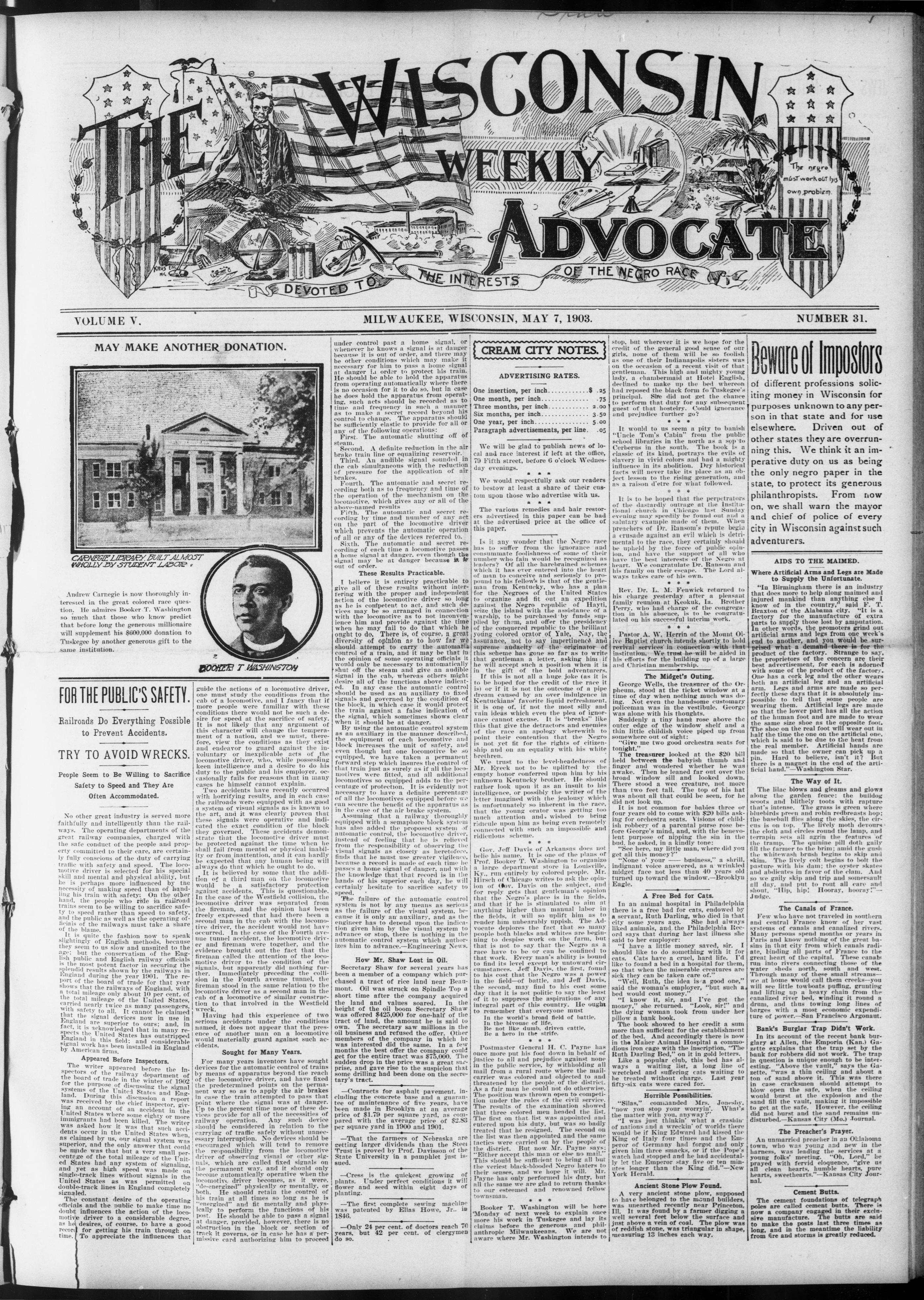
WISCONSIN
WEEKLY
Advocate
DEVOTED TO THE INTERESTS OF THE NEGRO RACE
MAY MAKE ANOTHER DONATION.
COLUMBIA COUNTY HIGH SCHOOL
VOLUME V.
MAY MAKE ANOTH
CARNEGIE LIBRARY BUILT ALMOST WHOLLY BY STUDENT LABOR
Andrew Carnegie is now thoroughly interested in the great colored race question. He admires Booker T. Washington so much that those who know predict that before long the generous millionaire will supplement his $600,000 donation to Tuskegee by another generous gift to the same institution.
FOR THE PUBLIC'S SAFETY
Railroads Do Everything Possible to Prevent Accidents.
TRY TO AVOID WRECKS.
People Seem to Be Willing to Sacrifice Safety to Speed and They Are Often Accommodated.
No other great industry is served more faithfully and intelligently than the railways. The operating departments of the great railway companies, charged with the safe conduct of the people and property committed to their care, are certainly fully conscious of the duty of carrying traffic with safety and speed. The locomotive driver is selected for his special skill and mental and physical ability, but he is perhaps more influenced by the necessity of making speed than of handling his train with safety: On the other hand, the people who ride in railroad trains seem to be willing to sacrifice safety to speed rather than speed to safety, and the public as well as the operating officials of the railways must take a share of the blame.
It is quite the fashion now to speak slightlyly of English methods, because they seem to us slow and unsuited to the age; but the conservatism of the English public and English railway officials is the most potent factor in securing the splendid results shown by the railways in England during the year 1901. The report of the board of trade for that year shows that the railways of England, with a total mileage only about 10 per cent, of the total mileage of the United States, carried nearly twice as many passengers, with safety to all. It cannot be claimed that the signal devices now in use in England are superior to ours; and, in fact, it is acknowledged that in many respects the United States has outstripped England in this field; and considerable signal work has been installed in England by American firms.
Appeared Before Inspectors
The writer appeared before the inspectors of the railway department of the board of trade in the winter of 1902 for the purpose of discussing the signal systems of the United States and England. During this discussion a report was received by the chief inspector, giving an account of an accident in the United States where some eighty or more immigrants had been killed. The writer was asked how it was that such accidents occur in the United States when, as claimed by us, our signal system was superior, and the only answer that could be made was that but a very small percentage of the total mileage of the United States had any system of signaling, and yet as high speed was made on single-track lines without signals in the United States as was permitted on double-track lines in England completely signaled.
The constant desire of the operating officials and the public to make time no doubt influences the action of the locomotive driver to a considerable degree, as he desires, of course, to have a good record for getting his train through on time. To appreciate the influences that
BOOKER T. WASHINGTON
guide the actions of a locomotive driver, one must study the conditions from the cab of a locomotive, and I fancy that if more people were familiar with these conditions there would not be such a desire for speed at the sacrifice of safety. It is not likely that any argument of this character will change the temperament of a nation, and we must, therefore, view the conditions as they exist and endeavor to guard against the involuntary or inexplicable acts of the locomotive driver, who, while possessing keen intelligence and a desire to do his duty to the public and his employer, occasionally fails for reasons that in many cases he himself cannot explain.
Two accidents have recently occurred with horrifying results, and in each case the railroads were equipped with as good a system of visual signals as is known to the art, and it was clearly proven that these signals were operative and indicated the exact condition of the block they governed. These accidents demonstrate that the locomotive driver must be protected against the time when he shall fail from mental or physical inability or from inattention, and it can hardly be expected that any human being will always do that which he ought to do.
Having had this experience of two serious accidents under the conditions named, it does not appear that the presence of another man on a locomotive would materially guard against such accidents
Sought for Many Years.
For many years inventors have sought devices for the automatic control of trains by means of apparatus beyond the reach of the locomotive driver, and have fixed the predetermined points on the permanent way so as to apply the air brakes in case the train attempted to pass that point where the signal was at danger. Up to the present time none of these devices provide for all of the necessities of railway operation. Any such device should be considered in relation to the carrying of traffic safely without unnecessary interruption. No devices should be encouraged which will tend to remove the responsibility from the locomotive driver of observing visual or other signals, which are called fixed signals on the permanent way, and it should only become automatically operative when the locomotive driver becomes, as it were, "de-energized" physically or mentally, or both. He should retain the control of his train at all times so long as he is "energized" and fit mentally and physically to perform the functions of his post. He should be able to pass a signal at danger, provided, however, there is no obstruction in the block or section of track it governs, or in case he has a permissive card authorizing him to proceed
MILWAUKEE, WISCONSIN, MAY 7, 1903.
under control past a home signal, or whenever he knows a signal is at danger because it is out of order, and there may be other conditions which may make it necessary for him to pass a home signal at danger in order to protect his train. He should be able to hold the apparatus from operating automatically where there is no occasion for it to do so, but in case he does hold the apparatus from operating, such acts should be recorded as to time and frequency in such a manner as to make a secret record beyond his control to change. The apparatus should be sufficiently elastic to provide for all or any of the following operations:
First. The automatic shutting off of steam. Second. A definite reduction in the air brake train line or equalizing reservoir. Third. An audible signal sounded in the cab simultaneous with the reduction of pressure for the application of air brakes.
Fourth. The automatic and secret recording both as to frequency and time of the operation of the mechanism on the locomotive, which gives any or all of the above-named results Fifth. The automatic and secret recording by time and number of any act on the part of the locomotive driver which prevents the automatic operation of all or any of the devices referred to. Sixth. The automatic and secret recording of each time a locomotive passes a home signal at danger, even though the signal may be at danger because out of order.
These Results Practicable.
I believe it is entireiy practicable to give all of these results without interfering with the proper and independent action of the locomotive driver so long as he is competent to act, and such devices may be so arranged in connection with the locomotive as to not inconvenience him and provide against the time when he may fail to do that which he ought to do. There is, of course, a great diversity of opinion as to how far we should attempt to carry the automatic control of a train, and it may be that in the opinion of some operating officials it would only be necessary to automatically shut off the steam and give an audible signal in the cab, whereas others might desire all of the functions above indicated. In any case the automatic control should be used as an auxiliary to fixed signals and governed by the condition of the block, in which case it would protect the train against a false indication of the signal, which sometimes shows clear when it should be at danger.
By using the automatic control system as an auxiliary in the manner described, the equipment of each locomotive and block increases the unit of safety, and even though but one locomotive be so equipped, we have taken a permanent forward step which insures the control of that train just as surely as if all the locomotives were fitted, and all additional locomotives so equipped adds to the percentage of protection. It is evidently not necessary to have a definite percentage of all the locomotives equipped before we can secure the benefit of the apparatus as in the case of the air brake system.
Assuming that a railway thoroughly equipped with a semaphore block system has also added the proposed system of automatic control, the locomotive driver, instead of feeling that he is relieved from the responsibility of observing the visual signals as closely as heretofore, finds that he must use greater vigilence, because a record is made of each time he passes a home signal of danger, and with the knowledge that that record is in the hands of his superior each day, he will certainly hesitate to sacrifice safety to speed.
The failure of the automatic control system is not by any means as serious as the failure of the visual system, because it is only an auxiliary, and as the engineer has to depend upon the indication given him by the visual system to advance or stop, there is nothing in the automatic control system which authorizes him to advance.—Engineering News.
How Mr. Shaw Lost in Oil
Secretary Shaw for several years has been a member of a company which purchased a tract of rice land near Beaumont. Oil was struck on Spindle Top a short time after the company acquired the land and values soared. In the height of the oil boom Secretary Shaw was offered $425,000 for one-half of the tract of land, the amount he is said to own. The secretary saw millions in the oil business and refused the offer. Other members of the company in which he was interested did the same. In a few months the best offer the company could get for the entire tract was $75,000. The sudden drop in the price was a great surprise, and gave rise to the suspicion that some drilling had been done on the secretary's tract.
Contracts for asphalt pavement, including the concrete base and a guarantee of maintenance of five years, have been made in Brooklyn at an average price of $1.79 per square yard, as compared with the average price of $2.83 per square yard in 1900 and 1901.
That the farmers of Nebraska are getting larger dividends than the Steen Trust is proved by Prof. Davisson of the State University in a pamphlet just issued.
Cress is the quickest growing of plants. Under perfect conditions it will flower and seed within eight days of planting.
The first complete sewing machine was patented by Ellias Howe, Jr.. in 1846.
Only 24 per cent. of doctors reach 70 years, but 42 per cent. of clergymen do so.
CREAM CITY NOTES.
ADVERTISING RATES.
One insertion, per inch. $ .25
One month, per inch. .75
Three months, per inch. 2.00
Six months, per inch. 3.50
One year, per inch. 5.00
Paragraph advertisements, per line. .05
We will be glad to publish news of local and race interest if left at the office, 79 Fifth street, before 6 o'clock Wednesday evenings.
We would respectfully ask our readers to bestow at least a share of their custom upon those who advertise with us.
The various remedies and hair restorers advertised in this paper can be had at the advertised price at the office of this paper.
Is it any wonder that the Negro race has to suffer from the ignorance and consummate foolishness of some of their number who fain would be recognized as leaders? Of all the harebrained schemes which it has ever entered into the heart of man to conceive and seriously to propound to his fellows is that of the gentleman from Kentucky, who has a plan for the Negroes of the United States to organize and fit out an expedition against the Negro republic of Hayti, seize the island with the assistance of a warship, to be purchased by funds supplied by them, and offer the presidency of the conquered republic to the brilliant young colored orator of Yale, Nay, the assurance, not to say impertinence and supreme audacity of the originator of this scheme has gone so far as to write that gentleman a letter, asking him if he will accept such a position when it is in the gift of the bold adventurers.
If this is not all a huge joke (as it is to be hoped for the credit of the race it is) or if it is not the outcome of a pipe dream caused by an over indulgence in Kentuckians' favorite liquid refreshment, it is one of, if not the most silly and vain ideas which even the plea of ignorance cannot excuse. It is "breaks" like this that give the detractors and enemies of the race an apology wherewith to point their contention that the Negro is not yet fit for the rights of citizenship and on an equality with his white brethren
We trust to the level-headedness of Mr. Eyeck not to be uplifted by the empty honor conferred upon him by his unknown Kentucky brother. He should rather look upon it as an insult to his intelligence, or possibly the writer of the letter imagined with the jealousy which is unfortunately so inherent in the race, that the young orator was getting too much attention and wished to bring ridicule upon him as being even remotely connected with such an impossible and ridiculous scheme.
* * *
Gov. Jeff Davis of Arkansas does not belie his name. It is one of the plans of Prof. Booker T. Washington to organize a large department store in Louisville, Ky., run entirely by colored people. Mr. Hirsch of Chicago writes to ask the opinion of Gov. Davis on the subject, and for reply gets that gentleman's opinion that the Negro's place is in the fields, and that if he is stimulated to aim at anything higher than manual labor in the fields, it will so uplift him as to render him unbearably uppish. The Advocate deplores the fact that so many people both blacks and whites are beginning to despise work on the farm, but that is not to say that the Negro as a race have to be or can be confined to that work. Every man's ability is bound to find its level except by untoward circumstances. Jeff Davis, the first, found to his cost that the Negro was a power in the field—of battle, and Jeff Davis, the second, may find to his cost some day that it is not politic to say the least of it to suppress the aspirations of any integral part of this country. He ought to remember that everyone must
In the world's broad field of battle.
In the bivouac of life.
In the bivouac of life. Be not like dumb driven cattle.
Be not like dumb, driven cattle,
Be a hero in the strife.
* * *
Postmaster General H. C. Payne has once more put his foot down in behalf of justice to all and prejudice against none in the public service, by withholding all mail from a rural route where the mail-carrier was colored and objected to and threatened by the people of the district. As a fair man he could not do otherwise. The position was thrown open to competition under the rules of the civil service. The results of the examination showed that three colored men headed the list. The first on that list was appointed and entered upon his duty, but was so badly treated that he resigned. The second on the list was then appointed and the same tactics were carried on by the people of the district. But now Mr. Payne says: "Either accept this man or else no mail." This should be sufficient to bring all but the veriest black-blooded Negro haters to their senses, and we hope it will. Mr. Payne has only performed his duty, but all the same we are glad to return thanks to our esteemed and renowned fellow townsman.
* * *
Booker T. Washington will be here Monday of next week to explain once more his work in Tuskegee and lay its claims before the generous and philanthropic Milwaukeeans. We are not aware where Mr. Washington intends to
stop, but wherever it is we hope for the credit of the general good sense of our girls, none of them will be so foolish as one of their Indianapolis sisters was on the occasion of a recent visit of that gentleman. This high and mighty young lady, a chambermaid at Hotel English, declined to make up the bed whereon had reposed the black form fo Tuskegee's principal. She did not get the chance to perform that duty for any subsequent guest of that hostelry. Could ignorance and prejudice further go?
* * *
It would to us seem a pity to banish "Uncle Tom's Cabin" from the public school libraries in the north as a sop to Cerberus in the south. The book is a classic of its kind, portrays the evils of slavery in vivid colors and had a mighty influence in its abolition. Dry historical facts will never take its place as an object lesson to the rising generation, and as a raison d'etre for what followed.
* * *
It is to be hoped that the perpetrators of the dastardly outrage at the Institutional church in Chicago last Sunday evening may speedily be found out and a salutary example made of them. When preachers of Dr. Ransom's repute begin a crusade against an evil which is detrimental to the race, they certainly should be upheld by the force of public opinion, and have the support of all who have the best interests of the Negro at heart. We congratulate Dr. Ransom and his family on their escape. The Lord always takes care of his own.
* * *
Rev. Dr. L. M. Fenwick returned to his charge yesterday after a pleasant family reunion at Keokuk, Ia. Brother Perry, who had charge of the congregation in his absence, is to be congratulated on his successful interim work.
***
Pastor A. W. Herrin of the Mount Olive Baptist church intends shortly to hold revival services in connection with that institution. We trust he will be aided in his efforts for the building up of a large and Christian membership.
The Midget's Outing.
George Wells, the treasurer of the Orpheum, stood at the ticket window at a time of day when nothing much was doing. Not even the handsome customary policeman was in the vestibule. George was alone with his thoughts.
Suddenly a tiny hand rose above the outer edge of the window shelf and a thin little childish voice piped up from somewhere out of sight:
"Give me two good orchestra seats for tonight."
The treasurer looked at the $20 bill held between the babyish thumb and finger and wondered whether he was awake. Then he leaned far out over the broad window sill and looked down. There stood a wee creature, not more than two feet tall. The top of his hat was about all that could be seen, for he did not look up.
It is not common for babies three or four years old to come with $20 bills asking for orchestra seats. Visions of childish robbery of a parental purse rose before George's mind, and, with the benevolent purpose of nipping the sin in the bud, he asked, in a kindly tone:
"See here, my little man, where did you get all this money?"
"None o' your --- business," a shrill, indignant voice answered, as a wrinkled midget face not less than 40 years old turned up toward the window.—Brooklyn Eagle.
A Free Bed for Cats
In an animal hospital in Philadelphia there is a free bad for cats, endowed by a servant, Ruth Darling, who died in that city some years ago. She had always liked animals, and the Philadelphia Record says that during her last illness she said to her employer:
"I have a little money saved, sir. I should like to do something with it for cats. Cats have a cruel, hard life. I'd like to found a bed in a hospital for them, so that when the miserable creatures are sick they can be taken care of."
"Well, Ruth, the idea is a good one," said the woman's employer, "but such a bed would cost money."
"I know it, sir, and I've got the money," she returned. "Look, sir!" and the dying woman took from under her pillow a bank book.
The book showed to her credit a sum more than sufficient for the establishment of the bed. And accordingly there is now in the Maher Animal Hospital a commodious iron cage with the inscription, "The Ruth Darling Bed," on it in gold letters. Like a popular club, this bed has always a waiting list, a long line of wretched and suffering cats waiting to be treated without charge. Last year fifty-six cats were cared for.
Horrible Possibilities.
"Silas," commaanded Mrs. Jonesby, "now you stop your worryin'. What's the matter with you, anyway?"
"I was just thinkin' what a crashin' of nations and a wreckin' of worlds there would be if King Edward had kissed the King of Italy four times and the Emperor of Germany had forgot and only given him three smacks, or if the Pope's watch had stopped and he had accidentally let the Emperor stay five or ten minutes longer than the King did."—New York Herald.
Ancient Stone Plow Found.
A very ancient stone plow, supposed to have belonged to the mound builders, was unearthed recently near Princeton, Ill. It was found by a farmer digging a well several feet below the surface and just above a vein of coal. The plow was of reddish stone, was triangular in shape, measuring 13 inches each way.
NUMBER 31.
Beware of Impostors
of different professions soliciting money in Wisconsin for purposes unknown to any person in that state and for use elsewhere. Driven out of other states they are overrunning this. We think it an imperative duty on us as being the only negro paper in the state, to protect its generous philanthropists. From now on, we shall warn the mayor and chief of police of every city in Wisconsin against such adventurers.
AIDS TO THE MAIMED.
Where Artificial Arms and Legs are Made to Supply the Unfortunate.
"In Birmingham there is an industry that does more to help along maimed and injured mankind than anything else I know of in the country," said F. T. Braxton of the Alabama city. "It is a factory for the manufacture of extra parts to supply those lost by amputation. In other words, the promoters grind out artificial arms and legs from one week's end to another, and you would be surprised what a demand there is for the product of the factory. Strange to say, the proprietors of the concern are their best advertisement, for each is adorned with some of the product of the factory. One has a cork leg and the other wears both an artificial leg and an artificial arm. Legs and arms are made so perfectly these days that it is absolutely impossible to tell that some people are wearing them. Artificial legs are made so that the lower part has all the action of the human foot and are made to wear the same size shoe as the opposite foot. The shoe on the real foot will wear out in half the time the one on the artificial one, which is said to be due to the heat from the real member. Artificial hands are made so that the owner can pick up a pin. Hard to believe, isn't it? But there is a magnet in the end of the artificial hand."—Washington Star.
The Way of It.
The lilac blows and gleams and glows along the garden fence; the bulldog scoots and blithely toots with rapture that's intense. The grass is green where bluebirds preen and robin redbreasts hop; the baseball flies along the skies, the circus is on top. The lively moth devours the cloth and circles round the lamp, and terrapin sets all agrin the features of the tramp. The quinine pill doth gaily fill the farmer to the brim; amid the gush the whitewash brush begins to skip and skim. The lively colt begins to bolt the pasture with his dam; the oyster skates and abdicates in favor of the clam. And so we gaily skip and trip and somersault all day, and put to rout all care and shout, "Hip, hip! Hooray, hooray!"—Judge.
The Canals of France
Few who have not traveled in southern and central France know of her vast systems of canals and canalized rivers. Many persons spend months or years in Paris and know nothing of the great basins in that city from which canals radiate, binding all parts of France to the great heart of the capital. These canals run into rivers connecting those of the water sheds north, south and west. Through many of these small streams—we at home would call them creeks—you will see little towboats puffing, grunting and lifting up a heavy chain from the canalized river bed, winding it round a drum, and thus towing long lines of barges with a most economic expenditure of power.—San Francisco Argonaut.
Bank's Burglar Trap Didn't Work
In its account of the recent bank burglary at Allen, the Emporia (Kan.) Gazette explains that the trap set by the bank for robbers did not work. The trap in question is unique enough to be interesting. "Above the vault," says the Gazette, "was a thin ceiling and about a ton of sand above it. This was there in case cracksmen should attempt to blow open the safe, when the ceiling would burst at the explosion and the sand fill the vault, making it impossible to get at the safe. However, the ceiling did not burst and the sand remains undisturbed.—Kansas City (Mo.) Journal.
The Preacher's Prayer.
An unmarried preacher in an Oklahoma town, who was young and new in the harness, was leading the services at a young folks' meeting. "Oh, Lord," he prayed with fervid eloquence, "give us all clean hearts, humble hearts, pure hearts, sweethearts."—Kansas City Journal.
Cement Butts.
The cement foundations of telegraph poles are called cement butts. There is now a company engaged in their exclusive manufacture. The butts are said to make the posts last three times as long, and in the meantime the liability from fire and storms is greatly reduced.
JEWS ARE MUTILATED.
Russian Massacres of Hebrews Scarcely Bear Repeating.
MANYWERE MURDERED
Authorities Did Not Interfere During the Two Days of Rapine at Kisheneff.
St. Petersburg, Tuesday, May 12.—Additional details of the Kisheneff massacre of Jews are printed here daily. The correspondents give the number of victims thus far buried in the Jewish cemetery at forty-four and say that eighty-four persons, seriously wounded, are still in the Jewish hospital.
The horrors reported scarcely bear repeating. In one instance spikes were driven through a woman's head into the floor and cases of bodily mutilation have been authenticated.
About 800 to 1000 persons were arrested, an energetic official having been sent from Odessa to deal with the situation.
The apathy of the local authorities during the two days of rapine and murder appears to have been fully established.
St. Petersburg, May 13.—The report published in the United States that a massacre of Jews, similar to the one which took place recently at Kisheneff, capital of Bessarabia, had occurred at Tirospol, seven miles from Kisheneff, is officially denied and is universally discredited.
MAY EXHUME BODY OF AGATHA REICHLIN.
Doctors Disagree as to Whether Lorain, O., Woman Was Choked to Death.
Lorain, O., May 13.—As a result of the disagreement between physicians as to the condition of the body of Agatha Reichlin when it was examined after the murder, it is probable that the body will be exhumed. It is declared that two reputable persons are ready to swear that there were finger marks around the throat of the woman, indicating that she had been choked. These witnesses are said to be Dr. E. E. French, coroner of the county, and S. L. Koch, captain of the police department.
Dr. Cox, who made the post mortem examination testified at the coroner's inquest that there were no finger marks on the murdered woman's throat, Detective Mintz of Cleveland, who is now at work on the case, states that a demand will be made that the body be exhumed.
MURDERS RESULT FROM TOWN FEUD.
Indiana Mystery Is Probably Solved and Three Suspects Will Be Placed Under Arrest.
Kokomo, Ind., May 13.—Arrests will soon be made in connection with the murders of Lewis Yeager and Francis Sutton and the assault on Logan Ingalls. Evidence has been found that the crimes were the result of rivalry between men of the village where the victims of the three recent crimes lived and the village where their sweethearts resided.
There long has been a village feud between Oakford, the home of the victims, and Hemlock, where Yeager, Suttou and Ingalls courted the young women they were to marry. Threats had been made against the young men of Oakford and they had been warned that they must cease to pay court to the Hemlock girls. The three Oakford men treated the threats and the warnings as a jest, though only two days before his death Yeager was stoned as he rode near the village on his bicycle.
BADGERS LOSE DEBATE
University of Wisconsin Defeated by Narrow Margin at Minneapolis, but Make Good Showing.
Minneapolis, Minn., May 13.—[Special.]—The University of Wisconsin was defeated in the debate with the University of Minnesota last night by a narrow margin. The question was:
Would relinquishment by the federal government of its rights to tax inheritances to states exclusively be preferable to relinquishment by the states of their rights to tax inheritances to the federal government. It being mutually conceded that all rights of taxation of inheritances now possessed by states or by the federal government can and will be transferred by either to the other; that the federal government stands in need of revenue, and that the federal tax can become a law.
Minnesota had the affirmative while Wisconsin upheld the negative. The debaters for Wisconsin were William Ryan, Charles H. Stone and M. B. Olrich.
BIG BLAZE AT BUFFALO.
Diamond Mills, Warehouses and Freight Cars Are Destroyed, Causing a Loss of $250,000.
Buffalo, N. Y., May 13.—The Diamond mills, owned by Churchill & Co., an elevator owned by the same company, the transfer house of the Lake Shore and Eric railroads and about forty cars were destroyed by fire last night. A score of small houses in the vicinity of the big blaze were damaged by fires started from sparks and it was only by the combined efforts of all the fire fighting apparatus and firemen in the city that a more extensive conflagration was prevented. The loss is estimated at $250,000. Lieut. Clark was struck by the coupling of a hose which burst and was hurled against a wall, fracturing his skull. He will die.
ANDERSON'S BODY FOUND.
Cedar River Man Who Disappeared in October Not Murdered.
Menominee, Mich., May 13.—[Special.]
The body of Alfred Anderson was found floating in the river at Cedar River in a badly decomposed condition. Anderson disappeared on the evening of October 23. He was last seen on a tramway of the Crawford Lumber company, having just a few minutes previous said to his roommate, Roy Winters, that he was going to the postoffice. Winters was arrested on suspicion of having something to do with the young man's disappearance, but, after a thorough examination, was exonerated. It has been supposed that Anderson was either murdered or wandered away, being slightly demented over religion.
Menomince Sugar Men Strike
Menominee, Mich., May 13.—Teamsters employed by the Kimby Manufacturing company on the construction of the new sugar factory went on strike yesterday for more wages.
LIBEL BILL APPROVED.
Pennsylvania's Executive Claims New Law Will Be Check on Sensationalism.
Harrisburg, Pa., May 13.—Pennsylvania's new libel bill is now a law. Gov. Pennypacker, after considering the Grady-Salus measure for a month, has approved it. It goes into effect immediately. In the statement issued by the governor great stress is laid on the importance of the measure. Instances of evil results through publication of articles and printing of cartoons are quoted. He refers to the death of two Presidents as directly traceable to pictures which had been printed.
He dwells on the importance of the act to protect business interests, its effect on the freedom of speech, the press, the right of a citizen to be informed of current topics, and his right to protect his home from injuries resulting either from careless or malicious reports. The governor asserts there is nothing in the terms of the measure which prevents any newspaper from making such comments upon legislative measures or upon the official acts of state, municipal, county or public officers as are proper information of the public or are in the line of legitimate public discussion.
"The bill in its application is not confined to officials," he continues, "but affects as well the citizen or business man, whose conduct constitutes no part of the right of the public to information. The corporation officer who has been falsely charged with crime; the manufacturer who has been falsely accused of being a drunken brawler; all the sufferers from reckless but not necessarily malicious publications, are given the right, not to prohibit publication, but to recover the damages which they have sustained, provided they prove negligence or lack of care on the part of the publishing newspapers." Papers, he says, that are particular as to trust need have no fear that the bill will affect them in the least.
The bill, it is claimed, was the work of Senator Quay, who desired to muzzle the press of Pennsylvania. Under the Salus-Grady law the exposure of the state treasury, the management of which has caused no less than seven suicides and several disappearances, will be forever impossible. An exposure such as the Philadelphia Record made of the asphalt trust, the promoters of which actually stole $30,000,000 from the people of Philadelphia, could not be made, and any editor, who would dare to publish the facts concerning the white girl slave traffic as did Julian Hawthorne and Edward A. Van Valkenburg in The North American, would be sent to jail for life.
ENJOINS EMPLOYERS.
Omaha Unions Secure a Sweeping Injunction Against Business Men's Association.
Omaha, Neb., May 13.—Strikers have turned the injunction tables on the employers with a vengeance. For possibly the first time in the history of the country an injunction was secured against business men during the progress of a strike.
The waiters' union filed a complaint with Judge Dickinson in the district court, in which it was alleged that the Business Men's association of this city is a local branch of the national organization, and that its purpose is the annihilation of organized labor by unfair and unlawful means. Pending the hearing of the case Judge Dickinson granted a restraining order enjoining the members of the Business Men's association from carrying on a campaign against the unions in the manner in which it was charged.
Summary of Injunction.
The summary of the injunction is as follows:
First. From in any manner threatening to injure the business or person of any employer of members of the complainants' union or member of a labor union, or any person who may employ or desire to employ such union men, or from refusing to sell commodities and supplies of merchandise to employers of such union labor and from discriminating against such persons in the price charged for any such commodities. Second. From threatening or intimidating in any manner any person into joining the said Business Men's association or any organizations to toil labor unions.
Third. From threatening or intimidating any person who may have become a member of said association or organization if he employs organized labor or recognizes labor unions into discontinuing such employment. Fourth. From imposing any fines upon its members or any person for violating any agreement not to employ organized labor or not to recognize a labor union.
Stops Use of Funds.
Fifth. From receiving or paying out any money whatever in pursuance of any agreement to break up labor unions except attorneys in this action.
Sixth. From paying or offering any money to officers or members of unions directly or indirectly as a bilbe to do or not to do any act in pursuance of any agreement or any of said defendants against such unions.
Seventh. From importing or engaging agents or servants to import any laborers into the city of Omaha or state of Nebraska in pursuance of any existing plan to destroy labor organizations or under any similar, or new arrangement, or plan.
Prevents New Suits.
Eighth. From bringing any other injunction suits or actions in pursuance of any general plan of prosecutions to break up labor unions or of any new or similar plans connected directly or indirectly with any existing plans.
The injunction is the result of a cross complaint filed as part of the suit of the restaurant proprietors against the union, and the writ is made returnable the same day, May 25. The cross complaint was directed against not only the owners of hotels and restaurants, but against the persons who brought the injunction proceedings against the Teamsters' union in the federal court, which includes the proprietors of all transfer companies and a number of wholesale houses.
"HOD" TAYLOR WILL PROBABLY RESIGN.
Assistant Secretary of Treasury Advised by His Physician to Give Up His Work.
Washington, D. C., May 13.—[Special.]—Assistant Secretary of the Treasury Horace A. Taylor of Wisconsin will retire from office immediately and take a long rest if he follows the advice of his physician. There is no disposition on the part of Secretary Shaw to force Mr. Taylor to retire, and if the latter does so it will be a voluntary act.
WITH HEAVY LOSS OF LIFE.
Tribesmen Who Attacked Tetuan Repulsed by Imperial Troops.
Madrid, May 13.—A dispatch from Ceuta, Morocco, announces that the tribesmen who attacked Tetuan, Monday, were repulsed with heavy losses on both sides. The battle was suspended in order to allow the opposing forces to bury their dead, numbering 300. The imperial forces have routed the rebel mountaineers near Fez, inflicting great losses on the enemy.
MAFIA SUSPECTS.
Two Italians Arrested in New York in Connection With the Umbria Plot.
New York, May 12.—Detective Sergt. Petrosino yesterday arrested two Italians who are suspected of having taken to the Cunard pier the infernal machine with which the Mafia intended to blow up the steamer Umbria. He had found that on Saturday they were driving a wagon like the one in which the dynamite filled box was carried to the Cunard dock. He followed them into a tumbledown tenement in a side street. With the Italians were half a dozen of their countrymen.
Makes Arrest Single Handed.
Petrosino saw that if he left the house to go for help he might lose his men. He drew his revolver and ran to the back room in which the Italians were whispering around an empty stove.
"I'll shoot the first man that raises a finger," he said.
The detective took the two men he wanted, stood them in a corner and handcuffed them to each other. Then he blew his whistle. Patrolman Donal, who was passing, responded and called a patrol wagon.
Prof. George F. Seever of Columbia university, an expert electrician, made a careful examination of the infernal machine. He found the clockwork in good order, the batteries charged and ready for business, the cigar lighter and fuse in perfect condition. The fuse burned at the rate of a foot in twenty-two seconds and was ten feet long before a portion of it was destroyed previous to the opening of the box.
"Even had the mechanism worked as the constructor of the machine intended," said Prof. Seever, "I do not think there would have been an explosion. The box might have caught fire, but as there were no detoning caps attached to the dynamite it could not have exploded, provided it was of first-class quality."
Tracing the Batteries.
Cleveland, O.. May 12.—Officials of the National Carbon company have agreed to co-operate with detectives to learn in what consignment were the batteries which were placed in the infernal machine designed to blow up the Umbria. The batteries left the factory January 2 and on that date a consignment of 30,000 was shipped. The officials are certain that the jobbers receiving the batteries will be located, but difficulty will arise in tracing them from the jobbers.
POSTAL RING'S END.
Administration Official Sums Up the Result of the Investigation of Scandal
Washington, D. C., May 12.—An administration official who has watched the postal scandal carefully in its various stages, and who has been in close touch all the time with high officials of the postoffice department, thus outlines the remaining results of the scandal and its investigation:
"Permanent removal of A. W. Machen, superintendent of the free delivery division.
"Final resignation of George A. C. Christiancy, assistant attorney general for the postoffice department, who was granted leave pending investigation.
"A clean bill for M. W. Louis, superintendent of the division of postoffice supplies."
No criminal actions are contemplated. This is said to be in accordance with the wish of the postmaster general, and, according to the official responsible for this outline the President himself desires to avoid trial in curt unless the most flagrant dishonesty is proved in the investigation.
POPE TO NAME CARDINALS
Five Churchmen Are to Receive the Red Hat at the Next Meeting of the Consistory.
Rome, May 12.—The Pope has definitely decided to appoint cardinals at the next consistory. The following prelates have already been informed of the intention of the pontif to bestow the red hat on them:
Manager Nocelia, secretary of the college of cardinals; Manager Carvicechionl. secretary of the congregation of the council; Manager Taliani, papal nuncio at Vienna; Manager Ajuti, papal nuncio at Lisbon; Manager Katschthaler, archbishop of Salzburg, and Manager Fischer, archbishop of Cologne.
The consistory is likely to take place June 15 or June 22.
MAY RESTORE DREYFUS.
Paris Paper Declares the Way Is Open for Former Officer to Resume Place in Army.
Paris, May 12.—La Patric publishes a story to the effect that Gen. Andre intends to take advantage of the diversions caused by the dispersion of the congregations and the visit of King Edward and take the unexpected step of referring the Dreyfus case to the court of cassation, thus preventing the Chamber of Deputies from interfering. In the event of the court acquitting Dreyfus, he would be restored to the army, promoted, and given a staff appointment. At the same time Col. Picquart would also be restored to the army and promoted to be a brigadier general.
TWO DIE IN HOTEL FIRE
Tremont House at Kewanee, Ill., Is Destroved.
Kewanee, Ill., May 12.—In a fire which destroyed the Tremont house here early yesterday morning, Eggert Timm of Amboy, Ill., perished, and Edward Krumpelman of Marcelline, Mo., suffered injuries from which he died. Theodore D. Thompson of Magnolia, Ill., was burned seriously, but will recover. It is believed the fire started from the explosion of a lamp in the office.
The Preacher's Praver.
An unmarried preacher in an Oklahoma town, who was young and new in the harness, was leading the services at a young folks' meeting. "Oh, Lord," he prayed with fervid eloquence, "give us all clean hearts, humble hearts, pure hearts, sweethearts."—Kansas City Journal.
American Machines Used in Germany.
Not only are American mowers, harvesters and hayrakes in use in all the farming districts of south Germany, but our smaller agricultural implements, such as forks, garden and lawn rakes, hoes, shovels, spades and hand potato diggers have also rapidly grown in favor and are now on sale in nearly every local hardware store.
NO DANGER
"Now, Reginald!" cried Mr. Smith,
"Don't point that empty gun."
"It isn't empty, father dear,
It's loaded," said the son.
—Columbia Jester.
Proceedings in the Senate.
In the Senate on the 7th the good roads bill was killed. The Senate refused to pass the bill for a coal commission. The bill providing for tree employment bureaus in all cities of over 29,000 was killed.
On the evening of the 7th the Senate accepted the conference report on the school tax bill. The measure now goes to the governor. The Senate committee on agriculture reported without recommendation the bill to give $2500 a year to the Janesville fair; to indefinitely postpone the bill to exempt beet sugar factories from taxation; also the bill to give a bounty to crabberry growers. The committee on claims reported for indefinite postponement the bill appropriating $20,000 for a commission to revise city charters. The Senate judiciary committee reported in favor of having the attorney general draw a bill instructing the state officers to waive damages for delay in the case of the H. Mueller company, as contractor for lighting and heating the capitol. The Senate passed under suspension of the rules a bill for a wagon bridge across the Oconomowoc river to make a direct road to the cemetery.
On the 8th in the Senate the bill appropriating $12,000 a year to the free library commission was ordered engrossed. The Senate asked the Assembly to return the crow bill. The Senate passed a bill making an appropriation of $275,000 to the university for a new chemical building and for general experiments in agriculture. The committee on state affairs reported in favor of allowing the trustees of the Waupaca home to receive veterans of the Spanish war or their wives or widows when the man originally lived in Wisconsin. It also favored the appropriation of $35,000 for general repairs and improvements at the Waupaca home. The Senate concurred in the Assembly amendments to the general banking law, and it now goes to the governor. The committee on claims reported adversely the bill to pay David Stephens and the Consolidated Stone company for material used in the construction of the library building for the State Historical society. The bill to pay the expenses of the coal investigating committee was ordered engrossed. The fish and game committee reported adversely on the Riordan bill to pay wolf bounties out of the hunting license fund. The committee on state affairs reported for passage the anti-cigarette bill, which is virtually prohibitive in its provisions. It also favored a bill for an additional clerk in the office of the state statistician and a bill to require owners of a dog known to have been bitten by a strange dog to keep him tied up for ninety days. Among the bills passed were; Forbidding fares receiving stated appropriations from the state holding their exhibitions at times which conflict with the state fair; providing for cancellation of certificates of worthless certificates of indebtedness held by the state treasury; providing an additional clerk for one year in the state land office. Bills concurred in included; Giving $4000 extra to the fish commission; raising the appropriation for the La Crosse fair $500 a year; appropriating $800 to the State Flemen's association; giving $625 to Treasurer Kempf to pay his bond. The bill increasing the salary of the state veterinarian from $2000 to $2225 a year was killed. The bill providing a fund of $50,000 to be used if necessary to prevent the spread of plague and cholera goes to a committee of conference. The Assembly insists on part of the money being used to fight smallpox, and the Senate objects. The committee on education reported in favor of the passage of the dental examiner bill, with some amendments which do not materially affect the scope of the original measure, as drawn under the directions of the state board of medical examiners. Senator Munson moved to reconsider the vote by which the Senate refused to concur in the Assembly bill to increase the salary of the state veterinarian to $2250, and asked that the motion lay over until Tuesday. In both houses a message from the governor demanding enactment of a law fixing railroad rate charges was read. The new game law was reported.
On the 9th there was no quorum present in the Senate. Adjournment taken until the evening of the 11th.
On the evening of the 11th the Senate received two vetoes from the governor, one killing the Milwaukee court reporter's salary increase and the other the Kickapoo dam measure. The Senate passed bills as follows: Appropriating $33,000 for repairs and improvements at Platteville Normal school; allowing S. D. Carpenter to begin suit against the state proving for deducting debts from credits; appropriating $30,000 for soldiers' monument at Vicksburg; authorizing the discontinuance of the old Fond du Lac road in Ozaukee county.
The bill to license architects was passed by the Senate on the 12th. The forestry bill was also passed. The bill to legalize bonds heretofore issued without popular vote was passed. Gov. La Follette sent another veto to the Senate against authorizing the construction of a dam across Tomahawk river. The Milwaukee works bill was killed. The Senate, despite the contrary report of the committee on claims, passed the Assembly bill to give the historical library stone contractor $5066 not paid by the building contractor, who failed. The cigarette bill was killed but a bill making cigarette dealers have a special license and providing for a heavy fine for selling to minors was passed. Among bills passed by the Senate were: Appropriating $749 to New Richmond; giving $2500 annually to the Janesville fair; appropriating $397.65 to the coal investigating committee for expenses. The bill giving $75,000 to the world's fair commission was advanced to a third reading.
On the 13th the Senate killed the coal commission and the architects' commission bills. The cigarette license bill was also killed. A bill to dam the Tomahawk river was passed. Bills passed the Senate as follows: Appropriating $12,000 annually to the free library commission; giving the superintendent of public property two extra employees; regulating the hours of labor for children in factories; appropriating $17,000 for improvements at the Waupaca Veterans' home; authorizing the licensing of peddlers; appropriating $75,000 extra for the St. Louis fair; fixing salaries of county supervisors of assessments; allowing the employment of assistants to district attorneys at $15 per day. The income tax resolution was passed. The bucket shop bill was reported without recommendation. The judiciary committee introduced a new bill providing for the appointment of a commission of five to investigate the work of the circuit courts of the state and report to the next Legislature a bill to redistrict the state so as to equalize the labors of the judges. The Senate passed the new fish and game bill under suspension of the rules. The Assembly bill authorizing cities, villages and towns to issue bonds for public improvements was concurred in by the Senate under suspension of the rules. The wolf bounty bill was ordered to a third reading. The committee on assessments and collection of taxes reported a substitute for the mortgage bill.
Proceedings in the Assembly.
On the 7th the Assembly refused to concur in the Senate's amendment to the ad valorem bill, which refuses to tax railway bonds. The Assembly refused to indefinitely postpone bill for erection of building for violent insane.
The Assembly on the night of the 7th.
Place of Great Interest West of Augusta, Mich.
A place of rare interest to ornithologists is a herons' rookery on the bank of the Kalamazoo river just west of Augusta, Mich. There are only a few nesting places of the great blue herons in Michigan, and this is one of them. It is made more interesting from the fact that the others are in inaccessible swamps, while this one can be reached and inspected by the bird student. Recently a delegation of forty members from the Battle Creek Nature club visited the rookery. While the heron is a solitary bird, it nests in colonies. They always return to the same place and the same trees. Some have been known to nest in the same place for fifty years. The Augusta colony have nested there for twenty years. There are twenty nests and forty birds. The nests are constructed of sticks and are as large as bushel baskets. They are always built in sycamore trees, as the color of the bark and
under suspension of the rules, passed the new bond bill introduced by the committee on cities. An amendment was adopted to the new bill reducing the percentage of voters necessary to secure the submission of the question of issuing bonds to a vote of the people of the municipality from 20 to 10 per cent. The Assembly passed the bill appropriating $75,000 to the state board of managers of the St. Louis world's fair. The Henry Johnson bill repealing the present law of vessel taxation was killed. The Assembly concurred in the Rogers bill appropriating $46,000 to the industrial school for girls in Milwaukee. The committee on assessment and collection of taxes reported the mortgage taxation bill with an amendment exempting mortgages owned by railroad companies and other corporations. The Assembly ordered the anti-bucket shop bill to engrossment and third reading. The state affairs commission recommended that the anti-hoise docking bill be indefinitely postponed. The committee concurred in the McGillvray good roads bills, but empowered county boards to levy a tax for the good roads. The Senate bill providing for the taxation of gifts, inheritances and bequests was concurred in. The bill changing the mode of election of the common council of the city of Milwaukee was re-referred in the Assembly to the committee on cities. When the bill came up for consideration several of the Milwaukee members offered amendments, and Mr. Andrew moved to re-commit the bill, and the motion prevailed. The grain inspection bill was passed.
On the 8th the Assembly killed the bill allowing physicians to conduct drug stores without pharmacist's license. The new banking bill was concurred in. The new police pension act was concurred in. The mortgage taxation act was passed to a third reading. The railroad committee reported a bill requiring companies to furnish cars to shippers at intermediate and non-competitive points. The Douglas stringent anti-trust bill was ordered engrossed and was read a third time. The committee bill providing for four free state employment bureaus to be located by the governor, attorney general and secretary of state was ordered engrossed and read a third time. The request of the Senate to return the Crow bill was refused. The bill fixing 2 cents per mile as the maximum rate to be charged by the Milwaukee and North-Western roads was passed.
On the 9th the Assembly advanced the bill to establish truant schools to engrossment. The substitute co-employee bill was also ordered to engrossment. By a vote of 40 to 23 the substitute lobbyists' bill was advanced to engrossment. The committee fish and game bill, absolutely prohibiting the sale of game in the state, was ordered to engrossment by viva voce vote. The bill providing for registration at municipal and judicial elections in towns having a population of 3000 was ordered to engrossment. The bill to prohibit bucket shops and bucket shopping in the state was passed without discussion. Other bills were passed as follows: Requiring railroad companies to provide depot accommodations at all stations; providing for printing or proceedings of association of trustees of county asylums; providing for a dam across Embarrass river; requiring fishways in dams in Koshkonong creek. The Milwaukee county printing bill was concurred in. The Senate bill providing that the state treasury shall have custody of the funds of the state university, to be expended on warrant of the state treasurer, was concurred in without opposition. Other state bills were concurred in as follows: Providing for appointment of counsel for indigent defendants in criminal action; fixing terms of offices of commissioners of Ripon union school district; validating certain acts on the county boards of Douglas county. The Eaton bill, providing that the tax received from interurban lines by any town shall be spent in lighting the streets on which the line runs, was also concurred in without opposition. The Assembly then adjourned until the evening of the 11th.
On the night of the 11th the Assembly passed the new mortgage taxation bill by a vote of 64 to 22. It also passed the bill exempting from taxation the property of telephone companies except real estate and buildings. The bill appropriating $10,000 to the Wisconsin Health Park association for the purpose of assisting that corporation in establishing health parks for consumptives at Tolmahawk and other places was killed. Mr. Brettwisch saved from death his bill requiring railroads to make spur track connections with warehouses and other storage or factory buildings within a reasonable distance of their yards. The bill was adversely reported by the committee on railroads, but the report was overridden and the bill ordered engrossed and read a third time. The governor sent a message to the Legislature urging more economy.
On the 12th the Assembly passed the Coffland bill providing for a tax levy of $100,000 for the erection of a hospital for the criminal and vicious insane at the northern hospital near Oshkosh. The Assembly killed the Dudgeon bill limiting the charges of railroads for the transportation of coal between points in the state to 1 cent a ton per mile. The Assembly concurred in the Hudnall bill appropriating $4000 to the State Historical society, the Sarau bill appropriating $200 to the State Poultry association, and the Gavency bill appropriating $500 to the Wisconsin Buttermakers' association. It passed the Dahl bill providing for the establishment of a home for blind artisans in Milwaukee, the committee bill providing for the erection of a soldiers' monument in the national cemetery at Andersonville, Ga., and the Dixon bill appropriating $200 to Assemblyman Rakow to reimburse him for his expenses in his election contest. The Assembly passed the bill to pay the library stone contractor $5006. The Assembly refused to concur in the Gavency bill authorizing practicers physicians to operate drug stores without taking the required examination of the state pharmacy board. The committee on assessment and collection of taxes introduced a new bill drafted by the state tax commission, providing for the assessment of personal property of railroads in the district in which such property is located. The committee on judiciary favorably reported the Senate bill giving property owners the right of recovery for damage caused by the elevation of railroad tracks in Milwaukee. The committee on education reported for concurrence the university appropriation bill. The committee on assessment and collection of taxes adversely reported the bill to exempt property of the fraternal order of Elks from taxation. The committee on railroads reported the railroad "double-header" bill for indefinite postponement. The committee on corporations reported in favor of the passage of two bills allowing cities to issue bonds for the purchase of sites for markets. The bill authorizing a viaduct across the Menomonee valley was ordered engrossed.
On the 13th the Assembly passed the railroad freight bill suggested by the governor. The anti-trust bill was passed. The antloblyst bill was also passed. By a unanimous vote the Assembly passed the co-employee bill. A bill prohibiting the sale of game and providing for an open season for ducks passed. University appropriation was ordered to third reading. The judiciary committee introduced a new bill to prevent civil conspiracies or agreements made in the restraint of trade.
tint of the leaves harmonizes with the plumage of the birds and protects them in their nests. They lay from three to four greenish blue eggs, larger than a hen's egg. Ornithologists from all over the country have been here to secure their eggs. Last year a delegation of students in natural history from Chicago university came here and one of them climbed the large sycamore with climbers, but was driven down by the fierce attacks of the enraged birds, which stand about 4 feet high, with a broad expanse of wings, and which make ugly fighters when mad.
Cement Butts.
The cement foundations of telegraph poles are called cement butts. There is now a company engaged in their exclusive manufacture. The butts are said to make the posts last three times as long, and in the meantime the liability from fire and storms is greatly reduced.
The Spanish ship to the United States each autumn 300,000 barrels of Almeria grapes.
Valparaiso, Chili, Is in the Hands of Striking Dock Laborers.
Valparaiso, Chili, May 13.—The city is in the possession of the striking dock laborers. One prominent man has been killed, six are wounded and fifty of the mob are dead or dying.
A battle has taken place in the streets of the city in which the police were driven to the barracks by the superior force of the strikers. Greater bloodshed is anticipated
The mob has surrounded the offices of El Mercuro and threatens to sack and burn the establishment. Thousands of the strikers are marching on Admiral Montt's private house, swearing vengeance on its occupants and destruction of the building. The authorities seem powerless to check the mob and owing to the bitter feeling against the police it has been decided to keep them in the barracks rather than further excite the strikers by an ineffectual attempt to quell. Owing to the intense confusion it is impossible to ascertain the exact number or the amount of damage done.
Santiago, Chili, May 13.—The strike of dock laborers at Valparaiso is becoming more serious. The strikers, after setting fire to the quay, as well as to the offices of the South American Steamship company, had a number of encounters with the police, during which ten persons were killed and 200 were injured. A detachment of 3000 troops has been dispatched to Valparaiso.
Buenos Ayres, May 13.—Advices received here from Valparaiso say martial law has been proclaimed there. Forty men are said to have been killed and many have been injured. The rioters have set fire to a number of warehouses in addition to burning the premises of the South American Steamship company.
UNRAVELING UMBRIA EXPLOSIVE MYSTERY.
New York Police Claim to Know Who Sent Infernal Machine to Cunard Dock.
New York, May 13.—The Umbria infernal machine mystery, which spread consternation among all ocean going people, seems on the verge of solution. The dynamite box has been traced to its source and the police have a thorough description of its sender, as well as the name he gave to the proprietress of the boarding house where he was stopping. The man who made the infernal machine and sent it to the Cunard dock boarded in Mrs. Joseph Currie's house at 366 West Thirty-first street for two weeks. He gave his name as "G. Rosscan."
To all appearances the man was not a foreigner. He spoke perfect English without any more trace of an accent than marks the Westerner or Canadian, and his fellow boarders believed that he had come from the west, possibly from western Canada. Through Mr. Currie the mysterious wagon in the case and the man who took the box to the pier were found. The wagon was from Joseph Rooney's express office at Thirtieth street and Ninth avenue. The wagon men were Bathe, driver, and Joseph McCormick, assistant. They were aided by Frank Carton, another employee.
THINK MARROQUIN HAS NOT RESIGNED.
Colombian Minister and Panama Company's Lawyer Discredit Report of President's Retirement.
Washington, D. C., May 13.—"I doubt very much if President Marroquin has resigned as President of the Colombian government," said Dr. Herran, the Colombian charge d'affaires, today. "I always have been promptly advised by cable of any cabinet changes and especially when such changes affected the office of foreign affairs. Neither the state department nor the legation has received confirmation of the reported resignation, therefore it does not seem reasonable." Mr. Cromwell, counsel for the Panama Canal company, discussed the canal situation with Secretary Hay today. His advices from the company agents on the istituanus contradict the story printed yesterday to the effect that President Marroquin had resigned.
MICHIGAN PRIMARY BILL.
It Provided Only for Direct Nominations of City, Village and Township Tickets.
Lansing, Mich., May 13.—After a debate of nearly four hours, the Senate yesterday passed the Baird primary election bill, with one or two insignificant amendments, by a vote of 27 to 5. This bill only provides for the direct nomination of city, village and township tickets, and is a substitute for the Colby bill passed by the house, which provided for the nomination of all state offices as well as municipal and township.
FIGHT EACH OTHER;
BURGLAR ESCAPES.
St. Albans, Vt., May 13.—T. A. Summerskil of this city, superintendent of motive power of the Central Vermont railway, has been shot and seriously wounded in mistake for a burglar. Mr. Summerskil had discovered a burglar in his house and called for assistance. Harry Hall responded. In the darkness each mistook the other for the robber. Summerskil attacked Hall with a club and the latter fired, wounding Summerskil. The burglar escaped.
UNEARTH GREAT MASS OF DYNAMITE.
Seven Hundred Pounds of Explosives Belonging to Revolutionists Found at Salonica.
Salonica, May 13.—The police have unearthed 700 pounds of dynamite and quantities of gunpowder secreted by the revolutionists.
NEARLY COLLIDE IN FOG.
New York, May 13.—In fog off, the Grand banks at 11:30 o'clock on Sunday morning the Kaiser Wilhelm der Grosse, which arrived yesterday with 496 cabin and 824 steerage passengers, came pretty close to splitting on its sharp steel stem the cattle carrier Planet Venus, bound from Philadelphia for Avonmouth. Before the liner's engines were reversed the ships were only forty feet apart.
PROGRESS.
When man has lost his freedom
In the quest for hidden gold;
When the wily arts of Satan
Have secured their lustful hold;
Where is liberty and justness
In the slavery of time?
Does foul greed usurp his manhood,
Drifting far from truth sublime?
In the child-minds of his offspring
He instils no seed of truth;
But the craftiness of commerce
Mars the beauty of their youth;
Does he think this awful grinding
Paves the way to christian light?
When he breaks the laws of union
That are made in christian right!
Is there time for honest progress
In this falsity and strife,
When progression's ways are tainted
With the trading lusts of life?
"Nay!" the soul of love respondeth,
"Tis by charity we're bound
In the union-love of brother—
Meek and lowly as the ground."
—William Reid in The Pilgrim.
The Autobiography of a Liar.
AS RECORDED BY F. E. ELWELL. I was born down on the east side—the last of a large family. We lived in four rooms where God's sunlight never entered and where it was so hot in summer time that sleeping was out of the question except on the fire escape. This did not trouble us children any as there was only one bed in the four rooms.
My earliest recollection was of my mother. I wondered why she was so pinched and timid, her weak little body seemed too frail for the burden fate had placed upon it. My father was just the opposite, a big, burly, powerful man with little of the kindly heart of my mother. The first impression created by my father was a blow on the side of the head that sent me tumbling over and over into the corner of the room. To my dying day I shall always remember the look that was on my mother's face—one of intense fear and solicitude for her offspring.
Half clad I wandered in the streets and whenever I saw my father coming would cross over to the other side or hide in the corner of a doorway. He never seemed to me half as kind as the big policeman who used to hustle us kids about the streets; for the officer I had a real affection, because with all his severity he was a just man and much respected in our street.
Before I was born my mother used to get the week's wages from father and hide them and when he asked for drink money during the week she would lie to him. It was necessary, as she thought, good woman, because there were so many little bits of clothing to buy to make even a bare covering for her children.
Mother loved her children and would sacrifice everything for their comfort. It probably never occurred to her that there was any harm in telling an untruth that her offspring might benefit by it. I do not remember that there ever was one word said to me in my early life against telling untruths. Certainly mother had gained somewhat by lying to father. Then there was absolutely no privacy in our home. Poor mother tried to be neat and with some success, yet our home was a barren place made so by the proximity of too many saloons.
Some of my older brothers and sisters who were at work had discovered by experience that they could not hold their jobs without observing a measure of truth in their relationss with their employers. But, as for me, I was allowed to play in the gutter, sitting under the half doors of a near by saloon watching the degrading sights that took place—poor food for a young mind.
My first systematic lying was about school. An officer told my father that I must go to school, so I entered the primary department of a school not far away and had learned my A B C's and to count a little when the old fever to sit under the half doors of the saloon came over me, and I graduated from that school without ceremony. I think I loved to study in that larger school of humanity. At any rate I went to school as little as possible.
One day when mother asked me how I liked going to school I replied that I liked it very much. This was my first direct lie, at least the first I distinctly remember. I did not think it wrong or that it was very smart to deceive my mother. I found out later that I loved school very much. I knew that what I had told mother would please her.
The strangest part of my early days was the entire absence of any desire to drink. Often the saloonkeeper nearest our tenement would ask me to have a glass of beer, but I always replied "None."
This is the way I got my nickname of "Nope," which has stuck to me all through my youth, and even now some of my brothers and sisters use it as a term of endearment.
As I grew older I found the habit of lying growing stronger. My observing powers developed rapidly. I seemed to make man my first study and gradually it became easier for me to get my lessons at school. I tried lying there, but found the punishment so swift and certain that despite my natural liking for the art I became aware of the fact that as little as possible was a good thing.
Father was killed in a saloon brawl, and the city had to bury him, as we were without funds. Mother began to improve, both in spirits and looks, and we moved into another tenement with windows on the outside. There was a vacant lot opposite with trees growing in it. Mother put a few plants in the windows on the outside. Mike and the other boys fixed up some long boxes and filled them with earth, and when the flowers appeared we all remarked, "This is a paradise!" What a difference it made in us all! It must have been due to reflex action. One Sunday evening we all sang a popular song, a thing that had never happened when father was alive.
Sis, the oldest daughter, was a smart girl, and, by saving a little at a time and now and then getting a boost from my brothers, she finally bought a second-hand melodeon. Her quick ear and smart fingers picked out the tunes we loved best and every Saturday night we sang together.
Our greatest happiness came when we all had beds to sleep in. They came one Saturday and our mother set them up and had all in readiness when we arrived home at night. That was a great occasion. We all laughed and some cried with joy.
Sis was a "peach." I never saw such a girl. Reared in squalor, without any advantages that come to most girls, at work at 14 in a department store, yet
M. H.
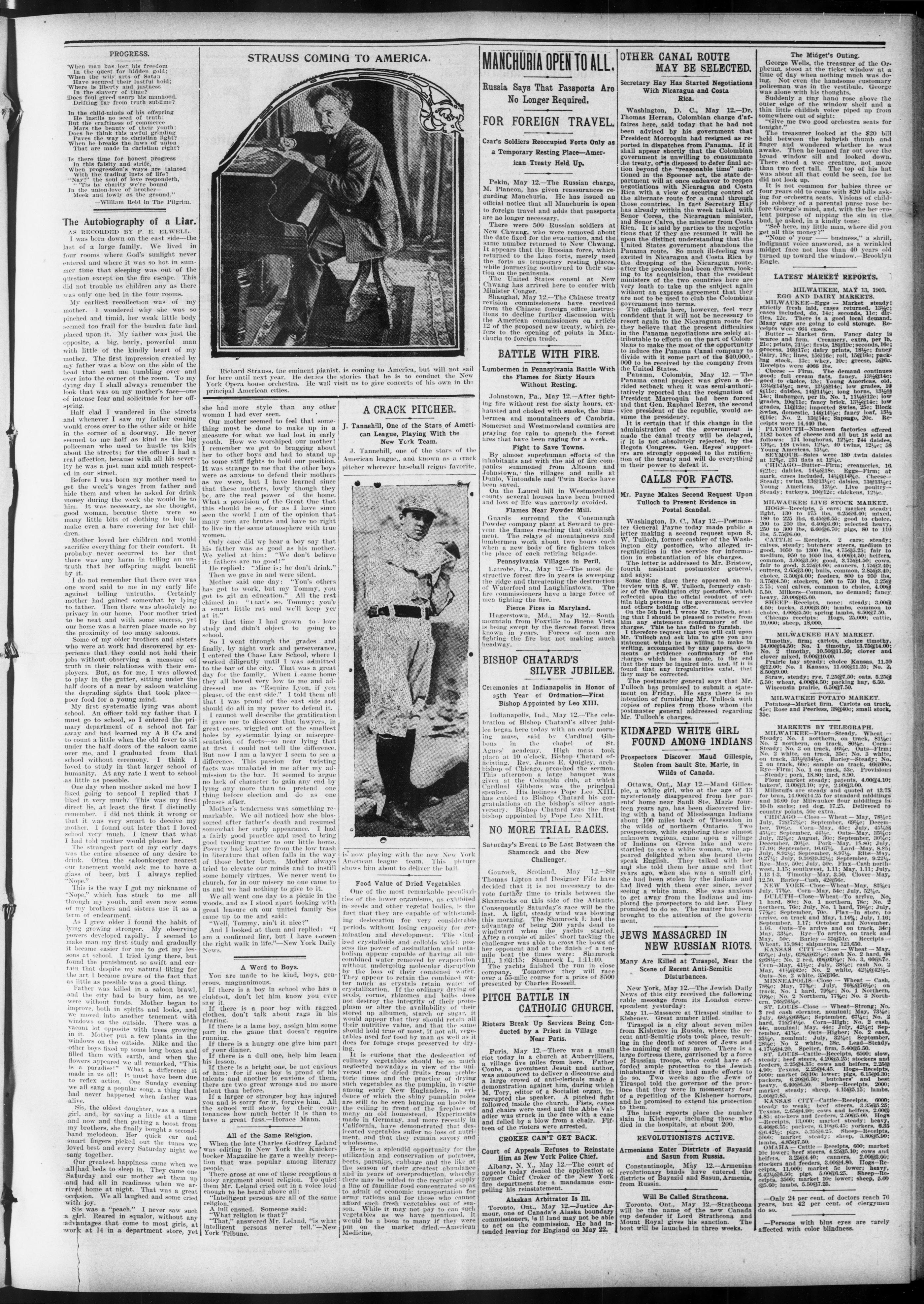
Richard Strauss, the eminent pianist, is coming to America, but will not sail for here until next year. He denies the stories that he is to conduct the New York Opera house orchestra. He will visit us to give concerts of his own in the principal American cities.
she had more style than any other woman I had ever seen. A CRACK PITCHER.
Our mother seemed to feel that something must be done to make up in a measure for what we had lost in early youth. How we worshiped our mother! I remember we got to bragging about her to other boys and had to stand up to some stiff fights to hold our position. It was strange to me that the other boys were as anxious to defend their mothers as we were, but I have learned since that these mothers, lowly though they be, are the real power of the home. What a provision of the Great One that this should be so, for as I have since seen the world I am of the opinion that many men are brutes and have no right to live in the same atmosphere with true women.
Only once did we hear a boy say that his father was as good as his mother. We yelled at him: "We don't believe it; fathers are no good!"
He replied: "Mine is; he don't drink."
Then we gave in and were silent.
Mother said one day: "You's others has got to work, but my Tommy, you got to git an education." All the rest chimed in: "that's so, Tommy; you're a smart little rat and we'll keep yer at it."
By that time I had grown to love study and didn't object to going to school.
So I went through the grades and finally, by night work and perseverance, I entered the Chase Law School, where I worked diligently until I was admitted to the bar of the city. That was a great day for the family. When I came home they all bowed very low to me and addressed me as "Esquire Lyon, if you please, of the east side." I told them all that I was proud of the east side and should do all in my power to defend it.
I cannot well describe the gratification it gave me to discover that lawyers, in great cases, wiggled out of the smallest holes by systematic lying or misrepresentation of facts—so near lying that at first I could not tell the difference. But now I am a lawyer I seem to see a difference. This passion for twisting facts was unabated in me after my admission to the bar. It seemed to argue no lack of character to gain any end by lying any more than to pretend one thing before election and do as one pleases after.
Mother's tenderness was something remarkable. We all noticed how she blossomed after father's death and resumed somewhat her early appearance. I had a fairly good practice and used to bring good reading matter to our little home. Poverty had kept me from the low trash in literature that often falls in the way of those better born. Mother always tried to elevate our minds and to instill some homely virtues. We never went to church, for in our misery no one came to us and we had nothing to give to it.
We all went one day to a picnic in the woods, and as I stood apart looking with great leasure on our united family Sis came up to me and said:
"Well, Tommy, ain't it nice?" And I looked at them and replied: "I am a confirmed liar, but I have chosen the right walk in life."—New York Daily News
A Word to Boys.
You are made to be kind, boys, generous, magnanimous.
If there is a boy in school who has a clubfoot, don't let him know you ever saw it.
If there is a poor boy with ragged clothes, don't talk about rags in his hearing.
If there is a lame boy, assign him some part in the game that doesn't require running.
If there is a hungry one give him part of your dinner.
If there is a dull one, help him learn his lesson.
If there is a bright one, be not envious of him; for if one boy is proud of his talents and another is envious of them, there are two great wrongs and no more talent than before.
If a larger or stronger boy has injured you and is sorry for it, forgive him. All the school will show by their countenances how much better it is than to have a great fuss.-Horace Mann.
All of the Same Religion.
When the late Charles Godfrey Leland was editing in New York the Knickerbocker Magazine he gave a weekly reception that was popular among literary people.
There arose at one of these receptions a noisy argument about religion. To quiet them Mr. Leland cried out in a voice loud enough to be heard above all:
"Intelligent persons are all of the same religion."
A lull ensued. Someone said:
"What religion is that?"
"That," answered Mr. Leland, "is what intelligent persons never tell."—New York Tribune
A CRACK PITCHER.
J. Tannehill, One of the Stars of American League, Playing With the New York Team. J. Tannehill, one of the stars of the American league., and known as a crack pitcher wherever baseball reigns favorite.
THE BASEBALL PLAYER
is now playing with the new New York American league team. This picture shows him about to deliver the ball.
Food Value of Dried Vegetables
One of the most remarkable peculiarities of the lower organisms, as exhibited in seeds and other vegetal bodies, is the fact that they are capable of withstanding desiccation for very considerable periods without losing capacity for germination and development. The vitalized crystalloids and colloids which possess the power of assimilation and metabolism appear capable of having all uncombined water removed by evaporation without undergoing molecular disruption by the loss of their combined water. They appear to retain the combined water much as crystals retain water of crystallization. If the ordinary drying of seeds, corns, rhizomes and bulbs does not destroy the integrity of their protoplasm or alter the availability of their stored up albumen, starch or sugar, it would appear that they should retain all their nutritive value, and that the same should hold true of most, if not all, vegetables used for food by man as well as it does for forage crops preserved by drying.
It is curious that the desiccation of culinary vegetables should be so much neglected nowadays in view of the universal use of dried fruits from prehistoric times and the practice of drying such vegetables as the pumpkin, in vogue among early New Englanders, in evidence of which the shiny pumpkin poles are still to be seen hanging on books in the ceiling in front of the fireplace of many an old homestead. Experiments made in Germany, and more recently in California, have demonstrated that desiccated vegetables suffer no loss of nutriment, and that they remain savory and wholesome.
Here is a splendid opportunity for the utilization and conservation of potatoes, beets, parsnips, cabbage and the like at the season of their greatest abundance and in years of overproduction, whereby there may be added to the regular supply a line of familiar food concentrated so as to admit of economic transportation for army rations and for those who cannot afford such fresh vegetables out of season. While it may not pay to can such vegetables as we have mentioned, it would be a boon to many if they were put on the market dried.-American Medicine
MANCHURIA OPEN TO ALL.
Russia Says That Passports Are No Longer Required.
FOR FOREIGN TRAVEL
Czar's Soldiers Reoccupied Forts Only as a Temporary Resting Place-American Treaty Held Up.
Pekin, May 12.—The Russian charge, M. Plancon, has given reassurances regarding Manchuria. He has issued an official notice that all Manchuria is open to foreign travel and adds that passports are no longer necessary.
There were 500 Russian soldiers at New Chwang, who were removed about the date fixed for the evacuation, and the same number returned to New Chwang. It appears that the Russian force, which returned to the Liao forts, merely used the forts as temporary resting places, while journeying southward to their station on the peninsula.
The United States consul at New Chwang has arrived here to confer with Minister Conger.
Shanghai, May 12. The Chinese treaty revision commissioners have received from the Chinese foreign office instructions to decline further discussion with the American commissioners on article 12 of the proposed new treaty, which refers to the opening of points in Marcheuria to foreign trade.
BATTLE WITH FIRE.
Lumbermen in Pennsylvania Battle With the Flames for Sixty Hours Without Resting.
Johnstown, Pa., May 12. After fighting fire without rest for sixty hours, exhausted and choked with smoke, the lumbermen and mountaineers of Cambria, Somerset and Westmoreland counties are praying for rain to quench the forest fires that have been raging for a week.
Fight to Save Towns.
By almost superhuman efforts of the inhabitants and with the aid of fire companies summoned from Altoona and Johnstown, the villages and mills at Dunlo, Vintondale and Twin Rocks have been saved.
On the Laurel hill in Westmoreland county several houses have been burned and loss of life was narrowly avoided.
Flames Near Powder Mill.
Guards surround the Conemaugh Powder company plant at Seward to prevent the flames reaching that establishment. The relays of mountaineers and lumbermen work about two hours each when a new body of fire fighters takes the place of each retiring brigade.
Pennsylvania Villages in Peril.
Latrobe, Pa., May 12. The most destructive forest fire in years is sweeping the ridge and threatening the destruction of Waterford and Laughlinstown. The fire commissioners have a large force of men fighting the fire.
Fierce Fires in Maryland.
Hagerstown, Md., May 12.—South mountain from Foxville to Buena Vista is being swept by the fiercest forest fires known in years. Forces of men are fighting the fire but not making much headway.
BISHOP CHATARD'S SILVER JUBILEE.
Ceremonies at Indianapolis in Honor of 25th Year of Ordination—First Bishop Appointed by Leo XIII.
Indianapolis, Ind., May 12.—The celebration of Bishop Chatard's silver jubilee began here today with an early morning mass, said by Cardinal Gibbons in the chapel of St. Agnes' academy. High mass took place at 10 o'clock, Bishop Chatard officiating. Rev. James E. Quigley, archbishop of Chicago, preached the sermon. This afternoon a large banquet was given at the Columbia club, at which Cardinal Gibbons was the principal speaker. His holiness Pope Leo XIII, has cabled to Bishop Chatard his congratulations on the bishop's silver anniversary. Bishop Chatard was the first bishop appointed by Pope Leo XIII.
NO MORE TRIAL RACES.
Saturday's Event to Be Last Between the Shamrock and the New Challenger.
Gourock, Scotland, May 12.--Sir Thomas Lipton and Designer Fife have decided that it is not necessary to devote further time to trials between the Shamrocks on this side of the Atlantic. Consequently Saturday's race will be the last. A light, steady wind was blowing this morning. The Shamrock I. had the advantage of being 200 yards dead to windward when the yachts started. After a couple of miles' short tacking the challenger was able to cross the bows of her opponent and at the finish of a tenmile beat the times were: Shamrock III., 1:03:15; Shamrock I., 1:11:40.
The yachts finished the run in close company. Tomorrow they will race over a 55-mile course for a prize of $500 presented by Charles Russell.
PITCH BATTLE IN CATHOLIC CHURCH.
PITCH BATTLE IN CATHOLIC CHURCH.
Rioters Break Up Services Being Conducted by a Priest in Village Near Paris.
Paris, May 12.—There was a small riot today in a church at Aubervilliers, a village five miles from here. Father Coube, a prominent Jesuit and author, was announced to deliver a discourse and a large crowd of anti-clericals made a demonstration against him, during which M. Tory, editor of a Socialist organ, interrupted the speaker. A pitched fight followed inside the church. Fists, canes and chairs were used and the Abbe Valadier was struck in the face with a cane and felled by a blow from a chair. Fifteen of the rioters were arrested.
CROKER CAN'T GET BACK
Court of Appeals Refuses to Reinstate Him as New York Police Chief. Albany, N. Y., May 12.-The court of appeals today denied the application of former Chief Croker of the New York fire department for a mandamus compelling his reinstatement.
Alaskan Arbitrator Is Ill.
Toronto, Ont., May 12.—Justice Armour, one of Canada's Alaska boundary commissioners, is il land may not be able to act on the commission. He had intended leaving for England on May 22.
OTHER CANAL ROUTE MAY BE SELECTED.
OTHER CANAL ROUTE MAY BE SELECTED.
Secretary Hay Has Started Negotiations With Nicaragua and Costa Rica
Washington, D. C., May 12.—Dr. Thomas Herran, Colombian charge d'affaires here, said today that he had not been advised by his government that President Morroquin had resigned as reported in dispatches from Panama. If it shall appear shortly that the Colombian government is unwilling to consummate the treaty, or is disposed to defer final action beyond the "reasonable time" mentioned in the Spooner act, the state department will at once endeavor to reopen negotiations with Nicaragua and Costa Rica with a view of securing control of the alternate route for a canal through those countries. In fact Secretary Hay has already within the week talked with Senor Corea, the Nicaraguan minister, and Senor Calvo, the minister from Costa Rica. It is said by parties to the negotiations that if they are resumed it will be upon the distinct understanding that the United States government abandons the Panama route. So much ill-feeling was excited in Nicaragua and Costa Rica by the dropping of the Nicaragua route, after the protocols had been drawn, looking to its acquisition, that the resident ministers of the two countries here are very loath to take up the subject again without an express agreement that they are not to be used to club the Colombian government into terms.
The officials here, however, feel very confident that it will not be necessary to resort again to the Nicaraguan route for they believe that the present difficulties in the Panama negotiations are solely attributable to efforts on the part of Colombians to make the most of the opportunity to induce the Panama Canal company to divide with it some part of the $40,000,000 to be received by the company from the United States. Panama, Colombia, May 12. — The Panama canal project was given a decided setback when it was semi-authoritatively reported that the resignation of President Marroquin had been forced and that Gen. Raphael Reyes, the second vice president of the republic, would assume the presidency.
It is certain that if this change in the administration of the government is made the canal treaty will be delayed, if it is not absolutely rejected, by the Begota Congress. Gen. Reyes' supporters are strongly opposed to the ratification of the treaty and will do everything in their power to defeat it.
CALLS FOR FACTS.
Mr. Payne Makes Second Request Upon Tulloch to Present Evidence in Postal Scandal.
Washington, D. C., May 12.—Postmaster General Payne today made public a letter making a second request upon S. W. Tulloch, former cashier of the Washington city postoffice, who alleged irregularities in the service for information in substantiation of his charges.
The letter is addressed to Mr. Bristow, fourth assistant postmaster general, and says:
Some time since there appeared an interview with S. W. Tulloch, former cashier of the Washington city postoffice, which reflected upon the official conduct of certain high persons in the government service and others holding office.
On the 5th inst. I wrote Mr. Tulloch, stating that I should be pleased to receive from him any statement confirmatory of the charges. This he has failed to furnish.
The postmaster general says that Mr. Tulloch has promised to submit a statement on Friday. He says there is no intention of furnishing Mr. Tulloch with copies of replies from those whom the postmaster general addressed regarding Mr. Tulloch's charges.
KIDNAPED WHITE GIRL FOUND AMONG INDIANS
Prospectors Discover Maud Gillespie, Stolen from Sault Ste. Marie, in Wilds of Canada.
Ottawa, Ont., May 12.—Maud Gillespie, a white girl, who at the age of 13 mysteriously disappeared from her parents' home near Sault Ste. Marie fourteen years ago, has been discovered living with a band of Mississauga Indians about 100 miles back of Thessalon in the wilds of northern Ontario. Two prospectors, while exploring these almost unknown regions, came upon a village of Indians on Green lake and were startled to see a white woman, who appeared delighted when she heard them speak English. They talked with her and she told them her name and that years ago, when she was a small girl, she had been stolen by the Indians and had lived with them ever since, never seeing a white man. She was anxious to get away from the Indians and implored the prospectors to aid her. They promised to do so. The matter has been brought to the attention of the government.
JEWS MASSACRED IN NEW RUSSIAN RIOTS.
JEWS MASSACRED IN NEW RUSSIAN RIOTS.
Many Are Killed at Tiraspol, Near the Scene of Recent Anti-Semitic Disturbances.
New York, May 12.—The Jewish Daily News of this city received the following cable message from its London correspondent yesterday:
May 11.—Massacre at Tiraspol similar to Kishenev. Great number killed.
Tiraspol is a city about seven miles from Kishenev in Russia, where the recent anti-Semitic riots took place, resulting in the death of scores of Jews and the maiming of many more. There is a large fortress there, garrisoned by a force of Russian troops, who could have afforded ample protection to the Jewish inhabitants if they had made efforts to do so. Two weeks ago the Jews of Tiraspol told the governor of the province that they were in momentary fear of a repetition of the Kishenev horrors, and he promised to extend his protection to them.
The latest reports place the number slain in Kishenev, including those who died in the hospitals, at about 200. REVOLUTIONISTS ACTIVE.
Armenians Enter Districts of Bayazid and Sasun from Russia.
Constantinople, May 12.—Armenian revolutionary bands have entered the districts of Bayazid and Sasun, Armenia, from Russia.
Toronto, Ont., May 12.—Strathcona will be the name of the new Canada cup defender if Lord Strathcona and Mount Royal gives his sanction. The boat will be launched in three weeks.
The Midget's Outing
George Wells, the treasurer of the Orpheum, stood at the ticket window at a time of day when nothing much was doing. Not even the handsome customary policeman was in the vestibule. George was alone with his thoughts.
Suddenly a tiny hand rose above the outer edge of the window shelf and a thin little childish voice piped up from somewhere out of sight:
"Give me two good orchestra seats for tonight."
The treasurer looked at the $20 bill held between the babyish thumb and finger and wondered whether he was awake. Then he leaned far out over the broad window sill and looked down. There stood a wee creature, not more than two feet tall. The top of his hat was about all that could be seen, for he did not look up.
It is not common for babies three or four years old to come with $20 bills asking for orchestra seats. Visions of childish robbery of a parental purse rose before George's mind, and, with the ber evolent purpose of nipping the sin in the bud, he asked, in a kindly tone:
"See here, my little man, where did you get all this money?"
"None o' your — business," a shrill, indignant voice answered, as a wrinkled midget face not less than 40 years old turned up toward the window.—Brooklyn Eagle.
LATEST MARKET REPORTS.
MILWAUKEE, MAY 13, 1903.
EGG AND DAIRY MARKETS.
MILWAUKEE—Eggs — Market steady; strictly fresh laid, cases returned, 13½c; cases included, do, 14c; seconds, 11c; dirties, 12c. There is a good local demand. Many eggs are going to cold storage. Receipts were 664 cases.
Butter — Market firm. Fancy dairy is scarce and firm. Creamery, extra, per lb, 21c; prints, 21½c; firsts, 18@19c; seconds, 16c; process, 16@17c; dairy prints, 18½c; fancy dairy, 18c; lines, 15@16c; roll, 15@16c; packing stock, 13c; whey, 10c; greese, 5@6c. Receipts were 4066 lbs.
Cheese — Firm. The demand continues good; full cream flats, fancy, 13½@14c; good to choice, 13c; Young Americas, old, 13½@14½c; new, 13½@14c; low grades, 10@11c; daisies, 14@14½c; long horns, 13½@14c; limburger, per lb, No. 1, 11½@12c; low grades, 10@11c; fancy brick, 13½@14c; low grades, 11@12c; imported Swiss, 25c; Block Swiss, domestic, 14@14½c; fancy loaf, 15½@16c; No. 2, 13@14c; Sapsago, 20c. Receipts were 14,440 lbs.
PLYMOUTH — Nineteen factories offered 1182 boxes of cheese and all but 18 sold as follows: 174 longhorns, 12½c; 744 daisies, 13½c, 148 twins, 12½c, 40 twins, 12½c; 58 Young Americas, 13½c.
SEYMOUR — Sales were 189 twin daisies at 12½c, 231 flats at 12½c.
CICAGO — Butter-Firm; creameries, 16@21c; dalties, 14½@18c. Eggs — Firm; at mark, cases included, 14½@14½c. Cheese—Steady; twins, 13@13½c; daisies, 13½@14c; Young Americas, 13½c. Live poultry—Steady; turkeys, 10@12c; chickens, 12½c.
MILWAUKEE LIVE STOCK MARKET.
HOGS—Receipts, 5 cars; market steady; light, 130 to 175 lbs, 6.25@6.40; mixed, 180 to 225 lbs, 6.45@6.55; good to choice, 200 to 250 lbs, 6.40@6.60; selected heavy, 250 to 300 lbs, 6.60@6.70; pigs, 80 to 110 lbs, 5.75@6.00.
CATTLE—Receipts, 2 cars; steady; calves, steady; butchers' steers, medium to good, 1050 to 1300 lbs, 4.75@5.25; fair to medium, 950 to 1050 lbs, 4.00@4.50; heifers, common, 3.00@3.50; good, 3.75@4.50; cows, fair to good, 3.25@4.00; canners, 1.75@2.40; cutters, 2.65@3.00; bulls, common, 2.85@3.40; choice, 3.50@4.00; feeders, 800 to 950 lbs, 3.75@4.50; stockers, 500 to 750 lbs, 3.25@3.75; veal calves, common to choice, 4.00@5.50. Milkers—Common, no demand; fancy, heavy, 30.00@45.00.
SHEEP—Receipts, none; steady; 3.00@4.50; bucks, 3.00@3.50; lambs, common to choice, 4.00@5.50; spring lambs, 6.00@7.50.
Chicago receipts: Hogs, 25,000; cattie, 19,000; sheep, 18,000.
MILWAUKEE HAY MARKET.
Timothy, firm; carlots, choice timothy,
14.00@14.50; No. 1 timothy, 13.75@14.00;
No. 2 timothy, 10.50@11.50; clover and
clover mixed, 9.00@10.00.
Prairie hay steady; choice Kansas, 11.50
@12.00; No. 1 Kansas, 11.00@11.25; No. 2,
8.50@9.00.
Straw, steady; rye, 7.25@7.50; oats, 5.25@
5.50; wheat, 4.00@4.50; packing hay, 6.50.
Wisconsin prairie, 6.50@7.50.
Potatoes-Market firm. Carlots on track, 45c; Rose and Peerless, 38@40c; small stock, 35c.
MILWAUKEE—Flour—Steady. Wheat—Steady; No. 1 northern, on track, 81½c; No. 2 northern, on track, 80½c. Corn—Steady; No. 3 on track, 40½c. Oats—Firm; No. 2 white, on track, 35c; No. 3 white, on track, 33½@34½c. Barley—Steady; No. 2 on track, 60c; sample on track, 46@00c. Rye—Firm; No. 1 on track, 53c. Provisions—Steady; pork, 18.80; lard, 8.90. Flour market steady; patents, 4.00@4.10; bakers' 3.00@3.10; rye, 2.90@3.00.
Millstuffs are steady and quoted at 13.75 for bran, 14.00@14.25 for standard middlings and 16.00 for Milwaukee flour middlings la 10-lb sacks; red dog, 17.25. Delivered to country points, 50c extra.
CHICAGO — Close — Wheat — May, 78½c; July, 72@72½c; September, 69½c; December, 70½c. Corn—May, 45c; July, 45½@ 45½c; September, 44½c. Oats—May, 35½c; July, 32½c; August, 30c; September, 30½c; December, 30½c. Pork—May, 15.80; July, 17.10; September, 16.67½. Lard—May, 8.85; July, 8.92½; September, 8.97½. Ribs—May, 9.27½; July, 9.30@9.32½; September, 9.22½. Rye—May, 50c; July, 50c. Flax—Cash north-west, 1.15; southwest, 1.11; May, 1.11; July, 1.13 1.3. Timothy—May, 3.50. Clover—May, 12.50. Barley—Cash, 42@56c.
NEW YORK—Close—Wheat—May, 88%c;
July, 77%c. Corn—May, 54c; July, 52%c.
DULUTH—Close—Wheat—To arrive, No. 1 hard, 80c; No. 1 northern, 78c; No. 2 northern, 76c; July, No. 1 hard, 79½c; July, 77½c; September, 70c. Flax—In store, to arrive, on track and May, 1.14½; July, 1.16; September, 1.17; October and November, 1.16. Oats—To arrive and on track, 34c; May, 33½c, Rye—To arrive, on track and May, 50c. Barley—35@51c. Recelpts — Wheat, 15.984; shipments, 123,650.
KANSAS CITY—Close—Wheat—May, 65½c; July, 62½@62½c; cash No. 2 hard, 68@68½c; No. 2 red, 69@69½c; No. 3, 66@67c. Cern—May, 41½c; July, 38½c; cash No. 2 May, 41½@42c; No. 2 white, 42½@42½c. Oats—No. 2 white, 35@36c.
MINNEAPOLIS—Close—Wheat—Cash, 78½c; May, 77½c; July, 76½@76½c; on track, No. 1 hard, 79½c; No. 1 Northern, 76½c; No. 2 Northern, 77½c; No. 3 Northern, 76@76½c.
ST. LOUISE -Close — Wheat-Strong. No. 2 red cash elevator, nominal; May, 73%c; July, 68½%c; September, 67½%c; No. 2 hard, 71%@ 74½%c. Corn-High; No. 2 cash, 44c, nominal; May, 44c; July, 42½%c; September, 41½%c. Oats-Higher. No. 2 cash, 33½%c, nominal; July, 32½%c; September, 28½%c. No 2 white, 38c. Lead-Steady, 4.17½%@ 4.20. Spelter, firm, 5.40%5.50.
ST. LOUISE-Cattle-Receipts, 6500; slow, steady; beef steers, 4.20%5.25; stockers and feeders. 3.25%@4.35; cows and heifers, 2.25%@4.90; Texans, 2.25%@4.45. Hogs-Receipts, 9000; market 5%@10c lower; pligs, 6.15%@6.30; packers, 6.20%@6.50; butchers' and best heavy, 6.40%@6.50. Sheep-Receipts, 2000; market steady; sheep, 4.15%@5.15; lambs, 5.00%@7.85
KANSAS CITY—Cattle—Recelpts, 6000; steady to weak; beef steers, 3.35@5.25; Texans, 2.65@4.90; cows and heifers, 2.00@4.85; stockers and feeders, 2.50@5.00. Hogs—Recelpts, 13,000; market steady; heavy, 6.40@6.55; packers, 6.10@6.45; yorkers, 6.35@6.42½; plugs, 5.25@6.25. Sheep—Recelpts, 5000; market steady; sheep, 3.80@5.90; lambs, 4.85@7.50.
OMAHA — Cattle — Recelpts, 600; market 10c lower; beef steers, 4.25@5.10; cows and heifers, 3.25@4.40; canners, 2.00@6.00; stockers and feeders, 3.00@4.80. Hogs—Recelpts, 11,000; market 5c lower; heavy, 6.42½@6.50; plugs, 5.00@6.25. Sheep—Recelpts, 3500; market 10c lower; sheep, 5.00@5.60; lambs, 5.50@7.25.
—Only 24 per cent. of doctors reach 70 years, but 42 per cent. of clergymen do so.
—Persons with blus eyes are rarely affected with color blindness.
SUBSCRIPTION RATES
postage paid.
One Year ..... $2.00
Six Months ..... 1.25
Three Months ..... .75
Send money by Express Money Order, P. O.
Money Order or Registered Letter to the
Wisconsin Weekly Advocate.
ADVERTISING RATES.
One inch, single insertion ..... 25c
One inch, per year ..... $9.00
Business locals 5c per line each insertion.
Apply for rates to the Advocate.
TO CONTRIBUTORS:
All communications must be sent with the name and address of the sender as an evidence of good faith, but not necessarily for publication. No manuscript returned if not accepted, unless accompanied by stamps.
The Wisconsin Weekly Advocate company wishes to notify the public that all contracts and business transactions with this company must have the company stamp, otherwise they will be void. Neither will this company be responsible for paid subscriptions unless given to duly-accredited agents, who, on request, will give the company's receipt for same. Subscribers failing to receive their papers regularly will kindly notify the general office. Address all business communications to the general manager, 79 Fifth street.
Entered in the Postoffice at Milwaukee as Second-class matter.
EDITORIAL PARAGRAPHS.
"I know of the bravery and character of the Negro soldier. He saved my life at Santiago, and I have had occasion to say so in many articles and speeches. The Rough Riders were in a bad position when the Ninth and Tenth cavalry came rushing up the hill carrying everything before them. The Negro soldier has the faculty of coming to the front when he is needed most. In the Civil war he came 400,000 strong, and I believe he saved the Union."—President Roosevelt.
CHIMNEYS OF CONCRETE.
One of the latest uses of the combinations of steel and concrete for building purposes was exemplified at Los Angeles Cal., a few months ago. An enormous chimney for the power station of a number of electric roads was constructed of that material. The height of this chimney from the base (which was 15 feet below ground) was 180*feet. The lower portion was 18 feet square, outside measurement, but at an elevation of 51 feet the structure assumed a cylindrical form and had a diameter of 15 feet 2 inches.
Because unequal heating of various parts might lead to unequal expansion, resulting in fractures (or at least unnecessary strains), and perhaps for other reasons also, it was decided to adopt a double wall system. The outer shell begins with a thickness of 9 inches just above the square portion, later gets along with 6 inches and finishes with 5 inches. For the inner shell the thickness at corresponding elevations are 5, $ 4 \frac{1}{2} $ and 4 inches. In consequence of the reduction in both walls the space between them increases with height. It begins with 11 inches and ends with 16 inches. For the outer wall the ingredients of the concrete were mixed in this proportion: California portland cement, 1 part; sand, 2 parts, and fine broken stone, 4 parts. The formula for the inner shell was 1:2:6. Perhaps the most common ratio for concrete is 1:3:5, but engineers vary it frequently to suit special conditions. Employing slightly different parts of the same work is a practice often followed.
In order to give greater strength to the structure twisted steel bars were arranged in the concrete, both vertically and horizontally, in accordance with a well known patented system. On the outside one cannot detect the metal, but it is there. Other chimneys of this character were put up at Constable Hook, N. J., for the Pacific Coast Borax Company in 1898, and at Jersey City in 1901 for the Central Lard Company. A fourth is now in process of erection for the Singer Sewing Machine Company at South Bend, Ind. The list may be further extended by including one built in St. Louis during the last few weeks, under other auspices, but on the same general plan.—New York Tribune.
A Monument to Cooks.
It is proposed to erect what is termed a monument commemorative of the culinary glories of France in the center of the great markets of Paris. A committee of city men, headed by a noted restaurateur, has been formed for this purpose. The memorial is to be a large fountain ornamented by medallions of the celebrated gastronomic authorities—Careme, who wrote on the culinary art; Brillat-Savarin, author of "La Physiologie du Gout," in which occurs the famous phrase, "L'homme d'esprit seul sait manger;" Grimod de la Reyniere, and two other food experts of the past. Around the fountain there are to be sculptured figures of fishwives, oysterwomen, poultry and pigmeat vendors, salad sellers and champion market porters, all "forts de la halle."
It. Makes a Difference Whose Ox Is Gored.
Andy Carnegie is mighty careful to have plenty of "thrift" in his philanthropy. On arriving in Europe the other day he told an interviewer that in his judgment the railroads ought to be government property and that he agreed with the Socialist, Keir Hardie, that this would mean better, cheaper and more extended convenience to the people. The sly old cove, he is perfectly willing some other fellow's graft should be nationalized, so long as no attempt is made to shut off his right to draw fabulous sums in dividends and profits from the steel industry! Nothing slow about Andy!—Social Democratic Herald.
French Socialism.
The eminent French Socialist, M. Jaures, has been giving a definition of the socialism which he professes. The reforms which he supported were, first, those having in view the protection of labor; secondly, those providing for the mutual insurance of laborers against accidents, sickness, old age, and want of employment; thirdly, the nationalization of great capitalist undertakings.
Ten years ago eighty railroads issued weekly reports of earnings. Now but fifty-five publish such figures, twenty-five roads having disappeared by consolidation.
GOOD-NIGHT.
The day has gone to sleep, within the vales,
Shadows are cradled in the em'rald grass,
And on the heights the roseate sunset pales,
And from the clouds the crimson colors pass.
Good-night, sweet day! The stars come out on high,
To watch the pathway which your footsteps trod,
And pave with vastness the great deeps of sky,
And bring our souls in fuller touch with God.
—Los Angeles Times.
THE TALISMAN.
F course, its intrinsic value is very slight," I said, as Theodora stood holding the ring in her right hand.
"Is that why you are offering it to me?" she demanded, glancing up abruptly.
"Because," I explained, "it is supposed to bring the owner all manner of luck."
"Then," cried Theodora, "it is a kind of charm."
"A talisman!"
"What is it supposed to do?"
"Oh, well, the idea used to be that it received influence from the planets—"
"I wonder which planet?" asked Theodora.
"The stone is green," I answered, "and green was the color of Venus, you know. Anyhow, it is supposed to protect your house from visitations of evil spirits——"
"Your house," she remonstrated.
"It is the same thing," I insisted, and Theodora's face grew rosy red.
"Oughtn't a talisman to have some mysterious writing on it?" she asked.
"Every occult condition is fulfilled," I assured her, and she carried the ring to the window. But after an endeavor to read the words which were minutely engraved on the inner face of the thin gold band, she gave it up with a sigh. Taking the ring from Theodora's hand I held it in a more favorable position.
"To give and keep!" she read, then turned her head with an inquiring expression: "Is that right?" she asked.
"Quite right," I answered, and I shivered as her hair brushed my cheek.
"Do you feel cold?" she asked, looking at the fire.
"Not in the least."
"I will ring for Edwards to put some more coal on," she suggested, going toward the bell.
"You haven't made out all the words yet," I insisted, and after a momentary hesitation she returned to my side.
"It is extremely ridiculous," she exclaimed, "because how can you give a thing and yet——"
"It must be done in order to bring out the full virtue of the charm."
"But if you give it away——"
"Precisely what I am endeavoring to do!"
"Then how can you keep it?" Theodora demanded.
"Suppose you try to read the remaining line," I said, but she read it cautiously to herself before repeating it aloud. I saw her lips moving.
"To give and keep;
"It is supposed," I explained, "to be a translation of an old English couplet, and you perceive that the last line contains the moral."
"And the first an impossible condition."
"I assure you it is perfectly simple," I insisted.
"In the Greek Kalends," said Theodora, with a smile.
"Much sooner, I hope."
"When?" she asked, turning away her face.
"If it is left to me, I should say a month at the latest."
Turning to face me again, she held out the ring at arm's length.
"I shall refuse to have anything to do with it," she cried.
"Why?" I asked.
"Oh! I detest things I can't understand."
"You ought to try to have more faith," I urged.
"In what?" asked Theodora.
"In me, of course. I promise, if you take it, the ring shall bring good fortune."
"I was thinking of you," she murmured, "at the moment."
"Then the spell begins to work!" I exclaimed. "What better luck could it bring than to make you think of me?"
"To me or to you?" she demanded.
"To both; at present it is neither yours nor mine."
"It looks rather ancient," she remarked.
"You see it has been a family relic for generations," I explained.
"Then it has always been kept."
"Evidently."
"And consequently it has never been given away!"
"At regular intervals," I insisted.
"Well," she faltered. "I—I don't understand." But I fancied she did.
"If you study the words carefully," I began, when she interrupted me with a solemn expression.
"Besides," she cried, "even if the condition could be fulfilled—"
"It could," I answered.
"Even then," she continued, "haven't any of its owners either lost or—"
"They have never lost the Talisman."
"Ah!" said Theodora, "it must be a
PROOF THAT IRRIGATION IS OF MUCH VALUE TO THE FARMER.
S irrigation of practical value to the farmer of the Middle West, say in Indiana?" asked the News correspondent of an official of the Agricultural Department. "Decidedly," replied the irrigation expert. "From experiments that are being carried on in Wisconsin, Nebraska, Missouri, New Jersey and other States, it is already evident that a marked increase in yields of farm crops follows judicious irrigation even in regions where the rain fall is normally abundant. For instance, in Wisconsin experiments it has been demonstrated that the average increase in the yield of clover hay on irrigated land over that from unirrigated land is 2.5 tons an acre. The increase in corn is 26.95 bushels an acre; of potatoes 83.9 bushels an acre. The annual cost of irrigation for these experiments was $6.68 an acre, not counting interest on the investment, but including all extra labor. This left a net profit, at current prices, of $20 an acre on hay, $11 an acre on corn and $73 an acre on potatoes.
"The comparisons of averages in these experiments were made with the yields as reported in the census returns. This was not exactly fair, because the census averages give the returns for all kinds of farming—good, bad and indifferent—while the averages in the irrigation experiments were those of a carefully conducted institution. No farmer using irrigation can be a slouch and expect to reap any profit. He must do as they do in California—figure things down fine, and stop all gaps. But making all allowances for differences in the averages, and we still can show that judicious irrigation in the Middle West will pay handsomely.
"We made experiments, also, for the purpose of testing the effect both of irrigation and fertilization of sandy soils, such as are common in Indiana, Michigan, Wisconsin and Minnesota. These lands are poor in plant food, and retain so little moisture that all attempts to farm them profitably have failed. The experiments included the application of both water and manure to the lands. Manure alone was of little use, as there was not water enough to make the plant food available. Water alone gave fair results, but manure and water together gave fine returns.
"The cost of irrigation was $6.70 an acre, and the net gain from irrigation was: Potatoes, $30 an acre; corn, $1 an acre; watermelons, $58 an acre; muskmelons, $45 an acre. From these experiments we found that water was a good thing in intensive farming, and increased the yield in truck farming and vegetables, but was not a profitable thing in the case of corn-raising, so far as those sandy soils were concerned.
"The cost of pumping water in the Wisconsin experiments was $2.64 an acre foot, with coal at $5 a ton, the water being raised twenty-six feet. With a gasoline engine, gasoline costing 11.98 cents a gallon, water was raised thirty-three feet at a cost of $3.32 an acre-foot. We have prepared tables showing how much water is needed for different crops, how large a pump should be used, and how often the water should be applied to the land."
very wonderful thing if it always keeps away tears."
"You mustn't judge by its present effect," I urged, and she became suddenly indignant.
"What do you mean?" she demanded.
"I fancied there were tears in your eyes—"
"Why should there be?"
"Why?" I whispered, drawing closer.
"If only the Talisman might do as you say," she murmured.
"My father gave it to my mother," I explained.
"Then he didn't keep it."
"The whole includes the part, you understand. He gave her the ring; she gave him back herself."
"And—and yet he lost her," murmured Theodora.
"Yes, he lost her."
"And I suppose for all their love, there were tears now and then," she suggested.
"Ah, well—"
"So that your Talisman was of very little effect," said Theodora.
"Perhaps," I urged, "the translation was not literal; but anyhow, you need not be afraid to accept it."
"It isn't that I am afraid," she exclaimed; but still she held out her right hand once more, and the ring was in her fingers.
"You are not going to give it back to me," I expostulated.
"Why, yes," she returned, and I felt compelled to take it in my hand. For a few moments I stood gazing at it, a little foolishly perhaps, then I looked into her face.
"The tears should be as few as I could make them, Theo," I said.
"O. I know, I know," she faltered.
"Don't you think you can change your mind?" I urged, and she met my eyes with an expression half perplexed, half indignant. In her own there were still traces of tears; some sensitive chord had, perhaps, been touched, of which I had no perception.
"Change my mind!" she cried.
"Let me give and keep——"
"I thought you would like to put it on," said Theodora, and as I took her left hand and pushed the ring over her third finger, it seemed that the Talisman began to take effect at once, for her tears dried like April rain, and no sunshine was ever brighter than her smile. But Theodora insists that her Talisman is something different altogether.—Detroit Free Press.
DOES NOT LIKE TOURISTS.
Missouri Editor Vents His Opinion of Wanderers on Earth's Surface.
Since his recent visit to Havana, Cuba, where he dined with men from every part of the world, Bob White, of the Mexico (Mo.) Ledger, seems to have taken antipathy to tourists as a class. In a recent issue of his paper he says: "The party was not a large one, either"—the world isn't very large, after all. Mr. White "roasts" the tourists, and especially the Americans, who are now "doing" Havana by thousands. "A regrettable feature of the tourist," he writes, "is the absolute lack of consideration found among many of them—their ruthlessness—and disregard of the privacy of homes, sacred edifices, or wherever else their bent takes them. They enter the grand old churches during sacred service, when the congregations are devoutly and silently following the impressive services. They explore all parts of the building, talking in loud tones, crossing and recrossing, sometimes with their hats on, between the kneeling congregation and the altar, snapping their kodaks at whatever objects attract most.
"With what disgust must the people here regard such demonstrations what contempt must they feel toward this class. At the present amazing progress of this grossness, hoggishness, we could well say, we may soon hear
that all the churches in the city have been closed to visitors. Were the Cubans to go to the States and conduct themselves as many Americans do here, it is certain that they would be summarily dealt with, and they would deserve it, as do that class of Americans to whom so much forbearance is now being shown in Havana."
WATER SPOILED GALLANTRY.
Chivalrous Man Wondered Why the Women Were Unappreciative
On a certain trip of a certain North river ferryboat a middle-aged commuter may be seen nearly every evening hurrying into the forward part of the women's cabin and taking a seat, only to relinquish it with a bow-and a smile to some pretty girl when the other seats are filled.
So intent was he on a recent stormy evening watching for an attractive woman to whom he might offer the seat that he did not notice a leak in the roof of the cabin that was sprinkling his hat.
Presently a stunning girl came with the crowd and the gallant commuter arose and graciously bowed her into the seat. Pit-pat came the raindrops on the woman's toque, and, frowning at the smiling gallant, she got up and pressed through the crowd.
The cummuter seemed puzzled, but he resumed his seat, again oblivious of the leak, and in a moment offered his place to another woman, whose smile of thanks vanished quickly as she settled far back in the seat and a raindrop tumbled on her uptilted nose. She, too, rose and moved away, and the crestfallen man again sunk into the seat, while the other passengers began to titter.
Once more he tried his little act of gallantry, offering his place this time to a middle-aged woman whose elaborate hat thus came under the increasing stream from the leaky roof, and she jumped up quickly, looking daggers at the man, and moved away.
Still failing to observe the offending leak, says the New York Times, the commuter dropped into the seat and plunged into his evening paper, when the explanation came in the wet blotches which the rain soon made on the newspaper, and the commuter joined in the laughter of his fellow passengers as he once more vacated the seat—this time not offering the place to one of the fair sex.
World's Fair Slang.
One of the enduring effects of the Chicago fair in 1893 was the amount of slang originated here. The Philadelphia Centennial is indissolubly connected in the minds of many persons with the disappearance of Charley Ross, and from that exhibition dates, practically, the host of jokes that have flooded magazines and enlivened the stage on the slothfulness of Philadelphia and Philadelphiaans.
Now, St. Louis, in anticipation of the opening of the Louisiana Purchase exhibition, has been burnishing up some of the recent slang of the Mississippi valley, and some of the items may be obtained from advance sheets, so to speak.
What is called in Chicago a "dead one" or a "sleeper" is in St. Louis a "crape." The St. Louis version of the expression "the real thing" for a pretty girl is "a swell doll." A "crown guy" is a policeman, a "gitney" is a nickel, and "mug's landing" is the Union station.
St. Louis has a large Southern and Southwestern population. The Southwest has, in recent years, superseded the West very generally as the starting place of most American slang, and St. Louis has some geographical advantages in this respect that are not likely to be obscured by the action of any of its up-to-date citizens.
Men love to hear of their power but dislike to be reminded of their duty.
FREE
Why Suffer from Disease? Robinson's Alfalfa-Nutrient
Positively cures Rheumatism, Locomotor-Ataxia, all Stomach, Liver and Kidney Troubles and all Nerve and Blood Diseases. Send us your name and address and we will mail you absolutely free a ten days' trial treatment of this wonderful medicine together with a scientific booklet, "How to Secure Perfect Physical Health." Address
ALFALFA-NUTRIENT CO.
A.
Why Suffer for
Robinson's A
Positively cures Rheumatism,
Liver and Kidney Troubles
eases. Send us your name
you absolutely free a ten days'
ful medicine together with
Secure Perfect Physical Health
ALFALFA-NU
Room 8, 59 Dear
Curious Condensations.
-No Russian army officer can marry before the age of 23.
- Mining elevators and limited companies are now taxed 2 per cent. of their net profits in Bolivia.
- Each of Germany's eight colonies, except Samoa, receives a subsidy greater than the revenue it yields.
- The rule of the Czar extends over twice as much contiguous territory as any other power in the world.
- The university at Foura Bay, Sierra Leone, is said to be the smallest in the world. It has five professors, but less than twenty students.
- A year ago 1262 women were enrolled in the German universities. Now, in consequence of restrictions and discriminations against them, the number is but 737.
—Mussulmans over the world have contributed $2,500,000 to the construction of the Hedjaz railway from Damascus to Mecca. The road is finished past the Dead sea.
—The immense indirect cost of warfare is illustrated by the fact that the Spanish-American war cost a million dollars a day for over a year, although hostilities occupied but three months.
—Every spring it has been a precaution of Florida to declare a quarantine against Cuba through fear of yellow fever. This year no quarantine will be enforced until cases of yellow fever occur in Cuba.
—Mineral wool, which is used for packing around boilers, furnaces and pipes to retain heat, to deaden walls and to keep out cold, is made from furnace slag by blowing air through it while molten.
The manufacturers of absinthe in Wisconsin are now exporting to Europe a part of their product, so that the French have competition in the business of making their most important liquor.
Marriageable young ladies in China usually wear their hair in a long single plait, in which is entwined a bright scarlet thread. The thread indicates that the maiden is awaiting a connubial partner.
"Weight for weight," it is claimed that bananas beat beefsteak. And, moreover, "there are cases on record where children's lives have been saved by keeping them on a diet of bananas."
One of the reasons put forward to account for the lack of candidates for holy orders in the Church of England suggests that it is because the curate is no longer regarded as the one marriageable prize in the parish.
An analysis of the college opportunities of the 3237 most eminent graduates seems to show that the best college is the small, non-sectarian, exclusively male, New England school situated in a town of more than 30.000.
The Russian newspaper, Novy Kry, of Port Arthur, announces that on January 14, 1903, the custom house at Dahny was opened for levying duty on merchandise carried by the Chinese Eastern railroad into and from Manchuria.
The companies having steamers in the Alaskan trade offer to subscribe for stock enough in the Marconi Company to furnish money for the immediate establishment of wireless telegraph plants along the dengerous coast of British Columbia.
A young Greek girl of Mitylene has discovered a method by which the punctured silkworm cocoons are made into beautiful artificial flowers of very natural colors and forms. They are greatly admired and will doubtless increase the value of the damaged cocoons.
A wireless telegraph plant of the Marconi company will be placed at the foot of Fulton street, New York, which will work with all steamers having apparatus. This will enable ships held outside the harbor by fog to communicate with the world.
The Italian government has just erected a fortress on the great Chaberton summit, opposite Briancon, for the defense of the Simplon tunnel. This fort is 10,600 feet high and is believed to be the most elevated fortified point in the world.
WONDERFUL DISCOVERY Curly Hair Made Straight By
TAKEN FROM LIFE:
BEFORE AND AFTER TREATMENT.
OZONIZED OX MARROW
THE ORIGINAL—COPYRIGHTED.
This wonderful hair pomade is the only safe preparation in the world that makes kinky hair straight as shown above. It nourishes the scalp, prevents the hair from falling out and makes it grow. Sold over 40 years and used by thousands. Warranted harmless. Testimonials free on request. It was the first preparation ever sold for children of the original Ozonized Ox Marrow, as the genuine never fails to keep the hair pliable and beautiful. A toilet necessity for ladies and gentlemen. Elegantly perfumed. The great advantage of this wonderful pomade is that by its gentleness it allows Owing to its superior and lasting quality it is the most economical. It is not possible for anybody to produce a preparation equal to it. Full directions with every bottle. Only 50 cents. Sold by dealers or send us $1.40 Postal or Express Money Order for 3 bottles, express paid. Write your name and address plainly to
OZONIZED OX MARROW CO.,
76 Wabash Ave., Chicago, Ill.
---
Hanna Hash.
"Eggs, coffee and hash," said a senator at the Arlington the other morning when ordering breakfast. "Eggs, sah; yes, sah; what kind, sah?" "Very fresh and soft boiled." "And hash, sah. Shall I bring you a little Hanna, sah?"
"Hanna. What's Hanna?"
"New style of corned beef hash, sah; very nice." "No. I'll get my Hanna hash at Hanna's," was the senator's reply. And thus, it seems, a United States senator and chairman of the national Republican committee has given his name to a fine brand of corned beef hash from his series of corned beef hash breakfasts a year ago.—Washington Cor. New York Herald.
M. GUMBMET'S SUPERIOR METAL POLISH
RAILWAYS
CHICAGO,MILWAUKEE& ST. PAULRY
*Daily, †Sun. only, †Ex. Sun, †Ex. Sat, †Ex. Mon, †Sat. only, †Mon. only.
MILWAUKEE
LEAVE ARRIVE
*12:40 am
*4:25 am
*11:05 am
*7:00 pm
*8:50 pm
*4:25 am
*6:50 am
*7:00 am
*7:15 pm
*7:15 pm
*11:30 am
*1:00 pm
*7:55 am
*7:10 pm
*7:55 am
*10:00 am
*7:50 am
*1:00 am
*11:30 am
*7:10 pm
*7:15 pm
*9:00 am
*8:40 am
*12:15 pm
*3:10 pm
*8:40 pm
*4:00 pm
*11:00 am
*1:45 pm
*4:45 am
*12:30 am
*4:45 am
*9:00 am
*11:00 am
*1:45 pm
*4:55 pm
*7:10 pm
*7:20 pm
*10:50 am
*6:50 am
*11:30 am
*10:00 am
*8:45 am
*1:00 pm
*7:10 pm
Rac, & S. W. Div.
*8:40 am
*3:10 pm
*8:40 pm
*4:00 pm
*11:00 am
*1:45 pm
*4:45 am
*12:30 am
*4:45 am
*9:00 am
*11:00 am
*1:45 pm
*4:55 pm
*7:10 pm
*7:20 pm
*10:50 am
*6:50 am
*11:30 am
*10:00 am
*8:45 am
*1:00 pm
*7:10 pm
adison (via Watertown)
*(via Pr. du C. Div.)*
*(via Pr. du C. Div.)*
*(via Watertown)*
*(via Pr. du C. Div.)*
*(via Pr. du C. Div.)*
Northern Division
*7:10 am
*10:45 am
*5:10 am
*7:15 am
*6:50 am
*7:50 am
*10:00 am
Waukesha
*11:0 am
*10:50 am
*1:55 am
*1:00 am
*3:40 am
*6:10 am
*7:10 pm
*7:15 pm
*4:50 am
*7:00 am
*8:40 am
*10:50 am
*3:45 am
*6:45 am
*7:00 am
*5:05 am
*10:35 am
*4:15 am
*6:55 pm
Oconomowoc and Watertown
*4:45 am
*5:00 am
*8:50 am
*5:05 am
*12:45 am
*7:15 am
Green Bay.
*Marquette, Houghton and Lake Superior Points.*
TO AND FROM LEAVE ARRIVE
St. Paul, Minneapolis, Iron
Towns, Ashland, Superior,
Duluth, Pacific Coast *5:00 am *7:15 am
*8:45 pm *8:00 pm
Marshfield, Chippewa Falls,
Eau Claire *5:00 am *7:15 am
+12:01 pm *13:20 pm
*8:45 pm *8:00 pm
*5:00 am *7:15 am
*3:35 am *10:15 am
+12:01 pm *13:20 pm
*4:35 pm *8:15 pm
*8:45 pm *8:00 pm
Fond du Lac, Oshkosh, Nee-
nah, Menaah *3:35 am *10:15 am
+12:01 pm *13:20 pm
*4:35 pm *8:15 pm
*8:45 pm *8:00 pm
The Opportunity of a Life Time WANTED
for a first-class hotel in a city in the interior of the state of Wisconsin, the followlng colored help—
1 MEAT COOK. Female.
2 CHAMBER MAIDS, one to assist in serving dinners and suppers.
2 DINING ROOM GIRLS.
2 DISH WASHERS.
This is an exceptional opportunity for a club of Southern girls to make for themselves a comfortable home in Wisconsin. The proprietor is a Southern gentleman who understands and appreciates the negro.
Apply at once to the office of the WISCONSIN WEEKLY ADVOCATE, 79 Fifth Street, Milwaukee, Wis.
The Oliver Typewriter ..
GUYER
TYPING
Philadelphia, 1899. Earls Court, London, 1899. Omaha, 1899. Paris 1900 Venice, 1901. Lille (France), 1901 Buffalo, 1901. It is displacing old style machines everywhere, and holds first place in the estimation of the majority of leading representative business and professional men. Write for Catalogue.
434-436 Broadway, Corner Mason Street MILWAUKEE
BARGAIN HUNTERS
Clothing to fit without being measured for. Prices less than you ever bought them for. Our specialty is misfit and uncalled-for custom tailor made clothing. Tailors' prices for full dress or Tuxedo suits from $30 to $60; our price from $15 to $18. English walking or good business suits made to measure by best of tailors from $18.00 to $35.00. Our price $8.00 to $18.00. Every suit bears our guarantee label. All garments bought of us are kept repaired and pressed free of charge for one year. To be convinced see our window display.
MILLER BROS.
213-15-17 West Water St.
Milwaukee, Wis.
While in city visit . . .
STEPHENS'
HOTEL and RESTAURANT
First-Class Accommodations
Home Cooking a Specialty...
No. 2832 State St., CHICAGO, ILL.
Northwestern House
APPLETON, WIS.
JOHN A. BRILL, - Proprietor.
Terms $1.00 Per Day.
Accommodations the best in the State. When
in Appleton stop at the
NORTHWESTERN
FARM AND GARDEN
To Train Grape Vines.
It may be said that there are a dozen systems of grape vine training in use, all of which have their good qualities and each, perhaps, superior to all others under certain conditions. The system of training from a single upright growth is, however, admitted to be after the most approved lines, and it certainly gives results. The illustration shows how the vine is trained in its first year. It is cut back to two strong buds at the time of planting and is set so that the buds will be just above the surface of the ground. A slight
TRAINING THE GRAPE VINE.
stake is pressed into the ground near the vine and the vine is fastened to it with cord of a waterproof kind. If the trellis is built during this first year this cord is run to the first wire (the top one) and fastened. The vine will make the growth about as shown in the cut during this first year. The trellis is an important feature of the plan. The posts should be set eight feet apart, and so that they will stand about six feet out of the ground. Two wires are used in the position, as shown in the cut, the wires being fourteen inches apart. In training the vine for the second year cut off all that portion above the top wire, and as the lateral canes grow select the strongest opposite each wire, one on either side of the main stalk, and train them along the wires; this gives us two arms, so to speak, running along each wire at the end of the second year from planting. The third season the fruiting buds must be handled, and it is a good plan to select every other bud to supply the canes necessary for the upright growth from the arms. This upright growth is shortened in from time to time during the growing season, so as to throw the strength into the fruiting canes. This system of training requires labor, but it gives most excellent results.
Temporarily Blinds the Horse. It has long been known, and put to practical test time after time, that to get a horse out of a fire the best plan
is to blindfold him, and many an animal has been saved in this way which it was impossible to remove from the burning stable in any other manner. It is now proposed by a Nebraska in-
```markdown
```
practically the same principle to control fractious or vicious horses and to stop runaways which are caused by the animal taking fright at some object on the street or road. While the blinder in common use on bridles prevents the horse from seeing objects on either side, there is nothing to shut out the view of anything approaching which might tend to frighten the animal, and it can also turn its head if it hears a noise; but with this new device the driver or rider has only to pull a cord lying parallel to the reins and a bellows-like curtain is drawn over both eyes to shut out the sight completely. In this condition the animal can only stand and tremble until the object causing the fright has passed, when the curtain is lifted by releasing the cord, and the horse travels on as before. The curtain is housed in a small semi-circular leather casing passing over the animal's forehead just above the eyes, and the operating cords are inserted in the bit rings before passing back with, the reins.
Small Farms to Be the Rule.
In the future small farms will be the rule. More and better products will be raised on 60 acres than are now on 120 acres. There are farmers to-day who plant a 40-acre field in corn who could take the same amount of manure they used and put it on a 20-acre field, and get a greater yield and of better quality. Besides this, it will take only half the time to plow and cultivate the 20-acre field, which would further add to the profits. What a lesson the market gardeners are constantly giving to us farmers. Why, some of them use more barnyard manure on 20 acres than some farmers do on 120 acres. The crops the gardeners get are enormous, and their land is constantly increasing in fertility.
Cost of an Acre of Strawberries.
For plowing, $3; harrowing, $3; marking, 50 cents; plants (8,000) $25, average price; plants are scarce this year. Trimming and preparing plants, $5; setting plants, $4; cultivating with horse, $7.50; hoeing six times, $18; fertilizer, half a ton, $15; four tons of straw, $20; applying straw, $5. This makes the cost about $100 for the first year. Of course the increase of plants can be used to set a new bed the following year, which will make the cost one-fourth less. The straw is worth as much as it costs almost to the soil. In these figures we are actually giving what it would cost the farmer to
hire the work done by men who know how to do it. If the farmer does the work himself, he does not feel the cost any more than were he putting in a crop of potatoes. We advise setting the strawberry bed near the buildings so it can be attended to without going far. The usual gross sales from an acre of strawberries are about four times the cost of the acre for the first year.—Rural New Yorker.
Connecting Pastures by Causeway. It frequently becomes desirable to have the pasture so arranged as to let stock pasture on both sides of a highway. The pasture is sometimes located on one side of the highway and yard and watering place on the other. Much time is required to drive cattle back and forth.
The difficulty can be overcome in a very convenient way. Select a place where there is a little rise in the ground, say from 2 to 4 feet, the more the better. Construct a wide ditch, from 10 to 12 feet, so it will easily admit a team to work with scraper down at bottom of it. Make it from 2 to 4 feet deep, as the natural condition of ground will admit. It must be constructed in such a way that it will have natural drainage at lower side, otherwise it would fill with water after very heavy rains and be of no practical use.
A plank bridge is built across the opening and the sides planked. It should be made $5\frac{1}{2}$ to 6 feet high to admit the passage of all kinds of stock or even horses below. The earth taken out in digging is used in constructing the grade on each side of bridge. The bridge, as well as grade or dump, must be made as wide as required by law. The deeper it is practical to make the ditch, the less it will be necessary to dump upon the grade. A tight fence
CAUSEWAY FOR CATTLE UNDER ROAD.
must be constructed from the pasture on each side of the passageway close up to the bridge. I have seen such a passageway constructed on the level prairie, but in such a case is only practical in every dry seasons, because in a rainy one the ditch will fill up with water.—Lewis Olsen, Kandiyohl, in Farm and Home.
Becta or Enailage.
Corn ensilage and sugar beets were tested at the Nebraska station as to their value as succulent feed when given to dairy cows. The herd was divided into two lots, the same as in the experiment for testing alfalfa and wild hay. The results shown by this experiment were a little in favor of ensilage, but the difference was very slight. It seems to be more a question of how cheaply the two succulent feeds are produced than of their feeding value. Both foods gave good results and were relished by the animals.
Wool Not the Whole Thing.
While the wool crop is an element to be considered when estimating the value of the sheep it must not be thought the whole thing, and when the price of the fleece is low do not turn away from the flock or turn them off the farm simply because that product is not up to what it formerly was, says Wool Markets and Sheep. Think of the many other advantages to be derived in sticking to our white fleeced friends.
Agricultural Notes.
Eggplant is a gross feeder, but easily cultivated.
Interest in the apple box grows apace in the east.
Bone black is said to be good fertilizer for parsnips.
Give a good, thorough cultivation between the rows of strawberries.
Beets will stand considerable cold weather and may be planted early.
In a cold frame or sprout hotbed is a good place to start lima beans on sods.
In butter and cheese making every effort should be made to suppress dust which, according to a dairy authority, carries more infection than any other source. Bees carry pollen from one flower to another while seeking honey. The real benefactors are the bee keepers, many of whom keep bees for pleasure rather than for profit. But for the bees many fruit trees that blossom out full would produce no fruit.
Such crops as squash, cucumbers and melons should have all fertilizers applied by broadcasting over the surface of the ground. If manure is applied it will also give good results if worked into the soil, although well-rotted manure in the hills will assist the plants at the start. It has been demonstrated conclusively that when an animal is fed on a variety, instead of on corn exclusively, a greater gain in weight is secured. Corn will excel in the production of fat, but bone and lean meat sell in the live animal as well as fat, rapid growth being a gain in weight.
Preventing the spread of fungus diseases could be accomplished better by destroying the branches and vines that are cut away from trees and bushes than by the use of other methods. It is not sufficient to remove the portions of trees affected with black knot. They should be consigned to the flames, as no remedy is as sure in the destruction of the spores as fire.
HOUSEHOLD DEPARTMENT
Two cups of rye bread—home-made is the best—chopped fine, one cup of chopped English walnuts. Mix together and chop again with a tablespoonful of butter, an even tablespoonful of grated lemon, a scant tablespoonful of ground mace. Melt a heaping tablespoonful of butter in a saucepan with half a tablespoonful of flour and add gradually to a cupful of rich milk; when this comes to a boil add the other ingredients, salt and pepper to taste, then stir in two well-beaten eggs, remove from the fire and add a tablespoonful of lemon juice; turn out on a platter to cool, form into cylinders, dip in egg and breadcrumbs, as usual, and fry in boiling fat.
Rolls.
Sift a quart of flour with a teaspoonful of salt and rub into the flour a tablespoonful of butter. Dissolve a third of a yeast cake in a little warm water and stir it into a cup of fresh, blood-warm milk. Add a heaping teaspoonful of sugar and pour all into the flour. Mix to a sponge and set to rise for six hours. Stir thoroughly and set for two hours more, then add just enough flour to allow you to knead it, turn upon a floured board and knead for three minutes. Cut into rounds, butter these lightly and fold over upon themselves, making a half-circle. Set to rise for two hours and bake in a hot oven.
Baked Tapioca Pudding.
Baked Tapioca Pudding.
Soak a cup and a half of tapioca two hours in a quart of rich milk, put in a double boiler and cook until the tapioca looks clear. Remove from the fire, stir into it two slightly heaped tablespoonfuls of butter and a scant half cup of sugar. When cold add four eggs, beaten light, and flavor with vanilla or the rind of a lemon grated and added when the tapioca is cooking. Butter a mold, sprinkle with dried breadcrumbs, turn the mixture into it and bake. Turn out on a platter and serve hot with a foaming sauce.
Soft or Fondant Icing.
Boil slowly, without stirring, a pound of granulated sugar and a gill of water until a little dropped from the tip of a fork looks like a floating hair. Set aside until a little more than bloodwarm, then begin to stir steadily and keep this up until you have a smooth, white mass. If it hardens too quickly set the vessel containing it in an outer one of boiling water in order to soften it enough to put on the cake. Flavor to taste, pour over the cake and smooth with a knife dipped in boiling water.
Salmon Turbot.
Put a tablespoonful of butter in a double boiler. When melted mix in one tablespoonful of flour and add one pint of milk. Cook until quite thick. Then take one can of salmon and make in baking dish, putting in one layer of salmon, then one of thickened milk with two hard-boiled eggs chopped into it, salmon again, then milk, and so on until all is used. Sprinkle breadcrumbs on top and bake till brown in hot oven. Good Housekeeping.
How to Chen Parsley.
If the parsley is wet, dry it thoroughly with a towel. Then pick the leaves from the stems, gather the leaves closely between the thumb and two fingers, press tightly, and hold on a board. With a sharp, pointed knife cut through the parsley as close to the fingers as possible. In this way each stroke of the knife does the work completely, the parsley is minced fine and evenly, and does not have to be gone over again.
When Cleaning Silver:
You should add a few drops of liquid ammonia, or whisky, to prepared chalk and water, when cleaning silver, if you want your silver to look its best. Remember that all powder must be carefully brushed out of all crevices with a soft brush before the final polishing.
Finger Marks on Paint.
Finger marks on paint can be removed by rubbing with a damp cloth dipped in prepared chalk. Never put soda in the water you use for washing paint. It injures delicate colors.
Stains on China.
These can be removed by rubbing with salt or powdered bath brick. These remedies can also be used for cleaning an enamel saucepan that is stained or burnt.
Brief Suggestions.
Use bacon fat for basting or frying chicken or game. It imparts a delicate flavor.
To cool a mold of jelly quickly place it in a vessel full of cold salted water and set it in a cool cellar.
A too large cork will often fit a bottle quite well after it has been soaked in boiling water for a few minutes.
Pastry should be cooled off in a warm room; taking it suddenly from the oven to a cold larder will make it heavy.
When cooking acid fruits if a small pinch of carbonate of soda be added less sugar will be needed and the flavor will be greatly improved.
Try small potatoes cooked thus: Boil the potatoes in their skins. When cooked remove the skin by rubbing in a cloth, drop into boiling fat to brown quickly. Drain and serve at once.
WE CONTINUE TO WARN THE BENEVOLENT PUBLIC AGAINST THE NUMEROUS BEGGARS FOR ALLEGED CHARITABLE INSTITUTIONS IN BEHALF OF THE NEGRO RACE. LOOK WELL TO THE CREDENTIALS OF SUCH MENDICANTS AND INQUIRE OF SOME REPUTABLE NEGRO CITIZEN REGARDING THE TRUTHFULNESS OF THEIR STATEMENTS.
Banquet Rooms for Dinner Parties, Etc. Cuisine Par Excellent. Table D'Hote.
NOTE- We have neither private rooms, nor "private" people, but cater to the general public.
DINNER FROM 5:30 10 8:00, 35c.
194 Third Street, Milwaukee, Wis.
"The Bachelors' Home"
...THE TURF EUROPEAN HOTEL...
A New and Modern Establishment for
Gentlemen Only.
217 Wells Street,
Milwaukee.
J. L. SLAUGHTER,
Prop. and Mgr.
Cafe in Connection: Prices Moderate and Consistent
with Accommodations Furnished.
C. C. GITTINGS, Pres. E. E. BAILEY, Vice-Pres. W. G. GITTINGS, Sec—Treas.
GOLD MEDAL
Folding Furniture
....MANUFACTURED BY....
Gold Medal Camp Furniture Mfg. Co.
Incorporated February, 1892. RACINE, WIS., U. S. A.
SEE OUR BARGAINS!
Good Warm Clothes Are Cheaper Than Coal.
HERMANN NOLDE,
Merchant Tailor.
235 Third Street.
Milwaukee. Wisconsin.
AGENTS WANTED. Everything is in favor of the Agent. LIBERAL CREDIT EXTENDED. This is an unprecedented chance to make money. Write quick for territory and particulars. Address THE HELEN MARTIN TOILET CO., 910 E. Leigh St., Richmond, Va.
ELEGANT NEW
TONSORIAL PARLORS,
Second to None in the World.
Visitors to the city and those who appreciate
Cleanliness, Elegance and Comfort should
patronize
Slaughter's Turf Hotel Tonsorial Parlors,
217 Wells Street, Milwaukee.
Hot and Cold Baths in Connection. Franklin A. Hackley, Mgr.
17 Wells Street, Milwaukee
safe in Connec
with
C. C. GITTINGS, Pres.
Foldi
Gold Meda
Incorporated Feb
SEE C
Good C
HER
Milwaukee.
A.
Actual Results from Baldness After Only 4 Months' Use of ZOMODONE.
AGENTS wc to make money. Write
THE HELEN MART
Steam Heat. Electric Light. Telephone in Every Room.....
Makes the Hair grow with lightning-like rapidity. No waiting for results. ZOMODONE prevents falling Hair, Grey Hair, Brittle Hair, Curly Hair, Harsh Hair, and Scurf. Cures Dandruff, Itch, Tetter, Eczema, and Ring-Worm. No more Bald Heads, Scanty Partings, Splitting Ends, and Bald Temples. ZOMODONE grows long, luxuriant, soft, fine, silky Hair. Makes the Hair grow down to and below the waist line in most every instance in which it is used. ZOMODONE is a direct Hair food, and softens and lengthens the Hair, so that it can be arranged in any style desired. Not a fraud or a fake, to get your money, but an honest remedy, tried and true. ZOMODONE acts quickly; results are seen at once. If you want Hair down to your waist, send in your order right now—do not delay. No free samples sent; a sample is not sufficient to do good. Send us only $1.00, and we will send promptly all of the following great remedies, worth at retail $4.50: 3 large jars of ZOMODONE, worth $3.00; 1 large package of ALBUNA (Egg Shampoo), worth 50c., and 1 large package of CORALINE, the most exquisite and absolutely certain skin brightener and perfector known to science, worth $1.00. We will send four complete treatments for $3.00.
Bill for More Definite Plan of Assessing Personal Property.
Its Enforcement Will Put Hundreds of Thousands of Dollars' Worth of Property on Tax Rolls.
Madison, Wis., May 13.—[Special.]—A bill providing a more definite method of taxing personal property owned by co-partners or by joint owners and covering all manufactured lumber products was introduced in the Assembly last night by the committee on assessment and collection of taxes. It was framed by the tax commission and the enforcement of its provisions will place hundreds of thousands of dollars' worth of property on the tax rolls which have escaped because of the virtual impossibility to find the owners
Telegraph and telephone poles, ties, lumber and all manufactured forest products are to be deemed in the custody of the agent or owner of the property where the same may be located and for the purposes of taxation the tax is to run against the owner or occupant of the property wherever the same may be situated on May 1, the time of the assessment. The owner or occupant of the premises is sought to be protected by a provision whereby he is given a personal right of action against the actual owner together with a lien upon the property for the unpaid tax. The law closely follows that which obtains in Michigan.
Lumber Has Escaped.
Up to the present time the assessors have been unable to assess for the purposes of taxation the piles of lumber in the big yards in the northern part of the state, because of the claim of the lumbermen that the lumber did not belong to them, having been sold before it was cut. Assessors who tried to trace the ownership of the property were obliged to give up in despair. Under the new bill no avenue of escape is left open to the lumber owners.
The Assembly held a long session. Most of the committees reported all of the bills before them. In consequence the calendar this morning is one of great length and one that cannot possibly be disposed of for the next few days. Several score of bills were reported for indefinite postponement.
Many measures came in without recommendation, among them being the double-header railroad train bill: that relating to the salaries of state employees and those relating to the employment of an expert accountant for the railroad commissioner. All of the fish and game bills were reported for indefinite postponement, having been incorporated in the Valentine Assembly and the Wippermann Senate measures.
On motion of Mr. Barker the superintendent of public property was directed to place the benches in the capitol park so the members may sit outside "and enjoy the beauties thereof and listen to the birds," and watch the squirrels.
Governor's Expenditures.
Gov. La Follette sent a report to the Assembly last evening of the expenditures from the contingent fund of $2000 annually allowed the executive. The total spent from the fund during the two years was $2153.25, leaving a balance of $1846.75 which reverted to the state treasury.
The largest item of expenditure was $1263.50 to the city committee having in charge the inauguration ceremonies, for expenses duly audited and approved. The other items were: Legislative and other official receptions and funerals, $150.32; newspapers and periodicals in the executive office, $186.18; printing executive messages to the Legislature and miscellaneous expenditures, $553.25
Kills Five Senate Bills
The Assembly killed five Senate bills last evening, one of those refused concurrence being Senator Reukema's bill giving justices of the peace in Milwaukee jurisdiction of cases involving the amount of $300, the present limitation being $200. Senator Morse's bill providing two-year terms for officers in cities of the fourth class was also non-concurred in, and Senator Hatton's bill making contracts of minors over 14 years of age, made to procure the means to secure an education, as binding as though they were of full age, suffered a like fate. The committee bill, 3648, relative to issue of bonds by towns, cities and villages, and the bill introduced by the committee on assessment and collection of taxes, 3838, relative to compensation of assessors in towns, were also non-concurred in.
GAME WARDENS' EXPENSES
Senate Orders State Treasurer to Furnish a Report.
Madison, Wis., May 13.—[Special.]—The Senate last night adopted a resolution offered by Senator North requiring the state treasurer to report forthwith to the Legislature "an itemized statement of all receipts and disbursements on account of the fish and game wardens under the present law as shown by the books in his office."
Senator North stated afterwards it was his purpose to find out the manner in which the game wardens report to the treasurer and the receipts reported. He said there was no politics connected with the resolution.
The Senate revived the architects bill ordering its passage after the vote by which the reconsideration was killed. There was no debate. A call of the house was ordered to bring in Senators Morse and Willy, who were absent, but it was quickly raised. The vote was 16 to 15. A motion to reconsider was immediately made. The bill providing for a state forestry commission, as recommended by the joint committee was passed under suspension of rules. Senator Bird's bill licensing cigarette dealers and providing heavy penalties for selling to minors was reported for passage by the committee on state affairs.
CONSIDERED IMPRACTICAL.
Governor's Plan to Include All Appropriations in One Bill.
Madison, Wis., May 14.—[Special.]—The joint committee on claims considers the plan advocated by Gov. La Follette in his message to the Legislature Monday night, relative to including all of the appropriations in one bill, impractical. The message was referred to the committee and was considered briefly yesterday afternoon. Chairman Hagemeister said it was impractical. Senator Mosher said the governor would be confronted with greater difficulty in the approval of the measure than he is now in passing on a large number of bills, each carrying appropriations. The difficulty would lie in the inability, he thought, to separate any of the items of the bill and disapprove of them and approve of the remainder.
Congress carries all of the appropriations in a single legislative act. The futility of the plan was strongly evidenced, Senator Mosher said, just before the closing of Congress when Senator Tillman
held the entire bill in abeyance until he had forced his colleagues to consent to an appropriation of $50,000 for his state. Otherwise he would have killed the bill. David Evans wanted the committee to instruct the attorney general to prepare a bill in accordance with the governor's views and submit it to the committee, but no definite action was taken.
"NOW YOU SEE IT;
NOW YOU DON'T."
Alleged Confidence Man at West Superior Said to Have Fooled Citizen With Wad of Paper.
West Superior, Wis., May 13.—[Special.]—The most clever disappearing act that has been worked here for a long time was worked by "Prof. Franklin," clairvoyant, of St. Paul, if the charges made by one John Johnson of this city are correct. Two things disappeared. First, $75 belonging to Johnson; second, the professor. A warrant is now out looking for him, but as he had twenty-four hours the start, it is hardly expected that he will be found very suddenly. Saturday Johnson went to the professor, who had been operating here for a week. He had a session and paid his $1. In doing so he displayed a purse of $75. The professor is said to have separated the $75 from the purse and putting the money in an envelope handed him what Johnson supposed was the real envelope, telling him to carry it in his pocket without opening it and then to return in two days, when the money was to have greatly increased. When the time elapsed Johnson went in search of the professor. Not finding him, he opened the envelope and found it full of paper.
WHEN A DIVORCEE MAY MARRY AGAIN.
Curious Ecclesiastical Problem Raised in Eau Claire Court in Breach of Promise Case.
Eau Claire, Wis., May 13.—[Special.]—A curious problem arose in a $10,000 breach of promise case brought by Mrs. Josie Dorn, who has been divorced, and is 34 years of age, against John Gormley, a wealthy farmer of Union. It seems that the defendant had made his promise conditional on the rules of the Catholic church allowing him to marry a divorced woman. After consulting the priests, he was advised, he claims, that he could not marry her. At the trial yesterday, the plaintiff brought forward her former husband, who testified that he had never been baptized, and also Father Wiedmann, of the Church of the Sacred Heart, who testified that under the circumstances the ecclesiastical rules did not prohibit the re-marriage of Mrs. Dorn. The motion for non-suit will be heard tomorrow.
STUDENTS DROWNED.
Prairie du Sac Vicinity Shocked by Aw ful Casualty on Wisconsin River.
Prairie du Sac, Wis., May 13.—[Special.]—A gloom was cast over the whole vicinity yesterday afternoon when it was learned that Miss Mabel Bickford, aged 20, and Frank Shell, aged 19, were drowned while out boat riding on Wisconsin river. There were four in the boat when it capsized, the other two being Frank Kendall and Vivian Reynolds. Frank Kendall managed to reach shore with Miss Reynolds; the other two went down in each other's grasp. The accident occurred about fifty feet from shore. The current is very strong and the river about twenty feet deep just below where they were last seen. The bodies have not been recovered up to this hour, although the river is being dragged and dynamited and the toll bridge screened. Their recovery is doubtful for some time. The river here is very high. All were members of the high school graduating class of 1903.
JUDGE CLEMENTSON'S DAUGHTER MARRIED
Miss Bessie Clementson Is Wedded to John Carleton Frye of Oakland, Cal., at High Noon.
Lancaster, Wis., May 13.—At noon yesterday Miss Bessie Clementson, the only daughter of Judge and Mrs. George Clementson, was married to John Carleton Frye of Oakland, Cal. Rev. W. J. C. Ralph of the First Congregational church of this city performed the ceremony. The bride wore white silkoline and carried a shower bouquet. She was unattended except by a little flower girl, Miss Frances Watton, and ring bearer, Master Richard Brown. Mr. and Mrs. Frye left for Oakland, Cal. Among the guests present from abroad were: J. Allen Barber and Miss Barber of Galena, Ill.; Mrs. Elizabeth Barber of Baltimore, Md.; Mrs. J. B. Kerr of St. Paul, Minn.; Mrs. Arthur Pier of Richland Center, Wis.; Mrs. W. B. Dickie of Topeka, Kan., and Dr. J. A. Clementson, brother of the bride, of Mineral Points Wis.
TO PREVENT TAX SALE.
Railroad Company Said to Collect Rent but Refuses to Pay Tax on Racine Land.
Racine, Wis., May 13.—[Special.]—Local attorneys of the Chicago, Milwaukee & St. Paul railroad this afternoon filed notice of an action against the county of Racine and the city of Racine, to prevent the sale of land owned by the company upon which no taxes have been paid, and which property has been placed on the delinquent list, to be sold by the county treasurer. The property in question is owned by the railroad company and is being leased to manufacturers of the city, and for which, it is said, rental money is received; but the railroad company, it is alleged, refused to pay any taxes on this property.
BLISS TRIAL UP AGAIN.
Formerly Convicted and Granted New Trial, Charles Bliss Will Be Heard at Portage This Session.
Portage, Wis., May 13.—[Special.]—Charles Bliss, who was convicted in May, 1902, of manslaughter in the third degree, because, it is said, while in an intoxicated condition he is said to have thrown a lighted lamp at his wife and to have caused her death, and who was granted a new trial by the supreme court, was brought here yesterday to be tried in the circuit court before Judge Ray E. Stevens. The case will be heard at the close of the present session, either May 25 or June 9.
Blind Students Give Concert.
Jefferson, Wis., May 13.—The first of a series of concerts was given at the Lutheran church last night by four students of the school for the blind at Janesville.
FREIGHT BILL IS PASSED
Opposition Dazed by Amendment to Have Commission Appointed.
Lobbyists and Railroad Telegrams and Circulars Only Change Two Votes Fight to Be Made in Senate.
Madison, Wis., May 13.—[Special.]— Despite the strenuous efforts put forth by the railroad lobby the bill to prohibit an increase in freight rates was passed by the Assembly this morning by a vote nearly equaling that recorded yesterday when the measure was advanced to third reading. The big vote under the circumstances was a big surprise, the multitude of telegrams sent by shippers and the work of the lobby resulting only in the changing of two votes. Messrs. Haderer and Bern, who yesterday voted for the bill, voted against it.
The vote yesterday was 56 to 34. The vote today was 55 to 37. Mr. Douglass changed to favor the bill. Mr. Crowley and Mr. Donald, who were absent yesterday, voted for it, while Mr. Strong, who favored the bill, was paired with Mr. Carberry, who opposed the measure. Mr. Szymarck, who voted against the bill yesterday, was absent, while Messrs. Martin, Benson and Westfahl, who did not vote yesterday, opposed the bill today.
Hardship Is Avoided.
An extended debate was expected, but to the astonishment of advocates of the measure not a word was said by the opposition. When the bill was reached Mr. Bradford presented an amendment to meet the objection that the bill might result in hardship. The amendment provides that in the event that at any time it appears to the satisfaction of the railroad commission that the rate on any article is unreasonably low, the commissioner may increase it. The railroads are also given thirty days in which the companies must file their tariff sheets and the time in which the act is to take effect was extended to July 1 in place of June 1.
Amendment Dazed the Opposition.
The amendment seemed to daze the opposition, for no objection was made to the vote and the bill was passed before even the railroad men, who were in the corridor outside, knew that the measure had been reached. The vote was as follows:
For the Bill—Alnsworth, Andrew, Bartlett, Beedle, Braddock, Bradford, Brittan, Cady, Chandler, Coffland, Cosgrove, Cowling, Crowley, Dahl, Dinsdale, Donald, Dooolittle, Douglas, Dudgeon, Ekern, D. Evans, E. W. Evans, Finnegan, Frear, Fridd, Gilman, Irvine, Henry Johnson, Thomas Johnson, Karel, Kimball, Kinney, Koch, La Du, Le Roy, Loebs, Lord, Moirls, Peterson, Potter, Rankl, Ray, Root, Rupp, Smalley, Smelker, Stevens, Tarrell, Terens, Thoreson, Verbeck, Wallrich, Whitson, Williams, Speaker Leroot—55
Against the Bill—Arneman, Barker, Bartzen, Becker, Benson, Carpenter, Dixon, Fritzke, Haderer, Hamm, Hannifin, Hartung, Hassa, Hodgins, F. Johnson, Johnston, Kehrein, Kern, Lane, Martin, Miller, Moldenhauer, Osborn, Rakow, Reed, Reynolds, Sidler, Slade, A. E. Smith, C. H. Smith, Thlessenhusen, Thompson, Timlin, Waterman, Westfahl, White, Willott—37.
Palred—Strong for, Carberry against.
Absent or Not Voting—Brettwisch, Lang, Morgan, Price, Szymarek, Valentine.
Like Freight Commission Bill.
With the amendment of Mr. Bradford the bill is almost identical with the celebrated freight commission bill, with the exception that the railroad commissioner takes the place of the commission, and the further difference that while under the former measure the commission could establish a lower rate, if it was considered too high the commissioner can only exercise the prerogative, if the rate be considered too low, when it may be increased.
MRS. DELP HEARD FROM.
South St. Paul Woman, Missing and Thought to Have Eloped, Is Heard from. by Her Brother.
Osecola, Wis., May 13.—[Special.]—The first news from Mrs. Conrad Delp, who since April 23 has been missing from her home at South St. Paul, was heard by her brother, William Banner of this place, last night. The letter states that she is well and that they will hear from her again soon. She has read an account of herself in the dailies but says that she has not eloped, but is working for a livelihood. Domestic troubles caused her to leave everything behind. It is expected that she will return to the home of her parents soon. The letter does not state where she is at the present time.
ALLEGED FORGER CAUGHT.
Grand Rapids, Wis., Laborer Said to Have Forged a Check Is Captured After a Long Chase.
Grand Rapids, Wis., May 13.—[Special.]—Fred M. Reiter, who has been laboring as a painter in this city for the past four months, was arrested after an all day's chase, and finally lodged in the county jail. Reiter last Saturday is said to have forged the name of O. W. Dodge, a laboring man working in the Port Edwards paper mills, to a check for $18 and presented the same at the Empire saloon, where he took a few drinks and received his change. The officers captured Reuter last night at Rudolph, a village about eight miles from this city, where he had walked.
COLD BATH IN CREEK
Aged Woman Escapes from Private Hospital and Is Found Shoulders Deep in Icy Creek.
Eau Claire, Wis., May 13.—[Special.]
—Mrs. Joseph Black, aged 74, while delirious, escaped last night about 9 o'clock from a private hospital and was found this morning about 9:30, sitting in Niagara creek, near the city, with no clothing on but a nightdress, and the icy water up to her shoulders. She said she supposed somebody would find her. She had apparently suffered no ill effects.
WISCONSIN CROP REPORT
Past Week Has Been Favorable for Farm Work.
Washington, D. C., May 13. The weather bureau crop report for Wisconsin is as follows:
Week favorable for farm work and growing crops; seeding completed and preparations for corn and potatoes well advanced; some corn planted, and, with favorable weather, a large acreage will be put in this week; winter wheat and rye doing well; early sown oats and barley coming up nicely; grass and pastures made rapid growth in the last few days.
A PRISONER GETS AWAY.
Man Sentenced for Burglary Jumps Through Car Window.
WHILETRAINISMOVING
Train Stopped Near Clyman, Dodge County, but Sheriff Goes on to Waupun With Other Prisoner.
Waupun, Wis., May 12.—William Leffler, a prisoner in charge of Sheriff Castle of Monroe county, escaped yesterday by jumping through a window of a North-Western passenger train near Clyman, Dodge county. He had been sentenced to serve three years for burglary and was being brought to the state prison here.
Sheriff Castle started from Sparta with William and Charles Lefler, brothers, both of whom had been sentenced May 8, for three years for attempting to rob a bank and breaking into a general store after being unsuccessful at the bank. When the train neared Clyman and began to slow down, William Lefler rose in his seat and plunged through the window before anyone could stop him. The train was stopped, but the sheriff decided not to attempt pursuit and so came on to Waupun with the other prisoner.
The escaped prisoner is a sailor and it is believed he will try to reach a lake port and sail on some vessel. He is about 20 years old, 5 feet 7 inches in height, medium complexion, with large burn scar on cheek, and fairly well dressed.
FELLOWSHIP AWARDED.
Wisconsin University Faculty Nominates the Ones to Hold Honors for the Ensuing Year.
ARE AQUITTED OF MURDER
Two Tramps on Trial at Rhinelander Are Cleared of Charge of Murder.
Rhinelander, Wis., May 12.—Not guilty was the verdict last night of the jury in the case of John O'Donnell and Edward Barry on trial for the murder of Conductor H. T. Young of Antigo last July. The jury was out two hours.
July. The jury was out two hours. Conductor Young, while on a run with his train near Monico on July 12 had words with a trio of tramps who wished to ride to this city. One of the number drew a revolver and fired. Young fell from the car on which he was standing, mortally wounded. The following day and exciting chase took place near Pelican lake, where the men sought refuge in the dense woods and one of the three men was shot, being tracked for some distance by a trail of blood. Two or three days later another one was shot through the arm and captured. This was O'Donnell. Barry was arrested some weeks later at Algoma.
At the trial the evidence showed that neither of these men fired the fatal shot and the belief is quite general here that the real murderer died from wounds he received while attempting to escape. The prisoners were defended by Attorneys A. W. Shelton and A. P. Richmire of this city.
MADISON MAN NAMED.
Ray Frazier.
Madison, Wis., May 12.—[Special.]— Martin W. Odland of this city has received the appointment of vice consul to Denmark under Consul Ray Frazier and will leave for that point in August. Mr. Odland was active in the campaign for Senator Spooner in Dane county last fall. He is an instructor in the Madison high school, coming here last year from De Forest.
BLUE BOOK ALMOST READY.
Wisconsin Statistics for 1903 Will Soon Be Distributed.
Madison, Wis., May 12.—The Wisconsin blue book for 1903 will be ready for distribution within a few days. The work of compilation has been completed, the proof read, and the book is now being bound. This is the first blue book that has been compiled by the state commissioner of labor statistics as provided by the law passed at the last session of the Legislature. It differs from books of other years in that it is more complete and contains in addition to usual information pertaining to the various departments of state government, some new and valuable matter concerning manufacturing and agriculture. Some of the old features have been revised and brought down to date. A feature which will be appreciated is a carefully prepared and intelligently arranged index.
RUMOR UNFOUNDED.
Minnesota Cannot Claim Jurisdiction as Crime Was Committed in Wisconsin.
Trempealeau, Wis., May 12.—[Special.]—There is no foundation in the rumor that the Minnesota authorities will claim jurisdiction over Tibbetts, who confessed to the murder of Ira Shrake, as the crime was committed in Vernon county, Wis.
Fiftieth Wedding Anniversary.
Beloit, Wis., May 12.—John Dustin and wife last night celebrated the fiftieth anniversary of their marriage.
M
"DEAR MRS. PINKHAM: I suffered for several years with general weakness and bearing-down pains, caused by womb trouble. My appetite was fitful, and I would lie awake for hours, and could not sleep, until I seemed more weary in the morning than when I retired. After reading one of your advertisements I decided to try the merits of Lydia E. Pinkham's Vegetable Compound, and I am so glad I did. No one can describe the good it did me. I took three bottles faithfully, and besides building up my general health, it drove all disease and poison out of my body, and made me feel as spry and active as a young girl. Mrs. Pinkham's medicines are certainly all they are claimed to be." Mrs. M. E. HUGHSON, 347 East Ohio St., Chicago, Ill.
Mrs. Pinkham Tells How Ordinary Tasks Produce Displacements.
Apparently trifling incidents in woman's daily life frequently produce displacements of the womb. A slip on the stairs, lifting during menstruation, standing at a counter, running a sewing machine, or attending to the most ordinary tasks may result in displacement, and a train of serious evils is started.
The first indication of such trouble should be the signal for quick action. Don't let the condition become chronic through neglect or a mistaken idea that you can overcome it by exercise or leaving it alone.
More than a million women have regained health by the use of Lydia E. Pinkham's Vegetable Compound.
If the slightest trouble appears which you do not understand write to Mrs. Pinkham, at Lynn, Mass., for her advice, and a few timely words from her will show you the right thing to do. This advice costs you nothing, but it may mean life or happiness or both.
Mrs. Lelah Stowell, 177 Wellington St., Kingston, Ont., writes:
"DEAR MRS. PINKHAM:—You are indeed a godsend to women, and if they all knew what you could do for them, there would be no need of their dragging out miserable lives in agony.
"I suffered for years with bearing-down pains, womb trouble, nervousness, and excruciating headache, but a few bottles of Lydia E. Pinkham's Vegetable Compound made life look new and promising to me. I am light and happy, and I do not know what sickness is, and I now enjoy the best of health."
Lydia E. Pinkham's Vegetable Compound can always be relied upon to restore health to women who thus suffer. It is a sovereign cure for
the worst forms of female complaints,—that bearing-down feeling, weak back, falling and displacement of the womb, inflammation of the ovaries, and all troubles of the uterus or womb. It dissolves and expels tumors from the uterus in the early stage of development, and checks any tendency to cancerous humors. It subdues excitability, nervous prostration, and tones up the entire female system. Its record of cures is the greatest in the world, and should be relied upon with confidence.
$5000 FORFEIT if we cannot forthwith produce the original letters and signatures of above testimonials, which will prove their absolute genuineness.
Lydia E. Pinkham Medicine Co., Lynn, Mass.
go yo of
w ad
"Othello" in Japanese.
Just now in Japan "Othello" is being played to admiring audiences. The scene is laid in Formosa. Othello becomes Lieut-Gen. Muro; Cassio, Maj. Katsu-Yoshio; the unfortunate Desdemona, Tomone, and Iago, Lieut. Iya Gozo. Muro chops up Tomone with his sword instead of smothering her, and is allowed to commit seppuku instead of stabbing himself, as does Othello. Bianca is a geisha, Biaki, and all sorts of other changes are made. The result is said to be somewhat ludicrous, as "Hamlet" or any other western tragedy must almost be sure to prove when attired in oriental garb and adapted to suit oriental thought.—Singapore Budget.
A
Tired Back
Come to all
who overtax
the kidneys.
Don't neglect
the aching
back. Many
dangerous
kidney troubles
follow
in its wake.
Mrs. C. B.
Pare of Columbia
avenue,
Glasgow,
Kentucky,
wife
of C. B. Pare.
a prominent brick manufacturer of that city, says: "When Doan's Kidney Pills were first brought to my attention I was suffering from a complication of kidney troubles. Besides the bad back which usually results from kidney complaints, I had a great deal of trouble with the secretions, which were exceedingly variable, sometimes excessive and at other times scanty. The color was high, and passages were accompanied with a scalding sensation. Doan's Kidney Pills soon regulated the kidney secretions, making their color normal, and banished the inflammation which caused the scalding sensation. I can rest well, my back is strong and sound, and I feel much better in every way."
A FREE TRIAL of this great kidney medicine which cured Mrs. Pare will be mailed to any part of the United States on application. Address Foster-Milburn Co., Buffalo, N. Y. For sale by all druggists, price 50 cents per box.
—The diamond mines of Kimberley have produced in the past thirty years $350,000,000 in the rough.
FITS Permanently Cured. No fits or nervousness after first day's use of Dr. Kline's Great Nerve Restorer. Send for FREE $8.00 trial bottle and treatise. DR. R. H. KLINE, Ltd., 051 Arch St., Philadelphia, Pa.
A red-colored solution now obviates the need of a dark room in photography.
WET WEATHER COMFORT
There is no satisfaction keener
than being dry and comfortable
when out in the hardest storm.
YOU ARE SURE OF THIS
IF YOU WEAR
TOWER'S
FISH BRAND
WATERPROOF
OILED CLOTHING
MADE IN BLACK OR YELLOW
AND BACKED BY OUR GUARANTEE.
A. J. TOWER CO., BOSTON, MASS., USA
TOWER CANADIAN LIMITED TORONTO, CAN.
AS K. YOUR DEALER.
If he will not supply you
send for our free catalogue of garments and hats.
DO YOU
COUGH
DON'T DELAY
TAKE
KEMP'S
BALSAM
THE BEST COUGH CURE
It Cures Colds, Coughs, Sore Throat, Croup, Influenza, Whooping Cough, Bronchitis and Asthma. A certain cure for Consumption in first stages, and a sure relief in advanced stages. Use at once. You will see the excellent effect after taking the first dose. Sold by dealers everywhere. Large bottles 25 cents and 50 cents.
Robins are here drink
Hires
Rootbeer
The greatest spring tonic.
A package makes five gallons. Sold everywhere. or by mail for 25 cents.
CHARLES E. HIRES CO.
Malvern, Pa.
OWN A CHICAGO LOT
FOR $1 A WEEK Anyone can buy one. No taxes or interest while you are paying for it. Lots $15.6 and upwards. Write for full particulars, maps, etc., free by mail. Adolph Sturm. (Owner). 51 W. Washington St., Chicago
LOVES THE PRAIRIES
Miss Anna Gray Is Delighted with Her Western Canada Home. Anna C. Gray is a young lady, formerly of Michigan. She is now a resident of Western Canada, and the following, published in the Brown City (Mich.) Banner, are extracts from a friendship letter written about March 15 to one of her lady friends in that vicinity. In this letter is given some idea of the climate, social, educational and religious conditions of Alberta, the beautiful land of sunshine and happy homes. Over one hundred thousand Americans have made Western Canada their home within the past five years, and in this year upwards of 50,000 will take up homes there.
Miss Gray took her leave for Didsbury, Alberta, the home of her sister and other relatives and friends on Jan. 10 last, and after a two months' sojourn in her Western prairie home she writes of it as follows: "I know I shall grow to love the prairies. We have a beautiful view of the mountains, and it seems wonderful to me to see home after home for miles, and it is being thickly settled all around us. With the exception of the last few days, which have been cold and stormy, we have had beautiful spring weather ever since I came. The days are beautiful. I call this the 'land of the sun,' as it seems to be always shining; the nights are cold and frosty. On arriving here I was so greatly surprised in every way. Didsbury is quite a business little town. All the people I meet are so pleasant and hospitable. They have four churches in Didsbury—the Baptist, Presbyterian, Evangelical and Mennonite. The Evangelicals have just completed a handsome church, very large and finely furnished, costing $2,500. They have a nice literary society here, meets every two weeks. They have fine musical talent here. Your friend,
"ANNA C. GRAY."
New Anti-Strike Law.
In Holland the new anti-strike law prohibits strikes in government railroads under a penalty of four years' imprisonment. Government servants are forbidden to take collective action, on the ground that they are state employees. About two-thirds of the railways are owned by the Netherlands.
Laundering the Baby's Clothes.
Many mothers are ignorant of the serious injury that may result from washing the clothing of an infant with strong washing powders and impure soap. For this reason it should be laundered at home under the mother's directions and only Ivory Soap used. To throw the little garments into the ordinary wash shows great carelessness.
ELEANOR R. PARKER.
In firing the ordinary rifle only 43 per cent. of the powder explodes.
PUTNAM FADELESS DYES cost but 10 cents per package.
On many railways cement ties are displacing wooden ties.
Libby's
Luncheons
Put a variety into Summer living—it's not the time of year to live near the kitchen range. Libby's
Potted Turkey
Deviled Ham
Ox Tongue, &c.
quickly made ready to serve
Send to-day for the little booklet,
"How to Make Good Things to
Eat," full of ideas on quick, de-
licious lunch serving. Libby's
Atlas of the World mailed free
for 5 two-cent stamps.
Libby, McNeill & Libby
Chicago, U. S. A.
to furnish upon application our weekly stock letter, giving very valuable information on stocks, also daily grain letter. Address
9 and 10 Chamber of Commerce Milwaukee, Wis. Private Wires to Chicago, New York, Boston and Principal Wisconsin and Illinois Cities.
160 ACRE
FARMS IN
WESTERN
CANADA
FREE
FARMS
WESTERN
CANADA
FREE
THE REASON WHY
more wheat is grown in Western
Canada in a few short months, is
because vegetation grows in pro-
portion to the sunlight. There-
fore 62 pounds per bushel is as fair
a standard as 60 pounds in the East.
Area under crop in Western Canada, 1902—
1,987,380 acres.
Yield, 1902—117,922,754 bu.
Free Homesteads of 160 Acres Plentiful, the onl-
charge being 440 for entry. Abundance of water and
fuel, cheap building material, good grass for pasture
and hay, a fertile soil, a sufficient rainfall and a climate
giving an assured and adequate season of growth.
Send to the following for mailing and other liter-
ature, and also for certificate giving you reduced
freight and passenger rates, etc., etc.: The Super-
intendent of Immigration, Ottawa, Canada, or
T. O. Currie, Cgllahan Building, Milwaukee, and
J. M. MacLachlan, Wausau, Wis., the authorized
Canadian Government Agents.
DR. McNAMARA.
Established 1861 for the cure of Nervous Debility, Exhaustion of Brain Energy, Sexual Weakness, Kidney Afections. Blood Diseases, Barrenness, Monthly Period and Marriage. Unsurpassed facilities and life-long experience. Apply in confidence at 550 Broadway, Milwaukee, Wis.
A SOUND CURE.
(Certain doctors maintain that the best way to prevent indigestion is to whistle without a pause for a quarter of an hour after dinner.)
In days gone by, when meals were o'ver,
To guard ourselves from ill.
A whistled tune, M. Ds. have found,
All tonics will eclipse.
So volumes of the richest sound
Stream from our pursed up lips.
Each chooses his own melody,
There's not the slightest jar.
We are a happy family,
We are, we are, we are!
My father renders "Nancy Lee,"
My mother "Dolly Grey,"
My sister, in a different key,
Works hard at "Sail away!"
My brother tries "Abide with me"
(Six faults to every bar).
We are a happy family,
We are, we are, we are!
And as the cheery notes arise,
And soar toward the roof,
Fell Indigestion quails and flies,
Dyspepsia holds aloof.
Our health, as far as I can see,
Continues up to par.
We are a happy family,
We are, we are, we are!
GOING AWAY.
"Good morning, Mr. Green," said Socrates.
Mr. Green rubbed his eyes. "Socrates, of course. But I thought you belonged to a different age."
"Would you then say that a man belonged to the age, and the age did not rather belong to the man? That which perplexed you was rather that I seem as one returning from the dead, and here indeed is a mystery that my daimon does not permit me to speak of, so as to explain it fully. Let us speak of yourself and of that which you are about to do, so that we may see whether it be wise or whether it will appear on examination to be in any way impious or unfitting."
"We're off to the sea tomorrow. I'm taking my wife and the kids there for a month. That's all right, ain't it?" "You answer as I had expected. For I have put this question to many men this morning, and the greater part of them are going away. Even that policeman, though he said that he was not going away, added that he wished that he were, calling the power of goodness to witness, as is meet for a policeman. But whether this going away, and this desire to go away, are all right, that we shall now inquire, and it may be I shall learn something from you. Tell me, then, firstly, why do you go away?" "Well, a man can't work all the year round. His health wouldn't stand it. I always take my month, and I'm always the better for it."
"There indeed you give me the reason why a man should at times cease to work. And we will not now inquire whether in this respect you speak justly, for that does not now concern us. But you give me no reason why you go away. I therefore repeat the question."
"It's pretty well the same thing, ain't it?"
"Surely there are those who remain in London and do not go away, but yet avoid work of every kind."
"Oh, yes. Lots of them."
"Then if we are agreed that to avoid work and to go away are not the same thing, and if we are able to believe you when you say that you only wish to avoid work, then I ask again, why do you go away?"
"You must have a change of air, you know."
"Tell me, now, when you seek a change is it a change for the better or for the worse that you require?"
"Clearly, for the better."
"Then I must understand that the air of London is bad and fatal to life, and then I am indeed perplexed why any man should choose to live for eleven months of the year in bad air, and in good air for one month only?"
"The air of London's all right, but the ozone, you know, coming off the sea, bucks you up."
"Again, I am troubled to know what it is that you would say. For if the air of London be all right, then any change from the absolute all right must be a change for the worse."
"But it's not only the air, Socrates. There's a decided change of scene, and of the way of living, and we like this."
"Here, my friend, you speak not of one thing, but of two. And of the change of scene, I would say that the wise man would seek first the best possible scene, and having found it would never go away, and would regard going away as a foolish action and even impious. For if he goes away he shows an insolence and discontent with the gift of the gods, even when he is aware that this gift is the best possible for him. And as to the change in the way of life, you say nothing to show me that this is in itself desirable; but of that, since the day is short, we will not speak at length. I will only bid you to notice that one may change the way of life without going away. Here are many ways of life: you do not live as the policeman, neither does the policeman live as Lord Kitchener. If it is the life of hotels and lodgings that you require, these things are to be found in London, and without any going away whatever."
"There's the sea," said Mr. Green, desperately. "I enjoy that."
"But I say that you cannot enjoy the sea, for then you would spend the greater part of the year there, so ordering your life that this would become possible to you. It is reasonable to think that a man enjoys that place most where he spends most time."
"And then my wife likes it."
"Then let her go thither; I always did that. But you yourself, seeing that there is no just reason why you should go away, and that great expense is thereby incurred, will—"
"Awfully sorry," said Mr. Green, "but I've promised to meet a man at the club."
As he walked away, he added, meditatively to himself:
"Now I know why they killed him."—Barry Pain in Black and White.
Curiosity "Whetted."
It was raining heavily and Smilax had not an umbrella. At last a smile fluttered across his rain-swept countenance.
"That looks like old Jackson ahead there," he murmured, "and he's got a broly. Oh joy!"
"I'll thank you for that umbrella, if you please," he said jokingly.
The supposed Jackson turned and disclosed the perturbed face of an utter stranger.
"Oh! is it yours?" he said. "Well, I wasn't to know that. You can have it."
And, relinquishing the gamp to the astonished Smilax, off he went.—Answers.
At School.
Here is a new set of the ever-amusing school boy blunders. In a certain country school a number of words were given for the spelling lesson each day and the pupils were required to write the definition of each and illustrate its use in a sentence. The following was the result:
Vinculum—cord. The vinculum on the picture is red.
Ferment—to work. The man went to ferment in the garden.
Mendacious—something which may be mended. Parasite—the murder of an infant. The last two pupils, evidently satisfied with their definitions, did not give their application in sentences. — Woman's Home Companion.
FACTS AND FANCIES.
Don't think that every sad-eyed woman you meet has loved and lost. She may have loved and got him.—Lyre.
Young Tutter (to Hostess)—I have had a very pleasant evening. But then I always manage to enjoy myself no matter where I am.—Life.
Small Boy—I say, mister, lend me yer hankercher; this 'ere little feller 'as 'ad a tumble. I'll give it yer back, honest.—Glasgow Evening Times.
NO COMFORT.
When men gits rich dey gotter wear
Stiff shirts an' cuffs an' collars;
I wouldn't be no millionaire
Eur fifty thousand dollars.
"I see that a New York woman shot her husband because she mistook him for a burglar." "Say, ain't it wonderful how all those New Yorkers get to look alike?"—Cleveland Plain Dealer.
NERVY. INDEED.
"The folks who tantalize me most," exclaimed the charming miss,
"Are men who call and have the nerve to ASK me for a kiss."
"Tommy!" cried Tommy's mother from the window, "didn't I tell you not to sit down on the damp ground?"
"Yes, mamma," returned Tommy. "I ain't doing it. I wiped this grass with a towel before I sat down."—Pittsburg Press.
CAN'T CAN IT.
Canned meats and fruits!
And green stuff, too.
Canned puddings, fish!
And canned beef stew!
But hear my whole-souled, thankful cry.
Praise be, they cannot can the pie!
—New York Evening Sun.
Judge to Witness—You say you have known the prisoner all your life?
Judge—Now, in your opinion, do you think he could be guilty of stealing this money?
Witness—How much was it?—Tit-Bits.
There once was a freshman named Greening.
Who fell down four flights without meaning;
The janitor swore
As he struck the ground floor.
As he struck the ground floor,
"Twill take all the afternoon cleaning!"
—Columbia, Jester.
Irene—Is Maud really going to marry
that sappy youth?
Enid—Mercy, no! She is only engaged
to him. You see, poor, dear Maud has
never been engaged before and she thinks
she ought to practice a little before enter-
ing into it seriously.—The New York-
er.
Our Whitsett brother thus speeds a departing guest:
Talked to death
By Elizabeth—
The second of his choosin';
But he's over there,
Where the skies are fair.
Through the influence of Susan!
—Atlanta Constitution.
"Perhaps," said the woman hater who was visiting the prison, "a woman is responsible for your present condition." "Oh, twice as bad as that," replied the convict.
"Indeed?"
"Yes; two women. I'm up for bigamy."
—Philadelphia Press.
Kept Them to Himself.
They are telling a story on Broadway of a certain road manager, who was called to New York to look after booking matters, and was obliged to leave the affairs of his company in the hands of a man whose knowledge of theatrical affairs was extremely limited. He instructed this person to telegraph each night the amount of the receipts, being careful to swell the actual takings by $400. This arrangement would enable the manager to know just where he stood while making a good showing to his friends, for when they asked him how business was it would enable him to flash a telegram showing satisfying receipts.
The first message received read:
"House tonight $1200. Remember, this is increased by $400."
That was bad enough, but when the manager received the following his chagrin was complete: "House tonight 400 and 375; audience got money back." How the story leaked out is a mystery, or, needless to tell, the manager did not exhibit the telegrams.—New York Times.
Included Himself.
When "Gabe" Bouck was representative from the Oshkosh district of Wisconsin a pension bill came before the House, to his great vexation of spirit, for, while his personal convictions were directly opposed to it, his political interests were strong enough to whip him into line. On the day the bill came up for final disposal a fellow member met Bouck in the space behind the last row of seats, walkink back and forth and gesticulating excitedly, bringing his clenched fist down into the hollow of his left hand, to the accompaniment of expletives which would hardly look well in print.
"What's the trouble, Gabe?" inquired his friend. "Why all this excitement?"
"Trouble?" snorted the irate lawmaker. "Trouble enough! That pension bill is up and all the cowardly nincompoops in the House are going to vote for it. It's sure to pass—sure to pass."
"But why don't you get the floor and speak against it—try to stop it," suggested the other.
"Try to stop it?" echoed Bouck. "Try to stop it? Why, I'm one of the cowardly nincompoops myself!"—F. E. Leupp in The Century.
He Had Followed Directions.
A little black boy sat on the soap-box which served as a front step to the tumble-down shanty. His skin was more than black. Here and there it looked as if it had been varnished. His fingers clung together when he attempted to open his hands, and films of silky sweetness were spun about him as he threw back his head and opened his mouth in epicureau ecstasy. "Household Words" explains his happy condition:
"Goodness, law!" exclaimed the old mammy, who came suddenly round the corner. "What you sitting dat away for when I jes' been trying ter clean yo' up? Ef you ain' went an' molassed yo'se'f I'm head to foot!"
"Dat ain' lasses, mammy."
"Whut's de use o' me trying ter make yo' spectable, I'd like to know? I wash yo' an' I dress yo', an' den I tells yo' ter go an' use de comb, didn't I?"
"Yes'm. An' I look aroun', an' all de comb I could fin' was dis yere honeycomb. But I done use dat, mammy. I sho'ly did."—New York Mail and Express.
Cascarets
CANDY CATHARTIC
THEY WORK WHILE YOU SLEEP
ANNUAL SALE
10,000,000
BOXES
Greatest in the World
A MILLION AMERICAN BEAUTIES keep their blood pure, their complexion soft and clear, their breath sweet and their whole bodies active and healthy with CASCARETS Candy Cathartic. The quick effects of CASCARETS as system cleaners and blood purifiers; their promptness in curing pimples, boils, blotches, liver-spots, blackheads, and in sweetening a tainted breath, have become known through the kind words of ladies who have tried them. Hence the sale of nearly A MILLION BOXES A MONTH. The quickest, surest, way to beauty is to cleanse the blood, for Beauty's Blood Deep. The first rule for purifying the blood is to keep the bowels free, gently but positively. CASCARETS Candy Cathartic are the only medicine to do it. All druggists, 10c, 25c, 50c. Never sold in bulk. The genuine tablet stamped CCC Sample and booklet free. Address Sterling Remedy Co., Chicago or New York.
AUTOMOBILE LAWN MOWER
How it Works on the Capitol Grounds at Washington.
With the march of progress Washington is right up in the front rank with shoulders squared and head erect. When the automobile had passed from the stage of experiment and become an established fact Washington took it up in earnest, and today there is no city of its size in the country that possesses so many of these marvels of the Twentieth century as the capital.
When a good thing comes along Washington is quick to take advantage of it, and from pleasure vehicles of the auto class to mechanical appliances with the same motive power was but a short step. Heretofore the mowing of the several hundred acres of lawn that surround the capitol was considerable of a problem, and many men were annually engaged in the work. From April to October they were kept busy with mowers, scythes and sickle, and there was no time when the entire grounds were clothed with an even coat of grass. This is no longer a fact, for the automobile has taken its place in the grounds of the capitol and pushes and pulls a regulation revolving lawn mower all over the place
The engine that drives the blades has the general appearance of a small asphalt roller, except that all of the metal work is copper and brass, giving the machine the appearance of a small fire engine. On the front seat is room for two men, and beside the engineer are levers that control the engine and enable him to operate it, in any direction as quickly as a man can turn a hand mower. The rudder is a small roller that trails along behind the revolving blades, and by the turn of the wrist the little wonder executes all manner of maneuvers except to climb trees, and it all but does this, for it will cut as near to the trunks as can a man with a sickle. The gear is arranged from the engine, the power of which is steam, the front rollers which serve the purpose of wheels, and the speed of the machine while at work is several times as fast as could be accomplished by a hand-rolling lawn mover, besides which it cuts more than twice as wide a path through the grass. It saves the beautiful turf from destruction under the feet of the horses that were formerly used on the large machines, for the rollers are a help toward the making of a perfect lawn rather than a hindrance. It is a decided success and there are to be enough of them kept in operation to keep the lawns at all times evenly cut, a problem that has, in the past, been no small one to the superintendent of the grounds.—Washington Star.
A Tight Squeeze.
Brazils, Ark., May 11.—To be snatched from the very brink of the grave is a somewhat thrilling experience and one which Mrs. M. O. Garrett of this place has just passed through. Mrs. Garrett suffered with a Cerebro-Spinal affection, and had been treated by the best physicians, but without the slightest improvement. For the last twelve months two doctors were in constant attendance, but she only grew worse and worse, till she could not walk, and did not have any power to move at all.
She was so low that for the greater part of the time she was perfectly unconscious of what was going on about her, and her heart-broken husband and friends were hourly expecting her death.
The doctors had given up all hope and no one thought she could possibly live.
In this extremity Mr. Garrett sent for a box of Dodd's Kidney Pills. It was a last hope, but happily it did not fail.
Mrs. Garrett used in all six boxes of the remedy, and is completely cured. She says:
"I am doing my own work now and feel as well as ever I did. Dodd's Kidney Pills certainly saved me from death."
The French Chamber of Deputies has adopted an amendment to the army bill appropriating $240,000 to provide wine for the soldiers.
Do Your Feet Ache and Burn?
Shake into your shoes Allen's Foot-Ease, a powder for the feet. It makes tight or New Shoes feel Easy. Cures Corns, Bunions, Swollen, Hot and Sweating Feet. At all Druggists and Shoe Stores, 25c. Sample sent FREE. Address Allen S. Olmsted, LeRoy, N. Y.
The last section of the Pacific cable to be laid will be that between the Midway islands and Hawaii.
"The Klean, Kool Kitchen Kind" of stoves keep you clean and cool. Economical and always ready. Sold at good stove stores.
The production of wheat per acre in Canada is double that in the United States.
MRS. WINSLOW'S SOOTHING SYRUP for Children teething; softens the gums, reduces in flammation, allays pain, cures wind colic. 25 cents a bottle.
—One hundred and thirty kinds of wild flowers are found near Nome, Alaska.
—Ohio collects over $4,000,000 in licenses from 10,739 saloons.
DOCTOR ENSOR SUPT. SOUTH CAROLINA STATE INSTITUTION.
A Congressman's Letter.
Dr. J. F. Ensor, Postmaster of Columbia, S. C., late Superintendent and Physician in charge of State Insane Asylum at Columbia, S. C., writes:
"After using your Peruna myself for a short period, and my family having used and are now using the same with good results, and upon the information of others who have been benefited by it as a cure for catarrh and an invigorating tonic, I can cheerfully recommend it to all persons requiring so effective a remedy."---Dr. J. F. Ensor.
Hon. C. W. Butts, ex-Member of Congress from North Dakota, in a letter from Washington, D. C. says:
"That Peruna is not only a vigorous, as well as an effective tonic, but also a cure of catarrh is beyond controversy. It is already established by its use by the thousands who have been benefited by it. I cannot too highly express my appreciation of its excellence."—C. W. Butts.
Dr. R. Robbins, Muskogee, I. T., writes:
"Peruna is the best medicine I know of for coughs and to strengthen a weak stomach and to give appetite. Beside prescribing it for catarrh, I have ordered it for weak and debilitated people, and have not had a patient but said it helped him. It is an excellent medicine and it fits so many cases.
"I have a large practice, and have a chance to prescribe your Peruna. I hope you may live long to do good to the sick and suffering."
Only the weak need a tonic. People are never weak except from some good cause. One of the obscure causes of weakness and the one oftenest overlooked is catarrh. Catarrh inflames the mucous membrane and causes the blood plasma to escape through the mucous membrane in the form of mucus. This discharge of mucus is the same as the loss of blood. It produces weakness.
Mayer's SH
Mayer's shoes for the FAR
etc., are made of strong and
reliable in every respect
satisfactory wear.
PRICE from $2.00 up.
and look for the trade m
every shoe.
F. MAY
W.
$3.
by w
Th
SHOES BY MAIL
25¢ EXTRA
CATALOG
W.L.DOUGLAS.BROCKT
BEST $3.50 & $3.00 SHOES
Established 1876.
The Douglas secret process of fanning the bottom sole
produces more flexible and longer wearing leather
than any other tannage. The sales have more than dou-
bled the past four years, which proves its superiority.
1899 Sales: $2,203,888.21
1802 Sales: $5,024,340.00
Mayer's SHOES
Mayer's shoes for the FARMER, MINER, LABORER, etc., are made of strong and tough leather. They are reliable in every respect and are guaranteed to give satisfactory wear.
PRICE from $2.00 up. Ask your dealer for our shoes and look for the trade mark stamped on the sole of every shoe.
F. MAYER BOOT & SHOE CO.,
MILWAUKEE, WIS.
W. L. DOUGLAS
$3.50 and $3.00 Shoes Union Made
You can save from $3.00 to $5.00 yearly by wearing W. L. Douglas $3.50 or $3 Shoes.
They are just as good in every way as those that have been costing you from $4.00 to $5.00. The immense sale of W. L. Douglas shoes proves their superiority over all other makes.
Sold by retail shoe dealers everywhere. The genuine have name and price stamped on the bottom. Take no substitute. Fast Color Eyelids used.
W. L. Douglas $4 Gilt Edge Line cannot be equalled at any price.
SHOES BY MAIL
25¢ EXTRA
CATALOG FREE
W.L.DOUGLAS.BROCKTON.MASS.
BEST $3.50 & $3.00 SHOES IN THE WORLD
Established 1876.
The Douglas secret process of tanning the bottom sales product leaves for the next and leggery wearing leather than any other tanning. The sales have more than doubled the past four years, which proves its superiority.
1890 Sales: $2,208,883.21
1892 Sales: $5,024,340.00
W. L. Douglas makes and sells more men's Goodyear wait (hand-sewed process) shoes than any other manufacturer in the world.
$25,000 Reward will be paid to anyone who can disprove this statement Made of the best imported and American leathers.
ELY'S LIQUID CREAM Balm is prepared for sufferers from nasal catarrh who use an atomizer in spraying the diseased membranes. All the healing and soothing properties of Cream Balm are retained in the new preparation. It does not dry up the secretions; price, including spraying tube 75c. At druggists or Ely Bros., 56 Warren St., N. Y., mail it.
10WA FARMS$4 PER CASH BALANCE CROP 711 PAID HUCKMALL 3208 CITRAL
CANDY CAT
THEY WORK WHI
ELY'S
CREAM BALM
GIRLS COLD
CATARRH
BUB
MOST COMMON
MAY-FEVER
BAKED
BAKED
90 CTS
THIN LIP
ELY BROS
NEW JERSEY
DR. J. E. ENSON
Peruna stops the catarrh and prevents the discharge of mucus. This is why Peruna is called a tonic. Peruna does not give strength by stimulating the nervous system a little.
It gives strength by preserving the mucous membranes against leakage.
It gives strength by converting the blood fluids and preventing their draining away in mucous discharges.
Constant spitting, and blowing the nose will finally produce extreme weakness from the loss of mucus.
If you do not derive prompt and satisfactory results from the use of Peruna, write at once to Dr. Hartman, giving a full statement of your case, and he will be pleased to give you his valuable advice gratis.
Address Dr. Hartman, President of The Hartman Sanitarium, Columbus, O.
HOES
ARMER, MINER, LABORER,
and tough leather. They are
and are guaranteed to give
Ask your dealer for our shoes
dark stamped on the sole of
YER BOOT & SHOE CO.,
MILWAUKEE, WIS.
L. DOUGLAS
50 and $3.00 Shoes Union
You can save from $3.00 to $5.00 yearly
searing W. L. Douglas $3.50 or $8 Shoes.
They are just as good in every way as those that
have been costing you from $4.00 to $5.00. The
immense sale of W. L. Douglas shoes proves
their superiority over all other makes.
Sold by retail shoe dealers everywhere.
The genuine have name and price
stamped on the bottom. Take no
substitute. Fast Color Eyelids used.
W. L. Douglas $4 Gilt Edge
Line cannot be equalled
at any price.
S IN THE WORLD
W. L. Douglas makes and sells more men's
Goodyear welt (hand-sewed process) shoes
than any other manufacturer in the world.
$25,000 Reward
will be paid to anyone who
can disprove this statement
Made of the best imported and American leathers.
PENSION JOHN W. MORRIS
Washington, D.C.
Successfully Prosecutes Claims.
Late Principal Examiner U.S. Pension Bureau.
3 yrs in civil war. 15 adjudicating claims, attic since
WHEN WRITING TO ADVERTISERS please say you saw the Advertisement in this paper.
FARM FOR SALE Wood Co., Wis. 120 acres. Best soil, good house, barn and other buildings. Close to school, churches, etc. A bargain. Particulars of HILES & MYERS, G-14, Matthews bldg., Milwaukee, Wis.
HARTIC
LE YOU SLEEP
The Opportunity of a Life Time
WANTED
for a first-class hotel in a city in the interior of the state of Wisconsin, the followlng colored help—
1 MEAT COOK. Female.
2 CHAMBER MAIDS, one to assist in serving dinners and suppers.
2 DINING ROOM GIRLS.
2 DISH WASHERS.
This is an exceptional opportunity for a club of Southern girls to make for themselves a comfortable home in Wisconsin. The proprietor is a Southern gentleman who understands and appreciates the negro.
Apply at once to the office of the WISCONSIN WEEKLY ADVOCATE, 79 Fifth Street, Milwaukee, Wis.
SEWING MACHINE
Wheeler & Wilson
HAS ADVANTAGES CONTAINED IN
NO OTHER SEWING MACHINE.
Three Times
The Value of
Any Other
One Third Easier
One Third Faster
The only Sewing Machine that does not fail in any point.
406 Grand Avenue,
Milwaukee.
NORTH OR SOUTH
Always ask for tickets via the Monon Route THE SHORT LINE BETWEEN
Chicago,
Indianapolis,
Cincinnati,
Louisville
Six trains daily between Chicago and
the Ohio river.
For folders, rates, etc., call at any
Monon ticket office or address
FRANK J. REED,
Gen'l Pass. Agent, Chicago.
S. B. JONES,
C. P. Agent, 232 Clark St., Chicago
WANTED--AGENTS
We want 100 agents in every city, town and hamlet in the U. S. for the Wisconsin Weekly Advocate. It will be devoted to the interest of the Negro race and will contain the news of their sayings and doings throughout the world.
50 Per Cent. Commission
ADDRESS
WISCONSIN WEEKLY ADVOCATE
MILWAUKEE, WIS.
50 YEARS
EXPERIENCE
PATENTS
TRADE MARKS
DESIGNS
COPYRIGHTS & C.
Anyone sending a sketch and description may
quickly ascertain our opinion free whether an
invention is probably patentable. Communications
strictly confidential. Handbook on Patents
sent free. Oldest agency for securing patents.
Patents taken through Munn & Co. receive
THE POP
If Jesus Christ should return to the earth to-morrow he would be welcomed in every Jewish synagogue in the land and every Jew would say with David, "Lift up your heads, ye everlasting doors, and be ye lifted up ye everlasting doors and the King of Glory shall come in."
A.
The Jews do not believe at all in original sin and inherited depravity. DR. E. G. HIRSCH. They believe every man is a responsible free agent and is not involved in the guilt of his fathers or his children. Of course, therefore, they do not believe the story of the fall of man in the book of Genesis in its literal sense. They accept the teachings of the higher criticism and consider the story of the garden of Eden an allegory.
Ase they reject the doctrine of original sin they reject, of course, the doctrine of redemption from sin. They believe in a Messiah, put the Messiah of the old testament is a temporal prince who shall reign over the Jews after they shall have been renamed and become a nation again in Palestine.
The Jews hold that Jesus preached nothing but Judaism. The supremacy of the commandment to love God and man, the doctrine of the fatherhood of God, the doctrine that the Sabbath was made for man, the abrogation of the law of retaliation, the obligation to love even one's enemies, and even the Lord's prayer, which we readily admit is the sublimist petition ever framed in human language—all these we claim were taken from the Jewish writings, some of which were composed hundreds of years before Jesus was born.
Moreover, when it comes to practicing the loving precepts of Jesus, the Jews claim that the Christians have made an utter failure of it. The truth is, Jesus was crucified by a Roman government and Roman soldiers and, though the crucifixion was instigated by Jews, it was by a few jealous priests and not by the mass of the Jewish people, who admired and loved him, as is evident from his triumphal entry into Jerusalem the day before.
So far as the modern Jews are concerned they regard Jesus as one of the noblest spiritual teachers that every appeared in the world, and that the Jews have furnished the only shining example of obedience. The so-called disciples of Jesus have persecuted the Jews with savage ferocity for ages, and the Jews have borne these persecutions with lamb-like gentleness and silence.
"I came down from heaven not to do mine own will, but the will of him that sent me."—John vi., 38.
How, we may well ask, could one who was really sinless feel the difference between his will and the father's will? That he does so there can be no doubt. Here, he expresses the sense of this difference. He expresses it more strongly to certain Greeks who came to him, and in his midnight agony in the garden of Gethsemane: "Not my will, but thine be done."
It may be useful for us to ask, and attempt to answer, this question, since a knowledge of the nature of our own will, and of its temptations and possible advance in grace, is involved in the reply. Christ's will, we may answer, was a true human will in everything, except the inclination to sin.
Bht there are many ways in which the will requires discipline, and education, where sin is not, at any rate, primarily in question. There are many natural desires inherent in the constitution of man which have to be checked and directed in order to bring them into conformity to the divine will. "I am the true vine," says Jesus Christ in another place, "and my father is the husbandman."
The work of the vine dresser is, above all things, to direct growth into certain lines, and to prune and check it in others. By this humble figure does our Lord describe the common life, his and ours, which he graciously not only called, but made, his own. The grasping tendrils, the ambitious shoots of the vine, are apt emblems of human instincts and longings in their undisciplined state. Among those we may mention the desire to attain an end rapidly and at one stroke; the desire to avoid pain and labor; the desire to escape from sorrow; the desire to win human love; and the desire of power.
All these desires were no doubt present in our Savior's humanity, and present, we may say, with a strength directly proportionate to his sinlessness. For in all of us the force of desire is blunted by sin, original and actual. We not only "cannot do the things that we would," but we cannot feel sufficiently and perseveringly
eager for anything good. But to an unfallen nature the force of desire must be almost boundless; not uncontrollable, indeed, but conscious of infinite prossibilities which are hid from the weak, the sensual, and the cruel. Let us now consider our Lord's example and our own need of discipline in reference to some of these natural desires of the will. Take first the natural desire to attain an end rapidly and at a stroke. Such attainment the French well call a "coup de main," since it is the possession of hands that gives a special character to human desire.
From earliest childhood the clasping, grasping hand is an index of the mind within. We want to bring everything from the moon downwards within the reach of a single effort, and this goes on throughout life in those who do not submit to discipline. From the schoolboy who gets up his lesson with a translation or obtains help from another boy in doing his prose or verse task up to the grown man who sets his whole energy to achieve success by a single fortunate speculation in business, or the gambler who hazards his all on the turn of the die, or the skeptical inquirer into the unseen who longs to substitute conviction for faith by establishing a direct intercourse with the spirits of the departed; this tendency to take short cuts is a strong and masterful passion of human nature. It exhibits itself in all classes, in a thousand different ways, and in every part of daily life.
Such hasty effort is in its origin not necessarily sinful. The boy (we may remember, perhaps, with shame our own case) is prone to think that the actual piece of knowledge to be gained, or even displayed, is the important thing, and that to get it quite right at once will injure no one else, and be better than to risk a number of preliminary blunders. There is a charm about a compact and accurate result which is apt to overbalance scruples of conscience and recollections of the unworthiness of deceit and of the shame of obtaining praise for labor, diligence, and ability which are really not ours.
The speculator thinks in the same way of success in business as a glorious end—a proof of financial genius, which it would be a loss to the world, as well as to himself, if it were not achieved. He does not think of the danger to his own character, from habits of feverish excitement and imprudence, which lie close to all speculations—the danger of leading others into risky and selfish undertakings—and the necessary loss to many, which is the coefficient of his own game.
SERMONETTES
Science.—Better not have any science unless it is of such height and depth that it shall enable your spirit to hold fellowship with the great spirit of your Great Creator.—Rev. Dr. Simmons, Baptist, Peoria, Ill.
Pothouse Politics.—From the ranks of the uncivilized, semi-barbarous and criminals come our criminals, paupers, drunkards, harlots, anarchists and traps, and upon them depend our pothouse politicians for their jobs.—Rev. W. A. Stanton, Baptist, Pittsburg, Pa.
The Jews.—The Jews ever have been a peculiar people. If they ever forget it for a moment the world rudely reminds them of it. The Jews will not surrender their religion, and so long as they cling to it they must face a hostile world.—Rev. L. N. Leir, Hebrew, New York iCty.
Rejected Love.—There is no agony like that of a great and true love. There is no soul penetrating sorrow like a love rejected. Novelists have entranced their readers by its story, poets have woven it into song, but language fails to express it.—Rev. Dr. Jordan, Methodist, Sloux Falls, S. D.
Heaven.—In this world we note the succession of time. In the other world we lose track of time. It is an eternity. Here we have a few intimate friends, and gaze inertly at the rest of the world. Over there we shall be brought in closer relationship with men.—Rev. W. E. Bentley, Episcopalian, New York City.
The Order of the Good.—The narrower the mind the more chaos and disaster there is in the world order; to know all is to know only God and the order of the good. The pure in heart see God, and for them the abiding is rich in faith, hope and love. Rev. A. R. Tillighast, Universalist, Waterloo, Iowa.
Making Money.—A certain amount of money ministers to the proper wants of man, but the man who spends his life in trying to make money is doing nothing more than piling up a mass of brass-headed tacks. What good does it do to neglect your wife, your home, your friends, to make money?—Rev. Frank Crane, Methodist, Worcester, Mass.
The Pleasures of the World.—There are some who struggle somewhat. They desire to have and enjoy the pleasures of the world, and at the same time serve God, to serve two masters, but they fail. They have not sufficient time to give to God, and the cares of this world choke the good seed.—Rev. Father Boardman, Roman Catholic, San Francisco, Cal.
THE LIQUOR TRAFFIC
SHORT, IMPRESSIVE TEMPERANCE SERMONS.
Dangers that Lurk in the Flowing Bowl-How Bright and Influential Men Have Been Dragged Down by the Demon Drink-Suppress the Traffic.
A most effective and pointed temperance discourse has been delivered by a certain circuit court jury in Ingham county, Michigan. For clearness of vision and courage of conviction these "twelve tried and true men" are unique. They recently rendered a verdict of $1,033 damages in favor of the wife of a man maimed for life while intoxicated, said verdict being against the saloon keeper who furnished the unfortunate man with the poison which robbed him of his senses. They trace the responsibility back directly to the cause of the man's condition and hold the saloon keeper responsible for the safety of those whom he aids to become "helplessly befuddled."
The rendering of this verdict opens up a question of wide significance. If every saloon-keeper could be publicly charged with the evils which emanate from his destructive traffic and be held liable for them, possibly society might come to appreciate that the payment of an annual license of a few thousand dollars is but poor compensation for the injuries sustained.
One cannot but surmise concerning the results if the higher courts see fit to sustain the Michigan verdict. Other suits for damages will, without doubt, be begun, and the profits of the liquor dealer will be materially diminished when he has been compelled to settle up for a few of these responsibilities. It is too much to expect that an enforcement of financial responsibility will arouse in the saloon-keepers any sense of moral responsibility, but such expensive incidentals may tend to create a prejudice against the liquor business, if, indeed, it does not force the dealers into insolvency.
Society as a whole is in a position to make out a very fair case for damages against the liquor traffic, and is not lacking distinguished and unimpeachable witnesses to sustain such a suit. Carroll D. Wright, United States Commissioner of Labor, would go upon the witness stand and give testimony to show that the liquor enterprises are responsible for 84 per cent. of the crimes of this nation. The heads of the great rescue homes would solemnly swear and bring credible proof to show that 77 per cent. of the wretched inmates of their institutions were led to ruin by drink. There could be produced court statistics showing that three-fourths of the divorces result from the liquor evil. The Census Bureau would furnish data showing that 50 per cent. of the murders in the United States must be accounted for by the dispenser of alcoholic drinks, and sociologists of high authority would affirm that the curse of strong drink is responsible for 51 per cent. of the pauperism of our land.
Yet even when the evidence was all in and every one of the charges had beeen proved, what human jury could attempt to assess damages commensurate with the awful aggregation of woe and misery and wretchedness charged? Even if the measure of damages were fixed, what body of men are rich enough to liquidate the debt? Money could not do it; no amount of gold nor silver fresh from the mints, would suffice. In the last analysis society must bear the burden. It is an obligation which can be wiped out only through two generations of enfeebled bodies, diseased minds, disordered hearts, shattered nerves, dulled intellects, at the expense of the children and grandchildren of criminals and drunkards who are handicapped by weakened wills and vicious appetites. At the cost of a deteriorated, depreciated manhood and womanhood must society at last pay the damages.—Union Signal.
Temperance Notes.
Saloon licenses in Minneapolis, Minn., cost $1,000. The laws of Minnesota allow no seats or tables in saloons and no treating.
In Liverpool 500 public houses are visited weekly by the Salvation Army and a publican has been induced to give up his business.
J. Washington Logue succeeds Father A. P. Doyle as Secretary of the National Catholic Total Abstinence Union. During the latter's term of ten years the organization grew from fifty-five to eighty-five thousand.
The tidal wave of local prohibition is sweeping over the State of Tennessee, under the new law. Town after town is voting the saloon out. In one town with 336 votes, all but one was against the saloon. Athens gave a unanimous vote of 300 to put the saloon out of that college town. When the result was known, all the people gathered on the green and sang the doxology. Cleveland, the same day, voted out the saloons by 338 to 93.
A most unique temperance institution is what is known as a temperance lumber yard conducted by the Messrs. Nicholson, of Lansing, Mich. On one occasion, after selling a large bill of lumber, and on being told that it was to be delivered to a saloon, the clerk said at once, "The sale is off; we never sell goods to anyone connected with the business." The contractor who ordered the lumber was a total abstainer, but all his talking changed the situation not at all. He had to go elsewhere for his lumber.
```markdown
```
IT'S THE O
Just What You Have
Afro-American
IT'S THE ONLY PLACE Just What You Have Been Looking For Afro-American News Office
3104 STATE STREET
Here all the best and l and magazines from all be found every week, inc ard magazines, weekly Following is a list of the for sale:
Wisconsin Weekly Advocat Richmond, Va.; Planet, Ri c Journal, Philadelphia, Pa.; Atlanta Age, Atlanta, Ga field, Ill.; Cairo Standard, land, Ohio; Kentucky St Detroit Informer, Detroit can, Washington, D. C.; N City, N. Y.; Freeman, Ind Indianapolis, Ind.; Conse Ax, Chicago, Ill.
all the best and leading weekly or magazines from all parts of the U.S. all every week, including all other magazines, weekly and daily publishing is a list of the leading weekly
Insin Weekly Advocate, Milwaukee; Ref. Mond, Va.; Planet, Richmond, Va.; Odd B. al, Philadelphia, Pa.; Guardian, Boston, Ga. Age, Atlanta, Ga.; State Capitol, S. Ill.; Cairo Standard, Cairo, Ill.; Gazette, Ohio; Kentucky Standard, Louisville, Int Informer, Detroit, Mich.; Colored A Washington, D. C.; New York Age, New N. Y.; Freeman, Indianapolis, Ind.; Ree Capolis, Ind.; Conservator, Monitor, Chicago, Ill.
Here all the best and leading weekly journals and magazines from all parts of the U. S. can be found every week, including all other standard magazines, weekly and daily publications. Following is a list of the leading weekly papers for sale:
Wisconsin Weekly Advocate, Milwaukee; Reformer, Richmond, Va.; Planet, Richmond, Va.; Odd Fellows Journal, Philadelphia, Pa.; Guardian, Boston, Mass.; Atlanta Age, Atlanta, Ga.; State Capitol, Springfield, Ill.; Cairo Standard, Cairo, Ill.; Gazette, Cleveland, Ohio; Kentucky Standard, Louisville, Ky.; Detroit Informer, Detroit, Mich.; Colored American, Washington, D.C.; New York Age, New York City, N. Y.; Freeman, Indianapolis, Ind.; Recorder, Indianapolis, Ind.; Conservator, Monitor, Broad Ax, Chicago, Ill.
Magazines Published Every Month:
The Colored American, Porters and Waiters Mag, also the Buffalo Tragedy, Oration, entitled: "Climb, Rugged," by Alton H. Blah
A Full Line of Stationer
Papers sent through the mail to a call and see for yourself. If we your order and we will get it for you
REMEMBER THE N
Afro-American
E. H. FAULKNER, Manager. 310
MILWAUKEE...
GAS STOVE CO.,
MANUFACTURERS OF
Colored American, Boston, Mass.; Press and Waiters Magazine, Philadelphia; the Buffalo Tragedy by King Jefferson, entitled: "Climb, 'Though the Roof,'" by Alton H. Blake (the Boy Orator)
Line of Stationery, Cigars and T
rent through the mail to any part of the county free for yourself. If we have not what you and we will get it for you.
REMEMBER THE NAME AND PLACE
American News Co.
KNER, Manager. 3104 STATE ST., CH
KEE...
TOVE CO.,
FACTURERS OF
The Colored American, Boston, Mass.; R. R. Porters and Waiters Magazine, Philadelphia, Pa.; also the Buffalo Tragedy by King Jefferson, and Oration, entitled: "Climb, 'Though the Rocks be Rugged," by Alton H. Blake (the Boy Orator.)
A Full Line of Stationery, Cigars and Tobacco
Papers sent through the mail to any part of the country. Give us a call and see for yourself. If we have not what you want, leave your order and we will get it for you.
REMEMBER THE NAME AND PLACE
Afro-American News Office
E. H. FAULKNER, Manager. 3104 STATE ST., CHICAGO.
PERFECTION
INTERMEDIATE DAILY
MAINTENANCE
AND SPECIALTIES
Instantaneous Cleanable Star Burners,
Adjustable Needle Valve,
For Natural, Artificial or Gasoline Gas.
139 Burrell St., Milwaukee, Wis.
TONEY THE ARTIST FINE ART
Shining Parlor
2161 GRAND AVENUE
Opposite Flanner's Music Store
MILWAUKEE, WIS.
Before Starting on Your Travels
CALL ON
Geo. Burroughs & Sons
MANUFACTURERS OF
PREMIUM TRUNKS
VALISES, SAMPLE CASES, Etc.
Parlor
424 & 426 East Water St., Milwaukee.
---
leading weekly journals
parts of the U. S. can
including all other stand-
and daily publications.
leading weekly papers
e, Milwaukee; Reformer,
Amond, Va.; Odd Fellows
Guardian, Boston, Mass.;
State Capitol, Spring-
Cairo, Ill.; Gazette, Cleve-
ndard, Louisville, Ky.;
Mich.; Colored Ameri-
new York Age, New York
Anapolis, Ind.; Recorder,
Evator, Monitor, Broad
Boston, Mass.; R. R.
azine, Philadelphia, Pa.; by King Jefferson, and
Though the Rocks be
(e the Boy Orator.)
y, Cigars and Tobacco
any part of the country. Give us
have not what you want, leave
AME AND PLACE
News Office
STATE ST., CHICAGO.
ECONOMY
LAUNDRY
174 Fifth Street
Shirts 6c Each Delivered at Office.
Other Work Proportionate.
BEST WORK IN CITY.
WILLIAM T. GREEN
Lawyer
Notary Public
Rooms 17-18 Birchard Block.
105 GRAND AVENUE.
Telephone White 9214
MILWAUKEE.
G. V. MASHEK
HARDWARE,
NAILS,
CUTLERY,
UNIVERSAL STOVES & RANGES
HOUSE
FURNISHING
GOODS.
KEWAUNEE, WIS.
```markdown
```