Wisconsin Weekly Advocate
Thursday, July 30, 1903
Milwaukee, Wisconsin

Page text (machine-generated)
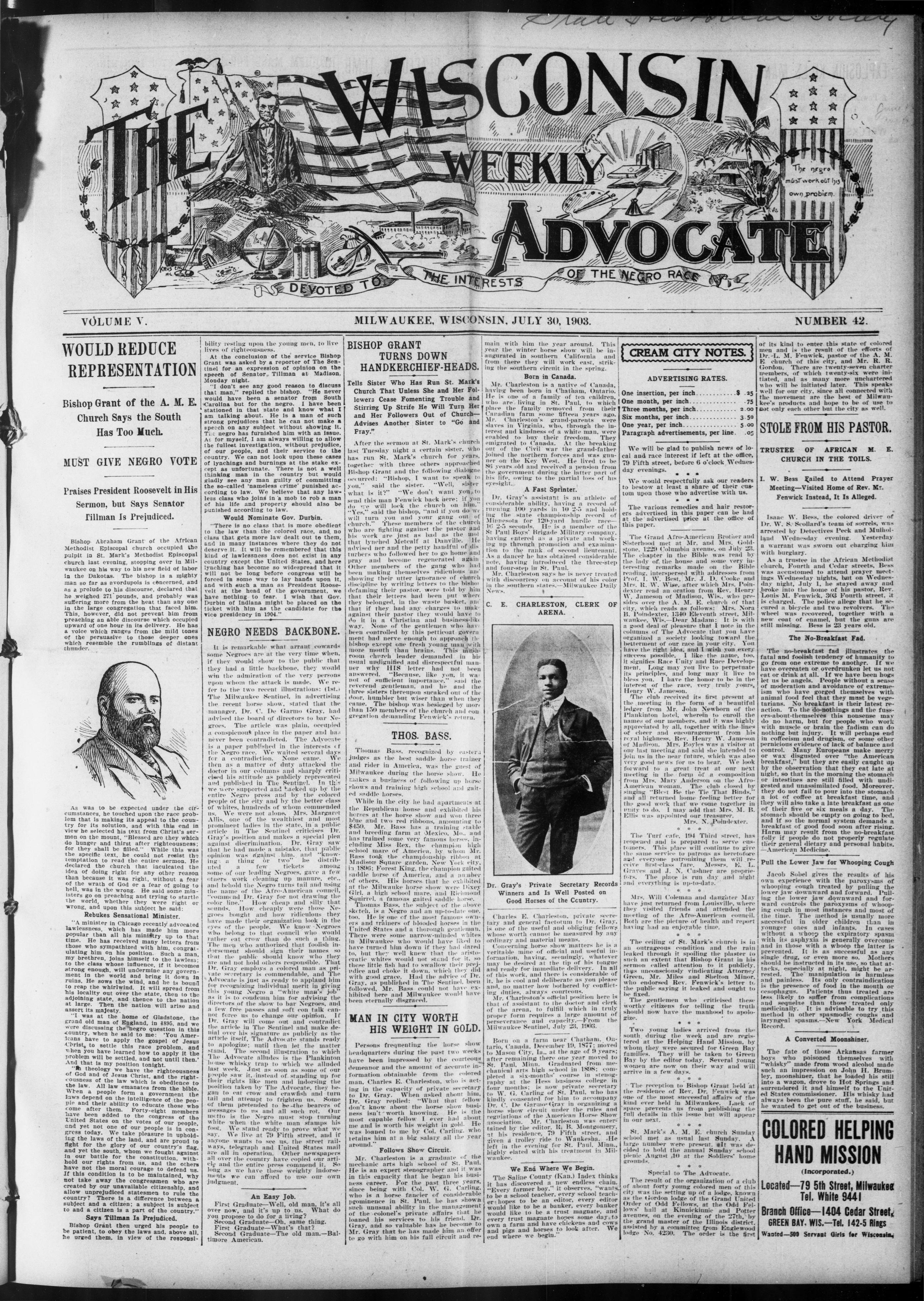
WISCONSIN
WEEKLY
ADVOCATE
DEVOTED TO THE INTERESTS OF THE NEGRO RACE
VOLUME V.
WOULD REDUCE REPRESENTATION
Bishop Grant of the A. M. E. Church Says the South Has Too Much.
MUST GIVE NEGRO VOTE
Praises President Roosevelt in His Sermon, but Says Senator Fillman Is Prejudiced.
Bishop Abraham Grant of the African Methodist Episcopal church occupied the pulpit in St. Mark's Methodist Episcopal church last evening, stopping over in Milwaukee on his way to his new field of labor in the Dakotas. The bishop is a mighty man so far as avordupols is concerned, and as a prelude to his discourse, declared that he weighed 271 pounds, and probably was suffering more from the heat than any one in the large congregation that faced him. This, however, did not prevent him from preaching an able discourse which occupied upward of one hour in its delivery. He has a voice which ranges from the mild tones of the persuasive to those deeper ones which resemble the rumblings of distant thunder.
M.
As was to be expected under the circumstances, he touched upon the race problem that is making its appeal to the country for its solution, and with this end in view he selected his text from Christ's sermon on the mount, "Blessed are they which do hunger and thirst after righteousness; for they shall be filled." While this was the specific text, he could not resist the temptation to read the entire sermon. He declared the church that inculcated the idea of doing right for any other reason than because it was right, without a fear of the wrath of God or a fear of going to hell, was in the wrong. He said some ministers go on preaching and trying to startle the world, whether they were right or wrong, and upon this subject he said:
Rebukes Sensational Minister
"A minister in Chicago recently advocated lawlessness, which has made him more popular than all his ministry up to that time. He has received many letters from those who sympathized with him, congratulating him on his position. Such a man, my brethren, joins himself to the lawless; to the class whose influence, if it becomes strong enough, will undermine any government in the world and bring it down in ruins. He sows the wind, and he is bound to reap the whirlwind. It will spread from his locality out over the state, then to the adjoining state, and thence to the nation at large. Then the nation will arise and assert its majesty.
"I was at the home of Gladstone, the grand old man of England, in 1895, and we were discussing the negro question in this country, when he said to me: 'You Americans have to apply the gospel of Jesus Christ, to settle this race problem, and when you have learned how to apply it the problem will be settled, and not until then.' And that is my position tonight."
In theology we have the righteousness of God and of Jesus Christ, and the right-ousness of the law which is obedience to the law. All law emanates from the bible. When a people form a government the laws depend on the intelligence of the people and their ability to educate those who come after them. Forty-eight members have been added to the congress of the United States on the votes of our people, and yet not one of our people is in congress today. We take pleasure in upholding the laws of the land, and are proud to fight for the glory of our country's flag, and yet the south, whom we fought against in our battle for the constitution, withhold our rights from us, and the others have not the moral courage to defend us. If this condition is to be maintained, why not take away the congressmen who are created by our unavailable citizenship, and allow unprejudiced statesmen to rule the country? There is a difference between a subject and a citizen; a subject is subject to and a citizen is a part of the country."
Savs Tillman Is Prejudiced.
Bishop Grant then urged his people to be patient, to obey the laws and, above all, he urged them, in view of the responsi-
bility resting upon the young men, to live lives of righteousness. At the conclusion of the service Bishop Grant was asked by a reporter of The Sentinel for an expression of opinion on the speech of Senator Tillman at Madison, Monday night.
"I don't see any good reason to discuss that man," replied the bishop. "He never would have been a senator from South Carolina but for the negro. I have been stationed in that state and know what I am talking about. He is a man of such strong prejudices that he can not make a speech on any subject without showing it. The negro has furnished him with an issue. As for myself, I am always willing to allow the fullest investigation, without prejudice, of our people, and their service to the country. We can not look upon these cases of lynchings and burnings at the stake except as unfortunate. There is not a well thinking man in the country but would gladly see any man guilty of committing the so-called 'nameless crime' punished according to law. We believe that any lawless class who joins in a mob to rob a man of his life and property should also be punished according to law.
Would Nominate Gov. Durbin.
"There is no class that is more obedient to the law than the colored race, and no class that gets more law dealt out to them, and in many instances where they do not deserve it. It will be remembered that this kind of lawlessness does not exist in any country except the United States, and here lynching has become so widespread that it will not be long before congress will be forced in some way to lay hands upon it, and with such a man as President Roosevelt at the head of the government, we have nothing to fear. I wish that Gov. Durbin of Indiana might be placed on the ticket with him as the candidate for the vice presidency in 1904."
NEGRO NEEDS BACKBONE.
It is remarkable what arrant cowards some Negroes are at the very time when, if they would show to the public that they had a little backbone, they would win the admiration of the very persons upon whom the attack is made. We refer to the two recent illustrations: (1st.) The Milwaukee Sentinel, in advertising the recent horse show, stated that the manager, Dr. C. De Garmo Gray, had advised the board of directors to bar Negroes. The article was plain, occupied a conspicuous place in the paper and has never been contradicted. The Advocate is a paper published in the interests of the Negro race. We waited several days for a contradiction. None came. We then as a matter of duty attacked the doctor in our columns and sharply criticised his attitude as publicly represented and published in The Sentinel. In this we were supported and backed up by the entire Negro press and by the colored people of the city and by the better class of whites, hundreds of whom commended us. We were not alone. Mrs. Margaret Allis, one of the wealthiest and most prominent ladies in the state, in a public article in The Sentinel criticises Dr. Gray's position and makes a special plea against discrimination. Dr. Gray saw that he had made a mistake, that public opinion was against him, and "knowing a thing or two" he distributed a few tickets among some of our leading Negroes, gave a few others work cleaning up manure, etc., and behold the Negro turns tail and using the name of the Afro-American council, "command Dr. Gray for not drawing the color line." How cheap and silly that sounds. How cheaply were those Negroes bought and how ridiculous they have made their organization look in the eyes of the people. We know Negroes who belong to that council who would rather eat crow than do such a thing. The men who authorized that foolish indorsement should sign their names so that the public should know who they are and not hold others responsible. That Dr. Gray employs a colored man as private secretary is commendable, and The Advocate is just as ready to applaud him for recognizing individual merit in giving this young Negro a "white man's job" as it is to condemn him for advising the directors of the show to bar Negroes, and a few free passes and soft con talk cannot force us to change our opinion. If Dr. Gray will come out and contradict the article in The Sentinel and make denial over his signature as publicly as the article itself, The Advocate stands ready to apologize; until then let the matter stand. The second illustration to which The Advocate alludes is the Plankinton house whisky trap to which we alluded last week. Just as soon as some of our people saw it, instead of standing up for their rights like men and indorsing the position taken by The Advocate, they began to eat crow and crawfish and turn tail and attempt to frighten us. Some of them pretended to be the bearers of messages to us and all such rot. Our motto is the Negro must stop turning white when the white man stamps his foot. We stand ready to prove what we say. We live at 79 Fifth street, and if anyone wants to see us, the street railways, telegraph and United States mail are all in operation. Other newspapers all over the country have copied our article and the entire press commend it. So long as we have these weighty indorsements we can afford to use our own judgment.
An Easy Job.
First Graduate—Well, old man, it's all over now, and it's up to us. What do you propose to do for a living?
Second Graduate—Oh, same thing.
First Graduate—What's that?
Second Graduate—The old man.—Baltimore American.
Tells Sister Who Has Run St. Mark's Church That Unless She and Her Followers Cease Fomenting Trouble and Stirring Up Strife He Will Turn Her and Her Followers Out of Church—Advises Another Sister to "Go and Pray."
After the sermon at St. Mark's church last Tuesday night a certain sister, who has run St. Mark's church for years, together with three others approached Bishop Grant and the following dialogue occurred: "Bishop, I want to speak to you." said the sister. "Well, sister what is it?" "We don't want you to send this man Fenwick back here; if you do we will lock the church on him." "Yes," said the bishop, "and if you do we will turn you and your gang out of church." These members of the church who are fighting against the pastor and his work are just as bad as the molt that lynched Metcalf at Danville. He advised ner and the petty handful of disturbers who followed her to go home and pray and become regenerated again. Other members of the gang who had been making themselves ridiculous and showing their utter ignorance of church discipline by writing letters to the bishop defaming their pastor, were told by him that their letters had been put where they belonged, in the waste basket, and that if they had any charges to make against their pastor they would have to do it in a Christian and business-like way. None of the gentlemen who have been controlled by this petticoat government had nerve enough to approach the bishop except one fresh young man with more mouth than brains. This mushroom church leader demanded in his usual undignified and disrespectful manner why HIS letter had not been answered. "Because, like you, it was not of sufficient importance," said the reverend gentleman, and he and the three sisters thereupon sneaked out of the door, humbler but wiser than when they came. The bishop was besieged by more than 150 members of the church and congregation demanding Fenwick's return.
THOS. BASS.
Thomas Bass, recognized by eastera judges as the best saddle horse trainer and rider in America, was the guest of Milwaukee during the horse show. He makes a business of following up horse shows and training high school and gaited saddle horses.
While in the city he had apartments at the Republican house and exhibited his horses at the horse show and won three blue and two red ribbons, amounting to $450. Mr. Bass has a training stable and breeding farm at Mexico, Mo., and has trained some very famous horses, including Miss Rex, the champion high school mare of America, by whom Mr. Bass took the championship ribbon at Madison Square garden, New York city, in 1896: Forest King, the champion gaited saddle horse of America, and a number of others. His horses that he exhibited at the Milwaukee horse show were Dixey Girl, a high school mare, and Richmond Squirrel, a famous gaited saddle horse.
Thomas Bass, the subject of the above sketch, is a Negro and an up-to-date one, too. He is one of the most famous owners and trainers of blooded horses in the United States and a thorough gentleman. There were some narrow-minded whites in Milwaukee who would have liked to have turned him down if they had dared to, but they well knew that the aristocratic whites would not stand for it, so these little fish had to swallow their prejudice and choke it down, which they did with good grace. Had the advice of Dr. Gray, as published in The Sentinel, been followed, Mr. Bass could not have exhibited here and Milwaukee would have been eternally disgraced.
MAN IN CITY WORTH HIS WEIGHT IN GOLD.
Persons frequenting the horse show headquarters during the past two weeks have been impressed by the courteous demeanor and the amount of accurate information obtainable from the colored man, Charles E. Charleston, who is acting in the capacity of private secretary to Dr. Gray. When asked about him, Dr. Gray replied: "What that fellow don't know about the horse show business isn't worth knowing. He is the most capable fellow I ever had about me and is worth his weight in gold. He was loaned to me by Col. Carling, who retains him at a big salary all the year around."
Follows Show Circuit.
Mr. Charleston is a graduate of the mechanic arts high school of St. Paul. He is an expert stenographer and it was in this capacity that he began his business career. For the past three years, since being with Col. W. G. Carling, who is a horse fancier of considerable prominence in St. Paul, he has shown such unusual ability in the management of the colonel's private affairs that he loaned his services to his friend. Dr. Gray, and so valuable has he become to Mr. Gray that he has made him an offer to go with him on his fall circuit and re-
main with him the year around. This year the winter horse show will be inaugurated in southern California and from there they will work east, striking the southern circuit in the spring.
Born in Canada
Mr. Charleston is a native of Canada, having been born in Chatham, Ontario. He is one of a family of ten children, who are living in St. Paul, to which place the family removed from their Canadian farm some fifteen years ago. Mr. Charleston's grand-parents were slaves in Virginia, who, through the interest and kindness of a white man, were enabled to buy their freedom. They emigrated to Canada. At the breaking out of the Civil war the grand-father joined the northern forces and was gunner on the Key West. He lived to be 86 years old and received a pension from the government during the latter part of his life, owing to the partial loss of his eyesight.
A Fast Sprinter.
Dr. Gray's assistant is an athlete of considerable ability, having a record of running 100 yards in 10 2-5 and holding the state championship record of Minnesota for 120-yard hurdle race—16 2-5 seconds. He is a member of the St Paul Boys' Brigade Military company, having entered as a private and working up through promotion and examination to the rank of second lieutenant. As a dancer he has obtained considerable note, having introduced the three-step and four-step in St. Paul.
Mr. Charleston says he is never treated with discountesy on account of his color in the southern states.—Milwaukee Daily News.
C. E. CHARLESTON, CLERK OF ARENA.
Charles E. Charleston, private secretary and general factotum to Dr. Gray, is one of the useful and obliging fellows whose worth cannot be measured by any ordinary and material means.
Concerning horse show matters he is a veritable mine of official and useful information, having, seemingly, whatever may be desired at the tip of his tongue and ready for immediate delivery. In all of this work, and there is considerable of it, he is cool and deliberate as you please and, no matter how bothered by conflicting duties, always courteous.
Mr. Charleston's official position here is that of assistant to the doctor and clerk of the arena, to fulfill which in truly proper form requires a large amount of perseverance and capacity.—From the Milwaukee Sentinel, July 23, 1903.
Born on a farm near Chatham, Ontario, Canada, December 19, 1877; moved to Mason City, Ia., at the age of 9 years; after remaining there one year moved to St. Paul, Minn. Graduated from mechanical arts high school in 1898; completed a six-months' course in stenography at the Hess business college in four months; is now private secretary to W. G. Carling of St. Paul, who has kindly consented for him to accompany Dr. C. De Garmo Gray in organizing a horse show circuit under the rules and regulations of the American Horse Show association. Mr. Charleston was entertained by the editor, R. B. Montgomery, at his residence, 79 Fifth street, and given a trolley ride to Waukesha. He left in the evening for St. Paul, Minn., highly elated with his treatment in Milwaukee.
We End Where We Begin
The Saline County (Kan.) Index thinks it has discovered a new endless chain. "Every farmer boy," it observes, "wants to be a school teacher, every school teacher hopes to be an editor, every editor would like to be a banker, every banker would like to be a trust magnate, and every trust magnate hopes some day to own a farm and have chickens and cows and pigs and horses to look after. We end where we begin."
ADVERTISING RATES.
One insertion, per inch..... $ .25
One month, per inch..... .75
Three months, per inch..... 2.00
Six months, per inch..... 3.50
One year, per inch..... 5.00
Paragraph advertisements per line..... 05
Paragraph advertisements, per line. .05
We will be glad to publish news of local and race interest if left at the office, 79 Fifth street, before 6 o'clock Wednesday evenings.
We would respectfully ask our readers to bestow at least a share of their custom upon those who advertise with us.
The various remedies and hair restorers advertised in this paper can be had at the advertised price at the office of this paper.
The Grand Afro-American Brother and Sisterhood met at Mr. and Mrs. Goldstone, 1229 Columbia avenue, on July 23. The chapter in the Bible was read by the lady of the house and some very interesting remarks made on the Bible reading, interspersed with addresses from Prof. I. W. Best, Mr. J. D. Cooke and Mrs. R. W. Wise, after which Mrs. Poindexter read an oration from Rev. Henry W. Jameson of Madison, Wis., who presides over the A. M. E. church of that city, which reads as follows: Mrs. Nora B. Poindexter, 1340 Eleventh street, Milwaukee, Wis.—Dear Madam; It is with a good deal of pleasure that I note in the columns of The Advocate that you have organized a society looking toward the betterment of our race in your city. You have the right idea, and I wish you every success possible. I like the name, too, it signifies Race Unity and Race Development. Long may you live to perpetuate its principles, and long may it live to bless you. I have the honor to be in the interest of the race, very truly yours, Henry W. Jameson.
The club received its first present at the meeting in the form of a beautiful ledger from Mr. John Newborn of the Plankinton hotel, wherein to enroll the names of our members, and it was highly appreciated by all, together with the lines of cheer and encouragement from his royal highness, Rev. Henry W. Jameson of Madison. Mrs. Boyles was a visitor at our last meeting and said she intended to join us in the near future, which was also very good news for us to hear. We look forward to a great treat at our next meeting in the form of a composition from Mrs. Mary Anderson on the Afro-American woman. The club closed by singing "Blest Be the Tie That Binds," and all returned home feeling better for the good work that we come together in unity to do. I may add that Mrs. M. B. Ellis was appointed our treasurer.
The Turf cafe, 194 Third street, has reopened and is prepared to serve customers. This place will continue to give the same service to patrons as heretofore and everyone patronizing them will receive first-class fare. Messrs. E. L. Graves and J. N. Cushner are proprietors. The place is run day and night and everything is up-to-date.
Mrs. Will Coleman and daughter May have just returned from Louisville, where they visited friends and attended the meeting of the Afro-American council. Both are the picture of health and report having had an enjoyable time.
☆ ☆ ☆
The ceiling of St. Mark's church is in an outrageous condition and the rain leaked through it spoiling the plaster to such an extent that Bishop Grant in his sermon called attention to it publicly. thus unconsciously vindicating Attorney Green, Mr. Miles and Shelton Minor, who endorsed Rev. Fenwick's letter to the public saying it leaked and ought to be fixed. The gentlemen who criticised these worthy citizens for telling the truth should now have the manhood to apologize.
Two young ladies arrived from the south during the week and are registered at the Helping Hand Mission, by whom they were secured for Green Bay families. They will be taken to Green Bay by the editor today. Several young women are now on their way and will arrive in a few days.
The reception to Bishop Grant held at the residence of Rev. Dr. Fenwick was one of the most successful affairs of the kind ever held in Milwaukee. Lack of space prevents us from publishing the full details in this issue but will appear in our next.
St. Mark's A. M. E. church Sunday school met as usual last Sunday. A large number were present. It was decided to hold the annual Sunday school picnic August 10 at the Soldiers' home grounds.
The result of the organization of a club of about forty young colored men of this city was the setting up of a lodge, known as the Gordon lodge of the Grand United Order of Odd Fellows, at the Odd Fellows' hall at Kinnickinnie and Potter avenues, on the evening of the 27th, by the grand master of the Illinois district, assisted by a committee from Englewood lodge No. 4230. The order is the first
NUMBER 42.
of its kind to enter this state of colored men and is the result of the efforts of Dr.-L. M. Fenwick, pastor of the A. M. E. church of this city, and Mr. R. R. Gordon. There are twenty-seven charter members, of which twenty-six were initiated, and as many more unchartered who will be initiated later. This speaks well for our city, since all connected with the movement are the best of Milwaukee's products and hope to be of use to not only each other but the city as well.
STOLE FROM HIS PASTOR.
TRUSTEE OF AFRICAN M. E. CHURCH IN THE TOILS.
I. W. Bess Failed to Attend Prayer Meeting—Visited Home of Rev. Mr. Fenwick Instead, It Is Alleged.
Isaac W. Bess, the colored driver of Dr. W. S. Scollard's team of sorrels, was arrested by Detectives Peck and Mullholland Wednesday evening. Yesterday a warrant was sworn out charging him with burglary.
As a trustee in the African Methodist church, Fourth and Cedar streets, Bess was accustomed to attend prayer meetings Wednesday nights, but on Wednesday night, July 1, he stayed away and broke into the home of his pastor, Rev. Louis M. Fenwick, 303 Fourth street, it is charged. The police allege that he secured a bicycle and two revolvers. The wheel was recovered, together with a new coat of enamel, but the guns are still missing. Bess is 23 years old.
The No-Breakfast Fad.
The no-breakfast fad illustrates the fatal and foolish tendency of humanity to go from one extreme to another. If we have overeaten or overdrunken let us not eat or drink at all. If we have been hogs let us be angels. People without a sense of moderation and avoidance of extremism who have gorged themselves with animal food feel that they must be vegetarians. No breakfast is their latest reaction. To the do-notings and the fussers-about-themselves this nonsense may do no harm, but for people who work with muscle or brain the fadism can do nothing but injury. It will perhaps end in coffeeism and drugism, or some other pernicious evidence of lack of balance and control. Many Europeans make merry or wax disgusted over "the American breakfast," but they are easily caught up by the observation that they eat late at night, so that in the morning the stomach or intestines are still filled with undigested and unassimilated food. Moreover, they do not fail to pour into the stomach a lot of coffee at breakfast time, and they will also take a late breakfast as one of their five or six meals a day. The stomach should be empty on going to bed, and if so the normal system demands a breakfast of good food soon after rising. Harm may result from the no-breakfast folly if people do not properly regulate their general dietary and personal habits. American Medicine.
Pull the Lower Jaw for Whooping Cough
Jacob Sobel gives the results of his own experience with the paroxysms of whooping cough treated by pulling the lower jaw downward and forward. Pulling the lower jaw downward and forward controls the paroxysms of whooping cough in most instances and most of the time. The method is usually more successful in older children than in younger ones and infants. In cases without a whoop the expiratory spasm with its asphyxia is generally overcome and in those with a whoop the latter is prevented. It is as successful as any single drug, or even more so. Mothers should be instructed in its use, so that attacks, especially at night, might be arrested. The manipulation is harmless and painless. Its only contraindication is the presence of food in the mouth or cesophagus. Patients thus treated are less likely to suffer from complications and sequelae than those treated only medicinally. It is advisable to try this method in other spasmodic coughs and laryngeal spasms.—New York Medical Record
A Converted Moonshiner
The fate of those Arkansas farmer boys who poisoned themselves with "whisky" made from wood alcohol made such an impression on John H. Brumley, moonshiner, that he loaded his still into a wagon, drove to Hot Springs and surrendered it and himself to the United States commissioner. His whisky had always been the pure stuff, he said, but he wanted to get out of the business.
COLORED HELPING
HAND MISSION
(Incorporated.)
Located—79 5th Street, Milwaukee
Tel. White 9441
Branch Office—1404 Cedar Street,
GREEN BAY, WIS.—Tel. 142-5 Rings
Wanted—500 Servant Girls for Wisconsin
EXPLOSION KILLS MANY.
A Powder Magazine Blows Up at Tewkesbury, Mass.
WRECKS MANY BUILDINGS.
Latest Estimate Place Number of Dead at Thirteen and Injured at Thirty and Nine Persons Missing.
Lowell, Mass., July 29.—Without warning probably upwards of a score of persons and possibly more were blown to death this forenoon by the explosion of the United States Cartridge company's magazine on the banks of the Concord river, in South Lowell, three miles from the center of the city. The number of injured is thirty, although others were slightly cut by glass and burned. At 2 p. m. the list of dead stood at fifteen with nine missing.
Heavy Property Loss.
Ten or a dozen wooden buildings which stood in the vicinity of the powder and dynamite store houses were either demolished by the explosion or destroyed by fire and twenty other structures were more or less seriously damaged. The financial loss, exclusive of that sustained by the cartridge company, is roughly estimated at $40,000 only, a small part of which is protected by insurance.
The explosion was caused by workmen who were employed about the storehouses for several days. The buildings owned by the company were two small brick structures, one used for storing dynamite and the other powder. So powerful was the large quantity of explosive in storage that the shock of the explosion was distinctly felt all over northeastern Massachusetts. In Lowell many windows were demolished and at points fifteen miles distant glass was also shattered.
The concussion was felt in Boston, forty miles away, and at Exeter, N. H., which is a greater distance from Lowell. At many points a score of miles distant window glass was shattered and other damage done. In some cases there were reports in circulation that there had been an earthquake.
City Thrown in a Panic.
The city was thrown into a panic and it required every effort of the authorities to establish and maintain anything like order. It became necessary to summon four companies of the state militia. Alarming reports to the effect that over 100 persons had been killed and injured caused widespread confusion.
The explosion is thought to have been caused by the jarring of dynamite stored in the magazine by workmen who were laying a new floor. The dynamite set off the powder stored in one chamber and that explosion was followed by another in the second chamber.
The plant of the United States Cartridge company is located in a district known as Riverside pgkr in Tewkesbury, just outside of Lowell.
The building in which the explosion occurred was a stone structure about one and a half miles distant from the works of the cartridge company. Within a distance of 50 yards are located half a dozen houses. Within 100 yards there are twenty houses, more and beyond that the buildings are close together. Every structure within a quarter of a mile was torn within and without. Men and women and children who were inside the houses sustained cuts, bruises and broken bones if they escaped with their lives.
Men who lived in streets not far away who were fortunate enough to escape serious injuries immediately gave themselves over to work of removing women and children to places of safety, for almost simultaneously with the explosion came flashes from several buildings. Into the flames and debris scores of men were soon plunging in efforts to save life and property.
The wreck was so complete, however, that the work was exceedingly slow. The patrol wagons of the police and teams of all description were brought into use to supplement the hospital ambulances. It was nearly noon before anything like an accurate estimate of the number killed could be obtained. Previous reports had said that the dead would number seventy-five, but at 11:45 a canvass of the hospitals and inquiry at the police station resulted in a conservative estimate of twenty-five killed and fifty-five injured.
Many of Injured Will Die.
Sixteen victims, most seriously hurt, were taken to St. John hospital, where at noon it was said that four would die and that as many more were desperately hurt. The crowds increased momentarily and it seemed as if all Lowell had suspended business and was at the scene of the catastrophe.
List of the Dead.
The following are among the dead:
RIGGS, MRS. WILLIAM, of Riverside Park.
GALLOWAY, JAMES, aged 9.
FLYNN, WILLIAM, 12.
M'DERMOTT, WILLIAM, 10.
ROGERS, MICHAEL, 10.
All the above boys were in swimming in the Concord river.
UNKNOWN MAN, driving grocery cart.
GALLOWAY, WILLIAM.
POORE, _____
LOWELL, _____
SIX MEN working near the powder store.
M'DERMOTT, GEORGE, 40 years old.
JACKSON, _____
Fatally Injured.
The fatally injured:
James Sullivan.
Mrs. Victoria Pouries.
Gallagher (girl).
McDermott (girl).
Sullivan, teamster.
SENATOR C. K. DAVIS' WIDOW IS MARRIED.
She Becomes the Wife of Hunter Doll of Knoxville, Tenn.—Wedding in Washington.
Washington, D. C., July 29.—Mrs. Anna Agnew Davis, widow of the late United States Senator Cushman K. Davis of Minnesota, and Hunter Doll of Knoxville, Tenn., were married at the bride's home in this city today.
GIRL CLEARS MYSTERY.
Annie Higginson, After Baffling Police for Three Months, Returns Carrying a New Born Babe.
Chicago, Ill., July 29.—Drenched by the heavy rain and carrying a 3-weeks-old baby in her arms, Miss Annie Higginson staggered into her aunt's home last night, and a mystery that has been battling the police was cleared.
The young woman had been missing for three months, having disappeared in April from the residence of E. A. Hehn, with whose family she had been living while she was studying in Chicago. She has been in a hospital and says Jesse L. Hehn, a son of E. A. Hehn, has paid her expenses.
```markdown
```
TERMS OF TREATY.
Alleged Treaty Negotiated by Kouropatkin at Tokio Is Published in Berlin.
Berlin, July 28.—What purports to be the text of the Russo-Japanese agreement which it is alleged was signed on the occasion of the visit to Tokio of Gen. Kouropatkin, the Russian minister of war, last month, is published here.
The preamble declares that the parties are actuated by a desire to avoid a conflict between their political and commercial interests in Manchuria and Corea, observe cordial relations in the future and also promote their own interests without preindicating those of other nations.
The agreement, stipulates that Russia will effect with all possible speed the second phase of the evacuation of Manchuria, but she will be allowed to maintain the policy of force to protect the Chinese eastern railway as well as the legal rights she acquired there, without, however, threatening the independence of China or prejudicing Japanese trade.
Concedes Open Portc.
Russia has no objection to opening Fengtien, Yenkou and Tatangkong to foreign trade, and agrees that Japanese consulates may be established at those places. The system of administration in Manchuria will remain unchanged, but the present legal liberty of interests of the Japanese will be respected and the immigration of Japanese into Manchuria within certain limits will not be hindered.
Russia recognizes the development of Japanese influence in Corea, she acquireses in Japan's obtaining a concession for the Seoul-Jign railway, and the appointing of a Japanese as the first adviser to the Corean crown. She also recognizes the right of the Japanese to wood cutting privilege at Quelpart. The agreement is to be temporarily valid pending its final signature at St. Petersburg by Count Lamsdorff, the Russian minister of foreign affairs, and M. Kurino, the Japanese minister to Russia.
Grain for Japan Is Stopped.
Pekin, July 28.—The Russian administration of New Chwang has stopped the exportation of wheat to Japan. The export of grain from Chinese ports is illegal, but the Russians heretofore have ignored the law. During the last week the Japanese obtained many shiploads from New Chwang, apparently preparing for war contingencies. Several ships were employed in bringing wheat from Shanghai and southern ports to New Chwang, where it was trans-shipped as a direct export. The prohibitory order was issued by the Russian officials last Thursday.
Control Commerce on Liao.
Gen. Kondradovitch has been placed in charge of six armed commercial boats and of the navigation of the Liao river, which is construed here as another sign of Russia's intention to retain New Chwang and the command of the river. Great numbers of Russian civilians and soldiers' families, it is reported, are being brought to Manchuria, it is believed, in pursuance of a comprehensive plan to rapidly colonize the province. At the present rate there will be almost 100,000 Russian civilians in Manchuria, including Port Arthur and Dalny, before the date fixed for the final evacuation next fall.
WISH TO EJECT GOMPERS
John Mitchell Heads Movement Against Federation of Labor Leader—Name of James Duncan Mentioned.
Washington, D. C., July 28. A report is current that John Mitchell, president of the United States Mineworkers of America, and B. J. O'Keefe of Chicago, president of the Longshoremen's union, are at the head of a movement to depose Samuel Gompers from the presidency of the American Federation of Labor. It is said the anti-Gompers wing of the federation plans to elect James Duncan as president of the federation. Mr. Duncan is now first vice president of the Federation of Labor and president of the Granite Cutters' union.
A CLERICAL ERROR CAUSES BIG SUIT.
Action to Set Aside Transfer of Stock Alleged to Have Been Made
Binghamton, N. Y., July 28. A decision has been handed down by Judge Ray in the United States circuit court involving $1,500,000. Jacob Edwards brought an action against the Mercantile Trust company of New York and the Bay State Gas company of Delaware to set aside an agreement between the defendants in which, it is alleged, capital stock of the gas company was illegally transferred through mistake to the Mercantile Trust company. From a clerical error the action has grown into an intricate piece of litigation. A denurrier to the complaint was filed by the Mercantile Trust company, and this is upheld.
JEWS BATTLE FOR UNLEAVENED BREAD
Hebrew Bakers Go On Strike and Bloody Rict Occurs—To Get Imported Bread.
New York, July 28.—A "bread riot" has occurred in Newark, N. J., owing to the strike of Hebrew bakers, who demand a holiday on Saturdays. The supply of unleavened bread having become exhausted, two Hebrews journeyed to New York and returned with two wagon loads. They were quickly held up by a clamoring throng of hungry persons and a raid on their stocks being made, a riot followed. Many persons were trampled upon and several women fainted. After a vigorous fight the police dispelled the rioters.
A Difference in Motive.
Au English landowner, out unusually early one morning for a walk on his estate, in turning a corner came suddenly upon an Irishman, whom he knew as an inveterate poacher. This is the conversation that took place between them: "Good morning, Pat!" "Good marnin', yer haner. An phwat brings yer haner out so airly this marnin'?" "I'm just walking around, Pat, to see if I can get an appetite for my breakfast. And what brings you out so early, Pat?" "Och, be jabbers, O'm jest a-walkin' around to see if Oi can't git a breakfasht fer me appetite."
Wales Is Rich.
Wales is the richest part of Great Britain in mineral wealth. England produces annually about $10 to each acre; Scotland a little less than $10; but the product of Wales amounts to over $20 per acre.—Exchange.
Chili sells Germany $18,000,000 worth a year of nitrate of soda for use in fertilizers.
Mexico now has 60,000 American residents and $323,000,000 American money.
HIGHBALLS, NOT WAR,
Washington, D. C., July 29.—The startling "revolution," which resulted in the brief overthrow of the government of Panama last Saturday night, according to official cables, was the result of highballs and not an insurrection. During the course of the "revolution" Gen. Vasquez Cobos, who overthrew the government for a day, arrested most of the local officers and sent the governor flying in his pajamas into the shrubbery to escape a dungeon. It now seems that Cobos did not know what he was doing, and the whole story is like a comic opera. The truth is that he had dined too well, and, not being used to Scotch highballs, lost his head and decided that affairs in Panama were not going to suit him. He accordingly ordered his army of ten men under arms and overthrew the government.
When Gen. Cobos awoke Sunday evening everything looked gray and gloomy. He did not remember what he had done, but he realized that something unusual had taken place when another officer appeared in his quarters at the head of his army of ten and placed him under arrest. He has been removed from office, and will be tried by a court-martial. Gen. Cobos does not seem to have been the only one who lost his head during the boisterous doings in Panama. The state department is wondering what Consul Gudger meant by sending dispatches which treated the matter as being serious. The strain seems to have been hard on Gudger, for he accompanied his news with a request for sixty days' leave.
Assistant Secretary Loomis, who has a sense of humor, replied that, in view of the disturbed condition in Panama, he did not think Gudger should leave his post.
ENGLAND MAY SEND WARSHIPS TO HONDURAS.
British Consul Thinks English Investors in Railroad Need to Be Pro-
Tegucigalpa. Honduras, July 29. A representative of the New York syndicate, to whom the Honduras railroad was under lease, until seized recently by the government, has left Tegucigalpa and gone to San Pedro. He is understood to have made satisfactory arrangements with the government, but the British consul at Puerto Cortez is asserted to be greatly dissatisfied over the situation and is likely to urge through the British minister at Guatemala City that a warship be sent to his station to protect the interests of English stockholders in the railroad.
SHE SEES THE GROOM AND WILL NOT MARRY.
Marquette Girl Does Not Think He Looked Like Picture in Matrimonial Paper.
St. Joseph, Mich., July 29.—A romance fostered by a matrimonial journal came to a disastrous ending here yesterday because the appearance of the groom was not up to the specifications of the photograph in the possession of the bride-elect. The parties to the romance are Henry A. Belknap of Elmira, N. Y., and Miss Edessa Baldwin of Marquette, Mich. They became acquainted through the matrimonial paper and journeyed here, meeting yesterday. When the young woman saw the prospective bride-groom she refused to go on with the ceremony.
DETROIT STREET CARS TIED UP BY STRIKE.
Firemen at Power House Go Out and Entire System Is Put Out of Business.
Detroit, Mich., July 29. All the street car lines in the city were tied up for more than two hours this morning at the time travel is usually heaviest, by a strike of thirty-five firemen at the power house of the Detroit United Railway company. The men struck to enforce a demand for an eight-hour day. Outside help was rushed to the power house. An effort is being made to induce the engineers to strike. Thousands of people were late in getting to their work this morning.
LILLIAN RUSSELL AND BLANCHE BATES HURT.
Two Actresses, Spilled Out of Their Automobile on Long Island, Are Severely Bruised.
New York, July 29.—Lillian Russell and Bianche Bates, while riding in their automobile just outside of Jamaica, L. L., had an accident. As they drew near the village they saw a runaway team approaching and Miss Russell quickly steered for the ditch. The automobile was overturned, throwing out both actresses, who were severely bruised. Neither will be able to leave her bed for a day or two.
ENGLAND WILLING TO CARRY CUBAN DEBT.
British Financiers Will Subscribe to the $35,000,000 Loan if Americans Don't.
London, July 29.—If Cuba fails to float her proposed loan of $35,000,000 in the United States, she will have no difficulty in doing so here. Several British financiers are willing to subscribe.
STEAMERS IN COLLISION.
Plymouth, England. July 29.—The British third class cruiser Melamps collided with and sank the British steamer Ruperra, off the Lizard last night. The crew of the Ruperra were saved. The damage sustained by the Melamps will necessitate docking her for repairs.
BRIGHTFORCANALTREATY
Colombia Congress Will Probably Ratify It—Washington Hears from Minister Beaupre.
Washington, D. C., July 19.—There is now a brighter outlook for the ratification of the Panama canal treaty by the Colombian Congress. Encouraging advices were yesterday received by the department of state from Mr. Beaupre, the United States minister to Colombia. He did not go into details, but merely said the prospects for ratification are better than at any previous time.
30DY PLACED IN TOMB.
The World's Last Farewell to Pope L30 XIII. Is Over.
Rome, July 25.—On the stroke of midday, as the noon gun from the castle of St. Angelo was fired, the lying in state of the body of Pope Leo XIII, came quietly to an end and those who still lingered at the gates of the chapel of the Sacrament in St. Peter's were ordered to leave and some two or three hundred persons, including Cardinal Goossens, who arrived from Mechlin just in time, passed slowly, out of St. Peter's into the sunlit piazza and the world's last farewell to the great Pope was over.
Ten minutes later Italian infantry and gendarmes poured out of the basilica and lined up on the steps in imposing array. The outer gates were then closed and the body of the late Pope was left to the tender care of those who had watched by Leo XIII, in his lifetime.
The preparations for this evening's interment were immediately commenced. While the bells of the basilica rang out their daily melodious noon chorus, the troops formed in column and were marched to the barracks. Their historic incursion into Vatican territory ended without the slightest friction. It is estimated that 80,000 people passed the catafalque since Thursday morning. The last funeral mass in St. Peter's was celebrated this morning in the chapel of the choir by Mgr. Paniey, canon of the Vatican basilica. At the same time funeral masses were celebrated in most of the churches of Rome.
Cardinals Receive Diplomats.
The most imposing ceremony today was the reception by the sacred college in the hall of the consistory, of the whole diplomatic body accredited to the Vatican. All the diplomats wore gorgeous uniforms and the cardinals had on their magnificent violet robes and were seated in huge armchairs, according to right of precedence. The Portuguese ambassador, M. Martins d'Untas, dean of the diplomatic corps, was at the head of the body. He advanced and delivered an address in French, expressing the sorrow of all the powers at the death of Pope Leo, who had acquired the universal esteem of the world.
Cardinal Oreglia, dean of the college of cardinals, rose and answered in Italian. He thanked the diplomats in the name of the sacred college for the part all the governments had taken in the mourning of the church. He eulogized Pope Leo and his work during his long pontificate and ended with expressing the hope that God will suggest to the sacred college a worthy successor to Leo XIII. After this the members of the diplomatic body kissed the hands of all the cardinals and especially congratulated Cardinal Oreglia on the sentiments he had expressed and which produced the best of impressions.
Great Crowd at St. Peter's.
During the early hours the piazza of St. Peter's was not so crowded with persons desirous of viewing the body of Pope Leo as on the two preceding days; but when it became known that the opportunity would cease at noon, those who had been waiting until the last moment hurried to the cathedral. This rush produced a heaving, struggling group of humanity which the police had some difficulty in handling. The body will be buried at sunset this evening. Almost all the cabinet ministers visited St. Peter's today.
Each train brings new cardinals. During the night came Cardinal Perraud, archbishop of Autun, and Cardinal Herrero y Espinosa, archbishop of Valencia. Austrian Government Sends Instructions. (Cardinal Taliani, the nuncio at Vienna; Cardinal Goossens, archbishop of Mechlin, and Cardinal Gruscha, archbishop of Vienna, arrived this morning. The latter received before his departure from Vienna instructions from the Austrian government concerning the conclave.
Fisherman's Ring Missing.
When the time came to take the fisherman's ring from Pope Leo's finger, it has just developed, another was found in its place. This did not surprise anyone, as generally the pontiff did not wear it, the ring being less of an ornament than an unused seal. At the first meeting of the congregation of cardinals after the Pope's death, when the famous ring should have been broken, the ceremony was omitted and it was put on record that the ring, for the moment, could not be found.
Ring Lost Twice Before.
The fisherman's ring is known to have been lost twice before. Among the state papers preserved at Simancas, near Valadolid, Spain, is a letter from Count Olivares, then Spanish ambassador at Rome to Philip II., dated September 5, 1588, saying: "Sixtus V. has been very ill from anxiety and vexation. The vexation to which I refer was at missing the fisherman's ring. He carried it*with him in a purse and he discovered that he had been robbed of it by a cupbearer. Unless the publicity given to the affair obliges him to punish the man he will not do so or even dismiss him, such is his affection for those who serve him. The Pope would do anything to avoid showing the world that his confidence had been abused."
Leo Once Lost It.
In September, 1899, the late Pope Leo was one day insistently asked for an audience by an under servant and yielding to curiosity he granted it, whereupon the man entered and, kneeling, said:
"Your holiness, I have to restore to you what has been a loss not only to you, but to the world."
After these words the man preferred the Pope the fisherman's ring, which had been found.
Pope Leo looked at it in surprise and then, solemnly putting it on his finger, said:
"The thanks of the church are due to you, my son, I shall see that you are rewarded."
The next day the man called at the treasury and was given $3.
Hidden Away by Leo.
The ring has never been seen since, as Pope Leo privately hid it or locked it away, unseen by anyone, so great was his fear of losing it again. So far it has not been discovered, but the Vatican authorities assure the Associated Press that the ring will undoubtedly be found.
Taken from Papacy by Force
On two other occasions the ring was taken from the papacy by force. In 1797 the French Republicans, invading the papal states, despoiled Pius VI. of all his valuables and among them the fisherman's ring. It was returned the next day, as it had no intrinsic value. When Pius VII. was kidnapped in the middle of the night and was made to give up this ring, the Pope gave it up after breaking it in two pieces, which were kept in Paris until returned to Rome by Louis XVIII.
REQUIEM MASS FOR LEO.
CARDINALS PARTICIPATE INGREAT SERVICE AT ROME.
All of the Princes of the Church Arrayed in Beautiful Robes Are
Rome, July 28.—The first of the three great requiem masses under the auspices of the sacred college for the repose of the soul of Pope Leo was celebrated this morning in the Sistine chapel. All the cardinals now in Rome, the diplomatic corps, the Roman nobility and many other distinguished persons were present. No such mass had been seen in Rome since the death of Pius IX.
In the Sistine chapel stood a huge white catafalque, 30 feet high, and on it, upon two scarlet cushions, rested a triple crown of gold, shining brightly in the light of a hundred candles. Flanking the catafalque, on benches specially constructed, sat almost all the members of the sacred college, wearing scarlet capes over their violet robes. Behind the heads of the religious orders, archbishops, patriarchs, monsignors and monks, knelt or stood in picturesque confusion.
At the four corners of the catafalque burned candles, 10 feet high. Besides these stood noble guards, motionless, with drawn swords.
At the altar Cardinal Serafino Vannutelli was assisted by Cardinals Agliardi, Vincenzo Vannutelli, Satolli and Richard, wearing white miters and glistening vestments. Satolli, always erect and swarthy, looked doubly so beside the feeble frame and snow white head of the aged Cardinal Richard, archbishop of Paris.
Cardinal Gibbons had no part in the celebration of the mass. He sat beside Cardinal Martinelli, among the extraordinary array of cardinals, among whom Cardinal Gotti, who, instead of a scarlet cape, wore the white mantle of the Carmelite order, was one of the most prominent.
Cardinal Oreglia, dean of the sacred college, sat at the head of the left row of cardinals, near the altar steps. It was noticed that he walked with an erectness which belied his years. Cardinal Rampolla, one of the handsomest of these princes of the church, walked with a set face and with head bent down.
Baltimore, Md., July 28.—Impressive memorial services for the late Pope Leo XIII, were held in the cathedral this morning. The cathedral being the primatial church of the country, the services had been arranged on a scale which would fitly express the sorrow of the hierarchy of the United States over the passing of the pontiff. Among the prelates who officiated were the papal delegate, Archbishop Falconio, and Bishops Donahue of Wheeling, Monaghan of Wilmington, Van Devyver of Richmond, and Curtis, vicar general of the diocese of Baltimore.
Paris, July 28.—Several disorderly persons were arrested outside of Notre Dame cathedral, where the requiem services for Pope Leo were being held. They had intended attempting to break up the services.
BANK OFFICERS ACCUSED.
Juror Makes Sensational Statement in Court—Says Money Was Forced Upon Him by Cashier.
Chattanooga, Tenn., July 28.—A sensation was sprung in the circuit court today when Judge M. M. Allison called the jury in the Whiteside will contest case, involving an estate of nearly $1,000,000, into court and asked them if any attempt had been made to unduly influence them in their verdict. The jury has been deadlocked for more than a week.
James Goodson, a farmer, who is one of the jurors, stated to the court that on Saturday he went into the Chattanooga Savings bank and asked for change for $5. The teller pushed him $10 in silver. He swore that when he returned the money that the teller pushed out another pile instead of taking the surplus $5.
The Chattanooga Savings bank is one of the three executors of the Whiteside estate, and the testimony of its officers was strongly in favor of sustaining the will. Judge Allison immediately issued attachments for the bank officials. Mrs. Whiteside, whose will is being contested, was a Christian Scientist and the contestants, three of her sons and one daughter, are trying to break the will, claiming that their mother was mentally unbalanced.
NO MASSACRE OF JEWS AT OFRAN.
An American News Agency Exploits Old News as New—Foundation of Story
London, July 28.—Nothing is known here of the report, published by a news agency in the United States, to the effect that a massacre of Jews has occurred at Ofran, near Tangier, Morocco. The Morning Leader of this city publishes a dispatch from Tangier saying that the Jewish quarter of Ofran was looted by Arabs July 17, that a building was destroyed, that a girl was abducted and that in a quarrel among her abductors regarding possession of the girl six Arabs were killed. There is no doubt that this is the basis of the reported "massacre of Jews at Ofran."
SAYS POLICE MADE HIM ACCUSE PARENTS.
The Boy Witness in Murder Trial Contradicts His Former Testimony Against Father and Mother.
Chicago, Ill., July 28.—Julius Wiltrack, the 11-year-old boy who was the chief witness for the state in the prosecution of his father and his mother, charged with murdering a 6-year-old boy several months ago, today contradicted his former testimony about hearing a shot in his father's saloon and seeing him with a smoking revolver in his hand, and that he saw the body of the murdered boy thrown into the basement, and swore that he had been terrified into making these accusations by the police.
TWO WOMEN ARE KILLED.
Explosion of Natural Gas in Rear of Saloon in Columbus, O., Has Fatal Results. Columbus, O., July 28.—In an explosion of natural gas in the rear of a saloon today, two women were killed and a half dozen men were injured. The dead: Mrs. Wilhelmina Lewis and Mrs. Fred A. Grehl. The women were employees of a dye house, which was also wrecked.
STOP LYNCHINGS.
Police at Lorain, O., and Wheeling, W. Va., Prevent Mobs from Taking Vengeance.
Lorain, O., July 29.—A fierce riot, in which a mob of 300 whites chased two colored men, threatening to lynch them, took place here last night.
Early in the evening two colored men, Charles Hall and Robert Pleasant, became involved in an altercation with a white man named Danial Cronin. One of the colored men drew a razor and cut Cronin severely on the face and neck. A mob immediately gathered and the Negroes were chased over the entire south end of the city, one of them taking refuge in a saloon, the entire front of which was battered in with stones. The Negroes, however, escaped. The entire day and night force of police was ordered on duty and specials were sworn.
Pleasant was arrested and taken by side streets to the local station, where he was locked up, while the crowd still continued their search. At a late hour Mayor King addressed the crowd, saying that the injuries of Cronin were not serious and asking them to quietly disperse to their homes. His words had a quieting effect. The mob dispersed.
Wheeling, W. Va., July 29.—But for the timely arrival of policemen, John Posteoh, a Hungarian steel worker, would have been strung up by an enraged mob on Wheeling island last night. Posteoh, who was drunk, caught in his arms and embraced a well-known and respected woman who was walking on the street. A mob chased him, but the foreigner drew a dirk fully 12 inches in length and held the enraged men at bay for a time. A cobble stone hurled the knife out of the man's hand. Stone after stone was rained upon the man in rapid succession ad a rope was quickly sent for by the now thoroughly aroused citizens, who were under the impression that a criminal assault had been committed. A force of policemen arrived upon the scene and rescued the Hungarian.
CARDINAL GIBBONS IS A POSSIBILITY.
Division in Sacred College Over Rampolla Adds to His Strength—Conclave Is Complete.
Rome, July 29.—With the arrival here of Cardinal Prisco, archbishop of Naples, the number of cardinals who will participate in the conclave is complete and totals sixty-two. Of the two remaining, Cardinal Celesia, archbishop of Palermo, cannot leave Palermo because of his health, and Cardinal Moran, archbishop of Sydney, N. S. W., cannot, it is believed, arrive here before August 20, when the conclave may be over.
Prince Chigix, marshal of the conclave, visited Cardinal Gibbons today and all the diplomats accredited to the Vatican have left their cards at his residence. He has been visited by the high ecclesiastical dignitaries.
The division of the sacred college over Cardinal Rampolla adds to Cardinal Gibbons' strength. He is now looked upon as a possibility.
LEGAL TO PICKET.
Labor Unions Have Right to Persuade Workmen to Go on
Chicago, Ill., July 29.—Judge Kavanagh in a decision handed down today in the habeas corpus case of four strikers for violation of an injunction granted to the Illinois Malleable Iron Works, decided that labor unions have the right to place pickets about a plant where a strike is in progress and he also declared that workmen have the right to persuade others to quit work.
The jurist furthermore held that sending men to jail upon affidavits that they have violated an injunction is illegal.
Judge Kavanagh's decision is directly opposed to decisions rendered in the superior court.
EFFORT IS MADE TO BLOW UP A MINE.
Property Set on Fire and Loss Is Heavy
—Non-union Men Employed
Idaho Springs. Colo., July 29.—An explosion at the Sun and Moon mine near here wrecked the transformer house, set fire to the oil in the transformers and threatened the destruction of the main shaft house.
The watchman at the mine saw men running away at the time and shot one of them. He was taken in charge and cared for.
The mine employed non-union men after a strike. Dynamite is believed to have been used.
The wounded man died today. He was Philip Fire of the Miners' union.
FREEDOM FOR HAWAII.
Attendants at Home Rule Convention in Honolulu Plan to Ask for Independence.
Honolulu, July 2.—At the home rule convention ex-Delegate Wilcox urged that Congress be memorialized to grant Hawaiian independence. He also favored the establishment of a government for the islands similar to that of Cuba. The convention decided, however, that the time for presentation of the memorial was not ripe. Dole's administration was scored.
CYGLONE WRECKS 3 TOWNS
Wind Storm Passes Through Part of Russia and Causes Great Loss of Life.
St. Petersburg, July 29.—A terrific cyclone has passed through the district of Tchernigof. Three villages were destroyed in a few minutes. Churches and houses were lifted bodily and carried a long distance. The loss of life was great.
PROBABLY PERISHED IN FIRE.
Village of Colebrook, N. H., Is Almost Wined Out by Flames.
Colebrook, N. H., July 29.—Several business blocks were burned here early today and it is thought that Jesse Forristall, owner of the Cobden block, in which the flames originated, lost his life. At one time the village was in danger, but was saved. Mr. Forristall was seen to enter the building during the fire.
CUBAN UPRISING PUT DOWN.
Leader Is Captured and His Companions Are Killed.
Havana, July 29.—The efforts of a quartette of wild characters to cause an uprising in the vicinity of Bayamo, province of Santiago, have ended in the capture of their leader and the killing of the other three men. This effectually ends the only semblance of an uprising in Cuba.
A SONG OF THE YANKEE.
If you chance to sail uncharted seas,
An unknown shore to gain—
It's ten to one, when you reach the land,
A naked native is on the sand
With an Elgin timepiece in his hand,
Or a sardine tin from Maine:
And under a spreading cocoa tree
There stands a trader's tent.
Where a lonely stranger is selling clocks,
And Springfield guns and Stamford locks,
Jackknives and liniment.
He hails from Maine or from Lake Champlain,
Or maybe from Salem, Mass.
His face is lean, and his wit is keen,
And his eye lets nothing pass.
In an unmade land or a desert sand
Tis his especial pride
To do odd jobs for Providence,
And help himself on the side.
And dwelt in peace with the crabbed Dutch.
And taught the wilderness at their touch
To yield what a man requires.
And the mission spirit will drive some
Yanks
Wherever a man can roam
While others, with delicate skill, design
Wooden nutmegs and hams of pine
To sell to the folks at home.
—Burges Johnson in Harper's Magazine.
STORY OF A ROMANTIC DAY.
"Why are you laughing?" asked Elsa as we entered the picture gallery.
"It seems a little incongruous," I answered.
"What?" she demanded.
What: she demanded.
"That this great place should belong to such a small person, and that she should live in it alone."
"Don't you think it would be rather nice," she cried abruptly, as she stopped before a portrait of a lady of George II's reign, "if women wore powder nowadays?"
"Every generation has its own method of disguising nature," I suggested.
Elsa raised a pair of merry eyes: "Do you intend to insinuate that mine"——
"I have known it far too long to feel the slightest doubt." I answered, with a glance at her yellow head.
"Men," she cried, "looked more gallant in those days."
"Anyhow, they were more inclined to gallantry," I admitted.
"Still," said Elsa, with a sigh, "I believe that life had more of romance."
"What do you mean by romance?"
"I could tell you better who is unromantic," she retorted.
"Well," I suggested, "your own experience has been romantic enough."
"I thought I must be dreaming," she said, "when I heard that Uncle Richard had left everything to me."
"A veritable fairy tale."
"But still"——
"Only requiring the prince to complete the fable," I answered.
"I feel certain," she exclaimed, with suspicious embarrassment, "that there was more romance in those days. Everybody says that chivalry is dead. How long," she added, leading the way along the gallery, "is it since you went abroad?"
"Four years," I said.
"Oh, dear!" cried Elsa, with a sigh, "how quickly the time passes!"
"It has simply flown," she answered. "But," she said a moment later, as she stooped to inspect a small Dutch interior, "I never quite understood why you left England."
"Didn't you?"
Elsa turned her back to the picture and stared up into my face, solemnly shaking her head.
"No suspicion entered your mind?" I asked.
"I am not of a suspicious nature."
"But still"——
"How could it—when you didn't tell me?" she demanded.
"Isn't a good deal of a woman's knowledge supposed to be intuitive?" I suggested.
"I suppose I was scarcely a woman," she murmured.
"How old are you now?"
"Twenty-one."
"Yet I fancied that you had some idea"——
Elsa shook her head again, perhaps with a little less determination.
"Why did you go?"
"To seek the root of all evil."
"Oh, then I ought to hope you didn't find it!" she exclaimed.
"Well," I said, "I didn't."
"So your voyage was wasted?"
"I seem to be a complete failure," I confessed.
"Oh, but how can you possibly tell?" she asked, with a serious expression.
"You can't possibly tell whether you have won or lost until the game is finished," said Elsa.
"Anyhow," I retorted, "the first hand is played out."
"How horridly mercenary you must be," she exclaimed a few moments later.
"Mercenary"——
"You must be very fond of money to spend four years looking for it," cried Elsa; and she began to take off her gloves—they were white this summer afternoon.
"It wasn't exactly the money."
"Then," she demanded, "what was it?"
"I happened to be fond of some one else."
"Oh." she cried with a laugh, "now I am beginning to understand. Don't you think that is a sweet face?" she added rather impetuously the next instant, as she held out her right hand, with the white gloves hanging from it, toward a Greuze a few yards away.
"I imagined you understood four years ago," I answered.
"Did you have a—a very hard time?" asked Elsa.
"Oh, well, it was pretty rough now and then."
"I suppose you found it rather—rather lonely right away from everybody?" she suggested.
"Of course," I explained, "there was Howard."
"Howard"——
"I had known him at the 'varsity,' I continued, "and we were both in the steerage."
"You traveled in the steerage!" cried Elsa, with an expression of something like horror.
"Why not?"
"When I remember you in all your glory"—
"Many a better chap was there," I said; "Howard among them. We chummed together; agreed to pool our funds and go shares until we had made our fortunes."
"But you—you didn't"—
"No," I answered, "we certainly didn't."
"Did he come home with you?" asked Elsa.
```markdown
```
"He's dead, poor chap," I said, and Elsa remained silent a few minutes as we walked slowly along the gallery, examining a picture now and then by the way.
"Did he die on the way home?" she asked, quietly.
"Away up country in Australia."
"Then," she said, "why did you return?
"Nostalgia," I answered. "You fret and growl and get sick with everything. You long for the old places and the old people."
"Only the—the old people?" asked Elsa.
"The people you have known all your life!"
"They need not all be so very old," said Elsa. "But." I continued, "I am not certain I should have returned if I had known"—— "If you had known what?" "Of the changes which the last two months have brought about." Elsa came to an abrupt standstill, facing me with unmistakable indignation. "Do you intend to suggest that I have changed?" she demanded. "I wonder whether you remember the night I saw you last?"
"Of course I remember," she answered. "You were beautiful then"—— "You know that is not what I meant!" she cried. "Now you are more beautiful still"—— "Perhaps that is due to fine feathers," she suggested, with the faintest of smiles. "Perhaps." "But," she exclaimed, throwing out her hands, with the white gloves in the right. "they are nothing. They do not count at all." It was impossible to resist a glance around the gallery, with its collection of treasures from all parts of the world. "You say they are nothing?"
"I asked whether you thought I had changed," she insisted. "I—myself"— "How can I judge you in that intimate way?" "You have surely known me intimately—you have known me for years." "I will take your word for it that you haven't," I answered; but still Elsa's face looked grave. "But, then," she suggested, "if you didn't take the trouble to find out what I really was before"— "Oh, I never doubted what you were!" "What?" she demanded, with a quick, upward glance. But before I could have explained, even if I would, she added, imperiously: "Tell me about your friend."
"You would have liked old Howard," I said. "Was he ill very long?" she asked. "He broke down soon after we landed." "But didn't he get any better?" "Not much. It was a tedious business for the poor fellow."
"Didn't his illness rather handicap you?" Elsa suggested.
"You must understand we were miles away from everywhere and every one." "Then it was you"— "There was no one else." "Still," she cried, "I suppose he wasn't ill the whole time?" "No, but he was never quite well." I explained. "Of course, he had his better periods." "You might have taken him to some town—have got him off your hands?" "I might." "Why didn't you?" she demanded, severely. "You see, we had pooled our funds and taken a cattle run and stocked it, and, besides, Howard was everlastingly hoping for better times."
"Then," said Elsa, "it was really his illness which prevented your success."
"Anyhow," I returned, "we had agreed to chum."
"But," asked Elsa, "do you—do you think it was quite fair?"
"Old Howard would have done the same by me"—
"I wasn't thinking of Mr. Howard!" "Of whom, then?" "Why—of the girl you left behind you," said Elsa.
"I don't think I ever passed a day without thinking of her," I protested.
"Was it quite fair to her?"
"Fair"——
"You had left her waiting for you!" cried Elsa.
"But then, you see, she didn't know," I reminded her.
"Of course," answered Elsa, with a smile. "How stupid of me!"
"You—you were forgetting," I suggested.
"Yes, I—I was forgetting," she murmured, and her face grew grave again.
"In any case," I said, "it would have been impossible to leave Howard in the lurch."
"So you stayed?"——
"Why, yes."
"And did the most of the work?"
"There was no one else to do it."
"And when he was ill, you nursed him?"
"I'm afraid the poor chap had rather a rough time of it." I said.
think you always were a little rough.
"Not like the johnnies in the picture over there?" I suggested, as we reached the end of the gallery and turned, retracing our steps along the other side.
"How do you like this one?" she asked. "The picture on the right"——
"Isn't it supposed to be a tournament?" I inquired.
"You see the woman with the fair hair?" cried Elsa, in a curiously nervous voice.
"It is something like your own color," I remarked, as we stood a yard apart gazing at the large painting.
"Oh, but her hair is fairer than mine," said Elsa, looking first at the canvas, then turning her blue eyes quite anxiously to mine.
"I don't see much difference," I assured her. "She appears to have chosen the tall knight for her champion," she suggested. "Lucky beggar!" I answered.
"Do you think he is lucky?" asked Elsa, and she held her white gloves by the wrists in her right hand and struck the palm of her left with their fingers.
"In some way she suggests yourself," I answered.
"Do you notice anything inappropriate?" she demanded.
"Inappropriate?"
"In—in the picture?"
"Nothing whatever."
"Don't you think," she exclaimed, as
she turned her eyes towards it. "that it would have been preferable if the knight had chosen the lady?"
"After all," I said, "it wouldn't have made much difference."
"You—you really think it wouldn't?" cried Elsa, brightening in the most extraordinary fashion.
"It seems to amount to very much the same thing."
"Why, of course," she answered, and her clear laugh rang through the gallery.
"Especially if the chap got killed!"
"Oh, why should you take such a dismal view?" cried Elsa. "For my part," she added, "I feel convinced they married"——
"And lived happily, ever afterward?"
"I wonder," she said, quietly, "whether you can tell me something?"
"What?" I asked.
"It appears perfectly certain that she has chosen him"——
"Not a doubt about it," I agreed.
"How did she let him know that he—that he was chosen?" asked Elsa, looking up into my face.
"It may sound a little unromantic"—"Oh, well," she cried, with a curious timbre in her voice, "we quite decided that romance and chivalry are dead."
"Quite," I replied.
"Well, how did she let him know?"
"I imagine it was a prearranged thing."
And as I spoke, Elsa raised her right hand, and the next instant one of the white gloves fell upon my shoulder. At first it seemed to be an accident, but her face, all gayety and smiles one minute, grew grave and tearful the next, and then I understood.—Thomas Cobb in Black and White.
CASE OF A PEER'S SON
$50,000 Gambling Winnings in Three Months.
The Hon. Edmund Somerset Butler, who is 28 years of age and the only son and heir of Viscount Mountgarret, an Irish peer, made a frank confession in the London bankruptcy court of his gambling exploits and general extravagance, says the London Express.
To repay loans obtained while at college, he created in 1896 a rent charge of £6000 to secure a loan of £24,000.
In that year he came of age, and the following year he married. On his marriage he became entitled to an annual allowance of £1500. Now that Mr. Butler is a bankrupt, the trustees are under their discretionary powers paying that allowance to his wife.
But while Mr. Butler's income was £1,500 a year, he admits his expenditure was not far short of £4000. In 1898 he charged his interest in the Yorkshire estates to secure a further sum of £22,000 the bulk of which he used in payment of bookmakers.
Two years later another charge was created in the Yorkshire property to secure £27,000, and he devoted a portion of the money to the payment of gambling debst and tradesmen. He also raised money on his interest in the Irish estates. The bulk of his winnings by gambling were paid into his banking account. Between January and April last he paid in £11,000 altogether, of which only £351 11s3d represented income, the balance being derived chiefly from his winnings at Monte Carlo and at bridge.
In March he sent home £3400 from Monte Carlo through the Credit Lyonnais, but caused £2000 of the money to be telegraphed back to him the following day to meet losses he had incurred.
Since 1900 Mr. Butler estimates that he has lost £3200 by gambling at Monte Carlo and Ostend. His assets include "pawn tickets, £1." Debts fully secured total £119,000 and unsecured £7622.
"Excessive interest" and "premiums on life policies taken out to secure loans" are among the causes to which Mr. Butler ascribed his failure.
Paving an Old Debt.
Mr. Davis' son, a stalwart young man, had returned from college. "Father," he said, "when I was a boy mother used to make your old clothes over for me, didn't she?" "I think she did, sometimes, Henry," answered Mr. Davis.
"Well, I am glad it is within my power to make some sort of recompense," said Henry, opening his suit case. "Here is an evening suit a tailor made for me a year or two ago. I have entirely outgrown it, but I think it will just fit you, and it's as good as new. Suppose you try it on."
Being a sensible man, Mr. Davis swallowed whatever pride may have been involved in the transaction, and tried the garments on. They did fit him, perfectly. "They're yours, father," said Henry, loftily. "Youth's Companion."
Dream Located a Criminal
Very dramatic was the instance of a dream which came true. A woman named Mary Thornton had been detained in custody for a month, charged with the murder of her husband. She then requested to see one of the judges, and told him she had dreamed that a man named George Ray murdered her husband, and at the same time gave the judge full details of the tragedy as seen in her vision. Ray was not suspected, but the judge was so impressed with the woman's earnestness that he caused a search to be made for him. The man was found. The judge charged him with the murder, and recited the details as the woman had given them. Ray was so dumfounded that he afterwards confessed, and, needless to add, the woman was immediately released.
Uses Monkeys to Do Farm Labor
A Brazilian planter has begun to employ monkeys as nut pickers on his estates. Noticing the facility with which they accomplished the task on their own behalf, he decided to train a number of them. He now has forty-eight industrious monkey laborers under the direction of human overseers, who play and sing to the animals. It is found that they are intensely fond of music and work much better when listening to it. So far the monkeys have not formed a union and gone on strike.
Since the New Hampshire Legislature placed a bounty of 25 cents on hedgehogs, twenty-six towns, one-tenth of the whole number, have settled with the state treasurer and have turned in 7908 pelts, for which the state has paid in bounties $1976.50. The sixty-four people in the town of Washington killed in ninety days 1240 of the pests and Canaan comes next with 1021.
Insanity Among Women.
A German professor has been investigating the causes of insanity among women, and has come to the conclusion that if women are admitted into competition with men the inevitable result will be a tremendous increase of insanity among the women. He finds that the percentage of women teachers who become insane is almost double that of the men teachers.
RELIANCE IS SELECTED.
New Yacht Is Chosen to Be the Defender of American Cup.
NO MORE TRIAL RACES.
Newport, R. I., July 28.—With the selection of the Reliance as the defender of America's cup against the Shamrock III., the racing season for large boats off this port is practically finished. The Reliance left at 10 o'clock this morning for Bristol, where she will be thoroughly overhauled.
Commodore Bourne of the New York Yacht club this morning said the Constitution would remain in commission until the cup races and would give the Reliance all possible assistance in tuning up, either off Newport or in the sound. It is likely that the Columbia will go out of commission within a short time.
In reference to the official measurements of the yachts Commodore Bourne said that all figures would be given when the Reliance and Shamrock III. are measured just previous to the cup races. The actual results of the twenty contests in which the Reliance, Constitution and Columbia have participated, therefore, will not be definitely known until that time. In yesterday's race Reliance again demonstrated her superiority over the Constitution and Columbia. Messrs. Morgan of the Columbia and Belmont of the Constitution were perfectly satisfied with the choice of the committee. They are both of the opinion that the Reliance is the fastest of the trio.
From the showing of the three boats during the season the Reliance is fairly entitled to be the defending vessel. In every race she has crossed the finish line ahead, and has lost but few events on time allowance. It is probable the defender will proceed to Bristol for a thorough overhauling.
CONVICTS AT BAY.
Militia and Posse Claim to Have the Escaped Prisoners Surrounded.
San Francisco, Cal., July 28. At latest accounts the troops and posse organized by the sheriffs of the different counties are keeping in close touch with the convicts who broke out of the state prison at Folsom and their prisoners, the guards and jail officials, whom they have taken with them in self-protection.
Desperate Fight in Sight.
The party is moving towards Coloma, where the citizens have armed themselves and are preparing to resist any attack. They have been warned of the advance of the convicts and will unite with the authorities in an effort to put an end to their existence. It is reported by the driver of a stage, which passed between Pilot Hill and Coloma, that he saw the convicts walking close together. They all wore citizens' clothes and were accompanied by men, who were evidently residents of the vicinity, whom they had apparently forced to go with them as guides. A posse from Placerville, under Sheriff Bostwick, was reported not far behind the, following their trail.
40 Convicts Killed.
The result of the fight between the convicts and the officers at 7 o'clock last night near Pilot Hill, in Eldorado county, was the death of Fred Howard, a convict, killed outright, and the wounding of another convict, a Negro named Seavis. The coroner of Placerville, at the request of the prison officials, will hold an inquest on the dead convict.
When last seen the convicts were in citizens' clothing, while their prisoners wore the stripes. The latter appeared to be having a hard time of it, as they were heavily laden with bundles and ammunition.
Fugitives Are Being Surrounded.
The latest information is to the effect that another encounter has taken place between the fleeing convicts and their pursuers, resulting in the death, of John Allison, a convict, and of another whose name is yet unknown. The posses and militia are closing in on the desperadoes and it is likely that within a few hours they will be surrounded on all sides. The capture or destruction of the complete band is only a matter of a very short time, as the authorities have now got them thoroughly in hand.
Release Hostages.
At 10 o'clock last night the convicts turned Bernard Schiottman, Joe Foster and the following prison officials loose: J. C. McDonough, G. E. Jelter, J. W. Dolan, W. J. Hopton and Thomas J. Seavey. They were released in the brush about four miles south of Diel's place, and came into Diel's about 6 o'clock this morning. John Klendorff, one of the guards, tumbled out of the wagon during the firing at Bielet hill and escaped unhurt. This makes all the free men accounted for and safe.
Convicts Are Separating.
Last night Convicts Woods, Theron and Eldridge left the others. Woods is said to be the coolest and most intelligent among the fugitives. During the firing he gave directions to the convicts with great coolness. Theron claims he planned the escape. Convict Gordon left the gang at Mormon island. He is well armed.
The convicts are somewhat short of ammunition and are without supplies, having lost them in the fight at Pilot Hill. All of them had lunches in their pockets, but when the shooting began they threw them into a box in the wagon and a few minutes later fled. Nearly all of them have a little money.
Had Remarkable Escapes.
The guards had a most remarkable escape. Three of them have bullet scratches and abrasions. Seavey was burned on the cheek by a bullet; Schlottman was grazed under the chin, the mark showing plainly, and Hopton was grazed on the back of the neck. The convicts debated as to whether to kill their hostages in the hunt.
P. J. Cochman, the turnkey, who was stabbed in yesterday's fight in the captain of the guard's office, is still very low.
CARRIED OVER FALLS.
Boat Containing Four Men Goes Over Cataract and One Man Is Drowned.
Iron Mountain, Mich., July 28.—[Special.]—Frank Ballman of Marinette, while boat riding with three companions of this city last evening at the Hydraulic falls, Menominee river, two miles from here, was drowned. The boat made for the falls and the men were unable to control it. They were pulled into the falls by the current. The boat was smashed into hundreds of pieces. The Iron Mountain boys escaped uninjured.
Freezing Glycerine.
Pure glycerine cannot be frozen by ordinary means, even if temperatures are produced as low as 20 degrees below zero, until a bit of glycerine that has already been frozen is introduced. But as soon as this crystal of frozen glycerine is in, the rest of the glycerine, which has been so stubborn until then, becomes docile and begins to freeze.
For some time past the process has been technically called vaccination, because the term was so apt and convenient; but until the present day no one suspected how much truth lay in the accidental name for the process. Yet this process is nothing more or less than inoculating an inorganic substances with crystals in order to breed in it the condition of crystallization which is the necessary first step to lead to freezing. Thus the conversion of iron to steel is only a series of processes of crystallization.
How Olive Oil Is Adulterated
Marseilles is the great market for olive oil. Yet how little of so-called olive oil is genuine is proved by the fact that last year that town imported 2900 tons of cottonseed oil and 107,000 cwt. of peanuts. The latter yield an oil resembling that from olives:
It is calculated that earthworms turn up fifteen tons of vegetable mould in a year on every acre of cultivated lands; that is, a total of 705,000,000 tons for the United Kingdom.
LATEST MARKET REPORTS.
MILWAUKEE, JULY 29, 1903.
EGG AND DAIRY PRODUCTS.
MILWAUKEE — Eggs — Market steady; stricly fresh laid, loss off, cases returned, 15c; cases included, do, 15½c; at mark, do, 14c; seconds, 12c; dirties, 12c; checks, 10c. There is a good local demand. The supply of fancy fresh eggs is very light. Receipts were 395 cases.
Butter—Steady; creamery, extra, per lb, 18½c; prints, 19c; firsts, 10@17c; seconds, 14@15c; dairy prints, 17c; fancy dairy, 16c; lines, 12@14c; packing stock, 12½@13c; whey, 10c. Receipts were 34,100 lbs.
Cheese—Easy. The demand continues good; American full cream twins, 10½@11c; Young Americas, 11@11½c; daisies, 11@11c; long horns, 11½@12c; low grades, 9@10c; limburger, per lb, old, No. 1, 10@10½c; low grades, 9@8c; no. 1, 9@10c; off grades, 7@8c; fancy new brick, 9½@10c; low grades, 8@9c; imported Swiss, 25c; Block Swiss, domestic, 14@14½c; fancy loaf, 15½@16c. No. 2, 13@14c; Sapsago, 20c; Receipts were 18,000 lbs.
CHICAGO—Butter—Weak; creameries, 14
@18½c; dairies, 13@11c. Eggs—Easy; at
mark, cases included, 11@13c. Cheese—
New stronger, 11@11½c; twins, 10½c;
Young Americans, 11@11½c. Poultry—10¾c;
easy; turkeys, 12c; chickens, 12½c.
MILWAUKEE LIVE STOCK MARKET.
HOGS—Receipts, 6 cars; market firm;
light, 130 to 175 lbs, 5.35@5.60; mixed,
180 to 250 lbs, 5.30@5.55; packers, 4.90@5.25;
pigs, 80 to 110 lbs, 5.25@5.25; coarse heavy
stags, 4.75@5.00.
CATTLE—Receipts, 2 cars; dull; calves
steady; butchers' steers, medium to good,
1050 to 1300 lbs, 4.25@4.75; fair to medium,
950 to 1050 lbs, 3.50@4.00; helfers, common,
2.25@2.75; good, 3.25@4.00; cows, fair to
good, 2.50@3.50; canners, 1.50@2.25; cutters,
2.40@2.50; bulls, common, 2.40@2.55; choice,
2.85@3.25; feeders, 800 to 950 lbs, 3.25@3.75;
stockers, 500 to 750 lbs, 2.50@3.00; veal
calves, common to choice, 4.00@6.00.
Milkers, common, 20.00@30.00; choice, 35.00@
45.00.
SHEEP-Receipts 1 car; lower. 2.75@
3.50; bucks, 2.50@.30; jambs, 4.50@.60.0
Chicago receipts: Hogs, 23,000; cattle,
23,000; sheep, 18,000.
MILWAUKEE HAY MARKET
Timothy, firm; Inside quotations are for new hay; carlots, choice timothy, 12.50@
13.75; No. 1 timothy, 11.75@13.00; No. 2 timothy, 9.25@11.25; clover and clover mixed, 8.00@9.00
Straw, steady; rye. 7.25@7.50; oats, 5.25@ 5.50; wheat, 4.00@4.50; packing hay, 6.50@ 6.75.
Wisconsin prairie. 6.50@7.50.
MARKETS BY TELEGRAPH.
MILWAUKEE—Flour—Steady. Wheat — Higher; No. 1 northern, on track, 88%c; No. 2 northern, on track, 87c. Corn—Firm; No. 3 on track, 53c. Oats—Lower; No. 2 white, on track, 38%c; No. 3 white, on track, 36%c. Barley—Dull; No. 2 on track, 58c; sample on track, 44-58c. Rye—Steady; No. 1 on track, 52%c. Provisions—Lower; pork, 13.32; lard, 7.42.
Flour markets steady: patents, 4.40@4.50; bakers, 3.40@3.50; rye, 3.00@3.10.
Millstuffs are firm and quoted at 14.00 for bran, 16.00 for standard middlings and 18.50 for Milwaukee flour middlings in 10lb sacks; red, 21.00. Delivered at country points, 50c extra.
CHICAGO—Close—Wheat—July, 78½c
old, 78½c; September, 79½c, old, 79½c; December, 79½c, old, 79½c; May, 81½c. Corn—July, 53½c; September, 52½c; December, 52½@52½c; May, 52½@53½c. Oats—July, 42½c; September, 33½c; December, 34½c; 34½c; May, 36½c. Pork—July, 13.65; September, 13.95. Lard—July, 7.87½c; September, 8.07½c; December, 7.92½c. Ribs—July, 7.87½c; September, 8.07½c; October, 8.05; Rye—July, 51c; September, 51c; October, 52c. Flax—Cash northwestern, 47c; southwestern, 93c; July, 92c; September, 93½c; October, 95c. Timothy—July, 3.40; September, 3.30. Clover—July, 12.50. Barley—Cash, 32@50c.
NEW YORK—Close—Wheat—July, 83c; September, 83½c; December, 847½c. Corn—July, 59½c; September, 58½c; December, 58½c.
ST. LOUIS—Close—Wheat—Higher; No. 2 red cash elevator, 78%c; July, 78%c; September, 79%@79%c; December, 81c; No. 2 hard, 74%@76c. Corn—Firm; No. 2 cash, 50%c; September, 51%c; December, 50%c; Oats—Firm; No. 2 cash, 33%c; September, 32%c; December, 33%c; No. 2 white, 39c. Lead—Firm, 4.12%; spelter, firm, 5.50.
KANSAS CITY—Close—Wheat—September, 68%c; December, 69%@70c; cash No. 2 hard, 69c; No. 4, 64%@75c; rejected, 62@63c; No. 2 red, 73%c; Corn—September, 48%c; December, 49%c; cash No. 2 mixed, 48%c; No. 2 white, 49@50c; No. 3, 48%c. Oats—No. 2 white, 39c; No. 2 mixed, 32@32%c. Rye—No. 2, 50c.
MINNEAPOLIS—Wheat—July, 87c; September, 77%@77%c; December, 76%@76%c; No. 1 northern, 86%c; No. 2 northern, 84%@85%c; No. 3 Northern, 81@84c.
DULUTH—Close—Wheat—In store, No. 1 hard, 87c; No. 1 northern, 89c; No. 2 northern, 84½c; to arrive, No. 1 hard, 85c; No. 1 northern, 94½c; No. 2 northern, 82½c; July, 86½c; September, 89c; December, 77½c. Flax—In store, to arrive, on track and July, 97½c; September, 97½c; October, 97½c; November and December, 98c. Oats—To arrive, 34c; ontrack, 34@34½c; to arrive September, 33c; to arrive December, 34c. Rye—On track and to arrive, 50c; to arrive in September, 49½c. Barley—35@51c. Receipts of wheat, 4728 bus; shipments, 128,539 bus.
OMAHA—Cattle—Receipts, 3000; market steady to lower; beef steers, 4.00@5.25; cows and heifers, 3.00@4.15; western steers, 3.25@4.40; stockers and feeders, 2.50@4.00. Hogs—Receipts, 5000; market 5c higher; heavy, 5.00@5.10; plugs, 5.00@5.10. Sheep—Receipts, 10,000; market steady; sheep, 2.25@4.15; lambs, 2.25@3.50.
ST. LOUIS—Cattle—Receipts, 7500, including 5000 Texans; slow, lower; beef steers, 4.00@5.25; stockers and feeders, 2.70@3.80; cows and heifers, 2.25@4.40; Texas steers, 3.10@4.40, Hogs—Receipts, 6500; steady to strong; pigs, 5.50@5.75; packers, 5.30@5.60; butchers and best heavy, 5.40@5.65. Sheep—Receipts, 3000; steady; native, 3.60@3.85; lambs, 4.25@5.50.
KANSAS CITY—Cattle—Receipts, 7000, including 2500 Texans; steady to weak; beef steers, 3.50@5.25; Texans, 2.15@4.40; cows and heifers, 1.50@4.75; stockers and feeders, 2.50@4.20. Hogs—Receipts, 8000; steady; heavy, 5.50@5.70; yorkers, 5.25@5.27½; pigs, 5.25@5.35. Sheep—Receipts, 4000; steady; sheep, 3.00@5.90.
BURIED UNDER DEBRIS.
Three Persons Seriously Injured in Railway Collision.
TRAIN IS TELESCOPED.
Way Freight Engine Was to Stop at Winthrop Harbor, but Orders Were Misunderstood.
Kenosha, Wis., July 28.—[Special.] Three men were seriously injured in a railway collision four miles south of here yesterday. E. B. Hitchcock, general roadmaster of the North-Western, was on the train, but escaped with nothing more serious than numerous painful bruises. A way freight engine had been ordered to Kenosha to bring south the cars which had been wrecked there earlier in the afternoon. Engine No. 6, one of the finest of the rolling stock of the company, was pulling a special with a few cars to Milwaukee. Roadmaster Hitchcock was the only passenger.
At Winthrop Harbor all trains were ordered stopped, but the orders were misunderstood and No. 6 proceeded. Stopped by the block signals, No. 6 waited to learn the cause of the danger. The engine from the north, coming at a speed of twenty miles an hour, dashed into the waiting train, completely telescoping it. The men on the passenger engine jumped and escaped uninjured, but Engineer Webb, Fireman Lush of Chicago and Brakeman Mangan of Milwaukee were buried under the debris. It took some time to extricate the men and they were placed on a special train and sent to Chicago. No one was fatally injured, but all three were terribly bruised. The engines were demolished and the property loss is estimated at $10,000.
HE WAS A PIONEER OF STEVENS POINT.
Dr. John Phillips Succumbs After Long Illness—Was An Early Settler and Prominent Professional Man.
Stevens Point, Wis., July 28.—[Special.]—Dr. John Phillips died after an illness of several months, following an attack of influenza, which brought on heart trouble. For several weeks his life has been despaired of.
The doctor was one of the pioneers of central Wisconsin and was the first of his profession to locate in Stevens Point. He was born at Richmond, Vt., in 1823, and resided there until he came to Wisconsin, in 1846. He spent two years in studying medicine at Wyota, in Lafayette county, and came to Stevens Point in 1848, and was classed among the leading professional men of this city. In 1854 he married Miss Ellen E. Hall at Brownington, Vt. Mrs. Phillips died in 1877. She was a writer of some note.
Politically the doctor had always been a Republican, and has served in both the Assembly and Senate of Wisconsin. He served for many years on the board of normal school regents. It was largely through his work and efforts that the sixth state normal was located in this city. The doctor is survived by two daughters, the wives of Dr. Lyman J. Rhoades of Fond du Lac and Dr. E. M. Rogers of this city. He was a prominent Mason, and will be buried with Masonic rites.
WEDDING AT MANITOWOC.
Society Event Takes Place When Miss Bartleme Is Married to William Harahan of Escanaba.
Manitowoc, Wis., July 28.—[Special.]
—A society event was the marriage of Miss Regina Bartleme to William Harahan of Escanaba, celebrated at Sacred Heart Catholic church this morning.
Sneak thieves boarded the schooner Jennie Weaver of Sheboygan, while in port here, and secured a large coil of rope and other property. The robbery has been reported to the police.
Work was commenced yesterday on the new Carnegie library building and a large force of men is employed. The building will cost $25,000. V. Goetzler & Sons of this city are the contractors. E. A. Hartman of this city was named a member of the committee to arrange for the next meeting of the State Skat league, at the meeting at Plymouth Sunday. W. J. Gentzloe was on the committee to award prizes.
WAUSAU SITE SELECTED.
United States Attorney General Reports on Title to Property Offered for New Federal Building.
Washington, D. C., July 28.—[Special.]—The attorney general today rendered a favorable report in his examination into the title of the property offered to the government as a site for the proposed new public building at Wausau, Wis. The property in question is owned by William Wilson and is located at the northeast corner of Fourth and Scott streets, and will cost the government $9000.
CHILD IS BADLY STUNG.
Three-Year-Old Nearly Loses Her Life by Falling Into Nest of Yellow Jackets. Appleton, Wis., July 28.—[Special.]—A 3-year-old child was nearly stung to death by falling into a hollow near Riverside cemetery where was located a yellow jackets' nest. The little girl will recover
Wisconsin Pensions
Washington, D. C., July 28.—[Special.]—The following pensions have been granted to Wisconsin people during the past week:
Frank Terrell, $6; Jacob Schenkenberger, $6; Henry W. Belden, $6; John M. Maloney, $10; William Lapoint, $6; Chauncey B. White, $6; Charles F. Bussewltz, $6; Edgar M. Aldrich, $6; Albert Campbell, $6; Louis D. Zibb, $10; Norman North, $17; Calvin P. Day, $8; Thomas P. Northrup, $10; Bertha W. Camp, $5; John Hessellbring, $10; Ludwig Olp, $8; Charles B. Spangler, $10; John C. Rhea, $10; William S. Ferguson, $12; Alfred Sults, $12; Ollive L. Martin, $8; Anna B. Clough, $8; Anna M. Bublitz, $12.
John Griffin, $8; John Carney, $10; Evan O. James, $8; Edwin Rogers, $8; Eugene Sugraue, $12; Chancy Parr, $6; James Greening, $6; Willard A. Rockwell, $8; James A. Sproule, $10; Thomas Kennedy, $5; Samuel Shupp, $10; William C. Cole, $10; Darlus Carson, $10; Julius Dahlin, $10; Peter Zweifel, $12; Ira Sanford, $12; Charles W. Jenks, $8; Philip Sohn, $12; Ira H. Ford, $20; August Wenzel, $17; Peter J. Carroll, $12; Peter Barton, $12; Andrew Arneson, $10; Stephen Woodward, $8; Hiram W. Chapin, $12; William D. Burandt, $10; Mary A. Lelfby, $12; Sophia Adams, $12; Isabela Kilby, $12; Catharine Gums, $12; Luclinda Taylor, $12.
---
The Wisconsin Weekly Advocate
Printed in the Interests of the Negro Race,
MILWAUKEE, WIS.
Telephone Black No. 244.
SUBSCRIPTION RATES.
Any part of the United States and Canada, postage paid.
One Year ..... $2.00
Six Months ..... 1.25
Three Months ..... .75
Send money by Express Money Order. P. O.
Money Order or Registered Letter to the
Wisconsin Weekly Advocate.
ADVERTISING RATES.
One inch, single insertion ..... 25c
One inch, per year ..... $9.00
Business locals 5c per line each insertion.
Apply for rates to the Advocate.
TO CONTRIBUTORS
All communications must be sent with the name and address of the sender as an evidence of good faith, but not necessarily for publication. No manuscript returned if not accepted, unless accompanied by stamps.
The Wisconsin Weekly Advocate company wishes to notify the public that all contracts and business transactions with this company must have the company stamp, otherwise they will be void. Neither will this company be responsible for paid subscriptions unless given to duly-accredited agents, who, on request, will give the company's receipt for same. Subscribers falling to receive their papers regularly will kindly notify the general office. Address all business communications to the general manager, 79 Fifth street.
Entered in the Postoffice at Milwaukee as Second-class matter.
EDITORIAL PARAGRAPHS.
---
"I know of the bravery and character of the Negro soldier. He saved my life at Santiago, and I have had occasion to say so in many articles and speeches. The Rough Riders were in a bad position when the Ninth and Tenth cavalry came rushing up the hill carrying everything before them. The Negro soldier has the faculty of coming to the front when he is needed most. In the Civil war he came 400,000 strong, and I believe he saved the Union."—President Roosevelt.
New York paragraphers can probably be depended upon to get a joke out of the story that Steel Magnate Schwab has gone to Philadelphia to take the rest cure.
The marine hospital zoologist who has discovered the microbe of laziness has shifted a tremendous load of responsibility from the shoulders of "Weary Willie."
The blanket invitation extended to civilian visitors at Camp Douglas, by pranksome members of the First regiment, does not redound to the credit of that regiment.
Considering its origin in the reporter's mind, and the alleged Rockefeller backing, the rumored transcontinental railroad combination involving the Milwaukee road may be styled the pipe line.
The slippery enameled bath tub puts those who use it carelessly in mortal peril. People who desire to be clean and also to live long lives must train themselves to avoid treading upon the soap when they take their daily dip.
The high jinks reported on the transatlantic liner Blucher is supplementary to the high jinks that are reported from the gambling tables of the big ocean ferries. Where all sorts of people are herded together in quarters from which there is temporarily no escape, all sorts of happenings are likely.
Marconi's discovery that poles are no longer necessary at stations for wireless telegraphy has been expected. No pole could be built high enough to project above the rotundity of the earth, and if waves can be sent from a comparatively small height it ought to be possible to send them from the level of the earth.
---
The report that Sir Thomas G. Shaughnessy is showing a master hand in the politics of the Dominion parliament recalls the fact that he is a graduate of the Milwaukee Common Council. There is no denying that aldermen find it necessary to study politics when they try to do business in the Milwaukee Common Council.
A Belgian inventor has devised a screw wheel that can be instantly reversed without injury to the shafts. This wheel will be of great value to warships in action, as victory sometimes depends upon skill in maneuvering for positions in which telling blows may be delivered. Ability to stop quickly is valuable also in the merchant service, in preventing disastrous collisions.
Of the 401,057 immigrants who landed at the port of New York during the fiscal year 1902, the number who applied for charitable relief at any time during twelve months or more which have elapsed since their arrival equals fourteen hundredths of one per cent. This proves one of two things—either that Europe is not succeeding at the present time in dumping her paupers upon American soil, or else that there is work enough in this country to support everybody who comes.
The whole number of immigrants who arrived in the United States during the fiscal year 1903 is now officially announced. It was 857,046. From Italy, Sicily and Sardinia came 230,622; from Austria-Hungary 206,011; from the Russian empire, including Finland, 136,093. These were the main streams. A striking feature of the year was the influx of Scandinavians; the immigrants from Sweden numbered 46,028; from Norway 24,461, and from Denmark 7158. The German empire contributed 40,086 of the new arrivals during the year. The greatest influx of Asiatics was from Japan, which little empire sent 19,968 of her people to our shores, the whole number of Asiatic immigrants being only 29,966.
---
PAPERS BY THE PEOPLE
NEGRO QUESTION A NATIONAL PROBLEM.
The negro question is a national problem, not a sectional one. The North and the South combined to bring the negro here, and because we in the North couldn't use him in our industrial development we let him go to the South. Later the conscience of the North, re-enforced by commercial interests, it must be admitted, abolished slavery. By national action we made
The negro question is a national problem, not a sectional one. The North and the South combined to bring the negro here, and because we in the North couldn't use him in our industrial development we let him go to the South. Later the conscience of the North, re-enforced by commercial interests, it must be admitted, abolished slavery. By national action we made the solution of the negro problem a national question.
the solution of the negro problem a nation.
It is clear that we of the North can't be the elevation of the black man. With the sever manacles, but you cannot lift up a medium. We must not go into the South a holier-than-thou spirit, nor acting as thou to the wiser-than-thou class. Neither formism ever converted a race.
Suffrage must wait for education. Emory; political rights are secondary. We experiment of giving the negro suffrage first afterward, and bitterly has the country so blunder. No man ever should receive the other men until he is able to exercise such.
The negro race is at the present time Anglo-Saxon race. We have ten centuries behind us. They have had countless centuries and two centuries of servitude behind the race slowly emerges from the brute. If we the brute, the result will be wreck and ruin the honor of the American people. Fifteen ignorant, vicious, dishonest and intemperate millstone to hang around the neck. Fifteen million men, chaste, honest, indulgent power for the nation. Whether the African fetters for the feet of the nation or wings for upon education.
It is clear that we of the North can't compel by force the elevation of the black man. With the sword you can sever manacles, but you cannot lift up a man by the same medium. We must not go into the South with advice in a holier-than-thou spirit, nor acting as though we belonged to the wiser-than-thou class. Neither force nor Phariseeism ever converted a race. Suffrage must wait for education. Education is primary; political rights are secondary. We have tried the experiment of giving the negro suffrage first and education afterward, and bitterly has the country suffered from our blunder. No man ever should receive the power to control other men until he is able to exercise such control.
The negro race is at the present time inferior to the Anglo-Saxon race. We have ten centuries of civilization behind us. They have had countless centuries of barbarism and two centuries of servitude behind them. The human race slowly emerges from the brute. If we give power to the brute, the result will be wreck and ruin. I plead for the honor of the American people. Fifteen million men, ignorant, vicious, dishonest and intemperate, will be a terrible millstone to hang around the neck of the nation. Fifteen million men, chaste, honest, industrious—what a power for the nation. Whether the African race will be fetters for the feet of the nation or wings for flight depends upon education.
A PLEA FOR A SIMPLER LIFE.
By Dr. Andrew Wilson, British Physicist. I have been re-perusing that interesting little work by Dr. George Keith, entitled "Plea for a Simpler Life." He reasons out quietly his plea that a simpler mode of life is what we should seek after diligently and practice. He supports his reasoning by the fruits of a long life spent in medical practice; and he waxes eloquent, as becomes his conviction that in this modern age we are too much given to the worship of the golden
calf, and to the glorification and spollation. There is no sober minded person. I believe agree in the main with Dr. Keith's contending and high thinking are processes pretty count in the present age. That the world and drinks too much, and spends much show and folly, we may well accept as true ern craving after luxury has had effects means limited to the upper ten. The race is one of the hardest to sustain, but it is day with a persistence worthy of a better rich and prosperous, we live luxuriously, costly, our entertainments are those of a C is a marvelous age in one way, or, as an old put it the other day, "it is an age of the and of the apotheosis of the cook." An mine once remarked what he called the of celebrating everything by a dinner. born," said he, "your parents celebrate
CHIEF P. M. ARTHUR
Head of Brotherhood of Locomotive Engineers and His Career.
P. M. Arthur, grand chief engineer of the Brotherhood of Locomotive Engineers, dropped dead while speaking at the banquet at the close of the annual union convention of the Brotherhood of Locomotive Engineers at Winnipeg, Man.
Mr. Arthur had just arisen to respond to a toast, opening with: "It may be my parting words to many of you," when he fell backward and expired a few minutes afterward.
Although born in Scotland 72 years ago, P. M. Arthur was in spirit an American, for he reached the United States while still a lad and was brought up amidst American environments. He went to work in the shops of the New York and Harlem Railroad Company as a blacksmith's helper, and while there became interested in machinery and ultimately learned that trade. He also made his start as an engineer in the same shop, beginning as an engineer's wiper, and served his entire apprenticeship to the end of manning a throttle himself on the New York Central Railroad.
When, in 1863, that great single labor power, the Brotherhood of Locomotive Engineers, was formed, he was one of the foremost and most radical leaders in the movement. Afterward he did much toward making it what it now is, the strongest and most conservative organization in the world, for when clothed with power, he recognized the fact that more could be accomplished by going slow than by aggressiveness.
As a reward for these labors and to show their faith in his judgment, and as a tribute to his executive powers, the members of the brotherhood made him their unanimous choice for the position of grand master of the order, when, in 1873, that office was made vacant by the death of Grand Chief Blanchard.
Not only was Mr. Arthur looked up to and respected by the men among whom he was the acknowledged leader, but he enjoyed the trust and confidence of the entire railroad directories of the country.
So true was this that he could go direct to any railroad magnate in the land and at any time get for his followers any concession that they could in reason demand.
Strikes were in later years Chief Arthur's abomination. He discountenanced them. He came to believe that the motto of the order he represented could not be lived up to if such events were allowed or encouraged. This motto is "Sobriety, truth, justice and morality."
---
Q
not compel by force the sword you can a man by the same truth with advice in though we belonged force nor Pharisee- Education is pri- We have tried the first and education suffered from our power to control much control. great lawyers, our past the allotted return to a simpler suit than those of be less likely to lose disaster or in days be content with le conduct all our ce garishness. But the and light, just as games." Our own becoming the end o
terries of civilization
turies of barbarism
them. The human
if we give power to
it ruin. I plead for
fifteen million men,
erate, will be a ter-
neck of the nation.
industrious—what a
african race will be
is for flight depends
Six am
women w
famed co
The quest
cagerly w
what will
pessimistic
success o
within th
The man whom a
her talent, however
him she is refreshing
to her play. He is
his friends with po
inion of the stomach. Believe, who will not sentions. Plain lively much at a disworld eats too much rich money on vain truisms. The modets that are by no grace after pleasure is pursued day by after cause. We are only, our foibles are a Caesar. Truly it old friend of mine the decline of faith, an Italian friend of the English habit. "When you are the event by a student, I was married and my husband struggled with my sake. Sometimes I to me and I forget fervor of my starvations of my life." on the part of a hush who are wedded to deep rooted sense of their wives' talents perior to their husbys superiority in women' absorption in pursu domestic duties. We they should choose talents and who will artistic progress. I cle of fame in the safely prepared show.
Mr. Arthur resided in Cleveland. Senator Depew said he was the cleverest labor champion in the country. Be this as it may, while he made errors himself, Chief Arthur certainly prevented the railroad employees of the United States from making many grievous errors of judgment. He filled
P. M. ARTHUR.
the position of grand master of the brotherhood with great success to the order and with signal honor to himself.
UNCLE SAM. SCHOOLMASTER.
Evidence that the Day of "Influence" in Army Has Passed.
Much fun has been poked at the military schools which have been established recently for the benefit of the officers of the army. The criticism has always come from people who frown upon all army reforms and innovations because they have a tendency to destroy antiquated methods which, despite their uselessness, are looked upon as sacred by the critics because of their antiquity. Among the things said of the schools was that they would be schools in name only, and that no real work would be required of the men who attended them. The contrary was demonstrated recently when six army officers were ordered before a court-martial at the Fort Leavenworth school because they had neglected their studies, and had in consequence been found deficient on examination. This action, which was approved by the War Department, shows that the schools are not play places, and that officers who look upon them as such are liable to be brought up on the charge of conduct prejudi-
---
dinner. When you are married, there is what you call a 'spread.' When you die, there will likely be 'funeral meats.' When you win a battle, you dine and drink. When you lose, you do much the same—especially drink. When your corporations go to inspect a new sewer, they end up their task with a banquet. Even your clergy, when they meet to place a minister in a charge, must 'celebrate' by a dinner."
If we could exactly tabulate the mode of life of our distinguished men who have lived to a great age and been intellectually active to the last, I doubt not that we should find the rule of spare living thoroughly represented in their histories. I think it is so with our men of science, our great lawyers, our doctors, and our clergy, who live on far past the allotted span of threescore years and ten. The return to a simpler life, besides, would produce other results than those of increased health. Perhaps we should be less likely to lose our heads either in times of national disaster or in days of national rejoicing. We might also be content with less lavish display in life at large, and conduct all our ceremonials with more dignity and less garishness. But the mob to-day will always call for color and light, just as the old Romans yelled for "bread and games." Our own danger is that "games and bread" are becoming the end of national life instead mere accessories.
THE MARRIED WOMAN'S CRUSHED TALENT.
Six among ten of the most brilliant young women who recently graduated from a widely famed college of music are soon to be married. The question is being debated by those who have eagerly watched the progress of the pupils as to what will become of these talents? The more pessimistic say: "Their careers are over." Their success or their retrogression is almost entirely within the power of the man whom they marry.
I
whom a woman loves can either make or crush it, however great or small that talent may be. To us refreshing; her music is a fad. He never listens to play. He is irritated because she cannot entertain us with popular music. She does not play when home, and she stops mentioning Beethoven and her dreams of studying with the world's greaters. Bitterly she realizes that she has not got the oppose him, and the fullness of her sacrifice other. She takes up the thread of her life and locks up her girlhood relics the aspirations of her early little aged woman who had in her youth given prom-remarkable career said, in speaking to a talented man: "I was as ambitious as you are, my dear, but I found my husband never liked to hear me play. I live with myself and I suppressed my talent for his sometimes the old craving for my music comes and I forget him. Then I play with all of the my starved senses. These are the happiest moment in my life." Strange as it may seem this attitude part of a husband is commonly found in the men wedded to talented women. With some it is a need sense of jealousy. Some men are afraid of women's talents. Their achievements make them surplus their husbands, and men are not fond of mentality in women. Most men also dread their wives' men in pursuing a chosen work, at the expense of duties. When ambitious young women marry old choose men who are in sympathy with their husband who will help, instead of retard, them in their progress. Even if women do not reach the pinnacle in the continuation of their work they are prepared should necessity demand its practical use.
The man whom a woman loves can either make or crush her talent, however great or small that talent may be. To him she is refreshing; her music is a fad. He never listens to her play. He is irritated because she cannot entertain his friends with popular music. She does not play when he is at home, and she stops mentioning Beethoven and Chopin and her dreams of studying with the world's greatest teachers. Bitterly she realizes that she has not got the power to oppose him, and the fullness of her sacrifice comes to her. She takes up the thread of her life and locks away among her girlhood relies the aspirations of her early youth.
A middle aged woman who had in her youth given promise of a remarkable career said, in speaking to a talented student: "I was as ambitious as you are, my dear, but I married and my husband never liked to hear me play. I struggled with myself and I suppressed my talent for his sake. Sometimes the old craving for my music comes to me and I forget him. Then I play with all of the fervor of my starved senses. These are the happiest moments of my life." Strange as it may seem this attitude on the part of a husband is commonly found in the men who are wedded to talented women. With some it is a deep rooted sense of jealousy. Some men are afraid of their wives' talents. Their achievements make them superior to their husbands, and men are not fond of mental superiority in women. Most men also dread their wives' absorption in pursuing a chosen work, at the expense of domestic duties. When ambitious young women marry they should choose men who are in sympathy with their talents and who will help, instead of retard, them in their artistic progress. Even if women do not reach the pinnacle of fame in the continuation of their work they are safely prepared should necessity demand its practical use.
---
P. M. ARTHUR.
cial to military discipline and good order.
The action on the part of the War Department also shows what Mr. Root has taken pains to demonstrate on several occasions—that there is no longer such a thing as "influence" in the army. The good old times when officers could loaf along and be advanced as their seniors retired, died, or resigned have passed away with other things, tangible and otherwise. An officer under the new regulations must keep up his studies if he hopes to be promoted. Unless he does so he will soon be elbowed out of the service, no matter how much "influence" he may have or how far-reaching his "pull" may be.
The War Department has taken pains on several occasions to make its policy on that point clear, but there are still some officers who are skeptical on the subject and seem to think that the show of severity is simply a show. They will discover that it is real at their next examination if they should not reach the required standard.—New York Tribune.
Winter Sleep of Animals.
It is a theory commonly held that animals and insects go to sleep in winter because it is too cold to keep awake. A writer who has observed nature to some purpose holds to the less popular theory that the habit of hibernation is rather to avoid the pangs and penalties of famine, says the London Globe.
From the little bats which huddle in amorphous clusters under belfry tower and barn roof, to the mighty badger who slinks far back into his subterranean lodging, almost all the hibernating animals are wholly or partly insectivorous. And when we come to examine the creeping, or winged, fare of these kreophagists, who withdraw from the madding world during winter, we understand how it is that so many animals fall asleep and so many birds fly away from our Barmecide feast. Bees, wasps, ants, earwigs, wood lice, gnats, horseflies, slugs, beetles, larvae, worms and snails—all these are seldom visible in winter months; while the famine of insect life in the fresh water of our ponds is deducible from the fact that efts creep ashore to wriggle asleep in the cracks of earth and the frog tucks himself to sleep in the bed of his pond. Toads and snakes likewise sleep away the famished months, and we are told that it is only a minority of animals which keep their eyes open in winter.
Bob—Archle has just bought a seat on the Stock Exchange. Edith—The dear boy! I shall make him two sofa pillows for it at once.—Judge.
By Grace Noble.
HOUSEHOLD DEPARTMENT
Cut a veal cutlet an inch thick, flatten it with a mallet and spread with a forcemeat of ham and bread crumbs, seasoned well and bound with butter. Roll the meat up over this forcemeat and tie it in shape with strong string. Lay in a roasting pan and pour over it a pint of boiling stock. Put the cover on the roaster and cook for an hour and a half, basting several times during the first hour. Transfer to a hot dish, thicken the gravy with browned flour, season well, boil up, and pour some of it over the "mock duck," passing the rest, with the meat, in a gravy boat.
Canned Tomatoes.
Pour boiling water over tomatoes and slip from them the loosened skin. When this has been done drain off the liquid, lay your tomatoes in a preserving kettle and heat them to a boil. When this point is reached take them from the fire, rub them through a colander and return them to the kettle. Boil for ten minutes, drain off what juice you do not want and put the tomatoes, boiling hot, into self-sealing jars. Fill to overflowing with the boiling juice and seal at once.
Chocolate Icing.
Place in a saucepan a quarter of a pound of icing or easter sugar, one ounce of grated chocolate and a tablespoonful of water, or a little more if necessary. Stir over a moderate fire until the icing becomes as thick as cream. Lay this evenly on the cake with a knife, which should occasionally be dipped into boiling water. When finished set in a cool oven for a few minutes just to harden the icing.
Whole Fried Potatacs.
In no other way, except baking, is the whole flavor so retained. Boil whole potatoes, first removing a single strip of skin all around, about twenty minutes. Drain, pour a cupful of cold water over them, drain again, and wipe off the skins in a clean cloth. Then drop into a kettle of hot fat and brown nicely. Serve immediately. These make a delicious breakfast dish to serve with chops or cutlets.
Cold Strawberry Shortcake.
Rub to a cream a cup of sugar and a heaping tablespoonful of butter, add the well-beaten yolks of three eggs, a quarter of a cup of milk, a heaping cup of prepared flour, and last of all fold in the stiffened whites of the eggs. Bake in layer cake tins, and when cold turn out. Put berries sprinkled with sugar between the layers of cake and serve with whipped cream.
Cherry Tart and Tartlets.
Prepare a light, flaky puff paste, and put into a large pie plate, and several small ones. Flute the edges with a fork. Stone the cherries and stew in their own juice, well sweetened. When done, take off the fire, let them cool, then fill the pastry and sprinkle thickly with white sugar. Or they may be covered with pastry and served hot if preferred.
Irish Colcannon:
Peel and cut a large parsnip into small pieces, cook for fifteen minutes in boiling water, then add peeled potatoes and an onion. When the vegetables are very tender drain and mash, adding milk or cream until you have a smooth mass. Season to taste with salt and pepper.
One Way of Using Stale Bread.
Soak a small loaf of bread in warm water, then squeeze and mash to a pulp. Add a minced onion, a little sage, pepper, salt and minced parsley and a dash of red pepper. Put into a greased pan and bake. Eat with roast beef, pouring a good gravy over it.
Household Hints.
To take the stains out of knife handles, rub with lemon juice and salt; afterward polish with dry flour.
A black mark upon the ceiling, caused by the lamp smoke, can be removed by washing it with a little luke-warm soda water.
A heavy broom should always be selected in preference to a light one for thorough sweeping, as the weight aids in*the process.
When making pea soup always throw in a slice of bread, for it prevents the peas sinking to the bottom of the pan and burning.
Cakes keep best in tin canisters; wooden boxes, unless well seasoned, are apt to give them a disagreeable taste; brown paper should be avoided for the same reason.
Ladies' and Gents' Shining Parlör.
Cigars, Tobacco, all Negro Newspapers.
2638 State St., Chicago.
Phone, 2351 Brown.
We keep for Sale: Wisconsin Advocate, Freeman, Conservator, New York Age, Atlanta Age, Northwestern Vine, Colored American, Cleveland Gazette, Dallas Express, Richmond Planet, True Reformer, Broad-Ax, Monitor, Detroit Informer, Christian Recorder, Voice of Missions, and all other Negro papers of the country.
CHICAGO,MILWAUKEE&ST.PAULRY
*Daily. §Sun. only. †Ex. Sun. ‡Ex. Sat. ‡Ex. Mon. ‡Sat. only. ‡Mon. only.
| LEAVE | ARRIVE |
| :--- | :--- |
| *12:40 am* | *12:20 am* |
| *4:50 am* | *4:25 am* |
| *11:05 am* | *7:00 am* |
| *8:50 am* | *7:00 am* |
| *4:50 am* | *4:25 am* |
| *11:05 am* | *6:50 am* |
| *7:15 pm* | *7:00 am* |
| *7:15 pm* | *6:50 am* |
| *11:30 am* | *6:50 am* |
| *7:15 pm* | *1:00 pm* |
| *7:55 am* | *1:00 pm* |
| *4:10 am* | *7:10 pm* |
| *7:55 am* | *10:00 am* |
| *7:50 am* | *1:00 pm* |
| *11:30 am* | *7:10 pm* |
| *4:10 pm* | *7:10 pm* |
| *7:15 pm* | *7:15 pm* |
| *8:00 am* | *8:40 am* |
| *12:15 pm* | *3:10 pm* |
| *8:20 pm* | *8:40 pm* |
| *4:50 am* | *11:00 am* |
| *1:45 pm* | *1:45 pm* |
| *4:45 am* | *12:30 am* |
| *7:20 am* | *4:55 am* |
| *8:00 am* | *11:00 am* |
| *11:00 am* | *1:45 pm* |
| *1:45 pm* | *4:55 am* |
| *4:00 pm* | *7:10 pm* |
| *7:20 pm* | *8:40 pm* |
Rac. & S. W. Div.
Council Bluffs, Omaha and Kansas City.
Chicago.
Adisen (via Watertown)
"(via Pr. du C. Div.)"
"(via Pr. du C. Div.)"
"(via Watertown)"
"(via Pr. du C. Div.)"
Northern Division
Waukesha
Oconomowoc and Watertown
Green Bay
Marquette, Houghton and Lake Superior Points.
TICKET OFFICE, 400 EAST WATER ST. Tel. 624.
TO AND FROM LEAVE ARRIVE
St. Paul, Minneapolis, Iron
Towns, Ashland, Superior.
Duluth, Pacific Coast ..... *5:00 am *7:15 am
*8:45 am *8:00 pm
*5:00 am *7:15 am
Marshfield, Chippewa Falls.
Ean Claire ..... +12:01 pm +3:20 pm
*8:45 pm *8:00 pm
*5:00 am *7:15 am
Fond du Lac, Oshkosh, Neenah,
Menasha ..... *7:35 am +10:15 am
+12:01 pm +3:20 pm
*4:35 am *6:15 pm
*8:45 am *8:00 pm
Before Starting on Your Travels
CALL ON
Geo. Burroughs & Sons
MANUFACTURERS OF
PREMIUM TRUNKS
VALISES, SAMPLE CASES, Etc.
424 7 426 East Water St., Milwaukee.
WONDERFUL
DISCOVERY
Curly Hair Made Straight By
TAKEN FROM LIFE:
BEFORE AND AFTER TREATMENT.
OZONIZED OX MARROW
THE ORIGINAL—COPYRIGHTED.
This wonderful hair pomade is the only safe preparation in the world that makes kinky hair straight as shown above. It nourishes the scalp, prevents the hair from falling out and makes it grow. Sold over 40 years and used by thousands. Warranted harmless. Testimonials free on request. It was the first preparation of hair sold for imitations. Get the Original Ozonized Ox Marrow, as the genuine never fails to keep the hair pliable and beautiful. A toilet necessity for ladies and gentlemen. Elegantly perfumed. The great advantage of this wonderful pomade is that it sold for its own. Owing to its superior and lasting quality it is the most economical. It is not possible for anybody to produce a preparation equal to it. Full tensions with every bottle. Only 50 cent. Sold by dealers or send us $1.40 or Express Money Order for 3 bottles, express paid. Write your name and address plainly to
OZONIZED OX MARROW CO.,
76 Wabash Ave., Chicago, Ill.
---
By Bishop H. W. Warren, D. D., L.L. D. "It is only when the soul is God's own, in all its possible activities, that He comes into it."
Paul knew as much of the power of its inspiration for bi-continental work, and of its third heaven joys as any man. He devotes the first part of his Epistle to the Epheselans to a delineation of its height and excellencies, declaring that our present powers are not sufficient to see them, and that the eyes of one's understanding must be supernaturally enlightened to know the riches of the glory of God's inheritance in His saints. He surpasses all philosophers and optimists and poets in depicting ideals and possibilities for men, and then at the close of the third chapter carefully details in order the steps by which this life may be attained.
First, since he expects results that are clearly superhuman, he prays that his Ephesians may be strengthened with might by God's Spirit in the inner man. He has before told us that the mighty working of the same power that raised Jesus from the dead set Him on high, above every name, the same power is ready to be exercised to usward. We are mocked by no ideals without the power of achievement.
This is God's first dealing with every soul, and before conversion. Conversion is to result in something higher than God himself can create, something as great as God and man together can make. There is to be cooperation. This process is wholly natural and scientific. The babe to become a man must be strengthened in the inner man by food thousands of times; to become a scholar must have mind strengthened from without as often. How different the man, strengthened by God, is from the weakness of himself. Peter alone cannot face the truth in the lips of a servant girl; strengthened of God he can face all Jerusalem. Christ told this weak man that when he was converted he should not only have strength for himself, but enough to strengthen his brethren.
This matter can be experimented on by any one in regard to any daily duty or personal work, but especially it is meant to prepare one for the next step of spiritual life—viz., exercising faith enough to have Christ dwell in the heart. Faith is too great an act to be done alone, without a previous strengthening by the spirit. It is a kind of suicide, a total, irreversible, affectionate surrender of one's self to God. The beggar must dive out of the realm of life into that of death if he would rise a prince with his pearl of great price.
This surrender is not a passive but an active one. It is not a surrender of an empty fort, but of all the forces inside, to be immediately enlisted and used to the utmost of their power on the other side. This is what makes faith so hard, and out of reach of one's self unless aided by divine power. It may be easy for a man to say, "I give up, I will cease fighting against God," but the hard thing is to hardily enlist on the other side, put on the uniform, face about, look up to another flag and charge against the side he lately served. But Paul knew what he was advising the Ephesian brethren, for he was directing them according to his own experience. When he began his spiritual life he did not wait to say, "I surrender," but the first word was, "Lord, what wilt Thou have me to do?" He offered his services and awaited orders.
It is only when the soul is God's own, in all its possible activities, that He comes into it. But He is so eager to come that He is willing and anxious to do the necessary preliminary work of strengthening its powers. After the indwelling of Christ in the heart the subsequent work will be easy, and will have no unexpected features except those of richness and power.
It is not possible to restate the next stage of development in words of equal strength. But two things compel attention. First, that the thorough comprehension of the length, breadth, depth and height of the love of Christ passes all knowledge received by other faculties. Since God's essence is love (and not knowledge or science), of course therein will be the highest possible life. Other ranges of life are created, and important, e.g., physical, intellectual, volitional; but the affectional is highest. This joins man to God. He that dwelleth in love dwelleth in God, and God in him.
Oh, its delight without alloy,
Jesus, to hear Thy name.
My spirit leaps with inward joy,
I feel the sacred flame."
The second thing that compels attention is the due order of development of the various faculties. It should be love first, knowledge, etc., afterward.
After comprehending the love of Christ we may be filled in every other faculty with all the fulness of God. Knowledge may grow from more to more, beauty bloom, melody flow, and God may work in us to will, because we
bring in His weakness in essential being, all His attributes may be added to the limit of our capacity. No one can be filled in other faculties with all the fulness of God till he has been made perfect in love.
WHAT AILS THE CHURCH?
There must be something the matter, for everybody says so. Its friends say so, and the world says so. Our Church papers, editorlally and otherwise, take notice of the question, and in a variety of ways acknowledge there is something wrong, even in some instances by laboriously trying to prove there is nothing wrong. Secular papers devote much space to the subject, and compare the Church of to-day unfavorably with that of the past. The local Church is aware something is wrong, and discusses the matter officially. The preacher preaches about it, but usually must be content by showing it might be worse. And, worst of all, the world—that is, multitude of the unsaved without the Church—believes there is something wrong. The world has lost confidence in the Church, and that is to be the more regretted because the world is the field of the Church.
It could safely be said that the world once believed in the Church. They believed that it had the words of life, knew the way of salvation, and was so familiar with the whole matter that there was absolutely no doubt whatever but that a penitent sinner making application to the Church could be brought to Christ immediately and experience a conscious pardon of sin. The world doesn't believe that now. Does the Church? It is no time to discuss methods. Nobody cares about methods. Let us get at the facts. What are we trying to do? What ought we to do? Must a man be born again? Is sin the awful thing the Bible paints it? Has Jesus Christ power on earth to forgive sin? Is there any other name under heaven given among men wherein we must be saved? Questions like these, and many others that will readily suggest themselves, can be settled; that is, we can decide and say whether the Church believes them, or not. Much of the mist and clouds surrounding the situation would be removed if only this much was clearly set forth and proclaimed.
How would it do to have a multitude of little conferences, each at some easily accessible point, that would include say three or five churches in the vicinity? Let the pastors and as many laymen as could attend and discuss prayerfully what are the vital things of Church life. Then, within a week or so, let two or three of these small conferences meet in a larger one, until at last a district conference should end the series. Discussions of methods and all criticism or complaints should be ruled out. Only the essential things of the gospel—sin, salvation, the Holy Spirit, spiritual life, etc.—should receive attention. Much good would certainly grow out of such a series. If we can agree on these basic principles—and we can—the rest will be easy. The preaching will take care of itself, the methods will take care of themselves, souls will be saved, the Church respected, and God's name honored and glorified.
PROTECT HOME AND PURITY.
I have been amazed at the result of my utterances on the sacredness of the home and of womanhood. Several significant facts have come to light. The press of the North occupies itself almost wholly with the denunciation of lynching and has comparatively little to say about the crime which preceded it, and avoids the point I made in which I had reference to one crime.
The press of the South, as sent to me, says it has looked in vain for the least expression of sympathy from the North for the awful invasion of homes. The whole nation bears a responsibility and there should be no "North" and no "South" in this. It is a lesson for every individual. The home and purity must be protected. Loose ideas on marriage and divorce need reformation. Men in our cities who have no respect for womanhood must be punished to the limit of the law. Society which makes more of clubs than of the home should be rebuked.
LIFE IS A SCHOOL.
Life is a school time, man is the scholar. The most important thing to learn in life is how to live. The most difficult of all arts is that of right living.
Robert Browning in his inspiring message has compared life to a school time, a probation, a rehearsal and a battle.
In life as a school time we are here to live and learn. The first great lesson we must master in life is to acquire the power to see.
The power to see gives masterhood and confidence to men. The difference between a thinker and a clown, between the hero and a coward, between the Pauls and Neros, is a difference in vision.
Isabella II. of Spain was exiled by her long-suffering people in 1870. She has since lived in Paris, and, while in by no means good repute with respectable people before, she has been much less careful of her conduct since her enforced retirement from the throne.
Improving yourself is the surest way to improve your situation.
THE FIELD OF BATTLE
INCIDENTS AND ANECDOTES OF THE WAR.
The Veterans of the Rebellion Tell of Whistling Bullets, Bright Bayonets, Bursting Bombs, Bloody Battles, Camp Fire, Festive Bugs, Etc., Ktc.
"The letter writers of the old Union army," said the Major, "were a queer lot. Not a dozen men in a company had been in the habit of writing letters. Scarcely one man in a company had had training that fitted him to write for the press. And yet all the home newspapers wanted letters from the soldiers. The first efforts of most of the men were queer specimens of letter writing, but the boys developed as rapidly on that line as they did in learning the trade of the soldier, and not a few of them became well known as newspaper correspondents before the war was half over.
"We had one man in our regiment who wrote regularly for two years to a leading newspaper without being found out. He was a Lieutenant, with inclination toward literary work, and with a liking for the study of tactics and strategy. He wrote the stories of campaigns and battles with a desire simply to have the people at home get a fair idea of military operations, and his letters were as popular in our own brigade as they were at home.
"One day he wrote a letter on the campaign for his newspaper and a little later wrote a letter to a young lady friend at home. The latter was as long as his newspaper letter and even more interesting in its details of everyday army life. In his hurry to get the letters over to headquarters in time for the carrier, he inclosed the letter intended for the young lady to the newspaper, and the letter written for the newspaper to the young lady. He was greatly surprised a few days later to receive a newspaper containing not his regular letter but his private letter, beginning 'Dear C.'
"The publishers, under ordinary circumstances, would not have used a letter coming into their hands in this way, but in this case they were guided by the law of military necessity. Their readers were hungry for news from this particular brigade, and the letter was published, creating a sensation in the neighborhood where the parties were known. Later the young lady forwarded to the newspaper the letter she had received, and that was published also, the two taken together betraying the identity of the correspondent.
"No, there was no romance. The young lady in her next letter to her friend in the army, explained that she had received his letter by way of the newspapers, and also his letter for the newspaper by mail. She thanked him for double measure of news, and he in turn thanked her for taking his blunder in so pleasant a way. He continued his correspondence to the end of the war, but did not see the lady he had addressed through the newspaper until after her marriage. He, in the meantime, had made a reputation as a correspondent and had become associated with one of the most brilliant newspaper men of the day."
"I remember a case," said the Captain, "in which a man who carried a rifle took ranks as a newspaper correspondent on a single letter hastily written on the battle-field. Our wagon-master had ridden over to the company to inquire how many of the boys had been armed or wounded, saying that he was going to Nashville that night, and would send word from there to the friends at home.
"One of the sergeants heard this remark and said he would write a letter to his father, which could be read at the home village, giving news of the boys and an idea of the battle. A collection was made of odd scraps of paper from the men, and the sergeant, seating himself, wrote for an hour in spite of the turmoil about him. He described briefly how we went into the fight, just where Jack, Bill, Joe and Tom fell, described the charge and retreat, and spoke of the relations our own fight bore to the movements of the division and army.
"The letter, it so happened, carried the first details of the battle to the people of central Ohio. It was read aloud at the two stores in town. Men hearing of it in the country came galloping into town to read it for themselves. Some man carried it, as fast as his horse could take him, to the nearest daily newspaper. There is was copied and printed that afternoon, and so, a week later, the writer of it received three offers to act as special war correspondent for as many different daily newspapers. He accepted one of the offers and entered upon a newspaper career of adventure and hard work."—Chicago Inter Ocean.
No Use to Go to the Rear.
During the first four hours of the battle of the Wilderness the old 27th Regiment was lying in reserve, but under fire all the time. While we were enduring it as best we could a private named Stevenson looked back at the captain and asked:
"Say, cap, can I go to the rear after water?"
"Against orders," was the reply.
Five minutes later Stevens was hit by a bullet, and looking back and holding up a bloody hand he said:
"Cap, can I go to the rear and have this thumb amputated?"
again. A comrade bound up the wound as well as possible and Stevens remained
on the firing line, but not more than ten minutes had passed when he suddenly pressed his hand to his shoulder, where a bullet had entered, and hailed the captain with:
"Cap, can I go to the rear with two wounds?"
"Against orders. Wait 'till the colonel comes this way and I'll ask him."
The colonel was then riding down to us behind the lines. In about five minutes he was up, and our captain was about to address him when Stevens staggered to his feet and called out:
"Never mind, cap. I'm a dead man and don't want to go to the rear."
With that he fell over and struggled for a moment and was dead. He had received a third bullet and it had passed through his body.
1863-Gettysburg—1903.
Birds sing in the trees,
Flow'rs nod in the breeze,
Blue skies kiss fair Gettysburg's hills;
O'er hillock and plain
Waves ripening grain,
Cots, mansions, woods, orchards and rills.
Sweet fields, meadows green,
O'er all summer's shreen,
Are gladdened by robins' gay trills,
Yet to this peaceful scene—
Hailed by orisons of heroes,
In his blood-bespattered car,
Madly lashing reeking chargers,
Comes the gory God of War.
Pray'rs rise from the North,
Pray'rs rise from the South,
To God for their warriors brave.
"Thy will be done, Lord!
If fall by the sword
Our loved ones our country to save."
And ye, Gray and Blue,
For all ye hold true,
Must here breast war's pitiless wave.
Yet shall patriots renew—
On this sacred field of valor,
After sacrifice and tears,
Fervent oaths our fathers' Union
Shall endure a thousand years.
Here blood must be blent;
Here enmity rent,
O Temple of Peace, here arise!
Be hallowed thy fane
With blood of the slain.
Forever. Thy dome flood the skies
With radiant light,
That discord's dread night
Bewilders no more freemen's eyes!
From thy spires wing their flight—
Not war eagles with red talons
Dripping fratricidal gore.
But thy doves with sweet forgiveness
On our country's wounds to pour.
Is striking. Hark! Hark! The guns roar.
Thy banners wave, South!
Thy banners wave, North!
Drums beat! Sabers flash! Death-shots
pour
From musket and gun;
Through battle-smoke dun
Lo! shrapnel and shell scream and soar,
Error's downfall's begun—
Ah, 'ere flicker bivouac fires.
Precious swaths shall glory reap!
But her laureled dead shall gather
In her citadel to sleep.
Lumes muskets, guns, colors at rest.
Brave Blue and brave Gray,
In martial array,
By war's bloody god madly prest,
Clutch colors and arms,
While drums beat alarms,
And fight till the sun in the west
Beckons twilight's sweet charms—
God of Nations! Great Jehovah!
Hist'ry waits to-morrow's fight;
Will she blazon on her tablets
Triumphed here, Eternal Right?
Here Victory frowned.
From hills cannon-crowned.
Brave Gray on thy arms; thy defeat
Thy victors acclaim;
Yet hovers thy fame
'Round shafts we here reverent greet.
All hail Blue and Gray!
Exalted your fray.
Lo! Chastened thy countrymen meet—
Hatred's bars torn away—
In the temple of the Fathers,
Kneeling at its holy shrine.
Praising God who gave the vict'ry,
Yielding to His will divine.
Birds sing in the trees,
Flow'rs nod in the breeze.
Blue skies kiss fair Gettysburg's hills;
'Neath hillock and plain
Are sleeping our slain.
Ne'er wakened by robins' sweet trills;
Where sleepeth the Gray,
The valorous Gray.
Each patriot heart nobly thrills
That at last dawns the day—
When the fallen brave we cherish,
When to Fame we proudly say,
Guard the ashes of the valiant,
Wore they blue or wore they gray.
—Arthur C. Butts in New York News.
Fearless.
"Do you think it would be unlucky for us to postpone the day of our wedding, dear?"
She—Nonsense! Why, the last time I postponed a wedding I was married again inside of two years.—Detroit Free Press.
Soporific.
"My dear Mrs. Sharp," said Rev. Pondrus-Tawker, "why do you not induce your husband to come to church with you?"
"Oh, it would never do in the world. He snores terribly."—Philadelphia Press.
It Would Seem So.
"Love makes the world go round," remarked the female with the quotation habit.
"Yes," rejoined the chronic bachelor with the invisible hair, "and marriage enables it to get square."
Engaged New.
He—Time and tide wait for no man.
She (coyly)—No, but a woman will.
There are three-storied street in New York where the underground, surface, and elevated street railways come together.
---
WE CONTINUE TO WARN THE BENEVOLENT PUBLIC AGAINST THE NUMEROUS BEGGARS FOR ALLEGED CHARITABLE INSTITUTIONS IN BEHALF OF THE NEGRO RACE. LOOK WELL TO THE CREDENTIALS OF SUCH MENDICANTS AND INQUIRE OF SOME REPUTABLE NEGRO CITIZEN REGARDING THE TRUTHFULNESS OF THEIR STATEMENTS.
The Turf Cafe
Game, Fish, Steaks, Chops and
Delicacy the Seasons Afford.
rooms for Dinner Parties, Etc. Cuisine Pa
Table D'Hote.
live neither private rooms, nor "private" people, but
general public.
DINNER FROM 5:30 TO 8:00; 35c.
J. L. SLAUGHTER, P
Street, Milwaukee, Wis.
e Bachelors' Hom
Banquet Rooms for Dinner Parties, Etc. Cuisine Par Excellent. Table D'Hote.
NOTE- We have neither private rooms, nor "private" people, but cater to the general public.
DINNER FROM 5:30 TO 8:00; 35c.
J. L. SLAUGHTER, Prop.
194 Third Street, Milwaukee, Wis.
"The Bachelors' Home"
TURF EUROPEAN HO
...THE TURF EUROPEAN HOTEL...
A New and Modern Establishment for Gentlemen Only.
Street, J. L. SLAU
Milwaukee. Pro
217 Wells Street, J. L SLAUGHTER, Milwaukee. Prop. and Mgr. Cafe in Connection: Prices Moderate and Consistent with Accommodations Furnished.
SEE OUR BARGAINS!
Good Warm Clothes Are Cheaper Than Coal.
HERMANN NOLDE,
Merchant Tailor.
235 Third Street.
Milwaukee. - - - Wisconsin.
ZOMODONE, THE NEWEST AND MOST RAPID HAIR GROWER IN EXISTENCE.
AGENTS WANTED. Everything is in favor of the Agent. LIBERAL CREDIT EXTENDED. This is an unprecedented chance to make money. Write quick for territory and particulars. Address THE HELEN MARTIN TOILET CO., 910 E. Leigh St., Richmond, Va.
ELEGANT NEW
TONSORIAL PARLORS,
Second to None in the World.
Visitors to the city and those who appreciate
Cleanliness, Elegance and Comfort should
patronize
Slaughter's Turf Hotel Tonsorial Parlors,
217 Wells Street, Milwaukee.
Hot and Cold Baths in Connection. Franklin A. Hackley, Mgr.
7 Wells Street, Milwaukee
safe in Connect
with
C. C. GITTINGS, Pres.
Foldi
Gold Meda
Incorporated Febu
SEE O
Good
CH
HER
Milwaukee.
Actual Results from Baldness After Only 4 Months' Use of ZOMODONE.
AGENTS W
to make money. Write
THE HELEN MART
For Ladies and Gentlemen
of Cafe
drinks, Chops and Every
asons Afford.
Etc. Cuisine Par Excellent.
ote.
"private" people, but cater to the
public.
0 8:00; 35c.
IGHTER, Prop.
Wis.
ors' Home"
Steam Heat. Electric Light.
Telephone in Every Room.....
PEAN HOTEL...
J. L. SLAUGHTER, Prop. and Mgr.
Makes the Hair grow with lightning-like rapidity. No waiting for results. ZOMODONE prevents falling Hair, Grey Hair, Brittle Hair, Curly Hair, Harsh Hair, and Scurr. Cures Dandruff, Itch, Tetter, Kecema, and Ring-Worm. No more Bald Heads, Scanty Partlings, Splitting Ends, and Bald Temples. ZOMODONE grows long, luxurant, soft, fine, silky Hair. Makes the Hair grow down to and below the waist line in most every instance in which it is used. ZOMODONE is a direct Hair food, and softens and lengthens the Hair, so that it can be arranged in any style desired. Not a fraud or a fake, to get your money, but an honest remedy, tried and true. ZOMODONE acts quickly; results are seen at once. If you want Hair down to your waist, send in your order right now—do not delay. No free samples sent; a sample is not sufficient to do good. Send us only $1.00, and we will send promptly all of the following great remedies, worth at retail $4.50: 3 large jars of ZOMODONE, worth $3.00; 1 large package of ALBUNA (Egg Shampoo), worth 50c., and 1 large package of CORALINE, the most exquisite and absolutely certain skin brightener and perfector known to science, worth $1.00. We will send four complete treatments for $3.00.
BIG PROFIT IN INSURANCE.
Commissioner Host Files Report on Condition of Companies.
Companies Received More Than Two and a Half Times as Much as Paid Out.
Madison, Wis., July 29.—[Special.]— Fire insurance companies did a profitable business in Wisconsin last year, receiving more than two and a half times as much for premiums as was paid out for losses. This is shown by the annual report of Insurance Commissioner Host for fire and marine insurance companies, just issued, in which the Wisconsin business of these companies is stated as follows:
The amount of business written in Wisconsin by stock and mutual fire and marine insurance companies during the year 1902 was $414,762,277.40, for which $5,999,788.81 was received as premiums and upon which $2,270,833.42 was paid for losses, making the ratio of losses paid to premiums received 37.84 per cent.
The total number of these companies doing business in the state is 150, a decrease of one since December 31, 1901. They are divided as follows: Wisconsin stock companies, 5; Wisconsin mutual companies, 3; stock companies of other states, 99; mutual companies of other states, 38.
Warning to Public.
Commissioner Host in his report lays stress on the evils of doing business with unauthorized insurance companies, in the following language:
With chapter 394, laws of 1903, in force, there is no excuse for placing insurance in unauthorized companies. Such illegitimate practice can be abolished completely. I believe, if authorized agents will co-operate with the department of insurance, by informing the department of each instance where they hear of the placing of unauthorized insurance, or receive circular letters or literature from wildcat insurance companies. During the first six months of this year the state has received through the department of insurance $500,000 for taxes, etc., from insurance companies authorized to transact business in Wisconsin, and in justice to the companies that have contributed this amount, it is the duty of the citizens of the state to patronize and support them, when looking for protection against fire, for a company that will systematically and intentionally attempt to transact business in the state and defraud the state of such taxes as are paid by honest companies, will also defraud policy holders out of the amount due them when it comes to settlement of a claim, should the policy holder suffer a loss.
On May 14, 1903, after a hearing in accordance with law, I was compelled to revoke the license of an agent who represented several companies, for placing some insurance in unauthorized companies during the year 1902. The law provides that when an agent's license is revoked for violation of the law by placing insurance in unauthorized companies, the agent shall not be permitted to do business until all liability for such violation shall be discharged, the agent being liable to the insured for the amount thereof to the extent that such company would have been liable.
Changes in Insurance Laws.
Of the changes made by other insurance laws passed by the last Legislature the commissioner says:
Chapter 93, laws of 1903, provides that city and village mutual fire insurance companies may insure property in any county in this state. Previous to the enactment of this law, their territory was confined to eight contiguous counties.
Chapter 229, laws of 1903, provides that any mutual fire insurance corporation organized under any law of this state, having surplus assets aside from premium and stock notes, sufficient for re-insurance of its outstanding risks, after having given notice may, with the consent in writing of two-thirds of the members of such corporation representing not less than one-half of its outstanding insurance, become a stock corporation by proceeding in accordance with the provisions of the statutes of this state regulating the organization of stock fire insurance corporations.
Chapter 394, laws of 1903, provides that it shall be lawful for any fire insurance company or association, authorized to transact business in the state of Wisconsin, to reinsure the whole or any part of any fire insurance risk on any property situated in the state of Wisconsin in any other responsible company or companies, whose capital stock and surplus shall equal or exceed $100,000.
State Property Insured.
Insurance of all state property under the direction of the insurance commissioner was provided for by another new law, and beginning July 1 it became the duty of the commissioner "to provide for the insurance by the state of all state property for an amount equal to 90 per cent, of the cash value of such property in the following manner: First, he shall determine the insurable value of each item of property and shall fix the rate of insurance which in his opinion is the average rate charged by responsible fire and tornado insurance companies doing business in the state, and issuing insurance policies upon property of a similar kind and exposed to risk of fire or tornado in like manner. He shall certify to the state treasurer the amount of insurance upon such property to be carried by the state and order the state treasurer to credit to an account which shall be kept by the treasurer and known as the "state insurance fund" an amount equal to 60 percent of the premium as fixed by the commissioner of insurance, and in case any buildings or property of the state shall be damaged by fire or tornado the commissioner of insurance shall, within thirty days, ascertain and fix the amount of such damage and file with the state treasurer a statement of the same.
Expenses of Department.
The total expenses of the department for 1902 were $32,464.14, salaries taking $13,020, and the balance, $19,444.14, going for postage, express, telegraph, telephone, printing and stationery. The total receipts of the department for the year were $468,177.29, the amount received from taxes being $417,783.39, and from all other fees $50,393.90. The largest amount of taxes was paid by life insurance companies, $289,413.77, fire companies paying $114,246.42, and surety and casualty companies $14,123.20. These are the only classes which pay a tax. In addition to this, fees were paid as follows: Fire insurance companies, $27,755; life, $14,005; assessment life, $690; surety and casualty, $3107; fraternal beneficiary, $2459; city, village and town insurance companies, $354; hail, $271; assessment casualty, $1295; mutual livestock, $70. The department received also $387.90 in fees for certificates and seals and service of summons.
The officers and employees of the department and their salaries are, as shown by the report:
Zeno M. Host, commissioner of insurance,
$3000; William G. End, deputy commissioner
$1500; William L. Essmann, chief clerk,
$1200; John L. Nedderson, actuary, $1200;
Paul D. Gurnee, examiner, $1200; Frank
H. Bryant, license clerk, $1200; William H.
Glenz, general clerk, $1200; Mrs. M. M.
Monteith, filling clerk, $900; J. P. Engesether,
messenger and mailing clerk, $900; Anna E.
Chrystal, stenographer, $720.
HORSE AND CARRIAGE STOLEN.
Anti-Horsethief Association of Afton Is After Robbers.
Beloit, Wis., July 29.—[Special.]—A horse belonging to John Fisher of Janesville, and a carriage and harness of Mark Swan of Afton, were stolen last night. The Afton Anti-horsethief association is trying to locate the thief and property.
LIGHTNING AND RAIN.
STATE SWEPT BY SEVERE STORM, FOLLOWING INTENSE HEAT.
Appleton, Wis., July 29.—[Special.]—A severe electrical storm passed over the city yesterday. Joseph Ullman's residence was struck and a fire was started which was extinguished before much damage was done. The Appleton theater also was hit and the lightning played havoc with the electrical system. Rain fell in torrents. Matt Schmidt's stock of clothing and the Misses Haffner's dressmaking shop were damaged by the clogging of a water pipe. Telephone service is crippled.
Fond du Lac Is Hot.
Fond du Lac, Wis., July 29.—[Special.]—The mercury yesterday stood at 94. The intense heat culminated in a thunder shower about 3:30 in the afternoon, and considerable rain fell.
Heavy Rain in Dane County.
Madison, Wis., July 29.—[Special.] A severe rainstorm swept the southern part of Dane county, doing much damage to tobacco and other growing crops. A passenger train leaving here at 3:45 o'clock for Milwaukee by way of Milton Junction was struck by a falling tree between McFarland and Stonghton. The tree broke several windows in the cars, showering the passengers with broken glass, but injuring no one. A score of tobacco sheds and barns were blown down. At the Monona Lake assembly rain caused some alarm. Shortly before 6 o'clock one of the small steamers started out from the pier, but passengers became alarmed and it was turned back.
Buildings Unroofed at Marshfield.
Marshfield, Wis., July 29.—[Special.]—Considerable damage was caused to crops by a heavy rain. Several buildings were unroofed and many shade trees blown down.
In Michigan. Too.
Menominee, Mich., July 29.—[Special.]
—Lightning struck the house of Mrs. Allard yesterday. The woman and her child were knocked down and stunned by the shock, but recovered two hours later. Lena Razor was severely shocked. Fire broke out after the lightning struck, but little damage was done.
Marquette, Mich., July 29.—[Special.]
—A terrific electrical storm, accompanied by rain, passed over the city yesterday. John Stonebreaker, a carpenter, was struck by a bolt and instantly killed.
SUPREME COURT TO INTERPRET CASE WILL.
Highest Tribunal Will Be Called Upon to Decide How Rich Racine Man's Estate Is to Be Divided.
Racine, Wis., July 29.—[Special.]—The supreme court of the state will be called upon to give a decision in the construction of the will of the late Jackson I. Case as an appeal will be taken from the decision given this morning by Judge Belden in the case of the Illinois Trust and Savings bank of Chicago against Henrietta N. Case, widow of Jackson I. Case, son of Jerome I. Case. In the will he left $80,000 in trust with the Illinois Trust and Savings bank, the interest to be paid to his children, four in number, and upon the death of one child the interest is to be paid to the legal representative of that child. Judge Belden held in the condition that the term legal representative means the issue of the child, and upon the death of Jackson the quarter interest, amounting to $20,000, descends directly and is payable to the children of such deceased. Quarles, Spence & Quarles, who are representing Mrs. Henrietta Case in the action, have decided to bring the matter to the supreme court and there receive a decision whether the money is to be paid to the children or is to be made part of the entire estate left by Jackson I. Case.
PEWAUKEE LAKE WILL BE BEAUTIFIED.
Summer Resorters Are Raising Money to Make the Village Lake Front Into a Park.
Pewaukee, Wis, July 29.—[Special.]—The large number of Milwaukeeans who own summer homes around Pewaukee lake are becoming more and more interested in the project of dredging and clearing the Pewaukee end of the lake. Nearly $4000 has been subscribed for the number of lake improvements contemplated in the near future. About 1000 feet of frontage in the village has been acquired for park purposes. All unsightly and objectionable buildings on the lake front will be removed and the lake bottom near the shore will be dredged to a suitable depth. The shore will be leveled off and graveled and a large public pier erected for launches and yachts. The immense bogs, which have bothered Pewaukee people for years, will be entirely removed and many other necessary improvements made.
THINKS SENTIMENT WILL BE CHANGED.
A Member of the Barbers' Commission Expresses Himself on Proposed Contest of Law.
Janesville. Wis., July 29.—[Special.]—"If the legality of the barbers' license law is to be tested," said M. H. Whittaker, speaking of the possibility of a fight over its constitutionality. "I wish it might be delayed until its practical working has been learned. I feel confident it would not be defeated then. When our sanitary laws are issued they will turn prejudice in favor of the board. Leaders in the movement against the law do not appear to be leaders of barbers."
FRESH AIR CHILDREN VISIT BEAVER DAM.
Over Fifty Little Chicago Children Given a Two Weeks' Outing in the Country.
Beaver Dam, Wis., July 29.—[Special.]—During the past four days Beaver Dam has had an increase in population of fifty-six mortals. This increase is the philanthropic work of the "fresh air committee" who have made arrangements to have, poor children from Chicago sent here and placed in various families, where they are taken care of for two weeks. The railroads give them free transportation to and from Chicago. To judge by the looks of the little ones, the trip is proving an enjoyable one.
WILL OF MGR. KATZER.
Milwaukee, Wis., July 25.—[Special.]
—The will of Archbishop Katzer was filed for probate today. All of the property, both real estate and personal, is given unconditionally to Bishop James Schwebach of La Crosse. There is no direction regarding the disposal of the property. No mention is made of the brother of the dead prelate, John Katzer.
Gave Private Directions.
It is understood that the archbishop gave directions to Bishop Schwebach, in his lifetime, concerning the disposal of his property, which includes among other things two death benefit certificates, one in the Catholic Knights of America and one with the Catholic Knights of Wisconsin.
The petition for probate fixes the value of the real estate at more than $1000 and the value of the personal estate at more than $1000. John Katzer, it states, is the only heir-at-law of the deceased prelate.
Bishop Schwebach Executor
Bishop Schwebach is made sole executor without bond. The only provision contained in the will, aside from that giving the property to Bishop Schwebach, is the direction that all the funeral expenses be paid. The will was executed April 4, 1902, and is witnessed by Augustin F. Schinner and Bernard Traudt, administrator and secretary of the diocese respectively.
The text of the will follows:
The last will and testament of the Most Rev. Frederick Xavier Katzer, archbishop of Milwaukee, of the city and county of Milwaukee and state of Wisconsin, made and published the 4th day of April, in the year of our Lord 1902.
In the name of the most holy trinity, amen.
I, Frederick Xavier Katzer, at the age of 58 years, and being of sound mind and memory, do hereby make, publish and declare this my last will and testament, in the manner following, that is to say:
First—it is my will that my funeral expenses and all my just debts be fully paid. Second—I give, bequeath and devise to the Rev. James Schwebach, Roman Catholic bishop of La Crosse, Wis., in case of his living until this provision becomes operative, but in case of his death before this provision becomes operative, then to his successor as Roman Catholic bishop of La Crosse, Wis., to vest when such successor is appointed by the duly qualified authorities of the Roman Catholic church, and has duly qualified as such bishop, or as soon thereafter as may be, all my property, real and personal of whatever kind and nature of which I may be possessed at the time of my death, together with all moneys that may be due to me or to which I may be entitled in any wise, even all the moneys due me or which may be coming to me by virtue of benefit certificate No. 5230, issued by the supreme council Catholic Knights of America on January 31, 1882, and also all the moneys due me or which may be coming to me by virtue of benefit certificate No. 745, issued by the Catholic Knights of Wisconsin, dated July 10, 1885, to have and to hold forever.
Lastly I hereby nominate and appoint the Rt. Rev. James Schwebach, bishop of La Crosse, of the city of La Crosse, state of Wisconsin, to be the executor of this, my last will and testament, hereby revoking all former wills by me made, and order and request that he be exempt from giving bonds. In witness whereof I have hereunto set my hand and seal on the fourth day of April, in the year of our Lord 1902. FREDERICK XAVIER KATZER.
FIVE MEN BURNED.
Accident at the Central Power Station of the Street Railway Company.
Milwaukee, Wis., July 25.—[Special.]
—Six men employed by the Milwaukee Electric Railway and Light company in the power house at Oneida and River streets were burned by electricity at 11:45 o'clock this forenoon. Only one was burned so badly that he had to be carried in and out of the central police ambulance en route to the Emergency hospital.
The men were usually employed on outside work, but this morning were engaged in the power house on cable work. It is thought that a short circuit was made and that the men were burned by the electric flame resulting.
The three following were taken to the hospital in the ambulance:
Michael Lemke, burned on the face and hands, 45 years old, 1110 Well street.
Martin Faber, 18 years old, 2010 Clark street, burned on face and hands.
Martin Hintz, 26 years of age, 473 Seventh street, face and hands.
William Trapp, 504 Sixteenth street, was taken to the hospital in the patrol wagon.
George Zunker, 19 years old, 258 Washington street; left side face burned and eye slightly injured.
At the Emergency hospital it was said that Faber and Trapp were burned the most severely. None of the men were seriously injured, however, it was stated, and all would probably leave the hospital in two or three days.
Supt. Rau, of the lighting department of the railway company, gave the following explanation of the accident: "The men were working making connection with a new cable when one of them slipped and the cable touched a live wire. The electricity melted the rubber insulation and the lead of the cable and there was a flash that burned the three men on the face and hands. The lead spattered all over, but the men were chiefly burned by the flame caused by the burning substances. The cable was connected at the other end and when it touched the live wire a short circuit was formed. Lape, one of the three men burned, had his hands bandaged and went home."
There was another story to the effect that fire extinguishers were thrown upon the fire, causing an explosion, but Mr. Rau said it was news to him. An explosion, caused possibly by the contact of the wires, was heard by people a distance from the building. Lape makes a total of six men injured.
HELD ON MURDER CHARGE
Thomas Joyce of Janesville Is Accused of Killing Herman Zimmerman.
Janesville, Wis., July 25.—[Special.]—Thomas Joyce was taken into custody by Chief of Police Hogan and Sheriff Appleby, charged with the murder of Herman Zimmerman. He was taken into court and held on the charge under $5000 bonds, and the case was adjourned until August 3. The assault occurred about 10 o'clock at night, the latter part of May, Zimmerman being struck over the eye and his skull fractured. He lingered along until June 3 when he died. Since that time Joyce has kept out of the way, the police being on the lookout for him.
NEGRO IS INFERIOR.
Senator Tillman Urges Lynching as Punishment for Unmentionable Crimes.
Madison, Wis., July 28.—Senator B. R. Tillman of South Carolina matched his wit and sarcasm against the legal mind and western manners of Senator J. R. Burton of Kansas last night in a joint debate on the Negro question. Senator Tillman said the people of the north were as bad as those of the south in their handling of the Negroes who commit "unspeakable crimes."
"When a Negro up here shows the outcroppings of the instincts of his inferior race," said Mr. Tillman, "you mob, string, lynch, burn and outrage humanity with him. It makes a mighty big difference whose family is struck, whose home is entered, whose wife or daughter is the victim. You men of the north are not slow to act when your women are outraged, and I want to say you are men to do it.
"If you had as many niggers as we have in South Cralina you would feel as I do and your people would sustain your anti-nigger senators as my people sustain me."
Wins a Hostile Audience.
The fiery southern senator was unpopular at first with the audience of 8000 people, but at the close of the debate the impression seemed to prevail that he had the better of the argument.
Senator Tillman said the colored people owed all the progress they had made in America to the fact that they were one in bondage and that the south had nourished them into whatever industry, virtue and intelligence they ever attained; that the north went to war to "free the niggers" first and to "save the union" afterward. The Republican party, he said, played the friend of the black in order to get black votes. The greatest disturbing element in the problem was the fact that the people of the north, affecting motives of charity, Christianity and humanitarianism, were attempting to poke their "great, long, yankee noses" into the business of the southern states that were equal to the problem that would not be in danger of overwhelming them unless the northern influence brought about a war of extermination.
Would Give Negroes to Wisconsin.
Senator Tillman said the Negroes were recognized in the south when they deserved it, and sometimes when they did not, mentioning the recipients of United States executive appointments.
The southern senator asked the audience to hold an after meeting to form a Negro emigration society for the purpose of bringing to Wisconsin 300,000 Negroes, the proportionate share of the state of the nation's Negro population. The after meeting did not develop.
Senator Burton agreed that the Negroes had apparently grown more degraded and more criminal than they were before the war, but said it was the fault of the south, lack of schools, and the "euchreing" of the Negroes out of their constitutional rights by the southern whites. He said in education lay the solution of the problem.
South Would Rush to Arms.
Senator Tillman agreed with Burton in this, but said the south would take up arms rather than allow the north to force an impossible social or political equality between the whites and Negroes in the southern states.
The "pitchfork statesman" said that the United States barred Chinese from its gates because of the inferiority of the Mongolian race and the impossibility of Chinese ever becoming the social or political equals of Americans. "The inferiority is greater and the impossibility more impossible with respect to the Negroes, and particularly the southern Negroes," Mr. Tillman declared.
Senator Burton placed stress on the great possibilities he said lay in the Negroes. Their capacity for development, he said, had been proved in every northern state, and not only in the north, but in the very heart of the south. At Tuskegee, Ala., Booker T. Washington, a black man, had demonstrated there for several years that the Negro, when given the advantages of properly administered education, could outstrip the whites in the moral and industrial world.
This was the first of a series of debates between Senators Burton and Tillman. They will debate at Moline, Ill., Thursday.
A FARMER DIES OF HYDROPHOBIA.
Thomas Ooks, Well Known Near Evansville, Expires in Terrible Agony and Barking Like Dog.
Evansville, Wis., July 28.—[Special.]—Thomas Oaks, a farmer, is dead as a result of thrusting his hand down the throat of a dog that was suffering from hydrophobia. Death was attended by spasms and terrible agony. A few weeks ago Mr. Ooaks noticed that his dog was sick and thought the animal was choking from something that had become lodged in its throat. In an attempt to remedy what he supposed was the cause of the illness he put his hand into the animal's mouth and accidentally scratched one of his fingers on the dog's teeth.
Oaks thought nothing of the accident for several days until he was overcome with an attack of convulsions. The spasms that attended created the greatest agony, and, scratching his breast with both hands, the afflicted man barked like a dog until death came. The deceased was an old settler and well known throughout the county.
INCENDIARIES AT WORK.
La Crosse Home Set on Fire and Mrs. Stowell and Two Children Have Narrow Escape.
La Crosse, Wis., July 28.—An incendiary fire at the home of J. W. Stowell nearly cost the lives of Mrs. Stowell and two small children. The family was asleep when the building burst into flames. Mrs. Stowell was overcome and was carried to the street by two firemen, and the children were also rescued from their beds by firemen. The fire originated in an unoccupied portion of the house, where it is believed oil was distributed before the match was applied. There is no trace of the incendiary.
CHILD MURDER SUSPECTED
A Baby Is Brutally Killed Near Wautoma—Coroner's Jury Holds Grandmother Responsible.
Wautoma, Wis., July 28.—[Special.]—A child murder is thought to have occurred at Neshkoro, nine miles south of here. The victim, an infant about 2 months old, was killed by being struck on the head with a heavy club in the hands of Mrs. V. Barkauske, the grandmother, according to the coroner's verdict. Mrs. Barkauske has been arrested and will be held to answer to the charge of murder.
Miriam C. S. D.
"DEAR MRS. PINKHAM:—I can conscientiously recommend Lydia E. Pinkham's Vegetable Compound to those of my sisters suffering with female weakness and the troubles which so often befall women. I suffered for months with general weakness, and felt so weary that I had hard work to keep up. I had shooting pains, and was utterly miserable. In my distress I was advised to use Lydia E. Pinkham's Vegetable Compound, and it was a red letter day to me when I took the first dose, for at that time my restoration began. In six weeks I was a changed woman, perfectly well in every respect. I felt so elated and happy that I want all women who suffer to get well as I did."—Miss Guila Gannon, 359 Jones St., Detroit, Mich., Secretary Amateur Art Association.
It is clearly shown in this young lady's letter that Lydia E. Pinkham's Vegetable Compound will certainly cure the sufferings of women; and when one considers that Miss Gannon's letter is only one of the countless hundreds which we are continually
publishing in the newspapers of this country, the great virtue of Mrs. Pinkham's medicine must be admitted by all; and for the absolute cure of all kinds of female ills no substitute can possibly take its place. Women should bear this important fact in mind when they go into a drug store, and be sure not to accept anything that is claimed to be "just as good" as Lydia E. Pinkham's Vegetable Compound, for no other medicine for female ills has made so many actual cures.
the
mu
cu
car
th
a d
th
E.
no
ma
sturation, and was not able to work. Your medicine has cured me of my trouble. I felt relieved after taking one bottle. I know of no medicine as good as yours for female troubles."—Miss Edith Cross, 169 Water Street, Haverhill, Mass
Remember, Mrs. Pinkham's advice is free, and all sick women are foolish if they do not ask for it. No other person has such vast experience, and has helped so many women. Write to-day.
$5000 FORFEIT if we cannot forthwith produce the original letters and signatures of above testimonials, which will prove their absolute genuineness.
Lydia E. Pinkham Medicine Co., Lynn, Mass.
The following is a good example of inappropriate quotations: A clergyman appointed to an East End living found his parish church sadly in need of repair, and gave orders for its renovation. While this was in hand the idea occurred to him to visit the mission halls in connection with it to see what might be needed there. In one of them, which was used as a mission chapel, he found a state of indescribable filth from end to end and an accompanying effluvia. In disgust he raised his eyes toward the roof, and could hardly repress a fit of laughter on reading the text stencilled on the wall behind the pulpit. "How dreadful is this place"
Another story is of an old Presbyterian clergyman who, away on a preaching engagement, found above the bed on which he was to sleep the singular advice, "Occupy till I come."
Perhaps the very last big hunt which the Indians of the territories will ever have will be held on the famous "101" ranch near Bliss, O. T., next fall. The plan is to secure a number of buffaloes, give them a mile start of at least fifty Indians, who, armed with bows and ar-
Summer is a good time to treat Chronic Kidney,
Bladder, and Urinary troubles with Doan's Kidney Pills;
they conquer the most stubborn cases.
Doan's
Kidney
Pills,
PRICE 50 CENTS.
A SPECIFIC FOR
KIDNEY COMPLAINTS
NAME
P. O.
STATE
For free trial box, mail this coupon to
Foster-Milburn Co., Buffalo, N. Y. If above
space is insufficient, write address on sepa-
rate slip.
Of Alaska's shipments to the United States but 30 per cent. in value is gold. The value of canned salmon alone is $8,400,000, or $1,000,000 more than Mr. Seward as secretary of state paid for the country.
Canada now has 19,000 miles of railway.
MEN Unusual success has attended my efforts in treating diseases of men. Thousands have been cured under my care. Sufferers from Kidney Troubles, Gravel, Gleet, Stricture, Sexual Weakness, Emissions, General Dibility, Nervous Exhaustion, etc.. can find speedy relief by consulting DR. F. S. McNAMARA, M. D., 580 Broadway, Milwaukee, Wis. (Est. 1861.)
Hit the Nail on the Head.
The Last Buffalo Hunt
KIDNEY
Aching backs are eased. Hip, back, and loin pains overcome. Swelling of the limbs and dropsy signs vanish. They correct urine with brick dust sediment, high colored, pain in passing, dribbling, frequency, bed wetting. Donn's Kidney Pills remove calculi and gravel. Relieve heart palpitation, sleeplessness, headache, nervousness, dizziness.
Mrs. James Beck of 314 West Whitesboro Street, Rome, N.Y., says: "I was troubled with my kidneys for sight or nine years; had
How Another Young Sufferer Was Cured.
"DEAR MRS. PINKHAM:—I must write and tell you what your Vegetable Compound has done for me. I suffered terribly every month at time of men-
rows, and stripped the same as they were in the days when they roamed the plains, will hunt the buffaloes. The Indian bringing in the first buffalo tongue is to get a big prize, and it is being so arranged that the contest will be one possible to be witnessed by thousands of visitors. Already the animals have been secured and are being prepared for the race. And invitations have been sent to the Poncas, Cheyennes, Otoes, Kaws and other tribes.-Kansas City Journal.
The Angry Shark.
The man with the wooden leg was swimming boldly through the waters beyond the life line. A hungry shark beneath the surface saw him and swam silently to where he was splashing about. With a quick gulp the shark took off one of his legs—the wooden one. Lashing its sides with its tail, and ejecting the splinters from its mouth, the shark hurried away growling: "That's the second time this year I've been up against this new-fangled breakfast food."—Judge.
—The life of a dime is only four or five years, because it changes hands ten times while half a dollar is moved once from one person's pocket into the till of another.
much pain in my back; as time went, on I could hardly endure it. I could not stand except for a few moments at a time; I grew weak and exhausted; I could not even do light housework; I could not stoop or bend; my head ached severely; I was in pain from my head down to my heels; centering in the kidneys it was a heavy, steady, sickening ache; I could not rest nights, and got up mornings weak and tired. I thought I was about done for, when I saw Doan's Kidney Pills advertised. Within a week after commencing their use I began to improve, and from that time on rapidly grew better. I used five boxes in all and was cured."
PAXTINE
TOILET
ANTISEPTIC
PAXTINE
TOILET
ANTISEPTIC
To prove the healing and cleansing power of Paxtine Toilet Antiseptile we will mail a large trial package with book of instructions absolutely free. This is not a tiny sample, but a large package, enough to convince anyone of its value. Women all over the country are praising Paxtine for what it has done in local treatment of female ills, curing all inflammation and discharges, wonderful as a cleansing vaginal douche, for sore throat, nasal catarrh, as a mouth wash, and to remove tartar and whiten the teeth. Send to-day; a postal card will do.
Sold by druggists or sent postpaid by us, 50 cents, large box. Satisfaction guaranteed.
R. PAXTON CO., 216 Columbus Ave. Boston, Mass.
|
: es , : For Infants and Children.
a ET res & 1
CASTOR : The Kind\You Have
pee Se a We | Al
pcg er rere creer a weht *
AVegetable Preparation for As- 4 W ys Bo 6 I
similating the Food andRegula- a
| tne tieStundsaaiBowlsot 1 Bears the
| BNIsneeeKe ye || gj t 6
Promotes Digestion Cheerful i 8 .
|| Ness and Rest-Contains neither ||9
Opium,Morphine nor Mineral. |) of
Not NARCOTIC. . TP
Tineipe ob Od ir SAICUEL PUTCHER I !
aoe Lae
ears é ‘ i
—-* n
ie eae e ie ®
ertamaeec cee |
forms Convuls; el +
ness and Loss or SLEEP. Le F 0 r 0 V e l
Fac Simile Signature of : :
secvonx a Thirty Years
At6 months old Ei
3} Dosrs—35CrNIs a
EXACT COPY OF WRAPPER. ; ; 5 STOR
SSS ee biti eesaaicien ncabibeie: ddais Caaiasalies,
UNIVERSITY OF NOTRE DAME,
Natre Dame. Indiana.
Nl the attention of our readers
advertisement of Notre Dame
ity, one of the great educa-
institutions of the West, which
s in another column of this pa-
hose of our readers who may
Foccasion to look up a college for
sons during the coming year
do well to correspond with the
ent, who, will send them a cata-
logue free of charge, a8 well as all par-
ticulars regarding terms, courses of
studies, ete.
Private rooms are given free to stt-
dents of the Sophomore, Junior or Se-
nior years of any of the Collegiate
Courses.
There is a thorough preparatory
school in connection with the Univer:
sity, in which students ef all grades
will have every opportunity of prepar-
jug themselves for higher studies. The
Commercial Course intended for youns
men preparing for business, may be
finished in one or two years according
to the ability of the student. St. Ed-
ward's Hall, for boys under thirteen, is
a unigue department of the institution.
The higher courses are thorough in ev-
ery respect, and sindents will tind ev-
ery opportunity of perfecting them-
selves in any line of work they may
choose to select. ‘Thoroughness in
class work, exactness in the care ot
students, and devotion to the best in-
terests of all, are the distinguishing
characteristics of the University of
Notre Dame.
Sixty years of active work in the
cause of education have made this in-
stitution famous all ever the country.
Best Things Grow Furthest North.
The interesting fact has lately come to
the attention of the government scientists
that the frog (the edible variety) attains
its greatest and best development, not, as
one would imagine, in the semi-tropical
swamps of Plorida and Louisiana, ut in
far northern Canada, on the -extreme
northern limit at which these reptiies are
found. This bears out an old and pretty
safe rule that both animals and plants at-
tain their best development at the north-
erumost point of their habitat. ‘Thus the
diamond-back terrapin of the Chesapeake
brings nearly eight times the price of the
diamond-back of Louisiana, and the best
oranges nre grown, not in tropicai gape
(people of the older generation stil? re-
member the coarse-gramed, sourish Ha-
vann oranges), but in northern Florida,
where the trees are frequently cut down
by the hard frosts and cold weathee.—
Washington Post.
—____+—__—_—_ .
Wrelter Reeant’s Monument.
‘There is now on exhibition in the Royal
Academy. London, George Frampton's
monument to Sir Walter Besant, which
will be erected in St. Panl’s by the So-
ciety of Authors. The inscription reads:
“sir Walter Besant, novelist, historian ot
London, secretary of the Palestine ex-
ploration fund, originator of the people's
palace and founder of the Society of
Authors. This nonument is ereeted by
his gratefu! brethren in literature. Born
14 August, 1886. Died Jue, 1901." The
inscription conveys some idea of the ac-
tivities of the mun outside his books, of
which there are many. In America,
alone, the Harpers published ten of his
works of fiction, including “All Sorts and
Conditions of Men; an Impossible Story,”
which is famous for having suggested the
founding of the People’s palace. — The
Harpers also published his *London” and
“Forty Years Ago.”
eres
pow’'’s ‘Rhie:
We offer One Hundred Dollars Reward for
any case of Catarrh that cannot be cured by
Hall's Catarrh Cure,
F. J. CHENEY & CO.. Props., Toledo, O.
We the undersigned have known FJ. Cheney
for the last 15 years, and believe iilin perfectly
honorable in all business transactions and finan-
claily able to carry out any obligation made by
their firm,
West & Trvax, Wholesale Druguists, Toledo, 0.
WALDING, KINNAN & MAKVIN, Wholesale
Drugzists, Toledo, 0.
Hall's Catarrh Care is taken internally, acting
directly upon the blood and mucous surfaces of
the system. Price 75e. per bottle. Sold by ail
Druggists. Testimonials free,
Hall's Family Pills are the best.
Exhibition of Life Preserver.
An exhibition of the manner of using
the Bunsen life preserver will be made
Thursday at 4 o'clock on the river south
of North avenue bridge.
—————
-Americans consume 12 pounds of cof-
fee per capita in a year, Danes and Nor-
wegiaus use more. England, being a tea-
drinking country, uses Jess than three-
quarters of a pound,
- The postal receipts for the fiscal year
ending with June were $1,608,967, an in-
crease over the previous ‘year of $126,-
63°.
About Short Prayers.
According to the Philadelphia Record,
three Methodist ministers, as they were
dining together the other day, talked
about short prayers. “A prayer short as
jit was irreverent,” said the first, “was
offered up by a soldier before the battle
of Waterloo. It was this: ‘O God, if
there be a God, save my soul, if I have a
soul?” “That’ prayer,” said the ‘second
minister, “resembled one composed by
Bishop Atterbury in the early part of the
Eighteenth century. It was a prayer for
the soldiers about to engage in battle,
and it was brief and impressive. ‘O
God, it ran, ‘if, in the day of battle, I
forget Thee. do not Thou forget me.’ ”
The third minister, after a moment of
thought, sm‘led, and said: “When I was
a lad 1 one day dined with two stranger
aunts, They set me at the head of the
table and bade me say a grace. [-was
taken aback, for I knew no grace to say,
but a text popped into my mihd, I rat-
tled it off, and, after it was ever, I reat-
ized that it was aupreprate enough. It
was: ‘O Lord, open Thou our lips, and
our months ‘shall show forth ' Thy
praise.
—_—-—_—_—_
Sint oo Dele.
Valley City, N. D. July 27.—Mrs.
Matilda M. Boucher of this place tells
how she found a friend in the follow-
‘ing words:
“For years I suffered with a dizzi-
ness in my head and could get nothing
to cure me till about two years ago
when I was advised to take Dodd's
Kidney’ Pills. These pills cured me
before I had used the whole of the
first bex, and I haven't been troubled
since.
“In January of this year I had an
attack of Sciatica that made me almost
helpless, and remembering how much
Dodd's Kidney Pills had done for me
before, I sent and got some and began
to take them at once.
“In three weeks I was well, and not
a trace of the Sciatica left, and I have
been well ever, since.
“Dodd's Kidney Pills have certainly
been of great benefit to me. I have
found them a friend in time of sick-
ness, and 1 will always recommend
them to every one suffering with the
troubles that bothered me.” .
——_—_——__—___—_—__
Honor to the Brave Dead.
At ithe instance ef Lieut.-Gen. Miles,
commanding the army, the remains of the
members of the Second and Seventh
cayalry who lost their lives im the battle
of Bearpaws, twenty-five years ago, have
been removed from the trenches en the
battlefield, where they haye reposed ever
since, to the military cemetery at Fort
Assinniboine, Ment., and given hoaorable
burial, Bearpaws is the place where
Chief Joseph of the Nez Perces made his
last stand against the troops, in October,
1877, and his defeat was enly accom-
phshed after a sanguinary battle, in
which a number ef troops were killed.
‘The graves of the soldiers were unmarked
in that desolate region, and it was only
recently that it was found possible to re-
move the remains to a more suitable
piace. Gen, Miles’ interest in the matter
was due to the fact that he was in com-
mand of the troops on that eccasion.—
Washington Star.
—__-+____.
Que: Setant Meatinne
The United States owns the chief way
stations of commerce, the principal is
ands and harbors, in the mid-Pacific—
‘Unalaska on the north, Midway island,
‘the Hawaiian group, Tutuila in the Sa-
moan group, Guain in the Ladrones, and
Manila. It is generally conceded that
Pearl harbor in the Hawaiian greup and
‘that of Pango Pango in the Samean are
far the best, if nor the only valuable
harbors in alk the mid-Pacifie,
—_—_———_-___—.
Ask Your Dealer for Allen's Foot Ease,
A powder to shake into your shoes. It
rests the feet. Cures Corns, Bunions,
5 Swollen, Sore, Hot, Callous, Aching,
Sweating feet and Ingrowing Nails.
Allen's Foot-Ease makes new or tight
shoes easy. Sold by all druggists and
shoe stores. 25¢. Sample mailed FREE.
Address Allen S. Olmsted, Le Roy, N. Y.
——$___
—The dahlia was introduced inte Ev-
rope for the value uf its bulb asa substi-
tute for the Irish potato, which it resem-
bles when haked.
——_-___.
We use Piso’s Cure for Consumption in
preference to-any other cough medicine.
—Mrs. 8. E, Borden, 442 P street, Wash-
ingten, D. C., May 25, 1901.
| —San Domingo has officially accepted
the invitation to participate im the
World's fair, St. Louis, 1904.
eerste
MRS. WINSLOW'S SOOTHING SYRUP for
Children teething; softens the gums, reduces In-
flammation, allays pain, cures wind colle. 2
vents a bottle.
—s——__—_
—Our railways have killed 8558 per-
sons Within a year. >
JOANETTE BAQUEARD
APPEARS AS SIDONIE.
“The Prince of Pilsen” Is One of the
Great Successes of the
Season.
aad ae
- an a
+ Rex oe es
e c ot } a 7)
: eA és ,
i oR ‘ AS
chy S
LE es
Meat rs
rh pat mY
Joanette PBaqneard as Sidonie in “The
Prince of Pilsen,” one of the season’s
biggest successes.
. paibeertipp tect iriee
Pointzrs for Those Who
Desire to be Stylish.
. Large lace veils falling straight fron:
the hat rim almost to the waist line are
worn in Paris,
Gold tissue veiled in white chiffon
‘forms exquisite ball gowns.
a .
Deep collars of panne,” ornamented
with embroidery or inset lace, are likely
‘to be mach worn in the fall, replacing
the cape collars of lace, embroidered
batiste, etc.
Fringes are unquestionably successful
at last, and their vogue will donbtless
continue through the coming season.
White cotton net, printed in a soft blue
trellis pattern over which ¢lamber trail-
ing vines of pink roses, ix ideal material
tor a picturesque bergere frock.
| Prophets are foretelling a military note
in the street gowns and coats of the eom-
ae season. Military coats, cuffs, collars,
pipings are, it is said, to be much in evi-
| dence,
Plumes of exaggerated length, formed
by putting together several ordinary
plumes, are used upon many of the
French hats, and fall far down over the
shoulders.
_ The combination of widely different
‘materials still prevails. Bands of cloth
bordered with narrow ruchings of taffeta
trim frocks of mousseline or other sheer
stuff, cut-out cloth is applied to chiffon,
and cloth perforated in the broderie
Anglaise fashion and with the design out-
lined in buttenhole stitch is combined
with filmy fabrics.
Plain mull or batiste with trails of
white hand embroidery running around
the border of hemstitched flounces and
frills is the last note of modishness in
lingerie gowns.
A fine linen lace thread fringe is one
of the concessions to the craze for fringe.
—New York Sun.
When Stocks Move.
Russell Harding. known as one of
the finest of the splendid corps of offi-
cials that George Gould has gathered
about him for the administration of his
railroads, believes that the business of
a railroad official is, running a railroad.
not making stocks move. He was inter-
viewed not long ago by a reporter whe
asked many questions about the railroad,
and finished his-series with this one:
“When do you think the stock will be-
gin to move, Mr. Harding?”
“It's moying now,” said the general
manager. “We haul several hundred
cars a day into Kansas City. They com-
plain that the conditions are not just
right——”
“f mean the securities—the stocks,” in-
terrupted the reporter.
Mr. Harding smiled, but said disgust-
edly: “I don’t know anything about it.
When we move stock out west it helps
to pay Missouri Pacific dividends, but
when they move it here it doesn’t seem
to help anything, except, perhaps, the
Waldorf bar.’—New York Times.
—
Photographing Sheep.
If your friend the amateur photogra-
pher sends you a sheep picture of his own
taking and it answers to your idea of
such a picture, you may know that it
represents some of the hardest work ever
undertaken in his photographing career.
Pleasing as a of these animals
when true te the life are, it is not strange
that every camera owner has ambitions
that lead kim to a sheep pasture when-
ever an opportunity offers. but the get-
ting into the inclosure is but a prelimin-
ary detail. It is an instinct with sheep
to be seared at everything, and at noth-
ing as well, and the photographer must.
ee sli ea Oe
get them accustomed to him and to hi:
camera before he can dare to turn it o1
them. It sometimes takes hours of pa-
tient work to do this, and even as the
hand is about to release the shutter away
will stalk the whele flock, as if familiari-
ty with the camera person had bred dis-
trust. Then it all has vo be done over
again, and, perhaps, for ever so many
times, tum if a “good. pieture” comes to
light in the developing all is forgiven
these charming models.—Boston Tran-
seript.
| FACTS AND FANCIES.
WPP PAA PPR ARR APRA A RAR AARP OO
Pstrange Pspelling.
Psaml psingers pseem to psatisfy
Their inner pselves when they psurrouné
The psinging master at his pstand
And there psustain a psoulful psound.
If 2 man is about to do a foolish thing
do uot object to any of his friends, as
they will xo right straight and tell him.—
Washington (la.) Democrat.
Missionary—Our situation was so. re-
mote that for a whole year my wife never
saav a white face but my own,
Sympathetic Young Woman—Oh, poor
thing!—Exchange.
Helen—I have just refused to marry
Mr. Gingerly. Edith—Oh! Did he pro-
pose’ Helen—Well, I can’t say _posi-
tive. but that is how I construed bis in-
coherent remarks.—Town and Country.
A Seasonable Epitaph.
‘The sommer fool, poor witless wight,
Who cannot swim or float:
It seems to be his sole delight
‘Te go and rock the boat.
~New York leratd.
New York leratd,
“I have something to tell you before
I go.” he finally said. “Is it a long
story?” she hastily asked. “No, it is a
very short one.” “Then I think you
will just have time” she sweetly said.—
Cleveland Plain Dealer,
“Now, then,” said the teacher of Amer-
iean shistory, “whose army was it that
marched to the sea?”
“I know,” promptly replied the bright
boy who reads the papers, ‘Mother
Jones’.—Philadelphia Press.
Husband—There was a perfectly lovely
woman in the theater tonight, my dear.
I couldn't keep my eyes off her. Wife—
Indeed! How kind of you to tell me!
“Keep calm, my love, keep calm—it was
yourself.”"—Sydney N. 8. W., Bulletin.
Schwab.
Young Mr. Schwab
Had a beautiful joly
And barrels and bales of wealth
It's the old story, though,
And all of his dough
Doesn't seem to bring back his health.
—Chicago Tribune.
Miss De Style—By the way. Count, it
is very awkward, but LI do not know
your name,
“ Russian Count—Vould you like to hear
itt .
“Most certainly.”
“Den, if you haf ten minutes to spare,
sit town and I vill tell it to you.’”—San
Francisco Wasp.
Progress.
We see the hearty immigrant
Avlive from Europe's thrall.
And quickly sean the promised Ian@
Where there is work for all,
A month or two will pass away,
He bas a wiser head;
He doesn’t even have to work,
But he can strike instead.
—New York Herslt.,
aetna
New Use for a Nose.
Haydn and Mozart were great friends;
when either had composed a masterpiece
the other was invited to the house of
the composer to enjoy the first. sweet:
ness. It chaneed to be Haydn's turn,
and Mozart eame full of expectation.
Contrary to custom, Haydn invited his
guest to give his interpretation of the
theme, instead of playing it over him-
self. Much pleased at the compliment,
Mozart played brilliantly, for the work
was beautiful, and his musician's soui
was stirred.
Suddenly he halted, and looked across
the piano at his friend.
“There's a mistake here,” he said, “2
passage written for three hands wou'd
be impossible for a soloist. Of conrse
these notes must come out.”
“Oh.” said Haydn quietly, “I can
play it.”
Mozart laughed.
“My friend, you have not three hands.”
“Perhaps not,” — answered Haydn.
“Nevertheless, I contend that I can play
the passage, I would not have written it
otherwise.”
“A challenge!” eried Mozart. “Prove
your words,” and he yielded his place at
the piano.
His excitement rose as Haydu reached
the disputed passage, when, to his
amazement, the composer brought his
nose to the keyboard, and the notes rang
ont clear and true.
Haydn's nose was long to grotesque:
ness, but it served his purpose on this
occasion.
A Teunessee Paraon.
In a remote part of Robertson county
reside a small number of —people—less
than a dozen—who cling to the faith of
their fathers and are known as “Hard-
shell Baptists.”
No preacher of that denomination re-
sides in that section, and. even if one did,
the believers in the faith are too few in
number to give one support.
| Only once a year are they permitted te
break the bread of life with a paster of
their faith, and it is made a season of
spiritual rejoicing.
A week or two ago they were called
together.
Think of a preacher who travels S00
miles on horseback! Over mountainous
‘roads fording streams, riding througii
‘mountain guiches where there is no de:
fined read. sometimes traveling day :ud
night to reach his appointment in time.
That is what a grand old man, that no-
ble servant of God, Elder Smoot, does
when he makes his annual pilgrimage
from ‘way over in the southeastern part
of old Virginia to his little flock down in
Robertson county.
‘These believers in the faith are poor in
this world’s goods. The old preacher
‘does not mind a little thing like that. It
is even stated that in the years he has
ministered to their spiritual needs he has
refused to accept any salary.—Winches:
ter (Ky.) Democrat.
Lady-Bugs.
Lady bugs should be treated with con-
sideration. Aside from their beauty they
have the good quality ot preying upon
plant lice which line house plants and
rose and currant bushes. ‘The most strik-
ing example of the usefulness of the
lady bug to the horticulturists is seen in
the case of Vedalia cardinalis, the bag
which was imported from Australia an
which saved the citrus trees of California
by destroying the cottony cushioned
scale which was devastating the orange
and lemon groves. In the study of the
grain aphis it was found that a species
of lady bug preyed upon this pest. The
former were observed to go down among
the roots of the grain in the field in
search of the apbides, and to pass th
inter along with them in that situation.
FOR TWENTY YEARS MAJOR MARS SUFFERED -
FROM CATARRH OF THE KIDNEYS
TP Se IE NES AE EET
FON dee
rae P Sd SOs SIN
ay A Rae" 3 eee “1
3 ye LAY rt &,
ES Go Neh Sa @e
, 8 WN Hah
Ses A See ARE
Pal Mie ee es
Ve : ¥ foe Ch oe
ra RC igeeeeace
MY oth aA
(dar =e aes
; 7 (ae lt LI .
jor t. ref | | JS j 5 eS
nae oo I DNEXS 5 a |
PErRUMA CURES Ot ae —s e me ea
> = —— BS ¢ AN
; | oT ii \ i
j orons Ly ) | yo d
SAP | ww Wey!
As Na 1 af iN AY AE
7 I ait FU] | ed teatf neeeeeeenithecasad AVON ae
VA zu |
= SS eee ee (A
4 EEN EERE PEN PETE Y \
Bee at Re 5 re mh AL
TERN No eee ee 2S. es oH} VS
= \=s
DANGEROUS KIDNEY DISEASES CURED al es
fei au diate i } s
Pe-ru-na Creating a National Sensation in the Cure (yy | S
» of Chronic Allments of the Kidneys. er | | ee
Major ‘T. H. Mars, of the First Wis-|sure to fol- am =]
consin . Cavalry ‘regiment, writes from|low if the jee aes
1425 Dunning street, Chicago, Ill., the} poisons are &7q oS
following letter: allowed to A \ Pe
“For years I suffered with catarrh of | Fo! reat \\ Waa
the kidneys contracted in the army. ose to Sea \ es
Medicine did not help me any until a\ +). heart's 1 if &.
comrade who had been helped by Pe-} action and wy la "
runa advised me to try it. I bought|di ges tive : )
some at once, and soon found blessed| system, both =e H}
relief. I kept taking it four months, | of which are
and am now well and strong and feel| ®t to fail N
better than I have done for the past ree oa a\
twenty years, thanks to Peruna.”’--- Parana a
T. Hi, Mars. cures c¢a- 3
At the appearance of the first symp-|tarrh of the kidneys simply because it
tom of kidney trouble, Peruna should |cures catarrh wherever located.
be taken. This remedy strikes at once| If you do not derive prompt and sat-
the very root of the disease. It at once /isfactory results from the use of Peruna,
relieves the catarrhal kidneys of the stag- |rerite at once to Dr. Hartman, giving a
nant blood, preventing the escape of |full statement of your case, and he will
serum from the blood. Peruna stimn-|be pleased to give you his valuable ad-
lates the kidneys to excrete from the | vice gratis.
blood the accumulating poison. and| Address Dr. Hartman, President of
thus prevents the convulsions which are |The Hartman Sanitarium, Columbus, O.
OO RE eee eae ne aor ea Se Era ae
we ‘ 4 : =
, ee
cd si | Factory Loaded Smokeless Powder Shells. Fi
fig | It’s not sentiment — it’s not the price — that makes the PS 5
i iam | most intelligent and successful shots shoot Winchester a r
SI Factory Loaded Shotgun Shells. It's the results they § a 3
5 ea | give. It’s their entire reliability, evenness of pattern and 9 Bu A
Pd | uniform shooting. Winchester “Leader” shells, load ff je i
| 24 | cd with smokeless powder, are the best loaded shells on | 4
(SF the market. Winchester “Repeater” shells loaded with § ea
4 | smokeless powder are cheap in price but not in quality. | F———#
Eo Ha § ‘Try cither of these brands and you will be well pleased. fF :
e] Ra | Be sure to get Winchester Factory Loaded shells. § j
ae THE SNELLS THE CHAMPIONS SHOOT. § fea
Ps ee oe BR Se oe,
Bromo-Seltzer
Promptly cures all
Headaches |
Railroad Employes Killed.
In England, where automatic coupling
of cars is yet unknown, 150,000 railway
cmployes are killed or injured in ten
years in making couplings, as shown by
reports of the board of trade. This off-
sets in a way the mortality for pas-
sengers, which is very much smaller than
on our railroads.
~ Roe Reet
i oa ames Ee, |
paar VED Cia er)
4 pring iV me Oa a al cats
get Moen 4 Fr sea Mig lls
> ee = FE Le
noe ge wigs ae
Bit an lee % a” a 3
t ets ee ea
The University of Notre Dame,
ee ee eee eee ee ae ee
FULL COURSES IN Classics, Letters, Eco-
nomics and History, Journalism, Art, Science,
Pharmacy, Law, Civil, Mechanical and Elece
trical Engineering, Architecture.
cinorough Preparatory and Commercial
‘ses.
ROOMS FREF to all student who heave completed
the studies required for sdmission {ato the Sopho-
prone eh or Senior Year of any of the Collegiate
ROOMS TO RENT, moderate charge to students
over seventeen prevairing for Collegiate Courses.
‘A limited number of Candidates for the Eeclesiss-
tical state will be received at special rates.
ST. EDWARD'S MALL, for boys under 13 years, is
unique in the completeness of its equipment.
The Goth Year will open September #, 1908,
Catalogues Free. Addrese
‘GEV. 8. MORRISSEY, C. S. C., President, Box 264.
aire y c WESTERN
Ae ANADA
& more the:
AiG sos ctor district in the world.
“TRE GRANARY OF THE WORLD.”
“THE LAND OF SUNSHINE.”
The NATURAL FEEDING GROUNDS for STOCK
Ares under Crop in 1902—1,987,880 Acres.
Field in 1902—117,922,764 Bushela
Abundance of Water; Fuel, Plentiful. eee, Baild-
tng Material, Good Gress het pessareenad. fertile
sof. suMicient rainfall, aod « climate giving
= and adequate season of growth. Ht.
Ry FI
Silesitled districts,
Send for Atias and other literature to Superia-
tendent of Immigration, Ottawa, Canada. or to
T. O. Currie, Callahan Bollding, Milwaukee,
Wis.; J. M. MacLachlan, Wausau, Wis., and ©.
A. Laurier, Marquette, Mich., the authorized
Canadian Government Agents, who will supply
yon with certifieate giving you reduced railway
Tome e060 ce eis cs hae
:
ELY'S CREAM BALM amr
Cures CATARRH. fa e®
It te placed into the nostrils, JIgerepegeye |
spreads over the membrane @umrmmes Qe
and is absorbed. Relief is im- OG
mediate, It is not drying, does y
not prodace sneezing.
Draggists, 60 cts. or by mall. Len
ELY BROS..6 Warren St.5.¥, Mcceenieeen
And After That the Other One Wouldn't.
Madge—Come, dear, kiss and let's
make up!
Ethel—Ahem! It seems to me that one
of us is made up atready.—Harvard
Lampoon,
“I suffered the tortures of the
damned with protruding piles, brought on by
constipation with which I was afflicted for
twenty years. I ran across your CASCARETS
in the town of Newell, Ia., and never found any-
thing tocqual them. “Today I am entirely free
from piles and fee} like a new man."
C. H. Kzrrz, 1411 Jones St., Sioux City, Ia.
BEST FOR
THE BOWELS 4 é
CANDY CATHARTIC
Tigasant, Palatable, Potent, Taste Good, De
Good, Never Sicken, Weaken or Gripe, 1c, 25¢, We.
CURE CONSTIPATION
Sterling Remedy Company, Chieage, Montrenl, New Yert. 312
Bold and teed by all drug-
NO-TO-BAG fi sche ataecd tic
should, contain atrathful picture of Pope Teo XIII.
e mounted portrait. 7x9 inches, of
Sie forsize xi2 Lecding priests declare it unequaled.
(ined A. H. RITTER, Publisher,
105 Second Street, N.E., Washington, D.C.
Investment Securities, 40 Wall St., New York,
Makes a specialty of Guaranteed 6 Per Cent
Stocks, suitable for Administrators, Execu-
torsandTrust Funds. Write for particulars.
DAIRY FARM FOR SALE Seay nz
ty, Wis, zie
acres, 125 acres uuder plow, 104 acres oak tun
ber, 40 acres meadow, good’ orchard; fine buil-
ings; gvod soll. Price’ and particulars of HILES
& MYERS, Gi4, Matthews bidg., Milwackee,
Wis.
) SS ee eee ee
pep ten WRITING TO ADVERTISERS
please say you saw the Advertisement
in this paper.
tat yet on's Eye Water
‘Weak Eye, us
MEN WANTED Mochine bands, bench hands and ca
MEN WANTED just workers, Brandy erplesmont t
good wages. The Hamiion Mig. Co., Two Rivers, Win,
peopel B= SORE O88 OO) ey
= CURES WHERE ALL ELSE FAILS a
Best Cough Syru, Good. Use Ba
: j
CONSUMPTION. @
Beware of Impostors
ot different professions soliciting money in Wisconsin for purposes unknown to any person in that state and for use elsewhere. Driven out of other states they are overrunning this. We think it an imperative duty on us as being the only negro paper in the state, to protect its generous philanthropists. From now on, we shall warn the mayor and chief of police of every city in Wisconsin against such adventurers.
The Oliver Typewriter . .
The Standard Visible Writer
GOLD MEDALS AND FIRST AWARDS.
Philadelphia, 1890. Eurls Court, London, 1890. Omaha, 1890. Paris 1900
Venice, 1901. Lille (France), 1901
Buffalo, 1901.
It is displacing old style machines everywhere, and holds first place in the estimation of the majority of leading representative business and professional men. Write for Catalogue.
434-436 Broadway, Corner Mason Street
MILWAUKEE
BARGAIN HUNTERS
Clothing to fit without being measured for. Prices less than you ever bought them for. Our specialty is misfit and uncalled-for custom tailor made clothing. Tailors' prices for full dress or Tuxedo suits from $30 to $50; our price from $15 to $18. English walking or good business suits made to measure by best of tailors from $18.00 to $35.00. Our price $8.00 to $18.00. Every suit bears our guarantee label. All garments bought of us are kept repaired and pressed free of change for one year. To be convinced see our window display.
MILLER BROS.
213-15-17 West Water St.
Milwaukee, Wis.
Open evenings till 9 p. m.; Sundays
William T. Green
Lawyer,
Notary Public
Rooms 216-217-218 Empire Bldg.,
14 Grand Avenue.
Office Telephone—Black, 8075
Residence " White 8553
MILWAUKEE.
While in city visit . . .
STEPHENS'
HOTEL and RESTAURANT
First-Class Accommodations Home Cooking a Specialty...
No. 2832 State St., CHICAGO, ILL.
Northwestern House
APPLETON, WIS.
JOHN A. BRILL, - Proprietor.
Terms $1.00 Per Day.
Accommodations the best in the State. When in Appleton stop at the
NORTHWESTERN
S. F. PEACOCK & SON
Funeral Directors
AND
EMBALMERS
$31 Broadway, MILWAUKEE, WI.
AGRICULTURAL
A
Water-Heating Device.
The subjoined-diagram, taken from Orange Judd Farmer, illustrated how easily water can be warmed in a small way where both house and barn are furnished with running water and moderate plumbing arrangements. The pipe marked E F, running through the house cellar, furnishes water to the house and barn. By means of two short pipes, C D, the pipe from the hot water boiler in the house is connected with the pipe E F, which, as before stated, supplies the barn with cold water.
Then all that is necessary to fill the barn tub with warm water is to open the valve B and shut valve A, thus letting the warm water from the house boiler into the pipe which goes to the barn and shutting off the flow of cold.
MOUSE
BOILER
NOT WATER
CELLAR BOTTOM
TO BARN
PLAN OF DEVICE
This clever little scheme has worked successfully on an up-to-date farm in Amherst, Mass., and has furnished warm water to four cows and two or three horses for several winters. The only objection is that the good housewife sometimes objects to having her supply of hot water exhausted two or three times a day.
Rights of Sheep Owners.
On the trial of an action brought by Agnes Smith against George Wetherill in the Oneida County, New York, court, to recover damages for the alleged unlawful, killing by the defendant of her dog, the evidence showed that the animal was shot on premises adjoining those owned by Wetherill, after he had been chasing sheep. The defendant asserted that he was justified in shooting the dog under a statute which provided that any person may kill any dog which he shall see chasing, worrying or wounding any sheep. The trial justice charged the jury, as a matter of law, that the statute was not a defense, because the dog was not chasing or worrying or wounding any sheep at the time he was shot. The fourth appellate division, on an appeal for a verdict against Wetherill, has decided that the charge was erroneous. "At common law," said Justice Nash, for the court. "a dog might be killed in defense of or when necessity for the protection or preservation of property. The statute goes further. It provides for the killing of a dog that wrongfully chases, worries or wounds sheep. If it does these things, it must be killed."—American Cultivator.
King of Angoras.
America has developed an Angora buck of the highest quality, which is a great victory for those who claim that we can breed as good stock as can be found in Turkey or South Africa. Lazarus was bred by D. C. Taylor of Lake Valley, N. M., and was the champion at the recent Kansas City show. He was sold at auction to Col. C. S. Rich-
THE GOAT
LAZARUS.
ardson of Dubuque, Iowa, for $700, the record price for an American bred Angora.
Relieving a Puffing Horse.
Most farmers are familiar with the horse who puffs and wheezes at its work. The disease is technically known as "roaring," and is said to be similar to asthma in humans. There is really no cure for it, but the trouble may be greatly alleviated by treatment and especially by proper feeding. If the disease is not so deeply seated that the animal cannot do farm work then the work given it should be light and the feed should consist of little
hay and this wet each time. Feed mainly on grains. Take one dram of iodide of potassium and mix with one-half dram nux vomica. Give this dose twice a day for two or three weeks during each bad attack and during the period let the work of the horse be that which does not require much speed. The care and treatment indicated will relieve the animal greatly, although it is doubtful if it will ever amount to much for steady work.—Indianapolis News.
Good Cats.
Good oats are clean, hard, dry, sweet, heavy, plump, full of flour, and rattle like shot. They have a clean and almost metallic luster. Each oat in a well-grown sample is nearly of the same size. There are but few small or imperfect grains. The hard pressure of the nail on an oat should leave little or no mark. The kernel, when pressed between the teeth, should clip rather than tear. The skin should be thin. The size of the kernel will be less in proportion than the skin is thick. The color of the oat is not very material, but white oats are generally thinner in the skin than black. Again, black oats will grow on inferior soil. Short, plump are preferable to large, long grains. Bearded oats must have an excess of husk. Oats are not necessarily bad because they are thick-skinned or bearded, but they must contain a less amount of flour per bushel than the thin-skinned oats not bearded.
A Good Whitewash.
Two kinds of ordinary whitewash may be used to advantage, prepared in the following manner: For inside work, to a bucketful of ready limewash add one pint of soft-boiled rice and a quarter of a pound of white glue, dissolved thoroughly and mixed through the mess. For outside substitute in place of rice and glue (to each pail of whitewash) a pound of common rock salt, dissolved in boiling water. Thus mixed and applied upon a bright, sunny day, the whitening will remain permanent in color and will not rub off readily, while the application to the interior will destroy the lice that may be secreted in the rough wall and crevices of the inside of the poultry house and stables, if the wash be generously distributed.
A Desirable Door Lock.
Large barn doors are often fastened to a perpendicular bar, one end of which enters a mortise in a beam or block. overbond
block overhead and the other a mortise in the floor. The strength of a man is usually required to take out the bar, or put it up. The ill u st r a t i o n shows a more convenient way to manage the crossbar. A round iron bolt holds the bar to
```markdown
```
the middle rail SECURE CROSS BAR LOCK. of the door, allowing it to turn freely either way. Two long gains, one in the floor and one in the beam overhead, receive the ends of the bar when the door is closed. In place of a gain in the beam, a strip of scantling may be nailed firmly to the under side of the beam. The upper end of the crossbar, when set erect, comes on the inside of the strip.—D. H. Shepard in Farm and Home.
Tips for Creameries
Milk cans should be washed and sterilized with steam at the factory, and some other receptacle should be used to return the skim milk or whey to the farm. If the cans are used for this purpose they should by all means be emptied as soon as they reach the farm, thoroughly washed and scalded and placed on a rock in an inverted position with the covers off. Dairy markets should be developed by selling products of known standards put up in such forms that the consumer will get the original package and know its grade or quality. Illinois Bulletin No. 83.
Dairy Education.
A. W. Trow, the prominent farmer, creamery man and agricultural writer, of Glenville, Minn., has recently been made a member of the educational staff of the dairy and food department in his State. His work will be very largely of an educational nature and among the farmers and dairymen. The $30,000 annual appropriation recently voted by the Legislature, together with the improved and amended dairy laws just secured, give Minnesota splendid facilities for aiding in the most effective way her great dairy and creamery interests.
In Fly Time.
A gallon of kerosene, a quart of fish oil and an ounce of carbolic acid is one of the cheapest and best homemade mixtures for keeping flies from cattle. It should be applied every morning after milking, using a good-sized hand sprayer, paying especial attention to the head, shoulders and fore legs. Spraying for flies is absolutely necessary to keep up the full flow of milk in hot weather.
London has some houses, built of timber, which it is claimed are as good as when erected over 200 years ago.
TEMPERANCE TALKS.
THE RUM TRAFFIC SHOULD BE SUPPRESSED.
Dangers that Always Lurk in the Flowing Bowl-How Bright and Influential Men Have Been Dragged Down by the Demon Drink.
The woman's auxiliary of the Church Temperance Society of New Yory City has a substitute for the saloon in seven luncheon wagons kept on the streets in desirable locations. Nothing is sold costing more than ten cents; thus they cater to the men who would be most tempted to seek refreshments in a saloon. These little wagons are at present near the homes where large entertainments or receptions are in progress, and coachmen and cabmen are supplied with hot coffee and sandwiches paid for by the hostess. Two fire wagons are always in readiness to attend fires and furnish coffee to the firemen.
The Anti-Treating League, launched in Dublin a few weeks ago under so much pessimistic criticism, has made magnificent strides, branches now being organized all over the country, while the supply of barroom loafers is growing beautifully less. The object of the league is to check that mischievous spirit of mistaken good-fellowship which leads to excessive drinking, the members pledging themselves neither to accept a drink nor to proffer one.
The Berlin section of the German Society for Popular Hygiene has evolved a unique plan for counteracting the popular taste for rum. At stated hours special carts pass through the streets and dispense sandwiches, bread and butter, the sausages so dear to the German palate, tea, coffee, cocoa, coffee, soup, all at the lowest possible prices, providing laborers, coachmen, errand boys, policemen and others with cheap food and non-alcoholic drinks.
An English coroner appended the following remark to his report on a recent case, where a man had fractured his skull while under the influence of liquor. "It makes you ill," he said; "it wastes your money; and it loses you your character. If we could stop this drink my post would be a sinceure; we should be able very soon to shut up our workhouses; and we should have no trouble about old-age pensions."
Sobriety will soon be at a premium on German railways. *An order from the general director provides for the immediate discharge of all employees who are not total abstainers, and for the retention and promotion of all those whose habits are marked by strict temperance. This is an innovation in German economics which is little short of revolutionary. Governor Stanley, of Kansas, says, "There are thousands of young men in Kansas who never saw a saloon. There are thousands who would probably patronize saloons if sanctioned by law."
The prison statistics of Switzerland show that the chief cause of the crimes and arrest of 37.7 per cent. is drink.
Prohibition Pays.
The taxpaying citizen, when his eyes are opened, will be the most ardent of prohibitionists. He will see that the licensed drink traffic is a source of expense rather than a source of revenue, that its drain upon the public resources means even from a money standpoint a balance upon the wrong side of the ledger. We state it mildly when we say that for every dollar the it draws out two. Political economists do not hesitate to assert that eighty per cent of the crime and pauperism of the country is chargeable to the saloon. On this basis it is no exaggeration to say that for every dollar it puts in it draws out four. To all who are willing to be convinced, official figures everywhere prove that while the trade piles up wealth for whisky trusts and saloonkeepers, it never fails to impoverish the city or State which fosters and protects it under a license system, however high. If the honest taxpayer wishes to lighten his own burden and have State or city with money enough to carry out laudable improvement schemes, let him lend his influence and give his vote to the prohibition of the liquor traffic and get after the tax dodgers.—Union Signal.
Temperance Notes.
The "No Drinks Between Meals" pledge, brought forward by a west end of London vicar during a temperance mission in his church, secured only three signatures in the course of a week, while over 150 people signed the total abstinence pledge.
Bonfort's "Wine and Spirit Circular" says: "A wave of prohibition is sweeping over this country from one end to the other that threatens to engulf and carry to destruction the entire whiskey enterprise. It is growing stronger each day, and each day towns, cities, counties and even states are added to that class in which the whiskey business cannot be carried on legitimately."
Instructions positively forbidding the use of cigarettes by those employed in the passenger service of the New York division of the Reading railroad have been issued by the company. Dismissal from the employ of the road is the penalty for the failure to pay the mandate. "It is not safe to trust the lives of passengers in the hands of men who smoke cigarettes," is the only explanation given.
Packing House & Freezers, Foot of N. Jefferson St.
FREE
Why Suffer for Robinson's Ail
Positively cures Rheumatism, Liver and Kidney Troubles and eases. Send us your name and you absolutely free a ten days' ful medicine together with a Secure Perfect Physical Health
ALFALFA-NU
Room 8, 59 Dear
IT'S THE O
Just What You Have
Afro-American
3104 STAT
Here all the best and best magazines from all be found every week, including magazines, weekly. Following is a list of the for sale:
Wisconsin Weekly Advocacy Richmond, Va.; Planet, Rich Journal, Philadelphia, Pa.; Atlanta Age, Atlanta, Ga field, Ill.; Cairo Standard, land, Ohio; Kentucky St Detroit Informer, Detroit can, Washington, D. C.; N City, N. Y.; Freeman, Ind Indianapolis, Ind.; Conse Ax, Chicago, Ill.
Positively cures Rheumatism, Locomotor-Ataxia, all Stomach, Liver and Kidney Troubles and all Nerve and Blood Diseases. Send us your name and address and we will mail you absolutely free a ten days' trial treatment of this wonderful medicine together with a scientific booklet, "How to Secure Perfect Physical Health." Address
Room 8, 59 Dearborn St., Chicago.
IT'S THE ONLY PLACE Just What You Have Been Looking For Afro-American News Office
Here all the best and leading weekly journals and magazines from all parts of the U. S. can be found every week, including all other standard magazines, weekly and daily publications. Following is a list of the leading weekly papers for sale:
Wisconsin Weekly Advocate, Milwaukee; Reformer, Richmond, Va.; Planet, Richmond, Va.; Odd Fellows Journal, Philadelphia, Pa.; Guardian, Boston, Mass.; Atlanta Age, Atlanta, Ga.; State Capitol, Springfield, Ill.; Cairo Standard, Cairo, Ill.; Gazette, Cleveland, Ohio; Kentucky Standard, Louisville, Ky.; Detroit Informer, Detroit, Mich.; Colored American, Washington, D.C.; New York Age, New York City, N. Y.; Freeman, Indianapolis, Ind.; Recorder, Indianapolis, Ind.; Conservator, Monitor, Broad Ax, Chicago, Ill.
Magazines Published Every Month:
The Colored American, Porters and Waiters Mag. also the Buffalo Tragedy Oration, entitled: "Climb Rugged," by Alton H. Blair
A Full Line of Stationer
Papers sent through the mail to a call and see for yourself. If we your order and we will get it for you
REMEMBER THE N
Afro-American
E. H. FAULKNER, Manager. 310
The Colored American, Boston, Mass.; R. R. Porters and Waiters Magazine, Philadelphia, Pa.; also the Buffalo Tragedy by King Jefferson, and Oration, entitled: "Climb, 'Though the Rocks be Rugged," by Alton H. Blake (the Boy Orator.)
A Full Line of Stationery, Gigars and Tobacco
Papers sent through the mail to any part of the country. Give us a call and see for yourself. If we have not what you want, leave your order and we will get it for you.
WANTED--AGENTS
We want 100 agents in every city, town and hamlet in the U. S. for the Wisconsin Weekly Advocate. It will be devoted to the interest of the Negro race and will contain the news of their sayings and doings throughout the world.
50 Per Cent. Commission
ADDRESS
WISCONSIN WEEKLY ADVOCATE
MILWAUKEE, WIS.
MONON ROUTE NORTH OR SOUTH Always ask for tickets via the
MONON ROUTE
THE SHORT LINE BETWEEN
Chicago,
Indianapolis,
Cincinnati,
Louisville
Six trains daily between Chicago and
the Ohio river.
For folders, rates, etc., call at any
Monon ticket office or address
FRANK J. REED,
Gon'l Pass, Agent, Chicago
A.
Boston, Mass.; R. R.
Magazine, Philadelphia, Pa.; by King Jefferson, and
Though the Rocks be
e (the Boy Orator.)
y, Gigars and Tobacco
any part of the country. Give us
have not what you want, leave
AME AND PLACE
News Office
4 STATE ST., CHICAGO.
MILWAUKEE...
PERFECTION
1234567890
Penny Drawing
AND SPECIALTIES
Instantaneous Cleanable Star Burners,
Adjustable Needle Valve,
For Natural, Artificial or Gasoline Gas.
139 Burrell St., Milwaukee, Wis.
50 YEARS'
EXPERIENCE
PATENTS
TRADE MARKS
DESIGNS
Anyone sending a sketch and description may quickly ascertain our opinion free whether an invasion is probably patentable. Communications seriously confidential. Handbook on Patents sent free. Oldest agency for securing patents. Patents taken through Munn & Co. receive special notice, without charge, in the Scientific American. A handsomely illustrated weekly. Largest circulation of any scientific journal. Terms, $3 a year four months, $L. Sold by all newsdealers. MUNN & Co. 261Broadway. New York Branch Office, 625 F. St., Washington, D. C.