Wisconsin Weekly Advocate
Thursday, October 8, 1903
Milwaukee, Wisconsin
Page text (machine-generated)
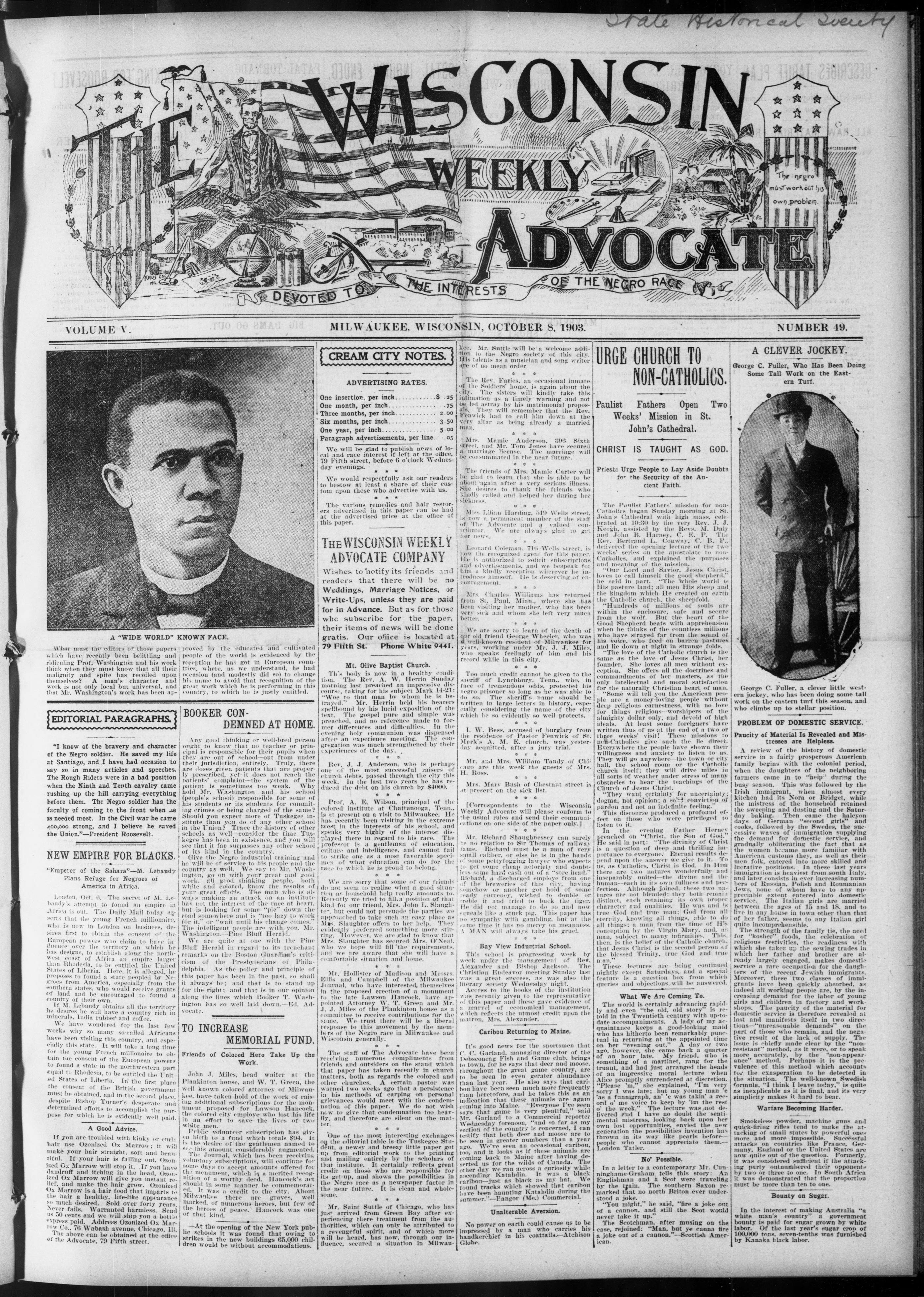
WISCONSIN
WEEKLY
ADVOCATE
DEVOTED TO THE INTERESTS OF THE NEGRO RACE
1
P.
What must the editors of those papers which have recently been belittling and ridiculing Prof. Washington and his work think when they must know that all their malignity and spite has recoiled upon themselves? A man's character and work is not only local but universal, and that Mr. Washington's work has been ap-
proved by the people of the reception he tries, where, a occasion (and his name to a great work wh country, to wh
EDITORIAL PARAGRAPHS.
"I know of the bravery and character of the Negro soldier. He saved my life at Santiago, and I have had occasion to say so in many articles and speeches. The Rough Riders were in a bad position when the Ninth and Tenth cavalry came rushing up the hill carrying everything before them. The Negro soldier has the faculty of coming to the front when he is needed most. In the Civil war he came 400,000 strong, and I believe he saved the Union."—President Roosevelt.
NEW EMPIRE FOR BLACKS
"Emperor of the Sahara"—M. Lebaudy Plans Refuge for Negroes of America in Africa.
London, Oct. 6.—The secret of M. Lebaudy's attempt to found an empire in Africa is out. The Daily Mail today asserts that the young French millionaire, who is now in London on business, desires first to obtain the consent of the European powers who claim to have influence over the territory on which he has designs, to establish along the northwest coast of Africa an empire larger than Rhodesia, to be entitled the United States of Liberia. Here, it is alleged, he proposes to found a state peopleled by Negroes from America, especially from the southern states, who would receive grants of land and be encouraged to found a country of their own.
If M. Lebaudy obtains all the territory he desires he will have a country rich in minerals, India rubber and coffee
We have wondered for the last few weeks why so many so-called Africans have been visiting this country, and especially this state. It will take a long time for the young French millionaire to obtain the consent of the European powers to found a state in the northwestern part equal to Rhodesia, to be entitled the United States of Liberia. In the first place the consent of the British government must be obtained, and in the second place, despite Bishop Turner's desperate and determined efforts to accomplish the purpose for which he is evidently well paid
A Good Advice.
If you are troubled with kinky or curly hair use Ozonized Ox Marrow; it will make your hair straight, soft and beautiful. If your hair is falling out, Ozonized Ox Marrow will stop it. If you have dandruff and itching in the head, Ozonized Ox Marrow will give you instant relief, and make the hair grow. Ozonized Ox Marrow is a hair food that imparts to the hair a healthy, life-like appearance so much desired. Sold over forty years. Never fails. Warranted harmless. Send us 50 cents and we will ship you a bottle express paid. Address Ozonized Ox Marrow Co., 76 Wabash avenue, Chicago, Ill. The above can be obtained at the office of the Advocate, 79 Fifth street.
---
VOLUME V.
proved by the educated and cultivated people of the world is evidenced by the reception he has got in European countries, where, as we understand, he had occasion (and modestly did so) to change his name to avoid that recognition of the great work which he is performing in this country, to which he is justly entitled.
BOOKER CON- DEMNED AT HOME.
Any good thinking or well-bred person ought to know that no teacher or principal is responsible for their pupils when they are out of school—out from under their jurisdiction, entirely. Truly, there are doses given patients that are properly prescribed, yet it does not reach the patients' complaint—the system of the patient is sometimes too weak. Why hold Mr. Washington and his school (people's school) responsible for some of his students or its students for committing crimes or being charged of the same? Should you expect more of Tuskegee institute than you do of any other school in the Union? Trace the history of other schools as well—consider the time Tuskegee has been in existence, and you will see that it far surpasses any other school of its kind in the country.
Give the Negro industrial training and he will be of service to his people and the country as well. We say to Mr. Washington, go on with your great and good work. all good thinking people, both white and colored, know the results of your great efforts. The man who is always making an attack on an institute has not the interest of the race at heart, but is looking for some "pie" down the road somewhere and is "too lazy to work for it," or "wait until his change comes." The intelligent people are with you. Mr. Washington--Pine Bluff Herald.
We are quite at one with the Pine Bluff Herald in regard to its trenchant remarks on the Boston Guardian's criticism of the Presbyterians of Philadelphia. As the policy and principle of this paper has been in the past, so shall it always be; and that is to stand up for the right; and that is in our opinion along the lines which Booker T. Washington has so well laid down.-Ed. Advocate.
TO INCREASE MEMORIAL FUND.
Friends of Colored Hero Take Up the Work.
John J. Miles, head waiter at the Plankinton house, and W. T. Green, the well known colored attorney of Milwaukee, have taken hold of the work of raising additional subscriptions for the monument proposed for Lawson Hancock, the colored city employee who lost his life in an effort to save the lives of two white men.
Public volunteer subscription has given birth to a fund which totals $94. It is the desire of the gentlemen named to see this amount considerably augmented. The Journal, which has been receiving voluntary subscriptions, will continue for some days to accept amounts offered for the monument, which is a merited recognition of a worthy deed. Hancock's act should in some manner be commemorated. It was a credit to the city. About Milwaukee there are graves, well marked, of numerous heroes, but few of the heroes of peace. Hancock was one of that kind.
At the opening of the New York public schools it was found that owing to strikes in the new buildings 65,000 children would be without accommodations.
CREAM CITY NOTES.
ADVERTISING RATES.
One insertion, per inch. $ .25
One month, per inch. .75
Three months, per inch. 2.00
Six months, per inch. 3.50
One year, per inch. 5.00
Paragraph advertisements, per line. .05
We will be glad to publish news of local and race interest if left at the office, 79 Fifth street, before 6 o'clock Wednesday evenings.
We would respectfully ask our readers to bestow at least a share of their custom upon those who advertise with us.
The various remedies and hair restorers advertised in this paper can be had at the advertised price at the office of this paper.
THE WISCONSIN WEEKLY ADVOCATE COMPANY
Wishes to notify its friends and readers that there will be no Weddings, Marriage Notices, or Write-Ups, unless they are paid for in Advance. But as for those who subscribe for the paper, their items of news will be done gratis. Our office is located at 79 Fifth St. Phone White 9441.
Mt. Olive Baptist Church.
Th's body is now in a healthy condition. The Rev. A. W. Herrin Sunday morning last preached an impressive discourse, taking for his subject Mark 14-21: "Woe to that man by whom he is betrayed." Mr. Herrin held his hearers spellbound by his lucid exposition of the text. The gospel pure and simple was preached, and no reference made to former differences and difficulties. In the evening holy communion was dispensed after an experience meeting. The congregation was much strengthened by their experiences of the day.
```markdown
```
Rev. J. J. Anderson, who is perhaps one of the most successful raisers of church debts, passed through the city this week. In the last two years he has reduced the debt on his church by $4000.
* * *
Prof. A. E. Wilson, principal of the colored institute at Chattanooga, Tenn., is at present on a visit to Milwaukee. He has recently been visiting in the extreme west in the interests of his school, and speaks very highly of the interest displayed there in regard to his race. The professor is a gentleman of education, culture and intelligence, and cannot fail to strike one as a most favorable specimen of what education can do for the race to which he is proud to belong.
宗宗宗
We are sorry that some of our friends do not seem to realize what a good situation as household help really amounts to. Recently we tried to fill a position of that kind for our friend, Mrs. John L. Slaughter, but could not persuade the parties we approached to take such an easy place as Mrs. Slaughter offers to her help. They evidently preferred something more stirring. However, we are glad to know that Mrs. Slaughter has secured Mrs. O'Neal, who we hope will fill the requirements, and we are aware that she will have a comfortable situation and home.
* * *
Mr. Hollister of Madison and Messrs. Ellis and Campbell of the Milwaukee Journal, who have interested themselves in the proposed erection of a monument to the late Lawson Hancock, have appointed Attorney W. T. Green and Mr. J. J. Miles of the Plankinton house as a committee to receive contributions for the same. We trust there will be a liberal response to this movement by the members of the Negro race in Milwaukee and Wisconsin generally.
* * *
The staff of The Advocate have been receiving numerous compliments from friends and outsiders on the stand which that paper has taken recently in church matters, both as regards the colored and other churches. A certain pastor was warned two weeks ago that a persistence in his methods of carping on personal grievances would meet with the condemnation of this paper. We do not wish now to give that condemnation too heavily, and therefore are silent on the matter.
* * *
One of the most interesting exchanges on the editorial table is the Tuskegee Student, a newsy and breezy little paper got up from editorial work to the printing and mailing entirely by the scholars of that institute. It certainly reflects great credit on those who are responsible for its get-up, and shows the possibilities in the Negro race as a newspaper factor in the near future. It is clean and wholesome.
```markdown
```
Mr. Saint Suttle of Chicago, who has just arrived from Green Bay after experiencing there treatment from the authorities, which can only be attributed to a revengeful spirit, and of which more will be heard, has now, through our influence, secured a situation in Milwau-
kee. Mr. Suttle will be a welcome addition to the Negro society of this city. His talents as a musician and song writer are of no mean order.
* * *
The Rev. Faries, an occasional inmate of the Soldiers' home, is again about the city. The sisters will kindly take this intimation as a timely warning and not be led astray by his matrimonial proposals. They will remember that the Rev. Fenwick had to call him down at the very altar as being already a married man.
* * *
Mrs. Mamie Anderson, 396 Sixth street, and Mr. Tom Jones have secured a marriage license. The marriage will be consummated in the near future.
* * *
The friends of Mrs. Mamie Carter will be glad to learn that she is able to be about again after a very serious illness. She desires to thank the friends who kindly called and helped her during her sickness.
***
Miss Lilian Harding, 519 Wells street, is now a permanent member of the staff of The Advocate and a valued contributor. We are always glad to get her news.
* * *
Leonard Coleman, 716 Wells street, is now the recognized agent for this paper. He is authorized to solicit subscriptions and advertisements, and we bespeak for him a kindly reception wherever he introduces himself. He is deserving of encouragement.
* * *
Mrs. Charles Williams has returned from St. Paul, Minn., where she has been visiting her mother, who has been very sick and whom she left very much better.
乖乖乖
We are sorry to learn of the death of our old friend George Wheeler, who was a well-known resident of Milwaukee for years, working under Mr. J. J. Miles, who speaks feelingly of him and his record while in this city.
☆ ☆ ☆
Too much credit cannot be given to the sheriff of Lynchbury, Tenn., who, in face of tremendous odds, protected his negro prisoner so long as he was able to do so. The sheriff's name should be written in large letters in history, especially considering the name of the city which he so evidently so well protects.
```markdown
```
I. W. Bess, accused of burglary from the residence of Pastor Fenwick of St. Mark's A. M. E. church, was yesterday acquitted, after a jury trial.
```markdown
```
Mr. and Mrs. William Tandy of Chicago are this week the guests of Mrs.
H. Ross.
* * *
Mrs. Mary Bush of Chestnut street is at present on the sick list.
```markdown
```
[Correspondents to the Wisconsin Weekly Advocate will please conform to the usual rules and send their communications on one side of the paper only.]
Mr. Richard Shaughnessey can surely be no relation to Sir Thomas of railway fame. Richard must be a man of very small caliber, or else he is in the hands of some pettyfogging lawyer who expects to get some cheap notoriety and doubtless some hard cash out of a "sore head." Richard, a discharged employee from one of the breweries of this city, having somehow or another got hold of some ready currency, wished to double or treble it and tried to buck the tiger. He did not manage to do so and now squeals like a stuck pig. This paper has no sympathy with gambling, but at the same time it has no mercy on meanness. A MAN will always take his gruel.
Bay View Industrial School.
This school is progressing week by week under the management of Rev. Alexander and Bishop Jackson. The Christian Endeavor meeting Sunday last was a great success, as was also the literary society Wednesday night. Access to the books of the institution was recently given to the representative of this paper and these gave evidence of a marvel of economical management, which reflects the utmost credit upon the matron, Mrs. Alexander.
Caribou Returning to Maine.
It's good news for the sportsmen that C. C. Garland, managing director of the Debsconeag Fish and Game club, brings to town, for he says that deer and moose, throughout the great game country, are to be seen in even gerater abundance than last year. He also says that caribou have been seen much more frequently than heretofore, and he takes this as an indication that these animals are again coming into Maine. "Everyone I've seen says that game is very plentiful," said Mr. Garland to a Commercial reporter Wednesday forenoon, "and so far as my section of the country is concerned, I can testify that both deer and moose are to be seen in greater numbers than a year ago. We've seen an occasional caribou, too, and it looks as if these animals are coming back to Maine after having deserted us for the wilds of Canada. The other day we ran across a curiosity while ascending Katahdin. It was a black caribou—just as black as my hat. We found tracks which showed that caribou have been haunting Katahdin during the summer."—Pangor (Me.) Commercial.
Unalterable Aversion.
No power on earth could cause us to be impressed by a man who carries his handkerchief in his coattails.—Atchison Globe.
URGE CHURCH TO NON-CATHOLICS.
Priests Urge People to Lay Aside Doubts for the Security of the Ancient Faith.
The Paulist Fathers' mission for non-Catholics began Sunday morning at St. John's Cathedral with high mass, celebrated at 10:30 by the very Rev. J. J. Keegh, assisted by the Revs. M. Daily and John B. Harney, C. E. P. The Rev. Bertrand L. Conway, C. B. P., delivered the opening lecture of the two weeks' series on the apostolate to non-Catholics, and explained the purposes and meaning of the mission.
"Our Lord and Savior, Jesus Christ, loves to call himself the good shepherd," he said in part. "The whole world is His pasture land; all men His sheep and the kingdom which He created on earth the Catholic church, the sheepfold.
"Hundreds of millions of souls are within the enclosure, safe and secure from the wolf. But the heart of the Good Shepherd beats with apprehension when he thinks of the countless millions who have strayed far from the sound of his voice, who feed on barren pastures and lie down at night in strange folds.
"The love of the Catholic church is the same as the love of Jesus Christ, her founder. She loves all men without exception. She offers all the doctrines and commandments of her masters, as the only intellectual and moral satisfaction for the naturally Christian heart of man.
"Some will tell you the American people are a money-loving people without deep religious earnestness, with no love for things religious—worshipers of the almighty dollar only, and devoid of high ideals. At least some foreigners have written thus of us at the end of a two or three weeks' visit! These missions to non-Catholics give such the lie direct. Everywhere the people have shown their willingness and anxiety to listen to us. They will go anywhere—the town or city hall, the school room or the Catholic church itself; they will drive miles in all sorts of weather under stress of many obstacles to hear the teachings of the Church of Jesus Christ.
"They want certainty for uncertainty; dogma, not opinion; a solid conviction of pardon and not an indefinite feeling."
This discourse produced a profound effect on those who were privileged to listen to it.
In the evening Father Herney preached on "Christ, the Son of God." He said in part: "The divinity of Christ is a question of deep and thrilling importance to everyone. Eternal results depend upon the answer we give to it. To us, as Catholics, Christ is God. In Him there are two natures wonderfully and inseparably united—the divine and the human—each in its own fullness and perfection. Although joined, these two natures are not blended; they both remain distinct, each retaining its own proper character and qualities. He was and is true God and true man; God from all eternity, knowing all things, able to do all things; a man from the time of His conception by the Virgin Mary, and, as man, subject to many infirmities. This then, is the belief of the Catholic church, that Jesus Christ is the second person of the blessed Trinity, true God and true man."
These lectures are being continued nightly except Saturdays, and a special feature is a question box from which queries and objections will be answered.
What We Are Coming To.
The world is certainly advancing rapidly and even "the old, old story" is retold in the Twentieth century with up-to-date accompaniments. A lady of my acquaintance keeps a good-looking maid who has hitherto been remarkably punctual in returning at the appointed time on her "evening out." A day or two ago, however, she came back a quarter of an hour late. My friend, who is something of a martinet, rang for the truant, and had just arranged the heads of an impressive moral lecture when Alice promptly surrendered at discretion. "Please 'm," she explained, "I'm very sorry I was late; but my young man 'e' as a funnigraph, an' 'e was takin' a record 'o' me voice to keep by 'im the rest o' the week." The lecture was not delivered and I have no doubt the sentimental mistress, looking back upon her own lost opportunities, envied the new generation the possibilities invention has thrown in its way like pearls before—people who cannot appreciate them.—London Tatler.
No' Possible
In a letter to a contemporary Mr. Cunningham-Graham tells this story: An Englishman and a Scot were traveling by the train. The southern Saxon remarked that no north Briton ever understood a joke.
"You might," he said, "fire a joke out of a cannon, and still the Scot would never take it up."
The Scotchman, after musing on the case, rejoined: "Man, but ye canna fire a joke out of a cannon."—Scottish American.
NUMBER 49.
George C. Fuller, Who Has Been Doing Some Tall Work on the Eastern Turf.
George C. Fuller, a clever little western jockey, who has been doing some tall work on the eastern turf this season, and who climbs up to stellar position.
PROBLEM OF DOMESTIC SERVICE.
Paucity of Material Is Revealed and Mistresses are Helbless.
A review of the history of domestic service in a fairly prosperous American family begins with the colonial period, when the daughters of the neighboring farmers came in to "help" during the busy season. This was followed by the Irish immigrant, when almost every kitchen had its Nora or Bridget, while the mistress of the household retained the sweeping and dusting and the Saturday baking. Then came the halcyon days of German "second girls" and cooks, followed by the Swedes, the successive waves of immigration supplying the demand for domestic service, and gradually obliterating the fact that as the women became more familiar with American customs they, as well as their men folk, entered into more skilled and lucrative positions. In these last years immigration is heaviest from south Italy, and later consists in ever increasing numbers of Russian, Polish and Roumanian Jews, none of whom have to any appreciable extent entered into domestic service. The Italian girls are married between the ages of 15 and 18, and to live in any house in town other than that of her father, seems to any Italian girl quite incomprehensible.
The strength of the family tie, the need for "kosher" foods, the celebration of religious festivities, the readiness with which she takes up the sewing trades in which her father and brother are already largely engaged, makes domestic service a rare occupation for the daughters of the recent Jewish immigrants. Moreover, these two classes of immigrants have been quickly absorbed, as indeed all working people are, by the increasing demand for the labor of young girls and children in factory and workshops. The paucity of the material for domestic service is therefore revealed at last and manifests itself in two directions—"unreasonable demands" on the part of those who remain, and the negative result of the lack of supply. The issue is chiefly made clear by the "non-resistant" method, as it were, or to speak more accurately, by the "non-appearance" method. Perhaps it is the prevalence of this method which accounts for the exasperation to be detected in the situation. The well-known Swedish formula, "I think I leave today," is quite as inexplicable as it is final, and its very simplicity makes it hard to bear.
Warfare Becoming Harder.
Smokeless powder, machine guns and quick-firing rifles tend to make the attacking of small states by powerful ones more and more impossible. Successful attacks on countries like France, Germany, England or the United States are now quite out of the question. Formerly, it was considered sufficient if the attacking party outnumbered their opponents by two or three to one. In South Africa it was demonstrated that the proportion must be more than ten to one.
Bounty on Sugar.
In the interest of making Australia "a white man's country" a government bounty is paid for sugar grown by white labor. Of the last year's sugar crop of 100,000 tons, seven-tenths was furnished by Kanaka black labor.
Chamberlain Proposes to Impose Tax on Food.
Wheat and Beef to Pay Duty, but Not Corn and Pork; Tea and Sugar
to Be Cheaper.
Glasgow, Oct. 7.—Joseph Chamberlain for the first time last night put in words and figures his plan for a preferential tariff system. He proposes:
First—A tax of 2 shillings (48 cents) a quarter on foreign wheat, but none on wheat from British possessions. No tax on corn (maize), but a tax on flour.
Second—A tax of 5 per cent. on foreign meat and dairy produce, but no tax on bacon.
Third—A substantial preference to the colonies on wines and fruits.
Fourth—A tax of 10 per cent. on imports of manufactured goods.
Fifth - reduction of three-quarters of the duty on tea, and half the duty on sugar, with corresponding reductions upon cocoa and coffee.
No Tax on Raw Material
In explaining his tariff plan Mr. Chamberlain said he wished to repeat explicitly that he did not wish to tax raw materials used in British manufactures. It was evident that if they wanted to prevent separation there must be a preferential tax on food. That was the great cry of his opponents, and it was true, but it was only half the truth, because those opponents forgot to add his explanation that nothing he proposed would add one farthing to the cost of living of any working-man or of any family in the country.
With regard to his plan he would state briefly. He proposed to put a low duty, not exceeding 2 shillings (48 cents) a quarter on foreign wheat, but none on wheat from the British possessions. He proposed no tax on corn, partly because it formed the food of some of the poorest among the population and partly because it was raw material as feeding stuff.
Why He Taxes Flour.
He proposed a corresponding tax on flour, and he would give special preference to the miller with the object of reestablishing one of our ancient industries and of preventing a rush from the country to the town, and also of placing corn, offal and feeding stuffs more cheaply within the possession of the farmer.
A small tax of about 5 per cent. on foreign meat and dairy produce would be imposed, excluding bacon, which was the food of so many of the poorest population. Lastly, he proposed to give a substantial preference to the colonies on wines and fruits.
Against these increases he proposed some great remissions. He proposed to take off three-quarters of the duty on tea, half the duty on sugar, with corresponding reductions upon cocoa and coffee.
The net result of these impositions and remissions would be that the town artisan's food would, according to the most elaborate calculations, cost him 2 pence half penny (5 cents) less per week than it did at present, while that of the agricultural laborer would cost him 2 pence (4 cents) less, but if, as he believed, a great part of the tax on food would be paid by the foreigner, there would be a greater reduction in the cost of food, both for the artisan and the agricultural laborer.
Effect on the Budget.
The loss to the exchequer he estimated at £2,800,000 ($14,000,000), but that and more he proposed to find in another branch of the policy of fiscal reform, which was sometimes called retaliation and sometimes reciprocity. He hoped for one thing that the other countries would reduce their duties so that worse things might not come upon them, but he thought that Great Britain would also have to raise hers. A moderate duty of 10 per cent, on manufactured goods, varying according to the amount of labor in them, would give to the exchequer £9,000,000 ($45,000,000) a year, and if he were chancellor of the exchequer he would make use of that sum for the remission of taxation.
The question was, what would the colonies say? He believed they would treat generously any offer Great Britain might make. Mr. Chamberlain concluded:
It is because I sympathize with their object and appreciate the generosity of their offer, it is for these things and for no personal ambition that I have given up the office I was so proud to hold and that now when I might, I think, fairly claim a period of rest, I have taken up new burdens and come before you as a missionary of the empire to urge upon you again, as in old times when I protested against a disruption of the United Kingdom, once again to warn you, to urge you, to implore you to do nothing that will tend towards the disintegration of the empire, not to refuse to sacrifice futile superstition and inept prejudice and thereby to lose the result of centuries of noble effort and patriotic endeavor.
The foregoing is the concluding part of Mr. Chamberlain's speech in opening his campaign against free trade. He addressed an audience of 6000 persons in St. Andrew's hall for nearly an hour before he explained his tariff programme as above.
Will Examine Chamberlain's Plan.
London, Oct. 7.—While there is no evidence of a rush on the part of the exponents of public opinion or of the electorate to give Joseph Chamberlain's fiscal proposal immediate endorsement, there is ample proof of a desire exhaustively to examine his programme and accept or reject it on its merits, on an elementary error, and that while his fiscal arithmetic is illogical, his promises are hypothetical and unproved. It is anticipated that the colonies will resent Mr. Chamberlain's suggestion that their colonial manufacturing growth should be thwarted for the benefit of British manufacturers. On the whole the former colonial secretary's pronouncement is not unfavorably received. On the stock exchange the various departments opened with a better all-round tone. Consols hardened.
Action of the Colonies
It is realized that the attitude of the colonies is probably the most important factor in his scheme, and what they will say to his statement that they are prepared to contribute towards imperial preferential trade, will largely determine the ultimate decision of this country. The critics of the former secretary for the colonies claim that his whole diagnosis of the present state of the trade of the United Kingdom hangs on a statistical blunder in the comparison of the exports of 1902 with those of 1872. The latter year was notoriously phenomenal as an export year, because of the requirements of Germany and France after the war between those two countries and it is pointed out that Great Britain furnished the great bulk of these, and that her exports consequently bound up from $1,115,000 in 1871-to $1,280,000 in 1872. after which they gradually receded to the same totals as in 1871.
WAITED TRIAL EIGHTEEN YEARS.
Alleged Murderer Dies in Jail at the Age of 93. Oakland, Cal., Oct. 7.-George Jones, who had been in the county jail for eightcen years awaiting trial for murder, has just died there, aged 93 years.
YOUNG GIRL IS MARRIED TO TWO.
LOVER TAKES ADVANTAGE STRANGE JEWISH CUSTOM TO THWANT HIS RIVAL.
As Bride Approached Altar He Slipped Coin in Her Hand, Thus Marrying Her.
Baltimore, Md., Oct. 6.—A curious matrimonial complication has been finally settled by Judge Sharp, granting Samuel Oren a divorce from Marie Roypen. Last October the couple were married. As the couple approached the altar Joseph Goldberg, formerly a suitor, slipped a coin into the girl's hand and according to old Jewish custom claimed her as his wife. The incident created a sensation among the crowd in the synagogue, but the rabbi concluded to marry the girl to Oren.
Next day Goldberg and the girl eloped to Boston. Oren tried to secure a warrant for the girl's arrest. Failing in this he went to Philadelphia and consulted a number of orthodox rabbis respecting the case. Meanwhile Goldberg and the Roypen girl returned to Baltimore and went to live with Goldberg's parents. Goldberg contended that the girl's marriage to Oren was null and void and that his was binding, because she was forced to marry Oren by her parents. The case was finally submitted to a council of Jewish rabbis, who decided that the girl had to be divorced from both husbands.
A BIG DECREASE.
Earnings of United States Steel Corporation Drop $4,461,822 During the Last Quarter.
New York. Oct. 6.—The meeting of the board of directors of the United States Steel corporation, at which the dividend question was to be considered, began shortly after 3 p. m. today. J. P. Morgan was present. The directors declared a quarterly dividend of $ \frac{1}{2} $ of 1 per cent. on United States steel common stock.
The regularly quarterly dividend of 1 and $ \frac{3}{4} $ per cent. was declared on the preferred stock.
The statement of earnings shows that the net earnings for the quarter ended September 30, September estimated were $ 32,302,821, a decrease of $ 4,461,822, as compared with the same quarter last year.
After the meeting a member of the board said the reduction in the common dividend was made by a unanimous vote and that the cut in the rate was decided on because of a falling off in business.
HERBERT LAID AT REST
Late British Ambassador at Washington Is Buried in London—Mr. Choate Attends the Funeral.
London, Oct. 6.—The remains of Sir Michael Herbert, the late British ambassador at Washington, were interred this afternoon in the family burial ground at Wilton. Wiltshire. The funeral was largely private. King Edward and the Prince of Wales sent representatives. Ambassador Chonate, Secretary White and Second Secretary Carter of the American embassy represented the United States. Simultaneously there was an impressive memorial service in the Mariborough house chapel, St. James palace.
CHICAGO FIGHTS GRAFT.
Council Undertakes Plan of Espionage of City Hall Employes—Will Employ Three Detectives.
Chicago, Ill., Oct. 6. After hearing an explanation from Mayor Harrison concerning the municipal "graft" charges, the Chicago city council last night voted to establish a system of espionage over the city employees. It also appointed a committee of nine aldermen to conduct an investigation of the city departments. Three confidential agents or detectives will be employed and assigned to different departments, to furnish information which may lead to the detection of any dishonest dealings.
STEAL CASH AND STEAMER
American Officers in the Philippines Rob Government Safe and Escape in a Stolen Boat.
Manila, Oct., 6.—George Forman, chief inspector, and C. J. Johnson, constabulary supply officer, both stationed at Missamis, Minda, whose accounts were under investigation, took $6000 from the safe, seized a steamer and have started for Borneo. Running short of coal, they stopped a native vessel and took from here a new supply. A steamer had been sent to Borneo to interrupt the fugitives.
MILWAUKEE BOYS STUDY MINING.
Three from. This City Enter Michigan School of Mines.
Calumet, Mich., Oct. 6.—[Special.]—The freshman class of the Michigan College of Mines this year comprises seventy-eight students, the largest class in the history of the institution. Four Wisconsin men have entered the college this fall, as follows: Francis O. Williamson, Oliver M. Schaus and Noel S. Anderson, all of Milwaukee, and John O. Bryant of Chippewa Falls.
LIGHTHOUSE KEEPER IS DROWNED.
John D. McMartin of Granite Rock Station Perishes.
Marquette, Mich., Oct. 6.—John D. McMartin, assistant keeper of the Granite Rock light station, eighteen miles off this port, was drowned last Friday, the sail boat in which he had started for Marquette on trip for supplies being wrecked on the rocks during a heavy sea.
Nonsense About Sneezing
"When a man sneezes heartily he may know himself to be healthy. No person in poor health ever sneezes," says the eminent doctor, Sir Jonathan Hutchinson. This statement will be challenged by those familiar with the plague, who know that hearty sneezing is its first symptom. Everyone knows that a series of sneezes comes in the first stages of catching cold, and that the hay fever victim sneezes to his great discomfort.
Patents.
The legal duration of a patent in Germany, is fifteen years from the date of application and additional patents expire at the same time as the main patent. Inventions which appertain to articles of food or medicine cannot be patented in Germany.
Owing to the cool weather of July the death rate in the larger cities is 10 to 16 per cent. less than the average for that month.
COMMON DECLINES A FULL POINT ON THE NEW YORK EXCHANGE.
The Weakest Stock in the List Was Amalgamated Copper, Which Declined Two Points.
New York, Oct. 7. Interest in today's stock market centered largely around the Steel shares, particularly the common. London's higher prices for these issues was doubtless the chief reason for their early strength.
Opening prices for Steel common ranged from $17\frac{1}{2}$ to $17\frac{1}{4}$ for 6000 shares, $ \frac{1}{8} $ above and below yesterday's close. Steel preferred, on sales of 3000 shares, made a maximum advance of $ \frac{1}{8} $ . The balance of the list was generally higher. Early gains in Steel stocks were soon lost, the common declining a full point and the 5 per cent, bonds almost as much.
The weakest stock in the list was Amalgamated Copper, which declined almost 2 points on heavy selling credited to Boston.
MAYBRICK ESTATE
IS SHORT $75,000.
Trustees Unable to Find Large Sum Claimed by the Famous Prisoncr— Her Fortune Is Lost
New York, Oct. 7.—A shortage of $75,000 in the estate to which Mrs. Florence Maybrick, who will be released from an English prison next July, lays claim, was revealed yesterday. The estate belonged to one of Mrs. Maybrick's ancestors. Her representatives brought suit for an accounting by certain trustees of the estate. The shortage was made public when Attorney Samuel B. Hayden of Washington examined William L. Gardner of Brooklyn, one of the trustees, regarding funds due the estate from sales of land in Virginia, West Virginia, Illinois and Kentucky.
Mr. Gardner was asked specifically as to his knowledge of the signing of deeds releasing the Baroness de Roques and her daughter, Mrs. Maybrick, from title to property in America. One item of 40,000 acres of land, it is alleged, was sold for $85,000 and of this sum only $10,000 was admitted as received by the trustees. Mr. Gardner said that he did not take particular cognizance of the value of the property, adding that so far as he knew only $2500 accrued from this sale.
An accounting in the last mentioned sum was made in 1893, but since that time the trustees have made no further accounting. The hearing will be continued October 20.
When asked about the shortage of $75,000 Mr. Hayden would say nothing definite. "We would like to know what became of the money," he said.
SHOOTS TWO DEPUTIES.
Escaped Prisoner Fires on the Men Sent to Arrest Him and Slays
Burns, Ore., Oct. 7.—In an attempt to arrest John Frost, alias Harry Egbert, an escaped prisoner wanted for burglary, John G. Saxton, an attorney of Burns who was acting as special deputy sheriff, and Jack West, a rancher, were killed by Egbert on October 4.
They found Egbert and his wife in a ranch house, 135 miles from Burns. Egbert recognized Saxton and West and fired. West was shot in the back and died later.
Egbert then went in the house, followed by Saxton, the woman in the meantime having fled. The men fired at each other through a thin board partition. Saxton was shot through the shoulder, but kept up the battle.
Egbert, finding the fight too hot fled upstairs. Saxton, in answer to a call for water from West, left the house for a spring. As he turned away from West, he, too, was shot and mortally wounded. Egbert then went to a ranch where at the point of a gun he demanded a horse. He has not been seen since. County officials have offered a reward of $500 for his capture.
WILSON S. BISSELL DIES.
Postmaster General in Mr. Cleveland's Second Cabinet and a Prominent Lawyer of Buffalo.
Buffalo, N. Y., Oct. 7.—Wilson S. Bissell, postmaster-general in President Cleveland's cabinet, died at 10:15 o'clock last night. The end came peacefully. Mr. Bissell suffered from complications thought to be akin to Bright's disease, although not well understood.
Mr. Bissell was one of the foremost members of the bar of this state. He was born in New London, N. Y., in 1847 and removed with his parents to this city in 1852. He attended the public schools of Buffalo until 16 years old, when he entered the Hopkins Grammar school at New Haven, Conn., for a preparatory course for Yale college, from which he graduated in 1869. He returned to Buffalo the same year and immediately began the study of law, being admitted to the bar in 1871. In 1872 he became a member of the firm of Bass & Bissell. In 1874 Grover Cleveland became a member of the firm, which was known as Bass, Cleveland & Bissell, and continued until 1876, when Mr. Bass retired, and the firm became Cleveland & Bissell, remaining so until 1881, when Mr. Cleveland was elected mayor of Buffalo.
As a Democrat he was one of Grover Cleveland's stanchest supporters, and when the latter was elected President of the United States the second time Mr. Bissell was appointed postmaster-general, which office he held for two years, and resigned, resuming his professional practice in this city.
NORTHERN PACIFIC DYNAMITERS ESCAPE
Posse of Detectives, with Bloodhounds, Unable to Find the Trail Owing
Helena. Ment., Oct. 7.—Owing to heavy rainstorms and the conditions of the country the posse of detectives with bloodhounds which went from Helena to endeavor to locate the dynamiters who placed the explosives on the Northern Pacific tracks Monday night, was unable to do anything in the way of apprehending the perpetrators of the outrage. When the posse reached the scene about 3 o'clock Tuesday morning a heavy rain was falling. The tracks of the men were obliterated and the dogs could not take the scent. The project was given up and the posse returned to Helena.
Grand Jury Finishes Work of Cleaning Out the Postoffice Department.
FRAUDSARE RUN DOWN
First Batch of Indictments Found Against Ten Men Returned by Jury.
Washington, D. C., Oct. 6.—With the return of fifteen indictments against ten postal officials and employes by the federal grand jury yesterday the end was reached of the investigation into the extensive postoffice frauds.
Those indicted yesterday were the following:
JAMES N. TYNER of Indiana, former assistant attorney general for the postoffice department, who was summarily dismissed last April for official misconduct, and who is now in a dying condition at his home in this city.
HARRISON J. BARRETT, Tyner's nephew and a former assistant attorney for the postoffice department, who for several years past has appeared as counsel before the department for various alleged fraudulent concerns.
JAMES T. METCALF, former superintendent of the money order division of the postoffice department, who was summarily dismissed some time ago for endeavoring to divert a contract for printing money order blanks.
HARRY C. HALLENBECK, senior member of the firm of Wynkoop, Hallenbeck, Crawford & Co. of New York, the firm which formerly had the contract for printing the blanks used in the money order service, and to which Supt. Metcalf endeavored to divert a contract for printing money order blanks.
NORMAN R. METCALF, son of former Supt. Metcalf, who is alleged to be involved in the printing contract frauds.
WILLIAM D. DOREMUS, inventor and proprietor of the Doremus cancelling machine, who is alleged to have used bibery to introduce his machine in the postal service.
GEORGE E. GREEN, state senator, of Binghamton, N. Y., who is alleged to be involved in the Doremus machine frauds.
GEORGE W. BEAVERS, former superintendent of the salary and allowance division of the postoffice department, who is alleged to have received a commission on the sales of the Doremus machine to the government.
AUGUST W. MACHEN, alleged to have received a commission on the purchase of rural free delivery carrier bags from Charles J. Haller of Philadelphia. W. SCOTT TOWERS, superintendent of the F street branch postoffice, who is charged with having received bribes for securing the purchase of book typewriters by the government. Judge Tyner will never be tried, because he is said to be dying, slowly but surely. His case is especially sensational, because Tyner was himself postmaster-general during the last year of Gen. Grant's administration. The next step is the trials of the indicted. The first to face a jury will be August W. Meachen, former head of the free delivery department, who will be tried here. Daniel Miller, a law clerk, and Attorney Johns, who was indicted with Miller, will be tried in Cincinnati. The result of the postoffice fraud in-
Under Indictment.
BEAVERS, GEORGE W., former superintendent of the division of salaries and allowances; arrested and indicted on a charge of conspiracy to defraud the government.
BARRETT, HARRISON J., a lawyer of Washington, conspiracy with James N. Tyner to defraud.
CRAWFORD, WILLIAM G., of Washington, for presenting false claim to the government.
CUPPER, JOHN T., mayor of Lock Haven, Pa., for bribery.
DOREMUS, W. D., conspiracy to defraud.
DRIGGS, EDMUND H., of Brooklyn, former representative in Congress; indicted for accepting money for urging a contract with the government.
GREEN, GEORGE E., of Binghamton, N. Y.; indicted on a charge of conspiracy to defraud the government.
GROFF, DILLER B., of Washington, business man; arrested and indicted on a charge of conspiracy with A. W. Machen in bribery.
HALLENBECK, HARRY C., of New York, conspiracy with James T. Metcalf to defraud.
JOHN, JOSEPH M., of Indiana, lawyer; arrested on a charge of conspiracy with Daniel A. Miller in bribery.
LORENZ. MARTHA J., of Toledo, O., wife of George E. Lorenz; indicted on a charge of conspiracy with A. W. Machen.
Removed.
HEDGES. CHARLES, superintendent of city delivery, alleged to have falsified per diem accounts.
LORENZ, GEORGE E., former postmaster at Toledo, O.; indicted on a charge of conspiracy with A. W. Machen to defraud the government.
LONG, WILLIAM C., of Washington, for bribery.
MACHEN, AUGUST W., superintendent of the free delivery division; arrested and indicted on the charge of brirtery. MILLER, DANIEL A., assistant attorney for the postoffice department; arrested on a charge of brirtery.
MILLER, GEORGE S., of Brand Automatic Cashier company, indicted for abetting E. H. Driggs.
M'GREGOR, THOMAS W., clerk in the free delivery division; arrested and indicted on a charge of bribery.
METCALF, JAMES T., former superintendent of the money order division, conspiracy to defraud.
METCALF, NORMAN R., son of James T. Metcalf, conspiracy to defraud.
New York mail
RUNKEL, MAURICE, of New York, mail box contractor; indicted for conspiracy. STERN, LEOPOLD J., of Baltimore, for conspiracy to defraud the government. TYNER, JAMES N., former assistant attorney general for the postoffice department, for conspiracy to defraud. UPTON, C. ELLSWORTH clerk in the free delivery division; arrested and indicted on a charge of bribery.
Suspended.
CHRISTIANCY, GEORGE A. C., assistant attorney for the postoffice department.
STRATTON LOSES SUIT.
Son of Millionaire Must Pay $35,000 to Lawyer—Married an Oshkosh Girl
Colorado Springs, Colo., Oct. 6.—The jury in the case of J. S. Donovan against I. Harry Stratton returned a verdict today in favor of Donovan for 10 per cent. of the $350,000 secured by young Stratton on a compromise of his suit to break his father's will. Attorneys Spurgeon and Cassidy of Colorado Springs, who were among Stratton's counsel in his contest suit, have filed suit for $50,000 for services, and various witnesses claiming to have been employed by Donovan have also filed suits aggregating $49,000. Stratton married a young lady of Oshkosh, Wis.
DRANK WOOD ALCOHOL PUNCH.
Three Men Die from Effects of Foolhardy Act.
Philadelphia, Pa., Oct. 6.—Frank and Thomas Helms, brothers, aged 43 and 24 years respectively, and William Gonn, aged 41, died today from the effects of drinking wood alcohol.
The men procured a quantity of wood alcohol from a drug store and with lemon and sugar made a punch of the extract.
Hamilton, Kan., Oct. 7.—The worst tornado in years passed west of Hamilton last night, leaving death and destruction in its wake. Three persons are known to have been killed and ten seriously injured.
The dead:
BAILEY, EDITH, daughter of W. E. W. Bailey.
GILLMAN, MR., father of Mrs. John Bailey.
UNKNOWN MAN.
Seriously injured:
W. E. W. Balley and his two sons and two daughters; one son, Ollie, probably fatally hurt.
H. Heberlin, wife and child.
E. S. Mahias and wife.
Five distinct funnel-shaped clouds formed at about the same time within a radius of eight miles. The two largest of the clouds accompanied by terrific wind traveled over a strip about a quarter of a mile in width and is said to have caused enormous destruction to property and crops. Nine houses are known to have been destroyed. Wires are down and details meager.
Burlington, Kan., Oct. 7.—The town of Aliceville, Kan., containing 200 inhabitants, is reported to have been destroyed by last night's tornado.
Fifteen persons are known to have been injured, three seriously.
BIG DAMS GO OUT.
Tremendous Damage Done to Government Canal and Property at Lake Union.
Seattle, Wash., Oct. 7.—The high water in Lake Union at 6 o'clock this morning burst through the dams retaining walls at the side of the first gates at the head of the government canal. The gates are still standing, but the flood has made a big channel around the lock. The Fremont passenger, team and street car bridges are badly damaged and are expected to be washed away. The Ross bridge has been so badly damaged that it is impassable. The bay (Ballard harbor) is filling rapidly with the dirt carried into it by the swift current. The banks of the canal are caving rapidly and immense damage probably will be done to the government works.
Only one building at Fremont is so far in danger. This belongs to the government and is unoccupied. The flow of water cannot be stopped and Lake Union will undoubtedly be lowered about 10 feet which will put the mills on that body of water out of business. Later news from Fremont indicates that the damage to the work the government has already done will be great it is a fact that the flood of water is doing more to finish and deepen the canal than the government could do in five years. There is no prospect of damage to other than government property beyond the possible shutdown of lake Union mills until new dams can be built as the head of the canal.
People of Ballard and Fremont are jubilant over the good work accomplished by what, under normal circumstances, would be a destroying agent.
IT DOES NOT FLY.
Langley's Machine Plunges Into River and Is Pronounced To Be a Failure.
Widewater, Va., Oct. 7.—An unsuccessful attempt was made today to launch the Langley flying machine. The machine went about 100 yards and is a complete wreck. The machine at no time seemed to travel under its own motive power, but only went with the momentum it received from the launching power. Prof. Manley, who was in the aerodrome, was not injured, but received a ducking. When the machine struck the water it disappeared, but only for a moment. The five empty conical shaped floats performed their function well and the aerodrome was soon floating on the water.
The initial momentum, the lightness of the machine and the sustaining surface of the winds furnished conditions for the transit of the machine from the 60-foot elevation to the water just as a light piece of board skims small distances on the air. Within ten minutes the tugs were pulling away at the debris. Prof. Manley climbed into a rowboat and was conveyed to the deck of the tug Bartholdi, where he put on dry clothes. He gave out the following statement:
It must be understood that the test today was entirely an experiment and the first of its kind ever made. The experiment was unsuccessful. The balancing on which depended the success of the flow was based on the tests of the model and proved to be incorrect, but only an actual trial of the full size machine itself could determine that. My confidence in the future success of the work is unchanged. I have no other information to give. I shall make a formal report to Prof. Langley.
It was noon exactly when all was cleared for action. Prof. Manley, though not a witness of the failure of his aerodrome, received certification in Washington of its mishap shortly after the attempted flight.
Charges of Graft Are Made—Highway Robbery and Burglary Not Included in Accusations.
Denver, Colo., Oct. 7.—Officers and men of the Colorado state militia, a part of whom have been detailed to Cripple Creek, have fallen out and are now charging each other with grafting and irregularities of an almost endless variety. Highway robbery and burglary are not on the list of offenses, but the charges made do not come short of them. Among the charges to be investigated are alleged padded pay rolls, extravagance in purchase of supplies, rake-off from contractors, and "fixed" books, and the like. It is expected that a courtmartial investigation will begin Thursday or Friday.
FEEDERS' STRIKE HANDICAPS BUSINESS
Chicago Houses Delayed in Publishing Annual Catalogues—"Strike Breakers" Offered by Another Union. Chicago, Ill., Oct. 7.—The strike and lockout of press feeders resulting from a refusal of the Chicago Typothetae, the Employers' association, to consider the opposition of Franklin union No. 4 for an "open shop" is beginning to affect certain lines of "rush" work and large business houses are handicaped by inability to get out their catalogues on time. Printing Pressmen's union No. 3 has offered to furnish "strike breakers," hoping thereby to disrupt the Franklin union
Another Armed Crank Invades the White House.
Washington, D. C., Oct. 5.—A desperate hand to hand encounter with an armed insane man who was determined to see President Roosevelt occurred in the vestibule of the white house shortly before noon today.
The man who gave his name as Peter Elliot and his home as Minneapolis, was overpowered by the officers on duty at the white house entrance and carried to a police van which had been summoned. He was placed in the van in the custody of two officers. Seeming to realize then for the first time that he was under arrest, Elliott began the furious struggle with his captors for liberty. He drew a revolver from the right side pocket of his trousers and attempted to shoot Officer James Cissell
Grapples with Police.
The officer grabbed his hand and wrenched the weapon from his grasps. Elliott's struggles were so fierce, now ever, that the two officers in the cramped quarters of the van were unable to overcome him. Officer Cissell then drew his revolver and fired two shots to attract attention. Chief Usher Thomas Stone and Officer Parker of the white house force, who had assisted in carrying Elliott to the van, attracted by the shots, rushed back to the vehicle and assisted in overpowering him.
In the struggle within the police van, Elliott had broken a glass panel with his head, severely cutting his head and face. Officer Cissell sustained a serious cut on his right arm, two inches of flesh being cut out of the fleshy part of the arm. He suffered considerably from loss of blood, but his injury is not serious.
The van was hurried to the Emergency hospital, where the injuries of both Cassell and Elliott were dressed.
Watched the President.
Elliott is undoubtedly violently insane. Several days ago Secretary Loeb received a letter postmarked Washington and written on letter paper of the St. James hotel, this city. The letter enclosed a photograph of Elliott and an incoherent request for an interview with President Roosevelt. The letter was signed "Peter Ell," the statement being made immediately under the signature that the writer was registered at the hotel as Peter Elliott. It was evident to Secretary Loeb that his correspondent was insane, and he issued directions at once that the officers on duty both at the white house and at the executive offices should be on their guard against him. The photograph was turned over to the secret service officers.
Nothing was seen of the man until yesterday, when the President attended morning services at Grace Reformed church. Elliott appeared near the entrance to the church and made an effort to speak to the President, but he was foiled in his endeavor by the secret service officers. At that time the man manifested no symptoms of insanity and quietly left the vicinity of the church when ordered to do so by the officers.
First Call at White House.
About 10 o'clock this morning he appeared at the executive offices. Entering the vestibule he inquired for President Roosevelt. One of the doorkeepers asked him why he wanted to see the President.
"Oh, just for fun," he responded.
"The President sent for me and I just want to see him."
Elliott was told to return next month. He smiled and walked away, not offering the slightest objection to the rebuff which he had received. His appearance attracted very little attention and he gave no indication at that time of insanity.
All of the officers, both at the white house and at the executive offices, however, were warned again to be on the lookout for the man and not to take any chances with him.
Shortly before 12 o'clock Elliott walked up to the main door of the white house, stepped inside and inquired of Officer Cissell if he might see the President.
Chief Usher Stone and Officer Parker were standing just within the vestibule at the time. Mr. Stone told the man that he could not see the President just at the moment, as he was engaged, but that he might possibly arrange to see him after a while.
Man Becomes Violent.
Instantly, the man having been recognized, a hurry call was sent for a police van. Scarcely had the call been sent in when Elliott became violent. The officers and attendants threw themselves upon him and after a brief but strenuous struggle, overpowered him. Officer Cissell made a cursory examination of his pockets, but found only a pair of shears and a large penknife.
The man became quiet but refused to leave the white house until he was forced to go. The officers conveyed him to the police van, which by that time was waiting at the southeast gate of the white house grounds. The struggle in the van occurred almost immediately after Elliott had been placed in the vehicle. He drew his revolver from a pocket which seemed to be an enlarged watch fob. As that is a most unusual place in which to carry a pistol Officer Cissell in his hurried search had overlooked the weapon. The pistol was an ordinary make five-shooter of a cheap pattern.
At the Emergency hospital, where his wounds were dressed, Elliott said that he was a Swede and that his home was in Minneapolis. From the hospital the man was taken to the First precinct police station and incarcerated in one of the detention wards. An official examination as to his mental condition will be held very soon.
Did Not Appear Insane.
At the St. James hotel it was stated that Elliott arrived there last Wednesday evening. He registered as "P. O. Ell. New York." He had no baggage and paid for his room in advance. He conducted himself about the hotel in a quiet, gentlemanly manner and nobody with whom he came in contact imagined that he was insane. Elliott is about 5 feet 6 inches high, 35 years old, with light brown hair and beard and apparently is of foreign birth.
Looking for Peter Elliott.
Minneapolis, Minn., Oct. 5.—The directory gives the names of two Peter Elliott's. "Peter O. Elliott," a machinist, is mentioned, and a "Peter P. Elliott," who is an oiler in a flour mill. An endeavor to locate them was started immediately upon the receipt of the news from Washington stating that an insane man had attempted to reach the President. The name "Peter Ell" does not appear in the directory.
THE OLD DOCK.
A-lyin’ on the dock o’ nights
You hear the water Sgeep an’ lap
Relow the old warped planks, an’ slap
An’ gurgle ‘round the rotted piles.
While deep wet shadows reach for miles
an’ miles
Between the campers’ lights.
A-lyin’ there, you're half asleep
The Jake keeps whisperin’ one song: *
An’ throbbin’ Ike a ‘cello, strong
Er soft, the marsh-things play their notes;
. he anvon hangs iu the water jow, an’
floats
A thousand fathoms deep.
a then behind Pine Point you hear
The steady pad, pid, pad o” wheels,
An’ ont the dark a headlight steals.
iPhe night-boat's gone—she trails a thin,
Sweet echo shoreward o” a violin
That kind o' haunts yer ear.
Ont there in that big reomeo" night
You're like a child that’s all atone
A-lis’nin’ fer some sound 0° home.
it hurts to. wake an’ see again
The gray o° Heartbreak road, that’s made
fer men,
Stretch out before yer sight.
=imery Pottle in Woman's Home Com
panion.
—
it will be frankly for your position St"
Everyone will accuse
for your money. Everyone rae
me of it, and I might as well acknen™
edge it to you, as I have to myself.” ; i
leaned over the rail of the veranda. re
eyes following the wake of the moonligit
pon the water. E
a said thai verore—too many
times,” said the man at her side. But I
can’t believe it. If it were true; you
would never say it. There is something
else, There must be something ele."
“There is nothing else,” she said, “un-
jess it is that 1 am tired. I want to feel
settled and at rest emotionally. I don't
want to think—in that way—any more.
Ir 1 married you, it wouid be wrong to
you, and I wouldn't do it. I should be-
gin all over again new. And then—~
“That's a very different thing,” he re-
plied. “You've played fairly. [ knew
when you first answered me that you
didn’t love me, but I can’t bear to haye
you speak of your motives in that cold-
plooded way. It isn't quite fair to you.”
“{ want to put it as brutally as T can,
she insisted. “I want you to know the
worst that is in me, so that you can never
reproach me.” | aa
“Bertha!” he cried, wincing at the sug-
= SO ves, I know yon think you would
never do that, but I know that one
changes in time, and that perhaps after
a while, when you had got used to my
being near you, and hadn't made me care
in the way that you hope to, then you
might forget what I had said, and think
that you had been cheated. L.want the
bargain well understood. You don’t seem
to believe that I haye no heart left. 1
don’t want you to cherish any false
hopes.” .
She moved her head so that she could
took out over the vague, wide waters of
ihe bay. Her eyes were strained, her
features motionless. The faint lap, lap
ot the little waves on the shore seemed
ty annoy her.
“You said you were sure we could al-
ways be friends, at least,” be broke in,
half pleadingly, half in argument.
“Oh, yes, of course. You'll noi bore
me, I suppose I shall even grow fond
ot you. You have tact and patience and
sympathy.” She spoke listlessly, and
these faint compliments had some of the
quality of contempt. Then she rose, and
said, “Please moye my chair around. I
can’t bear the sight of that water.”
The Honorable Charles: Braxton rear-
ranged her chair, changed his own posi-
tion, and went on with his customary
persistent patience, “I have told you that
I want you more than I ever wanted
anything, Bertha, and the more I see of
you, the stronger that need grows. I
want you so much that [ must have you.
I'm willing to take all the chances, it
you are. I think I can make you love
me. It’s a trite enone thing to say, but
I’m so sure of myself and so much in
earnest that I can’t bear to have you ac-
cuse yourself so and insist upon your lack
of any feeling.”
“It’s not an accusation, it is the state-
ment of a fact. I am making a deliber-
ate compromise, I couldn’t have what I
most wanted, and I’m taking half a loaf.
‘This isn’t flattering to you, but I can’t
help it.+ I can give you only my bare
acceptance. If you want me that much,
I am yours. I know so well what the
real thing is. I had touched it, and felt
it, and known the life and joy of it for
one little while, and then the big house
ot joy tumbled, and I was left out in the
darkness, After that you came. I told
you I din’t care, that I never could; but
you will never believe me. Now I'm
simply tired of resisting you, and I'm at
a halt, ready to be captured without
much fight. There's no hope of rein-
forcements. My romance js quite over.”
“One's first love affair always seems
more romantic, I suppose. You thought
you were in love, but I think one can
never judge at the time. One is never
sure until long afterward.”
Miss Frayne rose suddenly. ‘No. one
doesn’t always know ut the time,” she
said, “but one does know afterward.
Look at that water! Must I tell you
that now, here, the moonlight on those
waves makes me almost ill with an agita-
tion I can’t control? It is heartrending!
Moonlight always is, anyway, to any one
who has imagination. In is’ the typica'
thing for happy memories grown sad, It's
almost theatrical—it’s the subject of a
hundred cheap lithographs—but I can’t
bear it! My nerves tingle with it, for
it means only one thing for me—one
night! We were on the water in a boat
alone, and off somewhere in the darkness
a woman in a summer cottage was sing:
ing ‘Robin Adair.’ The song is a part
of it all, and I can’t bear to hear that,
either! It is one of the tricks our mem
ory plays us when it seleets something
absolutely insignifieant and passes ovet
so many obviously important events. But
the song and the moonlight on the waves
stand out in my past with the vividness
of a flash-light photograph, and they
mean only one thing—him!”
He did not reply to this for some time.
but at last ne cautiously advanced. “But
your engagement was broken. Doesn't
peer pala that your love was not per-
“No,” she said; “I shall never acknowl-
edge that. Every great love must be a
tragedy, it seems to me. It is xo in poe-
try. in the drama, in all art: and so it. is
in life, I think. That is why, it you in-
sist, T shall marry you. T don't. want
to think of it any more. I want to feel
just warm and quict.”
_The Hor. Charies’ Braxton remained
silent.
“They'll say I married yon trom
pique,” she said, as if to draw his fire.
“And that will be true, too?” he asked.
“No; I couldn't feel that way. The
story is closed—forever closed to me. It
ended tonight, when I got my letters
back from him.”
“You | put me in a hard position,” he
said, “I Tove you, and I want you, and
you are willing to accept me, yet you
make me feel as if were taking ady¥an.
tage of you if I marry you.”
Let us have it over now,” said Mis:
Frayne. “I'll go in and get my letters.
and you shall read some of them. You
anust, before we decide, and if after that
you still want me, I'll marry you.”
, “It would be eruel!” he said. “You
have no right to show them. They are
HE IS BARRED FROM LANDING.
e i 8 . Z $
4 Bris:
f FY ry ; , yy,
ye oe
\ it 24 @s Pn
®
DSMIG.
S. Hosange, a wealthy planter fron Demarara, arrived at New York on the
steamship Grenada, with credentials to bading American merchants, but is not
allowed to land until a decision has beea reached on his case by the immigration
authorities at Washington.
really no-longer yours. It is as cruel to
me, too, as well as to him!”
“And as for me?” she questioned.
He said nothing, and she left him and
entered the house, When she returned
her face had lost the tense expression it
had worn befcre.
“[ have made a mistake,” she snid.
“and I can’t show you the letters. It’s
very strange! When this package came
by mail this afternoon, 1 thought of
course it was from him, as [ had been
expecting my letters, and I didn’t even
look at_the writing. 1 couldn't bear to
then. But it isn’t his writing at all! I
wonder what it is? Have you a knife?”
She eet the string and the wrappings.
and disclosed a squarish-looking box in
white tissue-paper. “Why, it’s a music-
box!” she said, smiling. “It must be
some joke.”
She wound the handle, and set the box
upon the railing. It set up a thin, tink-
ling melody, interspersed with the cus-
tomary runs and trills of the metallic
comb, so full of flourish that the tune
could not at first be recognized. Then
it burst into the song “Robin Adair.”
The Hon. Charles Braxton gave a
quick glance at Miss Frayne, as she fell
into her chair and gazed ont across the
‘moonlit water. hen, raising his hat,
he bowed gravely, and left her upon the
veranda, alone with the little instrument
still singing its sprightly tune. Her re-
inforcements had arrived.—Gelett Bur-
gess, in Woman's Home Companion.
HE MADE GREEN LOGS FLOAT.
The Ingenuity of Bill Davis of Maine
Helped by a Little Air.
Some of the best white bireh for the
making of spool bars grows at the head-
waters of Nicatous stream, Maine, but
«wing to the shoal water and the rough
cetntry, operators have found the cost
of getting the wood to the mills so high
‘that the birches are still growing.
_ For two years the owners of the land
have ent a few cords, and by peeling the
bark off when it was green and painting
the ends of the sticks, they haye hoped to
drive the timbers to market by water.
But whenever a stick has remained in
water beyond four weeks it has sunk
and, as it takes fully six weeks to drive
the stream, no results were obtained (uv
give encouragement for future work. —,
Last spring Bill Davis, an aged woods-
man from Linneus, came to the owner of
the tract and proposed to cut and rup
out spool wood.
“Gracious, yes,” replied Jones. “Til
allow you 75 per cent. of all the logs
you'll get out to Penobscot river, but
Ul tell you now that yon ain't going tu
get rich out of the operation, because
1 know that stream, and you'll have to
rut two old dollars for every new one
you receive.”
During the muddy going of April Davis
made many trips to and from the woods,
taking in his large family ef boys and
toting feed supplies and machinery. By
June 1 he had built a dam on a branch
Strerm and put up a small log mill. He
#nd his boys cut along and tapering
bireches by the hundred and thousand,
snd as fast as the trees were feiied they
were pnt in at one end of the mill and
came ont at the other to be dumped in
pe ene and floated away to the saw-
mills.
In August the first end of Dayis’ birch
drive began to show up, and since that
time the spool bars have been furnished
regularly to the waiting ears. This week
Davis went down to Bangor to have #
settlement with Jones, who owns the
land,
“You've done it, Davis.” said Jones.
“It's the first time I ever saw anyoue
who could make a green birch log float,
and IT am glad you're-getting rieh from
the contract. Now, how did you fix
these logs so they ean’t sink?”
“Lil tell you,” replied Davis. “Al I
use is just what you give your customers
when you try to drive a sharp bargain
with them—plain wind. You know the
red heart wood of the birches is not fit
for muking spools, so it doesn't matter
what becomes of that portion. Knowing
this, I bored out a good piece of the red
wood with a big auger I have in my
mill and let the hole fill up with wind.
Then I drove in a plug and kept the
wind in until the logs arrived at the
mill. | It’s easy enough when you know
how.
Boston Men.
Norton—I came near getting into an
awful scrape while my wife was away
this summer. I wrote a letter to a
lady of mine, and by mistake put it into
an_enyelope addressed to my wife.
Hill—My! [ suppose she actually
raved?
Norton—That's the joke of it. She was
so tickled at the sweet things in the
letier that she didn't notice it was writ-
ten to somebody else—Boston Tran-
seript.
A MARKET ROMANCE.
He called upon his sweetheart.
The fairest girl in town:
“Twas noticed in the parlor
That Gas was going down.
The honeyed words and phrases
Would break the silence long,
And then ‘twas plain that Sugar
Was ruling yery strong.
Her father’s beavy footsteps
He heard were coming near;
Activity in Leather
Soon ‘filled his soul with fear.
Outside the lordly mansion
He fell by cruel chance,
And blocks of Rapid ‘Transit
Showed quite « quick advance.
But there can be elopements
When love is true and leat:
So there was consummated
A Western Union deal.
—MeLandburgh Wilson in New York Sun.
JUSTICE A GINSENG EXPERT.
Herd of Brush Eating Goats Demanded
Too Much Attention.
Justice Sewall of the supreme court,
who is presiding in Brooklyn, is the last
man that his neighbors in Walton, Dela-
ware county, would acense of haying a
fad. At the same time it would take a
jury of unsnally sedate men who would
not smile when told that Justice Sewell
‘recently has disposed of his flock of sey-
enty-six Angora goats and has estab-
lished a ginseng farm.
Three or four years ago friends of
Justice Sewell, interested in experimental
work for the federal government, per-
suaded him to try raising Angora goats.
Mr. Sewell investigated the subject, and
then went into it. The goats came from
Texas, where they had been bred by
crossing pure Angoras with Texas goats.
The animals were turned into a brush
lot near Walton village, and did well
from the first. They ate up a the
brush. Justice Sewell teils his friends
that an ae goat standing 2 feet
high can peel the bark off of a shrub 6
feet up the trunk. The goats would not
eat grass while the brush lasted. One
yearling yielded T pounds of the finest
alpaea wool, worth a doilar a pound.
Another goat, one of the finest specimens
in the herd, ¢limbed to an unreasonable
height up a small sapling, got its horns
twisted in a crotch, and died before it
could be rescued. Beeause he could not
give the goat farm the requisite amount
of attention, Judge Sewell sold his flock
to a man in Cortland county.
Then, on the solicitation of a neighbor,
he took up the raising of ginseng. The
neighbor does all the work. The acre
and a half now under cultivation has on
it a round bundred thousand plants go-
ing on 2 and % years old, Six hundred
doWars’ worth of seeds were sold. this
year. At the end of five or six years
the owners expect to have 10,000 roots,
weighing a third of a pound apiece, and
worth more than $2 4 pound. Nearly
ell the product goes to China, where it is
regarded as possessing great medicinal
properties.
A succession of lath sheds have been
built over the ginseng to shade the grow-
ing plants. The shedding is about 7 feet
in height and allows but little light to get
through. All the weodwork is painted
green, in order that the coloring of the
surroundings may be as vear like the
natural woodland environments of tie
ginseng as possible.
One Bov’s Rise to Success.
If you want to learn how one young
man got along in the world, listen:
Alvah C. Dinkey, at 37, is president of
the Carnegie Steel company and holds
the most important position in the steel
trade of this country, next to W. E.
Corey, president of the United States
Steel company.
At 16 years of age Dinkey was a tele-
graph operator for Carnegie. He gave
that up and put on the leather apron of
an apprentice in order to learn to be a
machinist. It was harder work than
telegraphing, and for a year or so it was
less pay, But this young man had iis
eye on the outcome.
He made a special stndy of electricity.
He saw how this power could be applied
‘in rolling mills. He patented laborsav-
‘ing devices and was made assistant en-
gincer, then engineer, superintendent,
president.
An easy climb?
| By no means. It was upward through
‘toil and sweat and grime, and the con-
‘stant pumping of blood into gray matter.
Dinkey did not spend his money for
glad clothes.
Nor for “high balls.” ‘
He spent his time and money building
brains and body and character. And
now, at 37 years of age, he is at the top
and draws a larger salary than the presi-
dent.—Cincinnati Post.
12 DROWN AT GREEN BAY.
Steamer Erie L, Hackley Sinks and
Only Nine Are Rescued.
CAPTAIN GOES DOWN.
Goodrich Liner Reaches Scene at Day-
break and Saves Shipwrecked Peo-
ple in Heavy Sea.
Went down were washed from their im-
Provised life preservers and drowned,
The Dead.
WARRINGER, LAWRENCE, Fish Creek,
RARRINGER, EDNA, Fish Creek, Wis.
VOROUS, JOSEPH, captain of the Hack-
ley, Fish Creek, Wis.
FITZSIMMONS, N., Jacksonport, Wis.
KELKY. CARL, Fish Creek, WI3.
ae CLAIRE, GEORGE, JR., Jacksonport,
NELSON. NELS, Sturgeon Bay, Wis.
RABITOY, HENRY, Bish Creek, Wis.
THORP, FREEMAN, Fish Creek, Wis.
TRUCHLY, ——. cook, of Hackley:
Wi SCENT, MISS FRANCES, Egg Harbor,
SISTER OF ‘CENT, E 8
via —_ OF MISS VINCENT, Egg Har
The Rescued.
Frank Blakefiel ser, Fish Cre: 1
oe Biakenold, purser, Fish Creek, Wis.
Blaine McSweeney, Fish Creek, Wis.
Martin Olsen, Sister Bay.
Olsen, son of Martin, Sister Bay.
Oren Rowen, engineer, Fish Creek, Wis.
~—- Raggendorf, fireman.
Two men of Ellison Bay, Wis.
Worst Storm in Years.
The storm which sent the Hackley to
the bottom was the most violent. which
has been recorded in this vicinity for
years. The steamer was seven miles
from Green island when it broke, and,
warned by the threatening clouds, the
captain was hastening to get his boat
under the shelter of the islalnd.
According to the story of the surviyors,
the first blast of the gale was so fierce
that the upper works of the steamer
were partly demolished. The passengers
who were in the cabin ran on deck, A
frantic search for life preservers began,
but before any could be secured the see-
ond burst of wind rolled the steamer
over until thle water poured into the
hold. Again the wind caught the doomed
craft, this time full on its side, rolling
the boat completely over. It sank in-
stantly. .
Captain Goes Down with Ship.
A number of those lost were carried
under by the suction of the sinking boat,
and, it is believed, did not come to the
surface again. Capt. Vorous remained in
the pilot house trying to head the steam-
er into the wind, and went down with
his ship.
The wind, which continued with al-
most the foree of a hurricane, caused a
heavy sea to spring up immediately. In
the darkness and the pouring rain which
accompanied the wind it was impossi-
ble to see, and the stronger swimmers
were unable to render aid to those-who
were struggling near them, ‘Che wind
drove them farther apart, so that the
eries‘of the drowning were lost.
Hears Hail from Water.
At 7 o’elock in be morning the steam-
er Sheboygan reach@d the vicinity of the
wreck. Suddenly the lookout heard a
hail from the water almost under the
steamer’s bow. He saw a man op a
piece of wreckage, and a lifeboat was
lowered. After a hard: pull in the heavy
sea the crew of the lifeboat suceeeded
in getting him on board. This man was
nearly dead, but he managed to tell
enough of the disaster to start the steam-
er on a long search over the surrounding
water. Eight others were picked up,
and after several hours spent in steam-
ing around it was thought certain that
every one of the passengers and crew of
the Hackley who had remained afloat
had been resened.
In order to procure medical aid for
the shipwrecked persons the Sheboygan
put into Fish Creek, the nearest port,
and there landed the survivors, Tugs
were sent out at dnce to eontinue the
search in the hope that others might
have remained afloat, bunt itis believed
there is not much chance of any more
being found.
Story ef a Survivor.
Purser Blakefield told_the following
story of the wreck: ‘When the gale
struck the boat the passengers and crew
became panie stricken. IT left the cap-
tain in the pilot house and ran aft to let
down the lifeboat. By the time I got aft
the Hackley was filling so rapidly that it
was apparent .it would be impossible to
launch any beat. There came another
fieree blast, and the uppper works went
by the board, Then the steamer began
to sink rapidly.
‘Women Implore and Pray.
“The situation was made particularly
heartrending by the women, who shouted
hysterically, imploring the men to save
them, and accompanied their appeals for
assistance with prayer. I gave orders
for the men to put the women on the
wreckage first. They did so, and be-
haved well, every man remaining on the
sinking beat until the women had been
cared for. Then there was a wild scram-
ble on the part of each man to get such
pieces of planking as he could secure.
“Byery man found something to float
on except the captain, who remained in
the pilot house to the last doing his best
to right the boat, and he finally went
down with it.
“After the Hackley sank for a few
minutes we were in sight of each other,
but soon separated. The last persons
that I saw except those with me on the
raft were the two Vincent girls from
Egg Harbor, who were floating together.
They seemed to have recovered entirely
from their first iene eee ee making
a brave struggle for their lives.
“We ‘were bitten by the cold wind and
benumbed by the colder water, and the
surprise is that we did not all die of ex-
postre. We drifted I know not where
until picked up by the Sheboygan.
The Hackley left Menominee, Mich.,
Satarday afternoon and wes bound for
Fish Creek and Green Bay_city-
The Hackley was a 54ton serew
steamer which was built at Meskegos
Mich., in 1882. She was owned in Fish
Greek by Capt. Vorous and other resi-
dents of that village. The steamer made
a trip gs oan ‘day between Sturgeon
Bay and Washington island, going up
‘One day and pack the next.
Always Something to Learn.
President Eliot was arguing in favor
pt education by “showing how,” before
the kindergartens. He said that he was
learning something every day by being
“shown how.”
He illustrated his point by describing
the training of medical students, and con-
cluded by telling of an. old friend of his
who had suddenly become deaft in one
ear.
“How did it happen?” I asked him.
“Well, I was blowing my aose the
other day, when I felt something snap in
my ear, followed by an aching 2nd dull-
ness,
“When the doctor came he said the
drum was split, and asked how I did it.
**L onty blew my nose,’ I told the doe-
tor.
“Well, had you opened your mouth
when-you blew your nose you would not
now have a damaged eardrum, was the
medico’s reply.”
“You see, my friend had lived seventy
years and had never been shown how to
blow his nose,” continued President Eliot.
The application was appreciated and
greeted with » great burst of laughter.—
Boston Journal.
LATEST MARKET REPORTS.
MILWAUKEE, OCTOBER 7, 1908.
EGG AND DAIRY MARKETS.
MILWAUKEE — Eggs — Market steady;
strictly fresh laid, loss off, cases returned,
1%c; cases included, do, 19%c; at mark,
cases included, 164@17c; cases teturned, 14
@6%c; seconds, 2c; dirties, Ie; checks.
Je. There is a good local demand with
ouly 2 falr supply. Recelpts were 323 cases.
Gutter—Firm; choice grades are in. good
demand; low grades of dairy are slow sale;
creamery, extra, per Ib, 20c; prints, 20%c;
firsts, 17@18c: seconds, 15@16c: dairy’ prints,
ise; fancy dairy, 17¢; lines, 13@16c; packing
Stock, 12@l3e; whey, 10¢. Receipt’ were
TOT Ss. o
Cheese—-Firm. The demand — continues
steady on Brick and easy on Limburger.
Supply lberal; demand good; American
full cream, twins, 11@11%e; Young Amerl-
cas, 12@12%e; Daisies, 12@12%c; Long
Horns, 12@12%4c; low grades, S@10c; Lim:
burger, per Ib,’ new, No. i, seepe: ot
grades, G@7e; fancy new Brick, 8a! 3; low
grades, 6@7c; imported Swiss, 25¢; Block
Swiss, domestic, 11@11%c; fancy loaf, 12@
12%4e; No. 2, 8@l0e; Sapsago, 2e. Recelpts
were 6745 Ibs.
PLYMOUTH—Twenty-seven factories of-
fered 2947 boxes cheese, all but 85 long-
horns selling, as follows: 271 ton gnorss
11%e: 309 do, 11%c; 1062 daisies, 1144c; 586
do, 11%; 102 twins, 10%; 153 do, 10%;
235 Americas, 11%¢; 54 do, 12%4c.
SEYMOUR— Offerings were 1500 boxes
cheese and sales 1000 boxes at Ne and 500
boxes at 11g. 3
CHICAGO—Butter—Easy; ereameries, 1544
G200; dairies, 14@18\4c. " Cheese-—Steady ;
daisies, 1134c;' twins, Ile; Young Americas.
Ise.” Eggs Stendy: at mark, cases “in:
chided, 18@19c. Poultry—Easy; turkeys,
2c: chickens (hens), 1034c; springs, 10%y@
lle.
MILWAUKEE LIVE STOCK MARKET.
HOGS—Receipts, 3 cars; market 13¢ low-
er light, 6.45@6.00; mixed 180 to 250 Ibs,
5.40@5.90; packers, 5.00@5.40; pigs, 80 to 110
ibs, 4.50@5.00,
CATTLE—Recelpts, 2 cars; dull: calves
lower; butchers’ steers, medium to et.
1050 to 1300 Ibs, 3.75@4.50; fair te medium,
950 to 1050 Ibs, '3.25@8.65; heifers, common,
2.252.500; good, 3.00@8.75; cows, fair to
good, 2.5008.00; ‘canners, ” 1.50@5.00: cut
ters,’ 2.00G2.25; bulls, common, 2-25@2-50;
choice, 2.00@3.00; feeders, 800 ‘to 950 ib:
Syas.25: stockers, 500 to. 750 Ibs, 2.25
2.75; veal calves, heavy, 3.00@4.00; choice,
6.00@7.00. “Milkers—Dull; common, 15.00@
25.00; choice, 35.00@50.00.
SHEEP—Receipts, 1 car; steady, 2.50@
3.50; bucks, 2.25@2.50; lamba, 3. 75.
Chicago receipts: Hogs, 18,000; cattle,
27,000; sheep, 32,000.
MILWAUKEB HAY MARKET.
Timothy, seer carlots, choice timothy,
11.00@11.25; No. 1 timothy, 10.25@10.50; No,
2 timothy. 8.00@0.00; clover and clover
mixed, 7. 20.
Prairie hay steady: choice Kansas, 10.60
11.00; No. 1 Kansas, 10.25@10.50; No. 2
Straw steady; rye, 7.50@7.75; oats, 4.75@
6.00; wheat, 4. .50; packing nay, 7.00.
Wisconsin pratrle, 7.00@8.00.
MARKETS BY TELEGRAPH.
MILWAUKEE—Flour—Steady. Wheat —
Firmer; No. 1 northern, on track, beat’ dd No.
2 northern, on track, 81%. Corn—Steady;
No. 8 on track, 48c. Oats—Easy; No, 2
white, on track, 88c; No. 3 white, on track,
86@87c. Barley—Firm for choice, dull for
low grades; No. 2 on track, 64%4c; sample on
track, 47@64c. Rye—Quiet; No. 1 on track,
Sic, ‘ Brovistons—Htesdy; pork, 11.95; lard,
Flour market steady; hard spring wheat
patent, in wood, 4. 4.60; Bard sprit
wheat’ straight, in wood 4 35q445; export
patent, in sacks, 3.76@3.85; first clear, in
sacks, 9.00G3.00; low grades, Im sacks, 3.25
3.85; ‘rye flour, country pure, in sacks, 2!
@.60; clty pure, in wood, 3.10@3.20.
Milistuffs are ae quoted at 15.50 for
bran, 17.50 for standard maida and 19.00
@21.00 for Milwaukee flour middlings tn 10-
tb sacks: red dog, 23.00. Delivered at coun-
iry points, 60c extra.
CHICAGO—Ciose—Wheat—October, 78%e;
December, 77%@77%e: old, T8e; May, -
Corn—-Detobers : i ecember, 3
ay, 44%c. ats-—October, 36c; Degember,
B6rRC: May, aengste. Pork—October, 10.95;
January, 12.15; age 12.30. Lard—October,
7.00; November, 6.70; December, 6.674; Jan:
nary, 6.7214; May, 6.75. Ribs—October, 8.60;
January, G474400.50; May, 6.52%. “Rye”
December, 53c; May, Se. | Flax—Cash
northwest, 1.02%; southwest, 96c; Decem-
ber, 8c; May, 1.02; October, ‘96c. ' Timothy
October, 2.90: December, 3.00; January,
3.00. Clover—-October, 11.00. Barley—Cash,
a2@d8e.
NEW YORK—Close — Wheat — Decem-
ber, S4%4c; May, S2%c. Corn—December,
Dye; May. G0e.
KANSAS CITY—Wheat—December, 660:
aaa aoe 2 hard, 7: e Noe
6T@b9c; November, OG 65c + re]
Wc; No. 2 red, Sle; No. 3, 71 tore
October, BSiie: December, 87 ‘hes May,
874c; cash No, 2 mixed, 40e; No. 2 white,
40i,c} No. 3, 40c. Oats—No. 2 white, 374
B0¢; No, 2 mixed, aie.
ST. LOUIS—Close—Wheat—Higher: No. 2
red cash_ elevator, er December, 84
@84ic; May, sn No, 2 hard, T54@79e.
Corn—Cash_ No. elevator, ose: No-
vember, 41@48¢; May, 41%c._Oats—Strong-
er: No. 2 cash elevator, se@ssiac: Decem.
her, Saie: May, Some: No. 2 white,
aa Lead—Quiet, 4.30. Spelter—Steady,
0.
DULUTH—Close—Wheat—To arrive, No,
1 hard, S0ige: No. 1 northern, 79%c; No. 4
nerthern, 76c; on track, No, 1 northern,
Tye; No. 2 ——* 76c; No. 3 spring,
Tc; October, Tc; mber, 7%c; May,
Trife-, Flax—n store, to. arrive; on track
and. October, 1.08; November, 1.02%; De-
cember, 1.02%; May, 1.05%. Oats—On track
and to arrive, 36%¢. Rye—To arrive and on
track, 52c. Barley—40@57c. Ree
Wheat, LS et ipeneats wheat, 162,747.
MINNEAPOLIS— Wheat — December, 76%
Glog: May, THe; on truck, No. 1 hard,
S0e; No. 1 northerh, 78: No. 2 northera,
Toye: No, 8 northern, TGise.
ST. LOvIs—Cattle—Recelpts, 4000, inclad-
ing ae, Texans; mar! steady; beef
steers, 3.70@5.50; stockers and feeders, 2.45
@A.00; cows and heifers, 2.25@4.00; Texas
stecrs, 2.20@3.85. Hogs—Recelpts, 4500;
market steady: pigs and lights, 6.40@8.00;
a. ane Fee as best
eavy, ». ).. , ee] elpts, 2000;
Rewiet trims shecp, 300GA00; lambs, 4.90
G5.75. $
SKANSAS CITY—Cattle—Receipts, 15,000,
Including 2500 Texans; market strong; beef
bteers, 425005.00; Texans, 1501.28 cown
and helfers, 1.25@4.25; stockers and feeders,
225q3.50. ‘Hogs—Heceipts, 7000; market 64d
We lower; beary, 5. 70; packers, 5.4
eS oe 5. i pigs, ae
heep—Receipts, 5000; market strong; sheep,
Beene lamba, 2 O00.
SOUTH OMAHIA—Cattle—Receipts, 9060;
market steady; beef steers, 3.190, 8S; cows
and heifers, 3.00@4.00; western steers, 3.10
@.20; Texas steers, '2.60@3.60; cows aud
helfers, 2.00@3.10;-stockers and feeders, 2.76
G40. Hogs—Recelpts, 3000; market 5@
Toc lower; heavy, 5.30@5.45; pigs, 5.00@5.50.
Sheep—Recetpts, 20,000; market steady;
sheep, 2.25@3.50; lambs, 4.00@5.00.
—At the opening: of the New York pub-
lic schools it was found that owing to
strikes in the new buildings 65,000 chil-
dren would be without accommodations.
A BIG CONCERN ASSIGNS,
Racine Knitting Company Files
Petition in Bankruptcy.
LIABILITIES $350,000.)
Syron sissies in Con-
cern, Is in Hospital Suffering
with Paralysis.
Racine, Wis., -Oct. 6.—{Special.]—
With liabilities of over $350,000 and as-
sets of about $150,000, the Racine Knit-
ting company of this city and with fac+
tories at Beloit, Stevens Point and Ripon,
has been forced to file a petition in bank-
cuptey. The creditors number over 150,
with claims of from $1000 to $15,000,
and there are many who have claims of
from $100 to $1000.
For weeks it has been known that the
company, was in financial stralts. Mon-
oy, &@ meeting of all heavy creditors was
held at Chicago.
Creditors Name Committee.
The creditors appointed as a committee
to represent all in the conducting of the
business:
G. C. MeDiUll, Stevens Point; Charles Free~
man, Racine; 8S. M. Pedrick, Ripon: W. It.
Tobey, New York, and E. E. Gray, Chicago.
Organized in 1891 with a capital of
$250,000 by Byron B. and Adoniram J-
Blake, the Racine one company did
a large business and Herbert 8S, Blake,
son of Byron Blake, acted as secretary
and manager. Because of the sale of
factory property occupied in Racine, the
company was forced to move and selected
Beloit, where large factory buildings were
erected. ‘Two years ago knitting fac-
tories at Ripon and Stevens Point were
purchased and since that time business
has not been successful,
Byron Blake Helpless.
Byron Blake, who was heavily inter-
ested in the company, was stricken with
paralysis two months ago ahd is still con-
fined at the hospital. A few weeks ago
the court appointed a guardian for him.
The business of the company will be
conducted by the creditors in the interest
of all until claims are paid or the busi-
ness is sold.
FEAR OTHERS WENT
DOWN WITH VESSEL.
Believed at Marinette That the Death
List of Hackley Disaster Is Larger
Than at First Reported.
Marinette, Wis., Oct. 6.—[{Special.]—
It is now believed that there were more
persons lost on the Hackley than has
been reported. When she left here there
was an aged woman aboard who has
not yet been accounted for, nor is her
name mentioned in any of the reports
sent out. It is also thought that there
may have been traveling men, strangers
to the crew, aboard, as they often made
the trip across to Door county.
ees Bay, Wis. Oct. 6—[Spe-
cial. J— lifesaving crew returned last:
night from the scene of the Hackley
disaster. The Bailey’s Harbor lifesavers
were also on the scene. The two crews
put in all day ee re the remains
of the eleven persons who had = dowr
in the ill-fated little steamer, but not a
single body was recovered or a trace of
the lost craft discovered.
Friends and relatives of the lost are
patroling the beach hourly in hopes that
the waters will give up some of its dead
on the shores.
Sanaa apslgenniceienns
CONGREGATIONALISTS
HOLD CONVENTION.
State Gathering Se Wis., Is
Attended by 300 iters—Milwau-
keean Acts as Moderator.
Menomonie, Wis., Oct. 6.—The sixty-
fourth state convention of Congregational
churches of Wisconsin opened its ses-
sions with over 300 ministers and lay
delegates, representing the 273 churches.
The 9; ning session was conducted by
Rev. t H. Keller of Milwaukee as
moderator, and was attended by, about
600. Supt. saree welcomed the visit-
ors. Rey. C. F. Niles of the Unitarian
church spoke on behalf of the churches
of the city in general and Rev. B. L.
Breen for the local Congregational
church, which acts as host.
———__-____—_.
RACINE WILL NOT
ADOPT STATE CHARTER.
cane
Instead of Taking General Act, Belle
City Proposes a Convention to
Discuss Revision.
Racine, Wis., Oct. 6.—[Special.]—The
Belle city will not adopt the general
charter as urged by some citizens. The
special committee appointed to decide on
the question has reported that it is not
advisable to adopt any of the charter be-
cause it would involve a change in the
fiscal year and radical change in the
city’s bookkeeping. Other third-class cit-
ies that adopted a portion of the general
charter are far from satisfied. The com-
mittee favors a convention of third-class
cities to take steps for revision of the
general state charter.
Seegeeertere ieee
FIGHTS WITH AN EAGLE.
——_>—_.
Large Bird Attacks Beechwood Man and
Desperate Battle Lasts for
Ten Minutes.
Marinette, Wis., Oct. 6.—[Special.]—
Andrew P. Larson of Beechwood reports
being attacked by an enormous vicious
brown golden eagle in the woods near
Beechwood. The bird attempted to tear
his face and fought for ten minutes be-
fore it was overpowered by: Larson, who
is a man of large build. The eagle
weighed 18 pounds, and measured 7 feet
4 inches from tip to tip.
MADE ARCHDEACON OF ALASKA.
Former Burlington Rector Will Have
Charge of Yukon District.
Burlington, Wis., Oct. 6.—[Special.]—
Rev. C. H. H. Bloor, a icone renee ae
St. John’s eaeacenay church of this city,
is here on hi way to England. He has
recently been appointed archdeacon of the
re of Alaska and will have charge
of the Yukon district as archdeacon.
aecgceieate aa
NORTH-WESTERN CUTS EXPENSE.
Twenty-five Railway Men at Janesville
Have Pay Decreased.
Janesville, Wis., Oct. AD aay
All employes in the Mee North-
Western railroad shops in this city have
‘had the day’s work cut down from ten
to eight hours, with a decrease in pay
accordingly. ‘The change affects over
twenty-fire men. = - oe
Telephone Black No. 244.
One Year $2.00
Six Months 1.25
Three Months .75
Send money by Express Money Order. P. O.
Money Order or Registered Letter to the
Wisconsin Weekly Advocate.
ADVERTISING RATES.
One inch, single insertion 25c
One inch, per year $9.00
Business locals 5c per line each insertion.
Apply for rates to the Advocate.
TO CONTRIBUTORS:
All communications must be sent with the name and address of the sender as an evidence of good faith, but not necessarily for publication. No manuscript returned if not accepted, unless accompanied by stamps.
The Wisconsin Weekly Advocate company wishes to notify the public that all contracts and business transactions with this company must have the company stamp, otherwise they will be void. Neither will this company be responsible for paid subscriptions unless given to duly-accredited agents, who, on request, will give the company's receipt for same. Subscribers failing to receive their papers regularly will kindly notify the general office. Address all business communications to the general manager, 79 Fifth street.
Entered in the Postoffice at Milwaukee as Second-class matter.
Yanger was defeated by Hanion in the prize ring at San Francisco, recently, but he won a victory when he refused to grumble over the result. Silence is one of the virtues of a "game sport." "Higher education" is not boosted, in the minds of the taxpayers of Wisconsin, by the temporary insanity of the class of 1906 in its forcible welcome to the freshmen who are to form the class of 1907.
---
The Berlin experimental electric railway reports a speed of 117 miles an hour. This is fast enough to lead spectators to look for something unusual should the cars leave the rails and take to the woods.
The game dinner after the competitive hunt of doctors and lawyers of Tomah, Wis., was probably a la carte, judging from the fact that the game bagged by the hunters included a skunk, an owl and fourteen crows.
From the standpoint of the football enthusiasts, it would have been evidence of treason on the part of the faculty of Yale, had Capt. Rafferty failed in the examination that was required to remove certain study conditions.
Prof. Langley's aerodrome will not attempt to fly until there is an utter absence of wind. This is no better than the gas-bag flying machines have done, and the successful navigation of the air is evidently a long way off.
Sir Thomas Lipton again says that he will challenge for another series of races for the America's cup just as soon as he is again sure that he will win it. As the Irish baronet is an optimist, the sure feeling won't be long a-coming.
Fitzsimmons having signed for a fight with Gardner, Corbett will seize his opportunity to goad his pugilistic enemy by predicting that Gardner will win, after the manner of "Fitz's" behavior before the recent Jeffries-Corbett fight.
The Minnesota team's score of 112 to 0 against MacAllester, with nineteen touchdowns, may be clearer proof of the latter team's weakness than of Minnesota's strength. If there were still less strength in MacAllester, Minnesota might have scored a baker's dozen of touchdowns.
---
A race between Lou Dillon and Major Delmar would be a horse race worth seeing; but as the owner of Lou has refused to race his trotter against another, the public must be content with seeing races between queens and kings of the turf and running pace-setters bearing wind shields.
An Australian is said to be preparing for a challenge for the America's cup with a yacht having a twin keel of his own design. It is to be hoped that the report means a fin keel, as yachtsmen are becoming disgusted with twin keels, twin hulls, twin rudders, etc., even in the twin-bowed or twin-sterned (which?) inland lake skimming dishes.
---
The balloon voyage from Paris to Hull, England, was successful because the wind was in the right direction. The navigators say they would have gone farther had the wind not changed. That is the story of all balloon voyagers, who are at the mercy of the winds from the time they leave the earth until they return to it. There will be no successful navigation of the air until somebody invents a machine that can go whither its operator wills, despite the winds.
Sir Thomas Lipton now has only one Shamrock. Some days since he sold Shamrock II. for scrap metal, and now he has sold Shamrock I. to a New York yachtsman, who is credited by one report with the intention of putting her into the scrap iron business between New York and South American ports. This is a joke. If the first Shamrock ever goes into the scrap iron trade she will merely float her own bones to the scrap heap, as she is not strong enough for freighting, and it is doubtful whether any sailors could be found who would risk their lives in her during a voyage to South America even in the best of ballast trims.
The End of Punch and Judy.
The sad news comes from Paris that Punch and Judy are losing their favor with the youngsters who spend the fine days in the various squares and parks. There are still two Guignol theaters left in the Champs Elysees, under the trees of the park, near the President's palace. These rent for $147 a year. Lately one was put up at auction and not a solitary bid was made for it. It will be torn down and its properties sold as rubbish.
PAPERS BY THE PEOPLE
THE INCOMPATIBLE HUSBAND AND WIFE.
There may be happiness between a rich husband and a poor wife, between a rich wife and a poor husband, between an elderly husband and a young wife, between two persons of differing intelligences and diverse cultures, but when there is incompatibility of temperament, relinquish every hope. Despair will be the habitual state of the common existence. Incompatibility does not signify disparity of tastes, of sympa-
times, or aspirations, because diversity is necessary to perfect harmony, and the more dissimilar they are the more a man and a woman love each other. So study the character of him or her whom you wish to make your life companion.
times, or aspirations, because diversity is in perfect harmony, and the more dissimilar they man and a woman love each other. So stupef of him or her whom you wish to make panion.
I know an angel of a woman. She has who love her and who are each jealous of she beurs to others. They are all superior taste, of delicate sentiments, of generous not be deceived in that woman. After a request on her family and friends do not disinterrogate the chambermaid. No one less than our servants. While a chambermaid how to make a psychological analysis of she will know the intimate secrets of her noble, generous natures never maltreat the Shun the person that ill uses a domestic that at the end of your inquest you will know soul of your loved one with whom you are your entire life the hymn of perfect happiness.
In the majority of instances you will complete discord nor perfect harmony, but at which little by little through your good will formed into flawless harmony.
Above all, marry a good woman who loves she finds you handsome, esteems you, and your name. Then you may be almost of small discords of temperament will be rempatient indulgence wherewith your companion shortcomings, every day and every hour, ognize the marks of a love which will end last breath.
I know an angel of a woman. She has many friends who love her and who are each jealous of the affection she bears to others. They are all superior women of fine taste, of delicate sentiments, of generous hearts. I will not be deceived in that woman. After a psychological inquest on her family and friends do not disdain to go lower. Interrogate the chambermaid. No one knows us better than our servants. While a chambermaid may not know how to make a psychological analysis of a young woman, she will know the intimate secrets of her character. Good, noble, generous natures never maltreat their attendants. Shun the person that ill uses a domestic. I assure you that at the end of your inquest you will know precisely the soul of your loved one with whom you are to sing through your entire life the hymn of perfect happiness.
In the majority of instances you will find neither complete discord nor perfect harmony, but a partial accord which little by little through your good will will be transformed into flawless harmony.
Above all, marry a good woman who loves you because she finds you handsome, esteems you, and is proud to bear your name. Then you may be almost certain that the small discords of temperament will be removed; and in the patient indulgence wherewith your companion will suffer your shortcomings, every day and every hour you will recognize the marks of a love which will end only with your last breath.
THE REVOLUTION IN CHEMISTRY.
Nothing is too great, nothing to measuring rod of modern science hand we have astronomy, which nificent distances. On the other new chemistry which deals with little and investigates the inexpristituents that make up ordinary Kelvin gave us a popular ideal atoms when he said that if a sim could be magnified up to the size of the might reasonably expect to find that the atposed it would be somewhere between co-footballs in size.
The new chemistry suggests that matter are one and the same; that what we call a systems of far tinier bodies, the ions, or are simply charges of electricity. Sir Olgests that the typical atom may be similar to, consisting of a definite number of moving in rapid orbits just as the planets sun. The simplest atom, that of hydrogen consist of about 700 electrons in regular under laws closely akin to those which keep course round the sun.
The electrons are assumed to be all e that an oxygen atom would consist of so many, a gold atom of 196 times as many, an chief fascination of this theory lies in its matter to modifications of one original su
Nothing is too great, nothing too small, for the measuring rod of modern science. On the one hand we have astronomy, which revels in magnificent distances. On the other we have the new chemistry which deals with the infinitely little and investigates the inexpressibly tiny constituents that make up ordinary matter. Lord Kelvin gave us a popular idea of the size of atoms when he said that if a single drop of rain could be magnified up to the size of the whole earth we might reasonably expect to find that the atoms which composed it would be somewhere between cricket balls and footballs in size.
The new chemistry suggests that matter and electricity are one and the same; that what we call atoms consist of systems of far tinier bodies, the ions, or electrons, which are simply charges of electricity. Sir Oliver Lodge suggests that the typical atom may be similar to a stellar system, consisting of a definite number of these electrons moving in rapid orbits just as the planets move round the sun. The simplest atom, that of hydrogen, is believed to consist of about 700 electrons in regular orbital motion, under laws closely akin to those which keep the earth in its course round the sun.
The electrons are assumed to be all exactly alike, so that an oxygen atom would consist of sixteen times as many, a gold atom of 196 times as many, and so forth. The chief fascination of this theory lies in its reduction of all matter to modifications of one original substance—proba-
RIVAL OF MRS. ASTOR.
Mrs. Stuyvesant Fish, Newport Leader, Wants to Enter Politics
er, Wants to Enter Politics.
Mrs. Stuyvesant Fish, wife of the President of the Illinois Central Railroad and rival of Mrs. Astor for the leadership of the ultra-fashionable set at Newport, has grown weary of society. She says American social circles are stupid because the women do nothing but dress and talk nonsense. She thinks they ought to get into politics. "Just think," she says, "what influence a woman in high position in Washington could have."
Speaking of Mrs. Roosevelt, she said:
"The wife of the President, it is claimed, dresses on $300 a year; and
A.
she looks it. I would not like to be a President, or a President's wife. I should not like to have to eat with negroes. I do not believe in equality. It would never do. We cannot mix with the negro at all, and negro equality will never come about. There will always be classes in this country. We are coming more and more to have an aristocracy and a common people. I do not believe in being too democratic."
Then she paid her respects to Newport society.
"Newport," she said, "is not declining. True, it is being invaded by vulgar and newly rich people of the parvenu class, who form a rather common circle, but the higher classes are still there in greater numbers than
```markdown
```
---
By Paola Mantegazza.
calous of the affection superior women of fine mercous hearts. I will utter a pspchological inot disdain to go lower. None knows us better. Hermald may not know us of a young woman, her character. Good, treat their attendants. Nestle. I assure you will know precisely the you are to sing through happiness. will find neither combut a partial accord will will be trans-Who loves you because and is proud to bear most certain that the removed; and in the companion will suffer which must be borne day in and of women who spend and are spent in the and child; nay, more, who would unlife itself for their sakes, yet who remiserable and make home unhappy by ing, by bewailing mistakes, and mourn past help. They weep over spilled m their tears makes bitter the bread wh wreck, and they never forget nor all the thorns in the path nor the lions in the pleasure of to-day with the men and the dread of evil to come.
If only the women who nag could stand how infinitesimal the good and harm which their continual dropping wound which is kept open and const heals, and the sorrow which is new wears out both body and brain. It is fort and console, and the love which helpmeet to her husband has no rep takes of yesterday and only sympathy with abundant hope for the morrow.
Memory training, like the reign tongues, seems to be a now; its actuality is another glishman, if not indeed waking turning over in his sleep as of the gigantic terrors of Gig competition, and of the imminent ousted from his position in the tations." Something must be made, some fillip applied; and since ousely unreliable and capricious, in shinder progress, memories ought to be every system of memory training the binary must be based upon the well principle entitled "the association of ideas has no difficulty in remembering or because they happen to be associated in intrinsic facts. Thus you may always know the exact date of the because I was born on the 18th of June gests another; and the great object of is, when one thing does not suggest and induce it to suggest another.
A first-class system of memory training random nor clumsy. It will be worked out so as to gain the greatest smallest possible means. It will be f ties. It will be adaptable, elastic and—it will be founded upon the principle of ideas; it will not be a miraculous transforming a brain of lead into a b success will depend upon the energet which the learner puts it into practice.
ever. Newport, however, is just now paying too much attention to foreign lords. By marrying European noblemen. American girls are laying themselves liable to the ridicule of the whole world.
"The marriage of Miss Goelet to the Duke of Roxburghe is the latest piece of this sort of folly. They paid down $2,000,000 to do it. Of course the Duke is not as bad as some foreigners who have married American girls, for he has some money, about $60,000 a year, but that is not much for people in his station. I think it very foolish."
COFFEE FROM BRAZIL
Producers Are Contemplating a Reduction of Areas of Planting
Recent news from Brazil brings the information that the coffee producers of that republic are contemplating the reduction of the areas to be devoted to coffee planting for the purpose of restricting the coffee output and so securing a large price for a smaller crop, from which there may be a more anxious demand. Whether that course will, if adopted and persisted in, raise the prize of Brazilian coffee in the United States market, which is the market to which the greater part of the coffee of Brazil finds its way, is an experiment the outcome of which can only be ascertained by a trial. The trial may also be accommodated by some losses by diversion of the trade to other countries that it may take years to recover.
We get our Brazilian coffee cheaper than that we take from other countries. For the quantity imported during the fiscal year ended June 30, 1903, reaching pretty well up toward a billion pounds, we appear from the government reports to have paid Brazil at the average rate of 5.8 cents a pound. To Africa, for such coffee as we got direct from that continent, not a large quantity, we paid a little less
-5.7 cents a pound. To other countries we paid various prices, all better than the price paid to Brazil. The average price per pound paid for coffee from Mexico was 8 cents; for that from Central America the average price per pound was 9 cents, while for all the coffee we imported from the Netherlands. including, presumably, our supply of Java coffee, and for the entire quantity we imported from Porto Rico, we paid at the rate of 11 cents a pound. For all the coffee imported from all countries we paid the average per pound of 6.4 cents.—New York Times.
---
bly the same as what we call electricity. If that is so, the old alchemists were right after all, and there is no reason in the nature of things why we should not one day transmute lead into gold by a suitable arrangement of its electrons.
ADVICE TO THE WOMAN WHO NAGS.
There is no manner of woman whom a man can take to wife so trying to the temper, and so wearisome in all ways, as the woman who nags. It is the little foxes who eat up the tender vines; and continual fret and worry often tell more heavily upon nerves and spirit than do great trials. One braces oneself for the heavy cross, but gives way hopelessly and helplessly under the never ceasing strain of the little irritations
must be borne day in and day out. There are who spend and are spent in the service of husband; nay, more, who would unhesitatingly lay down for their sakes, yet who render those dear ones and make home unhappy by continual fault findewailing mistakes, and mourning over misfortunes. They weep over spilled milk until the salt of waters makes bitter the bread which remains from the land they never forget nor allow others to forget us in the path nor the lions in the way, poisoning sure-of-to-day with the memory of past sorrow, fread of evil to come.
By the women who nag could be brought to underwow infinitesimal the good and how great is the which their continual dropping accomplishes. The which is kept open and constantly irritated never and the sorrow which is never suffered to sleep at both body and brain. It is love's duty to com-console, and the love which makes a wife a true to her husband has no reproaches for the mis-yesterday and only sympathy for those of to-day, undant hope for the morrow.
which must be borne day in and day out. There are women who spend and are spent in the service of husband and child; nay, more, who would unhesitatingly lay down life itself for their sakes, yet who render those dear ones miserable and make home unhappy by continual fault finding, by bewailing mistakes, and mourning over misfortunes past help. They weep over spilled milk until the salt of their tears makes bitter the bread which remains from the wreck, and they never forget nor allow others to forget the thorns in the path nor the lions in the way, poisoning the pleasure of to-day with the memory of past sorrow; and the dread of evil to come.
If only the women who nag could be brought to understand how infinitesimal the good and how great is the harm which their continual dropping accomplishes. The wound which is kept open and constantly irritated never heals, and the sorrow which is never suffered to sleep wears out both body and brain. It is love's duty to comfort and console, and the love which makes a wife a true helpmeet to her husband has no reproaches for the mistakes of yesterday and only sympathy for those of to-day, with abundant hope for the morrow.
HOW TO TRAIN THE MEMORY.
Memory training, like the acquisition of foreign tongues, seems to be a topic of interest just now; its actuality is another sign that the Englishman, if not indeed waking up, is at any rate turning over in his sleep as he dreams uneasily of the gigantic terrors of German and American competition, and of the imminent peril of being ousted from his position in the "vanguard of nations." Something must be done, some effort me fillip applied; and since memories are notoriously reliable and capricious, in such a manner as to progress, memories ought to be improved. System of memory training that is not purely arduous must be based upon the well-known and ancient entitled "the association of ideas." A certain perio difficulty in remembering certain extrinsic facts they happen to be associated in his mind with ceramic facts. Thus you may hear a man say: "I now the exact date of the battle of Waterloo bewas born on the 18th of June." One thing sugther; and the great object of the memory trainer one thing does not suggest another, artificially to suggest another. Class system of memory training will neither be nor clumsy. It will be carefully planned and but so as to gain the greatest possible end by the possible means. It will be full of minor ingenious will be adaptable, elastic and comprehensive. But be founded upon the principle of the association it will not be a miraculous discovery capable of making a brain of lead into a brain of gold; and its will depend upon the energetic thoroughness with a learner puts it into practice.
just now LORD BALFOUR WHO RESIGNED
Memory training, like the acquisition of foreign tongues, seems to be a topic of interest just now; its actuality is another sign that the Englishman, if not indeed waking up, is at any rate turning over in his sleep as he dreams uneasily of the gigantic terrors of German and American competition, and of the imminent peril of being ousted from his position in the "vanguard of nations." Something must be done, some effort made, some fillip applied; and since memories are notoriously unreliable and capricious, in such a manner as to hinder progress, memories ought to be improved.
Every system of memory training that is not purely arbitrary must be based upon the well-known and ancient principle entitled "the association of ideas." A certain person has no difficulty in remembering certain extrinsic facts because they happen to be associated in his mind with certain intrinsic facts. Thus you may hear a man say: "I always know the exact date of the battle of Waterloo because I was born on the 18th of June." One thing suggests another; and the great object of the memory trainer is, when one thing does not suggest another, artificially to induce it to suggest another.
A first-class system of memory training will neither be random nor clumsy. It will be carefully planned and worked out so as to gain the greatest possible end by the smallest possible means. It will be full of minor ingenuities. It will be adaptable, elastic and comprehensive. But it will be founded upon the principle of the association of ideas; it will not be a miraculous discovery capable of transforming a brain of lead into a brain of gold; and its success will depend upon the energetic thoroughness with which the learner puts it into practice.
FROM BRITISH CABINET
Lord Balfour of Burleigh, who resigned his seat in the Balfour cabinet as a result of the crisis precipitated by Mr. Chamberlain, had been Secretary for Scotland since 1895. He is not related to Premier Balfour or to the Cecil family, but belongs to the Bruce family of Scotland. He was born in 1849, and was educated at Eton and Oriel College, Oxford. He has held many honorary offices, especially educational, including the chancellorship of St. Andrew's University, was lord in waiting to the queen in 1888-89, and parliamentary secretary to the board of trade, 1889-92. He is allied by marriage to great Scottish houses. He has been a consistent free trader, and opponent of Mr. Chamberlain throughout the late tariff discussions.
Sent a Muzzle with His Gift.
A young woman living in Harlem, who is good looking enough to attract her full share of masculine attention, has a penchant for nibbling at flowers. She has been known to delliberately pick a beautiful rose to pieces for the sake of eating the tender, dewy petals at its heart.
Now, the other day this young woman happened to have a birthday, as young women will—until they reach a certain age. Among her gifts was a single rose—large, perfect, exquisite in coloring and formation. It was tied with a bow of broad satin ribbon matching its color, and the young man's card was attached to one end of the ribbon, while from the other dangled—a tiny dog muzzle. New York Press.
We would hate to marry the daughter of an old fashioned German woman, and have to be grateful for the present of a feather bed.
---
I
By Helen Oidfield.
By T. P. O'Connor.
Pablo Picasso
SLAUGHTER BY REGULARS AND KURDS IN CHRISTIAN VILLAGE.
BALKAN SITUATION.
THE VARIOUS CONFLICTING INTERESTS AND RACES.
Those Who Are Now Engaged in the Bloody Drama of War--Fountain Source of the Trouble Is the "Macedonian Committee."
One of the most involved matters now claiming public attention is the situation in the Balkans. It involves every essential feature of the oncecalled "Eastern question" since the tribe of Othman first crossed the Hellespont, remarks the New York Tribune, which in a recent article throws considerable light upon the subject.
Turkey in Europe, as it remains since the partitioning of 1878, consists of seven provinces: Constantinople and Adrianople, which form much of ancient Thrace; Salonica, Kossovo and Monastir, which largely comprise the region vaguely known as Macedonia, and Schutari and Janina, which form the bulk of Albania, or old Illyria. The inhabitants are varied. There are many Turks, descendants of the tribe of Othman, which invaded Europe and overthrew the Byzantine empire. There are Greeks, descendants of the Greeks of classic days. There are Albanians, of Arnauts, a strange "remnant of forgotten peoples" descended from the Pelasgians, who occupied all that part of Europe before the Dorian migration founded ancient Greece. There are many Jews. There are Wallachs, or Vlachs, descended from the autochthones, mingled with the Greeks, with a language derived from the Latin. There are Roumanians akin to the Wallachs, but of mixed Roman instead of Greek blood. There are Bulgars, a Slavic people forming an inferior branch of the Finnish stock.
SLAUGHTER BY REGULARS AND
There are Serbs, also a Slavic people. There are Gypsies, a few Magyars and some other folk, all differing in race, language and religion.
Five of these especially claim Macedonia—the Turks, because they are the actual sovereigns of the whole empire; the Greeks, because of their relation to it in the time of Alexander; the Albanians, because they were the original proprietors; the Serbs, because some of it was part of their old Servian empire, and the Bulgars, because they have flocked into the country in such numbers. The rivalry has been acute since 1878, when Servia became independent, and Bulgaria largely so. As the Macedonians are one of the most superstitious people in the world, the propaganda was at first carried on by ecclesiastical means. Down to 1870 the Greek Church was the only Christian church in Macedonia, and all Christians there were at least nominally Greeks. Then Bulgaria secured the establishment and recognition of some of her churches and schools. The Roumanians followed with schools and colleges in 1886, and at about the same time the Serbs did the same. By means of churches and schools the rival political campaigns have been vigorously waged, especially on the part of the Bulgars, the Serbs and the Greeks, the Bulgars probably leading the others in numbers and energy.
Forcing the Revolution.
Having gained about all that could thus be gained, however, the Bulgars a few years ago resorted to more militant tactics. They organized a "Macedonian Committee," which for a time at least enjoyed government encouragement. Its object was the political conquest of Macedonia by Bulgaria, thus making Bulgaria the largest power in the Balkan. To secure funds for its work it systematically levied blackmail upon rich Roumanians and others, now and then committing murder to enforce its demands. One of its characteristic deeds was the kidnapping of Miss Stone, the American missionary, and the extortion of a large ransom for her under threats of outrage and death. It established an organized system of brigandage throughout Macedonia, committed dynamite outrages in Salonica and elsewhere, and murdered Greeks, Wallachs and others in fulfillment of its threat to create such a reign of terror and anarchy that the powers would be forced to intervene. A few months ago Austria-Hungary and Russia urged upon Turkey the promulgation of various administrative reforms, intended to allay discontent and avert rebellion. This was futile. The reforms were absurdly inadequate. They were never put into effect. If they had been they would have done no good. If they had done all the good in the world they would not have averted the rebellion for the Bulgars were resolved to organize a revolution at any cost, and to be satisfied with nothing but the conquest of Macedonia by Bulgaria.
---
The Macedonian Committee, composed of Bulgarian political agitators last spring announced that a general insurrection would be provoked during this year. To that end its members led by the notorious Sarafoff and others, resorted to train-wrecking, arson and murder, perpetrated sometime against Greeks, Wallachs and other Christians. The Turks retallated. So did the Arnauts, who are hot partisans of the Turks. Then Turkish troops were sent in to quell the troubles, and so the present state of affairs was developed. Although the revolt was thus artificially organized by the Bulgars for the sake of political conquest, and was at first disapproved and resisted by the Greeks and Wallachs, it is now coming to appeal pretty strongly to all the people. The Bulgars persist in it for political conquest. The Greeks, Wallachs and others accept it in the hope of intervention or something that will free them from Turkish misrule, and at the same time save them from Bulgarian oppression, which would be to them almost as bad as Turkish, and many of the Turks, even regard the revolution with relief and satisfaction as the only way out of an intolerable situation.
SAYS COLUMBUS DIDN'T.
Discoveries in Greenland Threaten the Fame of Christopher.
the Fame of Christopher. Reports concerning important discovery made in Greenland by the Danish exploring expedition under Captain Braun were brought to this city by Captain Friesble, of the British bark Alkaline, says the Philadelphia Record. The scientists following the intrepid Braun into the far frozen north have found abundant material to support their claim that the Norsemen discovered America long before Christopher Columbus set sail for the new land. These discoveries include all sorts of weapons, tools and utensils, of undoubted Norse manufacture, the
KURDS IN CHRISTIAN VILLAGE.
age of which can be authenticated. These implements of civilization and bits of wreckage found nearby suggest that one or more of the early exploring parties were wrecked off the coast of Grenland, and seem to prove that others effected a landing and really established at least a retreat, if not a permanent habitat, in that country.
Captain Friesbie describes the arms and utensils found by Captain Braun, who is a distinguished officer of the Danish army and an explorer of world-wide repute. Some of these are crude cooking vessels, table cutlery, axes, wedges and unmistakable parts of ancient craft, such as were used by Scandinavians in the period of their early explorations. Captain Braun is preparing a thoroughly scientific report of his discoveries in Greenland, and Captain Friesbie is of the opinion that these findings will lead to the rewriting of certain chapters in the geographies and histories of the world. These discoveries, he says, include the homes of the men who really discovered America.
"THE LITTLE FATHER OF
THE RUSSIAN FLEET."
One of the most interesting objects that figured in the recent bicentenary celebration of the founding of St. Petersburg was the boat, shown in the accompanying illustration, presented to Czar Ivan the Terrible by Queen Elizabeth. When Peter the Great was a boy in Moscow he used to play with this boat and had it repaired so that
HISTORIC BOAT.
he could sail in it on a small lake. This aroused in him an interest in naval matters that lasted throughout his life, culminating in the founding of the Russian navy, Peter's first war ships being virtual replicas of this boat. It was Peter who christened her "The Little Father of the Russian Fleet," a name by which she has been known ever since.
Severe Hall Storm.
A severe hall storm, the like of which has never been witnessed before by the oldest residents, visited Brunswick, Me., a few days ago. Hall stones measuring from one-half to three-quarters of an inch broke windows.
If angels fear to tread where fools rush in they should use their wings.
---
of different professions soliciting money in Wisconsin for purposes unknown to any person in that state and for use elsewhere. Driven out of other states they are overrunning this. We think it an imperative duty on us as being the only negro paper in the state, to protect its generous philanthropists. From now on, we shall warn the mayor and chief of police of every city in Wisconsin against such adventurers.
The Oliver Typewriter..
The Standard Visible Writer
GOLD MEDALS AND FIRST AWARDS.
Philadelphia, 1899. Earls Court, London, 1899. Omaha, 1899. Paris 1900
Venice, 1901. Lille (France), 1901
Buffalo, 1901.
It is displacing old style machines everywhere, and holds first place in the estimation of the majority of leading representative business and professional men. Write for Catalogue.
484-436 Broadway, Corner Mason Street MILWAUKEE BARGAIN HUNTERS
Clothing to fit without being measured for. Prices less than you ever bought them for. Our specialty is misfit and uncalled-for custom tailor made clothing. Tailors' prices for full dress or Tuxedo suits from $30 to $50; our price from $15 to $18. English walking or good business suits made to measure by best of tailors from $18.00 to $35.00. Our price $8.00 to $18.00. Every suit bears our guarantee label. All garments bought of us are kept repaired and pressed free of charge for one year. To be convinced see our window display.
MILLER BROS.
Open evenings till 9 p. m.; Sundays
William T. Green
Lawyer,
Notary Public
Rooms 216-217-218 Empire Bldg.,
14 Grand Avenue.
Office Telephone—Black, 8075
Residence " White 8553
MILWAUKEE.
While in city visit . . .
STEPHENS'
HOTEL and RESTAURANT
First-Class Accommodations Home Cooking a Specialty...
No. 2832 State St., CHICAGO, ILL.
Northwestern House
APPLETON, WIS.
JOHN A. BRILL, - Proprietor.
Terms $1.00 Per Day.
Accommodations the best in the State. When in Appleton stop at the
NORTHWESTERN
S. F. PEACOCK & SON
Funeral Directors
AND
EMBALMERS
431 Broadway. MILWAUKEE, WIS
THE BATTLE-FIELDS.
OLD SOLDIERS TALK OVER ARMY EXPERIENCES.
The Blue and the Gray Review Incidents of the Late War, and in a Graphic and Interesting Manner Tell of Camp, March and Battle.
"In 1864," said A. D. Newbold, "I was one of five printers detailed to look after the printing for General Meade. Our tent was pitched at City Point near General Grant's headquarters. What we called the desertion orders were printed on slips of paper about three by six inches. We had six forms in type, four for the Gordon press, and two for the cottage press, and we could furnish 8,000 proclamations at an hour's notice.
I cannot remember the figures at this late day, but rebel deserters were to receive a stipulated amount for a revolver, so much for a rifle, and so much for a horse, and were to be furnished transportation to any point in the north to which they desired to go, or they could enlist in the United States army and be sent to the frontier, where there would be no chance of their coming in contact with the Confederate troops. We would generally receive an order to print these proclamations when a strong wind was blowing toward the rebel lines.
"When the proclamations were printed and arranged in bundles, they were taken as close to the Confederate lines as possible, loosened up by heating the bundles on a stump or a stone, and were thrown in the air, to be wafted over to the Johnnies, and they brought many returns. Our printing mess was made up of as good fighters as there were in the command. We were detailed for that work simply because we were printers, as others were detailed for bridge work, because they were good mechanics. They are talking a good deal, now about the individuality of American soldiers, but in no other army was it better illustrated than in the army of the Potomac."
"The individuality of the American soldier," said the major, "asserted itself in the matter of coffee at Spotsylvania, and the coffee, I believe, saved our line of battle. Our regiment was in the Fifth corps, and we marched from the extreme right to the extreme left, of the line of battle. It rained all night, and the Virginia red clay was tougher and stickier than ever I saw it before, making the march irritating and fatiguing to an unusual degree.
"When we reached our position we were ordered to make coffee, and we proceeded to do it. Out came our tin cups and frying pans, made of the halves of old canteens, and in five minutes little fires had been built and coffee was boiling and bacon sizzling. Just as the coffee began to smell good, the Johnnies appeared in force in our front and opened a furious fire. Our boys didn't wait for orders. The coffee was at stake, and catching up their guns, they went for the rebels as one man.
"In sixty seconds there was beautiful fighting all along the line. Every man in our regiment was mad as a wet hornet about his coffee, and the ferocity and suddenness of our onslaught compelled the rebels to make a quick retreat. In the lull that followed we drank our coffee and ate our bacon and hard tack with keener relish because of the brush with the rebels. This fight, remember, was not on the program, and was not conducted on any previously arranged plan. It was a side fight for coffee, and was as spiteful as indignant and angry men could make it.
"There were two brothers in my company who were fair illustrations of careless, good humor, united with coolness and courage. One had been with us from the time the company was organized, and the other, much younger, came to us just before the battle of Chancellorsville. When the rebel batteries opened upon our lines, forming to advance, and the whiz, swish and bursting of shells were giving veterans great uneasiness. Jake, the younger brother, turned to Henry and said quietly, 'There must be a blacksmith shop over there.'
"Asked why he thought so, Jake replied, 'Them things they are throwing at us make a noise like anvils.' To this Henry answered, 'Wait until you get down in the woods, and you will see the balance of the outfit, tongs, hammers, trace chains, and horse shoes.' When we came within close range and the rebs opened on us with grape and canister; Jake called to Henry, 'They are throwing the balance of the shop, sure enough, and it sounds like hall on the corn blades in roasting-car season.'"—Chicago Inter-Ocean.
They Obeyed "Old Jack."
The power which was in the personal presence of "Stonewall" Jackson and his influence over those with whom he associated is well illustrated by an incident which happened early in 1861. The convention which was to decide the attitude of Virginia in the coming conflict was in session in Richmond. As is well known, both the Union and the Secession parties were strong in the State, and the delegates to the convention were correspondingly divided in sentiment.
The students and professors of the Virginia Military Institute, situated in Lexington, Virginia, were almost unanimously in favor of secession. At Washington College, now Washington and Lee University, in the same town, the Union sentiment prevailed.
One Sunday morning it was learned that the national flag which had floated over Washington College had been pulled down in the night, and was lying in the mud. The students suspected that the students of the Virginia Military Institute were responsible for the outrage, but having no proof, contented themselves with cleaning the flag and replacing it.
It was not long before a group of students from the Virginia Military Institute stopped on their way by, and in the light of open day undertook to haul the flag down. This time the Washington boys were on the alert, and falling upon the depredators, handled them somewhat roughly, and beat them from the grounds.
The report that a number of Washington men had beaten one cadet without provocation threw the institute into an uproar, and the whole corps immediately turned out to avenge their comrade. Arming themselves with whatever they could lay their hands on, they formed in battle array and proceeded toward Washington College. Their adversaries, although not so well drilled, armed themselves in like manner and awaited the attack.
Jackson, then a major, was in church, but an excited whisper from a frightened citizen who had hurried in apprised him of what had happened. He calmly rose and passed out, to find his whole corps coming up the street in much disorder, but with battle in their faces. One glance at the scene, and his decision was made.
As quietly as he had left the church he placed himself at the head of the corps and began to give commands, looking to the better order of the column. The boys were roused to the highest pitch of enthusiasm by the leadership of "Old Jack," and were quite ready to kill every Washington boy who opposed them. Promptly came the necessary commands for their forward movement, and the citizens stood aghast.
Little by little the cadets fell into perfect order, and little by little their obedience to command became automatic. Tramp! tramp! on they went to battle for the Southern Confederacy, and to avenge the comrade who had suffered in its cause.
The consternation of the citizens increased. The corps would soon be in sight of Washington College, and blood would certainly be shed. But suddenly, "Halt!" rang out in Major Jackson's curtest tones. "Right wheel! March!" came in quick succession, and the corps was marching in another direction. At the next street corner the commands were repeated and instantly obeyed, and the faces of the cadets were toward the institute, to which they marched in perfect order.
They said afterward that they had been so intent on obeying Old Jack's commands that they did not realize what was happening until he dispersed them at the institute.
Story About Gen. Young.
Nearly thirty years ago Gen. S. B. M. Young, then a captain and brevet colonel of cavalry, was commanding officer at Fort Union, about twenty-five miles east of Las Vegas, N. M. At that time, according to the El Paso Times, a great part of the business of the country consisted of government contracts and the supplying of the forts and numerous forage agencies scattered throughout the country, and contractors made easy money at the business. Las Vegas was the home of a number of men who thus accumulated fortunes, and these men found it profitable to "stand in" with army officers, so the latter were entertained and made much of by the former whenever they came to town on business or otherwise.
One day some soldiers happened in Las Vegas, either on leave of absence from Fort Union or en route to or from that point, and proceeded, according to the usual custom on such occasions, to "take in the town." One of the party got well "tanked up," and the result was that he landed in jail. A hotelkeeper, who was also a government forage agent and a man who had made many thousands of dollars out of government contracts, probably thinking that he might strengthen himself with the officers of the fort, notified Col. Young that one of his men was in jail, and that he had better hurry to town and get him out. So the next day, while the soldier was sitting in court undergoing trial, Col. Young arrived with about a dozen troopers, and, being informed where he would find the soldier, marched his troops around in front of the court house, dismounted them and proceeded himself, with drawn saber in hand, into the court-room. There sat Murphy, and the justice of the peace was proceeding with the trial. Then this scene was enacted:
Col. Young—"Private Murphy, attention!"
Murphy jumped up and faced the officer in the attitude of "attention."
Col. Young—"Right face! Forward, marche!"
Murphy obeyed with military promptness and marched down the aisle and out of the courthouse door. Col. Young following and halting him at the street. Then, turning to his command, he gave the order:
"Battallion, prepare to mount!—Murphy's horse had been brought along for him—Mount! Right face! Forward, March!" and the whole company proceeded to the hotel. The troops then returned to Fort Union, carrying Murphy with them.
Nowadays.
Dorothy—Don't you feel in awe of literary women?
Dora—No, indeed; my literary cousin says it takes more sense to dress well than it does to write a book.
TEMPERANCE TOPICS
HOMES ARE RUINED BY STRONG DRINK.
Thousands of Lives, Characters and Fortunes Are Annually Wrecked Along the Gilded Pathway, Having Its Beginning in the Wine Room.
That drink is responsible for a large proportion of this domestic infelicity is the testimony of those who have had much to do with court business. A letter from Cincinnati says only yesterday eight divorces granted in Judge Smith's divorce court and every one of them was caused by strong drink. Beer and whisky were responsible for these marital wrecks. Kate Chaplin testified that her husband was bookkeeper in a brewery, but drank so heavily he was constantly getting in a muddle and losing his job. He left her, three years ago, and never came back. Bessie Russel said that her husband spent most of his time in saloons. He was constantly beating her. While she worked, he remained in bed. Louise Andrews said that her husband got uproariously drunk and cruelly beat her. Araminta Barker said she owned a piece of land, when her husband got possession of it and then drank up all the proceeds. Jessie Miller's husband was a hard drinker and a gambler, failing to support her. Minnie Schmurr said that her husband always came home drunk, and made her sleep on the floor. Laura Lykins said her husband preferred the saloon to her company and was drunk most of the time. Lydia Allen said her husband spent every cent that he could get for liquor and lived in the saloons. So we see that the saloon is at the bottom of the world's matrimonial unhappiness and ruin. Shut up the saloons and strengthen the family tie.
Beer and Kuthuslasm.
In a published interview, one of the delegates from Germany, who had been studying methods on this continent, expressed his opinion about United States colleges in the following terms:
"I like your American universities very much. They are very well put together. But there is one thing that they miss, and that is beer. The students here can't have the enthusiasm we have in our German schools by drinking water. It is beer that inspires them."
The idea of beer as a method of raising enthusiasm is something new. Scientific evidence that cannot be gainsayed, shows that mental development is most effectively secured on a different beverage from that which the German agriculturist wanted so badly. Commenting upon his curious statement, the New York Sun says:
"As to the comparative enthusiasm of German and American students: Have the German visitors heard a good, healthy college 'yell?' Take all the enthusiasm and voice of all the Goths, Vandals, Huns, Wends, Burgundians, Franks, Lombards, Visigoths, Alemanni, Ubli, Suevi, Cimbril, Tenchtheri, Teutons, and American Redskins that ever howled the war cry, and that volume of sound could not compare with the enthusiastic tempest of an American college 'yell,' and yet the best college 'yells' are water-born."
Some Startling Figures.
According to statistics published in the London Alliance News, France is the greatest tippling country on the continent, there now being one drinking place for every thirty inhabitants, or 1,300,000 in the republic, a gain of 220,000 since 1880. In Belgium, where gin is the popular intoxicant, the consumption of alcohol has increased 125 per cent since 1890, and there is one public house to every thirty-six inhabitants. In Holland there is one tavern to every 300 people. In Norway there is only one licensed house to every 7,812 inhabitants. In England there is a "gin palace" to every 145 inhabitants.
A Striking Contrast.
The Raymond Chronicle says: "In the month of September, 1901, two towns were started through the investments of American capitalists in Southwest Alberta, one being Raymond, the other Frank, now two of the best towns in the Northwest. The latter, named after H. L. Frank, of Butte, Mont., is a swift town of the wide-open kind; Raymond is the other extreme of absolute prohibition, and on these widely different diets both are thriving, but with this difference—in Frank three policemen spend all their time trying to preserve order; in Raymond one policeman comes occasionally, but unnecessarily."
Chief Eoc of the Holy Spirit.
Cardinal Manning says: "For thirty-five years I have been priest and bishop of London, and I now approach my eightleth year, and have learned some lessons, and the first is this: The chief bar to the working of the Holy Spirit of God in the souls of men and women is intoxicating liquor. I know of no antagonist to that good Spirit more subtle, more stealthy, more ubiquitous, than intoxicating drink."
VISITORS TO CHICAGO
Could Not Better Themselves Than by Visiting
WALDORF CAFE
R. S. WINSTON & H. L. PRIDE, Proprietors.
Private Dining Rooms Upstairs Open All Night
PHONE 2934 CALUMET
3027 STATE STREET CHICAGO.
Visitors to the Cream City Should "Look in" at the
"LOOK OUT" INN Buffet and Restaurant 231 WELLS STREET Conducted by KINNER BROS.
Pool Room. Moderate Prices.
"When the Ghost Walks."
"When the ghost walks,' as synonymous with 'salary day' is a familiar term, but I never yet saw in print an explanation of its origin," said a veteran actor.
"Like most of the 'technical' expressions of the stage land, this phrase comes from England. In the days of Macready, a provincial company was playing 'Hamlet' at Lavenham, in Suffolk.
Salaries were constantly in arrears, and the suspicion began to grow among the members of the company that the manager intended to defraud them.
"On the last night of the engagement the performance went along smoothly enough up to that passage of the tragedy in which the ghost disappears, and Hamlet says: 'Perchance 'twill walk again.' Then from behind the scenes came the ghost's voice in a tone distinctly audible to everyone: 'No, this ghost will walk no more until his salary is paid.'"—New York Mail and Express.
Straws That Are Made
People who call for a straw in a saloon or at a soda fount, receive something that they take to be a straw, but is not. Many of them are manufactured from manilla paper and finished with a hard paraffine wax. They are put on the market in bundles of 500. One advantage over a farmyard straw is that they cannot be dried and passed on to a later customer, as one using puts them out of service.—New York Letter.
When You Want a
FIRST CLASS SHINE
Call on
BOB WISE
Proprietor of
The Ladies' and Gents'
Shining Parlor
197 THIRD ST., Near Wells
MILWAUKEE, WIS.
Dixon's Place
Ladies' and Gents' Shining Parlor. Cigars, Tobacco, all Negro Newspapers. 2638 State St., Chicago. Phone, 2351 Brown. We keep for Sale: Wisconsin Advocate, Freeman, Conservator, New York Age, Atlanta Age, Northwestern Vine, Colored American, Cleveland Gazette, Dallas Express, Richmond Planet, True Reformer, Broad-Ax, Monitor, Detroit Informer, Christian Recorder, Voice of Missions, and all other Negro papers of the country.
ELK EXPRESS CO.
G. J. CHARLESTON, Mgr.
63 E. Sixth Street,
ST. PAUL, MINN.
WONDERFUL
DISCOVERY
Curly Hair Made Straight By
ON THE LINE
This wonderful hair pomade is the only safe preparation in the world that makes kinky hair straight as shown above. It nourishes the scalp, prevents the hair from falling out and makes it grow. Sold over 40 years and used by thousands. Warranted harmless. Testimonials free on request. Over 100,000 miles ever sold for straightening kinky hair. Beware of imitations. Get the Original Ozonized Ox Marrow, as the genuine never fails to keep the hair pliable and beautiful. A toilet necessity for ladies and gentlemen. If you have a bad hair day, if this underer pomade is that by its use you can straighten your own hair at home. Owing to its superior and lasting quality it is the most economical. It is not possible for anybody to produce a preparation equal to it. Full directions with every bottle included. Or send us $1.40 Postal or Express Money Order for 8 bottles, express paid. Write your name and address plainly to OZONIZED OX MARROW CO., 76 Wabash Ave., Chicago, Ill.
WANTED-NURSE GIRL FOR FAMILY of two. Children attend kindergarten during the forenoon. Apply office of Advocate, 79 Fifth street.
Excellent Cuisine
ream City Should " at the UT" INN Restaurant S STREET NER BROS. moderate Prices.
CHICAGO,MILWAUKEE& ST. PAULRY
WISCONSIN CENTRAL RAILWAY.
TICKET OFFICE, 400 EAST WATER ST. Tel. 624.
TO AND FROM LEAVE ARRIVE
St. Paul, Minneapolis, Iron Towns, Ashland, Superior, Duluth, Pacific Coast
Marshfield, Chippewa Falls, Keu Claire
Fond du Lac, Oshkosh, Nee-ah, Menasha
*5:00 am *7:15 am
*6:45 pm *8:00 pm
*5:00 am *7:15 am
*12:01 pm *3:20 pm
*8:45 pm *8:00 pm
*5:00 am *7:15 am
*7:35 am *10:15 am
*12:01 pm *8:20 pm
*4:35 pm *6:15 pm
*8:45 pm *8:00 a
*Daily.
Before Starting on Your Travels
CALL ON
DR, W. L. RANKIN RESIGNS.
Withdraws as President of Carroll College at Waukesha.
Rev. Wilber O. Carrier Will Receive $2500 Salary—Voorhees Makes Gift of $5000 to Institution.
Waukesha, Wis., Oct. 7.—[Special.]—After thirty-seven years of uninterrupted service as president of Carroll college, Dr. Walter L. Rankin resigned at a special meeting of the board of directors, held here yesterday afternoon. Dr. Rankin gave as his reason that he thought that the growing interests of the college needed the supervision of a younger man than he. His resignation was accepted by a unanimous vote of the directors and Rev. Wilber O. Carrier. D. D., pastor of the Gelden Avenue Presbyterian church of Chicago, was elected as his successor.
Dr. Rankin was made vice president of the college and professor of Latin at a salary of $2400 a year. This is the same salary that has been given to him for years. Rev. Carrier's salary will be $2500. At the meeting announcement
D.
was made of a new gift of $5000 from Ralph Voorhees, the New Jersey benefactor of Carroll, who has previously given the college $95,000 and was instrumental in raising $50,000 more. Jacob Mortenson, a member of the board of directors, guaranteed the salary of the new president for one year.
A. J. Frame and Judge E. O. Hand were appointed to draft resolutions of thanks to Mr. Voorhees for his latest gift. The officers at the meeting were:
President, Rev. A. A. Klechle of Milwaukee; vice president, Clark Hartwell, Waukesha; secretary, Henry Phelps, Waukesha; treasurer, A. J. Frame, Waukesha; directors, Jacob Mortenson, George N. Colville, Joseph E. Wildish, Milwaukee; E. O. Hand, Rev. A. S. Badger, H. M. Youmans and J. K. Lowry.
It was decided to ask the Presbyterian synod to recognize Carroll college as the official school of the Presbyterian church. Although Carroll is generally considered a distinctive Presbyterian institution, it has never been given the official recognition of the Presbyterian synod and this will now be striven for. Rev. Carrier, the new president, is known as a hard working minister. He is a comparatively young man and is energetic and well fitted for his position. He formerly resided in Wisconsin.
Dr. Walter L. Rankin has had charge of Carroll college since 1857 and has graduated hundreds of pupils who are now prominent in many parts of the country. He is widely known and loved by all who ever were students at the old and new stone buildings on College hill. Dr. Rankin displayed deep emotion yesterday as he spoke the words which severed his official connection. He said that his step had been carefully taken and was not the result of short contemplation. For many months, he said, he had felt that the increasing interests of the college demanded the hand of a young and energetic man. The building up of Carroll has been his life work and he has labored long and earnestly to put the institution on the firm basis upon which it now stands. He has worked often against the severest adversities and has visited men and women in many parts of the country in the interests of the school.
He is deeply loved by the students, to whom the news of his resignation came as a severe blow, but was somewhat softened by the fact that he will still be among them as a counsellor and instructor. He will still be active in the internal management of the school. Rev. Carrier is a personal friend of Dr. Rankin, who was instrumental in securing his election as president of Carroll.
BOY KILLS HIS BROTHER.
BOY KILLS HIS BROTHER.
Red River 11-Year-Old Lad Shot in Heart by Accidental Discharge of Gun.
Kewaunce, Wis., Oct. 7.—[Special.]—While hunting squirrels, the 11-year-old son of Alphonse Haslet of the town of Red River, was killed by the accidental discharge, of a gun in the hands of his 14-year-old brother. The charge from the gun entered the boy's heart and death was instantaneous.
WAS INDIAN BOY ADOPTED?
Interesting Legal Question Arises as to Oneida Ritual.
Appleton, Wis., Oct. 7.—[Special.]— In the settlement of the estate of the late Peter Smith, an interesting legal point came up. It seems that Smith adopted an Indian boy, Edgar Skenadore, according to the Oneida Indian ritual, and the question at issue is as to whether the boy is entitled to inherit a portion of the Peter Smith estate. He is a direct descendant of Chief Skenadore, which would make him in line for the chieftainship of the Oneidas under the old regime. The case was continued for one month.
SAUK COUNTY SCHOOLBOOK WAR.
Heath & Co. and American Company Fight for Privileges.
Baraboo, Wis., Oct. 7.—[Special:]—A lively schoolbook war is being carried on between the American Book company and D. C. Heath & Co. Several carloads of Heath's books were shipped into this county and distributed, but before they were paid for the American company's agents were on the ground and argued that the changes had not been legally made and that no vote of the people had been taken.
BRANDT CONVICTED:
GETS LIFE SENTENCE.
Dodgeville, Wis., Oct. 7.—[Special.]—The jury in the Brandt murder case brought in a verdict of sane after two hours' deliberation. The second case of murder lasted only fifteen minutes, when the verdict of the jury was murder in the first degree. He was sentenced to life imprisonment at Waupun. A motion has been made for a new trial. Brandt killed his wife and her mother. A suit for divorce was pending against him.
LAW IS CONSTRUED AGAINST DRUMMERS
La Crosse Judge Decides Commercial Travelers Are Not Entitled to Preference Under Bankruptcy Act.
La Crosse, Wis., Oct. 7.—[Special.]— As a result of a decision of the bankruptcy court for this district, the commercial travelers at their next national convention will take up the question of asking Congress to see to it that they are better protected when working for a firm that goes to the wall. The local referee in bankruptcy, G. C. Prentiss, has decided that commercial travelers are not either "workmen, clerks or servants" so as to be entitled to pay in full for three months preceding the petition in bankruptcy not to exceed $100 a month, but must take their percentage of the wreck, as the rest of the outside creditors.
The case arose under the proceedings in the Mons Anderson bankruptcy matter, the traveling men all putting in claims for priority. The judge decided against the priority, and so, in this case, the drummers will get only about 50 per cent. of their claims.
ATTORNEYS CLAIM
MORTGAGE IS VOID.
E. W. Ratcliff's Lien Against Racine Knitting Company for $100,000 Is Said to Be Invalid.
Racine, Wis., Oct. 7.—[Special.]—The mortgage filed here yesterday afternoon for $100,000, given to E. W. Ratcliff by the Racine Knitting company, is claimed to be of no account by the attorneys for the creditors. It is claimed that the mortgage was given in November, 1900, when it was desired to raise $100,000, but only $30,000 was raised, and of this amount but $2500 still remains unpaid. The plant at Ripon has been closed and will not be conducted by the receivers. There was some difficulty with the employees at the Beloit factory when they learned that the company was bankrupt. The creditors ordered that the receivers pay the employees all money due them and to conduct the factory as usual.
TOY PISTOL GROUND OF DEFENSE
Prosecution for Attempt to Kill Fails When the Weapon Is
Marinette, Wis., Oct. 7.—[Special.]—There was a rather dramatic and amusing finish this afternoon in the trial of Andrew Nyholm on the charge of attempted murder. The defendant's attorney admitted that he had a revolver, but produced as the weapon in question a toy pistol alleged to belong to Nyholm's little son. The state had no evidence to prove the contrary and the defendant was acquitted.
FIRE INSURANCE MEN SEE OSHKOSH SIGHTS
Business Meeting Postponed and Delegates Devote Time to Getting Acquainted and Seeing Town.
Oshkosh, Wis. Oct. 7.—[Special.]— The Wisconsin Association of Local Fire Insurance Agents, in session in this city, postponed its business meeting to a late hour this afternoon, the morning hours and earlier part of the afternoon being devoted to social intercourse and seeing the sights of the city by trolley.
TWO GIRLS ARE ACCUSED.
Young Women from Minnesota Are Arrested at La Crosse on a Charge of Robbery.
La Crosse, Wis., Oct. 7.—[Special.]—Martha Dunn and Mary Rihs, two young ladies from Winona, were arrested and taken back there last evening charged with robbery. They were employed in the home of a Winona banker and after they came to La Crosse it is said that there were many things missing from the house.
VOGE IS FOUND GUILTY.
Racine Man Convicted of Assault with Intent to Do Great Bodily Harm New Trial Asked. Racine, Wis., Oct. 7.—[Special.]—A jury in the case of the state against Frederick Voge rendered a verdict last night, finding him guilty of assault and battery with intent to do great bodily harm and not with attempt to murder as was charged. Voge's attorneys made a motion for a new trial and arguments will be heard tomorrow morning.
CHINAMAN FOUND DEAD.
Gambled with Borrowed Money and Suicide Is Suspected.
Fond du Lac, Wis., Oct. 7.—[Special.]
—Hoh Jin Wan, a young Chinaman who ran a laundry on West Second street this summer, was found dead in his bunk last evening between 6 and 7 o'clock, and the conditions surrounding his death are mysterious. Appearances at first pointed to suicide, but the fact that the chief of police and district attorney have been out of the city has delayed the investigation.
Last Tuesday night he came home, according to a brother celestial, about 1 o'clock and went to bed. At daybreak his bunkmate, Sue Sing, spoke to him, but he did not answer, so Sue Sing dressed himself and boarded a car and went to Oshkosh and after giving a report to a Chinaman there, went to Neenah and returned with several others in the evening. Instead of going direct to the laundry the party stopped at the Treleven store on the corner and informed the clerk that Hoh Jin was still in his bed and probably dead. Dr. T. F. Mayham was summoned and after an examination pronounced him dead. His remains were removed to the Reader undertaking parlors and the body was prepared for burial.
The concensus of opinion is that Jin Wan killed himself by taking poison.
DIE IN A DEADLY BLAST.
PASSESOVER THE STATE
Waupaca, Wis., Oct. 5.—[Special.]
—Five persons were killed near Sheridan in the tornado which struck this vinicity Saturday evening.
The dead:
MYHOLTZ, M. R.
WOOD, MARK.
FISHER, MRS.
CIPPERLY, MRS.
GIRL, unknown.
One Killed at Trempealeau.
Trempealeau, Wis., Oct. 5.—[Special.]—The cyclone struck Trempealeau county near Arcadia and lalid waste many farmhouses and barns, killing Thomas Galroth, whose farm buildings were entirely demolished, and injuring two section men.
La Crosse on the Edge.
La Crosse, Wis., Oct. 5.—[Special.]— Reports from the cyclonic storm which passed over this section late Saturday afternoon, indicate that the loss is much larger than originally estimated. The worst part seems to have crossed into Wisconsin some miles above here and La Crosse was on the south edge. At Trempealeau it was comparatively light, although small buildings were damaged in many instances. At Galesville many of the people who had been in bad storms before, predicted a cyclone when they saw the clouds coming and some went into their cellars. Several buildings were damaged slightly.
At La Crosse several buildings were unroofed, including the Tenth district school. Fortunately no children were in it. At Onalaska fences and smaller buildings were badly twisted. At West Salelm and Bangor not much damage was done. Above Trempealeau and along the Burlington to Fountain City and above the storm was terrific. Telegraph poles were lifted out of their positions and hurled many feet away. Wires were all down in a few minutes. A special construction train was run from this city to repair the lines. In Eagle Valley the Reformed church was destroyed as also the houses and buildings of John Flicht, V. Henny and others. The entire prairie is devoid of inhabitable buildings. At Independence the loss of one life is reported and the wind created havoc.
Amherst, Wis., Oct. 5.—[Special.]—Portage county was visited on Saturday by the worst storm known in its history. At Bancroft four men were killed outright and several others were injured. All the houses in the town were razed. The southeastern part of Buena Vista was struck, and the Lutheran church was demolished. The minister was slightly injured. August Boelter and Mrs. Boelter were badly injured, as were three of their children. One of the little ones will die. Three children of Ernest Holz were injured, one fatally.
At Blaine, in addition to one person reported dead, Samuel Ericson was found in the ruins of his home, barely alive. He will die. Robert Mank was found with his back broken. From indications the storm seemed to jump and touch the ground only in places. Where it touched not a tree remains standing. It was twenty to thirty rods wide and cut a swath in this county about twenty-five miles long.
Shawano in Wake
Shawano, Wis., Oct. 5.—[Special.]—At the home of John Presuck, a farmer residing several miles from town, terrible havoc was wrought by the storm Saturday. Presuck and his wife were both killed and the farm buildings were destroyed. Considerable livestock was killed in the collapse of the barn. A riverside general store was destroyed. Several persons were injured, two seriously.
Path of Desolation
Plainfield, Wis., Oct. 5.—An aged woman was killed outright and several persons seriously injured in the cyclone Saturday. One man had a leg broken and ribs also broken, being struck by a large timber from a barn that was hurled through the air. Another man was picked up and hurled through the air about fifty rods, while attempting to jump through a window. Huge trees were uprooted and a path of desolation followed the wake of the tornado.
Trouble at Oshkosh.
Oshkosh, Wis., Oct. 5.—[Special.]— The greatest trouble here was due to falling electric light wires. Two men were struck and badly burned, but both will probably recover.
Woman Fatally Injured
Stevens Point, Wis., Oct. 5.—[Special.]
The tornado which swept through Portage county Saturday afternoon resulted in the death of Mark Wood, aged 51 years, and the probably fatal injury of Mrs. John Fisher, aged 70 years
Michigan Town Wiped Out
Negaunee, Mich., Oct. 5.—[Special.]—A storm raged with unabated fury for nearly eight hours Saturday. The rain came down in torrents, accompanied by heavy thunder and fierce lightning. Many places were struck in this city and much damage done. Trees were uplifted and several buildings were moved from their foundations.
Meager information received here states that the village of Ewen, sixty miles west of here, was nearly wiped out. It is a village of nearly 2000 inhabitants. Reports state that three persons were killed and several injured. The damage will exceed $200,000.
Tornado in Minnesota
St. Paul, Minn., Oct. 5.—Several Minnesota towns were swept by the tornado Saturday. Nine persons are known to have perished, fifty persons were seriously injured, many of them fatally, and the property loss is heavy. Telegraphic and telephonic communication is so disorganized that reports from parts of the storm-swept district are meager.
St. Charles, in Winona county, a town of 1500 persons, twenty-five miles west of Winona, was almost completely wiped out. Seven persons were killed and twenty-eight were injured.
The dead:
EBENS, JOHN, SR.
EBENS, WILLIAM, his son.
ADAMS, WILL.
CRITTENDEN, OSCAR.
JESSON, GEORGE.
MURPHY, EDWARD.
PETERS, EDWARD, of Dover, Minn.
Among the injured were:
Carrie Ebens, arm broken and otherwise hurt.
Charles Crippens.
Blankenberg.
The names of the injured are, so far, unobtainable, as wire communication with the stricken village is altogether cut off.
The entire main street of the town was
literally wiped out, hardly a business place being left standing. Forty-two residences were destroyed, and the total property damage is estimated at $100,000. At St. Cloud two boys, sons of Stephen Matter, were killed while seeking refuge from the storm. They had taken shelter beneath a string of cars on the railway siding and a switching crew backed another string of cars upon them, killing them instantly.
Three Killed in Illinois.
Princeton, Ill., Oct. 5.—A severe storm passed two miles southeast of this city Saturday evening, killing three persons and destroying a large amount of farm property. The dead:
SHERWIN, MRS. CHARLES F.
SHERWIN, MRS. ALVIRA, mother-in-law of Mrs. Charles F. Sherwin.
WELSH, MISS EMMA, of Tiskilwa, vls-
WELSH, MISS EMMA, of Tiskilwa, visitor at the Sherwin house.
Charles F. Sherwin suffered serious internal injuries, but will recover.
The storm started two miles southeast of Princeton. At that place it destroyed a new residence erected by J. F. Cater this year. The hurricane next struck the residence of Mr. Sherwin, where the three women in the house at the time were killed and Mr. Sherwin, who was about to enter the house, was seriously injured.
At the residence of Mr. Cater the family escaped by going to the cellar. The Sherwin house was entirely blown away, and the women, who had not gone to the cellar, were blown into the yard. All of them died within two hours after the storm passed.
Storm Reaches Canada.
Fort William, Ontario, Oct. 5.—The storm here Saturday was the severest in years. There was a terrible gale at night and much property was damaged. One of the largest steel bridges of the Canadian Pacific's coal handling plant was blown from its track and wrecked, together with a large portion of the plant. The damage will amount to at least $30,000. Elevator "D" also was damaged and the smokestack on the Canadian Pacific roundhouse was blown down.
LIEUT. NEWTON TO WED IN HONOLULU.
Wisconsin Hero of Philippine War Will Wed Mrs. S. Beesley Travis on October 20.
Superior, Wis., Oct. 5.—[Special.]—The wedding of Lieut. Harry W. Newton to Mrs. S. Beesley Travis of Honolulu is announced to take place October 20.
Lieut. Newton is now a lieutenant in the United States artillery. At the opening of the Spanish-American war he was captain of the Superior company and went to the front with it. Returning here he was city deputy city controller for a few months. He received a second lieutenancy of infantry and joined the army. Later he was ordered to Luzon and it was while acting as chief of police of Manila that he was picked up by Gen. Funston as one of the American officers to aid the general in the capture of Aguinaldo. For the past year Lieut. Newton has been stationed at Honolulu.
STOPS CHURCH SINGER
Racine Pastor Interrupts Migs Susie Roberts in Midst of Ave Maria Song Not Appropriate.
Racine, Wis., Oct. 5.—[Special.]—Although the church was well crowded with people last evening to hear Miss Susie Roberts, the soprano soloist of the First Presbyterian church, who leaves this week to join the Cochems quartette, there was a sensation caused by Rev. George Murray Colville, who arose in his pulpit as Miss Roberts was singing Ave Maria and raising his hands said: "I beg your pardon, but I cannot allow that song to be sung in this church." Miss Roberts had sung about one-third of the song when she was stopped by the minister; and she at once picked up her wraps and left the church.
The other members of the choir and congregation were very much surprised at the action which they could not at first understand. It has been learned that some weeks ago Miss Roberts sang the same song and was informed by the minister that although he thought the music very beautiful, he did not believe that the words were appropriate to be sung in a protestant church. Miss Roberts has been, for several years, the leading soloist of Racine and the action of the minister last night has caused much grief of her friends.
RALPH C. VERNON DIES.
Former Madison Real Estate Man Passes Away at Kansas City After Cutting His Throat.
Madison. Wis., Oct. 5.—[Special.]—Ralph C. Vernon died in Kansas City as the result of self-inflicted injuries. While visiting at his brother's house in the latter city, Mr. Vernon cut his throat with a razor and died at 5 o'clock Saturday afternoon. Mr. Vernon was formerly a leading real estate dealer and auctioneer in Madison, and one of the leaders of the Dane county campaign against the governor last year. He was in an asylum last winter, having lost full possession of his mental faculties, as the result, his physicians said, of overactivity in politics. He was a substantial citizen of Madison and popular in social and business circles. His wife and family reside in Wingra Park, a suburb of Madison.
GAIN IN REGISTRATION.
University Registrar Reports Addition of 950 New Students, Which Is 250 More Than Last Year.
Madison, Wis., Oct. 5.—Registrar Hiestand gave out the following registration statistics: The total registration up to Friday night was 2054, as against 1804 at a similar time last year. This shows an even gain of 250 students in the whole university with the exception of the department of music, which was not figured in the grand total, the gain in per cent. being 13. There are 920 new students in the university.
CUSHING STORE BROKEN OPEN
Robbers Dynamite Safe, but Are Frightened Away Without Booty.
Grantsburg, Wis., Oct. 5.—An attempt was made to rob the store of Hammond & Peterson at Cushing. The burglars drilled a hole in the safe and used dynamite. The safe was badly shattered, but the lock remained intact. The explosion aroused the proprietor, and the robbers fled.
FLINTVILLE MAN IS KILLED
Fred Frickenbach Loses His Life in Wreck on Milwaukee Road.
Green Bay, Wis., Oct. 5.—[Special.]—Fred Frickenbach of Flintville was killed in a wreck of the Millwaukee road train on the Escanaba and Lake Superior line yesterday.
MUCH DAMAGE IS DONE.
Storm Causes Thousands of Dollars Loss in Manitowoc.
BREAKWATER WRECKED.
Manitowoc, Wis., Oct. 7.—[Special.] Thousands of dollars damage has resulted from the storm which has raged here since early last evening, being one of the most severe of the season. The high seas of Lake Michigan completely wrecked the 600-foot breakwater which has been under the course of construction on the lake shore north of the city for six weeks past and pile driver, the property of Franklin Brothers of Chicago, contractors, was carried away and lost in the lake.
At the Little Manitowoc, at the northern limits of the city, the Two River roadway is completely submerged and the tracks of the Manitowoc & Northern Traction company interurban line are threatened, the water having approached within nine feet of the roadbed. The heavy rain has rendered the embankment on which the track is held soft and traffic over the line has been abandoned. The work on the seawall to protect the road cannot be carried on owing to the high seas and indications are that the road will be completely destroyed before long. In this event the traction company will be compelled to change the entire route of this line, entailing expenses of several thousands of dollars. The loss is already estimated at from $1200 to $2500, and much damage is still being wrought.
Cloudburst at Tony.
Tony, Wis., Oct. 7.—[Special.]—There was a cloudburst here last evening and this morning. The Tony & North-Eastern railway is under water and unable to move trains. Business is tied up. Some cattle were drowned. Roads are impassable and much damage to crops has been done.
Path of Storm in Portage County.
Blaine, Wis., Oct. 7.—The path of the cyclone through Lenark township in this, Portage, county, is a trail of wrecked and ruined homes, destroyed barns and granaries and blighted crops.
Ernest Holtz's daughter was found in the ruins of his home and a smaller child's foot was broken. The Lutz family was in the house when it was crushed, but escaped injury.
The storm made a clean sweep at Gus Bolter's farm, not a building remaining. Mr. and Mrs. Bolter and their three children were seriously injured by the debris, but may recover.
Thomas Vaughn's family was in the house, but escaped, while the father was buried beneath a wall.
A few walls show where Theodore Meyer's house stood. His family escaped, but the three hired men were injured.
William Atkinson's farm was swept clean of buildings. His wife and small children and a visitor, John Cassel, were buried under the debris of the home, Mrs. Atkinson being pinned down by a heavy sewing machine.
The Lutheran church and parsonage were totally destroyed.
Bad in Waukesha County.
Waukesha, Wis., Oct. 7.—[Special.]— The fiercest storm and heaviest rain of the season fell here last night, continuing until this morning. Trees were blown over and general disruption was made in the business portion of the city last evening. Signs, street display cases and bicycles were blown many feet along the streets. Amos Selton, a farmer residing near the city, had the roof blown from a large hay barn and many tons of hay were blown about and drenched by the driving rain. The telephone system was in bad condition last evening and many lines are down today.
Racine Golf Club Suffers.
Racine, Wis., Oct. 7.—[Special.]—The storm which passed over this city during the night caused much damage, and especially at the Racine Golf club grounds, where three buildings were wrecked and many trees which surround the camp were broken in two. The damage amounts at the Racine Golf club to about $100. The people at the camp were panic stricken when the storm turned over one of the large barn sheds near the house which they occupied. The barn was thrown over close to the building, but the building was not injured.
AID TO GRADED SCHOOLS.
State Supt. Cary Makes Apportionment of Annual Allowances—Reports Must Be in by Aug. 1.
Madison, Wis., Oct. 7.—State Superintendent Cary made the apportionment of state aid to graded schools under the law setting apart $60,000 for that purpose. According to the apportionment, 130 schools, belonging to the first class, as defined by the requirements of the statute, receive each $294.42. This amounts to $38,274.60 for schools of the first class. Second class schools to the number of 183 receive under the apportionment each $98.15. The state contemplated that each second class school should receive $100 a year, but the appropriation was not sufficient. The total apportioned to the schools of the second class is $17,961.45. The aggregate of the apportionment to the graded schools of the first and second classes is $56,836.95.
The inspectors are W. H. Hunt and George Drury. Their salaries are $1600 a year each, and they are paid, together with their traveling expenses, out of the graded school aid appropriation of $60;000. Supt. Cary says that next year reports must be filed by August 1, or state aid will be refused.
HEBREW CONGREGATION SUED.
Kosher-Butcher at Racine Alleges That
He Has Not Been Paid.
Racine, Wis., Oct. 7.—[Secial.]—In the municipal court today Joseph Shewel, kosher-butcher for the Benci Yashneria, a Jewish church of this city, sued the congregation for $348. He claims that he was engaged in 1900 at $7 per week to act as kosherman and was also to receive $2 per month for the use of a room in which meetings were held. The total amount alleged to be due to him is $804, of which sum he says he received $456.
WHITEWATER RESIDENT HONORED.
Made Clerk for Life of the Congregational Society.
Whitewater, Wis., Oct. 7.—[Special.]—The annual election of the Congregational society occurred last evening. This election saw the conclusion of D. S. Cook's fiftieth year as clerk of the society. In honor of this fact a loving cup was presented to him. D. S. Cook is an old settler and is one of the wealthiest and most prominent men of the city. Mr. Cook was re-elected clerk for the remainder of his life.
Free Cure for Consum
Famous Michigan Doctor Announce the recovery of a Marvelous Mysterious Compound That Almost Instantly Cures Consumption, Coughs and Lung Troubles.
It Has Been Tried and Tested by State Officials and Great Medical Men Who Pronounce It the Grandest Discovery of the Age.
A Large Trial Package Sent Free by Return Mall to All Who Send Their Name and Address.
I have made the most marvelous discovery in the realms of medicine. I have produced a mysterious compound unknown to other chemists or to medical science, and it has proven the most wonderful cure for con-
THE HAVEN.
I Cure Consumption, Coughs, Throat and Lung Troubles Dr Yonkerman
sumption, coughs, throat and lung troubles ever discovered.
I have taken consumptives who were gasping upon their death-beds, given up by their own home physicians to die in a day or two, and I have cured them completely. Time and again I have restored health to consumptives who were in the very jaws of death. My marvelous and mysterious compound, of which I alone hold the secret, will cure any case of consumption, coughs, throat and lung troubles, no matter how far advanced. Where there is life there is hope, for my marvelous compound will cure consumption in every stage. I furnish proof in thousands of instances. The leading men in nearly every civilized community have carefully investigated my wonderful discovery and all have been compelled by the stories of those I have cured of the deadly consumption to acknowledge that my work is little short of miraculous, and that I positively do cure consumption, no matter how many remedies or doctors have failed.
My famous discovery for the cure of consumption is emphatically endorsed by the following noted men:
The Rev. Edward Collins of Detroit, Mich., one of the most noted pulpit orators in the west.
Hon. E. A. Morlarity, secretary of the Division of Health, Department of Public Safety, Columbus, Ohio.
Hon. A. T. Park, Duluth, Minn., County Superintendent of Schools and one of the foremost educators in the U. S.
Senator Henry J. Gjertsen of Minneapolis, Inspector General of the State of Minnesota, and member of Governor Van Sant's staff.
Hon. Harry L. Fisher of Greater New York, one of the best known business men in New York, and a famous political leader.
Hon. W. B. Hennessy, managing editor of the St. Paul (Minn.) Globe, and prominent member of the Minnesota legislature.
Hon. J. M. Brenton, mayor of Des Moines, the capital city of Iowa, and one of the noted orators in the west.
Hon. W. H. Hinrichsen, former Secretary of State of Illinois, and ex-member of Congress.
Hon. L. P. McCormack, State Labor Commissioner of Indiana, and one of the most popular men in his state.
Der of the Nebraska State Legislature.
Hon. Richard E. Burke, Chicago, Democrat leader in the Illinois House of Representatives and noted lawyer.
Hon. Ralph S. Gregory of Muncie, Ind., one of the most noted criminal lawyers in the United States.
Judge W. O. Cardwell, Kansas City, one of the best known jurists and public men of the State of Missouri.
Sheriff John Powers of Omaha, one of the best known criminal hunters in the west.
Hon. D. J. O'Brien, Omaha, who is popularly known as "the Delmonico of Omaha" and the west.
I do not ask any consumptive to take my word for this. I want every person sick and suffering from consumption to write me. Address me personally, Dr. Derk P. Yonkerman, 3186, Shakespeare Bldg., Kalamazoo, Mich., and I will gladly send them, by return mail, a large trial package absolutely free, all charges prepaid, and I guarantee that no matter how sick or discouraged you are this trial treatment will convince you and do you more good than all changes of climate or other remedies.
What a Shooting Costs.
Shooting rents in Scotland have reached record figures this year. Two thousand pounds for two months is considered a normal figure to pay for a moderate shooting, while some moors and forests fetch higher prices. Coignafearn, which was let in the '30s at £25, is now a £200 shooting. It is estimated that Scottish landowners will be enriched to the extent of £500,000 by the rentals of shootings for this season's sport, while salmon and trout fishings bring in over £200,000.—London Tit-Bits.
—France spends 35 per cent. of her resources on military preparations.
CONSUMES MANY HIDES.
287,165 Animals Required to Supply the Big Mayer Shoe Factory at Milwaukee.
What becomes of the thousands of hides gathered together annually in this country, and how are they consumed? This question may come to the minds of many stock raisers, but few have any conception of the daily requirements of a single great modern institution like the Mayer Boot & Shoe Company of Milwaukee. This concern made into shoes last year the hides of 287,165 animals. Figured on the basis of 300 working days a year, the hides of nearly 1000 animals were required each day to keep the working force and the machinery in operation.
To supply the demand for the trade during the last year, there were made into shoes the hides of
41,585 steers.
21,492 cows.
38,952 calves.
135,756 goats.
46,620 sheep.
1,740 horses.
1,020 kangaroo.
If all these animals were placed in single file it would make one continuous line, 273 miles long, or about the distance from Chicago to St. Louis. The number of animals required to supply the hides for each working day, if lined up at the Mayer factory every morning, would reach almost a mile.
To work so large an amount of material into the finished product necessitated the employment of over 600 people all the year round. The wages paid would support every man, woman and child in a city of 3000 inhabitants. The Mayer factory has a capacity of 6000 pairs of shoes per day. It is located in the greatest leather market in the world, and gets the first selection of hides, which is largely responsible for the superiority of Mayer shoes and the universal satisfaction given to the vast army of people who wear, and insist upon being supplied with, shoes bearing the Mayer trade mark.
Built a Fort in Canada.
Some queer blunders have been made at times by even the most careful of men, not excepting the engineers attached to the army of the United States. Everybody may not know that the government at Washington once began to build a fort on British soil. This is now Fort Montgomery, near the foot of Lake Champlain, just northeast of Rouse's Point, N. Y. After the war of 1812 it was thought advisable to guard the entrance to the lake and it was planned to build what was then considered a great fort, carrying three tiers of guns.
After the work was well under way it was discovered that, owing to an error of early surveyors, the forty-fifth parallel, then the accepted boundary between Canada and New York, passed just south of the fort. Work, of course, was suspended until in 1842 the territory was restored to the United States. The fort was dubbed "Fort Blunder" and though it was finished after the boundary question was settled by the Webster-Ashburton treaty it has never been manned by more than enough to keep it in order and never armed. At present a sergeant of marines is stationed there, whose duty is to raise and lower the flag.
All Tired Out.
The weary, worn out, all-tired feelings come to everybody who taxes the kidneys. When the kidneys are overworked they fail to perform the duties nature has provided for them to do. When the kidneys fail dangerous diseases quickly follow, urinary disorders, diabetes, dropsy, rheumatism. Bright's disease. Doan's
Kidney Pills cure all kidney and bladder ills. Read the following case:
Veteran Joshua Heller, of 706 South Walnut street, Urbana, Ill., says: "In the fall of 1899 after getting Doan's Kidney Pills at Cunningham Bros.' drug store in Champaign and taking a course of treatment I told the readers of the paper that they had relieved me of kidney trouble, disposed of a lame back with pain across my loins and beneath the shoulder blades. During the interval which had elapsed I have had occasion to resort to Doan's Kidney Pills when I noticed warnings of attack. On each and every occasion the results obtained were just as satisfactory as when the pills were first brought to my notice. I just as emphatically endorse the preparation today as I did over two years ago."
A Free Trial of this great kidney medicine which cured Mr. Heller will be mailed on application to any part of the United States. Medical advice free; strictly confidential. Address Foster-Milburn Co., Buffalo, N. Y. For sale by all druggists, price 50 cents per box.
Over 41,000,000 pictorial postcards were delivered by the Swedish postoffice last year.
A medicine to put your faith in. Bruder's "Botanical" Zentah Balsam. See ad this issue.
The southern states raise 75 per cent. of the world's cotton.
PAXTINE
FOR
TOILET
ANTISEPTIC
PAXTINE TOILET ANTISEPTIC
To prove the healing and cleansing power of Paxtine Toilet Antiseptic we will mail a large trial package with book of instructions absolutely free. This is not a tiny sample, but a large package, enough to convince anyone of its value. Women all over the country are praising Paxtine for what it has done in local treatment of female ills, curing all inflammation and discharges, wonderful as a cleansing vaginal douche, for sore throat, nasal catarrh, as a mouth wash, and to remove tartar and whiten the teeth. Send to-day; a postal card will do.
Sold by draggists or sent postpaid by us, 50 cents, large box. Satisfaction guaranteed. R. PAXTON CO., 216 Columbus Ave. Boston, Mass.
DON'T BE WEAK
Do not let the last flame of your vitality flicker out; build up your tired, exhausted, wasting body. Become strong, mentally and physically. Thousands cured during forty years of uninterrupted practice in Milwaukee. Consult confidentially
DON'T BE WEAK
Do not let the last flame
of your vitality flicker out;
build up your tired, ex-
hausted, wasting body. Be
come strong, mentally and
physically. Thousands
cured during forty years of
uninterrupted practice in
Milwaukee. Consult confi-
dentially
DR. McNAMARA.
580 Broadway, Cor. Johnson.
PISO'S CURE FOR
CURES WHERE ALL ELSE FAILS
Best Cough Syrup. Testes Good. Use
in time. Sold by druggists.
CONSUMPTION
THE BICYCLE FAMILY.
Jim Jones, he was a handsome chap,
As handsome fellows go.
And, in addition, he was known
As Sukey Perkins' beau.
Jim Jones, he was a lucky man,
Who had of wealth a deal—
He took some money from the bank
And bought them each a wheel.
So they were married, Jim and Suke,
And had a little Jim.
And after while Jim went and bought
A little wheel for him.
And then there came a Sukey, too,
And Jim Jones made a bike
(As soon as she was old enough)
And bought the girl a bike.
There came some other Jim and Sukes—
A quarter of a score;
He hadn't wheels to go around,
So he went and bought some more.
These little Jims and little Sukes
Kept up a fast increase.
And with the new arrivals Jim
Bought them a wheel apiece.
Until, observe, in course of time
The tribe kept growing so
That now, I hear, Jim Jones has gone
And bought a tallyho!
And that's the tale of poor Jim Jones,
Eternityward reeling:
He lives in West Virginia now—
His home address is Wheeling!
—Baltimore News.
IN GAY NEW YORK.
Mrs. Langtry has definitely arranged her South American tour for next autumn, and consequently will not come to this country next season.
"The" Allen, the New York poolroom keeper, who is serving a year at Sing Sing, closed his country home at Bayport, leaving a standing order to "supply any poor, distressed Bayport families this winter with fuel or provisions and send bills to me."
Bert Holcomb and Henry Sendall finished a record breaking automobile trip from Chicago to New York recently, the machine making the trip in seventy-six hours. The automobile, a twenty-four horse power machine, had been delayed several hours on account of losing the road. The car covered 1177 miles, an average of $15\frac{1}{2}$ miles per hour. It was driven by relays of chauffeurs.
About $40,000,000 of the new steel trust 5 per cent. bonds were issued to members of the stock conversion syndicate at the office of J. P. Morgan & Co. Charles M. Schwab, the former president of the trust and one of the syndicate participants, had a cab to take his bonds away. One of his attendants in company with Oliver Wrenn, his private secretary, drove to the Morgan office, and they were kept busy taking bundles of the bonds from the office into the cab. Twelve big boxes filled with the bonds were taken from the Morgan office by the Schwab attendants.
August Belmont, president of the Rapid Subway Construction company, sent a letter to Alexander E. Orr, president of the board of rapid transit railroad commissioners, saying that it would be practically impossible to build the contemplated extension of the subway under Broadway from Forty-second street to Fourteenth street. Because of "the growing antagonism to any work involving the further opening of the streets," he declared, "no subcontractor, in our opinion, would be willing to undertake the work for us at anything like a reasonable cost." Mr. Belmont's letter touches only a contemplated extension, not the main subway nearing completion.
A wireless telegram from Frank Curzon, the English theatrical manager, who is on board the steamship St. Louis on his way to England, was received by Manager Charles B. Dillingham of the Garrick theater, making an offer for the English rights to "Her Own Way," in which Maxine Elliott has scored a success. Curzon saw the play, and just before sailing on the St. Louis he telegraphed to Clyde Fitch asking for the English rights. Fitch answered with a wireless dispatch, which reached the St. Louis off Nantucket, informing Curzon that Dillingham already had purchased the English rights. Curzon immediately sent a wireless dispatch to Dillingham and the latter is considering the offer.
As a result of a conference in the Walderf-Astoria between Frank Curzon and T. W. Ryley, Hugh Morton's "Glittering Gloriana" is to be presented here this season. It has had a long run at the Wyndham theater in London under the management of Frank Curzon. The latter has contracted with Fischer & Ryley for its presentation here, and he is to send his stage manager over to insure them as good a production as the English one. A great change is to be made in the structure of "Glittering Gloriana." Now it is a farce, but for America is will be altered into an elaborate comic opera, with a large chorus and gorgeous costumes. Some of the English company will come over.
The performance at the Weber & Field matinee the other afternoon was nearly broken up by a ludicrous incident, and the action on the stage was perforce suspended for some minutes before the audience would pay any attention to it. It occurred at that moment in "Whoop-Dee-Doo" at which Eva Stetson picks up Will Archer for the purpose of spanking him. Just as the initial spank was implanted where it would do the most good a small boy in the audience let out a huge yell of such pure delight that no one needed to wait for the explanation which he promptly made. "That's what I got yesterday," he said, and the house joined in his yell. Blanche Bates, who was in a box, went into genuine hysteries and had to be carried to the foyer.
An advertisement inserted by the management of the Waldorf-Astoria for the return of $2000 said to have been lost by a patron of the house gave rise to the story that a man dining in the cafe left a roll of bills lying beside his plate while he turned to speak to a friend, and that the money disappeared. The facts are as follows: A man from the west, so prominent that the hotel people say they could not say what city he hailed from without virtually revealing his name, left downtown with a large roll of bills in his pocket. He made several purchases and on entering the hotel discovered that he had lost $2000 somewhere on the trip uptown. He asked the manager the best way of recovering the money and was advised, as he did not wish to advertise his own name, to let the hotel do it for him.
Sir Michael Herbert's death will probably have a depressing effect on the social season in New York and Washington. At least, it will indefinitely postpone the wedding of May Goelet and the Duke of Roxburghe. Lady Herbert is the daughter of R. T. Wilson and the sister of Mrs. Ogden Goelet, the mother of the duke's fiancee. Another detail which casts a shadow over the approaching season is the reported opposition of James J. Van Alen to his daughter's marriage. May Van Alen is engaged to Ralph Ranlet, a young man of excellent family and fair fortune, but the match does not meet the approval of Van Alen pere. To the dispassionate observer it would seem enough that the heart affairs
of a young woman, coupled with paternal opposition, caused one tragedy. Last year Miss Van Alen was reported engaged to Robert Reading Remington. Mr. Van Alen opposed the match, the engagement was broken off, and a month later Mr. Remington was found dead in the Newport club. It was generally accepted as a case of suicide. Mr. Van Alen objected to the engagement of Sara Van Alen and Robert Collier, but Miss Sara announced her determination to wed the man of her choice, anyway, and the father finally gave a reluctant consent.
Prolonged suffering from sciatica drove Henry L. Maxey, manager for Alfred H. Post & Co., shipping brokers, to take his own life. He was a graduate of Amherst college and for several years was in charge of the Chicago branch of Post & Co.
Mrs. Isaac Sherman, the mother of Mrs. Bradley Martin, is reported to be seriously ill at Balmacaan, the Bradley Martin country place in Scotland. Mrs. Sherman has spent many years abroad, and has a house in London adjoining that of Mrs. Martin.
A copy of the programme of Edwin Booth's first appearance was sold for $65 to Grace George. The programme announces the performance of "Richard III," in 1834, by John Wilkes Booth at the Boston Museum.
When a cold-hearted inspector of the building department called at 312 West Twenty-eighth street and stopped the repairs and alterations because plans had not been filed it was revealed that William S. Devery's wedding present to his pretty daughter was a four story brown stone front dwelling adjoining his own home. Miss Annie Devery that was left the parental home on the night of May 3 to take a walk with Edward B. Fink, a clerk of the American Felt company. An hour or so later a messenger boy arrived with this simple message: "Ed and I are married," signed with the daughter's new name. Two hours later the young people received the parental blessing.
If the average New York woman stood normally upon her feet these days and dropped a ribbon from her teeth to the pavement, she would form a perfect triangle. This fact is due to the preposterously high heels now almost in universal vogue. The effect is bad, except in the few instances of women who really have dainty little French feet. Most of the women, however, seem to care little about their physical conformities with fashion. If high heels are the thing, they must have them, even though they accentuate the pudgy ankle and display the foot to a point of grotesqueness. Another fad in footwear is to have shoes, stockings and gowns of the same color. This effect is always good when the heel is not too high. Yet another shoe that thrusts itself upon attention along Fifth avenue is made of black patent leather, with the front of it latticed like the lid of a cranberry pie, and in which the stocking is given equal prominence with the shoe. This is much affected by the ladies of "the merry-merry," who make the background for stage pictures.
That venerable chestnut about the age of choristers and coryphees received a death stroke on the Hamburg dock, when seventy young women, not one of whom was over 24, tripped down the gangway of the Patricia. They are here under contract with Herr Conried to sing and dance in the various operas to be given during the coming season. They are not raw levies, such as are recruited to make the ensemble of the American or English musical comedy, but each one is a trained singer, with a lurking ambition to become a prima donna. Besides this all of them can dance and, if need be, do something besides look pretty and say "Ho, ho!" in the chorus of village maidens. There is not enough English in the linguistic equipment of the lot to shoo a goat away from a billboard, but they don't need it in their business.
The Shamrock II., which in 1901 came within a few seconds of capturing the America's cup for Sir Thomas Lipton, is fast being broken up in the Erie basin by a gang of men put to work by Capts. Barr and Miller, who purchased the yacht. There have been many visitors to the Erie basin, and there has been a heavy demand for souvenirs. Scrups of bronze, with which the yacht was plated, have been eagerly gathered in. Broken rivets, bolts, screws and pieces of wood have been taken away, to be treasured by souvenir hunters. One man asked Capt. Miller for a piece of the mahogany rail in order to have a picture frame made of it, and Capt. Miller gave it to him.
A petition in bankruptcy has been filed against S. E. Bloch & Brother, importers of laces, by attorneys acting for the firm's creditors. The petition alleges that the partners committed an act of bankruptcy by having a receiver appointed in the supreme court September 3 in proceedings for the dissolution of the firm. The liabilities are $348,365 and the assets $275,000.
A letter mailed in Buffalo was received at the postoffice, directed to "Joseph North, bootblack with one leg, City Hall park, New York city." There is a bootblack whose stand is near the rear entrance of the city hall, and he has lost a leg. "Is your name Joseph North?" asked the letter carrier. "Sure," replied the shiner. "Well, here's a letter for you," said the postman. And it was.
Too proud to accept food from her neighbors, Jane Tucker, 52 years old, who lived in a back room of a Twenty-fifth street house, has been found dead from heart disease superinduced by starvation. During forty years the woman had lived in that vicinity. Ill-health recently prevented her from earning enough to support herself by sewing. Others in the house knew of her plight, but when they offered food she declined to take it, saying that if she could not repay them either with money or labor she could not accept their kindness. Finally, another woman living in the house, went to her room with food, determined to make another effort to save the seamstress. She was horrified to find the latter dead on the floor. It was said that the woman comes of a good family and that she was well educated and refined.
Shaved Thirty Men in Thirty Minutes. There was a barbers' contest at Reading Sunday and the villagers gathered in large numbers at the shop of Henry Durban to see Roy Schnell, a barber of considerable reputation in the Millcreek valley, make a race against time with the lather and razor. Schnell shaved thirty men in thirty minutes and had lathered the thirty-first man when time was called. The best barbers' record made previous to this was twenty-nine men in thirty minutes. The men were all neatly shaved. The contest was held under the auspices of the National Barbers' union, and the record will be filed at the union headquarters. The barber who can shave the most men in thirty minutes will be awarded a gold medal, and Schnell's record was one man faster than any that has been reported. All barbers who are members of a union in America are eligible to the race, and considerable rivalry is being shown all over the country in the contest for the medal.—Cincinnati Commercial Tribune.
CURE all bowel troubles, appendicitis, billiousness, bad breath, bad blood, wind on the stomach, bloated bowels, foul mouth, headache, indigestion, pimples, pains after eating, liver trouble, sallow complexion and dizziness. When your bowels don't move regularly you are getting sick. Constipation kills more people than all other diseases together. It is a starter for the chronic all-mature and long years of suffering that come afterwards. No matter what ails you, start taking CASCARETS to day, for you will never get well and be well all the time until you put your bowels right. Take our advice; start with CASCARETS to-day, under an absolute guarantee to cure or money refunded.
HOME OWNERSHIP.
In Large Cities More Prevalent Among Germans Than Americans.
That the Germans have come here to stay and that they have money to spend is shown by the extent to which they are acquiring ownership of their homes. A recent article of this series brought out the striking fact that, despite the recent arrival of many Germans on our shores, German-American farmers own their farms more extensively in proportion to their numbers than do farmers of American stock. Even more striking are the facts of German home ownership in the cities.
In the nineteen cities of over 200,000 population 20.9 per cent. of the native American families live in their own homes against 28.1 per cent. among the Germans of these same cities. In the following table the percentages of home ownership are shown for both native American and for the Germans:
Per Cent. Owning Homes.
Cities. American. German.
New York 17.3 15.2
Chicago 17.5 32.2
St. Louis 15.2 28.0
Philadelphia 22.2 26.6
Milwaukee 20.1 39.7
Cincinnati 14.9 24.2
Buffalo 26.2 42.3
Cleveland 27.7 44.9
Baltimore 24.3 39.3
Detroit 28.2 49.5
Newark 29.9 25.8
Pittsburg 22.5 38.0
San Francisco 18.7 26.8
Rochester 33.8 47.5
Louisville 21.4 40.1
Jersey City 16.8 26.9
New Orleans 19.2 32.3
Toledo 30.6 54.2
Allegheny 13.0 32.7
St. Paul 20.3 31.8
Indianapolis 27.0 50.5
Boston 24.3 27.0
In only two cities in the list, New York and Newark, is home ownership more prevalent among the Americans. Some cities show very surprising advantage for the Germans, and as a rule they are those cities in which the Germans are strongest. Take Milwaukee, for example, where one-half the people are German. Nearly twice as many Germans, relative to their numbers, own their homes in that city as do the native Americans. Very similar results are shown in St. Louis, Cincinnati, Cleveland, Buffalo and other cities of strong German citizenship. A study of these facts must convince the reader that the German is an exceedingly prosperous American citizen.—Mahin's Magazine.
Cats That Grow Wild Over Olives.
"I have often wondered if all cats like olives," remarked a Germantown woman who is very fond of the feline tribe. "All mine do, and I have six. Olives are usually an acquired taste with the human race, but cats seem to take to them naturally—at least, mine do. An olive will set any of them into paroxysms of joy. They will leave milk, or fish, or any other article of food for it, purring and rolling over it much as though it might have the inoxicating, effect of catnip before they finally eat it. I have often tried olives on other cats in the houses of friends, and have found them equally appreciative, only they prefer their olives cut up into pieces, whereas mine take them whole. Perhaps it is a common trait among c.its."—Philadelphia Record.
Easy to Get.
Pierpont, O., Oct. 5.—Remarkable indeed is the experience of Mr. A. S. Turner, a man now over seventy-one years of age, and whose home is here. For many years this old gentleman had suffered with a very unpleasant form of Kidney Trouble, a kind that very often bothers aged people. He would have to get up four or five times every night, and this very tiresome disease was fast wearing him out.
At last after having almost made up his mind that he would never be able to get relief, he stumbled over a medicine which relieved him almost immediately, and has cured him permanently. It is so easy to get and so simple that Mr. Turner thinks everyone should know of it. Every dealer in the country has it, and all you have to do is to ask for Dodd's Kidney Pills. Mr. Turner says:
"I can heartily and honestly recommend Dodd's Kidney Pills for they cured me. Several others in the family have used them, too, and always with the best results. I think they have no equal."
Why England Imports Ore.
The large imports of iron ore into England—about one-third of the total amount consumed—is not due to any fear of the exhaustion of the supply in Great Britain, but to a desire to save the non-phosphorus iron used in the acid process. There is a large, almost unlimited, supply of iron containing phosphorus in Scotland and in the Cleveland and Staffordshire mines. The imported ore is largely from Bilboa, Spain.
Sufferers from Lung Troubles.
The offer made elsewhere in this paper by Dr. Derk P. Yonkerman, 3186 Shakespeare building, Kalamazoo, Mich., to consumptives and sufferers from lung trouble is remarkable, especially as showing the undoubted confidence of those who make it in the efficacy of the remedy offered to the public. The list of names given as testimonials to back up the offer and the remedy are not those of obscure individuals, but of men of renown, many of them of national fame who have used the remedy and been cured. It certainly looks as if this offer was a genuine one, made in good faith and based altogether upon the merits of the remedy.
Persian Importations.
Persia buys over $15,000,000 worth of goods each year from other countries. Of this the United Kingdom gets 34 per cent. and the United States one two-thousandth of 1 per cent., while France gets 6 per cent.
'NEW RIVAL" BLACK POWDER SHELLS. It's the thoroughly modern and scientific system of loading and the use of only the best materials which make Winchester Factory Loaded "New Rival" Shells give better pattern, penetration and more uniform results generally than any other shells. The special paper and the Winchester patent corrugated head used in making "New Rival" shells give them strength to withstand reloading. BE SURE TO GET WINCHESTER MAKE OF SHELLS.
OCTOBER
10.CTS!
OSMOPOLITAN
The History of
The Carnegie Steel Company,
probably the most extraordinary story of a
great corporation ever written, is reviewed
in the October Cosmopolitan. The book
itself has sold—the entire edition—for
$100,00 per copy.
On all news-stands, 10 cents
Every bottle guaranteed in such THE BEST (Will positively cure, under guar-
a manner that you will really get) LINIMENT IN antee, any case of Cramps, Colic or
your money back if not satisfied.) THE WORLD Diarrhoea, also Colic in Horses, and
Cholera in Chickens.
OUR CUSTOMERS ARE ALL SATISFIED ONES.
If your dealer cannot supply you. we will send it direct.
Made only by The Botanical Drug Co. (Inc.) Mayville, Wis.
The Real Indian.
Nobody ever knows what a fullblood will do until he has done it. He is the first man to sell his vote at an election and gets less for it. He follows his leader like a sheep. When a leader is bought he carries his following with him. Just what is to become of the fullblood is one of the problems of the day, and will not be solved in the interest of the Indian. He is doomed to poverty and will eventually be lost in history. There are exceptions, but they are so rare and so far between as to be of little consequence in viewing the fullblood as a whole."—Vinita Chieftain.
STATE OF OHIO, CITY OF TOLEDO, ss.
JUGAS COUNTY
FRANK J. CHENEY makes oath that he is the senior partner of the firm of F. J. CHENEY & Co., doing business in the City of Toledo, County and State aforesaid, and that said firm will pay the sum of ONE HUNDRED DOLLARS for each and every case of Catarrh that cannot be cured by the use of HALL'S CATARRH CURE.
FRANK J. CHENEY.
Sworn to before me and subscribed in my presence, this 6th day of December, A. D. 1886.
SEAL
A. W. GLEASON.
Notary Public.
Hall's Catarrh Cure is taken internally, and acts directly on the blood and mucous surfaces of the system. Send for testimonials, free.
F. J. CHENEY & CO., Toledo, O.
Sold by Druggists, 75c.
Hall's Family Pills are the best.
—A circular has been issued by Paris physicians taking the radical ground that alcohol is never and never can be of any use whatever to the organism.
I cannot praise Piso's Cure enough for
the wonders it has worked in curing me.
—R. H. Seidel, 2206 Olive street, St.
Louis, Mo., April 15, 1901.
—Chicago's building permits for 1902
aggregated $48,000,000 and its wholesale
trade was $173,000,000.
MRS. WINSLOW'S SOOTHING SYRUP for
Children teething; softens the gums, reduces
inflammation, allays pain, cures wind colds.
28 cents a bottle.
—Tattooing is now done with a needle
driven by electricity.
PUTNAM FADELESS DYES produce the brightest and fastest colors.
—In New York city schools 1000 children have trachoma.
WEATHERWISE
IS THE MAN WHO WEARS
TOWER'S
FISH BRAND
SLICKERS
A reputation extending over
sixty-six years and our
guarantee are back of
every garment bearing the
SIGN OF THE FISH.
There are many imitations.
Be sure of the name &
TOWER on the buttons.
ON SALE EVERYWHERE.
A. J. TOWER CO. BOSTON, MASS. U. S. A.
TOWER CANADIAN CO. Limited, TORONTO, CAN.
IRON AGE Pump Stand; Just Patented; Thoroughly tested; inures to health; no varments; no slush; lasts a lifetime; saves 10 times its cost in platforms, and a 100-fold in doctors' bills. Sold by pump dealers and well men and by the mgrs. HILLS & ROSS CO., Medina, Wisconsin.
WINCH
'NEW RIVAL'
It's the thoroughl ing and the use o Winchester Factory
They equal those that have been costing you from $4.00 to $5.00. The immense sale of W. L. Douglas shoes proves their superiority over all other makes.
A. B.
Sold by retail shoe dealers everywhere. Look for name and price on bottom.
That Douglas uses Corona Colt proves there is value in Douglas shoes. Corona is the highest grade Pat.Leather made. Fast Color Eyelids used.
Our $4 Glit Edge Line cannot be equalled at any price. Shoes by mall. 25 cents extra. Illustrated Catalog free. W. L. DOUGLAS. Brockton, Mass.
Ten Wild and Improved Farms
of the best land in N. D. only about 40 miles from Fargo, in Ransom county, all East of the Cheyenne River. Black Loam soil 2 to 3 feet deep. No stone, no gravel, no sand, always good crops. Produce corn and all kinds of small grains; good grazing; churches, schools and nicely built up farms settled for 25 years; where you can feel at home at bargain prices, $18 to $25 per acre. These farms are worth $5 per acre more than we ask for them and will be worth $10 per acre more before the year is out. When may we show you these lands? Also 800 acres good land in Richland county, N. D., at $15 per acre. Easy terms.
NELSON BROS.
Lanesboro, Minnesota.
A BARGAIN
320 a.c. 7 ml. from Langdon (3000 people), co.
seat of Cavalier Co., N. Dak. First-class rolling
land; good water; 250 ac. cultivated, 220 fall
plowed, 30 fenced; new barn cost $500; good
neighbors; schoolhouse on corner of farm. 480 ac.
of same kind of land 2 ml. further from co. seat
sold recently for $25.75 per ac. Urgent reasons
for selling quick. Price for short time $6400-
$2800 cash. For further particulars write the
owner, A. H. OAKES, 555 Main, Winnipeg, Man.
Cole's Carbolisalve
Instantly stops the pain of
Burns and Scalds.
Always heals without scars.
25 and 50c by druggists, or mailed on receipt of
price by J.W. Cole & Co., Black River Falls, Wis
KEEP A BOX HANDY
We Bring Buyer and Seller Together
Do you wish to sell or exchange your farm, cremery or cheese factory? No matter where located, whether east, west, north or south, write for our new plan. We put you in direct communication with buyers. Save the big commission which the agent would charge you.
HILES & MYERS,
G 14, Matthews Bldg., Milwaukee, Wis.
MEN WANTED Machine hands, bench hands and cabin workers. Beeady employment at good wages. The Hamilton Mfg. Co., Two Ways, Wis.
WHEN WRITING TO ADVERTISERS please say you saw the Advertisement in this paper.
G. Schiller, Jr. ===
ae eee ee he Long
.. WHOLESALE... Distance
Fish and Oysters | Phone 5°
Green Bay, Wis. RTE
Packing House & Freezers, Foot of N. Jefferson St
ZXaee
Why Suffer from Disease?
a 5 '
Robinson’s Alfalfa-Nutrient
Positively cures Rheumatism, Locomotor-Ataxia, all Stomach,
Liver and Kidney Troubles and all Nerve and Blood Dis-
eases. Send us your name and address and we will mail
you absolutely free a ten days’ trial treatment of this wonder-
ful medicine together with a scientific booklet, “How to
Secure Perfect Physical Health.” Address
ALFALFA-NUTRIENT CO.
Room 8, 59 Dearborn St., Chicago.
5
Afro-American News Office
3104 STATE STREET
Here ali the best and leading weekly journals
and magazines from ail parts of the U. S. can
be found every week, including all other stand-
ard magazines, weekly and daily publications.
Following is a list of the leading weekly papers -
for sale:
Wisconsin Weekly Advocate, Milwaukee; Reformer,
Richmond, Va.; Planet, Richmond, Va.; Odd Fellows
Journal, Philadelphia, Pa.; Guardian, Boston, Mags.;
Atlanta Age, Atlanta, Ga.; State Capitol, Spring-
field, I!l.; CairoStandard, Cairo, Ill.; Gazette, Cleve-
land, Ohio; Kentucky Standard, Louisville, Ky.;
Detroit Informer, Detroit, Mich.; Colored Ameri-
can, Washington, D.C.; New York Age, New York
City, N. Y.; Freeman, Indianapolis, Ind.; Recorder,
Indianapolis, Ind.; Conservator, Monitor, Broad
Ax, Chicago, Ill.
Magazines Published Every Month: .
The Colored American, Boston, Mass.; R. R.
Porters and Waiters Magazine, Philadelphia, Pa.;
also the Buffalo Tragedy by King Jefferson, and
Oration, entitled: “‘Climb, "Though the Rocks be
Rugged,” by Alton H. Blake (the Boy Orator.)
A Full Line of Stationery, Cigars and Tobacco
Papers sent through the mail to any part of the country. Give us
a call and see for yourself. If we have not what you want, leave
your order and we will get it for you.
REMEMBER THE NAME AND PLACE
Afro-American News Office
E, H. FAULKNER, Manager. #3104 STATE ST., CHICAGO.
Not
ina
Trust
_ 2
‘
WANTED -- AGENTS
We want100 agents in every
city, town and hamlet in the
U. 8. for the Wisconsin Week-
ly Advocate. It will be do-
voted to the interest of the
Negro race and will contain the
news of their sayings and
doings throughout the world.
60 Per Cent. Commission
——appRress———
WISCONSIN WEEKLY ADVOCATE
MILWAUKEE, Wis.)
NORTH OR SOUTH
Always ask for tickets
via the
MONON ROUTE
THE SHORT LINE BETWEEN
Chicago,
Indianapolis,
*— Cincinnati,
Louisville
Six trains daily between Chicago and
the Ohio river.
For folders, rates, etc., call at any
Monon ticket office or address
FRANK J. REED,
Gen’l Pass. Agent, Chicago.
S. B. JONES,
©. P. Agent, 282 Clark St., Chicago.
MILWAU KEE...
GAS STOVE COo.,
MANUFACTURERS OF
ea
| eae
| BESSSRS ace
PERFECTION GAS RANGES
AND SPECIALTIES
festantaneous Cleanabie Star Burners,
Adjustable Needle Vaive,
Per Natural, Artificial or Gasoline Gas.
139 Burrell St., Milwaukee, Wiz
mR ene SO YEARS”
oa pe EXPERIENCE
SA Rie epee >
soe 08 “ 1 — oe 3
asd wee
an 1 iN:
SSeS Trane Manns
Epa Desicns
Copyricuts &c.
Anyone sending a sketch and core may
quickly ascertain our opinion free whethe. an
wcantion is probably patentable, Communica.
tons strictly confidential. Handbook on Patents
sent free. Oldest agency for securing patents.
Patents taken through Munn & Co. receive
special notice, without charge, m the
Scientific American,
A handsomety tilustrated weekly. Largest ct.
ewlution of any scientific journai. Terms, $3 a
ear four months, $l Seid byall newsdeaiers.
HUN & Co,2°:2r=me. New York
‘Branch Office. 025 F St. Washington, D.C.
: :. wf LU) L A\ Re
| otal 29] OO
XN 5
igre R
ij cae Da! 9
(WR 8
ea, Oe es
a Nae
HP H {Let a. | in the crusades showed him that
We pes BS Ti Ra | did not own the earth, yet even to-<d
8 7 (| 4 AW je scoffer, whose hands for a th
Vif sid BE SS sand years have not been dry fr
cy i ——— nnn the blood of innocent women and c!
Qos dren, still holds the sacred sepulc!
aoe jof our Lord. It Is indeed time tha
—S= 90 SSS | new crusade was being preached wl
INTERPRETATION OF nego | in the face and eyes of all the pow
By Ker. ©. §c AOD
Jesus saith unto‘them, My meat is to
do the will of him that sent me, and to
finish his work.—St. John, tv., 34.
Life is a great desire. From the ery
of the new born infant to the sigh of
the departing soul there is a reaching
out, a longing after, a never satistied
desire. for something beyond the at-
tainment of the present moment.
The soulof man is so constituted that
it cannot rest satisfied in itself. It
needs some object which it may desire
as the “suinimum bonum,” the highest
gocd, the all satisfying end, the final
happiness. In order to live, one must
desire.
There is an old saying, “As long as
there. is life there is hope.” We can
change that and say just as truly, “As
long as there is ‘hope there is life.”
Without hope, without desire, life soon
fails, because life Is but & boundless
hope, a great desire, an unfulfilled
quest.
We know that it sometimes happens
that the flickering light of life in some
soul is kept alive by the power of an
intense desire—that when the animal
strength is all gone and science looks
for the end there comes a hew power
to the rescue of the soul st ruggling for
a longer respite, and the spark of life
is kept burning until the desire has
been gratified, until the message has
been given or the face of the beloved
one has been looked upon once again
ere the fainting soul falls asleep. And
so it was with the life of" the world.
Without hope, without longing, with-
out this imate and never failing de-
sire, the world would fall asleep and
ali things would be as at the begin-
ning. But when God created the heav-
en and the earth, when in the eterni-
ties of the past there came forth the
power of life, there was wrapped up
in that genesis the propelling, uplitt-
ing, expanding force of a great desire.
Neyer could that life remain silent or
passive; it must, consciously or un-
consciously, reach out, long after,
work for some end in the eternities of
the future. So “through the ages one
eternal purpose runs.”
Let us understand, then, that our
life is made up of desires—that we
are the creatures of a hope which
passeth our understanding; that we
are the product of all the past efforts
of life to reach its final destiny; that
we are the conservers of the ener-
gies by which future generations shall
be enabled to reach the goal of their
quest.
Let us realize that our happiness In
this world, that our life in the future
‘world, that our contribution to the life
jot the ages to follow, ali depend upon
ia choice and direction of our pres-
ent desires. Let us grasp this fact and
we will tremble ere we choose the
thing that shall be supreme in our
thought and life.
There have always been two ways
by which man has tried to gain for
himself the desire of life. The first
has been by collecting and surrounding
himself wich things that will minister
to his physical well being. his ts
the primary and lowest conception of
happiness. We can trace it back io the
earlier stages of life, and it probably
arose from the instinet of self-proser-
yation. The other way that man has
tried to satisfy this yearning for a
| more perfect life is the cultivation ot
the intellect and widening of the hori-
gon of kprowledge. Neither in the
gratification of the physical nor in tite
development of the intellectual as
man found tie end for which he ex-
ists.
And vow we turn to’ the great in-
terpreter of life, the one who Is him-
self “the way and the truth and the
lifes’? What did he make the supreme
and all important thing in life? The
answer comes without hesitation, the
doing of the will of God. “Jesus saith
unto them, my meat is to do the will
of him that sent me, and to finish his
work.” The world bas never seen a
llfe so perfectly happy, because no
' other life has been so entirely in accord
with the divine will. Jesus Christ came
not only to reveal but to do the will
of the Father, and becanse he gave
himself in perfect obedience there
must have come to him the perfect
happiness.
We can realize the desire of life, we
ean attain unto perfect bappiness only
in so far as we give ourselves to the
doing. of the will of God. There fs no
other way. Everything must be made
subordinate and contributory to this
one supreme aim, to do the will of
God. Everything that conflicts: with
oo
e ust be given up without
aoe ine are to enter into the
Iness of life; such i
Christianity. ich is the gospel of
The message is that happiness and
heaven and the fullness of life with
ABHORS THE TURK.
By Rev. Camdem M. Cobern.
Any one who knows the Turk knows
that he ought to be wiped off the facé
of the earth. The Knights Templar
WE CONTINUE TO WARN THE BENEVOLENT PUBLIC AGAINST
THE NUMEROUS BEGGARS FOR ALLEGED CHARITABLE INSTITU-
TIONS IN BEHALF OF THE NEGRO RACE. LOOK WELL TO THE CRE-
DENTIALS OF SUCH MENDICANTS AND INQUIRE OF SOME REPUTA-
BLE NEGRO CITIZEN REGARDING THE TRUTHFULNESS OF THEIR
STATEMENTS.
in the -crusades showed him that he
did not own the earth, Yet even to-day
this seoffer, whose hands for a thou-
sand years have not been dry from
the blood of innocent women and chil-
dren, still holds the sacred sepulcher
of our Lord. It fs indeed time that a
new crusade was being preached when
in the face and eyes of all the powers
this little insolent beast of prey can
keep on defiantly and openly killing
innocent Christians.
Open Day and Night. For Ladies and Gentlemen,’
The Turf Cafe
Oysters, Game, Fish, Steaks, Chops and Every
Delicacy the Seasons Afford,
Banquet Rooms for Dinner Parties, Etc. Cuisine Par Excellent.
Table D’Hote.
NOTE— We have neither private rooms, nor “‘private’’ people, but cater to the
Peneral public.
DINNER FROM 5:30 TO 8:00; 35¢.
J. L. SLAUGHTER, Prop.
194 Third Street, Milwaukee, Wis.
SPHERES FOR MEN AND WOMEN.
By Rev. R. &. White.
Men and women ‘have respectively
made certain characteristic mental and
spiritual contributions to social prog-
Tess, which have
Tie eee been dissimilar.
ee Through an age.
ar Re Kf} long spec‘alization
F ee ge | Of function or dlvi-
. & -jsion of labor the
sere ¥@] mental and spir-
Nb -f4 itual d'ssimilariries
oy er fy lot sex have been
~ An peteA [developed and ac-
et centuated. In gen-
a 3p eral the tasks re
“oer quiring the greatest
eC ca Y = strength of bone
REY HO ARIE ca Sart
&
3 : 55
“The Bachelors’ Home
Steam Heat. Electric Light.
Telephone in Every Roomseses
.. THE TURF EUROPEAN HOTEL...
A New and Modern Establishment for
1 Gentlemen Only.
217 Wells Street, J. L. SLAUGHTER,
Milwaukee. Prop. and Mgr.
Cafe in Connection: Prices Moderate and Consistent
with Accommodations Furnished.
REV R. A. WHITE.
fallen to men, The tasks requiring
more prolonged effort, but under less
tension, have fallen to women. New
industrial conditions seem about to
sie the line of the sexual division
of Industrial tasks. Low far this will
shift the mental and spiritual charac-
teristics of men and women remains
io be seen, The invasion of man’s in-
dustrial and professional world by
women must eventually have a very
| marked effect on sex temperament.
| Out of this complication of sex divi-
sion of labor appears a few marked
contributions peculiar to each sex.
“They are never exclusive. Still they
are more emphasized in the one sex
than the other. First man appears as
‘ihe provider. To hunt the game and
bring it home was his business, When
agriculture and fadusiry took the place
of the primitive lite man still contin-
jued the provider, Upon him feil the
responsibility.
| Again, man has been the pioneer, In
| the great historic migrations we have
no instance of a woman leading the
migrating hosts. In explorations man
has been and is still the pioneer. Man
‘has been the pioneer in truth seeking
and finding. Of some 600 religious
sects only elght were founded by wom-
en, and these are comparatively unim-
LS etene In philosophy and metaphy-
|sics, in invention, In the vast mental
ventures which have transformed hu-
man thought, with few exceptions, the
leaders have been men.
| Out of all this have emerged certain
| not exclusive but characterizing vir-
tues. First, man has excelled in ag-
—s courage. Woman also exhibits
courage, but it is passive courage.
‘The courage of the men is in action,
|of the woman in endurance. Another
i virtue of man bas ‘peen honor, It some-
‘times appears well battered aud frayed
at the edges. No one says that woman
also has not honor, but the life of man
as warrior and pioneer developed a
pecullarly masculine honor, which has
been and still is very important tn
social progress, It arose in days when
laws were lax or did not exist—when
/a man's word took the place of law.
| It still exists In business.
Man, the provider, the subduer, the
pioneer. the-creator of new institu-
tions, with the accompanying virtues
| of masculine courage and masculine
honor, has contributed in a special
han) characteristic way to social prog-
lrexss, With modifications man will
coniinue to mold social progress in
similar ways and through similar vir-
tues. These masculine elements will
affect the home, education, religion
jam business and give to each 2 mas-
| euline coloring which no merely feim-
| inine coloring can supply. Those who
jseck to make men and women similar
lin tastes, habits and alms seek the
impossible and the unprofitable. So-
cial, educational and religious life re
quire for their full consummation and
symmetry both the man and woman
elements of mind and soul.
GOLD MEDAL
Folding Furniture
Gold Medal Camp Furniture Mfg. Co,
SEE OUR BARGAINS!
Good Warm Clothes Are
Cheaper Than Coal.
HERMANN NOLDE,
Merchant Tailor.
235 Third Street.
ZOMODONT,, isie'Gtowed in ERisriNce
é 9 HAIR GROWER IN EXISTENCE.
Makes the Hair grow with lightning-like rapidity® No
- waiting for results. TZOMODONE Brevents Taluing Hair,
GE Grey Hair, Brittle Hair, Curly Hair, Harsh Hair, and Scurt:
Ty y Cures Dandruff, Itch, Tetter, Eczema, and Ring-Worm. No
fat Es more Laid Heads, Scanty Partings, Splitting Ends, and Bald
Temples. ZOMODONE grows Jong, Seer soft, fine,
ns > | silky Hair. Makes the Hair grow down to and below the
ey waist line in most every instance in which it is used.
aR .| ZOMODORE is a direct Hair food, and softens and
ue | lengthens the Hair, so that it can be arranged aro | style
as Bp| dcsired. Not a fraud or a fake, to get your money, but an
Cee) SE},| honest remedy, tried and true. ZOMODONE acts quickly 5
bys Nghe | results are seen at once. If you want Hair down to your
Me Ca BBV! SSS waist, send in your order right now—do not delay. No free
wes! © «| samples sent; ‘a sample is not suilicient to Ge pects Send
Se us only $1.00, and we will send beoeapty ah the follow-
FTE een Trt intgo package ot ALBONA (Ege
OS in Wi > ckage of
Actual Results from Bald- Shampoo), Rrorth b0e., ahd 1 lar package of CORALINE,
ness After Oniy 4 Months’ we one = aoa ‘absolutely a knw, eee
Z0M and perfector known to science, worth e will sen:
l Use of ODONE. four Ecmpiets treatments for $3.00.
WANTED. Byeryeiag is in favor of the Agent. LIBERAL
: AGENTS CREDIT EXTE Ep. Sn ee
to make money. Write quick for territory and particulars. Ad e
q THE HELEN MARTIN TOILET CO., 910 E. Leigh St., Richmond, Va.
OLD AND NEW RELIGION,
By Bishop Samuel Fallo
Man possesses a_ religious nature
which in all lands and ages has found
expression In varie] forms, The foun-
5 dation of all re-
aN. ligion is falth in 4
¥ power above man.
Mx it is a belief old as
! Bi/7 the human soul and
te fame, as permanent as
“Uae /, human existence.
ie” ‘ i All the old truths
4 which pagan and
a AAC oe heathen religions
eye taught primitive
“> Christianity affirms
eal De beciaiitee 6 ek aes ere ces ek
Se
"
WM =F
ty 4, a /
VAR a ez
~~,
Seal ae ao
a NS
Qa, “2
| = ELEGANT NEW 2
-TONSORIAL PARLORS, |
: esas to None in the World. fo
Visitors to the city and those who appreciate
Cleanliness, Elegance and Comfort should
patronize SS ee E
| Slaughter’s Turf Hotel Tonsorial Parlors, =
217 Wells Street, Milwaukee.
— Hot and Cold Baths in Connection. Franklin A. Hackley, Mgr.
BISHOP’ FALLOWS. without their com-
mingled errors. The love of God for
man and the love of man for man
as revealed in Christ have only just
begun their glorious mission. Christ
yet waits for his true throne. Human-
ity has not yet learned its new name,
for it has not been interpreted com-
pletely with the spirit of Christ. Su-
perstitions are yet to be removed.
Bigotry has not yet been buried. So
cial antagonisms still prevail. “The
statelier Eden’” has yet to come back
to men.
Sisal eee
| Who makes quick use of the mo
ment is a genius of prudence.—La.
yater.